WO2003050531A2 - Method for displaying loops from immunoglobulin domains in different contexts - Google Patents
Method for displaying loops from immunoglobulin domains in different contexts Download PDFInfo
- Publication number
- WO2003050531A2 WO2003050531A2 PCT/BE2002/000189 BE0200189W WO03050531A2 WO 2003050531 A2 WO2003050531 A2 WO 2003050531A2 BE 0200189 W BE0200189 W BE 0200189W WO 03050531 A2 WO03050531 A2 WO 03050531A2
- Authority
- WO
- WIPO (PCT)
- Prior art keywords
- library
- micro
- cdr
- scaffold
- polypeptide
- Prior art date
- Legal status (The legal status is an assumption and is not a legal conclusion. Google has not performed a legal analysis and makes no representation as to the accuracy of the status listed.)
- Ceased
Links
Classifications
-
- C—CHEMISTRY; METALLURGY
- C40—COMBINATORIAL TECHNOLOGY
- C40B—COMBINATORIAL CHEMISTRY; LIBRARIES, e.g. CHEMICAL LIBRARIES
- C40B30/00—Methods of screening libraries
- C40B30/04—Methods of screening libraries by measuring the ability to specifically bind a target molecule, e.g. antibody-antigen binding, receptor-ligand binding
-
- C—CHEMISTRY; METALLURGY
- C07—ORGANIC CHEMISTRY
- C07K—PEPTIDES
- C07K16/00—Immunoglobulins [IGs], e.g. monoclonal or polyclonal antibodies
-
- C—CHEMISTRY; METALLURGY
- C07—ORGANIC CHEMISTRY
- C07K—PEPTIDES
- C07K16/00—Immunoglobulins [IGs], e.g. monoclonal or polyclonal antibodies
- C07K16/18—Immunoglobulins [IGs], e.g. monoclonal or polyclonal antibodies against material from animals or humans
- C07K16/28—Immunoglobulins [IGs], e.g. monoclonal or polyclonal antibodies against material from animals or humans against receptors, cell surface antigens or cell surface determinants
- C07K16/2866—Immunoglobulins [IGs], e.g. monoclonal or polyclonal antibodies against material from animals or humans against receptors, cell surface antigens or cell surface determinants against receptors for cytokines, lymphokines, interferons
-
- C—CHEMISTRY; METALLURGY
- C12—BIOCHEMISTRY; BEER; SPIRITS; WINE; VINEGAR; MICROBIOLOGY; ENZYMOLOGY; MUTATION OR GENETIC ENGINEERING
- C12N—MICROORGANISMS OR ENZYMES; COMPOSITIONS THEREOF; PROPAGATING, PRESERVING, OR MAINTAINING MICROORGANISMS; MUTATION OR GENETIC ENGINEERING; CULTURE MEDIA
- C12N15/00—Mutation or genetic engineering; DNA or RNA concerning genetic engineering, vectors, e.g. plasmids, or their isolation, preparation or purification; Use of hosts therefor
- C12N15/09—Recombinant DNA-technology
- C12N15/10—Processes for the isolation, preparation or purification of DNA or RNA
- C12N15/1034—Isolating an individual clone by screening libraries
- C12N15/1037—Screening libraries presented on the surface of microorganisms, e.g. phage display, E. coli display
-
- C—CHEMISTRY; METALLURGY
- C12—BIOCHEMISTRY; BEER; SPIRITS; WINE; VINEGAR; MICROBIOLOGY; ENZYMOLOGY; MUTATION OR GENETIC ENGINEERING
- C12N—MICROORGANISMS OR ENZYMES; COMPOSITIONS THEREOF; PROPAGATING, PRESERVING, OR MAINTAINING MICROORGANISMS; MUTATION OR GENETIC ENGINEERING; CULTURE MEDIA
- C12N15/00—Mutation or genetic engineering; DNA or RNA concerning genetic engineering, vectors, e.g. plasmids, or their isolation, preparation or purification; Use of hosts therefor
- C12N15/09—Recombinant DNA-technology
- C12N15/10—Processes for the isolation, preparation or purification of DNA or RNA
- C12N15/1034—Isolating an individual clone by screening libraries
- C12N15/1044—Preparation or screening of libraries displayed on scaffold proteins
-
- C—CHEMISTRY; METALLURGY
- C40—COMBINATORIAL TECHNOLOGY
- C40B—COMBINATORIAL CHEMISTRY; LIBRARIES, e.g. CHEMICAL LIBRARIES
- C40B40/00—Libraries per se, e.g. arrays, mixtures
- C40B40/02—Libraries contained in or displayed by microorganisms, e.g. bacteria or animal cells; Libraries contained in or displayed by vectors, e.g. plasmids; Libraries containing only microorganisms or vectors
-
- C—CHEMISTRY; METALLURGY
- C07—ORGANIC CHEMISTRY
- C07K—PEPTIDES
- C07K2317/00—Immunoglobulins specific features
- C07K2317/20—Immunoglobulins specific features characterized by taxonomic origin
- C07K2317/22—Immunoglobulins specific features characterized by taxonomic origin from camelids, e.g. camel, llama or dromedary
-
- C—CHEMISTRY; METALLURGY
- C07—ORGANIC CHEMISTRY
- C07K—PEPTIDES
- C07K2317/00—Immunoglobulins specific features
- C07K2317/50—Immunoglobulins specific features characterized by immunoglobulin fragments
- C07K2317/56—Immunoglobulins specific features characterized by immunoglobulin fragments variable (Fv) region, i.e. VH and/or VL
- C07K2317/565—Complementarity determining region [CDR]
-
- C—CHEMISTRY; METALLURGY
- C07—ORGANIC CHEMISTRY
- C07K—PEPTIDES
- C07K2317/00—Immunoglobulins specific features
- C07K2317/50—Immunoglobulins specific features characterized by immunoglobulin fragments
- C07K2317/56—Immunoglobulins specific features characterized by immunoglobulin fragments variable (Fv) region, i.e. VH and/or VL
- C07K2317/567—Framework region [FR]
Definitions
- the present invention is related to a novel method for displaying loops from immunoglobulin domains in different contexts. More specifically, the present invention comprises a method that allows to search for antibodies wherein antigen binding is driven by a CDR
- HCDR3 HCDR3 , and to identify CDR loops that maintain, enhance or maintain to a significant extent their antigen binding capacity when grafted to another structural context, especially when said structural context is expected to conformationally restrain the beginning and the end of the loop in a way that resembles the anchoring of the CDR loops on the antibody framework residues.
- Antibodies are composed of two chains termed light and heavy chains.
- the light chain contains two domains: an amino-terminal variable domain (referred as VL domain) and a carboxy-terminal constant domain (CL) .
- the heavy chain is composed of an amino-terminal variable domain (VH) and three constant domains (CHI, CH2 , CH3 ) .
- the antibody binding site is located in the VL and VH domains and is made up by six hypervariable loops referred to as Complementarity-Determining Regions (CDRs) . Both VL and VH regions contain three CDR loops (numbered in sequence order: CDR1, CDR2 and CDR3 ) , which are connected to a structurally conserved ⁇ -sheet framework.
- antibodies can be raised against virtually any type of antigen.
- the antibody- antigen binding is generally specific for the antigen against which the antibody has been raised and is usually of high affinity.
- Antibodies bind to the antigen at a site, which is termed the epitope.
- epitope a site which is termed the epitope.
- MAbs monoclonal antibodies
- MAb R15.7 an antibody directed against the common ⁇ -chain of the ⁇ 2 family of integrins, interferes with neutrophil (expressing ⁇ 2 integrins) - endothelium (expressing the ⁇ 2- integrin ligands) adherence and in animal testing its effectiveness in remedying reperfusion injury has been shown (Ma et al . , 1991) .
- Immunoglobulin VH domain :
- VH domains secreted VH domains thereby permitting the screening of clones expressing antigen specific fragments. Binding activities were detected against both antigens and two VH domains were characterized, which showed to have nanomolar affinities for lysozyme. The fragments which were isolated were barely soluble and difficult to produce. [0009] Based on the structural features of Camelid heavy-chain antibodies published by Harriers and colleagues at the University of Brussels (Hamers-Casterman et al . , 1993), Davies and Riechman were the first to report on the camelization of VH fragments in order to cope with the insolubility of isolated VH-domains.
- the fragment V86 was a cloning artifact or derived from an in vivo recombination event isolated from a scFv phage library containing the randomly scrambled VH and VL regions of a patient immunized with genetically-modified autologous tumor cells (Cai and Garen, 1996) .
- the strict specificity of V86 for melanoma cells was confirmed by immunohistochemical staining tests.
- the effect of adding a VL domain to the selected VH was examined and it was observed that the presence of the light chain fragment resulted in loss of antigen recognition or in lower affinity.
- the library consisting of 4xlO a independent clones, was generated by the randomization of nine amino acid residues in HCDR3. From these libraries specific binding clones for protein antigens were rescued.
- Monomeric VH proteins were subsequently prepared in E. coli starting from inclusion bodies. Binding studies demonstrated an affinity of 20 nM.
- the Cytotoxic T-lymphocyte Associated antigen-4 is an important immunomodulatory protein expressed on the surface of T-lymphocytes . It binds to co- receptors B7.1 and B7.2. It is a 44 kDa homodimer, with each monomeric unit consisting of an extracellular variable domain joined via a stalk polypeptide in the membrane and an intracellular SH-2 binding domain.
- the variable domain consists of eight ⁇ -strands and three CDR3-like loop structures and has two disulfide bonds to stabilize the structure.
- Hufton and colleagues used the extracellular domain of CTLA-4 as a single immunoglobulin fold-based scaffold for the generation of novel binding ligands (Hufton et al . , 2000) .
- phage display library was created by replacing the nine amino acid CDR3 - like loop of CTLA-4 with the sequence XXX-RGD-XXX (where X represents any amino acid) .
- X represents any amino acid
- the minibody is an engineered version of a VH domain. In this molecule three strands were removed resulting in a 61 residue polypeptide consisting of a beta- pleated framework and only two hypervariable regions (CDR1 and CDR2) .
- CDR1 and CDR2 hypervariable regions
- a library of 50 million minibodies was constructed and displayed on phage. From these libraries variants were isolated which inhibit human interleukin-6 in in vitro assays. From a selected set of minibodies competitive inhibitors for the protease encoded by the gene of the non-structural protein type 3 (NS3) from the hepatitis C virus were obtained as well (Vaughan and Sollazzo, 2001) .
- NS3 non-structural protein type 3
- NAR new antigen receptor
- the new antigen receptor (NAR) from nurse and wobbegong sharks has been characterized and it was demonstrated that these receptors are dimers, each chain composed of one variable and five constant domains (Roux et al . , 1998) . No light chain or any other protein can be demonstrated to associate with this dimer.
- the NAR V-region conforms to the prototype of the immunoglobulin variable domain with the canonical disulfide bridge and three CDRs . This was demonstrated by sequencing both genomic DNA and cDNA clones. At the primary sequence level a high homology with mammalian VH was observed.
- NAR was used as scaffold for the construction of protein libraries in which part of the CDR3 loop was randomized.
- the synthetic library was efficiently expressed on the surface of fd bacteriophage . Panning allowed the isolation of NAR proteins specific for Gingipain K protease from Porphyromonas gingivalis .
- Nuttall and colleagues demonstrated the involvement of these receptors in the immune response and hypothesized that these function as an antibody-like molecule (Nuttall et al . , 2001). This was concluded from the finding that antigen- specific NAR-fragments were isolated out of the natural repertoire.
- HCDR3 This crucial role of HCDR3 parallels the peculiar genetic mechanisms that give raise to HCDR3.
- HCDR3 originates from the rearrangement of V, D, and J region sequence elements during lymphocyte maturation. Variations in the particular V, D, and J elements used, the precise location of points of recombination, and some random nucleotide addition are all elements that contribute to the extensive length and sequence heterogeneity of HCDR3. From the work of Marks and colleagues (Marks et al . , 1991) the size of the human HCDR3 repertoire, not accounting the diversity increase due to somatic mutations, was estimated to consist of about 2.3 x 10 8 sequences. According to the work of Decker and colleagues (Decker et al . , 1991) it has been predicted that the size of the mouse HCDR3 repertoire of a specific VH gene rearranged to a specific J-minigene is at least 10 4 .
- HCDR3 of IgGl bl2 (Saphire et al . , 2001) is capable of neutralizing HIV-1 variants albeit at an apparently higher IC50 as compared to the IgGl bl2 from which this HCDR3 was derived.
- a nice example of such construct was provided by Smith and colleagues (Smith et al .
- the antibody size reduction is arrested at the level of small protein domains (VH, minibodies, etc) .
- small protein domains may be endowed with desirable properties, especially the VHH domains derived from Camelid antibodies which are highly soluble and can bind with high affinity to a given antigen and do not cross-react with non-related antigen (Arbabi Ghahroudi et al . , 1997) .
- VHH domains derived from Camelid antibodies which are highly soluble and can bind with high affinity to a given antigen and do not cross-react with non-related antigen (Arbabi Ghahroudi et al . , 1997) .
- these smaller constructs should still be considered as protein entities it is far from straightforward to further reduce their size such that the resulting constructs become amenable for the design or identification of small molecule analogues mimicking the binding of the larger construct.
- strategies to further reduce the antibodies size are needed.
- the present invention aims to provide a method to identify, search or select peptides, preferably HCDR3 peptides, that bind to a given target or targets of interest.
- the method intends also to graft the found peptides to a suitable protein scaffold, immunoglobulin or other protein scaffold. This grafting may be advantageous if said scaffold is endowed with useful properties relating e.g. to targeting, solubility or stability.
- the present invention concerns in a first aspect an isolated polypeptide micro-scaffold displaying immunoglobulin CDR2 or CDR3 polypeptide sequences, comprising a CDR2 or CDR3 polypeptide sequence interconnecting fragments of the adjacent framework polypeptide sequences, which are arranged to form two anti- parallel ⁇ -strands.
- the CDR3 polypeptide sequences are HCDR3 polypeptide sequences.
- the micro-scaffold of the present invention preferably has said framework polypeptide sequences selected from the group consisting of naturally occurring immunoglobulin framework polypeptide sequences, mutated naturally occurring framework polypeptide sequences, and artificial consensus framework polypeptide sequences.
- said framework polypeptide sequences is a mutated naturally occurring framework polypeptide sequences comprising cysteine residues at Kabat numbering positions 92 and 104 arranged to form a disulphide bridge crosslink for increasing the conformational stability of the anti-parallel ⁇ -strands.
- the micro-scaffold according to the invention can be linked to a polypeptide suitable for presenting or expression of said micro-scaffold.
- said polypeptide suitable for presenting or expression preferably is a surface protein of a viral system with a solvent accessible N-terminus or C- terminus .
- Another aspect of the present invention concerns an isolated nucleotide sequence encoding the polypeptide micro-scaffold of the present invention.
- a further embodiment of the present invention is a vector comprising the isolated nucleotide sequence as mentioned above.
- a CDR polypeptide library of micro-scaffolds characterised in that the CDR2 or CDR3 polypeptide sequences of a sufficient number of micro-scaffolds represent at least a significant fraction of a natural repertoire.
- the CDR polypeptide library of the present invention preferably has said sufficient number of micro- scaffolds lies between 10 and 10 15 .
- a CDR nucleic acid library of micro-scaffold nucleotide sequences according to the present invention characterised in that the CDR2 or CDR3 nucleotide sequences of a sufficient number of micro-scaffolds represent at least a fraction of a natural repertoire.
- a method for creating a micro-scaffold according to the present invention comprising the steps of:
- a further aspect of the present invention concerns a method for creating a CDR library displaying loops of immunoglobulin domains, comprising the steps of:
- a further aspect of the present invention concerns a method to search, select or screen for immunoglobulin CDR2 or CDR3 polypeptide sequences that bind to a given antigen or mixture of antigens, comprising the steps of :
- a further aspect of the present invention concerns a method to search, select or screen for immunoglobulin CDR2 or CDR3 polypeptide sequences that bind to a given antigen or mixture of antigens, comprising the steps of :
- Yet another aspect of the present invention concerns a method to search, select or screen for immunoglobulin CDR2 or CDR3 polypeptide sequences that bind to a given antigen or mixture of antigens, comprising the steps of :
- Another aspect of the present invention concerns a method for designing, selecting or screening peptide molecules, with a sequence homologous or relative to the sequence of the CDR sequences identified by the method of any of the claims 15 to 18, said sequence binding to the antigen or mixture of antigens used.
- Figures 1 a and b both represent a micro- scaffold according to the present invention.
- Fig. 2 is a schematic representation of the amplification and cloning strategies for obtaining the human naive VH and HCDR3 microscaffold (VH Quilt S ) libraries.
- Figure 3 shows the analysis on agarose gel of primary PCR products coding for the naive human VH gene products .
- Figure 4 shows purified PCR products coding for the human VH after a second amplification analysed on 1.5% low-melting agarose.
- Figure 5 shows the analysis on agarose gel of primary PCR products coding for the VHH gene products from the immunized llama
- Figure 6 shows the analysis on agarose gel of the HCDR3- sequences amplified from the dedicated VHH- library .
- Figure 7 represents the pAXOOl vector.
- Figure 8 represents the fdtet phage.
- Figure 9 shows a western blot analysis of the gene3 fusion products of 8 different (llama VHH derived) HCDR3 clones.
- Figure 10 represents a phage ELISA test with polyclonal phage from non-selected libraries on IL-6, IGE and the negative control ( ⁇ -casein) .
- Figure 11 shows the enrichment after one round of selection on THF and CEA as visualized by the number of transfected E. coli colonies on agar plates.
- Figure 12 shows the length distribution of HCDR3 in the non-selected immune library derived from llama.
- HCDR3 libraries including naive HCDR3 libraries, may be a particularly rich source of binding structures and therefore may be ideally suited to screen for peptide drug leads.
- a repertoire is meant to be a collection of different entities, each represented by a certain copy-number (designating the number of times the given entity occurs in the repertoire) . These entities correspond generally to nucleic acid sequences, each of which in part or in whole encodes a peptide or polypeptide.
- the term repertoire denotes a collection of entities that exists in nature, such as e.g. the immunoglobulin repertoire of humans.
- the term library denotes a collection of entities obtained via molecular genetics or other means from a given repertoire of entities. The size of the repertoire or of the library corresponds to the number of different entities it contains. When the library is physically implemented in e.g.
- the libraries will be derived from nucleic acid sequences encoding the whole or parts of antibodies, preferably the variable domains (comprising the complementary determining regions also denoted as CDR regions) .
- starting library refers to the library of nucleic acid sequences, prior to exploring the library.
- exploring is meant that the library is handled in such a way that (a) the peptide or polypeptide sequences encoded by each of the nucleic acid sequences held in the library are displayed on a vehicle that contains in its genetic material said nucleic acid sequence, (b) these vehicles are presented at some concentration to some target of interest for a certain time at given conditions of pH, ionic strength, temperature and pressure, (c) the bound vehicles are subsequently obtained by washing away the vehicles that are not bound to the target and subsequent eluting the bound vehicles by e.g. acid or other treatment,
- the retrieved vehicles are subsequently propagated or amplified such that enough vehicles are produced to repeat the whole process, referred to as biopannning, starting from (b) .
- the procedure should be preferably followed.
- the procedure may be altered, or further optimized following state of art insights familiar to molecular biologists and/or biochemists.
- An essential step of the present invention is that the size reduction is achieved by a screening or selection process using a starting library of candidate constructs.
- the starting library should contain between 10 and 10 12 candidate elements. Often, for practical reasons, the library size does not exceed 10 s , 10 7 , 10 8 or 10 9 candidate elements. Such libraries are also considered as valuable and preferable.
- the library should contain as many as possible constructs as someone familiar with the art of library generation is capable to make following state of the art techniques.
- the library should contain all the genetic information needed to express the encoded polypeptides defined by the elements of the library.
- the library corresponds to a collection of different DNA segments (encoding the peptides or proteins of the library) , each of which is engineered (as can be done by any molecular biologist familiar with the state of art in the field of genetic engineering) in a vector of interest, be it a phagemid, phage, chromosome or other vehicle .
- these constructs will entail the HCDR3 regions of the heavy chain variable domains of a repertoire of antibodies derived by standard techniques, known by someone familiar with antibody engineering.
- these constructs will entail the light chain CDR3 (LCDR3) regions of the light chain variable domains of a repertoire of antibodies. Less preferred are the regions corresponding to other loop regions in the variable domains of the heavy or light chains of a repertoire of antibodies.
- parental libraries are obtained either from non- immunized individuals (one or more humans or animals) , such parental libraries being denoted as naive parental libraries, or from immunized individuals (one or more humans or animals) against one or more targets of interest, such parental libraries being denoted as dedicated parental libraries.
- naive parental libraries The interest in starting from naive parental libraries should not be under-appreciated and is motivated as follows. Firstly, it is not unlikely that a dedicated parental library may disfavor to some extent antibodies where antigen binding is fully driven by HCDR3. This may occur if in the process of affinity maturation the interaction with the antigen is optimized via additional contributions provided by the other CDRs or by some framework residues. Clearly, this would lead to a situation where sub-optimal binders tend to be eliminated from the dedicated library. However, such binders are very valuable as these may yield new peptide drug leads that may be further optimized by e.g. spiked randomization of the retrieved CDR3 loop motifs.
- naive parental library is advantageous in the sense that it avoids repeated immunizations and library constructions. This is of particular importance when the antigen would represent for instance a biological hazard or toxic agent, which would raise complex safety issues with respect to the immunization of animals or humans.
- CDR loops preferably HCDR3 loops
- each loop is anchored on an adjacent segments of residues to anchor the loop region and such that the base of the loop region gets conformationally constrained, i.e. it has reduced conformational freedom as compared to an isolated CDR loop.
- these segments can be viewed as a scaffold to anchor the loop, these segments together with the CDR loop are denoted below as micro-scaffold.
- a naive micro-scaffold library starting from a naive parental library, one obtains a naive micro-scaffold library and similarly starting from a dedicated parental library a dedicated micro-scaffold library is obtained.
- To engineer the micro-scaffold library one can follow state- of-the art techniques employing PCR steps with one ore more primers or sets of primers to amplify the CDR loops from a pool of DNA molecules obtained from the proper parental library (naive or dedicated parental library) in the context of the preceding and succeeding antibody framework residues. More specifically, it is preferable that the extension sites of these primers match with nucleotides at or near the end of the regions preceding and succeeding the CDR loop.
- the primers or set of primers should best be designed to match in the more conserved framework residues adjacent to the CDR. It is also useful to flank these primers with suitable restriction sequences for subsequent efficient cloning in any suitable vector of interest, be it a phagemid, phage or other vector .
- any suitable vector of interest be it a phagemid, phage or other vector .
- the micro-scaffold library should preferably have a similar size as the associated parental library but may, in view of practical considerations, also be of a size smaller or even be considerably smaller as the parental library.
- the adjacent framework segments should be at least two, preferably 3, 4, 5 or even up to 10 or more residues in length.
- the process intends to rescue the HCDR3 library expressed in the micro-scaffold context encompassing the end of framework region FR3 , typically residues 86 until 92 (using standard Kabat numbering) and the whole or most of the FR4 framework region.
- the base of the HCDR3 loop may further be conformationally restrained by the introduction of a non- natural disulfide bridge.
- a non-natural disulfide bridge can be introduced with the conserved Cys 92 (Kabat numbering) at the end of FR3.
- Gly 104 Kabat numbering
- Cys 92 Kabat numbering
- this Glyl04Cys substitution one can typically, either starting from the library in step 2 or the library of step 1, reinforce the substitution in the PCR amplification process using appropriate forward primers (matching in FR4) and using a backward primer (or set of backward primers) matching in FR3.
- a backward primer or set of backward primers
- this substitution should be located at two, three, four or more nucleotides from the 3' extension point of the forward primer (s).
- this substitution will be introduced starting from the micro-scaffold library of the previous step.
- the forward primers used to generate the micro-scaffold library of the previous step may already carry the required substitution forcing the substitution into Cys at position 104.
- the micro-scaffold library produced by step 2 or by step 3 (wherein a Cys was introduced at position 104 of FR4), is expressed by applying standard techniques in such a way that the micro- scaffold encoded DNA is expressed as an polypeptide or as a polypeptide that is linked to another protein.
- the micro-scaffold will be anchored via an optional linker to the N-terminus of the minor coat protein pill of the M13 phage enabling the display of the micro-scaffold library on phage or on phagemid particles.
- micro-scaffold library becomes then displayed on a vehicle that contains the necessary genetic material encoding the displayed polypeptide, thereby allowing to search/select for binding peptides in an iterative manner via standard phage display techniques known by anyone who is familiar with the techniques of phage display.
- two or three (and more rarely four or more) rounds of so-called biopanning are done with the micro-scaffold library against the target of interest.
- a dedicated micro-scaffold library it is natural, but not mandatory, to biopan said library against one or more targets that were used in the immunization step prior to rescuing the antibody repertoire response.
- the parental library (naive or dedicated) will preferably be explored via the same or a similar protocol in biopanning against the same target of interest .
- the retrieved binders obtained in the course of biopanning with the micro-scaffold library (after each of the rounds of biopanning) can be characterized by phage ELISA or similar techniques (that are familiar by anyone working in the field of phage display) .
- the genetic material obtained from a set of binding clones is subject to sequence analysis (which can at present be done using fully generic techniques) to determine the sequence of at least the CDR region of the micro-scaffold.
- peptide leads can be identified as a result of the biopanning procedure.
- the peptides are conformationally constrained by the micro-scaffold, the peptides are presented in a less flexible way and this may well increase the likelihood to identify binding peptides especially directed against cavities on the surface of the antigen.
- the usage of the micro-scaffold library is advantageous.
- the found binding peptides (HCDR3 peptides in case the micro-scaffold corresponds to a HCDR3 naive or dedicated library) have been explored in a constrained way (fixing or restraining the base of the loop) , it becomes well feasible to graft the found peptides into a scaffold that would (a) expose the loop towards the solvent and (b) restrains the loop in similar way as in the micro-scaffold.
- the retrieved binding peptides are likely to be grafted on a antibody variable domain (VHH or VH in case the loop corresponds to a HCDR3 loop) , thereby conserving its binding towards the antibody.
- the obtained construct (variable antibody domain with grafted binding loop) can be further used as a therapeutic or diagnostic agent.
- This procedure may become particularly attractive and become a generic procedure if the domain onto which the loop is grafted has first been de-immunized to ensure that it does not contain any T cell epitopes.
- the found peptides can be grafted on a scaffold of known 3D structure that has anchoring positions for the loop that are compatible with the micro- scaffold structure.
- antibody domains are ideal candidates for this as many structures are known and in view of the design of the micro-scaffold, the loop can be grafted on framework residues that are encompassed in the micro-scaffold definition.
- other proteins can be used, such as BPTI (bovine pancreatic trypsin inhibitor) that contain anti-parallel beta-strands organized in a sheet. In this case the loop can be inserted as a connecting loop between the beta-strand of the sheet. Following the grafting the binding capacity against the original antigen should be assayed.
- the loop conformation may be identified via X- ray crystallography of the protein or protein domain on which the loop was grafted.
- peptidometric research can be initiated to design small molecules mimicking the loop conformation .
- Fig. 1 a and b both represent a micro- scaffold according to the present invention.
- This figure shows two HCDR3 loops taken out of two different structurally known VH domains, anchored on the FR3 and FR4 regions that where truncated to match the design of the micro -scaffold. It is clearly seen, that the anti-parallel beta sheet is well preserved and that, as expected, the structural variability fully resides the HCDR3 loop (1) .
- the dashed lines in fig.l a highlight the hydrogen binding network 2 in the micro-scaffold.
- Fig. 1 b shows a detailed look of a particular example of a HCDR3 loop anchored on the micro-scaffold 3.
- This picture illustrates that the base of the HCDR3 loop can be further restrained by engineering a non-natural disulfide bridge (4) between framework residues at the end of FR3 and the beginning of FR4.
- a non-natural disulfide bridge between framework residues at the end of FR3 and the beginning of FR4.
- Other sites to introduce a disulfide bridge might also be considered.
- VH and VH ⁇ s libraries are built m parallel, following the procedure shown m Figure 2
- the first three steps (RNA isolation, cDNA reaction and amplification of human heavy chains) are common for both libraries.
- the obtained PCR fragments of the primary amplification of the heavy chains are then used as template for the construction of the VH and VH ⁇ s libraries.
- mRNA from peripheral blood lymphocytes (PBL) from 10 healthy donors was extracted as described by
- RNA The total yield of RNA for the 10 donors varied between 300 ⁇ g to 950 ⁇ g as determined by OD 26 o :2 8onm measurement. 5 ⁇ g mRNA was treated with 1 M glyoxal, 50% DMSO, 10 mM NaH 2 P0 4
- the gel was stained in 10 ⁇ g/ml ethidiumbromide in 50 mM
- Random primed or oligo-dT cDNA was prepared from 200 ⁇ g mRNA, by heat denaturation of RNA for 5 min at 65 °C in the presence of 10 ⁇ g oligo-dT or random primers (Amersham Pharmacia Biotech, Uppsala, Sweden) .
- buffer and 10 mM DTT was added according to the manufacturers instructions (Invitrogen, Merelbeke, Belgium) together with 500 ⁇ M dNTP (Amersham Pharmacia Biotech, Uppsala, Sweden) , 400 units RNAsin (Promega) and 1,000 units MMLV reverse transcriptase (Invitrogen, Merelbeke, Belgium) in a total volume of 250 ⁇ l .
- the cDNA was purified by means of two phenol -chloroform extractions and an ethanol precipitation and dissolved in 100 ⁇ l distilled water.
- IgG and IgM Amplifi cation of human heavy chain variable regions from IgG and IgM [0078]
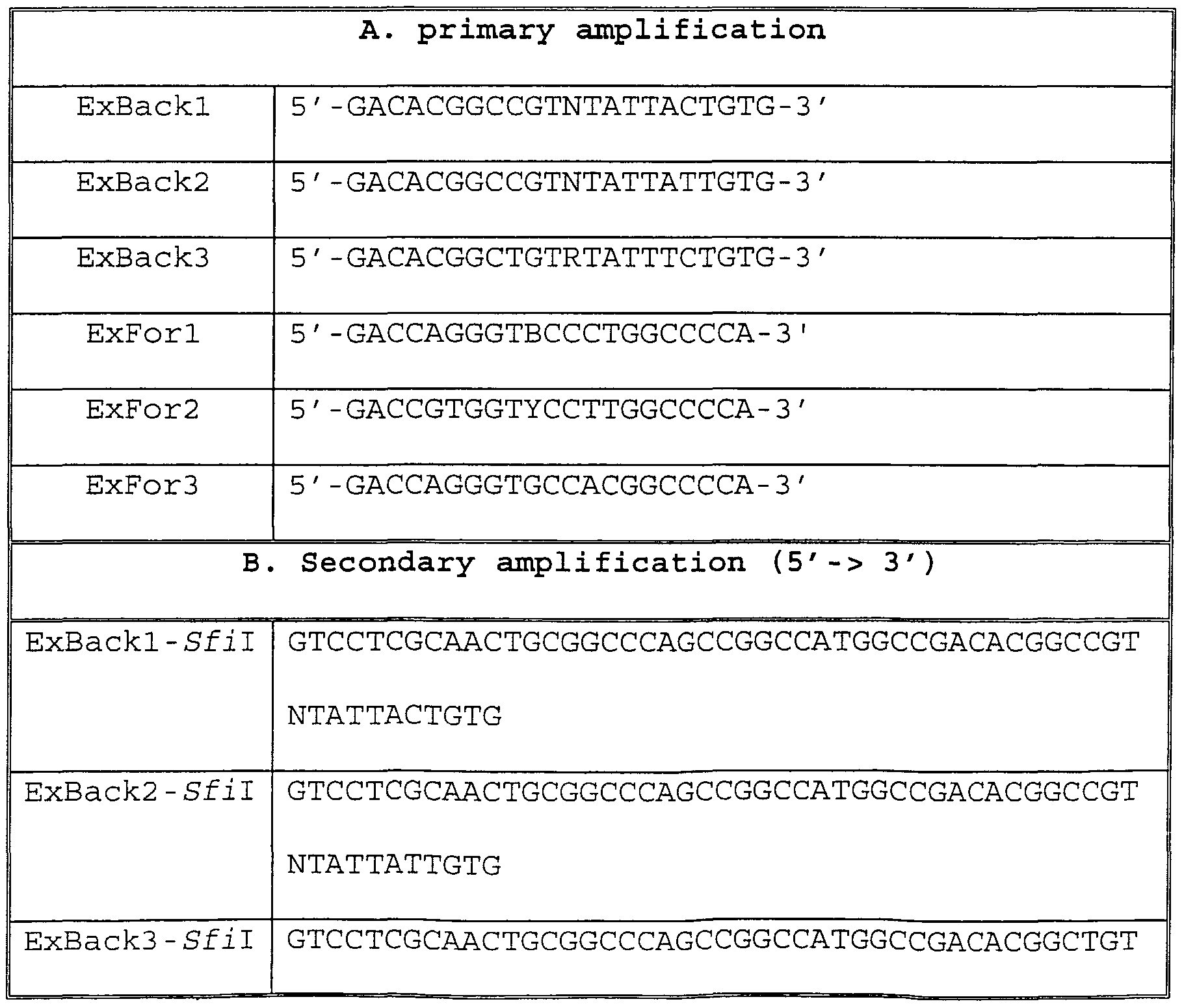
- the complete IgG and IgM genes were amplified with oligo-dT primer combined with family specific VH-Back primers (Table 1) on oligo-dT primed cDNA as template according to the methods as described in EP01205100.9.
- the IgG amplicons (1.6kB) and the IgM amplicons (2.1 kB) were gel purified and used as template for a secondary amplification for introduction of a Sr " il-site in the Back- primers as is described in the next section.
- the primary PCR was performed in 50 ⁇ l reaction volume using 25 pmol of each primer.
- 2.5 ⁇ l random primed or oligo-dT cDNA was used as template, which is the equivalent of 5 ⁇ g mRNA.
- the reaction conditions for the primary PCR were 11 min at 94 °C, followed by 30/60/120 sec at 94/55/72 °C for 30 cycles, and 5 min at 72°C. All reactions were performed with 2.5 mM MgCl 2 , 200 ⁇ M dNTP (Roche Diagnostics, Brussels, Belgium) and 1.25 U AmpliTaq
- the sense primers are located in the J region while the antisense primers are located in the 5' part of VH.
- the reaction was performed in 50 ⁇ l reaction volume with 25 pmol of each primer and 30 ng of purified DNA.
- the reaction conditions for the secondary PCR were 11 min at 94 °C, followed by 30/60/120 sec at 94/55/72 °C for 30 cycles, and 5 min at 72°C. All reactions were performed with 2.5 mM MgCl 2 , 200 ⁇ M dNTP (Roche Diagnostics, Brussels, Belgium) and 1.25 U AmpliTaq Gold DNA polymerase (Applied Biosystems, Lennik, Belgium) .
- Electroporation of bacterial cells [0085] The PCR products of the secondary amplification were digested with Sfil and BstEII or iVotl in separate reactions. After desalting the digestion reactions with Microcon-YM-30 (Amicon, Beverly, MA, USA) , 500 ng of PCR fragments were ligated to 5 ⁇ g vector pAXOOl linearized with Sfil and BstEII or Notl (see section Methods) using T4 DNA ligase (Promega, Leiden, The Netherlands) .
- dilutions (10 ⁇ 2 to 10 "6 ) were plated in 9-cm 0 petridishes to determine the size of the libraries.
- the library was harvested after overnight incubation at 37 °C by flooding the plates with 5-10 ml 2TY/ampicilin /glucose and detaching the cells by scraping with a sterile spreader.
- the PCR fragments of the primary amplification of the heavy chain variable regions were amplified by using sense primers located in the framework 4 and antisense primers located in the framework 3 of VH of the heavy chain variable regions.
- the oligonucleotide primers for the amplification of HCDR3 are described in Table 2.
- the PCR reaction was performed in 50 ⁇ l of reaction volume with 25 pmole of each primer and 1 ng or 0.1 ng of purified DNA.
- The' reaction conditions for the PCR were 10 min at 94 °C, followed by 30/30/60 sec at 94/55/72 °C for 25 cycles, and 10 min at 72 °C. All reactions were performed with 2.5 mM MgCl 2 , 200 ⁇ M dNTP (Roche Diagnostics, Brussels, Belgium) and 2.5 U AmpliTaq Gold DNA polymerase (Applied Biosystems, Lennik, Belgium).
- Example 2 Construction of llama dedicated VHH and VHH ⁇ s libraries . Llama immuniza tion
- cDNA was prepared on 100 ⁇ g total RNA with M-MLV Reverse Transcriptase (Gibco BRL) and a hexanucleotide random primer (Amersham Biosciences) or oligo-dT primer as described before (de Haard et al . , 1999).
- the complete heavy chain derived IgG genes from the Cameloid heavy-chain antibodies (1.3 kB) and the conventional antibodies (1.65 kB) were amplified with oligo-dT primer combined with FRl- primer ABL013 (5' -GAGGTBCARCTGCAGGASTCYGG-3' ) on oligo-dT primed cDNA as template according to the methods described in EP01205100.9.
- the heavy chain antibody derived IgG a plicon was gel purified and used for cloning after digestion with Pstl (introduced in FRl-primer) and BstEII, which naturally occurs in the FR4 -region.
- the repertoire was amplified in a hinge-dependent approach using two IgG specific oligonucleotide primers.
- FRl- primer ABL013 was combined with a short (5'- AACAGTTAAGCTTCCGCTTGCGGCCGCGGAGCTGGGGTCTTCGCTGTGGTGCG-3 ' ) or long ( 5 ' -AACAGTTAAGCTTCCGCTTGCGGCCGCTGGTTGTGGTTTTGGTGTC TTGGGTT-3') hinge primer known to be specific for the amplification of heavy-chain variable region gene segments.
- the transformed cells were grown overnight at 37°C on a single 20x20 cm plate with LB containing 100 ⁇ g/ml ampicillin and 2% glucose. The colonies were scraped from plates using 2xTY medium and stored at -80°C in 20 % glycerol.
- Table 4 features of the 6 immune libraries HCDR3 amplification
- DNA was prepared from all 6 immune libraries and used as template.
- the backward and forward primers were designed in order to maximally cover the HCDR3 repertoire.
- FR4 - forward primers A GGGGCCAGGGVACYCAGGTC compl : GACCTGRGTBCCCTGGCCCC Exforl B GGGGCMAAGGGACCMAGGTC compl: GACCTKGGTCCCTTKGCCCC Exfor2 C GRGGSCCGGGGACCCAGGTC compl : GACCTGGGTCCCCGGSCCYC Exfor3 D GGGGDCAGGGGACCCAGGTC compl : GACCTGGGTCCCCTGHCCCC Exfor4 E ACGGCCAGGGGACCCAGGTC compl : GACCTGGGTCCCCTGGCCGT ExforS aa: G Q G T Q V
- PCR products of the primary amplifications were gel purified and used as template for the secondary amplification reactions using the following primers .
- FR3 - backward primers GTCCTCGCAACTGCGGCCCAGCCGGCCATGGCCGACACGGCCGBCTATTACTG
- GAGTCATTCTCGACTTGCGGCCGCTGAACCGCCTCCGACCTGRGTBCCCTGGCACCT (ExforlcysRnot )
- GAGTCATTCTCGACTTGCGGCCGCTGAACCGCCTCCGACCTKGGTCCCTTKGCACCA (Exfor2cysWnot )
- a number of clones of the library was picked randomly and used for expression of the HCDR3-gene 3 fusion. Each clone was grown in 1 ml of culture (2TY / ampicillin / 0.1 % glucose) at 37°C and induced at an OD600 of 0.9 by addition of IPTG to a final concentration of 1 mM. After 4 hours continued growth the cells were harvested by centrifugation and dissolved in 200 ml Laemmli buffer; 5 ml was loaded on 15% PAGE after boiling for 5 minute. After electroblotting the HCDR3 -derived products were detected with the anti-MYC antibody 9E10, which recognizes the carboxyterminal peptide tag (see Figure 9) .
- the quality of the pAXl- library was analyzed by a phage ELISA, in which polyclonal phage prepared from the non-selected library were tested in dilution series on the antigens IL-6, TNFalpha, IgE and CEA. Bound phage was detected with an anti -phage M13 gene ⁇ mAB (Amersham Biosciences) . Specific signals were found with all tested antigens, while no response was seen against the irrelevant antigen ⁇ -casein (see Figure 10) .
- Example 3 Selection on chemokine receptors CXCR4 and CCR5 by using naive VH, VH ⁇ s and VHH ⁇ libraries.
- Human glioma cells expressing CD4 and human chemokine receptors CXCR4 or CCR5 were grown in 85% DMEM, 15% heat inactivated foetal calf serum, 300 ⁇ g/ml G418 and 1 ⁇ g/ml of puromycine to confluent monolayers in 6 well culture plates.
- M13K07 helper phages to use in a next selection round.
- Different biopanning strategies were performed with CXCR4 or CCR5 expressing human glioma cells, the corresponding human glioma cells that were not expressing CXCR4 and CCR5 and other cell types expressing CXCR4 and CCR5 to identify sequences that were specifically binding to CXCR4 and CCR5.
- individual phages / phagemids were tested for their reactivity to CXCR4 and CCR5 expressing cells in an ELISA assay. Cells were grown to monolayers in 96 well plates overnight. After gentle washing with PBS, the plates were blocked with 2% BSA in PBS for 2 hrs .
- Phages / phagemids were added to the plates and allowed to bind to the cells for 2 hrs at 4°C. Unbound phages and phagemids were removed by gentle washing with PBS . The binding of the phages / phagemids was detected with HRP conjugated ant-M13 antibody and orthophenylenediamine-H 2 0 2 as substrate. Plates were analyzed in a microtiterplate reader at 492 nm. Phages / phagemids binding specifically to the CXCR4 and CCR5 expressing cells were obtained by using different biopanning strategies on different cells.
- Example 4 Biopanning using a dedicated VHH library [0108] Libraries were grown and infected with helperphage M13K07 to obtain phages expressing HCDR3 on the tip of the phage. Phages were purified and used in biopanning experiments. 100 ocl of antigen at a concentration of 5 ⁇ g/ml (in PBS) was coated in microtiterplates during 16 hours at 4 °C. Plates were blocked for 2 hours at room temperature using 1% skimmed milk. 50 ⁇ l purified phages were mixed with 50 ⁇ l 0.2 % skimmed milk and incubated with the antigen for 2 hours at room temperature.
- Non-bound phages were washed away using PBS + 0.05 % Tween-20. Specific phages were eluted using 50 ⁇ l 0.1 M glycine pH 2.5 and neutralized with 50 ⁇ l 1M Tris- HCl pH 7.5. Antigen specific phage were eluted as could be concluded from the numbers of clones obtained from antigen coated wells compared with those from ⁇ -casein coated wells leading to enrichment factors of more than 100 for both the disulfide bridge containing micro-scaffold library and the one lacking this bridge (see Figure 11) . The results are shown in Table 11.
- Example 5 Characterization of the HCDR3 length distribution from dedicated VHH library.
- PCR was performed by PCR amplification (using the protocol of Table 6 and with 1 ng of plasmid template) with the FAM labeled gene 3 primer combined with the different pools of FR3 -based backward primers (Table 5) .
- 1 ⁇ l of the PCR was added to 19 ⁇ l deionized water.
- 1 ⁇ l of the diluted PCR products was mixed with 10 ⁇ l formamide-size standard-mix, containing 1 ml of Hi-DiTM Formamide and 17 ⁇ l of GeneScanTM- 400HD ROX or 500 ROX (Applied Biosystems, Foster City, CA 94404, USA). The samples were heated for 5 minutes at 95°C and placed on ice for at least 5 minutes before loading on the ABI 3700 sequencing machine (Applied Biosystems) .
- HCDR3 in fusion with a HIS-tag, a c-myc-tag and pill.
- An amber stopcodon between the c-myc tag and the pi11 sequence allows expression of the full fusion product when expressed in a suppressor strain.
- soluble HCDR3 in fusion with a HIS-tag and a c-myc-tag can be obtained.
- pAX007 enables expression of a HCDR3 in fusion with a c-myc-tag, a HIS-tag and pill.
- the pAXOOl display vector was modified so that the amber stopcodon was replaced by a codon encoding Glu.
- TTGTTTAGCA3' used to modify the pAXOOl display vector.
- pAX008 enables expression of a HCDR3 in fusion with a c-myc-tag, a HIS-tag and the c-terminal domain of pill, anchoring the fusion product in the phage coat.
- the following mutagenesis primer was designed: 5 ' ACTCTCGAGATCAAACGGGCGGCCGCAGAACAAAAACTCATCTCAGAAGAGGAT CTGAATGGGGCCGCACATCATCATCACCATCACGGGGCCGCAGGTGGTGGCTCTGG TTCCGGTGA3' and used to modify the pAXOOl display vector.
- TG-1 cells were cultured in 1 L 2TY medium containing 16 g/L Tryptone (Difco, Becton Dickinson, San Diego, USA) , 10 g/L yeast extract (Difco, Becton Dickinson, San Diego, USA) and 5 g/L NaCl (Merck Eurolab, Overijse, Belgium) at 37°C at 200-250 rpm until an OD 60 o nm of 0.6-0.9 was reached. Cultures were placed on ice for 30-60 min and then centrifuged for 10 min at 4°C at 4000 rpm in a GS-3 rotor.
- Cells were suspended in an equal volume of ice-cold distilled water, incubated on ice for 30-60 min and centrifuged. Cells were then suspended in half a volume of ice-cold distilled water, incubated on ice for 30-60 min and centrifuged. Next, cells were suspended in 10% glycerol, incubated on ice for 30-60 min and centrifuged. In the last step, cells were suspended in 1 ml 10% glycerol and stored on ice until further use.
Landscapes
- Chemical & Material Sciences (AREA)
- Health & Medical Sciences (AREA)
- Life Sciences & Earth Sciences (AREA)
- Organic Chemistry (AREA)
- Genetics & Genomics (AREA)
- Biochemistry (AREA)
- Engineering & Computer Science (AREA)
- Molecular Biology (AREA)
- General Health & Medical Sciences (AREA)
- Bioinformatics & Cheminformatics (AREA)
- Immunology (AREA)
- Biotechnology (AREA)
- Biophysics (AREA)
- Medicinal Chemistry (AREA)
- Biomedical Technology (AREA)
- Wood Science & Technology (AREA)
- Zoology (AREA)
- General Engineering & Computer Science (AREA)
- Microbiology (AREA)
- Physics & Mathematics (AREA)
- Crystallography & Structural Chemistry (AREA)
- Chemical Kinetics & Catalysis (AREA)
- General Chemical & Material Sciences (AREA)
- Plant Pathology (AREA)
- Proteomics, Peptides & Aminoacids (AREA)
- Virology (AREA)
- Bioinformatics & Computational Biology (AREA)
- Peptides Or Proteins (AREA)
Abstract
Description



Claims
Priority Applications (3)
| Application Number | Priority Date | Filing Date | Title |
|---|---|---|---|
| EP02787225A EP1456410A2 (en) | 2001-12-11 | 2002-12-11 | Method for displaying loops from immunoglobulin domains in different contexts |
| US10/494,829 US20050214857A1 (en) | 2001-12-11 | 2002-12-11 | Method for displaying loops from immunoglobulin domains in different contexts |
| AU2002351896A AU2002351896A1 (en) | 2001-12-11 | 2002-12-11 | Method for displaying loops from immunoglobulin domains in different contexts |
Applications Claiming Priority (2)
| Application Number | Priority Date | Filing Date | Title |
|---|---|---|---|
| EP01870274.6 | 2001-12-11 | ||
| EP01870274 | 2001-12-11 |
Publications (2)
| Publication Number | Publication Date |
|---|---|
| WO2003050531A2 true WO2003050531A2 (en) | 2003-06-19 |
| WO2003050531A3 WO2003050531A3 (en) | 2004-03-18 |
Family
ID=8185067
Family Applications (1)
| Application Number | Title | Priority Date | Filing Date |
|---|---|---|---|
| PCT/BE2002/000189 Ceased WO2003050531A2 (en) | 2001-12-11 | 2002-12-11 | Method for displaying loops from immunoglobulin domains in different contexts |
Country Status (4)
| Country | Link |
|---|---|
| US (1) | US20050214857A1 (en) |
| EP (1) | EP1456410A2 (en) |
| AU (1) | AU2002351896A1 (en) |
| WO (1) | WO2003050531A2 (en) |
Cited By (187)
| Publication number | Priority date | Publication date | Assignee | Title |
|---|---|---|---|---|
| EP1806365A1 (en) | 2006-01-05 | 2007-07-11 | Boehringer Ingelheim International GmbH | Antibody molecules specific for fibroblast activation protein and immunoconjugates containing them |
| EP1751181A4 (en) * | 2004-06-02 | 2008-03-12 | Diatech Pty Ltd | FUNCTIONAL BINDING GROUPS BASED ON DOMAINS OF NEW SHARK IMMUNOGLOBULIN RECEPTORS (IGNAR) |
| WO2008068280A1 (en) * | 2006-12-05 | 2008-06-12 | Ablynx N.V. | Peptides capable of binding to serum proteins |
| WO2009087380A2 (en) | 2008-01-08 | 2009-07-16 | Imagination Technologies Limited | Video motion compensation |
| EP2088432A1 (en) * | 2008-02-11 | 2009-08-12 | MorphoSys AG | Methods for identification of an antibody or a target |
| WO2009127691A1 (en) * | 2008-04-17 | 2009-10-22 | Ablynx N.V. | Peptides capable of binding to serum proteins and compounds, constructs and polypeptides comprising the same |
| WO2009138519A1 (en) | 2008-05-16 | 2009-11-19 | Ablynx Nv | AMINO ACID SEQUENCES DIRECTED AGAINST CXCR4 AND OTHER GPCRs AND COMPOUNDS COMPRISING THE SAME |
| US7696320B2 (en) | 2004-08-24 | 2010-04-13 | Domantis Limited | Ligands that have binding specificity for VEGF and/or EGFR and methods of use therefor |
| WO2010079345A2 (en) | 2009-01-12 | 2010-07-15 | Ucb Pharma S.A. | Antibody-guided fragment growth |
| WO2010100135A1 (en) | 2009-03-05 | 2010-09-10 | Ablynx N.V. | Novel antigen binding dimer-complexes, methods of making/avoiding and uses thereof |
| US20100297111A1 (en) * | 2005-05-21 | 2010-11-25 | Els Anna Alice Beirnaert | Nanobodies against tumor necrosis factor-alpha |
| WO2011003622A1 (en) | 2009-07-10 | 2011-01-13 | Ablynx N.V. | Method for the production of variable domains |
| DE112009000507T5 (en) | 2008-03-05 | 2011-02-10 | Ablynx Nv | Novel antigen-binding dimer complexes, process for their preparation and their use |
| WO2011026948A1 (en) | 2009-09-03 | 2011-03-10 | Ablynx N.V. | Stable formulations of polypeptides and uses thereof |
| EP2308514A2 (en) | 2007-03-23 | 2011-04-13 | to-BBB Holding B.V. | Conjugates for targeted drug delivery across the blood-brain barrier |
| WO2011051351A1 (en) | 2009-10-27 | 2011-05-05 | Ucb Pharma S.A. | Method to generate antibodies to ion channels |
| WO2011051350A1 (en) | 2009-10-27 | 2011-05-05 | Ucb Pharma S.A. | Function modifying nav 1.7 antibodies |
| WO2011051349A1 (en) | 2009-10-27 | 2011-05-05 | Ucb Pharma S.A. | Antibodies to ion channels |
| WO2011064382A1 (en) | 2009-11-30 | 2011-06-03 | Ablynx N.V. | Improved amino acid sequences directed against human respiratory syncytial virus (hrsv) and polypeptides comprising the same for the prevention and/or treatment of respiratory tract infections |
| WO2011073180A1 (en) | 2009-12-14 | 2011-06-23 | Ablynx N.V. | Single variable domain antibodies against ox40l, constructs and therapeutic use |
| WO2011075786A1 (en) | 2009-12-23 | 2011-06-30 | Avipep Pty Ltd | Immuno-conjugates and methods for producing them 2 |
| WO2011083140A1 (en) | 2010-01-08 | 2011-07-14 | Ablynx Nv | Immunoglobulin single variable domain directed against human cxcr4 |
| WO2011089183A2 (en) | 2010-01-20 | 2011-07-28 | Boehringer Ingelheim International Gmbh | Anticoagulant antidotes |
| WO2011095545A1 (en) | 2010-02-05 | 2011-08-11 | Ablynx Nv | Peptides capable of binding to serum albumin and compounds, constructs and polypeptides comprising the same |
| WO2011098552A2 (en) | 2010-02-11 | 2011-08-18 | Ablynx Nv | Methods and compositions for the preparation of aerosols |
| WO2011098518A2 (en) | 2010-02-11 | 2011-08-18 | Ablynx Nv | Delivery of immunoglobulin variable domains and constructs thereof |
| WO2011098520A1 (en) | 2010-02-10 | 2011-08-18 | Novartis Ag | Agonist dr5 binding polypeptides |
| EP2365000A2 (en) | 2005-05-18 | 2011-09-14 | Ablynx N.V. | Improved nanobodiesTM against tumor necrosis factor-alpha |
| EP2366715A2 (en) | 2005-11-14 | 2011-09-21 | Amgen Inc. | Rankl Antibody-PTH/PTHRP Chimeric Molecules |
| WO2011144749A1 (en) | 2010-05-20 | 2011-11-24 | Ablynx Nv | Biological materials related to her3 |
| WO2011161263A1 (en) | 2010-06-25 | 2011-12-29 | Ablynx Nv | Pharmaceutical compositions for cutaneous administration |
| EP2444424A1 (en) | 2005-05-20 | 2012-04-25 | Ablynx N.V. | Improved nanobodies TM for the treatment of aggregation-mediated disorders |
| WO2012056000A1 (en) | 2010-10-29 | 2012-05-03 | Ablynx Nv | Method for the production of immunoglobulin single variable domains |
| WO2012130834A1 (en) | 2011-03-30 | 2012-10-04 | Boehringer Ingelheim International Gmbh | Anticoagulant antidotes |
| WO2012130872A1 (en) | 2011-03-28 | 2012-10-04 | Ablynx Nv | Method for producing solid formulations comprising immunoglobulin single variable domains |
| EP2514767A1 (en) | 2006-12-19 | 2012-10-24 | Ablynx N.V. | Amino acid sequences directed against a metalloproteinase from the ADAM family and polypeptides comprising the same for the treatment of ADAM-related diseases and disorders |
| WO2012152823A1 (en) | 2011-05-09 | 2012-11-15 | Ablynx Nv | Method for the production of immunoglobulin single variable domains |
| WO2012156219A1 (en) | 2011-05-05 | 2012-11-22 | Ablynx Nv | Amino acid sequences directed against il-17a, il-17f and/or il17-a/f and polypeptides comprising the same |
| US8318159B2 (en) | 2008-12-12 | 2012-11-27 | Boehringer Ingelheim International Gmbh | Anti-IGF antibodies |
| WO2012163887A1 (en) | 2011-05-27 | 2012-12-06 | Ablynx Nv | Inhibition of bone resorption with rankl binding peptides |
| JP2012531212A (en) * | 2009-07-03 | 2012-12-10 | アビペップ ピーティーワイ リミテッド | Immunoconjugate and method for producing the same |
| WO2012175740A1 (en) | 2011-06-23 | 2012-12-27 | Ablynx Nv | Immunoglobulin single variable domains directed against ige |
| EP2557090A2 (en) | 2006-12-19 | 2013-02-13 | Ablynx N.V. | Amino acid sequences directed against GPCRs and polypeptides comprising the same for the treatment of GPCR-related diseases and disorders |
| WO2013060872A1 (en) | 2011-10-27 | 2013-05-02 | Boehringer Ingelheim International Gmbh | Anticancer combination therapy |
| US8444976B2 (en) | 2008-07-02 | 2013-05-21 | Argen-X B.V. | Antigen binding polypeptides |
| EP2650311A2 (en) | 2007-11-27 | 2013-10-16 | Ablynx N.V. | Amino acid sequences directed against heterodimeric cytokines and/or their receptors and polypeptides comprising the same |
| US8580254B2 (en) | 2007-06-19 | 2013-11-12 | Boehringer Ingelheim International Gmbh | Anti-IGF antibodies |
| WO2014001557A1 (en) | 2012-06-28 | 2014-01-03 | Ucb Pharma S.A. | A method for identifying compounds of therapeutic interest |
| EP2698166A2 (en) | 2006-10-10 | 2014-02-19 | Regenesance B.V. | Complement inhibition for improved nerve regeneration |
| WO2014087010A1 (en) | 2012-12-07 | 2014-06-12 | Ablynx N.V. | IMPROVED POLYPEPTIDES DIRECTED AGAINST IgE |
| WO2014177595A1 (en) | 2013-04-29 | 2014-11-06 | Agrosavfe N.V. | Agrochemical compositions comprising antibodies binding to sphingolipids |
| WO2014184352A1 (en) | 2013-05-17 | 2014-11-20 | Ablynx Nv | Stable formulations of immunoglobulin single variable domains and uses thereof |
| US8937164B2 (en) | 2010-03-26 | 2015-01-20 | Ablynx N.V. | Biological materials related to CXCR7 |
| US9045545B1 (en) | 2014-07-15 | 2015-06-02 | Kymab Limited | Precision medicine by targeting PD-L1 variants for treatment of cancer |
| EP2883883A1 (en) | 2013-12-16 | 2015-06-17 | Cardio3 Biosciences S.A. | Therapeutic targets and agents useful in treating ischemia reperfusion injury |
| US9067998B1 (en) | 2014-07-15 | 2015-06-30 | Kymab Limited | Targeting PD-1 variants for treatment of cancer |
| US9156905B2 (en) | 2001-10-24 | 2015-10-13 | Vib Vzw | Functional heavy chain antibodies, fragments thereof, library thereof and methods of production thereof |
| EP2947097A1 (en) | 2008-04-07 | 2015-11-25 | Ablynx N.V. | Amino acid sequences directed against the Notch pathways and uses thereof |
| AU2009329501B2 (en) * | 2008-12-19 | 2015-11-26 | Ablynx N.V. | Genetic immunization for producing immunoglobulins against cell-associated antigens such as P2X7, CXCR7 or CXCR4 |
| WO2015193452A1 (en) | 2014-06-18 | 2015-12-23 | Ablynx Nv | Kv1.3 binding immunoglobulins |
| US9234037B2 (en) | 2009-10-27 | 2016-01-12 | Ucb Biopharma Sprl | Method to generate antibodies to ion channels |
| WO2016016021A1 (en) | 2014-07-29 | 2016-02-04 | Vrije Universiteit Brussel | Radio-labelled antibody fragments for use in the prevention and/or treatment of cancer |
| EP2982690A1 (en) | 2009-04-30 | 2016-02-10 | Ablynx N.V. | Method for the production of domain antibodies |
| WO2016071438A2 (en) | 2014-11-05 | 2016-05-12 | Agrosavfe Nv | Transgenic plant comprising a polynucleotide encoding a variable domain of heavy-chain antibody |
| WO2016097313A1 (en) | 2014-12-19 | 2016-06-23 | Ablynx N.V. | Cysteine linked nanobody dimers |
| US9512236B2 (en) | 2006-12-19 | 2016-12-06 | Ablynx N.V. | Amino acid sequences directed against GPCRS and polypeptides comprising the same for the treatment of GPCR-related diseases and disorders |
| EP3205670A1 (en) | 2009-06-05 | 2017-08-16 | Ablynx N.V. | Improved amino acid sequences directed against human respiratory syncytial virus (hrsv) and polypeptides comprising the same for the prevention and/or treatment of respiratory tract infections |
| WO2017182603A1 (en) | 2016-04-22 | 2017-10-26 | Université Libre de Bruxelles | A new biomarker expressed in pancreatic beta cells useful in imaging or targeting beta cells |
| WO2017182605A1 (en) | 2016-04-22 | 2017-10-26 | Université Libre de Bruxelles | A new biomarker expressed in pancreatic beta cells useful in imaging or targeting beta cells |
| WO2017191108A1 (en) | 2016-05-02 | 2017-11-09 | Ablynx Nv | Treatment of rsv infection |
| WO2018007442A1 (en) | 2016-07-06 | 2018-01-11 | Ablynx N.V. | Treatment of il-6r related diseases |
| WO2018029182A1 (en) | 2016-08-08 | 2018-02-15 | Ablynx N.V. | Il-6r single variable domain antibodies for treatment of il-6r related diseases |
| WO2018050833A1 (en) | 2016-09-15 | 2018-03-22 | Ablynx Nv | Immunoglobulin single variable domains directed against macrophage migration inhibitory factor |
| EP3311837A1 (en) | 2011-09-23 | 2018-04-25 | Ablynx NV | Prolonged inhibition of interleukin-6 mediated signaling |
| WO2018091606A1 (en) | 2016-11-16 | 2018-05-24 | Ablynx Nv | T cell recruiting polypeptides capable of binding cd123 and tcr alpha/beta |
| WO2018099968A1 (en) | 2016-11-29 | 2018-06-07 | Ablynx N.V. | Treatment of infection by respiratory syncytial virus (rsv) |
| US9994639B2 (en) | 2011-03-28 | 2018-06-12 | Ablynx N.V. | Biological materials related to CXCR7 |
| WO2018115231A2 (en) | 2016-12-22 | 2018-06-28 | Boehringer Ingelheim International Gmbh | Binding molecules for the treatment of cancer |
| WO2018158335A1 (en) | 2017-02-28 | 2018-09-07 | Vib Vzw | Means and methods for oral protein delivery |
| WO2018192974A1 (en) | 2017-04-18 | 2018-10-25 | Université Libre de Bruxelles | Biomarkers and targets for proliferative diseases |
| WO2018206734A1 (en) | 2017-05-11 | 2018-11-15 | Vib Vzw | Glycosylation of variable immunoglobulin domains |
| WO2018220236A1 (en) | 2017-06-02 | 2018-12-06 | Merck Patent Gmbh | Polypeptides binding adamts5, mmp13 and aggrecan |
| WO2018220235A1 (en) | 2017-06-02 | 2018-12-06 | Merck Patent Gmbh | Mmp13 binding immunoglobulins |
| WO2018220225A1 (en) | 2017-06-02 | 2018-12-06 | Ablynx Nv | Aggrecan binding immunoglobulins |
| WO2018220234A1 (en) | 2017-06-02 | 2018-12-06 | Merck Patent Gmbh | Adamts binding immunoglobulins |
| EP3424526A1 (en) | 2008-06-05 | 2019-01-09 | Ablynx NV | Immunoglobulin single variable domains binding to the g envelope protein of rabies virus and uses thereof for the treatment and prevention of rabies |
| WO2019016237A1 (en) | 2017-07-19 | 2019-01-24 | Vib Vzw | Serum albumin binding agents |
| US10214588B2 (en) | 2007-07-03 | 2019-02-26 | Ablynx N.V. | Providing improved immunoglobulin sequences by mutating CDR and/or FR positions |
| EP3461844A2 (en) | 2009-04-10 | 2019-04-03 | Ablynx N.V. | Improved amino acid sequences directed against il-6r and polypeptides comprising the same for the treatment of il-6r related diseases and disorders |
| WO2019086548A1 (en) | 2017-10-31 | 2019-05-09 | Vib Vzw | Novel antigen-binding chimeric proteins and methods and uses thereof |
| US10377828B2 (en) | 2013-03-07 | 2019-08-13 | Boehringer Ingelheim International Gmbh | Combination therapy for neoplasia treatment |
| WO2019155041A1 (en) | 2018-02-12 | 2019-08-15 | Vib Vzw | Gβγ COMPLEX ANTIBODIES AND USES THEREOF |
| WO2019166622A1 (en) | 2018-03-01 | 2019-09-06 | Vrije Universiteit Brussel | Human pd-l1-binding immunoglobulins |
| WO2019180204A1 (en) | 2018-03-23 | 2019-09-26 | Université Libre de Bruxelles | Wnt signaling agonist molecules |
| WO2019185723A1 (en) | 2018-03-27 | 2019-10-03 | Umc Utrecht Holding B.V. | Targeted thrombolysis for treatment of microvascular thrombosis |
| EP3569618A1 (en) | 2018-05-19 | 2019-11-20 | Boehringer Ingelheim International GmbH | Antagonizing cd73 antibody |
| US10618955B2 (en) | 2014-07-15 | 2020-04-14 | Kymab Limited | Methods for treating neurodegenerative disease using anti-PD-1 antibodies |
| WO2020099508A1 (en) | 2018-11-13 | 2020-05-22 | Emstopa Limited | Tissue plasminogen activator antibodies and method of use thereof |
| WO2020221888A1 (en) | 2019-04-30 | 2020-11-05 | Vib Vzw | Cystic fibrosis transmembrane conductance regulator stabilizing agents |
| WO2020239934A1 (en) | 2019-05-28 | 2020-12-03 | Vib Vzw | Cd8+ t-cells lacking plexins and their application in cancer treatment |
| WO2020239945A1 (en) | 2019-05-28 | 2020-12-03 | Vib Vzw | Cancer treatment by targeting plexins in the immune compartment |
| WO2021064137A2 (en) | 2019-10-02 | 2021-04-08 | Boehringer Ingelheim International Gmbh | Multi-specific binding proteins for cancer treatment |
| WO2021078786A1 (en) | 2019-10-21 | 2021-04-29 | Vib Vzw | Nanodisc-specific antigen-binding chimeric proteins |
| WO2021105438A1 (en) | 2019-11-27 | 2021-06-03 | Vib Vzw | Positive allosteric modulators of the calcium-sensing receptor |
| WO2021116252A1 (en) | 2019-12-12 | 2021-06-17 | Vib Vzw | Glycosylated single chain immunoglobulin domains |
| WO2021123360A1 (en) | 2019-12-20 | 2021-06-24 | Vib Vzw | Nanobody exchange chromatography |
| EP3848393A1 (en) | 2016-05-18 | 2021-07-14 | Boehringer Ingelheim International GmbH | Antibody molecules for cancer treatment |
| WO2021156490A2 (en) | 2020-02-06 | 2021-08-12 | Vib Vzw | Corona virus binders |
| WO2021170540A1 (en) | 2020-02-25 | 2021-09-02 | Vib Vzw | Leucine-rich repeat kinase 2 allosteric modulators |
| WO2021198396A1 (en) | 2020-03-31 | 2021-10-07 | Biotalys NV | Anti-fungal polypeptides |
| WO2021213435A1 (en) | 2020-04-22 | 2021-10-28 | 迈威(上海)生物科技股份有限公司 | Single variable domain antibody targeting human programmed death ligand 1 (pd-l1) and derivative thereof |
| WO2021229104A1 (en) | 2020-05-15 | 2021-11-18 | Université de Liège | Anti-cd38 single-domain antibodies in disease monitoring and treatment |
| WO2021236658A1 (en) | 2020-05-19 | 2021-11-25 | Boehringer Ingelheim International Gmbh | Binding molecules for the treatment of cancer |
| EP3932945A1 (en) | 2015-11-27 | 2022-01-05 | Ablynx NV | Polypeptides inhibiting cd40l |
| WO2022003156A1 (en) | 2020-07-02 | 2022-01-06 | Oncurious Nv | Ccr8 non-blocking binders |
| WO2022023584A1 (en) | 2020-07-31 | 2022-02-03 | Biotalys NV | Methods of increasing recombinant protein yields |
| WO2022063984A1 (en) | 2020-09-25 | 2022-03-31 | Ablynx Nv | Polypeptides comprising immunoglobulin single variable domains targeting il-13 and ox40l |
| WO2022063947A1 (en) | 2020-09-24 | 2022-03-31 | Vib Vzw | Combination of p2y6 inhibitors and immune checkpoint inhibitors |
| WO2022063957A1 (en) | 2020-09-24 | 2022-03-31 | Vib Vzw | Biomarker for anti-tumor therapy |
| US11298433B2 (en) | 2015-07-17 | 2022-04-12 | Vrije Universiteit Brussel | Radiolabelled antibody fragments for use in treating cancer |
| WO2022084354A1 (en) | 2020-10-21 | 2022-04-28 | Boehringer Ingelheim International Gmbh | Bispecific anti-vegf and anti-trkb binding molecules for the treatment of eye diseases |
| WO2022117569A1 (en) | 2020-12-02 | 2022-06-09 | Oncurious Nv | A ccr8 antagonist antibody in combination with a lymphotoxin beta receptor agonist antibody in therapy against cancer |
| WO2022117572A2 (en) | 2020-12-02 | 2022-06-09 | Oncurious Nv | An ltbr agonist in combination therapy against cancer |
| WO2022129572A1 (en) | 2020-12-18 | 2022-06-23 | Ablynx Nv | Polypeptides comprising immunoglobulin single variable domains targeting il-6 and tnf-alpha |
| WO2022136647A1 (en) | 2020-12-24 | 2022-06-30 | Oncurious Nv | Human ccr8 binders |
| WO2022136650A1 (en) | 2020-12-24 | 2022-06-30 | Oncurious Nv | Murine cross-reactive human ccr8 binders |
| WO2022136685A1 (en) | 2020-12-23 | 2022-06-30 | Vib Vzw | Antibody compositions for treatment of corona virus infection |
| WO2022136649A1 (en) | 2020-12-24 | 2022-06-30 | Oncurious Nv | Non-blocking human ccr8 binders |
| WO2022167666A1 (en) | 2021-02-05 | 2022-08-11 | Vib Vzw | Sarbecovirus binders |
| WO2022178255A2 (en) | 2021-02-19 | 2022-08-25 | The United States Of America, As Represented By The Secretary, Department Of Health And Human Services | Single domain antibodies that neutralize sars-cov-2 |
| WO2022175392A1 (en) | 2021-02-17 | 2022-08-25 | Vib Vzw | Inhibition of slc4a4 in the treatment of cancer |
| WO2022175532A1 (en) | 2021-02-19 | 2022-08-25 | Vib Vzw | Cation-independent mannose-6-phosphate receptor binders |
| WO2022199804A1 (en) | 2021-03-24 | 2022-09-29 | Vib Vzw | Nek6 inhibition to treat als and ftd |
| WO2022238550A1 (en) | 2021-05-12 | 2022-11-17 | Vib Vzw | Pan-specific corona virus binders |
| WO2022242892A1 (en) | 2021-05-17 | 2022-11-24 | Université de Liège | Anti-cd38 single-domain antibodies in disease monitoring and treatment |
| WO2022263507A1 (en) | 2021-06-17 | 2022-12-22 | Boehringer Ingelheim International Gmbh | Novel tri-specific binding molecules |
| WO2022268993A1 (en) | 2021-06-23 | 2022-12-29 | Vib Vzw | Means and methods for selection of specific binders |
| WO2023274183A1 (en) | 2021-06-29 | 2023-01-05 | 江苏先声药业有限公司 | Cd16 antibody and use thereof |
| WO2023006040A1 (en) | 2021-07-30 | 2023-02-02 | 江苏先声药业有限公司 | Anti-pvrig/anti-tigit bispecific antibody and application |
| WO2023016828A2 (en) | 2021-07-30 | 2023-02-16 | Vib Vzw | Cation-independent mannose-6-phosphate receptor binders for targeted protein degradation |
| WO2023057601A1 (en) | 2021-10-06 | 2023-04-13 | Biotalys NV | Anti-fungal polypeptides |
| US11660356B2 (en) | 2014-07-29 | 2023-05-30 | Vrije Universiteit Brussel | Radio-labelled antibody fragments for use in the prognosis, diagnosis of cancer as well as for the prediction of cancer therapy response |
| WO2023098846A1 (en) | 2021-12-03 | 2023-06-08 | 江苏先声药业有限公司 | Anti-bcma nanobody and use thereof |
| WO2023111266A1 (en) | 2021-12-17 | 2023-06-22 | Ablynx Nv | POLYPEPTIDES COMPRISING IMMUNOGLOBULIN SINGLE VARIABLE DOMAINS TARGETING TCRαβ, CD33 AND CD123 |
| WO2023125888A1 (en) | 2021-12-31 | 2023-07-06 | 山东先声生物制药有限公司 | Gprc5d antibody and application thereof |
| WO2023135198A1 (en) | 2022-01-12 | 2023-07-20 | Vib Vzw | Human ntcp binders for therapeutic use and liver-specific targeted delivery |
| WO2023148291A1 (en) | 2022-02-02 | 2023-08-10 | Biotalys NV | Methods for genome editing |
| WO2023148397A1 (en) | 2022-02-07 | 2023-08-10 | Vib Vzw | Engineered stabilizing aglycosylated fc-regions |
| US11753479B2 (en) | 2014-03-04 | 2023-09-12 | Kymab Limited | Nucleic acids encoding anti-OX40L antibodies |
| US11779604B2 (en) | 2016-11-03 | 2023-10-10 | Kymab Limited | Antibodies, combinations comprising antibodies, biomarkers, uses and methods |
| WO2023198848A1 (en) | 2022-04-13 | 2023-10-19 | Vib Vzw | An ltbr agonist in combination therapy against cancer |
| WO2023213751A1 (en) | 2022-05-02 | 2023-11-09 | Umc Utrecht Holding B.V | Single domain antibodies for the detection of plasmin-cleaved vwf |
| WO2023222825A1 (en) | 2022-05-18 | 2023-11-23 | Vib Vzw | Sarbecovirus spike s2 subunit binders |
| WO2023236889A1 (en) | 2022-06-06 | 2023-12-14 | 山东先声生物制药有限公司 | Multi-specific antibody targeting bcma, gprc5d and t cells and application thereof |
| WO2024008755A1 (en) | 2022-07-04 | 2024-01-11 | Vib Vzw | Blood-cerebrospinal fluid barrier crossing antibodies |
| WO2024013315A1 (en) | 2022-07-15 | 2024-01-18 | Boehringer Ingelheim International Gmbh | Binding molecules for the treatment of cancer |
| WO2024068744A1 (en) | 2022-09-27 | 2024-04-04 | Vib Vzw | Antivirals against human parainfluenza virus |
| WO2024083843A1 (en) | 2022-10-18 | 2024-04-25 | Confo Therapeutics N.V. | Amino acid sequences directed against the melanocortin 4 receptor and polypeptides comprising the same for the treatment of mc4r-related diseases and disorders |
| WO2024102962A1 (en) | 2022-11-10 | 2024-05-16 | Immuvia Inc | Cytotoxic bispecific antibodies binding to dr5 and muc16 and uses thereof |
| WO2024105091A1 (en) | 2022-11-15 | 2024-05-23 | Imec Vzw | Method and system for droplet manipulation |
| WO2024126805A1 (en) | 2022-12-15 | 2024-06-20 | Aarhus Universitet | Synthetic activation of multimeric transmembrane receptors |
| WO2024133937A1 (en) | 2022-12-22 | 2024-06-27 | Biotalys NV | Methods for genome editing |
| WO2024141638A1 (en) | 2022-12-30 | 2024-07-04 | Biotalys NV | Self-emulsifiable concentrate |
| WO2024145551A1 (en) | 2022-12-29 | 2024-07-04 | Biotalys NV | Agrochemical compositions |
| WO2024141645A1 (en) | 2022-12-30 | 2024-07-04 | Biotalys N.V. | Agglomerate |
| WO2024141641A2 (en) | 2022-12-30 | 2024-07-04 | Biotalys NV | Secretion signals |
| WO2024156881A1 (en) | 2023-01-27 | 2024-08-02 | Vib Vzw | CD8b-BINDING POLYPEPTIDES |
| WO2024156888A1 (en) | 2023-01-27 | 2024-08-02 | Vib Vzw | Cd163-binding conjugates |
| WO2024165710A1 (en) | 2023-02-09 | 2024-08-15 | Seni-Preps B.V. | Immunoglobulin single variable domains that inhibit urease and use thereof |
| WO2024175787A1 (en) | 2023-02-24 | 2024-08-29 | Vrije Universiteit Brussel | Anti-inflammatory pannexin 1 channel inhibitors |
| WO2024189171A1 (en) | 2023-03-14 | 2024-09-19 | Aarhus Universitet | Genetically altered nfr5 receptor kinases |
| WO2024208816A1 (en) | 2023-04-03 | 2024-10-10 | Vib Vzw | Blood-brain barrier crossing antibodies |
| WO2024231348A1 (en) | 2023-05-11 | 2024-11-14 | Vib Vzw | Slc4a4/nbce1 inhibitors |
| WO2024240162A1 (en) | 2023-05-23 | 2024-11-28 | Shanghai Allygen Biologics Co., Ltd. | Pd-l1 and trop-2 targeting conjugates comprising effector molecules and uses thereof |
| WO2024261344A1 (en) | 2023-06-23 | 2024-12-26 | Vib Vzw | Novel binders targeting the multi-drug resistant pathogen acinetobacter baumannii |
| EP4483951A1 (en) | 2023-06-30 | 2025-01-01 | Université de Liège | Single-domain antibody for inhibition of neutrophil elastase activity |
| US12209128B2 (en) | 2016-06-20 | 2025-01-28 | Kymab Limited | Anti-PD-L1 antibodies |
| WO2025078605A1 (en) | 2023-10-12 | 2025-04-17 | Synapse Research Institute | Molecules for reversing anti-coagulant activity of direct oral anticoagulants |
| WO2025093683A1 (en) | 2023-11-03 | 2025-05-08 | Neuvasq Biotechnologies Sa | Wnt7 signaling agonists |
| WO2025109176A1 (en) | 2023-11-22 | 2025-05-30 | Exevir Bio Bv | Optimized sarbecovirus spike s2 subunit binders and compositions comprising the same |
| WO2025125577A1 (en) | 2023-12-14 | 2025-06-19 | Vib Vzw | Antibodies against influenza b virus |
| EP4574981A1 (en) | 2023-12-22 | 2025-06-25 | Biotalys NV | Anti-fungal vhh antibodies |
| WO2025181155A1 (en) | 2024-02-26 | 2025-09-04 | Vib Vzw | Human beta-glucocerebrosidase binders and uses thereof |
| WO2025196308A1 (en) | 2024-03-22 | 2025-09-25 | Vib Vzw | Means and methods for displaying fc-containing proteins on cells and selection thereof |
| WO2025219231A1 (en) | 2024-04-15 | 2025-10-23 | Vib Vzw | Computer-implemented means and methods for the de novo design of antibodies targeting a specific epitope |
| WO2026008665A1 (en) | 2024-07-01 | 2026-01-08 | Vib Vzw | Binders of the pd-1•pd-l1 complex and their use |
| WO2026008785A1 (en) | 2024-07-03 | 2026-01-08 | Biotalys NV | Agrochemical compositions |
Families Citing this family (10)
| Publication number | Priority date | Publication date | Assignee | Title |
|---|---|---|---|---|
| AU2002360068B2 (en) * | 2001-12-21 | 2009-09-03 | Vlaams Interuniversitair Instituut Voor Biotechnologie Vzw | Method for cloning of variable domain sequences |
| US20100226920A1 (en) * | 2006-03-27 | 2010-09-09 | Ablynx N.V. | Medical delivery device for therapeutic proteins based on single domain antibodies |
| US20080287320A1 (en) * | 2006-10-04 | 2008-11-20 | Codon Devices | Libraries and their design and assembly |
| EP2224955A4 (en) | 2007-11-27 | 2011-02-16 | Univ British Columbia | COMPOSITIONS AND METHODS FOR THE PREVENTION AND TREATMENT OF ARTHRITIS |
| WO2009149218A2 (en) * | 2008-06-03 | 2009-12-10 | Codon Devices, Inc. | Novel proteins and methods of designing and using same |
| US9580480B2 (en) | 2011-05-31 | 2017-02-28 | Massachusetts Institute Of Technology | Cell-directed synthesis of multifunctional nanopatterns and nanomaterials |
| US9914769B2 (en) | 2014-07-15 | 2018-03-13 | Kymab Limited | Precision medicine for cholesterol treatment |
| US8992927B1 (en) | 2014-07-15 | 2015-03-31 | Kymab Limited | Targeting human NAV1.7 variants for treatment of pain |
| US8986694B1 (en) | 2014-07-15 | 2015-03-24 | Kymab Limited | Targeting human nav1.7 variants for treatment of pain |
| US10047166B2 (en) * | 2014-06-17 | 2018-08-14 | Academia Sinica | Humanized anti-IgE antibodies that crosslink CD23 on B lymphocytes but do not sensitize mast cells |
Family Cites Families (3)
| Publication number | Priority date | Publication date | Assignee | Title |
|---|---|---|---|---|
| GB9701425D0 (en) * | 1997-01-24 | 1997-03-12 | Bioinvent Int Ab | A method for in vitro molecular evolution of protein function |
| AU775076B2 (en) * | 1998-12-10 | 2004-07-15 | Bristol-Myers Squibb Company | Protein scaffolds for antibody mimics and other binding proteins |
| IT1307309B1 (en) * | 1999-12-30 | 2001-10-30 | Enea Ente Nuove Tec | STABILIZING PEPTIDES, POLYPEPTIDES AND ANTIBODIES THAT INCLUDE THEM. |
-
2002
- 2002-12-11 WO PCT/BE2002/000189 patent/WO2003050531A2/en not_active Ceased
- 2002-12-11 AU AU2002351896A patent/AU2002351896A1/en not_active Abandoned
- 2002-12-11 EP EP02787225A patent/EP1456410A2/en not_active Withdrawn
- 2002-12-11 US US10/494,829 patent/US20050214857A1/en not_active Abandoned
Cited By (281)
| Publication number | Priority date | Publication date | Assignee | Title |
|---|---|---|---|---|
| US9156905B2 (en) | 2001-10-24 | 2015-10-13 | Vib Vzw | Functional heavy chain antibodies, fragments thereof, library thereof and methods of production thereof |
| EP1751181A4 (en) * | 2004-06-02 | 2008-03-12 | Diatech Pty Ltd | FUNCTIONAL BINDING GROUPS BASED ON DOMAINS OF NEW SHARK IMMUNOGLOBULIN RECEPTORS (IGNAR) |
| US7977071B2 (en) | 2004-06-02 | 2011-07-12 | Adalta Pty Ltd. | Binding moieties based on shark ignar domains |
| AU2008229687B2 (en) * | 2004-06-02 | 2009-01-29 | Adalta Pty Ltd | Binding moieties based on shark IgNAR domains |
| US7696320B2 (en) | 2004-08-24 | 2010-04-13 | Domantis Limited | Ligands that have binding specificity for VEGF and/or EGFR and methods of use therefor |
| EP2949668A1 (en) | 2005-05-18 | 2015-12-02 | Ablynx N.V. | Improved nanobodiestm against tumor necrosis factor-alpha |
| EP2365000A2 (en) | 2005-05-18 | 2011-09-14 | Ablynx N.V. | Improved nanobodiesTM against tumor necrosis factor-alpha |
| US11472871B2 (en) | 2005-05-18 | 2022-10-18 | Ablynx N.V. | Nanobodies against tumor necrosis factor-alpha |
| EP3613767A1 (en) | 2005-05-18 | 2020-02-26 | Ablynx N.V. | Improved nanobodiestm against tumor cecrosis factor-alpha |
| EP2479191A2 (en) | 2005-05-18 | 2012-07-25 | Ablynx N.V. | Improved nanobodiesTM against tumor necrosis factor-alpha |
| US9067991B2 (en) | 2005-05-18 | 2015-06-30 | Ablynx N.V. | Nanobodies against tumor necrosis factor-alpha |
| EP3243839A1 (en) | 2005-05-20 | 2017-11-15 | Ablynx N.V. | Improved nanobodies tm for the treatment of aggregation-mediated disorders |
| EP3415535A1 (en) | 2005-05-20 | 2018-12-19 | Ablynx N.V. | Improved nanobodies tm for the treatment of aggregation-mediated disorders |
| EP2444424A1 (en) | 2005-05-20 | 2012-04-25 | Ablynx N.V. | Improved nanobodies TM for the treatment of aggregation-mediated disorders |
| US8703131B2 (en) * | 2005-05-21 | 2014-04-22 | Ablynx N.V. | Nanobodies against tumor necrosis factor-alpha |
| US20100297111A1 (en) * | 2005-05-21 | 2010-11-25 | Els Anna Alice Beirnaert | Nanobodies against tumor necrosis factor-alpha |
| EP2816060A1 (en) | 2005-11-14 | 2014-12-24 | Amgen Inc. | Rankl antibody-PTH/PTHRP chimeric molecules |
| EP2366715A2 (en) | 2005-11-14 | 2011-09-21 | Amgen Inc. | Rankl Antibody-PTH/PTHRP Chimeric Molecules |
| EP1806365A1 (en) | 2006-01-05 | 2007-07-11 | Boehringer Ingelheim International GmbH | Antibody molecules specific for fibroblast activation protein and immunoconjugates containing them |
| EP3804755A1 (en) | 2006-10-10 | 2021-04-14 | Regenesance B.V. | Complement inhibition for improved nerve regeneration |
| EP2698166A2 (en) | 2006-10-10 | 2014-02-19 | Regenesance B.V. | Complement inhibition for improved nerve regeneration |
| EP3028716A1 (en) | 2006-10-10 | 2016-06-08 | Regenesance B.V. | Complement inhibition for improved nerve regeneration |
| WO2008068280A1 (en) * | 2006-12-05 | 2008-06-12 | Ablynx N.V. | Peptides capable of binding to serum proteins |
| EP2557090A2 (en) | 2006-12-19 | 2013-02-13 | Ablynx N.V. | Amino acid sequences directed against GPCRs and polypeptides comprising the same for the treatment of GPCR-related diseases and disorders |
| EP2514767A1 (en) | 2006-12-19 | 2012-10-24 | Ablynx N.V. | Amino acid sequences directed against a metalloproteinase from the ADAM family and polypeptides comprising the same for the treatment of ADAM-related diseases and disorders |
| US9512236B2 (en) | 2006-12-19 | 2016-12-06 | Ablynx N.V. | Amino acid sequences directed against GPCRS and polypeptides comprising the same for the treatment of GPCR-related diseases and disorders |
| EP2308514A2 (en) | 2007-03-23 | 2011-04-13 | to-BBB Holding B.V. | Conjugates for targeted drug delivery across the blood-brain barrier |
| US8580254B2 (en) | 2007-06-19 | 2013-11-12 | Boehringer Ingelheim International Gmbh | Anti-IGF antibodies |
| US10214588B2 (en) | 2007-07-03 | 2019-02-26 | Ablynx N.V. | Providing improved immunoglobulin sequences by mutating CDR and/or FR positions |
| EP2650311A2 (en) | 2007-11-27 | 2013-10-16 | Ablynx N.V. | Amino acid sequences directed against heterodimeric cytokines and/or their receptors and polypeptides comprising the same |
| WO2009087380A2 (en) | 2008-01-08 | 2009-07-16 | Imagination Technologies Limited | Video motion compensation |
| EP2088432A1 (en) * | 2008-02-11 | 2009-08-12 | MorphoSys AG | Methods for identification of an antibody or a target |
| DE112009000507T5 (en) | 2008-03-05 | 2011-02-10 | Ablynx Nv | Novel antigen-binding dimer complexes, process for their preparation and their use |
| EP2947097A1 (en) | 2008-04-07 | 2015-11-25 | Ablynx N.V. | Amino acid sequences directed against the Notch pathways and uses thereof |
| US8217140B2 (en) | 2008-04-17 | 2012-07-10 | Ablynx N.V. | Peptides capable of binding to serum proteins and compounds, constructs and polypeptides comprising the same |
| WO2009127691A1 (en) * | 2008-04-17 | 2009-10-22 | Ablynx N.V. | Peptides capable of binding to serum proteins and compounds, constructs and polypeptides comprising the same |
| US20110206660A1 (en) * | 2008-05-16 | 2011-08-25 | Ablynx N.V. | Amino acid sequences directed against cxcr4 and other gpcrs and compounds comprising the same |
| WO2009138519A1 (en) | 2008-05-16 | 2009-11-19 | Ablynx Nv | AMINO ACID SEQUENCES DIRECTED AGAINST CXCR4 AND OTHER GPCRs AND COMPOUNDS COMPRISING THE SAME |
| AU2009248049B2 (en) * | 2008-05-16 | 2015-07-23 | Ablynx N.V. | Amino acid sequences directed against CXCR4 and other GPCRs and compounds comprising the same |
| JP2011523550A (en) * | 2008-05-16 | 2011-08-18 | アブリンクス エン.ヴェー. | Amino acid sequences directed to CXCR4 and other GPCRs and compounds containing the same |
| US9212226B2 (en) | 2008-05-16 | 2015-12-15 | Ablynx N.V. | Amino acid sequences directed against CXCR4 and other GPCRs and compounds comprising the same |
| EP3424526A1 (en) | 2008-06-05 | 2019-01-09 | Ablynx NV | Immunoglobulin single variable domains binding to the g envelope protein of rabies virus and uses thereof for the treatment and prevention of rabies |
| US8524231B2 (en) | 2008-07-02 | 2013-09-03 | Argen-X B.V. | Antigen binding polypeptides |
| US9346891B2 (en) | 2008-07-02 | 2016-05-24 | Argen-X.N.V. | Antigen binding polypeptides |
| US9221918B2 (en) | 2008-07-02 | 2015-12-29 | Argen-X B.V. | Antigen binding polypeptides |
| US8444976B2 (en) | 2008-07-02 | 2013-05-21 | Argen-X B.V. | Antigen binding polypeptides |
| US9315576B2 (en) | 2008-07-02 | 2016-04-19 | Argen-X N.V. | Antigen binding polypeptides |
| US9428580B2 (en) | 2008-07-02 | 2016-08-30 | Argen-X B.V. | Antigen binding polypeptides |
| US10179810B2 (en) | 2008-12-12 | 2019-01-15 | Boehringer Ingelheim International Gmbh | Anti-IGF antibodies |
| US8318159B2 (en) | 2008-12-12 | 2012-11-27 | Boehringer Ingelheim International Gmbh | Anti-IGF antibodies |
| EP3064219A2 (en) | 2008-12-12 | 2016-09-07 | Boehringer Ingelheim International GmbH | Anti-igf antibodies |
| US11299538B2 (en) | 2008-12-12 | 2022-04-12 | Boehringer Ingelheim International Gmbh | Anti-IGF antibodies |
| US10023633B2 (en) | 2008-12-19 | 2018-07-17 | Ablynx N.V. | Method for generation of immunoglobulin sequences |
| EP3470425A2 (en) | 2008-12-19 | 2019-04-17 | Ablynx N.V. | Immunoglobulins against cell-associatd antigens such as p2x7 |
| AU2009329501B2 (en) * | 2008-12-19 | 2015-11-26 | Ablynx N.V. | Genetic immunization for producing immunoglobulins against cell-associated antigens such as P2X7, CXCR7 or CXCR4 |
| EP2370465B1 (en) * | 2008-12-19 | 2019-01-23 | Ablynx N.V. | Genetic immunization for producing immunoglobulins against cell-associated antigens such as p2x7, cxcr7 or cxcr4 |
| US9260508B2 (en) | 2008-12-19 | 2016-02-16 | Ablynx N.V. | Method for generation of immunoglobulin sequences |
| WO2010079345A2 (en) | 2009-01-12 | 2010-07-15 | Ucb Pharma S.A. | Antibody-guided fragment growth |
| WO2010100135A1 (en) | 2009-03-05 | 2010-09-10 | Ablynx N.V. | Novel antigen binding dimer-complexes, methods of making/avoiding and uses thereof |
| EP3461844A2 (en) | 2009-04-10 | 2019-04-03 | Ablynx N.V. | Improved amino acid sequences directed against il-6r and polypeptides comprising the same for the treatment of il-6r related diseases and disorders |
| EP2982690A1 (en) | 2009-04-30 | 2016-02-10 | Ablynx N.V. | Method for the production of domain antibodies |
| EP3828201A1 (en) | 2009-04-30 | 2021-06-02 | Ablynx N.V. | Method for the production of domain antibodies |
| EP3205670A1 (en) | 2009-06-05 | 2017-08-16 | Ablynx N.V. | Improved amino acid sequences directed against human respiratory syncytial virus (hrsv) and polypeptides comprising the same for the prevention and/or treatment of respiratory tract infections |
| EP2448966A4 (en) * | 2009-07-03 | 2014-05-07 | Avipep Pty Ltd | IMMUNOCONJUGATES AND THEIR PRODUCTION METHODS |
| JP2016166171A (en) * | 2009-07-03 | 2016-09-15 | アビペップ ピーティーワイ リミテッド | Immunoconjugates and preparation methods thereof |
| JP2012531212A (en) * | 2009-07-03 | 2012-12-10 | アビペップ ピーティーワイ リミテッド | Immunoconjugate and method for producing the same |
| US9290577B2 (en) | 2009-07-03 | 2016-03-22 | Avipep Pty Limited | Immuno-conjugates and methods for producing them |
| WO2011003622A1 (en) | 2009-07-10 | 2011-01-13 | Ablynx N.V. | Method for the production of variable domains |
| EP2805731A2 (en) | 2009-09-03 | 2014-11-26 | Ablynx N.V. | Stable formulations of polypeptides and uses thereof |
| WO2011026948A1 (en) | 2009-09-03 | 2011-03-10 | Ablynx N.V. | Stable formulations of polypeptides and uses thereof |
| WO2011026945A1 (en) | 2009-09-03 | 2011-03-10 | Ablynx N.V. | Stable formulations of polypeptides and uses thereof |
| EP3725330A1 (en) | 2009-09-03 | 2020-10-21 | Ablynx N.V. | Stable formulations of polypeptides and uses thereof |
| EP3438126A1 (en) | 2009-09-03 | 2019-02-06 | Ablynx N.V. | Stable formulations of polypeptides and uses thereof |
| US8986954B2 (en) | 2009-10-27 | 2015-03-24 | Ucb Pharma S.A. | DNA encoding function modifying Nav1.7 antibodies |
| WO2011051351A1 (en) | 2009-10-27 | 2011-05-05 | Ucb Pharma S.A. | Method to generate antibodies to ion channels |
| US9738710B2 (en) | 2009-10-27 | 2017-08-22 | Ucb Biopharma Sprl | Method of treating a patient for pain by administering an anti-ion channel antibody |
| WO2011051349A1 (en) | 2009-10-27 | 2011-05-05 | Ucb Pharma S.A. | Antibodies to ion channels |
| US9234037B2 (en) | 2009-10-27 | 2016-01-12 | Ucb Biopharma Sprl | Method to generate antibodies to ion channels |
| US10112996B2 (en) | 2009-10-27 | 2018-10-30 | Ucb Biopharma Sprl | Function modifying NAv1.7 antibodies |
| US8926977B2 (en) | 2009-10-27 | 2015-01-06 | Ucb Pharma S.A. | Antibodies to the E1 extracellular loop of ion channels |
| US9956274B2 (en) | 2009-10-27 | 2018-05-01 | Ucb Biopharma Sprl | Method to generate antibodies to ion channels |
| WO2011051350A1 (en) | 2009-10-27 | 2011-05-05 | Ucb Pharma S.A. | Function modifying nav 1.7 antibodies |
| US9067995B2 (en) | 2009-10-27 | 2015-06-30 | Ucb Pharma S.A. | Method to generate antibodies to ion channels |
| US8734798B2 (en) | 2009-10-27 | 2014-05-27 | Ucb Pharma S.A. | Function modifying NAv 1.7 antibodies |
| WO2011064382A1 (en) | 2009-11-30 | 2011-06-03 | Ablynx N.V. | Improved amino acid sequences directed against human respiratory syncytial virus (hrsv) and polypeptides comprising the same for the prevention and/or treatment of respiratory tract infections |
| EP3309176A1 (en) | 2009-12-14 | 2018-04-18 | Ablynx N.V. | Immunoglobulin single variable domain antibodies against ox40l, constructs and therapeutic use |
| WO2011073180A1 (en) | 2009-12-14 | 2011-06-23 | Ablynx N.V. | Single variable domain antibodies against ox40l, constructs and therapeutic use |
| KR20120096093A (en) * | 2009-12-23 | 2012-08-29 | 아비펩 피티와이 리미티트 | Immuno-conjugates and methods for producing them 2 |
| EP2516462A4 (en) * | 2009-12-23 | 2013-05-22 | Avipep Pty Ltd | IMMUNO-CONJUGATES AND THEIR METHODS OF PRODUCTION |
| US9315581B2 (en) | 2009-12-23 | 2016-04-19 | A Vipep Pty Limited | Immuno-conjugates and methods for producing them |
| JP2013514788A (en) * | 2009-12-23 | 2013-05-02 | アビペップ ピーティーワイ リミテッド | Immunoconjugate and production method 2 |
| JP2017122084A (en) * | 2009-12-23 | 2017-07-13 | アビペップ ピーティーワイ リミテッド | Immunoconjugate and production method 2 |
| WO2011075786A1 (en) | 2009-12-23 | 2011-06-30 | Avipep Pty Ltd | Immuno-conjugates and methods for producing them 2 |
| WO2011083140A1 (en) | 2010-01-08 | 2011-07-14 | Ablynx Nv | Immunoglobulin single variable domain directed against human cxcr4 |
| WO2011089183A2 (en) | 2010-01-20 | 2011-07-28 | Boehringer Ingelheim International Gmbh | Anticoagulant antidotes |
| EP3195876A1 (en) | 2010-01-20 | 2017-07-26 | Boehringer Ingelheim International Gmbh | Anticoagulant antidotes |
| WO2011095545A1 (en) | 2010-02-05 | 2011-08-11 | Ablynx Nv | Peptides capable of binding to serum albumin and compounds, constructs and polypeptides comprising the same |
| WO2011098520A1 (en) | 2010-02-10 | 2011-08-18 | Novartis Ag | Agonist dr5 binding polypeptides |
| WO2011098518A2 (en) | 2010-02-11 | 2011-08-18 | Ablynx Nv | Delivery of immunoglobulin variable domains and constructs thereof |
| WO2011098552A2 (en) | 2010-02-11 | 2011-08-18 | Ablynx Nv | Methods and compositions for the preparation of aerosols |
| EP3501499A1 (en) | 2010-02-11 | 2019-06-26 | Ablynx NV | Methods and compositions for the preparation of aerosols |
| US9758584B2 (en) | 2010-03-26 | 2017-09-12 | Ablynx N.V. | Biological materials related to CXCR7 |
| US8937164B2 (en) | 2010-03-26 | 2015-01-20 | Ablynx N.V. | Biological materials related to CXCR7 |
| EP3546483A1 (en) | 2010-05-20 | 2019-10-02 | Ablynx N.V. | Biological materials related to her3 |
| WO2011144749A1 (en) | 2010-05-20 | 2011-11-24 | Ablynx Nv | Biological materials related to her3 |
| WO2011161263A1 (en) | 2010-06-25 | 2011-12-29 | Ablynx Nv | Pharmaceutical compositions for cutaneous administration |
| EP3279214A1 (en) | 2010-10-29 | 2018-02-07 | Ablynx NV | Method for the production of immunoglobulin single variable domains |
| EP4458858A2 (en) | 2010-10-29 | 2024-11-06 | Ablynx NV | Method for the production of immunoglobulin single variable domains |
| WO2012056000A1 (en) | 2010-10-29 | 2012-05-03 | Ablynx Nv | Method for the production of immunoglobulin single variable domains |
| WO2012130872A1 (en) | 2011-03-28 | 2012-10-04 | Ablynx Nv | Method for producing solid formulations comprising immunoglobulin single variable domains |
| US9994639B2 (en) | 2011-03-28 | 2018-06-12 | Ablynx N.V. | Biological materials related to CXCR7 |
| WO2012130834A1 (en) | 2011-03-30 | 2012-10-04 | Boehringer Ingelheim International Gmbh | Anticoagulant antidotes |
| WO2012156219A1 (en) | 2011-05-05 | 2012-11-22 | Ablynx Nv | Amino acid sequences directed against il-17a, il-17f and/or il17-a/f and polypeptides comprising the same |
| EP4105231A1 (en) | 2011-05-05 | 2022-12-21 | Merck Patent GmbH | Amino acid sequences directed against il-17a, il-17f and/or il17-a/f and polypeptides comprising the same |
| US11773159B2 (en) | 2011-05-05 | 2023-10-03 | Merck Patent Gmbh | Polypeptides that bind to IL-17A, IL-17F and/or IL17-A/F and methods of treatment using same |
| EP3363815A1 (en) | 2011-05-05 | 2018-08-22 | Merck Patent GmbH | Amino acid sequences directed against il-17a, il-17f and/or il17-a/f and polypeptides comprising the same |
| WO2012152823A1 (en) | 2011-05-09 | 2012-11-15 | Ablynx Nv | Method for the production of immunoglobulin single variable domains |
| EP3590950A1 (en) | 2011-05-09 | 2020-01-08 | Ablynx NV | Method for the production of immunoglobulin single varible domains |
| WO2012163887A1 (en) | 2011-05-27 | 2012-12-06 | Ablynx Nv | Inhibition of bone resorption with rankl binding peptides |
| WO2012175740A1 (en) | 2011-06-23 | 2012-12-27 | Ablynx Nv | Immunoglobulin single variable domains directed against ige |
| EP3311837A1 (en) | 2011-09-23 | 2018-04-25 | Ablynx NV | Prolonged inhibition of interleukin-6 mediated signaling |
| WO2013060872A1 (en) | 2011-10-27 | 2013-05-02 | Boehringer Ingelheim International Gmbh | Anticancer combination therapy |
| US10048253B2 (en) | 2012-06-28 | 2018-08-14 | Ucb Biopharma Sprl | Method for identifying compounds of therapeutic interest |
| WO2014001557A1 (en) | 2012-06-28 | 2014-01-03 | Ucb Pharma S.A. | A method for identifying compounds of therapeutic interest |
| WO2014087010A1 (en) | 2012-12-07 | 2014-06-12 | Ablynx N.V. | IMPROVED POLYPEPTIDES DIRECTED AGAINST IgE |
| US10377828B2 (en) | 2013-03-07 | 2019-08-13 | Boehringer Ingelheim International Gmbh | Combination therapy for neoplasia treatment |
| US9803003B2 (en) | 2013-04-29 | 2017-10-31 | Agrosavfe N.V. | Agrochemical compositions comprising antibodies binding to sphingolipids |
| WO2014177595A1 (en) | 2013-04-29 | 2014-11-06 | Agrosavfe N.V. | Agrochemical compositions comprising antibodies binding to sphingolipids |
| US10400033B2 (en) | 2013-04-29 | 2019-09-03 | Agrosavfe N.V. | Agrochemical compositions comprising antibodies binding to sphingolipids |
| EP3597758A1 (en) | 2013-04-29 | 2020-01-22 | AgroSavfe nv | Agrochemical compositions comprising polypeptides |
| WO2014191146A1 (en) | 2013-04-29 | 2014-12-04 | Agrosavfe N.V. | Agrochemical compositions comprising antibodies binding to sphingolipids |
| US11028154B2 (en) | 2013-04-29 | 2021-06-08 | Biotalys NV | Agrochemical compositions comprising antibodies binding to sphingolipids |
| WO2014184352A1 (en) | 2013-05-17 | 2014-11-20 | Ablynx Nv | Stable formulations of immunoglobulin single variable domains and uses thereof |
| EP3511018A1 (en) | 2013-05-17 | 2019-07-17 | Ablynx NV | Stable formulations of immunoglobulin single variable domains and uses thereof |
| EP2883883A1 (en) | 2013-12-16 | 2015-06-17 | Cardio3 Biosciences S.A. | Therapeutic targets and agents useful in treating ischemia reperfusion injury |
| US11753479B2 (en) | 2014-03-04 | 2023-09-12 | Kymab Limited | Nucleic acids encoding anti-OX40L antibodies |
| US11773175B2 (en) | 2014-03-04 | 2023-10-03 | Kymab Limited | Antibodies, uses and methods |
| WO2015193452A1 (en) | 2014-06-18 | 2015-12-23 | Ablynx Nv | Kv1.3 binding immunoglobulins |
| US9067998B1 (en) | 2014-07-15 | 2015-06-30 | Kymab Limited | Targeting PD-1 variants for treatment of cancer |
| US10711059B2 (en) | 2014-07-15 | 2020-07-14 | Kymab Limited | Methods for treating neurodegenerative diseases using anti-PD-L1 antibodies |
| US10618955B2 (en) | 2014-07-15 | 2020-04-14 | Kymab Limited | Methods for treating neurodegenerative disease using anti-PD-1 antibodies |
| US9045545B1 (en) | 2014-07-15 | 2015-06-02 | Kymab Limited | Precision medicine by targeting PD-L1 variants for treatment of cancer |
| EP3718574A1 (en) | 2014-07-29 | 2020-10-07 | Vrije Universiteit Brussel | Radio-labelled antibody fragments for use in the prevention and/or treatment of cancer |
| WO2016016021A1 (en) | 2014-07-29 | 2016-02-04 | Vrije Universiteit Brussel | Radio-labelled antibody fragments for use in the prevention and/or treatment of cancer |
| US11660356B2 (en) | 2014-07-29 | 2023-05-30 | Vrije Universiteit Brussel | Radio-labelled antibody fragments for use in the prognosis, diagnosis of cancer as well as for the prediction of cancer therapy response |
| US10858666B2 (en) | 2014-11-05 | 2020-12-08 | Biotalys | Transgenic plants expressing a variable domain of a heavy chain antibody (VHH) that binds to a sphingolipid of a fungus |
| WO2016071438A2 (en) | 2014-11-05 | 2016-05-12 | Agrosavfe Nv | Transgenic plant comprising a polynucleotide encoding a variable domain of heavy-chain antibody |
| WO2016097313A1 (en) | 2014-12-19 | 2016-06-23 | Ablynx N.V. | Cysteine linked nanobody dimers |
| US11298433B2 (en) | 2015-07-17 | 2022-04-12 | Vrije Universiteit Brussel | Radiolabelled antibody fragments for use in treating cancer |
| US12440586B2 (en) | 2015-07-17 | 2025-10-14 | Vrije Universiteit Brussel | Radiolabelled antibody fragments for use in treating cancer |
| EP3932945A1 (en) | 2015-11-27 | 2022-01-05 | Ablynx NV | Polypeptides inhibiting cd40l |
| WO2017182603A1 (en) | 2016-04-22 | 2017-10-26 | Université Libre de Bruxelles | A new biomarker expressed in pancreatic beta cells useful in imaging or targeting beta cells |
| WO2017182605A1 (en) | 2016-04-22 | 2017-10-26 | Université Libre de Bruxelles | A new biomarker expressed in pancreatic beta cells useful in imaging or targeting beta cells |
| WO2017191108A1 (en) | 2016-05-02 | 2017-11-09 | Ablynx Nv | Treatment of rsv infection |
| EP3848393A1 (en) | 2016-05-18 | 2021-07-14 | Boehringer Ingelheim International GmbH | Antibody molecules for cancer treatment |
| US12209128B2 (en) | 2016-06-20 | 2025-01-28 | Kymab Limited | Anti-PD-L1 antibodies |
| WO2018007442A1 (en) | 2016-07-06 | 2018-01-11 | Ablynx N.V. | Treatment of il-6r related diseases |
| WO2018029182A1 (en) | 2016-08-08 | 2018-02-15 | Ablynx N.V. | Il-6r single variable domain antibodies for treatment of il-6r related diseases |
| WO2018050833A1 (en) | 2016-09-15 | 2018-03-22 | Ablynx Nv | Immunoglobulin single variable domains directed against macrophage migration inhibitory factor |
| US11779604B2 (en) | 2016-11-03 | 2023-10-10 | Kymab Limited | Antibodies, combinations comprising antibodies, biomarkers, uses and methods |
| WO2018091606A1 (en) | 2016-11-16 | 2018-05-24 | Ablynx Nv | T cell recruiting polypeptides capable of binding cd123 and tcr alpha/beta |
| WO2018099968A1 (en) | 2016-11-29 | 2018-06-07 | Ablynx N.V. | Treatment of infection by respiratory syncytial virus (rsv) |
| WO2018115231A2 (en) | 2016-12-22 | 2018-06-28 | Boehringer Ingelheim International Gmbh | Binding molecules for the treatment of cancer |
| US11851495B2 (en) | 2016-12-22 | 2023-12-26 | Boehringer Ingelheim International Gmbh | TRAILR2 CDH17 binding molecules for the treatment of cancer |
| US10858438B2 (en) | 2016-12-22 | 2020-12-08 | Boehringer Ingelheim International Gmbh | TRAILR2 CDH17 binding molecules for the treatment of cancer |
| EP3360898A1 (en) | 2017-02-14 | 2018-08-15 | Boehringer Ingelheim International GmbH | Bispecific anti-tnf-related apoptosis-inducing ligand receptor 2 and anti-cadherin 17 binding molecules for the treatment of cancer |
| WO2018158335A1 (en) | 2017-02-28 | 2018-09-07 | Vib Vzw | Means and methods for oral protein delivery |
| WO2018192974A1 (en) | 2017-04-18 | 2018-10-25 | Université Libre de Bruxelles | Biomarkers and targets for proliferative diseases |
| WO2018206734A1 (en) | 2017-05-11 | 2018-11-15 | Vib Vzw | Glycosylation of variable immunoglobulin domains |
| WO2018220236A1 (en) | 2017-06-02 | 2018-12-06 | Merck Patent Gmbh | Polypeptides binding adamts5, mmp13 and aggrecan |
| WO2018220225A1 (en) | 2017-06-02 | 2018-12-06 | Ablynx Nv | Aggrecan binding immunoglobulins |
| WO2018220234A1 (en) | 2017-06-02 | 2018-12-06 | Merck Patent Gmbh | Adamts binding immunoglobulins |
| WO2018220235A1 (en) | 2017-06-02 | 2018-12-06 | Merck Patent Gmbh | Mmp13 binding immunoglobulins |
| EP4272822A2 (en) | 2017-06-02 | 2023-11-08 | Merck Patent GmbH | Adamts binding immunoglobulins |
| EP4678235A2 (en) | 2017-06-02 | 2026-01-14 | Merck Patent GmbH | Mmp13 binding immunoglobulins |
| WO2019016237A1 (en) | 2017-07-19 | 2019-01-24 | Vib Vzw | Serum albumin binding agents |
| WO2019086548A1 (en) | 2017-10-31 | 2019-05-09 | Vib Vzw | Novel antigen-binding chimeric proteins and methods and uses thereof |
| EP4635987A2 (en) | 2017-10-31 | 2025-10-22 | Vib Vzw | Novel antigen-binding chimeric proteins and methods and uses thereof |
| WO2019155041A1 (en) | 2018-02-12 | 2019-08-15 | Vib Vzw | Gβγ COMPLEX ANTIBODIES AND USES THEREOF |
| US11858960B2 (en) | 2018-03-01 | 2024-01-02 | Vrije Universiteit Brussel | Human PD-L1-binding immunoglobulins |
| WO2019166622A1 (en) | 2018-03-01 | 2019-09-06 | Vrije Universiteit Brussel | Human pd-l1-binding immunoglobulins |
| EP4163295A1 (en) | 2018-03-23 | 2023-04-12 | Université Libre de Bruxelles | Wnt signaling agonist molecules |
| WO2019180204A1 (en) | 2018-03-23 | 2019-09-26 | Université Libre de Bruxelles | Wnt signaling agonist molecules |
| WO2019185723A1 (en) | 2018-03-27 | 2019-10-03 | Umc Utrecht Holding B.V. | Targeted thrombolysis for treatment of microvascular thrombosis |
| US11312785B2 (en) | 2018-05-19 | 2022-04-26 | Boehringer Ingelheim International Gmbh | Antagonizing CD73 antibody |
| WO2019224025A2 (en) | 2018-05-19 | 2019-11-28 | Boehringer Ingelheim International Gmbh | Antagonizing cd73 antibody |
| EP3569618A1 (en) | 2018-05-19 | 2019-11-20 | Boehringer Ingelheim International GmbH | Antagonizing cd73 antibody |
| WO2020099508A1 (en) | 2018-11-13 | 2020-05-22 | Emstopa Limited | Tissue plasminogen activator antibodies and method of use thereof |
| US12486333B2 (en) | 2018-11-13 | 2025-12-02 | Emstopa Limited | Tissue plasminogen activator antibodies and method of use thereof |
| WO2020221888A1 (en) | 2019-04-30 | 2020-11-05 | Vib Vzw | Cystic fibrosis transmembrane conductance regulator stabilizing agents |
| WO2020239934A1 (en) | 2019-05-28 | 2020-12-03 | Vib Vzw | Cd8+ t-cells lacking plexins and their application in cancer treatment |
| WO2020239945A1 (en) | 2019-05-28 | 2020-12-03 | Vib Vzw | Cancer treatment by targeting plexins in the immune compartment |
| WO2021064137A2 (en) | 2019-10-02 | 2021-04-08 | Boehringer Ingelheim International Gmbh | Multi-specific binding proteins for cancer treatment |
| WO2021078786A1 (en) | 2019-10-21 | 2021-04-29 | Vib Vzw | Nanodisc-specific antigen-binding chimeric proteins |
| WO2021105438A1 (en) | 2019-11-27 | 2021-06-03 | Vib Vzw | Positive allosteric modulators of the calcium-sensing receptor |
| WO2021116252A1 (en) | 2019-12-12 | 2021-06-17 | Vib Vzw | Glycosylated single chain immunoglobulin domains |
| WO2021123360A1 (en) | 2019-12-20 | 2021-06-24 | Vib Vzw | Nanobody exchange chromatography |
| WO2021156490A2 (en) | 2020-02-06 | 2021-08-12 | Vib Vzw | Corona virus binders |
| WO2021170540A1 (en) | 2020-02-25 | 2021-09-02 | Vib Vzw | Leucine-rich repeat kinase 2 allosteric modulators |
| WO2021198396A1 (en) | 2020-03-31 | 2021-10-07 | Biotalys NV | Anti-fungal polypeptides |
| EP4438733A2 (en) | 2020-03-31 | 2024-10-02 | Biotalys NV | Anti-fungal polypeptides |
| WO2021213435A1 (en) | 2020-04-22 | 2021-10-28 | 迈威(上海)生物科技股份有限公司 | Single variable domain antibody targeting human programmed death ligand 1 (pd-l1) and derivative thereof |
| WO2021229104A1 (en) | 2020-05-15 | 2021-11-18 | Université de Liège | Anti-cd38 single-domain antibodies in disease monitoring and treatment |
| US12146000B2 (en) | 2020-05-19 | 2024-11-19 | Boehringer Ingelheim International Gmbh | Bispecific and tetravalent CD137 and FAP molecules for the treatment of cancer |
| WO2021236658A1 (en) | 2020-05-19 | 2021-11-25 | Boehringer Ingelheim International Gmbh | Binding molecules for the treatment of cancer |
| WO2022003156A1 (en) | 2020-07-02 | 2022-01-06 | Oncurious Nv | Ccr8 non-blocking binders |
| WO2022023584A1 (en) | 2020-07-31 | 2022-02-03 | Biotalys NV | Methods of increasing recombinant protein yields |
| WO2022023583A1 (en) | 2020-07-31 | 2022-02-03 | Biotalys NV | Expression host |
| WO2022063947A1 (en) | 2020-09-24 | 2022-03-31 | Vib Vzw | Combination of p2y6 inhibitors and immune checkpoint inhibitors |
| WO2022063957A1 (en) | 2020-09-24 | 2022-03-31 | Vib Vzw | Biomarker for anti-tumor therapy |
| WO2022063984A1 (en) | 2020-09-25 | 2022-03-31 | Ablynx Nv | Polypeptides comprising immunoglobulin single variable domains targeting il-13 and ox40l |
| WO2022084354A1 (en) | 2020-10-21 | 2022-04-28 | Boehringer Ingelheim International Gmbh | Bispecific anti-vegf and anti-trkb binding molecules for the treatment of eye diseases |
| US12110335B2 (en) | 2020-10-21 | 2024-10-08 | Boehringer Ingelheim International Gmbh | Bispecific anti-VEGF and anti-TrkB binding molecules for the treatment of eye diseases |
| WO2022084355A2 (en) | 2020-10-21 | 2022-04-28 | Boehringer Ingelheim International Gmbh | Agonistic trkb binding molecules for the treatment of eye diseases |
| WO2022117572A2 (en) | 2020-12-02 | 2022-06-09 | Oncurious Nv | An ltbr agonist in combination therapy against cancer |
| WO2022117569A1 (en) | 2020-12-02 | 2022-06-09 | Oncurious Nv | A ccr8 antagonist antibody in combination with a lymphotoxin beta receptor agonist antibody in therapy against cancer |
| WO2022129572A1 (en) | 2020-12-18 | 2022-06-23 | Ablynx Nv | Polypeptides comprising immunoglobulin single variable domains targeting il-6 and tnf-alpha |
| US11897951B2 (en) | 2020-12-18 | 2024-02-13 | Ablynx N.V. | Polypeptides comprising immunoglobulin single variable domains targeting IL-6 and TNF-α |
| WO2022136685A1 (en) | 2020-12-23 | 2022-06-30 | Vib Vzw | Antibody compositions for treatment of corona virus infection |
| WO2022136647A1 (en) | 2020-12-24 | 2022-06-30 | Oncurious Nv | Human ccr8 binders |
| WO2022136649A1 (en) | 2020-12-24 | 2022-06-30 | Oncurious Nv | Non-blocking human ccr8 binders |
| WO2022136650A1 (en) | 2020-12-24 | 2022-06-30 | Oncurious Nv | Murine cross-reactive human ccr8 binders |
| WO2022167666A1 (en) | 2021-02-05 | 2022-08-11 | Vib Vzw | Sarbecovirus binders |
| WO2022175392A1 (en) | 2021-02-17 | 2022-08-25 | Vib Vzw | Inhibition of slc4a4 in the treatment of cancer |
| WO2022178255A2 (en) | 2021-02-19 | 2022-08-25 | The United States Of America, As Represented By The Secretary, Department Of Health And Human Services | Single domain antibodies that neutralize sars-cov-2 |
| WO2022175532A1 (en) | 2021-02-19 | 2022-08-25 | Vib Vzw | Cation-independent mannose-6-phosphate receptor binders |
| WO2022199804A1 (en) | 2021-03-24 | 2022-09-29 | Vib Vzw | Nek6 inhibition to treat als and ftd |
| WO2022238550A1 (en) | 2021-05-12 | 2022-11-17 | Vib Vzw | Pan-specific corona virus binders |
| WO2022242892A1 (en) | 2021-05-17 | 2022-11-24 | Université de Liège | Anti-cd38 single-domain antibodies in disease monitoring and treatment |
| WO2022263507A1 (en) | 2021-06-17 | 2022-12-22 | Boehringer Ingelheim International Gmbh | Novel tri-specific binding molecules |
| US12275798B2 (en) | 2021-06-17 | 2025-04-15 | Boehringer Ingelheim International Gmbh | Tri-specific binding molecules |
| WO2022268993A1 (en) | 2021-06-23 | 2022-12-29 | Vib Vzw | Means and methods for selection of specific binders |
| WO2023274183A1 (en) | 2021-06-29 | 2023-01-05 | 江苏先声药业有限公司 | Cd16 antibody and use thereof |
| WO2023006040A1 (en) | 2021-07-30 | 2023-02-02 | 江苏先声药业有限公司 | Anti-pvrig/anti-tigit bispecific antibody and application |
| WO2023016828A2 (en) | 2021-07-30 | 2023-02-16 | Vib Vzw | Cation-independent mannose-6-phosphate receptor binders for targeted protein degradation |
| WO2023057601A1 (en) | 2021-10-06 | 2023-04-13 | Biotalys NV | Anti-fungal polypeptides |
| WO2023098846A1 (en) | 2021-12-03 | 2023-06-08 | 江苏先声药业有限公司 | Anti-bcma nanobody and use thereof |
| WO2023111266A1 (en) | 2021-12-17 | 2023-06-22 | Ablynx Nv | POLYPEPTIDES COMPRISING IMMUNOGLOBULIN SINGLE VARIABLE DOMAINS TARGETING TCRαβ, CD33 AND CD123 |
| WO2023125888A1 (en) | 2021-12-31 | 2023-07-06 | 山东先声生物制药有限公司 | Gprc5d antibody and application thereof |
| WO2023135198A1 (en) | 2022-01-12 | 2023-07-20 | Vib Vzw | Human ntcp binders for therapeutic use and liver-specific targeted delivery |
| WO2023148291A1 (en) | 2022-02-02 | 2023-08-10 | Biotalys NV | Methods for genome editing |
| WO2023148397A1 (en) | 2022-02-07 | 2023-08-10 | Vib Vzw | Engineered stabilizing aglycosylated fc-regions |
| WO2023198848A1 (en) | 2022-04-13 | 2023-10-19 | Vib Vzw | An ltbr agonist in combination therapy against cancer |
| WO2023213751A1 (en) | 2022-05-02 | 2023-11-09 | Umc Utrecht Holding B.V | Single domain antibodies for the detection of plasmin-cleaved vwf |
| WO2023222825A1 (en) | 2022-05-18 | 2023-11-23 | Vib Vzw | Sarbecovirus spike s2 subunit binders |
| WO2023236889A1 (en) | 2022-06-06 | 2023-12-14 | 山东先声生物制药有限公司 | Multi-specific antibody targeting bcma, gprc5d and t cells and application thereof |
| WO2024008755A1 (en) | 2022-07-04 | 2024-01-11 | Vib Vzw | Blood-cerebrospinal fluid barrier crossing antibodies |
| WO2024013315A1 (en) | 2022-07-15 | 2024-01-18 | Boehringer Ingelheim International Gmbh | Binding molecules for the treatment of cancer |
| WO2024068744A1 (en) | 2022-09-27 | 2024-04-04 | Vib Vzw | Antivirals against human parainfluenza virus |
| WO2024083843A1 (en) | 2022-10-18 | 2024-04-25 | Confo Therapeutics N.V. | Amino acid sequences directed against the melanocortin 4 receptor and polypeptides comprising the same for the treatment of mc4r-related diseases and disorders |
| WO2024102962A1 (en) | 2022-11-10 | 2024-05-16 | Immuvia Inc | Cytotoxic bispecific antibodies binding to dr5 and muc16 and uses thereof |
| WO2024105091A1 (en) | 2022-11-15 | 2024-05-23 | Imec Vzw | Method and system for droplet manipulation |
| WO2024126805A1 (en) | 2022-12-15 | 2024-06-20 | Aarhus Universitet | Synthetic activation of multimeric transmembrane receptors |
| WO2024133937A1 (en) | 2022-12-22 | 2024-06-27 | Biotalys NV | Methods for genome editing |
| WO2024145551A1 (en) | 2022-12-29 | 2024-07-04 | Biotalys NV | Agrochemical compositions |
| WO2024141641A2 (en) | 2022-12-30 | 2024-07-04 | Biotalys NV | Secretion signals |
| WO2024141645A1 (en) | 2022-12-30 | 2024-07-04 | Biotalys N.V. | Agglomerate |
| WO2024141638A1 (en) | 2022-12-30 | 2024-07-04 | Biotalys NV | Self-emulsifiable concentrate |
| WO2024156888A1 (en) | 2023-01-27 | 2024-08-02 | Vib Vzw | Cd163-binding conjugates |
| WO2024156881A1 (en) | 2023-01-27 | 2024-08-02 | Vib Vzw | CD8b-BINDING POLYPEPTIDES |
| WO2024165710A1 (en) | 2023-02-09 | 2024-08-15 | Seni-Preps B.V. | Immunoglobulin single variable domains that inhibit urease and use thereof |
| WO2024175787A1 (en) | 2023-02-24 | 2024-08-29 | Vrije Universiteit Brussel | Anti-inflammatory pannexin 1 channel inhibitors |
| WO2024189171A1 (en) | 2023-03-14 | 2024-09-19 | Aarhus Universitet | Genetically altered nfr5 receptor kinases |
| WO2024208816A1 (en) | 2023-04-03 | 2024-10-10 | Vib Vzw | Blood-brain barrier crossing antibodies |
| WO2024231348A1 (en) | 2023-05-11 | 2024-11-14 | Vib Vzw | Slc4a4/nbce1 inhibitors |
| WO2024240162A1 (en) | 2023-05-23 | 2024-11-28 | Shanghai Allygen Biologics Co., Ltd. | Pd-l1 and trop-2 targeting conjugates comprising effector molecules and uses thereof |
| WO2024261344A1 (en) | 2023-06-23 | 2024-12-26 | Vib Vzw | Novel binders targeting the multi-drug resistant pathogen acinetobacter baumannii |
| EP4483951A1 (en) | 2023-06-30 | 2025-01-01 | Université de Liège | Single-domain antibody for inhibition of neutrophil elastase activity |
| WO2025003495A1 (en) | 2023-06-30 | 2025-01-02 | Université de Liège | Single-domain antibody for inhibition of neutrophil elastase activity |
| WO2025078605A1 (en) | 2023-10-12 | 2025-04-17 | Synapse Research Institute | Molecules for reversing anti-coagulant activity of direct oral anticoagulants |
| WO2025093683A1 (en) | 2023-11-03 | 2025-05-08 | Neuvasq Biotechnologies Sa | Wnt7 signaling agonists |
| WO2025109176A1 (en) | 2023-11-22 | 2025-05-30 | Exevir Bio Bv | Optimized sarbecovirus spike s2 subunit binders and compositions comprising the same |
| WO2025125577A1 (en) | 2023-12-14 | 2025-06-19 | Vib Vzw | Antibodies against influenza b virus |
| EP4574981A1 (en) | 2023-12-22 | 2025-06-25 | Biotalys NV | Anti-fungal vhh antibodies |
| WO2025133390A1 (en) | 2023-12-22 | 2025-06-26 | Biotalys NV | Anti-fungal vhh antibodies |
| WO2025181155A1 (en) | 2024-02-26 | 2025-09-04 | Vib Vzw | Human beta-glucocerebrosidase binders and uses thereof |
| WO2025196308A1 (en) | 2024-03-22 | 2025-09-25 | Vib Vzw | Means and methods for displaying fc-containing proteins on cells and selection thereof |
| WO2025219231A1 (en) | 2024-04-15 | 2025-10-23 | Vib Vzw | Computer-implemented means and methods for the de novo design of antibodies targeting a specific epitope |
| WO2026008665A1 (en) | 2024-07-01 | 2026-01-08 | Vib Vzw | Binders of the pd-1•pd-l1 complex and their use |
| WO2026008664A1 (en) | 2024-07-01 | 2026-01-08 | Vib Vzw | Allosteric modulators of inhibitory immune receptor complexes |
| WO2026008785A1 (en) | 2024-07-03 | 2026-01-08 | Biotalys NV | Agrochemical compositions |
Also Published As
| Publication number | Publication date |
|---|---|
| WO2003050531A3 (en) | 2004-03-18 |
| EP1456410A2 (en) | 2004-09-15 |
| US20050214857A1 (en) | 2005-09-29 |
| AU2002351896A1 (en) | 2003-06-23 |
| AU2002351896A8 (en) | 2003-06-23 |
Similar Documents
| Publication | Publication Date | Title |
|---|---|---|
| US20050214857A1 (en) | Method for displaying loops from immunoglobulin domains in different contexts | |
| Nuttall et al. | Isolation of the new antigen receptor from wobbegong sharks, and use as a scaffold for the display of protein loop libraries | |
| US11459377B2 (en) | Synthetic library of specific binding molecules | |
| CA2988001C (en) | Method for mass humanization of rabbit antibodies | |
| Marks et al. | By–passing immunization: building high affinity human antibodies by chain shuffling | |
| CN108137685B (en) | HLA-restricted epitopes encoded by somatic mutation genes | |
| CN111542343B (en) | anti-BCMA single domain antibodies and uses thereof | |
| CA2380443C (en) | Single-domain antigen-binding antibody fragments derived from llama antibodies | |
| CA2119930C (en) | Production of chimeric antibodies - a combinatorial approach | |
| JP5685274B2 (en) | Mixture of binding proteins | |
| Van Den Beucken et al. | Building novel binding ligands to B7. 1 and B7. 2 based on human antibody single variable light chain domains | |
| JP7766870B2 (en) | Competitive antigen-binding proteins | |
| Adda et al. | Random sequence libraries displayed on phage: identification of biologically important molecules | |
| CA2402240C (en) | A method for in vitro molecular evolution of antibody function | |
| KR102194203B1 (en) | Method for producing antibody naive library, the library and its application(s) | |
| Watzka et al. | Guided selection of antibody fragments specific for human interferon γ receptor 1 from a human VH-and VL-gene repertoire | |
| Link et al. | Selection of phage-displayed anti-guinea pig C5 or C5a antibodies and their application in xenotransplantation | |
| CN111201239A (en) | Methods and compositions for developing antibodies specific for post-translational modification states of epitopes | |
| CN113504375A (en) | Proteins targeting orthologs | |
| US20250115898A1 (en) | Systems and methods for simultaneous detection of antigens and ligands thereof | |
| KR20240135548A (en) | Human antibody library and production method thereof | |
| HK40053220A (en) | Proteins targeting orthologs | |
| Roberts | The cloning, characterisation and engineering of an IGF-I-BINDING single chain Fv | |
| Keklikian | Construction of a Synthetic Human VL Phage Display Library and Isolation of Potential Neuropilin-1-specific VL Therapeutics from the Library | |
| HK1227996A1 (en) | Proteins targeting orthologs |
Legal Events
| Date | Code | Title | Description |
|---|---|---|---|
| AK | Designated states |
Kind code of ref document: A2 Designated state(s): AE AG AL AM AT AU AZ BA BB BG BR BY BZ CA CH CN CO CR CU CZ DE DK DM DZ EC EE ES FI GB GD GE GH GM HR HU ID IL IN IS JP KE KG KP KR KZ LC LK LR LS LT LU LV MA MD MG MK MN MW MX MZ NO NZ OM PH PL PT RO RU SC SD SE SG SK SL TJ TM TN TR TT TZ UA UG US UZ VC VN YU ZA ZM ZW |
|
| AL | Designated countries for regional patents |
Kind code of ref document: A2 Designated state(s): GH GM KE LS MW MZ SD SL SZ TZ UG ZM ZW AM AZ BY KG KZ MD RU TJ TM AT BE BG CH CY CZ DE DK EE ES FI FR GB GR IE IT LU MC NL PT SE SI SK TR BF BJ CF CG CI CM GA GN GQ GW ML MR NE SN TD TG |
|
| DFPE | Request for preliminary examination filed prior to expiration of 19th month from priority date (pct application filed before 20040101) | ||
| 121 | Ep: the epo has been informed by wipo that ep was designated in this application | ||
| WWE | Wipo information: entry into national phase |
Ref document number: 2002787225 Country of ref document: EP |
|
| WWP | Wipo information: published in national office |
Ref document number: 2002787225 Country of ref document: EP |
|
| WWE | Wipo information: entry into national phase |
Ref document number: 10494829 Country of ref document: US |
|
| NENP | Non-entry into the national phase |
Ref country code: JP |
|
| WWW | Wipo information: withdrawn in national office |
Country of ref document: JP |