WO2002097134A2 - Modified peptide nucleic acid - Google Patents
Modified peptide nucleic acid Download PDFInfo
- Publication number
- WO2002097134A2 WO2002097134A2 PCT/US2002/016883 US0216883W WO02097134A2 WO 2002097134 A2 WO2002097134 A2 WO 2002097134A2 US 0216883 W US0216883 W US 0216883W WO 02097134 A2 WO02097134 A2 WO 02097134A2
- Authority
- WO
- WIPO (PCT)
- Prior art keywords
- group
- oligomeric compound
- amino
- alkyl
- hydrogen
- Prior art date
- Legal status (The legal status is an assumption and is not a legal conclusion. Google has not performed a legal analysis and makes no representation as to the accuracy of the status listed.)
- Ceased
Links
- 0 CCCC(CCN(CC(*)=O)C(C*)=O)NC(CN(CCC(CCC)NI)C(CC*)=O)=O Chemical compound CCCC(CCN(CC(*)=O)C(C*)=O)NC(CN(CCC(CCC)NI)C(CC*)=O)=O 0.000 description 5
Classifications
-
- C—CHEMISTRY; METALLURGY
- C07—ORGANIC CHEMISTRY
- C07K—PEPTIDES
- C07K14/00—Peptides having more than 20 amino acids; Gastrins; Somatostatins; Melanotropins; Derivatives thereof
- C07K14/001—Peptides having more than 20 amino acids; Gastrins; Somatostatins; Melanotropins; Derivatives thereof by chemical synthesis
- C07K14/003—Peptide-nucleic acids (PNAs)
-
- C—CHEMISTRY; METALLURGY
- C07—ORGANIC CHEMISTRY
- C07K—PEPTIDES
- C07K1/00—General methods for the preparation of peptides, i.e. processes for the organic chemical preparation of peptides or proteins of any length
- C07K1/107—General methods for the preparation of peptides, i.e. processes for the organic chemical preparation of peptides or proteins of any length by chemical modification of precursor peptides
- C07K1/1072—General methods for the preparation of peptides, i.e. processes for the organic chemical preparation of peptides or proteins of any length by chemical modification of precursor peptides by covalent attachment of residues or functional groups
- C07K1/1077—General methods for the preparation of peptides, i.e. processes for the organic chemical preparation of peptides or proteins of any length by chemical modification of precursor peptides by covalent attachment of residues or functional groups by covalent attachment of residues other than amino acids or peptide residues, e.g. sugars, polyols, fatty acids
Definitions
- the present invention is directed to compositions comprising novel peptide nucleic acids (PNA) composed of naturally-occuring nucleobases and non-naturally- occuring nucleobases which are bound to a polyamide backbone.
- PNA novel peptide nucleic acids
- the PNA compositions of the present invention exhibit enhanced properties including but not limited to cellular uptake and distribution.
- RNA By interacting with the ribosomal complex, mRNA directs synthesis of proteins. This protein synthesis process is known as translation. Translation requires the presence of various cofactors, building blocks, amino acids and transfer RNAs (tRNAs), all of which are present in normal cells.
- Oligonucleotides and their analogs have been developed and used as diagnostics, therapeutics and research reagents.
- One example of a modification to oligonucleotides is labeling with non-isotopic labels, e.g., fluorescein, biotin, digoxigenin, alkaline phosphatase, or other reporter molecules.
- Other modifications have been made to the ribose phosphate backbone to increase the resistance to nucleases. These modifications include use of linkages such as methyl phosphonates, phosphorothioates and phosphoro- dithioates, and 2'-O-methyl ribose sugar moieties.
- oligonucleotide modifications include those made to modulate uptake and cellular distribution. Phosphorothioate oligonucleotides are presently being used as antisense agents in human clinical trials for the treatment of various disease states. Although some improvements in diagnostic and therapeutic uses have been realized with these oligonucleotide modifications, there exists an ongoing demand for improved oligonucleotide analogs.
- nucleic acid analogs having nucleobases bound to backbones other than the naturally-occurring ribonucleic acids or deoxyribonucleic acids. These nucleic acid analogs have the ability to bind to nucleic acids with complementary nucleobase sequences.
- the peptide nucleic acids (PNAs) as described, for example, in WO 92/20702, have been shown to be useful as therapeutic and diagnostic reagents. This may be due to their generally higher affinity for complementary nucleobase sequence than the corresponding wild-type nucleic acids.
- PNAs are useful surrogates for oligonucleotides in binding to DNA and RNA.
- PNAs are compounds that are analogous to oligonucleotides, but differ in composition.
- the deoxyribose backbone of oligonucleotide is replaced by a peptide backbone.
- Each subunit of the peptide backbone is attached to a naturally- occurring or non-naturally-occurring nucleobase.
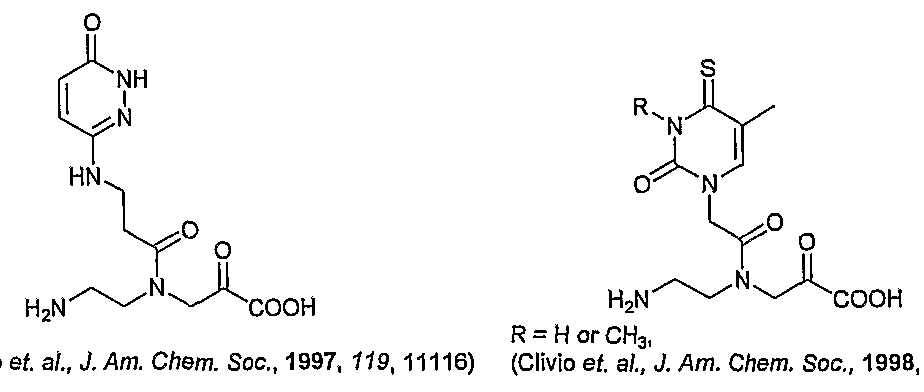
- One such peptide backbone is constructed of repeating units of N-(2-aminoethyl)glycine linked through amide bonds.
- PNAs More recent advances in the structure and synthesis of PNAs are illustrated in WO 93/12129 and U.S. Patent 5,539,082, issued July 23, 1996, the contents of both being herein incorporated by reference. Further, the literature is replete with publications describing synthetic procedures, biological properties and uses of PNAs. For example, PNAs possess the ability to effect strand displacement of double-stranded DNA. Patel, Nature, 1993, 365, 490. Improved synthetic procedures for PNAs have also been described. Nielsen et al, Science, 1991, 254, 1497; and Egholm,J. Am. Chem. Soc, 1992, 114, 1895. PNAs form duplexes and triplexes with complementary DNA or RNA.
- PNAs bind to both DNA and RNA and form PNA/DNA or PNA RNA duplexes.
- PNA/DNA or PNA RNA duplexes are bound tighter than corresponding DNA/DNA or DNA/RNA duplexes as evidenced by their higher melting temperatures (T m ).
- T m melting temperatures
- This high thermal stability of PNA/DNA(RNA) duplexes has been attributed to the neutrality of the PNA backbone, which results elimination of charge repulsion that is present in DNA/DNA or RNA/RNA duplexes.
- Another advantage of PNA/DNA(RNA) duplexes is that T m is practically independent of salt concentration. DNA/DNA duplexes, on the other hand, are highly dependent on the ionic strength.
- the new pyrimidine strand is oriented parallel to the purine Watson-Crick strand in the major groove of the DNA and binds through sequence-specific Hoogsteen hydrogen bonding.
- the sequence specificity is derived from thymine recognizing adenine (T:A-T) and protonated cytosine recognizing guanine (C + :G-C). Best et al.,J. Am. Chem. Soc, 1995, 117, 1187.
- purine-rich oligonucleotides bind to purine targets of double-stranded DNA.
- the orientation of the third strand in this motif is anti-parallel to the purine Watson-Crick strand, and the specificity is derived from guanine recognizing guanine (G:G-C) and thymine or adenine recognizing adenine (A:A-T or T:A-T). Greenberg et al, J. Am. Chem. Soc, 1995, 117, 5016.
- Homopyrimidine PNAs have been shown to bind complementary DNA or RNA forming (PNA) 2 /DNA(RNA) triplexes of high thermal stability. Egholm et al, Science, 1991, 254, 1497; Egholm et al, J. Am. Chem. Soc, 1992, 114, 1895; Egholm et al, J. Am. Chem. Soc, 1992, 114, 9677. The formation of triplexes involving two PNA strands and one nucleotide strand has been reported in U.S. Patent Application Serial No. 08/088,661, filed July 2, 1993, the contents of which are incorporated herein by reference.
- triplexes in which the Hoogsteen strand is parallel to the DNA purine target strand is preferred to formation of anti-parallel complexes.
- This allows for the use of bis-PNAs to obtain triple helix structures with increased pH-independent thermal stability using pseudoisocytosine instead of cytosine in the Hoogsteen strand.
- pseudoisocytosine instead of cytosine in the Hoogsteen strand.
- Peptide nucleic acids have been shown to have higher binding affinities (as determined by their Tm's) for both DNA and RNA than that of DNA or RNA to either DNA or RNA. This increase in binding affinity makes these peptide nucleic acid oligomers especially useful as molecular probes and diagnostic agents for nucleic acid species.
- PNAs In addition to increased affinity, PNAs have increased specificity for DNA binding. Thus, a PNA/DNA duplex mismatch show 8 to 20OC drop in the T m relative to the DNA/DNA duplex. This decrease in T m is not observed with the corresponding DNA/DNA duplex mismatch. Egholm et al, Nature 1993, 365, 566.
- a further advantage of PNAs, compared to oligonucleotides, is that the polyamide backbone of PNAs is resistant to degradation by enzymes.
- oligonucleotides and oligonucleotide analogs that bind to complementary DNA and RNA strands for use as diagnostics, research reagents and potential therapeutics.
- the oligonucleotides and oligonucleotide analogs must be transported across cell membranes or taken up by cells to express their activity.
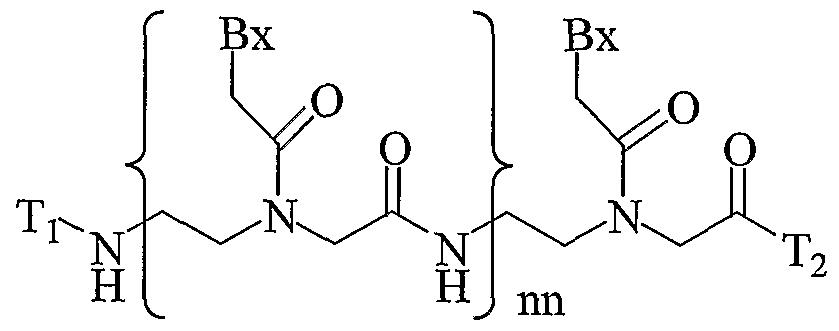
- the present invention provides peptide nucleic acids having the structure:
- T! is hydrogen, an amino protecting group, -C(O)R 5 , substituted or unsubstituted Cr o alkyl, substituted or unsubstituted C -C 10 alkenyl, substituted or unsubstituted C 2 - Cio alkynyl, alkylsulfonyl, arylsulfonyl, a chemical functional group, a reporter group, a conjugate group, a D or L ⁇ -amino acid linked via the ⁇ -carboxyl group or optionally through the ⁇ -carboxyl group when the amino acid is aspartic acid or glutamic acid or a peptide derived from D, L or mixed D and L amino acids linked through a carboxyl group, wherein the substituent groups are selected from hydroxyl, amino, alkoxy, carboxy, benzyl, phenyl, nitro, thiol, thioalkoxy, halogen, alkyl, aryl, alkenyl
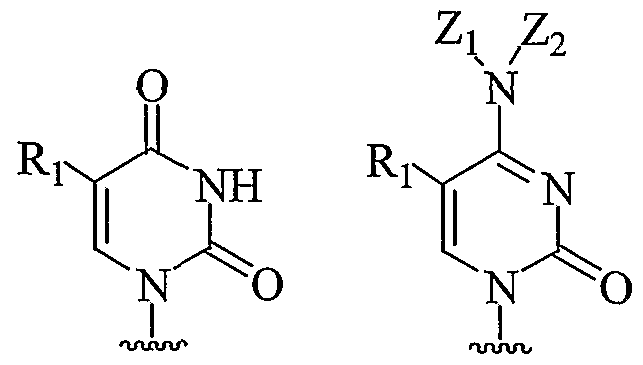
- T 2 is -OH, -N(Z ⁇ )Z , R 5 , D or L ⁇ -amino acid linked via the ⁇ -amino group or optionally through the ⁇ -amino group when the amino acid is lysine or ornithine or a peptide derived from D, L or mixed D and L amino acids linked through an amino group, a chemical functional group, a reporter group or a conjugate group; nn is from 2 to about 50; each Bx is, independently, an optionally protected heterocyclic base moiety wherein at least one of said heterocyclic base moieties has one of formulas II or III:
- Q 7 is -OH, -O-C ⁇ -C 6 alkyl, -O-benzyl, -Z 4 , -N(H)Z l5 each L is O or S; each J is O, S or NH; each n is from 1 to 6;
- Z] is hydrogen, C ⁇ -C 6 alkyl, or an amino protecting group
- Z is a D or L ⁇ -amino acid linked via the ⁇ -amino group or optionally through the ⁇ -amino group when the amino acid is lysine or ornithine or a peptide derived from D, L or mixed D and L amino acids linked through an amino group;
- Tt is hydrogen, an amino protecting group, -C(O)R 5 , substituted or unsubstituted -C 10 alkyl, substituted or unsubstituted C 2 -C 10 alkenyl, substituted or unsubstituted C 2 - o alkynyl, alkylsulfonyl, arylsulfonyl, a chemical functional group, a reporter group, a conjugate group, a D or L ⁇ -amino acid linked via the ⁇ -carboxyl group or optionally through the ⁇ -carboxyl group when the amino acid is aspartic acid or glutamic acid or a peptide derived from D, L or mixed D and L amino acids linked through a carboxyl group, wherein the substituent groups are selected from hydroxyl, amino, alkoxy, carboxy, benzyl, phenyl, nitro, thiol, thioalkoxy, halogen, alkyl, aryl, alken
- T 2 is -OH, -N(Z ⁇ )Z 2 , R 5 , D or L ⁇ -amino acid linked via the ⁇ -amino group or optionally through the ⁇ -amino group when the amino acid is lysine or ornithine or a peptide derived from D, L or mixed D and L amino acids linked through an amino group, a chemical functional group, a reporter group or a conjugate group; nn is from 2 to about 50; each Bx is, independently, an optionally protected heterocyclic base moiety; wherein at least one of said heterocyclic base moieties has one of formulas V or VI:
- Zi is hydrogen, -C ⁇ alkyl, or an amino protecting group
- Z is -OH, C ⁇ -C 6 alkyl, benzyl, -N(H)Z l5 a D or L ⁇ -amino acid linked via the ⁇ -amino group or optionally through the ⁇ -amino group when the amino acid is lysine or ornithing or a peptide derived from D, L or mixed D and L amino acids linked through an amino group;
- this invention provides compounds having the structure Formula (I) wherein:
- Ti is hydrogen, an amino protecting group, -C(O)R 5 , substituted or unsubstituted - o alkyl, substituted or unsubstituted C 2 -C 1 oalkenyl, substituted or unsubstituted C 2 - C lo alkynyl, alkylsulfonyl, arylsulfonyl, a chemical functional group, a reporter group, a conjugate group, a D or L ⁇ -amino acid linked via the ⁇ -carboxyl group or optionally through the ⁇ -carboxyl group when the amino acid is aspartic acid or glutamic acid or a peptide derived from D, L or mixed D and L amino acids linked through a carboxyl group, wherein the substituent groups are selected from hydroxyl, amino, alkoxy, carboxy, benzyl, phenyl, nitro, thiol, thioalkoxy, halogen, alkyl, aryl, al
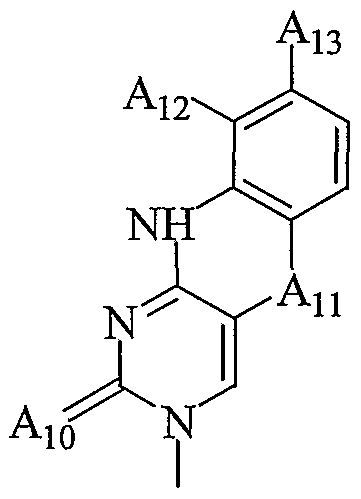
- T 2 is -OH, -N(Z ⁇ )Z 2 , R 5 , D or L ⁇ -amino acid linked via the ⁇ -amino group or optionally through the ⁇ -amino group when the amino acid is lysine or ornithine or a peptide derived from D, L or mixed D and L amino acids linked through an amino group, a chemical functional group, a reporter group or a conjugate group; nn is from 2 to about 50; each Bx is, independently, an optionally protected heterocyclic base moiety wherein at least one of said heterocyclic base moieties has formula VIII:
- Aio is S; and An is CH 2 , O or S; or
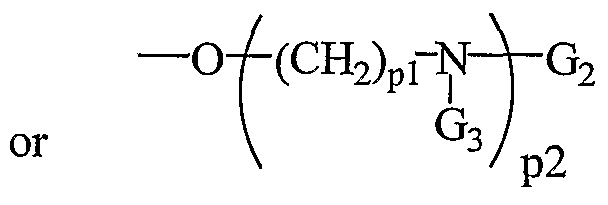
- a 10 is O and An is CH 2 ; one of A 12 and An is hydrogen and the other of A ⁇ 2 and An is a group of formula:
- each G 3 is, independently, H or an amino protecting group
- a 20 is H, a protecting group, substituted or unsubstituted Q-Cio alkyl, acetyl, benzyl, -(CH 2 ) p3 NH 2 , -(CH 2 ) p3 N(H)G 3 , a D or L ⁇ -amino acid, or a peptide derived from D, L or racemic ⁇ -amino acids; each R5 is a carbonyl protecting group; each pi is, independently, from 2 to about 6; p2 is from 1 to about 3; and p3 is from 1 to about 4.
- the instant invention provides compounds having the structure Formula (I) wherein: Ti is hydrogen, an amino protecting group, -C(O)R 5 , substituted or unsubstituted Ci-Cio alkyl, substituted or unsubstituted C 2 -C ⁇ o alkenyl, substituted or unsubstituted C 2 - Cio alkynyl, alkylsulfonyl, arylsulfonyl, a chemical functional group, a reporter group, a conjugate group, a D or L ⁇ -amino acid linked via the ⁇ -carboxyl group or optionally through the ⁇ -carboxyl group when the amino acid is aspartic acid or glutamic acid or a peptide derived from D, L or mixed D and L amino acids linked through a carboxyl group, wherein the substituent groups are selected from hydroxyl, amino, alkoxy, carboxy, benzyl, phenyl, nitro, thiol,
- T 2 is -OH, -N(Z ⁇ )Z 2 , R 5 , D or L ⁇ -amino acid linked via the ⁇ -amino group or optionally through the ⁇ -amino group when the amino acid is lysine or ornithine or a peptide derived from D, L or mixed D and L amino acids linked through an amino group, a chemical functional group, a reporter group or a conjugate group; nn is from 2 to about 50; each Bx is, independently, an optionally protected heterocyclic base moiety wherein at least one of said heterocyclic base moieties has formula XVI:
- a 15 is O or S
- each G 3 is, independently, H or an amino protecting group
- a 2 o is H, a protecting group, substituted or unsubstituted Q-C10 alkyl, acetyl, benzyl, -(CH 2 ) p3 N(H)G 3 , a D or L ⁇ -amino acid, or a peptide derived from D, L or racemic ⁇ -amino acids; each R 5 is carbonyl protecting group; each pi is from 2 to about 6; p2 is from 1 to about 3; and p3 is from 1 to about 4.
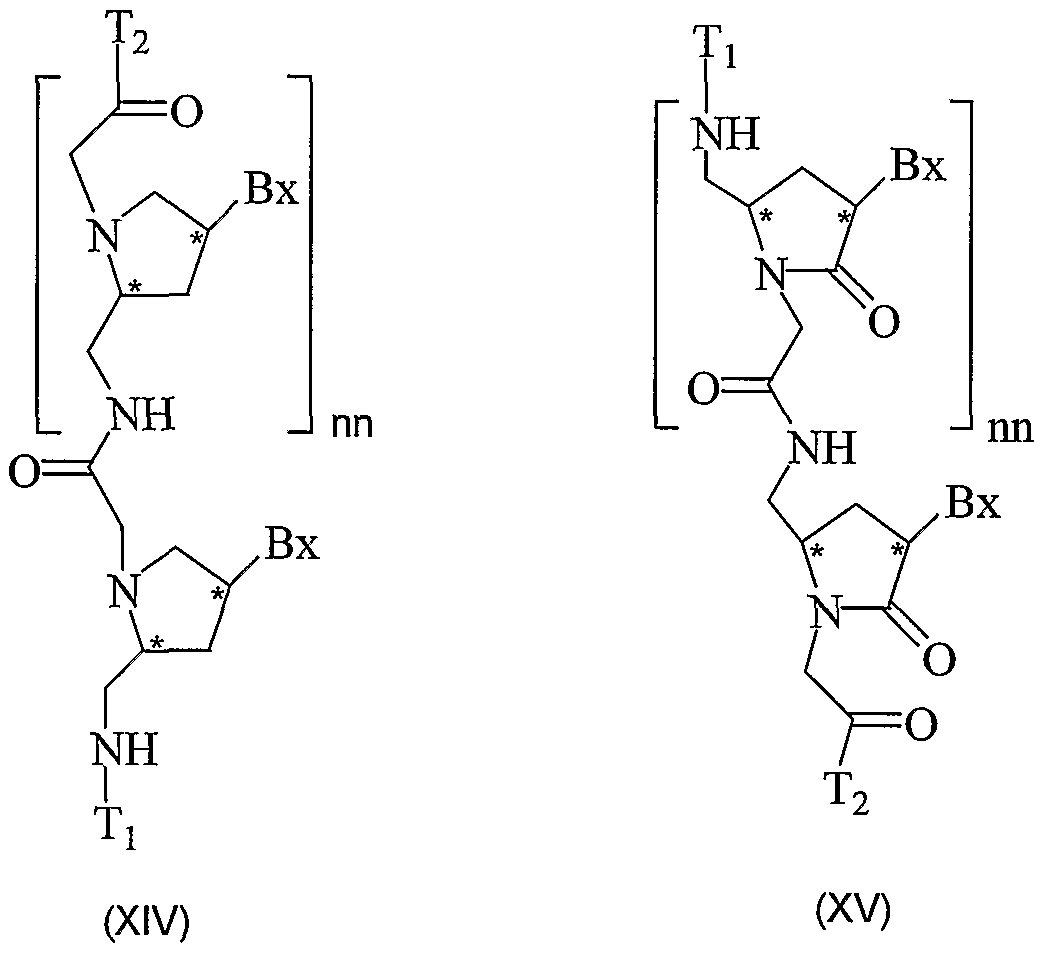
- This invention also provides compounds having the structure:
- Ti is hydrogen, an amino protecting group, -C(O)R 5 , substituted or unsubstituted C ⁇ -C 10 alkyl, substituted or unsubstituted C 2 -C ⁇ o alkenyl, substituted or unsubstituted C 2 - Cio alkynyl, alkylsulfonyl, arylsulfonyl, a chemical functional group, a reporter group, a conjugate group, a D or L ⁇ -amino acid linked via the ⁇ -carboxyl group or optionally through the ⁇ -carboxyl group when the amino acid is aspartic acid or glutamic acid or a peptide derived from D, L or mixed D and L amino acids linked through a carboxyl group, wherein the substituent groups are selected from hydroxyl, amino, alkoxy, carboxy, benzyl, phenyl, nitro, thiol, thioalkoxy, halogen, alkyl, aryl, al
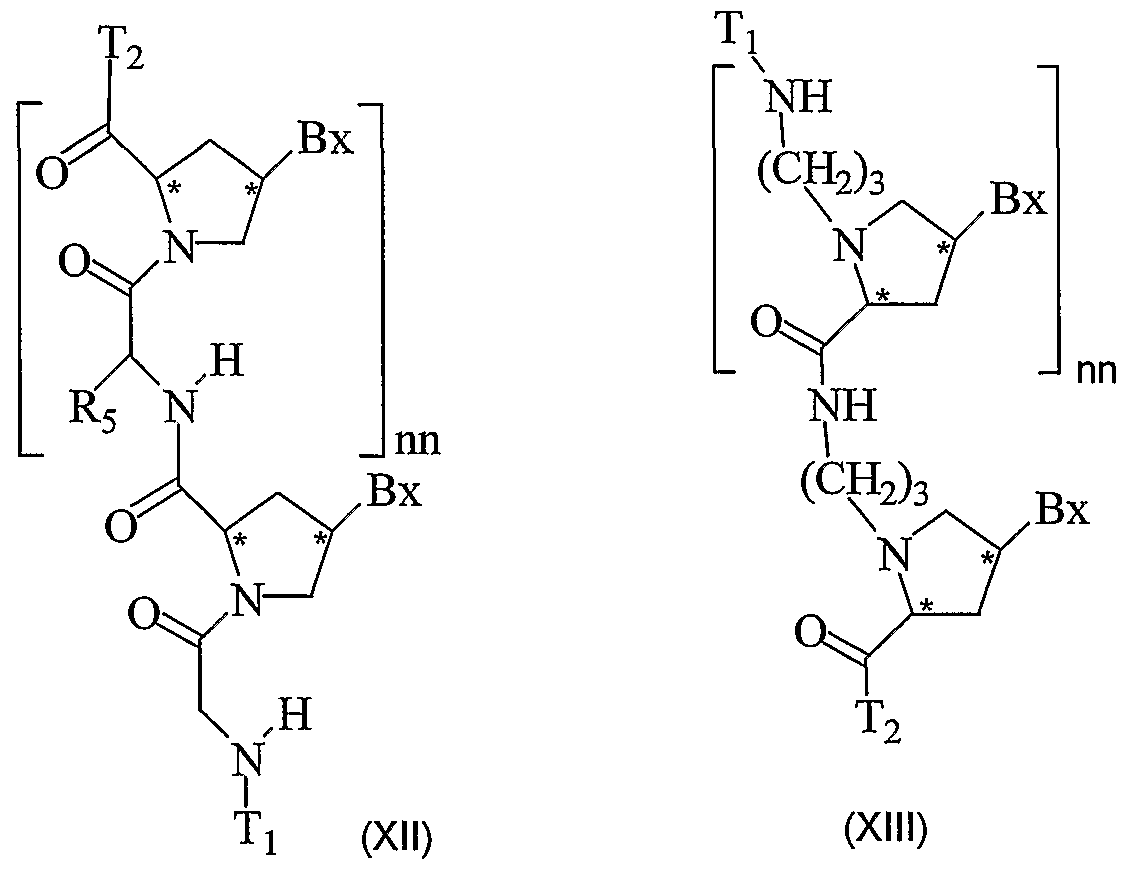
- T 2 is -OH, -N(Z ⁇ )Z , R 5 , D or L ⁇ -amino acid linked via the ⁇ -amino group or optionally through the ⁇ -amino group when the amino acid is lysine or ornithine or a peptide derived from D, L or mixed D and L amino acids linked through an amino group, a chemical functional group, a reporter group or a conjugate group; nn is from 2 to about 50; each chiral ring carbon having an asterick (*) is prepared having R, S or mixed R and S configuration; each Bx is, independently, an optionally protected heterocyclic base moiety wherein at least one of said heterocyclic base moieties has one of formulas II or III:
- Q 7 is -OH, -O-Ci-Ce alkyl, -O-benzyl, -Z 4 , -N(H)Z ⁇ , each L is O or S; each J is O, S or NH; each n is from 1 to 6;
- Zi is hydrogen, C ⁇ -C 6 alkyl, or an amino protecting group
- Z is a D or L ⁇ -amino acid linked via the ⁇ -amino group or optionally through the ⁇ -amino group when the amino acid is lysine or ornithine or a peptide derived from D, L or mixed D and L amino acids linked through an amino group;
- Ti is hydrogen, an amino protecting group, -C(O)R 5 , substituted or unsubstituted Ci-Cio alkyl, substituted or unsubstituted C 2 -C ⁇ 0 alkenyl, substituted or unsubstituted C 2 - Cio alkynyl, alkylsulfonyl, arylsulfonyl, a chemical functional group, a reporter group, a conjugate group, a D or L ⁇ -amino acid linked via the ⁇ -carboxyl group or optionally through the ⁇ -carboxyl group when the amino acid is aspartic acid or glutamic acid or a peptide derived from D, L or mixed D and L amino acids linked through a carboxyl group, wherein the substituent groups are selected from hydroxyl, amino, alkoxy, carboxy, benzyl, phenyl, nitro, thiol, thioalkoxy, halogen, alkyl, aryl,
- T 2 is -OH, -N(Z])Z 2 , R 5 , D or L ⁇ -amino acid linked via the ⁇ -amino group or optionally through the ⁇ -amino group when the amino acid is lysine or ornithine or a peptide derived from D, L or mixed D and L amino acids linked through an amino group, a chemical functional group, a reporter group or a conjugate group; nn is from 2 to about 50; each chiral ring carbon having an asterick (*) is prepared having R, S or mixed R and S configuration; each Bx is, independently, an optionally protected heterocyclic base moiety wherein at least one of said heterocyclic base moieties has one of formulas V or VI:
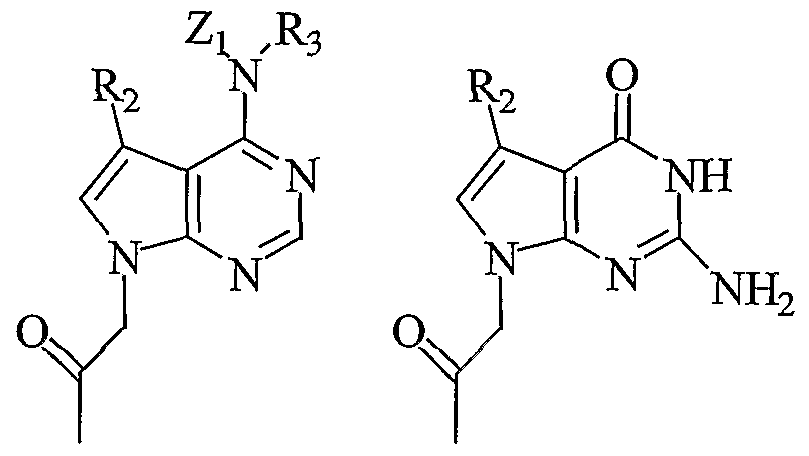
- R 3 is hydrogen and R 2 is -C ⁇ C ⁇ or -(CH ⁇ m -I ⁇ ; L is O or S; J is O, S or NH; m is from 2 to 6; each n is from 1 to 6;
- Zi is hydrogen, C ⁇ -C 6 alkyl, or an amino protecting group
- Z 4 is -OH, Ci-C ⁇ alkyl, benzyl, -N(H)Z ⁇ , a D or L ⁇ -amino acid linked via the ⁇ -amino group or optionally through the ⁇ -amino group when the amino acid is lysine or ornithing or a peptide derived from D, L or mixed D and L amino acids linked through an amino group;
- Ti is hydrogen, an amino protecting group, -C(O)R 5 , substituted or unsubstituted Ci-Cio alkyl, substituted or unsubstituted C 2 -C ⁇ o alkenyl, substituted or unsubstituted C 2 - Cio alkynyl, alkylsulfonyl, arylsulfonyl, a chemical functional group, a reporter group, a conjugate group, a D or L ⁇ -amino acid linked via the ⁇ -carboxyl group or optionally through the ⁇ -carboxyl group when the amino acid is aspartic acid or glutamic acid or a peptide derived from D, L or mixed D and L amino acids linked through a carboxyl group, wherein the substituent groups are selected from hydroxyl, amino, alkoxy, carboxy, benzyl, phenyl, nitro, thiol, thioalkoxy, halogen, alkyl, ary
- T 2 is -OH, -N(Z ⁇ )Z 2 , Rs, D or L ⁇ -amino acid linked via the ⁇ -amino group or optionally through the ⁇ -amino group when the amino acid is lysine or ornithine or a peptide derived from D, L or mixed D and L amino acids linked through an amino group, a chemical functional group, a reporter group or a conjugate group; nn is from 2 to about 50; each chiral ring carbon having an asterick (*) is prepared having R, S or mixed R and S configuration; each Bx is, independently, an optionally protected heterocyclic base moiety wherein at least one of said heterocyclic base moieties has formula VIII:
- a lo is O or S
- An is CH 2 , N-CH 3 , O or S; each A ⁇ 2 and A is hydrogen or one of An and A is hydrogen and the other of A ⁇ 2 and An is a group of formula:
- each G 3 is, independently, H or an amino protecting group
- a 20 is H, a protecting group, substituted or unsubstituted Ci- o alkyl, acetyl, benzyl, -(CH 2 ) p3 NH 2 , -(CH 2 ) p3 N(H)G 3 , a D or L ⁇ -amino acid, or a peptide derived from D, L or racemic ⁇ -amino acids; each R5 is a carbonyl protecting group; each pi is, independently, from 2 to about 6; p2 is from 1 to about 3; and p3 is from 1 to about 4.
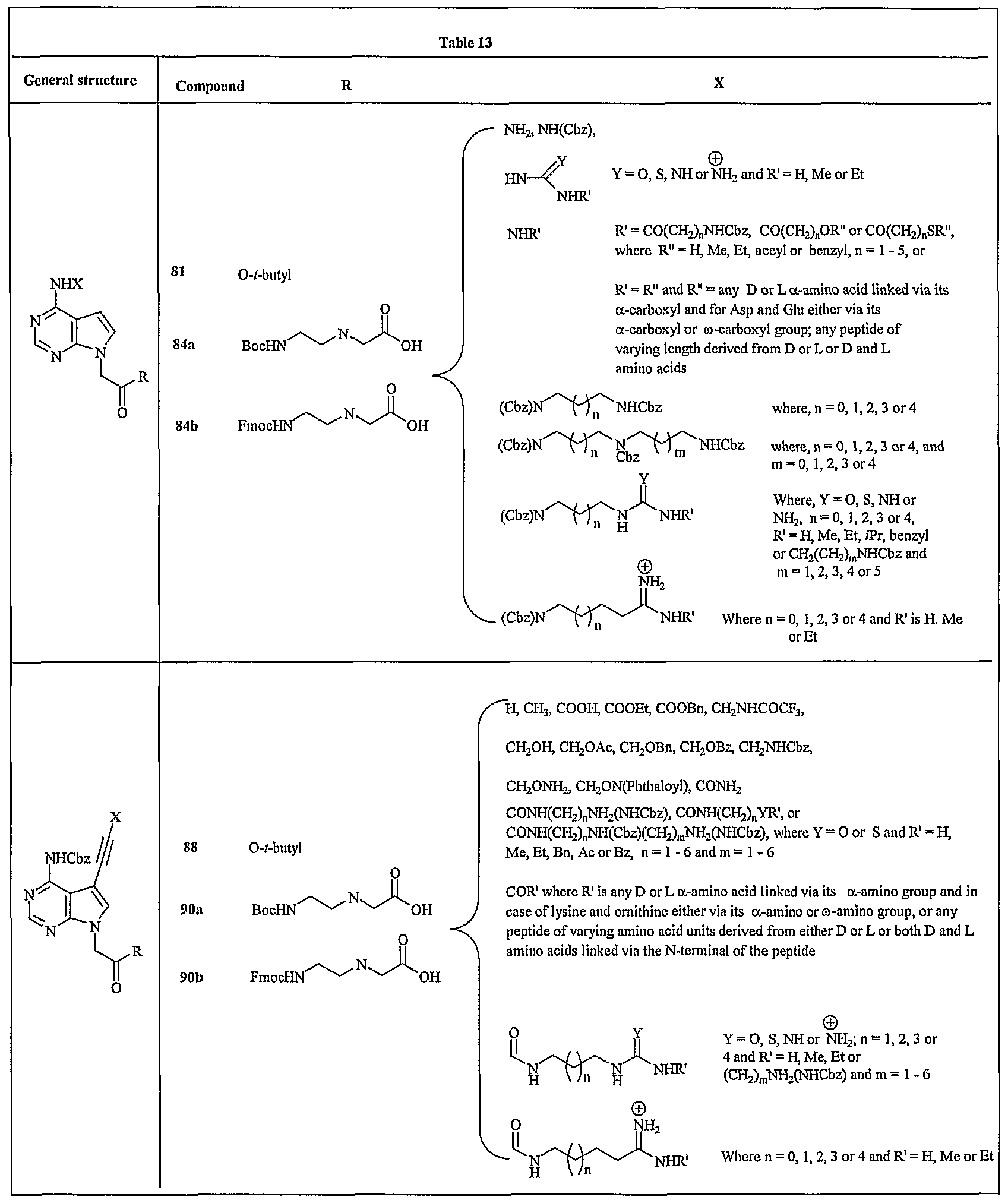
- HN R' represent all the C7 substituents described for the corresponding BocHN ⁇ r 7-deaza A PNA monomer in Table 7
- FIG. 1 shows a representative synthesis of tricyclic compound 6a
- FIG. 2 shows preparation of PNA oligomer 11.
- FIG. ,3 shows a representative synthesis of tricyclic compound 15.
- FIG. 4 shows a representative synthesis of tricyclic compound 19.
- FIG. 5 shows a representative synthesis of tricyclic compound 22b.
- FIG. 6 shows a representative synthesis of tricyclic compounds 25a, 25b, 27a, and 27b.
- FIG. 7 shows a representative synthesis of tricyclic compounds 34a, 34b, 35a, 35b, 36a, and 36b.
- FIG. 8 shows a representative synthesis of tricyclic compounds 37a, 37b, 38a, and 38b.
- FIG. 9 shows preparation of PNA oligomer 11a.
- FIG. 10 shows a representative synthesis of monocyclic compounds 49a and 49b.
- FIG. 11 shows a representative synthesis of monocyclic compounds 52a, 52b, 55a, and 55b.
- FIG. 12 shows a representative synthesis of monocyclic compounds 63a and 63b.
- FIG. 13 shows a representative synthesis of monocyclic compounds 65a, 65b, 67a, 67b, 69a, and 69b.
- FIG. 14 shows a representative synthesis of monocyclic compounds 73a and 73b.
- FIG. 15 shows a representative synthesis of monocyclic compounds 78a and 78b.
- FIG. 16 shows a representative synthesis of dicyclic compounds 84a, 84b, and 87.
- FIG. 17 shows a representative synthesis of dicyclic compounds 90a, 90b, 93a, and 94b.
- FIG. 18 shows a representative synthesis of tricyclic compound 37c.
- peptide nucleic acids are provided. In preferred embodiments, these compounds exhibit enhanced cellular uptake and distribution.
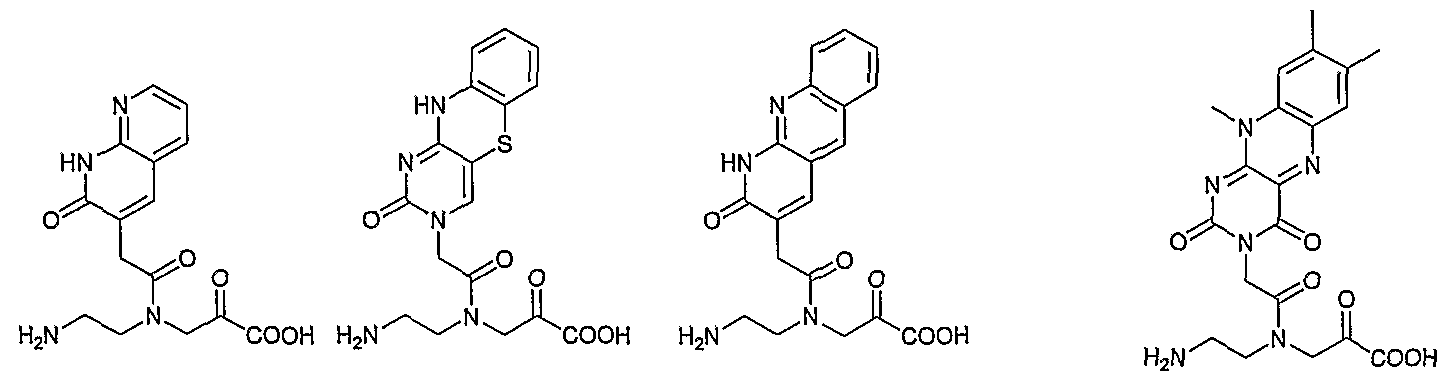
- the peptide nucleic acids (PNAs) of the present invention are assembled from a plurality of naturally-occuring or non-naturally-occuring nucleobases that are attached to polyamide backbones by a suitable linker. Non-naturally occuring nucleobases include modified monocyclic bases, bicyclic bases, and tricyclic bases. Such PNAs may be prepared by solid state synthesis or by, other means known to those skilled in the art.
- PNA compounds or “PNA” refers to peptide nucleic acids that are artificial biopolymers, i.e., nucleic acid mimics, wherein the DNA sugar phosphate backbone of an oligonucleotide is replaced by a peptide backbone or psudopeptide backbone, PNA include amide backbones, e.g. an aminoethylglycine backbone, bound directly or indirectly to aza nitrogen atoms of the amide portion of the backbone. Naturally- occurring or non-naturally-occurring nucleobases are bound directly or indirectly to aza nitrogen atoms of the amide portion of the backbone.
- PNA compounds include, but are not limited to, U.S.: 5,539,082; 5,714,331; and 5,719,262, each of which is herein incorporated by reference. Further teaching of PNA compounds can be found in Nielsen et al., Science, 1991, 254, 1497-1500.
- Oligonucleotide refers to polynucleotides, formed by joining naturally- occuring, non-naturally-occuring bases, or furanosyl groups. Thus, this term effectively refers to naturally occurring species or synthetic species formed from naturally occurring subunits or their close homologs.
- oligonucleotide or oligomer may also refer to moieties which have portions similar to naturally occurring oligonucleotides but which have non-naturally occurring portions. Thus, oligonucleotides may have altered sugars, altered base moieties, or altered inter-sugar linkages. Exemplary among these are the phosphorothioate and other sulfur-containing species which are known for use in the art.
- Oligonucleotides may also include species which include at least some modified base forms. Thus, purines and pyrimidines other than those normally found in nature may be so employed. Suitable bases include, but are not limited to those described in U.S. Patent 3,687,808.
- Oligonucleotides may also comprise other modifications that are best described as being functionally interchangeable with yet structurally distinct from natural oligonucleotides. All such oligonucleotides are comprehended by this invention so long as they effectively function as subunits in the oligonucleotide.
- "Nucleoside” refers to a sugar and a base that are joined together.
- reporter group is any structure known to those skilled in the art that can be added to an oligonucleotide or PNA so that the oligonucleotide or PNA can be detected.
- reporter groups include radioisotopes; enzymes; flourescent structures; chromogens (fluorescent or luminescent groups and dyes); enzymes; NMR-active groups or metal particles; haptens, e.g. digoxigenin, or biotin and derivatives thereof; photoactivatable crosslinking groups, e.g.
- Reporter groups of different types are described in WO 94/068 15, U.S. patent application Ser. No. 07/555,323 filed Jul. 19, 1990, which are herein incorporated by reference in their entirety. Reporter groups may also include optional linking groups.
- PNAs exhibit significant advantages over natural nucleic acids, including for example, ease of synthesis compared to synthesis of natural nucleic acids, very good stability to cellular nucleases and proteases, and the capability of hybridizing with complimentary DNA with high affinity.
- PNA binds both DNA and RNA to form PNA/DNA or PNA RNA duplexes.
- the resulting PNA/DNA or PNA/RNA duplexes are bound with greater affinity than corresponding DNA/DNA or DNA/RNA duplexes as determined by Tm's.
- This high thermal stability might be attributed to the lack of charge repulsion due to the neutral backbone in PNA.
- the neutral backbone of the PNA also results in the Tm's of PNA/DNA(RNA) duplex being practically independent of the salt concentration.
- the PNA/DNA duplex interaction offers a further advantage over DNA/DNA duplex interactions which are highly dependent on ionic strength.
- Homopyrimidine PNAs have been shown to bind complementary DNA or RNA forming (PNA)2/DNA(RNA) triplexes of high thermal stability (see, e.g., Egholm, et al., Science,1991, 254, 1497; Egholm, et al., J. Am. Chem. Soc, 1992, 114, 1895; Egholm, et al., J. Am. Chem. Soc, 1992, 114, 9677).
- the binding of a PNA strand to a DNA or RNA strand can occur in one of two orientations.
- the orientation is said to be anti-parallel when the DNA or RNA strand in a 5' to 3' orientation binds to the complementary PNA strand such that the carboxyl end of the PNA is directed towards the 5' end of the DNA or RNA and amino end of the PNA is directed towards the 3' end of the DNA or RNA.
- the carboxyl end and amino end of the PNA are just the reverse with respect to the 5'-3' direction of the DNA or RNA.
- PNAs bind to both single stranded DNA and double stranded DNA. As noted above, in binding to double stranded DNA it has been observed that two strands of PNA can bind to the DNA. While PNA/DNA duplexes are stable in the antparallel configuration, it was previously believed that the parallel orientation is preferred for (PNA) 2 /DNA triplexes.
- a further advantage of PNA compared to oligonucleotides is that their polyamide backbone (having appropriate nucleobases or other side chain groups attached thereto) is not recognized by either nucleases or proteases and is not cleaved. As a result PNAs are resistant to degradation by enzymes, unlike DNA and peptides.
- the most stable triplexes that are formed between two single stranded PNAs or a bis PNA and a DNA or RNA target strand are triplexes wherein the Watson/Crick base pairing strand is in an anti- parallel orientation relative to the target strand and the Hoogsteen base pairing strand is in a parallel orientation relative to the target strand. As so orientated to the target strand, the two PNA strands are therefore anti-parallel to each other.
- Bis PNAs have shown improved binding affinity, thermal stability, and specificity over single-stranded PNAs.
- the preferred orientation is with the first PNA strand of the bis PNA parallel to thetarget, i.e. the target DNA strand of the duplex is referenced in a 5' to 3' direction and the first PNA is complementary in an N to C direction
- the second PNA strand of the bis PNA is antiparallel to the target, i.e. it is complementary to the DNA strand (again referenced in a 5' to 3' direction) in a C to N direction.
- the linking segment connects the PNA strands in opposite orientation to each other, i.e. from a common reference point, one strand is lined up in a N to C direction and the other is lined up in a C to N direction.
- the antiparallel strand of the bis PNA binds the DNA target thereby displacing the other DNA strand via strand invasion. This binding is of a Watson/Crick nature.
- the second PNA strand of the bis PNA, the parallel strand now binds the DNA using Hoogsteen type hydrogen bonding. It has been shown using the component single stranded PNAs and comparing them separately and as a mixture to the bis PNA that the bis PNA has a faster "on rate" e.g. it binds faster to the target. This faster on rate is attributed to the enforced close proximity of the second strand in the bis PNA.
- cytosine by pseudo isocytosine or other like C-pyrimidine nucleobases is effected in a straight forward manner as per certain of the examples set forth below. This is in direct contrast with replacement of cytosine with pseudo isocytosine or other C-pyrimidines in nucleosides.
- nucleosides an anomeric specific carbon-carbon bond must be formed in synthesizing the C-nucleoside. Since there are no anomeric (sugar) carbon atoms in peptide nucleic acids, such constraints need not be considered.
- triple helix principle is used in the art for sequence-specific recognition of dsDNA.
- Triple helix formation utilizes recognition of homopurine-homopyrimidine sequences.
- a strand displacement complex with triple helix formation is believed to be superior to simple triple helix recognition in that strand displacement complexes are very stable at physiological conditions, that is, neutral pH, ambient (20-40 degrees Centigrade) temperature and medium (100-150 mM) ionic strength.
- sequence-specific recognition of ssDNA by base complementary hybridization can likewise be exploited to target specific genes and viruses.
- the target sequence is contained in the mRNA such that binding of the drug to the target hinders the action of ribosomes and, consequently, translation of the mRNA into protein.
- the bis PNAs of the invention appear to be superior to prior reagents in that they have significantly higher affinity for complementary ssDNA. Also, they can be synthesized such that they possess no charge and are water soluble, which should facilitate cellular uptake, and they contain amides of non-biological amino acids, which should make them biostable and resistant to enzymatic degradation by, for example, proteases.
- PNA backbones of the present invention can be modified.
- PNA backbones of the present invention can be modified.
- PNA backbones of the present invention can be modified.
- PNA backbones of the present invention can be modified.
- PNA backbones of the present invention can be modified.
- PNAs having modified backbones are described in United States Patent No. 5,719,262, issued February 17, 1998, hereby incorporated by reference in its entirety. Further PNA backbone sustitutions at the glycinyl methylene group are disclosed in United States Patent No. 6,107,470, issued August 22, 2000, hereby incorporated by reference in its entirety. Other modifications of the backbone (including various combinations of substitution at the glycinyl methylene, varying the chain length of the aminoethyl group and or the glycinyl group, and the tethering group) can be included in the compounds of the present invention. For example, PNAs having these modifications are disclosed in United States Patent No. 5,641,625, issued June 24, 1997, hereby incorporated by reference in its entirety. Further backbone modifications and substitutions are disclosed in United States Patent No. 5,773,571, issued June 30, 1998, hereby incorporated by reference in its entirety.
- PNAs of the present invention include one or more amino acid moieties within their structure. These amino acids may be naturally-occurring or non-naturally-occurring. Naturally-occurring amino acids include a-amino acids where the chiral center has a D-configuration. Such naturally-occurring amino-acids may be either essential or non-essential amino acids. Non-naturally-occurring amino acids used in the PNAs of the present invention include a-amino acids with chiral centers bearing an L-configuration.
- Non-naturally-occurring amino acids also include amino acids bearing unusual side chains that do not exist in nature and are prepared synthetically, such as halo- and cyano- substituted benzyl, tetrahydroisoquinolylmethyl, cyclohexylmethyl, and pyridylmethyl.
- Other synthetic amino-acids include b-amino acids.
- the amino acids may be introduced into PNAs either as part of the monomer used or at the terminal ends of the PNA. Any of the abovementioned amino acids could be incorporated into the monomeric building blocks used in PNA synthesis. Amino acids may also be attached at the C-terminus of PNAs such that the terminal R h -CO- group represents an amino acyl group derived from any naturally- or non-naturally- occurring amino acid, a- or b- amino acid, and with a D- or L-configuration at the a- chiral center. Amino acids may also be incorporated at the N-terminal end of a PNA.
- the present PNAs have nn from about 8 to about 30. More preferably, nn is from about 15 to about 25.
- each carbonyl protecting group is, independently, substituted or unsubstituted Ci-Qo alkyl, frifluoromethyl, cyanoethyloxy, methoxy, ethoxy, t-butoxy, allyloxy, 9-fluorenylmethoxy, 2-(trimethylsilyl)-ethoxy, 2,2,2-trichloroethoxy, benzyloxy, butyryl, iso-butyryl, phenyl or aryl.
- the conjugate group is a contrast reagent, a cleaving agent, a cell targeting agent, polyethylene glycol, cholesterol, phospholipid, biotin, phenanthroline, phenazine, phenanthridine, anthraquinone, acridine, fluorescein, rhodamine, coumarin, pyrene, retinal or a cyanine dye.
- PNAs of the present invention include from about 6 to about 50 nucleobases. More preferrably PNAs include from about 12 to about 20 nucleobases.
- the PNAs of the present invention include compounds of Formula I wherein nucleobase Bx has the Formula II or III. These nucleobases are attached to the PNA backbone by a suitable linker.
- Ri is -CH 2 -(CH 2 ) n -Q 3 .
- Q 3 is hydrogen, -O-CH 3 ,
- Ri is -CH 2 -(CH 2 ) n -Q 3 .
- Q is -N(H)Z 3 and Z 3 is Hydrogen or C r C 5 alkyl.
- nucleobase Bx has the Formula II or III
- Zi, Z 2 , Z 3 , Z and Z 5 are each independently hydrogen, methyl or an amino protecting group.
- Each n is independently from 1 to about 3.
- Ti is hydrogen, an amino protecting group, a reporter group or a D or L amino acid or a peptide and the D or L amino acid is lysine or glutamic acid.
- T is -OH, -N(Z ⁇ )Z 2 , R 5 or a D or L amino acid or a peptide.
- nucleobase Bx has the Formula
- each Bx is independently selected from the group consisting of a radical of formula II, formula III, adeninyl, guaninyl, thyminyl, cytosinyl, uracilyl, 5- methylcytosinyl (5-me-C), 5-hydroxymethyl cytosinyl, xanthinyl, hypoxanthinyl, 2- aminoadeninyl, alkyl derivatives of adeninyl and guaninyl, 2-thiouracilyl, 2- thiothyminyl, 2-thiocytosinyl, 5-halouracilyl, 5-halocytosinyl, 5-propynyl uracilyl, 5- propynyl cytosinyl, 6-azo uracilyl, 6-azo cytosinyl, 6-azo thyminyl, 5 -uracilyl (pseudouracil), 4-thiouracilyl, 8-substituted adeninyl, 5-
- the PNAs of the present invention include compounds of Formula I wherein nucleobase Bx has the Formula V or VI. These nucleobases are attached to the PNA backbone by a suitable linker.
- Ti is hydrogen, an amino protecting group, a reporter group, a D or L amino acid or a peptide. More preferably, D or L amino acid is lysine or glutamic acid.
- T 2 is -N(Z ⁇ )Z 2 and Z 2 is hydrogen, C ⁇ -C 3 alkyl, an amino protecting group. In another preferred embodiment, T 2 is -OH, -(Z ⁇ )Z 2 , R 5 , a D or L amino acid or a peptide.
- each Bx is independently selected from the group consisting of a radical of formula V, formula VI, adeninyl, guaninyl, thyminyl, cytosinyl, uracilyl, 5- methylcytosinyl (5-me-C), 5-hydroxymethyl cytosinyl, xanthinyl, hypoxanthinyl, 2- aminoadeninyl, alkyl derivatives of adeninyl and guaninyl, 2-thiouracilyl, 2- thiothyminyl, 2-thiocytosinyl, 5-halouracilyl, 5-halocytosinyl, 5-propynyl uracilyl, 5- propynyl cytosinyl, 6-azo uracilyl, 6-azo cytosinyl, 6-azo thyminyl, 5-uracilyl (pseudouracil), 4-thiouracilyl, 8-substituted adeninyl
- the PNAs of the present invention include compounds of Formula I wherein nucleobase Bx has the Formula VIII. These nucleobases are attached to the PNA backbone by a suitable linker.
- nucleobase Bx has the Formula
- Aw is H;
- G 4 is hydrogen, an amino protecting group or C ⁇ -C ⁇ 0 alkyl.
- Aiois S and An is O.
- Ti is hydrogen, an amino protecting group, a reporter group, a D or L amino acid or a peptide.
- D or L amino acid is lysine or glutamic acid.
- T 2 is -OH, -(Z ⁇ )Z 2 , R 5 , a D or L amino acid or a peptide.
- each Bx is independently selected from the group consisting of a radical of formula VIII, adeninyl, guaninyl, thyminyl, cytosinyl, uracilyl, 5-methylcytosinyl (5-me- C), 5-hydroxymethyl cytosinyl, xanthinyl, hypoxanthinyl, 2-aminoadeninyl, alkyl derivatives of adeninyl and guaninyl, 2-thiouracilyl, 2-thiothyminyl, 2-thiocytosinyl, 5- halouracilyl, 5-halocytosinyl, 5-propynyl uracilyl, 5-propynyl cytosinyl, 6-azo uracilyl, 6-azo cytosinyl, 6-azo thyminyl, 5-uracilyl (pseudouracil), 4-thiouracilyl, 8-substituted adeninyls and gu
- the PNAs of the present invention include compounds of Formula I wherein nucleobase Bx has the Formula XVI. These nucleobases are attached to the PNA backbone by a suitable linker.
- nucleobase Bx has the Formula
- Ai ⁇ is H;
- G 4 is hydrogen, an amino protecting group or -Cio alkyl.
- A15 is S.
- a 1 5 is O.
- nucleobase Bx has the Formula
- n is from about 8 to about 30. More preferably, n is from about 15 to about 25.
- nucleobase Bx has the Formula
- XVI, Ti is hydrogen, an amino protecting group, a reporter group, a D orL amino acid or a peptide. More preferrably, D or L amino acid is lysine or glutamic acid.
- nucleobase Bx has the Formula
- T 2 is -OH, -(Z ! )Z 2 , R 5 , a D or L amino acid or a peptide.
- nucleobase Bx has the Formula
- each Bx is independently selected from the group consisting of a radical of formula XVI, adeninyl, guaninyl, thyminyl, cytosinyl, uracilyl, 5-methylcytosinyl (5-me-C), 5- hydroxymethyl cytosinyl, xanthinyl, hypoxanthinyl, 2-aminoadeninyl, alkyl derivatives of adeninyl and guaninyl, 2-thiouracilyl, 2-thiothyminyl, 2-thiocytosinyl, 5-halouracilyl, 5-halocytosinyl, 5-propynyl uracilyl, 5-propynyl cytosinyl, 6-azo uracilyl, 6-azo cytosinyl, 6-azo thyminyl, 5-uracilyl (pseudouracil), 4-thiouracilyl, 8-substituted adeninyls
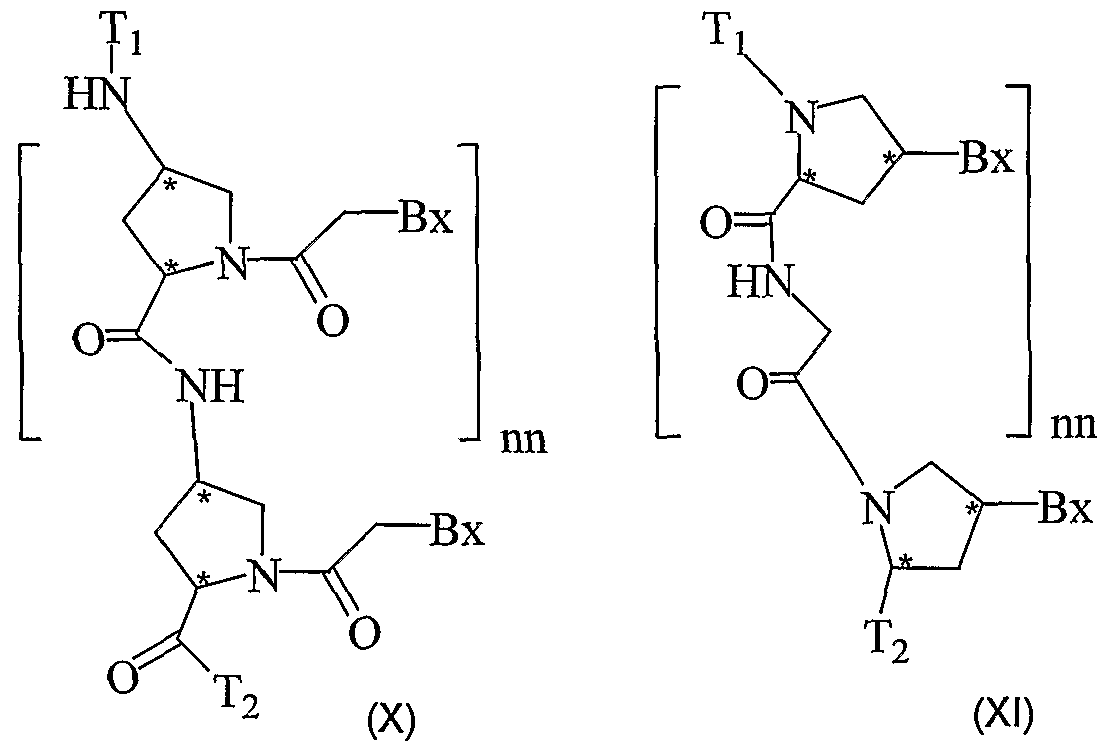
- the PNAs of the present invention include compounds of FormulaX, XI, XII,
- nucleobase Bx has one of the Formulas II or III. These nucleobases are attached to the PNA backbone by a suitable linker.
- Ri is -CHrQ ⁇ .
- Qi is -N 3 , -CN, -N(Z ⁇ )Z 2 , -N(Z ⁇ )-
- Ri is -C ⁇ C-Q 2 .
- N(H)Z ⁇ , -CH 2 -N(H)-Z 2 or -CH 2 -N(H)-C( NH)-N(H)-Z 5 .
- Ri is -CH 2 -(CH 2 ) n -Q 3 .
- Q 3 is hydrogen, -O-
- Q 3 is -O-Q 6 and Q 6 is hydrogen, -N(H)Z ⁇ or -N(H)Z 2 .
- Q 4 is -OH, -
- Q 4 is -N(H)Z 3 and Z 3 is Hydrogen or C 1 -C5 alkyl.
- Z ls Z 2 , Z 3 , Z 4 and Z 5 are each independently hydrogen, methyl or an amino protecting group.
- Each n is independently from 1 to about 3.
- Ti is hydrogen, an amino protecting group, a reporter group or a D or L amino acid or a peptide. More prefer ly, D or L amino acid is lysine or glutamic acid.
- T 2 is -OH, -N(Z ⁇ )Z 2 , R 5 or a D or L amino acid or a peptide.
- each Bx is independently selected from the group consisting of a radical of formula II, formula III, adeninyl, guaninyl, thyminyl, cytosinyl, uracilyl, 5-methylcytosinyl (5-me- C), 5-hydroxymethyl cytosinyl, xanthinyl, hypoxanthinyl, 2-aminoadeninyl, alkyl derivatives of adeninyl and guaninyl, 2-thiouracilyl, 2-thiothyminyl, 2-thiocytosinyl, 5- halouracilyl, 5-halocytosinyl, 5-propynyl uracilyl, 5-propynyl cytosinyl, 6-azo uracilyl, 6-azo cytosinyl, 6-azo thyminyl, 5-uraci
- nucleobase Bx has one of the Formulas II or III are prepared having substantially pure R or S configuration at each of said chiral ring carbons. In other preferred embodiments these compounds are prepared with essentially equal amounts of R and S configuration at each of said chiral ring carbons.
- the PNAs of the present invention include compounds of FormulaX, XI, XII,
- nucleobase Bx has one of the Formulas V or VI. These nucleobases are attached to the PNA backbone by a suitable linker.
- R 2 is hydrogen and R 3 is Zi, -
- R 3 is hydrogen and R is -C ⁇ C-R 4 or -
- Ti is hydrogen, an amino protecting group, a reporter group, a D or L amino acid or a peptide.
- D or L amino acid is lysine or glutamic acid.
- T 2 is -N(Z ⁇ )Z 2 and Z 2 is hydrogen, C ⁇ -C 3 alkyl, an amino protecting group.
- T 2 is -OH, -(Z ⁇ )Z 2 , R 5 , a D or L amino acid or a peptide.
- each Bx is independently selected from the group consisting of a radical of formula V, formula VI, adeninyl, guaninyl, thyminyl, cytosinyl, uracilyl, 5-methylcytosinyl (5-me-C), 5-hydroxymethyl cytosinyl, xanthinyl, hypoxanthinyl, 2-aminoadeninyl, alkyl derivatives of adeninyl and guaninyl, 2- thiouracilyl, 2-thiothyminyl, 2-thiocytosinyl, 5-halouracilyl, 5-halocytosinyl, 5-propynyl uracilyl, 5-propynyl cytosinyl, 6-azo uracilyl, 6-azo cytosinyl, 6-azo thyminyl, 5-uracilyl (pseudouracil), 4-thiouracilyl, 8-substituted
- nucleobase Bx has one of the Formulas V or VI are prepared having substantially pure R or S configuration at each of said chiral ring carbons.
- these compounds are prepared with essentially equal amounts of R and S configuration at each of said chiral ring carbons.
- the PNAs of the present invention include compounds of FormulaX, XI, XII,
- nucleobase Bx has Formulas VIII. These nucleobases are attached to the PNA backbone by a suitable linker.
- An is H; A ⁇ 2 is -O-(CH ) 2 -
- a I Q is S.
- An is O.
- Ti is hydrogen, an amino protecting group, a reporter group, a D or L amino acid or a peptide.
- D or L amino acid is lysine or glutamic acid.
- T 2 is -OH, -(Z ⁇ )Z 2 , R 5 , a D or L amino acid or a peptide.
- each Bx is independently selected from the group consisting of a radical of formula VIII, adeninyl, guaninyl, thyminyl, cytosinyl, uracilyl, 5-methylcytosinyl (5-me-C), 5-hydroxymethyl cytosinyl, xanthinyl, hypoxanthinyl, 2- aminoadeninyl, alkyl derivatives of adeninyl and guaninyl, 2-thiouracilyl, 2- thiothyminyl, 2-thiocytosinyl, 5-halouracilyl, 5-halocytosinyl, 5-propynyl uracilyl, 5- propynyl cytosinyl, 6-azo uracilyl, 6-azo cytosinyl, 6-azo th
- nucleobase Bx has Formulas VIII are prepared having substantially pure R or S configuration at each of said chiral ring carbons. In other preferred embodiments these compounds are prepared with essentially equal amounts of R and S configuration at each of said chiral ring carbons.
- PNAs are useful in a number of different areas because they often have stronger binding and greater specificity than oligonucleotides. Therefore they are used as probes in cloning, blotting procedures, and in applications such as fluorescence in situ hybridization (FISH).
- FISH fluorescence in situ hybridization
- Homopyrimidine PNAs are used for strand displacement in homopurine targets.
- the restriction sites that overlap with or are adjacent to the D-loop will not be cleaved by restriction enzymes. Also, the local triplex inhibits gene transcription. Thus in binding of PNAs to specific restriction sites within a DNA fragment, cleavage at those sites can be inhibited. Advantage can be taken of this in cloning and subcloning procedures. Labeled PNAs are also used to directly map DNA molecules. In effecting this, PNA molecules having a fluorescent label are hybridized to complementary sequences in duplex DNA using strand invasion.
- the PNAs of the present invention can be used for gene modulation (e.g, gene targeted drugs), diagnostics, biotechnology and other research purposes.
- the PNAs can also be used to target RNA and single-stranded DNA (ssDNA) to produce both antisense-type gene regulating moieties and as hybridization probes, e.g., for the identification and purification of nucleic acids.
- ssDNA single-stranded DNA
- the PNAs can be modified in such a way that they form triple helices with double stranded DNA (dsDNA).
- dsDNA double stranded DNA
- Compounds that bind sequence-specifically to dsDNA have applications as gene targeted drugs. These compounds are extremely useful drugs for treating various diseases, including cancer, acquired immune deficiency syndrome (AIDS) and other virus infections and genetic disorders. Furthermore, these compounds can be used in research, diagnostics and for detection and isolation of specific nucleic acids.
- Gene-targeted drugs are designed with a nucleobase sequence (preferably containing 10-20 units) complementary to the regulatory region (the promoter) of the target gene. Therefore, upon administration, the gene-targeted drugs bind to the promoter and prevent RNA polymerase from accessing the promoter. Consequently, no mRNA, and thus no gene product (protein), is produced. If the target is within a vital gene for a virus, no viable virus particles will be produced. Alternatively, the target region could be downstream from the promoter, causing the RNA polymerase to terminate at this position, thus forming a truncated mRNA protein which is nonfunctional.
- HSV herpes simplex virus
- HPV human papillomavirus
- HMV human immunodeficiency virus
- Candida albicans influenza virus
- CMV cytomegalovirus
- IAM intercellular adhesion molecules
- 5- lipoxygenase (5-LO) 5- lipoxygenase
- PKA 2 protein kinase C
- PKC protein kinase C
- Potential treatment of such targeting include ocular, labial, genital, and systemic herpes simplex I and II infections; genital warts; cervical cancer; common warts; Kaposi's sarcoma; AIDS; skin and systemic fungal infections; flu; pneumonia; retinitis and pneumonitis in immunosuppressed patients; mononucleosis; ocular, skin and systemic inflammation; cardiovascular disease; cancer; asthma; psoriasis; cardiovascular collapse; cardiac infarction; gastrointestinal disease; kidney disease; rheumatoid arthritis; osteoarthritis; acute pancreatitis; septic shock; and Crohn's disease.
- a patient suspected of requiring such therapy is administered a PNA composition of the present invention, commonly in a pharmaceutically acceptable carrier, in amounts and for periods of time which will vary depending upon the nature of the particular disease, its severity and the patient's overall condition.
- the PNAs and liposomal compositions of the invention can be formulated in a pharmaceutical composition, which may include carriers, thickeners, diluents, buffers, preservatives, surface active agents and the like.
- Pharmaceutical compositions may also include one or more active ingredients such as antimicrobial agents, anti-inflammatory agents, anesthetics and the like, in addition to the peptide nucleic acids.
- the pharmaceutical composition may be administered in a number of ways depending upon whether local or systemic treatment is desired, and upon the area to be treated. Administration may be topical (including ophthalmic, vaginal, rectal, infranasal, transdermai), oral or parenteral, for example, by intravenous drip, subcutaneous, intraperitoneal or intramuscular injection or intrathecal or intraventricular administration.
- Administration may be topical (including ophthalmic, vaginal, rectal, infranasal, transdermai), oral or parenteral, for example, by intravenous drip, subcutaneous, intraperitoneal or intramuscular injection or intrathecal or intraventricular administration.
- Formulations for topical administration may include transdermai patches, ointments, lotions, creams, gels, drops, suppositories, sprays, liquids and powders.
- Conventional pharmaceutical carriers, nucleic acid carriers, aqueous, powder or oily bases, thickeners and the like may be necessary or desirable in certain circumstances.
- Coated condoms, gloves and the like may also be useful.
- Topical administration also includes delivery of the PNAs and liposomal compositions of the invention into the epidermis of an animal by electroporation. Zewart et al, WO 96/39531, published December 12, 1996.
- compositions for oral administration include powders or granules, suspensions or solutions in aqueous or non-aqueous media, capsules, sachets, or tablets. Thickeners, flavorings, diluents, emulsifiers, dispersing aids or binders may be desirable.
- Intraluminal administration for direct delivery of PNAs and liposomal compositions of the invention to an isolated portion of a tubular organ or tissue (e.g., artery, vein, ureter or urethra) may be desired for the treatment of patients with diseases or conditions afflicting the lumen of such organs or tissues.
- a catheter or cannula is surgically introduced by appropriate means. After isolation of the portion of the tubular organ or tissue for which treatment is sought, the PNA or liposomal composition of the invention is infused through the catheter or cannula.
- the infusion catheter or cannula is then removed, and flow within the tubular organ or tissue is restored by removal of the ligatures which effected the isolation of a segment thereof. Morishita et ⁇ /.,Pr ⁇ c. Natl Acad. Sci., U.S.A., 1993, 90, 8474.
- Intraventricular administration for direct delivery of PNAs or liposomal compositions of the invention to the brain of a patient, may be desired for the treatment of patients with diseases or conditions afflicting the brain.
- a silicon catheter is surgically introduced into a ventricle of the brain, and is connected to a subcutaneous infusion pump (Medtronic, Inc., Minneapolis, MN) that has been surgically implanted in the abdominal region.
- Medtronic, Inc., Minneapolis, MN subcutaneous infusion pump
- the pump is used to inject the PNA or liposomal composition, and allows precise dosage adjustments and variation in dosage schedules with the aid of an external programming device.
- the reservoir capacity of the pump is 18-20 mL, and infusion rates may range from 0.1 mL/hourto 1 mL/hour.
- the pump reservoir may be refilled at 3-10 week intervals. Refilling of the pump is accomplished by percutaneous puncture of the self-sealing septum of the pump.
- Compositions for intraventricular administration may include sterile aqueous solutions which may also contain buffers, diluents and other suitable additives.
- Intrathecal administration for the direct delivery of PNAs compositions of the invention into the spinal column of a patient, may be desired for the treatment of patients with diseases of the central nervous system.
- a catheter is surgically implanted into the L3-4 lumbar spinal interspace of the patient, and is connected to a subcutaneous infusion pump which has been surgically implanted in the upper abdominal region. Luer and Hatton, The Annals of Pharmacotherapy, 1993, 27, 912; Ettinger et al, Cancer, 1978, 41, 1270; and Yaida et al, Regul Pept., 1995 59, 193.
- the pump is used to inject the PNA, and allows precise dosage adjustments and variations in dose schedules with the aid of an external programming device.
- the reservoir capacity of the pump is 18-20 mL, and infusion rates may vary from 0.1 mL/hour to 1 mL/hour.
- the pump reservoir may be refilled at 3-10 week intervals. Refilling of the pump is accomplished by a single percutaneous puncture to the self-sealing septum of the pump.
- Compositions for intrathecal administration may include sterile aqueous solutions which may also contain buffers, diluents and other suitable additives.
- the silicon catheter may be configured to connect the subcutaneous infusion pump to, e.g., the hepatic artery, for delivery to the liver.
- the subcutaneous infusion pump e.g., the hepatic artery
- Infusion pumps may also be used to effect systemic delivery. Ewel et al, Cancer Research, 1992, 52, 3005; and Rubenstein et al, J. Surg. Oncol, 1996, 62, 194.
- compositions for parenteral, intrathecal or intraventricular administration, or liposomal systems may include sterile aqueous solutions which may also contain buffers, diluents and other suitable additives. Dosing is dependent on severity and responsiveness of the disease state to be treated, with the course of treatment lasting from several days to several months, or until a cure is effected or a diminution of the disease state is achieved. Optimal dosing schedules can be calculated from measurements of drug accumulation in the body of the patient. Persons of ordinary skill can easily determine optimum dosages, dosing methodologies and repetition rates.
- Optimum dosages may vary depending on the relative potency of individual PNAs, and can generally be estimated based on EC50S found to be effective in in vitro and in vivo animal models. In general, dosage is from 0.01 ⁇ g to 100 g per kg of body weight, and may be given once or more daily, weekly, monthly or yearly, or even once every 2 to 20 years.
- PNAs Peptide nucleic acids
- PNA Peptide nucleic acids
- NMR spectra were recorded on JEOL FX 90Q spectrometer or a Bruker 250
- BOC-anhydride 4-nitrophenol, methyl bromoacetate, benzyloxycarbonyl chloride, pentafluorophenol were all obtained from Aldrich Chemical Company. Thymine, cytosine, adenine were all obtained from Sigma.
- the carboxyl terminal (C terminus) end of PNA oligomers can be substituted with a variety of functional groups. One way this is performed is through the use of different resins.
- the amino terminal (N terminus) end of PNA oligomers can also be capped with a carboxylic acid-based capping reagent for the final PNA monomer in the final coupling step, or substituted with a variety of conjugate groups. Representative examples of the types of C and N terminal groups are shown below.
- MBHA H 2 N-(PNA)-CONH 2 Lys Substituted MBHA H 2 N-(PNA)-Lys-CONH 2 MBHA CH 3 CONH-(PNA)-CONH 2 H 2 N-(PNA)-CONH 2
- FIG. 1 shows a representative synthesis of tricyclic compound 6a.
- FIG. 2 shows preparation of PNA oligomer 11.
- a suspension of 5-bromouracil (1, 25.0 g, 130.89 mmol) in neat HMDS (100 mL) was refluxed for 24 h, resulting in the formation of clear solution of the trimethylsilylated derivative of 1.
- excess HMDS was removed from the reaction mixture under vacuum to obtain the silyl derivative as pale yellow oil.
- Example 3 [0132] Synthesis of Compound 3a.
- Compound 2a (15.0 g, 54.15 mmol) and 1,2,4- friazole (40.0 g, 579.63 mmol, ca 10 molar eq.) were suspended in anhydrous acetonitrile (400 mL) under argon and stirred at B10°C.
- POCl 3 (10.1 mL, 108.36 mmol, 2 molar eq.) was added dropwise into the stirring solution by maintaining the temperature of the bath at B10 °C and the addition was completed in 20 min.
- Example 4 [0133] Synthesis of compound 3b.
- Compound 3b is synthesized from compound 2b and 2-aminoresorcinol (1.4 molar eq.) under identical conditions described in Example 3 for the synthesis of compound 3a
- Example 6 [0135] Synthesis of compound 4b.
- the desired compound 4b was synthesized from compound 3a (3.22 g, 8.39 mmol) andN-(2-hydroxyethyl)phthalimide (1.68 g, 8.79 mmol) under identical conditions as in Example 5 using Mitsunobu reagent (PI1 3 P: 2.9 g, 11.66 mmol; DEAD: 1.4 mL, 8.89 mmol).
- PI1 3 P 2.9 g, 11.66 mmol
- DEAD 1.4 mL, 8.89 mmol
- Example 7 [0136] Synthesis of compound 5a: A suspension of compound 4a (1.13 g, 2.01 mmol), cesium fluoride (CsF: 3.06 g, 20.14 mmol, 10 molar eq.) and cesium carbonate (Cs 2 CO 3 : 0.35 g, 1.07 mmol) in absolute ethanol (10 mL) was refluxed under argon atmosphere for 24 h. Cyclization of compound 4a to compound 5a was complete after 24 h of reflux and formation of compound 5a was visualized on TLC by its characteristic fluorescence. After being cooled to room temperature, ethanol was removed from the reaction mixture.
- CsF cesium fluoride
- Cs 2 CO 3 cesium carbonate
- Example 8 [0139] Synthesis of compound 5b: A suspension of compound 4b (2.4 g, 4.31 mmol) and cesium fluoride (CsF: 3.3 g, 21.72 mmol, 5 molar eq.) in absolute ethanol (50 mL) was refluxed under argon atmosphere over 60 h. Unlike compound 5a, compound 5b did not undergo complete cyclization even after refluxing over a period of 60 h. (Also it should be noted that (1) the amount of CsF was 5 molar equivalent and no cesium carbonate was added into the reaction, and (2) the reaction was performed under relatively high dilute condition). After .60 h, the reaction being cooled down to room temperature, ethanol was removed under vacuum.
- CsF cesium fluoride
- Residue was suspended in ethyl acetate and washed with bicarbonate solution (30 mL) followed by standard work up.
- the desired compound 5b was purified by silica gel column chromatography: eluent 1. , dichloromethane / ethyl acetate (4:1): 0.25 g (unreacted 4b, 10.4 %); eluent 2 , dichloromethane / ethyl acetate (3:2): 1.15 g (compound 5b, white solid, 56 %).
- Example 12 [0143] Synthesis of compound 9a: Compound 8a (1 mmol) is suspended in a 1:1 mixture of dichloromethane and trifluoroacetic acid (TFA, 10 mL) and stirs at ambient temperature for 20 min. Solvent is removed from the reaction mixture and the amine- TFA salt in water (10 ml) is stirred with Fmoo-Cl (1.3 mmol) in the presence of NaHCO 3 (2.5 mmol) for 2 h at ambient temperature. The Fmoc protected PNA monomer is precipitated by adjusting the pH to 4 with dilute HC1. The precipitated solid is washed extensively with water followed by drying under vacuum over P 2 Os yields compound 9a
- Example 13 [0144] Incorporation of monomer 8a into PNA 10:
- the support bound PNA is synthesized by following solid phase Boc protocol for PNA synthesis using Boc protected standard PNA monomers (purchased from PerSeptive Biosystems) and HATU in the presence of DIEA as coupling agent.
- Support to monomer ratio is 1:4 and the "G clamp" monomer is incorporated at designed site via pre-activation of the carboxyl group of 8a using HATU and subsequent injection into the reaction vessel followed by standard protocol for coupling, washing and further extension of the chain.
- Example 14 [0145] Final deprotection of the PNA (11) and its purification: The support bound fully protected PNA is thoroughly washed with anhydrous dichloromethane and then subjects to TMS-I treatment for 5 min in DCM (Iharaet. al, J. Chem. Soc, PT 1, 1988, 1277). Washes off TMS-I and benzyl iodide after which follows the final deprotection of the PNA from the support and removal of all other base protection. The final compound (11) is purified by RP - HPLC and characterize by TOF - MALDI - MS.
- FIG. 3 shows a representative synthesis of tricyclic compound 15.
- compound 4(as specified) is prepared from compound 3b (1 mmol) and benzyl N-(3-hydroxypropyl)carbamate (from Aldrich, 1.1 mmol.) under Mitsunobu alkylation condition as described in Example 5 for the preparation of compound 4a.
- FIG. 4 shows a representative synthesis of tricyclic compound 19.
- compound 16(as specified) is prepared from compound 3b (1 mmol) and 2-methoxyethanol (1 mmol) under Mitsunobu alkylation condition as in Example 5.
- FIG. 5 shows a representative synthesis of tricyclic compound 22b.
- t-Boc protected PNA monomer 22a is synthesized from compound 3b and 2-(methylthio)ethanol as described in Examples 21, 22 and 23.
- FIG. 6 shows a representative synthesis of tricyclic compounds 25a, 25b, 27a, and 27b.
- compound 5(1 mmol) is subjected to catalytic hydrogenation over Pd-C as described in Example 17 for the synthesis of compound 12 to obtain the free amine 23.
- 25a is synthesized from compound 24 and ethyl-N-(2-(t- butyloxycarbonylamino)ethyl)glycinate as described in Example 10 for the synthesis of compound 7a.
- the Fmoc protected PNA monomer 25b is obtained from 25a as described in Example 12 for the synthesis of compound 9a from compound 8a.
- 27a is synthesized from compound 26 and ethyl-N-(2-(t- butyloxycarbonylamino)ethyl)glycinate as described in Example 29 for the synthesis of compound 29a.
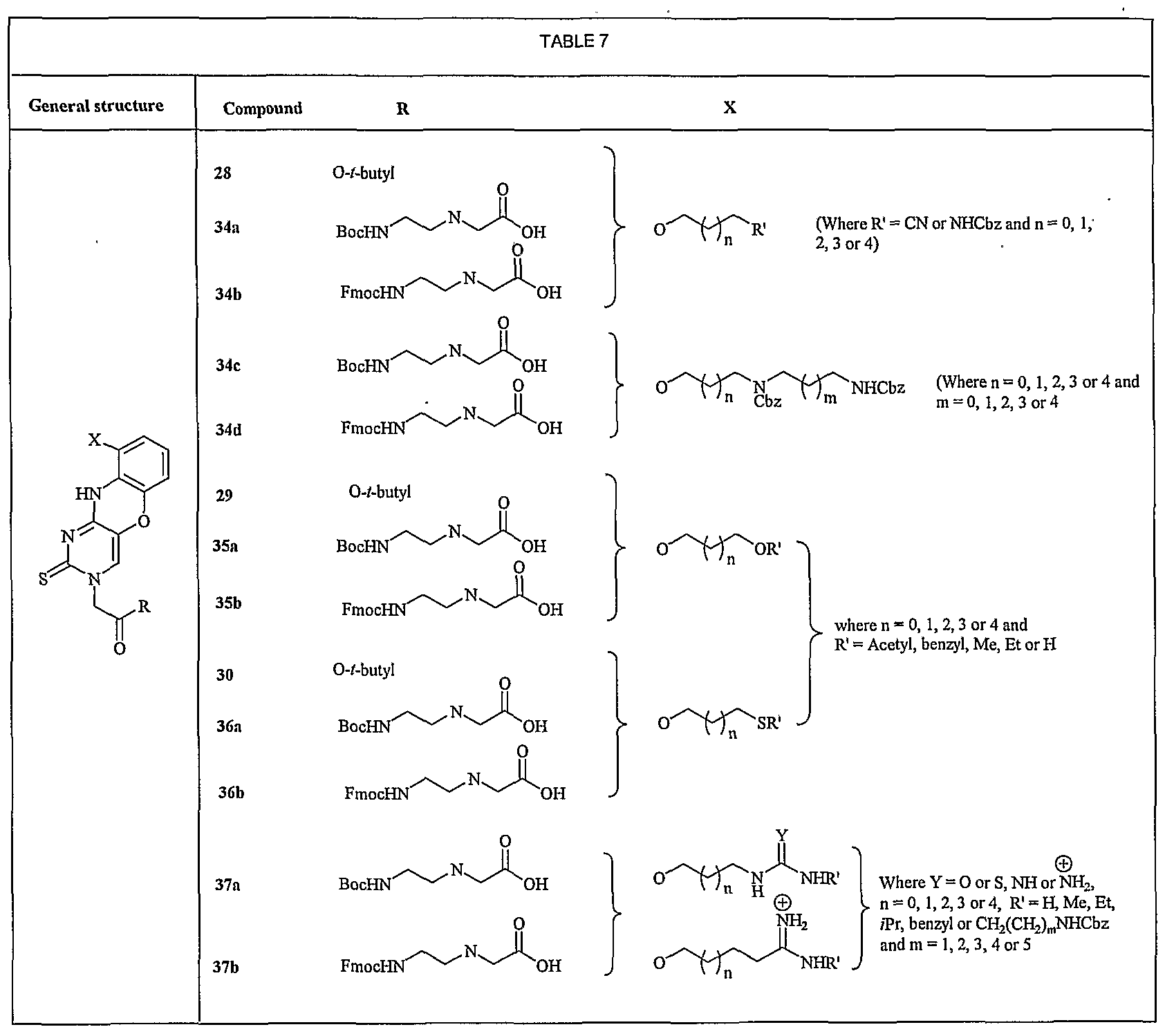
- FIG. 7 shows a representative synthesis of tricyclic compounds 34a, 34b, 35a, 35b, 36a, and 36b.
- neat DEAD 1.1 mmol
- Ph 3 P 1.2 mmol
- ethanol 1.2 mmol
- a molar equivalent of DIEA is added after 10 min of the addition of DEAD and stirs overnight to get the desired compound28.
- TMG 1,1,3,3-tetramethylguanidine
- FIG. 8 shows a representative synthesis of tricyclic compounds 37a, 37b, 38a, and 38b.
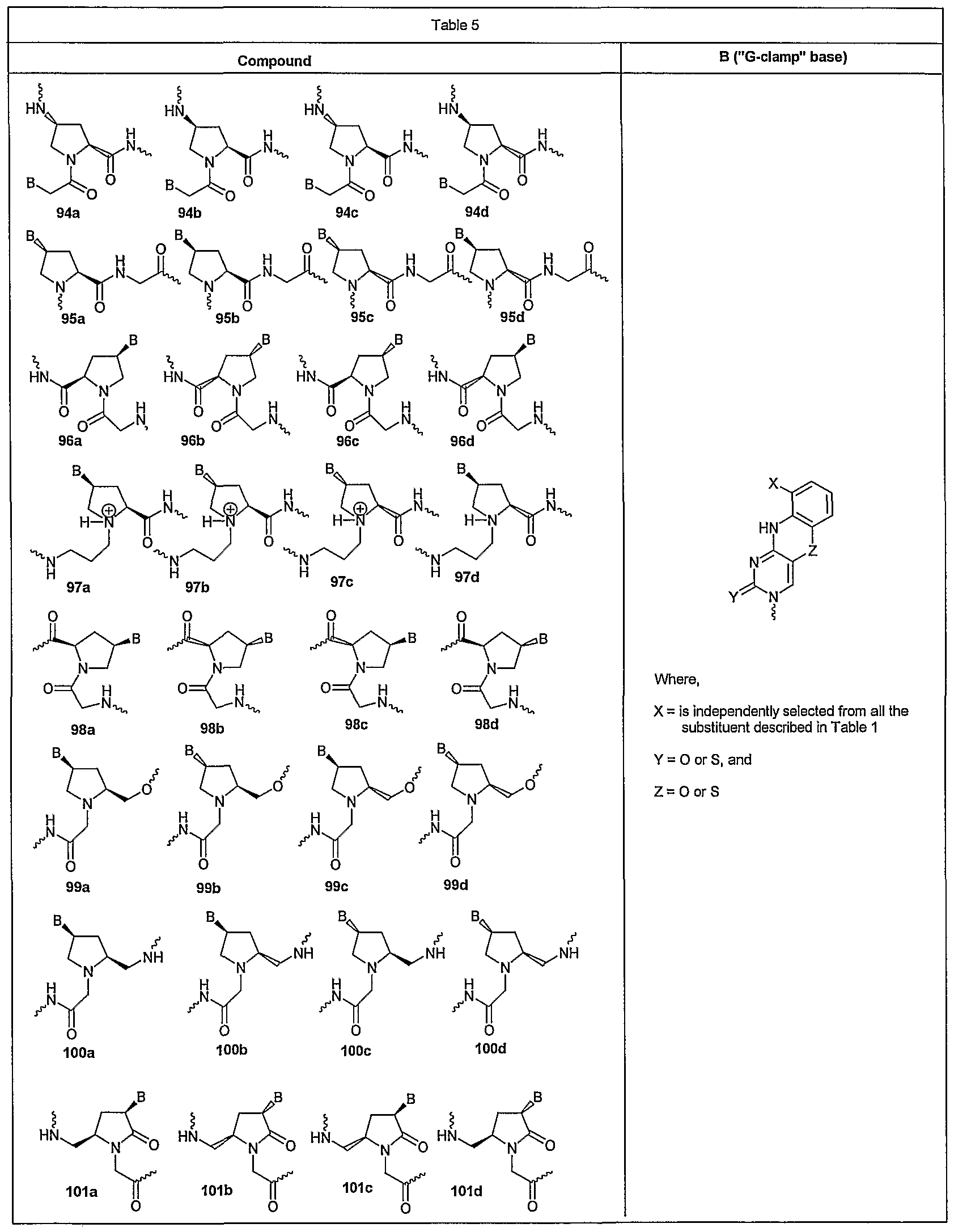
- Table 6 shows representative tricyclic structures:
- PNA oligomer 11a Referring to FIG. 9, a solution of PNA 11, lH-pyrazole-1- carboxamide hydrochloride and Na 2 CO 3 in water is stirred at ambient temperature for 4 B 6 h to obtain compound 11a (Bernatowics et. al, J. Org. Chem. 1992, 57, 2497).
- Example 42
- FIG. 10 shows a representative synthesis of monocyclic compounds 49a and 49b.
- compound 40 is synthesized from compound 39 as described in Example 1 for the synthesis of compound 2a
- Example 43 [0174] Synthesis of compound 41: Compound 40 (1 mmol) and NBS (1.1 mmol) are suspended in chlorobenzene (10 mL) and the suspension is deoxygenated with argon for 30 min. The reaction mixture is heated to 80 °C under argon and AIBN (10 mol %) is added into the preheated solution (No et. el, Syn. Commun. 2000, 30, 3873). The reaction mixture is allowed to stir for 2 h by maintaining the temperature at 80°C. Filter off the solid residue and the filtrate is concentrated to dryness to obtain compound41. Compound 41 is directly used for further experiments without purification.
- Example 44 [0175] Synthesis of compound 42: A suspension of compound41 (1 mmol) and sodium azide (1.5 mmol) in anhydrous DMF (5 mL) is stirred at 120 °C for 2h. After removing the solid residue by filtration, DMF is removed from the filtrate. Residue is taken in ethyl acetate and washes with water to remove dissolved sodium salt. Evaporation of the solvent follows purification to obtain the desired compound 42.
- Example 45 Synthesis of compound 43: Compound 42 is subjected to catalytic hydrogenation over Pd-C, as explained in Example 12, to obtain compound 43.
- Example 48 [0179] Synthesis of compound 45b: The Boc protected PNA monomer 45a is converted to the corresponding Fmoc protected monomer 45b as described in Example 12 for the synthesis of compound 9a.
- Example 53
- PNA monomer 49a is converted to the corresponding Fmoc protected monomer 49b as described in Example 12 for the synthesis of compound9a.
- Example 54 [0185] Synthesis of compound 49d: Commercially available BocT PNA monomer is converted to its t-butyl ester (49c) and compound 49c is subjected to photolytic bromination as described in Example 43 to obtain compound 49d.
- Compound49d is initially reacted with sodium azide as described in Example 44 to obtain the corresponding azide derivative which is then reduced to the corresponding amine (Example 45).
- the amine obtained is protected as benzyl carbamate as described in Example 18 to obtain compound 49a (as specified).
- FIG. 11 shows a representative synthesis of monocyclic compounds 52a, 52b, 55 a, and 55b.
- compound 41 (1 mmol) is stirred with benzyl N-(2-hydroxyethyl)carbamate (2 mmol) and DIEA (1.5 mmol) in dichloromethane (10 mL) overnight to obtain compound 50.
- the Boc protected PNA monomer 52a is converted to the corresponding Fmoc protected monomer 52b as described in Example 12 for the synthesis of compound9a.
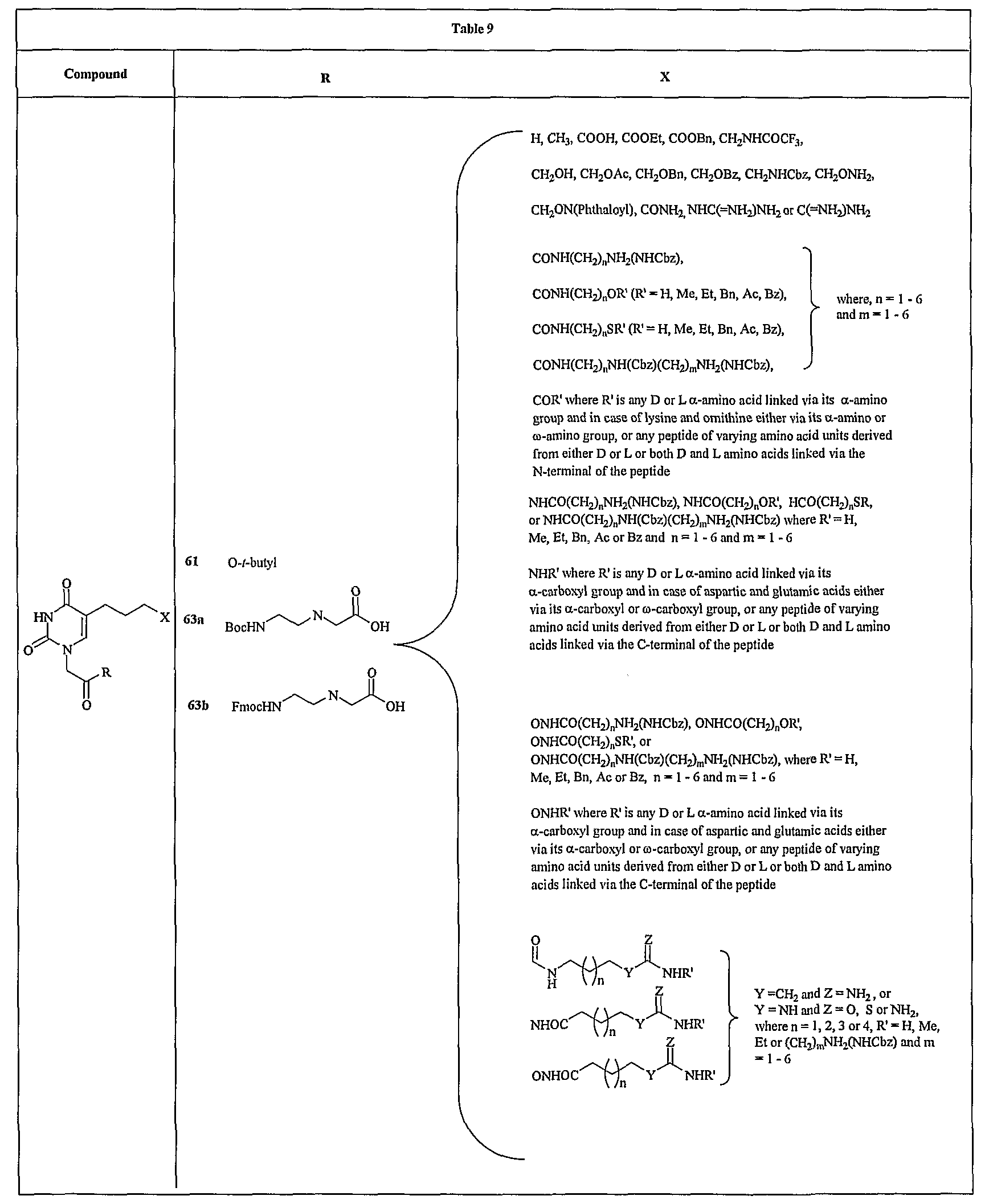
- FIG. 12 shows a representative synthesis of monocyclic compounds 63a and 63b.
- compound 57 is prepared from 5-iodouracil (56) as described in Example 1 for the synthesis of compound 2a.
- Compound 59 is stirring with methanolic ammonia to remove the frifluoroacetyl group and the free amine thus formed is protected as NHCbz using benzyl chloroformate as described in Example 18.
- Boc protected PNA backbone, ethyl-N-(2-(t- butyloxycarbonylamino)ethyl)glycinate is attached to the carboxylic group as described in Example 10 for the synthesis of compound 7a followed by basic hydrolysis to obtain compound 60a.
- the Boc protected PNA monomer 60a is converted to the corresponding Fmoc protected monomer 60b as described in Example 12 for the synthesis of compound9a.
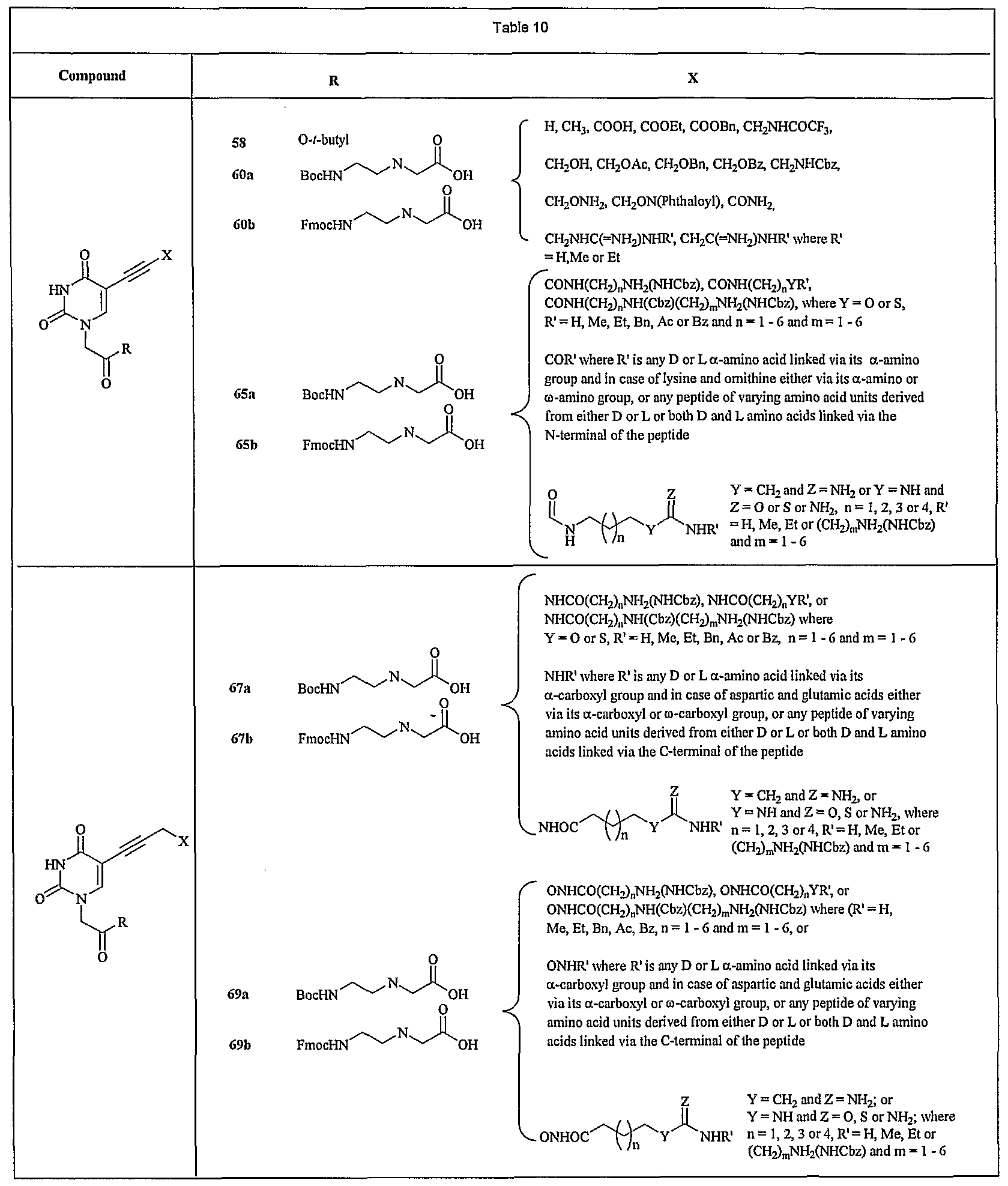
- FIG. 13 shows a representative synthesis of monocyclic compounds 65a, 65b, 67a, 67b, 69a, and 69b.
- ethyl ester of compound 58 (1 mmol) is hydrolyzed under basic condition as described in Example 11.
- the free carboxylic acid thus obtained is coupled to benzyl N-(2-aminoethyl)carbamate (1.1 mmol) in the presence of DCC and DMAP after which the t-butyl ester is removed under acidic condition to obtain compound 64.
- the Fmoc PNA monomer 67b is obtained from 67a as described in Example 12.
- Compound 58 upon treatment with methylamine undergoes N-phthaloyl deprotection.
- the hydroxylamine derivative thus formed is coupled to N-(carbobenzyloxy)- ⁇ -alanine under peptide coupling condition as described in Example 10.
- Acid hydrolysis of the ester formed yields compound 68.
- Compound 69a is prepared from compound 68 under identical conditions as that of compound 67a (Example 81).
- FIG. 14 shows a representative synthesis of monocyclic compounds 73 a and 73b.
- reaction compound 57 with ethyl aery late in presence of Ph 3 P, Pd(II)acetate and TEA in dioxane under reflux yields compound 70 (Matulic-Adamic et. al, Bio. Med. Chem. Lett., 2000, 10, 1299).
- Compound 73a is obtained from compound 72 as described in Example 10 for the synthesis of compound 7a.
- Compound 73b is prepared from compound 73a as described in Example 12.
- FIG. 15 shows a representative synthesis of monocyclic compounds 78a and 78b.
- Compound 78a is prepared from compound 77 and ethyl-N-(2-(t- butyloxycarbonylamino)ethyl)glycinate as described in Example 10.
- Compound 78b is prepared from compound 78a as described in Example 12.
- FIG. 16 shows a representative synthesis of dicyclic compounds 84a, 84b, and 87.
- FIG. 17 shows a representative synthesis of dicyclic compounds 90a, 90b, 93a, and 94b.
- compound 79(1 mmol) is added into a suspension of NaH (1.2 mmol) in anhydrous DMF at 0 °C under argon. Effervescence follows. After 10 min, t-butyl bromoacetate is added into the reaction at 0 °C and slowly bringing the reaction to room temperature. The stirring is continued for 4 h, excess NaH is quenched by methanol and standard works up follows to obtain compound 80.
- Example 99 Synthesis of compound 81: Compound 80 is treated with ammonia under pressure at elevated temperature to obtain compound 81.
- Example 104 Synthesis of compound 85: A solution of compound 80 (1 mmol) andN- iodosuccinimide (1 mmol) in anhydrous DMF (5 mL) is stirred at ambient temperature for overnight to obtain compound 85 (Balow et. al, Nucleic Acids Res., 1998, 26, 3350).
- Compound 90a is prepared from compound 87 as described in Examples 100, 101 and 102.
- FIG. 18 shows a representative synthesis of tricyclic compound 37c.
- compound 3c is prepared from compound 2b and 2-amino-3-methoxy-benzenethiol (Agrawal et. al, Heterocycle. Commun., 1998, 4, 589) with compound 2b as described in Example 3 for the synthesis of compound 3a.
- Example 113 [0251] Synthesis of compound 3d: A suspension of compound 3c (1 mmol), CsF (10 mmol) and Cs 2 CO 3 (1 eq.) are refluxed in absolute ethanol as described in Example 7 for the synthesis of compound 5a to get compound 3d.
- Example 114 [0252] Synthesis of compound 3e: After thorough drying compound 3d (1 mmol) is treated with TMS-I (1 mmol) in dichloromethane. After 5 min, solvent and methyl iodide are removed under vacuum. Residue is redissolved in dichloromethane, washes with bicarbonate. The residue after thorough drying is reacted with benzyl N-(2- hydroxyethyl)carbamate as described in Example 5 to obtain the corresponding O- alkylated product. Hydrolysis of the t-butyl ester formed under acidic condition yields the desired product 3e.
- Example 115 Synthesis of compound 37c: Compound 37c is prepared by alkaline hydrolysis of the product obtained from DCC and DhbhOH mediated coupling of compound 3e (1 mmol) to ethyl-N-(2-(t-butyloxycarbonylamino)ethyl)glycinate (1 mmol) as described in
- Example 10 Referring to Example 115, representative tricyclic compounds are disclosed in
- Example 16 is coupled to four stereo isomers of the modified backbone derived from naturally occurring 4 ?-hydroxy-2S-proline as reported by Gangamani et. al. (Tetrahedron, 1996, 52, 15017) to obtain the four stereo isomers 94a-d.
Landscapes
- Chemical & Material Sciences (AREA)
- Organic Chemistry (AREA)
- Life Sciences & Earth Sciences (AREA)
- Biochemistry (AREA)
- Health & Medical Sciences (AREA)
- General Health & Medical Sciences (AREA)
- Biophysics (AREA)
- General Chemical & Material Sciences (AREA)
- Genetics & Genomics (AREA)
- Medicinal Chemistry (AREA)
- Molecular Biology (AREA)
- Proteomics, Peptides & Aminoacids (AREA)
- Chemical Kinetics & Catalysis (AREA)
- Analytical Chemistry (AREA)
- Gastroenterology & Hepatology (AREA)
- Peptides Or Proteins (AREA)
- Polyamides (AREA)
Abstract
Description























Claims







Applications Claiming Priority (2)
| Application Number | Priority Date | Filing Date | Title |
|---|---|---|---|
| US29359201P | 2001-05-25 | 2001-05-25 | |
| US60/293,592 | 2001-05-25 |
Publications (2)
| Publication Number | Publication Date |
|---|---|
| WO2002097134A2 true WO2002097134A2 (en) | 2002-12-05 |
| WO2002097134A3 WO2002097134A3 (en) | 2003-02-06 |
Family
ID=23129698
Family Applications (1)
| Application Number | Title | Priority Date | Filing Date |
|---|---|---|---|
| PCT/US2002/016883 Ceased WO2002097134A2 (en) | 2001-05-25 | 2002-05-24 | Modified peptide nucleic acid |
Country Status (2)
| Country | Link |
|---|---|
| US (1) | US20030207804A1 (en) |
| WO (1) | WO2002097134A2 (en) |
Cited By (20)
| Publication number | Priority date | Publication date | Assignee | Title |
|---|---|---|---|---|
| WO2011047320A3 (en) * | 2009-10-16 | 2011-08-18 | Rib-X Pharmaceuticals, Inc. | Antimicrobial compounds and methods of making and using the same |
| EP2694683A4 (en) * | 2011-04-08 | 2014-12-17 | Univ Carnegie Mellon | CONFORMATIONALLY PRE-ORGANIZED MINIPEG-CONTAINING GAMMA PEPTIDE NUCLEIC ACIDS |
| JP2015143698A (en) * | 2007-09-19 | 2015-08-06 | ユニヴァーシティ コート オブ ザユニバーシティ オブ エディンバラ | Nucleobase characterization |
| US9394333B2 (en) | 2008-12-02 | 2016-07-19 | Wave Life Sciences Japan | Method for the synthesis of phosphorus atom modified nucleic acids |
| JP2016153405A (en) * | 2009-10-16 | 2016-08-25 | メリンタ セラピューティクス,インコーポレイテッド | Antimicrobial compounds and methods of making and using the same |
| US9598458B2 (en) | 2012-07-13 | 2017-03-21 | Wave Life Sciences Japan, Inc. | Asymmetric auxiliary group |
| US9605019B2 (en) | 2011-07-19 | 2017-03-28 | Wave Life Sciences Ltd. | Methods for the synthesis of functionalized nucleic acids |
| US9617547B2 (en) | 2012-07-13 | 2017-04-11 | Shin Nippon Biomedical Laboratories, Ltd. | Chiral nucleic acid adjuvant |
| US9744183B2 (en) | 2009-07-06 | 2017-08-29 | Wave Life Sciences Ltd. | Nucleic acid prodrugs and methods of use thereof |
| US9845297B2 (en) | 2009-10-16 | 2017-12-19 | Melinta Therapeutics, Inc. | Antimicrobial compounds and methods of making and using the same |
| US9937183B2 (en) | 2013-09-09 | 2018-04-10 | Melinta Therapeutics, Inc. | Antimicrobial compounds and methods of making and using the same |
| US9982257B2 (en) | 2012-07-13 | 2018-05-29 | Wave Life Sciences Ltd. | Chiral control |
| US10106543B2 (en) | 2013-09-09 | 2018-10-23 | Melinta Therapeutics, Inc. | Antimicrobial compounds and methods of making and using the same |
| US10144933B2 (en) | 2014-01-15 | 2018-12-04 | Shin Nippon Biomedical Laboratories, Ltd. | Chiral nucleic acid adjuvant having immunity induction activity, and immunity induction activator |
| US10149905B2 (en) | 2014-01-15 | 2018-12-11 | Shin Nippon Biomedical Laboratories, Ltd. | Chiral nucleic acid adjuvant having antitumor effect and antitumor agent |
| US10160969B2 (en) | 2014-01-16 | 2018-12-25 | Wave Life Sciences Ltd. | Chiral design |
| US10322173B2 (en) | 2014-01-15 | 2019-06-18 | Shin Nippon Biomedical Laboratories, Ltd. | Chiral nucleic acid adjuvant having anti-allergic activity, and anti-allergic agent |
| US10428019B2 (en) | 2010-09-24 | 2019-10-01 | Wave Life Sciences Ltd. | Chiral auxiliaries |
| US10947237B2 (en) | 2015-03-11 | 2021-03-16 | BioVersys AG | Antimicrobial compounds and methods of making and using the same |
| US11999739B2 (en) | 2016-05-06 | 2024-06-04 | BioVersys AG | Antimicrobials methods of making and using the same |
Families Citing this family (36)
| Publication number | Priority date | Publication date | Assignee | Title |
|---|---|---|---|---|
| US9096636B2 (en) | 1996-06-06 | 2015-08-04 | Isis Pharmaceuticals, Inc. | Chimeric oligomeric compounds and their use in gene modulation |
| US5898031A (en) | 1996-06-06 | 1999-04-27 | Isis Pharmaceuticals, Inc. | Oligoribonucleotides for cleaving RNA |
| US7812149B2 (en) | 1996-06-06 | 2010-10-12 | Isis Pharmaceuticals, Inc. | 2′-Fluoro substituted oligomeric compounds and compositions for use in gene modulations |
| US7169916B2 (en) * | 2002-04-01 | 2007-01-30 | Isis Pharmaceuticals, Inc. | Chloral-free DCA in oligonucleotide synthesis |
| AU2003290598A1 (en) | 2002-11-05 | 2004-06-03 | Isis Pharmaceuticals, Inc. | Modified oligonucleotides for use in rna interference |
| US7683036B2 (en) | 2003-07-31 | 2010-03-23 | Regulus Therapeutics Inc. | Oligomeric compounds and compositions for use in modulation of small non-coding RNAs |
| US8569474B2 (en) | 2004-03-09 | 2013-10-29 | Isis Pharmaceuticals, Inc. | Double stranded constructs comprising one or more short strands hybridized to a longer strand |
| US8394947B2 (en) | 2004-06-03 | 2013-03-12 | Isis Pharmaceuticals, Inc. | Positionally modified siRNA constructs |
| US7884086B2 (en) | 2004-09-08 | 2011-02-08 | Isis Pharmaceuticals, Inc. | Conjugates for use in hepatocyte free uptake assays |
| EP2316941A3 (en) * | 2005-02-25 | 2012-03-14 | Isis Pharmaceuticals, Inc. | Compositions and their uses directed to IL-4R alpha |
| CA2620856C (en) | 2005-08-29 | 2017-11-28 | Isis Pharmaceuticals, Inc. | Methods for use in modulating mir-122a |
| CN101313066A (en) | 2005-09-19 | 2008-11-26 | 强生医药研究及开发有限责任公司 | Modulation of glucocorticoid receptor expression |
| EP2096170B1 (en) | 2005-09-19 | 2011-08-10 | Isis Pharmaceuticals, Inc. | Modulation of glucagon receptor expression |
| EP1969143A4 (en) * | 2005-12-20 | 2009-07-22 | Isis Pharmaceuticals Inc | DOUBLE-STRANDED NUCLEIC ACID MOLECULES TARGETING ALPHA IL-4 RECEPTOR |
| WO2007090073A2 (en) | 2006-01-27 | 2007-08-09 | Isis Pharmaceuticals, Inc. | Oligomeric compounds and compositions for the use in modulation of micrornas |
| WO2008011473A2 (en) | 2006-07-19 | 2008-01-24 | Isis Pharmaceuticals, Inc. | Compositions and their uses directed to hbxip |
| US20090077093A1 (en) * | 2007-09-19 | 2009-03-19 | Joydeep Sen Sarma | Feature Discretization and Cardinality Reduction Using Collaborative Filtering Techniques |
| US8846639B2 (en) | 2008-04-04 | 2014-09-30 | Isis Pharmaceutical, Inc. | Oligomeric compounds comprising bicyclic nucleosides and having reduced toxicity |
| US8341614B2 (en) * | 2008-06-06 | 2012-12-25 | Apple Inc. | Memory management for closures |
| EP2447274B1 (en) | 2008-10-24 | 2017-10-04 | Ionis Pharmaceuticals, Inc. | Oligomeric compounds and methods |
| WO2010091308A2 (en) | 2009-02-06 | 2010-08-12 | Isis Pharmaceuticals, Inc. | Oligomeric compounds and methods |
| CN102053449A (en) * | 2009-10-28 | 2011-05-11 | 中国科学院福建物质结构研究所 | Glutamic acid-derived chiral metal-organic nonlinear optical material |
| EP3031920B1 (en) | 2010-07-19 | 2019-08-21 | Ionis Pharmaceuticals, Inc. | Modulation of dystrophia myotonica-protein kinase (dmpk) expression |
| EP2971160B1 (en) | 2013-03-15 | 2018-05-30 | Bio-Rad Laboratories, Inc. | Digital assays for mutation detection |
| US10221216B2 (en) * | 2013-04-11 | 2019-03-05 | Carnegie Mellon University | Template-directed γPNA synthesis process and γPNA targeting compounds |
| WO2014169206A2 (en) | 2013-04-11 | 2014-10-16 | Carnegie Mellon University | Divalent nucleobase compounds and uses therefor |
| TW201536329A (en) | 2013-08-09 | 2015-10-01 | Isis Pharmaceuticals Inc | Compound and method for regulating the manifestation of dystrophic myotonic protein kinase (DMPK) |
| JP6851201B2 (en) | 2014-06-10 | 2021-03-31 | エラスムス ユニバーシティ メディカルセンター ロッテルダムErasmus University Medical Center Rotterdam | Antisense oligonucleotides useful in the treatment of Pompe disease |
| AU2015416656B2 (en) | 2015-12-07 | 2023-02-23 | Erasmus University Medical Center Rotterdam | Enzymatic replacement therapy and antisense therapy for Pompe disease |
| NL2017294B1 (en) | 2016-08-05 | 2018-02-14 | Univ Erasmus Med Ct Rotterdam | Natural cryptic exon removal by pairs of antisense oligonucleotides. |
| NL2017295B1 (en) | 2016-08-05 | 2018-02-14 | Univ Erasmus Med Ct Rotterdam | Antisense oligomeric compound for Pompe disease |
| JP7407592B2 (en) * | 2016-08-08 | 2024-01-04 | オリパス コーポレーション | Androgen receptor antisense oligonucleotide |
| EP3523284A4 (en) * | 2016-09-26 | 2021-07-07 | Carnegie Mellon University | DIVALENT NUCLEOBASE COMPOUNDS AND USES THEREOF |
| EP4396352A4 (en) | 2021-09-01 | 2025-10-01 | Ionis Pharmaceuticals Inc | Compounds and methods for reducing DMPK expression |
| US20250136613A1 (en) * | 2022-02-07 | 2025-05-01 | Osaka University | Phenoxazine derivative and drug delivery system formulation using same |
| EP4554576A2 (en) * | 2022-07-15 | 2025-05-21 | University of Southern California | Bifunctional photocrosslinking probes for covalent capture of protein-nucleic acid complexes in cells |
Family Cites Families (7)
| Publication number | Priority date | Publication date | Assignee | Title |
|---|---|---|---|---|
| US5641625A (en) * | 1992-05-22 | 1997-06-24 | Isis Pharmaceuticals, Inc. | Cleaving double-stranded DNA with peptide nucleic acids |
| US5714331A (en) * | 1991-05-24 | 1998-02-03 | Buchardt, Deceased; Ole | Peptide nucleic acids having enhanced binding affinity, sequence specificity and solubility |
| DK51092D0 (en) * | 1991-05-24 | 1992-04-15 | Ole Buchardt | OLIGONUCLEOTIDE ANALOGUE DESCRIBED BY PEN, MONOMERIC SYNTHONES AND PROCEDURES FOR PREPARING THEREOF, AND APPLICATIONS THEREOF |
| US5539082A (en) * | 1993-04-26 | 1996-07-23 | Nielsen; Peter E. | Peptide nucleic acids |
| US5719262A (en) * | 1993-11-22 | 1998-02-17 | Buchardt, Deceased; Ole | Peptide nucleic acids having amino acid side chains |
| US5700922A (en) * | 1991-12-24 | 1997-12-23 | Isis Pharmaceuticals, Inc. | PNA-DNA-PNA chimeric macromolecules |
| US6107470A (en) * | 1997-05-29 | 2000-08-22 | Nielsen; Peter E. | Histidine-containing peptide nucleic acids |
-
2002
- 2002-05-24 WO PCT/US2002/016883 patent/WO2002097134A2/en not_active Ceased
- 2002-05-24 US US10/155,920 patent/US20030207804A1/en not_active Abandoned
Cited By (41)
| Publication number | Priority date | Publication date | Assignee | Title |
|---|---|---|---|---|
| JP2015143698A (en) * | 2007-09-19 | 2015-08-06 | ユニヴァーシティ コート オブ ザユニバーシティ オブ エディンバラ | Nucleobase characterization |
| US9394333B2 (en) | 2008-12-02 | 2016-07-19 | Wave Life Sciences Japan | Method for the synthesis of phosphorus atom modified nucleic acids |
| US9695211B2 (en) | 2008-12-02 | 2017-07-04 | Wave Life Sciences Japan, Inc. | Method for the synthesis of phosphorus atom modified nucleic acids |
| US10329318B2 (en) | 2008-12-02 | 2019-06-25 | Wave Life Sciences Ltd. | Method for the synthesis of phosphorus atom modified nucleic acids |
| US9744183B2 (en) | 2009-07-06 | 2017-08-29 | Wave Life Sciences Ltd. | Nucleic acid prodrugs and methods of use thereof |
| US10307434B2 (en) | 2009-07-06 | 2019-06-04 | Wave Life Sciences Ltd. | Nucleic acid prodrugs and methods of use thereof |
| US9023843B2 (en) | 2009-10-16 | 2015-05-05 | Melinta Therapeutics, Inc. | Antimicrobial compounds and methods of making and using the same |
| US10259825B2 (en) | 2009-10-16 | 2019-04-16 | Melinta Therapeutics, Inc. | Antimicrobial compounds and methods of making and using the same |
| JP2016153405A (en) * | 2009-10-16 | 2016-08-25 | メリンタ セラピューティクス,インコーポレイテッド | Antimicrobial compounds and methods of making and using the same |
| AU2010306647B2 (en) * | 2009-10-16 | 2016-10-20 | Melinta Therapeutics, Inc. | Antimicrobial compounds and methods of making and using the same |
| US9573962B2 (en) | 2009-10-16 | 2017-02-21 | Melinta Therapeutics, Inc. | Antimicrobial compounds and methods of making and using the same |
| WO2011047320A3 (en) * | 2009-10-16 | 2011-08-18 | Rib-X Pharmaceuticals, Inc. | Antimicrobial compounds and methods of making and using the same |
| EP3421476A1 (en) * | 2009-10-16 | 2019-01-02 | Melinta Therapeutics, Inc. | Antimicrobial compounds and methods of making and using the same |
| JP2013508298A (en) * | 2009-10-16 | 2013-03-07 | リブ−エックス ファーマシューティカルズ,インコーポレイテッド | Antimicrobial compounds and methods of making and using antimicrobial compounds |
| CN102712657A (en) * | 2009-10-16 | 2012-10-03 | Rib-X制药公司 | Antimicrobial compounds and methods of making and using the same |
| CN107266470A (en) * | 2009-10-16 | 2017-10-20 | 梅琳塔治疗公司 | Antimicrobe compound and its preparation and application |
| CN107445976A (en) * | 2009-10-16 | 2017-12-08 | 梅琳塔治疗公司 | Antimicrobe compound and its preparation and application |
| US9845297B2 (en) | 2009-10-16 | 2017-12-19 | Melinta Therapeutics, Inc. | Antimicrobial compounds and methods of making and using the same |
| US10428019B2 (en) | 2010-09-24 | 2019-10-01 | Wave Life Sciences Ltd. | Chiral auxiliaries |
| US9193758B2 (en) | 2011-04-08 | 2015-11-24 | Carnegie Mellon University Center For Technology Transfer & Enterprise | Conformationally-preorganized, miniPEG-containing γ-peptide nucleic acids |
| US10364272B2 (en) | 2011-04-08 | 2019-07-30 | Carnegie Mellon University | Conformationally-preorganized, miniPEG-containing gamma-peptide nucleic acids |
| US10093700B2 (en) | 2011-04-08 | 2018-10-09 | Carnegie Mellon University | Conformationally-preorganized, MiniPEG-containing gamma-peptide nucleic acids |
| US10793605B2 (en) | 2011-04-08 | 2020-10-06 | Carnegie Mellon University | Conformationally-preorganized, miniPEG-containing γ-peptide nucleic acids |
| US11279736B2 (en) | 2011-04-08 | 2022-03-22 | Carnegie Mellon University | Conformationally-preorganized, MiniPEG-containing gamma-peptide nucleic acids |
| US10160787B2 (en) | 2011-04-08 | 2018-12-25 | Carnegie Mellon University | Conformationally-preorganized, miniPEG-containing gamma-peptide nucleic acids |
| EP2694683A4 (en) * | 2011-04-08 | 2014-12-17 | Univ Carnegie Mellon | CONFORMATIONALLY PRE-ORGANIZED MINIPEG-CONTAINING GAMMA PEPTIDE NUCLEIC ACIDS |
| US10280192B2 (en) | 2011-07-19 | 2019-05-07 | Wave Life Sciences Ltd. | Methods for the synthesis of functionalized nucleic acids |
| US9605019B2 (en) | 2011-07-19 | 2017-03-28 | Wave Life Sciences Ltd. | Methods for the synthesis of functionalized nucleic acids |
| US10590413B2 (en) | 2012-07-13 | 2020-03-17 | Wave Life Sciences Ltd. | Chiral control |
| US9982257B2 (en) | 2012-07-13 | 2018-05-29 | Wave Life Sciences Ltd. | Chiral control |
| US9617547B2 (en) | 2012-07-13 | 2017-04-11 | Shin Nippon Biomedical Laboratories, Ltd. | Chiral nucleic acid adjuvant |
| US10167309B2 (en) | 2012-07-13 | 2019-01-01 | Wave Life Sciences Ltd. | Asymmetric auxiliary group |
| US9598458B2 (en) | 2012-07-13 | 2017-03-21 | Wave Life Sciences Japan, Inc. | Asymmetric auxiliary group |
| US10106543B2 (en) | 2013-09-09 | 2018-10-23 | Melinta Therapeutics, Inc. | Antimicrobial compounds and methods of making and using the same |
| US9937183B2 (en) | 2013-09-09 | 2018-04-10 | Melinta Therapeutics, Inc. | Antimicrobial compounds and methods of making and using the same |
| US10149905B2 (en) | 2014-01-15 | 2018-12-11 | Shin Nippon Biomedical Laboratories, Ltd. | Chiral nucleic acid adjuvant having antitumor effect and antitumor agent |
| US10144933B2 (en) | 2014-01-15 | 2018-12-04 | Shin Nippon Biomedical Laboratories, Ltd. | Chiral nucleic acid adjuvant having immunity induction activity, and immunity induction activator |
| US10322173B2 (en) | 2014-01-15 | 2019-06-18 | Shin Nippon Biomedical Laboratories, Ltd. | Chiral nucleic acid adjuvant having anti-allergic activity, and anti-allergic agent |
| US10160969B2 (en) | 2014-01-16 | 2018-12-25 | Wave Life Sciences Ltd. | Chiral design |
| US10947237B2 (en) | 2015-03-11 | 2021-03-16 | BioVersys AG | Antimicrobial compounds and methods of making and using the same |
| US11999739B2 (en) | 2016-05-06 | 2024-06-04 | BioVersys AG | Antimicrobials methods of making and using the same |
Also Published As
| Publication number | Publication date |
|---|---|
| WO2002097134A3 (en) | 2003-02-06 |
| US20030207804A1 (en) | 2003-11-06 |
Similar Documents
| Publication | Publication Date | Title |
|---|---|---|
| US20030207804A1 (en) | Modified peptide nucleic acids | |
| US5773571A (en) | Peptide nucleic acids | |
| DE69232055T2 (en) | peptide nucleic acids | |
| JP3326181B2 (en) | Linked peptide nucleic acid | |
| US6686442B2 (en) | Conjugated peptide nucleic acids having enhanced cellular uptake | |
| AU745309B2 (en) | Conjugated peptide nucleic acids having enhanced cellular uptake | |
| DE69734783T2 (en) | PEPTID NUCLEIC ACIDS WITH INCREASED BINDING SAFFINITY, SEQUENCE SPECIFICITY AND SOLUBILITY | |
| JP3595345B2 (en) | Monomers and oligomers of peptide nucleic acids | |
| JP6546272B2 (en) | Peptide nucleic acid monomers and oligomers | |
| CA2281843A1 (en) | Stereochemical control of the dna binding affinity, sequence specificity, and orientation-preference of chiral hairpin polyamides in the minor groove | |
| US20050009041A1 (en) | Peptide nucleic acids and synthetic procedures therefor | |
| AU2001246536B2 (en) | Polyamide nucleic acid derivatives, agents and methods for producing the same | |
| JP2004514427A (en) | PNA analog | |
| US6872809B2 (en) | Nucleoside derivatives | |
| JP2003219874A (en) | Method for using peptide nucleic acid that selectively binds to RNA as antisense oligonucleotide, and method for producing said peptide nucleic acid | |
| Dcosta | Synthesis and evaluation of conformationally constrained pyrrolidyl polyamide nucleic acids |
Legal Events
| Date | Code | Title | Description |
|---|---|---|---|
| AK | Designated states |
Kind code of ref document: A2 Designated state(s): AE AG AL AM AT AU AZ BA BB BG BR BY BZ CA CH CN CO CR CU CZ DE DK DM DZ EC EE ES FI GB GD GE GH GM HR HU ID IL IN IS JP KE KG KP KR KZ LC LK LR LS LT LU LV MA MD MG MK MN MW MX MZ NO NZ OM PH PL PT RO RU SD SE SG SI SK SL TJ TM TN TR TT TZ UA UG US UZ VN YU ZA ZM ZW |
|
| AL | Designated countries for regional patents |
Kind code of ref document: A2 Designated state(s): GH GM KE LS MW MZ SD SL SZ TZ UG ZM ZW AM AZ BY KG KZ MD RU TJ TM AT BE CH CY DE DK ES FI FR GB GR IE IT LU MC NL PT SE TR BF BJ CF CG CI CM GA GN GQ GW ML MR NE SN TD TG |
|
| 121 | Ep: the epo has been informed by wipo that ep was designated in this application | ||
| AK | Designated states |
Kind code of ref document: A3 Designated state(s): AE AG AL AM AT AU AZ BA BB BG BR BY BZ CA CH CN CO CR CU CZ DE DK DM DZ EC EE ES FI GB GD GE GH GM HR HU ID IL IN IS JP KE KG KP KR KZ LC LK LR LS LT LU LV MA MD MG MK MN MW MX MZ NO NZ OM PH PL PT RO RU SD SE SG SI SK SL TJ TM TN TR TT TZ UA UG US UZ VN YU ZA ZM ZW |
|
| AL | Designated countries for regional patents |
Kind code of ref document: A3 Designated state(s): GH GM KE LS MW MZ SD SL SZ TZ UG ZM ZW AM AZ BY KG KZ MD RU TJ TM AT BE CH CY DE DK ES FI FR GB GR IE IT LU MC NL PT SE TR BF BJ CF CG CI CM GA GN GQ GW ML MR NE SN TD TG |
|
| DFPE | Request for preliminary examination filed prior to expiration of 19th month from priority date (pct application filed before 20040101) | ||
| REG | Reference to national code |
Ref country code: DE Ref legal event code: 8642 |
|
| 122 | Ep: pct application non-entry in european phase | ||
| NENP | Non-entry into the national phase |
Ref country code: JP |
|
| WWW | Wipo information: withdrawn in national office |
Country of ref document: JP |