JP2004514427A - PNA analog - Google Patents
PNA analog Download PDFInfo
- Publication number
- JP2004514427A JP2004514427A JP2002544449A JP2002544449A JP2004514427A JP 2004514427 A JP2004514427 A JP 2004514427A JP 2002544449 A JP2002544449 A JP 2002544449A JP 2002544449 A JP2002544449 A JP 2002544449A JP 2004514427 A JP2004514427 A JP 2004514427A
- Authority
- JP
- Japan
- Prior art keywords
- pna
- mmol
- peptide
- solution
- nucleic acid
- Prior art date
- Legal status (The legal status is an assumption and is not a legal conclusion. Google has not performed a legal analysis and makes no representation as to the accuracy of the status listed.)
- Ceased
Links
- 108091093037 Peptide nucleic acid Proteins 0.000 claims abstract description 143
- 150000001875 compounds Chemical class 0.000 claims description 49
- -1 aminoethylprolyl Chemical group 0.000 claims description 26
- 239000000178 monomer Substances 0.000 claims description 26
- 108090000765 processed proteins & peptides Proteins 0.000 claims description 24
- 230000001580 bacterial effect Effects 0.000 claims description 14
- 150000001413 amino acids Chemical class 0.000 claims description 12
- 238000004519 manufacturing process Methods 0.000 claims description 11
- 108090000623 proteins and genes Proteins 0.000 claims description 10
- 239000003814 drug Substances 0.000 claims description 9
- PIINGYXNCHTJTF-UHFFFAOYSA-N 2-(2-azaniumylethylamino)acetate Chemical compound NCCNCC(O)=O PIINGYXNCHTJTF-UHFFFAOYSA-N 0.000 claims description 6
- 108020004707 nucleic acids Proteins 0.000 claims description 5
- 102000039446 nucleic acids Human genes 0.000 claims description 5
- 150000007523 nucleic acids Chemical class 0.000 claims description 5
- 201000010099 disease Diseases 0.000 claims description 4
- 208000037265 diseases, disorders, signs and symptoms Diseases 0.000 claims description 4
- 230000008685 targeting Effects 0.000 claims description 4
- 208000035143 Bacterial infection Diseases 0.000 claims description 3
- 206010028980 Neoplasm Diseases 0.000 claims description 3
- 208000036142 Viral infection Diseases 0.000 claims description 3
- 208000022362 bacterial infectious disease Diseases 0.000 claims description 3
- 201000011510 cancer Diseases 0.000 claims description 3
- 238000009396 hybridization Methods 0.000 claims description 3
- 208000026278 immune system disease Diseases 0.000 claims description 3
- 108020004999 messenger RNA Proteins 0.000 claims description 3
- 208000030159 metabolic disease Diseases 0.000 claims description 3
- 230000009385 viral infection Effects 0.000 claims description 3
- WRXNJTBODVGDRY-UHFFFAOYSA-N 2-pyrrolidin-1-ylethanamine Chemical compound NCCN1CCCC1 WRXNJTBODVGDRY-UHFFFAOYSA-N 0.000 claims description 2
- 230000033228 biological regulation Effects 0.000 claims description 2
- 238000003745 diagnosis Methods 0.000 claims description 2
- 230000002222 downregulating effect Effects 0.000 claims description 2
- 230000002068 genetic effect Effects 0.000 claims description 2
- 238000007901 in situ hybridization Methods 0.000 claims description 2
- 238000012544 monitoring process Methods 0.000 claims description 2
- 238000003753 real-time PCR Methods 0.000 claims description 2
- 239000000523 sample Substances 0.000 claims description 2
- 125000003275 alpha amino acid group Chemical group 0.000 claims 1
- 239000000243 solution Substances 0.000 description 74
- OKKJLVBELUTLKV-UHFFFAOYSA-N Methanol Chemical compound OC OKKJLVBELUTLKV-UHFFFAOYSA-N 0.000 description 57
- HEDRZPFGACZZDS-MICDWDOJSA-N deuterated chloroform Substances [2H]C(Cl)(Cl)Cl HEDRZPFGACZZDS-MICDWDOJSA-N 0.000 description 47
- IAZDPXIOMUYVGZ-WFGJKAKNSA-N Dimethyl sulfoxide Chemical compound [2H]C([2H])([2H])S(=O)C([2H])([2H])[2H] IAZDPXIOMUYVGZ-WFGJKAKNSA-N 0.000 description 46
- 238000005481 NMR spectroscopy Methods 0.000 description 40
- YMWUJEATGCHHMB-UHFFFAOYSA-N Dichloromethane Chemical compound ClCCl YMWUJEATGCHHMB-UHFFFAOYSA-N 0.000 description 38
- 108020004414 DNA Proteins 0.000 description 36
- 238000002360 preparation method Methods 0.000 description 30
- 239000002904 solvent Substances 0.000 description 29
- 108091032973 (ribonucleotides)n+m Proteins 0.000 description 26
- RWRDLPDLKQPQOW-UHFFFAOYSA-N Pyrrolidine Chemical group C1CCNC1 RWRDLPDLKQPQOW-UHFFFAOYSA-N 0.000 description 24
- 238000000034 method Methods 0.000 description 23
- 239000011541 reaction mixture Substances 0.000 description 23
- 238000006243 chemical reaction Methods 0.000 description 20
- 239000012043 crude product Substances 0.000 description 20
- 150000003839 salts Chemical class 0.000 description 20
- ZMXDDKWLCZADIW-UHFFFAOYSA-N N,N-dimethylformamide Substances CN(C)C=O ZMXDDKWLCZADIW-UHFFFAOYSA-N 0.000 description 19
- 239000012074 organic phase Substances 0.000 description 19
- QTBSBXVTEAMEQO-UHFFFAOYSA-N Acetic acid Chemical compound CC(O)=O QTBSBXVTEAMEQO-UHFFFAOYSA-N 0.000 description 18
- GFFGJBXGBJISGV-UHFFFAOYSA-N Adenine Chemical compound NC1=NC=NC2=C1N=CN2 GFFGJBXGBJISGV-UHFFFAOYSA-N 0.000 description 18
- XLYOFNOQVPJJNP-UHFFFAOYSA-N water Substances O XLYOFNOQVPJJNP-UHFFFAOYSA-N 0.000 description 18
- 229930024421 Adenine Natural products 0.000 description 17
- 229960000643 adenine Drugs 0.000 description 17
- 239000007787 solid Substances 0.000 description 17
- 238000003756 stirring Methods 0.000 description 17
- IMNFDUFMRHMDMM-UHFFFAOYSA-N N-Heptane Chemical compound CCCCCCC IMNFDUFMRHMDMM-UHFFFAOYSA-N 0.000 description 16
- 239000012267 brine Substances 0.000 description 15
- HPALAKNZSZLMCH-UHFFFAOYSA-M sodium;chloride;hydrate Chemical compound O.[Na+].[Cl-] HPALAKNZSZLMCH-UHFFFAOYSA-M 0.000 description 15
- 238000005160 1H NMR spectroscopy Methods 0.000 description 14
- 230000000692 anti-sense effect Effects 0.000 description 14
- 238000004587 chromatography analysis Methods 0.000 description 14
- 239000012535 impurity Substances 0.000 description 14
- JGFZNNIVVJXRND-UHFFFAOYSA-N N,N-Diisopropylethylamine (DIPEA) Chemical compound CCN(C(C)C)C(C)C JGFZNNIVVJXRND-UHFFFAOYSA-N 0.000 description 12
- 230000015572 biosynthetic process Effects 0.000 description 12
- KRKNYBCHXYNGOX-UHFFFAOYSA-N citric acid Chemical compound OC(=O)CC(O)(C(O)=O)CC(O)=O KRKNYBCHXYNGOX-UHFFFAOYSA-N 0.000 description 12
- 239000000203 mixture Substances 0.000 description 12
- 229910001868 water Inorganic materials 0.000 description 12
- UIIMBOGNXHQVGW-UHFFFAOYSA-M Sodium bicarbonate Chemical class [Na+].OC([O-])=O UIIMBOGNXHQVGW-UHFFFAOYSA-M 0.000 description 11
- 239000008346 aqueous phase Substances 0.000 description 11
- CSNNHWWHGAXBCP-UHFFFAOYSA-L Magnesium sulfate Chemical compound [Mg+2].[O-][S+2]([O-])([O-])[O-] CSNNHWWHGAXBCP-UHFFFAOYSA-L 0.000 description 10
- LRHPLDYGYMQRHN-UHFFFAOYSA-N N-Butanol Chemical compound CCCCO LRHPLDYGYMQRHN-UHFFFAOYSA-N 0.000 description 10
- FAPWRFPIFSIZLT-UHFFFAOYSA-M Sodium chloride Chemical compound [Na+].[Cl-] FAPWRFPIFSIZLT-UHFFFAOYSA-M 0.000 description 10
- VYPSYNLAJGMNEJ-UHFFFAOYSA-N Silicium dioxide Chemical compound O=[Si]=O VYPSYNLAJGMNEJ-UHFFFAOYSA-N 0.000 description 9
- YXFVVABEGXRONW-UHFFFAOYSA-N Toluene Chemical compound CC1=CC=CC=C1 YXFVVABEGXRONW-UHFFFAOYSA-N 0.000 description 9
- 239000002253 acid Substances 0.000 description 9
- IJGRMHOSHXDMSA-UHFFFAOYSA-N Atomic nitrogen Chemical compound N#N IJGRMHOSHXDMSA-UHFFFAOYSA-N 0.000 description 8
- JUJWROOIHBZHMG-UHFFFAOYSA-N Pyridine Chemical compound C1=CC=NC=C1 JUJWROOIHBZHMG-UHFFFAOYSA-N 0.000 description 8
- 229940024606 amino acid Drugs 0.000 description 8
- 235000001014 amino acid Nutrition 0.000 description 8
- 239000003921 oil Substances 0.000 description 8
- 235000019198 oils Nutrition 0.000 description 8
- 239000000725 suspension Substances 0.000 description 8
- 108091034117 Oligonucleotide Proteins 0.000 description 7
- 239000007864 aqueous solution Substances 0.000 description 7
- 125000005647 linker group Chemical group 0.000 description 7
- 238000002844 melting Methods 0.000 description 7
- 230000008018 melting Effects 0.000 description 7
- VLKZOEOYAKHREP-UHFFFAOYSA-N n-Hexane Chemical compound CCCCCC VLKZOEOYAKHREP-UHFFFAOYSA-N 0.000 description 7
- 238000003786 synthesis reaction Methods 0.000 description 7
- 0 CC(C)(C)OC(N(C1)[C@](C*)C[C@]1O)=O Chemical compound CC(C)(C)OC(N(C1)[C@](C*)C[C@]1O)=O 0.000 description 6
- 208000035473 Communicable disease Diseases 0.000 description 6
- IPTUBUUIFRZMJK-ACRUOGEOSA-N Lys-Phe-Phe Chemical compound C([C@H](NC(=O)[C@@H](N)CCCCN)C(=O)N[C@@H](CC=1C=CC=CC=1)C(O)=O)C1=CC=CC=C1 IPTUBUUIFRZMJK-ACRUOGEOSA-N 0.000 description 6
- 239000007832 Na2SO4 Substances 0.000 description 6
- PMZURENOXWZQFD-UHFFFAOYSA-L Sodium Sulfate Chemical compound [Na+].[Na+].[O-]S([O-])(=O)=O PMZURENOXWZQFD-UHFFFAOYSA-L 0.000 description 6
- 235000011054 acetic acid Nutrition 0.000 description 6
- 239000000872 buffer Substances 0.000 description 6
- 239000003085 diluting agent Substances 0.000 description 6
- 239000002609 medium Substances 0.000 description 6
- FEMOMIGRRWSMCU-UHFFFAOYSA-N ninhydrin Chemical compound C1=CC=C2C(=O)C(O)(O)C(=O)C2=C1 FEMOMIGRRWSMCU-UHFFFAOYSA-N 0.000 description 6
- 102000004196 processed proteins & peptides Human genes 0.000 description 6
- 238000004007 reversed phase HPLC Methods 0.000 description 6
- 229920006395 saturated elastomer Polymers 0.000 description 6
- 229910052938 sodium sulfate Inorganic materials 0.000 description 6
- KCXVZYZYPLLWCC-UHFFFAOYSA-N EDTA Chemical compound OC(=O)CN(CC(O)=O)CCN(CC(O)=O)CC(O)=O KCXVZYZYPLLWCC-UHFFFAOYSA-N 0.000 description 5
- UYTPUPDQBNUYGX-UHFFFAOYSA-N Guanine Natural products O=C1NC(N)=NC2=C1N=CN2 UYTPUPDQBNUYGX-UHFFFAOYSA-N 0.000 description 5
- 229910019142 PO4 Inorganic materials 0.000 description 5
- 239000002775 capsule Substances 0.000 description 5
- 239000003795 chemical substances by application Substances 0.000 description 5
- 230000000295 complement effect Effects 0.000 description 5
- 239000006260 foam Substances 0.000 description 5
- 238000009472 formulation Methods 0.000 description 5
- 208000015181 infectious disease Diseases 0.000 description 5
- 229910052943 magnesium sulfate Inorganic materials 0.000 description 5
- 239000000463 material Substances 0.000 description 5
- YDCHPLOFQATIDS-UHFFFAOYSA-N methyl 2-bromoacetate Chemical compound COC(=O)CBr YDCHPLOFQATIDS-UHFFFAOYSA-N 0.000 description 5
- 239000010452 phosphate Substances 0.000 description 5
- HNJBEVLQSNELDL-UHFFFAOYSA-N pyrrolidin-2-one Chemical compound O=C1CCCN1 HNJBEVLQSNELDL-UHFFFAOYSA-N 0.000 description 5
- 230000002829 reductive effect Effects 0.000 description 5
- 239000011780 sodium chloride Substances 0.000 description 5
- 238000010532 solid phase synthesis reaction Methods 0.000 description 5
- 229940113082 thymine Drugs 0.000 description 5
- 230000032258 transport Effects 0.000 description 5
- YYROPELSRYBVMQ-UHFFFAOYSA-N 4-toluenesulfonyl chloride Chemical compound CC1=CC=C(S(Cl)(=O)=O)C=C1 YYROPELSRYBVMQ-UHFFFAOYSA-N 0.000 description 4
- 241000894006 Bacteria Species 0.000 description 4
- HEDRZPFGACZZDS-UHFFFAOYSA-N Chloroform Chemical compound ClC(Cl)Cl HEDRZPFGACZZDS-UHFFFAOYSA-N 0.000 description 4
- RTZKZFJDLAIYFH-UHFFFAOYSA-N Diethyl ether Chemical compound CCOCC RTZKZFJDLAIYFH-UHFFFAOYSA-N 0.000 description 4
- LFQSCWFLJHTTHZ-UHFFFAOYSA-N Ethanol Chemical compound CCO LFQSCWFLJHTTHZ-UHFFFAOYSA-N 0.000 description 4
- 238000002835 absorbance Methods 0.000 description 4
- 230000003115 biocidal effect Effects 0.000 description 4
- 239000003054 catalyst Substances 0.000 description 4
- 235000015165 citric acid Nutrition 0.000 description 4
- 235000014113 dietary fatty acids Nutrition 0.000 description 4
- 229940079593 drug Drugs 0.000 description 4
- 239000000194 fatty acid Substances 0.000 description 4
- 229930195729 fatty acid Natural products 0.000 description 4
- 238000001914 filtration Methods 0.000 description 4
- 238000010438 heat treatment Methods 0.000 description 4
- 230000009545 invasion Effects 0.000 description 4
- 229910052757 nitrogen Inorganic materials 0.000 description 4
- 239000002773 nucleotide Substances 0.000 description 4
- 239000008194 pharmaceutical composition Substances 0.000 description 4
- NBIIXXVUZAFLBC-UHFFFAOYSA-K phosphate Chemical compound [O-]P([O-])([O-])=O NBIIXXVUZAFLBC-UHFFFAOYSA-K 0.000 description 4
- BWHMMNNQKKPAPP-UHFFFAOYSA-L potassium carbonate Chemical compound [K+].[K+].[O-]C([O-])=O BWHMMNNQKKPAPP-UHFFFAOYSA-L 0.000 description 4
- 239000000843 powder Substances 0.000 description 4
- UMJSCPRVCHMLSP-UHFFFAOYSA-N pyridine Natural products COC1=CC=CN=C1 UMJSCPRVCHMLSP-UHFFFAOYSA-N 0.000 description 4
- 239000011347 resin Substances 0.000 description 4
- 229920005989 resin Polymers 0.000 description 4
- 239000000126 substance Substances 0.000 description 4
- 239000003826 tablet Substances 0.000 description 4
- RWQNBRDOKXIBIV-UHFFFAOYSA-N thymine Chemical compound CC1=CNC(=O)NC1=O RWQNBRDOKXIBIV-UHFFFAOYSA-N 0.000 description 4
- LRSASMSXMSNRBT-UHFFFAOYSA-N 5-methylcytosine Chemical compound CC1=CNC(=O)N=C1N LRSASMSXMSNRBT-UHFFFAOYSA-N 0.000 description 3
- 108020004394 Complementary RNA Proteins 0.000 description 3
- 102000053602 DNA Human genes 0.000 description 3
- XLYOFNOQVPJJNP-ZSJDYOACSA-N Heavy water Chemical compound [2H]O[2H] XLYOFNOQVPJJNP-ZSJDYOACSA-N 0.000 description 3
- MUBZPKHOEPUJKR-UHFFFAOYSA-N Oxalic acid Chemical compound OC(=O)C(O)=O MUBZPKHOEPUJKR-UHFFFAOYSA-N 0.000 description 3
- HEMHJVSKTPXQMS-UHFFFAOYSA-M Sodium hydroxide Chemical compound [OH-].[Na+] HEMHJVSKTPXQMS-UHFFFAOYSA-M 0.000 description 3
- JLCPHMBAVCMARE-UHFFFAOYSA-N [3-[[3-[[3-[[3-[[3-[[3-[[3-[[3-[[3-[[3-[[3-[[5-(2-amino-6-oxo-1H-purin-9-yl)-3-[[3-[[3-[[3-[[3-[[3-[[5-(2-amino-6-oxo-1H-purin-9-yl)-3-[[5-(2-amino-6-oxo-1H-purin-9-yl)-3-hydroxyoxolan-2-yl]methoxy-hydroxyphosphoryl]oxyoxolan-2-yl]methoxy-hydroxyphosphoryl]oxy-5-(5-methyl-2,4-dioxopyrimidin-1-yl)oxolan-2-yl]methoxy-hydroxyphosphoryl]oxy-5-(6-aminopurin-9-yl)oxolan-2-yl]methoxy-hydroxyphosphoryl]oxy-5-(6-aminopurin-9-yl)oxolan-2-yl]methoxy-hydroxyphosphoryl]oxy-5-(6-aminopurin-9-yl)oxolan-2-yl]methoxy-hydroxyphosphoryl]oxy-5-(6-aminopurin-9-yl)oxolan-2-yl]methoxy-hydroxyphosphoryl]oxyoxolan-2-yl]methoxy-hydroxyphosphoryl]oxy-5-(5-methyl-2,4-dioxopyrimidin-1-yl)oxolan-2-yl]methoxy-hydroxyphosphoryl]oxy-5-(4-amino-2-oxopyrimidin-1-yl)oxolan-2-yl]methoxy-hydroxyphosphoryl]oxy-5-(5-methyl-2,4-dioxopyrimidin-1-yl)oxolan-2-yl]methoxy-hydroxyphosphoryl]oxy-5-(5-methyl-2,4-dioxopyrimidin-1-yl)oxolan-2-yl]methoxy-hydroxyphosphoryl]oxy-5-(6-aminopurin-9-yl)oxolan-2-yl]methoxy-hydroxyphosphoryl]oxy-5-(6-aminopurin-9-yl)oxolan-2-yl]methoxy-hydroxyphosphoryl]oxy-5-(4-amino-2-oxopyrimidin-1-yl)oxolan-2-yl]methoxy-hydroxyphosphoryl]oxy-5-(4-amino-2-oxopyrimidin-1-yl)oxolan-2-yl]methoxy-hydroxyphosphoryl]oxy-5-(4-amino-2-oxopyrimidin-1-yl)oxolan-2-yl]methoxy-hydroxyphosphoryl]oxy-5-(6-aminopurin-9-yl)oxolan-2-yl]methoxy-hydroxyphosphoryl]oxy-5-(4-amino-2-oxopyrimidin-1-yl)oxolan-2-yl]methyl [5-(6-aminopurin-9-yl)-2-(hydroxymethyl)oxolan-3-yl] hydrogen phosphate Polymers Cc1cn(C2CC(OP(O)(=O)OCC3OC(CC3OP(O)(=O)OCC3OC(CC3O)n3cnc4c3nc(N)[nH]c4=O)n3cnc4c3nc(N)[nH]c4=O)C(COP(O)(=O)OC3CC(OC3COP(O)(=O)OC3CC(OC3COP(O)(=O)OC3CC(OC3COP(O)(=O)OC3CC(OC3COP(O)(=O)OC3CC(OC3COP(O)(=O)OC3CC(OC3COP(O)(=O)OC3CC(OC3COP(O)(=O)OC3CC(OC3COP(O)(=O)OC3CC(OC3COP(O)(=O)OC3CC(OC3COP(O)(=O)OC3CC(OC3COP(O)(=O)OC3CC(OC3COP(O)(=O)OC3CC(OC3COP(O)(=O)OC3CC(OC3COP(O)(=O)OC3CC(OC3COP(O)(=O)OC3CC(OC3COP(O)(=O)OC3CC(OC3CO)n3cnc4c(N)ncnc34)n3ccc(N)nc3=O)n3cnc4c(N)ncnc34)n3ccc(N)nc3=O)n3ccc(N)nc3=O)n3ccc(N)nc3=O)n3cnc4c(N)ncnc34)n3cnc4c(N)ncnc34)n3cc(C)c(=O)[nH]c3=O)n3cc(C)c(=O)[nH]c3=O)n3ccc(N)nc3=O)n3cc(C)c(=O)[nH]c3=O)n3cnc4c3nc(N)[nH]c4=O)n3cnc4c(N)ncnc34)n3cnc4c(N)ncnc34)n3cnc4c(N)ncnc34)n3cnc4c(N)ncnc34)O2)c(=O)[nH]c1=O JLCPHMBAVCMARE-UHFFFAOYSA-N 0.000 description 3
- 239000003929 acidic solution Substances 0.000 description 3
- 239000003242 anti bacterial agent Substances 0.000 description 3
- 125000001584 benzyloxycarbonyl group Chemical group C(=O)(OCC1=CC=CC=C1)* 0.000 description 3
- 210000004899 c-terminal region Anatomy 0.000 description 3
- VTYYLEPIZMXCLO-UHFFFAOYSA-L calcium carbonate Substances [Ca+2].[O-]C([O-])=O VTYYLEPIZMXCLO-UHFFFAOYSA-L 0.000 description 3
- 125000003178 carboxy group Chemical group [H]OC(*)=O 0.000 description 3
- 239000000969 carrier Substances 0.000 description 3
- 210000002421 cell wall Anatomy 0.000 description 3
- 238000005119 centrifugation Methods 0.000 description 3
- 238000003776 cleavage reaction Methods 0.000 description 3
- 239000003184 complementary RNA Substances 0.000 description 3
- 230000000694 effects Effects 0.000 description 3
- 239000003995 emulsifying agent Substances 0.000 description 3
- 230000012010 growth Effects 0.000 description 3
- RAXXELZNTBOGNW-UHFFFAOYSA-N imidazole Natural products C1=CNC=N1 RAXXELZNTBOGNW-UHFFFAOYSA-N 0.000 description 3
- 238000001906 matrix-assisted laser desorption--ionisation mass spectrometry Methods 0.000 description 3
- 239000012528 membrane Substances 0.000 description 3
- 125000003729 nucleotide group Chemical group 0.000 description 3
- 150000007524 organic acids Chemical class 0.000 description 3
- 229920000642 polymer Polymers 0.000 description 3
- 125000002924 primary amino group Chemical group [H]N([H])* 0.000 description 3
- 150000003235 pyrrolidines Chemical class 0.000 description 3
- 230000007017 scission Effects 0.000 description 3
- 229910000030 sodium bicarbonate Inorganic materials 0.000 description 3
- 125000000037 tert-butyldiphenylsilyl group Chemical group [H]C1=C([H])C([H])=C([H])C([H])=C1[Si]([H])([*]C(C([H])([H])[H])(C([H])([H])[H])C([H])([H])[H])C1=C([H])C([H])=C([H])C([H])=C1[H] 0.000 description 3
- FPGGTKZVZWFYPV-UHFFFAOYSA-M tetrabutylammonium fluoride Chemical compound [F-].CCCC[N+](CCCC)(CCCC)CCCC FPGGTKZVZWFYPV-UHFFFAOYSA-M 0.000 description 3
- VBICKXHEKHSIBG-UHFFFAOYSA-N 1-monostearoylglycerol Chemical compound CCCCCCCCCCCCCCCCCC(=O)OCC(O)CO VBICKXHEKHSIBG-UHFFFAOYSA-N 0.000 description 2
- IZHVBANLECCAGF-UHFFFAOYSA-N 2-hydroxy-3-(octadecanoyloxy)propyl octadecanoate Chemical compound CCCCCCCCCCCCCCCCCC(=O)OCC(O)COC(=O)CCCCCCCCCCCCCCCCC IZHVBANLECCAGF-UHFFFAOYSA-N 0.000 description 2
- VHYFNPMBLIVWCW-UHFFFAOYSA-N 4-Dimethylaminopyridine Chemical compound CN(C)C1=CC=NC=C1 VHYFNPMBLIVWCW-UHFFFAOYSA-N 0.000 description 2
- WEVYAHXRMPXWCK-UHFFFAOYSA-N Acetonitrile Chemical compound CC#N WEVYAHXRMPXWCK-UHFFFAOYSA-N 0.000 description 2
- QGZKDVFQNNGYKY-UHFFFAOYSA-N Ammonia Chemical compound N QGZKDVFQNNGYKY-UHFFFAOYSA-N 0.000 description 2
- NLXLAEXVIDQMFP-UHFFFAOYSA-N Ammonia chloride Chemical class [NH4+].[Cl-] NLXLAEXVIDQMFP-UHFFFAOYSA-N 0.000 description 2
- 108020004635 Complementary DNA Proteins 0.000 description 2
- 229920000858 Cyclodextrin Polymers 0.000 description 2
- IAZDPXIOMUYVGZ-UHFFFAOYSA-N Dimethylsulphoxide Chemical compound CS(C)=O IAZDPXIOMUYVGZ-UHFFFAOYSA-N 0.000 description 2
- 108090000790 Enzymes Proteins 0.000 description 2
- 102000004190 Enzymes Human genes 0.000 description 2
- VZCYOOQTPOCHFL-OWOJBTEDSA-N Fumaric acid Chemical compound OC(=O)\C=C\C(O)=O VZCYOOQTPOCHFL-OWOJBTEDSA-N 0.000 description 2
- 108010010803 Gelatin Proteins 0.000 description 2
- AEMRFAOFKBGASW-UHFFFAOYSA-N Glycolic acid Chemical compound OCC(O)=O AEMRFAOFKBGASW-UHFFFAOYSA-N 0.000 description 2
- DGAQECJNVWCQMB-PUAWFVPOSA-M Ilexoside XXIX Chemical compound C[C@@H]1CC[C@@]2(CC[C@@]3(C(=CC[C@H]4[C@]3(CC[C@@H]5[C@@]4(CC[C@@H](C5(C)C)OS(=O)(=O)[O-])C)C)[C@@H]2[C@]1(C)O)C)C(=O)O[C@H]6[C@@H]([C@H]([C@@H]([C@H](O6)CO)O)O)O.[Na+] DGAQECJNVWCQMB-PUAWFVPOSA-M 0.000 description 2
- GUBGYTABKSRVRQ-QKKXKWKRSA-N Lactose Natural products OC[C@H]1O[C@@H](O[C@H]2[C@H](O)[C@@H](O)C(O)O[C@@H]2CO)[C@H](O)[C@@H](O)[C@H]1O GUBGYTABKSRVRQ-QKKXKWKRSA-N 0.000 description 2
- 241000124008 Mammalia Species 0.000 description 2
- 239000002202 Polyethylene glycol Substances 0.000 description 2
- LCTONWCANYUPML-UHFFFAOYSA-N Pyruvic acid Chemical compound CC(=O)C(O)=O LCTONWCANYUPML-UHFFFAOYSA-N 0.000 description 2
- WQDUMFSSJAZKTM-UHFFFAOYSA-N Sodium methoxide Chemical compound [Na+].[O-]C WQDUMFSSJAZKTM-UHFFFAOYSA-N 0.000 description 2
- 230000004913 activation Effects 0.000 description 2
- 239000004480 active ingredient Substances 0.000 description 2
- 239000000443 aerosol Substances 0.000 description 2
- 229940088710 antibiotic agent Drugs 0.000 description 2
- 239000002585 base Substances 0.000 description 2
- 239000011324 bead Substances 0.000 description 2
- 230000008901 benefit Effects 0.000 description 2
- WPYMKLBDIGXBTP-UHFFFAOYSA-N benzoic acid Chemical compound OC(=O)C1=CC=CC=C1 WPYMKLBDIGXBTP-UHFFFAOYSA-N 0.000 description 2
- ICFSDLPZJDDPHP-UHFFFAOYSA-M benzyl 3-methylimidazol-3-ium-1-carboxylate;trifluoromethanesulfonate Chemical compound [O-]S(=O)(=O)C(F)(F)F.CN1C=C[N+](C(=O)OCC=2C=CC=CC=2)=C1 ICFSDLPZJDDPHP-UHFFFAOYSA-M 0.000 description 2
- 239000011230 binding agent Substances 0.000 description 2
- FJDQFPXHSGXQBY-UHFFFAOYSA-L caesium carbonate Chemical compound [Cs+].[Cs+].[O-]C([O-])=O FJDQFPXHSGXQBY-UHFFFAOYSA-L 0.000 description 2
- 229910000019 calcium carbonate Inorganic materials 0.000 description 2
- 125000003739 carbamimidoyl group Chemical group C(N)(=N)* 0.000 description 2
- 239000004359 castor oil Substances 0.000 description 2
- 235000019438 castor oil Nutrition 0.000 description 2
- 210000004027 cell Anatomy 0.000 description 2
- 210000000170 cell membrane Anatomy 0.000 description 2
- 230000004700 cellular uptake Effects 0.000 description 2
- 239000003153 chemical reaction reagent Substances 0.000 description 2
- PMMYEEVYMWASQN-QWWZWVQMSA-N cis-4-hydroxy-D-proline Chemical compound O[C@H]1C[NH2+][C@@H](C([O-])=O)C1 PMMYEEVYMWASQN-QWWZWVQMSA-N 0.000 description 2
- 239000002299 complementary DNA Substances 0.000 description 2
- 238000007796 conventional method Methods 0.000 description 2
- 238000001816 cooling Methods 0.000 description 2
- 238000005859 coupling reaction Methods 0.000 description 2
- 239000013058 crude material Substances 0.000 description 2
- XBDQKXXYIPTUBI-UHFFFAOYSA-N dimethylselenoniopropionate Natural products CCC(O)=O XBDQKXXYIPTUBI-UHFFFAOYSA-N 0.000 description 2
- 239000002552 dosage form Substances 0.000 description 2
- 239000008298 dragée Substances 0.000 description 2
- 239000003937 drug carrier Substances 0.000 description 2
- 239000003480 eluent Substances 0.000 description 2
- 239000003623 enhancer Substances 0.000 description 2
- 230000002708 enhancing effect Effects 0.000 description 2
- 238000004108 freeze drying Methods 0.000 description 2
- 239000008273 gelatin Substances 0.000 description 2
- 229920000159 gelatin Polymers 0.000 description 2
- 239000007903 gelatin capsule Substances 0.000 description 2
- 235000019322 gelatine Nutrition 0.000 description 2
- 235000011852 gelatine desserts Nutrition 0.000 description 2
- 239000011521 glass Substances 0.000 description 2
- ZEMPKEQAKRGZGQ-XOQCFJPHSA-N glycerol triricinoleate Natural products CCCCCC[C@@H](O)CC=CCCCCCCCC(=O)OC[C@@H](COC(=O)CCCCCCCC=CC[C@@H](O)CCCCCC)OC(=O)CCCCCCCC=CC[C@H](O)CCCCCC ZEMPKEQAKRGZGQ-XOQCFJPHSA-N 0.000 description 2
- 125000002795 guanidino group Chemical group C(N)(=N)N* 0.000 description 2
- 238000011065 in-situ storage Methods 0.000 description 2
- JVTAAEKCZFNVCJ-UHFFFAOYSA-N lactic acid Chemical compound CC(O)C(O)=O JVTAAEKCZFNVCJ-UHFFFAOYSA-N 0.000 description 2
- 239000008101 lactose Substances 0.000 description 2
- 150000002632 lipids Chemical class 0.000 description 2
- 239000007788 liquid Substances 0.000 description 2
- 238000011068 loading method Methods 0.000 description 2
- HQKMJHAJHXVSDF-UHFFFAOYSA-L magnesium stearate Chemical compound [Mg+2].CCCCCCCCCCCCCCCCCC([O-])=O.CCCCCCCCCCCCCCCCCC([O-])=O HQKMJHAJHXVSDF-UHFFFAOYSA-L 0.000 description 2
- BDAGIHXWWSANSR-UHFFFAOYSA-N methanoic acid Natural products OC=O BDAGIHXWWSANSR-UHFFFAOYSA-N 0.000 description 2
- 150000004702 methyl esters Chemical class 0.000 description 2
- 150000007522 mineralic acids Chemical class 0.000 description 2
- 239000002808 molecular sieve Substances 0.000 description 2
- 239000001788 mono and diglycerides of fatty acids Substances 0.000 description 2
- 238000006386 neutralization reaction Methods 0.000 description 2
- 239000012299 nitrogen atmosphere Substances 0.000 description 2
- 238000000655 nuclear magnetic resonance spectrum Methods 0.000 description 2
- 239000000546 pharmaceutical excipient Substances 0.000 description 2
- UYWQUFXKFGHYNT-UHFFFAOYSA-N phenylmethyl ester of formic acid Natural products O=COCC1=CC=CC=C1 UYWQUFXKFGHYNT-UHFFFAOYSA-N 0.000 description 2
- XHXFXVLFKHQFAL-UHFFFAOYSA-N phosphoryl trichloride Chemical compound ClP(Cl)(Cl)=O XHXFXVLFKHQFAL-UHFFFAOYSA-N 0.000 description 2
- 229920001223 polyethylene glycol Polymers 0.000 description 2
- 229910000027 potassium carbonate Inorganic materials 0.000 description 2
- 238000001556 precipitation Methods 0.000 description 2
- 239000003755 preservative agent Substances 0.000 description 2
- 239000000047 product Substances 0.000 description 2
- 230000002685 pulmonary effect Effects 0.000 description 2
- 150000004040 pyrrolidinones Chemical class 0.000 description 2
- YGSDEFSMJLZEOE-UHFFFAOYSA-N salicylic acid Chemical compound OC(=O)C1=CC=CC=C1O YGSDEFSMJLZEOE-UHFFFAOYSA-N 0.000 description 2
- HFHDHCJBZVLPGP-UHFFFAOYSA-N schardinger α-dextrin Chemical compound O1C(C(C2O)O)C(CO)OC2OC(C(C2O)O)C(CO)OC2OC(C(C2O)O)C(CO)OC2OC(C(O)C2O)C(CO)OC2OC(C(C2O)O)C(CO)OC2OC2C(O)C(O)C1OC2CO HFHDHCJBZVLPGP-UHFFFAOYSA-N 0.000 description 2
- 150000003335 secondary amines Chemical class 0.000 description 2
- 239000011734 sodium Substances 0.000 description 2
- 229910052708 sodium Inorganic materials 0.000 description 2
- URGAHOPLAPQHLN-UHFFFAOYSA-N sodium aluminosilicate Chemical compound [Na+].[Al+3].[O-][Si]([O-])=O.[O-][Si]([O-])=O URGAHOPLAPQHLN-UHFFFAOYSA-N 0.000 description 2
- 239000006188 syrup Substances 0.000 description 2
- 235000020357 syrup Nutrition 0.000 description 2
- 239000000454 talc Substances 0.000 description 2
- 229910052623 talc Inorganic materials 0.000 description 2
- DYHSDKLCOJIUFX-UHFFFAOYSA-N tert-butoxycarbonyl anhydride Chemical compound CC(C)(C)OC(=O)OC(=O)OC(C)(C)C DYHSDKLCOJIUFX-UHFFFAOYSA-N 0.000 description 2
- 238000012360 testing method Methods 0.000 description 2
- 239000002562 thickening agent Substances 0.000 description 2
- BENKAPCDIOILGV-RNFRBKRXSA-N (2r,4r)-4-hydroxy-1-[(2-methylpropan-2-yl)oxycarbonyl]pyrrolidine-2-carboxylic acid Chemical compound CC(C)(C)OC(=O)N1C[C@H](O)C[C@@H]1C(O)=O BENKAPCDIOILGV-RNFRBKRXSA-N 0.000 description 1
- BJEPYKJPYRNKOW-REOHCLBHSA-N (S)-malic acid Chemical compound OC(=O)[C@@H](O)CC(O)=O BJEPYKJPYRNKOW-REOHCLBHSA-N 0.000 description 1
- 102000040650 (ribonucleotides)n+m Human genes 0.000 description 1
- KOFLVDBWRHFSAB-UHFFFAOYSA-N 1,2,4,5-tetrahydro-1-(phenylmethyl)-5,9b(1',2')-benzeno-9bh-benz(g)indol-3(3ah)-one Chemical compound C1C(C=2C3=CC=CC=2)C2=CC=CC=C2C23C1C(=O)CN2CC1=CC=CC=C1 KOFLVDBWRHFSAB-UHFFFAOYSA-N 0.000 description 1
- RYHBNJHYFVUHQT-UHFFFAOYSA-N 1,4-Dioxane Chemical compound C1COCCO1 RYHBNJHYFVUHQT-UHFFFAOYSA-N 0.000 description 1
- MZMNEDXVUJLQAF-HTQZYQBOSA-N 1-o-tert-butyl 2-o-methyl (2r,4r)-4-hydroxypyrrolidine-1,2-dicarboxylate Chemical compound COC(=O)[C@H]1C[C@@H](O)CN1C(=O)OC(C)(C)C MZMNEDXVUJLQAF-HTQZYQBOSA-N 0.000 description 1
- IIZPXYDJLKNOIY-JXPKJXOSSA-N 1-palmitoyl-2-arachidonoyl-sn-glycero-3-phosphocholine Chemical compound CCCCCCCCCCCCCCCC(=O)OC[C@H](COP([O-])(=O)OCC[N+](C)(C)C)OC(=O)CCC\C=C/C\C=C/C\C=C/C\C=C/CCCCC IIZPXYDJLKNOIY-JXPKJXOSSA-N 0.000 description 1
- 238000001644 13C nuclear magnetic resonance spectroscopy Methods 0.000 description 1
- XEZNGIUYQVAUSS-UHFFFAOYSA-N 18-crown-6 Chemical compound C1COCCOCCOCCOCCOCCO1 XEZNGIUYQVAUSS-UHFFFAOYSA-N 0.000 description 1
- HTFNVAVTYILUCF-UHFFFAOYSA-N 2-[2-ethoxy-4-[4-(4-methylpiperazin-1-yl)piperidine-1-carbonyl]anilino]-5-methyl-11-methylsulfonylpyrimido[4,5-b][1,4]benzodiazepin-6-one Chemical compound CCOc1cc(ccc1Nc1ncc2N(C)C(=O)c3ccccc3N(c2n1)S(C)(=O)=O)C(=O)N1CCC(CC1)N1CCN(C)CC1 HTFNVAVTYILUCF-UHFFFAOYSA-N 0.000 description 1
- UOXJNGFFPMOZDM-UHFFFAOYSA-N 2-[di(propan-2-yl)amino]ethylsulfanyl-methylphosphinic acid Chemical compound CC(C)N(C(C)C)CCSP(C)(O)=O UOXJNGFFPMOZDM-UHFFFAOYSA-N 0.000 description 1
- ASJSAQIRZKANQN-CRCLSJGQSA-N 2-deoxy-D-ribose Chemical group OC[C@@H](O)[C@@H](O)CC=O ASJSAQIRZKANQN-CRCLSJGQSA-N 0.000 description 1
- FCQCLMZIGUFTQR-UHFFFAOYSA-N 3-benzoyl-5-methyl-1h-pyrimidine-2,4-dione Chemical compound O=C1C(C)=CNC(=O)N1C(=O)C1=CC=CC=C1 FCQCLMZIGUFTQR-UHFFFAOYSA-N 0.000 description 1
- OSWFIVFLDKOXQC-UHFFFAOYSA-N 4-(3-methoxyphenyl)aniline Chemical compound COC1=CC=CC(C=2C=CC(N)=CC=2)=C1 OSWFIVFLDKOXQC-UHFFFAOYSA-N 0.000 description 1
- 229960000549 4-dimethylaminophenol Drugs 0.000 description 1
- SFHYNDMGZXWXBU-LIMNOBDPSA-N 6-amino-2-[[(e)-(3-formylphenyl)methylideneamino]carbamoylamino]-1,3-dioxobenzo[de]isoquinoline-5,8-disulfonic acid Chemical compound O=C1C(C2=3)=CC(S(O)(=O)=O)=CC=3C(N)=C(S(O)(=O)=O)C=C2C(=O)N1NC(=O)N\N=C\C1=CC=CC(C=O)=C1 SFHYNDMGZXWXBU-LIMNOBDPSA-N 0.000 description 1
- RYYIULNRIVUMTQ-UHFFFAOYSA-N 6-chloroguanine Chemical compound NC1=NC(Cl)=C2N=CNC2=N1 RYYIULNRIVUMTQ-UHFFFAOYSA-N 0.000 description 1
- WDYVUKGVKRZQNM-UHFFFAOYSA-N 6-phosphonohexylphosphonic acid Chemical compound OP(O)(=O)CCCCCCP(O)(O)=O WDYVUKGVKRZQNM-UHFFFAOYSA-N 0.000 description 1
- CZVCGJBESNRLEQ-UHFFFAOYSA-N 7h-purine;pyrimidine Chemical compound C1=CN=CN=C1.C1=NC=C2NC=NC2=N1 CZVCGJBESNRLEQ-UHFFFAOYSA-N 0.000 description 1
- 229920001817 Agar Polymers 0.000 description 1
- GUBGYTABKSRVRQ-XLOQQCSPSA-N Alpha-Lactose Chemical compound O[C@@H]1[C@@H](O)[C@@H](O)[C@@H](CO)O[C@H]1O[C@@H]1[C@@H](CO)O[C@H](O)[C@H](O)[C@H]1O GUBGYTABKSRVRQ-XLOQQCSPSA-N 0.000 description 1
- 229920000856 Amylose Polymers 0.000 description 1
- 108700003860 Bacterial Genes Proteins 0.000 description 1
- 239000005711 Benzoic acid Substances 0.000 description 1
- FHSNDTRFEZUWDC-PFCVOPRISA-N CNC[C@@H](C1)N(CC(OC)=O)CC1/C=C/[n]1c2nc(N)nc(Cl)c2nc1 Chemical compound CNC[C@@H](C1)N(CC(OC)=O)CC1/C=C/[n]1c2nc(N)nc(Cl)c2nc1 FHSNDTRFEZUWDC-PFCVOPRISA-N 0.000 description 1
- 239000004215 Carbon black (E152) Substances 0.000 description 1
- VEXZGXHMUGYJMC-UHFFFAOYSA-M Chloride anion Chemical compound [Cl-] VEXZGXHMUGYJMC-UHFFFAOYSA-M 0.000 description 1
- 229920002261 Corn starch Polymers 0.000 description 1
- 102000016928 DNA-directed DNA polymerase Human genes 0.000 description 1
- 108010014303 DNA-directed DNA polymerase Proteins 0.000 description 1
- 108090000626 DNA-directed RNA polymerases Proteins 0.000 description 1
- 102000004163 DNA-directed RNA polymerases Human genes 0.000 description 1
- FEWJPZIEWOKRBE-JCYAYHJZSA-N Dextrotartaric acid Chemical compound OC(=O)[C@H](O)[C@@H](O)C(O)=O FEWJPZIEWOKRBE-JCYAYHJZSA-N 0.000 description 1
- YXHKONLOYHBTNS-UHFFFAOYSA-N Diazomethane Chemical compound C=[N+]=[N-] YXHKONLOYHBTNS-UHFFFAOYSA-N 0.000 description 1
- 241000588724 Escherichia coli Species 0.000 description 1
- WQZGKKKJIJFFOK-GASJEMHNSA-N Glucose Natural products OC[C@H]1OC(O)[C@H](O)[C@@H](O)[C@@H]1O WQZGKKKJIJFFOK-GASJEMHNSA-N 0.000 description 1
- 239000007821 HATU Substances 0.000 description 1
- VEXZGXHMUGYJMC-UHFFFAOYSA-N Hydrochloric acid Chemical compound Cl VEXZGXHMUGYJMC-UHFFFAOYSA-N 0.000 description 1
- PMMYEEVYMWASQN-DMTCNVIQSA-N Hydroxyproline Chemical compound O[C@H]1CN[C@H](C(O)=O)C1 PMMYEEVYMWASQN-DMTCNVIQSA-N 0.000 description 1
- 240000007472 Leucaena leucocephala Species 0.000 description 1
- 235000010643 Leucaena leucocephala Nutrition 0.000 description 1
- 239000000232 Lipid Bilayer Substances 0.000 description 1
- 239000012448 Lithium borohydride Substances 0.000 description 1
- 241001465754 Metazoa Species 0.000 description 1
- 239000012359 Methanesulfonyl chloride Substances 0.000 description 1
- 101710163270 Nuclease Proteins 0.000 description 1
- 229910019213 POCl3 Inorganic materials 0.000 description 1
- 235000019483 Peanut oil Nutrition 0.000 description 1
- 102000035195 Peptidases Human genes 0.000 description 1
- 108091005804 Peptidases Proteins 0.000 description 1
- 229920003171 Poly (ethylene oxide) Polymers 0.000 description 1
- 239000004952 Polyamide Substances 0.000 description 1
- 239000004365 Protease Substances 0.000 description 1
- 235000021355 Stearic acid Nutrition 0.000 description 1
- KDYFGRWQOYBRFD-UHFFFAOYSA-N Succinic acid Natural products OC(=O)CCC(O)=O KDYFGRWQOYBRFD-UHFFFAOYSA-N 0.000 description 1
- 229930006000 Sucrose Natural products 0.000 description 1
- CZMRCDWAGMRECN-UGDNZRGBSA-N Sucrose Chemical compound O[C@H]1[C@H](O)[C@@H](CO)O[C@@]1(CO)O[C@@H]1[C@H](O)[C@@H](O)[C@H](O)[C@@H](CO)O1 CZMRCDWAGMRECN-UGDNZRGBSA-N 0.000 description 1
- FEWJPZIEWOKRBE-UHFFFAOYSA-N Tartaric acid Natural products [H+].[H+].[O-]C(=O)C(O)C(O)C([O-])=O FEWJPZIEWOKRBE-UHFFFAOYSA-N 0.000 description 1
- 108010017842 Telomerase Proteins 0.000 description 1
- 108700005077 Viral Genes Proteins 0.000 description 1
- 230000009471 action Effects 0.000 description 1
- 239000013543 active substance Substances 0.000 description 1
- 239000000654 additive Substances 0.000 description 1
- 239000002671 adjuvant Substances 0.000 description 1
- 239000008272 agar Substances 0.000 description 1
- 235000010419 agar Nutrition 0.000 description 1
- 230000001476 alcoholic effect Effects 0.000 description 1
- 150000005215 alkyl ethers Chemical class 0.000 description 1
- 230000002152 alkylating effect Effects 0.000 description 1
- BJEPYKJPYRNKOW-UHFFFAOYSA-N alpha-hydroxysuccinic acid Natural products OC(=O)C(O)CC(O)=O BJEPYKJPYRNKOW-UHFFFAOYSA-N 0.000 description 1
- 238000005576 amination reaction Methods 0.000 description 1
- 229910021529 ammonia Inorganic materials 0.000 description 1
- 239000003708 ampul Substances 0.000 description 1
- 239000000074 antisense oligonucleotide Substances 0.000 description 1
- 238000012230 antisense oligonucleotides Methods 0.000 description 1
- 239000008365 aqueous carrier Substances 0.000 description 1
- 239000012736 aqueous medium Substances 0.000 description 1
- 235000009697 arginine Nutrition 0.000 description 1
- 125000000637 arginyl group Chemical class N[C@@H](CCCNC(N)=N)C(=O)* 0.000 description 1
- 150000001540 azides Chemical class 0.000 description 1
- TZCXTZWJZNENPQ-UHFFFAOYSA-L barium sulfate Inorganic materials [Ba+2].[O-]S([O-])(=O)=O TZCXTZWJZNENPQ-UHFFFAOYSA-L 0.000 description 1
- 230000004888 barrier function Effects 0.000 description 1
- 235000010233 benzoic acid Nutrition 0.000 description 1
- CMAABVMNZQXDKG-UHFFFAOYSA-N benzyl n-(7h-purin-6-yl)carbamate Chemical compound N=1C=NC=2N=CNC=2C=1NC(=O)OCC1=CC=CC=C1 CMAABVMNZQXDKG-UHFFFAOYSA-N 0.000 description 1
- WQZGKKKJIJFFOK-VFUOTHLCSA-N beta-D-glucose Chemical compound OC[C@H]1O[C@@H](O)[C@H](O)[C@@H](O)[C@@H]1O WQZGKKKJIJFFOK-VFUOTHLCSA-N 0.000 description 1
- 239000012620 biological material Substances 0.000 description 1
- KDYFGRWQOYBRFD-NUQCWPJISA-N butanedioic acid Chemical compound O[14C](=O)CC[14C](O)=O KDYFGRWQOYBRFD-NUQCWPJISA-N 0.000 description 1
- 238000010804 cDNA synthesis Methods 0.000 description 1
- TVFDJXOCXUVLDH-UHFFFAOYSA-N caesium atom Chemical class [Cs] TVFDJXOCXUVLDH-UHFFFAOYSA-N 0.000 description 1
- 229910000024 caesium carbonate Inorganic materials 0.000 description 1
- OSGAYBCDTDRGGQ-UHFFFAOYSA-L calcium sulfate Chemical compound [Ca+2].[O-]S([O-])(=O)=O OSGAYBCDTDRGGQ-UHFFFAOYSA-L 0.000 description 1
- 150000001720 carbohydrates Chemical class 0.000 description 1
- 235000014633 carbohydrates Nutrition 0.000 description 1
- 125000002915 carbonyl group Chemical group [*:2]C([*:1])=O 0.000 description 1
- 125000002091 cationic group Chemical group 0.000 description 1
- 150000001768 cations Chemical class 0.000 description 1
- 230000010261 cell growth Effects 0.000 description 1
- 239000001913 cellulose Substances 0.000 description 1
- 229920002678 cellulose Polymers 0.000 description 1
- 235000010980 cellulose Nutrition 0.000 description 1
- 238000007385 chemical modification Methods 0.000 description 1
- 125000001309 chloro group Chemical group Cl* 0.000 description 1
- 238000004040 coloring Methods 0.000 description 1
- 239000008120 corn starch Substances 0.000 description 1
- 235000013365 dairy product Nutrition 0.000 description 1
- 230000007423 decrease Effects 0.000 description 1
- 230000003111 delayed effect Effects 0.000 description 1
- 238000004925 denaturation Methods 0.000 description 1
- 230000036425 denaturation Effects 0.000 description 1
- 230000000249 desinfective effect Effects 0.000 description 1
- 230000001687 destabilization Effects 0.000 description 1
- 238000009792 diffusion process Methods 0.000 description 1
- 239000002270 dispersing agent Substances 0.000 description 1
- 238000004821 distillation Methods 0.000 description 1
- PMMYEEVYMWASQN-UHFFFAOYSA-N dl-hydroxyproline Natural products OC1C[NH2+]C(C([O-])=O)C1 PMMYEEVYMWASQN-UHFFFAOYSA-N 0.000 description 1
- 238000009510 drug design Methods 0.000 description 1
- 230000001804 emulsifying effect Effects 0.000 description 1
- 239000000839 emulsion Substances 0.000 description 1
- 238000005538 encapsulation Methods 0.000 description 1
- 238000005516 engineering process Methods 0.000 description 1
- 230000007515 enzymatic degradation Effects 0.000 description 1
- 238000006345 epimerization reaction Methods 0.000 description 1
- 210000003527 eukaryotic cell Anatomy 0.000 description 1
- 239000002095 exotoxin Substances 0.000 description 1
- 231100000776 exotoxin Toxicity 0.000 description 1
- 239000003885 eye ointment Substances 0.000 description 1
- 150000004665 fatty acids Chemical class 0.000 description 1
- 239000000796 flavoring agent Substances 0.000 description 1
- 235000013355 food flavoring agent Nutrition 0.000 description 1
- 235000019253 formic acid Nutrition 0.000 description 1
- 239000012458 free base Substances 0.000 description 1
- 239000001530 fumaric acid Substances 0.000 description 1
- 235000011087 fumaric acid Nutrition 0.000 description 1
- 239000008103 glucose Substances 0.000 description 1
- 229940074045 glyceryl distearate Drugs 0.000 description 1
- 229940075507 glyceryl monostearate Drugs 0.000 description 1
- 150000004677 hydrates Chemical class 0.000 description 1
- 229930195733 hydrocarbon Natural products 0.000 description 1
- 150000002430 hydrocarbons Chemical class 0.000 description 1
- XLYOFNOQVPJJNP-UHFFFAOYSA-M hydroxide Chemical compound [OH-] XLYOFNOQVPJJNP-UHFFFAOYSA-M 0.000 description 1
- 125000002887 hydroxy group Chemical group [H]O* 0.000 description 1
- 229920003063 hydroxymethyl cellulose Polymers 0.000 description 1
- 229940031574 hydroxymethyl cellulose Drugs 0.000 description 1
- 230000005764 inhibitory process Effects 0.000 description 1
- 239000007924 injection Substances 0.000 description 1
- 238000002347 injection Methods 0.000 description 1
- 230000003834 intracellular effect Effects 0.000 description 1
- 238000007918 intramuscular administration Methods 0.000 description 1
- 238000007915 intraurethral administration Methods 0.000 description 1
- 238000001990 intravenous administration Methods 0.000 description 1
- 238000011835 investigation Methods 0.000 description 1
- 239000004310 lactic acid Substances 0.000 description 1
- 235000014655 lactic acid Nutrition 0.000 description 1
- 239000000787 lecithin Substances 0.000 description 1
- 229940067606 lecithin Drugs 0.000 description 1
- 235000010445 lecithin Nutrition 0.000 description 1
- 239000011344 liquid material Substances 0.000 description 1
- 244000144972 livestock Species 0.000 description 1
- 239000007937 lozenge Substances 0.000 description 1
- RLSSMJSEOOYNOY-UHFFFAOYSA-N m-methyl-PhOH Natural products CC1=CC=CC(O)=C1 RLSSMJSEOOYNOY-UHFFFAOYSA-N 0.000 description 1
- 235000019359 magnesium stearate Nutrition 0.000 description 1
- 239000001630 malic acid Substances 0.000 description 1
- 235000011090 malic acid Nutrition 0.000 description 1
- 230000007246 mechanism Effects 0.000 description 1
- QARBMVPHQWIHKH-UHFFFAOYSA-N methanesulfonyl chloride Chemical compound CS(Cl)(=O)=O QARBMVPHQWIHKH-UHFFFAOYSA-N 0.000 description 1
- 230000000813 microbial effect Effects 0.000 description 1
- 244000005700 microbiome Species 0.000 description 1
- 230000003278 mimic effect Effects 0.000 description 1
- 230000004048 modification Effects 0.000 description 1
- 238000012986 modification Methods 0.000 description 1
- COCAUCFPFHUGAA-MGNBDDOMSA-N n-[3-[(1s,7s)-5-amino-4-thia-6-azabicyclo[5.1.0]oct-5-en-7-yl]-4-fluorophenyl]-5-chloropyridine-2-carboxamide Chemical compound C=1C=C(F)C([C@@]23N=C(SCC[C@@H]2C3)N)=CC=1NC(=O)C1=CC=C(Cl)C=N1 COCAUCFPFHUGAA-MGNBDDOMSA-N 0.000 description 1
- 230000007935 neutral effect Effects 0.000 description 1
- QIQXTHQIDYTFRH-UHFFFAOYSA-N octadecanoic acid Chemical compound CCCCCCCCCCCCCCCCCC(O)=O QIQXTHQIDYTFRH-UHFFFAOYSA-N 0.000 description 1
- OQCDKBAXFALNLD-UHFFFAOYSA-N octadecanoic acid Natural products CCCCCCCC(C)CCCCCCCCC(O)=O OQCDKBAXFALNLD-UHFFFAOYSA-N 0.000 description 1
- 239000004006 olive oil Substances 0.000 description 1
- 235000008390 olive oil Nutrition 0.000 description 1
- 229940069265 ophthalmic ointment Drugs 0.000 description 1
- 239000002997 ophthalmic solution Substances 0.000 description 1
- 229940054534 ophthalmic solution Drugs 0.000 description 1
- 235000005985 organic acids Nutrition 0.000 description 1
- 230000003204 osmotic effect Effects 0.000 description 1
- 235000006408 oxalic acid Nutrition 0.000 description 1
- FJKROLUGYXJWQN-UHFFFAOYSA-N papa-hydroxy-benzoic acid Natural products OC(=O)C1=CC=C(O)C=C1 FJKROLUGYXJWQN-UHFFFAOYSA-N 0.000 description 1
- 239000000312 peanut oil Substances 0.000 description 1
- 239000001814 pectin Substances 0.000 description 1
- 235000010987 pectin Nutrition 0.000 description 1
- 229920001277 pectin Polymers 0.000 description 1
- 239000008188 pellet Substances 0.000 description 1
- WTJKGGKOPKCXLL-RRHRGVEJSA-N phosphatidylcholine Chemical compound CCCCCCCCCCCCCCCC(=O)OC[C@H](COP([O-])(=O)OCC[N+](C)(C)C)OC(=O)CCCCCCCC=CCCCCCCCC WTJKGGKOPKCXLL-RRHRGVEJSA-N 0.000 description 1
- 235000011007 phosphoric acid Nutrition 0.000 description 1
- 150000003016 phosphoric acids Chemical class 0.000 description 1
- 229920002647 polyamide Polymers 0.000 description 1
- 108091033319 polynucleotide Proteins 0.000 description 1
- 102000040430 polynucleotide Human genes 0.000 description 1
- 239000002157 polynucleotide Substances 0.000 description 1
- 229920001184 polypeptide Polymers 0.000 description 1
- 239000001267 polyvinylpyrrolidone Substances 0.000 description 1
- 229920000036 polyvinylpyrrolidone Polymers 0.000 description 1
- 235000013855 polyvinylpyrrolidone Nutrition 0.000 description 1
- 229920001592 potato starch Polymers 0.000 description 1
- 125000001500 prolyl group Chemical group [H]N1C([H])(C(=O)[*])C([H])([H])C([H])([H])C1([H])[H] 0.000 description 1
- 230000000069 prophylactic effect Effects 0.000 description 1
- 235000019260 propionic acid Nutrition 0.000 description 1
- 125000006239 protecting group Chemical group 0.000 description 1
- 235000018102 proteins Nutrition 0.000 description 1
- 102000004169 proteins and genes Human genes 0.000 description 1
- 125000000719 pyrrolidinyl group Chemical group 0.000 description 1
- 229940107700 pyruvic acid Drugs 0.000 description 1
- IUVKMZGDUIUOCP-BTNSXGMBSA-N quinbolone Chemical compound O([C@H]1CC[C@H]2[C@H]3[C@@H]([C@]4(C=CC(=O)C=C4CC3)C)CC[C@@]21C)C1=CCCC1 IUVKMZGDUIUOCP-BTNSXGMBSA-N 0.000 description 1
- 238000001953 recrystallisation Methods 0.000 description 1
- 230000009467 reduction Effects 0.000 description 1
- 230000010076 replication Effects 0.000 description 1
- 238000011160 research Methods 0.000 description 1
- 238000010839 reverse transcription Methods 0.000 description 1
- 238000012552 review Methods 0.000 description 1
- 210000003705 ribosome Anatomy 0.000 description 1
- 229960004889 salicylic acid Drugs 0.000 description 1
- 239000012266 salt solution Substances 0.000 description 1
- 239000012056 semi-solid material Substances 0.000 description 1
- RMAQACBXLXPBSY-UHFFFAOYSA-N silicic acid Chemical compound O[Si](O)(O)O RMAQACBXLXPBSY-UHFFFAOYSA-N 0.000 description 1
- 235000012239 silicon dioxide Nutrition 0.000 description 1
- 239000011343 solid material Substances 0.000 description 1
- 239000012453 solvate Substances 0.000 description 1
- 238000001179 sorption measurement Methods 0.000 description 1
- 230000006641 stabilisation Effects 0.000 description 1
- 238000011105 stabilization Methods 0.000 description 1
- 239000008117 stearic acid Substances 0.000 description 1
- 150000003431 steroids Chemical class 0.000 description 1
- 238000007920 subcutaneous administration Methods 0.000 description 1
- 239000005720 sucrose Substances 0.000 description 1
- 239000004094 surface-active agent Substances 0.000 description 1
- 230000004083 survival effect Effects 0.000 description 1
- 239000000375 suspending agent Substances 0.000 description 1
- 230000002459 sustained effect Effects 0.000 description 1
- 238000013268 sustained release Methods 0.000 description 1
- 239000012730 sustained-release form Substances 0.000 description 1
- 239000003765 sweetening agent Substances 0.000 description 1
- 230000002194 synthesizing effect Effects 0.000 description 1
- 235000012222 talc Nutrition 0.000 description 1
- 239000011975 tartaric acid Substances 0.000 description 1
- 235000002906 tartaric acid Nutrition 0.000 description 1
- 150000003505 terpenes Chemical class 0.000 description 1
- 235000007586 terpenes Nutrition 0.000 description 1
- 150000003512 tertiary amines Chemical class 0.000 description 1
- 230000008719 thickening Effects 0.000 description 1
- HNKJADCVZUBCPG-UHFFFAOYSA-N thioanisole Chemical compound CSC1=CC=CC=C1 HNKJADCVZUBCPG-UHFFFAOYSA-N 0.000 description 1
- 238000004448 titration Methods 0.000 description 1
- 230000000699 topical effect Effects 0.000 description 1
- 125000002088 tosyl group Chemical group [H]C1=C([H])C(=C([H])C([H])=C1C([H])([H])[H])S(*)(=O)=O 0.000 description 1
- PMMYEEVYMWASQN-IMJSIDKUSA-N trans-4-Hydroxy-L-proline Natural products O[C@@H]1CN[C@H](C(O)=O)C1 PMMYEEVYMWASQN-IMJSIDKUSA-N 0.000 description 1
- VZCYOOQTPOCHFL-UHFFFAOYSA-N trans-butenedioic acid Natural products OC(=O)C=CC(O)=O VZCYOOQTPOCHFL-UHFFFAOYSA-N 0.000 description 1
- 230000032895 transmembrane transport Effects 0.000 description 1
- 108010062760 transportan Proteins 0.000 description 1
- 150000003852 triazoles Chemical class 0.000 description 1
- ITMCEJHCFYSIIV-UHFFFAOYSA-N triflic acid Chemical compound OS(=O)(=O)C(F)(F)F ITMCEJHCFYSIIV-UHFFFAOYSA-N 0.000 description 1
- RIOQSEWOXXDEQQ-UHFFFAOYSA-N triphenylphosphine Substances C1=CC=CC=C1P(C=1C=CC=CC=1)C1=CC=CC=C1 RIOQSEWOXXDEQQ-UHFFFAOYSA-N 0.000 description 1
- 239000000080 wetting agent Substances 0.000 description 1
Images


Classifications
-
- C—CHEMISTRY; METALLURGY
- C12—BIOCHEMISTRY; BEER; SPIRITS; WINE; VINEGAR; MICROBIOLOGY; ENZYMOLOGY; MUTATION OR GENETIC ENGINEERING
- C12N—MICROORGANISMS OR ENZYMES; COMPOSITIONS THEREOF; PROPAGATING, PRESERVING, OR MAINTAINING MICROORGANISMS; MUTATION OR GENETIC ENGINEERING; CULTURE MEDIA
- C12N15/00—Mutation or genetic engineering; DNA or RNA concerning genetic engineering, vectors, e.g. plasmids, or their isolation, preparation or purification; Use of hosts therefor
- C12N15/09—Recombinant DNA-technology
- C12N15/11—DNA or RNA fragments; Modified forms thereof; Non-coding nucleic acids having a biological activity
- C12N15/113—Non-coding nucleic acids modulating the expression of genes, e.g. antisense oligonucleotides; Antisense DNA or RNA; Triplex- forming oligonucleotides; Catalytic nucleic acids, e.g. ribozymes; Nucleic acids used in co-suppression or gene silencing
-
- A—HUMAN NECESSITIES
- A61—MEDICAL OR VETERINARY SCIENCE; HYGIENE
- A61P—SPECIFIC THERAPEUTIC ACTIVITY OF CHEMICAL COMPOUNDS OR MEDICINAL PREPARATIONS
- A61P3/00—Drugs for disorders of the metabolism
-
- A—HUMAN NECESSITIES
- A61—MEDICAL OR VETERINARY SCIENCE; HYGIENE
- A61P—SPECIFIC THERAPEUTIC ACTIVITY OF CHEMICAL COMPOUNDS OR MEDICINAL PREPARATIONS
- A61P31/00—Antiinfectives, i.e. antibiotics, antiseptics, chemotherapeutics
- A61P31/04—Antibacterial agents
-
- A—HUMAN NECESSITIES
- A61—MEDICAL OR VETERINARY SCIENCE; HYGIENE
- A61P—SPECIFIC THERAPEUTIC ACTIVITY OF CHEMICAL COMPOUNDS OR MEDICINAL PREPARATIONS
- A61P31/00—Antiinfectives, i.e. antibiotics, antiseptics, chemotherapeutics
- A61P31/12—Antivirals
-
- A—HUMAN NECESSITIES
- A61—MEDICAL OR VETERINARY SCIENCE; HYGIENE
- A61P—SPECIFIC THERAPEUTIC ACTIVITY OF CHEMICAL COMPOUNDS OR MEDICINAL PREPARATIONS
- A61P35/00—Antineoplastic agents
-
- A—HUMAN NECESSITIES
- A61—MEDICAL OR VETERINARY SCIENCE; HYGIENE
- A61P—SPECIFIC THERAPEUTIC ACTIVITY OF CHEMICAL COMPOUNDS OR MEDICINAL PREPARATIONS
- A61P37/00—Drugs for immunological or allergic disorders
- A61P37/02—Immunomodulators
-
- C—CHEMISTRY; METALLURGY
- C07—ORGANIC CHEMISTRY
- C07K—PEPTIDES
- C07K14/00—Peptides having more than 20 amino acids; Gastrins; Somatostatins; Melanotropins; Derivatives thereof
- C07K14/001—Peptides having more than 20 amino acids; Gastrins; Somatostatins; Melanotropins; Derivatives thereof by chemical synthesis
- C07K14/003—Peptide-nucleic acids (PNAs)
-
- A—HUMAN NECESSITIES
- A61—MEDICAL OR VETERINARY SCIENCE; HYGIENE
- A61K—PREPARATIONS FOR MEDICAL, DENTAL OR TOILETRY PURPOSES
- A61K48/00—Medicinal preparations containing genetic material which is inserted into cells of the living body to treat genetic diseases; Gene therapy
-
- C—CHEMISTRY; METALLURGY
- C12—BIOCHEMISTRY; BEER; SPIRITS; WINE; VINEGAR; MICROBIOLOGY; ENZYMOLOGY; MUTATION OR GENETIC ENGINEERING
- C12N—MICROORGANISMS OR ENZYMES; COMPOSITIONS THEREOF; PROPAGATING, PRESERVING, OR MAINTAINING MICROORGANISMS; MUTATION OR GENETIC ENGINEERING; CULTURE MEDIA
- C12N2310/00—Structure or type of the nucleic acid
- C12N2310/30—Chemical structure
- C12N2310/31—Chemical structure of the backbone
- C12N2310/318—Chemical structure of the backbone where the PO2 is completely replaced, e.g. MMI or formacetal
-
- C—CHEMISTRY; METALLURGY
- C12—BIOCHEMISTRY; BEER; SPIRITS; WINE; VINEGAR; MICROBIOLOGY; ENZYMOLOGY; MUTATION OR GENETIC ENGINEERING
- C12N—MICROORGANISMS OR ENZYMES; COMPOSITIONS THEREOF; PROPAGATING, PRESERVING, OR MAINTAINING MICROORGANISMS; MUTATION OR GENETIC ENGINEERING; CULTURE MEDIA
- C12N2310/00—Structure or type of the nucleic acid
- C12N2310/30—Chemical structure
- C12N2310/31—Chemical structure of the backbone
- C12N2310/318—Chemical structure of the backbone where the PO2 is completely replaced, e.g. MMI or formacetal
- C12N2310/3181—Peptide nucleic acid, PNA
-
- C—CHEMISTRY; METALLURGY
- C12—BIOCHEMISTRY; BEER; SPIRITS; WINE; VINEGAR; MICROBIOLOGY; ENZYMOLOGY; MUTATION OR GENETIC ENGINEERING
- C12N—MICROORGANISMS OR ENZYMES; COMPOSITIONS THEREOF; PROPAGATING, PRESERVING, OR MAINTAINING MICROORGANISMS; MUTATION OR GENETIC ENGINEERING; CULTURE MEDIA
- C12N2310/00—Structure or type of the nucleic acid
- C12N2310/30—Chemical structure
- C12N2310/32—Chemical structure of the sugar
- C12N2310/323—Chemical structure of the sugar modified ring structure
-
- C—CHEMISTRY; METALLURGY
- C12—BIOCHEMISTRY; BEER; SPIRITS; WINE; VINEGAR; MICROBIOLOGY; ENZYMOLOGY; MUTATION OR GENETIC ENGINEERING
- C12N—MICROORGANISMS OR ENZYMES; COMPOSITIONS THEREOF; PROPAGATING, PRESERVING, OR MAINTAINING MICROORGANISMS; MUTATION OR GENETIC ENGINEERING; CULTURE MEDIA
- C12N2310/00—Structure or type of the nucleic acid
- C12N2310/30—Chemical structure
- C12N2310/34—Spatial arrangement of the modifications
- C12N2310/345—Spatial arrangement of the modifications having at least two different backbone modifications
-
- C—CHEMISTRY; METALLURGY
- C12—BIOCHEMISTRY; BEER; SPIRITS; WINE; VINEGAR; MICROBIOLOGY; ENZYMOLOGY; MUTATION OR GENETIC ENGINEERING
- C12Q—MEASURING OR TESTING PROCESSES INVOLVING ENZYMES, NUCLEIC ACIDS OR MICROORGANISMS; COMPOSITIONS OR TEST PAPERS THEREFOR; PROCESSES OF PREPARING SUCH COMPOSITIONS; CONDITION-RESPONSIVE CONTROL IN MICROBIOLOGICAL OR ENZYMOLOGICAL PROCESSES
- C12Q2525/00—Reactions involving modified oligonucleotides, nucleic acids, or nucleotides
- C12Q2525/10—Modifications characterised by
- C12Q2525/107—Modifications characterised by incorporating a peptide nucleic acid
Landscapes
- Health & Medical Sciences (AREA)
- Chemical & Material Sciences (AREA)
- Life Sciences & Earth Sciences (AREA)
- Organic Chemistry (AREA)
- Engineering & Computer Science (AREA)
- Genetics & Genomics (AREA)
- General Health & Medical Sciences (AREA)
- Chemical Kinetics & Catalysis (AREA)
- General Chemical & Material Sciences (AREA)
- Medicinal Chemistry (AREA)
- Molecular Biology (AREA)
- Bioinformatics & Cheminformatics (AREA)
- Biomedical Technology (AREA)
- Biochemistry (AREA)
- Public Health (AREA)
- Nuclear Medicine, Radiotherapy & Molecular Imaging (AREA)
- Veterinary Medicine (AREA)
- Animal Behavior & Ethology (AREA)
- Pharmacology & Pharmacy (AREA)
- Wood Science & Technology (AREA)
- General Engineering & Computer Science (AREA)
- Biotechnology (AREA)
- Zoology (AREA)
- Biophysics (AREA)
- Gastroenterology & Hepatology (AREA)
- Microbiology (AREA)
- Oncology (AREA)
- Immunology (AREA)
- Proteomics, Peptides & Aminoacids (AREA)
- Plant Pathology (AREA)
- Physics & Mathematics (AREA)
- Communicable Diseases (AREA)
- Diabetes (AREA)
- Hematology (AREA)
- Obesity (AREA)
- Virology (AREA)
- Medicines That Contain Protein Lipid Enzymes And Other Medicines (AREA)
- Peptides Or Proteins (AREA)
- Pharmaceuticals Containing Other Organic And Inorganic Compounds (AREA)
- Measuring Or Testing Involving Enzymes Or Micro-Organisms (AREA)
Abstract
本発明はペプチド核酸(PNA)配列に関し、このPNA配列は、特性が増強された新規ペプチド核酸(PNA)分子を得るように修飾されている。The present invention relates to peptide nucleic acid (PNA) sequences, which have been modified to obtain novel peptide nucleic acid (PNA) molecules with enhanced properties.
Description
【0001】
【発明の属する技術分野】
本発明は新規で安定なペプチド核酸(PNA)オリゴマーに関する。
【0002】
【従来の技術】
アンチセンス薬剤により、疾患と闘う際の新規な戦略、および薬剤の設計において新たな化合物のクラスを採用する機会が提供される。
【0003】
オリゴヌクレオチドは、いくつかの方法で未変性のDNAおよびRNAと相互作用することができる。これらの1つは、オリゴヌクレオチドと1本鎖核酸との2本鎖形成である。別の方法は、オリゴヌクレオチドと2本鎖DNAとの3本鎖形成であって、3本鎖構造を形成することである。
【0004】
基礎研究の結果は励みになるものであり、ウィルス遺伝子および疾患を生じるヒト遺伝子に対するアンチセンスオリゴヌクレオチド薬剤の製剤化は、臨床試験を通じて進歩している。細菌遺伝子の効率的なアンチセンス阻害も、多種多様に応用できるはずである。しかし、アンチセンス技術を細菌まで拡大している試みは少ない。
【0005】
ある側面において、ペプチド核酸(PNA)は、オリゴヌクレオチドおよびその類似物に類似しており、このため、DNAおよびRNAを模倣することができる化合物である。PNAでは、オリゴヌクレオチドのデオキシリボース骨格が疑似ペプチド骨格で置換されている(Nielsen et al.1991(1))(図2)。各サブユニットまたはモノマーは、この骨格に結合している天然型または非天然型核酸塩基を有する。このような骨格の1つは、アミド結合によって結合されたN−(2−アミノエチル)グリシンの反復単位から構成されている。ワトソンおよびクリックの塩基対形成およびらせん形成により、PNAは、相補的な核酸とハイブリダイゼーションする(Egholm et al.1993(2))。疑似ペプチド骨格により、優れたハイブリダイゼーション特性(Egholm et al.1993(2))、酵素分解への抵抗性(Demidov et al.1994(3))および種々の化学的修飾の利用性(Nielsen and Haaima 1997(4))が得られる。
【0006】
PNAは、DNAおよびRNAと結合して、PNA/DNAまたはPNA/RNA2本鎖を形成する。生ずるPNA/DNAまたはPNA/RNA2本鎖は、Tm’sによって測定したとき、対応するDNA/DNAまたはDNA/RNA2本鎖より大きい親和性で結合している。この高い熱安定性は、PNAの中性骨格のおかげで電荷斥力がないことに起因すると思われる。高い親和性以外に、PNAは高い特異性でDNAと結合することも示されている。DNA/DNA2本鎖と比較したとき、PNA/DNA2本鎖ミスマッチが融解すると、Tmの8〜20℃の低下が見られる。
【0007】
さらに、ホモピリミジンPNAオリゴマーは、DNAまたはRNAオリゴマーにおける配列相補的な標的と、極めて安定なPNA2−DNA3本鎖を形成する。最終的に、PNA’sは、らせん侵入(helix invasion)によって2本鎖DNAまたはRNAに結合することができる。
【0008】
オリゴヌクレオチドと比較したときのPNAの利点は、PNAポリアミド骨格(適当な核酸塩基または他の側鎖基が結合している)はヌクレアーゼまたはプロテアーゼによって認識されず、従って分解されないということである。結果として、PNA’sは、核酸およびペプチドと異なって、酵素により分解されない。
【0009】
アンチセンスとしての適用により、標的結合PNAは、DNAおよびRNAポリメラーゼ、逆転写、テロメラーゼ並びにリボソーム(Hanvey et al.1992(5)、Knudsun et al.1996(6)、Good and Nielsen 1998(11,12))等の立体障害となりうる。
【0010】
アンチセンス薬剤を使用する場合の一般的な困難は細胞取り込みである。取り込みを改善するための種々の方法を考えることができ、脂質方法(Lewis et al.1996(7))、封入化方法(Meyer etal.1998(8))および担体方法(Nyce and Metzger 1997(9)、Pooga et al.1998(10))を使用した真核細胞への取り込みの改善が報告されている。
【0011】
国際公開第99/05302号は、PNAおよび輸送ペプチドトランスポータン(transportan)からなるPNA接合物を開示しており、脂質膜を通過して輸送し、細胞内ポリヌクレオチドと相互作用的に接触するようにPNAを送達するためにそのペプチドを使用することができる
【0012】
米国特許出願番号第5777078号は、細菌の外毒素などの、標的細胞を認識し、細孔形成因子に結合している送達因子を含む細孔形成化合物を開示している。
【0013】
微生物のアンチセンス薬剤として、PNAは独自の利点を有することができる。細菌への適用のためのPNA系アンチセンス薬剤は、大腸菌(Escherichia coli)rRNAおよびmRNAを標的とする場合、細胞増殖および増殖の表現型をコントロールすることができる(Good and Nielsen(11,12)および国際公開第99/13893号)。
【0014】
しかし、これらの開示はどれも、細菌細胞壁および膜を通過してPNAを輸送する方法を考察していない。
【0015】
さらに、細菌への適用において、細菌は外来分子に対して厳重な障壁を持っており、核酸塩基を含有するアンチセンスオリゴマーは効率的な取り込みには大きすぎると思われる。Good and Nielse(11,12)によって得られた結果により、PNAオリゴマーは、脂質二重膜の受動拡散ではわずかにしか細菌細胞内に流入しないことが示された。
【0016】
米国特許出願番号第5834430号は、短鎖陽イオンペプチドなどの増強因子を、抗生物質を増強する際に使用することを開示している。薬剤と抗生物質は同時投与される。
【0017】
国際公開第96/11205号は、PNAを官能基化するために、PNA骨格の末端部分または非末端部分に接合部分を配置することができるPNA接合物を開示している。接合部分は、レポーター酵素または分子、ステロイド、炭水化物、テルペン、ペプチド、タンパク質等とすることができる。接合物は、他の特性の中でも、細胞膜を通過するための改善された移動特性を有することが示唆される。しかし、国際公開第96/11205号は、細菌膜を通過することができる接合物を開示していない。
【0018】
国際公開第98/52614号は、生物膜、例えば、細菌細胞壁を通過する輸送を増強する方法を開示している。この公報によると、膜貫通輸送を増強するために、PNAなどの生物学的活性因子を輸送ポリマーに接合することができる。輸送ポリマーは6〜25サブユニットからなり、その少なくとも50%はグアニジノまたはアミジノ側鎖部分を含有し、少なくとも6つの連続サブユニットはグアニジノおよび/またはアミジノ側鎖を含有する。好ましい輸送ポリマーは、9つのアルギニンを含有するポリペプチドである。
【0019】
本発明は、オリゴマーの1単位が、図2に示す異なるアミノ酸骨格からなることを特徴とする新規ペプチド核酸(PNA)オリゴマーおよびペプチドに結合した複数のPNAオリゴマーに関する。骨格は、アミノエチルグリシン(aeg)、アミノエチルプロリル(aep)、アミノエチルピロリジン(pyr)またはaeg、aepおよびpyr以外のアミノ酸(aa)から選択される。
【0020】
従って、本発明は、aeg−PNA、pyr−PNA、aep−PNAおよびaa−PNAからなる群から選択される4〜25のモノマーまたはpyr−PNA単位のみの新規ペプチド核酸(PNA)オリゴマーに関する。
【0021】
分子生物学および医学において、特定の遺伝子のメッセンジャーRNAの特定の配列に標的化する本発明の4〜25モノマーからなるPNAオリゴマーを、これらの遺伝子の発現をダウンレギュレーションするためのアンチセンス試薬および薬剤として使用することができる。細胞の取り込みを促進するために、PNAオリゴマーを担体ペプチドに接合することができる。医学への応用には、細菌感染症およびウィルス感染症、癌、代謝性疾患、免疫障害等が挙げられる。
【0022】
PNAオリゴマーは、インサイチューハイブリダイゼーション、リアルタイムPCRモニタリングおよび「PNA−クランピング」によるPCRの調節によって例示される遺伝子診断のハイブリダイゼーションプローブとしても使用することができる。
【0023】
最後に、特定の遺伝子の特定の配列を標的化することによって、種々の機序(例えば、3本鎖結合、2本鎖侵入、3本鎖侵入およびダブル2本鎖侵入)によって2本鎖DNAの標的に結合するPNAオリゴマーを開発してアンチセンス薬剤を製造することができる。この方法では、標的化される遺伝子の発現を阻害(または、望ましい場合には活性化)することができ、それによって疾患関連遺伝子産物のレベルを調節することができる。
【0024】
本発明は、さらに、細菌と闘う新規な方法に関する。アンチセンスPNAは細菌の増殖を阻止することができることが以前に示されている。しかし、PNAは細菌細胞壁を通過して拡散するのが遅いために、抗生物質としてのPNAの実用的な応用はこれまでは可能になっていない。本発明によると、耐容濃度における実用的な応用は、PNAの活性を増強するペプチドまたはペプチド様配列を結合することによりPNAを修飾することによって達成することができる。
【0025】
本発明は、さらに、式(I)で表される修飾されたPNA分子に関する。
Q−L−PNA (I)
(式中、Lはリンカーまたは結合であり、
Qは任意のアミノ酸配列であり、
PNAは、aeg−PNA、pyr−PNA、aep−PNAまたはaa−PNAからなる群から選択される4〜25モノマーを有し、かつ少なくとも1つのpyr−PNAモノマー基を含有するペプチド核酸オリゴマーである。)
【0026】
PCT公報国際公開第01/27261号の実験の部に開示されているように、ペプチドおよびPNAオリゴマーを一体に結合する。
【0027】
一実施態様において、本発明のペプチドは2〜60のアミノ酸を含有する。アミノ酸は、負荷電、非荷電または正荷電の天然型、転位または修飾アミノ酸とすることができる。
【0028】
本発明の好ましい実施態様において、PNAオリゴマーは6〜12のオリゴマー単位を含有する。
【0029】
本発明の好ましい実施態様において、ペプチドは2〜18のアミノ酸を含有し、最も好ましくは5〜15アミノ酸を含有する。
【0030】
ペプチドは、アミノ(N−末端)またはカルボキシ(C−末端)末端によりPNA配列に結合されている。
【0031】
好ましい実施態様において、ペプチドは、カルボキシ末端によりPNA配列に結合される。
【0032】
本発明において、式Iの化合物は、製薬学的に許容されうる塩、特に、有機酸および無機酸の塩を含む酸添加塩の形態で製造することができる。このような塩の例には、ギ酸、フマル酸、酢酸、プロピオン酸、グリコール酸、乳酸、ピルビン酸、シュウ酸、コハク酸、リンゴ酸、酒石酸、クエン酸、安息香酸、サリチル酸等などの有機酸の塩が挙げられる。好適な無機添加塩には、塩酸、臭化水素酸、硫酸およびリン酸等の塩が挙げられる。製薬学的に許容されうる無機または有機酸添加塩のさらに別の例には、当業者に周知であるJournal of Pharmaceutical Science,Berge,S.M.etal,66,1−19(1977)(31)に掲載されている製薬学的に許容されうる塩が挙げられる。
【0033】
本発明の化合物が形成することができる水和物も、製薬学的に許容されうる酸添加塩として意図されている。
【0034】
酸添加塩は、化合物合成の直接生成物として得ることができる。別の方法として、適当な酸を含有する好適な溶媒に遊離塩基を溶解し、溶媒を留去することによって、または塩と溶媒を分離することによって酸を単離することができる。
【0035】
本発明の化合物は、当業者に周知の方法を使用して、標準的な低分子量溶媒と溶媒和化合物を形成することができる。
【0036】
本発明の別の態様において、修飾PNA分子は、感染性疾患を治療もしくは予防するため、または無生物物体を殺菌するための医薬品を製造する際に使用される。
【0037】
さらに別の態様において、本発明は、感染性疾患を治療もしくは予防するため、または無生物物体を殺菌するための組成物に関する。
【0038】
よりさらに別の態様において、本発明は、感染性疾患の治療もしくは予防、または無生物物体の処理に関する。
【0039】
よりさらに別の態様において、本発明は、本発明による修飾PNA分子に使用することができる、特定の有利なアンチセンスPNA配列を同定する方法に関する。
【0040】
【発明の実施の形態】
最近、プロリル単位によるPNA骨格の安定化が導入された(D’Costa et al,1999(13))。環を挿入すると、剛性(rigid)であっても、陽イオンであっても、構造はさらに安定し、DNAとさらに安定な3本鎖を形成する。D’Costaらに記載されているように修飾したPNAをアミノエチルプロリル(aep)PNA(図2)と命名する。環がピロリジン環である対応するPNAをピロリジン(pyr)PNAと命名し、これも図2に示す。最後に、図2は、N−(2−アミノエチル)グリシン(aeg)を有するPNAの化学構造を示す。骨格が図2に示す3つの構造と異なるアミノ酸であるPNAをaa−PNAと命名する。
【0041】
本発明による好ましい修飾PNA分子の例は(LysPhePhe)3Lys−L−PNA(式中、Lは、必要に応じたリンカーを示す)および少なくとも3つのアミノ酸を含む任意のそのサブユニットである。限定されるものではないが、(LysPhePhe)3、(LysPhePhe)2LysPhe、(LysPhePhe)2Lys、(LysPhePhe)2LysPhePheLysPhe、LysPhePheLysおよびLysPhePheを含む、好ましいペプチドがPCT公報国際公開第01/27261号に開示されている。
【0042】
PNA分子は、直接の結合またはリンカーによってペプチド部分に接続されている。PNAにペプチドを接続するために種々の結合基を使用することができる。結合基は、その内容が参照として本明細書に組み入れられている、国際公開第96/11205号、国際公開第98/52614号および国際公開第01/27261号に記載されている。
【0043】
いくつかの結合基は、PNAとペプチドの特定の組み合わせに関連して有利となりうる。
【0044】
ペプチドは、通常、アミノまたはカルボキシ末端によりPNA配列に結合される。しかし、PNA配列はペプチドの内側部分に結合されてもよく、またはPNA配列はアミノおよびカルボキシ末端によりペプチドに結合される。
【0045】
本発明による修飾PNA分子は、細菌などの微生物の少なくとも1つの標的ヌクレオチド配列と相補的である配列のPNAオリゴマーを含む。標的は、細菌の増殖および/または複製(reproduction)に必須である任意のRNAのヌクレオチド配列とすることができる。または、標的は、抗生物質に対する抵抗性を担う因子をコードする遺伝子であってもよい。好ましい実施態様において、標的ヌクレオチド配列の機能は、細菌の生存に必須であり、標的核酸の機能は、アンチセンスの態様によりPNA配列によって阻害される。
【0046】
DNAまたはRNA鎖へのPNA鎖の結合により、2つの配向、逆平行または平行のうち一方を生ずることができる。本明細書において使用されるPNAに適用するときに相補的であるという用語は、配向、すなわち、平行または逆平行を明記しているわけではない。PNA/DNAおよびPNA/RNAの最も安定な配向は逆平行であることが重要である。好ましい実施態様において、1本鎖RNAに標的化されるPNAは逆平行の配向で相補的である。
【0047】
本発明の別の好ましい実施態様において、互いに共有結合した2つのPNAオリゴマーからなるbis−PNAを、RNA(またはDNA)のホモプリン配列(アデニンおよび/またはグアニンヌクレオチドだけからなる)に標的化し、それにより、PNA2−RNA(PNA2−DNA)3本鎖を形成することができる。
【0048】
本発明の別の好ましい実施態様において、PNAは5〜20核酸塩基、特に7〜15核酸塩基、最も特に8〜12核酸塩基を含有する。
【0049】
別の態様において、本発明は、一般式Iで表される化合物の少なくとも1つまたは製薬学的に許容されうるその塩および製薬学的に許容されうる担体または希釈剤を作用成分として含む医薬組成物を本発明の範囲内に含む。
【0050】
本発明の化合物を含有する医薬組成物は、例えば、Remington:The Science and Practice of Pharmacy,Gennaro,A.R.(編)、第19版、1995年に記載されている、従来技法によって調製することができる。組成物は、従来の剤形、例えば、カプセル、錠剤、エアゾール、溶液、懸濁液または局所適用液中に含有されてもよい。
【0051】
典型的な組成物は、式Iの化合物または製薬学的に許容されうるその酸添加塩を、担体もしくは希釈剤であってもよい、または担体で希釈されていてもよい、またはカプセル、小袋(sachet)、紙もしくは他の容器の形態で存在してもよい担体内に封入されていてもよい製薬学的に許容されうる賦形剤と関連して含む。組成物を製造する際には、医薬組成物を調製する従来の技法を使用することができる。例えば、作用化合物を、通常通り、担体と混合するか、または担体で希釈するか、またはアンプル、カプセル、小袋、紙もしくは他の容器の形態で存在してもよい担体内に封入されてもよい。担体が希釈剤として作用する場合には、それは、作用化合物の搬送物、賦形剤または媒体として作用する固形、半固形または液体材料であってもよい。作用化合物を顆粒状の固形容器、例えば、小袋に吸着させてもよい。好適な担体の例として、水、塩溶液、アルコール溶液、ポリエチレングリコール溶液、ポリヒドロキシエトキシル化ひまし油、落花生油、オリーブオイル、ゼラチン、乳糖、白土、ショ糖、ブドウ糖、シクロデキストリン、アミロース、ステアリン酸マグネシウム、タルク、ゼラチン、寒天、ペクチン、アカシア、セルロースのステアリン酸もしくは低級アルキルエーテル、ケイ酸、脂肪酸、脂肪酸アミン、脂肪酸モノグリセリドおよびジグリセリド、ペンタエリスリトール脂肪酸エステル、ポリオキシエチレン、ヒドロキシメチルセルロースおよびポリビニルピロリドンが挙げられる。同様に、担体または希釈剤は、モノステアリン酸グリセリンまたはジステアリン酸グリセリンなどの、当技術上周知の任意の徐放性材料を単独またはワックスと混合して含んでもよい。製剤はまた、湿潤剤、乳化および懸濁化剤、保存剤、甘味剤、増粘剤または矯味矯臭剤を含んでもよい。本発明の製剤は、当技術上周知の手法を使用することによって患者に投与した後に、作用成分の急速放出、徐放的放出または遅延放出を提供するように、製剤化することができる。
【0052】
医薬組成物は殺菌しても、望ましい場合には、作用化合物に有害に反応しない補助剤、乳化剤、浸透圧に影響を与える塩、緩衝液および/または着色物質等と混合してもよい。
【0053】
投与経路は、経口、鼻腔、直腸、肺、経皮または非経口、例えば、デポー(depot)、皮下、静脈内、尿道内、筋肉内、鼻腔内、点眼液または軟膏などの、適当な作用部位または望ましい作用部位に作用化合物を効果的に輸送する任意の経路であってもよく、非経口または経口経路が好ましい。
【0054】
固形担体を経口投与に使用する場合には、製剤は、粉末形態もしくはペレット形態で硬ゼラチンカプセル内に配置された錠剤であっても、またはトローチもしくはロゼンジの形態であってもよい。液体担体を使用する場合には、製剤は、懸濁液または水溶液または非水性媒体、シロップ、エマルジョンまたは軟ゼラチンカプセルの形態であってもよい。増粘剤、矯味矯臭剤、希釈剤、乳化剤、分散剤または結合剤を添加してもよい。
【0055】
鼻腔内投与のためには、製剤は、エアゾール適用のための液体担体、特に水性担体に式Iの化合物を溶解または懸濁させたものを含有してもよい。担体は、可溶化剤、例えば、ポリエチレングリコール、界面活性剤、レシチン(ホスファチジルコリン)またはシクロデキストリンなどの吸着増強剤、またはパラベンなどの保存剤などの添加剤を含有してもよい。
【0056】
非経口適用のためには、注射用溶液または懸濁液、好ましくは作用化合物がポリヒドロキシル化ひまし油に溶解されている水性溶液が特に好適である。
【0057】
タルクおよび/または炭化水素担体または結合剤等を有する錠剤、糖衣丸またはカプセルは、経口適用に特に好適である。錠剤、糖衣丸またはカプセルに好ましい担体には、乳糖、トウモロコシデンプンおよび/またはジャガイモデンプンが挙げられる。シロップまたはエリキシルは、加糖搬送物を使用することができる場合に使用することができる。
【0058】
哺乳類の感染性疾患を治療または予防する製剤において、使用する修飾された活性なPNA分子の量は、特定の作用剤、被治療生物および生物の保菌者により決定される。
【0059】
このような哺乳類には、家庭用ペットのような家畜、および野生生物などの家畜でない動物の両方が含まれる。
【0060】
通常、経口、鼻腔、肺または経皮投与に好適な剤形は、約0.01mg〜約500mg、好ましくは約0.01mg〜約100mgの式Iの化合物を製薬学的に許容されうる担体または希釈剤と混合したものを含む。
【0061】
さらに別の態様において、本発明は、感染性疾患を治療および/または予防するための医薬品を製造するための、式Iの1つ以上の化合物または製薬学的に許容されうるその塩の使用に関する。
【0062】
本発明のさらに別の態様において、本発明は、治療を必要としている患者に、または予防目的のために患者に、本発明による修飾PNAの有効量を投与するステップを含む、感染性疾患を治療または予防する方法に関する。このような治療は、本発明による組成物を投与する形態であってもよい。特に、治療は、従来の抗生物質治療と、抗生物質に対する耐性の原因となる遺伝子を標的とする1つ以上の修飾PNA分子との組み合わせであってもよい。
【0063】
本発明のさらに別の態様において、本発明は、手術用具、病院の備品、歯科用用具、屠殺場の備品および用具、酪農用の備品および用具、理容師および美容師の用具等などの、生物以外の物体を殺菌する際の修飾PNA分子の使用に関する。
【0064】
[参照文献]
【表1A】
【0065】
[アデニン(A)モノマーの製造]
立体配座が制限された新規PNAアデニンモノマーは、cis−4−ヒドロキシ−D−プロリンから13段階で合成された。十分に修飾されたアデニンデカマーは、親PNAアデニンデカマーと比較したとき、相補的なDNAおよびRNA鎖に対する結合親和性が改善された。
【0066】
ペプチド核酸(PNA)は、メチレンカルボニルリンカーにより核酸塩基がN−(2−アミノエチル)グリシン骨格に結合されているDNA模倣物である(図1)(14)。PNAは、高い親和性および特異性でDNAおよびRNAに結合する(15)。PNAのアンチセンス特性は最近考察されている(16)。これに関して、重要なのはRNAに対するPNAの結合親和性である。PNA/DNAおよびPNA/RNA2本鎖形成はエントロピーの低下を伴う。このエントロピーの損失は、さらに硬いPNA類似物を使用することによって少なくすることができると思われる。
【0067】
本発明者らは最近このような類似物:ピロリジノンPNA(図1、B=アデニン)を設計し、合成した(17)。この類似物では、リンカーのカルボニル基は、骨格のCOOH末端方向に向けられている。これは、PNA/DNAおよびPNA/RNA2本鎖の3次元構造に見られるPNA鎖の立体配座に近い(18)。アキラルであるPNAとは異なり、2つの新たな立体中心がピロリジノンPNAの各モノマー単位に導入されている。4つの可能な立体異性体モノマー構築ブロックを全て合成し、それらをPNAオリゴマーに導入することによって、(3S,5R)異性体が最も良い異性体であることが見出された。十分に修飾された(3S,5R)−ピロリジノンアデニンデカマーは、r(U)10に対する未修飾のPNAと比較したとき、1℃程度のTm低下/修飾を示した。
【0068】
しかし、(3S,5R)−ピロリジノン類似物をデカマーPNAオリゴマーに一旦導入すると、相補的なRNAに対する不安定性が大きくなる(ΔTm/mod−3.5℃)が見られた。
【0069】
D’Costaら(13)によるアミノエチルプロリルPNA(aep−PNA、図2)の最近の報告に刺激されて、本発明者らはピロリジノンPNA(II)の還元型類似物:ピロリジンPNA(III)(図1、B=アデニン)を合成することを決定した。III(およびアミノエチルプロリルPNA)も柔軟なEth−PNA IV(19)の類似物である。IV(図1B、B−チミン)のPNAオリゴマーへの導入は、2本鎖および3本鎖形成をかなり不安定化させることが示されている。残念なことに、IVの十分に修飾されたオリゴマーは合成されなかった。
【0070】
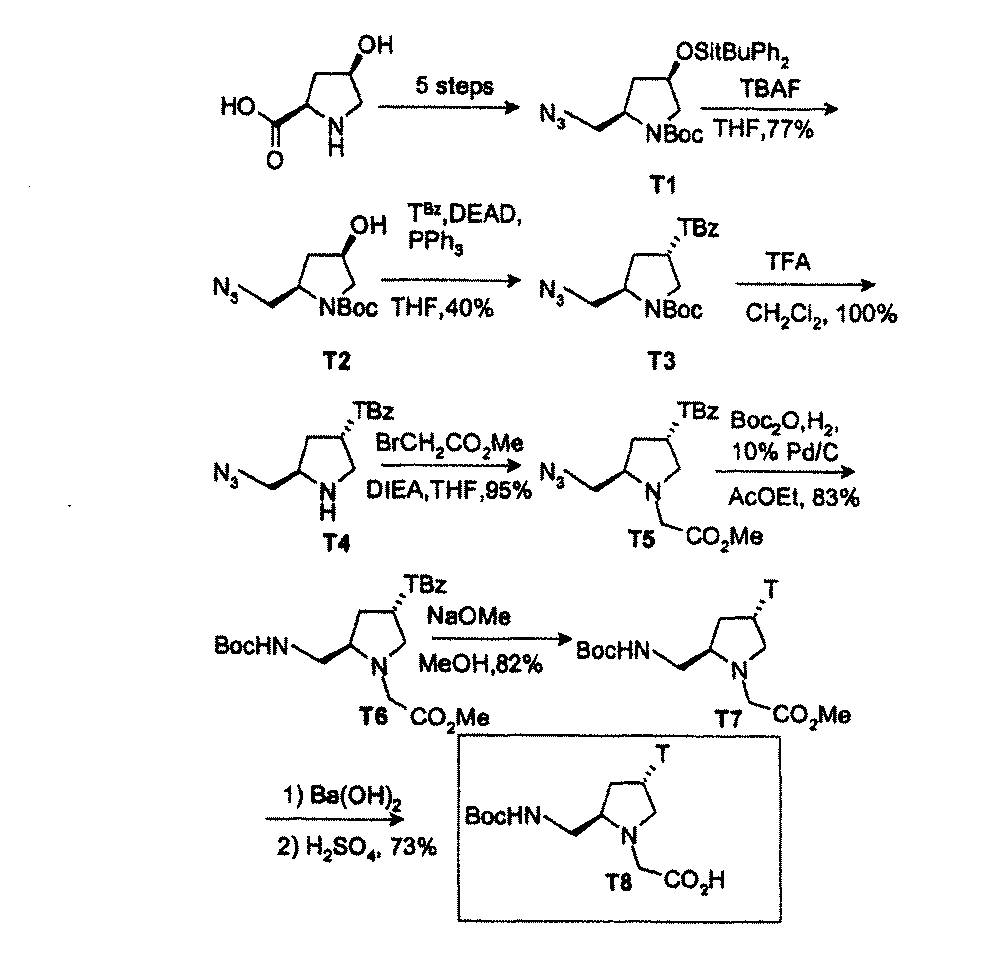
モノマー合成。保護された(2R,4S)アデニンピロリジニンモノマーA12の合成をスキームに示す。cis−4−ヒドロキシ−D−プロリンは、記載されているように(20)、trans−4−ヒドロキシ−L−プロリンのエピマー化によって収率22%で合成された。二級アミンは、記載されているように(21)、収率81%でBoc保護された。N−Boc−cis−4−ヒドロキシ−D−プロリンメチルエステルA1は、ジアゾメタン手法によって通常どおり製造された(22)。また、本発明者らは、酸のセシウム塩をDMF中においてMelでアルキル化することによって収率99%でA1を製造した。A3は、記載されているように(23)、A1からA2を経由して製造された。アジドA5はメシル化合物A4を経由して製造された。Boc保護基はTFAで切断し、結果として生ずる二級アミンA6を、DIEAの存在下においてブロモ酢酸メチルでアルキル化した。還元Bocアミノ化(24)およびTBDPS(tert−ブチルジフェニルシリル)基の標準的なTBAF切断により、新規ピロリジン骨格A9を生じた。この時点で、Mitsunobu条件下でアデニン塩基を導入することを計画した。しかし、DEADおよびPPh3を使用してアデニンにより二級ヒドロキシ基を置換する試みは全て失敗した。
【0071】
【化1】
Mitsunobu条件を使用すると、アデニンは、対応するピロリジノン誘導体に容易に結合するので、これはおそらく三級アミンの存在によるのだろう(17)。また、A9をトシル化合物A10に変換し、次いでトシル基をベンジルオキシカルボニル保護されたアデニンで置換することによってアデニンを導入した。ベンジルオキシカルボニル保護されたアデニン(25)の代わりにアデニンを使用すると収率が非常に低くなった。さらに理由は不明であるが、Z基が反応中に失われたが、アデニンはRapoprts試薬を使用して容易に再保護され、A11を生じた(26)。13C−NMRは、適切なN9異性体が得られたことを証明した(27)。最後に、メチルエステルをBa(OH)2で切断し、H2SO4でBaSO4を沈殿させることによってA12を合成した。この方法では、水相を凍結乾燥することによってA12 H2SO4を回収した。
【0073】
詳細には、モノマーは以下の方法で合成した。
【0074】
一般情報。特に明記しない限り、1Hおよび13C NMRスペクトルは、CDCl3中で300MHzおよび75.0MHzにおいて取った。化学シフトは、溶媒共鳴内部標準を使用して百万分率単位で報告してある(クロロホルム、7.24および76.9ppm)。ピリジン、CH2Cl2、DMFおよびCH3CNは4Åのモレキュラーシーブで乾燥した。THFはナトリウムを添加して蒸留した。特に明記しない限り、反応は窒素雰囲気下で実施した。手動によるBoc−PNA固相合成はガラス製反応容器中で実施した。参照文献はLetterに示すものを言及している。
【0075】
化合物A1の製造。N−Boc−cis−4−ヒドロキシ−D−プロリン(2.31g、10.0mmol)の撹拌中の乾燥DMF溶液(36ml)にCs2CO3(3.42g、10.5mmol)を添加した。反応混合物を15分間撹拌し、その後MeI(0.75ml、12.0mmol)を滴加した。反応混合物を終夜撹拌し、次いでセライトでろ過した。DMFを留去し、残渣を飽和NaHCO3(100ml)とAcOEt(200ml)に分配した。有機相を食塩水で洗浄し(2×100ml)、乾燥し(MgSO4)、真空下で留去した。収率:A1を白色固体として2.42g(99%)。[α]D20=65.0(c1,EtOH)(Litt:9[α]D20=63.8(c2.21,EtOH))。
【0076】
化合物A2の製造(23)。A1(2.35g、9.60mmol)の撹拌中の乾燥DMF溶液(19ml)にイミダゾール(1.44g、21.1mmol)、DIEA(2.5ml、14.4mmol)、次いでtert−ブチル−ジフェニルシリルクロリド(3.75ml、14.4mmol)を添加した。反応混合物を終夜撹拌し、次いでセライトでろ過した。DMFを留去し、残渣を半飽和NaHCO3(100ml)とAcOEt(100ml)に分配した。有機相を食塩水(50ml)、10%クエン酸(50ml)、食塩水(2×50ml)で洗浄し、次いで乾燥し(MgSO4)、真空下で留去した。粗物質(6g)をクロマトグラフィー(AcOEt:Hexan 1:9)で精製した。収率:A2を白色固体として3.98g(85%)。NMRは、Boc基のcis−trans異性体によって複雑になっていた:1H NMR(CDCl3)δ7.65−7.62(m,4H)、7.42−7.38(m,6H)、4.31−4.24(m,2×H)、3.75(s,3H)、3.60−3.38(m,2H)、2.23−2.16(m,2H)、1.45および1.42(2×s,9H)、1.07および1.04(2×s,9H)。13C NMR(CDCl3)δ174.9、172.7、172.3、154.2、153.5、135.6、135.5、134.6、133.4、133.2、133.0、129.7、129.4、127.6、127.5、79.8、71.5、70.4、57.6、57.2、54.2、53.8、52.0、51.9、39.1、38.3、28.3、28.2、26.6、26.4、18.8。FAB+MS:484.33(MH+)。C27H37NO5Siの算出値:C,67.05、H,7.71、N,2.90。測定値:C,66.90、H,7.74、N,2.94。
【0077】
化合物A3(23)の製造(23)。LiBH4(23.5ml、2.0MのTHF溶液)をA2(18.2g、37.6mmol)の撹拌中の乾燥THF溶液(100ml)に0℃において徐々に添加した。反応混合物を室温まで加温させ、8時間撹拌した。H2O(150ml)を添加し、次に1MのHCl(75ml)を徐々に添加することによって0℃において反応を停止した。酸性溶液をAcOEt(3×200ml)で抽出した。有機相を合わせて、食塩水(100ml)、飽和NaHCO3(100ml)、食塩水(100ml)で洗浄し、乾燥し(MgSO4)、留去した。粗物質(17.6g)をクロマトグラフィー(1〜10%MeOHのCH2Cl2溶液)で精製した。収率:A3を白色の泡状物質として15.17g(89%)。NMRは、Boc基のcis−trans異性体によって複雑になっていた:1H NMR(CDCl3)δ7.65−7.62(m,4H)、7.45−7.37(m,6H)、4.28(m,1H)、3.97(m,1H)、3.86(m,1H)、3.75(m,1H)、3.40−3.25(m,2H)、2.70(br.s、1H)、2.08(m,1H)、1.80−1.60(m,1H)、1.44(s,9H)、1.07(s,9H)。FAB+MS:456.37(MH+)。
【0078】
化合物A4の製造。A3(15.2g、33.4mmol)の撹拌中の乾燥CH2Cl2溶液(170ml)に0℃においてDIEA(8.7ml、50.1mmol)、次いで塩化メタンスルホニル(3.1ml、40.0mmol)を添加した。反応混合物を0℃において40分間撹拌し、半飽和NaHCO3(200ml)を添加することにより停止した。層を分離し、水相をCH2Cl2(2×150ml)で抽出した。有機相を合わせて食塩水(100ml)、10%クエン酸(2×100ml)、食塩水(100ml)で洗浄し、次いで乾燥し(MgSO4)、留去した。収率:A4を黄色の泡状物質として17.2g(97%)。NMRは、Boc基のcis−trans異性体によって複雑になっていた:1H NMR(CDCl3)δ7.67−7.61(m,4H)、7.46−7.40(m,6H)、4.56(m,1H)、4.50−4.38(m,2H)、4.06(m,1H)、3.50−3.00(m,2H)、3.01(s,3H)、2.10−1.98(m,2H)、1.48および1.45(2×s,9H)、1.07(s,9H)。FAB+MS:534.20(MH+)。
【0079】
化合物A5の製造。A4(17.2g、32.3mmol)の撹拌中の乾燥DMF溶液(160ml)に室温においてNaN3(10.5g、162mmol)を添加した。反応混合物を90℃において4時間撹拌し、その後DMFを留去した。残渣を半飽和NaHCO3(100ml)とAcOEt(200ml)に分配した。水相を過剰量のAcOEt(200ml)で抽出した。有機相を合わせて食塩水(2×100ml)で洗浄し、乾燥し(Na2SO4)、留去した。粗生成物(15.2g)をクロマトグラフィー(AcOEt:ヘキサン 1:4)で精製した。収率:A5を白色固体として10.97g(71%)。NMRは、Boc基のcis−trans異性体によって複雑になっていた:1H NMR(CDCl3)δ7.59−7.54(m,4H)、7.38−7.30(m,6H)、4.24(br.s,1H)、3.80(br.s,1H)、3.57(br,s.1H)、3.40−3.10(m,2H)、2.00−1.90(m,2H)、1.38(s,9H)、0.99(s,9H)。13C NMR(CDCl3)δ153.9、135.6、133.0、129.8、127.7、80.0、71.2、55.9、54.8、53.8、52.6、37.3、36.5、28.3、26.7、18.8。FAB+MS:481.32(MH+)。
【0080】
化合物A6の製造。A5(2.14g、4.45mmol)の撹拌中のCH2Cl2溶液(4.6ml)に0℃においてTFA(4.6ml、58mmol)を添加した。氷浴をはずし、反応混合物を室温において30分間撹拌した。飽和NaHCO3(65ml)を徐々に添加することによって反応を停止した。層を分離し、水相をCH2Cl2(2×100ml)で抽出した。有機相を合わせて乾燥し(MgSO4)、留去した。収率:A6を油状物質として1.70g(100%)。1H NMR(CDCl3)δ7.80−7.63(m,4H)、7.45−7.39(m,6H)、4.40(m,1H)、3.60(br.s,1H)、3.49−3.44(m,2H)、3.30(m,1H)、3.00−2.80(m,2H)、2.01(m,1H)、1.60(m,1H)、1.07(s,9H)。13C NMR(CDCl3)δ135.53、135.50、134.7、135.5、129.7、127.6、127.4、73.5、57.1、55.1、54.5、38.6、26.7、18.9。FAB+MS:381.49(MH+)。
【0081】
化合物A7の製造。A6(8.78g、22.5mmol)の撹拌中の乾燥THF溶液(45ml)に℃において、DIEA(4.69ml、27.0mmol)、次いでブロモ酢酸メチル(2.35ml、24.8mmol)を添加した。氷浴をはずし、反応混合物を室温において4時間撹拌し、セライトでろ過した。溶媒を留去し、粗生成物をクロマトグラフィー(AcOEt:ヘキサン 1:4)で精製した。収率:A7を透明な油状物質として9.31g(91%)。1H NMR(CDCl3)δ7.75−7.67(m,4H)、7.47−7.36(m,6H)、4.43(m,1H)、3.67(s,3H)、3.57(s,2H)、3.54−3.36(m,2H)、3.14 ̄3.11(m,2H)、2.84−2.79(m,1H)、2.19−2.05(m,1H)、1.80−1.76(m,1H)、1.09(s,9H)。FAB+MS:453.22(MH+)。
【0082】
化合物A8の製造。A7(1.50g、3.31mmol)、Boc2O(1.45g、6.62mmol)および10%Pd/C(0.23g)の脱気したAcOEt溶液(33ml)を室温においてバルーン技法を使用して終夜水素化した。発生した窒素を針状の排出口から時折排出した。溶液をセライトでろ過することにより触媒を除去した。溶媒を留去し、粗生成物をクロマトグラフィー(1〜10%MeOHのCH2Cl2溶液)で精製した。収率:A8を透明な油状物質として1.32g(76%)。1H NMR(CDCl3)δ7.69−7.63(m,4H)、7.45−7.34(m,6H)、5.43(br.s,1H)、4.30(br.s,1H)、3.66(s,3H)、3.60−3.40(m,1H)、3.40−3.00(m,5H)、2.68(m,1H)、2.15(m,1H)、1.82(m,1H)、1.43(s,9H)、1.08(s,9H)。13C NMR(CDCl3)δ171.2、156.5、135.3、133.5、129.6、127.5、78.9、71.7、61.6、60.1、52.8、51.4、41.6、38.1、28.3、26.9、18.9FAB+MS:527.32(MH+)。C29H42N2O5Siの算出値:C,65.56、H,8.08、N,5.27。測定値:C,65.64、8.62、5.41。
【0083】
化合物A9の製造。A8(7.18g、13.6mmol)の撹拌中のTHF(70ml)溶液にTBAFの1M THF溶液(16.3ml、16.3mmol)を添加した。反応混合物を室温において4時間撹拌し、次いで1/4飽和NH4Cl(200ml)およびCH2Cl2(250ml)を添加することによって停止した。層を分離し、水相を過剰量のCH2Cl2(250ml)およびAcOEt(2×250ml)で抽出した。有機相を合わせて乾燥し(Na2SO4)、溶媒を留去した。粗生成物(12.0g)をクロマトグラフィー(1〜10%MeOHのCH2Cl2溶液)で精製した。収率:A9を透明な油状物質として3.47g(88%)。1H NMR(CDCl3)δ5.51(br.s,1H)、4.23(br.s,1H)、3.64(s,3H)、3.60−3.20(m,4H)、3.10−3.00(m,2H)、2.90−2.85(m,1H)、2.71−2.66(m,1H)、2.27−2.17(m,1H)、1.67−1.61(m,1H)、1.37(s,9H)。13C NMR(CDCl3)δ171.4、156.5、78.9、69.7、62.4、53.0、51.5、41.3、37.8、28.2。HR FAB+MS:289.1771(MH+)(C13H25N2O5の算出値:289.1763)。
【0084】
化合物A10の製造。A9(1.24g、4.31mmol)の撹拌中の乾燥ピリジン溶液(10.8ml)にp−トルエンスルホニルクロリド(1.64g、8.62mmol)を添加した。橙色の反応混合物を室温において終夜撹拌し、次いでCH2Cl2(100ml)および飽和NaHCO3(50ml)を添加することによって停止した。有機相を過剰量の飽和NaHCO3(50ml)で抽出し、食塩水(50ml)で洗浄し、乾燥した(Na2SO4)。溶媒を留去し、粗生成物をクロマトグラフィー(AcOEt:ヘキサン 1:4)で精製した。収率:A10を透明な油状物質として1.42g(74%)。1H NMR(CDCl3)δ7.75(d,J=8.5 Hz,2H)、7.30(d,J=8.8 Hz,2H)、5.14(br.s,1H)、4.96(br.s,1H)、3.65(s,3H)、3.42(m,2H)、3.26(m,2H)、3.06−2.93(m,3H)、2.41(s,3H)、2.33−2.24(m,1H)、1.84−1.79(m,1H)、1.41(s,9H)。13C NMR(CDCl3)δ170.4、156.2、144.6、133.7、129.7、127.5、79.7、79.1、60.3、58.7、51.9、51.5、41.0、35.0、28.1、21.4。FAB+MS:443.21(MH+)。
【0085】
化合物A11の製造。6−N−(ベンジルオキシカルボニル)アデニン(404mg、1.5mmol)、K2CO3(186mg、1.35mmol)およびCs2CO3(49mg、0.15mmol)を室温において乾燥DMF(2ml)中で5分間撹拌した。A10(662mg、1.5mmol)の乾燥DMF溶液(4ml)を滴加し、懸濁液を室温において1時間撹拌した。褐色の溶液をさらに80℃において1.5時間撹拌し、次いで室温において1.5時間撹拌した。DMFを留去し、粗生成物をクロマトグラフィー(0.5%DIEAを含有する6〜15%MEOHのCH2Cl2溶液)で精製した。収率:Boc保護されたモノマーアデニンメチルエステルとして278mg。13C NMRおよびFAB+MSは、ベンジルオキシカルボニル基が失われたことを示した:13C NMR(CDCl3)δ170.9、156.0、155.6、152.3、149.3、138.6、119.3、78.9、60.4、57.9、52.1および51.9、51.3、49.5、41.3、34.1、28.0。FAB+MS406.34(MH+)。この中間体(278mg、0.69mmol)を乾燥CH2Cl2(5ml)に溶解した。N−ベンジルオキシカルボニル−N’−メチルイミダゾリウムトリフレート(757mg、2.1mmol)を添加し、溶液を室温において終夜撹拌した。過剰量のCH2Cl2(50ml)を添加することによって反応液を希釈し、次いで半飽和NaHCO3(25ml)を添加することによって反応を停止した。層を分離し、水相をCH2Cl2(50ml)およびAcOEt(50ml)で抽出した。有機相を合わせて乾燥し(Na2SO4)、溶媒を留去した。粗生成物をクロマトグラフィー(AcOEt:MeOH 9:1)で精製した。収率:A11を白色の泡状物質として195mg(24%)。1H NMR(CDCl3)δ10.0−9.8(br.s,1H)、8.69(s,1H)、8.01(s,1H)、7.40−7.26(m,5H)、5.24(s,2H)、5.14(m,1H)、4.97(m,1H)、3.67(s,3H)、3.62−3.35(m,5H)、3.06(m,2H)、2.28(m,2H)、1.41(s,9H)。13C NMR(CDCl3)δ170.9、156.1、152.2、151.2、149.5、141.6、135.2、128.3、128.24、128.21、122.1、79.2、67.4、60.5、57.8、52.5、52.1、51.5、41.1、33.9、28.1HR FAB+MS:540.2586(MH+)(C26H34N7O6の算出値:540.2570)。C26H33N7O6・0.25H2Oの算出値:C,57.39、H,6.22、N,18.02。測定値。C,57.71H,6.08、N,17.37。
【0086】
化合物A12の製造。Ba(OH)2・8H2O(166mg)の水溶液(5ml)をA11(190mg、0.35mmol)をTHF(5ml)に溶解したものに0℃において滴加した。氷浴をはずし、反応混合物を室温において20分間撹拌した。過剰量のH2O(6ml)を添加し、THFを留去した。不透明な溶液に4NのH2SO4(0.35ml)を添加することによってpHを2.3に調節した。遠心分離によってBaSO4を除去した。酸性用溶液をデキャントし、凍結乾燥した。凍結乾燥をMeOH(1.2ml)およびH2O(12ml)から繰り返し実施して、A12・H2SO4を粉末として86mg(50%)生成した。1H NMR(CDCl3)ピークは、おそらくH2SO4が存在するためと思われるかなりの広幅化を示す:δ8.6(2×br.s,2×1H)、7.4−7.0(m,5H)、5.6−5.4(br.s,1H)、5.3−5.0(m,3H)、4.6−3.4(m,7H)、2.6−2.4(m,2H)、1.27(s,9H)。Tlc(ブタノール:酢酸:H2O 4:1:1)では不純物は検出されないRf=0.41(UV、ニンヒドリン反応)。RP−HPLCでは純度92%。HR FAB+MS:526.2405(MH+)(C25H32N7O6の算出値:526.2414)。
【実施例2】
【0087】
[アデニン(A)オリゴマーの製造]
ピロリジンPNA類似物の結合親和性を評価するために、3つのPNAドデカマーを合成した(28):
PNA2005:H−TAC−TCA−TAC−TCT−LysNH2
PNA2075:H−TAC−TCA*−TAC−TCT−LysNH2
PNA2104:H−TAC−TCA#−TAC−TCT−LysNH2
A*=(3S,5R)ピロリドンPNAモノマー
A#=(2R,4S)ピロリジンPNAモノマー(A12)
【0088】
H−TAC−TCA#−TAC−TCT−LysNH2(PNA2104)の固相合成。Boc−Lys−(2−Cl−Z)−MBHA−PS樹脂(25mg、0.12mmol/g負荷)にHBTUおよびDIEAを使用する通常のインサイチュー中和(in situ neutralization)方法によってこのドデカマーを合成した。新規モノマーA#(6mg、11μmol)をDMF(140μL)に溶解した。DIEA(8μL、45μmol)を添加し、この溶液をHBTU(4mg、10μmol)に添加した。溶液を2分間事前活性化し、次いで樹脂(3μmol)に添加した。カップリング反応を2.5時間進行させてから、活性化溶液を排出した。少量のビーズにKaiser試験を実施すると、黄色を生じ、反応が終了したことを示す。合成および切断(TFA:TFMSA:チオアニソール:m−クレゾール 3:1:0.5:0.5)は通常の方法を実施した(28)。エーテル沈殿後、粗PNAをRP−HPLCで精製した。収率:1.2mg(12%)。MALDI−MS:3306(MH+の算出値:3303)。RP−HPLCでは不純物は検出されない。
【0089】
H−(A#)10−LysNH2(PNA2110)の固相合成。このデカマーは、PNA2104について記載したように合成した。収率:4.4mg(51%)。MALDI−MS:2873(MH+の算出値:2873)。RP−HPLCでは不純物は検出されない。
【0090】
結合親和性。相補的なRNAおよびDNAオリゴマーに対する結合親和性は、Tm−曲線を得ることによって測定した(表1)。予測されるように、PNA鎖にピロリジノンおよびピロリジン類似物を導入すると、未修飾のPNAと比較すると、DNAおよびRNAに対して不安定になる(エントリー1対2および3)。驚くべきことに、ピロリジノン類似物(エントリー2)と比較すると、ピロリジン類似物(エントリー3)の場合には、DNAおよびRNAに対する親和性の大きな不安定化が検出された。
【0091】
【表2】
【0092】
十分に修飾したデカマー(PNA2110)を合成した:
PNA186:H−Gly−(A)10−NH2
PNA2020:H−(A*)10−LysNH2
PNA2110:H−(A#)10−LysNH2
【0093】
【表3】
bシグモイド融解曲線ではない。括弧内の値は冷却曲線のTmである。
【0094】
わかるように(表2)、十分に修飾されたピロリジンデカマーは、DNA(ΔTm/mod=+2.5℃)およびRNA(ΔTm/mod=+2.5℃)に対して高い親和性を有する(エントリー1と3を比較)。親PNA186とは異なり、PNA2110の場合には、DNAおよびRNAに対して大きなヒステリシスが検出された。PNA2110だけに見られることであるが、pH7ではなくpH9において融解曲線を作成すると、DNAに対するTm値が約3.5℃低下し、RNAに対するTm値が1.5℃低下した(示していない)。
【0095】
PNA2110とDNAの複合体をさらに評価した。UV−滴定は、PNA2110と5’−d(T)10の複合体は1:2複合体であることを示した。さらに、PNA2110と5’−d(T)10間の認識は配列特異的であることが示された(表3)。
【0096】
【表4】
bDNA標的:5’−d(TTT−TXT−TTT−T)−3’。
【0097】
結論として、本発明者らは、可溶性の高い新規PNA類似物:ピロリジンPNA類似物を設計し、合成した。予備的なTmデータは、この類似物はDNAおよびRNAに対して強力な親和性を有することを示している。
【実施例3】
【0098】
[チミン(T)モノマーの製造]
一般情報。特に明記しない限り、1Hおよび13C NMRスペクトルは、CDCl3中で300MHzおよび75.0MHzにおいて取った。化学シフトは、溶媒共鳴内部標準を使用して百万分率単位で報告してある(ジメチルスルホキシド、2.50および39.6ppm。クロロホルム:7.24および76.9ppm)。ピリジン、CH2Cl2、DMFおよびCH3CNは4Åのモレキュラーシーブで乾燥した。THFはナトリウムを添加して蒸留した。特に明記しない限り、反応は窒素雰囲気下で実施した。手動によるBoc−PNA固相合成はガラス製反応容器中で実施した。
【0099】
【化2】
化合物T2の製造。THF(37ml、36.8mmol)中のTBAFの1M溶液をT1(14.74g、30.7mmol)の撹拌中のTHF(150ml)溶液に室温において添加した。反応混合物を室温において2時間撹拌し、1/4飽和NH4Cl(440ml)およびCH2Cl2(600ml)を添加することによって停止した。層を分離し、水相を過剰量のCH2Cl2(600ml)およびAcOEt(250ml)で抽出した。有機相を合わせて乾燥し(MgSO4)、溶媒を留去した。粗生成物をクロマトグラフィー(50〜100%AcOEtのヘプタン溶液)で精製した。収率:T2を白色固体として6.0g(80%)。NMRは、Boc基のcis−trans異性体によって複雑になっていた:1H NMR(DMSO−d6)δ5.05(d,J=3.1Hz,1H,D2O交換可能)、4.24−4.20(m,1H)、3.84(br,s,1H)、3.60−3.40(m,3H)、3.07(br,s,1H)、2.07(br,s,1H)、1.56(br,s,1H)、1.41(s,9H)。13C NMR(DMSO−d6)δ153.9、153.4、78.9、68.8、68.1、56.0、54.9、54.7、53.8、52.7、37.0、36.2、28.1。C10H18N4O3の算出値: C,49.56、H,7.50、N,23.13。測定値:C,49.65、H,7.60、N,22.83。
【0101】
化合物T3の製造。T2(3.84g、15.9mmol)およびN−3−ベンゾイルチミン(7.32g、31.8mmol)の撹拌中の乾燥THF(150ml)溶液に0℃においてPPh3(8.98g、39.7mmol)を添加した。透明でない溶液を5分間撹拌してから、DEAD(6.25ml、39.7mmol)を0℃において1時間かけて滴加した。黄色の反応混合物を室温において終夜撹拌してから、揮発性成分を留去した。粗物質をクロマトグラフィー(50〜66%AcOEtのヘプタン溶液および2〜5%MeOHのCH2Cl2溶液)で2回精製して、T3を4.23g生成した。この物質をAcOEt/ヘプタンから再結晶してさらに精製した。収率:T3を白色の針状結晶として2.92g(40%)。NMRは、Boc基のcis−trans異性体によって複雑になっていた:1H NMR(DMSO−d6)δ7.98(d,J=8.4Hz,2H)、7.76(m,2H)、7.59(m,2H)、5.15(br.s,1H)、4.13(br.s,1H)、3.67−3.38(m,4H)、2.44(m,1H)、2.12(br.s.1H)、1.85(d,J=1.0Hz,3H)、1.43(s,9H)。13C NMR(DMSO−d6)δ169.7、162.4、149.5、138.6、135.4、131.2、130.4、129.4、109.4、79.5、55.4、55.2、53.6、53.1、52.6、49.6、49.4、33.0、32.0、28.1、12.1。C22H26N6O5の算出値:C,58.14、H,5.77,N,18.49。測定値:C,58.18、H,5.69、N,18.05。
【0102】
化合物T5の製造。T3(2.92g、6.40mmol)の撹拌中の乾燥CH2Cl2(5.0ml)溶液に0℃においてTFA(4.95ml、64mmol)を添加した。氷浴をはずし、反応混合物を室温において45分間撹拌した。揮発性成分を留去し、残渣にトルエンを添加してから留去して、T4のTFA塩を生成した。収率:3.60gで、やや過剰量のTFAの存在を示す。この物質を乾燥THF(32ml)およびDIEA(4.85ml、29mmol)に溶解し、次いで0℃においてブロモ酢酸メチル(1.8ml、18.9mmol)を添加した。氷浴をはずし、反応混合物を室温において終夜撹拌し、次いでセライトでろ過した。溶媒を留去し、粗生成物をクロマトグラフィー(2%MeOHのCH2Cl2溶液)で精製した。収率:T5を白色固体として2.24g(94%)。Tlc(溶離液として2%MeOHのCH2Cl2溶液を使用したときRf=0.36)では不純物は検出されない。1H NMR(DMSO−d6)δ7.96(d,J=8.1Hz,2H)、7.87(d,J=1.1,1H)、7.77(t,J=7.0Hz,2H)、7.59(t,J=9.0Hz,2H)、4.93−4.88(m,1H)、3.71−3.63(m,1H)、3.64(s,3H)、3.52−3.47(m,2H)、3.36−3.26(m,2H)、2.85−2.80(t,J=8.6Hz,1H)、2.27−2.20(m,1H)、2.07−2.01(m,1H)、1.88(d,J=1.1Hz,3H)。13C NMR(DMSO−d6)δ170.9、169.8、162.4、149.5、139.2、135.4、131.3、130.4、129.4、109.2、60.0、56.0、53.3、52.4、52.3、51.4、32.9、12.1。C20H22N6O5の算出値:C,56.33、H,5.20、N,19.71。測定値:C,56.02、H,5.09、N,19.36。
【0103】
化合物T6の製造。バルーン技法を使用して、T5(2.20g、5.16mmol)、Boc2O(1.69g、7.74mmol)および10%Pd/C(0.22g)の脱気したAcOEt(75ml)溶液を室温において終夜水素化した。発生した窒素を針状の排出口から時折排出した。溶液をセライトでろ過することにより触媒を除去した。溶媒を留去し、粗生成物をクロマトグラフィー(50〜100%AcOEtのヘプタン溶液)で精製した。収率:T6を白色の泡状物質として2.13g(83%)。1H NMR(DMSO−d6)δ7.96(d,J=8.6Hz,2H)、7.88(s,1H)、7.77(t,J=8.6Hz,1H)、7.59(t,J=8.2Hz,2H)、6.74(t,J=5.5Hz,1H)、4.89−4.85(m,1H)、3.64(s,3H)、3.64 ̄3.41(m,2H)、3.30(m,1H)、3.14−3.06(m,2H)、2.90−2.76(m,2H)、2.12−2.01(m,2H)、1.88(s,3H)、1.37(s,9H)。13C NMR(DMSO−d6)δ171.1、169.8、162.5、155.8、149.5、139.2、135.4、131.3、130.4、129.6、109.3、77.8、60.7、56.2、53.2、51.4、42.0、33.4、28.3、12.1。C25H32N4O7・1/4H2Oの算出値:C,58.92、H,6.44、N,11.00。測定値:C,59.25、H,6.51、N,10.57。
【0104】
化合物T7の製造。T6(2.08g、4.16mmol)の撹拌中のMeOH(33ml)溶液にNaOMeのMeOH溶液(1.0M、8.3ml、8.3mmol)を0℃において添加した。溶液を室温において5時間撹拌し、次いで半飽和NH4Cl(50ml)およびAcOEt(100ml)を添加することによって停止した。水相を過剰量のAcOEt(2×100ml)で抽出した。有機相を合わせて乾燥し(MgSO4)、溶媒を留去した。粗精製物をクロマトグラフィー(溶離液:AcOEt)で精製した。収率:T7を白色の固体として1.36g(82%)。1H NMR(CDCl3、300MHz)δ10.10(s,1H)、7.22(s,1H)、5.21(br.s,1H)、5.01(t,J=7.6Hz,1H)、3.62(s,3H)、3.52−3.20(m,5H)、2.97−2.80(m,2H)、2.12−2.00(m,2H)、1.83(s,3H)、1.33(s,9H)。13C NMR(CDCl3、300MHz)δ170.8、163.9、155.9、150.9、137.3、110.9、78.9、60.4、56.3、52.9、51.4、51.3、40.9、33.1、28.0、12.1。C18H28N4O6の算出値:C,54.53、H,7.12、N,14.13。測定値:C,54.45、H,7.04,N,13.88。FAB+MS:397.10(MH+)。
【0105】
化合物T8の製造。Ba(OH)2・8H2O(199mg、0.63mmol)の水溶液(8ml)を、T7(168mg、0.42mmol)をTHF(8ml)に溶解したものに0℃において滴加した。氷浴をはずし、反応混合物を室温において30分間撹拌した。過剰量のH2O(10ml)を添加し、THFを留去した。不透明な溶液に4NのH2SO4(0.35ml、0.70mmol)を添加することによってpHを2.5に調節した。遠心分離によってBaSO4を除去した。酸性溶液をデキャントし、次いで凍結乾燥した。MeOH(0.5ml)およびH2O(10ml)から凍結乾燥を繰り返して行い、T8を白色粉末として117mg(73%)生成した。1H NMR(DMSO−d6):δ11.21(s,1H)、7.63(s,1H)、6.77(br.s,1H)、4.90−4.86(m,1H)、3.60 ̄2.70(m,7H)、1.98−1.93(m,2H)、1.77(s,3H)、1.38(s,9H)。H6−チミン(δ7.63)を照射するとH4(δ4.90〜4.86)に対するNOE効果(2%)を生じ、H4の照射はH6−チミンに対するNOE効果(2%)を生じる。13C NMR(DMSO−d6)δ171.9、163.8、155.9、151.0、138.0、109.3、77.8、61.2、56.3、52.8、52.1、42.0、33.2、28.3、12.2。Tlc(ブタノール:酢酸:H2O 4:1:1)では不純物は検出されなかった。Rf=0.38(UV、ニンヒドリン反応)。HR FAB+MS:383.1959(MH+)(C17H27N4O6の算出値:383.1930)。
【実施例4】
【0106】
[チミン(T)オリゴマーの製造]
オリゴマー合成。(2R,4S)−ピロリジンPNA類似物とHickmanら(29)に報告され、ごく最近ではKumarら(30)によって報告されている(2R,4R)−ピロリジンPNA類似物のDNAおよびRNA認識を比較するために、標準的なPNA合成条件(28)を使用してペンタマーホモチミンオリゴマーを合成した。
PNA1164:H−(T)5−LysNH2
PNA2121H−(T#)5−LysNH2
T#=(2R,4S)ピロリジンPNAモノマーT8
【0107】
H−(T#)5−LysNH2(PNA2121)の固相合成。Boc−Lys−(2−Cl−Z)−MBHA−PS樹脂(50mg、0.12mmol/g負荷)にHBTUおよびDIEAを使用する通常のインサイチュー中和(in situ neutralization)方法によってこのペンタマーを合成した。新規モノマーT#(7.6mg、15.8μmol、2.5eq)をDMF(160μL)に溶解した。DIEA(15.6μL、90μmol)を添加し、この溶液を、HATU(5.8mg、15.3□mol)をピリジンに懸濁させたものに添加した。溶液を2分間事前活性化し、次いで樹脂に添加した。カップリング反応を0.5時間進行させてから、活性化溶液を排出した。少量のビーズにKaiser試験を実施すると、黄色を生じ、反応が終了したことを示す。合成および切断は通常の方法を実施した。エーテル沈殿後、粗PNAをRP−HPLCで精製した。MALDI−MS:1468(MH+の算出値:1467)。RP−HPLCでは不純物は検出されなかった。
【0108】
結合。ポリdAおよびポリAに対するPNA1164およびPNA2121の結合を熱変性(Tm、表4)によって検討した。Hickmanら(29)によって示される値も掲載する。表4に示す熱安定性の結果は、(2R,4S)−ピロリジン骨格を有するT5−PNA−オリゴマー(PNA2121)は、(2R,4R)−ピロリジン異性体(エントリー3)と比較したとき、また親アミノエチルグリシンPNA(PNA1164、エントリー1)と比較したときも、ポリdAおよびポリAと強力な複合体を形成することを明らかに示している。これらの複合体は3本鎖に寄与しており、本発明の結果を2本鎖構造に延長することができ、一般的に有効であるかどうかを確立するためには、(ピリミジン−プリン混合配列)ピロリジンPNAsに関するさらなる検討が必要である。この検討は現在進行中である。
【0109】
【表5】
b(29)からの値。
【実施例5】
【0110】
[5−メチルシトシン(mC)モノマーの製造]
以下のスキームによりZ−保護された5−メチルシトシンモノマーを合成した:
【化3】
化合物C9の製造。実施例3に記載するように製造した化合物T3(1.97g、4.33mmol)の撹拌中のMeOH(35ml)およびDMF(25ml)溶液に0℃においてNaOH(2N、8.7ml、17.4mmol)を添加した。溶液を室温において1.5時間撹拌し、次いで半飽和NaHCO3(50ml)およびAcOEt(250ml)を添加することにより停止した。水相を過剰量のAcOEt(250ml)で抽出した。有機相を合わせて食塩水(2×100ml)で洗浄し、乾燥し(MgSO4)、溶媒を留去した。粗生成物をクロマトグラフィー(66〜100%AcOEtのヘプタン溶液)で精製した。収率:C9を白色固体として1.31g(86%)。1H NMR(CDCl3、400MHz)δ9.31(s,1H)、6.87(s,1H)、5.16(t,J=6Hz、1H)、4.2−4.0(m,1H)、3.80−3.60(m,2H)、3.60−3.40(m,1H)、3.31(m,1H)、2.21(m,2H)、1.85(s,3H)、1.42(s,9H)。FAB+MS:351.4(MH+)。
【0112】
化合物C11の製造。C9(1.30g、3.74mmol)の乾燥CH3CN(19ml)溶液を、トリアゾール(2・58g、37.4mmol)、Et3N(5.2ml、37.4mmol)およびPOCl3(0.7ml、7.48mmol)の撹拌中の乾燥CH3CN(19ml)懸濁液に0℃において滴加した。溶液を室温において終夜撹拌した。溶媒を留去し、得られた固体を飽和NaHCO3(100ml)とAcOEt(150ml)に分配した。有機相を水(50ml)食塩水(50ml)で洗浄し、乾燥し(MgSO4)、溶媒を留去して、1.47g(98%)のC10を生成した。tlcでは不純物は検出されなかった:Rf=0.70(CH3OH/CH2Cl2:1/9)。FAB+MS:402.4(MH+)。この物質をジオキサン(14ml)および濃アンモニア(4.7ml)に溶解し、室温において1時間撹拌した。溶媒を留去し、得られた固体を飽和NaHCO3(25ml)とAcOEt(100ml)に分配した。有機相を食塩水(50ml)で洗浄し、乾燥し(MgSO4)、溶媒を留去した。収率:C11を白色固体として1.13g(86%)。tlcでは不純物は検出されなかった:Rf=0.32(CH3OH/CH2Cl2:1/9)。1H NMR(DMSO−d6、300MHz)δ8.26および7.40(2×s,1H)、7.20(s,1H)、6.71(s,1H)、5.08(m,1H)、4.06(br.s,1H)、3.64−2.87(m,4H)、2.38(m,1H)、1.98(m,1H)、1.81(s,3H)、1.38(s,9H)。C15H23N7O3の算出値:C,51.55、H,6.64、N,28.06。測定値:C,51.36、H,6.52、N,28.68。FAB+MS:350.4(MH+)。
【0113】
化合物C14の製造。C11(1.08g、3.09mmol)の撹拌中の乾燥CH2Cl2(21ml)溶液に、N−ベンジルオキシカルボニル−N’−メチルイミダゾリウムトリフレート(3.40g、9.3mmol)を添加した。溶液を室温において終夜撹拌し、次いで飽和NaHCO3(50ml)およびCH2Cl2(50ml)を添加することにより反応を停止した。水相を過剰量のCH2Cl2(50ml)で抽出した。有機相を合わせて乾燥し(MgSO4)、次いで真空下排液した。粗生成物をクロマトグラフィー(2.5%CH3OHのCH2Cl2溶液)で精製した。収率:C12を白色固体として1.57g(100%)。FAB+MS:484.5(MH+)。tlcでは不純物は検出されなかった:Rf=0.54(2.5%CH3OHのCH2Cl2溶液)。C12(1.57g)の撹拌中の乾燥CH2Cl2(2.3ml)溶液中に室温においてTFA(2.3ml、30mmol)を添加した。溶液を室温において2.5時間撹拌した。溶媒を留去し、得られた油状物質にCH3OHとトルエンの混合物を添加して留去した。この中間体(過剰のTFAが混在しているC13)を乾燥THF(15ml)に溶解した。DIEA(2.5ml、15mmol)、次いでブロモ酢酸メチル(0.71ml、7.5mmol)を滴加し、反応混合物を室温において1.5時間撹拌した。溶媒を留去し、粗生成物をクロマトグラフィー(5%CH3OHのCH2Cl2溶液)で精製した。収率:C14を透明な油状物質として0.97(69%)。1H NMR(DMSO−d6、300MHz)では不純物は検出されなかった。δ11.84(s,1H)、7.79(s,1H)、7.37(m,5H)、5.10(s,2H)、4.92(m,1H)、3.62(s,3H)、3.50−3.23(m,6H)、2.76(t,J=8.5Hz,1H)、2.17(m,1H)、1.99(m,1H)、1.84(s,3H)。13C NMR(DMSO−d6)δ170.8、162.9、159.1、148.1、139.8、136.4、128.3、128.1、127.9、109.3、66.7、59.9、55.9、53.4、52.3、52.2、51.3、32.8、12.9。FAB+MS:456.4(MH+)。
【0114】
化合物C16の製造。バルーン技法を使用して、C14(344mg、0.75mmol)、Boc2O(327mg、1.50mmol)および5%Pd/CaCO3(Lindlar)(75mg)の脱気したMeOH(15ml)溶液を室温において5時間水素化した。発生した窒素を針状の排出口から時折排出した。溶液をセライトでろ過することにより触媒を除去した。溶媒を留去し、粗生成物をクロマトグラフィー(66〜100%AcOEtのヘプタン溶液)で精製した。収率:C16を白色の泡状物質として225mg(56%)。1H NMR(DMSO−d6、300MHz)δ12.13(s,1H)、7.36−7.21(m,6H)、5.11(s,2H)、5.06(m,2H)、3.64(s,3H)、3.45−2.87(m,7H)、2.10 ̄1.96(m,2H)、1.92(s,3H)、1.37(s,9H)。13C NMR(DMSO−d6)δ170.7、163.4、160.4、155.9、148.1、138.1、135.8、128.04、128.01、127.7、111.0、79.0、67.2、60.2、56.2、53.5、51.3、51.2、40.9、33.3、28.0、13.2。FAB+MS:530.3(MH+)。
【0115】
化合物C17の製造。Ba(OH)2・8H2O(190mg、0.60mmol)の水溶液(8ml)をC16(210mg、0.40mmol)をTHF(8ml)に溶解したものに0℃において滴加した。氷浴をはずし、反応混合物を室温において30分間撹拌した。過剰量のH2O(10ml)を添加し、THFを留去した。不透明な溶液に4NのH2SO4(0.32ml、0.64mmol)を添加することによってpHを3に調節した。過剰量のH2O(20ml)を添加してから、遠心分離によってBaSO4を除去した。酸性用溶液をろ過し、凍結乾燥した。凍結乾燥をMeOH(1ml)およびH2O(20ml)から繰り返し実施して、C17・H2SO4を白色粉末として62mg(30%)生成した。1H NMR(CDCl3、300Hz)ピークは、おそらくH2SO4が存在するためと思われるかなりの広幅化を示す:δ7.6(br.s,1H)、7.2(m,5H)、5.08(s,1H)、4.5−3.8(m,4H)、3.8−3.2(m,5H)、2.6−2.2(m,2H)、1.88(s,3H)、1.38(s,9H)。tlc(ブタノール:酢酸:H2O 4:1:1)では不純物は検出されなかった:Rf=0.33(UV、ニンヒドリン反応)。
【実施例6】
【0116】
[グアニン(G)モノマーの製造]
【化4】
化合物G25の製造。G1(1.72g、7.10mmol)の撹拌中の乾燥CH2Cl2(70ml)溶液に、塩化トシル(2.03g、10.6mmol)、次いでDMAP(2.17g、17.8mmol)を添加した。反応混合物を室温において終夜撹拌し、H2O(150ml)およびCH2Cl2(150ml)を添加することによって反応を停止した。層を分離し、水相を過剰量のCH2Cl2(100ml)で抽出した。有機相を合わせて10%クエン酸(2×100ml)、食塩水(100ml)、飽和NaHCO3(2×100ml)および食塩水(100ml)で抽出した。有機相を乾燥し(Na2SO4)、溶媒を留去した。粗生成物をクロマトグラフィー(AcOEt/ヘプタン 1:2)で精製した。収率:G25を透明な油状物質として2.60g(93%)。Tlc(AcOEt:ヘプタン 1:2)では不純物は検出されなかった:Rf=0.32(UV、ニンヒドリン反応)。NMRは、Boc基のcis−trans異性体によって複雑になっていた:1H NMR(DMSO−d6)δ7.82(d,J=8.4Hz,2H)、7.49(d,J=9.0Hz,2H)、5.06(m,1H)、3.88(m,1H)、3.57(m,1H)、3.47(m,1H)、3.34(m,1H)、3.26(m,1H)、2.43(s,3H)、2.28(m、1H),1.90(m,1H)。1.38(s,9H)。13C NMR(DMSO−d6)δ153.2、145.2、133.0、130.3、127.6、80.2および79.5、55.4、53.2、52.2、34.5、33.7、28.0、21.1HR FAB+MS:397.1540(MH+)(C17H25N4O5Sの算出値:397.1546)。
【0118】
化合物G26の製造。G25(2.60g、6.50mmol)の乾燥DMF(17ml)溶液を、2−アミノ−6−クロロプリン(1.60g、9.4mmol)、K2CO3(1.35g、9.75mmol)および18−crown−6(2.57g、9.75mmol)の撹拌中の乾燥DMF(17ml)懸濁液に滴加した。反応混合物を85℃において2時間撹拌した。溶媒を留去し、残渣をH2O(100ml)とAcOEt(200ml)に分配した。層を分離し、水相を過剰量のAcOEt(100ml)で抽出した。有機相を合わせて食塩水(2×100ml)で洗浄した。有機相を乾燥し(Na2SO4)、溶媒を留去した。粗生成物(2.5g)をクロマトグラフィー(2〜5%MeOHのCH2Cl2溶液)で精製した。収率:G26を白色固体として1.65g(64%)。Tlc(AcOEt)では不純物は検出されなかった:Rf=0.61(UV、ニンヒドリン反応)。C15H20ClN9O2の算出値:C,45.74、H,5.13、N,32.01。測定値:C,46.37、H,5.23、N,31.43。FAB+MS:394.17(MH+)。
【0119】
化合物G28の製造。G26(374mg、0.95mmol)の撹拌中の乾燥CH2Cl2(2.2ml)溶液に室温においてTFA(2.2ml、28.5mmol)を添加した。反応混合物を室温において25分間撹拌した。揮発性成分を留去し、残渣にトルエンを添加して留去し、G27のTFA塩を生成した。収率:735mgで、やや過剰量のTFAの存在を示す。この物質を乾燥THF(4.5ml)およびDIEA(0.83ml、4.75mmol)に溶解し、次いでブロモ酢酸メチル(0.11ml、1.14mmol)を室温において添加した。反応混合物を室温において終夜撹拌し、次いでセライトでろ過した。溶媒を留去し、粗生成物をクロマトグラフィー(AcOEt)で精製した。収率:G28を白色固体として241mg(69%)。1H NMR(DMSO−d6)δ8.24(s,1H)、6.89(s,2H)、4.90(m,1H)、3.80−3.20(m,6H)、3.61(s,3H)、2.95(t,J=9.0Hz,1H)、2.44(m,1H)、2.19(m,1H)。13C NMR(DMSO−d6)δ170.8、159.6、154.0、149.4、141.3、123.5、59.9、57.3、52.6、52.3、51.6、51.3、33.7。C13H16ClN9O2の算出値:C,42.68、H,4.42、N,34.47。測定値:C,43.02、H,4.39、N,34.14。HR FAB+MS:366.1197(MH+)(C13H17ClN9O2の算出値:366.1194)。
【0120】
化合物G29の製造。バルーン技法を使用して、G28(718mg、1.96mmol)、Boc2O(872mg、4mmol)および5%Pd/CaCO3(Lindlar)(700mg)の脱気したCH3OH溶液(40ml)を室温において水素化した。発生した窒素を針状の排出口から時折排出した。溶液をセライトでろ過することにより触媒を除去した。溶媒を留去し、粗生成物をクロマトグラフィー(1〜10%MeOHのAcOEt溶液)で精製した。収率:G29を白色固体として702mg(81%)。1H NMR(DMSO−d6)8.25(s,1H)、6.88(s,2H)、6.74(t,J=5.5Hz,1H)、4.86(m,1H)、3.62(s,3H)、3.65−3.10(m,5H)、2.91(t,J=8.3Hz,2H)、2.34(m,1H)、2.10(m,1H)。1.37(s、9H)。13C NMR(DMSO−d6)δ171.6、159.6、155.8、154.0、149.4、141.4、123.6、77.8、60.4、57.6、52.5、51.5、51.3、42.7、34.2、28.3。C18H26ClN7O4・1/2H2Oの算出値:C,48.15、H,6.07、N,21.84。測定値:C,48.44、H,5.82、N,21.29。HR FAB+MS:440.1816(MH+)(C18H27ClN7O4の算出値:440.1813)。
【0121】
化合物G30の製造。Ba(OH)2・8H2O(146mg、0.46mmol)の水溶液(11ml)を、G29(155mg、0.353mmol)をTHF(11ml)に溶解したものに室温おいて滴加した。反応混合物を室温において終夜撹拌した。反応はTlc(ブタノール:酢酸:H2O 4:1:1)で追跡した。予測どおり、メチルエステルは15分かからないで切断されたが、G30は時間がたっても形成は検出されなかった(クロロ原子の水酸化物との置換に対応する)。過剰量のBa(OH)2・8H2O(146mg、0.46mmol)の水溶液(11ml)を添加し、溶液を室温において終夜と3日間環流した。THFを留去した。不透明な溶液に4NのH2SO4(0.49ml)を添加することによって、pHを3に調節した。過剰量のH2O(25ml)添加してから、遠心分離によってBaSO4を除去した。酸性溶液をろ過し、次いで凍結乾燥した。凍結乾燥後、0〜50%MeOHの水溶液の濃度勾配を使用して、粗生成物をクロマトグラフィー(RP−18)で精製した。収率:G30を白色固体として37mg(26%)。Tlc(ブタノール:酢酸:H2O 4:1:1)では不純物は検出されなかった:Rf=0.40(UV、ニンヒドリン反応)。1H NMR(DMSO−d6)δ10.58(s,1H)、7.83(s,2H)、6.74(s,1H)、6.44(s,2H)、4.75(m,1H)、3.60−3.20(m,3H)、3.15(m,2H)、2.90(m、2H),2.26(m、1H),2.10(m、1H),1.37(s、9H)。13C NMR(DMSO−d6)δ172.0、156.0、155.8、153.4、151.1、135.3、116.7、77.7、60.5、58.0、52.9、50.8、42.6、34.3、28.2。C17H26N7O5・5/2H2O。C,45.12、H,6.70、N,21.67。測定値:C,44.97、H,6.27、N,21.31HR FAB+MS:440.1990(MH+)(C17H26N7O5の算出値:440.1995)。
【実施例7】
【0122】
[pyr−PNAオリゴマーの安定性]
対応するaeg−PNAオリゴマーの安定性と比較して、それぞれDNAおよびRNAと相補的な配列で形成される複合体の熱安定性を測定することによって、以下の配列:H−CTC ATA CTC T−Lys−NH2の10モノマーからなるpyr−PNAオリゴマーの結合特性を検討した。
【0123】
複合体の50%が解離した温度と規定される融解温度(Tm)として表される安定性は、Arghya Rayら(32)に記載されているように測定した。
【0124】
以下の結果(Tm、℃)が得られた:
【表6】
1:PNA配列: H−CTC ATA CTC T−Lys−NH2
2:DNA逆平行: 5’−dAGA GTA TGA GTA−3’
3:DNA平行: 5’−dATG AGT ATG GAG−3’
4:RNA逆平行: 5’−AGA GUA UGA GUA−3’
5:aegPNA
6:pyrPNA[0001]
TECHNICAL FIELD OF THE INVENTION
The present invention relates to novel and stable peptide nucleic acid (PNA) oligomers.
[0002]
[Prior art]
Antisense drugs offer new strategies in fighting disease and the opportunity to adopt new classes of compounds in drug design.
[0003]
Oligonucleotides can interact with native DNA and RNA in several ways. One of these is the duplex formation between the oligonucleotide and the single-stranded nucleic acid. Another method is to form a triple strand between the oligonucleotide and the double-stranded DNA, forming a triple-stranded structure.
[0004]
The results of basic research are encouraging and the formulation of antisense oligonucleotide drugs against viral genes and disease-causing human genes has progressed through clinical trials. Efficient antisense inhibition of bacterial genes should also have a wide variety of applications. However, few attempts have been made to extend antisense technology to bacteria.
[0005]
In one aspect, peptide nucleic acids (PNAs) are compounds that are similar to oligonucleotides and their analogs, and thus can mimic DNA and RNA. In PNA, the deoxyribose backbone of the oligonucleotide is replaced with a pseudo-peptide backbone (Nielsen et al. 1991 (1)) (FIG. 2). Each subunit or monomer has a natural or non-natural nucleobase attached to the backbone. One such backbone is composed of repeating units of N- (2-aminoethyl) glycine linked by amide bonds. Due to Watson and Crick base pairing and helix formation, PNA hybridizes to complementary nucleic acids (Egholm et al. 1993 (2)). Due to the pseudo-peptide backbone, excellent hybridization properties (Egholm et al. 1993 (2)), resistance to enzymatic degradation (Demidov et al. 1994 (3)) and the availability of various chemical modifications (Nielsen and Haima) 1997 (4)).
[0006]
PNA associates with DNA and RNA to form a PNA / DNA or PNA / RNA duplex. The resulting PNA / DNA or PNA / RNA duplex binds with greater affinity than the corresponding DNA / DNA or DNA / RNA duplex as measured by Tm's. This high thermal stability appears to be due to the absence of charge repulsion due to the neutral skeleton of PNA. In addition to high affinity, PNA has also been shown to bind DNA with high specificity. When the PNA / DNA double-stranded mismatch is melted, a decrease in Tm of 8 to 20 ° C is observed when compared to DNA / DNA double-stranded.
[0007]
In addition, homopyrimidine PNA oligomers are highly stable PNAs with sequence-complementary targets in DNA or RNA oligomers.2Forming a DNA triple strand; Finally, PNA's can bind to double-stranded DNA or RNA by helical invasion.
[0008]
An advantage of PNA when compared to oligonucleotides is that the PNA polyamide backbone (to which the appropriate nucleobases or other side groups are attached) is not recognized by nucleases or proteases and is therefore not degraded. As a result, PNA's, unlike nucleic acids and peptides, are not degraded by enzymes.
[0009]
By application as an antisense, target-bound PNAs can be used for DNA and RNA polymerases, reverse transcription, telomerase, and ribosomes (Hanvey et al. 1992 (5), Knudsun et al. 1996 (6), Good and Nielsen 1998 (11, 12). )) And so on.
[0010]
A common difficulty when using antisense agents is cellular uptake. Various methods to improve uptake can be considered, including the lipid method (Lewis et al. 1996 (7)), the encapsulation method (Meyer et al. 1998 (8)) and the carrier method (Nyce and Metzger 1997 (9). ), Pooka et al. 1998 (10)) have been reported to improve uptake into eukaryotic cells.
[0011]
WO 99/05302 discloses a PNA conjugate consisting of PNA and a transport peptide transportan, which is transported across a lipid membrane and interacts with an intracellular polynucleotide. The peptide can be used to deliver PNA to
[0012]
U.S. Patent Application No. 5,777,078 discloses pore-forming compounds, such as bacterial exotoxins, that include a delivery factor that recognizes a target cell and binds to the pore-forming factor.
[0013]
As a microbial antisense agent, PNA can have unique advantages. PNA-based antisense agents for bacterial applications can control cell growth and growth phenotype when targeting Escherichia coli rRNA and mRNA (Good and Nielsen (11, 12)). And WO 99/13893).
[0014]
However, none of these disclosures discuss methods of transporting PNA across bacterial cell walls and membranes.
[0015]
In addition, in bacterial applications, bacteria have severe barriers to foreign molecules, and antisense oligomers containing nucleobases may be too large for efficient uptake. The results obtained by Good and Nielse (11,12) indicated that PNA oligomers flow only slightly into bacterial cells by passive diffusion of lipid bilayers.
[0016]
US Patent Application No. 5,834,430 discloses the use of enhancers such as short-chain cationic peptides in enhancing antibiotics. Drugs and antibiotics are co-administered.
[0017]
WO 96/11205 discloses PNA conjugates in which a junction can be placed at the terminal or non-terminal part of the PNA backbone to functionalize the PNA. The junction can be a reporter enzyme or molecule, steroid, carbohydrate, terpene, peptide, protein, and the like. The conjugate is suggested to have improved mobility properties for crossing cell membranes, among other properties. However, WO 96/11205 does not disclose conjugates that can cross bacterial membranes.
[0018]
WO 98/52614 discloses methods for enhancing transport across biofilms, for example, bacterial cell walls. According to this publication, a biologically active agent such as PNA can be conjugated to a transport polymer to enhance transmembrane transport. The transport polymer consists of 6 to 25 subunits, at least 50% of which contain guanidino or amidino side chain moieties, and at least 6 consecutive subunits contain guanidino and / or amidino side chains. Preferred transport polymers are polypeptides containing nine arginines.
[0019]
The present invention relates to a novel peptide nucleic acid (PNA) oligomer and a plurality of PNA oligomers bound to a peptide, wherein one unit of the oligomer comprises a different amino acid skeleton shown in FIG. The backbone is selected from aminoethylglycine (aeg), aminoethylprolyl (aep), aminoethylpyrrolidine (pyr) or amino acids other than aeg, aep and pyr (aa).
[0020]
Accordingly, the present invention relates to a novel peptide nucleic acid (PNA) oligomer comprising only 4 to 25 monomers or pyr-PNA units selected from the group consisting of aeg-PNA, pyr-PNA, aep-PNA and aa-PNA.
[0021]
Antisense reagents and agents for down-regulating the expression of 4 to 25 monomers of the PNA oligomers of the present invention that target specific sequences of messenger RNAs of specific genes in molecular biology and medicine Can be used as To facilitate cellular uptake, PNA oligomers can be conjugated to a carrier peptide. Medical applications include bacterial and viral infections, cancer, metabolic diseases, immune disorders, and the like.
[0022]
PNA oligomers can also be used as hybridization probes for genetic diagnosis, exemplified by in situ hybridization, real-time PCR monitoring and regulation of PCR by "PNA-clamping".
[0023]
Finally, by targeting specific sequences of specific genes, double-stranded DNA can be achieved by various mechanisms (eg, triple-stranded binding, double-stranded invasion, triple-stranded invasion, and double duplex invasion). PNA oligomers that bind to a target can be developed to produce antisense drugs. In this way, the expression of the targeted gene can be inhibited (or activated, if desired), thereby modulating the level of the disease-associated gene product.
[0024]
The invention further relates to novel methods of combating bacteria. It has previously been shown that antisense PNAs can inhibit bacterial growth. However, practical application of PNA as an antibiotic has not been possible until now because PNA is slow to diffuse through bacterial cell walls. According to the present invention, practical application at tolerable concentrations can be achieved by modifying PNA by attaching a peptide or peptide-like sequence that enhances the activity of PNA.
[0025]
The invention further relates to the modified PNA molecules of the formula (I).
QL-PNA (I)
Wherein L is a linker or a bond;
Q is any amino acid sequence,
PNA is a peptide nucleic acid oligomer having from 4 to 25 monomers selected from the group consisting of aeg-PNA, pyr-PNA, aep-PNA or aa-PNA, and containing at least one pyr-PNA monomer group. . )
[0026]
The peptide and the PNA oligomer are linked together as disclosed in the experimental part of PCT publication WO 01/27261.
[0027]
In one embodiment, the peptides of the invention contain 2 to 60 amino acids. The amino acids can be negatively charged, uncharged or positively charged natural, rearranged or modified amino acids.
[0028]
In a preferred embodiment of the present invention, the PNA oligomer contains from 6 to 12 oligomer units.
[0029]
In a preferred embodiment of the invention, the peptide contains 2 to 18 amino acids, most preferably 5 to 15 amino acids.
[0030]
The peptide is linked to the PNA sequence by an amino (N-terminal) or carboxy (C-terminal) terminus.
[0031]
In a preferred embodiment, the peptide is linked to the PNA sequence by the carboxy terminus.
[0032]
In the present invention, the compounds of formula I can be prepared in the form of pharmaceutically acceptable salts, in particular acid addition salts, including salts of organic and inorganic acids. Examples of such salts include organic acids such as formic acid, fumaric acid, acetic acid, propionic acid, glycolic acid, lactic acid, pyruvic acid, oxalic acid, succinic acid, malic acid, tartaric acid, citric acid, benzoic acid, salicylic acid, etc. Salts. Suitable inorganic addition salts include salts such as hydrochloric, hydrobromic, sulfuric, and phosphoric acids. Yet another example of a pharmaceutically acceptable inorganic or organic acid addition salt is described in Journal of Pharmaceutical Science, Berge, S.K. M. et al., 66, 1-19 (1977) (31).
[0033]
Hydrates that the compounds of the present invention can form are also contemplated as pharmaceutically acceptable acid addition salts.
[0034]
Acid addition salts can be obtained as a direct product of compound synthesis. Alternatively, the acid can be isolated by dissolving the free base in a suitable solvent containing the appropriate acid and distilling off the solvent or separating the salt and solvent.
[0035]
The compounds of the present invention can form solvates with standard low molecular weight solvents using methods well known to those skilled in the art.
[0036]
In another aspect of the invention, the modified PNA molecules are used in the manufacture of a medicament for treating or preventing an infectious disease, or for killing inanimate objects.
[0037]
In yet another aspect, the invention relates to a composition for treating or preventing an infectious disease, or for killing inanimate objects.
[0038]
In still yet another aspect, the invention relates to treating or preventing an infectious disease, or treating an inanimate object.
[0039]
In still yet another aspect, the present invention relates to a method for identifying certain advantageous antisense PNA sequences that can be used in the modified PNA molecules according to the present invention.
[0040]
BEST MODE FOR CARRYING OUT THE INVENTION
Recently, stabilization of the PNA skeleton by prolyl units has been introduced (D'Costa et al, 1999 (13)). Inserting the ring, whether rigid or cation, makes the structure more stable and forms a more stable triple strand with DNA. The PNA modified as described in D'Costa et al. Is named aminoethylprolyl (aep) PNA (Figure 2). The corresponding PNA, whose ring is a pyrrolidine ring, is named pyrrolidine (pyr) PNA and is also shown in FIG. Finally, FIG. 2 shows the chemical structure of PNA with N- (2-aminoethyl) glycine (aeg). PNA whose backbone is an amino acid different from the three structures shown in FIG. 2 is named aa-PNA.
[0041]
An example of a preferred modified PNA molecule according to the invention is (LysPhePhe)3Lys-L-PNA (where L represents an optional linker) and any of its subunits comprising at least three amino acids. Without limitation, (LysPhePhe)3, (LysPhePhe)2LysPhe, (LysPhePhe)2Lys, (LysPhePhe)2Preferred peptides, including LysPhePheLysPhe, LysPhePheLys and LysPhePhe are disclosed in PCT Publication WO 01/27261.
[0042]
The PNA molecule is connected to the peptide moiety by a direct bond or a linker. Various linking groups can be used to connect the peptide to the PNA. Linking groups are described in WO 96/11205, WO 98/52614 and WO 01/27261, the contents of which are incorporated herein by reference.
[0043]
Some linking groups may be advantageous in connection with certain combinations of PNA and peptide.
[0044]
Peptides are usually linked to the PNA sequence by the amino or carboxy terminus. However, the PNA sequence may be linked to the inner portion of the peptide, or the PNA sequence is linked to the peptide by amino and carboxy termini.
[0045]
A modified PNA molecule according to the present invention comprises a PNA oligomer of a sequence that is complementary to at least one target nucleotide sequence of a microorganism such as a bacterium. The target can be the nucleotide sequence of any RNA that is essential for bacterial growth and / or replication. Alternatively, the target may be a gene encoding a factor responsible for antibiotic resistance. In a preferred embodiment, the function of the target nucleotide sequence is essential for bacterial survival, and the function of the target nucleic acid is inhibited by the PNA sequence in an antisense manner.
[0046]
Attachment of the PNA strand to the DNA or RNA strand can result in one of two orientations, antiparallel or parallel. The term complementary as applied to PNA as used herein does not specify an orientation, ie, parallel or antiparallel. It is important that the most stable orientations of PNA / DNA and PNA / RNA be antiparallel. In a preferred embodiment, the PNAs targeted to the single-stranded RNA are complementary in an antiparallel orientation.
[0047]
In another preferred embodiment of the present invention, bis-PNA consisting of two PNA oligomers covalently linked to each other is targeted to a homopurine sequence (consisting only of adenine and / or guanine nucleotides) of RNA (or DNA), whereby , PNA2-RNA (PNA2-DNA) can form triple strands.
[0048]
In another preferred embodiment of the invention, the PNA contains 5 to 20 nucleobases, especially 7 to 15 nucleobases, most especially 8 to 12 nucleobases.
[0049]
In another aspect, the present invention relates to a pharmaceutical composition comprising as active ingredient at least one of the compounds of general formula I or a pharmaceutically acceptable salt thereof and a pharmaceutically acceptable carrier or diluent. Objects are included within the scope of the present invention.
[0050]
Pharmaceutical compositions containing the compounds of the present invention are described, for example, in Remington: The Science and Practice of Pharmacy, Gennaro, A .; R. (Eds.), 19th edition, 1995, and can be prepared by conventional techniques. The compositions may be contained in conventional dosage forms, for example, capsules, tablets, aerosols, solutions, suspensions or topical solutions.
[0051]
A typical composition comprises a compound of Formula I or a pharmaceutically acceptable acid addition salt thereof, which may be a carrier or diluent, or may be diluted with a carrier, or a capsule, sachet ( sachet), in association with a pharmaceutically acceptable excipient which may be encapsulated in a carrier which may be in the form of paper or other container. In preparing the compositions, conventional techniques for preparing pharmaceutical compositions can be used. For example, the active compound may be mixed with a carrier as usual, or diluted with a carrier, or enclosed in a carrier, which may be in the form of an ampoule, capsule, sachet, paper or other container. . When the carrier acts as a diluent, it may be a solid, semi-solid or liquid material that acts as a carrier, excipient or medium for the active compound. The active compound may be adsorbed on a granular solid container, for example a sachet. Examples of suitable carriers include water, salt solutions, alcoholic solutions, polyethylene glycol solutions, polyhydroxyethoxylated castor oil, peanut oil, olive oil, gelatin, lactose, terra alba, sucrose, glucose, cyclodextrin, amylose, magnesium stearate. , Talc, gelatin, agar, pectin, acacia, stearic acid or lower alkyl ether of cellulose, silicic acid, fatty acids, fatty acid amines, fatty acid monoglycerides and diglycerides, pentaerythritol fatty acid esters, polyoxyethylene, hydroxymethylcellulose and polyvinylpyrrolidone. . Similarly, the carrier or diluent may include any sustained release material known in the art, such as glyceryl monostearate or glyceryl distearate, alone or mixed with a wax. The formulation may also contain wetting agents, emulsifying and suspending agents, preserving, sweetening, thickening or flavoring agents. The formulations of the present invention can be formulated so as to provide quick, sustained or delayed release of the active ingredient after administration to the patient by using techniques well known in the art.
[0052]
The pharmaceutical compositions may be sterilized or, if desired, mixed with adjuvants, emulsifiers, salts which affect osmotic pressure, buffers and / or coloring substances which do not deleteriously react with the active compound.
[0053]
The route of administration may be oral, nasal, rectal, pulmonary, transdermal or parenteral, such as a depot, subcutaneous, intravenous, intraurethral, intramuscular, intranasal, ophthalmic solution or ointment. Alternatively, it may be any route that effectively delivers the active compound to the desired site of action, with parenteral or oral routes being preferred.
[0054]
When a solid carrier is used for oral administration, the preparation may be a tablet placed in a hard gelatin capsule in powder or pellet form, or in a troche or lozenge. If a liquid carrier is used, the preparation may be in the form of a suspension or aqueous or non-aqueous medium, syrup, emulsion or soft gelatin capsule. Thickeners, flavorings, diluents, emulsifiers, dispersants or binders may be added.
[0055]
For intranasal administration, the formulation may contain a liquid carrier for aerosol application, especially a solution or suspension of the compound of formula I in an aqueous carrier. The carrier may contain additives such as solubilizers, for example, polyethylene glycol, surfactants, adsorption enhancers such as lecithin (phosphatidylcholine) or cyclodextrin, or preservatives such as parabens.
[0056]
For parenteral application, injection solutions or suspensions, preferably aqueous solutions in which the active compound is dissolved in polyhydroxylated castor oil, are particularly suitable.
[0057]
Tablets, dragees or capsules with talc and / or hydrocarbon carriers or binders and the like are particularly suitable for oral application. Preferred carriers for tablets, dragees or capsules include lactose, corn starch and / or potato starch. Syrups or elixirs can be used if sweetened conveyers can be used.
[0058]
In formulations that treat or prevent infectious diseases in mammals, the amount of modified active PNA molecule used will be determined by the particular agent, the organism to be treated and the carrier of the organism.
[0059]
Such mammals include both livestock, such as domestic pets, and non-domestic animals, such as wildlife.
[0060]
Generally, dosage forms suitable for oral, nasal, pulmonary or transdermal administration will comprise from about 0.01 mg to about 500 mg, preferably from about 0.01 mg to about 100 mg, of a compound of Formula I, or a pharmaceutically acceptable carrier or Includes mixtures with diluents.
[0061]
In yet another aspect, the invention relates to the use of one or more compounds of formula I or a pharmaceutically acceptable salt thereof for the manufacture of a medicament for treating and / or preventing an infectious disease. .
[0062]
In yet another aspect of the invention, the present invention provides a method for treating an infectious disease comprising administering to a patient in need of treatment, or for prophylactic purposes, an effective amount of a modified PNA according to the present invention. Or how to prevent. Such treatment may be in the form of administering a composition according to the present invention. In particular, the treatment may be a combination of conventional antibiotic treatment and one or more modified PNA molecules targeting genes responsible for antibiotic resistance.
[0063]
In yet another aspect of the present invention, the present invention relates to a method for producing biological materials, such as surgical tools, hospital supplies, dental tools, slaughterhouse supplies and tools, dairy supplies and tools, barber and hairdresser tools, and the like. The use of modified PNA molecules in disinfecting other objects.
[0064]
[References]
[Table 1A]
[0065]
[Production of Adenine (A) Monomer]
A novel PNA adenine monomer with a restricted conformation was synthesized in 13 steps from cis-4-hydroxy-D-proline. The fully modified adenine decamer has improved binding affinity for complementary DNA and RNA strands when compared to the parent PNA adenine decamer.
[0066]
Peptide nucleic acid (PNA) is a DNA mimetic in which a nucleobase is linked to an N- (2-aminoethyl) glycine skeleton by a methylene carbonyl linker (FIG. 1) (14). PNA binds DNA and RNA with high affinity and specificity (15). The antisense properties of PNA have recently been discussed (16). In this regard, what is important is the binding affinity of PNA for RNA. PNA / DNA and PNA / RNA duplex formation is accompanied by reduced entropy. It is likely that this loss of entropy can be reduced by using more rigid PNA analogs.
[0067]
We have recently designed and synthesized such an analog: pyrrolidinone PNA (FIG. 1, B = adenine) (17). In this analog, the carbonyl group of the linker is oriented toward the COOH end of the backbone. This is close to the PNA chain conformation found in the three-dimensional structure of PNA / DNA and PNA / RNA duplexes (18). Unlike PNA, which is achiral, two new stereocenters are introduced in each monomer unit of pyrrolidinone PNA. By synthesizing all four possible stereoisomeric monomer building blocks and introducing them into PNA oligomers, the (3S, 5R) isomer was found to be the best isomer. The fully modified (3S, 5R) -pyrrolidinone adenine decamer has r (U)10Showed a Tm reduction / modification of about 1 ° C. when compared to unmodified PNA for
[0068]
However, once the (3S, 5R) -pyrrolidinone analog was introduced into the decamer PNA oligomer, the instability for complementary RNA was increased (ΔTm / mod-3.5 ° C.).
[0069]
Inspired by the recent report of aminoethylprolyl PNA (aep-PNA, FIG. 2) by D'Costa et al. (13), we reduced the analog of pyrrolidinone PNA (II): pyrrolidine PNA (III). ) (FIG. 1, B = adenine). III (and aminoethylprolyl PNA) are also analogs of flexible Eth-PNA @ IV (19). The introduction of IV (FIG. 1B, B-thymine) into the PNA oligomer has been shown to significantly destabilize duplex and triplex formation. Unfortunately, fully modified oligomers of IV were not synthesized.
[0070]
Monomer synthesis. The scheme for the synthesis of the protected (2R, 4S) adeninepyrrolidinine monomer A12 is shown in the scheme. cis-4-hydroxy-D-proline was synthesized by epimerization of trans-4-hydroxy-L-proline as described (20) in 22% yield. The secondary amine was Boc protected as described (21) in 81% yield. N-Boc-cis-4-hydroxy-D-proline methyl ester A1 was prepared as usual by the diazomethane procedure (22). We have also prepared A1 in 99% yield by alkylating the cesium salt of the acid with Mel in DMF. A3 was prepared via A1 from A1 as described (23). Azide A5 was prepared via mesyl compound A4. The Boc protecting group was cleaved with TFA and the resulting secondary amine A6 was alkylated with methyl bromoacetate in the presence of DIEA. Reductive Boc amination (24) and standard TBAF cleavage of the TBDPS (tert-butyldiphenylsilyl) group resulted in a novel pyrrolidine skeleton A9. At this point, it was planned to introduce adenine base under Mitsunobu conditions. However, DEAD and PPh3All attempts to replace secondary hydroxy groups with adenine using have failed.
[0071]
Embedded image
This is probably due to the presence of a tertiary amine, since adenine readily binds to the corresponding pyrrolidinone derivative using Mitsunobu conditions (17). Adenine was also introduced by converting A9 to tosyl compound A10 and then replacing the tosyl group with benzyloxycarbonyl protected adenine. The use of adenine instead of benzyloxycarbonyl protected adenine (25) resulted in very low yields. For further unknown reasons, although the Z group was lost during the reaction, adenine was easily reprotected using the Rapoprts reagent to give A11 (26).ThirteenC-NMR demonstrated that the appropriate N9 isomer was obtained (27). Finally, the methyl ester is converted to Ba (OH)2And cut with H2SO4In BaSO4Was precipitated to synthesize A12. In this method, the A12 @ H2SO4Was recovered.
[0073]
Specifically, the monomers were synthesized by the following method.
[0074]
general information. Unless stated otherwise,1H andThirteenC NMR spectrum is CDCl3At 300 MHz and 75.0 MHz. Chemical shifts are reported in parts per million using solvent resonance internal standards (chloroform, 7.24 and 76.9 ppm). Pyridine, CH2Cl2, DMF and CH3CN was dried over 4 ° molecular sieves. THF was distilled by adding sodium. Unless otherwise stated, reactions were performed under a nitrogen atmosphere. Manual Boc-PNA solid phase synthesis was performed in a glass reaction vessel. The references refer to those shown in Letter.
[0075]
Preparation of compound A1. Cs was added to a stirring DMF solution (36 ml) of N-Boc-cis-4-hydroxy-D-proline (2.31 g, 10.0 mmol).2CO3(3.42 g, 10.5 mmol) was added. The reaction mixture was stirred for 15 minutes, after which MeI (0.75 ml, 12.0 mmol) was added dropwise. The reaction mixture was stirred overnight and then filtered over celite. DMF is distilled off and the residue is washed with saturated NaHCO3(100 ml) and AcOEt (200 ml). The organic phase was washed with brine (2 × 100 ml), dried (MgSO 4)4), Evaporated under vacuum. Yield: 2.42 g (99%) of A1 as a white solid. [Α] D20 = 65.0 (c1, EtOH) (Litt: 9 [α] D20 = 63.8 (c2.21, EtOH)).
[0076]
Preparation of compound A2 (23). A1 (2.35 g, 9.60 mmol) in stirring dry DMF solution (19 ml) was added to imidazole (1.44 g, 21.1 mmol), DIEA (2.5 ml, 14.4 mmol) and then tert-butyl-diphenylsilyl. Chloride (3.75 ml, 14.4 mmol) was added. The reaction mixture was stirred overnight and then filtered over celite. DMF is distilled off and the residue is washed with half-saturated NaHCO3(100 ml) and AcOEt (100 ml). The organic phase was washed with brine (50 ml), 10% citric acid (50 ml), brine (2 × 50 ml) and then dried (MgSO 4)4), Evaporated under vacuum. The crude (6 g) was purified by chromatography (AcOEt: Hexan # 1: 9). Yield: 3.98 g (85%) of A2 as a white solid. NMR was complicated by the cis-trans isomer of the Boc group:1H NMR (CDCl3) Δ7.65-7.62 (m, 4H), 7.42-7.38 (m, 6H), 4.31-4.24 (m, 2xH), 3.75 (s, 3H) 3.60-3.38 (m, 2H), 2.23-2.16 (m, 2H), 1.45 and 1.42 (2xs, 9H), 1.07 and 1.04 ( 2 × s, 9H).ThirteenC NMR (CDCl3) Δ 174.9, 172.7, 172.3, 154.2, 153.5, 135.6, 135.5, 134.6, 133.4, 133.2, 133.0, 129.7, 129 .4, 127.6, 127.5, 79.8, 71.5, 70.4, 57.6, 57.2, 54.2, 53.8, 52.0, 51.9, 39.1 , 38.3, 28.3, 28.2, 26.6, 26.4, 18.8. FAB + MS: 484.33 (MH +). C27H37NO5Calculated values of Si: C, 67.05, H, 7.71, N, 2.90. Found: C, 66.90, H, 7.74, N, 2.94.
[0077]
Preparation of compound A3 (23) (23). LiBH4(23.5 ml, 2.0 M THF solution) was added slowly at 0 ° C. to a stirring dry THF solution (100 ml) of A2 (18.2 g, 37.6 mmol). The reaction mixture was allowed to warm to room temperature and stirred for 8 hours. H2The reaction was stopped at 0 ° C. by adding O (150 ml) and then slowly adding 1 M HCl (75 ml). The acidic solution was extracted with AcOEt (3 × 200 ml). The combined organic phases were combined with brine (100 ml), saturated NaHCO3(100 ml), washed with brine (100 ml), dried (MgSO 4)4), Distilled off. The crude material (17.6 g) was chromatographed (1-10% MeOH in CH).2Cl2Solution). Yield: 15.17 g (89%) of A3 as a white foam. NMR was complicated by the cis-trans isomer of the Boc group:1H NMR (CDCl3) Δ 7.65-7.62 (m, 4H), 7.45-7.37 (m, 6H), 4.28 (m, 1H), 3.97 (m, 1H), 3.86 (m) , 1H), 3.75 (m, 1H), 3.40-3.25 (m, 2H), 2.70 (br.s, 1H), 2.08 (m, 1H), 1.80- 1.60 (m, 1H), 1.44 (s, 9H), 1.07 (s, 9H). FAB + MS: 456.37 (MH +).
[0078]
Preparation of compound A4. Dry CH while stirring A3 (15.2 g, 33.4 mmol)2Cl2To the solution (170 ml) at 0 ° C. was added DIEA (8.7 ml, 50.1 mmol) followed by methanesulfonyl chloride (3.1 ml, 40.0 mmol). The reaction mixture was stirred at 0 ° C. for 40 minutes,3(200 ml) was stopped. Separate the layers and filter the aqueous phase with CH2Cl2(2 × 150 ml). The combined organic phases were washed with brine (100 ml), 10% citric acid (2 × 100 ml), brine (100 ml) and then dried (MgSO 4)4), Distilled off. Yield: 17.2 g (97%) of A4 as a yellow foam. NMR was complicated by the cis-trans isomer of the Boc group:1H NMR (CDCl3) Δ 7.67-7.61 (m, 4H), 7.46-7.40 (m, 6H), 4.56 (m, 1H), 4.50-4.38 (m, 2H), 4 0.06 (m, 1H), 3.50-3.00 (m, 2H), 3.01 (s, 3H), 2.10-1.98 (m, 2H), 1.48, and 1.45. (2 * s, 9H), 1.07 (s, 9H). FAB + MS: 534.20 (MH +).
[0079]
Preparation of compound A5. A4 (17.2 g, 32.3 mmol) of a dry DMF solution (160 ml) was stirred with NaN at room temperature.3(10.5 g, 162 mmol) was added. The reaction mixture was stirred at 90 ° C. for 4 hours, after which DMF was distilled off. The residue was washed with half-saturated NaHCO3(100 ml) and AcOEt (200 ml). The aqueous phase was extracted with excess AcOEt (200 ml). The combined organic phases were washed with brine (2 × 100 ml), dried (Na2SO4), Distilled off. The crude product (15.2 g) was purified by chromatography (AcOEt: hexane 1: 4). Yield: 10.97 g (71%) of A5 as a white solid. NMR was complicated by the cis-trans isomer of the Boc group:1H NMR (CDCl3) Δ7.59-7.54 (m, 4H), 7.38-7.30 (m, 6H), 4.24 (br.s, 1H), 3.80 (br.s, 1H), 3 .57 (br, s. 1H), 3.40-3.10 (m, 2H), 2.00-1.90 (m, 2H), 1.38 (s, 9H), 0.99 (s) , 9H).ThirteenC NMR (CDCl3) 153.9, 135.6, 133.0, 129.8, 127.7, 80.0, 71.2, 55.9, 54.8, 53.8, 52.6, 37.3, 36 .5, 28.3, 26.7, 18.8. FAB + MS: 481.32 (MH +).
[0080]
Preparation of compound A6. A5 (2.14 g, 4.45 mmol) with stirring CH2Cl2To the solution (4.6 ml) at 0 ° C. was added TFA (4.6 ml, 58 mmol). The ice bath was removed and the reaction mixture was stirred at room temperature for 30 minutes. Saturated NaHCO3The reaction was stopped by slowly adding (65 ml). Separate the layers and filter the aqueous phase with CH2Cl2(2 × 100 ml). The combined organic phases are dried (MgSO4), Distilled off. Yield: 1.70 g (100%) of A6 as an oil.1H NMR (CDCl3) Δ 7.80-7.63 (m, 4H), 7.45-7.39 (m, 6H), 4.40 (m, 1H), 3.60 (br.s, 1H), 3.49 -3.44 (m, 2H), 3.30 (m, 1H), 3.00 to 2.80 (m, 2H), 2.01 (m, 1H), 1.60 (m, 1H), 1.07 (s, 9H).ThirteenC NMR (CDCl3) 135.53, 135.50, 134.7, 135.5, 129.7, 127.6, 127.4, 73.5, 57.1, 55.1, 54.5, 38.6, 26 .7, 18.9. FAB + MS: 381.49 (MH +).
[0081]
Preparation of compound A7. To a stirring dry THF solution (45 ml) of A6 (8.78 g, 22.5 mmol) at 0 ° C. was added DIEA (4.69 ml, 27.0 mmol) followed by methyl bromoacetate (2.35 ml, 24.8 mmol). did. The ice bath was removed and the reaction mixture was stirred at room temperature for 4 hours and filtered through celite. The solvent was distilled off, and the crude product was purified by chromatography (AcOEt: hexane = 1: 4). Yield: 9.31 g (91%) of A7 as a clear oil.1H NMR (CDCl3) Δ 7.75-7.67 (m, 4H), 7.47-7.36 (m, 6H), 4.43 (m, 1H), 3.67 (s, 3H), 3.57 (s) , 2H), 3.54-3.36 (m, 2H), 3.14 ̄3.11 (m, 2H), 2.84-2.79 (m, 1H), 2.19-2.05 (M, 1H), 1.80-1.76 (m, 1H), 1.09 (s, 9H). FAB + MS: 453.22 (MH +).
[0082]
Preparation of compound A8. A7 (1.50 g, 3.31 mmol), Boc2A degassed AcOEt solution (33 ml) of O (1.45 g, 6.62 mmol) and 10% Pd / C (0.23 g) was hydrogenated at room temperature using a balloon technique overnight. The generated nitrogen was discharged from the needle-shaped discharge port occasionally. The catalyst was removed by filtering the solution through celite. The solvent was distilled off and the crude product was chromatographed (1-10% MeOH in CH2Cl2Solution). Yield: 1.32 g (76%) of A8 as a clear oil.1H NMR (CDCl3) Δ 7.69-7.63 (m, 4H), 7.45-7.34 (m, 6H), 5.43 (br.s, 1H), 4.30 (br.s, 1H), 3 .66 (s, 3H), 3.60-3.40 (m, 1H), 3.40-3.00 (m, 5H), 2.68 (m, 1H), 2.15 (m, 1H) ), 1.82 (m, 1H), 1.43 (s, 9H), 1.08 (s, 9H).ThirteenC NMR (CDCl3) Δ 171.2, 156.5, 135.3, 133.5, 129.6, 127.5, 78.9, 71.7, 61.6, 60.1, 52.8, 51.4, 41 .6, 38.1, 28.3, 26.9, 18.9 FAB + MS: 527.32 (MH +). C29H42N2O5Calculated values of Si: C, 65.56, H, 8.08, N, 5.27. Found: C, 65.64, 8.62, 5.41.
[0083]
Preparation of compound A9. To a stirring THF (70 ml) solution of A8 (7.18 g, 13.6 mmol) was added a 1M solution of TBAF in THF (16.3 ml, 16.3 mmol). The reaction mixture is stirred at room temperature for 4 hours and then 1/4 saturated NH4Cl (200 ml) and CH2Cl2(250 ml) was stopped. The layers were separated and the aqueous phase was washed with excess CH2Cl2(250 ml) and AcOEt (2 × 250 ml). The organic phases are combined and dried (Na2SO4) And the solvent was distilled off. The crude product (12.0 g) was chromatographed (1-10% MeOH in CH).2Cl2Solution). Yield: 3.47 g (88%) of A9 as a clear oil.1H NMR (CDCl3) 5.55 (br.s, 1H), 4.23 (br.s, 1H), 3.64 (s, 3H), 3.60-3.20 (m, 4H), 3.10-3. .00 (m, 2H), 2.90-2.85 (m, 1H), 2.71-2.66 (m, 1H), 2.27-2.17 (m, 1H), 1.67 -1.61 (m, 1H), 1.37 (s, 9H).ThirteenC NMR (CDCl3) Δ 171.4, 156.5, 78.9, 69.7, 62.4, 53.0, 51.5, 41.3, 37.8, 28.2. HR FAB + MS: 289.1771 (MH +) (CThirteenH25N2O5Calculated value: 289.1763).
[0084]
Preparation of compound A10. To a stirred, dry pyridine solution (10.8 ml) of A9 (1.24 g, 4.31 mmol) was added p-toluenesulfonyl chloride (1.64 g, 8.62 mmol). The orange reaction mixture was stirred at room temperature overnight, then CH2Cl2(100 ml) and saturated NaHCO3(50 ml) was stopped. The organic phase is washed with excess NaHCO3(50 ml), washed with brine (50 ml) and dried (Na2SO4). The solvent was distilled off, and the crude product was purified by chromatography (AcOEt: hexane = 1: 4). Yield: 1.42 g (74%) of A10 as a clear oil.1H NMR (CDCl3) Δ 7.75 (d, J = 8.5 Hz, 2H), 7.30 (d, J = 8.8 Hz, 2H), 5.14 (br.s, 1H), 4.96 (br. s, 1H), 3.65 (s, 3H), 3.42 (m, 2H), 3.26 (m, 2H), 3.06-2.93 (m, 3H), 2.41 (s , 3H), 2.33-2.24 (m, 1H), 1.84-1.79 (m, 1H), 1.41 (s, 9H).ThirteenC NMR (CDCl3) Δ 170.4, 156.2, 144.6, 133.7, 129.7, 127.5, 79.7, 79.1, 60.3, 58.7, 51.9, 51.5, 41 0.0, 35.0, 28.1, 21.4. FAB + MS: 443.21 (MH +).
[0085]
Preparation of compound A11. 6-N- (benzyloxycarbonyl) adenine (404 mg, 1.5 mmol), K2CO3(186 mg, 1.35 mmol) and Cs2CO3(49 mg, 0.15 mmol) was stirred in dry DMF (2 ml) at room temperature for 5 minutes. A10 (662 mg, 1.5 mmol) in dry DMF (4 ml) was added dropwise and the suspension was stirred at room temperature for 1 hour. The brown solution was further stirred at 80 ° C. for 1.5 hours and then at room temperature for 1.5 hours. The DMF is distilled off and the crude product is chromatographed (6-15% MEOH containing 0.5% DIEA in CH).2Cl2Solution). Yield: 278 mg as Boc protected monomeric adenine methyl ester.ThirteenC NMR and FAB + MS indicated that the benzyloxycarbonyl group had been lost:ThirteenC NMR (CDCl3) Δ 170.9, 156.0, 155.6, 152.3, 149.3, 138.6, 119.3, 78.9, 60.4, 57.9, 52.1 and 51.9, 51. .3, 49.5, 41.3, 34.1, 28.0. FAB + MS 406.34 (MH +). This intermediate (278 mg, 0.69 mmol) was added to dry CH.2Cl2(5 ml). N-benzyloxycarbonyl-N'-methylimidazolium triflate (757 mg, 2.1 mmol) was added and the solution was stirred at room temperature overnight. Excess CH2Cl2(50 ml), then dilute the reaction, then add half-saturated NaHCO3The reaction was stopped by adding (25 ml). Separate the layers and filter the aqueous phase with CH2Cl2(50 ml) and AcOEt (50 ml). The organic phases are combined and dried (Na2SO4) And the solvent was distilled off. The crude product was purified by chromatography (AcOEt: MeOH 9: 1). Yield: 195 mg (24%) of A11 as a white foam.1H NMR (CDCl3) Δ 10.0-9.8 (br.s, 1H), 8.69 (s, 1H), 8.01 (s, 1H), 7.40-7.26 (m, 5H), 5.24 (S, 2H), 5.14 (m, 1H), 4.97 (m, 1H), 3.67 (s, 3H), 3.62-3.35 (m, 5H), 3.06 ( m, 2H), 2.28 (m, 2H), 1.41 (s, 9H).ThirteenC NMR (CDCl3) 170.9, 156.1, 152.2, 151.2, 149.5, 141.6, 135.2, 128.3, 128.24, 128.21, 122.1, 79.2, 67 0.4, 60.5, 57.8, 52.5, 52.1, 51.5, 41.1, 33.9, 28.1 HR FAB + MS: 540.2586 (MH +) (C26H34N7O6Calculated value: 540.2570). C26H33N7O6・ 0.25H2Calculated values for O: C, 57.39, H, 6.22, N, 18.02. measured value. C, 57.71H, 6.08, N, 17.37.
[0086]
Preparation of compound A12. Ba (OH)2・ 8H2An aqueous solution (5 ml) of O (166 mg) was added dropwise at 0 ° C. to a solution of A11 (190 mg, 0.35 mmol) in THF (5 ml). The ice bath was removed and the reaction mixture was stirred at room temperature for 20 minutes. Excess H2O (6 ml) was added and THF was distilled off. 4N H in opaque solution2SO4(0.35 ml) was added to adjust the pH to 2.3. BaSO by centrifugation4Was removed. The acid solution was decanted and lyophilized. Lyophilize with MeOH (1.2 ml) and H2Repeatedly from O (12 ml), A12.H2SO4Yielded 86 mg (50%) as a powder.1H NMR (CDCl3) Peak is probably H2SO4Show significant broadening, presumably due to the presence of: δ8.6 (2 × br.s, 2 × 1H), 7.4-7.0 (m, 5H), 5.6-5.4 ( br.s, 1H), 5.3-5.0 (m, 3H), 4.6-3.4 (m, 7H), 2.6-2.4 (m, 2H), 1.27 ( s, 9H). Tlc (butanol: acetic acid: H2Rf = 0.41 (UV, ninhydrin reaction) in which no impurities were detected when O 4: 1: 1). 92% purity by RP-HPLC. HR FAB + MS: 526.2405 (MH +) (C25H32N7O6Calculated value: 526.2414).
Embodiment 2
[0087]
[Production of adenine (A) oligomer]
To evaluate the binding affinity of pyrrolidine PNA analogs, three PNA dodecamers were synthesized (28):
PNA2005: H-TAC-TCA-TAC-TCT-LysNH2
PNA2075: H-TAC-TCA * -TAC-TCT-LysNH2
PNA2104: H-TAC-TCA # -TAC-TCT-LysNH2
A * = (3S, 5R) pyrrolidone PNA monomer
A # = (2R, 4S) pyrrolidine PNA monomer (A12)
[0088]
H-TAC-TCA # -TAC-TCT-LysNH2Solid phase synthesis of (PNA2104). This dodecamer is synthesized by the usual in situ neutralization method using HBTU and DIEA on Boc-Lys- (2-Cl-Z) -MBHA-PS resin (25 mg, 0.12 mmol / g loading). did. The new monomer A # (6 mg, 11 μmol) was dissolved in DMF (140 μL). DIEA (8 μL, 45 μmol) was added and this solution was added to HBTU (4 mg, 10 μmol). The solution was preactivated for 2 minutes and then added to the resin (3 μmol). After the coupling reaction was allowed to proceed for 2.5 hours, the activation solution was discharged. Performing the Kaiser test on a small amount of beads yields a yellow color, indicating that the reaction is complete. The synthesis and cleavage (TFA: TFMSA: thioanisole: m-cresol @ 3: 1: 0.5: 0.5) was performed according to the usual method (28). After ether precipitation, the crude PNA was purified by RP-HPLC. Yield: 1.2 mg (12%). MALDI-MS: 3306 (calculated value of MH +: 3303). No impurities are detected by RP-HPLC.
[0089]
H- (A #) 10-LysNH2Solid phase synthesis of (PNA2110). This decamer was synthesized as described for PNA2104. Yield: 4.4 mg (51%). MALDI-MS: 2873 (calculated value of MH +: 2873). No impurities are detected by RP-HPLC.
[0090]
Binding affinity. The binding affinity for complementary RNA and DNA oligomers was determined by obtaining a Tm-curve (Table 1). As expected, the introduction of pyrrolidinone and pyrrolidine analogs into the PNA chain becomes unstable to DNA and RNA when compared to unmodified PNA (entries one to two and three). Surprisingly, a greater destabilization of the affinity for DNA and RNA was detected for the pyrrolidine analog (entry 3) when compared to the pyrrolidinone analog (entry 2).
[0091]
[Table 2]
[0092]
A fully modified decamer (PNA2110) was synthesized:
PNA186: H-Gly- (A) 10-NH2
PNA2020: H- (A *) 10-LysNH2
PNA2110: H- (A #) 10-LysNH2
[0093]
[Table 3]
bNot a sigmoid melting curve. The value in parentheses is the T of the cooling curve.mIt is.
[0094]
As can be seen (Table 2), the fully modified pyrrolidine decamer has a high affinity for DNA (ΔTm / mod = + 2.5 ° C.) and RNA (ΔTm / mod = + 2.5 ° C.) ( Compare entries 1 and 3). Unlike parent PNA186, PNA2110 detected large hysteresis for DNA and RNA. As seen only in PNA2110, creating a melting curve at pH 9 instead of pH 7 reduced the Tm value for DNA by about 3.5 ° C and the Tm value for RNA by 1.5 ° C (not shown). .
[0095]
The complex of PNA2110 and DNA was further evaluated. UV-titration showed that the complex of PNA2110 and 5'-d (T) 10 was a 1: 2 complex. Furthermore, the recognition between PNA2110 and 5'-d (T) 10 was shown to be sequence-specific (Table 3).
[0096]
[Table 4]
bDNA target: 5'-d (TTT-TXT-TTT-T) -3 '.
[0097]
In conclusion, we have designed and synthesized a novel highly soluble PNA analog: the pyrrolidine PNA analog. Preliminary Tm data indicate that this analog has strong affinity for DNA and RNA.
Embodiment 3
[0098]
[Production of thymine (T) monomer]
general information. Unless stated otherwise,1H andThirteenC NMR spectrum is CDCl3At 300 MHz and 75.0 MHz. Chemical shifts are reported in parts per million using the solvent resonance internal standard (dimethyl sulfoxide, 2.50 and 39.6 ppm; chloroform: 7.24 and 76.9 ppm). Pyridine, CH2Cl2, DMF and CH3CN was dried over 4 ° molecular sieves. THF was distilled by adding sodium. Unless otherwise stated, reactions were performed under a nitrogen atmosphere. Manual Boc-PNA solid phase synthesis was performed in a glass reaction vessel.
[0099]
Embedded image
Preparation of compound T2. A 1 M solution of TBAF in THF (37 ml, 36.8 mmol) was added to a stirring solution of T1 (14.74 g, 30.7 mmol) in THF (150 ml) at room temperature. The reaction mixture was stirred at room temperature for 2 hours and 、 saturated NH4Cl (440 ml) and CH2Cl2(600 ml) was stopped. The layers were separated and the aqueous phase was washed with excess CH2Cl2(600 ml) and AcOEt (250 ml). The combined organic phases are dried (MgSO4) And the solvent was distilled off. The crude product was purified by chromatography (50-100% AcOEt in heptane). Yield: 6.0 g (80%) of T2 as a white solid. NMR was complicated by the cis-trans isomer of the Boc group:11 H NMR (DMSO-d6) δ 5.05 (d, J = 3.1 Hz, 1H, D2O exchangeable), 4.24-4.20 (m, 1H), 3.84 (br, s, 1H), 3.60-3.40 (m, 3H), 3.07 (br, s, 1H), 2.07 (br, s, 1H), 1.56 (br, s, 1H), 1.41 (s, 9H).ThirteenC NMR (DMSO-d6) [delta] 153.9, 153.4, 78.9, 68.8, 68.1, 56.0, 54.9, 54.7, 53.8, 52.7, 37.0. , 36.2, 28.1. C10H18N4O3Calculated values for C, 49.56, H, 7.50, N, 23.13. Found: C, 49.65; H, 7.60; N, 22.83.
[0101]
Preparation of compound T3. A solution of T2 (3.84 g, 15.9 mmol) and N-3-benzoylthymine (7.32 g, 31.8 mmol) in dry THF (150 ml) with stirring was added PPh at 0 ° C.3(8.98 g, 39.7 mmol) was added. The non-clear solution was stirred for 5 minutes before DEAD (6.25 ml, 39.7 mmol) was added dropwise at 0 ° C. over 1 hour. The yellow reaction mixture was stirred at room temperature overnight before the volatile components were distilled off. The crude material was chromatographed (50-66% AcOEt in heptane and 2-5% MeOH in CH).2Cl2Solution) twice to yield 4.23 g of T3. This material was further purified by recrystallization from AcOEt / heptane. Yield: 2.92 g (40%) of T3 as white needles. NMR was complicated by the cis-trans isomer of the Boc group:11 H NMR (DMSO-d6) δ 7.98 (d, J = 8.4 Hz, 2H), 7.76 (m, 2H), 7.59 (m, 2H), 5.15 (br.s, 1H) 4.13 (br.s, 1H), 3.67-3.38 (m, 4H), 2.44 (m, 1H), 2.12 (br.s.1H), 1.85 (d , J = 1.0 Hz, 3H), 1.43 (s, 9H).ThirteenC NMR (DMSO-d6) [delta] 169.7, 162.4, 149.5, 138.6, 135.4, 131.2, 130.4, 129.4, 109.4, 79.5, 55.4. , 55.2, 53.6, 53.1, 52.6, 49.6, 49.4, 33.0, 32.0, 28.1, 12.1. C22H26N6O5Calculated: C, 58.14, H, 5.77, N, 18.49. Found: C, 58.18, H, 5.69, N, 18.05.
[0102]
Preparation of compound T5. Dry CH while stirring T3 (2.92 g, 6.40 mmol)2Cl2(5.0 ml) To the solution at 0 ° C. was added TFA (4.95 ml, 64 mmol). The ice bath was removed and the reaction mixture was stirred at room temperature for 45 minutes. The volatile components were distilled off, and toluene was added to the residue, followed by distillation to produce a T4 TFA salt. Yield: 3.60 g, indicating the presence of a slight excess of TFA. This material was dissolved in dry THF (32 ml) and DIEA (4.85 ml, 29 mmol), then at 0 ° C. methyl bromoacetate (1.8 ml, 18.9 mmol) was added. The ice bath was removed and the reaction mixture was stirred overnight at room temperature, then filtered over celite. The solvent was distilled off and the crude product was chromatographed (2% MeOH in CH2Cl2Solution). Yield: 2.24 g (94%) of T5 as a white solid. Tlc (2% MeOH in CH as eluent)2Cl2When the solution was used, no impurity was detected at Rf = 0.36).11 H NMR (DMSO-d6) δ 7.96 (d, J = 8.1 Hz, 2H), 7.87 (d, J = 1.1, 1H), 7.77 (t, J = 7.0 Hz, 2H) ), 7.59 (t, J = 9.0 Hz, 2H), 4.93-4.88 (m, 1H), 3.71-3.63 (m, 1H), 3.64 (s, 3H) ), 3.52-3.47 (m, 2H), 3.36-3.26 (m, 2H), 2.85-2.80 (t, J = 8.6 Hz, 1H), 2.27 -2.20 (m, 1H), 2.07 to 2.01 (m, 1H), 1.88 (d, J = 1.1 Hz, 3H).ThirteenC NMR (DMSO-d6) [delta] 170.9, 169.8, 162.4, 149.5, 139.2, 135.4, 131.3, 130.4, 129.4, 109.2, 60.0. , 56.0, 53.3, 52.4, 52.3, 51.4, 32.9, 12.1. C20H22N6O5Calculated: C, 56.33, H, 5.20, N, 19.71. Found: C, 56.02, H, 5.09, N, 19.36.
[0103]
Preparation of compound T6. Using balloon technique, T5 (2.20 g, 5.16 mmol), Boc2A degassed solution of O (1.69 g, 7.74 mmol) and 10% Pd / C (0.22 g) in AcOEt (75 ml) was hydrogenated at room temperature overnight. The generated nitrogen was discharged from the needle-shaped discharge port occasionally. The catalyst was removed by filtering the solution through celite. The solvent was distilled off and the crude product was purified by chromatography (50-100% AcOEt in heptane). Yield: 2.13 g (83%) of T6 as a white foam.11 H NMR (DMSO-d6) δ 7.96 (d, J = 8.6 Hz, 2H), 7.88 (s, 1H), 7.77 (t, J = 8.6 Hz, 1H), 7.59 ( 2. t, J = 8.2 Hz, 2H), 6.74 (t, J = 5.5 Hz, 1H), 4.89-4.85 (m, 1H), 3.64 (s, 3H), 64@3.41 (m, 2H), 3.30 (m, 1H), 3.14-3.06 (m, 2H), 2.90-2.76 (m, 2H), 2.12 2.01 (m, 2H), 1.88 (s, 3H), 1.37 (s, 9H).ThirteenC NMR (DMSO-d6) [delta] 171.1, 169.8, 162.5, 155.8, 149.5, 139.2, 135.4, 131.3, 130.4, 129.6, 109.3. , 77.8, 60.7, 56.2, 53.2, 51.4, 42.0, 33.4, 28.3, 12.1. C25H32N4O7・ 1 / 4H2Calculated value of O: C, 58.92, H, 6.44, N, 11.00. Found: C, 59.25, H, 6.51, N, 10.57.
[0104]
Preparation of compound T7. To a stirring solution of T6 (2.08 g, 4.16 mmol) in MeOH (33 ml) was added a solution of NaOMe in MeOH (1.0 M, 8.3 ml, 8.3 mmol) at 0 ° C. The solution is stirred at room temperature for 5 hours and then half-saturated NH4Stopped by adding Cl (50 ml) and AcOEt (100 ml). The aqueous phase was extracted with excess AcOEt (2 × 100 ml). The combined organic phases are dried (MgSO4) And the solvent was distilled off. The crude product was purified by chromatography (eluent: AcOEt). Yield: 1.36 g (82%) of T7 as a white solid.1H NMR (CDCl3, 300 MHz) δ 10.10 (s, 1H), 7.22 (s, 1H), 5.21 (br.s, 1H), 5.01 (t, J = 7.6 Hz, 1H), 3.62 (S, 3H), 3.52-3.20 (m, 5H), 2.97-2.80 (m, 2H), 2.12-2.00 (m, 2H), 1.83 (s , 3H), 1.33 (s, 9H).ThirteenC NMR (CDCl3170.8, 163.9, 155.9, 150.9, 137.3, 110.9, 78.9, 60.4, 56.3, 52.9, 51.4, 51.3. , 40.9, 33.1, 28.0, 12.1. C18H28N4O6Calculated for: C, 54.53, H, 7.12, N, 14.13. Found: C, 54.45, H, 7.04, N, 13.88. FAB + MS: 397.10 (MH +).
[0105]
Preparation of compound T8. Ba (OH)2・ 8H2An aqueous solution (8 ml) of O (199 mg, 0.63 mmol) was added dropwise at 0 ° C. to a solution of T7 (168 mg, 0.42 mmol) in THF (8 ml). The ice bath was removed and the reaction mixture was stirred at room temperature for 30 minutes. Excess H2O (10 ml) was added and THF was distilled off. 4N H in opaque solution2SO4The pH was adjusted to 2.5 by adding (0.35 ml, 0.70 mmol). BaSO by centrifugation4Was removed. The acidic solution was decanted and then lyophilized. MeOH (0.5 ml) and H2Repeated freeze-drying from O (10 ml) yielded 117 mg (73%) of T8 as a white powder.11 H NMR (DMSO-d6): δ 11.21 (s, 1H), 7.63 (s, 1H), 6.77 (br.s, 1H), 4.90-4.86 (m, 1H), 3.60 ̄2.70 (m, 7H), 1.98-1.93 (m, 2H), 1.77 (s, 3H), 1.38 (s, 9H). Irradiation with H6-thymine (δ7.63) produces a NOE effect (2%) on H4 (δ4.90-4.86), and irradiation with H4 produces a NOE effect (2%) on H6-thymine.ThirteenC NMR (DMSO-d6) [delta] 171.9, 163.8, 155.9, 151.0, 138.0, 109.3, 77.8, 61.2, 56.3, 52.8, 52.1. , 42.0, 33.2, 28.3, 12.2. Tlc (butanol: acetic acid: H2O 4: 1: 1), no impurities were detected. Rf = 0.38 (UV, ninhydrin reaction). HR FAB + MS: 383.1959 (MH +) (C17H27N4O6Calculated value: 383.1930).
Embodiment 4
[0106]
[Production of thymine (T) oligomer]
Oligomer synthesis. Comparison of DNA and RNA recognition of (2R, 4S) -pyrrolidine PNA analogs with (2R, 4R) -pyrrolidine PNA analogs reported by Hickman et al. (29) and most recently by Kumar et al. (30). To do so, pentamer homothymine oligomers were synthesized using standard PNA synthesis conditions (28).
PNA1164: H- (T) 5-LysNH2
PNA2121H- (T #) 5-LysNH2
T # = (2R, 4S) pyrrolidine PNA monomer T8
[0107]
H- (T #) 5-LysNH2Solid phase synthesis of (PNA2121). This pentamer is synthesized by the usual in situ neutralization method using HBTU and DIEA on Boc-Lys- (2-Cl-Z) -MBHA-PS resin (50 mg, 0.12 mmol / g loading). did. The new monomer T # (7.6 mg, 15.8 μmol, 2.5 eq) was dissolved in DMF (160 μL). DIEA (15.6 μL, 90 μmol) was added and this solution was added to a suspension of HATU (5.8 mg, 15.3 □ mol) in pyridine. The solution was preactivated for 2 minutes and then added to the resin. The coupling reaction was allowed to proceed for 0.5 hours before the activation solution was drained. Performing the Kaiser test on a small amount of beads yields a yellow color, indicating that the reaction is complete. Synthesis and cleavage were performed according to the usual methods. After ether precipitation, the crude PNA was purified by RP-HPLC. MALDI-MS: 1468 (calculated value of MH +: 1467). No impurities were detected by RP-HPLC.
[0108]
Join. The binding of PNA1164 and PNA2121 to poly dA and polyA was examined by thermal denaturation (Tm, Table 4). The values indicated by Hickman et al. (29) are also listed. The results of the thermal stability shown in Table 4 show that the T5-PNA-oligomer having a (2R, 4S) -pyrrolidine skeleton (PNA2121) was compared with the (2R, 4R) -pyrrolidine isomer (entry 3). The comparison with the parent aminoethylglycine PNA (PNA1164, entry 1) also clearly shows that it forms a strong complex with polydA and polyA. These complexes contribute to a triplex and can extend the results of the present invention to a double-stranded structure and generally require (pyrimidine-purine mixed Further investigation on the sequence) pyrrolidine PNAs is needed. This review is ongoing.
[0109]
[Table 5]
bValue from (29).
Embodiment 5
[0110]
[Production of 5-methylcytosine (mC) monomer]
The Z-protected 5-methylcytosine monomer was synthesized according to the following scheme:
Embedded image
Preparation of compound C9. To a stirred solution of compound T3 (1.97 g, 4.33 mmol) prepared as described in Example 3 in MeOH (35 ml) and DMF (25 ml) at 0 ° C. was added NaOH (2N, 8.7 ml, 17.4 mmol). ) Was added. The solution is stirred at room temperature for 1.5 hours, then half-saturated NaHCO3(50 ml) and AcOEt (250 ml). The aqueous phase was extracted with excess AcOEt (250 ml). The combined organic phases were washed with brine (2 × 100 ml), dried (MgSO 4)4) And the solvent was distilled off. The crude product was purified by chromatography (66-100% AcOEt in heptane). Yield: 1.31 g (86%) of C9 as a white solid.1H NMR (CDCl3, 400 MHz) δ 9.31 (s, 1H), 6.87 (s, 1H), 5.16 (t, J = 6 Hz, 1H), 4.2-4.0 (m, 1H), 3.80 -3.60 (m, 2H), 3.60-3.40 (m, 1H), 3.31 (m, 1H), 2.21 (m, 2H), 1.85 (s, 3H), 1.42 (s, 9H). FAB + MS: 351.4 (MH +).
[0112]
Preparation of compound C11. Dry CH of C9 (1.30 g, 3.74 mmol)3A solution of CN (19 ml) was dissolved in triazole (2.58 g, 37.4 mmol), Et.3N (5.2 ml, 37.4 mmol) and POCl3(0.7 ml, 7.48 mmol) of dry CH with stirring3The CN (19 ml) suspension was added dropwise at 0 ° C. The solution was stirred overnight at room temperature. The solvent was distilled off, and the obtained solid was washed with saturated NaHCO 3.3(100 ml) and AcOEt (150 ml). The organic phase was washed with water (50 ml), brine (50 ml), dried (MgSO4), And the solvent was distilled off to produce 1.47 g (98%) of C10. No impurities were detected at tlc: Rf = 0.70 (CH3OH / CH2Cl2: 1/9). FAB + MS: 402.4 (MH +). This material was dissolved in dioxane (14 ml) and concentrated ammonia (4.7 ml) and stirred at room temperature for 1 hour. The solvent was distilled off, and the obtained solid was washed with saturated NaHCO 3.3(25 ml) and AcOEt (100 ml). The organic phase was washed with brine (50 ml), dried (MgSO 4)4) And the solvent was distilled off. Yield: 1.13 g (86%) of C11 as a white solid. No impurities were detected at tlc: Rf = 0.32 (CH3OH / CH2Cl2: 1/9).11 H NMR (DMSO-d6, 300 MHz) δ 8.26 and 7.40 (2 × s, 1H), 7.20 (s, 1H), 6.71 (s, 1H), 5.08 (m, 1H). , 4.06 (br.s, 1H), 3.64-2.87 (m, 4H), 2.38 (m, 1H), 1.98 (m, 1H), 1.81 (s, 3H) ), 1.38 (s, 9H). CFifteenH23N7O3Calculated for: C, 51.55, H, 6.64, N, 28.06. Found: C, 51.36, H, 6.52, N, 28.68. FAB + MS: 350.4 (MH +).
[0113]
Preparation of compound C14. Dry CH under stirring of C11 (1.08 g, 3.09 mmol)2Cl2(21 ml) To the solution was added N-benzyloxycarbonyl-N'-methylimidazolium triflate (3.40 g, 9.3 mmol). The solution was stirred at room temperature overnight, then saturated NaHCO3(50 ml) and CH2Cl2The reaction was stopped by adding (50 ml). Aqueous phase with excess CH2Cl2(50 ml). The combined organic phases are dried (MgSO4) And then drained under vacuum. The crude product is chromatographed (2.5% CH3OH CH2Cl2Solution). Yield: 1.57 g (100%) of C12 as a white solid. FAB + MS: 484.5 (MH +). No impurities were detected at tlc: Rf = 0.54 (2.5% CH3OH CH2Cl2solution). Dry CH under stirring of C12 (1.57 g)2Cl2(2.3 ml) TFA (2.3 ml, 30 mmol) was added to the solution at room temperature. The solution was stirred at room temperature for 2.5 hours. The solvent was distilled off, and CHO was added to the obtained oil.3A mixture of OH and toluene was added and evaporated. This intermediate (C13 mixed with excess TFA) was dissolved in dry THF (15 ml). DIEA (2.5 ml, 15 mmol) was added dropwise followed by methyl bromoacetate (0.71 ml, 7.5 mmol) and the reaction mixture was stirred at room temperature for 1.5 hours. The solvent was distilled off and the crude product was chromatographed (5% CH3OH CH2Cl2Solution). Yield: 0.97 (69%) with C14 as a clear oil.1No impurities were detected by 1 H NMR (DMSO-d6, 300 MHz). δ 11.84 (s, 1H), 7.79 (s, 1H), 7.37 (m, 5H), 5.10 (s, 2H), 4.92 (m, 1H), 3.62 (s) , 3H), 3.50-3.23 (m, 6H), 2.76 (t, J = 8.5 Hz, 1H), 2.17 (m, 1H), 1.99 (m, 1H), 1.84 (s, 3H).ThirteenC NMR (DMSO-d6) [delta] 170.8, 162.9, 159.1, 148.1, 139.8, 136.4, 128.3, 128.1, 127.9, 109.3, 66.7. , 59.9, 55.9, 53.4, 52.3, 52.2, 51.3, 32.8, 12.9. FAB + MS: 456.4 (MH +).
[0114]
Preparation of compound C16. Using balloon technique, C14 (344 mg, 0.75 mmol), Boc2O (327 mg, 1.50 mmol) and 5% Pd / CaCO3A solution of (Lindlar) (75 mg) in degassed MeOH (15 ml) was hydrogenated at room temperature for 5 hours. The generated nitrogen was discharged from the needle-shaped discharge port occasionally. The catalyst was removed by filtering the solution through celite. The solvent was distilled off and the crude product was purified by chromatography (66-100% AcOEt in heptane). Yield: 225 mg (56%) of C16 as a white foam.11 H NMR (DMSO-d6, 300 MHz) δ 12.13 (s, 1H), 7.36-7.21 (m, 6H), 5.11 (s, 2H), 5.06 (m, 2H), 3 .64 (s, 3H), 3.45-2.87 (m, 7H), 2.10 ̄1.96 (m, 2H), 1.92 (s, 3H), 1.37 (s, 9H) ).ThirteenC NMR (DMSO-d6) [delta] 170.7, 163.4, 160.4, 155.9, 148.1, 138.1, 135.8, 128.04, 128.01, 127.7, 111.0. , 79.0, 67.2, 60.2, 56.2, 53.5, 51.3, 51.2, 40.9, 33.3, 28.0, 13.2. FAB + MS: 530.3 (MH +).
[0115]
Preparation of compound C17. Ba (OH)2・ 8H2An aqueous solution (8 ml) of O (190 mg, 0.60 mmol) was added dropwise at 0 ° C. to a solution of C16 (210 mg, 0.40 mmol) in THF (8 ml). The ice bath was removed and the reaction mixture was stirred at room temperature for 30 minutes. Excess H2O (10 ml) was added and THF was distilled off. 4N H in opaque solution2SO4The pH was adjusted to 3 by adding (0.32 ml, 0.64 mmol). Excess H2O (20 ml) was added, followed by centrifugation to4Was removed. The acid solution was filtered and lyophilized. Lyophilize with MeOH (1 ml) and H2O (20 ml) was repeated to obtain C17.H2SO4Was produced as a white powder (62 mg, 30%).1H NMR (CDCl3, 300 Hz) peak is probably H2SO4Show significant broadening, presumably due to the presence of: δ 7.6 (br.s, 1H), 7.2 (m, 5H), 5.08 (s, 1H), 4.5-3.8. (M, 4H), 3.8-3.2 (m, 5H), 2.6-2.2 (m, 2H), 1.88 (s, 3H), 1.38 (s, 9H). tlc (butanol: acetic acid: H2O 4: 1: 1) did not detect any impurities: Rf = 0.33 (UV, ninhydrin reaction).
Embodiment 6
[0116]
[Production of guanine (G) monomer]
Embedded image
Preparation of Compound G25. Dry CH while stirring G1 (1.72 g, 7.10 mmol)2Cl2To the (70 ml) solution was added tosyl chloride (2.03 g, 10.6 mmol) followed by DMAP (2.17 g, 17.8 mmol). The reaction mixture was stirred at room temperature overnight,2O (150 ml) and CH2Cl2The reaction was stopped by adding (150 ml). The layers were separated and the aqueous phase was washed with excess CH2Cl2(100 ml). The combined organic phases were 10% citric acid (2 × 100 ml), brine (100 ml), saturated NaHCO 33(2 × 100 ml) and brine (100 ml). Dry the organic phase (Na2SO4) And the solvent was distilled off. The crude product was purified by chromatography (AcOEt / heptane 1: 2). Yield: 2.60 g (93%) of G25 as a clear oil. No impurities were detected in Tlc (AcOEt: heptane 1: 2): Rf = 0.32 (UV, ninhydrin reaction). NMR was complicated by the cis-trans isomer of the Boc group:11 H NMR (DMSO-d6) δ 7.82 (d, J = 8.4 Hz, 2H), 7.49 (d, J = 9.0 Hz, 2H), 5.06 (m, 1H), 3.88 ( m, 1H), 3.57 (m, 1H), 3.47 (m, 1H), 3.34 (m, 1H), 3.26 (m, 1H), 2.43 (s, 3H), 2.28 (m, 1H), 1.90 (m, 1H). 1.38 (s, 9H).ThirteenC NMR (DMSO-d6) [delta] 153.2, 145.2, 133.0, 130.3, 127.6, 80.2 and 79.5, 55.4, 53.2, 52.2, 34.5. , 33.7, 28.0, 21.1 HR FAB + MS: 397.1540 (MH +) (C17H25N4O5Calculated value of S: 397.1546).
[0118]
Preparation of Compound G26. A solution of G25 (2.60 g, 6.50 mmol) in dry DMF (17 ml) was added to 2-amino-6-chloropurine (1.60 g, 9.4 mmol), K2CO3(1.35 g, 9.75 mmol) and 18-crown-6 (2.57 g, 9.75 mmol) were added dropwise to a stirring suspension of dry DMF (17 ml). The reaction mixture was stirred at 85 ° C. for 2 hours. The solvent was distilled off and the residue2Partitioned between O (100 ml) and AcOEt (200 ml). The layers were separated and the aqueous phase was extracted with excess AcOEt (100 ml). The combined organic phases were washed with brine (2 × 100 ml). Dry the organic phase (Na2SO4) And the solvent was distilled off. The crude product (2.5 g) was chromatographed (2-5% MeOH in CH).2Cl2Solution). Yield: 1.65 g (64%) of G26 as a white solid. No impurities were detected in Tlc (AcOEt): Rf = 0.61 (UV, ninhydrin reaction). CFifteenH20ClN9O2Calculated for: C, 45.74, H, 5.13, N, 32.01. Found: C, 46.37; H, 5.23; N, 31.43. FAB + MS: 394.17 (MH +).
[0119]
Preparation of Compound G28. Dry CH while stirring G26 (374 mg, 0.95 mmol)2Cl2(2.2 ml) TFA (2.2 ml, 28.5 mmol) was added to the solution at room temperature. The reaction mixture was stirred at room temperature for 25 minutes. The volatile components were distilled off, toluene was added to the residue and the residue was distilled off to produce a G27 TFA salt. Yield: 735 mg, indicating the presence of a slight excess of TFA. This material was dissolved in dry THF (4.5 ml) and DIEA (0.83 ml, 4.75 mmol) and then methyl bromoacetate (0.11 ml, 1.14 mmol) was added at room temperature. The reaction mixture was stirred overnight at room temperature and then filtered over celite. The solvent was distilled off and the crude product was purified by chromatography (AcOEt). Yield: 241 mg (69%) of G28 as a white solid.11 H NMR (DMSO-d6) δ 8.24 (s, 1H), 6.89 (s, 2H), 4.90 (m, 1H), 3.80-3.20 (m, 6H), 3.61 (S, 3H), 2.95 (t, J = 9.0 Hz, 1H), 2.44 (m, 1H), 2.19 (m, 1H).ThirteenC NMR (DMSO-d6) [delta] 170.8, 159.6, 154.0, 149.4, 141.3, 123.5, 59.9, 57.3, 52.6, 52.3, 51.6. , 51.3, 33.7. CThirteenH16ClN9O2Calculated for: C, 42.68, H, 4.42, N, 34.47. Found: C, 43.02; H, 4.39; N, 34.14. HR FAB + MS: 366.1197 (MH +) (CThirteenH17ClN9O2Calculated value: 366.1194).
[0120]
Preparation of Compound G29. G28 (718 mg, 1.96 mmol), Boc using balloon technique2O (872 mg, 4 mmol) and 5% Pd / CaCO3(Lindlar) (700 mg) degassed CH3The OH solution (40 ml) was hydrogenated at room temperature. The generated nitrogen was discharged from the needle-shaped discharge port occasionally. The catalyst was removed by filtering the solution through celite. The solvent was distilled off and the crude product was purified by chromatography (1-10% MeOH in AcOEt). Yield: 702 mg (81%) of G29 as a white solid.11 H NMR (DMSO-d6) 8.25 (s, 1H), 6.88 (s, 2H), 6.74 (t, J = 5.5 Hz, 1H), 4.86 (m, 1H), 3 .62 (s, 3H), 3.65-3.10 (m, 5H), 2.91 (t, J = 8.3 Hz, 2H), 2.34 (m, 1H), 2.10 (m , 1H). 1.37 (s, 9H).ThirteenC NMR (DMSO-d6) [delta] 171.6, 159.6, 155.8, 154.0, 149.4, 141.4, 123.6, 77.8, 60.4, 57.6, 52.5. , 51.5, 51.3, 42.7, 34.2, 28.3. C18H26ClN7O4・ 1 / 2H2Calculated O: C, 48.15, H, 6.07, N, 21.84. Found: C, 48.44, H, 5.82, N, 21.29. HR FAB + MS: 440.1816 (MH +) (C18H27ClN7O4Calculated value: 440.1813).
[0121]
Preparation of Compound G30. Ba (OH)2・ 8H2An aqueous solution (11 ml) of O (146 mg, 0.46 mmol) was added dropwise at room temperature to a solution of G29 (155 mg, 0.353 mmol) in THF (11 ml). The reaction mixture was stirred overnight at room temperature. The reaction is Tlc (butanol: acetic acid: H2O 4: 1: 1). As expected, the methyl ester was cleaved in less than 15 minutes, but no formation of G30 was detected over time (corresponding to replacement of the chloro atom with hydroxide). Excess Ba (OH)2・ 8H2An aqueous solution (11 ml) of O (146 mg, 0.46 mmol) was added and the solution was refluxed at room temperature overnight and for 3 days. THF was distilled off. 4N H in opaque solution2SO4The pH was adjusted to 3 by adding (0.49 ml). Excess H2O (25 ml) was added, and then BaSO was centrifuged.4Was removed. The acidic solution was filtered and then lyophilized. After lyophilization, the crude product was purified by chromatography (RP-18) using a concentration gradient of an aqueous solution of 0-50% MeOH. Yield: 37 mg (26%) of G30 as a white solid. Tlc (butanol: acetic acid: H2No impurities were detected at 0 4: 1: 1): Rf = 0.40 (UV, ninhydrin reaction).11 H NMR (DMSO-d6) δ 10.58 (s, 1H), 7.83 (s, 2H), 6.74 (s, 1H), 6.44 (s, 2H), 4.75 (m, 1H) ), 3.60-3.20 (m, 3H), 3.15 (m, 2H), 2.90 (m, 2H), 2.26 (m, 1H), 2.10 (m, 1H) , 1.37 (s, 9H).ThirteenC NMR (DMSO-d6) [delta] 172.0, 156.0, 155.8, 153.4, 151.1, 135.3, 116.7, 77.7, 60.5, 58.0, 52.9. , 50.8, 42.6, 34.3, 28.2. C17H26N7O5・ 5 / 2H2O. C, 45.12, H, 6.70, N, 21.67. Found: C, 44.97, H, 6.27, N, 21.31 HR FAB + MS: 440.1990 (MH +) (C17H26N7O5Calculated value: 440.1995).
Embodiment 7
[0122]
[Stability of pyr-PNA oligomer]
By measuring the thermal stability of the complex formed with sequences complementary to DNA and RNA, respectively, compared to the stability of the corresponding aeg-PNA oligomer, the following sequence: H-CTC @ ATA @ CTC @ T- Lys-NH2The binding characteristics of a pyr-PNA oligomer consisting of 10 monomers were studied.
[0123]
Stability, expressed as the melting temperature (Tm), defined as the temperature at which 50% of the complex dissociated, was measured as described in Arghya Ray et al. (32).
[0124]
The following results (Tm, ° C) were obtained:
[Table 6]
1: PNA sequence: \ H-CTC \ ATA \ CTC \ T-Lys-NH2
2: DNA antiparallel: '5'-dAGA GTA TGA GTA-3'
3: DNA parallel: '5'-dATG AGT ATG GAG-3'
4: RNA antiparallel: '5'-AGA \ GUA \ UGA \ GUA-3'
5: aegPNA
6: pyrPNA
Claims (14)
(式中、Bは天然型または非天然型核酸塩基から選択される核酸塩基である。)The peptide nucleic acid oligomer according to any one of claims 1 to 4, wherein pyr-PNA is a compound represented by Formula II.
(Wherein B is a nucleobase selected from natural or non-natural nucleobases.)
Q−L−PNA (I)
(式中、Lはリンカーまたは結合であり、
Qはペプチドであり、
PNAは請求項1または2に記載のペプチド核酸オリゴマーである。)A modified PNA molecule of the formula (I).
QL-PNA (I)
Wherein L is a linker or a bond;
Q is a peptide,
PNA is the peptide nucleic acid oligomer according to claim 1 or 2. )
Q−L−PNA (I)
(式中、Lはリンカーまたは結合であり、
Qはペプチドであり、
PNAは請求項3に記載のペプチド核酸オリゴマーである。)A modified PNA molecule of the formula (I).
QL-PNA (I)
Wherein L is a linker or a bond;
Q is a peptide,
PNA is the peptide nucleic acid oligomer according to claim 3. )
Q−L−PNA (I)
(式中、Lはリンカーまたは結合であり、
Qはペプチドであり、
PNAは請求項4に記載のペプチド核酸オリゴマーである。)A modified PNA molecule of the formula (I).
QL-PNA (I)
Wherein L is a linker or a bond;
Q is a peptide,
PNA is the peptide nucleic acid oligomer according to claim 4. )
Applications Claiming Priority (4)
| Application Number | Priority Date | Filing Date | Title |
|---|---|---|---|
| DKPA200001776 | 2000-11-24 | ||
| DKPA200100371 | 2001-03-06 | ||
| DKPA200101117 | 2001-07-16 | ||
| PCT/DK2001/000779 WO2002042316A2 (en) | 2000-11-24 | 2001-11-23 | Pna analogues |
Publications (1)
| Publication Number | Publication Date |
|---|---|
| JP2004514427A true JP2004514427A (en) | 2004-05-20 |
Family
ID=27222462
Family Applications (1)
| Application Number | Title | Priority Date | Filing Date |
|---|---|---|---|
| JP2002544449A Ceased JP2004514427A (en) | 2000-11-24 | 2001-11-23 | PNA analog |
Country Status (5)
| Country | Link |
|---|---|
| US (1) | US20040063906A1 (en) |
| EP (1) | EP1335933A2 (en) |
| JP (1) | JP2004514427A (en) |
| AU (1) | AU2002218151A1 (en) |
| WO (1) | WO2002042316A2 (en) |
Cited By (2)
| Publication number | Priority date | Publication date | Assignee | Title |
|---|---|---|---|---|
| US10697004B2 (en) | 2014-11-06 | 2020-06-30 | Osaka City University | Clamping probe |
| WO2023136470A1 (en) * | 2022-01-13 | 2023-07-20 | 주식회사 시선바이오머티리얼스 | Pna monomer and pna oligomer including same |
Families Citing this family (6)
| Publication number | Priority date | Publication date | Assignee | Title |
|---|---|---|---|---|
| EP2439285B1 (en) | 2004-03-31 | 2019-05-08 | The General Hospital Corporation | Method to determine responsiveness of cancer to epidermal growth factor receptor targeting treatments |
| EP2510110A1 (en) | 2009-11-13 | 2012-10-17 | Pangaea Biotech S.L. | Molecular biomarkers for predicting response to tyrosine kinase inhibitors in lung cancer |
| EP2468883A1 (en) | 2010-12-22 | 2012-06-27 | Pangaea Biotech S.L. | Molecular biomarkers for predicting response to tyrosine kinase inhibitors in lung cancer |
| EP2492688A1 (en) | 2011-02-23 | 2012-08-29 | Pangaea Biotech, S.A. | Molecular biomarkers for predicting response to antitumor treatment in lung cancer |
| WO2013190089A1 (en) | 2012-06-21 | 2013-12-27 | Pangaea Biotech, S.L. | Molecular biomarkers for predicting outcome in lung cancer |
| WO2022226046A1 (en) * | 2021-04-21 | 2022-10-27 | Oncogenuity, Inc. | Peptide nucleic acids, synthesis, and uses thereof |
Family Cites Families (6)
| Publication number | Priority date | Publication date | Assignee | Title |
|---|---|---|---|---|
| GB9621367D0 (en) * | 1996-10-14 | 1996-12-04 | Isis Innovation | Chiral peptide nucleic acids |
| IL132941A0 (en) * | 1997-05-21 | 2001-03-19 | Univ Leland Stanford Junior | Composition and method for enhancing transport across biological membranes |
| JP2002511885A (en) * | 1997-07-24 | 2002-04-16 | ザ パーキン―エルマー コーポレーション | Membrane permeable constructs for transport across lipid membranes |
| AU7773000A (en) * | 1998-11-11 | 2001-04-23 | Pantheco A/S | Conjugates between a peptides and a nucleic acid analog, such as a pna, lna or amorpholino |
| AU764660B2 (en) * | 1999-01-08 | 2003-08-28 | Lonza Cologne Ag | Use of the cell's own transport system for transferring nucleic acids across the nuclear membrane |
| WO2001076636A2 (en) * | 2000-04-06 | 2001-10-18 | Pantheco A/S | Pharmaceutical composition of modified pna molecules |
-
2001
- 2001-11-23 AU AU2002218151A patent/AU2002218151A1/en not_active Abandoned
- 2001-11-23 WO PCT/DK2001/000779 patent/WO2002042316A2/en not_active Ceased
- 2001-11-23 JP JP2002544449A patent/JP2004514427A/en not_active Ceased
- 2001-11-23 US US10/433,016 patent/US20040063906A1/en not_active Abandoned
- 2001-11-23 EP EP01997499A patent/EP1335933A2/en not_active Withdrawn
Cited By (2)
| Publication number | Priority date | Publication date | Assignee | Title |
|---|---|---|---|---|
| US10697004B2 (en) | 2014-11-06 | 2020-06-30 | Osaka City University | Clamping probe |
| WO2023136470A1 (en) * | 2022-01-13 | 2023-07-20 | 주식회사 시선바이오머티리얼스 | Pna monomer and pna oligomer including same |
Also Published As
| Publication number | Publication date |
|---|---|
| WO2002042316A2 (en) | 2002-05-30 |
| EP1335933A2 (en) | 2003-08-20 |
| US20040063906A1 (en) | 2004-04-01 |
| AU2002218151A1 (en) | 2002-06-03 |
| WO2002042316A3 (en) | 2002-08-29 |
Similar Documents
| Publication | Publication Date | Title |
|---|---|---|
| AU2020200679B2 (en) | Antisense nucleic acids | |
| US20030207804A1 (en) | Modified peptide nucleic acids | |
| JP3326181B2 (en) | Linked peptide nucleic acid | |
| US5986053A (en) | Peptide nucleic acids complexes of two peptide nucleic acid strands and one nucleic acid strand | |
| AU680253B2 (en) | Novel peptide nucleic acids | |
| JP5363655B2 (en) | Antisense nucleic acid | |
| Porcheddu et al. | Peptide nucleic acids (PNAs), a chemical overview | |
| US7897346B2 (en) | Polyamide nucleic acid derivatives and agents, and processes for preparing them | |
| CA2498772A1 (en) | Modified pna molecules | |
| JP2000503324A (en) | Method for synthesizing polypyrrole and polyimidazolecarboxamide on solid support | |
| JPH06506945A (en) | peptide nucleic acid | |
| KR20190040098A (en) | Antisense nucleic acids | |
| CA2281843A1 (en) | Stereochemical control of the dna binding affinity, sequence specificity, and orientation-preference of chiral hairpin polyamides in the minor groove | |
| CN113613661A (en) | RNAi agents for inhibiting expression of HIF-2 alpha (EPAS1), compositions thereof, and methods of use | |
| JP2001500387A (en) | Monomers and oligomers of peptide nucleic acids | |
| KR20170002649A (en) | Peptide nucleic acid monomers and oligomers | |
| US20040072743A1 (en) | Pharmaceutical composition of modified pna molecules | |
| JP2004514427A (en) | PNA analog | |
| US7241882B2 (en) | Polyamide nucleic acid derivatives, and agents, and processes for preparing them | |
| WO2003092736A2 (en) | Peptide nucleic acid conjugates with transporter peptides | |
| WO2002053574A2 (en) | Modified pna molecules | |
| WO2004001055A2 (en) | Pna prodrugs | |
| Dcosta | Synthesis and evaluation of conformationally constrained pyrrolidyl polyamide nucleic acids | |
| HK40081034A (en) | Antisense nucleic acid that induces skipping of exon 50 | |
| Zhou | Synthesis and properties of guanidine-based peptide nucleic acids |
Legal Events
| Date | Code | Title | Description |
|---|---|---|---|
| A045 | Written measure of dismissal of application [lapsed due to lack of payment] |
Free format text: JAPANESE INTERMEDIATE CODE: A043 Effective date: 20041005 |