[go: up one dir, main page]

WO2002082184A1 - Silicon-containing acetal protected polymers and photoresists compositions thereof - Google Patents

Silicon-containing acetal protected polymers and photoresists compositions thereof Download PDF

Info

Publication number
WO2002082184A1
WO2002082184A1 PCT/US2002/010639 US0210639W WO02082184A1 WO 2002082184 A1 WO2002082184 A1 WO 2002082184A1 US 0210639 W US0210639 W US 0210639W WO 02082184 A1 WO02082184 A1 WO 02082184A1
Authority
WO
WIPO (PCT)
Prior art keywords
polymer
hydroxystyrene
monomer
monomer unit
silicon
Prior art date
Legal status (The legal status is an assumption and is not a legal conclusion. Google has not performed a legal analysis and makes no representation as to the accuracy of the status listed.)
Ceased
Application number
PCT/US2002/010639
Other languages
French (fr)
Inventor
Andrew Joseph Blakeney
Sanjay Malik
Stephanie Dilocker
John Ferri
Jeffery Eisele
Current Assignee (The listed assignees may be inaccurate. Google has not performed a legal analysis and makes no representation or warranty as to the accuracy of the list.)
Arch Specialty Chemicals Inc
Original Assignee
Arch Specialty Chemicals Inc
Priority date (The priority date is an assumption and is not a legal conclusion. Google has not performed a legal analysis and makes no representation as to the accuracy of the date listed.)
Filing date
Publication date
Application filed by Arch Specialty Chemicals Inc filed Critical Arch Specialty Chemicals Inc
Priority to JP2002579890A priority Critical patent/JP2004519734A/en
Priority to EP02717772A priority patent/EP1299773A4/en
Publication of WO2002082184A1 publication Critical patent/WO2002082184A1/en
Anticipated expiration legal-status Critical
Ceased legal-status Critical Current

Links

Classifications

    • GPHYSICS
    • G03PHOTOGRAPHY; CINEMATOGRAPHY; ANALOGOUS TECHNIQUES USING WAVES OTHER THAN OPTICAL WAVES; ELECTROGRAPHY; HOLOGRAPHY
    • G03FPHOTOMECHANICAL PRODUCTION OF TEXTURED OR PATTERNED SURFACES, e.g. FOR PRINTING, FOR PROCESSING OF SEMICONDUCTOR DEVICES; MATERIALS THEREFOR; ORIGINALS THEREFOR; APPARATUS SPECIALLY ADAPTED THEREFOR
    • G03F7/00Photomechanical, e.g. photolithographic, production of textured or patterned surfaces, e.g. printing surfaces; Materials therefor, e.g. comprising photoresists; Apparatus specially adapted therefor
    • G03F7/004Photosensitive materials
    • G03F7/075Silicon-containing compounds
    • CCHEMISTRY; METALLURGY
    • C08ORGANIC MACROMOLECULAR COMPOUNDS; THEIR PREPARATION OR CHEMICAL WORKING-UP; COMPOSITIONS BASED THEREON
    • C08GMACROMOLECULAR COMPOUNDS OBTAINED OTHERWISE THAN BY REACTIONS ONLY INVOLVING UNSATURATED CARBON-TO-CARBON BONDS
    • C08G77/00Macromolecular compounds obtained by reactions forming a linkage containing silicon with or without sulfur, nitrogen, oxygen or carbon in the main chain of the macromolecule
    • C08G77/42Block-or graft-polymers containing polysiloxane sequences
    • C08G77/442Block-or graft-polymers containing polysiloxane sequences containing vinyl polymer sequences
    • GPHYSICS
    • G03PHOTOGRAPHY; CINEMATOGRAPHY; ANALOGOUS TECHNIQUES USING WAVES OTHER THAN OPTICAL WAVES; ELECTROGRAPHY; HOLOGRAPHY
    • G03FPHOTOMECHANICAL PRODUCTION OF TEXTURED OR PATTERNED SURFACES, e.g. FOR PRINTING, FOR PROCESSING OF SEMICONDUCTOR DEVICES; MATERIALS THEREFOR; ORIGINALS THEREFOR; APPARATUS SPECIALLY ADAPTED THEREFOR
    • G03F7/00Photomechanical, e.g. photolithographic, production of textured or patterned surfaces, e.g. printing surfaces; Materials therefor, e.g. comprising photoresists; Apparatus specially adapted therefor
    • G03F7/004Photosensitive materials
    • G03F7/0045Photosensitive materials with organic non-macromolecular light-sensitive compounds not otherwise provided for, e.g. dissolution inhibitors
    • GPHYSICS
    • G03PHOTOGRAPHY; CINEMATOGRAPHY; ANALOGOUS TECHNIQUES USING WAVES OTHER THAN OPTICAL WAVES; ELECTROGRAPHY; HOLOGRAPHY
    • G03FPHOTOMECHANICAL PRODUCTION OF TEXTURED OR PATTERNED SURFACES, e.g. FOR PRINTING, FOR PROCESSING OF SEMICONDUCTOR DEVICES; MATERIALS THEREFOR; ORIGINALS THEREFOR; APPARATUS SPECIALLY ADAPTED THEREFOR
    • G03F7/00Photomechanical, e.g. photolithographic, production of textured or patterned surfaces, e.g. printing surfaces; Materials therefor, e.g. comprising photoresists; Apparatus specially adapted therefor
    • G03F7/004Photosensitive materials
    • G03F7/039Macromolecular compounds which are photodegradable, e.g. positive electron resists
    • G03F7/0392Macromolecular compounds which are photodegradable, e.g. positive electron resists the macromolecular compound being present in a chemically amplified positive photoresist composition
    • GPHYSICS
    • G03PHOTOGRAPHY; CINEMATOGRAPHY; ANALOGOUS TECHNIQUES USING WAVES OTHER THAN OPTICAL WAVES; ELECTROGRAPHY; HOLOGRAPHY
    • G03FPHOTOMECHANICAL PRODUCTION OF TEXTURED OR PATTERNED SURFACES, e.g. FOR PRINTING, FOR PROCESSING OF SEMICONDUCTOR DEVICES; MATERIALS THEREFOR; ORIGINALS THEREFOR; APPARATUS SPECIALLY ADAPTED THEREFOR
    • G03F7/00Photomechanical, e.g. photolithographic, production of textured or patterned surfaces, e.g. printing surfaces; Materials therefor, e.g. comprising photoresists; Apparatus specially adapted therefor
    • G03F7/004Photosensitive materials
    • G03F7/075Silicon-containing compounds
    • G03F7/0757Macromolecular compounds containing Si-O, Si-C or Si-N bonds
    • G03F7/0758Macromolecular compounds containing Si-O, Si-C or Si-N bonds with silicon- containing groups in the side chains
    • YGENERAL TAGGING OF NEW TECHNOLOGICAL DEVELOPMENTS; GENERAL TAGGING OF CROSS-SECTIONAL TECHNOLOGIES SPANNING OVER SEVERAL SECTIONS OF THE IPC; TECHNICAL SUBJECTS COVERED BY FORMER USPC CROSS-REFERENCE ART COLLECTIONS [XRACs] AND DIGESTS
    • Y10TECHNICAL SUBJECTS COVERED BY FORMER USPC
    • Y10STECHNICAL SUBJECTS COVERED BY FORMER USPC CROSS-REFERENCE ART COLLECTIONS [XRACs] AND DIGESTS
    • Y10S430/00Radiation imagery chemistry: process, composition, or product thereof
    • Y10S430/1053Imaging affecting physical property or radiation sensitive material, or producing nonplanar or printing surface - process, composition, or product: radiation sensitive composition or product or process of making binder containing
    • Y10S430/1055Radiation sensitive composition or product or process of making
    • Y10S430/106Binder containing

Definitions

  • This invention relates to silicon-containing acetal protected polymers and photoresist compositions thereof especially useful in bilayer resists.
  • New, improved, advanced resists are required to manufacture new electronic devices with smaller feature sizes.
  • improvements are required in photoresist resolution, photospeed, depth of focus, and other properties.
  • Resolution improvements can also be obtained via exposure systems utilizing higher numerical apertures.
  • the depth of focus at best resolution usually decreases due to optical effects.
  • improvements in depth of focus of resist are also desirable.
  • bilayer resists typically contain silicon and provide certain advantages in resolution from using thinner imaging films and in many cases the bilayer resist/undercoat combination provide better substrate plasma etch resistance. Examples of bilayer resists can be found for example in US Patent Nos. 6,359,078, 5,985,524 and 6,028,154 and other patents, each of which is incorporated herein in their entirety.
  • Advanced resists usually employ a technique called chemical amplification in which an acid generated by photolysis catalyzes a solubility switch from alkali insoluble to alkali soluble by removal of an acid sensitive group protecting an alkali solubilizing moiety.
  • Polymers frequently used in this type of photosensitive composition include acetals derived from reaction of vinyl ethers with a polymer containing hydroxystyrene units.
  • Chemically amplified resists based on acetal protected polyhydroxystyrene such as found in US Patent nos. 5,928,818, 5,834,531 , and 5,558,976, which are incorporated herein by reference, are well known.
  • Preferred characteristics and often advantages over other chemically amplified systems include lower temperature in processing conditions, and lower sensitivity to bake temperature variations.
  • the present invention also provides many additional advantages which shall become apparent as described below.
  • a photoresist composition comprising at least one novel acetal group containing polymer having a silicon substituent; provided that the silicon substituent is not directly attached to the acetal functionality, thereby providing high resolution, improved DOF, and improved dimensional stability under metrology conditions.
  • the photoresist composition preferably comprises a novel polymer formed from a silicon containing monomer unit having the general structure:
  • Ri is H, lower alkyl, CH 2 C0 2 R, cyano, CH 2 CN, or halogen, wherein R is any alkyl, cycloalkyl, aryl, aralkyl, alkylenecycloalkyl, silyl or siloxy or linear or cyclic polysiloxane groups;
  • R 2 is CHR R 8 where R and R 8 are H, lower alkyl, cycloalkyl or aryl;
  • A is a substituted or unsubstituted alkylene, cycloalkylene, alkylenecycloalkylene, or alkylenearylene;
  • R 3 is SiR R ⁇ R 6 where R , R 5 , and Re are independently alkyl, cycloalkyl, aryl, aralkyl, alkylenecycloalkyl, silyl or siloxy, or linear or cyclic polysiloxane groups or a silsesquioxane alkanol compound.
  • 'A' is preferably selected from the group consisting of: methylene, ethylene, CH 2 C(CH 3 )H, propylene, CH(CH 3 )CH(CH 3 )CH(CH 3 ), cyclohexylene, ethylenecyclohexylene , phenyleneethylene, and the like.
  • R 3 is preferably selected from the group consisting of: trimethyl silyl, triethyl silyl, triphenyl silyl, tricyclohexylsilyl, tristrimethylsiloxysilyl, tristrimethylsilylsilyl, methyl-bistrimethylsilylsilyl, methylbistrimethyl- siloxysilyl, dimethyltrimethylsilylsilyl, dimethyltrimethylsiloxysilyl, and cyclic or linear polysiloxane oligomer or polymers or a silsesquioxane alkanol compound.
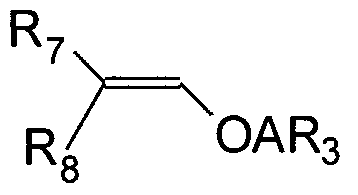
  • the silicon containing monomer unit is typically generated by polymerization of a substituted styrene monomer, followed by reaction of the substituent to yield a hydroxystyrene monomer unit and subsequent reaction of the hydroxystyrene units with a vinyl ether of the structure:
  • acetoxy styrene is polymerized and transacetylized to yield hydroxystyrene monomer units for reaction with the vinyl ether.
  • the monomer unit can be generated by reaction of the above generated hydroxystyrene monomer units with a vinyl ether and an alcohol of structure:
  • the monomer unit can be generated by polymerization of the monomer wherein the silicon containing acetal moiety has already been generated. Either reaction of hydroxystyrene monomer with a vinyl ether of the structure given below or reaction of a vinyl ether and the alcohol of the structure given below may be used.
  • the acetal containing polymer is preferably formed by reacting a polymer containing hydroxystyrene units with t-butyl vinyl ether and an alcohol in the presence of an acid catalyst.
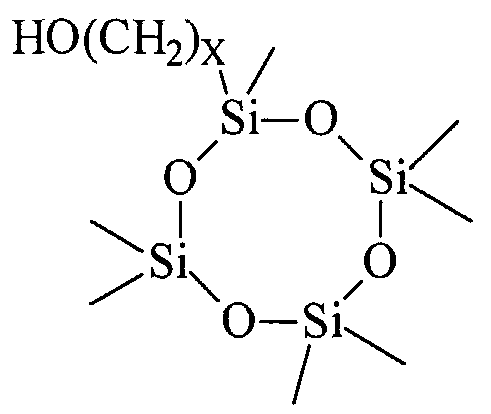
  • the HO-A-R 3 alcohol is preferably selected from the group consisting of: trimethylsilyl methanol, trimethylsilyl ethanol, tristrimethylsilyl methanol, tristrimethylsilyl ethanol, tristrimethylsiloxymethanol, tristrimethylsiloxyethanol, methylbistrimethylsilyl ethanol, methyl bisthmethylsiloxy ethanol, tris trimethylsiloxy propanol, methyl- bisthmethylsiloxy propanol, hydroxymethyl terminated polysiloxane polymers, hydroxyethyl terminated polysiloxane polymers and cyclic siloxanes oligomers, such as that of the structure IV herebelow and caged siloxanes, such as the silsesquioxane alkanol compound V herebelow:
  • the polymer also comprises an additional monomer unit selected from the group consisting of: hydroxystyrene, hydroxystyrene units blocked with other acid sensitive groups, (meth)acrylates, vinyl ethers or acetates, or substituted and unsubstituted maleimides.
  • the polymer comprises between about 5 to 75 molar % of the silicon containing monomer and between about 25 to 95 molar % of the additional monomer. More preferably the silicon containing monomer unit is present in an amount between about 5 to 30 molar wt. % and the additional monomer unit is present in an amount between about 70 to 95 molar wt. %.
  • the acetal containing polymer typically has a molecular weight in the range between about 2,000 to 75,000.
  • the present invention also include a bilayer resist comprising: a photoresist layer comprising at least one acetal containing polymer having a silicon substituent; provided that the silicon substituent is not directly attached to the acetal functionality; and an undercoat layer.
  • the present invention also includes a photoresist composition
  • a photoresist composition comprising the novel acetal containing polymer having a silicon substituent; provided that the silicon substituent is not directly attached to the acetal functionality; and a photoacid generator compound.
  • acetal containing polymers are provided in which the acetal substituent itself contains a silicon substituent not directly attached to the acetal functionality that can be used as polymers in bilayer resists to address the needs for high resolution, improved DOF, and improved dimensional stability under metrology conditions while maintaining other beneficial acetal properties.
  • Polymers of the invention comprise polymers with the silicon containing monomer unit I:
  • Ri H, lower alkyl, CH 2 CO 2 R, cyano, CH 2 CN, or halogen
  • R 2 CHR R 8 where R 7 and R 8 are H, lower alkyl, cycloalkyl or aryl
  • A is a connecting group such as substituted or unsubstituted alkylene, cycloalkylene, or alkylenecycloalkylene, alkylenearylene
  • R 3 R 3
  • SiR R R6 where R, R 4 , R5, and Re are independently alkyl, cycloalkyl, aryl, aralkyl, alkylenecycloalkyl, silyl or siloxy or linear or cyclic polysiloxane groups.
  • R, R 4 , R5, and Re are independently alkyl, cycloalkyl, aryl, aralkyl, alkylenecycloalkyl, silyl or siloxy or linear or cyclic polysiloxane groups.
  • A include but are not limited to methylene, ethylene, CH 2 C(CH 3 )H, propylene, CH(CH 3 )CH(CH 3 )CH(CH 3 ), cyclohexylene, ethylenecyclohexylene, phenyleneethylene, and the like.
  • R 3 examples include trimethyl silyl, triethyl silyl, triphenyl silyl, tricyclohexylsilyl, tristrimethylsiloxysilyl, tristrimethylsilylsilyl, methylbistrimethylsilylsilyl, methylbistrimethylsiloxysilyl, dimethyltrimethylsilylsilyl, dimethyltrimethyl- siloxysilyl, and cyclic or linear polysiloxane oligomer or polymers or a silsesquioxane alkanol compound.
  • Polymers with silicon containing monomeric unit I can be generated by polymerization of a substituted styrene monomer, followed by reaction of the substituent to yield a hydroxystyrene monomer unit and subsequent reaction of the hydroxystyrene units with a vinyl ether of the structure II,
  • R 3 ⁇ R , and R 8 are as defined as before, or by the process described in US Patents 6159653, 6133412, and 6309793 (incorporated herein by reference) using a vinyl ether and an alcohol of structure III:
  • 6,133,412 (which are incorporated herein by reference) provide a process for generating a single acetal or mixed acetal polymers by reaction of a polymer containing hydroxystyrene units with t-butyl vinyl ether and an alcohol in the presence of an acid catalyst.
  • Suitable alcohols given by the general formula III can be obtained commercially or prepared by a variety of synthetic techniques known to those skilled in the art. Suitable alcohols include trimethylsilyl methanol, trimethylsilyl ethanol, tristrimethylsilyl methanol, tristrimethylsilyl ethanol, tristrimethylsiloxymethanol, tristrimethylsiloxyethanol, methylbistri- methylsilyl ethanol, methyl bistrimethylsiloxy ethanol, tris trimethylsiloxy propanol, methylbistrimethylsiloxy propanol, hydroxymethyl terminated polysiloxane polymers, hydroxyethyl terminated polysiloxane polymers and cyclic siloxanes oligomers, such as that of formula IV, and caged siloxanes, such as the silsesquioxane alkanol compound V herebelow.
  • the polymers of the present invention can contain in addition to monomeric units I, other monomeric units.
  • monomeric units include, but are not limited to, hydroxystyrene, hydroxystyrene units blocked with other acid sensitive groups (e.g., other acetals, t-BOC, t- butoxycarbonylmethyl [BOCMe]), various (meth)acrylates (e.g., t-butyl acrylate, t-butyl methacrylate, methyl methacrylate, methyl acrylate, isobornyl acrylate, cyclohexyl acrylate), vinyl ethers or acetates, or substituted and unsubstituted maleimides.
  • acid sensitive groups e.g., other acetals, t-BOC, t- butoxycarbonylmethyl [BOCMe]
  • various (meth)acrylates e.g., t-butyl acrylate, t-butyl methacrylate,
  • the additional monomer units may be derived from other silicon containing monomers.
  • silicon containing monomers include tris(trimethylsilyloxy)propyl acrylate, tris(trimethylsily)propyl acrylate trimethylsilylmethyl acrylate, tris(trimethylsiloxy)ethyl acrylate, tris(trimethylsilyl)ethyl acrylate, tris(trimethylsilyloxy)propyl methacrylate, tris(trimethylsily)propyl methacrylate, trimethylsilylmethyl methacrylate, tris(trimethylsiloxy)ethyl methacrylate, tris(trimethylsilyl)ethyl methacrylate, acryloxypropyl- heptacyclopentyl-T8-silsesquioxane, methacryloxypropylheptacyclopentyl-T8-silsesquioxane, acryloxypropylhepta
  • the amount of additional monomeric units will depend on the silicon content of silicon containing monomer unit 1. Generally a total of about 6- 15% silicon is desired in the polymer to provide suitable oxygen etch resistance and line edge roughness. Polymers where the silicon containing monomeric unit I contain only 1 silicon atom must contain a higher percentage of silicon containing monomeric unit 1 to provide the desired silicon content. Generally, the polymer will contain between about 5-75 molar % of silicon containing monomer unit 1. Silicon containing monomeric units 1 in which multiple silicon atoms are present are preferred such that the molar % of silicon containing monomeric units 1 in the polymer is between about 5-30%. In polymers which contain an additional monomer unit and also containing silicon, the sum of the molar % of the two monomer units will fall into the same ranges depending on whether the monomers have one or more silicon atoms per molecule.
  • the molecular weights for the polymers are between 2000 and 75000.
  • the polymers of the present invention are different than most of those disclosed in the prior art in that R 3 contains at least one silicon moiety in the acetal portion of the molecule. That is, polymers of the present invention differ from those disclosed in the prior art in that the silicon substituent is not attached directly to the acetal oxygen. Direct attachment of a silicon to one of the acetal oxygens will directly involve the silicon in the acid catalyzed chemistry and adversely affect the storage stability of the acetal.
  • Photosensitive compositions can be formulated using the polymers of the present invention.
  • the photosensitive compositions will comprise the polymers of this invention and a photoacid generator.
  • the polymers of this invention may be blended with another photoresist polymer which may contain silicon.
  • any photoresist polymer with alkali solubilizing groups protected by acid sensitive groups may be blended in these photosensitive compositions.
  • Suitable additional silicon containing polymers for blending include acrylic polymers, such as those described in US patents 6146793 and 6165682 herein incorporated by reference.
  • Suitable non-silicon containing polymers for blending include acetal protected hydroxystyrene polymers, such as those described in US Patents 5468589, 5976759, 5849808, and 6159653 herein incorporated by reference and acrylic polymers, such as described in US Patents 4491628, 6284430, and 6042997 herein incorporated by reference.
  • photoacid generator compounds may be used in the photoresist composition.
  • Preferred photoacid generators are those generating sulfonic acids.
  • Suitable classes of photoacid generators generating sulfonic acids include, but are not limited to, sulfonium or iodonium salts, oximidosulfonates, bissulfonyldiazomethane compounds, and nitrobenzylsulfonate esters.
  • Suitable photoacid generator compounds are disclosed, for example, in US-Patent Nos. 5,558,978 and 5,468,589 which are incorporated herein by reference.
  • photoacid generators are triphenylsulfonium bromide, triphenylsulfonium chloride, triphenylsulfonium iodide, triphenylsulfonium hexafluorophosphate, triphenylsulfonium hexafluoroarsenate, triphenylsulfonium hexafluoroarsenate, triphenylsulfonium trifluoromethanesulfonate, diphenylethylsulfonium chloride, phenacyldimethylsulfonium chloride, phenacyltetrahydrothiophenium chloride, 4- nitrophenacyltetrahydrothiopheniumn chloride, and 4-hydroxy-2- methylphenylhexahydrothiopyrylium chloride.
  • photoacid generators for use in this invention include triphenylsulfonium perfluorooctanesulfonate, triphenylsulfonium perfluorobutanesulfonate, methylphenyldiphenylsulfonium perfluorooctanesulfonate, methylphenyldiphenysulfonium perfluorooctanesulfonate, 4-n- butoxyphenyldiphenylsulfonium perfluorobutanesulfonate, 2,4,6- trimethylphenyldiphenylsulfonium perfluorobutanesulfonate, 2,4,6- trimethylphenyldiphenylsulfonium benzenesulfonate, 2,4,6- trimethylphenyldiphenylsulfonium 2,4,6-triisopropylbenzenesulfonate, phenylthiophenyldiphenylsulfonate,
  • Suitable iodonium salts for use in this invention include, but are not limited to, diphenyl iodonium perfluorobutanesulfonate, bis-(t-butylphenyl)iodonium perfluorobutanesulfonate, bis-(t- butylphenyl)iodonium perfluorooctanesulfonate, diphenyl iodonium perfluorooctanesulfonate, bis-(t-butylphenyl)iodonium benzenesulfonate, bis-(t-butylphenyl)iodonium 2,4,6-triisopropylbenzenesulfonate, and diphenyliodonium 4-methoxybenzensulfonate.
  • photoacid generators for use in this invention are bis(p-toluenesulfonyl)diazomethane, methylsulfonyl p- toluenesulfonyldiazomethane, 1 -cyclo-hexylsulfonyl-1 -(1 ,1- dimethylethylsulfonyl)diazometane, bis(1 ,1- dimethylethylsulfonyl)diazomethane, bis(1 - methylethylsulfonyl)diazomethane, bis(cyclohexylsulfonyl)diazomethane, 1 -p-toluenesulfonyl-1 -cyclohexylcarbonyldiazomethane, 2-methyl-2-(p- toluenesulfonyl )propiophenone, 2-methanesulfon
  • the photoacid generator compound is typically employed in the amounts of about 0.0001 to 20% by weight of polymer solids and more preferably about 1% to 10% by weight of polymer solids.
  • Preferred photoacid generators are sulfonium salts.
  • the photoacid generator may be used alone or in combination with one or more photoacid generators.
  • the percentage of each photoacid generator in photoacid generator mixtures is between about 10% to about 90% of the total photoacid generator mixture.
  • Preferred photoacid generator mixtures contain about 2 or 3 photoacid generators. Such mixtures may be of the same class or different classes. Examples of preferred mixtures include sulfonium salts with bissulfonyldiazomethane compounds, sulfonium salts and imidosulfonates, and two sulfonium salts.
  • the choice of solvent for the photoresist composition and the concentration thereof depends principally on the type of functionalities incorporated in the acid labile polymer, the photoacid generator, and the coating method.
  • the solvent should be inert, should dissolve all the components in the photoresist, should not undergo any chemical reaction with the components and should be re-removable on drying after coating.
  • Suitable solvents for the photoresist composition may include ketones, ethers and esters, such as methyl ethyl ketone, methyl isobutyl ketone, 2- heptanone, cyclopentanone, cyclohexanone, 2-methoxy-1 -propylene acetate, 2-methoxyethanol, 2-ethoxyothanol, 2-ethoxyethyl acetate, I- methoxy-2-propyl acetate, 1 ,2-dimethoxy ethane ethyl acetate, cellosolve acetate, propylene glycol monoethyl ether acetate, methyl lactate, ethyl lactate, methyl pyruvate, ethyl pyruvate, methyl 3-methoxypropionate, ethyl 3-methoxypropionate, N-methyl-2-pyrrolidone, 1 ,4-dioxane, ethylene glycol monoiso
  • base additives may be added to the photoresist composition.
  • the purpose of the base additive is to scavenge protons present in the photoresist prior to being irradiated by the actinic radiation.
  • the base prevents attack and cleavage of the acid labile groups by the undesirable acids, thereby increasing the performance and stability of the resist.
  • the percentage of base in the composition should be significantly lower than the photoacid generator because it would not be desirable for the base to interfere with the cleavage of the acid labile groups after the photoresist composition is irradiated.
  • the preferred range of the base compounds, when present, is about 3% to 50% by weight of the photoacid generator compound.
  • Suitable examples of base additives are 2-methylimidazole, triisopropylamine, 4-dimethylaminopryidine, 4,4'- diaminodiphenyl ether, 2,4,5-triphenylimidazole, and 1 ,5- diazobicyclo[4.3.0]non-5-ene.
  • Dyes may be added to the photoresist to increase the absorption of the composition to the actinic radiation wavelength.
  • the dye must not poison the composition and must be capable of withstanding the process conditions including any thermal treatments.
  • suitable dyes are fluorenone derivatives, anthracene derivatives or pyrene derivatives.
  • Other specific dyes that are suitable for photoresist compositions are described in U.S. Patent No. 5,593,812, which is incorporated herein by reference.
  • the photoresist composition may further comprise conventional additives, such as adhesion promoters and surfactants.
  • conventional additives such as adhesion promoters and surfactants.
  • a person skilled in the art will be able to choose the appropriate desired additive and its concentration.
  • the photoresist composition is applied uniformly to a substrate by known coating methods.
  • the coatings may be applied by spin-coating, dipping, knife coating, lamination, brushing, spraying, and reverse-roll coating.
  • the coating thickness range generally covers values of about 0.1 to more than 10 ⁇ m.
  • the solvent is generally removed by drying.
  • the drying step is typically a heating step called 'soft bake' where the resist and substrate are heated to a temperature of about 50°C to 150°C for about a few seconds to a few minutes; preferably for about 5 seconds to 30 minutes depending on the thickness, the heating element and end use of the resist.
  • the photoresist compositions are suitable for a number of different uses in the electronics industry. For example, it can be used as electroplating resist, plasma etch resist, solder resist, resist for the production of printing plates, resist for chemical milling or resist in the production of integrated circuits.
  • electroplating resist plasma etch resist
  • solder resist solder resist
  • resist for the production of printing plates resist for chemical milling or resist in the production of integrated circuits.
  • the possible coatings and processing conditions of the coated substrates differ accordingly.
  • the substrate coated with the photoresist composition is exposed imagewise.
  • imagewise' exposure includes both exposure through a photomask containing a predetermined pattern, exposure by means of a computer controlled laser beam which is moved over the surface of the coated substrate, exposure by means of computer-controlled electron beams, and exposure by means of X-rays or UV rays through a corresponding mask.
  • Radiation sources which can be used, are all sources that emit radiation to which the photoacid generator is sensitive. Examples include high pressure mercury lamp, KrF excimer lasers, ArF excimer lasers, electron beams and x-rays sources.
  • the process described above for the production of relief structures preferably includes, as a further process measure, heating of the coating between exposure and treatment with the developer.
  • post-exposure bake With the aid of this heat treatment, known as "post-exposure bake", virtually complete reaction of the acid labile groups in the polymer resin with the acid generated by the exposure is achieved.
  • the duration and temperature of this post-exposure bake can vary within broad limits and depend essentially on the functionalities of the polymer resin, the type of acid generator and on the concentration of these two components.
  • the exposed resist is typically subjected to temperatures of about 50°C to 150°C for a few seconds to a few minutes.
  • the preferred post exposure bake is from about 80°C to 130°C for about 5 seconds to 300 seconds.
  • the developer can include aqueous solutions of bases to which organic solvents or mixtures thereof may have been added.
  • Particularly preferred developers are aqueous alkaline solutions. These include, for example, aqueous solutions of alkali metal silicates, phosphates, hydroxides and carbonates, but in particular of tetra alkylammonium hydroxides, and more preferably tetramethylammonium hydroxide (TMAH). If desired, relatively small amounts of wetting agents and/or organic solvents can also be added to these solutions.
  • the substrate carrying the resist coating is generally subjected to at least one further treatment step which changes substrate in areas not covered by the photoresist coating.
  • this can be implantation of a dopant, deposition of another material on the substrate or an etching of the substrate.
  • This is usually followed by the removal of the resist coating from the substrate using a suitable stripping method.
  • the resist of this invention may be coated over an undercoat to form a bilayer resist. Films of undercoats are typically spun cast from solvents suitable for photoresist applications and baked similar to photoresists. Film thickness of the undercoat will vary depending on the exact application but generally range from about 800 Angstroms to about 10,000 angstroms. Thicknesses of from about 1500 Angstroms to about 5000 Angstroms are preferred.
  • Suitable undercoats have several required characteristics. First, there should be no intermixing between the undercoat and resist.
  • undercoats also generally are designed to have good substrate plasma etch resistance.
  • optical (n,k) parameters of a suitable undercoat are optimized for the exposure wavelength to minimize reflections.
  • Imaging the photosensitive composition of this invention on the overcoat is substantially the same as on a substrate.
  • the substrate will be placed in a plasma-etching environment comprising oxygen so that the undercoat will be removed in the area unprotected by the resist.
  • the silicon in the silicon containing monomer unit forms silicon dioxide when exposed to an oxygen plasma and protects the resist from being etched so that relief structures can be formed in the undercoat layer.
  • the substrate carrying the bilayer relief structure is generally subjected to at least on further treatment step which changes the substrate in areas not covered by the bilayer coating. Typically, this can be implantation of a dopant, deposition of another material on the substrate or an etching of the substrate. This is usually followed by the removal of the resist and its byproducts and the undercoat.
  • a 500 mL round-bottom, three-necked flask was equipped with a temperature probe, a magnetic stir bar and closed vacuum adapter. 190.08 g of propylene glycol monomethyl ether acetate (PGMEA) was charged into the flask. 30.22 g of powdered poly(hydroxystyrene -co-t- butylstyrene) (93:7)(MW 12780; PD 1.9) was added to the stirring solvent. The mixture was stirred for 30 minutes to form a homogeneous solution. The mixture was heated to 66 °C and vacuum was applied to the solution to distill 100.34g of the solvent.
  • PGMEA propylene glycol monomethyl ether acetate
  • the solution was allowed to cool to room temperature under nitrogen atmosphere and 20.63 g of fresh PGMEA was added. 11.34 g of heptamethyl-(3-hydroxypropyl)cyclotetrasiloxane and 4.23 g of terf/ ' ary-butyl vinyl ether were added to the homogeneous solution. 0.7 g of 1% para-toluene sulfonic acid (prepared by dissolving 1 g of acid in 99 g of PGMEA) was added. After a brief, mild exotherm, the solution was allowed to stir at 23 °C for 4 hours. 8 g of 1% triethylamine solution in PGMEA was added to the reaction mixture to quench the acid.
  • the reaction mixture was stirred for an additional 30 minutes.
  • the polymer solution was transferred to a 500 mL separatory funnel and treated with 162.35 g of acetone, 80.71 g of hexanes and 113.5 g of deionized water.
  • the mixture was shaken for about 30 seconds to a minute and allowed to separate into three layers. The lower, aqueous layer was discarded.
  • the organic layers were subjected to two more washings. In the second washing, 37.97 g of acetone, 10.48 g of PGMEA and 43.88 g of deionized water were used and in the third washing, 39.04 g of acetone, 10.73 g of PGMEA and 42.11 g of deionized water were used.
  • the top organic layer was transferred to a 500 mL round-bottom, three-necked flask equipped with a temperature probe, a magnetic stir bar and a vacuum distillation assembly.
  • the flask was placed on a heating mantle.
  • Acetone and hexane were removed by atmospheric distillation.
  • Water and some PGMEA were removed by azeotropic vacuum distillation at 66 °C until the solids content of the distillation flask was about 30%.
  • Analytical data is found in the table.
  • a 250 mL round-bottom, three-necked flask was equipped with a temperature probe, a magnetic stir bar and closed vacuum adapter. 157.93 g of propylene glycol monomethyl ether acetate (PGMEA) was charged into the flask. 25.06 g of powdered poly(hydroxystyrene -co-t- butylstyrene) (93:7)(MW 12780; PD 1.9) was added to the stirring solvent. The mixture was stirred for 30 minutes to form a homogeneous solution. The mixture was heated to 66 °C and vacuum was applied to the solution to distill 115.07 g of the solvent.
  • PGMEA propylene glycol monomethyl ether acetate
  • the reaction mixture was stirred for an additional 30 minutes.
  • the polymer solution was transferred to a 250 mL separatory funnel and treated with 142.54 g of acetone, 76.8 g of hexanes and 73.35 g of de-ionized water.
  • the mixture was shaken for about 30 seconds to a minute and allowed to separate into two layers. The lower, aqueous layer was discarded. The top organic layer was subjected to two more washings.
  • a 100 mL round-bottom, three-necked flask was equipped with a temperature probe, a magnetic stir bar and closed vacuum adapter.
  • 62.57 g of propylene glycol monomethyl ether acetate (PGMEA) was charged into the flask.
  • 15.01 g of powdered poly(hydroxystyrene -co-t-butylstyrene) (93:7)(MW 12780; PD 1.9) was added to the stirring solvent.
  • 9.12 g of 3- hydroxypropyltris(trimethylsiloxy)silane was added next. The mixture was stirred for 30 minutes to form a homogeneous solution.
  • the mixture was heated to 66 °C and vacuum was applied to the solution to distill 44.3 g of the solvent.
  • the solution was allowed to cool to room temperature under nitrogen atmosphere and 13.05 g of fresh PGMEA was added.
  • 2.97 g of terf/ ' ary-butyl vinyl ether and 0.36 g cyclohexanedimethanol divinyl ether (17351-75-6) were added to the homogeneous solution.
  • 0.38 g of 1% para-toluene sulfonic acid (prepared by dissolving 1 g of acid in 99 g of PGMEA) was added. After a brief, mild exotherm, the solution was allowed to stir at 23 °C for 4 hours.
  • a 100 mL round-bottom, three-necked flask was equipped with a temperature probe, a magnetic stir bar and closed vacuum adapter.
  • 59.42 g of propylene glycol monomethyl ether acetate (PGMEA) was charged into the flask.
  • 15.46 g of powdered poly(hydroxystyrene) (MW 8000; PD 1.2) was added to the stirring solvent.
  • 11.68 g of 3- hydroxypropyltris(trimethylsiloxy)silane was added next.
  • the mixture was stirred for 30 minutes to form a homogeneous solution.
  • the mixture was heated to 66 °C and vacuum was applied to the solution to distill 38.29 g of the solvent.
  • the solution was allowed to cool to room temperature under nitrogen atmosphere and 14.52 g of fresh PGMEA was added. 3.75 g of ferr/ary-butyl vinyl ether and 0.36 g cyclohexanedimethanol divinyl ether (17351-75-6) were added to the homogeneous solution. 0.38 g of 1% para-toluene sulfonic acid (prepared by dissolving 1 g of acid in 99 g of PGMEA) was added. After a brief, mild exotherm , the solution was allowed to stir at 23 °C for 4 hours. 4.74 g of 1% triethylamine solution in PGMEA was added to the reaction mixture to quench the acid. The reaction mixture was stirred for an additional 30 minutes.
  • the polymer solution was transferred to a 250 mL separatory funnel and treated with 65.27 g of acetone, 50.73 g of hexanes and 22.87 g of de-ionized water.
  • the mixture was shaken for about 30 seconds to a minute and allowed to separate into two layers. The lower, aqueous layer was discarded.
  • the top organic layer was subjected to two more washings: In the second washing, 22.26 g of acetone, 3.77 g of PGMEA and 11.37 g of deionized water were used and in the third washing, 28.38 g of acetone, 3.3 g of PGMEA and 11.34 g of deionized water were used.
  • the top organic layer was transferred to a 500 mL round-bottom, three-necked flask equipped with a temperature probe, a magnetic stir bar and a vacuum distillation assembly.
  • the flask was placed on a heating mantle.
  • Acetone and hexane were removed by atmospheric distillation.
  • Water and some PGMEA were removed by azeotropic vacuum distillation at 66 °C until the solids content of the distillation flask was about 30%.
  • Analytical data is found in the table.
  • a 250 mL round-bottom, three-necked flask was equipped with a temperature probe, a magnetic stir bar and closed vacuum adapter. 135.88 g of propylene glycol monomethyl ether acetate (PGMEA) was charged into the flask. 31.1 g of powdered Poly(hydroxystyrene) (MW 8000; PD 1.2) was added to the stirring solvent. The mixture was stirred for 30 minutes to form a homogeneous solution. The mixture was heated to 66 °C and vacuum was applied to the solution to distill 74.53 g of the solvent. The solution was allowed to cool to room temperature under nitrogen atmosphere and 31.3 g of fresh PGMEA was added.
  • PGMEA propylene glycol monomethyl ether acetate
  • the polymer solution was transferred to a 500 mL separatory funnel and treated with 113.68 g of acetone, 46.14 g of hexanes and 47.04 g of de-ionized water.
  • the mixture was shaken for about 30 seconds to a minute and allowed to separate into two layers. The lower, aqueous layer was discarded.
  • the top organic layer was subjected to two more washings. In the second washing, 22.26 g of acetone, 3.77 g of PGMEA and 11.37 g of deionized water were used and in the third washing, 28.38 g of acetone, 7.89 g of PGMEA and 23.33 g of deionized water were used.
  • the top organic layer was transferred to a 500 mL round-bottom, three-necked flask equipped with a temperature probe, an overhead stirrer and a vacuum distillation assembly.
  • the flask was placed on a heating mantle.
  • Acetone and hexane were removed by atmospheric distillation.
  • Water and some PGMEA were removed by azeotropic vacuum distillation at 66 °C until the solids content of the distillation flask was about 30%.
  • Analytical data is found in the table.
  • a 250 mL round-bottom, three-necked flask was equipped with a temperature probe, a magnetic stir bar and closed vacuum adapter.
  • 145 g of propylene glycol monomethyl ether acetate (PGMEA) was charged into the flask.
  • the mixture was stirred for 30 minutes to form a homogeneous solution.
  • the mixture was heated to 66 °C and vacuum was applied to the solution to distill 25 g of the solvent.
  • the solution was allowed to cool to room temperature under nitrogen atmosphere.
  • a 250 mL round-bottom, three-necked flask was equipped with a temperature probe, a magnetic stir bar and closed vacuum adapter. 144.5 g of propylene glycol monomethyl ether acetate (PGMEA) was charged into the flask. 29.93 g of powdered poly(hydroxystyrene -co-t-butylstyrene) (93:7)(MW 13307; PD 2.3) was added to the stirring solvent. 19.88 g of heptamethyl-(3-hydroxypropyl)cyclotetrasiloxane was added next. The mixture was stirred for 30 minutes to form a homogeneous solution.
  • PGMEA propylene glycol monomethyl ether acetate
  • the mixture was heated to 66 °C and vacuum was applied to the solution to distill 25 g of the solvent.
  • the solution was allowed to cool to room temperature under nitrogen atmosphere.
  • 7.3 g of te/t/ary-butyl vinyl ether was added to the homogeneous solution.
  • 0.3 g of 1 % camphorsulfonic acid (prepared by dissolving 1 g of acid in 99 g of PGMEA) was added. After a brief, mild exotherm, the solution was allowed to stir at 23 °C for 3 hours. 0.17 g of 1 % triethylamine solution in PGMEA was added to the reaction mixture to quench the acid.
  • a 100 mL round-bottom, three-necked flask was equipped with a temperature probe, a magnetic stir bar and closed vacuum adapter. 130.0 g of propylene glycol monomethyl ether acetate (PGMEA) was charged into the flask. 20.0 g of powdered poly(hydroxystyrene-co-t-butyl acrylate) (0.1333 mol HS, MW 10750; PD 2.97) was added to the stirring solvent. The mixture was stirred for 30 minutes to form a homogeneous solution. The mixture was heated to 60 °C and vacuum was applied to the solution to distill 40.0 g of the solvent.
  • PGMEA propylene glycol monomethyl ether acetate
  • the solution was allowed to cool to room temperature under nitrogen atmosphere and 7.9 g of heptamethyl-(3- hydroxypropyl)cyclotetrasiloxane and 2.98 g of terf/ary-butyl vinyl ether were added to the homogeneous solution.
  • 0.2 g of 1 % para-toluene sulfonic acid (prepared by dissolving 1 g of acid in 99 g of PGMEA) was added. After a brief, mild exotherm, the solution was allowed to stir at 22 °C. After 1.5 hours 0.3 g of cyclohexanedimethanol divinyl ether was added to reaction solution.
  • the mixture was stirred for 30 minutes to form a homogeneous solution.
  • the mixture was heated to 60 °C and vacuum was applied to the solution to distill 63.69 g of the solvent.
  • the solution was allowed to cool to room temperature under nitrogen atmosphere and 13.60 g of fresh PGMEA was added.
  • 24.68 g of heptamethyl-(3-hydroxypropyl) cyclotetrasiloxane and 9.49 g of tertiary- butyl vinyl ether were added to the homogeneous solution.
  • 0.30 g of 1% para-toluene sulfonic acid (prepared by dissolving 1 g of acid in 99 g of PGMEA) was added.
  • a 250 mL round-bottom, three-necked flask was equipped with a temperature probe, a magnetic stir bar and closed vacuum adapter. 170.77 g of propylene glycol monomethyl ether acetate (PGMEA) was charged into the flask. 30.12 g of powdered poly(hydroxystyrene -co- cyclohexylacrylate) (90:10)(MW 17530; PD 2.1) was added to the stirring solvent. The mixture was stirred for 30 minutes to form a homogeneous solution. The mixture was heated to 60 °C and vacuum was applied to the solution to distill 110.20 g of the solvent. The solution was allowed to cool to room temperature under nitrogen atmosphere and 60.03 g of fresh PGMEA was added.
  • PGMEA propylene glycol monomethyl ether acetate
  • a 250 mL round-bottom, three-necked flask was equipped with a temperature probe, a magnetic stir bar and closed vacuum adapter. 185.56 g of ethyl acetate was charged into the flask. 30.44 g of powdered poly(hydroxystyrene -co-cyclohexylacrylate) (90:10)(MW 17530; PD 2.1) was added to the stirring solvent. The mixture was stirred for 30 minutes to form a homogeneous solution. The mixture was heated to 60 °C and vacuum was applied to the solution to distill 110.36 g of the solvent. The solution was allowed to cool to room temperature under nitrogen atmosphere and 46.52 g of fresh ethyl acetate was added.
  • a 250 mL round-bottom, three-necked flask was equipped with a temperature probe, a magnetic stir bar and closed vacuum adapter. 170.53 g of ethyl acetate was charged into the flask. 30.25 g of powdered poly(hydroxystyrene -co-cyclohexylacrylate) (90:10)(MW 17530; PD 2.1) was added to the stirring solvent. The mixture was stirred for 30 minutes to form a homogeneous solution. The mixture was heated to 60 °C and vacuum was applied to the solution to distill 98.16 g of the solvent. The solution was allowed to cool to room temperature under nitrogen atmosphere and 49.05 g of fresh ethyl acetate was added.
  • a 250 mL round-bottom, three-necked flask was equipped with a temperature probe, a magnetic stir bar and closed vacuum adapter.
  • 149.92 g of propylene glycol monomethyl ether acetate (PGMEA) was charged into the flask.
  • 30.17 g of powdered poly(hydroxystyrene -co-t- butylstyrene) (93:7)(MW 12780; PD 1.9) was added to the stirring solvent.
  • the mixture was stirred for 30 minutes to form a homogeneous solution.
  • the mixture was heated to 60 °C and vacuum was applied to the solution to distill 48.92 g of the solvent.
  • the solution was allowed to cool to room temperature under nitrogen atmosphere.
  • the polymer solution was transferred to a 500 mL separatory funnel and treated with 115 g of acetone, 46 g of hexanes and 46 g of de-ionized water.
  • the mixture was shaken for about 30 seconds to a minute and allowed to separate into two layers. The lower, aqueous layer was discarded.
  • the top organic layer was subjected to two more washings. In the second washing, 23 g of acetone, 7 g of PGMEA and 23 g of deionized water were used and in the third washing, 17 g of acetone, 7 g of PGMEA and 23 g of deionized water were used.
  • the top organic layer was transferred to a 500 mL round-bottom, three-necked flask equipped with a temperature probe, magnetic stir bar and a vacuum distillation assembly.
  • the flask was placed on a heating mantle.
  • Acetone and hexane were removed by atmospheric distillation.
  • Water and some PGMEA were removed by azeotropic vacuum distillation at 66 °C until the solids content of the distillation flask was about 30.17%.
  • Analytical data is found in the table.
  • Lithographic Example 1 A formulation consisting of Polymer SE-6 (7.58 g), PAG 1 (0.28 g), PAG 2 (0.12 g), DBN (0.02 g) and PGMEA (91.92 g) was mixed in an amber-bottle and stirred until a homogeneous solution was obtained. The solution was filtered through 0.1 ⁇ m filter into a clean amber-bottle. 2500 A Photoresist films were prepared by spin coating on top of 5000 A of an undercoat (prepared as described in example 5 of co-pending US application number filed on March 7, 2002, based upon US Provisional Patent Application No. 60/275,528 and pre-exposure baking at 100 °C for 1.5 minute.
  • Films were exposed using an ASML /700 scanner using a 248 nm laser. A phase shift mask with 3%-transmission was used to expose contact hole patterns. The optical settings used were 0.63 numerical aperture (NA) and 0.7 sigma. The film was then post-exposure baked at 100 °C for 90 seconds and developed in a puddle of 0.26-N tetramethyl ammonium hydroxide for about 60 seconds, rinsed with de-ionized water and spun-dried.
  • NA numerical aperture
  • the contact hole patterns formed into the resist film were analyzed using Hitachi-8840 CD-SEM.
  • a formulation consisting of Polymer SE-11 (10.47 g), PAG 3 (0.495 g), antipyrene (0.0.0085g), DBU (0.0255 g) PGMEA/2-heptanone (89 g; 40/60 blend) and a trace amount of Silwet L-7210 was mixed in an amber- bottle and stirred until a homogeneous solution was obtained. The solution was filtered through 0.1 ⁇ m filter into a clean amber-bottle. 2350 A Photoresist films were prepared by spin coating on top of 5000 A of an undercoat (prepared as described in example 5 of co-pending US application number filed on March 7, 2002, based upon US Provisional Patent Application No.
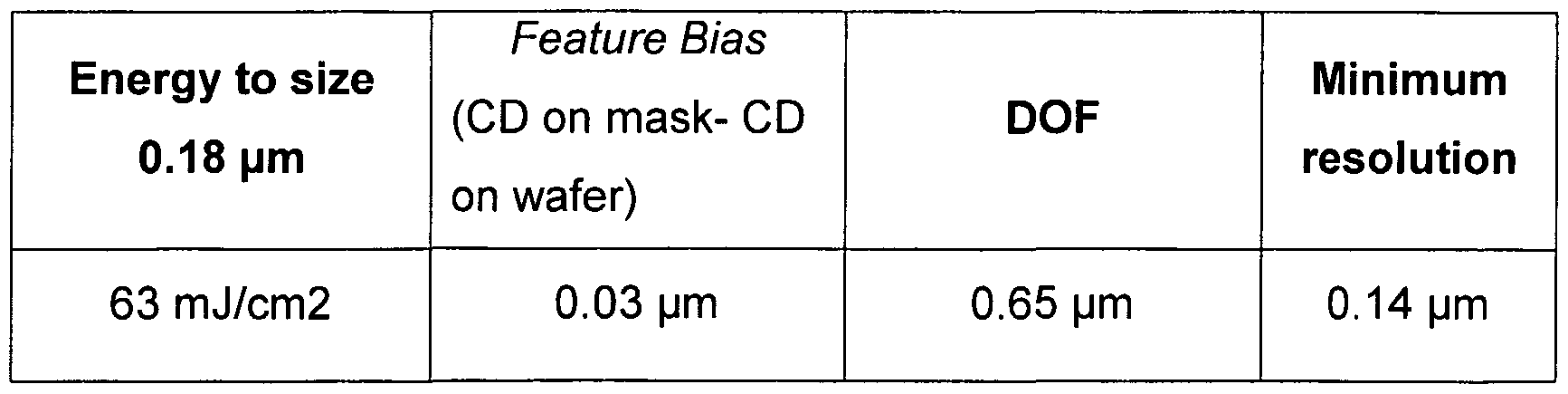
  • the photoresist resolved 0.13 micron equal Line/Space patterns with a DOF of about 0.6 microns at an exposure of 22.5 mJ/cm 2 . Using a binary contact hole mask, 0.16 micron contact holes could be resolved with about 0.8 micron DOF at an exposure of 70 mJ/cm 2 .
  • a formulation consisting of Polymer SE-12 (2.354 g), Polymer NSP- 1 (0.262 g), PAG 4 (0.13 g), tetramethyl ammonium hydroxide (0.005 g), PGMEA (22.25 g) and a trace amount of Silwet L-7210 was mixed in an amber-bottle and stirred until a homogeneous solution was obtained. The solution was filtered through 0.1 ⁇ m filter into a clean amber-bottle. 2350 A Photoresist films were prepared by spin coating on top of 5000 A of an undercoat (prepared as described in example 5 of co-pending US application number filed on March 7, 2002, based upon US Provisional Patent Application No.
  • the photoresist resolved 0.13 micron equal Line/Space patterns with a DOF of about 0.8 microns at an exposure of 29 mJ/cm 2 . Using a binary contact hole mask, 0.16 micron contact holes could be resolved with about 0.8 micron DOF at an exposure of 70 mJ/cm 2 .
  • Lithographic Example 4 A formulation consisting of Polymer SE-13 (2.621 g), PAG 3 (0.124 g), tetramethyl ammonium hydroxide (0.005 g), PGMEA (22.25 g) and a trace amount of Silwet L-7210 was mixed an amber-bottle and stirred until a homogeneous solution was obtained. The solution was filtered through 0.1 ⁇ m filter into a clean amber-bottle. 2350 A Photoresist films were prepared by spin coating on top of 5000 A of an undercoat (prepared as described in example 5 of co-pending US application number filed on March 7, 2002, based upon US Provisional Patent Application No. 60/275,528) and pre-exposure baking at 100 °C for 1.5 minute.
  • Examples 2-4 were measured relative to that of TIS-2000, a commercial resist sold by Arch Chemicals, Norwalk, CN.
  • the etch experiments were run in a LMA TCP 9400 using an etch gas of 0 2 /S0 2 . Etch rates are given in Table 2.

Landscapes

  • Physics & Mathematics (AREA)
  • Spectroscopy & Molecular Physics (AREA)
  • General Physics & Mathematics (AREA)
  • Chemical & Material Sciences (AREA)
  • Health & Medical Sciences (AREA)
  • Chemical Kinetics & Catalysis (AREA)
  • Medicinal Chemistry (AREA)
  • Polymers & Plastics (AREA)
  • Organic Chemistry (AREA)
  • Materials For Photolithography (AREA)
  • Addition Polymer Or Copolymer, Post-Treatments, Or Chemical Modifications (AREA)

Abstract

A photoresist composition comprising at least one acetal polymer having a silicon substituent; provided that the silicon substituent is not directly attached to the acetal functionality, thereby providing high resolution, improved DOF, and improved dimensional stability under metrology conditions.

Description

SILICON-CONTAINING ACETAL PROTECTED POLYMERS AND PHOTORESISTS COMPOSITIONS THEREOF
FIELD OF THE INVENTION
This invention relates to silicon-containing acetal protected polymers and photoresist compositions thereof especially useful in bilayer resists.
BACKGROUND TO THE INVENTION
New, improved, advanced resists are required to manufacture new electronic devices with smaller feature sizes. Typically, improvements are required in photoresist resolution, photospeed, depth of focus, and other properties. Resolution improvements can also be obtained via exposure systems utilizing higher numerical apertures. Unfortunately, as the resolution is improved via higher numerical apertures, the depth of focus at best resolution usually decreases due to optical effects. Thus, improvements in depth of focus of resist are also desirable.
The most common type of resists are called "single layer" resists in which the resist has both the function of imaging and plasma etch resistance. A second type of resist is termed a "bilayer resist" in which the upper layer is assigned the function of imaging and the underlayer assigned the function of plasma etch resistance. An oxygen etch step transfers the imaged pattern into the underlayer. Bilayer resists typically contain silicon and provide certain advantages in resolution from using thinner imaging films and in many cases the bilayer resist/undercoat combination provide better substrate plasma etch resistance. Examples of bilayer resists can be found for example in US Patent Nos. 6,359,078, 5,985,524 and 6,028,154 and other patents, each of which is incorporated herein in their entirety.
Advanced resists usually employ a technique called chemical amplification in which an acid generated by photolysis catalyzes a solubility switch from alkali insoluble to alkali soluble by removal of an acid sensitive group protecting an alkali solubilizing moiety. Polymers frequently used in this type of photosensitive composition include acetals derived from reaction of vinyl ethers with a polymer containing hydroxystyrene units. Chemically amplified resists based on acetal protected polyhydroxystyrene, such as found in US Patent nos. 5,928,818, 5,834,531 , and 5,558,976, which are incorporated herein by reference, are well known. Preferred characteristics and often advantages over other chemically amplified systems include lower temperature in processing conditions, and lower sensitivity to bake temperature variations.
Many new high resolution photoresists have been found to be dimensionally unstable to typical electron beam-based metrology system.
This produces an undesirable uncertainty in the line width measurements, which can lower production device yields. Solutions to this problem are eagerly awaited by the industry.
The present invention also provides many additional advantages which shall become apparent as described below.
SUMMARY OF THE INVENTION
A photoresist composition comprising at least one novel acetal group containing polymer having a silicon substituent; provided that the silicon substituent is not directly attached to the acetal functionality, thereby providing high resolution, improved DOF, and improved dimensional stability under metrology conditions.
The photoresist composition preferably comprises a novel polymer formed from a silicon containing monomer unit having the general structure:
Figure imgf000004_0001
I
wherein Ri is H, lower alkyl, CH2C02R, cyano, CH2CN, or halogen, wherein R is any alkyl, cycloalkyl, aryl, aralkyl, alkylenecycloalkyl, silyl or siloxy or linear or cyclic polysiloxane groups; R2 is CHR R8 where R and R8 are H, lower alkyl, cycloalkyl or aryl; A is a substituted or unsubstituted alkylene, cycloalkylene, alkylenecycloalkylene, or alkylenearylene; and R3 is SiR RδR6 where R , R5, and Re are independently alkyl, cycloalkyl, aryl, aralkyl, alkylenecycloalkyl, silyl or siloxy, or linear or cyclic polysiloxane groups or a silsesquioxane alkanol compound.
'A' is preferably selected from the group consisting of: methylene, ethylene, CH2C(CH3)H, propylene, CH(CH3)CH(CH3)CH(CH3), cyclohexylene, ethylenecyclohexylene , phenyleneethylene, and the like. R3 is preferably selected from the group consisting of: trimethyl silyl, triethyl silyl, triphenyl silyl, tricyclohexylsilyl, tristrimethylsiloxysilyl, tristrimethylsilylsilyl, methyl-bistrimethylsilylsilyl, methylbistrimethyl- siloxysilyl, dimethyltrimethylsilylsilyl, dimethyltrimethylsiloxysilyl, and cyclic or linear polysiloxane oligomer or polymers or a silsesquioxane alkanol compound.
The silicon containing monomer unit is typically generated by polymerization of a substituted styrene monomer, followed by reaction of the substituent to yield a hydroxystyrene monomer unit and subsequent reaction of the hydroxystyrene units with a vinyl ether of the structure:
Figure imgf000005_0001
Typically, acetoxy styrene is polymerized and transacetylized to yield hydroxystyrene monomer units for reaction with the vinyl ether.
Alternatively, the monomer unit can be generated by reaction of the above generated hydroxystyrene monomer units with a vinyl ether and an alcohol of structure:
HO-A-R3 Ml
Many vinyl ethers can be used, but secondary and tertiary vinyl ethers provide better incorporation of the alcohol. t-Butyl vinyl ether is preferred.
Alternatively, the monomer unit can be generated by polymerization of the monomer wherein the silicon containing acetal moiety has already been generated. Either reaction of hydroxystyrene monomer with a vinyl ether of the structure given below or reaction of a vinyl ether and the alcohol of the structure given below may be used.
Figure imgf000006_0001
The acetal containing polymer is preferably formed by reacting a polymer containing hydroxystyrene units with t-butyl vinyl ether and an alcohol in the presence of an acid catalyst.
The HO-A-R3 alcohol is preferably selected from the group consisting of: trimethylsilyl methanol, trimethylsilyl ethanol, tristrimethylsilyl methanol, tristrimethylsilyl ethanol, tristrimethylsiloxymethanol, tristrimethylsiloxyethanol, methylbistrimethylsilyl ethanol, methyl bisthmethylsiloxy ethanol, tris trimethylsiloxy propanol, methyl- bisthmethylsiloxy propanol, hydroxymethyl terminated polysiloxane polymers, hydroxyethyl terminated polysiloxane polymers and cyclic siloxanes oligomers, such as that of the structure IV herebelow and caged siloxanes, such as the silsesquioxane alkanol compound V herebelow:
Figure imgf000006_0002
Optionally, the polymer also comprises an additional monomer unit selected from the group consisting of: hydroxystyrene, hydroxystyrene units blocked with other acid sensitive groups, (meth)acrylates, vinyl ethers or acetates, or substituted and unsubstituted maleimides. Preferably the polymer comprises between about 5 to 75 molar % of the silicon containing monomer and between about 25 to 95 molar % of the additional monomer. More preferably the silicon containing monomer unit is present in an amount between about 5 to 30 molar wt. % and the additional monomer unit is present in an amount between about 70 to 95 molar wt. %.
The acetal containing polymer typically has a molecular weight in the range between about 2,000 to 75,000.
The present invention also include a bilayer resist comprising: a photoresist layer comprising at least one acetal containing polymer having a silicon substituent; provided that the silicon substituent is not directly attached to the acetal functionality; and an undercoat layer.
The present invention also includes a photoresist composition comprising the novel acetal containing polymer having a silicon substituent; provided that the silicon substituent is not directly attached to the acetal functionality; and a photoacid generator compound.
DESCRIPTION OF THE PREFERRED EMBODIMENTS
Single and mixed acetal resins of the acetal type are typically used in "single layer" resists and do not normally contain silicon. In the present invention, acetal containing polymers are provided in which the acetal substituent itself contains a silicon substituent not directly attached to the acetal functionality that can be used as polymers in bilayer resists to address the needs for high resolution, improved DOF, and improved dimensional stability under metrology conditions while maintaining other beneficial acetal properties. Polymers of the invention comprise polymers with the silicon containing monomer unit I:
R,
Figure imgf000008_0001
where Ri = H, lower alkyl, CH2CO2R, cyano, CH2CN, or halogen; R2 = CHR R8 where R7 and R8 are H, lower alkyl, cycloalkyl or aryl; A is a connecting group such as substituted or unsubstituted alkylene, cycloalkylene, or alkylenecycloalkylene, alkylenearylene; and R3 =
SiR R R6 where R, R4, R5, and Re are independently alkyl, cycloalkyl, aryl, aralkyl, alkylenecycloalkyl, silyl or siloxy or linear or cyclic polysiloxane groups. Examples of A include but are not limited to methylene, ethylene, CH2C(CH3)H, propylene, CH(CH3)CH(CH3)CH(CH3), cyclohexylene, ethylenecyclohexylene, phenyleneethylene, and the like. Examples of R3 include trimethyl silyl, triethyl silyl, triphenyl silyl, tricyclohexylsilyl, tristrimethylsiloxysilyl, tristrimethylsilylsilyl, methylbistrimethylsilylsilyl, methylbistrimethylsiloxysilyl, dimethyltrimethylsilylsilyl, dimethyltrimethyl- siloxysilyl, and cyclic or linear polysiloxane oligomer or polymers or a silsesquioxane alkanol compound.
Polymers with silicon containing monomeric unit I can be generated by polymerization of a substituted styrene monomer, followed by reaction of the substituent to yield a hydroxystyrene monomer unit and subsequent reaction of the hydroxystyrene units with a vinyl ether of the structure II,
Figure imgf000009_0001
II where R R , and R8 are as defined as before, or by the process described in US Patents 6159653, 6133412, and 6309793 (incorporated herein by reference) using a vinyl ether and an alcohol of structure III:
HO-A-R3
where R3 is as defined before. WO 99/52957 and U.S. Pat. No.
6,133,412 (which are incorporated herein by reference) provide a process for generating a single acetal or mixed acetal polymers by reaction of a polymer containing hydroxystyrene units with t-butyl vinyl ether and an alcohol in the presence of an acid catalyst.
Suitable alcohols given by the general formula III can be obtained commercially or prepared by a variety of synthetic techniques known to those skilled in the art. Suitable alcohols include trimethylsilyl methanol, trimethylsilyl ethanol, tristrimethylsilyl methanol, tristrimethylsilyl ethanol, tristrimethylsiloxymethanol, tristrimethylsiloxyethanol, methylbistri- methylsilyl ethanol, methyl bistrimethylsiloxy ethanol, tris trimethylsiloxy propanol, methylbistrimethylsiloxy propanol, hydroxymethyl terminated polysiloxane polymers, hydroxyethyl terminated polysiloxane polymers and cyclic siloxanes oligomers, such as that of formula IV, and caged siloxanes, such as the silsesquioxane alkanol compound V herebelow.
Figure imgf000010_0001
IV
The polymers of the present invention can contain in addition to monomeric units I, other monomeric units. Examples of such monomeric units include, but are not limited to, hydroxystyrene, hydroxystyrene units blocked with other acid sensitive groups (e.g., other acetals, t-BOC, t- butoxycarbonylmethyl [BOCMe]), various (meth)acrylates (e.g., t-butyl acrylate, t-butyl methacrylate, methyl methacrylate, methyl acrylate, isobornyl acrylate, cyclohexyl acrylate), vinyl ethers or acetates, or substituted and unsubstituted maleimides.
In another embodiment of the invention, the additional monomer units may be derived from other silicon containing monomers. Examples of such silicon containing monomers include tris(trimethylsilyloxy)propyl acrylate, tris(trimethylsily)propyl acrylate trimethylsilylmethyl acrylate, tris(trimethylsiloxy)ethyl acrylate, tris(trimethylsilyl)ethyl acrylate, tris(trimethylsilyloxy)propyl methacrylate, tris(trimethylsily)propyl methacrylate, trimethylsilylmethyl methacrylate, tris(trimethylsiloxy)ethyl methacrylate, tris(trimethylsilyl)ethyl methacrylate, acryloxypropyl- heptacyclopentyl-T8-silsesquioxane, methacryloxypropylheptacyclopentyl- T8-silsesquioxane, acryloxypropylheptaethyl-T8-silsesquioxane, meth- acryloxypropylheptaethyl-T8-silsesquioxane, and the acrylates or methacrylates of cyclic siloxanes, such as compound IV.
The amount of additional monomeric units will depend on the silicon content of silicon containing monomer unit 1. Generally a total of about 6- 15% silicon is desired in the polymer to provide suitable oxygen etch resistance and line edge roughness. Polymers where the silicon containing monomeric unit I contain only 1 silicon atom must contain a higher percentage of silicon containing monomeric unit 1 to provide the desired silicon content. Generally, the polymer will contain between about 5-75 molar % of silicon containing monomer unit 1. Silicon containing monomeric units 1 in which multiple silicon atoms are present are preferred such that the molar % of silicon containing monomeric units 1 in the polymer is between about 5-30%. In polymers which contain an additional monomer unit and also containing silicon, the sum of the molar % of the two monomer units will fall into the same ranges depending on whether the monomers have one or more silicon atoms per molecule.
Generally, the molecular weights for the polymers are between 2000 and 75000.
The polymers of the present invention are different than most of those disclosed in the prior art in that R3 contains at least one silicon moiety in the acetal portion of the molecule. That is, polymers of the present invention differ from those disclosed in the prior art in that the silicon substituent is not attached directly to the acetal oxygen. Direct attachment of a silicon to one of the acetal oxygens will directly involve the silicon in the acid catalyzed chemistry and adversely affect the storage stability of the acetal.
Figure imgf000012_0001
VI
Photosensitive compositions can be formulated using the polymers of the present invention. The photosensitive compositions will comprise the polymers of this invention and a photoacid generator. The polymers of this invention may be blended with another photoresist polymer which may contain silicon. Generally, any photoresist polymer with alkali solubilizing groups protected by acid sensitive groups may be blended in these photosensitive compositions. Suitable additional silicon containing polymers for blending include acrylic polymers, such as those described in US patents 6146793 and 6165682 herein incorporated by reference. Suitable non-silicon containing polymers for blending include acetal protected hydroxystyrene polymers, such as those described in US Patents 5468589, 5976759, 5849808, and 6159653 herein incorporated by reference and acrylic polymers, such as described in US Patents 4491628, 6284430, and 6042997 herein incorporated by reference.
Any suitable photoacid generator compound may be used in the photoresist composition. Preferred photoacid generators are those generating sulfonic acids. Suitable classes of photoacid generators generating sulfonic acids include, but are not limited to, sulfonium or iodonium salts, oximidosulfonates, bissulfonyldiazomethane compounds, and nitrobenzylsulfonate esters. Suitable photoacid generator compounds are disclosed, for example, in US-Patent Nos. 5,558,978 and 5,468,589 which are incorporated herein by reference.
Still other suitable examples of photoacid generators are triphenylsulfonium bromide, triphenylsulfonium chloride, triphenylsulfonium iodide, triphenylsulfonium hexafluorophosphate, triphenylsulfonium hexafluoroarsenate, triphenylsulfonium hexafluoroarsenate, triphenylsulfonium trifluoromethanesulfonate, diphenylethylsulfonium chloride, phenacyldimethylsulfonium chloride, phenacyltetrahydrothiophenium chloride, 4- nitrophenacyltetrahydrothiopheniumn chloride, and 4-hydroxy-2- methylphenylhexahydrothiopyrylium chloride.
Additional examples of suitable photoacid generators for use in this invention include triphenylsulfonium perfluorooctanesulfonate, triphenylsulfonium perfluorobutanesulfonate, methylphenyldiphenylsulfonium perfluorooctanesulfonate, methylphenyldiphenysulfonium perfluorooctanesulfonate, 4-n- butoxyphenyldiphenylsulfonium perfluorobutanesulfonate, 2,4,6- trimethylphenyldiphenylsulfonium perfluorobutanesulfonate, 2,4,6- trimethylphenyldiphenylsulfonium benzenesulfonate, 2,4,6- trimethylphenyldiphenylsulfonium 2,4,6-triisopropylbenzenesulfonate, phenylthiophenyldiphenylsulfonium 4-dodecylbenzensulfonic acid, tris(-t- butylphenyl)sulfonium perfluorooctanesulfonate, tris(-t- butylphenyl)sulfonium perfluorobutanesulfonate, tris(-t- butylphenyl)sulfonium 2,4,6-triisopropylbenzenesulfonate, tris(-t- butylphenyl)sulfonium benzenesulfonate, and phenylthiophenyldiphenylsulfonium perfluorooctanesulfonate. Examples of suitable iodonium salts for use in this invention include, but are not limited to, diphenyl iodonium perfluorobutanesulfonate, bis-(t-butylphenyl)iodonium perfluorobutanesulfonate, bis-(t- butylphenyl)iodonium perfluorooctanesulfonate, diphenyl iodonium perfluorooctanesulfonate, bis-(t-butylphenyl)iodonium benzenesulfonate, bis-(t-butylphenyl)iodonium 2,4,6-triisopropylbenzenesulfonate, and diphenyliodonium 4-methoxybenzensulfonate.
Further examples of suitable photoacid generators for use in this invention are bis(p-toluenesulfonyl)diazomethane, methylsulfonyl p- toluenesulfonyldiazomethane, 1 -cyclo-hexylsulfonyl-1 -(1 ,1- dimethylethylsulfonyl)diazometane, bis(1 ,1- dimethylethylsulfonyl)diazomethane, bis(1 - methylethylsulfonyl)diazomethane, bis(cyclohexylsulfonyl)diazomethane, 1 -p-toluenesulfonyl-1 -cyclohexylcarbonyldiazomethane, 2-methyl-2-(p- toluenesulfonyl )propiophenone, 2-methanesulfonyl-2-methyl-(4- methylthiopropiophenone, 2,4-methy1-2-(p-toluenesulfonyl)pent-3-one, 1- diazo-1-methylsulfonyl-4-phenyl-2-butanone, 2-(cyclohexylcarbonyl-2-(p- toluenesulfonyl)propane, 1-cyclohexylsulfonyl- 1 cyclohexylcarbonyldiazomethane, 1 -diazo-1 -cyclohexylsulfonyl-3, 3- dimethyl-2-butanone, 1 -diazo-1 -(1 ,1 -dimethylethylsulfonyl)-3,3-dimethyl-2- butanone, 1 -acetyl-1 -(1 -methylethylsulfonyl)diazomethane, 1 -diazo-1 -(p- toluenesulfonyl)-3,3-dimethyl-2-butanone, 1 -diazo-1 -benzenesulfonyl-3, 3- dimethyl-2-butanone, 1 -diazo-1 -(p-toluenesulfonyl)-3-methyl-2-butanone, cyclohexyl 2-diazo-2-(p-toluenesulfonyl)acetate, tert-butyl 2-diazo-2- benzenesulfonylacetate, isopropyl-2-diazo-2-methanesulfonylacetate, cyclohexyl 2-diazo-2-benzenesulfonylacetate, tert-butyl 2 diazo-2-(p- toluenesulfonyl)acetate, 2-nitrobenzyl p-toluenesulfonate, 2,6-dinitrobenzyl p-toluenesulfonate, and 2,4-dinitrobenzyl p-trifluoromethylbenzene- sulfonate. The photoacid generator compound is typically employed in the amounts of about 0.0001 to 20% by weight of polymer solids and more preferably about 1% to 10% by weight of polymer solids. Preferred photoacid generators are sulfonium salts. The photoacid generator may be used alone or in combination with one or more photoacid generators. The percentage of each photoacid generator in photoacid generator mixtures is between about 10% to about 90% of the total photoacid generator mixture. Preferred photoacid generator mixtures contain about 2 or 3 photoacid generators. Such mixtures may be of the same class or different classes. Examples of preferred mixtures include sulfonium salts with bissulfonyldiazomethane compounds, sulfonium salts and imidosulfonates, and two sulfonium salts.
The choice of solvent for the photoresist composition and the concentration thereof depends principally on the type of functionalities incorporated in the acid labile polymer, the photoacid generator, and the coating method. The solvent should be inert, should dissolve all the components in the photoresist, should not undergo any chemical reaction with the components and should be re-removable on drying after coating. Suitable solvents for the photoresist composition may include ketones, ethers and esters, such as methyl ethyl ketone, methyl isobutyl ketone, 2- heptanone, cyclopentanone, cyclohexanone, 2-methoxy-1 -propylene acetate, 2-methoxyethanol, 2-ethoxyothanol, 2-ethoxyethyl acetate, I- methoxy-2-propyl acetate, 1 ,2-dimethoxy ethane ethyl acetate, cellosolve acetate, propylene glycol monoethyl ether acetate, methyl lactate, ethyl lactate, methyl pyruvate, ethyl pyruvate, methyl 3-methoxypropionate, ethyl 3-methoxypropionate, N-methyl-2-pyrrolidone, 1 ,4-dioxane, ethylene glycol monoisopropyl ether, diethylene glycol monoethyl ether, diethylene glycol monomethyl ether, diethylene glycol dimethyl ether, and the like. In an additional embodiment, base additives may be added to the photoresist composition. The purpose of the base additive is to scavenge protons present in the photoresist prior to being irradiated by the actinic radiation. The base prevents attack and cleavage of the acid labile groups by the undesirable acids, thereby increasing the performance and stability of the resist. The percentage of base in the composition should be significantly lower than the photoacid generator because it would not be desirable for the base to interfere with the cleavage of the acid labile groups after the photoresist composition is irradiated. The preferred range of the base compounds, when present, is about 3% to 50% by weight of the photoacid generator compound. Suitable examples of base additives are 2-methylimidazole, triisopropylamine, 4-dimethylaminopryidine, 4,4'- diaminodiphenyl ether, 2,4,5-triphenylimidazole, and 1 ,5- diazobicyclo[4.3.0]non-5-ene.
Dyes may be added to the photoresist to increase the absorption of the composition to the actinic radiation wavelength. The dye must not poison the composition and must be capable of withstanding the process conditions including any thermal treatments. Examples of suitable dyes are fluorenone derivatives, anthracene derivatives or pyrene derivatives. Other specific dyes that are suitable for photoresist compositions are described in U.S. Patent No. 5,593,812, which is incorporated herein by reference.
The photoresist composition may further comprise conventional additives, such as adhesion promoters and surfactants. A person skilled in the art will be able to choose the appropriate desired additive and its concentration.
The photoresist composition is applied uniformly to a substrate by known coating methods. For example, the coatings may be applied by spin-coating, dipping, knife coating, lamination, brushing, spraying, and reverse-roll coating. The coating thickness range generally covers values of about 0.1 to more than 10 μm. After the coating operation, the solvent is generally removed by drying. The drying step is typically a heating step called 'soft bake' where the resist and substrate are heated to a temperature of about 50°C to 150°C for about a few seconds to a few minutes; preferably for about 5 seconds to 30 minutes depending on the thickness, the heating element and end use of the resist.
The photoresist compositions are suitable for a number of different uses in the electronics industry. For example, it can be used as electroplating resist, plasma etch resist, solder resist, resist for the production of printing plates, resist for chemical milling or resist in the production of integrated circuits. The possible coatings and processing conditions of the coated substrates differ accordingly.
For the production of relief structures, the substrate coated with the photoresist composition is exposed imagewise. The term 'imagewise' exposure includes both exposure through a photomask containing a predetermined pattern, exposure by means of a computer controlled laser beam which is moved over the surface of the coated substrate, exposure by means of computer-controlled electron beams, and exposure by means of X-rays or UV rays through a corresponding mask.
Radiation sources, which can be used, are all sources that emit radiation to which the photoacid generator is sensitive. Examples include high pressure mercury lamp, KrF excimer lasers, ArF excimer lasers, electron beams and x-rays sources.
The process described above for the production of relief structures preferably includes, as a further process measure, heating of the coating between exposure and treatment with the developer. With the aid of this heat treatment, known as "post-exposure bake", virtually complete reaction of the acid labile groups in the polymer resin with the acid generated by the exposure is achieved. The duration and temperature of this post-exposure bake can vary within broad limits and depend essentially on the functionalities of the polymer resin, the type of acid generator and on the concentration of these two components. The exposed resist is typically subjected to temperatures of about 50°C to 150°C for a few seconds to a few minutes. The preferred post exposure bake is from about 80°C to 130°C for about 5 seconds to 300 seconds.
After imagewise exposure and any heat treatment of the material, the exposed areas of the photoresist are removed by dissolution in a developer. The choice of the particular developer depends on the type of photoresist; in particular on the nature of the polymer resin or the photolysis products generated. The developer can include aqueous solutions of bases to which organic solvents or mixtures thereof may have been added. Particularly preferred developers are aqueous alkaline solutions. These include, for example, aqueous solutions of alkali metal silicates, phosphates, hydroxides and carbonates, but in particular of tetra alkylammonium hydroxides, and more preferably tetramethylammonium hydroxide (TMAH). If desired, relatively small amounts of wetting agents and/or organic solvents can also be added to these solutions.
After the development step, the substrate carrying the resist coating is generally subjected to at least one further treatment step which changes substrate in areas not covered by the photoresist coating. Typically, this can be implantation of a dopant, deposition of another material on the substrate or an etching of the substrate. This is usually followed by the removal of the resist coating from the substrate using a suitable stripping method. The resist of this invention may be coated over an undercoat to form a bilayer resist. Films of undercoats are typically spun cast from solvents suitable for photoresist applications and baked similar to photoresists. Film thickness of the undercoat will vary depending on the exact application but generally range from about 800 Angstroms to about 10,000 angstroms. Thicknesses of from about 1500 Angstroms to about 5000 Angstroms are preferred.
Suitable undercoats have several required characteristics. First, there should be no intermixing between the undercoat and resist.
Generally this is achieved by casting a film of undercoat and crosslinking it to reduce casting solvent solubility. The crosslinking may be thermally or photochemically induced. Examples of this photochemical and thermal crosslinking may be found in US Patents 6146793, 6054248, 6323287, and 6165682 and US application number filed on March 7, 2002, based upon US Provisional Patent Application No. 60/275,528 hereby incorporated by reference. Undercoats also generally are designed to have good substrate plasma etch resistance. Generally, the optical (n,k) parameters of a suitable undercoat are optimized for the exposure wavelength to minimize reflections.
Imaging the photosensitive composition of this invention on the overcoat is substantially the same as on a substrate. After images are formed in the radiation sensitive resist, the substrate will be placed in a plasma-etching environment comprising oxygen so that the undercoat will be removed in the area unprotected by the resist. The silicon in the silicon containing monomer unit forms silicon dioxide when exposed to an oxygen plasma and protects the resist from being etched so that relief structures can be formed in the undercoat layer. After the oxygen plasma step, the substrate carrying the bilayer relief structure is generally subjected to at least on further treatment step which changes the substrate in areas not covered by the bilayer coating. Typically, this can be implantation of a dopant, deposition of another material on the substrate or an etching of the substrate. This is usually followed by the removal of the resist and its byproducts and the undercoat.
The invention is illustrated by, but not limited to, the following examples.
Synthesis Procedures for Silyl-substituted Acetals
Preparation of4-[1-(heptamethyl-(3-propyloxy)cyclotetrasiloxane)- ethoxy]styrene-co-4-[1-(t-butoxy)-ethoxy]styrene-co-4- hydroxy styrene-co-4-t-butylstyrene copolymer: Polymer SE-1
A 500 mL round-bottom, three-necked flask was equipped with a temperature probe, a magnetic stir bar and closed vacuum adapter. 190.08 g of propylene glycol monomethyl ether acetate (PGMEA) was charged into the flask. 30.22 g of powdered poly(hydroxystyrene -co-t- butylstyrene) (93:7)(MW 12780; PD 1.9) was added to the stirring solvent. The mixture was stirred for 30 minutes to form a homogeneous solution. The mixture was heated to 66 °C and vacuum was applied to the solution to distill 100.34g of the solvent. The solution was allowed to cool to room temperature under nitrogen atmosphere and 20.63 g of fresh PGMEA was added. 11.34 g of heptamethyl-(3-hydroxypropyl)cyclotetrasiloxane and 4.23 g of terf/'ary-butyl vinyl ether were added to the homogeneous solution. 0.7 g of 1% para-toluene sulfonic acid (prepared by dissolving 1 g of acid in 99 g of PGMEA) was added. After a brief, mild exotherm, the solution was allowed to stir at 23 °C for 4 hours. 8 g of 1% triethylamine solution in PGMEA was added to the reaction mixture to quench the acid. The reaction mixture was stirred for an additional 30 minutes. The polymer solution was transferred to a 500 mL separatory funnel and treated with 162.35 g of acetone, 80.71 g of hexanes and 113.5 g of deionized water. The mixture was shaken for about 30 seconds to a minute and allowed to separate into three layers. The lower, aqueous layer was discarded. The organic layers were subjected to two more washings. In the second washing, 37.97 g of acetone, 10.48 g of PGMEA and 43.88 g of deionized water were used and in the third washing, 39.04 g of acetone, 10.73 g of PGMEA and 42.11 g of deionized water were used. The top organic layer was transferred to a 500 mL round-bottom, three-necked flask equipped with a temperature probe, a magnetic stir bar and a vacuum distillation assembly. The flask was placed on a heating mantle. Acetone and hexane were removed by atmospheric distillation. Water and some PGMEA were removed by azeotropic vacuum distillation at 66 °C until the solids content of the distillation flask was about 30%. Analytical data is found in the table. The structure of SE-1 is given below (a = 0.80; b = 0.04; c = 0.07; d = 0.09).
Figure imgf000021_0001
Preparation of4-[1-(heptamethyl-(3-propyloxy)cyclotetrasiloxane)- ethoxy]styrene-co-4-[1-(t-butoxy)-ethoxy]styrene-co-4- hydroxy styrene-co-4-t-butylstyrene copolymer: Polymer SE-2
A 250 mL round-bottom, three-necked flask was equipped with a temperature probe, a magnetic stir bar and closed vacuum adapter. 157.93 g of propylene glycol monomethyl ether acetate (PGMEA) was charged into the flask. 25.06 g of powdered poly(hydroxystyrene -co-t- butylstyrene) (93:7)(MW 12780; PD 1.9) was added to the stirring solvent. The mixture was stirred for 30 minutes to form a homogeneous solution. The mixture was heated to 66 °C and vacuum was applied to the solution to distill 115.07 g of the solvent. The solution was allowed to cool to room temperature under nitrogen atmosphere and 49.2 g of fresh PGMEA was added. 13.3 g of heptamethyl-(3-hydroxypropyl)cyclotetrasiloxane and 4.98 g of ferf/aty-butyl vinyl ether were added to the homogeneous solution. 0.63 g of 1 % para-toluene sulfonic acid (prepared by dissolving 1 g of acid in 99 g of PGMEA) was added. After a brief, mild exotherm, the solution was allowed to stir at 23 °C for 4 hours. 7.23 g of 1 % triethylamine solution in PGMEA was added to the reaction mixture to quench the acid. The reaction mixture was stirred for an additional 30 minutes. The polymer solution was transferred to a 250 mL separatory funnel and treated with 142.54 g of acetone, 76.8 g of hexanes and 73.35 g of de-ionized water. The mixture was shaken for about 30 seconds to a minute and allowed to separate into two layers. The lower, aqueous layer was discarded. The top organic layer was subjected to two more washings. In the second washing, 36.01 g of acetone, 9.36 g of PGMEA and 37.82 g of deionized water were used and in the third washing, 69.77 g of acetone, 37.2 g of PGMEA and 10.5 g of deionized water were used. The top organic layer was transferred to a 500 mL round-bottom, three- necked flask equipped with a temperature probe, a magnetic stir bar and a vacuum distillation assembly. The flask was placed on a heating mantle. Acetone and hexane were removed by atmospheric distillation. Water and some PGMEA were removed by azeotropic vacuum distillation at 66 °C until the solids content of the distillation flask was about 30%. Analytical data is found in the table. The structure of SE-2 is given below (a = 0.78; b = 0.04; c = 0.07; d = 0.11).
Figure imgf000023_0001
Preparation of lightly crosslinked 4-[1-(1-tris(trimethylsiloxy)silyl-3- propyloxy)-ethoxy]styrene-co-4-[1-(t-butoxy)-ethoxy]styrene-co-4- hydroxy styrene-co-4-t-butylstyrene copolymer: Polymer SE-3
A 100 mL round-bottom, three-necked flask was equipped with a temperature probe, a magnetic stir bar and closed vacuum adapter. 62.57 g of propylene glycol monomethyl ether acetate (PGMEA) was charged into the flask. 15.01 g of powdered poly(hydroxystyrene -co-t-butylstyrene) (93:7)(MW 12780; PD 1.9) was added to the stirring solvent. 9.12 g of 3- hydroxypropyltris(trimethylsiloxy)silane was added next. The mixture was stirred for 30 minutes to form a homogeneous solution. The mixture was heated to 66 °C and vacuum was applied to the solution to distill 44.3 g of the solvent. The solution was allowed to cool to room temperature under nitrogen atmosphere and 13.05 g of fresh PGMEA was added. 2.97 g of terf/'ary-butyl vinyl ether and 0.36 g cyclohexanedimethanol divinyl ether (17351-75-6) were added to the homogeneous solution. 0.38 g of 1% para-toluene sulfonic acid (prepared by dissolving 1 g of acid in 99 g of PGMEA) was added. After a brief, mild exotherm, the solution was allowed to stir at 23 °C for 4 hours. 4.60 g of 1% triethylamine solution in PGMEA was added to the reaction mixture to quench the acid. The reaction mixture was stirred for an additional 30 minutes. The polymer solution was transferred to a 250 mL separatory funnel and treated with 58.38 g of acetone, 23.68 g of hexanes and 23.45 g of de-ionized water. The mixture was shaken for about 30 seconds to a minute and allowed to separate into two layers. The lower, aqueous layer was discarded. The top organic layer was subjected to two more washings. In the second washing, 33.93 g of acetone, 21.67 g of PGMEA and 10.94 g of deionized water were used and in the third washing, 22.39 g of acetone, 13.78 g of PGMEA and 12.82 g of deionized water were used. The top organic layer was transferred to a 500 mL round-bottom, three-necked flask equipped with a temperature probe, magnetic stir bar and a vacuum distillation assembly. The flask was placed on a heating mantle. Acetone and hexane were removed by atmospheric distillation. Water and some PGMEA were removed by azeotropic vacuum distillation at 66 °C until the solids content of the distillation flask was about 30%. Analytical data is found in the table. The structure of SE-3 is given below (a = 0.73; b + d = 0.072; c = 0.128; e = 0.07).
Figure imgf000025_0001
Preparation of lightly crosslinked 4-[1-(1-tris(trimethylsiloxy)silyl-3- propyloxy)-ethoxy]styrene-co-4-[1-(t-butoxy)-ethoxy]styrene-co-4- hydroxy styrene copolymer: Polymer SE-4
A 100 mL round-bottom, three-necked flask was equipped with a temperature probe, a magnetic stir bar and closed vacuum adapter. 59.42 g of propylene glycol monomethyl ether acetate (PGMEA) was charged into the flask. 15.46 g of powdered poly(hydroxystyrene) (MW 8000; PD 1.2) was added to the stirring solvent. 11.68 g of 3- hydroxypropyltris(trimethylsiloxy)silane was added next. The mixture was stirred for 30 minutes to form a homogeneous solution. The mixture was heated to 66 °C and vacuum was applied to the solution to distill 38.29 g of the solvent. The solution was allowed to cool to room temperature under nitrogen atmosphere and 14.52 g of fresh PGMEA was added. 3.75 g of ferr/ary-butyl vinyl ether and 0.36 g cyclohexanedimethanol divinyl ether (17351-75-6) were added to the homogeneous solution. 0.38 g of 1% para-toluene sulfonic acid (prepared by dissolving 1 g of acid in 99 g of PGMEA) was added. After a brief, mild exotherm , the solution was allowed to stir at 23 °C for 4 hours. 4.74 g of 1% triethylamine solution in PGMEA was added to the reaction mixture to quench the acid. The reaction mixture was stirred for an additional 30 minutes. The polymer solution was transferred to a 250 mL separatory funnel and treated with 65.27 g of acetone, 50.73 g of hexanes and 22.87 g of de-ionized water. The mixture was shaken for about 30 seconds to a minute and allowed to separate into two layers. The lower, aqueous layer was discarded. The top organic layer was subjected to two more washings: In the second washing, 22.26 g of acetone, 3.77 g of PGMEA and 11.37 g of deionized water were used and in the third washing, 28.38 g of acetone, 3.3 g of PGMEA and 11.34 g of deionized water were used. The top organic layer was transferred to a 500 mL round-bottom, three-necked flask equipped with a temperature probe, a magnetic stir bar and a vacuum distillation assembly. The flask was placed on a heating mantle. Acetone and hexane were removed by atmospheric distillation. Water and some PGMEA were removed by azeotropic vacuum distillation at 66 °C until the solids content of the distillation flask was about 30%. Analytical data is found in the table. The structure of SE-4 is given below (a = 0.7; b + d = 0.14; c = 0.16).
Figure imgf000027_0001
Preparation of 4-[1-(trimethylsilylmethoxy)-ethoxy]styrene- co-4-[1-(t- butoxy)-ethoxy]styrene-co-4- hydroxy styrene copolymer: Polymer SE-5
A 250 mL round-bottom, three-necked flask was equipped with a temperature probe, a magnetic stir bar and closed vacuum adapter. 135.88 g of propylene glycol monomethyl ether acetate (PGMEA) was charged into the flask. 31.1 g of powdered Poly(hydroxystyrene) (MW 8000; PD 1.2) was added to the stirring solvent. The mixture was stirred for 30 minutes to form a homogeneous solution. The mixture was heated to 66 °C and vacuum was applied to the solution to distill 74.53 g of the solvent. The solution was allowed to cool to room temperature under nitrogen atmosphere and 31.3 g of fresh PGMEA was added. 6.28 g of trimethylsilylmethanol and 7.55 g of terf/ary-butyl vinyl ether were added to the homogeneous solution. 0.30 g of 1% para-toluene sulfonic acid (prepared by dissolving 1 g of acid in 99 g of PGMEA) was added. After a brief, mild exotherm , the solution was allowed to stir at 23 °C for 4 hours. 3.77 g of 1% triethylamine solution in PGMEA was added to the reaction mixture to quench the acid. The reaction mixture was stirred for an additional 30 minutes. The polymer solution was transferred to a 500 mL separatory funnel and treated with 113.68 g of acetone, 46.14 g of hexanes and 47.04 g of de-ionized water. The mixture was shaken for about 30 seconds to a minute and allowed to separate into two layers. The lower, aqueous layer was discarded. The top organic layer was subjected to two more washings. In the second washing, 22.26 g of acetone, 3.77 g of PGMEA and 11.37 g of deionized water were used and in the third washing, 28.38 g of acetone, 7.89 g of PGMEA and 23.33 g of deionized water were used. The top organic layer was transferred to a 500 mL round-bottom, three-necked flask equipped with a temperature probe, an overhead stirrer and a vacuum distillation assembly. The flask was placed on a heating mantle. Acetone and hexane were removed by atmospheric distillation. Water and some PGMEA were removed by azeotropic vacuum distillation at 66 °C until the solids content of the distillation flask was about 30%. Analytical data is found in the table. The structure of SE-5 is given below (a = 0.79; b = 0.04; c = 0.17).
Figure imgf000029_0001
Preparation of4-[1-(trimethylsilylmethoxy)-ethoxy]styrene-co-4-[1-(1- tris(trimethylsiloxy)silyl-3-propyloxy)-ethoxy]styrene- co-4-[1-(t- butoxy)-ethoxy]styrene-co-4- hydroxy styrene copolymer: Polymer
SE-6
A 250 mL round-bottom, three-necked flask was equipped with a temperature probe, a magnetic stir bar and closed vacuum adapter. 145 g of propylene glycol monomethyl ether acetate (PGMEA) was charged into the flask. 30 g of powdered Poly(hydroxystyrene) (MW 11800; PD = 2.7) was added to the stirring solvent. The mixture was stirred for 30 minutes to form a homogeneous solution. The mixture was heated to 66 °C and vacuum was applied to the solution to distill 25 g of the solvent. The solution was allowed to cool to room temperature under nitrogen atmosphere. 7.87 g of 3-hydroxypropyl-tris(trimethylsiloxy)silane and 2.5 g of terf/'ary-butyl vinyl ether were added to the homogeneous solution. 0.30 g of 1 % para-toluene sulfonic acid (prepared by dissolving 1 g of acid in 99 g of PGMEA) was added. After a brief, mild exotherm, the solution was allowed to stir at 23 °C for 1.5 hours, whereupon, 7.5 g of trimethylsilylmethanol and 9.07 g terf/'ary-butyl vinyl ether were added. The solution was allowed to stir at 23 °C for 2 hours. 3.77 g of 1 % triethylamine solution in PGMEA was added to the reaction mixture to quench the acid. The reaction mixture was stirred for an additional 30 minutes. The polymer solution was transferred to a 500 mL separatory funnel and treated with 143 g of acetone, 47 g of hexanes and 46 g of deionized water. The mixture was shaken for about 30 seconds to a minute and allowed to separate into two layers. The lower, aqueous layer was discarded. The top organic layer was subjected to two more washings. In the second washing, 43 g of acetone, 9 g of PGMEA and 23 g of deionized water were used and in the third washing, 45 g of acetone, 9 g of PGMEA and 23 g of deionized water were used. The majority of the hexane and acetone were removed by atmospheric distillation. The remaining solution was added slowly dropwise to 2.0 L of stirred hexanes. The precipitated solid was collected by filtration and dried in a vacuum oven at 60 °C for 24 hours. Analytical data is found in the table. The exact structure of SE-6 is difficult to determine from 13C analysis, but an approximation is given below (a = 0.68; b = 0.17; c = 0.1125; d = 0.0375). This approximation is based on the measured total blocking level, the measured Silicon content and assuming the ratio of incorporated silicon alcohols is equal to the molar ratio of the feed silicon alcohols.
Figure imgf000030_0001
Preparation of 4-[1-(heptamethyl-(3-propyloxy)cyclotetrasiloxane)- ethoxyjstyrene- co-4-[1 -(t-butoxy)-ethoxy]sty rene-co-4- hydroxy styrene-co-4-t-butylstyrene copolymer: Polymer SE-7 A 250 mL round-bottom, three-necked flask was equipped with a temperature probe, a magnetic stir bar and closed vacuum adapter. 120 g of THF, 30 g of powdered poly(hydroxystyrene -co-t-butylstyrene) (93:7)( MW 13307; PD 2.3), 15 g of heptamethyl-(3-hydroxypropyl) cyclotetrasiloxane, 0.6 g of 1% para-toluene sulfonic acid (prepared by dissolving 1 g of acid in 99 g of PGMEA) were added and the mixture stirred for a few minutes. 5.49 g of terf/ary-butyl vinyl ether was added to the homogeneous solution. The solution was allowed to stir at 23 °C for 2.5 hours. 7.65 g of 1% triethylamine solution in PGMEA was added to the reaction mixture to quench the acid. The reaction mixture was stirred for an additional 30 minutes and then was added slowly dropwise to 1.4 L of stirred hexanes. The precipitated solid was collected by filtration and dried in a vacuum oven at 60 °C for 24 hours. Analytical data is found in the table. The structure of SE-7 is given below (a = 0.81 ; b = 0.04; c = 0.07; d = 0.08).
Figure imgf000031_0001
Preparation of 4-[1 -(heptamethyl-(3-propy loxy)cyclotetrasiloxane)- ethoxy]styrene-co-4-[1-(t-butoxy)-ethoxy]styrene-co-4- hydroxy styrene-co-4-t-butylstyrene copolymer: Polymer SE-8
A 250 mL round-bottom, three-necked flask was equipped with a temperature probe, a magnetic stir bar and closed vacuum adapter. 144.5 g of propylene glycol monomethyl ether acetate (PGMEA) was charged into the flask. 29.93 g of powdered poly(hydroxystyrene -co-t-butylstyrene) (93:7)(MW 13307; PD 2.3) was added to the stirring solvent. 19.88 g of heptamethyl-(3-hydroxypropyl)cyclotetrasiloxane was added next. The mixture was stirred for 30 minutes to form a homogeneous solution. The mixture was heated to 66 °C and vacuum was applied to the solution to distill 25 g of the solvent. The solution was allowed to cool to room temperature under nitrogen atmosphere. 7.3 g of te/t/ary-butyl vinyl ether was added to the homogeneous solution. 0.3 g of 1 % camphorsulfonic acid (prepared by dissolving 1 g of acid in 99 g of PGMEA) was added. After a brief, mild exotherm, the solution was allowed to stir at 23 °C for 3 hours. 0.17 g of 1 % triethylamine solution in PGMEA was added to the reaction mixture to quench the acid. The reaction mixture was stirred for an additional 30 minutes and then was added slowly dropwise to 1.4 L of stirred hexanes. The precipitate was a gummy mass, from which the hexane was decanted. 500 ml of fresh hexane was added and the solid broken up with a spatula and stirred. The solid was collected by filtration and dried in a vacuum oven at 60 °C for 18 hours. Analytical data is found in the table. The structure of SE-8 is given below (a = 0.68; b = 0.11 ; c =
Figure imgf000032_0001
0.07; d = 0.14). Preparation of lightly cross-linked 4-[1-(heptamethyl~(3- propyloxy)cyclotetrasiloxane)-ethoxy]styrene- co-4-[]-(t-butoxy)- ethoxy]styrene-co-4- hydroxystyrene-co-4-t-butylacrylate copolymer:
Polymer SE-9
A 100 mL round-bottom, three-necked flask was equipped with a temperature probe, a magnetic stir bar and closed vacuum adapter. 130.0 g of propylene glycol monomethyl ether acetate (PGMEA) was charged into the flask. 20.0 g of powdered poly(hydroxystyrene-co-t-butyl acrylate) (0.1333 mol HS, MW 10750; PD 2.97) was added to the stirring solvent. The mixture was stirred for 30 minutes to form a homogeneous solution. The mixture was heated to 60 °C and vacuum was applied to the solution to distill 40.0 g of the solvent. The solution was allowed to cool to room temperature under nitrogen atmosphere and 7.9 g of heptamethyl-(3- hydroxypropyl)cyclotetrasiloxane and 2.98 g of terf/ary-butyl vinyl ether were added to the homogeneous solution. 0.2 g of 1 % para-toluene sulfonic acid (prepared by dissolving 1 g of acid in 99 g of PGMEA) was added. After a brief, mild exotherm, the solution was allowed to stir at 22 °C. After 1.5 hours 0.3 g of cyclohexanedimethanol divinyl ether was added to reaction solution. After 4 hours, 6.0 g of 1 % triethylamine solution in PGMEA was added to the reaction mixture to quench the acid. The reaction mixture was stirred for an additional 30 minutes. The polymer solution was transferred to a 250 mL separatory funnel and treated with 65.27 g of acetone, 50.73 g of hexanes and 22.87 g of deionized water. The mixture was shaken for about 30 seconds to a minute and allowed to separate into two layers. The lower, aqueous layer was discarded. The top organic layer was subjected to two more washings. In the second washing, 22.26 g of acetone, 3.77 g of PGMEA and 11.37 g of deionized water were used and in the third washing, 28.38 g of acetone, 3.3 g of PGMEA and 11.34 g of deionized water were used. The top organic layer was transferred to a 500 mL round-bottom, three-necked flask equipped with a temperature probe, a magnetic stir bar and a vacuum distillation assembly. The flask was placed on a heating mantle. Acetone and hexane were removed by atmospheric distillation. Water and some PGMEA were removed by azeotropic vacuum distillation at 60 °C until the solids content of the distillation flask was 33.65%. Analytical data is found in the table. The structure of SE-9 is given below (a = 0.60; b = 0.25; c + d = 0.06; e = 0.09).
Figure imgf000034_0001
Preparation of4-[1-(heptamethyl-(3-propyloxy)cyclotetrasiloxane)- ethoxyjstyrene- co-4-[1 -(t-butoxy)-ethoxy]styrene-co-4- hydroxystyrene copolymer: Polymer SE-10 A 250 mL round-bottom, three-necked flask was equipped with a temperature probe, a magnetic stir bar and closed vacuum adapter. 170.12 g of propylene glycol monomethyl ether acetate (PGMEA) was charged into the flask. 30.06 g of powdered poly(hydroxystyrene) (MW 8000; PD 1.2) was added to the stirring solvent. The mixture was stirred for 30 minutes to form a homogeneous solution. The mixture was heated to 60 °C and vacuum was applied to the solution to distill 63.69 g of the solvent. The solution was allowed to cool to room temperature under nitrogen atmosphere and 13.60 g of fresh PGMEA was added. 24.68 g of heptamethyl-(3-hydroxypropyl) cyclotetrasiloxane and 9.49 g of tertiary- butyl vinyl ether were added to the homogeneous solution. 0.30 g of 1% para-toluene sulfonic acid (prepared by dissolving 1 g of acid in 99 g of PGMEA) was added. After a brief, mild exotherm, the solution was allowed to stir at 23 °C for 4 hours. 0.30 g of 1% triethylamine solution in PGMEA was added to the reaction mixture to quench the acid. The reaction mixture was stirred for an additional 30 minutes and then was added slowly drop wise to 1.8 L of stirred hexanes. The precipitate was a gummy mass, from which the hexane was decanted. 1 L of fresh hexane was added and the solid broken up with a spatula and stirred. The solid was collected by filtration and dried in a vacuum oven at 50 °C for 12 hours. Analytical data is found in the table. The structure of SE-10 is given below (a = 0.71 ; b = 0.11 ; c = 0.18).
Figure imgf000035_0001
Preparation of 4-[1-(heptamethyl-(3-propyloxy)cyclotetrasiloxane)- ethoxyjstyrene- co-4-[1-(t-butoxy)-ethoxy]styrene- co-4-[1-(2- cyclohexylethoxy)-ethoxy]styrene-co-4- hydroxystyrene-co- cyclohexylacrylate copolymer: Polymer SE- 11
A 250 mL round-bottom, three-necked flask was equipped with a temperature probe, a magnetic stir bar and closed vacuum adapter. 170.77 g of propylene glycol monomethyl ether acetate (PGMEA) was charged into the flask. 30.12 g of powdered poly(hydroxystyrene -co- cyclohexylacrylate) (90:10)(MW 17530; PD 2.1) was added to the stirring solvent. The mixture was stirred for 30 minutes to form a homogeneous solution. The mixture was heated to 60 °C and vacuum was applied to the solution to distill 110.20 g of the solvent. The solution was allowed to cool to room temperature under nitrogen atmosphere and 60.03 g of fresh PGMEA was added. 13.40 g of heptamethyl-(3-hydroxypropyl) cyclotetrasiloxane and 4.42 g of fetf/ary-butyl vinyl ether were added to the homogeneous solution. 0.3 g of 1% para-toluene sulfonic acid (prepared by dissolving 1 g of acid in 99 g of PGMEA) was added. After a brief, mild exotherm, the solution was allowed to stir at 26 °C. After 2 hours, 2.76 g of 2-cyclohexylethanol and 2.67 g terf/ary-butyl vinyl ether were added. After 4 hours, 3.68 g of 1% triethylamine solution in PGMEA was added to the reaction mixture to quench the acid. The reaction mixture was stirred for an additional 30 minutes. The polymer solution was transferred to a 500 mL separatory funnel and treated with 116.42 g of acetone, 49.05 g of hexanes and 46.08 g of de-ionized water. The mixture was shaken for about 30 seconds to a minute and allowed to separate into two layers. The lower, aqueous layer was discarded. The top organic layer was subjected to two more washings. In the second washing, 24.41 g of acetone, 7.09 g of PGMEA and 25.88 g of deionized water were used and in the third washing, 24.61 g of acetone, 7.16 g of PGMEA and 23.43 g of deionized water were used. The top organic layer was transferred to a 500 mL round-bottom, three-necked flask equipped with a temperature probe, a magnetic stir bar and a vacuum distillation assembly. The flask was placed on a heating mantle. Acetone and hexane were removed by atmospheric distillation. Water and some PGMEA were removed by azeotropic vacuum distillation at 60 °C until the solids content of the distillation flask was 21.31%. The polymer solution was added slowly drop wise to 1.3 L of stirred hexanes. The solid was collected by filtration and dried in a vacuum oven at 50 °C for 12 hours. Analytical data is found in the table. The structure of SE-11 is given below (a = 0.66; b = 0.10; c = 0.08; d = 0.06; e = 0.10).
Figure imgf000037_0001
Preparation of4-[1-(heptamethyl-(3-propyloxy)cyclotetrasiloxane)- ethoxyjstyrene- co-4-[1-(t-butoxy)-ethoxy]styrene- co-4-[1- (cyclohexylethoxy)-ethoxy]styrene-co-4- hydroxystyrene-co- cyclohexylacrylate copolymer: Polymer SE-12
A 250 mL round-bottom, three-necked flask was equipped with a temperature probe, a magnetic stir bar and closed vacuum adapter. 185.56 g of ethyl acetate was charged into the flask. 30.44 g of powdered poly(hydroxystyrene -co-cyclohexylacrylate) (90:10)(MW 17530; PD 2.1) was added to the stirring solvent. The mixture was stirred for 30 minutes to form a homogeneous solution. The mixture was heated to 60 °C and vacuum was applied to the solution to distill 110.36 g of the solvent. The solution was allowed to cool to room temperature under nitrogen atmosphere and 46.52 g of fresh ethyl acetate was added. 2.53 g of 2- cyclohexylethanol and 1.97 g of terf/ary-butyl vinyl ether were added to the homogeneous solution. 0.3 g of 1% camphor sulfonic acid (prepared by dissolving 1 g of acid in 99 g of ethyl acetate) was added. After a brief, mild exotherm , the solution was allowed to stir at 26 °C. After 2 hours, 20.15 g of heptamethyl-(3-hydroxypropyl) cyclotetrasiloxane and 7.4 g tett/ary-butyl vinyl ether were added. After 4 hours, 0.13 g of 1 % triethylamine solution in ethyl acetate was added to the reaction mixture to quench the acid. The reaction mixture was stirred for an additional 30 minutes. The polymer solution was added slowly drop wise to 1.8 L of stirred hexanes. The solid was collected by filtration, washed with 400 mL of fresh hexane and dried in a vacuum oven at 50 °C for 12 hours. Analytical data is found in the table. The structure of SE-12 is given below (a = 0.61; b = 0.10; c = 0.10; d = 0.04; e = 0.15).
Figure imgf000038_0001
Preparation of4-[1-(heptamethyl-(3-propyloxy)cyclotetrasiloxane)- ethoxyjstyrene- co-4-[1 -(t-butoxy)-ethoxy]styrene-co-4- hydroxystyrene-co-cyclohexylacrylate copolymer: Polymer SE-13
A 250 mL round-bottom, three-necked flask was equipped with a temperature probe, a magnetic stir bar and closed vacuum adapter. 170.53 g of ethyl acetate was charged into the flask. 30.25 g of powdered poly(hydroxystyrene -co-cyclohexylacrylate) (90:10)(MW 17530; PD 2.1) was added to the stirring solvent. The mixture was stirred for 30 minutes to form a homogeneous solution. The mixture was heated to 60 °C and vacuum was applied to the solution to distill 98.16 g of the solvent. The solution was allowed to cool to room temperature under nitrogen atmosphere and 49.05 g of fresh ethyl acetate was added. 24.16 g of heptamethyl-(3-hydroxypropyl) cyclotetrasiloxane and 9.39 g of tertiary- butyl vinyl ether were added to the homogeneous solution. 0.30 g of 1% camphor sulfonic acid (prepared by dissolving 1 g of acid in 99 g of ethyl acetate) was added. After a brief, mild exotherm, the solution was allowed to stir at 25 °C for 4 hours. 0.20 g of 1% triethylamine solution in ethyl acetate was added to the reaction mixture to quench the acid. The reaction mixture was stirred for an additional 30 minutes and then was added slowly drop wise to 1.8 L of stirred hexanes. The precipitate was a gummy mass, from which the hexane was decanted. 1 L of fresh hexane was added and the solid broken up with a spatula and stirred. The solid was collected by filtration and dried in a vacuum oven at 60 °C for 12 hours. Analytical data is found in the table. The structure of SE-13 is given below (a = 0.62; b = 0.10; c = 0.10; d = 0.18).
Figure imgf000040_0001
Preparation of4-[1-(2-cyclohexylethoxy)-ethoxy]styrene-co-4-[1-(t- butoxy)-ethoxy]styrene-co-4- hydroxystyrene-co-4-t-butylstyrene copolymer: Polymer NSP-1
A 250 mL round-bottom, three-necked flask was equipped with a temperature probe, a magnetic stir bar and closed vacuum adapter. 149.92 g of propylene glycol monomethyl ether acetate (PGMEA) was charged into the flask. 30.17 g of powdered poly(hydroxystyrene -co-t- butylstyrene) (93:7)(MW 12780; PD 1.9) was added to the stirring solvent. The mixture was stirred for 30 minutes to form a homogeneous solution. The mixture was heated to 60 °C and vacuum was applied to the solution to distill 48.92 g of the solvent. The solution was allowed to cool to room temperature under nitrogen atmosphere. 7.82 g of terf/ary-butyl vinyl ether and 8.01 g 2-cyclohexylethanol were added to the homogeneous solution. 0.30 g of 1 % para-toluene sulfonic acid (prepared by dissolving 1 g of acid in 99 g of PGMEA) was added. After a brief, mild exotherm, the solution was allowed to stir at 23 °C for 4 hours. 3.77 g of 1 % triethylamine solution in PGMEA was added to the reaction mixture to quench the acid. The reaction mixture was stirred for an additional 30 minutes. The polymer solution was transferred to a 500 mL separatory funnel and treated with 115 g of acetone, 46 g of hexanes and 46 g of de-ionized water. The mixture was shaken for about 30 seconds to a minute and allowed to separate into two layers. The lower, aqueous layer was discarded. The top organic layer was subjected to two more washings. In the second washing, 23 g of acetone, 7 g of PGMEA and 23 g of deionized water were used and in the third washing, 17 g of acetone, 7 g of PGMEA and 23 g of deionized water were used. The top organic layer was transferred to a 500 mL round-bottom, three-necked flask equipped with a temperature probe, magnetic stir bar and a vacuum distillation assembly. The flask was placed on a heating mantle. Acetone and hexane were removed by atmospheric distillation. Water and some PGMEA were removed by azeotropic vacuum distillation at 66 °C until the solids content of the distillation flask was about 30.17%. Analytical data is found in the table. The structure of NSP-1 is given below (a = 0.59; b = 0.07; c = 0.16; d = 0.18).
Figure imgf000041_0001
Table 1
Figure imgf000042_0001
Figure imgf000043_0001
Table 1 Continued
Figure imgf000043_0002
Figure imgf000044_0001
Lithographic Example 1 A formulation consisting of Polymer SE-6 (7.58 g), PAG 1 (0.28 g), PAG 2 (0.12 g), DBN (0.02 g) and PGMEA (91.92 g) was mixed in an amber-bottle and stirred until a homogeneous solution was obtained. The solution was filtered through 0.1 μm filter into a clean amber-bottle. 2500 A Photoresist films were prepared by spin coating on top of 5000 A of an undercoat (prepared as described in example 5 of co-pending US application number filed on March 7, 2002, based upon US Provisional Patent Application No. 60/275,528 and pre-exposure baking at 100 °C for 1.5 minute. Films were exposed using an ASML /700 scanner using a 248 nm laser. A phase shift mask with 3%-transmission was used to expose contact hole patterns. The optical settings used were 0.63 numerical aperture (NA) and 0.7 sigma. The film was then post-exposure baked at 100 °C for 90 seconds and developed in a puddle of 0.26-N tetramethyl ammonium hydroxide for about 60 seconds, rinsed with de-ionized water and spun-dried.
The contact hole patterns formed into the resist film were analyzed using Hitachi-8840 CD-SEM.
Table 2
Figure imgf000045_0002
Figure imgf000045_0001
PAG 1 PAG 2
Lithographic Example 2
A formulation consisting of Polymer SE-11 (10.47 g), PAG 3 (0.495 g), antipyrene (0.0.0085g), DBU (0.0255 g) PGMEA/2-heptanone (89 g; 40/60 blend) and a trace amount of Silwet L-7210 was mixed in an amber- bottle and stirred until a homogeneous solution was obtained. The solution was filtered through 0.1 μm filter into a clean amber-bottle. 2350 A Photoresist films were prepared by spin coating on top of 5000 A of an undercoat (prepared as described in example 5 of co-pending US application number filed on March 7, 2002, based upon US Provisional Patent Application No. 60/275,528) and pre-exposure baking at 100 °C for 1.5 minute. The photoresist was exposed on a Canon EX6 (NA = 0.65) exposure system with annular illumination (sigma: 0.8/0.5). The film was then post-exposure baked at 90 °C for 90 seconds and developed in a puddle of 0.26-N tetramethyl ammonium hydroxide for about 60 seconds, rinsed with de-ionized water and spun-dried. The photoresist resolved 0.13 micron equal Line/Space patterns with a DOF of about 0.6 microns at an exposure of 22.5 mJ/cm2. Using a binary contact hole mask, 0.16 micron contact holes could be resolved with about 0.8 micron DOF at an exposure of 70 mJ/cm2.
Figure imgf000046_0001
Lithographic Example 3
A formulation consisting of Polymer SE-12 (2.354 g), Polymer NSP- 1 (0.262 g), PAG 4 (0.13 g), tetramethyl ammonium hydroxide (0.005 g), PGMEA (22.25 g) and a trace amount of Silwet L-7210 was mixed in an amber-bottle and stirred until a homogeneous solution was obtained. The solution was filtered through 0.1 μm filter into a clean amber-bottle. 2350 A Photoresist films were prepared by spin coating on top of 5000 A of an undercoat (prepared as described in example 5 of co-pending US application number filed on March 7, 2002, based upon US Provisional Patent Application No. 60/275,528) and pre-exposure baking at 100 °C for 1.5 minute. The photoresist was exposed on a Canon EX6 (NA = 0.65) exposure system with annular illumination (sigma: 0.8/0.5). The film was then post-exposure baked at 90 °C for 90 seconds and developed in a puddle of 0.26-N tetramethyl ammonium hydroxide for about 60 seconds, rinsed with de-ionized water and spun-dried. The photoresist resolved 0.13 micron equal Line/Space patterns with a DOF of about 0.8 microns at an exposure of 29 mJ/cm2. Using a binary contact hole mask, 0.16 micron contact holes could be resolved with about 0.8 micron DOF at an exposure of 70 mJ/cm2.
Figure imgf000047_0001
Lithographic Example 4 A formulation consisting of Polymer SE-13 (2.621 g), PAG 3 (0.124 g), tetramethyl ammonium hydroxide (0.005 g), PGMEA (22.25 g) and a trace amount of Silwet L-7210 was mixed an amber-bottle and stirred until a homogeneous solution was obtained. The solution was filtered through 0.1 μm filter into a clean amber-bottle. 2350 A Photoresist films were prepared by spin coating on top of 5000 A of an undercoat (prepared as described in example 5 of co-pending US application number filed on March 7, 2002, based upon US Provisional Patent Application No. 60/275,528) and pre-exposure baking at 100 °C for 1.5 minute. The photoresist was exposed on a Canon EX6 (NA = 0.65) exposure system with annular illumination (sigma: 0.8/0.5). The film was then post- exposure baked at 90 °C for 90 seconds and developed in a puddle of 0.26-N tetramethyl ammonium hydroxide for about 60 seconds, rinsed with de-ionized water and spun-dried. The photoresist resolved at least 0.15 micron equal Line/Space patterns at an exposure of 38 mJ/cm2.
Comparative Pattern Transfer Etch Rates
The etch rates of the photoresists prepared in Lithographic
Examples 2-4 were measured relative to that of TIS-2000, a commercial resist sold by Arch Chemicals, Norwalk, CN. The etch experiments were run in a LMA TCP 9400 using an etch gas of 02/S02. Etch rates are given in Table 2.
TABLE 2
Resist Example Number Etch rate (A /sec)
2 29.5 3 18.6
4 14.1 TIS 2000
Similar experiments using patterned photoresist produced excellent images with steep sidewalls clear to the substrate.
While we have shown and described several embodiments in accordance with our invention, it is to be clearly understood that the same are susceptible to numerous changes apparent to one skilled in the art. Therefore, we do not wish to be limited to the details shown and described but intend to show all changes and modifications which come within the scope of the appended claims.

Claims

WHAT IS CLAIMED IS:
1. A photoresist composition comprising at least one acetal containing polymer having a silicon substituent; provided that said silicon substituent is not directly attached to the acetal functionality.
2. The photoresist composition according to claim 1 , wherein said photoresist composition comprises a polymer formed from a silicon containing monomer unit having the general structure:
R3
Figure imgf000050_0001
wherein Ri is H, lower alkyl, CH2C02R, cyano, CH2CN, or halogen, wherein R is any alkyl, cycloalkyl, aryl, aralkyl, alkylenecycloalkyl, silyl or siloxy or linear or cyclic polysiloxane groups; R2 is CHR7R8 where R and R8 are H, lower alkyl, cycloalkyl or aryl; A is a substituted or unsubstituted alkylene, cycloalkylene, alkylenecycloalkylene, or alkylenearylene; and R3 is SiR RδR6 where R4, R5, and Re are independently alkyl, cycloalkyl, aryl, aralkyl, alkylenecycloalkyl, silyl or siloxy, or linear or cyclic polysiloxane groups or silsesquioxane alkanol compounds.
3. The photoresist composition according to claim 2 wherein A is selected from the group consisting of: methylene, ethylene, CH2C(CH3)H, propylene, CH(CH3)CH(CH3)CH(CH3), cyclohexylene, ethylenecyclohexylene, and phenyleneethylene.
4. The photoresist composition according to claim 2, wherein R3 is selected from the group consisting of: trimethyl silyl, triethyl silyl, triphenyl silyl, tricyclohexylsilyl, tristrimethylsiloxysilyl, tristrimethylsilylsilyl, methylbistrimethylsilylsilyl, methylbistrimethylsiloxysilyl, dimethyltnmethylsilylsilyl, dimethyltnmethylsiloxysilyl, cyclic or linear polysiloxane oligomer or polymers, and silsesquioxane alkanol compounds.
5. The photoresist composition according to claim 2, wherein said silicon containing monomer unit is produced by: polymerizing a substituted styrene monomer, converting the polymerized substituted styrene monomer to a hydroxystyrene monomer unit, and reacting said hydroxystyrene monomer unit with a vinyl ether of the structure:
Figure imgf000051_0001
6. The photoresist composition according to claim 2, wherein said silicon containing monomer unit is produced by: polymerizing a substituted styrene monomer, converting the polymerized substituted styrene monomer to a hydroxystyrene monomer unit, and reacting said hydroxystyrene monomer unit with a vinyl ether and an alcohol of structure: HO-A-R3
7. The photoresist composition according to claim 1 , wherein said acetal containing polymer is formed by reacting a polymer containing hydroxystyrene units with t-butyl vinyl ether and an alcohol in the presence of an acid catalyst.
8. The photoresist composition according to claim 7, wherein said alcohol is selected from the group consisting of: trimethylsilyl methanol, trimethylsilyl ethanol, tristrimethylsilyl methanol, tristrimethylsilyl ethanol, tristrimethylsiloxymethanol, tristrimethylsiloxyethanol, methylbistrimethylsilyl ethanol, methyl bistrimethylsiloxy ethanol, tris trimethylsiloxy propanol, methylbistrimethylsiloxy propanol, hydroxymethyl terminated polysiloxane polymers, hydroxyethyl terminated polysiloxane polymers and cyclic siloxanes oligomers of the structure herebelow, and silsesquioxane alkanol compounds:
Figure imgf000052_0001
9. The photoresist composition according to claim 2, wherein said polymer also comprises an additional monomer selected from the group consisting of: hydroxystyrene, hydroxystyrene units blocked with other acid sensitive groups, (meth)acrylates, vinyl ethers or acetates, substituted and unsubstituted maleimides, and other silicon containing monomers.
10. The photoresist composition according to claim 9, wherein said polymer comprising between about 5 to 75 molar % of said monomer and between about 25 to 95 molar % of said additional monomer.
11. The photoresist composition according to claim 10, wherein said silicon containing monomer unit is present in an amount between about 5 to 30 molar % and said additional monomer is present in an amount between about 70 to 95 molar %.
12. The photoresist composition according to claim 1 , wherein said acetal containing polymer has a molecular weight in the range between about 2,000 to 75,000.
13. A bilayer resist comprising: a photoresist layer comprising at least one polymeric acetal having a silicon substituent; provided that said silicon substituent is not directly attached to the acetal functionality; and
an undercoat layer.
14. The bilayer resist according to claim 13, wherein said photoresist layer comprises a polymer formed from the monomer unit having the general structure: R3
Figure imgf000054_0001
wherein Ri is H, lower alkyl, CH2C02R, cyano, CH2CN, or halogen, wherein R is any alkyl, cycloalkyl, aryl, aralkyl, alkylenecycloalkyl, silyl or siloxy or linear or cyclic polysiloxane groups; R2 is CHR R8 where R7 and R8 are H, lower alkyl, cycloalkyl or aryl; A is a substituted or unsubstituted alkylene, cycloalkylene, alkylenecycloalkylene, or alkylenearylene; and R3 is SiR4RδR6 where R , R5, and R6 are independently alkyl, cycloalkyl, aryl, aralkyl, alkylenecycloalkyl, silyl or siloxy, linear or cyclic polysiloxane groups or silsesquioxane alkanol compounds.
15. The bilayer resist according to claim 14 wherein A is selected from the group consisting of: methylene, ethylene, CH2C(CH3)H, propylene, CH(CH3)CH(CH3)CH(CH3), cyclohexylene, ethylenecyclohexylene, and phenyleneethylene
16. The bilayer resist according to claim 14, wherein R3 is selected from the group consisting of: trimethyl silyl, triethyl silyl, triphenyl silyl, thcyclohexylsilyl, tristrimethylsiloxysilyl, tristrimethylsilylsilyl, methylbistrimethylsilylsilyl, methylbistrimethylsiloxysilyl, dimethyltnmethylsilylsilyl, dimethyltnmethylsiloxysilyl, cyclic or linear polysiloxane oligomer or polymers, and silsesquioxane alkanol compounds.
17. The bilayer resist according to claim 14, wherein said silicon containing monomer unit is produced by: polymerizing a substituted styrene monomer, converting the polymerized substituted styrene monomer to a hydroxystyrene monomer unit, and reacting said hydroxystyrene monomer unit with a vinyl ether of the structure:
Figure imgf000055_0001
18. The bilayer resist according to claim 14, wherein said silicon containing monomer unit is produced by: polymerizing a substituted styrene monomer, converting the polymerized substituted styrene monomer to a hydroxystyrene monomer unit, and reacting said hydroxystyrene monomer unit with a vinyl ether and an alcohol of structure:
HO-A-R3
19. The bilayer resist according to claim 13, wherein said acetal polymer is formed by reacting a polymer containing hydroxystyrene units with t-butyl vinyl ether and an alcohol in the presence of an acid catalyst.
20. The bilayer resist according to claim 18, wherein said alcohol is selected from the group consisting of: trimethylsilyl methanol, trimethylsilyl ethanol, tristrimethylsilyl methanol, tristrimethylsilyl ethanol, tristrimethylsiloxymethanol, tristrimethylsiloxyethanol, methylbistrimethylsilyl ethanol, methyl bistrimethylsiloxy ethanol, tris trimethylsiloxy propanol, methylbistrimethylsiloxy propanol, hydroxymethyl terminated polysiloxane polymers, hydroxyethyl terminated polysiloxane polymers, cyclic siloxanes oligomers of the structure herebelow, and silsesquioxane alkanol compounds:
Figure imgf000056_0001
21. The bilayer resist according to claim 14, wherein said polymer also comprises an additional monomer selected from the group consisting of: hydroxystyrene, hydroxystyrene units blocked with other acid sensitive groups, (meth)acrylates, vinyl ethers or acetates, substituted and unsubstituted maleimides, and other silicon containing monomers.
22. The bilayer resist according to claim 21 , wherein said polymer comprising between about 5 to 75 molar % of said monomer and between about 25 to 95 molar % of said additional monomer.
23. The bilayer resist according to claim 22, wherein said monomer is present in an amount between about 5 to 30 molar % and said additional monomer is present in an amount between about 70 to 95 molar
%.
24. The bilayer resist according to claim 13, wherein said acetal polymer has a molecular weight in the range between about 2,000 to
75,000.
25. A photoresist composition comprising at least one acetal containing polymer having a silicon substituent; provided that said silicon substituent is not directly attached to the acetal functionality another photoresist polymer which may contain silicon; and a photoacid generator.
26. The photoresist composition according to claim 25, wherein said photoacid generator is one which is capable of generating sulfonic acids.
27. The photoresist composition according to claim 26, wherein said photoacid generator is at least one selected from the group consisting of: sulfonium or iodonium salts, oximidosulfonates, bissulfonyldiazomethane compounds, and nitrobenzylsulfonate esters.
28. The photoresist composition according to claim 25 further comprising at least one component additive selected from the group consisting of: solvents, a base, dyes, adhesion promoters and surfactants.
29. The photoresist composition according to claim 25 further comprising an additional silicon containing polymer.
30. An acetal containing polymer having a silicon substituent; provided that said silicon substituent is not directly attached to the acetal functionality.
31. The polymer according to claim 30, wherein said polymer is formed from a silicon containing monomer unit having the general structure:
Figure imgf000058_0001
wherein Ri is H, lower alkyl, CH2C02R, cyano, CH2CN, or halogen, wherein R is any alkyl, cycloalkyl, aryl, aralkyl, alkylenecycloalkyl, silyl or siloxy or linear or cyclic polysiloxane groups; R2 is CHR7R8 where R7 and R8 are H, lower alkyl, cycloalkyl or aryl; A is a substituted or unsubstituted alkylene, cycloalkylene, alkylenecycloalkylene, or alkylenearylene; and R3 is SiR R5R6 where R , R5, and R8 are independently alkyl, cycloalkyl, aryl, aralkyl, alkylenecycloalkyl, silyl or siloxy, or linear or cyclic polysiloxane groups or silsesquioxane alkanol compounds.
32. The polymer according to claim 31 wherein A is selected from the group consisting of: methylene, ethylene, CH2C(CH3)H, propylene, CH(CH3)CH(CH3)CH(CH3), cyclohexylene, ethylenecyclohexylene, and phenyleneethylene.
33. The polymer according to claim 31 , wherein R3 is selected from the group consisting of: trimethyl silyl, triethyl silyl, triphenyl silyl, tricyclohexylsilyl, thstrimethylsiloxysilyl, tristhmethylsilylsilyl, methylbistrimethylsilylsilyl, methylbistrimethylsiloxysilyl, dimethyltnmethylsilylsilyl, dimethyltnmethylsiloxysilyl, cyclic or linear polysiloxane oligomer or polymers, and silsesquioxane alkanol compounds.
34. The polymer according to claim 31 , wherein said silicon containing monomer unit is produced by: polymerizing a substituted styrene monomer, converting the polymerized substituted styrene monomer to a hydroxystyrene monomer unit, and reacting said hydroxystyrene monomer unit with a vinyl ether of the structure:
Figure imgf000059_0001
35. The polymer according to claim 31, wherein said silicon containing monomer unit is produced by: polymerizing a substituted styrene monomer, converting the polymerized substituted styrene monomer to a hydroxystyrene monomer unit, and reacting said hydroxystyrene monomer unit with a vinyl ether and an alcohol of structure:
HO-A-R3
36. The polymer according to claim 30, wherein said acetal containing polymer is formed by reacting a polymer containing hydroxystyrene units with t-butyl vinyl ether and an alcohol in the presence of an acid catalyst.
37. The polymer according to claim 36, wherein said alcohol is selected from the group consisting of: trimethylsilyl methanol, trimethylsilyl ethanol, tristrimethylsilyl methanol, tristrimethylsilyl ethanol, tristrimethylsiloxymethanol, tristrimethylsiloxyethanol, methylbistrimethylsilyl ethanol, methyl bistrimethylsiloxy ethanol, tris trimethylsiloxy propanol, methylbistrimethylsiloxy propanol, hydroxymethyl terminated polysiloxane polymers, hydroxyethyl terminated polysiloxane polymers and cyclic siloxanes oligomers of the structure herebelow, and silsesquioxane alkanol compounds:
Figure imgf000060_0001
38. The polymer according to claim 31 , wherein said polymer also comprises an additional monomer selected from the group consisting of: hydroxystyrene, hydroxystyrene units blocked with other acid sensitive groups, (meth)acrylates, vinyl ethers or acetates, substituted and unsubstituted maleimides, and other silicon containing monomers.
39. The polymer according to claim 38, wherein said polymer comprising between about 5 to 75 molar % of said monomer and between about 25 to 95 molar % of said additional monomer.
40. The polymer according to claim 39, wherein said silicon containing monomer unit is present in an amount between about 5 to 30 molar % and said additional monomer is present in an amount between about 70 to 95 molar %.
41. The polymer according to claim 30, wherein said acetal containing polymer has a molecular weight in the range between about 2,000 to 75,000.
PCT/US2002/010639 2001-04-04 2002-04-04 Silicon-containing acetal protected polymers and photoresists compositions thereof Ceased WO2002082184A1 (en)

Priority Applications (2)

Application Number Priority Date Filing Date Title
JP2002579890A JP2004519734A (en) 2001-04-04 2002-04-04 Silicon-containing acetal protective polymer and photoresist composition thereof
EP02717772A EP1299773A4 (en) 2001-04-04 2002-04-04 Silicon-containing acetal protected polymers and photoresists compositions thereof

Applications Claiming Priority (2)

Application Number Priority Date Filing Date Title
US28129501P 2001-04-04 2001-04-04
US60/281,295 2001-04-04

Publications (1)

Publication Number Publication Date
WO2002082184A1 true WO2002082184A1 (en) 2002-10-17

Family

ID=23076695

Family Applications (1)

Application Number Title Priority Date Filing Date
PCT/US2002/010639 Ceased WO2002082184A1 (en) 2001-04-04 2002-04-04 Silicon-containing acetal protected polymers and photoresists compositions thereof

Country Status (5)

Country Link
US (1) US6783917B2 (en)
EP (1) EP1299773A4 (en)
JP (1) JP2004519734A (en)
KR (1) KR20030076225A (en)
WO (1) WO2002082184A1 (en)

Cited By (6)

* Cited by examiner, † Cited by third party
Publication number Priority date Publication date Assignee Title
EP1457822A3 (en) * 2003-03-04 2004-09-22 Fuji Photo Film Co., Ltd. Positive resist composition
US6941381B2 (en) 2001-03-31 2005-09-06 Redback Networks Inc. Method and apparatus for sync hunting signals
EP1795963A1 (en) * 2005-12-09 2007-06-13 Fujifilm Corporation Positive resist composition and pattern forming method using the same
EP1795961A1 (en) 2005-12-09 2007-06-13 Fujifilm Corporation Positive resist composition and pattern making method using the same
EP2031446A1 (en) * 2007-08-30 2009-03-04 Fujitsu Limited Resist composition for immersion exposure and method for manufacturing a semiconductor device using the same
WO2013007442A1 (en) * 2011-07-08 2013-01-17 Asml Netherlands B.V. Lithographic patterning process and resists to use therein

Families Citing this family (15)

* Cited by examiner, † Cited by third party
Publication number Priority date Publication date Assignee Title
JP2003031566A (en) * 2001-07-16 2003-01-31 Fujitsu Ltd Composition for forming low dielectric constant insulating film, method for forming insulating film using the same, and electronic component having insulating film obtained thereby
US6989224B2 (en) * 2001-10-09 2006-01-24 Shipley Company, L.L.C. Polymers with mixed photoacid-labile groups and photoresists comprising same
TWI307819B (en) * 2002-05-28 2009-03-21 Arch Spec Chem Inc Acetal protected polymers and photoresist compositions thereof
EP1465010B1 (en) * 2003-03-31 2009-10-21 FUJIFILM Corporation Positive resist composition
JP4798938B2 (en) * 2003-04-11 2011-10-19 ローム・アンド・ハース・エレクトロニック・マテリアルズ,エル.エル.シー. Photoresist system
US7141692B2 (en) 2003-11-24 2006-11-28 International Business Machines Corporation Molecular photoresists containing nonpolymeric silsesquioxanes
US7399581B2 (en) * 2005-02-24 2008-07-15 International Business Machines Corporation Photoresist topcoat for a photolithographic process
US7875415B2 (en) * 2005-12-30 2011-01-25 Intel Corporation Helical pixilated photoresist
EP2197840B1 (en) 2007-10-10 2013-11-06 Basf Se Sulphonium salt initiators
US8778278B2 (en) * 2009-07-15 2014-07-15 General Electric Company Non bio-adhesive polymer coating composition, articles and devices thereof
EP2539316B1 (en) 2010-02-24 2019-10-23 Basf Se Latent acids and their use
KR102160791B1 (en) * 2014-02-03 2020-09-29 삼성디스플레이 주식회사 Block copolymer and method of forming the same
CN107207456B (en) 2015-02-02 2021-05-04 巴斯夫欧洲公司 Latent acids and their uses
US9857684B2 (en) * 2016-03-17 2018-01-02 Taiwan Semiconductor Manufacturing Co., Ltd. Silicon-containing photoresist for lithography
JP7349887B2 (en) * 2019-10-31 2023-09-25 東京応化工業株式会社 Composition for forming hard mask and method for producing electronic components

Citations (3)

* Cited by examiner, † Cited by third party
Publication number Priority date Publication date Assignee Title
JPH09236920A (en) * 1996-02-28 1997-09-09 Fuji Photo Film Co Ltd Positive type photoresist composition
US6136502A (en) * 1997-10-08 2000-10-24 Shin-Etsu Chemical Co., Ltd. Resist composition and patterning process
US6359078B1 (en) * 1998-08-18 2002-03-19 3M Innovative Properties Company Polymers having silicon-containing acetal or ketal functional groups

Family Cites Families (23)

* Cited by examiner, † Cited by third party
Publication number Priority date Publication date Assignee Title
US4491628A (en) 1982-08-23 1985-01-01 International Business Machines Corporation Positive- and negative-working resist compositions with acid generating photoinitiator and polymer with acid labile groups pendant from polymer backbone
JP3030672B2 (en) 1991-06-18 2000-04-10 和光純薬工業株式会社 New resist material and pattern forming method
EP0659781A3 (en) 1993-12-21 1995-09-27 Ciba Geigy Ag Copolymers of maleimide, for photoresists.
US5558971A (en) 1994-09-02 1996-09-24 Wako Pure Chemical Industries, Ltd. Resist material
US5478899A (en) * 1994-10-27 1995-12-26 Shell Oil Company Alkoxy silyl capping agents for making terminally functionalized polymers
DE69515163D1 (en) 1994-12-20 2000-03-30 Olin Microelectronic Chem Inc Photoresist compositions
EP0718316B1 (en) 1994-12-20 2000-04-05 Ocg Microelectronic Materials, Inc. Crosslinked polymers
US5593812A (en) 1995-02-17 1997-01-14 International Business Machines Corporation Photoresist having increased sensitivity and use thereof
EP0738744B1 (en) 1995-04-21 2002-11-27 Arch Specialty Chemicals, Inc. Cross-linked polymers
US5886119A (en) 1995-08-08 1999-03-23 Olin Microelectronic Chemicals, Inc. Terpolymers containing organosilicon side chains
ATE244904T1 (en) 1995-12-21 2003-07-15 Wako Pure Chem Ind Ltd POLYMER COMPOSITION AND RECIST MATERIAL
US5861231A (en) 1996-06-11 1999-01-19 Shipley Company, L.L.C. Copolymers and photoresist compositions comprising copolymer resin binder component
US5985524A (en) 1997-03-28 1999-11-16 International Business Machines Incorporated Process for using bilayer photoresist
US6159653A (en) 1998-04-14 2000-12-12 Arch Specialty Chemicals, Inc. Production of acetal derivatized hydroxyl aromatic polymers and their use in radiation sensitive formulations
JP3798552B2 (en) 1998-04-23 2006-07-19 東京応化工業株式会社 Chemically amplified photoresist
US6146793A (en) 1999-02-22 2000-11-14 Arch Specialty Chemicals, Inc. Radiation sensitive terpolymer, photoresist compositions thereof and 193 nm bilayer systems
US6323287B1 (en) 1999-03-12 2001-11-27 Arch Specialty Chemicals, Inc. Hydroxy-amino thermally cured undercoat for 193 NM lithography
US6054248A (en) 1999-03-12 2000-04-25 Arch Specialty Chemicals, Inc. Hydroxy-diisocyanate thermally cured undercoat for 193 nm lithography
US6165682A (en) 1999-09-22 2000-12-26 Arch Specialty Chemicals, Inc. Radiation sensitive copolymers, photoresist compositions thereof and deep UV bilayer systems thereof
JP3736606B2 (en) 1999-10-21 2006-01-18 信越化学工業株式会社 Polymer compound, resist material, and pattern forming method
JP2001154359A (en) * 1999-11-29 2001-06-08 Fuji Photo Film Co Ltd Positive type resist laminated body
JP3839218B2 (en) * 2000-03-31 2006-11-01 信越化学工業株式会社 Silicon-containing compound, resist composition, and pattern forming method
JP2002062660A (en) * 2000-08-16 2002-02-28 Fuji Photo Film Co Ltd Lithographic printing original plate

Patent Citations (3)

* Cited by examiner, † Cited by third party
Publication number Priority date Publication date Assignee Title
JPH09236920A (en) * 1996-02-28 1997-09-09 Fuji Photo Film Co Ltd Positive type photoresist composition
US6136502A (en) * 1997-10-08 2000-10-24 Shin-Etsu Chemical Co., Ltd. Resist composition and patterning process
US6359078B1 (en) * 1998-08-18 2002-03-19 3M Innovative Properties Company Polymers having silicon-containing acetal or ketal functional groups

Non-Patent Citations (1)

* Cited by examiner, † Cited by third party
Title
See also references of EP1299773A4 *

Cited By (12)

* Cited by examiner, † Cited by third party
Publication number Priority date Publication date Assignee Title
US6941381B2 (en) 2001-03-31 2005-09-06 Redback Networks Inc. Method and apparatus for sync hunting signals
EP1457822A3 (en) * 2003-03-04 2004-09-22 Fuji Photo Film Co., Ltd. Positive resist composition
EP1795963A1 (en) * 2005-12-09 2007-06-13 Fujifilm Corporation Positive resist composition and pattern forming method using the same
EP1795961A1 (en) 2005-12-09 2007-06-13 Fujifilm Corporation Positive resist composition and pattern making method using the same
US7368220B2 (en) 2005-12-09 2008-05-06 Fujifilm Corporation Positive resist composition and pattern forming method using the same
US7504194B2 (en) 2005-12-09 2009-03-17 Fujifilm Corporation Positive resist composition and pattern making method using the same
US7790351B2 (en) 2005-12-09 2010-09-07 Fujifilm Corporation Positive resist composition and pattern making method using the same
US8697329B2 (en) 2005-12-09 2014-04-15 Fujifilm Corporation Positive resist composition and pattern forming method using the same
TWI453541B (en) * 2005-12-09 2014-09-21 Fujifilm Corp Positive resist composition and pattern making method using the same
EP2031446A1 (en) * 2007-08-30 2009-03-04 Fujitsu Limited Resist composition for immersion exposure and method for manufacturing a semiconductor device using the same
WO2013007442A1 (en) * 2011-07-08 2013-01-17 Asml Netherlands B.V. Lithographic patterning process and resists to use therein
US9261784B2 (en) 2011-07-08 2016-02-16 Asml Netherlands B.V. Lithographic patterning process and resists to use therein

Also Published As

Publication number Publication date
KR20030076225A (en) 2003-09-26
EP1299773A1 (en) 2003-04-09
US6783917B2 (en) 2004-08-31
US20030065101A1 (en) 2003-04-03
JP2004519734A (en) 2004-07-02
EP1299773A4 (en) 2006-06-21

Similar Documents

Publication Publication Date Title
US6783917B2 (en) Silicon-containing acetal protected polymers and photoresists compositions thereof
US6916543B2 (en) Copolymer, photoresist compositions thereof and deep UV bilayer system thereof
US7261992B2 (en) Fluorinated silsesquioxane polymers and use thereof in lithographic photoresist compositions
US6380317B1 (en) Production of acetal derivatized hydroxyl aromatic polymers and their use in radiation sensitive formulations
US6830870B2 (en) Acetal protected polymers and photoresists compositions thereof
US20020081520A1 (en) Substantially transparent aqueous base soluble polymer system for use in 157 nm resist applications
JP4036773B2 (en) Polymer blends and related methods of preparation and use
JP2004500596A (en) Nitrile / fluoroalcohol polymer containing photoresists and related methods for microlithography
EP1299774A1 (en) Perfluoroalkylsulfonic acid compounds for photoresists
US6262181B1 (en) Preparation of partially cross-linked polymers and their use in pattern formation
EP0645679B1 (en) Resist material and pattern forming process
US20040166434A1 (en) Photoresist composition for deep ultraviolet lithography
US20030064321A1 (en) Free-acid containing polymers and their use in photoresists
US5595855A (en) Radiation sensitive composition
JP4612672B2 (en) Thermoset undercoat for lithographic applications
EP0735422A1 (en) Radiation-sensitive composition containing plasticizer
JP3539792B2 (en) Resist material and method of forming resist pattern
WO2004074928A2 (en) Photoresist composition for deep ultraviolet lithography

Legal Events

Date Code Title Description
AK Designated states

Kind code of ref document: A1

Designated state(s): JP KR SG

AL Designated countries for regional patents

Kind code of ref document: A1

Designated state(s): AT BE CH CY DE DK ES FI FR GB GR IE IT LU MC NL PT SE TR

WWE Wipo information: entry into national phase

Ref document number: 2002717772

Country of ref document: EP

WWE Wipo information: entry into national phase

Ref document number: 1020027016483

Country of ref document: KR

ENP Entry into the national phase

Ref country code: JP

Ref document number: 2002 579890

Kind code of ref document: A

Format of ref document f/p: F

121 Ep: the epo has been informed by wipo that ep was designated in this application
WWP Wipo information: published in national office

Ref document number: 2002717772

Country of ref document: EP

WWP Wipo information: published in national office

Ref document number: 1020027016483

Country of ref document: KR