US20030064321A1 - Free-acid containing polymers and their use in photoresists - Google Patents
Free-acid containing polymers and their use in photoresists Download PDFInfo
- Publication number
- US20030064321A1 US20030064321A1 US10/229,771 US22977102A US2003064321A1 US 20030064321 A1 US20030064321 A1 US 20030064321A1 US 22977102 A US22977102 A US 22977102A US 2003064321 A1 US2003064321 A1 US 2003064321A1
- Authority
- US
- United States
- Prior art keywords
- monomeric unit
- polymer
- group
- acid
- units
- Prior art date
- Legal status (The legal status is an assumption and is not a legal conclusion. Google has not performed a legal analysis and makes no representation as to the accuracy of the status listed.)
- Abandoned
Links
- 229920000642 polymer Polymers 0.000 title claims abstract description 64
- 239000002253 acid Substances 0.000 title claims abstract description 63
- 229920002120 photoresistant polymer Polymers 0.000 title claims abstract description 33
- 239000000203 mixture Substances 0.000 claims abstract description 46
- 230000005855 radiation Effects 0.000 claims abstract description 30
- 239000011230 binding agent Substances 0.000 claims abstract description 22
- 150000001244 carboxylic acid anhydrides Chemical group 0.000 claims abstract description 12
- 150000007513 acids Chemical group 0.000 claims abstract description 6
- 230000007062 hydrolysis Effects 0.000 claims abstract description 4
- 238000006460 hydrolysis reaction Methods 0.000 claims abstract description 4
- 239000000178 monomer Substances 0.000 claims description 31
- 239000000758 substrate Substances 0.000 claims description 26
- 229920005989 resin Polymers 0.000 claims description 24
- 239000011347 resin Substances 0.000 claims description 24
- BAPJBEWLBFYGME-UHFFFAOYSA-N Methyl acrylate Chemical group COC(=O)C=C BAPJBEWLBFYGME-UHFFFAOYSA-N 0.000 claims description 20
- HYWCXWRMUZYRPH-UHFFFAOYSA-N trimethyl(prop-2-enyl)silane Chemical compound C[Si](C)(C)CC=C HYWCXWRMUZYRPH-UHFFFAOYSA-N 0.000 claims description 19
- SMZOUWXMTYCWNB-UHFFFAOYSA-N 2-(2-methoxy-5-methylphenyl)ethanamine Chemical compound COC1=CC=C(C)C=C1CCN SMZOUWXMTYCWNB-UHFFFAOYSA-N 0.000 claims description 16
- ISXSCDLOGDJUNJ-UHFFFAOYSA-N tert-butyl prop-2-enoate Chemical group CC(C)(C)OC(=O)C=C ISXSCDLOGDJUNJ-UHFFFAOYSA-N 0.000 claims description 15
- CERQOIWHTDAKMF-UHFFFAOYSA-M Methacrylate Chemical compound CC(=C)C([O-])=O CERQOIWHTDAKMF-UHFFFAOYSA-M 0.000 claims description 14
- 238000000576 coating method Methods 0.000 claims description 14
- FPYJFEHAWHCUMM-UHFFFAOYSA-N maleic anhydride Chemical compound O=C1OC(=O)C=C1 FPYJFEHAWHCUMM-UHFFFAOYSA-N 0.000 claims description 14
- NIXOWILDQLNWCW-UHFFFAOYSA-N 2-Propenoic acid Chemical group OC(=O)C=C NIXOWILDQLNWCW-UHFFFAOYSA-N 0.000 claims description 13
- -1 alkenyl silane Chemical compound 0.000 claims description 12
- 150000001875 compounds Chemical class 0.000 claims description 12
- 238000006243 chemical reaction Methods 0.000 claims description 11
- 239000011248 coating agent Substances 0.000 claims description 10
- WGTYBPLFGIVFAS-UHFFFAOYSA-M tetramethylammonium hydroxide Chemical group [OH-].C[N+](C)(C)C WGTYBPLFGIVFAS-UHFFFAOYSA-M 0.000 claims description 10
- XUIMIQQOPSSXEZ-UHFFFAOYSA-N Silicon Chemical compound [Si] XUIMIQQOPSSXEZ-UHFFFAOYSA-N 0.000 claims description 8
- PPBRXRYQALVLMV-UHFFFAOYSA-N Styrene Chemical compound C=CC1=CC=CC=C1 PPBRXRYQALVLMV-UHFFFAOYSA-N 0.000 claims description 8
- 238000004519 manufacturing process Methods 0.000 claims description 8
- 229910000077 silane Inorganic materials 0.000 claims description 8
- 229910052710 silicon Inorganic materials 0.000 claims description 8
- 239000010703 silicon Substances 0.000 claims description 8
- 239000002904 solvent Substances 0.000 claims description 8
- RWSOTUBLDIXVET-UHFFFAOYSA-N Dihydrogen sulfide Chemical class S RWSOTUBLDIXVET-UHFFFAOYSA-N 0.000 claims description 6
- 238000004090 dissolution Methods 0.000 claims description 6
- 238000000034 method Methods 0.000 claims description 6
- FSVQAZDYQRQQKH-UHFFFAOYSA-N 2-methylbutan-2-yl prop-2-enoate Chemical compound CCC(C)(C)OC(=O)C=C FSVQAZDYQRQQKH-UHFFFAOYSA-N 0.000 claims description 5
- OFNISBHGPNMTMS-UHFFFAOYSA-N 3-methylideneoxolane-2,5-dione Chemical group C=C1CC(=O)OC1=O OFNISBHGPNMTMS-UHFFFAOYSA-N 0.000 claims description 5
- NIXOWILDQLNWCW-UHFFFAOYSA-M Acrylate Chemical compound [O-]C(=O)C=C NIXOWILDQLNWCW-UHFFFAOYSA-M 0.000 claims description 5
- GCSJLQSCSDMKTP-UHFFFAOYSA-N ethenyl(trimethyl)silane Chemical group C[Si](C)(C)C=C GCSJLQSCSDMKTP-UHFFFAOYSA-N 0.000 claims description 5
- VZCYOOQTPOCHFL-UPHRSURJSA-N maleic acid Chemical compound OC(=O)\C=C/C(O)=O VZCYOOQTPOCHFL-UPHRSURJSA-N 0.000 claims description 5
- FGWRVVZMNXRWDQ-UHFFFAOYSA-N oxan-2-yl prop-2-enoate Chemical compound C=CC(=O)OC1CCCCO1 FGWRVVZMNXRWDQ-UHFFFAOYSA-N 0.000 claims description 5
- 150000003460 sulfonic acids Chemical class 0.000 claims description 5
- OFOBLEOULBTSOW-UHFFFAOYSA-N Propanedioic acid Natural products OC(=O)CC(O)=O OFOBLEOULBTSOW-UHFFFAOYSA-N 0.000 claims description 4
- 239000011976 maleic acid Substances 0.000 claims description 4
- VZCYOOQTPOCHFL-UHFFFAOYSA-N trans-butenedioic acid Natural products OC(=O)C=CC(O)=O VZCYOOQTPOCHFL-UHFFFAOYSA-N 0.000 claims description 4
- XLLXMBCBJGATSP-UHFFFAOYSA-N 2-phenylethenol Chemical group OC=CC1=CC=CC=C1 XLLXMBCBJGATSP-UHFFFAOYSA-N 0.000 claims description 3
- CERQOIWHTDAKMF-UHFFFAOYSA-N Methacrylic acid Chemical compound CC(=C)C(O)=O CERQOIWHTDAKMF-UHFFFAOYSA-N 0.000 claims description 3
- XTXRWKRVRITETP-UHFFFAOYSA-N Vinyl acetate Chemical compound CC(=O)OC=C XTXRWKRVRITETP-UHFFFAOYSA-N 0.000 claims description 3
- 125000005250 alkyl acrylate group Chemical group 0.000 claims description 3
- 150000007514 bases Chemical class 0.000 claims description 3
- PVEOYINWKBTPIZ-UHFFFAOYSA-N but-3-enoic acid Chemical compound OC(=O)CC=C PVEOYINWKBTPIZ-UHFFFAOYSA-N 0.000 claims description 3
- 150000003839 salts Chemical class 0.000 claims description 3
- RKBCYCFRFCNLTO-UHFFFAOYSA-N triisopropylamine Chemical compound CC(C)N(C(C)C)C(C)C RKBCYCFRFCNLTO-UHFFFAOYSA-N 0.000 claims description 3
- RNIPJYFZGXJSDD-UHFFFAOYSA-N 2,4,5-triphenyl-1h-imidazole Chemical compound C1=CC=CC=C1C1=NC(C=2C=CC=CC=2)=C(C=2C=CC=CC=2)N1 RNIPJYFZGXJSDD-UHFFFAOYSA-N 0.000 claims description 2
- LXBGSDVWAMZHDD-UHFFFAOYSA-N 2-methyl-1h-imidazole Chemical compound CC1=NC=CN1 LXBGSDVWAMZHDD-UHFFFAOYSA-N 0.000 claims description 2
- HLBLWEWZXPIGSM-UHFFFAOYSA-N 4-Aminophenyl ether Chemical compound C1=CC(N)=CC=C1OC1=CC=C(N)C=C1 HLBLWEWZXPIGSM-UHFFFAOYSA-N 0.000 claims description 2
- VHYFNPMBLIVWCW-UHFFFAOYSA-N 4-Dimethylaminopyridine Chemical compound CN(C)C1=CC=NC=C1 VHYFNPMBLIVWCW-UHFFFAOYSA-N 0.000 claims description 2
- 239000002318 adhesion promoter Substances 0.000 claims description 2
- 150000001350 alkyl halides Chemical class 0.000 claims description 2
- 150000001735 carboxylic acids Chemical class 0.000 claims description 2
- 239000003431 cross linking reagent Substances 0.000 claims description 2
- 238000009792 diffusion process Methods 0.000 claims description 2
- 150000002148 esters Chemical class 0.000 claims description 2
- 125000001475 halogen functional group Chemical group 0.000 claims description 2
- 239000003112 inhibitor Substances 0.000 claims description 2
- MGFYSGNNHQQTJW-UHFFFAOYSA-N iodonium Chemical group [IH2+] MGFYSGNNHQQTJW-UHFFFAOYSA-N 0.000 claims description 2
- JRZJOMJEPLMPRA-UHFFFAOYSA-N olefin Natural products CCCCCCCC=C JRZJOMJEPLMPRA-UHFFFAOYSA-N 0.000 claims description 2
- 239000004094 surface-active agent Substances 0.000 claims description 2
- 239000000908 ammonium hydroxide Substances 0.000 claims 1
- 230000003301 hydrolyzing effect Effects 0.000 claims 1
- YBRBMKDOPFTVDT-UHFFFAOYSA-O tert-butylammonium Chemical compound CC(C)(C)[NH3+] YBRBMKDOPFTVDT-UHFFFAOYSA-O 0.000 claims 1
- IJGRMHOSHXDMSA-UHFFFAOYSA-N Atomic nitrogen Chemical compound N#N IJGRMHOSHXDMSA-UHFFFAOYSA-N 0.000 description 40
- WYURNTSHIVDZCO-UHFFFAOYSA-N Tetrahydrofuran Chemical compound C1CCOC1 WYURNTSHIVDZCO-UHFFFAOYSA-N 0.000 description 40
- VLKZOEOYAKHREP-UHFFFAOYSA-N n-Hexane Chemical class CCCCCC VLKZOEOYAKHREP-UHFFFAOYSA-N 0.000 description 20
- 229910052757 nitrogen Inorganic materials 0.000 description 20
- YLQBMQCUIZJEEH-UHFFFAOYSA-N tetrahydrofuran Natural products C=1C=COC=1 YLQBMQCUIZJEEH-UHFFFAOYSA-N 0.000 description 20
- 239000007787 solid Substances 0.000 description 17
- 235000012431 wafers Nutrition 0.000 description 13
- 239000002585 base Substances 0.000 description 11
- 238000001914 filtration Methods 0.000 description 10
- 239000000463 material Substances 0.000 description 9
- 150000001732 carboxylic acid derivatives Chemical group 0.000 description 8
- 239000000243 solution Substances 0.000 description 8
- YFSUTJLHUFNCNZ-UHFFFAOYSA-M 1,1,2,2,3,3,4,4,5,5,6,6,7,7,8,8,8-heptadecafluorooctane-1-sulfonate Chemical compound [O-]S(=O)(=O)C(F)(F)C(F)(F)C(F)(F)C(F)(F)C(F)(F)C(F)(F)C(F)(F)C(F)(F)F YFSUTJLHUFNCNZ-UHFFFAOYSA-M 0.000 description 6
- 230000015572 biosynthetic process Effects 0.000 description 6
- 238000003384 imaging method Methods 0.000 description 6
- 238000012360 testing method Methods 0.000 description 6
- JGTNAGYHADQMCM-UHFFFAOYSA-M 1,1,2,2,3,3,4,4,4-nonafluorobutane-1-sulfonate Chemical compound [O-]S(=O)(=O)C(F)(F)C(F)(F)C(F)(F)C(F)(F)F JGTNAGYHADQMCM-UHFFFAOYSA-M 0.000 description 5
- AVTLBBWTUPQRAY-UHFFFAOYSA-N 2-(2-cyanobutan-2-yldiazenyl)-2-methylbutanenitrile Chemical compound CCC(C)(C#N)N=NC(C)(CC)C#N AVTLBBWTUPQRAY-UHFFFAOYSA-N 0.000 description 5
- 238000005516 engineering process Methods 0.000 description 5
- 238000010438 heat treatment Methods 0.000 description 5
- 230000001965 increasing effect Effects 0.000 description 5
- 239000000843 powder Substances 0.000 description 5
- 239000011541 reaction mixture Substances 0.000 description 5
- 238000010992 reflux Methods 0.000 description 5
- 238000003860 storage Methods 0.000 description 5
- 238000003786 synthesis reaction Methods 0.000 description 5
- VYPSYNLAJGMNEJ-UHFFFAOYSA-N Silicium dioxide Chemical compound O=[Si]=O VYPSYNLAJGMNEJ-UHFFFAOYSA-N 0.000 description 4
- 239000000654 additive Substances 0.000 description 4
- 239000000975 dye Substances 0.000 description 4
- 238000010348 incorporation Methods 0.000 description 4
- 238000003760 magnetic stirring Methods 0.000 description 4
- 238000005259 measurement Methods 0.000 description 4
- 239000000126 substance Substances 0.000 description 4
- 238000011282 treatment Methods 0.000 description 4
- ZWEHNKRNPOVVGH-UHFFFAOYSA-N 2-Butanone Chemical compound CCC(C)=O ZWEHNKRNPOVVGH-UHFFFAOYSA-N 0.000 description 3
- VEXZGXHMUGYJMC-UHFFFAOYSA-M Chloride anion Chemical compound [Cl-] VEXZGXHMUGYJMC-UHFFFAOYSA-M 0.000 description 3
- QVGXLLKOCUKJST-UHFFFAOYSA-N atomic oxygen Chemical compound [O] QVGXLLKOCUKJST-UHFFFAOYSA-N 0.000 description 3
- 238000004132 cross linking Methods 0.000 description 3
- 238000001035 drying Methods 0.000 description 3
- 238000005530 etching Methods 0.000 description 3
- XMBWDFGMSWQBCA-UHFFFAOYSA-N hydrogen iodide Chemical class I XMBWDFGMSWQBCA-UHFFFAOYSA-N 0.000 description 3
- 239000001301 oxygen Substances 0.000 description 3
- 229910052760 oxygen Inorganic materials 0.000 description 3
- 239000002952 polymeric resin Substances 0.000 description 3
- 238000007639 printing Methods 0.000 description 3
- 229920003002 synthetic resin Polymers 0.000 description 3
- VUBUXALTYMBEQO-UHFFFAOYSA-N 2,2,3,3,3-pentafluoro-1-phenylpropan-1-one Chemical compound FC(F)(F)C(F)(F)C(=O)C1=CC=CC=C1 VUBUXALTYMBEQO-UHFFFAOYSA-N 0.000 description 2
- SVONRAPFKPVNKG-UHFFFAOYSA-N 2-ethoxyethyl acetate Chemical compound CCOCCOC(C)=O SVONRAPFKPVNKG-UHFFFAOYSA-N 0.000 description 2
- VYZAMTAEIAYCRO-UHFFFAOYSA-N Chromium Chemical compound [Cr] VYZAMTAEIAYCRO-UHFFFAOYSA-N 0.000 description 2
- SECXISVLQFMRJM-UHFFFAOYSA-N N-Methylpyrrolidone Chemical compound CN1CCCC1=O SECXISVLQFMRJM-UHFFFAOYSA-N 0.000 description 2
- 239000004809 Teflon Substances 0.000 description 2
- 229920006362 Teflon® Polymers 0.000 description 2
- 125000002723 alicyclic group Chemical group 0.000 description 2
- 238000013459 approach Methods 0.000 description 2
- 239000007864 aqueous solution Substances 0.000 description 2
- XOYZYOURGXJJOC-UHFFFAOYSA-N bis(2-tert-butylphenyl)iodanium Chemical compound CC(C)(C)C1=CC=CC=C1[I+]C1=CC=CC=C1C(C)(C)C XOYZYOURGXJJOC-UHFFFAOYSA-N 0.000 description 2
- 238000005266 casting Methods 0.000 description 2
- 238000003776 cleavage reaction Methods 0.000 description 2
- JHIVVAPYMSGYDF-UHFFFAOYSA-N cyclohexanone Chemical compound O=C1CCCCC1 JHIVVAPYMSGYDF-UHFFFAOYSA-N 0.000 description 2
- BGTOWKSIORTVQH-UHFFFAOYSA-N cyclopentanone Chemical compound O=C1CCCC1 BGTOWKSIORTVQH-UHFFFAOYSA-N 0.000 description 2
- 238000000151 deposition Methods 0.000 description 2
- 230000008021 deposition Effects 0.000 description 2
- 238000011161 development Methods 0.000 description 2
- OZLBDYMWFAHSOQ-UHFFFAOYSA-N diphenyliodanium Chemical compound C=1C=CC=CC=1[I+]C1=CC=CC=C1 OZLBDYMWFAHSOQ-UHFFFAOYSA-N 0.000 description 2
- 239000002019 doping agent Substances 0.000 description 2
- 238000010894 electron beam technology Methods 0.000 description 2
- CATSNJVOTSVZJV-UHFFFAOYSA-N heptan-2-one Chemical compound CCCCCC(C)=O CATSNJVOTSVZJV-UHFFFAOYSA-N 0.000 description 2
- 238000005286 illumination Methods 0.000 description 2
- 238000002513 implantation Methods 0.000 description 2
- QSHDDOUJBYECFT-UHFFFAOYSA-N mercury Chemical compound [Hg] QSHDDOUJBYECFT-UHFFFAOYSA-N 0.000 description 2
- 229910052753 mercury Inorganic materials 0.000 description 2
- 238000002156 mixing Methods 0.000 description 2
- 238000012986 modification Methods 0.000 description 2
- 230000004048 modification Effects 0.000 description 2
- 239000003960 organic solvent Substances 0.000 description 2
- VLTRZXGMWDSKGL-UHFFFAOYSA-N perchloric acid Chemical compound OCl(=O)(=O)=O VLTRZXGMWDSKGL-UHFFFAOYSA-N 0.000 description 2
- 238000000206 photolithography Methods 0.000 description 2
- 108010001861 pregnancy-associated glycoprotein 1 Proteins 0.000 description 2
- 238000012545 processing Methods 0.000 description 2
- 239000000047 product Substances 0.000 description 2
- LLHKCFNBLRBOGN-UHFFFAOYSA-N propylene glycol methyl ether acetate Chemical compound COCC(C)OC(C)=O LLHKCFNBLRBOGN-UHFFFAOYSA-N 0.000 description 2
- 230000007017 scission Effects 0.000 description 2
- 238000012216 screening Methods 0.000 description 2
- 239000004065 semiconductor Substances 0.000 description 2
- 239000000377 silicon dioxide Substances 0.000 description 2
- 235000012239 silicon dioxide Nutrition 0.000 description 2
- RWSOTUBLDIXVET-UHFFFAOYSA-O sulfonium Chemical compound [SH3+] RWSOTUBLDIXVET-UHFFFAOYSA-O 0.000 description 2
- VDZOOKBUILJEDG-UHFFFAOYSA-M tetrabutylammonium hydroxide Chemical compound [OH-].CCCC[N+](CCCC)(CCCC)CCCC VDZOOKBUILJEDG-UHFFFAOYSA-M 0.000 description 2
- 238000012546 transfer Methods 0.000 description 2
- UTCOSYZEYALTGJ-UHFFFAOYSA-N tris(2-tert-butylphenyl)sulfanium Chemical compound CC(C)(C)C1=CC=CC=C1[S+](C=1C(=CC=CC=1)C(C)(C)C)C1=CC=CC=C1C(C)(C)C UTCOSYZEYALTGJ-UHFFFAOYSA-N 0.000 description 2
- MCUMKZQJKPLVBJ-UHFFFAOYSA-N (2,4-dinitrophenyl)methyl 4-(trifluoromethyl)benzenesulfonate Chemical compound [O-][N+](=O)C1=CC([N+](=O)[O-])=CC=C1COS(=O)(=O)C1=CC=C(C(F)(F)F)C=C1 MCUMKZQJKPLVBJ-UHFFFAOYSA-N 0.000 description 1
- MCJPJAJHPRCILL-UHFFFAOYSA-N (2,6-dinitrophenyl)methyl 4-methylbenzenesulfonate Chemical compound C1=CC(C)=CC=C1S(=O)(=O)OCC1=C([N+]([O-])=O)C=CC=C1[N+]([O-])=O MCJPJAJHPRCILL-UHFFFAOYSA-N 0.000 description 1
- IYIDRELMZNODQQ-UHFFFAOYSA-N (2-methylphenyl)-diphenylsulfanium Chemical compound CC1=CC=CC=C1[S+](C=1C=CC=CC=1)C1=CC=CC=C1 IYIDRELMZNODQQ-UHFFFAOYSA-N 0.000 description 1
- MCVVDMSWCQUKEV-UHFFFAOYSA-N (2-nitrophenyl)methyl 4-methylbenzenesulfonate Chemical compound C1=CC(C)=CC=C1S(=O)(=O)OCC1=CC=CC=C1[N+]([O-])=O MCVVDMSWCQUKEV-UHFFFAOYSA-N 0.000 description 1
- LPMQDDUSPGKHOR-UHFFFAOYSA-N (4-butoxyphenyl)-diphenylsulfanium Chemical compound C1=CC(OCCCC)=CC=C1[S+](C=1C=CC=CC=1)C1=CC=CC=C1 LPMQDDUSPGKHOR-UHFFFAOYSA-N 0.000 description 1
- SSDIHNAZJDCUQV-UHFFFAOYSA-M 1,1,2,2,3,3,4,4,5,5,6,6,7,7,8,8,8-heptadecafluorooctane-1-sulfonate;triphenylsulfanium Chemical compound C1=CC=CC=C1[S+](C=1C=CC=CC=1)C1=CC=CC=C1.[O-]S(=O)(=O)C(F)(F)C(F)(F)C(F)(F)C(F)(F)C(F)(F)C(F)(F)C(F)(F)C(F)(F)F SSDIHNAZJDCUQV-UHFFFAOYSA-M 0.000 description 1
- GHYCDQZHLJYSRX-UHFFFAOYSA-N 1,2-dimethoxyethane;ethyl acetate Chemical compound CCOC(C)=O.COCCOC GHYCDQZHLJYSRX-UHFFFAOYSA-N 0.000 description 1
- RYHBNJHYFVUHQT-UHFFFAOYSA-N 1,4-Dioxane Chemical compound C1COCCO1 RYHBNJHYFVUHQT-UHFFFAOYSA-N 0.000 description 1
- YXUCKLDGMUBDBK-UHFFFAOYSA-N 1-(benzenesulfonyl)-1-diazonio-3,3-dimethylbut-1-en-2-olate Chemical compound CC(C)(C)C(=O)C(=[N+]=[N-])S(=O)(=O)C1=CC=CC=C1 YXUCKLDGMUBDBK-UHFFFAOYSA-N 0.000 description 1
- DPOPGHCRRJYPMP-UHFFFAOYSA-N 1-[diazo(methylsulfonyl)methyl]sulfonyl-4-methylbenzene Chemical compound CC1=CC=C(S(=O)(=O)C(=[N+]=[N-])S(C)(=O)=O)C=C1 DPOPGHCRRJYPMP-UHFFFAOYSA-N 0.000 description 1
- GYQQFWWMZYBCIB-UHFFFAOYSA-N 1-[diazo-(4-methylphenyl)sulfonylmethyl]sulfonyl-4-methylbenzene Chemical compound C1=CC(C)=CC=C1S(=O)(=O)C(=[N+]=[N-])S(=O)(=O)C1=CC=C(C)C=C1 GYQQFWWMZYBCIB-UHFFFAOYSA-N 0.000 description 1
- UGDXXMCTNJHYKN-UHFFFAOYSA-N 1-cyclohexyl-2-cyclohexylsulfonyl-2-diazonioethenolate Chemical compound C1CCCCC1S(=O)(=O)C(=[N+]=[N-])C(=O)C1CCCCC1 UGDXXMCTNJHYKN-UHFFFAOYSA-N 0.000 description 1
- VWJFWYXFPOARLW-UHFFFAOYSA-N 1-cyclohexyl-2-diazonio-2-(4-methylphenyl)sulfonylethenolate Chemical compound C1=CC(C)=CC=C1S(=O)(=O)C([N+]#N)=C([O-])C1CCCCC1 VWJFWYXFPOARLW-UHFFFAOYSA-N 0.000 description 1
- YLEGMFZYYIREKS-UHFFFAOYSA-N 1-cyclohexyloxy-2-diazonio-2-(4-methylphenyl)sulfonylethenolate Chemical compound C1=CC(C)=CC=C1S(=O)(=O)C(=[N+]=[N-])C(=O)OC1CCCCC1 YLEGMFZYYIREKS-UHFFFAOYSA-N 0.000 description 1
- KJPDERSXMYGMBR-UHFFFAOYSA-N 1-cyclohexylsulfonyl-1-diazonio-3,3-dimethylbut-1-en-2-olate Chemical compound CC(C)(C)C(=O)C(=[N+]=[N-])S(=O)(=O)C1CCCCC1 KJPDERSXMYGMBR-UHFFFAOYSA-N 0.000 description 1
- WGMMWXBLGUAUGQ-UHFFFAOYSA-N 1-diazonio-1-methylsulfonyl-4-phenylbut-1-en-2-olate Chemical compound CS(=O)(=O)C(=[N+]=[N-])C(=O)CCC1=CC=CC=C1 WGMMWXBLGUAUGQ-UHFFFAOYSA-N 0.000 description 1
- DLVVNYRNTPABEQ-UHFFFAOYSA-N 1-diazonio-1-propan-2-ylsulfonylprop-1-en-2-olate Chemical compound CC(C)S(=O)(=O)C(=[N+]=[N-])C(C)=O DLVVNYRNTPABEQ-UHFFFAOYSA-N 0.000 description 1
- AFMKLJCLBQEQTM-UHFFFAOYSA-N 1-diazonio-3,3-dimethyl-1-(4-methylphenyl)sulfonylbut-1-en-2-olate Chemical compound CC1=CC=C(S(=O)(=O)C(=[N+]=[N-])C(=O)C(C)(C)C)C=C1 AFMKLJCLBQEQTM-UHFFFAOYSA-N 0.000 description 1
- BPDJYHYNEQRLLW-UHFFFAOYSA-N 1-diazonio-3-methyl-1-(4-methylphenyl)sulfonylbut-1-en-2-olate Chemical compound CC(C)C(=O)C(=[N+]=[N-])S(=O)(=O)C1=CC=C(C)C=C1 BPDJYHYNEQRLLW-UHFFFAOYSA-N 0.000 description 1
- LIPRQQHINVWJCH-UHFFFAOYSA-N 1-ethoxypropan-2-yl acetate Chemical compound CCOCC(C)OC(C)=O LIPRQQHINVWJCH-UHFFFAOYSA-N 0.000 description 1
- JPSDCHFODMCZCM-UHFFFAOYSA-N 1-tert-butylsulfonyl-1-diazonio-3,3-dimethylbut-1-en-2-olate Chemical compound CC(C)(C)C(=O)C(=[N+]=[N-])S(=O)(=O)C(C)(C)C JPSDCHFODMCZCM-UHFFFAOYSA-N 0.000 description 1
- PDQHMEBCRLGFNF-UHFFFAOYSA-N 2,2-diphenylethylsulfanium;chloride Chemical compound [Cl-].C=1C=CC=CC=1C(C[SH2+])C1=CC=CC=C1 PDQHMEBCRLGFNF-UHFFFAOYSA-N 0.000 description 1
- SXDBEYFLUXIGTO-UHFFFAOYSA-M 2,4,6-tri(propan-2-yl)benzenesulfonate;tris(2-tert-butylphenyl)sulfanium Chemical compound CC(C)C1=CC(C(C)C)=C(S([O-])(=O)=O)C(C(C)C)=C1.CC(C)(C)C1=CC=CC=C1[S+](C=1C(=CC=CC=1)C(C)(C)C)C1=CC=CC=C1C(C)(C)C SXDBEYFLUXIGTO-UHFFFAOYSA-M 0.000 description 1
- AVZFYARSWJLVMA-UHFFFAOYSA-N 2-(benzenesulfonyl)-1-cyclohexyloxy-2-diazonioethenolate Chemical compound C=1C=CC=CC=1S(=O)(=O)C(=[N+]=[N-])C(=O)OC1CCCCC1 AVZFYARSWJLVMA-UHFFFAOYSA-N 0.000 description 1
- XYLQKUCAJXLUCC-UHFFFAOYSA-N 2-(benzenesulfonyl)-2-diazonio-1-[(2-methylpropan-2-yl)oxy]ethenolate Chemical compound CC(C)(C)OC(=O)C(=[N+]=[N-])S(=O)(=O)C1=CC=CC=C1 XYLQKUCAJXLUCC-UHFFFAOYSA-N 0.000 description 1
- DRYBUHKBBRHEAE-UHFFFAOYSA-N 2-[diazo(propan-2-ylsulfonyl)methyl]sulfonylpropane Chemical compound CC(C)S(=O)(=O)C(=[N+]=[N-])S(=O)(=O)C(C)C DRYBUHKBBRHEAE-UHFFFAOYSA-N 0.000 description 1
- SAFWZKVQMVOANB-UHFFFAOYSA-N 2-[tert-butylsulfonyl(diazo)methyl]sulfonyl-2-methylpropane Chemical compound CC(C)(C)S(=O)(=O)C(=[N+]=[N-])S(=O)(=O)C(C)(C)C SAFWZKVQMVOANB-UHFFFAOYSA-N 0.000 description 1
- ACUGCGQQIOSBOL-UHFFFAOYSA-N 2-diazonio-2-(4-methylphenyl)sulfonyl-1-[(2-methylpropan-2-yl)oxy]ethenolate Chemical compound CC1=CC=C(S(=O)(=O)C(=[N+]=[N-])C(=O)OC(C)(C)C)C=C1 ACUGCGQQIOSBOL-UHFFFAOYSA-N 0.000 description 1
- FVPRUKFQGHNUJS-UHFFFAOYSA-N 2-diazonio-2-methylsulfonyl-1-propan-2-yloxyethenolate Chemical compound CC(C)OC(=O)C(=[N+]=[N-])S(C)(=O)=O FVPRUKFQGHNUJS-UHFFFAOYSA-N 0.000 description 1
- UWQPDVZUOZVCBH-UHFFFAOYSA-N 2-diazonio-4-oxo-3h-naphthalen-1-olate Chemical class C1=CC=C2C(=O)C(=[N+]=[N-])CC(=O)C2=C1 UWQPDVZUOZVCBH-UHFFFAOYSA-N 0.000 description 1
- PFBUTYWHEOGICM-UHFFFAOYSA-N 3-methyl-4-(oxan-1-ium-1-ylsulfanyl)phenol;chloride Chemical compound [Cl-].CC1=CC(O)=CC=C1S[O+]1CCCCC1 PFBUTYWHEOGICM-UHFFFAOYSA-N 0.000 description 1
- 241001270131 Agaricus moelleri Species 0.000 description 1
- BIAOPGOMZAGJQK-UHFFFAOYSA-M C(CCCCCCCCCCC)C1=CC=C(C=C1)S(=O)(=O)[O-].C1(=CC=CC=C1)C1=C(C=CC=C1)[S+](C1=CC=CC=C1)C=1SC=CC1 Chemical compound C(CCCCCCCCCCC)C1=CC=C(C=C1)S(=O)(=O)[O-].C1(=CC=CC=C1)C1=C(C=CC=C1)[S+](C1=CC=CC=C1)C=1SC=CC1 BIAOPGOMZAGJQK-UHFFFAOYSA-M 0.000 description 1
- LFQSCWFLJHTTHZ-UHFFFAOYSA-N Ethanol Chemical compound CCO LFQSCWFLJHTTHZ-UHFFFAOYSA-N 0.000 description 1
- XXRCUYVCPSWGCC-UHFFFAOYSA-N Ethyl pyruvate Chemical compound CCOC(=O)C(C)=O XXRCUYVCPSWGCC-UHFFFAOYSA-N 0.000 description 1
- NTIZESTWPVYFNL-UHFFFAOYSA-N Methyl isobutyl ketone Chemical compound CC(C)CC(C)=O NTIZESTWPVYFNL-UHFFFAOYSA-N 0.000 description 1
- UIHCLUNTQKBZGK-UHFFFAOYSA-N Methyl isobutyl ketone Natural products CCC(C)C(C)=O UIHCLUNTQKBZGK-UHFFFAOYSA-N 0.000 description 1
- BLRPTPMANUNPDV-UHFFFAOYSA-N Silane Chemical compound [SiH4] BLRPTPMANUNPDV-UHFFFAOYSA-N 0.000 description 1
- 206010047571 Visual impairment Diseases 0.000 description 1
- GLGXSTXZLFQYKJ-UHFFFAOYSA-N [cyclohexylsulfonyl(diazo)methyl]sulfonylcyclohexane Chemical compound C1CCCCC1S(=O)(=O)C(=[N+]=[N-])S(=O)(=O)C1CCCCC1 GLGXSTXZLFQYKJ-UHFFFAOYSA-N 0.000 description 1
- 238000002835 absorbance Methods 0.000 description 1
- 238000010521 absorption reaction Methods 0.000 description 1
- 230000000996 additive effect Effects 0.000 description 1
- 229910052910 alkali metal silicate Inorganic materials 0.000 description 1
- 239000012670 alkaline solution Substances 0.000 description 1
- 150000003973 alkyl amines Chemical class 0.000 description 1
- 230000003321 amplification Effects 0.000 description 1
- 150000008064 anhydrides Chemical class 0.000 description 1
- 150000001454 anthracenes Chemical class 0.000 description 1
- 230000003190 augmentative effect Effects 0.000 description 1
- OOULUYZFLXDWDQ-UHFFFAOYSA-L barium perchlorate Chemical compound [Ba+2].[O-]Cl(=O)(=O)=O.[O-]Cl(=O)(=O)=O OOULUYZFLXDWDQ-UHFFFAOYSA-L 0.000 description 1
- ZIHMZHJRKHAYMU-UHFFFAOYSA-M benzenesulfonate;bis(2-tert-butylphenyl)iodanium Chemical compound [O-]S(=O)(=O)C1=CC=CC=C1.CC(C)(C)C1=CC=CC=C1[I+]C1=CC=CC=C1C(C)(C)C ZIHMZHJRKHAYMU-UHFFFAOYSA-M 0.000 description 1
- HYDSISRLTICYBY-UHFFFAOYSA-M benzenesulfonate;diphenyl-(2,4,6-trimethylphenyl)sulfanium Chemical compound [O-]S(=O)(=O)C1=CC=CC=C1.CC1=CC(C)=CC(C)=C1[S+](C=1C=CC=CC=1)C1=CC=CC=C1 HYDSISRLTICYBY-UHFFFAOYSA-M 0.000 description 1
- VIACYRXNARWMTL-UHFFFAOYSA-M benzenesulfonate;tris(2-tert-butylphenyl)sulfanium Chemical compound [O-]S(=O)(=O)C1=CC=CC=C1.CC(C)(C)C1=CC=CC=C1[S+](C=1C(=CC=CC=1)C(C)(C)C)C1=CC=CC=C1C(C)(C)C VIACYRXNARWMTL-UHFFFAOYSA-M 0.000 description 1
- CSZXZTDAXXYRIZ-UHFFFAOYSA-M bis(2-tert-butylphenyl)iodanium;2,4,6-tri(propan-2-yl)benzenesulfonate Chemical compound CC(C)C1=CC(C(C)C)=C(S([O-])(=O)=O)C(C(C)C)=C1.CC(C)(C)C1=CC=CC=C1[I+]C1=CC=CC=C1C(C)(C)C CSZXZTDAXXYRIZ-UHFFFAOYSA-M 0.000 description 1
- 230000001680 brushing effect Effects 0.000 description 1
- 239000006227 byproduct Substances 0.000 description 1
- 150000004649 carbonic acid derivatives Chemical class 0.000 description 1
- 230000000052 comparative effect Effects 0.000 description 1
- 230000007423 decrease Effects 0.000 description 1
- 230000002950 deficient Effects 0.000 description 1
- 238000001514 detection method Methods 0.000 description 1
- SBZXBUIDTXKZTM-UHFFFAOYSA-N diglyme Chemical compound COCCOCCOC SBZXBUIDTXKZTM-UHFFFAOYSA-N 0.000 description 1
- JTNDNBUJMQNEGL-UHFFFAOYSA-N dimethyl(phenacyl)sulfanium Chemical compound C[S+](C)CC(=O)C1=CC=CC=C1 JTNDNBUJMQNEGL-UHFFFAOYSA-N 0.000 description 1
- LSSYNNOILRNWCJ-UHFFFAOYSA-N diphenyl-(2,4,6-trimethylphenyl)sulfanium Chemical compound CC1=CC(C)=CC(C)=C1[S+](C=1C=CC=CC=1)C1=CC=CC=C1 LSSYNNOILRNWCJ-UHFFFAOYSA-N 0.000 description 1
- AUNWRPSBWNOWLI-UHFFFAOYSA-M diphenyl-(2,4,6-trimethylphenyl)sulfanium;2,4,6-tri(propan-2-yl)benzenesulfonate Chemical compound CC(C)C1=CC(C(C)C)=C(S([O-])(=O)=O)C(C(C)C)=C1.CC1=CC(C)=CC(C)=C1[S+](C=1C=CC=CC=1)C1=CC=CC=C1 AUNWRPSBWNOWLI-UHFFFAOYSA-M 0.000 description 1
- WUIXMKBHNWBMMP-UHFFFAOYSA-M diphenyliodanium;4-methoxybenzenesulfonate Chemical compound COC1=CC=C(S([O-])(=O)=O)C=C1.C=1C=CC=CC=1[I+]C1=CC=CC=C1 WUIXMKBHNWBMMP-UHFFFAOYSA-M 0.000 description 1
- 238000007598 dipping method Methods 0.000 description 1
- 238000009713 electroplating Methods 0.000 description 1
- 230000008030 elimination Effects 0.000 description 1
- 238000003379 elimination reaction Methods 0.000 description 1
- 150000002170 ethers Chemical class 0.000 description 1
- IJUHLFUALMUWOM-UHFFFAOYSA-N ethyl 3-methoxypropanoate Chemical compound CCOC(=O)CCOC IJUHLFUALMUWOM-UHFFFAOYSA-N 0.000 description 1
- 229940117360 ethyl pyruvate Drugs 0.000 description 1
- 150000008376 fluorenones Chemical class 0.000 description 1
- 150000004679 hydroxides Chemical class 0.000 description 1
- 230000001939 inductive effect Effects 0.000 description 1
- 238000007689 inspection Methods 0.000 description 1
- 230000010354 integration Effects 0.000 description 1
- 150000002576 ketones Chemical class 0.000 description 1
- 238000003475 lamination Methods 0.000 description 1
- 238000001459 lithography Methods 0.000 description 1
- 150000002689 maleic acids Chemical class 0.000 description 1
- 229910000000 metal hydroxide Inorganic materials 0.000 description 1
- 229910001463 metal phosphate Inorganic materials 0.000 description 1
- BDJSOPWXYLFTNW-UHFFFAOYSA-N methyl 3-methoxypropanoate Chemical compound COCCC(=O)OC BDJSOPWXYLFTNW-UHFFFAOYSA-N 0.000 description 1
- CWKLZLBVOJRSOM-UHFFFAOYSA-N methyl pyruvate Chemical compound COC(=O)C(C)=O CWKLZLBVOJRSOM-UHFFFAOYSA-N 0.000 description 1
- 238000003801 milling Methods 0.000 description 1
- JESXATFQYMPTNL-UHFFFAOYSA-N mono-hydroxyphenyl-ethylene Natural products OC1=CC=CC=C1C=C JESXATFQYMPTNL-UHFFFAOYSA-N 0.000 description 1
- YCWSUKQGVSGXJO-NTUHNPAUSA-N nifuroxazide Chemical group C1=CC(O)=CC=C1C(=O)N\N=C\C1=CC=C([N+]([O-])=O)O1 YCWSUKQGVSGXJO-NTUHNPAUSA-N 0.000 description 1
- IZJVVXCHJIQVOL-UHFFFAOYSA-N nitro(phenyl)methanesulfonic acid Chemical class OS(=O)(=O)C([N+]([O-])=O)C1=CC=CC=C1 IZJVVXCHJIQVOL-UHFFFAOYSA-N 0.000 description 1
- 125000006502 nitrobenzyl group Chemical group 0.000 description 1
- 229920003986 novolac Polymers 0.000 description 1
- 238000003199 nucleic acid amplification method Methods 0.000 description 1
- 230000003287 optical effect Effects 0.000 description 1
- 230000001590 oxidative effect Effects 0.000 description 1
- IBLIPXZPVULTID-UHFFFAOYSA-N phenyl-(2-phenylphenyl)-thiophen-2-ylsulfanium Chemical compound C1(=CC=CC=C1)C1=C(C=CC=C1)[S+](C1=CC=CC=C1)C=1SC=CC=1 IBLIPXZPVULTID-UHFFFAOYSA-N 0.000 description 1
- 235000021317 phosphate Nutrition 0.000 description 1
- 150000003013 phosphoric acid derivatives Chemical class 0.000 description 1
- 238000006303 photolysis reaction Methods 0.000 description 1
- 230000015843 photosynthesis, light reaction Effects 0.000 description 1
- 238000001020 plasma etching Methods 0.000 description 1
- 239000002574 poison Substances 0.000 description 1
- 231100000614 poison Toxicity 0.000 description 1
- KRIOVPPHQSLHCZ-UHFFFAOYSA-N propiophenone Chemical compound CCC(=O)C1=CC=CC=C1 KRIOVPPHQSLHCZ-UHFFFAOYSA-N 0.000 description 1
- 150000003220 pyrenes Chemical class 0.000 description 1
- 238000011160 research Methods 0.000 description 1
- 238000007763 reverse roll coating Methods 0.000 description 1
- 230000035945 sensitivity Effects 0.000 description 1
- 229910000679 solder Inorganic materials 0.000 description 1
- 238000004528 spin coating Methods 0.000 description 1
- 238000005507 spraying Methods 0.000 description 1
- 238000003756 stirring Methods 0.000 description 1
- 125000003011 styrenyl group Chemical group [H]\C(*)=C(/[H])C1=C([H])C([H])=C([H])C([H])=C1[H] 0.000 description 1
- 238000010345 tape casting Methods 0.000 description 1
- SJMYWORNLPSJQO-UHFFFAOYSA-N tert-butyl 2-methylprop-2-enoate Chemical compound CC(=C)C(=O)OC(C)(C)C SJMYWORNLPSJQO-UHFFFAOYSA-N 0.000 description 1
- 150000005622 tetraalkylammonium hydroxides Chemical class 0.000 description 1
- 238000007669 thermal treatment Methods 0.000 description 1
- VMJFYMAHEGJHFH-UHFFFAOYSA-M triphenylsulfanium;bromide Chemical compound [Br-].C1=CC=CC=C1[S+](C=1C=CC=CC=1)C1=CC=CC=C1 VMJFYMAHEGJHFH-UHFFFAOYSA-M 0.000 description 1
- ZFEAYIKULRXTAR-UHFFFAOYSA-M triphenylsulfanium;chloride Chemical compound [Cl-].C1=CC=CC=C1[S+](C=1C=CC=CC=1)C1=CC=CC=C1 ZFEAYIKULRXTAR-UHFFFAOYSA-M 0.000 description 1
- CVJLQNNJZBCTLI-UHFFFAOYSA-M triphenylsulfanium;iodide Chemical compound [I-].C1=CC=CC=C1[S+](C=1C=CC=CC=1)C1=CC=CC=C1 CVJLQNNJZBCTLI-UHFFFAOYSA-M 0.000 description 1
- WLOQLWBIJZDHET-UHFFFAOYSA-N triphenylsulfonium Chemical compound C1=CC=CC=C1[S+](C=1C=CC=CC=1)C1=CC=CC=C1 WLOQLWBIJZDHET-UHFFFAOYSA-N 0.000 description 1
- 239000012953 triphenylsulfonium Substances 0.000 description 1
- FAYMLNNRGCYLSR-UHFFFAOYSA-M triphenylsulfonium triflate Chemical compound [O-]S(=O)(=O)C(F)(F)F.C1=CC=CC=C1[S+](C=1C=CC=CC=1)C1=CC=CC=C1 FAYMLNNRGCYLSR-UHFFFAOYSA-M 0.000 description 1
- XLYOFNOQVPJJNP-UHFFFAOYSA-N water Substances O XLYOFNOQVPJJNP-UHFFFAOYSA-N 0.000 description 1
- 238000009736 wetting Methods 0.000 description 1
- 239000000080 wetting agent Substances 0.000 description 1
Classifications
-
- G—PHYSICS
- G03—PHOTOGRAPHY; CINEMATOGRAPHY; ANALOGOUS TECHNIQUES USING WAVES OTHER THAN OPTICAL WAVES; ELECTROGRAPHY; HOLOGRAPHY
- G03F—PHOTOMECHANICAL PRODUCTION OF TEXTURED OR PATTERNED SURFACES, e.g. FOR PRINTING, FOR PROCESSING OF SEMICONDUCTOR DEVICES; MATERIALS THEREFOR; ORIGINALS THEREFOR; APPARATUS SPECIALLY ADAPTED THEREFOR
- G03F7/00—Photomechanical, e.g. photolithographic, production of textured or patterned surfaces, e.g. printing surfaces; Materials therefor, e.g. comprising photoresists; Apparatus specially adapted therefor
- G03F7/004—Photosensitive materials
- G03F7/038—Macromolecular compounds which are rendered insoluble or differentially wettable
- G03F7/0382—Macromolecular compounds which are rendered insoluble or differentially wettable the macromolecular compound being present in a chemically amplified negative photoresist composition
-
- G—PHYSICS
- G03—PHOTOGRAPHY; CINEMATOGRAPHY; ANALOGOUS TECHNIQUES USING WAVES OTHER THAN OPTICAL WAVES; ELECTROGRAPHY; HOLOGRAPHY
- G03F—PHOTOMECHANICAL PRODUCTION OF TEXTURED OR PATTERNED SURFACES, e.g. FOR PRINTING, FOR PROCESSING OF SEMICONDUCTOR DEVICES; MATERIALS THEREFOR; ORIGINALS THEREFOR; APPARATUS SPECIALLY ADAPTED THEREFOR
- G03F7/00—Photomechanical, e.g. photolithographic, production of textured or patterned surfaces, e.g. printing surfaces; Materials therefor, e.g. comprising photoresists; Apparatus specially adapted therefor
- G03F7/004—Photosensitive materials
- G03F7/039—Macromolecular compounds which are photodegradable, e.g. positive electron resists
- G03F7/0392—Macromolecular compounds which are photodegradable, e.g. positive electron resists the macromolecular compound being present in a chemically amplified positive photoresist composition
-
- G—PHYSICS
- G03—PHOTOGRAPHY; CINEMATOGRAPHY; ANALOGOUS TECHNIQUES USING WAVES OTHER THAN OPTICAL WAVES; ELECTROGRAPHY; HOLOGRAPHY
- G03F—PHOTOMECHANICAL PRODUCTION OF TEXTURED OR PATTERNED SURFACES, e.g. FOR PRINTING, FOR PROCESSING OF SEMICONDUCTOR DEVICES; MATERIALS THEREFOR; ORIGINALS THEREFOR; APPARATUS SPECIALLY ADAPTED THEREFOR
- G03F7/00—Photomechanical, e.g. photolithographic, production of textured or patterned surfaces, e.g. printing surfaces; Materials therefor, e.g. comprising photoresists; Apparatus specially adapted therefor
- G03F7/004—Photosensitive materials
- G03F7/075—Silicon-containing compounds
- G03F7/0757—Macromolecular compounds containing Si-O, Si-C or Si-N bonds
- G03F7/0758—Macromolecular compounds containing Si-O, Si-C or Si-N bonds with silicon- containing groups in the side chains
Definitions
- the present invention generally pertains to binder resins used in photolithography for the production of semiconductor devices and materials.
- etching Another approach to solving the need for high etch resistance involves the use of multilayer resist systems.
- a thin, silicon-containing imaging layer is deposited over a thicker planarizing layer and exposed imagewise.
- the exposed areas of the imaging layer are then developed, and both layers are exposed to an oxidative etch.
- the planarizing layer is removed in the exposed areas, but in the unexposed areas, the imaging layer is oxidized to a layer of silicon dioxide, which impedes the etching and provides a basis for selectivity.
- U.S. Pat. No. 6,165,682 also discloses bilayer photoresist polymers containing an optional carboxylic acid.
- U.S. patent application Ser. No. 09/576,146 discloses bilayer photoresist polymers also containing a carboxylic acid moiety. Such polymers containing carboxylic acid moieties tend to suffer from lower contrast, poor profiles, and undesired unexposed film thickness loss. Neither of these two applications teach advantages of any specific concentration or optimum range of concentration of carboxylic acid moieties on performance.
- the present invention it has been unexpectedly discovered that modifying the dissolution behavior of the polymer used as binder resin decreases the cusping of the features. This has been accomplished this by incorporating small amounts of free acid into the polymer, thereby increasing its intrinsic solubility which results in the elimination of the cusping behavior while desirable resist properties, such as contrast and depth of focus, are maintained.
- the present invention relates to modulation of the dissolution characteristics of a photoresist to avoid cusp formation.
- dissolution behavior is modulated by incorporation of free carboxylic acid into at least a portion of the binder resin or resins in a concentration range of between about 0.1% to about 3 mol %, preferably from about 1.5 to about 2.5 mol %, by weight of total binder resin.
- the invention is achieved through use of a binder resin system which comprises a polymer.
- the polymer comprises: (1) a first monomer M1 which is a polymerizable carboxylic acid anhydride such as maleic anhydride or itaconic anhydride; (2) a second monomer M2 which is an alkenyl silane, such as allyl trimethylsilane, vinyl trimethyl silane, or other silane; (3) a third monomer M3 which is a monomer with an acid labile group, such monomer yielding a base-soluble group on reaction with acid, as for example, t-butyl acrylate, t-butyl methacrylate, t-amyl acrylate or methacrylate, tetrahydropyranyl acrylate or methacrylate, or other acid-sensitive monomer as described in U.S.
- a fourth monomer M4 which is a monomer with a free acid group.
- This acid could come from incorporation of a discrete, specific monomer, such as acrylic or methacrylic acid or vinyl acetic acid, or maleic acid or substituted maleic acid. It could also come from modification of a pre-formed polymer. For example, if a polymer contains carboxylic acid anhydride and no free carboxylic acid, it can be converted into a polymer of the present invention by inducing hydrolysis of a portion of the anhydride by treatment of the polymer with small amounts of water or alcohol to yield a polymer with free carboxylic acid.
- the polymer may also optionally contain a fifth monomer M5 which is any other monomer with a polymerizable C ⁇ C bond which modifies the properties of the final resin, such as alkyl acrylates, vinyl acetates, styrene, hydroxystyrene, and the like.
- a fifth monomer M5 which is any other monomer with a polymerizable C ⁇ C bond which modifies the properties of the final resin, such as alkyl acrylates, vinyl acetates, styrene, hydroxystyrene, and the like.
- compositional ranges for each of the monomers is about 15-50 mol % of M1; 15-50 mol % of M2, with the proviso that the total silicon content of the polymer is 4% to 15% by weight; 10-40 mol % of M3; 0.1-3 mol % of M4; and the remainder, if any, being provided by monomer or monomers of the type M5.
- the polymers thus described may be used alone or combined with other polymers in a range of between about 0.1% to about 100% by weight of the total polymer product.
- the present invention further relates to radiation sensitive photoresist compositions comprising these polymers, a photoacid generator compound and a solvent capable of dissolving the polymer and photoacid generator compound.
- a photoacid generator compound and a solvent capable of dissolving the polymer and photoacid generator compound.
- Many other additives including additional photoacid generators, photobase generators, basic compounds for limiting diffusion lengths of photogenerated acids, crosslinking agents, dissolution inhibitors, adhesion promoters, surfactants, and the like may be included in useful photoresists according to the present invention.
- any suitable photoacid generator compound may be employed in the radiation sensitive photoresist compositions.
- suitable photoacid generators include, but are not limited to, iodonium, sulfonium, or other onium salts, which decompose in the presence of light to yield acids; oxime sulfonates; nitrobenzyl esters of carboxylic or sulfonic acids; alkyl halides or gem-dihalides which release halo acids.
- Preferred photoacid generators are those generating sulfonic acids.
- Suitable classes of photoacid generators generating sulfonic acids include, but are not limited to, sulfonium or iodonium salts, oximidosulfonates, bissulfonyldiazomethane compounds, and nitrobenzylsulfonate esters.
- Suitable photoacid generator compounds are disclosed, for example, in U.S. Pat. Nos. 5,558,978 and 5,468,589 which are incorporated herein by reference.
- Particularly preferred are diaryl or dialkyl iodonium salts of strong acids or triaryl, diarylalkyl, dialkylaryl, or trialkyl substituted sulfonium salts of sulfonic acids.
- Suitable examples of photoacid generators are triphenylsulfonium bromide, triphenylsulfonium chloride, triphenylsulfonium iodide, triphenylsulfonium hexafluorophosphate, triphenylsulfonium hexafluoroarsenate, triphenylsulfonium hexafluoroarsenate, triphenylsulfonium trifluoromethanesulfonate, diphenylethylsulfonium chloride, phenacyldimethylsulfonium chloride, phenacyltetrahydrothiophenium chloride, 4-nitrophenacyltetrahydrothiopheniumn chloride, and 4-hydroxy-2-methylphenylhexahydrothiopyrylium chloride.
- photoacid generators for use in this invention include triphenylsulfonium perfluorooctanesulfonate, triphenylsulfonium perfluorobutanesulfonate, methylphenyldiphenylsulfonium perfluorooctanesulfonate, methylphenyldiphenysulfonium perfluorooctanesulfonate, 4-n-butoxyphenyldiphenylsulfonium perfluorobutanesulfonate, 2,4,6-trimethylphenyldiphenylsulfonium perfluorobutanesulfonate, 2,4,6-trimethylphenyldiphenylsulfonium benzenesulfonate, 2,4,6-trimethylphenyldiphenylsulfonium 2,4,6-triisopropylbenzenesulfonate, phenylthiophenyldiphenyldiphenyl
- Suitable iodonium salts for use in this invention include, but are not limited to, diphenyl iodonium perfluorobutanesulfonate, bis-(t-butylphenyl)iodonium perfluorobutanesulfonate, bis-(t-butylphenyl)iodonium perfluorooctanesulfonate, diphenyl iodonium perfluorooctanesulfonate, bis-(t-butylphenyl)iodonium benzenesulfonate, bis-(t-butylphenyl)iodonium 2,4,6-triisopropylbenzenesulfonate, and diphenyliodonium 4-methoxybenzensulfonate.
- photoacid generators for use in this invention are bis(p-toluenesulfonyl)diazomethane, methylsulfonyl p-toluenesulfonyldiazomethane, 1-cyclo-hexylsulfonyl-1-(1,1-dimethylethylsulfonyl)diazometane, bis(1,1-dimethylethylsulfonyl)diazomethane, bis(1-methylethylsulfonyl)diazomethane, bis(cyclohexylsulfonyl)diazomethane, 1-p-toluenesulfonyl-1-cyclohexylcarbonyldiazomethane, 2-methyl-2-(p-toluenesulfony1)propiophenone, 2-methanesulfonyl-2-methyl-(4-toluenes
- the photoacid generator compound is typically employed in the amounts of about 0.0001 to 20% by weight of polymer solids and more preferably about 1% to 10% by weight of polymer solids.
- Preferred photoacid generators are sulfonium salts.
- the photoacid generator may be used alone or in combination with one or more photoacid generators.
- the percentage of each photoacid generator in photoacid generator mixtures is between about 10% to about 90% of the total photoacid generator mixture.
- Preferred photoacid generator mixtures contain about 2 or 3 photoacid generators. Such mixtures may be of the same class or different classes. Examples of preferred mixtures include sulfonium salts with bissulfonyldiazomethane compounds, sulfonium salts and imidosulfonates, and two sulfonium salts.
- the choice of solvent for the photoresist composition and the concentration thereof depends principally on the type of functionalities incorporated in the acid labile polymer, the photoacid generator, and the coating method.
- the solvent should be inert, should dissolve all the components in the photoresist, should not undergo any chemical reaction with the components and should be re-removable on drying after coating.
- Suitable solvents for the photoresist composition may include ketones, ethers and esters, such as methyl ethyl ketone, methyl isobutyl ketone, 2-heptanone, cyclopentanone, cyclohexanone, 2-methoxy-1-propylene acetate, 2-ethoxyethyl acetate, I-methoxy-2-propyl acetate, 1,2-dimethoxy ethane ethyl acetate, cellosolve acetate, propylene glycol monoethyl ether acetate, methyl pyruvate, ethyl pyruvate, methyl 3-methoxypropionate, ethyl 3-methoxypropionate, N-methyl-2-pyrrolidone, 1,4-dioxane, diethylene glycol dimethyl ether, and the like.
- ketones, ethers and esters such as methyl ethyl ketone, methyl iso
- base additives may be added to the photoresist composition.
- the purpose of the base additive is to scavenge protons present in the photoresist prior to being irradiated by the actinic radiation.
- the base prevents attack and cleavage of the acid labile groups by the undesirable acids, thereby increasing the performance and stability of the resist.
- the percentage of base in the composition should be significantly lower than the photoacid generator because it would not be desirable for the base to interfere with the cleavage of the acid labile groups after the photoresist composition is irradiated.
- the preferred range of the base compounds, when present, is about 3% to 50% by weight of the photoacid generator compound.
- Examples of useful bases include alkyl amines, cyclic amine, or salts of hydroxide ions.
- Suitable examples of base additives are 2-methylimidazole, triisopropylamine, 4-dimethylaminopryidine, 4,4′-diaminodiphenyl ether, 2,4,5-triphenylimidazole, tetrabutyl ammonium hydroxide and 1,5-diazobicyclo[4.3.0]non-5-ene.
- Dyes may be added to the photoresist to increase the absorption of the composition to the actinic radiation wavelength.
- the dye must not poison the composition and must be capable of withstanding the process conditions including any thermal treatments.
- suitable dyes are fluorenone derivatives, anthracene derivatives or pyrene derivatives.
- Other specific dyes that are suitable for photoresist compositions are described in U.S. Pat. No. 5,593,812, which is incorporated herein by reference.
- the photoresist composition is applied uniformly to a substrate by known coating methods.
- the coatings may be applied by spin-coating, dipping, knife coating, lamination, brushing, spraying, and reverse-roll coating.
- the coating thickness range generally covers values of about 0.1 to more than 10 ⁇ m.
- the solvent is generally removed by drying.
- the drying step is typically a heating step called ‘soft bake’ where the resist and substrate are heated to a temperature of about 50° C. to 150° C. for about a few seconds to a few minutes; preferably for about 5 seconds to 30 minutes depending on the thickness, the heating element and end use of the resist.
- the photoresist compositions are suitable for a number of different uses in the electronics industry. For example, it can be used as electroplating resist, plasma etch resist, solder resist, resist for the production of printing plates, resist for chemical milling or resist in the production of integrated circuits. The possible coatings and processing conditions of the coated substrates differ accordingly.
- the substrate coated with the photoresist composition is exposed imagewise.
- imagewise exposure includes both exposure through a photomask containing a predetermined pattern, exposure by means of a computer controlled laser beam which is moved over the surface of the coated substrate, exposure by means of computer-controlled electron beams, and exposure by means of X-rays or UV rays through a corresponding mask.
- Radiation sources which can be used, are all sources that emit radiation to which the photoacid generator is sensitive. Examples include high pressure mercury lamp, KrF excimer lasers, ArF excimer lasers, electron beams and x-rays sources.
- the radiation is preferably of about 248 nm or less.
- the process described above for the production of relief structures preferably includes, as a further process measure, heating of the coating between exposure and treatment with the developer.
- post-exposure bake With the aid of this heat treatment, known as “post-exposure bake”, virtually complete reaction of the acid labile groups in the polymer resin with the acid generated by the exposure is achieved.
- the duration and temperature of this post-exposure bake can vary within broad limits and depend essentially on the functionalities of the polymer resin, the type of acid generator and on the concentration of these two components.
- the exposed resist is typically subjected to temperatures of about 50° C. to 150° C. for a few seconds to a few minutes.
- the preferred post exposure bake is from about 80° C. to 130° C. for about 5 seconds to 300 seconds.
- the exposed areas of the photoresist are removed by dissolution in a developer.
- the developer can include aqueous solutions of bases to which organic solvents or mixtures thereof may have been added.
- Particularly preferred developers are aqueous alkaline solutions. These include, for example, aqueous solutions of alkali metal silicates, phosphates, hydroxides and carbonates, but in particular of tetra alkylammonium hydroxides, and more preferably tetramethylammonium hydroxide (TMAH). If desired, relatively small amounts of wetting agents and/or organic solvents can also be added to these solutions.
- TMAH tetramethylammonium hydroxide
- the substrate carrying the resist coating is generally subjected to at least one further treatment step which changes substrate in areas not covered by the photoresist coating.
- this can be implantation of a dopant, deposition of another material on the substrate or an etching of the substrate. This is usually followed by the removal of the resist coating from the substrate using a suitable stripping method.
- the resist of this invention may be coated over an undercoat to form a bilayer resist.
- Films of undercoats are typically spun cast from solvents suitable for photoresist applications and baked similar to photoresists. Film thickness of the undercoat will vary depending on the exact application but generally range from about 800 Angstroms to about 10,000 angstroms. Thicknesses of from about 1500 Angstroms to about 5000 Angstroms are preferred.
- Suitable undercoats have several required characteristics. First, there should be no intermixing between the undercoat and resist. Generally this is achieved by casting a film of undercoat and crosslinking it to reduce casting solvent solubility. The crosslinking may be thermally or photochemically induced. Examples of this photochemical and thermal crosslinking may be found in U.S. Pat. Nos. 6,146,793, 6,054,248, 6,323,287, and 6,165,682 and U.S. application Ser. No. 10/093,079 filed on Mar. 7, 2002, based upon U.S. Provisional Patent Application No. 60/275,528 hereby incorporated by reference. Undercoats also generally are designed to have good substrate plasma etch resistance. Generally, the optical (n,k) parameters of a suitable undercoat are optimized for the exposure wavelength to minimize reflections.
- Imaging the photosensitive composition of this invention on the overcoat is substantially the same as on a substrate.
- the substrate will be placed in a plasma-etching environment comprising oxygen so that the undercoat will be removed in the area unprotected by the resist.
- the silicon in the silicon containing monomer unit forms silicon dioxide when exposed to an oxygen plasma and protects the resist from being etched so that relief structures can be formed in the undercoat layer.
- the substrate carrying the bilayer relief structure is generally subjected to at least on further treatment step which changes the substrate in areas not covered by the bilayer coating.
- this can be implantation of a dopant, deposition of another material on the substrate or an etching of the substrate. This is usually followed by the removal of the resist and its byproducts and the undercoat.
- a 250-mL round bottom flask was oven dried at 120° C. for 3 hours prior to use.
- t-Butylacrylate, allyl trimethylsilane, methyl acrylate, and Vazo-67 were removed from cold storage and allowed to warm completely to room temperature.
- the flask was removed from the oven, cooled under a jet of nitrogen, and equipped with ma gnetic stirring, reflux condenser fitted with N2-inlet adapter, and septum inlet adapter.
- the flask was then heated to 67° C., and azobis(2-methylbutanenitrile) (0.6731 g, 3.5 mmol) dissolved in 2 mL of tetrahydrofuran were injected into the reactor via the septum inlet adapter.
- the reaction was allowed to proceed under a nitrogen blanket for 22 hours, and was then cooled to room temperature.
- the reaction mixture was diluted by addition of 70 mL of dry tetrahydrofuran, and precipitated by dropwise addition to 1400 mL of dry hexanes under a nitrogen pad.
- the resulting solids were collected by filtration, rinsed, and dried under vacuum.
- the dry solids were then redissolved in 100 mL of tetrahydrofuran and re-precipitated into 1400 mL of hexanes. The resulting solids were collected by filtration, rinsed, and dried to constant weight under high vacuum at 70° C. to yield 85 g of a white powder.
- Weight % acid was calculated by reacting the polymer solution with barium perchlorate and then titrating the released perchloric acid with tri(isopropyl)amine. Molar % acid was then calculated using the wt % acid value and monomer unit compositional data from NMR assuming all acid was acrylic acid. The amount of acid found was 2.3 mol % based on acrylic acid.
- a 250-mL round-bottom flask was oven dried at 120° C. for 3 hours prior to use.
- t-Butylacrylate, allyl trimethylsilane, methyl acrylate, and Vazo-67 were removed from cold storage and allowed to warm completely to room temperature.
- the flask was removed from the oven, cooled under a jet of nitrogen, and equipped with magnetic stirring, reflux condenser fitted with an N 2 -inlet adapter, and septum inlet adapter.
- the flask was then heated to 67° C., and azobis(2-methylbutanenitrile) (0.6731 g, 3.5 mmol) dissolved in 2 mL of tetrahydrofuran were injected to the reactor via the septum inlet adapter.
- the reaction was allowed to proceed under a nitrogen blanket for 22 hours, and was then cooled to room temperature.
- the reaction mixture was diluted by addition of 70 mL of dry tetrahydrofuran, and precipitated by dropwise addition to 1400 mL of dry hexanes under a nitrogen pad.
- the resulting solids were collected by filtration, rinsed, and dried under vacuum.
- the dry solids were then redissolved in 100 mL of tetrahydrofuran and re-precipitated into 1400 mL of hexanes.
- the resulting solids were collected by filtration, rinsed, and dried to constant weight under high vacuum at 70° C. to yield 88 g of a white powder.
- the amount of acid was 4.7 mol % based on acrylic acid.
- a 250-mL round bottom flask was oven dried at 120° C. for 3 hours prior to use.
- t-Butylacrylate, allyl trimethylsilane, methyl acrylate, and Vazo-67 were removed from cold storage and allowed to warm completely to room temperature.
- the flask was removed from the oven, cooled under a jet of nitrogen, and equipped with magnetic stirring, reflux condenser fitted with an N 2 -inlet adapter, and septum inlet adapter.
- the reaction was allowed to proceed under a nitrogen blanket for 22 hours, and was then cooled to room temperature.
- the reaction mixture was diluted by addition of 70 mL of dry tetrahydrofuran, and precipitated by dropwise addition to 1400 mL of dry hexanes under a nitrogen pad.
- the resulting solids were collected by filtration, rinsed, and dried under vacuum.
- the dry solids were then redissolved in 100 mL of tetrahydrofuran and re-precipitated into 1400 mL of hexanes.
- the resulting solids were collected by filtration, rinsed, and dried to constant weight under high vacuum at 70° C. to yield 82 g of a white powder.
- the amount of acid was 8.7 mol % based on acrylic acid.
- a 250-mL round bottom flask was oven dried at 120° C. for 3 hours prior to use.
- t-Butylacrylate, allyl trimethylsilane, methyl acrylate, and Vazo-67 were removed from cold storage and allowed to warm completely to room temperature.
- the flask was removed from the oven, cooled under a jet of nitrogen, and equipped with magnetic stirring, reflux condenser fitted with an N 2 -inlet adapter, and septum inlet adapter.
- the reaction was allowed to proceed under a nitrogen blanket for 22 hours, and was then cooled to room temperature.
- the reaction mixture was diluted by addition of 70 mL of dry tetrahydrofuran, and precipitated by dropwise addition to 1400 mL of dry hexanes under a nitrogen pad.
- the resulting solids were collected by filtration, rinsed, and dried under vacuum.
- the dry solids were then redissolved in 100 mL of tetrahydrofuran and re-precipitated into 1400 mL of hexanes.
- the resulting solids were collected by filtration, rinsed, and dried to constant weight under high vacuum at 70° C. to yield a white powder.
- the amount of acid was 5.5 mol % based on acrylic acid.
- a 250-mL round bottom flask was oven dried at 120° C. for 3 hours prior to use.
- t-Butylacrylate, allyl trimethylsilane, methyl acrylate, and Vazo-67 were removed from cold storage and allowed to warm completely to room temperature.
- the flask was removed from the oven, cooled under a jet of nitrogen, and equipped with magnetic stirring, reflux condenser fitted with an N 2 -inlet adapter, and septum inlet adapter.
- the flask was then heated to 67° C., and azobis(2-methylbutanenitrile) (0.3594 g, 2.2 mmol) dissolved in 2 mL of tetrahydrofuran were injected to the reactor via the septum inlet adapter.
- the reaction was allowed to proceed under a nitrogen blanket for 22 hours, and was then cooled to room temperature.
- the reaction mixture was diluted by addition of 50 mL of dry tetrahydrofuran, and precipitated by dropwise addition to 1400 mL of dry hexanes under a nitrogen pad.
- the resulting solids were collected by filtration, rinsed, and dried under vacuum.
- the dry solids were then redissolved in 50 mL of tetrahydrofuran and re-precipitated into 1400 mL of hexanes.
- the resulting solids were collected by filtration, rinsed, and dried to constant weight under high vacuum at 70° C. to yield 41 g of a white powder (85% conversion).
- the amount of acid was below the detection limit of ⁇ 0.3 mol %.
- the wafers were then exposed on a Canon EX6 (KrF, 248 nm) with numerical aperture of 0.65 annular illumination (partial coherence 0.8 outer, 0.5 inner).
- the wafers were post-expose baked at 125° C. for 90 seconds, and developed in a commercially available 0.262 N tetramethylammonium hydroxide developer solution (OPD-262, available from Arch Chemical Company).
- OPD-262 commercially available 0.262 N tetramethylammonium hydroxide developer solution
- a measurement of contrast was made by first exposing a wafer with a number of open-frame exposures, that is, without a patterned reticle, increasing the energy dose by 1 mJ increments.
- the wafer was then post-exposure baked and developed, and the film thickness remaining in each exposure was measured.
- a measurement of contrast was made by first exposing a wafer with a number of open-frame exposures, that is, without a patterned reticle, increasing the energy dose by 1 mJ increments. The wafer was then post-exposure baked and developed, and the film thickness remaining in each exposure was measured. These film thicknesses were then normalized to the initial thickness, and plotted. The contrast is defined as the slope of the line connecting the last full-thickness dose energy to the first completely developed (i.e., 0 thickness) dose energy.
Landscapes
- Physics & Mathematics (AREA)
- Spectroscopy & Molecular Physics (AREA)
- General Physics & Mathematics (AREA)
- Materials For Photolithography (AREA)
Abstract
An improved binder resist for use in radiation sensitve photoresist compositions comprises a polymer having monomeric units of (a) carboxylic anhydride units, (b) alkenyl silane units and (c) units containing an acid labile group, and wherein the polymer contains from about 1 to about 3 mol % of free acid wherein the free acid is provided either by the presence in the polymer of a futher monomeric unit having free acids groups or by hydrolysis of sufficient of the carboxylic anhydride monomeric unit.
Description
- This application claims priority from U.S. Provisional Patent Application Serial No. 60/316,330 filed on Aug. 31, 2001.
- The present invention generally pertains to binder resins used in photolithography for the production of semiconductor devices and materials.
- The continuing drive for miniaturization of semiconductor devices has caused an increased rigor in the photolithography used to delineate the fine patterns of those devices. The demands for finer resolution have caused the shrinkage of imaging wavelengths from 365 nm (high pressure mercury lamp) to 248 nm (KrF excimer lasers), to 193 nm (ArF excimer lasers) and beyond. As the patterns and wavelengths become finer, the materials properties of the photoresists used for pattern delineation have become more and more demanding. In particular, requirements of sensitivity, transparency, aesthetics of the image produced, and the selectivity of the resists to etch conditions for pattern transfer become more and more strenuous. Because of this, the traditional lithographic materials, such as novolaks, diazonaphthoquinones, etc., are unsuitable platforms for ultra large scale integration (ULSI) manufacture and beyond.
- The principle of chemical amplification as a basis for photoresist operation has been known for some years (see U.S. Pat. No. 4,491,628). The most ubiquitous chemically amplified resists are those based on derivatized styrene polymers. Many variations of this theme have been proposed and commercialized. See J. Photopolymer. Sci. and Technology., 11(3), 1998, pp. 379-394, which provides an excellent summary of research efforts in Deep UV resist materials.
- In 193-nm ArF excimer lithography, however, different materials are needed due to the high absorbance of the core styrene moieties. Acrylate platforms were proposed as vehicles for surmounting the transparency problem, but these systems were deficient in etch resistance (see J. Vac. Sci. Technology., B9, 3357 (1991), or J. Photopolymer. Sci. and Technology., 8, No. 4,(1995) p. 623 or U.S. Pat. No. 5,580,694 for example). The etch resistance of these materials could be augmented by incorporation of pendant alicyclic moieties (see J. Photopolymer. Sci. and Technology., 9, No. 3,(1996) p. 387; or J. Photopolymer. Sci. and Technology., 9, No. 3,(1996) p. 475; or Japanese Patent Application No. A973173 for possible alicyclics used), but the high hydrophobicity this imparted on the resins caused other processing problems, including de-wetting during development or adhesion loss or micropeeling.
- Another approach to solving the need for high etch resistance involves the use of multilayer resist systems. In this approach, a thin, silicon-containing imaging layer is deposited over a thicker planarizing layer and exposed imagewise. The exposed areas of the imaging layer are then developed, and both layers are exposed to an oxidative etch. The planarizing layer is removed in the exposed areas, but in the unexposed areas, the imaging layer is oxidized to a layer of silicon dioxide, which impedes the etching and provides a basis for selectivity.
- Examples of bilayer imaging systems have been disclosed in commonly assigned U.S. Pat. No. 6,146,793, U.S. Pat. No. 6,165,682, and U.S. patent application Ser. No. 09/576,146. U.S. Pat. No. 6,165,682 discloses resists containing polymers with and without an optional monomer containing a carboxylic acid moiety. We have recently found that such compositions give good lithographic performance in applications using a “bright field” mask (e.g., masks where the chrome pattern covers only a small portion of the mask substrate) but give inferior performance in “dark field” mask applications (e.g., masks where the chrome pattern covers most of the mask substrate such as for contact holes). The features tend to have an undesired cusp at the top of the feature leading to poor metrology and poor pattern transfer into the underlying substrate. U.S. Pat. No. 6,165,682 also discloses bilayer photoresist polymers containing an optional carboxylic acid. U.S. patent application Ser. No. 09/576,146 discloses bilayer photoresist polymers also containing a carboxylic acid moiety. Such polymers containing carboxylic acid moieties tend to suffer from lower contrast, poor profiles, and undesired unexposed film thickness loss. Neither of these two applications teach advantages of any specific concentration or optimum range of concentration of carboxylic acid moieties on performance.
- In the present invention it has been unexpectedly discovered that modifying the dissolution behavior of the polymer used as binder resin decreases the cusping of the features. This has been accomplished this by incorporating small amounts of free acid into the polymer, thereby increasing its intrinsic solubility which results in the elimination of the cusping behavior while desirable resist properties, such as contrast and depth of focus, are maintained. The present invention relates to modulation of the dissolution characteristics of a photoresist to avoid cusp formation. In the present invention, dissolution behavior is modulated by incorporation of free carboxylic acid into at least a portion of the binder resin or resins in a concentration range of between about 0.1% to about 3 mol %, preferably from about 1.5 to about 2.5 mol %, by weight of total binder resin.
- The invention is achieved through use of a binder resin system which comprises a polymer. The polymer comprises: (1) a first monomer M1 which is a polymerizable carboxylic acid anhydride such as maleic anhydride or itaconic anhydride; (2) a second monomer M2 which is an alkenyl silane, such as allyl trimethylsilane, vinyl trimethyl silane, or other silane; (3) a third monomer M3 which is a monomer with an acid labile group, such monomer yielding a base-soluble group on reaction with acid, as for example, t-butyl acrylate, t-butyl methacrylate, t-amyl acrylate or methacrylate, tetrahydropyranyl acrylate or methacrylate, or other acid-sensitive monomer as described in U.S. Pat. No. 6,136,501, which is incorporated herein by reference; and (4) a fourth monomer M4 which is a monomer with a free acid group. This acid could come from incorporation of a discrete, specific monomer, such as acrylic or methacrylic acid or vinyl acetic acid, or maleic acid or substituted maleic acid. It could also come from modification of a pre-formed polymer. For example, if a polymer contains carboxylic acid anhydride and no free carboxylic acid, it can be converted into a polymer of the present invention by inducing hydrolysis of a portion of the anhydride by treatment of the polymer with small amounts of water or alcohol to yield a polymer with free carboxylic acid. The polymer may also optionally contain a fifth monomer M5 which is any other monomer with a polymerizable C═C bond which modifies the properties of the final resin, such as alkyl acrylates, vinyl acetates, styrene, hydroxystyrene, and the like.
- The compositional ranges for each of the monomers is about 15-50 mol % of M1; 15-50 mol % of M2, with the proviso that the total silicon content of the polymer is 4% to 15% by weight; 10-40 mol % of M3; 0.1-3 mol % of M4; and the remainder, if any, being provided by monomer or monomers of the type M5. The polymers thus described may be used alone or combined with other polymers in a range of between about 0.1% to about 100% by weight of the total polymer product.
- The present invention further relates to radiation sensitive photoresist compositions comprising these polymers, a photoacid generator compound and a solvent capable of dissolving the polymer and photoacid generator compound. Many other additives, including additional photoacid generators, photobase generators, basic compounds for limiting diffusion lengths of photogenerated acids, crosslinking agents, dissolution inhibitors, adhesion promoters, surfactants, and the like may be included in useful photoresists according to the present invention.
- Any suitable photoacid generator compound may be employed in the radiation sensitive photoresist compositions. Examples of suitable photoacid generators include, but are not limited to, iodonium, sulfonium, or other onium salts, which decompose in the presence of light to yield acids; oxime sulfonates; nitrobenzyl esters of carboxylic or sulfonic acids; alkyl halides or gem-dihalides which release halo acids.
- Preferred photoacid generators are those generating sulfonic acids. Suitable classes of photoacid generators generating sulfonic acids include, but are not limited to, sulfonium or iodonium salts, oximidosulfonates, bissulfonyldiazomethane compounds, and nitrobenzylsulfonate esters. Suitable photoacid generator compounds are disclosed, for example, in U.S. Pat. Nos. 5,558,978 and 5,468,589 which are incorporated herein by reference. Particularly preferred are diaryl or dialkyl iodonium salts of strong acids or triaryl, diarylalkyl, dialkylaryl, or trialkyl substituted sulfonium salts of sulfonic acids.
- Suitable examples of photoacid generators are triphenylsulfonium bromide, triphenylsulfonium chloride, triphenylsulfonium iodide, triphenylsulfonium hexafluorophosphate, triphenylsulfonium hexafluoroarsenate, triphenylsulfonium hexafluoroarsenate, triphenylsulfonium trifluoromethanesulfonate, diphenylethylsulfonium chloride, phenacyldimethylsulfonium chloride, phenacyltetrahydrothiophenium chloride, 4-nitrophenacyltetrahydrothiopheniumn chloride, and 4-hydroxy-2-methylphenylhexahydrothiopyrylium chloride.
- Additional examples of suitable photoacid generators for use in this invention include triphenylsulfonium perfluorooctanesulfonate, triphenylsulfonium perfluorobutanesulfonate, methylphenyldiphenylsulfonium perfluorooctanesulfonate, methylphenyldiphenysulfonium perfluorooctanesulfonate, 4-n-butoxyphenyldiphenylsulfonium perfluorobutanesulfonate, 2,4,6-trimethylphenyldiphenylsulfonium perfluorobutanesulfonate, 2,4,6-trimethylphenyldiphenylsulfonium benzenesulfonate, 2,4,6-trimethylphenyldiphenylsulfonium 2,4,6-triisopropylbenzenesulfonate, phenylthiophenyldiphenylsulfonium 4-dodecylbenzensulfonic acid, tris(-t-butylphenyl)sulfonium perfluorooctanesulfonate, tris(-t-butylphenyl)sulfonium perfluorobutanesulfonate, tris(-t-butylphenyl)sulfonium 2,4,6-triisopropylbenzenesulfonate, tris(-t-butylphenyl)sulfonium benzenesulfonate, and phenylthiophenyldiphenylsulfonium perfluorooctanesulfonate.
- Examples of suitable iodonium salts for use in this invention include, but are not limited to, diphenyl iodonium perfluorobutanesulfonate, bis-(t-butylphenyl)iodonium perfluorobutanesulfonate, bis-(t-butylphenyl)iodonium perfluorooctanesulfonate, diphenyl iodonium perfluorooctanesulfonate, bis-(t-butylphenyl)iodonium benzenesulfonate, bis-(t-butylphenyl)iodonium 2,4,6-triisopropylbenzenesulfonate, and diphenyliodonium 4-methoxybenzensulfonate.
- Further examples of suitable photoacid generators for use in this invention are bis(p-toluenesulfonyl)diazomethane, methylsulfonyl p-toluenesulfonyldiazomethane, 1-cyclo-hexylsulfonyl-1-(1,1-dimethylethylsulfonyl)diazometane, bis(1,1-dimethylethylsulfonyl)diazomethane, bis(1-methylethylsulfonyl)diazomethane, bis(cyclohexylsulfonyl)diazomethane, 1-p-toluenesulfonyl-1-cyclohexylcarbonyldiazomethane, 2-methyl-2-(p-toluenesulfony1)propiophenone, 2-methanesulfonyl-2-methyl-(4-methylthiopropiophenone, 2,4-methy1-2-(p-toluenesulfonyl)pent-3-one, 1-diazo-1-methylsulfonyl-4-phenyl-2-butanone, 2-(cyclohexylcarbonyl-2-(p-toluenesulfonyl)propane, 1-cyclohexylsulfonyl-1cyclohexylcarbonyldiazomethane, 1-diazo-1-cyclohexylsulfonyl-3,3-dimethyl-2-butanone, 1-diazo-1-(1,1-dimethylethylsulfonyl)-3,3-dimethyl-2-butanone, 1-acetyl-1-(1-methylethylsulfonyl)diazomethane, 1-diazo-1-(p-toluenesulfonyl)-3,3-dimethyl-2-butanone, 1-diazo-1-benzenesulfonyl-3,3-dimethyl-2-butanone, 1-diazo-1-(p-toluenesulfonyl)-3-methyl-2-butanone, cyclohexyl 2-diazo-2-(p-toluenesulfonyl)acetate, tert-butyl 2-diazo-2-benzenesulfonylacetate, isopropyl-2-diazo-2-methanesulfonylacetate, cyclohexyl 2-diazo-2-benzenesulfonylacetate, tert-butyl 2 diazo-2-(p-toluenesulfonyl)acetate, 2-nitrobenzyl p-toluenesulfonate, 2,6-dinitrobenzyl p-toluenesulfonate, and 2,4-dinitrobenzyl p-trifluoromethylbenzenesulfonate.
- The photoacid generator compound is typically employed in the amounts of about 0.0001 to 20% by weight of polymer solids and more preferably about 1% to 10% by weight of polymer solids. Preferred photoacid generators are sulfonium salts. The photoacid generator may be used alone or in combination with one or more photoacid generators. The percentage of each photoacid generator in photoacid generator mixtures is between about 10% to about 90% of the total photoacid generator mixture. Preferred photoacid generator mixtures contain about 2 or 3 photoacid generators. Such mixtures may be of the same class or different classes. Examples of preferred mixtures include sulfonium salts with bissulfonyldiazomethane compounds, sulfonium salts and imidosulfonates, and two sulfonium salts.
- The choice of solvent for the photoresist composition and the concentration thereof depends principally on the type of functionalities incorporated in the acid labile polymer, the photoacid generator, and the coating method. The solvent should be inert, should dissolve all the components in the photoresist, should not undergo any chemical reaction with the components and should be re-removable on drying after coating. Suitable solvents for the photoresist composition may include ketones, ethers and esters, such as methyl ethyl ketone, methyl isobutyl ketone, 2-heptanone, cyclopentanone, cyclohexanone, 2-methoxy-1-propylene acetate, 2-ethoxyethyl acetate, I-methoxy-2-propyl acetate, 1,2-dimethoxy ethane ethyl acetate, cellosolve acetate, propylene glycol monoethyl ether acetate, methyl pyruvate, ethyl pyruvate, methyl 3-methoxypropionate, ethyl 3-methoxypropionate, N-methyl-2-pyrrolidone, 1,4-dioxane, diethylene glycol dimethyl ether, and the like.
- In an additional embodiment, base additives may be added to the photoresist composition. The purpose of the base additive is to scavenge protons present in the photoresist prior to being irradiated by the actinic radiation. The base prevents attack and cleavage of the acid labile groups by the undesirable acids, thereby increasing the performance and stability of the resist. The percentage of base in the composition should be significantly lower than the photoacid generator because it would not be desirable for the base to interfere with the cleavage of the acid labile groups after the photoresist composition is irradiated. The preferred range of the base compounds, when present, is about 3% to 50% by weight of the photoacid generator compound. Examples of useful bases include alkyl amines, cyclic amine, or salts of hydroxide ions. Suitable examples of base additives are 2-methylimidazole, triisopropylamine, 4-dimethylaminopryidine, 4,4′-diaminodiphenyl ether, 2,4,5-triphenylimidazole, tetrabutyl ammonium hydroxide and 1,5-diazobicyclo[4.3.0]non-5-ene.
- Dyes may be added to the photoresist to increase the absorption of the composition to the actinic radiation wavelength. The dye must not poison the composition and must be capable of withstanding the process conditions including any thermal treatments. Examples of suitable dyes are fluorenone derivatives, anthracene derivatives or pyrene derivatives. Other specific dyes that are suitable for photoresist compositions are described in U.S. Pat. No. 5,593,812, which is incorporated herein by reference.
- The photoresist composition is applied uniformly to a substrate by known coating methods. For example, the coatings may be applied by spin-coating, dipping, knife coating, lamination, brushing, spraying, and reverse-roll coating. The coating thickness range generally covers values of about 0.1 to more than 10 μm. After the coating operation, the solvent is generally removed by drying. The drying step is typically a heating step called ‘soft bake’ where the resist and substrate are heated to a temperature of about 50° C. to 150° C. for about a few seconds to a few minutes; preferably for about 5 seconds to 30 minutes depending on the thickness, the heating element and end use of the resist.
- The photoresist compositions are suitable for a number of different uses in the electronics industry. For example, it can be used as electroplating resist, plasma etch resist, solder resist, resist for the production of printing plates, resist for chemical milling or resist in the production of integrated circuits. The possible coatings and processing conditions of the coated substrates differ accordingly.
- For the production of relief structures, the substrate coated with the photoresist composition is exposed imagewise. The term ‘imagewise’ exposure includes both exposure through a photomask containing a predetermined pattern, exposure by means of a computer controlled laser beam which is moved over the surface of the coated substrate, exposure by means of computer-controlled electron beams, and exposure by means of X-rays or UV rays through a corresponding mask.
- Radiation sources, which can be used, are all sources that emit radiation to which the photoacid generator is sensitive. Examples include high pressure mercury lamp, KrF excimer lasers, ArF excimer lasers, electron beams and x-rays sources. The radiation is preferably of about 248 nm or less.
- The process described above for the production of relief structures preferably includes, as a further process measure, heating of the coating between exposure and treatment with the developer. With the aid of this heat treatment, known as “post-exposure bake”, virtually complete reaction of the acid labile groups in the polymer resin with the acid generated by the exposure is achieved. The duration and temperature of this post-exposure bake can vary within broad limits and depend essentially on the functionalities of the polymer resin, the type of acid generator and on the concentration of these two components. The exposed resist is typically subjected to temperatures of about 50° C. to 150° C. for a few seconds to a few minutes. The preferred post exposure bake is from about 80° C. to 130° C. for about 5 seconds to 300 seconds.
- After imagewise exposure and any heat treatment of the material, the exposed areas of the photoresist are removed by dissolution in a developer. The choice of the particular developer depends on the type of photoresist; in particular on the nature of the polymer resin or the photolysis products generated. The developer can include aqueous solutions of bases to which organic solvents or mixtures thereof may have been added. Particularly preferred developers are aqueous alkaline solutions. These include, for example, aqueous solutions of alkali metal silicates, phosphates, hydroxides and carbonates, but in particular of tetra alkylammonium hydroxides, and more preferably tetramethylammonium hydroxide (TMAH). If desired, relatively small amounts of wetting agents and/or organic solvents can also be added to these solutions.
- After the development step, the substrate carrying the resist coating is generally subjected to at least one further treatment step which changes substrate in areas not covered by the photoresist coating. Typically, this can be implantation of a dopant, deposition of another material on the substrate or an etching of the substrate. This is usually followed by the removal of the resist coating from the substrate using a suitable stripping method.
- The resist of this invention may be coated over an undercoat to form a bilayer resist. Films of undercoats are typically spun cast from solvents suitable for photoresist applications and baked similar to photoresists. Film thickness of the undercoat will vary depending on the exact application but generally range from about 800 Angstroms to about 10,000 angstroms. Thicknesses of from about 1500 Angstroms to about 5000 Angstroms are preferred.
- Suitable undercoats have several required characteristics. First, there should be no intermixing between the undercoat and resist. Generally this is achieved by casting a film of undercoat and crosslinking it to reduce casting solvent solubility. The crosslinking may be thermally or photochemically induced. Examples of this photochemical and thermal crosslinking may be found in U.S. Pat. Nos. 6,146,793, 6,054,248, 6,323,287, and 6,165,682 and U.S. application Ser. No. 10/093,079 filed on Mar. 7, 2002, based upon U.S. Provisional Patent Application No. 60/275,528 hereby incorporated by reference. Undercoats also generally are designed to have good substrate plasma etch resistance. Generally, the optical (n,k) parameters of a suitable undercoat are optimized for the exposure wavelength to minimize reflections.
- Imaging the photosensitive composition of this invention on the overcoat is substantially the same as on a substrate. After images are formed in the radiation sensitive resist, the substrate will be placed in a plasma-etching environment comprising oxygen so that the undercoat will be removed in the area unprotected by the resist. The silicon in the silicon containing monomer unit forms silicon dioxide when exposed to an oxygen plasma and protects the resist from being etched so that relief structures can be formed in the undercoat layer.
- After the oxygen plasma step, the substrate carrying the bilayer relief structure is generally subjected to at least on further treatment step which changes the substrate in areas not covered by the bilayer coating. Typically, this can be implantation of a dopant, deposition of another material on the substrate or an etching of the substrate. This is usually followed by the removal of the resist and its byproducts and the undercoat.
- The present invention is illustrated by, but not limited to, the following examples.
- A 250-mL round bottom flask was oven dried at 120° C. for 3 hours prior to use. t-Butylacrylate, allyl trimethylsilane, methyl acrylate, and Vazo-67 were removed from cold storage and allowed to warm completely to room temperature. The flask was removed from the oven, cooled under a jet of nitrogen, and equipped with ma gnetic stirring, reflux condenser fitted with N2-inlet adapter, and septum inlet adapter. Allyl-trimethylsilane (40.00 g, 350 mmol), maleic anhydride (34.33 g, 350 mmol), t-butylacrylate (33.99 g, 265.2 mmol), methyl acrylate (5.48 g, 63.7 mmol), acrylic acid (2.29 g, 31.8 mmol) and anhydrous, inhibitor-free tetrahydrofuran (77.8 g, 1.08 mol) were charged to the flask under a positive flow of nitrogen. The flask was then heated to 67° C., and azobis(2-methylbutanenitrile) (0.6731 g, 3.5 mmol) dissolved in 2 mL of tetrahydrofuran were injected into the reactor via the septum inlet adapter. The reaction was allowed to proceed under a nitrogen blanket for 22 hours, and was then cooled to room temperature. The reaction mixture was diluted by addition of 70 mL of dry tetrahydrofuran, and precipitated by dropwise addition to 1400 mL of dry hexanes under a nitrogen pad. The resulting solids were collected by filtration, rinsed, and dried under vacuum. The dry solids were then redissolved in 100 mL of tetrahydrofuran and re-precipitated into 1400 mL of hexanes. The resulting solids were collected by filtration, rinsed, and dried to constant weight under high vacuum at 70° C. to yield 85 g of a white powder. Weight % acid was calculated by reacting the polymer solution with barium perchlorate and then titrating the released perchloric acid with tri(isopropyl)amine. Molar % acid was then calculated using the wt % acid value and monomer unit compositional data from NMR assuming all acid was acrylic acid. The amount of acid found was 2.3 mol % based on acrylic acid.
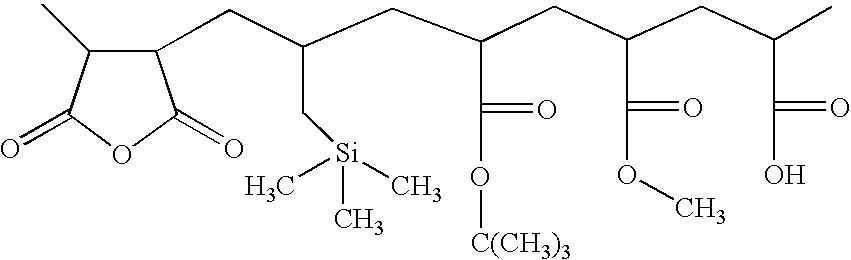
- Poly(Allyltrimethylsilane-Maleic Anhydride-t-butylacrylate-Methylacrylate-Acrylic Acid)
- A 250-mL round-bottom flask was oven dried at 120° C. for 3 hours prior to use. t-Butylacrylate, allyl trimethylsilane, methyl acrylate, and Vazo-67 were removed from cold storage and allowed to warm completely to room temperature. The flask was removed from the oven, cooled under a jet of nitrogen, and equipped with magnetic stirring, reflux condenser fitted with an N 2-inlet adapter, and septum inlet adapter. Allyl-trimethylsilane (40.00 g, 350 mmol), maleic anhydride (34.33 g, 350 mmol), t-butylacrylate (33.99 g, 265.2 mmol), methyl acrylate (2.74 g, 31.8 mmol), acrylic acid (4.59 g, 63.7 mmol) and anhydrous, inhibitor-free tetrahydrofuran (77.8 g, 1.08 mol) were charged to the flask under a positive flow of nitrogen. The flask was then heated to 67° C., and azobis(2-methylbutanenitrile) (0.6731 g, 3.5 mmol) dissolved in 2 mL of tetrahydrofuran were injected to the reactor via the septum inlet adapter. The reaction was allowed to proceed under a nitrogen blanket for 22 hours, and was then cooled to room temperature. The reaction mixture was diluted by addition of 70 mL of dry tetrahydrofuran, and precipitated by dropwise addition to 1400 mL of dry hexanes under a nitrogen pad. The resulting solids were collected by filtration, rinsed, and dried under vacuum. The dry solids were then redissolved in 100 mL of tetrahydrofuran and re-precipitated into 1400 mL of hexanes. The resulting solids were collected by filtration, rinsed, and dried to constant weight under high vacuum at 70° C. to yield 88 g of a white powder. The amount of acid was 4.7 mol % based on acrylic acid.
- A 250-mL round bottom flask was oven dried at 120° C. for 3 hours prior to use. t-Butylacrylate, allyl trimethylsilane, methyl acrylate, and Vazo-67 were removed from cold storage and allowed to warm completely to room temperature. The flask was removed from the oven, cooled under a jet of nitrogen, and equipped with magnetic stirring, reflux condenser fitted with an N 2-inlet adapter, and septum inlet adapter. Allyl-trimethylsilane (40.00 g, 350 mmol), maleic anhydride (34.33 g, 350 mmol), t-butylacrylate (33.99 g, 265.2 mmol), acrylic acid (6.88 g, 95.5 mmol) and anhydrous, inhibitor-free tetrahydrofuran (77.8 g, 1.08 mol) were charged to the flask under a positive flow of nitrogen. The flask was then heated to 67° C., and azobis(2-methylbutanenitrile) (0.6731 g, 3.5 mmol) dissolved in 2 mL of tetrahydrofuran were injected to the reactor via the septum inlet adapter. The reaction was allowed to proceed under a nitrogen blanket for 22 hours, and was then cooled to room temperature. The reaction mixture was diluted by addition of 70 mL of dry tetrahydrofuran, and precipitated by dropwise addition to 1400 mL of dry hexanes under a nitrogen pad. The resulting solids were collected by filtration, rinsed, and dried under vacuum. The dry solids were then redissolved in 100 mL of tetrahydrofuran and re-precipitated into 1400 mL of hexanes. The resulting solids were collected by filtration, rinsed, and dried to constant weight under high vacuum at 70° C. to yield 82 g of a white powder. The amount of acid was 8.7 mol % based on acrylic acid.
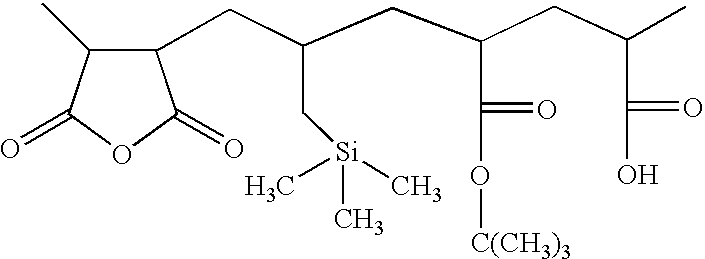
- Poly(Allyltrimethylsilane-Maleic Anhydride-t-butylacrylate-Acrylic Acid)
- A 250-mL round bottom flask was oven dried at 120° C. for 3 hours prior to use. t-Butylacrylate, allyl trimethylsilane, methyl acrylate, and Vazo-67 were removed from cold storage and allowed to warm completely to room temperature. The flask was removed from the oven, cooled under a jet of nitrogen, and equipped with magnetic stirring, reflux condenser fitted with an N 2-inlet adapter, and septum inlet adapter. Allyl-trimethylsilane (40.00 g, 350 mmol), maleic anhydride (34.33 g, 350 mmol), t-butylacrylate (38.07 g, 297 mmol), acrylic acid (4.59 g, 63.7 mmol) and anhydrous, inhibitor-free tetrahydrofuran (69 g, 951 mmol) were charged to the flask under a positive flow of nitrogen. The flask was then heated to 67° C., and azobis(2-methylbutanenitrile) (0.6731 g, 3.5 mmol) dissolved in 2 mL of tetrahydrofuran were injected to the reactor via the septum inlet adapter. The reaction was allowed to proceed under a nitrogen blanket for 22 hours, and was then cooled to room temperature. The reaction mixture was diluted by addition of 70 mL of dry tetrahydrofuran, and precipitated by dropwise addition to 1400 mL of dry hexanes under a nitrogen pad. The resulting solids were collected by filtration, rinsed, and dried under vacuum. The dry solids were then redissolved in 100 mL of tetrahydrofuran and re-precipitated into 1400 mL of hexanes. The resulting solids were collected by filtration, rinsed, and dried to constant weight under high vacuum at 70° C. to yield a white powder. The amount of acid was 5.5 mol % based on acrylic acid.
- A 250-mL round bottom flask was oven dried at 120° C. for 3 hours prior to use. t-Butylacrylate, allyl trimethylsilane, methyl acrylate, and Vazo-67 were removed from cold storage and allowed to warm completely to room temperature. The flask was removed from the oven, cooled under a jet of nitrogen, and equipped with magnetic stirring, reflux condenser fitted with an N 2-inlet adapter, and septum inlet adapter. Allyl-trimethylsilane (25.00 g, 218.8 mmol), maleic anhydride (21.46 g, 218.8 mmol), t-butylacrylate (21.24 g, 165.8 mmol), methyl acrylate (5.28 g, 59.3 mmol), and anhydrous, inhibitor-free tetrahydrofuran (64.01 g, 887 mmol) were charged to the flask under a positive flow of nitrogen. The flask was then heated to 67° C., and azobis(2-methylbutanenitrile) (0.3594 g, 2.2 mmol) dissolved in 2 mL of tetrahydrofuran were injected to the reactor via the septum inlet adapter. The reaction was allowed to proceed under a nitrogen blanket for 22 hours, and was then cooled to room temperature. The reaction mixture was diluted by addition of 50 mL of dry tetrahydrofuran, and precipitated by dropwise addition to 1400 mL of dry hexanes under a nitrogen pad. The resulting solids were collected by filtration, rinsed, and dried under vacuum. The dry solids were then redissolved in 50 mL of tetrahydrofuran and re-precipitated into 1400 mL of hexanes. The resulting solids were collected by filtration, rinsed, and dried to constant weight under high vacuum at 70° C. to yield 41 g of a white powder (85% conversion). The amount of acid was below the detection limit of <0.3 mol %.

- Poly(Allyltrimethylsilane-Maleic Anhydride-t-butylacrylate-Methylacrylate)
- The advantageous properties of the binder resins of this invention are demonstrated in the following test results.
- In a first test, solutions were made by mixing 8.1695 parts by weight of polymer from the Examples with 0.7839 parts by weight of a photoacid generator of the structure shown as PAG-1, 0.0466 parts by weight of a base of the structure shown as B-1, and 91 parts by weight of propylene glycol monomethyl ether acetate, and then filtered through 0.2 μm Teflon filters.
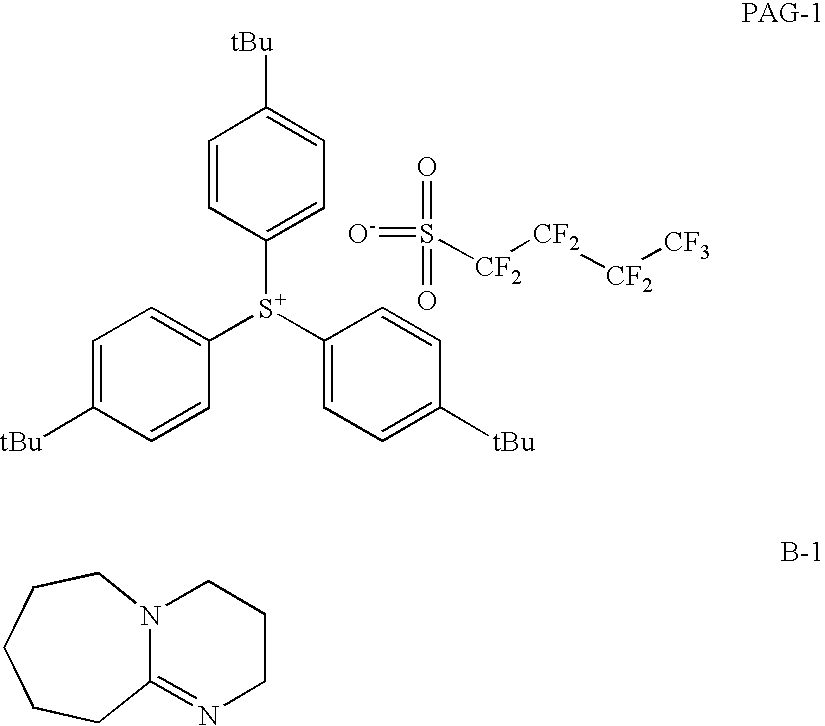
- The solutions were then spin coated onto silicon wafers which were coated with an underlayer, one of the thermally cured undercoats described in co-pending U.S. Provisional Patent Application, Serial No. 60/275,528, filed on Mar. 13, 2001, now U.S. regular application Ser. No. 10/093,079, filed Mar. 7, 20092, which are incorporated herein by reference. The wafer is coated to a thickness of 5000 Å and baked at 205° C. for 70 seconds. The photoresists were coated, and baked at 135° C. for 90 seconds to achieve a final film thickness of 2350 Å. The wafers were then exposed on a Canon EX6 (KrF, 248 nm) with numerical aperture of 0.65 annular illumination (partial coherence 0.8 outer, 0.5 inner). The wafers were post-expose baked at 125° C. for 90 seconds, and developed in a commercially available 0.262 N tetramethylammonium hydroxide developer solution (OPD-262, available from Arch Chemical Company). A measurement of contrast was made by first exposing a wafer with a number of open-frame exposures, that is, without a patterned reticle, increasing the energy dose by 1 mJ increments. The wafer was then post-exposure baked and developed, and the film thickness remaining in each exposure was measured. These film thicknesses were then normalized to the initial thickness, and plotted. The contrast is defined as the slope of the line connecting the last full-thickness dose energy to the first completely developed (i.e., 0 thickness) dose energy. In a second measurement, a wafer was exposed imagewise, printing an array of 160 nm contact holes in the film. The resulting fine patterns were then visualized on a scanning electron microscope, and the depth of focus of the contact holes were measured. Table 1 below shows the results of this screening.
TABLE 1 Lithographic results of the first test # Polymer Contrast DOF Image Quality L1-1 Example 5 16.4 0.1 nm Cusp L1-2 Example 1 9.9 0.7 nm Flattops L1-3 Example 2 6.5 0.8 nm Rounded tops - In a second test, the utility of free acid incorporation is clearly demonstrated. Comparison of L1-1 (no free acid) to L1-2 and L1-3 shows a substantial improvement in the depth of focus of the fine features. However, inspections of L1-3 shows that in the case of the higher amount of acid, contrast suffers to the point where profile quality degrades. Thus, there is unexpectedly a definite, practical upper limit to the amount of free acid which the polymer can contain.
- In a second test, solutions were made by mixing 8.1695 parts by weight of polymer from the Examples with 0.7839 parts by weight of a photoacid generator of the structure shown as PAG-1, 0.0466 parts by weight of a base of the structure shown as B-1, and 91 parts by weight of propylene glycol monomethyl ether acetate, and then filtered through 0.2 μm Teflon filters.
- The solutions were then spin coated onto silicon wafers which were coated with an underlayer, one of the thermally cured undercoats described above in U.S. Provisional Patent Application, Serial No. 60/275,528, which is coated to a thickness of 5000 Å and baked at 205° C. for 70 seconds. The photoresists were coated, and baked at 135° C. for 90 seconds to achieve a final film thickness of 2350 Å. The wafers were then exposed on a Canon EX6 (KrF, 248 nm) with numerical aperture of 0.65 annular illumination (partial coherence 0.8 outer, 0.5 inner). The wafers were post-expose baked at 125° C. for 90 seconds, and developed in a commercially available 0.262 N tetramethylammonium hydroxide developer solution (OPD-262, available from Arch Chemical Company). A measurement of contrast was made by first exposing a wafer with a number of open-frame exposures, that is, without a patterned reticle, increasing the energy dose by 1 mJ increments. The wafer was then post-exposure baked and developed, and the film thickness remaining in each exposure was measured. These film thicknesses were then normalized to the initial thickness, and plotted. The contrast is defined as the slope of the line connecting the last full-thickness dose energy to the first completely developed (i.e., 0 thickness) dose energy. In a second measurement, a wafer was exposed imagewise, printing an array of 160 nm contact holes in the film. The resulting fine patterns were then visualized on a scanning electron microscope, and the depth of focus of the contact holes were measured. Table 2 below shows the results of this screening.
TABLE 2 Lithographic results of the second test Mol % Free DOF # Polymer Acid nm Contrast L2-1 Example 5 0 0.1 15 L2-2 66.67% Example 5 + 1.83 1.0 10.9 33.33% Example 3 L2-3 75% Example 5 + 1.375 0.6 12 25% Example 3 L2-4 83.33% Example 5 + 0.917 0.5 12.7 16.67% Example 3 L2-5 91.66% Example 5 + 0.459 0.5 15 8.34% Example 3 - With the foregoing description of the invention, those skilled in the art will appreciate that modifications may be made to the invention without departing from the spirit thereof. Therefore, it is not intended that the scope of the invention be limited to the specific embodiments illustrated and described.
Claims (31)
1. A binder resin for a radiation-sensitive photoresist composition, the binder resin comprising a polymer having from about 0.1 to about 3 mol % of free acid in the polymer and said polymer having the following monomeric units:
(a) a monomeric unit of a polymerizable carboxylic anhydride;
(b) a monomeric unit of a polymerizable alkenyl silane providing a total silicon content of the polymer of from about 4 to about 15% by weight; and
(c) a monomeric unit of a polymerizable monomer containing an acid labile group, such monomeric unit yielding a base-soluble group on reaction with acid;
with the free acid content of the polymer having been provided by hydrolysis of sufficient of the carboxylic andydride monomeric unit or by the presence in the polymer of
(d) a monomeric unit of a polymerizable monomer containing a free acid group.
2. A binder resin according to claim 1 wherein the free acid content of the polymer is provided by hydrolyzing sufficient carboxylic anhydride monomeric unit.
3. A binder resin according to claim 1 wherein the free acid content of the polymer is provided by the presence in the polymer of momomeric unit (d).
4. A binder resin according to claim 1 wherein the free acid content of the polymer is from about 1.5 to about 2.5 mol %.
5. A binder resin according to claim 3 wherein monomeric unit (a) comprises from about 15 to about 50 mol % of the polymer; monomeric unit (b) comprises from about 15 to about 50 mol % of the polymer; monomeric unit (c) comprises from about 10 to about 40 mol % of the polymer; and monomeric unit (d) comprises from about 0.1 to about 3 mol % of the polymer.
6. A binder resin according to claim 5 wherein the momomeric unit of a polymerizable carboxylic anhydride is a monomeric unit selected from the group consisting of maleic anhydride and itaconic anhydride units; the monomeric unit of polymerizable alkenyl silane is a monomeric unit selected from the group consisting of allyl trimethyl silane and vinyl trimethyl silane units; the monomeric unit of a polymerizable monomer containing an acid labile group contains an acid labile group selected from the group consisting of t-buyl acrylate or methacrylate, t-amyl acrylate or methacrylate, and tetrahydropyranyl acrylate or methacrylate groups; and the monomeric unit of a polymerizable monomer containing a free acid group is a monomeric unit selected from the group consisting of acrylic or methacrylic acid, vinyl acetic acid, maleic acid and substituted maleic acid units.
7. A resin binder according to claim 5 wherein the free acid content of the polymer is from about 1.5 to about 2.5 mol %.
8. A binder resin according to claim 5 wherein the polymer additionally comprises a monomeric unit of a polymerizable monomer with a polymerizable C═C bond.
9. A binder resin according to claim 8 wherein the additional monomeric unit of the polymerizable monomer with a polymerizable C═C bond is a monomeric unit selected from the group consisting of alkyl acrylate, vinyl acetate, styrene, and hydroxystyrene units.
10. A binder resin according to claim 6 comprising monomeric units of maleic anhydride, allyl trimethyl silane, t-butyl acrylate and acrylic acid.
11. A binder resin according to claim 8 comprising monomeric units of maleic anhydride, allyl trimethyl silane, t-butyl acrylate, methylacrylate and acrylic acid.
12. A binder resin according to claim 2 wherein wherein the momomeric unit of a polymerizable carboxylic anhydride is a monomeric unit selected from the group consisting of maleic anhydride and itaconic anhydride units; the monomeric unit of polymerizable alkenyl silane is a monomeric unit selected from the group consisting of allyl trimethyl silane and vinyl trimethyl silane units; and the monomeric unit of a polymerizable monomer containing an acid labile group contains an acid labile group selected from the group consisting of t-buyl acrylate or methacrylate, t-amyl acrylate or methacrylate, and tetrahydropyranyl acrylate or methacrylate groups.
13. A radiation sensitive composition comprising:
(1) a binder resin comprising a polymer having from about 0.1 to about 3 mol % of free acid in the polymer and said polymer having the following monomeric units:
(a) a monomeric unit of a polymerizable carboxylic anhydride;
(b) a monomeric unit of a polymerizable alkenyl silane providing a total silicon content of the polymer of from about 4 to about 15% by weight; and
(c) a monomeric unit of a polymerizable monomer containing an acid labile group, such monomeric unit yielding a base-soluble group on reaction with acid;
with the free acid content of the polymer having been provided by hydrolysis of sufficient of the carboxylic andydride monomeric unit or by the presence in the polymer of
(d) a monomeric unit of a polymerizable monomer containing a free acid group;
(2) a photoacid generator compound; and
(3) a solvent capable of dissolving components (1) and (2).
14. A radiation sensitive composition according to claim 13 wherein the free acid content of the polymer is provided by having hydrolyzed sufficient carboxylic anhydride monomeric unit.
15. A radiation sensitive composition according to claim 13 wherein the free acid content of the polymer is provided by the presence in the polymer of momomeric unit (d).
16. A radiation sensitive composition according to claim 13 wherein the free acid content of the polymer is from about 1.5 to about 2.5 mol %.
17. A radiation sensitive composition according to claim 15 wherein monomeric unit (a) comprises from about 15 to about 50 mol % of the polymer; monomeric unit (b) comprises from about 15 to about 50 mol % of the polymer; monomeric unit (c) comprises from about 10 to about 40 mol % of the polymer; and monomeric unit (d) comprises from about 0.1 to about 3 mol % of the polymer.
18. A radiation sensitive composition according to claim 17 wherein the momomeric unit of a polymerizable carboxylic anhydride is a monomeric unit selected from the group consisting of maleic anhydride and itaconic anhydride units; the monomeric unit of polymerizable alkenyl silane is a monomeric unit selected from the group consisting of allyl trimethyl silane and vinyl trimethyl silane units; the monomeric unit of a polymerizable monomer containing an acid labile group contains an acid labile group selected from the group consisting of t-buyl acrylate or methacrylate, t-amyl acrylate or methacrylate, and tetrahydropyranyl acrylate or methacrylate groups; and the monomeric unit of a polymerizable monomer containing a free acid group is a monomeric unit selected from the group consisting of acrylic or methacrylic acid, vinyl acetic acid, maleic acid and substituted maleic acid units.
19. A radiation sensitive composition according to claim 17 wherein the free acid content of the polymer is from about 1.5 to about 2.5 mol %.
20. A radiation sensitive composition according to claim 17 wherein the polymer of the binder resin additionally comprises a monomeric unit of a polymerizable monomer with a polymerizable C═C bond.
21. A radiation sensitive composition according to claim 20 wherein the additional monomeric unit of the polymerizable monomer with a polymerizable C═C bond is a monomeric unit selected from the group consisting of alkyl acrylate, vinyl acetate, styrene, and hydroxystyrene units.
22. A radiation sensitive composition according to claim 18 comprising monomeric units of maleic anhydride, allyl trimethyl silane, t-butyl acrylate and acrylic acid.
23. A radiation sensitive composition according to claim 20 comprising monomeric units of maleic anhydride, allyl trimethyl silane, t-butyl acrylate, methylacrylate and acrylic acid.
24. A radiation sensitive composition according to claim 14 wherein the momomeric unit of a polymerizable carboxylic anhydride is a monomeric unit selected from the group consisting of maleic anhydride and itaconic anhydride units; the monomeric unit of polymerizable alkenyl silane is a monomeric unit selected from the group consisting of allyl trimethyl silane and vinyl trimethyl silane units; and the monomeric unit of a polymerizable monomer containing an acid labile group contains an acid labile group selected from the group consisting of t-buyl acrylate or methacrylate, t-amyl acrylate or methacrylate, and tetrahydropyranyl acrylate or methacrylate groups.
25. A radiation sensitive composition according to claim 13 wherein the photoacid generator compound is a compound selected from the group consisting of onium salts, oxime sulfonates, nitobenzyl esters of carboxylic or sulfonic acids and alkyl halides or gem-halides that release halo acids.
26. A radiation sensitive composition according to claim 25 wherein the composition additionally comprises one or more additional components selected from the group consisting of photobase generators, basic compounds for limiting diffusion lengths of photogenerated acids, crosslinking agents, dissolution inhibitors, adhesion promoters and surfactants.
27. A radiation sensitive composition according to claim 26 wherein the photoacid generator is selected from the group consisting of iodonium and sulfonium salts; and a basic compound is present in the composition and is selected from the group consisting of 2-methylimidazole, triisopropylamine, 4-dimethylaminopryidine, 4,4′-diaminodiphenyl ether, 2,4,5-triphenylimidazole, tertiarybutyl ammonium hydroxide, and 1,5-diazobicyclo[4.3.0]non-5-ene.
28. A method for producing a resist image on a substrate comprising:
a) coating the substrate with a radiation sensitive composition of claim 11;
b) imagewise exposing the photoresist composition on the substrate to actinic radiation; and
c) developing the photoresist composition with a developer to produce a resist image.
29. The method according to claim 28 wherein the actinic radiation is of a wavelength of about 248 nm or less.
30. The method according to claim 29 wherein the developer is tetramethylammonium hydroxide.
31. A method for producing a resist image on a substrate comprising:
d) coating the substrate with a radiation sensitive composition of claim 19;
e) imagewise exposing the photoresist composition on the substrate to actinic radiation; and
f) developing the photoresist composition with a developer to produce a resist image.
Priority Applications (1)
| Application Number | Priority Date | Filing Date | Title |
|---|---|---|---|
| US10/229,771 US20030064321A1 (en) | 2001-08-31 | 2002-08-28 | Free-acid containing polymers and their use in photoresists |
Applications Claiming Priority (2)
| Application Number | Priority Date | Filing Date | Title |
|---|---|---|---|
| US31633001P | 2001-08-31 | 2001-08-31 | |
| US10/229,771 US20030064321A1 (en) | 2001-08-31 | 2002-08-28 | Free-acid containing polymers and their use in photoresists |
Publications (1)
| Publication Number | Publication Date |
|---|---|
| US20030064321A1 true US20030064321A1 (en) | 2003-04-03 |
Family
ID=23228589
Family Applications (1)
| Application Number | Title | Priority Date | Filing Date |
|---|---|---|---|
| US10/229,771 Abandoned US20030064321A1 (en) | 2001-08-31 | 2002-08-28 | Free-acid containing polymers and their use in photoresists |
Country Status (3)
| Country | Link |
|---|---|
| US (1) | US20030064321A1 (en) |
| TW (1) | TW584782B (en) |
| WO (1) | WO2003021357A1 (en) |
Cited By (16)
| Publication number | Priority date | Publication date | Assignee | Title |
|---|---|---|---|---|
| US20040180554A1 (en) * | 2003-03-10 | 2004-09-16 | Shin-Etsu Chemical Co., Ltd. | Composition for forming porous film and method for forming the same, porous film and method for forming the same, interlevel insulator film, and semiconductor device |
| US20040180222A1 (en) * | 2003-03-10 | 2004-09-16 | Shin-Etsu Chemical Co., Ltd. | Composition for forming porous film, porous film and method for forming the same, interlevel insulator film, and semiconductor device |
| US20040188809A1 (en) * | 2003-03-27 | 2004-09-30 | Shin-Etsu Chemical Co., Ltd. | Composition for forming porous film, porous film and method for forming the same, interlevel insulator film and semiconductor device |
| US20040202874A1 (en) * | 2003-04-09 | 2004-10-14 | Matsushita Electric Industrial Co., Ltd. | Composition for forming porous film, porous film and method for forming the same, interlevel insulator film, and semiconductor device |
| US20040201014A1 (en) * | 2003-04-09 | 2004-10-14 | Matsushita Electric Industrial Co., Ltd. | Composition for forming porous film, porous film and method for forming the same, interlevel insulator film, and semiconductor device |
| US20040201007A1 (en) * | 2003-04-09 | 2004-10-14 | Shin-Etsu Chemical Co., Ltd. | Composition for forming porous film, porous film and method for forming the same, interlevel insulator film, and semiconductor device |
| US20040216641A1 (en) * | 2002-11-13 | 2004-11-04 | Matsushita Electric Industrial Co., Ltd. | Composition for forming porous film, porous film and method for forming the same, interlevel insulator film, and semiconductor device |
| US20040219372A1 (en) * | 2002-11-13 | 2004-11-04 | Matsushita Electric Industrial Co., Ltd. | Composition for forming porous film, porous film and method for forming the same, interlevel insulator film, and semiconductor device |
| US20040235971A1 (en) * | 2002-11-13 | 2004-11-25 | Matsushita Electric Industrial Co., Ltd. | Composition for forming porous film, porous film and method for forming the same, interlevel insulator film, and semiconductor device |
| US20040232553A1 (en) * | 2002-11-13 | 2004-11-25 | Matsushita Electric Industrial Co., Ltd. | Composition for forming porous film, porous film and method for forming the same, interlevel insulator film, and semiconductor device |
| WO2009047151A1 (en) | 2007-10-10 | 2009-04-16 | Basf Se | Sulphonium salt initiators |
| US20110117332A1 (en) * | 2009-11-02 | 2011-05-19 | Lg Chem. Ltd. | Acrylate resin, photoresist composition comprising the same, and photoresist pattern |
| WO2011104127A1 (en) | 2010-02-24 | 2011-09-01 | Basf Se | Latent acids and their use |
| JP2016048371A (en) * | 2014-08-25 | 2016-04-07 | 住友化学株式会社 | Resist composition and method for producing resist pattern |
| US9392688B2 (en) | 2014-07-07 | 2016-07-12 | Industrial Technology Research Institute | Biomass photosensitive material and method for manufacturing the same, and printed circuit board |
| WO2016124493A1 (en) | 2015-02-02 | 2016-08-11 | Basf Se | Latent acids and their use |
Families Citing this family (1)
| Publication number | Priority date | Publication date | Assignee | Title |
|---|---|---|---|---|
| JP5193321B2 (en) * | 2011-01-28 | 2013-05-08 | 富士フイルム株式会社 | Resin composition for laser engraving, relief printing plate precursor for laser engraving, relief printing plate and plate making method thereof |
Citations (14)
| Publication number | Priority date | Publication date | Assignee | Title |
|---|---|---|---|---|
| US5468589A (en) * | 1991-06-18 | 1995-11-21 | Wako Pure Chemical Industries, Ltd. | Resist material and pattern formation process |
| US5543458A (en) * | 1995-01-31 | 1996-08-06 | Shell Oil Company | Process for making graft block copolymers by growing anionic polymer chains from functionalized polyolefin backbones |
| US5558978A (en) * | 1993-12-21 | 1996-09-24 | Ocg Microelectronic Materials, Inc. | Photoresist compositions containing copolymers having acid-labile groups and recurring units derived from either N-(hydroxymethyl)maleimide or N-(acetoxymethyl)maleimide or both |
| US5580694A (en) * | 1994-06-27 | 1996-12-03 | International Business Machines Corporation | Photoresist composition with androstane and process for its use |
| US5593812A (en) * | 1995-02-17 | 1997-01-14 | International Business Machines Corporation | Photoresist having increased sensitivity and use thereof |
| US6042989A (en) * | 1995-08-08 | 2000-03-28 | Olin Microelectronic Chemicals, Inc. | Radiation sensitive compositions of terpolymers containing organosilicon side chains |
| US6054248A (en) * | 1999-03-12 | 2000-04-25 | Arch Specialty Chemicals, Inc. | Hydroxy-diisocyanate thermally cured undercoat for 193 nm lithography |
| US6110637A (en) * | 1990-12-20 | 2000-08-29 | Siemens Aktinegesellschaft | Photoresists which are suitable for producing sub-micron size structures |
| US6146793A (en) * | 1999-02-22 | 2000-11-14 | Arch Specialty Chemicals, Inc. | Radiation sensitive terpolymer, photoresist compositions thereof and 193 nm bilayer systems |
| US6165682A (en) * | 1999-09-22 | 2000-12-26 | Arch Specialty Chemicals, Inc. | Radiation sensitive copolymers, photoresist compositions thereof and deep UV bilayer systems thereof |
| US6323287B1 (en) * | 1999-03-12 | 2001-11-27 | Arch Specialty Chemicals, Inc. | Hydroxy-amino thermally cured undercoat for 193 NM lithography |
| US20020031719A1 (en) * | 2000-07-14 | 2002-03-14 | Tokyo Ohka Kogyo Co., Ltd. | Novel copolymer, photoresist composition, and process for forming resist pattern with high aspect ratio |
| US20020031720A1 (en) * | 2000-07-14 | 2002-03-14 | Tokyo Ohka Kogyo Co., Ltd. | Novel copolymer, photoresist composition , and process for forming resist pattern with high aspect ratio |
| US6479219B2 (en) * | 1998-08-18 | 2002-11-12 | 3M Innovative Properties Company | Polymers having silicon-containing acetal or ketal functional groups |
-
2002
- 2002-08-28 US US10/229,771 patent/US20030064321A1/en not_active Abandoned
- 2002-08-28 WO PCT/US2002/027440 patent/WO2003021357A1/en not_active Ceased
- 2002-08-30 TW TW091119859A patent/TW584782B/en active
Patent Citations (14)
| Publication number | Priority date | Publication date | Assignee | Title |
|---|---|---|---|---|
| US6110637A (en) * | 1990-12-20 | 2000-08-29 | Siemens Aktinegesellschaft | Photoresists which are suitable for producing sub-micron size structures |
| US5468589A (en) * | 1991-06-18 | 1995-11-21 | Wako Pure Chemical Industries, Ltd. | Resist material and pattern formation process |
| US5558978A (en) * | 1993-12-21 | 1996-09-24 | Ocg Microelectronic Materials, Inc. | Photoresist compositions containing copolymers having acid-labile groups and recurring units derived from either N-(hydroxymethyl)maleimide or N-(acetoxymethyl)maleimide or both |
| US5580694A (en) * | 1994-06-27 | 1996-12-03 | International Business Machines Corporation | Photoresist composition with androstane and process for its use |
| US5543458A (en) * | 1995-01-31 | 1996-08-06 | Shell Oil Company | Process for making graft block copolymers by growing anionic polymer chains from functionalized polyolefin backbones |
| US5593812A (en) * | 1995-02-17 | 1997-01-14 | International Business Machines Corporation | Photoresist having increased sensitivity and use thereof |
| US6042989A (en) * | 1995-08-08 | 2000-03-28 | Olin Microelectronic Chemicals, Inc. | Radiation sensitive compositions of terpolymers containing organosilicon side chains |
| US6479219B2 (en) * | 1998-08-18 | 2002-11-12 | 3M Innovative Properties Company | Polymers having silicon-containing acetal or ketal functional groups |
| US6146793A (en) * | 1999-02-22 | 2000-11-14 | Arch Specialty Chemicals, Inc. | Radiation sensitive terpolymer, photoresist compositions thereof and 193 nm bilayer systems |
| US6054248A (en) * | 1999-03-12 | 2000-04-25 | Arch Specialty Chemicals, Inc. | Hydroxy-diisocyanate thermally cured undercoat for 193 nm lithography |
| US6323287B1 (en) * | 1999-03-12 | 2001-11-27 | Arch Specialty Chemicals, Inc. | Hydroxy-amino thermally cured undercoat for 193 NM lithography |
| US6165682A (en) * | 1999-09-22 | 2000-12-26 | Arch Specialty Chemicals, Inc. | Radiation sensitive copolymers, photoresist compositions thereof and deep UV bilayer systems thereof |
| US20020031719A1 (en) * | 2000-07-14 | 2002-03-14 | Tokyo Ohka Kogyo Co., Ltd. | Novel copolymer, photoresist composition, and process for forming resist pattern with high aspect ratio |
| US20020031720A1 (en) * | 2000-07-14 | 2002-03-14 | Tokyo Ohka Kogyo Co., Ltd. | Novel copolymer, photoresist composition , and process for forming resist pattern with high aspect ratio |
Cited By (28)
| Publication number | Priority date | Publication date | Assignee | Title |
|---|---|---|---|---|
| US20040232553A1 (en) * | 2002-11-13 | 2004-11-25 | Matsushita Electric Industrial Co., Ltd. | Composition for forming porous film, porous film and method for forming the same, interlevel insulator film, and semiconductor device |
| US7341775B2 (en) | 2002-11-13 | 2008-03-11 | Matsushita Electric Industrial Co. Ltd. | Composition for forming porous film, porous film and method for forming the same, interlevel insulator film, and semiconductor device |
| US20070135565A1 (en) * | 2002-11-13 | 2007-06-14 | Matsushita Electric Industrial Co., Ltd. | Composition for forming porous film, porous film and method for forming the same, interlevel insulator film, and semiconductor device |
| US20070087124A1 (en) * | 2002-11-13 | 2007-04-19 | Matsushita Electric Industrial Co. Ltd. | Composition for forming porous film, porous film and method for forming the same, interlevel insulator film, and semiconductor device |
| US7132473B2 (en) | 2002-11-13 | 2006-11-07 | Matsushita Electric Industrial Co., Ltd. | Composition for forming porous film, porous film and method for forming the same, interlevel insulator film, and semiconductor device |
| US7126208B2 (en) * | 2002-11-13 | 2006-10-24 | Matsushita Electric Industrial Co., Ltd. | Composition for forming porous film, porous film and method for forming the same, interlevel insulator film, and semiconductor device |
| US20040216641A1 (en) * | 2002-11-13 | 2004-11-04 | Matsushita Electric Industrial Co., Ltd. | Composition for forming porous film, porous film and method for forming the same, interlevel insulator film, and semiconductor device |
| US20040219372A1 (en) * | 2002-11-13 | 2004-11-04 | Matsushita Electric Industrial Co., Ltd. | Composition for forming porous film, porous film and method for forming the same, interlevel insulator film, and semiconductor device |
| US20040235971A1 (en) * | 2002-11-13 | 2004-11-25 | Matsushita Electric Industrial Co., Ltd. | Composition for forming porous film, porous film and method for forming the same, interlevel insulator film, and semiconductor device |
| US7205338B2 (en) | 2003-03-10 | 2007-04-17 | Shin-Etsu Chemical Co., Ltd. | Composition for forming porous film, porous film and method for forming the same, interlevel insulator film, and semiconductor device |
| US20040180554A1 (en) * | 2003-03-10 | 2004-09-16 | Shin-Etsu Chemical Co., Ltd. | Composition for forming porous film and method for forming the same, porous film and method for forming the same, interlevel insulator film, and semiconductor device |
| US20040180222A1 (en) * | 2003-03-10 | 2004-09-16 | Shin-Etsu Chemical Co., Ltd. | Composition for forming porous film, porous film and method for forming the same, interlevel insulator film, and semiconductor device |
| US7239018B2 (en) | 2003-03-10 | 2007-07-03 | Shin-Etsu Chemical Co., Ltd. | Composition for forming a porous film prepared by hydrolysis and condensation of an alkoxysilane using a trialkylmethylammonium hydroxide catalyst |
| US7332446B2 (en) | 2003-03-27 | 2008-02-19 | Shin-Etsu Chemical Co., Ltd. | Composition for forming porous film, porous film and method for forming the same, interlevel insulator film and semiconductor device |
| US20040188809A1 (en) * | 2003-03-27 | 2004-09-30 | Shin-Etsu Chemical Co., Ltd. | Composition for forming porous film, porous film and method for forming the same, interlevel insulator film and semiconductor device |
| US7357961B2 (en) | 2003-04-09 | 2008-04-15 | Matsushita Electric Industrial Co., Ltd. | Composition for forming porous film, porous film and method for forming the same, interlevel insulator film, and semiconductor device |
| US20040202874A1 (en) * | 2003-04-09 | 2004-10-14 | Matsushita Electric Industrial Co., Ltd. | Composition for forming porous film, porous film and method for forming the same, interlevel insulator film, and semiconductor device |
| US20040201014A1 (en) * | 2003-04-09 | 2004-10-14 | Matsushita Electric Industrial Co., Ltd. | Composition for forming porous film, porous film and method for forming the same, interlevel insulator film, and semiconductor device |
| US7119354B2 (en) | 2003-04-09 | 2006-10-10 | Shin-Etsu Chemical Co., Ltd. | Composition for forming porous film, porous film and method for forming the same, interlevel insulator film |
| US20040201007A1 (en) * | 2003-04-09 | 2004-10-14 | Shin-Etsu Chemical Co., Ltd. | Composition for forming porous film, porous film and method for forming the same, interlevel insulator film, and semiconductor device |
| US20060289849A1 (en) * | 2003-04-09 | 2006-12-28 | Shin-Etsu Chemical Co., Ltd. | Composition for forming porous film, porous film and method for forming the same, interlevel insulator film, and semiconductor device |
| WO2009047151A1 (en) | 2007-10-10 | 2009-04-16 | Basf Se | Sulphonium salt initiators |
| US20110117332A1 (en) * | 2009-11-02 | 2011-05-19 | Lg Chem. Ltd. | Acrylate resin, photoresist composition comprising the same, and photoresist pattern |
| WO2011104127A1 (en) | 2010-02-24 | 2011-09-01 | Basf Se | Latent acids and their use |
| US9392688B2 (en) | 2014-07-07 | 2016-07-12 | Industrial Technology Research Institute | Biomass photosensitive material and method for manufacturing the same, and printed circuit board |
| JP2016048371A (en) * | 2014-08-25 | 2016-04-07 | 住友化学株式会社 | Resist composition and method for producing resist pattern |
| WO2016124493A1 (en) | 2015-02-02 | 2016-08-11 | Basf Se | Latent acids and their use |
| US9994538B2 (en) | 2015-02-02 | 2018-06-12 | Basf Se | Latent acids and their use |
Also Published As
| Publication number | Publication date |
|---|---|
| WO2003021357A1 (en) | 2003-03-13 |
| TW584782B (en) | 2004-04-21 |
Similar Documents
| Publication | Publication Date | Title |
|---|---|---|
| US6916543B2 (en) | Copolymer, photoresist compositions thereof and deep UV bilayer system thereof | |
| US6447980B1 (en) | Photoresist composition for deep UV and process thereof | |
| US7361447B2 (en) | Photoresist polymer and photoresist composition containing the same | |
| TWI453541B (en) | Positive resist composition and pattern making method using the same | |
| US6207342B1 (en) | Chemically amplified resist material and process for the formation of resist patterns | |
| US7358028B2 (en) | Chemically amplified positive photo resist composition and method for forming resist pattern | |
| US6165682A (en) | Radiation sensitive copolymers, photoresist compositions thereof and deep UV bilayer systems thereof | |
| US20030064321A1 (en) | Free-acid containing polymers and their use in photoresists | |
| JP2005517972A (en) | Positive photoimageable bottom antireflection coating | |
| US7033728B2 (en) | Photoresist composition | |
| US6830870B2 (en) | Acetal protected polymers and photoresists compositions thereof | |
| TWI402623B (en) | Photosensitive composition, compound for use in the photosensitive composition, and pattern-forming method using the photosensitive composition | |
| US7141692B2 (en) | Molecular photoresists containing nonpolymeric silsesquioxanes | |
| JP2004519734A (en) | Silicon-containing acetal protective polymer and photoresist composition thereof | |
| JP2007502895A (en) | Novel photosensitive bilayer composition | |
| JP4612672B2 (en) | Thermoset undercoat for lithographic applications | |
| JP2008239889A (en) | Resin and production method thereof, positive photosensitive composition using the same, and pattern formation method | |
| TWI396943B (en) | Positive resist composition and pattern forming method using the same | |
| US7329478B2 (en) | Chemical amplified positive photo resist composition and method for forming resist pattern | |
| US20030078354A1 (en) | Novel beta-oxo compounds and their use in photoresist | |
| JPH11352694A (en) | Resist material and method of forming resist pattern | |
| US20070031757A1 (en) | Positive photosensitive composition and method of pattern formation with the same | |
| US7022457B2 (en) | Photoresists with hydroxylated, photoacid-cleavable groups | |
| US7279265B2 (en) | Positive resist composition and pattern formation method using the same | |
| US7261994B2 (en) | Positive resist composition |
Legal Events
| Date | Code | Title | Description |
|---|---|---|---|
| AS | Assignment |
Owner name: ARCH SPECIALTY CHEMICALS, INC., CONNECTICUT Free format text: ASSIGNMENT OF ASSIGNORS INTEREST;ASSIGNORS:MALIK, SANJAY;RUSHKIN, ILYA;SPAZIANO, GREGORY;AND OTHERS;REEL/FRAME:013243/0543;SIGNING DATES FROM 20020809 TO 20020814 |
|
| STCB | Information on status: application discontinuation |
Free format text: ABANDONED -- FAILURE TO RESPOND TO AN OFFICE ACTION |