WO2000008936A1 - Herbicides for tolerant or resistant corn cultures - Google Patents
Herbicides for tolerant or resistant corn cultures Download PDFInfo
- Publication number
- WO2000008936A1 WO2000008936A1 PCT/EP1999/005796 EP9905796W WO0008936A1 WO 2000008936 A1 WO2000008936 A1 WO 2000008936A1 EP 9905796 W EP9905796 W EP 9905796W WO 0008936 A1 WO0008936 A1 WO 0008936A1
- Authority
- WO
- WIPO (PCT)
- Prior art keywords
- herbicides
- group
- plants
- maize
- compounds
- Prior art date
- Legal status (The legal status is an assumption and is not a legal conclusion. Google has not performed a legal analysis and makes no representation as to the accuracy of the status listed.)
- Ceased
Links
Classifications
-
- A—HUMAN NECESSITIES
- A01—AGRICULTURE; FORESTRY; ANIMAL HUSBANDRY; HUNTING; TRAPPING; FISHING
- A01N—PRESERVATION OF BODIES OF HUMANS OR ANIMALS OR PLANTS OR PARTS THEREOF; BIOCIDES, e.g. AS DISINFECTANTS, AS PESTICIDES OR AS HERBICIDES; PEST REPELLANTS OR ATTRACTANTS; PLANT GROWTH REGULATORS
- A01N57/00—Biocides, pest repellants or attractants, or plant growth regulators containing organic phosphorus compounds
- A01N57/18—Biocides, pest repellants or attractants, or plant growth regulators containing organic phosphorus compounds having phosphorus-to-carbon bonds
- A01N57/20—Biocides, pest repellants or attractants, or plant growth regulators containing organic phosphorus compounds having phosphorus-to-carbon bonds containing acyclic or cycloaliphatic radicals
Definitions
- herbicide combinations according to the invention further crop protection active ingredients and auxiliaries and formulation auxiliaries customary in crop protection can be used.
- Possible combination partners (B) are, for example, compounds from subgroups (B1) to (B4):
Landscapes
- Life Sciences & Earth Sciences (AREA)
- Agronomy & Crop Science (AREA)
- Pest Control & Pesticides (AREA)
- Plant Pathology (AREA)
- Health & Medical Sciences (AREA)
- Engineering & Computer Science (AREA)
- Dentistry (AREA)
- General Health & Medical Sciences (AREA)
- Wood Science & Technology (AREA)
- Zoology (AREA)
- Environmental Sciences (AREA)
- Agricultural Chemicals And Associated Chemicals (AREA)
Abstract
Description
Beschreibungdescription
Herbizide Mittel für tolerante oder resistente MaiskulturenHerbicides for tolerant or resistant maize crops
Die Erfindung liegt auf dem Gebiet der Pflanzenschutzmittel, die gegen Schadpflanzen in toleranten oder resistenten Kulturen von Mais eingesetzt werden können und als Herbizidwirkstoffe eine Kombination von zwei oder mehreren Herbiziden enthalten.The invention is in the field of crop protection agents which can be used against harmful plants in tolerant or resistant crops of maize and contain a combination of two or more herbicides as herbicide active ingredients.
Mit der Einführung von toleranten oder resistenten Maissorten und -linien, insbesondere von transgenen Maissorten und -linien, wird das herkömmliche Unkrautbekämpfungssystem um neue, per se in herkömmlichen Maissorten nichtselektive Wirkstoffe ergänzt. Die Wirkstoffe sind beispielsweise die bekannte breitwirksame Herbizide wie Glyphosate, Sulfosate, Glufosinate, Bialaphos und Imidazolinon-Herbizide [Herbizide (A)], die nunmehr in den jeweils für sie entwickelten toleranten Kulturen eingesetzt werden können. Die Wirksamkeit dieser Herbizide gegen Schadpflanzen in den toleranten Kulturen liegt auf einem hohen Niveau, hängt jedoch - ähnlich wie bei anderen Herbizidbehandlungen - von der Art des eingesetzten Herbizids, dessen Aufwandmenge, der jeweiligen Zubereitungsform, den jeweils zu bekämpfenden Schadpflanzen, den Klima- und Bodenverhältnissen, etc. ab. Ferner weisen die Herbizide Schwächen (Lücken) gegen spezielle Arten von Schadpflanzen auf. Ein weiteres Kriterium ist die Dauer der Wirkung bzw. die Abbaugeschwindigkeit des Herbizids. Zu berücksichtigen sind gegebenenfalls auch Veränderungen in der Empfindlichkeit von Schadpflanzen, die bei längerer Anwendung der Herbizide oder geographisch begrenzt auftreten können. Wirkungsverluste bei einzelnen Pflanzen lassen sich nur bedingt, wenn überhaupt, durch höhere Aufwandmengen der Herbizide ausgleichen. Außerdem besteht immer Bedarf für Methoden, die Herbizidwirkung mit geringerer Aufwandmenge an Wirkstoffen zu erreichen. Eine geringere Aufwandmenge reduziert nicht nur die für die Applikation erforderliche Menge eines Wirkstoffs, sondern reduziert in der Regel auch die Menge an nötigen Formulierungshilfsmitteln. Beides verringert den wirtschaftlichen Aufwand und verbessert die ökologische Verträglichkeit der Herbizidbehandlung. Eine Möglichkeit zur Verbesserung des Anwendungsprofils eines Herbizids kann in der Kombination des Wirkstoffs mit einem oder mehreren anderen Wirkstoffen bestehen, welche die gewünschten zusätzlichen Eigenschaften beisteuern. Allerdings treten bei der kombinierten Anwendung mehrerer Wirkstoffe nicht selten Phänomene der physikalischen und biologischen Unverträglichkeit auf, z. B. mangelnde Stabilität einer Coformulierung, Zersetzung eines Wirkstoffes bzw. Antagonismus der Wirkstoffe. Erwünscht dagegen sind Kombinationen von Wirkstoffen mit günstigem Wirkungsprofil, hoher Stabilität und möglichst synergistisch verstärkter Wirkung, welche eine Reduzierung der Aufwandmenge im Vergleich zur Einzelapplikation der zu kombinierenden Wirkstoffe erlaubt.With the introduction of tolerant or resistant maize varieties and lines, in particular of transgenic maize varieties and lines, the conventional weed control system is supplemented by new active substances which are inherently non-selective in conventional maize varieties. The active ingredients are, for example, the well-known broad-spectrum herbicides such as glyphosate, sulfosate, glufosinate, bialaphos and imidazolinone herbicides [herbicides (A)], which can now be used in the tolerant crops developed for them. The effectiveness of these herbicides against harmful plants in the tolerant crops is at a high level, but - similar to other herbicide treatments - depends on the type of herbicide used, its application rate, the particular form of preparation, the harmful plants to be controlled, the climatic and soil conditions , etc. Furthermore, the herbicides have weaknesses (gaps) against special types of harmful plants. Another criterion is the duration of action or the rate of degradation of the herbicide. If necessary, changes in the sensitivity of harmful plants that may occur with extended use of the herbicides or geographically limited must also be taken into account. Loss of activity in individual plants can only be compensated for to a limited extent, if at all, by using higher amounts of the herbicides. In addition, there is always a need for methods to achieve the herbicidal action with a lower application rate of active compounds. A lower application rate not only reduces the amount of an active ingredient required for the application, but generally also reduces the amount of formulation auxiliaries required. Both reduce the economic effort and improve the ecological compatibility of herbicide treatment. One possible way of improving the application profile of a herbicide is to combine the active ingredient with one or more other active ingredients which contribute the desired additional properties. However, phenomena of physical and biological incompatibility often occur with the combined use of several active ingredients, e.g. B. lack of stability of a co-formulation, decomposition of an active ingredient or antagonism of the active ingredients. On the other hand, combinations of active ingredients with a favorable activity profile, high stability and, as far as possible, synergistically enhanced action are desired, which allow a reduction in the application rate compared to the individual application of the active ingredients to be combined.
Überraschenderweise wurde nun gefunden, daß Wirkstoffe aus der Gruppe der genannten breitwirksamen Herbizide (A) in Kombination mit anderen Herbiziden aus der Gruppe (A) und gegebenenfalls bestimmten Herbiziden (B) in besonders günstiger Weise zusammenwirken, wenn sie in den Maiskulturen eingesetzt werden, die für die selektive Anwendung der erstgenannten Herbizide geeignet sind.Surprisingly, it has now been found that active ingredients from the group of the broadly active herbicides (A) mentioned in combination with other herbicides from group (A) and, if appropriate, certain herbicides (B) interact in a particularly favorable manner when they are used in the maize crops which are suitable for the selective application of the former herbicides.
Gegenstand der Erfindung ist somit die Verwendung von Herbizid-Kombinationen zur Bekämpfung von Schadpflanzen in Maiskulturen, dadurch gekennzeichnet, daß die jeweilige Herbizid-Kombination einen synergistisch wirksamen Gehalt an (A) einem breitwirksamen Herbizid aus der Gruppe der Verbindungen, welche aus (A1 ) Verbindungen der Formeln (A1 ),The invention thus relates to the use of herbicide combinations for combating harmful plants in maize crops, characterized in that the respective herbicide combination has a synergistically active content of (A) a broadly active herbicide from the group of the compounds which are composed of (A1) compounds of the formulas (A1),

worin Z einen Rest der Formel -OH oder einen Peptidrest der Formel -NHCH(CH3)CONHCH(CH3)COOH oder -NHCH(CH3)CONHCH[CH2CH(CH3)2]COOH bedeutet, und deren Estern und Salzen, vorzugsweise Glufosinate und dessen Salzen mit Säuren und Basen, insbesondere Glufosinate-ammonium, L-Glufosinate oder dessen Salzen, Bialaphos und dessen Salzen mit Säuren und Basen und anderen Phosphinothricin-derivaten, (A2) Verbindungen der Formel (A2) und deren Estern und Salzen,wherein Z is a radical of the formula -OH or a peptide radical of the formula -NHCH (CH 3 ) CONHCH (CH 3 ) COOH or -NHCH (CH 3 ) CONHCH [CH 2 CH (CH 3 ) 2 ] COOH, and their Esters and salts, preferably glufosinates and their salts with acids and bases, in particular glufosinate-ammonium, L-glufosinates or their salts, bialaphos and its salts with acids and bases and other phosphinothricin derivatives, (A2) compounds of the formula (A2) and their esters and salts,
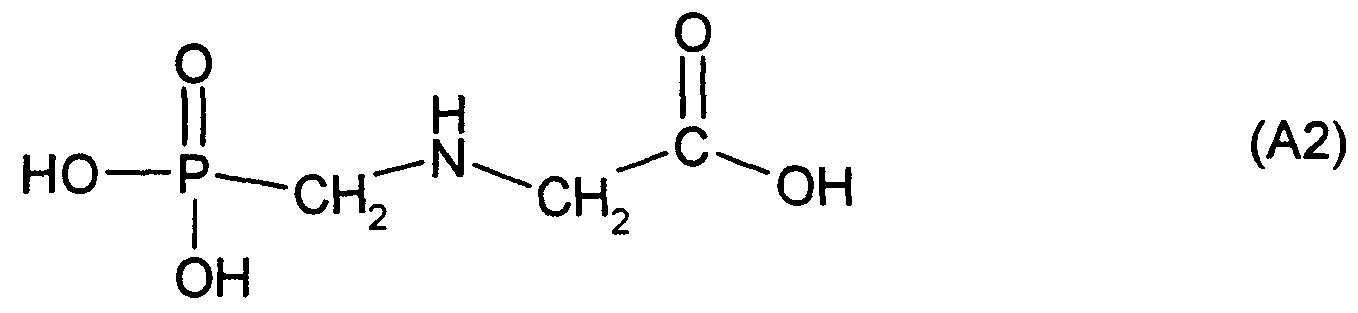
vorzugsweise Glyphosate und dessen Alkalimetallsalzen oder Salzen mit Aminen, insbesondere Glyphosate-isopropylammonium, undpreferably glyphosate and its alkali metal salts or salts with amines, in particular glyphosate isopropylammonium, and
Sulfosate, (A3) Imidazolinonen, vorzugsweise Imazethapyr, Imazapyr,Sulfosates, (A3) imidazolinones, preferably imazethapyr, imazapyr,
Imazamethabenz, Imazamethabenz-methyl, Imazaquin, Imazamox,Imazamethabenz, imazamethabenz-methyl, imazaquin, imazamox,
Imazapic (AC 263,222) und deren Salzen und (A4) herbiziden Azolen aus der Gruppe der Hemmstoffe derImazapic (AC 263.222) and its salts and (A4) herbicidal azoles from the group of inhibitors of
Protoporphyrinogen-oxidase (PPO-Hemmstoffe) wie WC9717 (=Protoporphyrinogen oxidase (PPO inhibitors) such as WC9717 (=
CGA276854), (A5) Cyclohexandion-Herbiziden und gegebenenfalls auch (A6) Heteroaryloxyphenoxypropionsäure-Herbiziden besteht, undCGA276854), (A5) cyclohexanedione herbicides and optionally also (A6) heteroaryloxyphenoxypropionic acid herbicides, and
(B) einem oder mehreren Herbiziden aus der Gruppe der Verbindungen, welche aus (BO) einem oder mehreren strukturell anderen Herbiziden aus der genannten(B) one or more herbicides from the group of the compounds consisting of (BO) one or more structurally different herbicides from the said
Gruppe (A) und/oder (B1 ) gegen monokotyle und dikotyle Schadpflanzen wirksamen Herbiziden mit Blatt- und Bodenwirkung und/oder (B2) selektiv in Mais gegen Dikotyle einsetzbaren Herbiziden und/oder (B3) Herbiziden, die blattwirksam und bodenwirksam sind und selektiv inGroup (A) and / or (B1) herbicides which act against monocotyledonous and dicotyledonous harmful plants and have a leaf and soil action and / or (B2) herbicides which can be used selectively in maize against dicotyledonous plants and / or (B3) herbicides which are active on the leaves and on the soil and are selective in
Mais überwiegend gegen dikotyle Schadpflanzen eingesetzt werden können, besteht, aufweist und die Maiskulturen gegenüber den in der Kombination enthaltenen Herbiziden (A) und (B), gegebenenfalls in Gegenwart von Safenern, tolerant sind.Corn is mainly used against dicotyledonous harmful plants can, exists, has and the maize crops are tolerant of the herbicides (A) and (B) contained in the combination, optionally in the presence of safeners.
Mit "strukturell anderen Herbiziden aus der genannten Gruppe (A)" kommen in der Gruppe (BO) nur Herbizide in Frage, die von der Definition der Gruppe (A) umfaßt sind, jedoch in der jeweiligen Kombination nicht als Komponente (A) enthalten sind.With "structurally different herbicides from the group (A) mentioned" in group (BO) only herbicides come into question which are included in the definition of group (A) but are not contained as component (A) in the respective combination .
Neben den erfindungsgemäßen Herbizid-Kombinationen können weitere Pflanzenschutzmittelwirkstoffe und im Pflanzenschutz übliche Hilfsstoffe und Formulierungshilfsmittel verwendet werden.In addition to the herbicide combinations according to the invention, further crop protection active ingredients and auxiliaries and formulation auxiliaries customary in crop protection can be used.
Die synergistischen Wirkungen werden bei gemeinsamer Ausbringung der Wirkstoffe (A) und (B) beobachtet, können jedoch auch bei zeitlich getrennter Anwendung (Splitting) festgestellt werden. Möglich ist auch die Anwendung der Herbizide oder der Herbizid-Kombinationen in mehreren Portionen (Sequenzanwendung), z. B. nach Anwendungen im Vorauflauf, gefolgt von Nachauflauf-Applikationen oder nach frühen Nachauflaufanwendungen, gefolgt von Applikationen im mittleren oder späten Nachauflauf. Bevorzugt ist dabei die simultane Anwendung der Wirkstoffe der jeweiligen Kombination, gegebenenfalls in mehreren Portionen. Aber auch die zeitversetzte Anwendung der Einzeiwirkstoffe einer Kombination ist möglich und kann im Einzelfall vorteilhaft sein. In diese Systemanwendung können auch andere Pflanzenschutzmittel wie Fungizide, Insektizide, Akarizide etc. und/oder verschiedene Hilfsstoffe, Adjuvantien und/oder Düngergaben integriert werden.The synergistic effects are observed when the active ingredients (A) and (B) are applied together, but can also be found when used separately (splitting). It is also possible to use the herbicides or the herbicide combinations in several portions (sequence application), for. B. after pre-emergence applications, followed by post-emergence applications, or after early post-emergence applications, followed by applications in the middle or late post-emergence. Preference is given to the simultaneous use of the active compounds of the particular combination, if appropriate in several portions. However, the delayed use of the single active ingredients of a combination is also possible and can be advantageous in individual cases. Other crop protection agents such as fungicides, insecticides, acaricides etc. and / or various auxiliaries, adjuvants and / or fertilizers can also be integrated into this system application.
Die synergistischen Effekte erlauben eine Reduktion der Aufwandmengen der Einzelwirkstoffe, eine höhere Wirkungsstärke gegenüber derselben Schadpfianzenart bei gleicher Aufwandmenge, die Kontrolle bislang nicht erfasster Arten (Lücken), eine Ausdehnung des Anwendungszeitraums und/oder eine Reduzierung der Anzahl notwendiger Einzelanwendungen und - als Resultat für den Anwender - ökonomisch und ökologisch vorteilhaftere Unkrautbekämpfungssysteme. Bespielsweise werden durch die erfindungsgemäßen Kombinationen aus (A)+(B) synergistische Wirkungssteigerungen möglich, die weit und in unerwarteter Weise über die Wirkungen hinausgehen, die mit den Einzelwirkstoffen (A) und (B) erreicht werden.The synergistic effects allow a reduction in the application rates of the individual active ingredients, a higher potency compared to the same harmful plant species with the same application rate, the control of previously unrecognized species (gaps), an extension of the application period and / or a reduction in the number of individual applications required and - as a result for the Users - economically and ecologically more advantageous weed control systems. For example, the combinations of (A) + (B) according to the invention enable synergistic increases in activity which go far and unexpectedly beyond the effects which are achieved with the individual active compounds (A) and (B).
In WO-A-98/09525 ist bereits ein Verfahren zur Bekämpfung von Unkräutern in transgenen Kulturen beschrieben, welche gegenüber phosphorhaltigen Herbiziden wie Glufosinate oder Glyphosate resistent sind, wobei Herbizid-Kombinationen eingesetzt werden, welche Glufosinate oder Glyphosate und mindestens ein Herbizid aus der Gruppe Prosulfuron, Primisulfuron, Dicamba, Pyridate, Dimethenamid,WO-A-98/09525 already describes a method for controlling weeds in transgenic crops which are resistant to phosphorus-containing herbicides such as glufosinates or glyphosates, herbicide combinations being used, which glufosinates or glyphosates and at least one herbicide from the group Prosulfuron, primisulfuron, dicamba, pyridate, dimethenamid,
Metolachlor, Flumeturon, Propaquizafop, Atrazin, Clodinafop, Norflurazone, Ametryn,Metolachlor, flumeturon, propaquizafop, atrazine, clodinafop, norflurazone, ametryn,
Terbutylazin, Simazin, Prometryn, NOA-402989 (3-Phenyi-4-hydroxy-6- chlorpyridazin), eine Verbindung der Formel,Terbutylazin, Simazin, Prometryn, NOA-402989 (3-phenyi-4-hydroxy-6-chloropyridazine), a compound of the formula

Aus DE-A-2856260 sind bereits einige Herbizid-Kombinationen mit Glufosinate oder L-Glufosinate und anderen Herbiziden wie Alloxidim, Linuron, MCPA, 2,4-D, Dicamba, Triciopyr, 2,4,5-T, MCPB und anderen bekannt.From DE-A-2856260 some herbicide combinations with glufosinate or L-glufosinate and other herbicides such as alloxidim, linuron, MCPA, 2,4-D, dicamba, triciopyr, 2,4,5-T, MCPB and others are already known .
Aus WO-A-92/083 53 und EP-A 0 252 237 sind bereits einige Herbizid- Kombinationen mit Glufosinate oder Glyphosate und anderen Herbiziden aus der Sulfonylhamstoffreihe wie Metsulfuron-methyl, Nicosulfuron, Primisulfuron, Rimsulfuron u.a. bekannt.From WO-A-92/083 53 and EP-A 0 252 237 some herbicide combinations with glufosinate or glyphosate and other herbicides are already from the Sulfonyl urea series such as metsulfuron-methyl, nicosulfuron, primisulfuron, rimsulfuron and others are known.
Die Anwendung der Kombinationen zur Bekämpfung von Schadpflanzen ist in den Druckschriften nur an wenigen Pflanzenspezies oder aber an keinem Beispiel gezeigt worden.The use of the combinations for controlling harmful plants has been shown in the publications only on a few plant species or on no example.
In eigenen Versuchen wurde gefunden, daß überraschenderweise große Unterschiede zwischen der Verwendbarkeit der in WO-A-98/09525 und den anderen Referenzen erwähnten Herbizid-Kombinationen und auch anderer neuartiger Herbizid-Kombinationen in Pflanzenkulturen bestehen.In our own experiments, it was found that, surprisingly, there are large differences between the usability of the herbicide combinations mentioned in WO-A-98/09525 and the other references and also other novel herbicide combinations in plant crops.
Erfindungsgemäß werden Herbizid-Kombinationen bereitgestellt, die in toleranten Maiskulturen besonders günstig eingesetzt werden können.According to the invention, herbicide combinations are provided which can be used particularly advantageously in tolerant maize crops.
Die Verbindungen der Formel (A1 ) bis (A5) sind bekannt oder können analog bekannten Verfahren hergestellt werden.The compounds of the formulas (A1) to (A5) are known or can be prepared analogously to known processes.
Die Formel (A1 ) umfaßt alle Stereoisomeren und deren Gemische, insbesondere das Racemat und das jeweils biologisch wirksame Enantiomere, z. B. L-Glufosinate und dessen Salze. Beispiele für Wirkstoffe der Formel (A1 ) sind folgende:The formula (A1) includes all stereoisomers and their mixtures, in particular the racemate and the respective biologically active enantiomer, for. B. L-glufosinate and its salts. Examples of active substances of the formula (A1) are as follows:
(A1.1) Glufosinate im engeren Sinne, d. h. D,L-2-Amino-4-(A1.1) Glufosinate in the narrower sense, i.e. H. D, L-2-amino-4-
[hydroxy(methyl)phosphinyl]-butansäure, (A1.2) Glufosinate-monoammoniumsalz,[hydroxy (methyl) phosphinyl] butanoic acid, (A1.2) glufosinate monoammonium salt,
(A1.3) L-Glufosinate, L- oder (2S)-2-Amino-4-[hydroxy(methyl)phosphinyl]- butansäure (= Phosphinothricin), (A1.4) L-Glufosinate-monoammoniumsalz,(A1.3) L-glufosinate, L- or (2S) -2-amino-4- [hydroxy (methyl) phosphinyl] butanoic acid (= phosphinothricin), (A1.4) L-glufosinate monoammonium salt,
(A1.5) Bialaphos (oder Bilanafos), d.h. L-2-Amino-4-(A1.5) Bialaphos (or Bilanafos), i.e. L-2-amino-4-
[hydroxy(methyl)phosphinyl]-butanoyl-L-alanyl-L-alanin, insbesondere dessen Natriumsalz. Die genannten Herbizide (A1.1 ) bis (A1.5) werden über die grünen Teile der Pflanzen aufgenommen und sind als Breitspektrum-Herbizide oder Totalherbizide bekannt; sie sind Hemmstoffe des Enzyms Glutaminsynthetase in Pflanzen; siehe 'The Pesticide Manual" 11th Edition, British Crop Protection Council 1997, S. 643-645 bzw. 120-121. Während ein Einsatzgebiet im Nachauflauf-Verfahren zur Bekämpfung von Unkräutern und Ungräsem in Plantagen-Kulturen und auf Nichtkulturland sowie mittels spezieller Applikationstechniken auch zur Zwischenreihenbekämpfung in landwirtschaftlichen Flächenkulturen wie Mais, Baumwolle u.a. besteht, nimmt die Bedeutung der Verwendung als selektive Herbizide in resistenten transgenen Pflanzenkulturen zu.[hydroxy (methyl) phosphinyl] butanoyl-L-alanyl-L-alanine, especially its sodium salt. The herbicides (A1.1) to (A1.5) mentioned are taken up via the green parts of the plants and are known as broad-spectrum herbicides or total herbicides; they are inhibitors of the enzyme glutamine synthetase in plants; see 'The Pesticide Manual' 11th Edition, British Crop Protection Council 1997, pp. 643-645 and 120-121. During an area of application in the post-emergence process for combating weeds and weeds in plantation crops and on non-crop land as well as by means of special application techniques There is also increasing importance for use as selective herbicides in resistant transgenic crops for combating inter-row crops in agricultural crops such as maize, cotton and others.
Glufosinate wird üblicherweise in Form eines Salzes, vorzugsweise des Ammoniumsalzes eingesetzt. Das Racemat von Glufosinate bzw. Glufosinate- ammonium wird alleine üblicherweise in Dosierungen ausgebracht, die zwischen 200 und 2000 g AS/ha (= g a.i./ha = Gramm Aktivsubstanz pro Hektar) liegen. Glufosinate ist in diesen Dosierungen vor allem dann wirksam, wenn es über grüne Pflanzenteile aufgenommen wird. Da es im Boden mikrobiell innerhalb weniger Tage abgebaut wird, hat es keine Dauerwirkung im Boden. Ähnliches gilt auch für den verwandten Wirkstoff Biaiaphos-Natrium (auch Bilanafos-Natrium); siehe 'The Pesticide Manual" 11th Ed., British Crop Protection Council 1997 S. 120-121. In den erfindungsgemäßen Kombinationen benötigt man in der Regel deutlich weniger Wirkstoff (A1), beispielsweise eine Aufwandmenge im Bereich von 20 bis 800, vorzugsweise 20 bis 600 Gramm Aktivsubstanz Glufosinate pro Hektar (g AS/ha oder g a.i./ha). Entsprechende Mengen, vorzugsweise in Mol pro Hektar umgerechnete Mengen, gelten auch für Glufosinate-ammonium und Bialafos bzw. Bialafos-Natrium.Glufosinate is usually used in the form of a salt, preferably the ammonium salt. The racemate of glufosinate or glufosinate ammonium is usually applied alone in doses which are between 200 and 2000 g ai / ha (= g ai / ha = grams of active ingredient per hectare). In these doses, glufosinate is particularly effective when it is absorbed through green parts of plants. Since it degrades microbially in the soil within a few days, it has no permanent effect in the soil. The same applies to the related active ingredient biaiaphos sodium (also bilanafos sodium); see 'The Pesticide Manual' 11th Ed., British Crop Protection Council 1997 pp. 120-121. In the combinations according to the invention, generally less active substance (A1) is required, for example an application rate in the range from 20 to 800, preferably 20 to 600 grams of active ingredient glufosinate per hectare (g AS / ha or g ai / ha) Corresponding amounts, preferably amounts converted into moles per hectare, also apply to glufosinate ammonium and bialafos or bialafos sodium.
Die Kombinationen mit den blattwirksamen Herbiziden (A1 ) werden zweckmäßig in Maiskulturen eingesetzt, die gegenüber den Verbindungen (A1 ) resistent oder tolerant sind. Einige tolerante Maiskulturen, die gentechnisch erzeugt wurden, sind bereits bekannt und werden in der Praxis eingesetzt; vgl. Artikel in der Zeitschrift "Zuckerrübe" 47. Jahrgang (1998), S. 217 ff.; zur Herstellung transgener Pflanzen, die gegen Glufosinate resistent sind, vgl. EP-A-0242246, EP-A-242236, EP-A- 257542, EP-A-275957, EP-A-0513054).The combinations with the leaf-active herbicides (A1) are expediently used in maize crops which are resistant or tolerant to the compounds (A1). Some tolerant maize crops that have been genetically engineered are already known and are used in practice; see. Article in the magazine "Zuckerrübe" 47th year (1998), p. 217 ff .; for the production of transgenic plants which are resistant to glufosinates, cf. EP-A-0242246, EP-A-242236, EP-A- 257542, EP-A-275957, EP-A-0513054).
Beispiele für Verbindungen (A2) sind (A2.1 ) Glyphosate, d. h. N-(Phosphonomethyl)-giycin,Examples of compounds (A2) are (A2.1) glyphosates, i.e. H. N- (phosphonomethyl) glycine,
(A2.2) Glyphosate-monoisopropylammoniumsalz,(A2.2) glyphosate monoisopropylammonium salt,
(A2.3) Glyphosate-natriumsalz,(A2.3) glyphosate sodium salt,
(A2.4) Sulfosate, d. h. N-(Phosphonomethyl)-glycin-trimesiumsalz = N-(A2.4) sulfosates, i.e. H. N- (phosphonomethyl) glycine trimesium salt = N-
(Phosphonomethyl)-glycin-trimethylsulfoxoniumsalz,(Phosphonomethyl) glycine trimethylsulfoxonium salt,
Glyphosate wird üblicherweise in Form eines Salzes, vorzugsweise des Monoisopropylammoniumsalzes oder des Trimethylsulfoxoniumsalzes (=Trimesiumsalzes = Sulfosate) eingesetzt. Bezogen auf die freie Säure Glyphosate liegt die Einzeldosierung im Bereich von 0,5-5 kg AS/ha. Glyphosate ist unter manchen anwendungstechnischen Aspekten dem Glufosinate ähnlich, jedoch ist es im Gegensatz dazu ein Hemmstoff für des Enzyms 5-Enolpyruvylshikimat-3- phosphat-Syntase in Pflanzen; siehe "The Pesticide Manual" 11th Ed., British Crop Protection Council 1997 S. 646-649. In den erfindungsgemäßen Kombinationen benötigt man in der Regel Aufwandmengen im Bereich von 20 bis 1000, vorzugsweise 20 bis 800 g AS/ha Glyphosate.Glyphosate is usually used in the form of a salt, preferably the monoisopropylammonium salt or the trimethylsulfoxonium salt (= trimesium salt = sulfosate). Based on the free acid glyphosate, the single dose is in the range of 0.5-5 kg ai / ha. Glyphosate is similar to glufosinate in some applications, but in contrast it is an inhibitor of the enzyme 5-enolpyruvylshikimate-3-phosphate syntase in plants; see "The Pesticide Manual" 11th Ed., British Crop Protection Council 1997 pp. 646-649. In the combinations according to the invention, application rates in the range from 20 to 1000, preferably 20 to 800, g / ha glyphosate are generally required.
Auch für Verbindungen (A2) sind bereits gentechnisch erzeugte tolerante Pflanzen bekannt und in der Praxis eingeführt worden; vgl. "Zuckerrübe" 47. Jahrgang (1998), S. 217 ff.; vgl. auch WO 92/00377, EP-A-115673, EP-A-409815.Genetically engineered tolerant plants are also known for compounds (A2) and have been put into practice; see. "Sugarbeet" 47th year (1998), p. 217 ff .; see. also WO 92/00377, EP-A-115673, EP-A-409815.
Beispiele für Imidazolinon-Herbizide (A3) sindExamples of imidazolinone herbicides (A3) are
(A3.1 ) Imazapyr und dessen Salze und Ester,(A3.1) imazapyr and its salts and esters,
(A3.2) Imazethapyr und dessen Salze und Ester,(A3.2) imazethapyr and its salts and esters,
(A3.3) Imazamethabenz und dessen Salze und Ester,(A3.3) imazamethabenz and its salts and esters,
(A3.4) Imazamethabenz-methyl,(A3.4) imazamethabenz-methyl,
(A3.5) Imazamox und dessen Salze und Ester,(A3.5) imazamox and its salts and esters,
(A3.6) Imazaquin und dessen Salze und Ester, z. B. das Ammoniumsalz,(A3.6) Imazaquin and its salts and esters, e.g. B. the ammonium salt,
(A3.7) Imazapic (AC 263,222) und dessen Salze und Ester, z. B. das Ammoniumsalz,(A3.7) Imazapic (AC 263.222) and its salts and esters, e.g. B. that Ammonium salt,
Die Herbizide hemmen das Enzym Acetolactatsynthase (ALS) und damit die Proteinsynthese in Pflanzen; sie sind sowohl boden- als auch blattwirksam und weisen teilweise Selektivitäten in Kulturen auf; vgl. "The Pesticide Manual" 11th Ed., British Crop Protection Council 1997 S. 697-699 zu (A3.1), S. 701-703 zu (A3.2), S. 694-696 zu (A3.3) und (A3.4), S. 696-697 zu (A3.5), S. 699-701 zu (A3.6) und S. 5 und 6, referiert unter AC 263,222 (zu A3.7). Die Aufwandmengen der Herbizide sind üblicherweise zwischen 0,001 und 2 kg AS/ha. In den erfindungsgemäßen Kombinationen liegen sie im Bereich von 10 bis 200 g AS/ha. Die Kombinationen mit Imidazolinonen werden zweckmäßig in Maiskulturen eingesetzt, die gegenüber den Imidazolinonen resistent sind. Derartige tolerante Kulturen sind bereits bekannt. EP-A-0360750 beschreibt z.B. die Herstellung von ALS-inhibitor-toleranten Pflanzen durch Selektionsverfahren oder gentechnische Verfahren. Die Herbizid-Toleranz der Pflanzen wird hierbei durch einen erhöhten ALS-Gehalt in den Pflanzen erzeugt. US-A-5, 198,599 beschreibt sulfonylhamstoff- und imidazolinon-tolerante Pflanzen, die durch Selektionsverfahren gewonnen wurden.The herbicides inhibit the enzyme acetolactate synthase (ALS) and thus protein synthesis in plants; they have both soil and leaf activity and some have selectivities in crops; see. "The Pesticide Manual" 11th Ed., British Crop Protection Council 1997 pp. 697-699 to (A3.1), pp. 701-703 to (A3.2), pp. 694-696 to (A3.3) and (A3.4), pp. 696-697 to (A3.5), pp. 699-701 to (A3.6) and pp. 5 and 6, referenced under AC 263.222 (to A3.7). The application rates of the herbicides are usually between 0.001 and 2 kg of AS / ha. In the combinations according to the invention they are in the range from 10 to 200 g ai / ha. The combinations with imidazolinones are expediently used in maize crops which are resistant to the imidazolinones. Such tolerant cultures are already known. EP-A-0360750 describes e.g. the production of ALS inhibitor-tolerant plants by selection processes or genetic engineering processes. The herbicide tolerance of the plants is generated by an increased ALS content in the plants. US Pat. No. 5,198,599 describes sulfonylurea- and imidazolinone-tolerant plants which have been obtained by selection processes.
Beispiele für PPO-Hemmstoffe (A4) sind:Examples of PPO inhibitors (A4) are:
(A4.1 ) Pyraflufen und dessen Ester wie Pyraflufen-ethyl,(A4.1) pyraflufen and its esters such as pyraflufen-ethyl,
(A4.2) Carfentrazone und dessen Ester wie Carfentrazone-ethyl,(A4.2) Carfentrazone and its esters such as Carfentrazone-ethyl,
(A4.3) Oxadiargyl(A4.3) Oxadiargyl
(A4.4) Sulfentrazone(A4.4) Sulfentrazone
(A4.5) WC9717 oder CGA276854 = 2-Chlor-5-(3-methyl-2,6-dioxo-4- trifluormethyl-3,6-dihydro-2H-pyrimidin-1 -yl)-benzoesäure-1 - allyloxycarbonyl-1 -methylethyl-ester (bekannt aus US-A-5183492)(A4.5) WC9717 or CGA276854 = 2-chloro-5- (3-methyl-2,6-dioxo-4-trifluoromethyl-3,6-dihydro-2H-pyrimidin-1-yl) -benzoic acid-1-allyloxycarbonyl -1-methylethyl ester (known from US-A-5183492)
Die genannten Azole sind bekannt als Hemmstoffe des Enzyms Protoporphyrinogenoxidase (PPO) in Pflanzen; siehe "The Pesticide Manual" 11th Ed., British Crop Protection Council 1997 S. 1048-1049 zu (A4.1 ), S. 191 -193 zu (A4.2), S. 904-905 zu (A4.3) und S. 1126-1127 zu (A4.4). Tolerante Pflanzenkulturen sind bereits beschrieben. Die Aufwandmengen der Azole sind in der Regel imThe azoles mentioned are known as inhibitors of the enzyme protoporphyrinogen oxidase (PPO) in plants; see "The Pesticide Manual" 11th Ed., British Crop Protection Council 1997 pp. 1048-1049 to (A4.1), pp. 191 -193 to (A4.2), pp. 904-905 to (A4.3) and pp. 1126-1127 on (A4.4). Tolerant crops are already described. The application rates of the azoles are usually in the
Bereich von 5 bis 200 g AS/ha.Range from 5 to 200 g ai / ha.
Einige gegenüber PPO-Hemmern tolerante Pflanzen sind bereits bekannt.Some plants that are tolerant of PPO inhibitors are already known.
Beispiele für Cyclohexandion-Herbizide (A5) sind:Examples of cyclohexanedione herbicides (A5) are:
(A5.1 ) Sethoxydim ("The Pesticide Manual" 11th Ed., British Crop Protection(A5.1) Sethoxydim ("The Pesticide Manual" 11th Ed., British Crop Protection
Council 1997 (im folgenden "PM", S. 1101-1103), d. h.Council 1997 (hereinafter "PM", pp. 1101-1103), d. H.
(E,Z)-2-(1-Ethoxyiminobutyl)-5-[2-(ethylthio)-propyl]-3-hydroxy- cyclohex-2-enon, (A5.2) Cycloxydim (PM, S. 290-291 ), d. h.(E, Z) -2- (1-ethoxyiminobutyl) -5- [2- (ethylthio) propyl] -3-hydroxycyclohex-2-enone, (A5.2) cycloxydim (PM, pp. 290-291 ), d. H.
2-(1-Ethoxyiminobutyl)-3-hydroxy-5-thian-3-ylcyclohex-2-enon, (A5.3) Clethodim (PM, S. 250-251), d. h.2- (1-ethoxyiminobutyl) -3-hydroxy-5-thian-3-ylcyclohex-2-enone, (A5.3) clethodim (PM, pp. 250-251), i.e. H.
2-{(E)1-[(E)-3-Chlorallyloxyimino]-propyl}-5-[-2(ethylthio)-propyl]-3- hydroxy-cyclohex-2-enon. (A5.4) Xlefoxidim" oder "BAS 625 H" (siehe AG Chem New Compound2 - {(E) 1 - [(E) -3-chloroallyloxyimino] propyl} -5 - [- 2 (ethylthio) propyl] -3-hydroxy-cyclohex-2-enone. (A5.4) Xlefoxidim "or" BAS 625 H "(see AG Chem New Compound
Review, Vol. 17, 1999, S. 26, herausgegeben von AGRANOVA) (= 2-[1-Review, Vol. 17, 1999, p. 26, published by AGRANOVA) (= 2- [1-
2-(4-Chlorphenoxy)-propoxyimino)-butyl]-3-oxo-5-thion-3-yl-cyclohex-1- enol), (A5.5) Tralkoxidim (PM, S. 1211-1212), d.h. 2-[1-(Ethoxyimino)propyl]-3- hydroxy-5-mesitylcyclohex-2-enon.2- (4-chlorophenoxy) propoxyimino) butyl] -3-oxo-5-thion-3-yl-cyclohex-1-enol), (A5.5) tralkoxidim (PM, p. 1211-1212), i.e. 2- [1- (ethoxyimino) propyl] -3-hydroxy-5-mesitylcyclohex-2-enone.
Die Herbizide hemmen die Mitosis und damit die Fettsäuresynthese in Pflanzen; sie sind besonders blattwirksam und weisen teilweise Selektivitäten in Kulturen auf. Die Aufwandmengen der Herbizide sind üblicherweise zwischen 0,2 und 1 kg AS/ha. In den erfindungsgemäßen Kombinationen liegen sie im Bereich von 10 bis 1000 g AS/ha. Die Kombinationen mit Cyclohexandionen werden zweckmäßig in Maiskulturen eingesetzt, die gegenüber den Cyclohexandionen resistent sind. Derartige tolerante Kulturen sind bereits bekannt.The herbicides inhibit mitosis and thus fatty acid synthesis in plants; they are particularly effective on leaves and some have selectivities in crops. The application rates of the herbicides are usually between 0.2 and 1 kg of AS / ha. In the combinations according to the invention they are in the range from 10 to 1000 g ai / ha. The combinations with cyclohexanediones are expediently used in maize crops which are resistant to the cyclohexanedione. Such tolerant cultures are already known.
Beispiele für Heteroarylphenoxyphenoxypropionsäure-herbizide (A6) sind: (A6.1 ) "Fenoxaprop-P" und dessen Ester wie der Ethylester "Fenoxaprop-P- ethyl" (siehe PM, S. 519-520) (= (R)-2-[4-(6-Chlor-benzoxyzolyl-2- yloxy)-phenoxy]-propionsäure bzw. -ethylester), auch in der Anwendungsform des Razemats "Feπoxaprop" und dessen Ester wie der Ethylester, und/oderExamples of heteroarylphenoxyphenoxypropionic acid herbicides (A6) are: (A6.1) "Fenoxaprop-P" and its esters such as the ethyl ester "Fenoxaprop-P-ethyl" (see PM, pp. 519-520) (= (R) -2 - [4- (6-chloro-benzoxyzolyl-2- yloxy) -phenoxy] -propionic acid or ethyl ester), also in the use form of the racemate "Feπoxaprop" and its esters such as the ethyl ester, and / or
(A6.2) "Quizalofop-P" und dessen Ester wie der Ethyl- oder Tefurylester (siehe(A6.2) "Quizalofop-P" and its esters such as the ethyl or Tefurylester (see
PM, S. 1089-1092) (= (R)-2-[4-(6-Chlor-quinoxalin-2-yloxy)-phenoxy]- propionsäure bzw. -ethylester bzw. -tetrahydrofurfurylester), auch in der Form des Razemats "Quizalofop" und dessen Ester; vgl. auch als speziellen Ester "Propaquizafop" (Verbindung A6.3), und/oderPM, p. 1089-1092) (= (R) -2- [4- (6-chloro-quinoxalin-2-yloxy) phenoxy] propionic acid or ethyl ester or tetrahydrofurfurylester), also in the form of Razemat's "Quizalofop" and its esters; see. also as a special ester "propaquizafop" (compound A6.3), and / or
(A6.3) "Propaquizafop" (PM, S. 1021-1022), der 2-lsopropylidenaminooxy- ethylester von Quizalofop-P und/oder(A6.3) "Propaquizafop" (PM, pp. 1021-1022), the 2-isopropylidene aminooxy ethyl ester of Quizalofop-P and / or
(A6.4) "Fluazifop-P" und dessen Ester wie der Butylester (siehe PM, S. 556-(A6.4) "Fluazifop-P" and its esters such as the butyl ester (see PM, p. 556-
557) (= (R)-2-[4-(5-Trifluormethyl-pyrid-2-yloxy)-phenoxy]-propionsäure bzw. -butylester), auch in der Anwendungsform des Razemats "Fluazifop" und dessen Ester, und/oder557) (= (R) -2- [4- (5-trifluoromethyl-pyrid-2-yloxy) phenoxy] propionic acid or butyl ester), also in the use form of the racemate "fluazifop" and its ester, and / or
(A6.5) Ηaloxyfop-P" und dessen Ester wie der Methylester (siehe PM, S. 660-(A6.5) Ηaloxyfop-P "and its esters such as the methyl ester (see PM, p. 660-
663) (= (R)-2-[4-(3-Chlor-5-trifluormethyl-pyrid-2-yloxy)-phenoxy]- propionsäure bzw. -methylester), auch in der Anwendungsform des Razemats "Haloxyfop" und dessen Ester wie der Methyl- oder der Etotylester und/oder663) (= (R) -2- [4- (3-chloro-5-trifluoromethyl-pyrid-2-yloxy) phenoxy] propionic acid or methyl ester), also in the use form of the racemate "Haloxyfop" and its Esters such as the methyl or etotyl ester and / or
(A6.6) "Cyhalofop" und dessen Ester wie der Butylester (PM, S. 297-298)(A6.6) "Cyhalofop" and its esters such as the butyl ester (PM, pp. 297-298)
(= (R)-2-[4-(4-Cyano-2-fluor-phenoxy)-phenoxy]-propionsäure bzw. -butylester und/oder(= (R) -2- [4- (4-cyano-2-fluorophenoxy) phenoxy] propionic acid or butyl ester and / or
(A6.7) "Clodinafop" und dessen Ester wie der Propargylester (PM, s. 251-252)(A6.7) "Clodinafop" and its esters such as the propargyl ester (PM, see 251-252)
(= (R)-2-[4-(5-Chlor-3-fluor-pyrid-2-yloxy)-phenoxy]-propionsäure bzw. -propargylester).(= (R) -2- [4- (5-chloro-3-fluoropyrid-2-yloxy) phenoxy] propionic acid or propargyl ester).
Die Herbizide (A6) sind als Hemmstoffe der Fettsäurebiosynthese bekannt und werden üblicherweise in Aufwandmengen von 5 - 500 g AS/ha eingesetzt. In den erfindungsgemäßen Kombinationen kann die Aufwandmenge teilweise noch niedriger sein, beispielsweise 1 bis 300 g AS/ha. Die Kombinationen mit den Herbiziden (A6) werden zweckmäßig in Maiskulturen eingesetzt, die gegenüber den Herbiziden tolerant sind; dies ist z.B. praktisch auch in solchen Kulturen der Fall, die gegenüber Cyclohexandion-Herbiziden (A5) tolerant sind.The herbicides (A6) are known as inhibitors of fatty acid biosynthesis and are usually used in amounts of 5 to 500 g ai / ha. In the combinations according to the invention, the application rate can in some cases be even lower, for example 1 to 300 g ai / ha. The combinations with the herbicides (A6) are expediently used in maize crops which are tolerant of the herbicides; this is practically the case, for example, in cultures that are opposite Cyclohexanedione herbicides (A5) are tolerant.
Als Kombinationspartner (B) kommen beispielsweise Verbindungen der Untergruppen (B1 ) bis (B4) in Frage:Possible combination partners (B) are, for example, compounds from subgroups (B1) to (B4):
(B1 ) Herbizide, die sowohl blattwirksam als auch bodenwirksam sind und selektiv in Mais gegen Gräser und Dikotyle eingesetzt werden können, beispielsweise die folgenden Verbindungen (Angabe mit dem "common name" und der Referenzstelle aus "The Pesticide Manual" 11 th Ed., British Crop Protection Council 1997, abgekürzt "PM"): (B1.1 ) Cyanazine (PM, S. 280-283), d. h. 2-(4-Chlor-6-ethylamino-1 ,3,5- triazin-2-ylamino)-2-methyl-propionsäurenitril, (B1.2) Atrazin (PM, S. 55-57), d. h. N-Ethyl-N'-isopropyl-6-chlor-2,4- diamino-1 ,3,5-triazin, (B1.3) Terbuthylazin (PM, S. 1168-1170), d. h. N-Ethyl-N'-tert.-butyl-6- chlor-2,4-diamino-1 ,3,5-triazin, (B1.4) Acetochlor (PM, S. 10-12), d. h. 2-Chlor-N-(ethoxymethyl)-N-(2- ethyl-6-methylphenyl)-acetamid, (B1.5) Metolachlor (PM, S. 833-834), d. h. 2-Chlor-N-(2-ethyl-6- methylphenyl)-N-(2-methoxy-1-methylethyl)-acetamid, (B1.6) Alachlor (PM, S. 23-24), d. h. 2-Chlor-N-(2,6-diethylphenyl)-N-(B1) Herbicides which have both leaf activity and soil activity and can be used selectively in maize against grasses and dicotyledons, for example the following compounds (indication with the "common name" and the reference point from "The Pesticide Manual" 11th Ed., British Crop Protection Council 1997, abbreviated "PM"): (B1.1) Cyanazine (PM, pp. 280-283), d. H. 2- (4-chloro-6-ethylamino-1, 3,5-triazin-2-ylamino) -2-methyl-propiononitrile, (B1.2) atrazine (PM, pp. 55-57), i.e. H. N-ethyl-N'-isopropyl-6-chloro-2,4-diamino-1, 3,5-triazine, (B1.3) terbuthylazine (PM, p. 1168-1170), i.e. H. N-ethyl-N'-tert-butyl-6-chloro-2,4-diamino-1, 3,5-triazine, (B1.4) acetochlor (PM, p. 10-12), i.e. H. 2-chloro-N- (ethoxymethyl) -N- (2-ethyl-6-methylphenyl) acetamide, (B1.5) metolachlor (PM, pp. 833-834), i.e. H. 2-chloro-N- (2-ethyl-6-methylphenyl) -N- (2-methoxy-1-methylethyl) -acetamide, (B1.6) alachlor (PM, pp. 23-24), i.e. H. 2-chloro-N- (2,6-diethylphenyl) -N-
(methoxymethyl)-acetamid, (B1.7) Terbutryn (PM, S. 1170-1172), d. h. N-(1 ,1-Dimethylethyl)-N'- ethyl-6-methylthio-2,4-diamino-1 ,3,5-triazin, (B1.8) Benoxacor (PM, S. 102-103), d. h. 4-Dichloracetyl-3,4-dihydro-3- methyl-2H-1 ,4-benzoxazin, (B1.9) Nicosulfuron (PM, S. 877-879), d. h. 2-(4,6-Dimethoxypyrimidin-(methoxymethyl) acetamide, (B1.7) terbutryn (PM, pp. 1170-1172), d. H. N- (1, 1-dimethylethyl) -N'-ethyl-6-methylthio-2,4-diamino-1, 3,5-triazine, (B1.8) benoxacor (PM, pp. 102-103), i.e. . H. 4-dichloroacetyl-3,4-dihydro-3-methyl-2H-1,4-benzoxazine, (B1.9) nicosulfuron (PM, pp. 877-879), i.e. H. 2- (4,6-dimethoxypyrimidine-
2-yl)-3-(3-dimethylcarbamoyl-2-pyridylsulfonyl)-harnstoff, (B1.10) Rimsulfuron (PM, S. 1095-1097), d. h. 1-(4,6-2-yl) -3- (3-dimethylcarbamoyl-2-pyridylsulfonyl) urea, (B1.10) rimsulfuron (PM, pp. 1095-1097), i.e. H. 1- (4.6-
Dimethoxypyrimidin-2-yl)-3-(3-ethylsulfonyl-2-pyridyisulfonyl)- hamstoff, (B1.11 ) Primisulfuron und Ester wie der Methyiester (PM, S. 997-999), d.h. 2-[4,6-Bis(difluormethoxy)-pyrimidin-2- ylcarbamoylsulfamoylj-benzoesäure bzw. -methylester, (B1.12) Dimethenamid (PM, S. 409-410), d. h. 2-Chlor-N-(2,4-dimethyl-3- thienyl)-N-(2-methoxy-1-methylethyl)-acetamid, (B1.13) Fluthiamide (BAY FOE 5043, Flufenacet) (PM, S. 82-83), d.h. 4'-Dimethoxypyrimidin-2-yl) -3- (3-ethylsulfonyl-2-pyridyisulfonyl) urea, (B1.11) primisulfuron and esters such as the methyl ester (PM, pp. 997-999), ie 2- [4,6-bis (difluoromethoxy) pyrimidin-2-ylcarbamoylsulfamoylj-benzoic acid or methyl ester, (B1.12) dimethenamid (PM, pp. 409-410), ie 2-chloro-N- (2nd , 4-dimethyl-3-thienyl) -N- (2-methoxy-1-methylethyl) -acetamide, (B1.13) Fluthiamide (BAY FOE 5043, Flufenacet) (PM, pp. 82-83), ie 4 ' -
Fluor-N-isopropyl-2-(5-trifluormethyl-1 ,3,4-thiadiazol-2-yloxy)- acetanilid, (B1.14) Sulcotrione (PM, S. 1124-1125), d. h. 2-(2-Chlor-4- mesylbenzoyl)-cyclohexan-1 ,3-dion, (B1.15) Simazin (PM, S. 1106-1108), d. h. 6-Chlor-N,N'-diethyl-2,4- diamino-1 ,3,5-triazin, (B1.16) Mesotrione, d. h. 2,(4-Mesyl-2-nitrobenzoyl)-cyclohexan-1 ,3-dionFluoro-N-isopropyl-2- (5-trifluoromethyl-1, 3,4-thiadiazol-2-yloxy) acetanilide, (B1.14) sulcotrione (PM, p. 1124-1125), i.e. H. 2- (2-chloro-4-mesylbenzoyl) cyclohexane-1,3-dione, (B1.15) simazine (PM, pp. 1106-1108), i.e. H. 6-chloro-N, N'-diethyl-2,4-diamino-1, 3,5-triazine, (B1.16) mesotrione, i.e. H. 2, (4-Mesyl-2-nitrobenzoyl) cyclohexane-1,3-dione
(ZA1296, vgl. Weed Science Society of America (WSSA) in(ZA1296, see Weed Science Society of America (WSSA) in
WSSA Abstracts 1999, Bd. 39, Seite 65-66, Ziffern 130-132), (B1.17) Penthoxamid, d.h. 2-Chlor-N-(2-ethoxyethyl)-N-(2-methyl-1- phenyl-1-propenyl)-acetamid (TKC-94, bekannt aus AG ChemWSSA Abstracts 1999, vol. 39, pages 65-66, paragraphs 130-132), (B1.17) penthoxamide, i.e. 2-chloro-N- (2-ethoxyethyl) -N- (2-methyl-1-phenyl-1-propenyl) acetamide (TKC-94, known from AG Chem
New Compound, Review Vol. 17 (1999), EP-A-206251 ), und, falls Wirkstoffe aus der Gruppe (B1 ) als racemische Gemische vorliegen, vorzugsweise auch der jeweilige Wirkstoff in der Form des reinen oder angereicherten wirksamen Isomers,New Compound, Review Vol. 17 (1999), EP-A-206251), and, if active substances from group (B1) are present as racemic mixtures, preferably also the respective active substance in the form of the pure or enriched active isomer,
(B2) selektiv in Mais gegen Dikotyle einsetzbare Herbizide, beispielsweise die Verbindungen (B2.1) Pendimethalin (PM, S. 937-939), d. h. N-(1-ethylpropyl)-2,6- dinitro-3,4-xylidin, (B2.2) Pyridate (PM, S. 1064-1066), d. h. Thiokohlensäure-O-(6-Chlor-(B2) herbicides which can be used selectively in maize against dicotyledons, for example the compounds (B2.1) pendimethalin (PM, pp. 937-939), d. H. N- (1-ethylpropyl) -2,6-dinitro-3,4-xylidine, (B2.2) pyridates (PM, pp. 1064-1066), i.e. H. Thiocarbonic acid-O- (6-chloro
3-phenyl-pyridazin-4-yl)-S-(octyl)-diester, (B2.3) lodosulfuron (proposed common name) und vorzugsweise der3-phenyl-pyridazin-4-yl) -S- (octyl) diester, (B2.3) iodosulfuron (proposed common name) and preferably the
Methylester (vgl. WO 96/41537), d. h. 4-lod-2-(4-Methoxy-6- methyl-1 ,3,5-triazin-2-ylcarbamoylsulfamoyl)-benzoesäure bzw.Methyl ester (cf. WO 96/41537), d. H. 4-iodo-2- (4-methoxy-6-methyl-1, 3,5-triazin-2-ylcarbamoylsulfamoyl) benzoic acid or
-methylester, bekannt aus WO-A-92/13845, (B2.4) Metosulam (PM, S. 836-495), d. h. 2',6'-Dichlor-5,7-dimethoxy-3'-
methyl-[1 ,2,4]triazolo[1 ,5a]pyrimidin-2-sulfonanilid, (B2.5) Isoxaflutole (PM, S. 737-739), d. h. (5-Cyclopropyl-4- isoxazolyl)[2-(methylsulfonyl)-4-(trifluormethyl)phenyl]methanon, (B2.6) Metribuzin (PM, S. 4-Amino-6-tert.-butyl-3-methylthio-1 ,2,4- triazin-5(4H)-on, (B2.7) Cloransulam und vorzugsweise der Methylester (PM, S. 165), d.h. 3-Chlor-2-(5-ethoxy-7-fluor-[1 ,2,4]triazolo-[1 ,5-c]pyrimidin-2- ylsulfonamido)benzoesäure oder -methylester, (B2.8) Flumetsulam (PM, S. 573-574), d. h.

[1 ,2,4]triazolo[1 ,5a]pyrimidin-2-sulfonanilid und (B2.9) Linuron (PM, S. 751-753), d. h. 3-(3,4-Dichlorphenyl)-1-methoxy-[1, 2.4] triazolo [1, 5a] pyrimidine-2-sulfonanilide and (B2.9) linuron (PM, pp. 751-753), i.e. H. 3- (3,4-dichlorophenyl) -1-methoxy-
1 -methyl-hamstoff und (B2.10) Florasulam, d.h. N-(2,6-Difluorphenyl)-8-fluor-5-methoxy-1 ,2,4- triazolo[1 ,5C]-pyrimidin-2-sulfonamid1-methyl urea and (B2.10) florasulam, i.e. N- (2,6-difluorophenyl) -8-fluoro-5-methoxy-1, 2,4-triazolo [1,5C] pyrimidine-2-sulfonamide
(DE-570, vgl. Zeitschrift Pfl. Krankh. PflSchutz, Sonderblatt XVI,(DE-570, see journal Pfl. Krankh. PflSchutz, special sheet XVI,
527-534 81998), (B2.11) Isoxachlortole, d.h.527-534 81998), (B2.11) isoxachlorotole, i.e.
(4-Chlor-2-(methylsulfonyl)-phenyl)-(5-cyclopropyl-4-isoxazolyl)- keton, EP-A-470856) und, falls genannte Wirkstoffe aus der Gruppe (B2) als racemische Gemische vorliegen, vorzugsweise auch der jeweilige Wirkstoff in der Form des reinen oder angereicherten wirksamen Isomers,(4-Chloro-2- (methylsulfonyl) phenyl) - (5-cyclopropyl-4-isoxazolyl) ketone, EP-A-470856) and, if the active compounds from group (B2) are present as racemic mixtures, preferably also the respective active ingredient in the form of the pure or enriched active isomer,
(B3) Herbizide, die blattwirksam und bodenwirksam sind und selektiv in Mais überwiegend gegen dicotyle Schadpflanzen eingesetzt werden können, beispielsweise die Verbindungen: (B3.1) Bromoxynil (PM, S. 149-151 ), d. h. 3,5-Dibrom-4-hydroxy- benzonitril, (B3.2) Dicamba (PM, S. 356-357), d. h. 3,6-Dichlor-o-anissäure und deren Salze, (B3.3) 2,4-D (PM, S. 323-327), d. h. 2,4-Dichlorphenoxyessigsäure und deren Salze und Ester, (B3.4) Clopyralid (PM, S. 260-263), d. h. 3,6-Dichlor-2- pyridincarbonsäure und deren Salze und Ester,(B3) Herbicides which have a leaf and soil effect and can be used selectively in maize mainly against dicotyledonous harmful plants, for example the compounds: (B3.1) bromoxynil (PM, pp. 149-151), ie 3,5-dibromo-4 -hydroxy-benzonitrile, (B3.2) dicamba (PM, pp. 356-357), ie 3,6-dichloro-o-anisic acid and its salts, (B3.3) 2,4-D (PM, p. 323-327), ie 2,4-dichlorophenoxyacetic acid and its salts and esters, (B3.4) clopyralide (PM, pp. 260-263), ie 3,6-dichloro-2-pyridinecarboxylic acid and its salts and esters,
(B3.5) Prosulfuron (PM, S. 1041-1043), d. h. 1 -(4-Methoxy-6-methyl-(B3.5) prosulfuron (PM, pp. 1041-1043), d. H. 1 - (4-methoxy-6-methyl-
1 ,3,5-triazin-2-yl)-3-[2-(3,3,3-trifluorpropyl)-phenylsulfonyl]- harnstoff,1, 3,5-triazin-2-yl) -3- [2- (3,3,3-trifluoropropyl) phenylsulfonyl] urea,
(B3.6) Thifensulfuron und dessen Ester, vorzugsweise der Methylester(B3.6) Thifensulfuron and its esters, preferably the methyl ester
(PM, S. 1188-1190), d. h. 3-[[[[(4-Methoxy-6-methyl-1 ,3,5-triazin- 2-yl)-amino]-carbonyl]-amino]sulfonyl]-2-thiophencarbonsäure bzw. -methylester,(PM, pp. 1188-1190), d. H. 3 - [[[[(4-methoxy-6-methyl-1, 3,5-triazin-2-yl) amino] carbonyl] amino] sulfonyl] -2-thiophenecarboxylic acid or methyl ester,
(B3.7) Carfentrazone und deren Salze und Ester, vorzugsweise der(B3.7) Carfentrazone and its salts and esters, preferably the
Ethylester (PM, S. 191-193), d. h. 2-Chlor-3-[2-chlor-5- (difluormethyl-4,5-dihydro-3-methyl-5-oxo-1 H-1 ,2,4-triazol-1 -yl)- 4-fluorphenyl]-propionsäure bzw. -ethylester, wobei Kombinationen mit Verbindung (A4.2) definitionsgemäß keine Herbizid-Kombinationen unterschiedlicher Herbizidwirkstoffe A und B darstellen und somit ausgenommen sind,Ethyl ester (PM, pp. 191-193), d. H. 2-chloro-3- [2-chloro-5- (difluoromethyl-4,5-dihydro-3-methyl-5-oxo-1 H-1, 2,4-triazol-1-yl) -4-fluorophenyl] propionic acid or ethyl ester, whereby combinations with compound (A4.2) are by definition no herbicide combinations of different herbicide active ingredients A and B and are therefore excluded,
(B3.8) Lab271272 (= Tritosulfuron, CAS Reg. Nr. 142469-14-5; siehe(B3.8) Lab271272 (= tritosulfuron, CAS Reg.No. 142469-14-5; see
AG Chem New Compound Review, Vol. 17, 1999, S. 24, herausgegeben von AGRANOVA)), d.h. N-[[[4-Methoxy-6- (trifluormethyl)-1 ,3,5-thazin-2-yl)-amino]-carbonyl]-2- (trifluormethyl)benzolsulfonamid), undAG Chem New Compound Review, Vol. 17, 1999, p. 24, edited by AGRANOVA)), i.e. N - [[[4-methoxy-6- (trifluoromethyl) -1, 3,5-thazin-2-yl) amino] carbonyl] -2- (trifluoromethyl) benzenesulfonamide), and
(B3.9) MCPA (PM, S. 767-769), d.h. (4-Chlor-2- methylphenoxy)essigsäure, und dessen Salze und Ester,(B3.9) MCPA (PM, pp. 767-769), i.e. (4-chloro-2-methylphenoxy) acetic acid, and its salts and esters,
(B3.10) Halosulfuron und dessen Ester, wie der Methylester (PM, S. 657-(B3.10) Halosulfuron and its esters, such as the methyl ester (PM, p. 657-
659), d.h. 3-Chlor-5-(4,6-dimethoxypyrimidin-2- ylcarbamoylsulfamoyl)-1-methylpyrazol-carbonsäuremethylester, auch in dessen Salzform,659), i.e. 3-chloro-5- (4,6-dimethoxypyrimidin-2-ylcarbamoylsulfamoyl) -1-methylpyrazole-carboxylic acid methyl ester, also in its salt form,
(B3.11 ) Diflufenzopyr (BASF 654 00 H)(B3.11) diflufenzopyr (BASF 654 00 H)
(PM, S. 81-82), d.h. 2-{1-[4-(3,5-Difluorphenyl)semicarbazon]- ethyljnicotinsäure, und dessen Salze,(PM, pp. 81-82), i.e. 2- {1- [4- (3,5-difluorophenyl) semicarbazone] ethyljnicotinic acid, and its salts,
(B3.12) Sulfosulfuron (PM, S. 1130-1131 ), d.h. 1-(4,6- Dimethoxypyrimidin-2-yl)-3-(2-ethylsulfonyiimidazo[1 ,2-a]-pyridin-(B3.12) Sulfosulfuron (PM, pp. 1130-1131), ie 1- (4,6- Dimethoxypyrimidin-2-yl) -3- (2-ethylsulfonyiimidazo [1, 2-a] pyridine-
3-yl-sulfonyl)-harnstoff und, falls genannte Wirkstoffe aus der Gruppe (B3) als racemische Gemische vorliegen, vorzugsweise auch der jeweilige Wirkstoff in der Form des reinen oder angereicherten wirksamen Isomers.3-yl-sulfonyl) urea and, if the said active substances from group (B3) are present as racemic mixtures, preferably also the respective active substance in the form of the pure or enriched active isomer.
Im Falle von Wirkstoffen auf Basis von Carbonsäuren oder anderen salz- oder esterbildenden Wirkstoffen soll die Bezeichnung der Herbizide durch den "common name" der Säure auch die Salze und Ester erfassen, vorzugsweise die handelsüblichen Salze und Ester, insbesondere die gängige Handelsform des Wirkstoffes.In the case of active ingredients based on carboxylic acids or other salt- or ester-forming active ingredients, the name of the herbicides by the "common name" of the acid should also include the salts and esters, preferably the commercially available salts and esters, in particular the common commercial form of the active ingredient.
Die Aufwandmengen der Herbizide (B) können von Herbizid zu Herbizid stark variieren. Als grobe Richtgröße können folgende Bereiche gelten:The application rates of the herbicides (B) can vary widely from herbicide to herbicide. The following areas can serve as a rough guide:
Zu Verbindungen (BO): 1 -3000 g AS/ha, vorzugsweise 5-2000 g AS/ha (vgl. dieFor compounds (BO): 1-3000 g ai / ha, preferably 5-2000 g ai / ha (cf. the
Angaben zur Gruppe der Verbindungen (A), Zu Verbindungen (B1): 0,1-5000 g AS/ha, vorzugsweise 1-5000 g AS/ha, Zu Verbindungen (B2): 0, 1 -5000 g AS/ha, vorzugsweise 1 -3000 g AS/ha Zu Verbindungen (B3): 0,5-5000 g AS/ha, vorzugsweise 1-3000 g AS/haInformation about the group of compounds (A), About compounds (B1): 0.1-5000 g AS / ha, preferably 1-5000 g AS / ha, About compounds (B2): 0.1 -5000 g AS / ha, preferably 1-3000 g ai / ha For compounds (B3): 0.5-5000 g ai / ha, preferably 1-3000 g ai / ha
Im einzelnen sind folgende Aufwandmengen in g AS/ha bevorzugt:The following application rates in g AS / ha are preferred:
(B1.1 ) bis (B1.8) 100-5000 g, vorzugsweise 200-4000, insbesondere 300-3500,(B1.1) to (B1.8) 100-5000 g, preferably 200-4000, in particular 300-3500,
(B1.9) bis (B1.11 ) 0,1 - 120, vorzugsweise 1-90,(B1.9) to (B1.11) 0.1-120, preferably 1-90,
(B1.12) 50-5000, vorzugsweise 100-4000, insbesondere 300-3500,(B1.12) 50-5000, preferably 100-4000, in particular 300-3500,
(B1.13) 100-2000, vorzugsweise 200-1500, insbesondere 300-1200,(B1.13) 100-2000, preferably 200-1500, in particular 300-1200,
(B1.14) 50-1000, vorzugsweise 100-600, insbesondere 200-500,(B1.14) 50-1000, preferably 100-600, in particular 200-500,
(B1.15) 100-5000, vorzugsweise 200-4000, insbesondere 300-3500,(B1.15) 100-5000, preferably 200-4000, in particular 300-3500,
(B1.16) 10-500, vorzugsweise 25-300, insbesondere 50-200,(B1.16) 10-500, preferably 25-300, in particular 50-200,
(B1.17) 5-1500, vorzugsweise 10-1000, insbesondere 20-800,(B1.17) 5-1500, preferably 10-1000, in particular 20-800,
(B2.1 ) 100-3000, vorzugsweise 200-2500, insbesondere 300-2000,(B2.1) 100-3000, preferably 200-2500, in particular 300-2000,
(B2.2) 100-2500, vorzugsweise 200-2000, insbesondere 300-1500, (B2.3) 0, 1 -100, vorzugsweise 0,2-20, insbesondere 0,5-15,(B2.2) 100-2500, preferably 200-2000, in particular 300-1500, (B2.3) 0.1, 100, preferably 0.2-20, in particular 0.5-15,
(B2.4) 1-200, vorzugsweise 5-150, insbesondere 10-100,(B2.4) 1-200, preferably 5-150, in particular 10-100,
(B2.5) 5-300, vorzugsweise 10-200, insbesondere 20-150,(B2.5) 5-300, preferably 10-200, in particular 20-150,
(B2.6) 10-1500, vorzugsweise 25-1000, insbesondere 50-800,(B2.6) 10-1500, preferably 25-1000, in particular 50-800,
(B2.7) 2-200, vorzugsweise 2,5-100, insbesondere 5-80,(B2.7) 2-200, preferably 2.5-100, in particular 5-80,
(B2.8) 5-500, vorzugsweise 10-300, insbesondere 20-200,(B2.8) 5-500, preferably 10-300, in particular 20-200,
(B2.9) 50-2500, vorzugsweise 100-2000, insbesondere 200-1000,(B2.9) 50-2500, preferably 100-2000, in particular 200-1000,
(B2.10) 0,5-100, vorzugsweise 1-20, insbesondere 3-15,(B2.10) 0.5-100, preferably 1-20, in particular 3-15,
(B2.11 ) 5-300, vorzugsweise 10-200, insbesondere 20-150,(B2.11) 5-300, preferably 10-200, in particular 20-150,
(B3.1 ) 50-1000, vorzugsweise 100-600, insbesondere 200-500,(B3.1) 50-1000, preferably 100-600, in particular 200-500,
(B3.2) 5-2500, vorzugsweise 10-2000, insbesondere 200-1500,(B3.2) 5-2500, preferably 10-2000, in particular 200-1500,
(B3.3) 50-3000, vorzugsweise 100-2000, insbesondere 200-1500,(B3.3) 50-3000, preferably 100-2000, in particular 200-1500,
(B3.4) 10-300, vorzugsweise 20-250, insbesondere 40-200,(B3.4) 10-300, preferably 20-250, in particular 40-200,
(B3.5) 1-100, vorzugsweise 2-70, insbesondere 5-50,(B3.5) 1-100, preferably 2-70, in particular 5-50,
(B3.6) 0,5-100, vorzugsweise 1-50, insbesondere 2-40,(B3.6) 0.5-100, preferably 1-50, in particular 2-40,
(B3.7) 1-250, vorzugsweise 5-120, insbesondere 10-100,(B3.7) 1-250, preferably 5-120, in particular 10-100,
(B3.8) 1-200, vorzugsweise 5-150, insbesondere 10-120,(B3.8) 1-200, preferably 5-150, in particular 10-120,
(B3.9) 50-3000, vorzugsweise 100-2000, insbesondere 200-1500,(B3.9) 50-3000, preferably 100-2000, in particular 200-1500,
(B3.10) 1-200, vorzugsweise 5-150, insbesondere 10-50,(B3.10) 1-200, preferably 5-150, in particular 10-50,
(B3.11 ) 5-1000, vorzugsweise 10-500, insbesondere 20-80,(B3.11) 5-1000, preferably 10-500, in particular 20-80,
(B3.12) 1-150, vorzugsweise 5-100, insbesondere 5-80,(B3.12) 1-150, preferably 5-100, in particular 5-80,
Die Mengenverhältnisse der Verbindungen (A) und (B) ergeben sich aus den genannten Aufwandmengen für die Einzelstoffe und sind beispielsweise folgende Mengenverhältnisse von besonderem Interesse:The quantitative ratios of the compounds (A) and (B) result from the application rates mentioned for the individual substances and are, for example, the following quantitative ratios of particular interest:
(A):(B) im Bereich von 18000:1 bis 1 :5000, vorzugsweise 2000:1 bis 1 :1000, insbesondere 200:1 bis 1 :100, (A):(B0) im Bereich von 1000:1 bis 1 :400, vorzugsweise von 400:1 bis 1 :400, insbesondere 200:1 bis 1 :200, (A1 ):(B1 ) im Bereich von 1500:1 bis 1 :300, vorzugsweise von 400:1 bis 1 :250, insbesondere von 200:1 bis 1 :100, (A1):(B2) im Bereich von 10000:1 bis 1:300, vorzugsweise von 1500:1 bis 1:250, insbesondere von 1000:1 bis 1:100, ganz besonders 200:1 bis 1:100, (A1):(B3) im Bereich von 2000:1 bis 1:300, vorzugsweise von 1500:1 bis 1:250, insbesondere von 200:1 bis 1:100, (A2):(B1) im Bereich von 2500:1 bis 1:100, vorzugsweise von 2000:1 bis 1:50, insbesondere von 300:1 bis 1:20, (A2):(B2) im Bereich von 18000:1 bis 1:100, vorzugsweise von 2000:1 bis 1:50, insbesondere von 300:1 bis 1:20, (A2):(B3) im Bereich von 3000:1 bis 1:100, vorzugsweise von 2000:1 bis 1:50, insbesondere von 300:1 bis 1:20, (A3):(B1) im Bereich von 1000:1 bis 1:1000, vorzugsweise von 200:1 bis 1:500, insbesondere von 100:1 bis 1:200, (A3):(B2) im Bereich von 5000:1 bis 1:1000, vorzugsweise von 800:1 bis 1:500, insbesondere von 200:1 bis 1:500, ganz besonders 100:1 bis 1:200, (A3):(B3) im Bereich von 500:1 bis 1:800, vorzugsweise von 200:1 bis 1:500, insbesondere von 100:1 bis 1:200, (A4):(B1) im Bereich von 1000:1 bis 1:5000, vorzugsweise von 200:1 bis 1:1000, insbesondere von 100:1 bis 1:250, (A4):(B2) im Bereich von 10000:1 bis 1:5000, vorzugsweise von 2000:1 bis(A) :( B) in the range from 18000: 1 to 1: 5000, preferably 2000: 1 to 1: 1000, in particular 200: 1 to 1: 100, (A) :( B0) in the range from 1000: 1 to 1: 400, preferably from 400: 1 to 1: 400, in particular 200: 1 to 1: 200, (A1) :( B1) in the range from 1500: 1 to 1: 300, preferably from 400: 1 to 1: 250 , in particular from 200: 1 to 1: 100, (A1) :( B2) in the range from 10000: 1 to 1: 300, preferably from 1500: 1 to 1: 250, in particular from 1000: 1 to 1: 100, very particularly 200: 1 to 1: 100, (A1 ) :( B3) in the range from 2000: 1 to 1: 300, preferably from 1500: 1 to 1: 250, in particular from 200: 1 to 1: 100, (A2) :( B1) in the range from 2500: 1 to 1: 100, preferably from 2000: 1 to 1:50, in particular from 300: 1 to 1:20, (A2) :( B2) in the range from 18000: 1 to 1: 100, preferably from 2000: 1 to 1: 50, in particular from 300: 1 to 1:20, (A2) :( B3) in the range from 3000: 1 to 1: 100, preferably from 2000: 1 to 1:50, in particular from 300: 1 to 1:20, (A3) :( B1) in the range from 1000: 1 to 1: 1000, preferably from 200: 1 to 1: 500, in particular from 100: 1 to 1: 200, (A3) :( B2) in the range from 5000: 1 to 1: 1000, preferably from 800: 1 to 1: 500, in particular from 200: 1 to 1: 500, very particularly 100: 1 to 1: 200, (A3) :( B3) in the range from 500: 1 to 1: 800, preferably from 200: 1 to 1: 500, in particular from 100: 1 to 1: 200, (A4) :( B1) in the range from 1000: 1 to 1: 5000, v or preferably from 200: 1 to 1: 1000, in particular from 100: 1 to 1: 250, (A4) :( B2) in the range from 10000: 1 to 1: 5000, preferably from 2000: 1 to
1:1000, insbesondere 1000:1 bis 1:400, insbesondere von 500:1 bis1: 1000, in particular 1000: 1 to 1: 400, in particular from 500: 1 to
1:250, (A4):(B3) im Bereich von 1000:1 bis 1:2000, vorzugsweise von 200:1 bis 1:1000, insbesondere von 100:1 bis 1:250, (A5):(B1) im Bereich von 1500:1 bis 1:1000, vorzugsweise von 1000:1 bis 1:500, insbesondere von 200:1 bis 1:100, (A5):(B2) im Bereich von 10000:1 bis 1:2000, vorzugsweise von 1000:1 bis 1:500, insbesondere von 200:1 bis 1:100, (A5):(B3) im Bereich von 1500:1 bis 1:1000, vorzugsweise von 1000:1 bis 1:500, insbesondere von 200:1 bis 1:100, (A6):(B1) im Bereich von 2000:1 bis 1:2000, vorzugsweise von 1000:1 bis 1:1000, insbesondere von 200:1 bis 1:200, (A6):(B2) im Bereich von 5000:1 bis 1:2000, vorzugsweise von 2000:1 bis 1:1000, insbesondere von 200:1 bis 1 :100, (A6):(B3) im Bereich von 1000:1 bis 1 :1000, vorzugsweise von 500:1 bis 1 :500, insbesondere von 100:1 bis 1 :100.1: 250, (A4) :( B3) in the range from 1000: 1 to 1: 2000, preferably from 200: 1 to 1: 1000, in particular from 100: 1 to 1: 250, (A5) :( B1) im Range from 1500: 1 to 1: 1000, preferably from 1000: 1 to 1: 500, in particular from 200: 1 to 1: 100, (A5) :( B2) in the range from 10000: 1 to 1: 2000, preferably from 1000: 1 to 1: 500, in particular from 200: 1 to 1: 100, (A5) :( B3) in the range from 1500: 1 to 1: 1000, preferably from 1000: 1 to 1: 500, in particular from 200: 1 to 1: 100, (A6) :( B1) in the range from 2000: 1 to 1: 2000, preferably from 1000: 1 to 1: 1000, in particular from 200: 1 to 1: 200, (A6) :( B2 ) in the range from 5000: 1 to 1: 2000, preferably from 2000: 1 to 1: 1000, in particular from 200: 1 to 1: 100, (A6) :( B3) in the range from 1000: 1 to 1: 1000, preferably from 500: 1 to 1: 500, in particular from 100: 1 to 1: 100.
Von besonderem Interesse ist die Anwendung der KombinationenThe use of the combinations is of particular interest
(A1.1 ) + (B1.1 ), (A1.1 ) + (B1.2), (A1.1 ) + (B1.3), (A1.1 ) + (B1.4), (A1.1 ) + (B1.5),(A1.1) + (B1.1), (A1.1) + (B1.2), (A1.1) + (B1.3), (A1.1) + (B1.4), (A1 .1) + (B1.5),
(A1.1) + (B1.6), (A1.1) + (B1.7), (A11) + (B1.8), (A1.1 ) + (B1.9), (A1.1 ) + (B1.10),(A1.1) + (B1.6), (A1.1) + (B1.7), (A11) + (B1.8), (A1.1) + (B1.9), (A1.1 ) + (B1.10),
(A1.1 ) + (B1.11 ), (A1.1 ) + (B1.12), (A1.1 ) + (B1.13), (A1.1 ) + (B1.14),(A1.1) + (B1.11), (A1.1) + (B1.12), (A1.1) + (B1.13), (A1.1) + (B1.14),
(A1.1) + (B1.15), (A1.1 ) + (B1.16), (A1.1 ) + (B.17),(A1.1) + (B1.15), (A1.1) + (B1.16), (A1.1) + (B.17),
(A1.2) + (B11), (A1.2) + (B1.2), (A1.2) + (B1.3), (A1.2) + (B1.4), (A1.2) + (B1.5),(A1.2) + (B11), (A1.2) + (B1.2), (A1.2) + (B1.3), (A1.2) + (B1.4), (A1.2 ) + (B1.5),
(A1.2) + (B1.6), (A1.2) + (B1.7), (A1.2) + (B1.8), (A1.2) + (B1.9), (A12) + (B1.10),(A1.2) + (B1.6), (A1.2) + (B1.7), (A1.2) + (B1.8), (A1.2) + (B1.9), (A12 ) + (B1.10),
(A1.2) + (B1.11 ), (A1.2) + (B1.12), (A1.2) + (B1.13), (A1.2) + (B1.14),(A1.2) + (B1.11), (A1.2) + (B1.12), (A1.2) + (B1.13), (A1.2) + (B1.14),
(A1.2) + (B.1.15), (A1.2) + (B.1.16), (A1.2) + (B1.17),(A1.2) + (B.1.15), (A1.2) + (B.1.16), (A1.2) + (B1.17),
(A1.1) + (B2.1), (A1.1 ) + (B2.2), (A1.1 ) + (B2.3), (A1.1 ) + (B2.4), (A1.1 ) + (B2.5),(A1.1) + (B2.1), (A1.1) + (B2.2), (A1.1) + (B2.3), (A1.1) + (B2.4), (A1 .1) + (B2.5),
(A1.1) + (B2.6), (A1.1) + (B2.7), (A1.1) + (B2.8), (A1.1) + (B2.9),(A1.1) + (B2.6), (A1.1) + (B2.7), (A1.1) + (B2.8), (A1.1) + (B2.9),
(A11 ) + (B2.10), (A11 ) + (B2.11),(A11) + (B2.10), (A11) + (B2.11),
(A1.2) + (B2.1 ), (A12) + (B2.2), (A1.2) + (B2.3), (A1.2) + (B2.4), (A1.2) + (B2.5),(A1.2) + (B2.1), (A12) + (B2.2), (A1.2) + (B2.3), (A1.2) + (B2.4), (A1.2 ) + (B2.5),
(A1.2) + (B2.6), (A1.2) + (B2.7), (A1.2) + (B2.8), (A1.2) + (B2.9),(A1.2) + (B2.6), (A1.2) + (B2.7), (A1.2) + (B2.8), (A1.2) + (B2.9),
(A.1.2) + (B2.10), (A1.2) + (B2.11),(A.1.2) + (B2.10), (A1.2) + (B2.11),
(A1.1 ) + (B3.1), (A1.1 ) + (B3.2), (A1.1 ) + (B3.3), (A1.1 ) + (B3.4), (A1.1 ) + (B3.5),(A1.1) + (B3.1), (A1.1) + (B3.2), (A1.1) + (B3.3), (A1.1) + (B3.4), (A1 .1) + (B3.5),
(A1.1 ) + (B3.6), (A11 ) + (B3.7), (A1.1 ) + (B3.8), (A1.1 ) + (B3.9),(A1.1) + (B3.6), (A11) + (B3.7), (A1.1) + (B3.8), (A1.1) + (B3.9),
(A1.1) + (B3.10), (A1.1) + (B3.11), (A1.1 ) + (B3.12), (A1.1) + (B3.13),(A1.1) + (B3.10), (A1.1) + (B3.11), (A1.1) + (B3.12), (A1.1) + (B3.13),
(A1.2) + (B3.1 ), (A1.2) + (B3.2), (A1.2) + (B3.3), (A1.2) + (B3.4), (A1.2) + (B3.5),(A1.2) + (B3.1), (A1.2) + (B3.2), (A1.2) + (B3.3), (A1.2) + (B3.4), (A1 .2) + (B3.5),
(A1.2) + (B3.6), (A1.2) + (B3.7), (A1.2) + (B3.8), (A1.2) + (B3.9),(A1.2) + (B3.6), (A1.2) + (B3.7), (A1.2) + (B3.8), (A1.2) + (B3.9),
(A.1.2) + (B3.10), (A1.2) + (B3.11 ), (A1.2) + (B3.12), (A1.2) + (B3.13),(A.1.2) + (B3.10), (A1.2) + (B3.11), (A1.2) + (B3.12), (A1.2) + (B3.13),
(A2.2) + (B1.1), (A2.2) + (B1.2), (A2.2) + (B1.3), (A2.2) + (B1.4), (A2.2) + (B1.5),(A2.2) + (B1.1), (A2.2) + (B1.2), (A2.2) + (B1.3), (A2.2) + (B1.4), (A2 .2) + (B1.5),
(A2.2) + (B1.6), (A2.2) + (B1.7), (A2.2) + (B1.8), (A2.2) + (B1.9), (A2.2) + (B1.10),(A2.2) + (B1.6), (A2.2) + (B1.7), (A2.2) + (B1.8), (A2.2) + (B1.9), (A2 .2) + (B1.10),
(A2.2) + (B1.11 ), (A2.2) + (B1.12), (A2.2) + (B1.13), (A2.2) + (B1.14),(A2.2) + (B1.11), (A2.2) + (B1.12), (A2.2) + (B1.13), (A2.2) + (B1.14),
(A2.2) + (B1.15), (A2.2) + (B1.16), (A2.2) + (B1.17),(A2.2) + (B1.15), (A2.2) + (B1.16), (A2.2) + (B1.17),
(A2.2) + (B2.1 ), (A2.2) + (B2.2), (A2.2) + (B2.3), (A2.2) + (B2.4), (A2.2) + (B2.5), (A2.2) + (B2.6), (A2.2) + (B2.7), (A2.2) + (B2.8), (A2.2) + (B2.9),(A2.2) + (B2.1), (A2.2) + (B2.2), (A2.2) + (B2.3), (A2.2) + (B2.4), (A2 .2) + (B2.5), (A2.2) + (B2.6), (A2.2) + (B2.7), (A2.2) + (B2.8), (A2.2) + (B2.9),
(A2.2) + (B2.10), (A2.2) + (B2.11 ),(A2.2) + (B2.10), (A2.2) + (B2.11),
(A2.2) + (B3.1 ), (A2.2) + (B3.2), (A2.2) + (B3.3), (A2.2) + (B3.4), (A2.2) + (B3.5),(A2.2) + (B3.1), (A2.2) + (B3.2), (A2.2) + (B3.3), (A2.2) + (B3.4), (A2 .2) + (B3.5),
(A2.2) + (B3.5), (A2.2) + (B3.6), (A2.2) + (B3.7), (A2.2) + (B3.8), (A2.2) + (B3.9),(A2.2) + (B3.5), (A2.2) + (B3.6), (A2.2) + (B3.7), (A2.2) + (B3.8), (A2 .2) + (B3.9),
(A2.2) + (B3.10), (A2.2) + (B3.11 ), (A2.2) + (B3.12), (A2.2) + (B3.13).(A2.2) + (B3.10), (A2.2) + (B3.11), (A2.2) + (B3.12), (A2.2) + (B3.13).
Im Falle der Kombination einer Verbindung (A) mit einer oder mehreren Verbindungen (BO) handelt es sich definitionsgemäß um eine Kombination von zwei oder mehreren Verbindungen aus der Gruppe (A). Wegen der breitwirksamen Herbizide (A) setzt eine solche Kombination voraus, daß die transgenen Pflanzen oder Mutanten kreuzresistent gegenüber verschiedenen Herbiziden (A) sind. Derartige Kreuzresistenzen bei transgenen Pflanzen sind bereits bekannt; vgl. WO- A-98/20144.If a compound (A) is combined with one or more compounds (BO), by definition it is a combination of two or more compounds from group (A). Because of the broadly active herbicides (A), such a combination requires that the transgenic plants or mutants are cross-resistant to various herbicides (A). Such cross-resistance in transgenic plants are already known; see. WO-A-98/20144.
In Einzelfällen kann es sinnvoll sein, eine oder mehrere der Verbindungen (A) mit mehreren Verbindungen (B), vorzugsweise aus den Klassen (B1 ), (B2) und (B3) zu kombinieren.In individual cases, it may make sense to combine one or more of the compounds (A) with several compounds (B), preferably from classes (B1), (B2) and (B3).
Weiterhin können die erfindungsgemäßen Kombinationen zusammen mit anderen Wirkstoffen beispielsweise aus der Gruppe der Safener, Fungizide, Insektizide und Pflanzenwachstumsregulatoren oder aus der Gruppe der im Pflanzenschutz üblichen Zusatzstoffe und Formulierungshilfsmittel eingesetzt werden. Zusatzstoffe sind beispielsweise Düngemittel und Farbstoffe.Furthermore, the combinations according to the invention can be used together with other active ingredients, for example from the group of safeners, fungicides, insecticides and plant growth regulators or from the group of additives and formulation auxiliaries customary in crop protection. Additives include fertilizers and dyes.
Bevorzugt sind Herbizid-Kombinationen aus einer oder mehreren Verbindungen (A) mit einer oder mehreren Verbindungen der Gruppe (B1) oder (B2) oder (B3). Weiter bevorzugt sind Kombinationen von einer oder mehreren Verbindungen (A), z.B. (A1.2) + (A2.2), vorzugsweise einer Verbindung (A), mit einer oder mehreren Verbindungen (B) nach dem Schema: (A) + (B1 ) + (B2), (A) + (B1 ) + (B3), (A) + (B2) + (B3).Herbicide combinations of one or more compounds (A) with one or more compounds of group (B1) or (B2) or (B3) are preferred. Combinations of one or more compounds (A), e.g. (A1.2) + (A2.2), preferably a compound (A), with one or more compounds (B) according to the scheme: (A) + (B1) + (B2), (A) + (B1) + (B3), (A) + (B2) + (B3).
Dabei sind auch solche Kombinationen erfindungsgemäß, denen noch ein oder mehrere weitere Wirkstoffe anderer Struktur [Wirkstoffe (C)] zugesetzt werden wie (A) + (B1) + (C), (A) + (B2) + (C) oder (A) + (B3) + (C),Combinations according to the invention to which one or more further active compounds of other structure [active compounds (C)] are also added are as (A) + (B1) + (C), (A) + (B2) + (C) or (A) + (B3) + (C),
(A) + (B1 ) + (B2) + (C) oder (A) + (B1 ) + (B3) + (C) oder (A) + (B2) + (B3) + (C).(A) + (B1) + (B2) + (C) or (A) + (B1) + (B3) + (C) or (A) + (B2) + (B3) + (C).
Für Kombinationen der letztgenannten Art mit drei oder mehr Wirkstoffen gelten die nachstehend insbesondere für erfindungsgemäße Zweierkombinationen erläuterten bevorzugten Bedingungen in erster Linie ebenfalls, sofern darin die erfindungsgemäßen Zweierkombinationen enthalten sind. Bevorzugt sind als Wirkstoff (C) solche, die eine Safenerwirkung für die Maiskultur aufweisen, speziell also Safener, die in Kombination mit den Herbiziden (B) phythotoxische Nebenwirkungen der Herbizide bei Maispflanzen reduzieren oder vermeiden.For combinations of the latter type with three or more active ingredients, the preferred conditions explained below, in particular for combinations of two according to the invention, also primarily apply, provided the combinations of two according to the invention are contained therein. Preferred active ingredients (C) are those which have a safener action for the maize crop, in particular safeners which, in combination with the herbicides (B), reduce or avoid phythotoxic side effects of the herbicides in maize plants.
Von besonderem Interesse ist auch die erfindungsgemäße Verwendung derOf particular interest is also the use of the
Kombinationen mit einem oder mehreren Herbiziden aus der Gruppe (A), vorzugsweise (A1.2) oder (A2.2), insbesondere (A1.2) und mit einem oder mehreren Herbiziden, vorzugsweise einem Herbizid, aus der GruppeCombinations with one or more herbicides from group (A), preferably (A1.2) or (A2.2), in particular (A1.2) and with one or more herbicides, preferably one herbicide, from the group
(Bl) Cyanazine, Acetochlor, Alachlor, Terbutryn, Benoxacor, Fluthiamide,(Bl) cyanazine, acetochlor, alachlor, terbutryn, benoxacor, fluthiamide,
Sulcotrione, Mesotrione und Penthoxamid oderSulcotrione, Mesotrione and Penthoxamide or
(B2') Pendimethalin, lodosulfuron, Metosulam, Isoxaflutole, Metribuzin,(B2 ') pendimethalin, iodosulfuron, metosulam, isoxaflutole, metribuzin,
Cloransulam, Flumetsulam und auch Florasulam und Isoxachlortole oderCloransulam, Flumetsulam and also Florasulam and Isoxachlortole or
(B3') Bromoxynil, Clopyralid, Carfentrazone und Lab271272 und auch Halosulfuron,(B3 ') bromoxynil, clopyralide, carfentrazone and Lab271272 and also halosulfuron,
Diflufenzopyr und Sulfosulfuron oderDiflufenzopyr and Sulfosulfuron or
Herbiziden aus mehreren der Gruppen (Bl) bis (B3').Herbicides from several of the groups (B1) to (B3 ').
Bevorzugt sind dabei die Kombinationen aus der jeweiligen Komponente (A) mit einem oder mehreren Herbiziden aus der Gruppe (Bl), (B2*) oder (B3').The combinations of the respective component (A) with one or more herbicides from the group (B1), (B2 * ) or (B3 ') are preferred.
Weiter bevorzugt sind die Kombinationen (A)+(B1')+(B2'), (A)+(B1')+(B3') oderThe combinations (A) + (B1 ') + (B2'), (A) + (B1 ') + (B3') or are further preferred
(A)+(B2')+(B3').(A) + (B2 ') + (B3').
Die erfindungsgemäßen Kombinationen (= herbiziden Mittel) weisen eine ausgezeichnete herbizide Wirksamkeit gegen ein breites Spektrum wirtschaftlich wichtiger mono- und dikotyler Schadpflanzen auf. Auch schwer bekämpfbare perennierende Unkräuter, die aus Rhizomen, Wurzelstöcken oder anderen Dauerorganen austreiben, werden durch die Wirkstoffe gut erfaßt. Dabei ist es gleichgültig, ob die Substanzen im Vorsaat-, Vorauflauf- oder Nachauflaufverfahren ausgebracht werden. Bevorzugt ist die Anwendung im Nachauflaufverfahren oder im frühen Nachsaat-Vorauflaufverfahren.The combinations according to the invention (= herbicidal compositions) have excellent herbicidal activity against a broad spectrum of economically important mono- and dicotyledonous harmful plants. Perennial weeds that are difficult to control and that sprout from rhizomes, rhizomes or other permanent organs are also well captured by the active ingredients. It is regardless of whether the substances are applied by pre-sowing, pre-emergence or post-emergence. Use in the post-emergence process or in the early post-sowing pre-emergence process is preferred.
Im einzelnen seien beispielhaft einige Vertreter der mono- und dikotylen Unkrautflora genannt, die durch die erfindungsgemäßen Verbindungen kontrolliert werden können, ohne daß durch die Nennung eine Beschränkung auf bestimmte Arten erfolgen soll. Auf der Seite der monokotylen Unkrautarten werden z.B. Echinochloa spp., Setaria spp., Digitaria spp., Brachiaria spp., Panicum spp., Agropyron spp., Wildgetreideformen und Sorghum spp. gut erfaßt, aber auch Avena spp., Alopecurus spp., und Cynodon spp, Lolium spp., Phalaris spp., Poa spp. sowie Cyperusarten und Imperata.Some representatives of the monocotyledonous and dicotyledonous weed flora can be mentioned in detail, which can be controlled by the compounds according to the invention without the name being intended to restrict them to certain species. On the side of the monocot weed species, e.g. Echinochloa spp., Setaria spp., Digitaria spp., Brachiaria spp., Panicum spp., Agropyron spp., Wild cereals and sorghum spp. well recorded, but also Avena spp., Alopecurus spp., and Cynodon spp., Lolium spp., Phalaris spp., Poa spp. as well as cyperus species and imperata.
Bei dikotylen Unkrautarten erstreckt sich das Wirkungsspektrum auf Arten wie z.B. Chenopodium spp., Amaranthus spp., Solanum spp., Datura spp., Abutilon spp., Ipomoea spp., Polygonum spp., Xanthium spp., Stellaria spp., Kochia spp. und Viola spp., aber auch Chrysanthemum spp., Matricaria spp., Veronica spp.,Anthemis spp., Thlaspi spp., Galium spp., Lamium spp., Pharbitis spp., Sida spp., Sinapis spp., Cupsella spp., Cirsium spp., Convolvulus spp., Rumex und Artemisia.With dicotyledon weed species, the spectrum of activity extends to species such as Chenopodium spp., Amaranthus spp., Solanum spp., Datura spp., Abutilon spp., Ipomoea spp., Polygonum spp., Xanthium spp., Stellaria spp., Kochia spp. and Viola spp., but also Chrysanthemum spp., Matricaria spp., Veronica spp., Anthemis spp., Thlaspi spp., Galium spp., Lamium spp., Pharbitis spp., Sida spp., Sinapis spp., Cupsella spp. , Cirsium spp., Convolvulus spp., Rumex and Artemisia.
Werden die erfindungsgemäßen Verbindungen vor dem Keimen auf die Erdoberfläche appliziert, so wird entweder das Auflaufen der Unkrautkeimlinge vollständig verhindert oder die Unkräuter wachsen bis zum Keimblattstadium heran, stellen jedoch dann ihr Wachstum ein und sterben schließlich nach Ablauf von drei bis vier Wochen vollkommen ab.If the compounds according to the invention are applied to the surface of the earth before germination, either the weed seedlings emerge completely or the weeds grow to the cotyledon stage, but then stop growing and finally die completely after three to four weeks.
Bei Applikation der Wirkstoffe auf die grünen Pflanzenteile im Nachauflaufverfahren tritt ebenfalls sehr rasch nach der Behandlung ein drastischer Wachstumsstop ein und die Unkrautpflanzen bleiben in dem zum Applikationszeitpunkt vorhandenen Wachstumsstadium stehen oder sterben nach einer gewissen Zeit ganz ab, so daß auf diese Weise eine für die Kulturpflanzen schädliche Unkrautkonkurrenz sehr früh und nachhaltig beseitigt wird. Die erfindungsgemäßen herbiziden Mittel zeichnen sich im Vergleich zu den Einzelpräparaten durch eine schneller einsetzende und länger andauernde herbizide Wirkung aus. Die Regenfestigkeit der Wirkstoffe in den erfindungsgemäßen Kombinationen ist in der Regel günstig. Als besonderer Vorteil fällt ins Gewicht, daß die in den Kombinationen verwendeten und wirksamen Dosierungen von Verbindungen (A) und (B) so gering eingestellt werden können, daß ihre Bodenwirkung optimal ist. Somit wird deren Einsatz nicht nur in empfindlichen Kulturen erst möglich, sondern Grundwasser-Kontaminationen werden praktisch vermieden. Durch die erfindungsgemäßen Kombination von Wirkstoffen wird eine erhebliche Reduzierung der nötigen Aufwandmenge der Wirkstoffe ermöglicht.When the active ingredients are applied to the green parts of the plants in the post-emergence process, there is also a drastic growth stop very quickly after the treatment and the weed plants remain at the growth stage at the time of application or die completely after a certain time, so that one for the crop plants harmful weed competition is eliminated very early and sustainably. The herbicidal compositions according to the invention are distinguished from the individual preparations by a quicker and longer-lasting herbicidal action. The rain resistance of the active ingredients in the combinations according to the invention is generally favorable. A particular advantage is that the effective doses of compounds (A) and (B) used in the combinations can be set so low that their soil effect is optimal. This means that their use is not only possible in sensitive crops, but groundwater contamination is practically avoided. The combination of active substances according to the invention enables a considerable reduction in the necessary application rate of the active substances.
Bei der gemeinsamer Anwendung von Herbiziden des Typs (A)+(B) treten überadditive (= synergistische) Effekte auf. Dabei ist die Wirkung in den Kombinationen stärker als die zu erwartende Summe der Wirkungen der eingesetzten Einzelherbizide. Die synergistischen Effekte erlauben eine Reduzierung der Aufwandmenge, die Bekämpfung eines breiteren Spektrums von Unkräutern und Ungräsern, einen schnelleren Eintritt der herbiziden Wirkung, eine längere Dauerwirkung, eine bessere Kontrolle der Schadpflanzen mit nur einer bzw. wenigen Applikationen sowie eine Ausweitung des möglichen Anwendungszeitraumes. Teilweise wird durch den Eintritt der Mittel auch die Menge an schädlichen Inhaltsstoffen in der Kulturpflanze, wie Stickstoff oder Ölsäure, reduziert. Die genannten Eigenschaften und Vorteile sind in der praktischen Unkrautbekämpfung gefordert, um landwirtschaftliche Kulturen von unerwünschten Konkurrenzpflanzen freizuhalten und damit die Erträge qualitativ und quantitativ zu sichern und/oder zu erhöhen. Der technische Standard wird durch diese neuen Kombinationen hinsichtlich der beschriebenen Eigenschaften deutlich übertroffen.When herbicides of type (A) + (B) are used together, superadditive (= synergistic) effects occur. The effect in the combinations is stronger than the expected total of the effects of the individual herbicides used. The synergistic effects allow a reduction in the application rate, the control of a broad spectrum of weeds and weeds, a faster onset of the herbicidal action, a longer lasting effect, better control of the harmful plants with only one or a few applications and an expansion of the possible application period. In some cases, the amount of harmful ingredients in the crop, such as nitrogen or oleic acid, is reduced by the entry of the agents. The properties and advantages mentioned are required in practical weed control in order to keep agricultural crops free of undesired competing plants and thus to secure and / or increase the yields qualitatively and quantitatively. These new combinations significantly exceed the technical standard in terms of the properties described.
Obgleich die erfindungsgemäßen Verbindungen eine ausgezeichnete herbizideAlthough the compounds of the invention are excellent herbicidal
Aktivität gegenüber mono- und dikotylen Unkräutern aufweisen, werden die toleranten bzw. kreuztoleranten Maispflanzen nur unwesentlich oder gar nicht geschädigt.Have activity against monocotyledonous and dicotyledonous weeds, the tolerant or cross-tolerant maize plants are only slightly or not at all damaged.
Darüberhinaus weisen die erfindungsgemäßen Mittel teilweise hervorragende wachstumsregulatorische Eigenschaften bei den Maispflanzen auf. Sie greifen regulierend in den pflanzeneigenen Stoffwechsel ein und können damit zur gezielten Beeinflussung von Pflanzeninhaltsstoffen eingesetzt werden. Desweiteren eignen sie sich auch zur generellen Steuerung und Hemmung von unerwünschtem vegetativen Wachstum, ohne dabei die Pflanzen abzutöten. Eine Hemmung des vegetativen Wachstums spielt bei vielen mono- und dikotylen Kulturen eine große Rolle, da das Lagern hierdurch verringert oder völlig verhindert werden kann.In addition, some of the agents according to the invention have excellent properties growth regulatory properties in maize plants. They intervene regulating the plant's own metabolism and can thus be used to specifically influence plant substances. Furthermore, they are also suitable for general control and inhibition of undesired vegetative growth without killing the plants. Inhibiting vegetative growth plays a major role in many monocotyledonous and dicotyledonous crops, as this can reduce or completely prevent storage.
Aufgrund ihrer herbiziden und pflanzenwachstumsregulatorischen Eigenschaften können die Mittel zur Bekämpfung von Schadpflanzen in bekannten toleranten oder kreuztoleranten Maiskulturen oder noch zu entwickelnden toleranten oder gentechnisch veränderten Maiskulturen eingesetzt werden. Die transgenen Pflanzen zeichnen sich in der Regel durch besondere vorteilhafte Eigenschaften aus, neben den Resistenzen gegenüber den erfindungsgemäßen Mitteln beispielsweise durch Resistenzen gegenüber Pflanzenkrankheiten oder Erregern von Pflanzenkrankheiten wie bestimmten Insekten oder Mikroorganismen wie Pilzen, Bakterien oder Viren. Andere besondere Eigenschaften betreffen z. B. das Erntegut hinsichtlich Menge, Qualität, Lagerfähigkeit, Zusammensetzung und spezieller Inhaltsstoffe. So sind transgene Pflanzen mit erhöhtem Ölgehalt oder veränderter Qualität, z. B. anderer Fettsäurezusammensetzung des Ernteguts bekannt.Because of their herbicidal and plant growth regulatory properties, the agents for controlling harmful plants can be used in known tolerant or cross-tolerant maize crops or in tolerant or genetically modified maize crops still to be developed. The transgenic plants are generally distinguished by special advantageous properties, in addition to resistance to the agents according to the invention, for example by resistance to plant diseases or pathogens of plant diseases such as certain insects or microorganisms such as fungi, bacteria or viruses. Other special properties concern e.g. B. the crop in terms of quantity, quality, storability, composition and special ingredients. So transgenic plants with increased oil content or changed quality, z. B. known other fatty acid composition of the crop.
Herkömmliche Wege zur Herstellung neuer Pflanzen, die im Vergleich zu bisher vorkommenden Pflanzen modifizierte Eigenschaften aufweisen, bestehen beispielsweise in klassischen Züchtungsverfahren und der Erzeugung von Mutanten. Alternativ können neue Pflanzen mit veränderten Eigenschaften mit Hilfe gentechnischer Verfahren erzeugt werden (siehe z. B. EP-A-0221044, EP-A- 0131624). Beschrieben wurden beispielsweise in mehreren Fällen gentechnische Veränderungen von Kulturpflanzen zwecks Modifikation der in den Pflanzen synthetisierten Stärke (z. B. WO 92/11376, WO 92/14827, WO 91/19806), transgene Kulturpflanzen, welche Resistenzen gegen andere Herbizide aufweisen, beispielsweise gegen Sulfonylharnstoffe (EP-A-0257993, US-A- 5013659), transgene Kulturpflanzen, mit der FähigkeitConventional ways of producing new plants which have modified properties in comparison to previously occurring plants are, for example, classic breeding methods and the generation of mutants. Alternatively, new plants with modified properties can be produced using genetic engineering methods (see, for example, EP-A-0221044, EP-A-0131624). For example, in several cases, genetic engineering changes in crop plants for the purpose of modifying the starch synthesized in the plants (e.g. WO 92/11376, WO 92/14827, WO 91/19806), transgenic crop plants which have resistance to other herbicides, for example against sulfonylureas (EP-A-0257993, US-A- 5013659), transgenic crops, with the ability
Bacillus thuringiensis-Toxine (Bt-Toxine) zu produzieren, welche dieBacillus thuringiensis toxins (Bt toxins) which the
Pflanzen gegen bestimmte Schädlinge resistent machen (EP-A-0142924,Making plants resistant to certain pests (EP-A-0142924,
EP-A-0193259). transgene Kulturpflanzen mit modifizierter FettsäurezusammensetzungEP-A-0193259). transgenic crops with modified fatty acid composition
(WO 91/13972). Zahlreiche molekularbiologische Techniken, mit denen neue transgene Pflanzen mit veränderten Eigenschaften hergestellt werden können, sind im Prinzip bekannt; siehe z.B. Sambrook et al., 1989, Molecuiar Cloning, A Laboratory Manual, 2. Aufl. Cold Spring Harbor Laboratory Press, Cold Spring Harbor, NY; oder Winnacker "Gene und Klone", VCH Weinheim 2. Auflage 1996 oder Christou, "Trends in Plant Science" 1 (1996) 423-431).(WO 91/13972). In principle, numerous molecular biological techniques with which new transgenic plants with modified properties can be produced are known; see e.g. Sambrook et al., 1989, Molecuiar Cloning, A Laboratory Manual, 2nd ed. Cold Spring Harbor Laboratory Press, Cold Spring Harbor, NY; or Winnacker "Gene and Clones", VCH Weinheim 2nd edition 1996 or Christou, "Trends in Plant Science" 1 (1996) 423-431).
Für derartige gentechnische Manipulationen können Nucleinsäuremoleküle in Plasmide eingebracht werden, die eine Mutagenese oder eine Sequenzveränderung durch Rekombination von DNA-Sequenzen erlauben. Mit Hilfe der obengenannten Standardverfahren können z. B. Basenaustausche vorgenommen, Teilsequenzen entfernt oder natürliche oder synthetische Sequenzen hinzugefügt werden. Für die Verbindung der DNA-Fragmente untereinander können an die Fragmente Adaptoren oder Linker angesetzt werden.For such genetic engineering manipulations, nucleic acid molecules can be introduced into plasmids which allow mutagenesis or a sequence change by recombination of DNA sequences. With the help of the above standard procedures such. B. base exchanges, partial sequences removed or natural or synthetic sequences added. To connect the DNA fragments to one another, adapters or linkers can be attached to the fragments.
Die Herstellung von Pflanzenzellen mit einer verringerten Aktivität eines Genprodukts kann beispielsweise erzielt werden durch die Expression mindestens einer entsprechenden antisense-RNA, einer sense-RNA zur Erzielung eines Cosuppressionseffektes oder die Expression mindestens eines entsprechend konstruierten Ribozyms, das spezifisch Transkripte des obengenannten Genprodukts spaltet.The production of plant cells with a reduced activity of a gene product can be achieved, for example, by the expression of at least one corresponding antisense RNA, a sense RNA to achieve a cosuppression effect or the expression of at least one appropriately constructed ribozyme which specifically cleaves transcripts of the gene product mentioned above.
Hierzu können zum einen DNA-Moleküle verwendet werden, die die gesamte codierende Sequenz eines Genprodukts einschließlich eventuell vorhandener flankierender Sequenzen umfassen, als auch DNA-Moleküle, die nur Teile der codierenden Sequenz umfassen, wobei diese Teile lang genug sein müssen, um in den Zellen einen antisense-Effekt zu bewirken. Möglich ist auch die Verwendung von DNA-Sequenzen, die einen hohen Grad an Homologie zu den codierenden Sequenzen eines Genprodukts aufweisen, aber nicht vollkommen identisch sind.For this purpose, DNA molecules can be used that comprise the entire coding sequence of a gene product, including any flanking sequences that may be present, as well as DNA molecules that only part of the encoding sequence, these parts must be long enough to cause an antisense effect in the cells. It is also possible to use DNA sequences which have a high degree of homology to the coding sequences of a gene product, but which are not completely identical.
Bei der Expression von Nucleinsäuremolekülen in Pflanzen kann das synthetisierte Protein in jedem beliebigen Kompartiment der pflanzlichen Zelle lokalisiert sein. Um aber die Lokalisation in einem bestimmten Kompartiment zu erreichen, kann z. B. die codierende Region mit DNA-Sequenzen verknüpft werden, die die Lokalisierung in einem bestimmten Kompartiment gewährleisten. Derartige Sequenzen sind dem Fachmann bekannt (siehe beispielsweise Braun et al., EMBO J. 11 (1992), 3219- 3227; Wolter et al., Proc. Natl. Acad. Sei. USA 85 (1988), 846-850; Sonnewald et al., Plant J. 1 (1991 ), 95-106).When nucleic acid molecules are expressed in plants, the synthesized protein can be located in any compartment of the plant cell. However, in order to achieve localization in a particular compartment, z. B. the coding region can be linked to DNA sequences that ensure localization in a particular compartment. Such sequences are known to the person skilled in the art (see, for example, Braun et al., EMBO J. 11 (1992), 3219-3227; Wolter et al., Proc. Natl. Acad. Sci. USA 85 (1988), 846-850; Sonnewald et al., Plant J. 1: 95-106 (1991).
Die transgenen Pflanzenzellen können nach bekannten Techniken zu ganzen Pflanzen regeneriert werden. Bei den transgenen Pflanzen kann es sich prinzipiell um Pflanzen jeder beliebigen Pflanzenspezies handeln, d.h. sowohl monokotyle als auch dikotyle Pflanzen.The transgenic plant cells can be regenerated into whole plants using known techniques. The transgenic plants can in principle be plants of any plant species, i.e. both monocot and dicot plants.
So sind transgene Pflanzen erhältlich, die veränderte Eigenschaften durch Überexpression, Suppression oder Inhibierung homologer (= natürlicher) Gene oder Gensequenzen oder Expression heterologer (= fremder) Gene oder Gensequenzen aufweisen.Thus, transgenic plants are available which have changed properties due to overexpression, suppression or inhibition of homologous (= natural) genes or gene sequences or expression of heterologous (= foreign) genes or gene sequences.
Gegenstand der Erfindung ist deshalb auch ein Verfahren zur Bekämpfung von unerwünschtem Pflanzenwuchs in toleranten Maiskulturen, dadurch gekennzeichnet, daß man ein oder mehrere Herbizide des Typs (A) mit einem oder mehreren Herbiziden des Typs (B) auf die Schadpflanzen, Pflanzenteile davon oder die Anbaufläche appliziert.The invention therefore also relates to a process for combating undesirable plant growth in tolerant maize crops, characterized in that one or more type (A) herbicides with one or more type (B) herbicides are applied to the harmful plants, parts of plants thereof or the area under cultivation applied.
Gegenstand der Erfindung sind auch die neuen Kombinationen aus Verbindungen (A)+(B) und diese enthaltende herbizide Mittel. Die erfindungsgemäßen Wirkstoffkombinationen können sowohl als Mischformulierungen der zwei Komponenten, gegebenenfalls mit weiteren Wirkstoffen, Zusatzstoffen und/oder üblichen Formulierungshilfsmitteln vorliegen, die dann in üblicher Weise mit Wasser verdünnt zur Anwendung gebracht werden, oder als sogenannte Tankmischungen durch gemeinsame Verdünnung der getrennt formulierten oder partiell getrennt formulierten Komponenten mit Wasser hergestellt werden.The invention also relates to the new combinations of compounds (A) + (B) and herbicidal compositions comprising them. The active compound combinations according to the invention can be present both as mixed formulations of the two components, if appropriate with further active compounds, additives and / or customary formulation auxiliaries, which are then diluted with water in the customary manner, or as so-called tank mixes by diluting the separately formulated or partially separated formulated components can be made with water.
Die Verbindungen (A) und (B) oder deren Kombinationen können auf verschiedene Art formuliert werden, je nachdem welche biologischen und/oder chemischphysikalischen Parameter vorgegeben sind. Als allgemeine Formulierungsmöglichkeiten kommen beispielsweise in Frage: Spritzpulver (WP), emulgierbare Konzentrate (EC), wäßrige Lösungen (SL), Emulsionen (EW) wie Öl-inWasser- und Wasser-in-öl-Emulsionen, versprühbare Lösungen oder Emulsionen, Dispersionen auf öl- oder Wasserbasis, Suspoemulsionen, Stäubemittel (DP), Beizmittel, Granulate zur Boden- oder Streuapplikation oder wasserdispergierbare Granulate (WG), ULV-Formulierungen, Mikrokapseln oder Wachse.The compounds (A) and (B) or their combinations can be formulated in various ways, depending on which biological and / or chemical-physical parameters are specified. Examples of general formulation options are: wettable powder (WP), emulsifiable concentrates (EC), aqueous solutions (SL), emulsions (EW) such as oil-in-water and water-in-oil emulsions, sprayable solutions or emulsions, dispersions oil or water-based, suspoemulsions, dusts (DP), mordants, granules for soil or litter application or water-dispersible granules (WG), ULV formulations, microcapsules or waxes.
Die einzelnen Formulierungstypen sind im Prinzip bekannt und werden beispielsweise beschrieben in: Winnacker-Küchler, "Chemische Technologie", Band 7, C. Hauser Verlag München, 4. Aufl. 1986; van Valkenburg, "Pesticide Formulations", Marcel Dekker N.Y., 1973; K. Martens, "Spray Drying Handbook", 3rd Ed. 1979, G. Goodwin Ltd. London.The individual types of formulation are known in principle and are described, for example, in: Winnacker-Küchler, "Chemical Technology", Volume 7, C. Hauser Verlag Munich, 4th ed. 1986; van Valkenburg, "Pesticide Formulations", Marcel Dekker N.Y., 1973; K. Martens, "Spray Drying Handbook", 3rd Ed. 1979, G. Goodwin Ltd. London.
Die notwendigen Formulierungshilfsmittel wie Inertmaterialien, Tenside, Lösungsmittel und weitere Zusatzstoffe sind ebenfalls bekannt und werden beispielsweise beschrieben in: Watkins, "Handbook of Insecticide Dust Diluents and Carriers", 2nd Ed., Darland Books, Caldwell N.J.; H.v. Olphen, "Introduction to Clay Colloid Chemistry"; 2nd Ed., J. Wiley & Sons, N.Y. Marsden, "Solvente Guide", 2nd Ed., Interscience, N.Y. 1950; McCutcheon's, "Detergents and Emulsifiers Annual", MC Publ. Corp., Ridegewood N.J.; Sisley and Wood, "Encyclopedia of Surface Active Agents", Chem. Publ. Co. Inc., N.Y. 1964; Schönfeldt, "Grenzflächenaktive Athylenoxidaddukte", Wiss. Verlagsgesellschaft, Stuttgart 1976, Winnacker-Küchler, "Chemische Technologie", Band 7, C. Hauser Verlag München, 4. Aufl. 1986.The necessary formulation aids such as inert materials, surfactants, solvents and other additives are also known and are described, for example, in: Watkins, "Handbook of Insecticide Dust Diluents and Carriers", 2nd Ed., Darland Books, Caldwell NJ; Hv Olphen, "Introduction to Clay Colloid Chemistry"; 2nd Ed., J. Wiley & Sons, NY Marsden, "Solvent Guide", 2nd Ed., Interscience, NY 1950; McCutcheon's, Detergents and Emulsifiers Annual, MC Publ. Corp., Ridegewood NJ; Sisley and Wood, "Encyclopedia of Surface Active Agents", Chem. Publ. Co. Inc., NY 1964; Schönfeldt, "Interface Active Ethylene oxide adducts ", Scientific Publishing Company, Stuttgart 1976, Winnacker-Küchler," Chemical Technology ", Volume 7, C. Hauser Verlag Munich, 4th ed. 1986.
Auf der Basis dieser Formulierungen lassen sich auch Kombinationen mit anderen pestizid wirksamen Stoffen, wie anderen Herbiziden, Fungiziden oder Insektiziden, sowie Safenern, Düngemitteln und/oder Wachstumsregulatoren herstellen, z.B. in Form einer Fertigformulierung oder als Tankmix.Based on these formulations, combinations with other pesticidally active substances, such as other herbicides, fungicides or insecticides, and safeners, fertilizers and / or growth regulators can also be prepared, e.g. in the form of a finished formulation or as a tank mix.
Spritzpulver (benetzbare Pulver) sind in Wasser gleichmäßig dispergierbare Präparate, die neben dem Wirkstoff außer einem Verdünnungs- oder Inertstoff noch Tenside ionischer oder nichtionischer Art (Netzmittel, Dispergiermittel), z.B. polyoxethylierte Alkylphenole, polyethoxylierte Fettalkohole oder -Fettamine, Alkansulfonate oder Alkylbenzolsulfonate, ligninsulfonsaures Natrium, 2,2'- dinaphthylmethan-6,6'-disulfonsaures Natrium, dibutylnaphthalin-sulfonsaures Natrium oder auch oleoylmethyltaurinsaures Natrium enthalten.Spray powders (wettable powders) are preparations which are uniformly dispersible in water and which, in addition to the active substance, contain not only a diluent or inert substance, but also ionic or nonionic surfactants (wetting agents, dispersing agents), e.g. polyoxethylated alkylphenols, polyethoxylated fatty alcohols or fatty amines, alkanesulfonates or alkylbenzenesulfonates, ligninsulfonic acid sodium, 2,2'-dinaphthylmethane-6,6'-disulfonic acid sodium, dibutylnaphthalenesulfonic acid sodium or also oleoylmethyltauric acid sodium.
Emulgierbare Konzentrate werden durch Auflösen des Wirkstoffs in einem organischen Lösungsmittel, z.B. Butanol, Cyclohexanon, Dimethylformamid, Xylol oder auch höhersiedenden Aromaten oder Kohlenwasserstoffe unter Zusatz von einem oder mehreren ionischen oder nichtionischen Tensiden (Emulgatoren) hergestellt. Als Emulgatoren können beispielsweise verwendet werden: Alkylarylsulfonsaure Caicium-Salze wie Ca-Dodecylbenzolsulfonat oder nichtionische Emulgatoren wie Fettsäurepolyglykolester, Alkylarylpolyglykolether, Fettalkoholpolyglykolether, Propylenoxid-Ethylenoxid-Kondensationsprodukte, Alkylpolyether, Sorbitanfettsäureester, Polyoxyethylensorbitanfettsäureester oder Polyoxethylensorbitester.Emulsifiable concentrates are made by dissolving the active ingredient in an organic solvent, e.g. Butanol, cyclohexanone, dimethylformamide, xylene or higher-boiling aromatics or hydrocarbons with the addition of one or more ionic or nonionic surfactants (emulsifiers). As emulsifiers may be used, for example: alkylarylsulfonic Caicium salts such as Ca dodecylbenzenesulfonate, or nonionic emulsifiers such as fatty acid polyglycol esters, alkylaryl polyglycol ethers, fatty alcohol polyglycol ethers, propylene oxide-ethylene oxide condensation products, alkyl polyethers, sorbitan fatty acid esters, polyoxyethylene sorbitan or Polyoxethylensorbitester.
Stäubemittel erhält man durch Vermählen des Wirkstoffs mit fein verteilten festen Stoffen, z.B. Talkum, natürlichen Tonen, wie Kaolin, Bentonit und Pyrophyllit, oder Diatomeenerde.Dusts are obtained by grinding the active ingredient with finely divided solid substances, e.g. Talc, natural clays such as kaolin, bentonite and pyrophyllite, or diatomaceous earth.
Granulate können entweder durch Verdüsen des Wirkstoffes auf adsorptionsfähiges, granuliertes Inertmaterial hergestellt werden oder durch Aufbringen von Wirkstoffkonzentraten mittels Klebemitteln, z.B. Polyvinylalkohol, polyacrylsaurem Natrium oder auch Mineralölen, auf die Oberfläche von Trägerstoffen wie Sand, Kaolinite oder von granuliertem Inertmaterial. Auch können geeignete Wirkstoffe in der für die Herstellung von Düngemittelgranulaten üblichen Weise - gewünschtenfalls in Mischung mit Düngemitteln - granuliert werden. Wasserdispergierbare Granulate werden in der Regel nach Verfahren wie Sprühtrocknung, Wirbelbett-Granulierung, Teller-Granulierung, Mischung mit Hochgeschwindigkeitsmischern und Extrusion ohne festes Inertmaterial hergestellt.Granules can either be produced by spraying the active ingredient onto adsorbable, granulated inert material or by applying active ingredient concentrates by means of adhesives, for example polyvinyl alcohol, polyacrylic acid Sodium or mineral oils, on the surface of carriers such as sand, kaolinite or granulated inert material. Suitable active ingredients can also be granulated in the manner customary for the production of fertilizer granules, if desired in a mixture with fertilizers. Water-dispersible granules are generally produced using processes such as spray drying, fluidized bed granulation, plate granulation, mixing with high-speed mixers and extrusion without solid inert material.
Die agrochemischen Zubereitungen enthalten in der Regel 0,1 bis 99The agrochemical preparations usually contain 0.1 to 99
Gewichtsprozent, insbesondere 2 bis 95 Gew.-%, Wirkstoffe der Typen A und/oder B, wobei je nach Formulierungsart folgende Konzentrationen üblich sind:Percentage by weight, in particular 2 to 95% by weight, of active ingredients of types A and / or B, the following concentrations being customary, depending on the type of formulation:
In Spritzpulvern beträgt die Wirkstoffkonzentration z.B. etwa 10 bis 95 Gew.-%, derThe active substance concentration in wettable powders is e.g. about 10 to 95% by weight of the
Rest zu 100 Gew.-% besteht aus üblichen Formulierungsbestandteilen. Bei emulgierbaren Konzentraten kann die Wirkstoffkonzentration z.B. 5 bis 80 Gew.-%, betragen.The remainder to 100 wt .-% consists of conventional formulation components. In the case of emulsifiable concentrates, the active substance concentration can e.g. 5 to 80% by weight.
Staubförmige Formulierungen enthalten meistens 5 bis 20 Gew.-% an Wirkstoff, versprühbare Lösungen etwa 0,2 bis 25 Gew.-% Wirkstoff.Dust-like formulations usually contain 5 to 20% by weight of active ingredient, sprayable solutions about 0.2 to 25% by weight of active ingredient.
Bei Granulaten wie dispergierbaren Granulaten hängt der Wirkstoffgehalt zum Teil davon ab, ob die wirksame Verbindung flüssig oder fest vorliegt und welcheIn the case of granules such as dispersible granules, the active ingredient content depends in part on whether the active compound is liquid or solid and which one
Granulierhilsmittel und Füllstoffe verwendet werden. In der Regel liegt der Gehalt bei den in Wasser dispergierbaren Granulaten zwischen 10 und 90Granulating agents and fillers can be used. As a rule, the content of the water-dispersible granules is between 10 and 90
Gew.-%.% By weight.
Daneben enthalten die genannten Wirkstofformulierungen gegebenenfalls die jeweils üblichen Haft-, Netz-, Dispergier-, Emulgier-, Konservierungs-, Frostschutz- undIn addition, the active ingredient formulations mentioned optionally contain the usual adhesives, wetting agents, dispersing agents, emulsifying agents, preservatives, antifreeze agents and
Lösungsmittel, Füll-, Färb- und Trägerstoffe, Entschäumer, Verdunstungshemmer undSolvents, fillers, dyes and carriers, defoamers, evaporation inhibitors and
Mittel, die den pH-Wert oder die Viskosität beeinflussen.Agents that affect pH or viscosity.
Beispielsweise ist bekannt, daß die Wirkung von Glufosinate-ammonium (A1.2) ebenso wie die seines L-Enantiomeren durch oberflächenaktive Substanzen verbessert werden kann, vorzugsweise durch Netzmittel aus der Reihe der Alkyl- polyglykolethersulfate, die beispielsweise 10 bis 18 C-Atomen enthalten und in Form ihrer Alkali- oder Ammoniumsalze, aber auch als Magnesiumsalz verwendet werden, wie C12/C14-Fettalkohol-diglykolethersulfat-Natrium (OGenapol LRO, Hoechst); siehe EP-A-0476555, EP-A-0048436, EP-A-0336151 oder US-A-4, 400, 196 sowie Proc. EWRS Symp. "Factors Affecting Herbicidal Activity and Selectivity", 227 - 232 (1988). Weiterhin ist bekannt, daß Alkyl-polyglykolethersulfate auch als Penetrationshilfsmittel und Wirkungsverstärker für eine Reihe anderer Herbizide, unter anderem auch für Herbizide aus der Reihe der Imidazolinone geeignet sind; siehe EP-A-0502014.For example, it is known that the effect of glufosinate-ammonium (A1.2) as well as that of its L-enantiomer can be improved by surface-active substances, preferably by wetting agents from the series of alkyl polyglycol ether sulfates, which contain, for example, 10 to 18 carbon atoms and in the form of their alkali or ammonium salts, but also as a magnesium salt, such as C 12 / C 14 fatty alcohol diglycol ether sulfate sodium (OGenapol LRO, Hoechst); see EP-A-0476555, EP-A-0048436, EP-A-0336151 or US-A-4, 400, 196 and Proc. EWRS Symp. "Factors Affecting Herbicidal Activity and Selectivity", 227-232 (1988). It is also known that alkyl polyglycol ether sulfates are also suitable as penetration aids and activity enhancers for a number of other herbicides, including herbicides from the imidazolinone series; see EP-A-0502014.
Zur Anwendung werden die in handelsüblicher Form vorliegenden Formulierungen gegebenenfalls in üblicher weise verdünnt, z.B. bei Spritzpulvern, emulgierbaren Konzentraten, Dispersionen und wasserdispergierbaren Granulaten mittels Wasser. Staubförmige Zubereitungen, Boden- bzw. Streugranulate, sowie versprühbare Lösungen werden vor der Anwendung üblicherweise nicht mehr mit weiteren inerten Stoffen verdünnt.For use, the formulations present in the commercial form are optionally diluted in the customary manner, e.g. for wettable powders, emulsifiable concentrates, dispersions and water-dispersible granules using water. Preparations in the form of dust, ground granules or granules for spreading, and sprayable solutions are usually no longer diluted with other inert substances before use.
Die Wirkstoffe können auf die Pflanzen, Pflanzenteile, Pflanzensamen oder die Anbaufläche (Ackerboden) ausgebracht werden, vorzugsweise auf die grünen Pflanzen und Pflanzenteile und gegebenenfalls zusätzlich auf den Ackerboden.The active compounds can be applied to the plants, parts of plants, plant seeds or the area under cultivation (arable soil), preferably to the green plants and parts of plants and, if appropriate, additionally to the arable soil.
Eine Möglichkeit der Anwendung ist die gemeinsame Ausbringung der Wirkstoffe in Form von Tankmischungen, wobei die optimal formulierten konzentrierten Formulierungen der Einzel Wirkstoffe gemeinsam im Tank mit Wasser gemischt und die erhaltene Spritzbrühe ausgebracht wird.One possible application is the joint application of the active ingredients in the form of tank mixes, the optimally formulated concentrated formulations of the individual active ingredients being mixed together with water in the tank and the spray liquor obtained being applied.
Eine gemeinsame herbizide Formulierung der erfindungsgemäßen Kombination an Wirkstoffen (A) und (B) hat den Vorteil der leichteren Anwendbarkeit, weil die Mengen der Komponenten bereits im richtigen Verhältnis zueinander eingestellt sind. Außerdem können die Hilfsmittel in der Formulierung aufeinander optimal abgestimmt werden, während ein Tank-mix von unterschiedlichen Formulierungen unerwünschte Kombinationen von Hilfstoffen ergeben kann. A. Formulierungsbeispiele allgemeiner ArtA common herbicidal formulation of the combination of active compounds (A) and (B) according to the invention has the advantage of being easier to use because the amounts of the components have already been set in the correct ratio to one another. In addition, the auxiliaries in the formulation can be optimally coordinated with one another, while a tank mix of different formulations can result in undesired combinations of auxiliaries. A. General wording examples
a) Ein Stäubemittel wird erhalten, indem man 10 Gew. -Teile eines WirkstoffsΛΛ irksstoffgemischs und 90 Gew. -Teile Talkum als Inertstoff mischt und in einer Schlagmühle zerkleinert. b) Ein in Wasser leicht dispergierbares, benetzbares Pulver wird erhalten, indem man 25 Gew. -Teile eines Wirkstoffs/Wirksstoffgemischs, 64 Gew. -Teile kaolinhaltigen Quarz als Inertstoff, 10 Gew. -Teile ligninsulfonsaures Kalium und 1 Gew. -Teil oleoylmethyltaurinsaures Natrium als Netz- und Dispergiermittel mischt und in einer Stiftmühle mahlt. c) Ein in Wasser leicht dispergierbares Dispersionskonzentrat wird erhalten, indem man 20 Gew. -Teile eines Wirkstoffs/Wirksstoffgemischs mit 6 Gew.- Teilen Alkylphenolpolyglykolether (©Triton X 207), 3 Gew. -Teilen Isotridecanolpolyglykolether (8 EO) und 71 Gew. -Teilen paraffinischem Mineralöl (Siedebereich z.B. ca. 255 bis 277°C) mischt und in einer Reibkugelmühle auf eine Feinheit von unter 5 Mikron vermahlt. d) Ein emulgierbares Konzentrat wird erhalten aus 15 Gew. -Teilen eines Wirkstoffs/Wirksstoffgemischs, 75 Gew. -Teilen Cyclohexanon als Lösemittel und 10 Gew. -Teilen oxethyliertem Nonylphenol als Emulgator. e) Ein in Wasser dispergierbares Granulat wird erhalten indem man 75 Gew. -Teile eines WirkstoffsΛ/Virksstoffgemischs,a) A dusting agent is obtained by mixing 10 parts by weight of an active substance mixture and 90 parts by weight of talc as an inert substance and comminuting in a hammer mill. b) A wettable powder which is readily dispersible in water is obtained by adding 25 parts by weight of an active substance / active substance mixture, 64 parts by weight of kaolin-containing quartz as an inert substance, 10 parts by weight of lignosulfonic acid potassium and 1 part by weight of oleoylmethyl tauric acid sodium mixes as a wetting and dispersing agent and grinds in a pin mill. c) A dispersion concentrate which is readily dispersible in water is obtained by mixing 20 parts by weight of an active substance / active substance mixture with 6 parts by weight of alkylphenol polyglycol ether (© Triton X 207), 3 parts by weight of isotridecanol polyglycol ether (8 EO) and 71 parts by weight. Parts of paraffinic mineral oil (boiling range approx. 255 to 277 ° C) and ground in a friction ball mill to a fineness of less than 5 microns. d) An emulsifiable concentrate is obtained from 15 parts by weight of an active substance / active substance mixture, 75 parts by weight of cyclohexanone as solvent and 10 parts by weight of oxyethylated nonylphenol as emulsifier. e) A water-dispersible granulate is obtained by 75 parts by weight of an active ingredient / virus mixture,
10 Gew. -Teile ligninsulfonsaures Calcium,10 parts by weight of calcium lignosulfonic acid,
5 Gew. -Teile Natriumlaurylsulfat,5 parts by weight of sodium lauryl sulfate,
3 Gew. -Teile Polyvinylalkohol und3 parts by weight of polyvinyl alcohol and
7 Gew. -Teile Kaolin mischt, auf einer Stiftmühle mahlt und das Pulver in einem Wirbelbett durchMix 7 parts by weight of kaolin, grind on a pin mill and mix the powder in a fluidized bed
Aufsprühen von Wasser als Granulierflüssigkeit granuliert. f) Ein in Wasser dispergierbares Granulat wird auch erhalten, indem man 25 Gew. -Teile eines Wirkstoffs/Wirksstoffgemischs,Spraying water granulated as granulating liquid. f) Water-dispersible granules are also obtained by adding 25 parts by weight of an active ingredient / active ingredient mixture,
5 Gew. -Teile 2,2,-dinaphthylmethan-6,6'-disulfonsaures Natrium, 2 Gew. -Teile oleoylmethyltaurinsaures Natrium, 1 Gew. -Teil Polyvinylalkohol, 17 Gew. -Teile Calciumcarbonat und5 parts by wt. 2.2, -dinaphthylmethan-6,6'-disulfonate, 2 parts by wt. Of sodium oleoylmethyltaurinate, 1 wt. -Part polyvinyl alcohol, 17 parts by weight of calcium carbonate and
50 Gew. -Teile Wasser auf einer Kolloidmühle homogenisiert und vorzerkleinert, anschließend auf einer Perlmühle mahlt und die so erhaltene Suspension in einem Sprühturm mittels einer Einstoffdüse zerstäubt und trocknet.50 parts by weight of water are homogenized and pre-comminuted on a colloid mill, then ground on a bead mill and the suspension thus obtained is atomized and dried in a spray tower using a single-component nozzle.
Biologische BeispieleBiological examples
1. Unkrautwirkung im Vorauflauf1. Pre-emergence weed action
Samen bzw. Rhizomstücke von mono- und dikotylen Unkrautpflanzen werden in Papptöpfen in sandiger Lehmerde ausgelegt und mit Erde abgedeckt. Die in Form von konzentrierten wäßrigen Lösungen, benetzbaren Pulvern oder Emulsionskonzentraten formulierten Mittel werden dann als wäßrige Lösung, Suspension bzw. Emulsion mit einer Wasseraufwandmenge von umgerechnet 600 bis 800 l/ha in unterschiedlichen Dosierungen auf die Oberfläche der Abdeckerde appliziert. Nach der Behandlung werden die Töpfe im Gewächshaus aufgestellt und unter guten Wachstumsbedingungen für die Unkräuter gehalten. Die optische Bonitur der Pflanzen- bzw. Auflaufschäden erfolgt nach dem Auflaufen der Versuchspflanzen nach einer Versuchszeit von 3 bis 4 Wochen im Vergleich zu unbehandelten Kontrollen. Wie die Testergebnisse zeigen, weisen die erfindungsgemäßen Mittel eine gute herbizide Vorauflaufwirksamkeit gegen ein breites Spektrum von Ungräsern und Unkräutern auf.Seeds or rhizome pieces of monocotyledonous and dicotyledonous weed plants are placed in cardboard pots in sandy loam and covered with soil. The agents formulated in the form of concentrated aqueous solutions, wettable powders or emulsion concentrates are then applied as an aqueous solution, suspension or emulsion with a water application rate of the equivalent of 600 to 800 l / ha in different dosages to the surface of the covering earth. After the treatment, the pots are placed in the greenhouse and kept under good growth conditions for the weeds. After the test plants have emerged, the optical damage to the plants or the emergence damage is assessed after a test period of 3 to 4 weeks in comparison to untreated controls. As the test results show, the compositions according to the invention have good herbicidal pre-emergence activity against a broad spectrum of grasses and weeds.
Dabei werden häufig Wirkungen der erfindungsgemäßen Kombinationen beobachtet, die die formale Summe der Wirkungen bei Einzelapplikation der Herbizide übertreffen (= synergistische Wirkung).Effects of the combinations according to the invention are frequently observed which exceed the formal sum of the effects when the herbicides are applied individually (= synergistic effect).
Wenn die beobachteten Wirkungswerte bereits die formale Summe der Werte zu den Versuchen mit Einzelapplikationen übertreffen, dann übertreffen sie den Erwartungswert nach Colby ebenfalls, der sich nach folgender Formel errechnet und ebenfalls als Hinweis auf Synergismus angesehen wird (vgl. S. R. Colby; in Weeds 15 (1967) S. 20 bis 22): E = A+B-(A B/100)If the observed effect values already exceed the formal sum of the values for the tests with individual applications, then they also exceed the expected value according to Colby, which is calculated according to the following formula and is also regarded as an indication of synergism (see SR Colby; in Weeds 15 ( 1967) pp. 20 to 22): E = A + B- (AB / 100)
Dabei bedeuten: A, B = Wirkung der Wirkstoffe A bzw. in % bei a bzw. b g AS/ha; E = Erwartungswert in % bei a+b g AS/ha.Here: A, B = action of the active ingredients A or in% at a or b g AS / ha; E = expected value in% for a + b g AS / ha.
Die beobachteten Werte der Versuche zeigen bei geeigneten niedrigen Dosierungen eine Wirkung der Kombinationen, die über den Erwartungswerten nach Colby liegen.At suitable low doses, the observed values of the tests show an effect of the combinations which are above the expected values according to Colby.
2. Unkrautwirkung im Nachauflauf2. Post-emergence weed action
Samen bzw. Rhizomstücke von mono- und dikotylen Unkräutern werden in Papptöpfen in sandigem Lehmboden ausgelegt, mit Erde abgedeckt und im Gewächshaus unter guten Wachstumsbedingungen angezogen. Drei Wochen nach der Aussaat werden die Versuchspflanzen im Dreiblattstadium mit den erfindungsgemäßen Mitteln behandelt. Die als Spritzpulver bzw. als Emulsionskonzentrate formulierten erfindungsgemäßen Mittel werden in verschiedenen Dosierungen mit einer Wasseraufwandmenge von umgerechnet 600 bis 800 l/ha auf die grünen Pflanzenteile gesprüht. Nach ca. 3 bis 4 Wochen Standzeit der Versuchspflanzen im Gewächshaus unter optimalen Wachstumsbedingungen wird die Wirkung der Präparate optisch im Vergleich zu unbehandelten Kontrollen bonitiert. Die erfindungsgemäßen Mittel weisen auch im Nachauflauf eine gute herbizide Wirksamkeit gegen ein breites Spektrum wirtschaftlich wichtiger Ungräser und Unkräuter auf.Seeds or rhizome pieces of monocotyledonous and dicotyledonous weeds are placed in cardboard pots in sandy loam soil, covered with soil and grown in the greenhouse under good growing conditions. Three weeks after sowing, the test plants at the three-leaf stage are treated with the agents according to the invention. The agents according to the invention, formulated as wettable powder or as emulsion concentrates, are sprayed onto the green parts of the plant in various dosages with a water application rate of the equivalent of 600 to 800 l / ha. After the test plants have stood in the greenhouse for about 3 to 4 weeks under optimal growth conditions, the effect of the preparations is assessed visually in comparison with untreated controls. The agents according to the invention also have good herbicidal activity against a broad spectrum of economically important grasses and weeds, even after emergence.
Dabei werden häufig Wirkungen der erfindungsgemäßen Kombinationen beobachtet, die die formale Summe der Wirkungen bei Einzelapplikation der Herbizide übertreffen. Die beobachteten Werte der Versuche zeigen bei geeigneten niedrigen Dosierungen eine Wirkung der Kombinationen, die über den Erwartungswerten nach Colby (vgl. Bonitur in Beispiel 1 ) liegen.Effects of the combinations according to the invention are frequently observed, which exceed the formal sum of the effects when the herbicides are applied individually. The observed values of the tests show, at suitable low doses, an effect of the combinations which are above the expected values according to Colby (cf. rating in Example 1).
3. Herbizide Wirkung und Kulturpflanzenverträglichkeit (Feldversuch)3. Herbicidal action and crop tolerance (field trial)
Pflanzen von transgenem Mais mit einer Resistenz gegen ein oder mehrere Herbizide (A) wurden zusammen mit typischen Unkrautpflanzen im Freiland auf Parzellen der Größe 2 x 5m unter natürlichen Freilandbedingungen herangezogen; alternativ stellte sich beim Heranziehen der Maispflanzen die Verunkrautung natürlich ein. Die Behandlung mit den erfindungsgemäßen Mitteln und zur Kontrolle separat mit alleiniger Applikation der Komponentenwirkstoffe erfolgte unter Standardbedingungen mit einem Parzellen-Spritzgerät bei einer Wasseraufwandmenge von 200-300 Liter je Hektar in Parallelversuchen gemäß dem Schema aus Tabelle 1 , d. h. im Vorsaat-Vorauflauf, im Nachsaat-Vorauflauf oder im Nachauflauf im frühen, mittleren oder späten Stadium.Plants of transgenic maize with resistance to one or more herbicides (A) were grown together with typical weed plants on plots of the Size 2 x 5m used under natural outdoor conditions; alternatively, weeding naturally occurred when the maize plants were grown. The treatment with the agents according to the invention and for control separately with the sole application of the component active ingredients was carried out under standard conditions with a plot sprayer at a water application rate of 200-300 liters per hectare in parallel experiments according to the scheme from Table 1, ie in the pre-sowing pre-emergence, in the post-sowing -Pre-emergence or post-emergence in the early, middle or late stages.
Tabelle 1 : Anwendungsschema - BeispieleTable 1: Application scheme - examples


Im Abstand von 2, 4, 6 und 8 Wochen nach Applikation wurde die herbizide Wirksamkeit der Wirkstoffe bzw. Wirkstoffmischungen anhand der behandelten Parzellen im Vergleich zu unbehandelten Kontroll-Parzellen visuell bonitiert. Dabei wurde Schädigung und Entwicklung aller oberirdischen Pflanzenteile erfaßt. Die Bonitierung erfolgte nach einer Prozentskala (100% Wirkung = alle Pflanzen abgestorben; 50 % Wirkung = 50% der Pflanzen und grünen Pflanzenteile abgestorben; 0 % Wirkung = keine erkennbare Wirkung = wie Kontrollparzelle. Die Boniturwerte von jeweils 4 Parzellen wurden gemittelt.At intervals of 2, 4, 6 and 8 weeks after application, the herbicidal activity of the active compounds or mixtures of active compounds was assessed visually on the basis of the treated plots in comparison to untreated control plots. Damage and development of all parts of the plant above ground were recorded. The ratings were given on a percentage scale (100% effect = all plants died; 50% effect = 50% of the plants and green parts of the plants died; 0% effect = no discernible effect = like control parcel. The rating values of 4 plots each were averaged.
Der Vergleich zeigte, daß die erfindungsgemäßen Kombinationen meist mehr, teilweise erheblich mehr herbizide Wirkung aufweisen als die Summe der Wirkungen der Einzelherbizide (=EA). Die Wirkungen lagen in wesentlichen Abschnitten des Boniturzeitraums über den Erwartungswerten nach Colby (= Ec) (vgl. Bonitur in Beispiel 1 ) und weisen deshalb auf einen Synergismus hin. Die Maispflanzen dagegen wurden infolge der Behandlungen mit den herbiziden Mitteln nicht oder nur unwesentlich geschädigt. Weitere Versuchsergebnisse sind in den nachfolgenden Tabellen zusammengefaßt.The comparison showed that the combinations according to the invention was usually higher, in some cases considerably higher, herbicidal activity have than the sum of the effects of the individual herbicides (= E A). In essential sections of the assessment period, the effects were above the expected values according to Colby (= E c ) (see assessment in Example 1) and therefore indicate synergism. In contrast, the maize plants were not or only insignificantly damaged as a result of the treatments with the herbicidal compositions. Further test results are summarized in the tables below.
In den Tabellen allgemein verwendete Abkürzungen: g AS/ha Gramm Aktivsubstanz (100 % Wirkstoff) pro Hektar EA Summe der herbiziden Wirkungen der Einzelapplikationen Ec Erwartungswert nach Colby (vgl. Bonitur zu Tabelle 1 ) "Mais LL" ®Liberty-Link-Mais, der gegen Glufosinate-ammonium tolerant oder resistent ist, Tabelle 2: Herbizide Wirkung im Feldversuch in MaisAbbreviations commonly used in the tables: g AS / ha grams of active ingredient (100% active ingredient) per hectare E A Sum of the herbicidal effects of the individual applications E c Expected value according to Colby (cf. rating to Table 1) "Mais LL" ® Liberty-Link Corn which is tolerant or resistant to glufosinate ammonium, Table 2: Herbicidal effects in the field trial in maize

Abkürzungen zu Tabelle 2:Abbreviations to table 2:
1) = Applikation im 5-6-Blattstadium ) = Bonitur 11 Tage nach Applikation 1) = application in the 5-6-leaf stage ) = rating 11 days after application
3) = ©Liberty-Link-Mais = Mais, der gegen Glufosinate-ammonium resistent ist, 3) = © Liberty-Link maize = maize that is resistant to glufosinate ammonium,
(A1.2) = Glufosinate-ammonium(A1.2) = glufosinate ammonium
(B3.2) = Dicamba (B3.2) = Dicamba
Tabelle 3: Herbizide Wirkung im Feldversuch in MaisTable 3: Herbicidal effects in the field trial in maize

Abkürzungen zu Tabelle 3:Abbreviations to table 3:
1) = Applikation im 2-4-Blattstadium 1) = application in the 2-4 leaf stage
2) = Bonitur 3 Wochen nach Applikation (A1.2) = Glufosinate-ammonium (B1.2) = Atrazin 2) = assessment 3 weeks after application (A1.2) = glufosinate ammonium (B1.2) = atrazine
Tabelle 4: Herbizide Wirkung im Feldversuch in MaisTable 4: Herbicidal effects in the field trial in maize

Abkürzungen zu Tabelle 4:Abbreviations to table 4:
1) = Applikation im 4-Blattstadium 1) = application in the 4-leaf stage
2) = Bonitur 6 Wochen nach Applikation (A1.2) = Glufosinate-ammonium (B1.16) = Mesotrione 2) = assessment 6 weeks after application (A1.2) = glufosinate ammonium (B1.16) = mesotrione
EPHHL = Euphorbia heterophylla EPHHL = Euphorbia heterophylla
Tabelle 5: Herbizide Wirkung im Feldversuch in MaisTable 5: Herbicidal effects in the field trial in maize

Abkürzungen zu Tabelle 5:Abbreviations to table 5:
1) = Applikation im 6-Blattstadium 1) = application in the 6-leaf stage
2) = Bonitur 44 Tage nach Applikation (A1.2) = Glufosinate-ammonium (A114) = Sulcotrione 2) = rating 44 days after application (A1.2) = glufosinate ammonium (A114) = sulcotrione
Tabelle 6: Herbizide Wirkung im Feldversuch in MaisTable 6: Herbicidal effects in the field trial in maize

Abkürzungen zu Tabelle 6:Abbreviations to table 6:
1) = Applikation im 2- bis 4-Blattstadium 2) = Bonitur 26 Tage nach Applikation 1) = application in the 2- to 4-leaf stage 2) = rating 26 days after application
(A1.2) = Glufosinate-ammonium (B2.3) = lodosulfuron-methyl.(A1.2) = glufosinate-ammonium (B2.3) = iodosulfuron-methyl.
Tabelle 7 Herbizide Wirkung im Feldversuch in MaisTable 7 Herbicidal activity in the field trial in maize

1) = Applikation im 2- bis 4-Blattstadium 2) = Bonitur 28 Tage nach Applikation 1) = application in the 2- to 4-leaf stage 2) = rating 28 days after application
(A1.2) = Glufosinate-ammonium(A1.2) = glufosinate ammonium
(B1.5) = Metolachlor(B1.5) = metolachlor
(B3.1) = Bromoxynil(B3.1) = bromoxynil
Tabelle 8 Herbizide Wirkung im Feldversuch in MaisTable 8 Herbicidal activity in the field trial in maize

Abkürzungen zu Tabelle 8:Abbreviations to table 8:
1) = Applikation im 4-Blattstadium 1) = application in the 4-leaf stage
2) = Bonitur 28 Tage nach Applikation (A1.2) = Glufosinate-ammonium (B1.11) = Primisulfuron-methyl 2) = rating 28 days after application (A1.2) = glufosinate ammonium (B1.11) = primisulfuron-methyl
Tabelle 9 Herbizide Wirkung im Feldversuch in MaisTable 9 Herbicidal activity in the field trial in maize
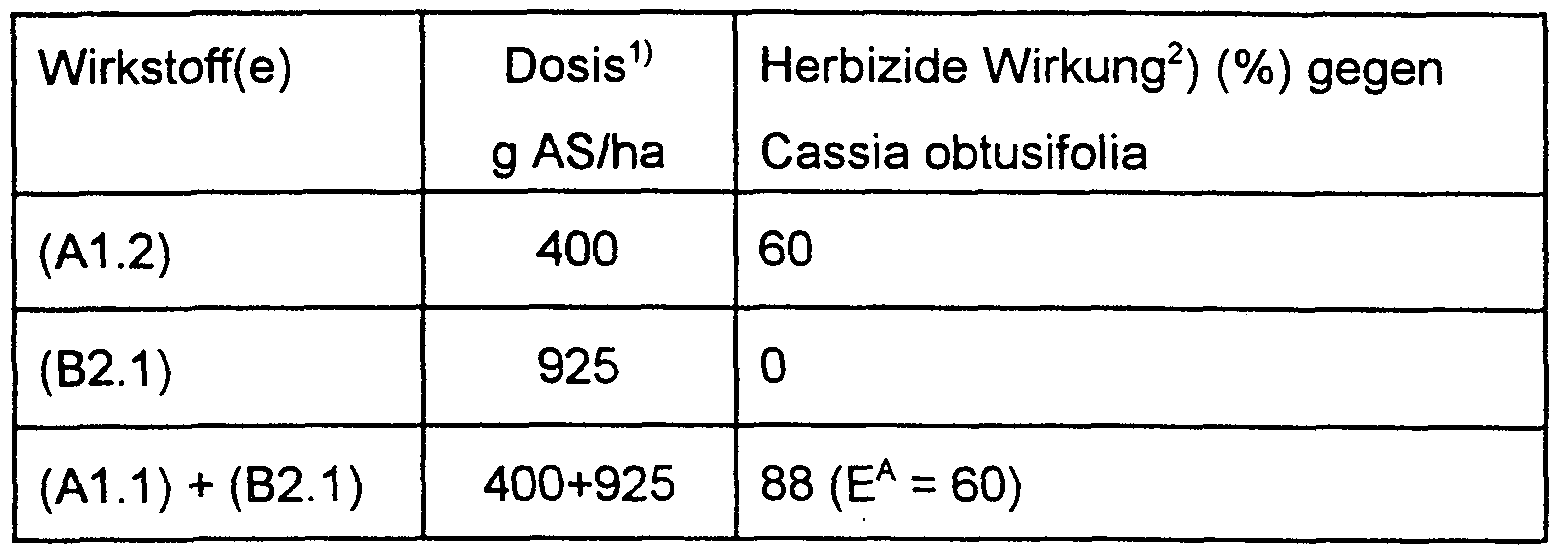
Abkürzungen zu Tabelle 9:Abbreviations to table 9:
1) = Applikation im 3-Blattstadium 2) = Bonitur 21 Tage nach Applikation 1) = application in the 3-leaf stage 2) = assessment 21 days after application
(A1.2) = Glufosinate-ammonium (B2.1) = Pendimethalin(A1.2) = glufosinate ammonium (B2.1) = pendimethalin
Tabelle 10 Herbizide Wirkung im Feldversuch in MaisTable 10 Herbicidal activity in the field trial in maize

Abkürzungen zu Tabelle 10:Abbreviations to table 10:
1) = Applikation im 2-Blattstadium 2) = Bonitur 28 Tage nach Applikation 1) = application in the 2-leaf stage 2) = rating 28 days after application
(A1.2) = Glufosinate-ammonium (B1.5) = Metolachlor Tabelle 11 Herbizide Wirkung im Feldversuch in Mais(A1.2) = glufosinate ammonium (B1.5) = metolachlor Table 11 Herbicidal activity in the field trial in maize

Abkürzungen zu Tabelle 11 :Abbreviations to table 11:
1) = Applikation im 3-Blattstadium 1) = application in the 3-leaf stage
2) = Bonitur 42 Tage nach Applikation 2) = rating 42 days after application
3) = zweiter Wirkstoff 10 Tage nach dem ersten Wirkstoff appliziert (A1.2) = Glufosinate-ammonium 3) = second active ingredient applied 10 days after the first active ingredient (A1.2) = glufosinate ammonium
(A3.2) = Imazethapyr(A3.2) = imazethapyr
(B1.6) = Alachlor (B1.6) = alachlor
Tabelle 12 Herbizide Wirkung im Feldversuch in MaisTable 12 Herbicidal activity in the field trial in maize

Abkürzungen zu Tabelle 12:Abbreviations to table 12:
1) = Applikation im 6-Blattstadium 2) = Bonitur 26 Tage nach Applikation 1) = application in the 6-leaf stage 2) = rating 26 days after application
(A1.2) = Glufosinate-ammonium (B3.1 ) = Bromoxynil(A1.2) = glufosinate ammonium (B3.1) = bromoxynil
Tabelle 13 Herbizide Wirkung im Feldversuch in MaisTable 13 Herbicidal effects in the field trial in maize

Abkürzungen zu Tabelle 13:Abbreviations to table 13:
1) = Applikation im 4- bis 5-Blattstadium 2) = Bonitur 28 Tage nach Applikation 1) = application in the 4- to 5-leaf stage 2) = rating 28 days after application
(A1.2) = Glufosinate-ammonium (B3.6) = Thifensulfuron-methyl Tabelle 14 Herbizide Wirkung im Feldversuch in Mais(A1.2) = glufosinate-ammonium (B3.6) = thifensulfuron-methyl Table 14 Herbicidal effects in the field trial in maize

Abkürzungen zu Tabelle 14: 1) = Applikation im 3-Blattstadium 2) = Bonitur 21 Tage nach Applikation (A1.2) = Glufosinate-ammonium (B2.8) = Flumetsulam (B3.4) = Clopyralid Abbreviations to Table 14: 1) = application in the 3-leaf stage 2) = rating 21 days after application (A1.2) = glufosinate ammonium (B2.8) = flumetsulam (B3.4) = clopyralid
Tabelle 15 Herbizide Wirkung im Feldversuch in MaisTable 15 Herbicidal activity in the field trial in maize

Abkürzungen zu Tabelle 15:Abbreviations to Table 15:
1) = Applikation im 3- bis 4-Blattstadium 1) = application in the 3 to 4 leaf stage
2) = Bonitur 24 Tage nach Applikation (A1.2) = Glufosinate-ammonium (B3.6) = Tritosulfuron 2) = assessment 24 days after application (A1.2) = glufosinate ammonium (B3.6) = tritosulfuron
Tabelle 16 Herbizide Wirkung im Feldversuch in MaisTable 16 Herbicidal activity in the field trial in maize

Abkürzungen zu Tabelle 16:Abbreviations to table 16:
1) = Applikation im Vorauflauf 1) = Pre-emergence application
2) = Applikation im 4-Blattstadium 18 Tage nach der Vorauflauf-Applikation zu 1) 2) = application in the 4-leaf stage 18 days after the pre-emergence application for 1 )
3) = Bonitur 46 Tage nach Vorauflaufapplikation bzw. 28 Tage nach 3) = rating 46 days after pre-emergence application or 28 days after
Nachauflaufapplikation (B2.5) = Isoxaflutole (A1.2) = Glufosinate-ammonium Post-emergence application (B2.5) = isoxaflutole (A1.2) = glufosinate-ammonium
Tabelle 17 Herbizide Wirkung im Feldversuch in MaisTable 17 Herbicidal effects in the field trial in maize
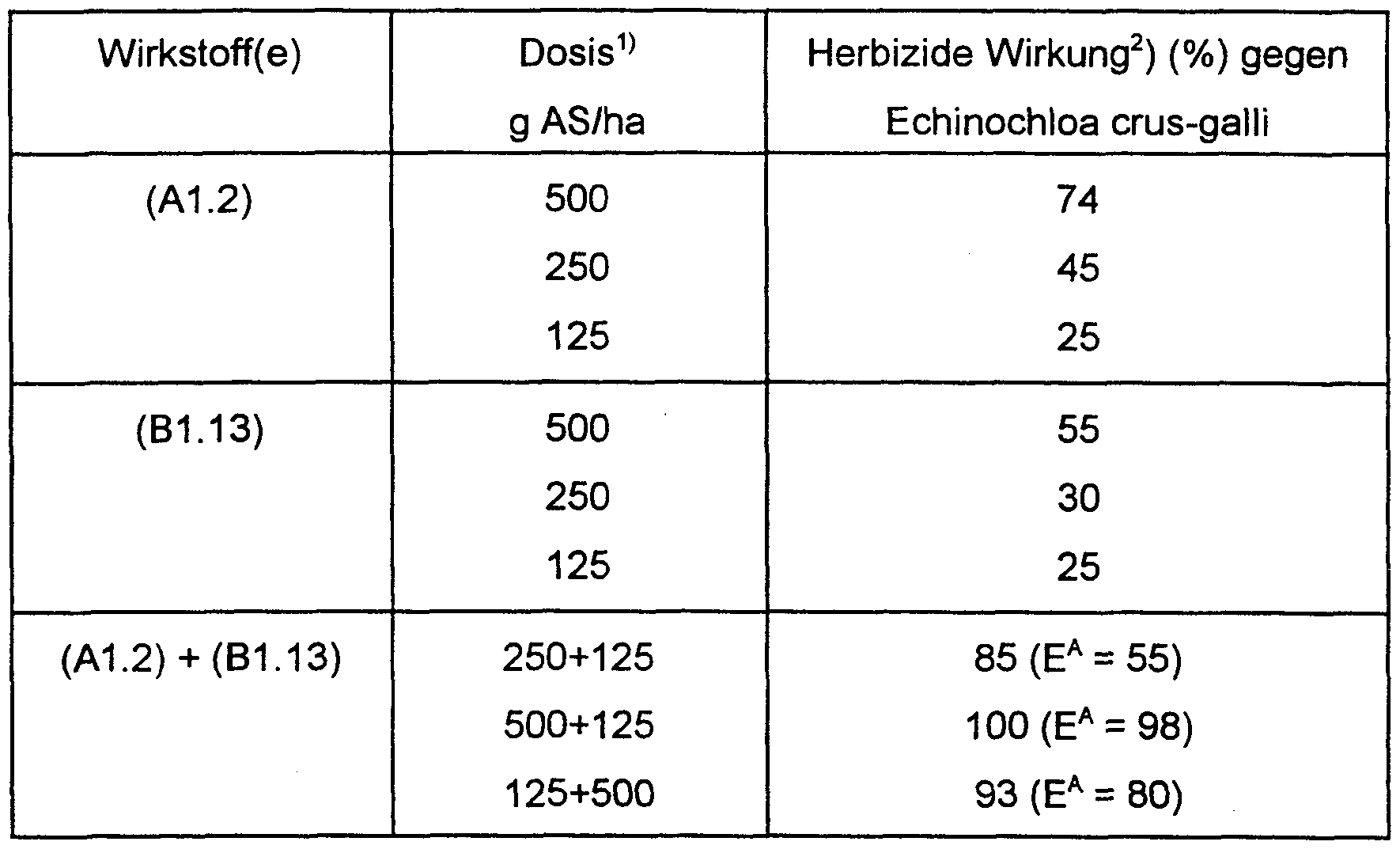
Abkürzungen zu Tabelle 17: 1) = Applikation im 3-Blattstadium 2) = Bonitur 28 Tage nach Applikation (A1.2) = Glufosinate-ammonium (B1.13) = Fluthiamide Abbreviations to Table 17: 1) = application in the 3-leaf stage 2) = rating 28 days after application (A1.2) = glufosinate ammonium (B1.13) = fluthiamide
Tabelle 18 Herbizide Wirkung im Feldversuch in MaisTable 18 Herbicidal effects in the field trial in maize
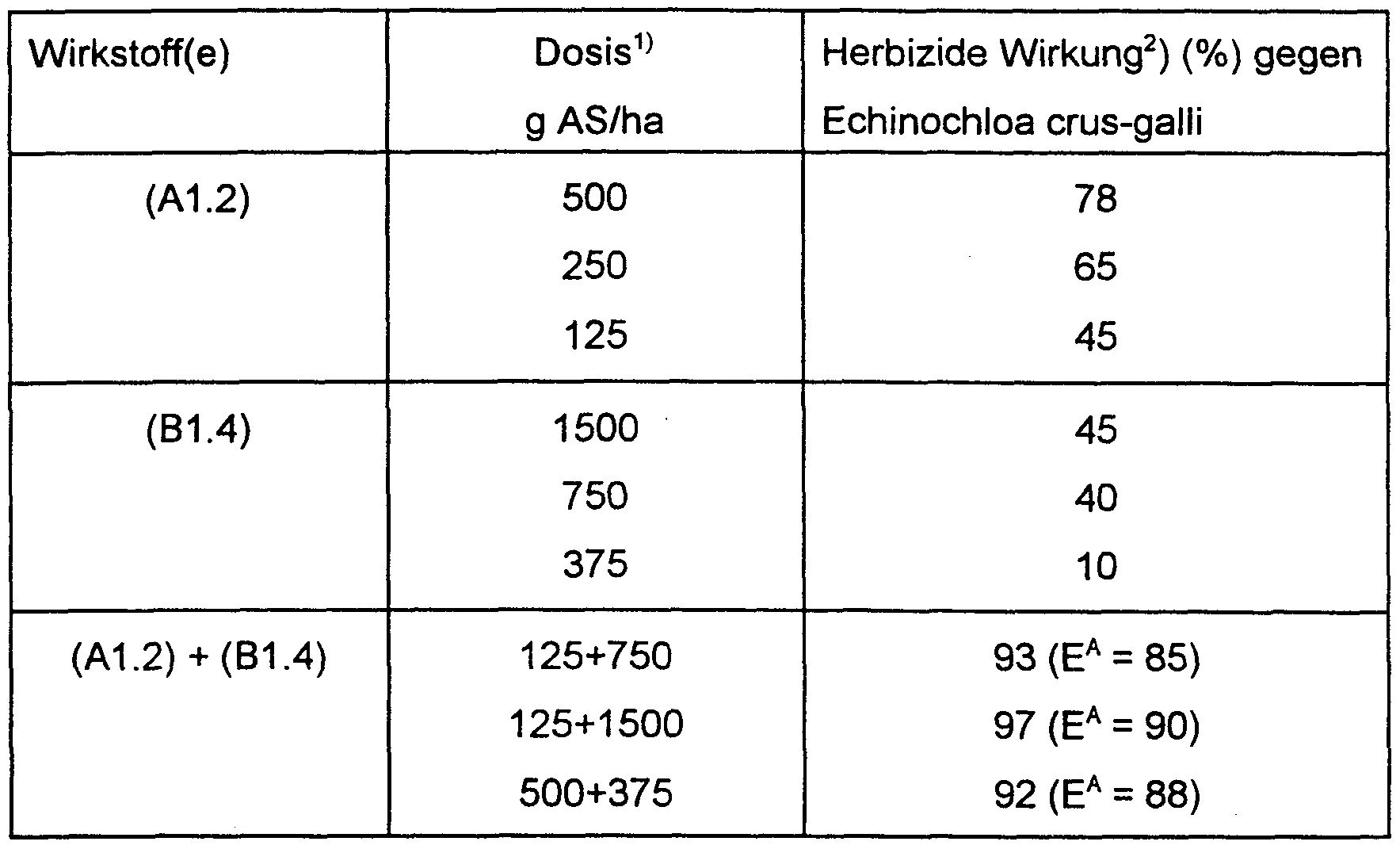
Abkürzungen zu Tabelle 18:Abbreviations to table 18:
1) = Applikation im 3- bis 4-Blattstadium 2) = Bonitur 42 Tage nach Applikation 1) = application in the 3 to 4 leaf stage 2) = rating 42 days after application
(A1.2) = Glufosinate-ammonium (B1.4) = Acetochlor(A1.2) = glufosinate ammonium (B1.4) = acetochlor
Tabelle 19 Herbizide Wirkung im Feldversuch in MaisTable 19 Herbicidal effects in the field trial in maize
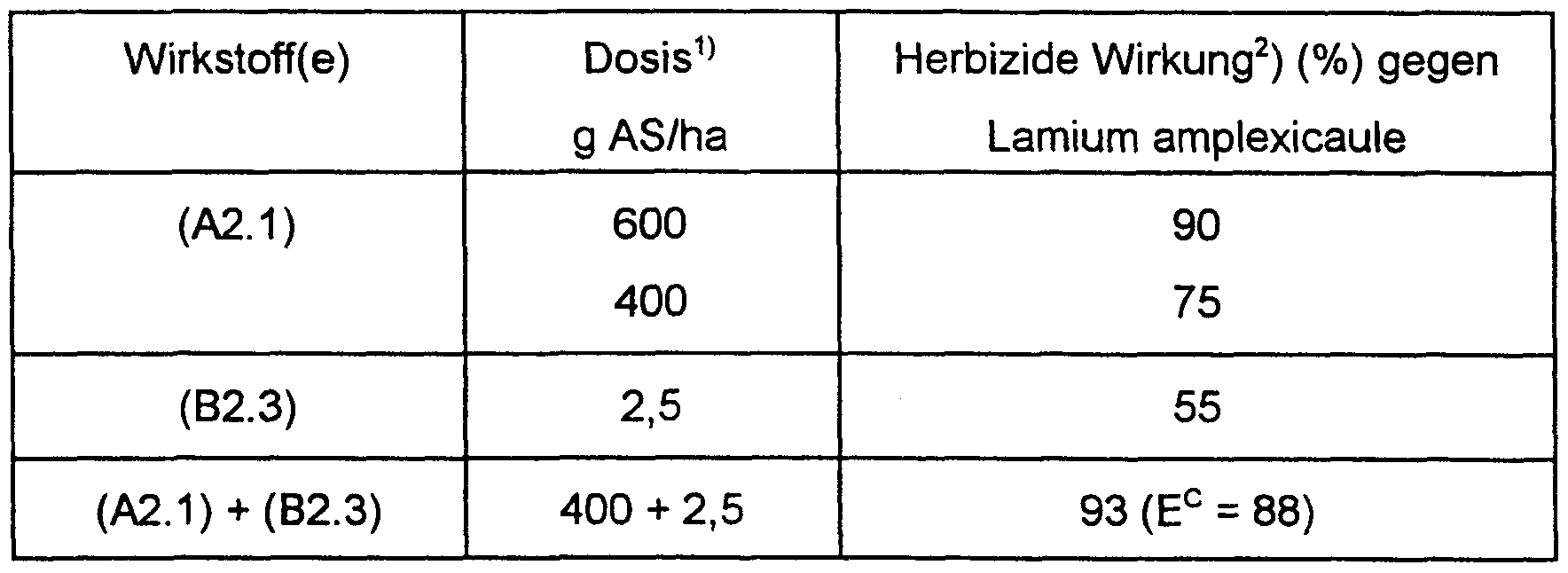
Abkürzungen zu Tabelle 19:Abbreviations to table 19:
1) = Applikation im 1 -Blattstadium 2) = Bonitur 17 Tage nach Applikation 1) = application in the 1-leaf stage 2) = rating 17 days after application
(A1.2) = Glyphosate-isopropylammonium (B2.3) = lodosulfuron-methyl Tabelle 20 Herbizide Wirkung im Feldversuch in Mais(A1.2) = glyphosate-isopropylammonium (B2.3) = iodosulfuron-methyl Table 20 Herbicidal activity in the field trial in maize

Abkürzungen zu Tabelle 20:Abbreviations to table 20:
1) = Applikation im 3- bis 4-Blattstadium 1) = application in the 3 to 4 leaf stage
2) = Bonitur 28 Tage nach Applikation (A1.2) = Glyphosate-isopropylammonium (B3.3) = 2,4-D 2) = assessment 28 days after application (A1.2) = glyphosate-isopropylammonium (B3.3) = 2,4-D
(B3.9) = MCPA (B2.2) = Pyridate (B1.12) = Dimethenamid (B3.9) = MCPA (B2.2) = pyridate (B1.12) = dimethenamid
Claims


Priority Applications (16)
| Application Number | Priority Date | Filing Date | Title |
|---|---|---|---|
| IL14114599A IL141145A0 (en) | 1998-08-13 | 1999-08-10 | Herbicidal compositions for tolerant or resistant maize crops |
| SK211-2001A SK288503B6 (en) | 1998-08-13 | 1999-08-10 | Herbicides for tolerant or resistant corn cultures |
| HRP20131064AA HRP20131064A2 (en) | 1998-08-13 | 1999-08-10 | HERBICIDES FOR CORN TOLERANT OR RESISTANT CULTURES |
| AU57321/99A AU5732199A (en) | 1998-08-13 | 1999-08-10 | Herbicides for tolerant or resistant corn cultures |
| BRPI9913638-4A BR9913638B1 (en) | 1998-08-13 | 1999-08-10 | herbicidal composition, application and process for weed control in tolerant maize crops. |
| HU0104049A HU230844B1 (en) | 1998-08-13 | 1999-08-10 | Herbicides for tolerant or resistant corn cultures |
| HRP20131065AA HRP20131065B1 (en) | 1998-08-13 | 1999-08-10 | Herbicide device for tolerant or resistant maize cultures |
| PL346136A PL212110B1 (en) | 1998-08-13 | 1999-08-10 | Herbicides for tolerant or resistant corn cultures |
| HRP20010105AA HRP20010105B1 (en) | 1998-08-13 | 1999-08-10 | HERBICIDES FOR CORN TOLERANT OR RESISTANT CULTURES |
| CA2340013A CA2340013C (en) | 1998-08-13 | 1999-08-10 | Herbicidal compositions for tolerant or resistant maize crops |
| EP99944356A EP1104243B1 (en) | 1998-08-13 | 1999-08-10 | Herbicides for tolerant or resistant corn cultures |
| ES99944356T ES2405266T3 (en) | 1998-08-13 | 1999-08-10 | Herbicidal agents for tolerant or resistant corn crops |
| DK99944356.7T DK1104243T3 (en) | 1998-08-13 | 1999-08-10 | HERBICIDE AGENTS FOR TOLERANT OR RESISTANT MAIZE CULTURES |
| JP2000564450A JP4523162B2 (en) | 1998-08-13 | 1999-08-10 | Herbicidal compositions for resistant or resistant corn crops |
| UA2001031684A UA72741C2 (en) | 1998-08-13 | 1999-10-08 | Method of controlling weed plants and an herbicidal agent (variants) |
| IL141145A IL141145A (en) | 1998-08-13 | 2001-01-28 | Herbicidal compositions for tolerant or resistant maize crops |
Applications Claiming Priority (4)
| Application Number | Priority Date | Filing Date | Title |
|---|---|---|---|
| DE19836737.6 | 1998-08-13 | ||
| DE19836737A DE19836737A1 (en) | 1998-08-13 | 1998-08-13 | Use of a synergistic herbicide combination including a glufosinate- or glyphosate-type, imidazolinone, protoporphyrinogen oxidase inhibitory azole or cyclohexanedione herbicide to control weeds in maize |
| DE19919993.0 | 1999-04-30 | ||
| DE1999119993 DE19919993A1 (en) | 1999-04-30 | 1999-04-30 | Control of weeds in tolerant maize crops uses herbicidal combination containing glufosinate, glyphosate, imidazolinone, azole, cyclohexanedione or heteroaryloxyphenoxypropionic acid herbicide |
Related Child Applications (2)
| Application Number | Title | Priority Date | Filing Date |
|---|---|---|---|
| EP10010489.2A Previously-Filed-Application EP2319315B2 (en) | 1998-08-13 | 1999-08-10 | Herbicide device for tolerant or resistant maize cultures |
| EP10010490.0A Previously-Filed-Application EP2319316B1 (en) | 1998-08-13 | 1999-08-10 | Herbicide device for tolerant or resistant maize cultures |
Publications (1)
| Publication Number | Publication Date |
|---|---|
| WO2000008936A1 true WO2000008936A1 (en) | 2000-02-24 |
Family
ID=26048135
Family Applications (1)
| Application Number | Title | Priority Date | Filing Date |
|---|---|---|---|
| PCT/EP1999/005796 Ceased WO2000008936A1 (en) | 1998-08-13 | 1999-08-10 | Herbicides for tolerant or resistant corn cultures |
Country Status (21)
| Country | Link |
|---|---|
| US (3) | US7012040B2 (en) |
| EP (3) | EP1104243B1 (en) |
| JP (1) | JP4523162B2 (en) |
| CN (2) | CN1220436C (en) |
| AR (2) | AR020161A1 (en) |
| AU (1) | AU5732199A (en) |
| BG (1) | BG65288B1 (en) |
| BR (1) | BR9913638B1 (en) |
| CA (4) | CA2340013C (en) |
| CZ (1) | CZ305417B6 (en) |
| DK (1) | DK1104243T3 (en) |
| ES (1) | ES2405266T3 (en) |
| HR (3) | HRP20010105B1 (en) |
| HU (1) | HU230844B1 (en) |
| IL (2) | IL141145A0 (en) |
| PL (20) | PL217233B1 (en) |
| PT (1) | PT1104243E (en) |
| RS (1) | RS49988B (en) |
| SK (1) | SK288503B6 (en) |
| TR (1) | TR200100618T2 (en) |
| WO (1) | WO2000008936A1 (en) |
Cited By (37)
| Publication number | Priority date | Publication date | Assignee | Title |
|---|---|---|---|---|
| WO2001072127A3 (en) * | 2000-03-27 | 2002-01-31 | Basf Ag | Synergistic herbicidal methods and compositions |
| WO2001078512A3 (en) * | 2000-04-13 | 2002-03-28 | Fmc Corp | Safening crops from herbicidally active n-phosphonomethyl-glycines |
| WO2001028341A3 (en) * | 1999-10-22 | 2002-05-02 | Aventis Cropscience Gmbh | Hydroxyphenylpyruvate dioxygenase inhibitors used in synergistic mixtures |
| WO2002017719A3 (en) * | 2000-08-31 | 2002-05-30 | Basf Ag | Herbicide mixtures |
| WO2002030205A3 (en) * | 2000-10-06 | 2002-07-04 | Monsanto Technology Llc | Treatment of transgenic corn seeds with pesticides |
| US6586365B2 (en) | 2000-10-06 | 2003-07-01 | Monsanto Technology, Llc | Method for reducing pest damage to corn by treating transgenic corn seeds with clothianidin pesticide |
| WO2003028460A3 (en) * | 2001-09-27 | 2003-10-30 | Syngenta Participations Ag | Herbicidal composition |
| US6689719B2 (en) | 1999-08-11 | 2004-02-10 | Monsanto Technology Llc | Coformulation of carfentrazone-ethyl and glyphasate |
| US6713433B2 (en) | 1999-08-11 | 2004-03-30 | Monsanto Technology, Llc | Coformulation of an oil-soluble herbicide and a water-soluble herbicide |
| JP2005510576A (en) * | 2001-12-07 | 2005-04-21 | バイエル クロップサイエンス ゲーエムベーハー | Synergistic herbicide |
| WO2006121902A3 (en) * | 2005-05-05 | 2006-12-28 | Monsanto Technology Llc | Interaction of glyphosate with photosystem ii inhibitor herbicides as a selection tool for roundup ready events |
| US8080496B2 (en) | 2000-10-06 | 2011-12-20 | Syngenta Crop Protection, Inc. | Method for reducing pest damage to corn by treating transgenic corn seeds with thiamethoxam pesticide |
| WO2012025472A1 (en) * | 2010-08-24 | 2012-03-01 | Basf Se | Agrochemical mixtures for increasing the health of a plant |
| EP1130965B2 (en) † | 1998-11-21 | 2012-04-04 | Bayer CropScience AG | Combinations of herbicides and safeners |
| EP2454940A3 (en) * | 2006-10-25 | 2012-10-10 | Monsanto Technology LLC | Cropping systems for managing weeds |
| US8420888B2 (en) | 2007-02-26 | 2013-04-16 | Monsanto Technology Llc | Chloroplast transit peptides for efficient targeting of DMO and uses thereof |
| US8629328B2 (en) | 2006-06-06 | 2014-01-14 | Monsanto Technology Llc | Methods for weed control using plants transformed with dicamba monooxygenase |
| USRE44971E1 (en) | 2006-06-06 | 2014-06-24 | Monsanto Technology Llc | Method for selection of transformed cells |
| WO2016113334A1 (en) * | 2015-01-15 | 2016-07-21 | Basf Se | Herbicidal combination comprising saflufenacil and glufosinate |
| EP3217798A4 (en) * | 2014-11-14 | 2018-06-06 | FMC Corporation | Compositions and methods for controlling weeds in crops |
| CN108849882A (en) * | 2018-06-14 | 2018-11-23 | 四川利尔作物科学有限公司 | A kind of low temperature resistant 2 first of glufosinate-ammonium, 4 chlorine water agent |
| WO2019030100A1 (en) | 2017-08-09 | 2019-02-14 | Basf Se | Herbicidal mixtures comprising l-glufosinate or its salt and at least one mitosis inhibitor |
| US10285404B2 (en) | 2013-02-27 | 2019-05-14 | Monsanto Technology Llc | Glyphosate composition for dicamba tank mixtures with improved volatility |
| US10334849B2 (en) | 2011-10-26 | 2019-07-02 | Monsanto Technology Llc | Salts of carboxylic acid herbicides |
| US10375959B2 (en) | 2015-01-22 | 2019-08-13 | BASF Agro B.V. | Ternary herbicidal combination comprising saflufenacil |
| US10499646B2 (en) | 2004-03-10 | 2019-12-10 | Monsanto Technology Llc | Herbicidal compositions containing N-phosphonomethyl glycine and an auxin herbicide |
| US10736322B2 (en) | 2012-06-04 | 2020-08-11 | Monsanto Technology Llc | Aqueous concentrated herbicidal compositions containing glyphosate salts and dicamba salts |
| US10813356B2 (en) | 2015-07-10 | 2020-10-27 | BASF Agro B.V. | Herbicidal composition comprising cinmethylin and dimethenamid |
| US10897898B2 (en) | 2015-07-10 | 2021-01-26 | BASF Agro B.V. | Herbicidal composition comprising cinmethylin and acetochlor or pretilachlor |
| US10980232B2 (en) | 2015-07-10 | 2021-04-20 | BASF Agro B.V. | Herbicidal composition comprising cinmethylin and pyroxasulfone |
| US11116213B2 (en) | 2015-07-10 | 2021-09-14 | BASF Agro B.V. | Herbicidal composition comprising cinmethylin and pethoxamid |
| US11206827B2 (en) | 2015-07-10 | 2021-12-28 | BASF Agro B.V. | Herbicidal composition comprising cinmethylin and specific quinolinecarboxylic acids |
| US11219215B2 (en) | 2015-07-10 | 2022-01-11 | BASF Agro B.V. | Herbicidal composition comprising cinmethylin and specific inhibitors of protoporphyrinogen oxidase |
| US11219212B2 (en) | 2015-07-10 | 2022-01-11 | BASF Agro B.V. | Herbicidal composition comprising cinmethylin and imazamox |
| US11291206B2 (en) | 2015-07-10 | 2022-04-05 | BASF Agro B.V. | Herbicidal composition comprising cinmethylin and specific pigment synthesis inhibitors |
| US11517018B2 (en) | 2015-07-10 | 2022-12-06 | BASF Agro B.V. | Herbicidal composition comprising cinmethylin and saflufenacil |
| US12336536B2 (en) | 2015-07-10 | 2025-06-24 | BASF Agro B.V. | Method for controlling herbicide resistant or tolerant weeds |
Families Citing this family (52)
| Publication number | Priority date | Publication date | Assignee | Title |
|---|---|---|---|---|
| RS49988B (en) * | 1998-08-13 | 2008-09-29 | Bayer Cropscience Ag., | HERBICIDES FOR CORN TOLERANT OR RESISTANT CULTURES |
| CN100537764C (en) * | 2001-10-19 | 2009-09-09 | 住友化学工业株式会社 | Herbicide metabolism protein, its gene and application |
| JP2003192511A (en) * | 2001-12-27 | 2003-07-09 | Hodogaya Agros Kk | Fine granules that control weeds that are stable against weather fluctuations |
| JP2003192510A (en) * | 2001-12-27 | 2003-07-09 | Hodogaya Agros Kk | Mixed fine granules containing glyphosate |
| KR20050114652A (en) * | 2003-03-13 | 2005-12-06 | 바스프 악티엔게젤샤프트 | Synergistically acting herbicidal mixtures |
| GB0314190D0 (en) * | 2003-06-18 | 2003-07-23 | Syngenta Participations Ag | Method of controlling weeds |
| EA201270781A1 (en) | 2005-06-09 | 2013-09-30 | Байер Кропсайенс Аг | COMBINATION OF BIOLOGICALLY ACTIVE SUBSTANCES |
| US8207092B2 (en) | 2006-10-16 | 2012-06-26 | Monsanto Technology Llc | Methods and compositions for improving plant health |
| BRPI0717640A2 (en) * | 2006-10-16 | 2013-11-12 | Monsato Technology Llc | PROCESS AND COMPOSITIONS FOR INCREASING PLANT HEALTH |
| JP5416354B2 (en) * | 2007-02-02 | 2014-02-12 | 石原産業株式会社 | Herbicidal composition containing a benzoylpyrazole compound |
| EP2170079B1 (en) * | 2007-06-29 | 2013-05-29 | Dow AgroSciences LLC | Synergistic herbicidal composition containing a substituted phenoxy alkanoic acid derivative and a glyphosate derivative |
| EP2197272B1 (en) * | 2007-08-27 | 2011-09-28 | Syngenta Participations AG | Herbicidal composition and method of use thereof |
| BR112012029634A2 (en) | 2010-05-21 | 2015-10-20 | Bayer Ip Gmbh | herbicidal agents for tolerant or resistant rice crops |
| EP2571365A1 (en) | 2010-05-21 | 2013-03-27 | Bayer Intellectual Property GmbH | Herbicidal agents for tolerant or resistant grain cultures |
| WO2011144691A1 (en) | 2010-05-21 | 2011-11-24 | Bayer Cropscience Ag | Herbicidal agents for tolerant or resistant corn cultures |
| CA2799690A1 (en) | 2010-05-21 | 2011-11-24 | Bayer Intellectual Property Gmbh | Herbicidal agents for tolerant or resistant rape cultures |
| EP2460404A1 (en) * | 2010-12-01 | 2012-06-06 | Basf Se | Compositions containing identical polyamine salts of mixed anionic pesticides |
| CN103371173A (en) * | 2012-04-21 | 2013-10-30 | 陕西韦尔奇作物保护有限公司 | Weeding composition containing glufosinate-ammonium and sulfonylurea |
| CN103371174A (en) * | 2012-04-25 | 2013-10-30 | 陕西韦尔奇作物保护有限公司 | Weeding composition containing glufosinate-ammonium and amides |
| CN103371176A (en) * | 2012-04-26 | 2013-10-30 | 陕西韦尔奇作物保护有限公司 | Glufosinate-ammonium-containing pesticide composition |
| AU2013337293B2 (en) | 2012-11-05 | 2017-06-15 | Monsanto Technology Llc | Low volatility herbicidal compositions |
| CN103319257A (en) * | 2013-06-29 | 2013-09-25 | 四川省乐山市福华通达农药科技有限公司 | Glyphosate, trace element and mesotrione granula and preparation method thereof |
| KR102632658B1 (en) | 2015-05-11 | 2024-02-01 | 바스프 에스이 | Herbicide combinations comprising l-glufosinate and indaziflam |
| CN105994356A (en) * | 2016-06-22 | 2016-10-12 | 南京华洲药业有限公司 | Weeding composition containing glufosinate and halosulfuron-methyl and application of weeding composition |
| CN105941469B (en) * | 2016-06-22 | 2019-02-12 | 南京华洲药业有限公司 | A kind of Herbicidal combinations and its application of Glufosinate-ammoniumpesticideng and ethoxyfen-ethyl |
| CN106070313A (en) * | 2016-06-22 | 2016-11-09 | 南京华洲药业有限公司 | The Herbicidal combinations of a kind of Glufosinate-ammoniumpesticideng and triaziflam and application thereof |
| CN105935060A (en) * | 2016-06-22 | 2016-09-14 | 南京华洲药业有限公司 | Herbicidal composition containing glufosinate-ammonium and prosulfuron and applications thereof |
| CN105935059A (en) * | 2016-06-22 | 2016-09-14 | 南京华洲药业有限公司 | Herbicidal composition containing glufosinate-ammonium and flufenacet and applications thereof |
| CN106106508B (en) * | 2016-08-17 | 2018-07-13 | 四川利尔作物科学有限公司 | Herbicidal combinations and its application |
| CN106508954A (en) * | 2016-12-12 | 2017-03-22 | 安徽常泰化工有限公司 | Cornfield herbicide composition |
| CN106818786B (en) * | 2017-03-22 | 2020-03-13 | 山东潍坊润丰化工股份有限公司 | Herbicidal composition containing isoxaflutole and imazapic and application thereof |
| AU2018308563B2 (en) | 2017-07-27 | 2024-01-04 | Basf Se | Use of herbicidal compositions based on L-glufosinate in tolerant field crops |
| WO2019030086A2 (en) * | 2017-08-09 | 2019-02-14 | Basf Se | Herbicidal mixtures comprising l-glufosinate and their use in canola cultures |
| EP3440939A1 (en) | 2017-08-09 | 2019-02-13 | Basf Se | Herbicidal mixtures comprising l-glufosinate |
| WO2019030103A1 (en) * | 2017-08-09 | 2019-02-14 | Basf Se | Herbicidal mixtures comprising l-glufosinate or its salt and at least one auxinic herbicide |
| BR112020002666A2 (en) | 2017-08-09 | 2020-07-28 | Basf Se | use of herbicide mixture, pesticide mixture, pesticide composition and vegetation control method |
| CR20230111A (en) | 2017-08-09 | 2023-03-28 | Basf Se | HERBICIDAL MIXTURES COMPRISING L-GLUFOSINATE OR ITS SALTS, AND SAFLUFENACIL (Divisional 2020-0062) |
| BR112020002166A2 (en) * | 2017-08-09 | 2020-07-28 | Basf Se | herbicide mixture, pesticide composition and method to control undesirable vegetation |
| WO2019030091A2 (en) | 2017-08-09 | 2019-02-14 | Basf Se | Herbicidal mixtures comprising l-glufosinate and their use in cotton cultures |
| WO2019030092A1 (en) * | 2017-08-09 | 2019-02-14 | Basf Se | Herbicidal mixtures comprising l-glufosinate or its salt and at least one photosynthesis inhibitor |
| WO2019030101A1 (en) | 2017-08-09 | 2019-02-14 | Basf Se | Herbicidal mixtures comprising l-glufosinate or its salt and at least one bleacher herbicide |
| AU2018389233B2 (en) * | 2017-12-22 | 2024-08-08 | Monsanto Technology Llc | Herbicidal mixtures |
| CN108902171A (en) * | 2018-07-23 | 2018-11-30 | 安徽华星化工有限公司 | A kind of Herbicidal combinations of Glufosinate-ammoniumpesticideng and amides |
| US20220132854A1 (en) | 2019-02-19 | 2022-05-05 | Gowan Company, L.L.C. | Stable liquid compositions and methods of using the same |
| US10555528B1 (en) | 2019-03-20 | 2020-02-11 | Sumitomo Chemical Company, Limited | Herbicidal composition and method for controlling weeds |
| US12336540B2 (en) | 2019-03-27 | 2025-06-24 | Sumitomo Chemical Company, Limited | Method for controlling weeds |
| US12262715B2 (en) | 2020-02-05 | 2025-04-01 | Basf Se | Herbicidal mixtures comprising L-glufosinate or its salt and at least one protoporphyrinogen-IX oxidase inhibitor |
| CN113016816B (en) * | 2021-03-12 | 2022-03-01 | 淄博新农基作物科学有限公司 | Weeding composition containing isoxaflutole and metosulam |
| CN115989818A (en) * | 2021-10-20 | 2023-04-21 | 江苏优士化学有限公司 | A kind of ternary compound pesticide composition containing glyphosate |
| WO2023144564A1 (en) * | 2022-01-31 | 2023-08-03 | UPL Corporation Limited | Herbicidal combinations |
| AU2024218251A1 (en) * | 2023-02-07 | 2025-08-28 | Upl Europe Supply Chain Gmbh | An herbicidal combination, composition and method of controlling weeds using the same |
| AR133857A1 (en) * | 2023-09-21 | 2025-11-05 | Specialty Operations France | HERBICIDE COMPOSITIONS COMPRISING SPECIFIC SURFACTANTS |
Citations (32)
| Publication number | Priority date | Publication date | Assignee | Title |
|---|---|---|---|---|
| DE2856260A1 (en) | 1977-12-28 | 1979-07-05 | Meiji Seika Kaisha | HERBICIDE |
| EP0048436A1 (en) | 1980-09-20 | 1982-03-31 | Hoechst Aktiengesellschaft | Herbicidal agents |
| EP0131624A1 (en) | 1983-01-17 | 1985-01-23 | Monsanto Co | PLASMIDES FOR TRANSFORMING PLANT CELLS. |
| EP0142924A2 (en) | 1983-09-26 | 1985-05-29 | Mycogen Plant Science, Inc. | Insect resistant plants |
| EP0193259A1 (en) | 1985-01-18 | 1986-09-03 | Plant Genetic Systems N.V. | Modifying plants by genetic engineering to combat or control insects |
| EP0221044A1 (en) | 1985-10-25 | 1987-05-06 | Monsanto Company | Novel plant vectors |
| US4671819A (en) | 1983-03-28 | 1987-06-09 | Ciba-Geigy Corporation | N-phenylsulfonyl-N'-triazinylureas |
| EP0242246A1 (en) | 1986-03-11 | 1987-10-21 | Plant Genetic Systems N.V. | Plant cells resistant to glutamine synthetase inhibitors, made by genetic engineering |
| EP0252237A2 (en) | 1986-05-09 | 1988-01-13 | Hoechst Aktiengesellschaft | Herbicidal agents |
| EP0257993A2 (en) | 1986-08-26 | 1988-03-02 | E.I. Du Pont De Nemours And Company | Nucleic acid fragment encoding herbicide resistant plant acetolactate synthase |
| EP0257542A2 (en) | 1986-08-23 | 1988-03-02 | Hoechst Aktiengesellschaft | Phosphinotricine resistance gene and its use |
| EP0275957A2 (en) | 1987-01-21 | 1988-07-27 | Hoechst Aktiengesellschaft | Plant-functional phosphinothricin resistance gene and its use |
| EP0336151A2 (en) | 1988-03-18 | 1989-10-11 | Hoechst Aktiengesellschaft | Liquid herbicidal agent |
| US5013659A (en) | 1987-07-27 | 1991-05-07 | E. I. Du Pont De Nemours And Company | Nucleic acid fragment encoding herbicide resistant plant acetolactate synthase |
| WO1991013972A1 (en) | 1990-03-16 | 1991-09-19 | Calgene, Inc. | Plant desaturases - compositions and uses |
| WO1991019806A1 (en) | 1990-06-18 | 1991-12-26 | Monsanto Company | Increased starch content in plants |
| EP0476555A2 (en) | 1990-09-15 | 1992-03-25 | Hoechst Schering AgrEvo GmbH | Synergistic herbicidal agents |
| WO1992008353A1 (en) | 1990-11-13 | 1992-05-29 | Hoechst Aktiengesellschaft | Synergistic herbicidal agent |
| WO1992009608A1 (en) * | 1990-12-01 | 1992-06-11 | Basf Aktiengesellschaft | Herbicidal n-[(1,3,5-triazine-2-yl)aminocarbonyl]benzole sulphonamides |
| WO1992011376A1 (en) | 1990-12-21 | 1992-07-09 | Amylogene Hb | Genetically engineered modification of potato to form amylopectin-type starch |
| EP0496701A1 (en) | 1991-01-25 | 1992-07-29 | Ciba-Geigy Ag | Sulfonylureas as herbizides |
| WO1992014827A1 (en) | 1991-02-13 | 1992-09-03 | Institut Für Genbiologische Forschung Berlin Gmbh | Plasmids containing dna-sequences that cause changes in the carbohydrate concentration and the carbohydrate composition in plants, as well as plant cells and plants containing these plasmids |
| EP0502014A1 (en) | 1989-11-21 | 1992-09-09 | Hoechst Ag | Herbicidal agents. |
| EP0513054A1 (en) | 1990-02-02 | 1992-11-19 | Hoechst Schering AgrEvo GmbH | Virus/herbicide resistance genes process for producing same and their use |
| US5183492A (en) | 1989-06-29 | 1993-02-02 | Ciba-Geigy Corporation | Herbicidal 3-aryluracils |
| EP0569944A2 (en) * | 1992-05-15 | 1993-11-18 | Hoechst Schering AgrEvo GmbH | Synergistic herbicide combination |
| WO1995005082A1 (en) * | 1993-08-12 | 1995-02-23 | Hoechst Schering Agrevo Gmbh | Method of increasing the yield of herbicide-resistant crop plants |
| WO1996013163A1 (en) * | 1994-11-01 | 1996-05-09 | Zeneca Limited | Selective corn herbicide |
| WO1996032013A1 (en) * | 1995-04-12 | 1996-10-17 | Novartis Ag | Synergistic herbicidal compositions of metolachlor |
| WO1996041537A1 (en) * | 1995-06-08 | 1996-12-27 | Hoechst Schering Agrevo Gmbh | Herbicides with 4-iodo-2-[3-(4-methoxy-6-methyl-1,3,5-triazin-2-yl)ureidosulfonyl]-benzoic acid esters |
| WO1997036488A1 (en) * | 1996-03-29 | 1997-10-09 | Monsanto Europe S.A. | New use of n-(phosphonomethyl)glycine and derivatives thereof |
| WO1998009525A1 (en) | 1996-09-05 | 1998-03-12 | Novartis Ag | Process for the control of weeds |
Family Cites Families (24)
| Publication number | Priority date | Publication date | Assignee | Title |
|---|---|---|---|---|
| HU182980B (en) * | 1979-12-28 | 1984-03-28 | Nitrokemia Ipartelepek | Concentrates and spray solutions containing n-bracket-phosphono-methyl-bracket closed-glycine |
| US4440562A (en) * | 1981-07-20 | 1984-04-03 | Monsanto Company | Herbicidal emulsions |
| US5006158A (en) * | 1984-12-20 | 1991-04-09 | Ici Americas Inc. | Certain 2-(2-substituted benzoyl)-1,3-cyclohexanediones |
| US4535060A (en) | 1983-01-05 | 1985-08-13 | Calgene, Inc. | Inhibition resistant 5-enolpyruvyl-3-phosphoshikimate synthetase, production and use |
| JPS61293956A (en) | 1985-06-21 | 1986-12-24 | Tokuyama Soda Co Ltd | Chloroacetamide compound and its manufacturing method |
| AU614730B2 (en) | 1987-10-28 | 1991-09-12 | Rhone-Poulenc Agrochimie | Compositions including herbicidal combinations of the glyphosate type and the phenoxybenzoic type |
| EP0360750A3 (en) | 1988-09-22 | 1991-01-02 | Ciba-Geigy Ag | Novel herbicide tolerant plants |
| DE3919036A1 (en) * | 1989-06-10 | 1990-12-13 | Hoechst Ag | LIQUID HERBICIDAL MIXTURE |
| ATE117168T1 (en) * | 1989-07-08 | 1995-02-15 | Hoechst Schering Agrevo Gmbh | DEFOAMERS FOR LIQUID WETTING AGENTS AND LOW-FOAM LIQUID PLANT PROTECTION AGENTS. |
| US5310667A (en) | 1989-07-17 | 1994-05-10 | Monsanto Company | Glyphosate-tolerant 5-enolpyruvyl-3-phosphoshikimate synthases |
| GB9017539D0 (en) | 1990-08-10 | 1990-09-26 | Rhone Poulenc Agriculture | New compositions of matter |
| US5739082A (en) * | 1990-02-02 | 1998-04-14 | Hoechst Schering Agrevo Gmbh | Method of improving the yield of herbicide-resistant crop plants |
| US5198599A (en) | 1990-06-05 | 1993-03-30 | Idaho Resarch Foundation, Inc. | Sulfonylurea herbicide resistance in plants |
| WO1992000377A1 (en) | 1990-06-25 | 1992-01-09 | Monsanto Company | Glyphosate tolerant plants |
| US5599769A (en) * | 1990-11-13 | 1997-02-04 | Hoechst Aktiengesellschaft | Synergistic herbicidal compositions comprising glyphosate or glufosinate in combination with a sulfonylurea herbicide |
| US5238904A (en) * | 1991-01-22 | 1993-08-24 | Hoechst Aktiengesellschaft | Liquid preparations of herbicide mixture based on glufosinate |
| ZA92970B (en) | 1991-02-12 | 1992-10-28 | Hoechst Ag | Arylsulfonylureas,processes for their preparation,and their use as herbicides and growth regulators |
| US5538938A (en) † | 1994-10-14 | 1996-07-23 | Monsanto Company | Stable emulsion flowable formulation of a 2-chloroacetamide herbicide and an imidazolinone herbicide |
| US5656615A (en) | 1995-04-12 | 1997-08-12 | The Procter & Gamble Company | Pharmaceutical composition for inhibiting the growth of cancers and viruses in mammals |
| AU2475197A (en) † | 1996-06-11 | 1997-12-18 | American Cyanamid Company | Method to overcome the antagonistic interactions of herbicides |
| JP3799669B2 (en) * | 1996-07-29 | 2006-07-19 | 日産化学工業株式会社 | Herbicidal composition |
| US6586367B2 (en) * | 1996-09-05 | 2003-07-01 | Syngenta Crop Protection, Inc. | Process for the control of weeds |
| CA2269666A1 (en) | 1996-11-07 | 1998-05-14 | Zeneca Limited | Herbicide resistant plants |
| RS49988B (en) * | 1998-08-13 | 2008-09-29 | Bayer Cropscience Ag., | HERBICIDES FOR CORN TOLERANT OR RESISTANT CULTURES |
-
1999
- 1999-08-10 RS YUP-110/01A patent/RS49988B/en unknown
- 1999-08-10 PL PL397735A patent/PL217233B1/en unknown
- 1999-08-10 PL PL397721A patent/PL217234B1/en unknown
- 1999-08-10 DK DK99944356.7T patent/DK1104243T3/en active
- 1999-08-10 CA CA2340013A patent/CA2340013C/en not_active Expired - Lifetime
- 1999-08-10 ES ES99944356T patent/ES2405266T3/en not_active Expired - Lifetime
- 1999-08-10 IL IL14114599A patent/IL141145A0/en active IP Right Grant
- 1999-08-10 PL PL397724A patent/PL217216B1/en unknown
- 1999-08-10 HR HRP20010105AA patent/HRP20010105B1/en not_active IP Right Cessation
- 1999-08-10 CA CA2783627A patent/CA2783627C/en not_active Expired - Lifetime
- 1999-08-10 EP EP99944356A patent/EP1104243B1/en not_active Expired - Lifetime
- 1999-08-10 PL PL403117A patent/PL218413B1/en unknown
- 1999-08-10 AU AU57321/99A patent/AU5732199A/en not_active Abandoned
- 1999-08-10 EP EP10010489.2A patent/EP2319315B2/en not_active Expired - Lifetime
- 1999-08-10 HR HRP20131065AA patent/HRP20131065B1/en not_active IP Right Cessation
- 1999-08-10 PL PL393778A patent/PL214793B1/en unknown
- 1999-08-10 PL PL397730A patent/PL215316B1/en unknown
- 1999-08-10 CZ CZ2001-558A patent/CZ305417B6/en not_active IP Right Cessation
- 1999-08-10 SK SK211-2001A patent/SK288503B6/en not_active IP Right Cessation
- 1999-08-10 PL PL397729A patent/PL215008B1/en unknown
- 1999-08-10 US US09/370,373 patent/US7012040B2/en not_active Expired - Lifetime
- 1999-08-10 PL PL397732A patent/PL215317B1/en unknown
- 1999-08-10 WO PCT/EP1999/005796 patent/WO2000008936A1/en not_active Ceased
- 1999-08-10 HR HRP20131064AA patent/HRP20131064A2/en not_active Application Discontinuation
- 1999-08-10 TR TR2001/00618T patent/TR200100618T2/en unknown
- 1999-08-10 PL PL397726A patent/PL215314B1/en unknown
- 1999-08-10 PL PL393779A patent/PL212314B1/en unknown
- 1999-08-10 PL PL346136A patent/PL212110B1/en unknown
- 1999-08-10 HU HU0104049A patent/HU230844B1/en unknown
- 1999-08-10 EP EP10010490.0A patent/EP2319316B1/en not_active Revoked
- 1999-08-10 PL PL397734A patent/PL217242B1/en unknown
- 1999-08-10 PL PL397723A patent/PL217909B1/en unknown
- 1999-08-10 PL PL384057A patent/PL212684B1/en unknown
- 1999-08-10 BR BRPI9913638-4A patent/BR9913638B1/en not_active IP Right Cessation
- 1999-08-10 PL PL397727A patent/PL217236B1/en unknown
- 1999-08-10 PL PL397733A patent/PL217240B1/en unknown
- 1999-08-10 PL PL397722A patent/PL217232B1/en unknown
- 1999-08-10 PT PT99944356T patent/PT1104243E/en unknown
- 1999-08-10 PL PL397725A patent/PL215005B1/en unknown
- 1999-08-10 CN CNB998096113A patent/CN1220436C/en not_active Expired - Lifetime
- 1999-08-10 PL PL397728A patent/PL215315B1/en unknown
- 1999-08-10 CN CNA2005100039445A patent/CN1644052A/en active Pending
- 1999-08-10 PL PL397731A patent/PL217914B1/en unknown
- 1999-08-10 CA CA2783196A patent/CA2783196C/en not_active Expired - Lifetime
- 1999-08-10 JP JP2000564450A patent/JP4523162B2/en not_active Expired - Lifetime
- 1999-08-10 CA CA2872408A patent/CA2872408C/en not_active Expired - Lifetime
- 1999-08-11 AR ARP990104015A patent/AR020161A1/en not_active Application Discontinuation
-
2001
- 2001-01-28 IL IL141145A patent/IL141145A/en not_active IP Right Cessation
- 2001-02-08 BG BG105229A patent/BG65288B1/en unknown
-
2005
- 2005-12-30 US US11/323,085 patent/US20060111240A1/en not_active Abandoned
-
2007
- 2007-11-05 AR ARP070104917A patent/AR063563A2/en active IP Right Grant
-
2011
- 2011-05-16 US US13/108,522 patent/US8772199B2/en not_active Expired - Fee Related
Patent Citations (34)
| Publication number | Priority date | Publication date | Assignee | Title |
|---|---|---|---|---|
| DE2856260A1 (en) | 1977-12-28 | 1979-07-05 | Meiji Seika Kaisha | HERBICIDE |
| EP0048436A1 (en) | 1980-09-20 | 1982-03-31 | Hoechst Aktiengesellschaft | Herbicidal agents |
| US4400196A (en) | 1980-09-20 | 1983-08-23 | Hoechst Aktiengesellschaft | Herbicidal compositions |
| EP0131624A1 (en) | 1983-01-17 | 1985-01-23 | Monsanto Co | PLASMIDES FOR TRANSFORMING PLANT CELLS. |
| US4671819A (en) | 1983-03-28 | 1987-06-09 | Ciba-Geigy Corporation | N-phenylsulfonyl-N'-triazinylureas |
| EP0142924A2 (en) | 1983-09-26 | 1985-05-29 | Mycogen Plant Science, Inc. | Insect resistant plants |
| EP0193259A1 (en) | 1985-01-18 | 1986-09-03 | Plant Genetic Systems N.V. | Modifying plants by genetic engineering to combat or control insects |
| EP0221044A1 (en) | 1985-10-25 | 1987-05-06 | Monsanto Company | Novel plant vectors |
| EP0242246A1 (en) | 1986-03-11 | 1987-10-21 | Plant Genetic Systems N.V. | Plant cells resistant to glutamine synthetase inhibitors, made by genetic engineering |
| EP0242236A1 (en) | 1986-03-11 | 1987-10-21 | Plant Genetic Systems N.V. | Plant cells resistant to glutamine synthetase inhibitors, made by genetic engineering |
| EP0252237A2 (en) | 1986-05-09 | 1988-01-13 | Hoechst Aktiengesellschaft | Herbicidal agents |
| EP0257542A2 (en) | 1986-08-23 | 1988-03-02 | Hoechst Aktiengesellschaft | Phosphinotricine resistance gene and its use |
| EP0257993A2 (en) | 1986-08-26 | 1988-03-02 | E.I. Du Pont De Nemours And Company | Nucleic acid fragment encoding herbicide resistant plant acetolactate synthase |
| EP0275957A2 (en) | 1987-01-21 | 1988-07-27 | Hoechst Aktiengesellschaft | Plant-functional phosphinothricin resistance gene and its use |
| US5013659A (en) | 1987-07-27 | 1991-05-07 | E. I. Du Pont De Nemours And Company | Nucleic acid fragment encoding herbicide resistant plant acetolactate synthase |
| EP0336151A2 (en) | 1988-03-18 | 1989-10-11 | Hoechst Aktiengesellschaft | Liquid herbicidal agent |
| US5183492A (en) | 1989-06-29 | 1993-02-02 | Ciba-Geigy Corporation | Herbicidal 3-aryluracils |
| EP0502014A1 (en) | 1989-11-21 | 1992-09-09 | Hoechst Ag | Herbicidal agents. |
| EP0513054A1 (en) | 1990-02-02 | 1992-11-19 | Hoechst Schering AgrEvo GmbH | Virus/herbicide resistance genes process for producing same and their use |
| WO1991013972A1 (en) | 1990-03-16 | 1991-09-19 | Calgene, Inc. | Plant desaturases - compositions and uses |
| WO1991019806A1 (en) | 1990-06-18 | 1991-12-26 | Monsanto Company | Increased starch content in plants |
| EP0476555A2 (en) | 1990-09-15 | 1992-03-25 | Hoechst Schering AgrEvo GmbH | Synergistic herbicidal agents |
| WO1992008353A1 (en) | 1990-11-13 | 1992-05-29 | Hoechst Aktiengesellschaft | Synergistic herbicidal agent |
| WO1992009608A1 (en) * | 1990-12-01 | 1992-06-11 | Basf Aktiengesellschaft | Herbicidal n-[(1,3,5-triazine-2-yl)aminocarbonyl]benzole sulphonamides |
| WO1992011376A1 (en) | 1990-12-21 | 1992-07-09 | Amylogene Hb | Genetically engineered modification of potato to form amylopectin-type starch |
| EP0496701A1 (en) | 1991-01-25 | 1992-07-29 | Ciba-Geigy Ag | Sulfonylureas as herbizides |
| WO1992014827A1 (en) | 1991-02-13 | 1992-09-03 | Institut Für Genbiologische Forschung Berlin Gmbh | Plasmids containing dna-sequences that cause changes in the carbohydrate concentration and the carbohydrate composition in plants, as well as plant cells and plants containing these plasmids |
| EP0569944A2 (en) * | 1992-05-15 | 1993-11-18 | Hoechst Schering AgrEvo GmbH | Synergistic herbicide combination |
| WO1995005082A1 (en) * | 1993-08-12 | 1995-02-23 | Hoechst Schering Agrevo Gmbh | Method of increasing the yield of herbicide-resistant crop plants |
| WO1996013163A1 (en) * | 1994-11-01 | 1996-05-09 | Zeneca Limited | Selective corn herbicide |
| WO1996032013A1 (en) * | 1995-04-12 | 1996-10-17 | Novartis Ag | Synergistic herbicidal compositions of metolachlor |
| WO1996041537A1 (en) * | 1995-06-08 | 1996-12-27 | Hoechst Schering Agrevo Gmbh | Herbicides with 4-iodo-2-[3-(4-methoxy-6-methyl-1,3,5-triazin-2-yl)ureidosulfonyl]-benzoic acid esters |
| WO1997036488A1 (en) * | 1996-03-29 | 1997-10-09 | Monsanto Europe S.A. | New use of n-(phosphonomethyl)glycine and derivatives thereof |
| WO1998009525A1 (en) | 1996-09-05 | 1998-03-12 | Novartis Ag | Process for the control of weeds |
Non-Patent Citations (40)
| Title |
|---|
| "Factors Affecting Herbicidal Activity and Selectivity", PROC. EWRS SYMP, 1988, pages 227 - 232 |
| "The Pesticide Manual", 1997, BRITISH CROP PROTECTION COUNCIL, pages: 120 - 121 |
| "The Pesticide Manual", 1997, BRITISH CROP PROTECTION COUNCIL, pages: 643 - 645 |
| ACTAS - CONGR., SOC. ESP. MALHERBOL. (1997), 383-387 PUBLISHER: SOCIEDAD ESPANOLA DE MALHERBOLOGIA, LLEIDA, SPAIN. * |
| BRAUN ET AL., EMBO J., vol. 11, 1992, pages 3219 - 3227 |
| C TOMLIN (ED): "The Pesticide Manual, Tenth Edition", FARNHAM, GB, ISBN: 0-948404-79-5, XP002099499 * |
| CHEMICAL ABSTRACTS, vol. 121, no. 1, 4 July 1994, Columbus, Ohio, US; abstract no. 3181, MYERS, MARK G. ET AL: "Triazine-resistant common lambs-quarters (Chenopodium album L.) control in field corn ( Zea mays L.)" XP002128425 * |
| CHEMICAL ABSTRACTS, vol. 125, no. 5, 29 July 1996, Columbus, Ohio, US; abstract no. 51408, KAPPES, E. M. ET AL: "Mikado. A new option for weed control in corn" XP002128423 * |
| CHEMICAL ABSTRACTS, vol. 128, no. 9, 2 March 1998, Columbus, Ohio, US; abstract no. 98937, BIESELER, BARBARA ET AL: "Maize selectivity of FOE 5043. Degradation of active ingredient by glutathione-S-transferases" XP002128422 * |
| CHEMICAL ABSTRACTS, vol. 130, no. 2, 11 January 1999, Columbus, Ohio, US; abstract no. 11523, LAZO, M. ET AL: "Isoxaflutole, a new corn herbicide from Rhone-Poulenc" XP002128424 * |
| CHRISTOU, TRENDS IN PLANT SCIENCE, vol. 1, 1996, pages 423 - 431 |
| DATABASE CROPU [online] Derwent Internaional; 1998, FISCHER D W ET AL: "Glufosinate - tolerant field corn weed management studies.", XP002128427, retrieved from STN Database accession no. 1998-89461 * |
| DATABASE CROPU [online] Derwent International; 1998, ANDERSON D D ET AL: "Weed control in Liberty Link corn at Lincoln, NE in 1997.", XP002128429, retrieved from STN Database accession no. 1998-88680 * |
| DATABASE CROPU [online] Derwent International; 1998, KRAUSZ R F ET AL: "Evaluation of common waterhemp control with commercial and experimental herbicides in corn.", XP002128426, retrieved from STN Database accession no. 1998-88418 * |
| DATABASE CROPU [online] Derwent International; 1998, LYCAN D W ET AL: "Woolly cupgrass control in herbicide tolerant corn hybrids. Pontiac, Illinois, 1997.", XP002128430, retrieved from STN Database accession no. 1998-88419 * |
| DATABASE CROPU [online] Derwent Intwernational; 1998, ZOLLINGER R K ET AL: "Weed control in glufosinate tolerant corn.", XP002128428, retrieved from STN Database accession no. 1998-88691 * |
| GESUNDE PFLANZ. (1996), 48(4), 119-125 * |
| H.V. OLPHEN: "Introduction to Clay Colloid Chemistry", J. WILEY & SONS |
| K. MARTENS: "Spray Drying Handbook", 1979, G. GOODWIN LTD. |
| MARSDEN: "Solvents Guide", 1950, INTERSCIENCE |
| MCCUTCHEON'S: "Detergents and Emulsifiers Annual", MC PUBL. CORP. |
| PFLANZENSCHUTZ-NACHR. BAYER (GER. ED.) (1997), 50(2), 117-142, 1997 * |
| RES.REP.NORTH CENT.WEED SCI.SOC. (54, 118-19, 1997) 1 TAB., Univ.Southern-Illinois * |
| RES.REP.NORTH CENT.WEED SCI.SOC. (54, 120-21, 1997) 1 TAB., Univ.Illinois * |
| RES.REP.NORTH CENT.WEED SCI.SOC. (54, 140-41, 1997) 1 TAB., Univ.Nebraska * |
| RES.REP.NORTH CENT.WEED SCI.SOC. (54, 162, 1997) 1 TAB. * |
| RES.REP.NORTH CENT.WEED SCI.SOC. (54, 364-66, 1997) 1 TAB., Univ.Wisconsin * |
| S. R. COLBY, WEEDS, vol. 15, 1967, pages 20 - 22 |
| SAMBROOK ET AL.: "Molecular Cloning, A Laboratory Manual", 1989, COLD SPRING HARBOR LABORATORY PRESS |
| SCHÖNFELDT: "Grenzflächenaktive Äthylenoxidaddukte", 1976, WISS. VERLAGSGESELLSCHAFT |
| SISLEY; WOOD: "Encyclopedia of Surface Active Agents", 1964, CHEM. PUBL. CO. INC. |
| SONNEWALD ET AL., PLANT J., vol. 1, 1991, pages 95 - 106 |
| VAN VALKENBURG: "Pesticide Formulations", 1973, MARCEL DEKKER N.Y. |
| WATKINS: "Handbook of Insecticide Dust Diluents and Carriers", DARLAND BOOKS |
| WEED TECHNOL. (1993), 7(4), 884-9, 1993 * |
| WINNACKER: "Gene und Klone", 1996, VCH WEINHEIM |
| WINNACKER-KÜCHLER: "Chemische Technologie", vol. 7, 1986, C. HAUSER VERLAG |
| WINNACKER-KÜCHLER: "Chemische Technologie", vol. 7, 1986, C. HAUSER VERLAG MÜNCHEN |
| WOLTER ET AL., PROC. NATL. ACAD. SCI. USA, vol. 85, 1988, pages 846 - 850 |
| ZEITSCHRIFT, ZUCKERRÜBE, vol. 47, 1998, pages 217 |
Cited By (51)
| Publication number | Priority date | Publication date | Assignee | Title |
|---|---|---|---|---|
| CZ303927B6 (en) * | 1998-11-21 | 2013-07-03 | Bayer Cropscience Ag | Combinations of herbicides and safeners and use thereof |
| EP1130965B2 (en) † | 1998-11-21 | 2012-04-04 | Bayer CropScience AG | Combinations of herbicides and safeners |
| US6689719B2 (en) | 1999-08-11 | 2004-02-10 | Monsanto Technology Llc | Coformulation of carfentrazone-ethyl and glyphasate |
| US6713433B2 (en) | 1999-08-11 | 2004-03-30 | Monsanto Technology, Llc | Coformulation of an oil-soluble herbicide and a water-soluble herbicide |
| WO2001028341A3 (en) * | 1999-10-22 | 2002-05-02 | Aventis Cropscience Gmbh | Hydroxyphenylpyruvate dioxygenase inhibitors used in synergistic mixtures |
| US7056863B1 (en) | 1999-10-22 | 2006-06-06 | Aventis Cropscience Gmbh | Synergistic herbicidal compositions herbicides from the group of the hydroxyphenylpyruvate dioxygenase inhibitors |
| US6482771B2 (en) | 2000-03-27 | 2002-11-19 | Basf Aktiengesellschaft | Synergistic herbicidal methods and compositions |
| WO2001072127A3 (en) * | 2000-03-27 | 2002-01-31 | Basf Ag | Synergistic herbicidal methods and compositions |
| WO2001078512A3 (en) * | 2000-04-13 | 2002-03-28 | Fmc Corp | Safening crops from herbicidally active n-phosphonomethyl-glycines |
| CZ306295B6 (en) * | 2000-08-31 | 2016-11-23 | Basf Aktiengesellschaft | Herbicidal mixtures |
| WO2002017719A3 (en) * | 2000-08-31 | 2002-05-30 | Basf Ag | Herbicide mixtures |
| US8080496B2 (en) | 2000-10-06 | 2011-12-20 | Syngenta Crop Protection, Inc. | Method for reducing pest damage to corn by treating transgenic corn seeds with thiamethoxam pesticide |
| US6586365B2 (en) | 2000-10-06 | 2003-07-01 | Monsanto Technology, Llc | Method for reducing pest damage to corn by treating transgenic corn seeds with clothianidin pesticide |
| US6593273B2 (en) | 2000-10-06 | 2003-07-15 | Monsanto Technology Llc | Method for reducing pest damage to corn by treating transgenic corn seeds with pesticide |
| WO2002030205A3 (en) * | 2000-10-06 | 2002-07-04 | Monsanto Technology Llc | Treatment of transgenic corn seeds with pesticides |
| WO2003028460A3 (en) * | 2001-09-27 | 2003-10-30 | Syngenta Participations Ag | Herbicidal composition |
| JP2005510576A (en) * | 2001-12-07 | 2005-04-21 | バイエル クロップサイエンス ゲーエムベーハー | Synergistic herbicide |
| EP2258185A3 (en) * | 2001-12-07 | 2011-05-04 | Bayer CropScience Aktiengesellschaft | Synergistic herbicidal agents |
| EP2250891A3 (en) * | 2001-12-07 | 2011-04-27 | Bayer CropScience AG | Synergistic herbicidal agents |
| EP2140763A3 (en) * | 2001-12-07 | 2010-10-06 | Bayer CropScience Aktiengesellschaft | Synergistic herbicidal agents |
| US11864558B2 (en) | 2004-03-10 | 2024-01-09 | Monsanto Technology Llc | Herbicidal compositions containing N-phosphonomethyl glycine and an auxin herbicide |
| US10499646B2 (en) | 2004-03-10 | 2019-12-10 | Monsanto Technology Llc | Herbicidal compositions containing N-phosphonomethyl glycine and an auxin herbicide |
| WO2006121902A3 (en) * | 2005-05-05 | 2006-12-28 | Monsanto Technology Llc | Interaction of glyphosate with photosystem ii inhibitor herbicides as a selection tool for roundup ready events |
| USRE44971E1 (en) | 2006-06-06 | 2014-06-24 | Monsanto Technology Llc | Method for selection of transformed cells |
| USRE45048E1 (en) | 2006-06-06 | 2014-07-22 | Monsanto Technology Llc | Methods for weed control using plants having dicamba-degrading enzymatic activity |
| US8629328B2 (en) | 2006-06-06 | 2014-01-14 | Monsanto Technology Llc | Methods for weed control using plants transformed with dicamba monooxygenase |
| EP2454940A3 (en) * | 2006-10-25 | 2012-10-10 | Monsanto Technology LLC | Cropping systems for managing weeds |
| US8791325B2 (en) | 2007-02-26 | 2014-07-29 | Monsanto Technology Llc | Chloroplast transit peptides for efficient targeting of DMO and uses thereof |
| US8420888B2 (en) | 2007-02-26 | 2013-04-16 | Monsanto Technology Llc | Chloroplast transit peptides for efficient targeting of DMO and uses thereof |
| WO2012025472A1 (en) * | 2010-08-24 | 2012-03-01 | Basf Se | Agrochemical mixtures for increasing the health of a plant |
| US10334849B2 (en) | 2011-10-26 | 2019-07-02 | Monsanto Technology Llc | Salts of carboxylic acid herbicides |
| US10736322B2 (en) | 2012-06-04 | 2020-08-11 | Monsanto Technology Llc | Aqueous concentrated herbicidal compositions containing glyphosate salts and dicamba salts |
| US12458027B2 (en) | 2013-02-27 | 2025-11-04 | Monsanto Technology Llc | Glyphosate composition for dicamba tank mixtures with improved volatility |
| US10285404B2 (en) | 2013-02-27 | 2019-05-14 | Monsanto Technology Llc | Glyphosate composition for dicamba tank mixtures with improved volatility |
| US11399544B2 (en) | 2013-02-27 | 2022-08-02 | Monsanto Technology Llc | Glyphosate composition for dicamba tank mixtures with improved volatility |
| EP3217798A4 (en) * | 2014-11-14 | 2018-06-06 | FMC Corporation | Compositions and methods for controlling weeds in crops |
| US10506809B2 (en) | 2015-01-15 | 2019-12-17 | Basf Se | Herbicidal combination comprising saflufenacil and glufosinate |
| WO2016113334A1 (en) * | 2015-01-15 | 2016-07-21 | Basf Se | Herbicidal combination comprising saflufenacil and glufosinate |
| US10375959B2 (en) | 2015-01-22 | 2019-08-13 | BASF Agro B.V. | Ternary herbicidal combination comprising saflufenacil |
| US11206827B2 (en) | 2015-07-10 | 2021-12-28 | BASF Agro B.V. | Herbicidal composition comprising cinmethylin and specific quinolinecarboxylic acids |
| US10980232B2 (en) | 2015-07-10 | 2021-04-20 | BASF Agro B.V. | Herbicidal composition comprising cinmethylin and pyroxasulfone |
| US11116213B2 (en) | 2015-07-10 | 2021-09-14 | BASF Agro B.V. | Herbicidal composition comprising cinmethylin and pethoxamid |
| US10897898B2 (en) | 2015-07-10 | 2021-01-26 | BASF Agro B.V. | Herbicidal composition comprising cinmethylin and acetochlor or pretilachlor |
| US11219215B2 (en) | 2015-07-10 | 2022-01-11 | BASF Agro B.V. | Herbicidal composition comprising cinmethylin and specific inhibitors of protoporphyrinogen oxidase |
| US11219212B2 (en) | 2015-07-10 | 2022-01-11 | BASF Agro B.V. | Herbicidal composition comprising cinmethylin and imazamox |
| US11291206B2 (en) | 2015-07-10 | 2022-04-05 | BASF Agro B.V. | Herbicidal composition comprising cinmethylin and specific pigment synthesis inhibitors |
| US10813356B2 (en) | 2015-07-10 | 2020-10-27 | BASF Agro B.V. | Herbicidal composition comprising cinmethylin and dimethenamid |
| US11517018B2 (en) | 2015-07-10 | 2022-12-06 | BASF Agro B.V. | Herbicidal composition comprising cinmethylin and saflufenacil |
| US12336536B2 (en) | 2015-07-10 | 2025-06-24 | BASF Agro B.V. | Method for controlling herbicide resistant or tolerant weeds |
| WO2019030100A1 (en) | 2017-08-09 | 2019-02-14 | Basf Se | Herbicidal mixtures comprising l-glufosinate or its salt and at least one mitosis inhibitor |
| CN108849882A (en) * | 2018-06-14 | 2018-11-23 | 四川利尔作物科学有限公司 | A kind of low temperature resistant 2 first of glufosinate-ammonium, 4 chlorine water agent |
Also Published As
Similar Documents
| Publication | Publication Date | Title |
|---|---|---|
| EP1104243B1 (en) | Herbicides for tolerant or resistant corn cultures | |
| EP1104992B1 (en) | Herbicides for tolerant or resistant cereal cultures | |
| EP1104242B1 (en) | Herbicidal agents for tolerant or resistant rice crops | |
| EP1104241B1 (en) | Herbicides for tolerant or resistant oil seed rape cultures | |
| EP1104244B2 (en) | Herbicides for tolerant or resistant cotton cultures | |
| EP1107667A1 (en) | Herbicidal agents for tolerant or resistant soybean crops | |
| EP1107668B1 (en) | Herbicides for tolerant or resistant sugar beet cultures | |
| RU2251270C2 (en) | Herbicides for tolerant or resistant maize cultures and method for controlling of weeds | |
| DE19919993A1 (en) | Control of weeds in tolerant maize crops uses herbicidal combination containing glufosinate, glyphosate, imidazolinone, azole, cyclohexanedione or heteroaryloxyphenoxypropionic acid herbicide | |
| MXPA01001651A (en) | Herbicides for tolerant or resistant corn cultures |
Legal Events
| Date | Code | Title | Description |
|---|---|---|---|
| WWE | Wipo information: entry into national phase |
Ref document number: P-110/01 Country of ref document: YU Ref document number: 99809611.3 Country of ref document: CN |
|
| AK | Designated states |
Kind code of ref document: A1 Designated state(s): AE AL AM AU AZ BA BB BG BR BY CA CN CR CU CZ DM EE GD GE HR HU ID IL IN IS JP KG KP KR KZ LC LK LR LT LV MD MG MK MN MX NO NZ PL RO RU SG SI SK SL TJ TM TR TT UA UZ VN YU ZA |
|
| AL | Designated countries for regional patents |
Kind code of ref document: A1 Designated state(s): GH GM KE LS MW SD SL SZ UG ZW AM AZ BY KG KZ MD RU TJ TM AT BE CH CY DE DK ES FI FR GB GR IE IT LU MC NL PT SE BF BJ CF CG CI CM GA GN GW ML MR NE SN TD TG |
|
| DFPE | Request for preliminary examination filed prior to expiration of 19th month from priority date (pct application filed before 20040101) | ||
| 121 | Ep: the epo has been informed by wipo that ep was designated in this application | ||
| WWE | Wipo information: entry into national phase |
Ref document number: 1999944356 Country of ref document: EP |
|
| WWE | Wipo information: entry into national phase |
Ref document number: 141145 Country of ref document: IL |
|
| ENP | Entry into the national phase |
Ref document number: 1999 105229 Country of ref document: BG Kind code of ref document: A |
|
| WWE | Wipo information: entry into national phase |
Ref document number: P20010105A Country of ref document: HR Ref document number: 200101143 Country of ref document: ZA Ref document number: 2112001 Country of ref document: SK |
|
| ENP | Entry into the national phase |
Ref document number: 2340013 Country of ref document: CA Kind code of ref document: A |
|
| WWE | Wipo information: entry into national phase |
Ref document number: PA/a/2001/001651 Country of ref document: MX Ref document number: PV2001-558 Country of ref document: CZ Ref document number: 2001/00618 Country of ref document: TR |
|
| WWP | Wipo information: published in national office |
Ref document number: 1999944356 Country of ref document: EP |
|
| WWP | Wipo information: published in national office |
Ref document number: PV2001-558 Country of ref document: CZ |
|
| WWE | Wipo information: entry into national phase |
Ref document number: P20131064A Country of ref document: HR |
|
| WWW | Wipo information: withdrawn in national office |
Ref document number: 1999944356 Country of ref document: EP |