WO1998048796A1 - Use of melatonin for preparing medicaments for treating circadian rhythm phase disorders - Google Patents
Use of melatonin for preparing medicaments for treating circadian rhythm phase disorders Download PDFInfo
- Publication number
- WO1998048796A1 WO1998048796A1 PCT/US1998/008626 US9808626W WO9848796A1 WO 1998048796 A1 WO1998048796 A1 WO 1998048796A1 US 9808626 W US9808626 W US 9808626W WO 9848796 A1 WO9848796 A1 WO 9848796A1
- Authority
- WO
- WIPO (PCT)
- Prior art keywords
- melatonin
- phase
- human
- medicament
- time
- Prior art date
- Legal status (The legal status is an assumption and is not a legal conclusion. Google has not performed a legal analysis and makes no representation as to the accuracy of the status listed.)
- Ceased
Links
Classifications
-
- A—HUMAN NECESSITIES
- A61—MEDICAL OR VETERINARY SCIENCE; HYGIENE
- A61K—PREPARATIONS FOR MEDICAL, DENTAL OR TOILETRY PURPOSES
- A61K31/00—Medicinal preparations containing organic active ingredients
- A61K31/33—Heterocyclic compounds
- A61K31/395—Heterocyclic compounds having nitrogen as a ring hetero atom, e.g. guanethidine or rifamycins
- A61K31/40—Heterocyclic compounds having nitrogen as a ring hetero atom, e.g. guanethidine or rifamycins having five-membered rings with one nitrogen as the only ring hetero atom, e.g. sulpiride, succinimide, tolmetin, buflomedil
-
- A—HUMAN NECESSITIES
- A61—MEDICAL OR VETERINARY SCIENCE; HYGIENE
- A61K—PREPARATIONS FOR MEDICAL, DENTAL OR TOILETRY PURPOSES
- A61K31/00—Medicinal preparations containing organic active ingredients
- A61K31/33—Heterocyclic compounds
- A61K31/395—Heterocyclic compounds having nitrogen as a ring hetero atom, e.g. guanethidine or rifamycins
- A61K31/40—Heterocyclic compounds having nitrogen as a ring hetero atom, e.g. guanethidine or rifamycins having five-membered rings with one nitrogen as the only ring hetero atom, e.g. sulpiride, succinimide, tolmetin, buflomedil
- A61K31/403—Heterocyclic compounds having nitrogen as a ring hetero atom, e.g. guanethidine or rifamycins having five-membered rings with one nitrogen as the only ring hetero atom, e.g. sulpiride, succinimide, tolmetin, buflomedil condensed with carbocyclic rings, e.g. carbazole
- A61K31/404—Indoles, e.g. pindolol
- A61K31/4045—Indole-alkylamines; Amides thereof, e.g. serotonin, melatonin
-
- A—HUMAN NECESSITIES
- A61—MEDICAL OR VETERINARY SCIENCE; HYGIENE
- A61K—PREPARATIONS FOR MEDICAL, DENTAL OR TOILETRY PURPOSES
- A61K45/00—Medicinal preparations containing active ingredients not provided for in groups A61K31/00 - A61K41/00
- A61K45/06—Mixtures of active ingredients without chemical characterisation, e.g. antiphlogistics and cardiaca
Definitions
- This application relates to circadian rhythms in humans, and particularly to the synchronization of such human circadian rhythms with the external environment.
- this invention describes methods for achieving a chronobiologic (circadian phase-shifting) effect in humans.
- the invention provides methods to specifically advance or delay the phase of certain circadian rhythms in humans.
- Specific embodiments of the invention comprise methods for alleviating the effects of transmeridional travel (i.e., jet lag); methods for alleviating certain circadian phase disturbance-based psychopathological disorders such as winter depression (or seasonal affective disorder); methods for achieving synchrony between a human's wake/sleep cycle or other circadian rhythms and the human's occupational and other human activity schedules; and methods for achieving synchrony between a human's wake/sleep cycle and other circadian rhythms.
- transmeridional travel i.e., jet lag
- methods for alleviating certain circadian phase disturbance-based psychopathological disorders such as winter depression (or seasonal affective disorder)
- methods for achieving synchrony between a human's wake/sleep cycle or other circadian rhythms and the human's occupational and other human activity schedules and methods for achieving synchrony between a human's wake/sleep cycle and other circadian rhythms.
- circadian rhythms are periodic fluctuations in biological properties over time; these include circadian as well as seasonal variations. Circadian, or approximately 24-hour, rhythms include the production of biological molecules such as hormones, the regulation of body temperature, and behaviors such as wakefulness, sleep and periods of activity.
- circadian rhythms are closely tied to environmental cues that impose a 24-hour pattern on many of these fluctuations. When these cues are absent, most circadian rhythms have a periodicity different (in humans, usually slightly greater) than 24 hours. Circadian rhythms that are no longer regulated by environmental cues are said to be free running. The regulation of circadian rhythms by signals from the environment is said to involve entrainment of circadian rhythms.
- the environmental signals that affect entrainment have been termed zeitgebers, an example of which is the light/dark cycle.
- SCN superchiasmatic nuclei
- U.S. Patents ⁇ os. 4,665,086 and 4,600,723 teach the use of melatonin to alleviate the symptoms of jet lag. These patents teach the use of > 1 to 10 mg of melatonin, taken at destination bedtime, and again upon premature awakening in the middle of the night.
- J. Pineal Res. 3: 187-196 discloses a phase response curve for melatonin in the lizard Sceloporus occidentalis.
- Arendt et al., 1987, Ergonomics 30: 1379-1393 disclose the administration of melatonin to alleviate jet lag by oral administration of exogenous melatonin 4 to 6 hours prior to the human's normal bedtime.
- Mallo et al. 1988, Ada Endocrinol. 119: 474-480 teach that the administration of 8 mg of melatonin to humans, one hour before bedtime over a course of four days, results in a slight phase advance in the melatonin rhythm three days after cessation of the melatonin treatment but not in other circadian rhythms.
- Armstrong et al, 1989, Experientia 45: 932-938 disclose the effects of exogenous melatonin administration on the circadian rhythm of the sleep/wake cycle in rats, and that the effect was greatest when exogenous melatonin was administered a few hours before the effective start of the nocturnal activity cycle.
- Petrie et al, 1989, Brit. Med. J. 298: 705-707 teach the administration of 5 mg of melatonin to humans on a schedule of three days before flight, during flight, and once a day for three days after arrival to alleviate jet lag caused by flights from Auckland, New Zealand to London and back.
- Nichelsen et al, 1991, Adv. Pineal Res. 5 : 303-306 teach the administration of 5 mg melatonin at destination bedtime for the treatment of jet lag resulting from 6, 9 and 11 hour time-shifts.
- Zaidan et al, 1994, Neuroendocrinol. 60: 105-112 describe a melatonin phase response curve.
- Waver etal, 1983, Ewr. J. Physiol.396: 85-87 disclose light for resetting human temperature and activity rhythms.
- Lewy et al, 1987, Science 235:352-354 disclose circadian phase-shifting and antidepressant effects of light treatment Eastman, 1987, Temporal Disorder in Human Oscillatory Systems, (Rensing et al, eds.) discloses light to promote adaptation to shift work.
- Honma& Honma 1988, Jap. J. Psychiatry Neurol. 42: 167- 168 disclose a light phase response curve in humans.
- Wever, 1989, J. Biol. Rhythms 4: 161-186 disclose a light phase response curve in humans.
- McArthur et al, 1996, Sleep 19: 544-553 disclose the use of melatonin to entrain human circadian rhythms.
- U.S. Patent 5,503,637, issued April 2, 1996 to Kyricos et al disclose an apparatus for delivering bright light to a human to affect circadian rhythms.
- phase advance or phase delay of the desired circadian rhythm phase shift was dependent on the time of melatonin administration.
- these patents prescribed administration of relatively non-soporific ( ⁇ 1 mg) dosages of melatonin at times that usually were not equivalent to destination bedtime, based on the human melatonin phase response curve (PRC).
- PRC human melatonin phase response curve
- DLMO dim light melatonin onset
- the present inventors disclosed the use of administration regimes holding the time of melatonin administration constant relative to DLMO time for achieving both phase advances and phase delays of the melatonin phase response curve, for alleviating circadian rhythm disorders including jet lag, winter depression, shift work desynchronies, and sleep disorders.
- the teachings of this patent are hereby expressly incorporated by reference.
- the human melatonin PRC described in U.S. Patent Serial Nos. 5,242,941 and 5,420,152 suggested that exogenous melatonin would be most effective when administered during the light period, to compete with light as a "substitute" for darkness.
- the human melatonin PRC clearly shows that melatonin acts like darkness on the endogenous circadian pacemaker(s) in humans.
- the circadian rhythm of melatonin production has an active phase of about 12 hours (levels reaching from a few picograms per mL of plasma to as great as several hundred picograms per mL, depending on the individual) and a quiescent phase of about 12 hours (levels falling to about 10 pg/mL or lower, depending on the individual and sensitivity of the melatonin assay).
- melatonin In entrained, sighted individuals, melatonin is produced only during nighttime darkness and not during daytime darkness, suggesting that melatonin may act by helping the endogenous circadian pacemaker to discriminate between the nighttime dark period and sporadic episodes of daytime darkness (including daytime sleep) .
- This invention relates to a method for achieving a chronobiologic (phase- shifting) effect in a human by regulation of a human's circadian rhythms. Specifically, the circadian phase-shifting effect is achieved by the administration of exogenous melatonin.
- the methods of the invention produce phase shifting of circadian rhythms by administration of exogenous melatonin, wherein the term “melatonin” is intended to encompass melatonin itself and other circadian rhythm phase-shifting compounds that increase endogenous melatonin levels or act on melatonin receptors, the term “melatonin levels” is intended to encompass levels, particularly plasma concentration levels, of melatonin itself and melatonin agonists, and the term “quiescent melatonin levels” is intended to encompass melatonin itself and equivalent agonists, as all of these terms are described herein (see the Detailed Description of Preferred Embodiments).
- the methods of the invention relate to the timing of melatonin administration to the human.
- the methods described herein are used to advance or delay the phase of circadian rhythms in a human. This effect is advantageously achieved by administering exogenous melatonin to the human at an appropriate time relative to the human's endogenous melatonin onset and offset times.
- the present invention is able to alleviate jet lag and other circadian rhythm disorders of both the phase-delay and the phase-advance types.
- a method for achieving a circadian rhythm phase-shifting effect in a human comprising administering to the human an amount of melatonin, said administration producing in the human a plasma melatonin concentration of greater than quiescent melatonin levels.
- the timing of plasma melatonin concentrations greater than quiescent melatonin levels overlaps with either the onset of endogenous melatonin production in the human (to cause a phase advance) or the offset of endogenous melatonin production in the human (to cause a phase delay).
- a method for causing a circadian rhythm phase-shifting effect that is a phase advance, wherein the time of plasma melatonin concentration of greater than quiescent melatonin levels overlaps with the onset of endogenous melatonin production in the human.
- melatonin is administered to the human in an immediate-release formulation before about circadian time (CT) 14, preferably after about CT 6, and levels continue past the time of endogenous melatonin onset (CT 14 is the time of an individual's dim light endogenous melatonin onset, termed DLMO, which is defined and described in detail herein).
- exogenous melatonin is administered to a human in a delayed-release formulation at a time wherein plasma melatonin concentration in the human is increased to greater than quiescent levels before about CT 14, preferably after about CT 6.
- exogenous melatonin is administered to a human in a sustained-release formulation before about CT 14, preferably in a formulation having a duration of less than about 12 hours, and preferably after about CT
- the duration of the exogenous melatonin pulse is sufficient to overlap the endogenous melatonin onset time for any of these different types of administered formulations, and preferably does not overlap the endogenous melatonin offset time.
- the invention provides a method for causing a circadian rhythm phase-shifting effect that is a phase delay, wherein the time of plasma melatonin concentration of greater than quiescent melatonin levels overlaps with the offset of endogenous melatonin production in the human.
- exogenous melatonin is administered to a human in an immediate-release formulation before about CT 1 , preferably after about CT 18.
- exogenous melatonin is administered to a human in a delayed-release melatonin formulation at a time wherein plasma melatonin concentration in the human is increased to greater than quiescent levels before about CT 1, preferably after about CT 18.
- exogenous melatonin is administered in a sustained-release formulation before about CT 1, preferably in a formulation having a duration of less than about 19 hours, and preferably at about CT
- the duration of the exogenous melatonin pulse is sufficient to overlap the endogenous melatonin offset time (typically, from CT 0 to CT 1) for any of these different types of administered formulations and preferably does not overlap the endogenous melatonin onset time.
- the invention provides a method for achieving a circadian rhythm phase-shifting effect in a human, the method comprising administering to the human an amount of melatonin wherein said administration produces in the human a plasma melatonin concentration of greater than quiescent melatonin levels for a duration that coincides at least in part with either the phase advance zone (about CT 6 to about CT 18) or phase delay zone (about CT 18 to about CT 6) of the human melatonin phase response curve.
- the circadian rhythm phase-shifting effect is a phase advance and exogenous melatonin is administered in a formulation having a duration to provide a period of plasma melatonin concentration greater than quiescent melatonin levels within the interval from about CT 6 to about CT 18.
- the circadian rhythm phase-shifting effect is a phase delay and exogenous melatonin is administered in a formulation having a duration to provide a period of plasma melatonin concentration greater than quiescent levels within the interval from about CT 18 to about CT 6.
- Melatonin administration for achieving a phase advance advantageously is performed using a melatonin formulation having a duration of elevated plasma melatonin concentration that provides maximum stimulation of the phase-advance portion of the phase response curve (about CT 6 to about CT 18) while avoiding stimulation of the phase-delay portion of the phase response curve (about CT 18 to about CT 6), that is, having a maximum duration of about 12 hours.
- Melatonin administration for achieving a phase delay advantageously is performed using a melatonin formulation having a duration of elevated plasma melatonin concentration that provides maximum stimulation of the phase-delay portion of the phase response curve (about CT 18 to about CT 6) while avoiding stimulation of the phase-advance portion of the phase response curve (about CT 6 to about CT 18).
- melatonin is advantageously administered having a maximum duration of about
- exogenous melatonin administration produces in the human a plasma melatonin concentration of greater than quiescent melatonin levels for a time or in a concentration during a time interval from about CT 6 to about CT 18 that is greater than that produced during the time interval from about CT 18 to about CT 6.
- exogenous melatonin administration produces in the human a plasma melatonin concentration of greater than quiescent melatonin levels for a time or in a concentration during a time interval from about CT 18 to about CT 6 that is greater than that produced during the time interval from about CT 6 to about CT 18.
- the invention also provides a method for achieving a circadian rhythm phase- shifting effect in a human, the method comprising regulating exposure of the human to light, preferably sufficiently bright light to suppress endogenous melatonin production.
- the phase-shifting effect is a phase delay, the method comprising exposing the human to light for a time from about CT 6 to about CT 18.
- the human is subjected to light exposure at a time from about CT 14 to about CT 18.
- the phase-shifting effect is a phase advance, and the method comprises subjecting the human to light exposure at a time from about CT 18 to about CT 6.
- the human is subjected to light exposure at a time from about CT 18 to about CT 1.
- the invention also provides a method for achieving a circadian rhythm phase- shifting effect in a human, the method comprising regulating exposure of the human to light, wherein the human is subjected to darkness or dim light, or by limiting light exposure, for example, by prescribing the use of dark or red-colored goggles or other means to prevent a human from exposure to a light stimulus.
- the phase-shifting effect is a phase advance, the method comprising subj ecting the human to darkness or dim light from about CT 6 to about CT
- the human is subjected to darkness or dim light from about CT 14 to about CT 18.
- the invention provides a method for achieving a circadian rhythm phase delay, the method comprising regulating exposure of the human to darkness or dim light from about CT 18 to about CT 6.
- the human is subjected to darkness or dim light from about CT 18 to about CT 1.
- melatonin administration is accompanied, either at times coincident with melatonin administration times by reducing exposure to artificial or natural light (i.e., providing darkness), or at appropriate times other than melatonin administration times, by exposure of a human to light, either artificial or naturally- occurring.
- Appropriate combinations of exogenous melatonin administration, dim light or bright light treatments are provided by this invention, as described more fully in the Examples below.
- a method for achieving a circadian rhythm phase-shifting effect in a human comprising administering to the human an amount of a melatonin antagonist or inverse agonist.
- melatonin antagonist or inverse agonist is administered at a time to produce preferred stimulation of either the advance or delay zone of the melatonin PRC, or to provide an overlap between the time of plasma concentration levels of the melatonin antagonist or inverse agonist either the onset of endogenous melatonin production in the human (to cause a phase delay) or the offset of endogenous melatonin production in the human (to cause a phase advance).
- a method for causing a circadian rhythm phase-shifting effect that is a phase delay, wherein the time of plasma concentration of the melatonin antagonist or inverse agonist overlaps with the onset of endogenous melatonin production in the human.
- melatonin is administered to the human in an immediate-release formulation before about circadian time (CT) 14, preferably after about CT 6, and that levels continue past the time of endogenous melatonin onset.
- CT circadian time
- a melatonin antagonist or inverse agonists is administered to a human in a delayed-release formulation before about CT 1, preferably after about CT 6.
- melatonin antagonists or inverse agonists are administered to a human in a sustained-release formulation before about CT 14, preferably in a formulation having a duration of less than about 12 hours, and preferably after about CT 6 to continue past the time of endogenous melatonin offset.
- the duration of the pulse of melatonin antagonist or inverse agonist, as defined herein is sufficient to overlap the endogenous melatonin onset time for any of these different types of administered formulations.
- the invention provides a method for causing a circadian rhythm phase-shifting effect that is a phase advance, wherein the time of plasma concentration of the melatonin antagonist or inverse agonist overlaps with the offset of endogenous melatonin production in the human.
- a melatonin antagonist or inverse agonist is administered to a human in an immediate- release formulation before about CT 1, preferably after about CT 18.
- melatonin antagonists or inverse agonists are administered to a human in a delayed- release melatonin formulation at a time before about CT 1, preferably after about CT 18.
- melatonin antagonists or inverse agonists are administered in a sustained-release formulation before about CT 1, preferably in a formulation having a duration of less than about 19 hours, and preferably after about CT 18, wherein the plasma concentration levels of melatonin antagonist or inverse agonist decrease to pre- treatment levels before the next night's endogenous melatonin onset.
- the duration of the exogenous pulse of melatonin antagonist or inverse agonist, as defined herein is sufficient to overlap the endogenous melatonin offset time (typically, from CT 0 to CT 1) for any of these different types of administered formulations and preferably does not overlap the endogenous melatonin onset time (DLMO).
- melatonin antagonist or inverse agonist is administered at a time wherein said administration produces in the human a plasma concentration of melatonin antagonist or inverse agonist for a time or in a concentration during a time interval from about CT 6 to about CT 18 that is greater than that produced during the time interval from about CT 18 to about CT 6, to provide a phase delay.
- melatonin antagonist or inverse agonist is administered at a time wherein said administration produces in the human a plasma concentration of melatonin antagonist or inverse agonist for a time or in a concentration during a time interval from about CT 18 to about CT 6 that is greater than that produced during the time interval from about CT 6 to about CT 18, to produce a phase advance.
- the invention provides a method for achieving a circadian rhythm phase-shifting effect in a human, the method comprising administering to the human an amount of a compound that decreases endogenous production of melatonin in the human wherein said admimstration reduces endogenous plasma melatonin concentration in the human to a plasma concentration for a duration of time that is co-incident with a portion of the profile of endogenous melatonin production.
- the circadian rhythm phase-shifting effect is a phase advance and the duration of the effect of administration of a compound that decreases endogenous production of melatonin in the human on plasma melatonin concentration is from about CT 18 to about CT 1.
- the circadian rhythm phase-shifting effect is a phase delay and the duration of the effect of administration a compound that decreases endogenous production of melatonin in the human on plasma melatonin concentration is from about CT 14 to about CT 18.
- the administered melatonin reducing compound is a beta-blocker.
- the invention also provides methods for administering melatonin to a human without causing a circadian rhythm phase-shifting effect.
- the invention provides a method of administering melatonin to a human without causing a phase shift in the human's circadian rhythms.
- the inventive methods comprise administering melatonin to a human wherein said administration produces in the human a plasma melatonin concentration of greater than quiescent melatonin levels wherein the duration of elevated plasma concentration greater than quiescent levels overlaps equally with both the onset time and offset time of endogenous melatonin production in the human.
- melatonin is administered wherein said administration produces in the human a plasma melatonin concentration of greater than quiescent melatonin levels wherein the duration of elevated plasma concentration coincides with equal portions of the phase advance and phase delay zones of the human's phase response curve.
- a method comprising the step of administering to the human melatonin wherein said administration produces in the human a plasma melatonin concentration of greater than quiescent melatonin levels for a time wherein the rise of exogenous melatonin is about as many hours earlier than the onset as the fall of exogenous melatonin is later than the offset of the human's pre-treatment endogenous melatonin profile.
- the invention provides a method comprising administering to the human melatonin wherein said administration produces in the human a plasma melatonin concentration of greater than quiescent melatonin levels for a time wherein the time of plasma melatonin concentration levels of greater than quiescent melatonin levels is coincident with an equal portion of the phase advance and the phase delay zones of the individual's melatonin phase response curve.
- Methods for administering melatonin antagonists, inverse agonists and compounds that reduce endogenous melatonin production in a human that do not produce a phase shift are also provided by the invention.
- the method comprises administering to the human a melatonin antagonist, inverse agonist or a compound that reduces melatonin production in a human, wherein said administration produces a plasma concentration of melatonin antagonist, inverse agonist or a compound that reduces melatonin production in a human for a time co-incident with equal portions of the phase advance and phase delay zones of the individual's melatonin phase response curve.
- the method comprises administering to the human a melatonin antagonist, inverse agonist or a compound that reduces melatonin production in a human, wherein said administration produces a plasma concentration of melatonin antagonist, inverse agonist or a compound that reduces melatonin production in a human for a time wherein the rise of plasma concentration of melatonin antagonist, inverse agonist or a compound that reduces melatonin production in a human is about as many hours earlier than the onset as the fall of plasma concentration of melatonin antagonist, inverse agonist or a compound that reduces melatonin production in a human is later than the offset of the human's pre-treatment endogenous melatonin profile.
- the methods of the invention are advantageously provided to alleviate a circadian rhythm-associated disorder in a human.
- the circadian rhythm-associated disorder is jet lag, winter depression, shift- work related desynchronies or sleep disorders.
- Figure 1 illustrates circadian rhythm phase shifts in the melatonin PRC for 9 subjects who participated in melatonin phase response curve trials as described in Example 2.
- Figure 2 illustrates circadian rhythm phase shifts in the melatonin PRC for 5 subjects who participated in melatonin phase response curve trials as described in Example 3;
- Figures 3 and 4 illustrate the relationship between the degree of phase advance and duration ( Figure 3) and half-life ( Figure 4) of exogenous melatonin administered as disclosed in Example 4.
- Figures 5 and 6 illustrate the relationship between the degree of phase advance and duration (Figure 5) and half-life (Figure 6) of exogenous melatonin administered as disclosed in Example 5.
- Figure 7 describes the changes in depression ratings in patients with winter depression in response to melatonin treatment compared to placebo, as disclosed in Example 11.
- Figure 8 describes the changes in depression ratings in patients with winter depression in response to melatonin or light treatment compared to placebo, as disclosed in Example 11.
- Figure 9 illustrates the experimental design for the experiments described in Example 14.
- Figure 10 depicts a schematic diagram illustrating circadian times of melatonin administration relative to the dim light melatonin onset (DLMO) and dim light melatonin offset (DLMOFF) times for the PM melatonin and AM melatonin study groups described in Example 14.
- DLMO dim light melatonin onset
- DLMOFF dim light melatonin offset
- Figure 11 depicts the mean (+ Standard Error) phase shifts of the melatonin rhythm (DLMO) for each treatment group described in Example 14.
- the methods of this invention utilize enhancement and reduction of stimulation of the human melatonin phase response curve to produce a circadian-rhythm phase shift in a human.
- the methods of this invention prescribe particular exogenous melatonin administration and duration times during a course of exogenous melatonin treatment to effect a circadian rhythm phase shift.
- Exogenous melatonin administration times are prescribed according to the invention relative to an internal circadian rhythm marker, the DLMO time, rather than external markers such as destination bedtime (although administration times can be given as clock times that relate to known or estimated DLMO times).
- the invention thereby provides methods for achieving circadian rhythm phase-shifting effects that result in the effective treatment of a variety of circadian rhythm phase disturbances, including jet lag, winter depression, sleep disorders, shift- work and other human activity schedule-related disorders and desynchronies with external zeitgebers.
- the present invention contemplates the administration of various doses of melatonin which promote quantitative shifts in an individual's endogenous circadian pacemaker.
- the administration of sufficient doses of melatonin is capable of shifting the endogenous circadian pacemaker, as well as the melatonin PRC, by an appropriate degree.
- a linear dose effect has been found as described herein and in U.S. Patent Nos. 5,242,941 and 5,420,152, incorporated by reference, at melatonin dosages from about 0J25 mg to about 0.5 mg melatonin.
- the amount of melatonin administered to a human subject should be sufficient to achieve the desired circadian rhythm phase- shifting effect.
- a dosage of about 0.01 mg to about 100 mg, more preferably about 0J mg to about 10 mg, most preferably about 0J mg to about 1 mg, of exogenous melatonin is used to effect the desired change in phase of the circadian rhythm of endogenous melatonin production.
- exogenously administered melatonin encompasses various formulations of melatonin, melatonin agonists (that is, compounds that mimic melatonin' s actions) and compounds that raise endogenous melatonin levels.
- melatonin is commercially available. Since melatonin appears to be absorbed across almost all tissues, many routes of administration are possible. These include but are not limited to submucosal, sublingual, intranasal, ocular cul-de-sac, rectal, transdermal, buccal, intravenous, intramuscular, and subcutaneous methods of administration. A variety of administration means, including but not limited to capsules, tablets, suppositories, repositories, injections, transdermal or transbuccal patches or any reservoir capable of containing and dispensing melatonin, are also useful. In a preferred embodiment of this invention, melatonin is administered orally.
- melatonin in immediate-release formulations, in formulations wherein the melatonin is continuously released physiologically for a set time (sustained-release formulations), or in formulations wherein the physiological release of melatonin is delayed (delayed-release formulations), or in combinations thereof.
- the present invention encompasses the use of such melatonin formulations in the methods of the instant invention.
- the present invention contemplates the use of melatonin precursors, agonists and other compounds which mimic melatonin activity, in place of melatonin (N-acetyl- 5-hydroxytryptamine) itself, as well as compounds that compete with melatonin at the melatonin receptor (melatonin antagonists) and compounds that stimulate melatonin receptors to have an effect opposite to that of melatonin (melatonin inverse agonists), in addition to drugs (melatonin blockers or melatonin stimulants) and interventions (such as exposure to light or darkness) that lower or raise, respectively, endogenous melatonin levels.
- melatonin will also be understood to encompass all such melatonin agonists, precursors and other compounds that mimic melatonin activity, as well as compounds that increase endogenous melatonin production in the human or otherwise potentiate or enhance the physiological activity of melatonin in a human.
- the methods of the invention relate to the timing of the administration of the dosage of melatonin and these other agents to the human.
- the timing of these agents in the human as described results in a specific phase shift (phase advance or phase delay) in the human's circadian rhythms.
- the present invention is based on the melatonin phase response curve (PRC; see U.S. Patent Serial No. 5,242,941 and Example 2 below).
- PRC melatonin phase response curve
- the human melatonin PRC shown in Figure 1, indicates the presence of a time interval for each individual during which administration of exogenous melatonin results in clear and unequivocal phase- shifting responses. Within this interval, the time of administration of melatonin is related to the magnitude of the resulting phase shift of the PRC.
- the human melatonin PRC indicates the presence of time intervals for each individual during which administration of exogenous melatonin results in clear and unequivocal phase-shifting responses of the phase-advance and phase-delay types.
- Melatonin administration as disclosed herein is achieved using melatonin formulations that increase plasma melatonin levels above quiescent levels present in a human during the day.
- the term “quiescent levels” and “quiescent melatonin levels” used with regard to endogenous melatonin plasma concentrations is intended to describe plasma melatonin levels that range from about 1 to about 10 pg/mL, depending on the individual and on the sensitivity of the melatonin assay, and which typically occur during the day in humans.
- Circadian time can be determined, for example, relative to at least two events: under entrained (steady-state) conditions, the first sufficiently bright light exposure after awakening, designated as CT 0; and the DLMO time, which is a physiologically- determined event that varies among individuals but typically occurs about 14 hours (CT 14) after first sufficiently bright light exposure after awakening.
- CT 14 is a physiologically- determined event that varies among individuals but typically occurs about 14 hours (CT 14) after first sufficiently bright light exposure after awakening. It will be understood that for most individuals, CT 0 is equivalent to wake-up time, but that some people awaken to darkness and do not receive sufficient light exposure until some time after awakening, which is CT 0 for these individuals.
- phase advances or phase delays in circadian rhythms can be effected by administration of an amount of exogenous melatonin based on any one of the following measures of the human's circadian rhythms: the individual's melatonin phase response curve, either actually measured or predicted; the individual's actual or estimated DLMO time, relative to other markers such as the individual's wake-up time (taken to be CT 0); or other circadian markers (such body core temperature, sleep onset times, and cortisol production) that can reasonably predict the phase relationships of the DLMO or the endogenous circadian pacemaker.
- Circadian time (CT) can be translated to clock times for ease of consumer or other use of the methods of the invention.
- DLMO times are expected to vary from person to person.
- the most convenient method of estimating circadian times are relative to "sleep offset," defined as CT 0 and equal to the time of first sufficiently bright light exposure upon awakening.
- DLMO typically occurs 14 hours after such early morning light exposure, i.e. at CT 14. For example, for an individual who awakens at 7 a.m., DLMO time is typically 9 p.m.
- the actual DLMO time is not determined as disclosed in Example 1, it can be estimated to be at about 9 p.m. for an individual who awakens at about 7 a.m, or 14 hours after the clock time of first sufficiently bright light exposure after awakening. Administration times given as circadian time can then be converted into clock times accordingly. Determination of circadian time is done optimally using the DLMO time.
- DLMO time can be calculated as the time when a percent (e.g., about 25%) of peak endogenous production has been achieved, and the estimate of the DLMO's circadian time adjusted accordingly.
- Markers for circadian time other than DLMO are also useful, for example sleep onset (bedtime), and in some cases these markers are more convenient than the DLMO time.
- markers include but not limited to the core body temperature minimum or the rising limb of the cortisol circadian rhythm.
- Preferred markers are markers that are tightly coupled to the endogenous circadian pacemaker (such as the DLMO), whereas other, less preferred markers such as the sleep rhythm (which may be influenced by social cues and other homeostatic factors) are somewhat less tightly coupled (although the sleep propensity rhythm is tightly coupled).
- the increase in plasma melatonin or melatonin agonist concentration in a human resulting from administration of exogenous melatonin, melatonin agonist or compound used to stimulate endogenous melatonin production is termed the melatonin pulse; the time of the beginning of the pulse is termed the melatomn rise; and the time of the end of the pulse is termed the melatonin faU.
- melatonin profile the time of the beginning of the profile is termed the melatonin onset, and the time of the end of the profile is termed the pre- treatment endogenous offset.
- the threshold levels used to discern these times are typically about 10 pg/mL. In some individuals, specifically those termed “very low secretors,” this threshold is decreased to about 1 pg/mL (or even less in some individuals). It is recognized that, as assay methodology improves, this lower threshold may be used more frequently, and could be even lower than these thresholds.
- melatonin onset and offset times are determined relative to plasma melatonin concentration levels of about 1-10 pg/mL; this range encompasses daytime (quiescent) melatonin levels in virtually all individuals.
- the present invention provides methods for achieving a circadian rhythm phase- shifting effect whereby exogenous melatonin is administered co-incident with at least a portion of the phase advance or phase delay zone of the melatonin phase response curve to provide a phase advance or a phase delay, respectively.
- This invention provides for exogenous melatonin having a duration of preferably less than about 12 hours to be administered from about CT 6 to about CT 18 to achieve a phase advance, or from about CT 18 to about CT 6 to achieve a phase delay.
- exogenous melatonin administration produces in the human a plasma melatonin concentration of greater than quiescent melatonin levels for a time or in a concentration during a time interval from about CT 6 to about CT 18 that is greater than that produced during the time interval from about CT 18 to about CT 6.
- exogenous melatonin administration produces in the human a plasma melatonin concentration of greater than quiescent melatonin levels for a time or in a concentration during a time interval from about CT 18 to about CT 6 that is greater than that produced during the time interval from about CT 6 to about CT 18.
- the invention also provides methods for achieving a circadian rhythm phase- shifting effect comprising the step of elevating plasma melatonin concentration above quiescent melatonin levels at a time and for a duration that overlaps with the individual human's onset or offset of endogenous melatonin production.
- exogenous melatonin is administered at a time and in a formulation having a duration sufficient to provide for overlap of the elevated plasma melatonin concentration caused by administration of exogenous melatomn with the onset of increased plasma melatonin concentration caused by endogenous melatonin production.
- the time of onset of endogenous melatonin onset occurs at about CT 14 or typically at about 9 p.m., 14 hours after the first sufficiently-bright light exposure received by the human upon awakening.
- administration of melatonin before about CT 14 is advantageous for producing a phase advance.
- immediate-release formulations are preferably administered from about CT 6 to the onset of endogenous melatomn production, whereas sustained-release formulations and delayed release formulations are administered to raise plasma melatonin concentration levels above quiescent melatonin levels preferably from about CT 6 to about CT 18.
- alternative times of administration are also encompassed by the methods of the present invention, provided such alternative administration schedules produce elevated plasma melatonin concentration levels that overlap with the onset of endogenous melatonin production, to produce a phase advance.
- exogenous melatonin is administered at a time and in a formulation having a duration sufficient to provide for overlap of the elevated plasma melatonin concentration caused by administration of exogenous melatonin with the offset of increased plasma melatonin concentration caused by endogenous melatonin production.
- Endogenous melatonin offset occurs at about CT 1, which is about one hour after an individual' s first morning sufficiently-bright light exposure (which occurs at awakening for individuals who awaken after daybreak), and typically corresponds to clock time of about 8 a.m.
- CT 1 is about one hour after an individual' s first morning sufficiently-bright light exposure (which occurs at awakening for individuals who awaken after daybreak), and typically corresponds to clock time of about 8 a.m.
- administration of melatonin before about CT 1 is advantageous for producing a phase delay.
- immediate-release formulations are preferably administered from about CT
- sustained-release formulations and delayed-release formulations are preferably administered to raise plasma melatonin concentration levels above quiescent melatonin levels from about CT 18 to about CT 6.
- alternative times of administration are also encompassed by the methods of the present invention, provided such alternative administration schedules produce elevated plasma melatonin concentration levels that overlap with the offset of endogenous melatonin production to produce a phase delay.
- the time between the rise and fall defines the duration of the pulse of increased plasma melatonin concentration due to exogenous melatonin administration.
- the duration of the pulse is expected to vary depending on the formulation of melatonin administered to the individual. Administration of immediate-release melatonin formulations (as disclosed in U.S. Patent No.
- 08/480,558, incorporated by reference produce an elevated plasma melatonin concentration (i.e., defined herein as being greater than about 1 to about 10 pg/mL) over a longer time course, ranging from about 3 to about 19 hours in duration.
- Delayed-release formulations display the kinetics and profile of immediate-release formulations, but include a time lag or delay between administration time and the time of the exogenous melatonin rise.
- Formulations comprising mixtures and combinations of formulations having these plasma melatonin profiles are understood in the art and provide for flexibility and variety in melatonin administration regimes.
- sustained- or delayed-release formulations that provide for the rise of exogenous melatonin plasma concentrations at times later than administration times which would be inconvenient or counter-productive to address directly (such as causing a melatonin pulse during an individual's sleep phase to maximally stimulate one zone of the melatonin PRC while minimally stimulating the other; see below).
- the magnitude of the phase-shifting effect caused by exogenous melatonin administration depends on the difference between the time of the exogenous rise and the time of the endogenous onset (for a phase advance) or the difference between the time of the endogenous offset and the time of the exogenous fall (for a phase delay).
- the exogenous fall overlaps the endogenous onset for a phase advance
- the exogenous rise overlaps the endogenous offset for a phase delay.
- melatonin pulses wherein both the rise and the fall precede the endogenous melatonin onset, or wherein both the rise and the fall occur within the endogenous melatonin profile, also produce circadian rhythm phase-shifting effects (phase advances or phase delays, respectively), albeit less efficiently than administered pulses that overlap the endogenous onset or endogenous offset.
- the magnitude, extent and direction (phase advance or phase delay) of the achieved phase-shifting effect is dependent on the difference between the midpoint of the plasma melatonin concentration duration of the exogenous pulse of melatonin admimstration and the midpoint of the plasma melatonin concentration duration of the endogenous profile of melatonin production.
- the magnitude of the melatonin phase shift also depends on the extent of exogenous melatonin stimulation of each zone of the melatonin phase response curve (PRC). Phase advances of the greatest magnitude are produced by stimulation of the maximum portion of the phase-advance zone of the melatonin PRC, which extends from about CT 6 to about CT 18. Phase delays of the greatest magnitude are produced by stimulation of the maximum portion of the phase-delay zone of the melatonin PRC , which extends from about CT 18 to about CT 6.
- PRC melatonin phase response curve
- phase-shifting effect is diminished to the extent that the opposite zone of the melatonin PRC is stimulated (i.e., exogenous melatonin stimulation between about CT 18 and about CT 6 can diminish a phase advance and exogenous melatonin stimulation between about CT 6 and about CT 18 can diminish a phase delay).
- exogenous melatonin stimulation between about CT 18 and about CT 6 can diminish a phase advance and exogenous melatonin stimulation between about CT 6 and about CT 18 can diminish a phase delay.
- circadian rhythm phase-shifting is optimally achieved by stimulation of the appropriate zone of the melatonin PRC wherein stimulation of the other zone of the melatonin PRC is avoided.
- stimulation of the greatest extent of the phase delay portion of the melatonin PRC can be accompanied by further stimulation of the phase advance portion of the PRC between about CT 6 and about CT 13, because such an exogenous melatonin pulse will provide both the greatest stimulation of the area under the curve of the delay portion of the melatonin PRC and the greatest difference between the endogenous offset and the exogenous fall, without overlap of endogenous melatonin onset.
- the negative effects on circadian rhythm phase-shifting produced by stimulation of the opposite i. e.
- phase-advance portion of the melatonin PRC is offset by the positive effects on circadian rhythm phase-shifting produced by increasing the magnitude of the greatest difference between the endogenous offset and the exogenous fall.
- phase-advance portion of the melatonin PRC is offset by the positive effects on circadian rhythm phase-shifting produced by increasing the magnitude of the greatest difference between the endogenous offset and the exogenous fall.
- phase delays there should be greater stimulation of the delay zone than the advance zone of the melatonin PRC.
- the invention also provides methods for administering melatonin without producing a circadian rhythm phase-shifting effect.
- melatonin PRC first disclosed in U.S. Patent Serial No. 5, 242,941, issued September 7, 1993 and incorporated herein by reference
- almost any administration of exogenous melatonin will potentially cause a phase shift.
- Melatonin administration performed in ignorance of such effects on an individual's PRC runs the risk of causing inappropriate phase shifts, which may act contra to the other physiological effects intended to be produced by said melatonin administration.
- an individual's melatonin PRC must be understood and taken into account whenever exogenous melatonin is administered to a human, even if a phase shift is to be minimized or avoided.
- melatonin pulses may have to be carefully crafted to stimulate one zone of the melatonin PRC and to avoid stimulation of the other zone, as well as to take advantage of any soporific side effects associated with administration of melatonin.
- exogenous melatonin is administered to provide an interval between the exogenous rise and the endogenous onset that is equal to the interval between the endogenous offset and the exogenous fall. (This is equivalent to providing the midpoint of the exogenous pulse to be about 12 hours out of phase with the midpoint of the endogenous profile.)
- the invention provides melatonin administration methods that avoid phase-shifting effects by stimulating the phase-advance and phase-delay zones of the melatonin PRC equally, with administration of exogenous melatonin having a duration that overlaps equal portions of the two zones of the melatonin PRC.
- the invention also provides methods for administering melatonin antagonists, inverse agonists or compounds that reduce endogenous melatonin production without producing phase-shifting effects.
- melatonin antagonists or inverse agonists are administered to provide an interval between the exogenous rise and the endogenous onset that is equal to the interval between the endogenous offset and the exogenous fall.
- the invention provides methods for administering melatonin antagonists or inverse agonists that avoid phase-shifting effects by stimulating the phase-advance and phase-delay zones of the melatonin PRC equally, with administration of melatonin antagonists or inverse agonists having a duration that overlaps equal portions of these two zones of the melatonin PRC.
- the invention also provides methods for achieving a circadian rhythm phase shift wherein exposure (or lack of exposure) to sufficiently-bright light is used to affect the duration of a human's endogenous melatonin production profile.
- exposure to light is provided to suppress endogenous melatonin production, so that exposure to light during the time when endogenous melatonin production would otherwise occur during the phase-advance zone of the melatonin PRC (about CT 14 to about CT 18) will produce a phase delay, and exposure to light during the time when endogenous melatonin production would otherwise occur during the phase-delay zone of the melatonin PRC (about CT 18 to about CT 1) will produce a phase advance.
- exposure to darkness during the phase-delay zone of the melatonin PRC will reduce suppression by light of endogenous melatonin production during the delay zone of the melatonin PRC and will shift an individual's endogenous melatonin offset to a later time, thereby resulting in a phase delay.
- other means of reducing bright light exposure such as wearing dark or red-tinted goggles or other eye accouterment, are used to produce a circadian rhythm phase-shifting effect (as disclosed in U. S . Patent
- Exposure to darkness is also provided by the expedient of the individual taking a nap during the appropriate zone of the melatonin PRC to achieve the desired circadian rhythm phase-shifting effect.
- Melatonin agonists or melatonin antagonists are also provided wherein administration mimics, or opposes, respectively, the action of melatonin on the melatonin PRC to achieve the desired circadian rhythm phase-shifting effect.
- Melatonin blockers or stimulants also mimic the effects of bright light or darkness (or dim light), respectively, in their effects on endogenous melatonin production.
- phase-shifting effects of melatonin inverse agonists, melatonin agonists and melatonin blockers can be predicted according to the melatonin PRC, and in the case of melatonin blockers, also according to how the post-treatment onset and offset of endogenous melatonin production relate to the pre-treatment onset and offset.
- beta-blockers are administered to an individual to inhibit endogenous melatonin production and thereby mimic the effects of light on endogenous melatonin production.
- beta-blockers are administered having a duration that overlaps either the onset or offset of endogenous melatonin production, wherein the change in endogenous melatonin onset or offset determines the extent of the phase shift produced: a later onset will cause a phase delay, and an earlier offset will cause a phase advance.
- beta-blockers are preferably administered to coincide with a portion of the appropriate zone of the melatonin PRC to achieve a circadian rhythm phase-shifting effect.
- beta-blockers For a phase advance, administration of beta- blockers from about CT 18 to about CT 1 reduces endogenous melatonin production in the delay zone of the melatonin PRC as well as shifts the offset of endogenous melatonin production to an earlier time, thereby resulting in a phase advance.
- administration of beta-blockers from about CT 14 to about CT 18 reduces endogenous melatonin production in the advance zone of the melatonin PRC as well as shifts the individual's endogenous melatonin onset to a later time, resulting in a phase delay.
- beta-blockers are administered according to the methods of the invention having a duration appropriate for overlap of endogenous melatonin onset or offset and to suppress endogenous melatonin production during the appropriate zone of the melatonin PRC.
- melatonin administration is accomplished so that there is an overlap either between the rise in post-treatment melatonin plasma concentration levels and the offset of pre-treatment endogenous melatonin production, or between the fall in post-treatment levels and the onset of pre-treatment levels.
- the change in the onset/rise compared to the change in the offset/fall predicts the magnitude and direction of the resulting phase shift.
- An equal change in the onset/rise compared with the offset/fall is useful for avoiding a circadian rhythm phase shift, for example, when melatonin is administered for a reason other than phase shifting).
- the invention also encompasses methods that stimulate one zone (i.e., phase advance or phase delay) of the melatonin PRC more than the other, and preferably stimulate one zone rather than the other, to produce a phase shift, while stimulating both zones equally when administering melatonin, melatonin agonists, melatonin antagonists, melatonin inverse agonists, compounds that endogenous melatonin production in a human, or light, to avoid a phase-shifting effect.
- one zone i.e., phase advance or phase delay
- the present invention may be used in, but is not limited to, the following situations to achieve chronobiologic effects and/or to alleviate circadian rhythm phase disorders: jet lag; shift work; people who have a maladaptation to work and off-work schedules; submariners, or persons confined for research, exploration or industrial purposes below the seas; miners, explorers, spelunkers, researchers or those confined beneath the Earth; psychiatric patients; insomniacs; the comatose, or those who need to be maintained in a state of unconsciousness for medical, psychiatric or other reasons; medical residents, nurses, firemen, policemen or those whose duties require alertness and wakefulness at evening or nighttime hours, or those deprived of sleep for various periods because of their duties or responsibilities; the infantry, or other members of the armed forces whose duties require extreme levels of alertness and wakefulness, and who may be sleep deprived in the performance of these duties; astronauts in orbit around the Earth, on missions in space to the Earth's moon or to the planets or out
- insomnias Five types can also be helped by melatonin administration.
- One, termed pure insomnia is not particularly related to a circadian phase disturbance, and melatonin is useful for its soporific qualities.
- Two insomnias are known to be circadian rhythm-related insomnias; advanced sleep phase syndrome (ASPS) and delayed sleep phase syndrome (DSPS).
- ASS advanced sleep phase syndrome
- DSPS delayed sleep phase syndrome
- ASPS advanced sleep phase syndrome
- mixed insomnias termed pure insomnia plus ASPS and pure insomnia plus DSPS. Since most people have intrinsic circadian periods greater than 24 hours (which explains why so many people have at least some difficulty falling asleep quickly initially and waking up easily and alert), an agent that causes a phase advance acts to re-entrain circadian rhythms to the 24 hour light/dark cycle.
- the present invention provides methods useful in the treatment any of the above-listed conditions, under direct medical supervision, wherein melatonin administration times are chosen after determination of an individuals actual DLMO time.
- an individual's PRC must also be specifically determined, for example, in those patients where use of melatonin precursors, stimulants, analogs, agonists, inverse agonists, antagonists, or melatonin blockers require a more precise determination of dose and time of exogenous administration. Examples of such instances include individuals whose response to melatonin treatment, or absorption or metabolism of melatonin or melatonin agonists, antagonists or precursors may vary from the normal response, thereby necessitating medical supervision. A certain portion of the human population falls outside of what is considered the
- the melatonin PRC before intervention.
- a more precise and specific intervention of the melatonin PRC or of just the baseline DLMO can be accomplished using the methods of the present invention to effect predictable phase advances or delays.
- the endogenous circadian pacemaker or "body clock”
- the rate of change in the melatonin PRC may need to be determined directly for optimal scheduling of melatonin administration or light exposure, although estimations are possible here as well.
- a subject Under medical supervision, a subject can have the DLMO time determined carefully by sampling physiological levels of melatonin in blood, saliva or other biological fluids.
- concentration of melatonin can be determined analytically using methods including but not limited to gas chromatography-mass spectrometry (GC-MS), radioimmunoassay (RIA) or enzyme-linked immunosorbent assay (ELISA) methods.
- GC-MS gas chromatography-mass spectrometry
- RIA radioimmunoassay
- ELISA enzyme-linked immunosorbent assay
- melatonin Administration can be performed directly by an individual without medical supervision.
- times of exogenous melatonin administration can be described, for example in a table, instructing the individual to take melatonin at specific times based upon normal bedtime and waking time and the magnitude and direction of the desired phase shift.
- the use of the methods herein described to alleviate the effects of jet lag can advantageously be enabled by an article of manufacture comprising melatonin in a consumer-accessible formulation, accompanied by charts or tables setting out proper clock times of exogenous melatonin administration based on the number of time zones crossed in travel and the direction of travel, and also based either on characteristically "normal" human DLMO times or with reference to any other indicia of an individual's actual DLMO time (such as the individual's actual wake-up time).
- melatonin may be administered in timed-release formulations that are geared to release melatonin in conjunction with the number and direction of time zones crossed, releasing the melatonin at the proper times.
- timed-release formulations that are geared to release melatonin in conjunction with the number and direction of time zones crossed, releasing the melatonin at the proper times.
- Such articles of manufacture and melatonin formulations are expressly within the scope of the instant invention.
- Analogous articles of manufacture, formulations and methods of administration for treating other circadian rhythm phase disorders are also provided by and within the scope of the invention.
- A. Kit for determining DLMO For many individuals a less precise determination of their DLMO time will enable them to use the methods provided by this invention to effect a desired circadian rhythm phase shift based on an estimate of their DLMO time.
- a convenient means for allowing an individual to adjust the DLMO in a predictable manner and without medical supervision would involve the use of a simple home assay kit. This assay kit would allow the individual to determine his own melatonin onset or DLMO time by sampling biological fluids at short intervals during the course of part of a normal day.
- the amount of melatonin or melatonin metabolite in the individual's saliva could be assayed simply by applying a saliva sample to an applicator stick designed to react with melatonin or melatonin metabolite in a concentration- dependent fashion.
- the individual could compare the assay sticks contacted with saliva over a period of time and use an interpreting means (such as a color comparison strip) to determine the approximate DLMO time.
- tables or other instruction means based on the DLMO time and providing a schedule of exogenous melatonin administration times for achieving a desired phase shift could be used to inform the individual when and how much melatonin to take to achieve the desired phase shift.
- an individual could use a drop of blood to assay for the physiological concentration of melatonin or melatonin metabolite, similar to methods currently in use for determining blood levels of sugar or cholesterol.
- This assay would result in a quantitatively more accurate determination of the individual's DLMO time compared with the previously-described dip stick method and would be useful for applications of the methods of the invention wherein more accurate estimates of the DLMO time are required.
- DLMO times are estimated using awakening as a circadian marker, and in cases where this estimate proves unsatisfactory or sub-optimal, DLMO times determined more precisely.
- the nighttime melatonin profile (including
- DLMO time can be obtained by testing blood, urine, saliva or other body fluid for the presence of melatonin or physiological or metabolized products thereof.
- the methods of this invention encompass melatonin administration times based upon an individual's PRC and DLMO time, whether actually determined or estimated. Administration times are prescribed relative to the DLMO time; however, the DLMO time will, by definition, change as a circadian rhythm phase shift is accomplished by exogenous melatonin administration and an individual's melatonin PRC is readjusted (accompanied by resynchronization of the individual's circadian rhythms with the external environment). Thus, exogenous melatonin administration times are, in preferred embodiments, also adjusted to provide a constant relationship between administration time and DLMO.
- Melatonin can also be administered in combination with scheduling bright light administration, ordinary-intensity light exposure, or exposure to dim-light or darkness (or even sleep).
- melatonin administration using the methods disclosed herein is accompanied by having an individual wear dark or red goggles at the time of melatonin administration, to provide for the additive effects of the combination of melatonin treatment plus darkness.
- light can be used to suppress endogenous melatonin production when this would occur at the "wrong" time, i.e., at a time according to the melatonin PRC which would be antagonistic to the desired phase shift.
- Undesirable endogenous melatonin production can also be suppressed pharmacologically by melatonin blockers using a number of pharmaceutical agents, including but not limited to alpha-2-noradrenergic agonists, beta-adrenergic receptor blockers and benzodiazepines.
- Atenolol plus a very low dose of melatonin (0J25 mg) in the treatment of winter depression (as described in U.S. Patent No. 5,591,768, incorporated by reference). Atenolol is given at about CT 14 and low-dose melatonin at about CT 8.
- Atenolol blocks endogenous melatonin production that would otherwise primarily occur during the delay zone (which promotes a phase advance), and it also induces supersensitivity to the melatonin administered at about CT 8. It is also noted that patients taking such drugs for other clinical reasons can be expected to have circadian rhythm side effects, so that it is advantageous to work a compensatory adjustment in their melatonin levels to avoid unwanted phase shifts.
- melatonin stimulants for example, tricyclic antidepressants, noradrenergic and serotoninergic re-uptake blockers, MAO inhibitors and alpha-2-adrenergic antagonists
- melatonin stimulants can raise endogenous melatonin levels, particularly between about CT 14 and about CT 1. This side effect will also affect an individual patient's "biological clock" in ways predicted by the melatonin PRC.
- Melatonin precursors such as tryptophan, 5-hydroxytryptophan, serotonin and N-acetylserotonin may also raise endogenous melatonin levels and affect circadian rhythms, either via their conversion to melatonin, or by the direct action of these compounds on melatonin receptors. Such influences are predictable using the melatonin PRC, adjusted to account for absorption time, metabolic conversion rates, etc.
- the invention also contemplates the co-administration of sedative-hypnotics, or soporific doses of melatonin (> lmg) for use in circumstances in which the soporific compounds are administered along with lower doses of melatonin given primarily during wake times.
- phase-shifting effects of compounds that act opposite to melatonin can be analyzed and predicted by the melatonin PRC.
- the phase-shifting effects of these compounds are more complex than those of melatonin because these effects depend on whether a particular compound acts directly on melatonin receptors to compete with melatonin binding (defined as an antagonist), or acts to reduce endogenous melatonin production
- melatonin (defined as a melatonin blocker) or acts to cause an effect opposite to melatonin (defined as an inverse agonist).
- melatonin is provided as fixed-dose pharmaceutical compositions.
- Such compositions and means for making such compositions are well known in the art.
- Fixed-dose formulations provide a predictable phase shift in a "normal" individual when administered using the methods of the invention herein disclosed. Clock time for melatonin administration depends on the magnitude and direction of the desired shift, and the DLMO time of the individual.
- An accurately-determined DLMO time for an individual can be determined by medical assay or by the home assay methods disclosed above.
- the administration times appropriate for obtaining the desired phase shift are then predicted by the melatonin
- the times and dosages of exogenous melatonin administration provided by the present invention may be used to achieve the desired phase shift.
- the magnitude of the preferred phase shift, or the amount of an individual's desire for the phase shift ⁇ i.e., whether phase shifting is medically necessary (e.g., in winter depression patients) or less seriously (e.g., for jet lag) ⁇ may permit the administration of melatonin based upon an estimated DLMO time. This can be done by using the phase position of an individual's typical wake-up and sleep-onset times as being about CT 0 and about CT 16, respectively. Using exogenous melatonin administration schedules based on such rough estimates of the DLMO time allow reasonably good intervention for most people.
- Such interventions can still encompass most of either the estimated advance or delay zone of the melatonin PRC without overlapping with the other zone of the PRC that predicts a phase-shifting effect opposite to the desired effect.
- Methods using estimated DLMO times are particularly applicable for alleviating circadian rhythm phase disturbances caused by transmeridional travel, shift work and other man-made circadian rhythm desynchronizations of human circadian rhythms.
- the DLMO is at about the same clock time as before the change. It then often shifts by about 1-3 hours per day, and after several days is again at about 14 hours after an individual's typical wake-up time of the new schedule.
- Melatonin formulations can be designed to administer the dose of melatonin slowly over a period of time at a fixed rate, quickly at a specific time after the taking of the formulation, or at any other combination of release times and rates. Such formulations can be made by those with skill in the pharmaceutical arts.
- Formulations of melatonin can be designed which can be taken at the same time each day, but which will release melatonin at different times and rates. These formulations can be selected so that the timing of physiological activity of administered melatonin coincides with the times predicted by the melatonin PRC for achieving a desired phase-shifting effect, even though the clock time at which the individual takes melatonin does not change during the course of treatment.
- such melatonin formulations could be dispensed in a kit much like birth control pills are currently dispensed, with specific formulations being administered in sequence to achieve the daily shift of exogenous melatonin administration times without requiring the individual to vary daily administration times. 2. That are of fixed time of release but can vary in dosage
- Melatonin formulations that release different doses at different release times may also be useful. Such formulations would permit the melatonin dose and time of physiological action to be varied, while still being convenient to use. Use of such formulations would enable administration of sustained low levels of melatonin to achieve the desired phase shift, while avoiding the soporific side effects of large does of melatonin during desired hours of alertness. Similarly, sustained low-level release of melatonin during desired hours of alertness can be followed, or preceded by release of higher levels of melatonin during desired sleep times to enhance both soporific and indirect (sleep and darkness-mediated) phase-shifting effects.
- the dried extract containing melatonin and the added N-acetyl-5- methoxy(cc, ⁇ , ⁇ , ⁇ -D 4 )tryptamine control was dissolved in 50 ⁇ L ethyl acetate.
- the amount of melatonin present in each sample was determined by gas chromatographic- mass spectrometric analysis. Before injection onto the GC column, the dried derivatives were dissolved in 10 L iso-octane. 2 ⁇ L of this volume were applied to a 30 m x 25 ⁇ m fused silica capillary column ⁇ 0J5 micron film thickness with a 5 m retention gap (Rtx 225, Restek Corp., Bellefonte, PA) ⁇ .
- the oven HP 5890, Series 2 was programmed from 85 °C to 240 °C with helium as carrier gas (constant flow) and methane used as make-up gas (ionizer, 2.0 torr).
- the amount of melatomn present in any unknown sample can be determined by comparison of the ratio of the intensities of these signals to a standard curve, prepared as described using known amounts of melatonin and added N-acetyl-5-methoxy( , ⁇ , ⁇ , ⁇ -D 4 )tryptamine control.
- Melatonin was administered to nine subjects as two doses of 0.25 mg, two hours apart, thereby simulating a sustained-release (SR) formulation.
- Subjects were administered melatonin by capsule for four days with the following regimen: placebo capsules were given for the first two days and melatonin capsules were given during the last four days, followed by a day during which the dim light melatonin onset (DLMO) was determined.
- the DLMO was used because it is an excellent marker for circadian phase position.
- each subject's baseline DLMO was assessed after a six-day course of treatment using only placebo capsules. Phase shifts were calculated by subtracting the post-treatment DLMO from the pre- treatment DLMO.
- Figure 1 illustrates phase shifts (double-plotted) for nine subjects who participated in a total of 30 trials.
- the circadian time of administration is referenced to the time of the first capsule.
- maximal phase advances were found to occur around CT 7.5 (see Figure 1).
- the data clearly support the conclusion that the earlier melatonin is administered in the afternoon and evening, the greater the degree of the resulting phase advance.
- melatonin is administered too early (i.e., before about CT 7.5)
- the extent of induced phase advances diminish in magnitude or, for very early administration times, phase delays occur.
- the phase-advancing effect of exogenous melatonin administration was found to depend on the initial time of ingesting the capsule.
- Melatonin was administered to five subjects as a single 0.5 mg (or immediate- release (IR)) dose. Subjects were administered placebo capsules for the first week of the study. For the second week, subjects were given placebo capsules for two days followed by four days of melatonin administration. Dim light melatonin onset (DLMO) times were determined at the end of each week. Phase shifts were calculated from a comparison of the post-treatment DLMO to the pre-treatment DLMO. Subjects participated in a series of twelve trials in which melatonin was administered at different times of the day and night, resulting in individual phase response curves (PRCs) for exogenous melatonin. The results of these studies are shown in Figure 2, illustrating phase shifts
- Phase delays were found to begin at about the same time as found in Example 2 (i.e., at about CT 6).
- crossover points between advance and delay responses, and between delay and advance responses are about CT 18 and about CT 6, respectively.
- These crossover points divide the melatonin PRC in half. This division makes possible a method of using melatonin pulses for achieving a circadian rhythm phase-shifting effect wherein the duration of the exogenous melatonin pulse is about 12 hours, provided the pulse is localized to one half of the melatonin PRC or the other.
- Such an exogenous pulse stimulates one zone of the PRC and not the other in order to optimally cause a phase shift.
- This approach is termed the "area under the curve" (AUC) strategy.
- the duration of the melatonin pulse is confined to these 12-hour intervals.
- a dose of 12-hours duration is taken at the beginning of the appropriate interval, to stimulate the maximal portion of the appropriate AUC while avoiding as much as possible stimulating the other, inappropriate AUC of the melatonin PRC.
- melatonin is administered between about CT 18 and about CT 6.
- melatonin is administered between about CT 6 and about CT 18. Based on the average DLMO time of 2100 (9 o'clock p.m.), these circadian times translate to clock times as follows.
- melatonin is administered between about 1 p.m. and 1 a.m.. In order to cause a phase delay, melatonin is administered between about 1 a.m. and about 1 p.m. According to the AUC strategy, the duration of the exogenous melatonin administered within these time periods should not be longer than the portion of the appropriate AUC remaining after melatonin is administered.
- Melatonin was administered to five subjects as a single 0.5 mg IR dose. Subjects were administered placebo capsules for the first week of the study. For the second week, subjects were given placebo capsules for two days followed by four days of melatonin administration. DLMOs were determined at the end of each week. Phase shifts were calculated from the change from the pre-treatment DLMO to the post- treatment DLMO. Subjects participated in a series of twelve trials in which melatonin was administered at different times of the day and night, resulting in individual PRCs for exogenous melatonin. On one occasion, subjects were given 0.5 mg melatonin during the day under normal lighting conditions while plasma samples were drawn to assess pharmacokinetics of melatonin. Results of the pharmacokinetics were analyzed according to duration and half-life, and how they affected the magnitude of phase advances.
- Figure 3 illustrates the relationship between the magnitude of the greatest phase advance observed for each subject versus the duration of the exogenous melatonin pulse.
- Figure 4 illustrates the relationship between the magnitude of the greatest phase advance for each subject plotted against the half-life of exogenous melatonin. As is shown in the Figures, it was found that the greater the duration ( Figure 3) and the greater the half- life ( Figure 4) of exogenous melatonin, the greater the phase advance obtained.
- exogenous melatonin is administered sufficiently early in the afternoon (as described by the melatonin PRC), and is of sufficient duration or half-life to permit the exogenous melatonin fall to overlap with the endogenous onset.
- results also indicated that stimulation by exogenous melatonin of a greater extent of the AUC of the advance zone of the melatonin PRC caused a greater phase advance shift.
- melatonin was administered to five subjects as a single 0.5 mg IR dose. Subjects were administered placebo capsules for the first week of the study. For the second week, subjects were given placebo capsules for two days followed by four days of melatonin administration. DLMOs were determined at the end of each week. Phase shifts were calculated from the change in the pre-treatment DLMO to the post- treatment DLMO. Subjects participated in a series of twelve trials in which melatonin was administered at different times of the day and night, resulting in individual PRCs to exogenous melatonin. On one occasion, subjects were given 0.5 mg melatonin during the day under normal lighting conditions while plasma samples were drawn to assess pharmacokinetics of melatonin.
- Example 2 through 5 The results obtained in Examples 2 through 5 were used to construct empirical tables of preferred melatonin administration times useful for maximizing the magnitude and extent of phase shifts obtained by exogenous melatonin administration (Tables 1 and 2).
- the right-hand column of Table 1 relates to maximizing a circadian phase- delaying effect by providing that the fall of exogenous plasma melatonin concentration occurs as late as possible, but before the next's night's onset.
- the middle column of Table 1 relates to achieving a circadian phase-shifting effect by stimulating the maximal extent of the area under the curve (AUC) of the delay zone of the melatonin PRC and avoiding as much as possible stimulating the advance zone of the melatonin PRC.
- AUC area under the curve
- melatonin is optimally administered no later than at about CT 0, so that the rise overlaps (that is, occurs before) the offset.
- the duration of the exogenous melatonin pulse can be adjusted in order to optimize the magnitude of the phase delay.
- the duration of the melatonin dose is less than about 13 hours to avoid overlap of the fall of the exogenous dose with the onset of endogenous melatonin in the individual the next night.
- exogenous melatonin is administered earlier than about CT 0.
- the duration of the exogenous melatonin pulse can advantageously be longer than about 12 hours, provided the fall of the exogenous dose does not overlap the onset of the individual's endogenous melatonin production.
- stimulating the maximal portion of the delay zone of the AUC of the melatonin PRC is useful for achieving a phase delay by an administration regime provided in the middle column of Table 1 for various immediate-release, sustained- release and combined immediate/sustained-release formulations.
- melatonin can be administered at about CT 23 having a duration of less than or equal to about 7 hours, to avoid stimulation of the phase-advance zone of the melatomn PRC at about CT 6.
- a melatonin dose administered at about CT 23 and having a duration of up to 14 hours would be appropriate if a phase delay was achieved by the latest possible fall (while avoiding overlap with the endogenous onset).
- Table 1 can also be used to calculate the proper administration time for an exogenous dose of any known (or predicted) duration.
- the circadian administration time can be optimized for any particular immediate- or sustained-release dose (or mixtures thereof).
- a dose of melatonin having a 9-hour duration and administered to produce a phase delay is not administered after about CT 4 to avoid overlap with endogenous melatonin onset.
- such a dose is not administered after about CT 21 to avoid stimulating the phase-advance zone of the AUC (i.e., from about CT 6 to about CT 18).
- melatonin is advantageously administered before about CT 0 so that the exogenous rise occurs prior to the endogenous offset. It is also advantageous to administer melatonin to produce plasma melatonin concentrations higher than endogenous levels during the interval when endogenous melatonin is produced.
- This Table begins at CT 6, since it is generally unwise to administer melatonin before this time to produce a phase advance.
- the middle column of this Table teaches overlap of the exogenous melatonin fall with endogenous melatonin onset for maximizing phase advances.
- the right-hand column teaches administering melatonin having a generally longer duration so that the maximal portion of the phase-advance zone of the area under the curve (AUC) is stimulated.
- the duration of plasma melatonin concentration taught in the right hand column of Table 2 are optimal, whereas the duration prescribed in the middle column of the Table is minimal.
- the duration of the exogenous melatonin pulse can be adjusted in order to optimize the magnitude of the phase advance.
- melatonin administered at about CT 10 advantageously has a duration of no less than about 4 hours and optimally about 8 hours.
- Table 2 can also be used to calculate the proper administration time for an exogenous dose of known (or predicted) duration.
- a melatonin dose having a duration of about 7 hours is administered no earlier than about CT 7 (to overlap the endogenous onset at about CT 14).
- a melatonin dose having a duration of about 3 hours is administered no earlier than about CT 11.
- melatonin is administered at a time appropriate to ensure overlap between the exogenous fall and the endogenous onset, assuming the melatonin onset occurs at CT 14.
- the circadian administration time can be optimized for any particular IR or SR dose (or mixtures thereof) providing for overlap of the exogenous fall and the endogenous onset.
- the right-hand column of the Table is used to direct stimulation of the maximal portion of the AUC of the phase- advance zone of the melatonin PRC.
- a dose having a duration of about 7 hours is optimally administered at about CT 7 rather than about CT 11, so as to stimulate the maximal portion of the of the phase-advance zone of the melatonin PRC, as well as to overlap the onset of endogenous melatonin production and to provide the earliest rise in exogenous melatonin levels.
- EXAMPLE 7 Melatonin is often taken as a soporific agent. Frequently, a phase advance is also desired (i.e., the sleep phase is desired earlier than the individual's circadian rhythms dictate, due, for example, to transmeridional travel to the east). Melatonin' s soporific effectiveness is thus two-fold: a phase advance in the sleep propensity rhythm can decrease sleep latency, and a direct effect on sleep (often requiring a higher dose than required by the circadian rhythm phase shift) may also be produced by melatonin administration. Additionally, sleep can also help reset an individual's body clock by superimposing darkness upon the light/dark cycle.
- melatonin causes instantaneous phase shifts
- proper administration of melatonin can result in a phase advance in the sleep propensity rhythm (induced by giving melatonin in the beginning of the night)
- melatonin can be used to promote sleep maintenance by causing a phase delay in the sleep propensity rhythm by melatonin administration later in the night that stimulates the delay zone of the melatonin PRC.
- melatonin stimulation of the delay zone should be avoided after sleep onset if the individual is having trouble awakening at the desired time.
- This pattern of effect on sleep propensity and circadian rhythm phase shifting is advantageously achieved using a melatonin formulation comprising a sustained-release formulation, or alternatively, a combination of an immediate-release and a sustained- or delayed-release formulation. If phase delays are to be avoided or minimized, the exogenous fall should be earlier than the endogenous offset, as well as to reduce stimulation of the AUC of the phase-delay zone of the melatonin PRC.
- Table 3 is constructed to optimize exogenous melatonin pulse duration to avoid the delay zone of the PRC.
- the middle column indicates the maximal duration of exogenous melatonin concentrations if the AUC strategy is not used (although, for phase advances, the fall should always precede the offset), whereas the right-hand column of the Table indicates the exogenous melatonin duration if the AUC strategy is used. If melatonin is taken at about CT 15, for example, and a phase delay is to be avoided, melatonin duration is not more than about nine hours to avoid a fall later than the offset, and is less than about three hours to avoid stimulation of the phase-delay zone of the melatonin PRC. When taking melatonin for its soporific effect, phase delays are avoided by not administering melatonin after about
- melatonin should be taken as early as possible so as to enhance phase delays; these include elderly people with sleep maintenance insomnia, early morning awakening and other signs of abnormally phase-advanced circadian rhythms.
- Sleep-time use of sedative-hypnotics and soporific (> 1 mg) doses of melatonin can also be used alone or in combination with phase-shifting doses ( ⁇ 1 mg) when direct soporific effects are needed in addition to the phase-shifting effects of low-dose daytime administration of melatonin.
- Melatonin can also be administered to avoid a phase shift (for example, when melatonin is used specifically as a soporific). To achieve this result, melatonin is administered at preferred times and durations so that the rise of exogenous melatonin is the same number of hours earlier than the onset as the fall is later than the offset (as shown in Table 4). Table 4 assumes that the endogenous onset is about CT 14 and the offset is about CT 1, although it should be recognized that ambient light exposure will shorten the melatonin duration somewhat, delaying the onset and advancing the offset.
- melatonin is given at a time that provides stimulation of equal parts of the advance and delay zones of the melatonin PRC.
- Table 5 also teaches times when additional hours of light exposure would benefit the desired phase shift on the first day of arrival and for subsequent days, whereby light exposure stimulates the light PRC.
- the Table describes two 12-hour intervals for light exposure, about CT 18 to about CT 6 for causing a phase delay and about CT 6 to about CT 18 for causing a phase advance. These are also the times that would be advantageous for administering melatonin inverse agonists and melatonin antagonists to achieve the phase shifts as indicated in the Table.
- avoiding light exposure can reduce light suppression of endogenous melatonin production and thereby increase melatomn stimulation of the melatonin PRC. If appropriately timed, such endogenous melatonin stimulation will help with a desired phase shift.
- the present invention provides the use of avoiding light exposure for achieving a circadian rhythm phase shift.
- Table 6 provides an illustration of how avoiding light exposure on the first day after arrival and for subsequent days is used to affect circadian rhythm phase shifting for treating jet lag. The Table discloses preferred times that are particularly important for reducing light exposure to minimize light suppression of endogenous melatonin production and facilitate the desired phase shift.
- the Table also indicates the 12-hour intervals of each day when light exposure is reduced on the first day of arrival and for subsequent days that facilitates the desired phase shift by reducing stimulation of the light PRC.
- These 12-hour intervals of reduced light response are also the times that are advantageously used for administration of exogenous melatonin, melatomn agonists and melatonin stimulants.
- the body clock can shift up to about 3-4 hours per day.
- the columns of these and other Tables change by one hour per day.
- an individual particularly with treatment as disclosed by the invention, can shift more than one hour per day.
- the rate of phase-shifting for an individual can be simply monitored by using DLMO time (determined physiologically as described herein) or some other reliable circadian marker, to estimate how fast the circadian pacemaker is phase shifted over the course of treatment.
- an individual can "skip" the instructions on any given day and use the invention's instructions for the following day, or the day after that, etc. That is, instead of following instructions for Day 2 after arrival, one can follow them for Day 3, Day 4 or Day 5, depending on how fast one is phase shifting. For example, if one is shifting at the rate of two hours per day, then instructions for Day 3 should be substituted for Day 2 and instructions for Day 5 should be substituted for Day 3. If one is shifting faster, then instructions for Day 4 should be substituted for Day 2, etc. It will also be understood that Day 0 refers to the schedule before or during the day of travel.
- phase shifting can be monitored either by using the services of a physician or other clinical worker, or by using the "self-administered" tests (e.g., a melatonin dip-stick) as described above. However, one can usually assume that, if treated, phase shifting is going to occur at a rate of at least 2 hours per day.
- Table 6 indicates the times when napping advantageously has this effect on the endogenous melatonin PRC, as well as times when napping reduces stimulation of the light PRC by ambient light. Similarly, naps are to be avoided at certain times according to Table 5, particularly during times when it is desirable that endogenous melatonin production stimulates the appropriate zone of the melatonin PRC and most particularly when ambient light stimulates the appropriate zone of the light PRC. Of course, there may be other reasons to sleep that need to be taken into account. However, if an individual feels the need to sleep, Table 6 indicates the preferred times (to avoid stimulation by light of the light PRC) and most preferred times (to stimulate the melatonin PRC) to sleep.
- naps are preferably taken before about 10 a.m. DT and light exposure preferably occurs between about 10 a.m. and 10 p.m. DT.
- naps or prolonged darkness should be avoided between about 10 a.m. and 10 p.m. DT, and particularly between about 10 a.m. and 5 p.m. DT, because stimulation by endogenous melatonin at this time would stimulate the wrong zone of the melatonin PRC (the delay zone), and would thus work contrary to the desired 9-hour phase advance.
- Naps taken before about 10 a.m. are preferred, since this is also the time when light exposure should be avoided, and darkness at this time permits endogenous melatonin production to stimulate the appropriate (advance) zone of the melatonin PRC, thereby enhancing the desired 9-hour phase advance needed to adjust to the new time zone.
- napping after about 5 p.m. DT would be less likely to counteract the desired phase shift (since endogenous melatonin production will end at or before about this time). ⁇ However, it will be recognized that such evening naps might make it more difficult to fall asleep that night, and that light exposure between about 5 p.m. and about
- Tables 5 and 6 can also be used for prescribing times of bright light exposure and bright light avoidance for travelers making transmeridional trips to the west. For example, after the return trip to Portland (nine time zones to the west, requiring a 9-hour phase delay to re-entrain the traveler to local time and alleviate the symptoms of jet lag), Table 5 describes the times of nap avoidance and Table 6 describes the times of nap desirability. On the first day of arrival, naps should occur after about 4 p.m. DT, since light exposure is particularly undesirable before this time (with the same proviso as above that an evening nap might reduce sleep drive later in the night). Light exposure is avoided in general between about 4 p.m. and 4 a.m. DT for such a traveler.
- Naps are particularly avoided between about noon and about 4 p.m. DT, and light exposure is particularly desirable at this time, in order to suppress endogenous melatonin production.
- Light exposure is generally desirable for this traveler between about 4 a.m. and 4 p.m. DT. These times are shifted later for shorter trips and on subsequent days.
- Table 5 indicates the preferred times (to stimulate the light PRC) and most preferred times (to avoid stimulation of the melatonin PRC) to avoid sleep. These times need to be considered along with other considerations of sleep need and desirability, when scheduling sleep and nap times.
- light exposure may be reduced by the use of goggles, as previously described (-see U.S. Patent 5,591,768, incorporated by reference).
- the preferred times for obtaining light (Table 5) and avoiding light (Table 6) regarding the effects of light on endogenous melatonin production are also the times of the most sensitive (robust) parts of the light PRC. Avoiding light exposure at certain times after travel is important for avoiding re- entrainment by partition, that is, shifting the body clock in the opposite direction as traveled (which often results in the sleep/wake cycle shifting in one direction and the other circadian rhythms shifting in the other direction). Avoiding and obtaining light exposure may also be important for suppressing endogenous melatonin production.
- Beta-blockers or other pharmacological agents that reduce endogenous melatonin production or otherwise limit binding of melatonin to melatonin receptors.
- Preferred administration times for using beta-blockers to effect circadian rhythm phase shifting are provided in Table 7. For example, when traveling east nine time zones, a beta- blocker having a duration of about 7 hours is advantageously taken at about 10 a.m. DT upon the first day of arrival, thereby reducing endogenous melatonin production until about 5 p.m. DT. Timing of beta-blocker administration is earlier than about 10 a.m.
- a delayed-release (DR) form can be taken at bedtime rather than in the middle of the night to avoid interference with sleep.
- DR delayed-release
- beta-blockers are taken at about 11 a.m. DT upon arrival. This time should be later for shorter trips, and on subsequent days (see Table 7).
- beta-blockers of four-hour duration are useful and can also be taken according to Table 7. This Table assumes no delay in the onset of action.
- This Table can be appropriately modified if the duration of action of the beta- blocker is different than seven hours (for eastward travel) or four hours (for westward travel) or if the onset of melatonin activity is not immediate. When going east, durations greater than 7 hours are acceptable; however, the duration should not be so great that it inhibits endogenous melatonin production in the beginning of the next night
- beta-blockers of longer duration are not necessary and should be taken earlier, ending at about CT 18; they should not be taken earlier than about CT 6, except with a DR formulation, unless complete inhibition of endogenous melatonin production is desired.
- durations of greater than 4 hours are acceptable: for every hour of duration greater than 4 hours, the beta-blocker should be administered one hour earlier than is suggested in Table 7, or an appropriate DR formulation should be used.
- beta-blockers should ideally be about 4 hours in duration. However, administration should not occur when endogenous melatonin might stimulate the delay zone of the melatonin PRC, unless complete inhibition of endogenous melatonin production is desired. Beta-blockers can be taken for a few days before travel and during the day of travel; these times are indicated in Table 7 in the rows designated 0 time zones and are given in Embarkation
- Table 9 illustrates preferred melatonin administration duration times when taking more than about 1 mg at bedtime for alleviating jet lag according to the melatonin PRC. For example, for travel nine time zones to the east (requiring a phase advance), melatonin administration is disadvantageous prior to about 10 p.m. DT.
- DR formulation may be necessary if one goes to bed earlier than 10 p.m. DT, which is very common on the plane or after a night of relative sleep deprivation on the plane.
- the duration of exogenously-administered melatonin should be at least nine hours to permit overlap of the fall with the onset and to maximize the extent of phase-shifting. However, melatonin duration should not be more than 12 hours, in order to avoid stimulating the delay zone of the melatonin PRC, unless the soporific effect during sleep times is more desirable.
- melatonin administration at a dosage of 3 mg in an immediate-release dosage form (or a dose of this order of magnitude) taken at bedtime will coincidentally be helpful in causing both sleep as well as having a phase-shifting effect on the delay zone.
- a set of SR formulations having increasingly longer durations are useful for facilitating the required phase delay (see Table 9).
- formulations having longer durations advantageously are used to counter any inadvertent phase advance occurring if melatonin is taken too early during the advance zone of the melatonin PRC (i.e., before the endogenous melatonin onset), and also by causing a later fall.
- an administration regimen of low-dose SR melatonin formulation e.g., having a 12-hour duration
- a DR formulation see Table 10 for prefe ⁇ ed administration times
- melatonin duration may be higher if the soporific effect during sleep times is more desirable.
- bedtime administration is the wrong time, unless a very long SR formulation is taken that can cause a more potent phase delay by extending the new offset, or a low-dose (non-soporific) melatonin formulation is taken having a 12-hour duration and administered with a 1-3 hour DR component (see Table 10).
- Melatonin administration before or on the day of travel can also be advantageous in some circumstances, and the desirability of administering low-dose and high-dose formulations depends in part on whether one intends to sleep on the plane and can take melatonin at a time given as the zero time in Table 6.
- melatonin administration is disadvantageous prior to 1 a.m. ET when going west or after 1 a.m. ET when going east, unless the soporific effect during sleep times is more desirable.
- melatonin administration is advantageously accompanied by concomitant darkness for several hours.
- Melatonin agonists and stimulants can also be taken before travel at the same times as described for melatonin.
- Melatonin inverse agonists or melatonin antagonists are taken to stimulate the opposite zone, as described for melatonin, of the melatonin PRC (see Table 5).
- Table 5 also indicates when to take a melatonin blocker to suppress endogenous melatonin production. Light and dark can also be used as described before travel, but may interfere with sleep and wakefulness (see the row for 0 time zones in Tables 5 and 6).
- Dosage forms comprising about 0.5 mg to about 3 mg of melatonin (or a dose of these orders of magnitude) are advantageously used for effecting phase shifting for alleviating the symptoms of jet lag, as described in U.S. Patent Nos. 5,242,941 and
- melatonin is taken no earlier than certain times, depending on the number of time zones crossed and the number of days after arrival (see Table 11 for preferred administration times), unless the soporific effect during sleep times is more desirable. For example, after traveling nine time zones to the west (requiring a phase delay), a 0.5 mg dose of melatonin is taken no earlier than about 4 p.m. DT, with later administration times prescribed for subsequent days. When traveling east, the approximate dose of 0.5 mg of melatonin can be taken in the middle of the night, following a low-to-moderate dose IR formulation, if one awakens after sleep onset.
- middle-of-the-night melatonin administration is not taken so late at night that it will stimulate the inappropriate zone of the melatonin PRC (for example, after about 5 a.m. DT the first day following a trip through nine time zones to the west; see Table 8).
- Tables 5-11 in terms of circadian time are based on the assumption that CT 14 is about 9 p.m. for most people. For individuals who have not completely adjusted to a new time zone, however, this will not be the case. For example, an individual who has only half adjusted to an 8 hour trip to the east will typically have a DLMO at about 1 a.m. For example, in Table 5, when returning 8 time zones to the west, light exposure is obtained between about 9 a.m. and about 9 p.m. on Day 1 (since 1 a.m. is 4 hours later than 9 p.m., the times in the Table should be adjusted to be about 4 hours later).
- This adjustment can be made because, according to Table 5, in order to obtain a phase delay the light PRC is stimulated between about CT 6 and about CT 18 and endogenous melatonin stimulation of the melatonin PRC is suppressed by light exposure between about CT 14 and about CT 18.
- Table 5 was constructed using an algorithm for obtaining a phase delay by administering a melatonin antagonist or melatonin inverse agonist between about CT 6 and about CT 18 (which is also the time interval when light exposure will enhance a phase delay according to the light PRC), as well as by administering a compound that blocks endogenous melatonin production between about CT 14 and about CT 18; this is also the time interval when light exposure will enhance a phase delay, in part by suppressing endogenous melatonin production.
- Table 5 was also constructed using an algorithm for obtaining a phase advance by administering a melatomn antagonist or melatonin inverse agonist between about CT 18 and about CT 6 (which is also the time interval when light exposure will enhance a phase advance according to the light PRC), as well as by administering a compound that blocks endogenous melatonin production between about CT 18 and about CT 1 ; this is also the time when light exposure will enhance a phase advance, in part by suppressing endogenous melatonin production.
- Table 6 was constructed using an algorithm for obtaining a phase advance by administering melatomn, a melatonin agonist or a compound that stimulates endogenous melatonin production between about
- CT 18 is also the time interval when avoiding light exposure will enhance a phase advance by reducing suppression of endogenous melatonin production by light).
- Table 6 was also constructed using an algorithm for obtaining a phase delay by administering melatonin, a melatonin agonist or a compound that stimulates endogenous melatonin production between about CT 18 and about CT 6 (which is also the time interval when avoiding light exposure will enhance a phase delay according to the light PRC; from about CT 18 to about CT 1 is also the time interval when avoiding light exposure will enhance a phase delay by reducing suppression of endogenous melatonin production by light).
- beta-blocker administration can also be used to affect re- synchronization of circadian rhythms following transmeridional travel, as shown in Table 7.
- a beta-blocker is administered to block endogenous melatonin production between about CT 14 and about CT 18 to facilitate a phase delay, and between about
- phase advances are enhanced by providing that middle-of-the-night melatonin not be administered after about CT 18, for enhancing a phase advance.
- Table 9 was constructed on the assumption that when melatonin is taken at bedtime (about 9 p.m.), it is advantageous to delay melatonin activity until after about CT 18 when traveling west (and to avoid melatonin activity between about CT 6 and about CT 18, which would stimulate a disadvantageous phase advance), and to ensure that melatonin activity ceases before about CT 18 when traveling east (and to provide melatonin stimulation of the greatest extent of the area under the curve between about CT 6 and about CT 18).
- melatonin activity is maximal between about CT 18 and CT 6 to achieve a phase delay, and melatonin activity occurs between about CT 6 and about CT
- Table 11 is provided for a melatonin formulation having a duration of about 5 hours, wherein, to achieve a phase delay, melatonin is administered no earlier than about CT 18. It will be understood that the algorithmic bases of these Tables are adjusted to account for incomplete circadian phase adjustments following air travel, and for individuals whose DLMO times are not 9 p.m.
- phase delay 14 hours is generally preferable to a phase advance of 10 hours after eastward travel across ten time zones.
- the methods and teachings of this invention can be used to achieve a phase delay rather than a phase advance in such circumstances.
- melatonin, melatonin agonists, antagonists, inverse agonists and compounds that enhance or diminish endogenous melatonin production can be advantageously combined with a sedative/hypnotic of appropriate pharmacological activity and duration or a high-dose melatonin formulation (> lmg) to be administered at a time whereby sleep loss is reduced during adjustment to the destination time zone.
- DSPS Delayed sleep phase syndrome
- DSPS need to have their circadian rhythms, including the melatonin circadian rhythm, gradually shifted earlier (i. e. , phase advanced) by about 2-6 hours. DSPS can be treated with morning light exposure. According to the melatonin PRC, this magnitude of phase advance requires melatonin administration between about CT 6 and about CT 11. Assuming awakening at about 10 a.m. (which would equal about CT 0), exogenous melatonin would be administered between about 4 p.m. and about 9 p.m. According to the invention disclosed in U.S.
- Patent No.5,591 ,768 (incorporated by reference), the clock time of administration is shifted earlier each day, on the order of about 15-30 minutes, to keep the phase relationship between the time of administration and DLMO constant.
- the instant invention teaches that the fall of exogenous melatonin is timed to overlap the onset of endogenous melatonin and continues through the advance zone of the melatonin PRC. In an individual who awakens at about 10 a.m., endogenous melatonin onset typically occurs at about midnight.
- the duration of the exogenous melatonin pulse (administered at about 6 p.m.) is at least about six hours; however, to stimulate all of the advance zone of the melatonin PRC, the duration extends to about 4 a.m. and is be no more than about ten hours in duration, to avoid stimulation of any part of the delay zone of the AUC of the melatonin PRC.
- a preferred formulation provides a low dose of melatonin for the first few hours after administration followed by rising melatonin levels (about six-fold) at about CT 15 to take advantage of any direct soporific effect of melatonin (since CT 16 typically corresponds to bed-time).
- a melatonin formulation can be combined with a short-acting sedative/hypnotic medication to treat patients with DSPS. Also, in view of the fact that every American experiences a transient DSPS when adjusting to Daylight Savings Time, the methods of this invention encompass methods for alleviating these acute circadian rhythm phase disorders associated with changing from Standard Time to Daylight Savings Time.
- Advanced sleep phase syndrome is characterized by difficulty staying awake in the evening and difficulty maintaining sleep in the morning. ASPS can be treated with evening light exposure. According to the melatonin PRC as taught by U.S. Patent 5,591,768, exogenous melatonin is administered immediately upon awakening (i.e., at about CT 0) to cause a phase delay that does not require awakening during the night to take the formulation.
- a DR formulation is administered that is formulated to increase melatonin levels at about CT 18 and continue through about CT 6 (to stimulate the AUC of the delay zone of the melatonin PRC and to avoid stimulating the advance zone of the melatonin PRC) or through about CT 13 (to produce the latest time of exogenous melatonin fall that does not overlap the onset of endogenous melatonin the next night). Additionally, administration times are shifted later each day, by about 15-30 minutes, as awakening times gradually shift to later clock times according to the teachings of U.S. Patent 5,591,768.
- the instant invention teaches that melatonin is administered before about CT 1 and that the duration of elevated plasma melatonin concentration administered at about CT 1 is at least about five hours, in order to have exogenous melatonin production be continuous with the endogenous melatonin profile and to stimulate the remaining AUC of the delay zone of the melatonin PRC.
- exogenous melatonin duration is advantageously about 13 hours (taken at about CT 0) to selectively stimulate the maximal portion of the AUC of the delay zone of the melatonin PRC and to provide a maximally delayed fall that does not overlap the next night's endogenous onset.
- Low- dose melatonin administration is important to avoid daytime sleepiness for administration times affecting plasma melatonin concentrations during an individual's day.
- a sustained-release formulation is preferred for treating ASPS. Longer-acting sedative/hypnotics or short-acting sedative/hypnotics with a delayed-release component can be taken with melatonin in the treatment of
- the methods of this invention encompass methods for alleviating these acute circadian- rhythm phase disorders associated with changing from Daylight Savings Time to Standard Time.
- Melatonin agonists and stimulants can be substituted for melatonin, accompanied by reduced light exposure; melatonin antagonists and inverse agonists can be given during the opposite zone of the melatonin PRC as recommended for melatonin, accompanied by light exposure; and melatonin blockers can be given during the opposite zone of the melatonin PRC as recommended for melatonin, accompanied by light exposure, that also coincides with the endogenous melatonin profile, as described in Example 9.
- Mixed ASPS/DSPS sleep disorders are characterized by those individuals who have trouble falling asleep and staying asleep. These individuals are advantageously administered exogenous melatonin so that the exogenous rise precedes the endogenous onset and melatonin stimulates the AUC of the advance zone of the melatonin PRC, having plasma melatonin concentration levels increase at about CT 15 to induce sleep, and then providing high plasma melatonin levels until desired wake-up time
- Patent 5,591,768 administration clock times are shifted earlier by about one hour after about one week of treatment, in order to stimulate the same point on the melatonin PRC after the melatonin PRC has shifted as a result of exogenous melatonin treatment; in this way, the phase relationship between melatonin administration and the melatonin PRC is maintained.
- individuals with winter depression are extremely sensitive to the soporific effects of melatonin. Consequently, the lowest possible dose (about 0.025 to about 0.25 mg) is administered.
- a sustained-release formulation (or repeated administration of low-dose immediate release formulations) can provide a sufficiently long duration of a such dose of melatonin so that the exogenous melatonin fall is later than the endogenous melatonin onset (at about CT 14).
- the lowest possible dose is used with extremely careful timing of its rise and fall, so that the rise occurs as early as about CT 6 or about CT 8, the fall overlaps the endogenous onset, and the maximal portion of the AUC of the advance zone of the melatomn PRC is stimulated (the end of which is as late as about CT 18), while stimulation of the delay zone of the melatonin PRC is avoided.
- Such low-dose SR formulations preferably have a duration of about 11-12 hours.
- melatonin can be used to treat winter depression.
- this melatonin regimen seems to be as effective by some, if not all measures, as morning light exposure, the current treatment of choice.
- the treatment of choice for winter depression has been morning bright light exposure which causes a corrective phase advance.
- the melatonin dose was lowered to minimize soporific side effects that can be interpreted by the patient as symptoms of their disease. Normally, such a low dose is not expected to cause much of a phase advance.
- the phase-advancing properties of melatonin are enhanced according to our invention, provided that its duration was continuous with the endogenous melatonin onset.
- Such durations were achieved by a second immediate release melatonin administration given at about CT 12.
- the two doses also provide for near-maximal stimulation of the AUC of the advance zone of the melatonin PRC. For perhaps both of these reasons, an appropriate phase advance can be reasonably expected using this regimen. In addition, soporific side effects are avoided using this low dosage form.
- the optimal melatonin treatment for winter depression is administration of the lowest possible dose in a SR formulation, beginning shortly after about CT 6 and extending to between about CT 14 and about CT 18, provided that the administered dose at the same time avoids soporific side effects before bedtime.
- phase-delay disorder including but not limited to subsyndromal winter depression and delayed sleep phase syndrome, even in its mildest form in which an individual has trouble falling asleep and waking up alert at the desired time.
- Melatonin can be given alone, in combination with morning bright light exposure and in combination with a melatonin blocker, such as a beta-blocker, to reduce endogenous melatonin production throughout the night or primarily during the delay zone of the melatonin PRC.
- Melatonin agonists and stimulants can be substituted for melatonin, accompanied by reduced light exposure; melatonin antagonists and inverse agonists can be given during the opposite zone of the melatonin PRC as recommended for melatonin, accompanied by light exposure, as described in Example 9.
- Shift work produces circadian rhythm phase disorders in workers required to periodically change working hours.
- the invention disclosed in U.S. Patent 5,242,941 describes melatonin administration on the delay zone of the melatonin PRC ( . e. , between about CT 18 and CT 6).
- delay-specific administration of exogenous melatonin is performed at a later clock time on each day over a course of treatment (typically, about 4-6 days, the number of days during the work week).
- exogenous melatonin is administered at about CT 18 (about 1 a.m.), in order to selectively stimulate most of the delay zone.
- Melatonin can also be given at this time, advantageously before shifting the sleep/wake schedule (appearing in Row Day 0).
- Melatonin formulations administered at about CT 18 preferably have a duration of about 12 hours, in order to stimulate all of the delay zone. For some individuals, the latest possible fall may be more effective in causing a phase delay than avoiding stimulating any portion of the AUC of the advance zone of the melatonin PRC (as long as the fall ends before that night's onset). In this case, the duration of increased exogenous melatonin plasma concentration is optimally longer, about 19 hours.
- SR formulation a SR formulation, so that a lower dose can be used to avoid sleepiness until about 9 a.m. (when night workers usually go to bed).
- DR formulations having a delay of up to about
- the columns of these and other Tables change by one hour per day.
- an individual particularly with treatment as disclosed by the invention, can shift more than one hour per day.
- the rate of phase-shifting for an individual can be simply monitored by using DLMO time (determined physiologically as described herein) or some other reliable circadian marker, to estimate how fast the circadian pacemaker is phase shifted over the course of treatment. Accordingly, for some individuals who shift more quickly than average, the suggested administration time for Day 3 can be substituted for Day 2, Day 5 for Day 3, etc. For those individuals who shift even more quickly, Day 4 and be substituted for Day 2, Day 6 for Day 3, etc.
- phase shifting can be monitored either by using the services of a physician or other clinical worker, or by using the "self-administered" tests (e.g., a melatonin dip-stick) as described above. However, one can usually assume that, if treated, phase shifting is going to occur at a rate of at least 1 - 2 hours per day.
- beta-blockers or any pharmacologic means of reducing melatonin production or blocking SCN melatonin receptors
- the drugs are taken at about 9 p.m., and then at successively later clock times until about 9 a.m., and are taken only in formulations having a duration of less than about four hours (see Table 13 for preferred administration times).
- Beta-blockers having durations longer than about 4 hours can be used according to modification of the instructions comprising the Tables. For example, a beta-blocker with a 12-hour duration and used for delaying to the night-work schedule is taken on Day 1 at about 1 p.m.
- beta-blocker is also taken when, at least in part, no endogenous melatonin production is occurring; therefore, a four-hour duration is preferable.
- beta-blockade should not occur when endogenous melatonin might stimulate the delay zone of the melatonin PRC unless complete inhibition of endogenous melatonin production is desired.
- beta-blocker formulations having shorter duration times are advantageously administered at earlier times, to end at about CT 18; however, they should not be taken earlier than about CT 6, except for DR formulations, unless complete inhibition of endogenous melatonin production is desired (which might enhance phase shifting).
- shift workers can advance the phase of their circadian rhythms to the nighttime work schedule.
- the instant invention teaches administration of exogenous melatonin in a sustained-release formulation having about a 12-hour duration and an administration time of about 9 a.m. (bedtime).
- a delayed-release/sustained-release formulation is given in which levels substantially rise four hours after bedtime administration on the first day, with decreasing delays on subsequent days.
- a SR formulation should be taken at successively earlier administration clock times (see Table 14 for preferred administration times).
- Treatment regimes using beta-blockers prescribe drugs administration at 1 a.m. and then at successively earlier administration clock times.
- beta- blockers are taken at about 9 a.m. (bedtime) with the delayed-release interval decreasing from about 7 to about 5 hours (see Table 15 for preferred administration times).
- the delayed-release interval is needed to avoid getting up during the daytime sleep period.
- beta-blockers ideally have about seven hours duration, unless complete inhibition of melatonin endogenous is desired (which might enhance phase shifting).
- a phase advance is sometimes preferred.
- this can be achieved by exogenous melatonin administration at about 1 a.m., assuming that the circadian rhythms have completely adapted to the 12-hour phase shift during the previous week. Consequently, a DR formulation would be essential, because taking melatonin at bedtime might stimulate part of the delay zone of the melatonin PRC (contrary to the desired phase advance).
- Preferred administration times for a delayed- release formulation set to release melatonin four hours after the final administration, in order to stimulate the advance zone of the melatonin PRC are shown in Table 16.
- Sustained-release formulations are also preferred to provide low melatonin plasma levels at the end of the pulse to avoid the soporific effects of melatonin.
- the SR formulation would not need the DR component and would be taken at times successively earlier.
- Beta-blockers can be taken at 1 p.m. and then successively earlier (see Table 17 for preferred administration times), preferably having a duration of about 7 hours.
- beta-blocker are taken having a DR component, set to produce a substantial rise in beta-blocker levels at about 9 hours after admimstration and then having decreasing delayed-release intervals on subsequent days, ending with a delayed admimstration time of about 5 hours on Day 12. This regime is constructed to avoid the need to wake up to take a formulation (which would interfere with sleep).
- Beta-blocker formulations preferably have a duration of less than about 12 hours, unless complete inhibition of endogenous melatonin production is desired.
- Some shift workers prefer to delay to the off-work week. These workers take a 12-hour SR melatonin formulation at about 1 p.m. on the first day and then successively later. For the last few days of the treatment regime, preferred melatonin administration times are held constant at about 9 p.m. with successively longer DR components, until melatonin is administered having about a 3-hour delayed-release interval on Day 12 (see Table 18 for preferred administration times). This is done to avoid having to wake up to take a formulation (which would interfere with sleep). Beta-blockers of at least about 7 but not more than about 12 hours duration should be taken at about 9 a.m. and then successively later until about 9 p.m.
- Beta-blockers should never be taken with a duration of more than 12 hours, unless complete inhibition of endogenous melatonin production is desired.
- Tables 12- 19 are modified or the appropriate algorithm for each Table used to determine the appropriate melatonin administration time. If the worker has not completely shifted 12 hours by the end of the work week, one would start on the appropriate row of the appropriate Table (the same thinking applies to the shift worker who has not completely adjusted to the off-work schedule when using the work week Tables).
- melatonin having an about 12-hour duration is administered to cause elevated plasma melatonin concentrations between about CT 18 and about CT 6 to achieve a phase delay.
- melatonin having an about 12-hour duration is administered to cause elevated plasma melatonin concentrations between about CT 6 and about CT 18 to achieve a phase advance.
- beta-blocker levels are elevated between about CT 14 and about CT 18 for facilitating a phase delay.
- beta-blockers should be active between about CT 18 and about CT 1 for facilitating a phase advance.
- Melatonin agonists and stimulants can be substitutedOfor melatonin, accompanied by reduced light exposure; melatonin antagonists and inverse agonists can be given during the opposite zone of the melatonin PRC as recommended for melatonin, accompanied by light exposure, as described in Example 9.
- Exogenous melatonin administration is used in a method provided by the invention wherein melatonin, a melatonin agonist or a compound that stimulates endogenous production of melatonin in a human is administered at a time and for a duration of plasma melatonin or agonist concentration greater than quiescent melatonin or equivalent agonist plasma concentration wherein the time overlaps with the endogenous melatonin onset and preferably does not overlap endogenous melatonin offset.
- Exogenous melatonin agonist or a compound that stimulates endogenous production of melatonin in a human is also effectively administered wherein a greater portion of the advance zone of the melatonin PRC (from about CT 6 to about CT 18) is stimulated than the delay zone of the melatonin PRC (from about CT 18 to about CT 6).
- melatonin administration is required daily (or almost daily) to maintain entrainment of their intrinsically free-running circadian rhythms.
- melatonin admimstration can be supplemented with increased light exposure scheduled to occur during a greater portion of the time interval between about CT 18 to about CT 6 (particularly from about CT 18 to about CT 1) than the time interval from about CT 6 to about CT 18 (particularly between about CT 14 and about CT 18).
- melatonin antagonists or inverse agonists can be administered instead of, or even in addition to, exogenous melatonin at times described for light exposure.
- compounds that block endogenous melatonin production can be administered instead of or along with the other phase-shifting agents disclosed herein, most preferably during the time interval from about CT 14 to about CT 18, or to coincide with the entire endogenous melatonin profile (about CT 14 to about CT 1).
- Exogenous melatonin administration is used in a method provided by the invention wherein melatonin, a melatonin agonist or a compound that stimulates endogenous production of melatonin in a human is administered at a time and for a duration of plasma melatonin or agonist concentration greater than quiescent melatonin or equivalent agonist plasma concentration wherein the time overlaps with the endogenous melatonin offset and preferably does not overlap endogenous melatonin onset.
- Exogenous melatonin agonist or a compound that stimulates endogenous production of melatonin in a human is also effectively administered wherein a greater portion of the delay zone of the melatonin PRC (from about CT 18 to about CT 6) is stimulated than the advance zone of the melatonin PRC (from about CT 6 to about CT 18).
- melatomn administration is required daily (or almost daily) to maintain entrainment of their intrinsically free-running circadian rhythms.
- melatonin administration can be supplemented with increased light exposure scheduled to occur during a greater portion of the time interval between about CT 6 to about CT 18 (particularly from about CT 14 to about CT 18) than the time interval from about CT 18 to about CT 6 (particularly between about CT 18 and about CT 1).
- melatonin antagonists or inverse agonists can be administered instead of, or even in addition to, exogenous melatonin at times described for light exposure.
- compounds that block endogenous melatonin production can be administered instead of or along with the other phase-shifting agents disclosed herein, most preferably or to coincide with the entire endogenous melatonin profile also co-incident with the melatonin profile (about CT 14 to about CT 1).
- Subj ects were told to sleep on their regular (habitual) sleep schedule and to keep a daily diary of their sleep/wake times. Individuals' regular wake-up times were designated circadian time zero (CT 0). There were three treatment groups to which subjects were assigned: morning (AM) melatonin, afternoon (PM) melatonin or placebo (PL). Subjects were not told which treatment they received. For each cohort, three subjects were assigned to each treatment group, such that the treatment groups would be balanced for age, wake-up time and SIGH-SAD score at preliminary screening. The final cohort included only eight patients, with only two patients in the placebo group.
- a Fisher's Exact Test was used to test whether PM melatonin subjects were more likely than AM melatonin and placebo subjects to respond to treatment. Responses were defined by a decrease in the 29 item SIGH-SAD (SS29) score of more than 53% from baseline to the third week and by a final 29 item SIGH-SAD score of
- Subjects receiving AM melatonin were phase delayed when compared to placebo subjects or PM melatonin subjects.
- the PM dosing regimen in this study was designed to provide continuously higher-than-daytime melatonin levels from the first dose through the endogenous melatonin onset (shown in Figure 10).
- the dosing regimen also provided for lowering the maximum melatonin concentration (C max ), thus decreasing the side effect of drowsiness.
- C max maximum melatonin concentration
- the first melatonin dose can be given at the earliest possible time during the advance zone of the melatonin PRC, while providing stimulation of the maximal portion of the area under the curve of this zone.
- the phase-advancing effect is optimized and the side effect of drowsiness is minimized using this administration schedule.
- the average person may also benefit by using a daily "phase-resetting" dose of melatonin to compensate for the recognized tendency of human circadian rhythms to drift (usually by a phase delay) from the 24-hour day (an effect that is exacerbated by wintertime changes in the amount of light exposure). For example, most people have intrinsic circadian rhythms slightly longer than 24 hours. A daily dose of melatonin will help these people fall asleep easier at night and wake up earlier in the morning. Melatonin administration may even provide a long-term benefit, due to better synchronization of the endogenous circadian pacemaker and its driven overt rhythms with each other and with the 24-hour day/night cycle.
- the invention comprises a use of melatonin, a melatonin agonist or a compound that increases endogenous production of melatonin in a human in the preparation of a medicament for achieving a circadian rhythm phase- shifting effect that is a phase advance, wherein the total dose of administered melatonin is from about 25 micrograms to 1 milligram, more preferably from about 25 micrograms to about 300 micrograms, and most preferably about 100 micrograms.
- the total, dose of melatonin can be administered in a sustained release formulation, or in multiple immediate release formulations according to the teachings of this application.
- the administered melatonin dose will not cause drowsiness or sleepiness in a human prior to DLMO.
- the invention provides a medicament for treating phase delays, wherein the medicament is a combination sustained-release and delayed release formulation.
- the medicament is administered from about CT 16 to about CT 18, and release of physiologically-active melatonin is delayed from about 2 to about 3 hours after administration; thereafter melatonin is released over a time from about 10 to about 12 hours to produce greater than daytime levels of melatonin in the human.
- daytime levels of melatonin are re-established in the human at about CT 6, and the greater than physiological levels of melatonin do not produce drowsiness in the human from about CT 0 to about CT 6.
- Having determined effective dosing regimens that provide the desired phase shifts while minimizing undesired daytime drowsiness provides methods for administering melatonin for both short- and long-term benefits by a wide variety of individuals for promoting chronobiologic health.
- Table 5 When to Obtain Light Exposure for Stimulating the Light PRC (and when to take a Melatonin Antagonist or Inverse Agonist); and when to obtain light exposure for avoiding (or reducing) Stimulating of the Melatonin PRC by Suppressing Endogenous Melatonin Productions (and when to take a Compound that Blocks Endogenous Production of Melatonin) (Row 0 is in Embarkation Time; all others are in Destination Time
- Table 6 When to Avoid Light Exposures to Avoid Stimulating the Light PRC (and When to Take Melatonin, a Melatonin Agonist or a Compound that Stimulates Endog Melatonin Production, and When to Avoid Light Exposure to Enhance their Phase-Shifting Effects); When to Reduce Light Suppression of Endogenous Melatonin Produ in order to Stimulate the Melatonin PRC (Row 0 is in Embarkation Time; all others are in Destination Time
- Table 7 Times to Take a ⁇ -B locker, With or Without a Delayed-Release (DR). ⁇ -Blocker of 7-hour Duration Going East, 4-hour Duration Going West. Assume Immediate Onset of Action.
- DR Delayed-Release
- Table 8 When to Take Middle-of-the-night Melatonin Going East, Combined with a Lower to Moderate Dose IR Formulation at Bedtime (Assume About 9 pm and About 0.5 mg has About a 5 h duration) Do Not Take After
- Table 1 1 When to Take Melatonin, Going West. Assume About 0.5 mg has About a 5h Duration. Take No Earlier Than:
- Table 13 Shiftworkers Delaying to On- Work Schedule with ⁇ -Blocker (Assume Immediate Onset of Action), About a 4 h Duration, Immediate-Release (IR).
- Table 14 Shiftworkers Advancing to Onwork Schedule with Melatonin. About a 12 h duration. Sustained-Release
- Table 15 Shiftworkers Advancing to On Work Schedule with ⁇ -Blocker (Assume Immediate Onset of Action), About a 7 h Duration, Immediate-Release (IR), With or Without a
- Table 17 Shiftworkers Advancing to Off- Work Schedule with ⁇ -Blocker (Assume Immediate Onset of Action), About a 7 h Duration, Immediate-Release (IR), With or Without a Pelayed
- Table 18 Shiftworkers Advancing to Off- Work Schedule with Melatonin, Sustained-Release (SR, About a 12 h duration),
Landscapes
- Health & Medical Sciences (AREA)
- Chemical & Material Sciences (AREA)
- Medicinal Chemistry (AREA)
- Pharmacology & Pharmacy (AREA)
- Epidemiology (AREA)
- Life Sciences & Earth Sciences (AREA)
- Animal Behavior & Ethology (AREA)
- General Health & Medical Sciences (AREA)
- Public Health (AREA)
- Veterinary Medicine (AREA)
- Pharmaceuticals Containing Other Organic And Inorganic Compounds (AREA)
- Acyclic And Carbocyclic Compounds In Medicinal Compositions (AREA)
- Medicines That Contain Protein Lipid Enzymes And Other Medicines (AREA)
Abstract
Description


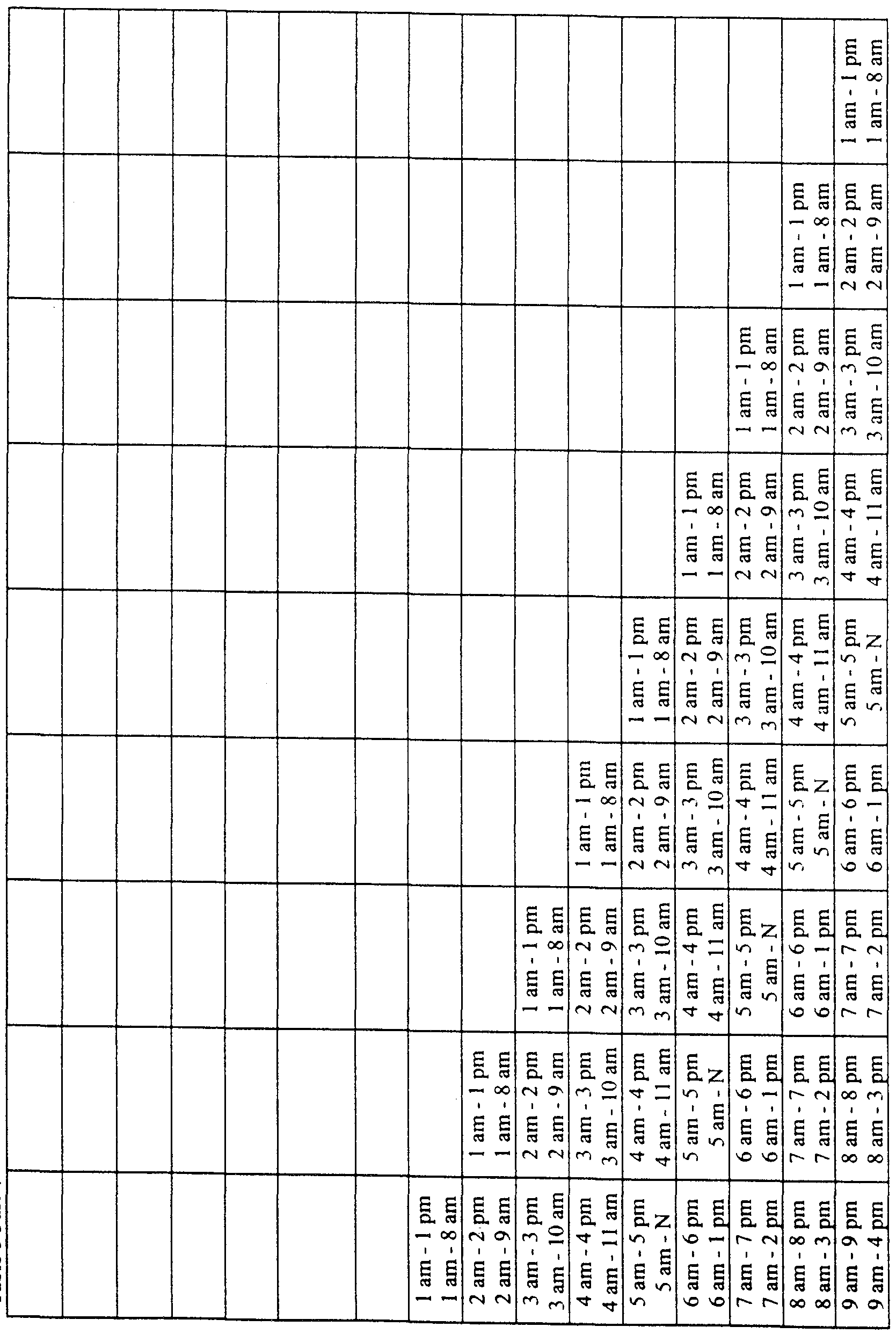

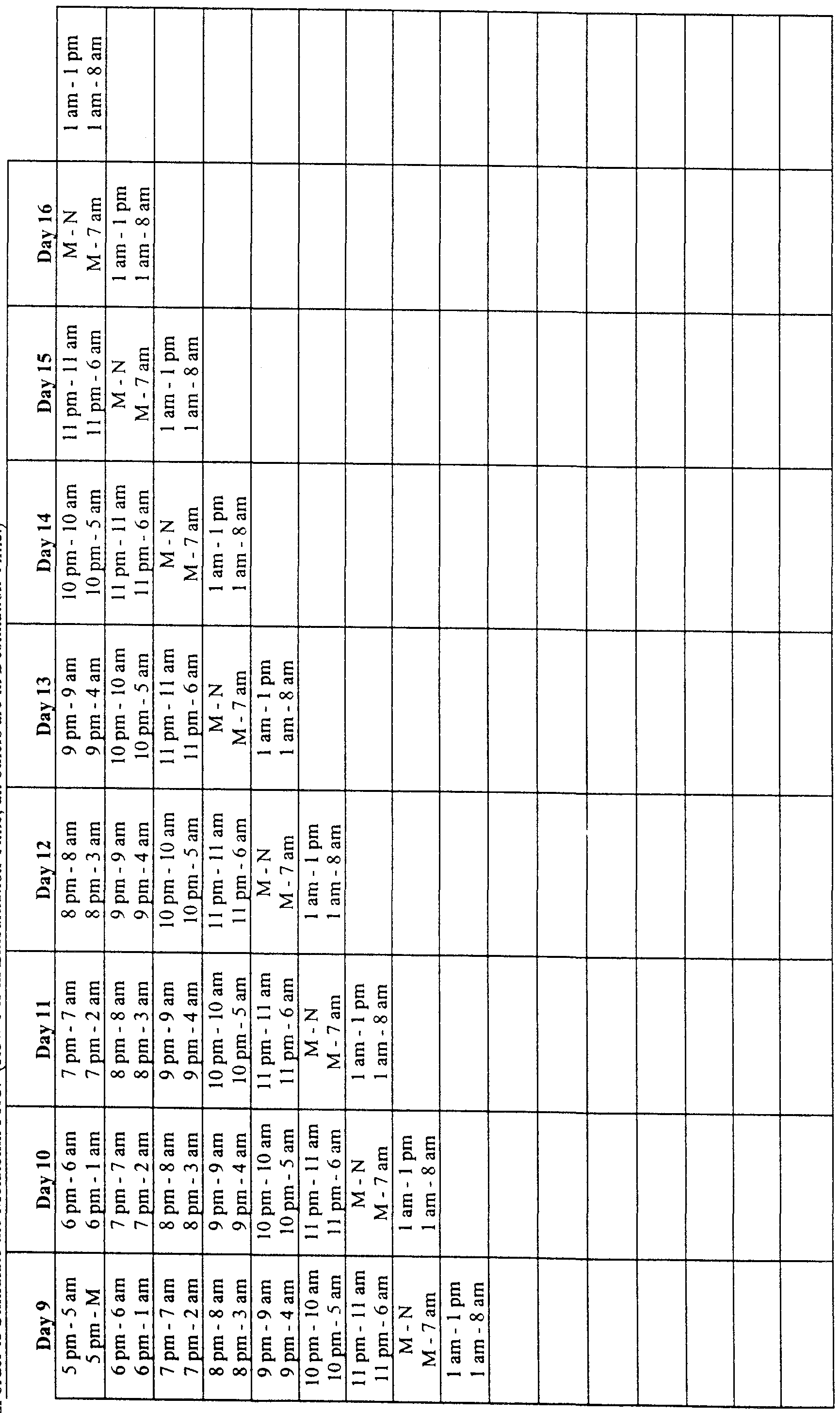


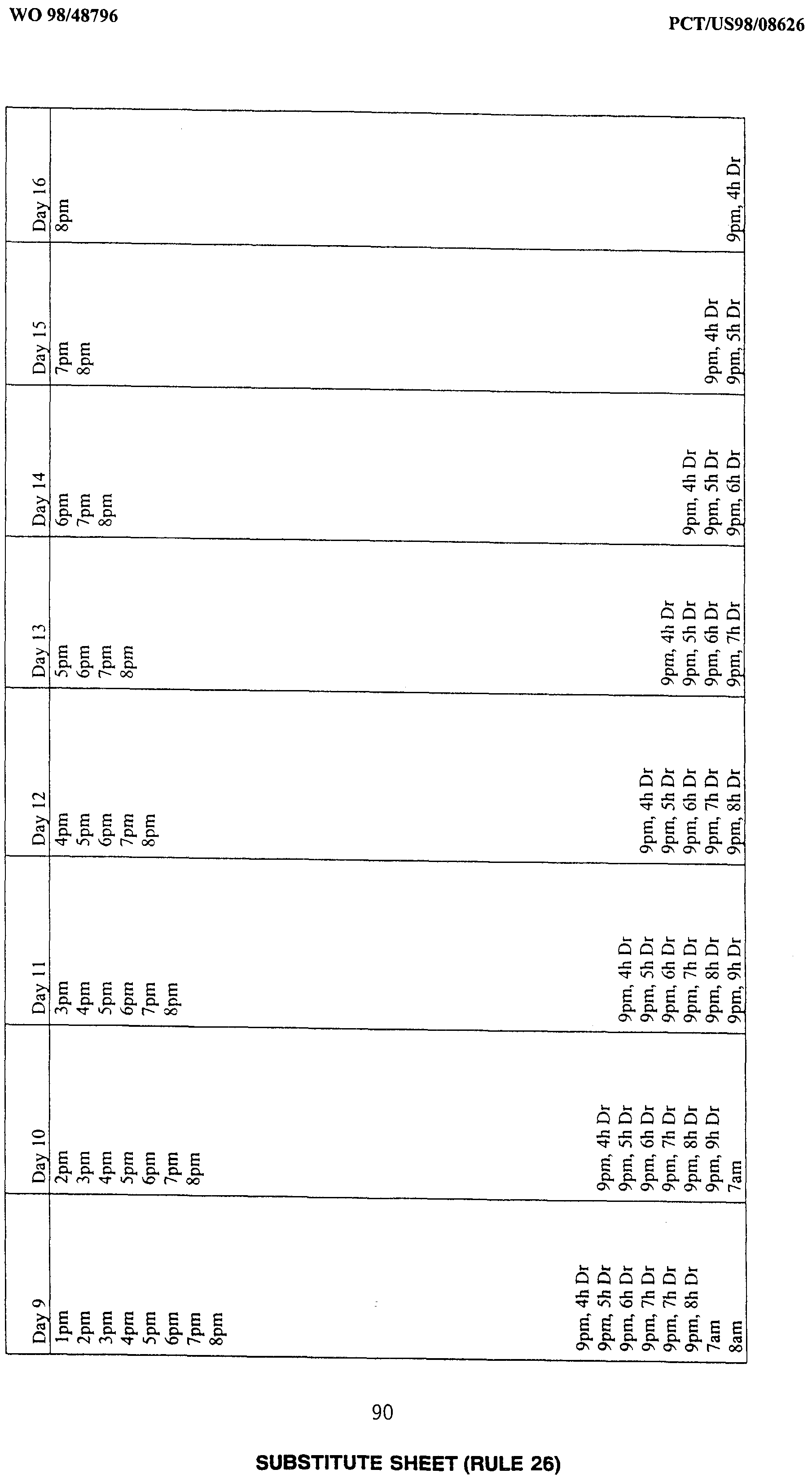
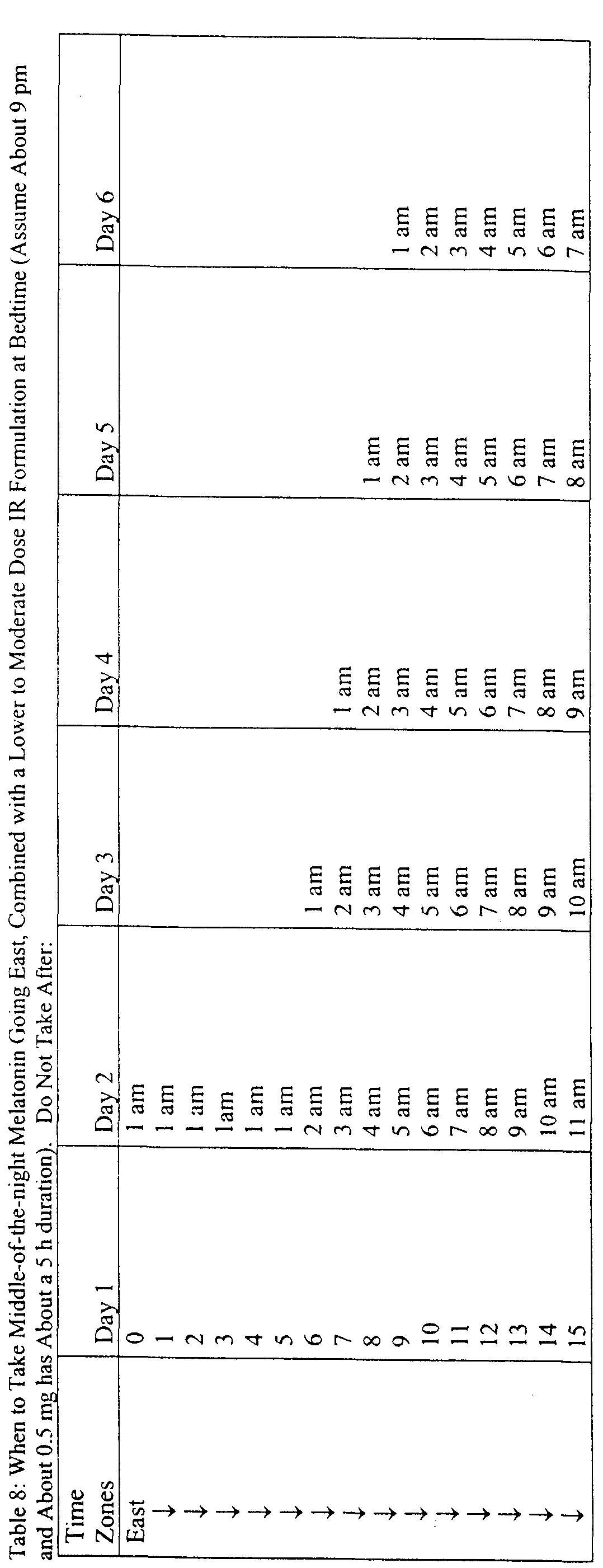


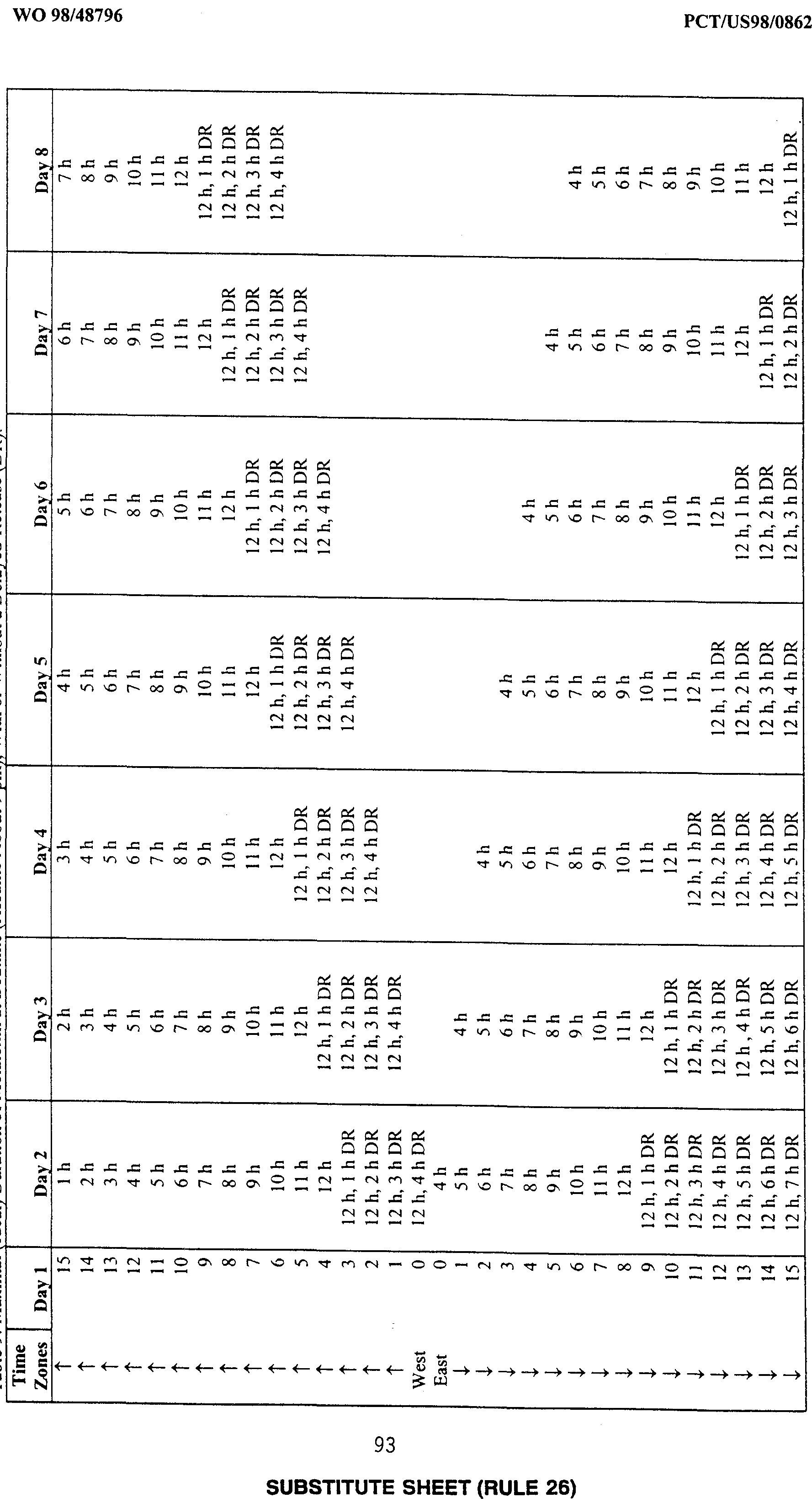

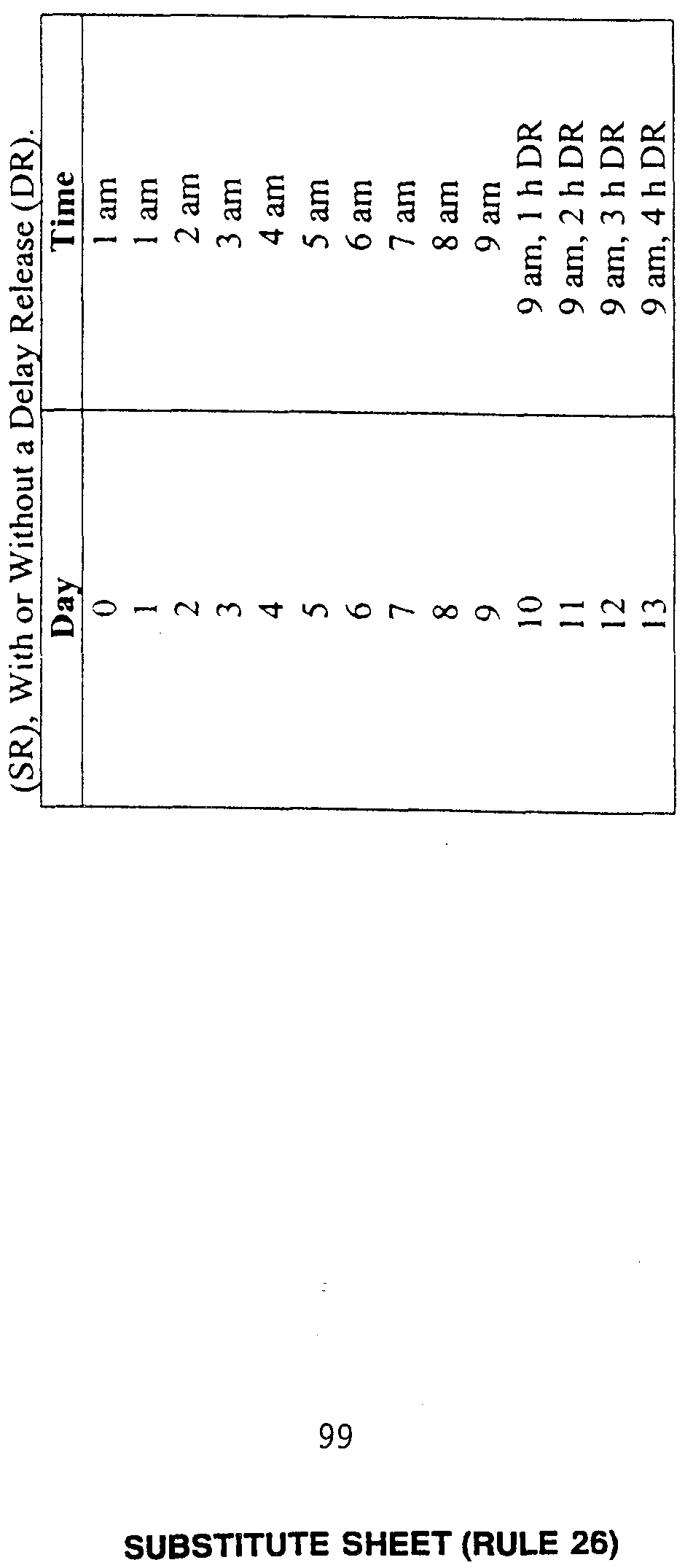
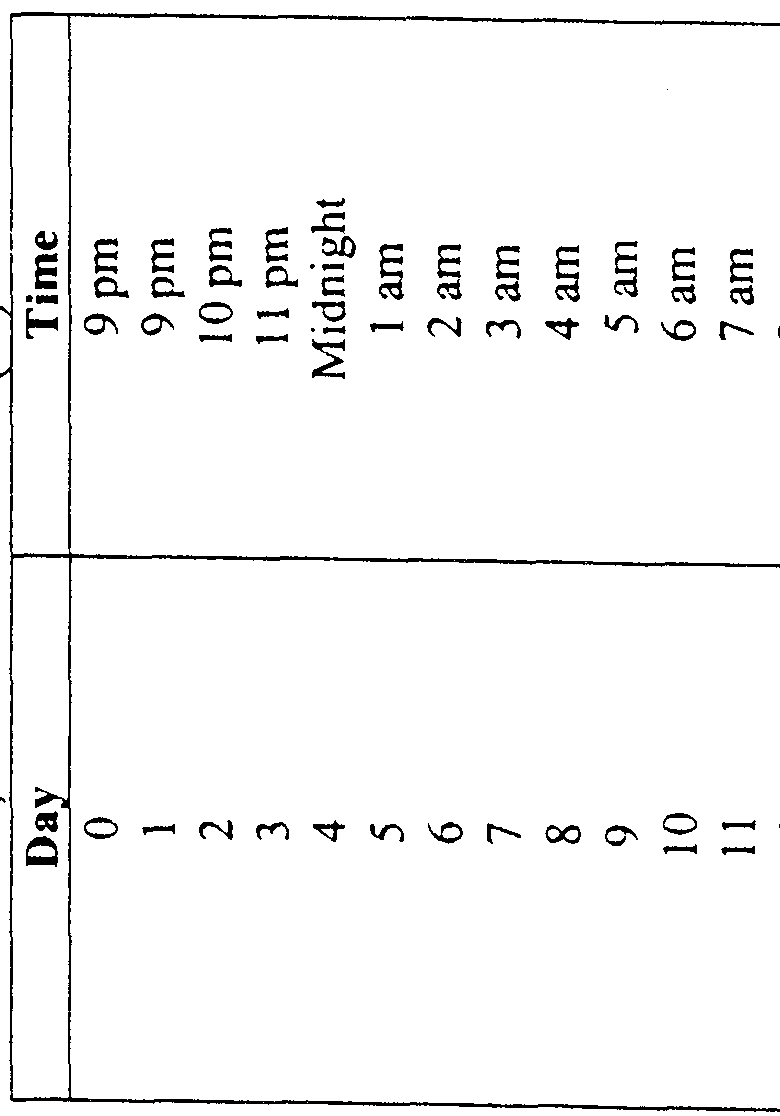


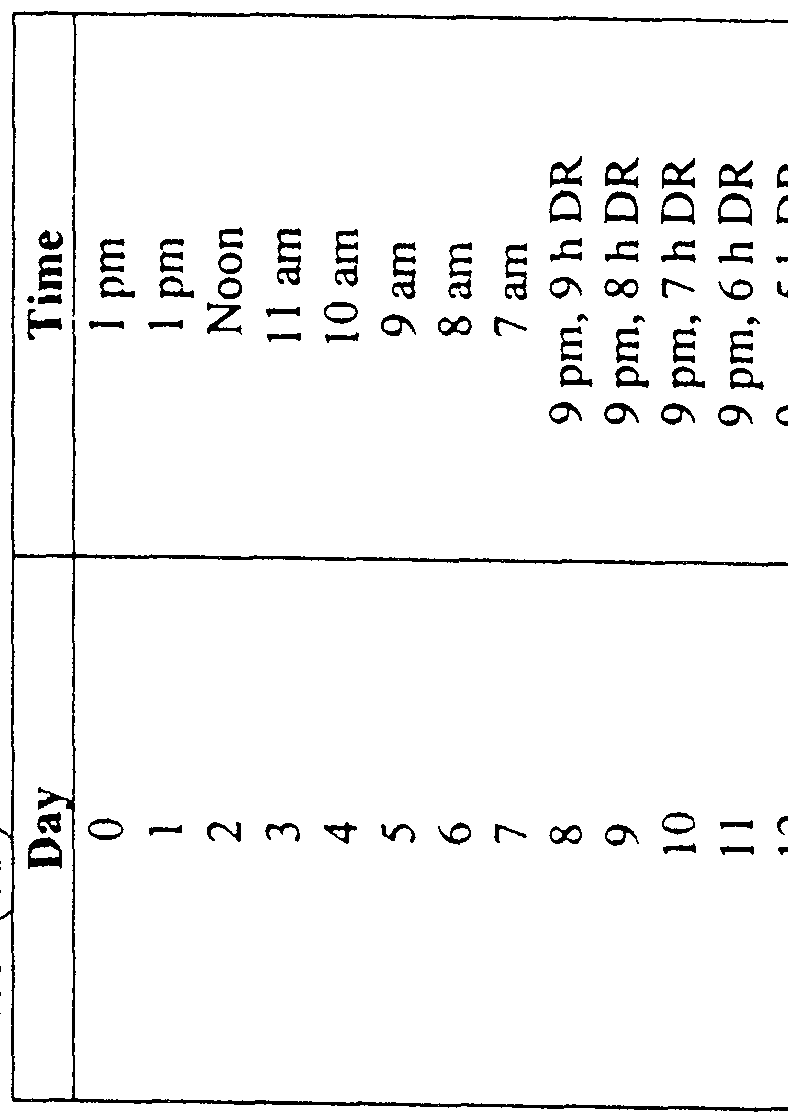
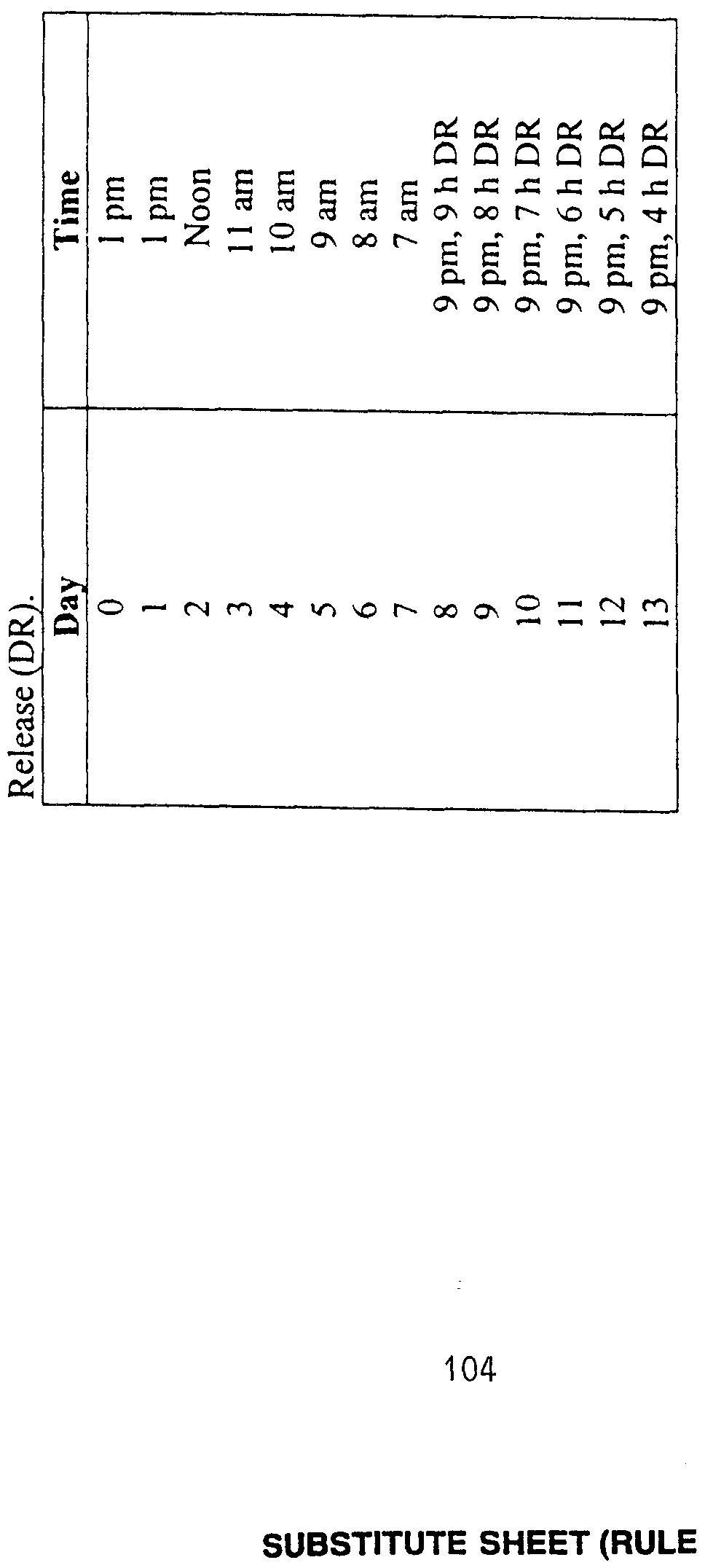
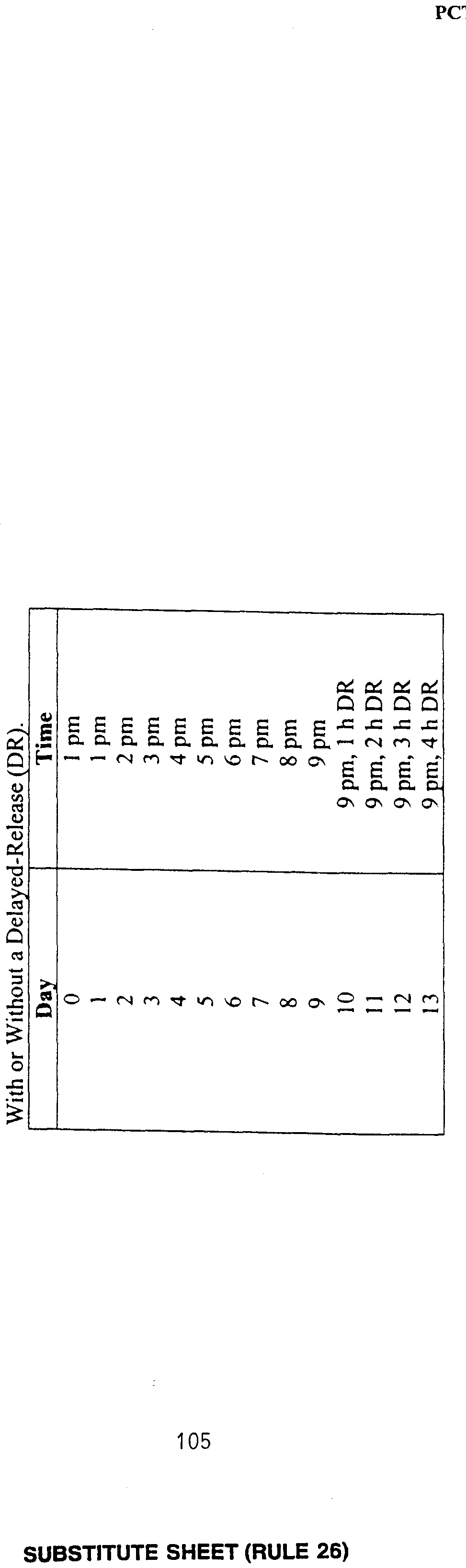


Claims
Priority Applications (2)
| Application Number | Priority Date | Filing Date | Title |
|---|---|---|---|
| AU72657/98A AU7265798A (en) | 1997-04-29 | 1998-04-29 | Use of melatonin for preparing medicaments for treating circadian rhythm phase disorders |
| CA2289093A CA2289093C (en) | 1997-04-29 | 1998-04-29 | Use of melatonin for preparing medicaments for treating circadian rhythm phase disorders |
Applications Claiming Priority (2)
| Application Number | Priority Date | Filing Date | Title |
|---|---|---|---|
| US08/840,382 | 1997-04-29 | ||
| US08/840,382 US6638963B1 (en) | 1990-12-04 | 1997-04-29 | Methods for treating circadian rhythm disorders |
Publications (1)
| Publication Number | Publication Date |
|---|---|
| WO1998048796A1 true WO1998048796A1 (en) | 1998-11-05 |
Family
ID=25282219
Family Applications (1)
| Application Number | Title | Priority Date | Filing Date |
|---|---|---|---|
| PCT/US1998/008626 Ceased WO1998048796A1 (en) | 1997-04-29 | 1998-04-29 | Use of melatonin for preparing medicaments for treating circadian rhythm phase disorders |
Country Status (4)
| Country | Link |
|---|---|
| US (2) | US6638963B1 (en) |
| AU (1) | AU7265798A (en) |
| CA (1) | CA2289093C (en) |
| WO (1) | WO1998048796A1 (en) |
Cited By (2)
| Publication number | Priority date | Publication date | Assignee | Title |
|---|---|---|---|---|
| DE102005008312A1 (en) * | 2005-02-17 | 2006-08-24 | Birds Pharma Gmbh Berolina Innovative Research & Development Services | Use of deuterated N- [2- (5-methoxy-1H-indol-3-yl) ethyl] acatamide and their pharmaceutically acceptable salts and medicaments containing these compounds |
| EP3571211A4 (en) * | 2017-01-20 | 2021-09-01 | National Institute Of Biological Sciences, Beijing | ADENOSINE ANALOGUE AND ITS USE TO REGULATE THE CIRCADIAN CLOCK |
Families Citing this family (22)
| Publication number | Priority date | Publication date | Assignee | Title |
|---|---|---|---|---|
| US6638963B1 (en) * | 1990-12-04 | 2003-10-28 | Oregon Health And Science University | Methods for treating circadian rhythm disorders |
| US5591768A (en) * | 1990-12-04 | 1997-01-07 | State Of Oregan, Acting By And Through The Oregon State Board Of Higher Education On Behalf Of The Oregon Health Sciences University | Methods for treating circadian rhythm phase disturbances |
| CA2497261C (en) * | 2002-08-28 | 2012-07-31 | Robert Casper | A device for the prevention of melatonin suppression by light at night |
| US7748845B2 (en) * | 2002-08-28 | 2010-07-06 | Robert Casper | Method and device for preventing alterations in circadian rhythm |
| US7299086B2 (en) * | 2004-03-05 | 2007-11-20 | Cardiac Pacemakers, Inc. | Wireless ECG in implantable devices |
| MY148806A (en) * | 2005-04-04 | 2013-05-31 | Takeda Pharmaceutical | Prophylactic or therapeutic agent for nocturnal conduct disorder associated with dementia |
| US20060252685A1 (en) * | 2005-05-04 | 2006-11-09 | Gould Jeffrey D | Treatment for sleep apnea |
| US7561912B2 (en) * | 2005-09-19 | 2009-07-14 | Cardiac Pacemakers, Inc. | Use of periodicity in medical data analysis |
| US20070270393A1 (en) * | 2006-02-17 | 2007-11-22 | Theresa Buckley | Methods and compositions for modulation of sleep cycle |
| WO2008016911A2 (en) * | 2006-07-31 | 2008-02-07 | Oregon Health & Science University | Replicating melatonin signaling in a fetus, newborn or suckling infant |
| US20080167363A1 (en) * | 2006-12-28 | 2008-07-10 | Braincells, Inc | Modulation of Neurogenesis By Melatoninergic Agents |
| US20080171085A1 (en) * | 2007-01-11 | 2008-07-17 | Natrol, Inc. | Novel biphasic delivery system for a pharmaceutical or nutraceutical composition and method of administration |
| US8303635B2 (en) * | 2007-01-16 | 2012-11-06 | Katherine Hurst | Suprachiasmatic nucleus inducing, melatonin suppressing light emitting device to enhance wake cycle |
| US20110015261A1 (en) * | 2007-08-03 | 2011-01-20 | Zleepax Europe ApS | Use of a composition comprising at least one beta-blocker for the treatment of sleep disorders |
| DK200800932A (en) * | 2007-08-03 | 2009-02-04 | Tullin Soeren | Use of a composition comprising at least one beta-blocker for the treatment of sleep disorders |
| WO2012103411A2 (en) | 2011-01-28 | 2012-08-02 | Zx Pharma, Llc | Controlled-release melatonin composition and related methods |
| US9532952B2 (en) | 2011-01-28 | 2017-01-03 | Physician's Seal, LLC | Controlled-release compositions of melatonin combined with sedative and/or analgesic ingredients |
| US11918557B2 (en) | 2012-01-26 | 2024-03-05 | Vanda Pharmaceuticals Inc. | Treatment of circadian rhythm disorders |
| RU2650647C2 (en) | 2012-01-26 | 2018-04-16 | Ванда Фармасьютиклз Инк. | Treatment of circadian rhythm disorders |
| US10376487B2 (en) | 2013-11-12 | 2019-08-13 | Vanda Pharmaceuticals Inc. | Method of treatment |
| JP6722911B1 (en) * | 2019-04-18 | 2020-07-15 | 株式会社こどもみらい | System for presenting time of day based on individual circadian rhythm |
| WO2025107000A1 (en) * | 2023-11-17 | 2025-05-22 | The Board Of Trustees Of The Leland Stanford Junior University | Systems and methods for evaluation of circadian rhythm and sleep homeostasis |
Citations (4)
| Publication number | Priority date | Publication date | Assignee | Title |
|---|---|---|---|---|
| US5071875A (en) * | 1989-09-25 | 1991-12-10 | Northwestern University | Substituted 2-amidotetralins as melatonin agonists and antagonists |
| US5093352A (en) * | 1988-11-14 | 1992-03-03 | Whitby Research, Inc. | Antidepressant agents |
| US5151446A (en) * | 1989-09-25 | 1992-09-29 | Northwestern University | Substituted 2-amidotetralins as melatonin agonists and antagonists |
| US5242941A (en) * | 1990-12-04 | 1993-09-07 | State Of Oregon | Methods of treating circadian rhythm disorders |
Family Cites Families (25)
| Publication number | Priority date | Publication date | Assignee | Title |
|---|---|---|---|---|
| US2853420A (en) | 1956-01-25 | 1958-09-23 | Lowey Hans | Ethyl cellulose coatings for shaped medicinal preparations |
| US3538214A (en) | 1969-04-22 | 1970-11-03 | Merck & Co Inc | Controlled release medicinal tablets |
| DE2010416B2 (en) | 1970-03-05 | 1979-03-29 | Hoechst Ag, 6000 Frankfurt | Orally applicable dosage form with sustained release effect |
| DE2336218C3 (en) | 1973-07-17 | 1985-11-14 | Byk Gulden Lomberg Chemische Fabrik Gmbh, 7750 Konstanz | Oral dosage form |
| SE418247B (en) | 1975-11-17 | 1981-05-18 | Haessle Ab | SET TO MAKE BODIES WITH REGULATED RELEASE OF AN ACTIVE COMPONENT |
| DK151608C (en) | 1982-08-13 | 1988-06-20 | Benzon As Alfred | PROCEDURE FOR PREPARING A PHARMACEUTICAL PERORAL POLYDEPOT PREPARATION WITH CONTROLLED RELEASE |
| EP0126630B1 (en) | 1983-05-18 | 1987-09-16 | Monash University | The use of melatonin for the manufacture of a medicament |
| US4600723A (en) | 1983-05-18 | 1986-07-15 | Monash University | Method for minimizing disturbances in circadian rhythms of bodily performance and function |
| US4505890A (en) | 1983-06-30 | 1985-03-19 | E. R. Squibb & Sons, Inc. | Controlled release formulation and method |
| AU571922B2 (en) | 1984-01-26 | 1988-04-28 | Schering Agrochemicals Limited | Veterinary implants comprising melatonin and derivatives thereof |
| US4687763A (en) | 1985-02-25 | 1987-08-18 | Massachusetts Institute Of Technology | Composition and method for increasing levels or release of brain serotonin |
| AU601736B2 (en) | 1986-05-23 | 1990-09-20 | Sanofi Sante Nutrition Animale Sa | Coated veterinary implants |
| US5503637A (en) | 1987-06-26 | 1996-04-02 | Light Sciences, Inc. | Apparatus for producing and delivering high-intensity light to a subject |
| US5167228A (en) | 1987-06-26 | 1992-12-01 | Brigham And Women's Hospital | Assessment and modification of endogenous circadian phase and amplitude |
| US5545192A (en) | 1987-06-26 | 1996-08-13 | Brigham And Women's Hospital | Intermittent use of bright light to modify the circadian phase |
| US5163426A (en) | 1987-06-26 | 1992-11-17 | Brigham And Women's Hospital | Assessment and modification of a subject's endogenous circadian cycle |
| US5169642A (en) | 1988-06-24 | 1992-12-08 | Abbott Laboratories | Sustained-release drug dosage units |
| US4945103A (en) | 1989-01-17 | 1990-07-31 | Michael Cohen | Method of treating pre-menstrual syndrome |
| US5591768A (en) * | 1990-12-04 | 1997-01-07 | State Of Oregan, Acting By And Through The Oregon State Board Of Higher Education On Behalf Of The Oregon Health Sciences University | Methods for treating circadian rhythm phase disturbances |
| US6638963B1 (en) * | 1990-12-04 | 2003-10-28 | Oregon Health And Science University | Methods for treating circadian rhythm disorders |
| DK0518468T3 (en) | 1991-05-09 | 2000-01-31 | Neurim Pharma 1991 | Melatonin-containing compositions |
| AU660336B2 (en) | 1991-10-18 | 1995-06-22 | Alza Corporation | Device for the transdermal administration of melatonin |
| IT1254995B (en) | 1992-06-24 | 1995-10-11 | DRUG CONTAINING MELATONIN AND / OR AGONISTS, WITH PARTICULARLY EFFECTIVE ADMINISTRATION IN PATHOLOGIES THAT INTERFER WITH CIRCANDIAN RHYTHMS | |
| US5449683A (en) | 1992-10-01 | 1995-09-12 | Massachussetts Institute Of Technology | Methods of inducing sleep using melatonin |
| WO1995003043A1 (en) | 1993-07-26 | 1995-02-02 | State Of Oregon, Acting By And Through The Oregon State Board Of Higher Education On Behalf Of The Oregon Health Sciences University | Sustained release oral compositions containing melatonin |
-
1997
- 1997-04-29 US US08/840,382 patent/US6638963B1/en not_active Expired - Lifetime
-
1998
- 1998-04-29 WO PCT/US1998/008626 patent/WO1998048796A1/en not_active Ceased
- 1998-04-29 CA CA2289093A patent/CA2289093C/en not_active Expired - Lifetime
- 1998-04-29 AU AU72657/98A patent/AU7265798A/en not_active Abandoned
-
2003
- 2003-08-18 US US10/642,844 patent/US20040044064A1/en not_active Abandoned
Patent Citations (5)
| Publication number | Priority date | Publication date | Assignee | Title |
|---|---|---|---|---|
| US5093352A (en) * | 1988-11-14 | 1992-03-03 | Whitby Research, Inc. | Antidepressant agents |
| US5071875A (en) * | 1989-09-25 | 1991-12-10 | Northwestern University | Substituted 2-amidotetralins as melatonin agonists and antagonists |
| US5151446A (en) * | 1989-09-25 | 1992-09-29 | Northwestern University | Substituted 2-amidotetralins as melatonin agonists and antagonists |
| US5242941A (en) * | 1990-12-04 | 1993-09-07 | State Of Oregon | Methods of treating circadian rhythm disorders |
| US5420152A (en) * | 1990-12-04 | 1995-05-30 | State Of Oregon, Acting By And Through The Oregon State Board Of Higher Education On Behalf Of The Oregon Health Sciences University, A Non-Profit Organization | Methods of treating circadian rhythm disorders |
Non-Patent Citations (2)
| Title |
|---|
| J. ARENDT ET AL.: "Some effects of jet-lag and their alleviation by melatonin.", ERGONOMICS, vol. 30, no. 9, 1987, pages 1379 - 1393, XP002074854 * |
| S. DEACON ET AL.: "Melatonin-induced temperature suppression and its acute phase-shifting effects correlate in a dose-dependent manner in humans.", BRAIN RES., vol. 688, 1995, pages 77 - 85, XP002074853 * |
Cited By (2)
| Publication number | Priority date | Publication date | Assignee | Title |
|---|---|---|---|---|
| DE102005008312A1 (en) * | 2005-02-17 | 2006-08-24 | Birds Pharma Gmbh Berolina Innovative Research & Development Services | Use of deuterated N- [2- (5-methoxy-1H-indol-3-yl) ethyl] acatamide and their pharmaceutically acceptable salts and medicaments containing these compounds |
| EP3571211A4 (en) * | 2017-01-20 | 2021-09-01 | National Institute Of Biological Sciences, Beijing | ADENOSINE ANALOGUE AND ITS USE TO REGULATE THE CIRCADIAN CLOCK |
Also Published As
| Publication number | Publication date |
|---|---|
| US20040044064A1 (en) | 2004-03-04 |
| US6638963B1 (en) | 2003-10-28 |
| CA2289093A1 (en) | 1998-11-05 |
| AU7265798A (en) | 1998-11-24 |
| CA2289093C (en) | 2010-09-14 |
Similar Documents
| Publication | Publication Date | Title |
|---|---|---|
| US6638963B1 (en) | Methods for treating circadian rhythm disorders | |
| US6423738B1 (en) | Methods for treating circadian rhythm phase disturbances | |
| WO1995005819A9 (en) | Methods for treating circadian rhythm phase disturbances | |
| Pandi-Perumal et al. | Dim light melatonin onset (DLMO): a tool for the analysis of circadian phase in human sleep and chronobiological disorders | |
| Zisapel | Circadian rhythm sleep disorders: pathophysiology and potential approaches to management | |
| Sack | The pathophysiology of jet lag | |
| EP0126630B1 (en) | The use of melatonin for the manufacture of a medicament | |
| Brown | Light, melatonin and the sleep-wake cycle | |
| Haimov et al. | The prevention and treatment of jet lag | |
| Zee et al. | Treatment of shift work disorder and jet lag | |
| Richardson et al. | Circadian rhythm sleep disorders: pathophysiology and treatment | |
| Rodenbeck et al. | Altered circadian melatonin secretion patterns in relation to sleep in patients with chronic sleep‐wake rhythm disorders | |
| WO1995003043A1 (en) | Sustained release oral compositions containing melatonin | |
| Stone et al. | Promoting sleep in shiftworkers and inter continental travelers | |
| Luboshizsky et al. | Sleep-inducing effects of exogenous melatonin administration | |
| Voderholzer et al. | Circadian profiles of melatonin in melancholic depressed patients and healthy subjects in relation to cortisol secretion and sleep | |
| EP1347778B1 (en) | Behavior chemotherapy | |
| AU2001218105A1 (en) | Behavior chemotherapy | |
| Markwell et al. | Jet lag | |
| Sack et al. | The sleep-promoting effects of melatonin | |
| JPH0524136B2 (en) | ||
| Vessely et al. | Melatonin as a hormone and as a marker for circadian phase position in humans | |
| Mendelson | A 96-year-old woman with insomnia | |
| Cvengros et al. | Circadian rhythm disorders | |
| Bae et al. | Too Much of a Good Thing |
Legal Events
| Date | Code | Title | Description |
|---|---|---|---|
| AK | Designated states |
Kind code of ref document: A1 Designated state(s): AL AM AT AU AZ BA BB BG BR BY CA CH CN CU CZ DE DK EE ES FI GB GE GH GM GW HU ID IL IS JP KE KG KP KR KZ LC LK LR LS LT LU LV MD MG MK MN MW MX NO NZ PL PT RO RU SD SE SG SI SK SL TJ TM TR TT UA UG UZ VN YU ZW |
|
| AL | Designated countries for regional patents |
Kind code of ref document: A1 Designated state(s): GH GM KE LS MW SD SZ UG ZW AM AZ BY KG KZ MD RU TJ TM AT BE CH CY DE DK ES FI FR GB GR IE IT LU MC NL PT SE BF BJ CF CG CI CM GA GN ML MR NE SN TD TG |
|
| DFPE | Request for preliminary examination filed prior to expiration of 19th month from priority date (pct application filed before 20040101) | ||
| 121 | Ep: the epo has been informed by wipo that ep was designated in this application | ||
| ENP | Entry into the national phase |
Ref document number: 2289093 Country of ref document: CA Ref country code: CA Ref document number: 2289093 Kind code of ref document: A Format of ref document f/p: F |
|
| REG | Reference to national code |
Ref country code: DE Ref legal event code: 8642 |
|
| NENP | Non-entry into the national phase |
Ref country code: JP Ref document number: 1998547328 Format of ref document f/p: F |
|
| 122 | Ep: pct application non-entry in european phase |