EP0126630B1 - The use of melatonin for the manufacture of a medicament - Google Patents
The use of melatonin for the manufacture of a medicament Download PDFInfo
- Publication number
- EP0126630B1 EP0126630B1 EP84303369A EP84303369A EP0126630B1 EP 0126630 B1 EP0126630 B1 EP 0126630B1 EP 84303369 A EP84303369 A EP 84303369A EP 84303369 A EP84303369 A EP 84303369A EP 0126630 B1 EP0126630 B1 EP 0126630B1
- Authority
- EP
- European Patent Office
- Prior art keywords
- melatonin
- sleep
- time
- subject
- rhythms
- Prior art date
- Legal status (The legal status is an assumption and is not a legal conclusion. Google has not performed a legal analysis and makes no representation as to the accuracy of the status listed.)
- Expired
Links
- DRLFMBDRBRZALE-UHFFFAOYSA-N melatonin Chemical compound COC1=CC=C2NC=C(CCNC(C)=O)C2=C1 DRLFMBDRBRZALE-UHFFFAOYSA-N 0.000 title claims description 161
- YJPIGAIKUZMOQA-UHFFFAOYSA-N Melatonin Natural products COC1=CC=C2N(C(C)=O)C=C(CCN)C2=C1 YJPIGAIKUZMOQA-UHFFFAOYSA-N 0.000 title claims description 158
- 229960003987 melatonin Drugs 0.000 title claims description 158
- 239000003814 drug Substances 0.000 title claims description 13
- 238000004519 manufacturing process Methods 0.000 title claims description 4
- 230000027288 circadian rhythm Effects 0.000 claims description 43
- 230000000694 effects Effects 0.000 claims description 34
- 241000282414 Homo sapiens Species 0.000 claims description 20
- 238000002360 preparation method Methods 0.000 claims description 6
- 239000003085 diluting agent Substances 0.000 claims description 2
- 230000007958 sleep Effects 0.000 description 61
- 230000033764 rhythmic process Effects 0.000 description 51
- 239000002775 capsule Substances 0.000 description 29
- 208000019888 Circadian rhythm sleep disease Diseases 0.000 description 27
- 208000001456 Jet Lag Syndrome Diseases 0.000 description 27
- 208000033915 jet lag type circadian rhythm sleep disease Diseases 0.000 description 27
- 230000036760 body temperature Effects 0.000 description 18
- 238000002474 experimental method Methods 0.000 description 14
- 230000008859 change Effects 0.000 description 13
- 238000011282 treatment Methods 0.000 description 13
- 208000024891 symptom Diseases 0.000 description 12
- 239000000902 placebo Substances 0.000 description 11
- 229940068196 placebo Drugs 0.000 description 11
- 206010041349 Somnolence Diseases 0.000 description 10
- 230000000147 hypnotic effect Effects 0.000 description 10
- 230000002060 circadian Effects 0.000 description 9
- 230000007613 environmental effect Effects 0.000 description 9
- 230000010006 flight Effects 0.000 description 9
- 241000282412 Homo Species 0.000 description 8
- 230000002354 daily effect Effects 0.000 description 8
- 230000006870 function Effects 0.000 description 7
- 229940088597 hormone Drugs 0.000 description 7
- 239000005556 hormone Substances 0.000 description 7
- 238000000034 method Methods 0.000 description 7
- 230000036470 plasma concentration Effects 0.000 description 7
- MUMGGOZAMZWBJJ-DYKIIFRCSA-N Testostosterone Chemical compound O=C1CC[C@]2(C)[C@H]3CC[C@](C)([C@H](CC4)O)[C@@H]4[C@@H]3CCC2=C1 MUMGGOZAMZWBJJ-DYKIIFRCSA-N 0.000 description 6
- 238000010494 dissociation reaction Methods 0.000 description 6
- 230000005593 dissociations Effects 0.000 description 6
- 239000003326 hypnotic agent Substances 0.000 description 6
- 230000000144 pharmacologic effect Effects 0.000 description 6
- 241000700159 Rattus Species 0.000 description 5
- 150000001875 compounds Chemical class 0.000 description 5
- 230000037406 food intake Effects 0.000 description 5
- 235000012054 meals Nutrition 0.000 description 5
- 230000010363 phase shift Effects 0.000 description 5
- 210000004560 pineal gland Anatomy 0.000 description 5
- 230000036385 rapid eye movement (rem) sleep Effects 0.000 description 5
- 230000036578 sleeping time Effects 0.000 description 5
- RJKFOVLPORLFTN-LEKSSAKUSA-N Progesterone Chemical compound C1CC2=CC(=O)CC[C@]2(C)[C@@H]2[C@@H]1[C@@H]1CC[C@H](C(=O)C)[C@@]1(C)CC2 RJKFOVLPORLFTN-LEKSSAKUSA-N 0.000 description 4
- 230000006978 adaptation Effects 0.000 description 4
- UCTWMZQNUQWSLP-UHFFFAOYSA-N adrenaline Chemical compound CNCC(O)C1=CC=C(O)C(O)=C1 UCTWMZQNUQWSLP-UHFFFAOYSA-N 0.000 description 4
- 230000008901 benefit Effects 0.000 description 4
- 239000008280 blood Substances 0.000 description 4
- 210000004369 blood Anatomy 0.000 description 4
- 230000036765 blood level Effects 0.000 description 4
- 230000001068 chronobiotic effect Effects 0.000 description 4
- 229940079593 drug Drugs 0.000 description 4
- 239000007903 gelatin capsule Substances 0.000 description 4
- JYGXADMDTFJGBT-VWUMJDOOSA-N hydrocortisone Chemical compound O=C1CC[C@]2(C)[C@H]3[C@@H](O)C[C@](C)([C@@](CC4)(O)C(=O)CO)[C@@H]4[C@@H]3CCC2=C1 JYGXADMDTFJGBT-VWUMJDOOSA-N 0.000 description 4
- 238000002955 isolation Methods 0.000 description 4
- 230000007246 mechanism Effects 0.000 description 4
- 230000000422 nocturnal effect Effects 0.000 description 4
- 239000000126 substance Substances 0.000 description 4
- 208000032953 Device battery issue Diseases 0.000 description 3
- LFQSCWFLJHTTHZ-UHFFFAOYSA-N Ethanol Chemical compound CCO LFQSCWFLJHTTHZ-UHFFFAOYSA-N 0.000 description 3
- 206010021033 Hypomenorrhoea Diseases 0.000 description 3
- 241000124008 Mammalia Species 0.000 description 3
- 241001465754 Metazoa Species 0.000 description 3
- 208000028017 Psychotic disease Diseases 0.000 description 3
- 208000032140 Sleepiness Diseases 0.000 description 3
- 238000013459 approach Methods 0.000 description 3
- 210000004556 brain Anatomy 0.000 description 3
- 230000006698 induction Effects 0.000 description 3
- 230000027939 micturition Effects 0.000 description 3
- KJONHKAYOJNZEC-UHFFFAOYSA-N nitrazepam Chemical compound C12=CC([N+](=O)[O-])=CC=C2NC(=O)CN=C1C1=CC=CC=C1 KJONHKAYOJNZEC-UHFFFAOYSA-N 0.000 description 3
- 230000002265 prevention Effects 0.000 description 3
- 230000004044 response Effects 0.000 description 3
- 239000000523 sample Substances 0.000 description 3
- 230000028327 secretion Effects 0.000 description 3
- 230000008454 sleep-wake cycle Effects 0.000 description 3
- 230000037321 sleepiness Effects 0.000 description 3
- 229960003604 testosterone Drugs 0.000 description 3
- SFLSHLFXELFNJZ-QMMMGPOBSA-N (-)-norepinephrine Chemical compound NC[C@H](O)C1=CC=C(O)C(O)=C1 SFLSHLFXELFNJZ-QMMMGPOBSA-N 0.000 description 2
- OXDZADMCOWPSOC-UHFFFAOYSA-N Argiprestocin Chemical compound N1C(=O)C(N)CSSCC(C(=O)N2C(CCC2)C(=O)NC(CCCN=C(N)N)C(=O)NCC(N)=O)NC(=O)C(CC(N)=O)NC(=O)C(CCC(N)=O)NC(=O)C(C(C)CC)NC(=O)C1CC1=CC=C(O)C=C1 OXDZADMCOWPSOC-UHFFFAOYSA-N 0.000 description 2
- 241000271566 Aves Species 0.000 description 2
- 241000557626 Corvus corax Species 0.000 description 2
- 241000699800 Cricetinae Species 0.000 description 2
- 208000020401 Depressive disease Diseases 0.000 description 2
- 239000001828 Gelatine Substances 0.000 description 2
- XLYOFNOQVPJJNP-ZSJDYOACSA-N Heavy water Chemical compound [2H]O[2H] XLYOFNOQVPJJNP-ZSJDYOACSA-N 0.000 description 2
- 101001002193 Homo sapiens Putative postmeiotic segregation increased 2-like protein 1 Proteins 0.000 description 2
- WHXSMMKQMYFTQS-UHFFFAOYSA-N Lithium Chemical compound [Li] WHXSMMKQMYFTQS-UHFFFAOYSA-N 0.000 description 2
- 229940123685 Monoamine oxidase inhibitor Drugs 0.000 description 2
- 102100020953 Putative postmeiotic segregation increased 2-like protein 1 Human genes 0.000 description 2
- 229930006000 Sucrose Natural products 0.000 description 2
- CZMRCDWAGMRECN-UGDNZRGBSA-N Sucrose Chemical compound O[C@H]1[C@H](O)[C@@H](CO)O[C@@]1(CO)O[C@@H]1[C@H](O)[C@@H](O)[C@H](O)[C@@H](CO)O1 CZMRCDWAGMRECN-UGDNZRGBSA-N 0.000 description 2
- 101800003024 Vasotocin Proteins 0.000 description 2
- 230000002411 adverse Effects 0.000 description 2
- 238000010171 animal model Methods 0.000 description 2
- 230000003466 anti-cipated effect Effects 0.000 description 2
- 230000006399 behavior Effects 0.000 description 2
- 230000009286 beneficial effect Effects 0.000 description 2
- 235000021152 breakfast Nutrition 0.000 description 2
- 239000012141 concentrate Substances 0.000 description 2
- 239000003246 corticosteroid Substances 0.000 description 2
- 238000011161 development Methods 0.000 description 2
- 230000002124 endocrine Effects 0.000 description 2
- 230000003203 everyday effect Effects 0.000 description 2
- 229920000159 gelatin Polymers 0.000 description 2
- 235000019322 gelatine Nutrition 0.000 description 2
- 229960000890 hydrocortisone Drugs 0.000 description 2
- 210000003016 hypothalamus Anatomy 0.000 description 2
- 230000006872 improvement Effects 0.000 description 2
- 150000002475 indoles Chemical class 0.000 description 2
- NOESYZHRGYRDHS-UHFFFAOYSA-N insulin Chemical compound N1C(=O)C(NC(=O)C(CCC(N)=O)NC(=O)C(CCC(O)=O)NC(=O)C(C(C)C)NC(=O)C(NC(=O)CN)C(C)CC)CSSCC(C(NC(CO)C(=O)NC(CC(C)C)C(=O)NC(CC=2C=CC(O)=CC=2)C(=O)NC(CCC(N)=O)C(=O)NC(CC(C)C)C(=O)NC(CCC(O)=O)C(=O)NC(CC(N)=O)C(=O)NC(CC=2C=CC(O)=CC=2)C(=O)NC(CSSCC(NC(=O)C(C(C)C)NC(=O)C(CC(C)C)NC(=O)C(CC=2C=CC(O)=CC=2)NC(=O)C(CC(C)C)NC(=O)C(C)NC(=O)C(CCC(O)=O)NC(=O)C(C(C)C)NC(=O)C(CC(C)C)NC(=O)C(CC=2NC=NC=2)NC(=O)C(CO)NC(=O)CNC2=O)C(=O)NCC(=O)NC(CCC(O)=O)C(=O)NC(CCCNC(N)=N)C(=O)NCC(=O)NC(CC=3C=CC=CC=3)C(=O)NC(CC=3C=CC=CC=3)C(=O)NC(CC=3C=CC(O)=CC=3)C(=O)NC(C(C)O)C(=O)N3C(CCC3)C(=O)NC(CCCCN)C(=O)NC(C)C(O)=O)C(=O)NC(CC(N)=O)C(O)=O)=O)NC(=O)C(C(C)CC)NC(=O)C(CO)NC(=O)C(C(C)O)NC(=O)C1CSSCC2NC(=O)C(CC(C)C)NC(=O)C(NC(=O)C(CCC(N)=O)NC(=O)C(CC(N)=O)NC(=O)C(NC(=O)C(N)CC=1C=CC=CC=1)C(C)C)CC1=CN=CN1 NOESYZHRGYRDHS-UHFFFAOYSA-N 0.000 description 2
- 229910052744 lithium Inorganic materials 0.000 description 2
- 230000007774 longterm Effects 0.000 description 2
- 239000002899 monoamine oxidase inhibitor Substances 0.000 description 2
- 230000001537 neural effect Effects 0.000 description 2
- 229960002748 norepinephrine Drugs 0.000 description 2
- SFLSHLFXELFNJZ-UHFFFAOYSA-N norepinephrine Natural products NCC(O)C1=CC=C(O)C(O)=C1 SFLSHLFXELFNJZ-UHFFFAOYSA-N 0.000 description 2
- 230000035479 physiological effects, processes and functions Effects 0.000 description 2
- 239000006187 pill Substances 0.000 description 2
- 229960003387 progesterone Drugs 0.000 description 2
- 239000000186 progesterone Substances 0.000 description 2
- 230000001105 regulatory effect Effects 0.000 description 2
- 238000011160 research Methods 0.000 description 2
- 241000894007 species Species 0.000 description 2
- 239000005720 sucrose Substances 0.000 description 2
- ZFXYFBGIUFBOJW-UHFFFAOYSA-N theophylline Chemical compound O=C1N(C)C(=O)N(C)C2=C1NC=N2 ZFXYFBGIUFBOJW-UHFFFAOYSA-N 0.000 description 2
- 210000002700 urine Anatomy 0.000 description 2
- VOXZDWNPVJITMN-ZBRFXRBCSA-N 17β-estradiol Chemical compound OC1=CC=C2[C@H]3CC[C@](C)([C@H](CC4)O)[C@@H]4[C@@H]3CCC2=C1 VOXZDWNPVJITMN-ZBRFXRBCSA-N 0.000 description 1
- 241000251468 Actinopterygii Species 0.000 description 1
- 239000000275 Adrenocorticotropic Hormone Substances 0.000 description 1
- 241000282994 Cervidae Species 0.000 description 1
- 101800000414 Corticotropin Proteins 0.000 description 1
- 241000938605 Crocodylia Species 0.000 description 1
- XUIIKFGFIJCVMT-GFCCVEGCSA-N D-thyroxine Chemical compound IC1=CC(C[C@@H](N)C(O)=O)=CC(I)=C1OC1=CC(I)=C(O)C(I)=C1 XUIIKFGFIJCVMT-GFCCVEGCSA-N 0.000 description 1
- 241000196324 Embryophyta Species 0.000 description 1
- 108010051696 Growth Hormone Proteins 0.000 description 1
- 241000238631 Hexapoda Species 0.000 description 1
- 102000004877 Insulin Human genes 0.000 description 1
- 108090001061 Insulin Proteins 0.000 description 1
- 241000289619 Macropodidae Species 0.000 description 1
- 206010026749 Mania Diseases 0.000 description 1
- 241000282339 Mustela Species 0.000 description 1
- 206010067482 No adverse event Diseases 0.000 description 1
- 241001494479 Pecora Species 0.000 description 1
- 241001282135 Poromitra oscitans Species 0.000 description 1
- 102100024819 Prolactin Human genes 0.000 description 1
- 108010057464 Prolactin Proteins 0.000 description 1
- 230000018199 S phase Effects 0.000 description 1
- 102100038803 Somatotropin Human genes 0.000 description 1
- SEQDDYPDSLOBDC-UHFFFAOYSA-N Temazepam Chemical compound N=1C(O)C(=O)N(C)C2=CC=C(Cl)C=C2C=1C1=CC=CC=C1 SEQDDYPDSLOBDC-UHFFFAOYSA-N 0.000 description 1
- 241001122767 Theaceae Species 0.000 description 1
- 229940123445 Tricyclic antidepressant Drugs 0.000 description 1
- 206010048232 Yawning Diseases 0.000 description 1
- 230000002159 abnormal effect Effects 0.000 description 1
- 230000009471 action Effects 0.000 description 1
- 239000013543 active substance Substances 0.000 description 1
- 239000000556 agonist Substances 0.000 description 1
- 230000036626 alertness Effects 0.000 description 1
- 230000004075 alteration Effects 0.000 description 1
- 239000000935 antidepressant agent Substances 0.000 description 1
- 229940005513 antidepressants Drugs 0.000 description 1
- 229940054051 antipsychotic indole derivative Drugs 0.000 description 1
- 230000036528 appetite Effects 0.000 description 1
- 235000019789 appetite Nutrition 0.000 description 1
- 235000015197 apple juice Nutrition 0.000 description 1
- -1 arginine vasotocin Chemical class 0.000 description 1
- 239000002876 beta blocker Substances 0.000 description 1
- 229940097320 beta blocking agent Drugs 0.000 description 1
- 235000013361 beverage Nutrition 0.000 description 1
- 238000004166 bioassay Methods 0.000 description 1
- 238000004173 biogeochemical cycle Methods 0.000 description 1
- 239000007844 bleaching agent Substances 0.000 description 1
- 238000010241 blood sampling Methods 0.000 description 1
- 238000009395 breeding Methods 0.000 description 1
- 230000001488 breeding effect Effects 0.000 description 1
- 230000005792 cardiovascular activity Effects 0.000 description 1
- 235000013339 cereals Nutrition 0.000 description 1
- 239000003795 chemical substances by application Substances 0.000 description 1
- 230000001684 chronic effect Effects 0.000 description 1
- 230000004087 circulation Effects 0.000 description 1
- BTFHLQRNAMSNLC-UHFFFAOYSA-N clorgyline Chemical compound C#CCN(C)CCCOC1=CC=C(Cl)C=C1Cl BTFHLQRNAMSNLC-UHFFFAOYSA-N 0.000 description 1
- 230000036992 cognitive tasks Effects 0.000 description 1
- 230000008094 contradictory effect Effects 0.000 description 1
- 229960000258 corticotropin Drugs 0.000 description 1
- IDLFZVILOHSSID-OVLDLUHVSA-N corticotropin Chemical compound C([C@@H](C(=O)N[C@@H](CO)C(=O)N[C@@H](CCSC)C(=O)N[C@@H](CCC(O)=O)C(=O)N[C@@H](CC=1NC=NC=1)C(=O)N[C@@H](CC=1C=CC=CC=1)C(=O)N[C@@H](CCCNC(N)=N)C(=O)N[C@@H](CC=1C2=CC=CC=C2NC=1)C(=O)NCC(=O)N[C@@H](CCCCN)C(=O)N1[C@@H](CCC1)C(=O)N[C@@H](C(C)C)C(=O)NCC(=O)N[C@@H](CCCCN)C(=O)N[C@@H](CCCCN)C(=O)N[C@@H](CCCNC(N)=N)C(=O)N[C@@H](CCCNC(N)=N)C(=O)N1[C@@H](CCC1)C(=O)N[C@@H](C(C)C)C(=O)N[C@@H](CCCCN)C(=O)N[C@@H](C(C)C)C(=O)N[C@@H](CC=1C=CC(O)=CC=1)C(=O)N1[C@@H](CCC1)C(=O)N[C@@H](CC(N)=O)C(=O)NCC(=O)N[C@@H](C)C(=O)N[C@@H](CCC(O)=O)C(=O)N[C@@H](CC(O)=O)C(=O)N[C@@H](CCC(O)=O)C(=O)N[C@@H](CO)C(=O)N[C@@H](C)C(=O)N[C@@H](CCC(O)=O)C(=O)N[C@@H](C)C(=O)N[C@@H](CC=1C=CC=CC=1)C(=O)N1[C@@H](CCC1)C(=O)N[C@@H](CC(C)C)C(=O)N[C@@H](CCC(O)=O)C(=O)N[C@@H](CC=1C=CC=CC=1)C(O)=O)NC(=O)[C@@H](N)CO)C1=CC=C(O)C=C1 IDLFZVILOHSSID-OVLDLUHVSA-N 0.000 description 1
- 230000001186 cumulative effect Effects 0.000 description 1
- 230000013872 defecation Effects 0.000 description 1
- 230000006735 deficit Effects 0.000 description 1
- 230000001934 delay Effects 0.000 description 1
- 230000003111 delayed effect Effects 0.000 description 1
- 230000001419 dependent effect Effects 0.000 description 1
- 230000000994 depressogenic effect Effects 0.000 description 1
- 238000003745 diagnosis Methods 0.000 description 1
- 229960003529 diazepam Drugs 0.000 description 1
- AAOVKJBEBIDNHE-UHFFFAOYSA-N diazepam Chemical compound N=1CC(=O)N(C)C2=CC=C(Cl)C=C2C=1C1=CC=CC=C1 AAOVKJBEBIDNHE-UHFFFAOYSA-N 0.000 description 1
- 230000009429 distress Effects 0.000 description 1
- 239000002552 dosage form Substances 0.000 description 1
- 230000035622 drinking Effects 0.000 description 1
- 239000003937 drug carrier Substances 0.000 description 1
- 239000003792 electrolyte Substances 0.000 description 1
- 201000003104 endogenous depression Diseases 0.000 description 1
- 229930182833 estradiol Natural products 0.000 description 1
- 239000000262 estrogen Substances 0.000 description 1
- 230000005713 exacerbation Effects 0.000 description 1
- 230000029142 excretion Effects 0.000 description 1
- 206010016256 fatigue Diseases 0.000 description 1
- 235000012631 food intake Nutrition 0.000 description 1
- 239000011521 glass Substances 0.000 description 1
- 239000003862 glucocorticoid Substances 0.000 description 1
- 239000000122 growth hormone Substances 0.000 description 1
- 229960004801 imipramine Drugs 0.000 description 1
- BCGWQEUPMDMJNV-UHFFFAOYSA-N imipramine Chemical compound C1CC2=CC=CC=C2N(CCCN(C)C)C2=CC=CC=C21 BCGWQEUPMDMJNV-UHFFFAOYSA-N 0.000 description 1
- 239000007943 implant Substances 0.000 description 1
- 230000001939 inductive effect Effects 0.000 description 1
- 230000002401 inhibitory effect Effects 0.000 description 1
- 238000002347 injection Methods 0.000 description 1
- 239000007924 injection Substances 0.000 description 1
- 229940125396 insulin Drugs 0.000 description 1
- 229960001078 lithium Drugs 0.000 description 1
- 230000001592 luteinising effect Effects 0.000 description 1
- 208000024714 major depressive disease Diseases 0.000 description 1
- 230000000873 masking effect Effects 0.000 description 1
- 238000005259 measurement Methods 0.000 description 1
- 229940033208 melatonin 5 mg Drugs 0.000 description 1
- 230000003340 mental effect Effects 0.000 description 1
- 230000036997 mental performance Effects 0.000 description 1
- 239000002207 metabolite Substances 0.000 description 1
- 230000000394 mitotic effect Effects 0.000 description 1
- 230000004048 modification Effects 0.000 description 1
- 238000012986 modification Methods 0.000 description 1
- 230000036651 mood Effects 0.000 description 1
- 230000000955 neuroendocrine Effects 0.000 description 1
- 210000000056 organ Anatomy 0.000 description 1
- 230000008520 organization Effects 0.000 description 1
- 230000027758 ovulation cycle Effects 0.000 description 1
- 229960004535 oxazepam Drugs 0.000 description 1
- ADIMAYPTOBDMTL-UHFFFAOYSA-N oxazepam Chemical compound C12=CC(Cl)=CC=C2NC(=O)C(O)N=C1C1=CC=CC=C1 ADIMAYPTOBDMTL-UHFFFAOYSA-N 0.000 description 1
- 238000005192 partition Methods 0.000 description 1
- 230000000737 periodic effect Effects 0.000 description 1
- 239000000825 pharmaceutical preparation Substances 0.000 description 1
- 230000036314 physical performance Effects 0.000 description 1
- 230000008092 positive effect Effects 0.000 description 1
- 230000003389 potentiating effect Effects 0.000 description 1
- 230000002028 premature Effects 0.000 description 1
- 229940097325 prolactin Drugs 0.000 description 1
- 208000020016 psychiatric disease Diseases 0.000 description 1
- 238000010791 quenching Methods 0.000 description 1
- 230000000171 quenching effect Effects 0.000 description 1
- 238000003127 radioimmunoassay Methods 0.000 description 1
- 230000009467 reduction Effects 0.000 description 1
- 238000012827 research and development Methods 0.000 description 1
- 210000001525 retina Anatomy 0.000 description 1
- 238000012552 review Methods 0.000 description 1
- 230000003248 secreting effect Effects 0.000 description 1
- 230000004617 sleep duration Effects 0.000 description 1
- 230000004622 sleep time Effects 0.000 description 1
- 230000003997 social interaction Effects 0.000 description 1
- 230000008925 spontaneous activity Effects 0.000 description 1
- 150000003431 steroids Chemical class 0.000 description 1
- 238000005556 structure-activity relationship Methods 0.000 description 1
- 239000000758 substrate Substances 0.000 description 1
- 230000009747 swallowing Effects 0.000 description 1
- 230000001360 synchronised effect Effects 0.000 description 1
- 230000001839 systemic circulation Effects 0.000 description 1
- 239000003826 tablet Substances 0.000 description 1
- 235000013616 tea Nutrition 0.000 description 1
- 229960003188 temazepam Drugs 0.000 description 1
- 230000002123 temporal effect Effects 0.000 description 1
- 229960000278 theophylline Drugs 0.000 description 1
- 230000035922 thirst Effects 0.000 description 1
- 229940034208 thyroxine Drugs 0.000 description 1
- XUIIKFGFIJCVMT-UHFFFAOYSA-N thyroxine-binding globulin Natural products IC1=CC(CC([NH3+])C([O-])=O)=CC(I)=C1OC1=CC(I)=C(O)C(I)=C1 XUIIKFGFIJCVMT-UHFFFAOYSA-N 0.000 description 1
- 230000003867 tiredness Effects 0.000 description 1
- 208000016255 tiredness Diseases 0.000 description 1
- 230000007704 transition Effects 0.000 description 1
- 229960003386 triazolam Drugs 0.000 description 1
- JOFWLTCLBGQGBO-UHFFFAOYSA-N triazolam Chemical compound C12=CC(Cl)=CC=C2N2C(C)=NN=C2CN=C1C1=CC=CC=C1Cl JOFWLTCLBGQGBO-UHFFFAOYSA-N 0.000 description 1
- 239000003029 tricyclic antidepressant agent Substances 0.000 description 1
- 210000003462 vein Anatomy 0.000 description 1
- 238000009423 ventilation Methods 0.000 description 1
- 238000012800 visualization Methods 0.000 description 1
- 230000002618 waking effect Effects 0.000 description 1
Images


Classifications
-
- A—HUMAN NECESSITIES
- A61—MEDICAL OR VETERINARY SCIENCE; HYGIENE
- A61K—PREPARATIONS FOR MEDICAL, DENTAL OR TOILETRY PURPOSES
- A61K31/00—Medicinal preparations containing organic active ingredients
- A61K31/33—Heterocyclic compounds
- A61K31/395—Heterocyclic compounds having nitrogen as a ring hetero atom, e.g. guanethidine or rifamycins
- A61K31/40—Heterocyclic compounds having nitrogen as a ring hetero atom, e.g. guanethidine or rifamycins having five-membered rings with one nitrogen as the only ring hetero atom, e.g. sulpiride, succinimide, tolmetin, buflomedil
-
- C—CHEMISTRY; METALLURGY
- C07—ORGANIC CHEMISTRY
- C07D—HETEROCYCLIC COMPOUNDS
- C07D209/00—Heterocyclic compounds containing five-membered rings, condensed with other rings, with one nitrogen atom as the only ring hetero atom
- C07D209/02—Heterocyclic compounds containing five-membered rings, condensed with other rings, with one nitrogen atom as the only ring hetero atom condensed with one carbocyclic ring
- C07D209/04—Indoles; Hydrogenated indoles
- C07D209/10—Indoles; Hydrogenated indoles with substituted hydrocarbon radicals attached to carbon atoms of the hetero ring
- C07D209/14—Radicals substituted by nitrogen atoms, not forming part of a nitro radical
- C07D209/16—Tryptamines
Definitions
- the present invention is concerned with the effects of disturbed circadian rhythms on bodily performance and function in human subjects and, more particularly, with the use of melatonin for the manufacture of a medicament for alleviating these effects.
- Circadian rhythms in bodily functions are defined as those events with a periodicity of about 24 hours which persist in the absence of external environmental cues. When rhythm persists in the absence of external environmental cues it is said to be free-running. In man, the periodicity of these free-running. rhythms is almost invariably greater than 24 hours. In normal life, these rhythms are reset (entrained) every day to about 24 hours by external environmental stimuli (zeitgebers), the light-dark cycle being of overriding importance.
- a host of mammalian circadian rhythms have been described, including feeding, drinking, sleep-wake, rapid eye movement (REM) sleep, body temperature, physical and mental performance, cardiovascular activity, urine flow, electrolyte excretion and mitotic activity.
- REM rapid eye movement
- rhythms free-run e.g. sleep-wake, REM sleep, body temperature, cortisol, adrenaline, noradrenaline and melatonin and are therefore true circadian rhythms.
- rhythms normally synchronized with each other in the presence of external environmental cues can free-run with different periodicities in the absence of external environmental cues. This is referred to as 'internal desynchronization'.
- 'internal desynchronization' For example, in the absence of environmental cues an individual might have a body temperature rhythm of 25 hours and a sleep-wake rhythm of 33 hours. On re-introducing an appropriate environmental cue these rhythms would become re-synchronized.
- Vnterna/ dissociation' causes the symptoms of "jet lag", e.g. feeling sleepy and tired at times of day inappropriate to the sleep-work schedule of the new location or roster, with disturbed rhythms of appetite, urination, body temperature and performance of physical and mental tasks.
- Jet lag is considered to be a symptom of internal dissociation.
- Hypnotics and tranquillizers e.g. diazepam, temazepam, oxazepam, triazolam, botizolam
- diazepam, temazepam, oxazepam, triazolam, botizolam are frequently used by the travelling public, and although they may induce sleep, its quality is in question since REM sleep is adversely affected. Some have even gone so far as to advise against the use of hypnotics because of their cumulative effects if taken repeatedly.
- Melatonin is another hormone with a pronounced 24 hour rhythm, the levels being elevated during the night time in all species. It is secreted by the pineal gland, but pinealectomy in rats is without effect on their free-running circadian rhythms, suggesting that in mammals melatonin is not involved in the generation of such rhythms.
- a Chronobiotic is defined for present purposes as a substrate which is capable of therapeutically reentraining short-term dissociated or long-term desynchronized circadian rhythms, or prophylactically preventing their disruption following an environmental insult.
- the surprising discovery which has led to the present invention is that melatonin is a powerful chronobiotic in humans. This discovery is contrary to all expectations. Melatonin is released by the pineal gland in a rhythm generated by the suprachiasmatic nuclei. It was therefore highly surprising to discover that melatonin produced by the "slave" organ was capable of feeding back to regulate some functions of the "master” oscillator, the suprachiasmatic nuclei.
- melatonin is the physiological compound normally responsible for sleep; one can fall asleep during the daytime when melatonin levels are at their lowest, and melatonin levels can be dissociated from the sleep pattern for several days following an abrupt time-zone change. This is perfectly in keeping with the observation that hypnotics can induce sleep but do not reentrain circadian rhythms. The well documeted hypnotic role of melatonin has not previously been liked with reentrainment of circadian rhythms.
- exogenous melatonin can act as a chronobiotic in man since it can hasten the reentrainment of the body temperature rhythm following an abrupt time-zone change or a change in work roster such as that experienced by night-shift workers. It is well known from some of our own and other earlier work that performance in cognitive tasks is closely linked to the body temperature rhythm (see: Colquhoun, W. P., Biological rhythms and human performance, Academic Press, 1971), and that the duration and organization of human sleep is dependent on the circadian phase of the body temperature rhythm (Czeisler, C. A., Weitzman, E. D., Moore-Ede, M. C., Zimmerman, J. C., Knaver, R. S.; 1980 Science, Vol.
- melatonin administered at the appropriate time of day could be used in treatment of all psychotic illnesses which result from abnormal timing of circadian rhythms.
- the only study in which melatonin has been administered to depressed patients reported an exacerbation of symptoms including florid psychotic episodes (Carmen, J. S. et al American Journal of Psychiatry 133, pp 1181-1186, 1976).
- the prior-art is teaching away from the use of melatonin to relieve psychoses, since researchers have made no allowance in the experimental procedures for the time of day of administration of melatonin and melatonin's capacity to re-entrain circadian rhythms in humans.
- the object of this invention is to provide a medication which minimizes the disturbances in human bodily performance and function that occur in the absence of an appropriate photoperiodic zeitgeber or time cue.
- the hormone melatonin is capable of acting as a zeitgeber to rapidly entrain certain circadian rhythms to a new photoperiodic environment, thereby minimizing the period of disturbance consequent upon the disruption of these rhythms.
- the present invention lies in the use of melatonin for the manufacture of a medicament for alleviating the effects of disturbed circadian rhythms on bodily performance and function in a human subject.
- the invention also includes a preparation for oral administration comprising melatonin and a pharmaceutically acceptable diluent, the preparation being adapted to release melatonin over an extended period upon administration to a human.
- pineal gland secretes its principal hormone, melatonin (5-methoxy-N-acetyltryptamine) according to a circadian rhythm generated in the suprachiasmatic nuclei of the hypothalamus and entrained by photoperiod.
- the pineal gland acts as a neuro-endocrine transducer, converting a neural input, in the form of light acting on the retina, into an endocrine output, in the form of melatonin which is released into the systemic circulation to act back on the brain directly.
- the pineal gland may also release other regulatory compounds, such as arginine vasotocin, which act back on the brain.
- Administration of the medicament of the invention should normally commence immediately following a time change, when the person would be trying to go to sleep according to the new time schedule.
- this will not only induce a sense of drowsiness, helping the person to go to sleep, but it will also improve the quality of the sleep and entrain the circadian rhythms to the new imposed photo-period.
- melatonin other related indoles or indole derivatives may be used. It has been shown that synthetic melatonin analogs do express varying degrees of melatonin agonist activity when tested on fish bioassay (Structure-Activity Relationship of Melatonin Analogues Frohn M. A., Seaborn C. J., Johnson D. W., Phillipou G., Seamark R. F., Matthews C. D., Life Science Vol. 27, pp 2043-20456, 1980).
- Treatment with the medicament of the invention may be continued until all bodily rhythms have adjusted to the new environment. It may also be possible to use the treatment to adjust the circadian rhythms in advance of a time change, thereby anticipating the new environment.
- the preferred schedule for treatment requires the subject to take the medicament of the invention at the anticipated time for going to sleep in the new destination or a new activity schedule.
- the treatment should be taken at least at the commencement of the first sleep period of the new destination. Alternatively, treatment may be commenced 1 or more days prior to the commencement of the journey or during the journey at the time anticipated to be the commencement of sleep time in the new time zone.
- the preferred dosage of melatonin is from 1 to 10 mg.
- the timing of the melatonin administration and the period of time for which the blood level remains elevated are important parameters for control when treating with the medicament of the invention.
- Any pharmaceutical preparation containing melatonin in a pharmacologically effective concentration is suitable for carrying out the treatment. Maintaining high plasma levels of melatonin throughout the desired sleep period is preferable. Alternatively, it may be necessary to take additional melatonin if the person wakes during the desired sleep period.
- oral administration is the preferred route of administration of melatonin, any other route may be used to achieve the desired plasma levels required by the treatment.
- the invention may also include a package containing melatonin in appropriate dosage form, the package including instructions for administration consistent with the teachings herein for the alleviation or prevention of ill effects associated with the disturbance of circadian rhythms.
- This example demonstrates the effectiveness of exogenous melatonin in alleviating the distressing effects on circadian rhythms during a west out, east back flight through several time zones.
- Subject A was a Professor of Physiology who had never taken melatonin before.
- Subject A awoke spontaneously each morning in the U.S.A. feeling in top form, and was able to carry out a heavy work schedule during the day with no symptoms of jet lag whatsoever.
- This example demonstrates that the administration of melatonin can alter a human's circadian rhythms to avoid the distress associated with a rapid transition from one time zone through at least a second time zone and then returning to the first time zone.
- the most remarkable positive effect in this instance was that Subject A could alter his sleep routine and work routine to suit each time zone visited.
- Subject A used a preparation of crystalline melatonin in a gelatine capsule.
- the melatonin allowed Subject A to sleep well following both westerly and easterly flights with an 8-hour time zone change. Subject A awoke spontaneously each morning at the appropriate (local) time feeling excellent, and experienced no symptoms of jet lag apart from tiredness on the second day after his return to Melbourne.
- This example demonstrates that by the administration of melatonin it is possible to rapidly entrain sleep routines to suit an itinerary that crosses several time zones over a period of a week.
- Example 1 Subject A took melatonin packaged in a gelatine capsule.
- the melatonin allowed Subject A to sleep well at an inappropriate time of the day following both westerly and easterly flights with an 8-9 hour time change. It was interesting that in Sweden he was quite sleep-deprived, going to bed in the early hours of the morning after much social activity and some alcohol at parties and receptions; nevertheless he always awoke at an appropriate local time feeling refreshed, and did not need to take additional melatonin at night.
- Subject A also encountered no problems on his return to Melbourne, and was able to lecture to a class of 170 medical students within 4 hours of stepping off the plane. At no time during the day, either in Sweden or on his return to Melbourne, did he feel jet-lagged.
- This example demonstrates the ability of exogenous melatonin to rapidly entrain circadian rhythms. Rapid entrainment to periods that vary every 24 hours is clearly demonstrated.
- This example demonstrates the intimate relationship between the human body circadian rhythms of temperature and performance.
- Subject A During this flight Subject A wore the Vitalog PMS 8 mini computer and rectal probe for the continuous recording of his deep body temperature. The equipment malfunctioned after 4 days due to premature battery failure. From 18.9.83-23.9.83 Subject A kept a detailed daily log of quality and nature of sleep, mood, and alertness according to a technique developed by NASA.
- Figure 1 displays the temperature record of Subject A for four days.
- the dark, dotted regions represent dark periods.
- the time scale is for Melbourne time no matter where Subject A actually was when the recording was made.
- Each dark period is identified by one of the letters, A, B, C, D or E. Recordings of dark periods B, C and D have been repeated to give continuity to the record.
- the black arrows identify the times of administration of melatonin.
- the Vitalog rectal probe was inserted the day before departure at 1400 hrs on 17.9.83 and the accompanying graph shows the expected nocturnal fall during the first night of sleep (Dark Period A).
- the second sleep period occurred on the plane en route to Geneva, and again showed a nocturnal fall.
- the third and fourth sleep periods, assisted by melatonin administration took place after arrival in Geneva, although the record is incomplete due to battery failure.
- the lowest temperatures were now occurring at around mid-day Melbourne time, coincident with the new sleep period, whilst maximal temperatures were occurring at around midnight Melbourne time. This shows that his body temperature rhythm had re-entrained extremely rapidly to Geneva time under the influence of exogenous melatonin.
- the temperature record has provided useful data on the temperature circadian rhythm and its response to entrainment by melatonin.
- the subject a Professor who had never taken Melatonin before, was given gelatin capsules containing 5 mg Melatonin and instructed to take one capsule on going to bed in the evening (local time) after arrival at his destination, and to take a further capsule if he awoke in the night.
- the subject a Clinical Professor who had never taken Melatonin before, was given gelatin capsules containing 5 mg Melatonin and instructed to take one capsule on going to bed in the evening (local time) after arrival at his destination, and to take a further capsule if he awoke in the night.
- Subject A had an indwelling catheter inserted in the antecubital vein of his left arm at 0900 hrs and 5 ml blood samples were withdrawn into a heparinised syringe at frequent intervals before and after swallowing 5 mg Melatonin in a gelatin capsule. This was two hours after a light breakfast of apple juice, cereal and tea. Blood sampling was continued until 1400 hrs. The blood was immediately centrifuged, and the plasma frozen until assayed for Melatonin using a specific radioimmunoassay developed in the inventor's laboratory as a modification of the procedure originally described by D. J. Kennaway et al. (Endocrinology 110, 1766, 1982). The results are shown in the accompanying Figure 2.
- the basal Melatonin values in the first two samples were slightly higher than the expected normal diurnal values of around 50 pg/mi plasma.
- the plasma concentrations did not start to rise until 20 min after ingestion of the capsule, and the peak concentration, which was 100 times higher than the pre-ingestion basal values was achieved 66 minutes after ingestion. The values then fell, although 260 minutes after ingestion they were still 10 times higher than the normal nocturnal values than one might expect to find of around 100 pg/mi plasma. It was interesting that subjective feelings of drowsiness were experienced when the Melatonin concentration first exceeded 2 ng/ml, with yawning and sleepiness coincident with the maximal levels.
- the Subject was a 38-year-old male psychology lecturer who had never taken Melatonin before.
- the subject undertook three eight-hour phase advances in his sleep-wake/work-rest schedule at six day intervals.
- Melatonin was administered under double blind conditions on the first phase advance and placebo taken on the second.
- the data can be taken as evidence that Melatonin is an effective chronobiotic for adaptation to shift work.
- the experiment was designed to incorporate the salient features of a rapidly rotating shift work schedule combined with aspects of lighting changes encountered on destination arrival after intercontinental jet flight.
- the experiment involved five stages: pre-baseline (7 days); stage A, baseline (4 days); stage B, first 8-hour advance of darkness (6 days); stage C, second 8-hour advance of darkness (6 days), and stage D (6 days), a third 8-hour advance of darkness and hence return to baseline conditions.
- the experimental protocol differed from that normally found in shift work in that the subject had to spend the dark period in bed in an isolation unit irrespective of whether sleepiness was felt or not; whereas, no sleep was allowed during the light period no matter how tired the subject felt. During the light period the subject was free to leave the isolation unit to engage in work or leisure related activities.
- Table 2 An example of details of a daily activity schedule taken from a diary is shown in Table 2.
- the experiment was carried out over the long vacation, the isolated unit being situated half below ground under one of the residential colleges on La Trobe University Campus. The area was, therefore, fairly well buffered against external noise and a ventilation exhaust fan was continuously running, which aided extraneous noise reduction.
- Windows located high up on the walls of a kitchen alcove and shower/toilet rooms were blacked out.
- the main sleeping-living room was illuminated by two fluorescent tubes (40 watt) while the alcove and bathroom areas had one, 40 watt, fluorescent light in each. All lights were controlled by a single time clock set to give an LD 16:8 cycle, lights on at 0730 hours during baseline. A bedside lamp was used for reading during the light period. No lighting was allowed during the dark period for any reason.
- stage A and pre-baseline breakfast was ingested between 0800 and 0900, lunch between 1300 and 1400, and dinner between 1800 and 2000.
- stages B and C meals and intermeal intervals were scheduled for equivalent times (relative to lights on) to those during stage A.
- stages B and C the subject was instructed to take one capsule just prior to lights off. If still awake one hour later, the subject was to take a second capsule. Similar instructions applied to the second and third hours after lights-off but no capsule was to be taken during the last four hours of darkness i.e. maximum number of capsules to be taken was four. Capsules were refrigerated and had to be taken in complete darkness once lights were off. A double blind procedure was employed with stage B being drug (Melatonin, Sigma, 5 mg/capsule) and stage C being placebo (sucrose filled capsule). No capsules were taken on the final dark period at the end of each stage i.e. days 10 and 16.
- Rectal temperature was sampled every 12 minutes using a Vitalog PMS 8 portable microcomputer. A diary of life events was kept. These included details of sleep, work, leisure, meals, beverages, urination and defecation.
- Figures 3 and 4 display the forty-eight hour plots of rectal temperature rhythm for subject F during the 4 stages of the experiment.
- the dark dotted regions represent dark periods.
- the numbers 1 to 23 identifies 24 hour divisions. Divisions 2 to 22 are repeated to give continuity to the record; i.e. the data is plotted over 48 hour scale in order to aid visualization of the waveform.
- Stage A constitutes baseline;
- Stage C is a second 8 hour advance in darkness with placebo administration;
- Stage D a third 8 hour advance of darkness to come back in line with Stage A. Shaded areas indicate the 8 hours of darkness.
- Figure 4 is the same as figure 3, but with each stage shown separately.
Landscapes
- Chemical & Material Sciences (AREA)
- Health & Medical Sciences (AREA)
- Organic Chemistry (AREA)
- Animal Behavior & Ethology (AREA)
- Epidemiology (AREA)
- Life Sciences & Earth Sciences (AREA)
- Pharmacology & Pharmacy (AREA)
- General Health & Medical Sciences (AREA)
- Public Health (AREA)
- Veterinary Medicine (AREA)
- Medicinal Chemistry (AREA)
- Pharmaceuticals Containing Other Organic And Inorganic Compounds (AREA)
- Acyclic And Carbocyclic Compounds In Medicinal Compositions (AREA)
Description
- The present invention is concerned with the effects of disturbed circadian rhythms on bodily performance and function in human subjects and, more particularly, with the use of melatonin for the manufacture of a medicament for alleviating these effects.
- All forms of life, from plants, insects, amphibians, reptiles, birds and mammals, including humans, show cyclical patterns of activity of approximately 24 hours periodicity.
- Circadian rhythms in bodily functions are defined as those events with a periodicity of about 24 hours which persist in the absence of external environmental cues. When rhythm persists in the absence of external environmental cues it is said to be free-running. In man, the periodicity of these free-running. rhythms is almost invariably greater than 24 hours. In normal life, these rhythms are reset (entrained) every day to about 24 hours by external environmental stimuli (zeitgebers), the light-dark cycle being of overriding importance.
- A host of mammalian circadian rhythms have been described, including feeding, drinking, sleep-wake, rapid eye movement (REM) sleep, body temperature, physical and mental performance, cardiovascular activity, urine flow, electrolyte excretion and mitotic activity.
- There are also pronounced daily rhythms in blood hormone concentrates of cortisol, noradrenaline, adrenaline, insulin, growth hormone, adrenocorticotrophic hormone, prolactin, luteinising hormone, testosterone, melatonin, arginine vasotocin, etc. etc.
- In humans, it has been conclusively demonstrated that many of these rhythms free-run, e.g. sleep-wake, REM sleep, body temperature, cortisol, adrenaline, noradrenaline and melatonin and are therefore true circadian rhythms.
- Experimentally it has been shown in humans that rhythms normally synchronized with each other in the presence of external environmental cues can free-run with different periodicities in the absence of external environmental cues. This is referred to as 'internal desynchronization'. For example, in the absence of environmental cues an individual might have a body temperature rhythm of 25 hours and a sleep-wake rhythm of 33 hours. On re-introducing an appropriate environmental cue these rhythms would become re-synchronized.
- The phenomenon of internal desynchronization has been taken as evidence that there must be more than one central time clock or oscillator, and that in normal life these oscillators are kept in synchrony with one another by the entraining environmental stimuli. One would expect persons not experiencing the normal tight-dark cycle, for example astronauts, submariners and polar explorers and certain blind individuals to suffer from internal desynchronization through not receiving the normal zeitgeber from the light-dark cycle.
- The way in which photoperiod acts as an entraining stimulus for circadian rhythms is highly complex and still not completely understood. It is thought that separate neural oscillators are responsive to the daylight changes at dawn and dusk respectively, and that acting in concert these are responsible for the daily entrainment of the circadian rhythms. Thus these rhythms readily adapt to the gradual changes in the light-dark ratio with the progression of the seasons. Recent research suggests that the suprachiasmatic nuclei of the hypothalamus contain the dawn and dusk oscillators which play an integral role in the synchronization of circadian rhythms.
- A person subjected to a rapid alteration in the timing of the day and night will find his body rhythms to be out of synchrony with the new environment, as in the case of somebody who starts to work on night shift, or who rapidly crosses several time zones in an aircraft. It may take a week or so for the various rhythms all to become reentrained, some responding faster than others. This transitory desynchronization is termed Vnterna/ dissociation' and causes the symptoms of "jet lag", e.g. feeling sleepy and tired at times of day inappropriate to the sleep-work schedule of the new location or roster, with disturbed rhythms of appetite, urination, body temperature and performance of physical and mental tasks.
- Reference is made to the following publications which have documented some effects experienced by humans subjected to abrupt time changes.
- 1. Effects of flying and of time changes on menstrual cycle length and on performance of airline stewardesses. Preston, F. S.; Bateman, S. C.; Short, R. V.; Wilkinson, R.: Aerospace Medicine, 44, 438―443 (1973).
- 2. Effects of "Jet Lag" on Hormonal Patterns. I. Procedures, variations in total plasma proteins, and disruption of adrenocorticotropin-cortisol periodicity. Desir, D.; Van Cauter, E.; Fang, V. S.; Martino, E.; Jadot, C.; Spire, J. P.; Noel, P.; Refetoff, S.; Copinschi, G.; Goldstein, J.: J. Clin. Endocrinol. Metab., 52:628 (1981).
- 3. Effects of "Jet Lag" on Hormonal Patterns. ll. Adaptation of Melatonin Circadian Periodicity. Fevre-Montange, M.; Van Cauter, E.; Refetoff, S.; Desir, D.; Tourniaire, J.; Copinschi, G.: J. Clin. Endocrinol, Metab., 52:642 (1981).
- 4. Adaptation of 24-Hour Hormonal Patterns and Sleep to Jet Lag. Van Cauter, E.; Refetoff, S.; Desir, D.; Jadot, C.; Fevre-Montange, M.; Fang, V. S.; Golstein, J.; L'Hermite, M.; Robyn, C.; et al: Dev. Endocrinol, I, 68-95 (1981).
- It is a common experience of airline travellers that flights in a westerly direction (phase delay) are less stressful than flights in an easterly direction (phase advance). This may be because in the latter case some rhythms may phase-advance and some may phase-delay, thereby accentuating the degree of internal dissociation. Circadian biologists refer to this as entrainment by partition.
- It has also been demonstrated that shift workers adapt to phase delays (analogous to westerly flights) better than to phase advances. This is presumably explained by the fact that the free-running ryhthms are longer than 24 hours and these have a propensity to delay.
- "Jet lag" is considered to be a symptom of internal dissociation.
- The recent study by Desir et al (
reference 2 above) has confirmed that internal dissociation is associated with trans-meridian travel. Those researchers have also documented discernible differences between the effects of flights in a westerly direction and flights in an easterly direction (also see Fevre-Montange et al,references - In contrast to the "jet lag" symptoms experienced by those individuals suffering from short-term internal dissociation as a result of a trans-meridian flight or an altered work roster, individuals with long-term internal desynchronization do not suffer in the same way. Astronauts, submariners, polar explorers and some blind people are likely to fall into this latter category since they are deprived of the normal photoperiodic entraining stimulus, and there is anecdotal evidence to suggest that some of them may have difficulty in synchronizing their sleep-wake times with the imposed work roster.
- Volumes have been written on the subject of attempts to prevent or treat "jet lag" within the past decade in the scientific, medical and lay press, and the topic has been exhaustively reviewed.

-
- 1. Avoid alcohol
- 2. Avoid heavy meals.
- 3. Do some exercise.
-
- 1. Keep clock-time the same as that of country of origin.
- 2. Keep light-dark cycle the same as that of country of origin.
- 3. Build special hotels with facilities for keeping country of origin light-dark schedules and meal times, (as has been the practice of Russian air crews flying between the U.S.S.R. and Great Britain).
- 4. Schedule important meetings at times of day chosen on basis of country of origin time rather than destination time.
- 5. Arrive at destination several days in advance of important meetings.
- 6. Avoid isolation and maximize social interaction to promote synchronization.
- 7. Induce sleep by moderate exercise, e.g. walking.
- 8. Induce sleep by taking a warm bath.
- 9. Induce sleep by taking hypnotics.
- 10. Avoid hypnotics.
- 11. Avoid alcohol. due to interference with REM sleep.
- 12. Avoid tranquillizers.
- 13. Manipulate meal timing.
- 14. Manipulate calorific content.
- 15. Avoid staying indoors and maximize exposure to daylight after arrival.
- For further popular discussion of suggested methods to prevent and overcome jet lag see: "The Jet-tag Book" Kowet D, Crown Publishers Inc. and "Overcoming Jet lag" Ehret C. Berkley Books.
- There is a growing list of substances known to influence (but not entrain) mammalian circadian rhthyms. These include heavy water (D20), lithium, and the monoamine oxidase inhibitors, clorgyline and imipramine. Chronic administration of these compounds to laboratory animals lengthens the unentrained, free-running period, and the monoamine oxidase inhibitors split the rhythm.
- As none of these substances actually entrain circadian rhythms none of these substances would be appropriate for treating "jet lag".
- It has also been claimed that oestrogen, progesterone, testosterone and thyroxine, or their removal by gonadectomy or thyroidectomy, may influence the free-running period in laboratory animals. It has been suggested that in birds the daily rhythm in corticosteroid secretion could function as a master oscillator to entrain other circadian rhythms. Recently Alberto Angeli (Glucocorticoid Secretion: A Circadian Synchronizer of The Human Temporal Structure, 1983, J. Steroid Biochem, Vol. 19, No. 1, pp 545-554) has proposed such a mechanism for man. Since the corticosteroid rhythm is one of the last to reentrain following a time-zone change, it is difficult to see how this would operate.
- Hypnotics and tranquillizers, e.g. diazepam, temazepam, oxazepam, triazolam, botizolam, are frequently used by the travelling public, and although they may induce sleep, its quality is in question since REM sleep is adversely affected. Some have even gone so far as to advise against the use of hypnotics because of their cumulative effects if taken repeatedly.
- There is no scientific evidence to suggest that any of these compounds hastens the reentrainment of circadian rhythms.
- A fundamental problem of the prior art has been the total lack of understanding of the phenomenon known as jet lag. Not surprisingly amidst the welter of contradictory claims there is little consensus.
- Indeed there is little reason for the approach of workers in the prior art to have consensus for it was asserted by Aschoff, one of the pioneers of circadian biology, that the central nervous mechanisms that generate circadian rhythms must be chemically and thermally independent in order to ensure the precision of the body's timing mechanisms. Thus the system is rendered immune from unintentional manipulation by everyday extraneous influences. The approach of workers in the prior art has been to manipulate just one aspect of a particular circadian rhythm.
- In the article "physiological Changes Underlying Jet Lag" (British Medical Journal, Vol. 284, January 16, 1982, pp 144-146), Arendt and Marks state at page 146:
- "Anticipation of jet lag and its prevention by planned manipulation of circadian rhythmicity before departure is possible using particular food-intake protocols, but for most people such an approach is impracticable. Pharmacological manipulation of circadian rhythms poses even greater problems. Compounds including oestradiol, testosterone, theophylline, lithium, and tricyclic anti-depressants affect the length of the period of circadian rhythms in animals, but there have been few, if any, studies of their effects on human rhythms. Temporary discomfort is surely preferable to such medication. Recommendations for passengers by the Advisory Group for Aero Space Research and Development include the use of short-acting hypnotics during Transmeridional flights to lessen the effects of jet lag. Subsequently, an extended night's sleep, together with exposure to local social cues, is essential for rapid resynchronization. Aircrew were recommended to keep sleep deficit to a minimum, remain on home-base time, and return rapidly to base. The practical application of such recommendations clearly presents difficulties, with particular reference to remaining on home-base time. Various formulae have been devised for calculating the rest-time necessary to achieve resynchronization, depending on the number of time-zones crossed, flight duration, times of departure and arrival, and direction of flight, as well as the individual's age." (emphasis added)
- Clearly these reviewers consider the prior art to be teaching away from the use of pharmacological manipulation of circadian rhythms in order to relieve the symptoms of "jet lag".
- Melatonin is another hormone with a pronounced 24 hour rhythm, the levels being elevated during the night time in all species. It is secreted by the pineal gland, but pinealectomy in rats is without effect on their free-running circadian rhythms, suggesting that in mammals melatonin is not involved in the generation of such rhythms.
- Pinealectomy of rats and hamsters accelerates reentrainment after a phase shift in the light-dark cycle. Thus if the removal of melatonin speeds up the readjustment following a phase shift, melato,nin administration would be expected to have the opposite effect and postpone reentrainment. From these findings one would expect melatonin to be contraindicated for a person suffering from jet lag.
- The first demonstration of chemical entrainment in mammals was published by Redman, J. Armstrong, S., and Ng, K. T., in Science, 1983 Vol. 219, pp 1089-1091. Contrary to the above predictions, they showed that pharmacological doses of melatonin could entrain the free-running circadian activity rhythm of rats, but only when melatonin was given at the time of onset of spontaneous activity. But since endogenous melatonin levels in rats are elevated at the time of maximal activity whereas in humans they are elevated during sleep, the connection between the rat results and the problem of jet lag in humans is not apparent.
- A Chronobiotic is defined for present purposes as a substrate which is capable of therapeutically reentraining short-term dissociated or long-term desynchronized circadian rhythms, or prophylactically preventing their disruption following an environmental insult. The surprising discovery which has led to the present invention is that melatonin is a powerful chronobiotic in humans. This discovery is contrary to all expectations. Melatonin is released by the pineal gland in a rhythm generated by the suprachiasmatic nuclei. It was therefore highly surprising to discover that melatonin produced by the "slave" organ was capable of feeding back to regulate some functions of the "master" oscillator, the suprachiasmatic nuclei.
- The role played by the suprachiasmatic nuclei in regulating the release of melatonin by the pineal has been reviewed by Winfree (Circadian Timing of Sleepiness in Man and Woman, Winfree, A. T., American Journal of Physiology, 243, 193-204 (1982).
- It has been long known that pharmacological doses of melatonin administered to human subjects induce drowsiness and sleep as do other hormones like progesterone. (See: On the Effects of Melatonin on Sleep and Behaviour in Man, Cramer, H.; Rudolph, J.; Consbruch, V.; Kendel, K.: Advances in Biochemical Psychopharmacology, 11, 187-191 (1974); Raven Press, NY). The architecture of this melatonin-induced sleep is more natural than that produced by currently available sleeping pills, which suppress REM sleep. However, this cannot be taken as evidence that melatonin is the physiological compound normally responsible for sleep; one can fall asleep during the daytime when melatonin levels are at their lowest, and melatonin levels can be dissociated from the sleep pattern for several days following an abrupt time-zone change. This is perfectly in keeping with the observation that hypnotics can induce sleep but do not reentrain circadian rhythms. The well documeted hypnotic role of melatonin has not previously been liked with reentrainment of circadian rhythms.
- Within the last 10 years it has been shown that physiological doses of melatonin administered by mouth, by implant or by injection are capable of altering the timing of the annual breeding season in hamsters, sheep, ferrets and deer, and the present inventors have demonstrated similar effects in wallabies. A review of these potential commercial applications of melatonin appeared in Nature on April 28th, 1983 (Vol. 302 p755), and it is interesting that no mention was made of the possibility that melatonin might regulate events such as "jet lag".
- Notwithstanding such work, in 1983 Arendt hypothesised (with no experimental evidence to support her contention) that melatonin might be able to shift circadian rhythms in man and reorganize the circadian system when it is pathologically disturbed. (Biological Rhythms Arendt J., International Medicine, Vol. 3,
Number 2, 1983 pp 6-9). However that researcher did not identify "jet lag" as internal dissociation nor did she establish that melatonin would in fact shift circadian rhythms. Arendt did not specify or suggest a pharmacological procedure involving melatonin that might achieve the hypothesised response. - It is clear from our results that exogenous melatonin can act as a chronobiotic in man since it can hasten the reentrainment of the body temperature rhythm following an abrupt time-zone change or a change in work roster such as that experienced by night-shift workers. It is well known from some of our own and other earlier work that performance in cognitive tasks is closely linked to the body temperature rhythm (see: Colquhoun, W. P., Biological rhythms and human performance, Academic Press, 1971), and that the duration and organization of human sleep is dependent on the circadian phase of the body temperature rhythm (Czeisler, C. A., Weitzman, E. D., Moore-Ede, M. C., Zimmerman, J. C., Knaver, R. S.; 1980 Science, Vol. 210, pp 1264-1267). We therefore believe that the beneficial effects of melatonin in our experiments are due to its ability to hasten the reentrainment of body temperature rhythms, from which many other rhythms flow. Individuals such as astronauts, submariners, polar explorers or blind people, would benefit from timed daily administration of melatonin.
- There is an interesting relationship between time zone changes and psychiatric illness. Depressive illnesses are higher in incidence after a westward flight while mania is higher after an eastward flight. Since a westward flight is a phase delay of the zeitgeber this leaves, at least initially, the sleep span advanced relative to the new night-time. This fits in exactly with the phase-advanced hypothesis of depression. This states that in endogenous depression, various circadian rhythms are shifted abnormally early. (phase advanced) relative to the night-day cycle (Antidepressants and a circadian rhythm phase-advance hypothesis of depression, by T. A. Wher et al, pp 263-274 in Brain Neurottansmitters and Hormones edited by R. Collu et al, Raven Press, 1982). Therefore, melatonin administered at the appropriate time of day could be used in treatment of all psychotic illnesses which result from abnormal timing of circadian rhythms. The only study in which melatonin has been administered to depressed patients reported an exacerbation of symptoms including florid psychotic episodes (Carmen, J. S. et al American Journal of Psychiatry 133, pp 1181-1186, 1976).
- The prior-art is teaching away from the use of melatonin to relieve psychoses, since researchers have made no allowance in the experimental procedures for the time of day of administration of melatonin and melatonin's capacity to re-entrain circadian rhythms in humans.
- The object of this invention is to provide a medication which minimizes the disturbances in human bodily performance and function that occur in the absence of an appropriate photoperiodic zeitgeber or time cue.
- We have found that the hormone melatonin is capable of acting as a zeitgeber to rapidly entrain certain circadian rhythms to a new photoperiodic environment, thereby minimizing the period of disturbance consequent upon the disruption of these rhythms.
- Accordingly, the present invention lies in the use of melatonin for the manufacture of a medicament for alleviating the effects of disturbed circadian rhythms on bodily performance and function in a human subject.
- The invention also includes a preparation for oral administration comprising melatonin and a pharmaceutically acceptable diluent, the preparation being adapted to release melatonin over an extended period upon administration to a human.
- It is known that the pineal gland secretes its principal hormone, melatonin (5-methoxy-N-acetyltryptamine) according to a circadian rhythm generated in the suprachiasmatic nuclei of the hypothalamus and entrained by photoperiod. The pineal gland acts as a neuro-endocrine transducer, converting a neural input, in the form of light acting on the retina, into an endocrine output, in the form of melatonin which is released into the systemic circulation to act back on the brain directly. The pineal gland may also release other regulatory compounds, such as arginine vasotocin, which act back on the brain.
- Since the circadian rhythm of melatonin secretion from the pineal is governed by a circadian rhythm generated in the suprachiasmatic nuclei and is entrained by light, the finding upon which our invention is based is surprising as we are using the product of this rhythm, i.e. melatonin, to act back on the rhythm-generating mechanism within the suprachiasmatic nuclei to reentrain them. Our understanding of feedback systems would predict that exogenous administration of melatonin would be ineffective since it would merely suppress endogenous release. The surprising discovery is that by administering the medicament of the invention, reentrainment is hastened.
- It is known from measurements of melatonin in blood and of its metabolites in urine that in all species investigated, including the human, melatonin is produced predominantly if not exclusively at night. It has also been observed that this nocturnal secretory pattern takes several days to readjust to a sudden time change.
- Administration of the medicament of the invention should normally commence immediately following a time change, when the person would be trying to go to sleep according to the new time schedule. By raising the amount of melatonin in the circulation this will not only induce a sense of drowsiness, helping the person to go to sleep, but it will also improve the quality of the sleep and entrain the circadian rhythms to the new imposed photo-period. While the invention has been described with reference to the administration of melatonin, other related indoles or indole derivatives may be used. It has been shown that synthetic melatonin analogs do express varying degrees of melatonin agonist activity when tested on fish bioassay (Structure-Activity Relationship of Melatonin Analogues Frohn M. A., Seaborn C. J., Johnson D. W., Phillipou G., Seamark R. F., Matthews C. D., Life Science Vol. 27, pp 2043-20456, 1980).
- Treatment with the medicament of the invention may be continued until all bodily rhythms have adjusted to the new environment. It may also be possible to use the treatment to adjust the circadian rhythms in advance of a time change, thereby anticipating the new environment.
- The preferred schedule for treatment requires the subject to take the medicament of the invention at the anticipated time for going to sleep in the new destination or a new activity schedule. The treatment should be taken at least at the commencement of the first sleep period of the new destination. Alternatively, treatment may be commenced 1 or more days prior to the commencement of the journey or during the journey at the time anticipated to be the commencement of sleep time in the new time zone. The preferred dosage of melatonin is from 1 to 10 mg.
- The timing of the melatonin administration and the period of time for which the blood level remains elevated are important parameters for control when treating with the medicament of the invention. Any pharmaceutical preparation containing melatonin in a pharmacologically effective concentration is suitable for carrying out the treatment. Maintaining high plasma levels of melatonin throughout the desired sleep period is preferable. Alternatively, it may be necessary to take additional melatonin if the person wakes during the desired sleep period.
- While people have administered melatonin before, it is not part of the prior art to formulate a dose of melatonin into a slow release form. Our research has shown that it is preferable to maintain appropriate plasma levels of melatonin during the entrainment procedure. Clearly melatonin in a slow release form enables the desired plasma levels to be maintained without the need to take further doses during a particular sleep period.
- While oral administration is the preferred route of administration of melatonin, any other route may be used to achieve the desired plasma levels required by the treatment.
- In view of the known effects of high intensity light in inhibiting endogenous melatonin release in man (A. Lewy et al Science, Vol. 210: pp 1267-1268, 1980), it would be advisable to make use of the phenomenon to bleach out the old endogenous melatonin rhythm following a time zone or work roster change, whilst taking exogenous melatonin to stimulate the development of the new melatonin rhythm.
- The invention may also include a package containing melatonin in appropriate dosage form, the package including instructions for administration consistent with the teachings herein for the alleviation or prevention of ill effects associated with the disturbance of circadian rhythms.
- In order that the invention may be more fully understood, the following Examples are given by way of illustration. Reference will be made in the Examples to the accompanying drawings, in which:
- Figure 1 shows the rectal temperature record over 4 days of the subject studied in Example 4;
- Figure 2 shows the plasma melatonin level of the subject studied in Example 9 after the administration of 5 mg of melatonin; and
- Figures 3 and 4 show the rectal temperature records over 48 hours of the subject studied in Example 10 during four stages (A to D) of the experiment.
- This example demonstrates the effectiveness of exogenous melatonin in alleviating the distressing effects on circadian rhythms during a west out, east back flight through several time zones.
- Subject A was a Professor of Physiology who had never taken melatonin before.
- Flight from Melbourne - North Carolina, U.S.A. Melbourne 16.4.83-20.4.83
- Details of activity schedule, sleeping time, melatonin administration.

- Although subject A awoke once or twice during the night in North Carolina, he fell asleep again within 15 minutes of taking additional melatonin on each occasion.
- Subject A awoke spontaneously each morning in the U.S.A. feeling in top form, and was able to carry out a heavy work schedule during the day with no symptoms of jet lag whatsoever.
- Following a similar itinerary, on previous occasions, without taking melatonin Subject A had consistently been tired, inattentive, unable to concentrate, and felt totally disoriented in time.
- On the return flight, Subject A put himself back on Melbourne time and took melatonin in Hawaii to enable him to sleep Melbourne time. As a result, he arrived back in Melbourne in the afternoon feeling fine, and slipped easily into his normal Melbourne routine, going to bed at 11.30 p.m. and sleeping normally to awake at the usual time of 8.00 a.m. Subject A slept normally for the following three nights, and never felt any fatigue whatsoever from a rather punishing schedule.
- Subject A's rapid return to normality on his return to Melbourne probably reflects the fact that the 3 days in the U.S.A. had been insufficient to disturb all of his circadian rhythms, which remained essentially on Melbourne time throughout the trip. However, the melatonin treatment in the U.S.A. certainly seemed to entrain his sleep-wake and performance rhythms to U.S.A. time.
- This example demonstrates that the administration of melatonin can alter a human's circadian rhythms to avoid the distress associated with a rapid transition from one time zone through at least a second time zone and then returning to the first time zone. The most remarkable positive effect in this instance was that Subject A could alter his sleep routine and work routine to suit each time zone visited.
- In this example Subject A used a preparation of crystalline melatonin in a gelatine capsule.
- Flight from Melbourne→Münster, W. Germany→Melbourne. 27.5.83-5.6.83
- Details of activity schedule, sleeping time, melatonin administration.


- The melatonin allowed Subject A to sleep well following both westerly and easterly flights with an 8-hour time zone change. Subject A awoke spontaneously each morning at the appropriate (local) time feeling excellent, and experienced no symptoms of jet lag apart from tiredness on the second day after his return to Melbourne.
- This example demonstrates that by the administration of melatonin it is possible to rapidly entrain sleep routines to suit an itinerary that crosses several time zones over a period of a week.
- As in Example 1, Subject A took melatonin packaged in a gelatine capsule.
- In both examples, Subject A spontaneously awoke during entrainment sleep. Upon taking another capsule he returned to sleep. These experiments show that the preferred way of performing entrainment would be by using melatonin made up in a long-acting preparation.
- Subject A Flight from Melbourne→Stockholm→London→Melbourne. 25.6.83-11.7.83
- Details of activity schedule, sleeping times, melatonin administration.
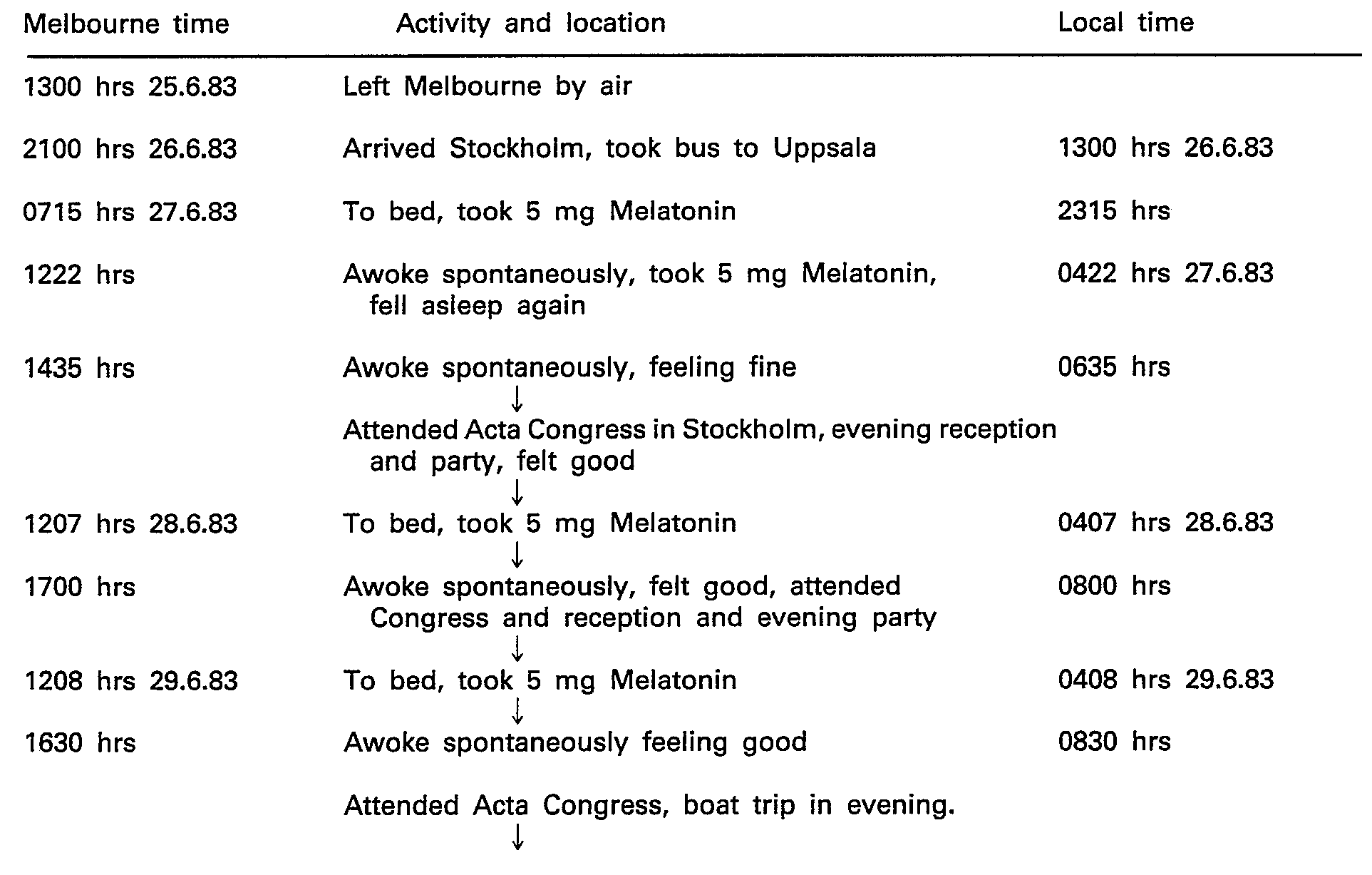

- Once again, the melatonin allowed Subject A to sleep well at an inappropriate time of the day following both westerly and easterly flights with an 8-9 hour time change. It was interesting that in Sweden he was quite sleep-deprived, going to bed in the early hours of the morning after much social activity and some alcohol at parties and receptions; nevertheless he always awoke at an appropriate local time feeling refreshed, and did not need to take additional melatonin at night.
- Subject A also encountered no problems on his return to Melbourne, and was able to lecture to a class of 170 medical students within 4 hours of stepping off the plane. At no time during the day, either in Sweden or on his return to Melbourne, did he feel jet-lagged.
- This example demonstrates the ability of exogenous melatonin to rapidly entrain circadian rhythms. Rapid entrainment to periods that vary every 24 hours is clearly demonstrated.
- This example demonstrates the intimate relationship between the human body circadian rhythms of temperature and performance.
- During this experiment use was made of a portable Vitalog PMS8 mini computer to record the temperature of Subject A. The Vitalog PMS8 recorded body temperature at ten minute intervals utilizing a rectal temperature probe. The temperature record has been displayed in figure 1. A discussion of the temperature record follows.
- During this flight Subject A wore the
Vitalog PMS 8 mini computer and rectal probe for the continuous recording of his deep body temperature. The equipment malfunctioned after 4 days due to premature battery failure. From 18.9.83-23.9.83 Subject A kept a detailed daily log of quality and nature of sleep, mood, and alertness according to a technique developed by NASA. - Details of activity schedule, sleeping time, melatonin administration.
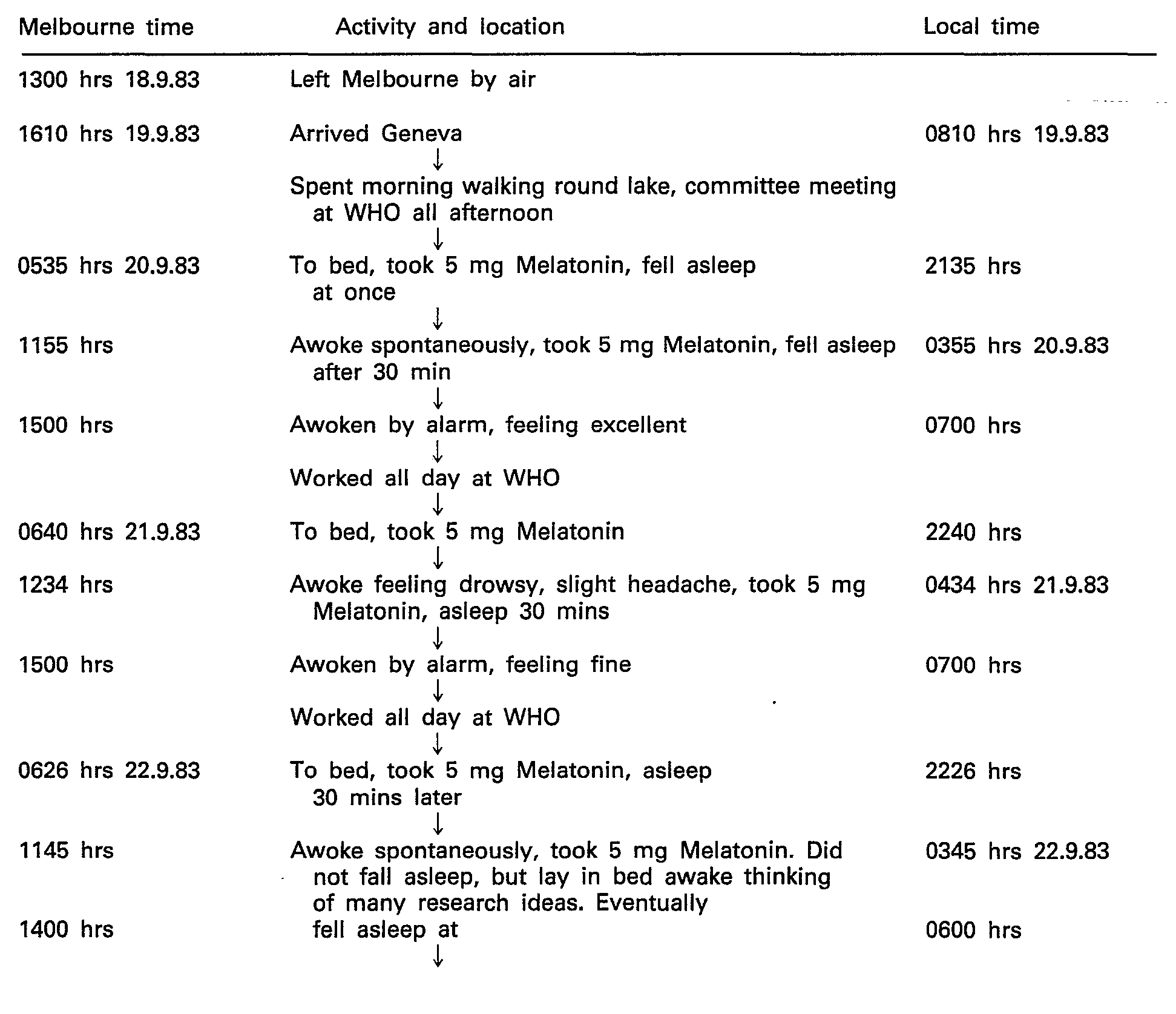

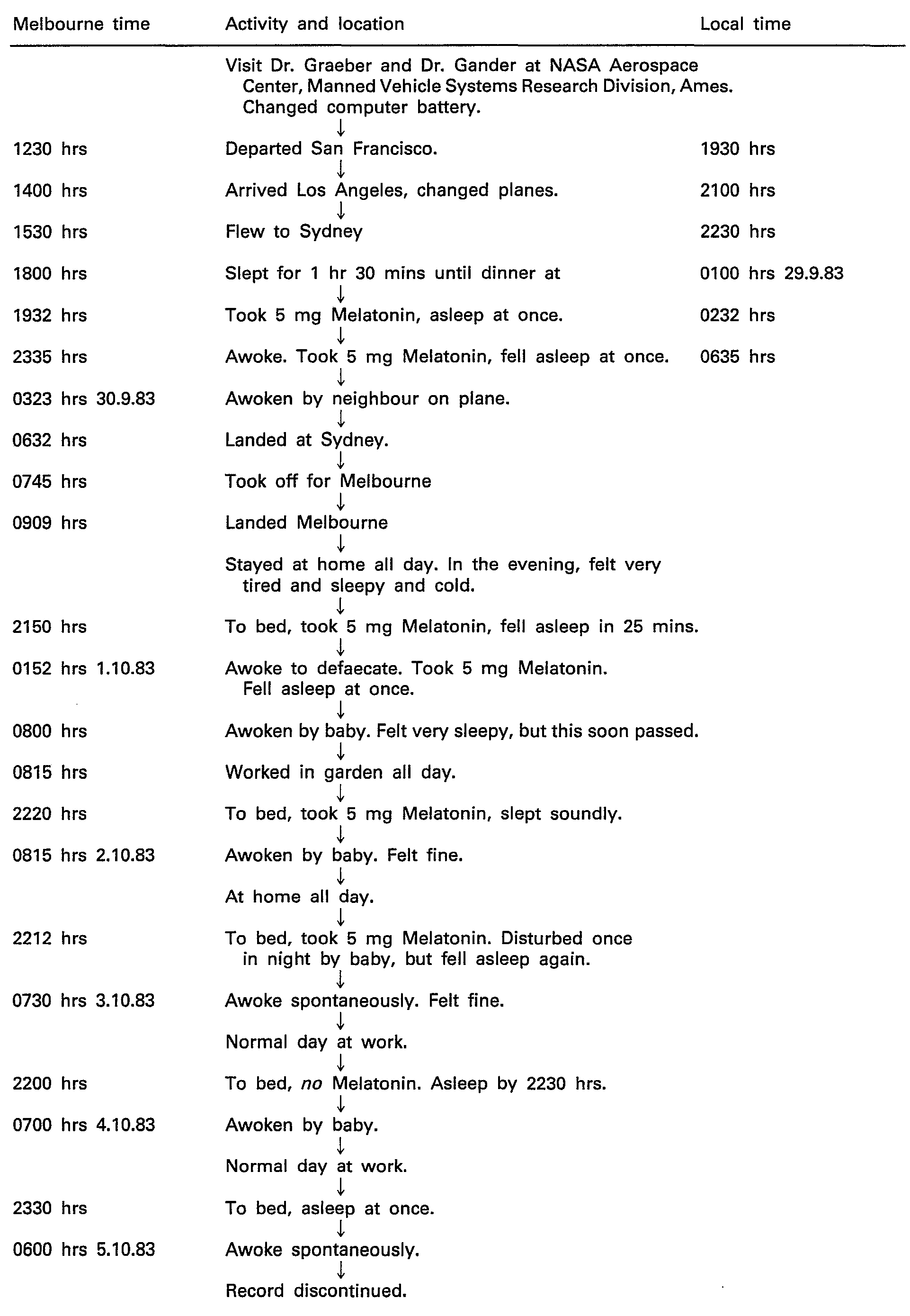
- On this round-the-world flight in a Westerly direction Melatonin once again enabled Subject A to sleep when he wanted to, and to awake at a normal local time. Each morning Subject A felt fresh and relaxed, and was able to function during the ensuing days with no subjective symptoms of jet-lag.
- Figure 1 displays the temperature record of Subject A for four days.
- The dark, dotted regions represent dark periods. The time scale is for Melbourne time no matter where Subject A actually was when the recording was made. Each dark period is identified by one of the letters, A, B, C, D or E. Recordings of dark periods B, C and D have been repeated to give continuity to the record.
- The black arrows identify the times of administration of melatonin.
- The Vitalog rectal probe was inserted the day before departure at 1400 hrs on 17.9.83 and the accompanying graph shows the expected nocturnal fall during the first night of sleep (Dark Period A). The second sleep period occurred on the plane en route to Geneva, and again showed a nocturnal fall. The third and fourth sleep periods, assisted by melatonin administration (black arrows) took place after arrival in Geneva, although the record is incomplete due to battery failure. The lowest temperatures were now occurring at around mid-day Melbourne time, coincident with the new sleep period, whilst maximal temperatures were occurring at around midnight Melbourne time. This shows that his body temperature rhythm had re-entrained extremely rapidly to Geneva time under the influence of exogenous melatonin.
- It is well known that performance rhythms are closely allied to the body temperature rhythm, performances being highest when body temperature is highest. The results of this experiment suggest that the melatonin prevented the subjective feelings of jet-lag by re-entraining Subject A's body temperature rhythm, and hence his performance, to the new time-zone. Without the administration of melatonin, it would have taken Subject A's temperature rhythm several days to readjust to such a rapid and large time-zone change.
- The temperature record has provided useful data on the temperature circadian rhythm and its response to entrainment by melatonin.
- This was a double-blind trial. The subject, a Clinical Professor who had never taken Melatonin before, was given two bottles labelled A and B containing identical-looking gelatin capsules, and told to take one capsule A on going to bed, and again if awaking in the middle of the night, for the first 4 days after arrival in Geneva. He was told to take one Capsule B according to the same schedule after return to Melbourne, and to record the quality of each night's sleep and feelings during the daytime. Capsule A contained 5 mg Melatonin, and capsule B contained a placebo (sucrose). Only after the subject had completed his written
report 4 days after returning to Melbourne was he told which pills contained Melatonin and which contained placebo. - Details of activity schedule, sleeping time, melatonin administration.

- Before being told which was the active substance and which the placebo, the subject concluded that Capsule A had had an effect in making him less tired and more alert in the meetings at WHO in Geneva. In contrast he felt that Capsule B had had no effect since he was as tired as usual on returning to Melbourne. This was the correct diagnosis. This example shows melatonin's ability to rapidly entrain a subject to a new time zone. Within 24 hours of entering a new time zone Subject B was able to sleep during a period that coincided with early morning in the zone of departure.
- The subject, a Professor who had never taken Melatonin before, was given gelatin capsules containing 5 mg Melatonin and instructed to take one capsule on going to bed in the evening (local time) after arrival at his destination, and to take a further capsule if he awoke in the night.
- The following is a verbatim account of the subject's impressions:
- "The first use of Melatonin followed an uninterrupted flight from Melbourne to Los Angeles, arriving Los Angeles 9.00 am. That night I took one capsule on retiring and a second when I awoke during the night. The sleep that night appeared normal; it is my normal habit to awake most nights.
- The following day I felt very close to normal. The next night in Los Angeles my sleep was normal without taking any more capsules.
- Following a flight from Washington to London which involved a five hours time-zone change I arrived in London mid-morning and felt tired enough that I fell asleep that afternoon. That evening I took one capsule on retiring and on awakening during the night took a second capsule. I awoke next day feeling normal and appeared to be fully adjusted to the London time on that and the following day.
- An uninterrupted flight from London to Vancouver involved a time-zone change of eight hours. I arrived at Vancouver in the evening. Again I took one capsule on retiring and another when I awoke during the night. The next day I felt a little unusual and later, around 4.00 pm felt very sleepy, perhaps as if still partly on "London time". The following night I had a normal sleep and on the next day felt fully adjusted to Vancouver time.
- Overall, my subjective feeling was that the Melatonin made a great improvement over my normal experience of jet-lag. On flights such as those listed above I normally feel very peculiar, a kind of unreal feeling. It usually takes me two or three days to settle into the new sleeping and waking pattern. However the marked improvement in my response to time-zone changes was brought about by using the Melatonin capsules enabled me to work quite effectively immediately following arrival in the new location. It was such a contrast to previous experiences that I would be anxious to make use of further Melatonin tablets in this way on any future trips involving substantial east-west travel".
- Subject C found that melatonin prevented the usual, unpleasant symptoms associated with rapid changes in time zones. This Subject undoubtedly gained considerable benefit from entrainment by the administration of melatonin.
- The subject, a Clinical Professor who had never taken Melatonin before, was given gelatin capsules containing 5 mg Melatonin and instructed to take one capsule on going to bed in the evening (local time) after arrival at his destination, and to take a further capsule if he awoke in the night.
- The following is a verbatim account of the subject's impressions:
- "I am writing informally to let you know of my experience using Melatonin (capsules, 5 mg) as a hypnotic/regularizer of diurnal rhythms, on a recent (23 March-April 2) trip to and from Edinburgh.
- On the outward leg, in retrospect, I took Melatonin at the wrong time. The flight (Melbourne-Perth-Bombay-London) left here at 1925: I worked Melbourne-Perth, slept very soundly without taking anything Perth-Bombay, and took 5+5 mg on the Bombay to London leg. As this was morning, Melbourne time, and I had slept soundly already, I slept little if at all on this leg. I was, however, able to work effectively in reviewing a series of manuscripts for journals.
- Having arrived in London at 1030 GMT I felt slightly sleepy at around 1600, and slept deeply until approximately 1930 in a day-bed at a friend's house. I dined, shared a bottle of wine, talked with friends until midnight, took 5 mg of Melatonin and slept soundly until 0630 GMT (0730 summer time, the changeover having been effected during the night).
- I took
Melatonin 5 mg on each of the three succeeding nights, and enjoyed F6) hours excellent sleep. I napped minimally during the talks at the British Endocrine Societies meeting, certainly much less than when using Mogadon as an hypnotic, and no more than during a local meeting with no problem of jet lag. - I discontinued Melatonin for the last two nights, with no adverse effects, and 6-62 (normal sleep duration) hours of sleep each night. On the return trip (Edinburgh-London-Muscat-Singapore-Sydney-Melbourne) I catnapped on the shuttle between Edinburgh (departure 1940) and London, and worked without sleeping London-Muscat-Singapore. After Singapore (approximately 10 a.m. Edinburgh time, approximately 1.00 a.m. Melbourne time) I took 5 mg melatonin, and slept for approximately 4 hours.
- I dozed for 30 minutes as a passenger on a car ride on the day I arrived home, in the afternoon; apart from that I have not felt sleepy, even after a couple of glasses of wine. I have taken 5 mg each night at approximately 11.30, and have slept very satisfyingly until woken by an alarm at 6.30 a.m. On the return leg, perhaps due to delaying sleep until the appropriate time in the city of arrival, I have had absolutely no problems of jet lag; on the outward trip they were present, but much less than either untreated or when I have used Mogadon in an attempt to regularize sleep patterns.
- Though I realize that this trial was not blind, I am personally convinced of the efficacy of Melatonin in easily and painlessly allowing me to adjust to a new time zone, sleeping at the appropriate local time and remaining awake at other times. This is in marked contrast with my previous behaviour; I would be very grateful if Melatonin could continue to be made available to me on further long trips".
- Although this subject undoubtedly gained considerable benefit from the administration of Melatonin, it is interesting to note that the Melatonin did not induce sleep when taken on the outward journey following a normal sleep period by Melbourne time. This once again suggests that the beneficial effects of Melatonin in the prevention of jet-lag cannot be attributed solely to its weak hypnotic or tranquillising role. It seems to have a more fundamental action in re-entraining the body's own sleep-wake rhythm. The experiment described in this example also demonstrates the superiority of the use of Melatonin as herein described over traditional pharmaceutical treatments such as Mogadon.
- The subject, a 13-year-old schoolgirl who had never flown across time zones or taken Melatonin before, arrived in Melbourne on the morning of 31.12.83 feeling fairly fresh, but had a sleep in the afternoon. On going to bed at 2100 hrs Melbourne time, she took 5 mg Melatonin and awoke at 0700 hrsthe following morning after an excellent night's sleep. She appeared alert and active all the following day, with no symptoms of jet-lag, and again took Melatonin on going to bed at 2130 hrs, slept well, and awoke at about 0700 hrs the following morning. Once again, she showed no signs of jet-lag on the 3rd day, and the same procedure was repeated on the 4th day.
- On the return journey to London, she was given no Melatonin to take. Subject E, and a medical practitioner both reported that she had very great difficulty in readjusting her sleep-wake rhythm to London time after her return. She did not feel back to normal for almost a week.
- It is generally accepted that the adverse effects on circadian rhythms caused by Westerly flights are considered to be less severe than those caused by Easterly flights.
- It is interesting that in this example Melatonin appeared to prevent all symptoms of jet-lag following a flight in an Easterly direction by a young girl who had never before experienced jet-lag. However, the symptoms were abundantly evident both subjectively and objectively after her return Westerly flight, when she did not take any Melatonin.
- In order to investigate the rate of absorbtion and the clearance of orally administered Melatonin, and the blood levels that are achieved, Subject A had an indwelling catheter inserted in the antecubital vein of his left arm at 0900 hrs and 5 ml blood samples were withdrawn into a heparinised syringe at frequent intervals before and after swallowing 5 mg Melatonin in a gelatin capsule. This was two hours after a light breakfast of apple juice, cereal and tea. Blood sampling was continued until 1400 hrs. The blood was immediately centrifuged, and the plasma frozen until assayed for Melatonin using a specific radioimmunoassay developed in the inventor's laboratory as a modification of the procedure originally described by D. J. Kennaway et al. (Endocrinology 110, 1766, 1982). The results are shown in the accompanying Figure 2.
- The basal Melatonin values in the first two samples were slightly higher than the expected normal diurnal values of around 50 pg/mi plasma. The plasma concentrations did not start to rise until 20 min after ingestion of the capsule, and the peak concentration, which was 100 times higher than the pre-ingestion basal values was achieved 66 minutes after ingestion. The values then fell, although 260 minutes after ingestion they were still 10 times higher than the normal nocturnal values than one might expect to find of around 100 pg/mi plasma. It was interesting that subjective feelings of drowsiness were experienced when the Melatonin concentration first exceeded 2 ng/ml, with yawning and sleepiness coincident with the maximal levels.
- If pharmacological blood levels of Melatonin are necessary for re-entrainment of circadian rhythms and for inducing sleep, there would be an advantage in prolonging the time for which blood levels are elevated above 2 ng/ml. Maintaining such levels should prevent the problem of waking-
up 4 hours during Melatonin induced sleep as was the experience of most of the subjects studied. - This experiment does demonstrate that when ingested, Melatonin rapidly reaches a high plasma level; the peak level is achieved within 60 minutes. However, the peak level is not maintained as the Melatonin is rapidly metabolised. This experiment clearly demonstrates the need for formulating Melatonin into a slow release form. By administration of Melatonin in a slow release form, it is possible to maintain high plasma levels for the whole sleep period. Thus entrainment by the administration of melatonin may be enhanced by using melatonin combined with a known slow release pharmaceutical carrier.
- The Subject was a 38-year-old male psychology lecturer who had never taken Melatonin before. In order to evaluate the effects of Melatonin on adaptation to rotating shift work conditions, the subject undertook three eight-hour phase advances in his sleep-wake/work-rest schedule at six day intervals. Melatonin was administered under double blind conditions on the first phase advance and placebo taken on the second. In marked contrast to the placebo condition, there was good and accelerated entrainment of the body temperature rhythm in the case of the Melatonin administration. This entrainment was not a secondary consequence of sleep induction. The data can be taken as evidence that Melatonin is an effective chronobiotic for adaptation to shift work.
- The following constitutes the main results of the study.
- The experiment was designed to incorporate the salient features of a rapidly rotating shift work schedule combined with aspects of lighting changes encountered on destination arrival after intercontinental jet flight. The experiment involved five stages: pre-baseline (7 days); stage A, baseline (4 days); stage B, first 8-hour advance of darkness (6 days); stage C, second 8-hour advance of darkness (6 days), and stage D (6 days), a third 8-hour advance of darkness and hence return to baseline conditions. The experimental protocol differed from that normally found in shift work in that the subject had to spend the dark period in bed in an isolation unit irrespective of whether sleepiness was felt or not; whereas, no sleep was allowed during the light period no matter how tired the subject felt. During the light period the subject was free to leave the isolation unit to engage in work or leisure related activities. An example of details of a daily activity schedule taken from a diary is shown in Table 2.
- The experiment was carried out over the long vacation, the isolated unit being situated half below ground under one of the residential colleges on La Trobe University Campus. The area was, therefore, fairly well buffered against external noise and a ventilation exhaust fan was continuously running, which aided extraneous noise reduction. Windows located high up on the walls of a kitchen alcove and shower/toilet rooms were blacked out. The main sleeping-living room was illuminated by two fluorescent tubes (40 watt) while the alcove and bathroom areas had one, 40 watt, fluorescent light in each. All lights were controlled by a single time clock set to give an LD 16:8 cycle, lights on at 0730 hours during baseline. A bedside lamp was used for reading during the light period. No lighting was allowed during the dark period for any reason. Therefore, events such as quenching of thirst and urination had to take place in total darkness. Temperature of the isolation area was maintained within the
range 20°-22°C throughout the experiment. During stage A and pre-baseline breakfast was ingested between 0800 and 0900, lunch between 1300 and 1400, and dinner between 1800 and 2000. During stages B and C meals and intermeal intervals were scheduled for equivalent times (relative to lights on) to those during stage A. - During stages B and C the subject was instructed to take one capsule just prior to lights off. If still awake one hour later, the subject was to take a second capsule. Similar instructions applied to the second and third hours after lights-off but no capsule was to be taken during the last four hours of darkness i.e. maximum number of capsules to be taken was four. Capsules were refrigerated and had to be taken in complete darkness once lights were off. A double blind procedure was employed with stage B being drug (Melatonin, Sigma, 5 mg/capsule) and stage C being placebo (sucrose filled capsule). No capsules were taken on the final dark period at the end of each stage i.e.
days - Rectal temperature was sampled every 12 minutes using a
Vitalog PMS 8 portable microcomputer. A diary of life events was kept. These included details of sleep, work, leisure, meals, beverages, urination and defecation. - During baseline a clear sinusoidal, daily rhythm in rectal temperature was recorded, with the nadir of the rhythm occurring either at the middle or towards the end of the dark period. The rhythm was obscured on the first day on the phase shift (day 5) and missing data on
day 7, due to battery failure, make it hard to envisage the development of the entrainment pattern. Nevertheless, by the third complete day after the phase shift (day 8) the temperature rhythm was reestablished and in phase with the new light-dark cycle. This is remarkably quick re-entrainment, especially considering the fact that (a) the external cycle of night and day and (b) social entrainment factors are both competing with the entrainment capacity of artificial LD cycle. The decrease in body temperature during the dark period was not a secondary, exogenous effect of melatonin-induced sleep since the same temperature waveform was seen onday 10 when no melatonin was taken. Furthermore from diary descriptions, it was clear that melatonin did not have the same potent sleep induction as reported by other subjects after intercontinental flight. It was only in retrospect, after placebo treatment, that melatonin's sleep, tranquillity properties emerged. Therefore, in stage A, Melatonin phase shifted the rectal temperature rhythm and aided sleep induction. - In stage B and same phenomena were not seen for placebo treatment. The clear waveform demonstrated for baseline and
days day 15 the body temperature rhythm has phase delayed back to the original baseline pattern. The peak therefore now coincides with the new dark period. Sleep and bed rest at the peak of the rhythm produces a secondary trough thereby obscuring the peak. This phenomenon is quite marked ondays days 16/17) when the subject returned to the original baseline light dark cycle, the daily temperature rhythm immediately re-entrained. - These findings indicate that exogenous melatonin administration can entrain a subject's body temperature rhythm to rotating shift schedules under artificial light dark conditions despite competition from more dominant entraining agents such as the natural environmental cycle of night and day and periodic social factors. It is predicted that a combination of Melatonin treatment, taken at dark onset, with beta blockers taken at beginning of light onset or with high artificial light levels (+2,000 Lux) would enhance Melatonin's phase shifting of circadian rhythms. Even without these combinations, Melatonin will be useful for aiding adjustment of both rotating and permanent night shift workers to their routines.
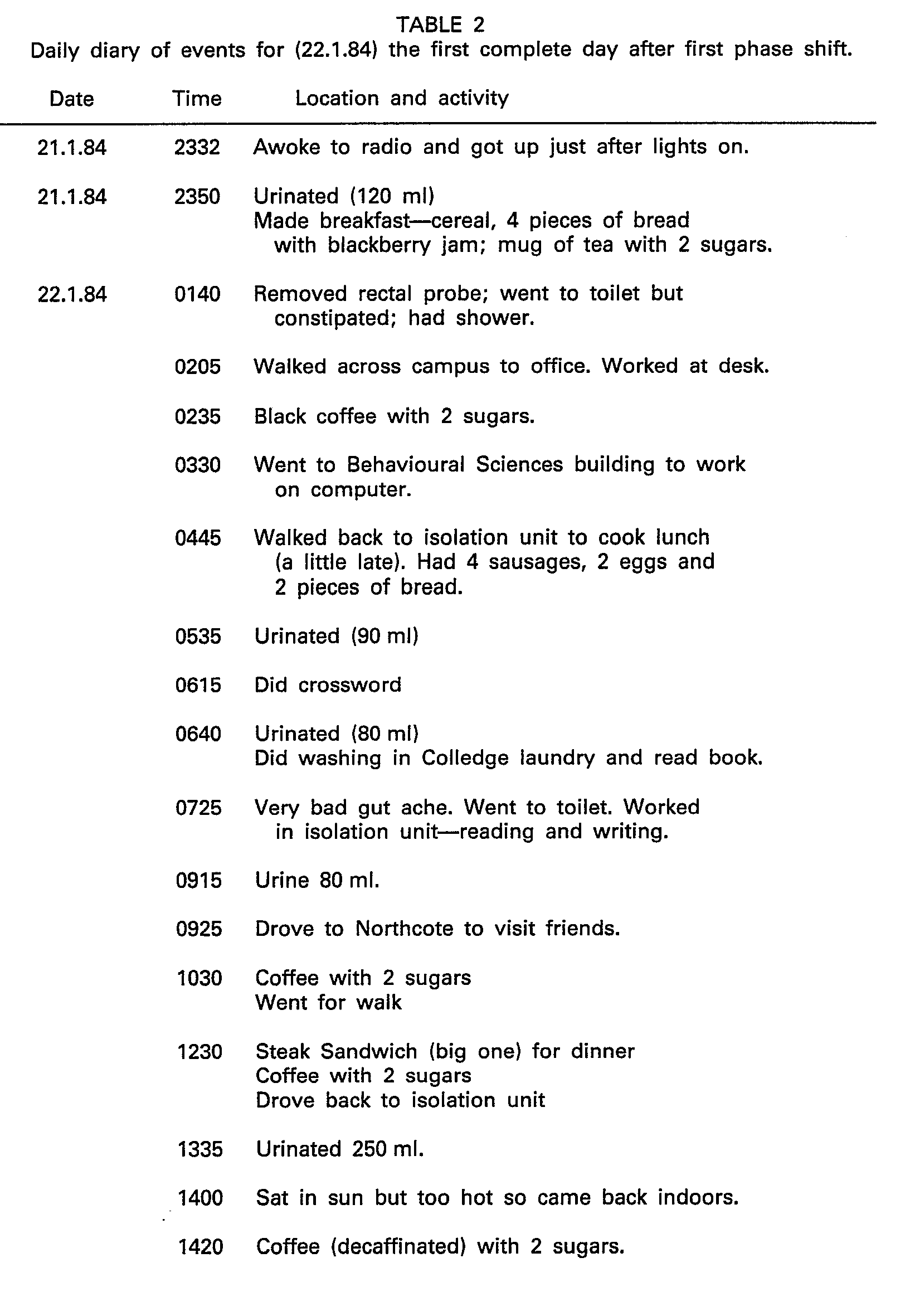

- Figures 3 and 4 display the forty-eight hour plots of rectal temperature rhythm for subject F during the 4 stages of the experiment. The dark dotted regions represent dark periods. The
numbers 1 to 23 identifies 24 hour divisions.Divisions 2 to 22 are repeated to give continuity to the record; i.e. the data is plotted over 48 hour scale in order to aid visualization of the waveform. Stage A constitutes baseline;Stage Ban 8 hour advance of darkness when Melatonin was taken just before dark onset and again hourly if no sleep occurred; Stage C is a second 8 hour advance in darkness with placebo administration; Stage D a third 8 hour advance of darkness to come back in line with Stage A. Shaded areas indicate the 8 hours of darkness. Figure 4 is the same as figure 3, but with each stage shown separately.
Claims (2)
Priority Applications (1)
| Application Number | Priority Date | Filing Date | Title |
|---|---|---|---|
| AT84303369T ATE29715T1 (en) | 1983-05-18 | 1984-05-17 | USE OF MELATONIN IN THE MANUFACTURE OF A MEDICATION. |
Applications Claiming Priority (4)
| Application Number | Priority Date | Filing Date | Title |
|---|---|---|---|
| AU9418/83 | 1983-05-18 | ||
| AUPF941883 | 1983-05-18 | ||
| AUPG473484 | 1984-04-27 | ||
| AU4734/84 | 1984-04-27 |
Publications (2)
| Publication Number | Publication Date |
|---|---|
| EP0126630A1 EP0126630A1 (en) | 1984-11-28 |
| EP0126630B1 true EP0126630B1 (en) | 1987-09-16 |
Family
ID=25642659
Family Applications (1)
| Application Number | Title | Priority Date | Filing Date |
|---|---|---|---|
| EP84303369A Expired EP0126630B1 (en) | 1983-05-18 | 1984-05-17 | The use of melatonin for the manufacture of a medicament |
Country Status (4)
| Country | Link |
|---|---|
| US (1) | US4665086A (en) |
| EP (1) | EP0126630B1 (en) |
| DE (1) | DE3466215D1 (en) |
| HK (1) | HK66888A (en) |
Families Citing this family (40)
| Publication number | Priority date | Publication date | Assignee | Title |
|---|---|---|---|---|
| AU601736B2 (en) * | 1986-05-23 | 1990-09-20 | Sanofi Sante Nutrition Animale Sa | Coated veterinary implants |
| US5629310A (en) * | 1986-09-23 | 1997-05-13 | Sterling; William R. | Low dose temazepam |
| US5030632A (en) * | 1986-09-23 | 1991-07-09 | Sandoz Pharm. Corp. | Low dose temazepam |
| US5211954A (en) * | 1986-09-23 | 1993-05-18 | Sandoz Ltd. | Low dose temazepam |
| US5163426A (en) * | 1987-06-26 | 1992-11-17 | Brigham And Women's Hospital | Assessment and modification of a subject's endogenous circadian cycle |
| US5167228A (en) * | 1987-06-26 | 1992-12-01 | Brigham And Women's Hospital | Assessment and modification of endogenous circadian phase and amplitude |
| US5545192A (en) * | 1987-06-26 | 1996-08-13 | Brigham And Women's Hospital | Intermittent use of bright light to modify the circadian phase |
| US5006985A (en) * | 1988-07-15 | 1991-04-09 | Kinetic Software, Inc. | Computer system for minimizing body dysfunctions induced by jet travel or shift work |
| US4945103A (en) * | 1989-01-17 | 1990-07-31 | Michael Cohen | Method of treating pre-menstrual syndrome |
| US5591768A (en) * | 1990-12-04 | 1997-01-07 | State Of Oregan, Acting By And Through The Oregon State Board Of Higher Education On Behalf Of The Oregon Health Sciences University | Methods for treating circadian rhythm phase disturbances |
| US5707652A (en) * | 1990-12-04 | 1998-01-13 | State Of Oregon | Methods of treating circadian rhythm phase disorders |
| US5242941A (en) * | 1990-12-04 | 1993-09-07 | State Of Oregon | Methods of treating circadian rhythm disorders |
| US6638963B1 (en) | 1990-12-04 | 2003-10-28 | Oregon Health And Science University | Methods for treating circadian rhythm disorders |
| US5140562A (en) * | 1991-03-13 | 1992-08-18 | Moore Ede Martin C | Biological timepiece |
| DK0518468T3 (en) * | 1991-05-09 | 2000-01-31 | Neurim Pharma 1991 | Melatonin-containing compositions |
| IT1251544B (en) * | 1991-05-13 | 1995-05-17 | Gabriele Biella | PHARMACEUTICAL COMPOSITIONS ACTIVE IN THE THERAPY OF SLEEP DISORDERS INCLUDING MELATONIN OR A DERIVATIVE IN ASSOCIATION WITH A BENZODIAZEPINE DERIVATIVE |
| AU660336B2 (en) * | 1991-10-18 | 1995-06-22 | Alza Corporation | Device for the transdermal administration of melatonin |
| IT1255199B (en) * | 1992-07-01 | 1995-10-20 | Franco Fraschini | SYNTHESIZED DRUG ANALOG OF MELATONIN PARTICULARLY EFFECTIVE IN THE PATHOLOGIES THAT INTERFER WITH CIRCADIAN RHYTHMS |
| US5449683A (en) * | 1992-10-01 | 1995-09-12 | Massachussetts Institute Of Technology | Methods of inducing sleep using melatonin |
| US5696128A (en) * | 1994-07-07 | 1997-12-09 | The Board Of Supervisors Of Louisiana University And Agricultural And Mechanical College | Method of regulating immune function |
| WO1995003043A1 (en) * | 1993-07-26 | 1995-02-02 | State Of Oregon, Acting By And Through The Oregon State Board Of Higher Education On Behalf Of The Oregon Health Sciences University | Sustained release oral compositions containing melatonin |
| US5654325A (en) * | 1993-11-18 | 1997-08-05 | Eli Lilly And Company | Melatonin derivatives for use in treating sleep disorders |
| US6180657B1 (en) | 1993-11-18 | 2001-01-30 | Eli Lilly And Company | Melatonin derivatives for use in treating desynchronization disorders |
| WO1997012612A1 (en) * | 1995-10-03 | 1997-04-10 | Interneuron Pharmaceuticals, Inc. | Compositions of melatonin and analgetic agents and methods of use thereof |
| US6274615B1 (en) | 1998-03-25 | 2001-08-14 | South Alabama Medical Science Foundation | Method for delaying the onset of alheimer's disease and for treatment or delaying the onset of other amyloidosis-related diseases/disorders |
| US6133453A (en) * | 1998-05-15 | 2000-10-17 | Pharm-Eco Laboratories, Inc. | Method for making substituted indoles |
| IL144900A (en) * | 2001-08-14 | 2013-12-31 | Neurim Pharma 1991 | Melatonin and medicaments comprising it for use in treating primary insomnia and in the manufacture of such medicaments |
| US6703412B1 (en) * | 2002-09-27 | 2004-03-09 | Holly A. Rosenthal | Method of treating sleeplessness with melatonin on an acute basis |
| RU2488392C2 (en) * | 2006-05-22 | 2013-07-27 | Ванда Фармасьютиклз, Инк. | Melatonin agonist therapy |
| EP2068695A2 (en) * | 2006-09-13 | 2009-06-17 | Koninklijke Philips Electronics N.V. | Device for automatic adjustment of the dose of melatonin and/or delivery of melatonin |
| WO2010012789A1 (en) * | 2008-07-30 | 2010-02-04 | Ferrer Internacional S. A. | 1,6-dihydro-2h-3-oxa-6-aza-as-indacene compounds |
| US20120134985A1 (en) * | 2009-03-20 | 2012-05-31 | The Salk Institute For Biological Studies | Methods for modulating metabolic and circadian rhythms |
| JP2012521364A (en) * | 2009-03-20 | 2012-09-13 | ザ ソーク インスティテュート フォー バイオロジカル スタディーズ | How to adjust circadian rhythm |
| US9532952B2 (en) | 2011-01-28 | 2017-01-03 | Physician's Seal, LLC | Controlled-release compositions of melatonin combined with sedative and/or analgesic ingredients |
| WO2012103411A2 (en) | 2011-01-28 | 2012-08-02 | Zx Pharma, Llc | Controlled-release melatonin composition and related methods |
| US11918557B2 (en) | 2012-01-26 | 2024-03-05 | Vanda Pharmaceuticals Inc. | Treatment of circadian rhythm disorders |
| RU2650647C2 (en) | 2012-01-26 | 2018-04-16 | Ванда Фармасьютиклз Инк. | Treatment of circadian rhythm disorders |
| BR112015014619A2 (en) | 2012-12-18 | 2017-07-11 | Vanda Pharmaceuticals Inc | treatment of circadian rhythm disorders |
| US11090285B2 (en) | 2013-11-12 | 2021-08-17 | Vanda Pharmaceuticals Inc | Treatment of circadian rhythm disorders |
| US10376487B2 (en) | 2013-11-12 | 2019-08-13 | Vanda Pharmaceuticals Inc. | Method of treatment |
-
1984
- 1984-05-17 EP EP84303369A patent/EP0126630B1/en not_active Expired
- 1984-05-17 DE DE8484303369T patent/DE3466215D1/en not_active Expired
-
1985
- 1985-09-26 US US06/780,337 patent/US4665086A/en not_active Expired - Lifetime
-
1988
- 1988-08-25 HK HK668/88A patent/HK66888A/en not_active IP Right Cessation
Also Published As
| Publication number | Publication date |
|---|---|
| US4665086A (en) | 1987-05-12 |
| EP0126630A1 (en) | 1984-11-28 |
| HK66888A (en) | 1988-09-02 |
| DE3466215D1 (en) | 1987-10-22 |
Similar Documents
| Publication | Publication Date | Title |
|---|---|---|
| EP0126630B1 (en) | The use of melatonin for the manufacture of a medicament | |
| US4600723A (en) | Method for minimizing disturbances in circadian rhythms of bodily performance and function | |
| US5716978A (en) | Methods of treating circadian rhythm disorders | |
| Eastman et al. | How to travel the world without jet lag | |
| Arendt | Managing jet lag: Some of the problems and possible new solutions | |
| Cardinali et al. | The use of chronobiotics in the resynchronization of the sleep–wake cycle | |
| Sack et al. | Use of melatonin for sleep and circadian rhythm disorders | |
| US6423738B1 (en) | Methods for treating circadian rhythm phase disturbances | |
| Arendt et al. | Physiological changes underlying jet lag | |
| Hallonquist et al. | Affective disorders and circadian rhythms | |
| Wagner | Disorders of the circadian sleep–wake cycle | |
| Richardson et al. | Circadian rhythm sleep disorders: pathophysiology and treatment | |
| Hoban et al. | Entrainment of a free-running human with bright light? | |
| US5707652A (en) | Methods of treating circadian rhythm phase disorders | |
| Choy et al. | Jet lag: current and potential therapies | |
| Loat et al. | Jet-lag and human performance | |
| Nicholson et al. | Insomnia: A guide for medical practitioners | |
| Ehret et al. | Circadian dyschronism and chronotypic ecophilia as factors in aging and longevity | |
| Cardinali | The human body circadian: How the biologic clock influences sleep and emotion | |
| JPH0524136B2 (en) | ||
| Redfern | ‘Jet‐lag’: Strategies for prevention and cure | |
| CA1251141A (en) | Method for minimizing disturbances in circadian rhythms of bodily performance and function | |
| Sachar et al. | Corticosteroid responses to milieu therapy of chronic schizophrenics | |
| Croughs et al. | Melatonin and jet lag | |
| Monk | Coping with the stress of jet-lag |
Legal Events
| Date | Code | Title | Description |
|---|---|---|---|
| PUAI | Public reference made under article 153(3) epc to a published international application that has entered the european phase |
Free format text: ORIGINAL CODE: 0009012 |
|
| AK | Designated contracting states |
Designated state(s): AT BE CH DE FR GB IT LI LU NL SE |
|
| 17P | Request for examination filed |
Effective date: 19850326 |
|
| 17Q | First examination report despatched |
Effective date: 19860401 |
|
| GRAA | (expected) grant |
Free format text: ORIGINAL CODE: 0009210 |
|
| AK | Designated contracting states |
Kind code of ref document: B1 Designated state(s): AT BE CH DE FR GB IT LI LU NL SE |
|
| REF | Corresponds to: |
Ref document number: 29715 Country of ref document: AT Date of ref document: 19871015 Kind code of ref document: T |
|
| ITF | It: translation for a ep patent filed | ||
| REF | Corresponds to: |
Ref document number: 3466215 Country of ref document: DE Date of ref document: 19871022 |
|
| ET | Fr: translation filed | ||
| PLBE | No opposition filed within time limit |
Free format text: ORIGINAL CODE: 0009261 |
|
| STAA | Information on the status of an ep patent application or granted ep patent |
Free format text: STATUS: NO OPPOSITION FILED WITHIN TIME LIMIT |
|
| 26N | No opposition filed | ||
| ITTA | It: last paid annual fee | ||
| EPTA | Lu: last paid annual fee | ||
| EAL | Se: european patent in force in sweden |
Ref document number: 84303369.7 |
|
| REG | Reference to a national code |
Ref country code: CH Ref legal event code: PUEA Free format text: MONASH UNIVERSITY TRANSFER- MONASH UNIVERSITY;CIRCADIAN PHARMACEUTICALS (AUST.) PTY LTD. |
|
| REG | Reference to a national code |
Ref country code: GB Ref legal event code: 732E |
|
| NLS | Nl: assignments of ep-patents |
Owner name: CIRCADIAN PHARMACEUTICALS (AUST.) PTY LTD.;MONASH |
|
| REG | Reference to a national code |
Ref country code: FR Ref legal event code: TP |
|
| REG | Reference to a national code |
Ref country code: GB Ref legal event code: IF02 |
|
| PGFP | Annual fee paid to national office [announced via postgrant information from national office to epo] |
Ref country code: SE Payment date: 20030507 Year of fee payment: 20 |
|
| PGFP | Annual fee paid to national office [announced via postgrant information from national office to epo] |
Ref country code: FR Payment date: 20030508 Year of fee payment: 20 |
|
| PGFP | Annual fee paid to national office [announced via postgrant information from national office to epo] |
Ref country code: LU Payment date: 20030512 Year of fee payment: 20 |
|
| PGFP | Annual fee paid to national office [announced via postgrant information from national office to epo] |
Ref country code: GB Payment date: 20030514 Year of fee payment: 20 Ref country code: AT Payment date: 20030514 Year of fee payment: 20 |
|
| PGFP | Annual fee paid to national office [announced via postgrant information from national office to epo] |
Ref country code: DE Payment date: 20030529 Year of fee payment: 20 |
|
| PGFP | Annual fee paid to national office [announced via postgrant information from national office to epo] |
Ref country code: NL Payment date: 20030530 Year of fee payment: 20 |
|
| PGFP | Annual fee paid to national office [announced via postgrant information from national office to epo] |
Ref country code: CH Payment date: 20030531 Year of fee payment: 20 |
|
| PGFP | Annual fee paid to national office [announced via postgrant information from national office to epo] |
Ref country code: BE Payment date: 20030725 Year of fee payment: 20 |
|
| PG25 | Lapsed in a contracting state [announced via postgrant information from national office to epo] |
Ref country code: LI Free format text: LAPSE BECAUSE OF EXPIRATION OF PROTECTION Effective date: 20040516 Ref country code: GB Free format text: LAPSE BECAUSE OF EXPIRATION OF PROTECTION Effective date: 20040516 Ref country code: CH Free format text: LAPSE BECAUSE OF EXPIRATION OF PROTECTION Effective date: 20040516 |
|
| PG25 | Lapsed in a contracting state [announced via postgrant information from national office to epo] |
Ref country code: NL Free format text: LAPSE BECAUSE OF EXPIRATION OF PROTECTION Effective date: 20040517 Ref country code: LU Free format text: LAPSE BECAUSE OF NON-PAYMENT OF DUE FEES Effective date: 20040517 Ref country code: AT Free format text: LAPSE BECAUSE OF EXPIRATION OF PROTECTION Effective date: 20040517 |
|
| BE20 | Be: patent expired |
Owner name: *CIRCADIAN PHARMACEUTICALS (AUST.) PTY LTD Effective date: 20040517 Owner name: *MONASH UNIVERSITY Effective date: 20040517 |
|
| REG | Reference to a national code |
Ref country code: GB Ref legal event code: PE20 |
|
| REG | Reference to a national code |
Ref country code: CH Ref legal event code: PL |
|
| EUG | Se: european patent has lapsed | ||
| NLV7 | Nl: ceased due to reaching the maximum lifetime of a patent |
Effective date: 20040517 |