WO1998046616A1 - Substituted metallocene compounds for olefin polymerization catalyst systems, their intermediates and methods for preparing them - Google Patents
Substituted metallocene compounds for olefin polymerization catalyst systems, their intermediates and methods for preparing them Download PDFInfo
- Publication number
- WO1998046616A1 WO1998046616A1 PCT/FI1998/000075 FI9800075W WO9846616A1 WO 1998046616 A1 WO1998046616 A1 WO 1998046616A1 FI 9800075 W FI9800075 W FI 9800075W WO 9846616 A1 WO9846616 A1 WO 9846616A1
- Authority
- WO
- WIPO (PCT)
- Prior art keywords
- group
- substituted
- unsubstituted
- ligand
- ring
- Prior art date
- Legal status (The legal status is an assumption and is not a legal conclusion. Google has not performed a legal analysis and makes no representation as to the accuracy of the status listed.)
- Ceased
Links
- FLQPADKEZWQNIX-UHFFFAOYSA-N CCCC(C1C=CC=CC1C)O[Si](C)(C)C(C)(C)C Chemical compound CCCC(C1C=CC=CC1C)O[Si](C)(C)C(C)(C)C FLQPADKEZWQNIX-UHFFFAOYSA-N 0.000 description 2
- 0 *CC1=C(CCC=*)C(*)(*)C(*)=C1O*(*)(*)* Chemical compound *CC1=C(CCC=*)C(*)(*)C(*)=C1O*(*)(*)* 0.000 description 1
- NMLGAKZATBIKQM-UHFFFAOYSA-N CCC(C1)C2C=CC=CC2C1O[S+](C)C Chemical compound CCC(C1)C2C=CC=CC2C1O[S+](C)C NMLGAKZATBIKQM-UHFFFAOYSA-N 0.000 description 1
- WRWFOGDDXFILQD-UHFFFAOYSA-N CCC(C1)C2C=CC=CC2C1O[Si](C)(C)C(C)(C)C Chemical compound CCC(C1)C2C=CC=CC2C1O[Si](C)(C)C(C)(C)C WRWFOGDDXFILQD-UHFFFAOYSA-N 0.000 description 1
- WCWJGVIXMKSRJG-UHFFFAOYSA-N CCCC(C1C=CC=CC1C)O[Si+](C)(C)C(C)(C)C Chemical compound CCCC(C1C=CC=CC1C)O[Si+](C)(C)C(C)(C)C WCWJGVIXMKSRJG-UHFFFAOYSA-N 0.000 description 1
- ZXTFKIOLFZMDGP-UHFFFAOYSA-N CCCC(C1C=CC=CC1C)O[Si+](C)(C)C(C)C(C)C Chemical compound CCCC(C1C=CC=CC1C)O[Si+](C)(C)C(C)C(C)C ZXTFKIOLFZMDGP-UHFFFAOYSA-N 0.000 description 1
- ZVDBBIZTRDEWQM-UHFFFAOYSA-N CCCCC(C1C=CC=CC1C)O[Si+](C)(C)C(C)(C)C Chemical compound CCCCC(C1C=CC=CC1C)O[Si+](C)(C)C(C)(C)C ZVDBBIZTRDEWQM-UHFFFAOYSA-N 0.000 description 1
Classifications
-
- C—CHEMISTRY; METALLURGY
- C07—ORGANIC CHEMISTRY
- C07F—ACYCLIC, CARBOCYCLIC OR HETEROCYCLIC COMPOUNDS CONTAINING ELEMENTS OTHER THAN CARBON, HYDROGEN, HALOGEN, OXYGEN, NITROGEN, SULFUR, SELENIUM OR TELLURIUM
- C07F17/00—Metallocenes
-
- C—CHEMISTRY; METALLURGY
- C08—ORGANIC MACROMOLECULAR COMPOUNDS; THEIR PREPARATION OR CHEMICAL WORKING-UP; COMPOSITIONS BASED THEREON
- C08F—MACROMOLECULAR COMPOUNDS OBTAINED BY REACTIONS ONLY INVOLVING CARBON-TO-CARBON UNSATURATED BONDS
- C08F10/00—Homopolymers and copolymers of unsaturated aliphatic hydrocarbons having only one carbon-to-carbon double bond
-
- Y—GENERAL TAGGING OF NEW TECHNOLOGICAL DEVELOPMENTS; GENERAL TAGGING OF CROSS-SECTIONAL TECHNOLOGIES SPANNING OVER SEVERAL SECTIONS OF THE IPC; TECHNICAL SUBJECTS COVERED BY FORMER USPC CROSS-REFERENCE ART COLLECTIONS [XRACs] AND DIGESTS
- Y10—TECHNICAL SUBJECTS COVERED BY FORMER USPC
- Y10S—TECHNICAL SUBJECTS COVERED BY FORMER USPC CROSS-REFERENCE ART COLLECTIONS [XRACs] AND DIGESTS
- Y10S526/00—Synthetic resins or natural rubbers -- part of the class 520 series
- Y10S526/943—Polymerization with metallocene catalysts
Definitions
- the present invention relates to novel metallocene compounds, their intermediates and their preparation. Specifically the invention relates to transition metal metallocenes with heteroatom 1- or 3 -substituted indenyl and indenyl derivative ligands and a method for their preparation. The invention also relates to 1- or 3- substituted indene compounds as intermediates for the metallocene compounds and their preparation.
- the invention relates to the use of said metallocenes in catalyst systems for the homo- and copolymerization of ethylenically unsaturated monomers, preferably olefins, more specifically propylene, ethylene and higher alphaolef ⁇ ns, especially in the presence of a cocatalyst, such as methylaluminoxane (MAO).
- ethylenically unsaturated monomers preferably olefins, more specifically propylene, ethylene and higher alphaolef ⁇ ns, especially in the presence of a cocatalyst, such as methylaluminoxane (MAO).
- MAO methylaluminoxane
- Chiral C2 symmetric bis(indenyl) ansa-metallocenes are well-known catalyst com- ponents for stereoselective polymerization of alpha-olefins.
- the performance characteristics of these systems are different, the variations being induced by size and position of the substituents.
- dimethylsilylene bridged 2,2'-dimethyl-4,4'- diaryl substituted bis(indenyl) zirconocenes developed by Brintzinger and coworkers (Organometallics 1994, 13, 964) and Spaleck et al. (Organome tallies 1994, 13, 954), produce isotactic polypropylenes with catalyst activities and polymer properties comparable to those obtained with heterogeneous Ziegler-Natta catalysts.
- metallocenes in which a bulky electron withdrawing or donating group is attached to the five membered ring of an indenyl or rndenyloid (ie. indenyl analog) ligand have particularly interesting properties, in particular in terms of catalytic activity when used with an alumoxane cocatalyst in propylene and ethylene polymerization.
- the invention provides a metallocene having a sandwich bonding having ligand comprising a sandwich bonding moiety, having an unsaturated 5-membered ring or a 6-membered ring fused to an unsaturated 5- membered ring, which is covalently substituted by a pendant group containing at least two atoms other than hydrogen and attached via an atom other than a methylene carbon, preferably attached via an oxygen, sulphur, nitrogen or phosphorus atom or via a carbon-carbon multiply bonded carbon atom, eg. a group as described below or in FI 970349 the contents of which are incorporated herein by reference.
- the sandwich bonded metal in the metallocene is preferably a Group 4 transition metal, particularly Zr, Hf or Ti, most preferably Zr. Other catalytically effective metals however may be used.
- pendant it is meant that the bulky substituent is not attached to a second group which sandwich bonds the metal of the metallocene.
- the requirement that the group contains at least two non-hydrogen atoms simply specifies a minimum bulk for the required bulky substituent. Thus halogens and unsubstituted hydroxyl and amine groups are excluded for example.
- the substituent contains up to 32 non-hydrogen atoms.
- the requirement that the group be attached other than via a methylene carbon indicates that the substituent will interact with the electron system of the five membered ring. Suitable means of attachment include oxygen, sulphur, nitrogen and phosphorus atoms and II-bonded carbon atoms. Oxygen attachment is preferred.
- the attachment atom preferably carries at least one bulky substituent, eg. a C ⁇ _20 hydrocarbyl group, or more preferably a silyl group or a germyl group, with the silicon or germanium atoms themselves optionally being substituted by Cj_20 hydrocarbyl or hydrocarbyloxy groups.
- the fused 5 and 6-membered rings in the sandwich bonding ligand may be homocyclic (carbocyclic) or heterocyclic, for example containing up to 4 ring heteroatoms selected from O, N and S.
- the four atom bridge portion of the six membered ring may be unsaturated or saturated.
- Both the 5 and 6-membered ring may carry other homo- or heterocyclic fused rings.
- the bulky substituent may be at the 1, 2 or 3 position of the 5-membered ring, eg. the 1- or 3-positions.
- the ligand contains two such used 5/6 member ring systems linked via a bridging atom or group (eg. an ethylene bis indenyl ligand).
- the bulky substituent is a silyloxy or germyloxy group
- this represents a further aspect of the invention.
- the invention provides a metallocene catalyst precursor having a sandwich bonding ligand which comprises a sandwich bonding moiety having an unsaturated 5-membered ring or having a 6-membered ring fused to an unsaturated 5-membered ring, said moiety being substituted on the fused ring structure by a silyloxy or germyloxy group, eg. at the 1, 3, 4, 5, 6 or 7 positions.
- Germanium atom is further substituted by a C ⁇ _20 hydrocarbyl or hydrocarbyloxy group.
- the invention provides a sandwich bonding ligand precursor comprising a moiety having a 6-membered ring fused to an unsaturated 5- membered ring, said moiety being substituted on the fused ring structure by a silyloxy or germyloxy group.
- the polymerization activity of the metallocene precursors of the invention is such that it is possible to use as a cocatalyst higher alkyl alumoxanes than the conventionally used methyl alumoxane (MAO).
- a higher alkyl alumoxane is meant one containing alkyl groups containing 2 or more, eg. 2-10, carbons. This is highly advantageous since the higher alumoxanes are better characterised than MAO which appears to be a mixture of various compounds.
- the invention provides a catalyst system comprising or produced by the reaction of a metallocene catalyst precursor according to the invention and an alkyl alumoxane comprising alkyl groups containing at least two carbon atoms, preferably a heterogeneous catalyst system further comprising a support material.
- the invention provides a method for the preparation of a heterogeneous catalyst system, said method comprising contacting a porous solid (eg. parti culate) support, preferably an inorganic support such as silica or alumina, with (i) a higher alkyl alumoxane and a metallocene according to the invention or with the reaction product of a higher alkyl alumoxane and a metallocene according to the invention, and optionally (ii) an organometallic metallocene-activator.
- an activator optionalal component (ii)
- the metallocene used requires activation, eg. where it does not contain any alkyl ligands.
- the process described in FI 970349 and analogous processes are applicable.
- the invention provides a process for the catalysed polymerization of an olefin, wherein as catalyst is used a metallocene and a cocatalyst (preferably an alumoxane, especially preferably a higher alkyl alumoxane), or the reaction product of a metallocene and an alumoxane, the improvement comprising using as said catalyst a said cocatalyst and a metallocene according to the invention or a reaction product thereof.
- a metallocene and a cocatalyst preferably an alumoxane, especially preferably a higher alkyl alumoxane
- the sandwich bonding ligand is a silyloxy or gemyloxy indenyl (or indenyloid) ligand.
- Cp or each same or different Cp is a non-substituted or substituted, fused or non-fused, homo(iso)cyclic or heterocyclic cyclopentadienyl ligand, indenyl ligand, tetrahydroindenyl ligand, fluorenyl ligand or octahydrofluorenyl ligand, Y or each same or different Y is a substituent at the cyclopentadienyl ring of said ligand Cp having the following structure (II):
- D is an element of Group 14 of the Periodic Table (IUPAC)
- R 1 , R ⁇ and R3 are the same or different and are each one of a hydrogen, a halogen, a substituted or unsubstituted CJ-C JO hydrocarbyl group, a substituted or unsubstituted Cj- CJO hydrocarbyloxy group, a Cj-Ci2 organosihcon group, or at least two of Rl, R ⁇ and R3 form together with D a C4-C20 ring structure
- M is a transition metal of Group 4 of the Periodic Table (IUPAC) and is bound to the ligand Cp or ligands Cp in an ⁇ 5 bonding mode
- R or each same or different R is bound to M and is one of a hydrogen, a halogen, a substituted or unsubstituted C I -C ⁇ Q hydrocarbyl group, a substituted or unsubstituted C J-C JO hydrocarbyl
- the ligand Cp or each of the ligands Cp of the metallocene compound of formula (I) is preferably a mono- or polysubstituted, non-fused, homocyclic indenyl or tetrahydroindenyl ligand.
- the substituent Y or each of the substituents Y preferably has the above structure (II), wherein D is silicon or germanium, preferably silicon.
- the substituent Y or each of the substituents Y has the above structure (II), wherein Rl, R2 and R ⁇ are the same or different and are each an unsubstituted C J-CJO hydrocarbyl group, preferably wherein two of Rl, R2 and R ⁇ are linear C ⁇ - C4 alkyl groups such as a methyl group and one of Rl, R ⁇ and R ⁇ is a branched C3- C ⁇ Q alkyl group such as an isopropyl group, a tert-butyl group or a thexyl group, a C5-C8 cycloalkyl group such as a cyclohexyl group, or a C aryl group such as a phenyl group.
- all three groups RI-R ⁇ are branched C3-
- the transition metal M of formula (I) preferably is zirconium.
- the group or groups R are bound to the transition metal M.
- R, or each R independently is one of an un- substituted C1-C4 alkyl group, preferably a methyl group, or a halogen, preferably chlorine.
- B is a bridge atom or group between two Cp ligands, preferably a substituted or unsubstituted C J-CJO alkylene, a C2-C8 silylene or a CJ-CJO alkylene-C2-Cg silylene, and most preferably ethyl ene or dimethylsilylene.
- B is a bridge atom or group between one Cp ligand and M, preferably a bridge of the structure -(ER'2)n-Z-, wherein each E is independently a carbon, a silicon or a germanium, Z is -NR"-, -PR"-, -O- or -S-, most preferably -NR"-, each R' being independently a hydrogen, each R' and R" being independently a substituted or unsubstituted C ⁇ - C JO hydrocarbyl, said -(ER'2)-end preferably being bound to Cp and said -Z-end being bound to M.
- Compound having such bridges, but lacking the structure (II) are disclosed e.g. in WO 93/14132, p. 2, 1. 20 - p. 6, 1. 17, herewith included by reference to define said bridge B.
- the Cp of the metallocene according to formula (I) is preferably an indenyl or tetrahydroindenyl ligand substituted by Y in at least its 1- or 3-position.
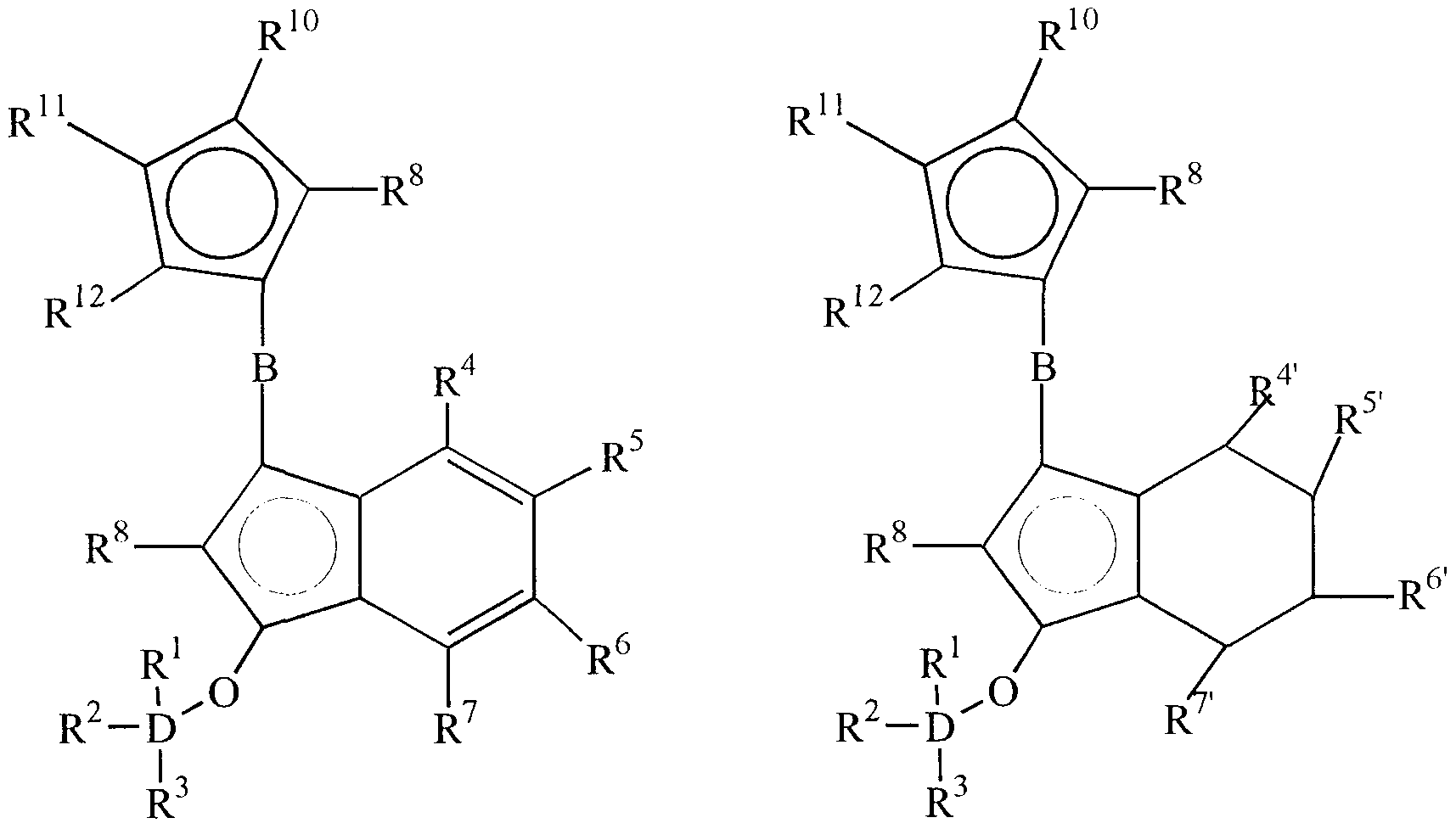
- the numbering 1 or 3 depends on the substituent Y and the bridge B. If Y is bound to Cp alone or with a higher atom than B, then Y is in the 1 -position. If Y is bound to Cp with a lower atom than B, then Y is in the 3-position. More preferably the metallocene has the formula (Ilia) or (Illb):
- each Y is the same as above, each Y' is as defined for Y; R 4 , R5, R ? R7 R 9 , Rl°, Rl 1, Rl 2 , R 4 ', R 5 ', R6', R9', R10' ?
- R1 Rl2' are t h e same or different and are each one of a hydrogen, a halogen, a substituted or unsubstituted C J-CJO hydrocarbyl group, a substituted or unsubstituted C ⁇ -C ⁇ Q hydrocarbyloxy group, a Cj-Ci2 organosihcon group, at least two adjacent groups of R 4 -R7 0 r R 9 -Rl2 in formula (Ilia) may form at least one aromatic C ring, at least two groups of R 4 -R7 or R9-R12 in formula (Ilia) may form at least one aliphatic C5-C8 ring, one pair of equally numbered groups and another adjacent pair of equally numbered groups of R4 -R7 or R 9 -R12 in formula (Illb) may form an aromatic C ring, or at least two groups of R4 -R7 or R 9 -Rl2' in formula (Illb) may form at least one
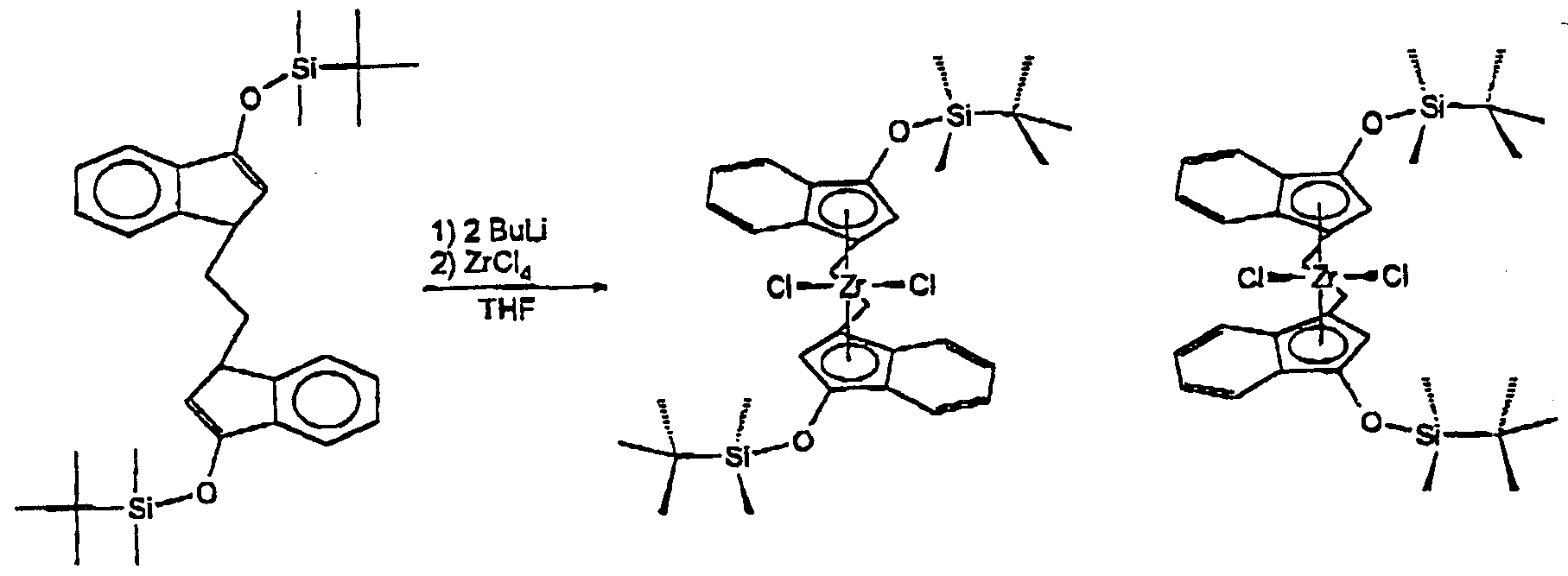
- Particularly preferred bridged 1- or 3-(siloxy)indenyl and 1- or 3-(siloxy)-4,5,6,7- tetrahydroindenyl metallocenes iclude: rac- and meso-[ethylenebis(l -(tert-butyldimethylsiloxy)indenyl)]zirconium dichloride; rac- and meso-[dimethylsilylenebis(3-(tert-butyldimethylsiloxy)indenyl)]zirconium dichloride; rac- and meso-[ethylenebis(l-(thexyldimethylsiloxy)indenyl)]zirconium dichloride; rac- and meso-[dimethylsilylenebis(3-(thexyldimethylsiloxy)indenyl)]- zirconium dichloride; rac- and meso-[ethylenebis(l-(tert-butyldi
- a preferred metallocene compound according to the invention is an [ ethyl enebis( 1- (tert-butylmethylsiloxy)indenyl)]zirconium dichloride which is racemic and has the formula (IVa), meso and has the formula (IVb), or is a mixture of a racemic compound having the formula (IVa) and a meso form compound having the formula (IVb):
- — is methyl -CH3 and is tert. -butyl -C(CH3)3.
- R 9 R 10 ? R1 1 and Rl2 are indenpendently hydrogen or hydrocarbyl substituents.
- R9 and R ⁇ Q may be parts of a ring structure to form an indenyl type ligand or a fluorenyl type ligand
- R O and RU may be parts of a ring structure to form an indenyl type ligand and RU and Rl 2 may be parts of a ring structure to form an indenyl type ligand or a fluorenyl type ligand.
- D is preferably silicon.
- R and R 2 are preferably alkyl or aryl substituents and R 3 is preferably an alkyl substituent.
- Preferred bridge B is a C ⁇ or C2 alkylene or a C -Cg arylalkylene radical or a Ci -Cg organic silicon radical. If B is an alkylene or arylalkylene radical, the metallocene is 1-siloxy substituted. If B is a silylene radical, the metallocene is 3 -substituted.
- Particularly preferred bridged (cyclopentadienyl)(l- or 3-(siloxy)indenyl) and (cyclopenta- dienyl)(l- or 3-(siloxy)-4,5,6,7-tetrahydroindenyl) ligands include 2-(cyclopenta- dienyl)-2-(l- or 3-(siloxy)indenyl)propane and 2-(cyclopentadienyl)-2-(l- or 3- (siloxy)-4,5,6,7-tetrahydroindenyl)propane ligands; and the like.
- Preferred bridged (cyclopentadienyl)(l- or 3-(siloxy)indenyl) and (cyclopenta- dienyl)(l- or 3-(siloxy)-4,5,6,7-tetrahydroindenyl) metallocenes according to the present invention also include: isopropylidene[(cyclopentadienyl)(l-(siloxy)inde- nyl)]zirconium dichloride and isopropylidene[(cyclopentadienyl)(l-(siloxy)-4,5,6,7- tetrahydroindenyl)]zirconium dichloride.
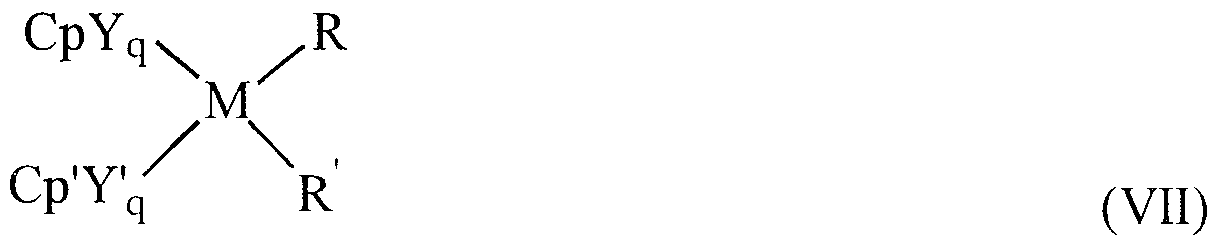
- the invention also includes novel unbridged metallocene catalysts having the formula (VII):
- CpYq and R are as above.
- R is defined for R and Cp'Y' is as defined for CpY.
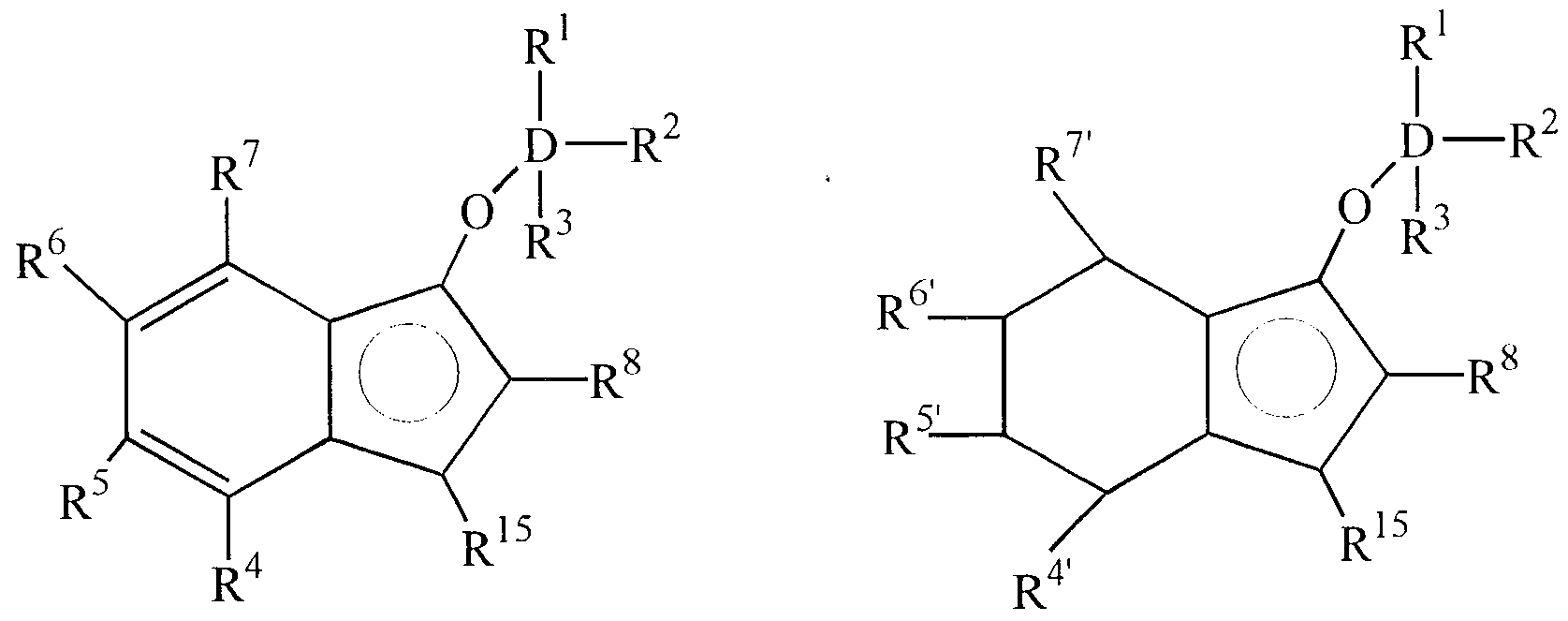
- CpYq and Cp'Y'q are substituted indenyl ligands having the formula (VIII) or substituted tetrahydroindenyl ligands having the formula (IX):
- R , R 2 , R 3 , R 4 , R 5 , R 6 , R 7 , R 8 , R 4 ', R 5 ', R 6 ' and R 7 ' are the same as in formula V and R15 is one of a hydrogen, a halogen, or a substituted or unsubstituted Cj-Cio hydrocarbyl group.
- R ⁇ and R 7 may be cyclized in an aromatic or aliphatic 6-C ring.
- R5 and R ⁇ may likewise by cyclized in an aromatic or aliphatic 6-C ring.
- R 4 and R ⁇ may likewise be cyclized in an aromatic or aliphatic 6-C ring.
- Rl and R 2 may also be cyclized in an aliphatic 5 ring or 6 ring.
- CpYq or Cp'Y'q of formula (VIII) and formula (IX) are 1- siloxyindenyl or l-siloxy-4,5,6,7-tetrahydroindenyl ligands, where R 4 , R ⁇ , R ⁇ , R 7 , R 8 and R 5 are hydrogen, alkyl or aryl substituents.
- D is preferably silicon.
- Rl and R 3 are preferably alkyl or aryl substituents and R 2 is preferably an alkyl substituent.
- Particularly preferred unbridged l-(siloxy)indenyl and l-(siloxy)-4,5,6,7-tetrahydro- indenyl ligands include as present l-(tert-butyldimethylsiloxy)indenyl; l-(thexyldi- methylsiloxy)indenyl; l-(tert-butyldimethylsiloxy)-4,5,6,7-tetrahydroindenyl; and 1- (thexyldimethylsiloxy)-4,5,6,7-tetrahydroindenyl ligands.
- Preferred unbridged l-(siloxy)indenyl and l-(siloxy)-4,5,6,7-tetrahydroindenyl me- tallocenes iclude: rac- and meso-[bis(l-(tert- butyldimethylsiloxy)indenyl)]zirconium dichloride; rac- and meso-[bis(l-(thexyldi- methylsiloxy)indenyl)]zirconium dichloride; rac- and meso-[bis(l-(tert-butyldimet- hylsiloxy)-4,5,6,7-tetrahydroindenyl)]zirconium dichloride; rac- and meso-[bis(l - (thexyldimethylsiloxy)-4,5,6,7-tetrahydroindenyl)]zirconium dichloride; and the same hafnium compounds such
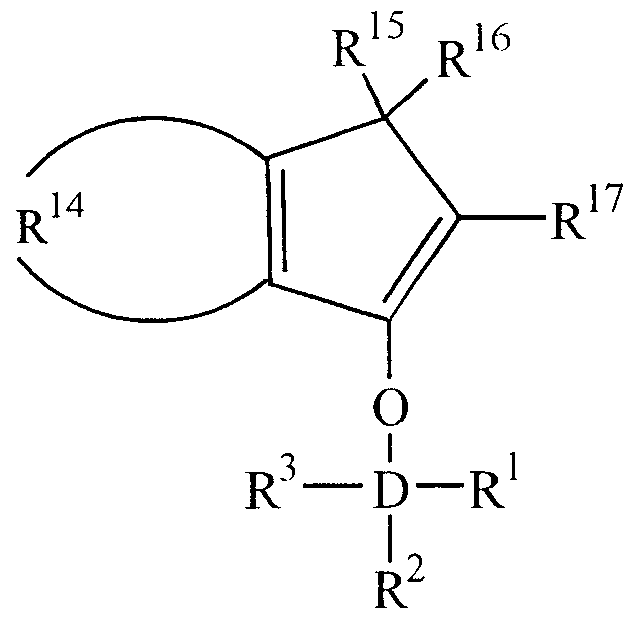
- the invention also relates to a 3 -substituted indene compound, which has the general formula (X):
- D is an element of Group 14 of the Periodic Table (IUPAC);
- Rl, R 2 and R 3 are the same or different and are each one of a hydrogen, a halogen, a substituted or unsubstituted C J-CJO hydrocarbyloxy group, a C1-C12 organosihcon group, or at least two of Rl, R 2 and R 3 form together with D a C4-C20 ring structure;
- Rl 4 is a four atom chain forming an unsubstituted or substituted, further non-fused or further fused, homo(iso)cyclic or heterocyclic, unsaturated or saturated, aliphatic or aromatic six-membered ring;
- R ⁇ and Rl6 are the same or different and are one of a hydrogen, a halogen, a substituted or unsubstituted C ⁇ - C ⁇ Q hydrocarbyl gioup, a substituted or unsubstituted Cj-Cio hydrocarby
- the 3 -substituted indene compound according to formula (X) has the formula (XI):
- Rl, R 2 , R 3 , R i 5 , Rl6 and R are the same as above
- R 4 , R 5 , R 6 and R 7 are the same or different and each is one of a hydrogen, a halogen, a substituted or unsubstituted CJ-CJO hydrocarbyl group, a substituted or unsubstituted C J-CJ O hydrocarbyloxy group, a C1-C12 organosihcon group
- at least two adjacent groups of R -R 7 may form at least one aromatic C ring
- at least two groups of R 4 -R 7 may form at least one aliphatic C5-C8 ring.
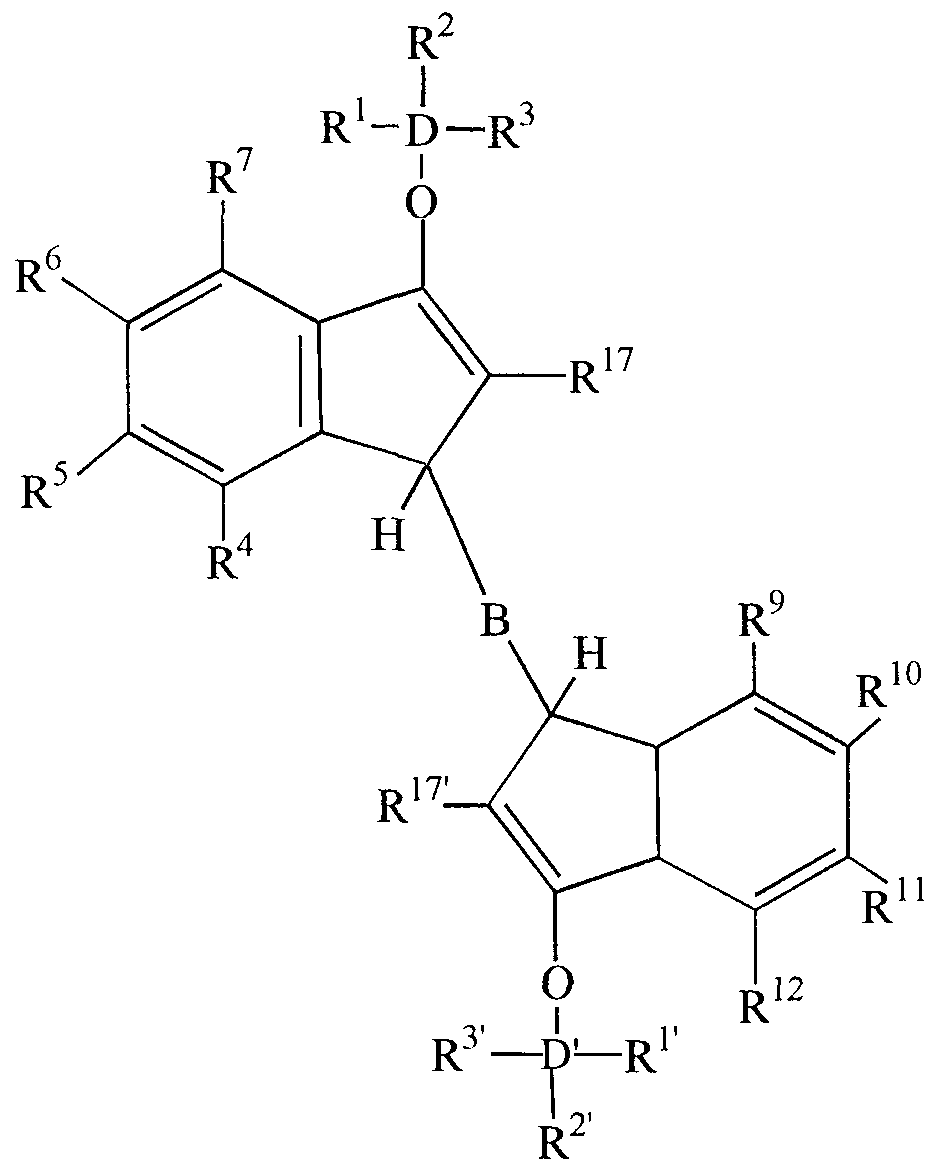
- the 1- or 3 -substituted indene compound according to formulas (X) and (XI) has the general formula (XII):
- Rl, R 2 , R 3 , Rl , R 2 and R 3 ' are the same or different and are each one of a hydrogen, a halogen, a substituted or unsubstituted Cj-Cio hydrocarbyl group, a substituted or unsubstituted CJ -C J O hydrocarbyloxy group, a C1-C12 organosihcon group, or at least two of Rl, R 2 and R 3 form together with D a C4-C20 ring structure or at least two of Rl , R 2 ' and R 3 form together with D' a C4-C20 ring structure, D and D' are independently selected from Group 14 of the Periodic Table (IUPAC), R 4 , R 5 , R 6 , R 7 , R 9 , R 0 , Rl 1 and R 12 are the same or different and are each one of a hydrogen, a halogen, a substituted or unsubstituted CJ-CJ O hydrocar
- D and D' are preferably silicon.
- R 4 , R ⁇ , R6, R 7 , R 9 , Rl°, RU, Rl 2 , R 8 and R ]3 in formula (XII) are preferably hydrogen.
- the bridge B is preferably ethylene or dimethyl silylene.
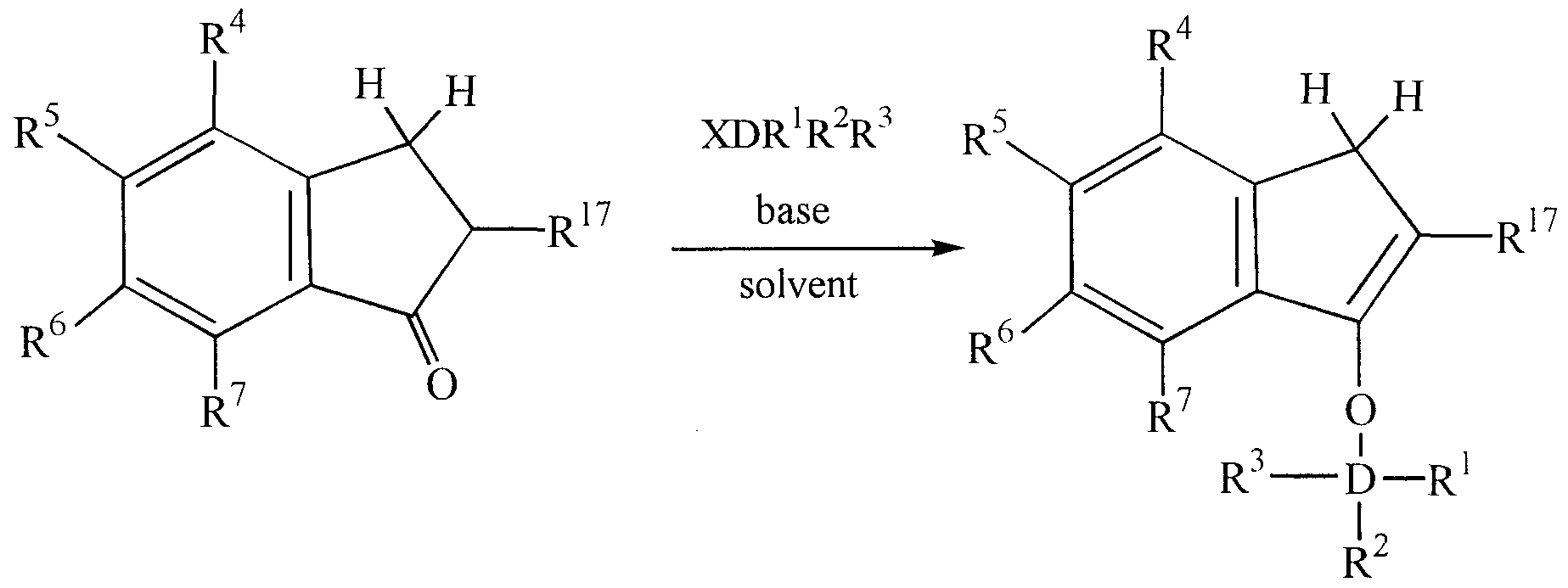
- the present invention also relates to a process for the preparation of a 3 -substituted indene compound. The process is substantially characterized in that a 3-indanone compound is reacted in a solvent with a base and a halogen compound XDRlR 2 R 3 to form a 3 -DRlR 2 R 3 -substituted indene according to the following reaction scheme (XIII):
- R 4 , R ⁇ , R ⁇ and R 7 are the same or different and each is one of a hydrogen, a halogen, a substituted or unsubstituted C I-CJO hydrocarbyl group, a substituted or unsubstituted C ⁇ -C ⁇ Q hydrocarbyloxy group, a C]-Ci 2 organosihcon group, at least two adjacent groups of R 4 -R 7 may form at least one aromatic C ring, or at least two groups of R 4 -R 7 may form at least one aliphatic C5-C8 ring, and Rl 7 is one of a hydrogen, a halogen, a substituted or unsubstituted Cj-C] o hydrocarbyl group, a substituted or unsubstituted C J-CJO hydrocarbyloxy group, a C j-Ci2 organosihcon group or the same or different group -0-DRlR 2 R 3 ; D is an element of Group 14 of the Periodic
- the base is preferably diazabicyclo- undecene (DBU) and the chlorosilane is independently and preferably tert-butyl- dimethylchlorosilane, thexyldimethylchlorosilane or cyclohexyldimethylchloro- silane.
- DBU diazabicyclo- undecene
- the chlorosilane is independently and preferably tert-butyl- dimethylchlorosilane, thexyldimethylchlorosilane or cyclohexyldimethylchloro- silane.
- R 4 , R 5 , R ⁇ R 7 and Rl 7 are preferably hydrogens.
- the invention relates to the whole process of preparing bridged 1- or 3-(siloxy) indenyl metallocenes and 1- or 3-(siloxy)-4,5,6,7-tetrahydroindenyl metallocenes by using the following reaction scheme (XIV) (disclosed for indenyl metallocene, only):
- D is an element of Group 14 of the Periodic Table (IUPAC)
- Rl, R 2 and R 3 are the same or different and are each one of a hydrogen, a halogen, a substituted or unsubstituted Cj-Cio hydrocarbyl group, a substituted or unsubstituted C ⁇ -C ⁇ Q hydrocarbyloxy group, a Cj-Ci2 organosihcon group, or at least two of Rl, R 2 and R 3 form together with D a C4-C20 ring structure
- B is a CJ-C JO alkylene, a C2-Cg silylene or a CJ-C JO alkylene-C2-Cg silylene
- each X is independently a halogen
- M is a transition metal of Group 4 of the Periodic Table (IUPAC);
- R or each same or different R is one of a hydiogen, a halogen, a substituted or unsubstituted C ⁇
- D is preferably silicon.
- Rl, R 2 and R 3 are preferably the same or different and are each an unsubstituted C J-CJO hydrocarbyl group, preferably wherein two of Rl, R 2 and R 3 are linear C1-C4 alkyl groups such as a methyl group and one of Rl, R 2 and R 3 is a branched C3-C10 alkyl group such as an isopropyl group, a tert-butyl group or a terthexyl group, a C5-C8 cycloalkyl group such as a cyclohexyl group, or a C ⁇ aiyl group such as a phenyl group.
- B is preferably ethylene or dimethylsilylene and, independently, X is preferably chlorine or bromine.
- M is preferably zirconium.
- the invention relates to the use of the above described metallocene compounds for the polymerization (homo- and copolymerization) of ethylenically unsaturated monomers, preferably olefins such as ethylene, propylene and higher ⁇ - olefins. Monomers and comonomers with more than one double bond may also be used.
- Appropriate cocatalysts in the polymerization include alkylaluminum compounds, alkyl aluminoxanes such as methylaluminoxane, modified methylaluminoxane or higher aluminoxanes such as tetraisobutyl aluminoxane, hexaisobutyl aluminoxane, etc.
- Other cocatalysts which may be used include Lewis or protic acids, such as B(C6F5)3 or [PhNMe2H] + B(C6F5)4-, which generate cationic metallocenes with compatible non-coordinating anions in the presence or absence of alkylaluminum compounds.
Landscapes
- Chemical & Material Sciences (AREA)
- Organic Chemistry (AREA)
- Health & Medical Sciences (AREA)
- Chemical Kinetics & Catalysis (AREA)
- Medicinal Chemistry (AREA)
- Polymers & Plastics (AREA)
- Transition And Organic Metals Composition Catalysts For Addition Polymerization (AREA)
Abstract
Description








Claims




Priority Applications (9)
| Application Number | Priority Date | Filing Date | Title |
|---|---|---|---|
| US09/402,934 US6355819B1 (en) | 1997-04-14 | 1998-01-27 | Substituted metallocene compounds for olefin polymerization catalyst systems, their intermediates and methods for preparing them |
| DE69829365T DE69829365T2 (en) | 1997-04-14 | 1998-01-27 | SUBSTITUTED METALOCE COMPOUNDS FOR OLEFIN POLYMERIZATION CATALYST SYSTEMS, THEIR INTERMEDIATE COMPOUNDS AND METHOD FOR THE PRODUCTION THEREOF |
| AU58654/98A AU735909B2 (en) | 1997-04-14 | 1998-01-27 | Substituted metallocene compounds for olefin polymerization catalyst systems, their intermediates and methods for preparing them |
| EP98901991A EP0975644B1 (en) | 1997-04-14 | 1998-01-27 | Substituted metallocene compounds for olefin polymerization catalyst systems, their intermediates and methods for preparing them |
| JP54351498A JP2001519825A (en) | 1997-04-14 | 1998-01-27 | Substituted metallocene compounds for olefin polymerization catalyst systems, intermediates thereof, and methods for preparing the same |
| BR9807946-8A BR9807946A (en) | 1997-04-14 | 1998-01-27 | Substituted metallocene compounds for catalytic polymerization systems, their intermediates and methods of preparing them |
| CA002286050A CA2286050A1 (en) | 1997-04-14 | 1998-01-27 | Substituted metallocene compounds for olefin polymerization catalyst systems, their intermediates and methods for preparing them |
| KR1019997009468A KR100682115B1 (en) | 1997-04-14 | 1998-01-27 | Substituted metallocene compounds for olefin polymerization catalyst system, intermediates thereof and preparation method thereof |
| AT98901991T ATE291030T1 (en) | 1997-04-14 | 1998-01-27 | SUBSTITUTED METALLOCENE COMPOUNDS FOR OLEFIN POLYMERIZATION CATALYST SYSTEMS, THEIR INTERMEDIATE COMPOUNDS AND METHOD FOR THE PRODUCTION THEREOF |
Applications Claiming Priority (2)
| Application Number | Priority Date | Filing Date | Title |
|---|---|---|---|
| FI971565 | 1997-04-14 | ||
| FI971565A FI971565A7 (en) | 1997-04-14 | 1997-04-14 | Substituted metallocene compounds for catalyst systems for the polymerization of olefins, intermediates thereof and method of preparation |
Publications (1)
| Publication Number | Publication Date |
|---|---|
| WO1998046616A1 true WO1998046616A1 (en) | 1998-10-22 |
Family
ID=8548614
Family Applications (1)
| Application Number | Title | Priority Date | Filing Date |
|---|---|---|---|
| PCT/FI1998/000075 Ceased WO1998046616A1 (en) | 1997-04-14 | 1998-01-27 | Substituted metallocene compounds for olefin polymerization catalyst systems, their intermediates and methods for preparing them |
Country Status (16)
| Country | Link |
|---|---|
| US (1) | US6355819B1 (en) |
| EP (1) | EP0975644B1 (en) |
| JP (1) | JP2001519825A (en) |
| KR (1) | KR100682115B1 (en) |
| CN (1) | CN1247603C (en) |
| AR (1) | AR011582A1 (en) |
| AT (1) | ATE291030T1 (en) |
| AU (1) | AU735909B2 (en) |
| BR (1) | BR9807946A (en) |
| CA (1) | CA2286050A1 (en) |
| DE (1) | DE69829365T2 (en) |
| ES (1) | ES2238091T3 (en) |
| FI (1) | FI971565A7 (en) |
| MY (1) | MY129129A (en) |
| WO (1) | WO1998046616A1 (en) |
| ZA (1) | ZA98707B (en) |
Cited By (107)
| Publication number | Priority date | Publication date | Assignee | Title |
|---|---|---|---|---|
| US6664351B1 (en) | 1994-06-20 | 2003-12-16 | Basell Technology Company B.V. | Ethylene copolymers, process for the preparation of ethylene-based polymers and catalyst system used therein |
| EP1489110A1 (en) | 2003-06-20 | 2004-12-22 | Borealis Polymers Oy | Method for preparing an olefin polymerisation catalyst composition |
| US7037872B2 (en) | 2001-07-24 | 2006-05-02 | Borealis Technology Oy | Metallocene catalysts containing a cyclopentadienyl ligand substituted by a siloxy or germiloxy group containing an olefinic residue |
| US7074863B2 (en) | 2001-06-22 | 2006-07-11 | Borealis Technology Oy | Metallocene catalysts containing an idenyl moiety substituted at the 4,-5,-6- or 7-position by a siloxy or germyloxy group |
| WO2007045415A1 (en) | 2005-10-21 | 2007-04-26 | Borealis Technology Oy | Composition |
| EP1795542A1 (en) | 2005-12-07 | 2007-06-13 | Borealis Technology Oy | Polymer |
| EP1803743A1 (en) | 2005-12-30 | 2007-07-04 | Borealis Technology Oy | Catalyst particles |
| US7341971B2 (en) | 2001-12-19 | 2008-03-11 | Borealis Technology Oy | Production of olefin polymerization catalysts |
| EP2053077A1 (en) | 2004-10-22 | 2009-04-29 | Borealis Technology OY | Process |
| US7531478B2 (en) | 2001-12-19 | 2009-05-12 | Borealis Technology Oy | Production of supported olefin polymerisation catalysts |
| EP2058339A1 (en) | 2007-11-09 | 2009-05-13 | Borealis Technology OY | Polyethylene copolymer |
| EP2130860A1 (en) | 2008-06-06 | 2009-12-09 | Borealis Technology Oy | Polymer |
| EP2133389A1 (en) | 2008-06-12 | 2009-12-16 | Borealis AG | Polypropylene composition |
| WO2010052264A1 (en) | 2008-11-07 | 2010-05-14 | Borealis Ag | Solid catalyst composition |
| EP2186831A1 (en) | 2008-11-10 | 2010-05-19 | Borealis AG | Process for the preparation of an unsupported, solid olefin polymerisation catalyst and use in polymerisation of olefins |
| EP2186832A1 (en) | 2008-11-10 | 2010-05-19 | Borealis AG | Process for the preparation of an unsupported, solid metallocene catalyst system and its use in polymerization of olefins |
| EP2204410A1 (en) | 2008-12-31 | 2010-07-07 | Borealis AG | Article coated with a composition comprising polyethylene prepared with a single site catalyst |
| US7812094B2 (en) | 2006-07-14 | 2010-10-12 | Borealis Technology Oy | Polymer blend |
| EP2275476A1 (en) | 2009-06-09 | 2011-01-19 | Borealis AG | Automotive material with excellent flow, high stiffness, excellent ductility and low CLTE |
| EP2308923A1 (en) | 2009-10-09 | 2011-04-13 | Borealis AG | Glass fibre composite of improved processability |
| WO2011051705A1 (en) * | 2009-10-26 | 2011-05-05 | Isis Innovation Limited | Catalysts |
| WO2011069888A1 (en) | 2009-12-07 | 2011-06-16 | Borealis Ag | Process for the preparation of an unsupported, solid metallocene catalyst system and its use in polymerization of olefins |
| EP2338921A1 (en) | 2009-12-22 | 2011-06-29 | Borealis AG | Preparation of single-site catalysts |
| EP2338920A1 (en) | 2009-12-22 | 2011-06-29 | Borealis AG | Preparation of single-site catalysts |
| WO2011076443A1 (en) | 2009-12-22 | 2011-06-30 | Borealis Ag | Preparation of polypropylene in the presence of a single-site catalyst |
| EP2385073A1 (en) | 2010-05-07 | 2011-11-09 | Borealis AG | Process for the preparation of a solid metallocene catalyst system and its use in polymerisation of olefins |
| WO2011138214A1 (en) | 2010-05-07 | 2011-11-10 | Borealis Ag | Preparation of a solid catalyst system |
| WO2011138211A1 (en) | 2010-05-07 | 2011-11-10 | Borealis Ag | Process for the preparation of a solid metallocene catalyst system and its use in polymerisation of olefins |
| WO2011138212A1 (en) | 2010-05-07 | 2011-11-10 | Borealis Ag | Preparation of a solid catalyst system |
| EP2415598A1 (en) | 2010-08-06 | 2012-02-08 | Borealis AG | Multilayer film |
| WO2012055932A1 (en) | 2010-10-28 | 2012-05-03 | Borealis Ag | Single site polymer |
| EP2495264A1 (en) | 2011-03-04 | 2012-09-05 | Borealis AG | Exterior automotive article with reduced paintability failure |
| US8283418B2 (en) | 2007-01-22 | 2012-10-09 | Borealis Technology Oy | Polypropylene composition with low surface energy |
| EP2554375A1 (en) | 2011-08-03 | 2013-02-06 | Borealis AG | Film |
| WO2013149915A1 (en) | 2012-04-04 | 2013-10-10 | Borealis Ag | High-flow fiber reinforced polypropylene composition |
| EP2722344A1 (en) | 2012-10-18 | 2014-04-23 | Borealis AG | Polymerisation process |
| EP2722346A1 (en) | 2012-10-18 | 2014-04-23 | Borealis AG | Polymerisation process and catalyst |
| EP2722345A1 (en) | 2012-10-18 | 2014-04-23 | Borealis AG | Catalyst |
| WO2015009473A1 (en) * | 2013-07-17 | 2015-01-22 | Exxonmobil Chemical Patents Inc. | Cyclopropyl substituted metallocene catalysts |
| EP2829558A1 (en) | 2013-07-24 | 2015-01-28 | Borealis AG | Process |
| EP2829556A1 (en) | 2013-07-24 | 2015-01-28 | Borealis AG | Process |
| EP2995631A1 (en) | 2014-09-12 | 2016-03-16 | Borealis AG | Process for producing graft copolymers on polyolefin backbone |
| WO2016135213A1 (en) | 2015-02-27 | 2016-09-01 | Borealis Ag | Laminated film structure based on polyethylene only |
| US9458260B2 (en) | 2013-07-17 | 2016-10-04 | Exxonmobil Chemical Patents Inc. | Process using substituted metallocene catalysts and products therefrom |
| US9464145B2 (en) | 2013-07-17 | 2016-10-11 | Exxonmobil Chemical Patents Inc. | Metallocenes and catalyst compositions derived therefrom |
| US9637602B2 (en) | 2013-12-18 | 2017-05-02 | Borealis Ag | BOPP film with improved stiffness/toughness balance |
| US9644047B2 (en) | 2013-07-17 | 2017-05-09 | Exxonmobil Chemical Patents Inc. | Metallocenes and catalyst compositions derived therefrom |
| US9670347B2 (en) | 2013-08-14 | 2017-06-06 | Borealis Ag | Propylene composition with improved impact resistance at low temperature |
| US9670293B2 (en) | 2013-10-29 | 2017-06-06 | Borealis Ag | Solid single site catalysts with high polymerisation activity |
| US9708481B2 (en) | 2013-10-24 | 2017-07-18 | Borealis Ag | Blow molded article based on bimodal random copolymer |
| US9751962B2 (en) | 2013-11-22 | 2017-09-05 | Borealis Ag | Low emission propylene homopolymer with high melt flow |
| US9777142B2 (en) | 2013-08-21 | 2017-10-03 | Borealis Ag | High flow polyolefin composition with high stiffness and toughness |
| US9802394B2 (en) | 2013-10-11 | 2017-10-31 | Borealis Ag | Machine direction oriented film for labels |
| EP3241611A1 (en) | 2016-05-02 | 2017-11-08 | Borealis AG | A process for feeding a polymerisation catalyst |
| US9828698B2 (en) | 2013-12-04 | 2017-11-28 | Borealis Ag | Phthalate-free PP homopolymers for meltblown fibers |
| WO2017207221A1 (en) | 2016-06-03 | 2017-12-07 | Borealis Ag | Multilayer structure |
| EP3261093A1 (en) | 2016-06-21 | 2017-12-27 | Borealis AG | Cable with advantageous electrical properties |
| EP3261095A1 (en) | 2016-06-21 | 2017-12-27 | Borealis AG | Cable with improved electrical properties |
| WO2017220724A1 (en) | 2016-06-23 | 2017-12-28 | Borealis Ag | Process for catalyst deactivation |
| US9884925B2 (en) | 2014-04-17 | 2018-02-06 | Oxford University Innovation Limited | Silyl bis(hexamethylindenyl) complexes of group IVA metals as polymerization catalysts |
| US9890275B2 (en) | 2013-08-21 | 2018-02-13 | Borealis Ag | High flow polyolefin composition with high stiffness and toughness |
| US9938364B2 (en) | 2013-07-17 | 2018-04-10 | Exxonmobil Chemical Patents Inc. | Substituted metallocene catalysts |
| WO2018091653A1 (en) | 2016-11-18 | 2018-05-24 | Borealis Ag | Catalyst |
| US10030109B2 (en) | 2014-02-14 | 2018-07-24 | Borealis Ag | Polypropylene composite |
| US10040930B2 (en) | 2013-09-27 | 2018-08-07 | Abu Dhabi Polymers Co. Ltd (Borouge) Llc. | Polymer composition with high XS, high Tm suitable for BOPP processing |
| US10100185B2 (en) | 2014-02-06 | 2018-10-16 | Borealis Ag | Soft copolymers with high impact strength |
| US10100186B2 (en) | 2014-02-06 | 2018-10-16 | Borealis Ag | Soft and transparent impact copolymers |
| US10221259B2 (en) | 2015-01-06 | 2019-03-05 | Scg Chemicals Co., Ltd. | SiO2-layered double hydroxide microspheres and their use as catalyst supports in ethylene polymerisation |
| US10227427B2 (en) | 2014-01-17 | 2019-03-12 | Borealis Ag | Process for preparing propylene/1-butene copolymers |
| WO2019122016A1 (en) | 2017-12-21 | 2019-06-27 | Borealis Ag | Process for the preparation of solid catalyst |
| US10450451B2 (en) | 2014-05-20 | 2019-10-22 | Borealis Ag | Polypropylene composition for automotive interior applications |
| US10519259B2 (en) | 2013-10-24 | 2019-12-31 | Borealis Ag | Low melting PP homopolymer with high content of regioerrors and high molecular weight |
| WO2020064314A1 (en) | 2018-09-26 | 2020-04-02 | Borealis Ag | Propylene copolymer with excellent optical properties |
| WO2020064313A1 (en) | 2018-09-26 | 2020-04-02 | Borealis Ag | Propylene random copolymer for use in film applications |
| WO2020064190A1 (en) | 2018-09-26 | 2020-04-02 | Borealis Ag | Propylene copolymer composition with excellent optical and mechanical properties |
| WO2020104145A1 (en) | 2018-11-23 | 2020-05-28 | Borealis Ag | Polypropylene composition with improved optical properties and whitening resistance |
| WO2020109452A1 (en) | 2018-11-30 | 2020-06-04 | Borealis Ag | Washing process |
| US10679768B2 (en) | 2016-06-21 | 2020-06-09 | Borealis Ag | Cable and composition |
| EP3666804A1 (en) | 2018-12-14 | 2020-06-17 | Borealis AG | Polypropylene composition with favourable combination of optics, softness and low sealing |
| US10773246B2 (en) | 2015-01-06 | 2020-09-15 | Scg Chemicals Co., Ltd. | SiO2-layered double hydroxide microspheres and methods of making them |
| EP3825357A1 (en) | 2019-11-25 | 2021-05-26 | Borealis AG | Propylene composition for foaming with improved mechanical properties |
| US11053269B2 (en) | 2016-05-12 | 2021-07-06 | Scg Chemicals Co., Ltd. | Unsymmetrical metallocene catalysts and uses thereof |
| WO2022129409A1 (en) | 2020-12-18 | 2022-06-23 | Borealis Ag | Modification of polyethylene terpolymer |
| EP4019582A1 (en) | 2020-12-23 | 2022-06-29 | Borealis AG | Polyethylene film |
| WO2022148857A1 (en) | 2021-01-08 | 2022-07-14 | Borealis Ag | Composition |
| EP4036130A1 (en) | 2021-01-29 | 2022-08-03 | Borealis AG | Modification of polyethylene copolymer |
| EP4053194A1 (en) | 2021-03-03 | 2022-09-07 | Borealis AG | Monolayer blown film |
| EP4056599A1 (en) | 2021-03-09 | 2022-09-14 | Borealis AG | Polyethylene composition for a film layer |
| EP4056598A1 (en) | 2021-03-09 | 2022-09-14 | Borealis AG | Polyethylene composition for a film layer |
| WO2022189376A1 (en) | 2021-03-09 | 2022-09-15 | Borealis Ag | Polyethylene composition for a film layer |
| US11447580B2 (en) | 2017-12-27 | 2022-09-20 | Borealis Ag | Ziegler-Natta catalyst and preparation thereof |
| US11535012B2 (en) | 2015-12-15 | 2022-12-27 | Borealis Ag | Polyethylene based laminated film structure with barrier properties |
| US11613633B2 (en) | 2016-06-21 | 2023-03-28 | Borealis Ag | Polymer composition for wire and cable applications with advantageous thermomechanical behaviour and electrical properties |
| EP4163332A1 (en) | 2021-10-10 | 2023-04-12 | Borealis AG | Polyethylene composition for a film layer |
| EP4166581A1 (en) | 2021-10-12 | 2023-04-19 | Borealis AG | Propylene composition for foaming with high melt flow rate |
| US11753486B2 (en) | 2017-12-28 | 2023-09-12 | Borealis Ag | Catalyst and preparation thereof |
| WO2023198579A1 (en) | 2022-04-11 | 2023-10-19 | Borealis Ag | Multilayer film |
| EP4389776A1 (en) | 2022-12-20 | 2024-06-26 | Borealis AG | Process |
| EP4389783A1 (en) | 2022-12-20 | 2024-06-26 | Borealis AG | Catalyst transition process |
| WO2024133045A1 (en) | 2022-12-23 | 2024-06-27 | Borealis Ag | Process for producing a high-flow polypropylene homopolymer |
| WO2024133046A1 (en) | 2022-12-23 | 2024-06-27 | Borealis Ag | Process for producing a polypropylene copolymer |
| WO2024133044A1 (en) | 2022-12-23 | 2024-06-27 | Borealis Ag | Process for producing a polypropylene homo- or copolymer |
| EP4417629A1 (en) | 2023-02-14 | 2024-08-21 | Borealis AG | Polyethylene blend for a film layer |
| WO2025003435A1 (en) | 2023-06-30 | 2025-01-02 | Borealis Ag | Process |
| EP4538321A1 (en) | 2023-10-11 | 2025-04-16 | Borealis AG | A way to increase the nucleation efficiency of ssc materials |
| WO2025219533A1 (en) | 2024-04-18 | 2025-10-23 | Borealis Gmbh | Process for the preparation of a propylene homopolymer |
| WO2025219537A1 (en) | 2024-04-18 | 2025-10-23 | Borealis Gmbh | Process for propylene polymerization with optimized prepolymerization conditions |
Families Citing this family (5)
| Publication number | Priority date | Publication date | Assignee | Title |
|---|---|---|---|---|
| KR100367463B1 (en) * | 1999-03-03 | 2003-01-14 | 주식회사 엘지화학 | Metallocene compounds and their use for olefin polymerization |
| KR100404780B1 (en) * | 2000-02-18 | 2003-11-07 | 대림산업 주식회사 | Metallocene compounds, metallocene catalysts prepared from the compounds and method of polymerizing olefins with the catalysts |
| KR100405933B1 (en) * | 2001-03-20 | 2003-11-14 | 주식회사 하이닉스반도체 | Method for forming capacitor of semiconductor device |
| CN105377906A (en) * | 2013-07-17 | 2016-03-02 | 埃克森美孚化学专利公司 | Substituted metallocene catalysts |
| CN105461839B (en) * | 2014-08-20 | 2020-11-13 | 中国科学院上海有机化学研究所 | Application of bimetallic olefin polymerization catalyst in polar monomer copolymerization |
Citations (1)
| Publication number | Priority date | Publication date | Assignee | Title |
|---|---|---|---|---|
| WO1997028170A1 (en) * | 1996-01-30 | 1997-08-07 | Borealis A/S | Heteroatom substituted metallocene compounds for olefin polymerization catalyst systems and methods for preparing them |
Family Cites Families (8)
| Publication number | Priority date | Publication date | Assignee | Title |
|---|---|---|---|---|
| WO1993014132A1 (en) | 1992-01-06 | 1993-07-22 | The Dow Chemical Company | Improved catalyst composition |
| ATE198207T1 (en) * | 1992-08-03 | 2001-01-15 | Targor Gmbh | METHOD FOR PRODUCING AN OLEFIN POLYMER USING SPECIAL METALLOCENES |
| ATE177436T1 (en) * | 1992-08-15 | 1999-03-15 | Targor Gmbh | METHOD FOR PRODUCING POLYOLEFINS |
| NL9201970A (en) | 1992-11-11 | 1994-06-01 | Dsm Nv | Indenyl compounds and catalyst components for the polymerization of olefins. |
| DE4406963A1 (en) | 1994-03-03 | 1995-09-07 | Basf Ag | Metallocene complexes with heterofunctional groups on the cyclopentadienyl system |
| BR9711115A (en) * | 1996-08-08 | 1999-08-17 | Dow Chemical Co | Metallic complex catalyst system for olefin polymerization process for olefin polymerization polymerization process in high temperature solution binder polyolefin product containing cyclopentadienyl and use of a binder |
| FI970349A7 (en) * | 1997-01-28 | 1998-07-29 | Borealis As | New activator systems for metallocene compounds |
| FI972230A7 (en) * | 1997-01-28 | 1998-07-29 | Borealis As | New homogeneous olefin polymerization catalyst composition |
-
1997
- 1997-04-14 FI FI971565A patent/FI971565A7/en unknown
-
1998
- 1998-01-26 MY MYPI98000353A patent/MY129129A/en unknown
- 1998-01-27 AT AT98901991T patent/ATE291030T1/en not_active IP Right Cessation
- 1998-01-27 KR KR1019997009468A patent/KR100682115B1/en not_active Expired - Fee Related
- 1998-01-27 JP JP54351498A patent/JP2001519825A/en not_active Ceased
- 1998-01-27 CA CA002286050A patent/CA2286050A1/en not_active Abandoned
- 1998-01-27 US US09/402,934 patent/US6355819B1/en not_active Expired - Fee Related
- 1998-01-27 AU AU58654/98A patent/AU735909B2/en not_active Ceased
- 1998-01-27 BR BR9807946-8A patent/BR9807946A/en not_active Application Discontinuation
- 1998-01-27 WO PCT/FI1998/000075 patent/WO1998046616A1/en not_active Ceased
- 1998-01-27 CN CNB988048132A patent/CN1247603C/en not_active Expired - Fee Related
- 1998-01-27 EP EP98901991A patent/EP0975644B1/en not_active Expired - Lifetime
- 1998-01-27 DE DE69829365T patent/DE69829365T2/en not_active Expired - Fee Related
- 1998-01-27 ES ES98901991T patent/ES2238091T3/en not_active Expired - Lifetime
- 1998-01-28 ZA ZA98707A patent/ZA98707B/en unknown
- 1998-01-28 AR ARP980100374A patent/AR011582A1/en active IP Right Grant
Patent Citations (1)
| Publication number | Priority date | Publication date | Assignee | Title |
|---|---|---|---|---|
| WO1997028170A1 (en) * | 1996-01-30 | 1997-08-07 | Borealis A/S | Heteroatom substituted metallocene compounds for olefin polymerization catalyst systems and methods for preparing them |
Non-Patent Citations (2)
| Title |
|---|
| LEINO, REKO ET AL: "Isospecific Propylene Polymerization with a Novel 2-Substituted Bis(indenyl) ansa-Zirconocene", ORGANOMETALLICS (1996), 15(10), 2450-3 CODEN: ORGND7;ISSN: 0276-7333, XP002064086 * |
| PLENIO H ET AL: "eta-Complexes of cyclopentadienylsilylethers (C5H4OSiR3) and hydroxycyclopentadiene (C5H4OH) with titanium and zirconium chlorides", JOURNAL OF ORGANOMETALLIC CHEMISTRY, vol. 1, no. 544, 5 October 1997 (1997-10-05), pages 133-137, XP004093832 * |
Cited By (162)
| Publication number | Priority date | Publication date | Assignee | Title |
|---|---|---|---|---|
| US6664351B1 (en) | 1994-06-20 | 2003-12-16 | Basell Technology Company B.V. | Ethylene copolymers, process for the preparation of ethylene-based polymers and catalyst system used therein |
| US7074863B2 (en) | 2001-06-22 | 2006-07-11 | Borealis Technology Oy | Metallocene catalysts containing an idenyl moiety substituted at the 4,-5,-6- or 7-position by a siloxy or germyloxy group |
| US7037872B2 (en) | 2001-07-24 | 2006-05-02 | Borealis Technology Oy | Metallocene catalysts containing a cyclopentadienyl ligand substituted by a siloxy or germiloxy group containing an olefinic residue |
| US7341971B2 (en) | 2001-12-19 | 2008-03-11 | Borealis Technology Oy | Production of olefin polymerization catalysts |
| US7531478B2 (en) | 2001-12-19 | 2009-05-12 | Borealis Technology Oy | Production of supported olefin polymerisation catalysts |
| US7718563B2 (en) | 2001-12-19 | 2010-05-18 | Borealis Technology Oy | Production of olefin polymerization catalysts |
| US7592285B2 (en) | 2003-06-20 | 2009-09-22 | Borealis Technology Oy | Method for preparing an olefin polymerization catalyst composition |
| EP1489110A1 (en) | 2003-06-20 | 2004-12-22 | Borealis Polymers Oy | Method for preparing an olefin polymerisation catalyst composition |
| EP2053077A1 (en) | 2004-10-22 | 2009-04-29 | Borealis Technology OY | Process |
| WO2007045415A1 (en) | 2005-10-21 | 2007-04-26 | Borealis Technology Oy | Composition |
| EP1795542A1 (en) | 2005-12-07 | 2007-06-13 | Borealis Technology Oy | Polymer |
| EP1803743A1 (en) | 2005-12-30 | 2007-07-04 | Borealis Technology Oy | Catalyst particles |
| US8399374B2 (en) | 2005-12-30 | 2013-03-19 | Borealis Technology Oy | Catalyst particles |
| US7812094B2 (en) | 2006-07-14 | 2010-10-12 | Borealis Technology Oy | Polymer blend |
| US8283418B2 (en) | 2007-01-22 | 2012-10-09 | Borealis Technology Oy | Polypropylene composition with low surface energy |
| EP2058339A1 (en) | 2007-11-09 | 2009-05-13 | Borealis Technology OY | Polyethylene copolymer |
| EP2130860A1 (en) | 2008-06-06 | 2009-12-09 | Borealis Technology Oy | Polymer |
| EP2133389A1 (en) | 2008-06-12 | 2009-12-16 | Borealis AG | Polypropylene composition |
| WO2010052264A1 (en) | 2008-11-07 | 2010-05-14 | Borealis Ag | Solid catalyst composition |
| EP2186831A1 (en) | 2008-11-10 | 2010-05-19 | Borealis AG | Process for the preparation of an unsupported, solid olefin polymerisation catalyst and use in polymerisation of olefins |
| US8420562B2 (en) | 2008-11-10 | 2013-04-16 | Borealis Ag | Process for the preparation of an unsupported, solid metallocene catalyst system and its use in polymerization of olefins |
| EP2186832A1 (en) | 2008-11-10 | 2010-05-19 | Borealis AG | Process for the preparation of an unsupported, solid metallocene catalyst system and its use in polymerization of olefins |
| US8394733B2 (en) | 2008-11-10 | 2013-03-12 | Borealis Ag | Process for the preparation of an unsupported, solid olefin polymerisation catalyst and use in polymerisation of olefins |
| US9353283B2 (en) | 2008-12-31 | 2016-05-31 | Borealis Ag | Article coated with a composition comprising polyethylene prepared with a single site catalyst |
| EP2204410A1 (en) | 2008-12-31 | 2010-07-07 | Borealis AG | Article coated with a composition comprising polyethylene prepared with a single site catalyst |
| EP2275476A1 (en) | 2009-06-09 | 2011-01-19 | Borealis AG | Automotive material with excellent flow, high stiffness, excellent ductility and low CLTE |
| EP2308923A1 (en) | 2009-10-09 | 2011-04-13 | Borealis AG | Glass fibre composite of improved processability |
| WO2011042364A1 (en) | 2009-10-09 | 2011-04-14 | Borealis Ag | Glass fibre composite of improved processability |
| US9382410B2 (en) | 2009-10-09 | 2016-07-05 | Borealis Ag | Glass fiber composite of improved processability |
| WO2011051705A1 (en) * | 2009-10-26 | 2011-05-05 | Isis Innovation Limited | Catalysts |
| US8980781B2 (en) | 2009-10-26 | 2015-03-17 | Isis Innovation Limited | Catalysts |
| WO2011069888A1 (en) | 2009-12-07 | 2011-06-16 | Borealis Ag | Process for the preparation of an unsupported, solid metallocene catalyst system and its use in polymerization of olefins |
| WO2011076443A1 (en) | 2009-12-22 | 2011-06-30 | Borealis Ag | Preparation of polypropylene in the presence of a single-site catalyst |
| WO2011076618A1 (en) | 2009-12-22 | 2011-06-30 | Borealis Ag | Preparation of single-site catalysts |
| EP2338921A1 (en) | 2009-12-22 | 2011-06-29 | Borealis AG | Preparation of single-site catalysts |
| EP2338920A1 (en) | 2009-12-22 | 2011-06-29 | Borealis AG | Preparation of single-site catalysts |
| WO2011076617A1 (en) | 2009-12-22 | 2011-06-30 | Borealis Ag | Preparation of single-site catalysts |
| WO2011138209A1 (en) | 2010-05-07 | 2011-11-10 | Borealis Ag | Process for the preparation of a solid metallocene catalyst system and its use in polymerisation of olefins |
| WO2011138214A1 (en) | 2010-05-07 | 2011-11-10 | Borealis Ag | Preparation of a solid catalyst system |
| WO2011138212A1 (en) | 2010-05-07 | 2011-11-10 | Borealis Ag | Preparation of a solid catalyst system |
| EP2386583A1 (en) | 2010-05-07 | 2011-11-16 | Borealis AG | Process for the preparation of a solid metallocene catalyst system and its use in polymerisation of olefins |
| EP2386581A1 (en) | 2010-05-07 | 2011-11-16 | Borealis AG | Preparation of a solid catalyst system |
| US8962509B2 (en) | 2010-05-07 | 2015-02-24 | Borealis Ag | Preparation of a solid catalyst system |
| WO2011138211A1 (en) | 2010-05-07 | 2011-11-10 | Borealis Ag | Process for the preparation of a solid metallocene catalyst system and its use in polymerisation of olefins |
| EP2386582A1 (en) | 2010-05-07 | 2011-11-16 | Borealis AG | Preparation of a solid catalyst system |
| EP2385073A1 (en) | 2010-05-07 | 2011-11-09 | Borealis AG | Process for the preparation of a solid metallocene catalyst system and its use in polymerisation of olefins |
| US10053246B2 (en) | 2010-08-06 | 2018-08-21 | Borealis Ag | Multilayer film |
| EP2415598A1 (en) | 2010-08-06 | 2012-02-08 | Borealis AG | Multilayer film |
| WO2012016938A1 (en) | 2010-08-06 | 2012-02-09 | Borealis Ag | Multilayer film |
| WO2012055932A1 (en) | 2010-10-28 | 2012-05-03 | Borealis Ag | Single site polymer |
| WO2012119921A1 (en) | 2011-03-04 | 2012-09-13 | Borealis Ag | Exterior automotive article with reduced paintability failure |
| EP2495264A1 (en) | 2011-03-04 | 2012-09-05 | Borealis AG | Exterior automotive article with reduced paintability failure |
| WO2013017615A1 (en) | 2011-08-03 | 2013-02-07 | Borealis Ag | Film |
| EP2554375A1 (en) | 2011-08-03 | 2013-02-06 | Borealis AG | Film |
| WO2013149915A1 (en) | 2012-04-04 | 2013-10-10 | Borealis Ag | High-flow fiber reinforced polypropylene composition |
| US9650504B2 (en) | 2012-04-04 | 2017-05-16 | Borealis Ag | High-flow fiber reinforced polypropylene composition |
| EP2722344A1 (en) | 2012-10-18 | 2014-04-23 | Borealis AG | Polymerisation process |
| EP2722345A1 (en) | 2012-10-18 | 2014-04-23 | Borealis AG | Catalyst |
| EP2722346A1 (en) | 2012-10-18 | 2014-04-23 | Borealis AG | Polymerisation process and catalyst |
| US9938364B2 (en) | 2013-07-17 | 2018-04-10 | Exxonmobil Chemical Patents Inc. | Substituted metallocene catalysts |
| US9745390B2 (en) | 2013-07-17 | 2017-08-29 | Exxonmobil Chemical Patents Inc. | Metallocenes and catalyst compositions derived therefrom |
| WO2015009473A1 (en) * | 2013-07-17 | 2015-01-22 | Exxonmobil Chemical Patents Inc. | Cyclopropyl substituted metallocene catalysts |
| US9834628B2 (en) | 2013-07-17 | 2017-12-05 | Exxonmobil Chemical Patents Inc. | Cyclopropyl substituted metallocene catalysts |
| US9458260B2 (en) | 2013-07-17 | 2016-10-04 | Exxonmobil Chemical Patents Inc. | Process using substituted metallocene catalysts and products therefrom |
| US9464145B2 (en) | 2013-07-17 | 2016-10-11 | Exxonmobil Chemical Patents Inc. | Metallocenes and catalyst compositions derived therefrom |
| US9951155B2 (en) | 2013-07-17 | 2018-04-24 | Exxonmobil Chemical Patents Inc. | Process using substituted metallocene catalysts and products therefrom |
| US9644047B2 (en) | 2013-07-17 | 2017-05-09 | Exxonmobil Chemical Patents Inc. | Metallocenes and catalyst compositions derived therefrom |
| US10487161B2 (en) | 2013-07-17 | 2019-11-26 | Exxonmobil Chemical Patents Inc. | Cyclopropyl substituted metallocene catalysts |
| EP2829556A1 (en) | 2013-07-24 | 2015-01-28 | Borealis AG | Process |
| EP2829558A1 (en) | 2013-07-24 | 2015-01-28 | Borealis AG | Process |
| US9670347B2 (en) | 2013-08-14 | 2017-06-06 | Borealis Ag | Propylene composition with improved impact resistance at low temperature |
| US9890275B2 (en) | 2013-08-21 | 2018-02-13 | Borealis Ag | High flow polyolefin composition with high stiffness and toughness |
| US9777142B2 (en) | 2013-08-21 | 2017-10-03 | Borealis Ag | High flow polyolefin composition with high stiffness and toughness |
| US10040930B2 (en) | 2013-09-27 | 2018-08-07 | Abu Dhabi Polymers Co. Ltd (Borouge) Llc. | Polymer composition with high XS, high Tm suitable for BOPP processing |
| US9802394B2 (en) | 2013-10-11 | 2017-10-31 | Borealis Ag | Machine direction oriented film for labels |
| US9708481B2 (en) | 2013-10-24 | 2017-07-18 | Borealis Ag | Blow molded article based on bimodal random copolymer |
| US10519259B2 (en) | 2013-10-24 | 2019-12-31 | Borealis Ag | Low melting PP homopolymer with high content of regioerrors and high molecular weight |
| US9670293B2 (en) | 2013-10-29 | 2017-06-06 | Borealis Ag | Solid single site catalysts with high polymerisation activity |
| US9751962B2 (en) | 2013-11-22 | 2017-09-05 | Borealis Ag | Low emission propylene homopolymer with high melt flow |
| US9828698B2 (en) | 2013-12-04 | 2017-11-28 | Borealis Ag | Phthalate-free PP homopolymers for meltblown fibers |
| US9637602B2 (en) | 2013-12-18 | 2017-05-02 | Borealis Ag | BOPP film with improved stiffness/toughness balance |
| US10227427B2 (en) | 2014-01-17 | 2019-03-12 | Borealis Ag | Process for preparing propylene/1-butene copolymers |
| US10100185B2 (en) | 2014-02-06 | 2018-10-16 | Borealis Ag | Soft copolymers with high impact strength |
| US10100186B2 (en) | 2014-02-06 | 2018-10-16 | Borealis Ag | Soft and transparent impact copolymers |
| US10030109B2 (en) | 2014-02-14 | 2018-07-24 | Borealis Ag | Polypropylene composite |
| US9884925B2 (en) | 2014-04-17 | 2018-02-06 | Oxford University Innovation Limited | Silyl bis(hexamethylindenyl) complexes of group IVA metals as polymerization catalysts |
| US10450451B2 (en) | 2014-05-20 | 2019-10-22 | Borealis Ag | Polypropylene composition for automotive interior applications |
| EP2995631A1 (en) | 2014-09-12 | 2016-03-16 | Borealis AG | Process for producing graft copolymers on polyolefin backbone |
| WO2016038177A1 (en) | 2014-09-12 | 2016-03-17 | Borealis Ag | Process for producing graft copolymers on polyolefin backbone |
| US10392460B2 (en) | 2014-09-12 | 2019-08-27 | Borealis Ag | Process for producing graft copolymers on polyolefin backbone |
| US11643331B2 (en) | 2015-01-06 | 2023-05-09 | Scg Chemicals Co., Ltd. | SiO2-layered double hydroxide microspheres and methods of making them |
| US10773246B2 (en) | 2015-01-06 | 2020-09-15 | Scg Chemicals Co., Ltd. | SiO2-layered double hydroxide microspheres and methods of making them |
| US10221259B2 (en) | 2015-01-06 | 2019-03-05 | Scg Chemicals Co., Ltd. | SiO2-layered double hydroxide microspheres and their use as catalyst supports in ethylene polymerisation |
| WO2016135213A1 (en) | 2015-02-27 | 2016-09-01 | Borealis Ag | Laminated film structure based on polyethylene only |
| US11535012B2 (en) | 2015-12-15 | 2022-12-27 | Borealis Ag | Polyethylene based laminated film structure with barrier properties |
| US12330402B2 (en) | 2015-12-15 | 2025-06-17 | Borealis Ag | Polyethylene based laminated film structure with barrier properties |
| US10946357B2 (en) | 2016-05-02 | 2021-03-16 | Borealis Ag | Process for feeding a polymerisation catalyst |
| EP3241611A1 (en) | 2016-05-02 | 2017-11-08 | Borealis AG | A process for feeding a polymerisation catalyst |
| WO2017191054A1 (en) | 2016-05-02 | 2017-11-09 | Borealis Ag | A process for feeding a polymerisation catalyst |
| US11053269B2 (en) | 2016-05-12 | 2021-07-06 | Scg Chemicals Co., Ltd. | Unsymmetrical metallocene catalysts and uses thereof |
| WO2017207221A1 (en) | 2016-06-03 | 2017-12-07 | Borealis Ag | Multilayer structure |
| US11472166B2 (en) | 2016-06-03 | 2022-10-18 | Borealis Ag | Multilayer structure |
| US11865818B2 (en) | 2016-06-03 | 2024-01-09 | Borealis Ag | Multilayer structure |
| EP3261093A1 (en) | 2016-06-21 | 2017-12-27 | Borealis AG | Cable with advantageous electrical properties |
| WO2017220613A1 (en) | 2016-06-21 | 2017-12-28 | Borealis Ag | Cable with improved electrical properties |
| US11613633B2 (en) | 2016-06-21 | 2023-03-28 | Borealis Ag | Polymer composition for wire and cable applications with advantageous thermomechanical behaviour and electrical properties |
| WO2017220609A1 (en) | 2016-06-21 | 2017-12-28 | Borealis Ag | Cable with advantageous electrical properties |
| US10679769B2 (en) | 2016-06-21 | 2020-06-09 | Borealis Ag | Cable with improved electrical properties |
| US10679768B2 (en) | 2016-06-21 | 2020-06-09 | Borealis Ag | Cable and composition |
| EP3261095A1 (en) | 2016-06-21 | 2017-12-27 | Borealis AG | Cable with improved electrical properties |
| US10886034B2 (en) | 2016-06-21 | 2021-01-05 | Borealis Ag | Cable with advantageous electrical properties |
| US10982019B2 (en) | 2016-06-23 | 2021-04-20 | Borealis Ag | Process for catalyst deactivation |
| WO2017220724A1 (en) | 2016-06-23 | 2017-12-28 | Borealis Ag | Process for catalyst deactivation |
| WO2018091653A1 (en) | 2016-11-18 | 2018-05-24 | Borealis Ag | Catalyst |
| US11384170B2 (en) | 2017-12-21 | 2022-07-12 | Borealis Ag | Process for the preparation of solid catalyst |
| WO2019122016A1 (en) | 2017-12-21 | 2019-06-27 | Borealis Ag | Process for the preparation of solid catalyst |
| US11447580B2 (en) | 2017-12-27 | 2022-09-20 | Borealis Ag | Ziegler-Natta catalyst and preparation thereof |
| US11753486B2 (en) | 2017-12-28 | 2023-09-12 | Borealis Ag | Catalyst and preparation thereof |
| US12104001B2 (en) | 2017-12-28 | 2024-10-01 | Borealis Ag | Catalyst and preparation thereof |
| US11827777B2 (en) | 2018-09-26 | 2023-11-28 | Borealis Ag | Propylene copolymer with excellent optical properties |
| US12404393B2 (en) | 2018-09-26 | 2025-09-02 | Borealis Ag | Propylene copolymer composition with excellent optical and mechanical properties |
| US12006426B2 (en) | 2018-09-26 | 2024-06-11 | Borealis Ag | Propylene random copolymer for use in film applications |
| WO2020064313A1 (en) | 2018-09-26 | 2020-04-02 | Borealis Ag | Propylene random copolymer for use in film applications |
| WO2020064190A1 (en) | 2018-09-26 | 2020-04-02 | Borealis Ag | Propylene copolymer composition with excellent optical and mechanical properties |
| WO2020064314A1 (en) | 2018-09-26 | 2020-04-02 | Borealis Ag | Propylene copolymer with excellent optical properties |
| US12146046B2 (en) | 2018-11-23 | 2024-11-19 | Borealis Ag | Polypropylene composition with improved optical properties and whitening resistance |
| WO2020104145A1 (en) | 2018-11-23 | 2020-05-28 | Borealis Ag | Polypropylene composition with improved optical properties and whitening resistance |
| US12146019B2 (en) | 2018-11-30 | 2024-11-19 | Borealis Ag | Washing process |
| WO2020109452A1 (en) | 2018-11-30 | 2020-06-04 | Borealis Ag | Washing process |
| EP3666804A1 (en) | 2018-12-14 | 2020-06-17 | Borealis AG | Polypropylene composition with favourable combination of optics, softness and low sealing |
| WO2021104836A1 (en) | 2019-11-25 | 2021-06-03 | Borealis Ag | Propylene composition for foaming with improved mechanical properties |
| EP3825357A1 (en) | 2019-11-25 | 2021-05-26 | Borealis AG | Propylene composition for foaming with improved mechanical properties |
| WO2022129409A1 (en) | 2020-12-18 | 2022-06-23 | Borealis Ag | Modification of polyethylene terpolymer |
| EP4019582A1 (en) | 2020-12-23 | 2022-06-29 | Borealis AG | Polyethylene film |
| WO2022148857A1 (en) | 2021-01-08 | 2022-07-14 | Borealis Ag | Composition |
| WO2022162104A1 (en) | 2021-01-29 | 2022-08-04 | Borealis Ag | Modification of polyethylene copolymer |
| EP4036130A1 (en) | 2021-01-29 | 2022-08-03 | Borealis AG | Modification of polyethylene copolymer |
| EP4053194A1 (en) | 2021-03-03 | 2022-09-07 | Borealis AG | Monolayer blown film |
| WO2022184662A1 (en) | 2021-03-03 | 2022-09-09 | Borealis Ag | Monolayer blown film |
| EP4056599A1 (en) | 2021-03-09 | 2022-09-14 | Borealis AG | Polyethylene composition for a film layer |
| WO2022189375A1 (en) | 2021-03-09 | 2022-09-15 | Borealis Ag | Polyethylene composition for a film layer |
| EP4056598A1 (en) | 2021-03-09 | 2022-09-14 | Borealis AG | Polyethylene composition for a film layer |
| WO2022189376A1 (en) | 2021-03-09 | 2022-09-15 | Borealis Ag | Polyethylene composition for a film layer |
| WO2022189374A1 (en) | 2021-03-09 | 2022-09-15 | Borealis Ag | Polyethylene composition for a film layer |
| WO2023057478A1 (en) | 2021-10-10 | 2023-04-13 | Borealis Ag | Polyethylene composition for a film layer |
| EP4163332A1 (en) | 2021-10-10 | 2023-04-12 | Borealis AG | Polyethylene composition for a film layer |
| WO2023061906A1 (en) | 2021-10-12 | 2023-04-20 | Borealis Ag | Propylene composition for foaming with high melt flow rate |
| EP4166581A1 (en) | 2021-10-12 | 2023-04-19 | Borealis AG | Propylene composition for foaming with high melt flow rate |
| WO2023198579A1 (en) | 2022-04-11 | 2023-10-19 | Borealis Ag | Multilayer film |
| WO2024133340A1 (en) | 2022-12-20 | 2024-06-27 | Borealis Ag | Process |
| EP4389776A1 (en) | 2022-12-20 | 2024-06-26 | Borealis AG | Process |
| EP4389783A1 (en) | 2022-12-20 | 2024-06-26 | Borealis AG | Catalyst transition process |
| WO2024133592A1 (en) | 2022-12-20 | 2024-06-27 | Borealis Ag | Catalyst transition process |
| WO2024133046A1 (en) | 2022-12-23 | 2024-06-27 | Borealis Ag | Process for producing a polypropylene copolymer |
| WO2024133045A1 (en) | 2022-12-23 | 2024-06-27 | Borealis Ag | Process for producing a high-flow polypropylene homopolymer |
| WO2024133044A1 (en) | 2022-12-23 | 2024-06-27 | Borealis Ag | Process for producing a polypropylene homo- or copolymer |
| EP4417629A1 (en) | 2023-02-14 | 2024-08-21 | Borealis AG | Polyethylene blend for a film layer |
| WO2025003435A1 (en) | 2023-06-30 | 2025-01-02 | Borealis Ag | Process |
| EP4538321A1 (en) | 2023-10-11 | 2025-04-16 | Borealis AG | A way to increase the nucleation efficiency of ssc materials |
| WO2025078282A1 (en) | 2023-10-11 | 2025-04-17 | Borealis Ag | A way to increase the nucleation efficiency of ssc materials |
| WO2025219533A1 (en) | 2024-04-18 | 2025-10-23 | Borealis Gmbh | Process for the preparation of a propylene homopolymer |
| WO2025219537A1 (en) | 2024-04-18 | 2025-10-23 | Borealis Gmbh | Process for propylene polymerization with optimized prepolymerization conditions |
Also Published As
| Publication number | Publication date |
|---|---|
| DE69829365T2 (en) | 2006-03-16 |
| AU735909B2 (en) | 2001-07-19 |
| CA2286050A1 (en) | 1998-10-22 |
| CN1247603C (en) | 2006-03-29 |
| AU5865498A (en) | 1998-11-11 |
| FI971565A0 (en) | 1997-04-14 |
| ATE291030T1 (en) | 2005-04-15 |
| MY129129A (en) | 2007-03-30 |
| KR20010006381A (en) | 2001-01-26 |
| DE69829365D1 (en) | 2005-04-21 |
| AR011582A1 (en) | 2000-08-30 |
| KR100682115B1 (en) | 2007-02-15 |
| BR9807946A (en) | 2000-03-08 |
| US6355819B1 (en) | 2002-03-12 |
| JP2001519825A (en) | 2001-10-23 |
| CN1255139A (en) | 2000-05-31 |
| EP0975644A1 (en) | 2000-02-02 |
| FI971565A7 (en) | 1998-10-15 |
| ZA98707B (en) | 1998-07-17 |
| ES2238091T3 (en) | 2005-08-16 |
| EP0975644B1 (en) | 2005-03-16 |
Similar Documents
| Publication | Publication Date | Title |
|---|---|---|
| US6355819B1 (en) | Substituted metallocene compounds for olefin polymerization catalyst systems, their intermediates and methods for preparing them | |
| AU722731B2 (en) | Heteroatom substituted metallocene compounds for olefin polymerization catalyst systems and methods for preparing them | |
| US5510502A (en) | Catalyst component for use in the polymerization of α-olefins and process for producing α-olefin polymers using the same | |
| US5585509A (en) | Metallocene complexes having heterofunctional groups in the cyclopentadienyl system | |
| CN101578293B (en) | Method for preparing transition metal complexes, transition metal complexes prepared using the method, catalysts composition containing the complexes | |
| US5243001A (en) | Process for the preparation of a high molecular weight olefin polymer | |
| JP3287617B2 (en) | Method and catalyst for producing isotactic polyolefin | |
| JP3234876B2 (en) | Bridged chiral metallocenes, process for their preparation and their use as catalysts | |
| US6391991B1 (en) | Process for the preparation of amorphous polymers of propylene | |
| EP1005473A1 (en) | Novel organometallic compound, preparation method thereof and process for polymerization of olefins by means of a catalyst composition including the organometallic compound | |
| EP1214364A1 (en) | Catalyst system and process for the polymerization of olefins | |
| EP0739361A1 (en) | Amido siladiyl bridged catalyst components, methods of making and using | |
| US5807936A (en) | Transition metal compound | |
| US6084043A (en) | Catalyst component for polymerization of alpha-olefins and process for producing alpha-olefin polymers using the same | |
| US5767300A (en) | Metallocene compound | |
| JP3919837B2 (en) | Method for producing bridged metallocene | |
| EP0856518B1 (en) | Metallocene compounds, synthesis process and use thereof | |
| US5770666A (en) | Organic transition metal compound and process for the preparation of polyolefin using same | |
| KR100417970B1 (en) | Crosslinking metallocenes useful for olefin polymerization catalyst systems | |
| US6207608B1 (en) | Olefin polymerization with direct use of ansa-metallocene amide complexes as catalysts | |
| US5527868A (en) | Catalyst systems for the polymerization of C2 -C10 -alk-1-enes | |
| CA2246061C (en) | Heteroatom substituted metallocene compounds for olefin polymerization catalyst systems and methods for preparing them | |
| JP3427488B2 (en) | Novel organic transition metal compound and method for producing polyolefin using the same | |
| Obuzor | Synthesis of New Cyclopentadienyl and Indenyl Transition Metal Complexes | |
| MXPA98009115A (en) | Procedure for the co-polymerization of an olefine and an aromat vinyl monomer |
Legal Events
| Date | Code | Title | Description |
|---|---|---|---|
| WWE | Wipo information: entry into national phase |
Ref document number: 98804813.2 Country of ref document: CN |
|
| AK | Designated states |
Kind code of ref document: A1 Designated state(s): AL AM AT AU AZ BA BB BG BR BY CA CH CN CU CZ DE DK EE ES FI GB GE GH GM GW HU ID IL IS JP KE KG KP KR KZ LC LK LR LS LT LU LV MD MG MK MN MW MX NO NZ PL PT RO RU SD SE SG SI SK SL TJ TM TR TT UA UG US UZ VN YU ZW |
|
| AL | Designated countries for regional patents |
Kind code of ref document: A1 Designated state(s): GH GM KE LS MW SD SZ UG ZW AM AZ BY KG KZ MD RU TJ TM AT BE CH DE DK ES FI FR GB GR IE IT LU MC NL PT SE BF BJ CF CG CI CM GA GN ML MR NE SN TD TG |
|
| DFPE | Request for preliminary examination filed prior to expiration of 19th month from priority date (pct application filed before 20040101) | ||
| 121 | Ep: the epo has been informed by wipo that ep was designated in this application | ||
| WWE | Wipo information: entry into national phase |
Ref document number: 58654/98 Country of ref document: AU |
|
| WWE | Wipo information: entry into national phase |
Ref document number: 1998901991 Country of ref document: EP |
|
| ENP | Entry into the national phase |
Ref document number: 2286050 Country of ref document: CA Ref document number: 2286050 Country of ref document: CA Kind code of ref document: A |
|
| ENP | Entry into the national phase |
Ref document number: 1998 543514 Country of ref document: JP Kind code of ref document: A |
|
| WWE | Wipo information: entry into national phase |
Ref document number: 1019997009468 Country of ref document: KR |
|
| WWE | Wipo information: entry into national phase |
Ref document number: 09402934 Country of ref document: US |
|
| WWP | Wipo information: published in national office |
Ref document number: 1998901991 Country of ref document: EP |
|
| REG | Reference to national code |
Ref country code: DE Ref legal event code: 8642 |
|
| WWP | Wipo information: published in national office |
Ref document number: 1019997009468 Country of ref document: KR |
|
| WWG | Wipo information: grant in national office |
Ref document number: 58654/98 Country of ref document: AU |
|
| WWG | Wipo information: grant in national office |
Ref document number: 1998901991 Country of ref document: EP |
|
| WWG | Wipo information: grant in national office |
Ref document number: 1019997009468 Country of ref document: KR |