[go: up one dir, main page]

WO1995032178A1 - Enantioselective preparation of optically pure albuterol - Google Patents

Enantioselective preparation of optically pure albuterol Download PDF

Info

Publication number
WO1995032178A1
WO1995032178A1 PCT/US1995/006539 US9506539W WO9532178A1 WO 1995032178 A1 WO1995032178 A1 WO 1995032178A1 US 9506539 W US9506539 W US 9506539W WO 9532178 A1 WO9532178 A1 WO 9532178A1
Authority
WO
WIPO (PCT)
Prior art keywords
enantiomer
amino
methyl
salt
tartaric acid
Prior art date
Legal status (The legal status is an assumption and is not a legal conclusion. Google has not performed a legal analysis and makes no representation as to the accuracy of the status listed.)
Ceased
Application number
PCT/US1995/006539
Other languages
French (fr)
Inventor
Yun Gao
Charles Melvyn Zepp
Current Assignee (The listed assignees may be inaccurate. Google has not performed a legal analysis and makes no representation or warranty as to the accuracy of the list.)
Sumitomo Pharma America Inc
Original Assignee
Sepracor Inc
Priority date (The priority date is an assumption and is not a legal conclusion. Google has not performed a legal analysis and makes no representation as to the accuracy of the date listed.)
Filing date
Publication date
Priority claimed from US08/247,302 external-priority patent/US5399765A/en
Priority to EP95919913A priority Critical patent/EP0763010B1/en
Priority to CA002190577A priority patent/CA2190577C/en
Priority to JP53051395A priority patent/JP3826208B2/en
Priority to DE69518646T priority patent/DE69518646T2/en
Priority to AU25559/95A priority patent/AU686386B2/en
Application filed by Sepracor Inc filed Critical Sepracor Inc
Priority to AT95919913T priority patent/ATE195931T1/en
Priority to DK95919913T priority patent/DK0763010T3/en
Publication of WO1995032178A1 publication Critical patent/WO1995032178A1/en
Anticipated expiration legal-status Critical
Priority to GR20000402605T priority patent/GR3034982T3/en
Ceased legal-status Critical Current

Links

Classifications

    • CCHEMISTRY; METALLURGY
    • C07ORGANIC CHEMISTRY
    • C07CACYCLIC OR CARBOCYCLIC COMPOUNDS
    • C07C213/00Preparation of compounds containing amino and hydroxy, amino and etherified hydroxy or amino and esterified hydroxy groups bound to the same carbon skeleton
    • CCHEMISTRY; METALLURGY
    • C07ORGANIC CHEMISTRY
    • C07CACYCLIC OR CARBOCYCLIC COMPOUNDS
    • C07C213/00Preparation of compounds containing amino and hydroxy, amino and etherified hydroxy or amino and esterified hydroxy groups bound to the same carbon skeleton
    • C07C213/10Separation; Purification; Stabilisation; Use of additives
    • CCHEMISTRY; METALLURGY
    • C07ORGANIC CHEMISTRY
    • C07CACYCLIC OR CARBOCYCLIC COMPOUNDS
    • C07C215/00Compounds containing amino and hydroxy groups bound to the same carbon skeleton
    • C07C215/46Compounds containing amino and hydroxy groups bound to the same carbon skeleton having hydroxy groups bound to carbon atoms of at least one six-membered aromatic ring and amino groups bound to acyclic carbon atoms or to carbon atoms of rings other than six-membered aromatic rings of the same carbon skeleton
    • C07C215/56Compounds containing amino and hydroxy groups bound to the same carbon skeleton having hydroxy groups bound to carbon atoms of at least one six-membered aromatic ring and amino groups bound to acyclic carbon atoms or to carbon atoms of rings other than six-membered aromatic rings of the same carbon skeleton with amino groups linked to the six-membered aromatic ring, or to the condensed ring system containing that ring, by carbon chains further substituted by hydroxy groups
    • C07C215/58Compounds containing amino and hydroxy groups bound to the same carbon skeleton having hydroxy groups bound to carbon atoms of at least one six-membered aromatic ring and amino groups bound to acyclic carbon atoms or to carbon atoms of rings other than six-membered aromatic rings of the same carbon skeleton with amino groups linked to the six-membered aromatic ring, or to the condensed ring system containing that ring, by carbon chains further substituted by hydroxy groups with hydroxy groups and the six-membered aromatic ring, or the condensed ring system containing that ring, bound to the same carbon atom of the carbon chain
    • C07C215/60Compounds containing amino and hydroxy groups bound to the same carbon skeleton having hydroxy groups bound to carbon atoms of at least one six-membered aromatic ring and amino groups bound to acyclic carbon atoms or to carbon atoms of rings other than six-membered aromatic rings of the same carbon skeleton with amino groups linked to the six-membered aromatic ring, or to the condensed ring system containing that ring, by carbon chains further substituted by hydroxy groups with hydroxy groups and the six-membered aromatic ring, or the condensed ring system containing that ring, bound to the same carbon atom of the carbon chain the chain having two carbon atoms between the amino groups and the six-membered aromatic ring or the condensed ring system containing that ring
    • CCHEMISTRY; METALLURGY
    • C07ORGANIC CHEMISTRY
    • C07CACYCLIC OR CARBOCYCLIC COMPOUNDS
    • C07C227/00Preparation of compounds containing amino and carboxyl groups bound to the same carbon skeleton
    • C07C227/30Preparation of optical isomers
    • C07C227/34Preparation of optical isomers by separation of optical isomers

Definitions

  • the present invention relates to a method of preparing optically pure (R) and (S) albuterol. More particularly, the present invention relates to the preparation and resolution of the albuterol precursor methyl 5-[2-[ (1,1-dimethylethyl)amino]-1- hydroxyethyl]-2-(phenylmethoxy) benzoate or ⁇ _.-[[ (1,1- di ethy1ethyl)amino]methyl]-4-(phenylmethoxy)-1,3- benzenedimethanol with a chiral acid.
  • Albuterol also referred to as ⁇ -[[(l,l- dimethylethyl)amino]methyl]-4-hydroxy-1,3- benzenedimethanol or as salbutamol, is a ⁇ -2 agonist useful as a bronchodilator. It possesses a high degree of selectivity between ⁇ -1 receptors (which are present in the heart) and ⁇ -2 receptors (which are present in bronchial tissue and elsewhere) , for which reason it is widely used in the treatment of asthma, since in therapeutic doses it exhibits fewer cardiac side effects than many other ⁇ -agonists.
  • a chiral acid such as (-)-di-toluoyl-L-tartaric acid will give the S enantiomer of methyl 5-[2-[(1,1- dimethylethy1)amino]-1-hydroxyethy1]-2- hydroxybenzoate; (+)-di-toluoyl-D-tartaric acid will give the R enantiomer of methyl 5-[2-[(l,l- dimethy1ethyl)amino]-1-hydroxyethyl]-2- hydroxybenzoate.
  • the invention encompasses a process for making optically pure albuterol from a mixture of enantiomers of 5-[2-[ (1,1-dimethylethyl)amino]-l- hydroxyethyl]-2-hydroxybenzoate.
  • the process comprises steps (a) through (f) as described above, followed by reducing the enantiomer of methyl 5-[2- [ (1,1-dimethylethyl)amino]-1-hydroxyethyl]-2- hydroxybenzoate thereby forming optically active albuterol.
  • the reduction may be accomplished with either borane-methyl sulfide or lithium aluminum hydride.
  • the invention relates to a method for producing optically pure albuterol from methyl 5-acetylsalicylate comprising the resolution and reduction described above in combination with a method for producing 5-[2-[ (1,1-dimethylethyl)amino]- l-hydroxyethyl]-2-hydroxybenzoate.
  • the methyl 5-[2-[ (1,1-dimethylethyl)amino]-l- hydroxyethyl]-2-hydroxybenzoate is obtained by: (a) reacting methyl 5-acetylsalicylate with hydrogen bromide in dimethyl sulfoxide, thereby forming a keto aldehyde; (b) reacting said keto aldehyde with tert- butylamine, thereby forming an ⁇ -iminoketone; and (c) reducing said ⁇ -iminoketone to provide methyl 5-[2- [ (1,1-dimethylethyl)amino]-1-hydroxyethyl]-2- hydroxybenzoate.
  • the ⁇ -iminoketone may be reduced with either a hydride reducing agent, such as sodium borohydride, sodium cynaoborohydride, or sodium triacetoxyboro- hydride or by catalytic hydrogenation with a heterogeneous noble-metal catalyst, such as Pd/C, Pt/C or Pt0 2 .
  • a hydride reducing agent such as sodium borohydride, sodium cynaoborohydride, or sodium triacetoxyboro- hydride
  • a heterogeneous noble-metal catalyst such as Pd/C, Pt/C or Pt0 2 .
  • the invention may be characterized as a process for making optically pure albuterol, comprising:
  • a chiral acid such as (-)-di-toluoyl-L-tartaric acid or (-)-di- benzoyl-L-tartaric acid will give the S enantiomer of albuterol; (+)-di-toluoyl-D-tartaric acid or (+)-di- benzoyl-D-tartaric acid will give the R enantiomer of albuterol.
  • the present invention relates to a more economical and efficient process for making optically pure albuterol.
  • the method is particularly economical and efficient because it proceeds via readily available and inexpensive starting materials, as set forth in Scheme A below:
  • the prefixes D and L or R and S are used to denote the absolute configuration of the molecule about its chiral center(s) .
  • the prefixes d and 1 or (+) and (-) are employed to designate the sign of rotation of plane-polarized light by the compound, with (-) or 1 meaning that the compound is levorotatory.
  • a compound prefixed with (+) or d is dextrorotatory.
  • D- lactic acid is the same as (-) lactic acid
  • L- lactic acid is (+) .
  • Arylglyoxals (Ila) are most conveniently prepared from acetophenone derivatives by the procedure of U.S. Patent 5,283,359, although other syntheses, well known to persons skilled in the art, are also suitable.
  • the ⁇ -iminoketone Va is dissolved in a suitable solvent such as methanol and cooled with ice water. Approximately 2.5 equivalents of a hydride reducing agent are added in portions and the mixture is stirred at room temperature overnight. Thereafter the mixture is concentrated, quenched with water, and extracted into a suitable solvent, washed and recrystallized from ethyl acetate-heptane in overall yield of about 78%.
  • the product may be analyzed for purity by any one of many methods well known in the art, an example being HPLC analysis. If the solid amino-alcohol of formula III is not greater than 95 area % pure by HPLC analysis, recrystallization is preferably repeated until this level of purity is met prior to use of the same in the resolution step.
  • the compound of formula Ilia may also be prepared directly from the corresponding ⁇ - iminoketone Va by the catalytic reductive amination with t-butylamine in the presence of heterogeneous noble-metal catalysts such as Pd/C, Pt/C, or Pt0 2 .
  • the precursor Ilia is resolved with a chiral acid such as (-) or (+) di-p-toluoyltartaric acid. This may be accomplished by dissolving the phenolic precursor Ilia and the chiral acid in refluxing methanol. Although this solvent may alternatively comprise ethanol or a methanol/ethanol mixture, methanol is the preferred solvent.
  • the methanol solution is then cooled and stirred at 20-25°C for 3 to 20 hours, preferably 2 to 3 hours, thereby forming a tartrate salt in the form of a white solid.
  • the salt is filtered off, washed with ethyl acetate to remove impurities and then dried.
  • the diastereomeric salt may represent approximately a 50% yield, of 93% ee.
  • the solid is preferably dissolved again in refluxing methanol and the resulting solution cooled to room temperature and stored at 0° to 5°C for 10 to 20 hours.
  • the white solid is again collected by means known in the art, such as by filtration, and dried to produce a diastereomeric salt of approximately 98.5% ee, from which the product 5-[2-[ (1,1-dimethylethyl)amino]-1- hydroxyethyl]-2-hydroxybenzoate may be obtained by treatment with base, extraction, and, if desired, recrystallization from ethyl acetate.
  • the salicylic ester Ilia is reduced to substantially optically pure albuterol by treatment with 20 to 3 equivalents of borane-methyl sulfide complex (BH 3 # Me 2 S) in a suitable solvent, such as dichloromethane or toluene at temperatures from 50° to 60°C. It is preferred that the reaction is not heated over 60°C since higher temperatures may result in overreduction of the product. In addition, these steps are preferably performed under a dry nitrogen or argon atmosphere and the reactants and products protected from light. The reaction is quenched with methanol and worked up as usual in the art.
  • a suitable solvent such as dichloromethane or toluene
  • optically pure albuterol may be economically and efficiently made by similarly starting with inexpensive starting materials and proceeding via a process that further minimizes the requisite steps.
  • This alternative embodiment may be seen in reference to Scheme B as set forth below:
  • compound lb 5-[2-[ (1,1-dimethylethyl)amino]-1-hydroxyethyl] 2-(phenylmethoxy)-benzoate (structure lb and hereinafter "compound lb") may be prepared by procedures well known to persons skilled in the art.
  • the starting material shown in Scheme B above, compound lb is commercially available from Cipla (Bombay, India) .
  • compound lb is resolved with a chiral acid such as (-) or (+) di-p- toluoyltartaric acid or (-) or (+) di-benzoyltartaric acid. This may be accomplished by dissolving compound lb and the chiral acid in refluxing methanol.
  • the solvent may alternatively comprise ethanol or a methanol/ethanol mixture.
  • Resolution of compound lb may be accomplished with either about 1 mole equivalent of the tartaric acid derivative or with about 0.5 mole equivalent of the chiral acid (structure lib and hereinafter "compound lib salt") in the form of a solid.
  • Compound lib salt is filtered off, washed with ethyl acetate to remove impurities and then dried.
  • the solid, compound lib salt is preferably dissolved again in refluxing methanol and the resulting solution cooled to room temperature and stored at 0° to 5°C for 10 to 20 hours.
  • the solid is again collected by means known in the art, such as by filtration, and dried to produce a diastereomeric salt of approximately 99.0% ee, from which optically active (S) or (R) methyl 5-[2-[ (1,1-dimethyl ethyl)amino]-1-hydroxyethy1-2-(phenylmethoxy)- benzoate (structure lllb and hereinafter "compound lllb”) may be obtained by treatment with base and, if desired, recrystallization from ethyl acetate.
  • Compound lllb is reduced to substantially optically pure ⁇ -[ [ (1,1-dimethylethy1)amino]methyl]- 4-(phenylmethoxy)-1,3-benzenedimethanol (structure lie and hereinafter "4-benzyl albuterol”) , by treatment with 2 to 3 equivalents of borane-THF solution (BHj-THF) in a suitable solvent, such as tetrahydrofuran (THF) .
  • BHj-THF borane-THF solution
  • THF tetrahydrofuran
  • these steps are preferably performed under anhydrous conditions, such as a dry nitrogen or argon atmosphere, and the reactants and products protected from light. The reaction is quenched with methanol and then worked up as usual in the art.
  • optically pure 4-benzyl albuterol (structure IVb) may then be debenzylated to provide optically pure albuterol (structure IVa) .
  • 4- benzyl albuterol may undergo debenzylation with hydrogen in the presence of a catalytic amount of Pd/C in methanol or ethanol at ambient temperature under 50 psi of hydrogen for several hours. After debenzylation the catalyst may be removed by filtration.
  • Optically pure albuterol (structure IVa) may then be further purified and readily obtained from the filtrate as an acid salt (structure Vb) by treating the albuterol with an appropriate acid, such as anhydrous HC1, in an ethanol and ether solution.
  • optically pure albuterol may be economically and efficiently made by similarly starting with inexpensive starting materials and proceeding via a process that further minimizes the requisite steps.
  • This alternative embodiment may be seen in reference to Scheme C as set forth below: Sche e C
  • the alternative embodiment begins with a mixture of enantiomers of ⁇ -l[[(l,l- dimethylethy1)amino]methyl]-4-(phenylmethoxy)-1,3- benzenedimethanol (structure Ic and hereinafter "4- benzyl albuterol”) .
  • structure Ic and hereinafter "4- benzyl albuterol” a mixture of enantiomers of ⁇ -l[[(l,l- dimethylethy1)amino]methyl]-4-(phenylmethoxy)-1,3- benzenedimethanol.
  • structure Ic and hereinafter "4- benzyl albuterol” structure Ic and hereinafter "4- benzyl albuterol”
  • racemic 4-benzyl albuterol Ic
  • compound Ic can be prepared by reduction of racemic lb with borane or LiAlH 4 .
  • Racemic 4-benzyl albuterol, as well as non one-to-one mixtures of enantiomers, may be resolved using about 1 equivalent of a chiral acid such as (-) or (+) di-p-toluoyltartaric acid (DTTA) or (-) or (4-) dibenzoyltartaric acid (DBTA) .
  • the solvent may comprise ethanol or ethyl acetate, although ethanol is a preferred solvent when using dibenzoyltartaric acid as the resolving agent.
  • the resolved chiral acid salt (structure lie) is isolated as a solid and is treated with a base, such as 5 wt% aqueous Na 2 C0 3 in the presence of ethyl acetate in order to obtain the resolved free base of 4-benzyl albuterol (structure IVb) .
  • the resolved free base of 4-benzyl albuterol may be further purified by crystallization from ethyl acetate and heptanes in order to achieve 99.8% chemical purity and a > 98% ee.
  • optically pure 4-benzyl albuterol (IVb) may then be debenzylated to form optically pure albuterol (IVa) and recrystallized in the form of an acid salt (structure Vb) as described above in reference to Scheme B.
  • Table-5 Debenzylation of compound IVb and hydrochloride salt formation
  • keto aldehyde hydrate Ila was performed using a 500 mL three neck flask charged
  • the wet solid (1.0 eq, based on 0.2 mol, 100% yield) and 1.1 eq of t-butylamine (0.22 mol, 23 mL) 25 were dissolved in 200 mL of toluene. The solution was heated at reflux for ca. 2 hours. The solution was then cooled to room temperature and washed with water (2x50 L) and concentrated to dryness under vacuum to give crude ketoimine Va as yellow solid (33.4 g, 63% yield from methyl 5-acetylsalicylate) . The crude ketoimine can be further purified for use in the NaBH 4 reduction. In this case, it was reduced directly with NaBH 4 in methanol (MeOH) .
  • the crude ketoimine (10.6 g, 25mmol) was dissolved in 100 mL of MeOH and cooled with icewater.
  • Solid NaBH 4 2.5 g, 62.5 mmol, 2.5 eq
  • the resulting mixture was stirred at room temperature overnight (TLC: completed) and then concentrated to dryness.
  • the residue was quenched with 20 mL of water and extracted with 2x150 mL of ethyl acetate.
  • the ethyl acetate solution was washed with 25 mL of NaHC0 3 and 25 mL of water.
  • the solution was then concentrated to ca. 40 L to give a slurry.
  • the slurry was heated to dissolve the solid, and heptane (ca.
  • Examples identified as a or b indicate the results of an additional recrystallization of the solid obtained from the preceding crystallization.
  • the optically pure tartrate salt can be obtained after just one more recrystallization in over 30% yield based on available isomer.
  • Aqueous hydrobromic acid (48%, ACS reagent grade, 34 mL, 0.3 mol, 1.5 eq) was added dropwise with stirring over 15-20 minutes. The solution was then heated at 60-65°C for 24-26 hours with stirring. Refluxing of the solution occurred at ca. 60°C. The reaction was followed by HPLC and heating was stopped when the ratio of product to starting material was greater than 95:5 by area HPLC.
  • the slurry was filtered through a Buchner funnel using filter paper or DMSO-compatible filter cloth to recover the arylglyoxal product of formula II in the form of a yellow powder.
  • the flask and solids were washed twice with 50 mL of cold water (5°C) followed by dual washes with 15 mL of cold toluene (5-10°C) .
  • the powder was retrieved and held under a vacuum for ca. 1 hour which removed most of the solvent, no additional drying was required.
  • the powder was used without further purification having a crude yield of ca. 80% when dry with the average weight of the arylglyoxal solid falling in the range of 55-65 g.
  • the arylglyoxal solid (the 55-65 g. , 0.2 mol) obtained from the preceding process was then transferred to a second 500 mL three-necked flas charged with 300 mL of ethyl acetate (99%, ACS reagent) thereby forming a yellow slurry.
  • the amount of crude arylglyoxal was based on 100% yield on step one.
  • Tertiary-butylamine (98%, Aldrich, 31.4 mL, 0.3 mol, 1.5 eq) was added to the slurry over 15-20 minutes with stirring, thereby dissolving the solids within the slurry and forming an orange solution.
  • the reaction was worked up when the starting material was almost invisible by UV detection.
  • the solution was cooled to 20-25°C (room temperature) and separated from the dark aqueous phase.
  • the organic phase was washed twice with 30 mL of saturated aqueous sodium chloride solution.
  • the combined aqueous phase was not extracted and the amount of ketoimine product in the aqueous phase was ca. 5-6% of the overall yield.
  • the organic phase was then concentrated to dryness and further dried under vacuum for 2-3 hours at room temperature yielding a yellow solid of crude ketoimine of formula Va (31-35 g, 75-82% crude yield) .
  • the crude product was used without further drying and purification in the reduction step set forth below.
  • the weight/volume ratio of crude product to ethyl acetate is ca. 0.2:1.
  • the volume ratio of ethyl acetate to heptane is 3:1.
  • solids started to form at 40°C, the mixture was stirred and cooled to 20-25°C over 2 hours and then at 0-5°C for 4 hours.
  • the mixture was filtered to recover the product and the flask and solids washed with 50 mL of ethyl acetate/heptane (1:1, v/v) and dried under vacuum thereby forming a white solid (33 g., 78.5% yield, 97.7 area % by HPLC).
  • the white solid was a racemic amino-alcohol of formula Ilia.
  • the yield after recrystallization is in the range of 55- 70% and more product can be recovered from the filtrate.
  • the product was analyzed by HPLC and should be greater than 95 area % pure for use in the resolution step and, if not, then recrystallization should be repeated.
  • a 500 mL three-necked flask was charged with 304 mL of methanol and (4-)-di-p-toluoyl-D-tartaric acid or its monohydrate (greater than 98%) (30.6 g., 76 mmol, 1.0 eq) and heated to 60-65°C with the stirring.
  • the racemic amino-alcohol (20.0 g. , 76 mmol, 1.0 eq) was added in one portion to the heated solution with stirring. The heating is necessary for the formation of the salt and the production of a homogeneous solution.
  • the solution was then cooled to room temperature over about 1.5 hours and held at room temperature (22°C) for 4 hours, then at 0°C.
  • the solid formed was recovered by filtration and the flask and cake rinsed with ca. 30 mL of ethyl acetate. The recovered solid was then dried under vacuum to give (21.2 g) of a white solid as the tartrate salt (80% ee in favor of the R-isomer, 42.7% yield or 85.4% yield based on available isomer) .
  • the ee was determined by HPLC on the free base, which was formed after neutralization with 5 weight % Na 2 C0 3 in the presence of ethyl acetate.
  • HPLC for optical purity may be conducted using a sumichiral OA 4900, 5 ⁇ , 4.6 x 250 mm column and a mobile phase of 240(hexane) :140(dichloromethane) :20(methanol) : l(trifluoacetic acid) and a UV detection wavelength of 280 nm.
  • the ee of the mother liquor was 69.3% in favor of the S-isomer.
  • the tartrate salt was dissolved in 374 L of methanol at reflux. The concentration of the salt in methanol was about 5.7% w/v (the range of salt concentration is 5.5-6.0% w/v in methanol) .
  • the solution was cooled to room temperature (22°C) over 1.5 hours with stirring and then stirred at room temperature for an additional 4- 5 hours.
  • the solution was further cooled to a temperature of 0°C for 1-2 hours.
  • the solids were collected by filtration and washed with 25 mL of ethyl acetate and dried at 40°C at 28 inches of Hg for 2 hours to give the enriched tartrate salt (14.0 g, 99.1% ee of the R-isomer, 56% yield based on available isomer) .
  • the enriched salt was greater than 90% area pure by HPLC.
  • Additional enriched salt was recovered from the filtrate by concentrating it to dryness and dissolving the residue in methanol at reflux to make a 5.0-5.5% w/v solution which was cooled at room temperature over 1.5-2 hours and stirred at room temperature for 3-4 hours at 0°C for 1 hour.
  • the solids were recovered as above to give an enriched salt in 14% yield greater than 98% ee.
  • the solids were combined and transferred to a flask to which 375 mL of ethyl acetate was added thereby forming a slurry. 91.2 L of Na 2 C0 3 solution (5 weight % aqueous solution) was added to the slurry with stirring at room temperature (22-25°C) for 30 minutes.
  • the amount of Na 2 C0 3 solution used represents two equivalents of Na 2 C0 3 for each equivalent of tartrate salt.
  • the pH of the aqueous solution is preferably ca. 9-10 (pH paper or pH meter), if the pH is less than 9, more sodium carbonate should be added to the solution to obtain the preferred pH.
  • the solution was then heated to ca. 30°C and the aqueous phase separated out.
  • the organic phase was washed with 40 mL of Na 2 C0 3 solution (5 weight %) and 28 mL of saturated NaCl solution.
  • the solution was kept at ca. 30°C to prevent the free amino alcohol from crystallizing out from the ethyl acetate solution.
  • the removal of the di-toluoyl-D-tartaric acid by sodium carbonate extraction was followed by the HPLC method described hereinabove.
  • the amount of tartaric acid left should be 0% area by HPLC and if it exceeds this amount, the organic phase is preferably washed again with a sodium carbonate solution.
  • the organic phase was dried with 10 g of anhydrous NaS0 4 , and the organic solution concentrated to dryness which gave the free base as a white solid.
  • the white solids were dissolved in 65 mL of ethyl acetate under reflux and thereafter cooled to room temperature over 1 hour with stirring. The solution remained at room temperature (22-25°C) with stirring for 1 hour and then at 0°C for 2-3 hours.
  • the white solid formed was recovered by filtration and dried at 40°C (28 inches of Hg) for 2 hours to give an enriched R-amino-alcohol (5.0 g, 87.7% yield, greater than 99% ee, chemical purity greater than 99% area) .
  • the R-amino-alcohol (2.67 g, 10 mmol, 1.0 eq) was added to a 100 mL flame-dried three-necked flask previously charged with 20 mL of ethylene glycol dimethyl ether (DME) anhydrous, water less than 0.005%, 994-%) .
  • DME ethylene glycol dimethyl ether
  • This reaction and all subsequent operations were performed under dry nitrogen or argon and the reaction solutions and final products protected from light.
  • Borane dimethyl sulfide complex (BH 3 # Me 2 S) (10 M, aldrich grade) 1.6 mL, 15 mmol, 1.6 eq) was added dropwise to the above slurry over 5 minutes with stirring. Hydrogen is released and the reaction slightly exothermic (from 25°C to ca.
  • the solution was checked by HPLC: the boron-complex (t R _ 17.0 minutes) should be less than 0.4 area on HPLC otherwise additional DME should be added and distillation continued. Then 25 mL of cyclohexane was added slowly over 10 minutes, to prevent oil-out, at ca. 80°C. Heating was then stopped and the solution cooled to ca. 20-25°C (room temperature) over 1 hour and then to 0-5°C over 1 hour and maintained at this temperature for an additional 3 hours with stirring. The solution was cooled slowly to prevent oil-out. The white powder formed was recovered by filtration.
  • Racemic compound lb (1.07g, 3 mmol) and (+)-D- di-p-toluoyltartaric acid (D-DTTA) (1.21 g, 3 mmol) are dissolved in 36 mL of methanol and refluxed for 10 min. The resulting solution is then cooled to room temperature and stirred for about 4 hours. The white solid formed is isolated by filtration and dried under vacuum to give (R)-compound lib, the chiral acid salt of compound lllb (0.83 g, 37.2% yield) . The salt is neutralized with 5 wt% aq.
  • the optical purity (ee) is determined by chiral HPLC (Column Sumichiral OA 4900, 5 ⁇ , 4.6 x 250 mm column; Mobile phase: 240 (hexane) : 140 (dichloromethane) : 20 (methanol) : 1 (trifluoroacetic acid) (vol) ; UV detection: 280 nm) .
  • the solid is collected by filtration and dried under vacuum (20% ee) .
  • the solid is then re-slurried in 600 mL of methanol under reflux for 2 hours and cooled to room temperature and stirred for 4 hours.
  • the solids are collected by filtration and dried under vacuum at room temperature for 2 hours to give a chiral acid salt, the (R) form of compound lib (23.8 g, 94.8% ee) .
  • the salt (21.5g, 40.1 mmol) is then treated with 100 g of 5 wt% aq. Na 2 C0 3 in 300 mL of ethyl acetate. After phase separation, the ethyl acetate phase is washed with 50 mL each of saturated aq.
  • Racemic 4-benzyl albuterol (compound Ic) (0.66g, 2 mmol) and D-DTTA (0.81 g, 2 mmol) are dissolved in 5 mL of ethyl acetate with heating. The solution is then cooled to room temperature and stirred for 4 hours. The resulting white solid is collected by filtration and dried under vacuum to give the (R) form of the chiral acid salt, compound lie (0.66 g, 46% yield, 75.9% ee) . The optical purity (ee) is determined on the free base by HPLC as in Example-4.
  • Racemic 4-benzyl albuterol (compound Ic) (0.66 g, 2 mmol) and D-DBTA (0.72 g, 2 mmol) are dissolved in 3.3 mL of 95% ethanol. The solution is heated at reflux for 10 min. and cooled to room temperature and stirred for 7 hours after seeding. The resulting solid is collected by filtration and dried to give the (R) form of the chiral acid salt, compound lie (0.30 g, 21.7% yield, 94.4% ee) .
  • D-DBTA (32.2 g, 90 mmol, 1.0 eq) is added to a hot solution of racemic 4-benzyl albuterol (compound Ic) (29.6 g, 90 mmol, 1.0 eq) in 180 mL of anhydrous denatured ethanol (type 3A, denatured with 5 vol% 2- propanol) .
  • the resulting solution is refluxed for 15 min. and cooled to room temperature over 40 min and seeded with 99% ee (R) -4-benzyl albuterol D-DBTA salt (compound lie) .
  • the mixture is cooled to 5-10° C and stirred for 1 hour.
  • the white solid is collected by filtration and dried at 40°C and 28 inches of Hg for

Landscapes

  • Chemical & Material Sciences (AREA)
  • Organic Chemistry (AREA)
  • Analytical Chemistry (AREA)
  • Organic Low-Molecular-Weight Compounds And Preparation Thereof (AREA)
  • Catalysts (AREA)
  • Low-Molecular Organic Synthesis Reactions Using Catalysts (AREA)

Abstract

The invention relates to a method for producing albuterol by the resolution of a mixture of enantiomers of 5-[2-[(1,1-dimethylethyl)amino]-1-hydroxyethyl]-2-hydroxybenzoate using di-toluoyltartaric acid. The invention further relates to a method for producing albuterol by the resolution of a mixture of enantiomers of methyl 5-[2-[(1,1-dimethylethyl)amino]-1-hydroxyethyl]-2-(phenylmethoxy)benzoate or α-[[(1,1-dimethylethyl)amino]methyl]-4-(phenylmethoxy)-1,3-benzenedimethanol using a chiral acid such as (+/-) di-toluoyltartaric acid or (+/-) di-benzoyltartaric acid.

Description

ENANTIOSELECTIVE PREPARATION OF OPTICALLY PURE ALBUTEROL
CROSS-REFERENCE TO RELATED APPLICATION
This application is a continuation-in-part of Application Serial No. 08/247,302 filed May 23, 1994.
TECHNICAL FIELD
The present invention relates to a method of preparing optically pure (R) and (S) albuterol. More particularly, the present invention relates to the preparation and resolution of the albuterol precursor methyl 5-[2-[ (1,1-dimethylethyl)amino]-1- hydroxyethyl]-2-(phenylmethoxy) benzoate or <_.-[[ (1,1- di ethy1ethyl)amino]methyl]-4-(phenylmethoxy)-1,3- benzenedimethanol with a chiral acid.
BACKGROUND OF THE INVENTION
Albuterol, also referred to as α-[[(l,l- dimethylethyl)amino]methyl]-4-hydroxy-1,3- benzenedimethanol or as salbutamol, is a β-2 agonist useful as a bronchodilator. It possesses a high degree of selectivity between β-1 receptors (which are present in the heart) and β-2 receptors (which are present in bronchial tissue and elsewhere) , for which reason it is widely used in the treatment of asthma, since in therapeutic doses it exhibits fewer cardiac side effects than many other β-agonists.
It is known that among many drugs having chiral centers one enantiomer of a racemic pair is often more active than the other in treating a medical condition. Recent data suggest that the levorotatory R-isomer of albuterol is approximately 80 times more potent than the dextrorotatory S-isomer (Hartley and Middlemis, J. Med. Che . 14 895-896 (1971)), and preliminary research indicates that administration of the pure R-enantiomer may offer an improved therapeutic ratio.
SUMMARY OF THE INVENTION
It is an object of the invention to provide a method for obtaining an optically pure isomer of albuterol from a phenolic precursor. It is a further object to provide a manipulatively simple synthesis of optically pure albuterol from a commercially available prochiral starting in only four steps involving one highly efficient resolution.
This and other objects, features and advantages are provided by the present invention which relates to a process for obtaining a single enantiomer of 5- [2-[ (1,1-dimethylethyl)amino]-1-hydroxyethyl]-2- hydroxybenzoate, a precursor to albuterol, comprising the steps of: (a) dissolving a mixture of enantiomers of methyl 5-[2-[(1,1- dimethylethyl)amino]-1-hydroxyethyl]-2- hydroxybenzoate and a chiral acid selected from the group consisting of (-)-di-toluoyl-L-tartaric acid and (-t-)-di-toluoyl-D-tartaric acid in methanol by heating to form a solution; (b) allowing said solution to cool, whereby a salt of primarily one stereoisomer crystallizes; (c) separating said salt from said solution; (d) recrystallizing said salt from methanol, whereby a diastereomeric salt having greater than 90% ee of an enantiomer of methyl 5-[2- [ (1,1-dimethylethyl)amino]-1-hydroxyethyl]-2- hydroxybenzoate is obtained; (e) separating said diastereomeric salt from the methanol solvent; and (f) liberating said enantiomer of methyl 5-[2-[(l,l- dimethylethy1)amino]-1-hydroxyethy1]-2- hydroxybenzoate from said diastereomeric salt by treatment with base.
In the process described above, a chiral acid such as (-)-di-toluoyl-L-tartaric acid will give the S enantiomer of methyl 5-[2-[(1,1- dimethylethy1)amino]-1-hydroxyethy1]-2- hydroxybenzoate; (+)-di-toluoyl-D-tartaric acid will give the R enantiomer of methyl 5-[2-[(l,l- dimethy1ethyl)amino]-1-hydroxyethyl]-2- hydroxybenzoate.
In addition, the invention encompasses a process for making optically pure albuterol from a mixture of enantiomers of 5-[2-[ (1,1-dimethylethyl)amino]-l- hydroxyethyl]-2-hydroxybenzoate. The process comprises steps (a) through (f) as described above, followed by reducing the enantiomer of methyl 5-[2- [ (1,1-dimethylethyl)amino]-1-hydroxyethyl]-2- hydroxybenzoate thereby forming optically active albuterol. The reduction may be accomplished with either borane-methyl sulfide or lithium aluminum hydride.
In a specific aspect the invention relates to a method for producing optically pure albuterol from methyl 5-acetylsalicylate comprising the resolution and reduction described above in combination with a method for producing 5-[2-[ (1,1-dimethylethyl)amino]- l-hydroxyethyl]-2-hydroxybenzoate. According to this aspect the methyl 5-[2-[ (1,1-dimethylethyl)amino]-l- hydroxyethyl]-2-hydroxybenzoate is obtained by: (a) reacting methyl 5-acetylsalicylate with hydrogen bromide in dimethyl sulfoxide, thereby forming a keto aldehyde; (b) reacting said keto aldehyde with tert- butylamine, thereby forming an α-iminoketone; and (c) reducing said α-iminoketone to provide methyl 5-[2- [ (1,1-dimethylethyl)amino]-1-hydroxyethyl]-2- hydroxybenzoate.
The α-iminoketone may be reduced with either a hydride reducing agent, such as sodium borohydride, sodium cynaoborohydride, or sodium triacetoxyboro- hydride or by catalytic hydrogenation with a heterogeneous noble-metal catalyst, such as Pd/C, Pt/C or Pt02.
It is a further object of the invention to provide a method for obtaining an optically pure isomer of albuterol from a mono-protected albuterol precursor as well as to provide a manipulatively simple synthesis of optically pure albuterol from a commercially available prochiral starting material in only four steps involving one highly efficient resolution.
This and other objects, features and advantages are provided by the present invention which relates in one aspect to a process for obtaining a single enantiomer of albuterol, comprising:
dissolving a mixture of enantiomers of methyl 5-[2-[ (1,1-dimethylethyl)amino]-1- hydroxyethyl]-2-(phenylmethoxy)benzoate and a chiral acid in methanol, ethanol or a mixture of the two by heating to form a solution, said chiral acid being selected from the group consisting of (-)-di-toluoyl-L-tartaric acid, (+)-di-toluoyl-D-tartaric acid, (-)-di-benzoyl- L-tartaric acid and (+)-di-benzoyl-D-tartaric acid;
allowing said solution to cool, whereby a salt of primarily one enantiomer crystallizes;
separating said salt from said solution;
liberating the enantiomer from said salt by treatment with a base;
reducing said enantiomer;
debenzylating said enantiomer and recovering a single enantiomer of albuterol.
In a further aspect, the invention may be characterized as a process for making optically pure albuterol, comprising:
dissolving a mixture of enantiomers of α- [[ (1,1-dimethylethyl)amino]methyl]-4- (phenylmethoxy)-1,3-benzenedimethanol and a chiral acid in methanol, ethanol or a mixture of the two by heating to form a solution, said chiral acid being selected from the group consisting of (-)-di-toluoyl-L-tartaric acid, (+)-di-toluoyl-D-tartaric acid, (-)-di-benzoyl- L-tartaric acid and (+)-dibenzoyl-D-tartaric acid; allowing said solution to cool, whereby a salt of primarily one enantiomer crystallizes;
separating said salt from said solution;
liberating said single enantiomer from said salt by treatment with a base;
debenzylating said enantiomer and recovering optically pure albuterol.
In either process described above, a chiral acid such as (-)-di-toluoyl-L-tartaric acid or (-)-di- benzoyl-L-tartaric acid will give the S enantiomer of albuterol; (+)-di-toluoyl-D-tartaric acid or (+)-di- benzoyl-D-tartaric acid will give the R enantiomer of albuterol.
DETAILED DESCRIPTION
The present invention relates to a more economical and efficient process for making optically pure albuterol. The method is particularly economical and efficient because it proceeds via readily available and inexpensive starting materials, as set forth in Scheme A below:
Scheme A
Figure imgf000009_0001
The graphic representations of racemic, ambiscalemic and scalemic or enantiomerically pure compounds used herein are taken from Mayer J. Chem. Ed. 62. 114-120 (1985) . Thus, solid and broken wedges are used to denote the absolute configuration of a chiral element; wedge outlines and dotted or broken lines denote enantiomerically pure compounds of unspecified absolute configuration (e.g. structures lb and Illb) . As usual, a wavy line indicates a mixture of enantiomers of indeterminate proportion, commonly a racemic mixture. Many organic compounds exist in optically active forms, i.e., they have the ability to rotate the plane of plane-polarized light. In describing an optically active compound, the prefixes D and L or R and S are used to denote the absolute configuration of the molecule about its chiral center(s) . The prefixes d and 1 or (+) and (-) are employed to designate the sign of rotation of plane-polarized light by the compound, with (-) or 1 meaning that the compound is levorotatory. A compound prefixed with (+) or d is dextrorotatory. There is no correlation between nomenclature for the absolute stereochemistry and for the rotation of an enantiomer. Thus, D- lactic acid is the same as (-) lactic acid, and L- lactic acid is (+) . Compounds having a single chiral center exist as a pair of enantiomers which are identical except that they are non-superimposable mirror images of one another. A one-to-one mixture of enantiomers is often referred to as a racemic mixture.
The term "enantiomeric excess" is well known in the art and is defined for a resolution of ab → a+b as
I cone, of a - cone , of b\ \ cone, of a + cone, of b)
The term •'enantiomeric excess" is related to the older term "optical purity" in that both are measures of the same phenomenon. The value of ee will be a number from 0 to 100, 0 being racemic and 100 being pure, single enantiomer. A compound which in the past might have been called 98% optically pure is now more precisely described as 96% ee. Processes that yield products of ee less than about 80% are not generally regarded as commercially attractive. Processes that yield albuterol of ee greater than about 96% are particularly attractive because the eutectic of albuterol is about 96-97% and thus substantially pure single enantiomers can be obtained by simple recrystallization of the product. "Optically pure" and "substantially optically pure" as used herein refer to albuterol of 96% ee or greater.
Arylglyoxals (Ila) are most conveniently prepared from acetophenone derivatives by the procedure of U.S. Patent 5,283,359, although other syntheses, well known to persons skilled in the art, are also suitable.
The starting material shown in Scheme A above, methyl 5-acetylsalicylate, is commercially available. Oxidation in DMSO (1.0 M) in the presence of 2 equivalents of aqueous HBr proceeds smoothly at 60°C over 20 hours to give the arylglyoxal Ila in greater than 80% yield. However, prolonged reaction times and temperatures exceeding 70°C may result in lower yields. Without further purification, this compound is treated with 1.0-1.2 eq of t-butylamine in warm toluene or ethyl acetate to give the α-iminoketone Va in greater than 70% yield. The α-iminoketone can be further purified by recrystallization from toluene/heptane and is used in the reduction after drying. The overall yield from the salicylate is greater than 60%.
The α-iminoketone Va is dissolved in a suitable solvent such as methanol and cooled with ice water. Approximately 2.5 equivalents of a hydride reducing agent are added in portions and the mixture is stirred at room temperature overnight. Thereafter the mixture is concentrated, quenched with water, and extracted into a suitable solvent, washed and recrystallized from ethyl acetate-heptane in overall yield of about 78%. The product may be analyzed for purity by any one of many methods well known in the art, an example being HPLC analysis. If the solid amino-alcohol of formula III is not greater than 95 area % pure by HPLC analysis, recrystallization is preferably repeated until this level of purity is met prior to use of the same in the resolution step.
Alternatively, the compound of formula Ilia may also be prepared directly from the corresponding α- iminoketone Va by the catalytic reductive amination with t-butylamine in the presence of heterogeneous noble-metal catalysts such as Pd/C, Pt/C, or Pt02.
The precursor Ilia is resolved with a chiral acid such as (-) or (+) di-p-toluoyltartaric acid. This may be accomplished by dissolving the phenolic precursor Ilia and the chiral acid in refluxing methanol. Although this solvent may alternatively comprise ethanol or a methanol/ethanol mixture, methanol is the preferred solvent. The methanol solution is then cooled and stirred at 20-25°C for 3 to 20 hours, preferably 2 to 3 hours, thereby forming a tartrate salt in the form of a white solid. The salt is filtered off, washed with ethyl acetate to remove impurities and then dried. At this point the diastereomeric salt may represent approximately a 50% yield, of 93% ee. The solid is preferably dissolved again in refluxing methanol and the resulting solution cooled to room temperature and stored at 0° to 5°C for 10 to 20 hours. The white solid is again collected by means known in the art, such as by filtration, and dried to produce a diastereomeric salt of approximately 98.5% ee, from which the product 5-[2-[ (1,1-dimethylethyl)amino]-1- hydroxyethyl]-2-hydroxybenzoate may be obtained by treatment with base, extraction, and, if desired, recrystallization from ethyl acetate.
The salicylic ester Ilia is reduced to substantially optically pure albuterol by treatment with 20 to 3 equivalents of borane-methyl sulfide complex (BH3 #Me2S) in a suitable solvent, such as dichloromethane or toluene at temperatures from 50° to 60°C. It is preferred that the reaction is not heated over 60°C since higher temperatures may result in overreduction of the product. In addition, these steps are preferably performed under a dry nitrogen or argon atmosphere and the reactants and products protected from light. The reaction is quenched with methanol and worked up as usual in the art.
The highly efficient synthesis shown in Scheme A is made possible by the surprising discovery that the free phenol of formula Ilia can be resolved in good yield in a single recrystallization employing a relatively inexpensive chiral acid. Previous syntheses required either more expensive starting materials or additional protection and deprotection steps, because arriving at unresolved Ilia was considered a synthetic dead end.
In a further embodiment, optically pure albuterol may be economically and efficiently made by similarly starting with inexpensive starting materials and proceeding via a process that further minimizes the requisite steps. This alternative embodiment may be seen in reference to Scheme B as set forth below:
Scheme B
Figure imgf000014_0001
lb 1 l b 1 1 l b
Figure imgf000014_0002
5-[2-[ (1,1-dimethylethyl)amino]-1-hydroxyethyl] 2-(phenylmethoxy)-benzoate (structure lb and hereinafter "compound lb") may be prepared by procedures well known to persons skilled in the art. The starting material shown in Scheme B above, compound lb, is commercially available from Cipla (Bombay, India) . Without further purification compound lb is resolved with a chiral acid such as (-) or (+) di-p- toluoyltartaric acid or (-) or (+) di-benzoyltartaric acid. This may be accomplished by dissolving compound lb and the chiral acid in refluxing methanol. The solvent may alternatively comprise ethanol or a methanol/ethanol mixture. Resolution of compound lb may be accomplished with either about 1 mole equivalent of the tartaric acid derivative or with about 0.5 mole equivalent of the chiral acid (structure lib and hereinafter "compound lib salt") in the form of a solid. Compound lib salt is filtered off, washed with ethyl acetate to remove impurities and then dried.
Table-l Resolution of racemic compound lb
Scale of Yield of Compound compound Chem. lb Conditions lib Purity ee
3 mmol 1.0 eq of D-Ta 31.6% N.D. 10.0%
10 mmol 0.5 eq of (D)-TA 23.0% N.D. 10.6%
200 mmol 0.5 eq of D-DBTA 28.7% 99.9% 99.3% area
100 mmol 0.5 eq of D-DBTA 37.2% 99.9% 99.0% area
3 mmol 1.0 eq of D-DTTA 37.2% N.D. 84.3%
The solid, compound lib salt, is preferably dissolved again in refluxing methanol and the resulting solution cooled to room temperature and stored at 0° to 5°C for 10 to 20 hours. The solid is again collected by means known in the art, such as by filtration, and dried to produce a diastereomeric salt of approximately 99.0% ee, from which optically active (S) or (R) methyl 5-[2-[ (1,1-dimethyl ethyl)amino]-1-hydroxyethy1-2-(phenylmethoxy)- benzoate (structure lllb and hereinafter "compound lllb") may be obtained by treatment with base and, if desired, recrystallization from ethyl acetate.
Compound lllb is reduced to substantially optically pure α-[ [ (1,1-dimethylethy1)amino]methyl]- 4-(phenylmethoxy)-1,3-benzenedimethanol (structure lie and hereinafter "4-benzyl albuterol") , by treatment with 2 to 3 equivalents of borane-THF solution (BHj-THF) in a suitable solvent, such as tetrahydrofuran (THF) . The solution may be refluxed and then cooled and quenched with methanol. In addition, these steps are preferably performed under anhydrous conditions, such as a dry nitrogen or argon atmosphere, and the reactants and products protected from light. The reaction is quenched with methanol and then worked up as usual in the art.
Table-2 Reduction of resolved compound lllb
Isolated
Scale of yield of Chem. compound lllb Reagent compound IVb Purity ee
33.3 mmol BHj-THF 73.8% 99.8% 99.4%
33.3 mmol BH3-THF 54.7% 97.7% 99.8%
The optically pure 4-benzyl albuterol (structure IVb) , may then be debenzylated to provide optically pure albuterol (structure IVa) . For example, 4- benzyl albuterol may undergo debenzylation with hydrogen in the presence of a catalytic amount of Pd/C in methanol or ethanol at ambient temperature under 50 psi of hydrogen for several hours. After debenzylation the catalyst may be removed by filtration. Optically pure albuterol (structure IVa) may then be further purified and readily obtained from the filtrate as an acid salt (structure Vb) by treating the albuterol with an appropriate acid, such as anhydrous HC1, in an ethanol and ether solution.
Table-3 Debenzylation and hydrochloride salt formation
Scale of Yield of (R)- Chem. ee (ee%) albuterol HC1(%)* (g) purity (%) (%)
20.0 mmol 83.5 (4.60) 99.3 99.6 (99.4)
15.0 mmol 80.4 (3.33) 99.4 99.8 (99.8)
Yield after recrystallization.
The highly efficient synthesis shown in Scheme B is made possible by the surprising discovery that the mono-protected ether of compound lb can be resolved in good yield in a single recrystallization employing a relatively inexpensive chiral acid. Previous syntheses required either more expensive starting materials or additional protection and deprotection steps.
In an alternative embodiment, optically pure albuterol may be economically and efficiently made by similarly starting with inexpensive starting materials and proceeding via a process that further minimizes the requisite steps. This alternative embodiment may be seen in reference to Scheme C as set forth below: Sche e C
Figure imgf000018_0001
Figure imgf000018_0002
The alternative embodiment begins with a mixture of enantiomers of α-l[[(l,l- dimethylethy1)amino]methyl]-4-(phenylmethoxy)-1,3- benzenedimethanol (structure Ic and hereinafter "4- benzyl albuterol") . As with the compound lb above, racemic 4-benzyl albuterol (Ic) is commercially available from Cipla (Bombay, India) . Alternatively, compound Ic (racemic 4-benzyl albuterol) can be prepared by reduction of racemic lb with borane or LiAlH4. Racemic 4-benzyl albuterol, as well as non one-to-one mixtures of enantiomers, may be resolved using about 1 equivalent of a chiral acid such as (-) or (+) di-p-toluoyltartaric acid (DTTA) or (-) or (4-) dibenzoyltartaric acid (DBTA) . The solvent may comprise ethanol or ethyl acetate, although ethanol is a preferred solvent when using dibenzoyltartaric acid as the resolving agent. The resolved chiral acid salt (structure lie) is isolated as a solid and is treated with a base, such as 5 wt% aqueous Na2C03 in the presence of ethyl acetate in order to obtain the resolved free base of 4-benzyl albuterol (structure IVb) . The resolved free base of 4-benzyl albuterol may be further purified by crystallization from ethyl acetate and heptanes in order to achieve 99.8% chemical purity and a > 98% ee.
Table-4 Resolution of racemic benzyl albuterol:
Entry Scale of Conditions Yield" of ee compound Ic compound
He
1 30.0 mmol 1 eq of D- 32.5% 98.4%
DBTA ethanolb
2 90.0 mmol 1 eq of D- 34.0% 99.6% DBTA
3 2 mmol 1 eq of D- 21.7% 94.4% DBTAC
4 2 mmol 1 eq of D- 50.0% 83.5% DBTA
5 2 mmol 1 eq of D- 46.0% 75.9% DTTA ethyl acetate a. Yield is based upon racemic 4-benzyl albuterol compound. b. Denatured ethanol. c. 95% ethanol.
The free base of optically pure 4-benzyl albuterol (IVb) may then be debenzylated to form optically pure albuterol (IVa) and recrystallized in the form of an acid salt (structure Vb) as described above in reference to Scheme B. Table-5 Debenzylation of compound IVb and hydrochloride salt formation
Yield of (R)- albuterol Chem.
Entry Scale (eel) HCl(%) (g) purity (%) ee(%)
9.7 mmol
1 (98.4) 80.9 (2.17) 99.6 99.6
10.0 mmol
2 (99.6) 78.3(2.16) 99.6 99.4
10.0 mmol
3 (99.6) 80.5(2.22) 99.4 99.8
EXAMPLE 1
The synthesis of the keto aldehyde hydrate Ila was performed using a 500 mL three neck flask charged
10 with 150mL of dimethyl sulfoxide (DMSO) and methyl 5- acetylsalicylate (I) (39g, 0.2 mol) . Aq. HBr (48%, 46mL, 0.4 mol. 2.0 eq) was added dropwise over 30 min. After addition, the solution was heated at 60- 70°C for ca. 20 hours (followed by TLC) until no
15 starting material remained. The yellow mixture was poured onto 400 g of ice, stirred for 30 minutes, collected by filtration, and washed with 2x50 mL of cold water to give the keto aldehyde hydrate (Ila) (yield >80% based on dried material) . The wet solid
20 was dried at room temperature under vacuum for 4 hours and used for the next step without further purification.
The wet solid (1.0 eq, based on 0.2 mol, 100% yield) and 1.1 eq of t-butylamine (0.22 mol, 23 mL) 25 were dissolved in 200 mL of toluene. The solution was heated at reflux for ca. 2 hours. The solution was then cooled to room temperature and washed with water (2x50 L) and concentrated to dryness under vacuum to give crude ketoimine Va as yellow solid (33.4 g, 63% yield from methyl 5-acetylsalicylate) . The crude ketoimine can be further purified for use in the NaBH4 reduction. In this case, it was reduced directly with NaBH4 in methanol (MeOH) .
The crude ketoimine (10.6 g, 25mmol) was dissolved in 100 mL of MeOH and cooled with icewater. Solid NaBH4 (2.5 g, 62.5 mmol, 2.5 eq) was added in portions with caution due to hydrogen evolution. The resulting mixture was stirred at room temperature overnight (TLC: completed) and then concentrated to dryness. The residue was quenched with 20 mL of water and extracted with 2x150 mL of ethyl acetate. The ethyl acetate solution was washed with 25 mL of NaHC03 and 25 mL of water. The solution was then concentrated to ca. 40 L to give a slurry. The slurry was heated to dissolve the solid, and heptane (ca. 30 mL) was added. The solution was cooled to room temperature, and then stored at 3°C overnight. The solid was collected by filtration to give the first crop. The mother liquor was concentrated and recrystallized to give a second crop. Total recovery of the phenolic solid was 6.9 g (78% yield) as white solid.
EXAMPLE 2
Resolution of the phenolic precursor Ilia was performed with (-)-di-p-toluioyl-L-tartaric acid and (4-)-di-p-toluoyl-D-tartaric acid, respectively.
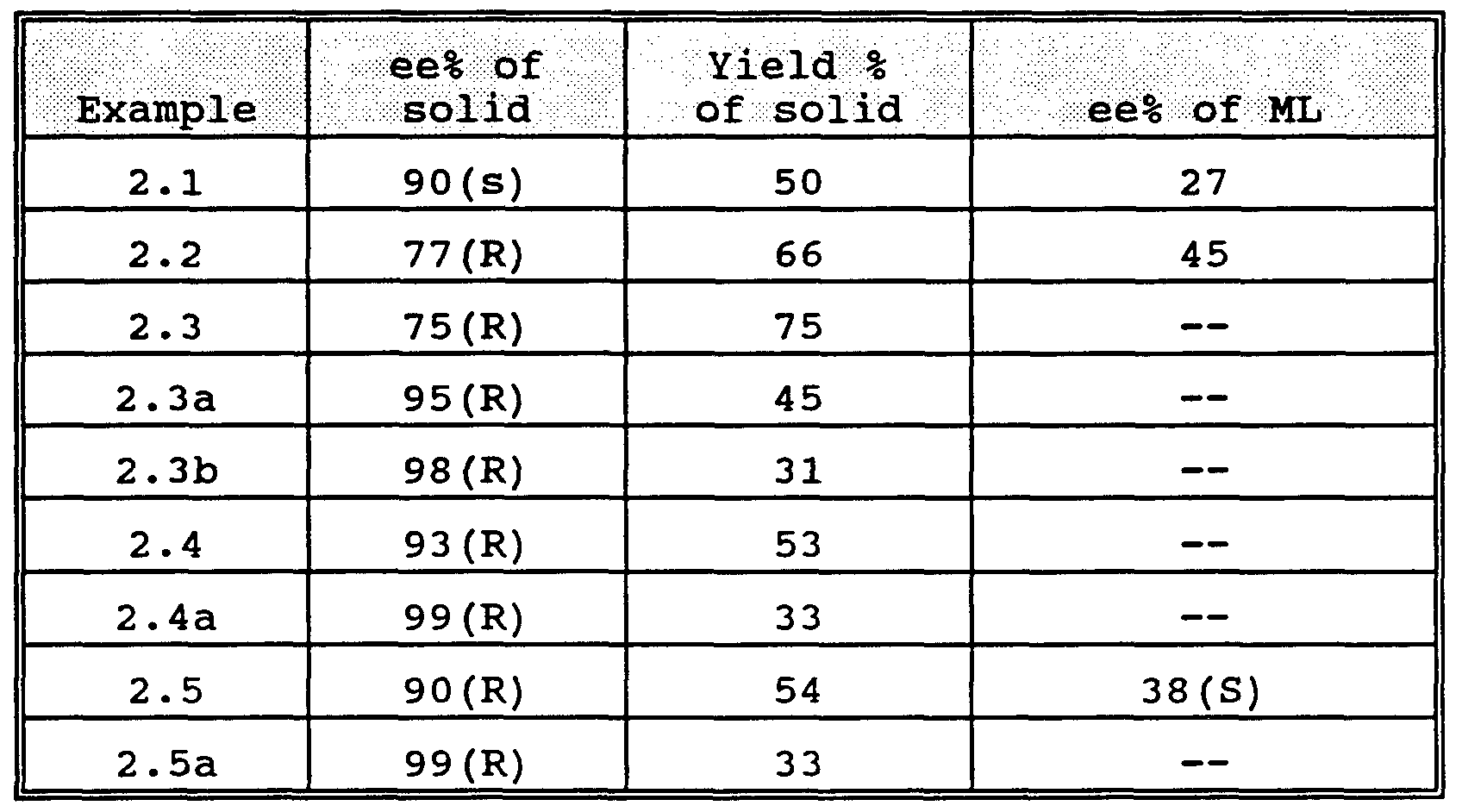
In a representative case (examples 2.4 and 2.4a), a mixture of the phenolic precursor Ilia (1.33g, 5 mmol) and (+)-di-p-toluoyl-D-tartaric acid (1.93 g, 5 mmol) was dissolved in refluxing MeOH (40 mL) . The solution was then cooled and stirred at room temperature for 16 hours. The white solid was collected by filtration and washed with 5 mL of ethyl acetate and dried (0.86 g, 53% yield, 93% ee) . The solid was then dissolved again in 18 mL of refluxing MeOH. The resulting solution was cooled to room temperature and stored at 3°C for 15 hours (overnight) . The white solid was collected by filtration and dried (0.53 g, 33% yield, 98.5% ee) . Results obtained analogously are summarized in the following tables:
Chiral Time at Room Time at
Example acid Solvent Temperature 3° C
2.1 (-)-L EtOAc/ 15 1.5 MeOH
2.2 (+)-D EtOAc/ 15 1.5 MeOH
2.3 (+)-D EtOH/ 6 — MeOH
2.3a — MeOH 2 15
2.3b — MeOH 3 15
2.4 (+)-D MeOH 16 —
2.4a — MeOH 3 15
2.5 (+)-D MeOH 3 15
2.5a — MeOH 3 15
Figure imgf000023_0001
Examples identified as a or b indicate the results of an additional recrystallization of the solid obtained from the preceding crystallization. The optically pure tartrate salt can be obtained after just one more recrystallization in over 30% yield based on available isomer.
The absolute configuration of the salt from resolution with (+)-di-p-toluoyl-D-tartaric acid was correlated to R-albuterol according to the following procedure: a small amount of the slat was neutralized with saturated aqueous NaHC03 in the presence of ethyl acetate. The ethyl acetate phase was concentrated to dryness to give the enriched free base material of formula Ilia which was then reduced with BH3*Me2S in CH2C12 to give optically active albuterol. HPLC analysis in comparison with authentic (R)-albuterol confirmed that the salt has (R)-configuration at the benzyl OH group. EXAMPLE 3
A 500 mL three-necked flask equipped with a mechanical stirrer was charged with 200 mL of DMSO (99%, ACS reagent grade) and methyl 5- acetylsalicylate (97.7%, Schweizerhall, 39.6 g,
0.2 mol, 1.0 eq) . Aqueous hydrobromic acid (48%, ACS reagent grade, 34 mL, 0.3 mol, 1.5 eq) was added dropwise with stirring over 15-20 minutes. The solution was then heated at 60-65°C for 24-26 hours with stirring. Refluxing of the solution occurred at ca. 60°C. The reaction was followed by HPLC and heating was stopped when the ratio of product to starting material was greater than 95:5 by area HPLC. A μBondapak C18, 10 μm, 30 cm x 3.9 mm (Waters) column with a mobile phase consisting of 0.01 M
Na2H2P04 - 0.002 M Octanesulfonic acid, sodium salt (pH 3.0) /Acetonitrile (75:25) was used to monitor the reaction at a UV detection wavelength of 220 nm. Prolonged reaction times and higher temperatures (over 70°C) resulted in lower yield. The solution was slowly poured onto 500 g of ice with vigorous stirring. A yellow solid precipitated out of the solution with some sticky solids being present. The mixture was stirred at 10°C for 2 hours until a fine slurry was formed during which time most of the sticky solid changed to a fine powder or small pieces. The slurry was filtered through a Buchner funnel using filter paper or DMSO-compatible filter cloth to recover the arylglyoxal product of formula II in the form of a yellow powder. The flask and solids were washed twice with 50 mL of cold water (5°C) followed by dual washes with 15 mL of cold toluene (5-10°C) . The powder was retrieved and held under a vacuum for ca. 1 hour which removed most of the solvent, no additional drying was required. The powder was used without further purification having a crude yield of ca. 80% when dry with the average weight of the arylglyoxal solid falling in the range of 55-65 g.
The arylglyoxal solid (the 55-65 g. , 0.2 mol) obtained from the preceding process was then transferred to a second 500 mL three-necked flas charged with 300 mL of ethyl acetate (99%, ACS reagent) thereby forming a yellow slurry. The amount of crude arylglyoxal was based on 100% yield on step one. Tertiary-butylamine (98%, Aldrich, 31.4 mL, 0.3 mol, 1.5 eq) was added to the slurry over 15-20 minutes with stirring, thereby dissolving the solids within the slurry and forming an orange solution.
The mixture was heated at 40-45°C for 2-3 hours. The reaction was followed by TLC (silica gel plate pretreated with 10:l(v/v) hexane: Et3N; eluting with CH2Cl2:MeOH (20:1, v/v) containing 2 volume % of EtN3) , R: starting material: 0.55, ketoimine: 0.68; UV) .
The reaction was worked up when the starting material was almost invisible by UV detection. The solution was cooled to 20-25°C (room temperature) and separated from the dark aqueous phase. The organic phase was washed twice with 30 mL of saturated aqueous sodium chloride solution. The combined aqueous phase was not extracted and the amount of ketoimine product in the aqueous phase was ca. 5-6% of the overall yield. The organic phase was then concentrated to dryness and further dried under vacuum for 2-3 hours at room temperature yielding a yellow solid of crude ketoimine of formula Va (31-35 g, 75-82% crude yield) . The crude product was used without further drying and purification in the reduction step set forth below.
A 500 mL three-necked flask was charged with the crude ketoimine from above (32 g, 0.122 mol, 1.0 eq) and 300 mL of methanol (99% ACS reagent grade) and cooled to 10-15°C. Sodium borohydride (NaBH4) 98%, reagent grade) 11.6 g, 0.31 mol, 2.5 eq) was dissolved in 50 Ml of 0.2% sodium hydroxide solution and added to the ketoimine solution at 10-20°C with vigorous stirring over 30-40 minutes. This is an exothermic reaction and H2 is released during addition, both of which may be controlled by using a cooling bath and by controlling the rate of addition. A slurry was formed during addition which was then stirred at 10-15°C for 20-25 minutes. The reaction usually completes after addition of the NaBH4. The reaction was followed by TLC (silica gel, mobile phase:2 v/v% Et3N in 20:1 CH2Cl2/MeOH; UV, Rf: ketoimine, 0.44; product, 0.29) or HPLC as described hereinabove. The reaction was worked up when no arylglyoxal starting material was detected by TLC or HPLC. The slurry was concentrated below 35°C under vacuum to ca. 100-120 Ml thereby forming a dense slurry. 800 ml of ethyl acetate and 150 mL of distilled water were added to the dense slurry, stirred at 20-25°C for 30-40 minutes and allowed to settle. Although some solid slurry was present in the aqueous phase it did not affect phase separation. After separating out the aqueous phase the organic phase was washed with 50 mL of distilled water, then 50 mL of saturated NaCl solution. The organic phase was concentrated to dryness yielding a yellowish solid, weighing ca. 20-35 g greater than 95 area % pure by HPLC. The crude product was dissolved in 150-200 mL of ethyl acetate under refluxing. Thereafter, 50 mL of heptane was added to the hot solution. The weight/volume ratio of crude product to ethyl acetate is ca. 0.2:1. The volume ratio of ethyl acetate to heptane is 3:1. Although solids started to form at 40°C, the mixture was stirred and cooled to 20-25°C over 2 hours and then at 0-5°C for 4 hours. The mixture was filtered to recover the product and the flask and solids washed with 50 mL of ethyl acetate/heptane (1:1, v/v) and dried under vacuum thereby forming a white solid (33 g., 78.5% yield, 97.7 area % by HPLC). The white solid was a racemic amino-alcohol of formula Ilia. Typically the yield after recrystallization is in the range of 55- 70% and more product can be recovered from the filtrate. The product was analyzed by HPLC and should be greater than 95 area % pure for use in the resolution step and, if not, then recrystallization should be repeated.
A 500 mL three-necked flask was charged with 304 mL of methanol and (4-)-di-p-toluoyl-D-tartaric acid or its monohydrate (greater than 98%) (30.6 g., 76 mmol, 1.0 eq) and heated to 60-65°C with the stirring. The racemic amino-alcohol (20.0 g. , 76 mmol, 1.0 eq) was added in one portion to the heated solution with stirring. The heating is necessary for the formation of the salt and the production of a homogeneous solution. The solution was then cooled to room temperature over about 1.5 hours and held at room temperature (22°C) for 4 hours, then at 0°C.
The solid formed was recovered by filtration and the flask and cake rinsed with ca. 30 mL of ethyl acetate. The recovered solid was then dried under vacuum to give (21.2 g) of a white solid as the tartrate salt (80% ee in favor of the R-isomer, 42.7% yield or 85.4% yield based on available isomer) . The ee was determined by HPLC on the free base, which was formed after neutralization with 5 weight % Na2C03 in the presence of ethyl acetate. HPLC for optical purity may be conducted using a sumichiral OA 4900, 5μ, 4.6 x 250 mm column and a mobile phase of 240(hexane) :140(dichloromethane) :20(methanol) : l(trifluoacetic acid) and a UV detection wavelength of 280 nm. The ee of the mother liquor was 69.3% in favor of the S-isomer. The tartrate salt was dissolved in 374 L of methanol at reflux. The concentration of the salt in methanol was about 5.7% w/v (the range of salt concentration is 5.5-6.0% w/v in methanol) . The solution was cooled to room temperature (22°C) over 1.5 hours with stirring and then stirred at room temperature for an additional 4- 5 hours. The solution was further cooled to a temperature of 0°C for 1-2 hours. The solids were collected by filtration and washed with 25 mL of ethyl acetate and dried at 40°C at 28 inches of Hg for 2 hours to give the enriched tartrate salt (14.0 g, 99.1% ee of the R-isomer, 56% yield based on available isomer) . The enriched salt was greater than 90% area pure by HPLC. Additional enriched salt was recovered from the filtrate by concentrating it to dryness and dissolving the residue in methanol at reflux to make a 5.0-5.5% w/v solution which was cooled at room temperature over 1.5-2 hours and stirred at room temperature for 3-4 hours at 0°C for 1 hour. The solids were recovered as above to give an enriched salt in 14% yield greater than 98% ee. The solids were combined and transferred to a flask to which 375 mL of ethyl acetate was added thereby forming a slurry. 91.2 L of Na2C03 solution (5 weight % aqueous solution) was added to the slurry with stirring at room temperature (22-25°C) for 30 minutes. The amount of Na2C03 solution used represents two equivalents of Na2C03 for each equivalent of tartrate salt. The pH of the aqueous solution is preferably ca. 9-10 (pH paper or pH meter), if the pH is less than 9, more sodium carbonate should be added to the solution to obtain the preferred pH.
The solution was then heated to ca. 30°C and the aqueous phase separated out. The organic phase was washed with 40 mL of Na2C03 solution (5 weight %) and 28 mL of saturated NaCl solution. The solution was kept at ca. 30°C to prevent the free amino alcohol from crystallizing out from the ethyl acetate solution. The removal of the di-toluoyl-D-tartaric acid by sodium carbonate extraction was followed by the HPLC method described hereinabove. The amount of tartaric acid left should be 0% area by HPLC and if it exceeds this amount, the organic phase is preferably washed again with a sodium carbonate solution. The organic phase was dried with 10 g of anhydrous NaS04, and the organic solution concentrated to dryness which gave the free base as a white solid. The white solids were dissolved in 65 mL of ethyl acetate under reflux and thereafter cooled to room temperature over 1 hour with stirring. The solution remained at room temperature (22-25°C) with stirring for 1 hour and then at 0°C for 2-3 hours. The white solid formed was recovered by filtration and dried at 40°C (28 inches of Hg) for 2 hours to give an enriched R-amino-alcohol (5.0 g, 87.7% yield, greater than 99% ee, chemical purity greater than 99% area) . The R-amino-alcohol (2.67 g, 10 mmol, 1.0 eq) was added to a 100 mL flame-dried three-necked flask previously charged with 20 mL of ethylene glycol dimethyl ether (DME) anhydrous, water less than 0.005%, 994-%) . This reaction and all subsequent operations were performed under dry nitrogen or argon and the reaction solutions and final products protected from light. Borane dimethyl sulfide complex (BH3 #Me2S) (10 M, aldrich grade) 1.6 mL, 15 mmol, 1.6 eq) was added dropwise to the above slurry over 5 minutes with stirring. Hydrogen is released and the reaction slightly exothermic (from 25°C to ca. 30°C) . The solution is then heated at ca. 55°C for 3 hours. The reaction is followed by HPLC and if after 3 hours of reaction starting material is still greater than 0.3% area, it is preferred that an additional 0.1 eq of BH3«Me2S be added and the solution heated at ca. 55°C for an additional hour. It is preferred that the reaction is not heated over 60°C since higher temperatures may result in overreduction of the product. Once the reaction has progressed to the desired point heating was stopped and the solution cooled to 5-10°C with use of an ice water bath. 40 mL of methanol was heated at reflux for 1 hour to destroy excess borane by forming trimethyl borane, freeing the albuterol product. 40 mL of solvent was distilled out at 60-66°C/1 atm and then an additional 20 mL of methanol was added. Another 20 mL of the solvent was distilled out at 60- 66°/l atm. The methylborate was removed azeotropically with methanol at 60-66°C. 70 mL of DME was then added followed by distilling out the solvent until the temperature reached 85°C. An additional ca. 10 mL of DME was added at 80-85°C to maintain the solvent volume at 40-45 mL during distillation. The leftover methanol was removed azeotropically with the DME. The additional DME was added slowly at reflux to prevent precipitation of solids. The final solvent volume is preferably ca. 40-45 mL. The solution was checked by HPLC: the boron-complex (tR_ 17.0 minutes) should be less than 0.4 area on HPLC otherwise additional DME should be added and distillation continued. Then 25 mL of cyclohexane was added slowly over 10 minutes, to prevent oil-out, at ca. 80°C. Heating was then stopped and the solution cooled to ca. 20-25°C (room temperature) over 1 hour and then to 0-5°C over 1 hour and maintained at this temperature for an additional 3 hours with stirring. The solution was cooled slowly to prevent oil-out. The white powder formed was recovered by filtration. The flask and solids underwent dual washings with 10 mL of cyclohexane, the solids were dried at 50-60°C/28 inches of Hg for over 12 hours. This yielded a white powder, (R)-albuterol of formula IVa (weight 1.9 g, 80% yield, 98.4% area, 98% ee) .
EXAMPLE-4
Racemic compound lb (1.07g, 3 mmol) and (+)-D- di-p-toluoyltartaric acid (D-DTTA) (1.21 g, 3 mmol) are dissolved in 36 mL of methanol and refluxed for 10 min. The resulting solution is then cooled to room temperature and stirred for about 4 hours. The white solid formed is isolated by filtration and dried under vacuum to give (R)-compound lib, the chiral acid salt of compound lllb (0.83 g, 37.2% yield) . The salt is neutralized with 5 wt% aq. Na2C03 and extracted with ethyl acetate to give optically active (R) form of compound Ic, the free base of compound lib, as a white solid with 84.3% ee. The optical purity (ee) is determined by chiral HPLC (Column Sumichiral OA 4900, 5μ , 4.6 x 250 mm column; Mobile phase: 240 (hexane) : 140 (dichloromethane) : 20 (methanol) : 1 (trifluoroacetic acid) (vol) ; UV detection: 280 nm) .
EXAMPLE-5
(4-) -D-dibenzoyltartaric acid (D-DBTA) (17.9g, 50 mmol, 0.5 eq) is dissolved in 200 mL of methanol with heating to reflux. A solution of racemic compound lb (35.7g, 100 mmol, 1.0 eq) in 200 mL of methanol is added to the above solution over 5-10 min. After addition, a white slurry is formed rapidly which is refluxed for 2 hours. The white slurry is then cooled to room temperature and stirred overnight.
The solid is collected by filtration and dried under vacuum (20% ee) . The solid is then re-slurried in 600 mL of methanol under reflux for 2 hours and cooled to room temperature and stirred for 4 hours. The solids are collected by filtration and dried under vacuum at room temperature for 2 hours to give a chiral acid salt, the (R) form of compound lib (23.8 g, 94.8% ee) . The salt (21.5g, 40.1 mmol) is then treated with 100 g of 5 wt% aq. Na2C03 in 300 mL of ethyl acetate. After phase separation, the ethyl acetate phase is washed with 50 mL each of saturated aq. NaHC03 and NaCl solutions and concentrated to dryness to give the free base of compound lib, (R) form of compound lb, as a white solid. The crude free base is then recrystallized from 15 mL of methanol and 30 mL of ethyl acetate to give purified (R) form of compound lllb as a white solid (12.0 g, 37.2% yield from racemic compound la, 99.0% ee and 99.9% purity) . EXAMPLE-6
BH3-THF solution (1.0M in THF, 100 mL, 3.0 eq) is added dropwise over 30 minutes to a mixture of the (R) form of compound lllb taken from Example-2 (12.0 g, 33.3 mmol, 1.0 eq) and 50 mL THF at room temperature under nitrogen atmosphere. The resulting solution is refluxed for 23 hours and cooled and quenched with 30 mL of methanol. The solution is concentrated to ca. 20 mL in volume and diluted with 250 mL of ethyl acetate. The solution is stirred with 40 L of 5 wt% aq. Na2C03 at room temperature for 30 minutes. After removal of the aqueous layer, the organic phase is washed with 40 mL each of saturated aq. NaHC03 and NaCl solution and concentrated to dryness to give a crude (R)-4-benzyl albuterol
(compound IVb) as an oily foam. The crude 4-benzyl albuterol is then recrystallized from 20 mL of ethyl acetate and 20 mL of n-heptane to give pure (R)-4- benzyl albuterol as white solid (8.1 g, 73.8% yield, 99.4% ee, 99.8% purity).
EXAMPLE-7
A mixture of (R)-4-benzyl albuterol from Example-3 (6.6g, 20 mmol) and 10% Pd/C (1.32 g) in 50 mL of ethanol (denatured with 5 vol% 2-propanol) is shaken on a Parr-hydrogenator under 50 psi of hydrogen at room temperature for 2-3 hours. The catalyst is removed by filtration and the filtrate is concentrated to give crude (R)-albuterol (compound IVa) . The crude albuterol (20 mmol) is dissolved in 20 L of ethanol and treated with anhydrous HC1 in ether (1.0 M, 19 mL, 0.95 eq) at 0-5°C. After 30 min at room temperature, 20 mL of methyl t-butyl ether (MTBE) is added to the mixture and the resulting mixture is stirred at room temperature for 30 min and at 0-5°C for 2 hours. The white solid (R)-albuterol hydrochloride (compound Vb) is collected by filtration and recrystallized from 52 L of ethanol and 26 mL of MTBE to give pure (R)-albuterol hydrochloride as a white powder (4.6 g, 83.5% yield, 99.6% ee, 99.3% purity).
EXAMPLE-8
Racemic 4-benzyl albuterol (compound Ic) (0.66g, 2 mmol) and D-DTTA (0.81 g, 2 mmol) are dissolved in 5 mL of ethyl acetate with heating. The solution is then cooled to room temperature and stirred for 4 hours. The resulting white solid is collected by filtration and dried under vacuum to give the (R) form of the chiral acid salt, compound lie (0.66 g, 46% yield, 75.9% ee) . The optical purity (ee) is determined on the free base by HPLC as in Example-4.
EXAMPLE-9
Racemic 4-benzyl albuterol (compound Ic) (0.66 g, 2 mmol) and (D-DBTA) (0.72 g, 2 mmol) are dissolved in 4 mL of ethyl acetate with heating at reflux for 10 min. The solution is then cooled to room temperature and stirred for 3 hours. The resulting solid is collected by filtration and dried to give (R) form of the chiral acid salt, compound lie (0.07 g, 50% yield, 83.5% ee) . EXAMPLE-10
Racemic 4-benzyl albuterol (compound Ic) (0.66 g, 2 mmol) and D-DBTA (0.72 g, 2 mmol) are dissolved in 3.3 mL of 95% ethanol. The solution is heated at reflux for 10 min. and cooled to room temperature and stirred for 7 hours after seeding. The resulting solid is collected by filtration and dried to give the (R) form of the chiral acid salt, compound lie (0.30 g, 21.7% yield, 94.4% ee) .
EXAMPLE 11
D-DBTA (32.2 g, 90 mmol, 1.0 eq) is added to a hot solution of racemic 4-benzyl albuterol (compound Ic) (29.6 g, 90 mmol, 1.0 eq) in 180 mL of anhydrous denatured ethanol (type 3A, denatured with 5 vol% 2- propanol) . The resulting solution is refluxed for 15 min. and cooled to room temperature over 40 min and seeded with 99% ee (R) -4-benzyl albuterol D-DBTA salt (compound lie) . The mixture is cooled to 5-10° C and stirred for 1 hour. The white solid is collected by filtration and dried at 40°C and 28 inches of Hg for
1 hour to give (R)-4-benzyl albuterol D-DBTA salt (compound lie) (31.8 g, 50% yield, 83.6% ee) . The solid is redissolved in 240 mL of ethanol at 55-60°C and the solution is cooled to room temperature and stirred at room temperature for 2 hours and at 0-5°C for 1 hour. The resulting solid is collected by filtration and dried at 40°C and 28 inches of Hg for
2 hours as (R)-4-benzyl albuterol D-DBTA salt (22.9 g, 37.1% yield, 99.3% ee) . The salt (22.9 g) is then treated with 204 mL of 5 wt% aq. Na2C03 solution in
570 mL of ethyl acetate. The solid is worked-up, and recrystallization from 30 mL of ethyl acetate and 30 mL of n-heptane gives optically pure (R)-4-benzyl albuterol free base (compound IVb) as a white powder (10.1 g, 34.1% yield from racemic Compound Ic, 99.6% ee and 99.8% purity).
EXAMPLE 12
A mixture of (R)-4-benzyl albuterol as a free base (compound IVb) from Example 8 (3.2 g, 9.73 mmol) and 10% Pd/C (0.64 g) in 24 mL of ethanol (denatured with 5 vol% 2-propanol) is shaken on a Parr- hydrogenator under 50 psi of hydrogen at room temperature for 3 hours. The catalyst is removed by filtration and the filtrate is concentrated to ca. 9 mL in volume containing crude (R)-albuterol (compound IVa) and treated with anhydrous HC1 in ether (1.0 M, 9.5 mL, 0.98 eq) at 0-5°C. After 30 min. at room temperature, 9 mL of MTBE is added to the mixture and the resulting mixture is stirred at room temperature for 30 min. and at 0-5°C for 2 hours. The white solid (R)-albuterol hydrochloride is collected by filtration and recrystallized from 25 mL of ethanol and 12.5 mL of MTBE to give pure (R)-albuterol hydrochloride (compound Vb) as a white powder (2.17 g, 80.9% yield, 99.6% purity).
While the invention has been particularly shown and described with reference to preferred embodiments thereof, it will be understood by those skilled in the art that other changes in form and details may be made therein without departing from the spirit and scope of the invention.

Claims

What is claimed is:
1. A method for obtaining a single enantiomer of methyl 5-[2-[ (1,1-dimethylethyl)amino]-1- hydroxyethyl]-2-hydroxybenzoate comprising the steps of:
(a) dissolving a mixture of enantiomers of methyl 5-[2-[ (1,1-dimethylethyl)amino]-1- hydroxyethyl]-2-hydroxybenzoate and a chiral acid selected from the group consisting of (-)- di-toluoyl-L-tartaric acid and (4-)-di-toluoyl-D- tartaric acid in methanol by heating to form a solution;
(b) allowing said solution to cool, whereby a salt of primarily one stereoisomer crystallizes;
(c) separating said salt from said solution;
(d) recrystallizing said salt from methanol, whereby a diastereomeric salt having greater than 90% ee of an enantiomer of methyl 5-[2-[ (1,1-dimethylethyl)amino]-1-hydroxyethyl]- 2-hydroxybenzoate is obtained;
(e) separating said diastereomeric salt from the methanol solvent; and
(f) liberating said enantiomer of methyl 5-[2-[ (1, 1-dimethylethyl)amino]-1-hydroxyethyl]-
2-hydroxybenzoate from said diastereomeric salt by treatment with base. 2. A method according to claim 1 wherein said chiral acid is (-)-di-toluoyl-L-tartaric acid and said enantiomer of methyl 5-[2-[(l,l- dimethylethy1)amino]-1-hydroxyethy1]-2- hydroxybenzoate is the S enantiomer.
3. A method according to claim 1 wherein said chiral acid is (4-)-di-toluoyl-D-tartaric acid and said enantiomer of methyl 5-[2-[(l,l- dimethylethy1)amino]-1-hydroxyethyl]-2- hydroxybenzoate is the R enantiomer.
4. A method for making optically pure albuterol comprising the steps of:
(a) dissolving a mixture of enantiomers of methyl 5-[2-[ (1,1-dimethylethyl)amino]-1- hydroxyethyl]-2-hydroxybenzoate and a chiral acid selected from the group consisting of (-)- di-toluoyl-L-tartaric acid and (4-)-di-toluoyl-D- tartaric acid in methanol by heating to form a solution;
(b) allowing said solution to cool, whereby a salt of primarily one stereoisomer crystallizes;
(c) separating said salt from said solution;
(d) recrystallizing said salt from methanol, whereby a diastereomeric salt having greater than 90% ee of an enantiomer of methyl 5-[2-[ (1,1-dimethylethyl)amino]-1-hydroxyethy1]- 2-hydroxybenzoate is obtained; (e) separating said diastereomeric salt from the methanol solvent;
(f) liberating the enantiomer of methyl 5- [2-[ (1,1-dimethylethyl)amino]-1-hydroxyethy1]-2- hydroxybenzoate from said diastereomeric salt by treatment with base; and
(g) reducing said enantiomer of methyl 5- [2-[ (1,1-dimethylethyl)amino]-l-hydroxyethyl]-2- hydroxybenzoate thereby forming optically active albuterol.
5. The method of claim 4 wherein said enantiomer of 5-[2-[ (1,1-dimethylethyl)amino]-l- hydroxyethy1]-2-hydroxybenzoate is reduced with borane-methyl sulfide.
6. The method of claim 4 wherein said enantiomer of 5-[2-[ (1,1-dimethylethyl)amino]-1- hydroxyethyl]-2-hydroxybenzoate is reduced with lithium aluminum hydride.
7. The method of claim 4 wherein said mixture of enantiomers of methyl 5-[2-[(1,1- dimethy1ethyl)amino]-1-hydroxyethy1]-2- hydroxybenzoate is obtained by the steps of:
(a) reacting methyl 5-acetylsalicylate with hydrogen bromide in dimethyl sulfoxide, thereby forming a keto aldehyde;
(b) reacting said keto aldehyde with tert butylamine, thereby forming an α-iminoketone; and (c) reducing said α-iminoketone to provide methyl 5-[2-[ (1,1-dimethylethyl)amino]-1- hydroxyethyl]-2-hydroxybenzoate.
8. A method according to claim 7 wherein said α-iminoketone is reduced with a hydride reducing agent.
9. The method of claim 7 wherein said hydride reducing agent is selected from the group consisting of sodium borohydride, sodium cyanoborohydride, and sodium triacetoxyborohydride.
10. A method according to claim 7 wherein said α-iminoketone is reduced by catalytic hydrogenation.
11. A method according to claim 10 wherein said catalytic hydrogenation is carried out over a heterogeneous noble-metal catalyst.
12. The method of claim 11 wherein said heterogeneous noble-metal catalyst is Pd/C.
13. The method of claim 11 wherein said heterogeneous noble-metal catalyst is Pt/C.
14. The method of claim 11 wherein said heterogeneous noble-metal catalyst is Pt02.
15. A method for obtaining a single enantiomer of albuterol, comprising:
dissolving a mixture of enantiomers of methyl 5-[2-[ (1,1-dimethylethyl)amino]-1- hydroxyethyl]-2-(phenylmethoxy)benzoate and a chiral acid in methanol, ethanol or a mixture of the two by heating to form a solution, said chiral acid being selected from the group consisting of (-)-di-toluoyl-L-tartaric acid, (4-)-di-toluoyl-D-tartaric acid, (-)-di-benzoyl- L-tartaric acid and (4-)-di-benzoyl-D-tartaric acid;
allowing said solution to cool, whereby a salt of primarily one enantiomer crystallizes;
separating said salt from said solution;
liberating the enantiomer from said salt by treatment with a base;
reducing said enantiomer;
debenzylating said enantiomer and recovering a single enantiomer of albuterol.
16. A method according to claim 15 wherein said chiral acid is (4-)-di-toluoyl-D-tartaric acid and said enantiomer of methyl 5-[2-[(1,1- dimethylethy1)amino]-1-hydroxyethyl]-2- (phenylmethoxy)benzoate is the R enantiomer.
17. A method according to claim 15 wherein said chiral acid is (4-)-di-benzoyl-D-tartaric acid and said enantiomer of methyl 5-[2-[(l,l- dimethylethy1)amino]-1-hydroxyethyl]-2- (phenylmethoxy)benzoate is the R enantiomer.
18. A method according to claim 15 wherein said enantiomer is debenzylated by catalytic hydrogenation.
19. The method of claim 15 wherein said enantiomer is reduced with a borane complex.
20. The method of claim 15 further comprising forming a slurry of said salt in methanol, ethanol or a mixture of the two and refluxing said slurry and allowing said slurry to cool, whereby a salt of primarily one enantiomer crystallizes.
21. A method for obtaining a single enantiomer of albuterol, comprising:
dissolving a mixture of enantiomers of α- [ [ (1,1-dimethylethyl)amino]methyl]-4- (phenylmethoxy)-1,3-benzenedimethanol and a chiral acid in methanol, ethanol or a mixture of the two by heating to form a solution, said chiral acid being selected from the group consisting of (-)-di-toluoyl-L-tartaric acid, (4-)-di-toluoyl-D-tartaric acid, (-)-di-benzoyl- L-tartaric acid and (4-)-dibenzoyl-D-tartaric acid;
allowing said solution to cool, whereby a salt of primarily one enantiomer crystallizes;
separating said salt from said solution;
liberating said single enantiomer from said salt by treatment with a base;
debenzylating said enantiomer and recovering optically pure albuterol.
22. A method according to claim 21 wherein said chiral acid is (4-)-di-toluoyl-D-tartaric acid and said enantiomer of α-[[(l,l- dimethylethyl)amino]methyl]-4-(phenylmethoxy)-1,3- benzenedimethanol is the R enantiomer.
23. A method according to claim 21 wherein said chiral acid is (4-)-di-benzoyl-D-tartaric acid and said enantiomer of α-[[(l,l- dimethy1ethyl)amino]methyl]-4-(phenylmethoxy)-1,3- benzenedimethanol is the R enantiomer.
24. A method according to claim 21 wherein said enantiomer is debenzylated by catalytic hydrogenation.
25. The method of claim 21 further comprising forming a slurry of said salt in methanol, ethanol or a mixture of the two and refluxing said slurry and allowing said slurry to cool, whereby a salt of primarily one enantiomer crystallizes.
26. A method for obtaining a single enantiomer of methyl 5-[2-[ (1, 1-dimethylethyl)amino]-l- hydroxyethy1]-2-(phenyImethoxy)benzoate comprising:
(a) dissolving a mixture of enantiomers of methyl 5-[2-[ (1, 1-dimethylethyl)amino]-1- hydroxyethyl]-2-(phenylmethoxy)benzoate and a chiral acid in methanol, ethanol or a mixture of the two by heating to form a solution, said chiral acid being selected from the group consisting of (-) -di-toluoyl-L-tartaric acid,
(4-)-di-toluoyl-D-tartaric acid, (-)-di-benzoyl- L-tartaric acid and (4-) -di-benzoyl-D-tartaric acid by heating to form a solution;
(b) allowing said solution to cool, whereby a salt of primarily one stereoisomer crystallizes;
(c) separating said salt from said solution;
(d) recrystallizing said salt from the alcohol solvent, whereby a diastereomeric salt having greater than 90% ee of an enantiomer of methyl 5-[2-[ (1, 1-dimethylethyl)amino]-1- hydroxyethyl]-2-(phenylmethoxy)benzoate is obtained;
(e) separating said diastereomeric salt from the alcohol solvent; and (f) liberating said enantiomer of methyl 5- [2-[ (1,1-dimethylethyl)amino]-1-hydroxyethyl]-2- (phenyImethoxy)benzoate from said diastereomeric salt by treatment with base.
27. A method according to claim 26 wherein said chiral acid is (+)-di-toluoyl-D-tartaric acid and said enantiomer of methyl 5-[2-[(l,l- dimethylethyl)amino]-l-hydroxyethyl]-2- (phenylmethoxy)benzoate is the R enantiomer.
28. A method according to claim 26 wherein said chiral acid is (4-)-di-benzoyl-D-tartaric acid and said enantiomer of methyl 5-[2-[(l,l- dimethylethyl)amino]-l-hydroxyethyl]-2- (phenylmethoxy)benzoate is the R enantiomer.
29. A method for obtaining a single enantiomer of α-[ [ (1,1-dimethylethyl)amino]methyl]-4- (phenylmethoxy) -1,3-benzenedimethanol comprising:
(a) dissolving a mixture of enantiomers of α-[ [ (1,1-dimethylethyl)amino]methyl]-4-
(phenyImethoxy) -1,3-benzenedimethanol and a chiral acid in methanol, ethanol or a mixture of the two by heating to form a solution, said chiral acid being selected from the group consisting of (-)-di-toluoyl-L-tartaric acid,
(4-) -di-toluoyl-D-tartaric acid, (-) -di-benzoyl- L-tartaric acid and (4-)-di-benzoyl-D-tartaric acid in methanol by heating to form a solution;
(b) allowing said solution to cool, whereby a salt of primarily one stereoisomer crystallized;
(c) separating said salt from said solution;
(d) recrystallizing said salt from the alcohol solvent, whereby a diastereomeric salt having greater than 90% ee of an enantiomer of α-[ [ (1, 1-dimethylethyl) amino]methyl]-4- (phenylmethoxy)-1,3-benzenedimethanol is obtained;
(e) separating said diastereomeric salt from the alcohol solvent; and (f) liberating said enantiomer of α-[[(l,l- dimethylethy1)amino]methyl]-4-(phenylmethoxy)- 1,3-benzenedimethanol from said diastereomeric salt by treatment with base.
30. A method according to claim 29 wherein said chiral acid is (4-)-di-toluoyl-D-tartaric acid and said enantiomer of α-[[(l,l- dimethy1ethyl)amino]methyl]-4-(phenylmethoxy)-1,3- benzenedimethanol is the R enantiomer.
31. A method according to claim 30 wherein said chiral acid is (4-)-di-benzoyl-D-tartaric acid, said solvent ethanol and said enantiomer of α-[[(l,l- dimethylethy1)amino]methyl]-4-(phenyImethoxy)-1,3- benzenedimethanol is the R enantiomer.
* * * *
PCT/US1995/006539 1994-05-23 1995-05-23 Enantioselective preparation of optically pure albuterol Ceased WO1995032178A1 (en)

Priority Applications (8)

Application Number Priority Date Filing Date Title
DK95919913T DK0763010T3 (en) 1994-05-23 1995-05-23 Enantioselective preparation of optically pure albuterol
CA002190577A CA2190577C (en) 1994-05-23 1995-05-23 Enantioselective preparation of optically pure albuterol
JP53051395A JP3826208B2 (en) 1994-05-23 1995-05-23 Optically pure albuterol isomer-selective preparation
DE69518646T DE69518646T2 (en) 1994-05-23 1995-05-23 ENANTIOSELECTIVE PRODUCTION OF OPTICALLY PURE ALBUTEROL
AU25559/95A AU686386B2 (en) 1994-05-23 1995-05-23 Enantioselective preparation of optically pure albuterol
EP95919913A EP0763010B1 (en) 1994-05-23 1995-05-23 Enantioselective preparation of optically pure albuterol
AT95919913T ATE195931T1 (en) 1994-05-23 1995-05-23 ENANTIOSELECTIVE PRODUCTION OF OPTICALLY PURE ALBUTEROL
GR20000402605T GR3034982T3 (en) 1994-05-23 2000-11-24 Enantioselective preparation of optically pure albuterol

Applications Claiming Priority (4)

Application Number Priority Date Filing Date Title
US08/247,302 1994-05-23
US08/247,302 US5399765A (en) 1994-05-23 1994-05-23 Enantioselective preparation of optically pure albuterol
US08/376,072 US5545745A (en) 1994-05-23 1995-01-20 Enantioselective preparation of optically pure albuterol
US08/376,072 1995-01-20

Publications (1)

Publication Number Publication Date
WO1995032178A1 true WO1995032178A1 (en) 1995-11-30

Family

ID=26938588

Family Applications (1)

Application Number Title Priority Date Filing Date
PCT/US1995/006539 Ceased WO1995032178A1 (en) 1994-05-23 1995-05-23 Enantioselective preparation of optically pure albuterol

Country Status (11)

Country Link
US (1) US5545745A (en)
EP (1) EP0763010B1 (en)
JP (1) JP3826208B2 (en)
AT (1) ATE195931T1 (en)
AU (1) AU686386B2 (en)
DE (1) DE69518646T2 (en)
DK (1) DK0763010T3 (en)
ES (1) ES2151065T3 (en)
GR (1) GR3034982T3 (en)
PT (1) PT763010E (en)
WO (1) WO1995032178A1 (en)

Cited By (30)

* Cited by examiner, † Cited by third party
Publication number Priority date Publication date Assignee Title
WO1999042460A1 (en) * 1998-02-20 1999-08-26 Fine Chemicals Corporation (Proprietary) Limited Process for the production of optically enriched (r)- or (s)-albuterol
WO2002048090A1 (en) * 2000-12-11 2002-06-20 Cipla Limited Process for preparing isomers of salbutamol
US6664424B2 (en) 1998-07-01 2003-12-16 Warner-Lambert Company Stereoisomers with high affinity for adrenergic receptors
WO2005113481A1 (en) * 2004-05-20 2005-12-01 Teva Pharmaceutical Fine Chemicals S.R.L. Preparation of levalbuterol hydrochloride
US7232837B2 (en) 1999-06-29 2007-06-19 Mcneil-Ppc, Inc. Stereoisomers with high affinity for adrenergic receptors
EP1832572A1 (en) * 2006-03-08 2007-09-12 Stirling Products Limited Process for the enantiomeric enrichment of salbutamol and salbutamol precursors
WO2008015689A1 (en) 2006-08-02 2008-02-07 Aarti Healthcare Limited A process for the preparation of optically pure r (-) salbutamol and its pharmaceutically acceptable salts
US8664232B2 (en) 2002-08-21 2014-03-04 Boehringer Ingelheim Pharma Gmbh & Co. Kg 8-[3-amino-piperidin-1-yl]-xanthines, the preparation thereof and their use as pharmaceutical compositions
US8673927B2 (en) 2006-05-04 2014-03-18 Boehringer Ingelheim International Gmbh Uses of DPP-IV inhibitors
US8846695B2 (en) 2009-01-07 2014-09-30 Boehringer Ingelheim International Gmbh Treatment for diabetes in patients with inadequate glycemic control despite metformin therapy comprising a DPP-IV inhibitor
US8853156B2 (en) 2008-08-06 2014-10-07 Boehringer Ingelheim International Gmbh Treatment for diabetes in patients inappropriate for metformin therapy
US8865729B2 (en) 2008-12-23 2014-10-21 Boehringer Ingelheim International Gmbh Salt forms of a xanthine compound
US8883800B2 (en) 2011-07-15 2014-11-11 Boehringer Ingelheim International Gmbh Substituted quinazolines, the preparation thereof and the use thereof in pharmaceutical compositions
US8883805B2 (en) 2004-11-05 2014-11-11 Boehringer Ingelheim International Gmbh Process for the preparation of chiral 8-(3-aminopiperidin-1-yl)-xanthines
US9034883B2 (en) 2010-11-15 2015-05-19 Boehringer Ingelheim International Gmbh Vasoprotective and cardioprotective antidiabetic therapy
US9149478B2 (en) 2010-06-24 2015-10-06 Boehringer Ingelheim International Gmbh Diabetes therapy
US9155705B2 (en) 2008-04-03 2015-10-13 Boehringer Ingelheim International Gmbh DPP-IV inhibitor combined with a further antidiabetic agent, tablets comprising such formulations, their use and process for their preparation
US9186392B2 (en) 2010-05-05 2015-11-17 Boehringer Ingelheim International Gmbh Combination therapy
US9266888B2 (en) 2006-05-04 2016-02-23 Boehringer Ingelheim International Gmbh Polymorphs
US9457029B2 (en) 2009-11-27 2016-10-04 Boehringer Ingelheim International Gmbh Treatment of genotyped diabetic patients with DPP-IV inhibitors such as linagliptin
US9486526B2 (en) 2008-08-06 2016-11-08 Boehringer Ingelheim International Gmbh Treatment for diabetes in patients inappropriate for metformin therapy
US9526730B2 (en) 2012-05-14 2016-12-27 Boehringer Ingelheim International Gmbh Use of a DPP-4 inhibitor in podocytes related disorders and/or nephrotic syndrome
US9526728B2 (en) 2014-02-28 2016-12-27 Boehringer Ingelheim International Gmbh Medical use of a DPP-4 inhibitor
US9555001B2 (en) 2012-03-07 2017-01-31 Boehringer Ingelheim International Gmbh Pharmaceutical composition and uses thereof
US9713618B2 (en) 2012-05-24 2017-07-25 Boehringer Ingelheim International Gmbh Method for modifying food intake and regulating food preference with a DPP-4 inhibitor
US10155000B2 (en) 2016-06-10 2018-12-18 Boehringer Ingelheim International Gmbh Medical use of pharmaceutical combination or composition
US11033552B2 (en) 2006-05-04 2021-06-15 Boehringer Ingelheim International Gmbh DPP IV inhibitor formulations
CN116693406A (en) * 2023-06-02 2023-09-05 山东锐顺药业有限公司 Preparation method of salbutamol sulfate
US11911388B2 (en) 2008-10-16 2024-02-27 Boehringer Ingelheim International Gmbh Treatment for diabetes in patients with insufficient glycemic control despite therapy with an oral or non-oral antidiabetic drug
US12312352B2 (en) 2012-05-14 2025-05-27 Boehringer Ingelheim International Gmbh Use of a DPP-4 inhibitor in SIRS and/or sepsis

Families Citing this family (17)

* Cited by examiner, † Cited by third party
Publication number Priority date Publication date Assignee Title
US6136327A (en) 1997-12-01 2000-10-24 Alza Corporation Stereospecific delivery of a drug using electrotransport
US6451289B2 (en) * 2000-03-24 2002-09-17 Sepracor Inc. Albuterol formulations
US6596686B2 (en) 2001-03-12 2003-07-22 International Flavors & Fragrances Inc. Use of dihydropyrans as fragrance Material
PL212725B1 (en) * 2002-12-10 2012-11-30 Sepracor Inc Levalbuterol salt
WO2004101592A1 (en) * 2003-05-19 2004-11-25 Taisho Pharmaceutical Co., Ltd. Process for production of erythromycin a derivatives
US20050020692A1 (en) * 2003-07-24 2005-01-27 Ciofalo Vincent B. Treatment of heaves
CA2545559A1 (en) * 2003-11-20 2005-06-09 Alteragon Pty Ltd. Method of decreasing fat deposits and body weight in mammals and birds
US7579505B2 (en) * 2004-12-17 2009-08-25 Cipla Limited Crystalline levosalbutamol sulphate and polymorphic forms thereof
EP1828100A1 (en) 2004-12-17 2007-09-05 Cipla Ltd. Pharmaceutical compounds and compositions
EP1935872A1 (en) * 2006-12-11 2008-06-25 Stirling Products Limited Process for obtaining the R-enantiomer of salbutamol
AU2008331928B2 (en) * 2007-12-03 2012-08-16 Bridge Pharma, Inc. Use of RR/SR-ractopamine
WO2010047717A1 (en) * 2008-10-24 2010-04-29 Biolink Life Sciences, Inc. Stable, water-insoluble r-(+)-alpha-lipoic acid salt useful for the treatment of diabetes mellitus and its co-morbidities
CN105555765B (en) * 2013-08-15 2018-05-25 阿勒根公司 (-)-(2R,3S)-2-amino-3-hydroxy-3-pyridin-4-yl-1-pyrrolidin-1-yl-propan-1-one (L)-(+) tartrate, Its preparation method and use
EP3042892A1 (en) 2015-01-09 2016-07-13 Deva Holding Anonim Sirketi Amorphisation of levosalbutamol tartrate
KR102789259B1 (en) * 2021-11-30 2025-04-02 주식회사 브이에스팜텍 Preparation method for single isomer with high purity
CN115286521B (en) * 2022-07-11 2023-11-03 上海医药集团(本溪)北方药业有限公司 Synthesis method of levosalbutamol hydrochloride
CN116836069B (en) * 2023-06-02 2024-01-30 山东锐顺药业有限公司 A kind of preparation method of levalbuterol hydrochloride

Citations (1)

* Cited by examiner, † Cited by third party
Publication number Priority date Publication date Assignee Title
WO1992004314A2 (en) * 1990-09-11 1992-03-19 Schering Corporation Process for preparing albuterol, acetal, hemi-acetal, and hydrates of arylglyoxal intermediates thereof

Patent Citations (1)

* Cited by examiner, † Cited by third party
Publication number Priority date Publication date Assignee Title
WO1992004314A2 (en) * 1990-09-11 1992-03-19 Schering Corporation Process for preparing albuterol, acetal, hemi-acetal, and hydrates of arylglyoxal intermediates thereof

Non-Patent Citations (1)

* Cited by examiner, † Cited by third party
Title
J. MED. CHEM., Volume 14, issued 17 April 1971, HARTLEY et al., "Absolute Configuration of the Optical Isomers of Salbutamol", pages 895-896. *

Cited By (71)

* Cited by examiner, † Cited by third party
Publication number Priority date Publication date Assignee Title
US6365756B1 (en) 1998-02-20 2002-04-02 Fine Chemical Corporation Limited Process for the production of optically enriched (R)- or (S)-albuterol
WO1999042460A1 (en) * 1998-02-20 1999-08-26 Fine Chemicals Corporation (Proprietary) Limited Process for the production of optically enriched (r)- or (s)-albuterol
US6664424B2 (en) 1998-07-01 2003-12-16 Warner-Lambert Company Stereoisomers with high affinity for adrenergic receptors
US7232837B2 (en) 1999-06-29 2007-06-19 Mcneil-Ppc, Inc. Stereoisomers with high affinity for adrenergic receptors
WO2002048090A1 (en) * 2000-12-11 2002-06-20 Cipla Limited Process for preparing isomers of salbutamol
USRE43984E1 (en) 2000-12-11 2013-02-05 Cipla Limited Process for preparing isomers of salbutamol
USRE43844E1 (en) 2000-12-11 2012-12-04 Cipla Limited Process for preparing isomers of salbutamol
US6995286B2 (en) 2000-12-11 2006-02-07 Cipla Limited Process for preparing isomers of salbutamol
US9108964B2 (en) 2002-08-21 2015-08-18 Boehringer Ingelheim International Gmbh 8-[3-amino-piperidin-1-yl]-xanthines, the preparation thereof and their use as pharmaceutical compositions
US9556175B2 (en) 2002-08-21 2017-01-31 Boehringer Ingelheim International Gmbh 8-[3-amino-piperidin-1-yl]-xanthines, the preparation thereof and thier use as pharmaceutical compositions
US10023574B2 (en) 2002-08-21 2018-07-17 Boehringer Ingelheim International Gmbh 8-[3-amino-piperidin-1-yl]-xanthines, the preparation thereof and their use as pharmaceutical compositions
US10202383B2 (en) 2002-08-21 2019-02-12 Boehringer Ingelheim International Gmbh 8-[3-amino-piperidin-1-yl]-xanthines, the preparation thereof and their use as pharmaceutical compositions
US8664232B2 (en) 2002-08-21 2014-03-04 Boehringer Ingelheim Pharma Gmbh & Co. Kg 8-[3-amino-piperidin-1-yl]-xanthines, the preparation thereof and their use as pharmaceutical compositions
US9321791B2 (en) 2002-08-21 2016-04-26 Boehringer Ingelheim International Gmbh 8-[3-amino-piperidin-1-yl]-xanthines, the preparation thereof and their use as pharmaceutical compositions
WO2005113483A3 (en) * 2004-05-20 2006-01-12 Teva Pharm Fine Chemicals Srl Levalbuterol hydrochloride polymorph a
US7488758B2 (en) 2004-05-20 2009-02-10 Teva Pharmaceutical Fine Chemicals, S.R.L. Levalbuterol hydrochloride polymorph B
US7482489B2 (en) 2004-05-20 2009-01-27 Teva Pharmaceutical Fine Chemicals S.R.L. Enantiomerically pure (R)-albuterol dibenzoyltartrate and protected analogs thereof
US7465831B2 (en) 2004-05-20 2008-12-16 Teva Pharmaceutical Fine Chemicals S.R.L. Levalbuterol hydrochloride Polymorph A
WO2005113482A1 (en) * 2004-05-20 2005-12-01 Teva Pharmaceutical Fine Chemicals S.R.L. Levalbuterol hydrochloride polymorph b
WO2005113481A1 (en) * 2004-05-20 2005-12-01 Teva Pharmaceutical Fine Chemicals S.R.L. Preparation of levalbuterol hydrochloride
US9751855B2 (en) 2004-11-05 2017-09-05 Boehringer Ingelheim International Gmbh Process for the preparation of chiral 8-(3-aminopiperidin-1-yl)-xanthines
US9499546B2 (en) 2004-11-05 2016-11-22 Boehringer Ingelheim International Gmbh Process for the preparation of chiral 8-(3-aminopiperidin-1-yl)-xanthines
US8883805B2 (en) 2004-11-05 2014-11-11 Boehringer Ingelheim International Gmbh Process for the preparation of chiral 8-(3-aminopiperidin-1-yl)-xanthines
WO2007101872A1 (en) * 2006-03-08 2007-09-13 Stirling Products Ltd. Process for the enantiomeric enrichment of salbutamol and salbutamol precursors
EP1832572A1 (en) * 2006-03-08 2007-09-12 Stirling Products Limited Process for the enantiomeric enrichment of salbutamol and salbutamol precursors
US9266888B2 (en) 2006-05-04 2016-02-23 Boehringer Ingelheim International Gmbh Polymorphs
US11033552B2 (en) 2006-05-04 2021-06-15 Boehringer Ingelheim International Gmbh DPP IV inhibitor formulations
US12178819B2 (en) 2006-05-04 2024-12-31 Boehringer Ingelheim International Gmbh DPP IV inhibitor formulations
US8673927B2 (en) 2006-05-04 2014-03-18 Boehringer Ingelheim International Gmbh Uses of DPP-IV inhibitors
US9173859B2 (en) 2006-05-04 2015-11-03 Boehringer Ingelheim International Gmbh Uses of DPP IV inhibitors
US12171767B2 (en) 2006-05-04 2024-12-24 Boehringer Ingelheim International Gmbh Uses of DPP IV inhibitors
US11919903B2 (en) 2006-05-04 2024-03-05 Boehringer Ingelheim International Gmbh Polymorphs
US11291668B2 (en) 2006-05-04 2022-04-05 Boehringer Ingelheim International Gmbh Uses of DPP IV inhibitors
US11084819B2 (en) 2006-05-04 2021-08-10 Boehringer Ingelheim International Gmbh Polymorphs
US9815837B2 (en) 2006-05-04 2017-11-14 Boehringer Ingelheim International Gmbh Polymorphs
US10080754B2 (en) 2006-05-04 2018-09-25 Boehringer Ingelheim International Gmbh Uses of DPP IV inhibitors
US9493462B2 (en) 2006-05-04 2016-11-15 Boehringer Ingelheim International Gmbh Polymorphs
US10301313B2 (en) 2006-05-04 2019-05-28 Boehringer Ingelheim International Gmbh Polymorphs
WO2008015689A1 (en) 2006-08-02 2008-02-07 Aarti Healthcare Limited A process for the preparation of optically pure r (-) salbutamol and its pharmaceutically acceptable salts
US10973827B2 (en) 2008-04-03 2021-04-13 Boehringer Ingelheim International Gmbh DPP-IV inhibitor combined with a further antidiabetic agent, tablets comprising such formulations, their use and process for their preparation
US9415016B2 (en) 2008-04-03 2016-08-16 Boehringer Ingelheim International Gmbh DPP-IV inhibitor combined with a further antidiabetic agent, tablets comprising such formulations, their use and process for their preparation
US10022379B2 (en) 2008-04-03 2018-07-17 Boehringer Ingelheim International Gmbh DPP-IV inhibitor combined with a further antidiabetic agent, tablets comprising such formulations, their use and process for their preparation
US9155705B2 (en) 2008-04-03 2015-10-13 Boehringer Ingelheim International Gmbh DPP-IV inhibitor combined with a further antidiabetic agent, tablets comprising such formulations, their use and process for their preparation
US9486526B2 (en) 2008-08-06 2016-11-08 Boehringer Ingelheim International Gmbh Treatment for diabetes in patients inappropriate for metformin therapy
US10034877B2 (en) 2008-08-06 2018-07-31 Boehringer Ingelheim International Gmbh Treatment for diabetes in patients inappropriate for metformin therapy
US8853156B2 (en) 2008-08-06 2014-10-07 Boehringer Ingelheim International Gmbh Treatment for diabetes in patients inappropriate for metformin therapy
US11911388B2 (en) 2008-10-16 2024-02-27 Boehringer Ingelheim International Gmbh Treatment for diabetes in patients with insufficient glycemic control despite therapy with an oral or non-oral antidiabetic drug
US8865729B2 (en) 2008-12-23 2014-10-21 Boehringer Ingelheim International Gmbh Salt forms of a xanthine compound
US9212183B2 (en) 2008-12-23 2015-12-15 Boehringer Ingelheim International Gmbh Salt forms of 1-[(4-methyl-quinazolin-2-yl)methyl]-3-methyl-7-(2-butyn-1-yl)-8-(3-(R)-amino-piperidin-1-yl)-xanthine
US8846695B2 (en) 2009-01-07 2014-09-30 Boehringer Ingelheim International Gmbh Treatment for diabetes in patients with inadequate glycemic control despite metformin therapy comprising a DPP-IV inhibitor
US10092571B2 (en) 2009-11-27 2018-10-09 Boehringer Ingelheim International Gmbh Treatment of genotyped diabetic patients with DPP-IV inhibitors such as linagliptin
US9457029B2 (en) 2009-11-27 2016-10-04 Boehringer Ingelheim International Gmbh Treatment of genotyped diabetic patients with DPP-IV inhibitors such as linagliptin
US9603851B2 (en) 2010-05-05 2017-03-28 Boehringer Ingelheim International Gmbh Combination therapy
US10004747B2 (en) 2010-05-05 2018-06-26 Boehringer Ingelheim International Gmbh Combination therapy
US9186392B2 (en) 2010-05-05 2015-11-17 Boehringer Ingelheim International Gmbh Combination therapy
US9149478B2 (en) 2010-06-24 2015-10-06 Boehringer Ingelheim International Gmbh Diabetes therapy
US11911387B2 (en) 2010-11-15 2024-02-27 Boehringer Ingelheim International Gmbh Vasoprotective and cardioprotective antidiabetic therapy
US9034883B2 (en) 2010-11-15 2015-05-19 Boehringer Ingelheim International Gmbh Vasoprotective and cardioprotective antidiabetic therapy
US8883800B2 (en) 2011-07-15 2014-11-11 Boehringer Ingelheim International Gmbh Substituted quinazolines, the preparation thereof and the use thereof in pharmaceutical compositions
US8962636B2 (en) 2011-07-15 2015-02-24 Boehringer Ingelheim International Gmbh Substituted quinazolines, the preparation thereof and the use thereof in pharmaceutical compositions
US9199998B2 (en) 2011-07-15 2015-12-01 Boehringer Ingelheim Internatioal Gmbh Substituted quinazolines, the preparation thereof and the use thereof in pharmaceutical compositions
US9555001B2 (en) 2012-03-07 2017-01-31 Boehringer Ingelheim International Gmbh Pharmaceutical composition and uses thereof
US10195203B2 (en) 2012-05-14 2019-02-05 Boehringr Ingelheim International GmbH Use of a DPP-4 inhibitor in podocytes related disorders and/or nephrotic syndrome
US12312352B2 (en) 2012-05-14 2025-05-27 Boehringer Ingelheim International Gmbh Use of a DPP-4 inhibitor in SIRS and/or sepsis
US9526730B2 (en) 2012-05-14 2016-12-27 Boehringer Ingelheim International Gmbh Use of a DPP-4 inhibitor in podocytes related disorders and/or nephrotic syndrome
US9713618B2 (en) 2012-05-24 2017-07-25 Boehringer Ingelheim International Gmbh Method for modifying food intake and regulating food preference with a DPP-4 inhibitor
US9526728B2 (en) 2014-02-28 2016-12-27 Boehringer Ingelheim International Gmbh Medical use of a DPP-4 inhibitor
US10155000B2 (en) 2016-06-10 2018-12-18 Boehringer Ingelheim International Gmbh Medical use of pharmaceutical combination or composition
US12364700B2 (en) 2016-06-10 2025-07-22 Boehringer Ingelheim International Gmbh Medical use of pharmaceutical combination or composition
CN116693406B (en) * 2023-06-02 2024-04-19 山东锐顺药业有限公司 Preparation method of salbutamol sulfate
CN116693406A (en) * 2023-06-02 2023-09-05 山东锐顺药业有限公司 Preparation method of salbutamol sulfate

Also Published As

Publication number Publication date
PT763010E (en) 2000-12-29
AU2555995A (en) 1995-12-18
DE69518646D1 (en) 2000-10-05
EP0763010A1 (en) 1997-03-19
AU686386B2 (en) 1998-02-05
JPH10500954A (en) 1998-01-27
DE69518646T2 (en) 2001-04-19
ES2151065T3 (en) 2000-12-16
JP3826208B2 (en) 2006-09-27
EP0763010A4 (en) 1997-07-16
EP0763010B1 (en) 2000-08-30
US5545745A (en) 1996-08-13
DK0763010T3 (en) 2001-01-08
GR3034982T3 (en) 2001-02-28
ATE195931T1 (en) 2000-09-15

Similar Documents

Publication Publication Date Title
EP0763010B1 (en) Enantioselective preparation of optically pure albuterol
US5399765A (en) Enantioselective preparation of optically pure albuterol
AU705195B2 (en) A method of preparing the enantiomers of O-demethyltramadol
US6965051B2 (en) Process for resolution of tamsulosin and compounds, compositions, and processes associated therewith
ES2909825T3 (en) Procedures for the preparation of diastereomeric and enantiomerically enriched oxazolines
AU2002330774A1 (en) Process for resolution of tamsulosin
AU2002330776A1 (en) Racemic tamsulosin free base and methods of making the same
CA2333089C (en) Processes and intermediates for preparing 2-substituted piperidine stereoisomers
CA2009992A1 (en) 2-amino-7-hydroxytetralin carboxyalkyl ethers
CA2190577C (en) Enantioselective preparation of optically pure albuterol
CN102264672A (en) Method for preparing optically active compounds using transfer hydrogenation
EP1698615B1 (en) Method of obtaining tolterodine
JP2006528201A (en) Manufacture of levalbuterol hydrochloride
JPH09510207A (en) Regiospecific preparation of cis-1-amino-2-alkanol from epoxide
ES2267399B1 (en) PROCEDURE FOR OBTAINING CARBAMATES OF PHENYL.
JP2002527500A (en) Optically active cyclohexylphenyl glycolic acid and its esters
JP2000239237A (en) Crystal of optically active compound and its production
JPH1072411A (en) Production of optically active primary amine
HK1071895B (en) Processes for resolving piperidyl acetamide stereoisomers
HK1071895A1 (en) Processes for resolving piperidyl acetamide stereoisomers
HK1090915B (en) Processes and intermediates for preparing 2-substituted piperidine stereoisomers

Legal Events

Date Code Title Description
AK Designated states

Kind code of ref document: A1

Designated state(s): AM AT AU BB BG BR BY CA CH CN CZ DE DK EE ES FI GB GE HU IS JP KE KG KP KR KZ LK LR LT LU LV MD MG MN MW MX NO NZ PL PT RO RU SD SE SG SI SK TJ TT UA UG UZ VN

AL Designated countries for regional patents

Kind code of ref document: A1

Designated state(s): KE MW SD SZ UG AT BE CH DE DK ES FR GB GR IE IT LU MC NL PT SE BF BJ CF CG CI CM GA GN ML MR NE SN TD TG

121 Ep: the epo has been informed by wipo that ep was designated in this application
DFPE Request for preliminary examination filed prior to expiration of 19th month from priority date (pct application filed before 20040101)
WWE Wipo information: entry into national phase

Ref document number: 2190577

Country of ref document: CA

WWE Wipo information: entry into national phase

Ref document number: 1995919913

Country of ref document: EP

WWP Wipo information: published in national office

Ref document number: 1995919913

Country of ref document: EP

REG Reference to national code

Ref country code: DE

Ref legal event code: 8642

WWG Wipo information: grant in national office

Ref document number: 1995919913

Country of ref document: EP