US8940812B2 - Silicone polymers comprising sulfonic acid groups - Google Patents
Silicone polymers comprising sulfonic acid groups Download PDFInfo
- Publication number
- US8940812B2 US8940812B2 US13/734,775 US201313734775A US8940812B2 US 8940812 B2 US8940812 B2 US 8940812B2 US 201313734775 A US201313734775 A US 201313734775A US 8940812 B2 US8940812 B2 US 8940812B2
- Authority
- US
- United States
- Prior art keywords
- silicone
- sulfonic acid
- component
- alkyl
- acid
- Prior art date
- Legal status (The legal status is an assumption and is not a legal conclusion. Google has not performed a legal analysis and makes no representation as to the accuracy of the status listed.)
- Active
Links
- 0 [1*][Si]([1*])([1*])O[Si]([1*])([1*])O[Si]([1*])([1*])[1*] Chemical compound [1*][Si]([1*])([1*])O[Si]([1*])([1*])O[Si]([1*])([1*])[1*] 0.000 description 3
- XZNSZNCUUSMCOC-UHFFFAOYSA-N C.C.C=C(C)C(=O)OCCC[Si](C)(C)O[Si](C)(C)O[Si](C)(C)CCCC Chemical compound C.C.C=C(C)C(=O)OCCC[Si](C)(C)O[Si](C)(C)O[Si](C)(C)CCCC XZNSZNCUUSMCOC-UHFFFAOYSA-N 0.000 description 1
- QHYDIHXWXJJFHY-UHFFFAOYSA-N C=C(C)C(=O)OCC(O)COCCC[Si](C)(C)O[Si](C)(C)CCCC Chemical compound C=C(C)C(=O)OCC(O)COCCC[Si](C)(C)O[Si](C)(C)CCCC QHYDIHXWXJJFHY-UHFFFAOYSA-N 0.000 description 1
- NBOCBWJUDBATAS-UHFFFAOYSA-N C=C(C)C(=O)OCC(O)COCCC[Si](C)(O[Si](C)(C)C)O[Si](C)(C)C Chemical compound C=C(C)C(=O)OCC(O)COCCC[Si](C)(O[Si](C)(C)C)O[Si](C)(C)C NBOCBWJUDBATAS-UHFFFAOYSA-N 0.000 description 1
- BAOBEIQZMMJOML-UHFFFAOYSA-N C=C(C)C(=O)OCCNC(=O)OCCCCCCCOC(=O)NCC1(C)CC(NC(=O)OCC(F)(F)OCCC)CC(C)(C)C1.C=C(C)C(=O)OCCNC(=O)OCCC[Si](C)(C)O[Si](C)(C)O[Si](C)(C)O[Si](C)(C)O[Si](C)(C)O[Si](C)(C)O[Si](C)(C)O[Si](C)(C)O[Si](C)(C)O[Si](C)(C)O[Si](C)(C)O[Si](C)(C)O[Si](C)(C)O[Si](C)(C)O[Si](C)(C)O[Si](C)(C)O[Si](C)(C)O[Si](C)(C)O[Si](C)(C)O[Si](C)(C)O[Si](C)(C)O[Si](C)(C)O[Si](C)(C)O[Si](C)(C)O[Si](C)(C)O[SiH2]C.CCCCOC(=O)NCC1(C)CC(NC(=O)OCCF)CC(C)(C)C1.CF Chemical compound C=C(C)C(=O)OCCNC(=O)OCCCCCCCOC(=O)NCC1(C)CC(NC(=O)OCC(F)(F)OCCC)CC(C)(C)C1.C=C(C)C(=O)OCCNC(=O)OCCC[Si](C)(C)O[Si](C)(C)O[Si](C)(C)O[Si](C)(C)O[Si](C)(C)O[Si](C)(C)O[Si](C)(C)O[Si](C)(C)O[Si](C)(C)O[Si](C)(C)O[Si](C)(C)O[Si](C)(C)O[Si](C)(C)O[Si](C)(C)O[Si](C)(C)O[Si](C)(C)O[Si](C)(C)O[Si](C)(C)O[Si](C)(C)O[Si](C)(C)O[Si](C)(C)O[Si](C)(C)O[Si](C)(C)O[Si](C)(C)O[Si](C)(C)O[SiH2]C.CCCCOC(=O)NCC1(C)CC(NC(=O)OCCF)CC(C)(C)C1.CF BAOBEIQZMMJOML-UHFFFAOYSA-N 0.000 description 1
- XHZPRMZZQOIPDS-UHFFFAOYSA-N C=CC(=O)NC(C)(C)CS(=O)(=O)O Chemical compound C=CC(=O)NC(C)(C)CS(=O)(=O)O XHZPRMZZQOIPDS-UHFFFAOYSA-N 0.000 description 1
- MTIFQGDARNFCIY-UHFFFAOYSA-N C=COC(=O)OCCCC[Si](C)(C)O[Si](C)(C)O[Si](C)(C)O[Si](C)(C)O[Si](C)(C)O[Si](C)(C)O[Si](C)(C)O[Si](C)(C)O[Si](C)(C)O[Si](C)(C)O[Si](C)(C)O[Si](C)(C)O[Si](C)(C)O[Si](C)(C)O[Si](C)(C)O[Si](C)(C)O[Si](C)(C)O[Si](C)(C)O[Si](C)(C)O[Si](C)(C)O[Si](C)(C)O[Si](C)(C)O[Si](C)(C)O[Si](C)(C)O[Si](C)(C)O[Si](C)(C)O[Si](C)(C)C(CCC)OC(=O)OC=C Chemical compound C=COC(=O)OCCCC[Si](C)(C)O[Si](C)(C)O[Si](C)(C)O[Si](C)(C)O[Si](C)(C)O[Si](C)(C)O[Si](C)(C)O[Si](C)(C)O[Si](C)(C)O[Si](C)(C)O[Si](C)(C)O[Si](C)(C)O[Si](C)(C)O[Si](C)(C)O[Si](C)(C)O[Si](C)(C)O[Si](C)(C)O[Si](C)(C)O[Si](C)(C)O[Si](C)(C)O[Si](C)(C)O[Si](C)(C)O[Si](C)(C)O[Si](C)(C)O[Si](C)(C)O[Si](C)(C)O[Si](C)(C)C(CCC)OC(=O)OC=C MTIFQGDARNFCIY-UHFFFAOYSA-N 0.000 description 1
Classifications
-
- C—CHEMISTRY; METALLURGY
- C08—ORGANIC MACROMOLECULAR COMPOUNDS; THEIR PREPARATION OR CHEMICAL WORKING-UP; COMPOSITIONS BASED THEREON
- C08F—MACROMOLECULAR COMPOUNDS OBTAINED BY REACTIONS ONLY INVOLVING CARBON-TO-CARBON UNSATURATED BONDS
- C08F228/00—Copolymers of compounds having one or more unsaturated aliphatic radicals, each having only one carbon-to-carbon double bond, and at least one being terminated by a bond to sulfur or by a heterocyclic ring containing sulfur
- C08F228/02—Copolymers of compounds having one or more unsaturated aliphatic radicals, each having only one carbon-to-carbon double bond, and at least one being terminated by a bond to sulfur or by a heterocyclic ring containing sulfur by a bond to sulfur
-
- C—CHEMISTRY; METALLURGY
- C08—ORGANIC MACROMOLECULAR COMPOUNDS; THEIR PREPARATION OR CHEMICAL WORKING-UP; COMPOSITIONS BASED THEREON
- C08F—MACROMOLECULAR COMPOUNDS OBTAINED BY REACTIONS ONLY INVOLVING CARBON-TO-CARBON UNSATURATED BONDS
- C08F283/00—Macromolecular compounds obtained by polymerising monomers on to polymers provided for in subclass C08G
- C08F283/12—Macromolecular compounds obtained by polymerising monomers on to polymers provided for in subclass C08G on to polysiloxanes
-
- C—CHEMISTRY; METALLURGY
- C08—ORGANIC MACROMOLECULAR COMPOUNDS; THEIR PREPARATION OR CHEMICAL WORKING-UP; COMPOSITIONS BASED THEREON
- C08L—COMPOSITIONS OF MACROMOLECULAR COMPOUNDS
- C08L83/00—Compositions of macromolecular compounds obtained by reactions forming in the main chain of the macromolecule a linkage containing silicon with or without sulfur, nitrogen, oxygen or carbon only; Compositions of derivatives of such polymers
- C08L83/04—Polysiloxanes
-
- G—PHYSICS
- G02—OPTICS
- G02B—OPTICAL ELEMENTS, SYSTEMS OR APPARATUS
- G02B1/00—Optical elements characterised by the material of which they are made; Optical coatings for optical elements
- G02B1/04—Optical elements characterised by the material of which they are made; Optical coatings for optical elements made of organic materials, e.g. plastics
- G02B1/041—Lenses
- G02B1/043—Contact lenses
Definitions
- the present invention relates to silicone polymers/silicone hydrogels and ophthalmic devices, such as contact lenses formed therefrom.
- Soft contact lenses can generally be classified into two groups: conventional hydrogel contact lenses and silicone hydrogel contact lenses.
- Conventional hydrogel lenses are typically formed from hydrophilic polymers and copolymers such as those containing repeating units from hydroxyethylmethylacrylate (“HEMA”) and methacrylic acid (“MAA”).
- HEMA hydroxyethylmethylacrylate
- MAA methacrylic acid
- Contact lenses formed from copolymers of HEMA and MAA, such as ACUVUE® 2TM contact lenses display substantial amounts of lysozyme uptake. See, e.g., Castillo et al, Biomaterials v 6(5), pp 338-345 (1985) It is believed that the anionic charge of the MAA drives the high adsorption of the cation, a natural protein that exhibits anti-bacterial properties.
- Silicone hydrogel contact lenses offer an advantage over conventional hydrogel contact lenses in that they improve oxygen permeability, which improves oxygen availability to the cornea.
- silicone monomers are typically not anionic, and thus, do not display substantial amounts of lysozyme uptake.
- anionic groups it would be desirable to add anionic groups to a silicone hydrogel to aid in the adsorption of native lysozyme.
- AMPS 2-Acrylamido-2-methylpropane sulfonic acid
- U.S. Pat. Nos. 5,451,617 and 5,011,275 and US Patent Application No. 2008/0114123 Applicants found that upon attempting to incorporate this anionic monomer into a silicone hydrogel, the monomer was not very soluble and resulted in a hazy mixture.
- the present invention relates to the discovery of a method of incorporating AMPS or other sulfonic acid-containing components in a silicone polymer/hydrogel, which in turn can be used to manufacture silicone hydrogel contact lens having anionic properties and the benefits therefrom.
- the present invention relates to a silicone polymer comprising a sulfonic acid component formed from reactive components comprising (i) at least one silicone component and (ii) at least one sulfonic acid-containing component, wherein the sulfonic acid-containing component is comprised of a non-polymerizable, hydrophobic cation and a polymerizable sulfonic acid.
- the present invention relates to silicone hydrogel formed from the reaction mixture comprising (i) at least one silicone component and (ii) at least one sulfonic acid-containing component, wherein the sulfonic acid-containing component is comprised of a non-polymerizable hydrophobic cation and a polymerizable sulfonic acid.
- the present invention also relates to a biomedical device (e.g., a contact lens) comprising such silicone polymer and/or such silicone hydrogel.
- a biomedical device e.g., a contact lens
- a “biomedical device” is any article that is designed to be used while either in or on mammalian tissues or fluid. Examples of these devices include, but are not limited to, catheters, implants, stents, and ophthalmic devices such as intraocular lenses and contact lenses.
- an “ophthalmic device” is any device which resides in or on the eye or any part of the eye, including the cornea, eyelids and ocular glands. These devices can provide optical correction, cosmetic enhancement, vision enhancement, therapeutic benefit (for example as bandages) or delivery of active components such as pharmaceutical and neutriceutical components, or a combination of any of the foregoing. Examples of ophthalmic devices include, but are not limited to, lenses and optical and ocular inserts, including, but not limited to punctal plugs and the like.
- lens refers to ophthalmic devices that reside in or on the eye.
- the term lens includes, but is not limited to soft contact lenses, hard contact lenses, intraocular lenses, and overlay lenses.
- the biomedical devices, ophthalmic devices and lenses of the present invention include silicone polymers or silicone hydrogels. These silicone hydrogels typically contain a silicone component and/or hydrophobic and hydrophilic monomers that are covalently bound to one another in the cured device.
- reactive mixture refers to the mixture of components (both reactive and non-reactive) which are mixed together and subjected to polymerization conditions to form the silicone hydrogels of the present invention.
- the reactive mixture comprises reactive components such as monomers, macromers, prepolymers, cross-linkers, and initiators, and additives such as wetting agents, release agents, dyes, light absorbing compounds such as UV absorbers and photochromic compounds, any of which may be reactive or non-reactive but are capable of being retained within the resulting biomedical device, as well as pharmaceutical and neutriceutical compounds. It will be appreciated that a wide range of additives may be added based upon the biomedical device which is made, and its intended use.
- Concentrations of components of the reactive mixture are given in weight % of all components in the reaction mixture, excluding diluent. When diluents are used their concentrations are given as weight % based upon the amount of all components in the reaction mixture and the diluent.
- polymerizable means that the compound comprises at least one polymerizable functional group, such as acrylate, methacrylate, acrylamide, methacrylamide, vinyl, N-vinyl lactam, N-vinylamide, and styryl functional groups. “Non-polymerizable” means that the compound does not comprises such a polymerizable functional group.
- hydrophilic means that 1 gm of the compound(s) is soluble in 100 ml of deionized water at 20° C., and in some embodiments 10 gm of the compound(s) is soluble in 100 ml of deionized water at 20° C.
- Hydrophilic means that 1 gram of the compound does not fully dissolve in 100 ml of deionized water at 20° C.
- Solubility of the compounds can be confirmed by visual observation, with any visible precipitants or turbidity indicating that the compound is hydrophobic. Solubility is beneficially measured after at least about 8 hours of mixing or stirring.
- alkyl refers to a hydrocarbon group of from 1 to 20 carbons, unless otherwise indicated.
- a silicone-containing component is one that contains at least one [—Si—O—Si] group, in a monomer, macromer or prepolymer.
- the Si and attached O are present in the silicone-containing component in an amount greater than 20 weight percent, such as greater than 30 weight percent of the total molecular weight of the silicone-containing component.
- Useful silicone-containing components include polymerizable functional groups such as acrylate, methacrylate, acrylamide, methacrylamide, N-vinyl lactam, N-vinylamide, and styryl functional groups. Examples of silicone-containing components which are useful in this invention may be found in U.S. Pat. Nos. 3,808,178; 4,120,570; 4,136,250; 4,153,641; 4,740,533; 5,034,461; 5,962,548; 5,998,498; and 5,070,215, and European Patent No. 080539.
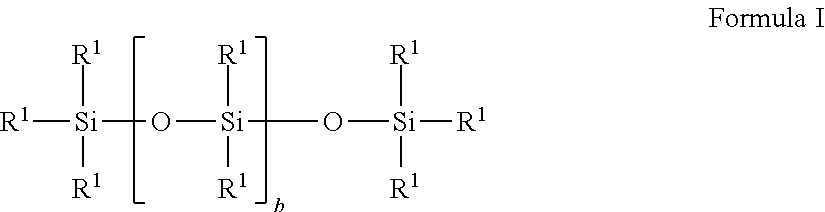
- Suitable silicone-containing components include compounds of Formula I
- R 1 is independently selected from monovalent reactive groups, monovalent alkyl groups, or monovalent aryl groups, any of the foregoing which may further comprise functionality selected from hydroxy, amino, oxa, carboxy, alkyl carboxy, alkoxy, amido, carbamate, carbonate, halogen or combinations thereof; and monovalent siloxane chains comprising 1-100 Si—O repeat units which may further comprise functionality selected from alkyl, hydroxy, amino, oxa, carboxy, alkyl carboxy, alkoxy, amido, carbamate, halogen or combinations thereof;
- b 0 to 500 (such as 0 to 100, such as 0 to 20), where it is understood that when b is other than 0, b is a distribution having a mode equal to a stated value;
- R 1 comprises a monovalent reactive group, and in some embodiments from one to three R 1 comprise monovalent reactive groups.
- “monovalent reactive groups” are groups that can undergo free radical and/or cationic polymerization.
- free radical reactive groups include (meth)acrylates, styryls, vinyls, vinyl ethers, C 1-6 alkyl(meth)acrylates, (meth)acrylamides, C 1-6 alkyl(meth)acrylamides, N-vinyllactams, N-vinylamides, C 2-12 alkenyls, C 2-12 alkenylphenyls, C 2-12 alkenylnaphthyls, C 2-6 alkenylphenylC 1-6 alkyls, O-vinylcarbamates and O-vinylcarbonates.
- Non-limiting examples of cationic reactive groups include vinyl ethers or epoxide groups and mixtures thereof.
- the free radical reactive groups comprises (meth)acrylate, acryloxy, (meth)acrylamide, and mixtures thereof.
- Suitable monovalent alkyl and aryl groups include unsubstituted monovalent C 1 to C 16 alkyl groups, C 6 -C 14 aryl groups, such as substituted and unsubstituted methyl, ethyl, propyl, butyl, 2-hydroxypropyl, propoxypropyl, polyethyleneoxypropyl, combinations thereof and the like.
- one R 1 is a monovalent reactive group
- at least 3 R 1 are selected from monovalent alkyl groups having one to 16 carbon atoms, and in another embodiment from monovalent alkyl groups having one to 6 carbon atoms.
- Non-limiting examples of silicone components of this embodiment include propenoic acid, -2-methyl-, 2-hydroxy-3-[3-[1,3,3,3-tetramethyl-1-[(trimethylsilyl)oxy]-1-disiloxanyl]propoxy]propyl ester (“SiGMA”; structure in Formula II),
- b is 2 to 20, 3 to 15 or in some embodiments 3 to 10; at least one terminal R 1 comprises a monovalent reactive group and the remaining R 1 are selected from monovalent alkyl groups having 1 to 16 carbon atoms, and in another embodiment from monovalent alkyl groups having 1 to 6 carbon atoms.
- b is 3 to 15, one terminal R 1 comprises a monovalent reactive group, the other terminal R 1 comprises a monovalent alkyl group having 1 to 6 carbon atoms and the remaining R 1 comprise monovalent alkyl group having 1 to 3 carbon atoms.
- Non-limiting examples of silicone components of this embodiment include 3-methacryloxy-2-hydroxypropyloxy propyl butyl terminated polydimethylsiloxane (400-1000 MW)) (“OH-mPDMS”; structure in Formula III),
- mPDMS methacryloxypropyl n-butyl terminated polydimethylsiloxanes
- both terminal R 1 comprise monovalent reactive groups and the remaining R 1 are independently selected from monovalent alkyl groups having 1 to 18 carbon atoms which may have ether linkages between carbon atoms and may further comprise halogen.
- one to four R 1 comprises a vinyl carbonate or carbamate of Formula V:
- Y denotes O—, S— or NH—
- R denotes, hydrogen or methyl
- q is 0 or 1.
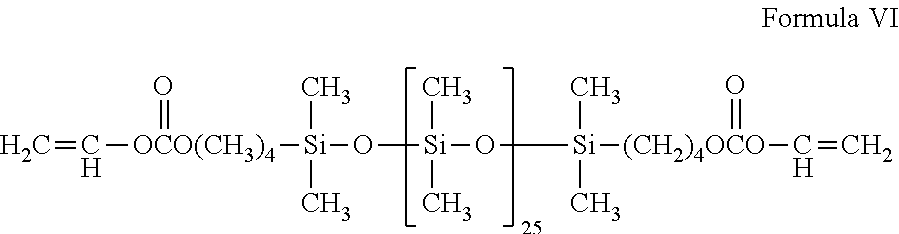
- the silicone-containing vinyl carbonate or vinyl carbamate monomers specifically include: 1,3-bis[4-(vinyloxycarbonyloxy)but-1-yl]tetramethyl-disiloxane; 3-(vinyloxycarbonylthio)propyl-[tris (trimethylsiloxy)silane]; 3-[tris(trimethylsiloxy)silyl]propyl allyl carbamate; 3-[tris(trimethylsiloxy)silyl]propyl vinyl carbamate; trimethylsilylethyl vinyl carbonate; trimethylsilylmethyl vinyl carbonate, and the compound of Formula VI.
- R 1 shall comprise a monovalent reactive group and no more than two of the remaining R 1 groups will comprise monovalent siloxane groups.
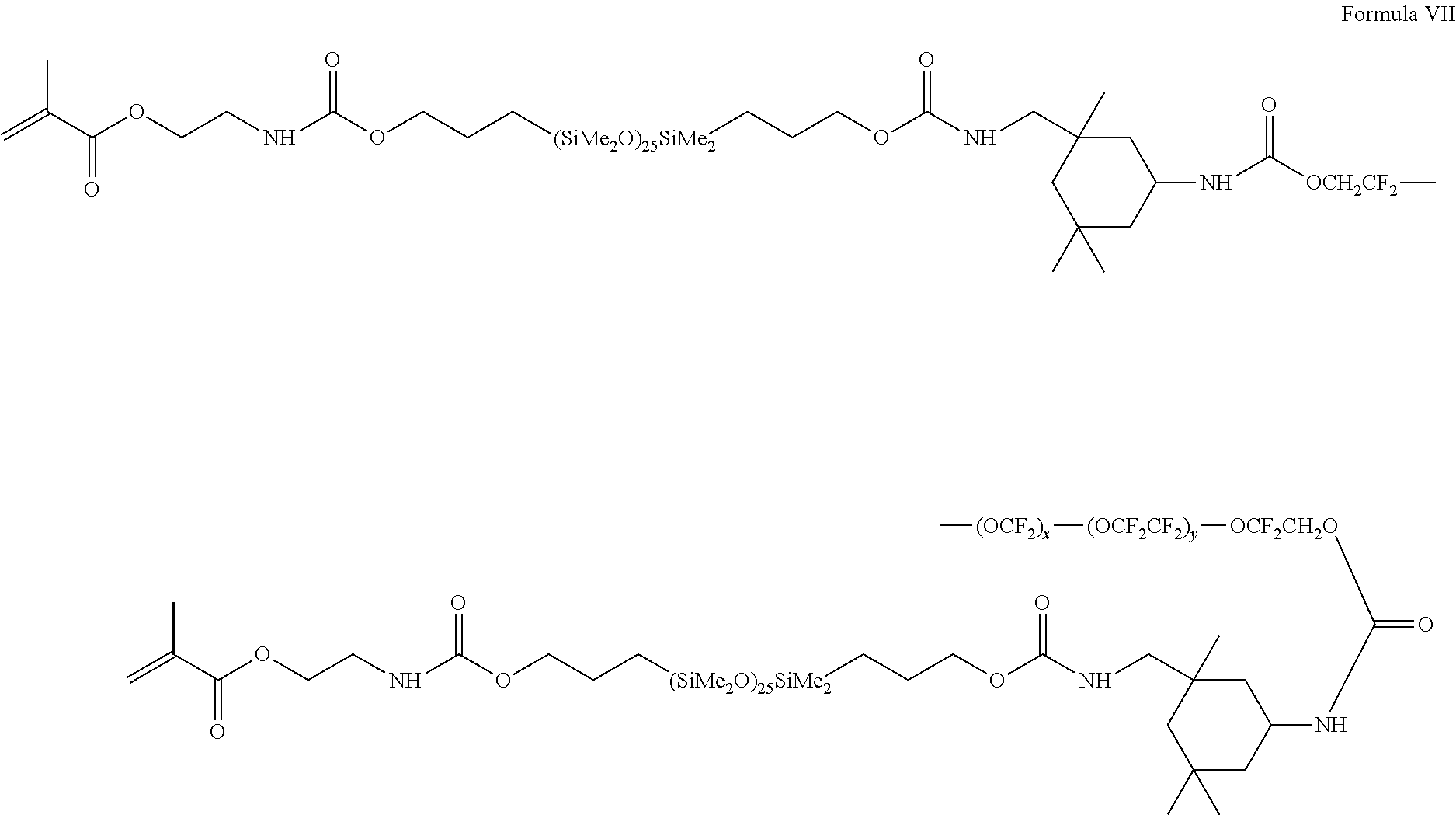
- Another suitable silicone containing macromer is compound of Formula VII (in which x+y is a number in the range of 10 to 30) formed by the reaction of fluoroether, hydroxy-terminated polydimethylsiloxane, isophorone diisocyanate and isocyanatoethylmethacrylate.
- the silicone containing component is selected from acrylamide silicones of US20110237766.
- Other silicone components suitable for use in this invention include those described is WO 96/31792 such as macromers containing polysiloxane, polyalkylene ether, diisocyanate, polyfluorinated hydrocarbon, polyfluorinated ether and polysaccharide groups.
- Another class of suitable silicone-containing components includes silicone containing macromers made via GTP, such as those disclosed in U.S. Pat. Nos. 5,314,960, 5,331,067, 5,244,981, 5,371,147 and 6,367,929.
- 5,321,108; 5,387,662 and 5,539,016 describe polysiloxanes with a polar fluorinated graft or side group having a hydrogen atom attached to a terminal difluoro-substituted carbon atom.
- US 2002/0016383 describe hydrophilic siloxanyl methacrylates containing ether and siloxanyl linkages and crosslinkable monomers containing polyether and polysiloxanyl groups. Any of the foregoing polysiloxanes can also be used as the silicone-containing component in this invention.
- the majority of the mass fraction of the silicone-containing components used in the lens formulation should contain only one polymerizable functional group (“monofunctional silicone containing component”).
- monofunctional silicone containing component the majority of the mass fraction of the silicone-containing components used in the lens formulation should contain only one polymerizable functional group (“monofunctional silicone containing component”).
- multifunctional components all components having more than one polymerizable functional group make up no more than 10 mmol/100 g of the reactive components, and preferably no more than 7 mmol/100 g of the reactive components.
- the silicone component is selected from the group consisting of monomethacryloxypropyl terminated, mono-n-alkyl terminated polydialkylsiloxane; bis-3-acryloxy-2-hydroxypropyloxypropyl polydialkylsiloxane; methacryloxypropyl-terminated polydialkylsiloxane; mono-(3-methacryloxy-2-hydroxypropyloxy)propyl terminated, mono-alkyl terminated polydialkylsiloxane; and mixtures thereof.
- the silicone component is selected from monomethacrylate terminated polydimethylsiloxanes; bis-3-acryloxy-2-hydroxypropyloxypropyl polydialkylsiloxane; and mono-(3-methacryloxy-2-hydroxypropyloxy)propyl terminated, mono-butyl terminated polydialkylsiloxane; and mixtures thereof.
- the silicone component has an average molecular weight of from about 400 to about 4000 daltons.
- the silicone containing component(s) may be present in amounts up to about 95 weight %, and in some embodiments from about 10 and about 80 and in other embodiments from about 20 and about 70 weight %, based upon all reactive components of the reactive mixture (e.g., excluding diluents).
- the reactive mixture contains at least one sulfonic acid-containing component, wherein said sulfonic acid-containing component is comprised of a non-polymerizable hydrophobic cation and a polymerizable sulfonic acid.
- the acid is added to the reactive mixture as a salt of a hydrophobic cation.
- Liquid salts mix readily with the reactive mixture. Solid salts, such as those comprising hydrophobic amines may also be used, so long as they are miscible in the reaction mixture.
- polymerizable sulfonic acid and the non-polymerizable hydrophobic cation may also be added separately to the reactive mixture, and the salt is formed in situ within the reactive mixture.
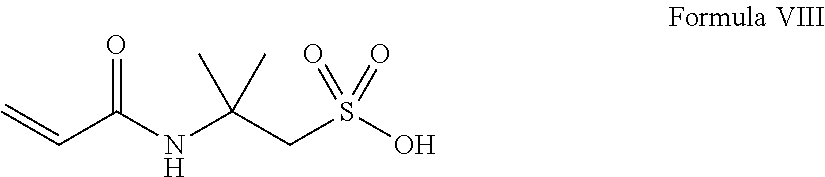
- polymerizable sulfonic acids include, but are not limited to, 2-acrylamido-2-methylpropane sulfonic acid (“AMPS”; structure in Formula VIII), p-styrenesulfonic acid, 2-methacryloyloxyethylsulfonic acid (“2-SEMA”), 3-methacryloyloxy-2-hydroxypropylsulfonic acid, vinylsulfonic acid, and allylsulfonic acid.
- incorpora hydrophobic cation of the present invention decreases the solubility of the polymerizable sulfonic acid, such that the salts may be incorporated into polymerization mixtures which comprise silicone-containing components and polymerized to form polymers which are clear.
- the sulfonic acid-containing components of the present invention are hydrophobic.
- non-polymerizable, hydrophobic cations include amines and ammoniums. Examples of such amines include, but are not limited to, alkyl amines, siloxy alkyl amines, and aryl alkyl amine.
- alkyl amines include, but are not limited to, amines comprising 1-3 alkyl groups each independently comprising 1-18 alkyl groups, 1-5 alkyl groups, any of which may further comprise ether groups. Examples include octadecyldimethylamine, tributylamine, trioctylamine, tris(methoxy ethoxyethyl) amine tripentylamine and triethylamine. The alkyl amine may also be tripentylamine and triethylamine. Examples of such ammoniums include, but are not limited to, alkyl ammoniums, siloxy alkyl ammoniums, and aryl alkyl ammoniums. Examples of alkyl ammoniums include those comprising 1-3 alkyl groups each independently comprising 1-18 alkyl groups, 1-5 alkyl groups, any of which may further comprise ether groups.
- the non-polymerizable hydrophobic cation can be removed from the sulfonic acid-containing component via an ion exchange with a simple cation such as monovalent sodium, leaving an anionic sulfonic acid-containing component within the silicone polymer and/or hydrogel.
- the addition of the sulfonic acid-containing component was found to improve the lysozyme uptake and other properties of the resulting silicone polymer, silicone hydrogel, and/or biomedical device (e.g., contact lens).
- the sulfonic acid-containing component (e.g., in the form of a salt with a non-polymerizable hydrophobic cation within the reactive mixture or in the form of an anionic sulfonic acid-containing component within the polymer/hydrogel) may be present in a wide range of amounts, depending upon the specific balance of properties desired.
- the molar ratio of polymerizable sulfonic acid to the hydrophobic cation may be no more than about 1, such as from about 0.2 to about 1, or more preferably from about 0.8 to about 1, or most preferably about 1.
- the sulfonate group of the sulfonic acid-containing component may be present in a concentration of all components excluding diluent of less than 2 mol/kg, such as from about 0.01 to about 0.2 mol/kg of the polymer, hydrogel (not including water), or reactive mixture (not including diluents).
- concentration of (i) the at least one silicone component and (ii) the sulfonic acid-containing component is less than about 100 mol/kg, such as about 1 to about 50 mol/kg, such as from about 1 to about 10 mol/kg.
- the reactive mixture may also contain at least one hydrophilic component.
- the hydrophilic components can be any of the hydrophilic monomers known to be useful to make hydrogels.
- hydrophilic monomers include acrylic- or vinyl-containing monomers. Such hydrophilic monomers may themselves be used as crosslinking agents, however, where hydrophilic monomers having more than one polymerizable functional group are used, their concentration should be limited as discussed above to provide a contact lens having the desired modulus.
- vinyl-type or “vinyl-containing” monomers refer to monomers containing the vinyl grouping (—CH ⁇ CH 2 ) and that are capable of polymerizing.
- hydrophilic vinyl-containing monomers include, but are not limited to, monomers such as N-vinyl amides, N-vinyl lactams (e.g. n-vinylpyrrolidone (“NVP”)), N-vinyl-N-methyl acetamide, N-vinyl-N-ethyl acetamide, and N-vinyl-N-ethyl formamide, N-vinyl formamide.
- Alternative vinyl-containing monomers include, but are not limited to, 1-methyl-3-methylene-2-pyrrolidone, 1-methyl-5-methylene-2-pyrrolidone, and 5-methyl-3-methylene-2-pyrrolidone.
- “Acrylic-type” or “acrylic-containing” monomers are those monomers containing the acrylic group: (CH 2 ⁇ CRCOX) wherein R is H or CH 3 , and X is O or N, which are also known to polymerize readily, such as N,N-dimethyl acrylamide (“DMA”), 2-hydroxyethyl methacrylate (“HEMA”), glycerol methacrylate, 2-hydroxyethyl methacrylamide, polyethyleneglycol monomethacrylate, methacrylic acid, mixtures thereof and the like.
- DMA N,N-dimethyl acrylamide
- HEMA 2-hydroxyethyl methacrylate
- glycerol methacrylate 2-hydroxyethyl methacrylamide
- polyethyleneglycol monomethacrylate methacrylic acid, mixtures thereof and the like.
- hydrophilic monomers that can be employed in the invention include, but are not limited to, polyoxyethylene polyols having one or more of the terminal hydroxyl groups replaced with a functional group containing a polymerizable double bond.
- examples include polyethylene glycol, ethoxylated alkyl glucoside, and ethoxylated bisphenol A reacted with one or more molar equivalents of an end-capping group such as isocyanatoethyl methacrylate (“IEM”), methacrylic anhydride, methacryloyl chloride, vinylbenzoyl chloride, or the like, to produce a polyethylene polyol having one or more terminal polymerizable olefinic groups bonded to the polyethylene polyol through linking moieties such as carbamate or ester groups.
- IEM isocyanatoethyl methacrylate
- hydrophilic vinyl carbonate or vinyl carbamate monomers disclosed in U.S. Pat. No. 5,070,215 and the hydrophilic oxazolone monomers disclosed in U.S. Pat. No. 4,910,277.
- Other suitable hydrophilic monomers will be apparent to one skilled in the art.
- the hydrophilic component comprises at least one hydrophilic monomer such as DMA, HEMA, glycerol methacrylate, 2-hydroxyethyl methacrylamide, NVP, N-vinyl-N-methyl acrylamide, polyethyleneglycol monomethacrylate, and combinations thereof.
- the hydrophilic monomers comprise at least one of DMA, HEMA, NVP and N-vinyl-N-methyl acrylamide and mixtures thereof.
- the hydrophilic monomer comprises DMA and/or HEMA.
- the hydrophilic component(s) may be present in a wide range of amounts, depending upon the specific balance of properties desired. In one embodiment, the amount of the hydrophilic component is up to about 60 weight %, such as from about 5 and about 40 weight % based upon all reactive components.
- polymerization initiators may be included in the reaction mixture.
- polymerization initiators include, but are not limited to, compounds such as lauryl peroxide, benzoyl peroxide, isopropyl percarbonate, azobisisobutyronitrile, and the like, that generate free radicals at moderately elevated temperatures, and photoinitiator systems such as aromatic alpha-hydroxy ketones, alkoxyoxybenzoins, acetophenones, acylphosphine oxides, bisacylphosphine oxides, and a tertiary amine plus a diketone, mixtures thereof and the like.
- Photoinitiators are 1-hydroxycyclohexyl phenyl ketone, 2-hydroxy-2-methyl-1-phenyl-propan-1-one, bis(2,6-dimethoxybenzoyl)-2,4-4-trimethylpentyl phosphine oxide (DMBAPO), bis(2,4,6-trimethylbenzoyl)-phenyl phosphineoxide (Irgacure 819), 2,4,6-trimethylbenzyldiphenyl phosphine oxide and 2,4,6-trimethylbenzoyl diphenylphosphine oxide, benzoin methyl ester and a combination of camphorquinone and ethyl 4-(N,N-dimethylamino)benzoate.
- DMBAPO bis(2,6-dimethoxybenzoyl)-2,4-4-trimethylpentyl phosphine oxide
- Irgacure 819 bis(2,4,6-trimethylbenzoyl)-phenyl
- UV photoinitiators include Darocur 1173 and Darocur 2959 (Ciba Specialty Chemicals). These and other photoinitators which may be used are disclosed in Volume III, Photoinitiators for Free Radical Cationic & Anionic Photopolymerization, 2 nd Edition by J. V. Crivello & K. Dietliker; edited by G. Bradley; John Wiley and Sons; New York; 1998.
- the polymerization initiator is used in the reaction mixture in effective amounts to initiate photopolymerization of the reaction mixture, such as from about 0.1 to about 2 weight %.
- Polymerization of the reaction mixture can be initiated using the appropriate choice of heat or visible or ultraviolet light or other means depending on the polymerization initiator used. Alternatively, initiation can be conducted without a photoinitiator using, for example, e-beam.
- the preferred initiators are bisacylphosphine oxides, such as bis(2,4,6-trimethylbenzoyl)-phenyl phosphine oxide (Irgacure 819®) or a combination of 1-hydroxycyclohexyl phenyl ketone and DMBAPO, and in another embodiment the method of polymerization initiation is via visible light activation.
- the reaction mixture includes one or more internal wetting agents.
- Internal wetting agents may include, but are not limited to, high molecular weight, hydrophilic polymers such as those described in U.S. Pat. Nos. 6,367,929; 6,822,016; 7,786,185; PCT Patent Application Nos. WO03/22321 and WO03/22322, or reactive, hydrophilic polymers such as those described in U.S. Pat. No. 7,249,848.
- Examples of internal wetting agents include, but are not limited to, polyamides such as poly(N-vinyl pyrrolidone) and poly (N-vinyl-N-methyl acetamide).
- the internal wetting agent(s) may be present in a wide range of amounts, depending upon the specific parameter desired.
- the amount of the wetting agent(s) is up to about 50 weight %, such as from about 5 and about 40 weight %, such as from about 6 to about 30 weight % based upon all reactive components.
- components that can be present in the reaction mixture used to form the contact lenses of this invention include, but are not limited to, compatibilizing components (such as those disclosed in US Patent Application Nos. 2003/162862 and 2003/125498), ultra-violet absorbing compounds, medicinal agents, antimicrobial compounds, copolymerizable and nonpolymerizable dyes, release agents, reactive tints, pigments, combinations thereof and the like.
- compatibilizing components such as those disclosed in US Patent Application Nos. 2003/162862 and 2003/125498
- ultra-violet absorbing compounds such as those disclosed in US Patent Application Nos. 2003/162862 and 2003/125498
- ultra-violet absorbing compounds such as those disclosed in US Patent Application Nos. 2003/162862 and 2003/125498
- ultra-violet absorbing compounds such as those disclosed in US Patent Application Nos. 2003/162862 and 2003/125498
- ultra-violet absorbing compounds such as those disclosed in US Patent Application Nos. 2003/162862 and 2003/125498
- the reactive components e.g., silicone containing component, 2-hydroxyethyl acrylamide, hydrophilic monomers, wetting agents, and/or other components
- the reactive components are mixed together either with or without a diluent to form the reaction mixture.
- a diluent having a polarity sufficiently low to solubilize the non-polar components in the reactive mixture at reaction conditions.
- One way to characterize the polarity of the diluents of the present invention is via the Hansen solubility parameter, ⁇ p.
- the ⁇ p is less than about 10, and preferably less than about 6.
- Suitable diluents are further disclosed in US Patent Application No. 20100280146 and U.S. Pat. No. 6,020,445.
- Classes of suitable diluents include, without limitation, alcohols having 2 to 20 carbons, amides having 10 to 20 carbon atoms derived from primary amines, ethers, polyethers, ketones having 3 to 10 carbon atoms, and carboxylic acids having 8 to 20 carbon atoms. As the number of carbons increase, the number of polar moieties may also be increased to provide the desired level of water miscibility. In some embodiments, primary and tertiary alcohols are preferred. Preferred classes include alcohols having 4 to 20 carbons and carboxylic acids having 10 to 20 carbon atoms.
- the diluents are selected from 1,2-octanediol, t-amyl alcohol, 3-methyl-3-pentanol, decanoic acid, 3,7-dimethyl-3-octanol, 2-methyl-2-pentanol, 2-ethyl-1-butanol, 3,3-dimethyl-2-butanol, tripropylene methyl ether (TPME), butoxy ethyl acetate, mixtures thereof and the like.
- TPME tripropylene methyl ether
- the diluents are selected from those that have some degree of solubility in water. In some embodiments at least about three percent of the diluent is miscible water.
- water soluble diluents include, but are not limited to, 1-octanol, 1-pentanol, 1-hexanol, 2-hexanol, 2-octanol, 3-methyl-3-pentanol, 2-pentanol, t-amyl alcohol, tent-butanol, 2-butanol, 1-butanol, ethanol, decanoic acid, octanoic acid, dodecanoic acid, 1-ethoxy-2-propanol, 1-tert-butoxy-2-propanol, EH-5 (commercially available from Ethox Chemicals), 2,3,6,7-tetrahydroxy-2,3,6,7-tetramethyl octane, 9-(1-methylethyl)-2,5,8,10,
- the reactive mixture of the present invention may be cured via any known process for molding the reaction mixture in the production of contact lenses, including spincasting and static casting. Spincasting methods are disclosed in U.S. Pat. Nos. 3,408,429 and 3,660,545, and static casting methods are disclosed in U.S. Pat. Nos. 4,113,224 and 4,197,266.
- the contact lenses of this invention are formed by the direct molding of the silicone hydrogels, which is economical, and enables precise control over the final shape of the hydrated lens.
- the reaction mixture is placed in a mold having the shape of the final desired silicone hydrogel and the reaction mixture is subjected to conditions whereby the monomers polymerize, to thereby produce a polymer in the approximate shape of the final desired product.
- the lens is subjected to extraction to remove unreacted components and release the lens from the lens mold.
- the extraction may be done using conventional extraction fluids, such organic solvents, such as alcohols or may be extracted using aqueous solutions.
- Aqueous solutions are solutions which comprise water.
- the aqueous solutions of the present invention comprise at least about 30 weight % water, in some embodiments at least about 50 weight % water, in some embodiments at least about 70% water and in others at least about 90 weight % water.
- Aqueous solutions may also include additional water soluble components such as release agents, wetting agents, slip agents, pharmaceutical and neutriceutical components, combinations thereof and the like. Release agents are compounds or mixtures of compounds which, when combined with water, decrease the time required to release a contact lens from a mold, as compared to the time required to release such a lens using an aqueous solution that does not comprise the release agent.
- the aqueous solutions comprise less than about 10 weight %, and in others less than about 5 weight % organic solvents such as isopropyl alcohol, and in another embodiment are free from organic solvents. In these embodiments the aqueous solutions do not require special handling, such as purification, recycling or special disposal procedures.
- extraction can be accomplished, for example, via immersion of the lens in an aqueous solution or exposing the lens to a flow of an aqueous solution.
- extraction can also include, for example, one or more of: heating the aqueous solution; stirring the aqueous solution; increasing the level of release aid in the aqueous solution to a level sufficient to cause release of the lens; mechanical or ultrasonic agitation of the lens; and incorporating at least one leach aid in the aqueous solution to a level sufficient to facilitate adequate removal of unreacted components from the lens.
- the foregoing may be conducted in batch or continuous processes, with or without the addition of heat, agitation or both.
- Some embodiments can also include the application of physical agitation to facilitate leach and release.
- the lens mold part to which a lens is adhered can be vibrated or caused to move back and forth within an aqueous solution.
- Other embodiments may include ultrasonic waves through the aqueous solution.
- the lenses may be sterilized by known means such as, but not limited to autoclaving.
- Lysozyme uptake was measured as follows: The lysozyme solution used for the lysozyme uptake testing contained lysozyme from chicken egg white (Sigma, L7651) solubilized at a concentration of 2 mg/ml in phosphate saline buffer supplemented by Sodium bicarbonate at 1.37 g/l and D-Glucose at 0.1 g/l.
- test lenses were blotted on sterile gauze to remove packing solution and aseptically transferred, using sterile forceps, into sterile, 24 well cell culture plates (one lens per well) each well containing 2 ml of lysozyme solution. Each lens was fully immersed in the solution. 2 ml of the lysozyme solution was placed in a well without a contact lens as a control.
- the plates containing the lenses and the control plates containing only protein solution and the lenses in the PBS were parafilmed to prevent evaporation and dehydration, placed onto an orbital shaker and incubated at 35° C., with agitation at 100 rpm for 72 hours. After the 72 hour incubation period the lenses were rinsed 3 to 5 times by dipping lenses into three (3) separate vials containing approximately 200 ml volume of PBS. The lenses were blotted on a paper towel to remove excess PBS solution and transferred into sterile conical tubes (1 lens per tube), each tube containing a volume of PBS determined based upon an estimate of lysozyme uptake expected based upon on each lens composition. The lysozyme concentration in each tube to be tested needs to be within the albumin standards range as described by the manufacturer (0.05 microgram to 30 micrograms). Samples were diluted 5 times.
- Lysozyme uptake was determined using on-lens bicinchoninic acid method using QP-BCA kit (Sigma, QP-BCA) following the procedure described by the manufacturer (the standards prep is described in the kit) and is calculated by subtracting the optical density measured on PBS soaked lenses (background) from the optical density determined on lenses soaked in lysozyme solution.
- Optical density was measured using a Synergy II Micro-plate reader capable for reading optical density at 562 nm.
- PQ1 uptake was measured as follows: PQ1 uptake was measured as follows.
- the HPLC is calibrated using a series of standard PQ1 solutions prepared having the following concentrations: 2, 4, 6, 8, 12 and 15 ⁇ g/mL.
- Lenses were placed into polypropylene contact lens case with 3 mL of Optifree Replenish (which contains 0.001 wt % PQ1, 0.56% citrate dihydrate and 0.021% citric acid monohydrate (wt/wt)). and is commercially available from Alcon).
- a control lens case, containing 3 mL of solution, but no contact lens was also prepared. The lenses and control solutions were allowed to sit at room temperature for 24 hours.
- Water content is measured as follows.
- the lenses to be tested are allowed to sit in packing solution for 24 hours.
- Each of three test lens are removed from packing solution using a sponge tipped swab and placed on blotting wipes which have been dampened with packing solution. Both sides of the lens are contacted with the wipe.
- the test lens are placed in a weighing pan and weighed. The two more sets of samples are prepared and weighed as above. The pan and lenses are weighed three times and the average is the wet weight.
- % ⁇ ⁇ water ⁇ ⁇ content ( wet ⁇ ⁇ weight - dry ⁇ ⁇ weight ) wet ⁇ ⁇ weight ⁇ 100 The average and standard deviation of the water content are calculated for the samples are reported.
- the % water content is from about 20 to 70%, such as from about 30 to 65%
- the resulting ionic liquid appeared to remain stable for several days, but became visually more viscous after several weeks of storage at 5° C.
- Example 1 The AMPS Salt prepared in Example 1 was used to prepare the formulation blends in Table 1. For each blend, all components were added and mixed on a jar roller until everything had dissolved. Both blends were clear.
- Blend 1 Component wt % wt % OH-mPDMS 26.01 26.01 mPDMS 1000 28.01 28.01 DMA 21.00 21.00 PVP K-90 7.00 7.00 HEMA 6.50 6.50 TEGDMA 1.50 1.50 AMPS SALT* 7.50 7.50 Norbloc 2.00 2.00 Irgacure 819 0.48 0.48 Decanoic acid (diluent)** 9.20 0 t-amyl alcohol (diluent)** 13.80 0 D30 (diluent)** 0 23 AMPS Concentration (mol/kg)*** 0.18 0.18 *Note: The tripentylamine portion of the AMPS Salt was washed out of the polymer during hydration but is not calculated as part of the diluent in these blends.
- a blend was prepared as shown below in Table 2.
- the acid form of AMPS was first dissolved in the hydrophilic monomers (DMA, HEMA and TEGDMA) by mixing overnight on ajar roller. The rest of the components were then added and mixed on ajar roller. After 6 days of mixing on the jar roller, blend 3 remained hazy and contained lumps of phase separated material.
- Blend Formulations Blend 3 Component wt % DMA 23.75 Blue HEMA 0.00 HEMA 6.00 TEGDMA 1.50 SiGMA 27.86 mPDMS 1000 30.81 Norbloc 2.00 CGI 403 0.24 Irgacure 184 0.24 PVP K90 7.00 AMPS 0.60 D30 (diluent)* 23.00 AMPS Concentration (mol/kg) 0.03 *Amounts of diluents are shown as weight percent of combination of all components. Amounts of other components are shown as weight percent of reactive components, excluding diluents.
- Blend 4 Blend 5
- Blend 6 Blend 7
- Blend 8 Blend 9
- Blend 10 Component wt % wt % wt % wt % wt % wt % wt % DMA 24.00 23.85 23.75 23.55 23.20 22.59 22.40 Blue HEMA 0.02 0.02 0.02 0.02 0.02 0.02 HEMA 6.00 6.00 6.00 6.00 6.00 6.00 TEGDMA 1.50 1.50 1.50 1.50 1.50 1.50 1.50 1.50 1.50 1.50 SiGMA 28.00 27.95 27.85 27.75 27.50 27.50 27.00 mPDMS 1000 31.00 30.90 30.80 30.50 30.50 30.50 30.00 Norbloc 2.00 2.00 2.00 2.00 2.00 2.00 2.00 2.00 2.00 2.00 CGI 403 0.24 0.24 0.24 0.24 0.24 0.24 0.24 Irgacure 184 0.24 0.24 0.24 0.24 0.24 0.24 0.24 0.24 0.24 PVP K90 7.00 7.00 7
- Blends 1, 2 and 4-16 were placed in a glass vials with caps removed and placed under vacuum for 15 minutes to remove oxygen.
- Plastic contact lens molds were filled with one of the blends in the nitrogen-filled glove box.
- Formulations were cured in the nitrogen-filled glove box for 15 minutes at 60° C. and 1.5 mW/cm2 using Philips TL03 20 W fluorescent bulbs.
- the lenses were leached as follows: first, in a 70% isopropano1:30% DI water for 2 hours; then in 0.025M Sodium Carbonate for 3 hours (to deprotonate the tripentylamine and exchange for sodium cation); then 70% isopropano1:30% DI water for12 hours (to remove tripentylamine); and lastly 48 hours in DI water.
- Lenses were then placed in lens vials with borate buffered packing solution and sterilized in a autoclave using a 30 minute cycle.
- PQ1 Uptake is reported for Blends 4-16 in Tables 5 and 6.
- PQ1 is a preservative used in many commercially available contact lens care cleaning solutions. PQ1 is known to cause ocular discomfort and corneal staining and so its uptake into the lens is not desirable.
Landscapes
- Chemical & Material Sciences (AREA)
- Health & Medical Sciences (AREA)
- Chemical Kinetics & Catalysis (AREA)
- Medicinal Chemistry (AREA)
- Polymers & Plastics (AREA)
- Organic Chemistry (AREA)
- Eyeglasses (AREA)
- Addition Polymer Or Copolymer, Post-Treatments, Or Chemical Modifications (AREA)
- Macromonomer-Based Addition Polymer (AREA)
- Transition And Organic Metals Composition Catalysts For Addition Polymerization (AREA)
- Silicon Polymers (AREA)
Abstract
Description

wherein:
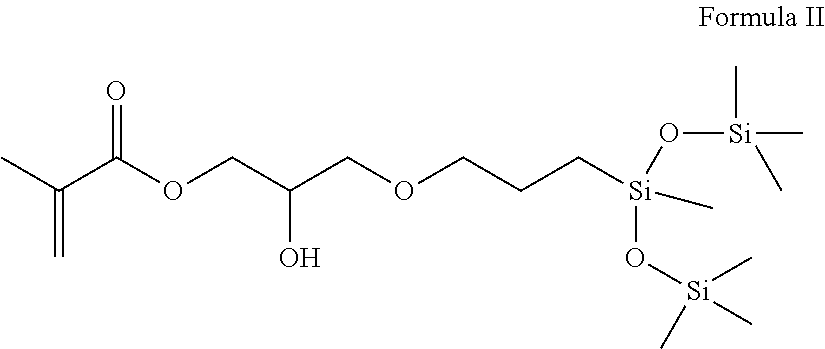
2-hydroxy-3-methacryloxypropyloxypropyl-tris(trimethylsiloxy)silane, 3-methacryloxypropyltris(trimethylsiloxy)silane (“TRIS”), 3-methacryloxypropylbis(trimethylsiloxy)methylsilane, and 3-methacryloxypropylpentamethyl disiloxane.

methacryloxypropyl n-butyl terminated polydimethylsiloxanes (800-1000 MW), (“mPDMS”; structure in Formula IV).


Where biomedical devices with modulii below about 200 are desired, only one R1 shall comprise a monovalent reactive group and no more than two of the remaining R1 groups will comprise monovalent siloxane groups.
- Sedex 85 ELSD: T=60° C., Gain=10, Pressure=3.4 bar, Filter=1 s
- Mobile Phase A: H20 (0.1% TFA)
- Mobile Phase B: Acetonitrile (0.1% TFA)
- Column Temperature: 40° C.
- Injection Volume: 100 μL
| HPLC Conditions |
| Time (minutes) | % A | % B | Flow Rate (mL/min) | ||
| 0.00 | 100 | 0 | 1.2 | ||
| 1.00 | 100 | 0 | 1.2 | ||
| 5.00 | 0 | 100 | 1.2 | ||
| 8.50 | 0 | 100 | 1.2 | ||
| 8.60 | 100 | 0 | 1.2 | ||
| 12.00 | 100 | 0 | 1.2 | ||
Three lenses were run for each analysis, and the results were averaged. PQ1 uptake is reported as the percentage loss of PQ1 after soak with lens compared to the PQ1 present in the control without lens.
Water Content
Wet weight=combined wet weight of pan and lenses−weight of weighing pan
Dry weight=combined dry weight of pan and lens−weight of weighing pan
The average and standard deviation of the water content are calculated for the samples are reported. In one embodiment, the % water content is from about 20 to 70%, such as from about 30 to 65%
- AMPS 2-Acrylamido-2-methylpropane sulfonic acid
- AMPS SALT Tripentylammonium salt of 2-Acrylamido-2-methylpropane sulfonic acid as described below in Example 1
- Blue HEMA the reaction product of Reactive Blue 4 and HEMA, as described in Example 4 of U.S. Pat. No. 5,944,853
- CGI 403 bis(2,6-dimethoxybenzoyl)(2,4,4-trimethylpentyl)phosphine oxide
- D30 3,7-dimethyl-3-octanol
- DMA N,N-dimethylacrylamide
- HEMA 2-hydroxyethyl methacrylate
- Irgacure 819 bis(2,4,6-trimethylbenzoyl)-phenylphosphineoxide
- Irgacure 184 1-hydroxycyclohexyl-phenylketone
- mPDMS 1000 monomethacryloxypropyl terminated mono-n-butyl terminated polydimethylsiloxane (Mn=800 to 1000 g/mol)
- Norbloc 2-(2′-hydroxy-5-methacrylyloxyethylphenyl)-2H-benzotriazole
- OH-mPDMS α-(2-hydroxy-1-methacryloxypropyloxypropyl)-ω-butyl-octamethylpentasiloxane, (MW 612 g/mol), prepared as in Example 8 of US20100249356 A1
- PVP poly(N-vinyl pyrrolidone) (K values noted)
- 2-SEMA 2-methacryloyloxyethylsulfonic acid
- SiGMA 2 propenoic acid, 2-methyl-, 2 hydroxy-3-[3-[1,3,3,3-tetramethyl-1-[(trimethylsilyl)oxy]disiloxanyl]propoxy]propyl ester
- TEGDMA tetraethyleneglycol dimethacrylate
| TABLE 1 |
| Blend Formulations |
| Blend 1 | Blend 2 | |||
| Component | wt % | wt % | ||
| OH-mPDMS | 26.01 | 26.01 | ||
| mPDMS 1000 | 28.01 | 28.01 | ||
| DMA | 21.00 | 21.00 | ||
| PVP K-90 | 7.00 | 7.00 | ||
| HEMA | 6.50 | 6.50 | ||
| TEGDMA | 1.50 | 1.50 | ||
| AMPS SALT* | 7.50 | 7.50 | ||
| Norbloc | 2.00 | 2.00 | ||
| Irgacure 819 | 0.48 | 0.48 | ||
| Decanoic acid (diluent)** | 9.20 | 0 | ||
| t-amyl alcohol (diluent)** | 13.80 | 0 | ||
| D30 (diluent)** | 0 | 23 | ||
| AMPS Concentration (mol/kg)*** | 0.18 | 0.18 | ||
| *Note: The tripentylamine portion of the AMPS Salt was washed out of the polymer during hydration but is not calculated as part of the diluent in these blends. | ||||
| **Amounts of diluents are shown as weight percent of combination of all components. Amounts of other components are shown as weight percent of reactive components, excluding diluents. | ||||
| ***AMPS concentration is reported as moles of AMPS monomer per kilogram of reactive monomer mix, excluding diluents. For this calculation, the tripentylamine portion of the AMPS salt was included as part of the diluent. Both Blend 1 and Blend 2 have an AMPS concentration (excluding diluents and the tripentylamine portion) of 3 mol/kg and a ratio of silicone components to AMPS of 3:1. | ||||
| TABLE 2 |
| Blend Formulations |
| Blend 3 | |||
| Component | wt % | ||
| DMA | 23.75 | ||
| Blue HEMA | 0.00 | ||
| HEMA | 6.00 | ||
| TEGDMA | 1.50 | ||
| SiGMA | 27.86 | ||
| mPDMS 1000 | 30.81 | ||
| Norbloc | 2.00 | ||
| CGI 403 | 0.24 | ||
| Irgacure 184 | 0.24 | ||
| PVP K90 | 7.00 | ||
| AMPS | 0.60 | ||
| D30 (diluent)* | 23.00 | ||
| AMPS Concentration (mol/kg) | 0.03 | ||
| *Amounts of diluents are shown as weight percent of combination of all components. Amounts of other components are shown as weight percent of reactive components, excluding diluents. | |||
| TABLE 3 |
| Blend Formulations |
| Blend 4 | Blend 5 | Blend 6 | Blend 7 | Blend 8 | Blend 9 | Blend 10 | |
| Component | wt % | wt % | wt % | wt % | wt % | wt % | wt % |
| DMA | 24.00 | 23.85 | 23.75 | 23.55 | 23.20 | 22.59 | 22.40 |
| Blue HEMA | 0.02 | 0.02 | 0.02 | 0.02 | 0.02 | 0.02 | 0.02 |
| HEMA | 6.00 | 6.00 | 6.00 | 6.00 | 6.00 | 6.00 | 6.00 |
| TEGDMA | 1.50 | 1.50 | 1.50 | 1.50 | 1.50 | 1.50 | 1.50 |
| SiGMA | 28.00 | 27.95 | 27.85 | 27.75 | 27.50 | 27.50 | 27.00 |
| mPDMS 1000 | 31.00 | 30.90 | 30.80 | 30.50 | 30.50 | 30.50 | 30.00 |
| Norbloc | 2.00 | 2.00 | 2.00 | 2.00 | 2.00 | 2.00 | 2.00 |
| CGI 403 | 0.24 | 0.24 | 0.24 | 0.24 | 0.24 | 0.24 | 0.24 |
| Irgacure 184 | 0.24 | 0.24 | 0.24 | 0.24 | 0.24 | 0.24 | 0.24 |
| PVP K90 | 7.00 | 7.00 | 7.00 | 7.00 | 7.00 | 7.00 | 7.00 |
| AMPS | 0.00 | 0.30 | 0.60 | 1.20 | 1.80 | 2.41 | 3.60 |
| D30 (diluent)* | 23.00 | 22.74 | 22.49 | 21.98 | 21.47 | 20.96 | 19.95 |
| Tripentylamine | 0.00 | 0.26 | 0.51 | 1.02 | 1.53 | 1.99 | 3.05 |
| (diluent)* | |||||||
| AMPS (mol/kg)** | 0.00 | 0.01 | 0.03 | 0.06 | 0.09 | 0.12 | 0.17 |
| *Amounts of diluents are shown as weight percent of combination of all components. Amounts of other components are shown as weight percent of reactive components, excluding diluents. | |||||||
| **Amount of AMPS is shown as the number of moles per kg of formulation, excluding diluent | |||||||
| TABLE 4 |
| Blend Formulations |
| Blend | Blend | Blend | Blend | Blend | Blend | |
| 11 | 12 | 13 | 14 | 15 | 16 | |
| Component | wt % | wt % | wt % | wt % | wt % | wt % |
| DMA | 23.88 | 23.75 | 23.67 | 23.10 | 22.64 | 22.61 |
| Blue HEMA | 0.02 | 0.02 | 0.02 | 0.02 | 0.02 | 0.02 |
| HEMA | 6.00 | 6.00 | 6.00 | 6.00 | 6.00 | 6.00 |
| TEGDMA | 1.50 | 1.50 | 1.50 | 1.50 | 1.50 | 1.50 |
| SiGMA | 27.93 | 27.87 | 27.60 | 27.60 | 27.55 | 27.00 |
| mPDMS 1000 | 30.91 | 30.81 | 30.60 | 30.60 | 30.50 | 30.00 |
| Norbloc | 2.00 | 2.00 | 2.00 | 2.00 | 2.00 | 2.00 |
| CGI 403 | 0.24 | 0.24 | 0.24 | 0.24 | 0.24 | 0.24 |
| Irgacure 184 | 0.24 | 0.24 | 0.24 | 0.24 | 0.24 | 0.24 |
| PVP K90 | 7.00 | 7.00 | 7.00 | 7.00 | 7.00 | 7.00 |
| 2-SEMA | 0.28 | 0.57 | 1.13 | 1.70 | 2.26 | 3.39 |
| D30 (diluent)* | 22.74 | 22.49 | 21.98 | 21.47 | 20.96 | 19.95 |
| Tripentylamine | 0.26 | 0.51 | 1.02 | 1.53 | 1.99 | 3.05 |
| (diluent)* | ||||||
| 2-SEMA | 0.01 | 0.03 | 0.06 | 0.09 | 0.12 | 0.18 |
| (mol/kg)** | ||||||
| *Amounts of diluents are shown as weight percent of combination of all components. Amounts of other components are shown as weight percent of reactive components, excluding diluents. | ||||||
| **Amount of AMPS is shown as the number of moles per kg of formulation, excluding diluent | ||||||
| TABLE 5 |
| Various Lens Properties |
| Blend | Blend | Blend | Blend | Blend | Blend | Blend | Blend | |
| 1 | 2 | 4 | 5 | 6 | 7 | 8 | 9 | |
| Ionic Monomer | AMPS | AMPS | N/A | AMPS | AMPS | AMPS | AMPS | AMPS |
| Ionic Monomer | 0.18 | 0.18 | N/A | 0.01 | 0.03 | 0.06 | 0.09 | 0.12 |
| Concentration | ||||||||
| (mol/kg)* | ||||||||
| Water content | 54.8 | 53.7 | 39.7 | NT | NT | 45.7 | NT | 51.1 |
| (%) | ||||||||
| PQ1 Uptake | NT | NT | −1 | 4 | 6 | −4 | 13 | 80 |
| (%) | ||||||||
| Lysozyme | 163 | 172 | 5 | 102 | 150 | 170 | 176 | 175 |
| (μg/lens) | ||||||||
| *Ionic Monomer concentration is reported as moles of ionic monomer per kilogram of reactive monomer mix, excluding diluent. Tripentylamine is included as a diluent in all formulations. | ||||||||
| TABLE 6 |
| Various Lens Properties |
| Blend | Blend | Blend | Blend | Blend | Blend | Blend | |
| 10 | 11 | 12 | 13 | 14 | 15 | 16 | |
| Ionic | AMPS | 2-SEMA | 2-SEMA | 2-SEMA | 2-SEMA | 2-SEMA | 2-SEMA |
| Monomer | |||||||
| Ionic | 0.17 | 0.01 | 0.03 | 0.06 | 0.09 | 0.12 | 0.18 |
| Monomer | |||||||
| Concentration | |||||||
| (mol · kg)* | |||||||
| Water content | 57.0 | NT | NT | 43.7 | NT | 50.0 | 53.4 |
| (%) | |||||||
| PQ1 Uptake | 80 | 12 | 6 | 0 | 34 | 74 | 79 |
| (%) | |||||||
| Lysozyme | 176 | 66 | 117 | 129 | 148 | 133 | 136 |
| (μg /lens) | |||||||
| *Ionic Monomer concentration is reported as moles of ionic monomer per kilogram of reactive monomer mix, excluding diluent. Tripentylamine is included as a diluent in all formulations. | |||||||
Claims (19)
Priority Applications (14)
| Application Number | Priority Date | Filing Date | Title |
|---|---|---|---|
| US13/734,775 US8940812B2 (en) | 2012-01-17 | 2013-01-04 | Silicone polymers comprising sulfonic acid groups |
| SG11201403885SA SG11201403885SA (en) | 2012-01-17 | 2013-01-14 | Silicone polymers comprising sulfonic acid groups |
| JP2014553334A JP6138827B2 (en) | 2012-01-17 | 2013-01-14 | Silicone polymers containing sulfonic acid groups |
| AU2013210010A AU2013210010B2 (en) | 2012-01-17 | 2013-01-14 | Silicone polymers comprising sulfonic acid groups |
| CN201380005838.3A CN104053725B (en) | 2012-01-17 | 2013-01-14 | Include the organosilicon polymer of sulfonic acid group |
| HK15101326.6A HK1200859A1 (en) | 2012-01-17 | 2013-01-14 | Silicone polymers comprising sulfonic acid groups |
| EP13701539.2A EP2804909B1 (en) | 2012-01-17 | 2013-01-14 | Silicone polymers comprising sulfonic acid groups |
| RU2014133555A RU2621721C2 (en) | 2012-01-17 | 2013-01-14 | Silicone polymers containing sulfonic acid groups |
| KR1020147022747A KR20140116932A (en) | 2012-01-17 | 2013-01-14 | Silicone polymers comprising sulfonic acid groups |
| CA2861340A CA2861340A1 (en) | 2012-01-17 | 2013-01-14 | Silicone polymers comprising sulfonic acid groups |
| PCT/US2013/021358 WO2013109482A1 (en) | 2012-01-17 | 2013-01-14 | Silicone polymers comprising sulfonic acid groups |
| BR112014017579A BR112014017579A2 (en) | 2012-01-17 | 2013-01-14 | silicone polymers containing sulfonic acid groups |
| HK15104884.4A HK1204335B (en) | 2012-01-17 | 2013-01-14 | Silicone polymers comprising sulfonic acid groups |
| TW102101566A TWI576373B (en) | 2012-01-17 | 2013-01-16 | Silicone polymers comprising sulfonic acid groups |
Applications Claiming Priority (2)
| Application Number | Priority Date | Filing Date | Title |
|---|---|---|---|
| US201261587288P | 2012-01-17 | 2012-01-17 | |
| US13/734,775 US8940812B2 (en) | 2012-01-17 | 2013-01-04 | Silicone polymers comprising sulfonic acid groups |
Publications (2)
| Publication Number | Publication Date |
|---|---|
| US20130184372A1 US20130184372A1 (en) | 2013-07-18 |
| US8940812B2 true US8940812B2 (en) | 2015-01-27 |
Family
ID=48780400
Family Applications (1)
| Application Number | Title | Priority Date | Filing Date |
|---|---|---|---|
| US13/734,775 Active US8940812B2 (en) | 2012-01-17 | 2013-01-04 | Silicone polymers comprising sulfonic acid groups |
Country Status (13)
| Country | Link |
|---|---|
| US (1) | US8940812B2 (en) |
| EP (1) | EP2804909B1 (en) |
| JP (1) | JP6138827B2 (en) |
| KR (1) | KR20140116932A (en) |
| CN (1) | CN104053725B (en) |
| AU (1) | AU2013210010B2 (en) |
| BR (1) | BR112014017579A2 (en) |
| CA (1) | CA2861340A1 (en) |
| HK (1) | HK1200859A1 (en) |
| RU (1) | RU2621721C2 (en) |
| SG (1) | SG11201403885SA (en) |
| TW (1) | TWI576373B (en) |
| WO (1) | WO2013109482A1 (en) |
Cited By (89)
| Publication number | Priority date | Publication date | Assignee | Title |
|---|---|---|---|---|
| US20150198744A1 (en) * | 2014-01-15 | 2015-07-16 | Johnson & Johnson Vision Care, Inc. | Polymers comprising sulfonic acid groups |
| WO2018009312A1 (en) | 2016-07-06 | 2018-01-11 | Johnson & Johnson Vision Care, Inc. | Silicone hydrogels comprising n-alkyl methacrylamides and contact lenses made thereof |
| WO2018009310A1 (en) | 2016-07-06 | 2018-01-11 | Johnson & Johnson Vision Care, Inc. | Silicone hydrogels comprising high levels of polyamides |
| WO2018009311A1 (en) | 2016-07-06 | 2018-01-11 | Johnson & Johnson Vision Care, Inc. | Silicone hydrogels comprising polyamides |
| WO2018009309A1 (en) | 2016-07-06 | 2018-01-11 | Johnson & Johnson Vision Care, Inc. | Increased stiffness center optic in soft contact lenses for astigmatism correction |
| WO2018026822A1 (en) | 2016-08-05 | 2018-02-08 | Johnson & Johnson Vision Care, Inc. | Polymer compositions containing grafted polymeric networks and processes for their preparation and use |
| WO2018067284A1 (en) | 2016-10-06 | 2018-04-12 | Johnson & Johnson Vision Care, Inc. | Tri-block prepolymers and their use in silicone hydrogels |
| WO2019002971A1 (en) | 2017-06-26 | 2019-01-03 | Johnson & Johnson Vision Care, Inc. | Polymerizable blockers of high energy light |
| WO2019003064A1 (en) | 2017-06-30 | 2019-01-03 | Johnson & Johnson Vision Care, Inc. | Hydroxyphenyl phenanthrolines as polymerizable blockers of high energy light for preparing ophthalmic devices, such as e.g. contact lenses |
| US10209534B2 (en) | 2012-03-27 | 2019-02-19 | Johnson & Johnson Vision Care, Inc. | Increased stiffness center optic in soft contact lenses for astigmatism correction |
| WO2019150216A1 (en) | 2018-01-30 | 2019-08-08 | Johnson & Johnson Vision Care, Inc. | Ophthalmic devices derived from grafted polymeric networks and processes for their preparation and use |
| WO2019150217A1 (en) | 2018-01-30 | 2019-08-08 | Johnson & Johnson Vision Care, Inc. | Ophthalmic devices containing localized grafted networks and processes for their preparation and use |
| WO2019166971A1 (en) | 2018-03-02 | 2019-09-06 | Johnson & Johnson Vision Care, Inc. | Polymerizable absorbers of uv and high energy visible light |
| WO2019180591A1 (en) | 2018-03-23 | 2019-09-26 | Johnson & Johnson Vision Care, Inc. | Ink composition for cosmetic contact lenses |
| WO2020003022A1 (en) | 2018-06-29 | 2020-01-02 | Johnson & Johnson Vision Care, Inc. | Polymerizable absorbers of uv and high energy visible light |
| US10526296B2 (en) | 2017-06-30 | 2020-01-07 | Johnson & Johnson Vision Care, Inc. | Hydroxyphenyl naphthotriazoles as polymerizable blockers of high energy light |
| WO2020026172A2 (en) | 2018-08-03 | 2020-02-06 | Johnson & Johnson Vision Care, Inc. | Dynamically tunable apodized multiple-focus opthalmic devices and methods |
| WO2020049390A1 (en) | 2018-09-05 | 2020-03-12 | Johnson & Johnson Vision Care, Inc. | Vision care kit |
| WO2020065430A1 (en) | 2018-09-26 | 2020-04-02 | Johnson & Johnson Vision Care, Inc. | Polymerizable absorbers of uv and high energy visible light |
| WO2020194110A1 (en) | 2019-03-28 | 2020-10-01 | Johnson & Johnson Vision Care, Inc. | Methods for the manufacture of photoabsorbing contact lenses and photoabsorbing contact lenses produced thereby |
| US10816822B2 (en) | 2010-04-13 | 2020-10-27 | Johnson & Johnson Vision Care, Inc. | Pupil-only photochromic contact lenses displaying desirable optics and comfort |
| US10843422B2 (en) | 2017-06-07 | 2020-11-24 | Alcon, Inc. | Method for producing silicone hydrogel contact lenses |
| US10866344B2 (en) | 2017-06-07 | 2020-12-15 | Alcon Inc. | Silicone hydrogel contact lenses |
| US10875967B2 (en) | 2017-06-07 | 2020-12-29 | Alcon Inc. | Silicone hydrogel contact lenses |
| WO2020261021A1 (en) | 2019-06-28 | 2020-12-30 | Johnson & Johnson Vision Care, Inc. | Polymerizable fused tricyclic compounds as absorbers of uv and visible light |
| WO2020261091A1 (en) | 2019-06-28 | 2020-12-30 | Johnson & Johnson Vision Care, Inc. | Photostable mimics of macular pigment |
| WO2020261001A1 (en) | 2019-06-24 | 2020-12-30 | Johnson & Johnson Vision Care, Inc. | Silicone hydrogel contact lenses having non-uniform morphology |
| WO2021001706A1 (en) | 2019-07-02 | 2021-01-07 | Johnson & Johnson Vision Care, Inc. | Core-shell particles and methods of making and using thereof |
| US10894374B2 (en) | 2010-04-13 | 2021-01-19 | Johnson & Johnson Vision Care, Inc. | Process for manufacture of a thermochromic contact lens material |
| WO2021038368A1 (en) | 2019-08-30 | 2021-03-04 | Johnson & Johnson Vision Care, Inc. | Contact lens displaying improved vision attributes |
| WO2021038369A1 (en) | 2019-08-30 | 2021-03-04 | Johnson & Johnson Vision Care, Inc. | Multifocal contact lens displaying improved vision attributes |
| WO2021048664A1 (en) | 2019-09-12 | 2021-03-18 | Johnson & Johnson Vision Care, Inc. | Ink composition for cosmetic contact lenses |
| WO2021124001A1 (en) | 2019-12-19 | 2021-06-24 | Johnson & Johnson Vision Care, Inc. | Contact lens containing photosensitive chromophore and package therefor |
| WO2021186296A1 (en) | 2020-03-18 | 2021-09-23 | Johnson & Johnson Vision Care, Inc. | Ophthalmic devices containing transition metal complexes as high energy visible light filters |
| WO2021255536A1 (en) | 2020-06-15 | 2021-12-23 | Johnson & Johnson Vision Care, Inc. | Systems and methods for indicating the time elapsed since the occurrence of a triggering event |
| WO2021255552A1 (en) | 2020-06-16 | 2021-12-23 | Johnson & Johnson Vision Care, Inc. | Amino acid-based polymerizable compounds and ophthalmic devices prepared therefrom |
| WO2021255551A1 (en) | 2020-06-16 | 2021-12-23 | Johnson & Johnson Vision Care, Inc. | Imidazolium zwitterion polymerizable compounds and ophthalmic devices incorporating them |
| WO2022054033A2 (en) | 2020-09-14 | 2022-03-17 | Johnson & Johnson Vision Care, Inc. | Single touch contact lens case |
| WO2022054031A2 (en) | 2020-09-14 | 2022-03-17 | Johnson & Johnson Vision Care, Inc. | Single touch contact lens package |
| WO2022079630A1 (en) | 2020-10-13 | 2022-04-21 | Johnson & Johnson Vision Care, Inc. | Contact lens position and rotation control using the pressure of the eyelid margin |
| WO2022123525A1 (en) | 2020-12-13 | 2022-06-16 | Johnson & Johnson Vision Care, Inc. | Contact lens packages and methods of opening |
| WO2022130089A1 (en) | 2020-12-18 | 2022-06-23 | Johnson & Johnson Vision Care, Inc. | Photostable mimics of macular pigment |
| EP4026427A1 (en) | 2021-01-12 | 2022-07-13 | Johnson & Johnson Vision Care, Inc. | Compositions for ophthalmologic devices |
| WO2023275685A1 (en) | 2021-06-30 | 2023-01-05 | Johnson & Johnson Vision Care, Inc. | Transition metal complexes as visible light absorbers |
| EP4147601A2 (en) | 2021-09-13 | 2023-03-15 | Johnson & Johnson Vision Care, Inc. | Contact lens packages and methods of handling and manufacture |
| WO2023052889A1 (en) | 2021-09-29 | 2023-04-06 | Johnson & Johnson Vision Care, Inc. | Amide-functionalized polymerization initiators and their use in the manufacture of ophthalmic lenses |
| WO2023052888A1 (en) | 2021-09-29 | 2023-04-06 | Johnson & Johnson Vision Care, Inc. | Ophthalmic lenses and their manufacture by in-mold modification |
| WO2023052890A1 (en) | 2021-09-29 | 2023-04-06 | Johnson & Johnson Vision Care, Inc. | Anthraquinone-functionalized polymerization initiators and their use in the manufacture of ophthalmic lenses |
| EP4183710A1 (en) | 2021-11-05 | 2023-05-24 | Johnson & Johnson Vision Care, Inc. | Touchless contact lens packages and methods of handling |
| WO2023105469A1 (en) | 2021-12-08 | 2023-06-15 | Johnson & Johnson Vision Care, Inc. | Contact lens packages having lens lifting arms and methods of handling |
| WO2023105470A1 (en) | 2021-12-08 | 2023-06-15 | Johnson & Johnson Vision Care, Inc. | Slotted contact lens packages and methods of handling |
| WO2023111838A1 (en) | 2021-12-13 | 2023-06-22 | Johnson & Johnson Vision Care, Inc. | Contact lens packages with sliding or tilting lens transfer and methods of handling |
| WO2023111851A1 (en) | 2021-12-15 | 2023-06-22 | Johnson & Johnson Vision Care, Inc. | Solutionless contact lens packages and methods of manufacture |
| WO2023111852A1 (en) | 2021-12-15 | 2023-06-22 | Johnson & Johnson Vision Care, Inc. | No-touch contact lens packages and methods of handling |
| WO2023111939A1 (en) | 2021-12-16 | 2023-06-22 | Johnson & Johnson Vision Care, Inc. | Pressurized or vacuum-sealed contact lens packages |
| WO2023111947A1 (en) | 2021-12-17 | 2023-06-22 | Johnson & Johnson Vision Care, Inc. | Contact lens dispenser |
| WO2023111853A1 (en) | 2021-12-14 | 2023-06-22 | Johnson & Johnson Vision Care, Inc. | Contact lens packages having twisting or thimble levers and methods of handling |
| WO2023111941A1 (en) | 2021-12-16 | 2023-06-22 | Johnson & Johnson Vision Care, Inc. | No-touch contact lens packages and methods of handling |
| WO2023111943A1 (en) | 2021-12-17 | 2023-06-22 | Johnson & Johnson Vision Care, Inc. | Contact lens packages having a pivot mechanism and methods of handling |
| WO2023119021A1 (en) | 2021-12-20 | 2023-06-29 | Johnson & Johnson Vision Care, Inc. | Contact lenses containing light absorbing regions and methods for their preparation |
| US11733440B1 (en) | 2022-04-28 | 2023-08-22 | Johnson & Johnson Vision Care, Inc. | Thermally stable nanoparticles and methods thereof |
| WO2023209449A1 (en) | 2022-04-28 | 2023-11-02 | Johnson & Johnson Vision Care, Inc. | Light-filtering materials for biomaterial integration and methods thereof |
| WO2023209447A1 (en) | 2022-04-28 | 2023-11-02 | Johnson & Johnson Vision Care, Inc. | Particle surface modification to increase compatibility and stability in hydrogels |
| WO2023209450A1 (en) | 2022-04-28 | 2023-11-02 | Johnson & Johnson Vision Care, Inc. | Using particles for light filtering |
| WO2023209446A1 (en) | 2022-04-28 | 2023-11-02 | Johnson & Johnson Vision Care, Inc. | Shape engineering of particles to create a narrow spectral filter against a specific portion of the light spectrum |
| WO2023242688A1 (en) | 2022-06-16 | 2023-12-21 | Johnson & Johnson Vision Care, Inc. | Ophthalmic devices containing photostable mimics of macular pigment and other visible light filters |
| US11912800B2 (en) | 2021-09-29 | 2024-02-27 | Johnson & Johnson Vision Care, Inc. | Amide-functionalized polymerization initiators and their use in the manufacture of ophthalmic lenses |
| WO2024069305A1 (en) | 2022-09-27 | 2024-04-04 | Johnson & Johnson Vision Care, Inc. | Contact lens package with draining port and method of accessing a contact lens in a contact lens package |
| WO2024069377A1 (en) | 2022-09-27 | 2024-04-04 | Johnson & Johnson Vision Care, Inc. | Flat contact lens packages and methods of handling |
| WO2024084347A1 (en) | 2022-10-18 | 2024-04-25 | Johnson & Johnson Vision Care, Inc. | Contact lens packages having an absorbent member |
| US11993037B1 (en) | 2018-03-02 | 2024-05-28 | Johnson & Johnson Vision Care, Inc. | Contact lens displaying improved vision attributes |
| WO2024110505A1 (en) | 2022-11-21 | 2024-05-30 | Bausch + Lomb Ireland Limited | Methods for treating eyetear film deficiency |
| WO2024127114A1 (en) | 2022-12-15 | 2024-06-20 | Johnson & Johnson Vision Care, Inc. | Transition metal complexes as visible light absorbers |
| WO2024134381A1 (en) | 2022-12-21 | 2024-06-27 | Johnson & Johnson Vision Care, Inc. | Compositions for ophthalmologic devices |
| WO2024134383A1 (en) | 2022-12-21 | 2024-06-27 | Johnson & Johnson Vision Care, Inc. | Compositions for ophthalmologic devices |
| WO2024134382A1 (en) | 2022-12-21 | 2024-06-27 | Johnson & Johnson Vision Care, Inc. | Compositions for ophthalmologic devices |
| WO2024134384A1 (en) | 2022-12-21 | 2024-06-27 | Johnson & Johnson Vision Care, Inc. | Compositions for ophthalmologic devices |
| WO2024150152A1 (en) | 2023-01-13 | 2024-07-18 | Johnson & Johnson Vision Care, Inc. | Contact lens packages having an absorbent member |
| WO2024194792A1 (en) | 2023-03-20 | 2024-09-26 | Johnson & Johnson Vision Care, Inc. | Ophthalmic lenses and their manufacture by in-mold modification |
| WO2024201156A1 (en) | 2023-03-28 | 2024-10-03 | Johnson & Johnson Vision Care, Inc. | Grafted opthalmic devices containing deactivated regions and processes for their preparation and use |
| US12174465B2 (en) | 2018-08-03 | 2024-12-24 | Johnson & Johnson Vision Care, Inc. | Dynamically tunable apodized multiple-focus opthalmic devices and methods |
| WO2025024631A1 (en) | 2023-07-27 | 2025-01-30 | Johnson & Johnson Vision Care, Inc. | Supervised machine learning curing systems |
| USD1061023S1 (en) | 2022-06-21 | 2025-02-11 | Johnson & Johnson Vision Care, Inc. | Contact lens package |
| USD1062223S1 (en) | 2022-06-21 | 2025-02-18 | Johnson & Johnson Vision Care, Inc. | Contact lens package |
| WO2025104612A1 (en) | 2023-11-16 | 2025-05-22 | Johnson & Johnson Vision Care, Inc. | Cosmetic contact lens having an elliptical dot pattern suitable for forming an apparent limbal ring |
| US12310474B2 (en) | 2021-10-08 | 2025-05-27 | Johnson & Johnson Vision Care, Inc. | Multi-material lens package |
| WO2025125986A1 (en) | 2023-12-12 | 2025-06-19 | Johnson & Johnson Vision Care, Inc. | Ophthalmic devices containing photostable mimics of macular pigment and other visible light filters |
| US12486403B2 (en) | 2018-03-02 | 2025-12-02 | Johnson & Johnson Vision Care, Inc. | Polymerizable absorbers of UV and high energy visible light |
| US12534623B2 (en) | 2018-03-02 | 2026-01-27 | Johnson & Johnson Vision Care, Inc. | Contact lens with improved tear film optical quality |
Families Citing this family (3)
| Publication number | Priority date | Publication date | Assignee | Title |
|---|---|---|---|---|
| US8940812B2 (en) * | 2012-01-17 | 2015-01-27 | Johnson & Johnson Vision Care, Inc. | Silicone polymers comprising sulfonic acid groups |
| JP7390827B2 (en) * | 2019-09-06 | 2023-12-04 | 株式会社カネカ | Polysiloxane resin and its use |
| CN111171323B (en) * | 2020-01-14 | 2021-12-21 | 广东达志化学科技有限公司 | Oxidation-resistant strong acid-resistant organic silicon compound and synthesis method and application thereof |
Citations (39)
| Publication number | Priority date | Publication date | Assignee | Title |
|---|---|---|---|---|
| US3408429A (en) | 1963-09-11 | 1968-10-29 | Ceskoslovenska Akademie Ved | Method for centrifugal casting a contact lens |
| US3660545A (en) | 1961-12-27 | 1972-05-02 | Ceskoslovenska Akademie Ved | Method of centrifugally casting thin edged corneal contact lenses |
| US3808178A (en) | 1972-06-16 | 1974-04-30 | Polycon Laboratories | Oxygen-permeable contact lens composition,methods and article of manufacture |
| US4113224A (en) | 1975-04-08 | 1978-09-12 | Bausch & Lomb Incorporated | Apparatus for forming optical lenses |
| US4120570A (en) | 1976-06-22 | 1978-10-17 | Syntex (U.S.A.) Inc. | Method for correcting visual defects, compositions and articles of manufacture useful therein |
| US4136250A (en) | 1977-07-20 | 1979-01-23 | Ciba-Geigy Corporation | Polysiloxane hydrogels |
| US4153641A (en) | 1977-07-25 | 1979-05-08 | Bausch & Lomb Incorporated | Polysiloxane composition and contact lens |
| US4197266A (en) | 1974-05-06 | 1980-04-08 | Bausch & Lomb Incorporated | Method for forming optical lenses |
| EP0080539B1 (en) | 1981-11-27 | 1986-05-07 | Tsuetaki, George F. | Polymers primarily for contact lenses, and contact lenses made from them |
| US4740533A (en) | 1987-07-28 | 1988-04-26 | Ciba-Geigy Corporation | Wettable, flexible, oxygen permeable, substantially non-swellable contact lens containing block copolymer polysiloxane-polyoxyalkylene backbone units, and use thereof |
| US4910277A (en) | 1988-02-09 | 1990-03-20 | Bambury Ronald E | Hydrophilic oxygen permeable polymers |
| US5011275A (en) | 1988-07-05 | 1991-04-30 | Ciba-Geigy Corporation | Dimethylacrylamide-copolymer hydrogels with high oxygen permeability |
| US5034461A (en) | 1989-06-07 | 1991-07-23 | Bausch & Lomb Incorporated | Novel prepolymers useful in biomedical devices |
| US5070215A (en) | 1989-05-02 | 1991-12-03 | Bausch & Lomb Incorporated | Novel vinyl carbonate and vinyl carbamate contact lens material monomers |
| WO1993005085A1 (en) | 1991-09-12 | 1993-03-18 | Bausch & Lomb Incorporated | Wettable silicone hydrogel compositions and methods |
| US5244981A (en) | 1990-04-10 | 1993-09-14 | Permeable Technologies, Inc. | Silicone-containing contact lens polymers, oxygen permeable contact lenses and methods for making these lenses and treating patients with visual impairment |
| US5314960A (en) | 1990-04-10 | 1994-05-24 | Permeable Technologies, Inc. | Silicone-containing polymers, oxygen permeable hydrophilic contact lenses and methods for making these lenses and treating patients with visual impairment |
| US5321108A (en) | 1993-02-12 | 1994-06-14 | Bausch & Lomb Incorporated | Fluorosilicone hydrogels |
| US5371147A (en) | 1990-10-11 | 1994-12-06 | Permeable Technologies, Inc. | Silicone-containing acrylic star polymers, block copolymers and macromonomers |
| WO1996031792A1 (en) | 1995-04-04 | 1996-10-10 | Novartis Ag | Extended wear ophthalmic lens |
| US5962548A (en) | 1998-03-02 | 1999-10-05 | Johnson & Johnson Vision Products, Inc. | Silicone hydrogel polymers |
| US5998498A (en) | 1998-03-02 | 1999-12-07 | Johnson & Johnson Vision Products, Inc. | Soft contact lenses |
| US6020445A (en) | 1997-10-09 | 2000-02-01 | Johnson & Johnson Vision Products, Inc. | Silicone hydrogel polymers |
| US20020016383A1 (en) | 1999-12-16 | 2002-02-07 | Junichi Iwata | Long wearable soft contact lens |
| US6367929B1 (en) | 1998-03-02 | 2002-04-09 | Johnson & Johnson Vision Care, Inc. | Hydrogel with internal wetting agent |
| WO2003022321A2 (en) | 2001-09-10 | 2003-03-20 | Johnson & Johnson Vision Care, Inc. | Biomedical devices containing internal wetting agents |
| US20030162862A1 (en) | 2001-09-10 | 2003-08-28 | Mccabe Kevin P. | Biomedical devices containing internal wetting agents |
| US20040208983A1 (en) | 2003-04-16 | 2004-10-21 | Hill Gregory A. | Antimicrobial coatings for ophthalmic devices |
| US20060116495A1 (en) | 2003-01-20 | 2006-06-01 | Kurt Stark | Silicone polymerisates |
| US7249848B2 (en) | 2004-09-30 | 2007-07-31 | Johnson & Johnson Vision Care, Inc. | Wettable hydrogels comprising reactive, hydrophilic, polymeric internal wetting agents |
| US20080114123A1 (en) | 2006-10-31 | 2008-05-15 | Tighe Brian J | Polymeric compositions comprising at least one volume excluding polymer |
| US20090093596A1 (en) | 2007-10-03 | 2009-04-09 | Salamone Joseph C | Use of silylated sulfonate monomers to improve contact lens wettability |
| US20100010165A1 (en) | 2006-08-09 | 2010-01-14 | Wacker Chemie Ag | Self-dispersible silicone copolymers and method for the production and use thereof |
| US7786185B2 (en) | 2004-03-05 | 2010-08-31 | Johnson & Johnson Vision Care, Inc. | Wettable hydrogels comprising acyclic polyamides |
| US7807852B2 (en) | 2006-08-18 | 2010-10-05 | The United States Of America As Represented By The Secretary Of The Navy | Polymerizable sulfonate ionic liquids and liquid polymers therefrom |
| US20100280146A1 (en) | 2002-09-06 | 2010-11-04 | Vanderlaan Douglas C | Forming clear, wettable silicone hydrogel articles without surface treatments |
| US20110163254A1 (en) | 2005-09-08 | 2011-07-07 | Wacker Chemie Ag | Hydrophilic Organofunctional Silicone Copolymers |
| US20110237766A1 (en) | 2010-03-18 | 2011-09-29 | Maggio Thomas L | Silicone (meth)acrylamide monomer, polymer, ophthalmic lens, and contact lens |
| US20130184372A1 (en) * | 2012-01-17 | 2013-07-18 | Johnson & Johnson Vision Care, Inc. | Silicone polymers comprising sulfonic acid groups |
Family Cites Families (7)
| Publication number | Priority date | Publication date | Assignee | Title |
|---|---|---|---|---|
| US5944853A (en) | 1992-10-26 | 1999-08-31 | Johnson & Johnson Vision Products, Inc. | Method for preparing halotriazine dye- and vinyl sulfone dye-monomer compounds |
| WO1999011692A1 (en) * | 1997-09-03 | 1999-03-11 | The Regents Of The University Of California | Novel biomimetic hydrogel materials |
| DE10059831A1 (en) * | 2000-12-01 | 2002-06-13 | Clariant Gmbh | Silicon-modified comb polymers based on acryloyldimethyltauric acid |
| US20040054026A1 (en) * | 2002-09-18 | 2004-03-18 | Kunzler Jay F. | Elastomeric, expandable hydrogel compositions |
| KR101231181B1 (en) * | 2007-06-25 | 2013-02-07 | 남택인 | Silicone-hydrogel compound for soft contact lens and soft contact lens produced using the compound |
| US8470906B2 (en) * | 2008-09-30 | 2013-06-25 | Johnson & Johnson Vision Care, Inc. | Ionic silicone hydrogels having improved hydrolytic stability |
| JP5374403B2 (en) * | 2009-02-13 | 2013-12-25 | 三菱製紙株式会社 | Photosensitive lithographic printing plate material |
-
2013
- 2013-01-04 US US13/734,775 patent/US8940812B2/en active Active
- 2013-01-14 JP JP2014553334A patent/JP6138827B2/en not_active Expired - Fee Related
- 2013-01-14 KR KR1020147022747A patent/KR20140116932A/en not_active Ceased
- 2013-01-14 AU AU2013210010A patent/AU2013210010B2/en not_active Ceased
- 2013-01-14 CN CN201380005838.3A patent/CN104053725B/en not_active Expired - Fee Related
- 2013-01-14 BR BR112014017579A patent/BR112014017579A2/en not_active Application Discontinuation
- 2013-01-14 CA CA2861340A patent/CA2861340A1/en not_active Abandoned
- 2013-01-14 RU RU2014133555A patent/RU2621721C2/en not_active IP Right Cessation
- 2013-01-14 SG SG11201403885SA patent/SG11201403885SA/en unknown
- 2013-01-14 WO PCT/US2013/021358 patent/WO2013109482A1/en not_active Ceased
- 2013-01-14 HK HK15101326.6A patent/HK1200859A1/en unknown
- 2013-01-14 EP EP13701539.2A patent/EP2804909B1/en not_active Not-in-force
- 2013-01-16 TW TW102101566A patent/TWI576373B/en not_active IP Right Cessation
Patent Citations (46)
| Publication number | Priority date | Publication date | Assignee | Title |
|---|---|---|---|---|
| US3660545A (en) | 1961-12-27 | 1972-05-02 | Ceskoslovenska Akademie Ved | Method of centrifugally casting thin edged corneal contact lenses |
| US3408429A (en) | 1963-09-11 | 1968-10-29 | Ceskoslovenska Akademie Ved | Method for centrifugal casting a contact lens |
| US3808178A (en) | 1972-06-16 | 1974-04-30 | Polycon Laboratories | Oxygen-permeable contact lens composition,methods and article of manufacture |
| US4197266A (en) | 1974-05-06 | 1980-04-08 | Bausch & Lomb Incorporated | Method for forming optical lenses |
| US4113224A (en) | 1975-04-08 | 1978-09-12 | Bausch & Lomb Incorporated | Apparatus for forming optical lenses |
| US4120570A (en) | 1976-06-22 | 1978-10-17 | Syntex (U.S.A.) Inc. | Method for correcting visual defects, compositions and articles of manufacture useful therein |
| US4136250A (en) | 1977-07-20 | 1979-01-23 | Ciba-Geigy Corporation | Polysiloxane hydrogels |
| US4153641A (en) | 1977-07-25 | 1979-05-08 | Bausch & Lomb Incorporated | Polysiloxane composition and contact lens |
| EP0080539B1 (en) | 1981-11-27 | 1986-05-07 | Tsuetaki, George F. | Polymers primarily for contact lenses, and contact lenses made from them |
| US4740533A (en) | 1987-07-28 | 1988-04-26 | Ciba-Geigy Corporation | Wettable, flexible, oxygen permeable, substantially non-swellable contact lens containing block copolymer polysiloxane-polyoxyalkylene backbone units, and use thereof |
| US4910277A (en) | 1988-02-09 | 1990-03-20 | Bambury Ronald E | Hydrophilic oxygen permeable polymers |
| US5011275A (en) | 1988-07-05 | 1991-04-30 | Ciba-Geigy Corporation | Dimethylacrylamide-copolymer hydrogels with high oxygen permeability |
| US5070215A (en) | 1989-05-02 | 1991-12-03 | Bausch & Lomb Incorporated | Novel vinyl carbonate and vinyl carbamate contact lens material monomers |
| US5034461A (en) | 1989-06-07 | 1991-07-23 | Bausch & Lomb Incorporated | Novel prepolymers useful in biomedical devices |
| US5244981A (en) | 1990-04-10 | 1993-09-14 | Permeable Technologies, Inc. | Silicone-containing contact lens polymers, oxygen permeable contact lenses and methods for making these lenses and treating patients with visual impairment |
| US5314960A (en) | 1990-04-10 | 1994-05-24 | Permeable Technologies, Inc. | Silicone-containing polymers, oxygen permeable hydrophilic contact lenses and methods for making these lenses and treating patients with visual impairment |
| US5331067A (en) | 1990-04-10 | 1994-07-19 | Permeable Technologies, Inc. | Silicone-containing contact lens polymers, oxygen permeable contact lenses and methods for making these lenses and treating patients with visual impairment |
| US5371147A (en) | 1990-10-11 | 1994-12-06 | Permeable Technologies, Inc. | Silicone-containing acrylic star polymers, block copolymers and macromonomers |
| WO1993005085A1 (en) | 1991-09-12 | 1993-03-18 | Bausch & Lomb Incorporated | Wettable silicone hydrogel compositions and methods |
| US5451617A (en) | 1991-09-12 | 1995-09-19 | Bausch & Lomb Incorporated | Wettable silicone hydrogel compositions and methods for their manufacture |
| US5539016A (en) | 1993-02-12 | 1996-07-23 | Bausch & Lomb Incorporated | Fluorosilicone hydrogels |
| US5321108A (en) | 1993-02-12 | 1994-06-14 | Bausch & Lomb Incorporated | Fluorosilicone hydrogels |
| US5387662A (en) | 1993-02-12 | 1995-02-07 | Bausch & Lomb Incorporated | Fluorosilicone hydrogels |
| WO1996031792A1 (en) | 1995-04-04 | 1996-10-10 | Novartis Ag | Extended wear ophthalmic lens |
| US6020445A (en) | 1997-10-09 | 2000-02-01 | Johnson & Johnson Vision Products, Inc. | Silicone hydrogel polymers |
| US6367929B1 (en) | 1998-03-02 | 2002-04-09 | Johnson & Johnson Vision Care, Inc. | Hydrogel with internal wetting agent |
| US5962548A (en) | 1998-03-02 | 1999-10-05 | Johnson & Johnson Vision Products, Inc. | Silicone hydrogel polymers |
| US5998498A (en) | 1998-03-02 | 1999-12-07 | Johnson & Johnson Vision Products, Inc. | Soft contact lenses |
| US20020016383A1 (en) | 1999-12-16 | 2002-02-07 | Junichi Iwata | Long wearable soft contact lens |
| WO2003022321A2 (en) | 2001-09-10 | 2003-03-20 | Johnson & Johnson Vision Care, Inc. | Biomedical devices containing internal wetting agents |
| WO2003022322A2 (en) | 2001-09-10 | 2003-03-20 | Johnson & Johnson Vision Care, Inc. | Biomedical devices containing internal wetting agents |
| US20030125498A1 (en) | 2001-09-10 | 2003-07-03 | Mccabe Kevin P. | Biomedical devices containing internal wetting agents |
| US20030162862A1 (en) | 2001-09-10 | 2003-08-28 | Mccabe Kevin P. | Biomedical devices containing internal wetting agents |
| US6822016B2 (en) | 2001-09-10 | 2004-11-23 | Johnson & Johnson Vision Care, Inc. | Biomedical devices containing internal wetting agents |
| US20100280146A1 (en) | 2002-09-06 | 2010-11-04 | Vanderlaan Douglas C | Forming clear, wettable silicone hydrogel articles without surface treatments |
| US20060116495A1 (en) | 2003-01-20 | 2006-06-01 | Kurt Stark | Silicone polymerisates |
| US20040208983A1 (en) | 2003-04-16 | 2004-10-21 | Hill Gregory A. | Antimicrobial coatings for ophthalmic devices |
| US7786185B2 (en) | 2004-03-05 | 2010-08-31 | Johnson & Johnson Vision Care, Inc. | Wettable hydrogels comprising acyclic polyamides |
| US7249848B2 (en) | 2004-09-30 | 2007-07-31 | Johnson & Johnson Vision Care, Inc. | Wettable hydrogels comprising reactive, hydrophilic, polymeric internal wetting agents |
| US20110163254A1 (en) | 2005-09-08 | 2011-07-07 | Wacker Chemie Ag | Hydrophilic Organofunctional Silicone Copolymers |
| US20100010165A1 (en) | 2006-08-09 | 2010-01-14 | Wacker Chemie Ag | Self-dispersible silicone copolymers and method for the production and use thereof |
| US7807852B2 (en) | 2006-08-18 | 2010-10-05 | The United States Of America As Represented By The Secretary Of The Navy | Polymerizable sulfonate ionic liquids and liquid polymers therefrom |
| US20080114123A1 (en) | 2006-10-31 | 2008-05-15 | Tighe Brian J | Polymeric compositions comprising at least one volume excluding polymer |
| US20090093596A1 (en) | 2007-10-03 | 2009-04-09 | Salamone Joseph C | Use of silylated sulfonate monomers to improve contact lens wettability |
| US20110237766A1 (en) | 2010-03-18 | 2011-09-29 | Maggio Thomas L | Silicone (meth)acrylamide monomer, polymer, ophthalmic lens, and contact lens |
| US20130184372A1 (en) * | 2012-01-17 | 2013-07-18 | Johnson & Johnson Vision Care, Inc. | Silicone polymers comprising sulfonic acid groups |
Non-Patent Citations (5)
| Title |
|---|
| Cavicchi, Kevin A., Synthesis and Polymerization of Substituted Ammonium Sulfonate Monomers for Advanced Materials Applications, ACS Applied Materials and Interfaces 2012, 4, 518-526. |
| Ibrhahim, Hisham Radwan, et al., Antimicrobial Effects of Lysozyme against Gram-Negative Bacteria Due to Covalent Binding of Palmitic Acid, J. Agric Food Chem., 1991, 39, 2077-2082. |
| PCT International Preliminary Report on Patentability, dated Jul. 31, 2014, for PCT Int'l Appln. No. PCT/US2013/021358. |
| PCT International Search Report, dated Apr. 25, 2013, for PCT Int'l Appln. No. PCT/US2013/021358. |
| Volume III, Photoinitiators for Free Radical Cationic & Anionic Photopolymerization, 2nd Edition by J.V. Crivello& K. Dietliker; edited by G. Bradley; John Wiley and Sons; New York; 1998. |
Cited By (157)
| Publication number | Priority date | Publication date | Assignee | Title |
|---|---|---|---|---|
| US11391965B2 (en) | 2010-04-13 | 2022-07-19 | Johnson & Johnson Vision Care, Inc. | Pupil-only photochromic contact lenses displaying desirable optics and comfort |
| US10894374B2 (en) | 2010-04-13 | 2021-01-19 | Johnson & Johnson Vision Care, Inc. | Process for manufacture of a thermochromic contact lens material |
| US10816822B2 (en) | 2010-04-13 | 2020-10-27 | Johnson & Johnson Vision Care, Inc. | Pupil-only photochromic contact lenses displaying desirable optics and comfort |
| US11789291B2 (en) | 2010-04-13 | 2023-10-17 | Johnson & Johnson Vision Care, Inc. | Pupil-only photochromic contact lenses displaying desirable optics and comfort |
| US11724472B2 (en) | 2010-04-13 | 2023-08-15 | Johnson & Johnson Vision Care, Inc. | Process for manufacture of a thermochromic contact lens material |
| US10620456B2 (en) | 2012-03-27 | 2020-04-14 | Johnson & Johnson Vision Care, Inc. | Increased stiffness center optic in soft contact lenses for astigmatism correction |
| US11829008B2 (en) | 2012-03-27 | 2023-11-28 | Johnson & Johnson Vision Care, Inc. | Increased stiffness center optic in soft contact lenses for astigmatism correction |
| US11187920B2 (en) | 2012-03-27 | 2021-11-30 | Johnson & Johnson Vision Care, Inc. | Increased stiffness center optic in soft contact lenses for astigmatism correction |
| US10209534B2 (en) | 2012-03-27 | 2019-02-19 | Johnson & Johnson Vision Care, Inc. | Increased stiffness center optic in soft contact lenses for astigmatism correction |
| US20150198744A1 (en) * | 2014-01-15 | 2015-07-16 | Johnson & Johnson Vision Care, Inc. | Polymers comprising sulfonic acid groups |
| US9459377B2 (en) * | 2014-01-15 | 2016-10-04 | Johnson & Johnson Vision Care, Inc. | Polymers comprising sulfonic acid groups |
| US10370476B2 (en) | 2016-07-06 | 2019-08-06 | Johnson & Johnson Vision Care, Inc. | Silicone hydrogels comprising high levels of polyamides |
| US10738145B2 (en) | 2016-07-06 | 2020-08-11 | Johnson & Johnson Vision Care, Inc. | Silicone hydrogels comprising high levels of polyamides |
| WO2018009312A1 (en) | 2016-07-06 | 2018-01-11 | Johnson & Johnson Vision Care, Inc. | Silicone hydrogels comprising n-alkyl methacrylamides and contact lenses made thereof |
| US10890689B2 (en) | 2016-07-06 | 2021-01-12 | Johnson & Johnson Vision Care, Inc. | Silicone hydrogels comprising polyamides |
| WO2018009310A1 (en) | 2016-07-06 | 2018-01-11 | Johnson & Johnson Vision Care, Inc. | Silicone hydrogels comprising high levels of polyamides |
| EP4043508A1 (en) | 2016-07-06 | 2022-08-17 | Johnson & Johnson Vision Care, Inc. | Silicone hydrogels comprising n-alkyl methacrylamides and contact lenses made thereof |
| WO2018009311A1 (en) | 2016-07-06 | 2018-01-11 | Johnson & Johnson Vision Care, Inc. | Silicone hydrogels comprising polyamides |
| US11828913B2 (en) | 2016-07-06 | 2023-11-28 | Johnson & Johnson Vision Care, Inc. | Silicone hydrogels comprising polyamides |
| US11754754B2 (en) | 2016-07-06 | 2023-09-12 | Johnson & Johnson Vision Care, Inc. | Silicone hydrogels comprising N-alkyl methacrylamides and contact lenses made thereof |
| US10371865B2 (en) | 2016-07-06 | 2019-08-06 | Johnson & Johnson Vision Care, Inc. | Silicone hydrogels comprising polyamides |
| WO2018009309A1 (en) | 2016-07-06 | 2018-01-11 | Johnson & Johnson Vision Care, Inc. | Increased stiffness center optic in soft contact lenses for astigmatism correction |
| US11125916B2 (en) | 2016-07-06 | 2021-09-21 | Johnson & Johnson Vision Care, Inc. | Silicone hydrogels comprising N-alkyl methacrylamides and contact lenses made thereof |
| US11820850B2 (en) | 2016-08-05 | 2023-11-21 | Johnson & Johnson Vision Care, Inc. | Polymer compositions containing grafted polymeric networks and processes for their preparation and use |
| WO2018026822A1 (en) | 2016-08-05 | 2018-02-08 | Johnson & Johnson Vision Care, Inc. | Polymer compositions containing grafted polymeric networks and processes for their preparation and use |
| US11021558B2 (en) | 2016-08-05 | 2021-06-01 | Johnson & Johnson Vision Care, Inc. | Polymer compositions containing grafted polymeric networks and processes for their preparation and use |
| US12331146B2 (en) | 2016-08-05 | 2025-06-17 | Johnson & Johnson Vision Care, Inc. | Polymer compositions containing grafted polymeric networks and processes for their preparation and use |
| EP3753975A1 (en) | 2016-08-05 | 2020-12-23 | Johnson & Johnson Vision Care Inc. | Polymer compositions containing grafted polymeric networks and processes for their preparation and use |
| US10676575B2 (en) | 2016-10-06 | 2020-06-09 | Johnson & Johnson Vision Care, Inc. | Tri-block prepolymers and their use in silicone hydrogels |
| WO2018067284A1 (en) | 2016-10-06 | 2018-04-12 | Johnson & Johnson Vision Care, Inc. | Tri-block prepolymers and their use in silicone hydrogels |
| US10875967B2 (en) | 2017-06-07 | 2020-12-29 | Alcon Inc. | Silicone hydrogel contact lenses |
| US10843422B2 (en) | 2017-06-07 | 2020-11-24 | Alcon, Inc. | Method for producing silicone hydrogel contact lenses |
| US10866344B2 (en) | 2017-06-07 | 2020-12-15 | Alcon Inc. | Silicone hydrogel contact lenses |
| WO2019002971A1 (en) | 2017-06-26 | 2019-01-03 | Johnson & Johnson Vision Care, Inc. | Polymerizable blockers of high energy light |
| US10752720B2 (en) | 2017-06-26 | 2020-08-25 | Johnson & Johnson Vision Care, Inc. | Polymerizable blockers of high energy light |
| US10975040B2 (en) | 2017-06-30 | 2021-04-13 | Johnson & Johnson Vision Care, Inc. | Hydroxyphenyl naphthotriazoles as polymerizable blockers of high energy light |
| US10723732B2 (en) | 2017-06-30 | 2020-07-28 | Johnson & Johnson Vision Care, Inc. | Hydroxyphenyl phenanthrolines as polymerizable blockers of high energy light |
| US10526296B2 (en) | 2017-06-30 | 2020-01-07 | Johnson & Johnson Vision Care, Inc. | Hydroxyphenyl naphthotriazoles as polymerizable blockers of high energy light |
| WO2019003064A1 (en) | 2017-06-30 | 2019-01-03 | Johnson & Johnson Vision Care, Inc. | Hydroxyphenyl phenanthrolines as polymerizable blockers of high energy light for preparing ophthalmic devices, such as e.g. contact lenses |
| WO2019150217A1 (en) | 2018-01-30 | 2019-08-08 | Johnson & Johnson Vision Care, Inc. | Ophthalmic devices containing localized grafted networks and processes for their preparation and use |
| US11780953B2 (en) | 2018-01-30 | 2023-10-10 | Johnson & Johnson Vision Care, Inc. | Ophthalmic devices containing localized grafted networks and processes for their preparation and use |
| US11834547B2 (en) | 2018-01-30 | 2023-12-05 | Johnson & Johnson Vision Care, Inc. | Ophthalmic devices derived from grafted polymeric networks and processes for their preparation and use |
| WO2019150216A1 (en) | 2018-01-30 | 2019-08-08 | Johnson & Johnson Vision Care, Inc. | Ophthalmic devices derived from grafted polymeric networks and processes for their preparation and use |
| US10961341B2 (en) | 2018-01-30 | 2021-03-30 | Johnson & Johnson Vision Care, Inc. | Ophthalmic devices derived from grafted polymeric networks and processes for their preparation and use |
| US12391789B2 (en) | 2018-01-30 | 2025-08-19 | Johnson & Johnson Vision Care, Inc. | Ophthalmic devices containing localized grafted networks and processes for their preparation and use |
| US11034789B2 (en) | 2018-01-30 | 2021-06-15 | Johnson & Johnson Vision Care, Inc. | Ophthalmic devices containing localized grafted networks and processes for their preparation and use |
| US10935695B2 (en) | 2018-03-02 | 2021-03-02 | Johnson & Johnson Vision Care, Inc. | Polymerizable absorbers of UV and high energy visible light |
| US11820899B2 (en) | 2018-03-02 | 2023-11-21 | Johnson & Johnson Vision Care, Inc. | Polymerizable absorbers of UV and high energy visible light |
| WO2019166971A1 (en) | 2018-03-02 | 2019-09-06 | Johnson & Johnson Vision Care, Inc. | Polymerizable absorbers of uv and high energy visible light |
| US11993037B1 (en) | 2018-03-02 | 2024-05-28 | Johnson & Johnson Vision Care, Inc. | Contact lens displaying improved vision attributes |
| US12486403B2 (en) | 2018-03-02 | 2025-12-02 | Johnson & Johnson Vision Care, Inc. | Polymerizable absorbers of UV and high energy visible light |
| EP4219632A2 (en) | 2018-03-02 | 2023-08-02 | Johnson & Johnson Vision Care, Inc. | Polymerizable absorbers of uv and high energy visible light |
| US12534623B2 (en) | 2018-03-02 | 2026-01-27 | Johnson & Johnson Vision Care, Inc. | Contact lens with improved tear film optical quality |
| US10996491B2 (en) | 2018-03-23 | 2021-05-04 | Johnson & Johnson Vision Care, Inc. | Ink composition for cosmetic contact lenses |
| WO2019180591A1 (en) | 2018-03-23 | 2019-09-26 | Johnson & Johnson Vision Care, Inc. | Ink composition for cosmetic contact lenses |
| US11970431B2 (en) | 2018-06-29 | 2024-04-30 | Johnson & Johnson Vision Care, Inc. | Polymerizable absorbers of UV and high energy visible light |
| WO2020003022A1 (en) | 2018-06-29 | 2020-01-02 | Johnson & Johnson Vision Care, Inc. | Polymerizable absorbers of uv and high energy visible light |
| US11046636B2 (en) | 2018-06-29 | 2021-06-29 | Johnson & Johnson Vision Care, Inc. | Polymerizable absorbers of UV and high energy visible light |
| WO2020026172A2 (en) | 2018-08-03 | 2020-02-06 | Johnson & Johnson Vision Care, Inc. | Dynamically tunable apodized multiple-focus opthalmic devices and methods |
| US12174465B2 (en) | 2018-08-03 | 2024-12-24 | Johnson & Johnson Vision Care, Inc. | Dynamically tunable apodized multiple-focus opthalmic devices and methods |
| WO2020049390A1 (en) | 2018-09-05 | 2020-03-12 | Johnson & Johnson Vision Care, Inc. | Vision care kit |
| WO2020065430A1 (en) | 2018-09-26 | 2020-04-02 | Johnson & Johnson Vision Care, Inc. | Polymerizable absorbers of uv and high energy visible light |
| US11493668B2 (en) | 2018-09-26 | 2022-11-08 | Johnson & Johnson Vision Care, Inc. | Polymerizable absorbers of UV and high energy visible light |
| US12196916B2 (en) | 2018-09-26 | 2025-01-14 | Johsnon & Johnson Vision Care, Inc. | Polymerizable absorbers of UV and high energy visible light |
| US11724471B2 (en) | 2019-03-28 | 2023-08-15 | Johnson & Johnson Vision Care, Inc. | Methods for the manufacture of photoabsorbing contact lenses and photoabsorbing contact lenses produced thereby |
| WO2020194110A1 (en) | 2019-03-28 | 2020-10-01 | Johnson & Johnson Vision Care, Inc. | Methods for the manufacture of photoabsorbing contact lenses and photoabsorbing contact lenses produced thereby |
| US12128641B2 (en) | 2019-03-28 | 2024-10-29 | Johnson & Johnson Vision Care, Inc. | Methods for the manufacture of photoabsorbing contact lenses and photoabsorbing contact lenses produced thereby |
| EP4283345A2 (en) | 2019-06-24 | 2023-11-29 | Johnson & Johnson Vision Care, Inc. | Silicone hydrogel contact lenses having non-uniform morphology |
| US12297330B2 (en) | 2019-06-24 | 2025-05-13 | Johnson & Johnson Vision Care, Inc. | Silicone hydrogel contact lenses having non-uniform morphology |
| US11827755B2 (en) | 2019-06-24 | 2023-11-28 | Johnson & Johnson Vision Care, Inc. | Silicone hydrogel contact lenses having non-uniform morphology |
| US11578176B2 (en) | 2019-06-24 | 2023-02-14 | Johnson & Johnson Vision Care, Inc. | Silicone hydrogel contact lenses having non-uniform morphology |
| WO2020261001A1 (en) | 2019-06-24 | 2020-12-30 | Johnson & Johnson Vision Care, Inc. | Silicone hydrogel contact lenses having non-uniform morphology |
| WO2020261021A1 (en) | 2019-06-28 | 2020-12-30 | Johnson & Johnson Vision Care, Inc. | Polymerizable fused tricyclic compounds as absorbers of uv and visible light |
| US11958824B2 (en) | 2019-06-28 | 2024-04-16 | Johnson & Johnson Vision Care, Inc. | Photostable mimics of macular pigment |
| WO2020261091A1 (en) | 2019-06-28 | 2020-12-30 | Johnson & Johnson Vision Care, Inc. | Photostable mimics of macular pigment |
| US12497379B2 (en) | 2019-06-28 | 2025-12-16 | Johnson & Johnson Vision Care, Inc. | Photostable mimics of macular pigment |
| US12509428B2 (en) | 2019-06-28 | 2025-12-30 | Johnson & Johnson Vision Care, Inc. | Polymerizable fused tricyclic compounds as absorbers of UV and visible light |
| WO2021001706A1 (en) | 2019-07-02 | 2021-01-07 | Johnson & Johnson Vision Care, Inc. | Core-shell particles and methods of making and using thereof |
| US12481173B2 (en) | 2019-08-30 | 2025-11-25 | Johnson & Johnson Vision Care, Inc. | Multifocal contact lens displaying improved vision attributes |
| WO2021038368A1 (en) | 2019-08-30 | 2021-03-04 | Johnson & Johnson Vision Care, Inc. | Contact lens displaying improved vision attributes |
| US12486348B2 (en) | 2019-08-30 | 2025-12-02 | Johnson & Johnson Vision Care, Inc. | Contact lens displaying improved vision attributes |
| WO2021038369A1 (en) | 2019-08-30 | 2021-03-04 | Johnson & Johnson Vision Care, Inc. | Multifocal contact lens displaying improved vision attributes |
| US11543683B2 (en) | 2019-08-30 | 2023-01-03 | Johnson & Johnson Vision Care, Inc. | Multifocal contact lens displaying improved vision attributes |
| US11891526B2 (en) | 2019-09-12 | 2024-02-06 | Johnson & Johnson Vision Care, Inc. | Ink composition for cosmetic contact lenses |
| WO2021048664A1 (en) | 2019-09-12 | 2021-03-18 | Johnson & Johnson Vision Care, Inc. | Ink composition for cosmetic contact lenses |
| US11360240B2 (en) | 2019-12-19 | 2022-06-14 | Johnson & Johnson Vision Care, Inc. | Contact lens containing photosensitive chromophore and package therefor |
| EP4411429A1 (en) | 2019-12-19 | 2024-08-07 | Johnson & Johnson Vision Care, Inc. | Contact lens containing photosensitive chromophore and package therefor |
| WO2021124001A1 (en) | 2019-12-19 | 2021-06-24 | Johnson & Johnson Vision Care, Inc. | Contact lens containing photosensitive chromophore and package therefor |
| WO2021186296A1 (en) | 2020-03-18 | 2021-09-23 | Johnson & Johnson Vision Care, Inc. | Ophthalmic devices containing transition metal complexes as high energy visible light filters |
| US11853013B2 (en) | 2020-06-15 | 2023-12-26 | Johnson & Johnson Vision Care, Inc. | Systems and methods for indicating the time elapsed since the occurrence of a triggering event |
| WO2021255536A1 (en) | 2020-06-15 | 2021-12-23 | Johnson & Johnson Vision Care, Inc. | Systems and methods for indicating the time elapsed since the occurrence of a triggering event |
| WO2021255552A1 (en) | 2020-06-16 | 2021-12-23 | Johnson & Johnson Vision Care, Inc. | Amino acid-based polymerizable compounds and ophthalmic devices prepared therefrom |
| WO2021255551A1 (en) | 2020-06-16 | 2021-12-23 | Johnson & Johnson Vision Care, Inc. | Imidazolium zwitterion polymerizable compounds and ophthalmic devices incorporating them |
| US12180318B2 (en) | 2020-06-16 | 2024-12-31 | Johnson & Johnson Vision Care, Inc. | Imidazolium zwitterion polymerizable compounds and ophthalmic devices incorporating them |
| US12116443B2 (en) | 2020-06-16 | 2024-10-15 | Johnson & Johnson Vision Care, Inc. | Amino acid-based polymerizable compounds and ophthalmic devices prepared therefrom |
| WO2022054033A2 (en) | 2020-09-14 | 2022-03-17 | Johnson & Johnson Vision Care, Inc. | Single touch contact lens case |
| WO2022054031A2 (en) | 2020-09-14 | 2022-03-17 | Johnson & Johnson Vision Care, Inc. | Single touch contact lens package |
| WO2022079630A1 (en) | 2020-10-13 | 2022-04-21 | Johnson & Johnson Vision Care, Inc. | Contact lens position and rotation control using the pressure of the eyelid margin |
| US12414615B2 (en) | 2020-12-13 | 2025-09-16 | Johnson & Johnson Vision Care, Inc. | Contact lens packages and methods of opening |
| WO2022123525A1 (en) | 2020-12-13 | 2022-06-16 | Johnson & Johnson Vision Care, Inc. | Contact lens packages and methods of opening |
| WO2022130089A1 (en) | 2020-12-18 | 2022-06-23 | Johnson & Johnson Vision Care, Inc. | Photostable mimics of macular pigment |
| EP4026427A1 (en) | 2021-01-12 | 2022-07-13 | Johnson & Johnson Vision Care, Inc. | Compositions for ophthalmologic devices |
| US12049606B2 (en) | 2021-01-12 | 2024-07-30 | Johnson & Johnson Vision Care, Inc. | Compositions for ophthalmologic devices |
| US12054499B2 (en) | 2021-06-30 | 2024-08-06 | Johnson & Johnson Vision Care, Inc. | Transition metal complexes as visible light absorbers |
| WO2023275685A1 (en) | 2021-06-30 | 2023-01-05 | Johnson & Johnson Vision Care, Inc. | Transition metal complexes as visible light absorbers |
| EP4147601A2 (en) | 2021-09-13 | 2023-03-15 | Johnson & Johnson Vision Care, Inc. | Contact lens packages and methods of handling and manufacture |
| WO2023052890A1 (en) | 2021-09-29 | 2023-04-06 | Johnson & Johnson Vision Care, Inc. | Anthraquinone-functionalized polymerization initiators and their use in the manufacture of ophthalmic lenses |
| US11912800B2 (en) | 2021-09-29 | 2024-02-27 | Johnson & Johnson Vision Care, Inc. | Amide-functionalized polymerization initiators and their use in the manufacture of ophthalmic lenses |
| WO2023052888A1 (en) | 2021-09-29 | 2023-04-06 | Johnson & Johnson Vision Care, Inc. | Ophthalmic lenses and their manufacture by in-mold modification |
| WO2023052889A1 (en) | 2021-09-29 | 2023-04-06 | Johnson & Johnson Vision Care, Inc. | Amide-functionalized polymerization initiators and their use in the manufacture of ophthalmic lenses |
| US12396534B2 (en) | 2021-10-08 | 2025-08-26 | Johnson & Johnson Vision Care, Inc. | Multi-material lens package |
| US12310474B2 (en) | 2021-10-08 | 2025-05-27 | Johnson & Johnson Vision Care, Inc. | Multi-material lens package |
| EP4183710A1 (en) | 2021-11-05 | 2023-05-24 | Johnson & Johnson Vision Care, Inc. | Touchless contact lens packages and methods of handling |
| WO2023105469A1 (en) | 2021-12-08 | 2023-06-15 | Johnson & Johnson Vision Care, Inc. | Contact lens packages having lens lifting arms and methods of handling |
| WO2023105470A1 (en) | 2021-12-08 | 2023-06-15 | Johnson & Johnson Vision Care, Inc. | Slotted contact lens packages and methods of handling |
| WO2023111838A1 (en) | 2021-12-13 | 2023-06-22 | Johnson & Johnson Vision Care, Inc. | Contact lens packages with sliding or tilting lens transfer and methods of handling |
| WO2023111853A1 (en) | 2021-12-14 | 2023-06-22 | Johnson & Johnson Vision Care, Inc. | Contact lens packages having twisting or thimble levers and methods of handling |
| WO2023111852A1 (en) | 2021-12-15 | 2023-06-22 | Johnson & Johnson Vision Care, Inc. | No-touch contact lens packages and methods of handling |
| WO2023111851A1 (en) | 2021-12-15 | 2023-06-22 | Johnson & Johnson Vision Care, Inc. | Solutionless contact lens packages and methods of manufacture |
| WO2023111941A1 (en) | 2021-12-16 | 2023-06-22 | Johnson & Johnson Vision Care, Inc. | No-touch contact lens packages and methods of handling |
| WO2023111939A1 (en) | 2021-12-16 | 2023-06-22 | Johnson & Johnson Vision Care, Inc. | Pressurized or vacuum-sealed contact lens packages |
| US12503289B2 (en) | 2021-12-16 | 2025-12-23 | Johnson & Johnson Vision Care, Inc. | Pressurized or vacuum-sealed contact lens packages |
| WO2023111947A1 (en) | 2021-12-17 | 2023-06-22 | Johnson & Johnson Vision Care, Inc. | Contact lens dispenser |
| WO2023111943A1 (en) | 2021-12-17 | 2023-06-22 | Johnson & Johnson Vision Care, Inc. | Contact lens packages having a pivot mechanism and methods of handling |
| US12517282B2 (en) | 2021-12-20 | 2026-01-06 | Johnson & Johnson Vision Care, Inc. | Contact lenses containing light absorbing regions and methods for their preparation |
| WO2023119021A1 (en) | 2021-12-20 | 2023-06-29 | Johnson & Johnson Vision Care, Inc. | Contact lenses containing light absorbing regions and methods for their preparation |
| US12509583B2 (en) | 2022-04-28 | 2025-12-30 | Johnson & Johnson Vision Care, Inc. | Particle surface modification to increase compatibility and stability in hydrogels |
| US12498590B2 (en) | 2022-04-28 | 2025-12-16 | Johnson & Johnson Vision Care, Inc. | Using particles for light filtering |
| WO2023209448A1 (en) | 2022-04-28 | 2023-11-02 | Johnson & Johnson Vision Care, Inc. | Thermally stable nanoparticles and methods of making them |
| US11971518B2 (en) | 2022-04-28 | 2024-04-30 | Johnson & Johnson Vision Care, Inc. | Shape engineering of particles to create a narrow spectral filter against a specific portion of the light spectrum |
| US11733440B1 (en) | 2022-04-28 | 2023-08-22 | Johnson & Johnson Vision Care, Inc. | Thermally stable nanoparticles and methods thereof |
| WO2023209449A1 (en) | 2022-04-28 | 2023-11-02 | Johnson & Johnson Vision Care, Inc. | Light-filtering materials for biomaterial integration and methods thereof |
| WO2023209447A1 (en) | 2022-04-28 | 2023-11-02 | Johnson & Johnson Vision Care, Inc. | Particle surface modification to increase compatibility and stability in hydrogels |
| WO2023209450A1 (en) | 2022-04-28 | 2023-11-02 | Johnson & Johnson Vision Care, Inc. | Using particles for light filtering |
| WO2023209446A1 (en) | 2022-04-28 | 2023-11-02 | Johnson & Johnson Vision Care, Inc. | Shape engineering of particles to create a narrow spectral filter against a specific portion of the light spectrum |
| WO2023242688A1 (en) | 2022-06-16 | 2023-12-21 | Johnson & Johnson Vision Care, Inc. | Ophthalmic devices containing photostable mimics of macular pigment and other visible light filters |
| USD1061023S1 (en) | 2022-06-21 | 2025-02-11 | Johnson & Johnson Vision Care, Inc. | Contact lens package |
| USD1062223S1 (en) | 2022-06-21 | 2025-02-18 | Johnson & Johnson Vision Care, Inc. | Contact lens package |
| WO2024069305A1 (en) | 2022-09-27 | 2024-04-04 | Johnson & Johnson Vision Care, Inc. | Contact lens package with draining port and method of accessing a contact lens in a contact lens package |
| US12064018B2 (en) | 2022-09-27 | 2024-08-20 | Johnson & Johnson Vision Care, Inc. | Contact lens package with draining port |
| US12458121B2 (en) | 2022-09-27 | 2025-11-04 | Johnson & Johnson Vision Care, Inc. | Contact lens package with draining port |
| WO2024069377A1 (en) | 2022-09-27 | 2024-04-04 | Johnson & Johnson Vision Care, Inc. | Flat contact lens packages and methods of handling |
| WO2024084347A1 (en) | 2022-10-18 | 2024-04-25 | Johnson & Johnson Vision Care, Inc. | Contact lens packages having an absorbent member |
| WO2024110505A1 (en) | 2022-11-21 | 2024-05-30 | Bausch + Lomb Ireland Limited | Methods for treating eyetear film deficiency |
| WO2024127114A1 (en) | 2022-12-15 | 2024-06-20 | Johnson & Johnson Vision Care, Inc. | Transition metal complexes as visible light absorbers |
| WO2024134384A1 (en) | 2022-12-21 | 2024-06-27 | Johnson & Johnson Vision Care, Inc. | Compositions for ophthalmologic devices |
| WO2024134380A1 (en) | 2022-12-21 | 2024-06-27 | Johnson & Johnson Vision Care, Inc. | Compositions for ophthalmologic devices |
| WO2024134382A1 (en) | 2022-12-21 | 2024-06-27 | Johnson & Johnson Vision Care, Inc. | Compositions for ophthalmologic devices |
| WO2024134383A1 (en) | 2022-12-21 | 2024-06-27 | Johnson & Johnson Vision Care, Inc. | Compositions for ophthalmologic devices |
| WO2024134381A1 (en) | 2022-12-21 | 2024-06-27 | Johnson & Johnson Vision Care, Inc. | Compositions for ophthalmologic devices |
| US12187522B2 (en) | 2023-01-13 | 2025-01-07 | Johnson & Johnson Vision Care, Inc. | Contact lens packages having an absorbent member |
| WO2024150152A1 (en) | 2023-01-13 | 2024-07-18 | Johnson & Johnson Vision Care, Inc. | Contact lens packages having an absorbent member |
| WO2024194792A1 (en) | 2023-03-20 | 2024-09-26 | Johnson & Johnson Vision Care, Inc. | Ophthalmic lenses and their manufacture by in-mold modification |
| WO2024201156A1 (en) | 2023-03-28 | 2024-10-03 | Johnson & Johnson Vision Care, Inc. | Grafted opthalmic devices containing deactivated regions and processes for their preparation and use |
| WO2025024631A1 (en) | 2023-07-27 | 2025-01-30 | Johnson & Johnson Vision Care, Inc. | Supervised machine learning curing systems |
| WO2025104612A1 (en) | 2023-11-16 | 2025-05-22 | Johnson & Johnson Vision Care, Inc. | Cosmetic contact lens having an elliptical dot pattern suitable for forming an apparent limbal ring |
| WO2025125986A1 (en) | 2023-12-12 | 2025-06-19 | Johnson & Johnson Vision Care, Inc. | Ophthalmic devices containing photostable mimics of macular pigment and other visible light filters |
Also Published As
| Publication number | Publication date |
|---|---|
| JP2015505338A (en) | 2015-02-19 |
| RU2621721C2 (en) | 2017-06-07 |
| RU2014133555A (en) | 2016-03-10 |
| HK1200859A1 (en) | 2015-08-14 |
| CA2861340A1 (en) | 2013-07-25 |
| SG11201403885SA (en) | 2014-10-30 |
| EP2804909B1 (en) | 2016-07-20 |
| WO2013109482A1 (en) | 2013-07-25 |
| US20130184372A1 (en) | 2013-07-18 |
| AU2013210010B2 (en) | 2016-08-11 |
| CN104053725B (en) | 2018-08-03 |
| KR20140116932A (en) | 2014-10-06 |
| BR112014017579A8 (en) | 2017-06-13 |
| HK1204335A1 (en) | 2015-11-13 |
| TW201339213A (en) | 2013-10-01 |
| JP6138827B2 (en) | 2017-05-31 |
| CN104053725A (en) | 2014-09-17 |
| BR112014017579A2 (en) | 2017-06-13 |
| EP2804909A1 (en) | 2014-11-26 |
| TWI576373B (en) | 2017-04-01 |
| AU2013210010A1 (en) | 2014-07-31 |
Similar Documents
| Publication | Publication Date | Title |
|---|---|---|
| US8940812B2 (en) | Silicone polymers comprising sulfonic acid groups | |
| JP6545751B2 (en) | Medical device having uniform charge density and method of manufacturing the same | |
| AU2012316332B2 (en) | Silicone hydrogels having improved curing speed and other properties | |
| CA2738778A1 (en) | Ionic silicone hydrogels having improved hydrolytic stability | |
| AU2013280938A1 (en) | Lens comprising low and high molecular weight polyamides | |
| AU2015206791B2 (en) | Polymers comprising sulfonic acid groups | |
| HK1204335B (en) | Silicone polymers comprising sulfonic acid groups | |
| HK1234157A (en) | Medical devices having homogeneous charge density and methods for making same | |
| HK1234157A1 (en) | Medical devices having homogeneous charge density and methods for making same | |
| HK1195636B (en) | Medical devices having homogeneous charge density and methods for making same | |
| HK1234157B (en) | Medical devices having homogeneous charge density and methods for making same |
Legal Events
| Date | Code | Title | Description |
|---|---|---|---|
| AS | Assignment |
Owner name: JOHNSON & JOHNSON VISION CARE, INC., FLORIDA Free format text: ASSIGNMENT OF ASSIGNORS INTEREST;ASSIGNORS:REBOUL, ADAM C.;MAHADEVAN, SHIVKUMAR;TURNAGE, MICHELLE CARMAN;SIGNING DATES FROM 20120118 TO 20120124;REEL/FRAME:029810/0121 |
|
| STCF | Information on status: patent grant |
Free format text: PATENTED CASE |
|
| CC | Certificate of correction | ||
| MAFP | Maintenance fee payment |
Free format text: PAYMENT OF MAINTENANCE FEE, 4TH YEAR, LARGE ENTITY (ORIGINAL EVENT CODE: M1551) Year of fee payment: 4 |
|
| MAFP | Maintenance fee payment |
Free format text: PAYMENT OF MAINTENANCE FEE, 8TH YEAR, LARGE ENTITY (ORIGINAL EVENT CODE: M1552); ENTITY STATUS OF PATENT OWNER: LARGE ENTITY Year of fee payment: 8 |