US8580571B2 - Method for producing a biosensor - Google Patents
Method for producing a biosensor Download PDFInfo
- Publication number
- US8580571B2 US8580571B2 US11/710,433 US71043307A US8580571B2 US 8580571 B2 US8580571 B2 US 8580571B2 US 71043307 A US71043307 A US 71043307A US 8580571 B2 US8580571 B2 US 8580571B2
- Authority
- US
- United States
- Prior art keywords
- group
- substrate
- hydrophilic polymer
- biosensor
- substance
- Prior art date
- Legal status (The legal status is an assumption and is not a legal conclusion. Google has not performed a legal analysis and makes no representation as to the accuracy of the status listed.)
- Expired - Fee Related, expires
Links
- 0 [1*]N([2*])[CH+]O[3*].[4*]N([5*])[PH2+]O[6*].[7*]C1=NC([8*])=NC([9*])=N1 Chemical compound [1*]N([2*])[CH+]O[3*].[4*]N([5*])[PH2+]O[6*].[7*]C1=NC([8*])=NC([9*])=N1 0.000 description 2
- DYNPNRMNGZFCHD-UHFFFAOYSA-N C.C.C.C.C.C.C.C.C.C.C.CC.CC.CC(C)(OCCCCCCCCCCC[Si](Cl)(Cl)Cl)C(=O)C1=CC=CC=C1.CC(C)(OCCC[Si](Cl)(Cl)Cl)C(=O)C1=CC=CC=C1.CC(C)(OCCOC(=O)NC1=CC=C(CCl)C=C1)C(=O)C1=CC=CC=C1.CC(C)(OCCOC(=O)NC1=CC=CC(N=C=O)=C1)C(=O)C1=CC=CC=C1.CO.CO.CO[Si](CCCNC(=O)CCC(=O)OC1=CC=CC=C1)(OC)OC.CO[Si](CCCNC(C)(C)C(=O)C1=CC=CC=C1)(OC)OC.O=C(C1=CC=CC=C1)C1(OCCCCCCCCCCC[Si](Cl)(Cl)Cl)CCCCC1 Chemical compound C.C.C.C.C.C.C.C.C.C.C.CC.CC.CC(C)(OCCCCCCCCCCC[Si](Cl)(Cl)Cl)C(=O)C1=CC=CC=C1.CC(C)(OCCC[Si](Cl)(Cl)Cl)C(=O)C1=CC=CC=C1.CC(C)(OCCOC(=O)NC1=CC=C(CCl)C=C1)C(=O)C1=CC=CC=C1.CC(C)(OCCOC(=O)NC1=CC=CC(N=C=O)=C1)C(=O)C1=CC=CC=C1.CO.CO.CO[Si](CCCNC(=O)CCC(=O)OC1=CC=CC=C1)(OC)OC.CO[Si](CCCNC(C)(C)C(=O)C1=CC=CC=C1)(OC)OC.O=C(C1=CC=CC=C1)C1(OCCCCCCCCCCC[Si](Cl)(Cl)Cl)CCCCC1 DYNPNRMNGZFCHD-UHFFFAOYSA-N 0.000 description 1
- BWLDDUCLXZXCGN-UHFFFAOYSA-N C.C.C.C.C.C.C.C.C.C=N(SO(C)O)O(O)SC1=CC=C(CC[Si](OC)(OC)OC)C=C1.CN.CN.CO[Si](CCC1=CC=C(CON2C(=O)C3=C(C=CC=C3)C2=O)C=C1)(OC)OC.CO[Si](CCC1=CC=C(SO(O)OC(C)(C)C(=O)C2=CC=CC=C2)C=C1)(OC)OC.CO[Si](CCC1=CC=C2(C=C1)SO21(O)N=C1SO(O)C1=CC=CC=C1)(OC)OC.CO[Si](CCCNC(=O)CCCCC(=O)OC1=CC=CC=C1)(OC)OC.CO[Si](OC)(OC)C1=CC=C(CN2C(=O)C3=C(C=CC=C3)C2=O)C=C1.NO.NO.NS.NS Chemical compound C.C.C.C.C.C.C.C.C.C=N(SO(C)O)O(O)SC1=CC=C(CC[Si](OC)(OC)OC)C=C1.CN.CN.CO[Si](CCC1=CC=C(CON2C(=O)C3=C(C=CC=C3)C2=O)C=C1)(OC)OC.CO[Si](CCC1=CC=C(SO(O)OC(C)(C)C(=O)C2=CC=CC=C2)C=C1)(OC)OC.CO[Si](CCC1=CC=C2(C=C1)SO21(O)N=C1SO(O)C1=CC=CC=C1)(OC)OC.CO[Si](CCCNC(=O)CCCCC(=O)OC1=CC=CC=C1)(OC)OC.CO[Si](OC)(OC)C1=CC=C(CN2C(=O)C3=C(C=CC=C3)C2=O)C=C1.NO.NO.NS.NS BWLDDUCLXZXCGN-UHFFFAOYSA-N 0.000 description 1
- VONKMPPFTWCHTC-UHFFFAOYSA-N C.C.C.CCl.CCl.CO[Si](CCCNC(=O)C1=CC=C(C2=NC(C(Cl)(Cl)Cl)=NC(C(Cl)(Cl)Cl)=N2)C=C1)(OC)OC.CO[Si](OC)(OC)C1=CC=C(CCl)C=C1.CO[Si](OC)(OC)C1=CC=C(COC2=CC=C(C3=NC(C(Cl)(Cl)Cl)=NC(C(Cl)(Cl)Cl)=N3)C=C2)C=C1 Chemical compound C.C.C.CCl.CCl.CO[Si](CCCNC(=O)C1=CC=C(C2=NC(C(Cl)(Cl)Cl)=NC(C(Cl)(Cl)Cl)=N2)C=C1)(OC)OC.CO[Si](OC)(OC)C1=CC=C(CCl)C=C1.CO[Si](OC)(OC)C1=CC=C(COC2=CC=C(C3=NC(C(Cl)(Cl)Cl)=NC(C(Cl)(Cl)Cl)=N3)C=C2)C=C1 VONKMPPFTWCHTC-UHFFFAOYSA-N 0.000 description 1
- SRTPURJSDAMHOW-UHFFFAOYSA-N C=CC1=CC=C(C(=O)O)C=C1.O=C(O)C1=CC([N+](=O)[O-])=CC=C1F.O=C(O)C1=CC=C(C(=O)C2=CC=CC=C2)C=C1 Chemical compound C=CC1=CC=C(C(=O)O)C=C1.O=C(O)C1=CC([N+](=O)[O-])=CC=C1F.O=C(O)C1=CC=C(C(=O)C2=CC=CC=C2)C=C1 SRTPURJSDAMHOW-UHFFFAOYSA-N 0.000 description 1
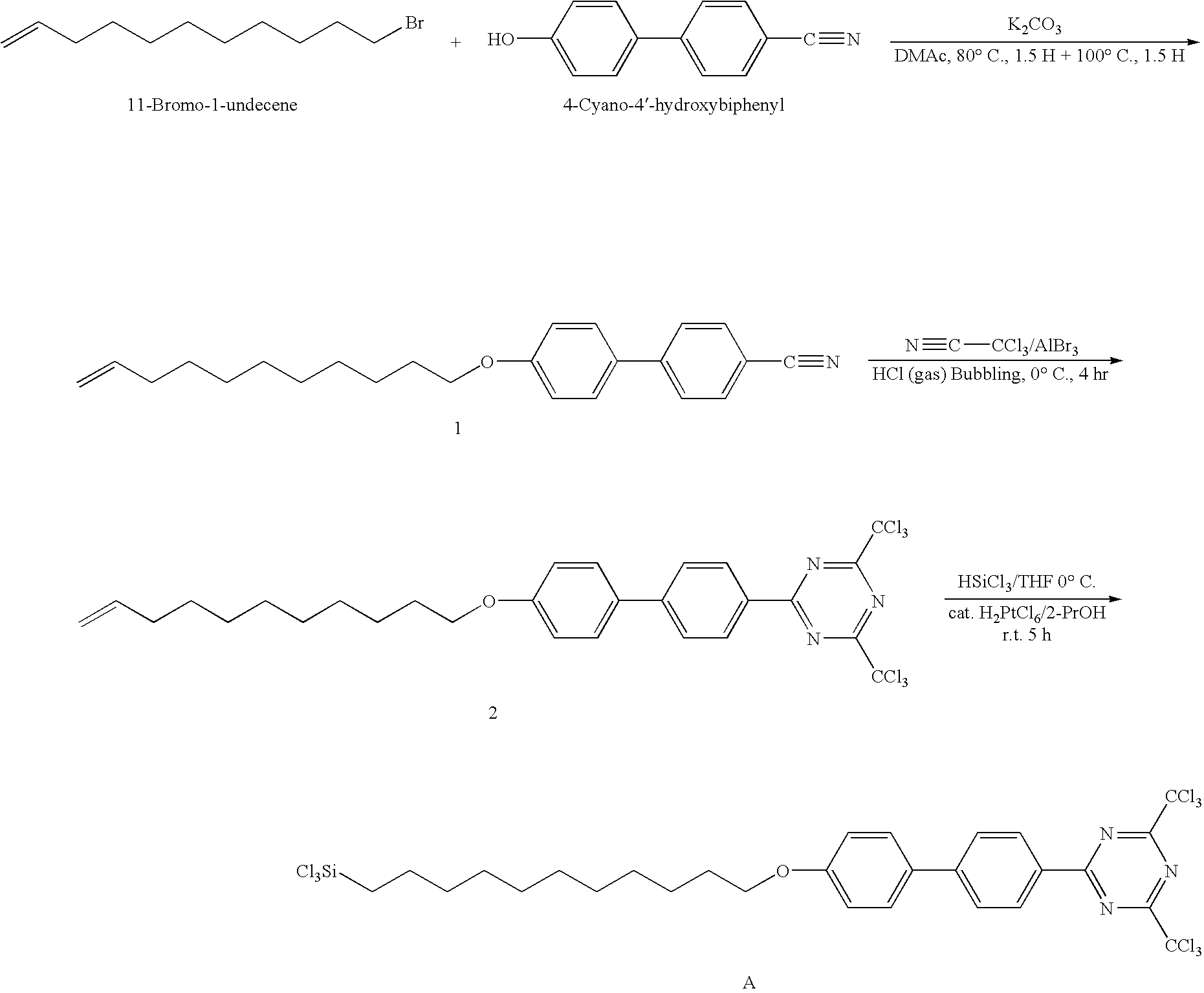
- SALNMNCKZVVZEZ-UHFFFAOYSA-M C=CCCCCCCCCCBr.C=CCCCCCCCCCOC1=CC=C(C2=CC=C(C#N)C=C2)C=C1.C=CCCCCCCCCCOC1=CC=C(C2=CC=C(C3=NC(C(Cl)(Cl)Cl)=NC(C(Cl)(Cl)Cl)=N3)C=C2)C=C1.CC#N.ClC(Cl)(Cl)C1=NC(C2=CC=C(C3=CC=C(OCCCCCCCCCCC[Si](Cl)(Cl)Cl)C=C3)C=C2)=NC(C(Cl)(Cl)Cl)=N1.N#CC1=CC=C(C2=CC=C(O)C=C2)C=C1.O=COO[K].[KH] Chemical compound C=CCCCCCCCCCBr.C=CCCCCCCCCCOC1=CC=C(C2=CC=C(C#N)C=C2)C=C1.C=CCCCCCCCCCOC1=CC=C(C2=CC=C(C3=NC(C(Cl)(Cl)Cl)=NC(C(Cl)(Cl)Cl)=N3)C=C2)C=C1.CC#N.ClC(Cl)(Cl)C1=NC(C2=CC=C(C3=CC=C(OCCCCCCCCCCC[Si](Cl)(Cl)Cl)C=C3)C=C2)=NC(C(Cl)(Cl)Cl)=N1.N#CC1=CC=C(C2=CC=C(O)C=C2)C=C1.O=COO[K].[KH] SALNMNCKZVVZEZ-UHFFFAOYSA-M 0.000 description 1
- CWHMFUCDQBICKW-UHFFFAOYSA-O CC(=O)OC1=CC2=C(C=C1)C1(OC(=O)C3=CC(N=[N+]=[N-])=CC=C31)C1=C(C=C(OC(C)=O)C=C1)O2.FP(F)[F-].N#[N+]C1=CC=C(OCC(=O)O)C=C1.[H]C(=[N+]=[N-])C(=O)CNC1=CC=C(C(=O)O)C=C1.[N-]=[N+]=NC1=CC=C(C(=O)ON2C(=O)C=CC2=O)C=C1.[N-]=[N+]=NC1=CC=C(C=O)C=C1.[N-]=[N+]=NC1=CC=C(CBr)C=C1.[N-]=[N+]=NC1=CC=C(CO)C=C1 Chemical compound CC(=O)OC1=CC2=C(C=C1)C1(OC(=O)C3=CC(N=[N+]=[N-])=CC=C31)C1=C(C=C(OC(C)=O)C=C1)O2.FP(F)[F-].N#[N+]C1=CC=C(OCC(=O)O)C=C1.[H]C(=[N+]=[N-])C(=O)CNC1=CC=C(C(=O)O)C=C1.[N-]=[N+]=NC1=CC=C(C(=O)ON2C(=O)C=CC2=O)C=C1.[N-]=[N+]=NC1=CC=C(C=O)C=C1.[N-]=[N+]=NC1=CC=C(CBr)C=C1.[N-]=[N+]=NC1=CC=C(CO)C=C1 CWHMFUCDQBICKW-UHFFFAOYSA-O 0.000 description 1
- PNRSBQHEOVYTMX-UHFFFAOYSA-N CCCCCCCCCCCCOC1=CC=C(C2=CC=C(C3=NC(C(Cl)(Cl)Cl)=NC(C(Cl)(Cl)Cl)=N3)C=C2)C=C1 Chemical compound CCCCCCCCCCCCOC1=CC=C(C2=CC=C(C3=NC(C(Cl)(Cl)Cl)=NC(C(Cl)(Cl)Cl)=N3)C=C2)C=C1 PNRSBQHEOVYTMX-UHFFFAOYSA-N 0.000 description 1
Images


Classifications
-
- G—PHYSICS
- G01—MEASURING; TESTING
- G01N—INVESTIGATING OR ANALYSING MATERIALS BY DETERMINING THEIR CHEMICAL OR PHYSICAL PROPERTIES
- G01N33/00—Investigating or analysing materials by specific methods not covered by groups G01N1/00 - G01N31/00
- G01N33/48—Biological material, e.g. blood, urine; Haemocytometers
- G01N33/50—Chemical analysis of biological material, e.g. blood, urine; Testing involving biospecific ligand binding methods; Immunological testing
- G01N33/53—Immunoassay; Biospecific binding assay; Materials therefor
- G01N33/543—Immunoassay; Biospecific binding assay; Materials therefor with an insoluble carrier for immobilising immunochemicals
- G01N33/54393—Improving reaction conditions or stability, e.g. by coating or irradiation of surface, by reduction of non-specific binding, by promotion of specific binding
Definitions
- the present invention relates to a method for producing a biosensor, and a method for analyzing an interaction between biomolecules using the above biosensor.
- the present invention relates to a method for producing a biosensor that is used as a surface plasmon resonance biosensor, and a method for analyzing an interaction between biomolecules using the above biosensor.
- SPR surface plasmon resonance
- QCM quartz crystal microbalance
- the SPR measurement technique is a method of measuring changes in the refractive index near an organic functional film attached to the metal film of a chip by measuring a peak shift in the wavelength of reflected light, or changes in amounts of reflected light in a certain wavelength, so as to detect adsorption and desorption occurring near the surface.
- the QCM measurement technique is a technique of detecting adsorbed or desorbed mass at the ng level, using a change in frequency of a crystal due to adsorption or desorption of a substance on gold electrodes of a quartz crystal (device).
- the ultra-fine particle surface (nm level) of gold is functionalized, and physiologically active substances are immobilized thereon. Thus, a reaction to recognize specificity among physiologically active substances is carried out, thereby detecting a substance associated with a living organism from sedimentation of gold fine particles or sequences.
- a commonly used measurement chip comprises a transparent substrate (e.g., glass), an evaporated metal film, and a thin film having thereon a functional group capable of immobilizing a physiologically active substance.
- the measurement chip immobilizes the physiologically active substance on the metal surface via the functional group.
- a specific binding reaction between the physiological active substance and a test substance is measured, so as to analyze an interaction between biomolecules.
- Japanese Patent No. 2815120 discloses in detail a method for producing hydrogel, which is used as a detection surface having a functional group capable of immobilizing a physiologically active substance, for example.
- a 16-mercaptohexadecanol layer binds to a gold film, so as to form a barrier layer.
- a hydroxyl group of the barrier layer is treated with epichlorohydrin so as to be epoxy-activated.
- dextran is allowed to bind to the barrier layer via an ether bond.
- bromoacetic acid is allowed to react with a dextran matrix, resulting in introduction of a carboxymethyl group.
- Residual charge that is, unreacted carboxyl groups would contribute to concentration of a physiologically active substance onto a detection surface.
- An aqueous solution of a physiologically active substance containing an amino group (a protein or amino acid) is allowed to come into contact with such a detection surface, so as to allow the physiologically active substance containing an amino group to bind to a dextran matrix via a covalent bond.
- hydrogel produced by the aforementioned method is able to immobilize a physiologically active substance containing an amino group in a three-dimensional manner, it has outstanding performance as a detection surface of biosensors.
- the aforementioned production method of hydrogel is complicated, and it requires a long production time. Further, since the above production method requires the use of compounds such as epichlorohydrin or bromoacetic acid, it has been problematic in terms of safety.
- the present inventors have found that a compound that generates a reactive group as a result of external stimulus is allowed to bind to the surface of a sensor substrate, and such external stimulus is then given to the substrate in a state where a hydrophilic polymer capable of forming a covalent bond with the above described reactive group has been allowed to come into contact with the above described substrate, so as to easily produce a biosensor surface to which a hydrophilic polymer has bound, thereby completing the present invention.
- the present invention provides a method for producing a biosensor comprising a substrate coated with a hydrophilic polymer, which comprises allowing a compound generating a reactive group as a result of external stimulus to bind to the surface of a substrate, and then giving external stimulus in a state where a hydrophilic polymer capable of forming a covalent bond with said reactive group is allowed to come into contact with the substrate, so that said hydrophilic polymer is allowed to bind to the substrate surface via a covalent bond with said reactive group.
- the compound generating a reactive group as a result of external stimulus is a photo radical generator.
- the hydrophilic polymer has a double bond.
- the hydrophilic polymer has a carboxyl group.
- the polymer containing a carboxyl group is a polysaccharide.
- the polymer containing a carboxyl group has a mean molecular weight between 1,000 and 5,000,000.
- the hydrophilic polymer is allowed to bind to a reactive group generated as a result of external stimulus in a state where a thin film of said polymer is formed on the substrate.
- the thin film is formed on the substrate by a spin coating method or a spray coating method.
- the substrate is a metal surface or a metal film.
- the metal is gold, silver, copper, platinum, or aluminum.
- Another aspect of the present invention provides a biosensor produced by the aforementioned method of the present invention.
- the biosensor of the present invention is used in non-electrochemical detection, and more preferably is used in surface plasmon resonance analysis.
- Another aspect of the present invention provides a method for immobilizing a physiologically active substance on a biosensor, which comprises a step of allowing the aforementioned biosensor of the present invention to come into contact with a physiologically active substance, so as to allow said physiologically active substance to bind to said biosensor.
- Another aspect of the present invention provides a method for detecting or measuring a substance interacting with a physiologically active substance, which comprises a step of allowing the biosensor of the present invention, to the surface of which said physiologically active substance is bound via a covalent bond, to come into contact with a test substance.
- a substance interacting with the physiologically active substance is detected or measured by a non-electrochemical method, and is more preferably detected or measured by surface plasmon resonance analysis.
- FIG. 1 shows a sensorgram obtained by setting samples 1 to 3 produced in Example 3 in a surface plasmon resonance device, supplying each of an EDC/NHS solution, a CA solution, and an ethanolamine solution thereto for 5 minutes, and then supplying NaOH thereto.
- the biosensor of the present invention has as broad a meaning as possible, and the term biosensor is used herein to mean a sensor, which converts an interaction ein to mean a sensor, which converts an interaction between biomolecules into a signal such as an electric signal, so as to measure or detect a target substance.
- the conventional biosensor is comprised of a receptor site for recognizing a chemical substance as a detection target and a transducer site for converting a physical change or chemical change generated at the site into an electric signal.
- substances having an affinity with each other such as enzyme/substrate, enzyme/coenzyme, antigen/antibody, or hormone/receptor.
- the biosensor operates on the principle that a substance having an affinity with another substance, as described above, is immobilized on a substrate to be used as a molecule-recognizing substance, so that the corresponding substance can be selectively measured.
- a metal surface or metal film can be used as a substrate.
- a metal constituting the metal surface or metal film is not particularly limited, as long as surface plasmon resonance is generated when the metal is used for a surface plasmon resonance biosensor.
- Examples of a preferred metal may include free-electron metals such as gold, silver, copper, aluminum or platinum. Of these, gold is particularly preferable. These metals can be used singly or in combination.
- an interstitial layer consisting of chrome or the like may be provided between the substrate and a metal layer.
- the film thickness of a metal film is not limited.
- the thickness is preferably between 0.1 nm and 500 nm, and particularly preferably between 1 nm and 200 nm. If the thickness exceeds 500 nm, the surface plasmon phenomenon of a medium cannot be sufficiently detected.
- the thickness of the interstitial layer is preferably between 0.1 nm and 10 nm.
- Formation of a metal film may be carried out by common methods, and examples of such a method may include sputtering method, evaporation method, ion plating method, electroplating method, and nonelectrolytic plating method.
- a metal film is preferably placed on a substrate.
- placed on a substrate is used herein to mean a case where a metal film is placed on a substrate such that it directly comes into contact with the substrate, as well as a case where a metal film is placed via another layer without directly coming into contact with the substrate.
- examples of such a substrate may include, generally, optical glasses such as BK7, and synthetic resins. More specifically, materials transparent to laser beams, such as polymethyl methacrylate, polyethylene terephthalate, polycarbonate or a cycloolefin polymer, can be used.
- materials that are not anisotropic with regard to polarized light and have excellent workability are preferably used.
- a compound generating a reactive group as a result of external stimulus onto a biosensor surface, that is, onto a metal film, a compound generating a reactive group as a result of external stimulus is bound.
- a compound generating a reactive group as a result of external stimulus may be either a compound generating a radical by heat (a heat radical generator), or a compound generating a radical by light (a photo radical generator).
- a compound may also be a compound that is known as a photoaffinity labeling reagent.
- a heat radical generator a known polymerization initiator, a compound having a bond whose bond dissociation energy is small, and the like, can be used.
- a heat radical generator may include an organic halogenated compound, a carbonyl compound, an organic peroxide, an azo polymerization initiator, an azide compound, a metallocene compound, a hexaaryl biimidazole compound, an organic boric acid compound, a disulfonic acid compound, an oxime ester compound, and an onium salt compound.
- These heat radical generators may be used either singly or in combination of two or more types. Specific compound skeletons of such a heat radical generator are disclosed in chemical formulas 4 to 14 of JP Patent Publication (Kokai) No. 2005-335366A.
- a photo radical generator has a single bond that is cleaved by light.
- Examples of such a single bond that is cleaved by light may include single bonds that are capable of being cleaved by utilizing carbonyl ⁇ and ⁇ cleavage reactions, a photo-Fries rearrangement reaction, a phenacyl ester cleavage reaction, a sulfonimide cleavage reaction, a sulfonyl ester cleavage reaction, an N-hydroxysulfonyl ester cleavage reaction, a benzylimide cleavage reaction, an active halogenated compound cleavage reaction, or the like.
- Examples of such a single bond, which can be cleaved may include a C—C bond, a C—N bond, a C—O bond, a C—Cl bond, an N—O bond, and an S—N bond.
- Examples of a group having a single bond that is cleaved by light may include an aromatic ketone group, a phenacyl ester group, a sulfonimide group, a sulfonyl ester group, an N-hydroxysulfonyl ester group, a benzylimide group, a trichloromethyl group, and a benzyl chloride group.
- a photo radical generator preferably has a reactive group (a substrate-binding group), which reacts with a functional group existing on the surface of a substrate and is able to bind thereto.
- a reactive group is the following group: Q: substrate-binding group —SiO(OMe) 3 —SiCl 3 —NCO—CH 2 Cl
- a group having a single bond that is cleaved by light may directly bind to a substrate-binding group, or may bind thereto via a linking group.
- the linking group may include linking groups containing an atom selected from the group consisting of a carbon atom, a nitrogen atom, an oxygen atom, and a sulfur atom.
- Specific examples of the linking group may include a saturated carbon group, an aromatic group, an ester group, an amide group, a ureido group, an ether group, an amino group, and a sulfonamide group.
- the linking group may also have a substituent. Examples of the introducible substituent may include an alkyl group, an alkoxy group, and a halogen atom.
- photo radical generators may be used either singly or in combination of two or more types.
- Specific compound skeletons of the photo radical generator are disclosed in chemical formulas 2 to 4 of JP Patent Publication (Kokai) No. 2005-277225A, but examples are not limited thereto.
- a compound used in photoaffinity labeling can also preferably be used.
- active species generated from a photoaffinity labeling compound as a result of light irradiation may include nitrene, carbene, radical, ion radical, diradical, excited triplet, and a carbon electrophilic reagent such as carbocation.
- Examples of a photoaffinity labeling compound that generates such active species as a result of light irradiation are described in Summary of S. A. Flemig, Tetrahedron, Vol. 51, pp. 12479-12520, 1995, and Summary of Yasumaru Hatanaka, Journal of Synthetic Organic Chemistry, Japan, Vol.
- examples of a compound generating nitrene may include compounds having an azide group, such as aromatic azide, alkyl azide, or heterocyclic azide.
- examples of a compound generating carbene may include compounds having a diazo group or a diazirine ring.
- examples of a compound generating a radical may include conjugated ketones such as benzophenones or enones, aromatic halides, and olefins.
- Examples of a compound generating a carbon nucleophilic reagent may include an aromatic diazonium salt, nitrobenzenes, a sulfonium salt, a phosphonium salt, and an ammonium salt.
- photoreactive compounds Since these photoreactive compounds have their own characteristics, they may be selected and used depending on use conditions. From the viewpoint of relatively high safety, a compound having a diazirine ring is preferable. From the viewpoint of safety and the ease of synthesis, conjugated ketones, aromatic halides, olefins, and the like are preferable. These photoaffinity labeling compounds may be used singly or in combination of two or more types. Specific compound skeletons of such photoaffinity labeling compounds include the following skeletons described in chemical formula 3 of JP Patent Publication (Kokai) No. 2004-301681A, but examples are not limited thereto.
- a compound generating a reactive group as a result of external stimulus is preferably a photo radical generator or a photoaffinity labeling compound.
- a compound generating a reactive group as a result of external stimulus preferably binds to a metal film coated with a self-assembled monolayer.
- a method of coating metal films with self-assembled monolayers (SAMs) has been intensively studied by Professor Whitesides at Harvard University, and the details thereof are described in Chemical Review, 105, 1103-1169 (2005), for example.
- SAMs self-assembled monolayers
- an alkanethiol derivative represented by formula 1 (wherein n represents an integer between 3 and 20, and X represents a functional group) is used as an organic layer-forming compound, so that a monomolecular film having orientation can be formed in a self-assemble manner, based on an Au—S bond and the van der Waals force between alkyl chains.
- a self-assembled monolayer is produced by an extremely easy method, which comprises immersion of a gold substrate in a solution of an alkanethiol derivative. From the viewpoint of easy bindability of a reactive group due to external stimulus, it is preferable to use a self-assembled monolayer having an amino group in the present invention.
- a self-assembled monolayer using a compound wherein X ⁇ NH 2 in formula 1, it becomes possible to coat a gold surface with an organic layer having an amino group.
- Alkanethiol having an amino group at the terminus thereof may be either a compound wherein a thiol group is connected with an amino group via an alkyl chain (formula 2) (in formula 2, n represents an integer between 3 and 20), or a compound obtained by allowing alkanethiol having a carboxyl group at the terminus thereof (formulas 3 and 4) (in formula 3, n represents an integer between 3 and 20, and in formula 4, n independently represents an integer between 1 and 20) to react with an excessive amount of hydrazide or polyamine.
- Such a reaction between alkanethiol having a carboxyl group at the terminus thereof and an excessive amount of hydrazide or polyamine may be carried out in a solution state. Otherwise, after alkanethiol having a carboxyl group at the terminus thereof has been allowed to bind to the surface of a substrate, an excessive amount of hydrazide or polyamine may be allowed to react therewith.
- polyamine that can be preferably used in the present invention may include: aliphatic diamines such as ethylenediamine, tetraethylenediamine, octamethylenediamine, decamethylenediamine, piperazine, triethylenediamine, diethylenetriamine, triethylenetetramine, dihexamethylenetriamine, or 1,4-diaminocyclohexane; aromatic diamines such as paraphenylene diamine, metaphenylenediamine, paraxylylenediamine, metaxylylenediamine, 4,4′-diaminobiphenyl, 4,4′-diaminodiphenylmethane, 4,4′-diaminodiphenylketone, or 4,4′-diaminodiphenylsulfonic acid; and polyamines such as diethylenetriamine, triethylenetetramine, tetraethylenepentamine, pentaethylenehexamine, spermidine, spermine, or
- Alkanethiol having an amino group can also form a self-assembled monolayer by itself. Otherwise, such alkanethiol can be mixed with another alkanethiol, so as to form a self-assembled monolayer.
- a compound capable of suppressing non-specific adsorption of a physiologically active substance is preferably used as another alkanethiol.
- Such a self-assembled monolayer capable of suppressing non-specific adsorption of a physiologically active substance has been studied in detail by the aforementioned Professor Whitesides et al. Professor Whitesides et al.
- alkanethiol having a hydrophilic group is effective for suppression of non-specific adsorption (Langmuir, 17, 2841-2850, 5605-5620, 6336-6343 (2001)).
- alkanethiol forming a mixed monomolecular film together with alkanethiol having an amino group a compound described in the aforementioned article can be preferably used.
- alkanethiol forming a mixed monomolecular film together with alkanethiol having an amino group that is preferably used may include alkanethiol having a hydroxyl group (formula 6) and alkanethiol having an ethylene glycol unit (formula 7) (in formula 6, n represents an integer between 3 and 20, and in formula 7, n and m independently represent an integer between 1 and 20).
- alkanethiol having an amino group it is possible to mix alkanethiol having an amino group with alkanethiol having a hydrophilic group at any given ratio.
- the ratio of alkanethiol having an amino group is small, the binding amount of a polymer that contains an active esterified carboxyl group is decreased.
- the ratio of alkanethiol having a hydrophilic group is small, ability to suppress non-specific adsorption is reduced.
- the mixing ratio between alkanethiol having an amino group and alkanethiol having a hydrophilic group is preferably between 1/1 and 1/1,000,000, more preferably between 1/4 and 1/10,000, and further more preferably between 1/10 and 1/1,000.
- the molecular length of alkanethiol having an amino group is preferably longer than that of alkanethiol having a hydrophilic group.
- alkanethiol used in the present invention a compound synthesized based on the summary of Professor Grzybowski at Northwestern University (Curr. Org. Chem., 8, 1763-1797 (2004)) and the cited documents thereof may be used, or a commercially available compound may also be used. Such compounds are available from Dojindo Laboratories, Aldrich, SensoPath Technologies, Frontier Scientific Inc., etc. A disulfide compound that is the oxidation product of alkanethiol can be used as with alkanethiol in the present invention.
- hydrophilic polymer As a hydrophilic polymer that can be used in the present invention, a known compound can be used. When the use as a sensor surface is considered, such a hydrophilic polymer is preferably a polymer containing a carboxyl group, which is able to form a covalent bond together with the amino group of a physiologically active substance. Such a hydrophilic polymer should covalently bind to a reactive group generated as a result of external stimulus. Accordingly, such a hydrophilic polymer preferably has a C—H bond that enables hydrogen abstraction, an unsaturated double bond, or a functional group such as an epoxy group or an oxetane group.
- a hydrophilic polymer into which a double bond has been introduced, is preferable.
- a reaction with functional groups such as a carboxyl group, an amino group or a salt thereof, a hydroxyl group, or an ethoxy group, which exist in a hydrophilic polymer
- a compound used to introduce a double bond in this reaction may include (meth)acrylic acid, glycidyl (meth)acrylate, allyl glycidyl ether, 2-isocyanatoethyl (meth)acrylate, and 2-aminoethyl (meth)acrylate.
- a functional group such as 2-methyl-2-bromopropionic acid
- a carboxyl group-containing synthetic polymer and a carboxyl group-containing polysaccharide can be used as a polymer containing a carboxyl group used in the present invention.
- a carboxyl group-containing synthetic polymer may include polyacrylic acid, polymethacrylic acid, and their copolymers such as a methacrylic acid copolymer, an acrylic acid polymer, an itaconic acid copolymer, a crotonic acid copolymer, a maleic acid copolymer, a partially esterified maleic acid copolymer, and a polymer having a hydroxyl group to which an acid anhydride is added, which are described in JP Patent Publication (Kokai) No.
- Such a carboxyl group-containing polysaccharide may be any one selected from an extract from natural plants, a product obtained by fermentation by microorganisms, a synthetic product obtained by enzymes, and a chemically synthetic product.
- carboxyl group-containing polysaccharide may include hyaluronic acid, chondroitin sulfuric acid, heparin, dermatan sulfate, carboxymethyl cellulose, carboxyethyl cellulose, cellouronic acid, carboxymethyl chitin, carboxymethyl dextran, and carboxymethyl starch.
- a carboxyl group-containing polysaccharide a commercially available product can be used.
- carboxyl group-containing polysaccharide may include CMD, CMD-L and CMD-D40 (manufactured by Meito Sangyo Co., Ltd.), which are carboxymethyl dextrans, carboxymethylcellulose sodium (manufactured by Wako Pure Chemical Industries, Ltd.), and sodium alginate (manufactured by Wako Pure Chemical Industries, Ltd.).
- a polymer containing a carboxyl group is preferably a polysaccharide containing a carboxyl group, and more preferably carboxymethyl dextran.
- the molecular weight of the polymer containing a carboxyl group used in the present invention is not particularly limited.
- the mean molecular weight is preferably between 1,000 and 5,000,000, more preferably between 10,000 and 2,000,000, and further more preferably between 100,000 and 1,000,000.
- the mean molecular weight is smaller than the above described range, the amount of a physiologically active substance immobilized becomes small.
- the mean molecular weight is larger than the above described range, it causes a high solution viscosity, and it thereby becomes hard to deal with it.
- a hydrophilic polymer which is in the form of a solution, may be allowed to react with a substrate. Otherwise, it may also be allowed to react therewith in a state where a thin film has been formed on a substrate by methods such as spin coating. The reaction is preferably carried out in a state where a thin film has been formed is preferable.
- the hydrophilic polymer of the present invention may be preferably allowed to react with a substrate in the state of a thin film.
- a method for forming a thin film on a substrate known methods can be used. Specific examples of such methods that can be used include an extrusion coating method, a curtain coating method, a casting method, a screen printing method, a spin coating method, a spray coating method, a slide bead coating method, a slit and spin method, a slit coating method, a dye coating method, a dip coating method, a knife coating method, a blade coating method, a flow coating method, a roll coating method, a wire-bar coating method, and a transfer printing method.
- a spray coating method or a spin coating method is preferable. Further, a spin coating method is more preferable. This is because it allows a coating film having a controlled film thickness to be readily produced.
- the spray coating method is a method wherein a substrate is moved with an ultra-atomized polymer solution sprayed onto the substrate to thereby uniformly coat the polymer solution onto the substrate.
- an air valve and a needle valve are simultaneously opened.
- the polymer solution is ejected in the form of a fine mist from a nozzle, and this polymer solution in the form of a fine mist is further ultra-atomized by air ejected from an air cap located at the end of the nozzle.
- a thickness-controlled polymer film is easily produced by forming the coating film of the ultra-atomized polymer solution on the substrate surface, followed by the evaporation of the solvent.
- the thickness of the polymer thin film can be controlled on the basis of the concentration of the polymer solution, the moving speed of the substrate, and so on.
- the spin coating method is a method wherein a polymer solution is added dropwise onto a substrate placed horizontally, which is then spun at a high speed to thereby uniformly coat the polymer solution onto the whole surface of the substrate through a centrifugal force.
- a thickness-controlled polymer film is easily produced with the scattering of the polymer solution through a centrifugal force and the evaporation of the solvent.
- the thickness of the polymer thin film can be controlled on the basis of the revolution speed, the concentration of the polymer solution, the vapor pressure of the solvent, and so on.
- the revolution speed during spin coating is not particularly limited. If the revolution speed is too small, the solution remains on the substrate. If the revolution speed is too large, an available apparatus is restricted.
- the revolution speed during spin coating is preferably 500 rpm to 10,000 rpm, more preferably 1,000 rpm to 7,000 rpm.
- a polymer containing a carboxyl group is activated by a known method using water-soluble carbodiimide, 1-(3-dimethylaminopropyl)-3 ethylcarbodiimide (EDC), and N-hydroxysuccinimide (NHS), for example, so that it is able to immobilize a physiologically active substance having an amino group.
- EDC 1-(3-dimethylaminopropyl)-3 ethylcarbodiimide
- NHS N-hydroxysuccinimide
- 2006-58071A that is, a method of activating a carboxyl group existing on the surface of a substrate using any compound selected from a uronium salt, a phosphonium salt, and a triazine derivative, which have a specific structure, so as to form a carboxylic amide group
- 2006-90781A (that is, a method, which comprises activating a carboxyl group existing on the surface of a substrate using a carbodiimide derivative or a salt thereof, converting the resultant to an ester using any compound selected from a nitrogen-containing hetero aromatic compound having a hydroxyl group, a phenol derivative having an electron attracting group, and an aromatic compound having a thiol group, and allowing the ester to react with amine, so as to form a carboxylic amide group) can preferably be used.
- the aforementioned uronium salt, phosphonium salt, and triazine derivative which have a specific structure, described in Japanese Patent Application No. 2004-238396 (JP Patent Publication (Kokai) No. 2006-58071A), mean the uronium salt represented by the following formula 1, the phosphonium salt represented by the following formula 2, and the triazine derivative represented by the following formula 3, respectively.
- each of R 1 and R 2 independently represents an alkyl group containing 1 to 6 carbon atoms, or R 1 and R 2 together form an alkylene group containing 2 to 6 carbon atoms, which forms a ring together with an N atom
- R 3 represents an aromatic ring group containing 6 to 20 carbon atoms, or a hetero ring group containing at least one heteroatom
- X ⁇ represents an anion
- each of R 4 and R 5 independently represents an alkyl group containing 1 to 6 carbon atoms, or R 4 and R 5 together form an alkylene group containing 2 to 6 carbon atoms, which forms a ring together with an N atom
- R 6 represents an aromatic ring group containing 6 to 20 carbon atoms, or a hetero ring group containing at least one heteroatom
- X ⁇ represents an anion
- R 7 represents an onium group
- each of R 8 and R 9 independently represents an electron donating group.
- a physiologically active substance immobilized on the surface for the biosensor of the present invention is not particularly limited, as long as it interacts with a measurement target.
- a substance may include an immune protein, an enzyme, a microorganism, nucleic acid, a low molecular weight organic compound, a nonimmune protein, an immunoglobulin-binding protein, a sugar-binding protein, a sugar chain recognizing sugar, fatty acid or fatty acid ester, and polypeptide or oligopeptide having a ligand-binding ability.
- an immune protein may include an antibody whose antigen is a measurement target, and a hapten.
- examples of such an antibody may include various immunoglobulins such as IgG, IgM, IgA, IgE or IgD. More specifically, when a measurement target is human serum albumin, an anti-human serum albumin antibody can be used as an antibody.
- an antigen is an agricultural chemical, pesticide, methicillin-resistant Staphylococcus aureus , antibiotic, narcotic drug, cocaine, heroin, crack or the like
- an anti-atrazine antibody anti-kanamycin antibody, anti-metamphetamine antibody, or antibodies against O antigens 26, 86, 55, 111 and 157 among enteropathogenic Escherichia coli.
- An enzyme used as a physiologically active substance herein is not particularly limited, as long as it exhibits an activity to a measurement target or substance metabolized from the measurement target.
- Various enzymes such as oxidoreductase, hydrolase, isomerase, lyase or synthetase can be used. More specifically, when a measurement target is glucose, glucose oxidase is used, and when a measurement target is cholesterol, cholesterol oxidase is used.
- a measurement target is an agricultural chemical, pesticide, methicillin-resistant Staphylococcus aureus , antibiotic, narcotic drug, cocaine, heroin, crack or the like
- enzymes such as acetylcholine esterase, catecholamine esterase, noradrenalin esterase or dopamine esterase, which show a specific reaction with a substance metabolized from the above measurement target, can be used.
- a microorganism used as a physiologically active substance herein is not particularly limited, and various microorganisms such as Escherichia coli can be used.
- nucleic acid those complementarily hybridizing with nucleic acid as a measurement target can be used.
- Either DNA (including cDNA) or RNA can be used as nucleic acid.
- the type of DNA is not particularly limited, and any of native DNA, recombinant DNA produced by gene recombination and chemically synthesized DNA may be used.
- any given compound that can be synthesized by a common method of synthesizing an organic compound can be used.
- a nonimmune protein used herein is not particularly limited, and examples of such a nonimmune protein may include avidin (streptoavidin), biotin, and a receptor.
- immunoglobulin-binding protein examples include protein A, protein G, and a rheumatoid factor (RF).
- RF rheumatoid factor
- sugar-binding protein for example, lectin is used.
- fatty acid or fatty acid ester may include stearic acid, arachidic acid, behenic acid, ethyl stearate, ethyl arachidate, and ethyl behenate.
- a biosensor to which a physiologically active substance is immobilized as described above can be used to detect and/or measure a substance which interacts with the physiologically active substance.
- a nonelectric chemical method may include a surface plasmon resonance (SPR) measurement technique, a quartz crystal microbalance (QCM) measurement technique, and a measurement technique that uses functional surfaces ranging from gold colloid particles to ultra-fine particles.
- SPR surface plasmon resonance
- QCM quartz crystal microbalance
- the biosensor of the present invention can be used as a biosensor for surface plasmon resonance which is characterized in that it comprises a metal film placed on a transparent substrate.
- a biosensor for surface plasmon resonance is a biosensor used for a surface plasmon resonance biosensor, meaning a member comprising a portion for transmitting and reflecting light emitted from the sensor and a portion for immobilizing a physiologically active substance. It may be fixed to the main body of the sensor or may be detachable.
- the surface plasmon resonance phenomenon occurs due to the fact that the intensity of monochromatic light reflected from the border between an optically transparent substance such as glass and a metal thin film layer depends on the refractive index of a sample located on the outgoing side of the metal. Accordingly, the sample can be analyzed by measuring the intensity of reflected monochromatic light.
- a device using a system known as the Kretschmann configuration is an example of a surface plasmon measurement device for analyzing the properties of a substance to be measured using a phenomenon whereby a surface plasmon is excited with a lightwave (for example, Japanese Patent Laid-Open No. 6-167443).
- the surface plasmon measurement device using the above system basically comprises a dielectric block formed in a prism state, a metal film that is formed on a face of the dielectric block and comes into contact with a measured substance such as a sample solution, a light source for generating a light beam, an optical system for allowing the above light beam to enter the dielectric block at various angles so that total reflection conditions can be obtained at the interface between the dielectric block and the metal film, and a light-detecting means for detecting the state of surface plasmon resonance, that is, the state of attenuated total reflection, by measuring the intensity of the light beam totally reflected at the above interface.
- a relatively thin light beam may be caused to enter the above interface while changing an incident angle.
- a relatively thick light beam may be caused to enter the above interface in a state of convergent light or divergent light, so that the light beam contains components that have entered therein at various angles.
- the light beam whose reflection angle changes depending on the change of the incident angle of the entered light beam can be detected with a small photodetector moving in synchronization with the change of the above reflection angle, or it can also be detected with an area sensor extending along the direction in which the reflection angle is changed. In the latter case, the light beam can be detected with an area sensor extending to a direction capable of receiving all the light beams reflected at various reflection angles.
- a surface plasmon measurement device with the above structure, if a light beam is allowed to enter the metal film at a specific incident angle greater than or equal to a total reflection angle, then an evanescent wave having an electric distribution appears in a measured substance that is in contact with the metal film, and a surface plasmon is excited by this evanescent wave at the interface between the metal film and the measured substance.
- the wave vector of the evanescent light is the same as that of a surface plasmon and thus their wave numbers match, they are in a resonance state, and light energy transfers to the surface plasmon. Accordingly, the intensity of totally reflected light is sharply decreased at the interface between the dielectric block and the metal film.
- This decrease in light intensity is generally detected as a dark line by the above light-detecting means.
- the above resonance takes place only when the incident beam is p-polarized light. Accordingly, it is necessary to set the light beam in advance such that it enters as p-polarized light.
- the dielectric constant of a measured substance can be determined.
- a light-detecting means in the form of an array is considered to be used for the above type of surface plasmon measurement device in order to measure the attenuated total reflection angle ( ⁇ SP) with high precision and in a large dynamic range.
- This light-detecting means comprises multiple photo acceptance units that are arranged in a certain direction, that is, a direction in which different photo acceptance units receive the components of light beams that are totally reflected at various reflection angles at the above interface.
- a leaking mode measurement device described in “Bunko Kenkyu (Spectral Studies)” Vol. 47, No. 1 (1998), pp. 21 to 23 and 26 to 27 has also been known as an example of measurement devices similar to the above-described device using attenuated total reflection (ATR).
- This leaking mode measurement device basically comprises a dielectric block formed in a prism state, a clad layer that is formed on a face of the dielectric block, a light wave guide layer that is formed on the clad layer and comes into contact with a sample solution, a light source for generating a light beam, an optical system for allowing the above light beam to enter the dielectric block at various angles so that total reflection conditions can be obtained at the interface between the dielectric block and the clad layer, and a light-detecting means for detecting the excitation state of waveguide mode, that is, the state of attenuated total reflection, by measuring the intensity of the light beam totally reflected at the above interface.
- the leaking mode measurement device In the leaking mode measurement device with the above structure, if a light beam is caused to enter the clad layer via the dielectric block at an incident angle greater than or equal to a total reflection angle, only light having a specific wave number that has entered at a specific incident angle is transmitted in a waveguide mode into the light wave guide layer, after the light beam has penetrated the clad layer. Thus, when the waveguide mode is excited, almost all forms of incident light are taken into the light wave guide layer, and thereby the state of attenuated total reflection occurs, in which the intensity of the totally reflected light is sharply decreased at the above interface.
- the refractive index of the measurement substance or the properties of the measured substance associated therewith can be analyzed by determining the above specific incident angle causing the attenuated total reflection.
- the above-described array-form light-detecting means can be used to detect the position of a dark line generated in a reflected light due to attenuated total reflection.
- the above-described differentiating means can also be applied in combination with the above means.
- the above-described surface plasmon measurement device or leaking mode measurement device may be used in random screening to discover a specific substance binding to a desired sensing substance in the field of research for development of new drugs or the like.
- a sensing substance is immobilized as the above-described measured substance on the above thin film layer (which is a metal film in the case of a surface plasmon measurement device, and is a clad layer and a light guide wave layer in the case of a leaking mode measurement device), and a sample solution obtained by dissolving various types of test substance in a solvent is added to the sensing substance. Thereafter, the above-described attenuated total reflection angle ( ⁇ SP) is measured periodically when a certain period of time has elapsed.
- ⁇ SP attenuated total reflection angle
- the above attenuated total reflection angle ( ⁇ SP) is measured periodically after the elapse of a certain time, and it is determined whether or not a change has occurred in the above attenuated total reflection angle ( ⁇ SP), so that a binding state between the test substance and the sensing substance is measured. Based on the results, it can be determined whether or not the test substance is a specific substance binding to the sensing substance.
- a specific substance and a sensing substance may include an antigen and an antibody, and an antibody and an antibody. More specifically, a rabbit anti-human IgG antibody is immobilized as a sensing substance on the surface of a thin film layer, and a human IgG antibody is used as a specific substance.
- ⁇ SP attenuated total reflection angle
- a binding state between a sensing substance and a test substance can be measured (Japanese Patent Application No. 2000-398309 filed by the present applicant).
- a sample solution consisting of a solvent and a test substance is added dropwise to a cup- or petri dish-shaped measurement chip wherein a sensing substance is immobilized on a thin film layer previously formed at the bottom, and then, the above-described amount by which an attenuated total reflection angle ( ⁇ SP) has changed is measured.
- ⁇ SP attenuated total reflection angle
- Japanese Patent Laid-Open No. 2001-330560 describes a measurement device using attenuated total reflection, which involves successively measuring multiple measurement chips mounted on a turntable or the like, so as to measure many samples in a short time.
- the biosensor of the present invention When used in surface plasmon resonance analysis, it can be applied as a part of various surface plasmon measurement devices described above.
- carboxymethyl dextran (abbreviated name: CMD-D40; manufactured by Meito Sangyo Co., Ltd.; molecular weight: 40,000) (0.02 mol/1 unit, 0.02 mol/sodium carboxylate) and 1.8 g (0.01 mol) of 2-aminoethyl methacrylate hydrochloride (90%) were dissolved in 40 g of distilled water.
- carboxymethyl dextran (abbreviated name: CMD; manufactured by Meito Sangyo Co., Ltd.; molecular weight: 1,000,000) (0.02 mol/1 unit, 0.013 mol/sodium carboxylate) and 2.4 g (0.013 mol) of 2-aminoethyl methacrylate hydrochloride (90%) were dissolved in 320 g of distilled water.
- the present example relates to production of a sensor chip for immobilizing a protein.
- the sensor chip CM-5 (research grade) of Biacore was directly used as sample 1 that was a surface to which carboxymethyl dextran bound.
- Compound A was dissolved in anhydrous MEK, so as to prepare a 0.5 wt % solution.
- a gold chip produced in (2-1) was spin-coated with a photo initiator solution (1,000 rpm; 20 sec), and it was then dried (80° C.; 5 minutes). Thereafter, MEK was applied to the chip, so as to wash the surface thereof.
- 0.05 g of compound 3 was dissolved in 5.0 g of water, 1 droplet of a saturated saline solution, and 1.5 g of acetonitrile, so as to prepare a 0.76 wt % solution.
- the thus obtained solution was applied onto the surface of the gold chip produced in (3-2) using a bar #36, and it was then dried (80° C.; 2 minutes), so as to prepare a dry film.
- UVX-02516S1LP01 high pressure mercury lamp; manufactured by USHIO
- the film was exposed for 0.5 minutes and 1 minute, and it was then immersed in water for 12 hours for development.
- a polymer remaining on the surface was removed by washing with underwater ultrasound for 5 minutes.
- the present example relates to immobilization of a protein on the sensor chip obtained in Example 3.
- CA Carbonic Anhydrase; manufactured by SIGMA
- the isoelectric point of the used CA was approximately 5.8 by comparing with the simultaneously measured marker (Broad pI Kit; pH 3.5-9.3; manufactured by Amersham Biosciences) in an electrophoresis experiment using AE-8150 of ATTO.
- 10 ⁇ l was weighed from a solution prepared by dissolving 1 mg of CA in 1 ml of an HBS-EP buffer (manufactured by Biacore; 0.01 M HEPES, pH 7.4, 0.15M NaCl, 0.005% Surfactant P20, 3 mM EDTA). Thereafter, 90 ⁇ l of an acetate buffer (manufactured by Biacore; pH 5.0) was added to the above solution, so as to prepare a 0.1 mg/ml CA solution (pH 5.0; 0.1 mg/ml).
- each of samples 1 to 3 produced in Example 3 was set in Biacore 3000, a surface plasmon resonance device manufactured by Biacore. Thereafter, each of an aqueous solution containing 0.4 M EDC and 0.1 M NHS, a CA solution (pH 5.0; 0.1 mg/ml), and an ethanolamine solution (Biacore) was supplied for 5 minutes, and 10 mM NaOH was then supplied for 1 minute ⁇ 2 times. Immobilization was examined in this case. As a running buffer, an HBS-N buffer (manufactured by Biacore; 0.01 M HEPES, pH 7.4, 0.15 M NaCl) was used. The obtained sensorgram is shown in FIG. 1 .
- the amounts of CA immobilized were 7757 RU (sample 1: comparative example), 13983 RU (sample 2: the present invention), and 34807 RU (sample 3: the present invention).
- sample 1 comparative example
- 13983 RU sample 2
- 34807 RU sample 3
- hydrogel capable of immobilizing a physiologically active substance on a biosensor surface, using a safe raw material.
Landscapes
- Health & Medical Sciences (AREA)
- Immunology (AREA)
- Life Sciences & Earth Sciences (AREA)
- Engineering & Computer Science (AREA)
- Chemical & Material Sciences (AREA)
- Hematology (AREA)
- Urology & Nephrology (AREA)
- Biomedical Technology (AREA)
- Molecular Biology (AREA)
- Microbiology (AREA)
- Cell Biology (AREA)
- Biotechnology (AREA)
- Chemical Kinetics & Catalysis (AREA)
- Food Science & Technology (AREA)
- Medicinal Chemistry (AREA)
- Physics & Mathematics (AREA)
- Analytical Chemistry (AREA)
- Biochemistry (AREA)
- General Health & Medical Sciences (AREA)
- General Physics & Mathematics (AREA)
- Pathology (AREA)
- Investigating Or Analysing Materials By Optical Means (AREA)
Abstract
Description
Q: substrate-binding group —SiO(OMe)3—SiCl3—NCO—CH2Cl


(in
Claims (20)


Applications Claiming Priority (3)
| Application Number | Priority Date | Filing Date | Title |
|---|---|---|---|
| JP2006049761 | 2006-02-27 | ||
| JP049761/2006 | 2006-02-27 | ||
| JP2006-049761 | 2006-02-27 |
Publications (2)
| Publication Number | Publication Date |
|---|---|
| US20070266775A1 US20070266775A1 (en) | 2007-11-22 |
| US8580571B2 true US8580571B2 (en) | 2013-11-12 |
Family
ID=38001791
Family Applications (1)
| Application Number | Title | Priority Date | Filing Date |
|---|---|---|---|
| US11/710,433 Expired - Fee Related US8580571B2 (en) | 2006-02-27 | 2007-02-26 | Method for producing a biosensor |
Country Status (2)
| Country | Link |
|---|---|
| US (1) | US8580571B2 (en) |
| EP (1) | EP1826564B1 (en) |
Cited By (2)
| Publication number | Priority date | Publication date | Assignee | Title |
|---|---|---|---|---|
| WO2017144359A1 (en) | 2016-02-22 | 2017-08-31 | Boehringer Ingelheim Vetmedica Gmbh | Method for the immobilization of biomolecules |
| WO2019237019A1 (en) * | 2018-06-07 | 2019-12-12 | Northwestern University | Traceless immobilization of analytes for samdi mass spectrometry |
Citations (7)
| Publication number | Priority date | Publication date | Assignee | Title |
|---|---|---|---|---|
| JP2002513153A (en) | 1998-04-24 | 2002-05-08 | フォルシュングスツェントルム カールスルーエ ゲゼルシャフト ミット ベシュレンクテル ハフツング | Dextran coated surface |
| WO2003046144A2 (en) | 2001-11-26 | 2003-06-05 | Molecular Reflections, Inc. | Microscale immobilization of molecules using a hydrogel and methods of use thereof |
| WO2005052580A1 (en) | 2003-11-28 | 2005-06-09 | C.S.E.M. Centre Suisse D'electronique Et De Microtechnique | Photolinker macromolecules, metallic substrates and ligands modified with said linkers, and process of preparation thereof |
| JP2005277225A (en) | 2004-03-25 | 2005-10-06 | Fuji Photo Film Co Ltd | Fine particle array pattern forming method |
| WO2005095507A1 (en) | 2004-03-17 | 2005-10-13 | Ciphergen Biosystems, Inc. | Photocrosslinked hydrogel blend surface coatings |
| JP2005283142A (en) | 2004-03-26 | 2005-10-13 | Fuji Photo Film Co Ltd | Biosensor |
| JP2005283143A (en) | 2004-03-26 | 2005-10-13 | Fuji Photo Film Co Ltd | Biosensor |
Family Cites Families (3)
| Publication number | Priority date | Publication date | Assignee | Title |
|---|---|---|---|---|
| JP2001330560A (en) | 2000-03-16 | 2001-11-30 | Fuji Photo Film Co Ltd | Measuring method using total reflection attenuation and its device |
| JP4113349B2 (en) | 2001-10-25 | 2008-07-09 | 富士フイルム株式会社 | DNA chip and manufacturing method thereof |
| JP2004125781A (en) | 2002-07-29 | 2004-04-22 | Kanagawa Acad Of Sci & Technol | Support for investigating cell action and method for investigating action of substance using the same |
-
2007
- 2007-02-23 EP EP07003772A patent/EP1826564B1/en not_active Not-in-force
- 2007-02-26 US US11/710,433 patent/US8580571B2/en not_active Expired - Fee Related
Patent Citations (7)
| Publication number | Priority date | Publication date | Assignee | Title |
|---|---|---|---|---|
| JP2002513153A (en) | 1998-04-24 | 2002-05-08 | フォルシュングスツェントルム カールスルーエ ゲゼルシャフト ミット ベシュレンクテル ハフツング | Dextran coated surface |
| WO2003046144A2 (en) | 2001-11-26 | 2003-06-05 | Molecular Reflections, Inc. | Microscale immobilization of molecules using a hydrogel and methods of use thereof |
| WO2005052580A1 (en) | 2003-11-28 | 2005-06-09 | C.S.E.M. Centre Suisse D'electronique Et De Microtechnique | Photolinker macromolecules, metallic substrates and ligands modified with said linkers, and process of preparation thereof |
| WO2005095507A1 (en) | 2004-03-17 | 2005-10-13 | Ciphergen Biosystems, Inc. | Photocrosslinked hydrogel blend surface coatings |
| JP2005277225A (en) | 2004-03-25 | 2005-10-06 | Fuji Photo Film Co Ltd | Fine particle array pattern forming method |
| JP2005283142A (en) | 2004-03-26 | 2005-10-13 | Fuji Photo Film Co Ltd | Biosensor |
| JP2005283143A (en) | 2004-03-26 | 2005-10-13 | Fuji Photo Film Co Ltd | Biosensor |
Non-Patent Citations (7)
| Title |
|---|
| Applied Polymer Science, vol. 97, No. 1, pp. 158-164 (2005). |
| Extended European Search Report dated Jun. 13, 2007. |
| Lofas and Johnsson, "A Novel Hydrogel Matrix on Gold Surfaces in Surface Plasmon Resonance Sensors for Fast and Efficient Covalent Immobilization of Ligands". J. Chem. Soc., Chem. Commun., 21 (1990), pp. 1526-1528. |
| Muller, H.C., Nanstructuring of alkanethiols with ultrsharp field emitters(1995). Journal of Vacuum Science Technology B. 13:6. 2846-2849. * |
| Office Action dated Aug. 2, 2011 on Japanese Application No. JP 2007-041607. |
| Office Action dated Mar. 1, 2011 on Japanese Application No. 2007-041607. |
| Oswald Prucker, et al., "Photochemical Attachment of Polymer Films to Solid Surfaces via Monolayers of Benzophenone Derivatives". J. Am. Chem. Chem. Soc. 1999, vol. 121, No. 38, pp. 8766-8770, XP-002307406. |
Cited By (2)
| Publication number | Priority date | Publication date | Assignee | Title |
|---|---|---|---|---|
| WO2017144359A1 (en) | 2016-02-22 | 2017-08-31 | Boehringer Ingelheim Vetmedica Gmbh | Method for the immobilization of biomolecules |
| WO2019237019A1 (en) * | 2018-06-07 | 2019-12-12 | Northwestern University | Traceless immobilization of analytes for samdi mass spectrometry |
Also Published As
| Publication number | Publication date |
|---|---|
| EP1826564B1 (en) | 2013-03-27 |
| EP1826564A1 (en) | 2007-08-29 |
| US20070266775A1 (en) | 2007-11-22 |
Similar Documents
| Publication | Publication Date | Title |
|---|---|---|
| US20060211137A1 (en) | Biosensor | |
| JP5026815B2 (en) | Biosensor and method for immobilizing physiologically active substance | |
| US8580571B2 (en) | Method for producing a biosensor | |
| JP2000146976A (en) | Metal thin film for SPR sensor, method for producing the same, and measuring method using the same | |
| US8303896B2 (en) | Biosensor and method for immobilizing a physiologically active substance | |
| EP1739427A1 (en) | Measurement method using biosensor | |
| US20080240982A1 (en) | Solid substrate on which a physiologically active substance is immobilized | |
| US7964414B2 (en) | Biosensor with suppressed non-specific adsorption | |
| US20070048796A1 (en) | Biosensor | |
| US20060257933A1 (en) | Biosensor | |
| JP4943888B2 (en) | Biosensor manufacturing method | |
| JP5021408B2 (en) | Biosensor | |
| JP4231888B2 (en) | Biosensor manufacturing method | |
| JP4372142B2 (en) | Biosensor manufacturing method | |
| JP4568174B2 (en) | Biosensor and method for immobilizing physiologically active substance | |
| JP2004317295A (en) | Biosensor | |
| US20050233378A1 (en) | Biosensor | |
| JP4037428B2 (en) | Sensor substrate | |
| JP4908385B2 (en) | Biosensor chip, manufacturing method thereof, and sensor for surface plasmon resonance analysis | |
| EP1783493A1 (en) | Biosensor for detecting or measuring a substance that interacts with a physiologically active substance comprising a polysaccharide capable of chemically immobilizing physiologically active subtances | |
| JP2006266742A (en) | Biosensor | |
| US20070040244A1 (en) | Substrate for sensors | |
| JP2006046984A (en) | Biosensor | |
| JP2005189062A (en) | Biosensor | |
| JP2006234705A (en) | Biosensor |
Legal Events
| Date | Code | Title | Description |
|---|---|---|---|
| AS | Assignment |
Owner name: FUJIFILM CORPORATION, JAPAN Free format text: ASSIGNMENT OF ASSIGNORS INTEREST;ASSIGNORS:NISHIMI, TAISEI;KAWAMURA, KOICHI;REEL/FRAME:019480/0398 Effective date: 20070615 |
|
| FEPP | Fee payment procedure |
Free format text: PAYOR NUMBER ASSIGNED (ORIGINAL EVENT CODE: ASPN); ENTITY STATUS OF PATENT OWNER: LARGE ENTITY |
|
| STCF | Information on status: patent grant |
Free format text: PATENTED CASE |
|
| FPAY | Fee payment |
Year of fee payment: 4 |
|
| MAFP | Maintenance fee payment |
Free format text: PAYMENT OF MAINTENANCE FEE, 8TH YEAR, LARGE ENTITY (ORIGINAL EVENT CODE: M1552); ENTITY STATUS OF PATENT OWNER: LARGE ENTITY Year of fee payment: 8 |
|
| FEPP | Fee payment procedure |
Free format text: MAINTENANCE FEE REMINDER MAILED (ORIGINAL EVENT CODE: REM.); ENTITY STATUS OF PATENT OWNER: LARGE ENTITY |
|
| LAPS | Lapse for failure to pay maintenance fees |
Free format text: PATENT EXPIRED FOR FAILURE TO PAY MAINTENANCE FEES (ORIGINAL EVENT CODE: EXP.); ENTITY STATUS OF PATENT OWNER: LARGE ENTITY |
|
| STCH | Information on status: patent discontinuation |
Free format text: PATENT EXPIRED DUE TO NONPAYMENT OF MAINTENANCE FEES UNDER 37 CFR 1.362 |
|
| FP | Lapsed due to failure to pay maintenance fee |
Effective date: 20251112 |