US8163777B2 - Benzimidazolyl-pyridine compounds for inflammation and immune-related uses - Google Patents
Benzimidazolyl-pyridine compounds for inflammation and immune-related uses Download PDFInfo
- Publication number
- US8163777B2 US8163777B2 US11/726,887 US72688707A US8163777B2 US 8163777 B2 US8163777 B2 US 8163777B2 US 72688707 A US72688707 A US 72688707A US 8163777 B2 US8163777 B2 US 8163777B2
- Authority
- US
- United States
- Prior art keywords
- trifluoromethyl
- benzoimidazol
- methoxy
- compound
- benzamide
- Prior art date
- Legal status (The legal status is an assumption and is not a legal conclusion. Google has not performed a legal analysis and makes no representation as to the accuracy of the status listed.)
- Expired - Fee Related, expires
Links
- 0 CC.CC.[10*]C1=NC2=CC=CC=C2N1C1=CC=C(C[Y][Y])N=C1 Chemical compound CC.CC.[10*]C1=NC2=CC=CC=C2N1C1=CC=C(C[Y][Y])N=C1 0.000 description 39
- NOCCHZQVBIVCQW-UHFFFAOYSA-N CCCCC(CC)C(=O)NC1=CC=C(N2C3=CC=C(OC)C=C3N=C2C(F)(F)F)C=C1 Chemical compound CCCCC(CC)C(=O)NC1=CC=C(N2C3=CC=C(OC)C=C3N=C2C(F)(F)F)C=C1 NOCCHZQVBIVCQW-UHFFFAOYSA-N 0.000 description 2
- YVVWRZKSJVPETJ-UHFFFAOYSA-N CCCCNC1=NC=C(N2C3=CC=C(OC)C=C3N=C2C(F)(F)F)C=C1 Chemical compound CCCCNC1=NC=C(N2C3=CC=C(OC)C=C3N=C2C(F)(F)F)C=C1 YVVWRZKSJVPETJ-UHFFFAOYSA-N 0.000 description 2
- RNHYOBNFXSYUID-UHFFFAOYSA-N CCNC1=CC=C(N2C3=CC=C(OC)C=C3N=C2C(F)(F)F)N=C1 Chemical compound CCNC1=CC=C(N2C3=CC=C(OC)C=C3N=C2C(F)(F)F)N=C1 RNHYOBNFXSYUID-UHFFFAOYSA-N 0.000 description 2
- MGNWSDXKOOVFDC-UHFFFAOYSA-N COC(=O)C1=CC(C(=O)NC2=NC=C(N3C4=CC=C(OC)C=C4N=C3C(F)(F)F)C=C2)=CC=C1 Chemical compound COC(=O)C1=CC(C(=O)NC2=NC=C(N3C4=CC=C(OC)C=C4N=C3C(F)(F)F)C=C2)=CC=C1 MGNWSDXKOOVFDC-UHFFFAOYSA-N 0.000 description 2
- ARMLQESKISZKKL-UHFFFAOYSA-N COC1=CC2=NC=C(C3=CC=C(NC(=O)C4=CC=CC(F)=C4C)C=C3)N2C=C1 Chemical compound COC1=CC2=NC=C(C3=CC=C(NC(=O)C4=CC=CC(F)=C4C)C=C3)N2C=C1 ARMLQESKISZKKL-UHFFFAOYSA-N 0.000 description 2
- XMNQIGQKFNMBSO-UHFFFAOYSA-N COC1=CC2=NC=C(C3=CC=C(NC(=O)C4=CC=CC=C4C)C=C3)N2C=C1 Chemical compound COC1=CC2=NC=C(C3=CC=C(NC(=O)C4=CC=CC=C4C)C=C3)N2C=C1 XMNQIGQKFNMBSO-UHFFFAOYSA-N 0.000 description 2
- RSZDQZYUWZZSBT-UHFFFAOYSA-N COC1=CC=C2C(=C1)N=C(C(F)(F)F)N2C1=CC=C(NC(=O)C2=C(Cl)C=C(Cl)C=C2Cl)C=C1 Chemical compound COC1=CC=C2C(=C1)N=C(C(F)(F)F)N2C1=CC=C(NC(=O)C2=C(Cl)C=C(Cl)C=C2Cl)C=C1 RSZDQZYUWZZSBT-UHFFFAOYSA-N 0.000 description 2
- QVFINXWCWBWOIK-UHFFFAOYSA-N COC1=CC=C2C(=C1)N=C(C(F)(F)F)N2C1=CC=C(NC(=O)C2=CC(F)=CC(F)=C2F)C=C1 Chemical compound COC1=CC=C2C(=C1)N=C(C(F)(F)F)N2C1=CC=C(NC(=O)C2=CC(F)=CC(F)=C2F)C=C1 QVFINXWCWBWOIK-UHFFFAOYSA-N 0.000 description 2
- MJJFLZLCLWGIMG-UHFFFAOYSA-N COC1=CC=C2C(=C1)N=C(C(F)(F)F)N2C1=CC=C(NC(=O)C2=CC=C(C#N)C=C2)C=C1 Chemical compound COC1=CC=C2C(=C1)N=C(C(F)(F)F)N2C1=CC=C(NC(=O)C2=CC=C(C#N)C=C2)C=C1 MJJFLZLCLWGIMG-UHFFFAOYSA-N 0.000 description 2
- IKERPCKBHVZVBW-UHFFFAOYSA-N COC1=CC=C2C(=C1)N=C(C(F)(F)F)N2C1=CC=C(NC(=O)C2=CC=C(C(F)(F)F)C=C2)C=C1 Chemical compound COC1=CC=C2C(=C1)N=C(C(F)(F)F)N2C1=CC=C(NC(=O)C2=CC=C(C(F)(F)F)C=C2)C=C1 IKERPCKBHVZVBW-UHFFFAOYSA-N 0.000 description 2
- GICUSOPCJYWPHT-UHFFFAOYSA-N COC1=CC=C2C(=C1)N=C(C(F)(F)F)N2C1=CC=C(NC(=O)C2=CC=C(F)C(F)=C2F)C=C1 Chemical compound COC1=CC=C2C(=C1)N=C(C(F)(F)F)N2C1=CC=C(NC(=O)C2=CC=C(F)C(F)=C2F)C=C1 GICUSOPCJYWPHT-UHFFFAOYSA-N 0.000 description 2
- YECHOPNGZNETDR-UHFFFAOYSA-N COC1=CC=C2C(=C1)N=C(C(F)(F)F)N2C1=CC=C(NC(=O)C2=CC=C3C=CC=CC3=C2)C=C1 Chemical compound COC1=CC=C2C(=C1)N=C(C(F)(F)F)N2C1=CC=C(NC(=O)C2=CC=C3C=CC=CC3=C2)C=C1 YECHOPNGZNETDR-UHFFFAOYSA-N 0.000 description 2
- APVQDEABACHKCU-UHFFFAOYSA-N COC1=CC=C2C(=C1)N=C(C(F)(F)F)N2C1=CC=C(NC(=O)C2=CC=CC=C2)C=C1 Chemical compound COC1=CC=C2C(=C1)N=C(C(F)(F)F)N2C1=CC=C(NC(=O)C2=CC=CC=C2)C=C1 APVQDEABACHKCU-UHFFFAOYSA-N 0.000 description 2
- DDKMFFFLISNIKZ-UHFFFAOYSA-N COC1=CC=C2C(=C1)N=C(C(F)(F)F)N2C1=CC=C(NC(=O)C2=CC=CC=C2[N+](=O)[O-])C=C1 Chemical compound COC1=CC=C2C(=C1)N=C(C(F)(F)F)N2C1=CC=C(NC(=O)C2=CC=CC=C2[N+](=O)[O-])C=C1 DDKMFFFLISNIKZ-UHFFFAOYSA-N 0.000 description 2
- GIBUZPYVBLESNS-UHFFFAOYSA-N COC1=CC=C2C(=C1)N=C(C(F)(F)F)N2C1=CN=C(NC(=O)C2=C(F)C=CC=C2F)C=C1 Chemical compound COC1=CC=C2C(=C1)N=C(C(F)(F)F)N2C1=CN=C(NC(=O)C2=C(F)C=CC=C2F)C=C1 GIBUZPYVBLESNS-UHFFFAOYSA-N 0.000 description 2
- DCXKWBWVBIHAGX-UHFFFAOYSA-N COC1=CC=C2C(=C1)N=C(C(F)(F)F)N2C1=CN=C(NC(=O)C2=CC=C(C)C=C2C)C=C1 Chemical compound COC1=CC=C2C(=C1)N=C(C(F)(F)F)N2C1=CN=C(NC(=O)C2=CC=C(C)C=C2C)C=C1 DCXKWBWVBIHAGX-UHFFFAOYSA-N 0.000 description 2
- BZKSGFWMJXJIGX-UHFFFAOYSA-N COC1=CC=C2C(=C1)N=C(C(F)(F)F)N2C1=CN=C(NC(=O)C2=CC=C(F)C=C2)C=C1 Chemical compound COC1=CC=C2C(=C1)N=C(C(F)(F)F)N2C1=CN=C(NC(=O)C2=CC=C(F)C=C2)C=C1 BZKSGFWMJXJIGX-UHFFFAOYSA-N 0.000 description 2
- BMMJWSQKVCDJSD-UHFFFAOYSA-N COC1=CC=C2C(=C1)N=C(C(F)(F)F)N2C1=CN=C(NC(=O)C2=CC=CC(OC)=C2)C=C1 Chemical compound COC1=CC=C2C(=C1)N=C(C(F)(F)F)N2C1=CN=C(NC(=O)C2=CC=CC(OC)=C2)C=C1 BMMJWSQKVCDJSD-UHFFFAOYSA-N 0.000 description 2
- ZXKZHDWJXOIQLF-UHFFFAOYSA-N COC1CCN2C(=CC=C2C2=CC=C(NC(=O)C3=CC=CC=C3[N+](=O)[O-])C=C2)C1 Chemical compound COC1CCN2C(=CC=C2C2=CC=C(NC(=O)C3=CC=CC=C3[N+](=O)[O-])C=C2)C1 ZXKZHDWJXOIQLF-UHFFFAOYSA-N 0.000 description 2
- GXLINRJNBQPSQQ-UHFFFAOYSA-N NC1=CC=C2C(=C1)N=C(C(F)(F)F)N2C1=CC=C(NC(=O)C2=CC=CC(F)=C2F)C=C1 Chemical compound NC1=CC=C2C(=C1)N=C(C(F)(F)F)N2C1=CC=C(NC(=O)C2=CC=CC(F)=C2F)C=C1 GXLINRJNBQPSQQ-UHFFFAOYSA-N 0.000 description 2
- FCYQZHPEWJHFDC-UHFFFAOYSA-N O=C(NC1=CC=C(N2C3=CC=CC=C3N=C2C(F)(F)F)C=C1)C1=CC=CC(Cl)=C1F Chemical compound O=C(NC1=CC=C(N2C3=CC=CC=C3N=C2C(F)(F)F)C=C1)C1=CC=CC(Cl)=C1F FCYQZHPEWJHFDC-UHFFFAOYSA-N 0.000 description 2
- DVQKEPFWUFUQBY-UHFFFAOYSA-N O=C(NC1=CC=C(N2C3=CC=CC=C3N=C2C(F)(F)F)C=C1)C1=CC=CC(F)=C1F Chemical compound O=C(NC1=CC=C(N2C3=CC=CC=C3N=C2C(F)(F)F)C=C1)C1=CC=CC(F)=C1F DVQKEPFWUFUQBY-UHFFFAOYSA-N 0.000 description 2
- WCRFUXPDXXQZEO-UHFFFAOYSA-N O=C(NC1=CC=C(N2C3=CC=CC=C3N=C2C(F)(F)F)C=C1)C1=CC=NC=C1F Chemical compound O=C(NC1=CC=C(N2C3=CC=CC=C3N=C2C(F)(F)F)C=C1)C1=CC=NC=C1F WCRFUXPDXXQZEO-UHFFFAOYSA-N 0.000 description 2
- ZKLHZYAKWOMTAT-UHFFFAOYSA-N C.C.C.C.C.C.C.C.C.C.C.C.C.C.C.C.C.CC1=C(C)ON=C1.CC1=C(C)SC=C1.CC1=C(C)SN=N1.CC1=CC(C)=NN1C.CC1=CC(C)=NO1.CC1=CC=CS1.CC1=CC=NO1.CC1=CC=NS1.CC1=CN=CN1C.CC1=CN=CS1.CC1=CN=NS1.CC1=CON=C1C.CC1=CSC=N1.CC1=CSN=C1.CC1=CSN=N1.CC1=NC(C)=C(C(F)(F)F)O1.CC1=NC(C)=C(C)S1.CC1=NC=CS1.CC1=NOC(C)=C1C.CC1=NSC=C1.CCN1N=C(C)C=C1C Chemical compound C.C.C.C.C.C.C.C.C.C.C.C.C.C.C.C.C.CC1=C(C)ON=C1.CC1=C(C)SC=C1.CC1=C(C)SN=N1.CC1=CC(C)=NN1C.CC1=CC(C)=NO1.CC1=CC=CS1.CC1=CC=NO1.CC1=CC=NS1.CC1=CN=CN1C.CC1=CN=CS1.CC1=CN=NS1.CC1=CON=C1C.CC1=CSC=N1.CC1=CSN=C1.CC1=CSN=N1.CC1=NC(C)=C(C(F)(F)F)O1.CC1=NC(C)=C(C)S1.CC1=NC=CS1.CC1=NOC(C)=C1C.CC1=NSC=C1.CCN1N=C(C)C=C1C ZKLHZYAKWOMTAT-UHFFFAOYSA-N 0.000 description 1
- PRYAZMUIFIWVIN-UHFFFAOYSA-N C.FC(F)(F)C1=NC2=C(N=CC=C2)N1.NC1=CC=C(N2C(C(F)(F)F)=NC3=C2N=CC=C3)C=C1.O=C(Cl)C1=CC=CC(F)=C1F.O=C(NC1=CC=C(N2C(C(F)(F)F)=NC3=C2N=CC=C3)C=C1)C1=CC=CC(F)=C1F.O=[N+]([O-])C1=CC=C(F)C=C1.O=[N+]([O-])C1=CC=C(N2C(C(F)(F)F)=NC3=C2N=CC=C3)C=C1 Chemical compound C.FC(F)(F)C1=NC2=C(N=CC=C2)N1.NC1=CC=C(N2C(C(F)(F)F)=NC3=C2N=CC=C3)C=C1.O=C(Cl)C1=CC=CC(F)=C1F.O=C(NC1=CC=C(N2C(C(F)(F)F)=NC3=C2N=CC=C3)C=C1)C1=CC=CC(F)=C1F.O=[N+]([O-])C1=CC=C(F)C=C1.O=[N+]([O-])C1=CC=C(N2C(C(F)(F)F)=NC3=C2N=CC=C3)C=C1 PRYAZMUIFIWVIN-UHFFFAOYSA-N 0.000 description 1
- ZTPVUXBOQCBGBB-UHFFFAOYSA-N C=C(NC1=CC=C(N2C(C(F)(F)F)=NC3=C2C=CC=C3)C=C1)NC1=C(F)C=CC(F)=C1.C=C=NC1=C(F)C=CC(F)=C1.NC1=CC=C(N2C(C(F)(F)F)=NC3=C2C=CC=C3)C=C1 Chemical compound C=C(NC1=CC=C(N2C(C(F)(F)F)=NC3=C2C=CC=C3)C=C1)NC1=C(F)C=CC(F)=C1.C=C=NC1=C(F)C=CC(F)=C1.NC1=CC=C(N2C(C(F)(F)F)=NC3=C2C=CC=C3)C=C1 ZTPVUXBOQCBGBB-UHFFFAOYSA-N 0.000 description 1
- APANNDQZYKIMIG-UHFFFAOYSA-N C=CC(=O)NC1=CC=C(N2C3=CC=C(OC)C=C3N=C2C(F)(F)F)C=C1 Chemical compound C=CC(=O)NC1=CC=C(N2C3=CC=C(OC)C=C3N=C2C(F)(F)F)C=C1 APANNDQZYKIMIG-UHFFFAOYSA-N 0.000 description 1
- LOMOOWUJZDUWDM-UHFFFAOYSA-M CC#N.Cl[Sn]Cl.NC1=CC=C(C2=C(C(F)(F)F)N=C3C=CC=CN32)C=C1.NC1=NC=CC=C1.O=C(Cl)C1=C(F)C(F)=CC=C1.O=C(NC1=CC=C(C2=C(C(F)(F)F)N=C3C=CC=CN32)C=C1)C1=CC=CC(F)=C1F.O=C(OC(=O)C(F)(F)F)C(F)(F)F.O=[N+]([O-])C1=CC=C(C2=C(C(F)(F)F)N=C3C=CC=CN32)C=C1.O=[N+]([O-])C1=CC=C(CBr)C=C1.[Br-].[NH2+]=C1C=CC=CN1CC1=CC=C([N+](=O)[O-])C=C1 Chemical compound CC#N.Cl[Sn]Cl.NC1=CC=C(C2=C(C(F)(F)F)N=C3C=CC=CN32)C=C1.NC1=NC=CC=C1.O=C(Cl)C1=C(F)C(F)=CC=C1.O=C(NC1=CC=C(C2=C(C(F)(F)F)N=C3C=CC=CN32)C=C1)C1=CC=CC(F)=C1F.O=C(OC(=O)C(F)(F)F)C(F)(F)F.O=[N+]([O-])C1=CC=C(C2=C(C(F)(F)F)N=C3C=CC=CN32)C=C1.O=[N+]([O-])C1=CC=C(CBr)C=C1.[Br-].[NH2+]=C1C=CC=CN1CC1=CC=C([N+](=O)[O-])C=C1 LOMOOWUJZDUWDM-UHFFFAOYSA-M 0.000 description 1
- WASSJGCJFVHDQE-UHFFFAOYSA-N CC(=O)C1=CC=C2C(=C1)N=C(C(F)(F)F)N2C1=CC=C(NC(=O)C2=CC=CC(F)=C2F)C=C1 Chemical compound CC(=O)C1=CC=C2C(=C1)N=C(C(F)(F)F)N2C1=CC=C(NC(=O)C2=CC=CC(F)=C2F)C=C1 WASSJGCJFVHDQE-UHFFFAOYSA-N 0.000 description 1
- JOVWONYNEYUPHQ-UHFFFAOYSA-N CC(=O)NC1=CC(NC(=O)C2=CC=CC(F)=C2F)=CC=C1N1C2=CC=CC=C2N=C1C(F)(F)F Chemical compound CC(=O)NC1=CC(NC(=O)C2=CC=CC(F)=C2F)=CC=C1N1C2=CC=CC=C2N=C1C(F)(F)F JOVWONYNEYUPHQ-UHFFFAOYSA-N 0.000 description 1
- RPTMFGCMSITHHJ-UHFFFAOYSA-N CC(=O)NC1=CC=C2N=C(C(F)(F)F)N(C3=CC=C(NC(=O)C4=CC=CC(F)=C4F)C=C3)C2=C1 Chemical compound CC(=O)NC1=CC=C2N=C(C(F)(F)F)N(C3=CC=C(NC(=O)C4=CC=CC(F)=C4F)C=C3)C2=C1 RPTMFGCMSITHHJ-UHFFFAOYSA-N 0.000 description 1
- CDMAYTRBBUGRLV-UHFFFAOYSA-N CC(=O)OC1=CC=C2C(=C1)N=C(C(F)(F)F)N2C1=CC=C(NC(=O)C2=CC=CC(F)=C2F)C=C1 Chemical compound CC(=O)OC1=CC=C2C(=C1)N=C(C(F)(F)F)N2C1=CC=C(NC(=O)C2=CC=CC(F)=C2F)C=C1 CDMAYTRBBUGRLV-UHFFFAOYSA-N 0.000 description 1
- NWOUKSVJOGEHIJ-UHFFFAOYSA-N CC(C)(C)C1=CC=C2C(=C1)N=C(C(F)(F)F)N2C1=CC=C(NC(=O)C2=CC=CC(F)=C2F)C=C1 Chemical compound CC(C)(C)C1=CC=C2C(=C1)N=C(C(F)(F)F)N2C1=CC=C(NC(=O)C2=CC=CC(F)=C2F)C=C1 NWOUKSVJOGEHIJ-UHFFFAOYSA-N 0.000 description 1
- MRIZYVURCDALJG-UHFFFAOYSA-N CC(C)(C)C1=CN=C(C2=CC=C3C(=C2)N=C(C(F)(F)F)N3C2=CC=C(NC(=O)C3=CC(F)=CC=C3F)C=C2)O1 Chemical compound CC(C)(C)C1=CN=C(C2=CC=C3C(=C2)N=C(C(F)(F)F)N3C2=CC=C(NC(=O)C3=CC(F)=CC=C3F)C=C2)O1 MRIZYVURCDALJG-UHFFFAOYSA-N 0.000 description 1
- JLRJUMVQKKUTIH-UHFFFAOYSA-N CC(C)(C)C1=CN=C(C2=CC=C3C(=C2)N=C(C(F)(F)F)N3C2=CC=C(NC(=O)C3=CC=CC(F)=C3F)C=C2)O1 Chemical compound CC(C)(C)C1=CN=C(C2=CC=C3C(=C2)N=C(C(F)(F)F)N3C2=CC=C(NC(=O)C3=CC=CC(F)=C3F)C=C2)O1 JLRJUMVQKKUTIH-UHFFFAOYSA-N 0.000 description 1
- WTWSFUCCIXTQCS-UHFFFAOYSA-N CC(C)(C)C1=CN=C(C2=CC=C3C(=C2)N=C(C(F)(F)F)N3C2=CC=C(NC(=O)C3=CC=CO3)C=C2)O1 Chemical compound CC(C)(C)C1=CN=C(C2=CC=C3C(=C2)N=C(C(F)(F)F)N3C2=CC=C(NC(=O)C3=CC=CO3)C=C2)O1 WTWSFUCCIXTQCS-UHFFFAOYSA-N 0.000 description 1
- YVUZPGDSWSFHGR-UHFFFAOYSA-N CC(C)(C)OC(=O)NC1=CC(F)=C(F)C(C(=O)NC2=CC=C(N3C4=CC=CC=C4N=C3C(F)(F)F)C=C2)=C1F Chemical compound CC(C)(C)OC(=O)NC1=CC(F)=C(F)C(C(=O)NC2=CC=C(N3C4=CC=CC=C4N=C3C(F)(F)F)C=C2)=C1F YVUZPGDSWSFHGR-UHFFFAOYSA-N 0.000 description 1
- YGETVGOAXXCSLM-UHFFFAOYSA-N CC(C)(C)OC(=O)NC1=CC=C(C(=O)NC2=CC=C(N3C4=CC=CC=C4N=C3C(F)(F)F)C=C2)C(F)=C1F Chemical compound CC(C)(C)OC(=O)NC1=CC=C(C(=O)NC2=CC=C(N3C4=CC=CC=C4N=C3C(F)(F)F)C=C2)C(F)=C1F YGETVGOAXXCSLM-UHFFFAOYSA-N 0.000 description 1
- BMCYMUWOLJYMJW-VEMOGMQLSA-M CC(C)(C)O[K].CCO.CO.COC1=CC=C(N)C([N+](=O)[O-])=C1.COC1=CC=C(NC2=CC=C(N)N=C2)C(N)=C1.COC1=CC=C(NC2=CC=C([N+](=O)[O-])N=C2)C([N+](=O)[O-])=C1.COC1=CC=C2C(=C1)N=C(C(F)(F)F)N2C1=CC=C(N)N=C1.COC1=CC=C2C(=C1)N=C(C(F)(F)F)N2C1=CC=C(NC(=O)C(F)(F)F)N=C1.O=C(O)C(F)(F)F.O=C(O)C1=C(F)C=CC=C1F.O=C(OC(=O)C(F)(F)F)C(F)(F)F.O=COO[K].O=[N+]([O-])C1=CC=C(Br)C=N1.[2H]CF.[KH] Chemical compound CC(C)(C)O[K].CCO.CO.COC1=CC=C(N)C([N+](=O)[O-])=C1.COC1=CC=C(NC2=CC=C(N)N=C2)C(N)=C1.COC1=CC=C(NC2=CC=C([N+](=O)[O-])N=C2)C([N+](=O)[O-])=C1.COC1=CC=C2C(=C1)N=C(C(F)(F)F)N2C1=CC=C(N)N=C1.COC1=CC=C2C(=C1)N=C(C(F)(F)F)N2C1=CC=C(NC(=O)C(F)(F)F)N=C1.O=C(O)C(F)(F)F.O=C(O)C1=C(F)C=CC=C1F.O=C(OC(=O)C(F)(F)F)C(F)(F)F.O=COO[K].O=[N+]([O-])C1=CC=C(Br)C=N1.[2H]CF.[KH] BMCYMUWOLJYMJW-VEMOGMQLSA-M 0.000 description 1
- FVCJBNOEUVDLDI-UHFFFAOYSA-N CC(C)(C)O[K].COC1=CC([N+](=O)[O-])=C(N)C=C1.COC1=CC=C(NC2=CC=C(Br)C=N2)C(N)=C1.COC1=CC=C(NC2=CC=C(Br)C=N2)C(NC(=O)C(F)(F)F)=C1.COC1=CC=C(NC2=CC=C(Br)C=N2)C([N+](=O)[O-])=C1.COC1=CC=C2C(=C1)N=C(C(F)(F)F)N2C1=CC=C(Br)C=N1.NC1=CN=C(Br)C=C1.O=C(O)C(F)(F)F.O=C(OC(=O)C(F)(F)F)C(F)(F)F Chemical compound CC(C)(C)O[K].COC1=CC([N+](=O)[O-])=C(N)C=C1.COC1=CC=C(NC2=CC=C(Br)C=N2)C(N)=C1.COC1=CC=C(NC2=CC=C(Br)C=N2)C(NC(=O)C(F)(F)F)=C1.COC1=CC=C(NC2=CC=C(Br)C=N2)C([N+](=O)[O-])=C1.COC1=CC=C2C(=C1)N=C(C(F)(F)F)N2C1=CC=C(Br)C=N1.NC1=CN=C(Br)C=C1.O=C(O)C(F)(F)F.O=C(OC(=O)C(F)(F)F)C(F)(F)F FVCJBNOEUVDLDI-UHFFFAOYSA-N 0.000 description 1
- OHCMLEBTCDKRNK-UHFFFAOYSA-N CC(C)C1=NC2=CC=CC=C2N1C1=CC=C(NC(=O)C2=CC=CC(F)=C2F)C=C1 Chemical compound CC(C)C1=NC2=CC=CC=C2N1C1=CC=C(NC(=O)C2=CC=CC(F)=C2F)C=C1 OHCMLEBTCDKRNK-UHFFFAOYSA-N 0.000 description 1
- JYOVLBTVWVSVGF-UHFFFAOYSA-N CC(C)OC1=CC=C2C(=C1)N=C(C(F)(F)F)N2C1=CC=C(NC(=O)C2=CC=CC(F)=C2F)C=C1 Chemical compound CC(C)OC1=CC=C2C(=C1)N=C(C(F)(F)F)N2C1=CC=C(NC(=O)C2=CC=CC(F)=C2F)C=C1 JYOVLBTVWVSVGF-UHFFFAOYSA-N 0.000 description 1
- ATSQEYNIMAFLFV-UHFFFAOYSA-N CC.CC.CC.CC.CC.CC.CC.CC.CS/C1=N/C2=C(C=CC=C2)N1.CS/C1=N/C2=C(C=CC=C2)N1C1=CC=C(N)C=C1.CS/C1=N/C2=C(C=CC=C2)N1C1=CC=C([N+](=O)[O-])C=C1.CSC1=NC2=C(C=CC=C2)N1C1=CC=C(NC(=O)[Y])C=C1.O=C(Cl)[Y].O=[N+]([O-])C1=CC=C(F)C=C1 Chemical compound CC.CC.CC.CC.CC.CC.CC.CC.CS/C1=N/C2=C(C=CC=C2)N1.CS/C1=N/C2=C(C=CC=C2)N1C1=CC=C(N)C=C1.CS/C1=N/C2=C(C=CC=C2)N1C1=CC=C([N+](=O)[O-])C=C1.CSC1=NC2=C(C=CC=C2)N1C1=CC=C(NC(=O)[Y])C=C1.O=C(Cl)[Y].O=[N+]([O-])C1=CC=C(F)C=C1 ATSQEYNIMAFLFV-UHFFFAOYSA-N 0.000 description 1
- OTXJGZXQQQBPEE-UHFFFAOYSA-N CC.CC.CC.CC.CC.CC.CC.CC.NC1=CC=C(N)C=C1.NC1=CC=C(N2C(C(F)(F)F)=NC3=C2C=CC=C3)C=C1.NC1=CC=C(NC2=C([N+](=O)[O-])C=CC=C2)C=C1.O=C(Cl)[Y].O=C([Y])NC1=CC=C(N2C(C(F)(F)F)=NC3=C2C=CC=C3)C=C1.O=[N+]([O-])C1=C(Cl)C=CC=C1 Chemical compound CC.CC.CC.CC.CC.CC.CC.CC.NC1=CC=C(N)C=C1.NC1=CC=C(N2C(C(F)(F)F)=NC3=C2C=CC=C3)C=C1.NC1=CC=C(NC2=C([N+](=O)[O-])C=CC=C2)C=C1.O=C(Cl)[Y].O=C([Y])NC1=CC=C(N2C(C(F)(F)F)=NC3=C2C=CC=C3)C=C1.O=[N+]([O-])C1=C(Cl)C=CC=C1 OTXJGZXQQQBPEE-UHFFFAOYSA-N 0.000 description 1
- RMWHMXVKCGQZDE-UHFFFAOYSA-N CC1=C(C(=O)NC2=CC=C(C3=C(Cl)C=C4CCCCN43)C=C2)SN=N1 Chemical compound CC1=C(C(=O)NC2=CC=C(C3=C(Cl)C=C4CCCCN43)C=C2)SN=N1 RMWHMXVKCGQZDE-UHFFFAOYSA-N 0.000 description 1
- WDVDYJFNOMTNCU-UHFFFAOYSA-N CC1=C(C(=O)NC2=CC=C(N3C4=CC=CC=C4N=C3C(F)(F)F)C=C2)SN=N1 Chemical compound CC1=C(C(=O)NC2=CC=C(N3C4=CC=CC=C4N=C3C(F)(F)F)C=C2)SN=N1 WDVDYJFNOMTNCU-UHFFFAOYSA-N 0.000 description 1
- ANAUKNJECKLZMN-UHFFFAOYSA-N CC1=C(C(=O)NC2=CC=C(N3C4=CC=CC=C4N=C3C(F)(F)F)N=C2)SN=N1 Chemical compound CC1=C(C(=O)NC2=CC=C(N3C4=CC=CC=C4N=C3C(F)(F)F)N=C2)SN=N1 ANAUKNJECKLZMN-UHFFFAOYSA-N 0.000 description 1
- LKYACNKBONMDEN-UHFFFAOYSA-N CC1=C(C(=O)NC2=CC=C(N3C4=NC=CC=C4N=C3C(F)(F)F)C=C2)SN=N1 Chemical compound CC1=C(C(=O)NC2=CC=C(N3C4=NC=CC=C4N=C3C(F)(F)F)C=C2)SN=N1 LKYACNKBONMDEN-UHFFFAOYSA-N 0.000 description 1
- VAPNHNVXNFCCKD-UHFFFAOYSA-N CC1=C(C)C=C2C(=C1)N=C(C(F)(F)F)N2C1=CC=C(NC(=O)C2=CC=CC(F)=C2F)C=C1 Chemical compound CC1=C(C)C=C2C(=C1)N=C(C(F)(F)F)N2C1=CC=C(NC(=O)C2=CC=CC(F)=C2F)C=C1 VAPNHNVXNFCCKD-UHFFFAOYSA-N 0.000 description 1
- SJYDPDQXLCEMTM-UHFFFAOYSA-N CC1=CC(N2C3=CC=CC=C3N=C2C(F)(F)F)=CC=C1NC(=O)C1=CC=CC(F)=C1F Chemical compound CC1=CC(N2C3=CC=CC=C3N=C2C(F)(F)F)=CC=C1NC(=O)C1=CC=CC(F)=C1F SJYDPDQXLCEMTM-UHFFFAOYSA-N 0.000 description 1
- USHXWCFLWKHXCT-UHFFFAOYSA-N CC1=CC(NC(=O)C2=CC=CC(F)=C2F)=CC=C1N1C2=CC=CC=C2N=C1C(F)(F)F Chemical compound CC1=CC(NC(=O)C2=CC=CC(F)=C2F)=CC=C1N1C2=CC=CC=C2N=C1C(F)(F)F USHXWCFLWKHXCT-UHFFFAOYSA-N 0.000 description 1
- NVVCPKOGHZWTJA-UHFFFAOYSA-N CC1=CC=CC=C1C(=O)NC1=CC=C(C2=C(C(F)(F)F)C=C3CCCCN32)C=C1 Chemical compound CC1=CC=CC=C1C(=O)NC1=CC=C(C2=C(C(F)(F)F)C=C3CCCCN32)C=C1 NVVCPKOGHZWTJA-UHFFFAOYSA-N 0.000 description 1
- BNWFPUUMEPWACP-UHFFFAOYSA-N CC1=NC2=CC=CC=C2N1C1=CC=C(NC(=O)C2=CC=CC(F)=C2F)C=C1 Chemical compound CC1=NC2=CC=CC=C2N1C1=CC=C(NC(=O)C2=CC=CC(F)=C2F)C=C1 BNWFPUUMEPWACP-UHFFFAOYSA-N 0.000 description 1
- UBZVSTFHPCKYJD-UHFFFAOYSA-N CC1CCC(C)CC1.CCC(C)C Chemical compound CC1CCC(C)CC1.CCC(C)C UBZVSTFHPCKYJD-UHFFFAOYSA-N 0.000 description 1
- BCTSQUHZRKKQMZ-UHFFFAOYSA-N CCC(C)C(=O)NC1=NC=C(N2C3=CC=C(OC)C=C3N=C2C(F)(F)F)C=C1 Chemical compound CCC(C)C(=O)NC1=NC=C(N2C3=CC=C(OC)C=C3N=C2C(F)(F)F)C=C1 BCTSQUHZRKKQMZ-UHFFFAOYSA-N 0.000 description 1
- ZKGPFJXFHBRRMI-UHFFFAOYSA-N CCC1=CC=C(C(=O)NC2=CC=C(N3C4=CC=C(OC)C=C4N=C3C(F)(F)F)C=C2)C=C1 Chemical compound CCC1=CC=C(C(=O)NC2=CC=C(N3C4=CC=C(OC)C=C4N=C3C(F)(F)F)C=C2)C=C1 ZKGPFJXFHBRRMI-UHFFFAOYSA-N 0.000 description 1
- KQGXMPWUJCQYIA-UHFFFAOYSA-N CCC1=CC=C(C(=O)NC2=NC=C(N3C4=CC=C(OC)C=C4N=C3C(F)(F)F)C=C2)C=C1 Chemical compound CCC1=CC=C(C(=O)NC2=NC=C(N3C4=CC=C(OC)C=C4N=C3C(F)(F)F)C=C2)C=C1 KQGXMPWUJCQYIA-UHFFFAOYSA-N 0.000 description 1
- QZTCCYZCNSQAFR-UHFFFAOYSA-N CCCC(=O)NC1=CC=C(N2C3=CC=C(OC)C=C3N=C2C(F)(F)F)C=C1 Chemical compound CCCC(=O)NC1=CC=C(N2C3=CC=C(OC)C=C3N=C2C(F)(F)F)C=C1 QZTCCYZCNSQAFR-UHFFFAOYSA-N 0.000 description 1
- WWFRNJVTPQKMFX-UHFFFAOYSA-N CCCC(=O)NC1=NC=C(N2C3=CC=C(OC)C=C3N=C2C(F)(F)F)C=C1 Chemical compound CCCC(=O)NC1=NC=C(N2C3=CC=C(OC)C=C3N=C2C(F)(F)F)C=C1 WWFRNJVTPQKMFX-UHFFFAOYSA-N 0.000 description 1
- JPFOMLZUWHZZBE-UHFFFAOYSA-N CCCC1=CC=C(C(=O)NC2=CC=C(N3C4=CC=C(OC)C=C4N=C3C(F)(F)F)C=C2)C=C1 Chemical compound CCCC1=CC=C(C(=O)NC2=CC=C(N3C4=CC=C(OC)C=C4N=C3C(F)(F)F)C=C2)C=C1 JPFOMLZUWHZZBE-UHFFFAOYSA-N 0.000 description 1
- RMDVGFMLSWAGMO-UHFFFAOYSA-N CCCC1=CC=C(C(=O)NC2=NC=C(N3C4=CC=C(OC)C=C4N=C3C(F)(F)F)C=C2)C=C1 Chemical compound CCCC1=CC=C(C(=O)NC2=NC=C(N3C4=CC=C(OC)C=C4N=C3C(F)(F)F)C=C2)C=C1 RMDVGFMLSWAGMO-UHFFFAOYSA-N 0.000 description 1
- YQVDJPVIPLKBPC-UHFFFAOYSA-N CCCCC1=CC=C(C(=O)NC2=CC=C(N3C4=CC=C(OC)C=C4N=C3C(F)(F)F)C=C2)C=C1 Chemical compound CCCCC1=CC=C(C(=O)NC2=CC=C(N3C4=CC=C(OC)C=C4N=C3C(F)(F)F)C=C2)C=C1 YQVDJPVIPLKBPC-UHFFFAOYSA-N 0.000 description 1
- LHIZNMDKPJXVTD-UHFFFAOYSA-N CCCCC1=CC=C(C(=O)NC2=NC=C(N3C4=CC=C(OC)C=C4N=C3C(F)(F)F)C=C2)C=C1 Chemical compound CCCCC1=CC=C(C(=O)NC2=NC=C(N3C4=CC=C(OC)C=C4N=C3C(F)(F)F)C=C2)C=C1 LHIZNMDKPJXVTD-UHFFFAOYSA-N 0.000 description 1
- NQQBZLPQZWTEFL-UHFFFAOYSA-N CCCCCCC(=O)NC1=CC=C(N2C3=CC=C(OC)C=C3N=C2C(F)(F)F)C=C1 Chemical compound CCCCCCC(=O)NC1=CC=C(N2C3=CC=C(OC)C=C3N=C2C(F)(F)F)C=C1 NQQBZLPQZWTEFL-UHFFFAOYSA-N 0.000 description 1
- FSJFCTWARUQVHX-UHFFFAOYSA-N CCOC(=O)CCC(=O)NC1=CC=C(N2C3=CC=C(OC)C=C3N=C2C(F)(F)F)C=C1 Chemical compound CCOC(=O)CCC(=O)NC1=CC=C(N2C3=CC=C(OC)C=C3N=C2C(F)(F)F)C=C1 FSJFCTWARUQVHX-UHFFFAOYSA-N 0.000 description 1
- NGRBHABXXRGFSS-UHFFFAOYSA-N CNCC1=CC=C(C(=O)NC2=NC=C(N3C4=CC=C(OC)C=C4N=C3C(F)(F)F)C=C2)C=C1 Chemical compound CNCC1=CC=C(C(=O)NC2=NC=C(N3C4=CC=C(OC)C=C4N=C3C(F)(F)F)C=C2)C=C1 NGRBHABXXRGFSS-UHFFFAOYSA-N 0.000 description 1
- QHGPRISBGALTTN-UHFFFAOYSA-N COC(=O)C1=CC=C2C(=C1)N=C(C(F)(F)F)N2C1=CC=C(NC(=O)C2=CC=CC(F)=C2F)C=C1 Chemical compound COC(=O)C1=CC=C2C(=C1)N=C(C(F)(F)F)N2C1=CC=C(NC(=O)C2=CC=CC(F)=C2F)C=C1 QHGPRISBGALTTN-UHFFFAOYSA-N 0.000 description 1
- VWVLORMKWMVMGL-UHFFFAOYSA-N COC1=C(CO)C=C2N=C(C(F)(F)F)N(C3=CC=C(NC(=O)C4=CC=CC(F)=C4F)C=C3)C2=C1 Chemical compound COC1=C(CO)C=C2N=C(C(F)(F)F)N(C3=CC=C(NC(=O)C4=CC=CC(F)=C4F)C=C3)C2=C1 VWVLORMKWMVMGL-UHFFFAOYSA-N 0.000 description 1
- USRRTEKABQQVHS-UHFFFAOYSA-N COC1=CC2=C(C=C1)N(C1=CC=C(NC(=O)C3=C(F)C=CC(I)=C3F)C=C1)C=N2 Chemical compound COC1=CC2=C(C=C1)N(C1=CC=C(NC(=O)C3=C(F)C=CC(I)=C3F)C=C1)C=N2 USRRTEKABQQVHS-UHFFFAOYSA-N 0.000 description 1
- BDLADPYJIMQNIB-UHFFFAOYSA-N COC1=CC2=C(C=C1)N(C1=CC=C(NC(=O)C3=CC=CC(C#N)=C3)C=C1)C=N2 Chemical compound COC1=CC2=C(C=C1)N(C1=CC=C(NC(=O)C3=CC=CC(C#N)=C3)C=C1)C=N2 BDLADPYJIMQNIB-UHFFFAOYSA-N 0.000 description 1
- XYNBURGZOXHMRN-UHFFFAOYSA-N COC1=CC2=C(C=C1)N(C1=CC=C(NC(=O)C3=CC=CC(F)=C3C)C=C1)C=N2 Chemical compound COC1=CC2=C(C=C1)N(C1=CC=C(NC(=O)C3=CC=CC(F)=C3C)C=C1)C=N2 XYNBURGZOXHMRN-UHFFFAOYSA-N 0.000 description 1
- KYOODLYONMDKGC-UHFFFAOYSA-N COC1=CC2=C(C=C1)N(C1=CC=C(NC(=O)C3=CC=CC=C3C)C=C1)C=N2 Chemical compound COC1=CC2=C(C=C1)N(C1=CC=C(NC(=O)C3=CC=CC=C3C)C=C1)C=N2 KYOODLYONMDKGC-UHFFFAOYSA-N 0.000 description 1
- HRUVLMPXLGXCGM-UHFFFAOYSA-N COC1=CC2=C(C=C1)N(C1=CC=C(NC(=O)C3=CC=CC=C3Cl)C=C1)C=N2 Chemical compound COC1=CC2=C(C=C1)N(C1=CC=C(NC(=O)C3=CC=CC=C3Cl)C=C1)C=N2 HRUVLMPXLGXCGM-UHFFFAOYSA-N 0.000 description 1
- BHIYJVKYNIOSIN-UHFFFAOYSA-N COC1=CC2=C(C=C1)N(C1=CC=C(NC(=O)C3=CC=CC=C3[N+](=O)[O-])C=C1)C=N2 Chemical compound COC1=CC2=C(C=C1)N(C1=CC=C(NC(=O)C3=CC=CC=C3[N+](=O)[O-])C=C1)C=N2 BHIYJVKYNIOSIN-UHFFFAOYSA-N 0.000 description 1
- FCDJIWDPJAVHAH-UHFFFAOYSA-N COC1=CC2=C(C=C1)N(C1=CC=C(NC(=O)C3=CC=NC=C3F)C=C1)C=N2 Chemical compound COC1=CC2=C(C=C1)N(C1=CC=C(NC(=O)C3=CC=NC=C3F)C=C1)C=N2 FCDJIWDPJAVHAH-UHFFFAOYSA-N 0.000 description 1
- IPHUDOSHXWAEBX-UHFFFAOYSA-N COC1=CC2=C(C=C1)N(C1=CC=C(NC(=O)C3CCCCC3)C=C1)C=N2 Chemical compound COC1=CC2=C(C=C1)N(C1=CC=C(NC(=O)C3CCCCC3)C=C1)C=N2 IPHUDOSHXWAEBX-UHFFFAOYSA-N 0.000 description 1
- ASWDNJQDLYNLJP-UHFFFAOYSA-N COC1=CC2=NC=C(C3=CC=C(NC(=O)C4=C(F)C=CC(I)=C4F)C=C3)N2C=C1 Chemical compound COC1=CC2=NC=C(C3=CC=C(NC(=O)C4=C(F)C=CC(I)=C4F)C=C3)N2C=C1 ASWDNJQDLYNLJP-UHFFFAOYSA-N 0.000 description 1
- UVRZLVLNHWDKBX-UHFFFAOYSA-N COC1=CC2=NC=C(C3=CC=C(NC(=O)C4=CC=CC(C#N)=C4)C=C3)N2C=C1 Chemical compound COC1=CC2=NC=C(C3=CC=C(NC(=O)C4=CC=CC(C#N)=C4)C=C3)N2C=C1 UVRZLVLNHWDKBX-UHFFFAOYSA-N 0.000 description 1
- FZBMTGURFDLPDN-UHFFFAOYSA-N COC1=CC2=NC=C(C3=CC=C(NC(=O)C4=CC=CC=C4Cl)C=C3)N2C=C1 Chemical compound COC1=CC2=NC=C(C3=CC=C(NC(=O)C4=CC=CC=C4Cl)C=C3)N2C=C1 FZBMTGURFDLPDN-UHFFFAOYSA-N 0.000 description 1
- MILAKDVAPCNHKX-UHFFFAOYSA-N COC1=CC2=NC=C(C3=CC=C(NC(=O)C4=CC=CC=C4[N+](=O)[O-])C=C3)N2C=C1 Chemical compound COC1=CC2=NC=C(C3=CC=C(NC(=O)C4=CC=CC=C4[N+](=O)[O-])C=C3)N2C=C1 MILAKDVAPCNHKX-UHFFFAOYSA-N 0.000 description 1
- AICXAWARARRAFX-UHFFFAOYSA-N COC1=CC2=NC=C(C3=CC=C(NC(=O)C4=CC=NC=C4F)C=C3)N2C=C1 Chemical compound COC1=CC2=NC=C(C3=CC=C(NC(=O)C4=CC=NC=C4F)C=C3)N2C=C1 AICXAWARARRAFX-UHFFFAOYSA-N 0.000 description 1
- UUUOZUQSKQAIMG-UHFFFAOYSA-N COC1=CC2=NC=C(C3=CC=C(NC(=O)C4CCCCC4)C=C3)N2C=C1 Chemical compound COC1=CC2=NC=C(C3=CC=C(NC(=O)C4CCCCC4)C=C3)N2C=C1 UUUOZUQSKQAIMG-UHFFFAOYSA-N 0.000 description 1
- LHHBWOICJSOJHZ-UHFFFAOYSA-N COC1=CC=C(CC(=O)NC2=CC=C(N3C4=CC=C(OC)C=C4N=C3C(F)(F)F)C=C2)C=C1 Chemical compound COC1=CC=C(CC(=O)NC2=CC=C(N3C4=CC=C(OC)C=C4N=C3C(F)(F)F)C=C2)C=C1 LHHBWOICJSOJHZ-UHFFFAOYSA-N 0.000 description 1
- WNJOWINYIFIHOJ-UHFFFAOYSA-N COC1=CC=C2C(=C1)N=C(C(F)(F)F)N2C1=CC=C(NC(=O)C2=C(Cl)C=CC=C2Cl)C=C1 Chemical compound COC1=CC=C2C(=C1)N=C(C(F)(F)F)N2C1=CC=C(NC(=O)C2=C(Cl)C=CC=C2Cl)C=C1 WNJOWINYIFIHOJ-UHFFFAOYSA-N 0.000 description 1
- LZOPTSHTAYYRSR-UHFFFAOYSA-N COC1=CC=C2C(=C1)N=C(C(F)(F)F)N2C1=CC=C(NC(=O)C2=C(F)C(F)=C(F)C(F)=C2F)C=C1 Chemical compound COC1=CC=C2C(=C1)N=C(C(F)(F)F)N2C1=CC=C(NC(=O)C2=C(F)C(F)=C(F)C(F)=C2F)C=C1 LZOPTSHTAYYRSR-UHFFFAOYSA-N 0.000 description 1
- YQNHUFQCSKLAQP-UHFFFAOYSA-N COC1=CC=C2C(=C1)N=C(C(F)(F)F)N2C1=CC=C(NC(=O)C2=C(F)C=CC(F)=C2F)C=C1 Chemical compound COC1=CC=C2C(=C1)N=C(C(F)(F)F)N2C1=CC=C(NC(=O)C2=C(F)C=CC(F)=C2F)C=C1 YQNHUFQCSKLAQP-UHFFFAOYSA-N 0.000 description 1
- LWWUYLGTYCABBX-UHFFFAOYSA-N COC1=CC=C2C(=C1)N=C(C(F)(F)F)N2C1=CC=C(NC(=O)C2=CC(C(F)(F)F)=CC(C(F)(F)F)=C2)C=C1 Chemical compound COC1=CC=C2C(=C1)N=C(C(F)(F)F)N2C1=CC=C(NC(=O)C2=CC(C(F)(F)F)=CC(C(F)(F)F)=C2)C=C1 LWWUYLGTYCABBX-UHFFFAOYSA-N 0.000 description 1
- YWPBJNVRZCGYQF-UHFFFAOYSA-N COC1=CC=C2C(=C1)N=C(C(F)(F)F)N2C1=CC=C(NC(=O)C2=CC(C(F)(F)F)=CC=C2C(F)(F)F)C=C1 Chemical compound COC1=CC=C2C(=C1)N=C(C(F)(F)F)N2C1=CC=C(NC(=O)C2=CC(C(F)(F)F)=CC=C2C(F)(F)F)C=C1 YWPBJNVRZCGYQF-UHFFFAOYSA-N 0.000 description 1
- RDLXPCACGCVSPE-UHFFFAOYSA-N COC1=CC=C2C(=C1)N=C(C(F)(F)F)N2C1=CC=C(NC(=O)C2=CC(Cl)=CC(Cl)=C2)C=C1 Chemical compound COC1=CC=C2C(=C1)N=C(C(F)(F)F)N2C1=CC=C(NC(=O)C2=CC(Cl)=CC(Cl)=C2)C=C1 RDLXPCACGCVSPE-UHFFFAOYSA-N 0.000 description 1
- JLXUMJXSSXGGLJ-UHFFFAOYSA-N COC1=CC=C2C(=C1)N=C(C(F)(F)F)N2C1=CC=C(NC(=O)C2=CC(F)=C(Cl)C=C2Cl)C=C1 Chemical compound COC1=CC=C2C(=C1)N=C(C(F)(F)F)N2C1=CC=C(NC(=O)C2=CC(F)=C(Cl)C=C2Cl)C=C1 JLXUMJXSSXGGLJ-UHFFFAOYSA-N 0.000 description 1
- XNVIGFYIEMIGKA-UHFFFAOYSA-N COC1=CC=C2C(=C1)N=C(C(F)(F)F)N2C1=CC=C(NC(=O)C2=CC(F)=C(F)C(F)=C2F)C=C1 Chemical compound COC1=CC=C2C(=C1)N=C(C(F)(F)F)N2C1=CC=C(NC(=O)C2=CC(F)=C(F)C(F)=C2F)C=C1 XNVIGFYIEMIGKA-UHFFFAOYSA-N 0.000 description 1
- XGWAJOPJKUBYCN-UHFFFAOYSA-N COC1=CC=C2C(=C1)N=C(C(F)(F)F)N2C1=CC=C(NC(=O)C2=CC(F)=CC(F)=C2)C=C1 Chemical compound COC1=CC=C2C(=C1)N=C(C(F)(F)F)N2C1=CC=C(NC(=O)C2=CC(F)=CC(F)=C2)C=C1 XGWAJOPJKUBYCN-UHFFFAOYSA-N 0.000 description 1
- IWWVMQDFYQWEQQ-UHFFFAOYSA-N COC1=CC=C2C(=C1)N=C(C(F)(F)F)N2C1=CC=C(NC(=O)C2=CC(F)=CC=C2F)C=C1 Chemical compound COC1=CC=C2C(=C1)N=C(C(F)(F)F)N2C1=CC=C(NC(=O)C2=CC(F)=CC=C2F)C=C1 IWWVMQDFYQWEQQ-UHFFFAOYSA-N 0.000 description 1
- WJONHQVDSQWGHO-UHFFFAOYSA-N COC1=CC=C2C(=C1)N=C(C(F)(F)F)N2C1=CC=C(NC(=O)C2=CC(OC)=CC=C2OC)C=C1 Chemical compound COC1=CC=C2C(=C1)N=C(C(F)(F)F)N2C1=CC=C(NC(=O)C2=CC(OC)=CC=C2OC)C=C1 WJONHQVDSQWGHO-UHFFFAOYSA-N 0.000 description 1
- XAZVSFABUPAIJG-UHFFFAOYSA-N COC1=CC=C2C(=C1)N=C(C(F)(F)F)N2C1=CC=C(NC(=O)C2=CC([N+](=O)[O-])=CC([N+](=O)[O-])=C2)C=C1 Chemical compound COC1=CC=C2C(=C1)N=C(C(F)(F)F)N2C1=CC=C(NC(=O)C2=CC([N+](=O)[O-])=CC([N+](=O)[O-])=C2)C=C1 XAZVSFABUPAIJG-UHFFFAOYSA-N 0.000 description 1
- FWZQVEATVJWESW-UHFFFAOYSA-N COC1=CC=C2C(=C1)N=C(C(F)(F)F)N2C1=CC=C(NC(=O)C2=CC=C(Br)C=C2)C=C1 Chemical compound COC1=CC=C2C(=C1)N=C(C(F)(F)F)N2C1=CC=C(NC(=O)C2=CC=C(Br)C=C2)C=C1 FWZQVEATVJWESW-UHFFFAOYSA-N 0.000 description 1
- JBUBWSITIXZQBN-UHFFFAOYSA-N COC1=CC=C2C(=C1)N=C(C(F)(F)F)N2C1=CC=C(NC(=O)C2=CC=C(C)C=C2)C=C1 Chemical compound COC1=CC=C2C(=C1)N=C(C(F)(F)F)N2C1=CC=C(NC(=O)C2=CC=C(C)C=C2)C=C1 JBUBWSITIXZQBN-UHFFFAOYSA-N 0.000 description 1
- RWPNCJMQXJUUJH-UHFFFAOYSA-N COC1=CC=C2C(=C1)N=C(C(F)(F)F)N2C1=CC=C(NC(=O)C2=CC=C(C3=CC=CC=C3)C=C2)C=C1 Chemical compound COC1=CC=C2C(=C1)N=C(C(F)(F)F)N2C1=CC=C(NC(=O)C2=CC=C(C3=CC=CC=C3)C=C2)C=C1 RWPNCJMQXJUUJH-UHFFFAOYSA-N 0.000 description 1
- RDFFDCMIXYGIBG-UHFFFAOYSA-N COC1=CC=C2C(=C1)N=C(C(F)(F)F)N2C1=CC=C(NC(=O)C2=CC=C(Cl)C=C2)C=C1 Chemical compound COC1=CC=C2C(=C1)N=C(C(F)(F)F)N2C1=CC=C(NC(=O)C2=CC=C(Cl)C=C2)C=C1 RDFFDCMIXYGIBG-UHFFFAOYSA-N 0.000 description 1
- WTKDONGBLLBOCY-UHFFFAOYSA-N COC1=CC=C2C(=C1)N=C(C(F)(F)F)N2C1=CC=C(NC(=O)C2=CC=C(F)C(F)=C2)C=C1 Chemical compound COC1=CC=C2C(=C1)N=C(C(F)(F)F)N2C1=CC=C(NC(=O)C2=CC=C(F)C(F)=C2)C=C1 WTKDONGBLLBOCY-UHFFFAOYSA-N 0.000 description 1
- IDSYGRUNOOYCMV-UHFFFAOYSA-N COC1=CC=C2C(=C1)N=C(C(F)(F)F)N2C1=CC=C(NC(=O)C2=CC=C(F)C=C2F)C=C1 Chemical compound COC1=CC=C2C(=C1)N=C(C(F)(F)F)N2C1=CC=C(NC(=O)C2=CC=C(F)C=C2F)C=C1 IDSYGRUNOOYCMV-UHFFFAOYSA-N 0.000 description 1
- BFGKZORLMMMUKV-UHFFFAOYSA-N COC1=CC=C2C(=C1)N=C(C(F)(F)F)N2C1=CC=C(NC(=O)C2=CC=C(I)C=C2)C=C1 Chemical compound COC1=CC=C2C(=C1)N=C(C(F)(F)F)N2C1=CC=C(NC(=O)C2=CC=C(I)C=C2)C=C1 BFGKZORLMMMUKV-UHFFFAOYSA-N 0.000 description 1
- FORVYHNTDVWPLE-UHFFFAOYSA-N COC1=CC=C2C(=C1)N=C(C(F)(F)F)N2C1=CC=C(NC(=O)C2=CC=C([N+](=O)[O-])C=C2)C=C1 Chemical compound COC1=CC=C2C(=C1)N=C(C(F)(F)F)N2C1=CC=C(NC(=O)C2=CC=C([N+](=O)[O-])C=C2)C=C1 FORVYHNTDVWPLE-UHFFFAOYSA-N 0.000 description 1
- LTSOXDGYGWOFSD-UHFFFAOYSA-N COC1=CC=C2C(=C1)N=C(C(F)(F)F)N2C1=CC=C(NC(=O)C2=CC=C3OCOC3=C2)C=C1 Chemical compound COC1=CC=C2C(=C1)N=C(C(F)(F)F)N2C1=CC=C(NC(=O)C2=CC=C3OCOC3=C2)C=C1 LTSOXDGYGWOFSD-UHFFFAOYSA-N 0.000 description 1
- AAMSWDUSPQCVQZ-UHFFFAOYSA-N COC1=CC=C2C(=C1)N=C(C(F)(F)F)N2C1=CC=C(NC(=O)C2=CC=CC(Br)=C2)C=C1 Chemical compound COC1=CC=C2C(=C1)N=C(C(F)(F)F)N2C1=CC=C(NC(=O)C2=CC=CC(Br)=C2)C=C1 AAMSWDUSPQCVQZ-UHFFFAOYSA-N 0.000 description 1
- CMVWZNHPMLRUGI-UHFFFAOYSA-N COC1=CC=C2C(=C1)N=C(C(F)(F)F)N2C1=CC=C(NC(=O)C2=CC=CC(C#N)=C2)C=C1 Chemical compound COC1=CC=C2C(=C1)N=C(C(F)(F)F)N2C1=CC=C(NC(=O)C2=CC=CC(C#N)=C2)C=C1 CMVWZNHPMLRUGI-UHFFFAOYSA-N 0.000 description 1
- DAAYMBSRUASHKV-UHFFFAOYSA-N COC1=CC=C2C(=C1)N=C(C(F)(F)F)N2C1=CC=C(NC(=O)C2=CC=CC(C(F)(F)F)=C2)C=C1 Chemical compound COC1=CC=C2C(=C1)N=C(C(F)(F)F)N2C1=CC=C(NC(=O)C2=CC=CC(C(F)(F)F)=C2)C=C1 DAAYMBSRUASHKV-UHFFFAOYSA-N 0.000 description 1
- HIKWCBVXIGPBHT-UHFFFAOYSA-N COC1=CC=C2C(=C1)N=C(C(F)(F)F)N2C1=CC=C(NC(=O)C2=CC=CC(Cl)=C2)C=C1 Chemical compound COC1=CC=C2C(=C1)N=C(C(F)(F)F)N2C1=CC=C(NC(=O)C2=CC=CC(Cl)=C2)C=C1 HIKWCBVXIGPBHT-UHFFFAOYSA-N 0.000 description 1
- IJASKOMAOIVHIT-UHFFFAOYSA-N COC1=CC=C2C(=C1)N=C(C(F)(F)F)N2C1=CC=C(NC(=O)C2=CC=CC(F)=C2F)C=C1 Chemical compound COC1=CC=C2C(=C1)N=C(C(F)(F)F)N2C1=CC=C(NC(=O)C2=CC=CC(F)=C2F)C=C1 IJASKOMAOIVHIT-UHFFFAOYSA-N 0.000 description 1
- IVXIUBFPDOSNGA-UHFFFAOYSA-N COC1=CC=C2C(=C1)N=C(C(F)(F)F)N2C1=CC=C(NC(=O)C2=CC=CC(OC)=C2)C=C1 Chemical compound COC1=CC=C2C(=C1)N=C(C(F)(F)F)N2C1=CC=C(NC(=O)C2=CC=CC(OC)=C2)C=C1 IVXIUBFPDOSNGA-UHFFFAOYSA-N 0.000 description 1
- PTEYAGKGEKFEKK-UHFFFAOYSA-N COC1=CC=C2C(=C1)N=C(C(F)(F)F)N2C1=CC=C(NC(=O)C2=CC=CC([N+](=O)[O-])=C2)C=C1 Chemical compound COC1=CC=C2C(=C1)N=C(C(F)(F)F)N2C1=CC=C(NC(=O)C2=CC=CC([N+](=O)[O-])=C2)C=C1 PTEYAGKGEKFEKK-UHFFFAOYSA-N 0.000 description 1
- LBZLQUKJYHDFIU-UHFFFAOYSA-N COC1=CC=C2C(=C1)N=C(C(F)(F)F)N2C1=CC=C(NC(=O)C2=CC=CC3=C2C=CC=C3)C=C1 Chemical compound COC1=CC=C2C(=C1)N=C(C(F)(F)F)N2C1=CC=C(NC(=O)C2=CC=CC3=C2C=CC=C3)C=C1 LBZLQUKJYHDFIU-UHFFFAOYSA-N 0.000 description 1
- CBIFSJNERXQRQW-UHFFFAOYSA-N COC1=CC=C2C(=C1)N=C(C(F)(F)F)N2C1=CC=C(NC(=O)C2=CC=CC=C2Br)C=C1 Chemical compound COC1=CC=C2C(=C1)N=C(C(F)(F)F)N2C1=CC=C(NC(=O)C2=CC=CC=C2Br)C=C1 CBIFSJNERXQRQW-UHFFFAOYSA-N 0.000 description 1
- SXQPAHAFCYNFLY-UHFFFAOYSA-N COC1=CC=C2C(=C1)N=C(C(F)(F)F)N2C1=CC=C(NC(=O)C2=CC=CC=C2Cl)C=C1 Chemical compound COC1=CC=C2C(=C1)N=C(C(F)(F)F)N2C1=CC=C(NC(=O)C2=CC=CC=C2Cl)C=C1 SXQPAHAFCYNFLY-UHFFFAOYSA-N 0.000 description 1
- GJEVIIPAENUIBN-UHFFFAOYSA-N COC1=CC=C2C(=C1)N=C(C(F)(F)F)N2C1=CC=C(NC(=O)C2=CC=CC=C2I)C=C1 Chemical compound COC1=CC=C2C(=C1)N=C(C(F)(F)F)N2C1=CC=C(NC(=O)C2=CC=CC=C2I)C=C1 GJEVIIPAENUIBN-UHFFFAOYSA-N 0.000 description 1
- STYFOCUGOOYSHW-UHFFFAOYSA-N COC1=CC=C2C(=C1)N=C(C(F)(F)F)N2C1=CC=C(NC(=O)C2=CC=CC=C2OC)C=C1 Chemical compound COC1=CC=C2C(=C1)N=C(C(F)(F)F)N2C1=CC=C(NC(=O)C2=CC=CC=C2OC)C=C1 STYFOCUGOOYSHW-UHFFFAOYSA-N 0.000 description 1
- PADGSVTYKJKTQF-UHFFFAOYSA-N COC1=CC=C2C(=C1)N=C(C(F)(F)F)N2C1=CC=C(NC(=O)C2=CC=CO2)C=C1 Chemical compound COC1=CC=C2C(=C1)N=C(C(F)(F)F)N2C1=CC=C(NC(=O)C2=CC=CO2)C=C1 PADGSVTYKJKTQF-UHFFFAOYSA-N 0.000 description 1
- VRHHJGSMXUUBBK-UHFFFAOYSA-N COC1=CC=C2C(=C1)N=C(C(F)(F)F)N2C1=CC=C(NC(=O)C2=CC=CS2)C=C1 Chemical compound COC1=CC=C2C(=C1)N=C(C(F)(F)F)N2C1=CC=C(NC(=O)C2=CC=CS2)C=C1 VRHHJGSMXUUBBK-UHFFFAOYSA-N 0.000 description 1
- FYRNRVORBWZFPI-UHFFFAOYSA-N COC1=CC=C2C(=C1)N=C(C(F)(F)F)N2C1=CC=C(NC(=O)C2=CC=NC=C2)C=C1 Chemical compound COC1=CC=C2C(=C1)N=C(C(F)(F)F)N2C1=CC=C(NC(=O)C2=CC=NC=C2)C=C1 FYRNRVORBWZFPI-UHFFFAOYSA-N 0.000 description 1
- DCVYKLJISKKYRS-UHFFFAOYSA-N COC1=CC=C2C(=C1)N=C(C(F)(F)F)N2C1=CC=C(NC(=O)C2=CC=NC=C2C)C=C1 Chemical compound COC1=CC=C2C(=C1)N=C(C(F)(F)F)N2C1=CC=C(NC(=O)C2=CC=NC=C2C)C=C1 DCVYKLJISKKYRS-UHFFFAOYSA-N 0.000 description 1
- RSRWRWVKRKWMCQ-UHFFFAOYSA-N COC1=CC=C2C(=C1)N=C(C(F)(F)F)N2C1=CC=C(NC(=O)C2=CC=NC=C2F)C=C1 Chemical compound COC1=CC=C2C(=C1)N=C(C(F)(F)F)N2C1=CC=C(NC(=O)C2=CC=NC=C2F)C=C1 RSRWRWVKRKWMCQ-UHFFFAOYSA-N 0.000 description 1
- NRZGVKRDMQOBTN-UHFFFAOYSA-N COC1=CC=C2C(=C1)N=C(C(F)(F)F)N2C1=CC=C(NC(=O)C2CC2C2=CC=CC=C2)C=C1 Chemical compound COC1=CC=C2C(=C1)N=C(C(F)(F)F)N2C1=CC=C(NC(=O)C2CC2C2=CC=CC=C2)C=C1 NRZGVKRDMQOBTN-UHFFFAOYSA-N 0.000 description 1
- NJKDNRVPWMOOPB-UHFFFAOYSA-N COC1=CC=C2C(=C1)N=C(C(F)(F)F)N2C1=CC=C(NC(=O)C2CCCC2)C=C1 Chemical compound COC1=CC=C2C(=C1)N=C(C(F)(F)F)N2C1=CC=C(NC(=O)C2CCCC2)C=C1 NJKDNRVPWMOOPB-UHFFFAOYSA-N 0.000 description 1
- QASLOEVGJNNAFR-UHFFFAOYSA-N COC1=CC=C2C(=C1)N=C(C(F)(F)F)N2C1=CC=C(NC(=O)C2CCCCC2)C=C1 Chemical compound COC1=CC=C2C(=C1)N=C(C(F)(F)F)N2C1=CC=C(NC(=O)C2CCCCC2)C=C1 QASLOEVGJNNAFR-UHFFFAOYSA-N 0.000 description 1
- IMTCNFLWACKYSN-UHFFFAOYSA-N COC1=CC=C2C(=C1)N=C(C(F)(F)F)N2C1=CC=C(NC(=O)C2CCCN2C(=O)C(F)(F)F)C=C1 Chemical compound COC1=CC=C2C(=C1)N=C(C(F)(F)F)N2C1=CC=C(NC(=O)C2CCCN2C(=O)C(F)(F)F)C=C1 IMTCNFLWACKYSN-UHFFFAOYSA-N 0.000 description 1
- WAEXLYVYNWWNNR-UHFFFAOYSA-N COC1=CC=C2C(=C1)N=C(C(F)(F)F)N2C1=CC=C(NC(=O)C=C(C)C)C=C1 Chemical compound COC1=CC=C2C(=C1)N=C(C(F)(F)F)N2C1=CC=C(NC(=O)C=C(C)C)C=C1 WAEXLYVYNWWNNR-UHFFFAOYSA-N 0.000 description 1
- GXIUHRWIWGDWDP-UHFFFAOYSA-N COC1=CC=C2C(=C1)N=C(C(F)(F)F)N2C1=CC=C(NC(=O)CC(C)C)C=C1 Chemical compound COC1=CC=C2C(=C1)N=C(C(F)(F)F)N2C1=CC=C(NC(=O)CC(C)C)C=C1 GXIUHRWIWGDWDP-UHFFFAOYSA-N 0.000 description 1
- HSHXGPATNVVFDF-UHFFFAOYSA-N COC1=CC=C2C(=C1)N=C(C(F)(F)F)N2C1=CC=C(NC(=O)CC2=CC=C(OC)C(OC)=C2)C=C1 Chemical compound COC1=CC=C2C(=C1)N=C(C(F)(F)F)N2C1=CC=C(NC(=O)CC2=CC=C(OC)C(OC)=C2)C=C1 HSHXGPATNVVFDF-UHFFFAOYSA-N 0.000 description 1
- UUTXPVHOGQPKGX-UHFFFAOYSA-N COC1=CC=C2C(=C1)N=C(C(F)(F)F)N2C1=CC=C(NC(=O)CC2=CC=CC=C2)C=C1 Chemical compound COC1=CC=C2C(=C1)N=C(C(F)(F)F)N2C1=CC=C(NC(=O)CC2=CC=CC=C2)C=C1 UUTXPVHOGQPKGX-UHFFFAOYSA-N 0.000 description 1
- WJJNJCGEXHXBAS-UHFFFAOYSA-N COC1=CC=C2C(=C1)N=C(C(F)(F)F)N2C1=CC=C(NC(=O)CC2=CC=CS2)C=C1 Chemical compound COC1=CC=C2C(=C1)N=C(C(F)(F)F)N2C1=CC=C(NC(=O)CC2=CC=CS2)C=C1 WJJNJCGEXHXBAS-UHFFFAOYSA-N 0.000 description 1
- OXYSSMNPNAQGHL-UHFFFAOYSA-N COC1=CC=C2C(=C1)N=C(C(F)(F)F)N2C1=CC=C(NC(=O)COCC2=CC=CC=C2)C=C1 Chemical compound COC1=CC=C2C(=C1)N=C(C(F)(F)F)N2C1=CC=C(NC(=O)COCC2=CC=CC=C2)C=C1 OXYSSMNPNAQGHL-UHFFFAOYSA-N 0.000 description 1
- NYZSHNWJMOVYHJ-UHFFFAOYSA-N COC1=CC=C2C(=C1)N=C(C(F)(F)F)N2C1=CC=C(NCC2=C(F)C=CC=C2F)C=C1.Cl Chemical compound COC1=CC=C2C(=C1)N=C(C(F)(F)F)N2C1=CC=C(NCC2=C(F)C=CC=C2F)C=C1.Cl NYZSHNWJMOVYHJ-UHFFFAOYSA-N 0.000 description 1
- AMLOPGSKCMETFA-UHFFFAOYSA-N COC1=CC=C2C(=C1)N=C(C(F)(F)F)N2C1=CN=C(NC(=O)C(C)(C)C)C=C1 Chemical compound COC1=CC=C2C(=C1)N=C(C(F)(F)F)N2C1=CN=C(NC(=O)C(C)(C)C)C=C1 AMLOPGSKCMETFA-UHFFFAOYSA-N 0.000 description 1
- VUWWZOHDFQCTIH-UHFFFAOYSA-N COC1=CC=C2C(=C1)N=C(C(F)(F)F)N2C1=CN=C(NC(=O)C(C)C)C=C1 Chemical compound COC1=CC=C2C(=C1)N=C(C(F)(F)F)N2C1=CN=C(NC(=O)C(C)C)C=C1 VUWWZOHDFQCTIH-UHFFFAOYSA-N 0.000 description 1
- ZXEXFPADGJJIEY-UHFFFAOYSA-N COC1=CC=C2C(=C1)N=C(C(F)(F)F)N2C1=CN=C(NC(=O)C2=C(Br)C=CC=C2)C=C1 Chemical compound COC1=CC=C2C(=C1)N=C(C(F)(F)F)N2C1=CN=C(NC(=O)C2=C(Br)C=CC=C2)C=C1 ZXEXFPADGJJIEY-UHFFFAOYSA-N 0.000 description 1
- GRJQOXWFHQCCTG-UHFFFAOYSA-N COC1=CC=C2C(=C1)N=C(C(F)(F)F)N2C1=CN=C(NC(=O)C2=C(Br)N=CS2)C=C1 Chemical compound COC1=CC=C2C(=C1)N=C(C(F)(F)F)N2C1=CN=C(NC(=O)C2=C(Br)N=CS2)C=C1 GRJQOXWFHQCCTG-UHFFFAOYSA-N 0.000 description 1
- CXISTBUIYHPDRZ-UHFFFAOYSA-N COC1=CC=C2C(=C1)N=C(C(F)(F)F)N2C1=CN=C(NC(=O)C2=C(Cl)C=C(Cl)C=C2)C=C1 Chemical compound COC1=CC=C2C(=C1)N=C(C(F)(F)F)N2C1=CN=C(NC(=O)C2=C(Cl)C=C(Cl)C=C2)C=C1 CXISTBUIYHPDRZ-UHFFFAOYSA-N 0.000 description 1
- XNANDRMFQJDILV-UHFFFAOYSA-N COC1=CC=C2C(=C1)N=C(C(F)(F)F)N2C1=CN=C(NC(=O)C2=C(Cl)C=CC=C2)C=C1 Chemical compound COC1=CC=C2C(=C1)N=C(C(F)(F)F)N2C1=CN=C(NC(=O)C2=C(Cl)C=CC=C2)C=C1 XNANDRMFQJDILV-UHFFFAOYSA-N 0.000 description 1
- SDIDBPQDAKTSHF-UHFFFAOYSA-N COC1=CC=C2C(=C1)N=C(C(F)(F)F)N2C1=CN=C(NC(=O)C2=C(F)C=C(Cl)C=C2)C=C1 Chemical compound COC1=CC=C2C(=C1)N=C(C(F)(F)F)N2C1=CN=C(NC(=O)C2=C(F)C=C(Cl)C=C2)C=C1 SDIDBPQDAKTSHF-UHFFFAOYSA-N 0.000 description 1
- ORVHLXRMEMULQV-UHFFFAOYSA-N COC1=CC=C2C(=C1)N=C(C(F)(F)F)N2C1=CN=C(NC(=O)C2=C(F)C=C(F)C=C2)C=C1 Chemical compound COC1=CC=C2C(=C1)N=C(C(F)(F)F)N2C1=CN=C(NC(=O)C2=C(F)C=C(F)C=C2)C=C1 ORVHLXRMEMULQV-UHFFFAOYSA-N 0.000 description 1
- FHPXYJXWGSMWMO-UHFFFAOYSA-N COC1=CC=C2C(=C1)N=C(C(F)(F)F)N2C1=CN=C(NC(=O)C2=C(F)C=CC=C2)C=C1 Chemical compound COC1=CC=C2C(=C1)N=C(C(F)(F)F)N2C1=CN=C(NC(=O)C2=C(F)C=CC=C2)C=C1 FHPXYJXWGSMWMO-UHFFFAOYSA-N 0.000 description 1
- DSMYXWODMKIPJE-UHFFFAOYSA-N COC1=CC=C2C(=C1)N=C(C(F)(F)F)N2C1=CN=C(NC(=O)C2=C(F)C=CC=C2Cl)C=C1 Chemical compound COC1=CC=C2C(=C1)N=C(C(F)(F)F)N2C1=CN=C(NC(=O)C2=C(F)C=CC=C2Cl)C=C1 DSMYXWODMKIPJE-UHFFFAOYSA-N 0.000 description 1
- KQPNVSKGYKXIEJ-UHFFFAOYSA-N COC1=CC=C2C(=C1)N=C(C(F)(F)F)N2C1=CN=C(NC(=O)C2=C(F)C=NC=C2)C=C1 Chemical compound COC1=CC=C2C(=C1)N=C(C(F)(F)F)N2C1=CN=C(NC(=O)C2=C(F)C=NC=C2)C=C1 KQPNVSKGYKXIEJ-UHFFFAOYSA-N 0.000 description 1
- WIKNRPPMAFRAKM-UHFFFAOYSA-N COC1=CC=C2C(=C1)N=C(C(F)(F)F)N2C1=CN=C(NC(=O)C2=C(OC)C=CC=C2)C=C1 Chemical compound COC1=CC=C2C(=C1)N=C(C(F)(F)F)N2C1=CN=C(NC(=O)C2=C(OC)C=CC=C2)C=C1 WIKNRPPMAFRAKM-UHFFFAOYSA-N 0.000 description 1
- SUWXWJCWZRMAEZ-UHFFFAOYSA-N COC1=CC=C2C(=C1)N=C(C(F)(F)F)N2C1=CN=C(NC(=O)C2=CC(C#N)=CC=C2)C=C1 Chemical compound COC1=CC=C2C(=C1)N=C(C(F)(F)F)N2C1=CN=C(NC(=O)C2=CC(C#N)=CC=C2)C=C1 SUWXWJCWZRMAEZ-UHFFFAOYSA-N 0.000 description 1
- BDAOKHIDEPUTIM-UHFFFAOYSA-N COC1=CC=C2C(=C1)N=C(C(F)(F)F)N2C1=CN=C(NC(=O)C2=CC(Cl)=CC=C2)C=C1 Chemical compound COC1=CC=C2C(=C1)N=C(C(F)(F)F)N2C1=CN=C(NC(=O)C2=CC(Cl)=CC=C2)C=C1 BDAOKHIDEPUTIM-UHFFFAOYSA-N 0.000 description 1
- JIRQRMYWDGBBRJ-UHFFFAOYSA-N COC1=CC=C2C(=C1)N=C(C(F)(F)F)N2C1=CN=C(NC(=O)C2=CC(I)=CC=C2)C=C1 Chemical compound COC1=CC=C2C(=C1)N=C(C(F)(F)F)N2C1=CN=C(NC(=O)C2=CC(I)=CC=C2)C=C1 JIRQRMYWDGBBRJ-UHFFFAOYSA-N 0.000 description 1
- HLGODPIQIIXHLJ-UHFFFAOYSA-N COC1=CC=C2C(=C1)N=C(C(F)(F)F)N2C1=CN=C(NC(=O)C2=CC(N(C)C)=CC=C2)C=C1 Chemical compound COC1=CC=C2C(=C1)N=C(C(F)(F)F)N2C1=CN=C(NC(=O)C2=CC(N(C)C)=CC=C2)C=C1 HLGODPIQIIXHLJ-UHFFFAOYSA-N 0.000 description 1
- CZOCOTAGMJVCLL-UHFFFAOYSA-N COC1=CC=C2C(=C1)N=C(C(F)(F)F)N2C1=CN=C(NC(=O)C2=CC(SC)=CC=C2)C=C1 Chemical compound COC1=CC=C2C(=C1)N=C(C(F)(F)F)N2C1=CN=C(NC(=O)C2=CC(SC)=CC=C2)C=C1 CZOCOTAGMJVCLL-UHFFFAOYSA-N 0.000 description 1
- NVQMLGFVDJGSNN-UHFFFAOYSA-N COC1=CC=C2C(=C1)N=C(C(F)(F)F)N2C1=CN=C(NC(=O)C2=CC([N+](=O)[O-])=CC=C2)C=C1 Chemical compound COC1=CC=C2C(=C1)N=C(C(F)(F)F)N2C1=CN=C(NC(=O)C2=CC([N+](=O)[O-])=CC=C2)C=C1 NVQMLGFVDJGSNN-UHFFFAOYSA-N 0.000 description 1
- QCZYWVYWQSNCSU-UHFFFAOYSA-N COC1=CC=C2C(=C1)N=C(C(F)(F)F)N2C1=CN=C(NC(=O)C2=CC=C(Br)C=C2)C=C1 Chemical compound COC1=CC=C2C(=C1)N=C(C(F)(F)F)N2C1=CN=C(NC(=O)C2=CC=C(Br)C=C2)C=C1 QCZYWVYWQSNCSU-UHFFFAOYSA-N 0.000 description 1
- FGCQAZFZHKCBNJ-UHFFFAOYSA-N COC1=CC=C2C(=C1)N=C(C(F)(F)F)N2C1=CN=C(NC(=O)C2=CC=C(C#N)C=C2)C=C1 Chemical compound COC1=CC=C2C(=C1)N=C(C(F)(F)F)N2C1=CN=C(NC(=O)C2=CC=C(C#N)C=C2)C=C1 FGCQAZFZHKCBNJ-UHFFFAOYSA-N 0.000 description 1
- ZQTZTVDKALIZGN-UHFFFAOYSA-N COC1=CC=C2C(=C1)N=C(C(F)(F)F)N2C1=CN=C(NC(=O)C2=CC=C(C)C=C2)C=C1 Chemical compound COC1=CC=C2C(=C1)N=C(C(F)(F)F)N2C1=CN=C(NC(=O)C2=CC=C(C)C=C2)C=C1 ZQTZTVDKALIZGN-UHFFFAOYSA-N 0.000 description 1
- HRMJFSXESUQRNM-UHFFFAOYSA-N COC1=CC=C2C(=C1)N=C(C(F)(F)F)N2C1=CN=C(NC(=O)C2=CC=C(Cl)C=C2)C=C1 Chemical compound COC1=CC=C2C(=C1)N=C(C(F)(F)F)N2C1=CN=C(NC(=O)C2=CC=C(Cl)C=C2)C=C1 HRMJFSXESUQRNM-UHFFFAOYSA-N 0.000 description 1
- MRNZQXITSWPMSC-UHFFFAOYSA-N COC1=CC=C2C(=C1)N=C(C(F)(F)F)N2C1=CN=C(NC(=O)C2=CC=C(I)C=C2)C=C1 Chemical compound COC1=CC=C2C(=C1)N=C(C(F)(F)F)N2C1=CN=C(NC(=O)C2=CC=C(I)C=C2)C=C1 MRNZQXITSWPMSC-UHFFFAOYSA-N 0.000 description 1
- XKMRCTWUSZHOPM-UHFFFAOYSA-N COC1=CC=C2C(=C1)N=C(C(F)(F)F)N2C1=CN=C(NC(=O)C2=CC=C(N(C)C)C=C2)C=C1 Chemical compound COC1=CC=C2C(=C1)N=C(C(F)(F)F)N2C1=CN=C(NC(=O)C2=CC=C(N(C)C)C=C2)C=C1 XKMRCTWUSZHOPM-UHFFFAOYSA-N 0.000 description 1
- NNAWPRGWLFJVPT-UHFFFAOYSA-N COC1=CC=C2C(=C1)N=C(C(F)(F)F)N2C1=CN=C(NC(=O)C2=CC=C(SC)C=C2)C=C1 Chemical compound COC1=CC=C2C(=C1)N=C(C(F)(F)F)N2C1=CN=C(NC(=O)C2=CC=C(SC)C=C2)C=C1 NNAWPRGWLFJVPT-UHFFFAOYSA-N 0.000 description 1
- BXINVCCAASIZJT-UHFFFAOYSA-N COC1=CC=C2C(=C1)N=C(C(F)(F)F)N2C1=CN=C(NC(=O)C2=CC=C([N+](=O)[O-])C=C2)C=C1 Chemical compound COC1=CC=C2C(=C1)N=C(C(F)(F)F)N2C1=CN=C(NC(=O)C2=CC=C([N+](=O)[O-])C=C2)C=C1 BXINVCCAASIZJT-UHFFFAOYSA-N 0.000 description 1
- CESOOFZIRCMBAW-UHFFFAOYSA-N COC1=CC=C2C(=C1)N=C(C(F)(F)F)N2C1=CN=C(NC(=O)C2=CC=CC(Br)=C2)C=C1 Chemical compound COC1=CC=C2C(=C1)N=C(C(F)(F)F)N2C1=CN=C(NC(=O)C2=CC=CC(Br)=C2)C=C1 CESOOFZIRCMBAW-UHFFFAOYSA-N 0.000 description 1
- IZLBIHYPPALIKK-UHFFFAOYSA-N COC1=CC=C2C(=C1)N=C(C(F)(F)F)N2C1=CN=C(NC(=O)C2=CC=CC(C)=C2)C=C1 Chemical compound COC1=CC=C2C(=C1)N=C(C(F)(F)F)N2C1=CN=C(NC(=O)C2=CC=CC(C)=C2)C=C1 IZLBIHYPPALIKK-UHFFFAOYSA-N 0.000 description 1
- MFGMNLQJUGTANR-UHFFFAOYSA-N COC1=CC=C2C(=C1)N=C(C(F)(F)F)N2C1=CN=C(NC(=O)C2=CC=CC(C)=C2C)C=C1 Chemical compound COC1=CC=C2C(=C1)N=C(C(F)(F)F)N2C1=CN=C(NC(=O)C2=CC=CC(C)=C2C)C=C1 MFGMNLQJUGTANR-UHFFFAOYSA-N 0.000 description 1
- NWZRNPFCWDLWSL-UHFFFAOYSA-N COC1=CC=C2C(=C1)N=C(C(F)(F)F)N2C1=CN=C(NC(=O)C2=CC=CC(Cl)=C2Cl)C=C1 Chemical compound COC1=CC=C2C(=C1)N=C(C(F)(F)F)N2C1=CN=C(NC(=O)C2=CC=CC(Cl)=C2Cl)C=C1 NWZRNPFCWDLWSL-UHFFFAOYSA-N 0.000 description 1
- WGBITWZPEIKSKT-UHFFFAOYSA-N COC1=CC=C2C(=C1)N=C(C(F)(F)F)N2C1=CN=C(NC(=O)C2=CC=CC(F)=C2)C=C1 Chemical compound COC1=CC=C2C(=C1)N=C(C(F)(F)F)N2C1=CN=C(NC(=O)C2=CC=CC(F)=C2)C=C1 WGBITWZPEIKSKT-UHFFFAOYSA-N 0.000 description 1
- JQKOQYBSBUILAG-UHFFFAOYSA-N COC1=CC=C2C(=C1)N=C(C(F)(F)F)N2C1=CN=C(NC(=O)C2=CC=CC=C2I)C=C1 Chemical compound COC1=CC=C2C(=C1)N=C(C(F)(F)F)N2C1=CN=C(NC(=O)C2=CC=CC=C2I)C=C1 JQKOQYBSBUILAG-UHFFFAOYSA-N 0.000 description 1
- UYTUTBNCEWLFGA-UHFFFAOYSA-N COC1=CC=C2C(=C1)N=C(C(F)(F)F)N2C1=CN=C(NC(=O)C2=CC=CC=C2[N+](=O)[O-])C=C1 Chemical compound COC1=CC=C2C(=C1)N=C(C(F)(F)F)N2C1=CN=C(NC(=O)C2=CC=CC=C2[N+](=O)[O-])C=C1 UYTUTBNCEWLFGA-UHFFFAOYSA-N 0.000 description 1
- LAAJQAKWRPJIRX-UHFFFAOYSA-N COC1=CC=C2C(=C1)N=C(C(F)(F)F)N2C1=CN=C(NC(=O)C2=CSN=C2C)C=C1 Chemical compound COC1=CC=C2C(=C1)N=C(C(F)(F)F)N2C1=CN=C(NC(=O)C2=CSN=C2C)C=C1 LAAJQAKWRPJIRX-UHFFFAOYSA-N 0.000 description 1
- BTBRXQIFJGAZTF-UHFFFAOYSA-N COC1=CC=C2C(=C1)N=C(C(F)(F)F)N2C1=CN=C(NC(=O)C2=CSN=N2)C=C1 Chemical compound COC1=CC=C2C(=C1)N=C(C(F)(F)F)N2C1=CN=C(NC(=O)C2=CSN=N2)C=C1 BTBRXQIFJGAZTF-UHFFFAOYSA-N 0.000 description 1
- KQHNNLKQMIYDRH-UHFFFAOYSA-N COC1=CC=C2C(=C1)N=C(C(F)(F)F)N2C1=CN=C(NC(=O)C2=NC=CN2)C=C1 Chemical compound COC1=CC=C2C(=C1)N=C(C(F)(F)F)N2C1=CN=C(NC(=O)C2=NC=CN2)C=C1 KQHNNLKQMIYDRH-UHFFFAOYSA-N 0.000 description 1
- HPXQYFYHBHBXRV-UHFFFAOYSA-N COC1=CC=C2C(=C1)N=C(C(F)(F)F)N2C1=CN=C(NC(=O)C2CC2)C=C1 Chemical compound COC1=CC=C2C(=C1)N=C(C(F)(F)F)N2C1=CN=C(NC(=O)C2CC2)C=C1 HPXQYFYHBHBXRV-UHFFFAOYSA-N 0.000 description 1
- QWTYIGYMYIVFHC-UHFFFAOYSA-N COC1=CC=C2C(=C1)N=C(C(F)(F)F)N2C1=CN=C(NC(=O)C2CCC2)C=C1 Chemical compound COC1=CC=C2C(=C1)N=C(C(F)(F)F)N2C1=CN=C(NC(=O)C2CCC2)C=C1 QWTYIGYMYIVFHC-UHFFFAOYSA-N 0.000 description 1
- QDVSUTLPWHSPGR-UHFFFAOYSA-N COC1=CC=C2C(=C1)N=C(C(F)(F)F)N2C1=CN=C(NC(=O)C2CCCC2)C=C1 Chemical compound COC1=CC=C2C(=C1)N=C(C(F)(F)F)N2C1=CN=C(NC(=O)C2CCCC2)C=C1 QDVSUTLPWHSPGR-UHFFFAOYSA-N 0.000 description 1
- PGUXYWVIJIPQKB-UHFFFAOYSA-N COC1=CC=C2C(=C1)N=C(C(F)(F)F)N2C1=CN=C(NC(=O)CC(C)C)C=C1 Chemical compound COC1=CC=C2C(=C1)N=C(C(F)(F)F)N2C1=CN=C(NC(=O)CC(C)C)C=C1 PGUXYWVIJIPQKB-UHFFFAOYSA-N 0.000 description 1
- RVMKPYGYVBZTIS-UHFFFAOYSA-N COC1=CC=C2C(=C1)N=C(C(F)(F)F)N2C1=CN=C(NC(C)=O)C=C1 Chemical compound COC1=CC=C2C(=C1)N=C(C(F)(F)F)N2C1=CN=C(NC(C)=O)C=C1 RVMKPYGYVBZTIS-UHFFFAOYSA-N 0.000 description 1
- XUPJMGITIFTAHP-UHFFFAOYSA-N COC1=CC=C2N=C(C(F)(F)F)N(C3=CC=C(NC(=O)C4=CC=CC(F)=C4F)C=C3)C2=C1 Chemical compound COC1=CC=C2N=C(C(F)(F)F)N(C3=CC=C(NC(=O)C4=CC=CC(F)=C4F)C=C3)C2=C1 XUPJMGITIFTAHP-UHFFFAOYSA-N 0.000 description 1
- BCLYFBJNROCIER-UHFFFAOYSA-N COC1CCN2C(=CC=C2C2=CC=C(NC(=O)C3=C(F)C=CC(I)=C3F)C=C2)C1 Chemical compound COC1CCN2C(=CC=C2C2=CC=C(NC(=O)C3=C(F)C=CC(I)=C3F)C=C2)C1 BCLYFBJNROCIER-UHFFFAOYSA-N 0.000 description 1
- JRMPXPMAPQSQJW-UHFFFAOYSA-N COC1CCN2C(=CC=C2C2=CC=C(NC(=O)C3=CC=CC(C#N)=C3)C=C2)C1 Chemical compound COC1CCN2C(=CC=C2C2=CC=C(NC(=O)C3=CC=CC(C#N)=C3)C=C2)C1 JRMPXPMAPQSQJW-UHFFFAOYSA-N 0.000 description 1
- XLNFCFCONHYRHB-UHFFFAOYSA-N COC1CCN2C(=CC=C2C2=CC=C(NC(=O)C3=CC=CC(F)=C3C)C=C2)C1 Chemical compound COC1CCN2C(=CC=C2C2=CC=C(NC(=O)C3=CC=CC(F)=C3C)C=C2)C1 XLNFCFCONHYRHB-UHFFFAOYSA-N 0.000 description 1
- GXBGEIZGYCDYAR-UHFFFAOYSA-N COC1CCN2C(=CC=C2C2=CC=C(NC(=O)C3=CC=CC=C3C)C=C2)C1 Chemical compound COC1CCN2C(=CC=C2C2=CC=C(NC(=O)C3=CC=CC=C3C)C=C2)C1 GXBGEIZGYCDYAR-UHFFFAOYSA-N 0.000 description 1
- IHMMICRQERCDJR-UHFFFAOYSA-N COC1CCN2C(=CC=C2C2=CC=C(NC(=O)C3=CC=CC=C3Cl)C=C2)C1 Chemical compound COC1CCN2C(=CC=C2C2=CC=C(NC(=O)C3=CC=CC=C3Cl)C=C2)C1 IHMMICRQERCDJR-UHFFFAOYSA-N 0.000 description 1
- YSOOVHBQZHJSHG-UHFFFAOYSA-N COC1CCN2C(=CC=C2C2=CC=C(NC(=O)C3=CC=NC=C3F)C=C2)C1 Chemical compound COC1CCN2C(=CC=C2C2=CC=C(NC(=O)C3=CC=NC=C3F)C=C2)C1 YSOOVHBQZHJSHG-UHFFFAOYSA-N 0.000 description 1
- ZOXOIXFJMFEIMC-UHFFFAOYSA-N COC1CCN2C(=CC=C2C2=CC=C(NC(=O)C3CCCCC3)C=C2)C1 Chemical compound COC1CCN2C(=CC=C2C2=CC=C(NC(=O)C3CCCCC3)C=C2)C1 ZOXOIXFJMFEIMC-UHFFFAOYSA-N 0.000 description 1
- AZKCDWJDXNFRFR-UHFFFAOYSA-N CS(=O)(=O)C1=CC=C2C(=C1)N=C(C(F)(F)F)N2C1=CC=C(NC(=O)C2=CC=CC(F)=C2F)C=C1 Chemical compound CS(=O)(=O)C1=CC=C2C(=C1)N=C(C(F)(F)F)N2C1=CC=C(NC(=O)C2=CC=CC(F)=C2F)C=C1 AZKCDWJDXNFRFR-UHFFFAOYSA-N 0.000 description 1
- CABLTRGIQPFHIH-UHFFFAOYSA-N CS(=O)C1=NC2=CC=CC=C2N1C1=CC=C(NC(=O)C2=CC=CC(F)=C2F)C=C1 Chemical compound CS(=O)C1=NC2=CC=CC=C2N1C1=CC=C(NC(=O)C2=CC=CC(F)=C2F)C=C1 CABLTRGIQPFHIH-UHFFFAOYSA-N 0.000 description 1
- ZLXZGMSSHOAYQU-UHFFFAOYSA-N CSC1=NC2=CC=CC=C2N1C1=CC=C(NC(=O)C2=CC=CC(F)=C2F)C=C1 Chemical compound CSC1=NC2=CC=CC=C2N1C1=CC=C(NC(=O)C2=CC=CC(F)=C2F)C=C1 ZLXZGMSSHOAYQU-UHFFFAOYSA-N 0.000 description 1
- IQVJHTATVMCYTK-XLXBGAAGSA-N FC(F)(F)C1=NC2=CC=CC=C2N1.N#C/C(=C\C1=CC=C(N2C3=CC=CC=C3N=C2C(F)(F)F)C=C1)C1=CC=CC(F)=C1F.N#CCC1=CC=CC(F)=C1F.NC1=CC=CC(F)=C1F.O=C(NC1=CC=CC(F)=C1F)C1=CC=C(N2C3=CC=CC=C3N=C2C(F)(F)F)C=C1.O=C(O)C1=CC=C(N2C3=CC=CC=C3N=C2C(F)(F)F)C=C1.O=CC1=CC=C(F)C=C1.O=CC1=CC=C(N2C3=CC=CC=C3N=C2C(F)(F)F)C=C1 Chemical compound FC(F)(F)C1=NC2=CC=CC=C2N1.N#C/C(=C\C1=CC=C(N2C3=CC=CC=C3N=C2C(F)(F)F)C=C1)C1=CC=CC(F)=C1F.N#CCC1=CC=CC(F)=C1F.NC1=CC=CC(F)=C1F.O=C(NC1=CC=CC(F)=C1F)C1=CC=C(N2C3=CC=CC=C3N=C2C(F)(F)F)C=C1.O=C(O)C1=CC=C(N2C3=CC=CC=C3N=C2C(F)(F)F)C=C1.O=CC1=CC=C(F)C=C1.O=CC1=CC=C(N2C3=CC=CC=C3N=C2C(F)(F)F)C=C1 IQVJHTATVMCYTK-XLXBGAAGSA-N 0.000 description 1
- CEWHVYONNKWDOG-UHFFFAOYSA-N FC1=C(F)C(C(=S)NC2=CC=C(N3C4=CC=CC=C4N=C3C(F)(F)F)C=C2)=CC=C1.O=C(NC1=CC=C(N2C3=CC=CC=C3N=C2C(F)(F)F)C=C1)C1=CC=CC(F)=C1F Chemical compound FC1=C(F)C(C(=S)NC2=CC=C(N3C4=CC=CC=C4N=C3C(F)(F)F)C=C2)=CC=C1.O=C(NC1=CC=C(N2C3=CC=CC=C3N=C2C(F)(F)F)C=C1)C1=CC=CC(F)=C1F CEWHVYONNKWDOG-UHFFFAOYSA-N 0.000 description 1
- GVBBXQKANCRVLH-UHFFFAOYSA-N FC1=CC=C(F)C(NC(=S)NC2=CC=C(N3C4=CC=CC=C4N=C3C(F)(F)F)N=C2)=C1 Chemical compound FC1=CC=C(F)C(NC(=S)NC2=CC=C(N3C4=CC=CC=C4N=C3C(F)(F)F)N=C2)=C1 GVBBXQKANCRVLH-UHFFFAOYSA-N 0.000 description 1
- LLNNPCZAJIXVBO-RVDMUPIBSA-N N#C/C(=C\C1=CC=C(N2C3=CC=CC=C3N=C2C(F)(F)F)C=C1)C1=CC(F)=CC=C1F Chemical compound N#C/C(=C\C1=CC=C(N2C3=CC=CC=C3N=C2C(F)(F)F)C=C1)C1=CC(F)=CC=C1F LLNNPCZAJIXVBO-RVDMUPIBSA-N 0.000 description 1
- DIZILGWNZHYSNN-NTCAYCPXSA-N N#C/C(=C\C1=CC=C(N2C3=CC=CC=C3N=C2C(F)(F)F)C=C1)C1=CC=CC(F)=C1F Chemical compound N#C/C(=C\C1=CC=C(N2C3=CC=CC=C3N=C2C(F)(F)F)C=C1)C1=CC=CC(F)=C1F DIZILGWNZHYSNN-NTCAYCPXSA-N 0.000 description 1
- BPYCTPJZQPURRX-UHFFFAOYSA-N N#CC1=CC(NC(=O)C2=CC=CC(F)=C2F)=CC=C1N1C2=CC=CC=C2N=C1C(F)(F)F Chemical compound N#CC1=CC(NC(=O)C2=CC=CC(F)=C2F)=CC=C1N1C2=CC=CC=C2N=C1C(F)(F)F BPYCTPJZQPURRX-UHFFFAOYSA-N 0.000 description 1
- PLEKOTCSQOTABV-UHFFFAOYSA-N NC(=O)C1=CC=C2C(=C1)N=C(C(F)(F)F)N2C1=CC=C(NC(=O)C2=CC=CC(F)=C2F)C=C1 Chemical compound NC(=O)C1=CC=C2C(=C1)N=C(C(F)(F)F)N2C1=CC=C(NC(=O)C2=CC=CC(F)=C2F)C=C1 PLEKOTCSQOTABV-UHFFFAOYSA-N 0.000 description 1
- PZCICKFCLJNKCP-UHFFFAOYSA-N NC1=C2N=C(C(F)(F)F)N(C3=CC=C(NC(=O)C4=CC=CC(F)=C4F)C=C3)C2=CC=C1 Chemical compound NC1=C2N=C(C(F)(F)F)N(C3=CC=C(NC(=O)C4=CC=CC(F)=C4F)C=C3)C2=CC=C1 PZCICKFCLJNKCP-UHFFFAOYSA-N 0.000 description 1
- OWCSBRYQRKXOIM-UHFFFAOYSA-N NC1=CC(F)=C(F)C(C(=O)NC2=CC=C(N3C4=CC=CC=C4N=C3C(F)(F)F)C=C2)=C1F Chemical compound NC1=CC(F)=C(F)C(C(=O)NC2=CC=C(N3C4=CC=CC=C4N=C3C(F)(F)F)C=C2)=C1F OWCSBRYQRKXOIM-UHFFFAOYSA-N 0.000 description 1
- JNTGUFDAGCIKBX-UHFFFAOYSA-N NC1=CC=C(C(=O)NC2=CC=C(N3C4=CC=CC=C4N=C3C(F)(F)F)C=C2)C(F)=C1F Chemical compound NC1=CC=C(C(=O)NC2=CC=C(N3C4=CC=CC=C4N=C3C(F)(F)F)C=C2)C(F)=C1F JNTGUFDAGCIKBX-UHFFFAOYSA-N 0.000 description 1
- UIFNIZYSJXADHC-UHFFFAOYSA-N NC1=CC=C(C2=C(C(F)(F)F)C=C3CCCCN32)C=C1.O=C(Cl)C1=CC=CC(F)=C1F.O=C(NC1=CC=C(C2=C(C(F)(F)F)C=C3CCCCN32)C=C1)C1=CC=CC(F)=C1F.O=[N+]([O-])C1=CC=C(C2=C(C(F)(F)F)C=C3C=CC=CN32)C=C1 Chemical compound NC1=CC=C(C2=C(C(F)(F)F)C=C3CCCCN32)C=C1.O=C(Cl)C1=CC=CC(F)=C1F.O=C(NC1=CC=C(C2=C(C(F)(F)F)C=C3CCCCN32)C=C1)C1=CC=CC(F)=C1F.O=[N+]([O-])C1=CC=C(C2=C(C(F)(F)F)C=C3C=CC=CN32)C=C1 UIFNIZYSJXADHC-UHFFFAOYSA-N 0.000 description 1
- RMHAEJDFOGZICE-UHFFFAOYSA-N NC1=CC=C(N2C3=CC=CC=C3N=C2C(F)(F)F)C=C1.NC1=CC=CC(F)=C1F.O=S(=O)(Cl)C1=CC=CC(F)=C1F.O=S(=O)(NC1=CC=C(N2C3=CC=CC=C3N=C2C(F)(F)F)C=C1)C1=CC=CC(F)=C1F Chemical compound NC1=CC=C(N2C3=CC=CC=C3N=C2C(F)(F)F)C=C1.NC1=CC=CC(F)=C1F.O=S(=O)(Cl)C1=CC=CC(F)=C1F.O=S(=O)(NC1=CC=C(N2C3=CC=CC=C3N=C2C(F)(F)F)C=C1)C1=CC=CC(F)=C1F RMHAEJDFOGZICE-UHFFFAOYSA-N 0.000 description 1
- OKTAZWYJZXIWEO-UHFFFAOYSA-N O=C(C1=CC=CC(F)=C1F)N(C(=O)C1=C(F)C(F)=CC=C1)C1=CC=C(N2C3=CC(Cl)=CC=C3N=C2C(F)(F)F)C=C1.O=C(C1=CC=CC(F)=C1F)N(C(=O)C1=C(F)C(F)=CC=C1)C1=CC=C(N2C3=CC=C(Cl)C=C3N=C2C(F)(F)F)C=C1 Chemical compound O=C(C1=CC=CC(F)=C1F)N(C(=O)C1=C(F)C(F)=CC=C1)C1=CC=C(N2C3=CC(Cl)=CC=C3N=C2C(F)(F)F)C=C1.O=C(C1=CC=CC(F)=C1F)N(C(=O)C1=C(F)C(F)=CC=C1)C1=CC=C(N2C3=CC=C(Cl)C=C3N=C2C(F)(F)F)C=C1 OKTAZWYJZXIWEO-UHFFFAOYSA-N 0.000 description 1
- YIVHAVSIVVDXJK-UHFFFAOYSA-N O=C(NC1=CC=C(C2=C(C(F)(F)F)C=C3CCCCN32)C=C1)C1=CC(F)=CC=C1F Chemical compound O=C(NC1=CC=C(C2=C(C(F)(F)F)C=C3CCCCN32)C=C1)C1=CC(F)=CC=C1F YIVHAVSIVVDXJK-UHFFFAOYSA-N 0.000 description 1
- JXQTVHIQYHIKJV-UHFFFAOYSA-N O=C(NC1=CC=C(C2=C(C(F)(F)F)C=C3CCCCN32)C=C1)C1=CC=CC(F)=C1F Chemical compound O=C(NC1=CC=C(C2=C(C(F)(F)F)C=C3CCCCN32)C=C1)C1=CC=CC(F)=C1F JXQTVHIQYHIKJV-UHFFFAOYSA-N 0.000 description 1
- UUQRYBZFXIXZPR-UHFFFAOYSA-N O=C(NC1=CC=C(C2=C(C(F)(F)F)N=C3C=CC=CN32)C=C1)C1=CC=CC(F)=C1F Chemical compound O=C(NC1=CC=C(C2=C(C(F)(F)F)N=C3C=CC=CN32)C=C1)C1=CC=CC(F)=C1F UUQRYBZFXIXZPR-UHFFFAOYSA-N 0.000 description 1
- INTIFULFQYVKPA-UHFFFAOYSA-N O=C(NC1=CC=C(N2C3=CC(O)=C(O)C=C3N=C2C(F)(F)F)C=C1)C1=CC=CC(F)=C1F Chemical compound O=C(NC1=CC=C(N2C3=CC(O)=C(O)C=C3N=C2C(F)(F)F)C=C1)C1=CC=CC(F)=C1F INTIFULFQYVKPA-UHFFFAOYSA-N 0.000 description 1
- SHRJYRZYIJOWLX-UHFFFAOYSA-N O=C(NC1=CC=C(N2C3=CC=C(C(F)(F)F)C=C3N=C2C(F)(F)F)C=C1)C1=CC=CC(F)=C1F Chemical compound O=C(NC1=CC=C(N2C3=CC=C(C(F)(F)F)C=C3N=C2C(F)(F)F)C=C1)C1=CC=CC(F)=C1F SHRJYRZYIJOWLX-UHFFFAOYSA-N 0.000 description 1
- NESIOEBTWSZNNO-UHFFFAOYSA-N O=C(NC1=CC=C(N2C3=CC=C(N4C(=O)C5=CC=CC=C5C4=O)C=C3N=C2C(F)(F)F)C=C1)C1=CC=CC(F)=C1F Chemical compound O=C(NC1=CC=C(N2C3=CC=C(N4C(=O)C5=CC=CC=C5C4=O)C=C3N=C2C(F)(F)F)C=C1)C1=CC=CC(F)=C1F NESIOEBTWSZNNO-UHFFFAOYSA-N 0.000 description 1
- ADJJXDPCIXFJKO-UHFFFAOYSA-N O=C(NC1=CC=C(N2C3=CC=C(O)C=C3N=C2C(F)(F)F)C=C1)C1=CC=CC(F)=C1F Chemical compound O=C(NC1=CC=C(N2C3=CC=C(O)C=C3N=C2C(F)(F)F)C=C1)C1=CC=CC(F)=C1F ADJJXDPCIXFJKO-UHFFFAOYSA-N 0.000 description 1
- GTMFLBLMEMCWHC-UHFFFAOYSA-N O=C(NC1=CC=C(N2C3=CC=CC=C3N=C2Br)C=C1)C1=CC=CC(F)=C1F Chemical compound O=C(NC1=CC=C(N2C3=CC=CC=C3N=C2Br)C=C1)C1=CC=CC(F)=C1F GTMFLBLMEMCWHC-UHFFFAOYSA-N 0.000 description 1
- LVHCALKLRRZQMY-UHFFFAOYSA-N O=C(NC1=CC=C(N2C3=CC=CC=C3N=C2C(F)(F)F)C(C(F)(F)F)=C1)C1=CC=CC(F)=C1F Chemical compound O=C(NC1=CC=C(N2C3=CC=CC=C3N=C2C(F)(F)F)C(C(F)(F)F)=C1)C1=CC=CC(F)=C1F LVHCALKLRRZQMY-UHFFFAOYSA-N 0.000 description 1
- QFTRIIOTZXYYLX-UHFFFAOYSA-N O=C(NC1=CC=C(N2C3=CC=CC=C3N=C2C(F)(F)F)C(Cl)=C1)C1=CC(F)=CC=C1F Chemical compound O=C(NC1=CC=C(N2C3=CC=CC=C3N=C2C(F)(F)F)C(Cl)=C1)C1=CC(F)=CC=C1F QFTRIIOTZXYYLX-UHFFFAOYSA-N 0.000 description 1
- CITJTLUHVADJET-UHFFFAOYSA-N O=C(NC1=CC=C(N2C3=CC=CC=C3N=C2C(F)(F)F)C(Cl)=C1)C1=CC=CC(F)=C1F Chemical compound O=C(NC1=CC=C(N2C3=CC=CC=C3N=C2C(F)(F)F)C(Cl)=C1)C1=CC=CC(F)=C1F CITJTLUHVADJET-UHFFFAOYSA-N 0.000 description 1
- IKKTUYBOEPABSN-UHFFFAOYSA-N O=C(NC1=CC=C(N2C3=CC=CC=C3N=C2C(F)(F)F)C=C1)C1=CC(F)=CC=C1F Chemical compound O=C(NC1=CC=C(N2C3=CC=CC=C3N=C2C(F)(F)F)C=C1)C1=CC(F)=CC=C1F IKKTUYBOEPABSN-UHFFFAOYSA-N 0.000 description 1
- YAORPEGMKMDMRA-UHFFFAOYSA-N O=C(NC1=CC=C(N2C3=CC=CC=C3N=C2C(F)(F)F)C=C1)C1=CC=CC(Cl)=C1Cl Chemical compound O=C(NC1=CC=C(N2C3=CC=CC=C3N=C2C(F)(F)F)C=C1)C1=CC=CC(Cl)=C1Cl YAORPEGMKMDMRA-UHFFFAOYSA-N 0.000 description 1
- UATOZHQHXWVVTJ-UHFFFAOYSA-N O=C(NC1=CC=C(N2C3=CC=CC=C3N=C2C(F)(F)F)C=C1)C1=CC=CN=C1 Chemical compound O=C(NC1=CC=C(N2C3=CC=CC=C3N=C2C(F)(F)F)C=C1)C1=CC=CN=C1 UATOZHQHXWVVTJ-UHFFFAOYSA-N 0.000 description 1
- DJYINYFZOWVTGV-UHFFFAOYSA-N O=C(NC1=CC=C(N2C3=CC=CC=C3N=C2C(F)(F)F)C=C1)C1=CC=[N+]([O-])C=C1F Chemical compound O=C(NC1=CC=C(N2C3=CC=CC=C3N=C2C(F)(F)F)C=C1)C1=CC=[N+]([O-])C=C1F DJYINYFZOWVTGV-UHFFFAOYSA-N 0.000 description 1
- NDHILZHKJYRCNN-UHFFFAOYSA-N O=C(NC1=CC=C(N2C3=CC=CC=C3N=C2C(F)(F)F)C=C1)NC1=CC(F)=CC=C1F Chemical compound O=C(NC1=CC=C(N2C3=CC=CC=C3N=C2C(F)(F)F)C=C1)NC1=CC(F)=CC=C1F NDHILZHKJYRCNN-UHFFFAOYSA-N 0.000 description 1
- IOLCOEXDLYSMMH-UHFFFAOYSA-N O=C(NC1=CC=C(N2C3=CC=CC=C3N=C2C(F)(F)F)N=C1)C1=CC(F)=CC=C1F Chemical compound O=C(NC1=CC=C(N2C3=CC=CC=C3N=C2C(F)(F)F)N=C1)C1=CC(F)=CC=C1F IOLCOEXDLYSMMH-UHFFFAOYSA-N 0.000 description 1
- DWPNNCIYGUVRQH-UHFFFAOYSA-N O=C(NC1=CC=C(N2C3=CC=CC=C3N=C2C(F)(F)F)N=C1)C1=CC=CC(F)=C1F Chemical compound O=C(NC1=CC=C(N2C3=CC=CC=C3N=C2C(F)(F)F)N=C1)C1=CC=CC(F)=C1F DWPNNCIYGUVRQH-UHFFFAOYSA-N 0.000 description 1
- QZBOJOYETLHECD-UHFFFAOYSA-N O=C(NC1=CC=C(N2C3=CC=CC=C3N=C2Cl)C=C1)C1=CC=CC(F)=C1F Chemical compound O=C(NC1=CC=C(N2C3=CC=CC=C3N=C2Cl)C=C1)C1=CC=CC(F)=C1F QZBOJOYETLHECD-UHFFFAOYSA-N 0.000 description 1
- WLTVMYFIMILLEK-UHFFFAOYSA-N O=C(NC1=CC=C(N2C3=CC=CC=C3N=C2I)C=C1)C1=CC=CC(F)=C1F Chemical compound O=C(NC1=CC=C(N2C3=CC=CC=C3N=C2I)C=C1)C1=CC=CC(F)=C1F WLTVMYFIMILLEK-UHFFFAOYSA-N 0.000 description 1
- KXEPQFRTQMIREX-UHFFFAOYSA-N O=C(NC1=CC=C(N2C3=CC=NC=C3N=C2C(F)(F)F)C=C1)C1=CC=CC(F)=C1F Chemical compound O=C(NC1=CC=C(N2C3=CC=NC=C3N=C2C(F)(F)F)C=C1)C1=CC=CC(F)=C1F KXEPQFRTQMIREX-UHFFFAOYSA-N 0.000 description 1
- STWIJCLVZQFIDV-UHFFFAOYSA-N O=C(NC1=CC=C(N2C3=NC=CC=C3N=C2C(F)(F)F)C=C1)C1=CC(F)=CC=C1F Chemical compound O=C(NC1=CC=C(N2C3=NC=CC=C3N=C2C(F)(F)F)C=C1)C1=CC(F)=CC=C1F STWIJCLVZQFIDV-UHFFFAOYSA-N 0.000 description 1
- YDVJLKAAQWIUBE-UHFFFAOYSA-N O=C(NC1=CC=C(N2C3=NC=CC=C3N=C2C(F)(F)F)C=C1)C1=CC=CC(F)=C1F Chemical compound O=C(NC1=CC=C(N2C3=NC=CC=C3N=C2C(F)(F)F)C=C1)C1=CC=CC(F)=C1F YDVJLKAAQWIUBE-UHFFFAOYSA-N 0.000 description 1
- SJZYJWXYKJZBSI-UHFFFAOYSA-N O=C(NC1=CC=C(N2C=NC3=CC=CC=C32)C=C1)C1=CC=CC(F)=C1F Chemical compound O=C(NC1=CC=C(N2C=NC3=CC=CC=C32)C=C1)C1=CC=CC(F)=C1F SJZYJWXYKJZBSI-UHFFFAOYSA-N 0.000 description 1
- WHMXJMHLCRQWCR-UHFFFAOYSA-N O=C(NC1=CC=CC(F)=C1F)C1=CC=C(N2C3=CC=CC=C3N=C2C(F)(F)F)C=C1 Chemical compound O=C(NC1=CC=CC(F)=C1F)C1=CC=C(N2C3=CC=CC=C3N=C2C(F)(F)F)C=C1 WHMXJMHLCRQWCR-UHFFFAOYSA-N 0.000 description 1
- AQUYHDDKQMGPMS-UHFFFAOYSA-N O=S(=O)(NC1=CC=C(N2C3=CC=CC=C3N=C2C(F)(F)F)C=C1)C1=CC=CC(F)=C1F Chemical compound O=S(=O)(NC1=CC=C(N2C3=CC=CC=C3N=C2C(F)(F)F)C=C1)C1=CC=CC(F)=C1F AQUYHDDKQMGPMS-UHFFFAOYSA-N 0.000 description 1
- JHQZAIGABTWAJL-UHFFFAOYSA-N [C-]#[N+]C1=CC=C2N=C(C(F)(F)F)N(C3=CC=C(NC(=O)C4=CC=CC(F)=C4F)C=C3)C2=C1 Chemical compound [C-]#[N+]C1=CC=C2N=C(C(F)(F)F)N(C3=CC=C(NC(=O)C4=CC=CC(F)=C4F)C=C3)C2=C1 JHQZAIGABTWAJL-UHFFFAOYSA-N 0.000 description 1
Classifications
-
- C—CHEMISTRY; METALLURGY
- C07—ORGANIC CHEMISTRY
- C07D—HETEROCYCLIC COMPOUNDS
- C07D235/00—Heterocyclic compounds containing 1,3-diazole or hydrogenated 1,3-diazole rings, condensed with other rings
- C07D235/02—Heterocyclic compounds containing 1,3-diazole or hydrogenated 1,3-diazole rings, condensed with other rings condensed with carbocyclic rings or ring systems
- C07D235/04—Benzimidazoles; Hydrogenated benzimidazoles
- C07D235/24—Benzimidazoles; Hydrogenated benzimidazoles with hetero atoms or with carbon atoms having three bonds to hetero atoms with at the most one bond to halogen, e.g. ester or nitrile radicals, directly attached in position 2
-
- A—HUMAN NECESSITIES
- A61—MEDICAL OR VETERINARY SCIENCE; HYGIENE
- A61P—SPECIFIC THERAPEUTIC ACTIVITY OF CHEMICAL COMPOUNDS OR MEDICINAL PREPARATIONS
- A61P1/00—Drugs for disorders of the alimentary tract or the digestive system
- A61P1/02—Stomatological preparations, e.g. drugs for caries, aphtae, periodontitis
-
- A—HUMAN NECESSITIES
- A61—MEDICAL OR VETERINARY SCIENCE; HYGIENE
- A61P—SPECIFIC THERAPEUTIC ACTIVITY OF CHEMICAL COMPOUNDS OR MEDICINAL PREPARATIONS
- A61P1/00—Drugs for disorders of the alimentary tract or the digestive system
- A61P1/04—Drugs for disorders of the alimentary tract or the digestive system for ulcers, gastritis or reflux esophagitis, e.g. antacids, inhibitors of acid secretion, mucosal protectants
-
- A—HUMAN NECESSITIES
- A61—MEDICAL OR VETERINARY SCIENCE; HYGIENE
- A61P—SPECIFIC THERAPEUTIC ACTIVITY OF CHEMICAL COMPOUNDS OR MEDICINAL PREPARATIONS
- A61P1/00—Drugs for disorders of the alimentary tract or the digestive system
- A61P1/16—Drugs for disorders of the alimentary tract or the digestive system for liver or gallbladder disorders, e.g. hepatoprotective agents, cholagogues, litholytics
-
- A—HUMAN NECESSITIES
- A61—MEDICAL OR VETERINARY SCIENCE; HYGIENE
- A61P—SPECIFIC THERAPEUTIC ACTIVITY OF CHEMICAL COMPOUNDS OR MEDICINAL PREPARATIONS
- A61P11/00—Drugs for disorders of the respiratory system
-
- A—HUMAN NECESSITIES
- A61—MEDICAL OR VETERINARY SCIENCE; HYGIENE
- A61P—SPECIFIC THERAPEUTIC ACTIVITY OF CHEMICAL COMPOUNDS OR MEDICINAL PREPARATIONS
- A61P11/00—Drugs for disorders of the respiratory system
- A61P11/02—Nasal agents, e.g. decongestants
-
- A—HUMAN NECESSITIES
- A61—MEDICAL OR VETERINARY SCIENCE; HYGIENE
- A61P—SPECIFIC THERAPEUTIC ACTIVITY OF CHEMICAL COMPOUNDS OR MEDICINAL PREPARATIONS
- A61P11/00—Drugs for disorders of the respiratory system
- A61P11/06—Antiasthmatics
-
- A—HUMAN NECESSITIES
- A61—MEDICAL OR VETERINARY SCIENCE; HYGIENE
- A61P—SPECIFIC THERAPEUTIC ACTIVITY OF CHEMICAL COMPOUNDS OR MEDICINAL PREPARATIONS
- A61P13/00—Drugs for disorders of the urinary system
-
- A—HUMAN NECESSITIES
- A61—MEDICAL OR VETERINARY SCIENCE; HYGIENE
- A61P—SPECIFIC THERAPEUTIC ACTIVITY OF CHEMICAL COMPOUNDS OR MEDICINAL PREPARATIONS
- A61P13/00—Drugs for disorders of the urinary system
- A61P13/12—Drugs for disorders of the urinary system of the kidneys
-
- A—HUMAN NECESSITIES
- A61—MEDICAL OR VETERINARY SCIENCE; HYGIENE
- A61P—SPECIFIC THERAPEUTIC ACTIVITY OF CHEMICAL COMPOUNDS OR MEDICINAL PREPARATIONS
- A61P17/00—Drugs for dermatological disorders
-
- A—HUMAN NECESSITIES
- A61—MEDICAL OR VETERINARY SCIENCE; HYGIENE
- A61P—SPECIFIC THERAPEUTIC ACTIVITY OF CHEMICAL COMPOUNDS OR MEDICINAL PREPARATIONS
- A61P17/00—Drugs for dermatological disorders
- A61P17/06—Antipsoriatics
-
- A—HUMAN NECESSITIES
- A61—MEDICAL OR VETERINARY SCIENCE; HYGIENE
- A61P—SPECIFIC THERAPEUTIC ACTIVITY OF CHEMICAL COMPOUNDS OR MEDICINAL PREPARATIONS
- A61P19/00—Drugs for skeletal disorders
- A61P19/02—Drugs for skeletal disorders for joint disorders, e.g. arthritis, arthrosis
-
- A—HUMAN NECESSITIES
- A61—MEDICAL OR VETERINARY SCIENCE; HYGIENE
- A61P—SPECIFIC THERAPEUTIC ACTIVITY OF CHEMICAL COMPOUNDS OR MEDICINAL PREPARATIONS
- A61P19/00—Drugs for skeletal disorders
- A61P19/08—Drugs for skeletal disorders for bone diseases, e.g. rachitism, Paget's disease
-
- A—HUMAN NECESSITIES
- A61—MEDICAL OR VETERINARY SCIENCE; HYGIENE
- A61P—SPECIFIC THERAPEUTIC ACTIVITY OF CHEMICAL COMPOUNDS OR MEDICINAL PREPARATIONS
- A61P21/00—Drugs for disorders of the muscular or neuromuscular system
-
- A—HUMAN NECESSITIES
- A61—MEDICAL OR VETERINARY SCIENCE; HYGIENE
- A61P—SPECIFIC THERAPEUTIC ACTIVITY OF CHEMICAL COMPOUNDS OR MEDICINAL PREPARATIONS
- A61P21/00—Drugs for disorders of the muscular or neuromuscular system
- A61P21/04—Drugs for disorders of the muscular or neuromuscular system for myasthenia gravis
-
- A—HUMAN NECESSITIES
- A61—MEDICAL OR VETERINARY SCIENCE; HYGIENE
- A61P—SPECIFIC THERAPEUTIC ACTIVITY OF CHEMICAL COMPOUNDS OR MEDICINAL PREPARATIONS
- A61P25/00—Drugs for disorders of the nervous system
- A61P25/14—Drugs for disorders of the nervous system for treating abnormal movements, e.g. chorea, dyskinesia
-
- A—HUMAN NECESSITIES
- A61—MEDICAL OR VETERINARY SCIENCE; HYGIENE
- A61P—SPECIFIC THERAPEUTIC ACTIVITY OF CHEMICAL COMPOUNDS OR MEDICINAL PREPARATIONS
- A61P25/00—Drugs for disorders of the nervous system
- A61P25/14—Drugs for disorders of the nervous system for treating abnormal movements, e.g. chorea, dyskinesia
- A61P25/16—Anti-Parkinson drugs
-
- A—HUMAN NECESSITIES
- A61—MEDICAL OR VETERINARY SCIENCE; HYGIENE
- A61P—SPECIFIC THERAPEUTIC ACTIVITY OF CHEMICAL COMPOUNDS OR MEDICINAL PREPARATIONS
- A61P25/00—Drugs for disorders of the nervous system
- A61P25/28—Drugs for disorders of the nervous system for treating neurodegenerative disorders of the central nervous system, e.g. nootropic agents, cognition enhancers, drugs for treating Alzheimer's disease or other forms of dementia
-
- A—HUMAN NECESSITIES
- A61—MEDICAL OR VETERINARY SCIENCE; HYGIENE
- A61P—SPECIFIC THERAPEUTIC ACTIVITY OF CHEMICAL COMPOUNDS OR MEDICINAL PREPARATIONS
- A61P27/00—Drugs for disorders of the senses
- A61P27/02—Ophthalmic agents
-
- A—HUMAN NECESSITIES
- A61—MEDICAL OR VETERINARY SCIENCE; HYGIENE
- A61P—SPECIFIC THERAPEUTIC ACTIVITY OF CHEMICAL COMPOUNDS OR MEDICINAL PREPARATIONS
- A61P27/00—Drugs for disorders of the senses
- A61P27/16—Otologicals
-
- A—HUMAN NECESSITIES
- A61—MEDICAL OR VETERINARY SCIENCE; HYGIENE
- A61P—SPECIFIC THERAPEUTIC ACTIVITY OF CHEMICAL COMPOUNDS OR MEDICINAL PREPARATIONS
- A61P29/00—Non-central analgesic, antipyretic or antiinflammatory agents, e.g. antirheumatic agents; Non-steroidal antiinflammatory drugs [NSAID]
-
- A—HUMAN NECESSITIES
- A61—MEDICAL OR VETERINARY SCIENCE; HYGIENE
- A61P—SPECIFIC THERAPEUTIC ACTIVITY OF CHEMICAL COMPOUNDS OR MEDICINAL PREPARATIONS
- A61P3/00—Drugs for disorders of the metabolism
- A61P3/06—Antihyperlipidemics
-
- A—HUMAN NECESSITIES
- A61—MEDICAL OR VETERINARY SCIENCE; HYGIENE
- A61P—SPECIFIC THERAPEUTIC ACTIVITY OF CHEMICAL COMPOUNDS OR MEDICINAL PREPARATIONS
- A61P3/00—Drugs for disorders of the metabolism
- A61P3/08—Drugs for disorders of the metabolism for glucose homeostasis
- A61P3/10—Drugs for disorders of the metabolism for glucose homeostasis for hyperglycaemia, e.g. antidiabetics
-
- A—HUMAN NECESSITIES
- A61—MEDICAL OR VETERINARY SCIENCE; HYGIENE
- A61P—SPECIFIC THERAPEUTIC ACTIVITY OF CHEMICAL COMPOUNDS OR MEDICINAL PREPARATIONS
- A61P31/00—Antiinfectives, i.e. antibiotics, antiseptics, chemotherapeutics
- A61P31/04—Antibacterial agents
-
- A—HUMAN NECESSITIES
- A61—MEDICAL OR VETERINARY SCIENCE; HYGIENE
- A61P—SPECIFIC THERAPEUTIC ACTIVITY OF CHEMICAL COMPOUNDS OR MEDICINAL PREPARATIONS
- A61P31/00—Antiinfectives, i.e. antibiotics, antiseptics, chemotherapeutics
- A61P31/04—Antibacterial agents
- A61P31/06—Antibacterial agents for tuberculosis
-
- A—HUMAN NECESSITIES
- A61—MEDICAL OR VETERINARY SCIENCE; HYGIENE
- A61P—SPECIFIC THERAPEUTIC ACTIVITY OF CHEMICAL COMPOUNDS OR MEDICINAL PREPARATIONS
- A61P31/00—Antiinfectives, i.e. antibiotics, antiseptics, chemotherapeutics
- A61P31/04—Antibacterial agents
- A61P31/08—Antibacterial agents for leprosy
-
- A—HUMAN NECESSITIES
- A61—MEDICAL OR VETERINARY SCIENCE; HYGIENE
- A61P—SPECIFIC THERAPEUTIC ACTIVITY OF CHEMICAL COMPOUNDS OR MEDICINAL PREPARATIONS
- A61P35/00—Antineoplastic agents
-
- A—HUMAN NECESSITIES
- A61—MEDICAL OR VETERINARY SCIENCE; HYGIENE
- A61P—SPECIFIC THERAPEUTIC ACTIVITY OF CHEMICAL COMPOUNDS OR MEDICINAL PREPARATIONS
- A61P37/00—Drugs for immunological or allergic disorders
-
- A—HUMAN NECESSITIES
- A61—MEDICAL OR VETERINARY SCIENCE; HYGIENE
- A61P—SPECIFIC THERAPEUTIC ACTIVITY OF CHEMICAL COMPOUNDS OR MEDICINAL PREPARATIONS
- A61P37/00—Drugs for immunological or allergic disorders
- A61P37/02—Immunomodulators
- A61P37/06—Immunosuppressants, e.g. drugs for graft rejection
-
- A—HUMAN NECESSITIES
- A61—MEDICAL OR VETERINARY SCIENCE; HYGIENE
- A61P—SPECIFIC THERAPEUTIC ACTIVITY OF CHEMICAL COMPOUNDS OR MEDICINAL PREPARATIONS
- A61P37/00—Drugs for immunological or allergic disorders
- A61P37/08—Antiallergic agents
-
- A—HUMAN NECESSITIES
- A61—MEDICAL OR VETERINARY SCIENCE; HYGIENE
- A61P—SPECIFIC THERAPEUTIC ACTIVITY OF CHEMICAL COMPOUNDS OR MEDICINAL PREPARATIONS
- A61P43/00—Drugs for specific purposes, not provided for in groups A61P1/00-A61P41/00
-
- A—HUMAN NECESSITIES
- A61—MEDICAL OR VETERINARY SCIENCE; HYGIENE
- A61P—SPECIFIC THERAPEUTIC ACTIVITY OF CHEMICAL COMPOUNDS OR MEDICINAL PREPARATIONS
- A61P5/00—Drugs for disorders of the endocrine system
- A61P5/14—Drugs for disorders of the endocrine system of the thyroid hormones, e.g. T3, T4
- A61P5/16—Drugs for disorders of the endocrine system of the thyroid hormones, e.g. T3, T4 for decreasing, blocking or antagonising the activity of the thyroid hormones
-
- A—HUMAN NECESSITIES
- A61—MEDICAL OR VETERINARY SCIENCE; HYGIENE
- A61P—SPECIFIC THERAPEUTIC ACTIVITY OF CHEMICAL COMPOUNDS OR MEDICINAL PREPARATIONS
- A61P5/00—Drugs for disorders of the endocrine system
- A61P5/38—Drugs for disorders of the endocrine system of the suprarenal hormones
-
- A—HUMAN NECESSITIES
- A61—MEDICAL OR VETERINARY SCIENCE; HYGIENE
- A61P—SPECIFIC THERAPEUTIC ACTIVITY OF CHEMICAL COMPOUNDS OR MEDICINAL PREPARATIONS
- A61P7/00—Drugs for disorders of the blood or the extracellular fluid
- A61P7/04—Antihaemorrhagics; Procoagulants; Haemostatic agents; Antifibrinolytic agents
-
- A—HUMAN NECESSITIES
- A61—MEDICAL OR VETERINARY SCIENCE; HYGIENE
- A61P—SPECIFIC THERAPEUTIC ACTIVITY OF CHEMICAL COMPOUNDS OR MEDICINAL PREPARATIONS
- A61P7/00—Drugs for disorders of the blood or the extracellular fluid
- A61P7/06—Antianaemics
-
- A—HUMAN NECESSITIES
- A61—MEDICAL OR VETERINARY SCIENCE; HYGIENE
- A61P—SPECIFIC THERAPEUTIC ACTIVITY OF CHEMICAL COMPOUNDS OR MEDICINAL PREPARATIONS
- A61P9/00—Drugs for disorders of the cardiovascular system
-
- A—HUMAN NECESSITIES
- A61—MEDICAL OR VETERINARY SCIENCE; HYGIENE
- A61P—SPECIFIC THERAPEUTIC ACTIVITY OF CHEMICAL COMPOUNDS OR MEDICINAL PREPARATIONS
- A61P9/00—Drugs for disorders of the cardiovascular system
- A61P9/10—Drugs for disorders of the cardiovascular system for treating ischaemic or atherosclerotic diseases, e.g. antianginal drugs, coronary vasodilators, drugs for myocardial infarction, retinopathy, cerebrovascula insufficiency, renal arteriosclerosis
-
- C—CHEMISTRY; METALLURGY
- C07—ORGANIC CHEMISTRY
- C07D—HETEROCYCLIC COMPOUNDS
- C07D401/00—Heterocyclic compounds containing two or more hetero rings, having nitrogen atoms as the only ring hetero atoms, at least one ring being a six-membered ring with only one nitrogen atom
- C07D401/02—Heterocyclic compounds containing two or more hetero rings, having nitrogen atoms as the only ring hetero atoms, at least one ring being a six-membered ring with only one nitrogen atom containing two hetero rings
- C07D401/12—Heterocyclic compounds containing two or more hetero rings, having nitrogen atoms as the only ring hetero atoms, at least one ring being a six-membered ring with only one nitrogen atom containing two hetero rings linked by a chain containing hetero atoms as chain links
-
- C—CHEMISTRY; METALLURGY
- C07—ORGANIC CHEMISTRY
- C07D—HETEROCYCLIC COMPOUNDS
- C07D401/00—Heterocyclic compounds containing two or more hetero rings, having nitrogen atoms as the only ring hetero atoms, at least one ring being a six-membered ring with only one nitrogen atom
- C07D401/14—Heterocyclic compounds containing two or more hetero rings, having nitrogen atoms as the only ring hetero atoms, at least one ring being a six-membered ring with only one nitrogen atom containing three or more hetero rings
-
- C—CHEMISTRY; METALLURGY
- C07—ORGANIC CHEMISTRY
- C07D—HETEROCYCLIC COMPOUNDS
- C07D403/00—Heterocyclic compounds containing two or more hetero rings, having nitrogen atoms as the only ring hetero atoms, not provided for by group C07D401/00
- C07D403/02—Heterocyclic compounds containing two or more hetero rings, having nitrogen atoms as the only ring hetero atoms, not provided for by group C07D401/00 containing two hetero rings
- C07D403/04—Heterocyclic compounds containing two or more hetero rings, having nitrogen atoms as the only ring hetero atoms, not provided for by group C07D401/00 containing two hetero rings directly linked by a ring-member-to-ring-member bond
-
- C—CHEMISTRY; METALLURGY
- C07—ORGANIC CHEMISTRY
- C07D—HETEROCYCLIC COMPOUNDS
- C07D409/00—Heterocyclic compounds containing two or more hetero rings, at least one ring having sulfur atoms as the only ring hetero atoms
- C07D409/02—Heterocyclic compounds containing two or more hetero rings, at least one ring having sulfur atoms as the only ring hetero atoms containing two hetero rings
- C07D409/12—Heterocyclic compounds containing two or more hetero rings, at least one ring having sulfur atoms as the only ring hetero atoms containing two hetero rings linked by a chain containing hetero atoms as chain links
-
- C—CHEMISTRY; METALLURGY
- C07—ORGANIC CHEMISTRY
- C07D—HETEROCYCLIC COMPOUNDS
- C07D413/00—Heterocyclic compounds containing two or more hetero rings, at least one ring having nitrogen and oxygen atoms as the only ring hetero atoms
- C07D413/02—Heterocyclic compounds containing two or more hetero rings, at least one ring having nitrogen and oxygen atoms as the only ring hetero atoms containing two hetero rings
- C07D413/04—Heterocyclic compounds containing two or more hetero rings, at least one ring having nitrogen and oxygen atoms as the only ring hetero atoms containing two hetero rings directly linked by a ring-member-to-ring-member bond
-
- C—CHEMISTRY; METALLURGY
- C07—ORGANIC CHEMISTRY
- C07D—HETEROCYCLIC COMPOUNDS
- C07D413/00—Heterocyclic compounds containing two or more hetero rings, at least one ring having nitrogen and oxygen atoms as the only ring hetero atoms
- C07D413/14—Heterocyclic compounds containing two or more hetero rings, at least one ring having nitrogen and oxygen atoms as the only ring hetero atoms containing three or more hetero rings
-
- C—CHEMISTRY; METALLURGY
- C07—ORGANIC CHEMISTRY
- C07D—HETEROCYCLIC COMPOUNDS
- C07D417/00—Heterocyclic compounds containing two or more hetero rings, at least one ring having nitrogen and sulfur atoms as the only ring hetero atoms, not provided for by group C07D415/00
- C07D417/02—Heterocyclic compounds containing two or more hetero rings, at least one ring having nitrogen and sulfur atoms as the only ring hetero atoms, not provided for by group C07D415/00 containing two hetero rings
- C07D417/12—Heterocyclic compounds containing two or more hetero rings, at least one ring having nitrogen and sulfur atoms as the only ring hetero atoms, not provided for by group C07D415/00 containing two hetero rings linked by a chain containing hetero atoms as chain links
-
- C—CHEMISTRY; METALLURGY
- C07—ORGANIC CHEMISTRY
- C07D—HETEROCYCLIC COMPOUNDS
- C07D417/00—Heterocyclic compounds containing two or more hetero rings, at least one ring having nitrogen and sulfur atoms as the only ring hetero atoms, not provided for by group C07D415/00
- C07D417/14—Heterocyclic compounds containing two or more hetero rings, at least one ring having nitrogen and sulfur atoms as the only ring hetero atoms, not provided for by group C07D415/00 containing three or more hetero rings
-
- C—CHEMISTRY; METALLURGY
- C07—ORGANIC CHEMISTRY
- C07D—HETEROCYCLIC COMPOUNDS
- C07D471/00—Heterocyclic compounds containing nitrogen atoms as the only ring hetero atoms in the condensed system, at least one ring being a six-membered ring with one nitrogen atom, not provided for by groups C07D451/00 - C07D463/00
- C07D471/02—Heterocyclic compounds containing nitrogen atoms as the only ring hetero atoms in the condensed system, at least one ring being a six-membered ring with one nitrogen atom, not provided for by groups C07D451/00 - C07D463/00 in which the condensed system contains two hetero rings
- C07D471/04—Ortho-condensed systems
-
- C—CHEMISTRY; METALLURGY
- C07—ORGANIC CHEMISTRY
- C07D—HETEROCYCLIC COMPOUNDS
- C07D487/00—Heterocyclic compounds containing nitrogen atoms as the only ring hetero atoms in the condensed system, not provided for by groups C07D451/00 - C07D477/00
- C07D487/02—Heterocyclic compounds containing nitrogen atoms as the only ring hetero atoms in the condensed system, not provided for by groups C07D451/00 - C07D477/00 in which the condensed system contains two hetero rings
- C07D487/04—Ortho-condensed systems
Definitions
- This invention relates to biologically active chemical compounds that may be used for immunosuppression or to treat or prevent inflammatory conditions and immune disorders.
- Inflammation is a mechanism that protects mammals from invading pathogens. However, while transient inflammation is necessary to protect a mammal from infection, uncontrolled inflammation causes tissue damage and is the underlying cause of many illnesses. Inflammation is typically initiated by binding of an antigen to T-cell antigen receptor. Antigen binding by a T-cell initiates calcium influx into the cell via calcium ion channels, such as Ca 2+ -release-activated Ca 2+ channels (CRAC). Calcium ion influx in turn initiates a signaling cascade that leads to activation of these cells and an inflammatory response characterized by cytokine production.
- CRAC Ca 2+ -release-activated Ca 2+ channels
- TRPM4 is a Ca 2+ -actived non-selective (CAN) cation channel that mediates depolarization of cellular membranes. Activation of TRPM4 depolarizes the cellular membrane which decreases the driving force for calcium ion influx into the cell. Conversely, it has been shown that, inhibition of TRPM4 channels in T-lymphocytes increases calcium ion influx into the cell and induces large increases in cytokine production and, in particular, increase the production of interleukin 2 (IL-2).
- IL-2 interleukin 2
- IL-2 is a cytokine that is secreted by T cells in response to calcium ion influx into the cell. IL-2 modulates immunological effects on many cells of the immune system. For example, it is a potent T cell mitogen that is required for the T cell proliferation, promoting their progression from G1 to S phase of the cell cycle; it stimulates the growth of NK cells; and it acts as a growth factor to B cells and stimulates antibody synthesis.
- IL-2 although useful in the immune response, can cause a variety of problems. IL-2 damages the blood-brain barrier and the endothelium of brain vessels. These effects may be the underlying causes of neuropsychiatric side effects observed under IL-2 therapy, e.g. fatigue, disorientation and depression. It also alters the electrophysiological behaviour of neurons.
- IL-2 is a major central regulator of immune responses. It plays a role in inflammatory reactions, tumour surveillance, and hematopoiesis. It also affects the production of other cytokines, inducing IL-1, TNF- ⁇ and TNF- ⁇ secretion, as well as stimulating the synthesis of IFN- ⁇ in peripheral leukocytes.
- T cells that are unable to produce IL-2 become inactive (anergic). This renders them potentially inert to any antigenic stimulation they might receive in the future.
- agents which inhibit IL-2 production can be used for immunosupression or to treat or prevent inflammation and immune disorders.
- immunosuppressive drugs such as cyclosporin, FK506, and RS61443.
- agents that inhibit IL-2 production remain far from ideal.
- efficacy limitations and unwanted side effects including dose-dependant nephrotoxicity and hypertension
- IL-5 Interleukin 5
- IL-5 a cytokine that increases the production of eosinophils
- Overproduction of IL-5 is associated with accumulation of eosinophils in the asthmatic bronchial mucosa, a hall mark of allergic inflammation.
- IL-5 Interleukin 5
- Interleukin 4 IL-4
- IL-13 interleukin 13
- Granulocyte macrophage-colony stimulating factor is a regulator of maturation of granulocyte and macrophage lineage population and has been implicated as a key factor in inflammatory and autoimmune diseases.
- Anti-GM-CSF antibody blockade has been shown to ameliorate autoimmune disease.
- development of new drugs that inhibit the production of GM-CSF would be beneficial to patients with an inflammatory or autoimmune disease.
- new drugs which overcome one or more of the shortcomings of drugs currently used for immunosuppression or in the treatment or prevention of inflammatory disorders and autoimmune disorders. Desirable properties of new drugs include efficacy against diseases or disorders that are currently untreatable or poorly treatable, a new mechanism of action, oral bioavailability and/or reduced side effects.
- This invention meets the above-mentioned needs by providing compounds that inhibit the production of IL-2, IL-4, IL-5, IL-13, GM-CSF, TNF- ⁇ , and IFN ⁇ . These compounds are particularly useful for immunosuppression and/or to treat or prevent inflammatory conditions and immune disorders.
- the invention relates to compounds represented by formula (I):
- the invention relates to compounds represented by formula (III):
- the invention relates to compounds represented by formula (V):
- the invention relates to compounds represented by formula (VI):
- a compound of the invention or a pharmaceutically acceptable salt, solvate, clathrate, or prodrug thereof is particularly useful inhibiting immune cell (e.g., T-cells and/or B-cells) activation (e.g., activation in response to an antigen).
- a compound of the invention or a pharmaceutically acceptable salt, solvate, clathrate, or prodrug thereof can inhibit the production of certain cytokines that regulate immune cell activation.
- a compound of the invention or a pharmaceutically acceptable salt, solvate, clathrate, or prodrug thereof can inhibit the production of IL-2, IL-4, IL-5, IL-13, GM-CSF, TNF- ⁇ , INF- ⁇ and combinations thereof.
- a compound of the invention or a pharmaceutically acceptable salt, solvate, clathrate, or prodrug thereof can modulate the activity of one or more ion channel involved in activation of immune cells, such as CRAC ion channels.
- a compound of the invention or a pharmaceutically acceptable salt, solvate, clathrate, or prodrug thereof is particularly useful for immunosuppression or for treating or preventing inflammatory conditions, immune disorders and allergic disorders.
- compositions comprising an effective amount of a compound of the invention or a pharmaceutically acceptable salt, solvate, clathrate, or prodrug thereof; and a pharmaceutically acceptable carrier or vehicle. These compositions may further comprise additional agents. These compositions are useful for treating or preventing inflammatory conditions and immune disorders.
- the invention further encompasses methods for treating or preventing inflammatory conditions, immune disorders, and allergic disorders comprising administering to a subject in need thereof a compound of the invention or a pharmaceutically acceptable salt, solvate, clathrate, or prodrug thereof, or a pharmaceutical composition comprising a compound of the invention or a pharmaceutically acceptable salt, solvate, clathrate, or prodrug thereof.
- methods may also comprise administering to the subject an additional agent separately or in a combination composition with the compound of the invention or a pharmaceutically acceptable salt, solvate, clathrate, or prodrug thereof.
- the invention further encompasses methods for inhibiting immune cell activation, including inhibiting proliferation of T cells and/or B cells, in vivo or in vitro using an effective amount of a compound of the invention or a pharmaceutically acceptable salt, solvate, clathrate, or prodrug thereof or a pharmaceutical composition comprising an effective amount of a compound of the invention or a pharmaceutically acceptable salt, solvate, clathrate, or prodrug thereof.
- the invention further encompasses methods for inhibiting cytokine production, (e.g., IL-2, IL-4, IL-5, IL-13, GM-CSF, TNF- ⁇ , and/or INF- ⁇ production) in vivo or in vitro using an effective amount of a compound of the invention or a pharmaceutically acceptable salt, solvate, clathrate, or prodrug thereof or a pharmaceutical composition comprising an effective amount of a compound of the invention or a pharmaceutically acceptable salt, solvate, clathrate, or prodrug thereof.
- cytokine production e.g., IL-2, IL-4, IL-5, IL-13, GM-CSF, TNF- ⁇ , and/or INF- ⁇ production
- the invention further encompasses methods for modulating ion channel activity, particularly, ion channels involved in immune cell activation (e.g., CRAC), in vivo or in vitro using an effective amount of a compound of the invention or a pharmaceutically acceptable salt, solvate, clathrate, or prodrug thereof or a pharmaceutical composition comprising an effective amount of a compound of the invention or a pharmaceutically acceptable salt, solvate, clathrate, or prodrug thereof.
- ion channel activity particularly, ion channels involved in immune cell activation (e.g., CRAC)
- CRAC immune cell activation
- an “aromatic ring” or “aryl” means a monocyclic or polycyclic-aromatic ring or ring radical composed of carbon and hydrogen atoms.
- suitable aryl groups include, but are not limited to, phenyl, tolyl, anthacenyl, fluorenyl, indenyl, azulenyl, and naphthyl, as well as benzo-fused carbocyclic moieties such as 5,6,7,8-tetrahydronaphthyl.
- An aryl group can be unsubstituted or substituted with one or more substituents (including without limitation alkyl (preferably, lower alkyl), haloalkyl (preferably trifluoromethyl), hydroxy, alkoxy (preferably, lower alkoxy), alkylsulfanyl (preferably, a lower alkylsulfanyl), cyano, halo, amino, and nitro.
- substituents including without limitation alkyl (preferably, lower alkyl), haloalkyl (preferably trifluoromethyl), hydroxy, alkoxy (preferably, lower alkoxy), alkylsulfanyl (preferably, a lower alkylsulfanyl), cyano, halo, amino, and nitro.
- the aryl group is a monocyclic ring, wherein the ring comprises 6 carbon atoms.
- alkyl means a saturated straight chain or branched non-cyclic hydrocarbon typically having from 1 to 10 carbon atoms.
- Representative saturated straight chain alkyls include methyl, ethyl, n-propyl, n-butyl, n-pentyl, n-hexyl, n-heptyl, n-octyl, n-nonyl and n-decyl; while saturated branched alkyls include isopropyl, sec-butyl, isobutyl, tert-butyl, isopentyl, 2-methylbutyl, 3-methylbutyl, 2-methylpentyl, 3-methylpentyl, 4-methylpentyl, 2-methylhexyl, 3-methylhexyl, 4-methylhexyl, 5-methylhexyl, 2,3-dimethylbutyl, 2,3-dimethylpentyl, 2,4-dimethylpentyl,
- Alkyl groups included in compounds of this invention may be optionally substituted with one or more substituents, such as amino, alkylamino, alkoxy, alkylsulfanyl, arylsulfanyl, halo, acyl, nitro, hydroxyl, cyano, aryl, aralkyl, aryloxy, arylthio, arylamino, carbocyclyl, carbocyclyloxy, carbocyclylthio, carbocyclylamino, heterocyclyl, heterocyclyloxy, heterocyclylamino, heterocyclylthio, and the like.
- substituents such as amino, alkylamino, alkoxy, alkylsulfanyl, arylsulfanyl, halo, acyl, nitro, hydroxyl, cyano, aryl, aralkyl, aryloxy, arylthio, arylamino, carbocyclyl, carbocyclyl
- any carbon in the alkyl segment may be substituted with oxygen ( ⁇ O), sulfur ( ⁇ S), or nitrogen ( ⁇ NR 23 , wherein R 23 is —H, an alkyl, acetyl, or aralkyl). Lower alkyls are typically preferred for the compounds of this invention.
- alkylene refers to an alkyl or cycloalkyl group that has at least two points of attachment to at least two moieties (e.g., ⁇ —CH 2 — ⁇ , — ⁇ CH 2 CH 2 — ⁇ ,
- Alkylene groups may be substituted or unsubstituted.
- aralkyl or “arylalkyl,” as used herein, refers to an aryl group that is attached to another moiety via an alkylene linker.
- Aralkyl groups can be substituted or unsubstituted.
- alkoxy refers to an alkyl group which is linked to another moiety though an oxygen atom. Alkoxy groups can be substituted or unsubstituted.
- alkenyl means an alkyl radical typically having from 2 to 10 carbon atoms and having at least one carbon-carbon double bond.
- Representative straight chain and branched alkenyls include vinyl, allyl, 1-butenyl, 2-butenyl, isobutylenyl, 1-pentenyl, 2-pentenyl, 3-methyl-1-butenyl, -methyl-2-butenyl, 2,3-dimethyl-2-butenyl, 1-hexenyl, 2-hexenyl, 3-hexenyl, 1-heptenyl, 2-heptenyl, 3-heptenyl, 1-octenyl, 2-octenyl, 3-octenyl, 1-nonenyl, 2-nonenyl, 3-nonenyl, 1-decenyl, 2-decenyl, 3-decenyl and the like.
- Alkenyl groups can be substituted or unsubstituted.
- alkynyl means an alkyl radical typically having from 2 to 10 carbon atoms and having at lease one carbon-carbon triple bond.
- Representative straight chain and branched alkynyls include acetylenyl, propynyl, 1-butynyl, 2-butynyl, 1-pentynyl, 2-pentynyl, 3-methyl-1-butynyl, 4-pentynyl,-1-hexynyl, 2-hexynyl, 5-hexynyl, 1-heptynyl, 2-heptynyl, 6-heptynyl, 1-octynyl, 2-octynyl, 7-octynyl, 1-nonynyl, 2-nonynyl, 8-nonynyl, 1-decynyl, 2-decynyl, 9-decynyl and the like.
- Alkynyl groups can benzoyl
- cycloalkyl means a saturated cyclic alkyl radical typically having from 3 to 10 carbon atoms.
- Representative cycloalkyls include cyclopropyl, cyclobutyl, cyclopentyl, cyclohexyl, cycloheptyl, cyclooctyl, cyclononyl, and cyclodecyl.
- Cycloalkyl groups can be substituted or unsubstituted.
- bicycloalkyl means a bi-cyclic alkyl system typically having from 8 to 14 carbon atoms and at least one saturated cyclic alkyl ring.
- Representative bicyclocycloalkyls include decahydronaphthyl, adamantyl, bicycle[4.3.3]dodecyl, and the like.
- Bicycloalkyl groups can be substituted or unsubstituted.
- cycloalkenyl means a cyclic non-aromatic alkenyl radical having at least one carbon-carbon double bond in the cyclic system and typically having from 5 to 10 carbon atoms.
- Representative cycloalkenyls include cyclopentenyl, cyclopentadienyl, cyclohexenyl, cyclohexadienyl, cycloheptenyl, cycloheptadienyl, cycloheptatrienyl, cyclooctenyl, cyclooctadienyl, cyclooctatrienyl, cyclooctatetraenyl, cyclononenyl, cyclononadienyl, cyclodecenyl, cyclodecadienyl and the like. Cycloalkenyl groups can be substituted or unsubstituted.
- carbocycle or “carbocyclyl” refers collectively to cycloalkyls, cycloalkenyls, and bicycloalkyls.
- a carbocycle can be substituted or unsubstituted.
- heterocycle or “heterocyclyl” means a monocyclic (typically having 3- to 10-members) or a polycyclic (typically having 8- to 14-members) heterocyclic ring which is either a saturated ring or a unsaturated non-aromatic ring.
- a 3- to 10-membered heterocycle can contain up to 5 heteroatoms; and a 8- to 14-membered heterocycle can contain up to 6 heteroatoms.
- a heterocycle has at least one carbon atom ring member.
- Each heteroatom is independently selected from nitrogen, which can be oxidized (e.g., N(O))quaternized; oxygen; and sulfur, including sulfoxide and sulfone.
- the heterocycle may be attached via any heteroatom or carbon atom.
- Representative heterocycles include morpholinyl, thiomorpholinyl, pyrrolidinonyl, pyrrolidinyl, piperidinyl, piperazinyl, hydantoinyl, valerolactamyl, oxiranyl, oxetanyl, tetrahydrofuranyl, tetrahydropyranyl, tetrahydropyrindinyl, tetrahydropyrimidinyl, tetrahydrothiophenyl, tetrahydrothiopyranyl, and the like.
- a heteroatom may be substituted with a protecting group known to those of ordinary skill in the art, for example, the hydrogen on a nitrogen may be substituted with a tert-butoxycarbonyl group.
- the heterocyclyl may be optionally substituted with one or more substituents (including without limitation a halogen atom, an alkyl radical, or aryl radical). Only stable isomers of such substituted heterocyclic groups are contemplated in this definition.
- Heterocyclyl groups can be substituted or unsubstituted.
- heteroaryl means a monocyclic (typically having 5- to 10-members) or polycyclic (typically having 8- to 14-members) heteroaromatic ring (or radical thereof) comprising carbon atom ring members and one or more heteroatom ring members, such as, for example, oxygen, sulfur (including S(O) and S(O) 2 ) or nitrogen (including N(O) or quaternized nitrogen).
- the heteroaromatic ring is selected from 5-8 membered heteroaryl rings.
- the heteroaromatic ring is a 5 or 6 membered ring.
- the heteroaromatic ring has from 1 to about 4 heteroatoms selected from oxygen, sulfur and nitrogen.
- Representative heteroaryls include pyridyl, furanyl, thiophenyl, pyrrolyl, oxazolyl, imidazolyl, indolizinyl, thiazolyl, isoxazolyl, pyrazolyl, isothiazolyl, pyridazinyl, pyrimidinyl, pyrazinyl, triazinyl, triazolyl, pyridinyl, thiadiazolyl, pyrazinyl, quinolyl, isoquniolyl, indazolyl, benzoxazolyl, benzo[1,3]dioxolyl, benzofuryl, benzothiazolyl, imidazopyridinyl, isothiazolyl, tetrazolyl, benzimidazolyl, benzoxazolyl, benzothio
- heteroaryl groups may be optionally substituted with one or more substituents including (but not limited to amino, alkylamino, alkoxy, alkylthio, oxo, halo, acyl, nitro, hydroxyl, cyano, aryl, alkylaryl, aryloxy, arylthio, arylamino, carbocyclyl, carbocyclyloxy, carbocyclylthio, carbocyclylamino, heterocyclyl, heterocyclyloxy, heterocyclylamino, heterocyclylthio, and the like.
- substituents including (but not limited to amino, alkylamino, alkoxy, alkylthio, oxo, halo, acyl, nitro, hydroxyl, cyano, aryl, alkylaryl, aryloxy, arylthio, arylamino, carbocyclyl, carbocyclyloxy, carbocyclylthio, carbocyclyla
- heteroaryl substituents include halo, lower cyano, haloalkyl, lower alkoxy, lower alkyl, hydroxyl, amino, lower alkylsulfanyl, —C(O)O-(lower alkyl), —C(O)NH 2 , —OC(O)-(lower alkyl), and —C(O)-(lower alkyl).
- heteroarylkyl refers to a heteroaryl group that is attached to another moiety via an alkylene linker. Heteroaralkyl groups can be substituted or unsubstituted.
- halogen or “halo” means —F, —Cl, —Br or —I.
- haloalkyl means an alkyl group in which one or more —H is replaced with a halo group.
- haloalkyl groups include —CF 3 , —CHF 2 , —CCl 3 , —CH 2 CH 2 Br, —CH 2 CH(CH 2 CH 2 Br)CH 3 , —CHICH 3 , and the like.
- haloalkoxy or “haloalkyloxy” means an alkyl group in which one or more —H is replaced with a halo group and which is attached to another moiety through an oxygen.
- haloalkoxy groups include —OCF 3 and —OCHF 2 .
- alkoxycarbonyl means a group having the formula —C(O)O-(alkyl).
- An example of an alkoxycarbonyl is t-butoxycabonyl.
- aralkoxycarbonyl means a group having the formula —C(O)O-(aralkyl).
- An example of an aralkoxycarbonyl is benzyloxycabonyl.
- the terms “subject”, “patient” and “animal”, are used interchangeably and include, but are not limited to, a cow, monkey, horse, sheep, pig, chicken, turkey, quail, cat, dog, mouse, rat, rabbit, guinea pig and human.
- the preferred subject, patient or animal is a human.
- lower refers to a group having up to four atoms.
- a “lower alkyl” refers to an alkyl radical having from 1 to 4 carbon atoms
- a “lower alkenyl” or “lower alkynyl” refers to an alkenyl or alkynyl radical having from 2 to 4 carbon atoms
- a lower alkoxy refers to an alkoxy having from 1 to 4 carbon atoms. Lower substituents are typically preferred.
- the compounds of the invention are defined herein by their chemical structures and/or chemical names. Where a compound is referred to by both a chemical structure and a chemical name, and the chemical structure and chemical name conflict, the chemical structure is determinative of the compound's identity.
- Suitable substituents for an alkyl, alkylene, alkenyl, alkynyl, cycloalkyl, cycloalkenyl, heterocyclyl, aryl, aralkyl, heteroaryl, and heteroaralkyl groups include any substituent which will form a stable compound of the invention.
- substituents for an alkyl, alkylene, alkenyl, alkynyl, cycloalkyl, cycloalkenyl, heterocyclyl, aryl, aralkyl, heteroaryl, and heteroarylalkyl include an alkyl, an alkenyl, an alkynyl, an cycloalkyl, an cycloalkenyl, an heterocyclyl, an aryl, an heteroaryl, an aralkyl, an heteraralkyl, a haloalkyl, —C(O)NR 1 R 2 , —NR 4 C(O)R 5 , halo, —OR 4 , cyano, nitro, haloalkoxy, —C(O)R 4 , —NR 1 R 2 , —C(O)OR 4 , —OC(O)R 4 , —NR 4 C(O)NR 1 R 2 , —OC(O)NR 1 R 2 ,
- suitable substituents for an alkyl, alkylene, alkenyl, alkynyl, cycloalkyl, cycloalkenyl, heterocyclyl, aryl, aralkyl, heteroaryl, and heteroaralkyl groups include a halo, nitro, cyano, a haloalkyl, —OR 3 , —SR 3 , —NR 1 R 2 , an optionally substituted alkyl, an optionally substituted alkenyl, an optionally substituted alkynyl, an optionally substituted cycloalkyl, an optionally substituted cycloalkenyl, an optionally substituted heterocyclyl, an optionally substituted aryl, an optionally substituted heteroaryl, an optionally substituted aralkyl, an optionally substituted heteraralkyl, —C(O)NR 1 R 2 , —C(O)R 3 , —C(O)OR 3 , —C(O)
- alkyl, cycloalkyl, alkylene, a heterocyclyl, and any saturated portion of a alkenyl, cycloalkenyl, alkynyl, aralkyl, and heteroaralkyl groups may also be substituted with ⁇ O, ⁇ S, ⁇ N—R 4 .
- heterocyclyl, heteroaryl, or heteroaralkyl group When a heterocyclyl, heteroaryl, or heteroaralkyl group contains a nitrogen atom, it may be substituted or unsubstituted. When a nitrogen atom in the aromatic ring of a heteroaryl group has a substituent the nitrogen may be a quaternary nitrogen.
- stable refers to compounds which possess stability sufficient to allow manufacture and which maintains the integrity of the compound for a sufficient period of time to be useful for the purposes detailed herein (e.g., therapeutic or prophylactic administration to a subject). Typically, such compounds are stable at a temperature of 40° C. or less, in the absence of excessive moisture, for at least one week. Such choices and combinations will be apparent to those of ordinary skill in the art and may be determined without undue experimentation.
- the compounds of the invention containing reactive functional groups also include protected derivatives thereof.
- “Protected derivatives” are those compounds in which a reactive site or sites are blocked with one or more protecting groups. Suitable protecting groups for carboxy moieties include benzyl, tert-butyl, and the like. Suitable protecting groups for amino and amido groups include acetyl, tert-butoxycarbonyl, benzyloxycarbonyl, and the like. Suitable proetecting groups for hydroxy include benzyl, methoxymethyl and the like. Other suitable protecting groups are well known to those of ordinary skill in the art and include those found in T. W. Greene, Protecting Groups in Organic Synthesis, John Wiley & Sons, Inc. 1981, the entire teachings of which are incorporated herein by reference.
- the term “compound(s) of this invention” and similar terms refers to a compound of any one of formulas (I) through (XVI), Table 1 or a pharmaceutically acceptable salt, solvate, clathrate, or prodrug thereof and also include protected derivatives thereof.
- prodrug means a derivative of a compound that can hydrolyze, oxidize, or otherwise react under biological conditions (in vitro or in vivo) to provide a compound of this invention. Prodrugs may only become active upon such reaction under biological conditions, but they may have activity in their unreacted forms.
- prodrugs contemplated in this invention include, but are not limited to, analogs or derivatives of compounds of any one of formulas (I) through (XVI), or Table 1 that comprise biohydrolyzable moieties such as biohydrolyzable amides, biohydrolyzable esters, biohydrolyzable carbamates, biohydrolyzable carbonates, biohydrolyzable ureides, and biohydrolyzable phosphate analogues.
- Other examples of prodrugs include derivatives of compounds of any one of formulas (I) through (XVI), or Table 1 that comprise —NO, —NO 2 , —ONO, or —ONO 2 moieties.
- Prodrugs can typically be prepared using well-known methods, such as those described by 1 B URGER'S M EDICINAL C HEMISTRY AND D RUG D ISCOVERY (1995) 172-178, 949-982 (Manfred E. Wolff ed., 5 th ed), the entire teachings of which are incorporated herein by reference.
- biohydrolyzable amide As used herein and unless otherwise indicated, the terms “biohydrolyzable amide”, “biohydrolyzable ester”, “biohydrolyzable carbamate”, “biohydrolyzable carbonate”, “biohydrolyzable ureide” and “biohydrolyzable phosphate analogue” mean an amide, ester, carbamate, carbonate, ureide, or phosphate analogue, respectively, that either: 1) does not destroy the biological activity of the compound and confers upon that compound advantageous properties in vivo, such as uptake, duration of action, or onset of action; or 2) is itself biologically inactive but is converted in vivo to a biologically active compound.
- biohydrolyzable amides include, but are not limited to, lower alkyl amides, ⁇ -amino acid amides, alkoxyacyl amides, and alkylaminoalkylcarbonyl amides.
- biohydrolyzable esters include, but are not limited to, lower alkyl esters, alkoxyacyloxy esters, alkyl acylamino alkyl esters, and choline esters.
- biohydrolyzable carbamates include, but are not limited to, lower alkylamines, substituted ethylenediamines, aminoacids, hydroxyalkylamines, heterocyclic and heteroaromatic amines, and polyether amines.
- the term “pharmaceutically acceptable salt,” is a salt formed from an acid and a basic group of one of the compounds of any one of formulas (I) through (XVI) or Table 1.
- Illustrative salts include, but are not limited, to sulfate, citrate, acetate, oxalate, chloride, bromide, iodide, nitrate, bisulfate, phosphate, acid phosphate, isonicotinate, lactate, salicylate, acid citrate, tartrate, oleate, tannate, pantothenate, bitartrate, ascorbate, succinate, maleate, gentisinate, fumarate, gluconate, glucaronate, saccharate, formate, benzoate, glutamate, methanesulfonate, ethanesulfonate, benzenesulfonate, p-toluenesulfonate, and pamoate (i.e.
- pharmaceutically acceptable salt also refers to a salt prepared from a compound of any one of formulas (I) through (XVI) or Table 1 having an acidic functional group, such as a carboxylic acid functional group, and a pharmaceutically acceptable inorganic or organic base.
- Suitable bases include, but are not limited to, hydroxides of alkali metals such as sodium, potassium, and lithium; hydroxides of alkaline earth metal such as calcium and magnesium; hydroxides of other metals, such as aluminum and zinc; ammonia, and organic amines, such as unsubstituted or hydroxy-substituted mono-, di-, or trialkylamines; dicyclohexylamine; tributyl amine; pyridine; N-methyl-N-ethylamine; diethylamine; triethylamine; mono-, bis-, or tris-(2-hydroxy-lower alkyl amines), such as mono-, bis-, or tris-(2-hydroxyethyl)amine, 2-hydroxy-tert-butylamine, or tris-(hydroxymethyl)methylamine, N,N,-di-lower alkyl-N-(hydroxy lower alkyl)-amines, such as N,N-dimethyl-N-(2-hydroxye
- pharmaceutically acceptable salt also refers to a salt prepared from a compound of any one of formulas (I) through (XVI) or Table 1 having a basic functional group, such as an amino functional group, and a pharmaceutically acceptable inorganic or organic acid.
- Suitable acids include, but are not limited to, hydrogen sulfate, citric acid, acetic acid, oxalic acid, hydrochloric acid, hydrogen bromide, hydrogen iodide, nitric acid, phosphoric acid, isonicotinic acid, lactic acid, salicylic acid, tartaric acid, ascorbic acid, succinic acid, maleic acid, besylic acid, fumaric acid, gluconic acid, glucaronic acid, saccharic acid, formic acid, benzoic acid, glutamic acid, methanesulfonic acid, ethanesulfonic acid, benzenesulfonic acid, and p-toluenesulfonic acid.
- solvate is a solvate formed from the association of one or more solvent molecules to one or more molecules of a compound of any one of formulas (I) through (XVI) or Table 1.
- solvate includes hydrates (e.g., hemi-hydrate, mono-hydrate, dihydrate, trihydrate, tetrahydrate, and the like).
- clathrate means a compound of the present invention or a salt thereof in the form of a crystal lattice that contains spaces (e.g., channels) that have a guest molecule (e.g., a solvent or water) trapped within.
- spaces e.g., channels
- guest molecule e.g., a solvent or water
- the term “asthma” means a pulmonary disease, disorder or condition characterized by reversible airway obstruction, airway inflammation, and increased airway responsiveness to a variety of stimuli.
- Immunosuppression refers to impairment of any component of the immune system resulting in decreased immune function. This impairment may be measured by any conventional means including whole blood assays of lymphocyte function, detection of lymphocyte proliferation and assessment of the expression of T cell surface antigens.
- the antisheep red blood cell (SRBC) primary (IgM) antibody response assay (usually referred to as the plaque assay) is one specific method. This and other methods are described in Luster, M. I., Portier, C., Pait, D. G., White, K. L., Jr., Gennings, C., Munson, A. E., and Rosenthal, G. J. (1992).
- the term “immune disorder” and like terms means a disease, disorder or condition caused by the immune system of an animal, including autoimmune disorders.
- Immune disorders include those diseases, disorders or conditions that have an immune component and those that are substantially or entirely immune system-mediated.
- Autoimmune disorders are those wherein the animal's own immune system mistakenly attacks itself, thereby targeting the cells, tissues, and/or organs of the animal's own body.
- the autoimmune reaction is directed against the brain in multiple sclerosis and the gut in Crohn's disease.
- systemic lupus erythematosus (lupus)
- affected tissues and organs may vary among individuals with the same disease.
- One person with lupus may have affected skin and joints whereas another may have affected skin, kidney, and lungs. Ultimately, damage to certain tissues by the immune system may be permanent, as with destruction of insulin-producing cells of the pancreas in Type 1 diabetes mellitus.
- autoimmune disorders of the nervous system e.g., multiple sclerosis, myasthenia gravis, autoimmune neuropathies such as Guillain-Barré, and autoimmune uveitis
- autoimmune disorders of the blood e.g., autoimmune hemolytic anemia, pernicious anemia, and autoimmune thrombocytopenia
- autoimmune disorders of the blood vessels e.g., temporal arteritis, anti-phospholipid syndrome, vasculitides such as Wegener's granulomatosis, and Behcet's disease
- autoimmune disorders of the skin e.g., psoriasis, dermatitis herpetiformis, pemphigus vulgaris, and vitiligo
- autoimmune disorders of the gastrointestinal system e.g., Crohn's disease, ulcerative colitis, primary biliary cirrhosis, and autoimmune hepatitis
- Hashimoto's thyroiditis, autoimmune oophoritis and orchitis, and autoimmune disorder of the adrenal gland include connective tissue and musculoskeletal system diseases) (e.g., rheumatoid arthritis, systemic lupus erythematosus, scleroderma, polymyositis, dermatomyositis, spondyloarthropathies such as ankylosing spondylitis, and Sjogren's syndrome).
- connective tissue and musculoskeletal system diseases e.g., rheumatoid arthritis, systemic lupus erythematosus, scleroderma, polymyositis, dermatomyositis, spondyloarthropathies such as ankylosing spondylitis, and Sjogren's syndrome.
- other immune system mediated diseases such as graft-versus-host disease and allergic disorders, are also included in the definition of immune disorders
- Treatment of an immune disorder refers to administering a compound or a composition of the invention to a subject, who has an immune disorder, a symptom of such a disease or a predisposition towards such a disease, with the purpose to cure, relieve, alter, affect, or prevent the autoimmune disorder, the symptom of it, or the predisposition towards it.
- allergic disorder means a disease, condition or disorder associated with an allergic response against normally innocuous substances. These substances may be found in the environment (such as indoor air pollutants and aeroallergens) or they may be non-environmental (such as those causing dermatological or food allergies). Allergens can enter the body through a number of routes, including by inhalation, ingestion, contact with the skin or injection (including by insect sting). Many allergic disorders are linked to atopy, a predisposition to generate the allergic antibody IgE. Because IgE is able to sensitize mast cells anywhere in the body, atopic individuals often express disease in more than one organ.
- allergic disorders include any hypersensitivity that occurs upon re-exposure to the sensitizing allergen, which in turn causes the release of inflammatory mediators.
- Allergic disorders include without limitation, allergic rhinitis (e.g., hay fever), sinusitis, rhinosinusitis, chronic or recurrent otitis media, drug reactions, insect sting reactions, latex reactions, conjunctivitis, urticaria, anaphylaxis and anaphylactoid reactions, atopic dermatitis, asthma and food allergies.
- an “inflammatory disorder” means a disease, disorder or condition characterized by inflammation of body tissue or having an inflammatory component. These include local inflammatory responses and systemic inflammation. Examples of such inflammatory disorders include: transplant rejection; chronic inflammatory disorders of the joints, including arthritis, rheumatoid arthritis, osteoarthritis and bone diseases associated with increased bone resorption; inflammatory bowel diseases such as ileitis, ulcerative colitis, Barrett's syndrome, and Crohn's disease; inflammatory lung disorders such as asthma, adult respiratory distress syndrome, and chronic obstructive airway disease; inflammatory disorders of the eye including corneal dystrophy, trachoma, onchocerciasis, uveitis, sympathetic ophthalmitis and endophthalmitis; chronic inflammatory disorders of the gums, including gingivitis and periodontitis; tuberculosis; leprosy; inflammatory diseases of the kidney including uremic complications, glomerulonep
- a systemic inflammation of the body exemplified by gram-positive or gram negative shock, hemorrhagic or anaphylactic shock, or shock induced by cancer chemotherapy in response to pro-inflammatory cytokines, e.g., shock associated with pro-inflammatory cytokines.
- shock can be induced, e.g., by a chemotherapeutic agent used in cancer chemotherapy.
- Treatment of an inflammatory disorder refers to administering a compound or a composition of the invention to a subject, who has an inflammatory disorder, a symptom of such a disorder or a predisposition towards such a disorder, with the purpose to cure, relieve, alter, affect, or prevent the inflammatory disorder, the symptom of it, or the predisposition towards it.
- an “effective amount” is the quantity of compound in which a beneficial outcome is achieved when the compound is administered to a subject or alternatively, the quantity of compound that possess a desired activity in-vivo or in-vitro.
- a beneficial clinical outcome includes reduction in the extent or severity of the symptoms associated with the disease or disorder and/or an increase in the longevity and/or quality of life of the subject compared with the absence of the treatment.
- the precise amount of compound administered to a subject will depend on the type and severity of the disease or condition and on the characteristics of the subject, such as general health, age, sex, body weight and tolerance to drugs.
- Effective amounts of the disclosed compounds typically range between about 1 mg/mm 2 per day and about 10 grams/mm 2 per day, and preferably between 10 mg/mm 2 per day and about 1 gram/mm 2 .
- the compounds of the invention may contain one or more chiral centers and/or double bonds and, therefore, exist as stereoisomers, such as double-bond isomers (i.e., geometric isomers), enantiomers, or diastereomers.
- stereoisomers such as double-bond isomers (i.e., geometric isomers), enantiomers, or diastereomers.
- the chemical structures depicted herein, including the compounds of this invention encompass all of the corresponding compounds' geometric isomers, enantiomers and stereoisomers, that is, both the stereomerically pure form (e.g., geometrically pure, enantiomerically pure, or diastereomerically pure) and enantiomeric, diastereomeric, and geometric isomeric mixtures.
- one enantiomer, diastereomer, or geometric isomer will possess superior activity or an improved toxicity or kinetic profile compared to others. In those cases, such enantiomers, diastereomers, and geometric isomers of a compound of this invention are preferred.
- inhibitor production of IL-2 means inhibiting IL-2 synthesis (e.g. by inhibiting transcription (mRNA expression), or translation (protein expression)) and/or inhibiting IL-2 secretion in a cell that has the ability to produce and/or secrete IL-2 (e.g., T lymphocyte).
- IL-2 e.g., T lymphocyte
- inhibiting production of IL-2, IL-4, IL-5, IL-13, GM-CSF, TNF- ⁇ or INF- ⁇ means inhibiting the synthesis (e.g. by inhibiting transcription, or translation) and/or inhibiting the secretion in a cell that has the ability to produce and/or secrete these cytokines.
- composition that “substantially” comprises a compound means that the composition contains more than about 80% by weight, more preferably more than about 90% by weight, even more preferably more than about 95% by weight, and most preferably more than about 97% by weight of the compound.
- composition that is “substantially free” of a compound means that the composition contains less than about 20% by weight, more preferably less than about 10% by weight, even more preferably less than about 5% by weight, and most preferably less than about 3% by weight of the compound.
- a reaction that is “substantially complete” means that the reaction contains more than about 80% by weight of the desired product, more preferably more than about 90% by weight of the desired product, even more preferably more than about 95% by weight of the desired product, and most preferably more than about 97% by weight of the desired product.
- a racemic mixture means about 50% of one enantiomer and about 50% of is corresponding enantiomer relative to all chiral centers in the molecule.
- the invention encompasses all enantiomerically-pure, enantiomerically-enriched, diastereomerically pure, diastereomerically enriched, and racemic mixtures of the compounds of any one of formulas (I) through (XVI) pr Table 1.
- Enantiomeric and diastereomeric mixtures can be resolved into their component enantiomers or stereoisomers by well known methods, such as chiral-phase gas chromatography, chiral-phase high performance liquid chromatography, crystallizing the compound as a chiral salt complex, or crystallizing the compound in a chiral solvent.
- Enantiomers and diastereomers can also be obtained from diastereomerically- or enantiomerically-pure intermediates, reagents, and catalysts by well known asymmetric synthetic methods.
- the compounds of the invention When administered to a patient, e.g., to a non-human animal for veterinary use or for improvement of livestock, or to a human for clinical use, the compounds of the invention are typically administered in isolated form or as the isolated form in a pharmaceutical composition.
- isolated means that the compounds of the invention are separated from other components of either (a) a natural source, such as a plant or cell, preferably bacterial culture, or (b) a synthetic organic chemical reaction mixture.
- the compounds of the invention are purified.
- purified means that when isolated, the isolate contains at least 95%, preferably at least 98%, of a single compound of the invention by weight of the isolate.
- the invention relates to compounds and pharmaceutical compositions that are particularly useful for immunosuppression or to treat or prevent inflammatory conditions, immune disorders, and allergic disorders.
- the invention relates to compounds represented by formula (III):
- X 1 is N, CH or CZ; Y, L, Z, and n are defined as for formula (I); and R 6 , R 7 and m are defined as in formula (III).
- the invention relates to compounds represented by formula (VII):
- R 6 , and R 7 are defined as for formula (III); and R 8 and r are defined as in formula (VIII).
- Y, L, Z, and n are defined as for formula (I); R 6 and R 7 are defined as in formula (III); X, is defined as in formula (XII); and t is defined as in formula (IV).
- the invention relates to compounds represented by formula (V):
- the invention relates to compounds represented by formula (XI):
- the invention relates to compounds represented by formula (VI):
- Y, L, Z, and n are defined as for formula (I); R 6 and R 7 are defined as for formula (III); X 1 is defined as for formula (XII); and X 2 , X 3 , X 4 , X 5 and q are defined as for formula (VI).
- the invention relates to compounds selected from the group consisting of:
- the invention relates to compounds selected from the group consisting of:
- the invention relates to pharmaceutical compositions that comprise a compound of any one of formulas (I) through (XVI), or a compound shown in Table 1 or a pharmaceutically acceptable salt, solvate, clathrate, or prodrug thereof, as an active ingredient, and a pharmaceutically acceptable carrier or vehicle.
- the compositions are useful for immunosuppression or to treat or prevent inflammatory conditions, allergic disorders, and immune disorders.
- the invention relates to methods for immunosuppression or for treating or preventing inflammatory conditions, allergic disorders, or immune disorders in a patient in need thereof comprising administering an effective amount of a compound represented by any one of formulas (I) through (XVI), or a compound shown in Table 1 or a pharmaceutically acceptable salt, solvate, clathrate, or prodrug thereof.
- the invention in another embodiment, relates to methods for immunosuppression or for treating or preventing inflammatory conditions, allergic disorders, or immune disorders in a patient in need thereof comprising administering an effective amount of a pharmaceutical composition that comprises a compound represented by any one of formulas (I) through (XVI), or a compound shown in Table 1, or a pharmaceutically acceptable salt, solvate, clathrate, or prodrug thereof.
- compounds of any one of formulas (I) through (XVI), or a compound shown in Table 1, or a pharmaceutically acceptable salt, solvate, clathrate, or prodrug thereof are particularly useful inhibiting immune cell (e.g., T-cells and/or B-cells) activation (e.g., activation in response to an antigen) and/or T cell and/or B cell proliferation.
- immune cell activation e.g., T-cells and/or B-cells
- Indicators of immune cell activation include secretion of IL-2 by T cells, proliferation of T cells and/or B cells, and the like.
- a compound of any one of formulas (I) through (XVI), or a compound shown in Table 1 inhibits immune cell activation and/or T cell and/or B cell proliferation in a mammal (e.g., a human).
- compounds of any one of formula (I) through (XVI), or a compound shown in Table 1, or a pharmaceutically acceptable salt, solvate, clathrate, or prodrug thereof can inhibit the production of certain cytokines that regulate immune cell activation.
- compounds of any one of formulas (I) through (XVI), or a compound shown in Table 1, or a pharmaceutically acceptable salt, solvate, clathrate, or prodrug thereof can inhibit the production of IL-2, IL-4, IL-5, IL-13, GM-CSF, IFN- ⁇ , TNF- ⁇ and combinations thereof.
- compounds of any one of formulas (I) through (XVI), or a compound shown in Table 1, or a pharmaceutically acceptable salt, solvate, clathrate, or prodrug thereof, inhibit the production of IL-2.
- a compound of any one of formulas (I) through (XVI), or a compound shown in Table 1 inhibits cytokine production in a mammal (e.g., a human).
- compounds of any one of formulas (I) through (XVI), or a compound shown in Table 1, or a pharmaceutically acceptable salt, solvate, clathrate, or prodrug thereof can modulate the activity, either directly or indirectly, of one or more ion channel involved in activation of immune cells, such as CRAC ion channels.
- a compound of any one of formulas (I) through (XVI), or a compound shown in Table 1, or a pharmaceutically acceptable salt, solvate, clathrate, or prodrug thereof can inhibit the influx of calcium ions into an immune cell (e.g., T cells, mast cells and/or B cells) by inhibiting the action of CRAC ion channels.
- I CRAC current can be measured, for example, using a patch clamp technique, which is described in more detail in the examples below.
- Activation of T-lymphocytes in response to an antigen is dependent on calcium ion oscillations.
- Calcium ion oscillations in T-lymphocytes are triggered through stimulation of the T-cell antigen receptor, and involve calcium ion influx through the stored-operated Ca 2+ -release-activated Ca 2+ (CRAC) channel.
- CRAC Ca 2+ -release-activated Ca 2+
- an effective amount of a compound of any one of formulas (I) through (XVI), or a compound shown in Table 1, or a pharmaceutically acceptable salt, solvate, clathrate, or prodrug thereof, or a pharmaceutical composition comprising a compound of any one of formulas (I) through (XVI), or a compound shown in Table 1, or a pharmaceutically acceptable salt, solvate, clathrate, or prodrug thereof, is administered to a patient in need of immunosuppression or in need of treatment or prevention of an inflammatory condition or immune disorder.
- Such patients may be treatment na ⁇ ve or may experience partial or no response to conventional therapies.
- an allergic disorder or immune disorder in a subject can be measured directly (e.g., measuring blood levels of inflammatory cytokines (such as IL-2, IL-4, IL-5, IL-13, GM-CSF, TNF- ⁇ , IFN- ⁇ and the like) after administration of a compound or formulation of this invention), or can be inferred based on an understanding of disease etiology and progression.
- a compound of any one of formulas (I) through (XVI), or a compound shown in Table 1, or a pharmaceutically acceptable salt, solvate, clathrate, or prodrug thereof can be assayed in vitro or in vivo, for the desired therapeutic or prophylactic activity, prior to use in humans.
- known animal models of inflammatory conditions, allergic disorders, or immune disorders can be used to demonstrate the safety and efficacy of compounds of this invention.
- compositions and dosage forms of the invention comprise one or more active ingredients in relative amounts and formulated in such a way that a given pharmaceutical composition or dosage form can be used for immunosuppression or to treat or prevent inflammatory conditions, allergic disorders and immune disorders.
- Preferred pharmaceutical compositions and dosage forms comprise a compound of any one of formulas (I) through (XVI), or a compound shown in Table 1, or a pharmaceutically acceptable salt, solvate, clathrate, or prodrug thereof, optionally in combination with one or more additional active agents.
- Single unit dosage forms of the invention are suitable for oral, mucosal (e.g., nasal, sublingual, vaginal, buccal, or rectal), parenteral (e.g., subcutaneous, intravenous, bolus injection, intramuscular, or intraarterial), or transdermal administration to a patient.
- mucosal e.g., nasal, sublingual, vaginal, buccal, or rectal
- parenteral e.g., subcutaneous, intravenous, bolus injection, intramuscular, or intraarterial
- transdermal administration to a patient.
- dosage forms include, but are not limited to: tablets; caplets; capsules, such as soft elastic gelatin capsules; cachets; troches; lozenges; dispersions; suppositories; ointments; cataplasms (poultices); pastes; powders; dressings; creams; plasters; solutions; patches; aerosols (e.g., nasal sprays or inhalers); gels; liquid dosage forms suitable for oral or mucosal administration to a patient, including suspensions (e.g., aqueous or non-aqueous liquid suspensions, oil-in-water emulsions, or a water-in-oil liquid emulsions), solutions, and elixirs; liquid dosage forms suitable for parenteral administration to a patient; and sterile solids (e.g., crystalline or amorphous solids) that can be reconstituted to provide liquid dosage forms suitable for parenteral administration to a patient.
- suspensions e.g., aqueous
- composition, shape, and type of dosage forms of the invention will typically vary depending on their use.
- a dosage form suitable for mucosal administration may contain a smaller amount of active ingredient(s) than an oral dosage form used to treat the same indication.
- This aspect of the invention will be readily apparent to those skilled in the art. See, e.g., Remington's Pharmaceutical Sciences (1990) 18th ed., Mack Publishing, Easton Pa.
- Typical pharmaceutical compositions and dosage forms comprise one or more excipients.
- Suitable excipients are well known to those skilled in the art of pharmacy, and non-limiting examples of suitable excipients are provided herein. Whether a particular excipient is suitable for incorporation into a pharmaceutical composition or dosage form depends on a variety of factors well known in the art including, but not limited to, the way in which the dosage form will be administered to a patient.
- oral dosage forms such as tablets may contain excipients not suited for use in parenteral dosage forms.
- lactose-free compositions of the invention can comprise excipients that are well known in the art and are listed, for example, in the U.S.
- lactose-free compositions comprise active ingredients, a binder/filler, and a lubricant in pharmaceutically compatible and pharmaceutically acceptable amounts.
- Preferred lactose-free dosage forms comprise active ingredients, microcrystalline cellulose, pre-gelatinized starch, and magnesium stearate.
- This invention further encompasses anhydrous pharmaceutical compositions and dosage forms comprising active ingredients, since water can facilitate the degradation of some compounds.
- water e.g., 5%
- water is widely accepted in the pharmaceutical arts as a means of simulating long-term storage in order to determine characteristics such as shelf-life or the stability of formulations over time. See, e.g., Jens T. Carstensen (1995) Drug Stability: Principles & Practice, 2d. Ed., Marcel Dekker, NY, N.Y., 379-80.
- water and heat accelerate the decomposition of some compounds.
- the effect of water on a formulation can be of great significance since moisture and/or humidity are commonly encountered during manufacture, handling, packaging, storage, shipment, and use of formulations.
- Anhydrous pharmaceutical compositions and dosage forms of the invention can be prepared using anhydrous or low moisture containing ingredients and low moisture or low humidity conditions.
- Pharmaceutical compositions and dosage forms that comprise lactose and at least one active ingredient that comprises a primary or secondary amine are preferably anhydrous if substantial contact with moisture and/or humidity during manufacturing, packaging, and/or storage is expected.
- anhydrous pharmaceutical composition should be prepared and stored such that its anhydrous nature is maintained. Accordingly, anhydrous compositions are preferably packaged using materials known to prevent exposure to water such that they can be included in suitable formulary kits. Examples of suitable packaging include, but are not limited to, hermetically sealed foils, plastics, unit dose containers (e.g., vials), blister packs, and strip packs.
- compositions and dosage forms that comprise one or more compounds that reduce the rate by which an active ingredient will decompose.
- compounds which are referred to herein as “stabilizer” include, but are not limited to, antioxidants such as ascorbic acid, pH buffers, or salt buffers.
- dosage forms of the invention comprise a compound of any one of formulas (I) through (XVI), or a compound shown in Table 1, or a pharmaceutically acceptable salt, solvate, clathrate, or prodrug thereof, in an amount of from about 1 mg to about 1000 mg, preferably in an amount of from about 50 mg to about 500 mg, and most preferably in an amount of from about 75 mg to about 350 mg.
- the typical total daily dosage of a compound of any one of formulas (I) through (XVI), or a compound shown in Table 1, or a pharmaceutically acceptable salt, solvate, clathrate, or prodrug thereof can range from about 1 mg to about 5000 mg per day, preferably in an amount from about 50 mg to about 1500 mg per day, more preferably from about 75 mg to about 1000 mg per day. It is within the skill of the art to determine the appropriate dose and dosage form for a given patient.
- compositions of the invention that are suitable for oral administration can be presented as discrete dosage forms, such as, but are not limited to, tablets (e.g., chewable tablets), caplets, capsules, and liquids (e.g., flavored syrups).
- dosage forms contain predetermined amounts of active ingredients, and may be prepared by methods of pharmacy well known to those skilled in the art. See generally, Remington's Pharmaceutical Sciences (1990) 18th ed., Mack Publishing, Easton Pa.
- Typical oral dosage forms of the invention are prepared by combining the active ingredient(s) in an admixture with at least one excipient according to conventional pharmaceutical compounding techniques.
- Excipients can take a wide variety of forms depending on the form of preparation desired for administration.
- excipients suitable for use in oral liquid or aerosol dosage forms include, but are not limited to, water, glycols, oils, alcohols, flavoring agents, preservatives, and coloring agents.
- excipients suitable for use in solid oral dosage forms include, but are not limited to, starches, sugars, microcrystalline cellulose, diluents, granulating agents, lubricants, binders, and disintegrating agents.
- tablets and capsules represent the most advantageous oral dosage unit forms, in which case solid excipients are employed. If desired, tablets can be coated by standard aqueous or nonaqueous techniques. Such dosage forms can be prepared by any of the methods of pharmacy. In general, pharmaceutical compositions and dosage forms are prepared by uniformly and intimately admixing the active ingredients with liquid carriers, finely divided solid carriers, or both, and then shaping the product into the desired presentation if necessary.
- Suitable forms of microcrystalline cellulose include, but are not limited to, the materials sold as AVICEL-PH-101, AVICEL-PH-103 AVICEL RC-581, AVICEL-PH-105 (available from FMC Corporation, American Viscose Division, Avicel Sales, Marcus Hook, Pa.), and mixtures thereof.
- One specific binder is a mixture of microcrystalline cellulose and sodium carboxymethyl cellulose sold as AVICEL RC-581.
- Suitable anhydrous or low moisture excipients or additives include AVICEL-PH-103J and Starch 1500 LM.
- Such dosage forms can be used to provide slow or controlled-release of one or more active ingredients using, for example, hydropropylmethyl cellulose, other polymer matrices, gels, permeable membranes, osmotic systems, multilayer coatings, microparticles, liposomes, microspheres, or a combination thereof to provide the desired release profile in varying proportions.
- Suitable controlled-release formulations known to those of ordinary skill in the art, including those described herein, can be readily selected for use with the active ingredients of the invention.
- the invention thus encompasses single unit dosage forms suitable for oral administration such as, but not limited to, tablets, capsules, gelcaps, and caplets that are adapted for controlled-release.
- Controlled-release formulations are designed to initially release an amount of drug (active ingredient) that promptly produces the desired therapeutic effect, and gradually and continually release of other amounts of drug to maintain this level of therapeutic or prophylactic effect over an extended period of time.
- the drug In order to maintain this constant level of drug in the body, the drug must be released from the dosage form at a rate that will replace the amount of drug being metabolized and excreted from the body.
- Controlled-release of an active ingredient can be stimulated by various conditions including, but not limited to, pH, temperature, enzymes, water, or other physiological conditions or compounds.
- Parenteral dosage forms can be administered to patients by various routes including, but not limited to, subcutaneous, intravenous (including bolus injection), intramuscular, and intraarterial. Because their administration typically bypasses patients' natural defenses against contaminants, parenteral dosage forms are preferably sterile or capable of being sterilized prior to administration to a patient. Examples of parenteral dosage forms include, but are not limited to, solutions ready for injection, dry products ready to be dissolved or suspended in a pharmaceutically acceptable vehicle for injection, suspensions ready for injection, and emulsions.
- Transdermal, topical, and mucosal dosage forms of the invention include, but are not limited to, ophthalmic solutions, sprays, aerosols, creams, lotions, ointments, gels, solutions, emulsions, suspensions, or other forms known to one of skill in the art. See, e.g., Remington's Pharmaceutical Sciences (1980 & 1990) 16th and 18th eds., Mack Publishing, Easton Pa. and Introduction to Pharmaceutical Dosage Forms (1985) 4th ed., Lea & Febiger, Philadelphia. Dosage forms suitable for treating mucosal tissues within the oral cavity can be formulated as mouthwashes or as oral gels. Further, transdermal dosage forms include “reservoir type” or “matrix type” patches, which can be applied to the skin and worn for a specific period of time to permit the penetration of a desired amount of active ingredients.
- excipients include, but are not limited to, water, acetone, ethanol, ethylene glycol, propylene glycol, butane-1,3-diol, isopropyl myristate, isopropyl palmitate, mineral oil, and mixtures thereof to form lotions, tinctures, creams, emulsions, gels or ointments, which are non-toxic and pharmaceutically acceptable.
- Moisturizers or humectants can also be added to pharmaceutical compositions and dosage forms if desired. Examples of such additional ingredients are well known in the art. See, e.g., Remington's Pharmaceutical Sciences (1980 & 1990) 16th and 18th eds., Mack Publishing, Easton Pa.
- penetration enhancers can be used to assist in delivering the active ingredients to the tissue.
- Suitable penetration enhancers include, but are not limited to: acetone; various alcohols such as ethanol, oleyl, and tetrahydrofuryl; alkyl sulfoxides such as dimethyl sulfoxide; dimethyl acetamide; dimethyl formamide; polyethylene glycol; pyrrolidones such as polyvinylpyrrolidone; Kollidon grades (Povidone, Polyvidone); urea; and various water-soluble or insoluble sugar esters such as Tween 80 (polysorbate 80) and Span 60 (sorbitan monostearate).
- the methods for immunosuppression or for treating or preventing inflammatory conditions and immune disorders in a patient in need thereof can further comprise administering to the patient being administered a compound of this invention, an effective amount of one or more other active agents.
- active agents may include those used conventionally for immunosuppression or for inflammatory conditions, allergic disorders or immune disorders.
- other active agents may also be those that provide other benefits when administered in combination with the compounds of this invention.
- other therapeutic agents may include, without limitation, steroids, non-steroidal anti-inflammatory agents, antihistamines, analgesics, immunosuppressive agents and suitable mixtures thereof.
- both the compounds of this invention and the other drug agent(s) are administered to a subject (e.g., humans, male or female) by conventional methods.
- the other therapeutic agent may be a steroid or a non-steroidal anti-inflammatory agent.
- Particularly useful non-steroidal anti-inflammatory agents include, but are not limited to, aspirin, ibuprofen, diclofenac, naproxen, benoxaprofen, flurbiprofen, fenoprofen, flubufen, ketoprofen, indoprofen, piroprofen, carprofen, oxaprozin, pramoprofen, muroprofen, trioxaprofen, suprofen, aminoprofen, tiaprofenic acid, fluprofen, bucloxic acid, indomethacin, sulindac, tolmetin, zomepirac, tiopinac, zidometacin, acemetacin, fentiazac, clidanac, oxpinac, mefena
- the compounds of this invention may be used as research tools (for example, as a positive control for evaluating other potential CRAC inhibitors or other IL-2, IL-4, IL-5, IL-13, GM-CSF, TNF- ⁇ , and/or INF- ⁇ inhibitors.
- CRAC inhibitors for example, as a positive control for evaluating other potential CRAC inhibitors or other IL-2, IL-4, IL-5, IL-13, GM-CSF, TNF- ⁇ , and/or INF- ⁇ inhibitors.
- TRPM4 expression was induced one day before use by adding 1 ⁇ g/mL tetracycline to the culture medium and patch clamp experiments were performed 16-24 hours post-induction (for additional details see Launay et al. (2000)).
- Patch clamp experiments were performed in the tight-seal whole-cell configuration at 21-25° C.
- High resolution current recordings were acquired by a computer-based patch clamp amplifier system (EPC-9, HEKA, Lambrecht, Germany).
- Patch pipettes had resistances between 2-4 M ⁇ after filling with the standard intracellular solution.
- voltage ramps 50-200 ms duration spanning the voltage range of ⁇ 100 to +100 mV were delivered at a rate of 0.5 Hz over a period of 300-400 seconds. All voltages were corrected from a liquid junction potential of 10 mV between external and internal solutions when using glutamate as the intracellular anion. Currents were filtered at 2.9 kHz and digitized at 10 ⁇ s intervals.
- Compounds of the invention having —CH 2 —NH— or —NH—CH 2 — linkers can be prepared by contacting compounds having —NHC(S)— or —C(S)NH— linkers with Raney Ni.
- compounds of the invention having a —CH 2 —NH— or —NH—CH 2 — linker can be prepared by reducing a compound having a —C(O)—NH— or —NH—C(O)— linker, respectively, with, for example, sodium borohydride (see U.S. patent application Ser. No. 10/897,681, filed on Jul. 22, 2004, the entire teachings of which are incorporated herein by reference).
- Compounds of the invention having —NH—CH 2 — linker can also be prepared by reacting an amine derivative (Compound hh) with an aldehyde (Compound ii). Typically, this reaction is carried out under conditions where water is removed from the reaction to form the imine (Compound jj). The imine is then treated with sodium borohydride to a compound of the invention that has a —NH—CH 2 — linker (see Scheme XIV).
- Compounds of the invention having —C(O)— linkers can be prepared by a Friedel-Craft acylation reaction by reacting an amino-pyrazine (Compound ll), in which the amine group is protected, with an acid chloride (Compound mm) in the presence of AlCl 3 to form Compound nn (see Scheme VI).
- the amine group of Compound nn can then be deprotected and An aromatic substitution reaction is carried out by combining an aromatic halide (compound oo, wherein X is a halo) with the deprotected amine of compound nn in a solvent in the presence of a base to form compound pp.
- the nitro group of compound pp is reduced to an amine group by catalytic hydrogenation using a palladium on carbon catalyst to form compound qq.
- the benzoimidazole ring is formed by dissolving compound qq in trifluoroacetic acid (TFA) and adding trifluoroacetic anhydride (TFAA) to form compound rr, wherein R 10 is CF 3 .
- TFA trifluoroacetic acid
- TFAA trifluoroacetic anhydride
- the reaction is heated to about 80° C.
- compound qq is dissolved in acetic acid and acetic anhydride is added to form compound rr, wherein R 10 is CH 3 .
- Compounds of the invention having a thiourea linker can be prepared by treating compounds having a urea linker with Lawesson's reagent.
- the hydrazinium chloride intermediate (Compound ww) is dissolved in acetic acid and an alcohol, such as methanol, and an aldehyde (Compound xx) is added.
- the reaction is stirred at room temperature for about an hour to give a compound of the invention having a hydrazinyl linker (Compound yy) (see Scheme XVIII).
- Jurkat cells were placed in a 96 well plate (0.5 million cells per well in 1% FBS medium) then test compounds of this invention were added at different concentrations. After 10 minutes, the cells were activated with PHA (final concentration 2.5 ⁇ g/mL) and incubated for 20 hours at 37° C. under CO 2 . The final volume was 200 ⁇ L. Following incubation, the cells were centrifuged and the supernatants collected and stored at ⁇ 70° C. prior to assaying for IL-2 production. A commercial ELISA kit (IL-2 Eli-pair, Diaclone Research, Besancon, France) was used to detect production of IL-2, from which dose response curves were obtained. The IC 50 value was calculated as the concentration at which 50% of maximum IL-2 production after stimulation was inhibited versus a non-stimulation control.
- PHA final concentration 2.5 ⁇ g/mL
- Rat basophilic leukemia cells (RBL-2H3) are grown in DMEM media supplemented with 10% fetal bovine serum in an atmosphere of 95% air/5% CO 2 . Cells are seeded on glass coverslips 1-3 days before use.
- NaCl 138 mM; NaHEPES, 10 mM; CsCl 10 mM; CaCl 2 10 mM; Glucose 5.5 mM; KCl 5.4 mM; KH 2 PO 4 0.4 mM; Na 2 HPO 4 .H 2 0.3 mM at pH 7.4 adjusted with NaOH.
- Each compound is diluted from a 10 mM stock in series using DMSO (10 ⁇ M, 3.2 ⁇ M, 1 ⁇ M, 316 nM, 100 nM 32 nM).
- DMSO 10 ⁇ M, 3.2 ⁇ M, 1 ⁇ M, 316 nM, 100 nM 32 nM.
- the final DMSO concentration is always kept at 0.1%.
- I CRAC currents are monitored every 2 seconds using a 50 msec protocol, where the voltage is ramped from ⁇ 100 mV to +100 mV. The membrane potential is held at 0 mV between the test ramps. In a typical experiment the peak inward currents would develop within 50-100 seconds. Once the I CRAC currents are stabilized, the cells are perfused with compounds in the extracellular solution. At the end of an experiment the remaining I CRAC currents are then challenged with a control compound (SKF96365, 10 ⁇ M) to ensure that the current could still be inhibited.
- a control compound SKF96365, 10 ⁇ M
- the I CRAC current level is determined by measuring the inward current amplitude at ⁇ 80 mV of the voltage ramp in an off-line analysis using MATLAB.
- the I CRAC current inhibition for each concentration is calculated using peak amplitude in the beginning of the experiment from the same cell.
- the IC 50 value and Hill coefficient for each compound is estimated by fitting all the individual data points to a single Hill equation.
- Jurkat T cells are grown on glass coverslips, transferred to the recording chamber and kept in a standard modified Ringer's solution of the following composition: NaCl 145 mM, KCl 2.8 mM, CsCl 10 mM, CaCl 2 10 mM, MgCl 2 2 mM, glucose 10 mM, HEPES.NaOH 10 mM, pH 7.2.
- the external solution contained 10 mM CaNaR, 11.5 mM glucose and the test compound at the concentrations described below.
- the standard intracellular pipette solution contained: Cs-glutamate 145 mM, NaCl 8 mM, MgCl 2 1 mM, ATP 0.5 mM, GTP 0.3 mM, pH 7.2 adjusted with CsOH.
- the solution was supplemented with a mixture of 10 mM Cs-BAPTA and 4.3-5.3 mM CaCl 2 to buffer [Ca 2+ ]i to resting levels of 100-150 nM.
- the very first ramps before activation of I CRAC (usually 1 to 3) are digitally filtered at 2 kHz, pooled and used for leak-subtraction of all subsequent current records.
- the low-resolution temporal development of inward currents is extracted from the leak-corrected individual ramp current records by measuring the current amplitude at ⁇ 80 mV or a voltage of choice.
- Primary T cells are obtained from human whole blood samples by adding 100 ⁇ L of RosetteSep® human T cell enrichment cocktail to 2 mL of whole blood. The mixture is incubated for 20 minutes at room temperature, then diluted with an equal volume of PBS containing 2% FBS. The mixture is layered on top of RosetteSep® DM-L density medium and then centrifuged for 20 minutes at 1200 g at room temperature. The enriched T cells are recovered from the plasma/density medium interface, then washed with PBS containing 2% FBS twice, and used in patch clamp experiments following the procedure described for RBL cells.
- Compounds of the invention are expected to decrease I CRAC current.
- PBMCs Peripheral blood mononuclear cells
- PHA phytohemagglutinin
- CsA cyclosporine A
- Table 2 shows the concentration of CsA and compounds 1 and 135 which inhibit 50% of a cytokine production.
- compounds 31, 66, and 75 are potent inhibitors of IL-2, IL-4, IL-5, IL-13, GM-CSF, INF- ⁇ and TNF- ⁇ .
- compounds of the invention do not inhibit the anti-inflammatory cytokine, IL-10.
Landscapes
- Health & Medical Sciences (AREA)
- Chemical & Material Sciences (AREA)
- Organic Chemistry (AREA)
- Life Sciences & Earth Sciences (AREA)
- Animal Behavior & Ethology (AREA)
- Veterinary Medicine (AREA)
- Chemical Kinetics & Catalysis (AREA)
- General Chemical & Material Sciences (AREA)
- Medicinal Chemistry (AREA)
- Nuclear Medicine, Radiotherapy & Molecular Imaging (AREA)
- Public Health (AREA)
- Pharmacology & Pharmacy (AREA)
- General Health & Medical Sciences (AREA)
- Engineering & Computer Science (AREA)
- Bioinformatics & Cheminformatics (AREA)
- Diabetes (AREA)
- Neurology (AREA)
- Immunology (AREA)
- Pulmonology (AREA)
- Physical Education & Sports Medicine (AREA)
- Neurosurgery (AREA)
- Biomedical Technology (AREA)
- Hematology (AREA)
- Orthopedic Medicine & Surgery (AREA)
- Rheumatology (AREA)
- Urology & Nephrology (AREA)
- Oncology (AREA)
- Endocrinology (AREA)
- Communicable Diseases (AREA)
- Obesity (AREA)
- Cardiology (AREA)
- Heart & Thoracic Surgery (AREA)
- Psychology (AREA)
- Dermatology (AREA)
- Emergency Medicine (AREA)
- Ophthalmology & Optometry (AREA)
- Pain & Pain Management (AREA)
- Psychiatry (AREA)
- Hospice & Palliative Care (AREA)
- Vascular Medicine (AREA)
Abstract
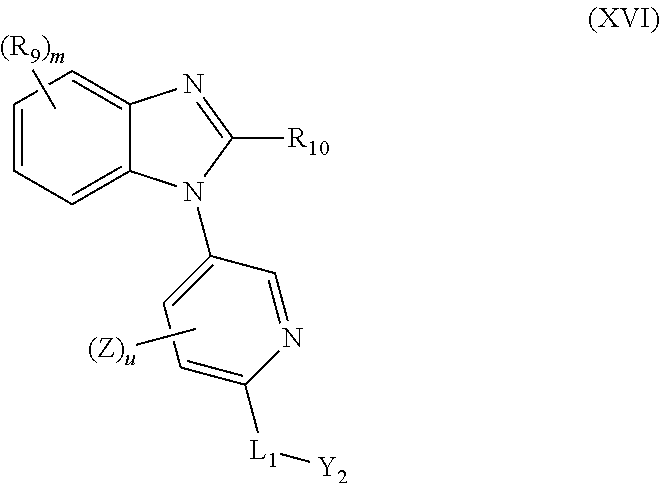
-
- or a pharmaceutically acceptable salt, solvate, clathrate, or prodrug thereof wherein Y2, Z, L1, R9, R10, m and u are defined herein. These compounds are useful as immunosuppressive agents and for treating and preventing inflammatory conditions, immune disorders, and allergic disorders.
Description
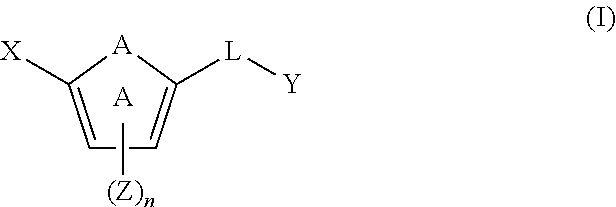
or a pharmaceutically acceptable salt, solvate, clathrate, or prodrug thereof, wherein:
-
- X is an optionally substituted benzoimidazolyl, an optionally substituted 5,6,7,8-tetrahydroindolizinyl, an optionally substituted imidazo[4,5-a]pyridyl, an optionally substituted imidazo[1,2-a]pyridyl, an optionally substituted imidazo[4,5-b]pyridyl, or an optionally substituted imidazo[4,5-c]pyridyl;
- Y is an unsubstituted alkyl, an optionally substituted alkenyl, an optionally substituted cycloalkyl, an optionally substituted cycloalkenyl, an optionally substituted aryl, an optionally substituted heteroaryl, or an optionally substituted heteroaralkyl;
- A is —O—, —S(O)p—, —NH—, —NZ—, —CH═CH—, —CZ═CH—, —CH═CZ—, —CZ═CZ—, —N═CH—, —N═CZ—, —CH═N—, —CZ═N—, or an N-oxide of —N═CH—, —N═CZ—, —CH═N—, or —CZ═N—;
- Z, for each occurrence, is independently selected from the group consisting of an optionally substituted alkyl, an optionally substituted alkenyl, an optionally substituted alkynyl, an optionally substituted cycloalkyl, an optionally substituted cycloalkenyl, an optionally substituted heterocyclyl, an optionally substituted aryl, an optionally substituted heteroaryl, an optionally substituted aralkyl, an optionally substituted heteraralkyl, a haloalkyl, —C(O)NR1R2, —NR4C(O)R5, halo, —OR4, cyano, nitro, haloalkoxy, —C(O)R4, —NR1R2, —C(O)OR4, —OC(O)R4, —NR4C(O)NR1R2, —OC (O)NR1R2, —NR4C(O)OR5, —S(O)pR4, or —S(O)hNR1R2;
- L is a linker selected from the group consisting of an optionally substituted lower alkyl, and optionally substituted lower alkenyl, —NRCR4R5—, —C(O)—, —OC(O)—, —C(O)O—, —NR—C(O)—, —C(O)—NR—, —NR—C(O)—NR—, —C(S)—, —NR—S(O)h—, —S(O)h—NR—, —NR—C(═NR)—, —NR—C(═NR)—NR—, —NR—C(═N—CN)—NR—, —NR—C(═N—NO2)—NR—, —NR—C(S)—, —C(S)—NR—, or —NR—C(S)—NR—;
- R, for each occurrence, is independently selected from —H, an alkyl, acetyl, alkoxycarbonyl, or aralkoxycarbonyl;
- R1 and R2, for each occurrence are, independently, H, an optionally substituted alkyl, an optionally substituted alkenyl, an optionally substituted alkynyl, an optionally substituted cycloalkyl, an optionally substituted cycloalkenyl, an optionally substituted heterocyclyl, an optionally substituted aryl, an optionally substituted heteroaryl, an optionally substituted aralkyl, or an optionally substituted heteraralkyl; or R1 and R2 taken together with the nitrogen to which they are attached is optionally substituted heterocyclyl or optionally substituted heteroaryl;
- R4 and R5 for each occurrence are, independently, H, an optionally substituted alkyl, an optionally substituted alkenyl, an optionally substituted alkynyl, an optionally substituted cycloalkyl, an optionally substituted cycloalkenyl, an optionally substituted heterocyclyl, an optionally substituted aryl, an optionally substituted heteroaryl, an optionally substituted aralkyl, or an optionally substituted heteraralkyl;
- h is 1 or 2;
- n is 0 or an integer from 1 to 4; and
- p, for each occurrence, is, independently, 0, 1, or 2.
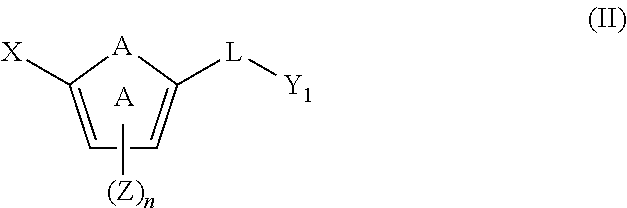
or a pharmaceutically acceptable salt, solvate, clathrate, or prodrug thereof wherein:
-
- Y1 is an alkyl, a heterocyclyl, or an aralkyl, wherein the alkyl, heterocyclyl or aralkyl is optionally substituted with one or more substituent selected from the group consisting of an alkyl, an alkynyl, an cycloalkyl, an cycloalkenyl, an heterocyclyl, an aryl, an heteraralkyl, a haloalkyl, —C(O)NH2, —NR4C(O)R5, halo, —OR4, cyano, nitro, haloalkoxy, —C(O)R4, —NR1R2, —SR4, —C(O)OH, —OC(O)R4, —NR4C(O)NR1R2, —OC(O)NR1R2, —NR4C(O)OR5, —S(O)pR4, or —S(O)hNR1R2; and
- X, R1, R2, R4, R5, A, L, Z, h, n and p are defined as for formula (I).
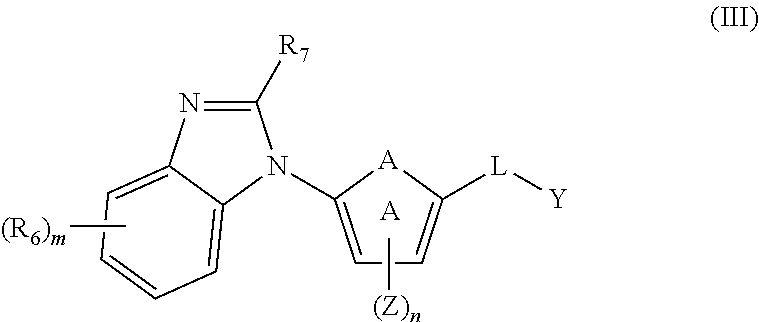
or a pharmaceutically acceptable salt, solvate, clathrate, or prodrug thereof wherein:
-
- R6, for each occurrence, and R7 are, independently, selected from the group consisting of an optionally substituted alkyl, an optionally substituted alkenyl, an optionally substituted alkynyl, an optionally substituted cycloalkyl, an optionally substituted cycloalkenyl, an optionally substituted heterocyclyl, an optionally substituted aryl, an optionally substituted heteroaryl, an optionally substituted aralkyl, an optionally substituted heteraralkyl, a haloalkyl, —C(O)NR1R2, —NR4C(O)R5, halo, —OR4, cyano, nitro, haloalkoxy, —C(O)R4, —NR1R2, —C(O)OR4, —OC(O)R4, —NR4C(O)NR1R2, —OC (O)NR1R2, —NR4C(O)OR5, —S(O)pR4, or —S(O)hNR1R2;
- m is 0 or an integer from 1 to 4; and
- Y, R1, R2, R4, R5, A, L, Z, h, n and p are defined as for formula (I).
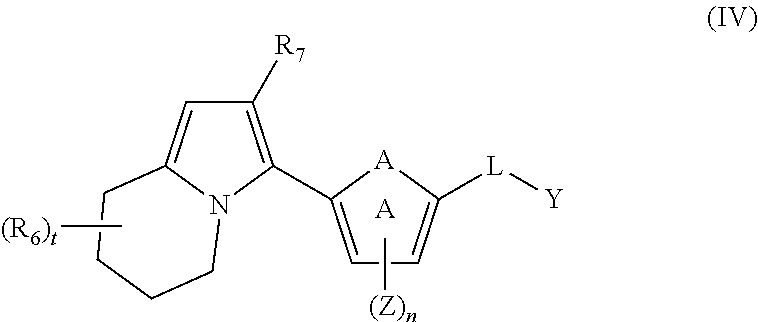
or a pharmaceutically acceptable salt, solvate, clathrate, or prodrug thereof wherein t is 0 or an integer from 1 to 8; Y, A, Z, and n are defined as in formula (I); and R6 and R7 are defined as in formula (III).
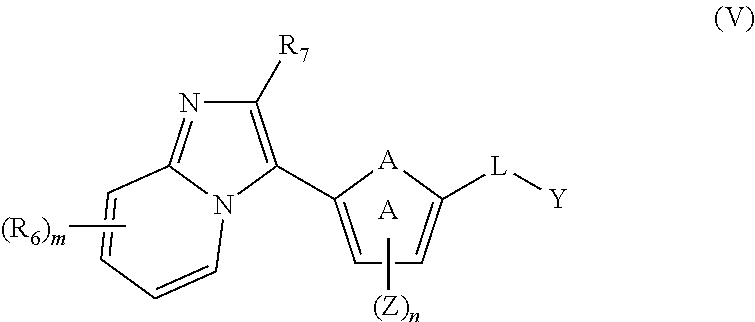
or a pharmaceutically acceptable salt, solvate, clathrate, or prodrug thereof wherein Y, L, A, Z, and n are defined as in formula (I); and R6, R7 and m are defined as in formula (III).

or a pharmaceutically acceptable salt, solvate, clathrate, or prodrug thereof wherein:
-
- one of X2, X3, X4, or X5 is N and the others are, independently, CH or CR6;
- q is 0 or an integer from 1 to 3;
- Y, L, A, Z, and n are defined as in formula (I); and
- R6 and R7 are defined as in formula (III).

-
- or a pharmaceutically acceptable salt, solvate, clathrate, or prodrug thereof, wherein:
- Y2 is an optionally substituted alkyl, an optionally substituted alkenyl, an optionally substituted cycloalkyl, an optionally substituted cycloalkenyl, an optionally substituted aryl, an optionally substituted aralkyl, an optionally substituted heteroaryl, or an optionally substituted heteroaralkyl;
- L1 is a linker selected from the group consisting of —NR3CR4R5—, —CR4R5NR3—, —C(O)—, —NR3—C(O)—, —C(O)—NR3—, —OC(O)—, —C(O)O—, —C(S)—, —C(NR16)—, —NR3—C(S)—, —C(S)—NR3—, —NR3—C(NR16)—, —C(NR16)—NR3—, —NR3C(O)NR3—, —NR3C(S)NR3—, —NR3C(NR16)NR3—, —S(O)2NR3—, —NR3S(O)2—, —NR3S(O)2NR3—, —NR3CR4R5NR3—, —CR4═CR5—, —C≡C—, —N═CR4—, —CR4═N—, —NR3—N═CR4—, or —CR4═N—NR3—;
- R16, for each occurrence is, independently, —H, a halo, an alkyl, —CN, —NO2, —OR5, —NR1R2, —C(O)R5, —C(O)OR5, or —C(O)NR1R2;
- R9 and R10, for each occurrence, are independently, a substituent;
- R3, for each occurrence is, independently, H, an optionally substituted alkyl, an optionally substituted alkenyl, an optionally substituted alkynyl, an optionally substituted cycloalkyl, an optionally substituted cycloalkenyl, an optionally substituted heterocyclyl, an optionally substituted aryl, an optionally substituted heteroaryl, an optionally substituted aralkyl, or an optionally substituted heteraralkyl;
- m is 0 or and integer form 1 to 4;
- u is 0 or an integer from 1 to 3; and
- R1, R2, R4, R5, and Z are defined as for formula (I).

etc., wherein the brackets indicate the points of attachment). Alkylene groups may be substituted or unsubstituted.

-
- or a pharmaceutically acceptable salt, solvate, clathrate, or prodrug thereof, wherein:
- X is an optionally substituted benzoimidazolyl, an optionally substituted 5,6,7,8-tetrahydroindolizinyl, an optionally substituted imidazo[4,5-a]pyridyl, an optionally substituted imidazo[1,2-a]pyridyl, an optionally substituted imidazo[4,5-b]pyridyl, or an optionally substituted imidazo[4,5-c]pyridyl;
- Y is an unsubstituted alkyl, an optionally substituted alkenyl, an optionally substituted cycloalkyl, an optionally substituted cycloalkenyl, an optionally substituted aryl, an optionally substituted heteroaryl, or an optionally substituted heteroaralkyl;
- A is —O—, —S(O)p—, —NH—, —NZ—, —CH═CH—, —CZ═CH—, —CH═CZ—, —CZ═CZ-, —N═CH—, —N═CZ—, —CH═N—, —CZ═N—, or an N-oxide of —N═CH—, —N═CZ—, —CH═N—, or —CZ═N—;
- Z, for each occurrence, is independently selected from the group consisting of an optionally substituted alkyl, an optionally substituted alkenyl, an optionally substituted alkynyl, an optionally substituted cycloalkyl, an optionally substituted cycloalkenyl, an optionally substituted heterocyclyl, an optionally substituted aryl, an optionally substituted heteroaryl, an optionally substituted aralkyl, an optionally substituted heteraralkyl, a haloalkyl, —C(O)NR1R2, —NR4C(O)R5, halo, —OR4, cyano, nitro, haloalkoxy, —C(O)R4, —NR1R2, —C(O)OR4, —OC(O)R4, —NR4C(O)NR1R2, —OC(O)NR1R2, —NR4C(O)OR5, —S(O)pR4, or —S(O)hNR1R2;
- L is a linker selected from the group consisting of an optionally substituted lower alkyl, and optionally substituted lower alkenyl, —NRCR4R5—, —C(O)—, —OC(O)—, —C(O)O—, —NR—C(O)—, —C(O)—NR—, —NR—C(O)—NR—, —C(S)—, —NR—S(O)h—, —S(O)h—NR—, —NR—C(═NR)—, —NR—C(═NR)—NR—, —NR—C(═N—CN)—NR—, —NR—C(═N—NO2)—NR—, —NR—C(S)—, —C(S)—NR—, or —NR—C(S)—NR—;
- R, for each occurrence, is independently selected from —H, an alkyl, acetyl, alkoxycarbonyl, or aralkoxycarbonyl;
- R1 and R2, for each occurrence are, independently, H, an optionally substituted alkyl, an optionally substituted alkenyl, an optionally substituted alkynyl, an optionally substituted cycloalkyl, an optionally substituted cycloalkenyl, an optionally substituted heterocyclyl, an optionally substituted aryl, an optionally substituted heteroaryl, an optionally substituted aralkyl, or an optionally substituted heteraralkyl; or R1 and R2 taken together with the nitrogen to which they are attached is optionally substituted heterocyclyl or optionally substituted heteroaryl;
- R4 and R5 for each occurrence are, independently, H, an optionally substituted alkyl, an optionally substituted alkenyl, an optionally substituted alkynyl, an optionally substituted cycloalkyl, an optionally substituted cycloalkenyl, an optionally substituted heterocyclyl, an optionally substituted aryl, an optionally substituted heteroaryl, an optionally substituted aralkyl, or an optionally substituted heteraralkyl;
- h is 1 or 2;
- n is 0 or an integer from 1 to 4; and
- p, for each occurrence, is, independently, 0, 1, or 2.

or a pharmaceutically acceptable salt, solvate, clathrate, or prodrug thereof wherein:
-
- Y1 is an alkyl, a heterocyclyl, or an aralkyl, wherein the alkyl, heterocyclyl or aralkyl is optionally substituted with one or more substituent selected from the group consisting of an alkyl, an alkynyl, an cycloalkyl, an cycloalkenyl, an heterocyclyl, an aryl, an heteraralkyl, a haloalkyl, —C(O)NH2, —NR4C(O)R5, halo, —OR4, cyano, nitro, haloalkoxy, —C(O)R4, —NR1R2, —SR4, —C(O)OH, —OC(O)R4, —NR4C(O)NR1R2, —OC(O)NR1R2, —NR4C(O)OR5, —S(O)pR4, or —S(O)hNR1R2; and
- X, R1, R2, R4, R5, A, L, Z, h, n and p are defined as for formula (I).
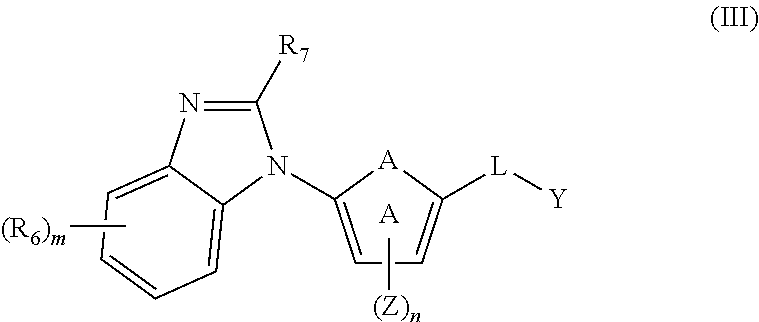
or a pharmaceutically acceptable salt, solvate, clathrate, or prodrug thereof wherein:
-
- R6, for each occurrence, and R7 are, independently, selected from the group consisting of an optionally substituted alkyl, an optionally substituted alkenyl, an optionally substituted alkynyl, an optionally substituted cycloalkyl, an optionally substituted cycloalkenyl, an optionally substituted heterocyclyl, an optionally substituted aryl, an optionally substituted heteroaryl, an optionally substituted aralkyl, an optionally substituted heteraralkyl, a haloalkyl, —C(O)NR1R2, —NR4C(O)R5, halo, —OR4, cyano, nitro, haloalkoxy, —C(O)R4, —NR1R2, —C(O)OR4, —OC(O)R4, —NR4C(O)NR1R2, —OC(O)NR1R2, —NR4C(O)OR5, —S(O)pR4, or —S(O)hNR1R2;
- m is 0 or an integer from 1 to 4; and
- Y, R1, R2, R4, R5, A, L, Z, h, n and p are defined as for formula (I).
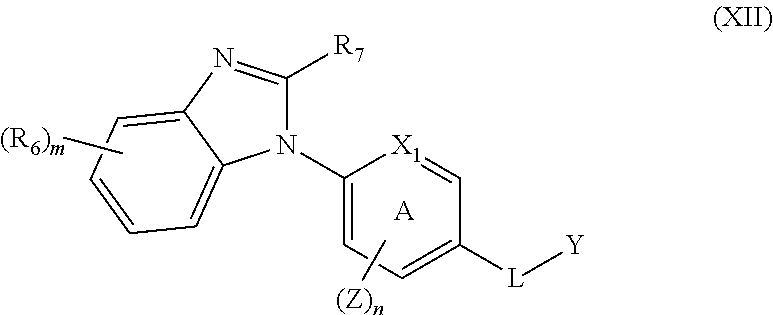
or a pharmaceutically acceptable salt, solvate, clathrate, or prodrug thereof wherein X1 is N, CH or CZ; Y, L, Z, and n are defined as for formula (I); and R6, R7 and m are defined as in formula (III).
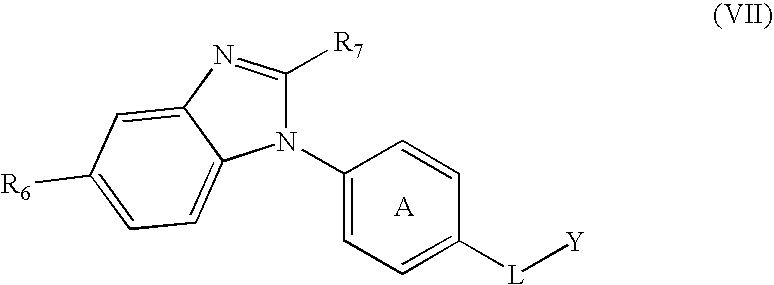
or a pharmaceutically acceptable salt, solvate, clathrate, or prodrug thereof wherein Y and L are defined as for formula (I); and R6 and R7 are defined as for formula (III).
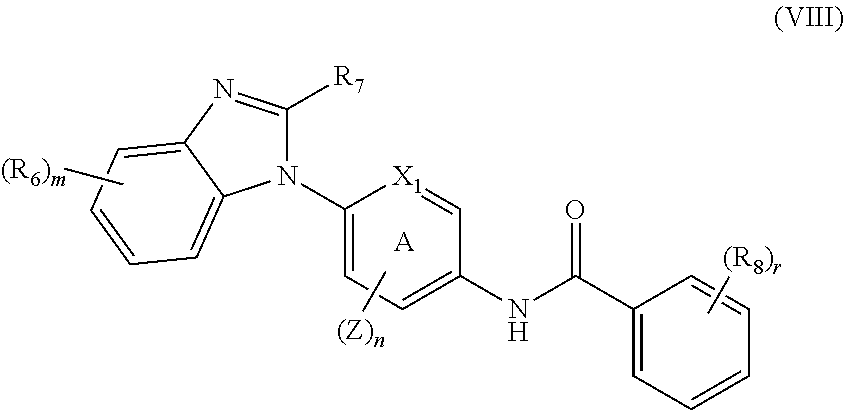
or a pharmaceutically acceptable salt, solvate, clathrate, or prodrug thereof wherein:
-
- R8, for each occurrence, is, independently, selected from the group consisting of an optionally substituted alkyl, an optionally substituted alkenyl, an optionally substituted alkynyl, an optionally substituted cycloalkyl, an optionally substituted cycloalkenyl, an optionally substituted heterocyclyl, an optionally substituted aryl, an optionally substituted heteroaryl, an optionally substituted aralkyl, an optionally substituted heteraralkyl, a haloalkyl, —C(O)NR1R2, —NR4C(O)R5, halo, —OR4, cyano, nitro, haloalkoxy, —C(O)R4, —NR1R2, —C(O)OR4, —OC(O)R4, —NR4C(O)NR1R2, —OC(O)NR1R2, —NR4C(O)OR5, —S(O)pR4, or —S(O)hNR1R2; and
- r is 0 or an integer from 1 to 5;
- Z, R1, R2, R4, R5, h, n, and p are defined as for formula (I); R6, R7 and m are defined as for formula (III); and X1 is defined as in formula (XII).
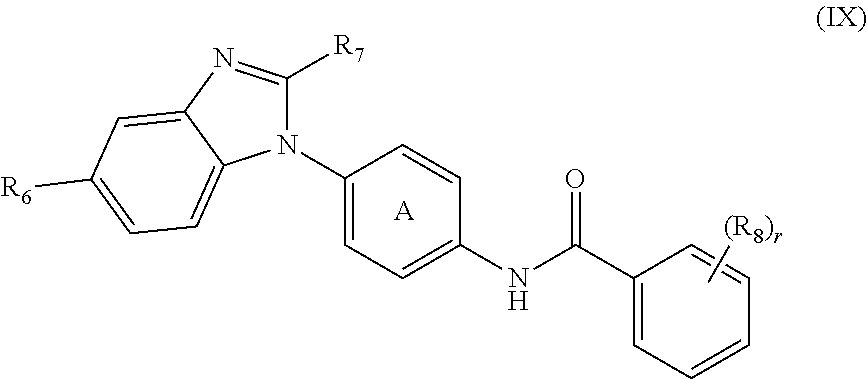
or a pharmaceutically acceptable salt, solvate, clathrate, or prodrug thereof wherein R6, and R7 are defined as for formula (III); and R8 and r are defined as in formula (VIII).

or a pharmaceutically acceptable salt, solvate, clathrate, or prodrug thereof wherein t is 0 or an integer from 1 to 8; Y, A, Z, and n are defined as for formula (I); and R6 and R7 are defined as for formula (III).

or a pharmaceutically acceptable salt, solvate, clathrate, or prodrug thereof wherein Y, L, Z, and n are defined as for formula (I); R6 and R7 are defined as in formula (III); X, is defined as in formula (XII); and t is defined as in formula (IV).
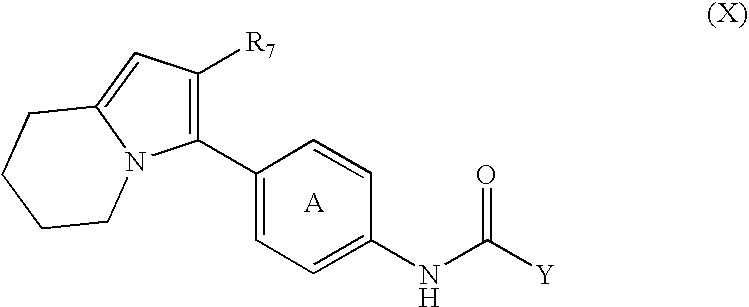
or a pharmaceutically acceptable salt, solvate, clathrate, or prodrug thereof wherein Y is defined as for formula (I); and R7 is defined as for formula (III).

or a pharmaceutically acceptable salt, solvate, clathrate, or prodrug thereof wherein Y, L, A, Z, and n are defined as in formula (I); and R6, R7 and m are defined as in formula (III).

or a pharmaceutically acceptable salt, solvate, clathrate, or prodrug thereof wherein Y, L, Z, and n are defined as in formula (I); R6, R7, and m are defined as for formula (III); and X1 is defined as in formula (XII).
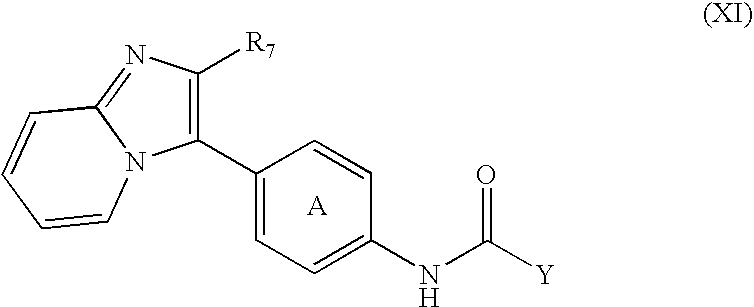
or a pharmaceutically acceptable salt, solvate, clathrate, or prodrug thereof wherein Y is defined as in formula (I); and R7 is defined as in formula (III).

or a pharmaceutically acceptable salt, solvate, clathrate, or prodrug thereof wherein:
-
- one of X2, X3, X4, or X5 is N and the others are, independently, CH or CR6;
- q is 0 or an integer from 1 to 3;
- Y, L, A, Z, and n are defined as in formula (I); and R6 and R7 are defined as in formula (III).
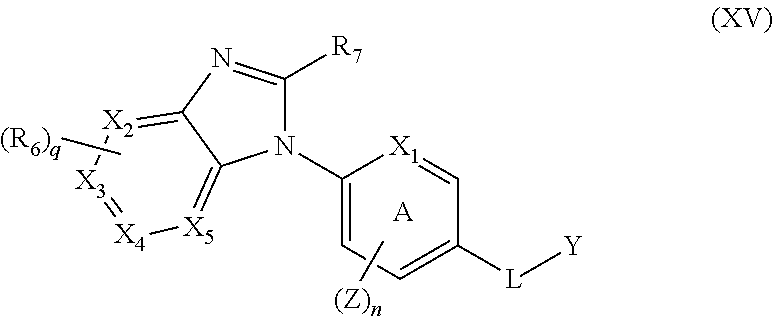
or a pharmaceutically acceptable salt, solvate, clathrate, or prodrug thereof wherein Y, L, Z, and n are defined as for formula (I); R6 and R7 are defined as for formula (III); X1 is defined as for formula (XII); and X2, X3, X4, X5 and q are defined as for formula (VI).
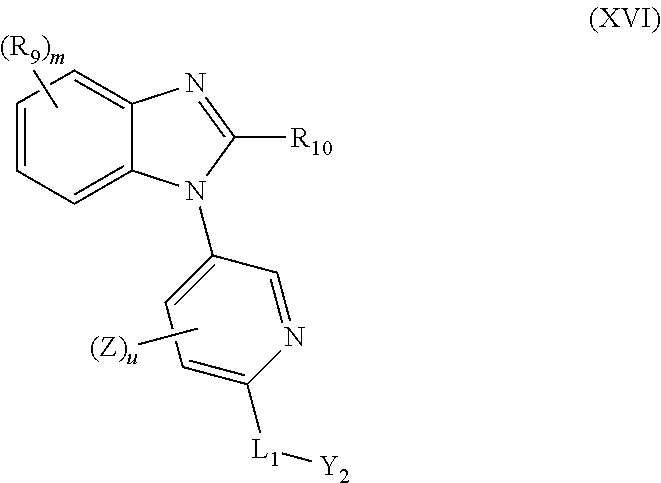
-
- or a pharmaceutically acceptable salt, solvate, clathrate, or prodrug thereof, wherein:
- Y2 is an optionally substituted alkyl, an optionally substituted alkenyl, an optionally substituted cycloalkyl, an optionally substituted cycloalkenyl, an optionally substituted aryl, an optionally substituted aralkyl, an optionally substituted heteroaryl, or an optionally substituted heteroaralkyl;
- L1 is a linker selected from the group consisting of —NR3CR4R5—, —CR4R5NR3—, —C(O)—, —NR3—C(O)—, —C(O)—NR3—, —OC(O)—, —C(O)O—, —C(S)—, —C(NR16)—, —NR3—C(S)—, —C(S)—NR3—, —NR3—C(NR16)—, —C(NR16)—NR3—, —NR3C(O)NR3—, —NR3C(S)NR3—, —NR3C(NR16)NR3—, —S(O)2NR3—, —NR3S(O)2—, —NR3S(O)2NR3—, —NR3CR4R5NR3—, —CR4═CR5—, —C≡C—, —N═CR4—, —CR4═N—, —NR3—N═CR4—, or —CR4═N—NR3—;
- R16, for each occurrence is, independently, —H, a halo, an alkyl, —CN, —NO2, —OR5, —NR1R2, —C(O)R5, —C(O)OR5, or —C(O)NR1R2;
- R3, for each occurrence is, independently, H, an optionally substituted alkyl, an optionally substituted alkenyl, an optionally substituted alkynyl, an optionally substituted cycloalkyl, an optionally substituted cycloalkenyl, an optionally substituted heterocyclyl, an optionally substituted aryl, an optionally substituted heteroaryl, an optionally substituted aralkyl, or an optionally substituted heteraralkyl;
- R9 and R10, for each occurrence, are independently, a substituent;
- m is 0 or and integer form 1 to 4;
- u is 0 or an integer from 1 to 3; and
- Z, R1, R2, R4, R5, h, and p are defined as for formula (I).
-
- 2,3,6-Trifluoro-N-[4-(2-trifluoromethyl-5-methoxy-benzoimidazol-1-yl)-phenyl]-benzamide;
- 2,3,5-Trifluoro-N-[4-(2-trifluoromethyl-5-methoxy-benzoimidazol-1-yl)-phenyl]-benzamide;
- 2,3,4-Trifluoro-N-[4-(2-trifluoromethyl-5-methoxy-benzoimidazol-1-yl)-phenyl]-benzamide;
- 2,3-Difluoro-N-[4-(2-trifluoromethyl-5-methoxy-benzoimidazol-1-yl)-phenyl]-benzamide;
- 3-Methyl-N-[4-(2-trifluoromethyl-5-methoxy-benzoimidazol-1-yl)-phenyl]-isonicotinamide;
- 3-Fluoro-N-[4-(2-trifluoromethyl-5-methoxy-benzoimidazol-1-yl)-phenyl]-isonicotinamide;
- 2,4-Dichloro-5-fluoro-N-[4-(2-trifluoromethyl-5-methoxy-benzoimidazol-1-yl)-phenyl]-benzamide;
- 2,3-Difluoro-N-[4-(2-trifluoromethyl-5,6,7,8-tetrahydroindolizin-3-yl)-phenyl]-benzamide;
- 2,4-Difluoro-N-[4-(2-trifluoromethyl-benzoimidazol-1-yl)-phenyl]-benzamide;
- 3-Nitro-N-[4-(2-trifluoromethyl-5-methoxy-benzoimidazol-1-yl)-phenyl]-benzamide;
- 2,3-Difluoro-N-[4-(2-methylsulfanyl-benzoimidazol-1-yl)-phenyl]-benzamide;
- 2,3-Difluoro-N-[4-(2-trifluoromethyl-benzoimidazol-1-yl)-phenyl]-thiobenzamide;
- 2,3-Dichloro-N-[4-(2-trifluoromethyl-benzoimidazol-1-yl)-phenyl]-benzamide;
- 2,3-Difluoro-N-[4-(2-trifluoromethyl-6-methoxy-benzoimidazol-1-yl)-phenyl]-benzamide;
- 2-Fluoro-2-chloro-N-[4-(2-trifluoromethyl-benzoimidazol-1-yl)-phenyl]-benzamide;
- 2,3,6-Trifluoro-5-amino-N-[4-(2-trifluoromethyl-benzoimidazol-1-yl)-phenyl]-benzamide;
- 2,3-Difluoro-N-[3-methyl-4-(2-trifluoromethyl-benzoimidazol-1-yl)-phenyl]-benzamide;
- 2-Methyl-N-[4-(2-trifluoromethyl-5,6,7,8-tetrahydroindolizin-3-yl)-phenyl]-benzamide;
- 2,3-Difluoro-N-[4-(2-trifluoromethyl-5,6,7,8-tetrahydroindolizin-3-yl)-phenyl]-benzamide;
- 2,3-Difluoro-N-[4-(2-trifluoromethyl-6-cyano-benzoimidazol-1-yl)-phenyl]-benzamide;
- 2,3-Difluoro-N-[4-(2-trifluoromethyl-4-amino-benzoimidazol-1-yl)-phenyl]-benzamide;
- N-(3-{N-[4-(2-trifluoromethyl-benzoimidazol-1-yl)-phenyl]-carbamoyl}-2,4,5-trifluoro-phenyl)-carbamic acid t-butyl ester;
- 2,3-Difluoro-N-[4-(2-chloro-benzoimidazol-1-yl)-phenyl]-benzamide;
- 4-Methyl-[1,2,3]thiadiazole-5-carboxylic acid {N-[4-(2-chloro-5,6,7,8-tetrahydroindolizin-3-yl)-phenyl]}amide;
- 2,3-Difluoro-N-[2-chloro-4-(2-trifluoromethyl-benzoimidazol-1-yl)-phenyl]-benzamide;
- 2,5-Difluoro-N-[4-(2-trifluoromethyl-benzoimidazol-1-yl)-phenyl]-benzamide;
- 3-Fluoro-N-[4-(2-trifluoromethyl-benzoimidazol-1-yl)-phenyl]-isonicotinamide;
- 2,3-Difluoro-N-[4-(2-bromo-benzoimidazol-1-yl)-phenyl]-benzamide;
- 4-Methyl-[1,2,3]thiadiazole-5-carboxylic acid {N-[4-(2-trifluoromethyl-benzoimidazol-1-yl)-phenyl]}amide;
- 2,3-Difluoro-N-[3-trifluoromethyl-4-(2-trifluoromethyl-benzoimidazol-1-yl)-phenyl]-benzamide;
- N-(4-{N-[4-(2-trifluoromethyl-benzoimidazol-1-yl)-phenyl]-carbamoyl}-2,3-difluoro-phenyl)-carbamic acid t-butyl ester;
- 2,3-Difluoro-N-[4-(2-trifluoromethyl-5,6-dimethoxy-benzoimidazol-1-yl)-phenyl]-benzamide;
- 2,3-Difluoro-N-[4-(2-iodo-benzoimidazol-1-yl)-phenyl]-benzamide;
- N′-[2-(2-trifluoromethyl-benzoimidazol-1-yl)-pyrid-5-yl]-N-(2,5-difluoro-phenyl)-thiourea;
- 2,3-Difluoro-N-[4-(2-trifluoromethyl-5-tert-butyl-benzoimidazol-1-yl)-phenyl]-benzamide;
- 2,3-Difluoro-N-[2-(2-trifluoromethyl-benzoimidazol-1-yl)-pyrid-3-yl]-benzamide;
- 2,3-Difluoro-N-[3-cyano-4-(2-trifluoromethyl-benzoimidazol-1-yl)-phenyl]-benzamide;
- 2,5-Difluoro-N-[3-chloro-4-(2-trifluoromethyl-benzoimidazol-1-yl)-phenyl]-benzamide;
- 2,3-Difluoro-N-[4-(2-trifluoromethyl-5-amino-benzoimidazol-1-yl)-phenyl]-benzamide;
- 2,3-Difluoro-N-[4-(2-methanesulfinyl-benzoimidazol-1-yl)-phenyl]-benzamide;
- 2,5-Difluoro-N-[2-(2-trifluoromethyl-benzoimidazol-1-yl)-pyrid-5-yl]-benzamide;
- 2,3-Difluoro-N-[4-(2-trifluoromethyl-5,6-dimethyl-benzoimidazol-1-yl)-phenyl]-benzamide;
- 2,3-Difluoro-4-amino-N-[4-(2-trifluoromethyl-benzoimidazol-1-yl)-phenyl]-benzamide;
- 2,3-Difluoro-N-[4-(2-trifluoromethyl-imidazo[4,5-b]pyrid-3-yl)-phenyl]-benzamide;
- N-[4-(2-trifluoromethyl-benzoimidazol-1-yl)-phenyl]-nicotinamide;
- N-(2,3-difluorophenyl)-4-(2-trifluoromethyl-benzoimidazol-1-yl)-benzamide;
- 1-(2,3-difluoro-phenyl)-3-[4-(2-trifluoromethyl-benzoimidazol-1-yl)-phenyl]-acrylonitrile;
- 1-(2,5-difluoro-phenyl)-3-[4-(2-trifluoromethyl-benzoimidazol-1-yl)-phenyl]-acrylonitrile;
- 2,3-Difluoro-N-[4-(2-isopropyl-benzoimidazol-1-yl)-phenyl]-benzamide;
- N′-[4-(2-trifluoromethyl-benzoimidazol-1-yl)-phenyl]-N-(2,5-difluoropheyl)-urea;
- 1-Oxo-3-fluoro-N-[4-(2-trifluoromethyl-benzoimidazol-1-yl)-phenyl]-isonicotinamide;
- 2,3-Difluoro-N-[4-(trifluoromethyl-benzoimidazol-1-yl)-phenyl]-benzenesulfonamide;
- 2,3-Difluoro-N-[3-acetylamino-4-(2-trifluoromethyl-benzoimidazol-1-yl)-phenyl]-benzamide;
- 2,3-Difluoro-N-[4-(benzoimidazol-1-yl)-phenyl]-benzamide;
- 2,3-Difluoro-N-[2-methyl-4-(2-trifluoromethyl-benzoimidazol-1-yl)-phenyl]-benzamide;
- 2,5-Difluoro-N-[4-(2-trifluoromethyl-imidazo[4,5-b]pyrid-3-yl)-phenyl]-benzamide;
- 2,3-Difluoro-N-{4-[2-trifluoromethyl-5-(1,3-dioxo-isoindol-2-yl)benzoimidazol-1-yl]-phenyl}-benzamide;
- 4-Methyl-[1,2,3]thiadiazole-5-carboxylic acid {N-[4-(2-trifluoromethyl-imidazo[4,5-b]pyrid-3-yl)-phenyl]}amide;
- 2,3-Difluoro-N-[4-(2-methyl-benzoimidazol-1-yl)-phenyl]-benzamide;
- 2,3-Difluoro-N-[4-(2-trifluoromethyl-5,6-dihydroxy-benzoimidazol-1-yl)-phenyl]-benzamide;
- 2,3-Difluoro-N-[4-(2-trifluoromethyl-imidazo[4,5-c]pyrid-1-yl)-phenyl]-benzamide;
- 4-Methyl-[1,2,3]thiadiazole-5-carboxylic acid {N-[2-(2-trifluoromethyl-benzoimidazol-1-yl)-pyrid-5-yl]}amide;
- 2,4,6-Trichloro-N-[4-(2-trifluoromethyl-5-methoxy-benzoimidazol-1-yl)-phenyl]-benzamide;
- 2,3-Difluoro-N-{4-[2,5-di-(trifluoromethyl)-benzoimidazol-1-yl]-phenyl}-benzamide;
- 2,3-Difluoro-N-[4-(2-trifluoromethyl-5-methanesulfonyl-benzoimidazol-1-yl)-phenyl]-benzamide;
- 4-Butyl-N-[4-(2-trifluoromethyl-5-methoxy-benzoimidazol-1-yl)-phenyl]-benzamide;
- 2,5-Difluoro-N-{4-[2-trifluoromethyl-5-(5-tert-butyl-oxazol-2-yl)-benzoimidazol-1-yl]-phenyl}-benzamide;
- 2,3-Difluoro-N-{4-[2-trifluoromethyl-5-(5-tert-butyl-oxazol-2-yl)-benzoimidazol-1-yl]-phenyl}-benzamide;
- Furan-2-carboxylic acid (N-{4-[2-trifluoromethyl-5-(5-tert-butyl-oxazol-2-yl)-benzoimidazol-1-yl]-phenyl})amide;
- 2,3-Difluoro-N-[4-(2-trifluoromethyl-imidazo[1,2-a]pyrid-3-yl)-phenyl]-benzamide;
- 2,3,4,5-Tetrafluoro-N-[4-(2-trifluoromethyl-5-methoxy-benzoimidazol-1-yl)-phenyl]-benzamide;
- 4-Phenyl-N-[4-(2-trifluoromethyl-5-methoxy-benzoimidazol-1-yl)-phenyl]-benzamide;
- 4-Iodo-N-[4-(2-trifluoromethyl-5-methoxy-benzoimidazol-1-yl)-phenyl]-benzamide;
- Naphthalene-2-carboxylic acid {N-[4-(2-trifluoromethyl-5-methoxy-benzoimidazol-1-yl)-phenyl]}amide;
- Benzo[1,3]dioxole-5-carboxylic acid {N-[4-(2-trifluoromethyl-5-methoxy-benzoimidazol-1-yl)-phenyl]}amide;
- 4-Methyl-N-[4-(2-trifluoromethyl-5-methoxy-benzoimidazol-1-yl)-phenyl]-benzamide;
- 4-Cyano-N-[4-(2-trifluoromethyl-5-methoxy-benzoimidazol-1-yl)-phenyl]-benzamide;
- 4-Nitro-N-[4-(2-trifluoromethyl-5-methoxy-benzoimidazol-1-yl)-phenyl]-benzamide;
- 4-Ethyl-N-[4-(2-trifluoromethyl-5-methoxy-benzoimidazol-1-yl)-phenyl]-benzamide;
- 4-Trifluoromethyl-N-[4-(2-trifluoromethyl-5-methoxy-benzoimidazol-1-yl)-phenyl]-benzamide;
- 3,5-Dinitro-N-[4-(2-trifluoromethyl-5-methoxy-benzoimidazol-1-yl)-phenyl]-benzamide;
- N-[4-(2-trifluoromethyl-5-methoxy-benzoimidazol-1-yl)-phenyl]-butyramide;
- Naphthalene-1-carboxylic acid {N-[4-(2-trifluoromethyl-5-methoxy-benzoimidazol-1-yl)-phenyl]}amide;
- 3-Methyl-N-[4-(2-trifluoromethyl-5-methoxy-benzoimidazol-1-yl)-phenyl]-but-2-enoic acid amide;
- 4-Propyl-N-[4-(2-trifluoromethyl-5-methoxy-benzoimidazol-1-yl)-phenyl]-benzamide;
- Thiophene-2-carboxylic acid {N-[4-(2-trifluoromethyl-5-methoxy-benzoimidazol-1-yl)-phenyl]}amide;
- 2-Ethyl-N-[4-(2-trifluoromethyl-5-methoxy-benzoimidazol-1-yl)-phenyl]-hexanoic acid amide;
- N-[4-(2-trifluoromethyl-5-methoxy-benzoimidazol-1-yl)-phenyl]-heptanoic acid amide;
- 3-Methoxy-N-[4-(2-trifluoromethyl-5-methoxy-benzoimidazol-1-yl)-phenyl]-benzamide;
- 2-Phenyl-N-[4-(2-trifluoromethyl-5-methoxy-benzoimidazol-1-yl)-phenyl]-cyclopropanecarboxylic acid amide;
- 3-Trifluoromethyl-N-[4-(2-trifluoromethyl-5-methoxy-benzoimidazol-1-yl)-phenyl]-benzamide;
- 2-(4-Methoxy-phenyl)-N-[4-(2-trifluoromethyl-5-methoxy-benzoimidazol-1-yl)-phenyl]-acetamide;
- 2,3-Difluoro-N-[4-(2-trifluoromethyl-6-acetylamino-benzoimidazol-1-yl)-phenyl]-benzamide;
- 2-(Thien-2-yl)-N-[4-(2-trifluoromethyl-5-methoxy-benzoimidazol-1-yl)-phenyl]-acetamide;
- 2-phenyl-N-[4-(2-trifluoromethyl-5-methoxy-benzoimidazol-1-yl)-phenyl]-acetamide;
- 2-Trifluoromethyl-1-[4-(2,3-difluoro-benzoylamimo)-phenyl]-1H-benzoimidazole-5-carboxylic acid methyl ester;
- 2,3,4,5,6-Pentafluoro-N-[4-(2-trifluoromethyl-5-methoxy-benzoimidazol-1-yl)-phenyl]-benzamide;
- 2,4-Difluoro-N-[4-(2-trifluoromethyl-5-methoxy-benzoimidazol-1-yl)-phenyl]-benzamide;
- 2,3-Difluoro-N-[4-(2-trifluoromethyl-5-hydroxy-benzoimidazol-1-yl)-phenyl]-benzamide;
- 2,5-Difluoro-N-[4-(2-trifluoromethyl-5-methoxy-benzoimidazol-1-yl)-phenyl]-benzamide;
- 3-Cyano-N-[4-(2-trifluoromethyl-5-methoxy-benzoimidazol-1-yl)-phenyl]-benzamide;
- 2,6-Dichloro-N-[4-(2-trifluoromethyl-5-methoxy-benzoimidazol-1-yl)-phenyl]-benzamide;
- 3,5-Dichloro-N-[4-(2-trifluoromethyl-5-methoxy-benzoimidazol-1-yl)-phenyl]-benzamide;
- 2-Bromo-N-[4-(2-trifluoromethyl-5-methoxy-benzoimidazol-1-yl)-phenyl]-benzamide;
- N-[4-(2-trifluoromethyl-5-methoxy-benzoimidazol-1-yl)-phenyl]-cyclopentanecarboxylic acid amide;
- N-[4-(2-trifluoromethyl-5-methoxy-benzoimidazol-1-yl)-phenyl]-cyclohexanecarboxylic acid amide;
- 2-Nitro-N-[4-(2-trifluoromethyl-5-methoxy-benzoimidazol-1-yl)-phenyl]-benzamide;
- 4-Chloro-N-[4-(2-trifluoromethyl-5-methoxy-benzoimidazol-1-yl)-phenyl]-benzamide;
- 3-Chloro-N-[4-(2-trifluoromethyl-5-methoxy-benzoimidazol-1-yl)-phenyl]-benzamide;
- 3,4-Difluoro-N-[4-(2-trifluoromethyl-5-methoxy-benzoimidazol-1-yl)-phenyl]-benzamide;
- N-[4-(2-trifluoromethyl-5-methoxy-benzoimidazol-1-yl)-phenyl]-benzamide;
- 2,3-Difluoro-N-[4-(2-trifluoromethyl-5-isopropoxy-benzoimidazol-1-yl)-phenyl]-benzamide;
- 2,3-Difluoro-N-[4-(2-trifluoromethyl-5-carbamoyl-benzoimidazol-1-yl)-phenyl]-benzamide;
- N-[4-(2-trifluoromethyl-5-methoxy-benzoimidazol-1-yl)-phenyl]-isonicotinamide;
- 2-Iodo-N-[4-(2-trifluoromethyl-5-methoxy-benzoimidazol-1-yl)-phenyl]-benzamide;
- 3-Methyl-N-[4-(2-trifluoromethyl-5-methoxy-benzoimidazol-1-yl)-phenyl]-butyramide;
- 3,5-Dichloro-N-[4-(2-trifluoromethyl-5-methoxy-benzoimidazol-1-yl)-phenyl]-benzamide;
- 3-Bromo-N-[4-(2-trifluoromethyl-5-methoxy-benzoimidazol-1-yl)-phenyl]-benzamide;
- 4-Bromo-N-[4-(2-trifluoromethyl-5-methoxy-benzoimidazol-1-yl)-phenyl]-benzamide;
- Furan-2-carboxylic acid {N-[4-(2-trifluoromethyl-5-methoxy-benzoimidazol-1-yl)-phenyl]}-amide;
- 1-(2,2,2-Trifluoroacetyl)-N-[4-(2-trifluoromethyl-5-methoxy-benzoimidazol-1-yl)-phenyl]-pyrrolidine-2-carboxylic acid amide;
- N-[4-(2-trifluoromethyl-5-methoxy-benzoimidazol-1-yl)-phenyl]-acrylamide;
- 2-Benzyloxy-N-[4-(2-trifluoromethyl-5-methoxy-benzoimidazol-1-yl)-phenyl]-acetamide;
- 2-Phenylsulfanyl-N-[4-(2-trifluoromethyl-5-methoxy-benzoimidazol-1-yl)-phenyl]-acetamide;
- N-[4-(2-trifluoromethyl-5-methoxy-benzoimidazol-1-yl)-phenyl]-succinamic acid ethyl ester;
- 2-Chloro-N-[4-(2-trifluoromethyl-5-methoxy-benzoimidazol-1-yl)-phenyl]-benzamide;
- 2,5-Di-(trifluoromethyl)-N-[4-(2-trifluoromethyl-5-methoxy-benzoimidazol-1-yl)-phenyl]-benzamide;
- 2-Methoxy-N-[4-(2-trifluoromethyl-5-methoxy-benzoimidazol-1-yl)-phenyl]-benzamide;
- 3,5-Di-(trifluoromethyl)-N-[4-(2-trifluoromethyl-5-methoxy-benzoimidazol-1-yl)-phenyl]-benzamide;
- 2,5-Dimethoxy-N-[4-(2-trifluoromethyl-5-methoxy-benzoimidazol-1-yl)-phenyl]-benzamide;
- 2-(3,4-dimethoxy-phenyl)-N-[4-(2-trifluoromethyl-5-methoxy-benzoimidazol-1-yl)-phenyl]-acetamide;
- 2,3-Difluoro-N-[4-(2-trifluoromethyl-5-acetoxy-benzoimidazol-1-yl)-phenyl]-benzamide;
- 2,3-Difluoro-N-[4-(2-trifluoromethyl-5-acetyl-benzoimidazol-1-yl)-phenyl]-benzamide;
- 2,6-Difluoro-N-[4-(2-trifluoromethyl-5-methoxy-benzoimidazol-1-yl)-phenyl]-benzylamine, HCl salt;
- N-[4-(5-Chloro-2-trifluoromethyl-benzoimidazol-1-yl)-phenyl]-N-(2,3-difluoro-benzoyl)-2,3-difluoro-benzamide;
- N-[4-(6-Chloro-2-trifluoromethyl-benzoimidazol-1-yl)-phenyl]-N-(2,3-difluoro-benzoyl)-2,3-difluoro-benzamide;
- 2-Methyl-N-[4-(7-methoxy-5,6,7,8-tetrahydroindolizin-3-yl)-phenyl]-benzamide;
- 3-Methyl-N-[4-(7-methoxy-5,6,7,8-tetrahydroindolizin-3-yl)-phenyl]-isonicotinamide;
- 2-Methyl-3-fluoro-N-[4-(7-methoxy-5,6,7,8-tetrahydroindolizin-3-yl)-phenyl]-benzamide;
- 3-Cyano-N-[4-(7-methoxy-5,6,7,8-tetrahydroindolizin-3-yl)-phenyl]-benzamide;
- 2-Nitro-N-[4-(7-methoxy-5,6,7,8-tetrahydroindolizin-3-yl)-phenyl]-benzamide;
- 2,6-Difluoro-3-iodo-N-[4-(7-methoxy-5,6,7,8-tetrahydroindolizin-3-yl)-phenyl]-benzamide;
- 2-Chloro-N-[4-(7-methoxy-5,6,7,8-tetrahydroindolizin-3-yl)-phenyl]-benzamide;
- N-[4-(7-methoxy-5,6,7,8-tetrahydroindolizin-3-yl)-phenyl]-cyclohexanecarboxylic acid amide;
- 2-Methyl-N-[4-(7-methoxy-imidazo[1,2-a]pyrid-3-yl)-phenyl]-benzamide;
- 3-Fluoro-N-[4-(7-methoxy-imidazo[1,2-a]pyrid-3-yl)-phenyl]-isonicotinamide;
- 2-Methyl-3-fluoro-N-[4-(7-methoxy-imidazo[1,2-a]pyrid-3-yl)-phenyl]-benzamide;
- 3-Cyano-N-[4-(7-methoxy-imidazo[1,2-a]pyrid-3-yl)-phenyl]-benzamide;
- 3-Nitro-N-[4-(7-methoxy-imidazo[1,2-a]pyrid-3-yl)-phenyl]-benzamide;
- 2,6-Difluoro-3-iodo-N-[4-(7-methoxy-imidazo[1,2-a]pyrid-3-yl)-phenyl]-benzamide;
- 2-Chloro-N-[4-(7-methoxy-imidazo[1,2-a]pyrid-3-yl)-phenyl]-benzamide;
- N-[4-(7-methoxy-imidazo[1,2-a]pyrid-3-yl)-phenyl]-cyclohexanecarboxylic acid amide;
- 2-Methyl-N-[4-(5-methoxy-benzoimidazol-1-yl)-phenyl]-benzamide;
- 2-Fluoro-N-[4-(5-methoxy-benzoimidazol-1-yl)-phenyl]-isonicotinamide;
- 2-Methyl-3-fluoro-N-[4-(5-methoxy-benzoimidazol-1-yl)-phenyl]-benzamide;
- 3-Cyano-N-[4-(5-methoxy-benzoimidazol-1-yl)-phenyl]-benzamide;
- 2-Nitro-N-[4-(5-methoxy-benzoimidazol-1-yl)-phenyl]-benzamide;
- 2,6-Difluoro-3-iodo-N-[4-(5-methoxy-benzoimidazol-1-yl)-phenyl]-benzamide;
- 2-Chloro-N-[4-(5-methoxy-benzoimidazol-1-yl)-phenyl]-benzamide;
- N-[4-(5-methoxy-benzoimidazol-1-yl)-phenyl]-cyclohexanecarboxylic acid amide; and
- pharmaceutically acceptable salts, solvates, clathrates, or prodrugs thereof.
-
- 2,6-Difluoro-N-[5-(5-methoxy-2-trifluoromethyl-benzoimidazol-1-yl)-pyridin-2-yl]-benzamide;
- N-[5-(5-Methoxy-2-trifluoromethyl-benzoimidazol-1-yl)-pyridin-2-yl]-acetamide;
- Butyl-[5-(5-methoxy-2-trifluoromethyl-benzoimidazol-1-yl)-pyridin-2-yl]-amine;
- 4-Cyano-N-[5-(5-methoxy-2-trifluoromethyl-benzoimidazol-1-yl)-pyridin-2-yl]-benzamide;
- N-[5-(5-Methoxy-2-trifluoromethyl-benzoimidazol-1-yl)-pyridin-2-yl]-butyramide;
- N-[5-(5-Methoxy-2-trifluoromethyl-benzoimidazol-1-yl)-pyridin-2-yl]-2-methyl-butyramide;
- Cyclobutanecarboxylic acid [5-(5-methoxy-2-trifluoromethyl-benzoimidazol-1-yl)-pyridin-2-yl]-amide;
- 4-Fluoro-N-[5-(5-methoxy-2-trifluoromethyl-benzoimidazol-1-yl)-pyridin-2-yl]-benzamide;
- 4-Chloro-N-[5-(5-methoxy-2-trifluoromethyl-benzoimidazol-1-yl)-pyridin-2-yl]-benzamide;
- Cyclopropanecarboxylic acid [5-(5-methoxy-2-trifluoromethyl-benzoimidazol-1-yl)-pyridin-2-yl]-amide;
- 2-Chloro-6-fluoro-N-[5-(5-methoxy-2-trifluoromethyl-benzoimidazol-1-yl)-pyridin-2-yl]-benzamide;
- 2,3-Dichloro-N-[5-(5-methoxy-2-trifluoromethyl-benzoimidazol-1-yl)-pyridin-2-yl]-benzamide;
- 2,4-Dichloro-N-[5-(5-methoxy-2-trifluoromethyl-benzoimidazol-1-yl)-pyridin-2-yl]-benzamide;
- 4-Chloro-2-fluoro-N-[5-(5-methoxy-2-trifluoromethyl-benzoimidazol-1-yl)-pyridin-2-yl]-benzamide;
- 2-Chloro-N-[5-(5-methoxy-2-trifluoromethyl-benzoimidazol-1-yl)-pyridin-2-yl]-benzamide;
- 3-Chloro-N-[5-(5-methoxy-2-trifluoromethyl-benzoimidazol-1-yl)-pyridin-2-yl]-benzamide;
- 2-Bromo-N-[5-(5-methoxy-2-trifluoromethyl-benzoimidazol-1-yl)-pyridin-2-yl]-benzamide;
- 3-Iodo-N-[5-(5-methoxy-2-trifluoromethyl-benzoimidazol-1-yl)-pyridin-2-yl]-benzamide;
- 4-Iodo-N-[5-(5-methoxy-2-trifluoromethyl-benzoimidazol-1-yl)-pyridin-2-yl]-benzamide;
- 3-Cyano-N-[5-(5-methoxy-2-trifluoromethyl-benzoimidazol-1-yl)-pyridin-2-yl]-benzamide;
- N-[5-(5-Methoxy-2-trifluoromethyl-benzoimidazol-1-yl)-pyridin-2-yl]-3-nitro-benzamide;
- 2-Fluoro-N-[5-(5-methoxy-2-trifluoromethyl-benzoimidazol-1-yl)-pyridin-2-yl]-benzamide;
- 3-Fluoro-N-[5-(5-methoxy-2-trifluoromethyl-benzoimidazol-1-yl)-pyridin-2-yl]-benzamide;
- 2-Iodo-N-[5-(5-methoxy-2-trifluoromethyl-benzoimidazol-1-yl)-pyridin-2-yl]-benzamide;
- Butyl-[5-(5-methoxy-2-trifluoromethyl-benzoimidazol-1-yl)-pyridin-2-yl]-amine;
- N-[5-(5-Methoxy-2-trifluoromethyl-benzoimidazol-1-yl)-pyridin-2-yl]-3-methyl-butyramide;
- N-[5-(5-Methoxy-2-trifluoromethyl-benzoimidazol-1-yl)-pyridin-2-yl]-4-nitro-benzamide;
- 3-Bromo-N-[5-(5-methoxy-2-trifluoromethyl-benzoimidazol-1-yl)-pyridin-2-yl]-benzamide;
- N-[5-(5-Methoxy-2-trifluoromethyl-benzoimidazol-1-yl)-pyridin-2-yl]-isophthalamic acid methyl ester;
- Cyclopentanecarboxylic acid [5-(5-methoxy-2-trifluoromethyl-benzoimidazol-1-yl)-pyridin-2-yl]-amide;
- 3-Methyl-isothiazole-4-carboxylic acid [5-(5-methoxy-2-trifluoromethyl-benzoimidazol-1-yl)-pyridin-2-yl]-amide;
- 4-Bromo-thiazole-5-carboxylic acid [5-(5-methoxy-2-trifluoromethyl-benzoimidazol-1-yl)-pyridin-2-yl]-amide;
- 4-Bromo-N-[5-(5-methoxy-2-trifluoromethyl-benzoimidazol-1-yl)-pyridin-2-yl]-benzamide;
- 2-Nitro-N-[5-(5-methoxy-2-trifluoromethyl-benzoimidazol-1-yl)-pyridin-2-yl]-benzamide;
- N-[5-(5-Methoxy-2-trifluoromethyl-benzoimidazol-1-yl)-pyridin-2-yl]-3-methyl-benzamide;
- 4-Butyl-N-[5-(5-methoxy-2-trifluoromethyl-benzoimidazol-1-yl)-pyridin-2-yl]-benzamide;
- N-[5-(5-Methoxy-2-trifluoromethyl-benzoimidazol-1-yl)-pyridin-2-yl]-2,4-dimethyl-benzamide;
- 3-Fluoro-N-[5-(5-methoxy-2-trifluoromethyl-benzoimidazol-1-yl)-pyridin-2-yl]-isonicotinamide;
- N-[5-(5-Methoxy-2-trifluoromethyl-benzoimidazol-1-yl)-pyridin-2-yl]-2,3-dimethyl-benzamide;
- 4-Dimethylamino-N-[5-(5-methoxy-2-trifluoromethyl-benzoimidazol-1-yl)-pyridin-2-yl]-benzamide;
- 3-Methoxy-N-[5-(5-methoxy-2-trifluoromethyl-benzoimidazol-1-yl)-pyridin-2-yl]-benzamide;
- [1,2,3]Thiadiazole-4-carboxylic acid [5-(5-methoxy-2-trifluoromethyl-benzoimidazol-1-yl)-pyridin-2-yl]-amide;
- 2-Methoxy-N-[5-(5-methoxy-2-trifluoromethyl-benzoimidazol-1-yl)-pyridin-2-yl]-benzamide;
- N-[5-(5-Methoxy-2-trifluoromethyl-benzoimidazol-1-yl)-pyridin-2-yl]-4-propyl-benzamide;
- 3-Dimethylamino-N-[5-(5-methoxy-2-trifluoromethyl-benzoimidazol-1-yl)-pyridin-2-yl]-benzamide;
- N-[5-(5-Methoxy-2-trifluoromethyl-benzoimidazol-1-yl)-pyridin-2-yl]-3-methylsulfanyl-benzamide;
- N-[5-(5-Methoxy-2-trifluoromethyl-benzoimidazol-1-yl)-pyridin-2-yl]-4-methylsulfanyl-benzamide;
- N-[5-(5-Methoxy-2-trifluoromethyl-benzoimidazol-1-yl)-pyridin-2-yl]-4-methyl-benzamide;
- N-[5-(5-Methoxy-2-trifluoromethyl-benzoimidazol-1-yl)-pyridin-2-yl]-4-methylaminomethyl-benzamide;
- N-[5-(5-Methoxy-2-trifluoromethyl-benzoimidazol-1-yl)-pyridin-2-yl]-2,2-dimethyl-propionamide;
- N-[5-(5-Methoxy-2-trifluoromethyl-benzoimidazol-1-yl)-pyridin-2-yl]-isobutyramide;
- 4-Ethyl-N-[5-(5-methoxy-2-trifluoromethyl-benzoimidazol-1-yl)-pyridin-2-yl]-benzamide;
- 1H-Imidazole-2-carboxylic acid [5-(5-methoxy-2-trifluoromethyl-benzoimidazol-1-yl)-pyridin-2-yl]-amide; and
- pharmaceutically acceptable salts, solvates, clathrates, or prodrugs thereof.
-
- In one embodiment, ring A is an optionally substituted phenyl.
- In another embodiment, ring A is an optionally substituted pyridyl.
- In another embodiment, ring A is an optionally substituted thienyl.
- In another embodiment, ring A is an optionally substituted furanyl.
- In another embodiment, ring A is an optionally substituted pyrrolyl.
- In one embodiment, A is —CH═CH—, —CH═N—, or —N═CH—.
- In another embodiment, A is —NH—, —O—, or —S(O)p—.
- In one embodiment, L or L1 is a linker selected from the group consisting of —NR3CR4R5—, —CR4R5NR3—, —C(O)—, —NR3—C(O)—, —C(O)—NR3—, —C(S)—, —NR3—C(S)—, —C(S)—NR3—, —NR3C(O)NR3—, —NR3C(S)NR3—, —S(O)2NR3—, —NR3S(O)2—, —NR3CR4R5NR3—, —CR4═CR5—, or —NR3—N═CR4—; wherein R3, R4 and R5 are defined as above. Preferably, in this embodiment, R3, R4, and R5 are each, independently, H or a lower alkyl.
- In one embodiment, L or L1 is —NR3CR4R5—, —CR4R5NR3—, —NR3—C(O)—, or —C(O)—NR3—; wherein R3, R4 and R5 are defined as above. Preferably, in this embodiment, R3, R4, and R5 are each, independently, H or a lower alkyl.
- In one embodiment, L or L1 is a linker selected from the group consisting of —C(O)—, —NR—C(O)—, —C(O)—NR—, C(S)—, —NR—C(S)—, —C(S)—NR—(e.g., —NH—C(O)— or —C(O)—NH—).
- In another embodiment, L or L1 is —NHC(O)— or —NHCH2—.
- In another embodiment, L or L1 is —NHC(O)—, —NHC(S)NH—, —NHC(O)NH—, —CH═C(CN)—, or —NHS(O)2—.
- In one embodiment, Y or Y2 is an optionally substituted 5 or 6 membered aryl, an optionally substituted 5 or 6 membered heteroaryl, or an optionally substituted 5 or 6 membered cycloalkyl.
- In another embodiment, Y or Y2 is selected from the group consisting of an alkyl, an optionally subsistituted alkenyl, an optionally substituted phenyl, an optionally substituted pyridyl, an optionally substituted furanyl, an optionally substituted thienyl, an optionally substituted cyclopentyl, an optionally substituted cyclohexyl, an optionally substituted naphthyl, an optionally substituted benzo[1,3]dioxolyl, and an optionally substituted [1,2,3]thiadiazolyl.
- In another embodiment, Y or Y2 is an optionally substituted phenyl or an optionally substituted [1,2,3]thiadiazolyl.
- In another embodiment, Y or Y2 is an optionally substituted phenyl, an optionally substituted pyridyl, an optionally substituted thiophenyl, [1,2,3]thiadiazolyl, an optionally substituted furanyl, an optionally substituted benzo[1,3]dioxolyl, an optionally substituted naphthyl, an optionally substituted cyclopentyl, an optionally substituted cyclohexyl, or isobutyl.
- In another embodiment, Y or Y2 is an optionally substituted phenyl, an optionally substituted pyridyl, an optionally substituted cyclopentyl, an optionally substituted cyclohexyl, or isobutyl.
- In another embodiment, Y or Y2 is cyclopentyl, cyclohexyl, isobutyl, propyl, t-butyl, or 2,2-dimethylpropyl.
- In another embodiment, Y or Y2 is an optionally substituted cycloalkyl.
- In another embodiment, Y or Y2 is optionally substituted aryl or optionally substituted heteroaryl (e.g., phenyl, pyridyl, thiophenyl, [1,2,3]thiadiazolyl, furanyl, benzo[1,3]dioxolyl, or naphthyl), any of which may be optionally substituted with 1-3 (e.g., 1-2) substituents independently selected from halo (e.g., F, Cl, Br, and I), lower alkyl (e.g., methyl and ethyl), lower haloalkyl (e.g., CF3), nitro, lower haloalkoxy, amino, phenyl, cyano, or lower alkoxy.
- In another embodiment, Y or Y2 is a phenyl which is optionally substituted with 1 to 5 substituents which are independently selected from the group consisting of a halo, lower alkyl, a lower haloalkyl, a lower haloalkoxy, cyano, or nitro.
- In another embodiment, Y or Y2 is an optionally substituted aryl. For example Y or Y2 is selected from the group consisting of:

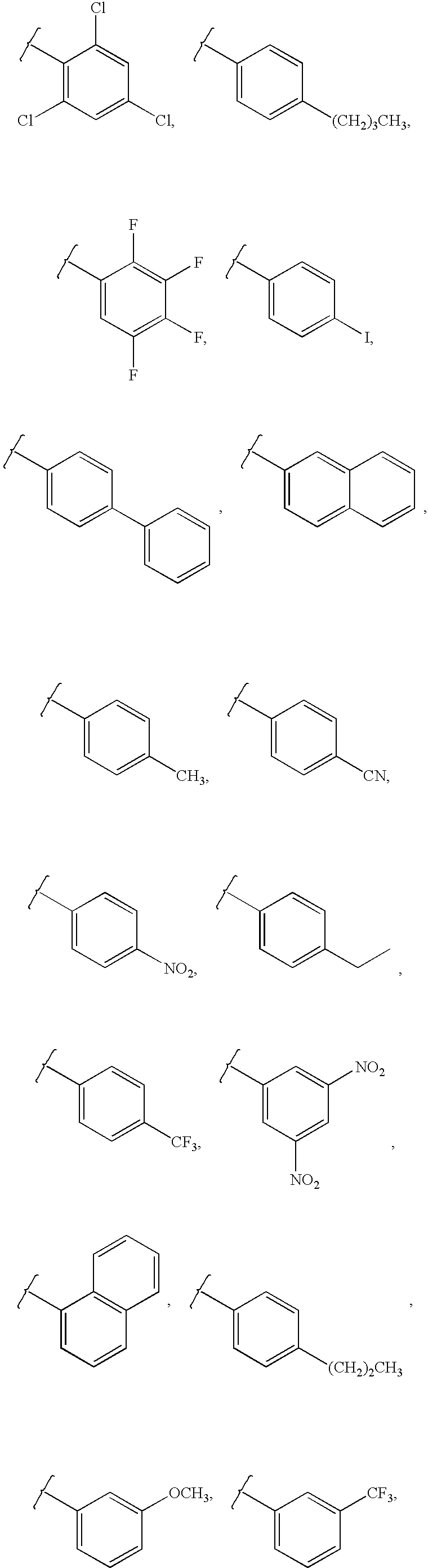

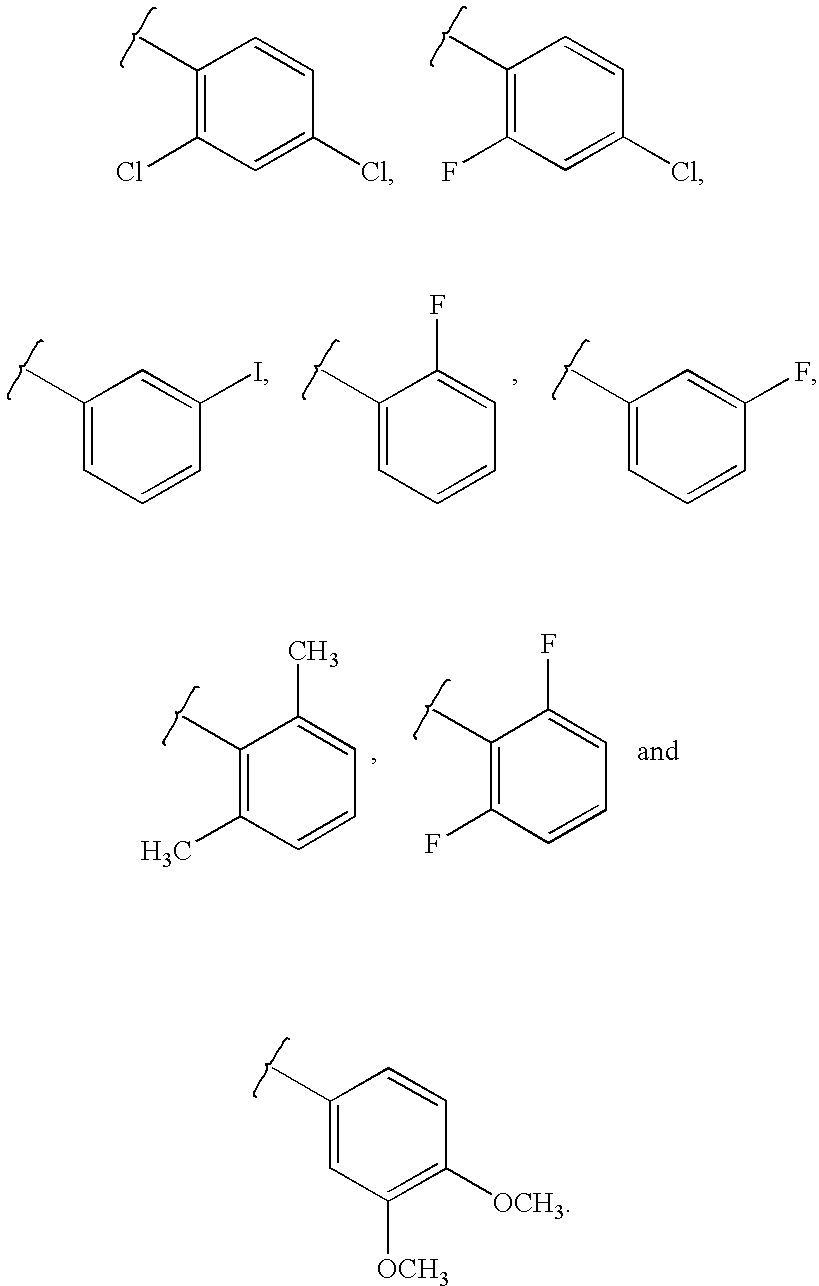
-
- In another embodiment, Y or Y2 is an optionally substituted pyridyl. For example Y or Y2 is selected from the group consisting of:
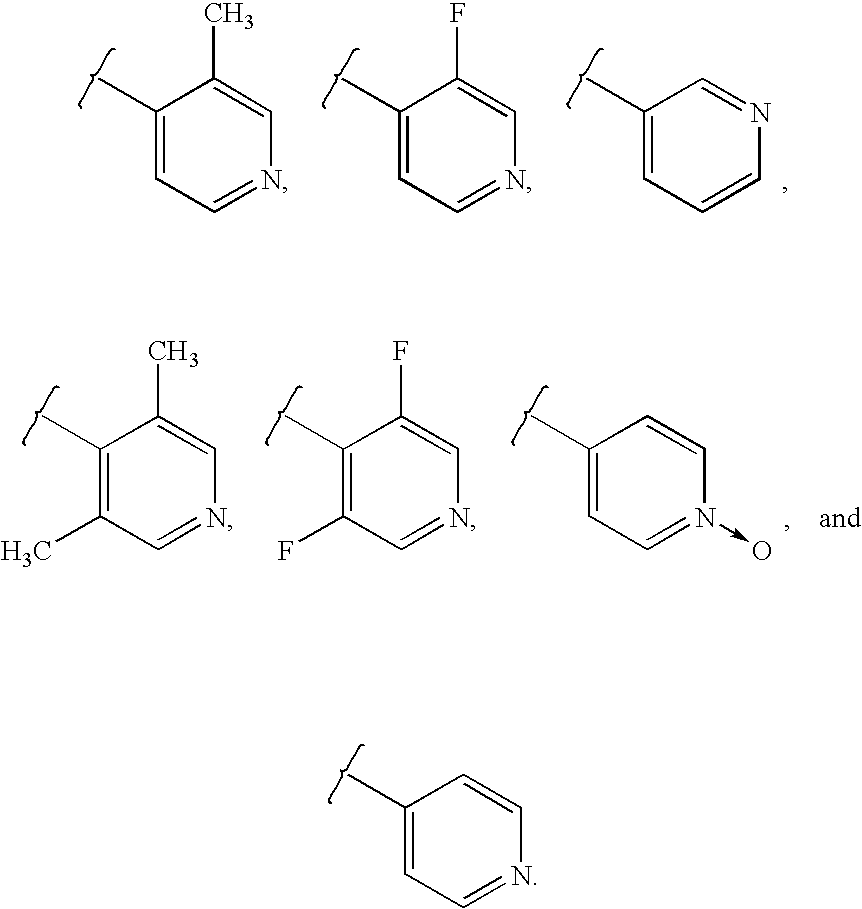
-
- In another embodiment, Y or Y2 is an optionally substituted 5-membered heteroaryl. For example Y or Y2 is selected from the group consisting of:

-
- In one embodiment, Y1 is an optionally substituted alkyl selected from the group consisting of propyl, 1-ethyl-pentyl, hexyl, isobutyl, phenylsulfanylmethyl, and O-ethyl-2-carboxyethyl, benzyloxymethyl.
- In another embodiment, Y1 is p-methoxybenzyl, benzyl, or m,p-dimethoxybenzyl.
- In another embodiment, Y2 is an optionally substituted aryl or an optionally substituted heteroaryl.
- In another embodiment, Y2 is selected from the group consisting of an optionally substituted phenyl, an optionally substituted naphthyl, an optionally substituted pyridyl, an optionally substituted furyl, an optionally substituted thienyl, an optionally substituted pyrrolyl, an optionally substituted oxazolyl, an optionally substituted imidazolyl, an optionally substituted indolizinyl, an optionally substituted thiazolyl, an optionally substituted isoxazolyl, an optionally substituted pyrazolyl, an optionally substituted isothiazolyl, an optionally substituted pyridazinyl, an optionally substituted pyrimidinyl, an optionally substituted pyrazinyl, an optionally substituted triazinyl, an optionally substituted triazolyl, an optionally substituted thiadiazolyl, an optionally substituted pyrazinyl, an optionally substituted quinolinyl, an optionally substituted isoquniolinyl, an optionally substituted indazolyl, an optionally substituted benzoxazolyl, an optionally substituted benzofuryl, an optionally substituted benzothiazolyl, an optionally substituted indolizinyl, an optionally substituted imidazopyridinyl, an optionally substituted isothiazolyl, an optionally substituted tetrazolyl, an optionally substituted benzoxazolyl, an optionally substituted benzothiazolyl, an optionally substituted benzothiadiazolyl, an optionally substituted benzoxadiazolyl, an optionally substituted indolyl, an optionally substituted tetrahydroindolyl, an optionally substituted azaindolyl, an optionally substituted imidazopyridyl, an optionally substituted quinazolinyl, an optionally substituted purinyl, an optionally substituted pyrrolo[2,3]pyrimidyl, an optionally substituted pyridopyrimidyl, an optionally substituted pyrazolo[3,4]pyrimidyl or an optionally substituted benzo(b)thienyl.
- In another embodiment, Y2 is an optionally substituted phenyl, an optionally substituted pyridinyl, or an optionally substituted [1,2,3]thiadiazolyl.
- In another embodiment, Y2 is optionally substituted with one or more substituents selected from the group consisting of halo, lower alkyl, lower haloalkyl, nitro, cyano, —OR, —NR11R12, —C(O)R11, —C(O)OR11, —C(O)NR11R12, —OC(O)R11, —NR11C(O)R12, —OC(O)NR11R12, —NR11C(O)OR12, —NR13C(NR10)NR11R12, —NR13C(O)NR11R12, —S(O)pR11, —S(O)hNR11R12, —NR11S(O)hR12, or —OP(O)(OR11)2; wherein R11, R12 and R13 are each, independently, H or a lower alkyl.
- In another embodiment, Y2 is selected from the group consisting of:
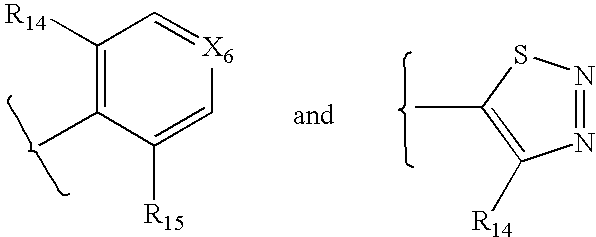
-
- wherein:
- X6 is CH or N;
- R14 is H, a halo, a lower alkyl, a lower haloalkyl, a lower alkoxy, or a lower haloalkoxy; and
- R15 is a halo, a lower alkyl, a lower haloalkyl, a lower alkoxy, or a lower haloalkoxy.
- In another embodiment, Y2 is an optionally substituted alkyl or an optionally substituted cycloalkyl.
- In another embodiment, Y2 is selected from the group consisting of methyl, n-propyl, isopropyl, n-butyl, isobutyl, tert-butyl, n-pentyl, isopentyl, 2-methyl-butyl, n-hexyl, 2-methyl-pentyl, 3-methyl-pentyl, 4-methyl-pentyl, 2-ethyl-butyl, 3-ethyl-butyl, cyclooctyl, cycloheptyl, cyclolhexyl, cyclopentyl, cyclobutyl, cyclopropyl, each of which can be optionally substituted with one or more substituent selected from the group consisting of a halo, lower alkyl, lower haloalkyl, nitro, cyano, —OR11, —NR11R12, —C(O)R11, —C(O)OR11, —C(O)NR11R12, —OC(O)R11, —NR11C(O)R12, —OC(O)NR11R12, —NR11C(O)OR12, —OC(O)OR11, —NR11C(NR16)NR12R13, —NR11C(O)NR12R13, —S(O)pR11, —S(O)hNR11R12, —NR11S(O)hR12, and —OP(O)(OR11)2; wherein R11, R12, R13, R16, h, and p are defined as above.
- In another embodiment, Y2 is an unsubstituted lower alkyl or a 3- to 6-membered, unsubstituted cycloalkyl.
- In one embodiment, X is a benzoimidazolyl, a 5,6,7,8-tetrahydroindolizinyl, an imidazo[4,5-a]pyridyl, an imidazo[1,2-a]pyridyl, an imidazo[4,5-b]pyridyl, or an imidazo[4,5-c]pyridyl, each of which may be optionally substituted with one to four substituents selected from the group consisting of lower alkoxy, lower haloalkyl, lower haloalkoxy, cyano, halo, amino, hydroxyl, lower alkylsulfanyl, lower alkylsulfinyl, lower alkysulfonyl, 5-t-butyloxazolyl, —NHC(O)-(lower alkyl), —C(O)NH2, —C(O)NH-(lower alkyl), —C(O)O-(lower alkyl), —C(O)OH, and —OC(O)-(lower alkyl).
- In another embodiment, X is an optionally substituted benzoimidazolyl. For example, X is selected from the group consisting of:
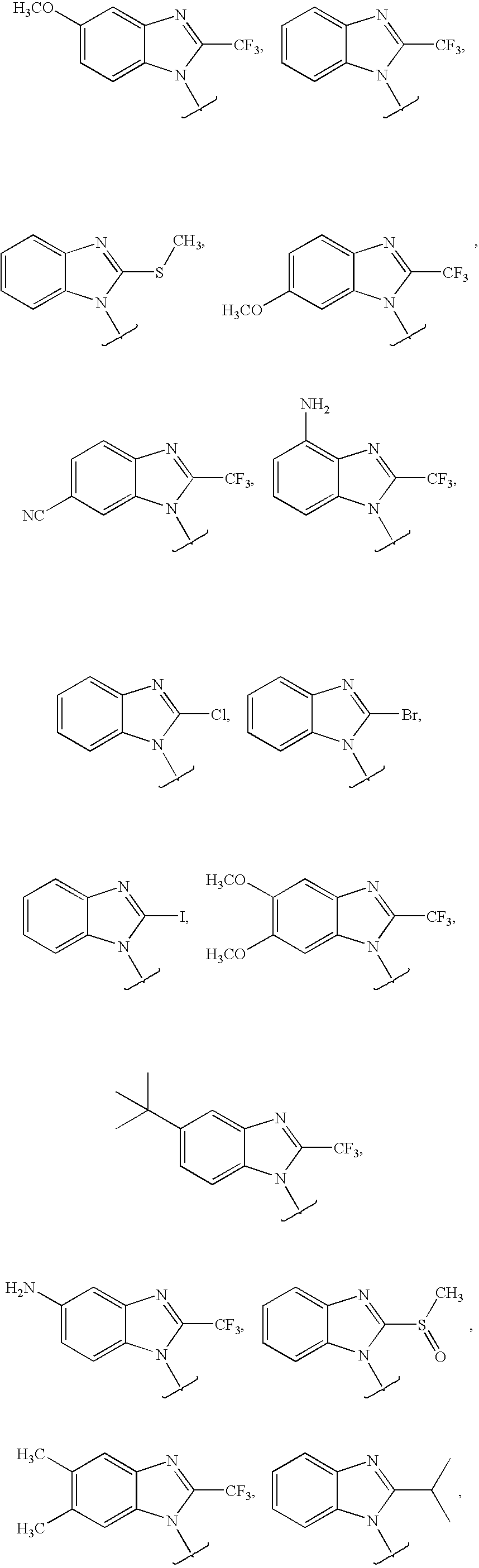
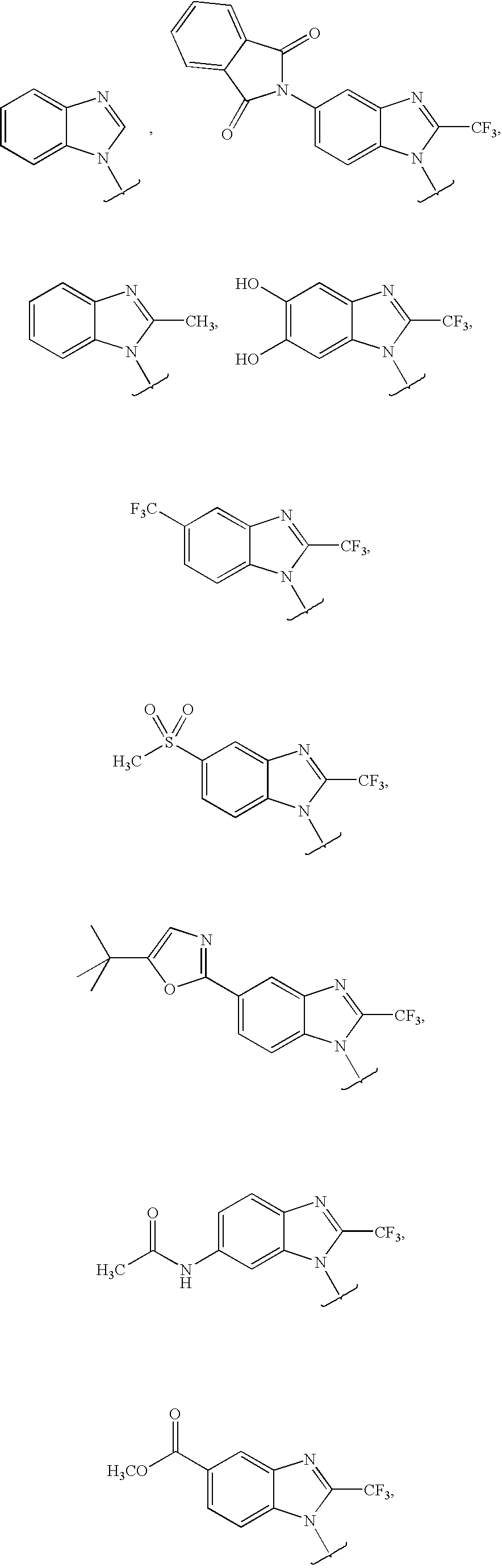

-
- In another embodiment, X is an optionally substituted 5,6,7,8-tetrahydroindolizinyl. For example, X is selected from the group consisting of:

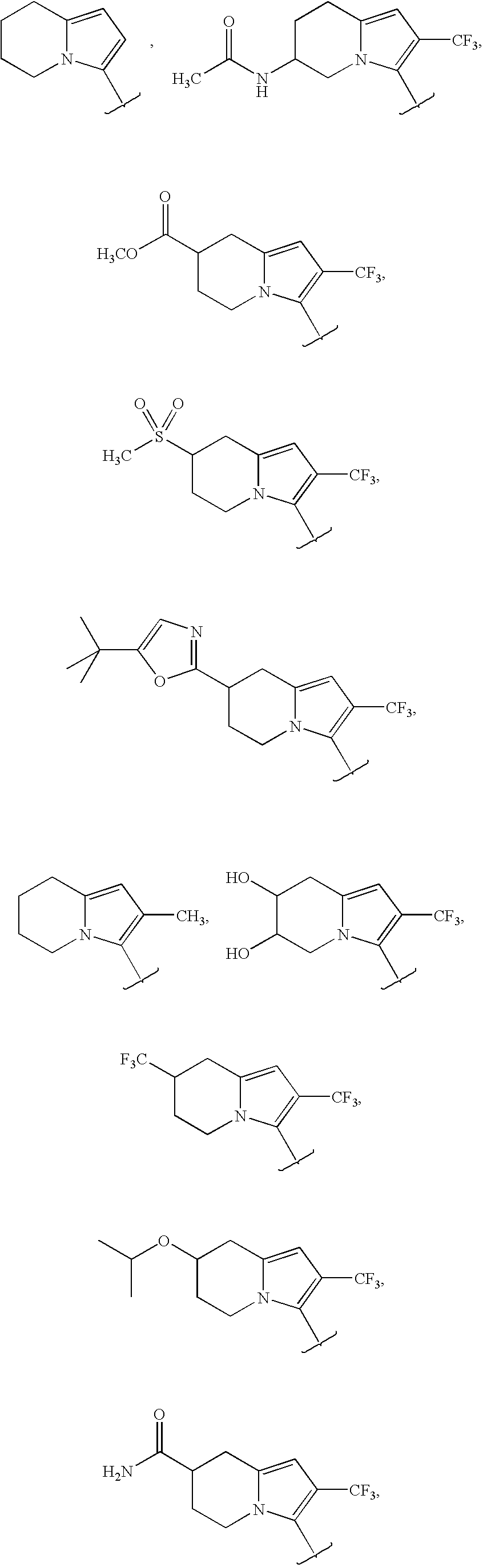
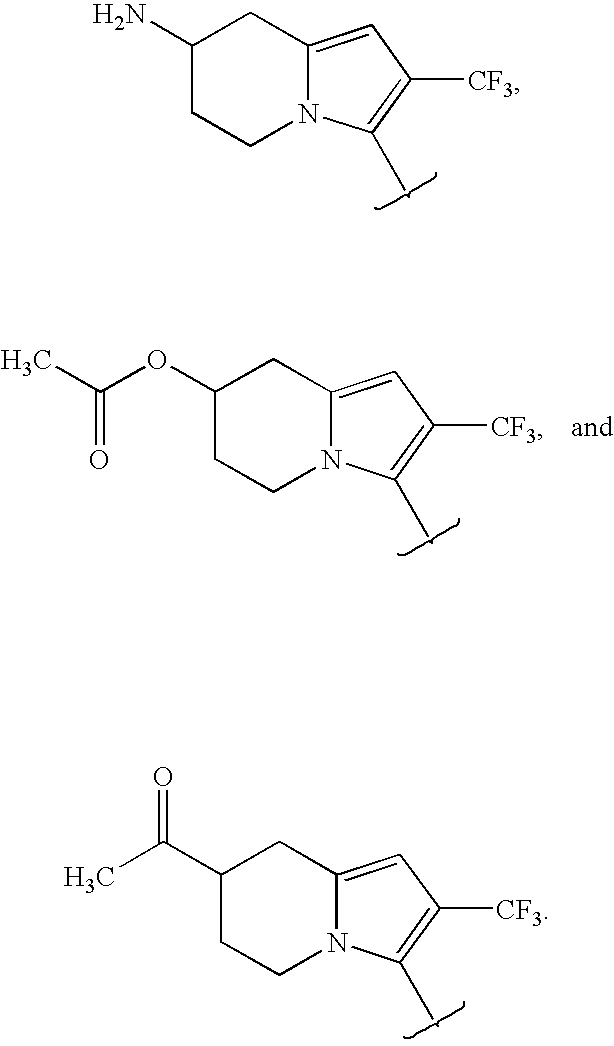
-
- In another embodiment, X is an optionally substituted imidazopyridyl, such as an optionally substituted imidazo[1,2-a]pyridyl (e.g., 2-trifluoromethyl-imidazo[1,2-a]pyrid-3-yl), or an optionally substituted imidazo[4,5-b]pyridyl (e.g., 2-trifluoromethyl-imidazo[4,5-b]pyrid-3-yl), or an optionally substituted imidazo[4,5-c]pyridyl (e.g., 2-trifluoromethyl-imidazo[4,5-c]pyrid-1-yl).
- In one embodiment, Z is independently selected from the group consisting of a lower alkyl (e.g., CH3), a lower haloalkyl (e.g., CF3), cyano, and halo (e.g., F and Cl).
- In one embodiment, n or u is 0 and Z is absent.
- In another embodiment, n or u is one. Preferably, in this embodiment, Z is selected from the group consisting of a lower alkyl, a lower haloalkyl, —C(O)NR11R12, —NR11C(O)R12, halo, —OR11, cyano, nitro, a lower haloalkoxy, —C(O)R11, —NR11R12, —C(O)OR11, —OC(O)R11, —NR13C(O)NR11R12, —OC(O)NR11R12, —NR11C(O)OR12, —S(O)pR11, or —S(O)hNR11R12; wherein R11, R12, R13, h and p are defined as above.
- In one embodiment, R, for each occurrence, is independently selected from —H, acetyl, tert-butoxycarbonyl, benzyloxycarbonyl (e.g., —H).
- In one embodiment, R6, for each occurrence, is, independently, selected from the group consisting of lower alkoxy, lower haloalkoxy, cyano, —NH2, lower alkyl, —OH, lower haloalkyl, —S(O)2-(lower alkyl), —NHC(O)-(lower alkyl), —C(O)O-(lower alkyl), —C(O)NH2, and —C(O)-(lower alkyl).
- In another embodiment, R6 is —OCH3, —CF3, —C(O)OCH3, —OH, —OCH(CH3)2, —C(O)NH2, —OC(O)CH3, —C(O)CH3, or —NH2.
- In one embodiment, R7 is selected from the group consisting of halo, lower haloalkyl, lower haloalkoxy, —S-(lower alkyl), and —S(O)-(lower alkyl).
- In another embodiment, R7 is —CF3, —OCF3, —OCHF2, —SCH3, —Cl, or —Br.
- In one embodiment, R8, for each occurrence, is, independently, selected from the group consisting of halo, lower alkyl, nitro, —NH2, —NHC(O)OC(CH3)3, phenyl, cyano, lower haloalkyl, and —OCH3.
- In another embodiment, R8, for each occurrence, is, independently, a halo, cyano or nitro.
- In another embodiment, m is 0.
- In another embodiment, m is 1. Preferably, in this embodiment, R9, for each occurrence, is independently, selected from the group consisting of a halo, nitro, cyano, a haloalkyl, —OR3, —SR3, —NR1R2, an optionally substituted alkyl, an optionally substituted alkenyl, an optionally substituted alkynyl, an optionally substituted cycloalkyl, an optionally substituted cycloalkenyl, an optionally substituted heterocyclyl, an optionally substituted aryl, an optionally substituted heteroaryl, an optionally substituted aralkyl, an optionally substituted heteraralkyl, —C(O)NR1R2, —C(O)R3, —C(O)OR3, —C(O)SR3, —C(S)NR1R2, —C(S)R3, —C(S)OR3, —C(S)SR3, —C(NR16)NR1R2, —C(NR16)R3, —C(NR16)OR3, —C(NR16)SR3, —S(O)hR3, —S(O)hNR1R2, —P(O)(OR3)2, —P(S)(OR3)2, —P(O)(OR3)(SR4), —P(S)(OR3)(SR4), —P(O)(SR3)2, —P(S)(SR3)2, —OC(O)NR1R2, —OC(O)R3, —OC(O)OR3, —OC(O)SR3, —NR3C(O)NR1R2, —NR3C(O)R4, —NR3C(O)OR4, —NR3C(O)SR4, —SC(O)NR1R2, —SC(O)R3, —SC(O)OR3, —SC(O)SR3, —OC(S)NR1R2, —OC(S)R3, —OC(S)OR3, —OC(S)SR3, —NR3C(S)NR1R2, —NR3C(S)R4, —NR3C(S)OR4, —NR3C(S)SR4, —SC(S)NR1R2, —SC(S)R3, —SC(S)OR3, —SC(S)SR3, —OC(NR16)NR1R2, —OC(NR16)R3, —OC(NR16)OR3, —OC(NR16)SR3, —NR3C(NR16)NR1R2, —NR3C(NR16)R3, —NR3C(NR16)OR4, —NR3C(NR16)SR4, —OS(O)hR3, —NR3S(O)hR4, —OP(O)(OR3)2, and —OP(S)(OR3)2; wherein R1, R2, R3, R4, R5, R16, and h are defined as above. More preferably, in this embodiment, R9 is —OCH3.
- In another embodiment, R9, for each occurrence, is independently, selected from the group consisting of a halo, nitro, cyano, a haloalkyl, —OR3, —SR3, —NR1R2, an optionally substituted alkyl, an optionally substituted alkenyl, an optionally substituted alkynyl, an optionally substituted cycloalkyl, an optionally substituted cycloalkenyl, an optionally substituted heterocyclyl, an optionally substituted aryl, an optionally substituted heteroaryl, an optionally substituted aralkyl, an optionally substituted heteraralkyl, —C(O)NR1R2, —C(O)R3, —C(O)OR3, —C(O)SR3, —C(S)NR1R2, —C(S)R3, —C(S)OR3, —C(S)SR3, —C(NR16)NR1R2, —C(NR16)R3, —C(NR16)OR3, —C(NR16)SR3, —S(O)hR3, —S(O)hNR1R2, —P(O)(OR3)2, —P(S)(OR3)2, —P(O)(OR3)(SR4), —P(S)(OR3)(SR4), —P(O)(SR3)2, —P(S)(SR3)2, —OC(O)NR1R2, —OC(O)R3, —OC(O)OR3, —OC(O)SR3, —NR3C(O)NR1R2, —NR3C(O)R4, —NR3C(O)OR4, —NR3C(O)SR4, —SC(O)NR1R2, —SC(O)R3, —SC(O)OR3, —SC(O)SR3, —OC(S)NR1R2, —OC(S)R3, —OC(S)OR3, —OC(S)SR3, —NR3C(S)NR1R2, —NR3C(S)R4, —NR3C(S)OR4, —NR3C(S)SR4, —SC(S)NR1R2, —SC(S)R3, —SC(S)OR3, —SC(S)SR3, —OC(NR16)NR1R2, —OC(NR16)R3, —OC(NR16)OR3, —OC(NR16)SR3, —NR3C(NR16)NR1R2, —NR3C(NR16)R3, —NR3C(NR16)OR4, —NR3C(NR16)SR4, —OS(O)hR3, —NR3S(O)hR4, —OP(O)(OR3)2, and —OP(S)(OR3)2; and R10 is selected from the group consisting of H, a halo, nitro, cyano, a haloalkyl, —OR3, —SR3, —NR1R2, an optionally substituted alkyl, an optionally substituted alkenyl, an optionally substituted alkynyl, an optionally substituted cycloalkyl, an optionally substituted cycloalkenyl, an optionally substituted heterocyclyl, an optionally substituted aryl, an optionally substituted heteroaryl, an optionally substituted aralkyl, an optionally substituted heteraralkyl, —C(O)NR1R2, —C(O)R3, —C(O)OR3, —C(O)SR3, —C(S)NR1R2, —C(S)R3, —C(S)OR3, —C(S)SR3, —C(NR16)NR1R2, —C(NR16)R3, —C(NR16)OR3, —C(NR16)SR3, —S(O)hR3, —S(O)hNR1R2, —P(O)(OR3)2, —P(S)(OR3)2, —P(O)(OR3)(SR4), —P(S)(OR3)(SR4), —P(O)(SR3)2, —P(S)(SR3)2, —OC(O)NR1R2, —OC(O)R3, —OC(O)OR3, —OC(O)SR3, —NR3C(O)NR1R2, —NR3C(O)R4, —NR3C(O)OR4, —NR3C(O)SR4, —SC(O)NR1R2, —SC(O)R3, —SC(O)OR3, —SC(O)SR3, —OC(S)NR1R2, —OC(S)R3, —OC(S)OR3, —OC(S)SR3, —NR3C(S)NR1R2, —NR3C(S)R4, —NR3C(S)OR4, —NR3C(S)SR4, —SC(S)NR1R2, —SC(S)R3, —SC(S)OR3, —SC(S)SR3, —OC(NR16)NR1R2, —OC(NR16)R3, —OC(NR16)OR3, —OC(NR16)SR3, —NR3C(NR16)NR1R2, —NR3C(NR16)R3, —NR3C(NR16)OR4, —NR3C(NR16)SR4, —OS(O)hR3, —NR3S(O)hR4, —OP(O)(OR3)2, and —OP(S)(OR3)2; wherein R1, R2, R3, R4, R5, R16, and h are defined as above. Preferably, in this embodiment, m is 1, R9 is —OCH3, and R10 is —CH3 or —CF3.
| Compound | ||
| No. | Structure | Chemical Name |
| 1 | 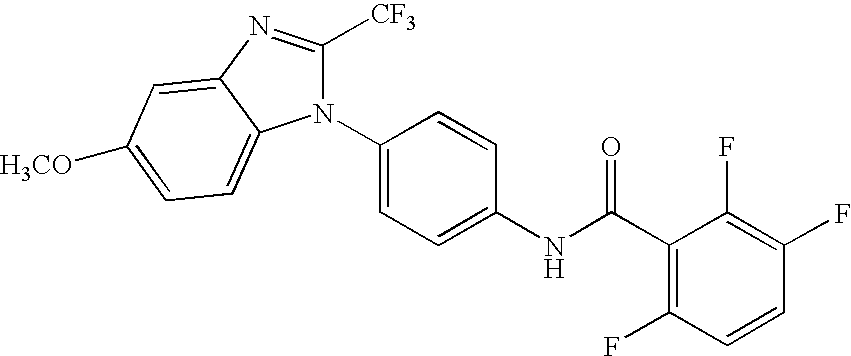 | 2,3,6-Trifluoro-N-[4-(2- trifiuoromethyl-5-methoxy- benzoimidazol-1-yl)-phenyl]- benzamide |
| 2 | 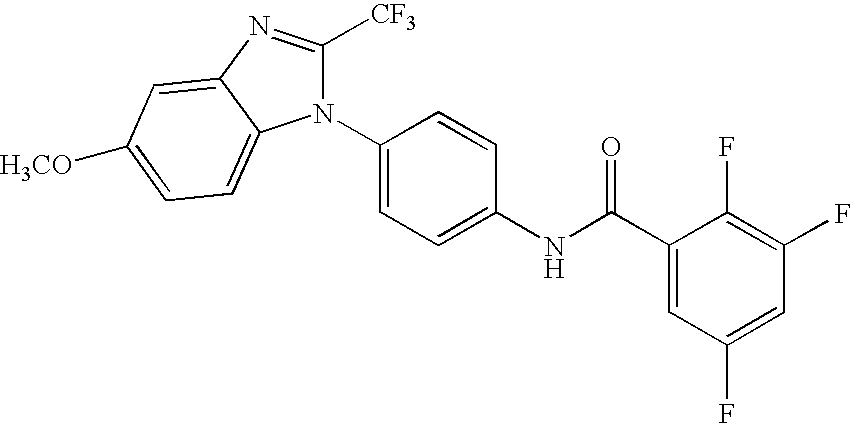 | 2,3,5-Trifluoro-N-[4-(2- trifluoromethyl-5-methoxy- benzoimidazol-1-yl)-phenyl]- benzamide |
| 3 |  | 2,3,4-Trifluoro-N-[4-(2- trifluoromethyl-5-methoxy- benzoimidazol-1-yl)-phenyl]- benzamide |
| 4 | 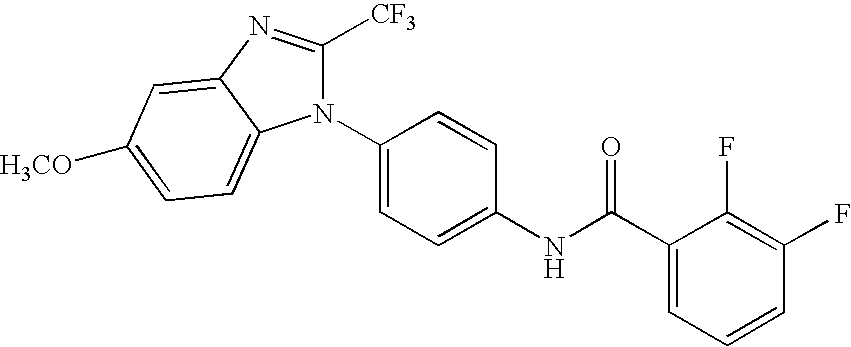 | 2,3-Difluoro-N-[4-(2- trifluoromethyl-5-methoxy- benzoimidazol-1-yl)-phenyl]- benzamide |
| 5 |  | 3-Methyl-N-[4-(2- trifluoromethyl-5-methoxy- benzoimidazol-1-yl)-phenyl]- isonicotinamide |
| 6 | 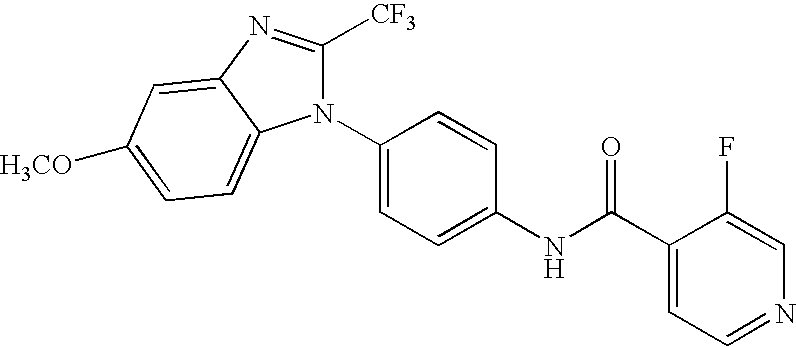 | 3-Fluoro-N-[4-(2-trifluoromethyl- 5-methoxy-benzoimidazol-1-yl)- phenyl]-isonicotinamide |
| 7 | 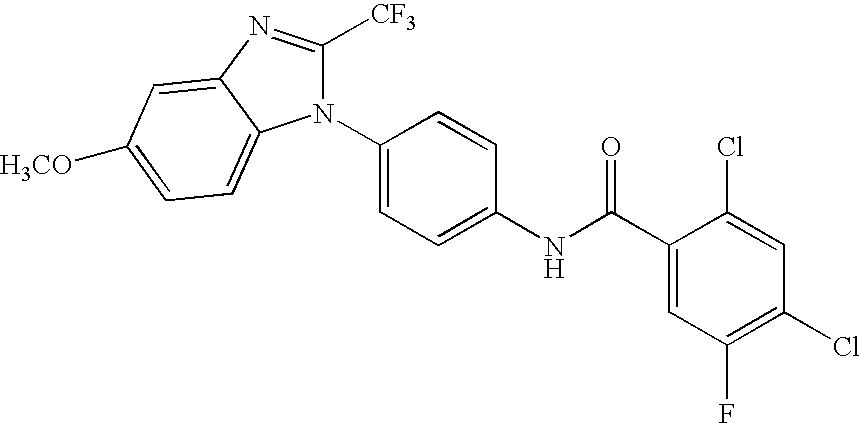 | 2,4-Dichloro-5-fluoro-N-[4-(2- trifluoromethyl-5-methoxy- benzoimidazol-1-yl)-phenyl]- benzamide |
| 8 |  | 2,3-Difluoro-N-[4-(2- trifluoromethyl-5,6,7,8- tetrahydroindolizin-3-yl)- phenyl]-benzamide |
| 9 | 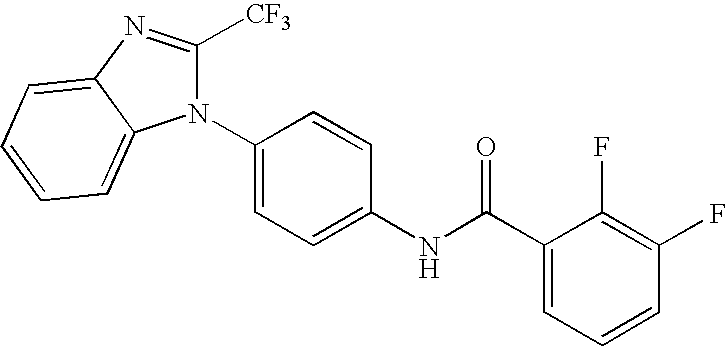 | 2,4-Difluoro-N-[4-(2- trifluoromethyl-benzoimidazol- 1-yl)-phenyl]-benzamide |
| 10 |  | 3-Nitro-N-[4-(2-trifluoromethyl- 5-methoxy-benzoimidazol-1-yl)- phenyl]-benzamide |
| 11 | 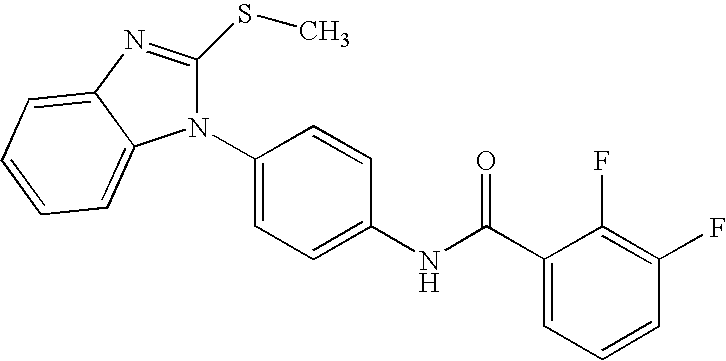 | 2,3-Difiuoro-N-[4-(2- methylsulfanyl-benzoimidazol- 1-yl)-phenyl]-benzamide |
| 12 |  | 2,3-Difluoro-N-[4-(2- trifluoromethyl-benzoimidazol- 1-yl)-phenyl]-thiobenzamide |
| 13 | 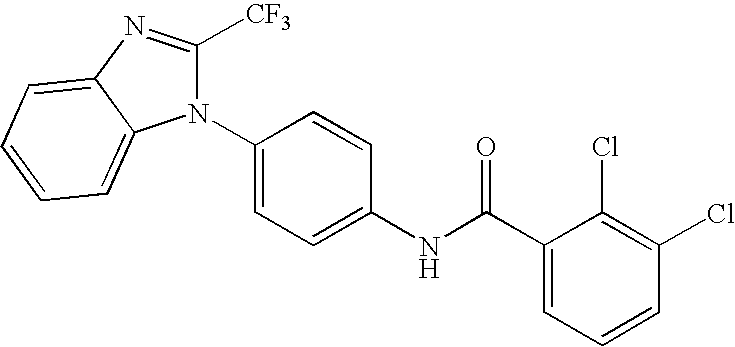 | 2,3-Dichloro-N-[4-(2- trifluoromethyl-benzoimidazol- 1-yl)-phenyl]-benzamide |
| 14 | 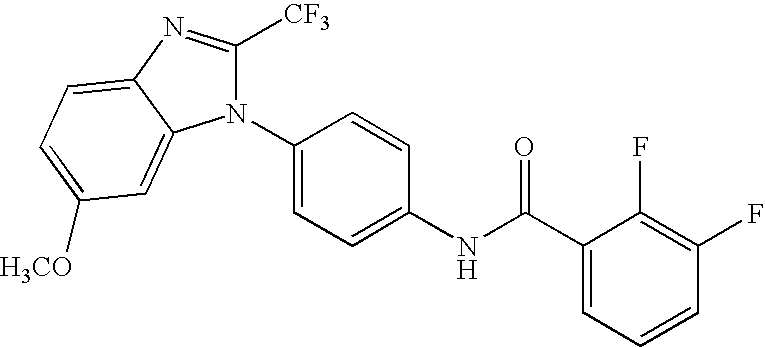 | 2,3-Difluoro-N-[4-(2- trifluoromethyl-6-methoxy- benzoimidazol-1-yl)-phenyl]- benzamide |
| 15 |  | 2-Fluoro-2-chloro-N-[4-(2- trifluoromethyl-benzoimidazol- 1-yl)-phenyl]-benzamide |
| 16 |  | 2,3,6-Trifluoro-5-amino-N-[4-(2- trifluoromethyl-benzoimidazol- 1-yl)-phenyl]-benzamide |
| 17 |  | 2,3-Difluoro-N-[3-methyl-4-(2- trifluoromethyl-benzoimidazol- 1-yl)-phenyl]-benzamide |
| 18 |  | 2-Methyl-N-[4-(2- trifluoromethyl-5,6,7,8- tetrahydroindolizin-3-yl)- phenyl]-benzamide |
| 19 | 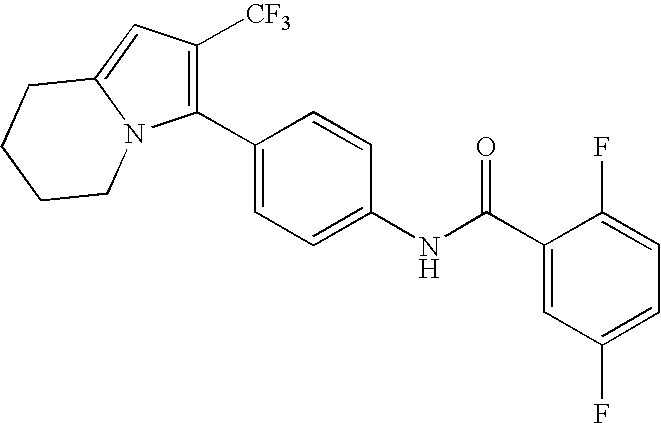 | 2,3-Difluoro-N-[4-(2- trifluoromethyl-5,6,7,8- tetrahydroindolizin-3-yl)- phenyl]-benzamide |
| 20 | 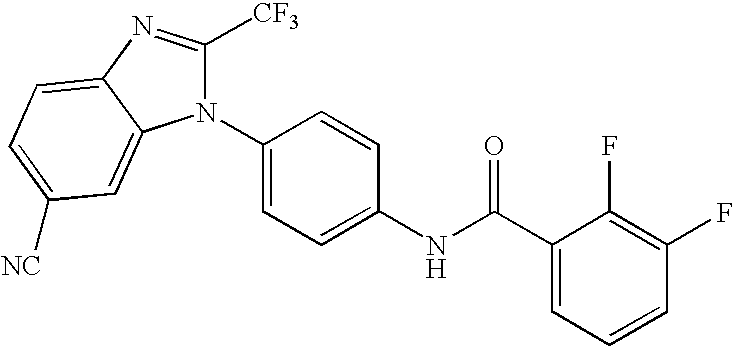 | 2,3-Difluoro-N-[4-(2- trifluoromethyl-6-cyano- benzoimidazol-1-yl)-phenyl]- benzamide |
| 21 | 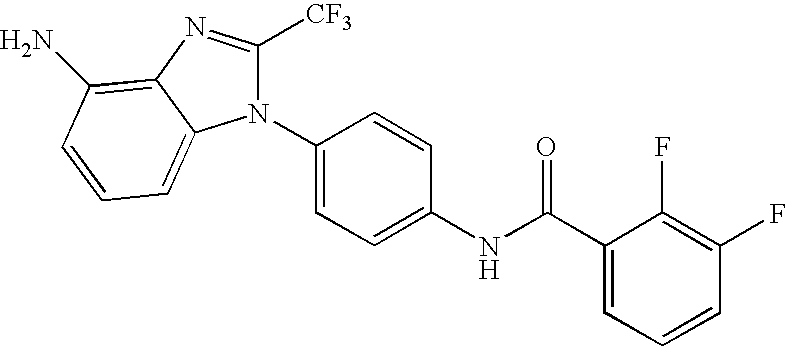 | 2,3-Difluoro-N-[4-(2- trifluoromethyl-4-amino- benzoimidazol-1-yl)-phenyl]- benzamide |
| 22 | 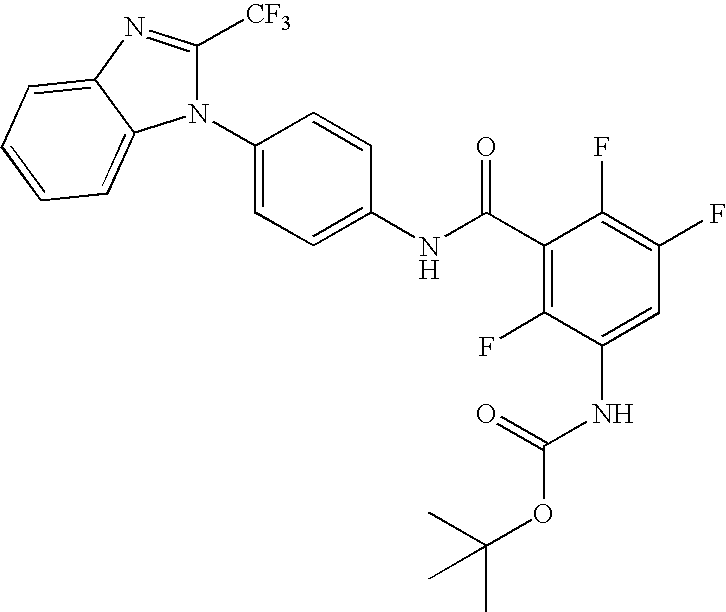 | N-(3-{N-[4-(2-trifluoromethyl- benzoimidazol-1-yl)-phenyl]- carbamoyl}-2,4,5-trifluoro- phenyl)-carbamic acid t-butyl ester |
| 23 |  | 2,3-Difluoro-N-[4-(2-chloro- benzoimidazol-1-yl)-phenyl]- benzamide |
| 24 | 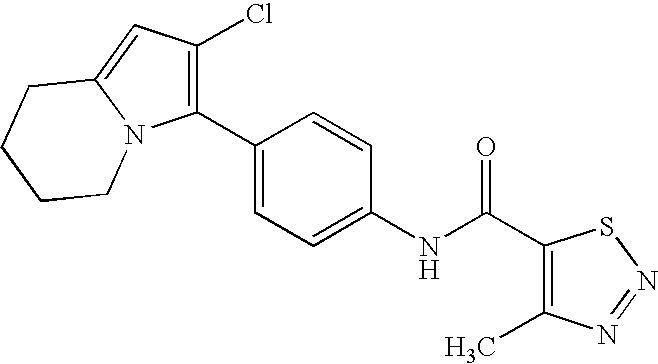 | 4-Methyl-[1,2,3]thiadiazole-5- carboxylic acid {N-[4-(2-chloro- 5,6,78-tetrahydroindolizin-3-yl)- phenyl}amide |
| 25 | 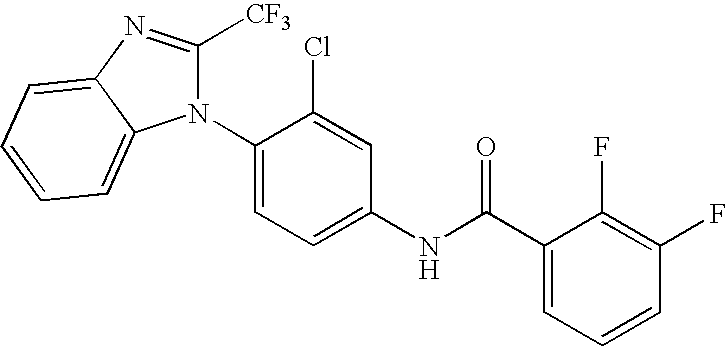 | 2,3-Difluoro-N-[2-.chloro-4-(2- trifluoromethyl-benzoimidazol- 1-yl)-phenyl]-benzamide |
| 26 | 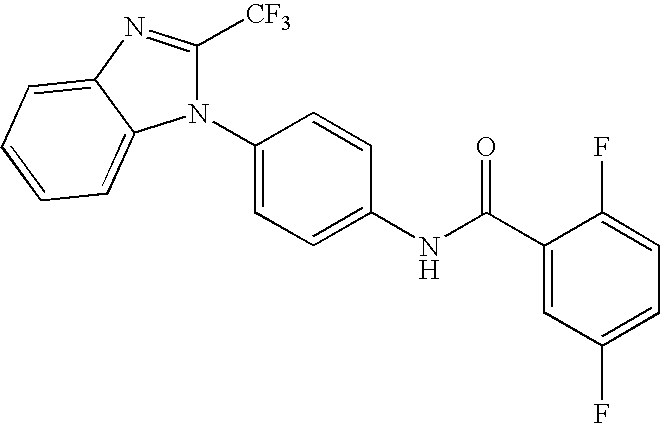 | 2,5-Difluoro-N-[4-(2- trifluoromethyl-benzoimidazol- 1-yl)-phenyl]-benzamide |
| 27 |  | 3-Fluoro-N-[4-(2-trifluoromethyl- benzoimidazol-1-yl)-phenyl]- isonicotinamide |
| 28 | 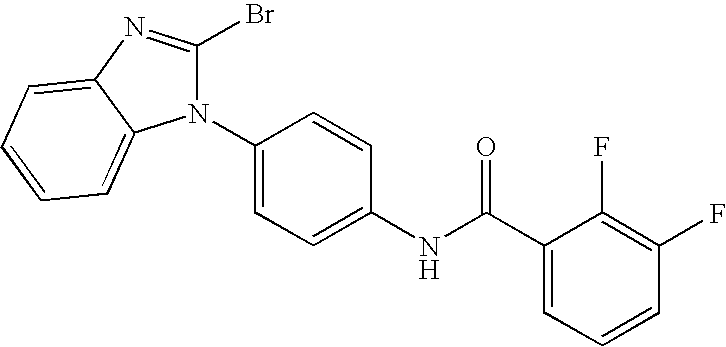 | 2,3-Difluoro-N-[4-(2-bromo- benzoimidazol-1-yl)-phenyl]- benzamide |
| 29 | 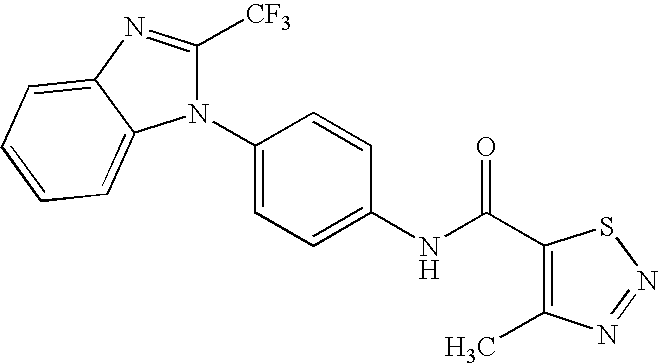 | 4-Methyl-[1,2,3]thiadiazole-5- carboxylic acid {N-[4-(2- trifluoromethyl-benzoimidazol- 1-yl)-phenyl[}amide |
| 30 |  | 2,3-Difluoro-N-[3- trifluoromethyl-4-(2- trifluoromethyl-benzoimidazol- 1-yl)-phenyl]-benzamide |
| 31 |  | N-(4-{N-[4-(2-trifluoromethyl- benzoimidazol-1-yl)-phenyl]- carbamoyl}-2,3-difluoro- phenyl)-carbamic acid t-butyl ester |
| 32 | 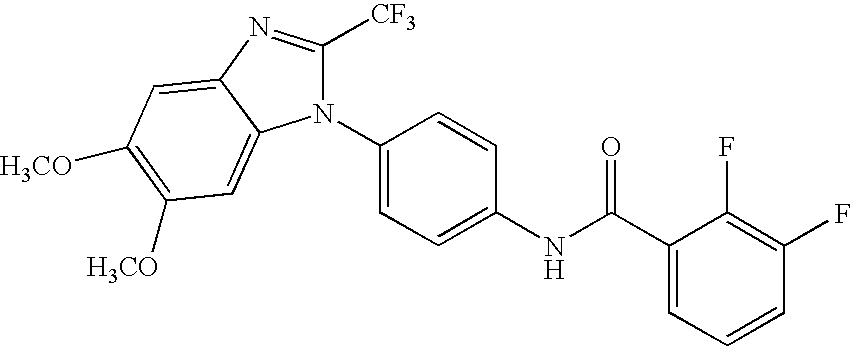 | 2,3-Difluoro-N-[4-(2- trifluoromethyl-5,6-dimethoxy- benzoimidazol-1-yl)-phenyl]- benzamide |
| 33 | 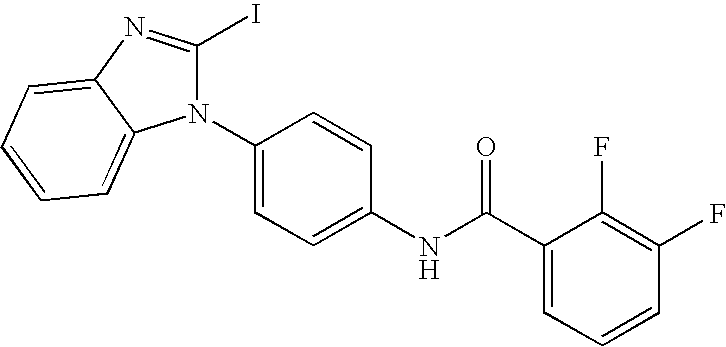 | 2,3-Difluoro-N-[4-(2-iodo- benzoimidazol-1-yl)-phenyl]- benzamide |
| 34 |  | N′-[2-(2-trifluoromethyl- benzoimidazol-1-yl)-pyrid-5-yl]- N-(2,5-difluoro-phenyl)-thiourea |
| 35 | 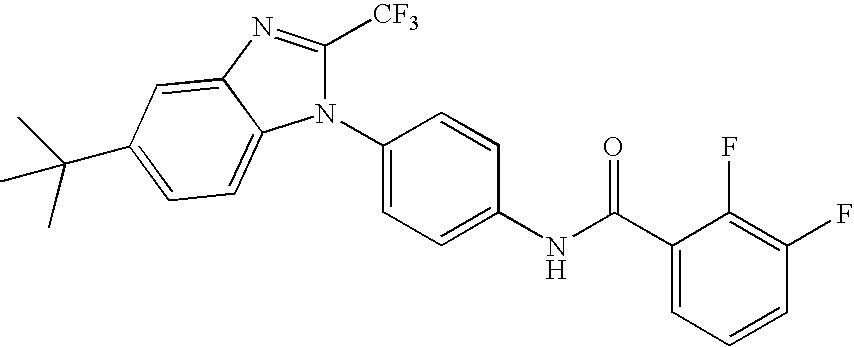 | 2,3-Difluoro-N-[4-(2- trifluoromethyl-5-tert-butyl- benzoimidazol-1-yl)-phenyl]- benzamide |
| 36 | 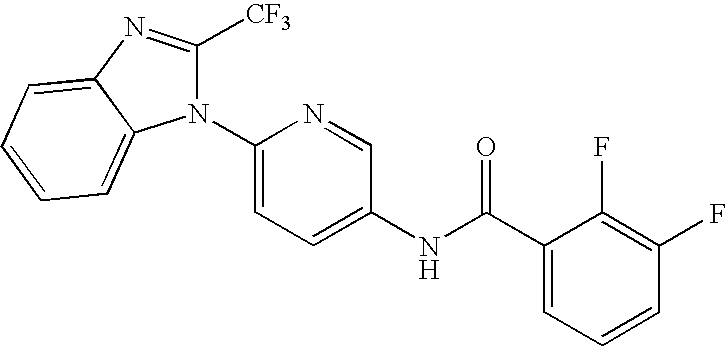 | 2,3-Difluoro-N-[2-(2- trifluoromethyl-benzoimidazol- 1-yl)-pyrid-3-yl]-benzamide |
| 37 | 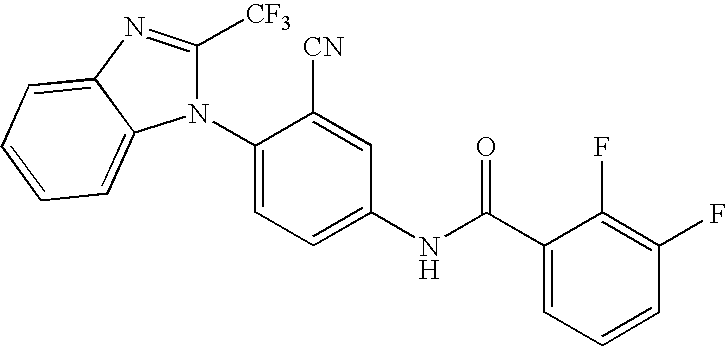 | 2,3-Difluoro-N-[3-cyano-4-(2- trifluoromethyl-benzoimidazol- 1-yl)-phenyl]-benzamide |
| 38 |  | 2,5-Difluoro-N-[3-chloro-4-(2- trifluoromethyl-benzoimidazol- 1-yl)-phenyl]-benzamide |
| 39 |  | 2,3-Difluoro-N-[4-(2- trifluoromethyl-5-amino- benzoimidazol-1-yl)-phenyl]- benzamide |
| 40 |  | 2,3-Difluoro-N-[4-(2- methanesulfinyl-benzoimidazol- 1-yl)phenyl]benzamide |
| 41 |  | 2,5-Difiuoro-N-[2-(2- trifluoromethyl-benzoimidazol- 1-yl)-pyrid-5-yl]-benzamide |
| 42 |  | 2,3-Difluoro-N-[4-(2- trifluoromethyl-5,6-dimethyl- benzoimidazol-1-yl)-phenyl]- benzamide |
| 43 | 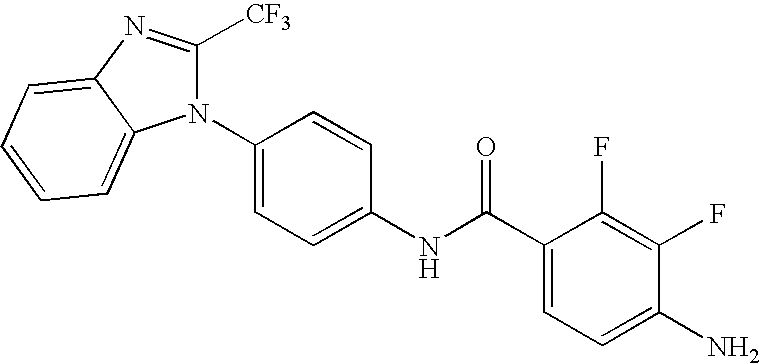 | 2,3-Difluoro-4-amino-N-[4-(2- trifluoromethyl-benzoimidazol- 1-yl)-phenyl]-benzamide |
| 44 | 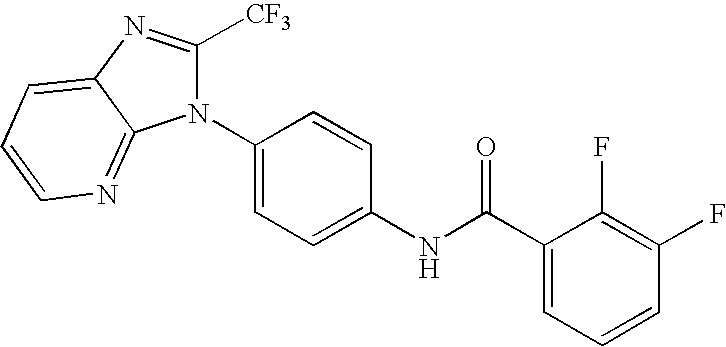 | 2,3-Difluoro-N-[4-(2- trifiuoromethyl-imidazo[4,5- b]pyrid-3-yl)-phenyl]-benzamide |
| 45 | 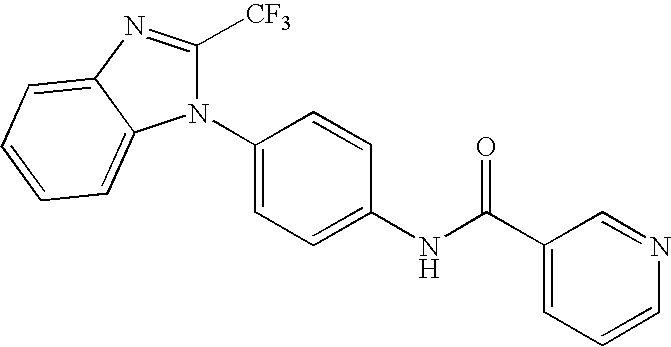 | N-[4-(2-trifiuoromethyl- benzoimidazol-1-yl)-phenyl]- nicotinamide |
| 46 | 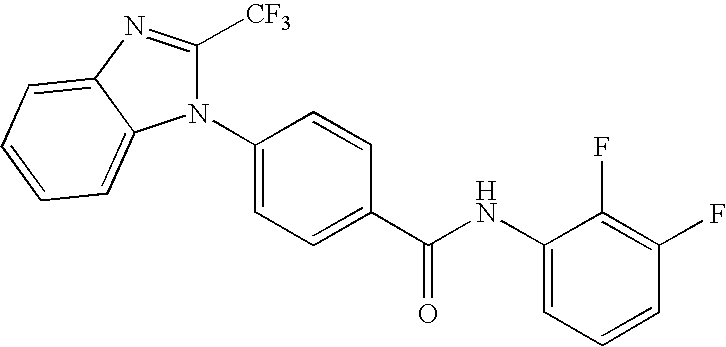 | N-(2,3-difluorophenyl )-4-(2- trifluoromethyl-benzoimidazol- 1-yl)-benzamide |
| 47 |  | 1-(2,3-difluoro-phenyl)-3-[4-(2- trifluoromethyl-benzoimidazol- 1-yl)-phenyl]-acrylonitrile |
| 48 |  | 1-(2,5-difluoro-phenyl)-3-[4-(2- trifluoromethyl-benzoimidazol- 1-yl)-phenyl]-acrylonitrile |
| 49 | 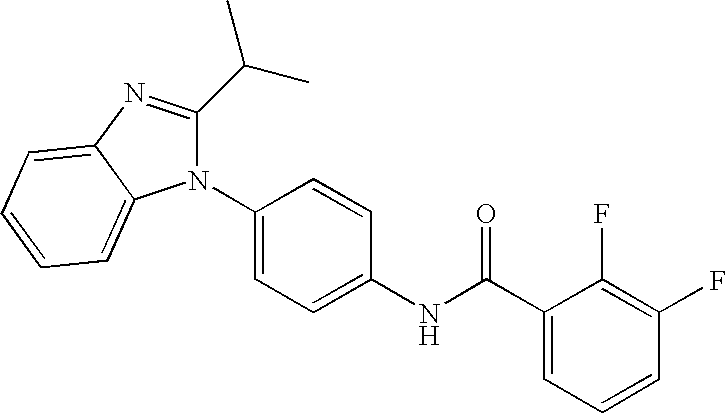 | 2,3-Difluoro-N-[4-(2-isopropyl- benzoimidazol-1-yl)-phenyl]- benzamide |
| 50 |  | N′-[4-(2-trifluoromethy- benzoimidazol-1-yl)-phenyl]-N- (2,5-difluoropheyl)-urea |
| 51 |  | 1-Oxo-3-fluoro-N-[4-(2- trifiuoromethyl-benzoimidazol- 1-yl)-phenyl]-isonicotinamide |
| 52 | 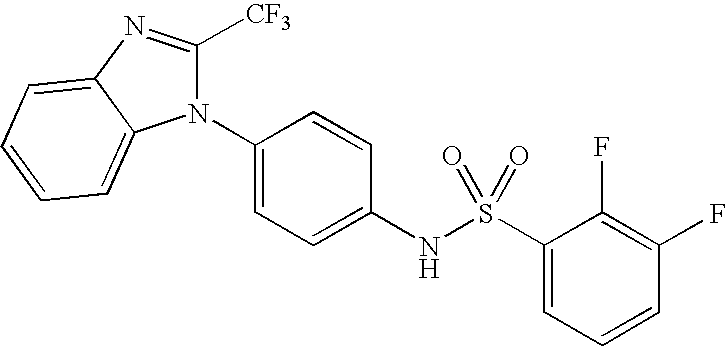 | 2,3-Difluoro-N-[4- (trifluoromethyl-benzoimidazol- 1-yl)-phenyl]- benzenesulfonamide |
| 53 |  | 2,3-Difluoro-N-[3-acetylamino- 4-(2-trifluoromethyl- benzoimidazol-1-yl)-phenyl]- benzamide |
| 54 | 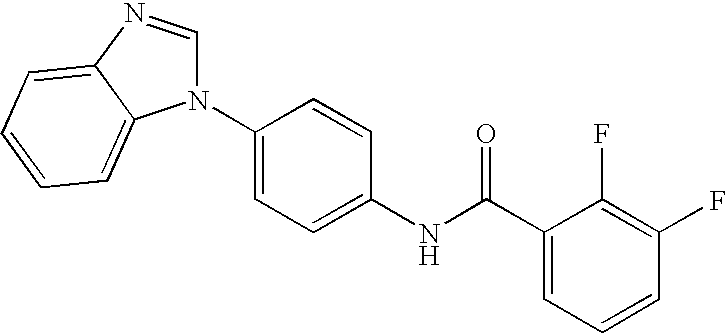 | 2,3-Difluoro-N-[4- (benzoimidazol-1-yl)-phenyl]- benzamide |
| 55 |  | 2,3-Difluoro-N-[2-methyl-4-(2- trifluoromethyl-benzoimidazol- 1-yl)-phenyl]-benzamide |
| 56 |  | 2,5-Difluoro-N-[4-(2- trifluoromethyl-imidazo[4,5- b]pyrid-3-yl)-phenyl]-benzamide |
| 57 | 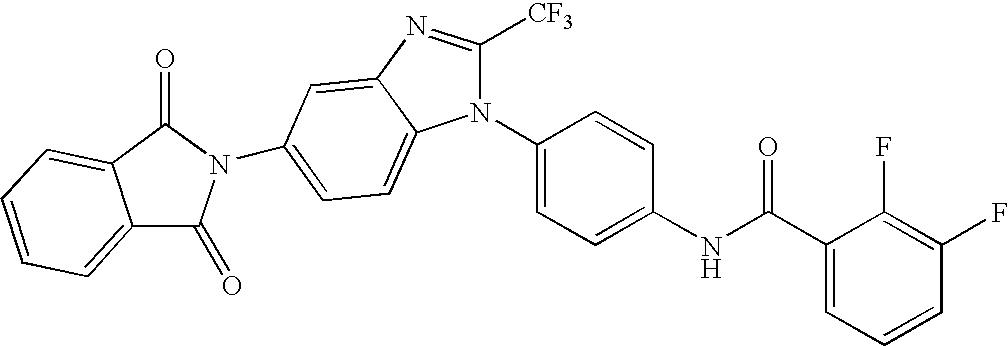 | 2,3-Difluoro-N-{4-[2- trifluoromethyl-5-(1,3-dioxo- isoindol-2-yl)-benzoimidazol-1- yl]-phenyl}-benzamide |
| 58 |  | 4-Methyl-[1,2,3]thiadiazole-5- carboxylic acid {N-[4-(2- trifluoromethyl-imidazo[4,5- b]pyrid-3-yl)-phenyl]} amide |
| 59 |  | 2,3-Difluoro-N-[4-(2-methyl- benzoimidazol-1-yl)-phenyl]- benzamide |
| 60 | 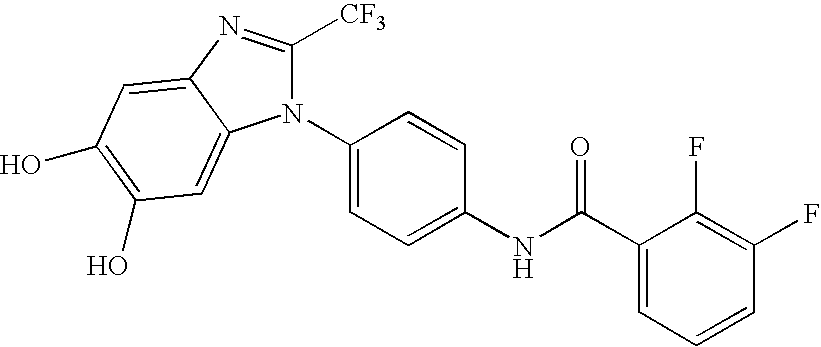 | 2,3-Difiuoro-N-[4-(2- trifluoromethyl-5,6-dihydroxy- benzoimidazol-1-yl)-phenyl]- benzamide |
| 61 | 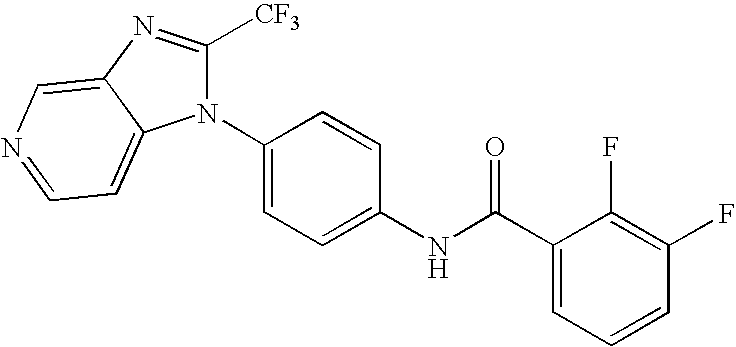 | 2,3-Difluoro-N-[4-(2- trifluoromethyl-imidazo[4,5- c]pyrid-1-yl)-phenyl]-benzamide |
| 62 | 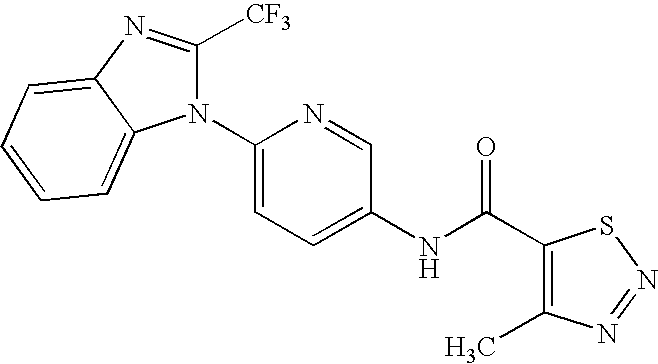 | 4-Methyl-[1,2,3]thiadiazole-5- carboxylic acid {N-[2-(2- trifluoromethyl-benzoimidazol- 1-yl)-pyrid-5-yl[} amide |
| 63 | 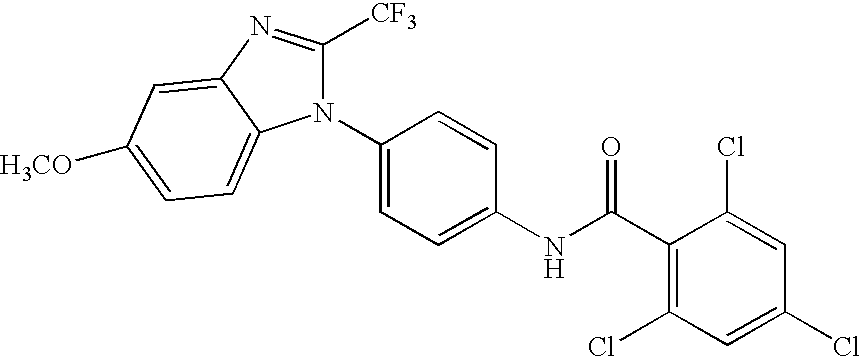 | 2,4,6-Trichloro-N-[4-(2- trifluoromethyl-5-methoxy- benzoimidazol-1-yl)-phenyl]- benzamide |
| 64 | 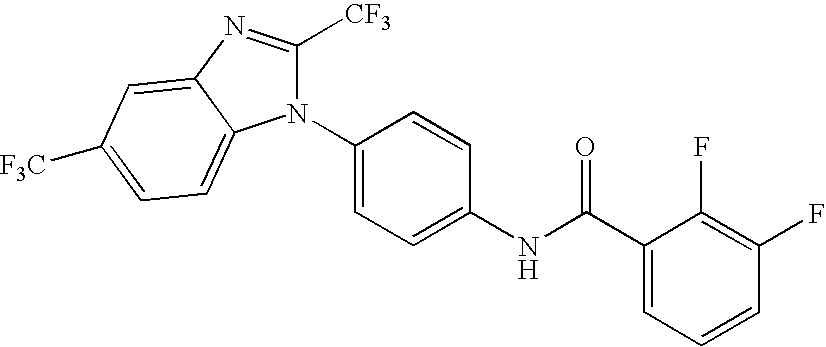 | 2,3-Difiuoro-N-{4-[2,5-di- (trifluoromethyl)-benzoimidazol- 1-yl]-phenyl}-benzamide |
| 65 |  | 2,3-Difluoro-N-[4-(2- trifluoromethyl-5- methanesulfonyl- benzoimidazol-1-yl)-phenyl]- benzamide |
| 66 | 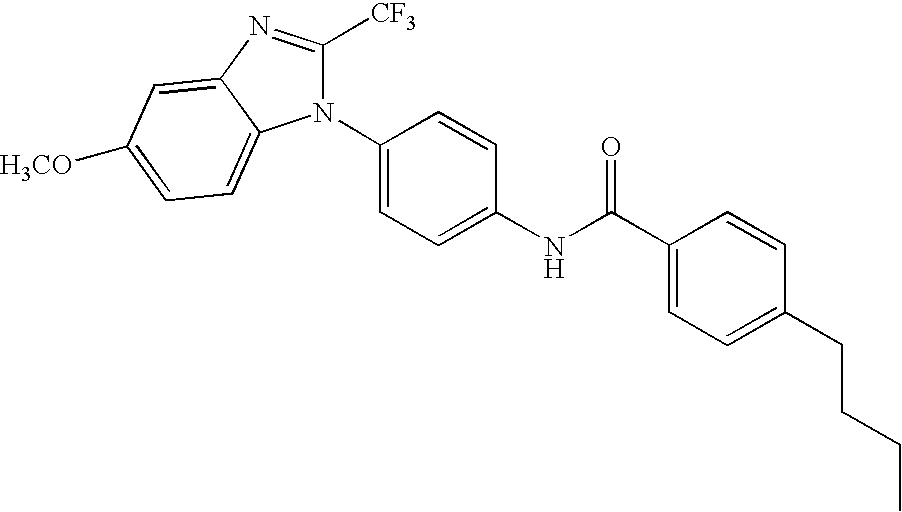 | 4-Butyl-N-[4-(2-trifluoromethyl- 5-methoxy-benzoimidazol-1-yl)- phenyl]-benzamide |
| 67 |  | 2,5-Difiuoro-N-{4-[2- trifluoromethyl-5-(5-tert-butyl- oxazol-2-yl)-benzoimidazol-1- yl]-phenyl}-benzamide |
| 68 |  | 2,3-Difluoro-N-{4-[2- trifluoromethyl-5-(5-tert-butyl- oxazol-2-yl)-benzoimidazol-1- yl]-phenyl}-benzamide |
| 69 |  | Furan-2-carboxylic acid (N-{4- [2-trifluoromethyl-5-(5-tert-butyl- oxazol-2-yl)-benzoimidazol-1- yl]-phenyl}) amide |
| 70 | 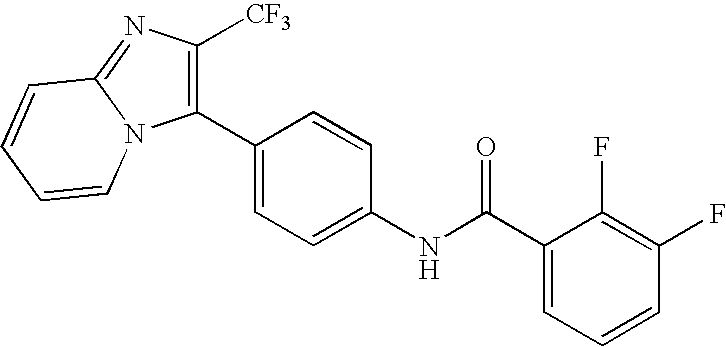 | 2,3-Difluoro-N-[4-(2- trifluoromethyl-imidazo[1,2- a]pyrid-3-yl)-phenyl]-benzamide |
| 71 |  | 2,3,4,5-Tetrafluoro-N-[4-(2- trifluoromethyl-5-methoxy- benzoimidazol-1-yl)-phenyl]- benzamide |
| 72 |  | 4-Phenyl-N-[4-(2- trifluoromethyl-5-methoxy- benzoimidazol-1-yl)-phenyl]- benzamide |
| 73 | 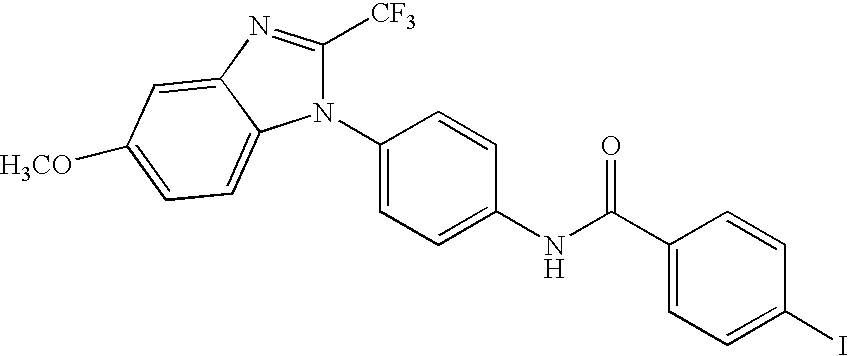 | 4-iodo-N-[4-(2-trifluoromethyl-5- methoxy-benzoimidazol-1-yl)- phenyl]-benzamide |
| 74 |  | Naphthalene-2-carboxylic acid {N-[4-(2-trifluoromethyl-5- methoxy-benzoimidazol-1-yl)- phenyl]} amide |
| 75 | 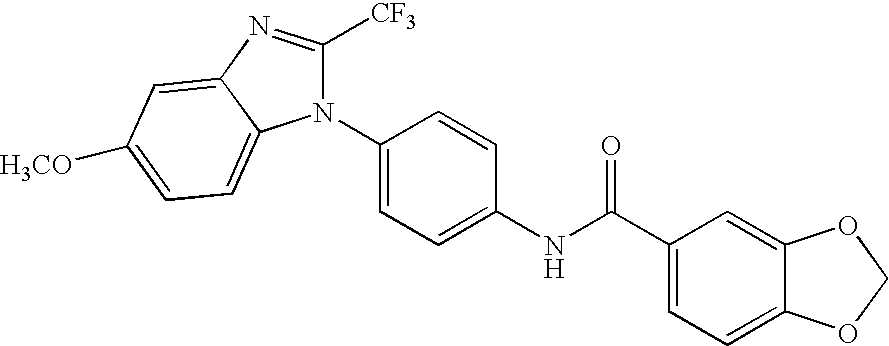 | Benzo[1,3]dioxole-5-carboxylic acid {N-[4-(2-trifluoromethyl-5- methoxy-benzoimidazol-1-yl)- phenyl]} amide |
| 76 |  | 4-Methyl-N-[4-(2- trifluoromethyl-5-methoxy- benzoimidazol-1-yl)-phenyl]- benzamide |
| 77 | 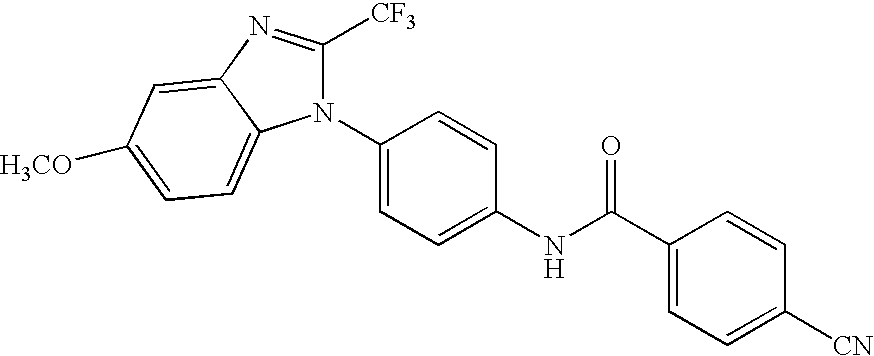 | 4-Cyano-N-[4-(2- trifluoromethyl-5-methoxy- benzoimidazol-1-yl)-phenyl]- benzamide |
| 78 | 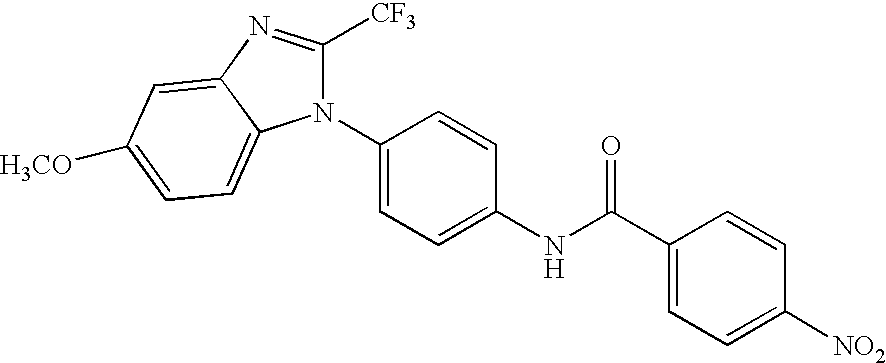 | 4-Nitro-N-[4-(2-trifluoromethyl- 5-methoxy-benzoimidazol-1-yl)- phenyl]-benzamide |
| 79 |  | 4-Ethyl-N-[4-(2-trifluoromethyl- 5-methoxy-benzoimidazol-1-yl)- phenyl]-benzamide |
| 80 |  | 4-Trifluoromethyl-N-[4-(2- trifluoromethyl-5-methoxy- benzoimidazol-1-yl)-phenyl]- benzamide |
| 81 |  | 3,5-Dinitro-N-[4-(2- trifluoromethyl-5-methoxy- benzoimidazol-1-yl)-phenyl]- benzamide |
| 82 | 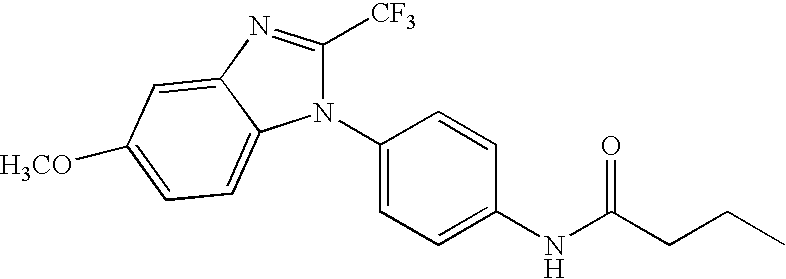 | N-[4-(2-trifluoromethyl-5- methoxy-benzoimidazol-1-yl)- phenyl]-butyramide |
| 83 | 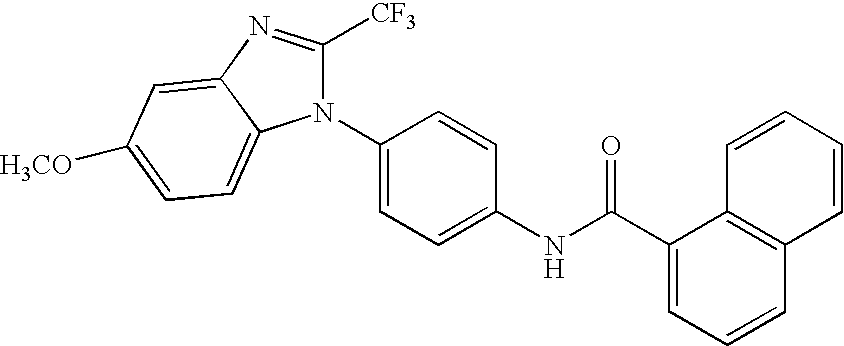 | Naphthalene-1-carboxylic acid {N-[4-(2-trifluoromethyl-5- methoxy-benzoimidazol-1-yl)- phenyl]} amide |
| 84 |  | 3-Methyl-N-[4-(2- trifluoromethyl-5-methoxy- benzoimidazol-1-yl)-phenyl]- but-2-enoic acid amide |
| 85 |  | 4-Propyl-N-[4-(2-trifluoromethyl- 5-methoxy-benzoimidazol-1-yl)- phenyl]-benzamide |
| 86 |  | Thiophene-2-carboxylic acid {N-[4-(2-trifluoromethyl-5- methoxy-benzoimidazol-1-yl)- phenyl]) amide |
| 87 |  | 2-Ethyl-N-[4-(2-trifluoromethyl- 5-methoxy-benzoimidazol-1-yl)- phenyl]-hexanoic acid amide |
| 88 |  | N-[4-(2-trifluoromethyl-5- methoxy-benzoimidazol-1-yl)- phenyl]-heptanoic acid amide |
| 89 | 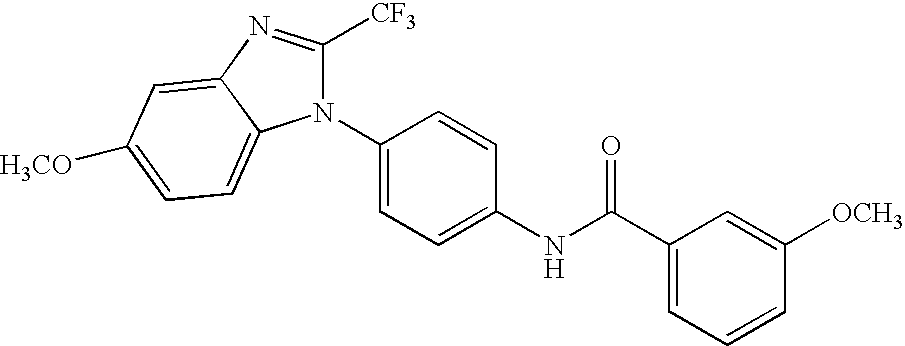 | 3-Methoxy-N-[4-(2- trifluoromethyl-5-methoxy- benzoimidazol-1-yl)-phenyl]- benzamide |
| 90 |  | 2-Phenyl-N-[4-(2- trifluoromethyl-5-methoxy- benzoimidazol-1-yl)-phenyl]- cyclopropanecarboxylic acid amide |
| 91 |  | 3-Trifluoromethyl-N-[4-(2- trifluoromethyl-5-methoxy- benzoimidazol-1-yl)-phenyl]- benzamide |
| 92 |  | 2-(4-Methoxy-phenyl)-N-[4-(2- trifluoromethyl-5-methoxy- benzoimidazol-1-yl)-phenyl]- acetamide |
| 93 |  | 2,3-Difluoro-N-[4-(2- trifluoromethyl-6-acetylamino- benzoimidazol-1-yl)-phenyl]- benzamide |
| 94 |  | 2-(Thien-2-yl)-N-[4-(2- trifluoromethyl-5-methoxy- benzoimidazol-1-yl)-phenyl]- acetamide |
| 95 |  | 2-phenyl-N-[4-(2- trifluoromethyl-5-methoxy- benzoimidazol-1-yl)-phenyl]- acetamide |
| 96 | 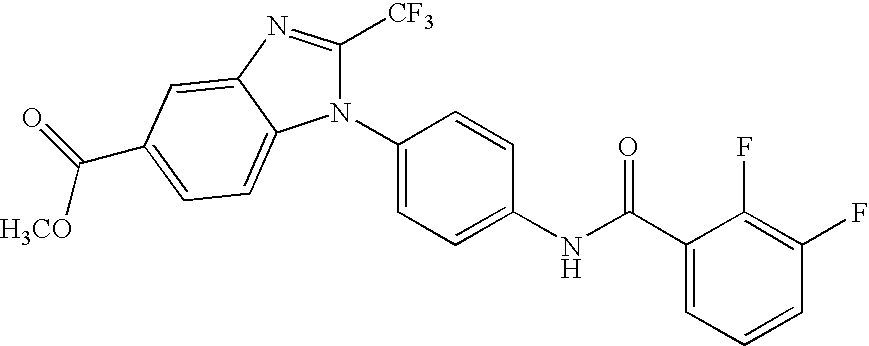 | 2-Trifluoromethyl-1-[4-(2,3- difluoro-benzoylamimo)- phenyl]-1H-benzoimidazole-5- carboxylic acid methyl ester |
| 97 |  | 2,3,4,5,6-Pentafluoro-N-[4-(2- trifluoromethyl-5-methoxy- benzoimidazol-1-yl)-phenyl]- benzamide |
| 98 | 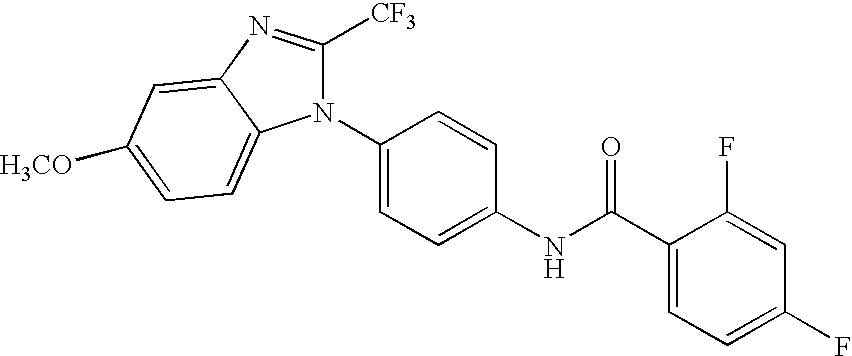 | 2,4-Difluoro-N-[4-(2- trifluoromethyl-5-methoxy- benzoimidazol-1-yl)-phenyl]- benzamide |
| 99 |  | 2,3-Difluoro-N-[4-(2- trifluoromethyl-5-hydroxy- benzoimidazol-1-yl)-phenyl]- benzamide |
| 100 | 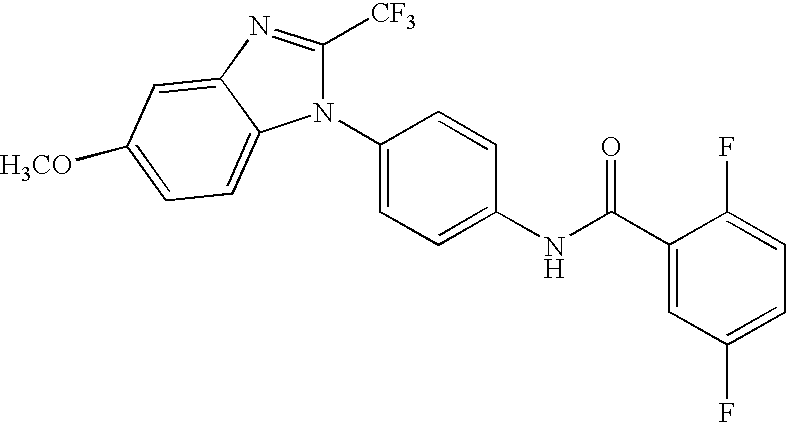 | 2,5-Difluoro-N-[4-(2- trifluoromethyl-5-methoxy- benzoimidazol-1-yl)-phenyl]- benzamide |
| 101 |  | 3-Cyano-N-[4-(2- trifluoromethyl-5-methoxy- benzoimidazol-1-yl)-phenyl]- benzamide |
| 102 |  | 2,6-Dichloro-N-[4-(2- trifluoromethyl-5-methoxy- benzoimidazol-1-yl)-phenyl]- benzamide |
| 103 |  | 3,5-Dichloro-N-[4-(2- trifluoromethyl-5-methoxy- benzoimidazol-1-yl)-phenyl]- benzamide |
| 104 | 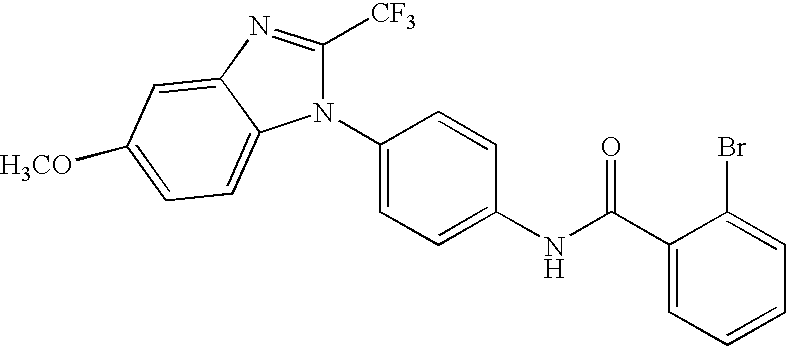 | 2-Bromo-N-[4-(2- trifluoromethyl-5-methoxy- benzoimidazol-1-yl)-phenyl]- benzamide |
| 105 |  | N-[4-(2-trifluoromethyl-5- methoxy-benzoimidazol-1-yl)- phenyl]-cyclopentanecarboxylic acid amide |
| 106 | 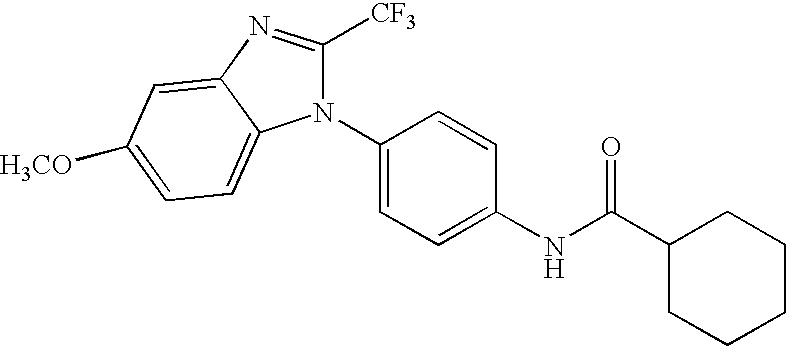 | N-[4-(2-trifluoromethyl-5- methoxy-benzoimidazol-1-yl)- phenyl]-cyclohexanecarboxylic acid amide |
| 107 |  | 2-Nitro-N-[4-(2-trifluoromethyl- 5-methoxy-benzoimidazol-1-yl)- phenyl]-benzamide |
| 108 |  | 4-Chloro-N-[4-(2- trifluoromethyl-5-methoxy- benzoimidazol-1-yl)-phenyl]- benzamide |
| 109 | 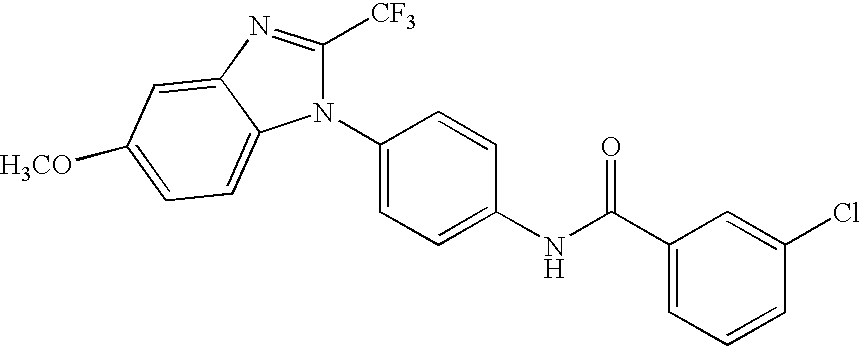 | 3-Chloro-N-[4-(2- trifluoromethyl-5-methoxy- benzoimidazol-1-yl)-phenyl]- benzamide |
| 110 | 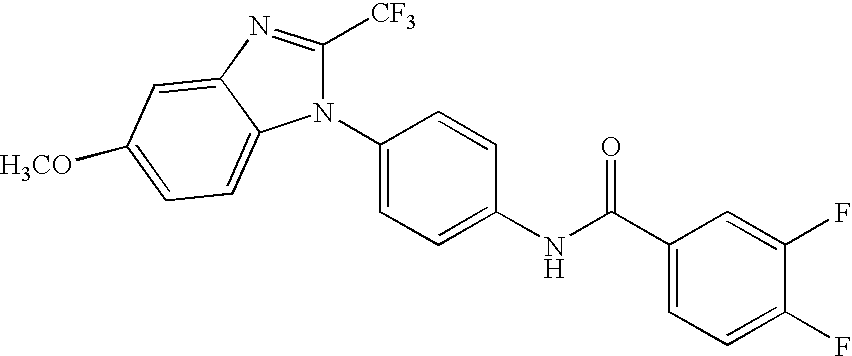 | 3,4-Difluoro-N-[4-(2- trifluoromethyl-5-methoxy- benzoimidazol-1-yl)-phenyl]- benzamide |
| 111 |  | N-[4-(2-trifluoromethyl-5- methoxy-benzoimidazol-1-yl)- phenyl]-benzamide |
| 112 |  | 2,3-Difluoro-N-[4-(2- trifluoromethyl-5-isopropoxy- benzoimidazol-1-yl)-phenyl]- benzamide |
| 113 |  | 2,3-Difluoro-N-[4-(2- trifluoromethyl-5-carbamoyl- benzoimidazol-1-yl)-phenyl]- benzamide |
| 114 | 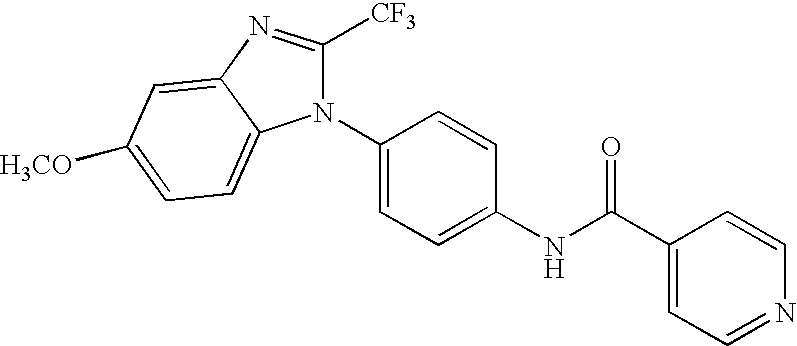 | N-[4-(2-trifluoromethyl-5- methoxy-benzoimidazol-1-yl)- phenyl]-isonicotinamide |
| 115 |  | 2-Iodo-N-[4-(2-trifluoromethyl-5- methoxy-benzoimidazol-1-yl)- phenyl]-benzamide |
| 116 | 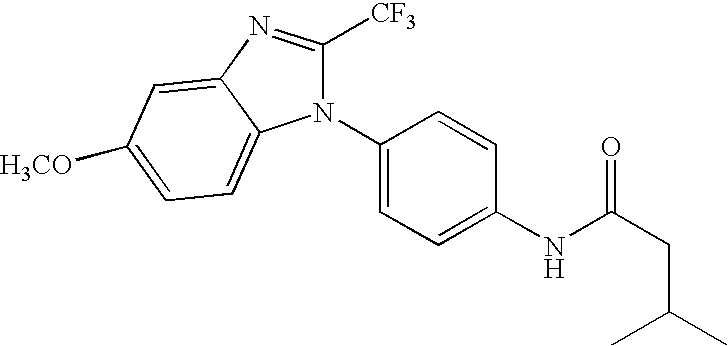 | 3-Methyl-N-[4-(2- trifluoromethyl-5-methoxy- benzoimidazol-1-yl)-phenyt]- butyramide |
| 117 | 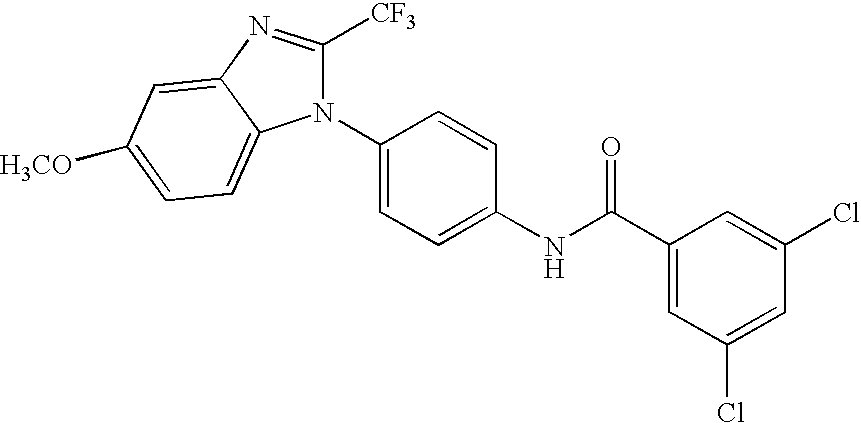 | 3,5-Dichioro-N-[4-(2- trifluoromethyl-5-methoxy- benzoimidazol-1-yl)-phenyl]- benzamide |
| 118 |  | 3-Bromo-N-[4-(2- trifluoromethyl-5-methoxy- benzoimidazol-1-yl)-phenyl]- benzamide |
| 119 |  | 4-Bromo-N-[4-(2- trifluoromethyl-5-methoxy- benzoimidazol-1-yl)-phenyl]- benzamide |
| 120 |  | Furan-2-carboxylic acid {N-[4- (2-trifluoromethyl-5-methoxy- benzoimidazol-1-yl)-phenyl]}- amide |
| 121 |  | 1-(2,2,2-Trifluoroacetyl)-N-[4- (2-trifluoromethyl-5-methoxy- benzoimidazol-1-yl)-phenyl]- pyrroiidine-2-carboxylic acid amide |
| 122 |  | N-[4-(2-trifluoromethyl-5- methoxy-benzoimidazol-1-yl)- phenyl]-acrylamide |
| 123 |  | 2-Benzyloxy-N-[4-(2- trifluoromethyl-5-methoxy- benzoimidazol-1-yl)-phenyl]- acetamide |
| 124 |  | 2-Phenylsulfanyl-N-[4-(2- trifluoromethyl-5-methoxy- benzoimidazol-1-yl)-phenyl]- acetamide |
| 125 | 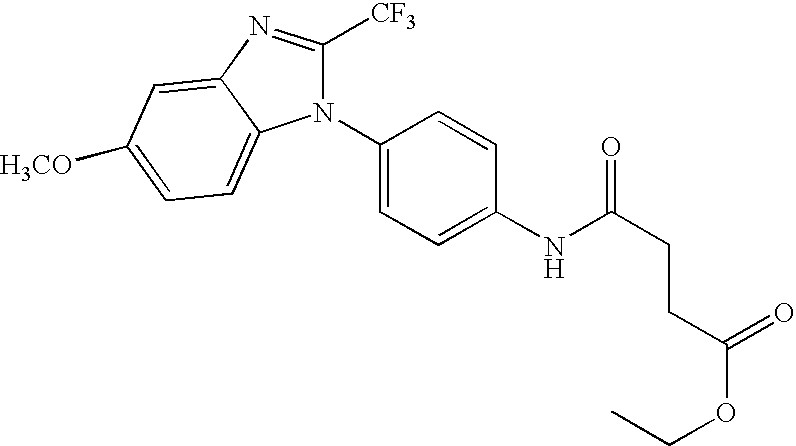 | N-[4-(2-trifluoromethyl-5- methoxy-benzoimidazol-1-yl)- phenyl]-succinamic acid ethyl ester |
| 126 |  | 2-Chloro-N-(4-(2- trifluoromethyl-5-methoxy- benzoimidazol-1-yl)-phenyl]- benzamide |
| 127 | 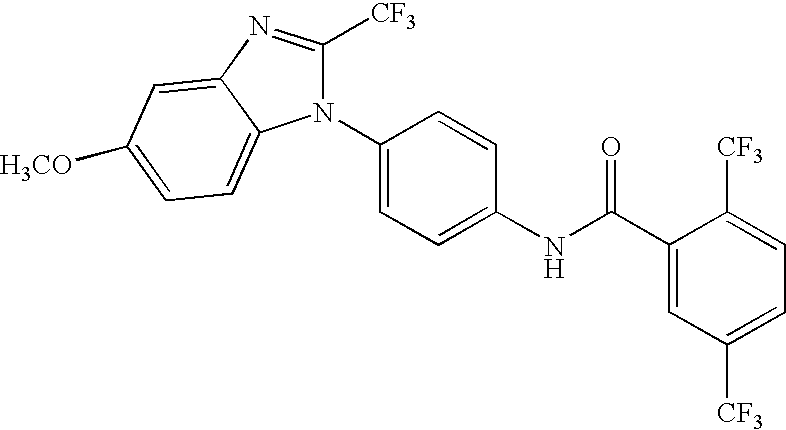 | 2,5-Di-(trifluoromethyl)-N-[4-(2- trifluoromethyl-5-methoxy- benzoimidazol-1-yl)-phenyl]- benzamide |
| 128 |  | 2-Methoxy-N-[4-(2- trifluoromethyl-5-methoxy- benzoimidazol-1-yl)-phenyl]- benzamide |
| 129 | 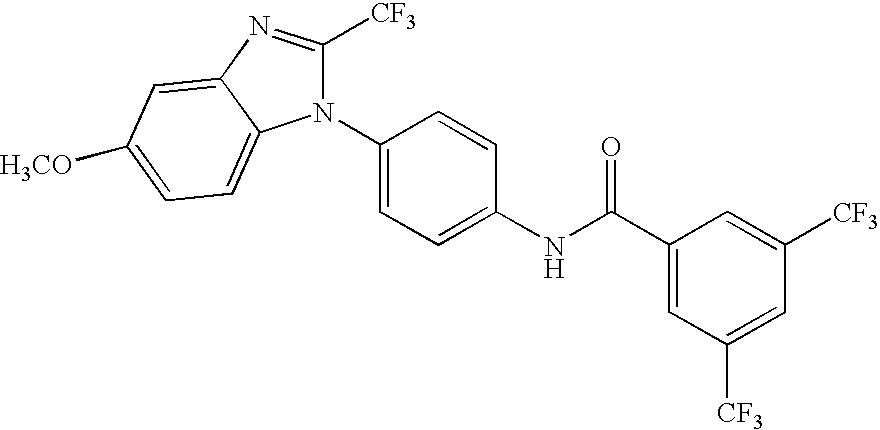 | 3,5-Di-(trifluoromethyl)-N-[4-(2- trifluoromethyl-5-methoxy- benzoimidazol-1-yl)-phenyl]- benzamide |
| 130 | 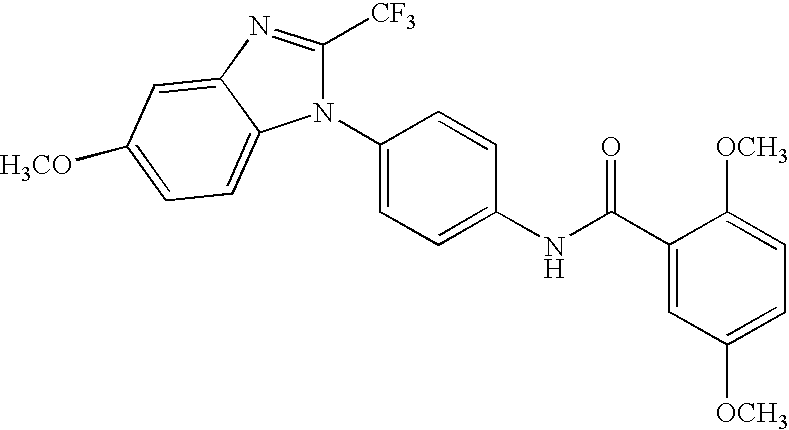 | 2,5-Dimethoxy-N-[4-(2- trifluoromethyl-5-methoxy- benzoimidazol-1-yl)-phenyl]- benzamide |
| 131 |  | 2-(3,4-dimethoxy-phenyl)-N-[4- (2-trifluoromethyl-5-methoxy- benzoimidazol-1-yl)-phenyl]- acetamide |
| 132 | 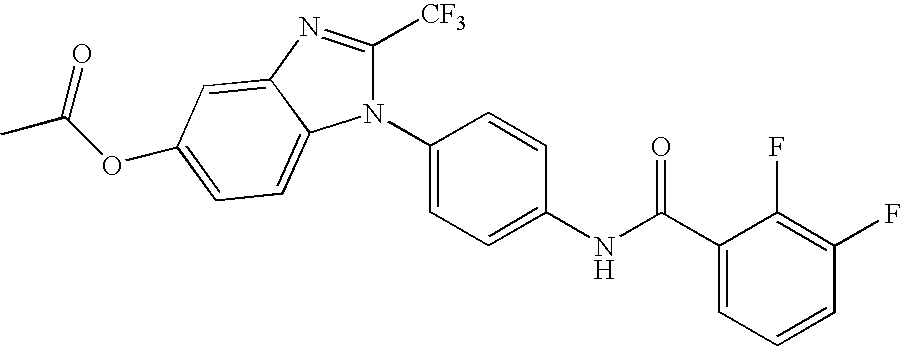 | 2,3-Difluoro-N-[4-(2- trifluoromethyl-5-acetoxy- benzoimidazol-1-yl)-phenyl]- benzamide |
| 133 |  | 2,3-Difluoro-N-[4-(2- trifluoromethyl-5-acetyl- benzoimidazol-1-yl)-phenyl]- benzamide |
| 134 | 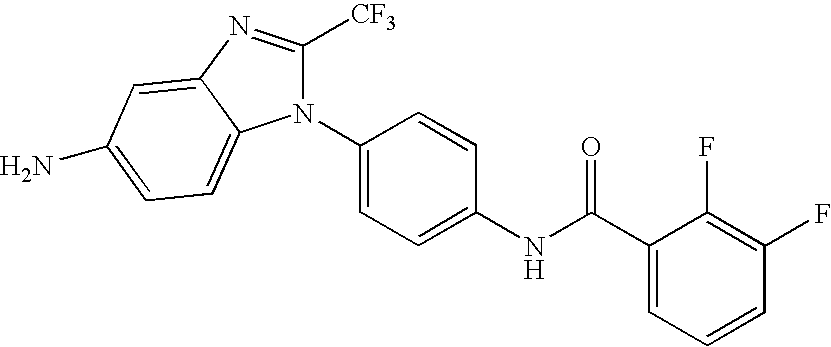 | 2,3-Difluoro-N-[4-(2- trifluoromethyl-5-amino- benzoimidazol-1-yl)-phenyl]- benzamide |
| 135 |  | 2,6-Difluoro-N-[4-(2- trifluoromethyl-5-methoxy- benzoimidazol-1-yl)-phenyl]- benzylamine, HCl salt |
| 136 | 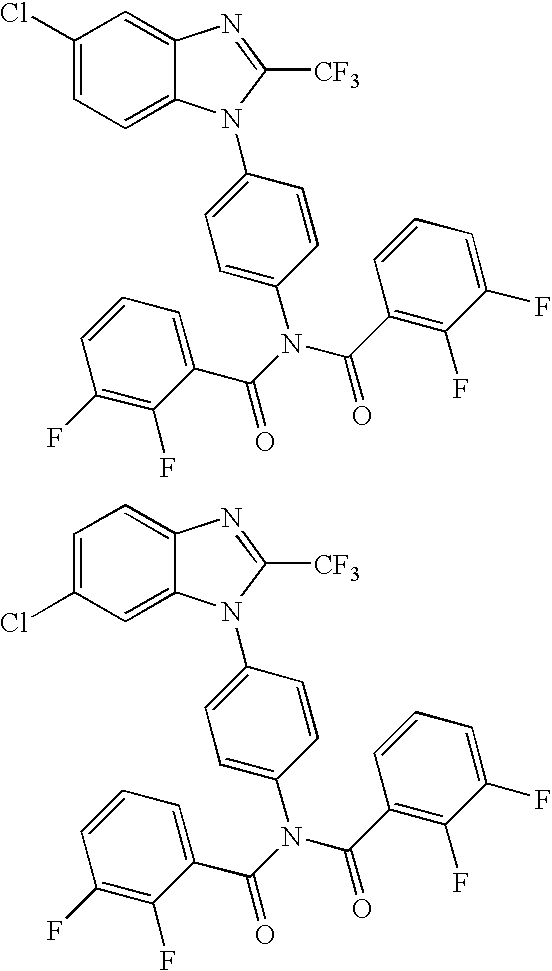 | Isomeric mixture of N-[4-(5- Chloro-2-trifluoromethyl- benzoimidazol-1-yl)-phenyl]-N- (2,3-difluoro-benzoyl)-2,3- difluoro-benzamide & N-[4-(6- Chloro-2-trifluoromethyl- benzoimidazol-1-yl)-phenyl]-N- (2,3-difluoro-benzoyl)-2,3- difluoro-benzamide |
| 137 | 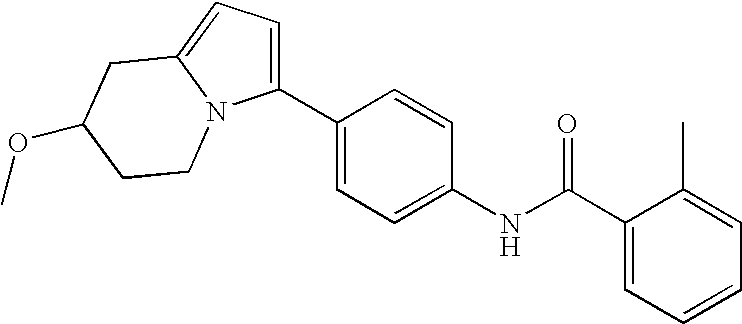 | 2-Methyl-N-[4-(7-methoxy- 5,6,7,8-tetrahydroindolizin-3-yl)- phenyl]-benzamide |
| 138 |  | 3-Methyl-N-[4-(7-methoxy- 5,6,7,8-tetrahydroindolizin-3-yl)- phenyl]-isonicotinamide |
| 139 |  | 2-Methyl-3-fluoro-N-[4-(7- methoxy-5,6,7,8- tetrahydroindolizin-3-yl)- phenyl]-benzamide |
| 140 |  | 3-Cyano-N-[4-(7-methoxy- 5,6,7,8-tetrahydroindolizin-3-yl)- phenyl]-benzamide |
| 141 | 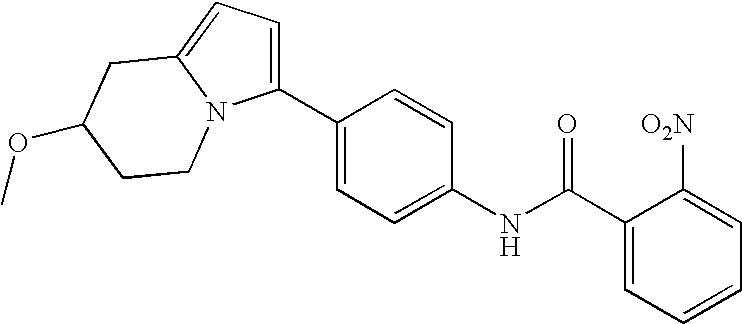 | 2-Nitro-N-[4-(7-methoxy- 5,6,7,8-tetrahydroindolizin-3-yl)- phenyl]-benzamide |
| 142 |  | 2,6-Difluoro-3-iodo-N-[4-(7- methoxy-5,6,7,8- tetrahydroindolizin-3-yl)- phenyl]-benzamide |
| 143 |  | 2-Chloro-N-[4-(7-methoxy- 5,6,7,8-tetrahydroindolizin-3-yl)- phenyl]-benzamide |
| 144 |  | N-[4-(7-methoxy-5,6,7,8- tetrahydroindolizin-3-yl)- phenyl]-cyclohexanecarboxylic acid amide |
| 145 | 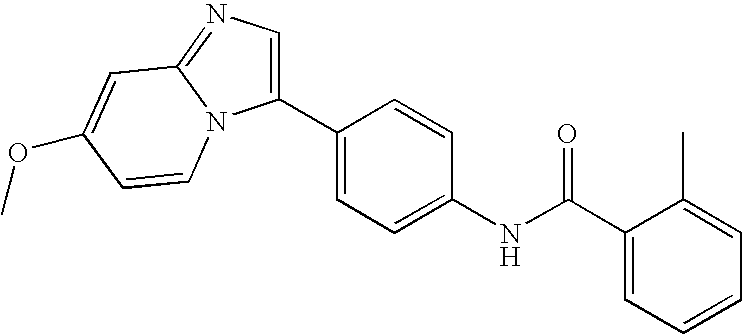 | 2-Methyl-N-[4-(7-methoxy- imidazo[1,2-a]pyrid-3-yl)- phenyl]-benzamide |
| 146 | 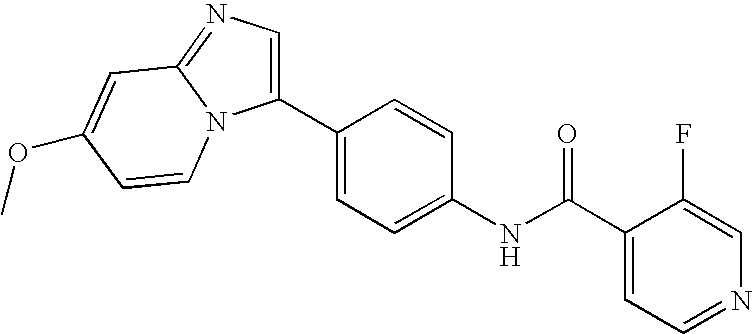 | 3-Fluoro-N-[4-(7-methoxy- imidazo[1,2-a]pyrid-3-yl)- phenyl]-isonicotinamide |
| 147 | 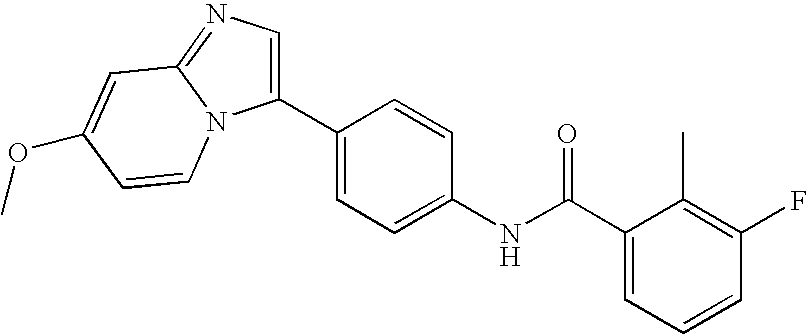 | 2-Methyl-3-fluoro-N-[4-(7- methoxy-imidazo[1,2-a]pyrid-3- yl)-phenyl]-benzamide |
| 148 | 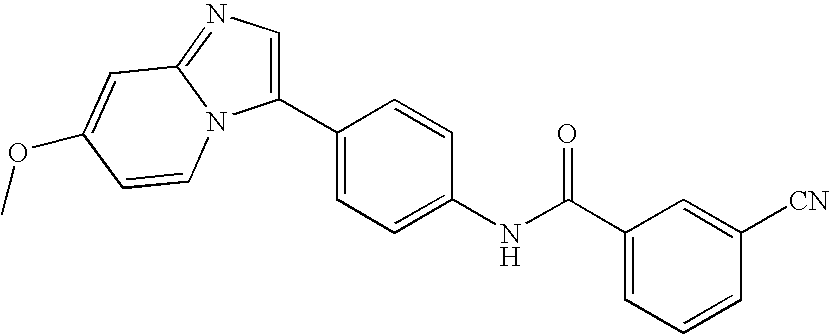 | 3-Cyano-N-[4-(7-methoxy- imidazo[1,2-a]pyrid-3-yl)- phenyl]-benzamide |
| 149 |  | 3-Nitro-N-[4-(7-methoxy- imidazo[1,2-a]pyrid-3-yl)- phenyl]-benzamide |
| 150 | 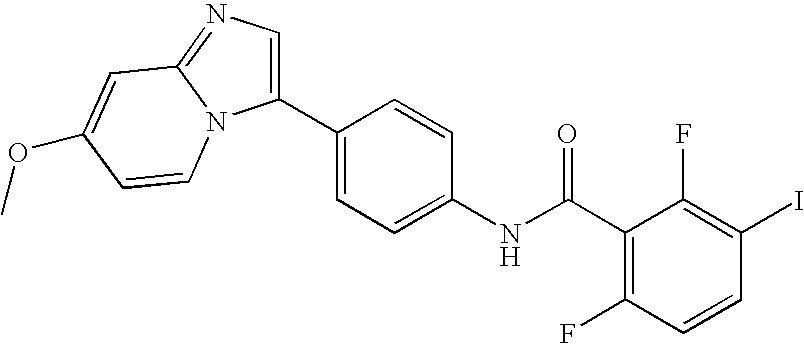 | 2,6-Difluoro-3-iodo-N-[4-(7- methoxy-imidazo[1,2-a]pyrid-3- yl)-phenyl]-benzamide |
| 151 | 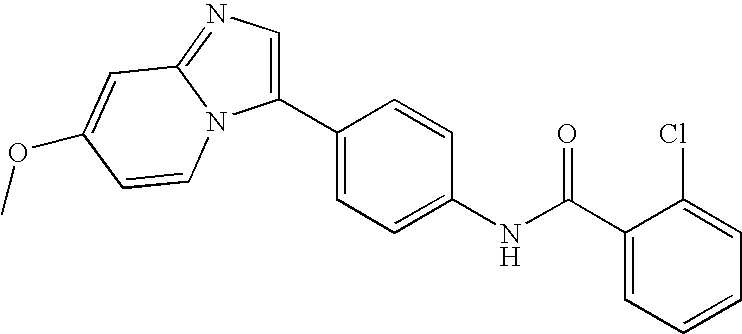 | 2-Chloro-N-[4-(7-methoxy- imidazo[1,2-a]pyrid-3-yl)- phenyl]-benzamide |
| 152 | 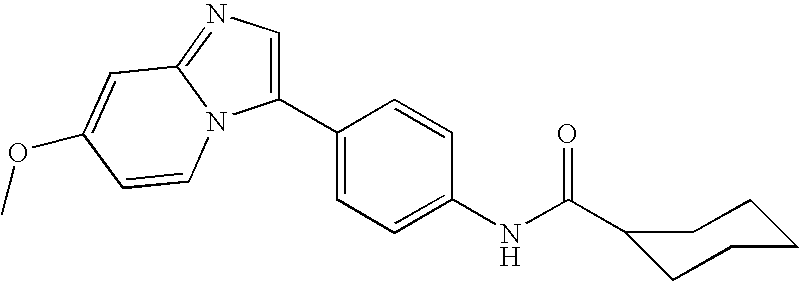 | N-[4-(7-methoxy-imidazo[1,2- a]pyrid-3-yl)-phenyl]- cyclohexanecarboxylic acid amide |
| 153 | 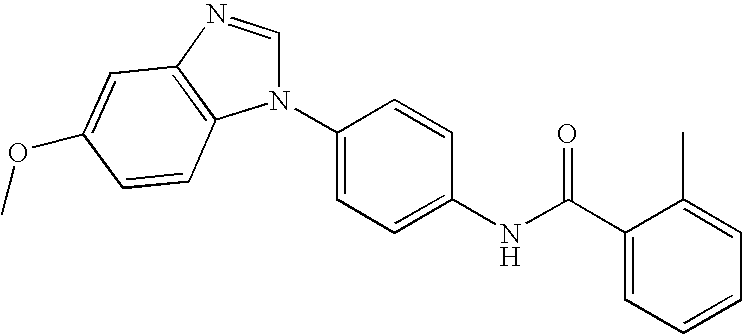 | 2-Methyl-N-14-(5-methoxy- benzoimidazol-1-yl)-phenyl]- benzamide |
| 154 |  | 2-Fluoro-N-[4-(5-methoxy- benzoimidazol-1-yl)-phenyl]- isonicotinamide |
| 156 | 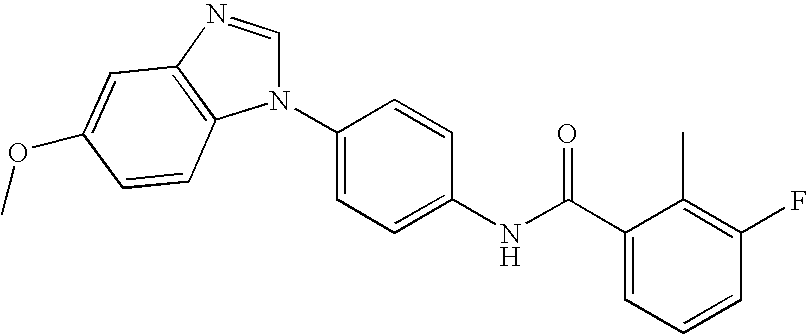 | 2-Methyl-3-fluoro-N-[4-(5- methoxy-benzoimidazol-1-yl)- phenyl]-benzamide |
| 157 |  | 3-Cyano-N-[4-(5-methoxy- benzoimidazol-1-yl)-phenyl]- benzamide |
| 158 | 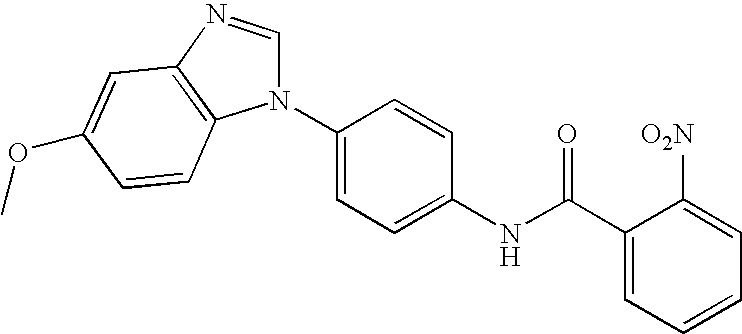 | 2-Nitro-N-[4-(5-methoxy- benzoimidazol-1-yl)-phenyl]- benzamide |
| 159 |  | 2,6-Difluoro-3-iodo-N-[4-(5- methoxy-benzoimidazol-1-yl)- phenyl]-benzamide |
| 160 | 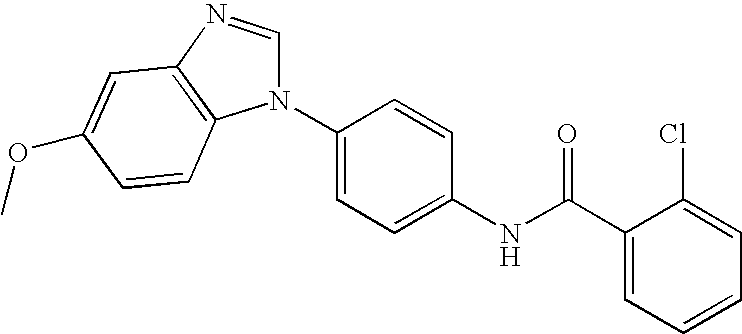 | 2-Chloro-N-[4-(5-methoxy- benzoimidazol-1-yl)-phenyl]- benzamide |
| 161 |  | N-[4-(5-methoxy- benzoimidazol-1-yl)-phenyl]- cyclohexanecarboxylic acid amide |
| 162 |  | Ethyl-[6-(5-methoxy-2- trifluoromethyl-benzoimidazol- 1-yl)-pyridin-3-yl]-amine |
| 163 | 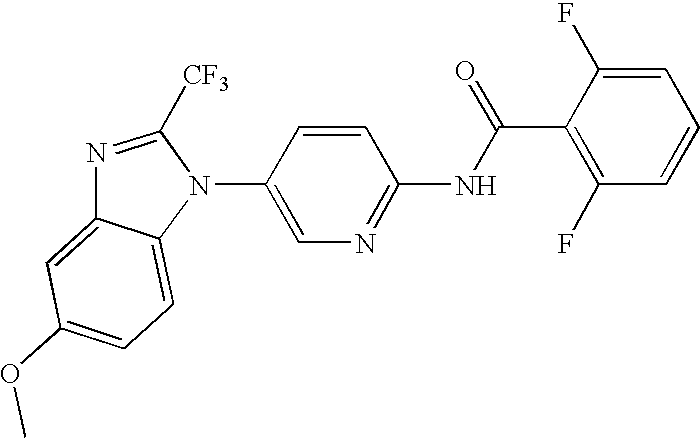 | 2,6-Difluoro-N-[5-(5-methoxy-2- trifluoromethyl-benzoimidazol- 1-yl)-pyridin-2-yl]-benzamide |
| 164 |  | N-[5-(5-Methoxy-2- trifluoromethyl-benzoimidazol- 1-yl)-pyridin-2-yl]-acetamide |
| 165 |  | Butyl[5-(5-methoxy-2- trifluoromethyl-benzoimidazol- 1-yl)-pyridin-2-yl]-amine |
| 166 | 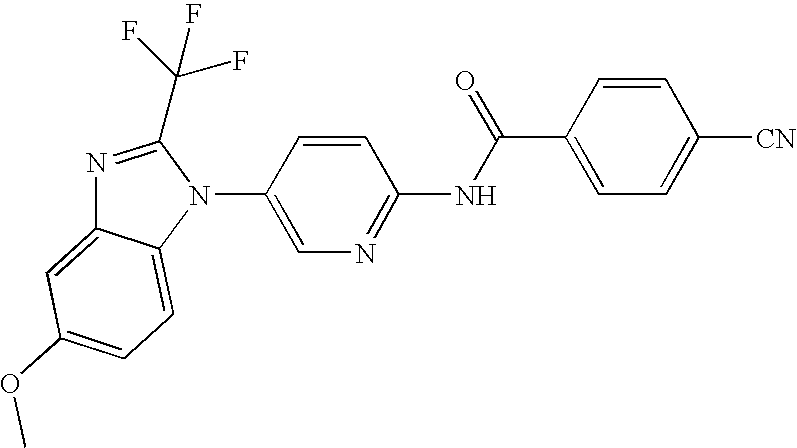 | 4-Cyano-N-[5-(5-methoxy-2- trifluoromethyl-benzoimidazol- 1-yl)-pyridin-2-yl]-benzamide |
| 167 | 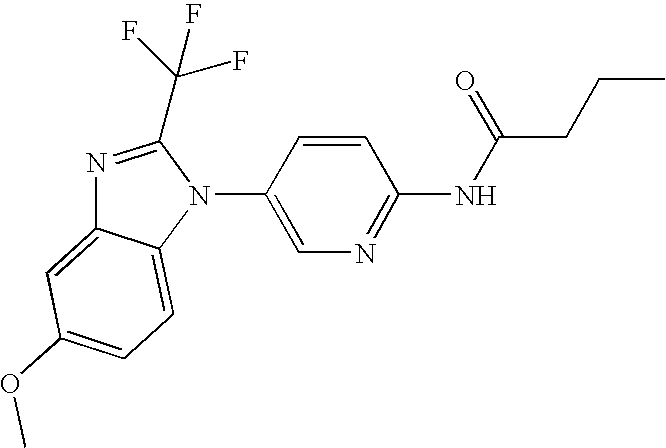 | N-[5-(5-Methoxy-2- trifluoromethyl-benzoimidazol- 1-yl)-pyridin-2-yl]-butyramide |
| 168 | 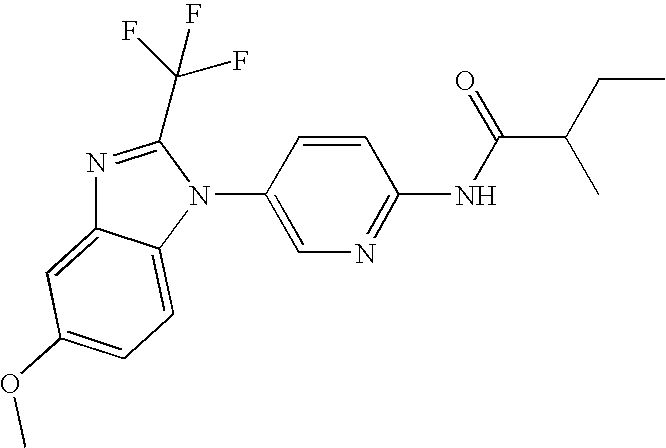 | N-[5-(5-Methoxy-2- trifluoromethyl-benzoimidazol- 1-yl)-pyridin-2-yl]-2-methyl- butyramide |
| 169 |  | Cyclobutanecarboxylic acid [5- (5-methox-2-trifluoromethyl- benzoimidazol-1-yl)-pyridin-2- yl]-amide |
| 170 | 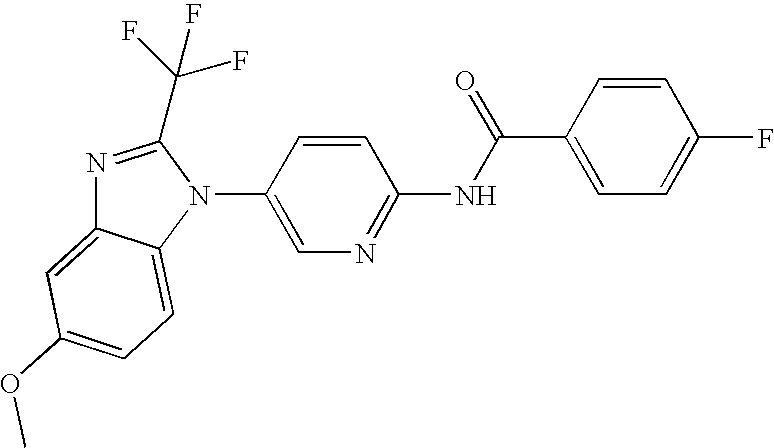 | 4-Fluoro-N-[5-(5-methoxy-2- trifluoromethyl-benzoimidazol- 1-yl)-pyridin-2-yl]-benzamide |
| 171 | 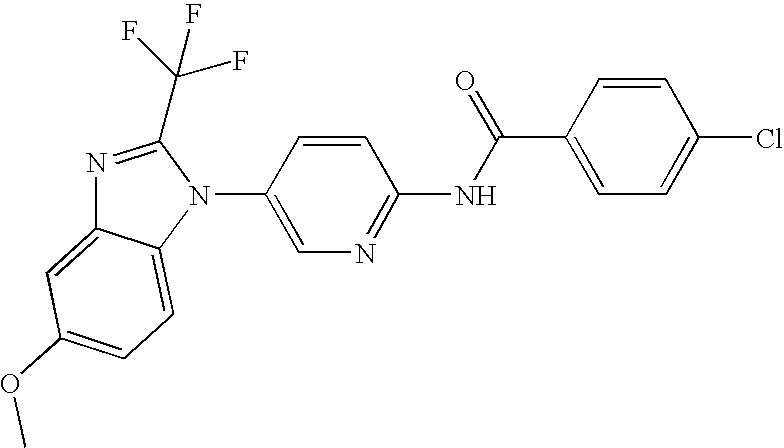 | 4-Chloro-N-[5-(5-methoxy-2- trifluoromethyl-benzoimidazol- 1-yl)-pyridin-2-yl]-benzamide |
| 172 |  | Cyclopropanecarboxylic acid [5-(5-methoxy-2-trifluoromethyl- benzoimidazol-1-yl)-pyridin-2- yl]-amide |
| 173 | 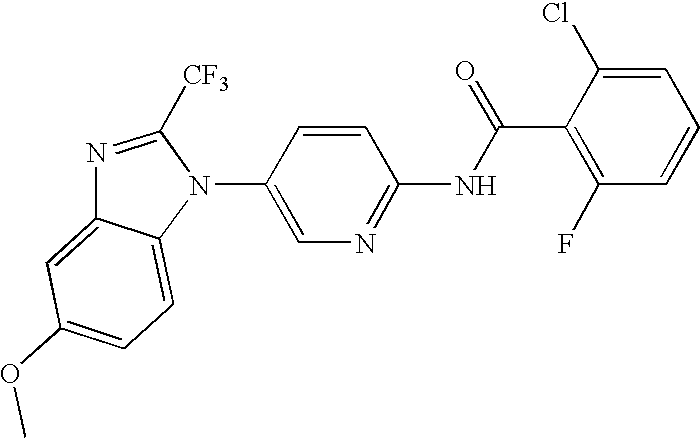 | 2-Chloro-6-fluoro-N-[5-(5- methoxy-2-trifluoromethyl- benzoimidazol-1-yl)-pyridin-2- yl]-benzamide |
| 174 | 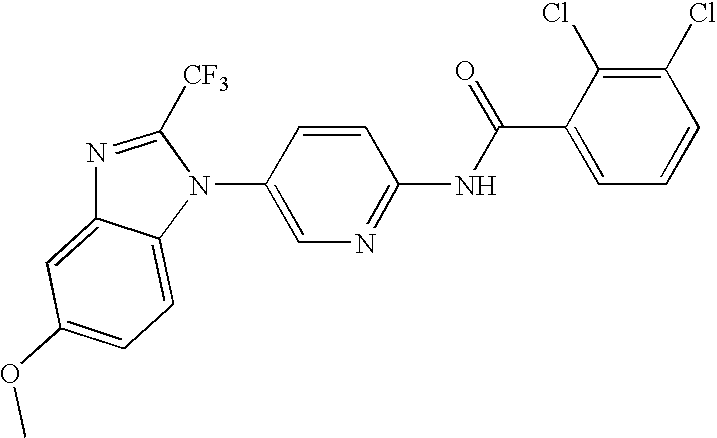 | 2,3-Dichloro-N-[5-(5-methoxy- 2-trifluoromethyl- benzoimidazol-1-yl)-pyridin-2- yl]-benzamide |
| 175 |  | |
| 176 |  | 2,4-Dichloro-N-[5-(5-methoxy- 2-trifluoromethyl- benzoimidazol-1-yl)-pyridin-2- yl]-benzamide |
| 177 |  | 4-Chloro-2-fluoro-N-[5-(5- methoxy-2-trifluoromethyl- benzoimidazol-1-yl)-pyridin-2- yl]-benzamide |
| 178 | 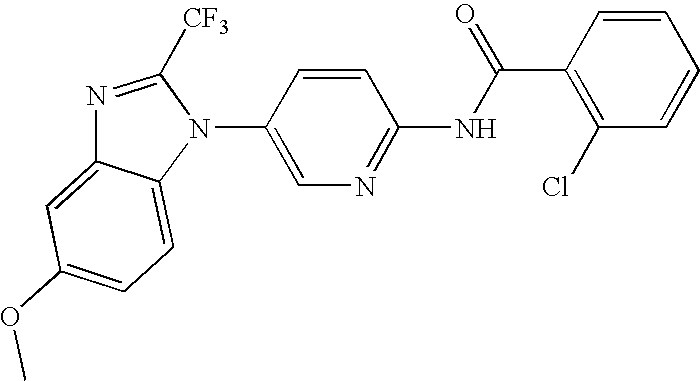 | 2-Chloro-N-[5-(5-methoxy-2- trifluoromethyl-benzoimidazol- 1-yl)-pyridin-2-yl]-benzamide |
| 179 | 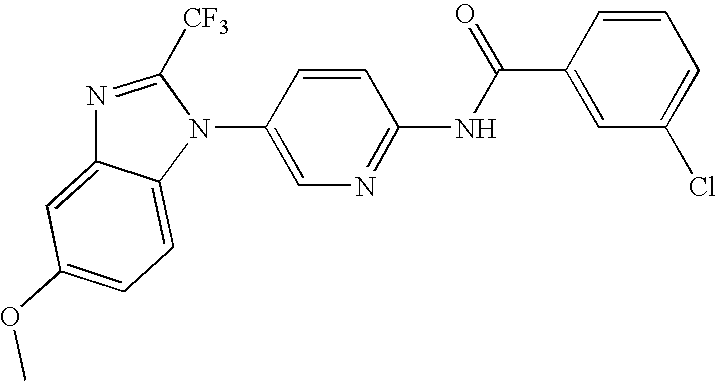 | 3-Chloro-N-[5-(5-methoxy-2- trifluoromethyl-benzoimidazol- 1-yl)-pyridin-2-yl]-benzamide |
| 180 |  | 2-Bromo-N-[5-(5-methoxy-2- trifluoromethyl-benzoimidazol- 1-yl)-pyridin-2-yl]-benzamide |
| 181 | 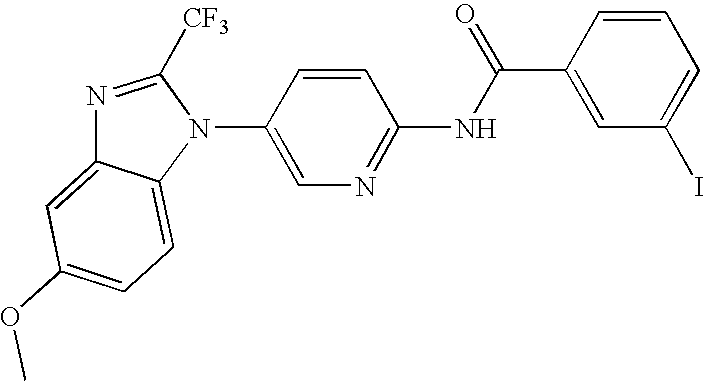 | 3-Iodo-N-[5-(5-methoxy-2- trifluoromethyl-benzoimidazol- 1-yl)-pyridin-2-yl]-benzamide |
| 182 | 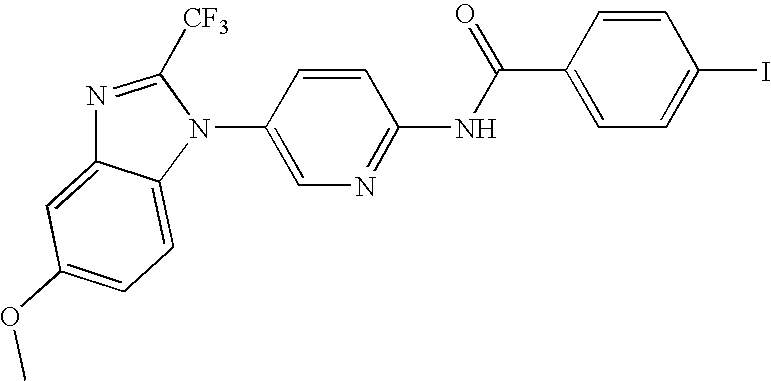 | 4-Iodo-N-[5-(5-methoxy-2- trifluoromethyl-benzoimidazol- 1-yl)-pyridin-2-yl]-benzamide |
| 183 | 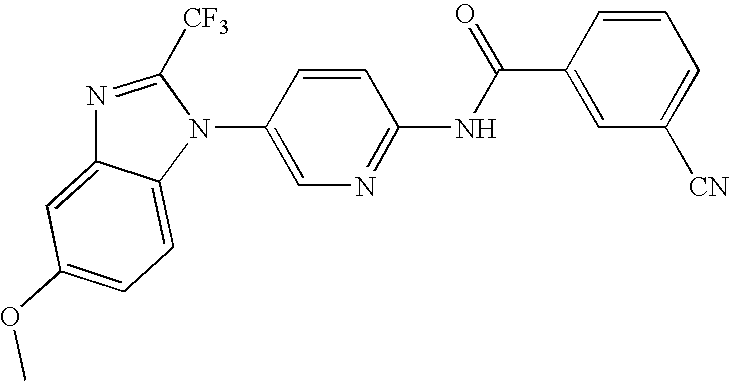 | 3-Cyano-N-[5-(5-methoxy-2- trifluoromethyl-benzoimidazol- 1-yl)-pyridin-2-yl]-benzamide |
| 184 | 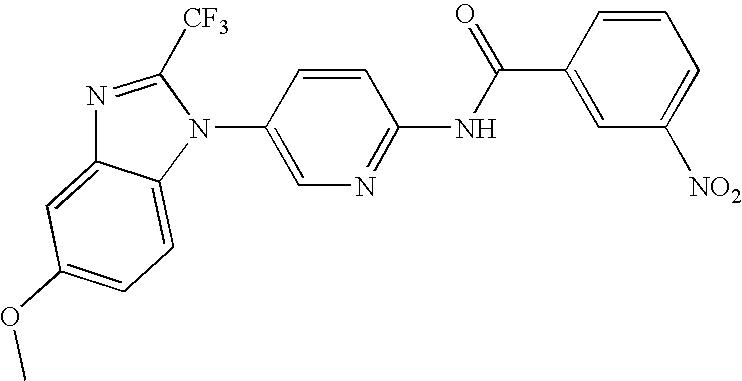 | N-[5-(5-Methoxy-2- trifluoromethyl-benzoimidazol- 1-yl)-pyridin-2-yl]-3-nitro- benzamide |
| 185 |  | 2-Fluoro-N-[5-(5-methoxy-2- trifluoromethyl-benzoimidazol- 1-yl)-pyridin-2-yl]-benzamide |
| 186 |  | 3-Fluoro-N-[5-(5-methoxy-2- trifluoromethyl-benzoimidazol- 1-yl)-pyridin-2-yl]-benzamide |
| 187 | 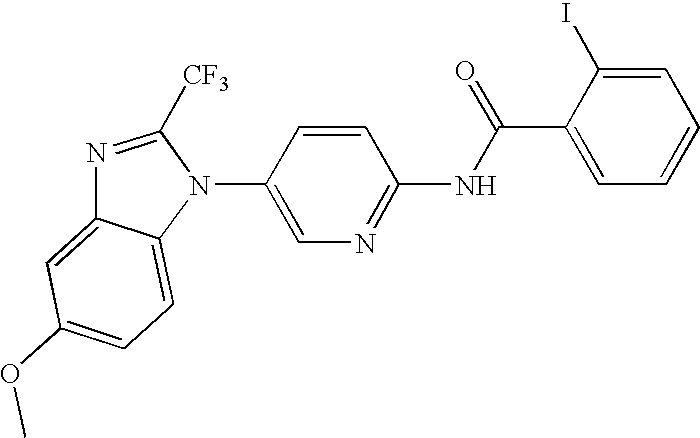 | 2-Iodo-N-[5-(5-methoxy-2- trifluoromethyl-benzoimidazol- 1-yl)-pyridin-2-yl]-benzamide |
| 188 |  | Butyl-[5-(5-methoxy-2- trifluoromethyl-benzoimidazol- 1-yl)-pyridin-2-yl]-amine |
| 189 | 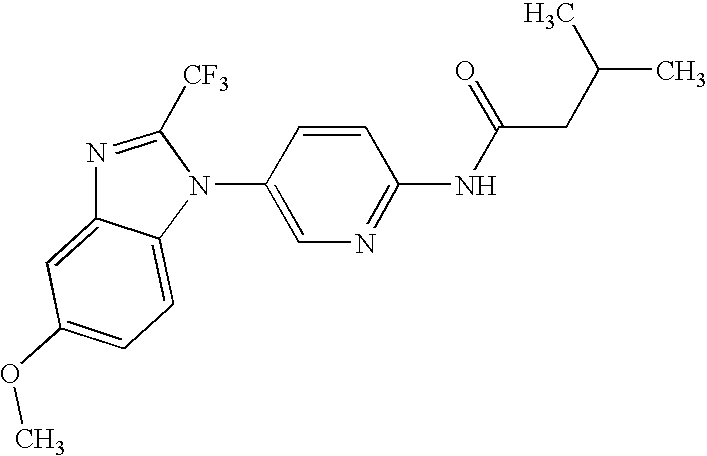 | N-[5-(5-Methoxy-2- trifluoromethyl-benzoimidazol- 1-yl)-pyridin-2-yl]-3-methyl- butyramide |
| 190 |  | N-[5-(5-Methoxy-2- trifluoromethyl-benzoimidazol- 1-yl)-pyridin-2-yl]-4-nitro- benzamide |
| 191 |  | 3-Bromo-N-[5-(5-methoxy-2- trifluoromethyl-benzoimidazol- 1-yl)-pyridin-2-yl]-benzamide |
| 192 | 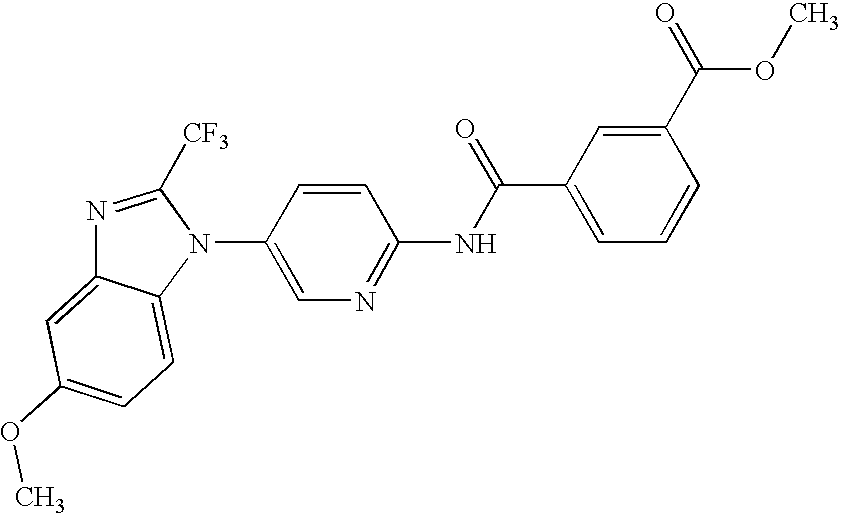 | N-[5-(5-Methoxy-2- trifluoromethyl-benzoimidazol- 1-yl)-pyridin-2-yl]-isophthalamic acid methyl ester |
| 193 | 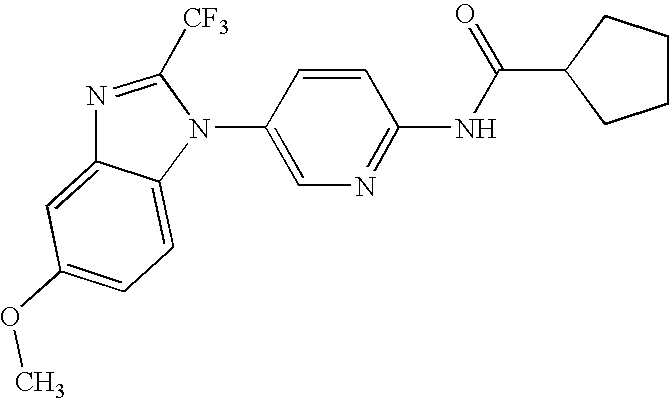 | Cyclopentanecarboxylic acid [5- (5-methoxy-2-trifluoromethyl- benzoimidazol-1-yl)-pyridin-2- yl]-amide |
| 194 | 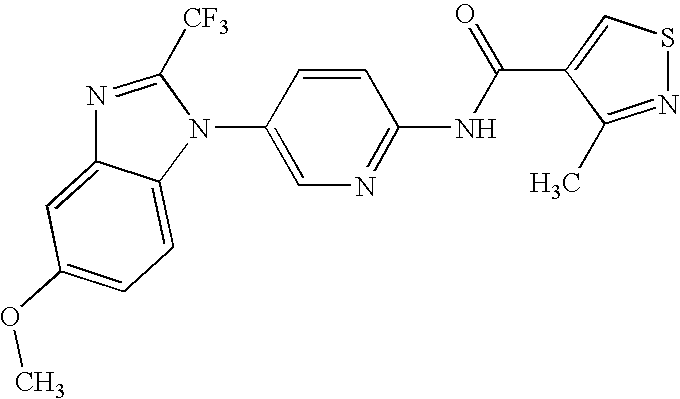 | 3-Methyl-isothiazole-4- carboxylic acid [5-(5-methoxy- 2-trifluoromethyl- benzoimidazol-1-yl)-pyridin-2- yl]-amide |
| 195 | 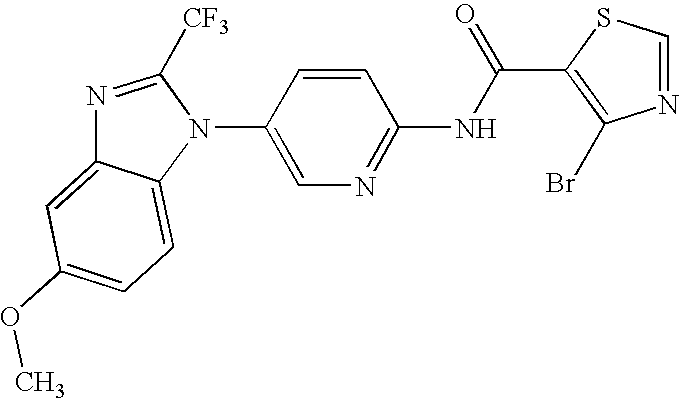 | 4-Bromo-thiazole-5-carboxylic acid [5-(5-methoxy-2- trifluoromethyl-benzoimidazol- 1-yl)-pyridin-2-yl]-amide |
| 196 |  | 4-Bromo-N-[5-(5-methoxy-2- trifluoromethyl-benzoimidazol- 1-yl)-pyridin-2-yl]-benzamide |
| 197 | 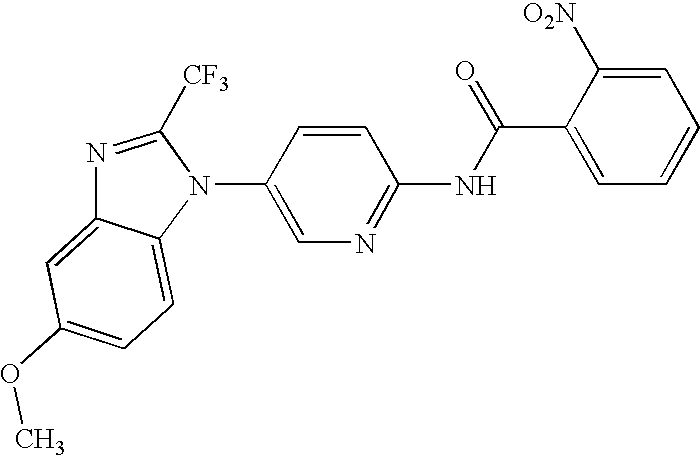 | 2-Nitro-N-[5-(5-methoxy-2- trifluoromethyl-benzoimidazol- 1-yl)-pyridin-2-yl]-benzamide |
| 198 | 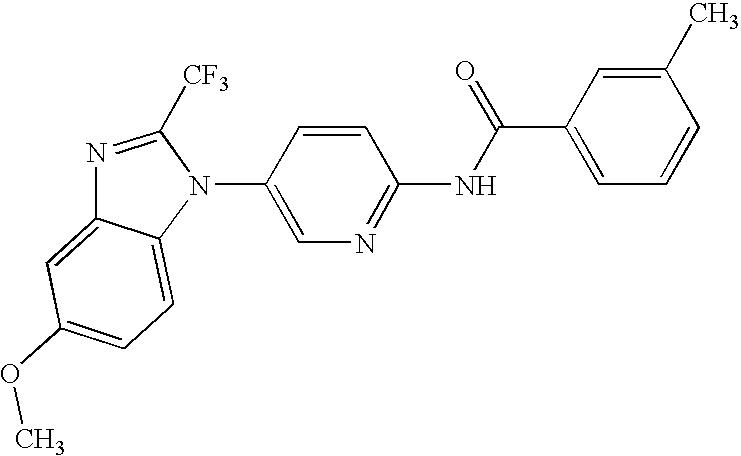 | N-[5-(5-Methoxy-2- trifluoromethyl-benzoimidazol- 1-yl)-pyridin-2-yl]-3-methyl- benzamide |
| 199 | 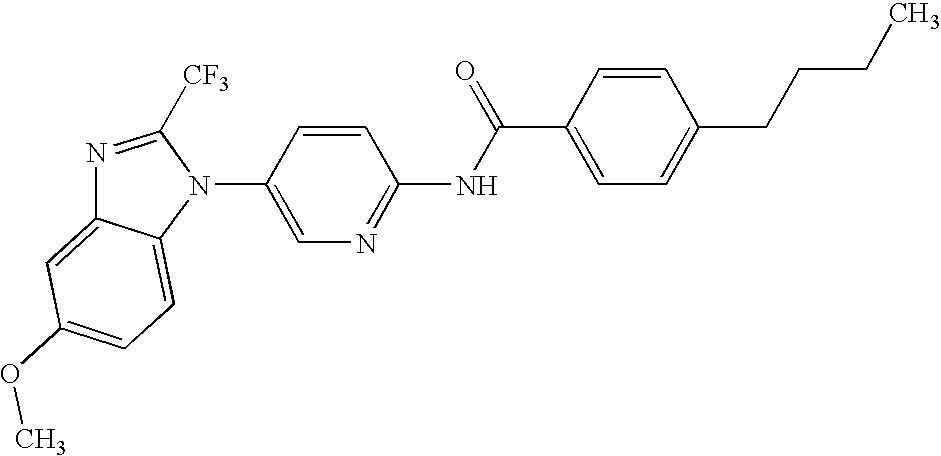 | 4-Butyl-N-[5-(5-methoxy-2- trifluoromethyl-benzoimidazol- 1-yl)-pyridin-2-yl]-benzamide |
| 200 | 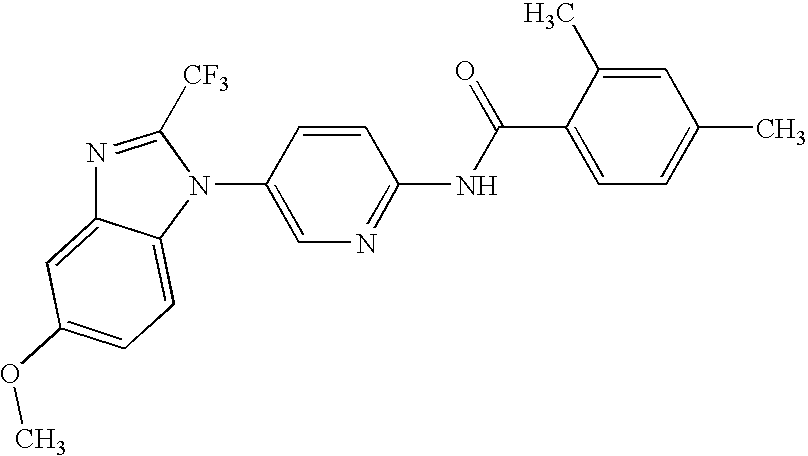 | N-[5-(5-Methoxy-2- trifluoromethyl-benzoimidazol- 1-yl)-pyridin-2-yl]-2,4-dimethyl- benzamide |
| 201 |  | 3-Fluoro-N-[5-(5-methoxy-2- trifluoromethyl-benzoimidazol- 1-yl)-pyridin-2-yl]- isonicotinamide |
| 202 | 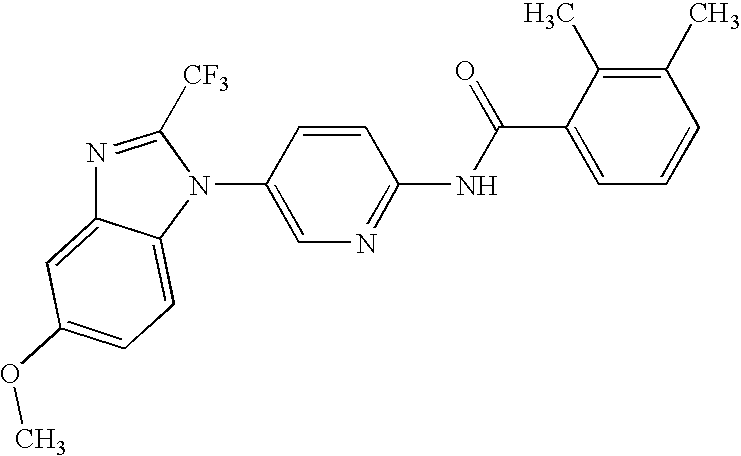 | N-[5-(5-Methoxy-2- trifluoromethyl-benzoimidazol- 1-yl)-pyridin-2-yl]-2,3-dimethyl- benzamide |
| 203 |  | 4-Dimethylamino-N-[5-(5- methoxy-2-trifluoromethyl- benzoimidazol-1-yl)-pyridin-2- yl]-benzamide |
| 204 |  | 3-Methoxy-N-[5-(5-methoxy-2- trifluoromethyl-benzoimidazol- 1-yl)-pyridin-2-yl]-benzamide |
| 205 | 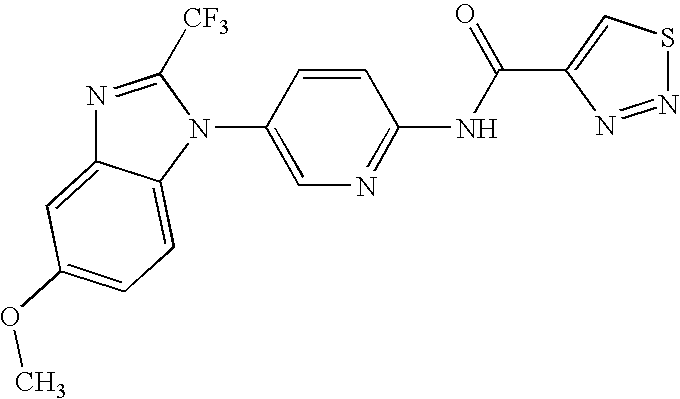 | [1,2,3]Thiadiazole-4-carboxylic acid [5-(5-methoxy-2- trifluoromethyl-benzoimidazol- 1-yl)-pyridin-2-yl]-amide |
| 206 |  | 2-Methoxy-N-[5-(5-methoxy-2- trifluoromethyl-benzoimidazol- 1-yl)-pyridin-2-yl]-benzamide |
| 207 |  | N-[5-(5-Methoxy-2- trifluoromethyl-benzoimidazol- 1-yl)-pyridin-2-yl]-4-propyl- benzamide |
| 208 | 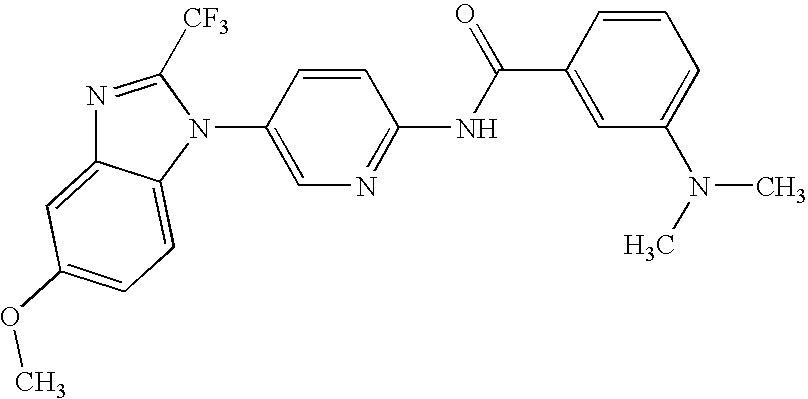 | 3-Dimethylamino-N-[5-(5- methoxy-2-trifluoromethyl- benzoimidazol-1-yl)-pyridin-2- yl]-benzamide |
| 209 |  | N-[5-(5-Methoxy-2- trifluoromethyl-benzoimidazol- 1-yl)-pyridin-2-yl]-3- methylsulfanyl-benzamide |
| 210 |  | N-[5-(5-Methoxy-2- trifluoromethyl-benzoimidazol- 1-yl)-pyridin-2-yl]-4- methylsulfanyl-benzamide |
| 211 |  | N-[5-(5-Methoxy-2- trifluoromethyl-benzoimidazol- 1-yl)-pyridin-2-yl]-4-methyl- benzamide |
| 212 | 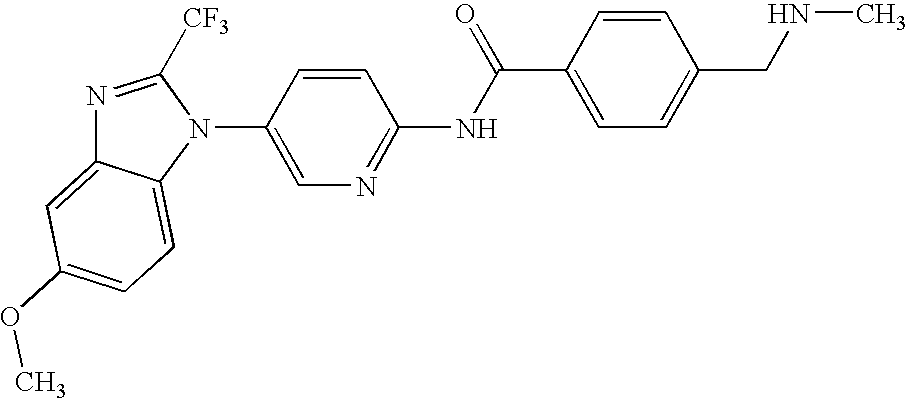 | N-[5-(5-Methoxy-2- trifluoromethyl-benzoimidazol- 1-yl)-pyridin-2-yl]-4- methylaminomethyl-benzamide |
| 213 | 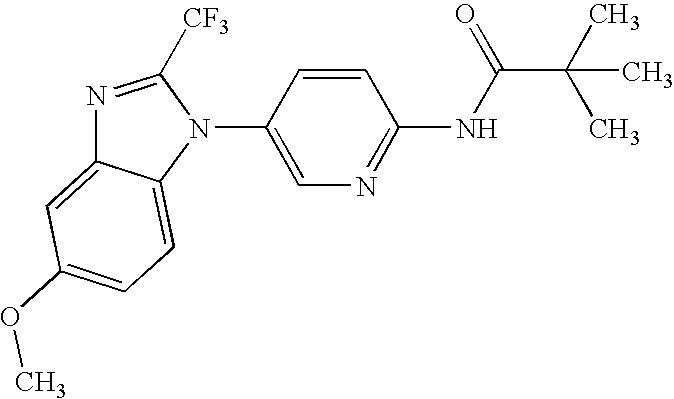 | N-[5-(5-Methoxy-2- trifluoromethyl-benzoimidazol- 1-yl)-pyridin-2-yl]-2,2-dimethyl- propionamide |
| 214 | 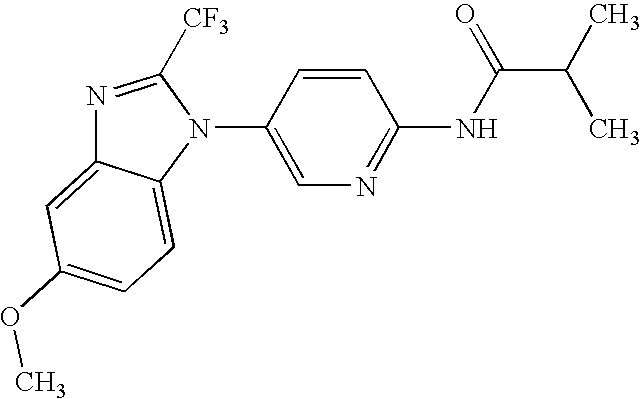 | N-[5-(5-Methoxy-2- trifluoromethyl-benzoimidazol- 1-yl)-pyridin-2-yl]-isobutyramide |
| 215 |  | 4-Ethyl-N-[5-(5-methoxy-2- trifluoromethyl-benzoimidazol- 1-yl)-pyridin-2-yl]-benzamide |
| 216 | 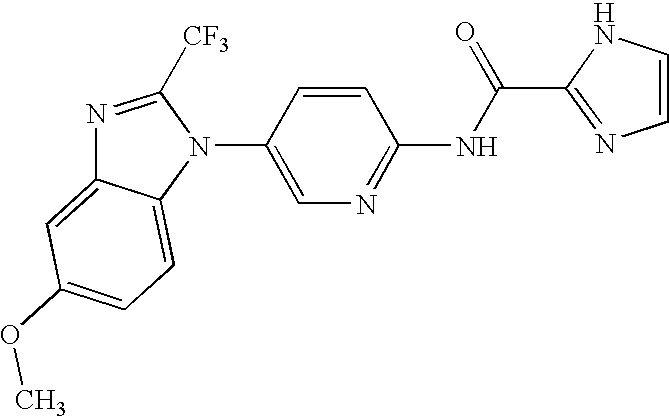 | 1H-Imidazole-2-carboxylic acid [5-(5-methoxy-2-trifluoromethyl- benzoimidazol-1-yl)-pyridin-2- yl]-amide |
Mechanism of Action


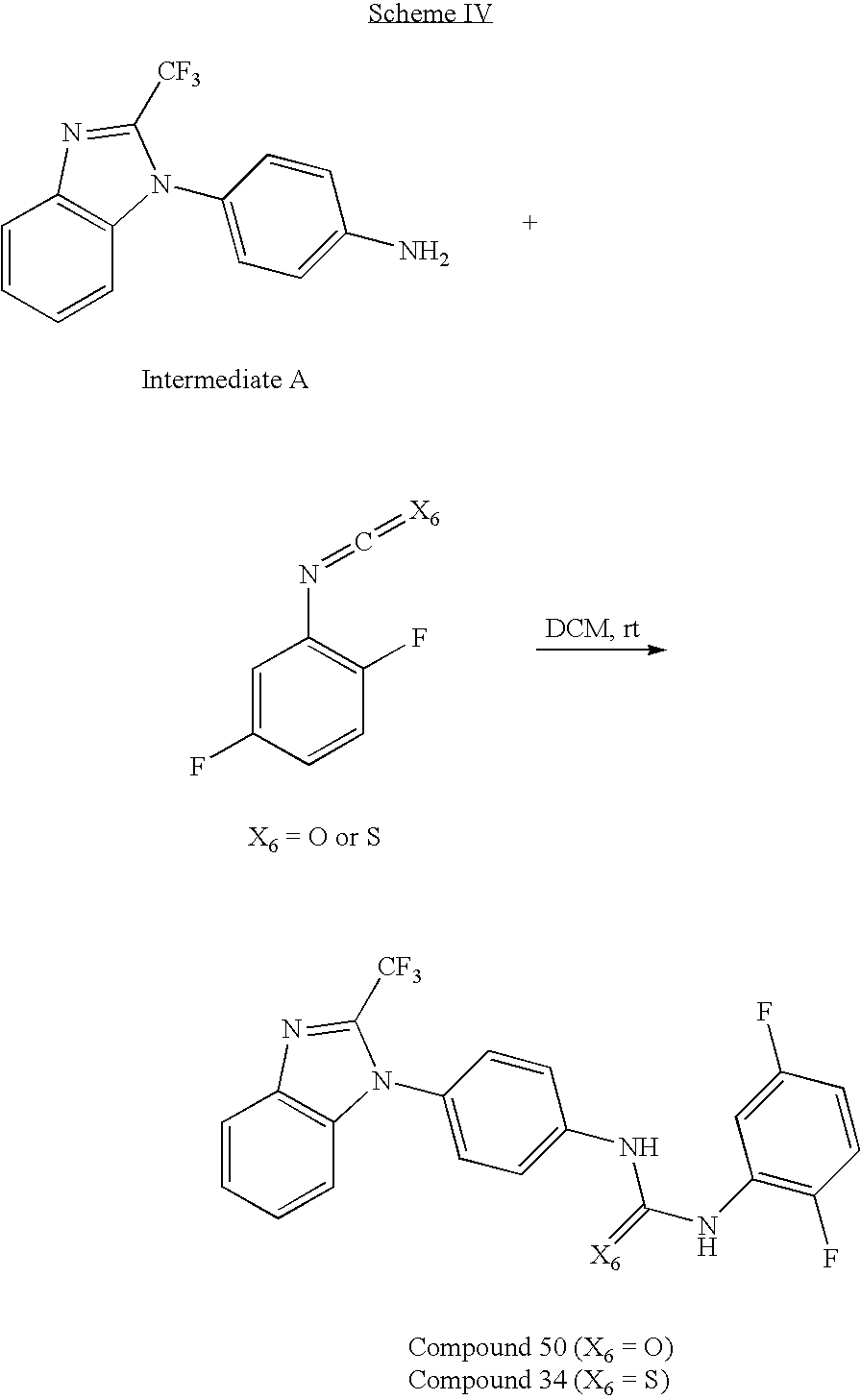
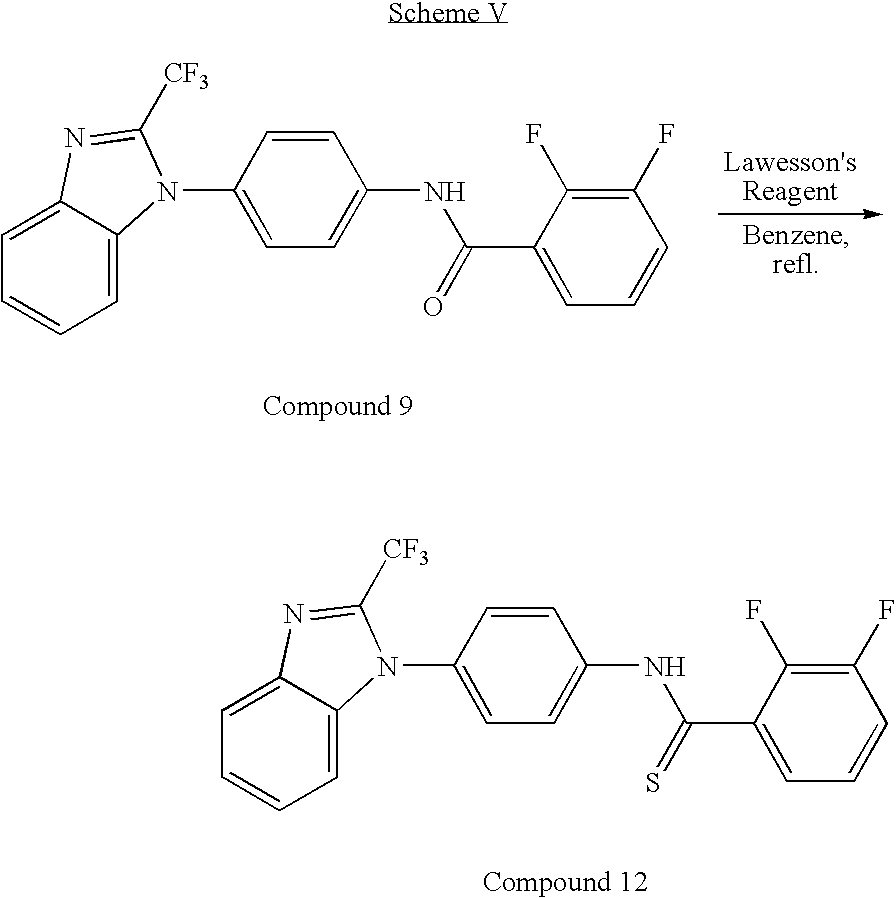


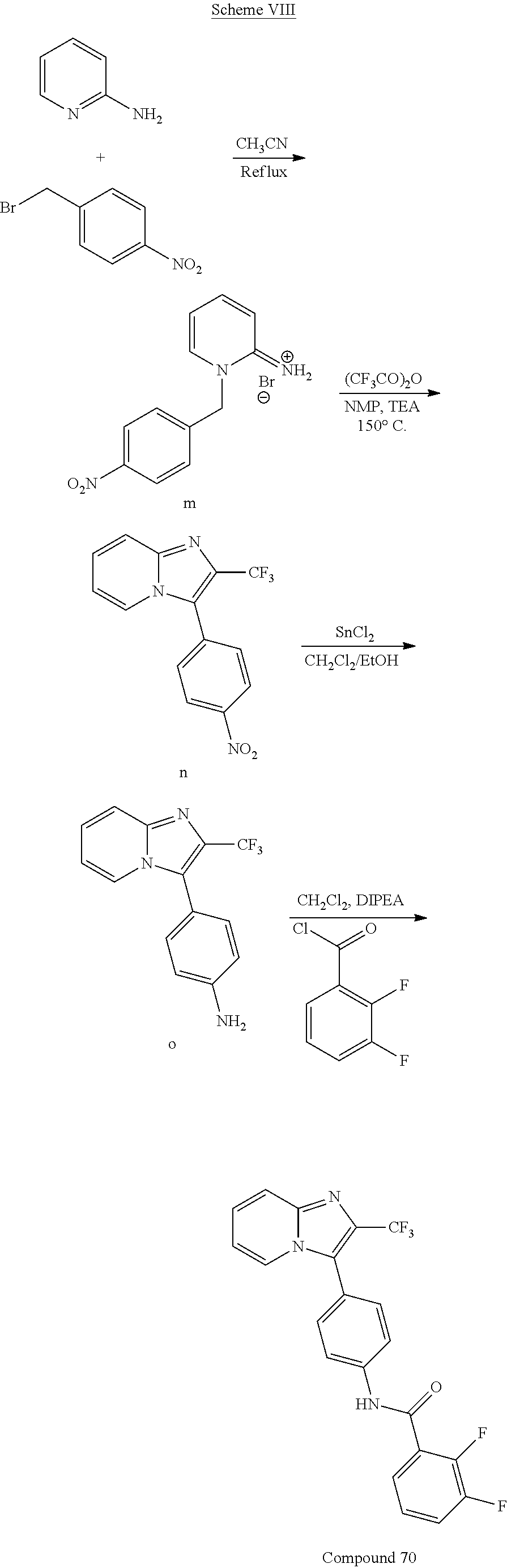


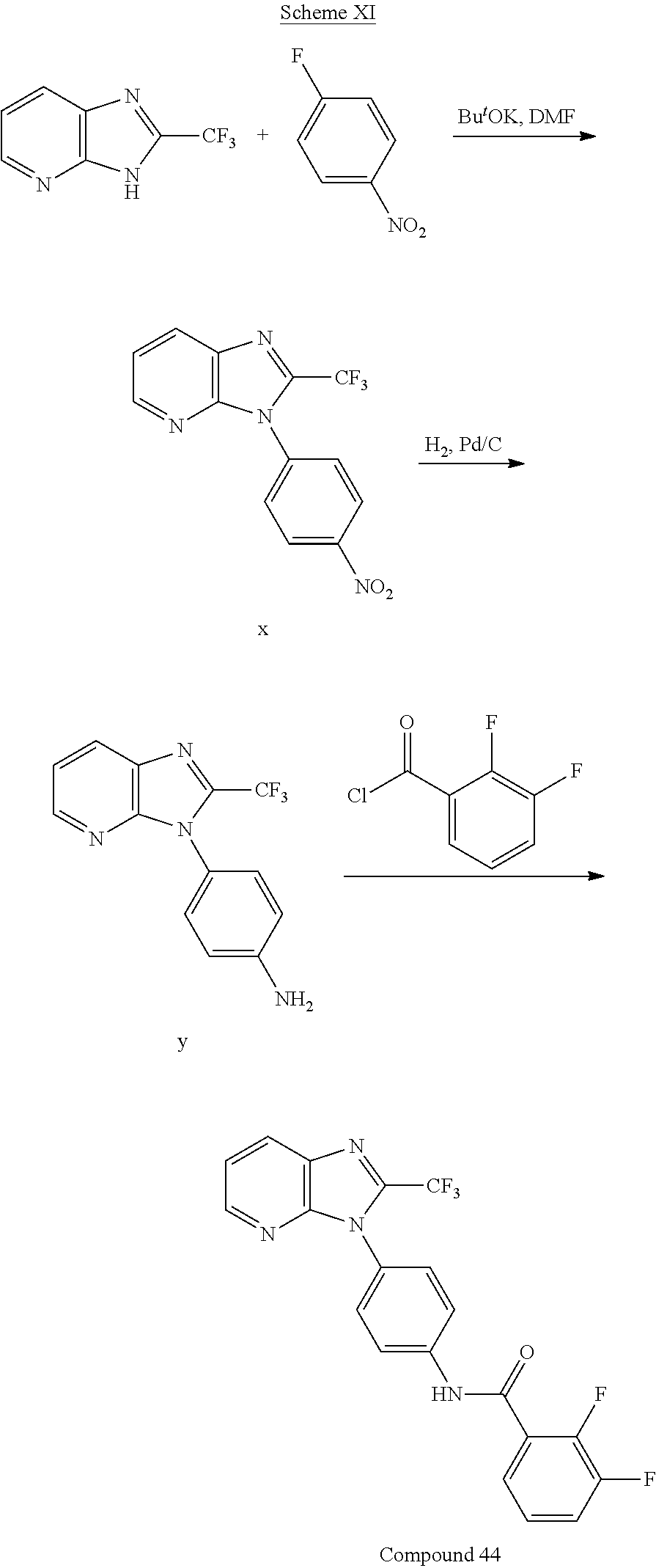

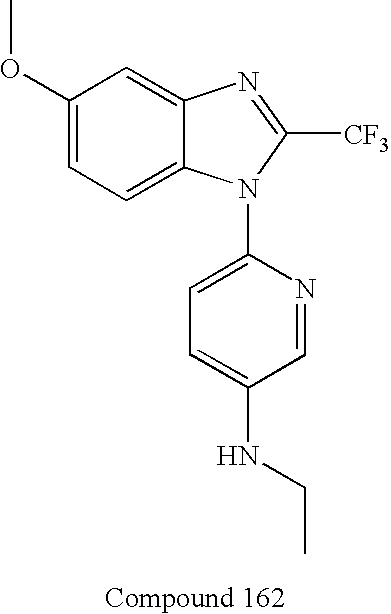
Preparation of Compound z:
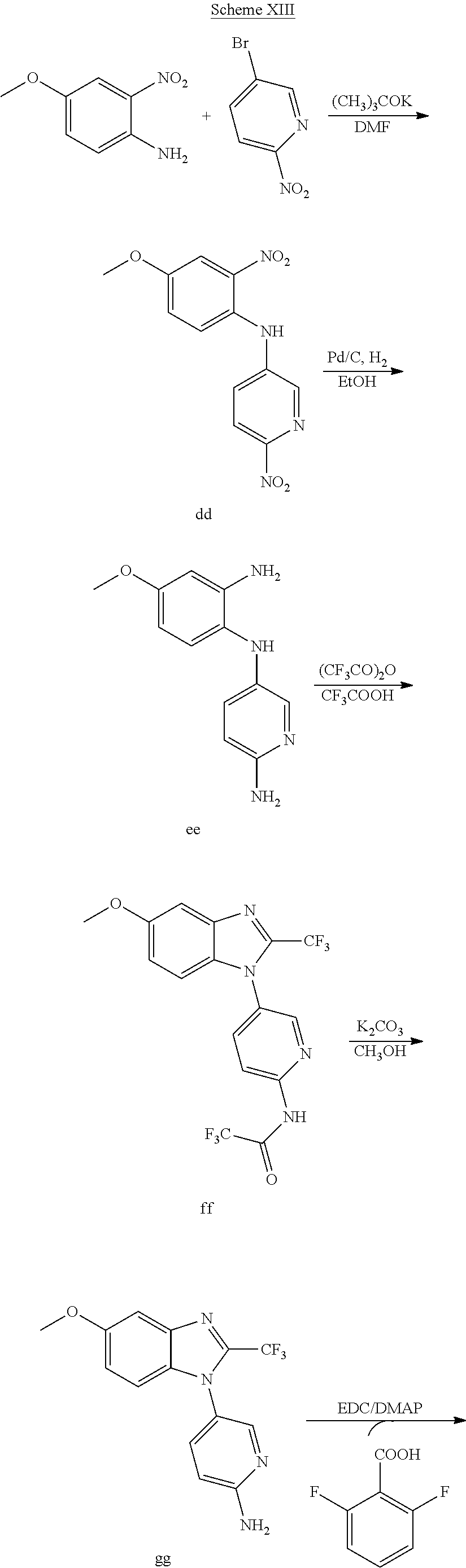
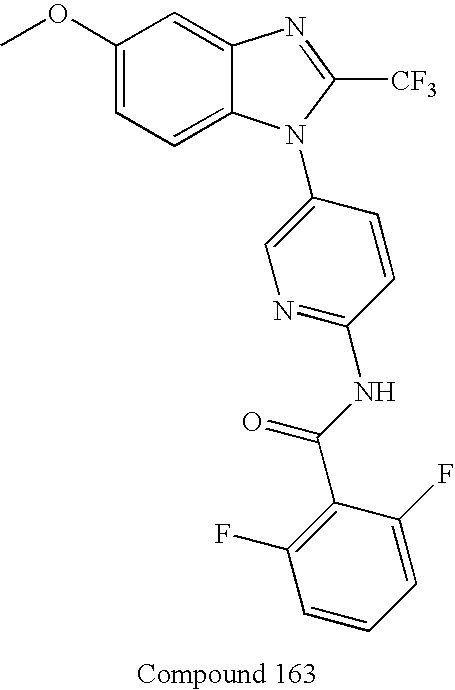
Synthesis of Compound dd:
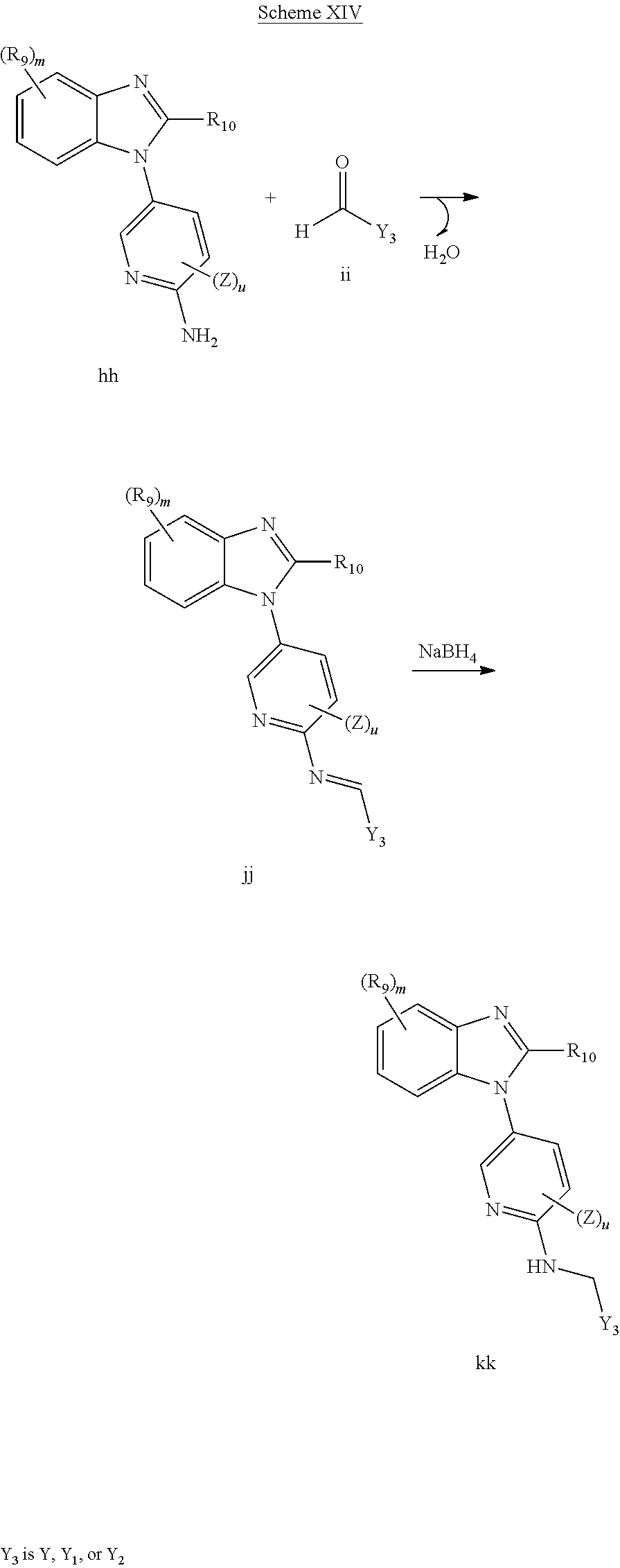

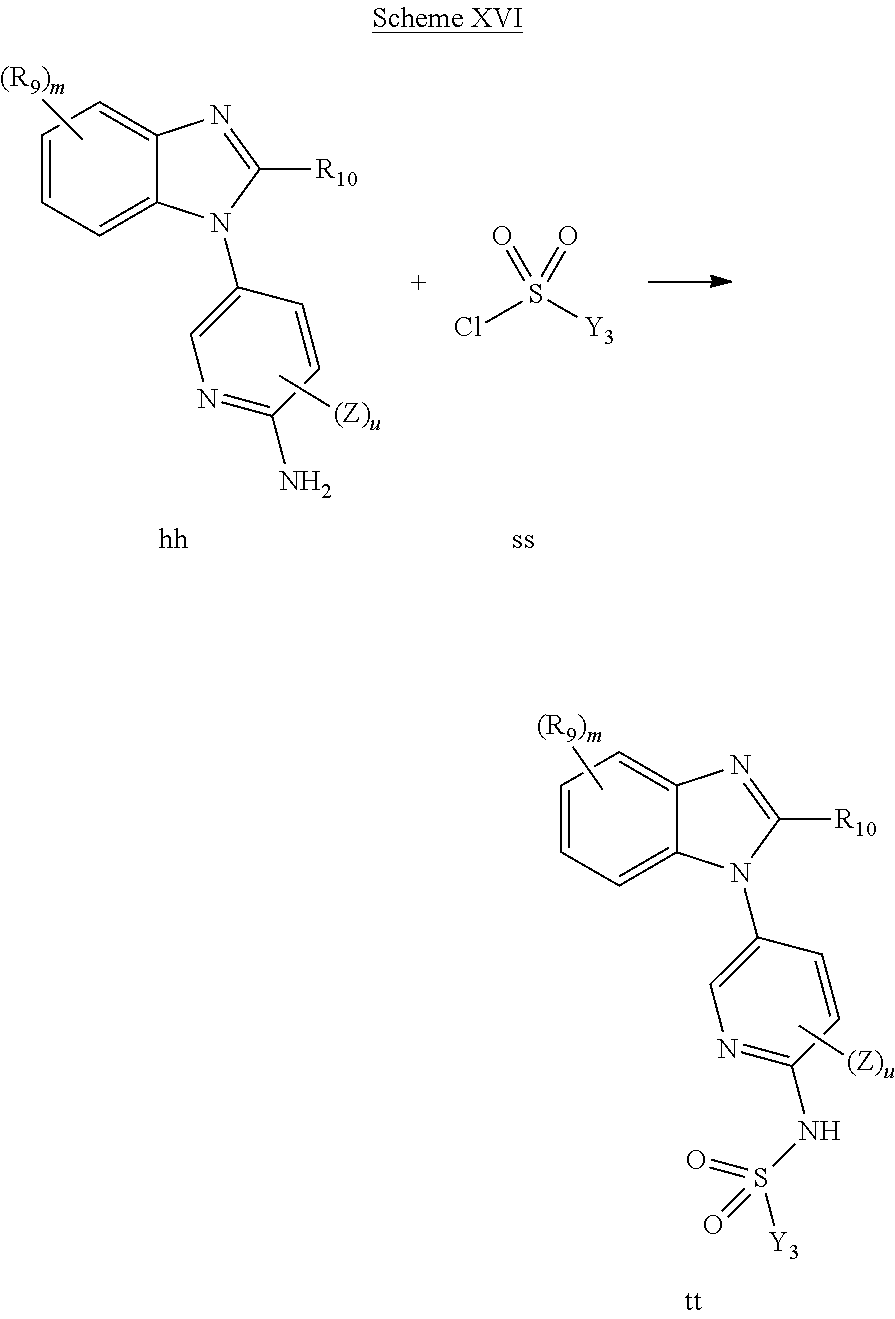


Representative Analytical Data for Other Exemplary Compounds of this Invention:
- Compound 1: Found: 465.4 (M+H)+.
- Compound 2: Found: 465.4 (M+H)+.
- Compound 4: Found: 447.4 (M+H)+.
- Compound 5: Found: 426.4 (M+H)+.
- Compound 7: Found: 498.3 (M+H)+.
- Compound 10: Found: 456.4 (M+H)+.
- Compound 12: Found: 433.4 (M+H)+.
- Compound 13: Found: 450.2 (M+H)+.
- Compound 14: Found: 447.4 (M+H)+.
- Compound 15: Found: 433.8 (M+H)+.
- Compound 16: Found: 450.3 (M+H)+.
- Compound 17: Found: 431.4 (M+H)+.
- Compound 18: Found: 498.4 (M+H)+.
- Compound 19: Found: 420.4 (M+H)+.
- Compound 20: Found: 442.3 (M+H)+.
- Compound 23: Found: 383.8 (M+H)+.
- Compound 25: Found: 451.8 (M+H)+.
- Compound 26: Found: 417.3 (M+H)+.
- Compound 28: Found: 428.2 (M+H)+.
- Compound 29: Found: 403.4 (M+H)+.
- Compound 30: Found: 485.3 (M+H)+.
- Compound 31: Found: 532.5 (M+H)+.
- Compound 32: Found: 477.4 (M+H)+.
- Compound 33: Found: 475.2 (M+H)+.
- Compound 35: Found: 473.4 (M+H)+.
- Compound 36: Found: 418.3 (M+H)+.
- Compound 37: Found: 442.3 (M+H)+.
- Compound 38: Found: 451.8 (M+H)+.
- Compound 39: Found: 432.4 (M+H)+.
- Compound 40: Found: 411.4 (M+H)+.
- Compound 41: Found: 418.3 (M+H)+.
- Compound 42: Found: 445.4 (M+H)+.
- Compound 43: Found: 432.4 (M+H)+.
- Compound 46: Found: 417.3 (M+H)+.
- Compound 48: Found: 425.4 (M+H)+.
- Compound 49: Found: 391.4 (M+H)+.
- Compound 50: Found: 432.4 (M+H)+.
- Compound 51: Found: 416.3 (M+H)+.
- Compound 52: Found: 453.4 (M+H)30.
- Compound 53: Found: 474.4 (M+H)+.
- Compound 54: Found: 349.3 (M+H)+.
- Compound 55: Found: 431.4 (M+H)+.
- Compound 56: Found: 418.3 (M+H)+.
- Compound 57: Found: 562.5 (M+H)+.
- Compound 58: Found: 357.4 (M+H)+.
- Compound 59: Found: 363.4 (M+H)+.
- Compound 60: Found: 449.3 (M+H)+.
- Compound 61: Found: 418.3 (M+H)+.
- Compound 62: Found: 404.4 (M+H)+.
- Compound 63: Found: 514.7 (M+H)+.
- Compound 64: Found: 485.3 (M+H)+.
- Compound 65: Found: 495.4 (M+H)+.
- Compound 66: Found: 467.5 (M+H)+.
- Compound 67: Found: 540.5 (M+H)+.
- Compound 68: Found: 540.5 (M+H)+.
- Compound 71: Found: 483.3 (M+H)+.
- Compound 72: Found: 487.5 (M+H)+.
- Compound 73: Found: 537.3 (M+H)+.
- Compound 76: Found: 425.4 (M+H)+.
- Compound 78: Found: 456.4 (M+H)+.
- Compound 80: Found: 479.4 (M+H)+.
- Compound 84: Found: 389.4 (M+H)+.
- Compound 85: Found: 453.5 (M+H)+.
- Compound 86: Found: 417.4 (M+H)+.
- Compound 87: Found: 433.5 (M+H)+.
- Compound 88: Found: 419.4 (M+H)+.
- Compound 89: Found: 441.4 (M+H)+.
- Compound 90: Found: 451.4 (M+H)+.
- Compound 92: Found: 455.4 (M+H)+.
- Compound 93: Found: 474.4 (M+H)+.
- Compound 94: Found: 431.4 (M+H)+.
- Compound 95: Found: 425.4 (M+H)+.
- Compound 97: Found: 501.3 (M+H)+.
- Compound 98: Found: 447.4 (M+H)+.
- Compound 100: Found: 447.4 (M+H)+.
- Compound 102: Found: 480.3 (M+H)+.
- Compound 103: Found: 447.4 (M+H)+.
- Compound 104: Found: 490.3 (M+H)+.
- Compound 107: Found: 456.4 (M+H)+.
- Compound 108: Found: 445.8 (M+H)+.
- Compound 109: Found: 445.8 (M+H)+.
- Compound 110: Found: 447.4 (M+H)+.
- Compound 113: Found: 460.4 (M+H)+.
- Compound 115: Found: 537.3 (M+H)+.
- Compound 117: Found: 480.3 (M+H)+.
- Compound 118: Found: 490.3 (M+H)+.
- Compound 119: Found: 490.3 (M+H)+.
- Compound 120: Found: 401.3 (M+H)+.
- Compound 121: Found: 500.4 (M+H)+.
- Compound 122: Found: 361.3 (M+H)+.
- Compound 123: Found: 455.4 (M+H)+.
- Compound 124: Found: 457.5 (M+H)+.
- Compound 125: Found: 435.4 (M+H)+.
- Compound 126: Found: 445.8 (M+H)+.
- Compound 127: Found: 547.4 (M+H)+.
- Compound 128: Found: 441.4 (M+H)+.
- Compound 129: Found: 547.4 (M+H)+.
- Compound 130: Found: 485.5 (M+H)+.
- Compound 131: Found: 485.5 (M+H)+.
- Compound 132: Found: 475.4 (M+H)+.
- Compound 133: Found: 459.4 (M+H)+.
- Compound 135: Found: 469.8 (M+H)+.
| IC50 | Compounds | ||
| <100 nM | 1, 2, 3, 4, 5, 6, 7, 8, 9, 10, 11, 12, 13, | ||
| 14, 71, 96, 97, 98, 99, 100, 101, 102, | |||
| 103, 104, 105, 106, 107, 108, 109, | |||
| 110, 111, 112, 113, 114, 115, 116, | |||
| 117, 118, 119, 132, 135, 163, 173, | |||
| 174, 175, 176, 178, 180, 185, 187, | |||
| 189, 193, 197, 202 | |||
| 100-500 nM | 15, 16, 17, 18, 19, 20, 21, 22, 23, 24, | ||
| 25, 26, 27, 28, 29, 30, 31, 32, 33, 34, | |||
| 35, 36, 37, 38, 39, 40, 63, 64, 65, 66, | |||
| 69, 70, 72, 73, 74, 75, 76, 77, 78, 79, | |||
| 80, 81, 82, 83, 84, 85, 86, 87, 88, 89, | |||
| 90, 133, 134, 136, 165, 166, 167, | |||
| 168, 170, 177, 179, 183, 184, 188, | |||
| 190, 191, 192, 195, 196, 201 | |||
| 500 nM-1 μM | 41, 42, 43, 44, 45, 46, 47, 48, 56, 91, | ||
| 92, 93, 94, 95, 169, 171, 182, 186, | |||
| 194, 198, 200 | |||
| >1 μM | 49, 50, 51, 52, 53, 54, 55, 57, 58, 59, | ||
| 60, 61, 62, 67, 68, 120, 121, 122, | |||
| 123, 124, 125, 126, 127, 128, 129, | |||
| 130, 131, 162, 164, 172, 181, 203, | |||
| 204, 205, 206, 207, 208, 209, 210, | |||
| 211, 212, 213, 214, 215, 216 | |||
| TABLE 2 |
| IC50 values for cytokine inhibition. |
| GM- | ||||||||
| Cpd # | IL-2 | IL-4 | IL-5 | IL-10 | IL-13 | CSF | INF-γ | TNF-α |
| CsA | 3 | 25 | 7 | 948 | 67 | 109 | 18 | 26 |
| 1 | 29 | 651 | 26 | >1000 | 73 | 788 | 95 | 424 |
| 135 | 3 | 101 | 13 | 439 | 25 | 99 | 29 | 47 |
Claims (15)


Priority Applications (1)
| Application Number | Priority Date | Filing Date | Title |
|---|---|---|---|
| US11/726,887 US8163777B2 (en) | 2006-03-23 | 2007-03-23 | Benzimidazolyl-pyridine compounds for inflammation and immune-related uses |
Applications Claiming Priority (2)
| Application Number | Priority Date | Filing Date | Title |
|---|---|---|---|
| US78540206P | 2006-03-23 | 2006-03-23 | |
| US11/726,887 US8163777B2 (en) | 2006-03-23 | 2007-03-23 | Benzimidazolyl-pyridine compounds for inflammation and immune-related uses |
Publications (2)
| Publication Number | Publication Date |
|---|---|
| US20070254912A1 US20070254912A1 (en) | 2007-11-01 |
| US8163777B2 true US8163777B2 (en) | 2012-04-24 |
Family
ID=38541731
Family Applications (1)
| Application Number | Title | Priority Date | Filing Date |
|---|---|---|---|
| US11/726,887 Expired - Fee Related US8163777B2 (en) | 2006-03-23 | 2007-03-23 | Benzimidazolyl-pyridine compounds for inflammation and immune-related uses |
Country Status (7)
| Country | Link |
|---|---|
| US (1) | US8163777B2 (en) |
| EP (1) | EP2004626A4 (en) |
| JP (1) | JP2009530409A (en) |
| AU (1) | AU2007230911A1 (en) |
| CA (1) | CA2646886A1 (en) |
| TW (1) | TW200810754A (en) |
| WO (1) | WO2007112093A2 (en) |
Cited By (1)
| Publication number | Priority date | Publication date | Assignee | Title |
|---|---|---|---|---|
| US20190047964A1 (en) * | 2016-03-11 | 2019-02-14 | Ancureall Pharmaceutical (Shanghai) Co., Ltd. | Urea compound, preparation method therefor and medical use thereof |
Families Citing this family (63)
| Publication number | Priority date | Publication date | Assignee | Title |
|---|---|---|---|---|
| TWI444187B (en) * | 2005-01-25 | 2014-07-11 | Synta Pharmaceuticals Corp | Thiophene compounds for inflammation and immune-related uses |
| WO2007087441A2 (en) | 2006-01-25 | 2007-08-02 | Synta Pharmaceuticals Corp. | Substituted aromatic compounds for inflammation and immune-related uses |
| TW200806290A (en) * | 2006-01-25 | 2008-02-01 | Synta Pharmaceuticals Corp | Substituted biaryl compounds for inflammation and immune-related uses |
| CA2640091A1 (en) * | 2006-01-25 | 2007-08-02 | Synta Pharmaceuticals Corp. | Vinyl-phenyl derivatives for inflammation and immune-related uses |
| WO2007109362A2 (en) * | 2006-03-20 | 2007-09-27 | Synta Pharmaceuticals Corp. | Benzoimidazolyl-parazine compounds for inflammation and immune-related uses |
| US8779154B2 (en) * | 2006-09-26 | 2014-07-15 | Qinglin Che | Fused ring compounds for inflammation and immune-related uses |
| CA2672213C (en) | 2006-12-22 | 2016-02-16 | Astex Therapeutics Limited | Bicyclic amine derivatives as protein tyrosine kinase inhibitors |
| MX2009006706A (en) * | 2006-12-22 | 2009-07-02 | Astex Therapeutics Ltd | Bicyclic heterocyclic compounds as fgfr inhibitors. |
| WO2009023272A1 (en) | 2007-08-15 | 2009-02-19 | President And Fellows Of Harvard College | Heterocyclic inhibitors of necroptosis |
| US8263641B2 (en) | 2007-09-10 | 2012-09-11 | Calcimedica, Inc. | Compounds that modulate intracellular calcium |
| GB0720038D0 (en) | 2007-10-12 | 2007-11-21 | Astex Therapeutics Ltd | New compounds |
| GB0720041D0 (en) | 2007-10-12 | 2007-11-21 | Astex Therapeutics Ltd | New Compounds |
| WO2009076454A2 (en) * | 2007-12-12 | 2009-06-18 | Calcimedica, Inc. | Compounds that modulate intracellular calcium |
| TWI498115B (en) * | 2007-12-27 | 2015-09-01 | Daiichi Sankyo Co Ltd | Imidazole carbonyl compound |
| GB0810902D0 (en) | 2008-06-13 | 2008-07-23 | Astex Therapeutics Ltd | New compounds |
| EP2321303B1 (en) | 2008-08-27 | 2019-11-27 | Calcimedica, Inc. | Compounds that modulate intracellular calcium |
| US8524763B2 (en) * | 2008-09-22 | 2013-09-03 | Calcimedica, Inc. | Inhibitors of store operated calcium release |
| US8143269B2 (en) | 2008-10-03 | 2012-03-27 | Calcimedica, Inc. | Inhibitors of store operated calcium release |
| GB0906470D0 (en) | 2009-04-15 | 2009-05-20 | Astex Therapeutics Ltd | New compounds |
| GB0906472D0 (en) | 2009-04-15 | 2009-05-20 | Astex Therapeutics Ltd | New compounds |
| WO2011034962A2 (en) * | 2009-09-16 | 2011-03-24 | Calcimedica Inc. | Compounds that modulate intracellular calcium |
| US8993612B2 (en) | 2009-10-08 | 2015-03-31 | Rhizen Pharmaceuticals Sa | Modulators of calcium release-activated calcium channel and methods for treatment of non-small cell lung cancer |
| US8377970B2 (en) | 2009-10-08 | 2013-02-19 | Rhizen Pharmaceuticals Sa | Modulators of calcium release-activated calcium channel |
| KR101804588B1 (en) * | 2009-10-13 | 2017-12-04 | 리간드 파마슈티칼스 인코포레이티드 | Hematopoietic growth factor mimetic small molecule compounds and their uses |
| DK2563776T3 (en) | 2010-04-27 | 2016-09-19 | Calcimedica Inc | Relations that modulate intracellular calcium |
| US10703722B2 (en) | 2010-04-27 | 2020-07-07 | Calcimedica, Inc. | Compounds that modulate intracellular calcium |
| JP2013525448A (en) | 2010-04-27 | 2013-06-20 | カルシメディカ,インク. | Compounds that regulate intracellular calcium |
| WO2012027710A2 (en) | 2010-08-27 | 2012-03-01 | Calcimedica Inc. | Compounds that modulate intracellular calcium |
| US9388140B2 (en) | 2011-03-31 | 2016-07-12 | Bayer Intellectual Property Gmbh | Substituted benzimidazoles |
| WO2012170931A2 (en) | 2011-06-10 | 2012-12-13 | Calcimedica, Inc. | Compounds that modulate intracellular calcium |
| WO2013059677A1 (en) | 2011-10-19 | 2013-04-25 | Calcimedica, Inc. | Compounds that modulate intracellular calcium |
| EA028626B1 (en) * | 2012-06-11 | 2017-12-29 | Юсб Байофарма Спрл | Tnf-alpha modulating benzimidazoles |
| WO2014059333A1 (en) | 2012-10-12 | 2014-04-17 | Calcimedica, Inc. | Compounds that modulate intracellular calcium |
| EP2968276A4 (en) | 2013-03-15 | 2017-02-15 | President and Fellows of Harvard College | Hybrid necroptosis inhibitors |
| US9828348B2 (en) | 2013-11-08 | 2017-11-28 | Purdue Pharma L.P. | Benzimidazole derivatives and use thereof |
| GB201321746D0 (en) * | 2013-12-09 | 2014-01-22 | Ucb Pharma Sa | Therapeutic agents |
| GB201321728D0 (en) | 2013-12-09 | 2014-01-22 | Ucb Pharma Sa | Therapeutic agents |
| GB201321741D0 (en) * | 2013-12-09 | 2014-01-22 | Ucb Pharma Sa | Therapeutic agents |
| GB201321744D0 (en) * | 2013-12-09 | 2014-01-22 | Ucb Pharma Sa | Therapeutic agents |
| TWI835179B (en) | 2015-02-27 | 2024-03-11 | 美商鈣系醫藥公司 | Pancreatitis treatment |
| DK3331525T3 (en) | 2015-08-07 | 2020-12-14 | Calcimedica Inc | Use of CRAC channel inhibitors to treat stroke and traumatic brain injury |
| CN105859628B (en) * | 2016-04-19 | 2018-08-07 | 清远职业技术学院 | A kind of antimicrobial compound is to N imidazoles benzaldehyde contracting ortho-aminotoluene schiff bases and its preparation method and application |
| ES2927104T3 (en) | 2016-09-09 | 2022-11-02 | Incyte Corp | Pyrazolopyridine derivatives as modulators of HPK1 and uses thereof for the treatment of cancer |
| US20180072718A1 (en) | 2016-09-09 | 2018-03-15 | Incyte Corporation | Pyrazolopyridine compounds and uses thereof |
| US20180072741A1 (en) | 2016-09-09 | 2018-03-15 | Incyte Corporation | Pyrazolopyrimidine compounds and uses thereof |
| GB201620948D0 (en) * | 2016-12-09 | 2017-01-25 | Ucb Biopharma Sprl | Therapeutic agents |
| WO2018152220A1 (en) | 2017-02-15 | 2018-08-23 | Incyte Corporation | Pyrazolopyridine compounds and uses thereof |
| CN106831770A (en) * | 2017-03-13 | 2017-06-13 | 牡丹江医学院 | A kind of pharmaceutical composition and its purposes for treating cirrhosis |
| US10722495B2 (en) | 2017-09-08 | 2020-07-28 | Incyte Corporation | Cyanoindazole compounds and uses thereof |
| US10745388B2 (en) | 2018-02-20 | 2020-08-18 | Incyte Corporation | Indazole compounds and uses thereof |
| WO2019164847A1 (en) | 2018-02-20 | 2019-08-29 | Incyte Corporation | Indazole compounds and uses thereof |
| LT3755703T (en) | 2018-02-20 | 2022-10-10 | Incyte Corporation | N-(PHENYL)-2-(PHENYL)PYRIMIDINE-4-CARBOXAMIDE DERIVATIVES AND RELATED COMPOUNDS AS HPK1 INHIBITORS FOR THE TREATMENT OF CANCER |
| US11299473B2 (en) | 2018-04-13 | 2022-04-12 | Incyte Corporation | Benzimidazole and indole compounds and uses thereof |
| US10899755B2 (en) | 2018-08-08 | 2021-01-26 | Incyte Corporation | Benzothiazole compounds and uses thereof |
| CA3112907A1 (en) | 2018-09-14 | 2020-03-19 | Rhizen Pharmaceuticals Ag | Compositions comprising a crac inhibitor and a corticosteroid and methods of use thereof |
| US11111247B2 (en) | 2018-09-25 | 2021-09-07 | Incyte Corporation | Pyrazolopyrimidine compounds and uses thereof |
| US12365685B2 (en) | 2019-02-18 | 2025-07-22 | Shenzhen Targetrx, Inc. | Substituted fused aromatic ring derivative, composition and use thereof |
| US11427558B1 (en) | 2019-07-11 | 2022-08-30 | ESCAPE Bio, Inc. | Indazoles and azaindazoles as LRRK2 inhibitors |
| AU2020326703A1 (en) | 2019-08-06 | 2022-02-17 | Incyte Corporation | Solid forms of an HPK1 inhibitor |
| US20230029266A1 (en) | 2019-11-05 | 2023-01-26 | Dermira, Inc. | MrgprX2 Antagonists for the Treatment of Inflammatory Disorders |
| CN120698981A (en) * | 2019-11-05 | 2025-09-26 | 德米拉公司 | MrgprX2 antagonists and uses thereof |
| PH12022551623A1 (en) | 2020-01-13 | 2023-11-29 | Verge Analytics Inc | Substituted pyrazolo-pyrimidines and uses thereof |
| EP4243813A4 (en) | 2020-11-13 | 2024-07-17 | Calcimedica, Inc. | Improved synthesis of crac channel inhibitors |
Citations (3)
| Publication number | Priority date | Publication date | Assignee | Title |
|---|---|---|---|---|
| US5654436A (en) | 1995-06-07 | 1997-08-05 | American Home Products Corporation | 2-substituted benzimidazole derivatives |
| US20070249661A1 (en) | 2004-09-21 | 2007-10-25 | Synta Pharmaceuticals Corp. | Compounds for inflammation and immune-related uses |
| US20070249609A1 (en) | 2006-03-20 | 2007-10-25 | Shoujun Chen | Benzoimidazolyl-pyrazine compounds for inflammation and immune-related uses |
Family Cites Families (2)
| Publication number | Priority date | Publication date | Assignee | Title |
|---|---|---|---|---|
| JP3256513B2 (en) * | 1998-02-11 | 2002-02-12 | ファイザー製薬株式会社 | Benzimidazole cyclooxygenase-2 inhibitor |
| ZA200602666B (en) * | 2004-01-12 | 2007-09-26 | Cytopia Res Pty Ltd | Selective kinase inhibitors |
-
2007
- 2007-03-23 AU AU2007230911A patent/AU2007230911A1/en not_active Abandoned
- 2007-03-23 CA CA002646886A patent/CA2646886A1/en not_active Abandoned
- 2007-03-23 WO PCT/US2007/007439 patent/WO2007112093A2/en not_active Ceased
- 2007-03-23 JP JP2009501609A patent/JP2009530409A/en active Pending
- 2007-03-23 EP EP07754016A patent/EP2004626A4/en not_active Withdrawn
- 2007-03-23 US US11/726,887 patent/US8163777B2/en not_active Expired - Fee Related
- 2007-03-23 TW TW096110052A patent/TW200810754A/en unknown
Patent Citations (3)
| Publication number | Priority date | Publication date | Assignee | Title |
|---|---|---|---|---|
| US5654436A (en) | 1995-06-07 | 1997-08-05 | American Home Products Corporation | 2-substituted benzimidazole derivatives |
| US20070249661A1 (en) | 2004-09-21 | 2007-10-25 | Synta Pharmaceuticals Corp. | Compounds for inflammation and immune-related uses |
| US20070249609A1 (en) | 2006-03-20 | 2007-10-25 | Shoujun Chen | Benzoimidazolyl-pyrazine compounds for inflammation and immune-related uses |
Non-Patent Citations (5)
| Title |
|---|
| Balant et al., "Metabolic Considerations, etc.," in Manfred ed., Burger's Medicinal Chemistry and Drug Discovery, 5th ed. vol. 1:Prinicples and Practice, John Wiley & Sons, Inc., 1995. * |
| Guillory (in Brittain ed.), "Polymorphism, etc.," NY: Marcel Dekker, Inc., 1999, 1-2, 183-226. * |
| International Search Report and Written Opinion dated Nov. 5, 2007 in corresponding PCT Application No. PCT/US07/07439. |
| Jain et al., "Polymorphism in Pharmacy", Indian Drugs, 1986, 23(6), 315-329. * |
| Vippagunta et al., "Crystalline Solids", Advanced Drug Delivery Reviews 48 (2001) 3-26. * |
Cited By (2)
| Publication number | Priority date | Publication date | Assignee | Title |
|---|---|---|---|---|
| US20190047964A1 (en) * | 2016-03-11 | 2019-02-14 | Ancureall Pharmaceutical (Shanghai) Co., Ltd. | Urea compound, preparation method therefor and medical use thereof |
| US10647680B2 (en) * | 2016-03-11 | 2020-05-12 | Ancureall Pharmaceutical (Shanghai) Co., Ltd. | Urea compound, preparation method therefor and medical use thereof |
Also Published As
| Publication number | Publication date |
|---|---|
| AU2007230911A1 (en) | 2007-10-04 |
| TW200810754A (en) | 2008-03-01 |
| WO2007112093A2 (en) | 2007-10-04 |
| US20070254912A1 (en) | 2007-11-01 |
| EP2004626A4 (en) | 2010-10-27 |
| WO2007112093A3 (en) | 2007-12-27 |
| EP2004626A2 (en) | 2008-12-24 |
| JP2009530409A (en) | 2009-08-27 |
| CA2646886A1 (en) | 2007-10-04 |
Similar Documents
| Publication | Publication Date | Title |
|---|---|---|
| US8163777B2 (en) | Benzimidazolyl-pyridine compounds for inflammation and immune-related uses | |
| US7709518B2 (en) | Compounds for inflammation and immune-related uses | |
| US8614321B2 (en) | Benzoimidazolyl-pyrazine compounds for inflammation and immune-related uses | |
| US8741960B2 (en) | Substituted aromatic compounds for inflammation and immune-related uses | |
| US8623871B2 (en) | Substituted biaryl compounds for inflammation and immune-related uses | |
| US9493427B2 (en) | Compounds for inflammation and immune-related uses | |
| US8710083B2 (en) | Pyridylphenyl compounds for inflammation and immune-related uses | |
| US8802721B2 (en) | Thiophene compounds for inflammation and immune-related uses | |
| EP1651232B1 (en) | Compounds for inflammation and immune-related uses | |
| US8435996B2 (en) | Heterocycle-aryl compounds for inflammation and immune-related uses | |
| US8324219B2 (en) | Substituted benzoimidazolyl-pyrazine compounds for inflammation and immune-related uses | |
| US20070275960A1 (en) | Phenyl and pyridyl compounds for inflammation and immune-related uses | |
| US20110052643A1 (en) | Compounds for inflammation and immune-related uses | |
| US20120196838A1 (en) | Compounds for inflammation and immune-related uses | |
| US20100130510A1 (en) | Compounds for inflammation and immune-related uses | |
| US20120064121A1 (en) | Pyridine compounds for inflammation and immune-related uses |
Legal Events
| Date | Code | Title | Description |
|---|---|---|---|
| AS | Assignment |
Owner name: SYNTA PHARMACEUTICALS CORP., MASSACHUSETTS Free format text: ASSIGNMENT OF ASSIGNORS INTEREST;ASSIGNORS:CHEN, SHOUJUN;SUN, LIJUN;XIE, YU;REEL/FRAME:019547/0180;SIGNING DATES FROM 20070507 TO 20070620 Owner name: SYNTA PHARMACEUTICALS CORP., MASSACHUSETTS Free format text: ASSIGNMENT OF ASSIGNORS INTEREST;ASSIGNORS:CHEN, SHOUJUN;SUN, LIJUN;XIE, YU;SIGNING DATES FROM 20070507 TO 20070620;REEL/FRAME:019547/0180 |
|
| CC | Certificate of correction | ||
| REMI | Maintenance fee reminder mailed | ||
| LAPS | Lapse for failure to pay maintenance fees | ||
| STCH | Information on status: patent discontinuation |
Free format text: PATENT EXPIRED DUE TO NONPAYMENT OF MAINTENANCE FEES UNDER 37 CFR 1.362 |
|
| STCH | Information on status: patent discontinuation |
Free format text: PATENT EXPIRED DUE TO NONPAYMENT OF MAINTENANCE FEES UNDER 37 CFR 1.362 |
|
| FP | Lapsed due to failure to pay maintenance fee |
Effective date: 20160424 |