US7485283B2 - Contrast agents for myocardial perfusion imaging - Google Patents
Contrast agents for myocardial perfusion imaging Download PDFInfo
- Publication number
- US7485283B2 US7485283B2 US11/113,486 US11348605A US7485283B2 US 7485283 B2 US7485283 B2 US 7485283B2 US 11348605 A US11348605 A US 11348605A US 7485283 B2 US7485283 B2 US 7485283B2
- Authority
- US
- United States
- Prior art keywords
- mmol
- added
- water
- ethyl acetate
- methyl
- Prior art date
- Legal status (The legal status is an assumption and is not a legal conclusion. Google has not performed a legal analysis and makes no representation as to the accuracy of the status listed.)
- Active, expires
Links
- 0 C[C@@](C=C1C[C@@](N[C@@](*)O)O)OC1=O Chemical compound C[C@@](C=C1C[C@@](N[C@@](*)O)O)OC1=O 0.000 description 26
- XOWUNRXPJRKODT-UHFFFAOYSA-N CC1=C(SCC2=CC=C(CCCCF)C=C2)OC2=CC=CC=C2C1=O.CC1=CC=C(S(=O)(=O)OCCCCC2=CC=C(CSC3=C(C)C(=O)C4=CC=CC=C4O3)C=C2)C=C1 Chemical compound CC1=C(SCC2=CC=C(CCCCF)C=C2)OC2=CC=CC=C2C1=O.CC1=CC=C(S(=O)(=O)OCCCCC2=CC=C(CSC3=C(C)C(=O)C4=CC=CC=C4O3)C=C2)C=C1 XOWUNRXPJRKODT-UHFFFAOYSA-N 0.000 description 2
- DJINJMVRMWKQLS-UHFFFAOYSA-N CCCOCC1=CC=C(CSC2=C(C)C(=O)C3=CC=CC=C3O2)C=C1 Chemical compound CCCOCC1=CC=C(CSC2=C(C)C(=O)C3=CC=CC=C3O2)C=C1 DJINJMVRMWKQLS-UHFFFAOYSA-N 0.000 description 2
- WLBDZQXHUBRGAQ-UHFFFAOYSA-M BrCC1=CC=C(I)C=C1.O=C1C2=C(C=CC=C2)C(=O)N1CC1=CC=C(I)C=C1.O=C1NC(=O)C2=C1C=CC=C2.O=COO[Cs].[CsH] Chemical compound BrCC1=CC=C(I)C=C1.O=C1C2=C(C=CC=C2)C(=O)N1CC1=CC=C(I)C=C1.O=C1NC(=O)C2=C1C=CC=C2.O=COO[Cs].[CsH] WLBDZQXHUBRGAQ-UHFFFAOYSA-M 0.000 description 1
- SVCMRYIRQYUVNP-UHFFFAOYSA-N C#CC(C)(C)OC1=CC=C(SC(CO)C2=CC(OC)=C(OC)C(OC)=C2)C=C1.COC1=CC(C(CO)SC2=CC=C(O)C=C2)=CC(OC)=C1OC Chemical compound C#CC(C)(C)OC1=CC=C(SC(CO)C2=CC(OC)=C(OC)C(OC)=C2)C=C1.COC1=CC(C(CO)SC2=CC=C(O)C=C2)=CC(OC)=C1OC SVCMRYIRQYUVNP-UHFFFAOYSA-N 0.000 description 1
- SMRWLOMSAAFXDR-UHFFFAOYSA-N C#CC(C)(C)OC1=CC=C(SC(CO)C2=CC(OC)=C(OC)C(OC)=C2)C=C1.COC1=CC(C(CO)SC2=CC=C3OC(C)(C)C=CC3=C2)=CC(OC)=C1OC Chemical compound C#CC(C)(C)OC1=CC=C(SC(CO)C2=CC(OC)=C(OC)C(OC)=C2)C=C1.COC1=CC(C(CO)SC2=CC=C3OC(C)(C)C=CC3=C2)=CC(OC)=C1OC SMRWLOMSAAFXDR-UHFFFAOYSA-N 0.000 description 1
- BUGMUFZJIVFNRS-GWZGPPTHSA-N C#CC1CCCCC1CCCCCCC(O[Si](C)(C)C(C)(C)C)C1=C(OC)C(OC)=C(OC)C(OC)=C1C.CC.CCCCCCCCCC[C@H](OCOC)[C@@H]1CC[C@@H]([C@@H]2CC[C@@H](C(C#CCCCCCCCCCCC(O[Si](C)(C)C(C)(C)C)C3=C(OC)C(OC)=C(OC)C(OC)=C3C)OCOC)O2)O1.CCCCCCCCCC[C@H](OCOC)[C@@H]1CC[C@@H]([C@@H]2CC[C@@H](C=O)O2)O1 Chemical compound C#CC1CCCCC1CCCCCCC(O[Si](C)(C)C(C)(C)C)C1=C(OC)C(OC)=C(OC)C(OC)=C1C.CC.CCCCCCCCCC[C@H](OCOC)[C@@H]1CC[C@@H]([C@@H]2CC[C@@H](C(C#CCCCCCCCCCCC(O[Si](C)(C)C(C)(C)C)C3=C(OC)C(OC)=C(OC)C(OC)=C3C)OCOC)O2)O1.CCCCCCCCCC[C@H](OCOC)[C@@H]1CC[C@@H]([C@@H]2CC[C@@H](C=O)O2)O1 BUGMUFZJIVFNRS-GWZGPPTHSA-N 0.000 description 1
- BZKLXBCQXLSGNV-UHFFFAOYSA-N C#CCCCCCCCCCCC(O)C1=C(OC)C(OC)=C(OC)C(OC)=C1C.C#CCCCCCCCCCCC=O.[H]C1=C(OC)C(OC)=C(OC)C(OC)=C1C Chemical compound C#CCCCCCCCCCCC(O)C1=C(OC)C(OC)=C(OC)C(OC)=C1C.C#CCCCCCCCCCCC=O.[H]C1=C(OC)C(OC)=C(OC)C(OC)=C1C BZKLXBCQXLSGNV-UHFFFAOYSA-N 0.000 description 1
- WWGJCJJYWVLRHI-UHFFFAOYSA-N C#CCCO.COC(=O)C1=CC=C(Br)C=C1.COC(=O)C1=CC=C(C#CCCO)C=C1 Chemical compound C#CCCO.COC(=O)C1=CC=C(Br)C=C1.COC(=O)C1=CC=C(C#CCCO)C=C1 WWGJCJJYWVLRHI-UHFFFAOYSA-N 0.000 description 1
- FZTPUMSJOQTIRH-UHFFFAOYSA-N C#CCCO.O=C1C2=C(C=CC=C2)C(=O)N1CC1=CC=C(C#CCCO)C=C1.O=C1C2=C(C=CC=C2)C(=O)N1CC1=CC=C(I)C=C1 Chemical compound C#CCCO.O=C1C2=C(C=CC=C2)C(=O)N1CC1=CC=C(C#CCCO)C=C1.O=C1C2=C(C=CC=C2)C(=O)N1CC1=CC=C(I)C=C1 FZTPUMSJOQTIRH-UHFFFAOYSA-N 0.000 description 1
- XSHLKUXFLQCTTH-UHFFFAOYSA-N C.C.C=C(C(C)(C)C)C(C)(C)C.C=C(COC(C)(C)C)C(C)(C)C Chemical compound C.C.C=C(C(C)(C)C)C(C)(C)C.C=C(COC(C)(C)C)C(C)(C)C XSHLKUXFLQCTTH-UHFFFAOYSA-N 0.000 description 1
- RPQBXIGMMKRXAB-FCHARDOESA-N C.COC1=CC2=C(C=C1OC)C1C(=O)C3=C(OC1CO2)C1=C(C=C3)OC(C)(C)C=C1.[2HH] Chemical compound C.COC1=CC2=C(C=C1OC)C1C(=O)C3=C(OC1CO2)C1=C(C=C3)OC(C)(C)C=C1.[2HH] RPQBXIGMMKRXAB-FCHARDOESA-N 0.000 description 1
- NHUAAOPZRIHLTL-UHFFFAOYSA-N C/C1=C(\OCC2=CC=C(CCCCF)C=C2)OC2=CC=CC=C2C1=O.CC1=CC=C(S(=O)(=O)OCCCCC2=CC=C(CO/C3=C(\C)C(=O)C4=CC=CC=C4O3)C=C2)C=C1 Chemical compound C/C1=C(\OCC2=CC=C(CCCCF)C=C2)OC2=CC=CC=C2C1=O.CC1=CC=C(S(=O)(=O)OCCCCC2=CC=C(CO/C3=C(\C)C(=O)C4=CC=CC=C4O3)C=C2)C=C1 NHUAAOPZRIHLTL-UHFFFAOYSA-N 0.000 description 1
- NATDKOVGAFMRNJ-UHFFFAOYSA-N C/C1=C(\OCC2=CC=C(CCCCO)C=C2)OC2=CC=CC=C2C1=O.C/C1=C(\OCC2=CC=C(CCCCO[Si](C)(C)C(C)(C)C)C=C2)OC2=CC=CC=C2C1=O Chemical compound C/C1=C(\OCC2=CC=C(CCCCO)C=C2)OC2=CC=CC=C2C1=O.C/C1=C(\OCC2=CC=C(CCCCO[Si](C)(C)C(C)(C)C)C=C2)OC2=CC=CC=C2C1=O NATDKOVGAFMRNJ-UHFFFAOYSA-N 0.000 description 1
- DNHQBVMKCLCYSH-UHFFFAOYSA-N C/C1=C(\OCC2=CC=C(CCCCO)C=C2)OC2=CC=CC=C2C1=O.CC1=CC=C(S(=O)(=O)OCCCCC2=CC=C(CO/C3=C(\C)C(=O)C4=CC=CC=C4O3)C=C2)C=C1 Chemical compound C/C1=C(\OCC2=CC=C(CCCCO)C=C2)OC2=CC=CC=C2C1=O.CC1=CC=C(S(=O)(=O)OCCCCC2=CC=C(CO/C3=C(\C)C(=O)C4=CC=CC=C4O3)C=C2)C=C1 DNHQBVMKCLCYSH-UHFFFAOYSA-N 0.000 description 1
- RNXMDQNIOXPVTI-UHFFFAOYSA-N C/C1=C(\OCC2=CC=C(CCCCO[Si](C)(C)C(C)(C)C)C=C2)OC2=CC=CC=C2C1=O.CC(C)(C)[Si](C)(C)OCCCCC1=CC=C(CO)C=C1.CC1=C(S(C)(=O)=O)OC2=CC=CC=C2C1=O Chemical compound C/C1=C(\OCC2=CC=C(CCCCO[Si](C)(C)C(C)(C)C)C=C2)OC2=CC=CC=C2C1=O.CC(C)(C)[Si](C)(C)OCCCCC1=CC=C(CO)C=C1.CC1=C(S(C)(=O)=O)OC2=CC=CC=C2C1=O RNXMDQNIOXPVTI-UHFFFAOYSA-N 0.000 description 1
- SKONJOKROPHQTH-UHFFFAOYSA-N C/C1=C(\SCC2=CC=C(CCCCO)C=C2)OC2=CC=CC=C2C1=O.CC1=C(S)OC2=CC=CC=C2C1=O.OCCCCC1=CC=C(CO)C=C1 Chemical compound C/C1=C(\SCC2=CC=C(CCCCO)C=C2)OC2=CC=CC=C2C1=O.CC1=C(S)OC2=CC=CC=C2C1=O.OCCCCC1=CC=C(CO)C=C1 SKONJOKROPHQTH-UHFFFAOYSA-N 0.000 description 1
- ILSZOMOCSAEVKJ-UHFFFAOYSA-N C/C1=C(\SCC2=CC=C(CCCCO)C=C2)OC2=CC=CC=C2C1=O.CC1=CC=C(S(=O)(=O)OCCCCC2=CC=C(CS/C3=C(\C)C(=O)C4=CC=CC=C4O3)C=C2)C=C1 Chemical compound C/C1=C(\SCC2=CC=C(CCCCO)C=C2)OC2=CC=CC=C2C1=O.CC1=CC=C(S(=O)(=O)OCCCCC2=CC=C(CS/C3=C(\C)C(=O)C4=CC=CC=C4O3)C=C2)C=C1 ILSZOMOCSAEVKJ-UHFFFAOYSA-N 0.000 description 1
- QAAKVUGKTNHVQE-UHFFFAOYSA-N C1=COCCC1.CCS(=O)C1=C(CO)C(=O)C2=CC=CC=C2O1.CCS(=O)C1=C(COC2CCCCO2)C(=O)C2=CC=CC=C2O1 Chemical compound C1=COCCC1.CCS(=O)C1=C(CO)C(=O)C2=CC=CC=C2O1.CCS(=O)C1=C(COC2CCCCO2)C(=O)C2=CC=CC=C2O1 QAAKVUGKTNHVQE-UHFFFAOYSA-N 0.000 description 1
- FORBJPHGBOWPBM-UHFFFAOYSA-N C=C(C)C.CCC(=O)C1=C(O)C=CC=C1O.CCC(=O)C1=C(OC(C)(C)C)C=CC=C1O Chemical compound C=C(C)C.CCC(=O)C1=C(O)C=CC=C1O.CCC(=O)C1=C(OC(C)(C)C)C=CC=C1O FORBJPHGBOWPBM-UHFFFAOYSA-N 0.000 description 1
- MNUKYLXDOSEZGZ-UHFFFAOYSA-N C=C(CC1=CC(OC)=C(OC)C(OC)=C1)C1=CC2=C(C=C1)OC(C)(C)cc2 Chemical compound C=C(CC1=CC(OC)=C(OC)C(OC)=C1)C1=CC2=C(C=C1)OC(C)(C)cc2 MNUKYLXDOSEZGZ-UHFFFAOYSA-N 0.000 description 1
- XCIXENYNJSZTAZ-UHFFFAOYSA-N CC(=O)C1=CC(Br)=CC=C1O.CC1(C)COC2=CC(Br)=CC=C2C1=O Chemical compound CC(=O)C1=CC(Br)=CC=C1O.CC1(C)COC2=CC(Br)=CC=C2C1=O XCIXENYNJSZTAZ-UHFFFAOYSA-N 0.000 description 1
- UQPBTNAWFFYSGM-UHFFFAOYSA-N CC(=O)O.CC1=C(S)OC2=CC=CC(OC(C)(C)C)=C2C1=O.CCC(=O)C1=C(OC(C)(C)C)C=CC=C1O Chemical compound CC(=O)O.CC1=C(S)OC2=CC=CC(OC(C)(C)C)=C2C1=O.CCC(=O)C1=C(OC(C)(C)C)C=CC=C1O UQPBTNAWFFYSGM-UHFFFAOYSA-N 0.000 description 1
- YDVJWDXYLVWVCF-UHFFFAOYSA-N CC(C(c1ccccc1O1)=O)=C1S(C)(=O)=O Chemical compound CC(C(c1ccccc1O1)=O)=C1S(C)(=O)=O YDVJWDXYLVWVCF-UHFFFAOYSA-N 0.000 description 1
- DXJVYVUDMOQXKZ-UHFFFAOYSA-N CC(C)(C)C1=CC=C(CS)C=C1.CC(C)(C)C1=CC=C(CSC2=C(COC3CCCCO3)C(=O)C3=CC=CC=C3O2)C=C1.CCS(=O)C1=C(COC2CCCCO2)C(=O)C2=CC=CC=C2O1 Chemical compound CC(C)(C)C1=CC=C(CS)C=C1.CC(C)(C)C1=CC=C(CSC2=C(COC3CCCCO3)C(=O)C3=CC=CC=C3O2)C=C1.CCS(=O)C1=C(COC2CCCCO2)C(=O)C2=CC=CC=C2O1 DXJVYVUDMOQXKZ-UHFFFAOYSA-N 0.000 description 1
- NIQLZFHSTFJRIR-UHFFFAOYSA-N CC(C)(C)C1=CC=C(CSC2=C(CF)C(=O)C3=CC=CC=C3O2)C=C1.CC1=CC=C(S(=O)(=O)OCC2=C(SCC3=CC=C(C(C)(C)C)C=C3)OC3=CC=CC=C3C2=O)C=C1 Chemical compound CC(C)(C)C1=CC=C(CSC2=C(CF)C(=O)C3=CC=CC=C3O2)C=C1.CC1=CC=C(S(=O)(=O)OCC2=C(SCC3=CC=C(C(C)(C)C)C=C3)OC3=CC=CC=C3C2=O)C=C1 NIQLZFHSTFJRIR-UHFFFAOYSA-N 0.000 description 1
- DVAWLTOQGBWVSP-UHFFFAOYSA-N CC(C)(C)C1=CC=C(CSC2=C(CO)C(=O)C3=CC=CC=C3O2)C=C1.CC(C)(C)C1=CC=C(CSC2=C(COC3CCCCO3)C(=O)C3=CC=CC=C3O2)C=C1 Chemical compound CC(C)(C)C1=CC=C(CSC2=C(CO)C(=O)C3=CC=CC=C3O2)C=C1.CC(C)(C)C1=CC=C(CSC2=C(COC3CCCCO3)C(=O)C3=CC=CC=C3O2)C=C1 DVAWLTOQGBWVSP-UHFFFAOYSA-N 0.000 description 1
- FRHPPMKJVMPUJR-UHFFFAOYSA-N CC(C)(C)C1=CC=C(CSC2=C(CO)C(=O)C3=CC=CC=C3O2)C=C1.CC1=CC=C(S(=O)(=O)OCC2=C(SCC3=CC=C(C(C)(C)C)C=C3)OC3=CC=CC=C3C2=O)C=C1 Chemical compound CC(C)(C)C1=CC=C(CSC2=C(CO)C(=O)C3=CC=CC=C3O2)C=C1.CC1=CC=C(S(=O)(=O)OCC2=C(SCC3=CC=C(C(C)(C)C)C=C3)OC3=CC=CC=C3C2=O)C=C1 FRHPPMKJVMPUJR-UHFFFAOYSA-N 0.000 description 1
- NIQLZFHSTFJRIR-AUSCLKNFSA-N CC(C)(C)C1=CC=C(CSC2=C(C[18F])C(=O)C3=CC=CC=C3O2)C=C1.CC1=CC=C(S(=O)(=O)OCC2=C(SCC3=CC=C(C(C)(C)C)C=C3)OC3=CC=CC=C3C2=O)C=C1 Chemical compound CC(C)(C)C1=CC=C(CSC2=C(C[18F])C(=O)C3=CC=CC=C3O2)C=C1.CC1=CC=C(S(=O)(=O)OCC2=C(SCC3=CC=C(C(C)(C)C)C=C3)OC3=CC=CC=C3C2=O)C=C1 NIQLZFHSTFJRIR-AUSCLKNFSA-N 0.000 description 1
- VDNAHDSNUUUGLN-UHFFFAOYSA-N CC(C)(C)[Si](C)(C)Cl.COC(=O)C1=CC=C(CCCCO)C=C1.COC(=O)C1=CC=C(CCCCO[Si](C)(C)C(C)(C)C)C=C1 Chemical compound CC(C)(C)[Si](C)(C)Cl.COC(=O)C1=CC=C(CCCCO)C=C1.COC(=O)C1=CC=C(CCCCO[Si](C)(C)C(C)(C)C)C=C1 VDNAHDSNUUUGLN-UHFFFAOYSA-N 0.000 description 1
- VEILUIDVKLYTLA-UHFFFAOYSA-N CC(C)(C)[Si](C)(C)OCCCCC1=CC=C(CO)C=C1.COC(=O)C1=CC=C(CCCCO[Si](C)(C)C(C)(C)C)C=C1 Chemical compound CC(C)(C)[Si](C)(C)OCCCCC1=CC=C(CO)C=C1.COC(=O)C1=CC=C(CCCCO[Si](C)(C)C(C)(C)C)C=C1 VEILUIDVKLYTLA-UHFFFAOYSA-N 0.000 description 1
- VYLNQGSDFMWNCS-UHFFFAOYSA-N CC(C)(C=Cc1c2)Oc1ccc2C(C(c(cc1OC)cc(OC)c1OC)O)=O Chemical compound CC(C)(C=Cc1c2)Oc1ccc2C(C(c(cc1OC)cc(OC)c1OC)O)=O VYLNQGSDFMWNCS-UHFFFAOYSA-N 0.000 description 1
- KGXNPNHKHPDUGE-UHFFFAOYSA-N CC(C)(CC1)Oc(cc2)c1cc2C(Cc(cc1OC)cc(OC)c1O)=O Chemical compound CC(C)(CC1)Oc(cc2)c1cc2C(Cc(cc1OC)cc(OC)c1O)=O KGXNPNHKHPDUGE-UHFFFAOYSA-N 0.000 description 1
- LRTMVINZKPLEKU-UHFFFAOYSA-N CC(C)(CC1F)Oc(cc2)c1cc2C(Cc(cc1OC)cc(OC)c1OC)=O Chemical compound CC(C)(CC1F)Oc(cc2)c1cc2C(Cc(cc1OC)cc(OC)c1OC)=O LRTMVINZKPLEKU-UHFFFAOYSA-N 0.000 description 1
- AXSMAHISGKDYOK-UHFFFAOYSA-N CC(C)(CCc1c2)Oc1ccc2C(C(c(cc1OC)cc(OC)c1OC)Br)=O Chemical compound CC(C)(CCc1c2)Oc1ccc2C(C(c(cc1OC)cc(OC)c1OC)Br)=O AXSMAHISGKDYOK-UHFFFAOYSA-N 0.000 description 1
- QRTQXCBWWBRRMQ-UHFFFAOYSA-N CC(C)(COc1c2ccc(Br)c1)C2O Chemical compound CC(C)(COc1c2ccc(Br)c1)C2O QRTQXCBWWBRRMQ-UHFFFAOYSA-N 0.000 description 1
- VGWICBFHXFPKMD-BDXOZPKLSA-N CC.CCCCCCCCCCCC[C@H](O)[C@@H]1CC[C@@H](C(O)CCCCC([18F])CCCCC[C@@H](O)CC2=C[C@H](C)OC2=O)O1.CCCCCCCCCCCC[C@H](OCOC)[C@@H]1CC[C@@H](C(CCCCC(CCCCC[C@H](CC2=C[C@H](C)OC2=O)OCOC)OS(=O)(=O)C2=CC=C(C)C=C2)OCOC)O1 Chemical compound CC.CCCCCCCCCCCC[C@H](O)[C@@H]1CC[C@@H](C(O)CCCCC([18F])CCCCC[C@@H](O)CC2=C[C@H](C)OC2=O)O1.CCCCCCCCCCCC[C@H](OCOC)[C@@H]1CC[C@@H](C(CCCCC(CCCCC[C@H](CC2=C[C@H](C)OC2=O)OCOC)OS(=O)(=O)C2=CC=C(C)C=C2)OCOC)O1 VGWICBFHXFPKMD-BDXOZPKLSA-N 0.000 description 1
- FEKOSEMYEYVQHY-QGNBPFQOSA-N CC.CCCCCCCCCCCC[C@H](OCOC)[C@@H]1CC[C@@H]([C@H](CCCCCCC(CCCCC[C@H](CC2=CC(=O)O[C@H]2C)OCOC)OS(=O)(=O)C2=CC=C(C)C=C2)OCOC)O1.CCCCCCCCC[C@H](O)[C@@H]1CC[C@@H]([C@@H](O)CCCCC(=O)CCCCC[C@@H](O)CC2=CC(=O)O[C@H]2C)O1 Chemical compound CC.CCCCCCCCCCCC[C@H](OCOC)[C@@H]1CC[C@@H]([C@H](CCCCCCC(CCCCC[C@H](CC2=CC(=O)O[C@H]2C)OCOC)OS(=O)(=O)C2=CC=C(C)C=C2)OCOC)O1.CCCCCCCCC[C@H](O)[C@@H]1CC[C@@H]([C@@H](O)CCCCC(=O)CCCCC[C@@H](O)CC2=CC(=O)O[C@H]2C)O1 FEKOSEMYEYVQHY-QGNBPFQOSA-N 0.000 description 1
- RJDULHPWLHLUPX-IVBMXJBXSA-N CC.CCCCCCCCCC[C@@H](O)[C@H]1CC[C@H]([C@H]2CC[C@H](C(O)CCCCC([18F])CCCCCC(O)CC3=C[C@H](C)OC3=O)O2)O1.CCCCCCCCCC[C@@H](OCOC)[C@H]1CC[C@H]([C@H]2CC[C@H](C(CCCCC(CCCCCC(CC3=C[C@H](C)OC3=O)OCOC)OS(=O)(=O)C3=CC=C(C)C=C3)OCOC)O2)O1 Chemical compound CC.CCCCCCCCCC[C@@H](O)[C@H]1CC[C@H]([C@H]2CC[C@H](C(O)CCCCC([18F])CCCCCC(O)CC3=C[C@H](C)OC3=O)O2)O1.CCCCCCCCCC[C@@H](OCOC)[C@H]1CC[C@H]([C@H]2CC[C@H](C(CCCCC(CCCCCC(CC3=C[C@H](C)OC3=O)OCOC)OS(=O)(=O)C3=CC=C(C)C=C3)OCOC)O2)O1 RJDULHPWLHLUPX-IVBMXJBXSA-N 0.000 description 1
- SOCLGGJSFIGULG-SVORUSDZSA-N CC.CCCCCCCCCC[C@H](O)[C@@H]1CC[C@@H]([C@@H]2CC[C@@H](C(O)CCCCCCCCCCCCC([18F])C3=C(C)C(=O)C(OC)=C(OC)C3=O)O2)O1.CCCCCCCCCC[C@H](OCOC)[C@@H]1CC[C@@H]([C@@H]2CC[C@@H](C(CCCCCCCCCCCCC(OS(=O)(=O)C3=CC=C(C)C=C3)C3=C(C)C(=O)C(OC)=C(OC)C3=O)OCOC)O2)O1 Chemical compound CC.CCCCCCCCCC[C@H](O)[C@@H]1CC[C@@H]([C@@H]2CC[C@@H](C(O)CCCCCCCCCCCCC([18F])C3=C(C)C(=O)C(OC)=C(OC)C3=O)O2)O1.CCCCCCCCCC[C@H](OCOC)[C@@H]1CC[C@@H]([C@@H]2CC[C@@H](C(CCCCCCCCCCCCC(OS(=O)(=O)C3=CC=C(C)C=C3)C3=C(C)C(=O)C(OC)=C(OC)C3=O)OCOC)O2)O1 SOCLGGJSFIGULG-SVORUSDZSA-N 0.000 description 1
- SFBSYJWUEBZLTG-LPGITTNJSA-N CC.CCCCCCCCCC[C@H](OCOC)[C@@H]1CC[C@@H]([C@@H]2CC[C@@H](C(C#CCCCCCCCCCCC(O[Si](C)(C)C(C)(C)C)C3=C(OC)C(OC)=C(OC)C(OC)=C3C)OCOC)O2)O1.CCCCCCCCCC[C@H](OCOC)[C@@H]1CC[C@@H]([C@@H]2CC[C@@H](C(CCCCCCCCCCCCC(OS(=O)(=O)C3=CC=C(C)C=C3)C3=C(C)C(=O)C(OC)=C(OC)C3=O)OCOC)O2)O1 Chemical compound CC.CCCCCCCCCC[C@H](OCOC)[C@@H]1CC[C@@H]([C@@H]2CC[C@@H](C(C#CCCCCCCCCCCC(O[Si](C)(C)C(C)(C)C)C3=C(OC)C(OC)=C(OC)C(OC)=C3C)OCOC)O2)O1.CCCCCCCCCC[C@H](OCOC)[C@@H]1CC[C@@H]([C@@H]2CC[C@@H](C(CCCCCCCCCCCCC(OS(=O)(=O)C3=CC=C(C)C=C3)C3=C(C)C(=O)C(OC)=C(OC)C3=O)OCOC)O2)O1 SFBSYJWUEBZLTG-LPGITTNJSA-N 0.000 description 1
- JLPHCSPXFLIOEE-UHFFFAOYSA-N CC1(C)C=CC2=CC(Br)=CC=C2O1.COC1=CC(CC(O)C2=CC=C3OC(C)(C)C=CC3=C2)=CC(OC)=C1OCC1=CC=CC=C1.[H]C(=O)CC1=CC(OC)=C(OCC2=CC=CC=C2)C(OC)=C1 Chemical compound CC1(C)C=CC2=CC(Br)=CC=C2O1.COC1=CC(CC(O)C2=CC=C3OC(C)(C)C=CC3=C2)=CC(OC)=C1OCC1=CC=CC=C1.[H]C(=O)CC1=CC(OC)=C(OCC2=CC=CC=C2)C(OC)=C1 JLPHCSPXFLIOEE-UHFFFAOYSA-N 0.000 description 1
- AKBYCXDQYMSAOT-UHFFFAOYSA-N CC1(C)CC(O)C2=C(C=CC(Br)=C2)O1.CC1(C)CC(O)C2=C(C=CC(C(=O)O)=C2)O1 Chemical compound CC1(C)CC(O)C2=C(C=CC(Br)=C2)O1.CC1(C)CC(O)C2=C(C=CC(C(=O)O)=C2)O1 AKBYCXDQYMSAOT-UHFFFAOYSA-N 0.000 description 1
- SXOYMRDYRPPERS-UHFFFAOYSA-N CC1(C)CC(O)C2=C(C=CC(C(=O)O)=C2)O1.COC1=CC(CO)=CC(OC)=C1OC.COC1=CC(COC(=O)C2=CC3=C(C=C2)OC(C)(C)CC3O)=CC(OC)=C1OC Chemical compound CC1(C)CC(O)C2=C(C=CC(C(=O)O)=C2)O1.COC1=CC(CO)=CC(OC)=C1OC.COC1=CC(COC(=O)C2=CC3=C(C=C2)OC(C)(C)CC3O)=CC(OC)=C1OC SXOYMRDYRPPERS-UHFFFAOYSA-N 0.000 description 1
- JVXCKCRDNLYKGL-UHFFFAOYSA-N CC1(C)CC(O[Si](C)(C)C(C)(C)C)C2=CC(Br)=CC=C2O1.COC1=CC(CC(O)C2=CC=C3OC(C)(C)CC(O[Si](C)(C)C(C)(C)C)C3=C2)=CC(OC)=C1OC.[H]C(=O)CC1=CC(OC)=C(OC)C(OC)=C1 Chemical compound CC1(C)CC(O[Si](C)(C)C(C)(C)C)C2=CC(Br)=CC=C2O1.COC1=CC(CC(O)C2=CC=C3OC(C)(C)CC(O[Si](C)(C)C(C)(C)C)C3=C2)=CC(OC)=C1OC.[H]C(=O)CC1=CC(OC)=C(OC)C(OC)=C1 JVXCKCRDNLYKGL-UHFFFAOYSA-N 0.000 description 1
- AHWOMSPVEYIKKR-UHFFFAOYSA-N CC1(C)COC2=CC(Br)=CC=C2C1=O.CC1(C)COC2=CC(Br)=CC=C2C1O Chemical compound CC1(C)COC2=CC(Br)=CC=C2C1=O.CC1(C)COC2=CC(Br)=CC=C2C1O AHWOMSPVEYIKKR-UHFFFAOYSA-N 0.000 description 1
- RDUXKIPMDDHLAW-UHFFFAOYSA-N CC1=C(NCC2=CC=C(CCCCF)C=C2)OC2=CC=CC=C2C1=O.CC1=CC=C(S(=O)(=O)OCCCCC2=CC=C(CNC3=C(C)C(=O)C4=CC=CC=C4O3)C=C2)C=C1 Chemical compound CC1=C(NCC2=CC=C(CCCCF)C=C2)OC2=CC=CC=C2C1=O.CC1=CC=C(S(=O)(=O)OCCCCC2=CC=C(CNC3=C(C)C(=O)C4=CC=CC=C4O3)C=C2)C=C1 RDUXKIPMDDHLAW-UHFFFAOYSA-N 0.000 description 1
- VVJVABZJHUUOSG-UHFFFAOYSA-N CC1=C(NCC2=CC=C(CCCCO)C=C2)OC2=CC=CC=C2C1=O.CC1=C(S(C)=O)OC2=CC=CC=C2C1=O.O=C1C2=C(C=CC=C2)C(=O)N1CC1=CC=C(CCCCO)C=C1 Chemical compound CC1=C(NCC2=CC=C(CCCCO)C=C2)OC2=CC=CC=C2C1=O.CC1=C(S(C)=O)OC2=CC=CC=C2C1=O.O=C1C2=C(C=CC=C2)C(=O)N1CC1=CC=C(CCCCO)C=C1 VVJVABZJHUUOSG-UHFFFAOYSA-N 0.000 description 1
- CTPYKTBXTMEWEZ-UHFFFAOYSA-N CC1=C(NCC2=CC=C(CCCCO)C=C2)OC2=CC=CC=C2C1=O.CC1=CC=C(S(=O)(=O)OCCCCC2=CC=C(CNC3=C(C)C(=O)C4=CC=CC=C4O3)C=C2)C=C1 Chemical compound CC1=C(NCC2=CC=C(CCCCO)C=C2)OC2=CC=CC=C2C1=O.CC1=CC=C(S(=O)(=O)OCCCCC2=CC=C(CNC3=C(C)C(=O)C4=CC=CC=C4O3)C=C2)C=C1 CTPYKTBXTMEWEZ-UHFFFAOYSA-N 0.000 description 1
- JTVUFMLVIRJZDR-UHFFFAOYSA-N CC1=C(S(C)(=O)=O)OC2=CC=CC=C2C1=O.CSC1=C(C)C(=O)C2=CC=CC=C2O1 Chemical compound CC1=C(S(C)(=O)=O)OC2=CC=CC=C2C1=O.CSC1=C(C)C(=O)C2=CC=CC=C2O1 JTVUFMLVIRJZDR-UHFFFAOYSA-N 0.000 description 1
- VRCJGNJYIJYJKT-UHFFFAOYSA-N CC1=C(S(C)=O)OC2=CC=CC=C2C1=O.CSC1=C(C)C(=O)C2=CC=CC=C2O1 Chemical compound CC1=C(S(C)=O)OC2=CC=CC=C2C1=O.CSC1=C(C)C(=O)C2=CC=CC=C2O1 VRCJGNJYIJYJKT-UHFFFAOYSA-N 0.000 description 1
- ULCDCRXCLGUFJH-UHFFFAOYSA-N CC1=C(S)OC2=CC=CC(OC(C)(C)C)=C2C1=O.CC1=C(SCC2=CC=C(C(C)(C)C)C=C2)OC2=CC=CC(OC(C)(C)C)=C2C1=O Chemical compound CC1=C(S)OC2=CC=CC(OC(C)(C)C)=C2C1=O.CC1=C(SCC2=CC=C(C(C)(C)C)C=C2)OC2=CC=CC(OC(C)(C)C)=C2C1=O ULCDCRXCLGUFJH-UHFFFAOYSA-N 0.000 description 1
- GFWKHCTUDBJRNC-UHFFFAOYSA-N CC1=C(S)OC2=CC=CC=C2C1=O.CCC(=O)C1=CC=CC=C1O.S=C=S Chemical compound CC1=C(S)OC2=CC=CC=C2C1=O.CCC(=O)C1=CC=CC=C1O.S=C=S GFWKHCTUDBJRNC-UHFFFAOYSA-N 0.000 description 1
- RPZSZTRXHSHMGT-UHFFFAOYSA-N CC1=C(S)OC2=CC=CC=C2C1=O.CCSC1=C(C)C(=O)C2=CC=CC=C2O1 Chemical compound CC1=C(S)OC2=CC=CC=C2C1=O.CCSC1=C(C)C(=O)C2=CC=CC=C2O1 RPZSZTRXHSHMGT-UHFFFAOYSA-N 0.000 description 1
- GBXIAQUZUHBSBF-UHFFFAOYSA-N CC1=C(S)OC2=CC=CC=C2C1=O.COC(=O)CCCC1=CC=C(CO)C=C1.COC(=O)CCCC1=CC=C(CSC2=C(C)C(=O)C3=CC=CC=C3O2)C=C1 Chemical compound CC1=C(S)OC2=CC=CC=C2C1=O.COC(=O)CCCC1=CC=C(CO)C=C1.COC(=O)CCCC1=CC=C(CSC2=C(C)C(=O)C3=CC=CC=C3O2)C=C1 GBXIAQUZUHBSBF-UHFFFAOYSA-N 0.000 description 1
- BQTJEYBHFIUPAC-UHFFFAOYSA-N CC1=C(S)OC2=CC=CC=C2C1=O.CSC1=C(C)C(=O)C2=CC=CC=C2O1 Chemical compound CC1=C(S)OC2=CC=CC=C2C1=O.CSC1=C(C)C(=O)C2=CC=CC=C2O1 BQTJEYBHFIUPAC-UHFFFAOYSA-N 0.000 description 1
- SFCCCDAXMWTRCE-UHFFFAOYSA-N CC1=C(SCC2=CC=C(C(C)(C)C)C=C2)OC2=CC=CC(F)=C2C1=O.CC1=CC=C(S(=O)(=O)OC2=C3C(=O)C(C)=C(SCC4=CC=C(C(C)(C)C)C=C4)OC3=CC=C2)C=C1 Chemical compound CC1=C(SCC2=CC=C(C(C)(C)C)C=C2)OC2=CC=CC(F)=C2C1=O.CC1=CC=C(S(=O)(=O)OC2=C3C(=O)C(C)=C(SCC4=CC=C(C(C)(C)C)C=C4)OC3=CC=C2)C=C1 SFCCCDAXMWTRCE-UHFFFAOYSA-N 0.000 description 1
- JKBUVMWMIJFCBK-UHFFFAOYSA-N CC1=C(SCC2=CC=C(C(C)(C)C)C=C2)OC2=CC=CC(O)=C2C1=O.CC1=C(SCC2=CC=C(C(C)(C)C)C=C2)OC2=CC=CC(OC(C)(C)C)=C2C1=O.O=C(O)C(F)(F)F Chemical compound CC1=C(SCC2=CC=C(C(C)(C)C)C=C2)OC2=CC=CC(O)=C2C1=O.CC1=C(SCC2=CC=C(C(C)(C)C)C=C2)OC2=CC=CC(OC(C)(C)C)=C2C1=O.O=C(O)C(F)(F)F JKBUVMWMIJFCBK-UHFFFAOYSA-N 0.000 description 1
- FUWBKMJWNBJYOD-UHFFFAOYSA-N CC1=C(SCC2=CC=C(C(C)(C)C)C=C2)OC2=CC=CC(O)=C2C1=O.CC1=CC=C(S(=O)(=O)OC2=C3C(=O)C(C)=C(SCC4=CC=C(C(C)(C)C)C=C4)OC3=CC=C2)C=C1 Chemical compound CC1=C(SCC2=CC=C(C(C)(C)C)C=C2)OC2=CC=CC(O)=C2C1=O.CC1=CC=C(S(=O)(=O)OC2=C3C(=O)C(C)=C(SCC4=CC=C(C(C)(C)C)C=C4)OC3=CC=C2)C=C1 FUWBKMJWNBJYOD-UHFFFAOYSA-N 0.000 description 1
- SFCCCDAXMWTRCE-AUSCLKNFSA-N CC1=C(SCC2=CC=C(C(C)(C)C)C=C2)OC2=CC=CC([18F])=C2C1=O.CC1=CC=C(S(=O)(=O)OC2=C3C(=O)C(C)=C(SCC4=CC=C(C(C)(C)C)C=C4)OC3=CC=C2)C=C1 Chemical compound CC1=C(SCC2=CC=C(C(C)(C)C)C=C2)OC2=CC=CC([18F])=C2C1=O.CC1=CC=C(S(=O)(=O)OC2=C3C(=O)C(C)=C(SCC4=CC=C(C(C)(C)C)C=C4)OC3=CC=C2)C=C1 SFCCCDAXMWTRCE-AUSCLKNFSA-N 0.000 description 1
- WJZVLCLSWFRONK-UHFFFAOYSA-N CC1=C(SCC2=CC=C(CCCCO)C=C2)OC2=CC=CC=C2C1=O.CC1=CC=C(S(=O)(=O)Cl)C=C1.CC1=CC=C(S(=O)(=O)OCCCCC2=CC=C(CSC3=C(C)C(=O)C4=CC=CC=C4O3)C=C2)C=C1 Chemical compound CC1=C(SCC2=CC=C(CCCCO)C=C2)OC2=CC=CC=C2C1=O.CC1=CC=C(S(=O)(=O)Cl)C=C1.CC1=CC=C(S(=O)(=O)OCCCCC2=CC=C(CSC3=C(C)C(=O)C4=CC=CC=C4O3)C=C2)C=C1 WJZVLCLSWFRONK-UHFFFAOYSA-N 0.000 description 1
- MSPFXVOVMSTHMP-UHFFFAOYSA-N CC1=C(SCC2=CC=C(CCCCO)C=C2)OC2=CC=CC=C2C1=O.COC(=O)CCCC1=CC=C(CSC2=C(C)C(=O)C3=CC=CC=C3O2)C=C1.[AlH3].[LiH] Chemical compound CC1=C(SCC2=CC=C(CCCCO)C=C2)OC2=CC=CC=C2C1=O.COC(=O)CCCC1=CC=C(CSC2=C(C)C(=O)C3=CC=CC=C3O2)C=C1.[AlH3].[LiH] MSPFXVOVMSTHMP-UHFFFAOYSA-N 0.000 description 1
- XOWUNRXPJRKODT-AUSCLKNFSA-N CC1=C(SCC2=CC=C(CCCC[18F])C=C2)OC2=CC=CC=C2C1=O.CC1=CC=C(S(=O)(=O)OCCCCC2=CC=C(CSC3=C(C)C(=O)C4=CC=CC=C4O3)C=C2)C=C1 Chemical compound CC1=C(SCC2=CC=C(CCCC[18F])C=C2)OC2=CC=CC=C2C1=O.CC1=CC=C(S(=O)(=O)OCCCCC2=CC=C(CSC3=C(C)C(=O)C4=CC=CC=C4O3)C=C2)C=C1 XOWUNRXPJRKODT-AUSCLKNFSA-N 0.000 description 1
- AWEPGPLLROLIQE-PGRMCJCMSA-N CC1=C(SCC2=CC=C(COCC[18F])C=C2)OC2=C(C=CC=C2)C1=O.CC1=CC=C(S(=O)(=O)OCCOCC2=CC=C(CSC3=C(C)C(=O)C4=C(C=CC=C4)O3)C=C2)C=C1 Chemical compound CC1=C(SCC2=CC=C(COCC[18F])C=C2)OC2=C(C=CC=C2)C1=O.CC1=CC=C(S(=O)(=O)OCCOCC2=CC=C(CSC3=C(C)C(=O)C4=C(C=CC=C4)O3)C=C2)C=C1 AWEPGPLLROLIQE-PGRMCJCMSA-N 0.000 description 1
- NVIFTKFCXFFLGX-UHFFFAOYSA-M CC1=CC=C(S(=O)(=O)OCCF)C=C1.COC1=CC(CC(=O)C2=CC=C3OC(C)(C)CCC3=C2)=CC(OC)=C1O.COC1=CC(CC(=O)C2=CC=C3OC(C)(C)CCC3=C2)=CC(OC)=C1OCCF.O=COO[K].[KH] Chemical compound CC1=CC=C(S(=O)(=O)OCCF)C=C1.COC1=CC(CC(=O)C2=CC=C3OC(C)(C)CCC3=C2)=CC(OC)=C1O.COC1=CC(CC(=O)C2=CC=C3OC(C)(C)CCC3=C2)=CC(OC)=C1OCCF.O=COO[K].[KH] NVIFTKFCXFFLGX-UHFFFAOYSA-M 0.000 description 1
- GXXTVTRXIVYWJX-HLCGDUPQSA-N CCC(O)CCC[C@H](O)[C@H]1CC[C@H]([C@H]2CC[C@H]([C@H](O)CCCCCCC3=C[C@H](C)OC3=O)O2)O1.CCCC[C@@H](O)[C@H]1CC[C@H]([C@H]2CC[C@H]([C@H](O)CCCC[C@@H](O)CC3=C[C@H](C)OC3=O)O2)O1.CCCC[C@@H](O)[C@H]1CC[C@H]([C@H]2CC[C@H]([C@H](O)CCCC[C@@H](O)CC3=C[C@H](C)OC3=O)O2)O1.CCCC[C@H](O)[C@H]1CC[C@H]([C@H]2CC[C@H]([C@H](O)CCCC[C@@H](O)CC3=C[C@H](C)OC3=O)O2)O1 Chemical compound CCC(O)CCC[C@H](O)[C@H]1CC[C@H]([C@H]2CC[C@H]([C@H](O)CCCCCCC3=C[C@H](C)OC3=O)O2)O1.CCCC[C@@H](O)[C@H]1CC[C@H]([C@H]2CC[C@H]([C@H](O)CCCC[C@@H](O)CC3=C[C@H](C)OC3=O)O2)O1.CCCC[C@@H](O)[C@H]1CC[C@H]([C@H]2CC[C@H]([C@H](O)CCCC[C@@H](O)CC3=C[C@H](C)OC3=O)O2)O1.CCCC[C@H](O)[C@H]1CC[C@H]([C@H]2CC[C@H]([C@H](O)CCCC[C@@H](O)CC3=C[C@H](C)OC3=O)O2)O1 GXXTVTRXIVYWJX-HLCGDUPQSA-N 0.000 description 1
- GYWNZGCTYPLKMK-UHFFFAOYSA-N CCC.CCC.CCC(CC)CC(CC)CC(CC)CC.CCC1CC(CC)CC(CC)CC(CC)C1.CCCCC(CC)CCC.CCCCCCC.CCCCCCC(CC)CCC Chemical compound CCC.CCC.CCC(CC)CC(CC)CC(CC)CC.CCC1CC(CC)CC(CC)CC(CC)C1.CCCCC(CC)CCC.CCCCCCC.CCCCCCC(CC)CCC GYWNZGCTYPLKMK-UHFFFAOYSA-N 0.000 description 1
- YVCHLSHCOAINNC-RWHCSHOLSA-N CCCC(O)C(O)CC[C@H](O)[C@H]1CC[C@H](CC(O)C(O)CC[C@@H](O)CC2=C[C@H](C)OC2=O)O1 Chemical compound CCCC(O)C(O)CC[C@H](O)[C@H]1CC[C@H](CC(O)C(O)CC[C@@H](O)CC2=C[C@H](C)OC2=O)O1 YVCHLSHCOAINNC-RWHCSHOLSA-N 0.000 description 1
- WDWOOOHKTGHYAG-LURJTMIESA-N CCCC1=C[C@H](C)OC1=O Chemical compound CCCC1=C[C@H](C)OC1=O WDWOOOHKTGHYAG-LURJTMIESA-N 0.000 description 1
- TTYFEIRETKEUJR-NRQSLGFSSA-N CCCCC(O)COCCOCC(O)CCCC/C=C/C1=C[C@H](C)OC1=O.CCCCC(O)COCCOCC(O)CCCCC(O)C([18F])C1=C[C@H](C)OC1=O.CCCCC(O)COCCOCC(O)CCCCC1OC1C1=C[C@H](C)OC1=O Chemical compound CCCCC(O)COCCOCC(O)CCCC/C=C/C1=C[C@H](C)OC1=O.CCCCC(O)COCCOCC(O)CCCCC(O)C([18F])C1=C[C@H](C)OC1=O.CCCCC(O)COCCOCC(O)CCCCC1OC1C1=C[C@H](C)OC1=O TTYFEIRETKEUJR-NRQSLGFSSA-N 0.000 description 1
- OTXWTCCRDFJALP-NVUFNEFLSA-N CCCCC(O)COCCOCC(O)CCCCCCC1=C[C@H](C)OC1=O.CCCC[C@H](O)COCCOC[C@@H](O)CCCC[C@@H](O)CC1=C[C@H](C)OC1=O Chemical compound CCCCC(O)COCCOCC(O)CCCCCCC1=C[C@H](C)OC1=O.CCCC[C@H](O)COCCOC[C@@H](O)CCCC[C@@H](O)CC1=C[C@H](C)OC1=O OTXWTCCRDFJALP-NVUFNEFLSA-N 0.000 description 1
- FUAAMODOMJRDCG-XPKMIVRJSA-N CCCCCCCC#CC[C@@H](OCOC)[C@H]1CC[C@H]([C@H]2CC[C@H]([C@@H](CC#C/C=C/CCC[C@H](CC3=C[C@H](C)OC3=O)O[Si](C3=CC=CC=C3)(C3=CC=CC=C3)C(C)(C)C)OCOC)O2)O1.CCCCCCCCCC[C@H](C[C@H]1CC[C@H]([C@H]2CC[C@H](C[C@@H](CCCCCCCC[C@H](O)CC3=C[C@@H](C)OC3=O)OCOC)O2)O1)OCOC Chemical compound CCCCCCCC#CC[C@@H](OCOC)[C@H]1CC[C@H]([C@H]2CC[C@H]([C@@H](CC#C/C=C/CCC[C@H](CC3=C[C@H](C)OC3=O)O[Si](C3=CC=CC=C3)(C3=CC=CC=C3)C(C)(C)C)OCOC)O2)O1.CCCCCCCCCC[C@H](C[C@H]1CC[C@H]([C@H]2CC[C@H](C[C@@H](CCCCCCCC[C@H](O)CC3=C[C@@H](C)OC3=O)OCOC)O2)O1)OCOC FUAAMODOMJRDCG-XPKMIVRJSA-N 0.000 description 1
- WUKLYILQRKZKKN-QSULOYQUSA-N CCCCCCCCCC[C@@H](O)C[C@H]1CC[C@H]([C@H]2CC[C@H](C[C@H](O)CCCCCCCC[C@H]([18F])CC3=C[C@@H](C)OC3=O)O2)O1.CCCCCCCCCC[C@H](C[C@H]1CC[C@H]([C@H]2CC[C@H](C[C@@H](CCCCCCCC[C@@H](CC3=C[C@@H](C)OC3=O)OS(=O)(=O)C3=CC=C(C)C=C3)OCOC)O2)O1)OCOC Chemical compound CCCCCCCCCC[C@@H](O)C[C@H]1CC[C@H]([C@H]2CC[C@H](C[C@H](O)CCCCCCCC[C@H]([18F])CC3=C[C@@H](C)OC3=O)O2)O1.CCCCCCCCCC[C@H](C[C@H]1CC[C@H]([C@H]2CC[C@H](C[C@@H](CCCCCCCC[C@@H](CC3=C[C@@H](C)OC3=O)OS(=O)(=O)C3=CC=C(C)C=C3)OCOC)O2)O1)OCOC WUKLYILQRKZKKN-QSULOYQUSA-N 0.000 description 1
- NMIZRHLIAMCKMF-RLBLJSEXSA-N CCCCCCCCCC[C@@H](OCOC)[C@H]1CC[C@H]([C@H]2CC[C@H](C(C#CCCC(CCC#CCC(CC3=C[C@H](C)OC3=O)OCOC)O[Si](C)(C)C(C)(C)C)OCOC)O2)O1.CCCCCCCCCC[C@@H](OCOC)[C@H]1CC[C@H]([C@H]2CC[C@H](C(CCCCC(CCCCCC(CC3=C[C@H](C)OC3=O)OCOC)OS(=O)(=O)C3=CC=C(C)C=C3)OCOC)O2)O1 Chemical compound CCCCCCCCCC[C@@H](OCOC)[C@H]1CC[C@H]([C@H]2CC[C@H](C(C#CCCC(CCC#CCC(CC3=C[C@H](C)OC3=O)OCOC)O[Si](C)(C)C(C)(C)C)OCOC)O2)O1.CCCCCCCCCC[C@@H](OCOC)[C@H]1CC[C@H]([C@H]2CC[C@H](C(CCCCC(CCCCCC(CC3=C[C@H](C)OC3=O)OCOC)OS(=O)(=O)C3=CC=C(C)C=C3)OCOC)O2)O1 NMIZRHLIAMCKMF-RLBLJSEXSA-N 0.000 description 1
- QYFABYIEYGDARL-JBOYPYATSA-N CCCCCCCCCC[C@H](C[C@H]1CC[C@H]([C@H]2CC[C@H](C[C@@H](CCCCCCCC[C@@H](CC3=C[C@@H](C)OC3=O)OS(=O)(=O)C3=CC=C(C)C=C3)OCOC)O2)O1)OCOC.CCCCCCCCCC[C@H](C[C@H]1CC[C@H]([C@H]2CC[C@H](C[C@@H](CCCCCCCC[C@H](O)CC3=C[C@@H](C)OC3=O)OCOC)O2)O1)OCOC Chemical compound CCCCCCCCCC[C@H](C[C@H]1CC[C@H]([C@H]2CC[C@H](C[C@@H](CCCCCCCC[C@@H](CC3=C[C@@H](C)OC3=O)OS(=O)(=O)C3=CC=C(C)C=C3)OCOC)O2)O1)OCOC.CCCCCCCCCC[C@H](C[C@H]1CC[C@H]([C@H]2CC[C@H](C[C@@H](CCCCCCCC[C@H](O)CC3=C[C@@H](C)OC3=O)OCOC)O2)O1)OCOC QYFABYIEYGDARL-JBOYPYATSA-N 0.000 description 1
- QFUVLNKIPKREAL-PPUCXRPXSA-N CCCCC[C@@H](O)[C@H]1CC[C@H]([C@H](O)CC[C@H](O)CCCC2=C[C@H](C)OC2=O)O1.CCCCC[C@@H](O)[C@H]1CC[C@H]([C@H](O)CC[C@H](O)C[C@@H](O)CC2=C[C@H](C)OC2=O)O1.CCC[C@@H](O)[C@H](O)CC[C@H](O)[C@@H]1CC[C@@H](CCC[C@@H](O)CC2=C[C@H](C)OC2=O)O1 Chemical compound CCCCC[C@@H](O)[C@H]1CC[C@H]([C@H](O)CC[C@H](O)CCCC2=C[C@H](C)OC2=O)O1.CCCCC[C@@H](O)[C@H]1CC[C@H]([C@H](O)CC[C@H](O)C[C@@H](O)CC2=C[C@H](C)OC2=O)O1.CCC[C@@H](O)[C@H](O)CC[C@H](O)[C@@H]1CC[C@@H](CCC[C@@H](O)CC2=C[C@H](C)OC2=O)O1 QFUVLNKIPKREAL-PPUCXRPXSA-N 0.000 description 1
- CBNJYMHMRMZVTA-IFYSBGTFSA-N CCCC[C@@H](O)[C@H]1CC[C@@H]([C@H]2CC[C@H]([C@H](O)CCCC[C@@H](O)CC3=C[C@H](C)OC3=O)O2)O1.CCCC[C@H](O)[C@H]1CC[C@H]([C@H]2CC[C@H]([C@H](O)CCCC[C@@H](O)CC3=C[C@H](C)OC3=O)O2)O1 Chemical compound CCCC[C@@H](O)[C@H]1CC[C@@H]([C@H]2CC[C@H]([C@H](O)CCCC[C@@H](O)CC3=C[C@H](C)OC3=O)O2)O1.CCCC[C@H](O)[C@H]1CC[C@H]([C@H]2CC[C@H]([C@H](O)CCCC[C@@H](O)CC3=C[C@H](C)OC3=O)O2)O1 CBNJYMHMRMZVTA-IFYSBGTFSA-N 0.000 description 1
- SUKLBIPVTITHEL-JPGIZMQFSA-N CCCC[C@H](O)[C@H]1CC[C@@H]([C@@H](O)CC[C@H](O)[C@@H]2CC[C@@H](C[C@@H](O)CC3=C[C@H](C)OC3=O)O2)O1.CCCC[C@H](O)[C@H]1CC[C@H]([C@H](O)CC[C@H](O)[C@@H]2CC[C@@H](C[C@@H](O)CC3=C[C@H](C)OC3=O)O2)O1 Chemical compound CCCC[C@H](O)[C@H]1CC[C@@H]([C@@H](O)CC[C@H](O)[C@@H]2CC[C@@H](C[C@@H](O)CC3=C[C@H](C)OC3=O)O2)O1.CCCC[C@H](O)[C@H]1CC[C@H]([C@H](O)CC[C@H](O)[C@@H]2CC[C@@H](C[C@@H](O)CC3=C[C@H](C)OC3=O)O2)O1 SUKLBIPVTITHEL-JPGIZMQFSA-N 0.000 description 1
- QCHCPXKXYXREDG-OSHHITGSSA-N CCCC[Sn](/C=C(/CC1=CC(OC)=C(OC)C(OC)=C1)C1=CC2=C(C=C1)OC(C)(C)C=C2)(CCCC)CCCC.COC1=CC(C/C(=C/I)C2=CC3=C(C=C2)OC(C)(C)C=C3)=CC(OC)=C1OC Chemical compound CCCC[Sn](/C=C(/CC1=CC(OC)=C(OC)C(OC)=C1)C1=CC2=C(C=C1)OC(C)(C)C=C2)(CCCC)CCCC.COC1=CC(C/C(=C/I)C2=CC3=C(C=C2)OC(C)(C)C=C3)=CC(OC)=C1OC QCHCPXKXYXREDG-OSHHITGSSA-N 0.000 description 1
- SZWYCDWRZDSOLW-ZMKCTHEWSA-N CCCC[Sn](/C=C(/CC1=CC(OC)=C(OC)C(OC)=C1)C1=CC2=C(C=C1)OC(C)(C)C=C2)(CCCC)CCCC.COC1=CC(C/C(=C/[18F])C2=CC3=C(C=C2)OC(C)(C)C=C3)=CC(OC)=C1OC Chemical compound CCCC[Sn](/C=C(/CC1=CC(OC)=C(OC)C(OC)=C1)C1=CC2=C(C=C1)OC(C)(C)C=C2)(CCCC)CCCC.COC1=CC(C/C(=C/[18F])C2=CC3=C(C=C2)OC(C)(C)C=C3)=CC(OC)=C1OC SZWYCDWRZDSOLW-ZMKCTHEWSA-N 0.000 description 1
- WLRVLUVDFSBNFT-UHFFFAOYSA-N CCOC(=O)C(Cl)C1=CC(OC)=C(OC)C(OC)=C1.CCOC(=O)C(SC1=CC=C(O)C=C1)C1=CC(OC)=C(OC)C(OC)=C1.OC1=CC=C(S)C=C1 Chemical compound CCOC(=O)C(Cl)C1=CC(OC)=C(OC)C(OC)=C1.CCOC(=O)C(SC1=CC=C(O)C=C1)C1=CC(OC)=C(OC)C(OC)=C1.OC1=CC=C(S)C=C1 WLRVLUVDFSBNFT-UHFFFAOYSA-N 0.000 description 1
- DBQSASQCANMGHZ-UHFFFAOYSA-N CCOC(=O)C(Cl)C1=CC(OC)=C(OC)C(OC)=C1.CCOC(=O)CC1=CC(OC)=C(OC)C(OC)=C1 Chemical compound CCOC(=O)C(Cl)C1=CC(OC)=C(OC)C(OC)=C1.CCOC(=O)CC1=CC(OC)=C(OC)C(OC)=C1 DBQSASQCANMGHZ-UHFFFAOYSA-N 0.000 description 1
- AQTBPHVJOJNNOK-UHFFFAOYSA-N CCOC(=O)C(SC1=CC=C(O)C=C1)C1=CC(OC)=C(OC)C(OC)=C1.COC1=CC(C(CO)SC2=CC=C(O)C=C2)=CC(OC)=C1OC Chemical compound CCOC(=O)C(SC1=CC=C(O)C=C1)C1=CC(OC)=C(OC)C(OC)=C1.COC1=CC(C(CO)SC2=CC=C(O)C=C2)=CC(OC)=C1OC AQTBPHVJOJNNOK-UHFFFAOYSA-N 0.000 description 1
- NGPFWVHEJHBDRH-UHFFFAOYSA-N CCS(=O)C1=C(CO)C(=O)C2=CC=CC=C2O1.CCSC1=C(C)C(=O)C2=CC=CC=C2O1.ClCCl Chemical compound CCS(=O)C1=C(CO)C(=O)C2=CC=CC=C2O1.CCSC1=C(C)C(=O)C2=CC=CC=C2O1.ClCCl NGPFWVHEJHBDRH-UHFFFAOYSA-N 0.000 description 1
- CYMYQBRBTTUQJM-UHFFFAOYSA-N CCS(C(Oc1ccccc11)=C(CO)C1=O)=O Chemical compound CCS(C(Oc1ccccc11)=C(CO)C1=O)=O CYMYQBRBTTUQJM-UHFFFAOYSA-N 0.000 description 1
- UIIXXTWXBPQMDG-UHFFFAOYSA-N CCS(C(Oc1ccccc11)=C(COC2OCCCC2)C1=O)=O Chemical compound CCS(C(Oc1ccccc11)=C(COC2OCCCC2)C1=O)=O UIIXXTWXBPQMDG-UHFFFAOYSA-N 0.000 description 1
- KBWKGTFCJZQNGC-ZYUZMQFOSA-N CC[C@H]([C@@H](CC1)O[C@H]1[C@@H](CC)O)O Chemical compound CC[C@H]([C@@H](CC1)O[C@H]1[C@@H](CC)O)O KBWKGTFCJZQNGC-ZYUZMQFOSA-N 0.000 description 1
- NGOPTWRBERWRRU-SUOHDCCTSA-N CCl.COC1=CC(/C=C(\O[Si](C)(C)C)C2=CC=C3OC(C)(C)CCC3=C2)=CC(OC)=C1OC.COC1=CC(CC(=O)C2=CC=C3OC(C)(C)CCC3=C2)=CC(OC)=C1OC Chemical compound CCl.COC1=CC(/C=C(\O[Si](C)(C)C)C2=CC=C3OC(C)(C)CCC3=C2)=CC(OC)=C1OC.COC1=CC(CC(=O)C2=CC=C3OC(C)(C)CCC3=C2)=CC(OC)=C1OC NGOPTWRBERWRRU-SUOHDCCTSA-N 0.000 description 1
- SLUNMFBPRQGFBT-UHFFFAOYSA-N CO.COC(=O)CCC(=O)C1=CC=C(CO)C=C1.COC(=O)CCCC1=CC=C(CO)C=C1 Chemical compound CO.COC(=O)CCC(=O)C1=CC=C(CO)C=C1.COC(=O)CCCC1=CC=C(CO)C=C1 SLUNMFBPRQGFBT-UHFFFAOYSA-N 0.000 description 1
- NCYDHPVFAFVNHP-UHFFFAOYSA-N COC(=O)C1=CC=C(C#CCCO)C=C1.COC(=O)C1=CC=C(CCCCO)C=C1 Chemical compound COC(=O)C1=CC=C(C#CCCO)C=C1.COC(=O)C1=CC=C(CCCCO)C=C1 NCYDHPVFAFVNHP-UHFFFAOYSA-N 0.000 description 1
- JPQYQKFFNGZVEY-UHFFFAOYSA-N COC(=O)C1=CC=C(CCCCO)C=C1.OCCCCC1=CC=C(CO)C=C1 Chemical compound COC(=O)C1=CC=C(CCCCO)C=C1.OCCCCC1=CC=C(CO)C=C1 JPQYQKFFNGZVEY-UHFFFAOYSA-N 0.000 description 1
- MDRREBSQQGGGQV-UHFFFAOYSA-N COC(=O)CC1=CC(OC)=C(O)C(OC)=C1.COC(=O)CC1=CC(OC)=C(OCC2=CC=CC=C2)C(OC)=C1 Chemical compound COC(=O)CC1=CC(OC)=C(O)C(OC)=C1.COC(=O)CC1=CC(OC)=C(OCC2=CC=CC=C2)C(OC)=C1 MDRREBSQQGGGQV-UHFFFAOYSA-N 0.000 description 1
- LYICAMHEEPKNEZ-UHFFFAOYSA-N COC(=O)CC1=CC(OC)=C(O)C(OC)=C1.COC1=CC(CC(=O)O)=CC(OC)=C1O Chemical compound COC(=O)CC1=CC(OC)=C(O)C(OC)=C1.COC1=CC(CC(=O)O)=CC(OC)=C1O LYICAMHEEPKNEZ-UHFFFAOYSA-N 0.000 description 1
- IGHQYKRTWNUWTI-UHFFFAOYSA-N COC(=O)CC1=CC(OC)=C(OCC2=CC=CC=C2)C(OC)=C1.[H]C(O)CC1=CC(OC)=C(OCC2=CC=CC=C2)C(OC)=C1 Chemical compound COC(=O)CC1=CC(OC)=C(OCC2=CC=CC=C2)C(OC)=C1.[H]C(O)CC1=CC(OC)=C(OCC2=CC=CC=C2)C(OC)=C1 IGHQYKRTWNUWTI-UHFFFAOYSA-N 0.000 description 1
- CHSUFYXCHGQFFK-UHFFFAOYSA-N COC(=O)CCC(=O)C1=CC=C(CO)C=C1.COC(=O)CCC(=O)OCC1=CC=C(C(=O)CCC(=O)OC)C=C1 Chemical compound COC(=O)CCC(=O)C1=CC=C(CO)C=C1.COC(=O)CCC(=O)OCC1=CC=C(C(=O)CCC(=O)OC)C=C1 CHSUFYXCHGQFFK-UHFFFAOYSA-N 0.000 description 1
- ALAAGXHWAGPROO-UHFFFAOYSA-K COC(=O)CCC(=O)Cl.COC(=O)CCC(=O)OCC1=CC=C(C(=O)CCC(=O)OC)C=C1.Cl[Al](Cl)Cl.OCC1=CC=CC=C1 Chemical compound COC(=O)CCC(=O)Cl.COC(=O)CCC(=O)OCC1=CC=C(C(=O)CCC(=O)OC)C=C1.Cl[Al](Cl)Cl.OCC1=CC=CC=C1 ALAAGXHWAGPROO-UHFFFAOYSA-K 0.000 description 1
- VCTSAWMARBLQBM-KTQVLUMASA-N COC1=C(OCC[18F])C=CC(CC(=O)C2=CC3=C(C=C2)OC(C)(C)CC3)=C1.COC1=CC(C([18F])C(=O)C2=CC3=C(C=C2)OC(C)(C)CC3)=CC(OC)=C1OC.COC1=CC(CC(=O)C2=CC3=C(C=C2)OC(C)(C)CC3[18F])=CC(OC)=C1OC Chemical compound COC1=C(OCC[18F])C=CC(CC(=O)C2=CC3=C(C=C2)OC(C)(C)CC3)=C1.COC1=CC(C([18F])C(=O)C2=CC3=C(C=C2)OC(C)(C)CC3)=CC(OC)=C1OC.COC1=CC(CC(=O)C2=CC3=C(C=C2)OC(C)(C)CC3[18F])=CC(OC)=C1OC VCTSAWMARBLQBM-KTQVLUMASA-N 0.000 description 1
- MFAFIHTVUJCRSX-GNWMQEPYSA-N COC1=CC(/C=C(\O[Si](C)(C)C)C2=CC=C3OC(C)(C)CCC3=C2)=CC(OC)=C1OC.COC1=CC(C(O)C(=O)C2=CC=C3OC(C)(C)CCC3=C2)=CC(OC)=C1OC Chemical compound COC1=CC(/C=C(\O[Si](C)(C)C)C2=CC=C3OC(C)(C)CCC3=C2)=CC(OC)=C1OC.COC1=CC(C(O)C(=O)C2=CC=C3OC(C)(C)CCC3=C2)=CC(OC)=C1OC MFAFIHTVUJCRSX-GNWMQEPYSA-N 0.000 description 1
- XPKCAZHDWKEAKT-FSIRBSCZSA-N COC1=CC(C(Br)C(=O)C2=CC3=C(C=C2)OC(C)(C)CC3)=CC(OC)=C1OC.COC1=CC(C([18F])C(=O)C2=CC3=C(C=C2)OC(C)(C)CC3)=CC(OC)=C1OC Chemical compound COC1=CC(C(Br)C(=O)C2=CC3=C(C=C2)OC(C)(C)CC3)=CC(OC)=C1OC.COC1=CC(C([18F])C(=O)C2=CC3=C(C=C2)OC(C)(C)CC3)=CC(OC)=C1OC XPKCAZHDWKEAKT-FSIRBSCZSA-N 0.000 description 1
- DSLZTGGRTFKECT-UHFFFAOYSA-N COC1=CC(C(Br)C(=O)C2=CC3=C(C=C2)OC(C)(C)CC3)=CC(OC)=C1OC.COC1=CC(CC(=O)C2=CC3=C(C=C2)OC(C)(C)CC3)=CC(OC)=C1OC Chemical compound COC1=CC(C(Br)C(=O)C2=CC3=C(C=C2)OC(C)(C)CC3)=CC(OC)=C1OC.COC1=CC(CC(=O)C2=CC3=C(C=C2)OC(C)(C)CC3)=CC(OC)=C1OC DSLZTGGRTFKECT-UHFFFAOYSA-N 0.000 description 1
- USQRWNYKNZKLHU-UHFFFAOYSA-N COC1=CC(C(C)C(=O)C2=CC3=C(C=C2)OC(C)(C)C=C3)=CC(OC)=C1OC.COC1=CC(C(O)C(=O)C2=CC3=C(C=C2)OC(C)(C)C=C3)=CC(OC)=C1OC Chemical compound COC1=CC(C(C)C(=O)C2=CC3=C(C=C2)OC(C)(C)C=C3)=CC(OC)=C1OC.COC1=CC(C(O)C(=O)C2=CC3=C(C=C2)OC(C)(C)C=C3)=CC(OC)=C1OC USQRWNYKNZKLHU-UHFFFAOYSA-N 0.000 description 1
- IERRADQHJYHKDW-UHFFFAOYSA-N COC1=CC(C(CO)SC2=CC=C3OC(C)(C)C=CC3=C2)=CC(OC)=C1OC.COC1=CC(C(COS(=O)(=O)C2=CC=C(C)C=C2)SC2=CC=C3OC(C)(C)C=CC3=C2)=CC(OC)=C1OC Chemical compound COC1=CC(C(CO)SC2=CC=C3OC(C)(C)C=CC3=C2)=CC(OC)=C1OC.COC1=CC(C(COS(=O)(=O)C2=CC=C(C)C=C2)SC2=CC=C3OC(C)(C)C=CC3=C2)=CC(OC)=C1OC IERRADQHJYHKDW-UHFFFAOYSA-N 0.000 description 1
- FOXSJNFVRYATFZ-FSIRBSCZSA-N COC1=CC(C(COS(=O)(=O)C2=CC=C(C)C=C2)SC2=CC=C3OC(C)(C)C=CC3=C2)=CC(OC)=C1OC.COC1=CC(C(C[18F])SC2=CC=C3OC(C)(C)C=CC3=C2)=CC(OC)=C1OC Chemical compound COC1=CC(C(COS(=O)(=O)C2=CC=C(C)C=C2)SC2=CC=C3OC(C)(C)C=CC3=C2)=CC(OC)=C1OC.COC1=CC(C(C[18F])SC2=CC=C3OC(C)(C)C=CC3=C2)=CC(OC)=C1OC FOXSJNFVRYATFZ-FSIRBSCZSA-N 0.000 description 1
- GZXKEQIDGLAAPR-UHFFFAOYSA-N COC1=CC(C(F)C(=O)C2=CC=C3OC(C)(C)CCC3=C2)=CC(OC)=C1OC.COC1=CC(C(OS(=O)(=O)C2=CC=C(C)C=C2)C(=O)C2=CC=C3OC(C)(C)CCC3=C2)=CC(OC)=C1OC Chemical compound COC1=CC(C(F)C(=O)C2=CC=C3OC(C)(C)CCC3=C2)=CC(OC)=C1OC.COC1=CC(C(OS(=O)(=O)C2=CC=C(C)C=C2)C(=O)C2=CC=C3OC(C)(C)CCC3=C2)=CC(OC)=C1OC GZXKEQIDGLAAPR-UHFFFAOYSA-N 0.000 description 1
- LFNGHBOEJBNWTD-UHFFFAOYSA-N COC1=CC(C(O)C(=O)C2=CC3=C(C=C2)OC(C)(C)C=C3)=CC(OC)=C1OC.COC1=CC(CC(=O)C2=CC3=C(C=C2)OC(C)(C)C=C3)=CC(OC)=C1OC Chemical compound COC1=CC(C(O)C(=O)C2=CC3=C(C=C2)OC(C)(C)C=C3)=CC(OC)=C1OC.COC1=CC(CC(=O)C2=CC3=C(C=C2)OC(C)(C)C=C3)=CC(OC)=C1OC LFNGHBOEJBNWTD-UHFFFAOYSA-N 0.000 description 1
- XDNWWKAAMWNDPA-UHFFFAOYSA-N COC1=CC(C(O)C(=O)C2=CC=C3OC(C)(C)CCC3=C2)=CC(OC)=C1OC.COC1=CC(C(OS(=O)(=O)C2=CC=C(C)C=C2)C(=O)C2=CC=C3OC(C)(C)CCC3=C2)=CC(OC)=C1OC Chemical compound COC1=CC(C(O)C(=O)C2=CC=C3OC(C)(C)CCC3=C2)=CC(OC)=C1OC.COC1=CC(C(OS(=O)(=O)C2=CC=C(C)C=C2)C(=O)C2=CC=C3OC(C)(C)CCC3=C2)=CC(OC)=C1OC XDNWWKAAMWNDPA-UHFFFAOYSA-N 0.000 description 1
- IGOLLBLIKSKZMB-FSIRBSCZSA-N COC1=CC(C(OS(=O)(=O)C2=CC=C(C)C=C2)C(=O)C2=CC3=C(C=C2)OC(C)(C)C=C3)=CC(OC)=C1OC.COC1=CC(C([18F])C(=O)C2=CC3=C(C=C2)OC(C)(C)C=C3)=CC(OC)=C1OC Chemical compound COC1=CC(C(OS(=O)(=O)C2=CC=C(C)C=C2)C(=O)C2=CC3=C(C=C2)OC(C)(C)C=C3)=CC(OC)=C1OC.COC1=CC(C([18F])C(=O)C2=CC3=C(C=C2)OC(C)(C)C=C3)=CC(OC)=C1OC IGOLLBLIKSKZMB-FSIRBSCZSA-N 0.000 description 1
- PQZIZIKUOYTUKT-NYAKATHWSA-N COC1=CC(C/C(=C/I)C2=CC3=C(C=C2)OC(C)(C)C=C3)=CC(OC)=C1OC.COC1=CC(CC(=O)C2=CC3=C(C=C2)OC(C)(C)C=C3)=CC(OC)=C1OC Chemical compound COC1=CC(C/C(=C/I)C2=CC3=C(C=C2)OC(C)(C)C=C3)=CC(OC)=C1OC.COC1=CC(CC(=O)C2=CC3=C(C=C2)OC(C)(C)C=C3)=CC(OC)=C1OC PQZIZIKUOYTUKT-NYAKATHWSA-N 0.000 description 1
- XEEZTEKXXVUOGQ-UHFFFAOYSA-N COC1=CC(CC(=O)C2=CC=C3OC(C)(C)C=CC3=C2)=CC(OC)=C1OCC1=CC=CC=C1.COC1=CC(CC(=O)C2=CC=C3OC(C)(C)CCC3=C2)=CC(OC)=C1O.[HH] Chemical compound COC1=CC(CC(=O)C2=CC=C3OC(C)(C)C=CC3=C2)=CC(OC)=C1OCC1=CC=CC=C1.COC1=CC(CC(=O)C2=CC=C3OC(C)(C)CCC3=C2)=CC(OC)=C1O.[HH] XEEZTEKXXVUOGQ-UHFFFAOYSA-N 0.000 description 1
- NVIYDEFHBZGGMA-UHFFFAOYSA-N COC1=CC(CC(=O)C2=CC=C3OC(C)(C)C=CC3=C2)=CC(OC)=C1OCC1=CC=CC=C1.COC1=CC(CC(O)C2=CC=C3OC(C)(C)C=CC3=C2)=CC(OC)=C1OCC1=CC=CC=C1 Chemical compound COC1=CC(CC(=O)C2=CC=C3OC(C)(C)C=CC3=C2)=CC(OC)=C1OCC1=CC=CC=C1.COC1=CC(CC(O)C2=CC=C3OC(C)(C)C=CC3=C2)=CC(OC)=C1OCC1=CC=CC=C1 NVIYDEFHBZGGMA-UHFFFAOYSA-N 0.000 description 1
- KGIUSECYZUIYPO-UHFFFAOYSA-N COC1=CC(CC(=O)C2=CC=C3OC(C)(C)CC(F)C3=C2)=CC(OC)=C1OC.COC1=CC(CC(=O)C2=CC=C3OC(C)(C)CC(OS(=O)(=O)C4=CC=C(C)C=C4)C3=C2)=CC(OC)=C1OC Chemical compound COC1=CC(CC(=O)C2=CC=C3OC(C)(C)CC(F)C3=C2)=CC(OC)=C1OC.COC1=CC(CC(=O)C2=CC=C3OC(C)(C)CC(OS(=O)(=O)C4=CC=C(C)C=C4)C3=C2)=CC(OC)=C1OC KGIUSECYZUIYPO-UHFFFAOYSA-N 0.000 description 1
- ONWGVAFSPJNNRR-UHFFFAOYSA-N COC1=CC(CC(=O)C2=CC=C3OC(C)(C)CC(O)C3=C2)=CC(OC)=C1OC.COC1=CC(CC(=O)C2=CC=C3OC(C)(C)CC(OS(=O)(=O)C4=CC=C(C)C=C4)C3=C2)=CC(OC)=C1OC Chemical compound COC1=CC(CC(=O)C2=CC=C3OC(C)(C)CC(O)C3=C2)=CC(OC)=C1OC.COC1=CC(CC(=O)C2=CC=C3OC(C)(C)CC(OS(=O)(=O)C4=CC=C(C)C=C4)C3=C2)=CC(OC)=C1OC ONWGVAFSPJNNRR-UHFFFAOYSA-N 0.000 description 1
- FURXZGFUKLPEND-UHFFFAOYSA-N COC1=CC(CC(=O)C2=CC=C3OC(C)(C)CC(O)C3=C2)=CC(OC)=C1OC.COC1=CC(CC(=O)C2=CC=C3OC(C)(C)CC(O[Si](C)(C)C(C)(C)C)C3=C2)=CC(OC)=C1OC Chemical compound COC1=CC(CC(=O)C2=CC=C3OC(C)(C)CC(O)C3=C2)=CC(OC)=C1OC.COC1=CC(CC(=O)C2=CC=C3OC(C)(C)CC(O[Si](C)(C)C(C)(C)C)C3=C2)=CC(OC)=C1OC FURXZGFUKLPEND-UHFFFAOYSA-N 0.000 description 1
- ZYGLESXITRDKIP-UHFFFAOYSA-N COC1=CC(CC(=O)C2=CC=C3OC(C)(C)CC(O[Si](C)(C)C(C)(C)C)C3=C2)=CC(OC)=C1OC.COC1=CC(CC(O)C2=CC=C3OC(C)(C)CC(O[Si](C)(C)C(C)(C)C)C3=C2)=CC(OC)=C1OC Chemical compound COC1=CC(CC(=O)C2=CC=C3OC(C)(C)CC(O[Si](C)(C)C(C)(C)C)C3=C2)=CC(OC)=C1OC.COC1=CC(CC(O)C2=CC=C3OC(C)(C)CC(O[Si](C)(C)C(C)(C)C)C3=C2)=CC(OC)=C1OC ZYGLESXITRDKIP-UHFFFAOYSA-N 0.000 description 1
- YSWDEHURYHHUQD-UHFFFAOYSA-N COC1=CC(COC(=O)C2=CC3=C(C=C2)OC(C)(C)CC3O)=CC(OC)=C1OC.COC1=CC(COC(=O)C2=CC3=C(C=C2)OC(C)(C)CC3OS(=O)(=O)C2=CC=C(C)C=C2)=CC(OC)=C1OC Chemical compound COC1=CC(COC(=O)C2=CC3=C(C=C2)OC(C)(C)CC3O)=CC(OC)=C1OC.COC1=CC(COC(=O)C2=CC3=C(C=C2)OC(C)(C)CC3OS(=O)(=O)C2=CC=C(C)C=C2)=CC(OC)=C1OC YSWDEHURYHHUQD-UHFFFAOYSA-N 0.000 description 1
- KQOCYKWARPECIT-FSIRBSCZSA-N COC1=CC(COC(=O)C2=CC3=C(C=C2)OC(C)(C)CC3OS(=O)(=O)C2=CC=C(C)C=C2)=CC(OC)=C1OC.COC1=CC(COC(=O)C2=CC3=C(C=C2)OC(C)(C)CC3[18F])=CC(OC)=C1OC Chemical compound COC1=CC(COC(=O)C2=CC3=C(C=C2)OC(C)(C)CC3OS(=O)(=O)C2=CC=C(C)C=C2)=CC(OC)=C1OC.COC1=CC(COC(=O)C2=CC3=C(C=C2)OC(C)(C)CC3[18F])=CC(OC)=C1OC KQOCYKWARPECIT-FSIRBSCZSA-N 0.000 description 1
- VIHJULCWNFBDFW-YYJSDDBHSA-N COC1=CC(COC(=O)C2=CC3=C(OC(C)(C)C=C3)C([18F])=C2)=CC(OC)=C1OC.COC1=CC(COC(=O)C2=CC3=C(OC(C)(C)C=C3)C([N+](=O)[O-])=C2)=CC(OC)=C1OC Chemical compound COC1=CC(COC(=O)C2=CC3=C(OC(C)(C)C=C3)C([18F])=C2)=CC(OC)=C1OC.COC1=CC(COC(=O)C2=CC3=C(OC(C)(C)C=C3)C([N+](=O)[O-])=C2)=CC(OC)=C1OC VIHJULCWNFBDFW-YYJSDDBHSA-N 0.000 description 1
- PGKXZOFABDDWSY-UHFFFAOYSA-N COc1cc(CC=O)cc(OC)c1OCc1ccccc1 Chemical compound COc1cc(CC=O)cc(OC)c1OCc1ccccc1 PGKXZOFABDDWSY-UHFFFAOYSA-N 0.000 description 1
- XXRCJXSLALHPCP-UHFFFAOYSA-N COc1cc(CCO)cc(OC)c1OCc1ccccc1 Chemical compound COc1cc(CCO)cc(OC)c1OCc1ccccc1 XXRCJXSLALHPCP-UHFFFAOYSA-N 0.000 description 1
- KQXLMUAZUHZEKY-UHFFFAOYSA-N O=C1C2=C(C=CC=C2)C(=O)N1CC1=CC=C(C#CCCO)C=C1.O=C1C2=C(C=CC=C2)C(=O)N1CC1=CC=C(CCCCO)C=C1 Chemical compound O=C1C2=C(C=CC=C2)C(=O)N1CC1=CC=C(C#CCCO)C=C1.O=C1C2=C(C=CC=C2)C(=O)N1CC1=CC=C(CCCCO)C=C1 KQXLMUAZUHZEKY-UHFFFAOYSA-N 0.000 description 1
- YHMMBVHUUKDMCV-UHFFFAOYSA-N [H]C(=O)CC1=CC(OC)=C(OCC2=CC=CC=C2)C(OC)=C1.[H]C(O)CC1=CC(OC)=C(OCC2=CC=CC=C2)C(OC)=C1 Chemical compound [H]C(=O)CC1=CC(OC)=C(OCC2=CC=CC=C2)C(OC)=C1.[H]C(O)CC1=CC(OC)=C(OCC2=CC=CC=C2)C(OC)=C1 YHMMBVHUUKDMCV-UHFFFAOYSA-N 0.000 description 1
Classifications
-
- A—HUMAN NECESSITIES
- A61—MEDICAL OR VETERINARY SCIENCE; HYGIENE
- A61K—PREPARATIONS FOR MEDICAL, DENTAL OR TOILETRY PURPOSES
- A61K49/00—Preparations for testing in vivo
-
- A—HUMAN NECESSITIES
- A61—MEDICAL OR VETERINARY SCIENCE; HYGIENE
- A61K—PREPARATIONS FOR MEDICAL, DENTAL OR TOILETRY PURPOSES
- A61K51/00—Preparations containing radioactive substances for use in therapy or testing in vivo
- A61K51/02—Preparations containing radioactive substances for use in therapy or testing in vivo characterised by the carrier, i.e. characterised by the agent or material covalently linked or complexing the radioactive nucleus
- A61K51/04—Organic compounds
- A61K51/041—Heterocyclic compounds
- A61K51/0412—Heterocyclic compounds having oxygen as the only ring hetero atom, e.g. fungichromin
- A61K51/0427—Lactones
-
- A—HUMAN NECESSITIES
- A61—MEDICAL OR VETERINARY SCIENCE; HYGIENE
- A61K—PREPARATIONS FOR MEDICAL, DENTAL OR TOILETRY PURPOSES
- A61K51/00—Preparations containing radioactive substances for use in therapy or testing in vivo
-
- A—HUMAN NECESSITIES
- A61—MEDICAL OR VETERINARY SCIENCE; HYGIENE
- A61K—PREPARATIONS FOR MEDICAL, DENTAL OR TOILETRY PURPOSES
- A61K51/00—Preparations containing radioactive substances for use in therapy or testing in vivo
- A61K51/02—Preparations containing radioactive substances for use in therapy or testing in vivo characterised by the carrier, i.e. characterised by the agent or material covalently linked or complexing the radioactive nucleus
- A61K51/04—Organic compounds
- A61K51/041—Heterocyclic compounds
- A61K51/0412—Heterocyclic compounds having oxygen as the only ring hetero atom, e.g. fungichromin
- A61K51/0419—Heterocyclic compounds having oxygen as the only ring hetero atom, e.g. fungichromin having five-membered rings with one oxygen as the only ring hetero atom, e.g. isosorbide
-
- A—HUMAN NECESSITIES
- A61—MEDICAL OR VETERINARY SCIENCE; HYGIENE
- A61K—PREPARATIONS FOR MEDICAL, DENTAL OR TOILETRY PURPOSES
- A61K51/00—Preparations containing radioactive substances for use in therapy or testing in vivo
- A61K51/02—Preparations containing radioactive substances for use in therapy or testing in vivo characterised by the carrier, i.e. characterised by the agent or material covalently linked or complexing the radioactive nucleus
- A61K51/04—Organic compounds
- A61K51/041—Heterocyclic compounds
- A61K51/0412—Heterocyclic compounds having oxygen as the only ring hetero atom, e.g. fungichromin
- A61K51/0421—Heterocyclic compounds having oxygen as the only ring hetero atom, e.g. fungichromin having six-membered rings with one oxygen as the only ring hetero atom
-
- C—CHEMISTRY; METALLURGY
- C07—ORGANIC CHEMISTRY
- C07F—ACYCLIC, CARBOCYCLIC OR HETEROCYCLIC COMPOUNDS CONTAINING ELEMENTS OTHER THAN CARBON, HYDROGEN, HALOGEN, OXYGEN, NITROGEN, SULFUR, SELENIUM OR TELLURIUM
- C07F5/00—Compounds containing elements of Groups 3 or 13 of the Periodic Table
Definitions
- the present disclosure relates to novel compounds comprising imaging moieties, and their use for diagnosing certain disorders in a patient.
- Mitochondria are membrane-enclosed organelles distributed through the cytosol of most eukaryotic cells. Mitochondria are especially concentrated in myocardium tissue.
- MC-1 is a membrane-bound protein complex of 46 dissimilar subunits. This enzyme complex is one of three energy-transducing complexes that constitute the respiratory chain in mammalian mitochondria. This NADH-ubiquinone oxidoreductase is the point of entry for the majority of electrons that traverse the respiratory chain, eventually resulting in the reduction of oxygen to water ( Q. Rev. Biophys . 1992, 25, 253-324).
- CMOS-1 CMOS-derived neuropeptide-1
- CMOS-derived neuropeptide-2 adenosine-derived neuropeptide-2
- CMOS-derived neuropeptide-2 adenosine-derived neuropeptide-2
- capsaicin adenosine-derived neuropeptide-2
- capsaicin adenosine-derived neuropeptide-2
- amytal adenosine-derived neuropeptide-2
- quinoline quinoline
- quinolones BBA 1998, 1364,222-235
- the present disclosure is based, in part, on the recognition that interrupting the normal function of mitochondria could advantageously concentrate certain compounds in the mitochondria, and hence in the mitochondria-rich myocardium tissue. If these compounds were labeled with an imaging moiety, such a build up could be detected, thereby providing valuable diagnostic markers for myocardial perfusion imaging.
- a compound is referred to as “labeled” when an imaging moiety which is attached to the compound.
- the present disclosure provides a contrast agent comprising an imaging moiety and an annonaceous acetogenin, a quinone acetogenin, a substituted chromone, and an open-chain deguelin analog.
- the present disclosure provides a contrast agent comprising an imaging moiety and an annonaceous acetogenin.
- Annonaceous acetogenins are a class of compounds typified by an aliphatic chain functionalized at one end with a furanone. Initially isolated from the plant class Annonaceae , they are reported to have high activity against a variety of tumor cell lines, and very high inhibition versus MC-1. The class is commonly divided into three categories based on central portions of the molecule: adjacent bis tetrahydrofarans, non-adjacent bis tetrahydrofurans, and monotetrahydrofurans, with the relative activity descending in that order (Nakanishi, 2003).
- annonaceous acetogenins with adjacent tetrahydrofuran rings include:
- Annonaceous acetogenins with non-adjacent bis tetrahydrofurans typically have a pair of tetrahydrofurans linked by a carbon chain of a length of C-4 to C-8. Again, the relative stereochemistry does not seem to have a profound effect as shown by the high activity of both bullatalicin and sylvaticin below. These compounds differ only by the THF ring fusion and the hydroxyl chirality (trans:threo vs. cis:threo).
- annonaceous acetogenins tend to be less active, they still possess remarkable activity, and offer a synthetically easier target.
- Examples of annonaceous acetogenins with a monotetrahydrofuran ring include:
- the contrast agent is of formula (I)
- n 1, 2, 3, 4, 5, 6, 7, 8, 9, 10, 11, 12, 13, or 14;
- n 0, 1, 2, 3, 4, 5, 6, 7, or 8;
- o 0 or 1
- p is 5, 6, 7, 8, 9, 10, 11, or 12;
- a and B are independently selected from hydrogen and an imaging moiety
- a and B are each (C(R 1 ) 2 ) k ;
- k is 1 or 2, provided that when A and B are each (C(R 1 ) 2 ) k , one k is 1 and the other is 1 or 2;
- R 1 , R 2 , R 4 , R 5 , R 7 , R 8 , R 10 , R 15 , and R 16 are independently at each occurrence hydrogen, hydroxy, or an imaging moiety;
- R 3 is hydrogen, hydroxy, or an imaging moiety
- R 3′ is hydrogen
- R 4 is an imaging moiety.
- R 5 is an imaging moiety
- R 8 is an imaging moiety
- R 9 is an imaging moiety.
- x is 0, 1, 2, 3, 4, 5, or 6.
- x is 0, 1, 2, 3, 4, 5, or 6.
- x is 0, 1, 2, 3, 4, 5, 6, 7, or 8.
- n′ is independently at each occurrence 0, 1, 2, 3, 4, 5, 6, 7, 8, 9, or 10; and where n′′ is independently at each occurrence 2, 3, 4, 5, 6, 7, 8, 9, or 10.
- the present disclosure provides a contrast agent comprising an imaging moiety a quinone acetogenin wherein the contrast agent is of formula (II)
- q is 1, 2, 3, 4, 5, 6, 7, 8, 9, 10, 11, 12, 13, or 14;
- r is 0, 1, 2, 3, 4, 5, 6, 7, or 8;
- s is 0 or 1;
- t is 5, 6, 7, 8, 9, 10, 11, or 12;
- D and E are independently selected from hydrogen and an imaging moiety
- D and E are each (C(R 15 ) 2 ) u ;
- u is 1 or 2, provided that when D and E are each (C(R 15 ) 2 ), one u is 1 and the other is 1 or 2;
- R 15 , R 16 , R 18 , R 19 , R 21 , and R 22 are independently at each occurrence hydrogen, hydroxy, or an imaging moiety;
- R 17 is hydrogen, hydroxy, or an imaging moiety
- R 17′ is hydrogen
- R 17 and R 17′ together with the carbon atom to which they are attached, form C ⁇ O or C ⁇ CR 27 R 28 ;
- R 20 is hydrogen, hydroxy, or an imaging moiety
- R 20′ is hydrogen
- R 20 and R 20′ together with the carbon atom to which they are attached, form C ⁇ O or C ⁇ CR 27 R 28 ;
- R 23 is hydrogen, hydroxy, or an imaging moiety
- R 23′ is hydrogen
- R 23 and R 23′ together with the carbon atom to which they are attached, form C ⁇ O or C ⁇ CR 27 R 28 ;
- R 24 , R 25 , and R 26 are independently hydrogen, C 1 -C 6 alkyl optionally substituted with an imaging moiety, C 1 -C 6 alkoxy, hydroxy, halo, or an imaging moiety;
- R 27 and R 28 are independently hydrogen, C 1 -C 6 alkyl optionally substituted with an imaging moiety, arylalkyl, an imaging moiety; provided that at least one imaging moiety is present in formula (II).
- R 18 , R 19 , R 22 , or R 23 is an imaging moiety.
- R 22 is an imaging moiety.
- x is 0, 1, 2, 3, 4, 5, 6, 7, 8, 9, or 10.
- the present disclosure provides a contrast agent comprising an imaging agent and an open-chain deguelin analog.
- Nicoloau and coworkers Nicoloau, K. C.; Pfefferkomn, J. A.; Schuler, F.; Roecker, A. J.; Cao, G.-Q.; Casida, J. E. Combinatorial Synthesis of Novel and Potent Inhibitors of NADH:Ubiquinone Oxidoreductase Chemistry & Biology 2000, 7, 979-992; Nicoloau, K. C.; Pfefferkorn, J. A.; Roecker, A. J.; Cao, G.-Q. Inhibitors of NADH:Ubiquinone Oxidoreductase PCT WO 02/20008A1) described several highly selective inhibitors for MC-1 based upon the gross pharmacophoric layout of deguelin.
- the present disclosure provides a contrast agent comprising an imaging moiety and an open-chain deguelin analog wherein the contrast agent is of formula (III)
- G is —S—, —O—,
- J is S. C(R 37 ) 2 , or O;
- R 30 , R 31 , R 32 , R 33 , R 34 , R 35 , R 36 , R 37 , R 38 , R 39 , R 40 , R 41 , and R 42 are independently at each occurance hydrogen, C 1 -C 6 alkyl optionally substituted with an imaging moiety, C 1 -C 6 alkoxy optionally substituted with an imaging moiety, or an imaging moiety; provided that when
- R 31 and R 32 are absent; and provided at least one imaging moiety is present in formula (III).
- R 36 , R 37 , R 38 , or R 42 is an imaging moiety.
- R 38 is an imaging moiety.
- the present disclosure provides a contrast agent comprising an imaging agent and a substituted chromone.
- a contrast agent comprising an imaging agent and a substituted chromone.
- Lindell and co-workers Bioorg. Med. Chem. Letters 2004, 14, 511-5114
- a series of substituted chromones that are highly selective inhibitors for MC-I.
- These compounds comprise similar activity to the known commercial acaricide pyridaben (SanmiteTM), a highly active MC-I inhibitor, with similar sidechain SAR requirements incorporated into the molecule.
- the present disclosure provides a contrast agent comprising an imaging moiety and a substituted chromone wherein the contrast agent is of formula (IV)
- n, m, and o are independently 1, 2, 3, or 4;
- Z is O, S, or NR 46 ;
- R 45 is an imaging moiety or C 1 -C 4 alkyl optionally substituted with an imaging moiety
- R 46 is hydrogen or C 1 -C 3 alkyl
- Ar is phenyl, furyl, thienyl, oxazolinyl, isoxazolinyl, thiazolyl, isothiazolyl, pyridyl, naphthyl, pyrimidinyl, or pyrazinyl;
- G is absent or O
- L is an imaging moiety; provided that when G is absent, o is 3.
- the present disclosure provides a contrast agent comprising an imaging moiety and a compound selected from an annonaceous acetogenin, a quinone acetogenin, a substituted chromone, and an open-chain deguelin analog wherein the imaging moiety is a radioisotope for nuclear medicine imaging, a paramagnetic species for use in MRI imaging, an echogenic entity for use in ultrasound imaging, a fluorescent entity for use in fluorescence imaging, or a light-active entity for use in optical imaging.
- the imaging moiety is a radioisotope for nuclear medicine imaging, a paramagnetic species for use in MRI imaging, an echogenic entity for use in ultrasound imaging, a fluorescent entity for use in fluorescence imaging, or a light-active entity for use in optical imaging.
- the imaging moiety is a paramagnetic species for use in MRI imaging wherein the paramagnetic species is Gd 3+ , Fe 3+ , In 3+ , or Mn 2+ .
- the imaging moiety is an echogenic entity for use in ultrasound imaging wherein the echogenic entity is a fluorocarbon encapsulated surfactant microsphere.
- the imaging moiety is a radioisotope for nuclear medicine imaging wherein the radioisotope is 11 C, 13 N, 18 F, 123 I, 124 I, 125 I, 99m Tc, 95 Tc, 111 In, 76 Br, 62 Cu, 64 Cu, 67 Ga, or 68 Ga.
- the imaging moiety is 18 F.
- the imaging moiety is 99m Tc.
- the present disclosure provides a method of imaging myocardial perfusion comprising administering to a patient a contrast agent which comprises an imaging moiety and a compound selected from an annonaceous acetogenin, a quinone acetogenin, a substituted chromone, and an open-chain deguelin analog; and scanning the patient using diagnostic imaging.
- the imaging moiety is a radioisotope for nuclear medicine imaging, a paramagnetic species for use in MRI imaging, an echogenic entity for use in ultrasound imaging, a fluorescent entity for use in fluorescence imaging, or a light-active entity for use in optical imaging.
- the present disclosure provides a contrast agent comprising an imaging moiety and capsaicin or a derivative thereof.
- Nuclear medicine contrast agents of the present disclosure include 11 C, 13 N, 18 F, 123 I, 124 I, 125 I, 99m Tc, 95 Tc, 111 In 76 Br, 62 Cu, 64 Cu, 67 Ga, and 68 Ga.
- 11 C-Palmitate has been used to probe fatty acid oxidation and 11 C-acetate has been used to assess oxidative metabolism in the myocardium ( Circulation 1987, 76, 687-696).
- 13 N-Ammonia has been used widely to image myocardial perfusion ( Circulation 1989, 80, 1328-37).
- Agents based on 18 F have been used as imaging agents for hypoxia and cancer ( Drugs of the Future 2002, 27,655-667).
- 15-( 123 I)-iodophenyl)-pentadecanoic acid and 15-(p-( 123 I)-iodophenyl)-3(R,S)-methylpentadecanoic acid are two iodinated agents that have been used for imaging myocardial metabolism.
- the imaging moiety employed in the present contrast agents is 18 F.
- Further imaging moieties of the present disclosure may be comprised of one or more X-ray absorbing or “heavy” atoms of atomic number 20 or greater, further comprising an optional linking moiety, L, between the parent molecular moiety and the X-ray absorbing atoms.
- a frequently used heavy atom in X-ray contrast agents is iodine.
- X-ray contrast agents comprised of metal chelates (U.S. Pat. No. 5,417,959) and polychelates comprised of a plurality of metal ions (U.S. Pat. No. 5,679,810) have been disclosed. More recently, multinuclear cluster complexes have been disclosed as X-ray contrast agents (U.S. Pat. No. 5,804,161, WO 91/14460, and WO 92/17215).
- the specific metals used in the X-ray contrast agents include Re, Sm, Ho, Lu, Pm, Y, Bi, Pd, Gd, La, Au, Au, Yb, Dy, Cu, Rh, Ag, and Ir.
- MRI contrast agents of the present disclosure may be comprised of one or more analog moieties attached to one or more paramagnetic metal ions, further comprising an optional linking moiety, L, between the analog moieties and the paramagnetic metal ions.
- the paramagnetic metal ions may be present in the form of metal chelates or complexes or metal oxide particles.
- U.S. Pat. Nos. 5,412,148, and 5,760,191 describe examples of chelators for paramagnetic metal ions for use in MRI contrast agents.
- 5,281,704 describe examples of polychelants useful for complexing more than one paramagnetic metal ion for use in MRI contrast agents.
- U.S. Pat. No. 5,520,904 describes particulate compositions comprised of paramagnetic metal ions for use as MRI contrast agents. Examples of specific metals include Gd 3+ , Fe 3+ , In 3+ , and Mn 2+ .
- the ultrasound contrast agents of the present disclosure may comprise a plurality of analog moieties attached to or incorporated into a microbubble of a biocompatible gas, a liquid carrier, and a surfactant microsphere, further comprising an optional linking moiety, L, between the analog moieties and the microbubble.
- liquid carrier means aqueous solution
- surfactant means any amphiphilic material which may produce a reduction in interfacial tension in a solution.
- surfactant microsphere includes microspheres, nanospheres, liposomes, vesicles and the like.
- the biocompatible gas can be any physiologically accepted gas, including, for example, air, or a fluorocarbon, such as a C 3 -C 5 perfluoroalkane, which provides the difference in echogenicity and thus the contrast in ultrasound imaging.
- the gas may be encapsulated, contained, or otherwise constrained in or by the microsphere to which is attached the analog moiety, optionally via a linking group.
- the attachment can be covalent, ionic or by van der Waals forces.
- Specific examples of such contrast agents include, for example, lipid encapsulated perfluorocarbons with a plurality of tumor neovasculature receptor binding peptides, polypeptides or peptidomimetics.
- gas filled imaging moieties include those found in U.S. patent application Ser. No. 09/931,317, filed Aug. 16, 2001, and U.S. Pat. Nos. 5,088,499, 5,547,656, 5,228,446, 5,585,112, and 5,846,517.
- chelator is DADT, MAG3, MAMA, PAMA, or DOTA.
- the compounds of the disclosure may optionally contain a chelator (“C”).
- the chelator is a surfactant capable of forming an echogenic substance-filled lipid sphere or microbubble.
- the chelator is a bonding unit having a formula selected from
- each A 1 is independently selected from —NR 46 R 47 , —NHR 53 , —SH, —S(Pg), —OH, —PR 46 R 47 , —P(O)R 48 R 49 , and a bond to the compound that binds MC-1;
- each A 2 is independently selected from N(R 53 ), N(R 46 ), S, O, P(R 46 ), and —OP(O)(R 48 )O—;
- a 3 is N
- a 4 is selected from OH and OC( ⁇ O)C 1 -C 20 alkyl
- a 5 is OC( ⁇ O)C 1 -C 20 alkyl
- each E is independently selected from C 1 -C 16 allylene substituted with 0-3 R 50 , C 6 -C 10 arylene substituted with 0-3 R 50 , C 3 -C 10 cycloalkylene substituted with 0-3 R 50 , heterocyclyl-C 1 -C 10 alkylene substituted with 0-3 R 50 , C 6 -C 10 aryl-C 1 -C 10 alkylene substituted with 0-3 R 50 , and heterocyclylene substituted with 0-3 R 50 ;
- E 1 is selected from a bond and E;
- E 3 is C 1 -C 10 alkylene substituted with 1-3 R 59 ;
- Pg is a thiol protecting group
- R 46 and R 47 are each independently selected from a bond to the compound that binds MC-1, hydrogen, C 1 -C 10 alkyl substituted with 0-3 R 50 , aryl substituted with 0-3 R 50 , C 3 -C 10 cycloalkyl substituted with 0-3 R 50 , heterocyclyl-C 1 -C 10 alkyl substituted with 0-3 R 50 , C 6 -C 10 aryl-C 1 -C 10 alkyl substituted with 0-3 R 50 , and heterocyclyl substituted with 0-3 R 50 ;
- R 48 and R 49 are each independently selected from a bond to the compound that binds MC-1, —OH, C 1 -C 10 alkyl substituted with 0-3 R 50 , aryl substituted with 0-3 R 50 , C 3 -C 10 cycloalkyl substituted with 0-3 R 50 , heterocyclyl-C 1 -C 10 alkyl substituted with 0-3 R 50 , C 6 -C 10 aryl-C 1 -C 10 alkyl substituted with 0-3 R 50 , and heterocyclyl substituted with 0-3 R 50 ;
- each R 50 is independently selected from a bond to the compound that binds MC-1, ⁇ O, halo, trifluoromethyl, cyano, —CO 2 R 51 , —C(—O)R 51 , —C( ⁇ O)N(R 51 ) 2 , —CHO, —CH 2 OR 51 , —OC( ⁇ O)R 51 , —OC( ⁇ O)OR 51 , —OR 51 , —OC( ⁇ O)N(R 51 ) 2 , —NR 51 C( ⁇ O)R 51 , —NR 51 C( ⁇ O)OR 51 , —NR 51 C( ⁇ O)N(R 51 ) 2 , —NR 51 SO 2 N(R 51 ) 2 , —NR 51 SO 2 R 51 , —SO 3 H, —SO 2 R 51 , —SR 51 , —S( ⁇ O)R 51 , —SO 2 N(R 51 ) 2 , —N(R 51 ) 2 ,
- each R 51 is independently selected from a bond to the compound that binds MC-1, hydrogen, C 1 -C 6 alkyl, phenyl, benzyl, and C 1-6 alkoxy;
- R 53 is a co-ordinate bond to a metal
- each R 59 selected from R 61 , ⁇ O, —CO 2 R 60 , —C( ⁇ O)R 60 , —C( ⁇ O)N(R 60 ) 2 , —CH 2 OR 60 ,
- each R 60 is independently selected from R 61 , hydrogen, C 1 -C 6 alkyl, phenyl, benzyl, and trifluoromethyl;
- R 61 is a bond to the compound that binds MC-1;
- a 1 , R 46 , R 47 , R 48 , R 49 , R 50 , R 51 , and R 61 is a bond to the compound that binds MC-1.
- 18 F labeled compounds are synthesized by S n 2 displacement of an appropriate leaving group.
- These leaving groups are preferrably sulfonic acid esters such as toluenesulfonate (tosylate, TsO), methanesulfonate (mesylate, MsO), or trifluoromethanesulfonate (triflate, TfO).
- the leaving group may also be a halide, a phosphineoxide (via Mitsunobu reaction), or an internal leaving group (such as an epoxide or cyclic sulfate).
- These compounds are made from highly activated, dry K 18 F, that is made “hotter” by the addition of cryptands such as krytofix[2.2.2]. Purification is generally via salt removal by reverse-phase chromatography (Sep-Pak).
- reaction solvents include, for example, DMF, NMP, DMSO, THF, ethyl acetate, dichloromethane, and chloroform.
- the reaction solution may be kept neutral or basic by the addition of an amine such as triethylamine or DIEA. Reactions may be carried out at ambient temperatures and protected from oxygen and water with a nitrogen atmosphere.
- Temporary protecting groups may be used to prevent other reactive functionality, such as amines, thiols, alcohols, phenols, and carboxylic acids, from participating in the reaction.
- Representative amine protecting groups include, for example, tert-butoxycarbonyl and trityl (removed under mild acidic conditions), Fmoc (removed by the use of secondary amines such as piperidine), and benzyloxycarbonyl (removed by strong acid or by catalytic hydrogenolysis).
- the trityl group may also used for the protection of thiols, phenols, and alcohols.
- the carboxylic acid protecting groups include, for example, tert-butyl ester (removed by mild acid), benzyl ester (usually removed by catalytic hydrogenolysis), and alkyl esters such as methyl or ethyl (usually removed by mild base). All protecting groups may be removed at the conclusion of synthesis using the conditions described above for the individual protecting groups, and the final product may be purified by techniques which would be readily apparent to one of ordinary skill in the art, once armed with the present disclosure.
- Annonaceous acetogenins have been made synthetically by rather long routes (Naito, 1995; Hoye, 1995, 1996, 1997), as well as several unnatural bis-THF analogs (Sasaki, 1998; Kuwabara, 2000).
- the preceding compounds could be made via the nucleophilic ring opening of an epoxide.
- These epoxides could conveniently be made through epoxidation of an olefin within the aliphatic chain:
- deoxy derivatives could be made via selective protection and activation:
- the contrast agents of the present disclosure may be used in a method of imaging, including methods of imaging in a patient comprising administering the contrast agent to the patient by injection, infusion, or any other known method, and imaging the area of the patient wherein the event of interest is located.
- the useful dosage to be administered and the particular mode of administration will vary depending upon such factors as age, weight, and particular region to be treated, as well as the particular contrast agent used, the diagnostic use contemplated, and the form of the formulation, for example, suspension, emulsion, microsphere, liposome, or the like, as will be readily apparent to those skilled in the art.
- the above-described contrast agents may be administered by intravenous injection, usually in saline solution, at a dose of about 0.1 to about 100 mCi per 70 kg body weight (and all combinations and subcombinations of dosage ranges and specific dosages therein), or preferably at a dose of about 0.5 to about 50 mCi. Imaging is performed using techniques well known to the ordinarily skilled artisan.
- compositions of the present disclosure dosages, administered by intravenous injection, will typically range from about 0.5 ⁇ mol/kg to about 1.5 mmol/kg (and all combinations and subcombinations of dosage ranges and specific dosages therein), preferably about 0.8 ⁇ mol/kg to about 1.2 mmol/kg.
- compositions of the present disclosure may be used in a similar manner as other MRI agents as described in U.S. Pat. No. 5,155,215; U.S. Pat. No. 5,087,440 ; Magn. Reson. Med . 1986, 3, 808 ; Radiology 1988, 166, 835; and Radiology 1988, 166, 693.
- sterile aqueous solutions of the contrast agents may be administered to a patient intravenously in dosages ranging from about 0.01 to about 1.0 mmols per kg body-weight (and all combinations and subcombinations of dosage ranges and specific dosages therein).
- the ultrasound contrast agents of the present disclosure may be administered by intravenous injection in an amount from about 10 to about 30 ⁇ L (and all combinations and subcombinations of dosage ranges and specific dosages therein) of the echogenic gas per kg body weight or by infusion at a rate of approximately 3 ⁇ L/kg/min.
- Diagnostic kits of the present disclosure comprise one or more vials containing the sterile, non-pyrogenic, formulation comprising a predetermined amount of a reagent of the present disclosure, and optionally other components such as one or two ancillary ligands such as tricine and 3-[bis(3-sulfophenyl)phosphine]benzenesulfonic acid (TPPTS), reducing agents, transfer ligands, buffers, lyophilization aids, stabilization aids, solubilization aids and bacteriostats.
- the kits may also comprise a reducing agent, such as, for example, tin(II).
- Buffers useful in the preparation of contrast agents and kits include, for example, phosphate, citrate, sulfosalicylate, and acetate buffers. A more complete list can be found in the United States Pharmacopoeia.
- Lyophilization aids useful in the preparation of contrast agents and kits include, for example, mannitol, lactose, sorbitol, dextran, FICOLL® polymer, and polyvinylpyrrolidine (PVP).
- Stabilization aids useful in the preparation of contrast agents and kits include, for example, ascorbic acid, cysteine, monothioglycerol, sodium bisulfite, sodium metabisulfite, gentisic acid, and inositol.
- Solubilization aids useful in the preparation of contrast agents and kits include, for example, ethanol, glycerin, polyethylene glycol, propylene glycol, polyoxyethylene sorbitan monooleate, sorbitan monoloeate, polysorbates, poly(oxyethylene)-poly(oxypropylene)-poly(oxyethylene) block copolymers (“Pluronics”) and lecithin.
- the solubilizing aids are polyethylene glycol and Pluronics.
- Bacteriostats useful in the preparation of contrast agents and kits include, for example, benzyl alcohol, benzalkonium chloride, chlorbutanol, and methyl, propyl, or butyl paraben.
- a component in a diagnostic kit can also serve more than one function.
- a reducing agent for a radionuclide can also serve as a stabilization aid, or a buffer can also serve as a transfer ligand, or a lyophilization aid can also serve as a transfer, ancillary, or co-ligand.
- the compounds herein described may have asymmetric centers. Unless otherwise indicated, all chiral, diastereomeric and racemic forms are included in the present disclosure. Many geometric isomers of olefins, C ⁇ N double bonds, and the like can also be present in the compounds described herein, and all such stable isomers are contemplated in the present disclosure. It will be appreciated that compounds of the present disclosure may contain asymmetrically substituted carbon atoms, and may be isolated in optically active or racemic forms. It is well known in the art how to prepare optically active forms, such as by resolution of racemic forms or by synthesis from optically active starting materials.
- connection points (“-”) are not depicted.
- an atom or compound is described to define a variable, it is understood that it is intended to replace the variable in a manner to satisfy the valency of the atom or compound.
- a variable A′′ was identified as C(R 80 ) ⁇ C(R 80 )
- both carbon atoms would form a part of the chain in order to satisfy their respective valences.
- any variable occurs more than one time in any substituent or in any formula, its definition in each occurrence is independent of its definition at every other occurrence.
- a group, or plurality of groups is shown to be substituted with 0-2 R 80 , then said group(s) may optionally be substituted with up to two R 80 , and R 80 at each occurrence in each group is selected independently from the defined list of possible R 80 .
- R 80 at each occurrence in each group is selected independently from the defined list of possible R 80 .
- each of the two R 81 substituents on N is independently selected from the defined list of possible R 81 .
- Combinations of substituents and/or variables are permissible only if such combinations result in stable compounds.
- a bond to a substituent is shown to cross the bond connecting two atoms in a ring, then such substituent may be bonded to any atom on the ring.
- C 6 -C 10 aryl denotes an aryl group containing from six to ten carbon atoms
- C 6 -C 10 aryl-C 1 -C 10 alkyl refers to an aryl group of six to ten carbon atoms attached to the parent molecular moiety through an alkyl group of one to ten carbon atoms.
- alkenyl refers to a straight or branched chain hydrocarbon containing at least one carbon-carbon double bond.
- alkoxy refers to a C 1 -C 6 alkyl group attached to the parent molecular moiety through an oxygen atom.
- alkoxyalkyl refers to a C 1 -C 6 alkyl group substituted with one, two, or three alkoxy groups.
- alkyl refers to a group derived from a straight or branched chain saturated hydrocarbon of one to twenty carbon atoms.
- alkylene refers to a divalent group derived from a straight or branched chain saturated hydrocarbon.
- analog moiety refers to the compounds of the present disclosure excluding the imaging moiety or moieties.
- aryl refers to a phenyl group, or a bicyclic fused ring system wherein one or more of the rings is a phenyl group.
- Bicyclic fused ring systems consist of a phenyl group fused to a monocyclic cycloalkenyl group, a monocyclic cycloalkyl group, or another phenyl group.
- the aryl groups of the present disclosure can be attached to the parent molecular moiety through any substitutable carbon atom in the group.
- aryl groups include, but are not limited to, anthracenyl, azulenyl, fluorenyl, indanyl, indenyl, naphthyl, phenyl, and tetrahydronaphthyl.
- arylalkyl refers to an alkyl group substituted with one, two, or three aryl groups.
- arylalkylene refers to a divalent arylalkyl group, where one point of attachment to the parent molecular moiety is on the aryl portion and the other is on the alkyl portion.
- arylene refers to a divalent aryl group.
- the terms “ancillary” or “co-ligands” refers to ligands that serve to complete the coordination sphere of the radionuclide together with the chelator or radionuclide bonding unit of the reagent.
- the radionuclide coordination sphere comprises one or more chelators or bonding units from one or more reagents and one or more ancillary or co-ligands, provided that there are a total of two types of ligands, chelators or bonding units.
- a radiopharmaceutical comprised of one chelator or bonding unit from one reagent and two of the same ancillary or co-ligands and a radiopharmaceutical comprising two chelators or bonding units from one or two reagents and one ancillary or co-ligand are both considered to comprise binary ligand systems.
- the radionuclide coordination sphere comprises one or more chelators or bonding units from one or more reagents and one or more of two different types of ancillary or co-ligands, provided that there are a total of three types of ligands, chelators or bonding units.
- a radiopharmaceutical comprised of one chelator or bonding unit from one reagent and two different ancillary or co-ligands is considered to comprise a ternary ligand system.
- Ancillary or co-ligands useful in the preparation of radiopharmaceuticals and in diagnostic kits useful for the preparation of said radiopharmaceuticals comprise one or more oxygen, nitrogen, carbon, sulfur, phosphorus, arsenic, selenium, and tellurium donor atoms.
- a ligand can be a transfer ligand in the synthesis of a radiopharmaceutical and also serve as an ancillary or co-ligand in another radiopharmaceutical.
- a ligand is termed a transfer or ancillary or co-ligand depends on whether the ligand remains in the radionuclide coordination sphere in the radiopharmaceutical, which is determined by the coordination chemistry of the radionuclide and the chelator or bonding unit of the reagent or reagents.
- a “bacteriostat” is a component that inhibits the growth of bacteria in a formulation either during its storage before use of after a diagnostic kit is used to synthesize a radiopharmaceutical.
- bubbles or “microbubbles,” as used herein, refers to vesicles which are generally characterized by the presence of one or more membranes or walls surrounding an internal void that is filled with a gas or precursor thereto.
- Exemplary bubbles or microbubbles include, for example, liposomes, micelles, and the like.
- chelator and “bonding unit,” as used herein, refer to the moiety or group on a reagent that binds to a metal ion through one or more donor atoms.
- contrast agent refers to an agent used to highlight specific areas so that organs, blood vessels, and/or tissues are more visible. By increasing the visibility of the surfaces being studied, the presence and extent of disease and/or injury can be determined.
- cycloalkenyl refers to a non-aromatic, partially unsaturated monocyclic, bicyclic, or tricyclic ring system having three to fourteen carbon atoms and zero heteroatoms.
- Representative examples of cycloalkenyl groups include, but are not limited to, cyclohexenyl, octahydronaphthalenyl, and norbornylenyl.
- cycloalkyl refers to a saturated monocyclic, bicyclic, or tricyclic hydrocarbon ring system having three to fourteen carbon atoms and zero heteroatoms.
- Representative examples of cycloalkyl groups include, but are not limited to, cyclopropyl, cyclopentyl, bicyclo[3.1.1]heptyl, and adamantyl.
- C 3 -C 10 cycloalkylene refers to a divalent cycloalkyl group containing from three to ten carbon atoms.
- diagnostic imaging refers to a procedure used to detect a contrast agent.
- a “diagnostic kit” or “kit” comprises a collection of components, termed the formulation, in one or more vials which are used by the practicing end user in a clinical or pharmacy setting to synthesize diagnostic radiopharmaceuticals.
- the kit preferably provides all the requisite components to synthesize and use the diagnostic pharmaceutical except those that are commonly available to the practicing end user, such as water or saline for injection, a solution of the radionuclide, equipment for heating the kit during the synthesis of the radiopharmaceutical, if required, equipment necessary for administering the radiopharmaceutical to the patient such as syringes, shielding, imaging equipment, and the like.
- Contrast agents are provided to the end user in their final form in a formulation contained typically in one vial, as either a lyophilized solid or an aqueous solution.
- the end user typically reconstitutes the lyophilized material with water or saline and withdraws the patient dose or just withdraws the dose from the aqueous solution formulation as provided.
- donor atom refers to the atom directly attached to a metal by a chemical bond.
- halo refers to F, Cl, Br, or I.
- heterocyclyl refers to a five-, six-, or seven-membered ring containing one, two, or three heteroatoms independently selected from the group consisting of nitrogen, oxygen, and sulfur.
- the five-membered ring has zero to two double bonds and the six- and seven-membered rings have zero to three double bonds.
- heterocyclyl also includes bicyclic groups in which the heterocyclyl ring is fused to a phenyl group, a monocyclic cycloalkenyl group, a monocyclic cycloalkyl group, or another monocyclic heterocyclyl group.
- heterocyclyl groups of the present disclosure can be attached to the parent molecular moiety through a carbon atom or a nitrogen atom in the group.
- heterocyclyl groups include, but are not limited to, benzothienyl, furyl, imidazolyl, indolinyl, indolyl, isothiazolyl, isoxazolyl, morpholinyl, oxazolyl, piperazinyl, piperidinyl, pyrazolyl, pyridinyl, pyrrolidinyl, pyrrolopyridinyl, pyrrolyl, thiazolyl, thienyl, and thiomorpholinyl.
- heterocyclylalkyl refers to an alkyl group substituted with one, two, or three heterocyclyl groups.
- heterocyclylalkylene refers to a divalent heterocyclylalkyl group, where one point of attachment to the parent molecular moiety is on the heterocyclyl portion and the other is on the alkyl portion.
- heterocyclylene refers to a divalent heterocyclyl group.
- hydroxy refers to —OH.
- imaging moiety refers to a portion or portions of a molecule that allow for the detection, imaging, and/or monitoring of the presence and/or progression of a condition(s), pathological disorder(s), and/or disease(s).
- linking group refers to a portion of a molecule that serves as a spacer between two other portions of the molecule. Linking groups may also serve other functions as described herein. Examples of linking groups include linear, branched, or cyclic alkyl, aryl, ether, polyhydroxy, polyether, polyamine, heterocyclic, aromatic, hydrazide, peptide, peptoid, or other physiologically compatible covalent linkages or combinations thereof.
- lipid refers to a synthetic or naturally-occurring amphipathic compound which comprises a hydrophilic component and a hydrophobic component.
- Lipids include, for example, fatty acids, neutral fats, phosphatides, glycolipids, aliphatic alcohols and waxes, terpenes and steroids.
- Exemplary compositions which comprise a lipid compound include suspensions, emulsions and vesicular compositions.
- Liposome refers to a generally spherical cluster or aggregate of amphipathic compounds, including lipid compounds, typically in the form of one or more concentric layers, for example, bilayers. They may also be referred to herein as lipid vesicles.
- a “lyophilization aid” is a component that has favorable physical properties for lyophilization, such as the glass transition temperature, and is generally added to the formulation to improve the physical properties of the combination of all the components of the formulation for lyophilization.
- open chain deguelin analog refers to an analog of deguelin (shown below) wherein at least one of rings C and D is not present, i.e., is replaced by a linker connecting the remaining rings.
- the phrase “pharmaceutically acceptable” refers to those compounds, materials, compositions, and/or dosage forms that are, within the scope of sound medical judgment, suitable for use in contact with the tissues of human beings and animals without excessive toxicity, irritation, allergic response, or other problem or complication, commensurate with a reasonable benefit/risk ratio.
- the compounds of the present disclosure can exist as pharmaceutically acceptable salts.
- pharmaceutically acceptable salt represents salts or zwitterionic forms of the compounds of the present disclosure which are water or oil-soluble or dispersible, which are, within the scope of sound medical judgment, suitable for use in contact with the tissues of patients without excessive toxicity, irritation, allergic response, or other problem or complication commensurate with a reasonable benefit/risk ratio, and are effective for their intended use
- the salts can be prepared during the final isolation and purification of the compounds or separately by reacting a suitable nitrogen atom with a suitable acid.
- Representative acid addition salts include acetate, adipate, alginate, citrate, aspartate, benzoate, benzenesulfonate, bisulfate, butyrate, camphorate, camphorsulfonate; digluconate, glycerophosphate, hemisulfate, heptanoate, hexanoate, formate, fumarate, hydrochloride, hydrobromide, hydroiodide, 2-hydroxyethanesulfonate, lactate, maleate, mesitylenesulfonate, methanesulfonate, naphthylenesulfonate, nicotinate, 2-naphthalenesulfonate, oxalate, palmoate, pectinate, persulfate, 3-phenylproprionate, picrate, pivalate, propionate, succinate, tartrate, trichloroacetate, trifluoroacetate, phosphate, glutamate, bicarbon
- reagent is meant a compound of this disclosure capable of direct transformation into a metallopharmaceutical of this disclosure. Reagents may be utilized directly for the preparation of the metallopharmaceuticals of this disclosure or may be a component in a kit of this disclosure.
- a “reducing agent” is a compound that reacts with a radionuclide, which is typically obtained as a relatively unreactive, high oxidation state compound, to lower its oxidation state by transferring electron(s) to the radionuclide, thereby making it more reactive.
- Reducing agents useful in the preparation of radiopharmaceuticals and in diagnostic kits useful for the preparation of said radiopharmaceuticals include, for example, stannous chloride, stannous fluoride, formamidine sulfinic acid, ascorbic acid, cysteine, phosphines, and cuprous or ferrous salts. Other reducing agents are described, for example, in Brodack et. al., PCT Application 94/22496.
- a “stabilization aid” is a component that is typically added to the metallopharmaceutical or to the diagnostic kit either to stabilize the metallopharmaceutical or to prolong the shelf-life of the kit before it must be used.
- Stabilization aids can be antioxidants, reducing agents or radical scavengers and can provide improved stability by reacting preferentially with species that degrade other components or the metallopharmaceuticals.
- stable compound is meant herein a compound that is sufficiently robust to survive isolation to a useful degree of purity from a reaction mixture, and formulation into an efficacious pharmaceutical agent.
- a “solubilization aid” is a component that improves the solubility of one or more other components in the medium required for the formulation.
- thiol protecting group refers to a group intended to protect a thiol group against undesirable reactions during synthetic procedures. Any thiol protecting group known in the art may be used. Examples of thiol protecting groups include, but are not limited to, the following: acetamidomethyl, benzamidomethyl, 1-ethoxyethyl, benzoyl, and triphenylmethyl.
- a “transfer ligand” is a ligand that forms an intermediate complex with a metal ion that is stable enough to prevent unwanted side-reactions but labile enough to be converted to a contrast agent.
- the formation of the intermediate complex is kinetically favored while the formation of the metallopharmaceutical is thermodynamically favored.
- Transfer ligands useful in the preparation of contrast agents and in diagnostic kits useful for the preparation of diagnostic radiopharmaceuticals include, for example, gluconate, glucoheptonate, mannitol, glucarate, N,N,N′,N′-ethylenediaminetetraacetic acid, pyrophosphate and methylenediphosphonate.
- transfer ligands are comprised of oxygen or nitrogen donor atoms.
- vesicle refers to a spherical entity which is characterized by the presence of an internal void.
- vesicles are formulated from lipids, including the various lipids described herein.
- the lipids may be in the form of a monolayer or bilayer, and the mono- or bilayer lipids may be used to form one of more mono- or bilayers. In the case of more than one mono- or bilayer, the mono- or bilayers are generally concentric.
- the lipid vesicles described herein include such entities commonly referred to as liposomes, micelles, bubbles, microbubbles, microspheres and the like.
- the lipids may be used to form a unilamellar vesicle (comprised of one monolayer or bilayer), an oligolamellar vesicle (comprised of about two or about three monolayers or bilayers) or a multilamellar vesicle (comprised of more than about three monolayers or bilayers).
- the internal void of the vesicles may be filled with a liquid, including, for example, an aqueous liquid, a gas, a gaseous precursor, and/or a solid or solute material, including, for example, a bioactive agent, as desired.
- vesicular composition refers to a composition which is formulate from lipids and which comprises vesicles.
- a thin-wall 10 mL, silanized vacutainer with a silanized stopper is charged with tetrabutyl ammonium hydroxide (5 uL, 40% w/v solution in water), and a solution of 18F— in water (10 mCi, 200 uL).
- the resultant mixture is evaporated to dryness under a flow of nitrogen at 100° C.
- the residue is dried further by repeated cycles of addition and evaporation of acetonitrile (3 ⁇ 200 ⁇ L). An additional aliquot of acetonitrile is added and the mixture is concentrated under vacuum without heating.
- a solution of HCl in THF (30 ⁇ L, 6M) is added, the vial is heated again to 65° C. for 15 minutes, then cooled.
- the contents of the vial are diluted with water (4 mL) and passed through a silica gel cartridge (pre-loaded Waters Light C-18 Sep-Pak) to load the sample.
- the cartridge is rinsed with water and eluted with acetonitrile (2 mL). The acetonitrile is evaporated and the residue is purified via HPLC to afford the desired product.
- the residue is partitioned between water (50 mL) and ethyl acetate (50 mL).
- the aqueous phase is separated and extracted with ethyl acetate (2 ⁇ 50 mL) and the combined organic fractions are washed (1 ⁇ saturated aqueous NaHCO 3 , 1 ⁇ water), dried (saturated aqueous NaCl, sodium sulfate), filtered, and concentrated.
- the residual oil is dissolved in THF (20 mL) and tetrabutylammonium fluoride (1.0M in THF, 10.5 mL, 1.05 eq.) is added, and the mixture stirred at room temperature for two hours.
- the solvent is removed in vacuo, and the residue is partitioned between water (50 mL) and ethyl acetate (50 mL).
- the aqueous phase is separated and extracted with ethyl acetate (2 ⁇ 50 mL) and the combined organic fractions are washed (1 ⁇ water), dried (saturated aqueous NaCl, sodium sulfate), filtered, and concentrated.
- the oil is dissolved in dioxane (20 mL) and transferred to a hydrogenation bomb. Palladium on carbon (5%, 100 mg) is added, and the apparatus is pressurized with hydrogen (2 atm) for 45 minutes. The gas is vented, and the mixture is filtered through diatomaceous earth (Celite®) with the aid of additional dioxane. The filtrate is concentrated in vacuo, and chromatographed (hexane-2:1 hexane:ethyl acetate gradient over silica gel 230-400 mesh) to afford the diol as an oil.
- aqueous phase is separated and extracted with ether (2 ⁇ 100 mL) and the combined organics are washed (2 ⁇ 100 mL 0.5M NaHSO 4 ), dried (saturated aqueous NaCl, sodium sulfate), filtered, and concentrated.
- the oil is dissolved in THF (10 mL) and TBAF (1.0M soln. in THF, 21 mL) is added. The mixture is stirred at room temperature for one hour, and poured into water (100 mL). The aqueous phase is separated and extracted with ether (2 ⁇ 100 mL), and the combined organics are concentrated in vacuo, and chromatographed (hexane-2:1 hexane:ethyl acetate gradient over silica gel 230-400 mesh) to afford the diyne as an oil.
- a thin-wall 10 mL, silanized vacutainer with a silanized stopper is charged with tetrabutyl ammonium hydroxide (5 uL, 40% w/v solution in water), and a solution of 18F— in water (10 mCi, 200 uL).
- the resultant mixture is evaporated to dryness under a flow of nitrogen at 100° C.
- the residue is dried further by repeated cycles of addition and evaporation of acetonitrile (3 ⁇ 200 uL). An additional aliquot of acetonitrile is added and concentrated under vacuum without heating.
- the contents of the vial are diluted with water (4 mL) and passed through a silica gel cartridge (pre-loaded Waters Light C-18 Sep-Pak) to load the sample.
- the cartridge is rinsed with water and eluted with acetonitrile (2 mL).
- the acetonitrile is evaporated and the residue is purified via HPLC to afford the desired product.
- a thin-wall 10 mL, silanized vacutainer with a silanized stopper is charged with tetrabutyl ammonium hydroxide (5 uL, 40% w/v solution in water), and a solution of 18F— in water (10 mCi, 200 uL).
- the resultant mixture is evaporated to dryness under a flow of nitrogen at 100° C.
- the residue is dried further by repeated cycles of addition and evaporation of acetonitrile (3 ⁇ 200 uL). An additional aliquot of acetonitrile is added and concentrated under vacuum without heating.
- the contents of the vial are diluted with water (4 mL) and passed through a silica gel cartridge (pre-loaded Waters Light C-18 Sep-Pak) to load the sample.
- the cartridge is rinsed with water and eluted with acetonitrile (2 mL).
- the acetonitrile is evaporated and the residue is purified via HPLC to provide the desired product.
- aqueous phase is separated and extracted with ethyl acetate (2 ⁇ 50 mL) and the combined organic fractions are washed (1 ⁇ water), dried (saturated aqueous NaCl, sodium sulfate), filtered, and concentrated to afford 6- ⁇ 14-methoxymethyloxy-2-hydroxy-13-[octahydro-5′-(1-(methoxymethyloxy)undecyl) [2.2′-bifuran]-5-yl]tetradec-1-yl ⁇ -5-methyl-1,2,3,4-tetramethoxybenzene.
- the mixture is stirred at 0° C. for five hours and is quenched by the addition of CHCl 3 /2-propanol (1:1, 10 mL) followed by water (10 mL). The layers were separated, and the aqueous phase is extracted with CHCl 3 /2-propanol (1:1, 3 ⁇ 30 mL).
- aqueous phase is separated and extracted with ethyl acetate (2 ⁇ 5 mL) and the combined organic fractions are washed (1 ⁇ water), dried (saturated aqueous NaCl, sodium sulfate), filtered, and concentrated. Chromatography (hexane-2:1 hexane:ethyl acetate gradient over silica gel 230-400 mesh) affords the desired product.
- a thin-wall 10 mL, silanized vacutainer with a silanized stopper is charged with tetrabutyl ammonium hydroxide (5 uL, 40% w/v solution in water), and a solution of 18 F ⁇ in water (10 mCi, 200 uL).
- the resultant mixture is evaporated to dryness under a flow of nitrogen at 100° C.
- the residue is dried further by repeated cycles of addition and evaporation of acetonitrile (3 ⁇ 200 uL). An additional aliquot of acetonitrile is added and concentrated under vacuum without heating.
- the contents of the vial are diluted with water (4 mL) and passed through a silica gel cartridge (pre-loaded Waters Light C-18 Sep-Pak) to load the sample.
- the cartridge is rinsed with water and eluted with acetonitrile (2 mL).
- the acetonitrile is evaporated and the residue is purified via HPLC to afford the desired product.
- Succinic acid 4-(4-oxobutyric acid methyl ester) benzyl ester methyl ester (15 g, 44.6 mmol) is dissolved in methanol in a 50 mL round bottom flask. Sodium is then added to the above solution until the pH is 9. The solution is stirred for 2 hours after which the methanol is removed on rotary evaporator, the crude residue is taken up in ethyl acetate and washed with water and brine after which it is dried and filtered. The organic solvent is removed in vacuo and the crude so obtained is purified by silica gel flash chromatography (ethyl acetate:hexanes) to obtain the desired product.
- Aqueous 18F (16 mCi, 0.1 mL) is added to a vacutainer containing 5 ⁇ l of tetrabutylammonium hydroxide (40% wt sol. in water).
- the mixture is concentrated under nitrogen in an oil bath at 100° C. and 250 ⁇ L of acetonitrile is added and this too is concentrated under nitrogen.
- the procedure is repeated twice and then 100 ⁇ L of acetonitrile is added to it and the contents subjected to vacuum.
- THF is added prior to the point of dryness, followed by 5 mg of 2-(4-(4-tosyloxybutyl)phenyl methyl)thio 3-methyl chromen-4-one.
- the mixture is then heated in an oil bath at 70° C. for 30 minutes. This is then diluted with water, applied to a C18 Sep-Pak, rinsed with water and eluted with acetonitrile to get the above mentioned compound.
- Aqueous 18F (16 mCi, 0.1 mL) is added to a vacutainer containing 5 ⁇ l of tetrabutylammonium hydroxide (40% wt sol. in water). The mixture is concentrated under nitrogen in an oil bath at 100° C. and 250 ⁇ L of acetonitrile is added and this too is concentrated under nitrogen. The procedure is repeated twice and then 100 ⁇ L of acetonitrile is added to it and the contents subjected to vacuum. Prior to complete dryness, THF is added, followed by 5 mg of 2-(4-tert-butylbenzyl)thio-3-tosyloxymethyl chromen-4-one. The mixture is then heated in an oil bath at 70° C. for 30 minutes. This is then diluted with water, applied to a C18 Sep-Pak, rinsed with water and eluted with acetonitrile to get the above mentioned compound
- the vial is sealed and heated for 30 minutes to 100° C.
- the mixture is diluted with dichloromethane and passed through a Sep-Pak and eluted with THF.
- the filtrate is concentrated to obtain 2-[ 18 F]fluoro-1-(2,2-dimethyl-chroman-6-yl)-2-(3,4,5-trimethoxy-phenyl)-ethanone.
- a thin-wall 10 mL, silanized vacutainer with a silanized stopper is charged with tetrabutyl ammonium hydroxide (5 uL, 40% w/v solution in water), and a solution of 18F ⁇ in water (10 mCi, 200 uL).
- the resultant mixture is evaporated to dryness under a flow of nitrogen at 100° C.
- the residue is further dried by repeated addition and evaporation of acetonitrile (3 ⁇ 200 uL). An additional aliquot of acetonitrileis added and concentrated under vacuum without heating.
- THF 150 uL
- toluene-4-sulfonic acid 2-(2,2-dimethyl-2H-chromen-6-yl)-2-oxo-1-(3,4,5-trimethoxy-phenyl)-ethyl ester (2 mg) is added in one portion.
- the vial is recapped and heated at 65° C. for 30 minutes.
- the vial is diluted with water (4 mL) and passed through a silica gel cartridge (pre-loaded Waters Light C-18 Sep-Pak) to load the sample.
- the cartridge is rinsed with water and eluted with acetonitrile (2 mL).
- the acetonitrile is evaporated and the residue is purified via HPLC to afford the desired product.
- Diodomethane (26.88 g, 0.1 mol) and triphenyl phosphine (26.23 g 0.1 mol) are dissolved ether at stirred at room temperature for 24 hours.
- the resulting ylide salt is collected by filtration and dried under vacuum.
- the ylide salt is dissolved in THF (100 mL) and cooled to ⁇ 78° C.
- N-sodium hexamethyldisilazide (18.34 g, 0.1 mol) is added dropwise to the stirring reaction mixture.
- the reaction mixture is stirred for another 30 minutes.
- the ketone (36.82 g, 0.1 mol) dissolved in THF (50 mL) is added to the reaction mixture.
- reaction is warmed to 0° C. After 2 hours the reaction is quenched with sat. NH 4 Cl (aq). The aqueous layer is extracted with diethyl ether. Combined organic layers are washed with water, brine, dried over sodium sulfate, filtered, concentrated, and purified by chromatography.
- the resulting suspension is heated to reflux for 4 hours, cooled to room temperature and treated with pyridine (1 mL) and pyridinium fluoride (2 mL, 1.4 M solution in THF, 2.8 mmol).
- the resulting mixture is stirred at room temperature for 16 hours and then diluted with diethyl ether and filtered through a small pad of diatomaceous earth (Celite®).
- the filtrate is washed with water, 10% HCl, water, brine, and dried over sodium sulfate, filtered, and concentrated. Crude material is used in the next step without further purification.
- the vial is sealed and heated for 30 minutes to 100° C.
- the mixture is diluted with dichloromethane and passed through a Sep-Pak and eluted with THF.
- the filtrate is concentrated to obtain 6-[2-[18F]fluoro-1-(3,4,5-trimethoxy-benyl)-vinyl]-2,2-dimethyl-2H-chromene.
- the aqueous layer is acidified with 1 N HCl and extracted with diethyl ether. Combined organic layers are washed with water, brine, dried over sodium sulfate, filtered, and concentrated. The crude product is used in the next step without purification.
- a thin-wall 10 mL, silanized vacutainer with a silanized stopper is charged with tetrabutyl ammonium hydroxide (5 uL, 40% w/v solution in water), and a solution of 18F— in water (10 mCi, 200 uL).
- the resultant mixture is evaporated to dryness under a flow of nitrogen at 100° C.
- the residue is further dried by repeated addition and evaporation of acetonitrile (3 ⁇ 200 uL). An additional aliquot of acetonitrile is added and concentrated under vacuum without heating.
- THF 150 uL
- 2,2-dimethyl-4-(toluene-4-sulfonyloxy)-chroman-6-carboxylic acid 3,4,5-trimethoxy-benzyl ester (2 mg) is added in one portion.
- the vial is recapped and heated at 65° C. for 30 minutes.
- the vial is diluted with water (4 mL) and passed through a silica gel cartridge (pre-loaded Waters Light C-18 Sep-Pak) to load the sample.
- the cartridge is rinsed with water and eluted with acetonitrile(2 mL).
- the acetonitrile is evaporated and the residue is purified via HPLC to afford the desired product.
- a thin-wall 10 mL, silanized vacutainer with a silanized stopper is charged with tetrabutyl ammonium hydroxide (5 uL, 40% w/v solution in water), and a solution of 18F— in water (10 mCi, 200 uL).
- the resultant mixture is evaporated to dryness under a flow of nitrogen at 100 degrees C.
- the residue is dried further by repeated addition and evaporation of acetonitrile (3 ⁇ 200 uL). An additional aliquot of acetonitrile is added and concentrated under vacuum without heating.
- THF 150 uL
- 2,2-dimethl-8-nitro-2H-chromene-6-carboxylic acid 3,4,5-trimethoxy-benzyl ester previously prepared by Chemistry and Biology 2000, 7, 979,(2 mg) is added in one portion.
- the vial is recapped and heated at 65° C. for 30 minutes.
- the vial is diluted with water (4 mL) and passed through a silica gel cartridge (pre-loaded Waters Light C-18 Sep-Pak) to load the sample.
- the cartridge is rinsed with water and eluted with acetonitrile (2 mL).
- the acetonitrile is evaporated and the residue is purified via HPLC to afford the desired product.
- Trimethylsilyl chloride (4.52 g, 14 mmol) and (3,4,5-trimethoxy-phenyl)-acetic acid ethyl ester (2.03 g, 8 mmol) in THF (25 mL) are added successively to a solution of lithium diisopropylamide (prepared from diisopropyl amine (8.8 mmol) and n-Butyl lithium (1.6 N in hexane, 5.5 mL) in THF (25 mL) at ⁇ 78° C. The mixture is stirred at ⁇ 78° C. for 1 h. N-chlorosuccinimide (1.12 g, 8.4 mmol) is added in one portion to the stirred solution.
- the reaction mixture is allowed to warm up to 0° C. over 3 hours, stirring at 0° C. for 30 minutes and then diluted with water.
- the aqueous layer is extracted with dichloromethane. Combined organic layers are washed with water, brine, dried over sodium sulfate, filtered, and concentrated.
- the crude product is purified using silica gel chromatography.
- N,N-diethyl aniline (9.53 mL) is heated to 185° C.
- 2-[4-(1,1-Dimethyl-prop-2-ynyloxy-phenylsulfanyl]-2-(3,4,5-trimethoxy-phenyl)-ethanol (16.11 g, 0.04 mol) is added dropwise.
- the reaction mixture is then heated to 195° C. After 1 hour the reaction mixture is cooled down to room temperature and is diluted with hexanes.
- the organic layer is extracted with 5% HCl, dried over sodium sulfate, filtered, and concentrated to yield the desired product which is used in the next step without further purification.
- a thin-wall 10 mL, silanized vacutainer with a silanized stopper is charged with tetrabutyl ammonium hydroxide (5 uL, 40% w/v solution in water), and a solution of 18F— in water (10 mCi, 200 uL) is added.
- the resultant mixture is evaporated to dryness under a flow of nitrogen at 100° C.
- the residue is further dried by repeated addition and evaporation of acetonitrile (3 ⁇ 200 uL). An additional aliquot of acetonitrile is added and concentrated under vacuum without heating.
- THF 150 uL
- 2-(2,2-dimethyl-2H-chromen-6-ylsulfanyl)-2-(3,4,5-trimethoxy-phenyl)-ethyl ester (2 mg) is added in one portion.
- the vial is recapped and heated at 65° C. for 30 minutes.
- the vial is diluted with water (4 mL) and passed through a silica gel cartridge (pre-loaded Waters Light C-18 Sep-Pak) to load the sample.
- the cartridge is rinsed with water and eluted with acetonitrile (2 mL).
- the acetonitrile is evaporated and the residue is purified via HPLC to afford the desired product.
- reaction mixture was concentrated and purified by flash column chromatography (3:1 ⁇ 1:1 Hexane:ethyl acetate ⁇ 100% ethyl acetate) to obtain the product as an oil (45 mg, 31% yield).
- the reaction was then cooled to room temperature and injected directly onto the preparative HPLC coloum chromatography (Luna, 10u, C18, 250 ⁇ 21.2 mm 10 micro, 60% of water in 90% acetonitrile in water with 0.1% TFA as the modifier in both mobile phases).
- the desired fractions were collected and neutralized to pH 7.6, then lyophilized.
- the material was re-purified by flash column chromatography (3:1 Hexane:ethyl acetate) to obtain the desired product as a solid (0.3 mg, ⁇ 2% yield).
- i-Pr 2 NH (0.556 mL, 4.04 mmol), distilled from CaH, was added to THF (7 mL) and cooled to ⁇ 78° C. A solution of n-BuLi (2.59 M in THF, 1.56 mL, 4.04 mmol) was added dropwise. After completion of addition the reaction mixture stirred at ⁇ 30° C. for 35 minutes and then cooled down again to ⁇ 78° C.
- reaction mixture was poured onto a pre-saturated silica gel plug (100% pentane), which was washed with a 1:1 ethyl acetate:hexane mixture followed by a wash of 100% ethyl acetate to collect the desired compound as an oil.
- the Fluorine-18 ( 18 F) used in the research was produced via the proton bombardment of enriched Oxygen-18 ( 18 O) as H 2 18 O with using approximately 10 MeV protons by PETnet (Woburn, Mass.).
- the expression for this nuclear reaction is: O 18 (p, ⁇ ) 18 F.
- the 18 F typically was received from the supplier deposited on a processed column ( 18 F column) encased in lead shielding.
- the 18 F column contained the sodium salt coordinated to either alumina or a quaternary ammonium salt housed in a glass column.
- the column ends are connected to TygonTM tubing with male and female LuerTM lock fittings.
- the 18 F is removed from the column using the following method.
- a narrow gauge needle was attached to the female LuerTM lock of the other TygonTM tubing connected to the 18 F column, and the needle was inserted through the rubber septum fitted to a 15 mL 24/40 PyrexTM pear-shaped glass flask.
Landscapes
- Health & Medical Sciences (AREA)
- Life Sciences & Earth Sciences (AREA)
- Chemical & Material Sciences (AREA)
- Animal Behavior & Ethology (AREA)
- Epidemiology (AREA)
- General Health & Medical Sciences (AREA)
- Public Health (AREA)
- Veterinary Medicine (AREA)
- Physics & Mathematics (AREA)
- Medicinal Chemistry (AREA)
- Optics & Photonics (AREA)
- Pharmacology & Pharmacy (AREA)
- Proteomics, Peptides & Aminoacids (AREA)
- Organic Chemistry (AREA)
- Medicines Containing Antibodies Or Antigens For Use As Internal Diagnostic Agents (AREA)
Abstract
Description

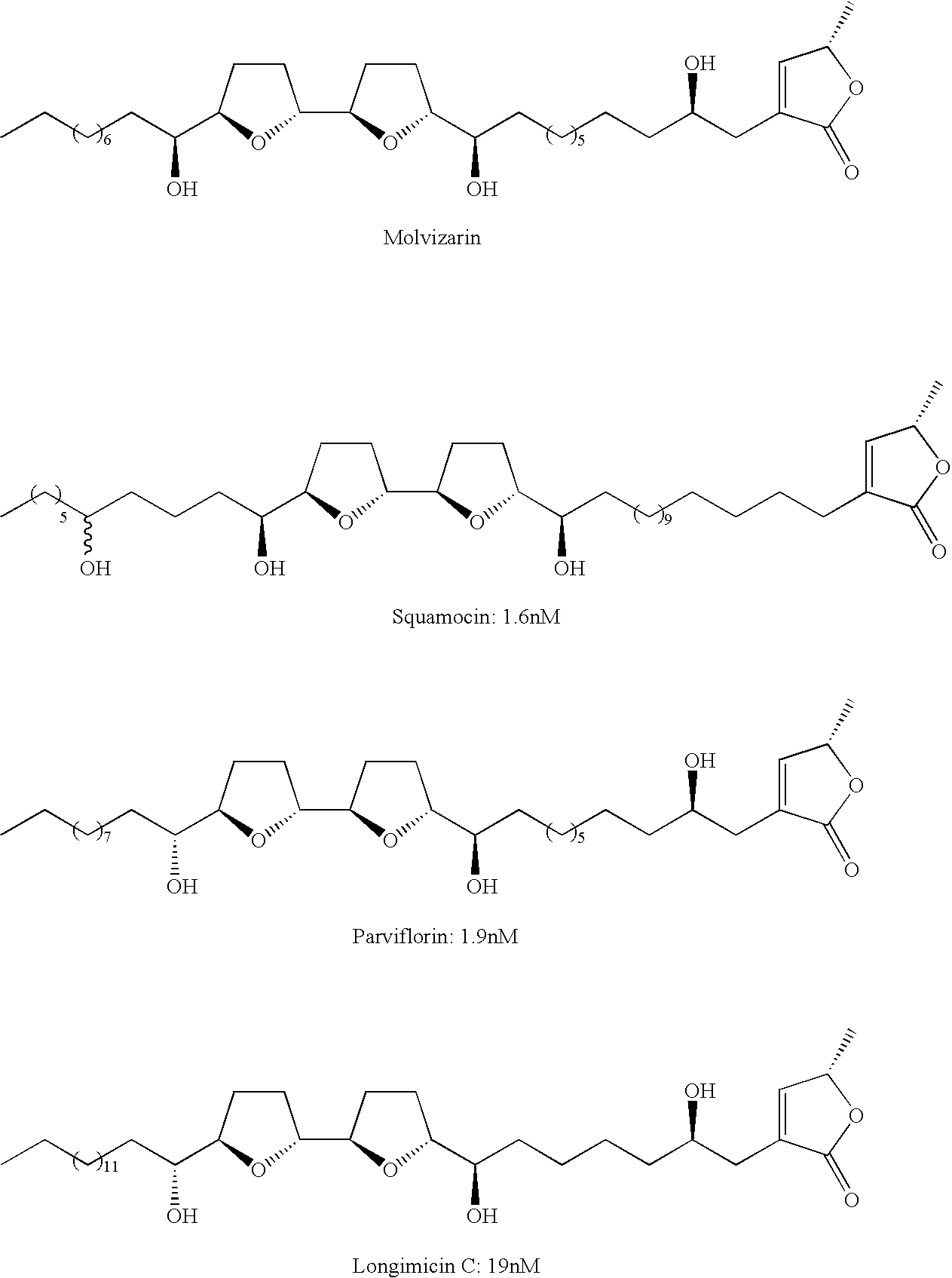
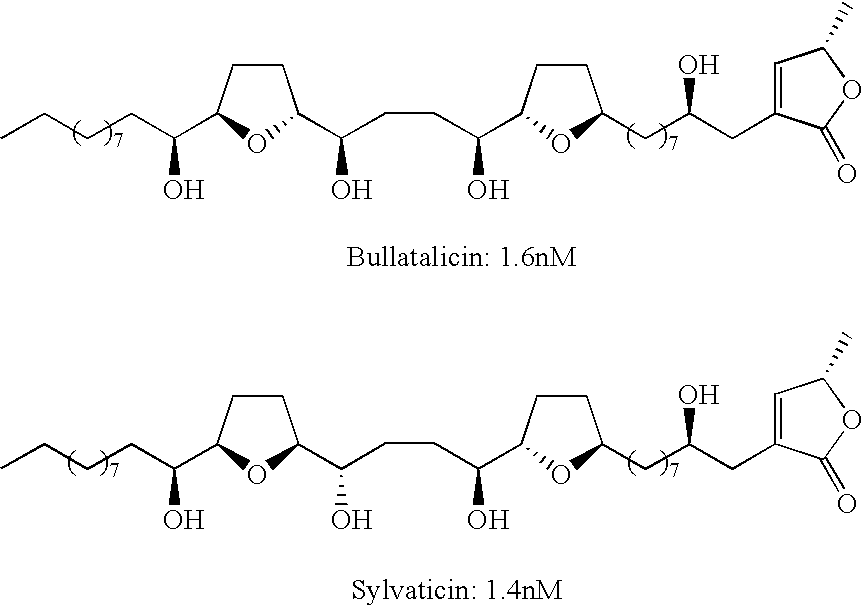
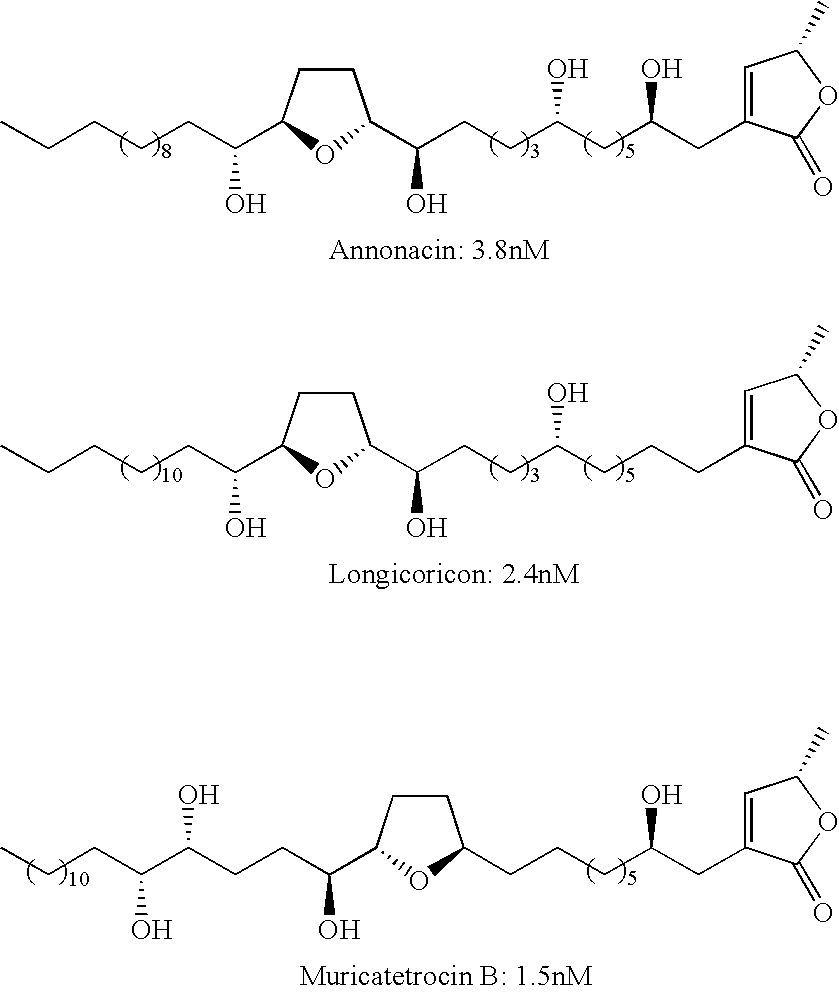

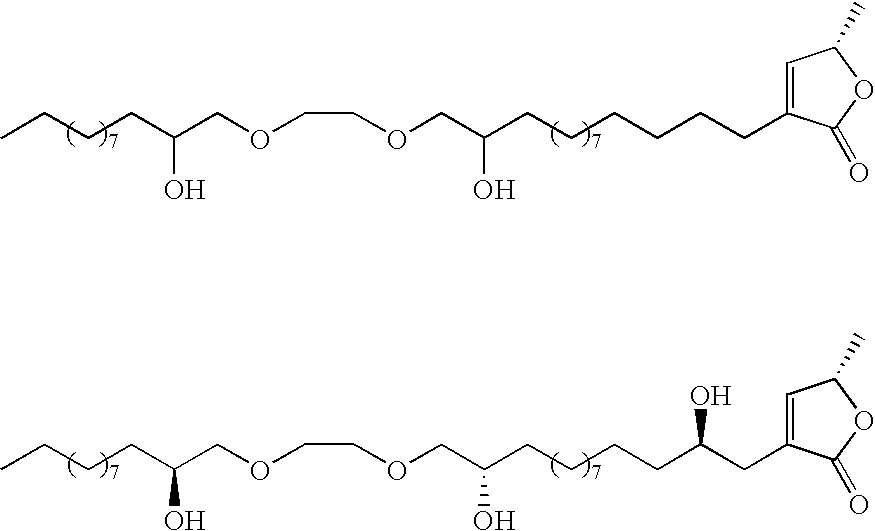

wherein
-
- R3 and R3′, together with the carbon atom to which they are attached, form C═O or C═CR13R14;
- R6 is hydrogen, hydroxy, or an imaging moiety;
- R6′ is hydrogen; or
- R6 and R6′, together with the carbon atom to which they are attached, form C═O or C═CR13R14;
- R9 is hydrogen, hydroxy, or an imaging moiety;
- R9′ is hydrogen; or
- R9 and R9′, together with the carbon atom to which they are attached, form C═O or C═CR13R14;
- R11 is C1-C6 alkyl; and
- R12, R13, and R14, are independently hydrogen, C1-C6 alkyl optionally substituted with an imaging moiety, arylalkyl, or an imaging moiety; provided that at least one imaging moiety is present in formula (I).
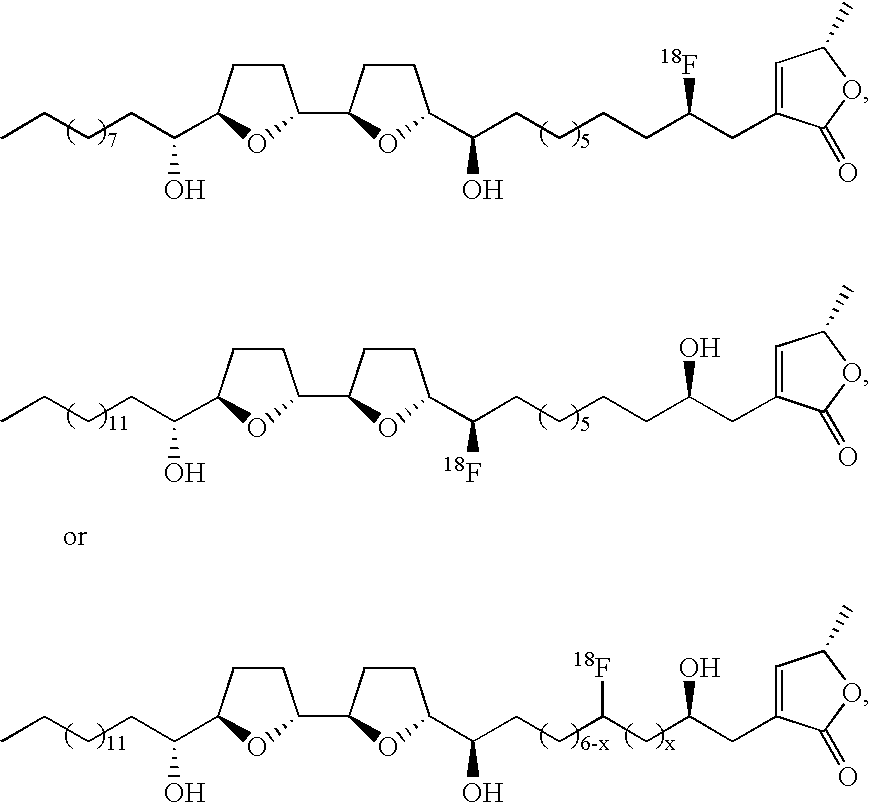
wherein x is 0, 1, 2, 3, 4, 5, or 6.

wherein x is 0, 1, 2, 3, 4, 5, or 6.
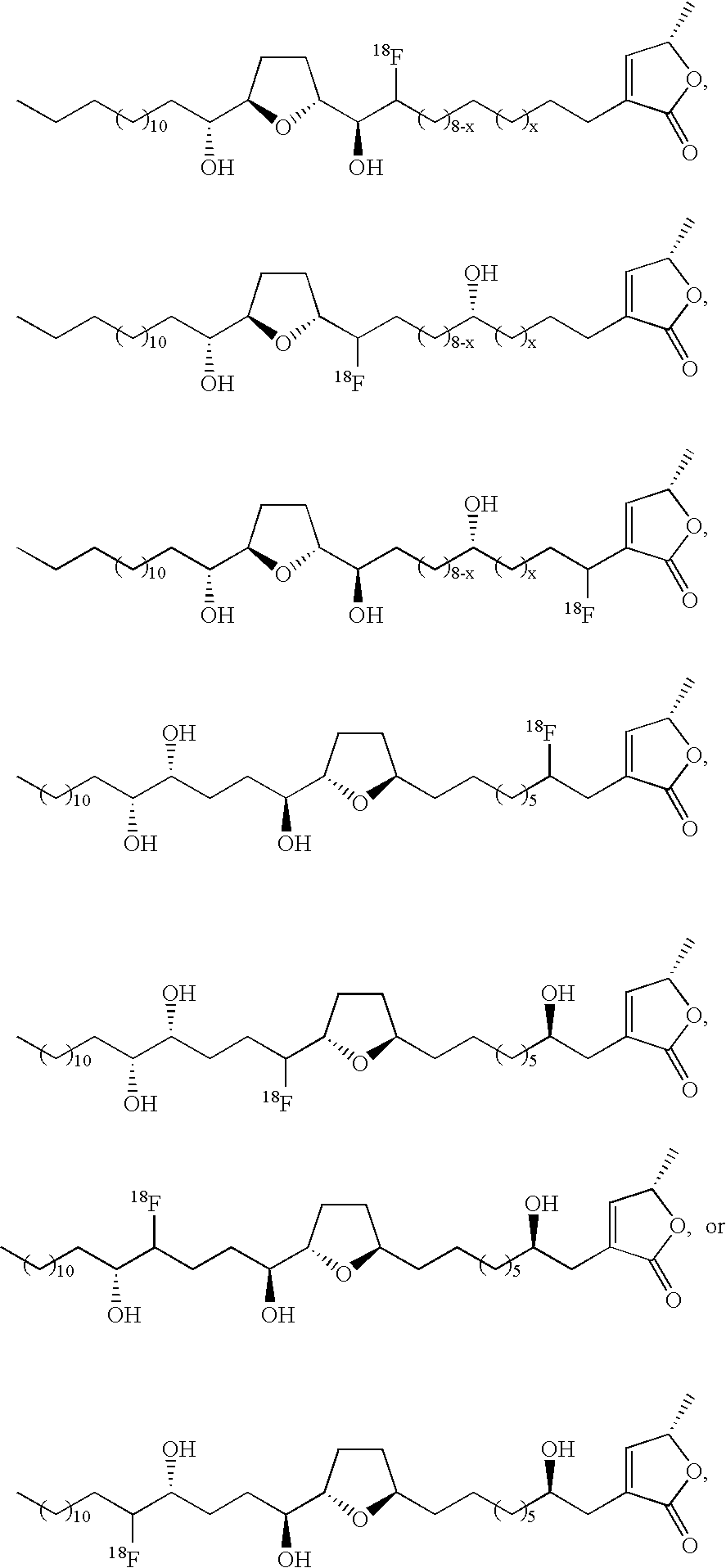
wherein x is 0, 1, 2, 3, 4, 5, 6, 7, or 8.
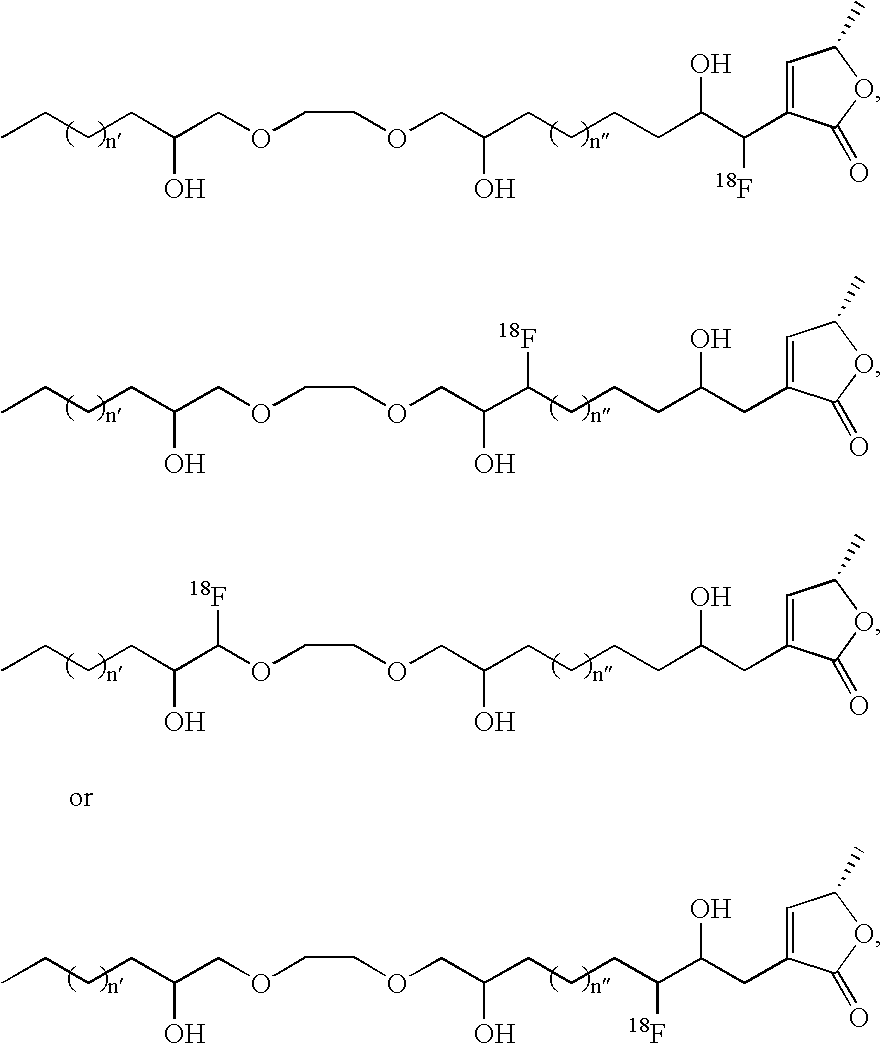
wherein n′ is independently at each occurrence 0, 1, 2, 3, 4, 5, 6, 7, 8, 9, or 10; and where n″ is independently at each occurrence 2, 3, 4, 5, 6, 7, 8, 9, or 10.
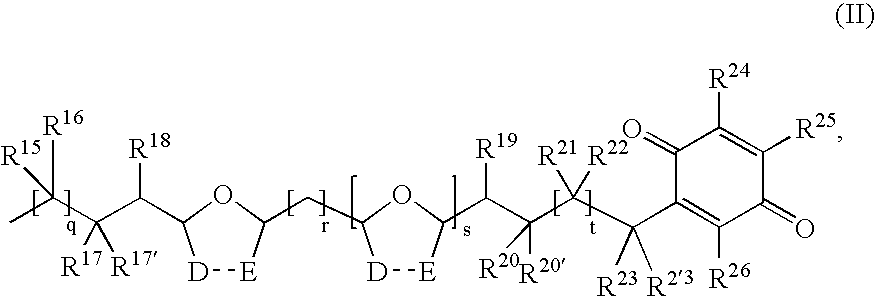
wherein

wherein x is 0, 1, 2, 3, 4, 5, 6, 7, 8, 9, or 10.


wherein
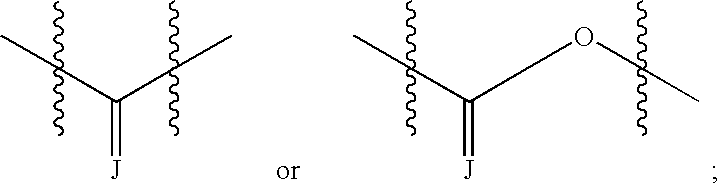

is a single or double bond; and

is a double bond, R31 and R32 are absent; and provided at least one imaging moiety is present in formula (III).
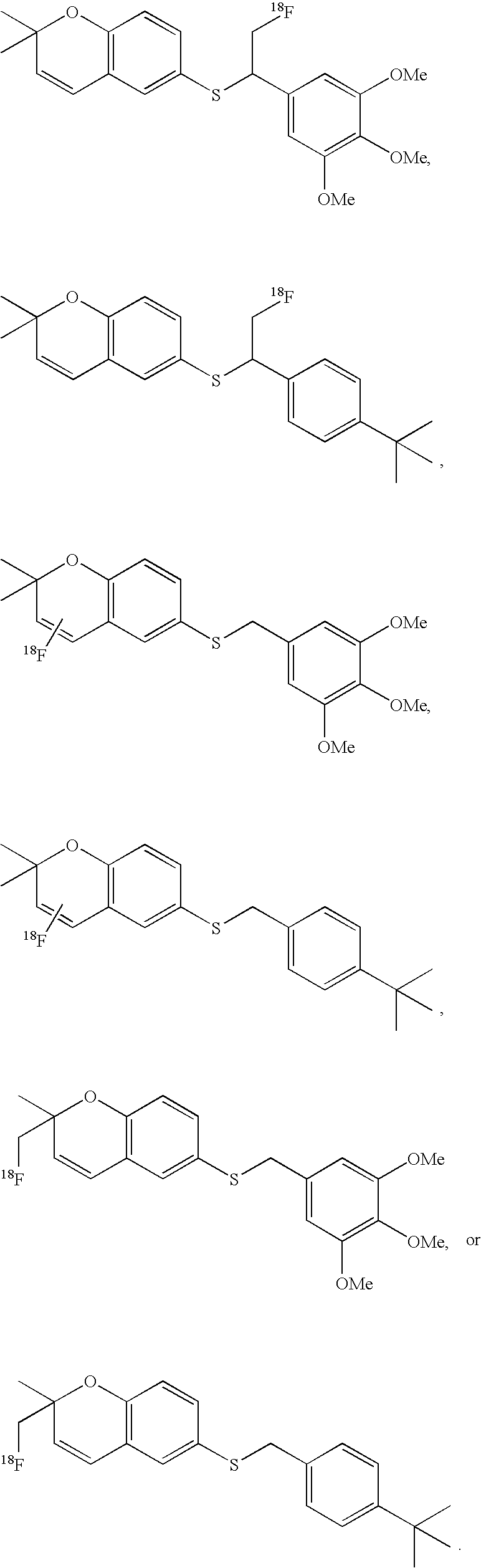

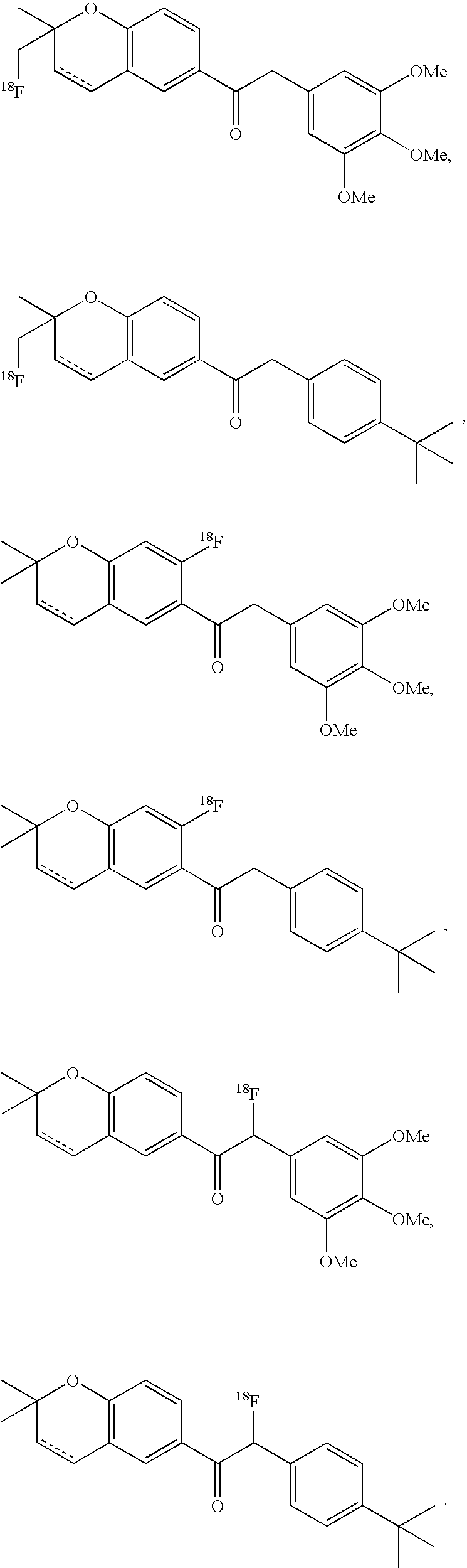
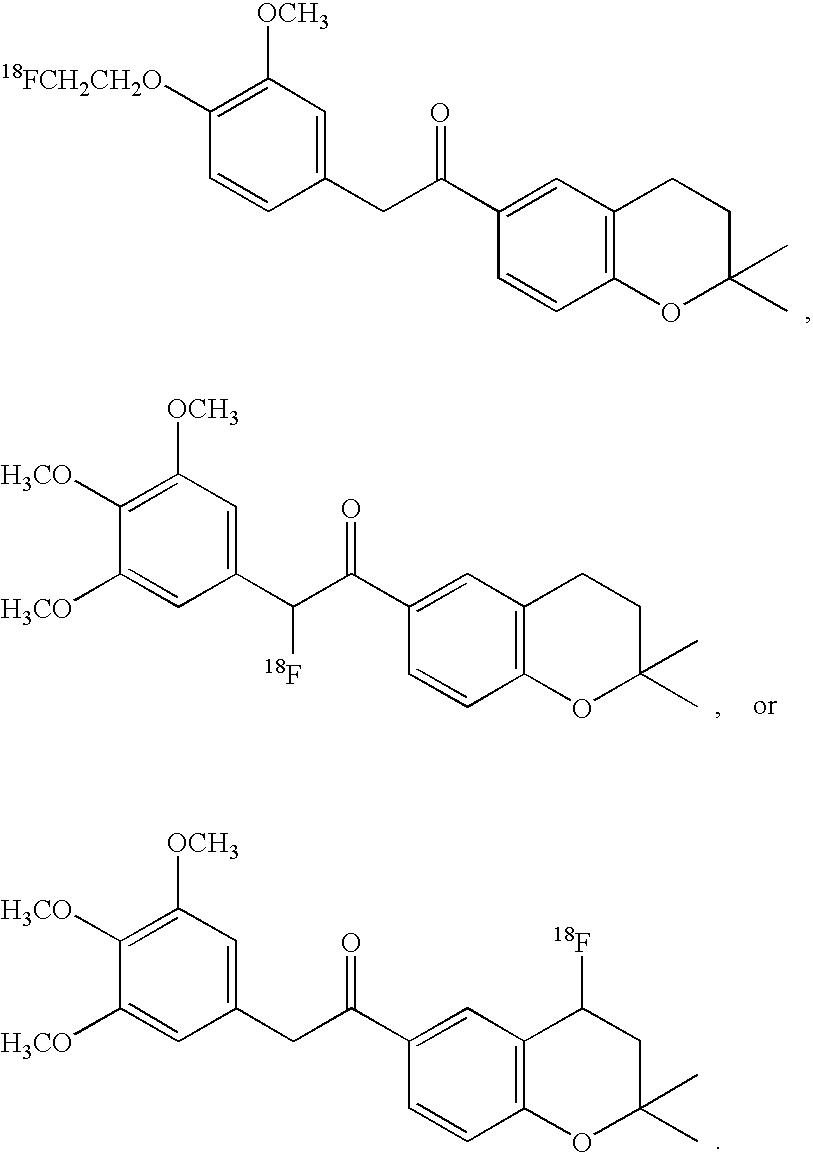


wherein
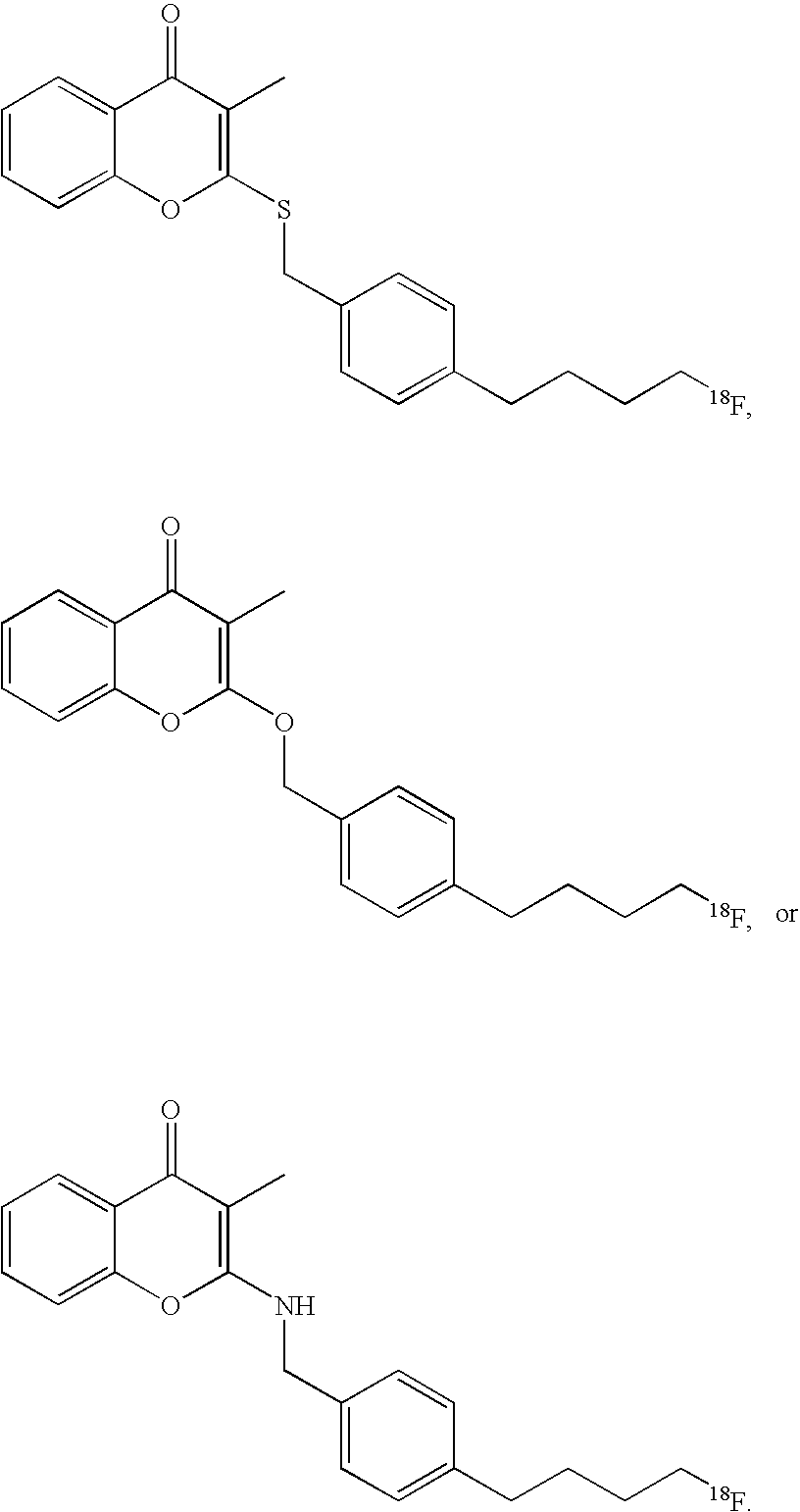
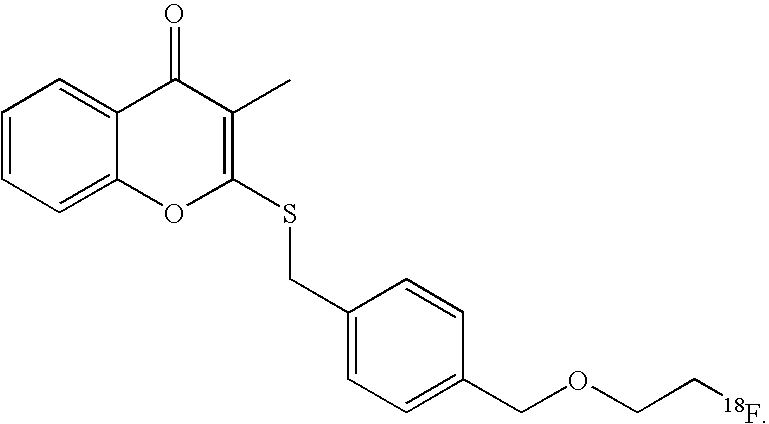

wherein
-
- each E2 is independently selected from C1-C16 alkyl substituted with 0-3 R50, C6-C10 aryl substituted with 0-3 R50, C3-C10 cycloalkyl substituted with 0-3 R50, heterocyclyl-C1-C10 alkyl substituted with 0-3 R50, C6-C10 aryl-C1-C10 alkyl substituted with 0-3 R50, C1-C10 alkyl-C6-C10 aryl substituted with 0-3 R50, and heterocyclyl substituted with 0-3 R50;
- —OR60, —N(R60)2, and C2-C4 alkenyl;


Use


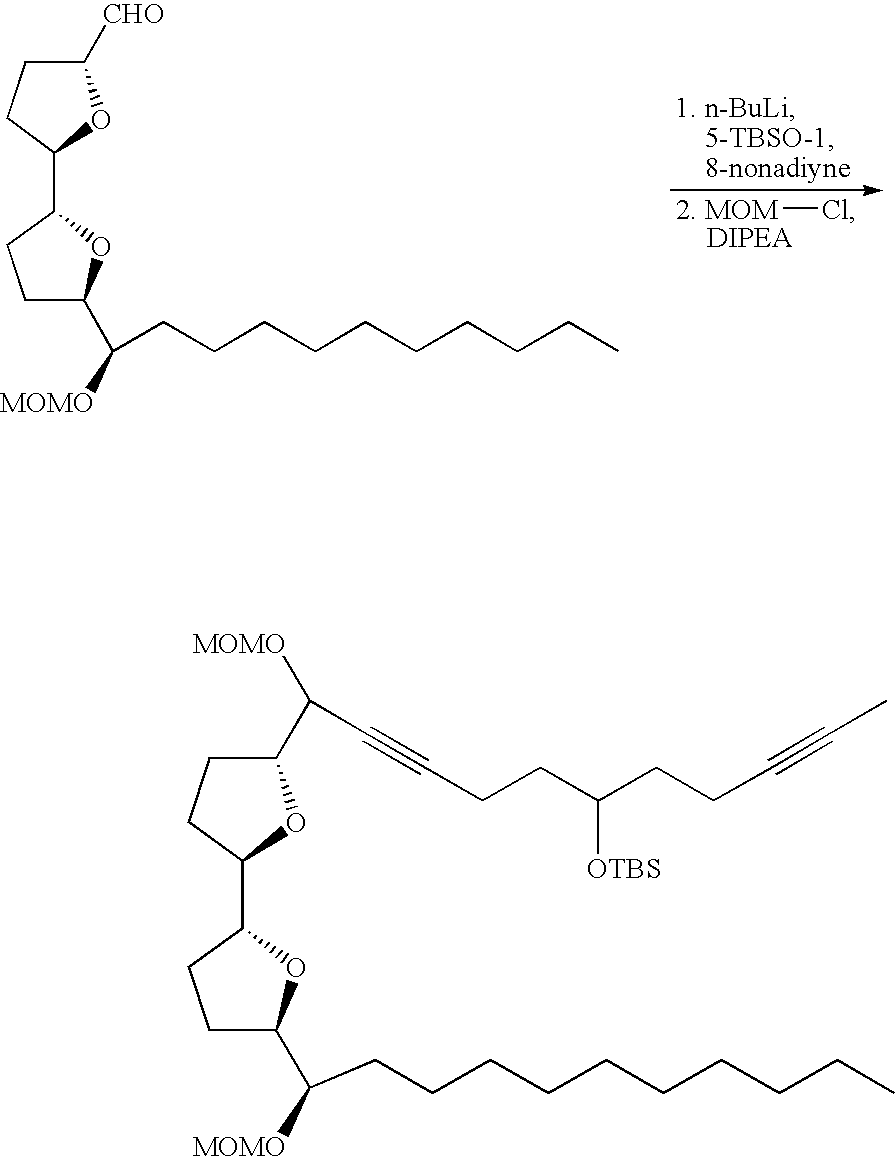
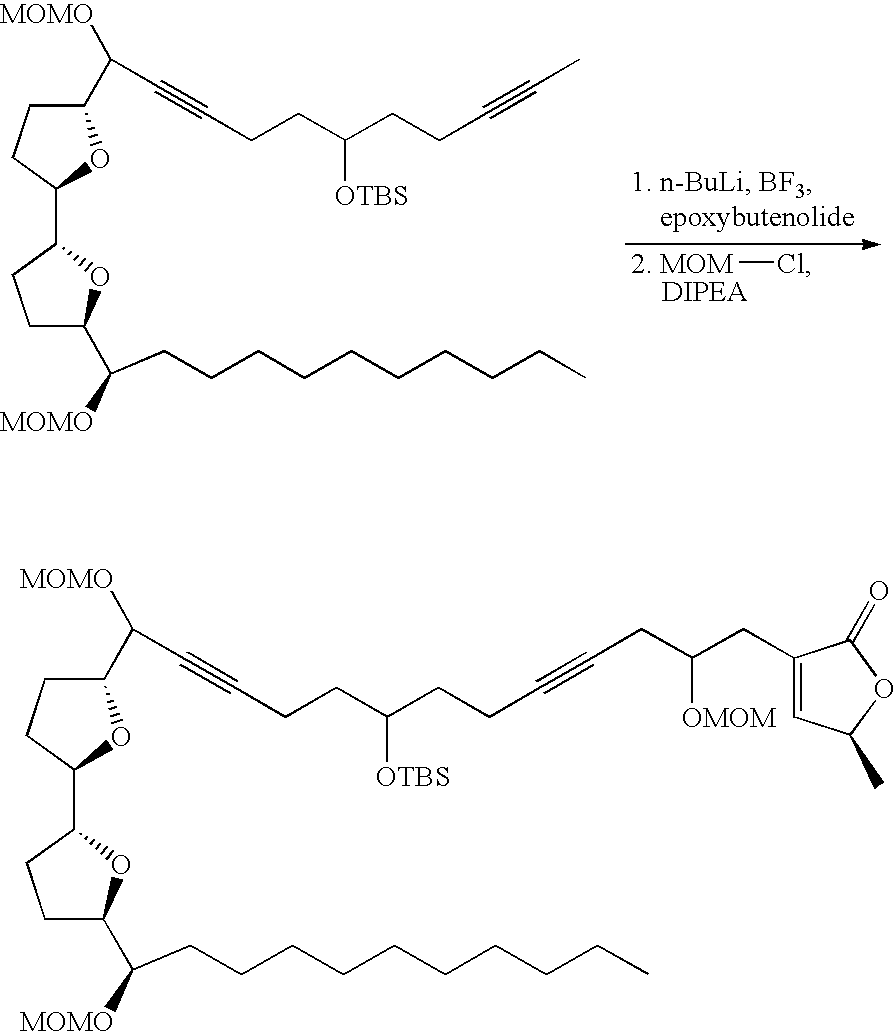

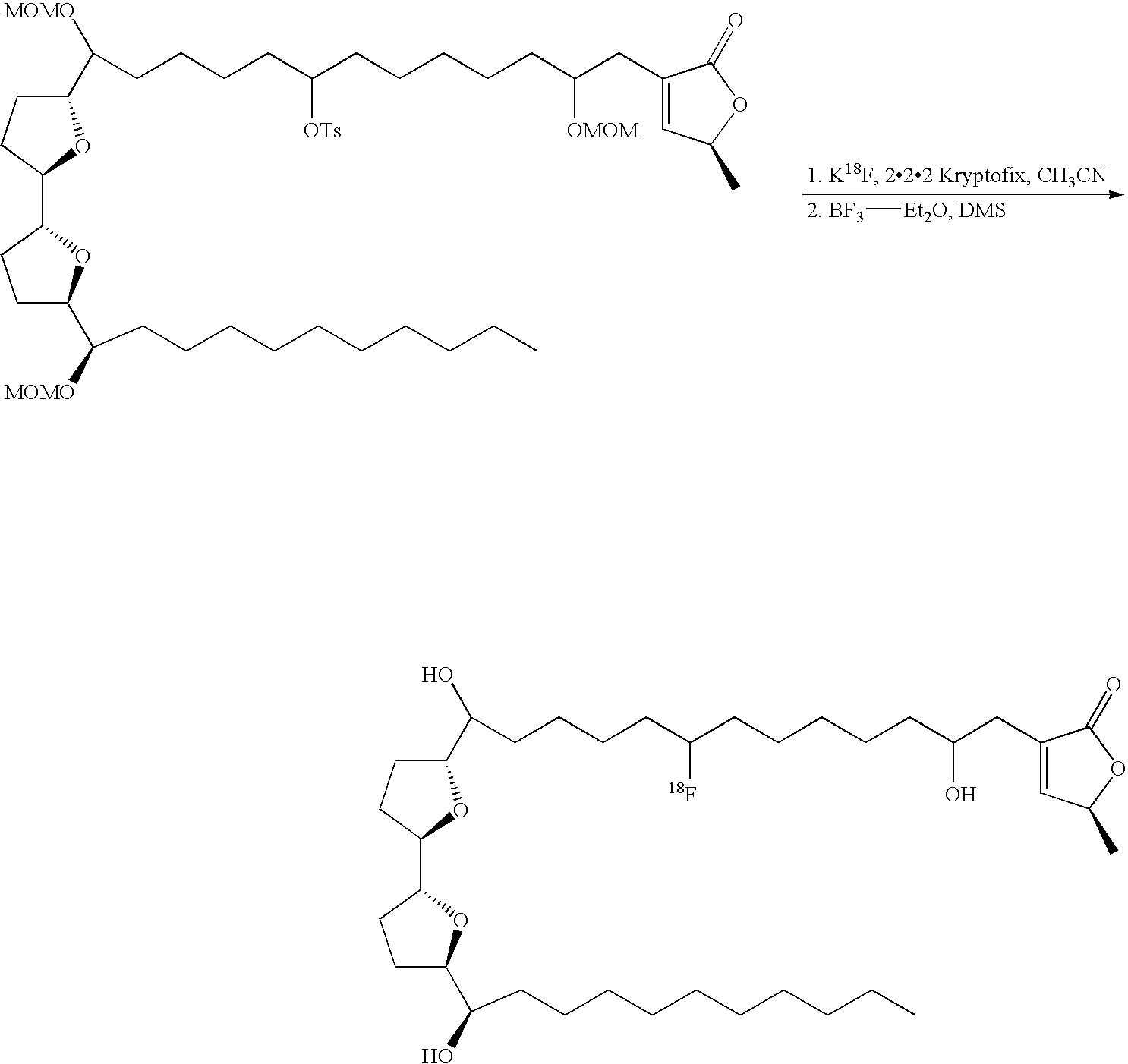
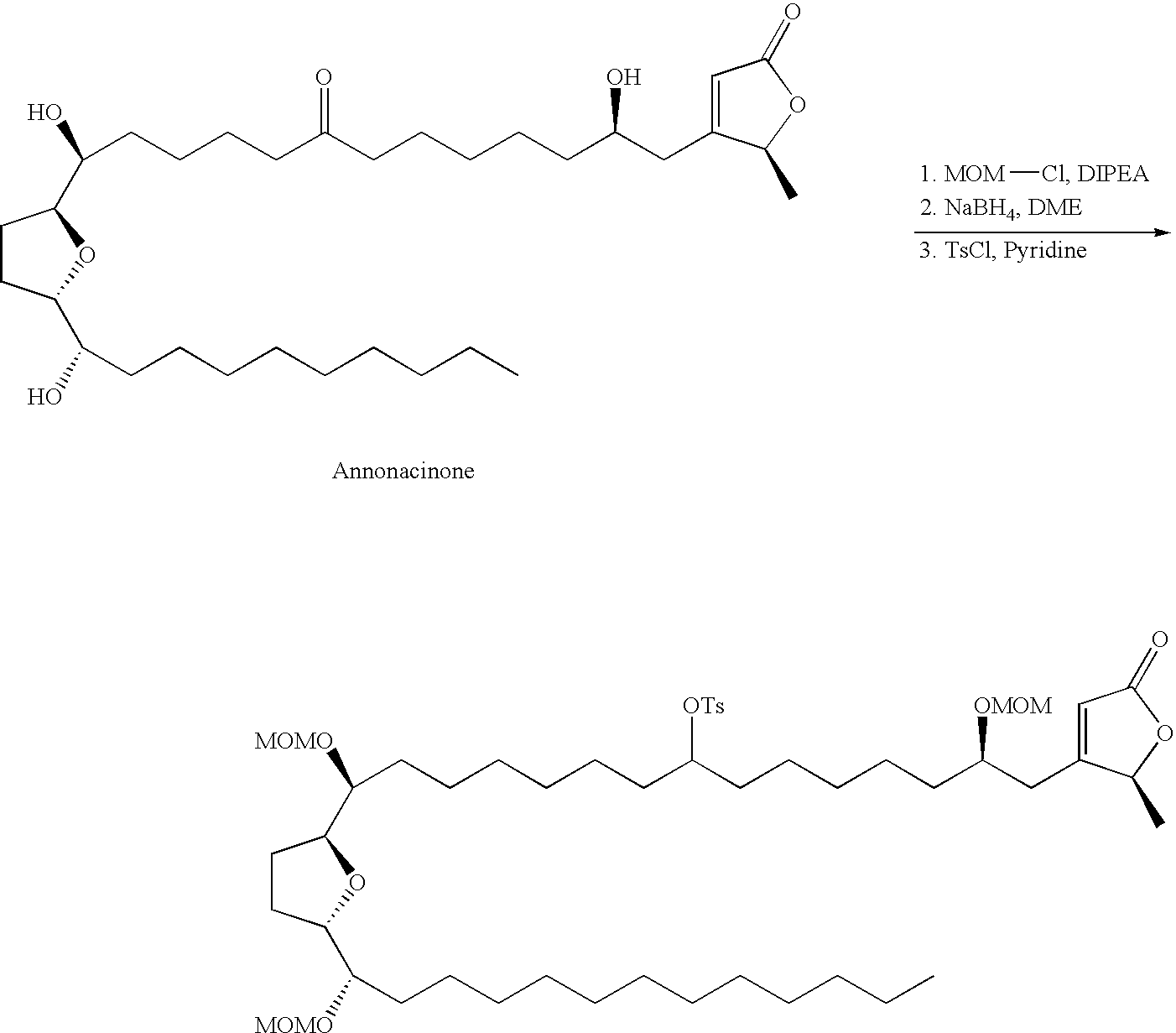


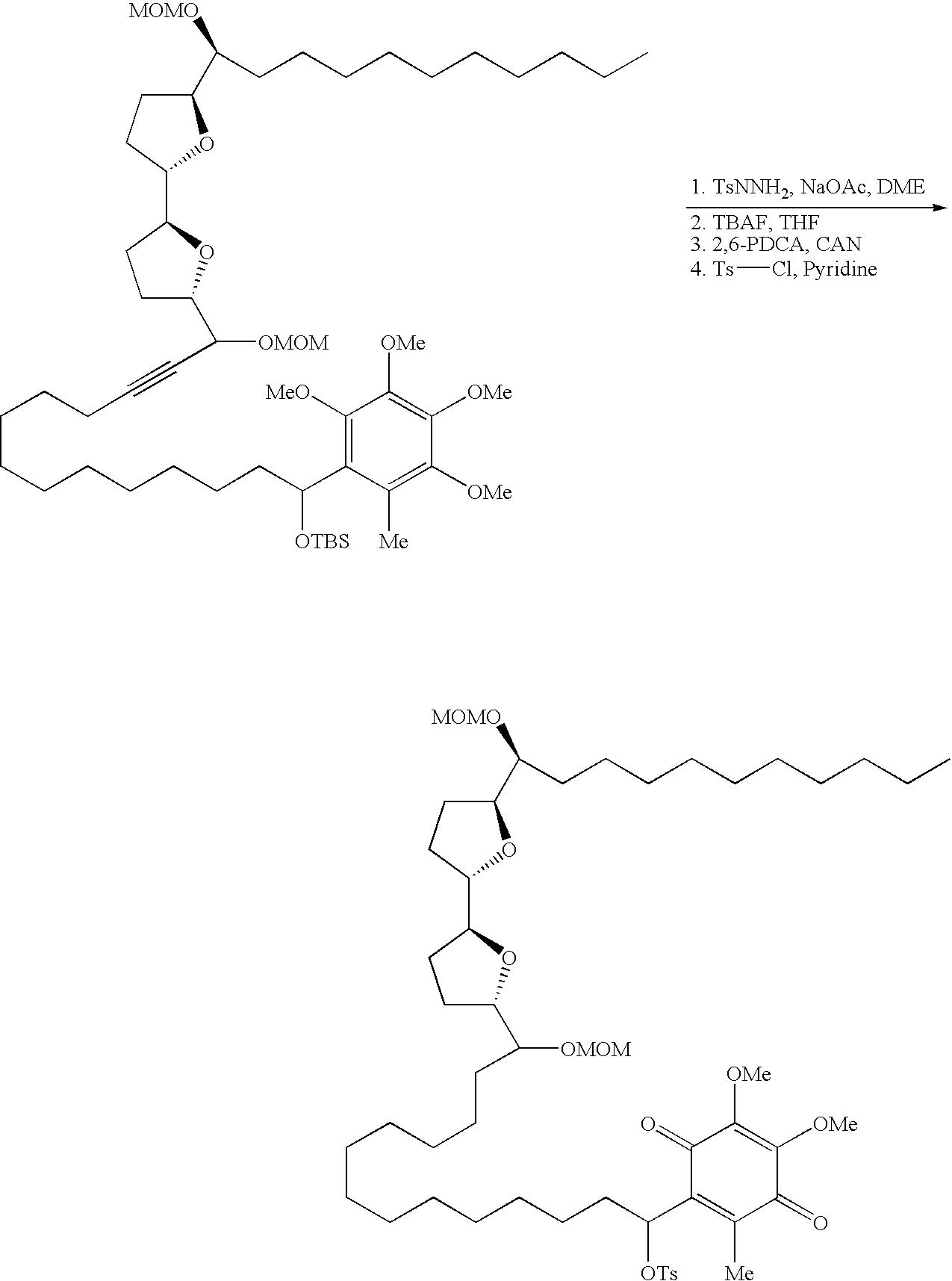
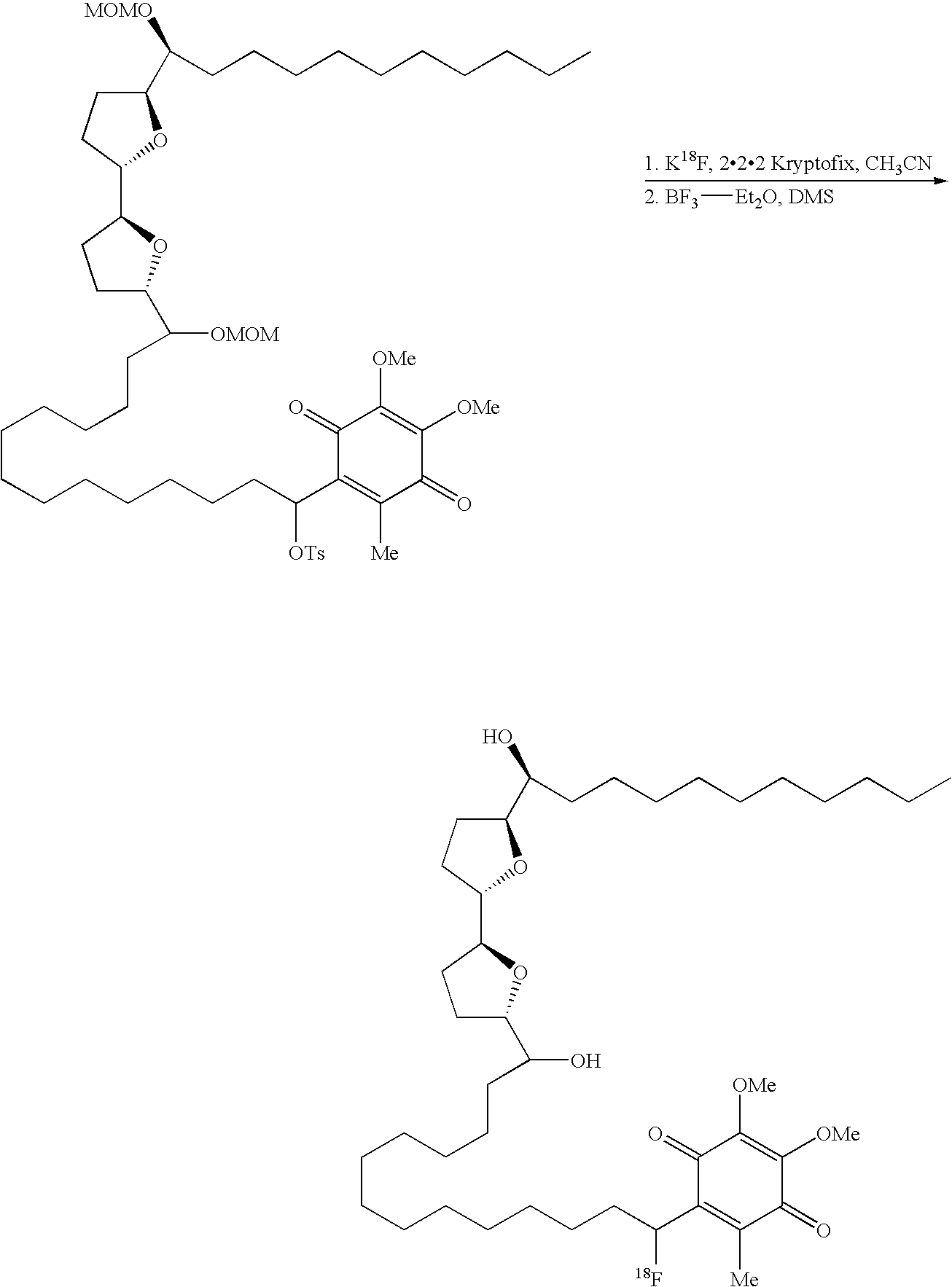
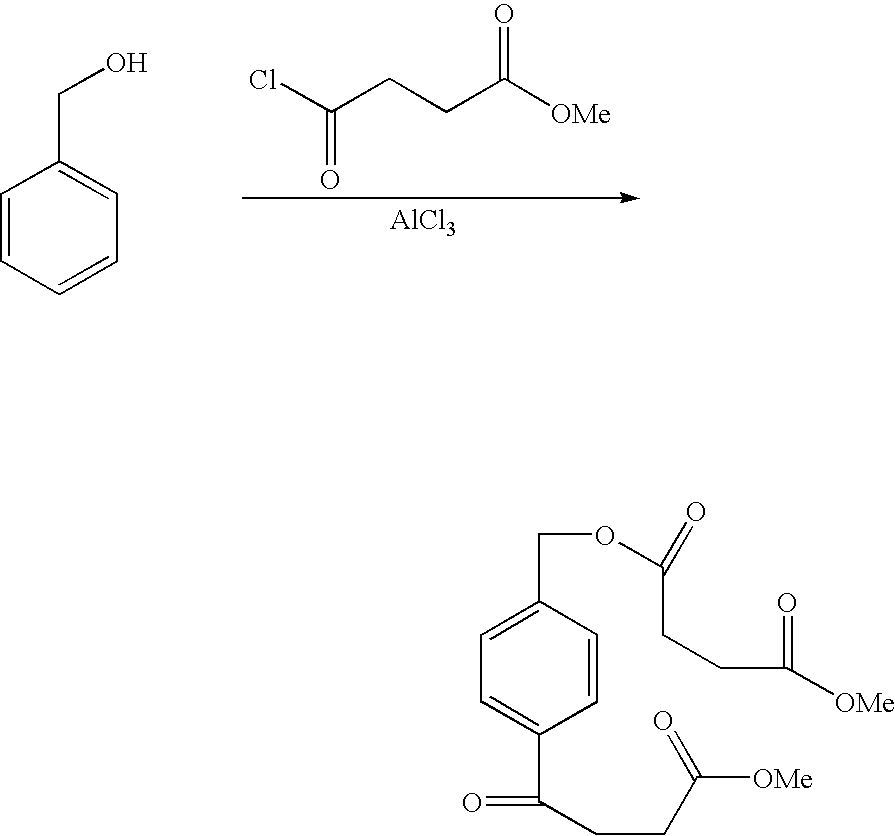

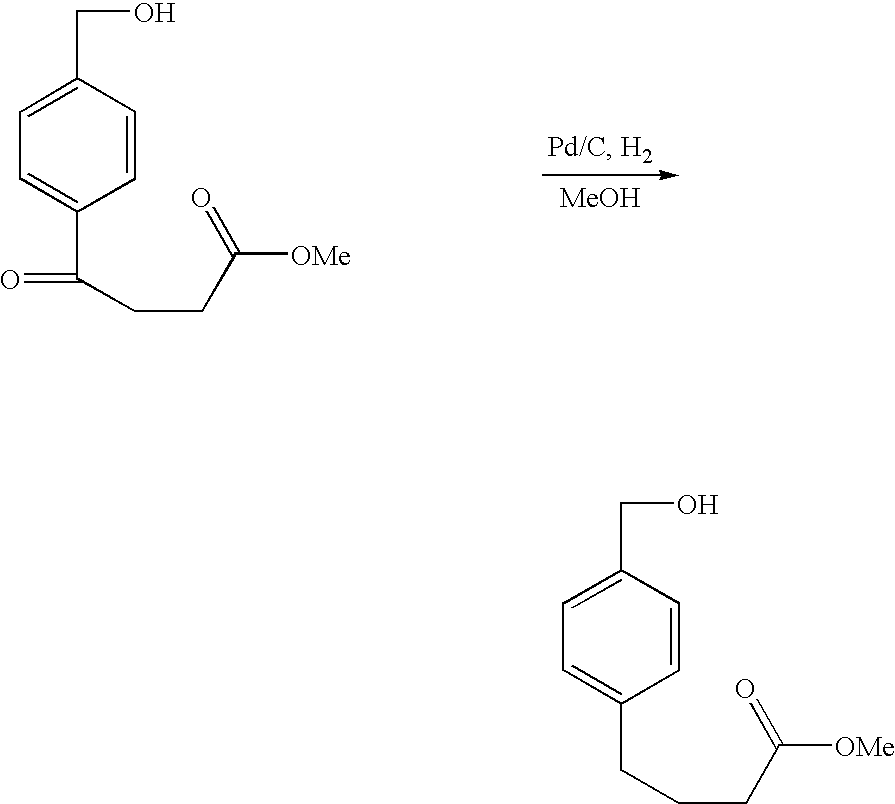
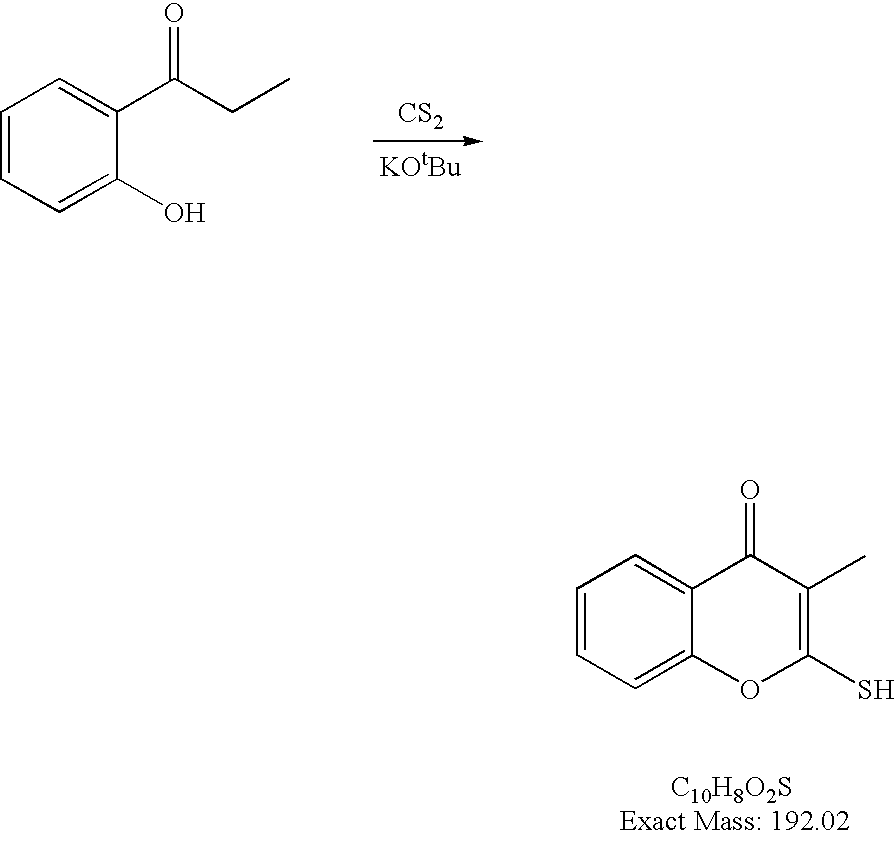
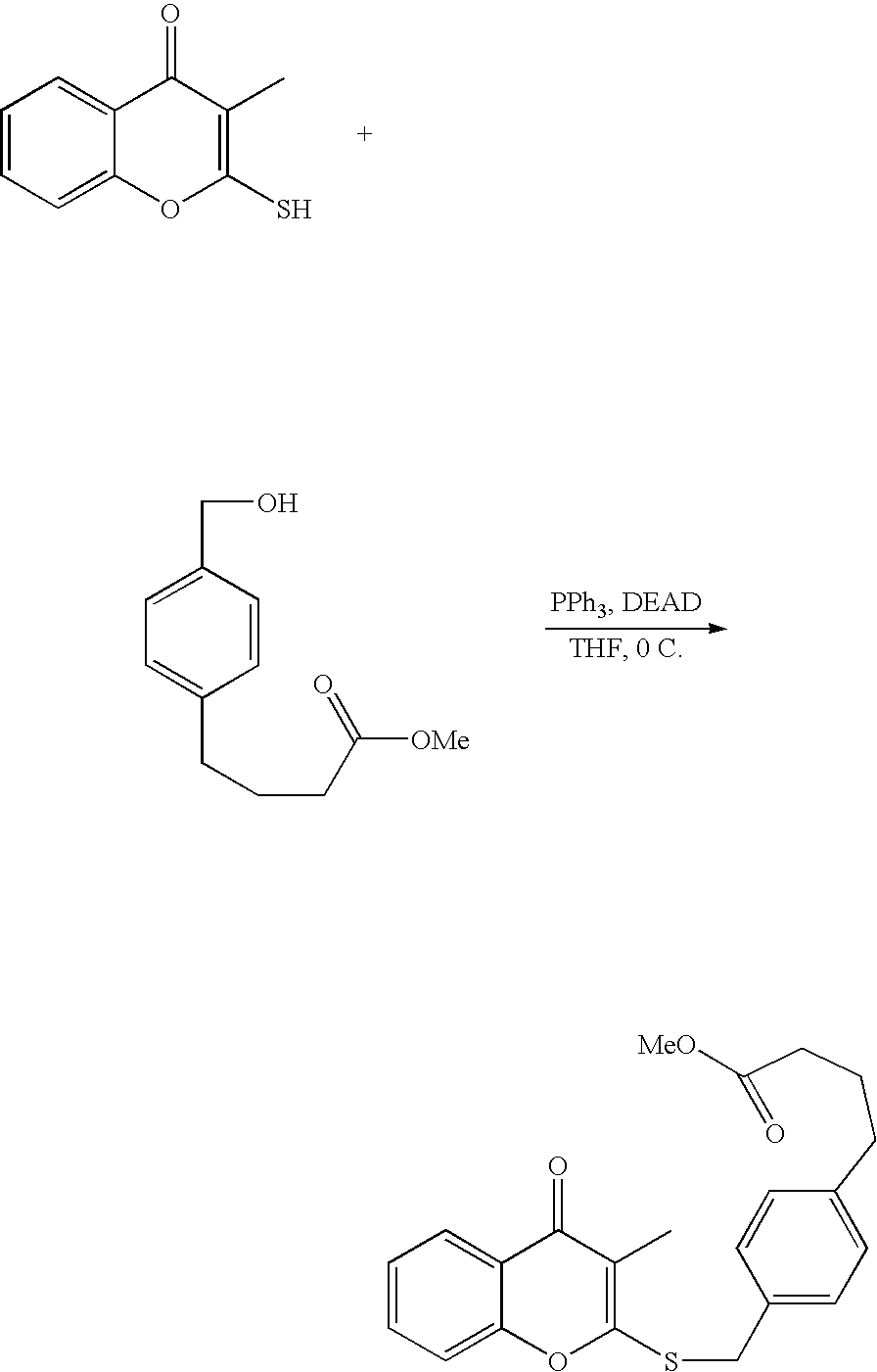


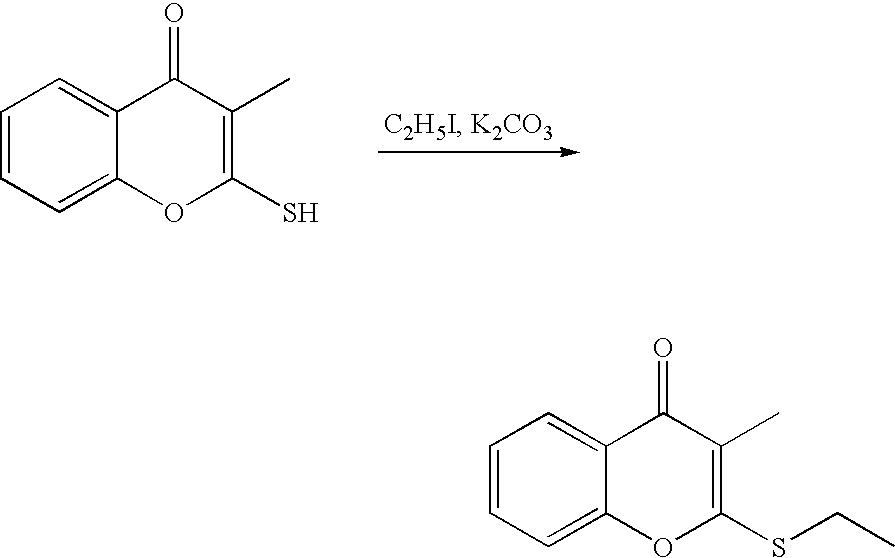

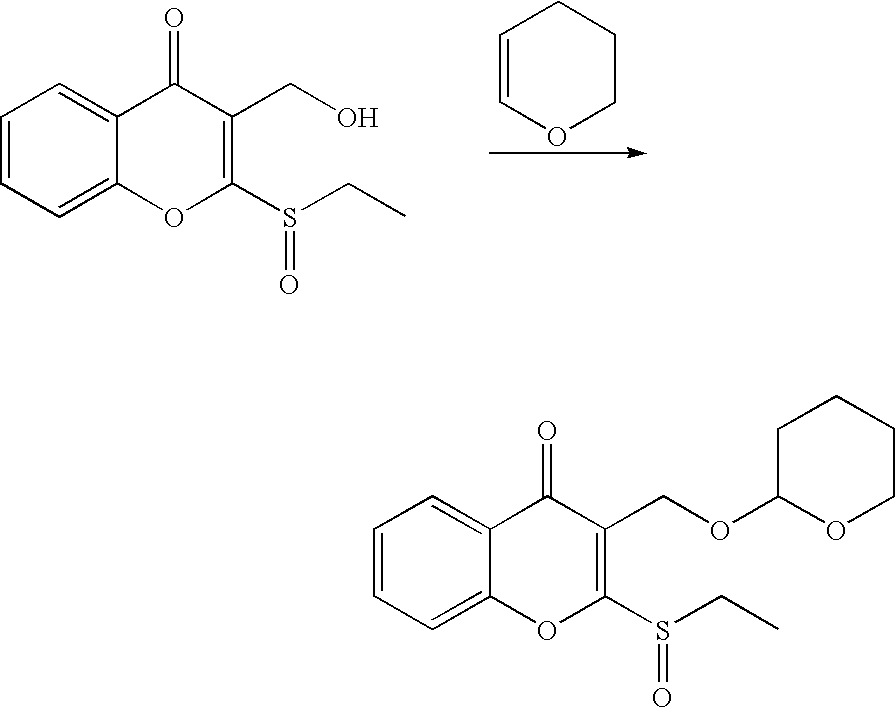
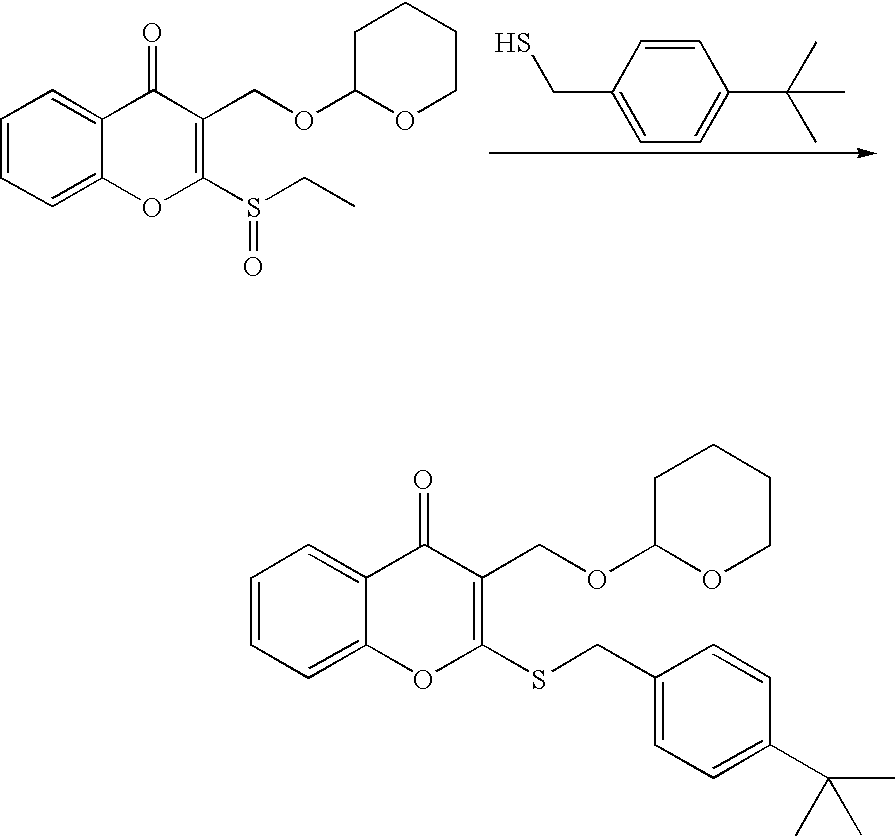


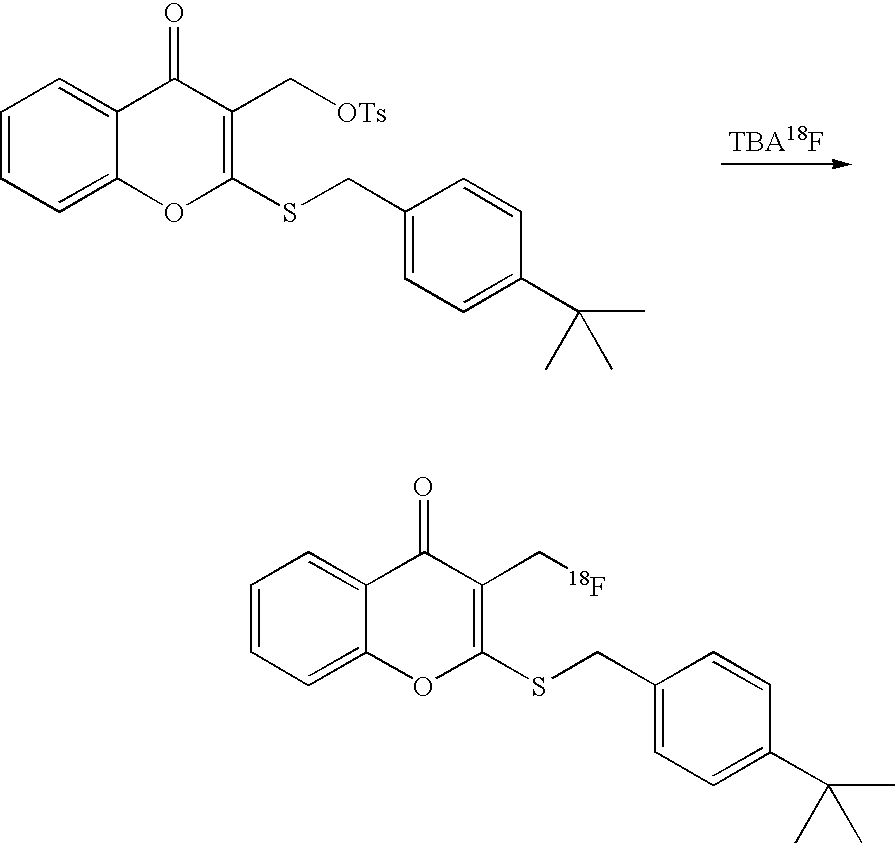

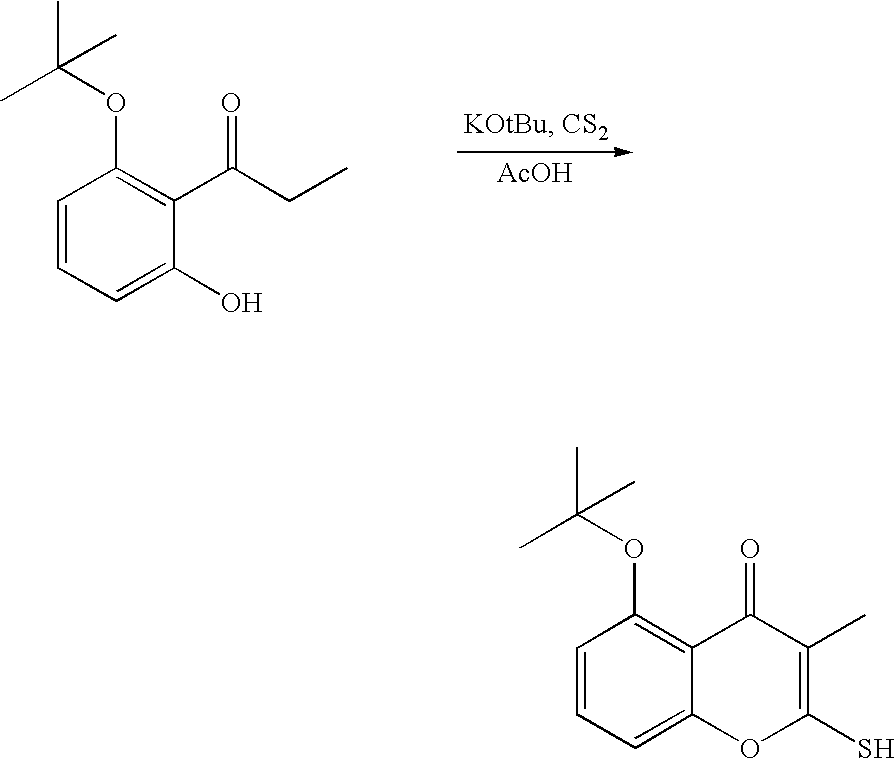
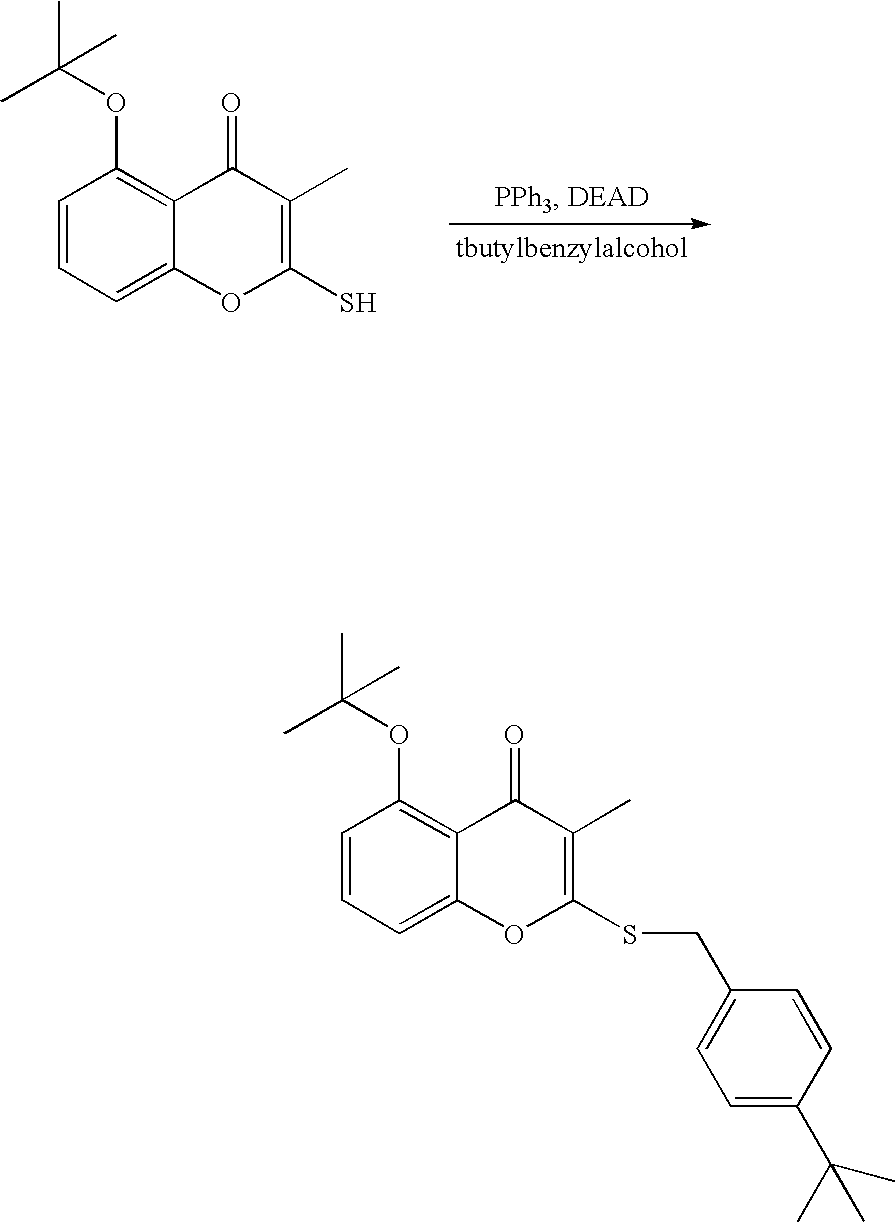
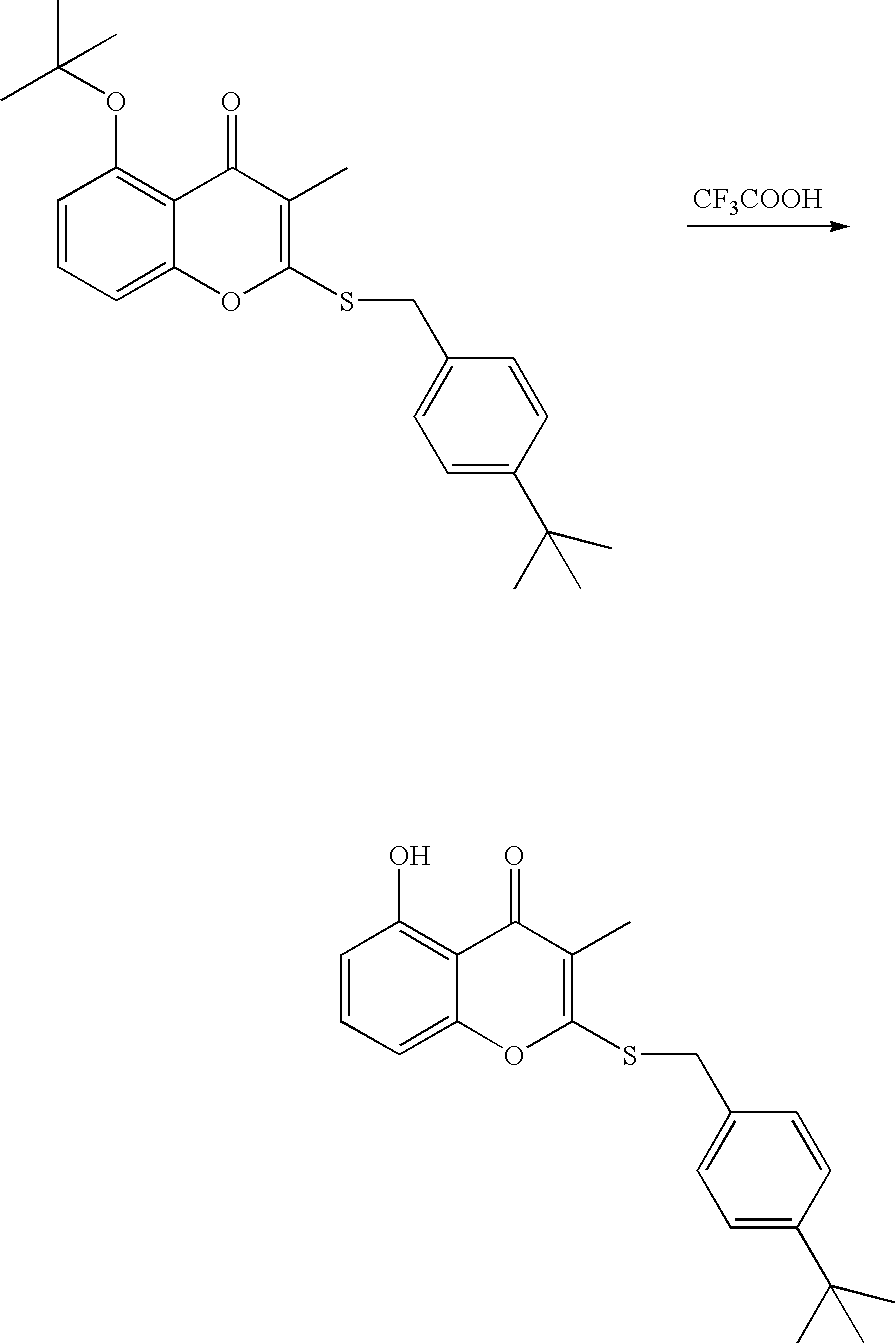
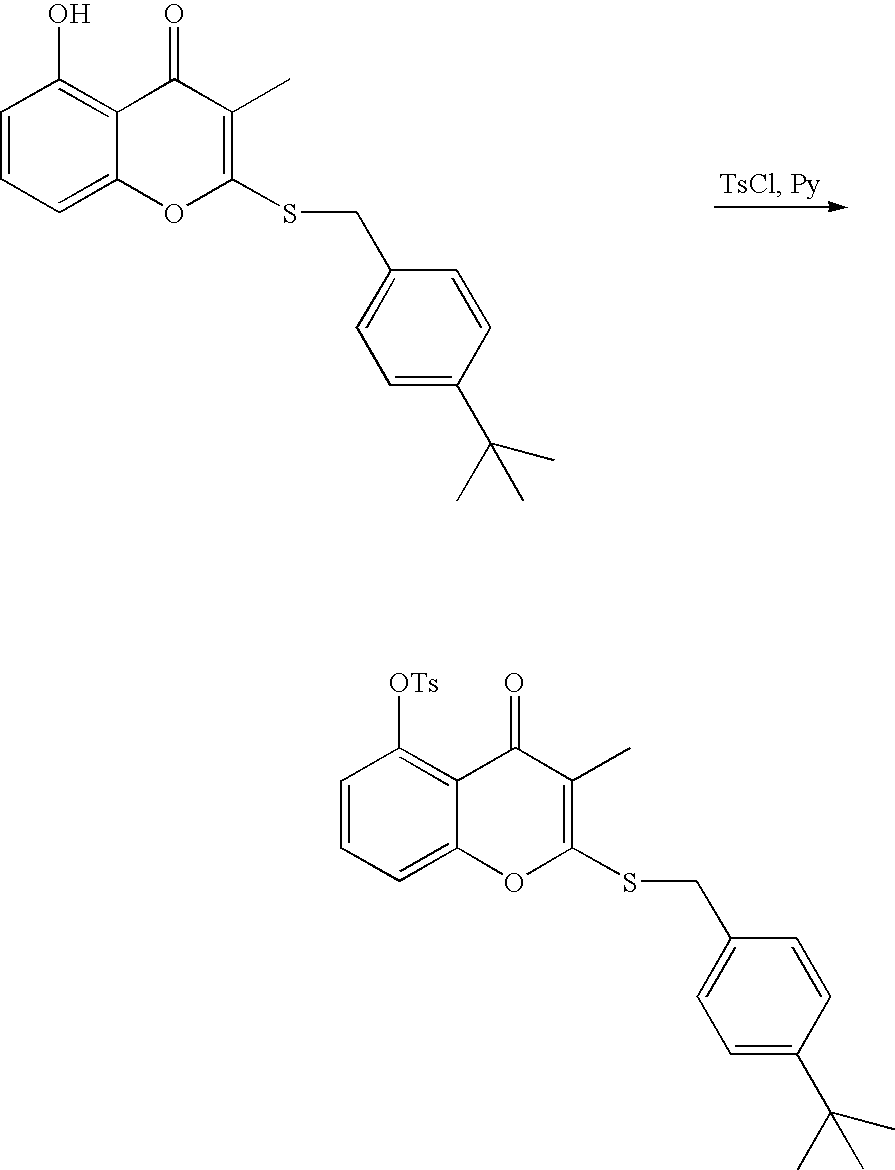

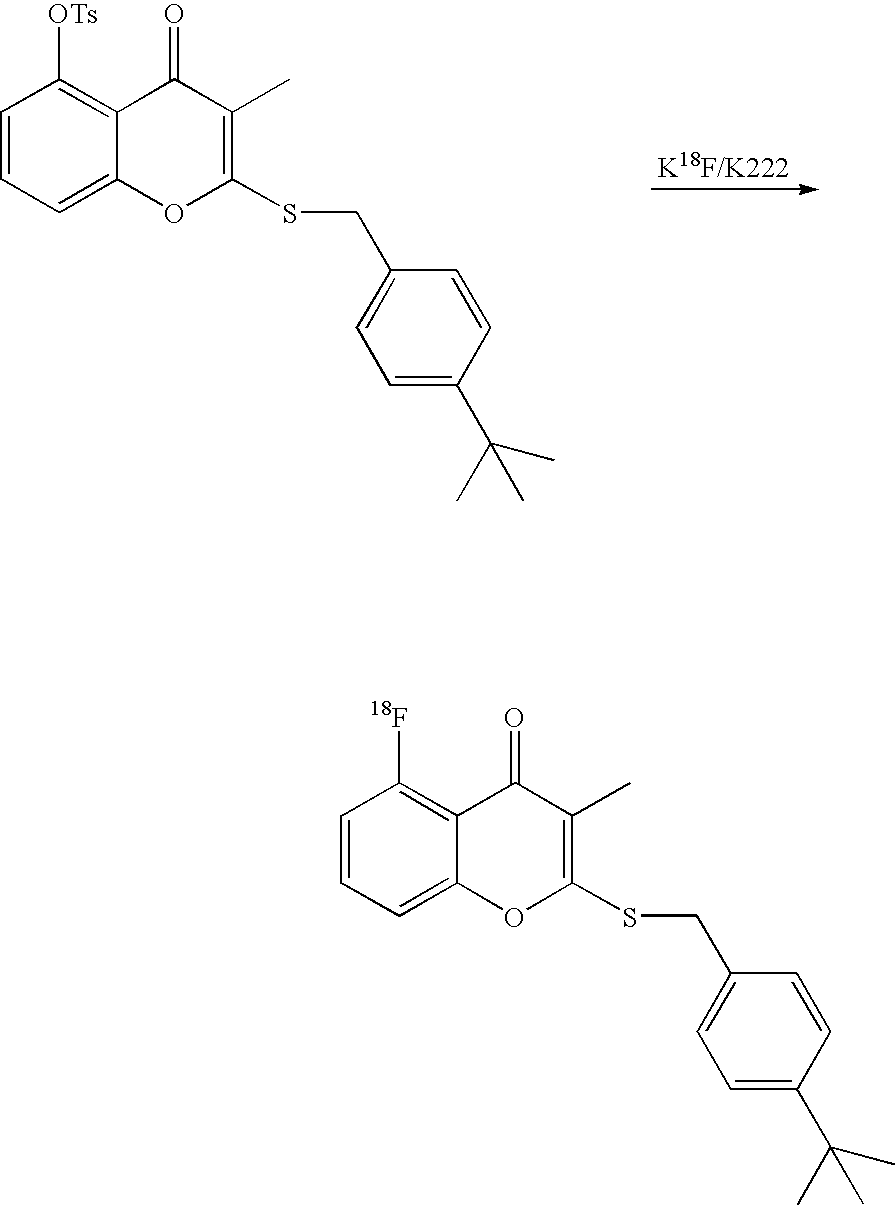


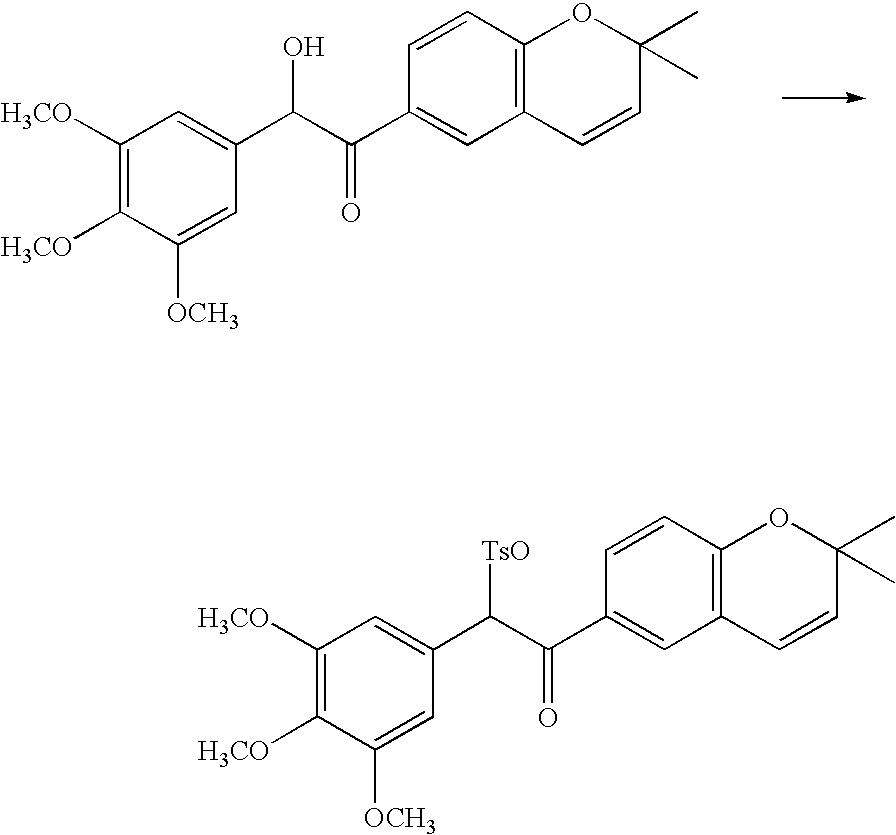


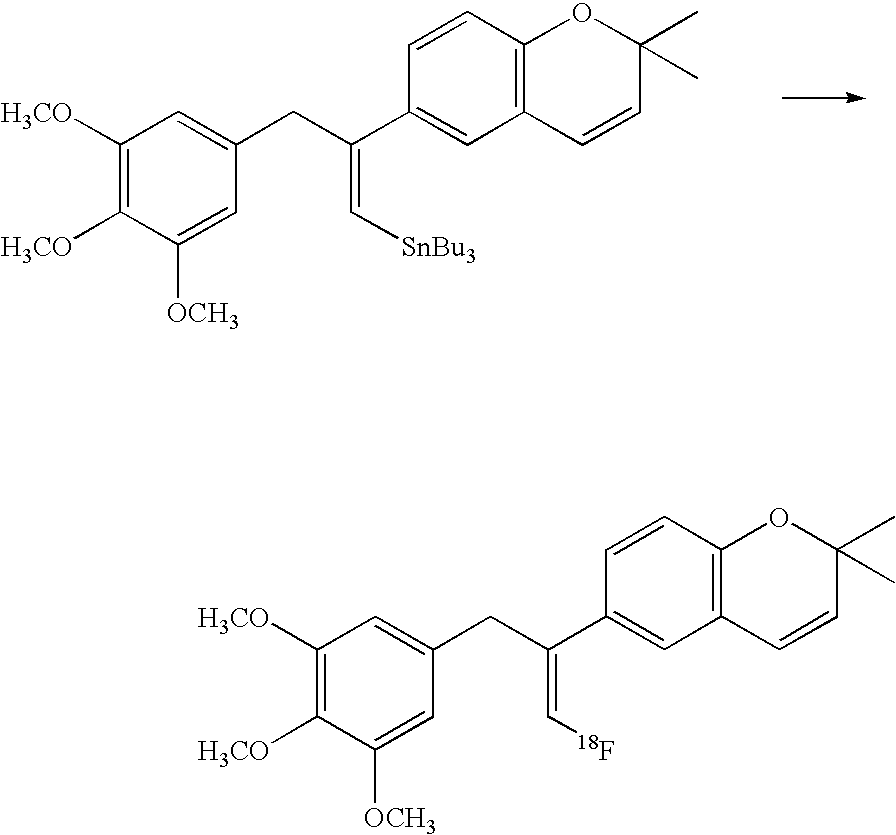
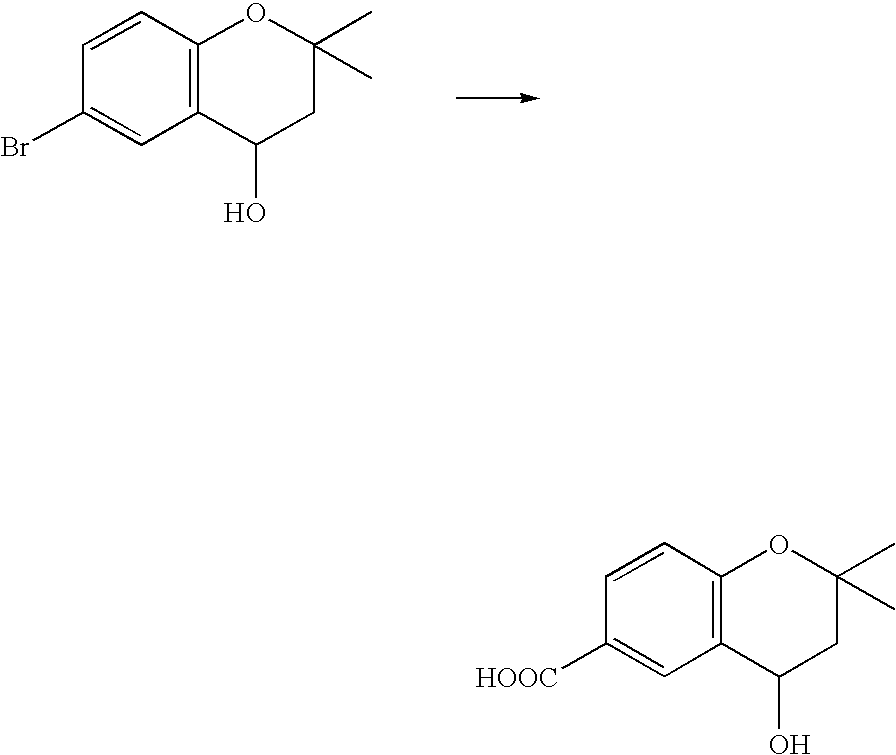


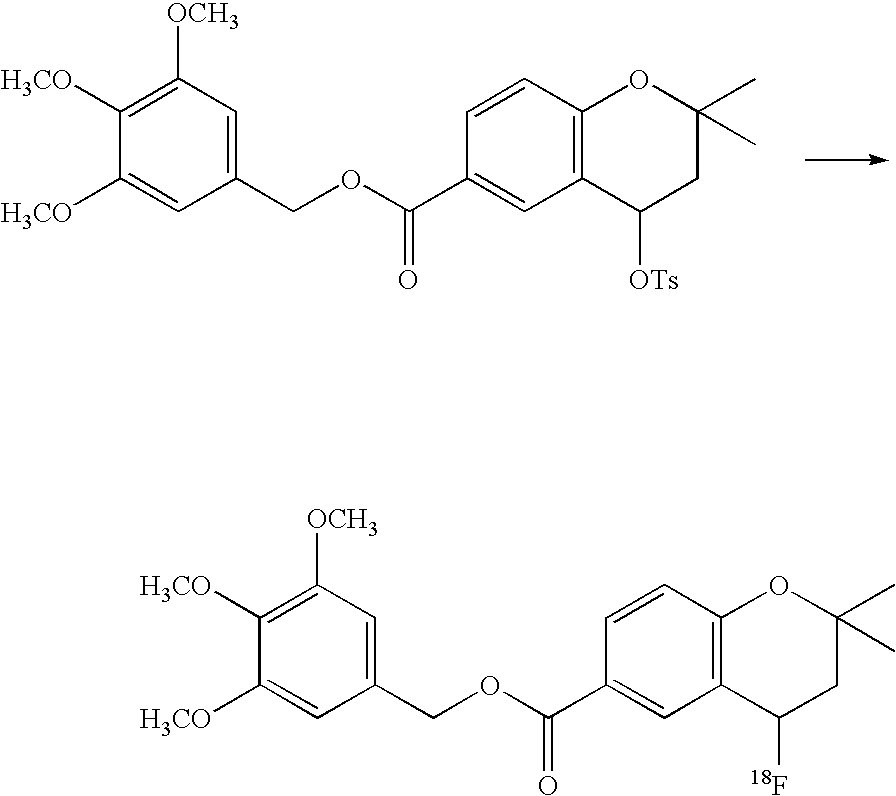

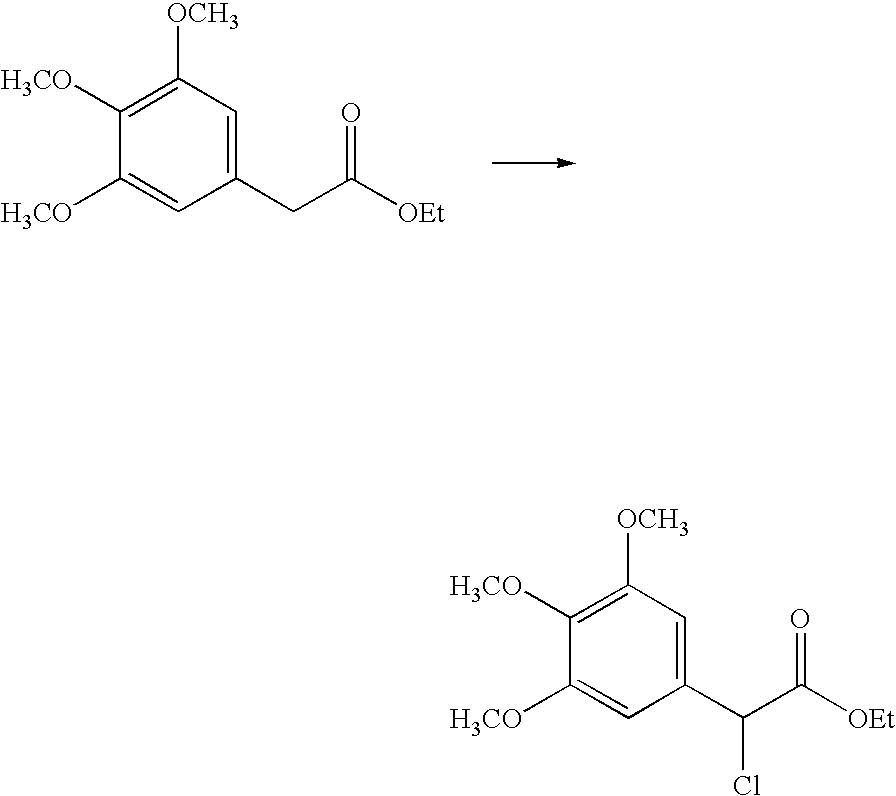

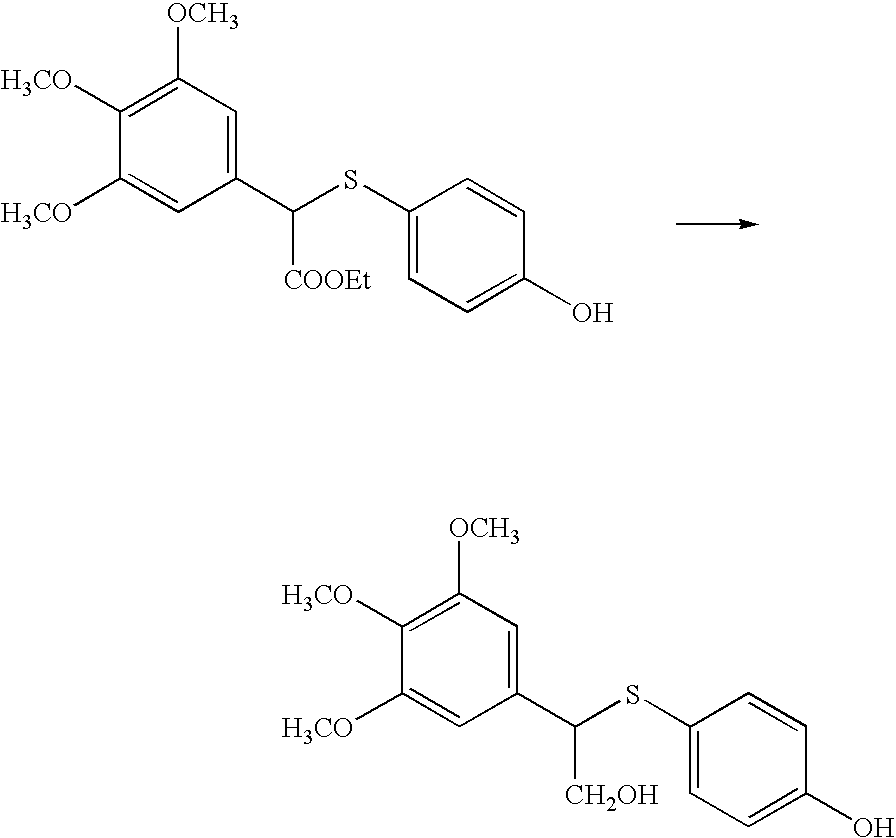
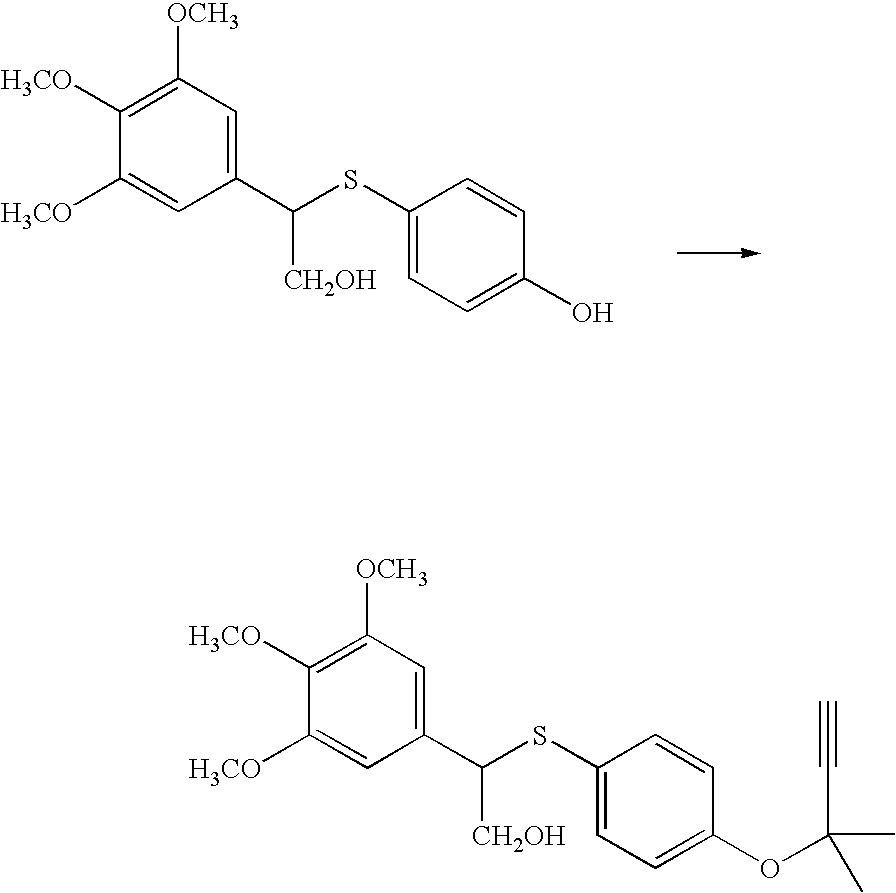

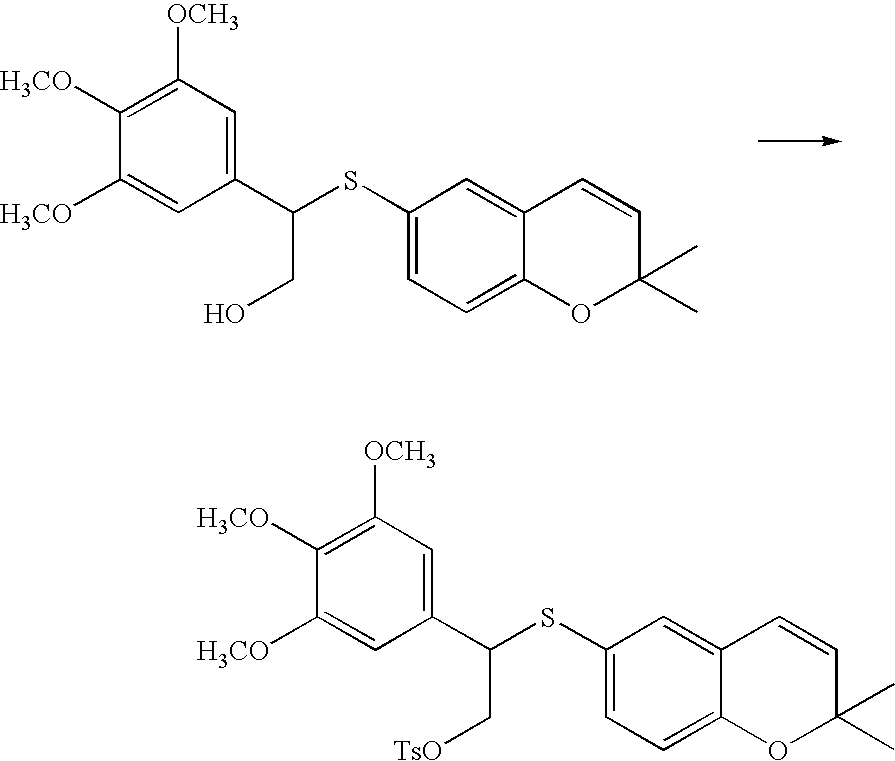
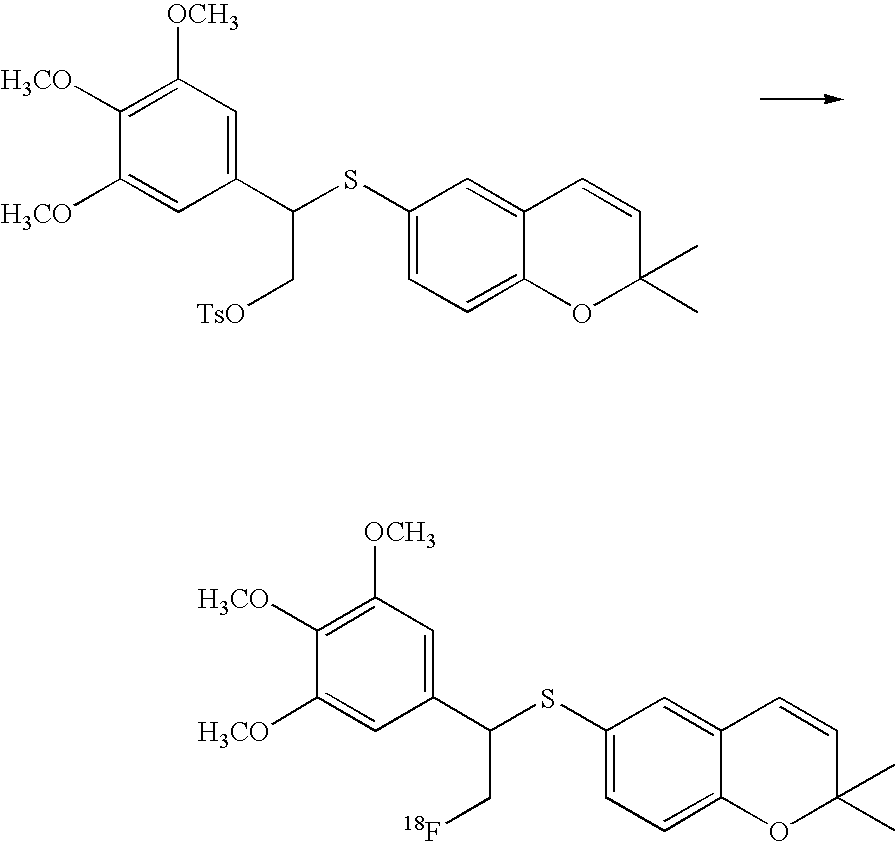


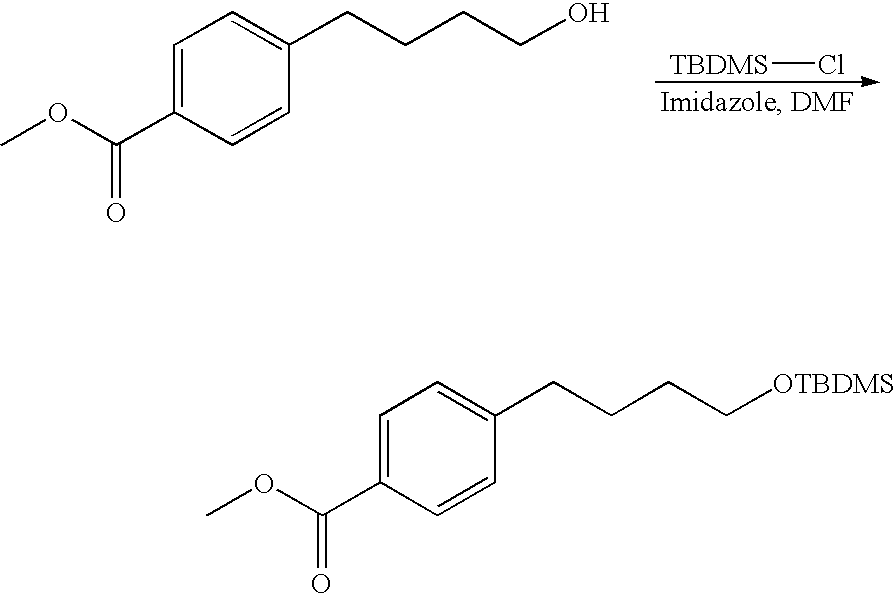

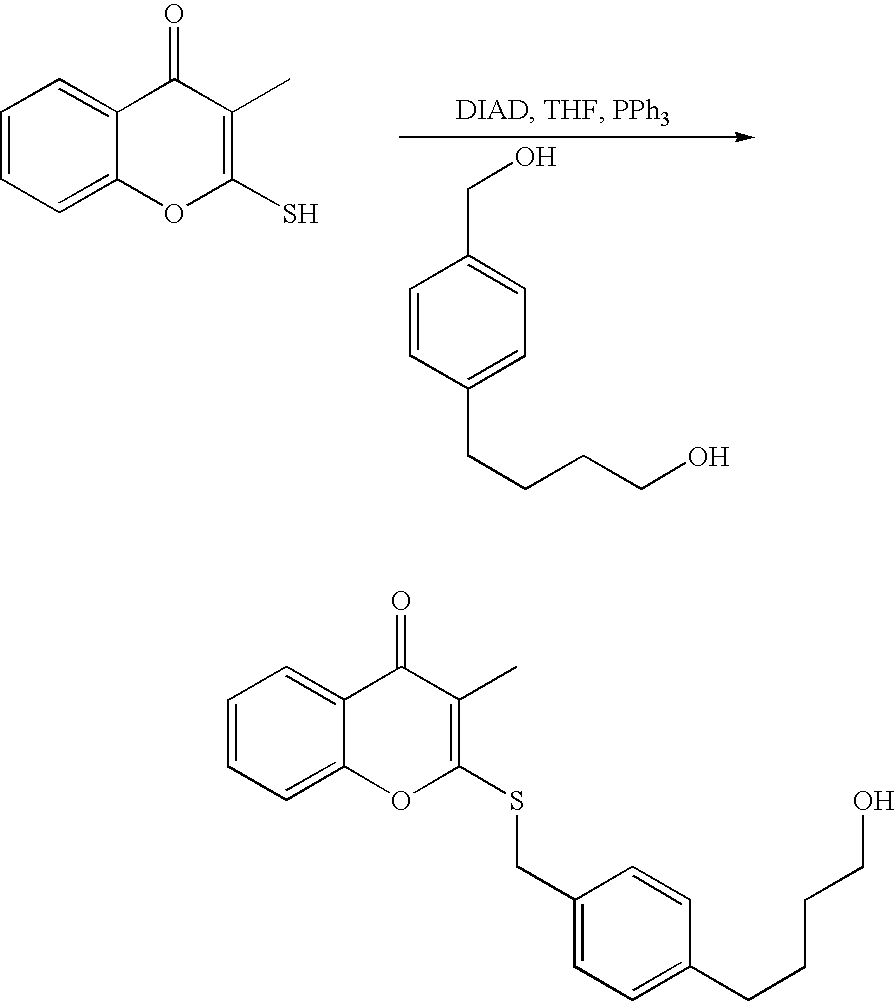


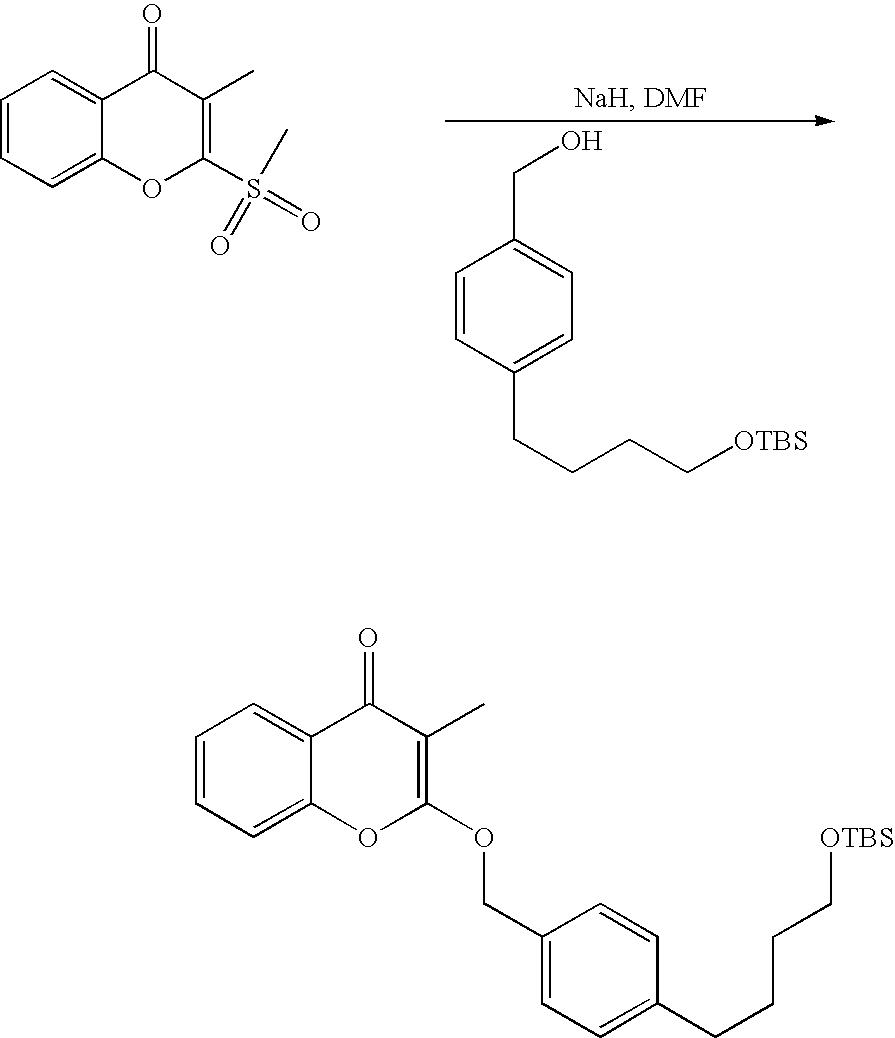
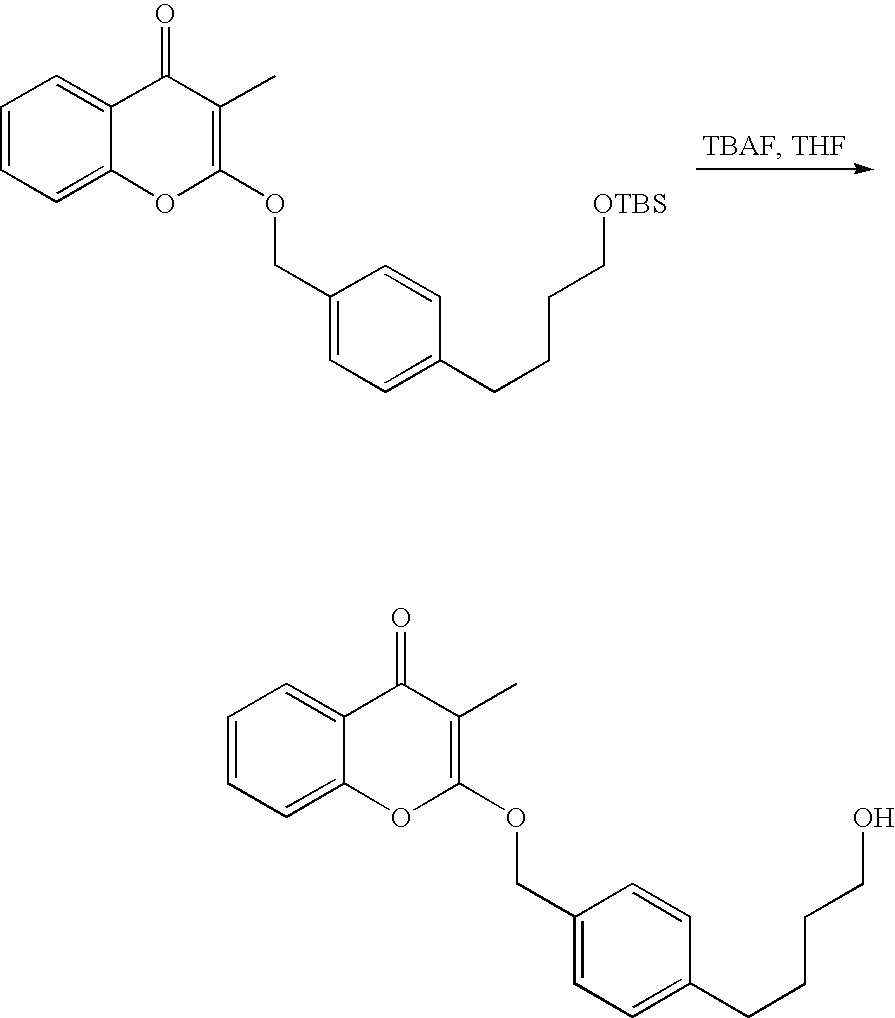
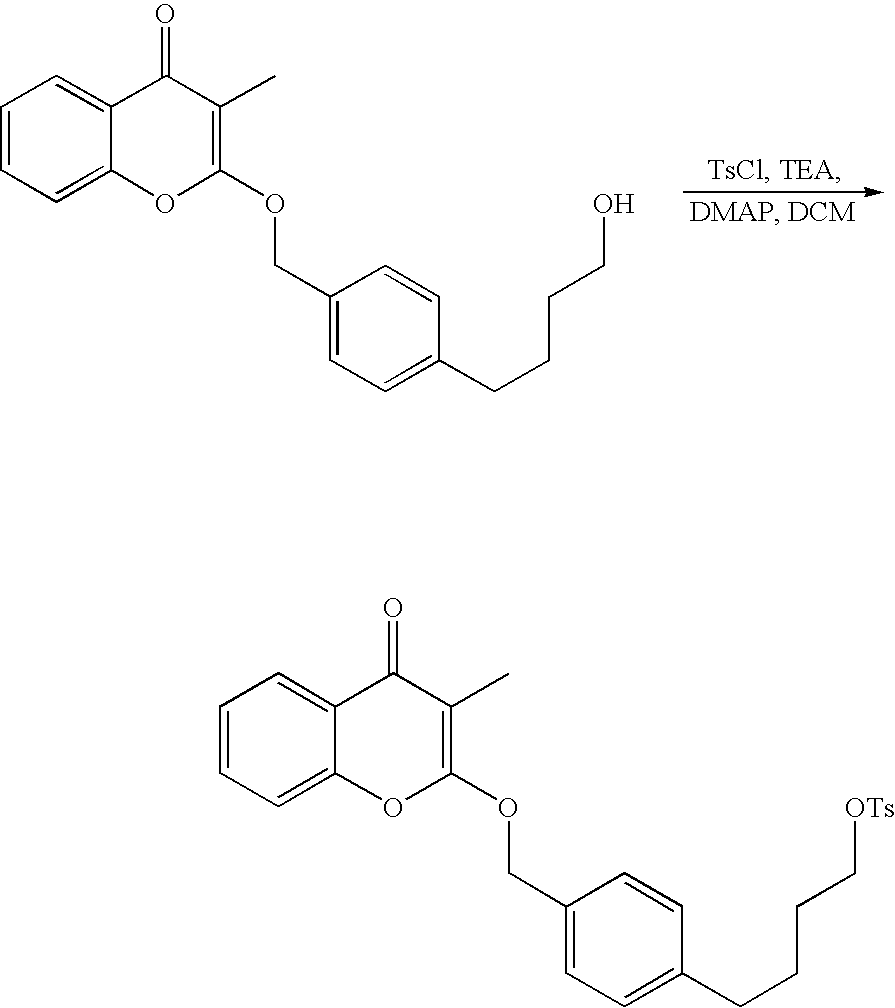
a solution 2-[4-(4-hydroxy-butyl)-benzyloxy]-3-methyl-chromen-4-one (101 mg, 0.30 mmol) dissolved in anhydrous dichloromethane (3.0 mL) was added TsCl (68 mg, 0.36 mmol), DMAP (55 mg, 0.45 mmol) and TEA (0.050 mL, 0.36 mmol). The reaction mixture continued stirring at room temperature. After 20 h, the reaction mixture was diluted with water. The aqueous layer was separated and extracted with ethyl acetate (3×). All combined organic layers were dried over Na2SO4, filtered, and concentrated to yield an oil. The crude material was purified using silica gel chromatography (4:1 pentane: ethyl acetate) to yield toluene-4-sulfonic acid 4-[4-(3-methyl-4-oxo-4H-chromen-2-yloxymethyl)-phenyl]-butyl ester (75.2 mg, 0.15 mmol) in moderate yield (51%).1H (CDCl3, 600 MHz): δ 8.21 (1H, dd, J=8.2, 1.5 Hz), 7.77 (2H, d, J=8.3 Hz). 7.60 (1H, m), 7.33 (2H, d, J=8.0 Hz), 7.36 (2H, d, J=8.0 Hz), 7.39 (2H, d, J=8.2 Hz), 7.33 (2H, d, J=8.0 Hz), 7.99 (2H, d, J=7.9 Hz), 5.43 (2H, s), 4.04 (2H, t, J=5.9 Hz), 2.59 (2H, t, J=7.3 Hz), 2.44 (3H, s), 1.99 (3H, s), 1.68 (4H, m);); 13C (CDCl3, 150 MHz): δ 178.2, 161.8, 152.2, 144.2, 141.9, 132.7, 132.2, 131.9, 129.3, 128.3, 127.7, 127.4, 125.6, 127.7, 122.1, 116.1, 70.1, 69.8,34.3, 27.9,26.5, 21.1, 6.7. HRMS calcd for C28H28O6S: 545.1498, found. 515.1493.
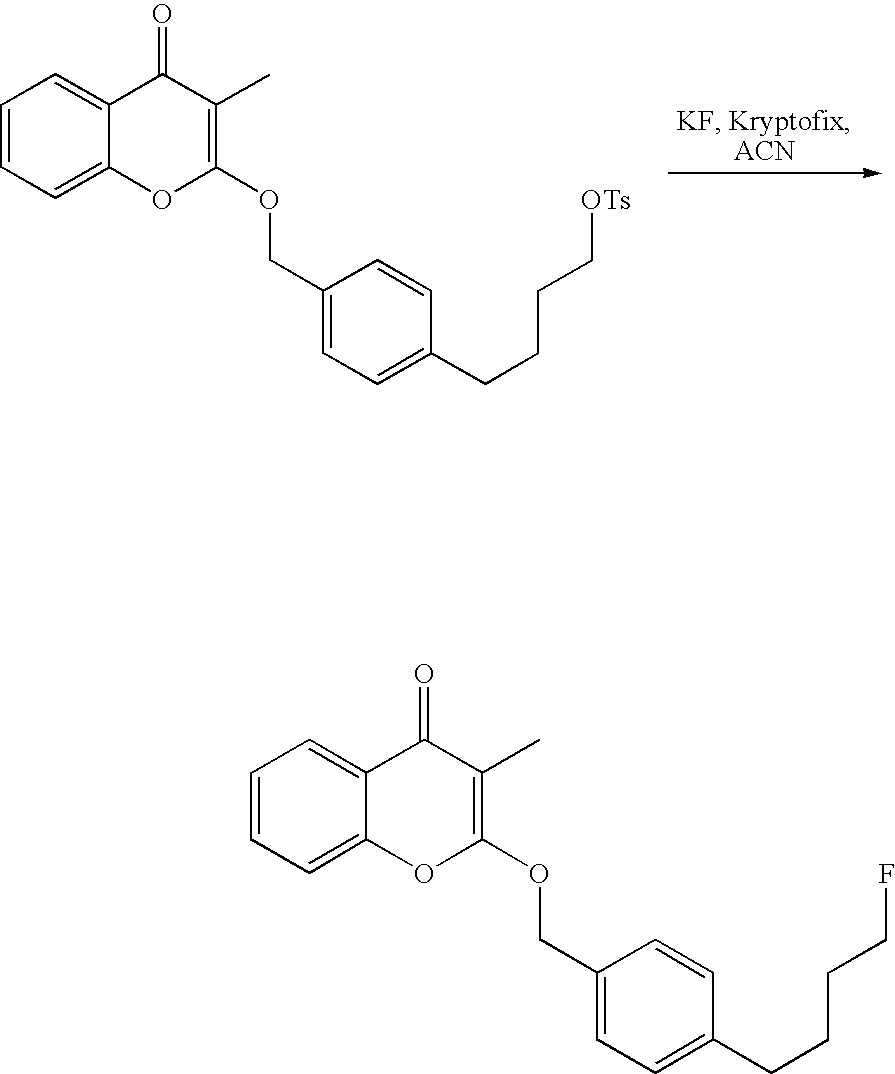

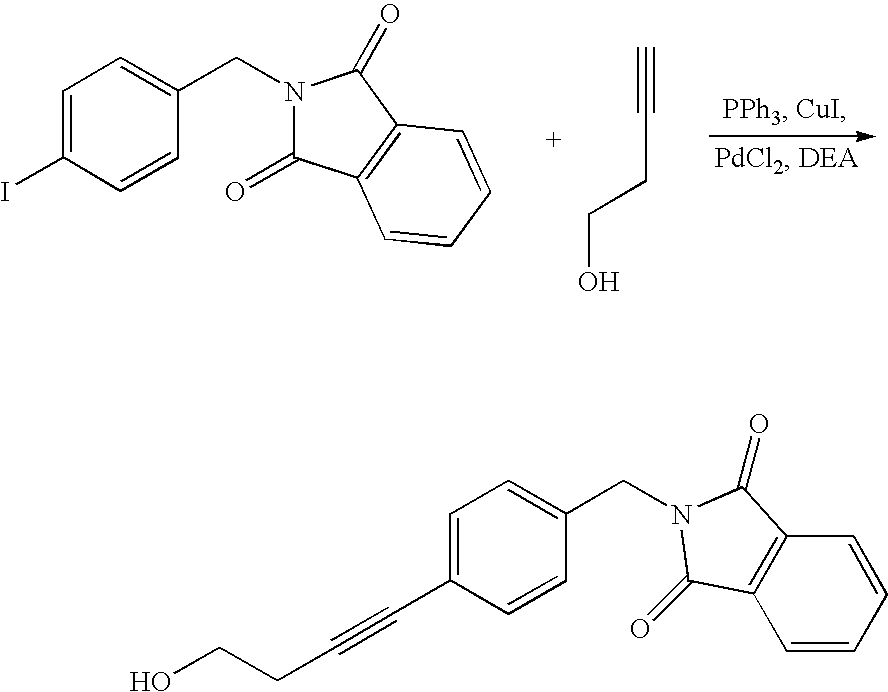
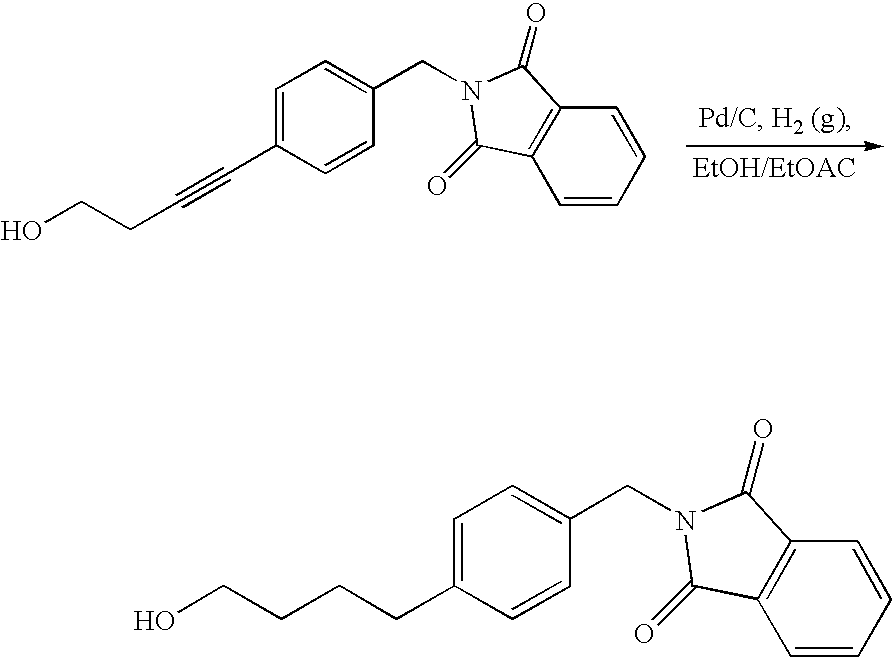
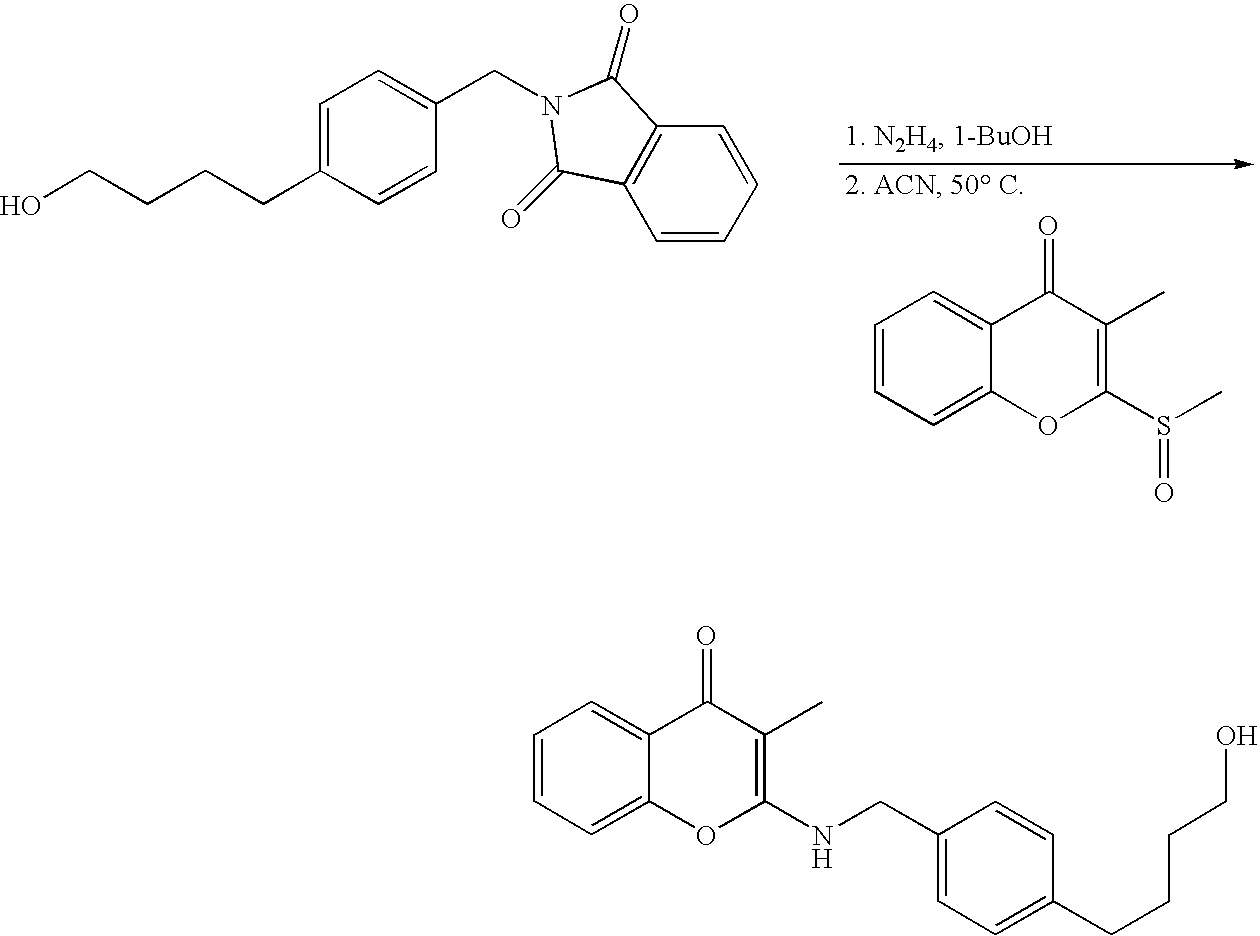

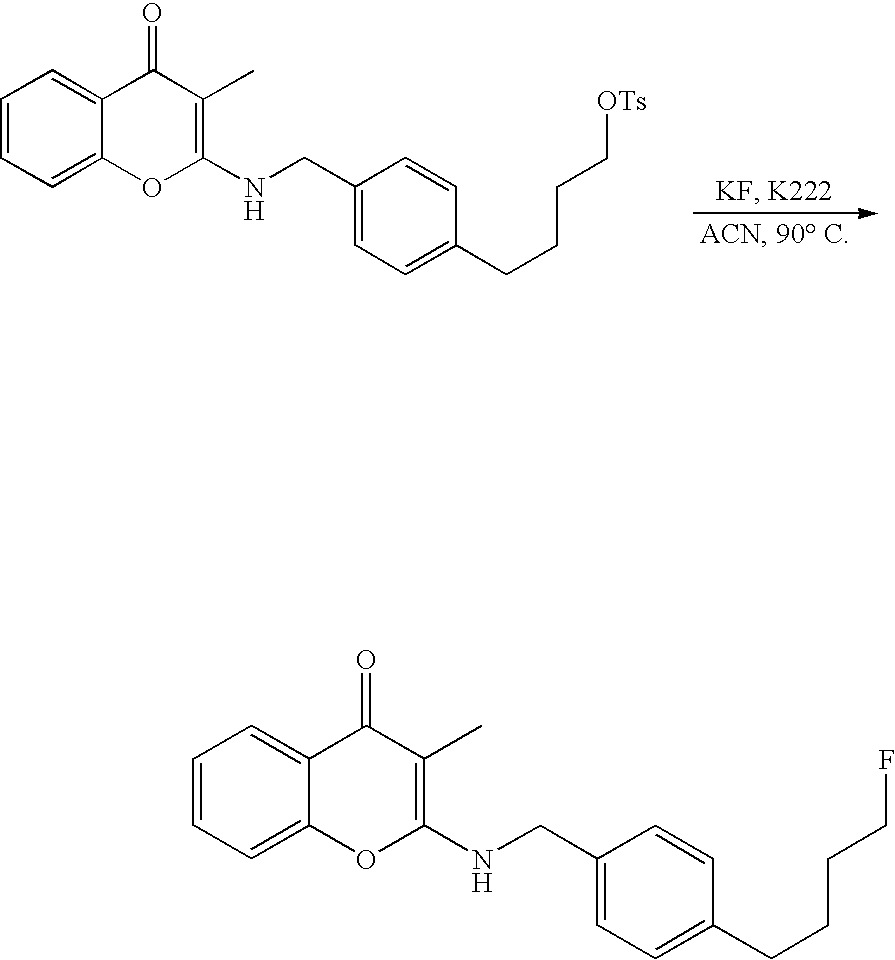
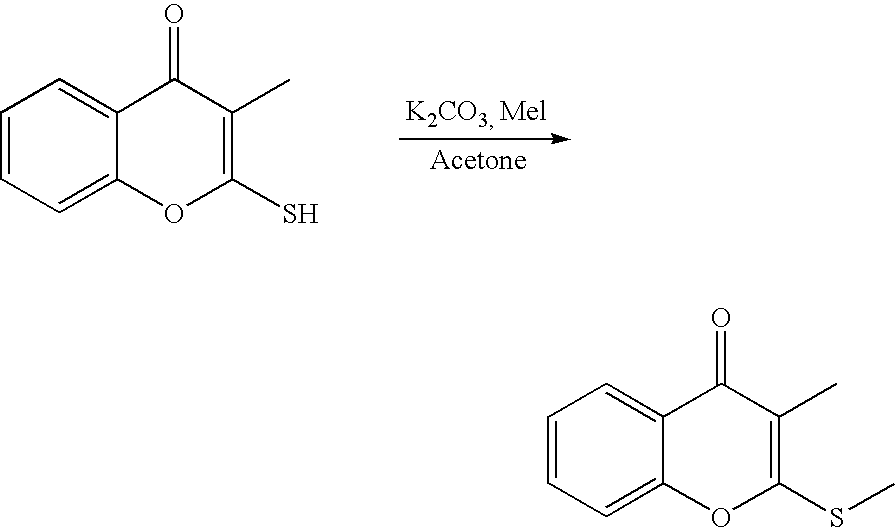

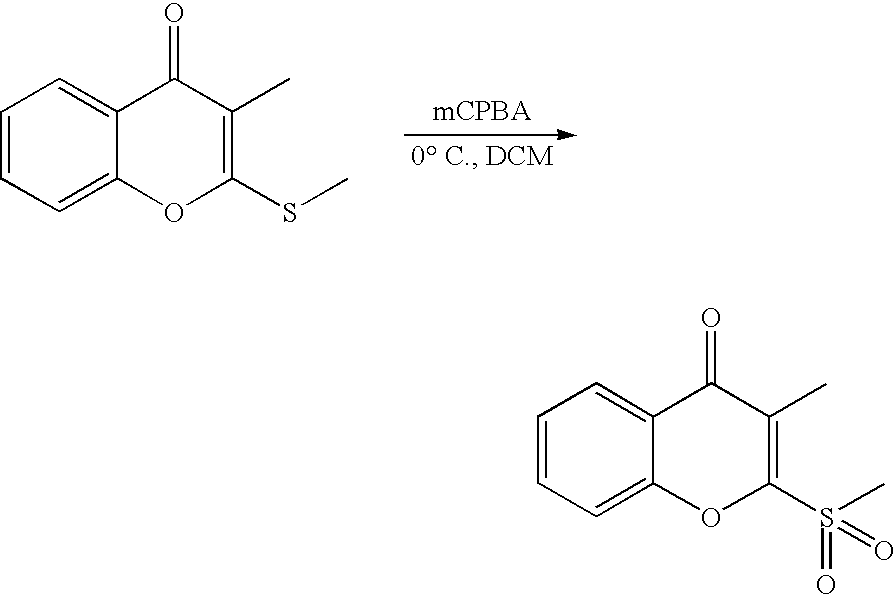
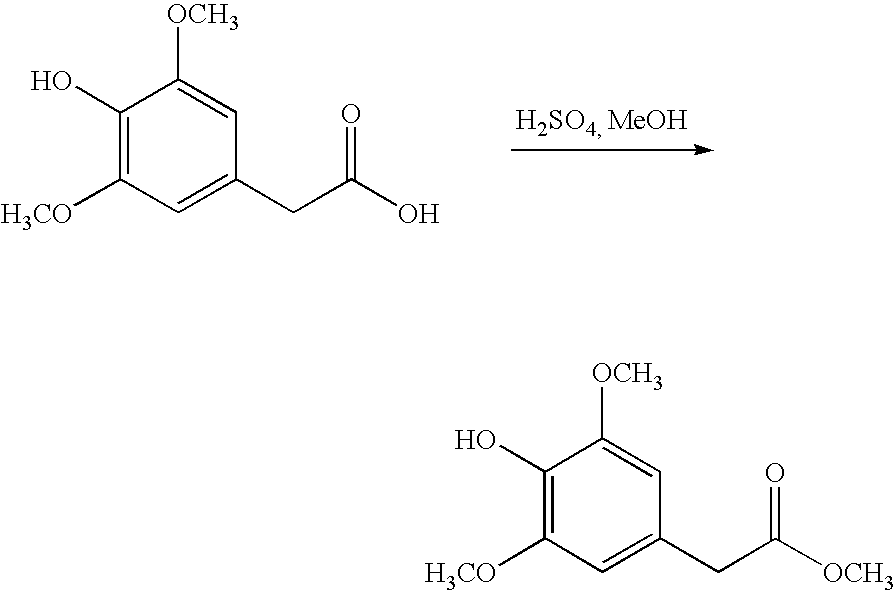
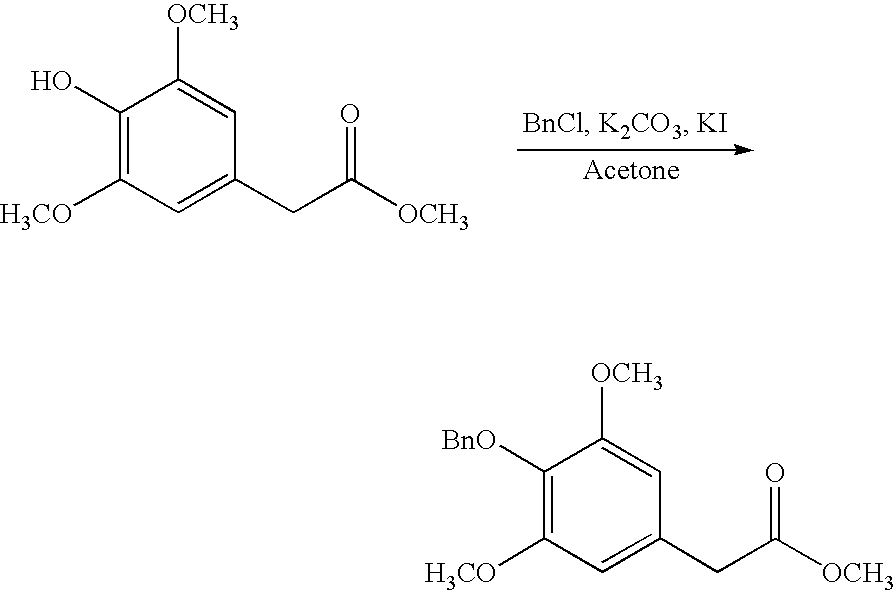


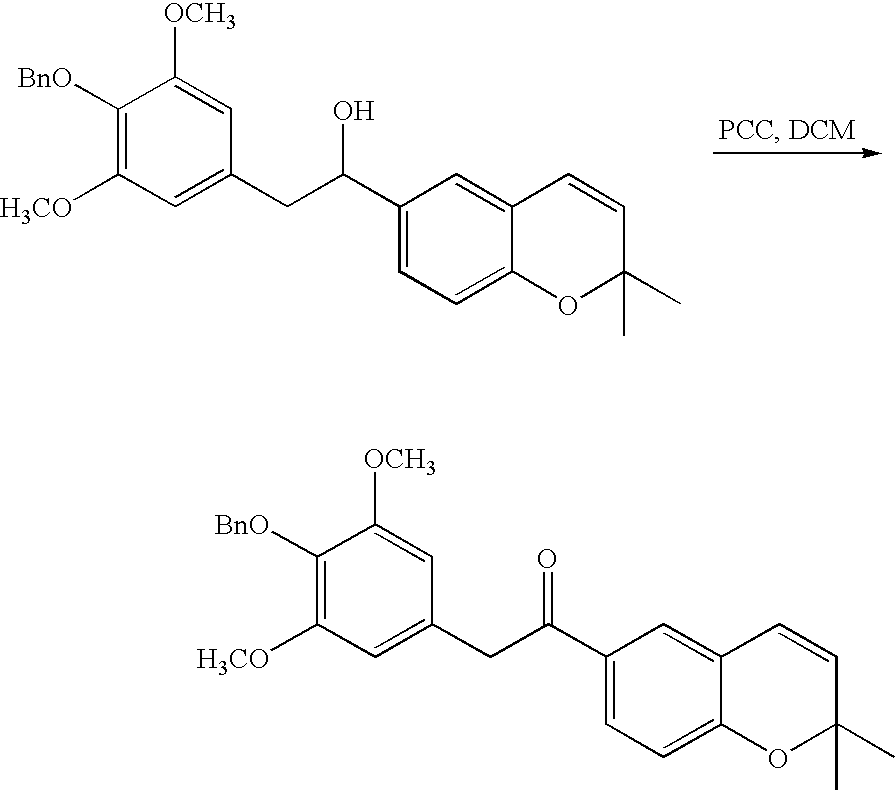
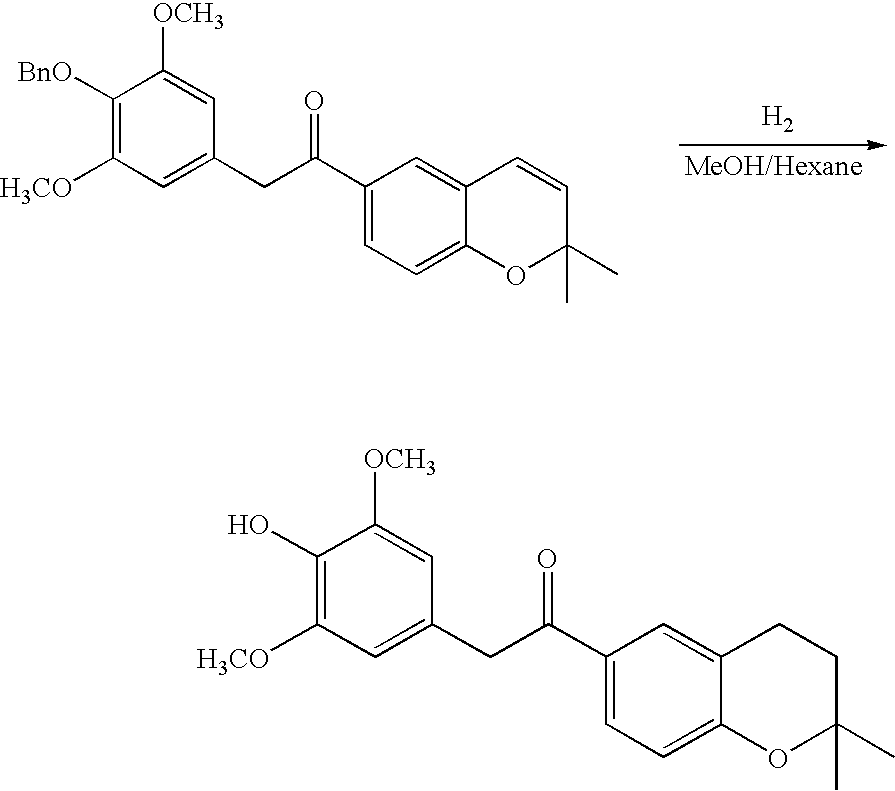

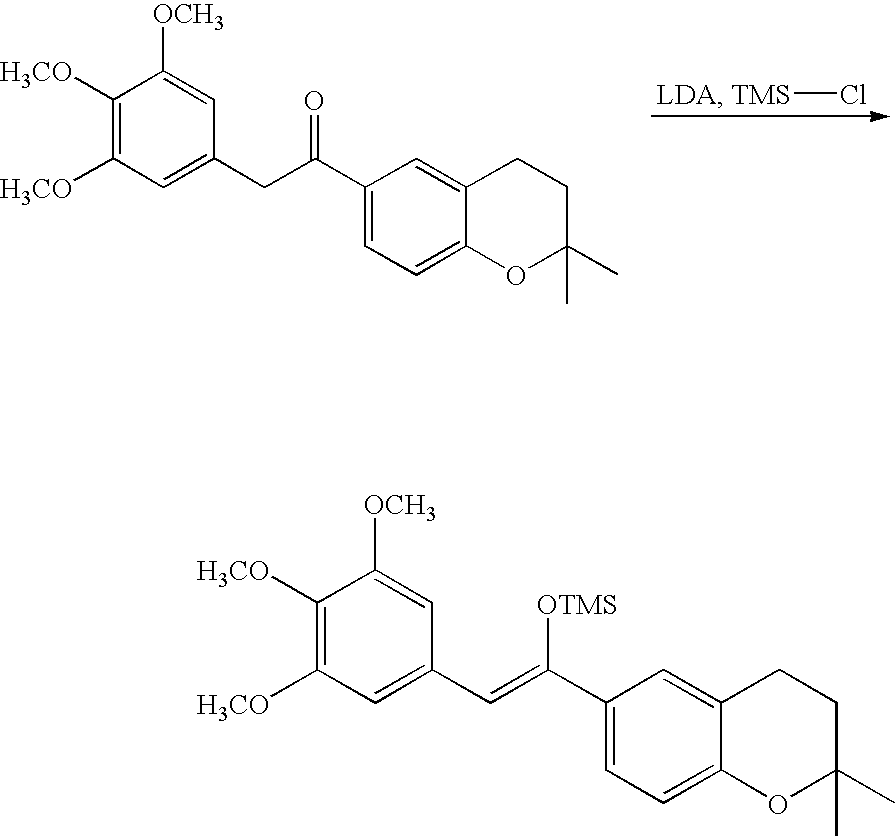


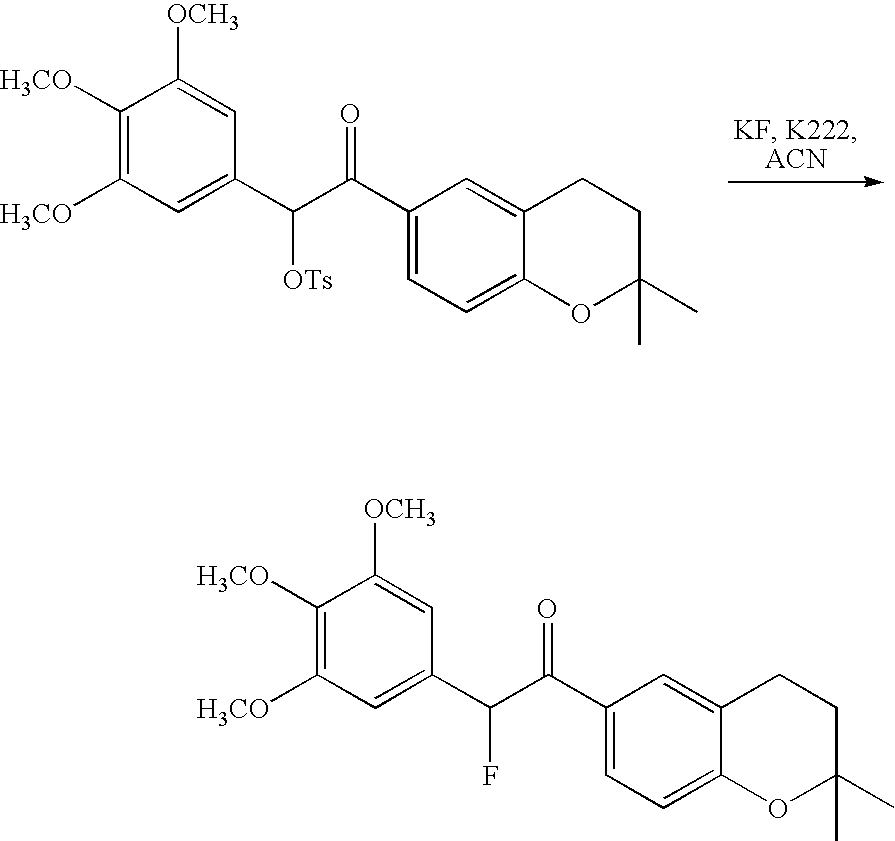


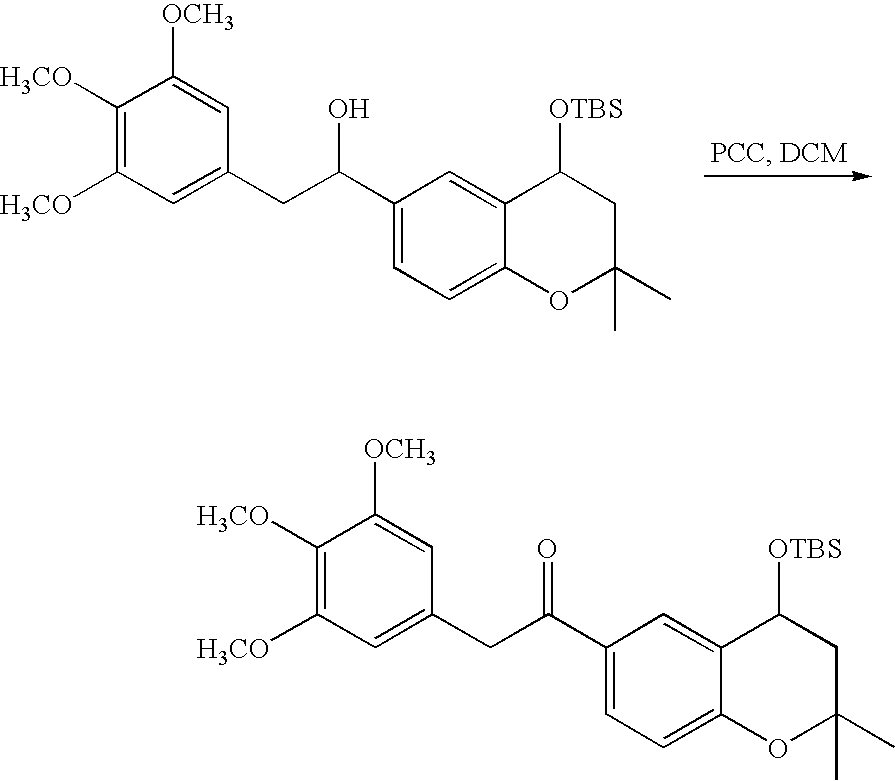
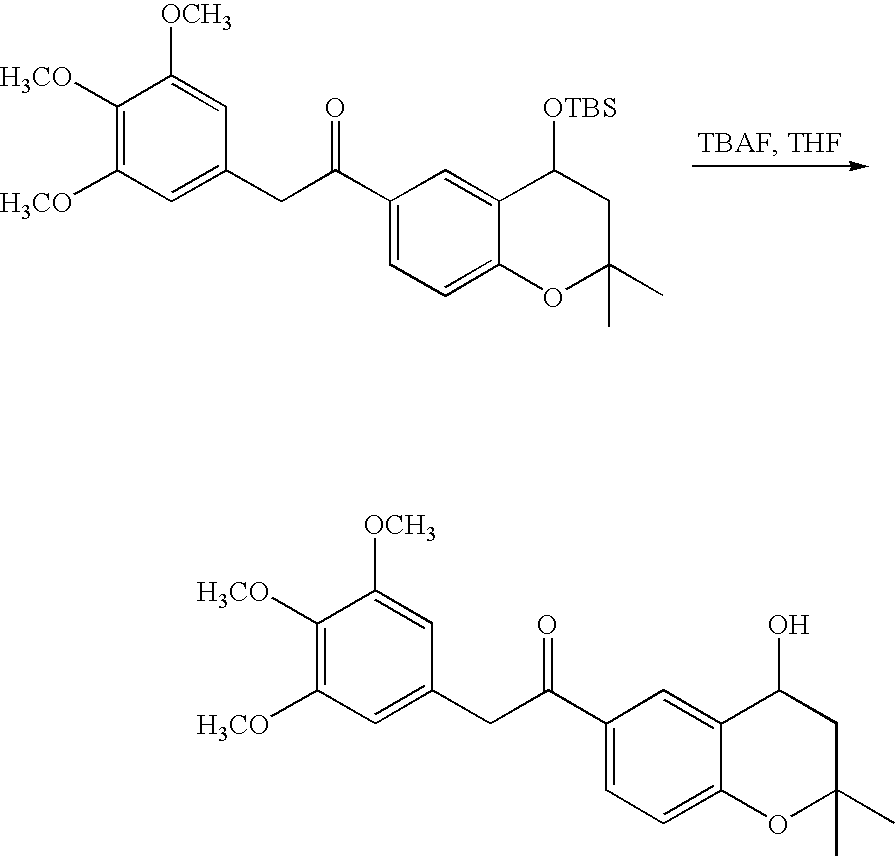


- 1. A solution of 15 mg of potassium carbonate (K2CO3) in 1 mL of distilled/deionized water (H2O) and a solution of 90 mg of 4,7,13,16,21,24-hexaoxa-1,10-diazabicyclo[8.8.8]hexacosane (Kryptofix™; K222) dissolved in 4 mL of anhydrous acetonitrile (CH3CN) were combined and gently stirred, ensuring the layers did not separate, forming the column eluting solution (CES).
- 2. A one mL aliquot of the CES was extracted from the vial described in step three using a 3 mL syringe and the syringe was attached to the male Luer™ lock of the Tygon™ tubing connected to the 18F column.
- 4. The 15 mL pear shaped flask was vented with a needle and the flask was flushed with dry nitrogen. The flushing needle was connected to a vacuum line and the flow adjusted such that CES was slowly drawn through the 18F column into the 15 mL pear-shaped flask.
- 5. The vacuum and N2 gas flow were adjusted such that the contents of the flask were reduced to dryness. Anhydrous CH3CN (1 mL) was added via syringe to the flask, using vacuum to drive the transfer. The vacuum and N2 gas flow were balanced to remove the acetonitrile. This procedure was repeated twice, after which point the vacuum was removed.
- 6. The contents of the flask were removed via syringe and the radioactivity was quantified. The 18F solution was used directly in radiolabeling syntheses.

- 7. The toluenesulfonate ester precursor to the desired chromone analog (2.5 mg) was dissolved in CH3CN (0.5 mL) in a conical silanized 5 mL Wheaton™ glass vial with a magnetic stirring bar. The vial was immersed in a oil bath heated at 90° C. The solution of the 18F described above was added to the reaction vial the resultant mixture was heated at 90° C. for 30 minutes.
- 8. The contents were transferred to a 50 mL silanized round bottom flask containing distilled/deionized water (25 mL), and the contents of the flask are removed via syringe, and deposited on a Waters™ Oasis HLB (hydrophilic-lipophilc balance) column, allowing unreacted fluoride and undesired salts to pass through with the eluate.
- 9. The organic components were eluted from the column into a conical 5 mL vial using dichloromethane, (3 mL, CH2Cl2). The eluant was purified via preparative HPLC (Phenomenex LUNA C-18 column 250×10 mm, 5u particle, 100A pore. gradient elution 90/10 H2O/CH3CN—CH3CN). The appropriate fractions were concentrated and analyzed for radiochemical yield and radiochemical purity (analytical HPLC). The solution was concentrated to dryness in vacuo, and dissolved in the appropriate volume of 10% ethanolic saline for injection and/or biological studies.
Claims (3)
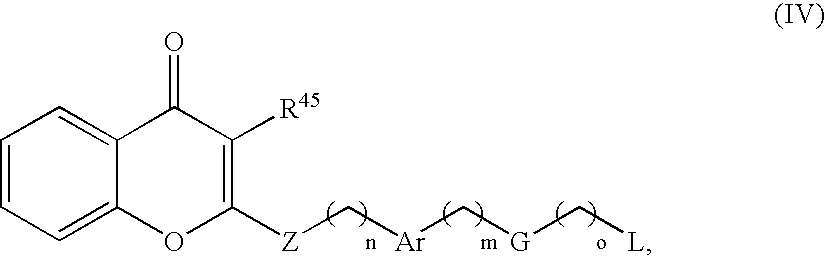


Priority Applications (18)
| Application Number | Priority Date | Filing Date | Title |
|---|---|---|---|
| US11/113,486 US7485283B2 (en) | 2004-04-28 | 2005-04-25 | Contrast agents for myocardial perfusion imaging |
| EP05756378A EP1740225A4 (en) | 2004-04-28 | 2005-04-27 | Contrast agents for myocardial perfusion imaging |
| RU2006141979/04A RU2006141979A (en) | 2004-04-28 | 2005-04-27 | CONTRAST AGENTS FOR OBTAINING MYOCARDIAL BLOOD SUPPLY IMAGES |
| BRPI0510487-4A BRPI0510487A (en) | 2004-04-28 | 2005-04-27 | contrast agents for myocardial perfusion imaging study |
| JP2007510933A JP2007535547A (en) | 2004-04-28 | 2005-04-27 | Contrast agent for myocardial perfusion imaging |
| EP10176056.9A EP2253333B1 (en) | 2004-04-28 | 2005-04-27 | Contrast Agents for Myocardial Perfusion Imaging |
| CA2564737A CA2564737C (en) | 2004-04-28 | 2005-04-27 | Contrast agents for myocardial perfusion imaging |
| MXPA06012299A MXPA06012299A (en) | 2004-04-28 | 2005-04-27 | Contrast agents for myocardial perfusion imaging. |
| ES10176056T ES2744544T3 (en) | 2004-04-28 | 2005-04-27 | Contrast agents for myocardial perfusion imaging |
| CN201010193657.6A CN101843908B (en) | 2004-04-28 | 2005-04-27 | Contrast agents for myocardial perfusion imaging |
| PCT/US2005/014459 WO2005105159A2 (en) | 2004-04-28 | 2005-04-27 | Contrast agents for myocardial perfusion imaging |
| SG200902714-5A SG152254A1 (en) | 2004-04-28 | 2005-04-27 | Contrast agents for myocardial perfusion imaging |
| AU2005238080A AU2005238080B2 (en) | 2004-04-28 | 2005-04-27 | Contrast agents for myocardial perfusion imaging |
| KR1020067022493A KR101207216B1 (en) | 2004-04-28 | 2006-10-27 | Contrast Agents for Myocardial Perfusion Imaging |
| IL178911A IL178911A (en) | 2004-04-28 | 2006-10-29 | Contrast agents for myocardial perfusion imaging |
| NO20065048A NO20065048L (en) | 2004-04-28 | 2006-11-03 | Contrast agents for myocardial perfusion imaging. |
| US12/339,694 US8263042B2 (en) | 2004-04-28 | 2008-12-19 | Contrast agents for myocardial perfusion imaging |
| US13/571,911 US20130028837A1 (en) | 2004-04-28 | 2012-08-10 | Contrast agents for myocardial perfusion imaging |
Applications Claiming Priority (2)
| Application Number | Priority Date | Filing Date | Title |
|---|---|---|---|
| US56614604P | 2004-04-28 | 2004-04-28 | |
| US11/113,486 US7485283B2 (en) | 2004-04-28 | 2005-04-25 | Contrast agents for myocardial perfusion imaging |
Related Child Applications (1)
| Application Number | Title | Priority Date | Filing Date |
|---|---|---|---|
| US12/339,694 Division US8263042B2 (en) | 2004-04-28 | 2008-12-19 | Contrast agents for myocardial perfusion imaging |
Publications (2)
| Publication Number | Publication Date |
|---|---|
| US20050244332A1 US20050244332A1 (en) | 2005-11-03 |
| US7485283B2 true US7485283B2 (en) | 2009-02-03 |
Family
ID=35187299
Family Applications (3)
| Application Number | Title | Priority Date | Filing Date |
|---|---|---|---|
| US11/113,486 Active 2026-03-13 US7485283B2 (en) | 2004-04-28 | 2005-04-25 | Contrast agents for myocardial perfusion imaging |
| US12/339,694 Active 2027-02-21 US8263042B2 (en) | 2004-04-28 | 2008-12-19 | Contrast agents for myocardial perfusion imaging |
| US13/571,911 Abandoned US20130028837A1 (en) | 2004-04-28 | 2012-08-10 | Contrast agents for myocardial perfusion imaging |
Family Applications After (2)
| Application Number | Title | Priority Date | Filing Date |
|---|---|---|---|
| US12/339,694 Active 2027-02-21 US8263042B2 (en) | 2004-04-28 | 2008-12-19 | Contrast agents for myocardial perfusion imaging |
| US13/571,911 Abandoned US20130028837A1 (en) | 2004-04-28 | 2012-08-10 | Contrast agents for myocardial perfusion imaging |
Country Status (15)
| Country | Link |
|---|---|
| US (3) | US7485283B2 (en) |
| EP (2) | EP2253333B1 (en) |
| JP (1) | JP2007535547A (en) |
| KR (1) | KR101207216B1 (en) |
| CN (1) | CN101843908B (en) |
| AU (1) | AU2005238080B2 (en) |
| BR (1) | BRPI0510487A (en) |
| CA (1) | CA2564737C (en) |
| ES (1) | ES2744544T3 (en) |
| IL (1) | IL178911A (en) |
| MX (1) | MXPA06012299A (en) |
| NO (1) | NO20065048L (en) |
| RU (1) | RU2006141979A (en) |
| SG (1) | SG152254A1 (en) |
| WO (1) | WO2005105159A2 (en) |
Cited By (7)
| Publication number | Priority date | Publication date | Assignee | Title |
|---|---|---|---|---|
| US20080112884A1 (en) * | 2004-02-13 | 2008-05-15 | Bristol-Myers Squibb Pharma Company | Contrast agents for myocardial perfusion imaging |
| US20090104118A1 (en) * | 2004-04-28 | 2009-04-23 | Radeke Heike S | Contrast agents for myocardial perfusion imaging |
| US7824659B2 (en) | 2005-08-10 | 2010-11-02 | Lantheus Medical Imaging, Inc. | Methods of making radiolabeled tracers and precursors thereof |
| US20110091374A1 (en) * | 2008-02-29 | 2011-04-21 | Lantheus Medical Imaging, Inc. | Contrast agents for applications including perfusion imaging |
| US8936777B2 (en) | 2010-02-08 | 2015-01-20 | Lantheus Medical Imaging, Inc. | Methods and apparatus for synthesizing imaging agents, and intermediates thereof |
| US9687571B2 (en) | 2009-04-15 | 2017-06-27 | Lantheus Medical Imaging, Inc. | Stabilization of radiopharmaceutical compositions using ascorbic acid |
| US9713651B2 (en) | 2012-08-10 | 2017-07-25 | Lantheus Medical Imaging, Inc. | Compositions, methods, and systems for the synthesis and use of imaging agents |
Families Citing this family (17)
| Publication number | Priority date | Publication date | Assignee | Title |
|---|---|---|---|---|
| CN1694689A (en) * | 2002-09-30 | 2005-11-09 | 阿库斯菲尔公司 | Slow-release porous microparticles for inhalation |
| US6962006B2 (en) * | 2002-12-19 | 2005-11-08 | Acusphere, Inc. | Methods and apparatus for making particles using spray dryer and in-line jet mill |
| US20040121003A1 (en) * | 2002-12-19 | 2004-06-24 | Acusphere, Inc. | Methods for making pharmaceutical formulations comprising deagglomerated microparticles |
| CA2533887A1 (en) * | 2003-09-30 | 2005-04-14 | Acusphere, Inc. | Injectable, oral, or topical sustained release pharmaceutical formulations |
| HUE033304T2 (en) | 2005-06-01 | 2017-11-28 | Bioelectron Tech Corp | Redox-active therapeutics for treatment of mitochondrial diseases and other conditions and modulation of energy biomarkers |
| JP2009508867A (en) | 2005-09-15 | 2009-03-05 | エジソン ファーマシューティカルズ, インコーポレイテッド | Tail variants of redox-active therapeutic agents for the treatment of mitochondrial diseases and related aspects and for modulation of energy biomarkers |
| US7913223B2 (en) * | 2005-12-16 | 2011-03-22 | Dialogic Corporation | Method and system for development and use of a user-interface for operations, administration, maintenance and provisioning of a telecommunications system |
| GB0525949D0 (en) | 2005-12-21 | 2006-02-01 | Hammersmith Imanet Ltd | Pet radiotracers |
| JP5374162B2 (en) | 2006-02-22 | 2013-12-25 | エジソン ファーマシューティカルズ, インコーポレイテッド | Modulation of redox-activated therapeutic side chain variants and energy biomarkers for the treatment of mitochondrial diseases and other conditions |
| WO2008133730A2 (en) * | 2006-11-15 | 2008-11-06 | The Regents Of The University Of California | Labeled rotenone analogs |
| EP2300840B1 (en) * | 2008-07-09 | 2020-09-23 | Koninklijke Philips N.V. | Physiological pharmacokinetic analysis for combined molecular mri and dynamic pet imaging |
| BRPI0918139B1 (en) | 2008-09-10 | 2024-04-30 | Ptc Therapeutics, Inc | COMPOSITION, MEDICAL OR FUNCTIONAL FOOD, FOOD OR DIETARY SUPPLEMENT FOR TREATMENT OF PERVASIVE DEVELOPMENTAL DISORDERS WITH REDOX-ACTIVE THERAPEUTICS |
| CA2848147C (en) | 2011-09-09 | 2021-08-24 | Lantheus Medical Imaging, Inc. | Compositions, methods, and systems for the synthesis and use of imaging agents |
| CN104771766A (en) * | 2015-05-07 | 2015-07-15 | 张国明 | Contrast medium for myocardial perfusion imaging and preparation method |
| AU2016369616B2 (en) | 2015-12-17 | 2021-03-25 | Ptc Therapeutics, Inc. | Fluoroalkyl, fluoroalkoxy, phenoxy, heteroaryloxy, alkoxy, and amine 1,4-benzoquinone derivatives for treatment of oxidative stress disorders |
| EP3203256A1 (en) * | 2016-02-02 | 2017-08-09 | B. Braun Melsungen AG | Calibration of mri systems using pre-defined concentrations of 19f isotopes as reference |
| CN106543117B (en) * | 2016-11-10 | 2019-01-22 | 南京中医药大学 | Metabistetrahydrofuran-type custardolide compound with antitumor activity and preparation method and application thereof |
Citations (27)
| Publication number | Priority date | Publication date | Assignee | Title |
|---|---|---|---|---|
| US3359103A (en) * | 1965-01-29 | 1967-12-19 | Ncr Co | Conversion of photographic photochromic image to permanent fixed chromogenic image |
| WO1991014460A1 (en) | 1990-03-28 | 1991-10-03 | Cockbain, Julian, Roderick, Michaelson | Contrast media |
| US5087440A (en) | 1989-07-31 | 1992-02-11 | Salutar, Inc. | Heterocyclic derivatives of DTPA used for magnetic resonance imaging |
| US5088499A (en) | 1989-12-22 | 1992-02-18 | Unger Evan C | Liposomes as contrast agents for ultrasonic imaging and methods for preparing the same |
| US5155215A (en) | 1985-11-18 | 1992-10-13 | Access Pharmaceuticals Inc. | Polychelating agents for image and spectral enhancement (and spectral shift) |
| WO1992017215A1 (en) | 1990-03-28 | 1992-10-15 | Nycomed Salutar, Inc. | Contrast media |
| US5228446A (en) | 1989-12-22 | 1993-07-20 | Unger Evan C | Gas filled liposomes and their use as ultrasonic contrast agents |
| US5281704A (en) | 1989-10-23 | 1994-01-25 | Salutar, Inc. | Polychelant compounds |
| WO1994022496A1 (en) | 1993-03-31 | 1994-10-13 | Mallinckrodt Medical, Inc. | Radiopharmaceutical formulations having non-stannous reductants |
| US5412148A (en) | 1986-11-10 | 1995-05-02 | The State Of Oregon Acting By And Through The State Board Of Higher Education On Behalf Of The University Of Oregon | Amplifier molecules derived from diethylene triaminepentaacetic acid for enhancement of diagnosis and therapy |
| US5417959A (en) | 1993-10-04 | 1995-05-23 | Mallinckrodt Medical, Inc. | Functionalized aza-crytand ligands for diagnostic imaging applications |
| US5520904A (en) | 1995-01-27 | 1996-05-28 | Mallinckrodt Medical, Inc. | Calcium/oxyanion-containing particles with a polymerical alkoxy coating for use in medical diagnostic imaging |
| US5547656A (en) | 1991-04-05 | 1996-08-20 | Imarx Pharmaceutical Corp. | Low density microspheres and their use as contrast agents for computed tomography, and in other applications |
| EP0727225A2 (en) | 1995-02-14 | 1996-08-21 | Sonus Pharmaceuticals, Inc. | Compositions and methods for directed ultrasound imaging |
| US5567411A (en) | 1986-11-10 | 1996-10-22 | State Of Oregon Acting By And Through The State Board Of Higher Education On Behalf Of The University Of Oregon | Dendritic amplifier molecules having multiple terminal active groups stemming from a benzyl core group |
| US5585112A (en) | 1989-12-22 | 1996-12-17 | Imarx Pharmaceutical Corp. | Method of preparing gas and gaseous precursor-filled microspheres |
| US5679810A (en) | 1990-01-19 | 1997-10-21 | Salutar, Inc. | Linear oligomeric polychelant compounds |
| US5760191A (en) | 1993-02-05 | 1998-06-02 | Nycomed Imaging As | Macrocyclic complexing agents and targeting immunoreagents useful in therapeutic and diagnostic compositions and methods |
| US5801228A (en) | 1995-06-07 | 1998-09-01 | Nycomed Imaging As | Polymeric contrast agents for medical imaging |
| US5804161A (en) | 1996-05-14 | 1998-09-08 | Nycomed Salutar Inc. | Contrast agents |
| US5846517A (en) | 1996-09-11 | 1998-12-08 | Imarx Pharmaceutical Corp. | Methods for diagnostic imaging using a renal contrast agent and a vasodilator |
| WO2002020008A1 (en) | 2000-09-06 | 2002-03-14 | The Scripps Research Institute | Inhibitors of nadh:ubiquinone oxidoreductase |
| US20030044354A1 (en) | 2001-08-16 | 2003-03-06 | Carpenter Alan P. | Gas microsphere liposome composites for ultrasound imaging and ultrasound stimulated drug release |
| US6565889B2 (en) * | 1996-12-02 | 2003-05-20 | The Regents Of The University Of California | Bilayer structure which encapsulates multiple containment units and uses thereof |
| WO2003086476A1 (en) | 2002-04-08 | 2003-10-23 | Biostream, Inc. | Technetium-labeled rotenone derivatives, and methods of use thereof |
| US20040033197A1 (en) | 2002-02-06 | 2004-02-19 | The Johns Hopkins University | Non-invasive diagnostic imaging technology for mitochondria dysfunction using radiolabeled lipophilic salts |
| US20050191238A1 (en) | 2004-02-13 | 2005-09-01 | Casebier David S. | Contrast agents for myocardial perfusion imaging |
Family Cites Families (34)
| Publication number | Priority date | Publication date | Assignee | Title |
|---|---|---|---|---|
| DE3574870D1 (en) | 1984-06-23 | 1990-01-25 | Nissan Chemical Ind Ltd | METHOD FOR PRODUCING 2-TERT.-BUTYL-4,5-DICHLORO-3 (2H) -PYRIDAZINONE. |
| US5393512A (en) | 1985-01-14 | 1995-02-28 | Vanderheyden; Jean-Luc | Stable therapeutic radionuclide compositions and methods for preparation thereof |
| JPS6315974A (en) | 1986-07-09 | 1988-01-23 | 小泉コンピユ−タ−株式会社 | Balling game score table display apparatus |
| IT1229684B (en) | 1989-04-05 | 1991-09-06 | Mini Ricerca Scient Tecnolog | PYRIDAZINONE WITH INSECTICIDE AND ACARICIDE ACTIVITY |
| US5377681A (en) | 1989-11-13 | 1995-01-03 | University Of Florida | Method of diagnosing impaired blood flow |
| US5093105A (en) | 1991-04-09 | 1992-03-03 | Merck Frosst Canada, Inc. | Radiopharmaceutical bacteriostats |
| US5306482A (en) | 1991-04-09 | 1994-04-26 | Merck Frosst Canada, Inc. | Radiopharmaceutical bacteriostats |
| EP0600992B1 (en) | 1991-08-29 | 2000-09-20 | Mallinckrodt Medical, Inc. | Use of gentisic acid or gentisyl alcohol for stabilising radiolabeled peptides and proteins |
| US5169942A (en) | 1991-11-21 | 1992-12-08 | General Electric Company | Method for making 2-(18F)fluoro-2-deoxy-D-glucose |
| EP0641350A4 (en) | 1993-03-22 | 1995-08-23 | Gen Electric | Method for making 2-fluoro-2-deoxyglucose. |
| BR9408590A (en) | 1994-06-03 | 1997-08-26 | Malinckrodt Medical Inc | Bone imaging agents quickly eliminated from 99m technetium phosphonate |
| US5587491A (en) * | 1995-03-15 | 1996-12-24 | Regents Of The University Of Minnesota | Method for the synthesis of bis-tetrahydrofuranyl Annonaceous acetogenins |
| US6066309A (en) | 1996-02-02 | 2000-05-23 | Rhomed Incorporated | Post-labeling stabilization of radiolabeled proteins and peptides |
| US5677467A (en) | 1996-10-03 | 1997-10-14 | Regents Of The University Of Minnesota | Synthesis of acetogenins |
| US5961955A (en) | 1997-06-03 | 1999-10-05 | Coulter Pharmaceutical, Inc. | Radioprotectant for peptides labeled with radioisotope |
| US6056939A (en) | 1998-08-28 | 2000-05-02 | Desreux; Jean F. | Self-assembling heteropolymetallic chelates as imaging agents and radiopharmaceuticals |
| DE69941298D1 (en) | 1998-09-29 | 2009-10-01 | Merck & Co Inc | Radiolabeled Neukoquin-1 receptor antagonists |
| US6645508B1 (en) | 1999-06-18 | 2003-11-11 | Jivn-Ren Chen | Stable L-ascorbic acid composition |
| TWI247609B (en) | 2001-01-23 | 2006-01-21 | Nihon Mediphysics Co Ltd | Agent for diagnosis of tissue proliferation activity or the treatment of proliferative disease |
| GB0115927D0 (en) | 2001-06-29 | 2001-08-22 | Nycomed Amersham Plc | Solid-phase nucleophilic fluorination |
| JP2005529840A (en) | 2001-10-16 | 2005-10-06 | ヒプニオン, インコーポレイテッド | Treatment of CNS disorders using CNS targeted modulators |
| AU2003226737B2 (en) | 2002-03-29 | 2008-09-04 | Janssen Pharmaceutica N.V. | Radiolabelled quinoline and quinolinone derivatives and their use as metabotropic glutamate receptor ligands |
| GB0229683D0 (en) | 2002-12-20 | 2003-01-29 | Imaging Res Solutions Ltd | Preparation of radiopharmaceuticals |
| GB0317920D0 (en) | 2003-07-31 | 2003-09-03 | Amersham Plc | Solid-phase synthesis |
| US7485283B2 (en) | 2004-04-28 | 2009-02-03 | Lantheus Medical Imaging | Contrast agents for myocardial perfusion imaging |
| US20060083681A1 (en) | 2004-10-18 | 2006-04-20 | Ajay Purohit | Compounds for myocardial perfusion imaging |
| KR100789847B1 (en) | 2004-12-15 | 2007-12-28 | (주)퓨쳐켐 | Process for preparing organofluoro compound in alcohol solvent |
| US7837982B2 (en) | 2005-06-23 | 2010-11-23 | Emory University | Imaging agents |
| US7824659B2 (en) | 2005-08-10 | 2010-11-02 | Lantheus Medical Imaging, Inc. | Methods of making radiolabeled tracers and precursors thereof |
| WO2007148088A2 (en) | 2006-06-21 | 2007-12-27 | Ge Healthcare Limited | Radiopharmaceutical products |
| GB0718386D0 (en) | 2007-09-21 | 2007-10-31 | Ge Healthcare As | Improved radiopharmaceutical formulation |
| WO2009110984A2 (en) | 2008-02-29 | 2009-09-11 | Lantheus Medical Imaging, Inc. | Contrast agents for applications including perfusion imaging |
| CN101555232B (en) | 2009-05-21 | 2011-01-05 | 北京师范大学 | Pyridazinone compound marked by fluorine-18, preparation method and applications |
| DK2534136T3 (en) | 2010-02-08 | 2017-12-04 | Lantheus Medical Imaging Inc | METHODS OF SYNTHETIZING CONTRAST AGENTS AND INTERMEDIATES THEREOF |
-
2005
- 2005-04-25 US US11/113,486 patent/US7485283B2/en active Active
- 2005-04-27 JP JP2007510933A patent/JP2007535547A/en active Pending
- 2005-04-27 BR BRPI0510487-4A patent/BRPI0510487A/en not_active Application Discontinuation
- 2005-04-27 RU RU2006141979/04A patent/RU2006141979A/en unknown
- 2005-04-27 EP EP10176056.9A patent/EP2253333B1/en not_active Expired - Lifetime
- 2005-04-27 SG SG200902714-5A patent/SG152254A1/en unknown
- 2005-04-27 CN CN201010193657.6A patent/CN101843908B/en not_active Expired - Fee Related
- 2005-04-27 MX MXPA06012299A patent/MXPA06012299A/en not_active Application Discontinuation
- 2005-04-27 CA CA2564737A patent/CA2564737C/en not_active Expired - Lifetime
- 2005-04-27 AU AU2005238080A patent/AU2005238080B2/en not_active Ceased
- 2005-04-27 WO PCT/US2005/014459 patent/WO2005105159A2/en not_active Ceased
- 2005-04-27 ES ES10176056T patent/ES2744544T3/en not_active Expired - Lifetime
- 2005-04-27 EP EP05756378A patent/EP1740225A4/en not_active Withdrawn
-
2006
- 2006-10-27 KR KR1020067022493A patent/KR101207216B1/en not_active Expired - Fee Related
- 2006-10-29 IL IL178911A patent/IL178911A/en active IP Right Grant
- 2006-11-03 NO NO20065048A patent/NO20065048L/en not_active Application Discontinuation
-
2008
- 2008-12-19 US US12/339,694 patent/US8263042B2/en active Active
-
2012
- 2012-08-10 US US13/571,911 patent/US20130028837A1/en not_active Abandoned
Patent Citations (29)
| Publication number | Priority date | Publication date | Assignee | Title |
|---|---|---|---|---|
| US3359103A (en) * | 1965-01-29 | 1967-12-19 | Ncr Co | Conversion of photographic photochromic image to permanent fixed chromogenic image |
| US5155215A (en) | 1985-11-18 | 1992-10-13 | Access Pharmaceuticals Inc. | Polychelating agents for image and spectral enhancement (and spectral shift) |
| US5567411A (en) | 1986-11-10 | 1996-10-22 | State Of Oregon Acting By And Through The State Board Of Higher Education On Behalf Of The University Of Oregon | Dendritic amplifier molecules having multiple terminal active groups stemming from a benzyl core group |
| US5412148A (en) | 1986-11-10 | 1995-05-02 | The State Of Oregon Acting By And Through The State Board Of Higher Education On Behalf Of The University Of Oregon | Amplifier molecules derived from diethylene triaminepentaacetic acid for enhancement of diagnosis and therapy |
| US5087440A (en) | 1989-07-31 | 1992-02-11 | Salutar, Inc. | Heterocyclic derivatives of DTPA used for magnetic resonance imaging |
| US5281704A (en) | 1989-10-23 | 1994-01-25 | Salutar, Inc. | Polychelant compounds |
| US5228446A (en) | 1989-12-22 | 1993-07-20 | Unger Evan C | Gas filled liposomes and their use as ultrasonic contrast agents |
| US5088499A (en) | 1989-12-22 | 1992-02-18 | Unger Evan C | Liposomes as contrast agents for ultrasonic imaging and methods for preparing the same |
| US5585112A (en) | 1989-12-22 | 1996-12-17 | Imarx Pharmaceutical Corp. | Method of preparing gas and gaseous precursor-filled microspheres |
| US5679810A (en) | 1990-01-19 | 1997-10-21 | Salutar, Inc. | Linear oligomeric polychelant compounds |
| WO1991014460A1 (en) | 1990-03-28 | 1991-10-03 | Cockbain, Julian, Roderick, Michaelson | Contrast media |
| WO1992017215A1 (en) | 1990-03-28 | 1992-10-15 | Nycomed Salutar, Inc. | Contrast media |
| US5547656B1 (en) | 1991-04-05 | 1999-07-20 | Imarx Pharmaceutical Corp | Low density microspheres and their use as contrast agents for computed tomography and in other applications |
| US5547656A (en) | 1991-04-05 | 1996-08-20 | Imarx Pharmaceutical Corp. | Low density microspheres and their use as contrast agents for computed tomography, and in other applications |
| US5760191A (en) | 1993-02-05 | 1998-06-02 | Nycomed Imaging As | Macrocyclic complexing agents and targeting immunoreagents useful in therapeutic and diagnostic compositions and methods |
| WO1994022496A1 (en) | 1993-03-31 | 1994-10-13 | Mallinckrodt Medical, Inc. | Radiopharmaceutical formulations having non-stannous reductants |
| US5417959A (en) | 1993-10-04 | 1995-05-23 | Mallinckrodt Medical, Inc. | Functionalized aza-crytand ligands for diagnostic imaging applications |
| US5520904A (en) | 1995-01-27 | 1996-05-28 | Mallinckrodt Medical, Inc. | Calcium/oxyanion-containing particles with a polymerical alkoxy coating for use in medical diagnostic imaging |
| EP0727225A2 (en) | 1995-02-14 | 1996-08-21 | Sonus Pharmaceuticals, Inc. | Compositions and methods for directed ultrasound imaging |
| US5801228A (en) | 1995-06-07 | 1998-09-01 | Nycomed Imaging As | Polymeric contrast agents for medical imaging |
| US5804161A (en) | 1996-05-14 | 1998-09-08 | Nycomed Salutar Inc. | Contrast agents |
| US5846517A (en) | 1996-09-11 | 1998-12-08 | Imarx Pharmaceutical Corp. | Methods for diagnostic imaging using a renal contrast agent and a vasodilator |
| US6565889B2 (en) * | 1996-12-02 | 2003-05-20 | The Regents Of The University Of California | Bilayer structure which encapsulates multiple containment units and uses thereof |
| WO2002020008A1 (en) | 2000-09-06 | 2002-03-14 | The Scripps Research Institute | Inhibitors of nadh:ubiquinone oxidoreductase |
| US20040034239A1 (en) | 2000-09-06 | 2004-02-19 | Nicolaou Kyriacos C | Inhibitors of nadh:ubiquinone oxidoreductase |
| US20030044354A1 (en) | 2001-08-16 | 2003-03-06 | Carpenter Alan P. | Gas microsphere liposome composites for ultrasound imaging and ultrasound stimulated drug release |
| US20040033197A1 (en) | 2002-02-06 | 2004-02-19 | The Johns Hopkins University | Non-invasive diagnostic imaging technology for mitochondria dysfunction using radiolabeled lipophilic salts |
| WO2003086476A1 (en) | 2002-04-08 | 2003-10-23 | Biostream, Inc. | Technetium-labeled rotenone derivatives, and methods of use thereof |
| US20050191238A1 (en) | 2004-02-13 | 2005-09-01 | Casebier David S. | Contrast agents for myocardial perfusion imaging |
Non-Patent Citations (11)
Cited By (21)
| Publication number | Priority date | Publication date | Assignee | Title |
|---|---|---|---|---|
| US9161997B2 (en) | 2001-08-16 | 2015-10-20 | David S. Casebier | Contrast agents for myocardial perfusion imaging |
| US10889550B2 (en) | 2004-02-13 | 2021-01-12 | Lantheus Medical Imaging, Inc. | Contrast agents for myocardial perfusion imaging |
| US10125106B2 (en) | 2004-02-13 | 2018-11-13 | Lantheus Medical Imaging, Inc. | Contrast agents for myocardial perfusion imaging |
| US9718786B2 (en) | 2004-02-13 | 2017-08-01 | Lantheus Medical Imaging, Inc. | Contrast agents for myocardial perfusion imaging |
| US8226929B2 (en) | 2004-02-13 | 2012-07-24 | Lantheus Medical Imaging, Inc. | Contrast agents for myocardial perfusion imaging |
| US20080112884A1 (en) * | 2004-02-13 | 2008-05-15 | Bristol-Myers Squibb Pharma Company | Contrast agents for myocardial perfusion imaging |
| US8263042B2 (en) * | 2004-04-28 | 2012-09-11 | Lantheus Medical Imaging, Inc. | Contrast agents for myocardial perfusion imaging |
| US20090104118A1 (en) * | 2004-04-28 | 2009-04-23 | Radeke Heike S | Contrast agents for myocardial perfusion imaging |
| US7824659B2 (en) | 2005-08-10 | 2010-11-02 | Lantheus Medical Imaging, Inc. | Methods of making radiolabeled tracers and precursors thereof |
| US20110091374A1 (en) * | 2008-02-29 | 2011-04-21 | Lantheus Medical Imaging, Inc. | Contrast agents for applications including perfusion imaging |
| US9408927B2 (en) | 2008-02-29 | 2016-08-09 | Lantheus Medical Imaging, Inc. | Contrast agents for applications including perfusion imaging |
| US10245332B2 (en) | 2008-02-29 | 2019-04-02 | Lantheus Medical Imaging, Inc. | Contrast agents for applications including perfusion imaging |
| US9687571B2 (en) | 2009-04-15 | 2017-06-27 | Lantheus Medical Imaging, Inc. | Stabilization of radiopharmaceutical compositions using ascorbic acid |
| US10022462B2 (en) | 2010-02-08 | 2018-07-17 | Lantheus Medical Imaging, Inc. | Methods and apparatus for synthesizing imaging agents, and intermediates thereof |
| US8936777B2 (en) | 2010-02-08 | 2015-01-20 | Lantheus Medical Imaging, Inc. | Methods and apparatus for synthesizing imaging agents, and intermediates thereof |
| US10842892B2 (en) | 2010-02-08 | 2020-11-24 | Lantheus Medical Imaging, Inc. | Methods and apparatus for synthesizing imaging agents, and intermediates thereof |
| US9603951B2 (en) | 2010-02-08 | 2017-03-28 | Lantheus Medical Imaging, Inc. | Methods and apparatus for synthesizing imaging agents, and intermediates thereof |
| US9919064B2 (en) | 2012-08-10 | 2018-03-20 | Lantheus Medical Imaging, Inc. | Compositions, methods, and systems for the synthesis and use of imaging agents |
| US9713651B2 (en) | 2012-08-10 | 2017-07-25 | Lantheus Medical Imaging, Inc. | Compositions, methods, and systems for the synthesis and use of imaging agents |
| US10500293B2 (en) | 2012-08-10 | 2019-12-10 | Lantheus Medical Imaging, Inc. | Compositions, methods, and systems for the synthesis and use of imaging agents |
| US11744906B2 (en) | 2012-08-10 | 2023-09-05 | Lantheus Medical Imaging, Inc. | Compositions, methods, and systems for the synthesis and use of imaging agents |
Also Published As
| Publication number | Publication date |
|---|---|
| RU2006141979A (en) | 2008-06-10 |
| CA2564737C (en) | 2014-03-18 |
| US8263042B2 (en) | 2012-09-11 |
| AU2005238080A1 (en) | 2005-11-10 |
| CN101843908B (en) | 2014-09-10 |
| CN101843908A (en) | 2010-09-29 |
| US20090104118A1 (en) | 2009-04-23 |
| EP1740225A2 (en) | 2007-01-10 |
| WO2005105159A2 (en) | 2005-11-10 |
| BRPI0510487A (en) | 2007-11-13 |
| EP1740225A4 (en) | 2009-08-19 |
| CA2564737A1 (en) | 2005-11-10 |
| IL178911A (en) | 2013-10-31 |
| KR101207216B1 (en) | 2012-12-03 |
| EP2253333A3 (en) | 2013-05-08 |
| EP2253333B1 (en) | 2019-06-12 |
| SG152254A1 (en) | 2009-05-29 |
| MXPA06012299A (en) | 2006-12-15 |
| IL178911A0 (en) | 2007-03-08 |
| ES2744544T3 (en) | 2020-02-25 |
| NO20065048L (en) | 2006-11-03 |
| JP2007535547A (en) | 2007-12-06 |
| KR20070007859A (en) | 2007-01-16 |
| AU2005238080B2 (en) | 2011-02-10 |
| US20130028837A1 (en) | 2013-01-31 |
| EP2253333A2 (en) | 2010-11-24 |
| WO2005105159A3 (en) | 2006-04-27 |
| US20050244332A1 (en) | 2005-11-03 |
Similar Documents
| Publication | Publication Date | Title |
|---|---|---|
| US8263042B2 (en) | Contrast agents for myocardial perfusion imaging | |
| US10889550B2 (en) | Contrast agents for myocardial perfusion imaging | |
| HK1149209A (en) | Contrast agents for myocardial perfusion imaging | |
| HK1149209B (en) | Contrast agents for myocardial perfusion imaging | |
| HK1262171A1 (en) | Contrast agents for myocardial perfusion imaging | |
| HK1262171B (en) | Contrast agents for myocardial perfusion imaging | |
| MXPA06008993A (en) | Contrast agents for myocardial perfusion imaging |
Legal Events
| Date | Code | Title | Description |
|---|---|---|---|
| AS | Assignment |
Owner name: BRISTOL-MYERS SQUIBB COMPANY, NEW JERSEY Free format text: ASSIGNMENT OF ASSIGNORS INTEREST;ASSIGNORS:RADEKE, HEIKE S.;CASEBIER, DAVID S.;AZURE, MICHAEL T.;AND OTHERS;REEL/FRAME:016549/0262;SIGNING DATES FROM 20050616 TO 20050617 |
|
| AS | Assignment |
Owner name: BRISTOL-MYERS SQUIBB PHARMA COMPANY, NEW JERSEY Free format text: CORRECTIVE ASSIGNMENT TO CORRECT THE NAME OF ASSIGNEE (OUR ERROR ON RECORDATION SHEET) PREVIOUSLY RECORDED ON REEL 016549 FRAME 0262;ASSIGNORS:RADEKE, HEIKE S.;CASEBIER, DAVID S.;DISCHINO, DOUGLAS D.;AND OTHERS;REEL/FRAME:016557/0619;SIGNING DATES FROM 20050616 TO 20050617 |
|
| AS | Assignment |
Owner name: ACP LANTERN ACQUISITION, INC., NEW YORK Free format text: ASSIGNMENT OF PATENTS;ASSIGNOR:BRISTOL-MYERS SQUIBB PHARMA COMPANY;REEL/FRAME:020339/0341 Effective date: 20080108 |
|
| AS | Assignment |
Owner name: ABLECO FINANCE LLC, AS COLLATERAL AGENT, NEW YORK Free format text: GRANT OF SECURITY INTEREST;ASSIGNOR:ACP LANTERN ACQUISITION, INC.;REEL/FRAME:020609/0506 Effective date: 20080108 |
|
| AS | Assignment |
Owner name: LANTHEUS MEDICAL IMAGING, INC., MASSACHUSETTS Free format text: CHANGE OF NAME;ASSIGNOR:BRISTOL-MYERS SQUIBB MEDICAL IMAGING, INC.;REEL/FRAME:020609/0746 Effective date: 20080214 Owner name: BRISTOL-MYERS SQUIBB MEDICAL IMAGING, INC., NEW YO Free format text: MERGER;ASSIGNOR:ACP LANTERN ACQUISITION, INC.;REEL/FRAME:020609/0733 Effective date: 20080108 Owner name: BRISTOL-MYERS SQUIBB MEDICAL IMAGING, INC., NEW YORK Free format text: MERGER;ASSIGNOR:ACP LANTERN ACQUISITION, INC.;REEL/FRAME:020609/0733 Effective date: 20080108 |
|
| STCF | Information on status: patent grant |
Free format text: PATENTED CASE |
|
| AS | Assignment |
Owner name: BRISTOL-MYERS SQUIBB MEDICAL IMAGING, INC., MASSAC Free format text: MERGER;ASSIGNOR:ACP LANTERN ACQUISITION, INC.;REEL/FRAME:022168/0893 Effective date: 20080108 Owner name: BRISTOL-MYERS SQUIBB PHARMA COMPANY, NEW JERSEY Free format text: ASSIGNMENT OF ASSIGNORS INTEREST;ASSIGNORS:RADEKE, HEIKE S;CASEBIER, DAVID S;AZURE, MICHAEL T;AND OTHERS;REEL/FRAME:022167/0251;SIGNING DATES FROM 20050616 TO 20050617 Owner name: ACP LANTERN ACQUISITION, INC., NEW YORK Free format text: ASSIGNMENT OF ASSIGNORS INTEREST;ASSIGNOR:BRISTOL-MYERS SQUIBB PHARMA COMPANY;REEL/FRAME:022168/0578 Effective date: 20080131 |
|
| AS | Assignment |
Owner name: LANTHEUS MEDICAL IMAGING, INC., MASSACHUSETTS Free format text: CHANGE OF NAME;ASSIGNOR:BRISTOL-MYERS SQUIBB MEDICAL IMAGING, INC.;REEL/FRAME:022184/0696 Effective date: 20080214 |
|
| CC | Certificate of correction | ||
| CC | Certificate of correction | ||
| AS | Assignment |
Owner name: LANTHEUS MEDICAL IMAGING, INC.,MASSACHUSETTS Free format text: RELEASE OF PATENT SECURITY AGREEMENT;ASSIGNOR:ABLECO FINANCE LLC;REEL/FRAME:024380/0363 Effective date: 20100510 Owner name: HARRIS N.A., AS COLLATERAL AGENT,ILLINOIS Free format text: SECURITY AGREEMENT;ASSIGNOR:LANTHEUS MEDICAL IMAGING, INC.;REEL/FRAME:024390/0733 Effective date: 20100510 Owner name: HARRIS N.A., AS COLLATERAL AGENT, ILLINOIS Free format text: SECURITY AGREEMENT;ASSIGNOR:LANTHEUS MEDICAL IMAGING, INC.;REEL/FRAME:024390/0733 Effective date: 20100510 Owner name: LANTHEUS MEDICAL IMAGING, INC., MASSACHUSETTS Free format text: RELEASE OF PATENT SECURITY AGREEMENT;ASSIGNOR:ABLECO FINANCE LLC;REEL/FRAME:024380/0363 Effective date: 20100510 |
|
| FPAY | Fee payment |
Year of fee payment: 4 |
|
| AS | Assignment |
Owner name: WELLS FARGO BANK, NATIONAL ASSOCIATION, AS ASSIGNEE, CALIFORNIA Free format text: ASSIGNMENT OF SECURITY INTEREST IN PATENTS;ASSIGNOR:BMO HARRIS BANK N.A.;REEL/FRAME:030740/0335 Effective date: 20130703 Owner name: WELLS FARGO BANK, NATIONAL ASSOCIATION, AS ASSIGNE Free format text: ASSIGNMENT OF SECURITY INTEREST IN PATENTS;ASSIGNOR:BMO HARRIS BANK N.A.;REEL/FRAME:030740/0335 Effective date: 20130703 |
|
| AS | Assignment |
Owner name: CREDIT SUISSE AG, CAYMAN ISLANDS BRANCH, AS COLLATERAL AGENT, NEW YORK Free format text: SECURITY AGREEMENT;ASSIGNOR:LANTHEUS MEDICAL IMAGING, INC.;REEL/FRAME:036013/0516 Effective date: 20150630 Owner name: CREDIT SUISSE AG, CAYMAN ISLANDS BRANCH, AS COLLAT Free format text: SECURITY AGREEMENT;ASSIGNOR:LANTHEUS MEDICAL IMAGING, INC.;REEL/FRAME:036013/0516 Effective date: 20150630 |
|
| FPAY | Fee payment |
Year of fee payment: 8 |
|
| AS | Assignment |
Owner name: LANTHEUS MI REAL ESTATE, LLC, MASSACHUSETTS Free format text: RELEASE OF SECURITY INTEREST IN CERTAIN PATENTS;ASSIGNOR:WELLS FARGO BANK, NATIONAL ASSOCIATION;REEL/FRAME:042115/0715 Effective date: 20170330 Owner name: JPMORGAN CHASE BANK, N.A., AS SUCCESSOR AGENT, NEW Free format text: NOTICE OF SUCCESSION OF AGENCY;ASSIGNOR:CREDIT SUISSE AG, CAYMAN ISLANDS BRANCH;REEL/FRAME:042115/0769 Effective date: 20170330 Owner name: LANTHEUS MEDICAL IMAGING, INC., MASSACHUSETTS Free format text: RELEASE OF SECURITY INTEREST IN CERTAIN PATENTS;ASSIGNOR:WELLS FARGO BANK, NATIONAL ASSOCIATION;REEL/FRAME:042115/0715 Effective date: 20170330 Owner name: LANTHEUS HOLDINGS, INC., MASSACHUSETTS Free format text: RELEASE OF SECURITY INTEREST IN CERTAIN PATENTS;ASSIGNOR:WELLS FARGO BANK, NATIONAL ASSOCIATION;REEL/FRAME:042115/0715 Effective date: 20170330 |
|
| AS | Assignment |
Owner name: LANTHEUS MEDICAL IMAGING, INC., MASSACHUSETTS Free format text: RELEASE BY SECURED PARTY;ASSIGNOR:JPMORGAN CHASE BANK, N.A.;REEL/FRAME:049623/0123 Effective date: 20190627 |
|
| AS | Assignment |
Owner name: WELLS FARGO BANK, N.A., NORTH CAROLINA Free format text: SECURITY AGREEMENT;ASSIGNOR:LANTHEUS MEDICAL IMAGING, INC.;REEL/FRAME:049628/0001 Effective date: 20190627 |
|
| MAFP | Maintenance fee payment |
Free format text: PAYMENT OF MAINTENANCE FEE, 12TH YEAR, LARGE ENTITY (ORIGINAL EVENT CODE: M1553); ENTITY STATUS OF PATENT OWNER: LARGE ENTITY Year of fee payment: 12 |
|
| AS | Assignment |
Owner name: LANTHEUS MEDICAL IMAGING, INC., MASSACHUSETTS Free format text: RELEASE BY SECURED PARTY;ASSIGNOR:WELLS FARGO BANK, N.A.;REEL/FRAME:062047/0925 Effective date: 20221202 Owner name: CITIZENS BANK, N.A., MASSACHUSETTS Free format text: SECURITY INTEREST;ASSIGNORS:LANTHEUS MEDICAL IMAGING, INC.;MOLECULAR INSIGHT PHARMACEUTICALS, INC.;PSMA DEVELOPMENT COMPANY, LLC;AND OTHERS;REEL/FRAME:062047/0960 Effective date: 20221202 Owner name: LANTHEUS MEDICAL IMAGING, INC., MASSACHUSETTS Free format text: RELEASE OF SECURITY INTEREST;ASSIGNOR:WELLS FARGO BANK, N.A.;REEL/FRAME:062047/0925 Effective date: 20221202 |