US7318473B2 - Methods relating to maintaining the structural integrity of deviated well bores - Google Patents
Methods relating to maintaining the structural integrity of deviated well bores Download PDFInfo
- Publication number
- US7318473B2 US7318473B2 US11/074,401 US7440105A US7318473B2 US 7318473 B2 US7318473 B2 US 7318473B2 US 7440105 A US7440105 A US 7440105A US 7318473 B2 US7318473 B2 US 7318473B2
- Authority
- US
- United States
- Prior art keywords
- particulates
- matrix composition
- longitudinal portion
- well bore
- deviated well
- Prior art date
- Legal status (The legal status is an assumption and is not a legal conclusion. Google has not performed a legal analysis and makes no representation as to the accuracy of the status listed.)
- Expired - Fee Related, expires
Links
- 0 *C(C)C(=O)OC Chemical compound *C(C)C(=O)OC 0.000 description 1
- JVTAAEKCZFNVCJ-UHFFFAOYSA-N [H]OC(=O)C(C)O Chemical compound [H]OC(=O)C(C)O JVTAAEKCZFNVCJ-UHFFFAOYSA-N 0.000 description 1
Images


Classifications
-
- C—CHEMISTRY; METALLURGY
- C09—DYES; PAINTS; POLISHES; NATURAL RESINS; ADHESIVES; COMPOSITIONS NOT OTHERWISE PROVIDED FOR; APPLICATIONS OF MATERIALS NOT OTHERWISE PROVIDED FOR
- C09K—MATERIALS FOR MISCELLANEOUS APPLICATIONS, NOT PROVIDED FOR ELSEWHERE
- C09K8/00—Compositions for drilling of boreholes or wells; Compositions for treating boreholes or wells, e.g. for completion or for remedial operations
- C09K8/60—Compositions for stimulating production by acting on the underground formation
- C09K8/80—Compositions for reinforcing fractures, e.g. compositions of proppants used to keep the fractures open
-
- E—FIXED CONSTRUCTIONS
- E21—EARTH OR ROCK DRILLING; MINING
- E21B—EARTH OR ROCK DRILLING; OBTAINING OIL, GAS, WATER, SOLUBLE OR MELTABLE MATERIALS OR A SLURRY OF MINERALS FROM WELLS
- E21B43/00—Methods or apparatus for obtaining oil, gas, water, soluble or meltable materials or a slurry of minerals from wells
- E21B43/02—Subsoil filtering
- E21B43/04—Gravelling of wells
-
- E—FIXED CONSTRUCTIONS
- E21—EARTH OR ROCK DRILLING; MINING
- E21B—EARTH OR ROCK DRILLING; OBTAINING OIL, GAS, WATER, SOLUBLE OR MELTABLE MATERIALS OR A SLURRY OF MINERALS FROM WELLS
- E21B43/00—Methods or apparatus for obtaining oil, gas, water, soluble or meltable materials or a slurry of minerals from wells
- E21B43/25—Methods for stimulating production
- E21B43/26—Methods for stimulating production by forming crevices or fractures
- E21B43/267—Methods for stimulating production by forming crevices or fractures reinforcing fractures by propping
-
- Y—GENERAL TAGGING OF NEW TECHNOLOGICAL DEVELOPMENTS; GENERAL TAGGING OF CROSS-SECTIONAL TECHNOLOGIES SPANNING OVER SEVERAL SECTIONS OF THE IPC; TECHNICAL SUBJECTS COVERED BY FORMER USPC CROSS-REFERENCE ART COLLECTIONS [XRACs] AND DIGESTS
- Y10—TECHNICAL SUBJECTS COVERED BY FORMER USPC
- Y10S—TECHNICAL SUBJECTS COVERED BY FORMER USPC CROSS-REFERENCE ART COLLECTIONS [XRACs] AND DIGESTS
- Y10S507/00—Earth boring, well treating, and oil field chemistry
- Y10S507/925—Completion or workover fluid
Definitions
- the present invention relates to subterranean operations involving deviated well bores, and more particularly, to methods of maintaining the structural integrity and conductivity of deviated well bores.
- a deviated well bore refers to a well bore that is not substantially vertical.
- the term “deviated well bore,” as the term is used herein, also includes horizontal well bores. Deviated well bores are becoming more prevalent, because in part, they allow one rig and well head to drill and produce from a much larger reservoir area than a more traditional vertical well bore. Thus, deviated well bores are often an attractive option for producing desirable fluids from subterranean formations such as, for example, hydrocarbons from oil and gas reservoirs.
- deviated well bores provide a variety of advantages, unfortunately, they can also present some serious drawbacks.
- One drawback of deviated well bores is that they can be prone, in some cases, to structural weaknesses relative to vertical well bores.
- inserting and placing well bore casing in deviated well bores to counteract these potential weaknesses is often impractical and technically complex.
- placing casing in a deviated well bore can be prohibitively expensive.
- many deviated well bores are simply left as open holes without any casing that might provide structural support, which may allow the deviated well bore to fail or collapse, which is undesirable.
- Well bore structural failures are extremely disadvantageous, because such failures can negatively affect the conductivity of the well bore among other problems.
- FIG. 1 shows an example of a failed deviated well bore 110 with a partial open hole collapse 120 obstructing the production of hydrocarbons from the surrounding subterranean formation 130 .
- An example of one type of deviated well bore that is particularly prone to collapse is one penetrating a coal bed formation.
- Coal bed formations are particularly friable and fractured and, as such, are prone to collapse.
- inserting casing in a coal bed formation to counteract the propensity for well bore collapse can potentially lead to an undesirable explosion because of the frequent presence of methane therein.
- deviated well bore that is particularly prone to structural failure is one that has been subjected to previous stimulation operations. Stimulation or fracturing operations can disturb a formation in such a way as to induce shifts or perturbations in the formation, thus leading to a greater risk of a structural failure of any type of deviated well bore drilled therein.
- the present invention relates to subterranean operations involving deviated well bores, and more particularly, to methods of maintaining the structural integrity and conductivity of deviated well bores.
- An example of a method of enhancing at least partially the structural integrity of a longitudinal portion of a deviated well bore comprises providing a gravel matrix composition that comprises particulates having an average particle size of about 20 mesh or larger; providing a longitudinal portion of a deviated well bore; and placing a sufficient amount of the gravel matrix composition in the longitudinal portion to enhance the structural support of the longitudinal portion of the deviated well bore.
- Another example of a method of enhancing at least partially the structural integrity of a longitudinal portion of a deviated well bore comprises providing a gravel matrix composition that comprises particulates and a curable resin; providing a longitudinal portion of a deviated well bore; placing a sufficient amount of the gravel matrix composition in the longitudinal portion to enhance the structural support of the longitudinal portion; allowing the curable resin to cure; allowing the gravel matrix composition to form; and producing fluids through the gravel matrix composition.
- Another example of a method of enhancing at least partially the structural integrity of a longitudinal portion of a deviated well bore comprises providing a gravel matrix composition that comprises particulates and a tackifier; providing a longitudinal portion of a deviated well bore; placing a sufficient amount of the gravel matrix composition in the longitudinal portion to enhance the structural support of the longitudinal portion; allowing the gravel matrix composition to form; and producing fluids through the gravel matrix composition.
- FIG. 1 shows a cross-sectional view of a deviated well bore illustrating a partial open hole collapse potentially obstructing the production of desirable fluids from the surrounding subterranean formation.
- FIG. 2 illustrates a cross-sectional view showing the placement of a gravel matrix composition in a longitudinal portion of a deviated well bore in accordance with an embodiment of the present invention.
- the present invention relates to subterranean operations involving deviated well bores, and more particularly, to methods of maintaining the structural integrity and conductivity of deviated well bores.
- the terms “longitudinal” and “transverse” relative to a given deviated well bore are used herein.
- the “longitudinal axis” of a deviated well bore refers to the direction in which the well bore is drilled.
- the “transverse axis” of a deviated well bore refers to the axis generally perpendicular to the longitudinal axis of the deviated well bore.
- the axis X refers to the longitudinal axis of the deviated well bore.
- the axis Y refers to the transverse axis of the deviated well bore.
- An example of a longitudinal distance in a deviated well bore is illustrated in FIG. 2 as the distance spanning from a to b.
- An example of a transverse distance in a deviated well bore is illustrated in FIG. 2 as the distance spanning from c to d.
- the longitudinal axis and the transverse axis of a well bore may change direction as the direction of the well bore changes throughout the length of the well bore.
- a “longitudinal portion” of a deviated well bore refers to any chosen length along the longitudinal axis of the deviated well bore.
- the present invention provides methods useful for maintaining the structural integrity of a longitudinal portion of a deviated well bore while maintaining the conductivity thereof by placing a sufficient amount of a gravel matrix composition in a chosen longitudinal portion of the deviated well bore to enhance, at least to some degree, the structural support thereof.
- FIG. 2 illustrates the placement of a gravel matrix composition 240 in a chosen longitudinal portion of a deviated well bore 10 in accordance with one embodiment of the present invention.
- the placement of the gravel matrix composition 240 in a chosen longitudinal portion of the deviated well bore 210 helps prevent a collapse or failure of the walls of the chosen longitudinal portion of the deviated well bore 210 and should permit the production of hydrocarbons through the gravel matrix composition 240 from the formation 230 .
- the gravel matrix composition may occupy the transverse distance spanning the walls of the well bore that is not otherwise occupied with other solid matter.
- the gravel matrix composition of the present invention may comprise any particulates suitable for use in subterranean operations.
- the term “gravel matrix,” as the term is used herein, refers to a consolidation of particulates within a well bore in a subterranean formation.
- the mechanism by which the gravel matrix composition consolidates within the deviated well bore is not important, e.g., through the use of curable resins, tackifying agents, interlocking gravel, and/or by mere placement in the deviated well bore; any suitable method can be used in conjunction with the present invention, including mechanical methods, e.g., interlocking gravel particulates.
- Suitable particulates include, but are not limited to, sand, bauxite, ceramic materials, glass materials, polymer materials, polytetrafluoroethylene materials, nut shell pieces, seed shell pieces, fruit pit pieces, wood, composite particulates, proppant particulates, and combinations thereof.
- Suitable composite materials may comprise a binder and a filler material wherein suitable filler materials include silica, alumina, fumed carbon, carbon black, graphite, mica, titanium dioxide, meta-silicate, calcium silicate, kaolin, talc, zirconia, boron, fly ash, hollow glass microspheres, solid glass, and combinations thereof.
- the particulates may comprise common sand.
- Suitable particulates may take any shape including, but not limited to, the physical shape of platelets, shavings, flakes, ribbons, rods, strips, spheroids, ellipsoids, toroids, pellets, tablets. Any variety of particulate size may be useful in the present invention. In certain embodiments, an average particulate size of 40 mesh or larger may be preferred. Placing a gravel matrix composition within a longitudinal portion of a deviated well bore may enhance, at least partially, the structural integrity of that portion of the deviated well bore.
- the particulates of the gravel matrix composition may optionally be coated or treated with a curable resin.
- the curable resin may provide, among other benefits, hardening of the particulates and/or consolidation of the particulates of the gravel matrix composition.
- the resin may form a film around the particles, locking the particles into place. In this way, by preventing particulates from slipping past one another, the particulates may resist further compaction, which may preserve and/or improve porosity of the gravel matrix composition.
- a curable resin may, to varying extents, improve the structural integrity of the gravel matrix composition and/or improve the conductivity of the gravel matrix composition.
- the coating process may occur downhole, on the surface, or a combination of both. Further, the coating of the particulates may occur by batch mixing, by continuous “on-the-fly” mixing, or by a combination thereof.
- Resins suitable for use in the consolidation fluids of the present invention include all resins known in the art that are capable of forming a hardened, consolidated mass. Many such resins are commonly used in subterranean consolidation operations, and some suitable resins include two-component epoxy-based resins, novolak resins, polyepoxide resins, phenol-aldehyde resins, urea-aldehyde resins, urethane resins, phenolic resins, furan resins, furan/furfuryl alcohol resins, phenolic/latex resins, phenol formaldehyde resins, polyester resins and hybrids and copolymers thereof, polyurethane resins and hybrids and copolymers thereof, acrylate resins, and mixtures thereof.
- suitable resins such as epoxy resins
- suitable resins such as furan resins generally require a time-delayed catalyst or an external catalyst to help activate the polymerization of the resins if the cure temperature is low (i.e., less than 250° F.), but will cure under the effect of time and temperature if the formation temperature is above about 250° F., preferably above about 300° F. It is within the ability of one skilled in the art, with the benefit of this disclosure, to select a suitable resin for use in embodiments of the present invention and to determine whether a catalyst is required to trigger curing.
- Selection of a suitable resin may be affected by the temperature of the subterranean formation to which the fluid will be introduced.
- a bottom hole static temperature (“BHST”) ranging from about 60° F. to about 250° F.
- two-component epoxy-based resins comprising a hardenable resin component and a hardening agent component containing specific hardening agents may be preferred.
- a furan-based resin may be preferred.
- a BHST ranging from about 200° F.
- either a phenolic-based resin or a one-component HT epoxy-based resin may be suitable.
- a phenol/phenol formaldehyde/furfuryl alcohol resin may also be suitable.
- Any solvent that is compatible with the resin and achieves the desired viscosity effect is suitable for use in the present invention. It is within the ability of one skilled in the art, with the benefit of this disclosure, to determine whether and how much solvent is needed to achieve a suitable viscosity in a particular application.
- One resin-type coating material suitable for use in the methods of the present invention is a two-component epoxy-based resin comprising a hardenable resin component and a hardening agent component.
- the first component is a hardenable resin component comprising a hardenable resin and an optional solvent.
- the solvent may be added to the resin to reduce its viscosity for ease of handling, mixing, and transferring. It is within the ability of one skilled in the art with the benefit of this disclosure to determine if and how much solvent may be needed to achieve a viscosity suitable to the subterranean conditions. Factors that may affect this decision include geographic location of the well and the surrounding weather conditions. An alternate way to reduce the viscosity of the liquid hardenable resin is to heat it.
- the second component is the liquid hardening agent component, which is comprised of a hardening agent, a silane coupling agent, a surfactant, an optional hydrolyzable ester for, inter alia, breaking gelled fracturing fluid films on the particulate material, and an optional liquid carrier fluid for, inter alia, reducing the viscosity of the liquid hardening agent component. It is within the ability of one skilled in the art with the benefit of this disclosure to determine if and how much liquid carrier fluid is needed to achieve a viscosity suitable to the subterranean conditions.
- the hardenable resin used is included in the hardenable resin component in an amount in the range of from about 60% to about 100% by weight of the hardenable resin component.
- any solvent that is compatible with the hardenable resin and achieves the desired viscosity effect is suitable for use in the hardenable resin component of the integrated consolidation fluids of the present invention.
- Some preferred solvents are those having high flash points (e.g., about 125° F.) because of, inter alia, environmental factors; such solvents include butyl lactate, butylglycidyl ether, dipropylene glycol methyl ether, dipropylene glycol dimethyl ether, dimethyl formamide, diethyleneglycol methyl ether, ethyleneglycol butyl ether, diethyleneglycol butyl ether, propylene carbonate, methanol, butyl alcohol, d'limonene, fatty acid methyl esters, and combinations thereof.
- aqueous dissolvable solvents such as, methanol, isopropanol, butanol, glycol ether solvents, and combinations thereof.
- Suitable glycol ether solvents include, but are not limited to, diethylene glycol methyl ether, dipropylene glycol methyl ether, 2-butoxy ethanol, ethers of a C2 to C6 dihydric alkanol containing at least one C1 to C6 alkyl group, mono ethers of dihydric alkanols, methoxypropanol, butoxyethanol, hexoxyethanol, and isomers thereof.
- a solvent in the hardenable resin component is optional but may be desirable to reduce the viscosity of the hardenable resin component for ease of handling, mixing, and transferring.
- the amount of the solvent used in the hardenable resin component is in the range of from about 0.1% to about 30% by weight of the hardenable resin component.
- the chosen hardening agent often effects the range of temperatures over which a hardenable resin is able to cure.
- amines and cyclo-aliphatic amines such as piperidine, triethylamine, N,N-dimethylaminopyridine, benzyldimethylamine, tris(dimethylaminomethyl)phenol, and 2-(N 2 N-dimethylaminomethyl)phenol are preferred with N,N-dimethylaminopyridine most preferred.
- 4,4′-diaminodiphenyl sulfone may be a suitable hardening agent.
- Hardening agents that comprise piperazine or a derivative of piperazine have been shown capable of curing various hardenable resins from temperatures as low as about 70° F. to as high as about 350° F.
- the hardening agent used is included in the liquid hardening agent component in an amount sufficient to consolidate the coated particulates.
- the hardening agent used is included in the liquid hardenable resin component in the range of from about 40% to about 60% by weight of the liquid hardening agent component.
- the silane coupling agent may be used, inter alia, to act as a mediator to help bond the resin to formation particulates and/or gravel particulates.
- suitable silane coupling agents include, but are not limited to, N- ⁇ -(aminoethyl)- ⁇ -aminopropyl trimethoxysilane, N-2-(aminoethyl)-3-aminopropyltrimethoxysilane, 3-glycidoxypropyltrimethoxysilane, and combinations thereof.
- the silane coupling agent used is included in the liquid hardening agent component in an amount capable of sufficiently bonding the resin to the particulate. In some embodiments of the present invention, the silane coupling agent used is included in the liquid hardenable resin component in the range of from about 0.1% to about 3% by weight of the liquid hardening agent component.
- any surfactant compatible with the hardening agent and capable of facilitating the coating of the resin onto particles in the subterranean formation may be used in the hardening agent component of the integrated consolidation fluids of the present invention.
- Such surfactants include, but are not limited to, an alkyl phosphonate surfactant (e.g., a C12-C22 alkyl phosphonate surfactant), an ethoxylated nonyl phenol phosphate ester, one or more cationic surfactants, and one or more nonionic surfactants. Mixtures of one or more cationic and nonionic surfactants also may be suitable. Examples of such surfactant mixtures are described in U.S. Pat. No. 6,311,773, the relevant disclosure of which is incorporated herein by reference.
- the surfactant or surfactants used are included in the liquid hardening agent component in an amount in the range of from about 1% to about 10% by weight of the liquid hardening agent component.
- hydrolyzable esters that can be used in the hardening agent component of the integrated consolidation fluids of the present invention include, but are not limited to, a mixture of dimethylglutarate, dimethyladipate, and dimethylsuccinate; sorbitol; catechol; dimethylthiolate; methyl salicylate; dimethyl salicylate; dimethylsuccinate; ter-butylhydroperoxide; and combinations thereof.
- a hydrolyzable ester is included in the hardening agent component in an amount in the range of from about 0.1% to about 3% by weight of the hardening agent component.
- a diluent or liquid carrier fluid in the hardenable resin composition is optional and may be used to reduce the viscosity of the hardenable resin component for ease of handling, mixing, and transferring.
- Any suitable carrier fluid that is compatible with the hardenable resin and achieves the desired viscosity effects is suitable for use in the present invention.
- Some preferred liquid carrier fluids are those having high flash points (e.g., above about 125° F.) because of, inter alia, environmental factors; such solvents include those solvents previously described for use with the hardenable resin component.
- the particulates of the gravel matrix composition may be coated with tackifiers.
- the coating process may occur downhole, on the surface, or in both locations.
- Tackifiers can, among other benefits, reduce the migration or production of formation fines. Additionally, tackifiers may provide some limited resistance to compaction by coating the particulates with a film that may help to prevent slippage of the particles past one another.
- Tackifiers suitable for use in the present invention include non-aqueous tackifying agents, aqueous tackifying agents, silyl-modified polyamides, and curable resin compositions that are capable of curing to form hardened substances.
- the use of tackifiers may reduce fines migration or undesirable production of fines.
- Tackifiers may be applied on-the-fly, applying the substance to the particulates at the well site, directly prior to pumping the fluid-gravel mixture into the well bore.
- Tackifying agents suitable for use in the consolidation fluids of the present invention comprise any compound that, when in liquid form or in a solvent solution, will form a non-hardening coating upon a particulate.
- a particularly preferred group of tackifying agents comprise polyamides that are liquids or in solution at the temperature of the subterranean formation such that they are, by themselves, non-hardening when introduced into the subterranean formation.
- a particularly preferred product is a condensation reaction product comprised of commercially available polyacids and a polyamine. Such commercial products include compounds such as mixtures of C36 dibasic acids containing some trimer and higher oligomers and also small amounts of monomer acids that are reacted with polyamines.
- polyacids include trimer acids, synthetic acids produced from fatty acids, maleic anhydride, acrylic acid, and the like. Such acid compounds are commercially available from companies such as Witco Corporation, Union Camp, Chemtall, and Emery Industries. The reaction products are available from, for example, Champion Technologies, Inc. and Witco Corporation. Additional compounds which may be used as tackifying compounds include liquids and solutions of, for example, polyesters, polycarbonates and polycarbamates, natural resins such as shellac and the like. Other suitable tackifying agents are described in U.S. Pat. Nos. 5,853,048 and 5,833,000, the relevant disclosures of which are herein incorporated by reference.
- Tackifying agents suitable for use in the present invention may be either used such that they form non-hardening coating or they may be combined with a multifunctional material capable of reacting with the tackifying compound to form a hardened coating.
- a “hardened coating,” as used herein, means that the reaction of the tackifying compound with the multifunctional material will result in a substantially non-flowable reaction product that exhibits a higher compressive strength in a consolidated agglomerate than the tackifying compound alone with the particulates.
- the tackifying agent may function similarly to a hardenable resin.
- Multifunctional materials suitable for use in the present invention include, but are not limited to, aldehydes such as formaldehyde, dialdehydes such as glutaraldehyde, hemiacetals or aldehyde releasing compounds, diacid halides, dihalides such as dichlorides and dibromides, polyacid anhydrides such as citric acid, epoxides, furfiraldehyde, glutaraldehyde or aldehyde condensates and the like, and combinations thereof.
- the multifunctional material may be mixed with the tackifying compound in an amount of from about 0.01 to about 50 percent by weight of the tackifying compound to effect formation of the reaction product.
- the compound is present in an amount of from about 0.5 to about 1 percent by weight of the tackifying compound.
- Suitable multifunctional materials are described in U.S. Pat. No. 5,839,510, the relevant disclosure of which is herein incorporated by reference.
- Other suitable tackifying agents are described in U.S. Pat. No. 5,853,048.
- Solvents suitable for use with the tackifying agents of the present invention include any solvent that is compatible with the tackifying agent and achieves the desired viscosity effect.
- the solvents that can be used in the present invention preferably include those having high flash points (most preferably above about 125° F.).
- solvents suitable for use in the present invention include, but are not limited to, butylglycidyl ether, dipropylene glycol methyl ether, butyl bottom alcohol, dipropylene glycol dimethyl ether, diethyleneglycol methyl ether, ethyleneglycol butyl ether, methanol, butyl alcohol, isopropyl alcohol, diethyleneglycol butyl ether, propylene carbonate, d'limonene, 2-butoxy ethanol, butyl acetate, furfuryl acetate, butyl lactate, dimethyl sulfoxide, dimethyl formamide, fatty acid methyl esters, and combinations thereof.
- a degradable material may optionally be incorporated into the gravel matrix composition, in part, to improve the permeability of the gravel matrix composition after degradation.
- the degradable material is incorporated in the gravel matrix composition, preferably uniformly. After the requisite time period dictated by the characteristics of the particular degradable material used, the degradable material undergoes an irreversible degradation. This degradation, in effect, causes the degradable material to substantially be removed from the gravel matrix composition.
- interstices and voids may be created in the gravel matrix composition. These interstices and voids may enhance the permeability and porosity of the gravel matrix composition, which may result in, inter alia, enhanced conductivity through the deviated well bore. In certain preferred embodiments, these voids are channel-like and interconnected so that the permeability of the gravel matrix composition is further enhanced.
- the gravel matrix composition may be both treated with a curable resin and have a degradable material incorporated therein.
- the curable resin may, among other benefits, harden the quantity of particulates in place to reduce further adjustment or movement of the particulates, particularly after degradation of the degradable material.
- degradable materials may optionally be used with the present invention.
- degradable materials that may optionally be used with the present invention include, but are not limited to, degradable polymers, dehydrated compounds, salts, or mixtures thereof.
- the differing molecular structures of the degradable materials that are suitable for the present invention give a wide range of physical properties as well as the possibility of regulating the degradation rate.
- a polymer is considered to be “degradable” herein if the degradation is due to, inter alia, chemical and/or radical process such as hydrolysis, oxidation, enzymatic degradation, or UV radiation.
- the degradability of a polymer depends at least in part on its backbone structure. For instance, the presence of hydrolyzable and/or oxidizable linkages in the backbone often yields a material that will degrade as described herein.
- the rates at which such polymers degrade are dependent on the type of repetitive unit, composition, sequence, length, molecular geometry, molecular weight, morphology (e.g., crystallinity, size of spherulites, and orientation), hydrophilicity, hydrophobicity, surface area, and additives.
- the environment to which the polymer is subjected may affect how it degrades, e.g., temperature, presence of moisture, oxygen, microorganisms, enzymes, pH, and other factors.
- Such suitable polymers may be prepared by polycondensation reactions, ring-opening polymerizations, free radical polymerizations, anionic polymerizations, carbocationic polymerizations, and coordinative ring-opening polymerization, e.g., lactones, and any other suitable process.
- suitable polymers include polysaccharides such as dextran or cellulose; chitin; chitosan; proteins; aliphatic polyesters; poly(lactide); poly(glycolide); poly( ⁇ -caprolactone); poly(hydroxybutyrate); poly(anhydrides); aliphatic polycarbonates; poly(orthoesters); poly(amino acids); poly(ethylene oxide); and polyphosphazenes.
- polysaccharides such as dextran or cellulose; chitin; chitosan; proteins; aliphatic polyesters; poly(lactide); poly(glycolide); poly( ⁇ -caprolactone); poly(hydroxybutyrate); poly(anhydrides); aliphatic polycarbonates; poly(orthoesters); poly(amino acids); poly(ethylene oxide); and polyphosphazenes.
- aliphatic polyesters and polyanhydrides are preferred.
- Aliphatic polyesters degrade chemically, inter alia, by hydrolytic cleavage.
- Hydrolysis can be catalyzed by either acids or bases.
- carboxylic end groups are formed during chain scission, and these groups may enhance the rate of further hydrolysis. This mechanism is known in the art as “autocatalysis,” and is thought to make polyester matrices more bulk eroding.
- Suitable aliphatic polyesters have the general formula of repeating units shown below:
- n is an integer between 75 and 10,000 and R is selected from the group consisting of hydrogen, alkyl, aryl, alkylaryl, acetyl, heteroatoms, and mixtures thereof.
- R is selected from the group consisting of hydrogen, alkyl, aryl, alkylaryl, acetyl, heteroatoms, and mixtures thereof.
- poly(lactide) is preferred.
- Poly(lactide) is synthesized either from lactic acid by a condensation reaction or more commonly by ring-opening polymerization of cyclic lactide monomer.
- poly(lactic acid) refers to writ of Formula I without any limitation as to how the polymer was made such as from lactides, lactic acid, or oligomers, and without reference to the degree of polymerization or level of plasticization.
- the lactide monomer exists generally in three different forms: two stereoisomers L- and D-lactide and racemic D,L-lactide (meso-lactide).
- the oligomers of lactic acid, and oligomers of lactide are defined by the formula:
- m is an integer: 2 ⁇ m ⁇ 75.
- m is an integer: 2 ⁇ m ⁇ 10.
- These limits correspond to number average molecular weights below about 5,400 and below about 720, respectively.
- the chirality of the lactide units provides a means to adjust, inter alia, degradation rates, as well as physical and mechanical properties.
- Poly(L-lactide), for instance, is a semi-crystalline polymer with a relatively slow hydrolysis rate. This slow hydrolysis rate could be desirable in applications of the present invention where a slower degradation of the degradable material is desired.
- Poly(D,L-lactide) may be a more amorphous polymer with a resultant faster hydrolysis rate. This faster rate may be suitable for other applications where a more rapid degradation may be appropriate.
- the stereoisomers of lactic acid may be used individually or combined in accordance with the present invention. Additionally, they may be copolymerized with, for example, glycolide or other monomers like ⁇ -caprolactone, 1,5-dioxepan-2-one, trimethylene carbonate, or other suitable monomers to obtain polymers with different properties or degradation times. Additionally, the lactic acid stereoisomers can be modified by blending high and low molecular weight polylactide or by blending polylactide with other polyesters.
- Aliphatic polyesters useful in the present invention may be prepared by substantially any of the conventionally known manufacturing methods such as those described in U.S. Pat. Nos. 6,323,307; 5,216,050; 4,387,769; 3,912,692; and 2,703,316, the relevant disclosure of which are incorporated herein by reference.
- the plasticizers may enhance the degradation rate of the degradable polymeric materials.
- Polyanhydrides are another type of particularly suitable degradable polymer useful in the present invention. Polyanhydride hydrolysis proceeds, inter alia, via free carboxylic acid chain-ends to yield carboxylic acids as final degradation products. The erosion time can be varied over a broad range of changes in the polymer backbone.
- suitable polyanhydrides include poly(adipic anhydride), poly(suberic anhydride), poly(sebacic anhydride), and poly(dodecanedioic anhydride).
- Other suitable examples include, but are not limited to, poly(maleic anhydride) and poly(benzoic anhydride).
- degradable polymers depend on several factors such as the composition of the repeat units, flexibility of the chain, presence of polar groups, molecular mass, degree of branching, crystallinity, orientation, etc.
- short chain branches reduce the degree of crystallinity of polymers while long chain branches lower the melt viscosity and impart, inter alia, elongational viscosity with tension-stiffening behavior.
- the properties of the material used can be further tailored by blending, and copolymerizing it with another polymer, or by a change in the macromolecular architecture (e.g., hyper-branched polymers, star-shaped, or dendrimers).
- any such suitable degradable polymers can be tailored by introducing select functional groups along the polymer chains.
- poly(phenyllactide) will degrade at about 1 ⁇ 5th of the rate of racemic poly(lactide) at a pH of 7.4 at 55° C.
- One of ordinary skill in the art with the benefit of this disclosure will be able to determine the appropriate functional groups to introduce to the polymer chains to achieve the desired physical properties of the degradable polymers.
- Dehydrated compounds may be used in accordance with the present invention as a degradable material.
- a dehydrated compound is suitable for use in the present invention if it will degrade over time as it is rehydrated.
- a particulate solid anhydrous borate material that degrades over time may be suitable.
- Specific examples of particulate solid anhydrous borate materials that may be used include, but are not limited to, anhydrous sodium tetraborate (also known as anhydrous borax) and anhydrous boric acid. These anhydrous borate materials are only slightly soluble in water. However, with time and heat in a subterranean environment, the anhydrous borate materials react with the surrounding aqueous fluid and are hydrated.
- the resulting hydrated borate materials are substantially soluble in water as compared to anhydrous borate materials and as a result, degrade in the aqueous fluid.
- the total time required for the anhydrous borate materials to degrade in an aqueous fluid is in the range of from about 8 hours to about 72 hours depending upon the temperature of the subterranean zone in which they are placed.
- Salts may be used in accordance with the present invention as a degradable material.
- a salt is suitable for use in the present invention if it will degrade over time as it is solubilizes.
- a rock salt that solubilizes or dissolves in an aqueous solution may be suitable.
- Specific examples of salts that may be used include, but are not limited to, rock salt, fine salt, sodium chloride, calcium chloride, potassium chloride, and other salts known in the art.
- Blends of certain degradable materials and other compounds may also be suitable.
- a suitable blend of materials is a mixture of poly(lactic acid) and sodium borate where the mixing of an acid and base could result in a neutral solution where this is desirable.
- Another example would include a blend of poly(lactic acid) and boric oxide.
- Other materials that undergo an irreversible degradation may also be suitable, if the products of the degradation do not undesirably interfere with either the conductivity of the particulate matrix or with the production of any of the fluids from the subterranean formation.
- degradable material In choosing the appropriate degradable material, one should consider the degradation products that will result. Also, these degradation products should not adversely affect other operations or components.
- the choice of degradable material also can depend, at least in part, on the conditions of the well, e.g., well bore temperature. For instance, lactides have been found to be suitable for lower temperature wells, including those within the range of 60° F. to 150° F., and polylactides have been found to be suitable for well bore temperatures above this range. Also, poly(lactic acid) may be suitable for higher temperature wells. Dehydrated salts may also be suitable for higher temperature wells. Also, in some embodiments, a preferable result is achieved if the degradable material degrades slowly over time as opposed to instantaneously. In some embodiments, it may be desirable when the degradable material does not substantially degrade until after the degradable material has been substantially placed in a desired location within a subterranean formation.
- the degradable material can be mixed with inorganic or organic compounds to form what is referred to herein as a composite.
- the inorganic or organic compound in the composite is hydrated.
- Examples of the hydrated organic or inorganic solid compounds that can be used in the self-degradable diverting material include, but are not limited to, hydrates of organic acids or their salts such as sodium acetate trihydrate, L-tartaric acid disodium salt dihydrate, sodium citrate dihydrate, hydrates of inorganic acids or their salts such as sodium tetraborate decahydrate, sodium hydrogen phosphate heptahydrate, sodium phosphate dodecahydrate, amylose, starch-based hydrophilic polymers, and cellulose-based hydrophilic polymers. Of these, sodium acetate trihydrate is preferred.
- the lactide units of the aliphatic polyester and the releasable water of the organic or inorganic solid compound used are preferably present in the mixture in equal molar amounts.
- the degradable material is then, in a sense, self-degradable, in that the degradable material should at least partially degrade in the releasable water provided by the hydrated organic or inorganic compound which dehydrates over time when heated in the subterranean zone.
- the specific features of the degradable material may be chosen or modified to provide the gravel matrix composition with optimum conductivity while enhancing, at least to some degree, the structural support to a chosen longitudinal portion of a deviated well bore.
- the degradable material is selected to have a size and shape similar to the size and shape of the curable particulates to help maintain substantial uniformity within the mixture. It is preferable that the particulates and the degradable material do not segregate within the gravel matrix composition.
- the degradable materials may have any shape, depending on the desired characteristics of the resultant voids in the gravel matrix including, but not limited to, particles having the physical shape of platelets, shavings, flakes, ribbons, rods, strips, spheroids, toroids, pellets, tablets, or any other physical shape.
- the physical shape of the degradable material should be chosen so as to enhance the desired shape and relative composition of the resultant voids within the gravel matrix. For example, a rod-like particle shape may be suitable in applications wherein channel-like voids in the gravel matrix composition are desired.
- One of ordinary skill in the art with the benefit of this disclosure will recognize the specific degradable material and the preferred size and shape for a given application.
- resins, degradable materials, and tackifiers may optionally be used in the present invention, separately or in combination, the use of these components are not a necessary part of the present invention in certain embodiments.
- a method of enhancing at least partially the structural integrity of a longitudinal portion of a deviated well bore comprises providing a gravel matrix composition that comprises particulates having an average particle size of about 20 mesh or larger; providing a longitudinal portion of a deviated well bore; and placing a sufficient amount of the gravel matrix composition in a chosen longitudinal portion of the deviated well bore to enhance the structural support of the longitudinal portion of the deviated well bore.
- a method of enhancing at least partially the structural integrity of a longitudinal portion of a deviated well bore comprises providing a gravel matrix composition that comprises particulates and a curable resin; providing a longitudinal portion of a deviated well bore; placing a sufficient amount of the gravel matrix composition in a chosen longitudinal portion of the deviated well bore to enhance the structural support of the longitudinal portion of the deviated well bore; allowing the curable resin to cure; allowing the gravel matrix composition to form; and producing fluids through the gravel matrix composition.
- a method of enhancing at least partially the structural integrity of a longitudinal portion of a deviated well bore comprises providing a gravel matrix composition that comprises particulates and a tackifier; providing a longitudinal portion of a deviated well bore; placing a sufficient amount of the gravel matrix composition in a chosen longitudinal portion of the deviated well bore to enhance the structural support of the longitudinal portion of the deviated well bore; allowing the gravel matrix composition to form; and producing fluids through the gravel matrix composition.
- the gravel matrix composition may be placed in a chosen longitudinal portion of a deviated well bore by a variety of methods recognizable by one of ordinary skill in the art with the benefit of this disclosure.
- the methods of the present invention may use coiled tubing to place the gravel matrix composition in a chosen longitudinal portion of a deviated well bore.
- the gravel matrix composition can be pumped to its final destination via a carrier fluid.
- the gravel matrix composition may be delivered via a treatment fluid or fracturing fluid such as a pad fluid.
- the carrier fluid may be a viscosified carrier fluid.
- the coiled tubing may be removed simultaneously as the gravel matrix composition leaves the coiled tubing. In this way, the coiled tubing may deposit the gravel matrix composition throughout a chosen longitudinal portion of the deviated well bore. If desired, additional pressure can be applied with a displacement or other fluid to pack or further consolidate the gravel matrix composition in place.
- the step of placing the gravel matrix composition in a longitudinal portion of a deviated well bore may occur before or after a fracturing operation. In some cases, the step of placing a gravel matrix composition in a longitudinal portion of a deviated well bore may occur concurrently with a portion of a fracturing or stimulation operation. In still further embodiments, the step of placing a gravel matrix composition in a longitudinal portion of a deviated well bore may occur before any flow back of fluid from a fracturing operation.
- a method of placing a gravel matrix composition in a longitudinal portion of a deviated well bore comprises the steps of inserting a coiled tubing into the longitudinal portion of the deviated well bore; placing a sufficient amount of the gravel matrix composition in a chosen longitudinal portion of the deviated well bore to enhance the structural support of the longitudinal portion of the deviated well bore; placing the gravel matrix composition into the coiled tubing; flowing a fluid through the coiled tubing; and depositing the gravel matrix composition in a chosen longitudinal portion of the deviated well bore.
- the method of placing the gravel matrix composition in the longitudinal portion of the deviated well bore may further comprise the steps of applying pressure to the gravel matrix composition using a downhole fluid of sufficient pressure to consolidate the gravel matrix composition in place; and removing the coiled tubing from the longitudinal portion of the deviated well bore.
- Sand particulates were treated with a two-component epoxy-based resin, capable of forming a hardened, consolidated mass.
- the sand particulates were of an average particle size of 20/40 mesh.
- approximately 250 grams of treated sand particulates were mixed with approximately 300 ml of a gelled carrier fluid to form approximately a 7 lbs/gal slurry.
- the slurry was then packed into a brass chamber under vacuum. The chamber was then placed in an oven, and the treated particulates were allowed to cure at the various temperatures listed in Table 1.
- Bauxite particulates of an average particle size of 20/40 mesh were treated with a furan-based resin, capable of forming a hardened, consolidated mass.
- the resulting slurry was placed in a brass chamber under vacuum to cure at various temperatures and resin concentrations. After a cure time of 20 hours in an oven, core samples were extruded from the brass chamber. Finally, the core samples were subjected to unconfined compressive strength measurements. Table 2 shows the unconfined compressive strength measured for each of the samples that were cured at various resin cure temperatures at different resin concentrations.
Landscapes
- Life Sciences & Earth Sciences (AREA)
- Engineering & Computer Science (AREA)
- Geology (AREA)
- Mining & Mineral Resources (AREA)
- General Life Sciences & Earth Sciences (AREA)
- Environmental & Geological Engineering (AREA)
- Fluid Mechanics (AREA)
- Physics & Mathematics (AREA)
- Geochemistry & Mineralogy (AREA)
- Chemical & Material Sciences (AREA)
- Materials Engineering (AREA)
- Organic Chemistry (AREA)
- Compositions Of Macromolecular Compounds (AREA)
Abstract
Description

where n is an integer between 75 and 10,000 and R is selected from the group consisting of hydrogen, alkyl, aryl, alkylaryl, acetyl, heteroatoms, and mixtures thereof. Of the suitable aliphatic polyesters, poly(lactide) is preferred. Poly(lactide) is synthesized either from lactic acid by a condensation reaction or more commonly by ring-opening polymerization of cyclic lactide monomer. Since both lactic acid and lactide can achieve the same repeating unit, the general term poly(lactic acid), as used herein, refers to writ of Formula I without any limitation as to how the polymer was made such as from lactides, lactic acid, or oligomers, and without reference to the degree of polymerization or level of plasticization.
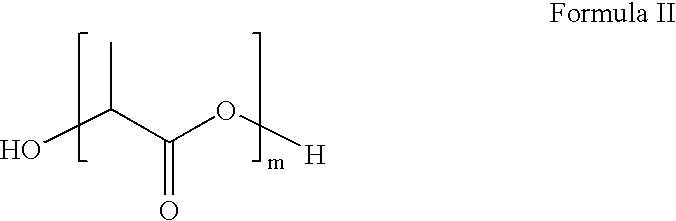
where m is an integer: 2≦m≦75. Preferably, m is an integer: 2≦m≦10. These limits correspond to number average molecular weights below about 5,400 and below about 720, respectively. The chirality of the lactide units provides a means to adjust, inter alia, degradation rates, as well as physical and mechanical properties. Poly(L-lactide), for instance, is a semi-crystalline polymer with a relatively slow hydrolysis rate. This slow hydrolysis rate could be desirable in applications of the present invention where a slower degradation of the degradable material is desired. Poly(D,L-lactide) may be a more amorphous polymer with a resultant faster hydrolysis rate. This faster rate may be suitable for other applications where a more rapid degradation may be appropriate. The stereoisomers of lactic acid may be used individually or combined in accordance with the present invention. Additionally, they may be copolymerized with, for example, glycolide or other monomers like ε-caprolactone, 1,5-dioxepan-2-one, trimethylene carbonate, or other suitable monomers to obtain polymers with different properties or degradation times. Additionally, the lactic acid stereoisomers can be modified by blending high and low molecular weight polylactide or by blending polylactide with other polyesters.
| TABLE 1 |
| CONSOLIDATION STRENGTH OF COATED PARTICLES |
| Unconfined Compressive | ||
| Strength (psi) | ||
| Resin | Temperature for 40 Hour Cure |
| Concentration | 125° F. | 175° F. | 225° F. | ||
| 1% | 134 | 134 | 291 | ||
| 2% | 878 | 1073 | 910 | ||
| 3% | 1483 | 1943 | 2050 | ||
| TABLE 2 |
| CONSOLIDATION STRENGTH OF COATED PARTICLES |
| Unconfined Compressive | ||
| Strength (psi) | ||
| Resin | Temperature for 20 Hour Cure |
| Concentration | 325° F. | 375° F. | 425° F. | ||
| 1% | 33 | 108 | 79 | ||
| 2% | 141 | 450 | 222 | ||
| 3% | 473 | 1061 | 755 | ||
Claims (18)
Priority Applications (1)
| Application Number | Priority Date | Filing Date | Title |
|---|---|---|---|
| US11/074,401 US7318473B2 (en) | 2005-03-07 | 2005-03-07 | Methods relating to maintaining the structural integrity of deviated well bores |
Applications Claiming Priority (1)
| Application Number | Priority Date | Filing Date | Title |
|---|---|---|---|
| US11/074,401 US7318473B2 (en) | 2005-03-07 | 2005-03-07 | Methods relating to maintaining the structural integrity of deviated well bores |
Publications (2)
| Publication Number | Publication Date |
|---|---|
| US20060196661A1 US20060196661A1 (en) | 2006-09-07 |
| US7318473B2 true US7318473B2 (en) | 2008-01-15 |
Family
ID=36943029
Family Applications (1)
| Application Number | Title | Priority Date | Filing Date |
|---|---|---|---|
| US11/074,401 Expired - Fee Related US7318473B2 (en) | 2005-03-07 | 2005-03-07 | Methods relating to maintaining the structural integrity of deviated well bores |
Country Status (1)
| Country | Link |
|---|---|
| US (1) | US7318473B2 (en) |
Cited By (12)
| Publication number | Priority date | Publication date | Assignee | Title |
|---|---|---|---|---|
| US20100044041A1 (en) * | 2008-08-22 | 2010-02-25 | Halliburton Energy Services, Inc. | High rate stimulation method for deep, large bore completions |
| US20100132943A1 (en) * | 2004-02-10 | 2010-06-03 | Nguyen Philip D | Resin Compositions and Methods of Using Resin Compositions to Control Proppant Flow-Back |
| US20110017458A1 (en) * | 2009-07-24 | 2011-01-27 | Halliburton Energy Services, Inc. | Method for Inducing Fracture Complexity in Hydraulically Fractured Horizontal Well Completions |
| US20110067870A1 (en) * | 2009-09-24 | 2011-03-24 | Halliburton Energy Services, Inc. | Complex fracturing using a straddle packer in a horizontal wellbore |
| US20110114312A1 (en) * | 2009-11-18 | 2011-05-19 | Todd Bradley L | Self-Diverting High-Rate Water Packs |
| US8864901B2 (en) | 2011-11-30 | 2014-10-21 | Boral Ip Holdings (Australia) Pty Limited | Calcium sulfoaluminate cement-containing inorganic polymer compositions and methods of making same |
| US8887803B2 (en) | 2012-04-09 | 2014-11-18 | Halliburton Energy Services, Inc. | Multi-interval wellbore treatment method |
| US9016376B2 (en) | 2012-08-06 | 2015-04-28 | Halliburton Energy Services, Inc. | Method and wellbore servicing apparatus for production completion of an oil and gas well |
| US9745224B2 (en) | 2011-10-07 | 2017-08-29 | Boral Ip Holdings (Australia) Pty Limited | Inorganic polymer/organic polymer composites and methods of making same |
| US9796918B2 (en) | 2013-01-30 | 2017-10-24 | Halliburton Energy Services, Inc. | Wellbore servicing fluids and methods of making and using same |
| US10000686B2 (en) | 2013-12-18 | 2018-06-19 | Covestro Llc | Methods for treating a well bore within an underground formation |
| US10385261B2 (en) | 2017-08-22 | 2019-08-20 | Covestro Llc | Coated particles, methods for their manufacture and for their use as proppants |
Families Citing this family (11)
| Publication number | Priority date | Publication date | Assignee | Title |
|---|---|---|---|---|
| US20090062157A1 (en) * | 2007-08-30 | 2009-03-05 | Halliburton Energy Services, Inc. | Methods and compositions related to the degradation of degradable polymers involving dehydrated salts and other associated methods |
| US8727001B2 (en) * | 2007-09-25 | 2014-05-20 | Halliburton Energy Services, Inc. | Methods and compositions relating to minimizing particulate migration over long intervals |
| US9945220B2 (en) * | 2008-10-08 | 2018-04-17 | The Lubrizol Corporation | Methods and system for creating high conductivity fractures |
| CN101413240A (en) * | 2008-11-29 | 2009-04-22 | 大连理工大学 | Method for melting snow and ice based on carbon fiber-glass fiber composite braiding net |
| US8853137B2 (en) | 2009-07-30 | 2014-10-07 | Halliburton Energy Services, Inc. | Increasing fracture complexity in ultra-low permeable subterranean formation using degradable particulate |
| US8697612B2 (en) | 2009-07-30 | 2014-04-15 | Halliburton Energy Services, Inc. | Increasing fracture complexity in ultra-low permeable subterranean formation using degradable particulate |
| US9023770B2 (en) * | 2009-07-30 | 2015-05-05 | Halliburton Energy Services, Inc. | Increasing fracture complexity in ultra-low permeable subterranean formation using degradable particulate |
| WO2011044612A1 (en) * | 2009-10-15 | 2011-04-21 | Eprocess Technologies Pty Ltd | Proppants |
| US9279077B2 (en) * | 2012-11-09 | 2016-03-08 | Halliburton Energy Services, Inc. | Methods of forming and placing proppant pillars into a subterranean formation |
| CN103232693B (en) * | 2013-05-21 | 2015-07-08 | 上海交通大学 | Preparation method of completely biodegradable CTS(Chitosan)/PHB(Polyhydroxybutyrate) blend |
| CN104479666B (en) * | 2014-12-11 | 2017-03-01 | 淄博嘉丰矿业有限公司 | Ultralow close ceramsite propping agent with Silicon stone as raw material and preparation method thereof |
Citations (405)
| Publication number | Priority date | Publication date | Assignee | Title |
|---|---|---|---|---|
| US2238671A (en) | 1940-02-09 | 1941-04-15 | Du Pont | Method of treating wells |
| US2703316A (en) | 1951-06-05 | 1955-03-01 | Du Pont | Polymers of high melting lactide |
| US2869642A (en) | 1954-09-14 | 1959-01-20 | Texas Co | Method of treating subsurface formations |
| US3047067A (en) | 1958-09-08 | 1962-07-31 | Jersey Prod Res Co | Sand consolidation method |
| US3123138A (en) | 1964-03-03 | robichaux | ||
| US3176768A (en) | 1964-07-27 | 1965-04-06 | California Research Corp | Sand consolidation |
| US3199590A (en) | 1963-02-25 | 1965-08-10 | Halliburton Co | Method of consolidating incompetent sands and composition therefor |
| US3272650A (en) | 1963-02-21 | 1966-09-13 | Union Carbide Corp | Process for cleaning conduits |
| US3297086A (en) | 1962-03-30 | 1967-01-10 | Exxon Production Research Co | Sand consolidation method |
| US3308885A (en) | 1965-12-28 | 1967-03-14 | Union Oil Co | Treatment of subsurface hydrocarbon fluid-bearing formations to reduce water production therefrom |
| US3316965A (en) | 1963-08-05 | 1967-05-02 | Union Oil Co | Material and process for treating subterranean formations |
| US3336980A (en) | 1967-02-09 | 1967-08-22 | Exxon Production Research Co | Sand control in wells |
| GB1107584A (en) | 1965-04-06 | 1968-03-27 | Pan American Petroleum Corp | Method of treating unconsolidated well formations |
| US3375872A (en) | 1965-12-02 | 1968-04-02 | Halliburton Co | Method of plugging or sealing formations with acidic silicic acid solution |
| US3404735A (en) | 1966-11-01 | 1968-10-08 | Halliburton Co | Sand control method |
| US3415320A (en) | 1967-02-09 | 1968-12-10 | Halliburton Co | Method of treating clay-containing earth formations |
| US3492147A (en) | 1964-10-22 | 1970-01-27 | Halliburton Co | Method of coating particulate solids with an infusible resin |
| GB1264180A (en) | 1968-12-26 | 1972-02-16 | ||
| US3659651A (en) | 1970-08-17 | 1972-05-02 | Exxon Production Research Co | Hydraulic fracturing using reinforced resin pellets |
| US3681287A (en) | 1971-03-03 | 1972-08-01 | Quaker Oats Co | Siliceous materials bound with resin containing organosilane coupling agent |
| GB1292718A (en) | 1969-02-06 | 1972-10-11 | Basf Ag | A salt or fertilizer provided with a coating to prevent dusting or caking |
| US3708013A (en) | 1971-05-03 | 1973-01-02 | Mobil Oil Corp | Method and apparatus for obtaining an improved gravel pack |
| US3709298A (en) | 1971-05-20 | 1973-01-09 | Shell Oil Co | Sand pack-aided formation sand consolidation |
| US3754598A (en) | 1971-11-08 | 1973-08-28 | Phillips Petroleum Co | Method for producing a hydrocarbon-containing formation |
| US3765804A (en) | 1951-08-13 | 1973-10-16 | Brandon O | Apparatus for producing variable high frequency vibrations in a liquid medium |
| US3768564A (en) | 1971-04-26 | 1973-10-30 | Halliburton Co | Method of fracture acidizing a well formation |
| US3784585A (en) | 1971-10-21 | 1974-01-08 | American Cyanamid Co | Water-degradable resins containing recurring,contiguous,polymerized glycolide units and process for preparing same |
| US3819525A (en) | 1972-08-21 | 1974-06-25 | Avon Prod Inc | Cosmetic cleansing preparation |
| US3828854A (en) | 1973-04-16 | 1974-08-13 | Shell Oil Co | Dissolving siliceous materials with self-acidifying liquid |
| US3842911A (en) | 1971-04-26 | 1974-10-22 | Halliburton Co | Method of fracture acidizing a well formation |
| US3854533A (en) | 1972-12-07 | 1974-12-17 | Dow Chemical Co | Method for forming a consolidated gravel pack in a subterranean formation |
| US3857444A (en) | 1972-10-06 | 1974-12-31 | Dow Chemical Co | Method for forming a consolidated gravel pack in a subterranean formation |
| US3863709A (en) | 1973-12-20 | 1975-02-04 | Mobil Oil Corp | Method of recovering geothermal energy |
| US3868998A (en) | 1974-05-15 | 1975-03-04 | Shell Oil Co | Self-acidifying treating fluid positioning process |
| US3888311A (en) | 1973-10-01 | 1975-06-10 | Exxon Production Research Co | Hydraulic fracturing method |
| US3912692A (en) | 1973-05-03 | 1975-10-14 | American Cyanamid Co | Process for polymerizing a substantially pure glycolide composition |
| US3948672A (en) | 1973-12-28 | 1976-04-06 | Texaco Inc. | Permeable cement composition and method |
| US3955993A (en) | 1973-12-28 | 1976-05-11 | Texaco Inc. | Method and composition for stabilizing incompetent oil-containing formations |
| US3960736A (en) | 1974-06-03 | 1976-06-01 | The Dow Chemical Company | Self-breaking viscous aqueous solutions and the use thereof in fracturing subterranean formations |
| US4008763A (en) | 1976-05-20 | 1977-02-22 | Atlantic Richfield Company | Well treatment method |
| US4015995A (en) | 1973-11-23 | 1977-04-05 | Chevron Research Company | Method for delaying the setting of an acid-settable liquid in a terrestrial zone |
| US4029148A (en) | 1976-09-13 | 1977-06-14 | Atlantic Richfield Company | Well fracturing method |
| US4031958A (en) | 1975-06-13 | 1977-06-28 | Union Oil Company Of California | Plugging of water-producing zones in a subterranean formation |
| US4042032A (en) | 1973-06-07 | 1977-08-16 | Halliburton Company | Methods of consolidating incompetent subterranean formations using aqueous treating solutions |
| US4070865A (en) | 1976-03-10 | 1978-01-31 | Halliburton Company | Method of consolidating porous formations using vinyl polymer sealer with divinylbenzene crosslinker |
| US4074760A (en) | 1976-11-01 | 1978-02-21 | The Dow Chemical Company | Method for forming a consolidated gravel pack |
| US4085801A (en) | 1976-11-05 | 1978-04-25 | Continental Oil Company | Control of incompetent formations with thickened acid-settable resin compositions |
| US4127173A (en) | 1977-07-28 | 1978-11-28 | Exxon Production Research Company | Method of gravel packing a well |
| US4169798A (en) | 1976-11-26 | 1979-10-02 | Celanese Corporation | Well-treating compositions |
| US4172066A (en) | 1974-06-21 | 1979-10-23 | The Dow Chemical Company | Cross-linked, water-swellable polymer microgels |
| US4245702A (en) | 1978-05-22 | 1981-01-20 | Shell Internationale Research Maatschappij B.V. | Method for forming channels of high fluid conductivity in hard acid-soluble formations |
| US4273187A (en) | 1979-07-30 | 1981-06-16 | Texaco Inc. | Petroleum recovery chemical retention prediction technique |
| US4291766A (en) | 1979-04-09 | 1981-09-29 | Shell Oil Company | Process for consolidating water-wet sands with an epoxy resin-forming solution |
| US4305463A (en) | 1979-10-31 | 1981-12-15 | Oil Trieval Corporation | Oil recovery method and apparatus |
| US4336842A (en) | 1981-01-05 | 1982-06-29 | Graham John W | Method of treating wells using resin-coated particles |
| US4352674A (en) | 1980-01-08 | 1982-10-05 | Compagnie Francaise Des Petroles | Method of tracing a well drilling mud |
| US4353806A (en) | 1980-04-03 | 1982-10-12 | Exxon Research And Engineering Company | Polymer-microemulsion complexes for the enhanced recovery of oil |
| US4387769A (en) | 1981-08-10 | 1983-06-14 | Exxon Production Research Co. | Method for reducing the permeability of subterranean formations |
| US4415805A (en) | 1981-06-18 | 1983-11-15 | Dresser Industries, Inc. | Method and apparatus for evaluating multiple stage fracturing or earth formations surrounding a borehole |
| US4439489A (en) | 1982-02-16 | 1984-03-27 | Acme Resin Corporation | Particles covered with a cured infusible thermoset film and process for their production |
| US4443347A (en) | 1981-12-03 | 1984-04-17 | Baker Oil Tools, Inc. | Proppant charge and method |
| US4460052A (en) | 1981-08-10 | 1984-07-17 | Judith Gockel | Prevention of lost circulation of drilling muds |
| US4470915A (en) | 1982-09-27 | 1984-09-11 | Halliburton Company | Method and compositions for fracturing subterranean formations |
| US4493875A (en) | 1983-12-09 | 1985-01-15 | Minnesota Mining And Manufacturing Company | Proppant for well fractures and method of making same |
| US4494605A (en) | 1981-12-11 | 1985-01-22 | Texaco Inc. | Sand control employing halogenated, oil soluble hydrocarbons |
| US4498995A (en) | 1981-08-10 | 1985-02-12 | Judith Gockel | Lost circulation drilling fluid |
| US4501328A (en) | 1983-03-14 | 1985-02-26 | Mobil Oil Corporation | Method of consolidation of oil bearing sands |
| US4526695A (en) | 1981-08-10 | 1985-07-02 | Exxon Production Research Co. | Composition for reducing the permeability of subterranean formations |
| US4527627A (en) | 1983-07-28 | 1985-07-09 | Santrol Products, Inc. | Method of acidizing propped fractures |
| US4541489A (en) | 1984-03-19 | 1985-09-17 | Phillips Petroleum Company | Method of removing flow-restricting materials from wells |
| US4546012A (en) | 1984-04-26 | 1985-10-08 | Carbomedics, Inc. | Level control for a fluidized bed |
| US4553596A (en) | 1982-10-27 | 1985-11-19 | Santrol Products, Inc. | Well completion technique |
| US4564459A (en) | 1981-12-03 | 1986-01-14 | Baker Oil Tools, Inc. | Proppant charge and method |
| US4572803A (en) | 1979-08-31 | 1986-02-25 | Asahi Dow Limited | Organic rare-earth salt phosphor |
| US4649998A (en) | 1986-07-02 | 1987-03-17 | Texaco Inc. | Sand consolidation method employing latex |
| US4664819A (en) | 1981-12-03 | 1987-05-12 | Baker Oil Tools, Inc. | Proppant charge and method |
| US4665988A (en) | 1986-04-04 | 1987-05-19 | Halliburton Company | Method of preparation of variable permeability fill material for use in subterranean formations |
| US4669543A (en) | 1986-05-23 | 1987-06-02 | Halliburton Company | Methods and compositions for consolidating solids in subterranean zones |
| US4675140A (en) | 1984-05-18 | 1987-06-23 | Washington University Technology Associates | Method for coating particles or liquid droplets |
| US4683954A (en) | 1986-09-05 | 1987-08-04 | Halliburton Company | Composition and method of stimulating subterranean formations |
| US4694905A (en) | 1986-05-23 | 1987-09-22 | Acme Resin Corporation | Precured coated particulate material |
| US4715967A (en) | 1985-12-27 | 1987-12-29 | E. I. Du Pont De Nemours And Company | Composition and method for temporarily reducing permeability of subterranean formations |
| US4716964A (en) | 1981-08-10 | 1988-01-05 | Exxon Production Research Company | Use of degradable ball sealers to seal casing perforations in well treatment fluid diversion |
| US4733729A (en) | 1986-09-08 | 1988-03-29 | Dowell Schlumberger Incorporated | Matched particle/liquid density well packing technique |
| US4739832A (en) | 1986-12-24 | 1988-04-26 | Mobil Oil Corporation | Method for improving high impulse fracturing |
| US4785884A (en) | 1986-05-23 | 1988-11-22 | Acme Resin Corporation | Consolidation of partially cured resin coated particulate material |
| US4787453A (en) | 1986-10-30 | 1988-11-29 | Union Oil Company Of California | Permeability stabilization in subterranean formations containing particulate matter |
| US4789105A (en) | 1986-04-18 | 1988-12-06 | Hosokawa Micron Corporation | Particulate material treating apparatus |
| US4797262A (en) | 1986-06-16 | 1989-01-10 | Shell Oil Company | Downflow fluidized catalytic cracking system |
| US4796701A (en) | 1987-07-30 | 1989-01-10 | Dowell Schlumberger Incorporated | Pyrolytic carbon coating of media improves gravel packing and fracturing capabilities |
| US4800960A (en) | 1987-12-18 | 1989-01-31 | Texaco Inc. | Consolidatable gravel pack method |
| US4809783A (en) | 1988-01-14 | 1989-03-07 | Halliburton Services | Method of dissolving organic filter cake |
| US4817721A (en) | 1987-12-14 | 1989-04-04 | Conoco Inc. | Reducing the permeability of a rock formation |
| US4829100A (en) | 1987-10-23 | 1989-05-09 | Halliburton Company | Continuously forming and transporting consolidatable resin coated particulate materials in aqueous gels |
| US4838352A (en) | 1986-11-25 | 1989-06-13 | Dowell Schlumberger Incorporated | Process for plugging subterranean formations |
| US4843118A (en) | 1986-10-01 | 1989-06-27 | Air Products And Chemicals, Inc. | Acidized fracturing fluids containing high molecular weight poly(vinylamines) for enhanced oil recovery |
| US4842072A (en) | 1988-07-25 | 1989-06-27 | Texaco Inc. | Sand consolidation methods |
| US4848467A (en) | 1988-02-16 | 1989-07-18 | Conoco Inc. | Formation fracturing process |
| US4848470A (en) | 1988-11-21 | 1989-07-18 | Acme Resin Corporation | Process for removing flow-restricting materials from wells |
| US4850430A (en) | 1987-02-04 | 1989-07-25 | Dowell Schlumberger Incorporated | Matched particle/liquid density well packing technique |
| US4886354A (en) | 1988-05-06 | 1989-12-12 | Conoco Inc. | Method and apparatus for measuring crystal formation |
| US4888240A (en) | 1984-07-02 | 1989-12-19 | Graham John W | High strength particulates |
| US4895207A (en) | 1988-12-19 | 1990-01-23 | Texaco, Inc. | Method and fluid for placing resin coated gravel or sand in a producing oil well |
| US4903770A (en) | 1988-09-01 | 1990-02-27 | Texaco Inc. | Sand consolidation methods |
| US4934456A (en) | 1989-03-29 | 1990-06-19 | Phillips Petroleum Company | Method for altering high temperature subterranean formation permeability |
| US4936385A (en) | 1989-10-30 | 1990-06-26 | Halliburton Company | Method of particulate consolidation |
| US4942186A (en) | 1987-10-23 | 1990-07-17 | Halliburton Company | Continuously forming and transporting consolidatable resin coated particulate materials in aqueous gels |
| US4957165A (en) | 1988-02-16 | 1990-09-18 | Conoco Inc. | Well treatment process |
| US4959432A (en) | 1986-05-19 | 1990-09-25 | Union Carbide Chemicals And Plastics Company Inc. | Acid viscosifier compositions |
| US4961466A (en) | 1989-01-23 | 1990-10-09 | Halliburton Company | Method for effecting controlled break in polysaccharide gels |
| US4969523A (en) | 1989-06-12 | 1990-11-13 | Dowell Schlumberger Incorporated | Method for gravel packing a well |
| US4969522A (en) | 1988-12-21 | 1990-11-13 | Mobil Oil Corporation | Polymer-coated support and its use as sand pack in enhanced oil recovery |
| US4986355A (en) | 1989-05-18 | 1991-01-22 | Conoco Inc. | Process for the preparation of fluid loss additive and gel breaker |
| US4986353A (en) | 1988-09-14 | 1991-01-22 | Conoco Inc. | Placement process for oil field chemicals |
| US4986354A (en) | 1988-09-14 | 1991-01-22 | Conoco Inc. | Composition and placement process for oil field chemicals |
| US5030603A (en) | 1988-08-02 | 1991-07-09 | Norton-Alcoa | Lightweight oil and gas well proppants |
| US5049743A (en) | 1990-01-17 | 1991-09-17 | Protechnics International, Inc. | Surface located isotope tracer injection apparatus |
| US5082056A (en) | 1990-10-16 | 1992-01-21 | Marathon Oil Company | In situ reversible crosslinked polymer gel used in hydrocarbon recovery applications |
| US5105886A (en) | 1990-10-24 | 1992-04-21 | Mobil Oil Corporation | Method for the control of solids accompanying hydrocarbon production from subterranean formations |
| US5107928A (en) | 1988-02-18 | 1992-04-28 | Hilterhaus Karl Heinz | Organomineral products from aqueous alkali metal silicate, polyisocyanate and epoxy resin |
| US5128390A (en) | 1991-01-22 | 1992-07-07 | Halliburton Company | Methods of forming consolidatable resin coated particulate materials in aqueous gels |
| US5135051A (en) | 1991-06-17 | 1992-08-04 | Facteau David M | Perforation cleaning tool |
| US5142023A (en) | 1992-01-24 | 1992-08-25 | Cargill, Incorporated | Continuous process for manufacture of lactide polymers with controlled optical purity |
| EP0510762A2 (en) | 1991-04-23 | 1992-10-28 | Unilever N.V. | Liquid cleaning products |
| US5165438A (en) | 1992-05-26 | 1992-11-24 | Facteau David M | Fluidic oscillator |
| US5173527A (en) | 1991-05-15 | 1992-12-22 | Forintek Canada Corp. | Fast cure and pre-cure resistant cross-linked phenol-formaldehyde adhesives and methods of making same |
| US5178218A (en) | 1991-06-19 | 1993-01-12 | Oryx Energy Company | Method of sand consolidation with resin |
| US5182051A (en) | 1990-01-17 | 1993-01-26 | Protechnics International, Inc. | Raioactive tracing with particles |
| EP0528595A1 (en) | 1991-08-19 | 1993-02-24 | Halliburton Company | Hardenable resin composition |
| US5199491A (en) | 1991-09-04 | 1993-04-06 | Atlantic Richfield Company | Method of using nitrile derivative for sand control |
| US5199492A (en) | 1991-09-19 | 1993-04-06 | Texaco Inc. | Sand consolidation methods |
| US5211234A (en) | 1992-01-30 | 1993-05-18 | Halliburton Company | Horizontal well completion methods |
| US5216050A (en) | 1988-08-08 | 1993-06-01 | Biopak Technology, Ltd. | Blends of polyactic acid |
| US5218038A (en) | 1991-11-14 | 1993-06-08 | Borden, Inc. | Phenolic resin coated proppants with reduced hydraulic fluid interaction |
| US5232955A (en) | 1991-12-16 | 1993-08-03 | Mol Magyar Olaj Es Gazipari Reszvenytarsasag | Process for producing a high strength artificial (cast) stone with high permeability and filter effect |
| WO1993015127A1 (en) | 1992-01-24 | 1993-08-05 | Cargill, Incorporated | Continuous process for the manufacture of lactide and lactide polymers |
| US5238068A (en) | 1992-07-01 | 1993-08-24 | Halliburton Company | Methods of fracture acidizing subterranean formations |
| US5247059A (en) | 1992-01-24 | 1993-09-21 | Cargill, Incorporated | Continuous process for the manufacture of a purified lactide from esters of lactic acid |
| US5249628A (en) | 1992-09-29 | 1993-10-05 | Halliburton Company | Horizontal well completions |
| US5256729A (en) | 1991-09-04 | 1993-10-26 | Atlantic Richfield Company | Nitrile derivative for sand control |
| US5273115A (en) | 1992-07-13 | 1993-12-28 | Gas Research Institute | Method for refracturing zones in hydrocarbon-producing wells |
| US5285849A (en) | 1991-06-21 | 1994-02-15 | Texaco Inc. | Formation treating methods |
| US5293939A (en) | 1992-07-31 | 1994-03-15 | Texaco Chemical Company | Formation treating methods |
| US5295542A (en) | 1992-10-05 | 1994-03-22 | Halliburton Company | Well gravel packing methods |
| WO1994007949A1 (en) | 1992-10-02 | 1994-04-14 | Cargill, Incorporated | Melt-stable lactide polymer composition and process for manufacture thereof |
| WO1994008090A1 (en) | 1992-10-02 | 1994-04-14 | Cargill, Incorporated | Paper having a melt-stable lactide polymer coating and process for manufacture thereof |
| WO1994008078A1 (en) | 1992-10-02 | 1994-04-14 | Cargill, Incorporated | A melt-stable lactide polymer fabric and process for manufacture thereof |
| US5321062A (en) | 1992-10-20 | 1994-06-14 | Halliburton Company | Substituted alkoxy benzene and use thereof as wetting aid for polyepoxide resins |
| US5320171A (en) | 1992-10-09 | 1994-06-14 | Halliburton Company | Method of preventing gas coning and fingering in a high temperature hydrocarbon bearing formation |
| US5325923A (en) | 1992-09-29 | 1994-07-05 | Halliburton Company | Well completions with expandable casing portions |
| US5330005A (en) | 1993-04-05 | 1994-07-19 | Dowell Schlumberger Incorporated | Control of particulate flowback in subterranean wells |
| US5332037A (en) | 1992-11-16 | 1994-07-26 | Atlantic Richfield Company | Squeeze cementing method for wells |
| US5335726A (en) | 1993-10-22 | 1994-08-09 | Halliburton Company | Water control |
| US5351754A (en) | 1989-06-21 | 1994-10-04 | N. A. Hardin 1977 Trust | Apparatus and method to cause fatigue failure of subterranean formations |
| US5359026A (en) | 1993-07-30 | 1994-10-25 | Cargill, Incorporated | Poly(lactide) copolymer and process for manufacture thereof |
| US5358051A (en) | 1993-10-22 | 1994-10-25 | Halliburton Company | Method of water control with hydroxy unsaturated carbonyls |
| US5360068A (en) | 1993-04-19 | 1994-11-01 | Mobil Oil Corporation | Formation fracturing |
| US5361856A (en) | 1992-09-29 | 1994-11-08 | Halliburton Company | Well jetting apparatus and met of modifying a well therewith |
| US5363916A (en) | 1992-12-21 | 1994-11-15 | Halliburton Company | Method of gravel packing a well |
| US5373901A (en) | 1993-07-27 | 1994-12-20 | Halliburton Company | Encapsulated breakers and method for use in treating subterranean formations |
| US5377759A (en) | 1993-05-20 | 1995-01-03 | Texaco Inc. | Formation treating methods |
| US5381864A (en) | 1993-11-12 | 1995-01-17 | Halliburton Company | Well treating methods using particulate blends |
| US5386874A (en) | 1993-11-08 | 1995-02-07 | Halliburton Company | Perphosphate viscosity breakers in well fracture fluids |
| US5388648A (en) | 1993-10-08 | 1995-02-14 | Baker Hughes Incorporated | Method and apparatus for sealing the juncture between a vertical well and one or more horizontal wells using deformable sealing means |
| US5393810A (en) | 1993-12-30 | 1995-02-28 | Halliburton Company | Method and composition for breaking crosslinked gels |
| US5396957A (en) | 1992-09-29 | 1995-03-14 | Halliburton Company | Well completions with expandable casing portions |
| EP0643196A2 (en) | 1993-09-09 | 1995-03-15 | Halliburton Company | Consolidatable particulate material and well treatment method |
| US5402846A (en) | 1993-11-15 | 1995-04-04 | Mobil Oil Corporation | Unique method of hydraulic fracturing |
| WO1995009879A1 (en) | 1993-10-07 | 1995-04-13 | Cargill, Incorporated | Continuous process for the manufacture of lactide and lactide polymers |
| US5422183A (en) | 1993-06-01 | 1995-06-06 | Santrol, Inc. | Composite and reinforced coatings on proppants and particles |
| US5423381A (en) | 1993-10-29 | 1995-06-13 | Texaco Inc. | Quick-set formation treating methods |
| US5460226A (en) | 1994-05-18 | 1995-10-24 | Shell Oil Company | Formation fracturing |
| US5464060A (en) | 1989-12-27 | 1995-11-07 | Shell Oil Company | Universal fluids for drilling and cementing wells |
| US5497830A (en) | 1995-04-06 | 1996-03-12 | Bj Services Company | Coated breaker for crosslinked acid |
| US5498280A (en) | 1994-11-14 | 1996-03-12 | Binney & Smith Inc. | Phosphorescent and fluorescent marking composition |
| US5499678A (en) | 1994-08-02 | 1996-03-19 | Halliburton Company | Coplanar angular jetting head for well perforating |
| US5501275A (en) | 1993-04-05 | 1996-03-26 | Dowell, A Division Of Schlumberger Technology Corporation | Control of particulate flowback in subterranean wells |
| US5505787A (en) | 1993-02-01 | 1996-04-09 | Total Service Co., Inc. | Method for cleaning surface of external wall of building |
| US5512071A (en) | 1993-01-21 | 1996-04-30 | Church & Dwight Co., Inc. | Water soluble blast media containing surfactant |
| US5520250A (en) | 1992-08-04 | 1996-05-28 | Technisand, Inc. | Method and process for the stabilization of resin coated particulates |
| US5522460A (en) | 1995-01-30 | 1996-06-04 | Mobil Oil Corporation | Water compatible chemical in situ and sand consolidation with furan resin |
| US5529123A (en) | 1995-04-10 | 1996-06-25 | Atlantic Richfield Company | Method for controlling fluid loss from wells into high conductivity earth formations |
| US5531274A (en) | 1994-07-29 | 1996-07-02 | Bienvenu, Jr.; Raymond L. | Lightweight proppants and their use in hydraulic fracturing |
| US5545824A (en) | 1993-09-14 | 1996-08-13 | Ppg Industries, Inc. | Curing composition for acrylic polyol coatings and coating produced therefrom |
| US5547023A (en) | 1994-09-21 | 1996-08-20 | Halliburton Company | Sand control well completion methods for poorly consolidated formations |
| US5551514A (en) | 1995-01-06 | 1996-09-03 | Dowell, A Division Of Schlumberger Technology Corp. | Sand control without requiring a gravel pack screen |
| US5551513A (en) | 1995-05-12 | 1996-09-03 | Texaco Inc. | Prepacked screen |
| US5582250A (en) | 1995-11-09 | 1996-12-10 | Dowell, A Division Of Schlumberger Technology Corporation | Overbalanced perforating and fracturing process using low-density, neutrally buoyant proppant |
| US5582249A (en) | 1995-08-02 | 1996-12-10 | Halliburton Company | Control of particulate flowback in subterranean wells |
| US5588488A (en) | 1995-08-22 | 1996-12-31 | Halliburton Company | Cementing multi-lateral wells |
| US5591700A (en) | 1994-12-22 | 1997-01-07 | Halliburton Company | Fracturing fluid with encapsulated breaker |
| US5595245A (en) | 1995-08-04 | 1997-01-21 | Scott, Iii; George L. | Systems of injecting phenolic resin activator during subsurface fracture stimulation for enhanced oil recovery |
| US5604184A (en) | 1995-04-10 | 1997-02-18 | Texaco, Inc. | Chemically inert resin coated proppant system for control of proppant flowback in hydraulically fractured wells |
| US5604186A (en) | 1995-02-15 | 1997-02-18 | Halliburton Company | Encapsulated enzyme breaker and method for use in treating subterranean formations |
| US5609207A (en) | 1993-12-13 | 1997-03-11 | Halliburton Company | Epoxy resin composition and well treatment method |
| WO1997011845A1 (en) | 1995-09-28 | 1997-04-03 | Cargill, Incorporated | Compostable multilayer structures and articles prepared therefrom |
| US5620049A (en) | 1995-12-14 | 1997-04-15 | Atlantic Richfield Company | Method for increasing the production of petroleum from a subterranean formation penetrated by a wellbore |
| US5639806A (en) | 1995-03-28 | 1997-06-17 | Borden Chemical, Inc. | Bisphenol-containing resin coating articles and methods of using same |
| US5670473A (en) | 1995-06-06 | 1997-09-23 | Sunburst Chemicals, Inc. | Solid cleaning compositions based on hydrated salts |
| US5692566A (en) | 1996-01-22 | 1997-12-02 | Texaco Inc. | Formation treating method |
| US5698322A (en) | 1996-12-02 | 1997-12-16 | Kimberly-Clark Worldwide, Inc. | Multicomponent fiber |
| US5697440A (en) | 1996-01-04 | 1997-12-16 | Halliburton Energy Services, Inc. | Control of particulate flowback in subterranean wells |
| US5712314A (en) | 1996-08-09 | 1998-01-27 | Texaco Inc. | Formulation for creating a pliable resin plug |
| US5732364A (en) | 1995-01-17 | 1998-03-24 | Associated Universities, Inc. | Composition and process for the encapsulation and stabilization of radioactive, hazardous and mixed wastes |
| EP0834644A2 (en) | 1996-10-03 | 1998-04-08 | Halliburton Energy Services, Inc. | Treating subterranean formation to control particulate flowback |
| US5765642A (en) | 1996-12-23 | 1998-06-16 | Halliburton Energy Services, Inc. | Subterranean formation fracturing methods |
| US5775425A (en) | 1995-03-29 | 1998-07-07 | Halliburton Energy Services, Inc. | Control of fine particulate flowback in subterranean wells |
| EP0853186A2 (en) | 1997-01-14 | 1998-07-15 | Halliburton Energy Services, Inc. | Treatment of subterranean formation to control particulate flowback |
| US5783822A (en) | 1995-12-14 | 1998-07-21 | Halliburton Energy Services, Inc. | Traceable well cement compositions and methods |
| US5782300A (en) | 1996-11-13 | 1998-07-21 | Schlumberger Technology Corporation | Suspension and porous pack for reduction of particles in subterranean well fluids, and method for treating an underground formation |
| US5791415A (en) | 1997-03-13 | 1998-08-11 | Halliburton Energy Services, Inc. | Stimulating wells in unconsolidated formations |
| US5799734A (en) | 1996-07-18 | 1998-09-01 | Halliburton Energy Services, Inc. | Method of forming and using particulate slurries for well completion |
| US5806593A (en) | 1996-07-22 | 1998-09-15 | Texaco Inc | Method to increase sand grain coating coverage |
| US5830987A (en) | 1997-03-11 | 1998-11-03 | Hehr International Inc. | Amino-acrylate polymers and method |
| US5833000A (en) | 1995-03-29 | 1998-11-10 | Halliburton Energy Services, Inc. | Control of particulate flowback in subterranean wells |
| US5833361A (en) | 1995-09-07 | 1998-11-10 | Funk; James E. | Apparatus for the production of small spherical granules |
| US5836392A (en) | 1994-12-22 | 1998-11-17 | Halliburton Energy Services, Inc. | Oil and gas field chemicals |
| US5837656A (en) | 1994-07-21 | 1998-11-17 | Santrol, Inc. | Well treatment fluid compatible self-consolidating particles |
| US5836391A (en) | 1995-07-25 | 1998-11-17 | Alberta Oil Sands Technology & Research Authority | Wellbore sand control method |
| US5837785A (en) | 1995-07-12 | 1998-11-17 | Sanyo Chemical Industries Ltd. | Epoxy curing agent and one-component (type) epoxy resin composition |
| US5840784A (en) | 1997-05-07 | 1998-11-24 | Halliburton Energy Services, Inc. | Polymeric compositions and methods for use in low temperature well applications |
| US5849590A (en) | 1992-01-29 | 1998-12-15 | Anderson, Ii; David K. | Method of chemical tagging |
| US5864003A (en) | 1996-07-23 | 1999-01-26 | Georgia-Pacific Resins, Inc. | Thermosetting phenolic resin composition |
| US5865936A (en) | 1997-03-28 | 1999-02-02 | National Starch And Chemical Investment Holding Corporation | Rapid curing structural acrylic adhesive |
| US5873413A (en) | 1997-08-18 | 1999-02-23 | Halliburton Energy Services, Inc. | Methods of modifying subterranean strata properties |
| US5893416A (en) | 1993-11-27 | 1999-04-13 | Aea Technology Plc | Oil well treatment |
| US5893383A (en) | 1997-11-25 | 1999-04-13 | Perfclean International | Fluidic Oscillator |
| US5908073A (en) | 1997-06-26 | 1999-06-01 | Halliburton Energy Services, Inc. | Preventing well fracture proppant flow-back |
| WO1999027229A1 (en) | 1997-11-21 | 1999-06-03 | Bj Services Company | Formation treatment method using deformable particles |
| US5921317A (en) | 1997-08-14 | 1999-07-13 | Halliburton Energy Services, Inc. | Coating well proppant with hardenable resin-fiber composites |
| US5924488A (en) | 1997-06-11 | 1999-07-20 | Halliburton Energy Services, Inc. | Methods of preventing well fracture proppant flow-back |
| US5929437A (en) | 1995-08-18 | 1999-07-27 | Protechnics International, Inc. | Encapsulated radioactive tracer |
| EP0933498A1 (en) | 1998-02-03 | 1999-08-04 | Halliburton Energy Services, Inc. | Method of rapidly consolidating particulate materials in wells |
| US5934376A (en) * | 1997-10-16 | 1999-08-10 | Halliburton Energy Services, Inc. | Methods and apparatus for completing wells in unconsolidated subterranean zones |
| US5945387A (en) | 1997-05-12 | 1999-08-31 | Halliburton Energy Services, Inc. | Polymeric well completion and remedial compositions and methods |
| US5944105A (en) | 1997-11-11 | 1999-08-31 | Halliburton Energy Services, Inc. | Well stabilization methods |
| US5960880A (en) | 1996-08-27 | 1999-10-05 | Halliburton Energy Services, Inc. | Unconsolidated formation stimulation with sand filtration |
| US5960877A (en) | 1997-05-07 | 1999-10-05 | Halliburton Energy Services, Inc. | Polymeric compositions and methods for use in well applications |
| US5964291A (en) | 1995-02-28 | 1999-10-12 | Aea Technology Plc | Well treatment |
| US5977283A (en) | 1996-08-12 | 1999-11-02 | Lear Corporation | Thermosetting adhesive and method of making same |
| US5994785A (en) | 1998-05-07 | 1999-11-30 | Mitsubishi Denki Kabushiki Kaisha | Epoxy resin compositions and semiconductor devices encapsulated therewith |
| US6004400A (en) | 1997-07-09 | 1999-12-21 | Phillip W. Bishop | Carbon dioxide cleaning process |
| US6006835A (en) | 1998-02-17 | 1999-12-28 | Halliburton Energy Services, Inc. | Methods for sealing subterranean zones using foamed resin |
| USRE36466E (en) | 1995-01-06 | 1999-12-28 | Dowel | Sand control without requiring a gravel pack screen |
| US6006836A (en) | 1997-08-18 | 1999-12-28 | Halliburton Energy Services, Inc. | Methods of sealing plugs in well bores |
| US6012524A (en) | 1998-04-14 | 2000-01-11 | Halliburton Energy Services, Inc. | Remedial well bore sealing methods and compositions |
| US6016870A (en) | 1998-06-11 | 2000-01-25 | Halliburton Energy Services, Inc. | Compositions and methods for consolidating unconsolidated subterranean zones |
| US6024170A (en) | 1998-06-03 | 2000-02-15 | Halliburton Energy Services, Inc. | Methods of treating subterranean formation using borate cross-linking compositions |
| US6028534A (en) | 1997-06-02 | 2000-02-22 | Schlumberger Technology Corporation | Formation data sensing with deployed remote sensors during well drilling |
| US6028113A (en) | 1995-09-27 | 2000-02-22 | Sunburst Chemicals, Inc. | Solid sanitizers and cleaner disinfectants |
| US6047772A (en) | 1995-03-29 | 2000-04-11 | Halliburton Energy Services, Inc. | Control of particulate flowback in subterranean wells |
| US6059036A (en) | 1997-11-26 | 2000-05-09 | Halliburton Energy Services, Inc. | Methods and compositions for sealing subterranean zones |
| US6059034A (en) | 1996-11-27 | 2000-05-09 | Bj Services Company | Formation treatment method using deformable particles |
| US6059035A (en) | 1998-07-20 | 2000-05-09 | Halliburton Energy Services, Inc. | Subterranean zone sealing methods and compositions |
| US6068055A (en) | 1998-06-30 | 2000-05-30 | Halliburton Energy Services, Inc. | Well sealing compositions and methods |
| US6074739A (en) | 1995-03-01 | 2000-06-13 | Katagiri; Noboru | Colored composites exhibiting long afterglow characteristics and colored articles exhibiting long afterglow characteristics |
| US6098711A (en) | 1998-08-18 | 2000-08-08 | Halliburton Energy Services, Inc. | Compositions and methods for sealing pipe in well bores |
| US6114410A (en) | 1998-07-17 | 2000-09-05 | Technisand, Inc. | Proppant containing bondable particles and removable particles |
| US6123871A (en) | 1999-01-11 | 2000-09-26 | Carroll; Michael Lee | Photoluminescence polymers, their preparation and uses thereof |
| US6124246A (en) | 1997-11-17 | 2000-09-26 | Halliburton Energy Services, Inc. | High temperature epoxy resin compositions, additives and methods |
| US6123965A (en) | 1996-01-26 | 2000-09-26 | Brown University Research Foundation | Methods and compositions for enhancing the bioadhesive properties of polymers |
| US6130286A (en) | 1998-12-18 | 2000-10-10 | Ppg Industries Ohio, Inc. | Fast drying clear coat composition with low volatile organic content |
| US6135987A (en) | 1997-12-22 | 2000-10-24 | Kimberly-Clark Worldwide, Inc. | Synthetic fiber |
| US6140446A (en) | 1997-11-18 | 2000-10-31 | Shin-Etsu Chemical Co., Ltd. | Hydrosilylation catalysts and silicone compositions using the same |
| US6148911A (en) | 1999-03-30 | 2000-11-21 | Atlantic Richfield Company | Method of treating subterranean gas hydrate formations |
| US6152234A (en) | 1998-06-10 | 2000-11-28 | Atlantic Richfield Company | Method for strengthening a subterranean formation |
| US6162766A (en) | 1998-05-29 | 2000-12-19 | 3M Innovative Properties Company | Encapsulated breakers, compositions and methods of use |
| US6169058B1 (en) | 1997-06-05 | 2001-01-02 | Bj Services Company | Compositions and methods for hydraulic fracturing |
| US6172077B1 (en) | 1997-04-25 | 2001-01-09 | Merck Sharp & Dohme Ltd. | Spiro-azacyclic derivatives and their use as therapeutic agents |
| US6177484B1 (en) | 1997-11-03 | 2001-01-23 | Texaco Inc. | Combination catalyst/coupling agent for furan resin |
| US6176315B1 (en) | 1998-12-04 | 2001-01-23 | Halliburton Energy Services, Inc. | Preventing flow through subterranean zones |
| US6184311B1 (en) | 1990-03-26 | 2001-02-06 | Courtaulds Coatings (Holdings) Limited | Powder coating composition of semi-crystalline polyester and curing agent |
| US6187834B1 (en) | 1999-09-08 | 2001-02-13 | Dow Corning Corporation | Radiation curable silicone compositions |
| US6187839B1 (en) | 1999-03-03 | 2001-02-13 | Halliburton Energy Services, Inc. | Methods of sealing compositions and methods |
| US6189615B1 (en) | 1998-12-15 | 2001-02-20 | Marathon Oil Company | Application of a stabilized polymer gel to an alkaline treatment region for improved hydrocarbon recovery |
| US6192985B1 (en) | 1998-12-19 | 2001-02-27 | Schlumberger Technology Corporation | Fluids and techniques for maximizing fracture fluid clean-up |
| US6192986B1 (en) | 1996-09-18 | 2001-02-27 | Halliburton Energy Services, Inc. | Blocking composition for use in subterranean formation |
| US6196317B1 (en) | 1998-12-15 | 2001-03-06 | Halliburton Energy Services, Inc. | Method and compositions for reducing the permeabilities of subterranean zones |
| US6202751B1 (en) | 2000-07-28 | 2001-03-20 | Halliburton Energy Sevices, Inc. | Methods and compositions for forming permeable cement sand screens in well bores |
| US6209643B1 (en) | 1995-03-29 | 2001-04-03 | Halliburton Energy Services, Inc. | Method of controlling particulate flowback in subterranean wells and introducing treatment chemicals |
| US6209646B1 (en) | 1999-04-21 | 2001-04-03 | Halliburton Energy Services, Inc. | Controlling the release of chemical additives in well treating fluids |
| US6210471B1 (en) | 1999-02-05 | 2001-04-03 | Binney & Smith Inc. | Marking composition and method for marking dark substrates |
| US6214773B1 (en) | 1999-09-29 | 2001-04-10 | Halliburton Energy Services, Inc. | High temperature, low residue well treating fluids and methods |
| US6234251B1 (en) | 1999-02-22 | 2001-05-22 | Halliburton Energy Services, Inc. | Resilient well cement compositions and methods |
| US6238597B1 (en) | 1999-03-10 | 2001-05-29 | Korea Advanced Institute Of Science And Technology | Preparation method of anisotropic conductive adhesive for flip chip interconnection on organic substrate |
| US6241019B1 (en) | 1997-03-24 | 2001-06-05 | Pe-Tech Inc. | Enhancement of flow rates through porous media |
| US6242390B1 (en) | 1998-07-31 | 2001-06-05 | Schlumberger Technology Corporation | Cleanup additive |
| US6244344B1 (en) | 1999-02-09 | 2001-06-12 | Halliburton Energy Services, Inc. | Methods and compositions for cementing pipe strings in well bores |
| US6257335B1 (en) | 2000-03-02 | 2001-07-10 | Halliburton Energy Services, Inc. | Stimulating fluid production from unconsolidated formations |
| US6260622B1 (en) | 1997-12-24 | 2001-07-17 | Shell Oil Company | Apparatus and method of injecting treatment fluids into a formation surrounding an underground borehole |
| US6271181B1 (en) | 1999-02-04 | 2001-08-07 | Halliburton Energy Services, Inc. | Sealing subterranean zones |
| US6274650B1 (en) | 1999-05-07 | 2001-08-14 | Institute Of Microelectronics | Epoxy resin compositions for liquid encapsulation |
| US6279652B1 (en) | 1998-09-23 | 2001-08-28 | Halliburton Energy Services, Inc. | Heat insulation compositions and methods |
| US6279656B1 (en) | 1999-11-03 | 2001-08-28 | Santrol, Inc. | Downhole chemical delivery system for oil and gas wells |
| US6283214B1 (en) | 1999-05-27 | 2001-09-04 | Schlumberger Technology Corp. | Optimum perforation design and technique to minimize sand intrusion |
| US6302207B1 (en) | 2000-02-15 | 2001-10-16 | Halliburton Energy Services, Inc. | Methods of completing unconsolidated subterranean producing zones |
| US6306998B1 (en) | 1999-02-26 | 2001-10-23 | Shin-Etsu Chemical Co., Ltd. | Room temperature fast curable composition |
| WO2001081914A1 (en) | 2000-04-26 | 2001-11-01 | Sinvent As | Reservoir monitoring |
| US6311773B1 (en) | 2000-01-28 | 2001-11-06 | Halliburton Energy Services, Inc. | Resin composition and methods of consolidating particulate solids in wells with or without closure pressure |
| WO2001087797A1 (en) | 2000-05-15 | 2001-11-22 | Services Petroliers Schlumberger (Sps) | Permeable cements |
| US6323307B1 (en) | 1988-08-08 | 2001-11-27 | Cargill Dow Polymers, Llc | Degradation control of environmentally degradable disposable materials |
| US6321841B1 (en) | 2001-02-21 | 2001-11-27 | Halliburton Energy Services, Inc. | Methods of sealing pipe strings in disposal wells |
| US6328106B1 (en) | 1999-02-04 | 2001-12-11 | Halliburton Energy Services, Inc. | Sealing subterranean zones |
| US6330916B1 (en) | 1996-11-27 | 2001-12-18 | Bj Services Company | Formation treatment method using deformable particles |
| WO2002012674A1 (en) | 2000-08-07 | 2002-02-14 | T R Oil Services Limited | Method for delivering chemicals to an oil or gas well |
| US6357527B1 (en) | 2000-05-05 | 2002-03-19 | Halliburton Energy Services, Inc. | Encapsulated breakers and method for use in treating subterranean formations |
| US6364018B1 (en) | 1996-11-27 | 2002-04-02 | Bj Services Company | Lightweight methods and compositions for well treating |
| US6367549B1 (en) | 2001-09-21 | 2002-04-09 | Halliburton Energy Services, Inc. | Methods and ultra-low density sealing compositions for sealing pipe in well bores |
| US6367165B1 (en) | 1999-02-03 | 2002-04-09 | Huettlin Herbert | Device for treating particulate product |
| US6372678B1 (en) | 2000-09-28 | 2002-04-16 | Fairmount Minerals, Ltd | Proppant composition for gas and oil well fracturing |
| US20020043370A1 (en) | 2000-09-12 | 2002-04-18 | Bobby Poe | Evaluation of reservoir and hydraulic fracture properties in multilayer commingled reservoirs using commingled reservoir production data and production logging information |
| US6376571B1 (en) | 1997-03-07 | 2002-04-23 | Dsm N.V. | Radiation-curable composition having high cure speed |
| US20020048676A1 (en) | 1998-07-22 | 2002-04-25 | Mcdaniel Robert R. | Low density composite proppant, filtration media, gravel packing media, and sports field media, and methods for making and using same |
| US6387986B1 (en) | 1999-06-24 | 2002-05-14 | Ahmad Moradi-Araghi | Compositions and processes for oil field applications |
| US6390195B1 (en) | 2000-07-28 | 2002-05-21 | Halliburton Energy Service,S Inc. | Methods and compositions for forming permeable cement sand screens in well bores |
| US20020070020A1 (en) | 2000-12-08 | 2002-06-13 | Nguyen Philip D. | Completing wells in unconsolidated formations |
| US6406789B1 (en) | 1998-07-22 | 2002-06-18 | Borden Chemical, Inc. | Composite proppant, composite filtration media and methods for making and using same |
| US6408943B1 (en) | 2000-07-17 | 2002-06-25 | Halliburton Energy Services, Inc. | Method and apparatus for placing and interrogating downhole sensors |
| US6422314B1 (en) | 2000-08-01 | 2002-07-23 | Halliburton Energy Services, Inc. | Well drilling and servicing fluids and methods of removing filter cake deposited thereby |
| US6439309B1 (en) | 2000-12-13 | 2002-08-27 | Bj Services Company | Compositions and methods for controlling particulate movement in wellbores and subterranean formations |
| US6440255B1 (en) | 1998-11-24 | 2002-08-27 | Wacker-Chemie Gmbh | Process for producing fast curing molding compounds bonded with phenolic resin |
| US6439310B1 (en) | 2000-09-15 | 2002-08-27 | Scott, Iii George L. | Real-time reservoir fracturing process |
| US6446727B1 (en) | 1998-11-12 | 2002-09-10 | Sclumberger Technology Corporation | Process for hydraulically fracturing oil and gas wells |
| US6450260B1 (en) | 2000-07-07 | 2002-09-17 | Schlumberger Technology Corporation | Sand consolidation with flexible gel system |
| US6454003B1 (en) | 2000-06-14 | 2002-09-24 | Ondeo Nalco Energy Services, L.P. | Composition and method for recovering hydrocarbon fluids from a subterranean reservoir |
| US6485947B1 (en) | 1999-05-21 | 2002-11-26 | Cargill Dow Polymers, Llc | Production of lactate using crabtree negative organisms in varying culture conditions |
| US6488091B1 (en) | 2001-06-11 | 2002-12-03 | Halliburton Energy Services, Inc. | Subterranean formation treating fluid concentrates, treating fluids and methods |
| US6488763B2 (en) | 1997-08-15 | 2002-12-03 | Halliburton Energy Services, Inc. | Light weight high temperature well cement compositions and methods |
| US6494263B2 (en) | 2000-08-01 | 2002-12-17 | Halliburton Energy Services, Inc. | Well drilling and servicing fluids and methods of removing filter cake deposited thereby |
| US20030006036A1 (en) | 2001-05-23 | 2003-01-09 | Core Laboratories Global N.V. | Method for determining the extent of recovery of materials injected into oil wells during oil and gas exploration and production |
| US6508305B1 (en) | 1999-09-16 | 2003-01-21 | Bj Services Company | Compositions and methods for cementing using elastic particles |
| US6528157B1 (en) | 1995-11-01 | 2003-03-04 | Borden Chemical, Inc. | Proppants with fiber reinforced resin coatings |
| US6527051B1 (en) | 2000-05-05 | 2003-03-04 | Halliburton Energy Services, Inc. | Encapsulated chemicals for use in controlled time release applications and methods |
| US6531427B1 (en) | 1993-11-18 | 2003-03-11 | Halliburton Energy Services, Inc. | Reducing aluminum compound precipitation following subterranean formation acidizing |
| US6538576B1 (en) | 1999-04-23 | 2003-03-25 | Halliburton Energy Services, Inc. | Self-contained downhole sensor and method of placing and interrogating same |
| US20030060374A1 (en) | 2001-09-26 | 2003-03-27 | Cooke Claude E. | Method and materials for hydraulic fracturing of wells |
| US6543545B1 (en) | 2000-10-27 | 2003-04-08 | Halliburton Energy Services, Inc. | Expandable sand control device and specialized completion system and method |
| US6552333B1 (en) | 2000-08-16 | 2003-04-22 | Halliburton Energy Services, Inc. | Apparatus and methods for determining gravel pack quality |
| CA2063877C (en) | 1991-03-28 | 2003-05-13 | Thomas Paul Lockhart | Aqueous gellable composition with delayed gelling time |
| US6569814B1 (en) | 1998-12-31 | 2003-05-27 | Schlumberger Technology Corporation | Fluids and techniques for hydrocarbon well completion |
| US6575243B2 (en) * | 2001-04-16 | 2003-06-10 | Schlumberger Technology Corporation | Zonal isolation tool with same trip pressure test |
| US20030114314A1 (en) | 2001-12-19 | 2003-06-19 | Ballard David A. | Internal breaker |
| EP1326003A1 (en) | 2002-01-08 | 2003-07-09 | Halliburton Energy Services, Inc. | Resin-coated proppant for subterranean fractures |
| US20030130133A1 (en) | 1999-01-07 | 2003-07-10 | Vollmer Daniel Patrick | Well treatment fluid |
| US6599863B1 (en) | 1999-02-18 | 2003-07-29 | Schlumberger Technology Corporation | Fracturing process and composition |
| US20030148893A1 (en) | 2001-11-09 | 2003-08-07 | Lunghofer Eugene P. | Composite silica proppant material |
| US6608162B1 (en) | 2002-03-15 | 2003-08-19 | Borden Chemical, Inc. | Spray-dried phenol formaldehyde resins |
| US6616320B2 (en) | 2000-12-19 | 2003-09-09 | Wenger Manufacturing, Inc. | Combined blending and pumping apparatus |
| US6620857B2 (en) | 1996-07-02 | 2003-09-16 | Ciba Specialty Chemicals Corporation | Process for curing a polymerizable composition |
| US6626241B2 (en) | 2001-12-06 | 2003-09-30 | Halliburton Energy Services, Inc. | Method of frac packing through existing gravel packed screens |
| US20030186820A1 (en) | 2002-03-26 | 2003-10-02 | Andre Thesing | Proppant flowback control using elastomeric component |
| US20030188766A1 (en) | 2002-04-05 | 2003-10-09 | Souvik Banerjee | Liquid-assisted cryogenic cleaning |
| US20030188872A1 (en) | 2002-01-08 | 2003-10-09 | Nguyen Philip D. | Methods and compositions for consolidating proppant in subterranean fractures |
| US6632527B1 (en) * | 1998-07-22 | 2003-10-14 | Borden Chemical, Inc. | Composite proppant, composite filtration media and methods for making and using same |
| US6632892B2 (en) | 2001-08-21 | 2003-10-14 | General Electric Company | Composition comprising silicone epoxy resin, hydroxyl compound, anhydride and curing catalyst |
| US20030196805A1 (en) | 2002-04-19 | 2003-10-23 | Boney Curtis L. | Conductive proppant and method of hydraulic fracturing using the same |
| US6642309B2 (en) | 2001-08-14 | 2003-11-04 | Kaneka Corporation | Curable resin composition |
| US20030205376A1 (en) | 2002-04-19 | 2003-11-06 | Schlumberger Technology Corporation | Means and Method for Assessing the Geometry of a Subterranean Fracture During or After a Hydraulic Fracturing Treatment |
| EP1362978A1 (en) | 2002-05-17 | 2003-11-19 | Resolution Research Nederland B.V. | System for treating an underground formation |
| US6659179B2 (en) | 2001-05-18 | 2003-12-09 | Halliburton Energy Serv Inc | Method of controlling proppant flowback in a well |
| US6664343B2 (en) | 2000-06-12 | 2003-12-16 | Mitsui Chemicals, Inc. | Phenolic resin composition |
| US20030230408A1 (en) | 2002-06-12 | 2003-12-18 | Andrew Acock | Method of completing a well in an unconsolidated formation |
| US6667279B1 (en) | 1996-11-13 | 2003-12-23 | Wallace, Inc. | Method and composition for forming water impermeable barrier |
| US20030234103A1 (en) | 2002-06-20 | 2003-12-25 | Jesse Lee | Method for treating subterranean formation |
| US6669771B2 (en) | 1999-12-08 | 2003-12-30 | National Institute Of Advanced Industrial Science And Technology | Biodegradable resin compositions |
| US20040000402A1 (en) | 2002-06-26 | 2004-01-01 | Nguyen Philip D. | Methods of consolidating proppant and controlling fines in wells |
| US20040014608A1 (en) | 2002-07-19 | 2004-01-22 | Nguyen Philip D. | Methods of preventing the flow-back of particulates deposited in subterranean formations |
| US20040014607A1 (en) | 2002-07-16 | 2004-01-22 | Sinclair A. Richard | Downhole chemical delivery system for oil and gas wells |
| US6681856B1 (en) | 2003-05-16 | 2004-01-27 | Halliburton Energy Services, Inc. | Methods of cementing in subterranean zones penetrated by well bores using biodegradable dispersants |
| US6686328B1 (en) | 1998-07-17 | 2004-02-03 | The Procter & Gamble Company | Detergent tablet |
| EP1394355A1 (en) | 2002-08-28 | 2004-03-03 | Halliburton Energy Services, Inc. | Subterranean fractures containing resilient proppant packs |
| US20040040708A1 (en) | 2002-09-03 | 2004-03-04 | Stephenson Christopher John | Method of treating subterranean formations with porous ceramic particulate materials |
| US20040040706A1 (en) | 2002-08-28 | 2004-03-04 | Tetra Technologies, Inc. | Filter cake removal fluid and method |
| EP1396606A2 (en) | 2002-09-05 | 2004-03-10 | Halliburton Energy Services, Inc. | Fracturing subterranean zones |
| US6710019B1 (en) | 1998-07-30 | 2004-03-23 | Christopher Alan Sawdon | Wellbore fluid |
| US20040055747A1 (en) | 2002-09-20 | 2004-03-25 | M-I Llc. | Acid coated sand for gravel pack and filter cake clean-up |
| US6713170B1 (en) | 1998-12-09 | 2004-03-30 | Nippon Kayaku Kabushiki Kaisha | Hard coating material and film comprising the same |
| WO2004038176A1 (en) | 2002-10-28 | 2004-05-06 | Schlumberger Canada Limited | Generating acid downhole in acid fracturing |
| GB2382143B (en) | 2000-05-01 | 2004-05-26 | Schlumberger Holdings | A method for telemetering data between wellbores |
| US6745159B1 (en) | 2000-04-28 | 2004-06-01 | Halliburton Energy Services, Inc. | Process of designing screenless completions for oil or gas wells |
| US6749025B1 (en) | 1996-11-27 | 2004-06-15 | Bj Services Company | Lightweight methods and compositions for sand control |
| US20040138068A1 (en) | 2002-12-19 | 2004-07-15 | Schlumberger Technology Corporation | Method For Providing Treatment Chemicals In A Subterranean Well |
| US6763888B1 (en) | 1999-03-19 | 2004-07-20 | Cleansorb Limited | Method for treatment of underground reservoirs |
| US6766858B2 (en) | 2002-12-04 | 2004-07-27 | Halliburton Energy Services, Inc. | Method for managing the production of a well |
| US20040152602A1 (en) | 2003-01-17 | 2004-08-05 | Boles Joel Lynn | Crosslinking delaying agents for acid fluids |
| US20040149441A1 (en) | 2003-01-30 | 2004-08-05 | Nguyen Philip D. | Methods and compositions for preventing fracture proppant flowback |
| US6776236B1 (en) | 2002-10-16 | 2004-08-17 | Halliburton Energy Services, Inc. | Methods of completing wells in unconsolidated formations |
| US20040177961A1 (en) | 2003-02-12 | 2004-09-16 | Nguyen Philip D. | Methods of completing wells in unconsolidated subterranean zones |
| US20040194961A1 (en) | 2003-04-07 | 2004-10-07 | Nguyen Philip D. | Methods and compositions for stabilizing unconsolidated subterranean formations |
| US20040206499A1 (en) | 2002-09-11 | 2004-10-21 | Nguyen Philip D. | Methods of reducing or preventing particulate flow-back in wells |
| US20040211561A1 (en) | 2003-03-06 | 2004-10-28 | Nguyen Philip D. | Methods and compositions for consolidating proppant in fractures |
| US20040211559A1 (en) | 2003-04-25 | 2004-10-28 | Nguyen Philip D. | Methods and apparatus for completing unconsolidated lateral well bores |
| US20040221992A1 (en) | 2002-01-08 | 2004-11-11 | Nguyen Philip D. | Methods of coating resin and belending resin-coated proppant |
| US20040231845A1 (en) | 2003-05-15 | 2004-11-25 | Cooke Claude E. | Applications of degradable polymers in wells |
| US20040231847A1 (en) | 2003-05-23 | 2004-11-25 | Nguyen Philip D. | Methods for controlling water and particulate production |
| US20040256099A1 (en) | 2003-06-23 | 2004-12-23 | Nguyen Philip D. | Methods for enhancing treatment fluid placement in a subterranean formation |
| US20040261995A1 (en) | 2003-06-27 | 2004-12-30 | Nguyen Philip D. | Compositions and methods for improving proppant pack permeability and fracture conductivity in a subterranean well |
| US20040261997A1 (en) | 2003-06-25 | 2004-12-30 | Nguyen Philip D. | Compositions and methods for consolidating unconsolidated subterranean formations |
| US20050000731A1 (en) | 2003-07-03 | 2005-01-06 | Nguyen Philip D. | Method and apparatus for treating a productive zone while drilling |
| US20050006095A1 (en) | 2003-07-08 | 2005-01-13 | Donald Justus | Reduced-density proppants and methods of using reduced-density proppants to enhance their transport in well bores and fractures |
| US20050006096A1 (en) | 2003-07-09 | 2005-01-13 | Nguyen Philip D. | Methods of consolidating subterranean zones and compositions therefor |
| US20050006093A1 (en) | 2003-07-07 | 2005-01-13 | Nguyen Philip D. | Methods and compositions for enhancing consolidation strength of proppant in subterranean fractures |
| US6851474B2 (en) | 2003-02-06 | 2005-02-08 | Halliburton Energy Services, Inc. | Methods of preventing gravel loss in through-tubing vent-screen well completions |
| US20050034862A1 (en) | 2003-08-14 | 2005-02-17 | Nguyen Phillip D. | Methods for fracturing stimulation |
| US20050045326A1 (en) | 2003-08-26 | 2005-03-03 | Nguyen Philip D. | Production-enhancing completion methods |
Family Cites Families (1)
| Publication number | Priority date | Publication date | Assignee | Title |
|---|---|---|---|---|
| US5494178A (en) * | 1994-07-25 | 1996-02-27 | Alu Inc. | Display and decorative fixture apparatus |
-
2005
- 2005-03-07 US US11/074,401 patent/US7318473B2/en not_active Expired - Fee Related
Patent Citations (472)
| Publication number | Priority date | Publication date | Assignee | Title |
|---|---|---|---|---|
| US3123138A (en) | 1964-03-03 | robichaux | ||
| US2238671A (en) | 1940-02-09 | 1941-04-15 | Du Pont | Method of treating wells |
| US2703316A (en) | 1951-06-05 | 1955-03-01 | Du Pont | Polymers of high melting lactide |
| US3765804A (en) | 1951-08-13 | 1973-10-16 | Brandon O | Apparatus for producing variable high frequency vibrations in a liquid medium |
| US2869642A (en) | 1954-09-14 | 1959-01-20 | Texas Co | Method of treating subsurface formations |
| US3047067A (en) | 1958-09-08 | 1962-07-31 | Jersey Prod Res Co | Sand consolidation method |
| US3297086A (en) | 1962-03-30 | 1967-01-10 | Exxon Production Research Co | Sand consolidation method |
| US3272650A (en) | 1963-02-21 | 1966-09-13 | Union Carbide Corp | Process for cleaning conduits |
| US3199590A (en) | 1963-02-25 | 1965-08-10 | Halliburton Co | Method of consolidating incompetent sands and composition therefor |
| US3316965A (en) | 1963-08-05 | 1967-05-02 | Union Oil Co | Material and process for treating subterranean formations |
| US3176768A (en) | 1964-07-27 | 1965-04-06 | California Research Corp | Sand consolidation |
| US3492147A (en) | 1964-10-22 | 1970-01-27 | Halliburton Co | Method of coating particulate solids with an infusible resin |
| GB1107584A (en) | 1965-04-06 | 1968-03-27 | Pan American Petroleum Corp | Method of treating unconsolidated well formations |
| US3375872A (en) | 1965-12-02 | 1968-04-02 | Halliburton Co | Method of plugging or sealing formations with acidic silicic acid solution |
| US3308885A (en) | 1965-12-28 | 1967-03-14 | Union Oil Co | Treatment of subsurface hydrocarbon fluid-bearing formations to reduce water production therefrom |
| US3404735A (en) | 1966-11-01 | 1968-10-08 | Halliburton Co | Sand control method |
| US3336980A (en) | 1967-02-09 | 1967-08-22 | Exxon Production Research Co | Sand control in wells |
| US3415320A (en) | 1967-02-09 | 1968-12-10 | Halliburton Co | Method of treating clay-containing earth formations |
| GB1264180A (en) | 1968-12-26 | 1972-02-16 | ||
| GB1292718A (en) | 1969-02-06 | 1972-10-11 | Basf Ag | A salt or fertilizer provided with a coating to prevent dusting or caking |
| US3659651A (en) | 1970-08-17 | 1972-05-02 | Exxon Production Research Co | Hydraulic fracturing using reinforced resin pellets |
| US3681287A (en) | 1971-03-03 | 1972-08-01 | Quaker Oats Co | Siliceous materials bound with resin containing organosilane coupling agent |
| US3768564A (en) | 1971-04-26 | 1973-10-30 | Halliburton Co | Method of fracture acidizing a well formation |
| US3842911A (en) | 1971-04-26 | 1974-10-22 | Halliburton Co | Method of fracture acidizing a well formation |
| US3708013A (en) | 1971-05-03 | 1973-01-02 | Mobil Oil Corp | Method and apparatus for obtaining an improved gravel pack |
| US3709298A (en) | 1971-05-20 | 1973-01-09 | Shell Oil Co | Sand pack-aided formation sand consolidation |
| US3784585A (en) | 1971-10-21 | 1974-01-08 | American Cyanamid Co | Water-degradable resins containing recurring,contiguous,polymerized glycolide units and process for preparing same |
| US3754598A (en) | 1971-11-08 | 1973-08-28 | Phillips Petroleum Co | Method for producing a hydrocarbon-containing formation |
| US3819525A (en) | 1972-08-21 | 1974-06-25 | Avon Prod Inc | Cosmetic cleansing preparation |
| US3857444A (en) | 1972-10-06 | 1974-12-31 | Dow Chemical Co | Method for forming a consolidated gravel pack in a subterranean formation |
| US3854533A (en) | 1972-12-07 | 1974-12-17 | Dow Chemical Co | Method for forming a consolidated gravel pack in a subterranean formation |
| US3828854A (en) | 1973-04-16 | 1974-08-13 | Shell Oil Co | Dissolving siliceous materials with self-acidifying liquid |
| US3912692A (en) | 1973-05-03 | 1975-10-14 | American Cyanamid Co | Process for polymerizing a substantially pure glycolide composition |
| US4042032A (en) | 1973-06-07 | 1977-08-16 | Halliburton Company | Methods of consolidating incompetent subterranean formations using aqueous treating solutions |
| US3888311A (en) | 1973-10-01 | 1975-06-10 | Exxon Production Research Co | Hydraulic fracturing method |
| US4015995A (en) | 1973-11-23 | 1977-04-05 | Chevron Research Company | Method for delaying the setting of an acid-settable liquid in a terrestrial zone |
| US3863709A (en) | 1973-12-20 | 1975-02-04 | Mobil Oil Corp | Method of recovering geothermal energy |
| US3948672A (en) | 1973-12-28 | 1976-04-06 | Texaco Inc. | Permeable cement composition and method |
| US3955993A (en) | 1973-12-28 | 1976-05-11 | Texaco Inc. | Method and composition for stabilizing incompetent oil-containing formations |
| US3868998A (en) | 1974-05-15 | 1975-03-04 | Shell Oil Co | Self-acidifying treating fluid positioning process |
| US3960736A (en) | 1974-06-03 | 1976-06-01 | The Dow Chemical Company | Self-breaking viscous aqueous solutions and the use thereof in fracturing subterranean formations |
| US4172066A (en) | 1974-06-21 | 1979-10-23 | The Dow Chemical Company | Cross-linked, water-swellable polymer microgels |
| US4031958A (en) | 1975-06-13 | 1977-06-28 | Union Oil Company Of California | Plugging of water-producing zones in a subterranean formation |
| US4070865A (en) | 1976-03-10 | 1978-01-31 | Halliburton Company | Method of consolidating porous formations using vinyl polymer sealer with divinylbenzene crosslinker |
| US4008763A (en) | 1976-05-20 | 1977-02-22 | Atlantic Richfield Company | Well treatment method |
| US4029148A (en) | 1976-09-13 | 1977-06-14 | Atlantic Richfield Company | Well fracturing method |
| US4074760A (en) | 1976-11-01 | 1978-02-21 | The Dow Chemical Company | Method for forming a consolidated gravel pack |
| US4085801A (en) | 1976-11-05 | 1978-04-25 | Continental Oil Company | Control of incompetent formations with thickened acid-settable resin compositions |
| US4169798A (en) | 1976-11-26 | 1979-10-02 | Celanese Corporation | Well-treating compositions |
| US4127173A (en) | 1977-07-28 | 1978-11-28 | Exxon Production Research Company | Method of gravel packing a well |
| US4245702A (en) | 1978-05-22 | 1981-01-20 | Shell Internationale Research Maatschappij B.V. | Method for forming channels of high fluid conductivity in hard acid-soluble formations |
| US4291766A (en) | 1979-04-09 | 1981-09-29 | Shell Oil Company | Process for consolidating water-wet sands with an epoxy resin-forming solution |
| US4273187A (en) | 1979-07-30 | 1981-06-16 | Texaco Inc. | Petroleum recovery chemical retention prediction technique |
| US4572803A (en) | 1979-08-31 | 1986-02-25 | Asahi Dow Limited | Organic rare-earth salt phosphor |
| US4305463A (en) | 1979-10-31 | 1981-12-15 | Oil Trieval Corporation | Oil recovery method and apparatus |
| US4352674A (en) | 1980-01-08 | 1982-10-05 | Compagnie Francaise Des Petroles | Method of tracing a well drilling mud |
| US4353806A (en) | 1980-04-03 | 1982-10-12 | Exxon Research And Engineering Company | Polymer-microemulsion complexes for the enhanced recovery of oil |
| US4336842A (en) | 1981-01-05 | 1982-06-29 | Graham John W | Method of treating wells using resin-coated particles |
| US4415805A (en) | 1981-06-18 | 1983-11-15 | Dresser Industries, Inc. | Method and apparatus for evaluating multiple stage fracturing or earth formations surrounding a borehole |
| US4498995A (en) | 1981-08-10 | 1985-02-12 | Judith Gockel | Lost circulation drilling fluid |
| US4526695A (en) | 1981-08-10 | 1985-07-02 | Exxon Production Research Co. | Composition for reducing the permeability of subterranean formations |
| US4460052A (en) | 1981-08-10 | 1984-07-17 | Judith Gockel | Prevention of lost circulation of drilling muds |
| US4716964A (en) | 1981-08-10 | 1988-01-05 | Exxon Production Research Company | Use of degradable ball sealers to seal casing perforations in well treatment fluid diversion |
| US4387769A (en) | 1981-08-10 | 1983-06-14 | Exxon Production Research Co. | Method for reducing the permeability of subterranean formations |
| US4443347A (en) | 1981-12-03 | 1984-04-17 | Baker Oil Tools, Inc. | Proppant charge and method |
| US4664819A (en) | 1981-12-03 | 1987-05-12 | Baker Oil Tools, Inc. | Proppant charge and method |
| US4564459A (en) | 1981-12-03 | 1986-01-14 | Baker Oil Tools, Inc. | Proppant charge and method |
| US4494605A (en) | 1981-12-11 | 1985-01-22 | Texaco Inc. | Sand control employing halogenated, oil soluble hydrocarbons |
| US4439489A (en) | 1982-02-16 | 1984-03-27 | Acme Resin Corporation | Particles covered with a cured infusible thermoset film and process for their production |
| US4470915A (en) | 1982-09-27 | 1984-09-11 | Halliburton Company | Method and compositions for fracturing subterranean formations |
| US4553596A (en) | 1982-10-27 | 1985-11-19 | Santrol Products, Inc. | Well completion technique |
| US4501328A (en) | 1983-03-14 | 1985-02-26 | Mobil Oil Corporation | Method of consolidation of oil bearing sands |
| US4527627A (en) | 1983-07-28 | 1985-07-09 | Santrol Products, Inc. | Method of acidizing propped fractures |
| US4493875A (en) | 1983-12-09 | 1985-01-15 | Minnesota Mining And Manufacturing Company | Proppant for well fractures and method of making same |
| US4541489A (en) | 1984-03-19 | 1985-09-17 | Phillips Petroleum Company | Method of removing flow-restricting materials from wells |
| US4546012A (en) | 1984-04-26 | 1985-10-08 | Carbomedics, Inc. | Level control for a fluidized bed |
| US4675140A (en) | 1984-05-18 | 1987-06-23 | Washington University Technology Associates | Method for coating particles or liquid droplets |
| US4888240A (en) | 1984-07-02 | 1989-12-19 | Graham John W | High strength particulates |
| US4715967A (en) | 1985-12-27 | 1987-12-29 | E. I. Du Pont De Nemours And Company | Composition and method for temporarily reducing permeability of subterranean formations |
| US4665988A (en) | 1986-04-04 | 1987-05-19 | Halliburton Company | Method of preparation of variable permeability fill material for use in subterranean formations |
| US4789105A (en) | 1986-04-18 | 1988-12-06 | Hosokawa Micron Corporation | Particulate material treating apparatus |
| US4959432A (en) | 1986-05-19 | 1990-09-25 | Union Carbide Chemicals And Plastics Company Inc. | Acid viscosifier compositions |
| US4694905A (en) | 1986-05-23 | 1987-09-22 | Acme Resin Corporation | Precured coated particulate material |
| US4669543A (en) | 1986-05-23 | 1987-06-02 | Halliburton Company | Methods and compositions for consolidating solids in subterranean zones |
| US4785884A (en) | 1986-05-23 | 1988-11-22 | Acme Resin Corporation | Consolidation of partially cured resin coated particulate material |
| US4797262A (en) | 1986-06-16 | 1989-01-10 | Shell Oil Company | Downflow fluidized catalytic cracking system |
| US4649998A (en) | 1986-07-02 | 1987-03-17 | Texaco Inc. | Sand consolidation method employing latex |
| US4683954A (en) | 1986-09-05 | 1987-08-04 | Halliburton Company | Composition and method of stimulating subterranean formations |
| US4733729A (en) | 1986-09-08 | 1988-03-29 | Dowell Schlumberger Incorporated | Matched particle/liquid density well packing technique |
| US4843118A (en) | 1986-10-01 | 1989-06-27 | Air Products And Chemicals, Inc. | Acidized fracturing fluids containing high molecular weight poly(vinylamines) for enhanced oil recovery |
| US4787453A (en) | 1986-10-30 | 1988-11-29 | Union Oil Company Of California | Permeability stabilization in subterranean formations containing particulate matter |
| US4838352A (en) | 1986-11-25 | 1989-06-13 | Dowell Schlumberger Incorporated | Process for plugging subterranean formations |
| US4739832A (en) | 1986-12-24 | 1988-04-26 | Mobil Oil Corporation | Method for improving high impulse fracturing |
| US4850430A (en) | 1987-02-04 | 1989-07-25 | Dowell Schlumberger Incorporated | Matched particle/liquid density well packing technique |
| US4796701A (en) | 1987-07-30 | 1989-01-10 | Dowell Schlumberger Incorporated | Pyrolytic carbon coating of media improves gravel packing and fracturing capabilities |
| US4829100A (en) | 1987-10-23 | 1989-05-09 | Halliburton Company | Continuously forming and transporting consolidatable resin coated particulate materials in aqueous gels |
| EP0313243B1 (en) | 1987-10-23 | 1994-07-27 | Halliburton Company | Method for providing coated particulate materials suspended in aqueous gels |
| US4942186A (en) | 1987-10-23 | 1990-07-17 | Halliburton Company | Continuously forming and transporting consolidatable resin coated particulate materials in aqueous gels |
| US4817721A (en) | 1987-12-14 | 1989-04-04 | Conoco Inc. | Reducing the permeability of a rock formation |
| US4800960A (en) | 1987-12-18 | 1989-01-31 | Texaco Inc. | Consolidatable gravel pack method |
| US4809783A (en) | 1988-01-14 | 1989-03-07 | Halliburton Services | Method of dissolving organic filter cake |
| US4957165A (en) | 1988-02-16 | 1990-09-18 | Conoco Inc. | Well treatment process |
| US4848467A (en) | 1988-02-16 | 1989-07-18 | Conoco Inc. | Formation fracturing process |
| US5107928A (en) | 1988-02-18 | 1992-04-28 | Hilterhaus Karl Heinz | Organomineral products from aqueous alkali metal silicate, polyisocyanate and epoxy resin |
| US4886354A (en) | 1988-05-06 | 1989-12-12 | Conoco Inc. | Method and apparatus for measuring crystal formation |
| US4842072A (en) | 1988-07-25 | 1989-06-27 | Texaco Inc. | Sand consolidation methods |
| US5030603A (en) | 1988-08-02 | 1991-07-09 | Norton-Alcoa | Lightweight oil and gas well proppants |
| US5216050A (en) | 1988-08-08 | 1993-06-01 | Biopak Technology, Ltd. | Blends of polyactic acid |
| US6323307B1 (en) | 1988-08-08 | 2001-11-27 | Cargill Dow Polymers, Llc | Degradation control of environmentally degradable disposable materials |
| US4903770A (en) | 1988-09-01 | 1990-02-27 | Texaco Inc. | Sand consolidation methods |
| US4986354A (en) | 1988-09-14 | 1991-01-22 | Conoco Inc. | Composition and placement process for oil field chemicals |
| US4986353A (en) | 1988-09-14 | 1991-01-22 | Conoco Inc. | Placement process for oil field chemicals |
| US4848470A (en) | 1988-11-21 | 1989-07-18 | Acme Resin Corporation | Process for removing flow-restricting materials from wells |
| US4895207A (en) | 1988-12-19 | 1990-01-23 | Texaco, Inc. | Method and fluid for placing resin coated gravel or sand in a producing oil well |
| US4969522A (en) | 1988-12-21 | 1990-11-13 | Mobil Oil Corporation | Polymer-coated support and its use as sand pack in enhanced oil recovery |
| US4961466A (en) | 1989-01-23 | 1990-10-09 | Halliburton Company | Method for effecting controlled break in polysaccharide gels |
| US4934456A (en) | 1989-03-29 | 1990-06-19 | Phillips Petroleum Company | Method for altering high temperature subterranean formation permeability |
| US4986355A (en) | 1989-05-18 | 1991-01-22 | Conoco Inc. | Process for the preparation of fluid loss additive and gel breaker |
| US4969523A (en) | 1989-06-12 | 1990-11-13 | Dowell Schlumberger Incorporated | Method for gravel packing a well |
| US5351754A (en) | 1989-06-21 | 1994-10-04 | N. A. Hardin 1977 Trust | Apparatus and method to cause fatigue failure of subterranean formations |
| US4936385A (en) | 1989-10-30 | 1990-06-26 | Halliburton Company | Method of particulate consolidation |
| US5464060A (en) | 1989-12-27 | 1995-11-07 | Shell Oil Company | Universal fluids for drilling and cementing wells |
| US5049743A (en) | 1990-01-17 | 1991-09-17 | Protechnics International, Inc. | Surface located isotope tracer injection apparatus |
| US5182051A (en) | 1990-01-17 | 1993-01-26 | Protechnics International, Inc. | Raioactive tracing with particles |
| US6184311B1 (en) | 1990-03-26 | 2001-02-06 | Courtaulds Coatings (Holdings) Limited | Powder coating composition of semi-crystalline polyester and curing agent |
| US5082056A (en) | 1990-10-16 | 1992-01-21 | Marathon Oil Company | In situ reversible crosslinked polymer gel used in hydrocarbon recovery applications |
| US5105886A (en) | 1990-10-24 | 1992-04-21 | Mobil Oil Corporation | Method for the control of solids accompanying hydrocarbon production from subterranean formations |
| US5128390A (en) | 1991-01-22 | 1992-07-07 | Halliburton Company | Methods of forming consolidatable resin coated particulate materials in aqueous gels |
| CA2063877C (en) | 1991-03-28 | 2003-05-13 | Thomas Paul Lockhart | Aqueous gellable composition with delayed gelling time |
| EP0510762A2 (en) | 1991-04-23 | 1992-10-28 | Unilever N.V. | Liquid cleaning products |
| US5173527A (en) | 1991-05-15 | 1992-12-22 | Forintek Canada Corp. | Fast cure and pre-cure resistant cross-linked phenol-formaldehyde adhesives and methods of making same |
| US5135051A (en) | 1991-06-17 | 1992-08-04 | Facteau David M | Perforation cleaning tool |
| US5178218A (en) | 1991-06-19 | 1993-01-12 | Oryx Energy Company | Method of sand consolidation with resin |
| US5285849A (en) | 1991-06-21 | 1994-02-15 | Texaco Inc. | Formation treating methods |
| EP0528595A1 (en) | 1991-08-19 | 1993-02-24 | Halliburton Company | Hardenable resin composition |
| US5232961A (en) | 1991-08-19 | 1993-08-03 | Murphey Joseph R | Hardenable resin compositions and methods |
| US5199491A (en) | 1991-09-04 | 1993-04-06 | Atlantic Richfield Company | Method of using nitrile derivative for sand control |
| US5256729A (en) | 1991-09-04 | 1993-10-26 | Atlantic Richfield Company | Nitrile derivative for sand control |
| US5199492A (en) | 1991-09-19 | 1993-04-06 | Texaco Inc. | Sand consolidation methods |
| US5218038A (en) | 1991-11-14 | 1993-06-08 | Borden, Inc. | Phenolic resin coated proppants with reduced hydraulic fluid interaction |
| US5232955A (en) | 1991-12-16 | 1993-08-03 | Mol Magyar Olaj Es Gazipari Reszvenytarsasag | Process for producing a high strength artificial (cast) stone with high permeability and filter effect |
| US5247059A (en) | 1992-01-24 | 1993-09-21 | Cargill, Incorporated | Continuous process for the manufacture of a purified lactide from esters of lactic acid |
| US5142023A (en) | 1992-01-24 | 1992-08-25 | Cargill, Incorporated | Continuous process for manufacture of lactide polymers with controlled optical purity |
| US6326458B1 (en) | 1992-01-24 | 2001-12-04 | Cargill, Inc. | Continuous process for the manufacture of lactide and lactide polymers |
| WO1993015127A1 (en) | 1992-01-24 | 1993-08-05 | Cargill, Incorporated | Continuous process for the manufacture of lactide and lactide polymers |
| US5849590A (en) | 1992-01-29 | 1998-12-15 | Anderson, Ii; David K. | Method of chemical tagging |
| US5211234A (en) | 1992-01-30 | 1993-05-18 | Halliburton Company | Horizontal well completion methods |
| US5165438A (en) | 1992-05-26 | 1992-11-24 | Facteau David M | Fluidic oscillator |
| US5238068A (en) | 1992-07-01 | 1993-08-24 | Halliburton Company | Methods of fracture acidizing subterranean formations |
| US5273115A (en) | 1992-07-13 | 1993-12-28 | Gas Research Institute | Method for refracturing zones in hydrocarbon-producing wells |
| US5293939A (en) | 1992-07-31 | 1994-03-15 | Texaco Chemical Company | Formation treating methods |
| US5520250A (en) | 1992-08-04 | 1996-05-28 | Technisand, Inc. | Method and process for the stabilization of resin coated particulates |
| US5361856A (en) | 1992-09-29 | 1994-11-08 | Halliburton Company | Well jetting apparatus and met of modifying a well therewith |
| US5325923A (en) | 1992-09-29 | 1994-07-05 | Halliburton Company | Well completions with expandable casing portions |
| US5396957A (en) | 1992-09-29 | 1995-03-14 | Halliburton Company | Well completions with expandable casing portions |
| US5494103A (en) | 1992-09-29 | 1996-02-27 | Halliburton Company | Well jetting apparatus |
| US5249628A (en) | 1992-09-29 | 1993-10-05 | Halliburton Company | Horizontal well completions |
| WO1994008078A1 (en) | 1992-10-02 | 1994-04-14 | Cargill, Incorporated | A melt-stable lactide polymer fabric and process for manufacture thereof |
| US5536807A (en) | 1992-10-02 | 1996-07-16 | Cargill, Incorporated | Melt-stable semi-crystalline lactide polymer film and process for manufacture thereof |
| WO1994008090A1 (en) | 1992-10-02 | 1994-04-14 | Cargill, Incorporated | Paper having a melt-stable lactide polymer coating and process for manufacture thereof |
| WO1994007949A1 (en) | 1992-10-02 | 1994-04-14 | Cargill, Incorporated | Melt-stable lactide polymer composition and process for manufacture thereof |
| US5484881A (en) | 1992-10-02 | 1996-01-16 | Cargill, Inc. | Melt-stable amorphous lactide polymer film and process for manufacturing thereof |
| US5475080A (en) | 1992-10-02 | 1995-12-12 | Cargill, Incorporated | Paper having a melt-stable lactide polymer coating and process for manufacture thereof |
| US5295542A (en) | 1992-10-05 | 1994-03-22 | Halliburton Company | Well gravel packing methods |
| US5320171A (en) | 1992-10-09 | 1994-06-14 | Halliburton Company | Method of preventing gas coning and fingering in a high temperature hydrocarbon bearing formation |
| US5321062A (en) | 1992-10-20 | 1994-06-14 | Halliburton Company | Substituted alkoxy benzene and use thereof as wetting aid for polyepoxide resins |
| US5332037A (en) | 1992-11-16 | 1994-07-26 | Atlantic Richfield Company | Squeeze cementing method for wells |
| US5363916A (en) | 1992-12-21 | 1994-11-15 | Halliburton Company | Method of gravel packing a well |
| US5512071A (en) | 1993-01-21 | 1996-04-30 | Church & Dwight Co., Inc. | Water soluble blast media containing surfactant |
| US5505787A (en) | 1993-02-01 | 1996-04-09 | Total Service Co., Inc. | Method for cleaning surface of external wall of building |
| US5330005A (en) | 1993-04-05 | 1994-07-19 | Dowell Schlumberger Incorporated | Control of particulate flowback in subterranean wells |
| US5501275A (en) | 1993-04-05 | 1996-03-26 | Dowell, A Division Of Schlumberger Technology Corporation | Control of particulate flowback in subterranean wells |
| US5439055A (en) | 1993-04-05 | 1995-08-08 | Dowell, A Division Of Schlumberger Technology Corp. | Control of particulate flowback in subterranean wells |
| US6172011B1 (en) | 1993-04-05 | 2001-01-09 | Schlumberger Technolgy Corporation | Control of particulate flowback in subterranean wells |
| US5360068A (en) | 1993-04-19 | 1994-11-01 | Mobil Oil Corporation | Formation fracturing |
| US5377759A (en) | 1993-05-20 | 1995-01-03 | Texaco Inc. | Formation treating methods |
| US5597784A (en) | 1993-06-01 | 1997-01-28 | Santrol, Inc. | Composite and reinforced coatings on proppants and particles |
| US5422183A (en) | 1993-06-01 | 1995-06-06 | Santrol, Inc. | Composite and reinforced coatings on proppants and particles |
| US5373901A (en) | 1993-07-27 | 1994-12-20 | Halliburton Company | Encapsulated breakers and method for use in treating subterranean formations |
| US5594095A (en) | 1993-07-30 | 1997-01-14 | Cargill, Incorporated | Viscosity-modified lactide polymer composition and process for manufacture thereof |
| US5359026A (en) | 1993-07-30 | 1994-10-25 | Cargill, Incorporated | Poly(lactide) copolymer and process for manufacture thereof |
| EP0643196A2 (en) | 1993-09-09 | 1995-03-15 | Halliburton Company | Consolidatable particulate material and well treatment method |
| US5545824A (en) | 1993-09-14 | 1996-08-13 | Ppg Industries, Inc. | Curing composition for acrylic polyol coatings and coating produced therefrom |
| WO1995009879A1 (en) | 1993-10-07 | 1995-04-13 | Cargill, Incorporated | Continuous process for the manufacture of lactide and lactide polymers |
| US5388648A (en) | 1993-10-08 | 1995-02-14 | Baker Hughes Incorporated | Method and apparatus for sealing the juncture between a vertical well and one or more horizontal wells using deformable sealing means |
| US5335726A (en) | 1993-10-22 | 1994-08-09 | Halliburton Company | Water control |
| US5358051A (en) | 1993-10-22 | 1994-10-25 | Halliburton Company | Method of water control with hydroxy unsaturated carbonyls |
| US5423381A (en) | 1993-10-29 | 1995-06-13 | Texaco Inc. | Quick-set formation treating methods |
| US5386874A (en) | 1993-11-08 | 1995-02-07 | Halliburton Company | Perphosphate viscosity breakers in well fracture fluids |
| US5381864A (en) | 1993-11-12 | 1995-01-17 | Halliburton Company | Well treating methods using particulate blends |
| US5492178A (en) | 1993-11-12 | 1996-02-20 | Halliburton Company | Well treating methods and devices using particulate blends |
| US5402846A (en) | 1993-11-15 | 1995-04-04 | Mobil Oil Corporation | Unique method of hydraulic fracturing |
| US6531427B1 (en) | 1993-11-18 | 2003-03-11 | Halliburton Energy Services, Inc. | Reducing aluminum compound precipitation following subterranean formation acidizing |
| US5893416A (en) | 1993-11-27 | 1999-04-13 | Aea Technology Plc | Oil well treatment |
| US5609207A (en) | 1993-12-13 | 1997-03-11 | Halliburton Company | Epoxy resin composition and well treatment method |
| US5393810A (en) | 1993-12-30 | 1995-02-28 | Halliburton Company | Method and composition for breaking crosslinked gels |
| US5460226A (en) | 1994-05-18 | 1995-10-24 | Shell Oil Company | Formation fracturing |
| US5837656A (en) | 1994-07-21 | 1998-11-17 | Santrol, Inc. | Well treatment fluid compatible self-consolidating particles |
| US5948734A (en) | 1994-07-21 | 1999-09-07 | Sanatrol, Inc. | Well treatment fluid compatible self-consolidating particles |
| US5531274A (en) | 1994-07-29 | 1996-07-02 | Bienvenu, Jr.; Raymond L. | Lightweight proppants and their use in hydraulic fracturing |
| US5499678A (en) | 1994-08-02 | 1996-03-19 | Halliburton Company | Coplanar angular jetting head for well perforating |
| US5547023A (en) | 1994-09-21 | 1996-08-20 | Halliburton Company | Sand control well completion methods for poorly consolidated formations |
| US5498280A (en) | 1994-11-14 | 1996-03-12 | Binney & Smith Inc. | Phosphorescent and fluorescent marking composition |
| US5591700A (en) | 1994-12-22 | 1997-01-07 | Halliburton Company | Fracturing fluid with encapsulated breaker |
| US5836392A (en) | 1994-12-22 | 1998-11-17 | Halliburton Energy Services, Inc. | Oil and gas field chemicals |
| USRE36466E (en) | 1995-01-06 | 1999-12-28 | Dowel | Sand control without requiring a gravel pack screen |
| US5551514A (en) | 1995-01-06 | 1996-09-03 | Dowell, A Division Of Schlumberger Technology Corp. | Sand control without requiring a gravel pack screen |
| US5732364A (en) | 1995-01-17 | 1998-03-24 | Associated Universities, Inc. | Composition and process for the encapsulation and stabilization of radioactive, hazardous and mixed wastes |
| US5522460A (en) | 1995-01-30 | 1996-06-04 | Mobil Oil Corporation | Water compatible chemical in situ and sand consolidation with furan resin |
| US5604186A (en) | 1995-02-15 | 1997-02-18 | Halliburton Company | Encapsulated enzyme breaker and method for use in treating subterranean formations |
| US5964291A (en) | 1995-02-28 | 1999-10-12 | Aea Technology Plc | Well treatment |
| US6074739A (en) | 1995-03-01 | 2000-06-13 | Katagiri; Noboru | Colored composites exhibiting long afterglow characteristics and colored articles exhibiting long afterglow characteristics |
| US5639806A (en) | 1995-03-28 | 1997-06-17 | Borden Chemical, Inc. | Bisphenol-containing resin coating articles and methods of using same |
| US5916933A (en) | 1995-03-28 | 1999-06-29 | Borden Chemical, Inc. | Bisphenol-containing resin coating articles and methods of using same |
| US5853048A (en) | 1995-03-29 | 1998-12-29 | Halliburton Energy Services, Inc. | Control of fine particulate flowback in subterranean wells |
| US5833000A (en) | 1995-03-29 | 1998-11-10 | Halliburton Energy Services, Inc. | Control of particulate flowback in subterranean wells |
| US5775425A (en) | 1995-03-29 | 1998-07-07 | Halliburton Energy Services, Inc. | Control of fine particulate flowback in subterranean wells |
| US5871049A (en) | 1995-03-29 | 1999-02-16 | Halliburton Energy Services, Inc. | Control of fine particulate flowback in subterranean wells |
| US6047772A (en) | 1995-03-29 | 2000-04-11 | Halliburton Energy Services, Inc. | Control of particulate flowback in subterranean wells |
| US5839510A (en) | 1995-03-29 | 1998-11-24 | Halliburton Energy Services, Inc. | Control of particulate flowback in subterranean wells |
| US5787986A (en) | 1995-03-29 | 1998-08-04 | Halliburton Energy Services, Inc. | Control of particulate flowback in subterranean wells |
| US6209643B1 (en) | 1995-03-29 | 2001-04-03 | Halliburton Energy Services, Inc. | Method of controlling particulate flowback in subterranean wells and introducing treatment chemicals |
| US5497830A (en) | 1995-04-06 | 1996-03-12 | Bj Services Company | Coated breaker for crosslinked acid |
| US5529123A (en) | 1995-04-10 | 1996-06-25 | Atlantic Richfield Company | Method for controlling fluid loss from wells into high conductivity earth formations |
| US5604184A (en) | 1995-04-10 | 1997-02-18 | Texaco, Inc. | Chemically inert resin coated proppant system for control of proppant flowback in hydraulically fractured wells |
| US5551513A (en) | 1995-05-12 | 1996-09-03 | Texaco Inc. | Prepacked screen |
| US5670473A (en) | 1995-06-06 | 1997-09-23 | Sunburst Chemicals, Inc. | Solid cleaning compositions based on hydrated salts |
| US5837785A (en) | 1995-07-12 | 1998-11-17 | Sanyo Chemical Industries Ltd. | Epoxy curing agent and one-component (type) epoxy resin composition |
| US6040398A (en) | 1995-07-12 | 2000-03-21 | Sanyo Chemical Industries Ltd. | Epoxy curing agent and one-component (type) epoxy resin composition |
| US5836391A (en) | 1995-07-25 | 1998-11-17 | Alberta Oil Sands Technology & Research Authority | Wellbore sand control method |
| US5582249A (en) | 1995-08-02 | 1996-12-10 | Halliburton Company | Control of particulate flowback in subterranean wells |
| US5595245A (en) | 1995-08-04 | 1997-01-21 | Scott, Iii; George L. | Systems of injecting phenolic resin activator during subsurface fracture stimulation for enhanced oil recovery |
| US5929437A (en) | 1995-08-18 | 1999-07-27 | Protechnics International, Inc. | Encapsulated radioactive tracer |
| US5588488A (en) | 1995-08-22 | 1996-12-31 | Halliburton Company | Cementing multi-lateral wells |
| US5833361A (en) | 1995-09-07 | 1998-11-10 | Funk; James E. | Apparatus for the production of small spherical granules |
| US6028113A (en) | 1995-09-27 | 2000-02-22 | Sunburst Chemicals, Inc. | Solid sanitizers and cleaner disinfectants |
| US5849401A (en) | 1995-09-28 | 1998-12-15 | Cargill, Incorporated | Compostable multilayer structures, methods for manufacture, and articles prepared therefrom |
| WO1997011845A1 (en) | 1995-09-28 | 1997-04-03 | Cargill, Incorporated | Compostable multilayer structures and articles prepared therefrom |
| US6528157B1 (en) | 1995-11-01 | 2003-03-04 | Borden Chemical, Inc. | Proppants with fiber reinforced resin coatings |
| US5582250A (en) | 1995-11-09 | 1996-12-10 | Dowell, A Division Of Schlumberger Technology Corporation | Overbalanced perforating and fracturing process using low-density, neutrally buoyant proppant |
| US5620049A (en) | 1995-12-14 | 1997-04-15 | Atlantic Richfield Company | Method for increasing the production of petroleum from a subterranean formation penetrated by a wellbore |
| US5783822A (en) | 1995-12-14 | 1998-07-21 | Halliburton Energy Services, Inc. | Traceable well cement compositions and methods |
| US5697440A (en) | 1996-01-04 | 1997-12-16 | Halliburton Energy Services, Inc. | Control of particulate flowback in subterranean wells |
| US5692566A (en) | 1996-01-22 | 1997-12-02 | Texaco Inc. | Formation treating method |
| US6123965A (en) | 1996-01-26 | 2000-09-26 | Brown University Research Foundation | Methods and compositions for enhancing the bioadhesive properties of polymers |
| US6620857B2 (en) | 1996-07-02 | 2003-09-16 | Ciba Specialty Chemicals Corporation | Process for curing a polymerizable composition |
| US5799734A (en) | 1996-07-18 | 1998-09-01 | Halliburton Energy Services, Inc. | Method of forming and using particulate slurries for well completion |
| US5806593A (en) | 1996-07-22 | 1998-09-15 | Texaco Inc | Method to increase sand grain coating coverage |
| US5864003A (en) | 1996-07-23 | 1999-01-26 | Georgia-Pacific Resins, Inc. | Thermosetting phenolic resin composition |
| US5712314A (en) | 1996-08-09 | 1998-01-27 | Texaco Inc. | Formulation for creating a pliable resin plug |
| US5977283A (en) | 1996-08-12 | 1999-11-02 | Lear Corporation | Thermosetting adhesive and method of making same |
| US5960880A (en) | 1996-08-27 | 1999-10-05 | Halliburton Energy Services, Inc. | Unconsolidated formation stimulation with sand filtration |
| US6192986B1 (en) | 1996-09-18 | 2001-02-27 | Halliburton Energy Services, Inc. | Blocking composition for use in subterranean formation |
| EP0834644A2 (en) | 1996-10-03 | 1998-04-08 | Halliburton Energy Services, Inc. | Treating subterranean formation to control particulate flowback |
| US6667279B1 (en) | 1996-11-13 | 2003-12-23 | Wallace, Inc. | Method and composition for forming water impermeable barrier |
| US5782300A (en) | 1996-11-13 | 1998-07-21 | Schlumberger Technology Corporation | Suspension and porous pack for reduction of particles in subterranean well fluids, and method for treating an underground formation |
| US6330916B1 (en) | 1996-11-27 | 2001-12-18 | Bj Services Company | Formation treatment method using deformable particles |
| US6364018B1 (en) | 1996-11-27 | 2002-04-02 | Bj Services Company | Lightweight methods and compositions for well treating |
| US6059034A (en) | 1996-11-27 | 2000-05-09 | Bj Services Company | Formation treatment method using deformable particles |
| US6749025B1 (en) | 1996-11-27 | 2004-06-15 | Bj Services Company | Lightweight methods and compositions for sand control |
| US5698322A (en) | 1996-12-02 | 1997-12-16 | Kimberly-Clark Worldwide, Inc. | Multicomponent fiber |
| US5765642A (en) | 1996-12-23 | 1998-06-16 | Halliburton Energy Services, Inc. | Subterranean formation fracturing methods |
| EP0853186A2 (en) | 1997-01-14 | 1998-07-15 | Halliburton Energy Services, Inc. | Treatment of subterranean formation to control particulate flowback |
| US6376571B1 (en) | 1997-03-07 | 2002-04-23 | Dsm N.V. | Radiation-curable composition having high cure speed |
| US5830987A (en) | 1997-03-11 | 1998-11-03 | Hehr International Inc. | Amino-acrylate polymers and method |
| US5791415A (en) | 1997-03-13 | 1998-08-11 | Halliburton Energy Services, Inc. | Stimulating wells in unconsolidated formations |
| EP0864726A2 (en) | 1997-03-13 | 1998-09-16 | Halliburton Energy Services, Inc. | Stimulating wells in unconsolidated formations |
| US6241019B1 (en) | 1997-03-24 | 2001-06-05 | Pe-Tech Inc. | Enhancement of flow rates through porous media |
| US6405797B2 (en) | 1997-03-24 | 2002-06-18 | Pe-Tech Inc. | Enhancement of flow rates through porous media |
| US5865936A (en) | 1997-03-28 | 1999-02-02 | National Starch And Chemical Investment Holding Corporation | Rapid curing structural acrylic adhesive |
| US6172077B1 (en) | 1997-04-25 | 2001-01-09 | Merck Sharp & Dohme Ltd. | Spiro-azacyclic derivatives and their use as therapeutic agents |
| US5960877A (en) | 1997-05-07 | 1999-10-05 | Halliburton Energy Services, Inc. | Polymeric compositions and methods for use in well applications |
| US5840784A (en) | 1997-05-07 | 1998-11-24 | Halliburton Energy Services, Inc. | Polymeric compositions and methods for use in low temperature well applications |
| US5945387A (en) | 1997-05-12 | 1999-08-31 | Halliburton Energy Services, Inc. | Polymeric well completion and remedial compositions and methods |
| EP0879935A3 (en) | 1997-05-19 | 1999-02-10 | Halliburton Energy Services, Inc. | Method of controlling fine particulate flowback in subterranean wells |
| EP0879935A2 (en) | 1997-05-19 | 1998-11-25 | Halliburton Energy Services, Inc. | Method of controlling fine particulate flowback in subterranean wells |
| US6028534A (en) | 1997-06-02 | 2000-02-22 | Schlumberger Technology Corporation | Formation data sensing with deployed remote sensors during well drilling |
| US6169058B1 (en) | 1997-06-05 | 2001-01-02 | Bj Services Company | Compositions and methods for hydraulic fracturing |
| US5924488A (en) | 1997-06-11 | 1999-07-20 | Halliburton Energy Services, Inc. | Methods of preventing well fracture proppant flow-back |
| US5908073A (en) | 1997-06-26 | 1999-06-01 | Halliburton Energy Services, Inc. | Preventing well fracture proppant flow-back |
| US6004400A (en) | 1997-07-09 | 1999-12-21 | Phillip W. Bishop | Carbon dioxide cleaning process |
| US5921317A (en) | 1997-08-14 | 1999-07-13 | Halliburton Energy Services, Inc. | Coating well proppant with hardenable resin-fiber composites |
| US6488763B2 (en) | 1997-08-15 | 2002-12-03 | Halliburton Energy Services, Inc. | Light weight high temperature well cement compositions and methods |
| US5873413A (en) | 1997-08-18 | 1999-02-23 | Halliburton Energy Services, Inc. | Methods of modifying subterranean strata properties |
| US5875846A (en) | 1997-08-18 | 1999-03-02 | Halliburton Energy Services, Inc. | Methods of modifying subterranean strata properties |
| US5875845A (en) | 1997-08-18 | 1999-03-02 | Halliburton Energy Services, Inc. | Methods and compositions for sealing pipe strings in well bores |
| US5875844A (en) | 1997-08-18 | 1999-03-02 | Halliburton Energy Services, Inc. | Methods of sealing pipe strings in well bores |
| US5969006A (en) | 1997-08-18 | 1999-10-19 | Halliburton Energy Services, Inc. | Remedial well bore sealing methods |
| US5957204A (en) | 1997-08-18 | 1999-09-28 | Halliburton Energy Services, Inc. | Method of sealing conduits in lateral well bores |
| US5911282A (en) | 1997-08-18 | 1999-06-15 | Halliburton Energy Services, Inc. | Well drilling fluids containing epoxy sealants and methods |
| US6006836A (en) | 1997-08-18 | 1999-12-28 | Halliburton Energy Services, Inc. | Methods of sealing plugs in well bores |
| US5934376A (en) * | 1997-10-16 | 1999-08-10 | Halliburton Energy Services, Inc. | Methods and apparatus for completing wells in unconsolidated subterranean zones |
| US6003600A (en) | 1997-10-16 | 1999-12-21 | Halliburton Energy Services, Inc. | Methods of completing wells in unconsolidated subterranean zones |
| US6177484B1 (en) | 1997-11-03 | 2001-01-23 | Texaco Inc. | Combination catalyst/coupling agent for furan resin |
| US5944105A (en) | 1997-11-11 | 1999-08-31 | Halliburton Energy Services, Inc. | Well stabilization methods |
| US6124246A (en) | 1997-11-17 | 2000-09-26 | Halliburton Energy Services, Inc. | High temperature epoxy resin compositions, additives and methods |
| US6140446A (en) | 1997-11-18 | 2000-10-31 | Shin-Etsu Chemical Co., Ltd. | Hydrosilylation catalysts and silicone compositions using the same |
| WO1999027229A1 (en) | 1997-11-21 | 1999-06-03 | Bj Services Company | Formation treatment method using deformable particles |
| US5893383A (en) | 1997-11-25 | 1999-04-13 | Perfclean International | Fluidic Oscillator |
| US6059036A (en) | 1997-11-26 | 2000-05-09 | Halliburton Energy Services, Inc. | Methods and compositions for sealing subterranean zones |
| US6135987A (en) | 1997-12-22 | 2000-10-24 | Kimberly-Clark Worldwide, Inc. | Synthetic fiber |
| US6260622B1 (en) | 1997-12-24 | 2001-07-17 | Shell Oil Company | Apparatus and method of injecting treatment fluids into a formation surrounding an underground borehole |
| US6079492A (en) | 1998-02-02 | 2000-06-27 | Halliburton Energy Services, Inc. | Methods of rapidly consolidating particulate materials in wells |
| EP0933498A1 (en) | 1998-02-03 | 1999-08-04 | Halliburton Energy Services, Inc. | Method of rapidly consolidating particulate materials in wells |
| US6006835A (en) | 1998-02-17 | 1999-12-28 | Halliburton Energy Services, Inc. | Methods for sealing subterranean zones using foamed resin |
| US6069117A (en) | 1998-02-17 | 2000-05-30 | Halliburton Energy Services, Inc. | Foamed resin compositions for sealing subterranean zones |
| US6012524A (en) | 1998-04-14 | 2000-01-11 | Halliburton Energy Services, Inc. | Remedial well bore sealing methods and compositions |
| US5994785A (en) | 1998-05-07 | 1999-11-30 | Mitsubishi Denki Kabushiki Kaisha | Epoxy resin compositions and semiconductor devices encapsulated therewith |
| US20010016562A1 (en) | 1998-05-29 | 2001-08-23 | Muir David J. | Encapsulated breakers, compositions and methods of use |
| US6162766A (en) | 1998-05-29 | 2000-12-19 | 3M Innovative Properties Company | Encapsulated breakers, compositions and methods of use |
| US6024170A (en) | 1998-06-03 | 2000-02-15 | Halliburton Energy Services, Inc. | Methods of treating subterranean formation using borate cross-linking compositions |
| US6152234A (en) | 1998-06-10 | 2000-11-28 | Atlantic Richfield Company | Method for strengthening a subterranean formation |
| US6016870A (en) | 1998-06-11 | 2000-01-25 | Halliburton Energy Services, Inc. | Compositions and methods for consolidating unconsolidated subterranean zones |
| US6231664B1 (en) | 1998-06-30 | 2001-05-15 | Halliburton Energy Services, Inc. | Well sealing compositions and methods |
| US6068055A (en) | 1998-06-30 | 2000-05-30 | Halliburton Energy Services, Inc. | Well sealing compositions and methods |
| US6114410A (en) | 1998-07-17 | 2000-09-05 | Technisand, Inc. | Proppant containing bondable particles and removable particles |
| US6686328B1 (en) | 1998-07-17 | 2004-02-03 | The Procter & Gamble Company | Detergent tablet |
| US6328105B1 (en) | 1998-07-17 | 2001-12-11 | Technisand, Inc. | Proppant containing bondable particles and removable particles |
| US6059035A (en) | 1998-07-20 | 2000-05-09 | Halliburton Energy Services, Inc. | Subterranean zone sealing methods and compositions |
| US20020048676A1 (en) | 1998-07-22 | 2002-04-25 | Mcdaniel Robert R. | Low density composite proppant, filtration media, gravel packing media, and sports field media, and methods for making and using same |
| US6632527B1 (en) * | 1998-07-22 | 2003-10-14 | Borden Chemical, Inc. | Composite proppant, composite filtration media and methods for making and using same |
| US6406789B1 (en) | 1998-07-22 | 2002-06-18 | Borden Chemical, Inc. | Composite proppant, composite filtration media and methods for making and using same |
| US6582819B2 (en) | 1998-07-22 | 2003-06-24 | Borden Chemical, Inc. | Low density composite proppant, filtration media, gravel packing media, and sports field media, and methods for making and using same |
| US6710019B1 (en) | 1998-07-30 | 2004-03-23 | Christopher Alan Sawdon | Wellbore fluid |
| US6242390B1 (en) | 1998-07-31 | 2001-06-05 | Schlumberger Technology Corporation | Cleanup additive |
| US6098711A (en) | 1998-08-18 | 2000-08-08 | Halliburton Energy Services, Inc. | Compositions and methods for sealing pipe in well bores |
| US6279652B1 (en) | 1998-09-23 | 2001-08-28 | Halliburton Energy Services, Inc. | Heat insulation compositions and methods |
| EP1001133A1 (en) | 1998-11-09 | 2000-05-17 | Halliburton Energy Services, Inc. | Treating subterranean formation |
| US6446727B1 (en) | 1998-11-12 | 2002-09-10 | Sclumberger Technology Corporation | Process for hydraulically fracturing oil and gas wells |
| US6440255B1 (en) | 1998-11-24 | 2002-08-27 | Wacker-Chemie Gmbh | Process for producing fast curing molding compounds bonded with phenolic resin |
| US6176315B1 (en) | 1998-12-04 | 2001-01-23 | Halliburton Energy Services, Inc. | Preventing flow through subterranean zones |
| US6713170B1 (en) | 1998-12-09 | 2004-03-30 | Nippon Kayaku Kabushiki Kaisha | Hard coating material and film comprising the same |
| US6196317B1 (en) | 1998-12-15 | 2001-03-06 | Halliburton Energy Services, Inc. | Method and compositions for reducing the permeabilities of subterranean zones |
| US6189615B1 (en) | 1998-12-15 | 2001-02-20 | Marathon Oil Company | Application of a stabilized polymer gel to an alkaline treatment region for improved hydrocarbon recovery |
| US6130286A (en) | 1998-12-18 | 2000-10-10 | Ppg Industries Ohio, Inc. | Fast drying clear coat composition with low volatile organic content |
| US6192985B1 (en) | 1998-12-19 | 2001-02-27 | Schlumberger Technology Corporation | Fluids and techniques for maximizing fracture fluid clean-up |
| US6569814B1 (en) | 1998-12-31 | 2003-05-27 | Schlumberger Technology Corporation | Fluids and techniques for hydrocarbon well completion |
| US20030130133A1 (en) | 1999-01-07 | 2003-07-10 | Vollmer Daniel Patrick | Well treatment fluid |
| US6123871A (en) | 1999-01-11 | 2000-09-26 | Carroll; Michael Lee | Photoluminescence polymers, their preparation and uses thereof |
| US6367165B1 (en) | 1999-02-03 | 2002-04-09 | Huettlin Herbert | Device for treating particulate product |
| US6271181B1 (en) | 1999-02-04 | 2001-08-07 | Halliburton Energy Services, Inc. | Sealing subterranean zones |
| US6328106B1 (en) | 1999-02-04 | 2001-12-11 | Halliburton Energy Services, Inc. | Sealing subterranean zones |
| US6448206B1 (en) | 1999-02-04 | 2002-09-10 | Halliburton Energy Services, Inc. | Sealing subterranean zones |
| US6555507B2 (en) | 1999-02-04 | 2003-04-29 | Halliburton Energy Services, Inc. | Sealing subterranean zones |
| US6503870B2 (en) | 1999-02-04 | 2003-01-07 | Halliburton Energy Services, Inc. | Sealing subterranean zones |
| US6401817B1 (en) | 1999-02-04 | 2002-06-11 | Halliburton Energy Services, Inc. | Sealing subterranean zones |
| US6210471B1 (en) | 1999-02-05 | 2001-04-03 | Binney & Smith Inc. | Marking composition and method for marking dark substrates |
| US6350309B2 (en) | 1999-02-09 | 2002-02-26 | Halliburton Energy Services, Inc. | Methods and compositions for cementing pipe strings in well bores |
| US6244344B1 (en) | 1999-02-09 | 2001-06-12 | Halliburton Energy Services, Inc. | Methods and compositions for cementing pipe strings in well bores |
| US6599863B1 (en) | 1999-02-18 | 2003-07-29 | Schlumberger Technology Corporation | Fracturing process and composition |
| US6330917B2 (en) | 1999-02-22 | 2001-12-18 | Halliburton Energy Services, Inc. | Resilient well cement compositions and methods |
| US6593402B2 (en) | 1999-02-22 | 2003-07-15 | Halliburton Energy Services, Inc. | Resilient well cement compositions and methods |
| US6234251B1 (en) | 1999-02-22 | 2001-05-22 | Halliburton Energy Services, Inc. | Resilient well cement compositions and methods |
| US6306998B1 (en) | 1999-02-26 | 2001-10-23 | Shin-Etsu Chemical Co., Ltd. | Room temperature fast curable composition |
| US6187839B1 (en) | 1999-03-03 | 2001-02-13 | Halliburton Energy Services, Inc. | Methods of sealing compositions and methods |
| US6238597B1 (en) | 1999-03-10 | 2001-05-29 | Korea Advanced Institute Of Science And Technology | Preparation method of anisotropic conductive adhesive for flip chip interconnection on organic substrate |
| US6763888B1 (en) | 1999-03-19 | 2004-07-20 | Cleansorb Limited | Method for treatment of underground reservoirs |
| US6148911A (en) | 1999-03-30 | 2000-11-21 | Atlantic Richfield Company | Method of treating subterranean gas hydrate formations |
| US6209646B1 (en) | 1999-04-21 | 2001-04-03 | Halliburton Energy Services, Inc. | Controlling the release of chemical additives in well treating fluids |
| US6538576B1 (en) | 1999-04-23 | 2003-03-25 | Halliburton Energy Services, Inc. | Self-contained downhole sensor and method of placing and interrogating same |
| US6274650B1 (en) | 1999-05-07 | 2001-08-14 | Institute Of Microelectronics | Epoxy resin compositions for liquid encapsulation |
| US6485947B1 (en) | 1999-05-21 | 2002-11-26 | Cargill Dow Polymers, Llc | Production of lactate using crabtree negative organisms in varying culture conditions |
| US6283214B1 (en) | 1999-05-27 | 2001-09-04 | Schlumberger Technology Corp. | Optimum perforation design and technique to minimize sand intrusion |
| US6387986B1 (en) | 1999-06-24 | 2002-05-14 | Ahmad Moradi-Araghi | Compositions and processes for oil field applications |
| US6187834B1 (en) | 1999-09-08 | 2001-02-13 | Dow Corning Corporation | Radiation curable silicone compositions |
| US6508305B1 (en) | 1999-09-16 | 2003-01-21 | Bj Services Company | Compositions and methods for cementing using elastic particles |
| US6214773B1 (en) | 1999-09-29 | 2001-04-10 | Halliburton Energy Services, Inc. | High temperature, low residue well treating fluids and methods |
| US6279656B1 (en) | 1999-11-03 | 2001-08-28 | Santrol, Inc. | Downhole chemical delivery system for oil and gas wells |
| US6669771B2 (en) | 1999-12-08 | 2003-12-30 | National Institute Of Advanced Industrial Science And Technology | Biodegradable resin compositions |
| US6311773B1 (en) | 2000-01-28 | 2001-11-06 | Halliburton Energy Services, Inc. | Resin composition and methods of consolidating particulate solids in wells with or without closure pressure |
| US6302207B1 (en) | 2000-02-15 | 2001-10-16 | Halliburton Energy Services, Inc. | Methods of completing unconsolidated subterranean producing zones |
| US6257335B1 (en) | 2000-03-02 | 2001-07-10 | Halliburton Energy Services, Inc. | Stimulating fluid production from unconsolidated formations |
| EP1132569A2 (en) | 2000-03-06 | 2001-09-12 | Halliburton Energy Services, Inc. | Method of treating a subterranean formation |
| WO2001081914A1 (en) | 2000-04-26 | 2001-11-01 | Sinvent As | Reservoir monitoring |
| US6745159B1 (en) | 2000-04-28 | 2004-06-01 | Halliburton Energy Services, Inc. | Process of designing screenless completions for oil or gas wells |
| GB2382143B (en) | 2000-05-01 | 2004-05-26 | Schlumberger Holdings | A method for telemetering data between wellbores |
| US6357527B1 (en) | 2000-05-05 | 2002-03-19 | Halliburton Energy Services, Inc. | Encapsulated breakers and method for use in treating subterranean formations |
| US6527051B1 (en) | 2000-05-05 | 2003-03-04 | Halliburton Energy Services, Inc. | Encapsulated chemicals for use in controlled time release applications and methods |
| US6554071B1 (en) | 2000-05-05 | 2003-04-29 | Halliburton Energy Services, Inc. | Encapsulated chemicals for use in controlled time release applications and methods |
| WO2001087797A1 (en) | 2000-05-15 | 2001-11-22 | Services Petroliers Schlumberger (Sps) | Permeable cements |
| US6664343B2 (en) | 2000-06-12 | 2003-12-16 | Mitsui Chemicals, Inc. | Phenolic resin composition |
| US6454003B1 (en) | 2000-06-14 | 2002-09-24 | Ondeo Nalco Energy Services, L.P. | Composition and method for recovering hydrocarbon fluids from a subterranean reservoir |
| US6450260B1 (en) | 2000-07-07 | 2002-09-17 | Schlumberger Technology Corporation | Sand consolidation with flexible gel system |
| US6408943B1 (en) | 2000-07-17 | 2002-06-25 | Halliburton Energy Services, Inc. | Method and apparatus for placing and interrogating downhole sensors |
| US6364945B1 (en) | 2000-07-28 | 2002-04-02 | Halliburton Energy Services, Inc. | Methods and compositions for forming permeable cement sand screens in well bores |
| US6202751B1 (en) | 2000-07-28 | 2001-03-20 | Halliburton Energy Sevices, Inc. | Methods and compositions for forming permeable cement sand screens in well bores |
| US6390195B1 (en) | 2000-07-28 | 2002-05-21 | Halliburton Energy Service,S Inc. | Methods and compositions for forming permeable cement sand screens in well bores |
| US6494263B2 (en) | 2000-08-01 | 2002-12-17 | Halliburton Energy Services, Inc. | Well drilling and servicing fluids and methods of removing filter cake deposited thereby |
| US6422314B1 (en) | 2000-08-01 | 2002-07-23 | Halliburton Energy Services, Inc. | Well drilling and servicing fluids and methods of removing filter cake deposited thereby |
| WO2002012674A1 (en) | 2000-08-07 | 2002-02-14 | T R Oil Services Limited | Method for delivering chemicals to an oil or gas well |
| US6552333B1 (en) | 2000-08-16 | 2003-04-22 | Halliburton Energy Services, Inc. | Apparatus and methods for determining gravel pack quality |
| US20020043370A1 (en) | 2000-09-12 | 2002-04-18 | Bobby Poe | Evaluation of reservoir and hydraulic fracture properties in multilayer commingled reservoirs using commingled reservoir production data and production logging information |
| US6439310B1 (en) | 2000-09-15 | 2002-08-27 | Scott, Iii George L. | Real-time reservoir fracturing process |
| US6372678B1 (en) | 2000-09-28 | 2002-04-16 | Fairmount Minerals, Ltd | Proppant composition for gas and oil well fracturing |
| US6543545B1 (en) | 2000-10-27 | 2003-04-08 | Halliburton Energy Services, Inc. | Expandable sand control device and specialized completion system and method |
| US20020070020A1 (en) | 2000-12-08 | 2002-06-13 | Nguyen Philip D. | Completing wells in unconsolidated formations |
| US6439309B1 (en) | 2000-12-13 | 2002-08-27 | Bj Services Company | Compositions and methods for controlling particulate movement in wellbores and subterranean formations |
| US6648501B2 (en) | 2000-12-19 | 2003-11-18 | Wenger Manufacturing, Inc. | System for homogeneously mixing plural incoming product streams of different composition |
| US6616320B2 (en) | 2000-12-19 | 2003-09-09 | Wenger Manufacturing, Inc. | Combined blending and pumping apparatus |
| US6321841B1 (en) | 2001-02-21 | 2001-11-27 | Halliburton Energy Services, Inc. | Methods of sealing pipe strings in disposal wells |
| US6575243B2 (en) * | 2001-04-16 | 2003-06-10 | Schlumberger Technology Corporation | Zonal isolation tool with same trip pressure test |
| US6659179B2 (en) | 2001-05-18 | 2003-12-09 | Halliburton Energy Serv Inc | Method of controlling proppant flowback in a well |
| US20030006036A1 (en) | 2001-05-23 | 2003-01-09 | Core Laboratories Global N.V. | Method for determining the extent of recovery of materials injected into oil wells during oil and gas exploration and production |
| US6488091B1 (en) | 2001-06-11 | 2002-12-03 | Halliburton Energy Services, Inc. | Subterranean formation treating fluid concentrates, treating fluids and methods |
| US6642309B2 (en) | 2001-08-14 | 2003-11-04 | Kaneka Corporation | Curable resin composition |
| US6632892B2 (en) | 2001-08-21 | 2003-10-14 | General Electric Company | Composition comprising silicone epoxy resin, hydroxyl compound, anhydride and curing catalyst |
| US6367549B1 (en) | 2001-09-21 | 2002-04-09 | Halliburton Energy Services, Inc. | Methods and ultra-low density sealing compositions for sealing pipe in well bores |
| WO2003027431A3 (en) | 2001-09-26 | 2003-06-19 | Claude E Cooke Jr | Method and materials for hydraulic fracturing of wells |
| WO2003027431A2 (en) | 2001-09-26 | 2003-04-03 | Cooke Claude E Jr | Method and materials for hydraulic fracturing of wells |
| US20030060374A1 (en) | 2001-09-26 | 2003-03-27 | Cooke Claude E. | Method and materials for hydraulic fracturing of wells |
| US20030148893A1 (en) | 2001-11-09 | 2003-08-07 | Lunghofer Eugene P. | Composite silica proppant material |
| US6626241B2 (en) | 2001-12-06 | 2003-09-30 | Halliburton Energy Services, Inc. | Method of frac packing through existing gravel packed screens |
| US20030114314A1 (en) | 2001-12-19 | 2003-06-19 | Ballard David A. | Internal breaker |
| US20030188872A1 (en) | 2002-01-08 | 2003-10-09 | Nguyen Philip D. | Methods and compositions for consolidating proppant in subterranean fractures |
| EP1326003A1 (en) | 2002-01-08 | 2003-07-09 | Halliburton Energy Services, Inc. | Resin-coated proppant for subterranean fractures |
| US6729404B2 (en) | 2002-01-08 | 2004-05-04 | Halliburton Energy Services, Inc. | Methods and compositions for consolidating proppant in subterranean fractures |
| US6668926B2 (en) | 2002-01-08 | 2003-12-30 | Halliburton Energy Services, Inc. | Methods of consolidating proppant in subterranean fractures |
| US20040221992A1 (en) | 2002-01-08 | 2004-11-11 | Nguyen Philip D. | Methods of coating resin and belending resin-coated proppant |
| US6608162B1 (en) | 2002-03-15 | 2003-08-19 | Borden Chemical, Inc. | Spray-dried phenol formaldehyde resins |
| US20030186820A1 (en) | 2002-03-26 | 2003-10-02 | Andre Thesing | Proppant flowback control using elastomeric component |
| US20030188766A1 (en) | 2002-04-05 | 2003-10-09 | Souvik Banerjee | Liquid-assisted cryogenic cleaning |
| US20030205376A1 (en) | 2002-04-19 | 2003-11-06 | Schlumberger Technology Corporation | Means and Method for Assessing the Geometry of a Subterranean Fracture During or After a Hydraulic Fracturing Treatment |
| US20030196805A1 (en) | 2002-04-19 | 2003-10-23 | Boney Curtis L. | Conductive proppant and method of hydraulic fracturing using the same |
| EP1362978A1 (en) | 2002-05-17 | 2003-11-19 | Resolution Research Nederland B.V. | System for treating an underground formation |
| US20030230408A1 (en) | 2002-06-12 | 2003-12-18 | Andrew Acock | Method of completing a well in an unconsolidated formation |
| US6732800B2 (en) | 2002-06-12 | 2004-05-11 | Schlumberger Technology Corporation | Method of completing a well in an unconsolidated formation |
| US20030234103A1 (en) | 2002-06-20 | 2003-12-25 | Jesse Lee | Method for treating subterranean formation |
| US20040000402A1 (en) | 2002-06-26 | 2004-01-01 | Nguyen Philip D. | Methods of consolidating proppant and controlling fines in wells |
| US6725931B2 (en) | 2002-06-26 | 2004-04-27 | Halliburton Energy Services, Inc. | Methods of consolidating proppant and controlling fines in wells |
| US20040014607A1 (en) | 2002-07-16 | 2004-01-22 | Sinclair A. Richard | Downhole chemical delivery system for oil and gas wells |
| US20040014608A1 (en) | 2002-07-19 | 2004-01-22 | Nguyen Philip D. | Methods of preventing the flow-back of particulates deposited in subterranean formations |
| US20040040706A1 (en) | 2002-08-28 | 2004-03-04 | Tetra Technologies, Inc. | Filter cake removal fluid and method |
| US6705400B1 (en) | 2002-08-28 | 2004-03-16 | Halliburton Energy Services, Inc. | Methods and compositions for forming subterranean fractures containing resilient proppant packs |
| US20040040713A1 (en) | 2002-08-28 | 2004-03-04 | Nguyen Philip D. | Methods and compositons for forming subterranean fractures containing resilient proppant packs |
| EP1394355A1 (en) | 2002-08-28 | 2004-03-03 | Halliburton Energy Services, Inc. | Subterranean fractures containing resilient proppant packs |
| US20040040708A1 (en) | 2002-09-03 | 2004-03-04 | Stephenson Christopher John | Method of treating subterranean formations with porous ceramic particulate materials |
| US6887834B2 (en) | 2002-09-05 | 2005-05-03 | Halliburton Energy Services, Inc. | Methods and compositions for consolidating proppant in subterranean fractures |
| US20040048752A1 (en) | 2002-09-05 | 2004-03-11 | Nguyen Philip D. | Methods and compositions for consolidating proppant in subterranean fractures |
| EP1396606A2 (en) | 2002-09-05 | 2004-03-10 | Halliburton Energy Services, Inc. | Fracturing subterranean zones |
| US6832650B2 (en) | 2002-09-11 | 2004-12-21 | Halliburton Energy Services, Inc. | Methods of reducing or preventing particulate flow-back in wells |
| US20040206499A1 (en) | 2002-09-11 | 2004-10-21 | Nguyen Philip D. | Methods of reducing or preventing particulate flow-back in wells |
| US20040055747A1 (en) | 2002-09-20 | 2004-03-25 | M-I Llc. | Acid coated sand for gravel pack and filter cake clean-up |
| EP1403466A2 (en) | 2002-09-30 | 2004-03-31 | Halliburton Energy Services, Inc. | Consolidating proppant and controlling fines in wells |
| US6776236B1 (en) | 2002-10-16 | 2004-08-17 | Halliburton Energy Services, Inc. | Methods of completing wells in unconsolidated formations |
| US20040106525A1 (en) | 2002-10-28 | 2004-06-03 | Schlumberger Technology Corp. | Self-Destructing Filter Cake |
| WO2004037946A1 (en) | 2002-10-28 | 2004-05-06 | Schlumberger Canada Limited | Self-destructing filter cake |
| US20040152601A1 (en) | 2002-10-28 | 2004-08-05 | Schlumberger Technology Corporation | Generating Acid Downhole in Acid Fracturing |
| WO2004038176A1 (en) | 2002-10-28 | 2004-05-06 | Schlumberger Canada Limited | Generating acid downhole in acid fracturing |
| US6766858B2 (en) | 2002-12-04 | 2004-07-27 | Halliburton Energy Services, Inc. | Method for managing the production of a well |
| US20040138068A1 (en) | 2002-12-19 | 2004-07-15 | Schlumberger Technology Corporation | Method For Providing Treatment Chemicals In A Subterranean Well |
| US20040152602A1 (en) | 2003-01-17 | 2004-08-05 | Boles Joel Lynn | Crosslinking delaying agents for acid fluids |
| US20040149441A1 (en) | 2003-01-30 | 2004-08-05 | Nguyen Philip D. | Methods and compositions for preventing fracture proppant flowback |
| US6851474B2 (en) | 2003-02-06 | 2005-02-08 | Halliburton Energy Services, Inc. | Methods of preventing gravel loss in through-tubing vent-screen well completions |
| US20040177961A1 (en) | 2003-02-12 | 2004-09-16 | Nguyen Philip D. | Methods of completing wells in unconsolidated subterranean zones |
| US20040211561A1 (en) | 2003-03-06 | 2004-10-28 | Nguyen Philip D. | Methods and compositions for consolidating proppant in fractures |
| EP1464789A1 (en) | 2003-04-04 | 2004-10-06 | Halliburton Energy Services, Inc. | Methods and compositions for consolidating proppant in subterranean fractures |
| US20040194961A1 (en) | 2003-04-07 | 2004-10-07 | Nguyen Philip D. | Methods and compositions for stabilizing unconsolidated subterranean formations |
| US20040211559A1 (en) | 2003-04-25 | 2004-10-28 | Nguyen Philip D. | Methods and apparatus for completing unconsolidated lateral well bores |
| US20040231845A1 (en) | 2003-05-15 | 2004-11-25 | Cooke Claude E. | Applications of degradable polymers in wells |
| US6681856B1 (en) | 2003-05-16 | 2004-01-27 | Halliburton Energy Services, Inc. | Methods of cementing in subterranean zones penetrated by well bores using biodegradable dispersants |
| US20040231847A1 (en) | 2003-05-23 | 2004-11-25 | Nguyen Philip D. | Methods for controlling water and particulate production |
| US6978836B2 (en) | 2003-05-23 | 2005-12-27 | Halliburton Energy Services, Inc. | Methods for controlling water and particulate production |
| US20040256099A1 (en) | 2003-06-23 | 2004-12-23 | Nguyen Philip D. | Methods for enhancing treatment fluid placement in a subterranean formation |
| US20040261997A1 (en) | 2003-06-25 | 2004-12-30 | Nguyen Philip D. | Compositions and methods for consolidating unconsolidated subterranean formations |
| US20040261995A1 (en) | 2003-06-27 | 2004-12-30 | Nguyen Philip D. | Compositions and methods for improving proppant pack permeability and fracture conductivity in a subterranean well |
| US20050000731A1 (en) | 2003-07-03 | 2005-01-06 | Nguyen Philip D. | Method and apparatus for treating a productive zone while drilling |
| US20050006093A1 (en) | 2003-07-07 | 2005-01-13 | Nguyen Philip D. | Methods and compositions for enhancing consolidation strength of proppant in subterranean fractures |
| US20050006095A1 (en) | 2003-07-08 | 2005-01-13 | Donald Justus | Reduced-density proppants and methods of using reduced-density proppants to enhance their transport in well bores and fractures |
| US20050006096A1 (en) | 2003-07-09 | 2005-01-13 | Nguyen Philip D. | Methods of consolidating subterranean zones and compositions therefor |
| US20050034862A1 (en) | 2003-08-14 | 2005-02-17 | Nguyen Phillip D. | Methods for fracturing stimulation |
| US20050045326A1 (en) | 2003-08-26 | 2005-03-03 | Nguyen Philip D. | Production-enhancing completion methods |
| WO2005021928A2 (en) | 2003-08-26 | 2005-03-10 | Halliburton Energy Services, Inc. | Production-enhancing completion methods |
Non-Patent Citations (94)
| Title |
|---|
| Advances in Polymer Science, vol. 157, "Degradable Aliphatic Polyesters"edited by A.-C. Alberston, 2001. |
| Albertsson, et al, Aliphatic Polyesters: Synthesis, Properties and Applications, Advances in Polymer Science, vol. 157, Degradable Aliphatic Polyesters, 2002. |
| Cantu, et al, Laboratory and Field Evaluation of a Combined Fluid-Loss-Control Additive and Gel Breaker for Fracturing Fluids, SPE 18211, Society of Petroleum Engineers, 1990. |
| Cantu, et al, Laboratory and Field Evaluation of a Combined Fluid-Loss-Control Additive and Gel Breaker for Fracturing Fluids, SPE 18211, Society of Petroleum Engineers, 1990. |
| CDX Gas, CDX Solution, 2003, CDX, LLC, available @ www.cdxgas.com/solution.html, printed pp.1-2. |
| CDX Gas, What is Coalbed Methane?, 2003, CDX, LLC, available @ www.cdxgas.com/what.html, printed p. 1. |
| Chelating Agents, Encyclopedia of Chemical Technology, vol. 5 (764-795). |
| Dechy-Cabaret, et al, Controlled Ring-Opening Polymerization of Lactide and Glycolide, American Chemical Society, Chemical Reviews, A-Z, AA-AD, received 2004. |
| Dusseault et al, "Pressure Pulse Workovers in Heavy Oil", SPE 79033, 2002. |
| Felsenthal et al., Pressure Pulsing-An Improved Method of Waterflooding Fractured ReservoirsSPE 1788, 1957. |
| Foreign search report and opinion (CPW 21582 EP), Mar. 11, 2005. |
| Funkhouser, et al, Synthetic Polymer Fracturing Fluid for High-Temperature Applications, SPE 80236, Society of Petroleum Engineers, 2003. |
| Gidley et al., "Recent Advances in Hydraulic Fracturing," Chapter 6, pp. 109-130, 1989. |
| Gorman, Plastic Electric: Lining up the Future of Conducting PolymersScience News, vol. 163, May 17, 2003. |
| Halliburton brochure entitled " "INJECTROL(R) A Component:, 1999. |
| Halliburton brochure entitled "H2Zero(TM) Service Introducing The Next Generation of cost-Effective Conformance Control Solutions", 2002. |
| Halliburton brochure entitled "INJECTROL(R) G Sealant", 1999. |
| Halliburton brochure entitled "INJECTROL(R) IT Sealant", 1999. |
| Halliburton brochure entitled "INJECTROL(R) Service Treatment", 1999. |
| Halliburton brochure entitled "INJECTROL(R) U Sealant", 1999. |
| Halliburton brochure entitled "Pillar Frac Stimulation Technique" Fracturing Services Technical Data Sheet, 2 pages. |
| Halliburton brochure entitled "Sanfix(R) A Resin", 1999. |
| Halliburton brochure entitled " "INJECTROL® A Component:, 1999. |
| Halliburton brochure entitled "H2Zero™ Service Introducing The Next Generation of cost-Effective Conformance Control Solutions", 2002. |
| Halliburton brochure entitled "INJECTROL® G Sealant", 1999. |
| Halliburton brochure entitled "INJECTROL® IT Sealant", 1999. |
| Halliburton brochure entitled "INJECTROL® Service Treatment", 1999. |
| Halliburton brochure entitled "INJECTROL® U Sealant", 1999. |
| Halliburton brochure entitled "Sanfix® A Resin", 1999. |
| Halliburton Cobra Frac Advertisement, 2001. |
| Halliburton Technical Flier-Multi Stage Frac Completion Methods, 2 pages. |
| Halliburton, CoalStim<SUP>SM</SUP> Service, Helps Boost Cash Flow From CBM Assets, Stimulation, HO3679 Oct. 2003, Halliburton Communications. |
| Halliburton, CoalStimSM Service, Helps Boost Cash Flow From CBM Assets, Stimulation, HO3679 Oct. 2003, Halliburton Communications. |
| Halliburton, Cobra Frac<SUP>SM</SUP> Service, Coiled Tubing Fracturing-Cost-Effective Method for Stimulating Untapped Reserves, HO2319R, Halliburton Energy Services, 2000. |
| Halliburton, Cobra FracSM Service, Coiled Tubing Fracturing—Cost-Effective Method for Stimulating Untapped Reserves, HO2319R, Halliburton Energy Services, 2000. |
| Halliburton, CobraJet Frac<SUP>SM</SUP> Service, Cost-effective Technology That Can Help Reduce Cost Per BOE Produced, Shorten Cycle Time and Reduce Capex, Halliburton Communications. |
| Halliburton, CobraJet FracSM Service, Cost-effective Technology That Can Help Reduce Cost Per BOE Produced, Shorten Cycle Time and Reduce Capex, Halliburton Communications. |
| Halliburton, Conductivity Endurance Technology For High Permeability Reservoirs, Helps Prevent Intrusion of Formation Material Into the Proppant Pack for Improved Long-term Production, Stimulation, 2003, Halliburton Communications. |
| Halliburton, Expedite(R) Service, A Step-Change Improvement Over Conventional Proppant Flowback Control Systems. Provides Up to Three Times the Conductivity of RCPs., Stimulation, HO3296 May 2004, Halliburton Communications. |
| Halliburton, Expedite® Service, A Step-Change Improvement Over Conventional Proppant Flowback Control Systems. Provides Up to Three Times the Conductivity of RCPs., Stimulation, HO3296 May 2004, Halliburton Communications. |
| Halliburton, SandWedge(R) NT Conductivity Enhancement System, Enhances Proppant Pack Conductivity and Helps Prevent Intrusion of Formation Material for Improved Long-Term Production, Stimulation, HO2289 May 2004, Halliburton Communications. |
| Halliburton, SandWedge® NT Conductivity Enhancement System, Enhances Proppant Pack Conductivity and Helps Prevent Intrusion of Formation Material for Improved Long-Term Production, Stimulation, HO2289 May 2004, Halliburton Communications. |
| Halliburton, SurgiFrac<SUP>SM</SUP> Service, A Quick and Cost-Effective Method to Help Boost Production From Openhole Horizontal Completions, Halliburton Communications, HO3297, 2002. |
| Halliburton, SurgiFracSM Service, A Quick and Cost-Effective Method to Help Boost Production From Openhole Horizontal Completions, Halliburton Communications, HO3297, 2002. |
| Kazakov et al., "Optimizing and Managing Coiled Tubing Frac Strings" SPE 60747, 2000. |
| Kazakov et al., "Optimizing and Managing Coiled Tubing Frac Strings" SPE 60747, 2000. |
| Love, et al, Selectively Placing Many Fractures in Openhole Horizontal Wells Improves Production, SPE 50422, Society of Petroleum Engineers, 1998. |
| McDaniel, et al, Evolving New Stimulation Process Proves Highly Effective in Level 1 Dual-Lateral Completion, SPE 78697, Society of Petroleum Engineers, 2002. |
| Nguyen et al., A Novel Approach For Enhancing Proppant Consolidation: Laboratoy Testing And Field Applications, SPE Paper No. 77748, 2002. |
| Nguyen et al., New Guidelines For Applying Curable Resin-Coated Proppants, SPE Paper No. 39582, 1997. |
| Owens et al., Waterflood Pressure Pulsing for Fractured ReservoirsSPE 1123, 1966. |
| Peng et al., "Pressure Pulsing Waterflooding in Dual Porosity Naturally Fractured Reservoirs" SPE 17587, 1988. |
| Raza, "Water and Gas Cyclic Pulsing Method for Improved Oil Recovery", SPE 3005, 1971. |
| S. W. Almond, et al., "Factors Affecting Proppant Flowback With Resin Coated Proppants, " Society of Petroleum Engineers, Inc., SPE 30096, p. 171-186, 1995. |
| Simmons, et al., Poly(phenyllactide): Synthesis, Characterization, and Hydrolytic Degradation, Biomacromolecules, vol. 2, No. 2, 2001 (pp. 658-663). |
| SPE 15547, Field Application of Lignosulfonate Gels To Reduce Channeling, South Swan Hills Miscible Unit, Alberta, Canada, by O.R. Wagner et al., 1986. |
| U.S. Appl. No. 10/383,154, filed Mar. 6, 2003, Nguyen, et al. |
| U.S. Appl. No. 10/394,898, filed Mar. 21, 2003, Eoff et al. |
| U.S. Appl. No. 10/408,800, filed Apr. 7, 2003, Nguyen, et al. |
| U.S. Appl. No. 10/601,407, filed Jun. 23, 2003, Byrd et al. |
| U.S. Appl. No. 10/603,492, filed Jun. 25, 2003, Nguyen, et al. |
| U.S. Appl. No. 10/649,029, filed Aug. 27, 2003, Nguyen et al. |
| U.S. Appl. No. 10/650,063, filed Aug. 26, 2003, Nguyen. |
| U.S. Appl. No. 10/650,064, filed Aug. 26, 2003, Nguyen et al. |
| U.S. Appl. No. 10/650,065, filed Aug. 26, 2003, Nguyen. |
| U.S. Appl. No. 10/659,574, filed Sep. 10, 2003, Nguyen et al. |
| U.S. Appl. No. 10/727,365, filed Dec. 4, 2003, Reddy, et al. |
| U.S. Appl. No. 10/751,593, filed Jan. 5, 2004, Nguyen. |
| U.S. Appl. No. 10/775,347, filed Feb. 10, 2004, Nguyen. |
| U.S. Appl. No. 10/791,944, filed Mar. 3, 2004, Nguyen. |
| U.S. Appl. No. 10/793,711, filed Mar. 5, 2004, Nguyen et al. |
| U.S. Appl. No. 10/852,811, filed May 25, 2004, Nguyen. |
| U.S. Appl. No. 10/853,879, filed May 26, 2004, Nguyen et al. |
| U.S. Appl. No. 10/860,951, filed Jun. 4, 2004, Stegent et al. |
| U.S. Appl. No. 10/861,829, filed Jun. 4, 2004, Stegent et al. |
| U.S. Appl. No. 10/862,986, filed Jun. 8, 2004, Nguyen et al. |
| U.S. Appl. No. 10/864,061, filed Jun. 9, 2004, Blauch et al. |
| U.S. Appl. No. 10/864,618, filed Jun. 9, 2004, Blauch et al. |
| U.S. Appl. No. 10/868,593, filed Jun. 15, 2004, Nguyen et al. |
| U.S. Appl. No. 10/868,608, filed Jun. 15, 2004, Nguyen et al. |
| U.S. Appl. No. 10/937,076, filed Sep. 9, 2004, Nguyen et al. |
| U.S. Appl. No. 10/944,973, filed Sep. 20, 2004, Nguyen et al. |
| U.S. Appl. No. 10/972,648, filed Oct. 25, 2004, Dusterhoft et al. |
| U.S. Appl. No. 10/977,673, filed Oct. 29, 2004, Nguyen. |
| U.S. Appl. No. 11/009,277, filed Dec. 8, 2004, Welton et al. |
| U.S. Appl. No. 11/011,394, filed Dec. 12, 2004, Nguyen et al. |
| U.S. Appl. No. 11/035,833, filed Jan. 14, 2005, Nguyen. |
| U.S. Appl. No. 11/049,252, filed Feb. 2, 2005, Van Batenburg et al. |
| U.S. Appl. No. 11/053,280, filed Feb. 8, 2005, Nguyen. |
| U.S. Appl. No. 11/056,635, filed Feb. 11, 2005, Dusterhoft et al. |
| Vichaibun, et al, A New Assay for the Enzymatic Degradation of Polyactic Acid, Short Report, ScienceAsia, vol. 29, 2003 (pp. 297-300). |
| Yang et al., "Experimental Study on Fracture Initiation By Pressure Pulse", SPE 63035, 2000. |
| Yin, et al., Preparation and Characterization of Substituted Polyactides, American Chemical Society, vol. 32, No. 23, 1999 (pp. 7711-7718). |
| Yin, et al., Synthesis and Properties of Polymers Derived form Substituted Lactic Acids, American Chemical Society, Ch. 12, 2001 (pp. 147-159). |
Cited By (21)
| Publication number | Priority date | Publication date | Assignee | Title |
|---|---|---|---|---|
| US20100132943A1 (en) * | 2004-02-10 | 2010-06-03 | Nguyen Philip D | Resin Compositions and Methods of Using Resin Compositions to Control Proppant Flow-Back |
| US7963330B2 (en) | 2004-02-10 | 2011-06-21 | Halliburton Energy Services, Inc. | Resin compositions and methods of using resin compositions to control proppant flow-back |
| US8960292B2 (en) | 2008-08-22 | 2015-02-24 | Halliburton Energy Services, Inc. | High rate stimulation method for deep, large bore completions |
| US20100044041A1 (en) * | 2008-08-22 | 2010-02-25 | Halliburton Energy Services, Inc. | High rate stimulation method for deep, large bore completions |
| US20110017458A1 (en) * | 2009-07-24 | 2011-01-27 | Halliburton Energy Services, Inc. | Method for Inducing Fracture Complexity in Hydraulically Fractured Horizontal Well Completions |
| US8439116B2 (en) | 2009-07-24 | 2013-05-14 | Halliburton Energy Services, Inc. | Method for inducing fracture complexity in hydraulically fractured horizontal well completions |
| US8733444B2 (en) | 2009-07-24 | 2014-05-27 | Halliburton Energy Services, Inc. | Method for inducing fracture complexity in hydraulically fractured horizontal well completions |
| US8960296B2 (en) | 2009-07-24 | 2015-02-24 | Halliburton Energy Services, Inc. | Complex fracturing using a straddle packer in a horizontal wellbore |
| US20110067870A1 (en) * | 2009-09-24 | 2011-03-24 | Halliburton Energy Services, Inc. | Complex fracturing using a straddle packer in a horizontal wellbore |
| US8631872B2 (en) | 2009-09-24 | 2014-01-21 | Halliburton Energy Services, Inc. | Complex fracturing using a straddle packer in a horizontal wellbore |
| US20110114312A1 (en) * | 2009-11-18 | 2011-05-19 | Todd Bradley L | Self-Diverting High-Rate Water Packs |
| US8167042B2 (en) * | 2009-11-18 | 2012-05-01 | Halliburton Energy Services, Inc. | Method of forming self-diverting high-rate water packs |
| US9745224B2 (en) | 2011-10-07 | 2017-08-29 | Boral Ip Holdings (Australia) Pty Limited | Inorganic polymer/organic polymer composites and methods of making same |
| US8864901B2 (en) | 2011-11-30 | 2014-10-21 | Boral Ip Holdings (Australia) Pty Limited | Calcium sulfoaluminate cement-containing inorganic polymer compositions and methods of making same |
| US8887803B2 (en) | 2012-04-09 | 2014-11-18 | Halliburton Energy Services, Inc. | Multi-interval wellbore treatment method |
| US9016376B2 (en) | 2012-08-06 | 2015-04-28 | Halliburton Energy Services, Inc. | Method and wellbore servicing apparatus for production completion of an oil and gas well |
| US9796918B2 (en) | 2013-01-30 | 2017-10-24 | Halliburton Energy Services, Inc. | Wellbore servicing fluids and methods of making and using same |
| US10000686B2 (en) | 2013-12-18 | 2018-06-19 | Covestro Llc | Methods for treating a well bore within an underground formation |
| US10385261B2 (en) | 2017-08-22 | 2019-08-20 | Covestro Llc | Coated particles, methods for their manufacture and for their use as proppants |
| US10647911B2 (en) | 2017-08-22 | 2020-05-12 | Covestro Llc | Coated particles, methods for their manufacture and for their use as proppants |
| US10851291B2 (en) | 2017-08-22 | 2020-12-01 | Covestro Llc | Coated particles, methods for their manufacture and for their use as proppants |
Also Published As
| Publication number | Publication date |
|---|---|
| US20060196661A1 (en) | 2006-09-07 |
Similar Documents
| Publication | Publication Date | Title |
|---|---|---|
| US7318473B2 (en) | Methods relating to maintaining the structural integrity of deviated well bores | |
| US7334635B2 (en) | Methods for fracturing subterranean wells | |
| US7066258B2 (en) | Reduced-density proppants and methods of using reduced-density proppants to enhance their transport in well bores and fractures | |
| AU2007213494B2 (en) | Consolidating agent emulsions and associated methods | |
| US7571767B2 (en) | High porosity fractures and methods of creating high porosity fractures | |
| US10082013B2 (en) | Propping complex fracture networks in tight formations | |
| US7044220B2 (en) | Compositions and methods for improving proppant pack permeability and fracture conductivity in a subterranean well | |
| US7325608B2 (en) | Methods of hydraulic fracturing and of propping fractures in subterranean formations | |
| US8881813B2 (en) | Methods of forming high-porosity fractures in weakly consolidated or unconsolidated formations | |
| US7281581B2 (en) | Methods of hydraulic fracturing and of propping fractures in subterranean formations | |
| US7407010B2 (en) | Methods of coating particulates | |
| EP1859001B1 (en) | Methods of creating high porosity propped fractures | |
| US20100270023A1 (en) | Methods and Compositions for Packing Void Spaces and Stabilizing Formations Surrounding a Wellbore | |
| US20080115692A1 (en) | Foamed resin compositions and methods of using foamed resin compositions in subterranean applications | |
| AU2015202225B2 (en) | Methods of forming high-porosity fractures in weakly consolidated or unconsolidated formations |
Legal Events
| Date | Code | Title | Description |
|---|---|---|---|
| AS | Assignment |
Owner name: HALLIBURTON ENERGY SERVICES, INC., TEXAS Free format text: ASSIGNMENT OF ASSIGNORS INTEREST;ASSIGNORS:EAST JR., LOYD E.;STEGENT, NEIL A.;REEL/FRAME:016362/0788 Effective date: 20050228 |
|
| STCF | Information on status: patent grant |
Free format text: PATENTED CASE |
|
| FPAY | Fee payment |
Year of fee payment: 4 |
|
| FPAY | Fee payment |
Year of fee payment: 8 |
|
| FEPP | Fee payment procedure |
Free format text: MAINTENANCE FEE REMINDER MAILED (ORIGINAL EVENT CODE: REM.); ENTITY STATUS OF PATENT OWNER: LARGE ENTITY |
|
| LAPS | Lapse for failure to pay maintenance fees |
Free format text: PATENT EXPIRED FOR FAILURE TO PAY MAINTENANCE FEES (ORIGINAL EVENT CODE: EXP.); ENTITY STATUS OF PATENT OWNER: LARGE ENTITY |
|
| STCH | Information on status: patent discontinuation |
Free format text: PATENT EXPIRED DUE TO NONPAYMENT OF MAINTENANCE FEES UNDER 37 CFR 1.362 |
|
| FP | Lapsed due to failure to pay maintenance fee |
Effective date: 20200115 |