US6986943B1 - Surface modified particles by multi-step addition and process for the preparation thereof - Google Patents
Surface modified particles by multi-step addition and process for the preparation thereof Download PDFInfo
- Publication number
- US6986943B1 US6986943B1 US10/171,402 US17140202A US6986943B1 US 6986943 B1 US6986943 B1 US 6986943B1 US 17140202 A US17140202 A US 17140202A US 6986943 B1 US6986943 B1 US 6986943B1
- Authority
- US
- United States
- Prior art keywords
- group
- particle
- reactive
- oxyhydroxide
- modified
- Prior art date
- Legal status (The legal status is an assumption and is not a legal conclusion. Google has not performed a legal analysis and makes no representation as to the accuracy of the status listed.)
- Expired - Fee Related, expires
Links
- 0 *NCCC(=O)C1=CC=C(CC)C=C1.C.C.C=O.CCC1=CC=C(C(C)=O)C=C1.Cl Chemical compound *NCCC(=O)C1=CC=C(CC)C=C1.C.C.C=O.CCC1=CC=C(C(C)=O)C=C1.Cl 0.000 description 4
- UBATXRZQJKDNPO-UHFFFAOYSA-N C.C.C.C=O.CCC=O.CCCBr Chemical compound C.C.C.C=O.CCC=O.CCCBr UBATXRZQJKDNPO-UHFFFAOYSA-N 0.000 description 1
- UAPNMEIUJPPDSP-UHFFFAOYSA-N C.C.C=CCCCCCCCCCC.CCC1=CC=C(O)C=C1O.CCCCCCCCCCCCC1=C(O)C(CC)=CC=C1O.O=S(=O)(O)O Chemical compound C.C.C=CCCCCCCCCCC.CCC1=CC=C(O)C=C1O.CCCCCCCCCCCCC1=C(O)C(CC)=CC=C1O.O=S(=O)(O)O UAPNMEIUJPPDSP-UHFFFAOYSA-N 0.000 description 1
- SCOPGHBBYJSNJM-UHFFFAOYSA-N C.C.CCC1=CC=C(N)C=C1.CCC1=CC=C(N=CC2=CC=C([N+](=O)[O-])C=C2)C=C1.CCO.COC1=CC=C([N+](=O)[O-])C=C1 Chemical compound C.C.CCC1=CC=C(N)C=C1.CCC1=CC=C(N=CC2=CC=C([N+](=O)[O-])C=C2)C=C1.CCO.COC1=CC=C([N+](=O)[O-])C=C1 SCOPGHBBYJSNJM-UHFFFAOYSA-N 0.000 description 1
- DPAOZILNQNDVTI-UHFFFAOYSA-M C.C.CCC1=CC=C(O)C(C(=O)O[K])=C1O.CCC1=CC=C(O)C=C1O Chemical compound C.C.CCC1=CC=C(O)C(C(=O)O[K])=C1O.CCC1=CC=C(O)C=C1O DPAOZILNQNDVTI-UHFFFAOYSA-M 0.000 description 1
- MBRUIMIMSRTWOD-PGVPYJTISA-N C.C/C=C/C=C/CCC.CCCC1C=CC(C)C2C(=O)OC(=O)C12.O=C1C=CC(=O)O1 Chemical compound C.C/C=C/C=C/CCC.CCCC1C=CC(C)C2C(=O)OC(=O)C12.O=C1C=CC(=O)O1 MBRUIMIMSRTWOD-PGVPYJTISA-N 0.000 description 1
- QVNOLMKLLCKMDW-UHFFFAOYSA-N C.C=CC(=O)NC(C)(C)CC.CCCC(=O)NC(C)(C)CC Chemical compound C.C=CC(=O)NC(C)(C)CC.CCCC(=O)NC(C)(C)CC QVNOLMKLLCKMDW-UHFFFAOYSA-N 0.000 description 1
- XXDURSWKNHTMGY-UHFFFAOYSA-N C.C=CCC.C=CCC.CCCCC.CCCCC Chemical compound C.C=CCC.C=CCC.CCCCC.CCCCC XXDURSWKNHTMGY-UHFFFAOYSA-N 0.000 description 1
- QLVASAWTSMDVRB-UHFFFAOYSA-N C.C=CCC.CCCCC.CCCCC.CCNC(=O)NCN=C=O.CCO.CCO.CCO.CCOC(=O)NCN=C=O.O=C=NCN=C=O Chemical compound C.C=CCC.CCCCC.CCCCC.CCNC(=O)NCN=C=O.CCO.CCO.CCO.CCOC(=O)NCN=C=O.O=C=NCN=C=O QLVASAWTSMDVRB-UHFFFAOYSA-N 0.000 description 1
- COUUNLYQLLFQRP-UHFFFAOYSA-N C.CCC(C)(O)CC.CCCCO.CCCCOC(C)(CC)CC Chemical compound C.CCC(C)(O)CC.CCCCO.CCCCOC(C)(CC)CC COUUNLYQLLFQRP-UHFFFAOYSA-N 0.000 description 1
- KOBFCNLKXYKYEX-UHFFFAOYSA-L C=CC(=O)O.C=CC(=O)[O-].C=CCC.C=CCC.C=CCC.CCCCC.CCCCC.CCCCC.CCCCNCCN.CCCCNCCNCCC(=O)[O-].NCCN.[Zn+] Chemical compound C=CC(=O)O.C=CC(=O)[O-].C=CCC.C=CCC.C=CCC.CCCCC.CCCCC.CCCCC.CCCCNCCN.CCCCNCCNCCC(=O)[O-].NCCN.[Zn+] KOBFCNLKXYKYEX-UHFFFAOYSA-L 0.000 description 1
- NXEJKMQZTUYHQV-UHFFFAOYSA-N C=CCC.C=CCC.C=CCC.CCCCC.CCCCC.CCCCC.CCCCNCCN.CCCCNCCNCC(O)COC.COCC1[CH+]O1.NCCN Chemical compound C=CCC.C=CCC.C=CCC.CCCCC.CCCCC.CCCCC.CCCCNCCN.CCCCNCCNCC(O)COC.COCC1[CH+]O1.NCCN NXEJKMQZTUYHQV-UHFFFAOYSA-N 0.000 description 1
- CXSHGYLDKJXDOT-UHFFFAOYSA-N CCC.CCI Chemical compound CCC.CCI CXSHGYLDKJXDOT-UHFFFAOYSA-N 0.000 description 1
- ANJGKNIYXHTZEI-UHFFFAOYSA-N CCCCCCCCCCCCCCCCCCO.CCCCCCCCCCCCCCCCCCOC(=O)CC.CCO.CCOC(=O)CC Chemical compound CCCCCCCCCCCCCCCCCCO.CCCCCCCCCCCCCCCCCCOC(=O)CC.CCO.CCOC(=O)CC ANJGKNIYXHTZEI-UHFFFAOYSA-N 0.000 description 1
Images


Classifications
-
- C—CHEMISTRY; METALLURGY
- C09—DYES; PAINTS; POLISHES; NATURAL RESINS; ADHESIVES; COMPOSITIONS NOT OTHERWISE PROVIDED FOR; APPLICATIONS OF MATERIALS NOT OTHERWISE PROVIDED FOR
- C09C—TREATMENT OF INORGANIC MATERIALS, OTHER THAN FIBROUS FILLERS, TO ENHANCE THEIR PIGMENTING OR FILLING PROPERTIES ; PREPARATION OF CARBON BLACK ; PREPARATION OF INORGANIC MATERIALS WHICH ARE NO SINGLE CHEMICAL COMPOUNDS AND WHICH ARE MAINLY USED AS PIGMENTS OR FILLERS
- C09C1/00—Treatment of specific inorganic materials other than fibrous fillers; Preparation of carbon black
- C09C1/40—Compounds of aluminium
- C09C1/407—Aluminium oxides or hydroxides
-
- B—PERFORMING OPERATIONS; TRANSPORTING
- B01—PHYSICAL OR CHEMICAL PROCESSES OR APPARATUS IN GENERAL
- B01J—CHEMICAL OR PHYSICAL PROCESSES, e.g. CATALYSIS OR COLLOID CHEMISTRY; THEIR RELEVANT APPARATUS
- B01J2/00—Processes or devices for granulating materials, e.g. fertilisers in general; Rendering particulate materials free flowing in general, e.g. making them hydrophobic
- B01J2/30—Processes or devices for granulating materials, e.g. fertilisers in general; Rendering particulate materials free flowing in general, e.g. making them hydrophobic using agents to prevent the granules sticking together; Rendering particulate materials free flowing in general, e.g. making them hydrophobic
-
- B—PERFORMING OPERATIONS; TRANSPORTING
- B82—NANOTECHNOLOGY
- B82Y—SPECIFIC USES OR APPLICATIONS OF NANOSTRUCTURES; MEASUREMENT OR ANALYSIS OF NANOSTRUCTURES; MANUFACTURE OR TREATMENT OF NANOSTRUCTURES
- B82Y30/00—Nanotechnology for materials or surface science, e.g. nanocomposites
-
- C—CHEMISTRY; METALLURGY
- C09—DYES; PAINTS; POLISHES; NATURAL RESINS; ADHESIVES; COMPOSITIONS NOT OTHERWISE PROVIDED FOR; APPLICATIONS OF MATERIALS NOT OTHERWISE PROVIDED FOR
- C09C—TREATMENT OF INORGANIC MATERIALS, OTHER THAN FIBROUS FILLERS, TO ENHANCE THEIR PIGMENTING OR FILLING PROPERTIES ; PREPARATION OF CARBON BLACK ; PREPARATION OF INORGANIC MATERIALS WHICH ARE NO SINGLE CHEMICAL COMPOUNDS AND WHICH ARE MAINLY USED AS PIGMENTS OR FILLERS
- C09C1/00—Treatment of specific inorganic materials other than fibrous fillers; Preparation of carbon black
- C09C1/22—Compounds of iron
- C09C1/24—Oxides of iron
-
- C—CHEMISTRY; METALLURGY
- C01—INORGANIC CHEMISTRY
- C01P—INDEXING SCHEME RELATING TO STRUCTURAL AND PHYSICAL ASPECTS OF SOLID INORGANIC COMPOUNDS
- C01P2002/00—Crystal-structural characteristics
- C01P2002/80—Crystal-structural characteristics defined by measured data other than those specified in group C01P2002/70
- C01P2002/82—Crystal-structural characteristics defined by measured data other than those specified in group C01P2002/70 by IR- or Raman-data
-
- C—CHEMISTRY; METALLURGY
- C01—INORGANIC CHEMISTRY
- C01P—INDEXING SCHEME RELATING TO STRUCTURAL AND PHYSICAL ASPECTS OF SOLID INORGANIC COMPOUNDS
- C01P2004/00—Particle morphology
- C01P2004/60—Particles characterised by their size
- C01P2004/64—Nanometer sized, i.e. from 1-100 nanometer
-
- Y—GENERAL TAGGING OF NEW TECHNOLOGICAL DEVELOPMENTS; GENERAL TAGGING OF CROSS-SECTIONAL TECHNOLOGIES SPANNING OVER SEVERAL SECTIONS OF THE IPC; TECHNICAL SUBJECTS COVERED BY FORMER USPC CROSS-REFERENCE ART COLLECTIONS [XRACs] AND DIGESTS
- Y10—TECHNICAL SUBJECTS COVERED BY FORMER USPC
- Y10T—TECHNICAL SUBJECTS COVERED BY FORMER US CLASSIFICATION
- Y10T428/00—Stock material or miscellaneous articles
- Y10T428/29—Coated or structually defined flake, particle, cell, strand, strand portion, rod, filament, macroscopic fiber or mass thereof
- Y10T428/2982—Particulate matter [e.g., sphere, flake, etc.]
-
- Y—GENERAL TAGGING OF NEW TECHNOLOGICAL DEVELOPMENTS; GENERAL TAGGING OF CROSS-SECTIONAL TECHNOLOGIES SPANNING OVER SEVERAL SECTIONS OF THE IPC; TECHNICAL SUBJECTS COVERED BY FORMER USPC CROSS-REFERENCE ART COLLECTIONS [XRACs] AND DIGESTS
- Y10—TECHNICAL SUBJECTS COVERED BY FORMER USPC
- Y10T—TECHNICAL SUBJECTS COVERED BY FORMER US CLASSIFICATION
- Y10T428/00—Stock material or miscellaneous articles
- Y10T428/29—Coated or structually defined flake, particle, cell, strand, strand portion, rod, filament, macroscopic fiber or mass thereof
- Y10T428/2982—Particulate matter [e.g., sphere, flake, etc.]
- Y10T428/2991—Coated
-
- Y—GENERAL TAGGING OF NEW TECHNOLOGICAL DEVELOPMENTS; GENERAL TAGGING OF CROSS-SECTIONAL TECHNOLOGIES SPANNING OVER SEVERAL SECTIONS OF THE IPC; TECHNICAL SUBJECTS COVERED BY FORMER USPC CROSS-REFERENCE ART COLLECTIONS [XRACs] AND DIGESTS
- Y10—TECHNICAL SUBJECTS COVERED BY FORMER USPC
- Y10T—TECHNICAL SUBJECTS COVERED BY FORMER US CLASSIFICATION
- Y10T428/00—Stock material or miscellaneous articles
- Y10T428/29—Coated or structually defined flake, particle, cell, strand, strand portion, rod, filament, macroscopic fiber or mass thereof
- Y10T428/2982—Particulate matter [e.g., sphere, flake, etc.]
- Y10T428/2991—Coated
- Y10T428/2993—Silicic or refractory material containing [e.g., tungsten oxide, glass, cement, etc.]
Definitions
- This invention relates generally to surface-modified particles of materials such as aluminum oxyhydroxides, iron oxyhydroxides, and clays, and methods for preparing the same.
- Particulate fillers have long been known to impart desirable properties to a variety of polymeric materials.
- mica increases the stiffness of phenol-formaldehyde plastics (A. King “Application of Fillers” in Plasticizers, Stabilizers, and Fillers, P. D. Ritchie ed, Iliffe Books, London, 1972.)
- Plate-like fillers have been known to improve the barrier properties of their composites (A. A. Gusev and H. R. Lusti, “Rational Design of Nanocomposites for Barrier Applications”, Advanced Materials, 2001, Vol. 13(21), 1641–1643).
- inorganic particles with an organic surface modification.
- Modifying the surface of particles that are added to a polymer matrix to form a composite can improve the wetting of the particles by the matrix and improve the dispersion of the particles in the matrix, thereby improving such properties of the composites as strength, toughness, and the ability to act as a barrier.
- Surface modifications can also improve the adhesion between the particles and the polymer, thereby improving the load transfer and the mechanical properties of the composite.
- U.S. Pat. No. 4,091,164 teaches the modification of kaolin clays by mixing the clay particles with block copolymers of ethylene oxide and propylene oxide and then melting the polymers on the clay particles.
- U.S. Pat. No. 5,593,781 (Nass, et al.) describes surface modification of ceramic powders of nanometer size particles with small molecular weight organic compounds in a one-step process by dispersing the ceramic powder in water or an organic solvent and adding the low molecular weight organic compound.
- thermoset polymer networks formed from amine, hydroxyl, acrylic and vinyl substituted carboxylate-modified boehmite with low molecular weight polymer precursors.
- U.S. Pat. No. 6,322,890 (Barron and Obrey) describes supra-molecular alkylalumoxanes comprising a) an aluminum-oxide nanoparticle, b) a linkage unit, and c) an alkylalumoxane.
- the alkylalumoxanes used in Barron and Obrey are distinct from the carboxylato-alumoxanes of Landry et al. and serve as co-catalyst for alkene polymerizations (e.g. methylalumoxane (MAO)) by an organometallic reaction.
- alkene polymerizations e.g. methylalumoxane (MAO)
- Barron and Obrey teach the use of an aluminum oxide nanoparticle as a base on which to attach additional alumoxane units. Significantly, Barron and Obrey link these alumoxanes to the particle surface with organometallic bonds.
- inorganic metal-containing pigments are made dispersible in thermoplastics and paints by first rendering the pigment hydrophobic by coating it with an alkylbenzene sulfonic acid, then coating it further with a thermoplastic polymer. Significantly, no covalent bond is created between the first surface-modifying molecules and the subsequent molecules that are simply adsorbed onto the modified surface.
- U.S. Pat. No. 4,764,495 describes surface modification of clay minerals by hydrogenation followed by reaction with molecules containing unsaturated carbon-carbon bonds. This is a two-step modification in which the first step entails reacting the particle with an inorganic gas rather than an organic compound.
- U.S. Pat. No. 4,900,767 teaches a method of modifying clays by contacting the clay with an organic monomer or prepolymer which is subsequently polymerized in the presence of carbon monoxide.
- U.S. Pat. No. 5,814,407 (Richard, Vaslin and Larpent) describe forming latex or silica particles having N-alkylglycosyl groups on the surface by reacting an amine, thiol or phenol-functionalized latex particle or silanol-functionalized silica particle with an N-alkylacrylamidoglycosyl group.
- the objective of this patent is to produce materials that can find applications as detection agents in biology.
- the patent does not describe methods for two-step surface modifications to silica; silanol groups are inherent in the surface of silica and the origin of the surface-bound amine, thiol or phenol groups is unclear.
- the present invention relates neither to —O—Si—anchor groups nor to silica surfaces.
- U.S. Pat. No. 6,224,846 (Hurlburt and Plummer) describes the formation of a modified boehmite alumina by reaction of boehmite with a sulfonic acid at temperatures between 90° C. and 300° C. and preferably between 150° C. and 250° C.
- the patent does not teach the reaction of a sulfonic acid group with boehmite followed by reaction of another organic group with the attached sulfonic acid group.
- the present invention relates to a new class of surface modified particles and to a multi-step surface modification process for the preparation of the same.
- the multi-step surface modification process involves two or more reactions to produce surface-modified particles. These surface-modified particles are compatible with various host systems and have particular chemical reactivities that can be tailored.
- the initial step comprises the attachment of a reactive compound to the surface of the particle.
- the subsequent steps attach additional organic and inorganic compounds to the previously attached compounds through organic linkages.
- the present invention describes processes to make inorganic particles whose surface is modified by a multi-step surface modification process and the materials made by these processes.
- This multi-step surface modification process involves two or more reactions.
- the initial step (Step 1 in Figures) comprises the attachment of one or more reactive compounds to the surface of the inorganic particle.
- “reactive” means the group or compound undergoes the desired reaction or can be activated to undergo the desired reaction.
- These reactive compounds for example, Compound A, FIG. 1 ; Compounds A and E, FIG. 5
- Compound B may be identical to or different from Compound A.
- Compound B contains at least one reactive group (Group 2, FIG. 1 ) that reacts or can be activated to react with the Group 1 of the Compound A forming a linkage (Step 2 ).
- Compound B may be organic, organometallic, and/or a coordination complex or metal complex and may be largely inorganic (such as a phosphazene or siloxane oligomer) so long as it contains a suitable reactive functional group as described below.
- Additional steps may be carried out following the same concept.
- this third step attaches a third compound (Compound C) to either Compound B or Compound A ( FIGS. 2 , 3 , 4 ).
- Compound C may be identical to Compound A or to Compound B or may be different from both.
- Compound C contains at least a reactive group (Group 3) that reacts or can be activated to react either with unreacted Group 1 on Compound A ( FIG. 2 ), with a third reactive group on compound A (Group 4, FIG. 3 ) or with a second reactive group of Compound B (Group 5, FIG. 4 ).
- Step 1 in FIG. 5 and Step 3 in FIGS. 2 , 3 , and 5 it may be desired to use more than one compound with different reactive groups or different anchoring groups for any step or steps in the overall reaction (e.g. Step 1 in FIG. 5 and Step 3 in FIGS. 2 , 3 , and 5 ).
- Using different compounds provides the ability to have more than one type of group available for subsequent steps, and provide a particle that may contain more than one type of functional group.
- Parallel reactions may also be used, where 2 or more different reactive compounds are reacted in Step 1 and one, two or more reactive compounds are used in subsequent steps. It may also be desired to have unreacted groups at any stage of the process. Unreacted groups on the surface provide a way to tailor the density of modifiers on the surface.
- Unreacted groups may be made by blocking a reactive group with an unreactive group or by reacting the particle with compounds that do not react with the groups that will be unreacted. It may also be desired to have non-reactive groups at any stage of the process. Non-reactive groups are those that are not reactive toward attaching subsequent reactive compounds. Non-reactive groups may be those that contain a fluorescent or other identifiable label, those that are biologically active, or those that contain other groups that may be useful for a given application.
- the linkage chemistry between reactive groups (e.g. Group 1 and Group 2) used in this invention is organic as described below, although the compounds used may contain metallic elements, organometallic bonds, coordination complexes and other non-organic groups and elements.
- Compound A and subsequent Compounds B, C, etc. are organic compounds containing only organic groups (defined as containing carbon and composed exclusively of the elements C, H, S, O, N, P, B, Cl, Br, F, I).
- Organic linkage chemistry between Compound A and Compound B is defined to include only the elements C, H, S, O, N, P, and B. That is, after the coupling of Compound B to the particle, a preferably covalent, organic linkage formed between Compound B and the surface-modified particle will be between only these elements. Other elements may be present as e.g. counterions, but are not directly part of the covalent linkage binding Compound B to the particle.
- the linkages between the surface modifiers and all subsequently added Compounds (D, E, etc.) are similarly preferably limited to organic linkage chemistries.
- linkage chemistries include carbon-carbon single bonds, carbon-nitrogen bonds, carbon-phosporous bonds, and carbon-oxygen bonds.
- a class of particles are those formed without Michael-type additions.
- surface-modified particles contain one or more different groups on the surface, that in the most general sense, are linked to the surface of the particle through one or more different organic linkers.
- FIG. 1 shows a two-step modification process
- FIG. 2 shows steps 2 , 3 and 4 of a potentially four-step surface-modification process illustrating the manner in which multiple generations of surface-modifications can be carried out.
- FIG. 3 shows steps 2 and 3 of a three-step surface-modification process.
- FIG. 4 shows steps 2 and 3 of a three-step surface modification process.
- FIG. 5 shows steps 2 and 3 of a three-step surface-modification process with two first-generation modifiers and two second-generation modifiers.
- the particles of this invention are finely divided materials having particle size less then 5 mm and a surface shell comprising at least 5% of aluminum oxyhydroxide, iron oxyhydroxide, scandium oxyhydroxide, a solid solution of aluminum oxyhydroxide and iron oxyhydroxide, clay, or mixtures thereof.
- the core of the particles may be identical to or different from the surface shell, and it may be either an organic or inorganic material.
- the core may also be gelatinous or swollen polymer which would subsequently retract upon solvent removal to create essentially a hollow particle. Where the composition of the core differs from the composition of the shell, the particles are referred to as having a core-shell structure.
- One preferred class of particles is inorganic nanoparticles, i.e., those inorganic particles having no dimension greater than 200 nm.
- alumoxane is defined as an oligomeric aluminum compound represented by the general formulae [(R)Al(O)] n and R[(R)Al(O)] n AlR 2 , where R is an alkyl group such as methyl, ethyl, propyl, butyl or pentyl and n is an integer.
- Preferred classes of particles are entirely inorganic.
- the most preferred class of particles is aluminum oxyhydroxides.
- Other preferred classes of particles are particles that do not contain silica.
- Other preferred classes of particles are particles that do not have a surface shell containing silica.
- Silica in the preceding sentences does not refer to clays.
- Preferred anchoring groups are organic acids, salts of organic acids, and NR 4 + where each R is H or alkyl or alkylaryl and at least one R is alkyl or alkylaryl.
- the surface-modified particles prepared by the method of this invention do not contain terminal glycosyl groups or alumoxanes linked to the particle. The reactions used to prepare the particles herein do not form thermoset polymer networks.
- Aluminum oxyhydroxide is to be broadly construed to include any material whose surface is or can be processed to form a shell or layer of boehmite, including specifically aluminum metal, aluminum nitride, aluminum oxynitride (AlON), ⁇ -Al 2 O 3 , ⁇ -Al 2 O 3 , transitional aluminas of general formula Al 2 O 3 , boehmite ( ⁇ -AlO(OH)), pseudoboehmite ( ⁇ -AlO(OH)•xH 2 O where 0 ⁇ x ⁇ 1), diaspore ( ⁇ -AlO(OH)), and the aluminum hydroxides (Al(OH) 3 ) of bayerite and gibbsite.
- aluminum oxyhydroxide particles in this invention are any finely divided materials with particle sizes less than 5 mm and a surface shell comprising at least 5% of aluminum oxyhydroxide.
- Boehmite is usually well crystallized with a structure in accordance with the x-ray diffraction pattern given in the JCPDS-ICDD powder diffraction file 21-1307, whereas pseudoboehmite is less well crystallized and generally presents an XRD pattern with broadened peaks with lower intensities.
- the term ‘boehmite’ implies boehmite and/or pseudoboehmite.
- boehmite particles in this invention are any finely divided materials with a particle size less then 5 mm and a surface shell comprising at least 5% of boehmite and/or pseudoboehmite.
- Iron oxyhydroxide is also known as lepidocrocite, ⁇ -FeO(OH).
- Boehmite and pseudoboehmite have a crystal structure that is isomorphous with lepidocrocite.
- Solid solutions of iron oxyhydroxide and boehmite are also known and may be referred to as either material when there is not a great predominance of one metal or the other.
- iron oxyhydroxide particles in this invention are any finely divided materials with a particle size less then 5 mm and a surface shell comprising at least 5% of iron oxyhydroxide.
- Clay generally describes crystalline, plate-like, 2-dimensional layered lattice alumino silicates.
- clays of the smectite, halloysite, illite, kaolinite, montmorillonite, palygorskite groups, and various other similar materials are here defined as clays.
- clay particles in this invention are any finely divided materials with a particle size less then 5 mm and a surface shell comprising at least 5% of clay.
- the particle core comprises metals (particularly aluminum alloys and iron alloys), inorganic oxides, inorganic oxyhydroxides, inorganic hydrates, inorganic salts, minerals, inorganic pigments, and glasses and the shell consists of aluminum oxyhydroxide.
- the core and shell of the materials are a solid solution of iron and aluminum oxyhydroxides.
- the core is aluminum, aluminum oxide, aluminum nitride, and other aluminum containing-minerals or salts and the shell is aluminum oxyhydroxide.
- the core is iron, iron oxide, an iron mineral or an iron containing salt, and the shell is iron oxyhydroxide.
- the core and shell are both composed of the same clay material.
- the core and shell of the particles are both of the same material comprising boehmite [AlOOH•x(H 2 O)] with a BET surface area of over 100 m 2 /g.
- the first step of the surface modification comprises reactions that form a bond between the particles and the Anchor of Compound A.
- Bonds formed during Step 1 comprise covalent bonds, ionic bonds, hydrogen bonds, surface adsorption, and dipole—dipole interactions.
- the second step (Step 2 in FIG. 1 ) comprises reactions that form a preferably covalent, organic linkage between a group on Compound B and a group on the surface-anchored Compound A.
- the nature of these exemplary linkage reactions is elaborated below.
- Step 3 A limited number (1–10) of surface modification steps (Step 3 , Step 4 , etc.) may be carried out after Step 2 if further modification is needed or desired for a desired application.
- Step 3 attaches a third compound (Compound C) to either Compound B or Compound A ( FIGS. 2 , 3 , 4 ).
- Compound C contains at least a reactive group (Group 3) that reacts (or can be activated to react) either with unreacted Group 1 on Compound A ( FIG. 2 ), with a third group on compound A (Group 4, FIG. 3 ), or with a second group of Compound B (Group 5, FIG. 4 ).
- Step 2 and Step 3 (and additional steps) may be carried out as separate sequential reactions or in a single pot.
- each Group 2, Group 3, etc. is the same as the definition of Group 1, below.
- Step 3 and additional steps comprise the same reactions described for the Step 2 .
- a reactive group of one compound reacts with a reactive group of another compound.
- a compound containing a non-reactive group may be added.
- the process to select the pair of reactive groups to carry out the Step 3 or additional step is the same as described for the Step 2 .
- Compound A is preferably a small molecule containing less than 40 carbon atoms and comprising at least a reactive anchoring group (the Anchor) that reacts with the surface of the particle and a reactive group (Group 1) that reacts with Compound B.
- the Anchor a reactive anchoring group
- Group 1 a reactive group that reacts with Compound B.
- Compound A is an organic compound containing less then 14 carbon atoms, and in the most preferred embodiment Compound A is an organic compound containing less than 9 carbon atoms.
- the Anchor is defined as the functional group on Compound A that reacts with the surface of the particles.
- the Anchor is selected from the group consisting of: a carboxylic acid group, a carboxylate salt, a phosphonic acid, a phosphonate salt, a sulfonic acid, an organic sulfate, a sulfonate salt, a boronic acid group, a boronate salt, an amino group, a quaternary ammonium salt, a phosphine group, a quaternary phosphonium salt, an hydroxyl group, a thiol, a disulfide, and a sulfonium salt.
- the Anchor is a carboxylic, sulfonic or phosphonic acid when the particles are aluminum oxyhydroxide or iron oxyhydroxide.
- the Anchor is a protonated amine, quaternary ammonium salt, protonated phosphine or phosphonium salt when the particles are clay.
- the Anchor is a carboxylic acid when the particles are aluminum oxyhydroxide or iron oxyhydroxide and the Anchor is a quaternary ammonium salt when the particles are clay.
- the second step (Step 2 ) of the surface functionalization process is the reaction between a reactive group on Compound B and the reactive group (Group 1) on the particle-anchored Compound A.
- Group 1 of Compound A reacts with Group 2 of Compound B preferably forming a preferably covalent, organic linkage.
- Group 1 is a chemical entity capable of undergoing a reaction or being activated to react in a reaction and comprises one or more of carbon-carbon double bonds, electrophilic carbon-carbon double bonds, carbon-carbon triple bonds, electrophilic carbon-carbon triple bonds, dienes, diynes, polyenes, aromatic rings, heteroaromatic rings, polyaromatic rings, cyclohaliphatic compounds, hydroxyl groups, alkoxides, ethers, phenols, phenolate esters, lactones, aldehydes, ketones, quinines, ⁇ , ⁇ -unsaturated carbonyl compounds, other ( ⁇ , ⁇ -unsaturated compounds, carboxylic acids, carboxylate salts, anhydrides, hydroperoxides, enols, enones, epoxides, acetals, peroxycarboxylic acids, carbonates, primary, secondary and tertiary amines, ammonium salts, iminium salts, amine oxides, nitro groups, nitro
- Alkyl and alkenyl groups of substituents can be straight-chain, branched, or cyclic. Preferred alkyl groups have one to 6 carbon atoms, with methyl, ethyl and propyl groups being more preferred. Cyclic alkyl groups are preferably cyclohexyl or cyclopentyl groups. Preferred alkenes have one or two double bonds.
- Aryl groups contain one or more aromatic rings which are typically 5- or 6-member rings and which may be heterocyclic. Preferred aryl groups are optionally substituted phenyl groups which may be substituted with polar or charged (e.g., halogen, —COO—, or —COOR groups). Compounds containing “carboxylic acid” groups may contain one or more carboxylic acids.
- Polymerization reactions indicate chemical reactions in which reactive monomers, oligomers, polymers, or reactive particles combine, through repeated, essentially identical chemical reactions, to form a chain with identifiable repeat units or a crosslinked network.
- the reactions and methods disclosed are not polymerization reactions.
- the particles formed may be used in a polymer system, for example.
- Group 2 is a reactive group on Compound B selected from the functional groups of Group 1, such that a reaction between Group 1 on Compound A and Group 2 results in preferably a covalent, organic bond between Compound A and Compound B.
- Step 2 is a reaction between two reactive functional groups (Group 1 and Group 2) as understood by those of ordinary skill in the art. Step 2 is carried out by selecting a combination of Group 1 and Group 2 functions that react with each other without causing undesired side-reactions, and by choosing the proper reaction conditions that allows the desired reaction between the chosen pair of functional groups to be carried out. Step 2 can be a substitution reaction (e.g. nucleophilic substitutions, electrophilic substitutions), a condensation reaction (e.g.
- Nucleophilic substitutions are reactions in which Group 1 is displaced by Group 2 or vice-versa. Substrates for nucleophilic substitutions are known to those of ordinary skill in the art and include aliphatic carbon atoms, compounds containing carbonyl groups, phosphorous-centered esters, and certain activated aromatic compounds among others. In the first case, Group 1 must be chosen to contain at least one group on a suitable substrate called by people skilled in the art a “leaving group” and Group 2 must be chosen from among those groups that are called by people skilled in the art “nucleophiles” (March, J. 2001, p. 389–674 and p. 850–893) as those terms are understood in the art.
- Group 2 In the reverse case Group 2 must be chosen to contain a leaving group on a suitable substrate and Group 1 must be chosen to be a nucleophile. Nucleophilic substitutions comprise reactions in which both Group 1 and Group 2 are neutral species, one of the two groups carries either a positive or a negative charge, or both reagents carry a charge. The ring opening of epoxides and other heterocycles by a nucleophile is included in this class of reactions. The alkylation of alkyl halides by trialkylboranes and alkylsilyl derivatives is also included. These reactions are called alkylations when the nucleophile is a carbon-containing species.
- the leaving group for a nucleophilic substitution includes for example halogen ions, hydroxyl groups, water, alcohols, amines, sulfonates, thiols, epoxides, and carboxylates.
- the nucleophile for nucleophilic substitutions includes non-carbon nucleophiles and carbon nucleophiles.
- Non-carbon nucleophiles include alcohols, ammonia, alkoxides, amines, hydrazines, hydroxylamines and their derivatives, phosphines, N 3 ⁇ , HS ⁇ , NO3 ⁇ , sulfides, thiols, thiolates, isocyanates, isothiocyantes, thiocyanates, carboxylates, phenols, phenolates, thiophenols and thiophenolates.
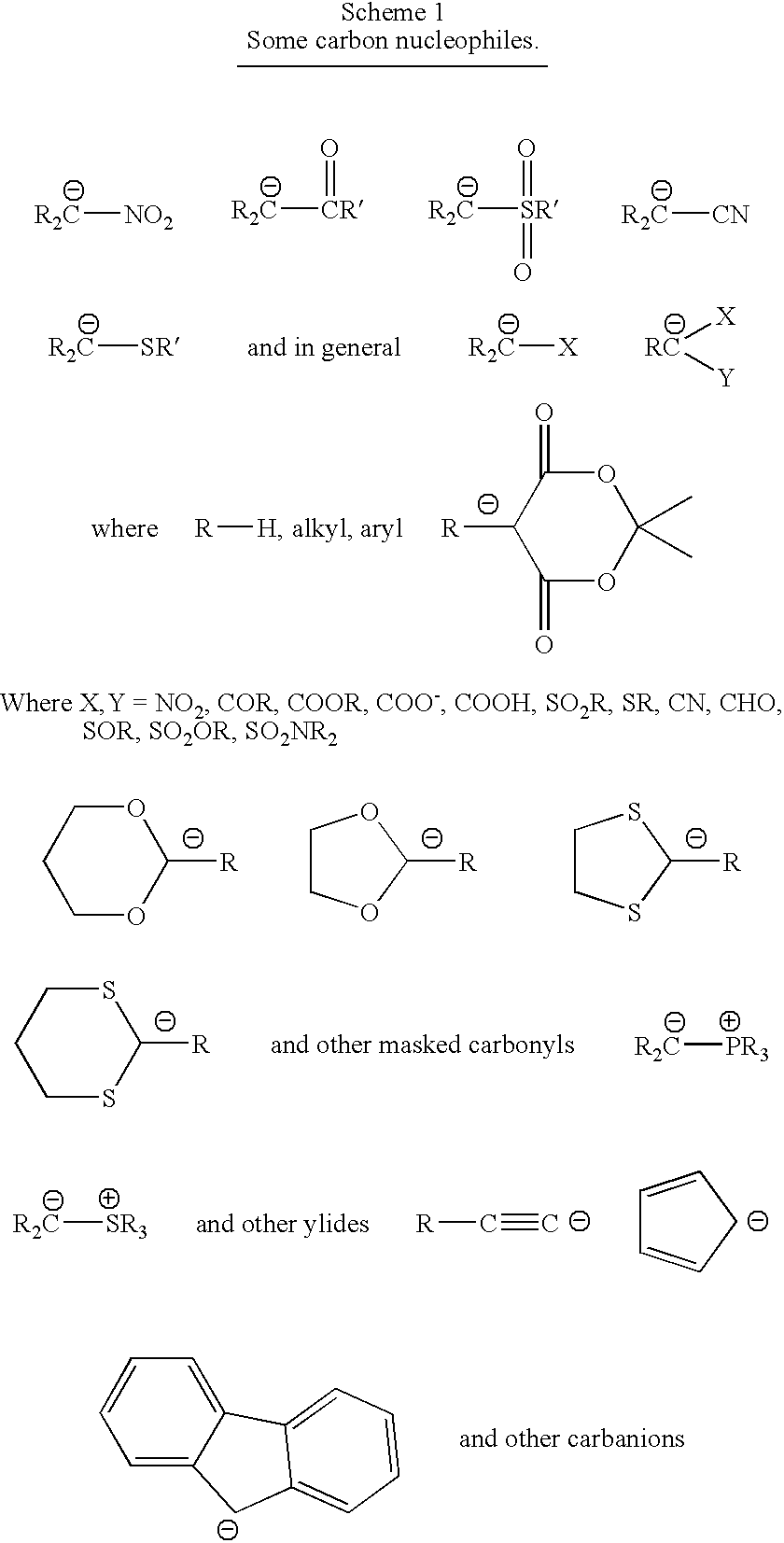
- Carbon nucleophiles include CN—, organometallic lithium derivatives, Grignard reagents, and other organometallic compounds, alkyl tin derivatives, trialkylboranes, alkylsilyl derivatives, enols, enolates, silyl enolates, enamines, anions from malonic esters, cyanoacetic esters, cyano acetamides, nitroalkanes, and the anions in Scheme 1.
- Group 1 is an alkyl halide or alkyl sulfonate and Group 2 is a primary amine (Example 1), a thiol, or a carboxylate (Example 3).
- Group 1 is an amine or a thiol and Group 2 is an epoxide (Example 2), in this case the leaving Group 2 does not leave Compound B but it stays attached to it through an additional bond (that is unaffected by the substitution reaction).
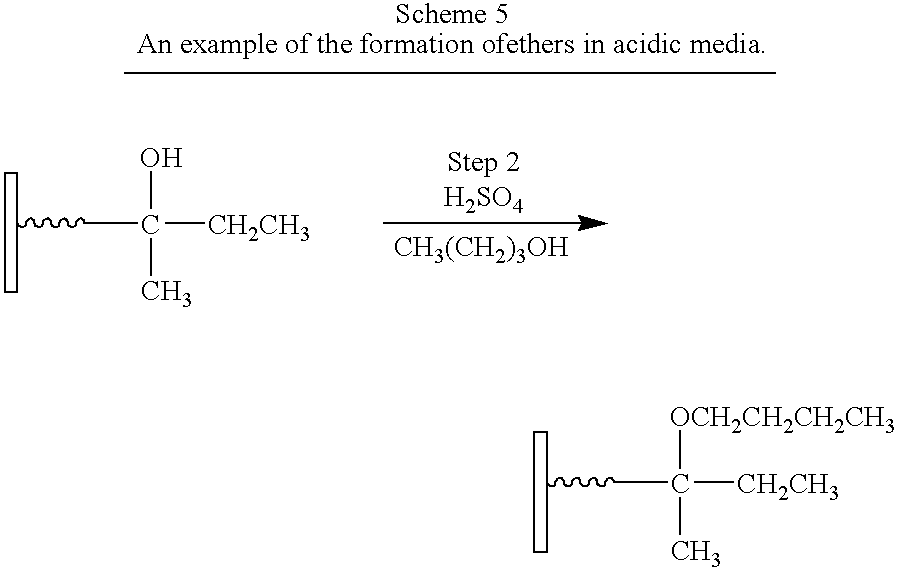
- both Group 1 and Group 2 are alcohols (Example 4).
- Condensation reactions involving a carbonyl moiety are a subset of nucleophilic substitutions.
- one of the two reacting groups (either Group 1 or Group 2) must be a nucleophile and the other (either Group 1 or Group 2) must be or must contain a leaving group (March, J. 2001, p. 389–674).
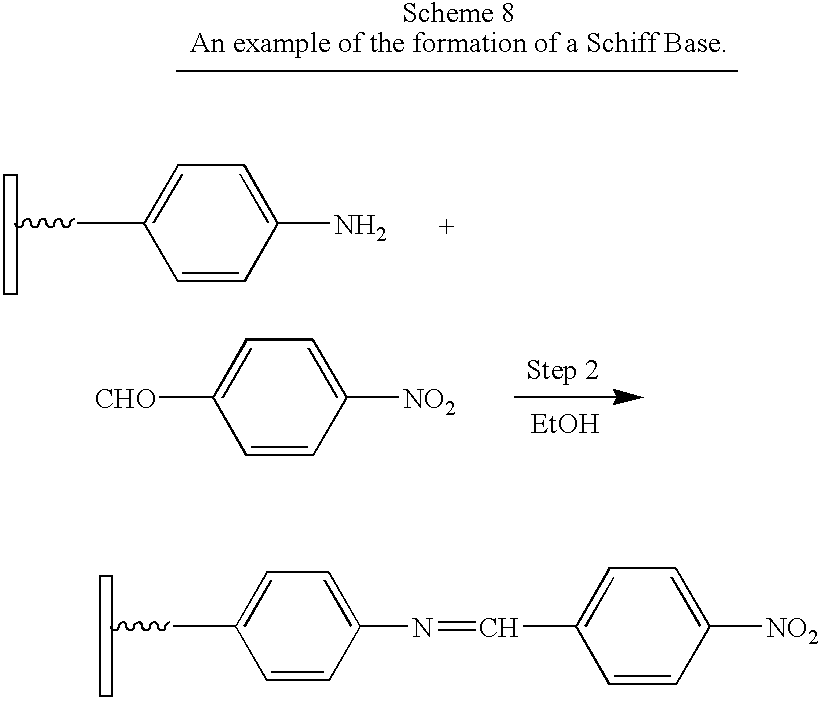
- Group 1 is an aromatic amine and Group 2 is an aromatic aldehyde. In this case Group 2 is not in itself a leaving group but it contains the leaving group that is water (Example 7).
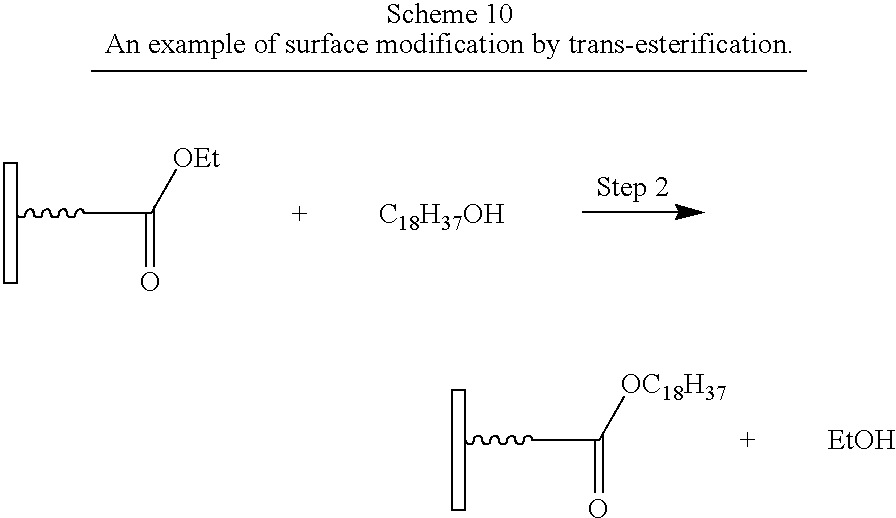
- Group 1 is an ester and Group 2 is an alcohol (Example 9) or an amine (Example 10).
- Electrophilic substitutions are reactions in which an electrophile (either Group 1 or Group 2) substitutes a leaving group on a substrate (either Group 1 or Group 2, March, J. 2001, p. 675–849).
- Substrates for electrophilic substitutions comprise substituted and unsubstituted benzene rings, polyaromatic compounds and heteroaromatic compounds.
- Electrophiles for electrophilic substitutions include CO 2 , CHCl 3 , peroxides, peracids, aromatic diazonium salts, sulfonyl chlorides, alkyl halides, carboxylic acids and esters, alkenes, alkynes, acyl chlorides, anhydrides and mixed anhydrides, alcohols, ketones, aldehydes, ketenes, nitro compounds, nitriles, ethers, thiols, sulfates, sulfonates, epoxides, and cyclopropyl units.
- electrophilic substitution reactions include H + , R 3 Si + , R 3 Sn + , other alkylmetal cations, I + , RCO + , Br + , Cl + , CH 3 + , R + , CO 2 , ArN 2 + , ArCHOH + , and NO + . These groups are understood by one of ordinary skill in the art.
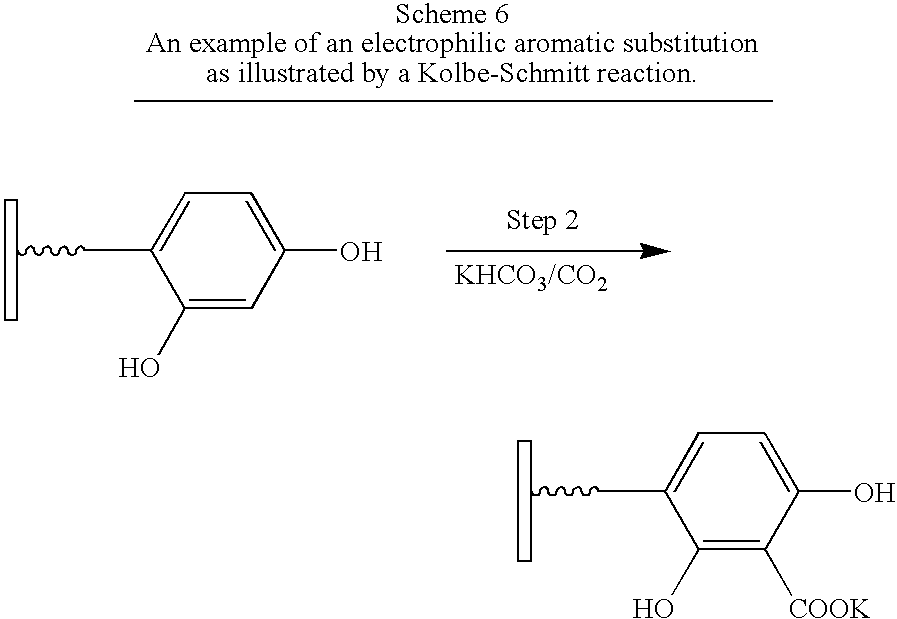
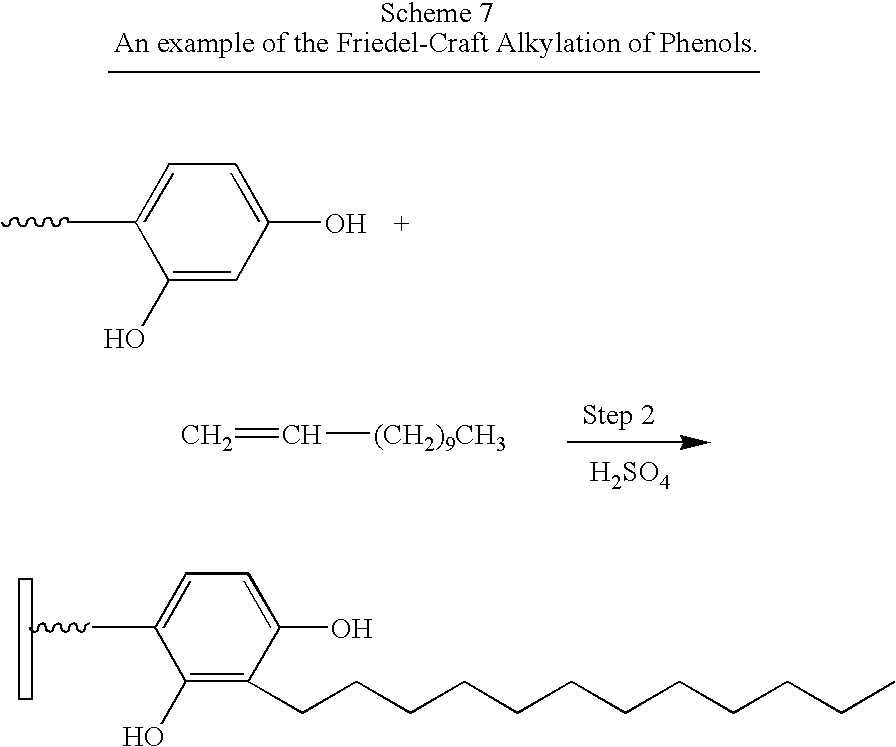
- electrophilic aromatic substitutions comprise Friedel-Crafts reactions (Example 6) and Mannich reactions on aromatic substrates (Example 8). A Bronsted or Lewis acid may be used as a catalyst for these reactions.
- the addition to carbon-carbon or carbon-heteroatom multiple bonds is a reaction in which Group 1 contains a multiple bond and Group 2 adds to it (or vice-versa, March, J. 2001, p. 970–1298).
- These reactions comprise nucleophilic, electrophilic and radical additions.
- Group 1 is an amine or an alcohol and Group 2 is an organic isocyanate (Example 11).
- Another preferred embodiment is the conjugated addition of nucleophiles to electrophilic (activated) multiple bonds. This reaction is also called Michael addition or Michael-type addition.
- the electrophilic multiple bond for Michael-type addition includes activated carbon-carbon pi bonds of the type —C ⁇ C—Z, —C ⁇ C—Z, —C ⁇ C—C ⁇ C—Z where Z is CHO, COR (including quinones), COOR, CONH 2 , CONHR, CONR 2 , CN, NO 2 , SOR, SO 2 R, SR, for example (March, J.; Smith M. B.; March's Advanced Organic Chemistry, Reactions, Mechanisms, and Structure, Fifth Ed., John Wiley& Sons, New York, 2001.).
- the nucleophile for Michael-type addition includes non-carbon nucleophiles and carbon nucleophiles.
- Non-carbon nucleophiles comprise alcohols, alkoxides, primary and secondary amines, hydrazines, hydroxylamines and their derivatives, phosphines, CN—, sulfides, thiols, thiolates, carboxylates, phenols, phenolates, thiophenols, and thiophenolates.
- Carbon nucleophiles comprise carbanions from ⁇ -ketoesters, malonate esters, trialkylboranes, alkylsilyl derivatives, enolates, silyl enols, enamines, and the anions in Scheme 1.
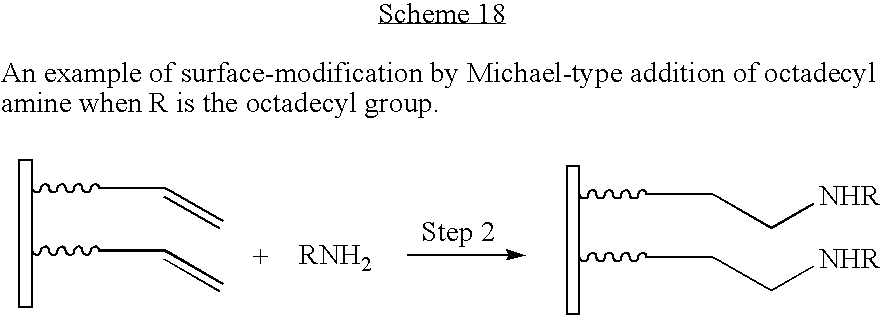
- aluminum oxyhydroxide or iron oxyhydroxide particles are surface modified with acrylic acid, methacrylic acid, or 2-acrylamido-2-methylpropanesulfonic acid (Step 1 ) then reacted with a primary amine at room temperature (Examples 2, 15, 16, 17, and 18), or a secondary amine at 60–80° C., or a thiol in the presence of a base catalyst.
- montmorillonite is modified with 3-(acrylamidopropyl)trimethylammonium chloride in the first step and then reacted with a primary amine (Example 15).
- Electrophilic reagents that add to alkenes and alkynes includes water, mineral acids, carboxylic acids, and organosulfur and organoselenide chlorides, derivatives of Hg, Sn, Tl, and other metals, and hydrides of silicon and boron.
- aldehydes and ketones form acetales, enamines, Schiff bases, or tertiary alcohols.
- Reactions of aldehydes and ketones with carbon-containing nucleophiles include the aldol condensation and the Knoevenagel condensation.
- Aldol condensations can be performed under either basic or acidic conditions.
- the acid-catalyzed condensation of aromatic aldehydes is of particular interest because it forms only one product (Claisen-Schmidt).
- the Knoevenagel reaction is the amino-catalyzed condensation of a rather acidic carbanion to a carbonyl compounds.
- Malonic esters, cyanoacetic esters, cyano acetamides, and nitroalkanes are effective nucleophiles under the Knoevenagel conditions.
- the product of the aldol, Claisen-Schmidt, and Knoevenagel condensations is usually the dehydrated, ⁇ , ⁇ -unsaturated derivative of the original adduct.
- the Mannich reaction is the condensation of an enolizable carbonyl compound with an iminium ion.
- the Witting reaction involves the attack of a phosphorous ylide (carbon-containing nucleophile) to an aldehyde or ketone with formation of a carbon-carbon double bond. Sulfur ylides can also be used in similar condensations.
- Carboxylic acids and their derivatives give products from addition-elimination reactions. Reactions include esterification, ammidation, acylation of alcohols and amines, trans-esterification, trans-amination, and ring opening of lactones and lactames.
- the reaction of carboxylic acid derivatives with carbocations form ketones or tertiary alcohols.
- the self-condensation of esters is known as the Claisen condensation.
- Free radical reactions are reactions where Group 1 or Group 2 or both are free-radical species or can generate free radical species under the reaction conditions.
- free radical reactions are radical additions of a radical species generated with an initiator or with light (ether Group 1 or Group 2) to a substrate (either Group 2 or Group 1, March, J. 2001, p. 894–969).
- Substrates for the radical addition include aromatic compounds, reactive akanes, alkenes, alkynes, and carbonyl-containing species.
- Radical species may be generated from many chemical and photochemical systems known in the art, including azides, diazonium salts, diazo compounds, organometallic compounds, alkyl boranes, hydroperoxides, peroxides, and thiols.
- the radical may originate from the thermal decomposition of a peroxide although the reactive Group 2 may be an RS radical generated in situ by hydrogen abstraction of the corresponding thiol.
- Group 1 is methacrylic and Group 2 is a radical generated from a thiol with UV light (Example 12).
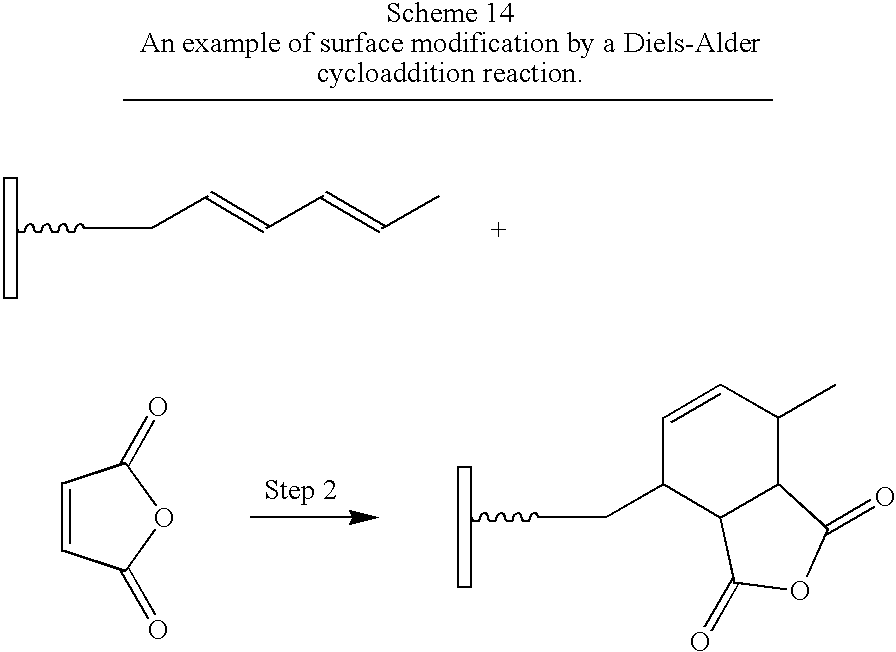
- Cycloaddition reactions are reactions in which Group 1 and Group 2 add to each other resulting in the formation of a new ring (March, J. 2001, p. 389–674). Cycloadditions include thermal cycloadditions and photo cycloadditions. In thermal cycloadditions one of the two reacting groups is an alkene or an alkyne and the other includes a diene.
- Preferred alkenes are molecules bearing electron-attracting groups such as COR, COOR, CN, NO 2
- Preferred dienes comprise molecules bearing an electron-donating group (Example 13). Alkenes, alkynes and dienes may be optionally substituted. Groups suitable for substitution include those groups that do not prevent the desired reaction.
- the particles after the first step of modification containing reactive preferably organic Groups 1 are water-soluble. These particles are partially reacted with a larger Compound B containing reactive organic functional Groups 2 and this reaction makes the particle organic-soluble.
- the stoichiometry used in Step 2 is such that unreacted Groups 1 are left at the end of the reaction.
- the unreacted Groups 1 are then reacted with a Compound C containing a Group 3 in an organic solvent. (Example 2).
- particles after the first modification step containing reactive organic Groups 1 are partially reacted with a larger molecular weight Compound B (greater than 400 amu, preferably greater than 1000 amu) containing reactive organic functional Groups 2 (Step 2 ).
- This Step attaches long steric stabilizers (preferably about 18 atoms or larger) to the particles. These stabilizers will keep the particles separate from each other during the Step 3 .
- the stoichiometry used in the Step 2 is such that unreacted Groups 1 are left at the end of the reaction.
- the unreacted Groups 1 are then reacted with a relatively low-molecular weight Compound C (less than 400 amu, preferably less than 200 amu) containing two equal Groups 3 per molecule (Step 3 ). During this reaction no significant cross-linking occurs among particles because of the presence of the steric stabilizers introduced in Step 2 (Example 1).
- poly(lactic acid) composites composed of poly(lactic acid) and the above surface-modified particles were mixed together in a Brabender internal polymer mixer at 180° C. The composites were then pressed into thin films (2–15 mil thick). Barriers to oxygen and water vapor were measured according to accepted ASTM methods (F1927 for oxygen and F1249 for water vapor), and were compared to pure poly(lactic acid). Poly(lactic acid) showed an oxygen permeation rate of 33.8 cc-mil/(100 in 2 *day) while composites with 2.5% of the above surface-modified particles showed an oxygen permeation rate of 25.5 cc-mil/(100 in 2 *day).
- Poly(lactic acid) showed a water vapor permeation rate of 17.2 gm-mil/(100 in 2 *day) while composites with 5% of the above surface-modified particles showed a water vapor permeation rate of 9.9 gm-mil/(100 in 2 *day).
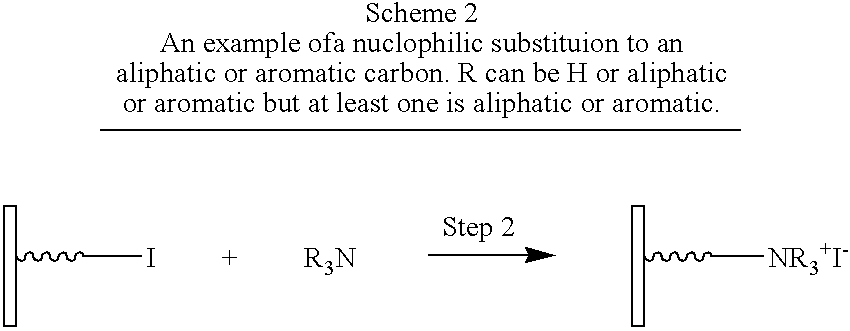
- Step 1 contains a carboxylic acid as the Anchor group and an iodide as Group 1.
- Compound B comprises a primary aliphatic amine as Group 2.
- Step 2 is a substitution reaction, specifically a nucleophilic substitution.
- acrylic acid (25.7 g, 0.36 mol) was added to 1.5 L of an 80° C. aqueous slurry containing 154.3 g (2.17 mol Al) of boehmite with a BET surface area of over 200 m 2 /g (e.g. Catapal A from Sasol).
- This mixture was heated at 80° C. for 20 hours and then spray-dried in a Yamato Pulvis Model GB-21 spray drier. It can be advantageous to convert the material to a dry powder to aid in transportation, storage, and handling.
- the dry material (15 g) was dispersed in 100 mL of water by gentle agitation.
- liquid polyoxyalkyleneamine (XTJ-507 from Huntsman, 5 mmol) dispersed in about 100 ml of ethanol. After 40 minutes of stirring, the material was dried to a solid in a convection oven near room temperature. This dried material was then dispersed in acetone and 0.59 g (10 mmol) ethylene diamine was added to the solution. After 1 hour of stirring, 2.3 g (10 mmol) of HELOXY modifier 65 (a mono-functional glycidyl ether) was added while stirring the solution vigorously. After 1 hour, this product was cooled and used to prepare epoxy resins where it was found to improve the toughness of the product.
- HELOXY modifier 65 a mono-functional glycidyl ether
- epoxy resins composed of bis-phenol A diglycidyl ether (Epon 826) and 51 parts per hundred resin of a polyamide derivative of dimerized fatty acids (Versamid 140) were prepared by warming the ingredients to 45° C. and mixing them by hand for 1 minute with a glass stir rod to prepare roughly 25 g liquid resin mixture. This mixture was poured into a roughly 20 ml rectangular prism Teflon mold and cured for one hour at 60° C. followed by 1 hour at 100° C. before being cooled to room temperature and tested. Long rectangular rods were cut for flexural toughness testing; the toughness of the sample was taken as the area under the stress-strain curve divided by the nominal fracture surface area.
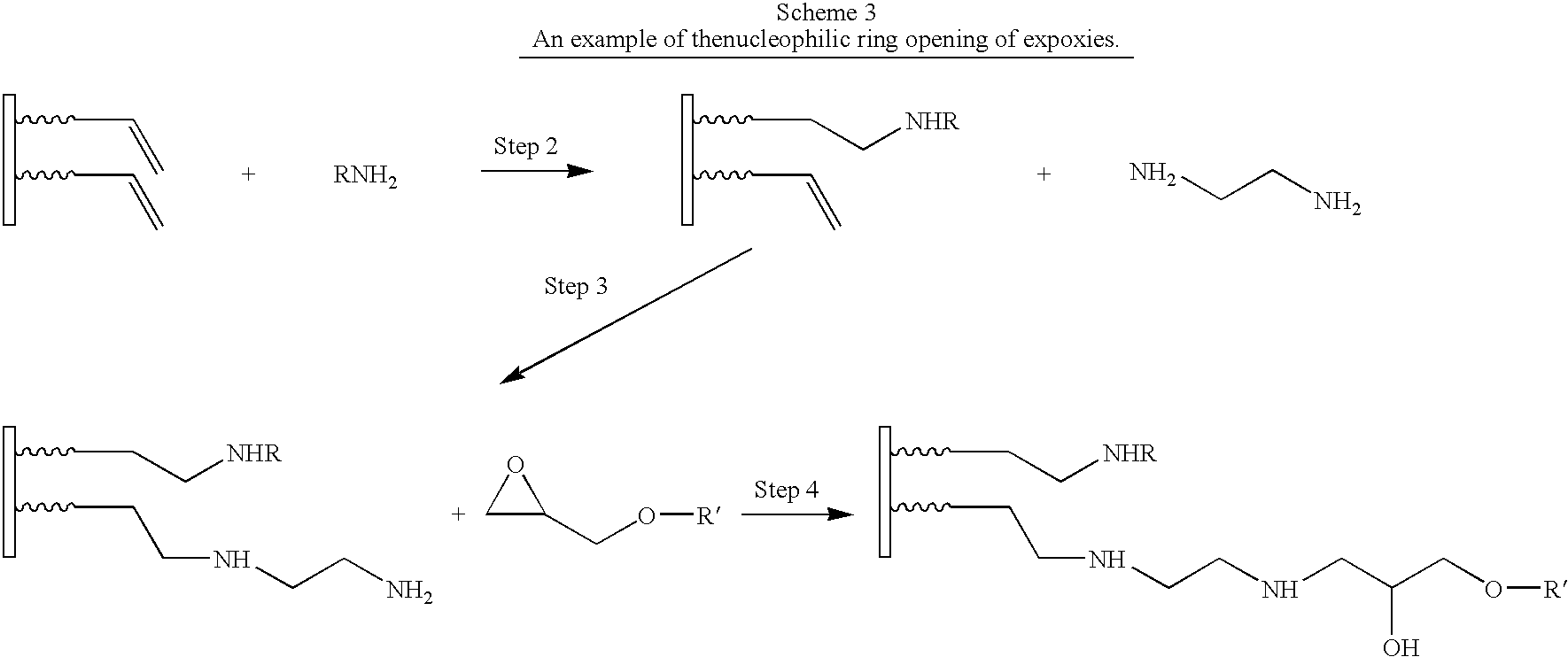
- Step 1 (not shown in Scheme 3), Compound A (as shown in FIG. 1 ) contains a carboxylic acid as the Anchor and an activated carbon-carbon double bond as Group 1.
- Compound B contains an amine as Group 2.
- Step 2 is an addition reaction, in this case a Michael-type addition reaction. By limiting the amount of Compound B, not all of the activated carbon-carbon double bonds are used in Step 2 .
- Compound C is ethylene diamine, which also reacts with any unreacted activated carbon-carbon double bonds.
- the product of Step 3 contains a free amino group (Group 6) which can undergo additional reactions as shown in FIG. 2 .
- Step 4 a mono-functional glycidyl ether (Compound D) containing an epoxide (Compound D, Group 7) reacts with the free amino groups of the partially reacted ethylene diamine and/or with the secondary amines formed in Steps 2 and 3 to give a fourth-generation surface-modified particle.
- This example illustrates first the conversion of the surface of alumina particles to boehmite, followed by modification of this surface with organic compounds.
- calcined ⁇ -alumina powder having an average particle size of 0.2 ⁇ m (RC-HP DBM without MgO alumina from Baikowski Malakoff) (500 g) was mixed with de-ionized water (1.3 L) and 30% wt. ammonia solution (237 g) in order to facilitate a hydrothermal treatment of the alumina surface.
- the reaction was heated at 190° C. for 25–50 hr under vigorous stirring. At this temperature the internal pressure was about 300–350 psi. After cooling, the samples were dried in a vented oven at 9° C. overnight. The pH of the treated alumina in water was neutral, suggesting that all the ammonia evaporated during drying. This step forms a boehmite layer on the surface of the alumina as demonstrated by the x-ray diffraction pattern of the product.
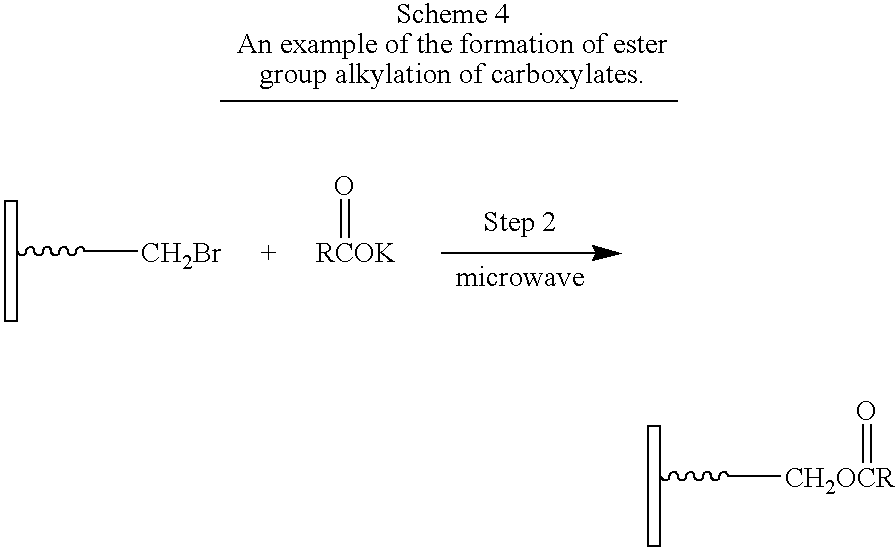
- Step 1 contains a carboxylic acid as the Anchor group and a bromide as Group 1.
- Compound B comprises a potassium salt of a carboxylic acid as Group 2.
- Step 2 is a substitution reaction, specifically a nucleophilic substitution.
- 2-Hydroxy-2-methylbutyric acid (118 g, 1 mol) was added to a suspension of boehmite (852 g, 12 moles Al) with a BET surface area of over 80 m 2 /g (e.g. Catapal 200 from Sasol) in water (8 L) under vigorous stirring and the mixture was heated 18 hr at 90° C. The product was gently dried in a vented oven. This dried product (100 g) was suspended in 15% sulfuric acid in n-butanol and heated at 70° C. overnight (Fuer and Hooz, 1997). After cooling, the sulfuric acid was neutralized with NaHCO 3 and excess solvent was eliminated under vacuum.
- boehmite 852 g, 12 moles Al
- BET surface area 80 m 2 /g
- Catapal 200 from Sasol e.g. Catapal 200 from Sasol
- compound A (as shown in FIG. 1 ) in Step 1 (not shown) contains a carboxylic acid as the Anchor group and a hydroxyl group as Group 1.
- Compound B comprises a hydroxyl group as Group 2.
- Step 2 is a condensation reaction to form an ether and yields a second-generation surface-modified particle.
- Boehmite (587 g, 8 moles of Al) with a BET surface area of over 200 m 2 /g (e.g. Catapal A from Sasol) was suspended in water (1 L) with stirring.
- 2,4-Dihydroxyphenylacetic acid (168 g, 1 mole) was added with stirring to the boehmite suspension. After half of the acid was added the suspension became very viscous and 200 mL of DI-water was added before completing the addition.
- the sample was stirred for 5–10 min and more water (2.4 L) was added. The mixture was heated at 90° C. for 24 hours with stirring, then spray-dried to a white fine powder in a Yamato Pulvis Model GB-21 spray drier.
- Potassium hydrogen carbonate 40 g was added to a suspension of 2,4-dihydroxyphenylacetic acid modified boehmite (40 g) in 400 mL of water in a flask equipped with a condenser and a gas inlet tube. The mixture was gently heated for 4 hr at 80° C. on a water bath, then carbon dioxide was bubbled through the solution while the solution was vigorously refluxed for 30 minutes (Furniss, et. al., 1989). The FT-IR spectrum of the product acidified with HCl showed the presence of the carbonyl stretching band of the carboxylic acid groups confirming the formation of the desired product.
- compound A (as shown in FIG. 1 ) in Step 1 (not shown) contains a carboxylic acid as the Anchor group and an activated aromatic ring as Group 1.
- Compound B comprises carbon dioxide as Group 2.
- Step 2 reacts the aromatic ring with an electrophile in an electrophilic aromatic substitution reaction to give a second-generation surface-modified particle.
- Boehmite 72 g, 1 mol
- Boehmite 72 g, 1 mol
- a BET surface area of over 200 m 2 /g e.g. Catapal A from Sasol
- butyric acid 15 g, 0.17 mol
- 2,4-dihydroxybenzoic acid 14 g, 0.09 mol
- the product was then spray-dried in a Yamato Pulvis Model GB-21 spray drier.
- the spray-dried product 50 g, 0.06 mol
- the unreacted olefin was eliminated by distillation under vacuum.
- compound A (as shown in FIG. 1 ) in Step 1 (not shown) contains a carboxylic acid as the Anchor group and an activated aromatic ring as Group 1.
- Compound B comprises an ⁇ , ⁇ -unsaturated hydrocarbon as Group 2.
- Step 2 reacts the aromatic ring with an ⁇ , ⁇ -unsaturated hydrocarbon in an electrophilic aromatic substitution reaction to give a second-generation surface-modified particle.
- the product from the previous step was suspended in ethanol (95%) and 4-nitrobenzaldehyde (150 g, 1 mol) was added. The reaction was refluxed 6 hours then cooled at room temperature (Furniss, 1989). The product was centrifuged to separate the solid derivative of the desired product from the solvent and unreacted reagents.
- compound A (as shown in FIG. 1 ) in Step 1 (not shown) contains a carboxylic acid as the Anchor group and an aromatic amine as Group 1.
- Compound B comprises an aromtic aldehyde as Group 2.
- Step 2 reacts the aromatic amine with the aldehyde in a nucleophilic attack on an unsaturated carbonyl group to give a second-generation surface-modified particle.
- compound A (as shown in FIG. 1 ) in Step 1 (not shown) contains a carboxylic acid as the Anchor group and an active hydrogen bound to a ketone group as Group 1.
- Compound B is generated in solution from the condensation of formaldehyde and an amine and comprises an iminium ion as Group 2, as reported by those skilled in the art. (March, J. 2001) Step 2 reacts the active hydrogen with the iminium ion intermediate generated in solution in a nucleophilic substitution reaction to give a second-generation surface-modified particle.
- compound A (as shown in FIG. 1 ) in Step 1 (not shown) contains a carboxylic acid as the Anchor group and an ester as Group 1.
- Compound B comprises a hydroxyl group as Group 2.
- Step 2 reacts the ester with the hydroxyl group in an trans-esterification reaction to give a second-generation surface-modified particle.
- the spray dried material (10 g) was suspended in toluene and 20 g of a polyoxyalkyleneamine (e.g., XTJ-507 from Huntsman) was added. This mixture was refluxed overnight then the toluene was allowed to evaporate, leaving a waxy solid.
- a polyoxyalkyleneamine e.g., XTJ-507 from Huntsman
- compound A (as shown in FIG. 1 ) in Step 1 (not shown) contains a carboxylic acid as the Anchor group and an ester as Group 1.
- Compound B comprises an amine group as Group 2.
- Step 2 reacts the ester with the amine in a trans-amidation reaction to give a second-generation surface-modified particle.
- a mixed lactic/acrylic surface modified particle was prepared by slowly adding 100 mL of an aqueous solution containing 10 g (0.14 mol) acrylic acid and 25.2 g (0.28 mol) lactic acid to 0.5 L of aqueous slurry containing 154.3 g (2.14 mol Al) of boehmite with a BET surface area of over 200 m 2/g (e.g. Catapal A from Sasol). Monomethylether hydroquinone (MEHQ, 0.5 g) was added to inhibit acrylate polymerization. Additional water (to approximately 1.5 L) was added during acid addition and boehmite dispersion to control the viscosity of the mixture. This mixture was then heated at 80° C. for 14 hours while stirring gently.
- MEHQ Monomethylether hydroquinone
- compound A (as shown in FIG. 5 ) in Step 1 (not shown) contains a carboxylic acid as the Anchor group and an activated carbon-carbon double bondactivated carbon-carbon double bond as Group 1.
- Compound E (as shown in FIG. 5 ) in Step 1 (not shown) contains a carboxylic acid as the Anchor group and a hydroxyl group as Group 8.
- Compound B comprises an amine as Group 2.
- Step 2 reacts the activated carbon-carbon double bond with amine in a Michael-type addition reaction.
- Compound F comprises an isocyanate group as Group 9.
- Step 3 then reacts the hydroxyl group (Group 8) with the isocyanate group (Group 9) through an addition reaction with an ⁇ , ⁇ -unsaturated C—N bond to give a second-generation surface-modified particle with two second-generation modifiers.
- Methacrylic acid (23.0 g, 0.27 mol) was slowly added to a 3L round bottom flask containing 0.5 L of a stirred aqueous suspension of 154.3 g (2.14 mol Al) of boehmite with a BET surface area of over 200 m 2 /g (e.g. Catapal A from Sasol).
- Monomethylether hydroquinone (MEHQ, 0.5 g) was added to inhibit acrylate polymerization.
- About 1 L water was added during the addition of the methacrylic acid. This mixture was heated to 80° C. and held there for 8 hours, then cooled to room temperature and spray dried in a Yamato Pulvis Model GB-21 spray drier. This solid (150 g) was warmed to 45° C.
- compound A (as shown in FIG. 1 ) in Step 1 (not shown) contains a carboxylic acid as the Anchor group and an activated carbon-carbon double bond as Group 1.
- Compound B comprises thiol group as Group 2.
- Step 2 reacts the activated carbon-carbon double bond with the thiol in a free radical addition reaction to give a second-generation surface-modified particle.
- the spray-dried sorbic acid product (50 g) was loaded in a reactor vessel equipped with a reflux condenser with 6 g (0.06 mol) of solid maleic anhydride. The vessel was then heated to 210° C. and stirred at this temperature for 1 hour. The product was isolated by extracting any unreacted maleic anhydride with acetone.
- compound A (as shown in FIG. 1 ) in Step 1 (not shown) contains a carboxylic acid as the Anchor group and a diene as Group 1.
- Compound B comprises an ⁇ , ⁇ -unsaturated hydrocarbon as Group 2.
- Step 2 reacts the diene with an ⁇ , ⁇ -unsaturated hydrocarbon in a Diels-Alder cycloaddition reaction to give a second-generation surface-modified particle.
- 2-Acrylamido-2-methylpropanesulfonic acid (207 g, 1 mol) and boehmite (426 g, 6 mol Al) were heated to 60° C. for 4 hours in water under vigorous stirring.
- Monomethylether hydroquinone (MEHQ, 05 g) was added to inhibit polymerization. Water was added as necessary to maintain a low enough viscosity to ensure good mixing.
- the product was spray dried to a white powder in a Yamato Pulvis Model GB-21 spray drier.
- This powder (10 g) was suspended in 100 mL of water.
- a polyoxyalkyleneamine e.g., XTJ-507 from Huntsman
- 2.4 g was added under stirring. The mixture was stirred for two hours at room temperature. The material was isolated by drying in a vented oven at 55° C. overnight, and was isolated as a waxy solid.
- compound A (as shown in FIG. 1 ) in Step 1 (not shown) contains a sulfonic acid as the Anchor group and an activated carbon-carbon double bond as Group 1.
- Compound B comprises an amine as Group 2.
- Step 2 reacts the activated carbon-carbon double bond with the amine in a Michael-type addition reaction to give a second-generation surface-modified particle.
- Octadecylamine (5.1 g; 1:1 with respect to the ammonium ion modifier bound to the montmorillonite) was added to ethanol and heated to 70° C. to disperse the octadecylamine. The dispersed octadecylamine solution was then added to a heated (70° C.) aqueous ammonium ion modified montmorillonite and stirred for two hours. The resulting material was dried to a waxy solid.
- compound A (as shown in FIG. 1 ) in Step 1 contains a quaternary ammonium ion as the Anchor group and an activated carbon-carbon double bond as Group 1.
- Compound B comprises an amine as Group 2.
- Step 2 reacts the activated carbon-carbon double bond with the amine in a Michael-type addition reaction to give a second-generation surface-modified particle.
- the resulting acrylate-modified lepidocrocite materials are then spray-dried in a Yamato Pulvis Model GB-21 spray drier.
- the spray-dried acrylate-modified lepidocrocite materials are then redispersed into water.
- Ethanolamine (10.4 g, 0.17 mol) is added to the dispersed surface modified lepidocrocite and the sol is then stirred at room temperature for two hours.
- the resulting material is a surface-modified lepidocrocite particle containing the adducted ethanolamine (e.g. lepidocrocite-O(CO)—CH 2 CH 2 NHCH 2 CH 2 OH).
- compound A (as shown in FIG. 1 ) in Step 1 contains a carboxylic acid as the Anchor group and an activated carbon-carbon bond as Group 1.
- Compound B comprises an amine as Group 2.
- Step 2 reacts the activated carbon-carbon bond with the amine in a Michael-type addition reaction to give a second-generation surface-modified particle.
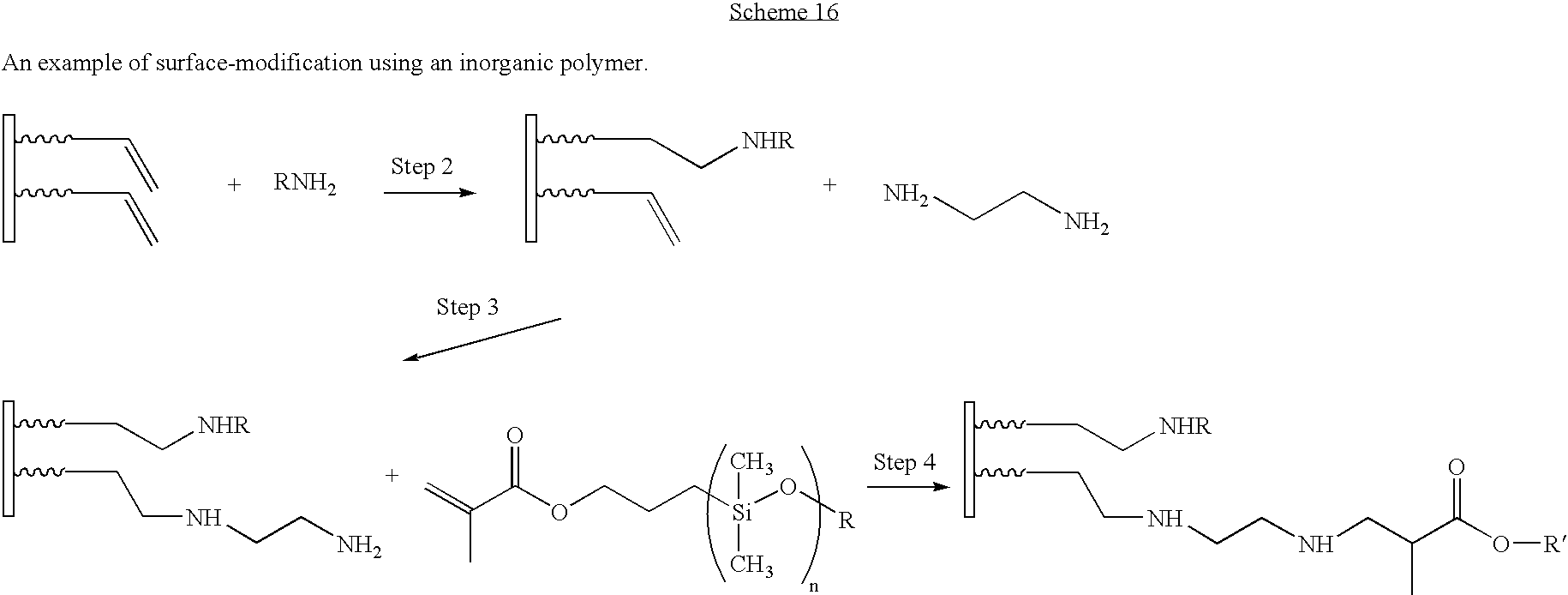
- Acrylic acid 25.7 g (0.36 mol), was added to 0.5 L of aqueous slurry containing 154.3 g (2.17 mol Al) of boehmite with a BET surface area of over 200 m 2 /g (e.g. Catapal A from Sasol). Additional water was added during acid addition and boehmite dispersion to control the viscosity of the mixture. Monomethylether hydroquinone (MEHQ, 0.5 g) was added to inhibit acrylate polymerization. This mixture was heated at 80° C. for 8 hours and then spray dried in a Yamato Pulvis Model GB-21 spray drier. The dry material from the previous step was dispersed in 500 mL of water by gentle agitation.
- MEHQ Monomethylether hydroquinone
- Step 1 (not shown), Compound A (as shown in FIG. 1 ) contains a carboxylic acid as the Anchor and an activated carbon-carbon double bond as Group 1.
- Compound B contains an amine as Group 2.
- Step 2 is a addition reaction, in this case a Michael-type addition. By limiting the amount of Compound B, not all of the activated carbon-carbon double bonds are used in Step 2 .
- Step 3 Compound C is ethylene diamine, which also reacts with any unreacted activated carbon-carbon double bonds.
- the product of Step 3 contains a free amino group (Group 6) which can undergo additional reactions as shown in Scheme 16.
- Step 4 a monomethacryloxypropyl-terminated polydimethylsiloxane (Compound D) containing an activated carbon-carbon double bond group (Group 7) reacts with the free amino groups of the partially reacted ethylene diamine to give a fourth-generation surface-modified particle.
- Compound D a monomethacryloxypropyl-terminated polydimethylsiloxane (Compound D) containing an activated carbon-carbon double bond group (Group 7) reacts with the free amino groups of the partially reacted ethylene diamine to give a fourth-generation surface-modified particle.
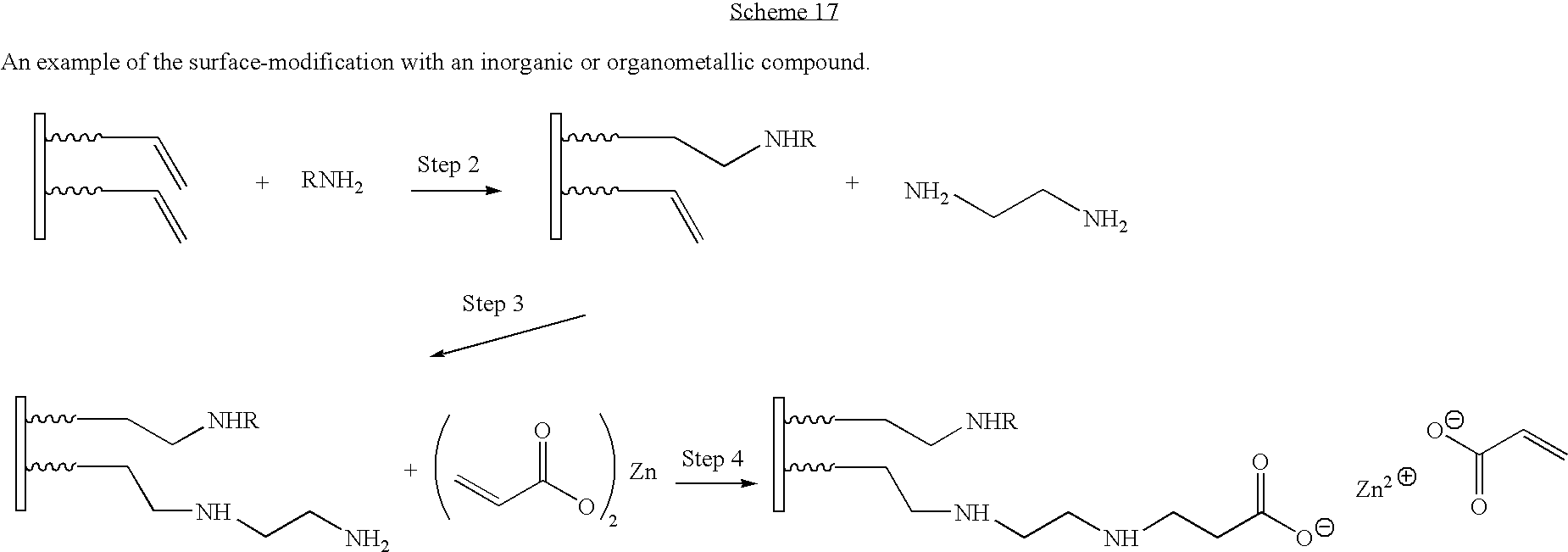
- Step 1 (not shown), Compound A (as shown in FIG. 1 ) contains a carboxylic acid as the Anchor and an activated carbon-carbon double bond as Group 1.
- Compound B contains an amine as Group 2.
- Step 2 is an addition reaction, in this case a Michael-type addition. By limiting the amount of Compound B, not all of the activated carbon-carbon double bonds are used in Step 2 .
- Compound C is ethylene diamine, which also reacts with any unreacted activated carbon-carbon double bonds.
- the product of Step 3 contains a free amino group (Group 6) which can undergo additional reactions as shown in FIG. 2 .
- zinc acrylate (Compound D) containing an acrylic group (Group 7) reacts with the free amino groups of the partially reacted ethylene diamine to give a fourth-generation surface-modified particle.
- This example illustrates first the conversion of the surface of AlN particles to boehmite, followed by modification of this surface with organic compounds.
- aluminum nitride powder having an average primary particle size of 107 nm (Nanotechnologies, Austin, Tex.) (1 g) was mixed with de-ionized water (5 mL). The mixture was heated to boiling and the water was vaporized over the period of 10 minutes, leaving a dry powder. X-ray diffraction analysis of the dry powder indicated that a portion of the aluminum nitride was converted to boehmite.
- the XRD pattern for the powder contained peaks assigned to boehmite: 14.14°, 28.1°, 38.2°, 49.06°, 65.12°, and 71.74° 2-theta, as well as peaks assigned to AlN: 33.38°, 36.38°, 38.28°, 45.04°, 50.16°, 59.64°, 66.26°, 69.84° 71.68°, and 72.84° 2-theta. Adding more than 5 mL water (an amount that requires 30 minutes to vaporize) will result in converting all of the AlN to beohmite.
- the external layer of boehmite was estimated to have an average thickness of 10 nm.
- the dry powder of AlN core, boehmite shell particles (0.44 g), acrylic acid (0.014 g) and methyl ether of hydroquinone (MEHQ, a radical reaction inhibitor) (500 ppm to acrylic acid) were added to xylene (17 g) and refluxed for 36 hours in the presence of an ambient atmosphere.
- the carboxylic acid group of acrylic acid reacts with the surface boehmite to form organic modified core/shell particles.
- reaction was removed from the heat source and phenethylamine (0.008 g) was added to the particle/xylene mixture and stirred for 30 minutes.
- phenethylamine (0.008 g) was added to the particle/xylene mixture and stirred for 30 minutes.
- the xylene solvent was removed under vacuum and the surface modified particles were added (3% by weight) to epoxy resins and cured to make epoxy polymers with increased thermal conductivities.
- acrylic acid (25.7 g, 0.36 mol) was added to 1.5 L of an 80° C. aqueous slurry containing 154.3 g (2.17 mol Al) of boehmite with a BET surface area of over 200 m 2/g (e.g. Catapal A from Sasol).
- This mixture was heated at 80° C. for 20 hours and then spray-dried in a Yamato Pulvis Model GB-21 spray drier.
- the dry material (15 g) was then dispersed in 100 mL of water by gentle agitation and warmed to 60° C.
- This product is more easily dispersed in polypropylene where it serves to increase the heat deflection temperature.
- the samples were prepared by mixing polypropylene and the above surface-modified particles in a Haake twin-screw extruder at 200° C. and then injection molded. The prepared samples contained 10% of surface-modified particles.
- Heat distortion temperature was measured according to ASTM D256.
- the polypropylene composite was compared to pure polypropylene. The two samples showed a clear trend in which the composite material showed a lower distortion at a given temperature. At 60° C., pure polypropylene was displaced 0.8 mm while the composite was displaced 0.6 mm. At 93° C., pure polypropylene was displaced 1.7 mm while the composite was displaced 1.4 mm.
Landscapes
- Chemical & Material Sciences (AREA)
- Engineering & Computer Science (AREA)
- Organic Chemistry (AREA)
- Nanotechnology (AREA)
- Physics & Mathematics (AREA)
- Composite Materials (AREA)
- Condensed Matter Physics & Semiconductors (AREA)
- General Physics & Mathematics (AREA)
- Materials Engineering (AREA)
- Crystallography & Structural Chemistry (AREA)
- Chemical Kinetics & Catalysis (AREA)
- Pigments, Carbon Blacks, Or Wood Stains (AREA)
Abstract
Description
- G. Bram, A. Lumpe, M. Majdoub, E. Gutierrez, E. Ruiz-Hitzky, Tetrahedron, 46, 5167, (1990).
- F. Effenberg, K. Dranz, S. Forser, W. Muller, Chem. Ber., 114, 173, (1981).
- Flett, L. H., U.S. Pat. No. 2,134,712 (1938); W. Croxall, F. Sowa, J. Nieuwland, J. Am. Chem. Soc., 56, 2054 (1934), 57 1549 (1935).
- H. Fuer, J. Hooz, “Methods of Forming the Ether Linkage”, in The Chemistry of the Ether Linkage, Ed. Saul Patai, Interscience Library, (1997), p. 458–459.
- B. Fumiss, A. Hannaford, P. Smith, A. Tatchell, Voegel's textbook of practical organic Chemistry, 5th Ed., Longman, 1989, p. 1067, 905, 1053.
- March, J.; Smith M. B.; March's Advanced Organic Chemistry, Reactions, Mechanisms, and Structure, Fifth Ed., John Wiley& Sons, New York, 2001.
- B. Fumiss, A. Hannaford, P. Smith, A. Tatchell, Voegel's Textbook of Practical Organic Chemistry, 5th Ed., Longman, 1989




Claims (49)
Priority Applications (3)
| Application Number | Priority Date | Filing Date | Title |
|---|---|---|---|
| US10/171,402 US6986943B1 (en) | 2002-06-12 | 2002-06-12 | Surface modified particles by multi-step addition and process for the preparation thereof |
| US10/412,737 US6933046B1 (en) | 2002-06-12 | 2003-04-11 | Releasable corrosion inhibitor compositions |
| US11/120,650 US7244498B2 (en) | 2002-06-12 | 2005-05-03 | Nanoparticles modified with multiple organic acids |
Applications Claiming Priority (1)
| Application Number | Priority Date | Filing Date | Title |
|---|---|---|---|
| US10/171,402 US6986943B1 (en) | 2002-06-12 | 2002-06-12 | Surface modified particles by multi-step addition and process for the preparation thereof |
Related Parent Applications (1)
| Application Number | Title | Priority Date | Filing Date |
|---|---|---|---|
| US10/171,422 Continuation-In-Part US6887517B1 (en) | 2002-06-12 | 2002-06-12 | Surface modified particles by multi-step Michael-type addition and process for the preparation thereof |
Related Child Applications (2)
| Application Number | Title | Priority Date | Filing Date |
|---|---|---|---|
| US10/412,737 Continuation-In-Part US6933046B1 (en) | 2002-06-12 | 2003-04-11 | Releasable corrosion inhibitor compositions |
| US11/120,650 Continuation-In-Part US7244498B2 (en) | 2002-06-12 | 2005-05-03 | Nanoparticles modified with multiple organic acids |
Publications (1)
| Publication Number | Publication Date |
|---|---|
| US6986943B1 true US6986943B1 (en) | 2006-01-17 |
Family
ID=35550737
Family Applications (1)
| Application Number | Title | Priority Date | Filing Date |
|---|---|---|---|
| US10/171,402 Expired - Fee Related US6986943B1 (en) | 2002-06-12 | 2002-06-12 | Surface modified particles by multi-step addition and process for the preparation thereof |
Country Status (1)
| Country | Link |
|---|---|
| US (1) | US6986943B1 (en) |
Cited By (28)
| Publication number | Priority date | Publication date | Assignee | Title |
|---|---|---|---|---|
| US20070098990A1 (en) * | 2002-06-12 | 2007-05-03 | Cook Ronald L | Nanoparticles modified with multiple organic acids |
| US20070140937A1 (en) * | 2003-11-21 | 2007-06-21 | Cunningham Patrick D | Method for solubilizing metal oxides by surface treatment, surface treated metal oxide solutions and method for separating metal oxides |
| US20080038176A1 (en) * | 2003-11-13 | 2008-02-14 | Centre National De La Recherche Scientifique | Unsymmetrical Inorganic Particles, and Method for Producing the Same |
| US20090017292A1 (en) * | 2007-06-15 | 2009-01-15 | Henry Hieslmair | Reactive flow deposition and synthesis of inorganic foils |
| US20090269593A1 (en) * | 2002-02-01 | 2009-10-29 | William Marsh Rice University | Functionalized, hydrogen-passivated silicon surfaces |
| WO2010057114A3 (en) * | 2008-11-14 | 2010-08-19 | Dune Sciences Inc. | Functionalized nanoparticles and methods of forming and using same |
| US20100247922A1 (en) * | 2009-03-31 | 2010-09-30 | Cytec Technology Corp. | Water Based Non-Chromated Primers for Structural Bonding Applications |
| US20100252824A1 (en) * | 2002-02-01 | 2010-10-07 | William Marsh Rice University | Hybrid Molecular Electronic Devices Containing Molecule-Functionalized Surfaces for Switching, Memory, and Sensor Applications and Methods for Fabricating Same |
| US20100304137A1 (en) * | 2004-06-10 | 2010-12-02 | U.S. Government As Represented By The Secretary Of The Army | Fiber modified with particulate through a coupling agent |
| US20110247523A1 (en) * | 2010-04-12 | 2011-10-13 | Tohoku University | Organic-inorganic composite particles, particle dispersion, particle-dispersed resin composition, and method for producing organic-inorganic composite particles |
| US20120065383A1 (en) * | 2010-09-09 | 2012-03-15 | Seiko Epson Corporation | Process for producing organic-modified inorganic fine particles |
| WO2012050984A1 (en) | 2010-10-13 | 2012-04-19 | National Oilwell Varco, L.P. | Releasable corrosion inhibitors |
| DE102011003829A1 (en) | 2011-02-09 | 2012-08-09 | Bayer Materialscience Aktiengesellschaft | Inorganic surface-active particles and process for their preparation |
| US20120280187A1 (en) * | 2009-11-27 | 2012-11-08 | Tokusen Kogyo Co., Ltd. | Fine metal particle-containing composition |
| US20130206463A1 (en) * | 2012-02-15 | 2013-08-15 | International Business Machines Corporation | Non-halogenated flame retardant filler |
| KR101396684B1 (en) | 2012-05-31 | 2014-05-16 | 삼성토탈 주식회사 | Microporous organic-inorganic multilayer separator and method for producing the same |
| US20150240005A1 (en) * | 2012-10-23 | 2015-08-27 | Renaud Nicolay | Particles containing reversible covalent bonds which may be sequentially formed and broken multiple times |
| US9186641B2 (en) | 2011-08-05 | 2015-11-17 | International Business Machines Corporation | Microcapsules adapted to rupture in a magnetic field to enable easy removal of one substrate from another for enhanced reworkability |
| US9283514B2 (en) | 2011-01-21 | 2016-03-15 | International Business Machines Corporation | Silicone-based chemical filter and silicone-based chemical bath for removing sulfur contaminants |
| US9303047B2 (en) | 2011-05-06 | 2016-04-05 | International Business Machines Corporation | Flame retardant filler |
| US9307692B2 (en) | 2011-10-28 | 2016-04-12 | International Business Machines Corporation | Microcapsules adapted to rupture in a magnetic field |
| KR20160111480A (en) * | 2014-01-21 | 2016-09-26 | 사솔 퍼포먼스 케미컬스 게엠베하 | Alumina compositions and methods for producing same |
| US9716055B2 (en) | 2012-06-13 | 2017-07-25 | International Business Machines Corporation | Thermal interface material (TIM) with thermally conductive integrated release layer |
| US9847544B2 (en) | 2010-04-12 | 2017-12-19 | Nitto Denko Corporation | Ion conductive organic-inorganic composite particles, particle-containing resin composition and ion conductive molded article |
| US10265693B2 (en) | 2010-04-12 | 2019-04-23 | Nitto Denko Corporation | Particles, particle dispersion, particle-dispersed resin composition, producing method therefor, resin molded article, producing method therefor, catalyst particles, catalyst solution, catalyst composition, catalyst molded article, titanium complex, titanium oxide particles and producing method therefor |
| US10738202B2 (en) * | 2017-01-10 | 2020-08-11 | Ut-Battelle, Llc | Porous thermally insulating compositions containing hollow spherical nanoparticles |
| KR20210072032A (en) * | 2018-10-03 | 2021-06-16 | 사솔 (유에스에이) 코포레이션 | Alumina and method for preparing the same |
| US11492495B2 (en) * | 2018-03-22 | 2022-11-08 | 3M Innovative Properties Company | Modified aluminum nitride particles and methods of making the same |
Citations (37)
| Publication number | Priority date | Publication date | Assignee | Title |
|---|---|---|---|---|
| US3117944A (en) | 1960-07-28 | 1964-01-14 | Du Pont | Coagula of colloidal fibrous boehmite and acrylamide polymers and processes for making same |
| US3268295A (en) | 1961-10-06 | 1966-08-23 | Reynolds Metals Co | Alumina hydrate and its method of preparation |
| US3411877A (en) | 1963-05-14 | 1968-11-19 | Pechiney Saint Gobain | Process for producing water dispersible hydrargillite |
| US3411876A (en) | 1963-05-27 | 1968-11-19 | Pechiney Saint Gobain | Preparation of hydrargillite |
| US3901845A (en) | 1974-04-01 | 1975-08-26 | Gen Motors Corp | Filled and reinforced polyamide molding compositions |
| US3997476A (en) | 1975-07-08 | 1976-12-14 | Exxon Research And Engineering Company | Alumina treatment |
| US4010247A (en) | 1974-02-21 | 1977-03-01 | Condea Petrochemie-Gesellschaft M.B.H. | Method for making water dispersible aluminum hydroxide |
| US4091164A (en) | 1975-04-30 | 1978-05-23 | Presto Products Inc | Polymer modified hydrophilic inorganic fillers for thermoplastic polymeric materials |
| US4169014A (en) | 1976-08-16 | 1979-09-25 | Amerace Corporation | Method of immobilizing proteinaceous substances |
| US4211667A (en) | 1977-03-02 | 1980-07-08 | Sumitomo Aluminium Smelting Company, Limited | Process for producing alumina sols |
| GB2039913A (en) | 1979-01-16 | 1980-08-20 | Ciba Geigy Ag | Curable mixture for producing reinforced elastomeric plastics based on epoxide resin |
| US4349389A (en) | 1979-07-26 | 1982-09-14 | Imperial Chemical Industries Limited | Dispersible inorganic pigment |
| US4420341A (en) | 1982-04-05 | 1983-12-13 | Ferrigno Thomas H | Stabilized surface modified fillers |
| US4496714A (en) | 1982-12-21 | 1985-01-29 | Kuraray Co., Ltd. | Polyester, adhesives comprising the same, and laminates and laminated hollow vessels made thereof |
| US4532072A (en) | 1982-11-25 | 1985-07-30 | United Kingdom Atomic Energy Authority | Process for producing aluminium containing sols |
| US4676928A (en) | 1986-01-30 | 1987-06-30 | Vista Chemical Company | Process for producing water dispersible alumina |
| US4764495A (en) | 1985-02-08 | 1988-08-16 | E.C.C. America Inc. | Process for surface treating layered lattice silicates and resultant products |
| US4900767A (en) | 1986-12-17 | 1990-02-13 | E.C.C. America Inc. | Process for the surface modification of minerals in a reactive atmosphere |
| US4929589A (en) * | 1986-12-29 | 1990-05-29 | Aluminum Company Of America | Metal oxide/hydroxide particles coated with phosphate esters |
| US4952634A (en) | 1987-01-21 | 1990-08-28 | Synthetic Products Company | Curable carboxylated polymers containing polymeric polyvalent metal salt crosslinking agents |
| US4992199A (en) | 1988-05-20 | 1991-02-12 | Condea Chemie Gmbh | Process for paint detackifying and sedimentation |
| US5212261A (en) | 1990-12-17 | 1993-05-18 | Henkel Research Corporation | Latent, heat-curable epoxy resin compositions containing metal carboxylate curing systems |
| WO1993021197A1 (en) | 1992-04-21 | 1993-10-28 | Basf Aktiengesellschaft | Method for the preparation of alkyl glycosides and their use |
| EP0576695A1 (en) | 1990-12-14 | 1994-01-05 | Aluminum Company Of America | Organo-aluminum hydroxyde compounds |
| US5418298A (en) | 1993-03-19 | 1995-05-23 | Regents Of The University Of Michigan | Neutral and mixed neutral/anionic polymetallooxanes |
| WO1996026240A1 (en) | 1995-02-23 | 1996-08-29 | Martinswerk Gmbh Für Chemische Und Metallurgische Produktion | Surface-modified filler composition |
| US5593654A (en) | 1992-03-12 | 1997-01-14 | Condea Vista Company | Preparation of stabilized alumina having enhanced resistance to loss of surface area at high temperatures |
| US5593781A (en) | 1992-04-15 | 1997-01-14 | Institut Fue Neue Materialien Gemeinnutzige GMBH | Method of manufacturing surface-modified ceramic powders with particles in the nanometer size |
| WO1997023288A1 (en) | 1995-12-22 | 1997-07-03 | Akzo Nobel N.V. | Polyalkylaluminoxane compositions formed by non-hydrolytic means |
| US5814407A (en) * | 1994-10-28 | 1998-09-29 | Societe Prolabo | Glycosylated particle of latex or of inorganic oxide and process for the preparation thereof |
| WO1999050203A1 (en) | 1998-03-30 | 1999-10-07 | Wm Marsh Rice University | Chemical control over ceramic porosity using carboxylate-alumoxanes |
| WO2000009578A1 (en) | 1998-08-13 | 2000-02-24 | Wm. Marsh Rice University | Method and materials for fabrication of alumoxane polymers |
| US6207130B1 (en) | 1997-04-11 | 2001-03-27 | Rice University | Metal-exchanged carboxylato-alumoxanes and process of making metal-doped alumina |
| US6224846B1 (en) | 1999-08-21 | 2001-05-01 | Condea Vista Company | Method for making modified boehmite alumina |
| US6228903B1 (en) | 1995-06-07 | 2001-05-08 | Amcol International Corporation | Exfoliated layered materials and nanocomposites comprising said exfoliated layered materials having water-insoluble oligomers or polymers adhered thereto |
| US6322890B1 (en) | 1998-03-30 | 2001-11-27 | Wm. Marsh Rice University | Supra-molecular alkylalumoxanes |
| US6602933B2 (en) * | 2001-10-05 | 2003-08-05 | The Hong Kong Polytechnic University | In-situ co-polymerization process for preparing in-organic filler-reinforced polymer-matrix composites |
-
2002
- 2002-06-12 US US10/171,402 patent/US6986943B1/en not_active Expired - Fee Related
Patent Citations (39)
| Publication number | Priority date | Publication date | Assignee | Title |
|---|---|---|---|---|
| US3117944A (en) | 1960-07-28 | 1964-01-14 | Du Pont | Coagula of colloidal fibrous boehmite and acrylamide polymers and processes for making same |
| US3268295A (en) | 1961-10-06 | 1966-08-23 | Reynolds Metals Co | Alumina hydrate and its method of preparation |
| US3411877A (en) | 1963-05-14 | 1968-11-19 | Pechiney Saint Gobain | Process for producing water dispersible hydrargillite |
| US3411876A (en) | 1963-05-27 | 1968-11-19 | Pechiney Saint Gobain | Preparation of hydrargillite |
| US4010247A (en) | 1974-02-21 | 1977-03-01 | Condea Petrochemie-Gesellschaft M.B.H. | Method for making water dispersible aluminum hydroxide |
| US3901845A (en) | 1974-04-01 | 1975-08-26 | Gen Motors Corp | Filled and reinforced polyamide molding compositions |
| US4091164A (en) | 1975-04-30 | 1978-05-23 | Presto Products Inc | Polymer modified hydrophilic inorganic fillers for thermoplastic polymeric materials |
| US3997476A (en) | 1975-07-08 | 1976-12-14 | Exxon Research And Engineering Company | Alumina treatment |
| US4169014A (en) | 1976-08-16 | 1979-09-25 | Amerace Corporation | Method of immobilizing proteinaceous substances |
| US4211667A (en) | 1977-03-02 | 1980-07-08 | Sumitomo Aluminium Smelting Company, Limited | Process for producing alumina sols |
| GB2039913A (en) | 1979-01-16 | 1980-08-20 | Ciba Geigy Ag | Curable mixture for producing reinforced elastomeric plastics based on epoxide resin |
| US4327032A (en) | 1979-01-16 | 1982-04-27 | Ciba-Geigy Corporation | Acicular aluminium salts of carboxylic acids and processes for their preparation |
| US4349389A (en) | 1979-07-26 | 1982-09-14 | Imperial Chemical Industries Limited | Dispersible inorganic pigment |
| US4420341A (en) | 1982-04-05 | 1983-12-13 | Ferrigno Thomas H | Stabilized surface modified fillers |
| US4532072A (en) | 1982-11-25 | 1985-07-30 | United Kingdom Atomic Energy Authority | Process for producing aluminium containing sols |
| US4496714A (en) | 1982-12-21 | 1985-01-29 | Kuraray Co., Ltd. | Polyester, adhesives comprising the same, and laminates and laminated hollow vessels made thereof |
| US4764495A (en) | 1985-02-08 | 1988-08-16 | E.C.C. America Inc. | Process for surface treating layered lattice silicates and resultant products |
| US4676928A (en) | 1986-01-30 | 1987-06-30 | Vista Chemical Company | Process for producing water dispersible alumina |
| US4900767A (en) | 1986-12-17 | 1990-02-13 | E.C.C. America Inc. | Process for the surface modification of minerals in a reactive atmosphere |
| US4929589A (en) * | 1986-12-29 | 1990-05-29 | Aluminum Company Of America | Metal oxide/hydroxide particles coated with phosphate esters |
| US4952634A (en) | 1987-01-21 | 1990-08-28 | Synthetic Products Company | Curable carboxylated polymers containing polymeric polyvalent metal salt crosslinking agents |
| US4992199A (en) | 1988-05-20 | 1991-02-12 | Condea Chemie Gmbh | Process for paint detackifying and sedimentation |
| EP0576695A1 (en) | 1990-12-14 | 1994-01-05 | Aluminum Company Of America | Organo-aluminum hydroxyde compounds |
| US5212261A (en) | 1990-12-17 | 1993-05-18 | Henkel Research Corporation | Latent, heat-curable epoxy resin compositions containing metal carboxylate curing systems |
| US5593654A (en) | 1992-03-12 | 1997-01-14 | Condea Vista Company | Preparation of stabilized alumina having enhanced resistance to loss of surface area at high temperatures |
| US5593781A (en) | 1992-04-15 | 1997-01-14 | Institut Fue Neue Materialien Gemeinnutzige GMBH | Method of manufacturing surface-modified ceramic powders with particles in the nanometer size |
| WO1993021197A1 (en) | 1992-04-21 | 1993-10-28 | Basf Aktiengesellschaft | Method for the preparation of alkyl glycosides and their use |
| US5418298A (en) | 1993-03-19 | 1995-05-23 | Regents Of The University Of Michigan | Neutral and mixed neutral/anionic polymetallooxanes |
| US5814407A (en) * | 1994-10-28 | 1998-09-29 | Societe Prolabo | Glycosylated particle of latex or of inorganic oxide and process for the preparation thereof |
| WO1996026240A1 (en) | 1995-02-23 | 1996-08-29 | Martinswerk Gmbh Für Chemische Und Metallurgische Produktion | Surface-modified filler composition |
| US6228903B1 (en) | 1995-06-07 | 2001-05-08 | Amcol International Corporation | Exfoliated layered materials and nanocomposites comprising said exfoliated layered materials having water-insoluble oligomers or polymers adhered thereto |
| WO1997023288A1 (en) | 1995-12-22 | 1997-07-03 | Akzo Nobel N.V. | Polyalkylaluminoxane compositions formed by non-hydrolytic means |
| US6207130B1 (en) | 1997-04-11 | 2001-03-27 | Rice University | Metal-exchanged carboxylato-alumoxanes and process of making metal-doped alumina |
| WO1999050203A1 (en) | 1998-03-30 | 1999-10-07 | Wm Marsh Rice University | Chemical control over ceramic porosity using carboxylate-alumoxanes |
| US6322890B1 (en) | 1998-03-30 | 2001-11-27 | Wm. Marsh Rice University | Supra-molecular alkylalumoxanes |
| WO2000009578A1 (en) | 1998-08-13 | 2000-02-24 | Wm. Marsh Rice University | Method and materials for fabrication of alumoxane polymers |
| US6369183B1 (en) | 1998-08-13 | 2002-04-09 | Wm. Marsh Rice University | Methods and materials for fabrication of alumoxane polymers |
| US6224846B1 (en) | 1999-08-21 | 2001-05-01 | Condea Vista Company | Method for making modified boehmite alumina |
| US6602933B2 (en) * | 2001-10-05 | 2003-08-05 | The Hong Kong Polytechnic University | In-situ co-polymerization process for preparing in-organic filler-reinforced polymer-matrix composites |
Non-Patent Citations (40)
| Title |
|---|
| A. Apblett et al., From Minerals to Materials: A Facile Synthetic Route to Preceramic Polymers for Aluminum Oxide, Materials Research Society Symposium Proceedings, vol. 249, pp 75-80, 1992. |
| A. Apblett et al., Systhesis and Characterization of Triethylsiloxy-Substituted Alumoxanes: Their Structural Relationship to the Minerals Boehmite and Diaspore, Chemistry of materials 4(1):167-182, 1992. |
| A. Gusev et al., Rational Design of Nanocomposites for Barrier Applications, Advanced Materials 13(21):1641-1643, Nov. 2001. |
| A. Kareiva et al., Carboxylate-Substituted Alumoxanes as Processable Precursors to Transition Metal-Aluminum and Lanthanide-Aluminum Mixed-Metal Oxides: Atomic Scale Mixing via a New Transmetalation Reaction, Chemistry of Materials 8(9):2331-2340, 1996. |
| A. MacInnes et al., Chemical Vapor Deposition of Gallium Sulfide: Phase Control by Molecular Design, Chemistry of Materials 5(9):1344-1351, 1993. |
| A. MacInnes et al., Indium Tert-Butylthiolates as Single Source Precursors for Indium Sulfide Thin Films: Is Molecular Design Enough? J. Organometallic Chemistry 449:95-104, 1993. |
| B. Ellis, Chemistry and Technology of Epoxy Resins, Blackie Academic & Professional, Chapters 1,2,4 & 7, pp 1-71, 117-143, 206-255, 1993. |
| B. Yoldas, Alumina Gels that Form Porous Transparent Al<SUB>2</SUB>O<SUB>3</SUB>, Journal of Materials Science 10:1856-1960, 1975. |
| C. Landry et al., From Minerals to Materials: Synthesis of Alumoxanes from the Reaction of Boehmite with Carboxylic Acids, J. Mater. Chem 5(2):331-341, 1995. |
| C. Landry et al., Siloxy-Substituted Alumoxanes: Synthesis from Polydialkylsiloxanes and Trimethylaluminium, and Application as Aluminosilicate Precursors, J. Mater Chem. 3(6):597-602, 1993. |
| C. Vogelson et al., Epoxy Resin Materials Using Functionalized Carboxylate-Alumoxanes as Cross-Linking Agents, ACS Meeting, Joint 55<SUP>th </SUP>Southwest/15<SUP>th </SUP>Rocky Mountain Regional Meeting, El Paso, Texas, Oct. 21-23, 1999. |
| C. Vogelson et al., Fiber Reinforced Epoxy Resin Composite Materials Using Carboxylate-Alumoxanes as Cross-Linking Agents, Mat. Res. Soc. Symp. Proc., vol. 581, pp 369-374, 2000. |
| C. Vogelson et al., Inorganic-Organic Epoxy Composite Materials Using Carboxylate-Alumoxanes, ACS Meeting, Dallas, Texas, Mar. 29-Apr. 2, 1998. |
| C. Vogelson et al., Inorganic-Organic Epoxy Resin Materials Using Functionalized Carboxylate-Alumoxanes as Cross-Linking Agents, ACS Meeting, New Orleans, Louisiana, Aug. 21-26, 1999. |
| C. Vogelson et al., Inorganic-Organic Hybrid and Composite Materials Using Carboxylate-Alumoxanes, Proceedings of the 9<SUP>th </SUP>Cimtec-World Ceramics Congress, pp 499-506, Jun. 14-19, 1998. |
| C. Vogelson et al., Inorganic-Organic Hybrid and Composite Resin Materials Using Carboxylate-Alumoxanes as Functionalized Cross-Linked Agents, Chem. Mater. 12(3):795-804, 2000. |
| C. Vogelson et al., Slides presented at 9<SUP>th </SUP>Annual World Ceramics conference in Florence, Italy, Jun. 1999. |
| G. Whitesides et al., Molecular Self-Assembly and Nanochemistry: A Chemical Strategy for the Synthesis of Nanostructures, Science 254:1312-1319, Nov. 1991. |
| H. Jullien et al. The Microwave Reaction of Phenyl Glycidyl Ether with Aniline on Inorganic Supports: A Model for the Microwave Crosslinking of Epoxy Resins, Polymer 37(15):3319-3330, 1996. |
| H. Katz et al. Handbook of Fillers and Reinforcements for Plastics, Van Nostrand Reinhold Company, pp. 11-50, 1978. |
| H. Schmidt et al., Chemistry and Applications of Inorganic-Organic Polymers, Mat. Res. Soc. Symp. Proc., vol. 73, pp 739-750, 1986. |
| H. Schmidt et al., Inorganic-Organic Hybrid Coatings for Metal and Glass Surfaces, American Chenical Society, pp. 331-347, 1995. |
| H. Schmidt et al., Sol-Gel-Based Inorganic-Organic Composite Materials, American Chemical Society, pp. 183-194, 1994. |
| J. Hauck, Thermal Conductivity of Exoxy Resin-Aluminium (0 to 50%) Composites, Journal of Materials Science 12 Letters, pp. 1689-1691, 1977. |
| J. I. Kroschwitz et al., Encyclopedia of Polymer Science and Engineering, vol. 6, Emulsion Polymerization to Fibers, Manufacture, John Wiley & Sons, pp. 322-382, 1985. |
| J.H.W. deWitt et al., Evaluation of Coatings-A Total System Approach, Materials Science Forum, vol. 247, pp 69-82, 1997. |
| J.M.G. Cowie, Polymers: Chemistry and Physics of Modern Material, Intertext Books, Aylesbury, pp. 1-23, 1973. |
| K. Andrianov et al., Synthesis of New Polymers with Inorganic Chains of Molecules, Journal of Polymer Science, vol. XXX, pp. 513-524, 1958. |
| K. Nakamae et al., Studies on Mechanical Properties of Polymer Composites by X-Ray Diffraction: 3. Mechanism of Stress Transmission in Particulate Epoxy Composite by X-Ray Diffraction, Polymer 33(13):2720-2724, 1992. |
| M. Stevens, Polymer Chemistry, An Introduction, Second Edition, Oxford University Press, pp 374-379, 1990. |
| N. Shahid et al., Use of Carboxylate-Alumoxanes as Functionalized Cross-Linking Agents in the Preparation of Composite Resin Materials, 221<SUP>st </SUP>ACS National Meeting, San Diego, CA, Apr. 1-5, 2001. |
| N. Shahid et al., Use of Carboxylate-Alumoxanes as Functionalized Cross-Linking Agents in the Preparation of Composite Resin Materials, ACS Joint Southeast-Southwest Regional Meeting, Dec. 6-8, 2000. |
| P. LeBaron et al., Polymer-Layered Silicate Nanocomposites: An Overview, Applied Clay Science 15:11-29, 1999. |
| R. Callender et al., Aqueous Synthesis of Water-Soluble Alumoxanes: Environmentally Benign Precursors to Alumina and Aluminum-Based Ceramics, Chemistry of Materials 9(11):2418-2433, 1997. |
| R. Kasemann et al., Coatings for Mechanical and Chemical Protection Based on Organic-Inorganic Sol-Gel Nanocomposites, New Journal of Chemistry 18(10):1117-1123, 1994. |
| R.S. Bauer, Epoxy Resins, ACS Symp. Ser. 285, Applied Polymers Science, II Edition, Roy W. Tess and G. W. Poehlein, Editors, ACS, Washington, pp. 931-961, 1985. |
| S. Pasynkiewicz, Alumoxanes: Synthesis, Structures, Complexes and Reactions, Polyhedron 9(2/3):429-453, 1990. |
| Y. Kimura et al., Coordination Structure of the Aluminum Atoms of Poly(Methylaloxane), Poly(Isopropoxylaloxane) and Poly[(Acyloxy)Alaxane], Polyhedron 9(2/3):371-376, 1990. |
| Y. Koide et al., [Al<SUB>5</SUB>(Bu)<SUB>5</SUB>(<SUB>82 3</SUB>-OH)<SUB>2</SUB>(mu-OH) <SUB>2</SUB>(mu-O<SUB>2</SUB>CPH)<SUB>2</SUB>]: A Model for the Interaction of Carboxylic Acids with Boehmite, Organometallics 14:4026-4029, 1995. |
| Y. Koide et al., Alumoxanes as Cocatalysts in the Palladium-Catalyzed Copolymerization of Carbon Monoxide and Ethylene: Genesis of a Structure-Activity Relationship, Organometallics 15(9):2213-2226, 1996. |
Cited By (65)
| Publication number | Priority date | Publication date | Assignee | Title |
|---|---|---|---|---|
| US20100252824A1 (en) * | 2002-02-01 | 2010-10-07 | William Marsh Rice University | Hybrid Molecular Electronic Devices Containing Molecule-Functionalized Surfaces for Switching, Memory, and Sensor Applications and Methods for Fabricating Same |
| US8362559B2 (en) | 2002-02-01 | 2013-01-29 | William Marsh Rice University | Hybrid molecular electronic devices containing molecule-functionalized surfaces for switching, memory, and sensor applications and methods for fabricating same |
| US7838077B2 (en) * | 2002-02-01 | 2010-11-23 | William Marsh Rice University | Functionalized, hydrogen-passivated silicon surfaces |
| US20090269593A1 (en) * | 2002-02-01 | 2009-10-29 | William Marsh Rice University | Functionalized, hydrogen-passivated silicon surfaces |
| US20070098990A1 (en) * | 2002-06-12 | 2007-05-03 | Cook Ronald L | Nanoparticles modified with multiple organic acids |
| US7244498B2 (en) * | 2002-06-12 | 2007-07-17 | Tda Research, Inc. | Nanoparticles modified with multiple organic acids |
| US20080038176A1 (en) * | 2003-11-13 | 2008-02-14 | Centre National De La Recherche Scientifique | Unsymmetrical Inorganic Particles, and Method for Producing the Same |
| US7851402B2 (en) * | 2003-11-21 | 2010-12-14 | National University Of Ireland, Galway | Method for solubilizing metal oxides by surface treatment, surface treated metal oxide solutions and method for separating metal oxides |
| US20070140937A1 (en) * | 2003-11-21 | 2007-06-21 | Cunningham Patrick D | Method for solubilizing metal oxides by surface treatment, surface treated metal oxide solutions and method for separating metal oxides |
| US20100304137A1 (en) * | 2004-06-10 | 2010-12-02 | U.S. Government As Represented By The Secretary Of The Army | Fiber modified with particulate through a coupling agent |
| US20090017292A1 (en) * | 2007-06-15 | 2009-01-15 | Henry Hieslmair | Reactive flow deposition and synthesis of inorganic foils |
| WO2010057114A3 (en) * | 2008-11-14 | 2010-08-19 | Dune Sciences Inc. | Functionalized nanoparticles and methods of forming and using same |
| US8512417B2 (en) | 2008-11-14 | 2013-08-20 | Dune Sciences, Inc. | Functionalized nanoparticles and methods of forming and using same |
| US20100247922A1 (en) * | 2009-03-31 | 2010-09-30 | Cytec Technology Corp. | Water Based Non-Chromated Primers for Structural Bonding Applications |
| US8779035B2 (en) | 2009-03-31 | 2014-07-15 | Cytec Technology Corp. | Water based non-chromated primers for structural bonding applications |
| US20120280187A1 (en) * | 2009-11-27 | 2012-11-08 | Tokusen Kogyo Co., Ltd. | Fine metal particle-containing composition |
| US9545668B2 (en) * | 2009-11-27 | 2017-01-17 | Tokusen Kogyo Co., Ltd. | Fine metal particle-containing composition |
| US9847544B2 (en) | 2010-04-12 | 2017-12-19 | Nitto Denko Corporation | Ion conductive organic-inorganic composite particles, particle-containing resin composition and ion conductive molded article |
| US10265693B2 (en) | 2010-04-12 | 2019-04-23 | Nitto Denko Corporation | Particles, particle dispersion, particle-dispersed resin composition, producing method therefor, resin molded article, producing method therefor, catalyst particles, catalyst solution, catalyst composition, catalyst molded article, titanium complex, titanium oxide particles and producing method therefor |
| CN102250385A (en) * | 2010-04-12 | 2011-11-23 | 日东电工株式会社 | Organic-inorganic composite particles, particle dispersion, particle-dispersed resin composition, and method for producing organic-inorganic composite particles |
| US20110247523A1 (en) * | 2010-04-12 | 2011-10-13 | Tohoku University | Organic-inorganic composite particles, particle dispersion, particle-dispersed resin composition, and method for producing organic-inorganic composite particles |
| US20120065383A1 (en) * | 2010-09-09 | 2012-03-15 | Seiko Epson Corporation | Process for producing organic-modified inorganic fine particles |
| US8846097B2 (en) * | 2010-09-09 | 2014-09-30 | Seiko Epson Corporation | Process for producing organic-modified inorganic fine particles |
| US8865309B2 (en) * | 2010-10-13 | 2014-10-21 | National Oilwell Varco, L.P. | Releasable corrosion inhibitors |
| WO2012050984A1 (en) | 2010-10-13 | 2012-04-19 | National Oilwell Varco, L.P. | Releasable corrosion inhibitors |
| US8383559B2 (en) | 2010-10-13 | 2013-02-26 | National Oilwell Varco, L.P. | Releasable corrosion inhibitors |
| US20130142977A1 (en) * | 2010-10-13 | 2013-06-06 | National Oilwell Varco, L.P. | Releasable Corrosion Inhibitors |
| US10124302B2 (en) | 2011-01-21 | 2018-11-13 | International Business Machines Corporation | Removing sulfur contaminants from water using a silicone-based chemical filter |
| US10112155B2 (en) | 2011-01-21 | 2018-10-30 | International Business Machines Corporation | Removing sulfur contaminants from a fluid using a silicone-based chemical filter |
| US9333454B2 (en) | 2011-01-21 | 2016-05-10 | International Business Machines Corporation | Silicone-based chemical filter and silicone-based chemical bath for removing sulfur contaminants |
| US9283514B2 (en) | 2011-01-21 | 2016-03-15 | International Business Machines Corporation | Silicone-based chemical filter and silicone-based chemical bath for removing sulfur contaminants |
| WO2012107377A1 (en) | 2011-02-09 | 2012-08-16 | Bayer Materialscience Ag | Inorganic surface-active particles and method for producing same |
| DE102011003829A1 (en) | 2011-02-09 | 2012-08-09 | Bayer Materialscience Aktiengesellschaft | Inorganic surface-active particles and process for their preparation |
| US9303047B2 (en) | 2011-05-06 | 2016-04-05 | International Business Machines Corporation | Flame retardant filler |
| US9908902B2 (en) | 2011-05-06 | 2018-03-06 | International Business Machines Corporation | Flame retardant filler |
| US10040807B2 (en) | 2011-05-06 | 2018-08-07 | International Business Machines Corporation | Flame retardant filler |
| US10059727B2 (en) | 2011-05-06 | 2018-08-28 | International Business Machines Corporation | Flame retardant filler |
| US10053473B2 (en) | 2011-05-06 | 2018-08-21 | International Business Machines Corporation | Flame retardant filler |
| US9434133B2 (en) | 2011-08-05 | 2016-09-06 | International Business Machines Corporation | Microcapsules adapted to rupture in a magnetic field to enable easy removal of one substrate from another for enhanced reworkability |
| US9186641B2 (en) | 2011-08-05 | 2015-11-17 | International Business Machines Corporation | Microcapsules adapted to rupture in a magnetic field to enable easy removal of one substrate from another for enhanced reworkability |
| US9694337B2 (en) | 2011-08-05 | 2017-07-04 | International Business Machines Corporation | Microcapsules adapted to rupture in a magnetic field to enable easy removal of one substrate from another for enhanced reworkability |
| US9307693B2 (en) | 2011-10-28 | 2016-04-12 | International Business Machines Corporation | Microcapsules adapted to rupture in a magnetic field |
| US9313946B2 (en) | 2011-10-28 | 2016-04-19 | International Business Machines Corporation | Microcapsules adapted to rupture in a magnetic field |
| US9307692B2 (en) | 2011-10-28 | 2016-04-12 | International Business Machines Corporation | Microcapsules adapted to rupture in a magnetic field |
| US20130206463A1 (en) * | 2012-02-15 | 2013-08-15 | International Business Machines Corporation | Non-halogenated flame retardant filler |
| KR101396684B1 (en) | 2012-05-31 | 2014-05-16 | 삼성토탈 주식회사 | Microporous organic-inorganic multilayer separator and method for producing the same |
| US11621210B2 (en) | 2012-06-13 | 2023-04-04 | International Business Machines Corporation | Thermal interface material (TIM) with thermally conductive integrated release layer |
| US9716055B2 (en) | 2012-06-13 | 2017-07-25 | International Business Machines Corporation | Thermal interface material (TIM) with thermally conductive integrated release layer |
| CN104955902B (en) * | 2012-10-23 | 2018-07-13 | 法国巴黎市立高等工业物理化学学院 | Include the particle for the reversible covalent bonds that repeatedly can be sequentially formed and disconnect |
| CN104955902A (en) * | 2012-10-23 | 2015-09-30 | 法国巴黎市立高等工业物理化学学院 | Particles containing reversible covalent bonds which may be sequentially formed and broken multiple times |
| US9765163B2 (en) * | 2012-10-23 | 2017-09-19 | Ecole Superieure De Physique Et De Chimie Industrielles De La Ville De Paris (Espci) | Particles containing reversible covalent bonds which may be sequentially formed and broken multiple times |
| US20150240005A1 (en) * | 2012-10-23 | 2015-08-27 | Renaud Nicolay | Particles containing reversible covalent bonds which may be sequentially formed and broken multiple times |
| JP2016502570A (en) * | 2012-10-23 | 2016-01-28 | エコール スペリュール デ フィジーク エ シミ アンドゥストリエル デ ラ ヴィル デ パリ | Particles containing reversible covalent bonds that can be sequentially formed and cleaved multiple times |
| KR102335165B1 (en) | 2014-01-21 | 2021-12-02 | 사솔 퍼포먼스 케미컬스 게엠베하 | Alumina compositions and methods for producing same |
| US20160340496A1 (en) * | 2014-01-21 | 2016-11-24 | Sasol Performance Chemicals Gmbh | Alumina Compositions and Methods for Producing Same |
| KR20160111480A (en) * | 2014-01-21 | 2016-09-26 | 사솔 퍼포먼스 케미컬스 게엠베하 | Alumina compositions and methods for producing same |
| EP3097154B1 (en) * | 2014-01-21 | 2020-03-04 | Sasol Performance Chemicals GmbH | Alumina compositions and methods for producing same |
| US10011705B2 (en) * | 2014-01-21 | 2018-07-03 | Sasol Performance Chemicals Gmbh | Alumina compositions and methods for producing same |
| US10738202B2 (en) * | 2017-01-10 | 2020-08-11 | Ut-Battelle, Llc | Porous thermally insulating compositions containing hollow spherical nanoparticles |
| US11492495B2 (en) * | 2018-03-22 | 2022-11-08 | 3M Innovative Properties Company | Modified aluminum nitride particles and methods of making the same |
| US20220033657A1 (en) * | 2018-10-03 | 2022-02-03 | Sasol (Usa) Corporation | Aluminas and Methods for Producing Same |
| EP3861148A1 (en) * | 2018-10-03 | 2021-08-11 | Sasol (USA) Corporation | Aluminas and methods for producing same |
| KR20210072032A (en) * | 2018-10-03 | 2021-06-16 | 사솔 (유에스에이) 코포레이션 | Alumina and method for preparing the same |
| KR102733054B1 (en) | 2018-10-03 | 2024-11-20 | 사솔 (유에스에이) 코포레이션 | Alumina and method for producing same |
| US12202983B2 (en) * | 2018-10-03 | 2025-01-21 | Sasol (Usa) Corporation | Aluminas and methods for producing same |
Similar Documents
| Publication | Publication Date | Title |
|---|---|---|
| US6986943B1 (en) | Surface modified particles by multi-step addition and process for the preparation thereof | |
| US6887517B1 (en) | Surface modified particles by multi-step Michael-type addition and process for the preparation thereof | |
| US7244498B2 (en) | Nanoparticles modified with multiple organic acids | |
| EP1277766B1 (en) | Polymer compound containing silicon ester moiety and composition therefrom | |
| US9982095B2 (en) | Substituted organopolysiloxanes and use thereof | |
| US6133466A (en) | Acryloxypropyl- or methacryloxypropyl-functional siloxane oligomers | |
| CN1248983A (en) | Terminated silane michael polyaddition polymer | |
| EP0290602B1 (en) | Process for surface treating clay minerals and resultant products | |
| CN108349808A (en) | Method for the particulate inorganic material for manufacturing surface treatment | |
| Djouani et al. | Synthesis, characterization and reinforcing properties of novel, reactive clay/poly (glycidyl methacrylate) nanocomposites | |
| JPH06200034A (en) | Layered organosilicon polymer, its molding and their preparation | |
| US7009021B2 (en) | Paint composition, proces for producing wear-resistant coating film using the same, and wear-resistant coating film comprising the same | |
| Nakano et al. | Thermal cationic curing with benzylammonium salts—2 | |
| CN101903299B (en) | Sol-Gel Method Utilizing Protected Catalysts | |
| JP3722850B2 (en) | Organic-inorganic polymer and method for producing the same | |
| US8394878B2 (en) | Hyperbranched organic modifier, method of preparing thereof and organo-modified clay using the same | |
| TW473493B (en) | Polymaleimide resin composition and laminate plate for semiconductor substrate using it | |
| KR100526761B1 (en) | An organic/inorganic nanohybrid and preparation method thereof using an aminosilane precusor | |
| JPH10330534A (en) | Composite material | |
| CN111511868A (en) | Slow-release complex agent comprising interlaminar-modified layered inorganic compound and method for producing same | |
| JPH04236266A (en) | Resin composition and its production | |
| KR20230058923A (en) | Solventless Coating Compositions of Organic/Inorganic Hybrid Materials with Imprinting Processability and its Manufacturing Method | |
| CA1260913A (en) | Coupling agents for thermoplastics and inorganic reinforcing agents | |
| KR102812898B1 (en) | Organic-Inorganic Hybrid Insulation Coating Material, Preparation Method Thereof, And Non-Orient Electrical Steel Sheet | |
| CN109890750B (en) | Curable resin comprising nanoparticles containing surface-bonded hydrophobically modified alkyl groups |
Legal Events
| Date | Code | Title | Description |
|---|---|---|---|
| AS | Assignment |
Owner name: TDA RESEARCH, COLORADO Free format text: ASSIGNMENT OF ASSIGNORS INTEREST;ASSIGNORS:COOK, RONALD LEE;ELLIOTT, BRIAN JOHN;LUEBBEN, SILVIA DEVITO;AND OTHERS;REEL/FRAME:013213/0371;SIGNING DATES FROM 20020618 TO 20020708 |
|
| AS | Assignment |
Owner name: U.S. DEPARTMENT OF ENERGY, CALIFORNIA Free format text: CONFIRMATORY LICENSE;ASSIGNOR:TDA RESEARCH, INC.;REEL/FRAME:014396/0249 Effective date: 20030331 |
|
| FPAY | Fee payment |
Year of fee payment: 4 |
|
| REMI | Maintenance fee reminder mailed | ||
| LAPS | Lapse for failure to pay maintenance fees | ||
| STCH | Information on status: patent discontinuation |
Free format text: PATENT EXPIRED DUE TO NONPAYMENT OF MAINTENANCE FEES UNDER 37 CFR 1.362 |
|
| STCH | Information on status: patent discontinuation |
Free format text: PATENT EXPIRED DUE TO NONPAYMENT OF MAINTENANCE FEES UNDER 37 CFR 1.362 |
|
| FP | Lapsed due to failure to pay maintenance fee |
Effective date: 20140117 |
|
| AS | Assignment |
Owner name: U.S. DEPARTMENT OF ENERGY, DISTRICT OF COLUMBIA Free format text: CONFIRMATORY LICENSE;ASSIGNOR:TDA RESEARCH, INC;REEL/FRAME:070343/0513 Effective date: 20241211 Owner name: U.S. DEPARTMENT OF ENERGY, DISTRICT OF COLUMBIA Free format text: CONFIRMATORY LICENSE;ASSIGNOR:TDA RESEARCH, INC;REEL/FRAME:070343/0511 Effective date: 20241211 |