US6964754B2 - Polymerization reactor - Google Patents
Polymerization reactor Download PDFInfo
- Publication number
- US6964754B2 US6964754B2 US10/494,078 US49407804A US6964754B2 US 6964754 B2 US6964754 B2 US 6964754B2 US 49407804 A US49407804 A US 49407804A US 6964754 B2 US6964754 B2 US 6964754B2
- Authority
- US
- United States
- Prior art keywords
- reactor
- settling leg
- settling
- leg
- valve
- Prior art date
- Legal status (The legal status is an assumption and is not a legal conclusion. Google has not performed a legal analysis and makes no representation as to the accuracy of the status listed.)
- Expired - Fee Related
Links
- 238000006116 polymerization reaction Methods 0.000 title abstract description 3
- 229920000642 polymer Polymers 0.000 claims abstract description 40
- 239000003085 diluting agent Substances 0.000 claims description 21
- 238000000034 method Methods 0.000 claims description 10
- 239000003054 catalyst Substances 0.000 claims description 8
- 238000004891 communication Methods 0.000 claims description 3
- 239000012530 fluid Substances 0.000 claims description 3
- 239000000376 reactant Substances 0.000 claims description 3
- 238000007599 discharging Methods 0.000 claims description 2
- 239000002002 slurry Substances 0.000 abstract description 15
- -1 polyethylene Polymers 0.000 abstract description 7
- 239000004698 Polyethylene Substances 0.000 abstract description 6
- 229920000573 polyethylene Polymers 0.000 abstract description 6
- NNPPMTNAJDCUHE-UHFFFAOYSA-N isobutane Chemical compound CC(C)C NNPPMTNAJDCUHE-UHFFFAOYSA-N 0.000 description 14
- 239000000047 product Substances 0.000 description 12
- 239000001282 iso-butane Substances 0.000 description 7
- 235000013847 iso-butane Nutrition 0.000 description 7
- 238000004519 manufacturing process Methods 0.000 description 7
- 239000000178 monomer Substances 0.000 description 5
- 239000007787 solid Substances 0.000 description 5
- LIKMAJRDDDTEIG-UHFFFAOYSA-N 1-hexene Chemical compound CCCCC=C LIKMAJRDDDTEIG-UHFFFAOYSA-N 0.000 description 4
- VGGSQFUCUMXWEO-UHFFFAOYSA-N Ethene Chemical compound C=C VGGSQFUCUMXWEO-UHFFFAOYSA-N 0.000 description 4
- 239000005977 Ethylene Substances 0.000 description 4
- 239000007788 liquid Substances 0.000 description 4
- 239000002245 particle Substances 0.000 description 4
- 230000008569 process Effects 0.000 description 4
- VYZAMTAEIAYCRO-UHFFFAOYSA-N Chromium Chemical compound [Cr] VYZAMTAEIAYCRO-UHFFFAOYSA-N 0.000 description 2
- UFHFLCQGNIYNRP-UHFFFAOYSA-N Hydrogen Chemical compound [H][H] UFHFLCQGNIYNRP-UHFFFAOYSA-N 0.000 description 2
- 230000008859 change Effects 0.000 description 2
- 229910052804 chromium Inorganic materials 0.000 description 2
- 239000011651 chromium Substances 0.000 description 2
- 230000000694 effects Effects 0.000 description 2
- 238000010304 firing Methods 0.000 description 2
- 239000001257 hydrogen Substances 0.000 description 2
- 229910052739 hydrogen Inorganic materials 0.000 description 2
- 238000012423 maintenance Methods 0.000 description 2
- 239000000463 material Substances 0.000 description 2
- 239000012968 metallocene catalyst Substances 0.000 description 2
- 239000000203 mixture Substances 0.000 description 2
- 230000000284 resting effect Effects 0.000 description 2
- 239000004215 Carbon black (E152) Substances 0.000 description 1
- 230000001154 acute effect Effects 0.000 description 1
- 238000013459 approach Methods 0.000 description 1
- 230000008901 benefit Effects 0.000 description 1
- 238000000071 blow moulding Methods 0.000 description 1
- 238000009835 boiling Methods 0.000 description 1
- 238000006243 chemical reaction Methods 0.000 description 1
- 238000004140 cleaning Methods 0.000 description 1
- 238000013461 design Methods 0.000 description 1
- 238000001704 evaporation Methods 0.000 description 1
- 230000008020 evaporation Effects 0.000 description 1
- 239000007789 gas Substances 0.000 description 1
- 229930195733 hydrocarbon Natural products 0.000 description 1
- 150000002430 hydrocarbons Chemical class 0.000 description 1
- 230000001788 irregular Effects 0.000 description 1
- 238000012986 modification Methods 0.000 description 1
- 230000004048 modification Effects 0.000 description 1
- 239000000843 powder Substances 0.000 description 1
- 239000002244 precipitate Substances 0.000 description 1
- 230000009467 reduction Effects 0.000 description 1
- 230000004044 response Effects 0.000 description 1
- 238000001175 rotational moulding Methods 0.000 description 1
- 238000009751 slip forming Methods 0.000 description 1
- 238000011144 upstream manufacturing Methods 0.000 description 1
Images

Classifications
-
- B—PERFORMING OPERATIONS; TRANSPORTING
- B01—PHYSICAL OR CHEMICAL PROCESSES OR APPARATUS IN GENERAL
- B01J—CHEMICAL OR PHYSICAL PROCESSES, e.g. CATALYSIS OR COLLOID CHEMISTRY; THEIR RELEVANT APPARATUS
- B01J8/00—Chemical or physical processes in general, conducted in the presence of fluids and solid particles; Apparatus for such processes
- B01J8/005—Separating solid material from the gas/liquid stream
- B01J8/007—Separating solid material from the gas/liquid stream by sedimentation
-
- B—PERFORMING OPERATIONS; TRANSPORTING
- B01—PHYSICAL OR CHEMICAL PROCESSES OR APPARATUS IN GENERAL
- B01J—CHEMICAL OR PHYSICAL PROCESSES, e.g. CATALYSIS OR COLLOID CHEMISTRY; THEIR RELEVANT APPARATUS
- B01J19/00—Chemical, physical or physico-chemical processes in general; Their relevant apparatus
- B01J19/0053—Details of the reactor
-
- B—PERFORMING OPERATIONS; TRANSPORTING
- B01—PHYSICAL OR CHEMICAL PROCESSES OR APPARATUS IN GENERAL
- B01J—CHEMICAL OR PHYSICAL PROCESSES, e.g. CATALYSIS OR COLLOID CHEMISTRY; THEIR RELEVANT APPARATUS
- B01J19/00—Chemical, physical or physico-chemical processes in general; Their relevant apparatus
- B01J19/24—Stationary reactors without moving elements inside
- B01J19/2455—Stationary reactors without moving elements inside provoking a loop type movement of the reactants
-
- B—PERFORMING OPERATIONS; TRANSPORTING
- B01—PHYSICAL OR CHEMICAL PROCESSES OR APPARATUS IN GENERAL
- B01J—CHEMICAL OR PHYSICAL PROCESSES, e.g. CATALYSIS OR COLLOID CHEMISTRY; THEIR RELEVANT APPARATUS
- B01J8/00—Chemical or physical processes in general, conducted in the presence of fluids and solid particles; Apparatus for such processes
- B01J8/0015—Feeding of the particles in the reactor; Evacuation of the particles out of the reactor
- B01J8/003—Feeding of the particles in the reactor; Evacuation of the particles out of the reactor in a downward flow
-
- B—PERFORMING OPERATIONS; TRANSPORTING
- B01—PHYSICAL OR CHEMICAL PROCESSES OR APPARATUS IN GENERAL
- B01J—CHEMICAL OR PHYSICAL PROCESSES, e.g. CATALYSIS OR COLLOID CHEMISTRY; THEIR RELEVANT APPARATUS
- B01J8/00—Chemical or physical processes in general, conducted in the presence of fluids and solid particles; Apparatus for such processes
- B01J8/18—Chemical or physical processes in general, conducted in the presence of fluids and solid particles; Apparatus for such processes with fluidised particles
- B01J8/20—Chemical or physical processes in general, conducted in the presence of fluids and solid particles; Apparatus for such processes with fluidised particles with liquid as a fluidising medium
- B01J8/22—Chemical or physical processes in general, conducted in the presence of fluids and solid particles; Apparatus for such processes with fluidised particles with liquid as a fluidising medium gas being introduced into the liquid
- B01J8/224—Chemical or physical processes in general, conducted in the presence of fluids and solid particles; Apparatus for such processes with fluidised particles with liquid as a fluidising medium gas being introduced into the liquid the particles being subject to a circulatory movement
Definitions
- the present invention relates to apparatus for use in the manufacture of polymers, and in particular to the design of the settling leg(s) of a polymerisation reactor.
- Polymers such as polyethylene are typically manufactured according to the Phillips process in a pressurized loop reactor using a so-called slurry system where the polymer is continuously formed as the reactants are circulated around the loop reactor in the liquid state.
- the polymer product forms as a solid that is suspended within the liquid.
- the ethylene gas, diluent and powdered catalyst are fed continuously into the loop reactor where they are rapidly circulated by means of a pump.
- the reactor core is typically maintained at a temperature of the order of 100° C. and a pressure of the order of 4 MPa.
- the reactor contains about 40 wt % polyethylene.
- polymer particles start to form and the larger ones precipitate as “fluff” and enter a settling zone from which concentrated slurry is periodically discharged.
- the production system is continuous such that the product is removed at the same rate at which it is formed.
- the polymer product is mixed with isobutane diluent and it is clearly desirable to reduce the amount of isobutane that leaves the reactor with the polymer.
- This isobutane must be purified and re-compressed before being fed back into the reactor which adds significant cost to the process.
- a settling leg is a conduit connected to a section of the loop reactor via an outlet conduit that is welded to the loop reactor.
- the geometry of the settling leg is chosen so that the liquid within it is comparatively still in order to increase fluff settlement.
- Flow out of the settling leg is controlled by a valve arrangement so that the concentrated slurry is periodically discharged from the reactor.
- the settling leg is typically taken the form of a vertical tube extending downwardly from the lowermost point on the loop reactor core. It is typically connected to the reactor by one or two block valves with a further, so-called product take-off, valve (PTO) being provided at the lower end of the settling leg.
- PTO product take-off valve
- the settling leg is arranged in relation to the loop reactor such that the flow of slurry across the opening thereof provides a resting zone where the polymer particles settle out to some extent from the diluent. This increases polymer concentration to perhaps 60 wt %.
- the block valves are only closed in the event of irregular operation of the reactor, such as plugging, to enable safe demounting of the settling leg for maintenance or cleaning purposes. (When they are open they do not constrict the leg.) Thus, during operation, the block valves are constantly open to enable slurry from the reactor to enter the settling leg. Due to the higher density of the polymer fluff compared to the diluent, the concentration of fluff in the settling leg will increase. The amount of product settled (i.e. the product concentration in the leg) is known to depend on particle properties, diluent density, cross sectional area of the leg and the resting time.
- the content of the settling leg is periodically discharged via the PTO valve in a process known as firing.
- firing In a typical reactor there are a number of settling legs and each is fired at a different time about once per minute.
- the PTO valve To fire a leg, the PTO valve is opened for a few seconds. The pressure within the reactor rapidly forces the contents of the leg out through the PTO valve to a flash chamber wherein the mixture is flashed for substantially complete removal of diluent and any traces of monomer.
- the velocity at which the polymer is settling in the settling leg so that it may then be discharged has a significant effect on the overall rate of production of the reactor. It also determines the rate of diluent flow to the reactor.
- the mass of polymer settling per unit time is termed the settling rate and in a modern loop reactor the settling rate provides one of the main limitations to increased production capacity. This limitation can be addressed by increasing diluent capacity, but this requires extremely expensive modifications to a typical reactor.
- the settling rate depends on polymer fluff properties. These are in turn determined by the catalyst properties and cannot normally be changed without affecting the properties of the final polymer product. Indeed, the change from one catalyst to another (e.g. to produce a polymer with different properties) may change the fluff properties to such an extent that production capacity is reduced by 25%. For example, such a reduction may be seen if production using metallocene catalyst to produce polymer for rotomoulding is compared with blow moulding polymer produced using chromium catalyst. Thus, the general desire to increase settling rate may be especially acute in such circumstances.
- U.S. Pat. No. 4,613,484 describes the use of various arrangements of settling legs. These include the use of inclined portions in combination with a diluent recycle line out of the settling leg and a small stream of feed diluent into the settling leg.
- constructing inclined settling legs provides practical difficulties and the additional conduits and valving involved in providing the diluent recycle and feed diluent lines add a significant degree of complexity and cost.
- EP-A-0891990 identifies the problem of the bottleneck provided by the use of settling legs and furthermore explains that increasing the diameter of settling legs causes significant difficulties because it is not practicable to increase the diameter of the block valves between the loop and the leg. As a consequence of this, it explains, the normal practice in the art has been to increase the number of settling legs on each loop. However, this also causes practical difficulties as the number of legs required starts to exceed the space available. In response to these difficulties the document proposes eliminating the settling step altogether by increasing the polymer concentration of the slurry in the reactor and utilising continuous product take-off.
- WO 01/05842 also disclosed a loop reactor that is designed for continuous product take-off.
- a settling leg for a polymerisation reactor comprising a first tubular portion for connection in fluid communication with a polymerisation reactor and a second tubular portion connected to the first tubular portion via at least one block valve, wherein the second tubular portion has a greater internal cross-sectional area than the first tubular portion.
- the settling leg comprises a portion of increased cross-sectional area that in use is downstream of the valve. (Normally the tubular portions are of circular cross-section and so this will correspond to an increase in diameter.)
- the size of the block valve(s) does not limit the maximum diameter of the settling leg.
- the diameter of the block valves had been regarded as limiting the diameter of settling legs. In line with normal practice it is preferred that there are two block values and these typically have an internal diameter when fully open which is substantially the same as that of the first tubular portion.
- the invention is based upon the surprising finding that, contrary to the received wisdom in the art, the settling rate can be improved without increasing the diameter of the portion of the settling leg that is joined to the reactor and without increasing the block valve size. This is because it has been found that settling rate is determined by the diameter of the lower portion of the leg—the diameter of the upper part has been found not to be determinative. Settling rate can therefore be improved more easily and less expensively than previously.
- the invention compared to a settling leg of the same volume in which the first and second portions are of equal diameter, the invention also provides an increased volume to length ratio that assists in preventing slurry with a high diluent concentration being discharged during firing of the leg.
- the first tubular portion comprises less than half the length of the leg and serves merely to connect the valve to a loop reactor.
- first and second portions these may be selected depending on the requirements of a given situation.
- the second portion should be at least 10% greater in diameter than the first.
- the second portion is preferably more than 25% or even up to 50% or more larger. It is believed that a practical upper limit is reached when the value is 100%—i.e. when the second portion is twice the diameter of the first.
- the ratio of the diameter of the first to the second portion is preferably in the range of from 1:1.2 to 1:1.6 and most preferably from 1:1.25 to 1:1.5.
- the first portion is preferably between 8 and 12 inches.
- the second portion is preferably between 10 and 14 inches in diameter, although it could be as much as 30 inches.
- the pipe sizes used here are the typical nominal sizes as specified in this art, dimensioned in inches as is conventional.
- the diameters may be a nominal 8 and 10 inches in diameter, or a nominal 10 and 12 inches in diameter.
- the settling leg comprises a first tubular portion (e.g. nominal 8′′) for connection to the loop part of a reactor, downstream of which is a pair of block valves and further downstream the diameter is increased to form the second tubular portion (e.g. nominal 10′′) which in turn leads to a PTO valve.
- first tubular portion e.g. nominal 8′′
- second tubular portion e.g. nominal 10′′
- the invention also extends to a polymerisation reactor comprising a settling leg as previously described.
- a polymerisation reactor comprising a settling leg as previously described.
- Such a reactor can be operated with a higher production rate than would be possible without a settling leg according to the invention because the higher settling rate allows product to be removed from the reactor more quickly.
- the invention also extends to a method in which the setting leg described may be used to produce polymer.
- the invention provides a method of producing a polymer comprising the use of a reactor as previously described. More specifically it provides a method of producing polymer comprising the steps of supplying reactant(s), diluent and catalyst to a loop reactor and periodically discharging polymer product therefrom via a settling leg, wherein the settling leg comprises a first portion connected to the loop reactor, a second portion downstream of the first portion and isolatable therefrom by a block valve, the second portion having a greater diameter than the first portion, the flow of polymer from the settling leg being controlled by a valve downstream of the second portion which is periodically opened.
- the invention extends to a polymer produced using such a reactor or such a method.
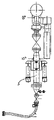
- FIG. 1 is a schematic view of a prior art settling leg
- FIG. 2 is a corresponding view of a setting leg according to the invention.
- the known settling leg is connected to the lower part of loop reactor 1 .
- An 8′′ nominal diameter (actually 219 mm outside and 189 mm inside diameters) conduit 2 is welded to the loop reactor and leads to upper block valve 3 and lower block valve 4 .
- conduit 5 Downstream of the lower block valve 4 is a further conduit 5 that is also of 8′′ nominal diameter. This in turn leads to lower region 6 and to a PTO valve 7 .
- the PTO valve 7 controls flow into conduit 8 that leads to a flash tank (not shown).
- the block valves are only closed for maintenance or in emergencies.
- the lower block valve 4 duplicates the upper block valve 3 and is provided as a safety feature. Thus, in use, the block valves are always open to allow slurry from the reactor loop to enter the settling leg.
- the slurry is a primarily liquid mixture of monomer (ethylene), diluent (iso-butane), co-monomer (1-hexene), hydrogen and catalyst. Inside the reactor the pressure is around 4 Mpa. It is circulated around the loop reactor at around 10–12 m/s. Typical residence time is 45 minutes.
- polyethylene forms a solid “fluff” which is suspended in the slurry.
- the slurry is comparatively still and so the fluff settles out and sinks to the bottom of the leg, thereby increasing its concentration from 40 wt % to 60 wt %.
- the illustrated settling leg is one of several connected to the bottom of the loop reactor 1 . Each of these is periodically “fired” whereby the PTO valve 7 is opened for a few seconds every minute. The pressure downstream of the valve 7 is only 0.15 Mpa (compared to 4 MPa upstream) and so its contents are rapidly expelled along conduit 8 .
- Conduit 8 leads to a flash drum in which the polymer fluff or powder is separated out. The remaining isobutane is then purified, pressurized and then returned to the reactor.
- FIG. 2 illustrates a settling leg that is identical to that of FIG. 1 except that the diameter of conduit 5 is increased to 10′′ nominal (actually 273 mm outside and 222 mm inside diameters).
- the 8′′ diameter part is 1.9 m in length and the 10′′ diameter part is 1.7 m in length, giving a total length of 3.6 m
- the settling leg of FIG. 2 operates in the same manner as that of FIG. 1 , except that due to the increased diameter conduit 5 the settling rate and polymer concentration is significantly increased.
Landscapes
- Chemical & Material Sciences (AREA)
- Organic Chemistry (AREA)
- Chemical Kinetics & Catalysis (AREA)
- Engineering & Computer Science (AREA)
- Combustion & Propulsion (AREA)
- Polymerisation Methods In General (AREA)
- Addition Polymer Or Copolymer, Post-Treatments, Or Chemical Modifications (AREA)
- Transition And Organic Metals Composition Catalysts For Addition Polymerization (AREA)
Abstract
A setting leg for a polymerization reactor connected to the lower part of the loop reactor (1). A conduit (2) is welded to the loop reactor and leads to upper valve (3) and lower block valve (4). Downstream of the lower block valve (4) is a further conduit (5) which leads to a lower region (6) and to a product take off (PTO) valve 7. Conduit (5) has a significantly greater cross-sectional area than conduit (2). In use, the block valves (3) and (4) are always open to allow slurry from the reactor loop to enter the settling leg. The PTO valve (7) is regularly opened to allow the settled polyethylene “fluff” to be rapidly expelled along conduit (8). The greater area of conduit (5) significantly increases the settling rate ad polymer concentration of the polyethylene “fluff”.
Description
The present application claims priority to European Application No. 01309185.5, filed Oct. 30, 2001, which application is incorporated herein fully by this reference.
The present invention relates to apparatus for use in the manufacture of polymers, and in particular to the design of the settling leg(s) of a polymerisation reactor.
Polymers such as polyethylene are typically manufactured according to the Phillips process in a pressurized loop reactor using a so-called slurry system where the polymer is continuously formed as the reactants are circulated around the loop reactor in the liquid state. The polymer product forms as a solid that is suspended within the liquid.
When polyethylene is to be produced in this way, high purity ethylene is supplied to the reactor together with certain other materials. A low boiling point hydrocarbon such as isobutane is used to dissolve the ethylene monomer and to suspend catalyst and polymer particles within the reactor. The isobutane plays no part in the actual polymerization reation and so it is eventually recovered, purified and recycled. In addition, hydrogen is added to control the molecular weight of the polyethylene produced and 1-hexene co-monomer is added in order to control product density. The reaction is typically catalysed using chromium, Ziegler Natta or metallocene catalyst.
The ethylene gas, diluent and powdered catalyst are fed continuously into the loop reactor where they are rapidly circulated by means of a pump. The reactor core is typically maintained at a temperature of the order of 100° C. and a pressure of the order of 4 MPa. During normal operation, the reactor contains about 40 wt % polyethylene. As the process continues, polymer particles start to form and the larger ones precipitate as “fluff” and enter a settling zone from which concentrated slurry is periodically discharged.
The production system is continuous such that the product is removed at the same rate at which it is formed. The polymer product is mixed with isobutane diluent and it is clearly desirable to reduce the amount of isobutane that leaves the reactor with the polymer. This isobutane must be purified and re-compressed before being fed back into the reactor which adds significant cost to the process.
In order to increase the concentration of the polymer before it is discharged, settling legs (or dump legs) are used. A settling leg is a conduit connected to a section of the loop reactor via an outlet conduit that is welded to the loop reactor. The geometry of the settling leg is chosen so that the liquid within it is comparatively still in order to increase fluff settlement. Flow out of the settling leg is controlled by a valve arrangement so that the concentrated slurry is periodically discharged from the reactor.
Although other arrangements have been proposed and used, the most common system is for the settling leg to take the form of a vertical tube extending downwardly from the lowermost point on the loop reactor core. It is typically connected to the reactor by one or two block valves with a further, so-called product take-off, valve (PTO) being provided at the lower end of the settling leg. The settling leg is arranged in relation to the loop reactor such that the flow of slurry across the opening thereof provides a resting zone where the polymer particles settle out to some extent from the diluent. This increases polymer concentration to perhaps 60 wt %.
The block valves are only closed in the event of irregular operation of the reactor, such as plugging, to enable safe demounting of the settling leg for maintenance or cleaning purposes. (When they are open they do not constrict the leg.) Thus, during operation, the block valves are constantly open to enable slurry from the reactor to enter the settling leg. Due to the higher density of the polymer fluff compared to the diluent, the concentration of fluff in the settling leg will increase. The amount of product settled (i.e. the product concentration in the leg) is known to depend on particle properties, diluent density, cross sectional area of the leg and the resting time.
The content of the settling leg is periodically discharged via the PTO valve in a process known as firing. In a typical reactor there are a number of settling legs and each is fired at a different time about once per minute. To fire a leg, the PTO valve is opened for a few seconds. The pressure within the reactor rapidly forces the contents of the leg out through the PTO valve to a flash chamber wherein the mixture is flashed for substantially complete removal of diluent and any traces of monomer.
Such an arrangement is well known and is illustrated, for example, in U.S. Pat. No. 5,183,866 which primarily concerns improvements to the evaporation of diluent. A further example is U.S. Pat. No. 4,461,889 which proposes the use of a filter vessel downstream of the settling leg in order to improve the removal of polymer solids from diluent before the polymer is fed to a flash tank.
It will be appreciated that the velocity at which the polymer is settling in the settling leg so that it may then be discharged, has a significant effect on the overall rate of production of the reactor. It also determines the rate of diluent flow to the reactor. The mass of polymer settling per unit time is termed the settling rate and in a modern loop reactor the settling rate provides one of the main limitations to increased production capacity. This limitation can be addressed by increasing diluent capacity, but this requires extremely expensive modifications to a typical reactor.
It has already been mentioned that the settling rate depends on polymer fluff properties. These are in turn determined by the catalyst properties and cannot normally be changed without affecting the properties of the final polymer product. Indeed, the change from one catalyst to another (e.g. to produce a polymer with different properties) may change the fluff properties to such an extent that production capacity is reduced by 25%. For example, such a reduction may be seen if production using metallocene catalyst to produce polymer for rotomoulding is compared with blow moulding polymer produced using chromium catalyst. Thus, the general desire to increase settling rate may be especially acute in such circumstances.
Furthermore, if polymer solid content is too low, problems are caused in the operation of the flash drum. This is because flash drums are designed to use heat from the material fed to them. Solid polymer has a higher heat capacity than diluent, so lower polymer content may result in too little heat reaching the flash drum to evaporate completely the diluent.
In order to provide improved polymer settling and thereby to reduce diluent content in the slurry, U.S. Pat. No. 4,613,484 describes the use of various arrangements of settling legs. These include the use of inclined portions in combination with a diluent recycle line out of the settling leg and a small stream of feed diluent into the settling leg. However, constructing inclined settling legs provides practical difficulties and the additional conduits and valving involved in providing the diluent recycle and feed diluent lines add a significant degree of complexity and cost.
EP-A-0891990 identifies the problem of the bottleneck provided by the use of settling legs and furthermore explains that increasing the diameter of settling legs causes significant difficulties because it is not practicable to increase the diameter of the block valves between the loop and the leg. As a consequence of this, it explains, the normal practice in the art has been to increase the number of settling legs on each loop. However, this also causes practical difficulties as the number of legs required starts to exceed the space available. In response to these difficulties the document proposes eliminating the settling step altogether by increasing the polymer concentration of the slurry in the reactor and utilising continuous product take-off.
WO 01/05842 also disclosed a loop reactor that is designed for continuous product take-off.
It will be appreciated that this approach is not appropriate in many circumstances and it will often not be possible or desirable to modify reactor conditions to enable continuous take-off to be used. For example, one cannot increase the polymer concentration of the slurry beyond certain limits imposed by the flow characteristics of the slurry.
According to the present invention there is provided a settling leg for a polymerisation reactor comprising a first tubular portion for connection in fluid communication with a polymerisation reactor and a second tubular portion connected to the first tubular portion via at least one block valve, wherein the second tubular portion has a greater internal cross-sectional area than the first tubular portion.
Thus, by means of the invention, the settling leg comprises a portion of increased cross-sectional area that in use is downstream of the valve. (Normally the tubular portions are of circular cross-section and so this will correspond to an increase in diameter.) Thus, by means of the invention, the size of the block valve(s) does not limit the maximum diameter of the settling leg. As explained in EP-A-0891990 (referred to above) the diameter of the block valves had been regarded as limiting the diameter of settling legs. In line with normal practice it is preferred that there are two block values and these typically have an internal diameter when fully open which is substantially the same as that of the first tubular portion.
It has been found that this arrangement has a significant effect in improving the rate of settlement of the polymer compared to a settling leg having a constant diameter corresponding to that of the first portion. Thus, the invention is based upon the surprising finding that, contrary to the received wisdom in the art, the settling rate can be improved without increasing the diameter of the portion of the settling leg that is joined to the reactor and without increasing the block valve size. This is because it has been found that settling rate is determined by the diameter of the lower portion of the leg—the diameter of the upper part has been found not to be determinative. Settling rate can therefore be improved more easily and less expensively than previously.
Moreover, compared to a settling leg of the same volume in which the first and second portions are of equal diameter, the invention also provides an increased volume to length ratio that assists in preventing slurry with a high diluent concentration being discharged during firing of the leg.
Preferably the first tubular portion comprises less than half the length of the leg and serves merely to connect the valve to a loop reactor.
The invention is not limited to particular sizes of first and second portions—these may be selected depending on the requirements of a given situation. For the invention to have any significant benefit, however, the second portion should be at least 10% greater in diameter than the first. To improve performance further the second portion is preferably more than 25% or even up to 50% or more larger. It is believed that a practical upper limit is reached when the value is 100%—i.e. when the second portion is twice the diameter of the first.
For the best overall performance, the ratio of the diameter of the first to the second portion is preferably in the range of from 1:1.2 to 1:1.6 and most preferably from 1:1.25 to 1:1.5.
Although the actual tube diameter can be varied, the first portion is preferably between 8 and 12 inches. The second portion is preferably between 10 and 14 inches in diameter, although it could be as much as 30 inches. (The pipe sizes used here are the typical nominal sizes as specified in this art, dimensioned in inches as is conventional.) For example, the diameters may be a nominal 8 and 10 inches in diameter, or a nominal 10 and 12 inches in diameter.
In a particularly preferred form of the invention the settling leg comprises a first tubular portion (e.g. nominal 8″) for connection to the loop part of a reactor, downstream of which is a pair of block valves and further downstream the diameter is increased to form the second tubular portion (e.g. nominal 10″) which in turn leads to a PTO valve.
The invention also extends to a polymerisation reactor comprising a settling leg as previously described. Such a reactor can be operated with a higher production rate than would be possible without a settling leg according to the invention because the higher settling rate allows product to be removed from the reactor more quickly.
The invention also extends to a method in which the setting leg described may be used to produce polymer. Thus, viewed from another aspect the invention provides a method of producing a polymer comprising the use of a reactor as previously described. More specifically it provides a method of producing polymer comprising the steps of supplying reactant(s), diluent and catalyst to a loop reactor and periodically discharging polymer product therefrom via a settling leg, wherein the settling leg comprises a first portion connected to the loop reactor, a second portion downstream of the first portion and isolatable therefrom by a block valve, the second portion having a greater diameter than the first portion, the flow of polymer from the settling leg being controlled by a valve downstream of the second portion which is periodically opened.
Furthermore, the invention extends to a polymer produced using such a reactor or such a method.
An embodiment of the invention will now be described, by way of example only, and with reference to the the accompanying drawings:
As may be seen from FIG. 1 , the known settling leg is connected to the lower part of loop reactor 1. An 8″ nominal diameter (actually 219 mm outside and 189 mm inside diameters) conduit 2 is welded to the loop reactor and leads to upper block valve 3 and lower block valve 4.
Downstream of the lower block valve 4 is a further conduit 5 that is also of 8″ nominal diameter. This in turn leads to lower region 6 and to a PTO valve 7. The PTO valve 7 controls flow into conduit 8 that leads to a flash tank (not shown).
The block valves are only closed for maintenance or in emergencies. The lower block valve 4 duplicates the upper block valve 3 and is provided as a safety feature. Thus, in use, the block valves are always open to allow slurry from the reactor loop to enter the settling leg.
The slurry is a primarily liquid mixture of monomer (ethylene), diluent (iso-butane), co-monomer (1-hexene), hydrogen and catalyst. Inside the reactor the pressure is around 4 Mpa. It is circulated around the loop reactor at around 10–12 m/s. Typical residence time is 45 minutes.
As it is produced, polyethylene forms a solid “fluff” which is suspended in the slurry. Within the settling leg the slurry is comparatively still and so the fluff settles out and sinks to the bottom of the leg, thereby increasing its concentration from 40 wt % to 60 wt %.
The illustrated settling leg is one of several connected to the bottom of the loop reactor 1. Each of these is periodically “fired” whereby the PTO valve 7 is opened for a few seconds every minute. The pressure downstream of the valve 7 is only 0.15 Mpa (compared to 4 MPa upstream) and so its contents are rapidly expelled along conduit 8.
The settling leg of FIG. 2 operates in the same manner as that of FIG. 1 , except that due to the increased diameter conduit 5 the settling rate and polymer concentration is significantly increased.
Claims (8)
1. A settling leg for a polymerisation reactor comprising a first tubular portion for connection in fluid communication with a polymerisation reactor and a second tubular portion connected to the first tubular portion via at least one block valve, wherein the second tubular portion has a greater internal cross-sectional area than the first tubular portion.
2. A settling leg as claimed in claim 1 , wherein the first tubular portion comprises less than half of the length of the settling leg.
3. A settling leg as claimed in claim 1 , wherein the tubular portions are circular in section and the ratio of the diameter of the first portion to the second portion is in the range from 1:1.1 to 1:2.
4. A settling leg as claimed in claim 1 , wherein the cross sectional area of the second portion is at least 50% greater than that of the first portion.
5. A settling leg as claimed in claim 1 , wherein the first portion has a nominal diameter of 8 to 12″ and the second portion has a nominal diameter of 10 to 14″.
6. A polymerisation reactor comprising a settling leg as claimed in claim 1 .
7. A method of producing polymer comprising the steps of supplying reactant(s), diluent and catalyst to a loop reactor and periodically discharging polymer product therefrom via a settling leg, wherein the settling leg comprises a first portion connected to the loop reactor, a second portion downstream of the first portion and isolatable therefrom by a block valve, the second portion having a greater diameter than the first portion, the flow of polymer from the settling leg being controlled by a valve downstream of the second portion which is periodically opened.
8. A method as claimed in claim 7 wherein the settling leg comprises a first tubular portion for connection in fluid communication with a polymerisation reactor and a second tubular portion connected to the first tubular portion via at least one block valve, wherein the second tubular portion has a greater internal cross-sectional area than the first tubular portion.
Applications Claiming Priority (3)
| Application Number | Priority Date | Filing Date | Title |
|---|---|---|---|
| EP01309185A EP1310295B1 (en) | 2001-10-30 | 2001-10-30 | Polymerisation reactor |
| EP01309185.5 | 2001-10-30 | ||
| PCT/EP2002/012111 WO2003037499A1 (en) | 2001-10-30 | 2002-10-30 | Polymerisation reactor |
Publications (2)
| Publication Number | Publication Date |
|---|---|
| US20050038206A1 US20050038206A1 (en) | 2005-02-17 |
| US6964754B2 true US6964754B2 (en) | 2005-11-15 |
Family
ID=8182402
Family Applications (1)
| Application Number | Title | Priority Date | Filing Date |
|---|---|---|---|
| US10/494,078 Expired - Fee Related US6964754B2 (en) | 2001-10-30 | 2002-10-30 | Polymerization reactor |
Country Status (6)
| Country | Link |
|---|---|
| US (1) | US6964754B2 (en) |
| EP (1) | EP1310295B1 (en) |
| CN (1) | CN1301786C (en) |
| AT (1) | ATE367198T1 (en) |
| DE (1) | DE60129444T2 (en) |
| WO (1) | WO2003037499A1 (en) |
Families Citing this family (164)
| Publication number | Priority date | Publication date | Assignee | Title |
|---|---|---|---|---|
| EP1564228A1 (en) * | 2004-02-13 | 2005-08-17 | Total Petrochemicals Research Feluy | Olefin polymerization process with sequential discharging. |
| EP1564224A1 (en) * | 2004-02-13 | 2005-08-17 | Total Petrochemicals Research Feluy | Slurry loop reactors |
| CN100366638C (en) * | 2006-02-24 | 2008-02-06 | 中国石油化工股份有限公司 | A kind of olefin polymerization reactor |
| EP1839742A1 (en) * | 2006-03-30 | 2007-10-03 | Total Petrochemicals Research Feluy | Flushing in a multiple loop reactor |
| EP2130859A1 (en) | 2008-06-02 | 2009-12-09 | Borealis AG | Polymer compositions having improved homogeneity and odour, a method for making them and pipes made thereof |
| EP2130862A1 (en) | 2008-06-02 | 2009-12-09 | Borealis AG | Polymer compositions and pressure-resistant pipes made thereof |
| EP2130863A1 (en) | 2008-06-02 | 2009-12-09 | Borealis AG | High density polymer compositions, a method for their preparation and pressure-resistant pipes made therefrom |
| EP2182526A1 (en) | 2008-10-31 | 2010-05-05 | Borealis AG | Cable and polymer composition comprising an multimodal ethylene copolymer |
| EP2182524A1 (en) | 2008-10-31 | 2010-05-05 | Borealis AG | Cable and Polymer composition comprising a multimodal ethylene copolymer |
| EP2182525A1 (en) | 2008-10-31 | 2010-05-05 | Borealis AG | Cable and polymer composition comprising a multimodal ethylene copolymer |
| ES2381849T3 (en) | 2008-11-17 | 2012-06-01 | Borealis Ag | Multi-stage procedure to produce polyethylene with reduced gel formation |
| EP2228395A1 (en) | 2009-02-24 | 2010-09-15 | Borealis AG | Improved multi-stage process for producing multi-modal ethylene polymer composition |
| EP2228394B1 (en) | 2009-02-24 | 2013-09-04 | Borealis AG | Multi-stage process for producing multi-modal linear low density polyethylene |
| ATE529450T1 (en) | 2009-02-25 | 2011-11-15 | Borealis Ag | MULTIMODAL PROPYLENE POLYMER, COMPOSITION THEREOF AND METHOD FOR PRODUCING THEREOF |
| EP2223944A1 (en) | 2009-02-26 | 2010-09-01 | Borealis AG | Process for producing semicrystalline propylene polymers |
| EP2246372A1 (en) | 2009-04-30 | 2010-11-03 | Borealis AG | Improved multi-stage process for producing multi-modal linear low density polyethylene |
| EP2246368A1 (en) | 2009-04-30 | 2010-11-03 | Borealis AG | Improved ethylene polymerization catalyst composition |
| EP2246369B1 (en) | 2009-04-30 | 2012-09-05 | Borealis AG | Linear low density polyethylene with uniform or reversed comonomer composition distribution |
| PL2256158T3 (en) | 2009-05-26 | 2014-09-30 | Borealis Ag | Polymer composition for crosslinked articles |
| EP2256159A1 (en) | 2009-05-26 | 2010-12-01 | Borealis AG | Polymer composition for crosslinked pipes |
| EP2289950B1 (en) | 2009-08-25 | 2014-03-05 | Borealis AG | Improved ethylene polymerization catalyst composition |
| EA021843B1 (en) | 2009-11-13 | 2015-09-30 | Бореалис Аг | Process for olefin polymerization |
| WO2011058088A1 (en) | 2009-11-13 | 2011-05-19 | Borealis Ag | Process for recovering a transition metal compound |
| EP2499168B1 (en) | 2009-11-13 | 2017-05-10 | Borealis AG | Process for recovering a transition metal compound |
| EP2322568B1 (en) | 2009-11-13 | 2013-05-15 | Borealis AG | Process for producing an olefin polymerization catalyst |
| EP2374823A1 (en) | 2010-04-07 | 2011-10-12 | Borealis AG | Production of alpha-olefin copolymers in a loop reactor with variable comonomer feed |
| ES2624858T3 (en) | 2010-06-17 | 2017-07-17 | Borealis Ag | Control system for a gas phase reactor, a gas phase reactor for the catalytic production of polyolefins, a method for catalytic productions of polyolefins and a use of the control system |
| EP2399943A1 (en) | 2010-06-28 | 2011-12-28 | Borealis AG | Process for producing polyethylene |
| EP2428526A1 (en) | 2010-09-13 | 2012-03-14 | Borealis AG | Process for producing polyethylene with improved homogeneity |
| EP2452959B1 (en) | 2010-11-12 | 2015-01-21 | Borealis AG | Process for producing propylene random copolymers and their use |
| EP2452957A1 (en) | 2010-11-12 | 2012-05-16 | Borealis AG | Improved process for producing heterophasic propylene copolymers |
| EP2452976A1 (en) | 2010-11-12 | 2012-05-16 | Borealis AG | Heterophasic propylene copolymers with improved stiffness/impact/flowability balance |
| EP2452960B1 (en) | 2010-11-12 | 2015-01-07 | Borealis AG | Process for preparing propylene polymers with an ultra high melt flow rate |
| EP2535372B1 (en) | 2011-06-15 | 2016-09-14 | Borealis AG | In-situ reactor blend of a Ziegler-Natta catalysed, nucleated polypropylene and a metallocene catalysed polypropylene |
| EP2570455A1 (en) | 2011-09-16 | 2013-03-20 | Borealis AG | Polyethylene composition with broad molecular weight distribution and improved homogeneity |
| EP2599828A1 (en) | 2011-12-01 | 2013-06-05 | Borealis AG | Multimodal polyethylene composition for the production of pipes with improved slow crack growth resistance |
| EP2617741B1 (en) | 2012-01-18 | 2016-01-13 | Borealis AG | Process for polymerizing olefin polymers in the presence of a catalyst system and a method of controlling the process |
| ES2604934T3 (en) | 2012-11-09 | 2017-03-10 | Abu Dhabi Polymers Company Limited (Borouge) | Polymeric composition comprising a mixture of a multimodal polyethylene and an additional ethylene polymer suitable for the manufacture of a drip irrigation tube |
| EP2730611B1 (en) | 2012-11-09 | 2017-01-04 | Abu Dhabi Polymers Company Limited (Borouge) | Drip irrigation pipe comprising a polymer composition comprising a multimodal polyethylene base resin |
| EP2740761B1 (en) | 2012-12-05 | 2016-10-19 | Borealis AG | Polyethylene composition with improved balance of slow crack growth resistance, impact performance and pipe pressure resistance for pipe applications |
| EP2740748B1 (en) | 2012-12-07 | 2015-06-10 | Borealis AG | Method of polymerizing olefins in slurry reactors |
| EP2749580B1 (en) | 2012-12-28 | 2016-09-14 | Borealis AG | Process for producing copolymers of propylene |
| EP3235832B1 (en) | 2013-04-22 | 2018-06-20 | Borealis AG | Polypropylene compositions |
| PL2796498T3 (en) | 2013-04-22 | 2019-03-29 | Abu Dhabi Polymers Company Limited (Borouge) | Multimodal polypropylene composition for pipe applications |
| ES2628082T3 (en) | 2013-04-22 | 2017-08-01 | Borealis Ag | Multi-stage process to produce low temperature resistant polypropylene compositions |
| PL2796500T3 (en) | 2013-04-22 | 2018-12-31 | Abu Dhabi Polymers Company Limited (Borouge) | Propylene random copolymer composition for pipe applications |
| PL2796499T3 (en) | 2013-04-22 | 2018-12-31 | Abu Dhabi Polymers Company Limited (Borouge) | Polypropylene composition with improved impact resistance for pipe applications |
| ES2632593T3 (en) | 2013-04-22 | 2017-09-14 | Borealis Ag | Two-stage process of producing polypropylene compositions |
| EP2796501B9 (en) | 2013-04-22 | 2019-05-01 | Abu Dhabi Polymers Company Limited (Borouge) | Multimodal polypropylene composition for pipe applications |
| EP2853562A1 (en) | 2013-09-27 | 2015-04-01 | Borealis AG | Two-stage process for producing polypropylene compositions |
| EP2860200B1 (en) | 2013-10-10 | 2017-08-02 | Borealis AG | Polyethylene composition for pipe and pipe coating applications |
| EP2860203B1 (en) | 2013-10-10 | 2016-12-14 | Borealis AG | Multistage process for producing polyethylene compositions |
| PL2860202T3 (en) | 2013-10-10 | 2018-11-30 | Borealis Ag | High temperature resistant polyethylene and process for the production thereof |
| EP2860201A1 (en) | 2013-10-10 | 2015-04-15 | Borealis AG | High temperature resistant polyethylene and process for the production thereof |
| EP2860204B1 (en) | 2013-10-10 | 2018-08-01 | Borealis AG | Polyethylene composition for pipe applications |
| EP2883887A1 (en) | 2013-12-13 | 2015-06-17 | Borealis AG | Multistage process for producing polyethylene compositions |
| EP2883885A1 (en) | 2013-12-13 | 2015-06-17 | Borealis AG | Multistage process for producing polyethylene compositions |
| EP2907829B1 (en) | 2014-02-13 | 2020-08-19 | Borealis AG | Disentangled high or ultrahigh molecular weight polyethylene prepared with Ziegler-Natta catalyst |
| WO2016050774A1 (en) | 2014-09-30 | 2016-04-07 | Borealis Ag | Process for polymerising ultra-high molecular weight polyethylene |
| KR102006091B1 (en) | 2014-11-26 | 2019-07-31 | 보레알리스 아게 | Film layer |
| US10385194B2 (en) | 2014-11-26 | 2019-08-20 | Borealis Ag | Polyethylene composition for a film layer |
| EP3037471B2 (en) | 2014-12-22 | 2025-01-22 | Borealis AG | Process for producing multimodal polyethylene compositions |
| EP3037436B2 (en) | 2014-12-22 | 2020-11-18 | Borealis AG | Process for producing multimodal polyethylene in-situ blends including ultra-high molecular weight fractions |
| CN112979842B (en) | 2015-02-05 | 2022-11-11 | 博里利斯股份公司 | Process for producing polyethylene |
| EP3053976A1 (en) | 2015-02-09 | 2016-08-10 | Borealis AG | Adhesive composition |
| ES2741846T3 (en) | 2015-05-20 | 2020-02-12 | Borealis Ag | Production process of a polyethylene composition |
| WO2016198273A1 (en) | 2015-06-10 | 2016-12-15 | Borealis Ag | Multimodal copolymer of ethylene and at least two alpha-olefin comonomers and final articles made thereof |
| KR102670715B1 (en) | 2015-06-10 | 2024-05-29 | 보레알리스 아게 | Multimodal polyethylene copolymer |
| ES2707391T3 (en) | 2015-06-23 | 2019-04-03 | Borealis Ag | Procedure for the production of LLDPE resins |
| EP3178853B1 (en) | 2015-12-07 | 2018-07-25 | Borealis AG | Process for polymerising alpha-olefin monomers |
| EP3238938A1 (en) | 2016-04-29 | 2017-11-01 | Borealis AG | Machine direction oriented films comprising multimodal copolymer of ethylene and at least two alpha-olefin comonomers |
| EP3252085B1 (en) | 2016-05-31 | 2022-11-09 | Borealis AG | Jacket with improved properties |
| CN109415544B (en) | 2016-05-31 | 2022-07-05 | 博里利斯股份公司 | Polymer composition and method for producing the same |
| EP3257895A1 (en) | 2016-06-17 | 2017-12-20 | Borealis AG | Bi- or multimodal polyethylene terpolymer with enhanced rheological properties |
| CN109415545A (en) | 2016-06-17 | 2019-03-01 | 博里利斯股份公司 | Bimodal or multimodal polyethylene with enhanced rheological properties |
| ES2785685T3 (en) | 2016-06-17 | 2020-10-07 | Borealis Ag | Bimodal or multimodal polyethylene terpolymer with enhanced rheological properties |
| KR20190021323A (en) | 2016-06-17 | 2019-03-05 | 보레알리스 아게 | Raw or amorphous polyethylene with low unsaturation levels |
| EP3257879A1 (en) | 2016-06-17 | 2017-12-20 | Borealis AG | Bi- or multimodal polyethylene with low unsaturation level |
| CN109415448B (en) | 2016-06-22 | 2021-04-13 | 北欧化工公司 | Polymer compositions and methods of making polymer compositions |
| EP3475318A1 (en) | 2016-06-23 | 2019-05-01 | Borealis AG | Process for catalyst deactivation |
| CA3036991C (en) | 2016-11-25 | 2021-01-12 | Borealis Ag | Polymer composition comprising very high molecular weight, low molecularweight, and high molecular weight polyethylene fractions |
| EP3418330B2 (en) | 2017-06-21 | 2023-07-19 | Borealis AG | Polymer composition and a process for production of the polymer composition |
| CN109135067A (en) | 2017-06-27 | 2019-01-04 | 阿布扎比聚合物有限责任公司(博禄) | For manufacturing the polypropene composition of high-voltage tube |
| CN111315567B (en) | 2017-10-24 | 2022-02-25 | 博里利斯股份公司 | Multilayer polymeric film |
| EP3479896A1 (en) | 2017-11-03 | 2019-05-08 | Borealis AG | Polymerization reactor system comprising at least one withdrawal valve |
| CN111801357A (en) | 2018-03-02 | 2020-10-20 | 博里利斯股份公司 | method |
| WO2019180166A1 (en) | 2018-03-21 | 2019-09-26 | Borealis Ag | Bi- or multimodal polyethylene composition |
| PL3567061T3 (en) | 2018-05-09 | 2024-02-26 | Borealis Ag | Polypropylene pipe composition |
| BR112020024029A2 (en) | 2018-05-30 | 2021-02-23 | Borealis Ag | process for the preparation of multimodal high density polyethylene |
| CA3106413A1 (en) | 2018-07-19 | 2020-01-23 | Borealis Ag | Process for the preparation of an uhmwpe homopolymer |
| CN112912409B (en) | 2018-10-31 | 2024-02-20 | 博里利斯股份公司 | Polyethylene compositions for high-pressure resistant pipes with improved homogeneity |
| EP3647645A1 (en) | 2018-10-31 | 2020-05-06 | Borealis AG | Polyethylene composition for high pressure resistant pipes |
| US20210363314A1 (en) | 2018-11-07 | 2021-11-25 | Borealis Ag | Polyolefin composition with improved impact and whitening resistance |
| CN113227173B (en) | 2018-11-15 | 2023-04-28 | 博里利斯股份公司 | Propylene-butene copolymers |
| SG11202102319WA (en) | 2018-11-15 | 2021-04-29 | Abu Dhabi Polymers Co Ltd Borouge | Polymer composition for blow molding applications |
| ES2953548T3 (en) | 2018-11-15 | 2023-11-14 | Borealis Ag | Composition |
| CN113227172B (en) | 2018-11-15 | 2023-06-02 | 博里利斯股份公司 | Propylene Butene Copolymer |
| WO2020109289A1 (en) | 2018-11-28 | 2020-06-04 | Abu Dhabi Polymers Co. Ltd (Borouge) L.L.C. | Polyethylene composition for film applications |
| US20220119564A1 (en) | 2018-11-29 | 2022-04-21 | Borealis Ag | Process to produce a polymer and polymer |
| US20220282074A1 (en) | 2019-07-22 | 2022-09-08 | Abu Dhabi Polymers Co. Ltd (Borouge) L.L.C., | Single site catalysed multimodal polyethylene composition |
| EP4025614A1 (en) | 2019-09-05 | 2022-07-13 | ExxonMobil Chemical Patents Inc. | Processes for producing polyolefins and impact copolymers with broad molecular weight distribution and high stiffness |
| CN115210267A (en) | 2020-01-24 | 2022-10-18 | 埃克森美孚化学专利公司 | Process for producing bimodal polyolefins and impact copolymers |
| EP4107196A1 (en) | 2020-02-17 | 2022-12-28 | ExxonMobil Chemical Patents Inc. | Propylene-based polymer compositions having a high molecular weight tail |
| EP3885375B1 (en) | 2020-03-24 | 2022-08-31 | Borealis AG | Stiff blown film |
| EP4126994A1 (en) | 2020-03-24 | 2023-02-08 | Borealis AG | Polyethylene composition for a film layer |
| EP4126993A1 (en) | 2020-03-24 | 2023-02-08 | Borealis AG | Polyethylene composition for a film layer |
| EP4185620A1 (en) | 2020-07-23 | 2023-05-31 | Borealis AG | Multimodal ethylene copolymer |
| WO2022106710A1 (en) | 2020-11-23 | 2022-05-27 | Borealis Ag | In-situ reactor blend of ziegler-natta catalysed, nucleated polypropylene and a metallocene catalysed polypropylene |
| CN116601177A (en) | 2020-11-27 | 2023-08-15 | 博里利斯股份公司 | craft |
| EP4019583B1 (en) | 2020-12-28 | 2024-04-10 | ABU DHABI POLYMERS CO. LTD (BOROUGE) - Sole Proprietorship L.L.C. | Polyethylene composition for film applications with improved toughness and stiffness |
| EP4029914B1 (en) | 2021-01-14 | 2025-03-05 | Borealis AG | Heterophasic polyolefin composition |
| CN117561286B (en) | 2021-06-24 | 2025-09-09 | 博里利斯股份公司 | Catalyst performance improvement in multi-stage polyolefin production |
| CA3223004A1 (en) | 2021-06-24 | 2022-12-29 | Pascal Castro | Process for polymerising olefins having narrow particle size distribution |
| KR20240023652A (en) | 2021-06-24 | 2024-02-22 | 보레알리스 아게 | Use of 1-hexene in multi-step polyolefin production |
| WO2022268953A1 (en) | 2021-06-24 | 2022-12-29 | Borealis Ag | Process for producing polyethylene polymers |
| WO2022268951A1 (en) | 2021-06-24 | 2022-12-29 | Borealis Ag | Use of a swelling agent in multi-stage polyolefin production |
| EP4151677A1 (en) | 2021-09-21 | 2023-03-22 | Borealis AG | Biaxially oriented film |
| CA3232754A1 (en) | 2021-09-23 | 2023-03-30 | Borealis Ag | Process for producing a propylene copolymer |
| EP4155328A1 (en) | 2021-09-23 | 2023-03-29 | Borealis AG | Propylene-butene random copolymer composition with low extractable content |
| EP4163323B1 (en) | 2021-10-07 | 2024-05-29 | Borealis AG | Biaxially oriented film |
| EP4163309A1 (en) | 2021-10-07 | 2023-04-12 | Borealis AG | Hdpe |
| EP4239015B1 (en) | 2022-03-02 | 2024-05-22 | Borealis AG | Monoaxially oriented film comprising a polyethylene composition |
| EP4239014A1 (en) | 2022-03-02 | 2023-09-06 | Borealis AG | Film comprising a polyethylene composition |
| EP4245805B1 (en) | 2022-03-18 | 2024-09-18 | Borealis AG | Polyethylene blend for a film layer |
| PL4257640T3 (en) | 2022-04-04 | 2025-03-24 | Borealis Ag | PIPE CONTAINING A POLYPROPYLONE COMPOSITION |
| WO2023217750A1 (en) | 2022-05-12 | 2023-11-16 | Borealis Ag | Polyethylene copolymer for a film layer |
| WO2023217751A1 (en) | 2022-05-12 | 2023-11-16 | Borealis Ag | Composition for a film layer |
| EP4275889B1 (en) | 2022-05-12 | 2024-10-16 | Borealis AG | Oriented multilayered film |
| EP4296289A1 (en) | 2022-06-23 | 2023-12-27 | Borealis AG | Polyethylene copolymer for a film layer |
| US20260008910A1 (en) | 2022-07-01 | 2026-01-08 | Borealis Ag | Polyethylene copolymer for a film layer |
| EP4306444B1 (en) | 2022-07-14 | 2025-03-05 | Borealis AG | Composition |
| EP4306442B1 (en) | 2022-07-14 | 2025-05-07 | Borealis AG | Composition |
| CN119630709A (en) | 2022-07-27 | 2025-03-14 | 埃克森美孚化学专利公司 | Strain hardening enhanced polypropylene composition and method for producing the same |
| EP4317216A1 (en) | 2022-08-03 | 2024-02-07 | Abu Dhabi Polymers Co. Ltd (Borouge) LLC | Low density ethylene terpolymer composition |
| EP4386046A1 (en) | 2022-12-16 | 2024-06-19 | Borealis AG | Composition |
| EP4389418A1 (en) | 2022-12-19 | 2024-06-26 | Abu Dhabi Polymers Co. Ltd (Borouge) - Sole Proprietorship L.L.C. | Multilayer collation shrink film |
| EP4389414A1 (en) | 2022-12-19 | 2024-06-26 | Abu Dhabi Polymers Co. Ltd (Borouge) - Sole Proprietorship L.L.C. | Multilayer collation shrink film |
| EP4389819A1 (en) | 2022-12-20 | 2024-06-26 | Borealis AG | Polyolefin composition with excellent balance of properties |
| EP4389776A1 (en) | 2022-12-20 | 2024-06-26 | Borealis AG | Process |
| EP4389786A1 (en) | 2022-12-20 | 2024-06-26 | Borealis AG | Heterophasic polypropylene composition |
| EP4389820A1 (en) | 2022-12-21 | 2024-06-26 | Borealis AG | Polypropylene random copolymer compositions with improved impact resistance for pipe applications |
| TW202438539A (en) | 2022-12-23 | 2024-10-01 | 奧地利商柏列利斯股份公司 | Process for producing a high-flow polypropylene homopolymer |
| CN120380037A (en) | 2022-12-23 | 2025-07-25 | 北欧化工股份公司 | Process for producing polypropylene homo-or copolymer |
| EP4638530A1 (en) | 2022-12-23 | 2025-10-29 | Borealis AG | Process for producing a polypropylene copolymer |
| EP4417629A1 (en) | 2023-02-14 | 2024-08-21 | Borealis AG | Polyethylene blend for a film layer |
| EP4431552B1 (en) | 2023-03-14 | 2025-07-30 | Borealis GmbH | Biaxially oriented polyethylene film with improved stiffness |
| EP4455171A1 (en) | 2023-04-28 | 2024-10-30 | Borealis AG | Moulded articles |
| WO2025003240A1 (en) | 2023-06-26 | 2025-01-02 | Borealis Ag | Blend of post-consumer recycled (pcr) polymer and modifier |
| CN121419999A (en) | 2023-06-26 | 2026-01-27 | 北欧化工有限责任公司 | Process for preparing heterophasic polypropylene composition |
| EP4484456A1 (en) | 2023-06-26 | 2025-01-01 | Borealis AG | Heterophasic polypropylene composition |
| WO2025003435A1 (en) | 2023-06-30 | 2025-01-02 | Borealis Ag | Process |
| WO2025027178A1 (en) | 2023-08-03 | 2025-02-06 | Borealis Ag | Heterophasic polypropylene composition with high melting point |
| EP4516852A1 (en) | 2023-08-30 | 2025-03-05 | Borealis AG | Polyethylene blend for a film layer |
| EP4541583A1 (en) | 2023-10-18 | 2025-04-23 | Abu Dhabi Polymers Co. Ltd (Borouge) - Sole Proprietorship L.L.C. | Multilayer film |
| WO2025104234A1 (en) | 2023-11-15 | 2025-05-22 | Borealis Ag | Polyethylene compositions |
| EP4570856A1 (en) | 2023-12-14 | 2025-06-18 | Borealis AG | Polypropylene random copolymer compositions with improved impact resistance for pipe applications |
| EP4570831A1 (en) | 2023-12-15 | 2025-06-18 | Borealis AG | Polyethylene copolymer for a film layer |
| EP4574894A1 (en) | 2023-12-22 | 2025-06-25 | Abu Dhabi Polymers Co. Ltd (Borouge) - Sole Proprietorship L.L.C. | Polyethylene pipe with improved high temperature hydrostatic pressure performance |
| EP4588972A1 (en) | 2024-01-22 | 2025-07-23 | Borealis AG | Heterophasic propylene compositions with improved stiffness and impact |
| WO2025219499A1 (en) | 2024-04-18 | 2025-10-23 | Borealis Gmbh | Processes for polymerising olefins |
| WO2025219537A1 (en) | 2024-04-18 | 2025-10-23 | Borealis Gmbh | Process for propylene polymerization with optimized prepolymerization conditions |
| WO2025219533A1 (en) | 2024-04-18 | 2025-10-23 | Borealis Gmbh | Process for the preparation of a propylene homopolymer |
| WO2025262147A1 (en) | 2024-06-19 | 2025-12-26 | Borealis Gmbh | Processes for polymerising olefins |
| WO2026002813A1 (en) | 2024-06-24 | 2026-01-02 | Borealis Gmbh | Processes for polymerising olefins |
Citations (9)
| Publication number | Priority date | Publication date | Assignee | Title |
|---|---|---|---|---|
| US3195613A (en) | 1961-10-09 | 1965-07-20 | Phillips Petroleum Co | Method for continuously discharging the contents of a pressurized vessel |
| US4121029A (en) | 1976-12-06 | 1978-10-17 | Phillips Petroleum Company | Polyolefin reactor system |
| US4395523A (en) | 1978-03-16 | 1983-07-26 | Chemplex Company | Method of making and recovering olefin polymer particles |
| US4461889A (en) | 1980-09-17 | 1984-07-24 | Phillips Petroleum Company | Separation of solid polymers and liquid diluent |
| US4613484A (en) | 1984-11-30 | 1986-09-23 | Phillips Petroleum Company | Loop reactor settling leg system for separation of solid polymers and liquid diluent |
| US5183866A (en) | 1989-08-30 | 1993-02-02 | Phillips Petroleum Company | Polymer recovery process |
| US5575979A (en) * | 1991-03-04 | 1996-11-19 | Phillips Petroleum Company | Process and apparatus for separating diluents from solid polymers utilizing a two-stage flash and a cyclone separator |
| EP0891990A2 (en) | 1997-07-15 | 1999-01-20 | Phillips Petroleum Company | High solids slurry polymerization |
| WO2001005842A1 (en) | 1999-07-15 | 2001-01-25 | Phillips Petroleum Company | Slotted slurry take off |
-
2001
- 2001-10-30 AT AT01309185T patent/ATE367198T1/en not_active IP Right Cessation
- 2001-10-30 DE DE60129444T patent/DE60129444T2/en not_active Expired - Fee Related
- 2001-10-30 EP EP01309185A patent/EP1310295B1/en not_active Expired - Lifetime
-
2002
- 2002-10-30 US US10/494,078 patent/US6964754B2/en not_active Expired - Fee Related
- 2002-10-30 CN CNB028239822A patent/CN1301786C/en not_active Expired - Fee Related
- 2002-10-30 WO PCT/EP2002/012111 patent/WO2003037499A1/en not_active Ceased
Patent Citations (9)
| Publication number | Priority date | Publication date | Assignee | Title |
|---|---|---|---|---|
| US3195613A (en) | 1961-10-09 | 1965-07-20 | Phillips Petroleum Co | Method for continuously discharging the contents of a pressurized vessel |
| US4121029A (en) | 1976-12-06 | 1978-10-17 | Phillips Petroleum Company | Polyolefin reactor system |
| US4395523A (en) | 1978-03-16 | 1983-07-26 | Chemplex Company | Method of making and recovering olefin polymer particles |
| US4461889A (en) | 1980-09-17 | 1984-07-24 | Phillips Petroleum Company | Separation of solid polymers and liquid diluent |
| US4613484A (en) | 1984-11-30 | 1986-09-23 | Phillips Petroleum Company | Loop reactor settling leg system for separation of solid polymers and liquid diluent |
| US5183866A (en) | 1989-08-30 | 1993-02-02 | Phillips Petroleum Company | Polymer recovery process |
| US5575979A (en) * | 1991-03-04 | 1996-11-19 | Phillips Petroleum Company | Process and apparatus for separating diluents from solid polymers utilizing a two-stage flash and a cyclone separator |
| EP0891990A2 (en) | 1997-07-15 | 1999-01-20 | Phillips Petroleum Company | High solids slurry polymerization |
| WO2001005842A1 (en) | 1999-07-15 | 2001-01-25 | Phillips Petroleum Company | Slotted slurry take off |
Also Published As
| Publication number | Publication date |
|---|---|
| US20050038206A1 (en) | 2005-02-17 |
| DE60129444T2 (en) | 2007-10-31 |
| DE60129444D1 (en) | 2007-08-30 |
| CN1599639A (en) | 2005-03-23 |
| EP1310295A1 (en) | 2003-05-14 |
| ATE367198T1 (en) | 2007-08-15 |
| WO2003037499A1 (en) | 2003-05-08 |
| CN1301786C (en) | 2007-02-28 |
| EP1310295B1 (en) | 2007-07-18 |
Similar Documents
| Publication | Publication Date | Title |
|---|---|---|
| US6964754B2 (en) | Polymerization reactor | |
| KR100893097B1 (en) | Process and apparatus for producing olefin polymers | |
| US7985813B2 (en) | Slurry phase polymerisation process | |
| EP1556415B1 (en) | Loop reactor apparatus and polymerization processes with multiple feed points for olefins and catalysts | |
| US8138282B2 (en) | Loop reactor suitable for olefin polymerization with improved product removal means | |
| KR101093470B1 (en) | Process for enhancing the polymerization of ethylene and one or more optional comonomer (s) in a polymerization loop reactor | |
| WO2005077994A1 (en) | Process for improving the co-polymerization of ethylene and an olefin co-monomer in a polymerization loop reactor. | |
| CN100431681C (en) | Process for the polymerization of olefins with optimized product discharge | |
| US20040158007A1 (en) | Process and apparatus for reducing take-off valve plugging in a polymerization process | |
| EP2168676B1 (en) | Loop reactor for a slurry phase polymerisation process | |
| EP1988992B1 (en) | Transfer pipe between loop reactors | |
| CN100543044C (en) | Olefin polymerization process with sequential blowdown | |
| KR101176388B1 (en) | Flushing in a multiple loop reactor | |
| CN1332985C (en) | Loop reactor apparatus and polymerization process with multiple olefin and catalyst feed points | |
| CN103857709A (en) | Loop Reactors that Offer Advanced Yield Partition Control | |
| CN101495224B (en) | Loop Reactor for Polymerization |
Legal Events
| Date | Code | Title | Description |
|---|---|---|---|
| AS | Assignment |
Owner name: BOREALLS TECHNOLOGY OY, FINLAND Free format text: ASSIGNMENT OF ASSIGNORS INTEREST;ASSIGNORS:MELAAEN, INGRID S.;ALLENEERSCH, PAUL;VARDAL, ODD JARLE;AND OTHERS;REEL/FRAME:014874/0016;SIGNING DATES FROM 20040601 TO 20040622 |
|
| REMI | Maintenance fee reminder mailed | ||
| LAPS | Lapse for failure to pay maintenance fees | ||
| STCH | Information on status: patent discontinuation |
Free format text: PATENT EXPIRED DUE TO NONPAYMENT OF MAINTENANCE FEES UNDER 37 CFR 1.362 |
|
| FP | Lapsed due to failure to pay maintenance fee |
Effective date: 20091115 |