ES2741846T3 - Production process of a polyethylene composition - Google Patents
Production process of a polyethylene composition Download PDFInfo
- Publication number
- ES2741846T3 ES2741846T3 ES16723354T ES16723354T ES2741846T3 ES 2741846 T3 ES2741846 T3 ES 2741846T3 ES 16723354 T ES16723354 T ES 16723354T ES 16723354 T ES16723354 T ES 16723354T ES 2741846 T3 ES2741846 T3 ES 2741846T3
- Authority
- ES
- Spain
- Prior art keywords
- polyethylene
- sspe
- weight
- polymer
- shi
- Prior art date
- Legal status (The legal status is an assumption and is not a legal conclusion. Google has not performed a legal analysis and makes no representation as to the accuracy of the status listed.)
- Active
Links
Classifications
-
- C—CHEMISTRY; METALLURGY
- C08—ORGANIC MACROMOLECULAR COMPOUNDS; THEIR PREPARATION OR CHEMICAL WORKING-UP; COMPOSITIONS BASED THEREON
- C08J—WORKING-UP; GENERAL PROCESSES OF COMPOUNDING; AFTER-TREATMENT NOT COVERED BY SUBCLASSES C08B, C08C, C08F, C08G or C08H
- C08J3/00—Processes of treating or compounding macromolecular substances
- C08J3/005—Processes for mixing polymers
-
- C—CHEMISTRY; METALLURGY
- C08—ORGANIC MACROMOLECULAR COMPOUNDS; THEIR PREPARATION OR CHEMICAL WORKING-UP; COMPOSITIONS BASED THEREON
- C08L—COMPOSITIONS OF MACROMOLECULAR COMPOUNDS
- C08L23/00—Compositions of homopolymers or copolymers of unsaturated aliphatic hydrocarbons having only one carbon-to-carbon double bond; Compositions of derivatives of such polymers
- C08L23/02—Compositions of homopolymers or copolymers of unsaturated aliphatic hydrocarbons having only one carbon-to-carbon double bond; Compositions of derivatives of such polymers not modified by chemical after-treatment
- C08L23/04—Homopolymers or copolymers of ethene
- C08L23/08—Copolymers of ethene
- C08L23/0807—Copolymers of ethene with unsaturated hydrocarbons only containing four or more carbon atoms
- C08L23/0815—Copolymers of ethene with unsaturated hydrocarbons only containing four or more carbon atoms with aliphatic 1-olefins containing one carbon-to-carbon double bond
-
- C—CHEMISTRY; METALLURGY
- C08—ORGANIC MACROMOLECULAR COMPOUNDS; THEIR PREPARATION OR CHEMICAL WORKING-UP; COMPOSITIONS BASED THEREON
- C08J—WORKING-UP; GENERAL PROCESSES OF COMPOUNDING; AFTER-TREATMENT NOT COVERED BY SUBCLASSES C08B, C08C, C08F, C08G or C08H
- C08J2323/00—Characterised by the use of homopolymers or copolymers of unsaturated aliphatic hydrocarbons having only one carbon-to-carbon double bond; Derivatives of such polymers
- C08J2323/02—Characterised by the use of homopolymers or copolymers of unsaturated aliphatic hydrocarbons having only one carbon-to-carbon double bond; Derivatives of such polymers not modified by chemical after treatment
- C08J2323/04—Homopolymers or copolymers of ethene
- C08J2323/06—Polyethene
-
- C—CHEMISTRY; METALLURGY
- C08—ORGANIC MACROMOLECULAR COMPOUNDS; THEIR PREPARATION OR CHEMICAL WORKING-UP; COMPOSITIONS BASED THEREON
- C08J—WORKING-UP; GENERAL PROCESSES OF COMPOUNDING; AFTER-TREATMENT NOT COVERED BY SUBCLASSES C08B, C08C, C08F, C08G or C08H
- C08J2323/00—Characterised by the use of homopolymers or copolymers of unsaturated aliphatic hydrocarbons having only one carbon-to-carbon double bond; Derivatives of such polymers
- C08J2323/02—Characterised by the use of homopolymers or copolymers of unsaturated aliphatic hydrocarbons having only one carbon-to-carbon double bond; Derivatives of such polymers not modified by chemical after treatment
- C08J2323/04—Homopolymers or copolymers of ethene
- C08J2323/08—Copolymers of ethene
-
- C—CHEMISTRY; METALLURGY
- C08—ORGANIC MACROMOLECULAR COMPOUNDS; THEIR PREPARATION OR CHEMICAL WORKING-UP; COMPOSITIONS BASED THEREON
- C08J—WORKING-UP; GENERAL PROCESSES OF COMPOUNDING; AFTER-TREATMENT NOT COVERED BY SUBCLASSES C08B, C08C, C08F, C08G or C08H
- C08J2423/00—Characterised by the use of homopolymers or copolymers of unsaturated aliphatic hydrocarbons having only one carbon-to-carbon double bond; Derivatives of such polymers
- C08J2423/02—Characterised by the use of homopolymers or copolymers of unsaturated aliphatic hydrocarbons having only one carbon-to-carbon double bond; Derivatives of such polymers not modified by chemical after treatment
- C08J2423/04—Homopolymers or copolymers of ethene
- C08J2423/06—Polyethene
-
- C—CHEMISTRY; METALLURGY
- C08—ORGANIC MACROMOLECULAR COMPOUNDS; THEIR PREPARATION OR CHEMICAL WORKING-UP; COMPOSITIONS BASED THEREON
- C08J—WORKING-UP; GENERAL PROCESSES OF COMPOUNDING; AFTER-TREATMENT NOT COVERED BY SUBCLASSES C08B, C08C, C08F, C08G or C08H
- C08J2423/00—Characterised by the use of homopolymers or copolymers of unsaturated aliphatic hydrocarbons having only one carbon-to-carbon double bond; Derivatives of such polymers
- C08J2423/02—Characterised by the use of homopolymers or copolymers of unsaturated aliphatic hydrocarbons having only one carbon-to-carbon double bond; Derivatives of such polymers not modified by chemical after treatment
- C08J2423/04—Homopolymers or copolymers of ethene
- C08J2423/08—Copolymers of ethene
-
- C—CHEMISTRY; METALLURGY
- C08—ORGANIC MACROMOLECULAR COMPOUNDS; THEIR PREPARATION OR CHEMICAL WORKING-UP; COMPOSITIONS BASED THEREON
- C08L—COMPOSITIONS OF MACROMOLECULAR COMPOUNDS
- C08L2207/00—Properties characterising the ingredient of the composition
- C08L2207/06—Properties of polyethylene
- C08L2207/066—LDPE (radical process)
-
- C—CHEMISTRY; METALLURGY
- C08—ORGANIC MACROMOLECULAR COMPOUNDS; THEIR PREPARATION OR CHEMICAL WORKING-UP; COMPOSITIONS BASED THEREON
- C08L—COMPOSITIONS OF MACROMOLECULAR COMPOUNDS
- C08L2314/00—Polymer mixtures characterised by way of preparation
- C08L2314/06—Metallocene or single site catalysts
Landscapes
- Chemical & Material Sciences (AREA)
- Health & Medical Sciences (AREA)
- Chemical Kinetics & Catalysis (AREA)
- Medicinal Chemistry (AREA)
- Polymers & Plastics (AREA)
- Organic Chemistry (AREA)
- Compositions Of Macromolecular Compounds (AREA)
- Addition Polymer Or Copolymer, Post-Treatments, Or Chemical Modifications (AREA)
Abstract
Un proceso de producción por extrusion de una composición de polímero, en donde el proceso comprende las etapas de: (i) someter en una prensa extrusora de doble husillo (a) 60 a 99 % en peso de un polietileno multimodal producido en presencia de un catalizador de sitio único (ssPE) que tiene una MFR2 (según ISO 1133 a 190 ºC bajo 2,16 kg de carga) inferior a 7 g/10 min, (b) 1 a 40 % 10 en peso de un polietileno que tiene SHI (2,7/210) de al menos 10 (cuando se mide como se describe en la memoria descriptiva en Métodos de determinación) (PE), basado en la cantidad combinada (100 % en peso) de ssPE (a) y PE (b); y (c) opcionalmente aditivos; (ii) mezclar el fundido de los componentes (a) a (c) en la prensa extrusora de doble husillo para formar una mezcla fundida de la composición de polímero; y (iii) proporcionar la composición de polímero de mezcla fundida obtenida en una forma sólida.A production process by extrusion of a polymer composition, wherein the process comprises the steps of: (i) subjecting in a twin-screw extruder press (a) 60 to 99% by weight of a multimodal polyethylene produced in the presence of a single site catalyst (ssPE) having an MFR2 (according to ISO 1133 at 190°C under 2.16 kg load) less than 7 g/10 min, (b) 1 to 40% by weight of a polyethylene having SHI (2.7/210) of at least 10 (when measured as described in the specification under Methods of Determination) (PE), based on the combined amount (100% by weight) of ssPE (a) and PE ( b); and (c) optionally additives; (ii) blending the melt of components (a) through (c) in the twin screw extruder to form a melt blend of the polymer composition; and (iii) providing the obtained melt blend polymer composition in a solid form.
Description
DESCRIPCIÓNDESCRIPTION
Proceso de producción de una composición de polietilenoProduction process of a polyethylene composition
La presente invención se refiere a un proceso de producción de una mezcla de dos polímeros de polietileno diferentes y a un uso para reducir el contenido de geles de un polietileno producido en presencia de un catalizador de coordinación.The present invention relates to a process of producing a mixture of two different polyethylene polymers and to a use to reduce the gel content of a polyethylene produced in the presence of a coordination catalyst.
Los polímeros de polietileno (PE) unimodal, por ejemplo PE unimodal producido usando un catalizador de sitio único, se usan normalmente para aplicación en películas. Los polímeros de PE unimodal tienen, por ejemplo, buenas propiedades ópticas, como baja turbidez, pero por ejemplo el procesamiento del fundido de dichos polímeros no es satisfactorio desde el punto de vista de la producción y también puede causar problemas de calidad del producto final. Los polímeros de PE unimodal con dos o más componentes de polímero diferentes son mejores para procesar, pero, por ejemplo, la homogeneización del fundido del PE multimodal puede ser problemática resultante de la composición de polímero final no homogénea evidenciado, por ejemplo, por el alto contenido de geles del producto final. Además, el tipo de prensa extrusora (por ejemplo, sistema de husillos) pueden tener un efecto sobre la homogeneidad de la composición de polímero final dependiendo del tipo de polímero de PE.Unimodal polyethylene (PE) polymers, for example unimodal PE produced using a single site catalyst, are normally used for film application. Unimodal PE polymers have, for example, good optical properties, such as low turbidity, but for example the melt processing of said polymers is not satisfactory from the point of view of production and can also cause quality problems of the final product. Unimodal PE polymers with two or more different polymer components are better to process, but, for example, the homogenization of the multimodal PE melt may be problematic resulting from the non-homogeneous final polymer composition evidenced, for example, by the high gels content of the final product. In addition, the type of extruder press (for example, spindle system) may have an effect on the homogeneity of the final polymer composition depending on the type of PE polymer.
El documento de patente WO2014058656 de Dow desvela una mezcla de polietileno de baja densidad (LDPE) y polietileno de baja densidad lineal (LLDPE). El LLDPE pueden ser de cualquier tipo, preferentemente LLDPE unimodal producido en un único reactor de fase gaseosa como se muestra también en los ejemplos. La mezcla se puede producir usando una prensa extrusora de un solo husillo o de doble husillo o, alternativamente, mezclar en seco antes de la etapa de producción de películas. El objetivo es en la producción de películas y la etapa inventiva se basa en las propiedades de rasgado y ópticas, es decir, brillo y turbidez.Dow patent document WO2014058656 discloses a mixture of low density polyethylene (LDPE) and linear low density polyethylene (LLDPE). The LLDPE can be of any type, preferably unimodal LLDPE produced in a single gas phase reactor as also shown in the examples. The mixing can be produced using a single screw or double screw extruder or, alternatively, dry mix before the film production stage. The objective is in the production of films and the inventive stage is based on the tearing and optical properties, that is, brightness and turbidity.
El documento de patente WO2014003926 de Dow desvela una mezcla de polietileno de baja densidad (LDPE) y polietileno de baja densidad lineal (LLDPE). La mezcla comprende LDPE en una cantidad de 0,5 a 4 % en peso. La mezcla se puede producir usando una prensa extrusora de un solo husillo o de doble husillo. Se establece que la mezcla es adecuada para película soplada, proporcionando tasas de salida mejoradas y turbidez o brillo.Dow patent document WO2014003926 discloses a mixture of low density polyethylene (LDPE) and linear low density polyethylene (LLDPE). The mixture comprises LDPE in an amount of 0.5 to 4% by weight. The mixing can be produced using a single screw or twin screw extruder. It is established that the mixture is suitable for blown film, providing improved output rates and turbidity or gloss.
Existe una necesidad continua de polímeros de PE multimodal que permita combinaciones adaptadas de propiedades para cumplir las demandas cada vez mayores de los productores de aplicaciones finales y sus clientes, y que también tengan rendimiento de procesamiento industrialmente factible para cumplir, por ejemplo, los requisitos de tecnología de equipos continuamente en desarrollo y reducir los costes de producción.There is a continuing need for multimodal PE polymers that allows adapted combinations of properties to meet the increasing demands of final application producers and their customers, and also have industrially feasible throughput to meet, for example, the requirements of continuously developing equipment technology and reduce production costs.
FigurasFigures
Las Figuras 1-4 ilustran los contenidos de gel "más bajos esperados" medidos y calculados de las mezclas de SSPE2 LDPE en diferentes categorías de tamaño. En las figuras, "más bajo esperado" se indicó como las líneas discontinuas---- y, respectivamente,-------- .Figures 1-4 illustrate the "lowest expected" gel contents measured and calculated from mixtures of SSPE2 LDPE in different size categories. In the figures, "lowest expected" was indicated as dashed lines ---- and, respectively, --------.
Descripción de la invenciónDescription of the invention
La presente invención se refiere a un proceso de producción por extrusion de una composición de polímero, en donde el proceso comprende las etapas de:The present invention relates to an extrusion production process of a polymer composition, wherein the process comprises the steps of:
(i) someter en una prensa extrusora de doble husillo(i) submit in a twin screw extruder press
(a) 60 a 99 % en peso de un polietileno multimodal producido en presencia de un catalizador de sitio único (ssPE) que tiene(a) 60 to 99% by weight of a multimodal polyethylene produced in the presence of a single site catalyst (ssPE) having
- una MFR2 (según ISO 1133 a 190 °C bajo 2,16 kg de carga) inferior a 7 g/10 min,- an MFR 2 (according to ISO 1133 at 190 ° C under 2.16 kg load) less than 7 g / 10 min,
(b) 1 a 40% en peso de un polietileno que tiene SHI (2,7/210) de al menos 10 (cuando se mide como se describe más adelante en Métodos de determinación) (PE); basado en la cantidad combinada (100 % en peso) de ssPE (a) y PE (b); y(b) 1 to 40% by weight of a polyethylene having SHI (2.7 / 210) of at least 10 (when measured as described below in Methods of determination) (PE); based on the combined amount (100% by weight) of ssPE (a) and PE (b); Y
(c) opcionalmente aditivos;(c) optionally additives;
(ii) mezclar el fundido de los componentes (a) a (c) en la prensa extrusora de doble husillo para formar una mezcla fundida de la composición de polímero; y(ii) mixing the melt of the components (a) to (c) in the twin screw extruder to form a molten mixture of the polymer composition; Y
(iii) proporcionar la composición de polímero de mezcla fundida obtenida en una forma sólida.(iii) provide the molten blend polymer composition obtained in a solid form.
La composición de polímero de la invención también se denomina en el presente documento abreviadamente "composición de polímero". "Polietileno multimodal producido en presencia de un catalizador de sitio único (ssPE) (a)" también se denomina en el presente documento abreviadamente "ssPE (a)". "Polietileno (PE) que tiene SHI (2,7/210) de al menos 10" también se denomina en el presente documento abreviadamente "PE que tiene SHI (2,7/210) de al menos 10 (b)" o "PE (b)".The polymer composition of the invention is also referred to herein as "polymer composition". "Multimodal polyethylene produced in the presence of a single site catalyst (ssPE) (a)" is also referred to herein as "ssPE (a)". "Polyethylene (PE) having SHI (2.7 / 210) of at least 10" is also referred to herein as "PE having SHI (2.7 / 210) of at least 10 (b) "or" PE (b) ".
El término "multimodal" en el contexto de ssPE (a) significa en el presente documento multimodalidad, por ejemplo, con respecto a uno cualquiera o más de la velocidad de flujo del fundido (MFR), densidad y/o contenido de comonómero. El término "multi" incluye composición "bimodal", que consiste en dos componentes que tienen la diferencia en dicha MFR, densidad y/o contenido de comonómero.The term "multimodal" in the context of ssPE (a) means herein multimodality, for example, with respect to any one or more of the melt flow rate (MFR), density and / or comonomer content. The term "multi" includes "bimodal" composition, which consists of two components that have the difference in said MFR, density and / or comonomer content.
"Mezcla del fundido" u "homogeneización del fundido" significa en el presente documento mezclar por encima del punto de fusión de al menos el principal (los principales) componente(s) de polímero de la mezcla obtenida y se lleva a cabo, por ejemplo, sin limitar a, a una temperatura de al menos 15 °C por encima del punto de fusión o de reblandecimiento del (de los) componente(s) de polímero."Melt mixing" or "homogenization of the melt" means herein to mix above the melting point of at least the main polymer component (s) of the mixture obtained and is carried out, for example. , without limiting to, at a temperature of at least 15 ° C above the melting or softening point of the polymer component (s).
Sorprendentemente, el proceso de extrusión de doble husillo específico de la invención resulta en una composición de polímero que tiene sorprendentemente menor contenido de geles (también denominado el nivel de gel) y menos defectos de flujo (expresado como se describe más adelante y como se mide según el método que se describe en Métodos de determinación) del que cabría esperar basándose en el contenido de geles de los componentes de ssPE (a) y PE (b) solos.Surprisingly, the specific twin-screw extrusion process of the invention results in a polymer composition that has surprisingly lower gel content (also called the gel level) and less flow defects (expressed as described below and as measured according to the method described in Methods of determination) which would be expected based on the content of gels of the ssPE (a) and PE (b) components alone.
Por consiguiente, es inesperado que el proceso de mezcla de la invención reduzca el gel contenido de ssPE (a) tanto en casos en los que el gel contenido ya es bajo, como también en casos en los que el gel contenido es alto. La reducción del contenido de geles es especialmente útil para las aplicaciones de uso final en las que se requiere el menor contenido de geles posible o, por ejemplo, en casos en los que el aumento ocasional en el contenido de geles de un polietileno ocurre durante la producción del polietileno debido a perturbación en las condiciones de polimerización o proceso de incorporación mediante mezclado (por ejemplo, debido al equipo de extrusión o las condiciones de extrusión).Therefore, it is unexpected that the mixing process of the invention reduces the gel contained in ssPE (a) both in cases where the gel content is already low, as well as in cases where the gel content is high. The reduction of the gel content is especially useful for end-use applications where the lowest possible gel content is required or, for example, in cases where the occasional increase in the polyethylene gel content occurs during the polyethylene production due to disturbance in the polymerization conditions or incorporation process by mixing (for example, due to extrusion equipment or extrusion conditions).
Más inesperadamente, los procesos aportan flexibilidad para adaptar las composiciones de polímero dependiendo de la aplicación final deseada.More unexpectedly, the processes provide flexibility to adapt the polymer compositions depending on the desired final application.
Además, el proceso da como resultado la composición de polímero con ventajosas propiedades reológicas que contribuyen a las propiedades de procesamiento industrialmente factibles.In addition, the process results in the polymer composition with advantageous rheological properties that contribute to the industrially feasible processing properties.
El equilibrio de propiedades obtenidas es altamente factible, por ejemplo, para aplicaciones en películas.The balance of properties obtained is highly feasible, for example, for film applications.
La invención se refiere además a un uso de un polietileno (PE) que tiene SHI (2,7/210) de al menos 10 (cuando se mide como se describe más adelante en Métodos de determinación) para reducir el contenido de geles de un polímero de polietileno producido en presencia de un catalizador de coordinación;The invention further relates to a use of a polyethylene (PE) having SHI (2.7 / 210) of at least 10 (when measured as described below in Methods of determination) to reduce the gel content of a polyethylene polymer produced in the presence of a coordination catalyst;
- añadiendo- adding
- 1 a 40 % en peso del polietileno que tiene SHI (2,7/210) de al menos 10 (b) a- 1 to 40% by weight of the polyethylene having SHI (2.7 / 210) of at least 10 (b) a
- 60 a 99 % en peso del polímero de polietileno producido en presencia de un catalizador de coordinación; basado en la cantidad combinada (100% en peso) de polietileno que tiene SHI (2,7/210) de al menos 10 (b) y el polímero de polietileno producido en presencia de un catalizador de coordinación; en una prensa extrusora;- 60 to 99% by weight of the polyethylene polymer produced in the presence of a coordination catalyst; based on the combined amount (100% by weight) of polyethylene having SHI (2.7 / 210) of at least 10 (b) and the polyethylene polymer produced in the presence of a coordination catalyst; in an extruder press;
- mezclando el fundido de los componentes en la prensa extrusora para formar una mezcla fundida de la composición de polímero; y- mixing the melt of the components in the extruder to form a molten mixture of the polymer composition; Y
- proporcionando la composición de polímero de mezcla fundida obtenida en una forma sólida.- providing the molten blend polymer composition obtained in a solid form.
El término "polietileno producido en presencia de un catalizador de coordinación" significa en el presente documento un catalizador de sitio único, que incluye catalizador de metaloceno y un catalizador de Ziegler Natta, que ambos catalizadores tienen un significado bien conocido.The term "polyethylene produced in the presence of a coordination catalyst" means herein a single site catalyst, which includes metallocene catalyst and a Ziegler Natta catalyst, which both catalysts have a well known meaning.
Las siguientes realizaciones, propiedades y subgrupos preferibles del proceso, la prensa extrusora usada en el proceso, la composición de polímero, ssPE (a) y PE (b) de la composición de polímero, que incluyen sus intervalos preferibles, y del uso de la invención son independientemente generalizables de manera que se pueden usar en cualquier orden o combinación para definir adicionalmente las realizaciones preferibles del proceso, la composición de polímero resultante y el uso de la invención.The following preferred embodiments, properties and subgroups of the process, the extruder press used in the process, the polymer composition, ssPE (a) and PE (b) of the polymer composition, which include their preferable ranges, and the use of the The invention are independently generalizable so that they can be used in any order or combination to further define the preferable embodiments of the process, the resulting polymer composition and the use of the invention.
Descripción detallada de la invenciónDetailed description of the invention
Preferentemente, en la etapa (i) del proceso de la invenciónPreferably, in step (i) of the process of the invention
- el ssPE (a) se somete en una cantidad de 60 a 98, preferentemente 70 a 95, preferentemente 75 a 95 % en peso, de un polímero de polietileno; y - the ssPE (a) is submitted in an amount of 60 to 98, preferably 70 to 95, preferably 75 to 95% by weight, of a polyethylene polymer; Y
- el PE que tiene SHI (2,7/210) de al menos 10 (b) se somete en una cantidad de 2 a 40, preferentemente 5 a 30, preferentemente 5 a 25 % en peso.- PE having SHI (2.7 / 210) of at least 10 (b) is subjected in an amount of 2 to 40, preferably 5 to 30, preferably 5 to 25% by weight.
El doble husillo usado en el proceso de la invención se selecciona preferentemente de una prensa extrusora de doble husillo corrotatoria o contrarrotatoria.The double spindle used in the process of the invention is preferably selected from a corrotator or counter-rotary twin screw extruder.
El doble husillo usado en el proceso de la invención tiene preferentemente una o más, en cualquier orden, preferentemente todas, de las siguientes propiedades:The double spindle used in the process of the invention preferably has one or more, in any order, preferably all, of the following properties:
- La entrada de energía (SEI) es desde aproximadamente 120 hasta 400, preferentemente 130 hasta aproximadamente 400, preferentemente desde 140 hasta 350 kWh/tonelada de polímero,- The energy input (SEI) is from about 120 to 400, preferably 130 to about 400, preferably from 140 to 350 kWh / ton of polymer,
- Tiempo de residencia de 0,2 a 5 min, y/o- Residence time from 0.2 to 5 min, and / or
- El husillo comprende al menos una zona de mezcla.- The spindle comprises at least one mixing zone.
La temperatura en la etapa (ii) es preferentemente al menos 20 °C por encima del punto de fusión o de reblandecimiento del (de los) componente(s) de polímero.The temperature in step (ii) is preferably at least 20 ° C above the melting or softening point of the polymer component (s).
Las prensas extrusoras de doble husillo y el significado de la zona de mezcla se conocen bien en el campo de las prensas extrusoras. Los ejemplos no limitantes de fabricantes de prensas extrusoras de doble husillo corrotatorias o contrarrotatorias son Kobe Steel, Japan Steel Work (JSW) y Coperion.Double screw extruder presses and the meaning of the mixing zone are well known in the field of extruder presses. Non-limiting examples of manufacturers of corrotator or counter-rotary twin screw extruders are Kobe Steel, Japan Steel Work (JSW) and Coperion.
Preferentemente, en la etapa (iii) del proceso de la invención, la forma sólida de composición de polímero se proporciona como un polvo sólido o pellas, preferentemente como pellas sólidas.Preferably, in step (iii) of the process of the invention, the solid form of polymer composition is provided as a solid powder or pellets, preferably as solid pellets.
Preferentemente, el proceso de la invención comprende después de la etapa (iii) una etapa adicional de:Preferably, the process of the invention comprises after step (iii) an additional stage of:
(iv) usar la composición de polímero obtenida en forma sólida, preferentemente en forma de pellas sólidas, para producir un artículo, preferentemente una película seleccionada de una película monocapa o multicapa.(iv) using the polymer composition obtained in solid form, preferably in the form of solid pellets, to produce an article, preferably a film selected from a monolayer or multilayer film.
La composición de polímero resultante del proceso de la invención tiene preferentemente un contenido de geles inferior al contenido de geles de PE (a) solo.The polymer composition resulting from the process of the invention preferably has a gel content lower than the content of PE gels (a) alone.
Más preferentemente, el contenido de geles de la composición de polímero es inferior al calculado a partir de la fórmula lineal (I) basado en fracciones ponderales y contenidos de geles de ssPE (a) y PE que tienen sHl (2,7/210) de al menos 10 (b) del siguiente modo:More preferably, the gel content of the polymer composition is lower than that calculated from the linear formula (I) based on weight fractions and contents of ssPE (a) and PE gels having sHl (2.7 / 210) at least 10 (b) as follows:
(fracción ponderal de ssPE (a)) * (contenido de geles de ssPE (a)) (fracción ponderal de PE (b)) * (contenido de geles de ssPE (b)) (I),(weight fraction of ssPE (a)) * (content of gels of ssPE (a)) (weight fraction of PE (b)) * (content of gels of ssPE (b)) (I),
cuando se mide a partir de una muestra de película colada como se describe más adelante en Métodos de determinación y en donde la fracción ponderal de ssPE (a) y la fracción ponderal de PE (b) ascienden a 1,0.when measured from a cast film sample as described below in Methods of determination and wherein the weight fraction of ssPE (a) and the weight fraction of PE (b) amount to 1.0.
Composición de polímeroPolymer composition
La composición de polímero puede contener además componentes de polímero y opcionalmente aditivos y/o cargas. Por consiguiente, la composición de polímero puede comprender además componentes poliméricos distintos de ssPE (a) y PE (b). Preferentemente, la composición de polímero consiste en ssPE (a) y PE (b) como componentes poliméricos.The polymer composition may also contain polymer components and optionally additives and / or fillers. Accordingly, the polymer composition may further comprise polymer components other than ssPE (a) and PE (b). Preferably, the polymer composition consists of ssPE (a) and PE (b) as polymeric components.
Los aditivos y cargas opcionales y las cantidades usadas de los mismos son convencionales, por ejemplo convencionales en el campo de las aplicaciones en películas. Los ejemplos de dichos aditivos son, entre otros, antioxidantes, estabilizadores del proceso, estabilizadores UV, pigmentos, cargas, aditivos antiestáticos, agentes antiapelmazantes, agentes de nucleación, secuestrantes de ácido, así como agente de procesamiento de polímeros (PPA). Se observa en el presente documento que los aditivos pueden estar parcialmente presentes en el ssPE (a), PE (b) y/o mezclarse con ssPE (a) y PE (b) durante la etapa (i) y/o etapa (ii) para producir la composición de polímero.The additives and optional fillers and the amounts used thereof are conventional, for example conventional in the field of film applications. Examples of such additives are, among others, antioxidants, process stabilizers, UV stabilizers, pigments, fillers, antistatic additives, anti-caking agents, nucleating agents, acid sequestrants, as well as polymer processing agent (PPA). It is noted herein that the additives may be partially present in the ssPE (a), PE (b) and / or mixed with ssPE (a) and PE (b) during stage (i) and / or stage (ii ) to produce the polymer composition.
Se entiende en el presente documento que cualquiera de los aditivos y/o cargas se puede añadir opcionalmente en la denominada mezcla madre que comprende el (los) aditivo(s) respectivo(s) junto con un polímero de vehículo. En dicho caso, el polímero de vehículo no se calcula con respecto a los componentes poliméricos como ssPE (a) y PE (b) de la composición de polímero, sino con respecto a la cantidad del (de los) aditivo(s) respectivo(s), basado en la cantidad total de composición de polímero (100 % en peso).It is understood herein that any of the additives and / or fillers may optionally be added in the so-called mother mixture comprising the respective additive (s) together with a carrier polymer. In that case, the carrier polymer is not calculated with respect to the polymeric components such as ssPE (a) and PE (b) of the polymer composition, but with respect to the amount of the respective additive (s) ( s), based on the total amount of polymer composition (100% by weight).
Más preferentemente, la composición de polímero consiste en ssPE (a) y PE (b) y aditivo(s).More preferably, the polymer composition consists of ssPE (a) and PE (b) and additive (s).
ssPE (a) ssPE
El ssPE (a) tiene preferentemente una MFR2 de 0,5 a 6, g/10 min (según ISO 1133 a 190 °C bajo 2,16 kg de carga). El ssPE (a) tiene preferentemente un SHI (2,7/210) de 10 o inferior, preferentemente 2 a 8, cuando se determina según las "Mediciones de cizallamiento dinámico" como se define más adelante en Métodos de determinación. El ssPE (a) comprende preferentemente al menos dos comonómeros diferentes seleccionados de alfa-olefinas que tienen desde 4 hasta 10 átomos de carbono, más preferentemente 1-buteno y 1-hexeno.The ssPE (a) preferably has an MFR 2 of 0.5 to 6, g / 10 min (according to ISO 1133 at 190 ° C under 2.16 kg load). The ssPE (a) preferably has an SHI (2.7 / 210) of 10 or less, preferably 2 to 8, when determined according to "Dynamic shear measurements" as defined below in Methods of determination. The ssPE (a) preferably comprises at least two different comonomers selected from alpha-olefins having from 4 to 10 carbon atoms, more preferably 1-butene and 1-hexene.
El ssPE (a) es preferentemente un polímero de polietileno multimodal (a),The ssPE (a) is preferably a multimodal polyethylene polymer (a),
- que comprende al menos- which includes at least
- un componente de polímero de etileno (A) y- a component of ethylene polymer (A) and
- un componente de polímero de etileno (B) que es diferente del componente de polímero de etileno (A). La realización del "polímero de polietileno multimodal (a)" de ssPE (a) también se denomina abreviadamente en el presente documento "polietileno multimodal (a)" o "polietileno (a)". El componente de polímero de etileno (A) y el componente de polímero de etileno (B), cuando se mencionan ambos, también se denominan "componente de polímero de etileno (A) y (B)".- an ethylene polymer component (B) that is different from the ethylene polymer component (A). The embodiment of the "multimodal polyethylene polymer (a)" of ssPE (a) is also referred to herein as "multimodal polyethylene (a)" or "polyethylene (a)". The ethylene polymer component (A) and the ethylene polymer component (B), when both are mentioned, are also called "ethylene polymer component (A) and (B)".
Por consiguiente, en esta realización, el ssPE (a) es multimodal, por ejemplo, con respecto a uno cualquiera o más de la velocidad de flujo del fundido (MFR), densidad y/o contenido de comonómero de los componentes de polímero de etileno (A) y (B), es decir, los componentes de polímero de etileno (A) y (B) tienen diferentes valores de MFR, densidad y/o comonómero. El componente de polímero de etileno (A) y el componente de polímero de etileno (B) del polímero de etileno multimodal (a) se han producido en diferentes condiciones de polimerización resultantes al menos en diferentes MFR, densidad y/o contenido de comonómero.Accordingly, in this embodiment, the ssPE (a) is multimodal, for example, with respect to any one or more of the melt flow rate (MFR), density and / or comonomer content of the ethylene polymer components (A) and (B), that is, the ethylene polymer components (A) and (B) have different values of MFR, density and / or comonomer. The ethylene polymer component (A) and the ethylene polymer component (B) of the multimodal ethylene polymer (a) have been produced under different polymerization conditions resulting in at least different MFR, density and / or comonomer content.
El polímero de polietileno multimodal (a) es más preferentemente un polietileno de baja densidad lineal (LLDPE) multimodal que tiene una densidad de 910 a 935, preferentemente de 915 a 930 kg/m3.The multimodal polyethylene polymer (a) is more preferably a multimodal linear low density polyethylene (LLDPE) having a density of 910 to 935, preferably 915 to 930 kg / m3.
Preferentemente, el polietileno multimodal (a), preferentemente el LLDPE multimodal, comprendePreferably, the multimodal polyethylene (a), preferably the multimodal LLDPE, comprises
- un componente de polímero de etileno (A) y- a component of ethylene polymer (A) and
- un componente de polímero de etileno (B) que es diferente del componente de polímero de etileno (A); y en donde el polietileno multimodal (a) es multimodal al menos con respecto al tipo de comonómero y/o contenido de comonómero, preferentemente en donde el comonómero de alfa-olefina que tiene desde 4 hasta 10 átomos de carbono de componente de polímero de etileno (A) es diferente del comonómero de alfa-olefina que tiene desde 4 hasta 10 átomos de carbono del componente de polímero de etileno (B).- an ethylene polymer component (B) that is different from the ethylene polymer component (A); and wherein the multimodal polyethylene (a) is multimodal at least with respect to the type of comonomer and / or comonomer content, preferably wherein the alpha-olefin comonomer having from 4 to 10 carbon atoms of ethylene polymer component (A) is different from the alpha-olefin comonomer having from 4 to 10 carbon atoms of the ethylene polymer component (B).
El componente de polímero de etileno (A) tiene preferentemente comonómero de alfa-olefina que tiene desde 4 hasta 10 átomos de carbono en una cantidad (% en moles) de 0,03 a 5,0% en moles, preferentemente de 0,05 a 4,0, más preferentemente de 0,1 a 3,0, incluso más preferentemente de 0,1 a 2,0, % en moles.The ethylene polymer component (A) preferably has an alpha-olefin comonomer having from 4 to 10 carbon atoms in an amount (mol%) of 0.03 to 5.0 mol%, preferably 0.05 to 4.0, more preferably 0.1 to 3.0, even more preferably 0.1 to 2.0, mol%.
Preferentemente, el comonómero de alfa-olefina que tiene desde 4 hasta 10 átomos de carbono de componente de polímero de etileno (A) es 1-buteno.Preferably, the alpha-olefin comonomer having from 4 to 10 carbon atoms of ethylene polymer component (A) is 1-butene.
El comonómero de alfa-olefina que tiene desde 4 hasta 10 átomos de carbono de componente de polímero de etileno (B) es 1-hexeno.The alpha-olefin comonomer having from 4 to 10 carbon atoms of ethylene polymer component (B) is 1-hexene.
El contenido de comonómero de componente (A) y (B) se puede medir, o, en el caso, y preferentemente, uno de los componentes se produce primero y el otro después en presencia del primer producido en el denominado proceso multietapa, entonces el contenido de comonómero del primer componente producido, por ejemplo el componente (A), se puede medir y el contenido de comonómero del otro componente, por ejemplo componente (B), se puede calcular según la siguiente fórmula:The comonomer content of component (A) and (B) can be measured, or, in the case, and preferably, one of the components is produced first and the other then in the presence of the first produced in the so-called multistage process, then the comonomer content of the first component produced, for example the component (A), can be measured and the comonomer content of the other component, for example component (B), can be calculated according to the following formula:
Contenido de comonómero (% en moles) en el componente B = (contenido de comonómero (% en moles) en el producto final - (fracción ponderal del componente A * contenido de comonómero (% en moles) en el componente A)) / (fracción ponderal del componente B),Comonomer content (mol%) in component B = (comonomer content (mol%) in the final product - (weight fraction of component A * comonomer content (mol%) in component A)) / ( weight fraction of component B),
en donde la fracción ponderal de componente A la fracción ponderal de componente B asciende a 1,0.wherein the weight fraction of component A the weight fraction of component B amounts to 1.0.
El polietileno multimodal (a) es preferentemente además multimodal con respecto a la densidad, preferentemente la densidad del componente de polímero de etileno (A) es diferente, preferentemente más alta, que la densidad del componente de polímero de etileno (B). Si no se puede medir la densidad de uno de los componentes (A) o (B), entonces se puede calcular similarmente al cálculo anterior del contenido de comonómero basándose en las relaciones ponderales de los componentes (A) y (B), el valor de densidad (medida) conocida del otro de los componentes (A) y (B) y el valor de densidad (medida) conocida del polietileno (a).The multimodal polyethylene (a) is preferably also multimodal with respect to density, preferably the density of the ethylene polymer component (A) is different, preferably higher, than the density of the ethylene polymer component (B). If the density of one of the components (A) or (B) cannot be measured, then it can be calculated similarly to the previous calculation of the comonomer content based on the weight ratios of the components (A) and (B), the known density (measured) value of the other of the components (A) and (B) and the known density (measured) value of the polyethylene (a).
La densidad del componente de polímero de etileno (A) es preferentemente de 925 a 950 kg/m3The density of the ethylene polymer component (A) is preferably 925 to 950 kg / m3
El componente de polímero de etileno (A) tiene preferentemente una MFR2 de 1 a 400 g/10 min.The ethylene polymer component (A) preferably has an MFR 2 of 1 to 400 g / 10 min.
Si no se puede medir la MFR2 de los componentes de polímero de etileno, por ejemplo el componente (B), debido a que no se puede aislar de la mezcla de al menos componentes de polímero de etileno (A) o (B), entonces se puede calcular (M ^a continuación) usando la denominada ecuación de Hagstrom (Hagstrom, The Polymer Processing Society, Europe/Africa Region Meeting, Gotemburgo, Suecia, 19-21 de agosto de 1997):If the MFR 2 of the ethylene polymer components cannot be measured, for example the component (B), because it cannot be isolated from the mixture of at least ethylene polymer components (A) or (B), then it can be calculated (M ^ below) using the so-called Hagstrom equation (Hagstrom, The Polymer Processing Society, Europe / Africa Region Meeting, Gothenburg, Sweden, August 19-21, 1997):

Según dicho Hagstrom, en dicha ecuación (ec. 3), a=5,2 y b=0,7 para MFR2. Además, w es la fracción ponderal del otro componente de polímero de etileno, por ejemplo el componente (A), que tiene mayor MFR. El componente de polímero de etileno (A) se puede así tomar como el componente 1 y el componente de polímero de etileno (B) como el componente 2. MIb es la MFR2 del polietileno final (a). La MFR2 del componente de polímero de etileno (B) (MI2) se puede resolver entonces a partir de la ecuación 1 cuando se conocen la MFR1 del componente de polímero de etileno (A) (MI1) y el polímero de etileno final (a) (MIb).According to said Hagstrom, in said equation (ec. 3), a = 5.2 and b = 0.7 for MFR 2 . In addition, w is the weight fraction of the other ethylene polymer component, for example component (A), which has the highest MFR. The ethylene polymer component (A) can thus be taken as component 1 and the ethylene polymer component (B) as component 2. MI b is the MFR 2 of the final polyethylene (a). The MFR 2 of the ethylene polymer component (B) (MI 2 ) can then be solved from equation 1 when the MFR 1 of the ethylene polymer component (A) (MI 1 ) and the ethylene polymer are known end (a) (MI b ).
Preferentemente, el polietileno multimodal (a) comprende el componente de polímero de etileno (A) en una cantidad de 30 a 70, preferentemente de 40 a 60, más preferentemente de 35 a 50, más preferentemente 40 a 50 % en peso y el componente de polímero de etileno (B) en una cantidad de 70 a 30, preferentemente de 60 a 40, más preferentemente de 50 a 65, más preferentemente 50 a 60 % en peso, basado en la cantidad total (100 % en peso) del polímero de etileno (a). Lo más preferentemente, el polietileno (a) consiste en los componentes de polímero de etileno (A) y (B) como los únicos componentes de polímero. Por consiguiente, la relación entre componente de polímero de etileno (A) y componente de polímero de etileno (B) es de (30 a 70):(70 a 30) preferentemente de (40 a 60):(60 a 40), más preferentemente de (35 a 50):(65 a 50), más preferentemente de (40 a 50):(50 a 60), % en peso. Por consiguiente, el polietileno multimodal (a) se produce preferentemente usando un catalizador de coordinación. Más preferentemente, los componentes de polímero de etileno (A) y (B) del polímero de etileno (a) se producen preferentemente usando un catalizador de sitio único, que incluye catalizador de metaloceno y catalizador distinto de metaloceno, que todos los términos tienen un significado bien conocido en la técnica. El término "catalizador de sitio único" significa en el presente documento el compuesto o complejo de metaloceno catalíticamente activo combinado con un cocatalizador. El compuesto o complejo de metaloceno también se denomina en el presente documento compuesto organometálico (C).Preferably, the multimodal polyethylene (a) comprises the ethylene polymer component (A) in an amount of 30 to 70, preferably 40 to 60, more preferably 35 to 50, more preferably 40 to 50% by weight and the component of ethylene polymer (B) in an amount of 70 to 30, preferably 60 to 40, more preferably 50 to 65, more preferably 50 to 60% by weight, based on the total amount (100% by weight) of the polymer of ethylene (a). Most preferably, the polyethylene (a) consists of the ethylene polymer components (A) and (B) as the only polymer components. Therefore, the ratio between ethylene polymer component (A) and ethylene polymer component (B) is from (30 to 70) :( 70 to 30) preferably from (40 to 60) :( 60 to 40), more preferably from (35 to 50) :( 65 to 50), more preferably from (40 to 50) :( 50 to 60),% by weight. Accordingly, multimodal polyethylene (a) is preferably produced using a coordination catalyst. More preferably, the ethylene polymer (A) and (B) components of the ethylene polymer (a) are preferably produced using a single site catalyst, which includes metallocene catalyst and non-metallocene catalyst, which all terms have a meaning well known in the art. The term "single site catalyst" means herein the compound or complex of catalytically active metallocene combined with a cocatalyst. The metallocene compound or complex is also referred to herein as an organometallic compound (C).
El compuesto organometálico (C) comprende un metal de transición (M) del grupo 3 a 10 de la tabla periódica (IUPAC 2007) o de un actínido o lantánido.The organometallic compound (C) comprises a transition metal (M) from group 3 to 10 of the periodic table (IUPAC 2007) or an actinide or lanthanide.
El término "un compuesto organometálico (C)" según la presente invención incluye cualquier compuesto de metaloceno o distintos de metaloceno de un metal de transición que lleva al menos un ligando orgánico (coordinación) y presenta la actividad catalítica solo o junto con un cocatalizador. Los compuestos de metal de transición se conocen bien en la técnica y la presente invención cubre los compuestos de metales del grupo 3 a 10, por ejemplo grupo 3 a 7, o 3 a 6, tales como el grupo 4 a 6 de la tabla periódica, (IUPAC 2007), así como los lantánidos o actínidos.The term "an organometallic compound (C)" according to the present invention includes any metallocene or non-metallocene compound of a transition metal that carries at least one organic ligand (coordination) and exhibits catalytic activity alone or together with a cocatalyst. Transition metal compounds are well known in the art and the present invention covers metal compounds of group 3 to 10, for example group 3 to 7, or 3 to 6, such as group 4 to 6 of the periodic table , (IUPAC 2007), as well as lanthanides or actinides.
En una realización, el compuesto organometálico (C) tiene la siguiente fórmula (I):In one embodiment, the organometallic compound (C) has the following formula (I):
(L)mRnMXq (I)(L) m R n MX q (I)
en dondewhere
"M" es un metal de transición (M), metal de transición (M) del grupo 3 a 10 de la tabla periódica (IUPAC 2007), cada "X" es independientemente un ligando monoaniónico, tal como un a-ligando,"M" is a transition metal (M), transition metal (M) of group 3 to 10 of the periodic table (IUPAC 2007), each "X" is independently a monoanionic ligand, such as an α-ligand,
cada "L" es independientemente un ligando orgánico que se coordinada con el metal de transición "M", "R" es un grupo de unión que conecta dichos ligandos orgánicos (L),each "L" is independently an organic ligand that coordinates with the transition metal "M", "R" is a binding group that connects said organic ligands (L),
"m" es 1, 2 o 3, preferentemente 2"m" is 1, 2 or 3, preferably 2
"n" es 0, 1 o 2, preferentemente 1,"n" is 0, 1 or 2, preferably 1,
"q" es 1, 2 o 3, preferentemente 2 y"q" is 1, 2 or 3, preferably 2 and
m+q es igual a la valencia del metal de transición (M). m + q is equal to the valence of the transition metal (M).
"M" se selecciona preferentemente del grupo que consiste en circonio (Zr), hafnio (Hf) o titanio (Ti), más preferentemente se selecciona del grupo que consiste en circonio (Zr) y hafnio (Hf). "X" es preferentemente un halógeno, lo más preferentemente Cl."M" is preferably selected from the group consisting of zirconium (Zr), hafnium (Hf) or titanium (Ti), more preferably it is selected from the group consisting of zirconium (Zr) and hafnium (Hf). "X" is preferably a halogen, most preferably Cl.
Lo más preferentemente, el compuesto organometálico (C) es un complejo de metaloceno que comprende un compuesto de metal de transición, como se ha definido anteriormente, que contiene un ligando ciclopentadienilo, indenilo o fluorenilo como sustituyente "L". Además, los ligandos "L" pueden tener sustituyentes, tales como grupos alquilo, grupos arilo, grupos arilalquilo, grupos alquilarilo, grupos sililo, grupos siloxi, grupos alcoxi u otros grupos de heteroátomo o similares. Los catalizadores de metaloceno adecuados se conocen en la técnica y se desvelan, entre otros, en los documentos de patente WO-A-95/12622, WO-A-96/32423, WO-A-97/28170, WO-A-98/32776, WO-A-99/61489, WO-A-03/010208, WO-A-03/051934, WO-A-03/051514, WO-A-2004/085499, EP-A-1752462 y EP-A-1739103Most preferably, the organometallic compound (C) is a metallocene complex comprising a transition metal compound, as defined above, containing a cyclopentadienyl, indenyl or fluorenyl ligand as the "L" substituent. In addition, the "L" ligands may have substituents, such as alkyl groups, aryl groups, arylalkyl groups, alkylaryl groups, silyl groups, siloxy groups, alkoxy groups or other heteroatom groups or the like. Suitable metallocene catalysts are known in the art and disclosed, among others, in patent documents WO-A-95/12622, WO-A-96/32423, WO-A-97/28170, WO-A- 98/32776, WO-A-99/61489, WO-A-03/010208, WO-A-03/051934, WO-A-03/051514, WO-A-2004/085499, EP-A-1752462 and EP-A-1739103
El catalizador de sitio único más preferido es un catalizador de metaloceno que significa el complejo de metaloceno catalíticamente activo, como se ha definido anteriormente, junto con un cocatalizador, que también se conoce como un activador. Los activadores adecuados son compuestos de alquil-metal y especialmente compuestos de alquilaluminio conocidos en la técnica. Los activadores especialmente adecuados usados con catalizadores de metaloceno son oxi-compuestos de alquilaluminio, tales como metilalumoxano (MAO), tetraisobutilalumoxano (TIBAO) o hexaisobutilalumoxano (HIBAO).The most preferred single site catalyst is a metallocene catalyst which means the catalytically active metallocene complex, as defined above, together with a cocatalyst, which is also known as an activator. Suitable activators are alkyl metal compounds and especially alkyl aluminum compounds known in the art. Especially suitable activators used with metallocene catalysts are oxylalkyl aluminum compounds, such as methylalumoxane (MAO), tetraisobutylalumoxane (TIBAO) or hexaisobutylalumoxane (HIBAO).
Más preferentemente, los componentes de polímero de etileno (A) y (B) del polímero de etileno (a) se producen en presencia del mismo catalizador de metaloceno.More preferably, the ethylene polymer (A) and (B) components of the ethylene polymer (a) are produced in the presence of the same metallocene catalyst.
El polietileno multimodal (a) se puede producir en cualquier proceso de polimerización adecuado conocido en la técnica. En la zona de polimerización también se introduce etileno, opcionalmente un diluyente inerte, y opcionalmente hidrógeno y/o comonómero. El componente de polímero de etileno (A) se produce preferentemente en una primera zona de polimerización y el componente de polímero de etileno (B) se produce en una segunda zona de polimerización. La primera zona de polimerización y la segunda zona de polimerización se pueden conectar en cualquier orden, es decir, la primera zona de polimerización puede preceder a la segunda zona de polimerización, o la segunda zona de polimerización puede preceder a la primera zona de polimerización o, alternativamente, las zonas de polimerización se pueden conectar en paralelo. Sin embargo, se prefiere hacer funcionar las zonas de polimerización en modo de cascada. Las zonas de polimerización pueden funcionar en condiciones de suspensión, disolución o fase gaseosa o sus combinaciones. Los procesos adecuados que comprenden etapas de polimerización en suspensión en cascada y en fase gaseosa se desvelan, entre otros, en los documentos de patente WO-A-92/12182 y WO-A-96/18662.Multimodal polyethylene (a) can be produced in any suitable polymerization process known in the art. Ethylene, optionally an inert diluent, and optionally hydrogen and / or comonomer are also introduced into the polymerization zone. The ethylene polymer component (A) is preferably produced in a first polymerization zone and the ethylene polymer component (B) is produced in a second polymerization zone. The first polymerization zone and the second polymerization zone may be connected in any order, that is, the first polymerization zone may precede the second polymerization zone, or the second polymerization zone may precede the first polymerization zone or Alternatively, the polymerization zones can be connected in parallel. However, it is preferred to operate the polymerization zones in cascade mode. The polymerization zones can operate under conditions of suspension, dissolution or gas phase or their combinations. Suitable processes comprising polymerization steps in cascade and gas phase suspension are disclosed, among others, in WO-A-92/12182 and WO-A-96/18662.
Se prefiere frecuentemente retirar los reactantes de la etapa de polimerización precedente del polímero antes de introducirlo en la etapa de polimerización posterior. Esto se hace preferentemente cuando se transfiere el polímero de una etapa de polimerización a otra.It is often preferred to remove the reactants from the preceding polymerization step of the polymer before introducing it into the subsequent polymerization step. This is preferably done when the polymer is transferred from one polymerization stage to another.
El catalizador se puede transferir en la zona de polimerización mediante cualquier medio conocido en la técnica. La polimerización, preferentemente del componente de polímero de etileno (A), en la primera zona de polimerización se realiza preferentemente en suspensión. Entonces se suspenden en el hidrocarburo fluido las partículas de polímero formadas en la polimerización, junto con el catalizador fragmentado y dispersado dentro de las partículas. La suspensión se agita para permitir la transferencia de reactantes del fluido en las partículas.The catalyst can be transferred in the polymerization zone by any means known in the art. The polymerization, preferably of the ethylene polymer component (A), in the first polymerization zone is preferably carried out in suspension. Then the polymer particles formed in the polymerization are suspended in the fluid hydrocarbon, together with the catalyst fragmented and dispersed within the particles. The suspension is stirred to allow the transfer of reactants of the fluid in the particles.
La polimerización tiene lugar normalmente en un diluyente inerte, normalmente un diluyente de hidrocarburo tal como metano, etano, propano, n-butano, isobutano, pentanos, hexanos, heptanos, octanos etc., o sus mezclas. Preferentemente, el diluyente es un hidrocarburo de bajo punto de ebullición que tiene desde 1 hasta 4 átomos de carbono o una mezcla de dichos hidrocarburos y el diluyente preferido es propano.The polymerization normally takes place in an inert diluent, usually a hydrocarbon diluent such as methane, ethane, propane, n-butane, isobutane, pentanes, hexanes, heptanes, octanes etc., or mixtures thereof. Preferably, the diluent is a low boiling hydrocarbon having from 1 to 4 carbon atoms or a mixture of said hydrocarbons and the preferred diluent is propane.
El contenido de etileno en la fase fluida de la suspensión puede ser desde 2 hasta aproximadamente 50 % por mol, preferentemente desde aproximadamente 2 hasta aproximadamente 20 % por mol y en particular desde aproximadamente 3 hasta aproximadamente 12 % por mol.The ethylene content in the fluid phase of the suspension can be from 2 to about 50% per mole, preferably from about 2 to about 20% per mole and in particular from about 3 to about 12% per mole.
La temperatura en la polimerización en suspensión es normalmente desde 50 hasta 115 °C, preferentemente desde 60 hasta 110 °C y en particular desde 70 hasta 100 °C. La presión es desde 1 hasta 150 bar, preferentemente desde 10 hasta 100 bar.The temperature in the suspension polymerization is normally from 50 to 115 ° C, preferably from 60 to 110 ° C and in particular from 70 to 100 ° C. The pressure is from 1 to 150 bar, preferably from 10 to 100 bar.
La polimerización en suspensión se puede realizar en cualquier reactor conocido usado para la polimerización en suspensión. Dichos reactores incluyen un reactor de tanque con agitación continuo y un reactor de bucle. Se prefiere especialmente realizar la polimerización en el reactor de bucle. En dichos reactores, la suspensión se hace circular con una alta velocidad a lo largo de una tubería cerrada usando una bomba de circulación. Los reactores de bucle se conocen generalmente en la técnica y se dan ejemplos, por ejemplo, en los documentos de patente US-A-4582816, US-A-3405109, US-A-3324093, EP-A-479186 y US-A-5391654. Suspension polymerization can be performed in any known reactor used for suspension polymerization. Such reactors include a tank reactor with continuous agitation and a loop reactor. It is especially preferred to carry out the polymerization in the loop reactor. In such reactors, the suspension is circulated at high speed along a closed pipe using a circulation pump. Loop reactors are generally known in the art and examples are given, for example, in US-A-4582816, US-A-3405109, US-A-3324093, EP-A-479186 and US-A -5391654.
Es algunas veces ventajoso realizar la polimerización en suspensión por encima de la temperatura y presión crítica de la mezcla fluida. Dicha operación se describe en el documento de patente US-A-5391654. En dicha operación, la temperatura es normalmente desde 85 hasta 110 °C, preferentemente desde 90 hasta 105 °C y la presión es desde 40 hasta 150 bar, preferentemente desde 50 hasta 100 bar.It is sometimes advantageous to carry out the suspension polymerization above the temperature and critical pressure of the fluid mixture. Said operation is described in US-A-5391654. In said operation, the temperature is normally from 85 to 110 ° C, preferably from 90 to 105 ° C and the pressure is from 40 to 150 bar, preferably from 50 to 100 bar.
La suspensión se puede retirar del reactor ya sea continua o intermitentemente. Una forma preferida de retirada intermitente es el uso de ramas de decantación donde se deja que la suspensión se concentre antes de retirar un lote de la suspensión concentrada del reactor. La retirada continua se combina ventajosamente con un método adecuado de concentración, por ejemplo, como se desvela en los documentos de patente EP-A-1310295 y EP-A-1591460.The suspension can be removed from the reactor either continuously or intermittently. A preferred form of intermittent withdrawal is the use of settling branches where the suspension is allowed to concentrate before removing a batch of the concentrated suspension from the reactor. Continuous withdrawal is advantageously combined with a suitable method of concentration, for example, as disclosed in patent documents EP-A-1310295 and EP-A-1591460.
Se puede alimentar hidrógeno en el reactor para controlar el peso molecular del polímero como se conoce en la técnica. Además, se añaden uno o más comonómeros de alfa-olefina en el reactor, por ejemplo, para controlar la densidad del producto de polímero. La cantidad real de dichas alimentaciones de hidrógeno y comonómero depende del catalizador que se usa y del índice de fusión deseado (o peso molecular) y densidad (o contenido de comonómero) del polímero resultante.Hydrogen can be fed into the reactor to control the molecular weight of the polymer as is known in the art. In addition, one or more alpha-olefin comonomers are added in the reactor, for example, to control the density of the polymer product. The actual amount of said hydrogen and comonomer feeds depends on the catalyst used and the desired melt index (or molecular weight) and density (or comonomer content) of the resulting polymer.
La polimerización, preferentemente del componente de polímero de etileno (B), en la segunda zona de polimerización se realiza preferentemente en fase gaseosa, preferentemente en un reactor de lecho fluidizado, en un reactor fluidizado de lecho rápido o en un reactor de lecho sedimentado o en cualquier combinación de estos. La polimerización en la segunda zona de polimerización se realiza más preferentemente en un reactor en fase gaseosa de lecho fluidizado, en donde el etileno se polimeriza junto con al menos un comonómero en presencia de un catalizador de polimerización y, preferentemente en presencia de la mezcla de reacción de la primera zona de polimerización que comprende el componente de polímero de etileno (A) en una corriente de gas que se mueve hacia arriba. El reactor normalmente contiene un lecho fluidizado que comprende las partículas de polímero en crecimiento que contienen el catalizador activo situado por encima de un agente de fluidización.The polymerization, preferably of the ethylene polymer component (B), in the second polymerization zone is preferably carried out in the gas phase, preferably in a fluidized bed reactor, in a fast bed fluidized reactor or in a sedimented bed reactor or in any combination of these. The polymerization in the second polymerization zone is more preferably carried out in a fluidized-bed gas phase reactor, where ethylene is polymerized together with at least one comonomer in the presence of a polymerization catalyst and, preferably in the presence of the mixture of reaction of the first polymerization zone comprising the ethylene polymer component (A) in a gas stream that moves upwards. The reactor normally contains a fluidized bed comprising the growing polymer particles containing the active catalyst located above a fluidizing agent.
El lecho de polímero se fluidiza con la ayuda del gas de fluidización que comprende el monómero de olefina, comonómero(s) eventual(es), controladores del crecimiento de la cadena o agentes de transferencia de cadenas eventuales, tales como hidrógeno, y gas inerte eventual. El gas de fluidización se introduce en una cámara de entrada en el fondo del reactor. Se puede añadir continuamente uno o más de los componentes anteriormente mencionados en el gas de fluidización para compensar las pérdidas causadas, entre otros, por la reacción o la retirada de producto.The polymer bed is fluidized with the aid of the fluidization gas comprising the olefin monomer, eventual comonomer (s), chain growth controllers or eventual chain transfer agents, such as hydrogen, and inert gas eventual. The fluidization gas is introduced into an inlet chamber at the bottom of the reactor. One or more of the aforementioned components can be added continuously in the fluidization gas to compensate for losses caused, among others, by the reaction or withdrawal of product.
El gas de fluidización pasa a través del lecho fluidizado. La velocidad superficial del gas de fluidización debe ser más alta que la velocidad de fluidización mínima de las partículas contenidas en el lecho fluidizado, ya que de otro modo no ocurriría la fluidización. Por otra parte, la velocidad del gas debe ser más baja que la velocidad de aparición de transporte neumático, ya que de otro modo todo el lecho sería arrastrado con el gas de fluidización. El gas se calienta por el calor de reacción de polimerización.The fluidization gas passes through the fluidized bed. The surface velocity of the fluidization gas must be higher than the minimum fluidization rate of the particles contained in the fluidized bed, since otherwise fluidization would not occur. On the other hand, the velocity of the gas must be lower than the rate of appearance of pneumatic transport, since otherwise the entire bed would be entrained with the fluidization gas. The gas is heated by the heat of polymerization reaction.
Se retira el gas de fluidización sin reaccionar de la parte superior del reactor y se enfría en un intercambiador de calor para retirar el calor de reacción. El gas se enfría hasta una temperatura que es inferior a aquella en el lecho para prevenir que se caliente el lecho debido a la reacción. También es posible enfriar el gas hasta una temperatura donde una parte de él condense, como se conoce bien en la técnica.The unreacted fluidization gas is removed from the top of the reactor and cooled in a heat exchanger to remove the heat of reaction. The gas is cooled to a temperature that is lower than that in the bed to prevent the bed from heating due to the reaction. It is also possible to cool the gas to a temperature where a part of it condenses, as is well known in the art.
Entonces se comprime el gas y se recircula en la cámara de entrada del reactor. Antes de la entrada en el reactor se introducen reactantes frescos en la corriente de gas de fluidización para compensar las pérdidas provocadas por la reacción y la retirada de producto. Generalmente se conoce analizar la composición del gas de fluidización e introducir los componentes de gas para mantener la composición constante. La composición real se determina por las propiedades deseadas del producto y el catalizador usado en la polimerización.The gas is then compressed and recirculated in the reactor inlet chamber. Before entering the reactor, fresh reactants are introduced into the fluidization gas stream to compensate for the losses caused by the reaction and product withdrawal. It is generally known to analyze the composition of the fluidization gas and introduce the gas components to keep the composition constant. The actual composition is determined by the desired properties of the product and the catalyst used in the polymerization.
El catalizador se puede introducir en el reactor de diversas formas, ya sea continuamente o intermitentemente. Si el reactor en fase gaseosa es una parte de una cascada de reactores, el catalizador se dispersa normalmente dentro de las partículas de polímero de la etapa de polimerización precedente. Las partículas de polímero se pueden introducir en el reactor en fase gaseosa como se desvela en los documentos de patente EPA-1415999 y WO-A-00/26258. Especialmente si el reactor precedente es un reactor en suspensión es ventajoso alimentar la suspensión directamente en el lecho fluidizado del reactor en fase gaseosa como se desvela en los documentos de patente EP-A-887379, EP-A-887380, EP-A-887381 y EP-A-991684.The catalyst can be introduced into the reactor in various ways, either continuously or intermittently. If the gas phase reactor is a part of a cascade of reactors, the catalyst is normally dispersed within the polymer particles of the preceding polymerization step. Polymer particles can be introduced into the gas phase reactor as disclosed in EPA-1415999 and WO-A-00/26258. Especially if the preceding reactor is a suspension reactor it is advantageous to feed the suspension directly into the fluidized bed of the gas phase reactor as disclosed in EP-A-887379, EP-A-887380, EP-A-887381 and EP-A-991684.
También se pueden introducir agente(s) antiestático(s), tales como agua, cetonas, aldehídos y alcoholes, en el reactor en fase gaseosa si se necesita. El reactor también puede incluir un agitador mecánico para facilitar adicionalmente la mezcla dentro del lecho fluidizado.Antistatic agent (s), such as water, ketones, aldehydes and alcohols, can also be introduced into the gas phase reactor if needed. The reactor may also include a mechanical stirrer to further facilitate mixing within the fluidized bed.
Normalmente, el reactor de polimerización de lecho fluidizado funciona a una temperatura dentro del intervalo de desde 50 hasta 100 °C, preferentemente desde 65 hasta 90 °C. La presión es adecuadamente desde 10 hasta 40 bar, preferentemente desde 15 hasta 30 bar. Normally, the fluidized bed polymerization reactor operates at a temperature in the range of from 50 to 100 ° C, preferably from 65 to 90 ° C. The pressure is suitably from 10 to 40 bar, preferably from 15 to 30 bar.
El producto polimérico se puede retirar del reactor en fase gaseosa ya sea continuamente o intermitentemente. La polimerización de al menos el componente de polímero de etileno (A) y el componente de polímero de etileno (B) en la primera y segunda zonas de polimerización pueden ir precedida por una etapa de prepolimerización. El fin de la prepolimerización es polimerizar una pequeña cantidad de polímero sobre el catalizador a una baja temperatura y/o una baja concentración de monómero. Por la prepolimerización es posible mejorar el rendimiento del catalizador en suspensión y/o modificar las propiedades del polímero final. La etapa de prepolimerización se pueden realizar en suspensión o en fase gaseosa. Preferentemente, la prepolimerización se realiza en suspensión, preferentemente en un reactor de bucle. La prepolimerización se realiza entonces preferentemente en un diluyente inerte, preferentemente el diluyente es un hidrocarburo de bajo punto de ebullición que tiene desde 1 hasta 4 átomos de carbono o una mezcla de dichos hidrocarburos.The polymeric product can be removed from the gas phase reactor either continuously or intermittently. The polymerization of at least the ethylene polymer component (A) and the ethylene polymer component (B) in the first and second polymerization zones may be preceded by a prepolymerization step. The purpose of the prepolymerization is to polymerize a small amount of polymer on the catalyst at a low temperature and / or a low concentration of monomer. By prepolymerization it is possible to improve the performance of the catalyst in suspension and / or modify the properties of the final polymer. The prepolymerization stage can be carried out in suspension or in the gas phase. Preferably, the prepolymerization is carried out in suspension, preferably in a loop reactor. The prepolymerization is then preferably carried out in an inert diluent, preferably the diluent is a low boiling hydrocarbon having from 1 to 4 carbon atoms or a mixture of said hydrocarbons.
La temperatura en la etapa de prepolimerización es normalmente desde 0 hasta 90 °C, preferentemente desde 20 hasta 80 °C y más preferentemente desde 40 hasta 70 °C.The temperature in the prepolymerization stage is normally from 0 to 90 ° C, preferably from 20 to 80 ° C and more preferably from 40 to 70 ° C.
La presión no es crítica y es normalmente desde 1 hasta 150 bar, preferentemente desde 10 hasta 100 bar.The pressure is not critical and is usually from 1 to 150 bar, preferably from 10 to 100 bar.
Los componentes de catalizador se introducen todos preferentemente a la etapa de prepolimerización. Preferentemente, el producto de reacción de la etapa de prepolimerización se introduce entonces a la primera zona de polimerización. El componente de prepolímero se calcula con respecto a la cantidad del componente que se produce en la primera etapa de polimerización real después de la etapa de prepolimerización, preferentemente con respecto a la cantidad del componente de polímero de etileno (A).The catalyst components are all preferably introduced to the prepolymerization step. Preferably, the reaction product of the prepolymerization step is then introduced into the first polymerization zone. The prepolymer component is calculated with respect to the amount of the component that is produced in the first real polymerization stage after the prepolymerization stage, preferably with respect to the amount of the ethylene polymer component (A).
Está dentro del conocimiento de un experto adaptar las condiciones de polimerización en cada etapa, así como las corrientes de alimentación y los tiempos de residencia para obtener el polímero de etileno multimodal (a) reivindicado.It is within the knowledge of an expert to adapt the polymerization conditions at each stage, as well as the feed streams and residence times to obtain the multimodal ethylene polymer (a) claimed.
El polietileno multimodal (a) que comprende al menos, y preferentemente únicamente, los componentes de polímero de etileno (A) y (B) obtenidos de la segunda zona de polimerización, que preferentemente es un reactor en fase gaseosa como se ha descrito anteriormente, se somete al tratamiento post-reactor convencional para retirar, entre otros, los componentes sin reaccionar.The multimodal polyethylene (a) comprising at least, and preferably only, the ethylene polymer components (A) and (B) obtained from the second polymerization zone, which is preferably a gas phase reactor as described above, undergoes conventional post-reactor treatment to remove, among others, unreacted components.
A partir de aquí, normalmente, el polietileno (a) se puede someter a la etapa (i) del proceso de la invención como se obtiene del tratamiento post-reactor anterior o se peletiza primero en una prensa extrusora de un modo convencional y entonces se someten las pellas a dicha etapa (i).From here, normally, the polyethylene (a) can be subjected to step (i) of the process of the invention as obtained from the previous post-reactor treatment or first pelletized in an extruder in a conventional manner and then subject the pellets to said stage (i).
PE (b)PE (b)
PE (b) tiene preferentemente un SHI (2,7/210) de 10 a 400, preferentemente 15 a 300, preferentemente 17 a 250. PE (b) tiene preferentemente una MFR2 (según ISO 1133 a 190 °C bajo 2,16 kg de carga) inferior a 6 g/10 min, preferentemente MFR2 de 0,1 a 5, preferentemente de 0,2 a 4, g/10 min.PE (b) preferably has a SHI (2.7 / 210) of 10 to 400, preferably 15 to 300, preferably 17 to 250. PE (b) preferably has an MFR 2 (according to ISO 1133 at 190 ° C under 2, 16 kg load) less than 6 g / 10 min, preferably MFR 2 from 0.1 to 5, preferably 0.2 to 4, g / 10 min.
PE (b) tiene preferentemente una densidad de 915 a 940, preferentemente 915 a 935, kg/m3.PE (b) preferably has a density of 915 to 940, preferably 915 to 935, kg / m3.
El PE (b) se selecciona preferentemente de un polietileno de baja densidad producido en presencia de un iniciador(es) de radicales (LDPE) o un polietileno de baja densidad lineal producido usando un catalizador de Ziegler Natta (znLLDPE), más preferentemente el PE que tiene SHI (2,7/210) de al menos 10 (b) es un LDPE. El LDPE es preferentemente un homopolímero de LDPE.The PE (b) is preferably selected from a low density polyethylene produced in the presence of a radical initiator (s) (LDPE) or a linear low density polyethylene produced using a Ziegler Natta catalyst (znLLDPE), more preferably the PE which has SHI (2.7 / 210) of at least 10 (b) is an LDPE. The LDPE is preferably a homopolymer of LDPE.
El LDPE, preferentemente homopolímero de LDPE, tiene preferentemente un SHI (2,7/210) de 30 a 400, preferentemente 35 a 300, más preferentemente 40 a 250.The LDPE, preferably LDPE homopolymer, preferably has a SHI (2.7 / 210) of 30 to 400, preferably 35 to 300, more preferably 40 to 250.
El LDPE se puede producir polimerizando etileno en un proceso a alta presión (HP) usando polimerización por radicales libres en presencia de uno o más iniciador(es) y opcionalmente usando un agente de transferencia de cadenas (CTA) para controlar la MFR del polímero. El reactor de HP puede ser, por ejemplo, un reactor tubular o de autoclave bien conocido o una mezcla de los mismos. Se conocen bien y se describe en la bibliografía la polimerización de alta presión (HP) y el ajuste de condiciones de proceso para adaptar adicionalmente las otras propiedades de la poliolefina dependiendo de la aplicación final deseada, y se puede usar fácilmente por un experto. Las temperaturas de polimerización adecuadas varían hasta 400 °C, preferentemente desde 80 hasta 350 °C, y la presión desde 70 MPa, preferentemente 100 hasta 400 MPa, más preferentemente desde 100 hasta 350 MPa. La polimerización a alta presión se realiza generalmente a presiones de 100 a 400 MPa y a temperaturas de 80 a 350 °C. Dichos procesos se conocen bien y están bien documentados en la bibliografía y se describirán más después más adelante. Más detalles de la producción de (co)polímeros de etileno por polimerización por radicales de alta presión se pueden encontrar, entre otros, en Encyclopedia of Polymer Science and Engineering, Vol. 6 (1986), pp 383-410 y Encyclopedia of Materials: Science and Technology, 2001 Elsevier Science Ltd.: "Polyethylene: High-pressure, R. Klimesch, D. Littmann y F.-O. Mahling pp. 7181-7184.The LDPE can be produced by polymerizing ethylene in a high pressure (HP) process using free radical polymerization in the presence of one or more initiator (s) and optionally using a chain transfer agent (CTA) to control the polymer's MFR. The HP reactor can be, for example, a well known tubular or autoclave reactor or a mixture thereof. High pressure polymerization (HP) and the adjustment of process conditions to further adapt the other properties of the polyolefin are well known and described in the literature depending on the desired final application, and can easily be used by an expert. Suitable polymerization temperatures vary up to 400 ° C, preferably from 80 to 350 ° C, and the pressure from 70 MPa, preferably 100 to 400 MPa, more preferably from 100 to 350 MPa. High pressure polymerization is generally performed at pressures of 100 to 400 MPa and at temperatures of 80 to 350 ° C. These processes are well known and well documented in the literature and will be described later. More details of the production of (co) polymers of ethylene by high pressure radical polymerization can be found, among others, in Encyclopedia of Polymer Science and Engineering, Vol. 6 (1986), pp 383-410 and Encyclopedia of Materials: Science and Technology, 2001 Elsevier Science Ltd .: "Polyethylene: High-pressure, R. Klimesch, D. Littmann and F.-O. Mahling pp. 7181-7184.
El znPE se puede producir como se ha descrito anteriormente para el ssPE, excepto que se usa un catalizador de Ziegler Natta, que tiene un significado bien conocido, en lugar de un catalizador de sitio único. El catalizador de Ziegler Natta puede ser cualquier catalizador de Ziegler Natta convencional para producir el polietileno. Se hace referencia, sin limitación a, los documentos de patente WO 2004/055068 y WO 2004/055069 de Borealis y al documento de patente EP 0810235.ZnPE can be produced as described above for ssPE, except that a Ziegler Natta catalyst, which has a well known meaning, is used instead of a single site catalyst. The Ziegler Natta catalyst can be any conventional Ziegler Natta catalyst to produce the polyethylene. Reference is made, without limitation, to patent documents WO 2004/055068 and WO 2004/055069 to Borealis and to patent document EP 0810235.
El uso de PE (b)The use of PE (b)
El uso comprende preferentemente un proceso que comprende las etapas de:The use preferably comprises a process comprising the steps of:
(i) someter en una prensa extrusora de doble husillo(i) submit in a twin screw extruder press
(a) 60 a 99, preferentemente 60 a 98, preferentemente 70 a 95, preferentemente 75 a 95 % en peso de un polietileno producido en presencia de un catalizador de sitio único (ssPE) y que tiene una MFR2(según ISO 1133 a 190 °C bajo 2,16 kg de carga) inferior a 7 g/10 min;(a) 60 to 99, preferably 60 to 98, preferably 70 to 95, preferably 75 to 95% by weight of a polyethylene produced in the presence of a single site catalyst (ssPE) and having an MFR 2 (according to ISO 1133 a 190 ° C under 2.16 kg load) less than 7 g / 10 min;
(b) 1 a 40, preferentemente 2 a 40, preferentemente 5 a 30, preferentemente 5 a 25 % en peso de un polietileno que tiene SHI (2,7/210) de al menos 10 (cuando se mide como se ha descrito anteriormente en Métodos de determinación) (PE); basado en la cantidad combinada (100 % en peso) de ssPE (a) y PE (b); y(b) 1 to 40, preferably 2 to 40, preferably 5 to 30, preferably 5 to 25% by weight of a polyethylene having SHI (2.7 / 210) of at least 10 (when measured as described above) in Methods of determination) (PE); based on the combined amount (100% by weight) of ssPE (a) and PE (b); Y
(c) opcionalmente aditivos;(c) optionally additives;
(ii) mezclar el fundido de los componentes (a) a (c) en la prensa extrusora de doble husillo para formar una mezcla fundida de la composición de polímero;(ii) mixing the melt of the components (a) to (c) in the twin screw extruder to form a molten mixture of the polymer composition;
(iii) proporcionar la composición de polímero de mezcla fundida obtenida en una forma sólida; y(iii) provide the molten blend polymer composition obtained in a solid form; Y
como se ha definido anteriormente o en las reivindicaciones, que incluye las realizaciones preferibles de los componentes.as defined above or in the claims, which includes the preferable embodiments of the components.
Métodos de determinaciónMethods of Determination
A menos que se establezca de otro modo en la descripción o en la parte experimental, se usaron los siguientes métodos para las determinaciones de propiedades de la composición de polímero, polímero polar y/o cualquier preparación de muestras de los mismos como se especifica en el texto o la parte experimental.Unless otherwise stated in the description or in the experimental part, the following methods were used for property determinations of the polymer composition, polar polymer and / or any sample preparation thereof as specified in the text or experimental part.
Velocidad de flujo del fundidoMelt flow rate
La velocidad de flujo del fundido (MFR) se determina según ISO 1133 y se indica en g/10 min. La MFR es una indicación de la fluidez y, por tanto, la procesabilidad, del polímero. Cuanto más alta sea la velocidad de flujo del fundido, menor será la viscosidad del polímero. La MFR se determina a 190 °C para polietileno. La MFR se puede determinar a diferentes cargas tales como 2,16 kg (MFR2), 5 kg (MFR5) o 21,6 kg (MFR21).The melt flow rate (MFR) is determined according to ISO 1133 and is indicated in g / 10 min. MFR is an indication of the fluidity and, therefore, the processability of the polymer. The higher the melt flow rate, the lower the viscosity of the polymer. The MFR is determined at 190 ° C for polyethylene. The MFR can be determined at different loads such as 2.16 kg (MFR 2 ), 5 kg (MFR 5 ) or 21.6 kg (MFR 21 ).
DensidadDensity
Se midió la densidad del polímero según ASTM; D792, Método B (densidad por equilibrio a 23 °C) en el espécimen moldeado por compresión preparado según EN ISO 1872-2 (febrero de 2007) y se da en kg/m3.Polymer density was measured according to ASTM; D792, Method B (equilibrium density at 23 ° C) in the compression molded specimen prepared according to EN ISO 1872-2 (February 2007) and is given in kg / m 3 .
Contenido de comonómeros:Content of comonomers:
Cuantificación de la microestructura por espectroscopía de RMNQuantification of the microstructure by NMR spectroscopy
Se usó espectroscopía de resonancia magnética nuclear (RMN) cuantitativa para cuantificar el contenido de comonómero de los polímeros.Quantitative nuclear magnetic resonance (NMR) spectroscopy was used to quantify the comonomer content of the polymers.
Se registraron los espectros de RMN 13C{1H} cuantitativa en el estado fundido usando un espectrómetro de RMN Bruker Advance III 500 que funcionaba a 500,13 y 125,76 MHz para 1H y 13C, respectivamente. Todos los espectros se registraron usando un cabezal de sonda de centrifugación de ángulo mágico (MAS) de 7 mm optimizado por 13C a 150 °C usando gas nitrógeno para toda la neumática. Se embutieron aproximadamente 200 mg de material en un rotor de MAS de circonia de 7 mm de diámetro externo y se centrifugó a 4 kHz. Esta puesta a punto se eligió principalmente para la alta sensibilidad necesaria para la rápida identificación y cuantificación precisa {klimke06, parkinson07, castignolles09}. Se empleó excitación convencional de un solo pulso utilizando NOE a retardos de recirculación cortos {pollard04, klimke06} y el esquema de desacoplamiento de RS-HEPT {fillip05, griffin07}. Se adquirieron un total de 1024 (1k) transitorios por espectros.The quantitative 13 C { 1 H} NMR spectra were recorded in the molten state using a Bruker Advance III 500 NMR spectrometer operating at 500.13 and 125.76 MHz for 1 H and 13 C, respectively. All spectra were recorded using a 7 mm magic angle centrifugation (MAS) probe head optimized by 13 C at 150 ° C using nitrogen gas for all pneumatics. Approximately 200 mg of material was embedded in a 7mm outer diameter MAS zirconia rotor and centrifuged at 4 kHz. This tuning was chosen primarily for the high sensitivity necessary for rapid identification and precise quantification {klimke06, parkinson07, castignolles09}. Conventional single pulse excitation was used using NOE at short recirculation delays {pollard04, klimke06} and the RS-HEPT decoupling scheme {fillip05, griffin07}. A total of 1024 (1k) transients per spectra were acquired.
Se procesaron los espectros de RMN 13C{1H} cuantitativa, se integraron y se determinaron las propiedades cuantitativas relevantes a partir de las integrales. Todos los desplazamientos químicos se referencian internamente a la señal de metileno a granel (8+) a 30,00 ppm.Quantitative 13 C { 1 H} NMR spectra were processed, integrated and properties determined Quantitative relevant from the integrals. All chemical shifts are internally referenced to the bulk methylene signal (8+) at 30.00 ppm.
Se cuantificó la cantidad de etileno usando la integral de los sitios de metileno (8+) a 30,00 ppm que representan el número de sitios de información por monómero:The amount of ethylene was quantified using the integral of the methylene sites (8+) at 30.00 ppm representing the number of information sites per monomer:
F-l,: 2F-l: 2
Se corrige la presencia de unidades de comonómero aisladas basándose en el número de unidades de comonómero aisladas presentes:The presence of isolated comonomer units is corrected based on the number of isolated comonomer units present:
E total =E (3*B 2*H)/2Total E = E (3 * B 2 * H) / 2
donde B y H se definen para sus comonómeros respectivos. Se realiza de un modo similar la corrección para la incorporación de comonómeros consecutivos y no consecutivos, cuando están presentes. Se observaron las señales características correspondientes a la incorporación de 1-buteno y la fracción de comonómero calculada como la fracción de 1-buteno en el polímero con respecto a todo el monómero en el polímero:where B and H are defined for their respective comonomers. Correction is performed in a similar way for the incorporation of consecutive and non-consecutive comonomers, when present. The characteristic signals corresponding to the incorporation of 1-butene and the comonomer fraction calculated as the fraction of 1-butene in the polymer with respect to the entire monomer in the polymer were observed:
fBtotal = ( Btotal / ( Etotal Btotal Htotal)fBtotal = (Btotal / (Etotal Btotal Htotal)
Se cuantificó la cantidad de 1-buteno aislado incorporado en secuencias de EEBEE usando la integral de los sitios *B2 a 38,3 ppm que representa el número de sitios de información por comonómero:The amount of isolated 1-butene incorporated into EEBEE sequences was quantified using the integral of the * B2 sites at 38.3 ppm representing the number of information sites per comonomer:
B = T b: B = T b :
Se cuantificó la cantidad consecutivamente incorporada de 1-buteno en secuencias de EEBBEE usando la integral del sitio aaB2B2 a 39,4 ppm que representa el número de sitios de información por comonómero:The consecutively incorporated amount of 1-butene in EEBBEE sequences was quantified using the aaB2B2 site integral at 39.4 ppm representing the number of information sites per comonomer:
BB=2*IotaB2B2BB = 2 * IotaB2B2
Se cuantificó la cantidad no consecutivamente incorporada de 1-buteno en secuencias de EEBEBEE usando la integral del sitio ppB2B2 a 24,7 ppm que representa el número de sitios de información por comonómero:The non-consecutively incorporated amount of 1-butene in EEBEBEE sequences was quantified using the integral of the ppB2B2 site at 24.7 ppm representing the number of information sites per comonomer:
BEB = 2 * IppB2B2BEB = 2 * IppB2B2
Debido al solapamiento de los sitios *B2 y *pB2B2 de 1-buteno aislado (EEBEE) y no consecutivamente incorporado (EEBEBEE), respectivamente, se corrige la cantidad total de incorporación de 1-buteno aislado basándose en la cantidad de 1-buteno no consecutivo presente:Due to the overlapping of the * B2 and * pB2B2 sites of isolated 1-butene (EEBEE) and non-consecutively incorporated (EEBEBEE), respectively, the total amount of incorporation of isolated 1-butene is corrected based on the amount of 1-butene not consecutive present:
B — I,b2 - 2 * TppB2B2B - I, b2 - 2 * TppB2B2
Se calculó el contenido de 1-buteno total basándose en la suma de 1-buteno aislado, consecutivo y no consecutivamente incorporado:The total 1-butene content was calculated based on the sum of 1-butene isolated, consecutive and not consecutively incorporated:
Btotal = B BB BEBBtotal = B BB BEB
Entonces se calculó la fracción molar total de 1-buteno en el polímero como:The total molar fraction of 1-butene in the polymer was then calculated as:
fB = ( Btotal / ( Etotal Btotal Htotal)fB = (Btotal / (Etotal Btotal Htotal)
Se observaron señales características correspondientes a la incorporación de 1-hexeno y se calculó la fracción de comonómero calculada como la fracción de 1-hexeno en el polímero con respecto a todo el monómero en el polímero:Characteristic signals corresponding to the incorporation of 1-hexene were observed and the comonomer fraction calculated as the fraction of 1-hexene in the polymer with respect to the entire monomer in the polymer was calculated:
fHtotal = ( Htotal / ( Etotal Btotal Htotal)fHtotal = (Htotal / (Etotal Btotal Htotal)
Se cuantificó la cantidad de 1-hexeno aislado incorporado en secuencias de EEHEE usando la integral de los sitios *B4 a 39,9 ppm que representa el número de sitios de información por comonómero:The amount of isolated 1-hexene incorporated into EEHEE sequences was quantified using the integral of the * B4 sites at 39.9 ppm representing the number of information sites per comonomer:
H = U 4H = U 4
Se cuantificó la cantidad de 1-hexeno consecutivamente incorporado en secuencias de EEHHEE usando la integral del sitio aaB4B4 a 40,5 ppm que representa el número de sitios de información por comonómero:The amount of 1-hexene consecutively incorporated into EEHHEE sequences was quantified using the aaB4B4 site integral at 40.5 ppm representing the number of information sites per comonomer:
HH = 2 * IaaB4B4 HH = 2 * IaaB4B4
Se cuantificó la cantidad de 1-hexeno no consecutivamente incorporado en secuencias de EEHEHEE usando la integral del sitio ppB4B4 a 24,7 ppm que representa el número de sitios de información por comonómero:The amount of 1-hexene not consecutively incorporated into EEHEHEE sequences was quantified using the integral of the ppB4B4 site at 24.7 ppm representing the number of information sites per comonomer:
HEH = 2 * IppB4B4HEH = 2 * IppB4B4
Entonces se calculó la fracción molar total de 1-hexeno en el polímero como:The total molar fraction of 1-hexene in the polymer was then calculated as:
fH = ( Htotal / ( Etotal Btotal Htotal)fH = (Htotal / (Etotal Btotal Htotal)
Se calcula el porcentaje en moles de incorporación de comonómero a partir de la fracción molar:The mole percentage of comonomer incorporation is calculated from the molar fraction:
B [% en moles] = 100 * fBB [mole%] = 100 * fB
H [% en moles] = 100 * fHH [mol%] = 100 * fH
El porcentaje en peso de incorporación de comonómero se calcula a partir de la fracción molar:The percentage by weight of comonomer incorporation is calculated from the molar fraction:
B [% en peso] = 100 * (fB * 56,11) / ((fB * 56,11) (fH * 84,16) ((1-(fB fH)) * 28,05)) H [% en peso] = 100 * (fH * 84,16) / ((fB * 56,11) (fH * 84,16) ((1-(fB fH)) * 28,05)) Referencias:B [% by weight] = 100 * (fB * 56.11) / ((fB * 56.11) (fH * 84.11) ((1- (fB fH)) * 28.05)) H [% by weight] = 100 * (fH * 84.16) / ((fB * 56.11) (fH * 84.16) ((1- (fB fH)) * 28.05)) References:
klimke06klimke06
Klimke, K., Parkinson, M., Piel, C., Kaminsky, W., Spiess, H.W., Wilhelm, M., Macromol. Chem. Phys.Klimke, K., Parkinson, M., Piel, C., Kaminsky, W., Spiess, H.W., Wilhelm, M., Macromol. Chem. Phys.
2006;207:382.2006; 207: 382.
parkinson07parkinson07
Parkinson, M., Klimke, K., Spiess, H.W., Wilhelm, M., Macromol. Chem. Phys. 2007;208:2128.Parkinson, M., Klimke, K., Spiess, H.W., Wilhelm, M., Macromol. Chem. Phys. 2007; 208: 2128.
pollard04pollard04
Pollard, M., Klimke, K., Graf, R., Spiess, H.W., Wilhelm, M., Sperber, O., Piel, C., Kaminsky, W., Macromolecules 2004;37:813.Pollard, M., Klimke, K., Graf, R., Spiess, H.W., Wilhelm, M., Sperber, O., Piel, C., Kaminsky, W., Macromolecules 2004; 37: 813.
filip05filip05
Filip, X., Tripon, C., Filip, C., J. Mag. Resn. 2005, 176, 239Filip, X., Tripon, C., Filip, C., J. Mag. Resn. 2005, 176, 239
griffin07griffin07
Griffin, J.M., Tripon, C., Samoson, A., Filip, C., and Brown, S.P., Mag. Res. in Chem. 200745, S1, S198 castignolles09Griffin, J.M., Tripon, C., Samoson, A., Filip, C., and Brown, S.P., Mag. Res. In Chem. 200745, S1, S198 castignolles09
Castignolles, P., Graf, R., Parkinson, M., Wilhelm, M., Gaborieau, M., Polymer 50 (2009) 2373 busico01 Busico, V., Cipullo, R., Prog. Polym. Sci. 26 (2001) 443Castignolles, P., Graf, R., Parkinson, M., Wilhelm, M., Gaborieau, M., Polymer 50 (2009) 2373 busico01 Busico, V., Cipullo, R., Prog. Polym. Sci. 26 (2001) 443
busico97busico97
Busico, V., Cipullo, R., Monaco, G., Vacatello, M., Segre, A.L., Macromolecules 30 (1997) 6251Busico, V., Cipullo, R., Monaco, G., Vacatello, M., Segre, A.L., Macromolecules 30 (1997) 6251
zhou07zhou07
Zhou, Z., Kuemmerle, R., Qiu, X., Redwine, D., Cong, R., Taha, A., Baugh, D. Winniford, B., J. Mag. Reson.Zhou, Z., Kuemmerle, R., Qiu, X., Redwine, D., Cong, R., Taha, A., Baugh, D. Winniford, B., J. Mag. Reson.
187 (2007)225187 (2007) 225
busico07bus07
Busico, V., Carbonniere, P., Cipullo, R., Pellecchia, R., Severn, J., Talarico, G., Macromol. Rapid Commun.Busico, V., Carbonniere, P., Cipullo, R., Pellecchia, R., Severn, J., Talarico, G., Macromol. Rapid Commun
2007, 28, 11282007, 28, 1128
resconi00resconi00
Resconi, L., Cavallo, L., Fait, A., Piemontesi, F., Chem. Rev. 2000, 100, 1253Resconi, L., Cavallo, L., Fait, A., Piemontesi, F., Chem. Rev. 2000, 100, 1253
Determinación del contenido de geles:Determination of gel content:
Recuento de gel:Gel count:
Se extruye una muestra de película colada de aproximadamente 70 pm de espesor y examina con una cámara CCD (dispositivo de carga acoplada), procesador de imágenes y software de evaluación (instrumento: OCS-FSA100, proveedor OCS GmbH (Optical Control Systems)). Se miden los defectos de la película y se clasifican según su tamaño (dimensión más larga).A sample of cast film approximately 70 pm thick is extruded and examined with a CCD camera (docking device), image processor and evaluation software (instrument: OCS-FSA100, supplier OCS GmbH (Optical Control Systems)). Film defects are measured and classified according to their size (longest dimension).
55
Preparación de películas coladas, parámetros de extrusion:Preparation of cast films, extrusion parameters:
1. Salida 25 ± 4 g/min1. Output 25 ± 4 g / min
2. Perfil de temperatura de la prensa extrusora: 230-230-230-220-210 (temp de fusión 223 °C)2. Temperature profile of the extruder press: 230-230-230-220-210 (melting temp 223 ° C)
3. Espesor de película de aproximadamente 70 pm3. Film thickness of approximately 70 pm
4. Temperatura del rodillo de enfriamiento 65-75 °C4. Cooling roller temperature 65-75 ° C
5. No se necesita cuchilla de aire 5. No air knife needed
Datos técnicos para la prensa extrusora:Technical data for the extruder press:
1. Tipo de husillo: 3 zonas, nitrado1. Spindle type: 3 zones, nitrated
2. Diámetro de husillo: 30 mm2. Spindle diameter: 30 mm
3. Longitud del husillo: 25D3. Spindle length: 25D
4. Zona de alimentación: 10D4. Feeding zone: 10D
5. Zona de compresión: 4D5. Compression zone: 4D
6. Boquilla 150 mm6. 150 mm nozzle
Se clasificaron los defectos según el tamaño (|jm)/m2:Defects were classified according to size (| jm) / m2:
100-299100-299
300-599300-599
600-999600-999
>999> 999
F+I: Marcas de flujo (=puntas de flecha y otros defectos de flujo distintos de los geles)F + I: Flow marks (= arrowheads and other flow defects other than gels)
Propiedades reológicas:Rheological Properties:
Mediciones de cizaMamiento dinámico (mediciones de barrido de frecuencia)Dynamic measurement measurements (frequency sweep measurements)
La caracterización de fundidos de polímero por mediciones de cizallamiento dinámico cumple las normas ISO 6721 1 y 6721-10. Las mediciones se realizaron en un reómetro rotacional de esfuerzo controlado Anton Paar MCR501, equipado con una geometría de placas paralelas de 25 mm. Las mediciones se realizaron en placas moldeadas por compresión usando atmósfera de nitrógeno y estableciendo una deformación dentro del régimen viscoelástico lineal. Se hicieron los ensayos de cizallamiento oscilatorio a 190 °C aplicando un intervalo de frecuencia entre 0,0154 y 500 rad/s y estableciendo un hueco de 1,2 mm.The characterization of polymer melts by dynamic shear measurements complies with ISO 6721 1 and 6721-10 standards. The measurements were made on a Anton Paar MCR501 controlled effort rotational rheometer, equipped with a 25 mm parallel plate geometry. The measurements were made on compression molded plates using nitrogen atmosphere and establishing a deformation within the linear viscoelastic regime. The oscillatory shear tests were performed at 190 ° C by applying a frequency range between 0.0154 and 500 rad / s and establishing a 1.2 mm gap.
En un experimento de cizallamiento dinámico, se somete la sonda a una deformación homogénea a una deformación de cizallamiento o esfuerzo de cizallamiento variable sinusoidal (modo controlado de deformación y esfuerzo, respectivamente). En un experimento de esfuerzo controlado, la sonda se somete a un esfuerzo sinusoidal que se puede expresar porIn a dynamic shear experiment, the probe is subjected to a homogeneous deformation to a shear deformation or sinusoidal variable shear stress (controlled strain and strain mode, respectively). In a controlled effort experiment, the probe undergoes a sinusoidal stress that can be expressed by
Y(t) = Y0 sen (wt) (1)Y (t) = Y0 sen (wt) (1)
Si la deformación aplicada está dentro del régimen viscoelástico lineal, la respuesta de esfuerzo sinusoidal resultante puede ir dada porIf the applied strain is within the linear viscoelastic regime, the resulting sinusoidal stress response can be given by
a(t) = Oü sen (wt 8) (2)a (t) = Oü sen (wt 8) (2)
donde ao, y Yo son la amplitud de esfuerzo y deformación, respectivamente; w es la frecuencia angular; 8 es el desplazamiento de fase (ángulo de pérdida entre la respuesta de deformación y de esfuerzo aplicado); t es el tiempo.where ao, and I are the amplitude of effort and deformation, respectively; w is the angular frequency; 8 is the phase shift (loss angle between strain response and applied stress); t is the time.
Los resultados de las pruebas dinámicas se expresan normalmente por medio de varias funciones reológicas diferentes, concretamente el módulo de almacenamiento por cizallamiento, G', el módulo de pérdida por cizallamiento, G", el módulo de cizallamiento complejo, G*, la viscosidad por cizallamiento compleja, n*, la viscosidad por cizallamiento dinámica, n', el componente fuera de fase de la viscosidad por cizallamiento compleja, n", y la tangente de pérdida, tan n, que se pueden expresar del siguiente modo:The results of dynamic tests are normally expressed by means of several different rheological functions, namely the shear storage module, G ', the shear loss module, G ", the complex shear module, G *, the viscosity per complex shear, n *, the dynamic shear viscosity, n ', the out-of-phase component of the complex shear viscosity, n ", and the loss tangent, so n, which can be expressed as follows:
G ' = — c o s 5 [P a l G ' = - cos 5 [P al
)-'o (3 ) ) - 'or (3)
G “ = ^ s e n 5 [P a] (4)G “ = ^ sen 5 [P a] (4)
G* = G ‘°+ iG “ [Pa] (5)G * = G '° + iG “[Pa] (5)
r[* = i]' - iv|" [Pa-s] (6)r [* = i] ' - iv | " [Pa-s] (6)
i ] ’ = —i] ’= -
<Ü <Ü [P a -s] (7 )[P a -s] (7)
ri” = — [P a -s ] (8) ri ”= - [P a -s] (8) ÜJÜJ
Además, las funciones reológicas anteriormente mencionadas también pueden determinar otros parámetros reológicos tales como el denominado índice de elasticidad EI(x). El índice de elasticidad EI(x) es el valor del módulo de almacenamiento, G', determinado para un valor del módulo de pérdida, G", de x kPa y se puede describir por la ecuación 9. In addition, the aforementioned rheological functions can also determine other rheological parameters such as the so-called elasticity index EI (x). The elasticity index EI (x) is the value of the storage module, G ', determined for a value of the loss module, G ", of x kPa and can be described by equation 9.
EI (x) = G' para (G'' = x kPa) [Pa] (9)EI (x) = G 'for (G' '= x kPa) [Pa] (9)
Por ejemplo, EI(5 kPa) se define por el valor del módulo de almacenamiento G', determinado para un valor de G" igual a 5 kPa.For example, EI (5 kPa) is defined by the value of the storage module G ', determined for a value of G "equal to 5 kPa.
La determinación de los denominados índices de fluidización por cizallamiento se hace como se describe en la ecuación 10.The determination of the so-called shear fluidization indices is done as described in equation 10.

Por ejemplo, SHI(2,7/210) se define por el valor de la viscosidad compleja, en Pa.s, determinada para un valor de G* igual a 2,7 kPa, dividida entre el valor de la viscosidad compleja, en Pa.s, determinada para un valor de G* igual a 210 kPa.For example, SHI (2, 7/210) is defined by the value of the complex viscosity, in Pa.s, determined for a value of G * equal to 2.7 kPa, divided by the value of the complex viscosity, in Pa.s, determined for a value of G * equal to 210 kPa.
Se obtuvieron los valores del módulo de almacenamiento (G'), el módulo de pérdida (G"), el módulo complejo (G*) y la viscosidad compleja (n*) en función de la frecuencia (w).The values of the storage module (G '), the loss module (G "), the complex module (G *) and the complex viscosity (n *) as a function of the frequency (w) were obtained.
Así, por ejemplo n*300rad/s (eta*300rad/s) se usa como abreviatura para la viscosidad compleja a la frecuencia de 300 rad/s y n*0,05rad/s(eta*0,05rad/s) se usa como abreviatura para la viscosidad compleja a la frecuencia de 0,05 rad/s. Los valores se determinan por medio de un procedimiento de interpolación de un único punto, como se define por el software Resoplas. En situaciones para las que no se alcanzó experimentalmente un valor de G* dado, el valor se determina por medio de una extrapolación, usando el mismo procedimiento que antes. En ambos casos (interpolación o extrapolación), se aplicó la opción de Rheoplus "Interpólate y-values to x-values from parameter' y "logarithmic interpolation type". Thus, for example n * 300rad / s (eta * 300rad / s ) is used as an abbreviation for complex viscosity at the frequency of 300 rad / syn * 0.05rad / s (eta * 0.05rad / s ) is used as Abbreviation for complex viscosity at the frequency of 0.05 rad / s. The values are determined by means of a single point interpolation procedure, as defined by the Resoplas software. In situations for which a given G * value was not experimentally reached, the value is determined by extrapolation, using the same procedure as before. In both cases (interpolation or extrapolation), the Rheoplus option "Interpolate y-values to x-values from parameter ' and " logarithmic interpolation type " was applied .
Se observa en el presente documento que en la presente composición inventiva de polímero no existe necesidad de determinar el valor G* por medio de extrapolación, puesto que G* igual a 2,7 kPa y G* igual a 210 kPa están dentro del intervalo de frecuencia de 0,05 a 300 rad/s.It is noted herein that in the present inventive polymer composition there is no need to determine the G * value by extrapolation, since G * equal to 2.7 kPa and G * equal to 210 kPa are within the range of frequency from 0.05 to 300 rad / s.
Referencias:References:
[1] Rheological characterization of polyethylene fractions" Heino, E.L., Lehtinen, A., Tanner J., Seppala, J., Neste Oy, Porvoo, Finland, Theor. Appl. Rheol., Proc. Int. Congr. Rheol, 11th (1992), 1, 360-362[1] Rheological characterization of polyethylene fractions "Heino, EL, Lehtinen, A., Tanner J., Seppala, J., Neste Oy, Porvoo, Finland, Theor. Appl. Rheol., Proc. Int. Congr. Rheol, 11th (1992), 1, 360-362
[2] The influence of molecular structure on some rheological properties of polyethylene", Heino, E.L., Borealis Polymers Oy, Porvoo, Finland, Annual Transactions of the Nordic Rheology Society, 1995.).[2] The influence of molecular structure on some rheological properties of polyethylene ", Heino, E.L., Borealis Polymers Oy, Porvoo, Finland, Annual Transactions of the Nordic Rheology Society, 1995.).
[3] Definition of terms relating to the non-ultimate mechanical properties of polymers, Pure & Appl. Chem., Vol.[3] Definition of terms relating to the non-ultimate mechanical properties of polymers, Pure & Appl. Chem., Vol.
70, No. 3, pp. 701-754, 1998.70, No. 3, pp. 701-754, 1998.
Parte experimentalExperimental part
Preparación de los ejemplosPreparation of the examples
Ejemplo 1: Polietileno producido en presencia de un catalizador de sitio único (a) (=ssPE (a)) de la composición de polímero de la invención, denominado más adelante en las tablas SSPE1Example 1: Polyethylene produced in the presence of a single site catalyst (a) (= ssPE (a)) of the polymer composition of the invention, referred to below in the SSPE1 tables
Ejemplo de cat.: Preparación de catalizadorCat example: Catalyst preparation
Se combinaron 130 gramos de un complejo de metaloceno-dicloruro de bis(1-metil-3-n-butilciclopentadienil)circonio (IV) (CAS N° 151840-68-5) y 9,67 kg de una solución al 30 % de metilalumoxano comercial (MAO) en tolueno y se añadieron 3,18 kg de tolueno purificado seco. La solución compleja así obtenida se añadió sobre 17 kg de soporte de sílice Sylopol 55 SJ (suministrado por Grace) por pulverización uniforme muy lenta durante 2 horas. La temperatura se mantuvo por debajo de 30 °C. La mezcla se dejó reaccionar durante 3 horas después de la adición del complejo a 30 °C.130 grams of a bis (1-methyl-3-n-butylcyclopentadienyl) zirconium (IV) metallocene-dichloride complex (CAS No. 151840-68-5) and 9.67 kg of a 30% solution of commercial methylalumoxane (MAO) in toluene and 3.18 kg of dry purified toluene was added. The complex solution thus obtained was added on 17 kg of Sylopol 55 SJ silica support (supplied by Grace) by very slow uniform spraying for 2 hours. The temperature was kept below 30 ° C. The mixture was allowed to react for 3 hours after the addition of the complex at 30 ° C.
Polimerización de SSPE1:SSPE1 polymerization:
Prepolimerización: Se hizo funcionar un reactor de bucle que tenía un volumen de 50 dm3 a una temperatura de 60 °C y una presión de 65 bar. En el reactor se introdujeron 2,5 kg/h de etileno, 30 kg/h de diluyente de propano y 50 g/h de 1-buteno. También se introdujeron 15 g/h de catalizador del Ejemplo de cat. en el reactor. La tasa de producción de polímero fue aproximadamente 2 kg/h. Prepolymerization: A loop reactor having a volume of 50 dm3 was operated at a temperature of 60 ° C and a pressure of 65 bar. 2.5 kg / h of ethylene, 30 kg / h of propane diluent and 50 g / h of 1-butene were introduced into the reactor. Also 15 g / h of catalyst of Example cat. in the reactor. The polymer production rate was approximately 2 kg / h.
Polimerización:Polymerization:
Se extrajo intermitentemente la suspensión del reactor y se dirigió dentro de un reactor de bucle que tenía un volumen de 500 dm3 y que operaba a 85 °C de temperatura y 64 bar de presión. En el reactor se añadieron adicionalmente 27 kg/h de propano y etileno junto con comonómero de 1-buteno e hidrógeno de manera que el contenido de etileno en la mezcla de reacción fuera 5 % en moles, la relación molar entre hidrógeno y etileno fuera 0,3 mol/kmol y la relación entre 1-buteno y etileno fuera 100 mol/kmol. La tasa de producción de copolímero de etileno que tenía un índice de fusión MFR2 de 6 g/10 min, contenido de comonómero de 1-buteno de 0,7 % en moles y densidad de 940 kg/m3 fue 44 kg/h.The reactor suspension was intermittently removed and directed into a loop reactor that had a volume of 500 dm3 and operated at 85 ° C temperature and 64 bar pressure. In the reactor, 27 kg / h of propane and ethylene were additionally added together with 1-butene and hydrogen comonomer so that the ethylene content in the reaction mixture was 5 mol%, the molar ratio between hydrogen and ethylene was 0 , 3 mol / kmol and the ratio between 1-butene and ethylene outside 100 mol / kmol. The production rate of ethylene copolymer having an MFR 2 melt index of 6 g / 10 min, 1-butene comonomer content of 0.7 mol% and density of 940 kg / m3 was 44 kg / h.
Se extrajo intermitentemente la suspensión del reactor de bucle usando ramas de decantación y se dirigió a un recipiente de expansión súbita operado a una temperatura de 50 °C y una presión de 3 bar. A partir de aquí, el polímero se dirigió a un reactor de fase gaseosa (GPR) operado a una presión de 20 bar y una temperatura de 75 °C. Se añadieron etileno adicional, comonómero de 1-hexeno, nitrógeno como gas inerte e hidrógeno de manera que el contenido de etileno en la mezcla de reacción fuera 33 % en moles, la relación entre hidrógeno y etileno fuera 0,3 mol/kmol y la relación entre 1-hexeno y etileno fuera 42 mol/kmol. La tasa de producción de polímero en el reactor de fase gaseosa fue 61 kg/h y así la tasa de retirada de polímero total del reactor de fase gaseosa fue 105 kg/h. El polímero tuvo un índice de fusión MFR2 de 1,3 g/10 min, contenido de comonómero total de 2,8 % en moles y una densidad de 919 kg/m3. La fracción de producción (% de componentes de bucle/% de GPR) fue 42/58. Se calculó la cantidad de producto de prepolimerización con respecto a la cantidad del producto de bucle.The loop reactor suspension was intermittently removed using settling branches and was directed to a sudden expansion vessel operated at a temperature of 50 ° C and a pressure of 3 bar. From here, the polymer was directed to a gas phase reactor (GPR) operated at a pressure of 20 bar and a temperature of 75 ° C. Additional ethylene, 1-hexene comonomer, nitrogen as an inert gas and hydrogen were added so that the ethylene content in the reaction mixture was 33 mol%, the ratio between hydrogen and ethylene was 0.3 mol / kmol and the ratio between 1-hexene and ethylene outside 42 mol / kmol. The polymer production rate in the gas phase reactor was 61 kg / h and thus the total polymer withdrawal rate from the gas phase reactor was 105 kg / h. The polymer had an MFR 2 melt index of 1.3 g / 10 min, total comonomer content of 2.8 mol% and a density of 919 kg / m3. The production fraction (% of loop components /% of GPR) was 42/58. The amount of prepolymerization product was calculated with respect to the amount of the loop product.

Ejemplo 2: ssPE (2) denominado a continuación SSPE2Example 2: ssPE (2) named below SSPE2
Se repitió el Ejemplo 1, excepto que se adaptaron las condiciones de polimerización de una manera conocida para dar como resultado SSPE2, que tiene MFR2=1,6 y densidad 918 kg/m3. Se seleccionó un lote de SSPE2 con alto nivel de gel (debido a alteración en la producción) para el ensayo de flexión.Example 1 was repeated, except that the polymerization conditions were adapted in a known manner to result in SSPE2, which has MFR 2 = 1.6 and density 918 kg / m 3 . A batch of SSPE2 with high gel level (due to production disturbance) was selected for the flexural test.
Polietileno que tiene SHI (2,7/210) de al menos 10 (b) (=PE (b)), denominado en las siguientes tablas LDPE (MI=0,3), LDPE (MI=2,2) o znLLDPEPolyethylene having SHI (2.7 / 210) of at least 10 (b) (= PE (b)), named in the following tables LDPE (MI = 0.3), LDPE (MI = 2.2) or znLLDPE
LDPE (MI=0,3), homopolímero de polietileno de baja densidad comercialmente disponible producido en un reactor de autoclave de alta presión, suministrado por Borealis con el nombre comercial FA3221 (densidad 922 kg/m3, MFR20,3 g/10 min y SHI (2,7/210) 186. LDPE (MI = 0.3) , commercially available low density polyethylene homopolymer produced in a high pressure autoclave reactor, supplied by Borealis under the trade name FA3221 (density 922 kg / m 3 , MFR 2 0.3 g / 10 min and SHI (2.7 / 210) 186.
LDPE (MI=2,2), homopolímero de polietileno de baja densidad comercialmente disponible producido en un reactor de autoclave de alta presión, suministrado por Borealis con el nombre comercial FA6220 (densidad 922 kg/m3, MFR22,2 g/10 min y SHI (2,7/210) 66. LDPE (MI = 2.2), commercially available low density polyethylene homopolymer produced in a high pressure autoclave reactor, supplied by Borealis under the trade name FA6220 (density 922 kg / m 3 , MFR 2 2.2 g / 10 min and SHI (2.7 / 210) 66.
znLLDPE, LLDPE comercialmente disponible producido usando un catalizador de Ziegler Natta convencional, suministrado por Borealis con el nombre comercial FX1001 (densidad 931 kg/m3, MFR50,9 y SHI (2,7/210) 27). Combinación de las composiciones de polímero de la invención (proceso de la invención): znLLDPE, commercially available LLDPE produced using a conventional Ziegler Natta catalyst, supplied by Borealis under the trade name FX1001 (density 931 kg / m3, MFR 5 0.9 and SHI (2.7 / 210) 27). Combination of the polymer compositions of the invention (process of the invention):
Se sometieron el componente de ssPE (a) solo (referencia), componente de PE (b) solo (referencia) o ambos ssPE (a) en una cantidad de 90, 80 o 70 % en peso y PE (b), respectivamente, en cantidades de 10, 20 o 30 % en peso (cantidad combinada de ssPE (a) y PE (b) que asciende a 100 % en peso), como se identifica a continuación y en las tablas, junto con 2400 ppm de aditivo comercial Irganox B561 a una prensa extrusora de doble husillo contrarrotatoria JSW CIMP90. Entonces se mezcló fundida la mezcla obtenida (combinó) bajo una atmósfera de nitrógeno y se peletizó en forma de pella. La prensa extrusora tuvo dos zonas de mezcla, tiempo de residencia de 1 minuto de manera que SEI fuera 220-230 kWh/kg y la temperatura del fundido 240-250 °C. The ssPE component (a) alone (reference), PE component (b) alone (reference) or both ssPE (a) were submitted in an amount of 90, 80 or 70% by weight and PE (b), respectively, in amounts of 10, 20 or 30% by weight (combined amount of ssPE (a) and PE (b) amounting to 100% by weight), as identified below and in the tables, together with 2400 ppm commercial additive Irganox B561 to a JSW CIMP90 counter-rotating double screw extruder. The mixture obtained was then melted mixed (combined) under a nitrogen atmosphere and pelletized as a pellet. The extruder press had two mixing zones, residence time of 1 minute so that SEI was 220-230 kWh / kg and the melt temperature 240-250 ° C.
Resultados de mezcla de SSPE1 con LDPEs:Results of mixing SSPE1 with LDPEs:
Tabla 1: Contenidos de gel medidos para SSPE1 y para mezclas de SSPE1 con LDPEsTable 1: Gel contents measured for SSPE1 and for mixtures of SSPE1 with LDPEs

Tabla 2: n ni l m i LDPE r l mzlTable 2: n ni l m i LDPE r l mzl

La mezcla del fundido de dos polímeros diferentes conduce normalmente a una mezcla que tiene mayor contenido de geles que el contenido de geles de dicha mezcla que sería esperado del cálculo (= calculado a partir de la formulación lineal (I)) basado en la participación y el recuento de gel de componentes individuales. El motivo del mayor contenido de geles real es la mezcla incompleta de los componentes.The melt mixture of two different polymers normally leads to a mixture that has a higher gel content than the gel content of said mixture that would be expected from the calculation (= calculated from the linear formulation (I)) based on the participation and the gel count of individual components. The reason for the higher content of real gels is the incomplete mixing of the components.
El cálculo del recuento de gel "más bajo esperado" de la mezcla según la fórmula lineal (I) fue del siguiente modo:The calculation of the "lowest expected" gel count of the mixture according to the linear formula (I) was as follows:
[fracción ponderal de SSPE] * [geles de SSPE] [fracción ponderal de LDPE] * [geles de LDPE] (I) (valores calculados en la Tabla 3).[SSPE weight fraction] * [SSPE gels] [LDPE weight fraction] * [LDPE gels] (I) (values calculated in Table 3).
Tabla 3: Contenidos de gel "más bajos esperados" basados en el cálculo según la fórmula lineal (I):Table 3: "Lower expected" gel contents based on the calculation according to the linear formula (I):
[Fraccin n r l PE * l P fr i n n r l LDPE * l LDPE I[Fraction n r l PE * l P fr i n n r l LDPE * l LDPE I
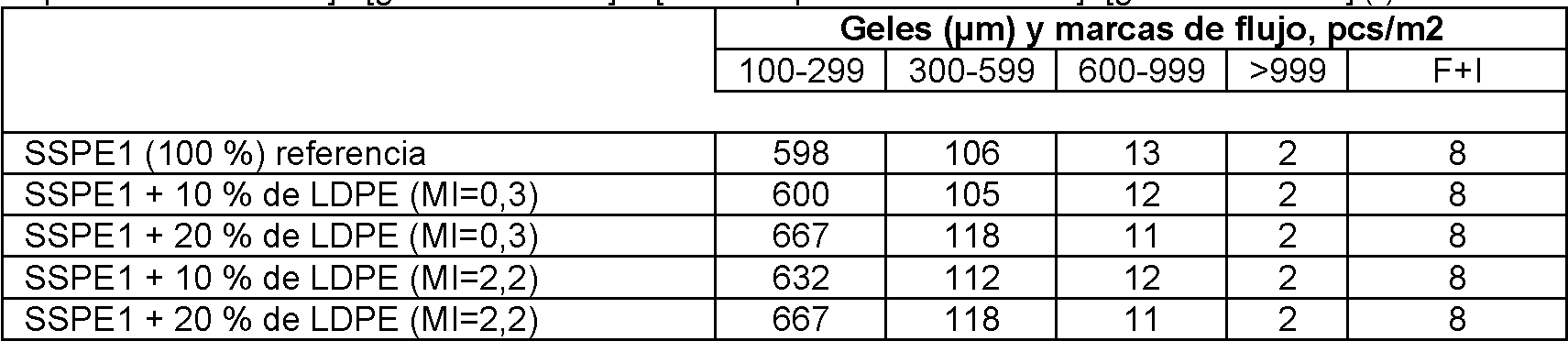
Basándose en los resultados anteriores, los contenidos de geles de las mezclas de SSPE1+LDPE (Tabla 1) son sorprendentemente más bajos que los contenidos de geles "más bajos esperados" calculados (Tabla 3).Based on the above results, the gel contents of the SSPE1 + LDPE mixtures (Table 1) are surprisingly lower than the "lowest expected" gel contents calculated (Table 3).
Resultados de mezcla SSPE2 con LDPEs:Results of mixing SSPE2 with LDPEs:
T l 4 n ni l m i r PE2 r mzl n LDPET l 4 n ni l m i r PE2 r mzl n LDPE
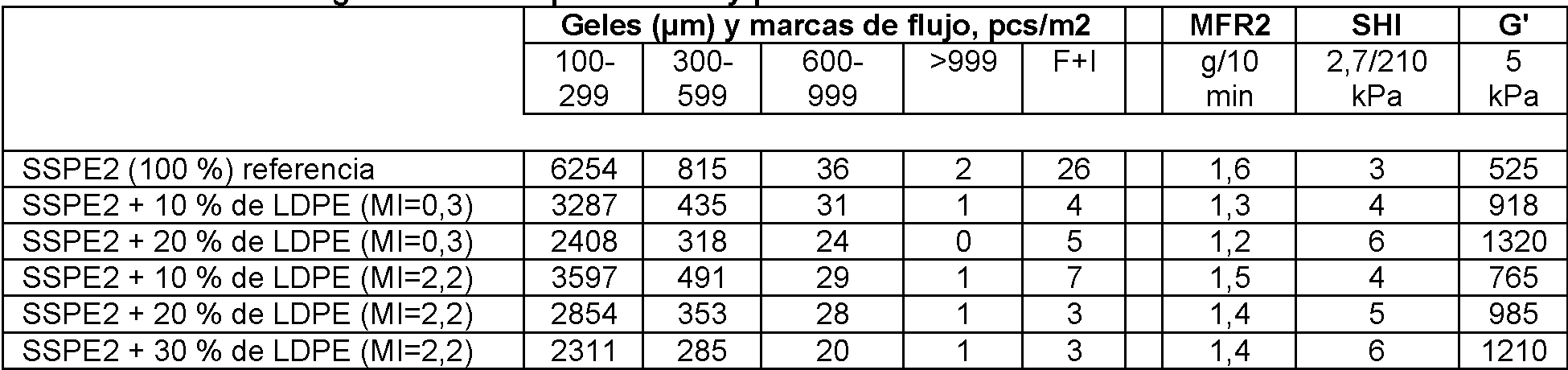
T l : n ni l m i r LDPE r mzlT l: n ni l m i r LDPE r mzl

Tabla 6: Contenido de geles "más bajo esperado" basado en el cálculo según la fórmula lineal (I):Table 6: Content of "lowest expected" gels based on the calculation according to the linear formula (I):

Basándose en los resultados anteriores, los contenidos de geles de mezclas de SSPE2+LDPE (Tabla 4) son sorprendentemente más bajos que los contenidos de geles calculados "más bajos esperados" (Tabla 6) como se puede apreciar también en las Figuras 1-4. Las Figuras 1-4 ilustran los contenidos de geles medidos y calculados "más bajos esperados" de las mezclas de SSPE2 LDPE en categorías de diferente tamaño. Se puede observar de los resultados de mezcla medidos de tanto las resinas de SSPE1 de bajo contenido de geles como de SSPE2 de alto contenido de geles que con el proceso de mezcla de los geles de la invención se puede reducir más de lo que cabría esperar del cálculo de "más bajo esperado". En las figuras, "más bajo esperado" se indica como líneas discontinuas---- y, respectivamente,-------- .Based on the above results, the contents of SSPE2 + LDPE mixture gels (Table 4) are surprisingly lower than the "lowest expected" calculated gels contents (Table 6) as can also be seen in Figures 1-4 . Figures 1-4 illustrate the contents of "lowest expected" measured and calculated gels of mixtures of SSPE2 LDPE in different size categories. It can be seen from the measured mixing results of both the low-gel SSPE1 and high-gel SSPE2 resins that with the process of mixing the gels of the invention can be reduced more than one would expect from the "lowest expected" calculation. In the figures, "lowest expected" is indicated as dashed lines ---- and, respectively, --------.
Resultados de mezcla de SSPE1 con ZNLLDPE:Mixing results of SSPE1 with ZNLLDPE:
Tabla 7: n ni l m i r PE1 r l mzl n LLDPE Zi l r-N FX1001)Table 7: n ni l m i r PE1 r l mzl n LLDPE Zi l r-N FX1001)

Tabla 8: n ni l m i r ZNLLDPE ^ r l mzlTable 8: n ni l m i r ZNLLDPE ^ r l mzl

Tabla 9: Contenido de geles "más bajo esperado" basado en el cálculo según la fórmula lineal (I):Table 9: Content of "lowest expected" gels based on the calculation according to the linear formula (I):
[fracción n rl PE * l PE fr in n rl ZNLLDPE * l ZNLLD E I[fraction n rl PE * l PE fr in n rl ZNLLDPE * l ZNLLD E I

Basándose en los resultados anteriores (Tabla 7), también se pueden usar ZNLLDPE como PE (b) como componente de mezcla para reducir los geles de ssPE (a). Based on the above results (Table 7), ZNLLDPE can also be used as PE (b) as a mixing component to reduce ssPE gels (a).
Claims (14)
Applications Claiming Priority (2)
| Application Number | Priority Date | Filing Date | Title |
|---|---|---|---|
| EP15168367 | 2015-05-20 | ||
| PCT/EP2016/060884 WO2016184812A1 (en) | 2015-05-20 | 2016-05-13 | Process for producing polyethylene composition |
Publications (1)
| Publication Number | Publication Date |
|---|---|
| ES2741846T3 true ES2741846T3 (en) | 2020-02-12 |
Family
ID=53181178
Family Applications (1)
| Application Number | Title | Priority Date | Filing Date |
|---|---|---|---|
| ES16723354T Active ES2741846T3 (en) | 2015-05-20 | 2016-05-13 | Production process of a polyethylene composition |
Country Status (4)
| Country | Link |
|---|---|
| EP (1) | EP3298067B1 (en) |
| CN (1) | CN107580611B (en) |
| ES (1) | ES2741846T3 (en) |
| WO (1) | WO2016184812A1 (en) |
Families Citing this family (9)
| Publication number | Priority date | Publication date | Assignee | Title |
|---|---|---|---|---|
| EP3450127A1 (en) * | 2017-09-01 | 2019-03-06 | Basell Polyolefine GmbH | Process for preparing a polyolefin composition |
| EP3838984A1 (en) * | 2019-12-20 | 2021-06-23 | Borealis AG | Polymer composition and article |
| EP4219618A1 (en) * | 2022-01-28 | 2023-08-02 | Borealis AG | Polyethylene blend for a film layer |
| EP4219598A1 (en) * | 2022-01-28 | 2023-08-02 | Borealis AG | Polyethylene blend for a film layer |
| EP4219601A1 (en) * | 2022-01-28 | 2023-08-02 | Borealis AG | Polyethylene blend for a film layer |
| EP4219600A1 (en) * | 2022-01-28 | 2023-08-02 | Borealis AG | Polyethylene blend for a film layer |
| EP4219599A1 (en) * | 2022-01-28 | 2023-08-02 | Borealis AG | Polyethylene blend for a film layer |
| EP4219602A1 (en) * | 2022-01-28 | 2023-08-02 | Borealis AG | Polyethylene blend for a film layer |
| EP4389780A1 (en) | 2022-12-19 | 2024-06-26 | Basell Polyolefine GmbH | Process for obtaining a polyethylene having a reduced content of gels |
Family Cites Families (34)
| Publication number | Priority date | Publication date | Assignee | Title |
|---|---|---|---|---|
| US3405109A (en) | 1960-10-03 | 1968-10-08 | Phillips Petroleum Co | Polymerization process |
| US3324093A (en) | 1963-10-21 | 1967-06-06 | Phillips Petroleum Co | Loop reactor |
| US4582816A (en) | 1985-02-21 | 1986-04-15 | Phillips Petroleum Company | Catalysts, method of preparation and polymerization processes therewith |
| US5565175A (en) | 1990-10-01 | 1996-10-15 | Phillips Petroleum Company | Apparatus and method for producing ethylene polymer |
| FI86867C (en) | 1990-12-28 | 1992-10-26 | Neste Oy | FLERSTEGSPROCESS FOR FRAMSTAELLNING AV POLYETEN |
| FI89929C (en) | 1990-12-28 | 1993-12-10 | Neste Oy | Process for homo- or copolymerization of ethylene |
| FI96866C (en) | 1993-11-05 | 1996-09-10 | Borealis As | Support olefin polymerization catalyst, its preparation and use |
| FI96216C (en) | 1994-12-16 | 1996-05-27 | Borealis Polymers Oy | Process for the production of polyethylene |
| FI104975B (en) | 1995-04-12 | 2000-05-15 | Borealis As | Process for producing catalytic components |
| FI104826B (en) | 1996-01-30 | 2000-04-14 | Borealis As | Heteroatom-substituted metallose compounds for catalytic systems in olefin polymerization and process for their preparation |
| US5767034A (en) | 1996-05-31 | 1998-06-16 | Intevep, S.A. | Olefin polymerization catalyst with additive comprising aluminum-silicon composition, calixarene derivatives or cyclodextrin derivatives |
| FI972230A7 (en) | 1997-01-28 | 1998-07-29 | Borealis As | New homogeneous olefin polymerization catalyst composition |
| FI111846B (en) | 1997-06-24 | 2003-09-30 | Borealis Tech Oy | Process and apparatus for preparing mixtures of polypropylene |
| FI111847B (en) | 1997-06-24 | 2003-09-30 | Borealis Tech Oy | Process for preparing copolymers of propylene |
| FI111845B (en) | 1997-06-24 | 2003-09-30 | Borealis Tech Oy | Process for producing propylene homopolymers and polymers with modified impact strength |
| FI111848B (en) | 1997-06-24 | 2003-09-30 | Borealis Tech Oy | Process and equipment for the preparation of homopolymers and copolymers of propylene |
| FI981148A7 (en) | 1998-05-25 | 1999-11-26 | Borealis As | New activator systems for metallocene compounds |
| FI982388A7 (en) | 1998-11-04 | 2000-05-05 | Borealis Polymers Oy | Method for eliminating static electricity |
| GB0118010D0 (en) | 2001-07-24 | 2001-09-19 | Borealis Tech Oy | Catalysts |
| ATE367198T1 (en) | 2001-10-30 | 2007-08-15 | Borealis Tech Oy | POLYMERIZATION REACTOR |
| DE60137638D1 (en) | 2001-12-19 | 2009-03-26 | Borealis Tech Oy | Preparation of supported catalysts for olefin polymerization |
| EP1323747A1 (en) | 2001-12-19 | 2003-07-02 | Borealis Technology Oy | Production of olefin polymerisation catalysts |
| ES2296888T3 (en) | 2002-10-30 | 2008-05-01 | Borealis Technology Oy | PROCESS AND APPLIANCE FOR THE PRODUCTION OF OLEFIN POLYMERS. |
| CN100471884C (en) | 2002-12-18 | 2009-03-25 | 玻利阿黎斯技术有限公司 | Process for producing olefin polymerization catalyst support and olefin polymerization catalyst |
| EP1462464A1 (en) | 2003-03-25 | 2004-09-29 | Borealis Technology Oy | Metallocene catalysts and preparation of polyolefins therewith |
| DE602004001213T2 (en) | 2004-04-29 | 2007-05-03 | Borealis Technology Oy | Process for the production of polyethylene |
| EP1739103A1 (en) | 2005-06-30 | 2007-01-03 | Borealis Technology Oy | Catalyst |
| ATE425983T1 (en) | 2005-08-09 | 2009-04-15 | Borealis Tech Oy | SILOXY SUBSTITUTED METALLOCENE CATALYSTS |
| KR20080080103A (en) * | 2005-11-28 | 2008-09-02 | 바젤 폴리올레핀 게엠베하 | Polyethylene compositions suitable for the production of films and methods for their preparation |
| PL2256158T3 (en) * | 2009-05-26 | 2014-09-30 | Borealis Ag | Polymer composition for crosslinked articles |
| EP2256159A1 (en) * | 2009-05-26 | 2010-12-01 | Borealis AG | Polymer composition for crosslinked pipes |
| JP6400571B2 (en) | 2012-06-26 | 2018-10-03 | ダウ グローバル テクノロジーズ エルエルシー | Polyethylene blend composition suitable for inflation film and film made therefrom |
| MX366914B (en) | 2012-10-12 | 2019-07-30 | Dow Global Technologies Llc | Polyolefin blend composition, and films made therefrom. |
| ES2604934T3 (en) * | 2012-11-09 | 2017-03-10 | Abu Dhabi Polymers Company Limited (Borouge) | Polymeric composition comprising a mixture of a multimodal polyethylene and an additional ethylene polymer suitable for the manufacture of a drip irrigation tube |
-
2016
- 2016-05-13 ES ES16723354T patent/ES2741846T3/en active Active
- 2016-05-13 WO PCT/EP2016/060884 patent/WO2016184812A1/en not_active Ceased
- 2016-05-13 EP EP16723354.3A patent/EP3298067B1/en active Active
- 2016-05-13 CN CN201680026641.1A patent/CN107580611B/en active Active
Also Published As
| Publication number | Publication date |
|---|---|
| CN107580611A (en) | 2018-01-12 |
| WO2016184812A1 (en) | 2016-11-24 |
| EP3298067A1 (en) | 2018-03-28 |
| EP3298067B1 (en) | 2019-07-17 |
| CN107580611B (en) | 2019-12-24 |
Similar Documents
| Publication | Publication Date | Title |
|---|---|---|
| ES2741846T3 (en) | Production process of a polyethylene composition | |
| ES2788424T3 (en) | Polyethylene composition for a film layer | |
| ES2930262T3 (en) | film layer | |
| ES2765193T3 (en) | Multimodal polyethylene copolymer | |
| CN115335420A (en) | Polyethylene composition for film layer | |
| JP7438324B2 (en) | Multimodal polyethylene compositions with single-site catalysts | |
| AU2012307751A1 (en) | Polyethylene composition with broad molecular weight distribution and improved homogeneity | |
| CN115413281B (en) | Polyethylene composition for film layer | |
| ES2791353T3 (en) | Bimodal or multimodal polyethylene with enhanced rheological properties | |
| WO2020109563A1 (en) | Process to produce a polymer and polymer | |
| ES2785685T3 (en) | Bimodal or multimodal polyethylene terpolymer with enhanced rheological properties | |
| ES2799148T3 (en) | Bi- or multimodal polyethylene with low level of unsaturation | |
| EP4245805B1 (en) | Polyethylene blend for a film layer |