US20250075152A1 - Stabilized biological detergents - Google Patents
Stabilized biological detergents Download PDFInfo
- Publication number
- US20250075152A1 US20250075152A1 US18/262,619 US202218262619A US2025075152A1 US 20250075152 A1 US20250075152 A1 US 20250075152A1 US 202218262619 A US202218262619 A US 202218262619A US 2025075152 A1 US2025075152 A1 US 2025075152A1
- Authority
- US
- United States
- Prior art keywords
- detergent composition
- solid detergent
- enzyme
- seq
- surfactant
- Prior art date
- Legal status (The legal status is an assumption and is not a legal conclusion. Google has not performed a legal analysis and makes no representation as to the accuracy of the status listed.)
- Pending
Links
Classifications
-
- C—CHEMISTRY; METALLURGY
- C11—ANIMAL OR VEGETABLE OILS, FATS, FATTY SUBSTANCES OR WAXES; FATTY ACIDS THEREFROM; DETERGENTS; CANDLES
- C11D—DETERGENT COMPOSITIONS; USE OF SINGLE SUBSTANCES AS DETERGENTS; SOAP OR SOAP-MAKING; RESIN SOAPS; RECOVERY OF GLYCEROL
- C11D3/00—Other compounding ingredients of detergent compositions covered in group C11D1/00
- C11D3/16—Organic compounds
- C11D3/38—Products with no well-defined composition, e.g. natural products
- C11D3/386—Preparations containing enzymes, e.g. protease or amylase
- C11D3/38609—Protease or amylase in solid compositions only
-
- C—CHEMISTRY; METALLURGY
- C11—ANIMAL OR VEGETABLE OILS, FATS, FATTY SUBSTANCES OR WAXES; FATTY ACIDS THEREFROM; DETERGENTS; CANDLES
- C11D—DETERGENT COMPOSITIONS; USE OF SINGLE SUBSTANCES AS DETERGENTS; SOAP OR SOAP-MAKING; RESIN SOAPS; RECOVERY OF GLYCEROL
- C11D1/00—Detergent compositions based essentially on surface-active compounds; Use of these compounds as a detergent
- C11D1/02—Anionic compounds
- C11D1/04—Carboxylic acids or salts thereof
- C11D1/06—Ether- or thioether carboxylic acids
-
- C—CHEMISTRY; METALLURGY
- C11—ANIMAL OR VEGETABLE OILS, FATS, FATTY SUBSTANCES OR WAXES; FATTY ACIDS THEREFROM; DETERGENTS; CANDLES
- C11D—DETERGENT COMPOSITIONS; USE OF SINGLE SUBSTANCES AS DETERGENTS; SOAP OR SOAP-MAKING; RESIN SOAPS; RECOVERY OF GLYCEROL
- C11D1/00—Detergent compositions based essentially on surface-active compounds; Use of these compounds as a detergent
- C11D1/02—Anionic compounds
- C11D1/04—Carboxylic acids or salts thereof
- C11D1/10—Amino carboxylic acids; Imino carboxylic acids; Fatty acid condensates thereof
-
- C—CHEMISTRY; METALLURGY
- C11—ANIMAL OR VEGETABLE OILS, FATS, FATTY SUBSTANCES OR WAXES; FATTY ACIDS THEREFROM; DETERGENTS; CANDLES
- C11D—DETERGENT COMPOSITIONS; USE OF SINGLE SUBSTANCES AS DETERGENTS; SOAP OR SOAP-MAKING; RESIN SOAPS; RECOVERY OF GLYCEROL
- C11D1/00—Detergent compositions based essentially on surface-active compounds; Use of these compounds as a detergent
- C11D1/66—Non-ionic compounds
- C11D1/662—Carbohydrates or derivatives
-
- C—CHEMISTRY; METALLURGY
- C11—ANIMAL OR VEGETABLE OILS, FATS, FATTY SUBSTANCES OR WAXES; FATTY ACIDS THEREFROM; DETERGENTS; CANDLES
- C11D—DETERGENT COMPOSITIONS; USE OF SINGLE SUBSTANCES AS DETERGENTS; SOAP OR SOAP-MAKING; RESIN SOAPS; RECOVERY OF GLYCEROL
- C11D3/00—Other compounding ingredients of detergent compositions covered in group C11D1/00
- C11D3/16—Organic compounds
- C11D3/38—Products with no well-defined composition, e.g. natural products
- C11D3/386—Preparations containing enzymes, e.g. protease or amylase
- C11D3/38672—Granulated or coated enzymes
Definitions
- the present invention relates to detergents with biosurfactants, which comprise enzyme particles essentially free of titanium dioxide, and which have improved surfactant stability.
- Oxidative photodegradation of biological molecules is a well-known process, even though under normal conditions degradation is minimal. Otherwise, living organisms could not exist.
- Titanium dioxide is widely used to provide whiteness and opacity to products such as paints, plastics, papers, inks, foods, and toothpastes. Titanium dioxide is also used as a pigment and a coating agent to improve the whiteness of enzyme particles used in granular (powder) detergents. It is used to increase the whiteness of the enzyme particles to the same level as other detergent ingredients. Since titanium dioxide is used on the surface of the enzyme particles, it will be in direct contact with the surfactants of the detergent.
- the present invention provides, in a first aspect, a solid detergent composition, comprising a mixture of
- the biological surfactant is a glycolipid; preferably selected from sophorolipids, rhamnolipids, trehalolipids, and mannosylerythritol lipids.
- compositions/methods may contain additional components so long as the additional components do not materially alter the composition/method.
- the term “essentially free of” (and grammatical variants thereof), as applied to the compositions and methods of the invention, means that the compositions/methods may contain minor amounts of the specified component so long as the amount of the component does not materially alter, or provide any material effect on, the composition/method. In an embodiment, “essentially free of” means 0% w/w.
- titanium dioxide used as a whitening agent in the coating of detergent enzyme granules affects the stability of biological surfactants, when they are used as sustainable ingredients in solid detergent compositions.
- biological molecules can be derived from microbial sources, such as yeasts and bacteria, contrary to traditional surfactants, which are derived from petrochemicals.
- the biological surfactants used in the invention typically have a hydrophilic carbohydrate or peptide/protein “head” and a hydrophobic fatty acid “tail”. They have gained increasing attention as potential biosurfactants due to their sustainable production, biodegradability and low eco-toxicity.
- the solid detergent compositions of the invention therefore contain biological surfactants and enzyme granules without titanium dioxide.
- enzyme granules without titanium dioxide in such detergents, the biological surfactants will exhibit improved storage stability and the detergent will exhibit improved detergency.
- the present invention provides a solid detergent composition, comprising a mixture of
- the biological surfactants (or biosurfactants) used in the compositions of the invention are amphiphilic compounds produced in living species, containing lipid and/or peptide/protein moieties. As described in Ito et al, “Photooxidative mineralization of microorganisms-produced glycolipid biosurfactants by a titania-mediated advanced oxidation process”, Journal of Photochemistry and Photobiology A: Chemistry, 209 (2010), pp 147-152, these compounds are sensitive to titanium dioxide catalyzed photooxidative degradation.
- glycolipids include sophorolipids, rhamnolipids, trehalolipids, and mannosylerythritol (mannose-erythritol) lipids.
- lipopeptides is surfactin.
- the solid detergent composition of the invention may comprise 1-40% w/w of the biological surfactant, preferably 1-30% w/w, more preferably 1-20% w/w, and most preferably 1-10% w/w.
- Biological surfactants may be derived from microbial sources including bacteria, yeasts and fungi.
- the biological surfactants used in the compositions of the invention do not include surfactants derived from plant material such as alkyl polyglucosides (APG).
- APG alkyl polyglucosides
- Rhamnolipids typically from Pseudomonas sp.
- Information about other bacterially derived biosurfactants can be found in Shete et al., “Mapping of Patents on Bioemulsifiers and Biosurfactants: A Review”, Journal of Scientific and Industrial Research 65(2):91-115 (2006).
- bacterially produced biosurfactants we include those where a bacterial gene is cloned and subsequently expressed from another organism as a manufacturing technique. For example, Rhamnolipids have been produced from E. coli in this way.
- Biological surfactants from non-bacterial microbial sources include those derived from fungi and yeasts, e.g. sophorolipids from Candida sp. and Torulopsis sp., such as Candida apicola, Candida bombicola, Candida lipolytica, Candida bogoriensis.
- the detergent composition of the invention comprises a plurality of enzyme particles, which are essentially free of titanium dioxide.
- the term “essentially free of” means that the enzyme particles do not contain titanium dioxide in an amount that materially alter, or have any material effect on, the enzyme particles.
- “essentially free of” means that the enzyme particles contain 0% w/w titanium dioxide, preferably 0.0% w/w titanium dioxide.
- the enzyme particles are small particles containing an enzyme.
- the particles may be (roughly) spherical.
- the enzyme particles typically have a (weight/volume average) diameter of 20-3000 ⁇ m, preferably 50-2000 ⁇ m, 100-1500 ⁇ m or 250-1200 ⁇ m.
- the plurality of enzyme particles has a (weight/volume average) diameter of 200-700 ⁇ m.
- the enzyme particles are composed of a core containing the enzyme(s), and optionally one or more coatings (outer layers) surrounding the core.
- the enzyme particles do not include a surfactant or a bleaching agent.
- the core may include additional materials such as fillers, fibre materials (cellulose or synthetic fibres), stabilizing agents, solubilising agents, suspension agents, viscosity regulating agents, light spheres, plasticizers, salts, lubricants and fragrances.
- additional materials such as fillers, fibre materials (cellulose or synthetic fibres), stabilizing agents, solubilising agents, suspension agents, viscosity regulating agents, light spheres, plasticizers, salts, lubricants and fragrances.
- the core may include binders, such as synthetic polymer, wax, fat, or carbohydrate.
- the core may comprise a salt of a multivalent cation, a reducing agent, an antioxidant, a peroxide decomposing catalyst and/or an acidic buffer component, typically as a homogenous blend; or other combinations of active and inactive ingredients.
- the core may consist of an inert particle with the enzyme applied onto the surface of the inert particle, e.g., via seeded mixer granulation or layered granulation in a fluid bed.
- inert particles can be an organic particulate compound e.g. a natural compound such as agglomerated carbohydrates, e.g. sugars, starch, dextrins, flour (e.g. vegetable flour), or nonpareils.
- Nonpareils are spherical particles made of a seed crystal that has been built onto and rounded into a spherical shape. Nonpareils are typically made from a combination of a sugar such as sucrose, and a powder such as cornstarch.
- the inert particle can also be a sodium chloride or sodium sulfate crystal (or agglomerated crystals), also referred to as a seed, or other inorganic salt crystal; or a sucrose crystal.
- the core particle may have an average diameter of 20-3000 ⁇ m, particularly 50-2000 ⁇ m, 100-1500 ⁇ m or 250-1200 ⁇ m.
- the core can be prepared by granulating a blend of the ingredients, e.g., by a method comprising granulation techniques such as crystallization, precipitation, pan-coating, fluid bed coating, fluid bed agglomeration, rotary atomization, extrusion, prilling, spheronization, size reduction methods, drum granulation, and/or high shear granulation.
- granulation techniques such as crystallization, precipitation, pan-coating, fluid bed coating, fluid bed agglomeration, rotary atomization, extrusion, prilling, spheronization, size reduction methods, drum granulation, and/or high shear granulation.
- Cores without enzyme are prepared by the same techniques, but without enzyme.
- the enzyme particles comprise at least one coating.
- Coating(s) may be applied to the cores to improve the enzyme storage stability, to reduce enzyme dust formation during handling, to improve adherence of an enzyme coating onto the core, or for coloring the particle.
- the coating(s) may include a salt coating, and/or a polymer coating.
- a polymer coating comprises a polyethylene glycol (PEG), polyvinyl alcohol (PVA), or polysaccharide (including polysaccharide derivatives such as methyl hydroxy-propyl cellulose (MHPC)).
- the coating(s) may also include functional ingredients, such bleach catalysts (e.g. manganese bleach catalysts; MnTACN) and/or bleach activators (e.g. TAED, NOBS).
- bleach catalysts e.g. manganese bleach catalysts; MnTACN
- bleach activators e.g. TAED, NOBS
- the coating may be applied in an amount of at least 0.1% by weight of the core, e.g., at least 0.5%, 1% or 5%.
- the amount may be at most 100%, 70%, 50%, 40% or 30%.
- the coating is preferably at least 0.1 ⁇ m thick, particularly at least 0.5 ⁇ m, at least 1 ⁇ m or at least 5 ⁇ m. In a particular embodiment the thickness of the coating is below 100 ⁇ m. In a more particular embodiment, the thickness of the coating is below 60 ⁇ m. In an even more particular embodiment, the total thickness of the coating is below 40 ⁇ m.
- the coating should encapsulate the core (and the matrix layer) by forming a substantially continuous layer.
- a substantially continuous layer is to be understood as a coating having few or no holes, so that the core unit it is encapsulating/enclosing has only few or no uncoated areas.
- the layer or coating should in particular be homogeneous in thickness.
- a salt coating may comprise at least 60% by weight w/w of a salt, e.g., at least 65%, at least 70%, at least 75%, at least 80%, at least 85%, at least 90%, at least 95% or at least 99% by weight w/w.
- the salt coating may comprise a single salt or a mixture of two or more salts.
- the salt may be water soluble, in particular having a solubility at least 0.1 grams in 100 g of water at 20° C., preferably at least 0.5 g per 100 g water, e.g., at least 1 g per 100 g water, e.g., at least 5 g per 100 g water.
- alkali- or earth alkali metal salts of sulfate, sulfite, phosphate, phosphonate, nitrate, chloride or carbonate or salts of simple organic acids such as citrate, malonate or acetate may be used.
- Other examples include NaH 2 PO 4 , (NH 4 )H 2 PO 4 , CuSO 4 , Mg(NO 3 ) 2 and magnesium acetate.
- the salt may be in anhydrous form, or it may be a hydrated salt, i.e. a crystalline salt hydrate with bound water(s) of crystallization, such as described in WO 99/32595.
- Specific examples include anhydrous sodium sulfate (Na 2 SO 4 ), anhydrous magnesium sulfate (MgSO 4 ), magnesium sulfate heptahydrate (MgSO 4 ⁇ 7H 2 O), zinc sulfate heptahydrate (ZnSO 4 ⁇ 7H 2 O), sodium phosphate dibasic heptahydrate (Na 2 HPO 4 ⁇ 7H 2 O), magnesium nitrate hexahydrate (Mg(NO 3 ) 2 (6H 2 O)), sodium citrate dihydrate and magnesium acetate tetrahydrate.
- the salt is applied as a solution of the salt, e.g., using a fluid bed.
- the enzymes used in the compositions of the invention are catalytic proteins, and the term “active enzyme protein” is defined herein as the amount of catalytic protein(s), which exhibits enzymatic activity. This can be determined using an activity based analytical enzyme assay. In such assays, the enzyme typically catalyzes a reaction generating a colored compound. The amount of the colored compound can be measured and correlated to the concentration of the active enzyme protein. This technique is well-known in the art.
- the enzyme(s) may be one or more (detergent) enzymes, such as selected from the group consisting of protease, lipase, cutinase, amylase, carbohydrase, cellulase, pectinase, mannanase, arabinase, galactanase, xylanase, nuclease (DNase, RNase), dispersin, catalase, perhydrolase, and oxidase (such as laccase and/or peroxidase).
- enzymes such as selected from the group consisting of protease, lipase, cutinase, amylase, carbohydrase, cellulase, pectinase, mannanase, arabinase, galactanase, xylanase, nuclease (DNase, RNase), dispersin, catalase, perhydrolase, and oxidase
- More preferred detergent enzymes are selected from the group consisting of protease, lipase, amylase, cellulase, pectinase, mannanase, xylanase, nuclease (DNase, RNase), dispersin, catalase, and perhydrolase.
- the enzyme may be a naturally occurring enzyme of bacterial or fungal origin, or it may be a variant derived from one or more naturally occurring enzymes by gene shuffling and/or by substituting, deleting or inserting one or more amino acids. Chemically modified or protein engineered mutants are included.
- the enzyme particles contain at least one enzyme in an amount of 0.1-25% w/w active enzyme protein; preferably in an amount of 0.5-25% w/w active enzyme protein; and more preferably in an amount of 0.5-20% w/w active enzyme protein.
- Suitable proteases may be of any origin, but are preferably of bacterial or fungal origin, optionally in the form of protein engineered or chemically modified mutants.
- the protease may be an alkaline protease, such as a serine protease or a metalloprotease.
- a serine protease may for example be of the S1 family, such as trypsin, or the S8 family such as a subtilisin.
- a metalloprotease may for example be a thermolysin, e.g. from the M4 family, or another metalloprotease such as those from the M5, M7 or M8 families.
- subtilases refers to a sub-group of serine proteases according to Siezen et al., Protein Eng. 4 (1991) 719-737 and Siezen et al., Protein Sci. 6 (1997) 501-523.
- Serine proteases are a subgroup of proteases characterized by having a serine in the active site, which forms a covalent adduct with the substrate.
- the subtilases may be divided into six subdivisions, the Subtilisin family, the Thermitase family, the Proteinase K family, the Lantibiotic peptidase family, the Kexin family and the Pyrolysin family.
- proteases suitable for detergent use may be obtained from a variety of organisms, including fungi such as Aspergillus
- detergent proteases have generally been obtained from bacteria and in particular from Bacillus .
- Bacillus species from which subtilases have been derived include Bacillus lentus, Bacillus alkalophilus, Bacillus subtilis, Bacillus amyloliquefaciens, Bacillus licheniformis, Bacillus pumilus and Bacillus gibsonii .
- Particular subtilisins include subtilisin lentus , subtilisin Novo, subtilisin Carlsberg, subtilisin BPN′, subtilisin 309, subtilisin 147 and subtilisin 168 and e.g. protease PD138 (described in WO 93/18140).
- Other useful proteases are e.g. those described in WO 01/16285 and WO 02/16547.
- trypsin-like proteases examples include the Fusarium protease described in WO 94/25583 and WO 2005/040372, and the chymotrypsin proteases derived from Cellumonas described in WO 2005/052161 and WO 2005/052146.
- metalloproteases examples include the neutral metalloproteases described in WO 2007/044993 such as those derived from Bacillus amyloliquefaciens , as well as e.g. the metalloproteases described in WO 2015/158723 and WO 2016/075078.
- proteases examples include the protease variants described in WO 89/06279 WO 92/19729, WO 96/34946, WO 98/20115, WO 98/20116, WO 99/11768, WO 01/44452, WO 03/006602, WO 2004/003186, WO 2004/041979, WO 2007/006305, WO 2011/036263, WO 2014/207227, WO 2016/087617 and WO 2016/174234.
- Preferred protease variants may, for example, comprise one or more of the mutations selected from the group consisting of: S3T, V41, S9R, S9E, A15T, S24G, S24R, K27R, N42R, S55P, G59E, G59D, N60D, N60E, V66A, N74D, S85R, A96S, S97G, S97D, S97A, S97SD, S99E, S99D, S99G, S99M, S99N, S99R, S99H, S101A, V1021, V102Y, V102N, S104A, G116V, G116R, H 118 D, H 118 N, A120S, S126L, P127Q, S128A, S154D, A156E, G157D, G157P, S158E, Y161A, R164S, Q176E, N179E, S182E, Q185N, A188P, G189E, V
- Protease variants having one or more of these mutations are preferably variants of the Bacillus lentus protease (Savinase®, also known as subtilisin 309) shown in SEQ ID NO: 1 of WO 2016/001449 or of the Bacillus amyloliquefaciens protease (BPN′) shown in SEQ ID NO: 2 of WO 2016/001449.
- Bacillus lentus protease (Savinase®, also known as subtilisin 309) shown in SEQ ID NO: 1 of WO 2016/001449 or of the Bacillus amyloliquefaciens protease (BPN′) shown in SEQ ID NO: 2 of WO 2016/001449.
- BPN′ Bacillus amyloliquefaciens protease
- Such protease variants preferably have at least 80% sequence identity to SEQ ID NO: 1 or to SEQ ID NO: 2 of WO 2016/001449.
- protease of interest is the alkaline protease from Bacillus lentus DSM 5483, as described for example in WO 91/02792, and variants thereof which are described for example in WO 92/21760, WO 95/23221, EP 1921147, EP 1921148 and WO 2016/096711.
- the protease may alternatively be a variant of the TY145 protease having SEQ ID NO: 1 of WO 2004/067737, for example a variant comprising a substitution at one or more positions corresponding to positions 27, 109, 111, 171, 173, 174, 175, 180, 182, 184, 198, 199 and 297 of SEQ ID NO: 1 of WO 2004/067737, wherein said protease variant has a sequence identity of at least 75% but less than 100% to SEQ ID NO: 1 of WO 2004/067737.
- TY145 variants of interest are described in e.g. WO 2015/014790, WO 2015/014803, WO 2015/014804, WO 2016/097350, WO 2016/097352, WO 2016/097357 and WO 2016/097354.
- proteases examples include:
- Suitable commercially available protease enzymes include those sold under the trade names Alcalase®, DuralaseTM, DurazymTM, Relase®, Relase® Ultra, Savinase®, Savinase® Ultra, PrimaseTM, Polarzyme®, Kannase®, Liquanase®, Liquanase® Ultra, Ovozyme®, Coronase®, Coronase® Ultra, Blaze@, Blaze Evity® 100T, Blaze Evity® 125T, Blaze Evity® 150T, Blaze Evity® 200T, Neutrase®, Everlase®, Esperase®, Progress® Uno, Progress® In and Progress® Excel (Novozymes A/S), those sold under the tradename MaxataseTM MaxacalTM, Maxapem®, Purafect® Ox, Purafect® OxP, Puramax®, FN2TM, FN3TM, FN4 ex TM, Excellase®, ExcellenzTM P1000,
- Suitable lipases and cutinases include those of bacterial or fungal origin. Chemically modified or protein engineered mutant enzymes are included. Examples include lipase from Thermomyces , e.g. from T. lanuginosus (previously named Humicola lanuginosa ) as described in EP258068 and EP305216, cutinase from Humicola , e.g. H. insolens (WO96/13580), lipase from strains of Pseudomonas (some of these now renamed to Burkholderia ), e.g. P. alcaligenes or P. pseudoalcaligenes (EP218272), P. cepacia (EP331376), P.
- Thermomyces e.g. from T. lanuginosus (previously named Humicola lanuginosa ) as described in EP258068 and EP305216
- cutinase from Humicola e.g.
- lipase from Thermobifida fusca (WO11/084412), Geobacillus stearothermophilus lipase (WO11/084417), lipase from Bacillus subtilis (WO11/084599), and lipase from Streptomyces griseus (WO11/150157) and S. pristinaespiralis (WO12/137147).
- lipase variants such as those described in EP407225, WO92/05249, WO94/01541, WO94/25578, WO95/14783, WO95/30744, WO95/35381, WO95/22615, WO96/00292, WO97/04079, WO97/07202, WO00/34450, WO00/60063, WO01/92502, WO07/87508 and WO09/109500.
- Preferred commercial lipase products include LipolaseTM, LipexTM, LipolexTM and LipocleanTM (Novozymes A/S), Lumafast (originally from Genencor) and Lipomax (originally from Gist-Brocades).
- lipases sometimes referred to as acyltransferases or perhydrolases, e.g. acyltransferases with homology to Candida antarctica lipase A (WO10/111143), acyltransferase from Mycobacterium smegmatis (WO05/56782), perhydrolases from the CE 7 family (WO09/67279), and variants of the M. smegmatis perhydrolase in particular the S54V variant used in the commercial product Gentle Power Bleach from Huntsman Textile Effects Pte Ltd (WO10/100028).
- Suitable amylases may be an alpha-amylase or a glucoamylase and may be of bacterial or fungal origin. Chemically modified or protein engineered mutants are included. Amylases include, for example, alpha-amylases obtained from Bacillus , e.g., a special strain of Bacillus licheniformis , described in more detail in GB 1,296,839.
- Suitable amylases include amylases having SEQ ID NO: 2 in WO 95/10603 or variants having 90% sequence identity to SEQ ID NO: 3 thereof. Preferred variants are described in WO 94/02597, WO 94/18314, WO 97/43424 and SEQ ID NO: 4 of WO 99/019467, such as variants with substitutions in one or more of the following positions: 15, 23, 105, 106, 124, 128, 133, 154, 156, 178, 179, 181, 188, 190, 197, 201, 202, 207, 208, 209, 211, 243, 264, 304, 305, 391, 408, and 444.
- amylases having SEQ ID NO: 6 in WO 02/010355 or variants thereof having 90% sequence identity to SEQ ID NO: 6.
- Preferred variants of SEQ ID NO: 6 are those having a deletion in positions 181 and 182 and a substitution in position 193.
- amylases which are suitable are hybrid alpha-amylase comprising residues 1-33 of the alpha-amylase derived from B. amyloliquefaciens shown in SEQ ID NO: 6 of WO 2006/066594 and residues 36-483 of the B. licheniformis alpha-amylase shown in SEQ ID NO: 4 of WO 2006/066594 or variants having 90% sequence identity thereof.
- Preferred variants of this hybrid alpha-amylase are those having a substitution, a deletion or an insertion in one of more of the following positions: G48, T49, G107, H156, A181, N190, M197, 1201, A209 and Q264.
- hybrid alpha-amylase comprising residues 1-33 of the alpha-amylase derived from B. amyloliquefaciens shown in SEQ ID NO: 6 of WO 2006/066594 and residues 36-483 of SEQ ID NO: 4 are those having the substitutions:
- amylases which are suitable are amylases having SEQ ID NO: 6 in WO 99/019467 or variants thereof having 90% sequence identity to SEQ ID NO: 6.
- Preferred variants of SEQ ID NO: 6 are those having a substitution, a deletion or an insertion in one or more of the following positions: R181, G182, H183, G184, N195, 1206, E212, E216 and K269.
- Particularly preferred amylases are those having deletion in positions R181 and G182, or positions H183 and G184.
- Additional amylases which can be used are those having SEQ ID NO: 1, SEQ ID NO: 3, SEQ ID NO: 2 or SEQ ID NO: 7 of WO 96/023873 or variants thereof having 90% sequence identity to SEQ ID NO: 1, SEQ ID NO: 2, SEQ ID NO: 3 or SEQ ID NO: 7.
- Preferred variants of SEQ ID NO: 1, SEQ ID NO: 2, SEQ ID NO: 3 or SEQ ID NO: 7 are those having a substitution, a deletion or an insertion in one or more of the following positions: 140, 181, 182, 183, 184, 195, 206, 212, 243, 260, 269, 304 and 476, using SEQ ID 2 of WO 96/023873 for numbering.
- More preferred variants are those having a deletion in two positions selected from 181, 182, 183 and 184, such as 181 and 182, 182 and 183, or positions 183 and 184.
- Most preferred amylase variants of SEQ ID NO: 1, SEQ ID NO: 2 or SEQ ID NO: 7 are those having a deletion in positions 183 and 184 and a substitution in one or more of positions 140, 195, 206, 243, 260, 304 and 476.
- amylases which can be used are amylases having SEQ ID NO: 2 of WO 08/153815, SEQ ID NO: 10 in WO 01/66712 or variants thereof having 90% sequence identity to SEQ ID NO: 2 of WO 08/153815 or 90% sequence identity to SEQ ID NO: 10 in WO 01/66712.
- Preferred variants of SEQ ID NO: 10 in WO 01/66712 are those having a substitution, a deletion or an insertion in one of more of the following positions: 176, 177, 178, 179, 190, 201, 207, 211 and 264.
- amylases having SEQ ID NO: 2 of WO 09/061380 or variants having 90% sequence identity to SEQ ID NO: 2 thereof.
- Preferred variants of SEQ ID NO: 2 are those having a truncation of the C-terminus and/or a substitution, a deletion or an insertion in one of more of the following positions: Q87, Q98, S125, N128, T131, T165, K178, R180, S181, T182, G183, M201, F202, N225, S243, N272, N282, Y305, R309, D319, Q320, Q359, K444 and G475.
- More preferred variants of SEQ ID NO: 2 are those having the substitution in one of more of the following positions: Q87E, R, Q98R, S125A, N128C, T1311, T1651, K178L, T182G, M201L, F202Y, N225E, R, N272E, R, S243Q, A, E, D, Y305R, R309A, Q320R, Q359E, K444E and G475K and/or deletion in position R180 and/or S181 or of T182 and/or G183.
- Most preferred amylase variants of SEQ ID NO: 2 are those having the substitutions:
- amylases having SEQ ID NO: 1 of WO13184577 or variants having 90% sequence identity to SEQ ID NO: 1 thereof.
- Preferred variants of SEQ ID NO: 1 are those having a substitution, a deletion or an insertion in one of more of the following positions: K176, R178, G179, T180, G181, E187, N192, M199, I203, S241, R458, T459, D460, G476 and G477.
- More preferred variants of SEQ ID NO: 1 are those having the substitution in one of more of the following positions: K176L, E187P, N192FYH, M199L, I203YF, S241QADN, R458N, T459S, D460T, G476K and G477K and/or deletion in position R178 and/or S179 or of T180 and/or G181.
- Most preferred amylase variants of SEQ ID NO: 1 are those having the substitutions:
- amylases having SEQ ID NO: 1 of WO10104675 or variants having 90% sequence identity to SEQ ID NO: 1 thereof.
- Preferred variants of SEQ ID NO: 1 are those having a substitution, a deletion or an insertion in one of more of the following positions: N21, D97, V128, K177, R179, S180, I181, G182, M200, L204, E242, G477 and G478.
- More preferred variants of SEQ ID NO: 1 are those having the substitution in one of more of the following positions: N21D, D97N, V128I, K177L, M200L, L204YF, E242QA, G477K and G478K and/or deletion in position R179 and/or S180 or of I181 and/or G182.
- Most preferred amylase variants of SEQ ID NO: 1 are those having the substitutions:
- amylases are the alpha-amylase having SEQ ID NO: 12 in WO01/66712 or a variant having at least 90% sequence identity to SEQ ID NO: 12.
- Preferred amylase variants are those having a substitution, a deletion or an insertion in one of more of the following positions of SEQ ID NO: 12 in WO01/66712: R28, R118, N174; R181, G182, D183, G184, G186, W189, N195, M202, Y298, N299, K302, S303, N306, R310, N314; R320, H324, E345, Y396, R400, W439, R444, N445, K446, Q449, R458, N471, N484.
- Particular preferred amylases include variants having a deletion of D183 and G184 and having the substitutions R118K, N195F, R320K and R458K, and a variant additionally having substitutions in one or more position selected from the group: M9, G149, G182, G186, M202, T257, Y295, N299, M323, E345 and A339, most preferred a variant that additionally has substitutions in all these positions.
- amylase variants such as those described in WO2011/098531, WO2013/001078 and WO2013/001087.
- amylases are DuramylTM, TermamylTM, FungamylTM, StainzymeTM Stainzyme PlusTM, NatalaseTM, Liquozyme X and BANTM (from Novozymes A/S), and RapidaseTM, PurastarTM/EffectenzTM, Powerase, Preferenz S1000, Preferenz S100 and Preferenz S110 (from Genencor International Inc./DuPont).
- Suitable cellulases include mono-component and mixtures of enzymes of bacterial or fungal origin. Chemically modified or protein engineered mutants are also contemplated.
- the cellulase may for example be a mono-component or a mixture of mono-component endo-1,4-beta-glucanase also referred to as endoglucanase.
- Suitable cellulases include those from the genera Bacillus, Pseudomonas, Humicola, Myceliophthora, Fusarium, Thielavia, Trichoderma , and Acremonium .
- Exemplary cellulases include a fungal cellulase from Humicola insolens (U.S. Pat. No. 4,435,307) or from Trichoderma , e.g. T. reesei or T. viride .
- Other suitable cellulases are from Thielavia e.g. Thielavia terrestris as described in WO 96/29397 or the fungal cellulases produced from Myceliophthora thermophila and Fusarium oxysporum disclosed in U.S.
- cellulases are endo-beta-1,4-glucanase enzyme having a sequence of at least 97% identity to the amino acid sequence of position 1 to position 773 of SEQ ID NO:2 of WO 2002/099091 or a family 44 xyloglucanase, which a xyloglucanase enzyme having a sequence of at least 60% identity to positions 40-559 of SEQ ID NO: 2 of WO 2001/062903.
- cellulases include Carezyme®, Carezyme® Premium, Celluzyme®, Celluclean®, Celluclast®, Endolase®, Renozyme®; Whitezyme® Celluclean® Classic, Cellusoft® (Novozymes A/S), Puradax®, Puradax HA, and Puradax EG (available from Genencor International Inc.) and KAC-500(B)TM (Kao Corporation).
- Suitable mannanases include those of bacterial or fungal origin. Chemically or genetically modified mutants are included.
- the mannanase may be an alkaline mannanase of Family 5 or 26. It may be a wild-type from Bacillus or Humicola , particularly B. agaradhaerens, B. licheniformis, B. halodurans, B. clausii , or H. insolens .
- Suitable mannanases are described in WO 1999/064619. A commercially available mannanase is Mannaway (Novozymes A/S).
- Suitable nucleases include deoxyribonucleases (DNases) and ribonucleases (RNases) which are any enzyme that catalyzes the hydrolytic cleavage of phosphodiester linkages in the DNA or RNA backbone respectively, thus degrading DNA and RNA.
- DNases deoxyribonucleases
- RNases ribonucleases
- Exonucleases digest nucleic acids from the ends. Endonucleases act on regions in the middle of target molecules.
- the nuclease is preferably a DNase, which is preferable is obtainable from a microorganism, preferably a bacterium; in particular a DNase which is obtainable from a species of Bacillus is preferred; in particular a DNase which is obtainable from Bacillus cibi, Bacillus subtilis or Bacillus licheniformis is preferred. Examples of such DNases are described in WO 2011/098579, WO2014/087011 and WO2017/060475.
- Suitable dispersins are polypeptides having hexosaminidase activity, EC 3.2.1.—that catalyzes the hydrolysis of ⁇ -1,6-glycosidic linkages of N-acetyl-glucosamine polymers (poly-N-acetylglucosamine) found, e.g., in biofilm.
- a suitable peroxidase is preferably a peroxidase enzyme comprised by the enzyme classification EC 1.11.1.7, as set out by the Nomenclature Committee of the International Union of Biochemistry and Molecular Biology (IUBMB), or any fragment derived therefrom, exhibiting peroxidase activity.
- IUBMB Nomenclature Committee of the International Union of Biochemistry and Molecular Biology
- Suitable peroxidases include those of plant, bacterial or fungal origin. Chemically modified or protein engineered mutants are included. Examples of useful peroxidases include peroxidases from Coprinopsis , e.g., from C. cinerea (EP 179,486), and variants thereof as those described in WO 93/24618, WO 95/10602, and WO 98/15257.
- Suitable peroxidases also include a haloperoxidase enzyme, such as chloroperoxidase, bromoperoxidase and compounds exhibiting chloroperoxidase or bromoperoxidase activity.
- Haloperoxidases are classified according to their specificity for halide ions. Chloroperoxidases (E.C. 1.11.1.10) catalyze formation of hypochlorite from chloride ions.
- the haloperoxidase may be a chloroperoxidase.
- the haloperoxidase is a vanadium haloperoxidase, i.e., a vanadate-containing haloperoxidase. In a preferred method the vanadate-containing haloperoxidase is combined with a source of chloride ion.
- Suitable oxidases include, in particular, any laccase enzyme comprised by the enzyme classification EC 1.10.3.2, or any fragment derived therefrom exhibiting laccase activity, or a compound exhibiting a similar activity, such as a catechol oxidase (EC 1.10.3.1), an o-aminophenol oxidase (EC 1.10.3.4), or a bilirubin oxidase (EC 1.3.3.5).
- any laccase enzyme comprised by the enzyme classification EC 1.10.3.2, or any fragment derived therefrom exhibiting laccase activity, or a compound exhibiting a similar activity, such as a catechol oxidase (EC 1.10.3.1), an o-aminophenol oxidase (EC 1.10.3.4), or a bilirubin oxidase (EC 1.3.3.5).
- the invention is directed to solid detergent compositions comprising a mixture of a biological surfactant selected from glycolipids and lipopeptides; and a plurality of enzyme particles, which are essentially free of titanium dioxide; optionally in combination with one or more additional cleaning composition (detergent) components, as described below.
- additional cleaning composition detergent
- additional components is within the skill of the artisan and includes conventional ingredients, including the exemplary non-limiting components set forth below.
- additional detergent components may include, for textile care, the consideration of the type of textile to be cleaned, the type and/or degree of soiling, the temperature at which cleaning is to take place, and the formulation of the detergent product.
- components mentioned below are categorized by general header according to a particular functionality, this is not to be construed as a limitation, as a component may comprise additional functionalities as will be appreciated by the skilled artisan.
- the invention is directed to an ADW (Automatic Dish Wash) compositions comprising one or more additional ADW composition components.
- ADW Automatic Dish Wash
- additional components is within the skill of the artisan and includes conventional ingredients, including the exemplary non-limiting components set forth below.
- the solid detergent composition may be composed essentially of biodegradable materials (be essentially biobased).
- the solid detergent composition is >95% biobased according to USDA Certified Biobased Products (biobased content measured using ASTM D6866); more preferably >97% biobased, and most preferably >99% biobased.
- the cleaning composition may comprise one or more surfactants, which may be anionic and/or cationic and/or non-ionic and/or semi-polar and/or zwitterionic, or a mixture thereof.
- the detergent composition includes a surfactant system (comprising more than one surfactant) e.g. a mixture of one or more nonionic surfactants and one or more anionic surfactants.
- the detergent comprises at least one anionic surfactant than at least one non-ionic surfactant, the weight ratio of anionic to nonionic surfactant may be from 10:1 to 1:10. In one embodiment the amount of anionic surfactant is higher than the amount of non-ionic surfactant e.g.
- the weight ratio of anionic to non-ionic surfactant may be from 10:1 to 1.1:1 or from 5:1 to 1.5:1.
- the amount of anionic to non-ionic surfactant may also be equal and the weight ratios 1:1.
- the amount of non-ionic surfactant is higher than the amount of anionic surfactant and the weight ratio may be 1:10 to 1:1.1.
- the weight ratio of anionic to non-ionic surfactant is from 10:1 to 1:10, such as from 5:1 to 1:5, or from 5:1 to 1:1.2.
- the weight fraction of non-ionic surfactant to anionic surfactant is from 0 to 0.5 or 0 to 0.2 thus non-ionic surfactant can be present or absent if the weight fraction is 0, but if non-ionic surfactant is present, then the weight fraction of the nonionic surfactant is preferably at most 50% or at most 20% of the total weight of anionic surfactant and non-ionic surfactant.
- Light duty detergent usually comprises more nonionic than anionic surfactant and there the fraction of non-ionic surfactant to anionic surfactant is preferably from 0.5 to 0.9.
- the total weight of surfactant(s) is typically present at a level of from about 0.1% to about 60% by weight, such as about 1% to about 40%, or about 3% to about 20%, or about 3% to about 10%.
- the surfactant(s) is chosen based on the desired cleaning application, and may include any conventional surfactant(s) known in the art.
- the detergent When included therein the detergent will usually contain from about 1% to about 40% by weight of an anionic surfactant, such as from about 5% to about 30%, including from about 5% to about 15%, or from about 15% to about 20%, or from about 20% to about 25% of an anionic surfactant.
- Non-limiting examples of anionic surfactants include sulfates and sulfonates, typically available as sodium or potassium salts or salts of monoethanolamine (MEA, 2-aminoethan-1-ol) or triethanolamine (TEA, 2,2′,2′′-nitrilotriethan-1-ol); in particular, linear alkylbenzenesulfonates (LAS), isomers of LAS such as branched alkylbenzenesulfonates (BABS) and phenylalkanesulfonates; olefin sulfonates, in particular alpha-olefinsulfonates (AOS); alkyl sulfates (AS), in particular fatty alcohol sulfates (FAS), i.e., primary alcohol sulfates (PAS) such as dodecyl sulfate; alcohol ethersulfates (AES or AEOS or FES, also known as alcohol ethoxysulfates or fatty
- the detergent When included therein the detergent will usually contain from about 1% to about 40% by weight of a cationic surfactant, for example from about 0.5% to about 30%, in particular from about 1% to about 20%, from about 3% to about 10%, such as from about 3% to about 5%, from about 8% to about 12% or from about 10% to about 12%.
- a cationic surfactant for example from about 0.5% to about 30%, in particular from about 1% to about 20%, from about 3% to about 10%, such as from about 3% to about 5%, from about 8% to about 12% or from about 10% to about 12%.
- Non-limiting examples of cationic surfactants include alkyldimethylethanolamine quat (ADMEAQ), cetyltrimethylammonium bromide (CTAB), dimethyldistearylammonium chloride (DSDMAC), and alkylbenzyldimethylammonium, alkyl quaternary ammonium compounds, alkoxylated quaternary ammonium (AQA) compounds, ester quats, and combinations thereof.
- ADMEAQ alkyldimethylethanolamine quat
- CAB cetyltrimethylammonium bromide
- DMDMAC dimethyldistearylammonium chloride
- AQA alkoxylated quaternary ammonium
- the detergent When included therein the detergent will usually contain from about 0.2% to about 40% by weight of a nonionic surfactant, for example from about 0.5% to about 30%, in particular from about 1% to about 20%, from about 3% to about 10%, such as from about 3% to about 5%, from about 8% to about 12%, or from about 10% to about 12%.
- a nonionic surfactant for example from about 0.5% to about 30%, in particular from about 1% to about 20%, from about 3% to about 10%, such as from about 3% to about 5%, from about 8% to about 12%, or from about 10% to about 12%.
- nonionic surfactants include alcohol ethoxylates (AE or AEO) e.g.
- AEO-7 alcohol propoxylates, in particular propoxylated fatty alcohols (PFA), ethoxylated and propoxylated alcohols, alkoxylated fatty acid alkyl esters, such as ethoxylated and/or propoxylated fatty acid alkyl esters (in particular methyl ester ethoxylates, MEE), alkylpolyglycosides (APG), alkoxylated amines, fatty acid monoethanolamides (FAM), fatty acid diethanolamides (FADA), ethoxylated fatty acid monoethanolamides (EFAM), propoxylated fatty acid monoethanolamides (PFAM), polyhydroxyalkyl fatty acid amides, or N-acyl N-alkyl derivatives of glucosamine (glucamides, GA, or fatty acid glucamides, FAGA), as well as products available under the trade names SPAN and TWEEN, and combinations thereof.
- PFA propoxylated fatty alcohols
- the detergent When included therein the detergent will usually contain from about 0.01 to about 10% by weight of a semipolar surfactant.
- semipolar surfactants include amine oxides (AO) such as alkyldimethylamine oxides, in particular N-(coco alkyl)-N,N-dimethylamine oxide and N-(tallow-alkyl)-N,N-bis(2-hydroxyethyl)amine oxide, and combinations thereof.
- AO amine oxides
- the detergent When included therein the detergent will usually contain from about 0.01% to about 10% by weight of a zwitterionic surfactant.
- zwitterionic surfactants include betaines such as alkyldimethylbetaines, sulfobetaines, and combinations thereof.
- bio-based surfactants may be used e.g. wherein the surfactant is a sugar-based non-ionic surfactant which may be a hexyl- ⁇ -D-maltopyranoside, thiomaltopyranoside or a cyclic-maltopyranoside, such as described in EP2516606 B1.
- the surfactant is a sugar-based non-ionic surfactant which may be a hexyl- ⁇ -D-maltopyranoside, thiomaltopyranoside or a cyclic-maltopyranoside, such as described in EP2516606 B1.
- the detergent composition may contain about 0-65% by weight, such as about 5% to about 50% of a detergent builder or co-builder, or a mixture thereof.
- the level of builder is typically in the range 40-65%, particularly in the range 50-65%.
- the builder and/or co-builder may particularly be a chelating agent that forms water-soluble complexes with Ca and Mg. Any builder and/or co-builder known in the art for use in cleaning detergents may be utilized.
- Non-limiting examples of builders include zeolites, diphosphates (pyrophosphates), triphosphates such as sodium triphosphate (STP or STPP), carbonates such as sodium carbonate, soluble silicates such as sodium metasilicate, layered silicates (e.g., SKS-6 from Clariant), ethanolamines such as 2-aminoethan-1-ol (MEA), diethanolamine (DEA, also known as 2,2′-iminodiethan-1-ol), triethanolamine (TEA, also known as 2,2′,2′′-nitrilotriethan-1-ol), and (carboxymethyl)inulin (CMI), and combinations thereof.
- zeolites such as 2-aminoethan-1-ol (MEA), diethanolamine (DEA, also known as 2,2′-iminodiethan-1-ol), triethanolamine (TEA, also known as 2,2′,2′′-nitrilotriethan-1-ol), and (carboxymethyl)inulin (CM
- the detergent composition may also contain from about 0-50% by weight, such as about 5% to about 30%, of a detergent co-builder.
- the detergent composition may include a co-builder alone, or in combination with a builder, for example a zeolite builder.
- co-builders include homopolymers of polyacrylates or copolymers thereof, such as poly(acrylic acid) (PAA) or copoly(acrylic acid/maleic acid) (PAA/PMA).
- PAA/PMA poly(acrylic acid)
- Further non-limiting examples include citrate, chelators such as aminocarboxylates, aminopolycarboxylates and phosphonates, and alkyl- or alkenylsuccinic acid.
- NTA 2,2′,2′′-nitrilotriacetic acid
- EDTA ethylenediaminetetraacetic acid
- DTPA diethylenetriaminepentaacetic acid
- IDS iminodisuccinic acid
- EDDS ethylenediamine-N,N′-disuccinic acid
- MGDA methylglycinediacetic acid
- GLDA glutamic acid-N,N-diacetic acid
- HEDP 1-hydroxyethane-1,1-diylbis(phosphonic acid
- EDTMPA ethylenediaminetetramethylenetetrakis(phosphonic acid)
- DTMPA or DTPMPA diethylenetriaminepentamethylenepentakis(phosphonic acid)
- EDG N-(2-hydroxyethyl)iminodiacetic acid
- ASMA aspartic acid-N-monoacetic acid
- ASDA aspartic acid-N,N-diacetic acid
- ASDA aspart
- the solid detergent composition of the invention may comprise a strong sequestering builder; such as at least 0.1% w/w, at least 0.5% w/w, or at least 1% w/w of a strong sequestering builder.
- strong sequestering builders are EDTA, EDTMP, NTMP, DTPMP, MGDA, NTA, HEDP, STPP, IDS, and GLDA.
- Sequestering builders are different from precipitating builders in that no significant amount of precipitate is formed when the builder is used in an amount sufficient to combine with all of the calcium ions in an aqueous solution with 7° dH water hardness (German hardness) initially at neutral pH. Strong builders are classified as high efficiency chelators that can bind the divalent cations such as Ca 2+ strongly with a logarithmic stability constant (Log K Ca ) of the cation/chelator complex of above 5, particularly above 6 or above 7. The stability constants are determined at an ionic strength of 0.1 M and at a temperature of 25° C.
- the cleaning composition may contain 0-50% by weight, such as 1-40%, such as 1-30%, such as about 1% to about 20%, of a bleaching system.
- a bleaching system Any oxygen-based bleaching system comprising components known in the art for use in cleaning detergents may be utilized. Suitable bleaching system components include sources of hydrogen peroxide; peracids and sources of peracids (bleach activators); and bleach catalysts or boosters.
- Suitable sources of hydrogen peroxide are inorganic persalts, including alkali metal salts such as sodium percarbonate and sodium perborates (usually mono- or tetrahydrate), and hydrogen peroxide-urea.
- Peracids may be (a) incorporated directly as preformed peracids or (b) formed in situ in the wash liquor from hydrogen peroxide and a bleach activator (perhydrolysis) or (c) formed in situ in the wash liquor from hydrogen peroxide and a perhydrolase and a suitable substrate for the latter, e.g., an ester.
- Suitable preformed peracids include, but are not limited to, peroxycarboxylic acids such as peroxybenzoic acid and its ring-substituted derivatives, peroxy- ⁇ -naphthoic acid, peroxyphthalic acid, peroxylauric acid, peroxystearic acid, ⁇ -phthalimidoperoxycaproic acid [phthalimidoperoxyhexanoic acid (PAP)], and o-carboxybenzamidoperoxycaproic acid; aliphatic and aromatic diperoxydicarboxylic acids such as diperoxydodecanedioic acid, diperoxyazelaic acid, diperoxysebacic acid, diperoxybrassylic acid, 2-decyldiperoxybutanedioic acid, and diperoxyphthalic, -isophthalic and -terephthalic acids; perimidic acids; peroxymonosulfuric acid; peroxydisulfuric acid; peroxyphosphoric acid
- Suitable bleach activators include those belonging to the class of esters, amides, imides, nitriles or anhydrides and, where applicable, salts thereof. Suitable examples are tetraacetylethylenediamine (TAED), sodium 4-[(3,5,5-trimethylhexanoyl)oxy]benzene-1-sulfonate (ISONOBS), sodium 4-(dodecanoyloxy)benzene-1-sulfonate (LOBS), sodium 4-(decanoyloxy)benzene-1-sulfonate, 4-(decanoyloxy)benzoic acid (DOBA), sodium 4-(nonanoyloxy)benzene-1-sulfonate (NOBS), and/or those disclosed in WO98/17767.
- TAED tetraacetylethylenediamine
- ISONOBS sodium 4-[(3,5,5-trimethylhexanoyl)oxy]benzene-1-sulfonate
- LOBS
- ATC acetyl triethyl citrate
- ATC or a short chain triglyceride like triacetin has the advantage that they are environmentally friendly.
- acetyl triethyl citrate and triacetin have good hydrolytical stability in the product upon storage and are efficient bleach activators.
- ATC is multifunctional, as the citrate released in the perhydrolysis reaction may function as a builder.
- the bleaching system may also include a bleach catalyst or booster.
- bleach catalysts that may be used in the compositions of the present invention include manganese oxalate, manganese acetate, manganese-collagen, cobalt-amine catalysts and manganese triazacyclononane (MnTACN) catalysts; particularly preferred are complexes of manganese with 1,4,7-trimethyl-1,4,7-triazacyclononane (Me3-TACN) or 1,2,4,7-tetramethyl-1,4,7-triazacyclononane (Me4-TACN), in particular Me3-TACN, such as the dinuclear manganese complex [(Me3-TACN)Mn(O)3Mn(Me3-TACN)](PF6) 2 , and [2,2′,2′′-nitrilotris(ethane-1,2-diylazanylylidene- ⁇ N-methanylylidene)triphenolato- ⁇ 30
- an organic bleach catalyst or bleach booster may be used having one of the following formulae:
- the detergent may contain 0.005-10% by weight, such as 0.5-5%, 2-5%, 0.5-2% or 0.2-1% of a polymer. Any polymer known in the art for use in detergents may be utilized.
- the polymer may function as a co-builder as mentioned above, or may provide antiredeposition, fiber protection, soil release, dye transfer inhibition, grease cleaning and/or anti-foaming properties. Some polymers may have more than one of the above-mentioned properties and/or more than one of the below-mentioned motifs.
- Exemplary polymers include (carboxymethyl)cellulose (CMC), poly(vinyl alcohol) (PVA), poly(ethyleneglycol) or poly(ethylene oxide) (PEG or PEO), ethoxylated poly(ethyleneimine), (carboxymethyl)inulin (CMI), carboxylate polymers and polycarboxylates such as polyacrylates, maleic/acrylic acid copolymers, acrylate/styrene copolymers, poly(aspartic) acid, and lauryl methacrylate/acrylic acid copolymers, hydrophobically modified CMC (HM-CMC), silicones, copolymers of terephthalic acid and oligomeric glycols, copolymers of poly(ethylene terephthalate) and poly(oxyethene terephthalate) (PET-POET), poly(vinylpyrrolidone) (PVP), poly(vinylimidazole) (PVI), poly(vinylpyridine-N-oxide)
- Suitable examples include PVP-K15, PVP-K30, ChromaBond S-400, ChromaBond S-403E and Chromabond S-100 from Ashland Aqualon, and Sokalan® HP 165, Sokalan® HP 50 (Dispersing agent), Sokalan® HP 53 (Dispersing agent), Sokalan® HP 59 (Dispersing agent), Sokalan® HP 56 (dye transfer inhibitor), Sokalan® HP 66 K (dye transfer inhibitor) from BASF.
- Further exemplary polymers include sulfonated polycarboxylates, polyethylene oxide and polypropylene oxide (PEO-PPO) and diquaternium ethoxy sulfate.
- any detergent components known in the art for use in laundry/ADW/hard surface cleaning detergents may also be utilized.
- Other optional detergent components include anti-corrosion agents, anti-shrink agents, anti-soil redeposition agents, anti-wrinkling agents, bactericides, binders, corrosion inhibitors, disintegrants/disintegration agents, dyes, enzyme stabilizers (including boric acid, borates, CMC, and/or polyols such as propylene glycol), fabric conditioners including clays, fillers/processing aids, fluorescent whitening agents/optical brighteners, foam boosters, foam (suds) regulators, perfumes, soil-suspending agents, softeners, suds suppressors, tarnish inhibitors, and wicking agents, either alone or in combination.
- Any ingredient known in the art for use in laundry/ADW/hard surface cleaning detergents may be utilized. The choice of such ingredients is well within the skill of the artisan.
- the detergent compositions of the present invention can also contain dispersants.
- powdered detergents may comprise dispersants.
- Suitable water-soluble organic materials include the homo- or co-polymeric acids or their salts, in which the polycarboxylic acid comprises at least two carboxyl radicals separated from each other by not more than two carbon atoms.
- Suitable dispersants are for example described in Powdered Detergents, Surfactant science series volume 71, Marcel Dekker, Inc.
- the detergent compositions of the present invention may also include one or more dye transfer inhibiting agents.
- Suitable polymeric dye transfer inhibiting agents include, but are not limited to, polyvinylpyrrolidone polymers, polyamine N-oxide polymers, copolymers of N-vinylpyrrolidone and N-vinylimidazole, polyvinyloxazolidones and polyvinylimidazoles or mixtures thereof.
- the dye transfer inhibiting agents may be present at levels from about 0.0001% to about 10%, from about 0.01% to about 5% or even from about 0.1% to about 3% by weight of the composition.
- the detergent compositions of the present invention will preferably also contain additional components that may tint articles being cleaned, such as fluorescent whitening agent or optical brighteners. Where present the brightener is preferably at a level of about 0.01% to about 0.5%.
- Any fluorescent whitening agent suitable for use in a laundry detergent composition may be used in the composition of the present invention.
- the most commonly used fluorescent whitening agents are those belonging to the classes of diaminostilbene-sulfonic acid derivatives, diarylpyrazoline derivatives and bisphenyl-distyryl derivatives.
- diaminostilbene-sulfonic acid derivative type of fluorescent whitening agents include the sodium salts of: 4,4′-bis-(2-diethanolamino-4-anilino-s-triazin-6-ylamino) stilbene-2,2′-disulfonate, 4,4′-bis-(2,4-dianilino-s-triazin-6-ylamino) stilbene-2.2′-disulfonate, 4,4′-bis-(2-anilino-4-(N-methyl-N-2-hydroxy-ethylamino)-s-triazin-6-ylamino) stilbene-2,2′-disulfonate, 4,4′-bis-(4-phenyl-1,2,3-triazol-2-yl)stilbene-2,2′-disulfonate and sodium 5-(2H-naphtho[1,2-d][1,2,3]triazol-2-yl)-2-[(E)-2-phenylvinyl
- Suitable cellulosic polymers include cellulose, cellulose ethers, cellulose esters, cellulose amides and mixtures thereof. Suitable cellulosic polymers include anionically modified cellulose, nonionically modified cellulose, cationically modified cellulose, zwitterionically modified cellulose, and mixtures thereof. Suitable cellulosic polymers include methyl cellulose, carboxy methyl cellulose, ethyl cellulose, hydroxyl ethyl cellulose, hydroxyl propyl methyl cellulose, ester carboxy methyl cellulose, and mixtures thereof.
- Embodiment 3 The solid detergent composition of claim 1 , wherein the biological surfactant is a glycolipid selected from the group consisting of sophorolipid, rhamnolipid, trehalolipid, and mannosylerythritol lipid.
- the biological surfactant is a glycolipid selected from the group consisting of sophorolipid, rhamnolipid, trehalolipid, and mannosylerythritol lipid.
- Embodiment 4 The solid detergent composition of claim 1 , wherein the biological surfactant is a sophorolipid.
- Embodiment 5 The solid detergent composition of claim 1 , wherein the biological surfactant is a rhamnolipid.
- Embodiment 7 The solid detergent composition of claim 1 , wherein the biological surfactant is a mannosylerythritol lipid.
- Embodiment 12 The solid detergent composition of any of the preceding embodiments, wherein the biological surfactant is produced by a bacterium, yeast, or fungus.
- Embodiment 13 The solid detergent composition of any of the preceding embodiments, wherein the biological surfactant is a non-ionic surfactant.
- Embodiment 14 The solid detergent composition of any of the preceding embodiments, comprising 1-40% w/w of the biological surfactant.
- Embodiment 15 The solid detergent composition of any of the preceding embodiments, comprising 1-30% w/w of the biological surfactant.
- Embodiment 17 The solid detergent composition of any of the preceding embodiments, comprising 1-10% w/w of the biological surfactant.
- Embodiment 18 The solid detergent composition of any of the preceding embodiments, which is essentially free of alkylbenzene sulfonates.
- Embodiment 19 The solid detergent composition of any of the preceding embodiments, further comprising a strong sequestering builder.
- Embodiment 20 The solid detergent composition of any of the preceding embodiments, further comprising a strong sequestering builder in an amount of at least 0.1% w/w.
- Embodiment 21 The solid detergent composition of any of the preceding embodiments, further comprising a strong sequestering builder in an amount of at least 0.5% w/w.
- Embodiment 22 The solid detergent composition of any of the preceding embodiments, further comprising a strong sequestering builder in an amount of at least 1% w/w.
- Embodiment 23 The solid detergent composition of any of embodiments 19-22, wherein the strong sequestering builder/chelator can bind Ca 2+ with a logarithmic stability constant (Log K Ca ) of the Ca 2+ /chelator complex of above 5 at an ionic strength of 0.1 M and a temperature of 25° C.
- Log K Ca logarithmic stability constant
- Embodiment 24 The solid detergent composition of any of embodiments 19-22, wherein the strong sequestering builder/chelator can bind Ca 2+ with a logarithmic stability constant (Log K Ca ) of the Ca 2+ /chelator complex of above 6 at an ionic strength of 0.1 M and a temperature of 25° C.
- Log K Ca logarithmic stability constant
- Embodiment 25 The solid detergent composition of any of embodiments 19-22, wherein the strong sequestering builder/chelator can bind Ca 2+ with a logarithmic stability constant (Log K Ca ) of the Ca 2+ /chelator complex of above 7 at an ionic strength of 0.1 M and a temperature of 25° C.
- Log K Ca logarithmic stability constant
- Embodiment 26 The solid detergent composition of any of embodiments 19-22, wherein the strong sequestering builder/chelator is selected from the group consisting of EDTA, EDTMP, NTMP, DTPMP, MGDA, NTA, HEDP, STPP, IDS, and GLDA.
- the strong sequestering builder/chelator is selected from the group consisting of EDTA, EDTMP, NTMP, DTPMP, MGDA, NTA, HEDP, STPP, IDS, and GLDA.
- Embodiment 27 The solid detergent composition of any of embodiments 19-22, wherein the strong sequestering builder/chelator is selected from the group consisting of EDTMP, NTMP, DTPMP, MGDA, NTA, HEDP, and GLDA.
- the strong sequestering builder/chelator is selected from the group consisting of EDTMP, NTMP, DTPMP, MGDA, NTA, HEDP, and GLDA.
- Embodiment 28 The solid detergent composition of any of the preceding embodiments, which comprises 0.1-10% w/w of enzyme particles.
- Embodiment 29 The solid detergent composition of any of the preceding embodiments, wherein the coating is a salt coating or a polymer coating.
- Embodiment 30 The solid detergent composition of any of the preceding embodiments, wherein the coating is a salt coating comprising at least 1% salt by weight of the core, or a polymer coating comprising a polyethylene glycol, polyvinyl alcohol, or polysaccharide.
- Embodiment 31 The solid detergent composition of any of the preceding embodiments, wherein the coating is a salt coating.
- Embodiment 32 The solid detergent composition of any of the preceding embodiments, wherein the coating is a salt coating comprising at least 1% salt by weight of the core.
- Embodiment 33 The solid detergent composition of any of the preceding embodiments, wherein the enzyme particles comprise at least two coatings.
- Embodiment 34 The solid detergent composition of any of the preceding embodiments, wherein the enzyme particles comprise at least two coatings, where the outermost coating is a polymer coating comprising a polyethylene glycol, polyvinyl alcohol, or polysaccharide.
- Embodiment 35 The solid detergent composition of any of the preceding embodiments, wherein the core comprises the enzyme.
- Embodiment 36 The solid detergent composition of any of the preceding embodiments, wherein the enzyme particles comprise 0.1-25% w/w of active enzyme protein.
- Embodiment 37 The solid detergent composition of any of the preceding embodiments, wherein the enzyme is selected from the group consisting of protease, amylase, lipase, cutinase, cellulase, pectinase, mannanase, nuclease, dispersin, and oxidoreductase.
- the enzyme is selected from the group consisting of protease, amylase, lipase, cutinase, cellulase, pectinase, mannanase, nuclease, dispersin, and oxidoreductase.
- Embodiment 38 The solid detergent composition of any of the preceding embodiments, wherein the enzyme comprises a protease, and an additional enzyme selected from the group consisting of amylase, lipase, cutinase, cellulase, pectinase, mannanase, nuclease, dispersin, and oxidoreductase.
- the enzyme comprises a protease
- an additional enzyme selected from the group consisting of amylase, lipase, cutinase, cellulase, pectinase, mannanase, nuclease, dispersin, and oxidoreductase.
- Embodiment 39 The solid detergent composition of any of the preceding embodiments, wherein the plurality of enzyme particles comprises 0% w/w of titanium dioxide.
- Embodiment 40 The solid detergent composition of any of the preceding embodiments, wherein the plurality of enzyme particles are free of titanium dioxide.
- Embodiment 41 Use of enzyme particles, which are essentially free of titanium dioxide, for improving the stability of the biological surfactant in the solid detergent composition of any of the preceding embodiments, as compared to using enzyme particles comprising titanium dioxide.
- Chemicals were commercial products of at least reagent grade.
- a pilot scale high-shear enzyme co-granulate (containing protease, amylase, cellulase and mannanase) was produced as described in Example 1 of WO 2011/134809.
- the uncoated granules were coated in a fluid bed with 40% sodium sulfate followed by a film coating of 1.25% PEG 4000 and 3% kaolin (all as % by weight of uncoated dry granulate).
- the coated granules were sieved to 300-1200 microns.
Landscapes
- Chemical & Material Sciences (AREA)
- Life Sciences & Earth Sciences (AREA)
- Engineering & Computer Science (AREA)
- Chemical Kinetics & Catalysis (AREA)
- Oil, Petroleum & Natural Gas (AREA)
- Wood Science & Technology (AREA)
- Organic Chemistry (AREA)
- Health & Medical Sciences (AREA)
- Molecular Biology (AREA)
- Enzymes And Modification Thereof (AREA)
- Detergent Compositions (AREA)
Abstract
The invention provides a stabilized solid detergent composition, comprising a biosurfactant selected from glycolipids and lipopeptides; and a plurality of enzyme particles, which are essentially free of titanium dioxide.
Description
- The present invention relates to detergents with biosurfactants, which comprise enzyme particles essentially free of titanium dioxide, and which have improved surfactant stability.
- Oxidative photodegradation of biological molecules is a well-known process, even though under normal conditions degradation is minimal. Otherwise, living organisms could not exist.
- However, Ito et al, “Photooxidative mineralization of microorganisms-produced glycolipid biosurfactants by a titania-mediated advanced oxidation process”, Journal of Photochemistry and Photobiology A: Chemistry, 209 (2010), pp 147-152, has shown that titanium dioxide can be used to accelerate oxidative photodegradation of glycolipids. Titanium dioxide acts as a photocatalyst, increasing degradation (mineralization) of these biological molecules. Glycolipids have amphiphilic properties and are also used as biological surfactants.
- Titanium dioxide is widely used to provide whiteness and opacity to products such as paints, plastics, papers, inks, foods, and toothpastes. Titanium dioxide is also used as a pigment and a coating agent to improve the whiteness of enzyme particles used in granular (powder) detergents. It is used to increase the whiteness of the enzyme particles to the same level as other detergent ingredients. Since titanium dioxide is used on the surface of the enzyme particles, it will be in direct contact with the surfactants of the detergent.
- The whiteness of enzyme granules can be achieved by other means than titanium dioxide, but this has not gained any significant acceptance due to the low cost of titanium dioxide. We now suggest changing this, because of the incompatibility of titanium dioxide and biological surfactants in (bio)detergents, which has not previously been recognized.
- The present invention provides, in a first aspect, a solid detergent composition, comprising a mixture of
-
- (a) a biological surfactant selected from glycolipids and lipopeptides; and
- (b) a plurality of enzyme particles, which comprise a core and a coating and which are essentially free of titanium dioxide.
- In an embodiment, the biological surfactant is a glycolipid; preferably selected from sophorolipids, rhamnolipids, trehalolipids, and mannosylerythritol lipids.
- Other aspects and embodiments of the invention are apparent from the description and examples.
- Unless otherwise indicated, or if it is apparent from the context that something else is meant, all percentages are percentage by weight (% w/w).
- As used herein, the term “consists essentially of” (and grammatical variants thereof), as applied to the compositions and methods of the invention, means that the compositions/methods may contain additional components so long as the additional components do not materially alter the composition/method.
- As used herein, the term “essentially free of” (and grammatical variants thereof), as applied to the compositions and methods of the invention, means that the compositions/methods may contain minor amounts of the specified component so long as the amount of the component does not materially alter, or provide any material effect on, the composition/method. In an embodiment, “essentially free of” means 0% w/w.
- We have found that titanium dioxide used as a whitening agent in the coating of detergent enzyme granules affects the stability of biological surfactants, when they are used as sustainable ingredients in solid detergent compositions. These biological molecules can be derived from microbial sources, such as yeasts and bacteria, contrary to traditional surfactants, which are derived from petrochemicals. The biological surfactants used in the invention typically have a hydrophilic carbohydrate or peptide/protein “head” and a hydrophobic fatty acid “tail”. They have gained increasing attention as potential biosurfactants due to their sustainable production, biodegradability and low eco-toxicity.
- The solid detergent compositions of the invention therefore contain biological surfactants and enzyme granules without titanium dioxide. By using enzyme granules without titanium dioxide in such detergents, the biological surfactants will exhibit improved storage stability and the detergent will exhibit improved detergency.
- Thus, the present invention provides a solid detergent composition, comprising a mixture of
-
- (a) a biological surfactant selected from glycolipids, lipopeptides, and combinations thereof; and
- (b) a plurality of enzyme particles, which comprise a core and a coating and which are essentially free of titanium dioxide.
- In an embodiment, the detergent is essentially free of alkylbenzene sulfonates, which is a group of commonly used petrochemical-derived surfactants.
- The biological surfactants (or biosurfactants) used in the compositions of the invention, are amphiphilic compounds produced in living species, containing lipid and/or peptide/protein moieties. As described in Ito et al, “Photooxidative mineralization of microorganisms-produced glycolipid biosurfactants by a titania-mediated advanced oxidation process”, Journal of Photochemistry and Photobiology A: Chemistry, 209 (2010), pp 147-152, these compounds are sensitive to titanium dioxide catalyzed photooxidative degradation.
- Examples of biological surfactants containing lipid moieties include glycolipids and lipopeptides.
- Particular examples of glycolipids include sophorolipids, rhamnolipids, trehalolipids, and mannosylerythritol (mannose-erythritol) lipids. A particular example of lipopeptides is surfactin.
- The solid detergent composition of the invention may comprise 1-40% w/w of the biological surfactant, preferably 1-30% w/w, more preferably 1-20% w/w, and most preferably 1-10% w/w.
- A general description of biological surfactants is published in Rahman et al., “Production, Characterization and Application of Biosurfactants—Review”, Biotechnology 7 (2): 360-370 (2008).
- Biological surfactants may be derived from microbial sources including bacteria, yeasts and fungi. In an embodiment, the biological surfactants used in the compositions of the invention do not include surfactants derived from plant material such as alkyl polyglucosides (APG).
- Biological Surfactants Derived from Bacteria
- These are, for example, the Rhamnolipids typically from Pseudomonas sp. Information about other bacterially derived biosurfactants can be found in Shete et al., “Mapping of Patents on Bioemulsifiers and Biosurfactants: A Review”, Journal of Scientific and Industrial Research 65(2):91-115 (2006). Within the definition of bacterially produced biosurfactants, we include those where a bacterial gene is cloned and subsequently expressed from another organism as a manufacturing technique. For example, Rhamnolipids have been produced from E. coli in this way.
- Biological Surfactants Derived from Fungi and Yeast
- Biological surfactants from non-bacterial microbial sources include those derived from fungi and yeasts, e.g. sophorolipids from Candida sp. and Torulopsis sp., such as Candida apicola, Candida bombicola, Candida lipolytica, Candida bogoriensis.
- Mannosylerythritol lipids are typically from Pseudozyma (formerly Candida) Antarctica or P. aphidis. Cellobiose lipids are typically from Ustilago maydis. Trehalolipids (trehalose lipids) typically from Rhodococcus sp.
- The detergent composition of the invention comprises a plurality of enzyme particles, which are essentially free of titanium dioxide. The term “essentially free of” means that the enzyme particles do not contain titanium dioxide in an amount that materially alter, or have any material effect on, the enzyme particles. In an embodiment, “essentially free of” means that the enzyme particles contain 0% w/w titanium dioxide, preferably 0.0% w/w titanium dioxide.
- The enzyme particles are small particles containing an enzyme. The particles may be (roughly) spherical.
- The enzyme particles typically have a (weight/volume average) diameter of 20-3000 μm, preferably 50-2000 μm, 100-1500 μm or 250-1200 μm.
- In a particularly preferred embodiment, the plurality of enzyme particles has a (weight/volume average) diameter of 200-700 μm.
- The enzyme particles are composed of a core containing the enzyme(s), and optionally one or more coatings (outer layers) surrounding the core.
- In an embodiment, the enzyme particles do not include a surfactant or a bleaching agent.
- The core may include additional materials such as fillers, fibre materials (cellulose or synthetic fibres), stabilizing agents, solubilising agents, suspension agents, viscosity regulating agents, light spheres, plasticizers, salts, lubricants and fragrances.
- The core may include binders, such as synthetic polymer, wax, fat, or carbohydrate.
- The core may comprise a salt of a multivalent cation, a reducing agent, an antioxidant, a peroxide decomposing catalyst and/or an acidic buffer component, typically as a homogenous blend; or other combinations of active and inactive ingredients.
- The core may consist of an inert particle with the enzyme applied onto the surface of the inert particle, e.g., via seeded mixer granulation or layered granulation in a fluid bed. Such inert particles can be an organic particulate compound e.g. a natural compound such as agglomerated carbohydrates, e.g. sugars, starch, dextrins, flour (e.g. vegetable flour), or nonpareils. Nonpareils are spherical particles made of a seed crystal that has been built onto and rounded into a spherical shape. Nonpareils are typically made from a combination of a sugar such as sucrose, and a powder such as cornstarch. The inert particle can also be a sodium chloride or sodium sulfate crystal (or agglomerated crystals), also referred to as a seed, or other inorganic salt crystal; or a sucrose crystal.
- The core particle may have an average diameter of 20-3000 μm, particularly 50-2000 μm, 100-1500 μm or 250-1200 μm.
- The core can be prepared by granulating a blend of the ingredients, e.g., by a method comprising granulation techniques such as crystallization, precipitation, pan-coating, fluid bed coating, fluid bed agglomeration, rotary atomization, extrusion, prilling, spheronization, size reduction methods, drum granulation, and/or high shear granulation.
- Cores without enzyme are prepared by the same techniques, but without enzyme.
- Methods for preparing the core can be found in Handbook of Powder Technology; Particle size enlargement by C. E. Capes; Volume 1; 1980; Elsevier. Preparation methods include known feed and granule formulation technologies, e.g.:
-
- a) Spray dried products, wherein a liquid enzyme-containing solution is atomized in a spray drying tower to form small droplets which during their way down the drying tower dry to form an enzyme-containing particulate material. Very small particles can be produced this way (Michael S. Showell (editor); Powdered detergents; Surfactant Science Series; 1998; vol. 71; page 140-142; Marcel Dekker).
- b) Layered products, wherein the enzyme is coated as a layer around a pre-formed inert core particle, wherein an enzyme-containing solution is atomized, typically in a fluid bed apparatus wherein the pre-formed core particles are fluidized, and the enzyme-containing solution adheres to the core particles and dries up to leave a layer of dry enzyme on the surface of the core particle. Particles of a desired size can be obtained this way if a useful core particle of the desired size can be found. This type of product is described in, e.g., WO 97/23606
- c) Absorbed core particles, wherein rather than coating the enzyme as a layer around the core, the enzyme is absorbed onto and/or into the surface of the core. Such a process is described in WO 97/39116.
- d) Extrusion or pelletized products, wherein an enzyme-containing paste is pressed to pellets or under pressure is extruded through a small opening and cut into particles which are subsequently dried. Such particles usually have a considerable size because of the material in which the extrusion opening is made (usually a plate with bore holes) sets a limit on the allowable pressure drop over the extrusion opening. Also, very high extrusion pressures when using a small opening increase heat generation in the enzyme paste, which is harmful to the enzyme (see also Michael S. Showell (editor); Powdered detergents; Surfactant Science Series; 1998; vol. 71; page 140-142; Marcel Dekker).
- e) Prilled products, wherein an enzyme-containing powder is suspended in molten wax and the suspension is sprayed, e.g., through a rotating disk atomizer, into a cooling chamber where the droplets quickly solidify (Michael S. Showell (editor); Powdered detergents; Surfactant Science Series; 1998; vol. 71; page 140-142; Marcel Dekker). The product obtained is one wherein the enzyme is uniformly distributed throughout an inert material instead of being concentrated on its surface. Also, U.S. Pat. Nos. 4,016,040 and 4,713,245 are documents relating to this technique
- f) Mixer granulation products, wherein a liquid is added to a dry powder composition of, e.g., conventional granulating components, the enzyme being introduced either via the liquid or the powder or both. The liquid and the powder are mixed and as the moisture of the liquid is absorbed in the dry powder, the components of the dry powder will start to adhere and agglomerate and particles will build up, forming granulates comprising the enzyme. Such a process is described in U.S. Pat. No. 4,106,991 and related documents EP 170360, EP 304332, EP 304331, WO 90/09440 and WO 90/09428. In a particular product of this process wherein various high-shear mixers can be used as granulators, granulates consisting of enzyme as enzyme, fillers and binders etc. are mixed with cellulose fibres to reinforce the particles to give the so-called T-granulate. Reinforced particles, being more robust, release less enzymatic dust.
- g) Size reduction, wherein the cores are produced by milling or crushing of larger particles, pellets, tablets, briquettes etc. containing the enzyme. The wanted core particle fraction is obtained by sieving the milled or crushed product. Over and undersized particles can be recycled. Size reduction is described in (Martin Rhodes (editor); Principles of Powder Technology; 1990; Chapter 10; John Wiley & Sons).
- h) Fluid bed granulation. Fluid bed granulation involves suspending particulates in an air stream and spraying a liquid onto the fluidized particles via nozzles. Particles hit by spray droplets get wetted and become tacky. The tacky particles collide with other particles and adhere to them and form a granule.
- i) The cores may be subjected to drying, such as in a fluid bed drier. Other known methods for drying granules in the feed or detergent industry can be used by the skilled person. The drying preferably takes place at a product temperature of from 25 to 90° C. For some enzymes it is important the cores comprising the enzyme contain a low amount of water before coating. If water sensitive enzymes are coated before excessive water is removed, it will be trapped within the core and it may affect the activity of the enzyme negatively. After drying, the cores preferably contain 0.1-10% w/w water.
- The enzyme particles comprise at least one coating. Coating(s) may be applied to the cores to improve the enzyme storage stability, to reduce enzyme dust formation during handling, to improve adherence of an enzyme coating onto the core, or for coloring the particle.
- The coating(s) may include a salt coating, and/or a polymer coating. A polymer coating comprises a polyethylene glycol (PEG), polyvinyl alcohol (PVA), or polysaccharide (including polysaccharide derivatives such as methyl hydroxy-propyl cellulose (MHPC)).
- Examples of enzyme granules with multiple coatings are shown in WO 93/07263 and WO 97/23606. The coating(s) may also include functional ingredients, such bleach catalysts (e.g. manganese bleach catalysts; MnTACN) and/or bleach activators (e.g. TAED, NOBS).
- The coating may be applied in an amount of at least 0.1% by weight of the core, e.g., at least 0.5%, 1% or 5%. The amount may be at most 100%, 70%, 50%, 40% or 30%.
- The coating is preferably at least 0.1 μm thick, particularly at least 0.5 μm, at least 1 μm or at least 5 μm. In a particular embodiment the thickness of the coating is below 100 μm. In a more particular embodiment, the thickness of the coating is below 60 μm. In an even more particular embodiment, the total thickness of the coating is below 40 μm.
- The coating should encapsulate the core (and the matrix layer) by forming a substantially continuous layer. A substantially continuous layer is to be understood as a coating having few or no holes, so that the core unit it is encapsulating/enclosing has only few or no uncoated areas. The layer or coating should in particular be homogeneous in thickness.
- The coating can further contain other materials as known in the art, e.g., fillers, antisticking agents, pigments, dyes, plasticizers and/or binders, kaolin, calcium carbonate or talc.
- A salt coating may comprise at least 60% by weight w/w of a salt, e.g., at least 65%, at least 70%, at least 75%, at least 80%, at least 85%, at least 90%, at least 95% or at least 99% by weight w/w.
- The salt may be added from a salt solution where the salt is completely dissolved or from a salt suspension wherein the fine particles is less than 50 μm, such as less than 10 μm or less than 5 μm.
- The salt coating may comprise a single salt or a mixture of two or more salts. The salt may be water soluble, in particular having a solubility at least 0.1 grams in 100 g of water at 20° C., preferably at least 0.5 g per 100 g water, e.g., at least 1 g per 100 g water, e.g., at least 5 g per 100 g water.
- The salt may be an inorganic salt, e.g., salts of sulfate, sulfite, phosphate, phosphonate, nitrate, chloride or carbonate or salts of simple organic acids (less than 10 carbon atoms, e.g., 6 or less carbon atoms) such as citrate, malonate or acetate. Examples of cations in these salts are alkali or earth alkali metal ions, the ammonium ion or metal ions of the first transition series, such as sodium, potassium, magnesium, calcium, zinc or aluminium. Examples of anions include chloride, bromide, iodide, sulfate, sulfite, bisulfite, thiosulfate, phosphate, monobasic phosphate, dibasic phosphate, hypophosphite, dihydrogen pyrophosphate, tetraborate, borate, carbonate, bicarbonate, metasilicate, citrate, malate, maleate, malonate, succinate, lactate, formate, acetate, butyrate, propionate, benzoate, tartrate, ascorbate or gluconate. In particular alkali- or earth alkali metal salts of sulfate, sulfite, phosphate, phosphonate, nitrate, chloride or carbonate or salts of simple organic acids such as citrate, malonate or acetate may be used.
- The salt in the coating may have a constant relative humidity at 20° C. (also referred to as ‘humidity fixed point’) above 60%, particularly above 70%, above 80% or above 85%, or it may be another hydrate form of such a salt (e.g., anhydrate). The salt coating may be as described in WO 00/01793 or WO 2006/034710.
- Specific examples of suitable salts are NaCl (CH20° C.=76%), Na2CO3 (CH20° C.=92%), NaNO3 (CH20° C.=73%), Na2HPO4 (CH20° C.=95%), Na3PO4 (CH25° C.=92%), NH4Cl (CH20° C.=79.5%), (NH4)2HPO4 (CH20° C.=93.0%), NH4H2PO4 (CH20° C.=93.1%), (NH4)2SO4 (CH20° C.=81.1%), KCl (CH20° C.=85%), K2HPO4 (CH20° C.=92%), KH2PO4 (CH20° C.=96.5%), KNO3 (CH20° C.=93.5%), Na2SO4 (CH20° C.=93%), K2SO4 (CH20° C.=98%), KHSO4 (CH20° C.=86%), MgSO4 (CH20° C.=90%), ZnSO4 (CH20° C.=90%) and sodium citrate (CH25° C.=86%). Other examples include NaH2PO4, (NH4)H2PO4, CuSO4, Mg(NO3)2 and magnesium acetate.
- The salt may be in anhydrous form, or it may be a hydrated salt, i.e. a crystalline salt hydrate with bound water(s) of crystallization, such as described in WO 99/32595. Specific examples include anhydrous sodium sulfate (Na2SO4), anhydrous magnesium sulfate (MgSO4), magnesium sulfate heptahydrate (MgSO4·7H2O), zinc sulfate heptahydrate (ZnSO4·7H2O), sodium phosphate dibasic heptahydrate (Na2HPO4·7H2O), magnesium nitrate hexahydrate (Mg(NO3)2(6H2O)), sodium citrate dihydrate and magnesium acetate tetrahydrate.
- Preferably the salt is applied as a solution of the salt, e.g., using a fluid bed.
- The enzymes used in the compositions of the invention are catalytic proteins, and the term “active enzyme protein” is defined herein as the amount of catalytic protein(s), which exhibits enzymatic activity. This can be determined using an activity based analytical enzyme assay. In such assays, the enzyme typically catalyzes a reaction generating a colored compound. The amount of the colored compound can be measured and correlated to the concentration of the active enzyme protein. This technique is well-known in the art.
- The enzyme(s) may be one or more (detergent) enzymes, such as selected from the group consisting of protease, lipase, cutinase, amylase, carbohydrase, cellulase, pectinase, mannanase, arabinase, galactanase, xylanase, nuclease (DNase, RNase), dispersin, catalase, perhydrolase, and oxidase (such as laccase and/or peroxidase). More preferred detergent enzymes are selected from the group consisting of protease, lipase, amylase, cellulase, pectinase, mannanase, xylanase, nuclease (DNase, RNase), dispersin, catalase, and perhydrolase.
- The enzyme may be a naturally occurring enzyme of bacterial or fungal origin, or it may be a variant derived from one or more naturally occurring enzymes by gene shuffling and/or by substituting, deleting or inserting one or more amino acids. Chemically modified or protein engineered mutants are included.
- The enzyme particles, as used in the invention, contain at least one enzyme in an amount of 0.1-25% w/w active enzyme protein; preferably in an amount of 0.5-25% w/w active enzyme protein; and more preferably in an amount of 0.5-20% w/w active enzyme protein.
- Suitable proteases may be of any origin, but are preferably of bacterial or fungal origin, optionally in the form of protein engineered or chemically modified mutants. The protease may be an alkaline protease, such as a serine protease or a metalloprotease. A serine protease may for example be of the S1 family, such as trypsin, or the S8 family such as a subtilisin. A metalloprotease may for example be a thermolysin, e.g. from the M4 family, or another metalloprotease such as those from the M5, M7 or M8 families.
- The term “subtilases” refers to a sub-group of serine proteases according to Siezen et al., Protein Eng. 4 (1991) 719-737 and Siezen et al., Protein Sci. 6 (1997) 501-523. Serine proteases are a subgroup of proteases characterized by having a serine in the active site, which forms a covalent adduct with the substrate. The subtilases may be divided into six subdivisions, the Subtilisin family, the Thermitase family, the Proteinase K family, the Lantibiotic peptidase family, the Kexin family and the Pyrolysin family.
- Although proteases suitable for detergent use may be obtained from a variety of organisms, including fungi such as Aspergillus, detergent proteases have generally been obtained from bacteria and in particular from Bacillus. Examples of Bacillus species from which subtilases have been derived include Bacillus lentus, Bacillus alkalophilus, Bacillus subtilis, Bacillus amyloliquefaciens, Bacillus licheniformis, Bacillus pumilus and Bacillus gibsonii. Particular subtilisins include subtilisin lentus, subtilisin Novo, subtilisin Carlsberg, subtilisin BPN′, subtilisin 309, subtilisin 147 and subtilisin 168 and e.g. protease PD138 (described in WO 93/18140). Other useful proteases are e.g. those described in WO 01/16285 and WO 02/16547.
- Examples of trypsin-like proteases include the Fusarium protease described in WO 94/25583 and WO 2005/040372, and the chymotrypsin proteases derived from Cellumonas described in WO 2005/052161 and WO 2005/052146.
- Examples of metalloproteases include the neutral metalloproteases described in WO 2007/044993 such as those derived from Bacillus amyloliquefaciens, as well as e.g. the metalloproteases described in WO 2015/158723 and WO 2016/075078.
- Examples of useful proteases are the protease variants described in WO 89/06279 WO 92/19729, WO 96/34946, WO 98/20115, WO 98/20116, WO 99/11768, WO 01/44452, WO 03/006602, WO 2004/003186, WO 2004/041979, WO 2007/006305, WO 2011/036263, WO 2014/207227, WO 2016/087617 and WO 2016/174234. Preferred protease variants may, for example, comprise one or more of the mutations selected from the group consisting of: S3T, V41, S9R, S9E, A15T, S24G, S24R, K27R, N42R, S55P, G59E, G59D, N60D, N60E, V66A, N74D, S85R, A96S, S97G, S97D, S97A, S97SD, S99E, S99D, S99G, S99M, S99N, S99R, S99H, S101A, V1021, V102Y, V102N, S104A, G116V, G116R, H118D, H118N, A120S, S126L, P127Q, S128A, S154D, A156E, G157D, G157P, S158E, Y161A, R164S, Q176E, N179E, S182E, Q185N, A188P, G189E, V193M, N198D, V1991, Q200L, Y203W, S206G, L211Q, L211D, N212D, N212S, M216S, A226V, K229L, Q230H, Q239R, N246K, S253D, N255W, N255D, N255E, L256E, L256D T268A and R269H, wherein position numbers correspond to positions of the Bacillus lentus protease shown in SEQ ID NO: 1 of WO 2016/001449. Protease variants having one or more of these mutations are preferably variants of the Bacillus lentus protease (Savinase®, also known as subtilisin 309) shown in SEQ ID NO: 1 of WO 2016/001449 or of the Bacillus amyloliquefaciens protease (BPN′) shown in SEQ ID NO: 2 of WO 2016/001449. Such protease variants preferably have at least 80% sequence identity to SEQ ID NO: 1 or to SEQ ID NO: 2 of WO 2016/001449.
- Another protease of interest is the alkaline protease from Bacillus lentus DSM 5483, as described for example in WO 91/02792, and variants thereof which are described for example in WO 92/21760, WO 95/23221, EP 1921147, EP 1921148 and WO 2016/096711.
- The protease may alternatively be a variant of the TY145 protease having SEQ ID NO: 1 of WO 2004/067737, for example a variant comprising a substitution at one or more positions corresponding to positions 27, 109, 111, 171, 173, 174, 175, 180, 182, 184, 198, 199 and 297 of SEQ ID NO: 1 of WO 2004/067737, wherein said protease variant has a sequence identity of at least 75% but less than 100% to SEQ ID NO: 1 of WO 2004/067737. TY145 variants of interest are described in e.g. WO 2015/014790, WO 2015/014803, WO 2015/014804, WO 2016/097350, WO 2016/097352, WO 2016/097357 and WO 2016/097354.
- Examples of preferred proteases include:
-
- (a) variants of SEQ ID NO: 1 of WO 2016/001449 comprising two or more substitutions selected from the group consisting of S9E, N43R, N76D, Q206L, Y209W, S259D and L262E, for example a variant with the substitutions S9E, N43R, N76D, V2051, Q206L, Y209W, S259D, N261W and L262E, or with the substitutions S9E, N43R, N76D, N185E, S188E, Q191N, A194P, Q206L, Y209W, S259D and L262E, wherein position numbers are based on the numbering of SEQ ID NO: 2 of WO 2016/001449;
- (b) a variant of the polypeptide of SEQ ID NO: 1 of WO 2016/001449 with the mutation S99SE, wherein position numbers are based on the numbering of SEQ ID NO: 2 of WO 2016/001449;
- (c) a variant of the polypeptide of SEQ ID NO: 1 of WO 2016/001449 with the mutation S99AD, wherein position numbers are based on the numbering of SEQ ID NO: 2 of WO 2016/001449;
- (d) a variant of the polypeptide of SEQ ID NO: 1 of WO 2016/001449 with the substitutions Y167A+R170S+A194P, wherein position numbers are based on the numbering of SEQ ID NO: 2 of WO 2016/001449;
- (e) a variant of the polypeptide of SEQ ID NO: 1 of WO 2016/001449 with the substitutions S9R+A15T+V68A+N218D+Q245R, wherein position numbers are based on the numbering of SEQ ID NO: 2 of WO 2016/001449;
- (f) a variant of the polypeptide of SEQ ID NO: 1 of WO 2016/001449 with the substitutions S9R+A15T+G61E+V68A+A194P+V205|+Q245R+N261D, wherein position numbers are based on the numbering of SEQ ID NO: 2 of WO 2016/001449;
- (g) a variant of the polypeptide of SEQ ID NO: 1 of WO 2016/001449 with the substitutions S99D+S101R/E+S103A+V1041+G160S; for example a variant of SEQ ID NO: 1 of WO 2016/001449 with the substitutions S3T+V41+S99D+S101E+S103A+V1041+G160S+V2051, wherein position numbers are based on the numbering of SEQ ID NO: 2 of WO 2016/001449;
- (h) a variant of the polypeptide of SEQ ID NO: 2 of WO 2016/001449 with the substitutions S24G+S53G+S78N+S101N+G128A/S+Y217Q, wherein position numbers are based on the numbering of SEQ ID NO: 2 of WO 2016/001449;
- (i) the polypeptide disclosed in GENESEQP under accession number BER84782, corresponding to SEQ ID NO: 302 in WO 2017/210295;
- (j) a variant of the polypeptide of SEQ ID NO: 1 of WO 2016/001449 with the substitutions S99D+S101E+S103A+V1041+S156D+G160S+L262E, wherein position numbers are based on the numbering of SEQ ID NO: 2 of WO 2016/001449;
- (k) a variant of the polypeptide of SEQ ID NO: 1 of WO 2016/001449 with the substitutions S9R+A15T+G61E+V68A+N76D+S99G+N218D+Q245R, wherein position numbers are based on the numbering of SEQ ID NO: 2 of WO 2016/001449;
- (l) a variant of the polypeptide of SEQ ID NO: 1 of WO 2016/001449 with the substitutions V68A+S106A, wherein position numbers are based on the numbering of SEQ ID NO: 2 of WO 2016/001449; and
- (m) a variant of the polypeptide of SEQ ID NO: 1 of WO 2004/067737 with the substitutions S27K+N109K+S111E+S171E+S173P+G174K+S175P+F180Y+G182A+L184F+Q198E+N199+T297P, wherein position numbers are based on the numbering of SEQ ID NO: 1 of WO 2004/067737.
- Suitable commercially available protease enzymes include those sold under the trade names Alcalase®, Duralase™, Durazym™, Relase®, Relase® Ultra, Savinase®, Savinase® Ultra, Primase™, Polarzyme®, Kannase®, Liquanase®, Liquanase® Ultra, Ovozyme®, Coronase®, Coronase® Ultra, Blaze@, Blaze Evity® 100T, Blaze Evity® 125T, Blaze Evity® 150T, Blaze Evity® 200T, Neutrase®, Everlase®, Esperase®, Progress® Uno, Progress® In and Progress® Excel (Novozymes A/S), those sold under the tradename Maxatase™ Maxacal™, Maxapem®, Purafect® Ox, Purafect® OxP, Puramax®, FN2™, FN3™, FN4ex™, Excellase®, Excellenz™ P1000, Excellenz™ P1250, Eraser™, Preferenz® P100, Purafect Prime, Preferenz P110™, Effectenz P1000™, Purafect®, Effectenz P1050™, Purafect® Ox, Effectenz™ P2000, Purafast™, Properase®, Opticlean™ and Optimase® (Danisco/DuPont), BLAP (sequence shown in FIG. 29 of U.S. Pat. No. 5,352,604) and variants hereof (Henkel AG), and KAP (Bacillus alkalophilus subtilisin) from Kao.
- Suitable lipases and cutinases include those of bacterial or fungal origin. Chemically modified or protein engineered mutant enzymes are included. Examples include lipase from Thermomyces, e.g. from T. lanuginosus (previously named Humicola lanuginosa) as described in EP258068 and EP305216, cutinase from Humicola, e.g. H. insolens (WO96/13580), lipase from strains of Pseudomonas (some of these now renamed to Burkholderia), e.g. P. alcaligenes or P. pseudoalcaligenes (EP218272), P. cepacia (EP331376), P. sp. strain SD705 (WO95/06720 & WO96/27002), P. wisconsinensis (WO96/12012), GDSL-type Streptomyces lipases (WO10/065455), cutinase from Magnaporthe grisea (WO10/107560), cutinase from Pseudomonas mendocina (U.S. Pat. No. 5,389,536), lipase from Thermobifida fusca (WO11/084412), Geobacillus stearothermophilus lipase (WO11/084417), lipase from Bacillus subtilis (WO11/084599), and lipase from Streptomyces griseus (WO11/150157) and S. pristinaespiralis (WO12/137147).
- Other examples are lipase variants such as those described in EP407225, WO92/05249, WO94/01541, WO94/25578, WO95/14783, WO95/30744, WO95/35381, WO95/22615, WO96/00292, WO97/04079, WO97/07202, WO00/34450, WO00/60063, WO01/92502, WO07/87508 and WO09/109500.
- Preferred commercial lipase products include Lipolase™, Lipex™, Lipolex™ and Lipoclean™ (Novozymes A/S), Lumafast (originally from Genencor) and Lipomax (originally from Gist-Brocades).
- Still other examples are lipases sometimes referred to as acyltransferases or perhydrolases, e.g. acyltransferases with homology to Candida antarctica lipase A (WO10/111143), acyltransferase from Mycobacterium smegmatis (WO05/56782), perhydrolases from the CE 7 family (WO09/67279), and variants of the M. smegmatis perhydrolase in particular the S54V variant used in the commercial product Gentle Power Bleach from Huntsman Textile Effects Pte Ltd (WO10/100028).
- Suitable amylases may be an alpha-amylase or a glucoamylase and may be of bacterial or fungal origin. Chemically modified or protein engineered mutants are included. Amylases include, for example, alpha-amylases obtained from Bacillus, e.g., a special strain of Bacillus licheniformis, described in more detail in GB 1,296,839.
- Suitable amylases include amylases having SEQ ID NO: 2 in WO 95/10603 or variants having 90% sequence identity to SEQ ID NO: 3 thereof. Preferred variants are described in WO 94/02597, WO 94/18314, WO 97/43424 and SEQ ID NO: 4 of WO 99/019467, such as variants with substitutions in one or more of the following positions: 15, 23, 105, 106, 124, 128, 133, 154, 156, 178, 179, 181, 188, 190, 197, 201, 202, 207, 208, 209, 211, 243, 264, 304, 305, 391, 408, and 444.
- Different suitable amylases include amylases having SEQ ID NO: 6 in WO 02/010355 or variants thereof having 90% sequence identity to SEQ ID NO: 6. Preferred variants of SEQ ID NO: 6 are those having a deletion in positions 181 and 182 and a substitution in position 193.
- Other amylases which are suitable are hybrid alpha-amylase comprising residues 1-33 of the alpha-amylase derived from B. amyloliquefaciens shown in SEQ ID NO: 6 of WO 2006/066594 and residues 36-483 of the B. licheniformis alpha-amylase shown in SEQ ID NO: 4 of WO 2006/066594 or variants having 90% sequence identity thereof. Preferred variants of this hybrid alpha-amylase are those having a substitution, a deletion or an insertion in one of more of the following positions: G48, T49, G107, H156, A181, N190, M197, 1201, A209 and Q264. Most preferred variants of the hybrid alpha-amylase comprising residues 1-33 of the alpha-amylase derived from B. amyloliquefaciens shown in SEQ ID NO: 6 of WO 2006/066594 and residues 36-483 of SEQ ID NO: 4 are those having the substitutions:
-
- M197T;
- H156Y+A181T+N190F+A209V+Q264S; or
- G48A+T491+G107A+H156Y+A181T+N190F+1201F+A209V+Q264S.
- Further amylases which are suitable are amylases having SEQ ID NO: 6 in WO 99/019467 or variants thereof having 90% sequence identity to SEQ ID NO: 6. Preferred variants of SEQ ID NO: 6 are those having a substitution, a deletion or an insertion in one or more of the following positions: R181, G182, H183, G184, N195, 1206, E212, E216 and K269. Particularly preferred amylases are those having deletion in positions R181 and G182, or positions H183 and G184.
- Additional amylases which can be used are those having SEQ ID NO: 1, SEQ ID NO: 3, SEQ ID NO: 2 or SEQ ID NO: 7 of WO 96/023873 or variants thereof having 90% sequence identity to SEQ ID NO: 1, SEQ ID NO: 2, SEQ ID NO: 3 or SEQ ID NO: 7. Preferred variants of SEQ ID NO: 1, SEQ ID NO: 2, SEQ ID NO: 3 or SEQ ID NO: 7 are those having a substitution, a deletion or an insertion in one or more of the following positions: 140, 181, 182, 183, 184, 195, 206, 212, 243, 260, 269, 304 and 476, using SEQ ID 2 of WO 96/023873 for numbering. More preferred variants are those having a deletion in two positions selected from 181, 182, 183 and 184, such as 181 and 182, 182 and 183, or positions 183 and 184. Most preferred amylase variants of SEQ ID NO: 1, SEQ ID NO: 2 or SEQ ID NO: 7 are those having a deletion in positions 183 and 184 and a substitution in one or more of positions 140, 195, 206, 243, 260, 304 and 476.
- Other amylases which can be used are amylases having SEQ ID NO: 2 of WO 08/153815, SEQ ID NO: 10 in WO 01/66712 or variants thereof having 90% sequence identity to SEQ ID NO: 2 of WO 08/153815 or 90% sequence identity to SEQ ID NO: 10 in WO 01/66712. Preferred variants of SEQ ID NO: 10 in WO 01/66712 are those having a substitution, a deletion or an insertion in one of more of the following positions: 176, 177, 178, 179, 190, 201, 207, 211 and 264.
- Further suitable amylases are amylases having SEQ ID NO: 2 of WO 09/061380 or variants having 90% sequence identity to SEQ ID NO: 2 thereof. Preferred variants of SEQ ID NO: 2 are those having a truncation of the C-terminus and/or a substitution, a deletion or an insertion in one of more of the following positions: Q87, Q98, S125, N128, T131, T165, K178, R180, S181, T182, G183, M201, F202, N225, S243, N272, N282, Y305, R309, D319, Q320, Q359, K444 and G475. More preferred variants of SEQ ID NO: 2 are those having the substitution in one of more of the following positions: Q87E, R, Q98R, S125A, N128C, T1311, T1651, K178L, T182G, M201L, F202Y, N225E, R, N272E, R, S243Q, A, E, D, Y305R, R309A, Q320R, Q359E, K444E and G475K and/or deletion in position R180 and/or S181 or of T182 and/or G183. Most preferred amylase variants of SEQ ID NO: 2 are those having the substitutions:
-
- N128C+K178L+T182G+Y305R+G475K;
- N128C+K178L+T182G+F202Y+Y305R+D319T+G475K;
- S125A+N128C+K178L+T182G+Y305R+G475K; or
- S125A+N128C+T1311+T1651+K178L+T182G+Y305R+G475K wherein the variants are C-terminally truncated and optionally further comprises a substitution at position 243 and/or a deletion at position 180 and/or position 181.
- Further suitable amylases are amylases having SEQ ID NO: 1 of WO13184577 or variants having 90% sequence identity to SEQ ID NO: 1 thereof. Preferred variants of SEQ ID NO: 1 are those having a substitution, a deletion or an insertion in one of more of the following positions: K176, R178, G179, T180, G181, E187, N192, M199, I203, S241, R458, T459, D460, G476 and G477. More preferred variants of SEQ ID NO: 1 are those having the substitution in one of more of the following positions: K176L, E187P, N192FYH, M199L, I203YF, S241QADN, R458N, T459S, D460T, G476K and G477K and/or deletion in position R178 and/or S179 or of T180 and/or G181. Most preferred amylase variants of SEQ ID NO: 1 are those having the substitutions:
-
- E187P+I203Y+G476K
- E187P+I203Y+R458N+T459S+D460T+G476K wherein the variants optionally further comprises a substitution at position 241 and/or a deletion at position 178 and/or position 179.
- Further suitable amylases are amylases having SEQ ID NO: 1 of WO10104675 or variants having 90% sequence identity to SEQ ID NO: 1 thereof. Preferred variants of SEQ ID NO: 1 are those having a substitution, a deletion or an insertion in one of more of the following positions: N21, D97, V128, K177, R179, S180, I181, G182, M200, L204, E242, G477 and G478. More preferred variants of SEQ ID NO: 1 are those having the substitution in one of more of the following positions: N21D, D97N, V128I, K177L, M200L, L204YF, E242QA, G477K and G478K and/or deletion in position R179 and/or S180 or of I181 and/or G182. Most preferred amylase variants of SEQ ID NO: 1 are those having the substitutions:
-
- N21D+D97N+V128I,
wherein the variants optionally further comprise a substitution at position 200 and/or a deletion at position 180 and/or position 181.
- N21D+D97N+V128I,
- Other suitable amylases are the alpha-amylase having SEQ ID NO: 12 in WO01/66712 or a variant having at least 90% sequence identity to SEQ ID NO: 12. Preferred amylase variants are those having a substitution, a deletion or an insertion in one of more of the following positions of SEQ ID NO: 12 in WO01/66712: R28, R118, N174; R181, G182, D183, G184, G186, W189, N195, M202, Y298, N299, K302, S303, N306, R310, N314; R320, H324, E345, Y396, R400, W439, R444, N445, K446, Q449, R458, N471, N484. Particular preferred amylases include variants having a deletion of D183 and G184 and having the substitutions R118K, N195F, R320K and R458K, and a variant additionally having substitutions in one or more position selected from the group: M9, G149, G182, G186, M202, T257, Y295, N299, M323, E345 and A339, most preferred a variant that additionally has substitutions in all these positions.
- Other examples are amylase variants such as those described in WO2011/098531, WO2013/001078 and WO2013/001087.
- Commercially available amylases are Duramyl™, Termamyl™, Fungamyl™, Stainzyme™ Stainzyme Plus™, Natalase™, Liquozyme X and BAN™ (from Novozymes A/S), and Rapidase™, Purastar™/Effectenz™, Powerase, Preferenz S1000, Preferenz S100 and Preferenz S110 (from Genencor International Inc./DuPont).
- Suitable cellulases include mono-component and mixtures of enzymes of bacterial or fungal origin. Chemically modified or protein engineered mutants are also contemplated. The cellulase may for example be a mono-component or a mixture of mono-component endo-1,4-beta-glucanase also referred to as endoglucanase.
- Suitable cellulases include those from the genera Bacillus, Pseudomonas, Humicola, Myceliophthora, Fusarium, Thielavia, Trichoderma, and Acremonium. Exemplary cellulases include a fungal cellulase from Humicola insolens (U.S. Pat. No. 4,435,307) or from Trichoderma, e.g. T. reesei or T. viride. Other suitable cellulases are from Thielavia e.g. Thielavia terrestris as described in WO 96/29397 or the fungal cellulases produced from Myceliophthora thermophila and Fusarium oxysporum disclosed in U.S. Pat. Nos. 5,648,263, 5,691,178, 5,776,757, WO 89/09259 and WO 91/17244. Also relevant are cellulases from Bacillus as described in WO 02/099091 and JP 2000210081. Suitable cellulases are alkaline or neutral cellulases having care benefits. Examples of cellulases are described in EP 0 495 257, EP 0 531 372, WO 96/11262, WO 96/29397, WO 98/08940. Other examples are cellulase variants such as those described in WO 94/07998, EP 0 531 315, U.S. Pat. Nos. 5,457,046, 5,686,593, 5,763,254, WO 95/24471, WO 98/12307.
- Other cellulases are endo-beta-1,4-glucanase enzyme having a sequence of at least 97% identity to the amino acid sequence of position 1 to position 773 of SEQ ID NO:2 of WO 2002/099091 or a family 44 xyloglucanase, which a xyloglucanase enzyme having a sequence of at least 60% identity to positions 40-559 of SEQ ID NO: 2 of WO 2001/062903.
- Commercially available cellulases include Carezyme®, Carezyme® Premium, Celluzyme®, Celluclean®, Celluclast®, Endolase®, Renozyme®; Whitezyme® Celluclean® Classic, Cellusoft® (Novozymes A/S), Puradax®, Puradax HA, and Puradax EG (available from Genencor International Inc.) and KAC-500(B)™ (Kao Corporation).
- Suitable mannanases include those of bacterial or fungal origin. Chemically or genetically modified mutants are included. The mannanase may be an alkaline mannanase of Family 5 or 26. It may be a wild-type from Bacillus or Humicola, particularly B. agaradhaerens, B. licheniformis, B. halodurans, B. clausii, or H. insolens. Suitable mannanases are described in WO 1999/064619. A commercially available mannanase is Mannaway (Novozymes A/S).
- Suitable nucleases include deoxyribonucleases (DNases) and ribonucleases (RNases) which are any enzyme that catalyzes the hydrolytic cleavage of phosphodiester linkages in the DNA or RNA backbone respectively, thus degrading DNA and RNA. There are two primary classifications based on the locus of activity. Exonucleases digest nucleic acids from the ends. Endonucleases act on regions in the middle of target molecules. The nuclease is preferably a DNase, which is preferable is obtainable from a microorganism, preferably a bacterium; in particular a DNase which is obtainable from a species of Bacillus is preferred; in particular a DNase which is obtainable from Bacillus cibi, Bacillus subtilis or Bacillus licheniformis is preferred. Examples of such DNases are described in WO 2011/098579, WO2014/087011 and WO2017/060475.
- Suitable dispersins are polypeptides having hexosaminidase activity, EC 3.2.1.—that catalyzes the hydrolysis of β-1,6-glycosidic linkages of N-acetyl-glucosamine polymers (poly-N-acetylglucosamine) found, e.g., in biofilm.
- A suitable peroxidase is preferably a peroxidase enzyme comprised by the enzyme classification EC 1.11.1.7, as set out by the Nomenclature Committee of the International Union of Biochemistry and Molecular Biology (IUBMB), or any fragment derived therefrom, exhibiting peroxidase activity.
- Suitable peroxidases include those of plant, bacterial or fungal origin. Chemically modified or protein engineered mutants are included. Examples of useful peroxidases include peroxidases from Coprinopsis, e.g., from C. cinerea (EP 179,486), and variants thereof as those described in WO 93/24618, WO 95/10602, and WO 98/15257.
- Suitable peroxidases also include a haloperoxidase enzyme, such as chloroperoxidase, bromoperoxidase and compounds exhibiting chloroperoxidase or bromoperoxidase activity. Haloperoxidases are classified according to their specificity for halide ions. Chloroperoxidases (E.C. 1.11.1.10) catalyze formation of hypochlorite from chloride ions. The haloperoxidase may be a chloroperoxidase. Preferably, the haloperoxidase is a vanadium haloperoxidase, i.e., a vanadate-containing haloperoxidase. In a preferred method the vanadate-containing haloperoxidase is combined with a source of chloride ion.
- Suitable oxidases include, in particular, any laccase enzyme comprised by the enzyme classification EC 1.10.3.2, or any fragment derived therefrom exhibiting laccase activity, or a compound exhibiting a similar activity, such as a catechol oxidase (EC 1.10.3.1), an o-aminophenol oxidase (EC 1.10.3.4), or a bilirubin oxidase (EC 1.3.3.5).
- The invention is directed to solid detergent compositions comprising a mixture of a biological surfactant selected from glycolipids and lipopeptides; and a plurality of enzyme particles, which are essentially free of titanium dioxide; optionally in combination with one or more additional cleaning composition (detergent) components, as described below. The choice of additional components is within the skill of the artisan and includes conventional ingredients, including the exemplary non-limiting components set forth below.
- The choice of additional detergent components may include, for textile care, the consideration of the type of textile to be cleaned, the type and/or degree of soiling, the temperature at which cleaning is to take place, and the formulation of the detergent product. Although components mentioned below are categorized by general header according to a particular functionality, this is not to be construed as a limitation, as a component may comprise additional functionalities as will be appreciated by the skilled artisan.
- In one embodiment, the invention is directed to an ADW (Automatic Dish Wash) compositions comprising one or more additional ADW composition components. The choice of additional components is within the skill of the artisan and includes conventional ingredients, including the exemplary non-limiting components set forth below.
- The solid detergent composition may be composed essentially of biodegradable materials (be essentially biobased). In a preferred embodiment, the solid detergent composition is >95% biobased according to USDA Certified Biobased Products (biobased content measured using ASTM D6866); more preferably >97% biobased, and most preferably >99% biobased.
- The cleaning composition may comprise one or more surfactants, which may be anionic and/or cationic and/or non-ionic and/or semi-polar and/or zwitterionic, or a mixture thereof. In a particular embodiment, the detergent composition includes a surfactant system (comprising more than one surfactant) e.g. a mixture of one or more nonionic surfactants and one or more anionic surfactants. In one embodiment the detergent comprises at least one anionic surfactant than at least one non-ionic surfactant, the weight ratio of anionic to nonionic surfactant may be from 10:1 to 1:10. In one embodiment the amount of anionic surfactant is higher than the amount of non-ionic surfactant e.g. the weight ratio of anionic to non-ionic surfactant may be from 10:1 to 1.1:1 or from 5:1 to 1.5:1. The amount of anionic to non-ionic surfactant may also be equal and the weight ratios 1:1. In one embodiment the amount of non-ionic surfactant is higher than the amount of anionic surfactant and the weight ratio may be 1:10 to 1:1.1. Preferably the weight ratio of anionic to non-ionic surfactant is from 10:1 to 1:10, such as from 5:1 to 1:5, or from 5:1 to 1:1.2. Preferably, the weight fraction of non-ionic surfactant to anionic surfactant is from 0 to 0.5 or 0 to 0.2 thus non-ionic surfactant can be present or absent if the weight fraction is 0, but if non-ionic surfactant is present, then the weight fraction of the nonionic surfactant is preferably at most 50% or at most 20% of the total weight of anionic surfactant and non-ionic surfactant. Light duty detergent usually comprises more nonionic than anionic surfactant and there the fraction of non-ionic surfactant to anionic surfactant is preferably from 0.5 to 0.9. The total weight of surfactant(s) is typically present at a level of from about 0.1% to about 60% by weight, such as about 1% to about 40%, or about 3% to about 20%, or about 3% to about 10%. The surfactant(s) is chosen based on the desired cleaning application, and may include any conventional surfactant(s) known in the art. When included therein the detergent will usually contain from about 1% to about 40% by weight of an anionic surfactant, such as from about 5% to about 30%, including from about 5% to about 15%, or from about 15% to about 20%, or from about 20% to about 25% of an anionic surfactant. Non-limiting examples of anionic surfactants include sulfates and sulfonates, typically available as sodium or potassium salts or salts of monoethanolamine (MEA, 2-aminoethan-1-ol) or triethanolamine (TEA, 2,2′,2″-nitrilotriethan-1-ol); in particular, linear alkylbenzenesulfonates (LAS), isomers of LAS such as branched alkylbenzenesulfonates (BABS) and phenylalkanesulfonates; olefin sulfonates, in particular alpha-olefinsulfonates (AOS); alkyl sulfates (AS), in particular fatty alcohol sulfates (FAS), i.e., primary alcohol sulfates (PAS) such as dodecyl sulfate; alcohol ethersulfates (AES or AEOS or FES, also known as alcohol ethoxysulfates or fatty alcohol ether sulfates); paraffin sulfonates (PS) including alkane-1-sulfonates and secondary alkanesulfonates (SAS); ester sulfonates, including sulfonated fatty acid glycerol esters and alpha-sulfo fatty acid methyl esters (alpha-SFMe or SES or MES); alkyl- or alkenylsuccinic acids such as dodecenyl/tetradecenyl succinic acid (DTSA); diesters and monoesters of sulfosuccinic acid; fatty acid derivatives of amino acids. Furthermore, salts of fatty acids (soaps) may be included.
- When included therein the detergent will usually contain from about 1% to about 40% by weight of a cationic surfactant, for example from about 0.5% to about 30%, in particular from about 1% to about 20%, from about 3% to about 10%, such as from about 3% to about 5%, from about 8% to about 12% or from about 10% to about 12%. Non-limiting examples of cationic surfactants include alkyldimethylethanolamine quat (ADMEAQ), cetyltrimethylammonium bromide (CTAB), dimethyldistearylammonium chloride (DSDMAC), and alkylbenzyldimethylammonium, alkyl quaternary ammonium compounds, alkoxylated quaternary ammonium (AQA) compounds, ester quats, and combinations thereof.
- When included therein the detergent will usually contain from about 0.2% to about 40% by weight of a nonionic surfactant, for example from about 0.5% to about 30%, in particular from about 1% to about 20%, from about 3% to about 10%, such as from about 3% to about 5%, from about 8% to about 12%, or from about 10% to about 12%. Non-limiting examples of nonionic surfactants include alcohol ethoxylates (AE or AEO) e.g. the AEO-series such as AEO-7, alcohol propoxylates, in particular propoxylated fatty alcohols (PFA), ethoxylated and propoxylated alcohols, alkoxylated fatty acid alkyl esters, such as ethoxylated and/or propoxylated fatty acid alkyl esters (in particular methyl ester ethoxylates, MEE), alkylpolyglycosides (APG), alkoxylated amines, fatty acid monoethanolamides (FAM), fatty acid diethanolamides (FADA), ethoxylated fatty acid monoethanolamides (EFAM), propoxylated fatty acid monoethanolamides (PFAM), polyhydroxyalkyl fatty acid amides, or N-acyl N-alkyl derivatives of glucosamine (glucamides, GA, or fatty acid glucamides, FAGA), as well as products available under the trade names SPAN and TWEEN, and combinations thereof.
- When included therein the detergent will usually contain from about 0.01 to about 10% by weight of a semipolar surfactant. Non-limiting examples of semipolar surfactants include amine oxides (AO) such as alkyldimethylamine oxides, in particular N-(coco alkyl)-N,N-dimethylamine oxide and N-(tallow-alkyl)-N,N-bis(2-hydroxyethyl)amine oxide, and combinations thereof.
- When included therein the detergent will usually contain from about 0.01% to about 10% by weight of a zwitterionic surfactant. Non-limiting examples of zwitterionic surfactants include betaines such as alkyldimethylbetaines, sulfobetaines, and combinations thereof.
- Additional bio-based surfactants may be used e.g. wherein the surfactant is a sugar-based non-ionic surfactant which may be a hexyl-β-D-maltopyranoside, thiomaltopyranoside or a cyclic-maltopyranoside, such as described in EP2516606 B1.
- The detergent composition may contain about 0-65% by weight, such as about 5% to about 50% of a detergent builder or co-builder, or a mixture thereof. In a dish wash detergent, the level of builder is typically in the range 40-65%, particularly in the range 50-65%. The builder and/or co-builder may particularly be a chelating agent that forms water-soluble complexes with Ca and Mg. Any builder and/or co-builder known in the art for use in cleaning detergents may be utilized.
- Non-limiting examples of builders include zeolites, diphosphates (pyrophosphates), triphosphates such as sodium triphosphate (STP or STPP), carbonates such as sodium carbonate, soluble silicates such as sodium metasilicate, layered silicates (e.g., SKS-6 from Clariant), ethanolamines such as 2-aminoethan-1-ol (MEA), diethanolamine (DEA, also known as 2,2′-iminodiethan-1-ol), triethanolamine (TEA, also known as 2,2′,2″-nitrilotriethan-1-ol), and (carboxymethyl)inulin (CMI), and combinations thereof.
- The detergent composition may also contain from about 0-50% by weight, such as about 5% to about 30%, of a detergent co-builder. The detergent composition may include a co-builder alone, or in combination with a builder, for example a zeolite builder. Non-limiting examples of co-builders include homopolymers of polyacrylates or copolymers thereof, such as poly(acrylic acid) (PAA) or copoly(acrylic acid/maleic acid) (PAA/PMA). Further non-limiting examples include citrate, chelators such as aminocarboxylates, aminopolycarboxylates and phosphonates, and alkyl- or alkenylsuccinic acid. Additional specific examples include 2,2′,2″-nitrilotriacetic acid (NTA), ethylenediaminetetraacetic acid (EDTA), diethylenetriaminepentaacetic acid (DTPA), iminodisuccinic acid (IDS), ethylenediamine-N,N′-disuccinic acid (EDDS), methylglycinediacetic acid (MGDA), glutamic acid-N,N-diacetic acid (GLDA), 1-hydroxyethane-1,1-diylbis(phosphonic acid (HEDP), ethylenediaminetetramethylenetetrakis(phosphonic acid) (EDTMPA), diethylenetriaminepentamethylenepentakis(phosphonic acid) (DTMPA or DTPMPA), N-(2-hydroxyethyl)iminodiacetic acid (EDG), aspartic acid-N-monoacetic acid (ASMA), aspartic acid-N,N-diacetic acid (ASDA), aspartic acid-N-monopropionic acid (ASMP), iminodisuccinic acid (IDA), N-(2-sulfomethyl)aspartic acid (SMAS), N-(2-sulfoethyl)aspartic acid (SEAS), N-(2-sulfomethyl)glutamic acid (SMGL), N-(2-sulfoethyl)glutamic acid (SEGL), N-methyliminodiacetic acid (MIDA), serine-N,N-diacetic acid (SEDA), isoserine-N,N-diacetic acid (ISDA), phenylalanine-N,N-diacetic acid (PHDA), anthranilic acid-N,N-diacetic acid (ANDA), sulfanilic acid-N,N-diacetic acid (SLDA), taurine-N,N-diacetic acid (TUDA) and sulfomethyl-N,N-diacetic acid (SMDA), N-(2-hydroxyethyl)ethylenediamine-N,N′,N″-triacetic acid (HEDTA), diethanolglycine (DEG), aminotrimethylenetris(phosphonic acid) (ATMP), and combinations and salts thereof. Further exemplary builders and/or co-builders are described in, e.g., WO 09/102854, U.S. Pat. No. 5,977,053.
- The solid detergent composition of the invention may comprise a strong sequestering builder; such as at least 0.1% w/w, at least 0.5% w/w, or at least 1% w/w of a strong sequestering builder. Examples of strong sequestering builders are EDTA, EDTMP, NTMP, DTPMP, MGDA, NTA, HEDP, STPP, IDS, and GLDA.
- Sequestering builders are different from precipitating builders in that no significant amount of precipitate is formed when the builder is used in an amount sufficient to combine with all of the calcium ions in an aqueous solution with 7° dH water hardness (German hardness) initially at neutral pH. Strong builders are classified as high efficiency chelators that can bind the divalent cations such as Ca2+ strongly with a logarithmic stability constant (Log KCa) of the cation/chelator complex of above 5, particularly above 6 or above 7. The stability constants are determined at an ionic strength of 0.1 M and at a temperature of 25° C.
- The cleaning composition may contain 0-50% by weight, such as 1-40%, such as 1-30%, such as about 1% to about 20%, of a bleaching system. Any oxygen-based bleaching system comprising components known in the art for use in cleaning detergents may be utilized. Suitable bleaching system components include sources of hydrogen peroxide; peracids and sources of peracids (bleach activators); and bleach catalysts or boosters.
- Suitable sources of hydrogen peroxide are inorganic persalts, including alkali metal salts such as sodium percarbonate and sodium perborates (usually mono- or tetrahydrate), and hydrogen peroxide-urea.
- Peracids may be (a) incorporated directly as preformed peracids or (b) formed in situ in the wash liquor from hydrogen peroxide and a bleach activator (perhydrolysis) or (c) formed in situ in the wash liquor from hydrogen peroxide and a perhydrolase and a suitable substrate for the latter, e.g., an ester.
- Suitable preformed peracids include, but are not limited to, peroxycarboxylic acids such as peroxybenzoic acid and its ring-substituted derivatives, peroxy-α-naphthoic acid, peroxyphthalic acid, peroxylauric acid, peroxystearic acid, ε-phthalimidoperoxycaproic acid [phthalimidoperoxyhexanoic acid (PAP)], and o-carboxybenzamidoperoxycaproic acid; aliphatic and aromatic diperoxydicarboxylic acids such as diperoxydodecanedioic acid, diperoxyazelaic acid, diperoxysebacic acid, diperoxybrassylic acid, 2-decyldiperoxybutanedioic acid, and diperoxyphthalic, -isophthalic and -terephthalic acids; perimidic acids; peroxymonosulfuric acid; peroxydisulfuric acid; peroxyphosphoric acid; peroxysilicic acid; and mixtures of said compounds. It is understood that the peracids mentioned may in some cases be best added as suitable salts, such as alkali metal salts (e.g., Oxone®) or alkaline earth-metal salts.
- Suitable bleach activators include those belonging to the class of esters, amides, imides, nitriles or anhydrides and, where applicable, salts thereof. Suitable examples are tetraacetylethylenediamine (TAED), sodium 4-[(3,5,5-trimethylhexanoyl)oxy]benzene-1-sulfonate (ISONOBS), sodium 4-(dodecanoyloxy)benzene-1-sulfonate (LOBS), sodium 4-(decanoyloxy)benzene-1-sulfonate, 4-(decanoyloxy)benzoic acid (DOBA), sodium 4-(nonanoyloxy)benzene-1-sulfonate (NOBS), and/or those disclosed in WO98/17767. A particular family of bleach activators of interest was disclosed in EP624154 and particularly preferred in that family is acetyl triethyl citrate (ATC). ATC or a short chain triglyceride like triacetin has the advantage that they are environmentally friendly. Furthermore, acetyl triethyl citrate and triacetin have good hydrolytical stability in the product upon storage and are efficient bleach activators. Finally, ATC is multifunctional, as the citrate released in the perhydrolysis reaction may function as a builder.
- The bleaching system may also include a bleach catalyst or booster. Some non-limiting examples of bleach catalysts that may be used in the compositions of the present invention include manganese oxalate, manganese acetate, manganese-collagen, cobalt-amine catalysts and manganese triazacyclononane (MnTACN) catalysts; particularly preferred are complexes of manganese with 1,4,7-trimethyl-1,4,7-triazacyclononane (Me3-TACN) or 1,2,4,7-tetramethyl-1,4,7-triazacyclononane (Me4-TACN), in particular Me3-TACN, such as the dinuclear manganese complex [(Me3-TACN)Mn(O)3Mn(Me3-TACN)](PF6)2, and [2,2′,2″-nitrilotris(ethane-1,2-diylazanylylidene-κN-methanylylidene)triphenolato-κ30]manganese(III). The bleach catalysts may also be other metal compounds; such as iron or cobalt complexes.
- In some embodiments, where a source of a peracid is included, an organic bleach catalyst or bleach booster may be used having one of the following formulae:
-
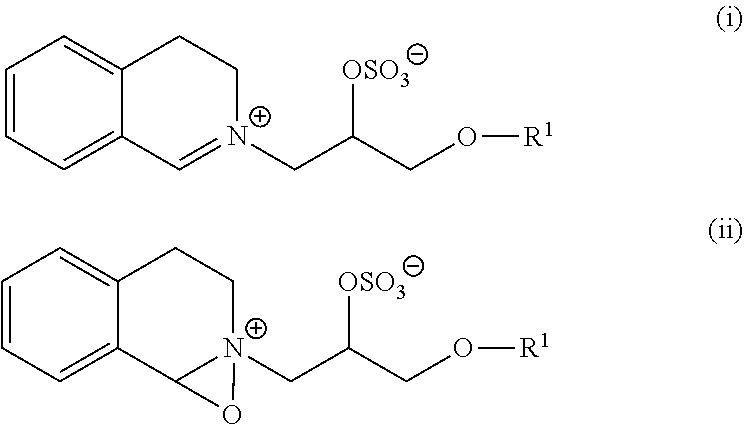
- (iii) and mixtures thereof;
-
- wherein R1 is independently a branched alkyl group containing from 9 to 24 carbons or linear alkyl group containing from 11 to 24 carbons, preferably R1 is independently a branched alkyl group containing from 9 to 18 carbons or linear alkyl group containing from 11 to 18 carbons, more preferably R1 is independently selected from the group consisting of 2-propylheptyl, 2-butyloctyl, 2-pentylnonyl, 2-hexyldecyl, dodecyl, tetradecyl, hexadecyl, octadecyl, isononyl, isodecyl, isotridecyl and isopentadecyl.
- Other exemplary bleaching systems are described, e.g. in WO2007/087258, WO 2007/087244, WO 2007/087259, EP 1 867 708 (Vitamin K) and WO 2007/087242.
- The detergent may contain 0.005-10% by weight, such as 0.5-5%, 2-5%, 0.5-2% or 0.2-1% of a polymer. Any polymer known in the art for use in detergents may be utilized. The polymer may function as a co-builder as mentioned above, or may provide antiredeposition, fiber protection, soil release, dye transfer inhibition, grease cleaning and/or anti-foaming properties. Some polymers may have more than one of the above-mentioned properties and/or more than one of the below-mentioned motifs. Exemplary polymers include (carboxymethyl)cellulose (CMC), poly(vinyl alcohol) (PVA), poly(ethyleneglycol) or poly(ethylene oxide) (PEG or PEO), ethoxylated poly(ethyleneimine), (carboxymethyl)inulin (CMI), carboxylate polymers and polycarboxylates such as polyacrylates, maleic/acrylic acid copolymers, acrylate/styrene copolymers, poly(aspartic) acid, and lauryl methacrylate/acrylic acid copolymers, hydrophobically modified CMC (HM-CMC), silicones, copolymers of terephthalic acid and oligomeric glycols, copolymers of poly(ethylene terephthalate) and poly(oxyethene terephthalate) (PET-POET), poly(vinylpyrrolidone) (PVP), poly(vinylimidazole) (PVI), poly(vinylpyridine-N-oxide) (PVPO or PVPNO) and copoly(vinylimidazole/vinylpyrrolidone) (PVPVI). Suitable examples include PVP-K15, PVP-K30, ChromaBond S-400, ChromaBond S-403E and Chromabond S-100 from Ashland Aqualon, and Sokalan® HP 165, Sokalan® HP 50 (Dispersing agent), Sokalan® HP 53 (Dispersing agent), Sokalan® HP 59 (Dispersing agent), Sokalan® HP 56 (dye transfer inhibitor), Sokalan® HP 66 K (dye transfer inhibitor) from BASF. Further exemplary polymers include sulfonated polycarboxylates, polyethylene oxide and polypropylene oxide (PEO-PPO) and diquaternium ethoxy sulfate. Particularly preferred polymer is ethoxylated homopolymer Sokalan® HP 20 from BASF, which helps to prevent redeposition of soil in the wash liqor. Further exemplary polymers include sulfonated polycarboxylates, ethylene oxide-propylene oxide copolymers (PEO-PPO), copolymers of PEG with and vinyl acetate, and diquaternium ethoxy sulfate or quaternized sulfated ethoxylated hexamethylenediamine. Other exemplary polymers are disclosed in, e.g., WO 2006/130575. Salts of the above-mentioned polymers are also contemplated.
- Any detergent components known in the art for use in laundry/ADW/hard surface cleaning detergents may also be utilized. Other optional detergent components include anti-corrosion agents, anti-shrink agents, anti-soil redeposition agents, anti-wrinkling agents, bactericides, binders, corrosion inhibitors, disintegrants/disintegration agents, dyes, enzyme stabilizers (including boric acid, borates, CMC, and/or polyols such as propylene glycol), fabric conditioners including clays, fillers/processing aids, fluorescent whitening agents/optical brighteners, foam boosters, foam (suds) regulators, perfumes, soil-suspending agents, softeners, suds suppressors, tarnish inhibitors, and wicking agents, either alone or in combination. Any ingredient known in the art for use in laundry/ADW/hard surface cleaning detergents may be utilized. The choice of such ingredients is well within the skill of the artisan.
- The detergent compositions of the present invention can also contain dispersants. In particular powdered detergents may comprise dispersants. Suitable water-soluble organic materials include the homo- or co-polymeric acids or their salts, in which the polycarboxylic acid comprises at least two carboxyl radicals separated from each other by not more than two carbon atoms. Suitable dispersants are for example described in Powdered Detergents, Surfactant science series volume 71, Marcel Dekker, Inc.
- The detergent compositions of the present invention may also include one or more dye transfer inhibiting agents. Suitable polymeric dye transfer inhibiting agents include, but are not limited to, polyvinylpyrrolidone polymers, polyamine N-oxide polymers, copolymers of N-vinylpyrrolidone and N-vinylimidazole, polyvinyloxazolidones and polyvinylimidazoles or mixtures thereof. When present in a subject composition, the dye transfer inhibiting agents may be present at levels from about 0.0001% to about 10%, from about 0.01% to about 5% or even from about 0.1% to about 3% by weight of the composition.
- The detergent compositions of the present invention will preferably also contain additional components that may tint articles being cleaned, such as fluorescent whitening agent or optical brighteners. Where present the brightener is preferably at a level of about 0.01% to about 0.5%. Any fluorescent whitening agent suitable for use in a laundry detergent composition may be used in the composition of the present invention. The most commonly used fluorescent whitening agents are those belonging to the classes of diaminostilbene-sulfonic acid derivatives, diarylpyrazoline derivatives and bisphenyl-distyryl derivatives. Examples of the diaminostilbene-sulfonic acid derivative type of fluorescent whitening agents include the sodium salts of: 4,4′-bis-(2-diethanolamino-4-anilino-s-triazin-6-ylamino) stilbene-2,2′-disulfonate, 4,4′-bis-(2,4-dianilino-s-triazin-6-ylamino) stilbene-2.2′-disulfonate, 4,4′-bis-(2-anilino-4-(N-methyl-N-2-hydroxy-ethylamino)-s-triazin-6-ylamino) stilbene-2,2′-disulfonate, 4,4′-bis-(4-phenyl-1,2,3-triazol-2-yl)stilbene-2,2′-disulfonate and sodium 5-(2H-naphtho[1,2-d][1,2,3]triazol-2-yl)-2-[(E)-2-phenylvinyl]benzenesulfonate. Preferred fluorescent whitening agents are Tinopal DMS and Tinopal CBS available from Ciba-Geigy AG, Basel, Switzerland. Tinopal DMS is the disodium salt of 4,4′-bis-(2-morpholino-4-anilino-s-triazin-6-ylamino) stilbene-2,2′-disulfonate. Tinopal CBS is the disodium salt of 2,2′-bis-(phenyl-styryl)-disulfonate. Also preferred are fluorescent whitening agents is the commercially available Parawhite KX, supplied by Paramount Minerals and Chemicals, Mumbai, India. Other fluorescers suitable for use in the invention include the 1-3-diaryl pyrazolines and the 7-alkylaminocoumarins.
- Suitable fluorescent brightener levels include lower levels of from about 0.01, from 0.05, from about 0.1 or even from about 0.2 wt % to upper levels of 0.5 or even 0.75 wt %.
- The detergent compositions of the present invention may also include one or more soil release polymers which aid the removal of soils from fabrics such as cotton and polyester based fabrics, in particular the removal of hydrophobic soils from polyester based fabrics. The soil release polymers may for example be nonionic or anionic terephthalte based polymers, polyvinyl caprolactam and related copolymers, vinyl graft copolymers, polyester polyamides see for example Chapter 7 in Powdered Detergents, Surfactant science series volume 71, Marcel Dekker, Inc. Other types of soil release polymers are amphiphilic alkoxylated grease cleaning polymers comprising a core structure and a plurality of alkoxylate groups attached to that core structure. The core structure may comprise a polyalkylenimine structure or a polyalkanolamine structure as described in detail in WO 2009/087523 (hereby incorporated by reference). Furthermore, random graft co-polymers are suitable soil release polymers. Suitable graft co-polymers are described in more detail in WO 2007/138054, WO 2006/108856 and WO 2006/113314 (hereby incorporated by reference). Other soil release polymers are substituted polysaccharide structures especially substituted cellulosic structures such as modified cellulose deriviatives such as those described in EP 1867808 or WO 2003/040279 (both are hereby incorporated by reference). Suitable cellulosic polymers include cellulose, cellulose ethers, cellulose esters, cellulose amides and mixtures thereof. Suitable cellulosic polymers include anionically modified cellulose, nonionically modified cellulose, cationically modified cellulose, zwitterionically modified cellulose, and mixtures thereof. Suitable cellulosic polymers include methyl cellulose, carboxy methyl cellulose, ethyl cellulose, hydroxyl ethyl cellulose, hydroxyl propyl methyl cellulose, ester carboxy methyl cellulose, and mixtures thereof.
- The detergent compositions of the present invention may also include one or more anti-redeposition agents such as carboxymethylcellulose (CMC), polyvinyl alcohol (PVA), polyvinylpyrrolidone (PVP), polyoxyethylene and/or polyethyleneglycol (PEG), homopolymers of acrylic acid, copolymers of acrylic acid and maleic acid, and ethoxylated polyethyleneimines. The cellulose based polymers described under soil release polymers above may also function as anti-redeposition agents.
- Other suitable adjunct materials include, but are not limited to, anti-shrink agents, anti-wrinkling agents, bactericides, binders, carriers, dyes, enzyme stabilizers, fabric softeners, fillers, foam regulators, hydrotropes, perfumes, pigments, and sod suppressors.
- Further embodiments of the invention include:
- Embodiment 1. A solid detergent composition, comprising a mixture of
-
- (a) a biological surfactant selected from glycolipids and lipopeptides; and
- (b) a plurality of enzyme particles, which comprise a core and a coating and which are Embodiment 2. The solid detergent composition of embodiment 1, wherein the biological surfactant is a glycolipid.
- Embodiment 3. The solid detergent composition of claim 1, wherein the biological surfactant is a glycolipid selected from the group consisting of sophorolipid, rhamnolipid, trehalolipid, and mannosylerythritol lipid.
- Embodiment 4. The solid detergent composition of claim 1, wherein the biological surfactant is a sophorolipid.
- Embodiment 5. The solid detergent composition of claim 1, wherein the biological surfactant is a rhamnolipid.
- Embodiment 6. The solid detergent composition of claim 1, wherein the biological surfactant is a trehalolipid.
- Embodiment 7. The solid detergent composition of claim 1, wherein the biological surfactant is a mannosylerythritol lipid.
- Embodiment 8. The solid detergent composition of claim 1, wherein the biological surfactant is a lipopeptide.
- Embodiment 9. The solid detergent composition of claim 1, wherein the biological surfactant is a surfactin.
- Embodiment 10. The solid detergent composition of any of the preceding embodiments, wherein the biological surfactant is derived from a microbial organism.
- Embodiment 11. The solid detergent composition of any of the preceding embodiments, wherein the biological surfactant is derived from a bacterium, yeast, or fungus.
- Embodiment 12. The solid detergent composition of any of the preceding embodiments, wherein the biological surfactant is produced by a bacterium, yeast, or fungus.
- Embodiment 13. The solid detergent composition of any of the preceding embodiments, wherein the biological surfactant is a non-ionic surfactant.
- Embodiment 14. The solid detergent composition of any of the preceding embodiments, comprising 1-40% w/w of the biological surfactant.
- Embodiment 15. The solid detergent composition of any of the preceding embodiments, comprising 1-30% w/w of the biological surfactant.
- Embodiment 16. The solid detergent composition of any of the preceding embodiments, comprising 1-20% w/w of the biological surfactant.
- Embodiment 17. The solid detergent composition of any of the preceding embodiments, comprising 1-10% w/w of the biological surfactant.
- Embodiment 18. The solid detergent composition of any of the preceding embodiments, which is essentially free of alkylbenzene sulfonates.
- Embodiment 19. The solid detergent composition of any of the preceding embodiments, further comprising a strong sequestering builder.
- Embodiment 20. The solid detergent composition of any of the preceding embodiments, further comprising a strong sequestering builder in an amount of at least 0.1% w/w.
- Embodiment 21. The solid detergent composition of any of the preceding embodiments, further comprising a strong sequestering builder in an amount of at least 0.5% w/w.
- Embodiment 22. The solid detergent composition of any of the preceding embodiments, further comprising a strong sequestering builder in an amount of at least 1% w/w.
- Embodiment 23. The solid detergent composition of any of embodiments 19-22, wherein the strong sequestering builder/chelator can bind Ca2+ with a logarithmic stability constant (Log KCa) of the Ca2+/chelator complex of above 5 at an ionic strength of 0.1 M and a temperature of 25° C.
- Embodiment 24. The solid detergent composition of any of embodiments 19-22, wherein the strong sequestering builder/chelator can bind Ca2+ with a logarithmic stability constant (Log KCa) of the Ca2+/chelator complex of above 6 at an ionic strength of 0.1 M and a temperature of 25° C.
- Embodiment 25. The solid detergent composition of any of embodiments 19-22, wherein the strong sequestering builder/chelator can bind Ca2+ with a logarithmic stability constant (Log KCa) of the Ca2+/chelator complex of above 7 at an ionic strength of 0.1 M and a temperature of 25° C.
- Embodiment 26. The solid detergent composition of any of embodiments 19-22, wherein the strong sequestering builder/chelator is selected from the group consisting of EDTA, EDTMP, NTMP, DTPMP, MGDA, NTA, HEDP, STPP, IDS, and GLDA.
- Embodiment 27. The solid detergent composition of any of embodiments 19-22, wherein the strong sequestering builder/chelator is selected from the group consisting of EDTMP, NTMP, DTPMP, MGDA, NTA, HEDP, and GLDA.
- Embodiment 28. The solid detergent composition of any of the preceding embodiments, which comprises 0.1-10% w/w of enzyme particles.
- Embodiment 29. The solid detergent composition of any of the preceding embodiments, wherein the coating is a salt coating or a polymer coating.
- Embodiment 30. The solid detergent composition of any of the preceding embodiments, wherein the coating is a salt coating comprising at least 1% salt by weight of the core, or a polymer coating comprising a polyethylene glycol, polyvinyl alcohol, or polysaccharide.
- Embodiment 31. The solid detergent composition of any of the preceding embodiments, wherein the coating is a salt coating.
- Embodiment 32. The solid detergent composition of any of the preceding embodiments, wherein the coating is a salt coating comprising at least 1% salt by weight of the core.
- Embodiment 33. The solid detergent composition of any of the preceding embodiments, wherein the enzyme particles comprise at least two coatings.
- Embodiment 34. The solid detergent composition of any of the preceding embodiments, wherein the enzyme particles comprise at least two coatings, where the outermost coating is a polymer coating comprising a polyethylene glycol, polyvinyl alcohol, or polysaccharide.
- Embodiment 35. The solid detergent composition of any of the preceding embodiments, wherein the core comprises the enzyme.
- Embodiment 36. The solid detergent composition of any of the preceding embodiments, wherein the enzyme particles comprise 0.1-25% w/w of active enzyme protein.
- Embodiment 37. The solid detergent composition of any of the preceding embodiments, wherein the enzyme is selected from the group consisting of protease, amylase, lipase, cutinase, cellulase, pectinase, mannanase, nuclease, dispersin, and oxidoreductase.
- Embodiment 38. The solid detergent composition of any of the preceding embodiments, wherein the enzyme comprises a protease, and an additional enzyme selected from the group consisting of amylase, lipase, cutinase, cellulase, pectinase, mannanase, nuclease, dispersin, and oxidoreductase.
- Embodiment 39. The solid detergent composition of any of the preceding embodiments, wherein the plurality of enzyme particles comprises 0% w/w of titanium dioxide.
- Embodiment 40. The solid detergent composition of any of the preceding embodiments, wherein the plurality of enzyme particles are free of titanium dioxide.
- Embodiment 41. Use of enzyme particles, which are essentially free of titanium dioxide, for improving the stability of the biological surfactant in the solid detergent composition of any of the preceding embodiments, as compared to using enzyme particles comprising titanium dioxide.
- Chemicals were commercial products of at least reagent grade.
- Enzyme Granulates with and without Titanium Dioxide in Coating
- A pilot scale high-shear enzyme co-granulate (containing protease, amylase, cellulase and mannanase) was produced as described in Example 1 of WO 2011/134809. The uncoated granules were coated in a fluid bed with 40% sodium sulfate followed by a film coating of 1.25% PEG 4000 and 3% kaolin (all as % by weight of uncoated dry granulate). The coated granules were sieved to 300-1200 microns.
- The above coated co-granulate was given a final outer coating:
-
- (a) 100 g granulate was placed in a 250 ml glass beaker with a 2×2 blade overhead mixer;
- (b) 2.0 g coating powder (see below) was added and distributed on the granulate by stirring at 400 rpm for 5 minutes; and
- (c) 1.0 g PEG 400 was added and stirring continued for 5 minutes at 400 rpm.
- 2.0 g Calcium carbonate fine powder was used as coating powder.
- 2.0 g Titanium dioxide (TiO2) fine powder was used as coating powder.
- Both final coated granules were free-flowing enzyme granulates without agglomerates.
- Two biosurfactant-based powder detergents were prepared by mixing a detergent base powder with the Example 1.1 and Example 1.2 enzyme granules, as shown in Table 1.
-
-
- 15.01 g Rhamnolipid powder (Sigma R90 grinded in mortar and sieved below 1200 microns),
- 15.00 g Surfactin fine powder (Kaneka),
- 45.02 g Sodium citrate dihydrate powder, and
- 67.51 g Sodium carbonate powder.
-
TABLE 1 Biosurfactant based powder detergents with enzyme granules. Detergent Example 1.1 Example 1.2 Detergent base powder granules granules A 16.87 g 1.68 g B 16.82 g 1.68 g - The detergents were exposed to UV-light (365 nm) over 48 hours (using UV diodes 365 nm on a UV LED-strip 1 meter long with an output of 2.4 W/m at 12 V). The exposed detergents were dissolved in deionized water and insolubles removed by centrifugation. Surfactant content in the solutions were analyzed using LCMS:
- In Detergent B, the rhamnolipid content was reduced by 4% and the surfactin content was reduced by 6%, as compared to Detergent A.
- The example shows an increased degradation of biosurfactant (rhamnolipid and surfactin) in a sample containing enzyme granules with a titanium dioxide coating, as compared to a sample containing enzyme granules with an inert calcium carbonate coating.
Claims (18)
1-15. (canceled)
16: A solid detergent composition, comprising a mixture of:
(a) a biological surfactant selected from glycolipids and lipopeptides; and
(b) a plurality of enzyme particles, which comprise a core and a coating and which are essentially free of titanium dioxide.
17: The solid detergent composition of claim 16 , wherein the biological surfactant is a glycolipid.
18: The solid detergent composition of claim 16 , wherein the biological surfactant is a glycolipid selected from the group consisting of sophorolipid, rhamnolipid, trehalolipid, and mannosylerythritol lipid.
19: The solid detergent composition of claim 16 , wherein the biological surfactant is derived from a microbial organism.
20: The solid detergent composition of claim 16 , wherein the biological surfactant is a non-ionic surfactant.
21: The solid detergent composition of claim 16 , comprising 1-40% w/w of the biological surfactant.
22: The solid detergent composition of claim 16 , comprising 1-30% w/w of the biological surfactant.
23: The solid detergent composition of claim 16 , comprising 1-20% w/w of the biological surfactant.
24: The solid detergent composition of claim 16 , which is essentially free of alkylbenzene sulfonates.
25: The solid detergent composition of claim 16 , further comprising a strong sequestering builder that can bind Ca2+ with a logarithmic stability constant (Log KCa) of the Ca2+/chelator complex of above 5 at an ionic strength of 0.1 M and a temperature of 25° C.
26: The solid detergent composition of claim 16 , wherein the sequestering builder is in an amount of at least 0.1% w/w.
27: The solid detergent composition of claim 16 , which comprises 0.1-10% w/w of enzyme particles.
28: The solid detergent composition of claim 16 , wherein the enzyme particles comprise 0.1-25% w/w of active enzyme protein.
29: The solid detergent composition of claim 16 , wherein the enzyme is selected from the group consisting of protease, amylase, lipase, cutinase, cellulase, pectinase, mannanase, nuclease, dispersin, and oxidoreductase.
30: The solid detergent composition of claim 16 , wherein the enzyme comprises a protease, and an additional enzyme selected from the group consisting of amylase, lipase, cutinase, cellulase, pectinase, mannanase, nuclease, dispersin, and oxidoreductase.
31: The solid detergent composition of claim 16 , wherein the core comprises the enzyme.
32: The solid detergent composition of claim 16 , wherein the coating is a salt coating and/or a polymer coating.
Applications Claiming Priority (3)
| Application Number | Priority Date | Filing Date | Title |
|---|---|---|---|
| EP21156756.5 | 2021-02-12 | ||
| EP21156756 | 2021-02-12 | ||
| PCT/EP2022/053535 WO2022171872A1 (en) | 2021-02-12 | 2022-02-14 | Stabilized biological detergents |
Publications (1)
| Publication Number | Publication Date |
|---|---|
| US20250075152A1 true US20250075152A1 (en) | 2025-03-06 |
Family
ID=74595101
Family Applications (1)
| Application Number | Title | Priority Date | Filing Date |
|---|---|---|---|
| US18/262,619 Pending US20250075152A1 (en) | 2021-02-12 | 2022-02-14 | Stabilized biological detergents |
Country Status (4)
| Country | Link |
|---|---|
| US (1) | US20250075152A1 (en) |
| EP (1) | EP4291625A1 (en) |
| CN (1) | CN117015592A (en) |
| WO (1) | WO2022171872A1 (en) |
Families Citing this family (6)
| Publication number | Priority date | Publication date | Assignee | Title |
|---|---|---|---|---|
| WO2024183958A1 (en) * | 2023-03-09 | 2024-09-12 | Norfalk Aps | Use of mono-ester glycolipids in laundry detergents |
| WO2024194245A1 (en) * | 2023-03-21 | 2024-09-26 | Novozymes A/S | Detergent compositions based on biosurfactants |
| EP4461796A1 (en) * | 2023-05-10 | 2024-11-13 | Novozymes A/S | Detergent composition comprising laccase |
| EP4461795A1 (en) * | 2023-05-10 | 2024-11-13 | Novozymes A/S | Detergent composition comprising laccase |
| WO2025008400A1 (en) | 2023-07-03 | 2025-01-09 | Novozymes A/S | Enzymatic detergent bars having improved enzyme stability |
| WO2025068026A1 (en) | 2023-09-29 | 2025-04-03 | Novozymes A/S | Cold water soluble enzyme granulates |
Family Cites Families (145)
| Publication number | Priority date | Publication date | Assignee | Title |
|---|---|---|---|---|
| GB1296839A (en) | 1969-05-29 | 1972-11-22 | ||
| US4016040A (en) | 1969-12-10 | 1977-04-05 | Colgate-Palmolive Company | Preparation of enzyme-containing beads |
| GB1590432A (en) | 1976-07-07 | 1981-06-03 | Novo Industri As | Process for the production of an enzyme granulate and the enzyme granuate thus produced |
| DK187280A (en) | 1980-04-30 | 1981-10-31 | Novo Industri As | RUIT REDUCING AGENT FOR A COMPLETE LAUNDRY |
| DK263584D0 (en) | 1984-05-29 | 1984-05-29 | Novo Industri As | ENZYMOUS GRANULATES USED AS DETERGENT ADDITIVES |
| US4713245A (en) | 1984-06-04 | 1987-12-15 | Mitsui Toatsu Chemicals, Incorporated | Granule containing physiologically-active substance, method for preparing same and use thereof |
| JPH0697997B2 (en) | 1985-08-09 | 1994-12-07 | ギスト ブロカデス ナ−ムロ−ゼ フエンノ−トチヤツプ | New enzymatic detergent additive |
| ES2058119T3 (en) | 1986-08-29 | 1994-11-01 | Novo Nordisk As | ENZYMATIC DETERGENT ADDITIVE. |
| US5389536A (en) | 1986-11-19 | 1995-02-14 | Genencor, Inc. | Lipase from Pseudomonas mendocina having cutinase activity |
| DK435687D0 (en) | 1987-08-21 | 1987-08-21 | Novo Industri As | ENZYM containing granules and processes for their preparation |
| DE3854249T2 (en) | 1987-08-28 | 1996-02-29 | Novonordisk As | Recombinant Humicola Lipase and Process for the Production of Recombinant Humicola Lipases. |
| DK6488D0 (en) | 1988-01-07 | 1988-01-07 | Novo Industri As | ENZYMES |
| JP3079276B2 (en) | 1988-02-28 | 2000-08-21 | 天野製薬株式会社 | Recombinant DNA, Pseudomonas sp. Containing the same, and method for producing lipase using the same |
| EP0406314B1 (en) | 1988-03-24 | 1993-12-01 | Novo Nordisk A/S | A cellulase preparation |
| US5776757A (en) | 1988-03-24 | 1998-07-07 | Novo Nordisk A/S | Fungal cellulase composition containing alkaline CMC-endoglucanase and essentially no cellobiohydrolase and method of making thereof |
| DK78189D0 (en) | 1989-02-20 | 1989-02-20 | Novo Industri As | ENZYMOUS GRANULATE AND PROCEDURE FOR PREPARING THEREOF |
| DK78089D0 (en) | 1989-02-20 | 1989-02-20 | Novo Industri As | DETERGENTAL GRANULATE AND PROCEDURES FOR PREPARING THEREOF |
| GB8915658D0 (en) | 1989-07-07 | 1989-08-23 | Unilever Plc | Enzymes,their production and use |
| DE69033388T2 (en) | 1989-08-25 | 2000-05-11 | Henkel Research Corp., Santa Rosa | ALKALINE PROTEOLYTIC ENZYME AND METHOD FOR PRODUCING THE SAME |
| AU639570B2 (en) | 1990-05-09 | 1993-07-29 | Novozymes A/S | A cellulase preparation comprising an endoglucanase enzyme |
| DK115890D0 (en) | 1990-05-09 | 1990-05-09 | Novo Nordisk As | ENZYME |
| DK0548228T3 (en) | 1990-09-13 | 1999-05-10 | Novo Nordisk As | lipase variants |
| SG52693A1 (en) | 1991-01-16 | 1998-09-28 | Procter & Gamble | Detergent compositions with high activity cellulase and softening clays |
| ES2121014T3 (en) | 1991-05-01 | 1998-11-16 | Novo Nordisk As | STABILIZED ENZYMES AND DETERGENT COMPOSITIONS. |
| US5340735A (en) | 1991-05-29 | 1994-08-23 | Cognis, Inc. | Bacillus lentus alkaline protease variants with increased stability |
| JP3312364B2 (en) | 1991-10-07 | 2002-08-05 | ジェネンコア インターナショナル インコーポレーテッド | Enzyme-containing granules coated |
| US5879920A (en) | 1991-10-07 | 1999-03-09 | Genencor International, Inc. | Coated enzyme-containing granule |
| WO1993012067A1 (en) | 1991-12-13 | 1993-06-24 | The Procter & Gamble Company | Acylated citrate esters as peracid precursors |
| DK28792D0 (en) | 1992-03-04 | 1992-03-04 | Novo Nordisk As | NEW ENZYM |
| DK72992D0 (en) | 1992-06-01 | 1992-06-01 | Novo Nordisk As | ENZYME |
| DK88892D0 (en) | 1992-07-06 | 1992-07-06 | Novo Nordisk As | CONNECTION |
| DE69334295D1 (en) | 1992-07-23 | 2009-11-12 | Novo Nordisk As | MUTIER -g (a) -AMYLASE, DETERGENT AND DISHWASHER |
| EP1431389A3 (en) | 1992-10-06 | 2004-06-30 | Novozymes A/S | Cellulase variants |
| ATE175235T1 (en) | 1993-02-11 | 1999-01-15 | Genencor Int | OXIDATIVELY STABLE ALPHA-AMYLASE |
| AU673078B2 (en) | 1993-04-27 | 1996-10-24 | Genencor International, Inc. | New lipase variants for use in detergent applications |
| DK52393D0 (en) | 1993-05-05 | 1993-05-05 | Novo Nordisk As | |
| JP2859520B2 (en) | 1993-08-30 | 1999-02-17 | ノボ ノルディスク アクティーゼルスカブ | Lipase, microorganism producing the same, method for producing lipase, and detergent composition containing lipase |
| JPH09503916A (en) | 1993-10-08 | 1997-04-22 | ノボ ノルディスク アクティーゼルスカブ | Amylase variant |
| US5817495A (en) | 1993-10-13 | 1998-10-06 | Novo Nordisk A/S | H2 O2 -stable peroxidase variants |
| JPH07143883A (en) | 1993-11-24 | 1995-06-06 | Showa Denko Kk | Lipase gene and mutant lipase |
| ATE222604T1 (en) | 1994-02-22 | 2002-09-15 | Novozymes As | METHOD FOR PRODUCING A VARIANT OF A LIPOLYTIC ENZYME |
| ATE512226T1 (en) | 1994-02-24 | 2011-06-15 | Henkel Ag & Co Kgaa | IMPROVED ENZYMES AND DETERGENTS WITH IT |
| DE69536145D1 (en) | 1994-03-08 | 2011-04-07 | Novozymes As | Novel alkaline cellulases |
| WO1995030744A2 (en) | 1994-05-04 | 1995-11-16 | Genencor International Inc. | Lipases with improved surfactant resistance |
| WO1995035381A1 (en) | 1994-06-20 | 1995-12-28 | Unilever N.V. | Modified pseudomonas lipases and their use |
| WO1996000292A1 (en) | 1994-06-23 | 1996-01-04 | Unilever N.V. | Modified pseudomonas lipases and their use |
| EP1995303A3 (en) | 1994-10-06 | 2008-12-31 | Novozymes A/S | Enzyme preparation with endoglucanase activity |
| BE1008998A3 (en) | 1994-10-14 | 1996-10-01 | Solvay | Lipase, microorganism producing the preparation process for the lipase and uses thereof. |
| AU3697995A (en) | 1994-10-26 | 1996-05-23 | Novo Nordisk A/S | An enzyme with lipolytic activity |
| AR000862A1 (en) | 1995-02-03 | 1997-08-06 | Novozymes As | VARIANTS OF A MOTHER-AMYLASE, A METHOD TO PRODUCE THE SAME, A DNA STRUCTURE AND A VECTOR OF EXPRESSION, A CELL TRANSFORMED BY SUCH A DNA STRUCTURE AND VECTOR, A DETERGENT ADDITIVE, DETERGENT COMPOSITION, A COMPOSITION FOR AND A COMPOSITION FOR THE ELIMINATION OF |
| JPH08228778A (en) | 1995-02-27 | 1996-09-10 | Showa Denko Kk | Novel lipase gene and method for producing lipase using the same |
| CN1182451A (en) | 1995-03-17 | 1998-05-20 | 诺沃挪第克公司 | Novel endoglucanases |
| BR9608149B1 (en) | 1995-05-05 | 2012-01-24 | processes for effecting mutation in DNA encoding a subtilase enzyme or its pre- or pre-enzyme and for the manufacture of a mutant subtilase enzyme. | |
| WO1997004078A1 (en) | 1995-07-14 | 1997-02-06 | Novo Nordisk A/S | A modified enzyme with lipolytic activity |
| WO1997007202A1 (en) | 1995-08-11 | 1997-02-27 | Novo Nordisk A/S | Novel lipolytic enzymes |
| DE19528059A1 (en) | 1995-07-31 | 1997-02-06 | Bayer Ag | Detergent and cleaning agent with imino disuccinates |
| WO1997039116A1 (en) | 1996-04-12 | 1997-10-23 | Novo Nordisk A/S | Enzyme-containing granules and process for the production thereof |
| US5763385A (en) | 1996-05-14 | 1998-06-09 | Genencor International, Inc. | Modified α-amylases having altered calcium binding properties |
| WO1998008940A1 (en) | 1996-08-26 | 1998-03-05 | Novo Nordisk A/S | A novel endoglucanase |
| DE69735767T2 (en) | 1996-09-17 | 2007-04-05 | Novozymes A/S | cellulase |
| WO1998015257A1 (en) | 1996-10-08 | 1998-04-16 | Novo Nordisk A/S | Diaminobenzoic acid derivatives as dye precursors |
| EP0934389B1 (en) | 1996-10-18 | 2003-12-10 | The Procter & Gamble Company | Detergent compositions |
| AU4772697A (en) | 1996-11-04 | 1998-05-29 | Novo Nordisk A/S | Subtilase variants and compositions |
| CN1530443A (en) | 1996-11-04 | 2004-09-22 | ŵ����÷������˾ | subtilase variants and compositions |
| DE69839076T2 (en) | 1997-08-29 | 2009-01-22 | Novozymes A/S | PROTEASE VERSIONS AND COMPOSITIONS |
| EP2206768B1 (en) | 1997-10-13 | 2015-04-01 | Novozymes A/S | Alpha-amylase mutants |
| BR9813768A (en) | 1997-12-20 | 2000-10-10 | Genencor Int | Granule, and, process of producing a granule. |
| CN100497614C (en) | 1998-06-10 | 2009-06-10 | 诺沃奇梅兹有限公司 | Mannanase |
| ES2212568T3 (en) | 1998-06-30 | 2004-07-16 | Novozymes A/S | NEW IMPROVED GRANULUM CONTAINING AN ENZYME. |
| JP2000210081A (en) | 1999-01-21 | 2000-08-02 | Kao Corp | Thermostable alkaline cellulase gene |
| EP1214426A2 (en) | 1999-08-31 | 2002-06-19 | Novozymes A/S | Novel proteases and variants thereof |
| CN101974375B (en) | 1999-12-15 | 2014-07-02 | 诺沃奇梅兹有限公司 | Subtilase variants having an improved wash performance on egg stains |
| ES2322690T3 (en) | 2000-02-24 | 2009-06-25 | Novozymes A/S | XILOGLUCANASAS OF THE FAMILY 44. |
| JP5571274B2 (en) | 2000-03-08 | 2014-08-13 | ノボザイムス アクティーゼルスカブ | Variants with altered properties |
| DE60112928T2 (en) | 2000-06-02 | 2006-06-14 | Novozymes As | Cutinase VARIATIONS |
| JP4855632B2 (en) | 2000-08-01 | 2012-01-18 | ノボザイムス アクティーゼルスカブ | Α-Amylase mutants with altered properties |
| CA2419896C (en) | 2000-08-21 | 2014-12-09 | Novozymes A/S | Subtilase enzymes |
| DK1399543T3 (en) | 2001-06-06 | 2014-11-03 | Novozymes As | ENDO-BETA-1,4-GLUCANASE |
| DK200101090A (en) | 2001-07-12 | 2001-08-16 | Novozymes As | Subtilase variants |
| GB0127036D0 (en) | 2001-11-09 | 2002-01-02 | Unilever Plc | Polymers for laundry applications |
| CN101597601B (en) | 2002-06-26 | 2013-06-05 | 诺维信公司 | Subtilases and subtilase variants having altered immunogenicity |
| TWI319007B (en) | 2002-11-06 | 2010-01-01 | Novozymes As | Subtilase variants |
| WO2004067737A2 (en) | 2003-01-30 | 2004-08-12 | Novozymes A/S | Subtilases |
| CN1871344A (en) | 2003-10-23 | 2006-11-29 | 诺和酶股份有限公司 | Protease with improved stability in detergents |
| AU2004293826B2 (en) | 2003-11-19 | 2009-09-17 | Danisco Us Inc. | Serine proteases, nucleic acids encoding serine enzymes and vectors and host cells incorporating same |
| EP2295554B1 (en) | 2003-12-03 | 2012-11-28 | Danisco US Inc. | Perhydrolase |
| JP5718546B2 (en) | 2004-09-27 | 2015-05-13 | ノボザイムス アクティーゼルスカブ | Enzyme granules |
| CA2593920A1 (en) | 2004-12-23 | 2006-06-29 | Novozymes A/S | Alpha-amylase variants |
| BRPI0609363A2 (en) | 2005-04-15 | 2010-03-30 | Procter & Gamble | cleaning compositions with alkoxylated polyalkylene imines |
| PL1869155T3 (en) | 2005-04-15 | 2011-03-31 | Procter & Gamble | Liquid laundry detergent compositions with modified polyethyleneimine polymers and lipase enzyme |
| EP1888734A2 (en) | 2005-05-31 | 2008-02-20 | The Procter and Gamble Company | Polymer-containing detergent compositions and their use |
| CN101218343B (en) | 2005-07-08 | 2013-11-06 | 诺维信公司 | subtilisin variant |
| CN105200027B (en) | 2005-10-12 | 2019-05-31 | 金克克国际有限公司 | The purposes and preparation of the metalloprotease of stable storing |
| US8518675B2 (en) | 2005-12-13 | 2013-08-27 | E. I. Du Pont De Nemours And Company | Production of peracids using an enzyme having perhydrolysis activity |
| AR059156A1 (en) | 2006-01-23 | 2008-03-12 | Procter & Gamble | DETERGENT COMPOSITIONS |
| ES2629332T3 (en) | 2006-01-23 | 2017-08-08 | Novozymes A/S | Lipase variants |
| AR059154A1 (en) | 2006-01-23 | 2008-03-12 | Procter & Gamble | A COMPOSITION THAT INCLUDES A LIPASE AND A WHITENING CATALYST |
| AR059155A1 (en) | 2006-01-23 | 2008-03-12 | Procter & Gamble | COMPOSITIONS THAT INCLUDE ENZYMES AND PHOTOBLANKERS |
| EP1979457A2 (en) | 2006-01-23 | 2008-10-15 | The Procter and Gamble Company | A composition comprising a lipase and a bleach catalyst |
| DE602007007945D1 (en) | 2006-05-31 | 2010-09-02 | Basf Se | AMPHIPHILYPROPOLYMERS BASED ON POLYALKYLENE OXIDES AND VINYL REAGENTS |
| DE202006009003U1 (en) | 2006-06-06 | 2007-10-25 | BROSE SCHLIEßSYSTEME GMBH & CO. KG | Motor vehicle lock |
| PL1867708T3 (en) | 2006-06-16 | 2017-10-31 | Procter & Gamble | Detergent compositions |
| EP2155869A2 (en) | 2007-05-30 | 2010-02-24 | Danisco US, INC., Genencor Division | Variants of an alpha-amylase with improved production levels in fermentation processes |
| AU2008325250B2 (en) | 2007-11-05 | 2013-06-13 | Danisco Us Inc. | Variants of Bacillus sp. TS-23 alpha-amylase with altered properties |
| RU2470069C2 (en) | 2008-01-04 | 2012-12-20 | Дзе Проктер Энд Гэмбл Компани | Laundry detergent composition containing glycosyl hydrolase |
| US20090209447A1 (en) | 2008-02-15 | 2009-08-20 | Michelle Meek | Cleaning compositions |
| EP2250259B1 (en) | 2008-02-29 | 2016-08-31 | Novozymes A/S | Polypeptides having lipase activity and polynucleotides encoding same |
| EP2367923A2 (en) | 2008-12-01 | 2011-09-28 | Danisco US Inc. | Enzymes with lipase activity |
| MX2011008656A (en) | 2009-03-06 | 2011-09-06 | Huntsman Adv Mat Switzerland | Enzymatic textile bleach-whitening methods. |
| US20120172275A1 (en) | 2009-03-10 | 2012-07-05 | Danisco Us Inc. | Bacillus Megaterium Strain DSM90-Related Alpha-Amylases, and Methods of Use, Thereof |
| WO2010107560A2 (en) | 2009-03-18 | 2010-09-23 | Danisco Us Inc. | Fungal cutinase from magnaporthe grisea |
| US20120058527A1 (en) | 2009-03-23 | 2012-03-08 | Danisco Us Inc. | Cal a-related acyltransferases and methods of use, thereof |
| CA2775045A1 (en) | 2009-09-25 | 2011-03-31 | Novozymes A/S | Subtilase variants for use in detergent and cleaning compositions |
| BR112012017062A2 (en) | 2009-12-21 | 2016-11-29 | Danisco Us Inc | "Detergent compositions containing geobacillus stearothermophilus lipase and methods for their use" |
| WO2011078949A1 (en) | 2009-12-21 | 2011-06-30 | Danisco Us Inc. | Surfactants that improve the cleaning of lipid-based stains treated with lipases |
| BR112012017060A2 (en) | 2009-12-21 | 2016-11-29 | Danisco Us Inc | "Thermobifide lipase-containing detergent compositions, method for hydrolyzing a lipid present in a dirt or stain on a surface and method for performing a transesterification reaction |
| BR112012017056A2 (en) | 2009-12-21 | 2016-11-22 | Danisco Us Inc | "Bacillus subtilis lipase-containing detergent compositions and methods for using them" |
| MX369096B (en) | 2010-02-10 | 2019-10-29 | Novozymes As | Variants and compositions comprising variants with high stability in presence of a chelating agent. |
| GB2477914B (en) | 2010-02-12 | 2012-01-04 | Univ Newcastle | Compounds and methods for biofilm disruption and prevention |
| US9107433B2 (en) | 2010-04-26 | 2015-08-18 | Novozymes A/S | Enzyme granules |
| AR081423A1 (en) | 2010-05-28 | 2012-08-29 | Danisco Us Inc | DETERGENT COMPOSITIONS WITH STREPTOMYCES GRISEUS LIPASE CONTENT AND METHODS TO USE THEM |
| MX2013011617A (en) | 2011-04-08 | 2013-11-21 | Danisco Us Inc | Compositions. |
| WO2013001078A1 (en) | 2011-06-30 | 2013-01-03 | Novozymes A/S | Alpha-amylase variants |
| EP4026901B1 (en) | 2011-06-30 | 2025-01-22 | Novozymes A/S | Method for screening alpha-amylases |
| CN103946359A (en) * | 2011-09-15 | 2014-07-23 | 荷兰联合利华有限公司 | Detergent compositions comprising surfactant and enzyme |
| ES3035568T3 (en) | 2012-06-08 | 2025-09-04 | Danisco Us Inc | Variant alpha amylases with enhanced activity on starch polymers |
| MX381779B (en) | 2012-12-07 | 2025-03-13 | Novozymes As | PREVENTION OF BACTERIAL ADHESION. |
| CN105874067A (en) | 2013-06-27 | 2016-08-17 | 诺维信公司 | Subtilase variants and polynucleotides encoding same |
| EP3027749B1 (en) | 2013-07-29 | 2019-02-06 | Novozymes A/S | Protease variants and polynucleotides encoding same |
| CN105358686A (en) | 2013-07-29 | 2016-02-24 | 诺维信公司 | Protease variants and polynucleotides encoding same |
| CN105358684A (en) | 2013-07-29 | 2016-02-24 | 诺维信公司 | Protease variants and polynucleotides encoding same |
| US20160177240A1 (en) * | 2013-08-28 | 2016-06-23 | Novozymes A/S | Enzyme Granule with Fluorescent Whitening Agent |
| US10106761B2 (en) | 2014-04-14 | 2018-10-23 | Novozymes A/S | Metalloprotease from chryseobacterium |
| CA2950380A1 (en) | 2014-07-04 | 2016-01-07 | Novozymes A/S | Subtilase variants and polynucleotides encoding same |
| US10538722B2 (en) | 2014-11-10 | 2020-01-21 | Novozymes A/S | Metalloproteases and uses thereof |
| CA2963331C (en) | 2014-12-04 | 2024-09-10 | Novozymes A/S | Subtilase variants and polynucleotides encoding same |
| CN107002058B (en) | 2014-12-15 | 2026-01-27 | 诺维信公司 | Subtilase variants |
| US10400230B2 (en) | 2014-12-19 | 2019-09-03 | Novozymes A/S | Protease variants and polynucleotides encoding same |
| EP3234125B1 (en) | 2014-12-19 | 2020-04-15 | Novozymes A/S | Protease variants |
| EP3741849A3 (en) | 2014-12-19 | 2021-03-17 | Novozymes A/S | Protease variants and polynucleotides encoding same |
| US10590367B2 (en) | 2014-12-19 | 2020-03-17 | Novozymes A/S | Protease variants and polynucleotides encoding same |
| US10577569B2 (en) | 2015-04-29 | 2020-03-03 | Novozymes A/S | Polypeptides suitable for detergent |
| EP3359658A2 (en) | 2015-10-07 | 2018-08-15 | Novozymes A/S | Polypeptides |
| US11661567B2 (en) | 2016-05-31 | 2023-05-30 | Danisco Us Inc. | Protease variants and uses thereof |
| CN106591013A (en) * | 2016-11-30 | 2017-04-26 | 大连百奥泰科技有限公司 | Biological detergent composition |
-
2022
- 2022-02-14 WO PCT/EP2022/053535 patent/WO2022171872A1/en not_active Ceased
- 2022-02-14 CN CN202280014147.9A patent/CN117015592A/en active Pending
- 2022-02-14 EP EP22706775.8A patent/EP4291625A1/en active Pending
- 2022-02-14 US US18/262,619 patent/US20250075152A1/en active Pending
Also Published As
| Publication number | Publication date |
|---|---|
| CN117015592A (en) | 2023-11-07 |
| WO2022171872A1 (en) | 2022-08-18 |
| EP4291625A1 (en) | 2023-12-20 |
Similar Documents
| Publication | Publication Date | Title |
|---|---|---|
| EP3818138B1 (en) | Cleaning compositions and uses thereof | |
| EP3039113B1 (en) | Enzyme granule with fluorescent whitening agent | |
| US20210340466A1 (en) | Detergent compositions and uses thereof | |
| WO2020070249A1 (en) | Cleaning compositions | |
| US20250075152A1 (en) | Stabilized biological detergents | |
| EP4034627A1 (en) | Deoxyribonuclease uses in detergent composition | |
| EP3818140A1 (en) | Cleaning compositions and uses thereof | |
| EP4486859A1 (en) | Use of xyloglucanase for improvement of sustainability of detergents | |
| EP4077617A1 (en) | Stabilized liquid boron-free enzyme compositions | |
| EP3697880B1 (en) | Low dusting granules | |
| EP3535377B1 (en) | Multi-core granules | |
| US20250066694A1 (en) | Protein particles with improved whiteness | |
| EP3697881B1 (en) | Low dusting granules | |
| CN121039266A (en) | Compositions containing peptides with alkaline phosphatase activity | |
| US20220315866A1 (en) | Detergent Composition |
Legal Events
| Date | Code | Title | Description |
|---|---|---|---|
| AS | Assignment |
Owner name: NOVOZYMES A/S, DENMARK Free format text: ASSIGNMENT OF ASSIGNORS INTEREST;ASSIGNOR:SIMONSEN, OLE;REEL/FRAME:064356/0951 Effective date: 20230707 |
|
| STPP | Information on status: patent application and granting procedure in general |
Free format text: DOCKETED NEW CASE - READY FOR EXAMINATION |
|
| STPP | Information on status: patent application and granting procedure in general |
Free format text: NON FINAL ACTION COUNTED, NOT YET MAILED |
|
| STPP | Information on status: patent application and granting procedure in general |
Free format text: NON FINAL ACTION MAILED |
|
| STPP | Information on status: patent application and granting procedure in general |
Free format text: NON FINAL ACTION MAILED |