US20250066792A1 - Compounds and methods for modulation of dystrophia myotonica-protein kinase (dmpk) expression - Google Patents
Compounds and methods for modulation of dystrophia myotonica-protein kinase (dmpk) expression Download PDFInfo
- Publication number
- US20250066792A1 US20250066792A1 US18/627,154 US202418627154A US2025066792A1 US 20250066792 A1 US20250066792 A1 US 20250066792A1 US 202418627154 A US202418627154 A US 202418627154A US 2025066792 A1 US2025066792 A1 US 2025066792A1
- Authority
- US
- United States
- Prior art keywords
- certain embodiments
- compound
- modified
- wing
- dmpk
- Prior art date
- Legal status (The legal status is an assumption and is not a legal conclusion. Google has not performed a legal analysis and makes no representation as to the accuracy of the status listed.)
- Pending
Links
- 150000001875 compounds Chemical class 0.000 title claims abstract description 441
- 108010052185 Myotonin-Protein Kinase Proteins 0.000 title claims abstract description 281
- 238000000034 method Methods 0.000 title claims abstract description 119
- 102100022437 Myotonin-protein kinase Human genes 0.000 title claims description 295
- 101100063539 Mus musculus Dmpk gene Proteins 0.000 title 1
- 241001465754 Metazoa Species 0.000 claims abstract description 91
- 239000000203 mixture Substances 0.000 claims abstract description 56
- 206010068871 Myotonic dystrophy Diseases 0.000 claims abstract description 43
- 239000002777 nucleoside Substances 0.000 claims description 497
- 108091034117 Oligonucleotide Proteins 0.000 claims description 272
- 125000003835 nucleoside group Chemical group 0.000 claims description 202
- 235000000346 sugar Nutrition 0.000 claims description 180
- 102000039446 nucleic acids Human genes 0.000 claims description 161
- 108020004707 nucleic acids Proteins 0.000 claims description 161
- 150000007523 nucleic acids Chemical class 0.000 claims description 156
- 230000000295 complement effect Effects 0.000 claims description 149
- 150000003833 nucleoside derivatives Chemical class 0.000 claims description 119
- 125000002619 bicyclic group Chemical group 0.000 claims description 42
- FWMNVWWHGCHHJJ-SKKKGAJSSA-N 4-amino-1-[(2r)-6-amino-2-[[(2r)-2-[[(2r)-2-[[(2r)-2-amino-3-phenylpropanoyl]amino]-3-phenylpropanoyl]amino]-4-methylpentanoyl]amino]hexanoyl]piperidine-4-carboxylic acid Chemical compound C([C@H](C(=O)N[C@H](CC(C)C)C(=O)N[C@H](CCCCN)C(=O)N1CCC(N)(CC1)C(O)=O)NC(=O)[C@H](N)CC=1C=CC=CC=1)C1=CC=CC=C1 FWMNVWWHGCHHJJ-SKKKGAJSSA-N 0.000 claims description 36
- RYYWUUFWQRZTIU-UHFFFAOYSA-K thiophosphate Chemical compound [O-]P([O-])([O-])=S RYYWUUFWQRZTIU-UHFFFAOYSA-K 0.000 claims description 28
- 239000003085 diluting agent Substances 0.000 claims description 11
- 125000000956 methoxy group Chemical group [H]C([H])([H])O* 0.000 claims description 7
- 239000003937 drug carrier Substances 0.000 claims description 3
- 108020004999 messenger RNA Proteins 0.000 abstract description 87
- 108090000623 proteins and genes Proteins 0.000 abstract description 34
- 206010061533 Myotonia Diseases 0.000 abstract description 30
- 102000004169 proteins and genes Human genes 0.000 abstract description 18
- 208000024891 symptom Diseases 0.000 abstract description 17
- 102000018658 Myotonin-Protein Kinase Human genes 0.000 abstract description 9
- 108091032973 (ribonucleotides)n+m Proteins 0.000 abstract description 2
- ABEXEQSGABRUHS-UHFFFAOYSA-N 16-methylheptadecyl 16-methylheptadecanoate Chemical compound CC(C)CCCCCCCCCCCCCCCOC(=O)CCCCCCCCCCCCCCC(C)C ABEXEQSGABRUHS-UHFFFAOYSA-N 0.000 description 254
- 241000764238 Isis Species 0.000 description 248
- 238000005417 image-selected in vivo spectroscopy Methods 0.000 description 245
- 238000012739 integrated shape imaging system Methods 0.000 description 245
- 239000000074 antisense oligonucleotide Substances 0.000 description 174
- 238000012230 antisense oligonucleotides Methods 0.000 description 174
- 230000000692 anti-sense effect Effects 0.000 description 168
- 229920002477 rna polymer Polymers 0.000 description 160
- 101000901659 Homo sapiens Myotonin-protein kinase Proteins 0.000 description 116
- -1 Bicyclic nucleic acid Chemical class 0.000 description 115
- 102000048595 human DMPK Human genes 0.000 description 115
- 108020000948 Antisense Oligonucleotides Proteins 0.000 description 106
- 210000004027 cell Anatomy 0.000 description 87
- 230000005764 inhibitory process Effects 0.000 description 61
- 238000011282 treatment Methods 0.000 description 52
- 241000699670 Mus sp. Species 0.000 description 50
- JLCPHMBAVCMARE-UHFFFAOYSA-N [3-[[3-[[3-[[3-[[3-[[3-[[3-[[3-[[3-[[3-[[3-[[5-(2-amino-6-oxo-1H-purin-9-yl)-3-[[3-[[3-[[3-[[3-[[3-[[5-(2-amino-6-oxo-1H-purin-9-yl)-3-[[5-(2-amino-6-oxo-1H-purin-9-yl)-3-hydroxyoxolan-2-yl]methoxy-hydroxyphosphoryl]oxyoxolan-2-yl]methoxy-hydroxyphosphoryl]oxy-5-(5-methyl-2,4-dioxopyrimidin-1-yl)oxolan-2-yl]methoxy-hydroxyphosphoryl]oxy-5-(6-aminopurin-9-yl)oxolan-2-yl]methoxy-hydroxyphosphoryl]oxy-5-(6-aminopurin-9-yl)oxolan-2-yl]methoxy-hydroxyphosphoryl]oxy-5-(6-aminopurin-9-yl)oxolan-2-yl]methoxy-hydroxyphosphoryl]oxy-5-(6-aminopurin-9-yl)oxolan-2-yl]methoxy-hydroxyphosphoryl]oxyoxolan-2-yl]methoxy-hydroxyphosphoryl]oxy-5-(5-methyl-2,4-dioxopyrimidin-1-yl)oxolan-2-yl]methoxy-hydroxyphosphoryl]oxy-5-(4-amino-2-oxopyrimidin-1-yl)oxolan-2-yl]methoxy-hydroxyphosphoryl]oxy-5-(5-methyl-2,4-dioxopyrimidin-1-yl)oxolan-2-yl]methoxy-hydroxyphosphoryl]oxy-5-(5-methyl-2,4-dioxopyrimidin-1-yl)oxolan-2-yl]methoxy-hydroxyphosphoryl]oxy-5-(6-aminopurin-9-yl)oxolan-2-yl]methoxy-hydroxyphosphoryl]oxy-5-(6-aminopurin-9-yl)oxolan-2-yl]methoxy-hydroxyphosphoryl]oxy-5-(4-amino-2-oxopyrimidin-1-yl)oxolan-2-yl]methoxy-hydroxyphosphoryl]oxy-5-(4-amino-2-oxopyrimidin-1-yl)oxolan-2-yl]methoxy-hydroxyphosphoryl]oxy-5-(4-amino-2-oxopyrimidin-1-yl)oxolan-2-yl]methoxy-hydroxyphosphoryl]oxy-5-(6-aminopurin-9-yl)oxolan-2-yl]methoxy-hydroxyphosphoryl]oxy-5-(4-amino-2-oxopyrimidin-1-yl)oxolan-2-yl]methyl [5-(6-aminopurin-9-yl)-2-(hydroxymethyl)oxolan-3-yl] hydrogen phosphate Chemical class Cc1cn(C2CC(OP(O)(=O)OCC3OC(CC3OP(O)(=O)OCC3OC(CC3O)n3cnc4c3nc(N)[nH]c4=O)n3cnc4c3nc(N)[nH]c4=O)C(COP(O)(=O)OC3CC(OC3COP(O)(=O)OC3CC(OC3COP(O)(=O)OC3CC(OC3COP(O)(=O)OC3CC(OC3COP(O)(=O)OC3CC(OC3COP(O)(=O)OC3CC(OC3COP(O)(=O)OC3CC(OC3COP(O)(=O)OC3CC(OC3COP(O)(=O)OC3CC(OC3COP(O)(=O)OC3CC(OC3COP(O)(=O)OC3CC(OC3COP(O)(=O)OC3CC(OC3COP(O)(=O)OC3CC(OC3COP(O)(=O)OC3CC(OC3COP(O)(=O)OC3CC(OC3COP(O)(=O)OC3CC(OC3COP(O)(=O)OC3CC(OC3CO)n3cnc4c(N)ncnc34)n3ccc(N)nc3=O)n3cnc4c(N)ncnc34)n3ccc(N)nc3=O)n3ccc(N)nc3=O)n3ccc(N)nc3=O)n3cnc4c(N)ncnc34)n3cnc4c(N)ncnc34)n3cc(C)c(=O)[nH]c3=O)n3cc(C)c(=O)[nH]c3=O)n3ccc(N)nc3=O)n3cc(C)c(=O)[nH]c3=O)n3cnc4c3nc(N)[nH]c4=O)n3cnc4c(N)ncnc34)n3cnc4c(N)ncnc34)n3cnc4c(N)ncnc34)n3cnc4c(N)ncnc34)O2)c(=O)[nH]c1=O JLCPHMBAVCMARE-UHFFFAOYSA-N 0.000 description 50
- 230000000694 effects Effects 0.000 description 46
- 125000003729 nucleotide group Chemical group 0.000 description 45
- 239000003795 chemical substances by application Substances 0.000 description 42
- 239000002773 nucleotide Substances 0.000 description 42
- 230000008685 targeting Effects 0.000 description 41
- 201000009340 myotonic dystrophy type 1 Diseases 0.000 description 37
- OPTASPLRGRRNAP-UHFFFAOYSA-N cytosine Chemical compound NC=1C=CNC(=O)N=1 OPTASPLRGRRNAP-UHFFFAOYSA-N 0.000 description 36
- 210000003205 muscle Anatomy 0.000 description 34
- 230000004048 modification Effects 0.000 description 33
- 238000012986 modification Methods 0.000 description 33
- LOKCTEFSRHRXRJ-UHFFFAOYSA-I dipotassium trisodium dihydrogen phosphate hydrogen phosphate dichloride Chemical compound P(=O)(O)(O)[O-].[K+].P(=O)(O)([O-])[O-].[Na+].[Na+].[Cl-].[K+].[Cl-].[Na+] LOKCTEFSRHRXRJ-UHFFFAOYSA-I 0.000 description 26
- 231100000673 dose–response relationship Toxicity 0.000 description 26
- 239000002953 phosphate buffered saline Substances 0.000 description 26
- LRSASMSXMSNRBT-UHFFFAOYSA-N 5-methylcytosine Chemical compound CC1=CNC(=O)N=C1N LRSASMSXMSNRBT-UHFFFAOYSA-N 0.000 description 24
- 239000008194 pharmaceutical composition Substances 0.000 description 24
- 230000009467 reduction Effects 0.000 description 22
- 239000000523 sample Substances 0.000 description 22
- 238000004458 analytical method Methods 0.000 description 20
- 102100036475 Alanine aminotransferase 1 Human genes 0.000 description 19
- 108010082126 Alanine transaminase Proteins 0.000 description 19
- 108010003415 Aspartate Aminotransferases Proteins 0.000 description 19
- 102000004625 Aspartate Aminotransferases Human genes 0.000 description 19
- 208000037265 diseases, disorders, signs and symptoms Diseases 0.000 description 19
- 125000004400 (C1-C12) alkyl group Chemical group 0.000 description 17
- 108020004414 DNA Proteins 0.000 description 17
- 102000053602 DNA Human genes 0.000 description 17
- 125000004169 (C1-C6) alkyl group Chemical group 0.000 description 16
- 108010083644 Ribonucleases Proteins 0.000 description 16
- 102000006382 Ribonucleases Human genes 0.000 description 16
- 238000000338 in vitro Methods 0.000 description 15
- 238000011529 RT qPCR Methods 0.000 description 14
- ISAKRJDGNUQOIC-UHFFFAOYSA-N Uracil Chemical compound O=C1C=CNC(=O)N1 ISAKRJDGNUQOIC-UHFFFAOYSA-N 0.000 description 14
- 229940104302 cytosine Drugs 0.000 description 13
- 239000003814 drug Substances 0.000 description 13
- 238000010254 subcutaneous injection Methods 0.000 description 13
- 239000007929 subcutaneous injection Substances 0.000 description 13
- 238000012360 testing method Methods 0.000 description 13
- 210000001519 tissue Anatomy 0.000 description 13
- 125000000882 C2-C6 alkenyl group Chemical group 0.000 description 12
- 125000003601 C2-C6 alkynyl group Chemical group 0.000 description 12
- 241000282693 Cercopithecidae Species 0.000 description 12
- 201000010099 disease Diseases 0.000 description 12
- 238000004520 electroporation Methods 0.000 description 12
- 125000000623 heterocyclic group Chemical group 0.000 description 12
- 238000001727 in vivo Methods 0.000 description 12
- 238000002347 injection Methods 0.000 description 12
- 239000007924 injection Substances 0.000 description 12
- 235000018102 proteins Nutrition 0.000 description 12
- 238000003753 real-time PCR Methods 0.000 description 12
- 241000282560 Macaca mulatta Species 0.000 description 11
- 238000003776 cleavage reaction Methods 0.000 description 11
- 238000009826 distribution Methods 0.000 description 11
- UYTPUPDQBNUYGX-UHFFFAOYSA-N guanine Chemical compound O=C1NC(N)=NC2=C1N=CN2 UYTPUPDQBNUYGX-UHFFFAOYSA-N 0.000 description 11
- 238000009396 hybridization Methods 0.000 description 11
- 125000002887 hydroxy group Chemical group [H]O* 0.000 description 11
- 230000007017 scission Effects 0.000 description 11
- 238000006467 substitution reaction Methods 0.000 description 11
- 102100034343 Integrase Human genes 0.000 description 10
- 230000002401 inhibitory effect Effects 0.000 description 10
- 230000002829 reductive effect Effects 0.000 description 10
- 238000011160 research Methods 0.000 description 10
- 210000002027 skeletal muscle Anatomy 0.000 description 10
- 101710163270 Nuclease Proteins 0.000 description 9
- 125000002252 acyl group Chemical group 0.000 description 9
- 239000005549 deoxyribonucleoside Substances 0.000 description 9
- 238000013461 design Methods 0.000 description 9
- 125000002496 methyl group Chemical group [H]C([H])([H])* 0.000 description 9
- 125000004573 morpholin-4-yl group Chemical group N1(CCOCC1)* 0.000 description 9
- 150000008163 sugars Chemical class 0.000 description 9
- 230000001225 therapeutic effect Effects 0.000 description 9
- RWQNBRDOKXIBIV-UHFFFAOYSA-N thymine Chemical compound CC1=CNC(=O)NC1=O RWQNBRDOKXIBIV-UHFFFAOYSA-N 0.000 description 9
- 229940035893 uracil Drugs 0.000 description 9
- 125000006710 (C2-C12) alkenyl group Chemical group 0.000 description 8
- 125000006711 (C2-C12) alkynyl group Chemical group 0.000 description 8
- 102000004420 Creatine Kinase Human genes 0.000 description 8
- 108010042126 Creatine kinase Proteins 0.000 description 8
- 102000003855 L-lactate dehydrogenase Human genes 0.000 description 8
- 108700023483 L-lactate dehydrogenases Proteins 0.000 description 8
- 241000282567 Macaca fascicularis Species 0.000 description 8
- 241000288906 Primates Species 0.000 description 8
- CVSVTCORWBXHQV-UHFFFAOYSA-N creatine Chemical compound NC(=[NH2+])N(C)CC([O-])=O CVSVTCORWBXHQV-UHFFFAOYSA-N 0.000 description 8
- 238000011161 development Methods 0.000 description 8
- 229910052736 halogen Inorganic materials 0.000 description 8
- 150000002367 halogens Chemical class 0.000 description 8
- 229910052739 hydrogen Inorganic materials 0.000 description 8
- 239000001257 hydrogen Substances 0.000 description 8
- 238000004519 manufacturing process Methods 0.000 description 8
- 210000001087 myotubule Anatomy 0.000 description 8
- 238000002360 preparation method Methods 0.000 description 8
- 125000006239 protecting group Chemical group 0.000 description 8
- 230000000717 retained effect Effects 0.000 description 8
- 150000003839 salts Chemical class 0.000 description 8
- 238000012453 sprague-dawley rat model Methods 0.000 description 8
- 238000007920 subcutaneous administration Methods 0.000 description 8
- OAICVXFJPJFONN-UHFFFAOYSA-N Phosphorus Chemical compound [P] OAICVXFJPJFONN-UHFFFAOYSA-N 0.000 description 7
- FAPWRFPIFSIZLT-UHFFFAOYSA-M Sodium chloride Chemical compound [Na+].[Cl-] FAPWRFPIFSIZLT-UHFFFAOYSA-M 0.000 description 7
- 230000008901 benefit Effects 0.000 description 7
- 230000027455 binding Effects 0.000 description 7
- 230000008859 change Effects 0.000 description 7
- 230000001419 dependent effect Effects 0.000 description 7
- 208000035475 disorder Diseases 0.000 description 7
- 238000007911 parenteral administration Methods 0.000 description 7
- 230000002441 reversible effect Effects 0.000 description 7
- 239000000126 substance Substances 0.000 description 7
- 125000001424 substituent group Chemical group 0.000 description 7
- ZIEXYIQTFZVRBI-UHFFFAOYSA-N 2-[(4-bromophenyl)methoxy]acetic acid Chemical compound OC(=O)COCC1=CC=C(Br)C=C1 ZIEXYIQTFZVRBI-UHFFFAOYSA-N 0.000 description 6
- 229930024421 Adenine Natural products 0.000 description 6
- 108091028043 Nucleic acid sequence Proteins 0.000 description 6
- 108091036066 Three prime untranslated region Proteins 0.000 description 6
- IQFYYKKMVGJFEH-XLPZGREQSA-N Thymidine Chemical compound O=C1NC(=O)C(C)=CN1[C@@H]1O[C@H](CO)[C@@H](O)C1 IQFYYKKMVGJFEH-XLPZGREQSA-N 0.000 description 6
- 229960000643 adenine Drugs 0.000 description 6
- 239000003153 chemical reaction reagent Substances 0.000 description 6
- 238000001802 infusion Methods 0.000 description 6
- 238000010172 mouse model Methods 0.000 description 6
- 238000002515 oligonucleotide synthesis Methods 0.000 description 6
- 125000002743 phosphorus functional group Chemical group 0.000 description 6
- 239000011780 sodium chloride Substances 0.000 description 6
- 238000011830 transgenic mouse model Methods 0.000 description 6
- 101100107064 Drosophila melanogaster Zasp52 gene Proteins 0.000 description 5
- 101710203526 Integrase Proteins 0.000 description 5
- 241000699660 Mus musculus Species 0.000 description 5
- 108010092799 RNA-directed DNA polymerase Proteins 0.000 description 5
- 208000004756 Respiratory Insufficiency Diseases 0.000 description 5
- 230000015572 biosynthetic process Effects 0.000 description 5
- 238000007385 chemical modification Methods 0.000 description 5
- 239000000835 fiber Substances 0.000 description 5
- 210000003194 forelimb Anatomy 0.000 description 5
- 125000003843 furanosyl group Chemical group 0.000 description 5
- 238000001990 intravenous administration Methods 0.000 description 5
- 210000004165 myocardium Anatomy 0.000 description 5
- 210000000056 organ Anatomy 0.000 description 5
- 125000002467 phosphate group Chemical group [H]OP(=O)(O[H])O[*] 0.000 description 5
- 150000004713 phosphodiesters Chemical class 0.000 description 5
- 210000003314 quadriceps muscle Anatomy 0.000 description 5
- 201000004193 respiratory failure Diseases 0.000 description 5
- 239000000758 substrate Substances 0.000 description 5
- 238000003786 synthesis reaction Methods 0.000 description 5
- 229940113082 thymine Drugs 0.000 description 5
- 125000004642 (C1-C12) alkoxy group Chemical group 0.000 description 4
- 108020005345 3' Untranslated Regions Proteins 0.000 description 4
- PEHVGBZKEYRQSX-UHFFFAOYSA-N 7-deaza-adenine Chemical compound NC1=NC=NC2=C1C=CN2 PEHVGBZKEYRQSX-UHFFFAOYSA-N 0.000 description 4
- GFFGJBXGBJISGV-UHFFFAOYSA-N Adenine Chemical compound NC1=NC=NC2=C1N=CN2 GFFGJBXGBJISGV-UHFFFAOYSA-N 0.000 description 4
- 206010002942 Apathy Diseases 0.000 description 4
- 101150086792 CLCN1 gene Proteins 0.000 description 4
- 208000002177 Cataract Diseases 0.000 description 4
- 125000000824 D-ribofuranosyl group Chemical group [H]OC([H])([H])[C@@]1([H])OC([H])(*)[C@]([H])(O[H])[C@]1([H])O[H] 0.000 description 4
- 208000019505 Deglutition disease Diseases 0.000 description 4
- 208000007590 Disorders of Excessive Somnolence Diseases 0.000 description 4
- 108700024394 Exon Proteins 0.000 description 4
- 206010015995 Eyelid ptosis Diseases 0.000 description 4
- 206010022489 Insulin Resistance Diseases 0.000 description 4
- 206010028289 Muscle atrophy Diseases 0.000 description 4
- 208000029549 Muscle injury Diseases 0.000 description 4
- 206010052904 Musculoskeletal stiffness Diseases 0.000 description 4
- 208000000112 Myalgia Diseases 0.000 description 4
- 102000044126 RNA-Binding Proteins Human genes 0.000 description 4
- 108700020471 RNA-Binding Proteins Proteins 0.000 description 4
- HMNZFMSWFCAGGW-XPWSMXQVSA-N [3-[hydroxy(2-hydroxyethoxy)phosphoryl]oxy-2-[(e)-octadec-9-enoyl]oxypropyl] (e)-octadec-9-enoate Chemical compound CCCCCCCC\C=C\CCCCCCCC(=O)OCC(COP(O)(=O)OCCO)OC(=O)CCCCCCC\C=C\CCCCCCCC HMNZFMSWFCAGGW-XPWSMXQVSA-N 0.000 description 4
- 230000005856 abnormality Effects 0.000 description 4
- 210000004369 blood Anatomy 0.000 description 4
- 239000008280 blood Substances 0.000 description 4
- 210000004556 brain Anatomy 0.000 description 4
- 230000001413 cellular effect Effects 0.000 description 4
- 230000004700 cellular uptake Effects 0.000 description 4
- 229960003624 creatine Drugs 0.000 description 4
- 239000006046 creatine Substances 0.000 description 4
- DDRJAANPRJIHGJ-UHFFFAOYSA-N creatinine Chemical compound CN1CC(=O)NC1=N DDRJAANPRJIHGJ-UHFFFAOYSA-N 0.000 description 4
- 210000004748 cultured cell Anatomy 0.000 description 4
- 125000004122 cyclic group Chemical group 0.000 description 4
- 230000009982 effect on human Effects 0.000 description 4
- 210000000744 eyelid Anatomy 0.000 description 4
- 230000002349 favourable effect Effects 0.000 description 4
- 150000002243 furanoses Chemical class 0.000 description 4
- 210000003494 hepatocyte Anatomy 0.000 description 4
- 231100000304 hepatotoxicity Toxicity 0.000 description 4
- 206010020765 hypersomnia Diseases 0.000 description 4
- 238000010348 incorporation Methods 0.000 description 4
- 238000000185 intracerebroventricular administration Methods 0.000 description 4
- 238000007913 intrathecal administration Methods 0.000 description 4
- 230000001788 irregular Effects 0.000 description 4
- 210000003734 kidney Anatomy 0.000 description 4
- 125000005647 linker group Chemical group 0.000 description 4
- 210000004185 liver Anatomy 0.000 description 4
- 208000013465 muscle pain Diseases 0.000 description 4
- 201000000585 muscular atrophy Diseases 0.000 description 4
- 210000004237 neck muscle Anatomy 0.000 description 4
- 125000004430 oxygen atom Chemical group O* 0.000 description 4
- 230000001717 pathogenic effect Effects 0.000 description 4
- 230000002085 persistent effect Effects 0.000 description 4
- 239000008177 pharmaceutical agent Substances 0.000 description 4
- 230000008569 process Effects 0.000 description 4
- 239000000651 prodrug Substances 0.000 description 4
- 229940002612 prodrug Drugs 0.000 description 4
- 201000003004 ptosis Diseases 0.000 description 4
- 230000009919 sequestration Effects 0.000 description 4
- 229910052717 sulfur Inorganic materials 0.000 description 4
- 230000009747 swallowing Effects 0.000 description 4
- 238000002560 therapeutic procedure Methods 0.000 description 4
- 238000013519 translation Methods 0.000 description 4
- 208000001072 type 2 diabetes mellitus Diseases 0.000 description 4
- 230000003442 weekly effect Effects 0.000 description 4
- YIMATHOGWXZHFX-WCTZXXKLSA-N (2r,3r,4r,5r)-5-(hydroxymethyl)-3-(2-methoxyethoxy)oxolane-2,4-diol Chemical compound COCCO[C@H]1[C@H](O)O[C@H](CO)[C@H]1O YIMATHOGWXZHFX-WCTZXXKLSA-N 0.000 description 3
- 108020003589 5' Untranslated Regions Proteins 0.000 description 3
- KDCGOANMDULRCW-UHFFFAOYSA-N 7H-purine Chemical compound N1=CNC2=NC=NC2=C1 KDCGOANMDULRCW-UHFFFAOYSA-N 0.000 description 3
- 102000007469 Actins Human genes 0.000 description 3
- 108010085238 Actins Proteins 0.000 description 3
- 102100027211 Albumin Human genes 0.000 description 3
- 108010088751 Albumins Proteins 0.000 description 3
- 108700028369 Alleles Proteins 0.000 description 3
- DWRXFEITVBNRMK-UHFFFAOYSA-N Beta-D-1-Arabinofuranosylthymine Natural products O=C1NC(=O)C(C)=CN1C1C(O)C(O)C(CO)O1 DWRXFEITVBNRMK-UHFFFAOYSA-N 0.000 description 3
- 239000012097 Lipofectamine 2000 Substances 0.000 description 3
- 241000699666 Mus <mouse, genus> Species 0.000 description 3
- 208000012905 Myotonic disease Diseases 0.000 description 3
- 238000000636 Northern blotting Methods 0.000 description 3
- 108700026244 Open Reading Frames Proteins 0.000 description 3
- 238000002123 RNA extraction Methods 0.000 description 3
- 208000037140 Steinert myotonic dystrophy Diseases 0.000 description 3
- 239000008186 active pharmaceutical agent Substances 0.000 description 3
- 125000003545 alkoxy group Chemical group 0.000 description 3
- 238000003556 assay Methods 0.000 description 3
- 125000004429 atom Chemical group 0.000 description 3
- IQFYYKKMVGJFEH-UHFFFAOYSA-N beta-L-thymidine Natural products O=C1NC(=O)C(C)=CN1C1OC(CO)C(O)C1 IQFYYKKMVGJFEH-UHFFFAOYSA-N 0.000 description 3
- 230000004071 biological effect Effects 0.000 description 3
- 229910052799 carbon Inorganic materials 0.000 description 3
- 230000015556 catabolic process Effects 0.000 description 3
- 230000001684 chronic effect Effects 0.000 description 3
- 238000011260 co-administration Methods 0.000 description 3
- 125000000596 cyclohexenyl group Chemical group C1(=CCCCC1)* 0.000 description 3
- 238000006731 degradation reaction Methods 0.000 description 3
- 229940079593 drug Drugs 0.000 description 3
- 230000004064 dysfunction Effects 0.000 description 3
- 238000009472 formulation Methods 0.000 description 3
- 230000006872 improvement Effects 0.000 description 3
- 238000007918 intramuscular administration Methods 0.000 description 3
- 230000000670 limiting effect Effects 0.000 description 3
- 230000007056 liver toxicity Effects 0.000 description 3
- 230000007246 mechanism Effects 0.000 description 3
- 230000035772 mutation Effects 0.000 description 3
- 229910052760 oxygen Inorganic materials 0.000 description 3
- 229910052698 phosphorus Inorganic materials 0.000 description 3
- 230000003389 potentiating effect Effects 0.000 description 3
- 108090000765 processed proteins & peptides Proteins 0.000 description 3
- 210000002966 serum Anatomy 0.000 description 3
- 238000007910 systemic administration Methods 0.000 description 3
- 229940104230 thymidine Drugs 0.000 description 3
- 231100000419 toxicity Toxicity 0.000 description 3
- 230000001988 toxicity Effects 0.000 description 3
- 210000002700 urine Anatomy 0.000 description 3
- 238000005353 urine analysis Methods 0.000 description 3
- YBJHBAHKTGYVGT-ZKWXMUAHSA-N (+)-Biotin Chemical compound N1C(=O)N[C@@H]2[C@H](CCCCC(=O)O)SC[C@@H]21 YBJHBAHKTGYVGT-ZKWXMUAHSA-N 0.000 description 2
- FZWGECJQACGGTI-UHFFFAOYSA-N 2-amino-7-methyl-1,7-dihydro-6H-purin-6-one Chemical compound NC1=NC(O)=C2N(C)C=NC2=N1 FZWGECJQACGGTI-UHFFFAOYSA-N 0.000 description 2
- ICSNLGPSRYBMBD-UHFFFAOYSA-N 2-aminopyridine Chemical compound NC1=CC=CC=N1 ICSNLGPSRYBMBD-UHFFFAOYSA-N 0.000 description 2
- OVONXEQGWXGFJD-UHFFFAOYSA-N 4-sulfanylidene-1h-pyrimidin-2-one Chemical compound SC=1C=CNC(=O)N=1 OVONXEQGWXGFJD-UHFFFAOYSA-N 0.000 description 2
- RYVNIFSIEDRLSJ-UHFFFAOYSA-N 5-(hydroxymethyl)cytosine Chemical compound NC=1NC(=O)N=CC=1CO RYVNIFSIEDRLSJ-UHFFFAOYSA-N 0.000 description 2
- HCGHYQLFMPXSDU-UHFFFAOYSA-N 7-methyladenine Chemical compound C1=NC(N)=C2N(C)C=NC2=N1 HCGHYQLFMPXSDU-UHFFFAOYSA-N 0.000 description 2
- MSSXOMSJDRHRMC-UHFFFAOYSA-N 9H-purine-2,6-diamine Chemical compound NC1=NC(N)=C2NC=NC2=N1 MSSXOMSJDRHRMC-UHFFFAOYSA-N 0.000 description 2
- LRFVTYWOQMYALW-UHFFFAOYSA-N 9H-xanthine Chemical compound O=C1NC(=O)NC2=C1NC=N2 LRFVTYWOQMYALW-UHFFFAOYSA-N 0.000 description 2
- 102100021569 Apoptosis regulator Bcl-2 Human genes 0.000 description 2
- IJGRMHOSHXDMSA-UHFFFAOYSA-N Atomic nitrogen Chemical compound N#N IJGRMHOSHXDMSA-UHFFFAOYSA-N 0.000 description 2
- 102100026596 Bcl-2-like protein 1 Human genes 0.000 description 2
- BPYKTIZUTYGOLE-IFADSCNNSA-N Bilirubin Chemical compound N1C(=O)C(C)=C(C=C)\C1=C\C1=C(C)C(CCC(O)=O)=C(CC2=C(C(C)=C(\C=C/3C(=C(C=C)C(=O)N\3)C)N2)CCC(O)=O)N1 BPYKTIZUTYGOLE-IFADSCNNSA-N 0.000 description 2
- OKTJSMMVPCPJKN-UHFFFAOYSA-N Carbon Chemical group [C] OKTJSMMVPCPJKN-UHFFFAOYSA-N 0.000 description 2
- 108020004705 Codon Proteins 0.000 description 2
- 108020004635 Complementary DNA Proteins 0.000 description 2
- 108010072220 Cyclophilin A Proteins 0.000 description 2
- HMFHBZSHGGEWLO-SOOFDHNKSA-N D-ribofuranose Chemical group OC[C@H]1OC(O)[C@H](O)[C@@H]1O HMFHBZSHGGEWLO-SOOFDHNKSA-N 0.000 description 2
- 206010012559 Developmental delay Diseases 0.000 description 2
- 238000002965 ELISA Methods 0.000 description 2
- 102100031780 Endonuclease Human genes 0.000 description 2
- 108010042407 Endonucleases Proteins 0.000 description 2
- 241000282412 Homo Species 0.000 description 2
- 101000971171 Homo sapiens Apoptosis regulator Bcl-2 Proteins 0.000 description 2
- 108091092195 Intron Proteins 0.000 description 2
- 108700011259 MicroRNAs Proteins 0.000 description 2
- 108091005461 Nucleic proteins Proteins 0.000 description 2
- 241000283973 Oryctolagus cuniculus Species 0.000 description 2
- 108091093037 Peptide nucleic acid Proteins 0.000 description 2
- 102100034539 Peptidyl-prolyl cis-trans isomerase A Human genes 0.000 description 2
- CZPWVGJYEJSRLH-UHFFFAOYSA-N Pyrimidine Chemical compound C1=CN=CN=C1 CZPWVGJYEJSRLH-UHFFFAOYSA-N 0.000 description 2
- 108091034057 RNA (poly(A)) Proteins 0.000 description 2
- 102000015097 RNA Splicing Factors Human genes 0.000 description 2
- 108010039259 RNA Splicing Factors Proteins 0.000 description 2
- 238000013381 RNA quantification Methods 0.000 description 2
- 241000700159 Rattus Species 0.000 description 2
- 102100025290 Ribonuclease H1 Human genes 0.000 description 2
- 108020004459 Small interfering RNA Proteins 0.000 description 2
- 108091081024 Start codon Proteins 0.000 description 2
- 238000008050 Total Bilirubin Reagent Methods 0.000 description 2
- 108700019146 Transgenes Proteins 0.000 description 2
- PNNCWTXUWKENPE-UHFFFAOYSA-N [N].NC(N)=O Chemical compound [N].NC(N)=O PNNCWTXUWKENPE-UHFFFAOYSA-N 0.000 description 2
- 238000009825 accumulation Methods 0.000 description 2
- DZBUGLKDJFMEHC-UHFFFAOYSA-N acridine Chemical compound C1=CC=CC2=CC3=CC=CC=C3N=C21 DZBUGLKDJFMEHC-UHFFFAOYSA-N 0.000 description 2
- 230000009471 action Effects 0.000 description 2
- 230000004913 activation Effects 0.000 description 2
- 239000013543 active substance Substances 0.000 description 2
- 125000000217 alkyl group Chemical group 0.000 description 2
- VREFGVBLTWBCJP-UHFFFAOYSA-N alprazolam Chemical compound C12=CC(Cl)=CC=C2N2C(C)=NN=C2CN=C1C1=CC=CC=C1 VREFGVBLTWBCJP-UHFFFAOYSA-N 0.000 description 2
- 125000004103 aminoalkyl group Chemical group 0.000 description 2
- QVGXLLKOCUKJST-UHFFFAOYSA-N atomic oxygen Chemical compound [O] QVGXLLKOCUKJST-UHFFFAOYSA-N 0.000 description 2
- 230000009286 beneficial effect Effects 0.000 description 2
- 238000010804 cDNA synthesis Methods 0.000 description 2
- 125000004432 carbon atom Chemical group C* 0.000 description 2
- 108091092328 cellular RNA Proteins 0.000 description 2
- 210000003169 central nervous system Anatomy 0.000 description 2
- HVYWMOMLDIMFJA-DPAQBDIFSA-N cholesterol Chemical group C1C=C2C[C@@H](O)CC[C@]2(C)[C@@H]2[C@@H]1[C@@H]1CC[C@H]([C@H](C)CCCC(C)C)[C@@]1(C)CC2 HVYWMOMLDIMFJA-DPAQBDIFSA-N 0.000 description 2
- 239000002299 complementary DNA Substances 0.000 description 2
- 229940109239 creatinine Drugs 0.000 description 2
- 125000000113 cyclohexyl group Chemical group [H]C1([H])C([H])([H])C([H])([H])C([H])(*)C([H])([H])C1([H])[H] 0.000 description 2
- 238000001514 detection method Methods 0.000 description 2
- 230000003828 downregulation Effects 0.000 description 2
- 238000005516 engineering process Methods 0.000 description 2
- 150000002148 esters Chemical class 0.000 description 2
- 238000002474 experimental method Methods 0.000 description 2
- 210000002950 fibroblast Anatomy 0.000 description 2
- 238000001914 filtration Methods 0.000 description 2
- 238000001943 fluorescence-activated cell sorting Methods 0.000 description 2
- 125000001475 halogen functional group Chemical group 0.000 description 2
- 125000001072 heteroaryl group Chemical class 0.000 description 2
- BHEPBYXIRTUNPN-UHFFFAOYSA-N hydridophosphorus(.) (triplet) Chemical compound [PH] BHEPBYXIRTUNPN-UHFFFAOYSA-N 0.000 description 2
- 125000004435 hydrogen atom Chemical class [H]* 0.000 description 2
- FDGQSTZJBFJUBT-UHFFFAOYSA-N hypoxanthine Chemical compound O=C1NC=NC2=C1NC=N2 FDGQSTZJBFJUBT-UHFFFAOYSA-N 0.000 description 2
- 230000000977 initiatory effect Effects 0.000 description 2
- 238000001361 intraarterial administration Methods 0.000 description 2
- 238000007917 intracranial administration Methods 0.000 description 2
- 238000007912 intraperitoneal administration Methods 0.000 description 2
- 230000003908 liver function Effects 0.000 description 2
- 210000003098 myoblast Anatomy 0.000 description 2
- 229910052757 nitrogen Inorganic materials 0.000 description 2
- 238000010606 normalization Methods 0.000 description 2
- 238000006384 oligomerization reaction Methods 0.000 description 2
- 239000001301 oxygen Substances 0.000 description 2
- 230000000144 pharmacologic effect Effects 0.000 description 2
- RDOWQLZANAYVLL-UHFFFAOYSA-N phenanthridine Chemical compound C1=CC=C2C3=CC=CC=C3C=NC2=C1 RDOWQLZANAYVLL-UHFFFAOYSA-N 0.000 description 2
- 125000004437 phosphorous atom Chemical group 0.000 description 2
- 229920000642 polymer Polymers 0.000 description 2
- 238000003752 polymerase chain reaction Methods 0.000 description 2
- 125000002924 primary amino group Chemical group [H]N([H])* 0.000 description 2
- 108010052833 ribonuclease HI Proteins 0.000 description 2
- 239000002342 ribonucleoside Substances 0.000 description 2
- 230000019491 signal transduction Effects 0.000 description 2
- 210000002363 skeletal muscle cell Anatomy 0.000 description 2
- 210000000952 spleen Anatomy 0.000 description 2
- 230000000087 stabilizing effect Effects 0.000 description 2
- 230000009885 systemic effect Effects 0.000 description 2
- 125000001412 tetrahydropyranyl group Chemical group 0.000 description 2
- 150000003573 thiols Chemical class 0.000 description 2
- 229920002554 vinyl polymer Polymers 0.000 description 2
- 238000001262 western blot Methods 0.000 description 2
- 125000000008 (C1-C10) alkyl group Chemical group 0.000 description 1
- 125000004191 (C1-C6) alkoxy group Chemical group 0.000 description 1
- 102000040650 (ribonucleotides)n+m Human genes 0.000 description 1
- FYADHXFMURLYQI-UHFFFAOYSA-N 1,2,4-triazine Chemical class C1=CN=NC=N1 FYADHXFMURLYQI-UHFFFAOYSA-N 0.000 description 1
- 108020004463 18S ribosomal RNA Proteins 0.000 description 1
- UHUHBFMZVCOEOV-UHFFFAOYSA-N 1h-imidazo[4,5-c]pyridin-4-amine Chemical compound NC1=NC=CC2=C1N=CN2 UHUHBFMZVCOEOV-UHFFFAOYSA-N 0.000 description 1
- VEPOHXYIFQMVHW-XOZOLZJESA-N 2,3-dihydroxybutanedioic acid (2S,3S)-3,4-dimethyl-2-phenylmorpholine Chemical compound OC(C(O)C(O)=O)C(O)=O.C[C@H]1[C@@H](OCCN1C)c1ccccc1 VEPOHXYIFQMVHW-XOZOLZJESA-N 0.000 description 1
- FDZGOVDEFRJXFT-UHFFFAOYSA-N 2-(3-aminopropyl)-7h-purin-6-amine Chemical compound NCCCC1=NC(N)=C2NC=NC2=N1 FDZGOVDEFRJXFT-UHFFFAOYSA-N 0.000 description 1
- JRYMOPZHXMVHTA-DAGMQNCNSA-N 2-amino-7-[(2r,3r,4s,5r)-3,4-dihydroxy-5-(hydroxymethyl)oxolan-2-yl]-1h-pyrrolo[2,3-d]pyrimidin-4-one Chemical compound C1=CC=2C(=O)NC(N)=NC=2N1[C@@H]1O[C@H](CO)[C@@H](O)[C@H]1O JRYMOPZHXMVHTA-DAGMQNCNSA-N 0.000 description 1
- WKMPTBDYDNUJLF-UHFFFAOYSA-N 2-fluoroadenine Chemical compound NC1=NC(F)=NC2=C1N=CN2 WKMPTBDYDNUJLF-UHFFFAOYSA-N 0.000 description 1
- 125000004200 2-methoxyethyl group Chemical group [H]C([H])([H])OC([H])([H])C([H])([H])* 0.000 description 1
- 125000003903 2-propenyl group Chemical group [H]C([*])([H])C([H])=C([H])[H] 0.000 description 1
- OALHHIHQOFIMEF-UHFFFAOYSA-N 3',6'-dihydroxy-2',4',5',7'-tetraiodo-3h-spiro[2-benzofuran-1,9'-xanthene]-3-one Chemical compound O1C(=O)C2=CC=CC=C2C21C1=CC(I)=C(O)C(I)=C1OC1=C(I)C(O)=C(I)C=C21 OALHHIHQOFIMEF-UHFFFAOYSA-N 0.000 description 1
- ZLAQATDNGLKIEV-UHFFFAOYSA-N 5-methyl-2-sulfanylidene-1h-pyrimidin-4-one Chemical compound CC1=CNC(=S)NC1=O ZLAQATDNGLKIEV-UHFFFAOYSA-N 0.000 description 1
- UJBCLAXPPIDQEE-UHFFFAOYSA-N 5-prop-1-ynyl-1h-pyrimidine-2,4-dione Chemical compound CC#CC1=CNC(=O)NC1=O UJBCLAXPPIDQEE-UHFFFAOYSA-N 0.000 description 1
- KXBCLNRMQPRVTP-UHFFFAOYSA-N 6-amino-1,5-dihydroimidazo[4,5-c]pyridin-4-one Chemical compound O=C1NC(N)=CC2=C1N=CN2 KXBCLNRMQPRVTP-UHFFFAOYSA-N 0.000 description 1
- DCPSTSVLRXOYGS-UHFFFAOYSA-N 6-amino-1h-pyrimidine-2-thione Chemical compound NC1=CC=NC(S)=N1 DCPSTSVLRXOYGS-UHFFFAOYSA-N 0.000 description 1
- QNNARSZPGNJZIX-UHFFFAOYSA-N 6-amino-5-prop-1-ynyl-1h-pyrimidin-2-one Chemical compound CC#CC1=CNC(=O)N=C1N QNNARSZPGNJZIX-UHFFFAOYSA-N 0.000 description 1
- LOSIULRWFAEMFL-UHFFFAOYSA-N 7-deazaguanine Chemical compound O=C1NC(N)=NC2=C1CC=N2 LOSIULRWFAEMFL-UHFFFAOYSA-N 0.000 description 1
- HRYKDUPGBWLLHO-UHFFFAOYSA-N 8-azaadenine Chemical compound NC1=NC=NC2=NNN=C12 HRYKDUPGBWLLHO-UHFFFAOYSA-N 0.000 description 1
- LPXQRXLUHJKZIE-UHFFFAOYSA-N 8-azaguanine Chemical compound NC1=NC(O)=C2NN=NC2=N1 LPXQRXLUHJKZIE-UHFFFAOYSA-N 0.000 description 1
- 229960005508 8-azaguanine Drugs 0.000 description 1
- 208000035657 Abasia Diseases 0.000 description 1
- 125000006519 CCH3 Chemical group 0.000 description 1
- 241000282472 Canis lupus familiaris Species 0.000 description 1
- 102000014914 Carrier Proteins Human genes 0.000 description 1
- 102000011727 Caspases Human genes 0.000 description 1
- 108010076667 Caspases Proteins 0.000 description 1
- 108091026890 Coding region Proteins 0.000 description 1
- 108020004394 Complementary RNA Proteins 0.000 description 1
- 108010002947 Connectin Proteins 0.000 description 1
- 102000004190 Enzymes Human genes 0.000 description 1
- 108090000790 Enzymes Proteins 0.000 description 1
- IAYPIBMASNFSPL-UHFFFAOYSA-N Ethylene oxide Chemical group C1CO1 IAYPIBMASNFSPL-UHFFFAOYSA-N 0.000 description 1
- 108060002716 Exonuclease Proteins 0.000 description 1
- 241000282326 Felis catus Species 0.000 description 1
- 206010019851 Hepatotoxicity Diseases 0.000 description 1
- 101000908713 Homo sapiens Dihydrofolate reductase Proteins 0.000 description 1
- 101000583839 Homo sapiens Muscleblind-like protein 1 Proteins 0.000 description 1
- 101001059454 Homo sapiens Serine/threonine-protein kinase MARK2 Proteins 0.000 description 1
- UGQMRVRMYYASKQ-UHFFFAOYSA-N Hypoxanthine nucleoside Natural products OC1C(O)C(CO)OC1N1C(NC=NC2=O)=C2N=C1 UGQMRVRMYYASKQ-UHFFFAOYSA-N 0.000 description 1
- DGAQECJNVWCQMB-PUAWFVPOSA-M Ilexoside XXIX Chemical compound C[C@@H]1CC[C@@]2(CC[C@@]3(C(=CC[C@H]4[C@]3(CC[C@@H]5[C@@]4(CC[C@@H](C5(C)C)OS(=O)(=O)[O-])C)C)[C@@H]2[C@]1(C)O)C)C(=O)O[C@H]6[C@@H]([C@H]([C@@H]([C@H](O6)CO)O)O)O.[Na+] DGAQECJNVWCQMB-PUAWFVPOSA-M 0.000 description 1
- 206010022095 Injection Site reaction Diseases 0.000 description 1
- 229930195725 Mannitol Natural products 0.000 description 1
- 208000010428 Muscle Weakness Diseases 0.000 description 1
- 102100030965 Muscleblind-like protein 1 Human genes 0.000 description 1
- 208000021642 Muscular disease Diseases 0.000 description 1
- 206010028372 Muscular weakness Diseases 0.000 description 1
- 201000009623 Myopathy Diseases 0.000 description 1
- 206010028980 Neoplasm Diseases 0.000 description 1
- 208000005736 Nervous System Malformations Diseases 0.000 description 1
- 239000012807 PCR reagent Substances 0.000 description 1
- 241000282579 Pan Species 0.000 description 1
- PCNDJXKNXGMECE-UHFFFAOYSA-N Phenazine Natural products C1=CC=CC2=NC3=CC=CC=C3N=C21 PCNDJXKNXGMECE-UHFFFAOYSA-N 0.000 description 1
- 108091000080 Phosphotransferase Proteins 0.000 description 1
- 102000001253 Protein Kinase Human genes 0.000 description 1
- 238000012300 Sequence Analysis Methods 0.000 description 1
- 102100028904 Serine/threonine-protein kinase MARK2 Human genes 0.000 description 1
- 102000042773 Small Nucleolar RNA Human genes 0.000 description 1
- 108020003224 Small Nucleolar RNA Proteins 0.000 description 1
- 108091027967 Small hairpin RNA Proteins 0.000 description 1
- 241000282887 Suidae Species 0.000 description 1
- NINIDFKCEFEMDL-UHFFFAOYSA-N Sulfur Chemical compound [S] NINIDFKCEFEMDL-UHFFFAOYSA-N 0.000 description 1
- 102100033130 T-box transcription factor T Human genes 0.000 description 1
- 101710086566 T-box transcription factor T Proteins 0.000 description 1
- RYYWUUFWQRZTIU-UHFFFAOYSA-N Thiophosphoric acid Chemical class OP(O)(S)=O RYYWUUFWQRZTIU-UHFFFAOYSA-N 0.000 description 1
- 102100026260 Titin Human genes 0.000 description 1
- 102000003929 Transaminases Human genes 0.000 description 1
- 108090000340 Transaminases Proteins 0.000 description 1
- 108091023045 Untranslated Region Proteins 0.000 description 1
- 238000002679 ablation Methods 0.000 description 1
- 239000002253 acid Substances 0.000 description 1
- 230000036982 action potential Effects 0.000 description 1
- 125000000304 alkynyl group Chemical group 0.000 description 1
- HMFHBZSHGGEWLO-NEEWWZBLSA-N alpha-L-ribose Chemical compound OC[C@@H]1O[C@@H](O)[C@@H](O)[C@H]1O HMFHBZSHGGEWLO-NEEWWZBLSA-N 0.000 description 1
- 230000004075 alteration Effects 0.000 description 1
- 150000001408 amides Chemical class 0.000 description 1
- 229940024606 amino acid Drugs 0.000 description 1
- 235000001014 amino acid Nutrition 0.000 description 1
- 150000001413 amino acids Chemical class 0.000 description 1
- 125000002344 aminooxy group Chemical group [H]N([H])O[*] 0.000 description 1
- 230000003321 amplification Effects 0.000 description 1
- 238000010171 animal model Methods 0.000 description 1
- 238000000137 annealing Methods 0.000 description 1
- PYKYMHQGRFAEBM-UHFFFAOYSA-N anthraquinone Natural products CCC(=O)c1c(O)c2C(=O)C3C(C=CC=C3O)C(=O)c2cc1CC(=O)OC PYKYMHQGRFAEBM-UHFFFAOYSA-N 0.000 description 1
- 150000004056 anthraquinones Chemical class 0.000 description 1
- 230000000259 anti-tumor effect Effects 0.000 description 1
- 239000007864 aqueous solution Substances 0.000 description 1
- 230000004888 barrier function Effects 0.000 description 1
- 238000002869 basic local alignment search tool Methods 0.000 description 1
- ZYGHJZDHTFUPRJ-UHFFFAOYSA-N benzo-alpha-pyrone Natural products C1=CC=C2OC(=O)C=CC2=C1 ZYGHJZDHTFUPRJ-UHFFFAOYSA-N 0.000 description 1
- HMFHBZSHGGEWLO-TXICZTDVSA-N beta-D-ribose Chemical compound OC[C@H]1O[C@@H](O)[C@H](O)[C@@H]1O HMFHBZSHGGEWLO-TXICZTDVSA-N 0.000 description 1
- 108091008324 binding proteins Proteins 0.000 description 1
- 239000000090 biomarker Substances 0.000 description 1
- 229960002685 biotin Drugs 0.000 description 1
- 235000020958 biotin Nutrition 0.000 description 1
- 239000011616 biotin Substances 0.000 description 1
- 201000011510 cancer Diseases 0.000 description 1
- 150000001720 carbohydrates Chemical class 0.000 description 1
- 235000014633 carbohydrates Nutrition 0.000 description 1
- 230000000747 cardiac effect Effects 0.000 description 1
- 238000004113 cell culture Methods 0.000 description 1
- 238000006243 chemical reaction Methods 0.000 description 1
- 235000012000 cholesterol Nutrition 0.000 description 1
- 101150052500 cic-1 gene Proteins 0.000 description 1
- 238000002648 combination therapy Methods 0.000 description 1
- 238000004891 communication Methods 0.000 description 1
- 230000002860 competitive effect Effects 0.000 description 1
- 239000003184 complementary RNA Substances 0.000 description 1
- 235000021310 complex sugar Nutrition 0.000 description 1
- 230000001010 compromised effect Effects 0.000 description 1
- 230000008602 contraction Effects 0.000 description 1
- 238000012937 correction Methods 0.000 description 1
- 235000001671 coumarin Nutrition 0.000 description 1
- 150000004775 coumarins Chemical class 0.000 description 1
- 238000002425 crystallisation Methods 0.000 description 1
- 230000008025 crystallization Effects 0.000 description 1
- 210000000805 cytoplasm Anatomy 0.000 description 1
- 230000001086 cytosolic effect Effects 0.000 description 1
- 230000006378 damage Effects 0.000 description 1
- 230000003247 decreasing effect Effects 0.000 description 1
- 239000002552 dosage form Substances 0.000 description 1
- 239000000975 dye Substances 0.000 description 1
- 230000008030 elimination Effects 0.000 description 1
- 238000003379 elimination reaction Methods 0.000 description 1
- 125000001495 ethyl group Chemical group [H]C([H])([H])C([H])([H])* 0.000 description 1
- 230000001747 exhibiting effect Effects 0.000 description 1
- 102000013165 exonuclease Human genes 0.000 description 1
- 210000003414 extremity Anatomy 0.000 description 1
- 125000001153 fluoro group Chemical group F* 0.000 description 1
- 125000004785 fluoromethoxy group Chemical group [H]C([H])(F)O* 0.000 description 1
- 229940014144 folate Drugs 0.000 description 1
- OVBPIULPVIDEAO-LBPRGKRZSA-N folic acid Chemical compound C=1N=C2NC(N)=NC(=O)C2=NC=1CNC1=CC=C(C(=O)N[C@@H](CCC(O)=O)C(O)=O)C=C1 OVBPIULPVIDEAO-LBPRGKRZSA-N 0.000 description 1
- 235000019152 folic acid Nutrition 0.000 description 1
- 239000011724 folic acid Substances 0.000 description 1
- 230000006870 function Effects 0.000 description 1
- 230000036541 health Effects 0.000 description 1
- 230000007686 hepatotoxicity Effects 0.000 description 1
- 125000005842 heteroatom Chemical group 0.000 description 1
- 238000003119 immunoblot Methods 0.000 description 1
- 238000003365 immunocytochemistry Methods 0.000 description 1
- 238000003364 immunohistochemistry Methods 0.000 description 1
- 238000001114 immunoprecipitation Methods 0.000 description 1
- 238000005462 in vivo assay Methods 0.000 description 1
- 239000004615 ingredient Substances 0.000 description 1
- 239000003112 inhibitor Substances 0.000 description 1
- 208000014674 injury Diseases 0.000 description 1
- 230000002452 interceptive effect Effects 0.000 description 1
- 238000010255 intramuscular injection Methods 0.000 description 1
- 239000007927 intramuscular injection Substances 0.000 description 1
- 125000001449 isopropyl group Chemical group [H]C([H])([H])C([H])(*)C([H])([H])[H] 0.000 description 1
- 230000003907 kidney function Effects 0.000 description 1
- 150000002632 lipids Chemical group 0.000 description 1
- 239000007788 liquid Substances 0.000 description 1
- 210000005229 liver cell Anatomy 0.000 description 1
- 238000007449 liver function test Methods 0.000 description 1
- 230000004807 localization Effects 0.000 description 1
- 206010025482 malaise Diseases 0.000 description 1
- 235000010355 mannitol Nutrition 0.000 description 1
- 239000000594 mannitol Substances 0.000 description 1
- 239000003550 marker Substances 0.000 description 1
- 239000002207 metabolite Substances 0.000 description 1
- YACKEPLHDIMKIO-UHFFFAOYSA-N methylphosphonic acid Chemical class CP(O)(O)=O YACKEPLHDIMKIO-UHFFFAOYSA-N 0.000 description 1
- 108091070501 miRNA Proteins 0.000 description 1
- 239000002679 microRNA Substances 0.000 description 1
- 238000010369 molecular cloning Methods 0.000 description 1
- 201000006938 muscular dystrophy Diseases 0.000 description 1
- 231100000417 nephrotoxicity Toxicity 0.000 description 1
- 238000003199 nucleic acid amplification method Methods 0.000 description 1
- 230000006849 nucleocytoplasmic transport Effects 0.000 description 1
- 229940124276 oligodeoxyribonucleotide Drugs 0.000 description 1
- 210000000287 oocyte Anatomy 0.000 description 1
- 125000004043 oxo group Chemical group O=* 0.000 description 1
- 150000003904 phospholipids Chemical class 0.000 description 1
- PTMHPRAIXMAOOB-UHFFFAOYSA-L phosphoramidate Chemical compound NP([O-])([O-])=O PTMHPRAIXMAOOB-UHFFFAOYSA-L 0.000 description 1
- 239000011574 phosphorus Substances 0.000 description 1
- 102000020233 phosphotransferase Human genes 0.000 description 1
- 230000004962 physiological condition Effects 0.000 description 1
- 230000006461 physiological response Effects 0.000 description 1
- 229920001184 polypeptide Polymers 0.000 description 1
- 159000000001 potassium salts Chemical class 0.000 description 1
- 102000004196 processed proteins & peptides Human genes 0.000 description 1
- 238000012545 processing Methods 0.000 description 1
- 230000002035 prolonged effect Effects 0.000 description 1
- QQONPFPTGQHPMA-UHFFFAOYSA-N propylene Natural products CC=C QQONPFPTGQHPMA-UHFFFAOYSA-N 0.000 description 1
- 230000004952 protein activity Effects 0.000 description 1
- 238000002731 protein assay Methods 0.000 description 1
- 108060006633 protein kinase Proteins 0.000 description 1
- IGFXRKMLLMBKSA-UHFFFAOYSA-N purine Chemical compound N1=C[N]C2=NC=NC2=C1 IGFXRKMLLMBKSA-UHFFFAOYSA-N 0.000 description 1
- 150000003212 purines Chemical class 0.000 description 1
- UBQKCCHYAOITMY-UHFFFAOYSA-N pyridin-2-ol Chemical compound OC1=CC=CC=N1 UBQKCCHYAOITMY-UHFFFAOYSA-N 0.000 description 1
- 238000007634 remodeling Methods 0.000 description 1
- 210000001995 reticulocyte Anatomy 0.000 description 1
- 238000012552 review Methods 0.000 description 1
- 125000006413 ring segment Chemical group 0.000 description 1
- 230000035945 sensitivity Effects 0.000 description 1
- 210000002460 smooth muscle Anatomy 0.000 description 1
- 239000011734 sodium Substances 0.000 description 1
- 229910052708 sodium Inorganic materials 0.000 description 1
- 230000009870 specific binding Effects 0.000 description 1
- 238000010561 standard procedure Methods 0.000 description 1
- 230000000638 stimulation Effects 0.000 description 1
- 125000000472 sulfonyl group Chemical group *S(*)(=O)=O 0.000 description 1
- 125000004962 sulfoxyl group Chemical group 0.000 description 1
- 239000011593 sulfur Substances 0.000 description 1
- 125000004434 sulfur atom Chemical group 0.000 description 1
- 230000002195 synergetic effect Effects 0.000 description 1
- 238000011191 terminal modification Methods 0.000 description 1
- 229940124597 therapeutic agent Drugs 0.000 description 1
- 230000000451 tissue damage Effects 0.000 description 1
- 231100000827 tissue damage Toxicity 0.000 description 1
- 230000002110 toxicologic effect Effects 0.000 description 1
- 231100000759 toxicological effect Toxicity 0.000 description 1
- 238000013518 transcription Methods 0.000 description 1
- 230000035897 transcription Effects 0.000 description 1
- 239000012096 transfection reagent Substances 0.000 description 1
- 230000014621 translational initiation Effects 0.000 description 1
- 230000008733 trauma Effects 0.000 description 1
- 125000000876 trifluoromethoxy group Chemical group FC(F)(F)O* 0.000 description 1
- 230000002485 urinary effect Effects 0.000 description 1
- 125000000391 vinyl group Chemical group [H]C([*])=C([H])[H] 0.000 description 1
- 230000002747 voluntary effect Effects 0.000 description 1
- 229940075420 xanthine Drugs 0.000 description 1
Classifications
-
- C—CHEMISTRY; METALLURGY
- C12—BIOCHEMISTRY; BEER; SPIRITS; WINE; VINEGAR; MICROBIOLOGY; ENZYMOLOGY; MUTATION OR GENETIC ENGINEERING
- C12N—MICROORGANISMS OR ENZYMES; COMPOSITIONS THEREOF; PROPAGATING, PRESERVING, OR MAINTAINING MICROORGANISMS; MUTATION OR GENETIC ENGINEERING; CULTURE MEDIA
- C12N15/00—Mutation or genetic engineering; DNA or RNA concerning genetic engineering, vectors, e.g. plasmids, or their isolation, preparation or purification; Use of hosts therefor
- C12N15/09—Recombinant DNA-technology
- C12N15/11—DNA or RNA fragments; Modified forms thereof; Non-coding nucleic acids having a biological activity
- C12N15/113—Non-coding nucleic acids modulating the expression of genes, e.g. antisense oligonucleotides; Antisense DNA or RNA; Triplex- forming oligonucleotides; Catalytic nucleic acids, e.g. ribozymes; Nucleic acids used in co-suppression or gene silencing
- C12N15/1137—Non-coding nucleic acids modulating the expression of genes, e.g. antisense oligonucleotides; Antisense DNA or RNA; Triplex- forming oligonucleotides; Catalytic nucleic acids, e.g. ribozymes; Nucleic acids used in co-suppression or gene silencing against enzymes
-
- A—HUMAN NECESSITIES
- A61—MEDICAL OR VETERINARY SCIENCE; HYGIENE
- A61P—SPECIFIC THERAPEUTIC ACTIVITY OF CHEMICAL COMPOUNDS OR MEDICINAL PREPARATIONS
- A61P21/00—Drugs for disorders of the muscular or neuromuscular system
-
- A—HUMAN NECESSITIES
- A61—MEDICAL OR VETERINARY SCIENCE; HYGIENE
- A61P—SPECIFIC THERAPEUTIC ACTIVITY OF CHEMICAL COMPOUNDS OR MEDICINAL PREPARATIONS
- A61P21/00—Drugs for disorders of the muscular or neuromuscular system
- A61P21/02—Muscle relaxants, e.g. for tetanus or cramps
-
- C—CHEMISTRY; METALLURGY
- C12—BIOCHEMISTRY; BEER; SPIRITS; WINE; VINEGAR; MICROBIOLOGY; ENZYMOLOGY; MUTATION OR GENETIC ENGINEERING
- C12Y—ENZYMES
- C12Y207/00—Transferases transferring phosphorus-containing groups (2.7)
- C12Y207/11—Protein-serine/threonine kinases (2.7.11)
- C12Y207/11001—Non-specific serine/threonine protein kinase (2.7.11.1), i.e. casein kinase or checkpoint kinase
-
- C—CHEMISTRY; METALLURGY
- C12—BIOCHEMISTRY; BEER; SPIRITS; WINE; VINEGAR; MICROBIOLOGY; ENZYMOLOGY; MUTATION OR GENETIC ENGINEERING
- C12N—MICROORGANISMS OR ENZYMES; COMPOSITIONS THEREOF; PROPAGATING, PRESERVING, OR MAINTAINING MICROORGANISMS; MUTATION OR GENETIC ENGINEERING; CULTURE MEDIA
- C12N2310/00—Structure or type of the nucleic acid
- C12N2310/10—Type of nucleic acid
- C12N2310/11—Antisense
-
- C—CHEMISTRY; METALLURGY
- C12—BIOCHEMISTRY; BEER; SPIRITS; WINE; VINEGAR; MICROBIOLOGY; ENZYMOLOGY; MUTATION OR GENETIC ENGINEERING
- C12N—MICROORGANISMS OR ENZYMES; COMPOSITIONS THEREOF; PROPAGATING, PRESERVING, OR MAINTAINING MICROORGANISMS; MUTATION OR GENETIC ENGINEERING; CULTURE MEDIA
- C12N2310/00—Structure or type of the nucleic acid
- C12N2310/30—Chemical structure
- C12N2310/31—Chemical structure of the backbone
- C12N2310/315—Phosphorothioates
-
- C—CHEMISTRY; METALLURGY
- C12—BIOCHEMISTRY; BEER; SPIRITS; WINE; VINEGAR; MICROBIOLOGY; ENZYMOLOGY; MUTATION OR GENETIC ENGINEERING
- C12N—MICROORGANISMS OR ENZYMES; COMPOSITIONS THEREOF; PROPAGATING, PRESERVING, OR MAINTAINING MICROORGANISMS; MUTATION OR GENETIC ENGINEERING; CULTURE MEDIA
- C12N2310/00—Structure or type of the nucleic acid
- C12N2310/30—Chemical structure
- C12N2310/32—Chemical structure of the sugar
-
- C—CHEMISTRY; METALLURGY
- C12—BIOCHEMISTRY; BEER; SPIRITS; WINE; VINEGAR; MICROBIOLOGY; ENZYMOLOGY; MUTATION OR GENETIC ENGINEERING
- C12N—MICROORGANISMS OR ENZYMES; COMPOSITIONS THEREOF; PROPAGATING, PRESERVING, OR MAINTAINING MICROORGANISMS; MUTATION OR GENETIC ENGINEERING; CULTURE MEDIA
- C12N2310/00—Structure or type of the nucleic acid
- C12N2310/30—Chemical structure
- C12N2310/32—Chemical structure of the sugar
- C12N2310/321—2'-O-R Modification
-
- C—CHEMISTRY; METALLURGY
- C12—BIOCHEMISTRY; BEER; SPIRITS; WINE; VINEGAR; MICROBIOLOGY; ENZYMOLOGY; MUTATION OR GENETIC ENGINEERING
- C12N—MICROORGANISMS OR ENZYMES; COMPOSITIONS THEREOF; PROPAGATING, PRESERVING, OR MAINTAINING MICROORGANISMS; MUTATION OR GENETIC ENGINEERING; CULTURE MEDIA
- C12N2310/00—Structure or type of the nucleic acid
- C12N2310/30—Chemical structure
- C12N2310/32—Chemical structure of the sugar
- C12N2310/323—Chemical structure of the sugar modified ring structure
- C12N2310/3231—Chemical structure of the sugar modified ring structure having an additional ring, e.g. LNA, ENA
-
- C—CHEMISTRY; METALLURGY
- C12—BIOCHEMISTRY; BEER; SPIRITS; WINE; VINEGAR; MICROBIOLOGY; ENZYMOLOGY; MUTATION OR GENETIC ENGINEERING
- C12N—MICROORGANISMS OR ENZYMES; COMPOSITIONS THEREOF; PROPAGATING, PRESERVING, OR MAINTAINING MICROORGANISMS; MUTATION OR GENETIC ENGINEERING; CULTURE MEDIA
- C12N2310/00—Structure or type of the nucleic acid
- C12N2310/30—Chemical structure
- C12N2310/33—Chemical structure of the base
- C12N2310/334—Modified C
- C12N2310/3341—5-Methylcytosine
-
- C—CHEMISTRY; METALLURGY
- C12—BIOCHEMISTRY; BEER; SPIRITS; WINE; VINEGAR; MICROBIOLOGY; ENZYMOLOGY; MUTATION OR GENETIC ENGINEERING
- C12N—MICROORGANISMS OR ENZYMES; COMPOSITIONS THEREOF; PROPAGATING, PRESERVING, OR MAINTAINING MICROORGANISMS; MUTATION OR GENETIC ENGINEERING; CULTURE MEDIA
- C12N2310/00—Structure or type of the nucleic acid
- C12N2310/30—Chemical structure
- C12N2310/34—Spatial arrangement of the modifications
- C12N2310/346—Spatial arrangement of the modifications having a combination of backbone and sugar modifications
-
- C—CHEMISTRY; METALLURGY
- C12—BIOCHEMISTRY; BEER; SPIRITS; WINE; VINEGAR; MICROBIOLOGY; ENZYMOLOGY; MUTATION OR GENETIC ENGINEERING
- C12N—MICROORGANISMS OR ENZYMES; COMPOSITIONS THEREOF; PROPAGATING, PRESERVING, OR MAINTAINING MICROORGANISMS; MUTATION OR GENETIC ENGINEERING; CULTURE MEDIA
- C12N2310/00—Structure or type of the nucleic acid
- C12N2310/30—Chemical structure
- C12N2310/35—Nature of the modification
- C12N2310/352—Nature of the modification linked to the nucleic acid via a carbon atom
- C12N2310/3525—MOE, methoxyethoxy
-
- C—CHEMISTRY; METALLURGY
- C12—BIOCHEMISTRY; BEER; SPIRITS; WINE; VINEGAR; MICROBIOLOGY; ENZYMOLOGY; MUTATION OR GENETIC ENGINEERING
- C12N—MICROORGANISMS OR ENZYMES; COMPOSITIONS THEREOF; PROPAGATING, PRESERVING, OR MAINTAINING MICROORGANISMS; MUTATION OR GENETIC ENGINEERING; CULTURE MEDIA
- C12N2320/00—Applications; Uses
- C12N2320/30—Special therapeutic applications
Definitions
- DMPK mRNA and protein are provided herein.
- methods, compounds, and compositions for reducing expression of DMPK mRNA and protein in an animal.
- methods, compounds, and compositions comprising a DMPK inhibitor for preferentially reducing CUGexp DMPK RNA, reducing myotonia, or reducing spliceopathy in an animal.
- Such methods, compounds, and compositions are useful, for example, to treat, prevent, or ameliorate type 1 myotonic dystrophy (DM1) in an animal.
- DM1 Myotonic dystrophy type 1
- DM1 is the most common form of muscular dystrophy in adults with an estimated frequency of 1 in 7,500 (Harper P S., Myotonic Dystrophy. London: W.B. Saunders Company; 2001).
- DM1 is an autosomal dominant disorder caused by expansion of a non-coding CTG repeat in DMPK1.
- DMPK1 is a gene encoding a cytosolic serine/threonine kinase (Brook J D, et al., Cell., 1992, 68(4):799-808). The physiologic functions and substrates of this kinase have not been fully determined.
- the expanded CTG repeat is located in the 3′ untranslated region (UTR) of DMPK1.
- RNA dominance a process in which expression of RNA containing an expanded CUG repeat (CUGexp) induces cell dysfunction (Osborne R J and Thornton C A., Human Molecular Genetics., 2006, 15(2): R162-R169).
- CUGexp expanded CUG repeat
- the DMPK gene normally has 5-37 CTG repeats in the 3′ untranslated region. In myotonic dystrophy type I, this number is significantly expanded and is, for example, in the range of 50 to greater than 3,500 (Harper, Myotonic Dystrophy (Saunders, London, ed.3, 2001); Annu. Rev. Neurosci. 29: 259, 2006; EMBO J. 19: 4439, 2000; Curr Opin Neurol. 20: 572, 2007).
- the CUGexp tract interacts with RNA binding proteins including muscleblind-like (MBNL) protein, a splicing factor, and causes the mutant transcript to be retained in nuclear foci.
- MBNL muscleblind-like
- the toxicity of this RNA stems from sequestration of RNA binding proteins and activation of signaling pathways.
- Studies in animal models have shown that phenotypes of DM1 can be reversed if toxicity of CUGexp RNA is reduced (Wheeler T M, et al., Science., 2009, 325(5938):336-339; Mulders S A, et al., Proc Natl Acad Sci USA., 2009, 106(33):13915-13920).
- skeletal muscle is the most severely affected tissue, but the disease also has important effects on cardiac and smooth muscle, ocular lens, and brain.
- the cranial, distal limb, and diaphragm muscles are preferentially affected.
- Manual dexterity is compromised early, which causes several decades of severe disability.
- the median age at death is 55 years, usually from respiratory failure (de Die-Smulders C E, et al., Brain., 1998, 121(Pt 8):1557-1563).
- DMPK delaying or ameliorating a DMPK related disease and or a symptom thereof.
- the compounds and compositions disclosed herein inhibit mutant DMPK or CUGexp DMPK.
- Certain embodiments provide a method of reducing DMPK expression in an animal comprising administering to the animal a compound comprising a modified oligonucleotide as further described herein targeted to DMPK.
- CUGexp DMPK transcripts are believed to be particularly sensitive to antisense knockdown via nuclear ribonucleases (such as RNase H), because of their longer residence time in the nucleus, and this sensitivity is thought to permit effective antisense inhibition of CUGexp DMPK transcripts in relevant tissues such as muscle despite the biodistribution barriers to tissue uptake of antisense oligonucleotides.
- Antisense mechanisms that do not elicit cleavage via nuclear ribonucleases such as the CAG-repeat ASOs described in, for example, Wheeler T M, et al., Science., 2009, 325(5938):336-339 and WO2008/036406, do not provide the same therapeutic advantage.
- Certain embodiments provide a method of treating an animal having type 1 myotonic dystrophy.
- the method includes administering to the animal a therapeutically effective amount of a compound comprising a modified oligonucleotide as further described herein targeted to DMPK.
- the method includes identifying an animal with type 1 myotonic dystrophy.
- Certain embodiments provide a method of treating, preventing, delaying, or ameliorating symptoms and outcomes associated with development of DM1 including muscle stiffness, myotonia, disabling distal weakness, weakness in face and jaw muscles, difficulty in swallowing, drooping of the eyelids (ptosis), weakness of neck muscles, weakness in arm and leg muscles, persistent muscle pain, hypersomnia, muscle wasting, dysphagia, respiratory insufficiency, irregular heartbeat, heart muscle damage, apathy, insulin resistance, and cataracts. Certain embodiments provide a method of treating, preventing, delaying, or ameliorating symptoms and outcomes associated with development of DM1 in children, including, developmental delays, learning problems, language and speech issues, and personality development issues.
- Certain embodiments provide a method of administering an antisense oligonucleotide to counteract RNA dominance by directing the cleavage of pathogenic transcripts.
- the DMPK has a sequence as set forth in GenBank Accession No. NM_001081560.1 (incorporated herein as SEQ ID NO: 1). In certain embodiments, the DMPK has the sequence as set forth in GenBank Accession No. NT_011109.15 truncated from nucleotides 18540696 to 18555106 (incorporated herein as SEQ ID NO: 2). In certain embodiments, the DMPK has the sequence as set forth in GenBank Accession No. NT_039413.7 truncated from nucleotides 16666001 to 16681000 (incorporated herein as SEQ ID NO: 3). In certain embodiments, the DMPK has the sequence as set forth in GenBank Accession No.
- the DMPK has the sequence as set forth in GenBank Accession No. AI007148.1 (incorporated herein as SEQ ID NO: 5). In certain embodiments, the DMPK has the sequence as set forth in GenBank Accession No. AI304033.1 (incorporated herein as SEQ ID NO: 6). In certain embodiments, the DMPK has the sequence as set forth in GenBank Accession No. BC024150.1 (incorporated herein as SEQ ID NO: 7). In certain embodiments, the DMPK has the sequence as set forth in GenBank Accession No. BC056615.1 (incorporated herein as SEQ ID NO: 8).
- the DMPK has the sequence as set forth in GenBank Accession No. BC075715.1 (incorporated herein as SEQ ID NO: 9). In certain embodiments, the DMPK has the sequence as set forth in GenBank Accession No. BU519245.1 (incorporated herein as SEQ ID NO: 10). In certain embodiments, the DMPK has the sequence as set forth in GenBank Accession No. CB247909.1 (incorporated herein as SEQ ID NO: 11). In certain embodiments, the DMPK has the sequence as set forth in GenBank Accession No. CX208906.1 (incorporated herein as SEQ ID NO: 12). In certain embodiments, the DMPK has the sequence as set forth in GenBank Accession No.
- the DMPK has the sequence as set forth in GenBank Accession No. S60315.1 (incorporated herein as SEQ ID NO: 14). In certain embodiments, the DMPK has the sequence as set forth in GenBank Accession No. S60316.1 (incorporated herein as SEQ ID NO: 15). In certain embodiments, the DMPK has the sequence as set forth in GenBank Accession No. NM_001081562.1 (incorporated herein as SEQ ID NO: 16). In certain embodiments, the DMPK has the sequence as set forth in GenBank Accession No. NM_001100.3 (incorporated herein as SEQ ID NO: 17).
- 2′-O-methoxyethyl refers to an O-methoxy-ethyl modification of the 2′ position of a furanosyl ring.
- a 2′-O-methoxyethyl modified sugar is a modified sugar.
- “2′-O-methoxyethyl nucleotide” means a nucleotide comprising a 2′-O-methoxyethyl modified sugar moiety.
- 5-methylcytosine means a cytosine modified with a methyl group attached to position 5.
- a 5-methylcytosine is a modified nucleobase.
- “About” means within ⁇ 7% of a value. For example, if it is stated, “the compound affected at least about 70% inhibition of DMPK”, it is implied that the DMPK levels are inhibited within a range of 63% and 77%.
- Active pharmaceutical agent means the substance or substances in a pharmaceutical composition that provide a therapeutic benefit when administered to an animal.
- an antisense oligonucleotide targeted to DMPK is an active pharmaceutical agent.
- Active target region or “target region” means a region to which one or more active antisense compounds is targeted.
- Active antisense compounds means antisense compounds that reduce target nucleic acid levels or protein levels.
- administering refers to the co-administration of two agents in any manner in which the pharmacological effects of both are manifest in the patient at the same time. Concomitant administration does not require that both agents be administered in a single pharmaceutical composition, in the same dosage form, or by the same route of administration. The effects of both agents need not manifest themselves at the same time. The effects need only be overlapping for a period of time and need not be coextensive.
- administering means providing an agent to an animal, and includes, but is not limited to, administering by a medical professional and self-administering.
- Agent means an active substance that can provide a therapeutic benefit when administered to an animal.
- First Agent means a therapeutic compound of the invention.
- a first agent can be an antisense oligonucleotide targeting DMPK.
- second agent means a second therapeutic compound of the invention (e.g. a second antisense oligonucleotide targeting DMPK) and/or a non-DMPK therapeutic compound.
- “Amelioration” refers to a lessening of at least one indicator, sign, or symptom of an associated disease, disorder, or condition.
- the severity of indicators can be determined by subjective or objective measures, which are known to those skilled in the art.
- Animal refers to a human or non-human animal, including, but not limited to, mice, rats, rabbits, dogs, cats, pigs, and non-human primates, including, but not limited to, monkeys and chimpanzees.
- Antisense activity means any detectable or measurable activity attributable to the hybridization of an antisense compound to its target nucleic acid. In certain embodiments, antisense activity is a decrease in the amount or expression of a target nucleic acid or protein encoded by such target nucleic acid.
- Antisense compound means an oligomeric compound that is capable of undergoing hybridization to a target nucleic acid through hydrogen bonding.
- antisense compounds include single-stranded and double-stranded compounds, such as, antisense oligonucleotides, siRNAs, shRNAs, snoRNAs, miRNAs, and satellite repeats.
- Antisense inhibition means reduction of target nucleic acid levels or target protein levels in the presence of an antisense compound complementary to a target nucleic acid compared to target nucleic acid levels or target protein levels in the absence of the antisense compound.
- Antisense oligonucleotide means a single-stranded oligonucleotide having a nucleobase sequence that permits hybridization to a corresponding region or segment of a target nucleic acid.
- Bicyclic sugar means a furanosyl ring modified by the bridging of two non-geminal carbon ring atoms.
- a bicyclic sugar is a modified sugar.
- BNA Bicyclic nucleic acid
- Cap structure or “terminal cap moiety” means chemical modifications, which have been incorporated at either terminus of an antisense compound.
- “Chemically distinct region” refers to a region of an antisense compound that is in some way chemically different than another region of the same antisense compound. For example, a region having 2′-O-methoxyethyl nucleotides is chemically distinct from a region having nucleotides without 2′-O-methoxyethyl modifications.
- Chimeric antisense compound means an antisense compound that has at least two chemically distinct regions.
- Co-administration means administration of two or more agents to an individual.
- the two or more agents can be in a single pharmaceutical composition, or can be in separate pharmaceutical compositions.
- Each of the two or more agents can be administered through the same or different routes of administration.
- Co-administration encompasses parallel or sequential administration.
- “Complementarity” means the capacity for pairing between nucleobases of a first nucleic acid and a second nucleic acid.
- Contiguous nucleobases means nucleobases immediately adjacent to each other.
- CUGexp DMPK means mutant DMPK RNA containing an expanded CUG repeat (CUGexp).
- the wild-type DMPK gene has 5-37 CTG repeats in the 3′ untranslated region.
- this number is significantly expanded and is, for example, in the range of 50 to greater than 3,500 (Harper, Myotonic Dystrophy (Saunders, London, ed.3, 2001); Annu. Rev. Neurosci. 29: 259, 2006; EMBO J. 19: 4439, 2000; Curr Opin Neurol. 20: 572, 2007).
- “Diluent” means an ingredient in a composition that lacks pharmacological activity, but is pharmaceutically necessary or desirable.
- the diluent in an injected composition can be a liquid, e.g. saline solution.
- DMPK means any nucleic acid or protein of distrophia myotonica protein kinase.
- DMPK can be a mutant DMPK including CUGexp DMPK nucleic acid.
- DMPK expression means the level of mRNA transcribed from the gene encoding DMPK or the level of protein translated from the mRNA. DMPK expression can be determined by art known methods such as a Northern or Western blot.
- DMPK nucleic acid means any nucleic acid encoding DMPK.
- a DMPK nucleic acid includes a DNA sequence encoding DMPK, an RNA sequence transcribed from DNA encoding DMPK (including genomic DNA comprising introns and exons), and an mRNA or pre-mRNA sequence encoding DMPK.
- DMPK mRNA means an mRNA encoding a DMPK protein.
- Dose means a specified quantity of a pharmaceutical agent provided in a single administration, or in a specified time period.
- a dose can be administered in one, two, or more boluses, tablets, or injections.
- the desired dose requires a volume not easily accommodated by a single injection, therefore, two or more injections can be used to achieve the desired dose.
- the pharmaceutical agent is administered by infusion over an extended period of time or continuously. Doses can be stated as the amount of pharmaceutical agent per hour, day, week, or month.
- Effective amount or “therapeutically effective amount” means the amount of active pharmaceutical agent sufficient to effectuate a desired physiological outcome in an individual in need of the agent.
- the effective amount can vary among individuals depending on the health and physical condition of the individual to be treated, the taxonomic group of the individuals to be treated, the formulation of the composition, assessment of the individual's medical condition, and other relevant factors.
- “Fully complementary” or “100% complementary” means each nucleobase of a nucleobase sequence of a first nucleic acid has a complementary nucleobase in a second nucleobase sequence of a second nucleic acid.
- a first nucleic acid is an antisense compound and a target nucleic acid is a second nucleic acid.
- “Gapmer” means a chimeric antisense compound in which an internal region having a plurality of nucleosides that support RNase H cleavage is positioned between external regions having one or more nucleosides, wherein the nucleosides comprising the internal region are chemically distinct from the nucleoside or nucleosides comprising the external regions.
- the internal region can be referred to as a “gap segment” and the external regions can be referred to as “wing segments.”
- Gap-widened means a chimeric antisense compound having a gap segment of 12 or more contiguous 2′-deoxyribonucleosides positioned between and immediately adjacent to 5′ and 3′ wing segments having from one to six nucleosides.
- Hybridization means the annealing of complementary nucleic acid molecules.
- complementary nucleic acid molecules include an antisense compound and a target nucleic acid.
- Identifying an animal with type 1 myotonic dystrophy means identifying an animal having been diagnosed with a type 1 myotonic dystrophy, disorder or condition or identifying an animal predisposed to develop a type 1 myotonic dystrophy, disorder or condition. For example, individuals with a familial history can be predisposed to type 1 myotonic dystrophy, disorder or condition. Such identification can be accomplished by any method including evaluating an individual's medical history and standard clinical tests or assessments.
- “Individual” means a human or non-human animal selected for treatment or therapy.
- Internucleoside linkage refers to the chemical bond between nucleosides.
- Linked nucleosides means adjacent nucleosides which are bonded or linked together by an internucleoside linkage.
- mismatch or “non-complementary nucleobase” refers to the case when a nucleobase of a first nucleic acid is not capable of pairing with the corresponding nucleobase of a second or target nucleic acid.
- Modified internucleoside linkage refers to a substitution or any change from a naturally occurring internucleoside bond (i.e. a phosphodiester internucleoside bond).
- Modified nucleobase refers to any nucleobase other than adenine, cytosine, guanine, thymidine, or uracil.
- An “unmodified nucleobase” means the purine bases adenine (A) and guanine (G), and the pyrimidine bases thymine (T), cytosine (C), and uracil (U).
- Modified nucleotide means a nucleotide having, independently, a modified sugar moiety, modified internucleoside linkage, or modified nucleobase.
- a “modified nucleoside” means a nucleoside having, independently, a modified sugar moiety or modified nucleobase.
- Modified oligonucleotide means an oligonucleotide comprising at least one modified nucleoside and/or modified internucleoside linkage.
- Modified sugar refers to a substitution or change from a natural sugar moiety. Modified sugars include substituted sugar moeities and surrogate sugar moieties.
- Microtif means the pattern of chemically distinct regions in an antisense compound.
- Myotonia means an abnormally slow relaxation of a muscle after voluntary contraction or electrical stimulation.
- Nuclear ribonuclease means a ribonuclease found in the nucleus.
- Nuclear ribonucleases include, but are not limited to, RNase H including RNase H1 and RNase H2, the double stranded RNase drosha and other double stranded RNases.
- “Naturally occurring internucleoside linkage” means a 3′ to 5′ phosphodiester linkage.
- Natural sugar moiety means a sugar found in DNA (2′-H) or RNA (2′-OH).
- Nucleic acid refers to molecules composed of monomeric nucleotides.
- a nucleic acid includes ribonucleic acids (RNA), deoxyribonucleic acids (DNA), single-stranded nucleic acids, double-stranded nucleic acids, small interfering ribonucleic acids (siRNA), and microRNAs (miRNA).
- RNA ribonucleic acids
- DNA deoxyribonucleic acids
- siRNA small interfering ribonucleic acids
- miRNA microRNAs
- Nucleobase means a heterocyclic moiety capable of pairing with a base of another nucleic acid.
- Nucleobase sequence means the order of contiguous nucleobases independent of any sugar, linkage, or nucleobase modification.
- Nucleoside means a nucleobase linked to a sugar. In certain embodiments, a nucleoside is linked to a phosphate group.
- Nucleoside mimetic includes those structures used to replace the sugar or the sugar and the base and not necessarily the linkage at one or more positions of an oligomeric compound such as for example nucleoside mimetics having morpholino, cyclohexenyl, cyclohexyl, tetrahydropyranyl, bicyclo or tricyclo sugar mimetics e.g. non furanose sugar units.
- Nucleotide means a nucleoside having a phosphate group covalently linked to the sugar portion of the nucleoside.
- Nucleotide mimetic includes those structures used to replace the nucleoside and the linkage at one or more positions of an oligomeric compound such as for example peptide nucleic acids or morpholinos (morpholinos linked by —N(H)—C( ⁇ O)—O— or other non-phosphodiester linkage).
- Oligomer means a polymer of linked monomeric subunits which is capable of hybridizing to at least a region of a nucleic acid molecule.
- Oligonucleotide means a polymer of linked nucleosides, wherein each nucleoside and each internucleoside linkage may be modified or unmodified, independent one from another.
- Parenteral administration means administration through injection or infusion.
- Parenteral administration includes subcutaneous administration, intravenous administration, intramuscular administration, intraarterial administration, intraperitoneal administration, or intracranial administration, e.g. intrathecal or intracerebroventricular administration. Administration can be continuous, or chronic, or short or intermittent.
- Peptide means a molecule formed by linking at least two amino acids by amide bonds. Peptide refers to polypeptides and proteins.
- “Pharmaceutical composition” means a mixture of substances suitable for administering to an individual.
- a pharmaceutical composition can comprise one or more active agents and a sterile aqueous solution.
- “Pharmaceutically acceptable salts” means physiologically and pharmaceutically acceptable salts of antisense compounds, i.e., salts that retain the desired biological activity of the parent oligonucleotide and do not impart undesired toxicological effects thereto.
- Phosphorothioate linkage means a linkage between nucleosides where the phosphodiester bond is modified by replacing one of the non-bridging oxygen atoms with a sulfur atom.
- a phosphorothioate linkage is a modified internucleoside linkage.
- “Portion” means a defined number of contiguous (i.e. linked) nucleobases of a nucleic acid. In certain embodiments, a portion is a defined number of contiguous nucleobases of a target nucleic acid. In certain embodiments, a portion is a defined number of contiguous nucleobases of an antisense compound.
- Preferentially reducing CUG exp DMPK RNA refers to a preferential reduction of RNA transcripts from a CUGexp DMPK allele relative to RNA transcripts from a normal DMPK allele.
- Prevent refers to delaying or forestalling the onset or development of a disease, disorder, or condition for a period of time from minutes to indefinitely. Prevent also means reducing risk of developing a disease, disorder, or condition.
- Prodrug means a therapeutic agent that is prepared in an inactive form that is converted to an active form within the body or cells thereof by the action of endogenous enzymes or other chemicals or conditions.
- “Side effects” means physiological responses attributable to a treatment other than the desired effects.
- side effects include injection site reactions, liver function test abnormalities, renal function abnormalities, liver toxicity, renal toxicity, central nervous system abnormalities, myopathies, and malaise.
- increased aminotransferase levels in serum can indicate liver toxicity or liver function abnormality.
- increased bilirubin can indicate liver toxicity or liver function abnormality.
- Single-stranded oligonucleotide means an oligonucleotide which is not hybridized to a complementary strand.
- Specifically hybridizable refers to an antisense compound having a sufficient degree of complementarity between an antisense oligonucleotide and a target nucleic acid to induce a desired effect, while exhibiting minimal or no effects on non-target nucleic acids under conditions in which specific binding is desired, i.e. under physiological conditions in the case of in vivo assays and therapeutic treatments.
- “Spliceopathy” means a change in the alternative splicing of one or more RNAs that leads to the expression of altered splice products in a particular tissue.
- Subcutaneous administration means administration just below the skin.
- Substituted sugar moiety means a furanosyl other than a natural sugar of RNA or DNA.
- “Sugar” or “Sugar moiety” means a natural sugar moiety or a modified sugar.
- “Sugar surrogate” overlaps with the slightly broader term “nucleoside mimetic” but is intended to indicate replacement of the sugar unit (furanose ring) only A sugar surrogate is capable of replacing the naturally occurring sugar moiety of a nucleoside, such that the resulting nucleoside sub-units are capable of linking together and/or linking to other nucleosides to form an oligomeric compound which is capable of hybridizing to a complementary oligomeric compound.
- Such structures include rings comprising a different number of atoms than furanosyl (e.g., 4, 6, or 7-membered rings); replacement of the oxygen of a furanosyl with a non-oxygen atom (e.g., carbon, sulfur, or nitrogen); or both a change in the number of atoms and a replacement of the oxygen.
- Such structures may also comprise substitutions corresponding to those described for substituted sugar moieties (e.g., 6-membered carbocyclic bicyclic sugar surrogates optionally comprising additional substituents).
- Sugar surrogates also include more complex sugar replacements (e.g., the non-ring systems of peptide nucleic acid).
- Sugar surrogates include without limitation morpholinos, cyclohexenyls and cyclohexitols.
- Targeting or “targeted” means the process of design and selection of an antisense compound that will specifically hybridize to a target nucleic acid and induce a desired effect.
- Target nucleic acid “Target nucleic acid,” “target RNA,” and “target RNA transcript” all refer to a nucleic acid capable of being targeted by antisense compounds.
- a target nucleic acid comprises a region of a DMPK nucleic acid.
- Target segment means the sequence of nucleotides of a target nucleic acid to which an antisense compound is targeted.
- 5′ target site refers to the 5′-most nucleotide of a target segment.
- 3′ target site refers to the 3′-most nucleotide of a target segment.
- “Therapeutically effective amount” means an amount of an agent that provides a therapeutic benefit to an individual.
- Treat refers to administering a pharmaceutical composition to effect an alteration or improvement of a disease, disorder, or condition.
- Type 1 myotonic dystrophy or “DM1” means an autosomal dominant disorder caused by expansion of a non-coding CTG repeat in DMPK. This mutation leads to RNA dominance, a process in which expression of RNA containing an expanded CUG repeat (CUGexp) induced cell dysfunction. The CUGexp tract interacts with RNA binding proteins and causes the mutant transcript to be retained in nuclear foci. The toxicity of this RNA stems from sequestration of RNA binding proteins and activation of signaling pathways.
- CUGexp expanded CUG repeat
- Unmodified nucleotide means a nucleotide composed of naturally occurring nucleobases, sugar moieties, and internucleoside linkages.
- an unmodified nucleotide is an RNA nucleotide (i.e. ⁇ -D-ribonucleosides) or a DNA nucleotide (i.e. ⁇ -D-deoxyribonucleoside).
- Certain embodiments provide methods, compounds, and compositions for inhibiting DMPK expression.
- Certain embodiments provide a method of reducing DMPK expression in an animal comprising administering to the animal a compound comprising a modified oligonucleotide targeting DMPK.
- Certain embodiments provide a method of preferentially reducing CUGexp DMPK RNA, reducing myotonia or reducing spliceopathy in an animal comprising administering to the animal a compound comprising a modified oligonucleotide targeted to DMPK, wherein the modified oligonucleotide preferentially reduces CUGexp DMPK RNA, reduces myotonia or reduces spliceopathy in the animal.
- Certain embodiments provide a method of administering an antisense oligonucleotide to counteract RNA dominance by directing the cleavage of pathogenic transcripts.
- Certain embodiments provide a method of reducing spliceopathy of Sercal.
- methods provided herein result in exon 22 inclusion.
- the corrective splicing occurs in the tibialis anterior, gastrocnemius, and quadriceps muscles.
- Certain embodiments provide a method of reducing spliceopathy of m-Titin.
- methods provided herein result in exon 5 inclusion.
- the corrective splicing occurs in the tibialis anterior, gastrocnemius, and quadriceps muscles.
- Certain embodiments provide a method of reducing spliceopathy of Clcn1.
- methods provided herein result in exon 7a inclusion.
- the corrective splicing occurs in the tibialis anterior, gastrocnemius, and quadriceps muscles.
- Certain embodiments provide a method of reducing spliceopathy of Zasp.
- methods provided herein result in exon 11 inclusion.
- the corrective splicing occurs in the tibialis anterior, gastrocnemius, and quadriceps muscles.
- Certain embodiments provide a method for treating an animal with type 1 myotonic dystrophy comprising: a) identifying said animal with type 1 myotonic dystrophy, and b) administering to said animal a therapeutically effective amount of a compound comprising a modified oligonucleotide targeted to DMPK.
- the therapeutically effective amount of the compound administered to the animal preferentially reduces CUGexp DMPK RNA, reduces myotonia or reduces spliceopathy in the animal.
- Certain embodiments provide a method of achieving a preferential reduction of CUGexp DMPK RNA, including administering to the subject suspected of having type 1 myotonic dystrophy or having a CUGexp DMPK RNA a modified antisense oligonucleotide complementary to a non-repeat region of said CUGexp DMPK RNA.
- the modified antisense oligonucleotide when bound to said CUGexp DMPK RNA, achieves a preferential reduction of the CUGexp DMPK RNA.
- Certain embodiments provide a method of achieving a preferential reduction of CUGexp DMPK RNA, including selecting a subject having type 1 myotonic dystrophy or having a CUGexp DMPK RNA and administering to said subject a modified antisense oligonucleotide complementary to a non-repeat region of said CUGexp DMPK RNA.
- the modified antisense oligonucleotide when bound to the CUGexp DMPK RNA, activates a ribonuclease or nuclear ribonuclease, thereby achieving a preferential reduction of the CUGexp DMPK RNA in the nucleus.
- Certain embodiments provide a method of achieving a preferential reduction of CUGexp DMPK RNA, including selecting a subject having type 1 myotonic dystrophy or having a mutant or CUGexp DMPK RNA and systemically administering to said subject a modified antisense oligonucleotide complementary to a non-repeat region of said CUGexp DMPK RNA.
- the modified antisense oligonucleotide when bound to the mutant or CUGexp DMPK RNA, achieves a preferential reduction of the mutant or CUGexp DMPK RNA.
- Certain embodiments provide a method of reducing myotonia in a subject in need thereof.
- the method includes administering to the subject a modified antisense oligonucleotide complementary to a non-repeat region of a DMPK RNA, wherein the modified antisense oligonucleotide, when bound to the DMPK RNA, activates a ribonuclease or nuclear ribonuclease, thereby reducing myotonia.
- the subject has or is suspected of having type 1 myotonic dystrophy or having a mutant DMPK RNA or CUGexp DMPK RNA.
- the DMPK RNA is nuclear retained.
- Certain embodiments provide a method of reducing spliceopathy in a subject in need thereof.
- the method includes administering to the subject a modified antisense oligonucleotide complementary to a non-repeat region of a DMPK RNA, wherein the modified antisense oligonucleotide, when bound to the DMPK RNA, activates a ribonuclease or nuclear ribonuclease, thereby reducing spliceopathy.
- the subject has or is suspected of having type 1 myotonic dystrophy or having a nuclear retained CUGexp DMPK RNA.
- the DMPK RNA is nuclear retained.
- the spliceopathy is MBNL dependent spliceopathy.
- the modified antisense oligonucleotide of the methods is chimeric. In certain embodiments, the modified antisense oligonucleotide of the methods is a gapmer.
- the administering is subcutaneous. In certain embodiments, the administering is intravenous.
- the modified antisense oligonucleotide of the methods targets a non-coding sequence within the non-repeat region of a DMPK RNA. In certain embodiments, the oligonucleotide targets a coding region, an intron, a 5′UTR, or a 3′UTR of the mutant DMPK RNA.
- the nuclear ribonuclease is RNase H1.
- the DMPK RNA is reduced in muscle tissue. In certain embodiments, the mutant DMPK RNA CUGexp DMPK RNA is preferentially reduced.
- the DMPK has the sequence as set forth in GenBank Accession No. NM_001081560.1 (incorporated herein as SEQ ID NO: 1). In certain embodiments, the DMPK has the sequence as set forth in GenBank Accession No. NT_011109.15 truncated from nucleotides 18540696 to 18555106 (incorporated herein as SEQ ID NO: 2). In certain embodiments, the DMPK has the sequence as set forth in GenBank Accession No. NT_039413.7 truncated from nucleotides 16666001 to 16681000 (incorporated herein as SEQ ID NO: 3). In certain embodiments, the DMPK has the sequence as set forth in GenBank Accession No.
- the DMPK has the sequence as set forth in GenBank Accession No. AI007148.1 (incorporated herein as SEQ ID NO: 5). In certain embodiments, the DMPK has the sequence as set forth in GenBank Accession No. AI304033.1 (incorporated herein as SEQ ID NO: 6). In certain embodiments, the DMPK has the sequence as set forth in GenBank Accession No. BC024150.1 (incorporated herein as SEQ ID NO: 7). In certain embodiments, the DMPK has the sequence as set forth in GenBank Accession No. BC056615.1 (incorporated herein as SEQ ID NO: 8).
- the DMPK has the sequence as set forth in GenBank Accession No. BC075715.1 (incorporated herein as SEQ ID NO: 9). In certain embodiments, the DMPK has the sequence as set forth in GenBank Accession No. BU519245.1 (incorporated herein as SEQ ID NO: 10). In certain embodiments, the DMPK has the sequence as set forth in GenBank Accession No. CB247909.1 (incorporated herein as SEQ ID NO: 11). In certain embodiments, the DMPK has the sequence as set forth in GenBank Accession No. CX208906.1 (incorporated herein as SEQ ID NO: 12). In certain embodiments, the DMPK has the sequence as set forth in GenBank Accession No.
- the DMPK has the sequence as set forth in GenBank Accession No. S60315.1 (incorporated herein as SEQ ID NO: 14). In certain embodiments, the DMPK has the sequence as set forth in GenBank Accession No. S60316.1 (incorporated herein as SEQ ID NO: 15). In certain embodiments, the DMPK has the sequence as set forth in GenBank Accession No. NM_001081562.1 (incorporated herein as SEQ ID NO: 16). In certain embodiments, the DMPK has the sequence as set forth in GenBank Accession No. NM_001100.3 (incorporated herein as SEQ ID NO: 17).
- the modified oligonucleotide has a nucleobase sequence comprising at least 8 contiguous nucleobases of a nucleobase sequence recited in any one of SEQ ID NOs: 23, 24, 25, 26, 27, 28, 29, 30, 31, 32, or 33-874. In certain embodiments, the modified oligonucleotide has a nucleobase sequence comprising at least 9, at least 10, or at least 11, contiguous nucleobases of a nucleobase sequence recited in any one of SEQ ID NOs: 23, 24, 25, 26, 27, 28, 29, 30, 31, 32, or 33-874.
- the modified oligonucleotide has a nucleobase sequence comprising at least 12 contiguous nucleobases of a nucleobase sequence recited in any one of SEQ ID NOs: 23, 24, 25, 26, 27, 28, 29, 30, 31, 32, or 33-874. In certain embodiments, the modified oligonucleotide has a nucleobase sequence comprising at least 13, or at least 14, contiguous nucleobases of a nucleobase sequence recited in any one of SEQ ID NOs: 23, 24, 25, 26, 27, 28, 29, 30, 31, 32, or 33-874.
- the modified oligonucleotide has a nucleobase sequence comprising at least 15 contiguous nucleobases of a nucleobase sequence recited in any one of SEQ ID NOs: 23, 24, 25, 26, 27, 28, 29, 30, 31, 32, or 33-874. In certain embodiments, the modified oligonucleotide has a nucleobase sequence comprising at least 16 contiguous nucleobases of a nucleobase sequence recited in any one of SEQ ID NOs: 23, 24, 25, 26, 27, 28, 29, 30, 31, 32, or 33-874.
- the modified oligonucleotide has a nucleobase sequence comprising at least 17 contiguous nucleobases of a nucleobase sequence recited in any one of SEQ ID NOs: 24, 25, 27, or 28.
- the modified oligonucleotide has a nucleobase sequence comprising at least 18 contiguous nucleobases of a nucleobase sequence recited in any one of SEQ ID NOs: 24 or 25. In certain embodiments, the modified oligonucleotide has a nucleobase sequence comprising at least 19 contiguous nucleobases of a nucleobase sequence recited in any one of SEQ ID NOs: 24 or 25.
- the modified oligonucleotides provided herein are targeted to any one of the following regions of SEQ ID NO: 1: 1343-1368, 1317-1366, 2748-2791, 2155-2208, 2748-2791, 730-748, 528-547, 531-567, 636-697, 1311-1331, 1314-1339, 1446-1475, 1635-1670, 1610-1638, 1457-1486, 2773-1788, 931-948, 934-949, 937-952, 942-957, 937-957, 943-958, 937-953, 1346-1363, 1346-1361, 1347-1363, 2162-2179, 2492-2508, 2696-2717, and 2683-2703.
- the modified oligonucleotides provided herein are targeted to any one of the following regions of SEQ ID NO: 1: 2773-2788, 1343-1358, and 1344-1359.
- the modified oligonucleotides provided herein have a nucleobase sequence comprising a complementary region comprising at least 8 contiguous nucleobases complementary to a target region. In certain embodiments, the modified oligonucleotides provided herein have a nucleobase sequence comprising a complementary region comprising at least 8 contiguous nucleobases complementary to a target region, wherein the target region is targeted to nucleobases 1343-1368, 1317-1366, 2748-2791, 2155-2208, 2748-2791, 730-748, 528-547, 531-567, 636-697, 1311-1331, 1314-1339, 1446-1475, 1635-1670, 1610-1638, 1457-1486, 2773-1788, 931-948, 934-949, 937-952, 942-957, 937-957, 943-958, 937-953, 1346-1363, 1346-1361, 1347-1363, 2162-2179, 24
- the modified oligonucleotides provided herein have a nucleobase sequence comprising a complementary region comprising at least 8 contiguous nucleobases complementary to a target region, wherein the target region is targeted to nucleobases 2773-2788, 1343-1358, or 1344-1359 of SEQ ID NO: 1.
- the modified oligonucleotides provided herein have a nucleobase sequence comprising a complementary region comprising at least 10 contiguous nucleobases complementary to a target region. In certain embodiments, the modified oligonucleotides provided herein have a nucleobase sequence comprising a complementary region comprising at least 10 contiguous nucleobases complementary to a target region, wherein the target region is targeted to nucleobases 1343-1368, 1317-1366, 2748-2791, 2155-2208, 2748-2791, 730-748, 528-547, 531-567, 636-697, 1311-1331, 1314-1339, 1446-1475, 1635-1670, 1610-1638, 1457-1486, 2773-1788, 931-948, 934-949, 937-952, 942-957, 937-957, 943-958, 937-953, 1346-1363, 1346-1361, 1347-1363, 2162-2179, 24
- the modified oligonucleotides provided herein have a nucleobase sequence comprising a complementary region comprising at least 10 contiguous nucleobases complementary to a target region, wherein the target region is targeted to nucleobases 2773-2788, 1343-1358, or 1344-1359 of SEQ ID NO: 1.
- the modified oligonucleotides provided herein have a nucleobase sequence comprising a complementary region comprising at least 12 contiguous nucleobases complementary to a target region. In certain embodiments, the modified oligonucleotides provided herein have a nucleobase sequence comprising a complementary region comprising at least 12 contiguous nucleobases complementary to a target region, wherein the target region is targeted to nucleobases 1343-1368, 1317-1366, 2748-2791, 2155-2208, 2748-2791, 730-748, 528-547, 531-567, 636-697, 1311-1331, 1314-1339, 1446-1475, 1635-1670, 1610-1638, 1457-1486, 2773-1788, 931-948, 934-949, 937-952, 942-957, 937-957, 943-958, 937-953, 1346-1363, 1346-1361, 1347-1363, 2162-2179, 24
- the modified oligonucleotides provided herein have a nucleobase sequence comprising a complementary region comprising at least 12 contiguous nucleobases complementary to a target region, wherein the target region is targeted to nucleobases 2773-2788, 1343-1358, or 1344-1359 of SEQ ID NO: 1.
- the modified oligonucleotides provided herein have a nucleobase sequence comprising a complementary region comprising at least 14 contiguous nucleobases complementary to a target region. In certain embodiments, the modified oligonucleotides provided herein have a nucleobase sequence comprising a complementary region comprising at least 14 contiguous nucleobases complementary to a target region, wherein the target region is targeted to nucleobases 1343-1368, 1317-1366, 2748-2791, 2155-2208, 2748-2791, 730-748, 528-547, 531-567, 636-697, 1311-1331, 1314-1339, 1446-1475, 1635-1670, 1610-1638, 1457-1486, 2773-1788, 931-948, 934-949, 937-952, 942-957, 937-957, 943-958, 937-953, 1346-1363, 1346-1361, 1347-1363, 2162-2179, 24
- the modified oligonucleotides provided herein have a nucleobase sequence comprising a complementary region comprising at least 14 contiguous nucleobases complementary to a target region, wherein the target region is targeted to nucleobases 2773-2788, 1343-1358, or 1344-1359 of SEQ ID NO: 1.
- the modified oligonucleotides provided herein have a nucleobase sequence comprising a complementary region comprising at least 16 contiguous nucleobases complementary to a target region. In certain embodiments, the modified oligonucleotides provided herein have a nucleobase sequence comprising a complementary region comprising at least 16 contiguous nucleobases complementary to a target region, wherein the target region is targeted to nucleobases 1343-1368, 1317-1366, 2748-2791, 2155-2208, 2748-2791, 730-748, 528-547, 531-567, 636-697, 1311-1331, 1314-1339, 1446-1475, 1635-1670, 1610-1638, 1457-1486, 2773-1788, 931-948, 934-949, 937-952, 942-957, 937-957, 943-958, 937-953, 1346-1363, 1346-1361, 1347-1363, 2162-2179, 24
- the modified oligonucleotides provided herein have a nucleobase sequence comprising a complementary region comprising at least 16 contiguous nucleobases complementary to a target region, wherein the target region is targeted to nucleobases 2773-2788, 1343-1358, or 1344-1359 of SEQ ID NO: 1.
- the modified oligonucleotides provided herein are targeted to any one of the following regions of SEQ ID NO: 2: 10195-10294, 13553-13572, 13748-13767, 13455-13475, 13628-13657, 13735-13760, 13746-13905, 13836-13851, 13553-13568, 13563-13578, 13624-13639, 13686-13701, 13760-13775, 13763-13779, 13765-13780, 2580-2595, 6446-6461, 11099-11115, 11082-11099, 1974-1993, 4435-4456, 6035-6052, 6360-6385, 6445-6468, 6807-6824, 6789-6806, and 6596-6615.
- the modified oligonucleotides provided herein are targeted to any one of the following regions of SEQ ID NO: 2: 13836-13831, 8603-8618, and
- the modified oligonucleotides provided herein have a nucleobase sequence comprising a complementary region comprising at least 8 contiguous nucleobases complementary to a target region. In certain embodiments, the modified oligonucleotides provided herein have a nucleobase sequence comprising a complementary region comprising at least 8 contiguous nucleobases complementary to a target region, wherein the target region is targeted to nucleobases 10195-10294, 13553-13572, 13748-13767, 13455-13475, 13628-13657, 13735-13760, 13746-13905, 13836-13851, 13553-13568, 13563-13578, 13624-13639, 13686-13701, 13760-13775, 13763-13779, 13765-13780, 2580-2595, 6446-6461, 11099-11115, 11082-11099, 1974-1993, 4435-4456, 6035-6052, 6360
- the modified oligonucleotides provided herein have a nucleobase sequence comprising a complementary region comprising at least 8 contiguous nucleobases complementary to a target region, wherein the target region is targeted to nucleobases 13836-13831, 8603-8618, or 8604-8619 of SEQ ID NO: 2.
- the modified oligonucleotides provided herein have a nucleobase sequence comprising a complementary region comprising at least 10 contiguous nucleobases complementary to a target region. In certain embodiments, the modified oligonucleotides provided herein have a nucleobase sequence comprising a complementary region comprising at least 10 contiguous nucleobases complementary to a target region, wherein the target region is targeted to nucleobases 10195-10294, 13553-13572, 13748-13767, 13455-13475, 13628-13657, 13735-13760, 13746-13905, 13836-13851, 13553-13568, 13563-13578, 13624-13639, 13686-13701, 13760-13775, 13763-13779, 13765-13780, 2580-2595, 6446-6461, 11099-11115, 11082-11099, 1974-1993, 4435-4456, 6035-6052, 6360
- the modified oligonucleotides provided herein have a nucleobase sequence comprising a complementary region comprising at least 10 contiguous nucleobases complementary to a target region, wherein the target region is targeted to nucleobases 13836-13831, 8603-8618, or 8604-8619 of SEQ ID NO: 2.
- the modified oligonucleotides provided herein have a nucleobase sequence comprising a complementary region comprising at least 12 contiguous nucleobases complementary to a target region. In certain embodiments, the modified oligonucleotides provided herein have a nucleobase sequence comprising a complementary region comprising at least 12 contiguous nucleobases complementary to a target region, wherein the target region is targeted to nucleobases 10195-10294, 13553-13572, 13748-13767, 13455-13475, 13628-13657, 13735-13760, 13746-13905, 13836-13851, 13553-13568, 13563-13578, 13624-13639, 13686-13701, 13760-13775, 13763-13779, 13765-13780, 2580-2595, 6446-6461, 11099-11115, 11082-11099, 1974-1993, 4435-4456, 6035-6052, 6360
- the modified oligonucleotides provided herein have a nucleobase sequence comprising a complementary region comprising at least 12 contiguous nucleobases complementary to a target region, wherein the target region is targeted to nucleobases 13836-13831, 8603-8618, or 8604-8619 of SEQ ID NO: 2.
- the modified oligonucleotides provided herein have a nucleobase sequence comprising a complementary region comprising at least 14 contiguous nucleobases complementary to a target region. In certain embodiments, the modified oligonucleotides provided herein have a nucleobase sequence comprising a complementary region comprising at least 14 contiguous nucleobases complementary to a target region, wherein the target region is targeted to nucleobases 10195-10294, 13553-13572, 13748-13767, 13455-13475, 13628-13657, 13735-13760, 13746-13905, 13836-13851, 13553-13568, 13563-13578, 13624-13639, 13686-13701, 13760-13775, 13763-13779, 13765-13780, 2580-2595, 6446-6461, 11099-11115, 11082-11099, 1974-1993, 4435-4456, 6035-6052, 6360
- the modified oligonucleotides provided herein have a nucleobase sequence comprising a complementary region comprising at least 14 contiguous nucleobases complementary to a target region, wherein the target region is targeted to nucleobases 13836-13831, 8603-8618, or 8604-8619 of SEQ ID NO: 2.
- the modified oligonucleotides provided herein have a nucleobase sequence comprising a complementary region comprising at least 16 contiguous nucleobases complementary to a target region. In certain embodiments, the modified oligonucleotides provided herein have a nucleobase sequence comprising a complementary region comprising at least 16 contiguous nucleobases complementary to a target region, wherein the target region is targeted to nucleobases 10195-10294, 13553-13572, 13748-13767, 13455-13475, 13628-13657, 13735-13760, 13746-13905, 13836-13851, 13553-13568, 13563-13578, 13624-13639, 13686-13701, 13760-13775, 13763-13779, 13765-13780, 2580-2595, 6446-6461, 11099-11115, 11082-11099, 1974-1993, 4435-4456, 6035-6052, 6360
- the modified oligonucleotides provided herein have a nucleobase sequence comprising a complementary region comprising at least 16 contiguous nucleobases complementary to a target region, wherein the target region is targeted to nucleobases 13836-13831, 8603-8618, or 8604-8619 of SEQ ID NO: 2.
- the animal is a human.
- the compounds or compositions of the invention are designated as a first agent and the methods of the invention further comprise administering a second agent.
- the first agent and the second agent are co-administered.
- the first agent and the second agent are co-administered sequentially or concomitantly.
- administration comprises parenteral administration.
- the compound is a single-stranded modified oligonucleotide.
- the nucleobase sequence of the modified oligonucleotide is at least 95% complementary to any one of SEQ ID NOs: 1-19 as measured over the entirety of said modified oligonucleotide.
- the nucleobase sequence of the modified oligonucleotide is 100% complementary to any one of SEQ ID NOs: 1-19 as measured over the entirety of said modified oligonucleotide.
- the compound is a single-stranded modified oligonucleotide.
- the nucleobase sequence of the modified oligonucleotide is at least 95% complementary to any one of SEQ ID NO: 1 as measured over the entirety of said modified oligonucleotide. In certain embodiments, the nucleobase sequence of the modified oligonucleotide is 100% complementary to any one of SEQ ID NO: 1 as measured over the entirety of said modified oligonucleotide.
- the nucleobase sequence of the modified oligonucleotide is at least 90% complementary to any one of SEQ ID NO: 1 as measured over the entirety of said modified oligonucleotide. In certain embodiments, the nucleobase sequence of the modified oligonucleotide is 85% complementary to any one of SEQ ID NOs: 1 as measured over the entirety of said modified oligonucleotide.
- the nucleobase sequence of the modified oligonucleotide is at least 90% complementary to any one of SEQ ID NO: 2 as measured over the entirety of said modified oligonucleotide. In certain embodiments, the nucleobase sequence of the modified oligonucleotide is 85% complementary to any one of SEQ ID NO: 2 as measured over the entirety of said modified oligonucleotide.
- At least one internucleoside linkage of said modified oligonucleotide is a modified internucleoside linkage.
- each internucleoside linkage is a phosphorothioate internucleoside linkage.
- At least one nucleoside of said modified oligonucleotide comprises a modified sugar.
- at least one modified sugar is a bicyclic sugar.
- at least one modified sugar comprises a 2′-O-methoxyethyl or a 4′-(CH 2 ) n —O-2′ bridge, wherein n is 1 or 2.
- At least one nucleoside of said modified oligonucleotide comprises a modified nucleobase.
- the modified nucleobase is a 5-methylcytosine.
- the modified oligonucleotide comprises: a) a gap segment consisting of linked deoxynucleosides; b) a 5′ wing segment consisting of linked nucleosides; and c) a 3′ wing segment consisting of linked nucleosides.
- the gap segment is positioned between the 5′ wing segment and the 3′ wing segment and each nucleoside of each wing segment comprises a modified sugar.
- the modified oligonucleotide comprises: a) a gap segment consisting of ten linked deoxynucleosides; b) a 5′ wing segment consisting of five linked nucleosides; and c) a 3′ wing segment consisting of five linked nucleosides.
- the gap segment is positioned between the 5′ wing segment and the 3′ wing segment, each nucleoside of each wing segment comprises a 2′-O-methoxyethyl sugar, each internucleoside linkage of said modified oligonucleotide is a phosphorothioate linkage, and each cytosine in said modified oligonucleotide is a 5′-methylcytosine.
- the modified oligonucleotide consists of 20 linked nucleosides. In certain embodiments, the modified oligonucleotide consists of 19 linked nucleosides. In certain embodiments, the modified oligonucleotide consists of 18 linked nucleosides. In certain embodiments, the modified oligonucleotide consists of 17 linked nucleosides. In certain embodiments, the modified oligonucleotide consists of 16 linked nucleosides.
- Certain embodiments provide a method of preferentially reducing CUGexp DMPK RNA, reducing myotonia or reducing spliceopathy in an animal comprising administering to the animal a compound comprising a modified oligonucleotide having a gap segment consisting of ten linked deoxynucleosides, a 5′ wing segment consisting of five linked nucleosides and a 3′ wing segment consisting of five linked nucleosides.
- each nucleoside of each wing segment comprises a 2′-O-methoxyethyl sugar
- each internucleoside linkage of said modified oligonucleotide is a phosphorothioate linkage
- each cytosine in said modified oligonucleotide is a 5′-methylcytosine.
- the modified oligonucleotide comprises: a) a gap segment consisting of eight linked deoxynucleosides; b) a 5′ wing segment consisting of four linked nucleosides and having a E-E-K-K 5′-wing motif, c) a 3′ wing segment consisting of four linked nucleosides and having a K-K-E-E 3′-wing motif, and d) wherein the gap segment is positioned between the 5′ wing segment and the 3′ wing segment, and wherein each E represents 2′-O-methoxyethyl sugar and each K represents a cEt sugar.
- the modified oligonucleotide comprises: a) a gap segment consisting of seven linked deoxynucleosides; b) a 5′ wing segment consisting of five linked nucleosides and having an E-E-E-K-K 5′-wing motif, c) a 3′ wing segment consisting of five linked nucleosides and having a K-K-E-E-E 3′-wing motif, and d) wherein the gap segment is positioned between the 5′ wing segment and the 3′ wing segment, and wherein each E represents 2′-O-methoxyethyl sugar and each K represents a cEt sugar.
- the modified oligonucleotide comprises: a) a gap segment consisting of ten linked deoxynucleosides; b) a 5′ wing segment consisting of five linked nucleosides; c) a 3′ wing segment consisting of five linked nucleosides; and d) wherein the gap segment is positioned between the 5′ wing segment and the 3′ wing segment, and wherein each nucleoside of each wing segment comprises a 2′-O-methoxyethyl sugar.
- the modified oligonucleotide comprises: a) a gap segment consisting of ten linked deoxynucleosides; b) a 5′ wing segment consisting of three linked nucleosides; c) a 3′ wing segment consisting of three linked nucleosides; and d) wherein the gap segment is positioned between the 5′ wing segment and the 3′ wing segment, and wherein each nucleoside of each wing segment comprises a cEt sugar.
- Certain embodiments provide a method of preferentially reducing CUGexp DMPK RNA, reducing myotonia or reducing spliceopathy in an animal comprising administering to the animal a compound comprising a modified oligonucleotide having: a) a gap segment consisting of eight linked deoxynucleosides; b) a 5′ wing segment consisting of four linked nucleosides and having a E-E-K-K 5′-wing motif, c) a 3′ wing segment consisting of four linked nucleosides and having a K-K-E-E 3′-wing motif, and d) wherein the gap segment is positioned between the 5′ wing segment and the 3′ wing segment, and wherein each E represents 2′-O-methoxyethyl sugar and each K represents a cEt sugar.
- Certain embodiments provide a method of preferentially reducing CUGexp DMPK RNA, reducing myotonia or reducing spliceopathy in an animal comprising administering to the animal a compound comprising a modified oligonucleotide having: a) a gap segment consisting of seven linked deoxynucleosides; b) a 5′ wing segment consisting of five linked nucleosides and having an E-E-E-K-K 5′-wing motif, c) a 3′ wing segment consisting of five linked nucleosides and having a K-K-E-E-E 3′-wing motif, and d) wherein the gap segment is positioned between the 5′ wing segment and the 3′ wing segment, and wherein each E represents 2′-O-methoxyethyl sugar and each K represents a cEt sugar.
- Certain embodiments provide a method of preferentially reducing CUGexp DMPK RNA, reducing myotonia or reducing spliceopathy in an animal comprising administering to the animal a compound comprising a modified oligonucleotide having: a) a gap segment consisting of ten linked deoxynucleosides; b) a 5′ wing segment consisting of five linked nucleosides; c) a 3′ wing segment consisting of five linked nucleosides; and d) wherein the gap segment is positioned between the 5′ wing segment and the 3′ wing segment, and wherein each nucleoside of each wing segment comprises a 2′-O-methoxyethyl sugar.
- Certain embodiments provide a method of preferentially reducing CUGexp DMPK RNA, reducing myotonia or reducing spliceopathy in an animal comprising administering to the animal a compound comprising a modified oligonucleotide having: a) a gap segment consisting of ten linked deoxynucleosides; b) a 5′ wing segment consisting of three linked nucleosides; c) a 3′ wing segment consisting of three linked nucleosides; and d) wherein the gap segment is positioned between the 5′ wing segment and the 3′ wing segment, and wherein each nucleoside of each wing segment comprises a cEt sugar.
- Certain embodiments provide the use of any compound as described herein in the manufacture of a medicament for use in any of the therapeutic methods described herein. For example, certain embodiments provide the use of a compound as described herein in the manufacture of a medicament for treating, ameliorating, or preventing type 1 myotonic dystrophy. Certain embodiments provide the use of a compound as described herein in the manufacture of a medicament for inhibiting expression of DMPK and treating, preventing, delaying or ameliorating a DMPK related disease and or a symptom thereof. Certain embodiments provide the use of a compound as described herein in the manufacture of a medicament for reducing DMPK expression in an animal.
- Certain embodiments provide the use of a compound as described herein in the manufacture of a medicament for preferentially reducing CUGexp DMPK, reducing myotonia, or reducing spliceopathy in an animal. Certain embodiments provide the use of a compound as described herein in the manufacture of a medicament for treating an animal with type 1 myotonic dystrophy.
- Certain embodiments provide the use of a compound as described herein in the manufacture of a medicament for treating, preventing, delaying, or ameliorating symptoms and outcomes associated with development of DM1 including muscle stiffness, myotonia, disabling distal weakness, weakness in face and jaw muscles, difficulty in swallowing, drooping of the eyelids (ptosis), weakness of neck muscles, weakness in arm and leg muscles, persistent muscle pain, hypersomnia, muscle wasting, dysphagia, respiratory insufficiency, irregular heartbeat, heart muscle damage, apathy, insulin resistance, and cataracts. Certain embodiments provide the use of a compound as described herein in the manufacture of a medicament for counteracting RNA dominance by directing the cleavage of pathogenic transcripts.
- kits for treating, preventing, or ameliorating type 1 myotonic dystrophy as described herein wherein the kit comprises: a) a compound as described herein; and optionally b) an additional agent or therapy as described herein.
- the kit can further include instructions or a label for using the kit to treat, prevent, or ameliorate type 1 myotonic dystrophy.
- Certain embodiments provide any compound or composition as described herein, for use in any of the therapeutic methods described herein. For example, certain embodiments provide a compound or composition as described herein for inhibiting expression of DMPK and treating, preventing, delaying or ameliorating a DMPK related disease and or a symptom thereof. Certain embodiments provide a compound or composition as described herein for use in reducing DMPK expression in an animal. Certain embodiments provide a compound or composition as described herein for use in preferentially reducing CUGexp DMPK, reducing myotonia, or reducing spliceopathy in an animal. Certain embodiments provide a compound or composition as described herein for use in treating an animal with type 1 myotonic dystrophy.
- Certain embodiments provide a compound or composition as described herein for use in treating, preventing, delaying, or ameliorating symptoms and outcomes associated with development of DM1 including muscle stiffness, myotonia, disabling distal weakness, weakness in face and jaw muscles, difficulty in swallowing, drooping of the eyelids (ptosis), weakness of neck muscles, weakness in arm and leg muscles, persistent muscle pain, hypersomnia, muscle wasting, dysphagia, respiratory insufficiency, irregular heartbeat, heart muscle damage, apathy, insulin resistance, and cataracts. Certain embodiments provide a compound or composition as described herein for use in counteracting RNA dominance by directing the cleavage of pathogenic transcripts.
- Certain embodiments provide compounds comprising a modified oligonucleotide consisting of 12 to 30 linked nucleosides having a nucleobase sequence comprising at least 12 contiguous nucleobases of any of the nucleobase sequences of SEQ ID NOs: 23, 24, 25, 26, 27, 28, 29, 30, 31, 32, or 33-874.
- certain embodiments provide compounds comprising a modified oligonucleotide consisting of 10 to 80, 12 to 50, 12 to 30, 15 to 30, 18 to 24, 19 to 22, or 20 linked nucleosides having a nucleobase sequence comprising at least 8, at least 9, at least 10, at least 11, at least 12, at least 13, at least 14, at least 15, at least 16, at least 17, at least 18, or at least 19, contiguous nucleobases of any of the nucleobase sequences of SEQ ID NOs: 23, 24, 25, 26, 27, 28, 29, 30, 31, 32, or 33-874.
- Certain embodiments provide compounds comprising a modified oligonucleotide consisting of 10 to 80, 12 to 50, 12 to 30, 15 to 30, 18 to 24, 19 to 22, or 20, linked nucleosides having a nucleobase sequence comprising at least 8, at least 9, at least 10, at least 11, at least 12, at least 13, at least 14, at least 15, at least 16, at least 17, at least 18, at least 19, contiguous nucleobases of any of the nucleobase sequences of SEQ ID NOs: 23, 24, 25, 26, 27, 28, 29, 30, 31, 32, or 33-874.
- Certain embodiments provide compounds comprising a modified oligonucleotide consisting of 10 to 80, 12 to 50, 12 to 30, 15 to 30, or 15 to 17, linked nucleosides having a nucleobase sequence comprising a portion of at least 8, at least 9, at least 10, at least 11, at least 12, at least 13, at least 14, at least 15, at least 16, at least 17, at least 18, or at least 19, or more, contiguous nucleobases complementary to an equal length portion of nucleobases 1343-1368, 1317-1366, 2748-2791, 2155-2208, 2748-2791, 730-748, 528-547, 531-567, 636-697, 1311-1331, 1314-1339, 1446-1475, 1635-1670, 1610-1638, 1457-1486, 2773-1788, 931-948, 934-949, 937-952, 942-957, 937-957, 943-958, 937-953, 1346-1363, 1346-1361, 1347-1363, 2162-2
- the modified oligonucleotide is a single-stranded oligonucleotide.
- the nucleobase sequence of the modified oligonucleotide is at least 70%, at least 75%, at least 80%, at least 85%, at least 90%, at least 95%, or 100%, complementary to any of SEQ ID NOs: 23, 24, 25, 26, 27, 28, 29, 30, 31, 32, or 33-874.
- At least one internucleoside linkage is a modified internucleoside linkage.
- each internucleoside linkage is a phosphorothioate internucleoside linkage.
- At least one nucleoside comprises a modified sugar.
- At least one modified sugar is a bicyclic sugar.
- At least one modified sugar is a cEt.
- the modified oligonucleotide consists of 20 linked nucleosides.
- the antisense compound comprises a modified oligonucleotide consisting of 8, 9, 10, 11, 12, 13, 14, 15, 16, 17, 18, 19, 20, 21, 22, 23, 24, 25, 26, 27, 28, 29, 30, 31, 32, 33, 34, 35, 36, 37, 38, 39, 40, 41, 42, 43, 44, 45, 46, 47, 48, 49, 50, 51, 52, 53, 54, 55, 56, 57, 58, 59, 60, 61, 62, 63, 64, 65, 66, 67, 68, 69, 70, 71, 72, 73, 74, 75, 76, 77, 78, 79, or 80 linked nucleobases in length, or a range defined by any two of the above values.
- the antisense compound comprises a shortened or truncated modified oligonucleotide.
- the shortened or truncated modified oligonucleotide can have a single nucleoside deleted from the 5′ end (5′ truncation), or alternatively from the 3′ end (3′ truncation).
- a shortened or truncated oligonucleotide can have two nucleosides deleted from the 5′ end, or alternatively can have two subunits deleted from the 3′ end.
- the deleted nucleosides can be dispersed throughout the modified oligonucleotide, for example, in an antisense compound having one nucleoside deleted from the 5′ end and one nucleoside deleted from the 3′ end.
- an antisense compound such as an antisense oligonucleotide
- an antisense oligonucleotide it is possible to increase or decrease the length of an antisense compound, such as an antisense oligonucleotide, and/or introduce mismatch bases without eliminating activity.
- an antisense compound such as an antisense oligonucleotide
- a series of antisense oligonucleotides 13-25 nucleobases in length were tested for their ability to induce cleavage of a target RNA in an oocyte injection model.
- Antisense oligonucleotides 25 nucleobases in length with 8 or 11 mismatch bases near the ends of the antisense oligonucleotides were able to direct specific cleavage of the target mRNA, albeit to a lesser extent than the antisense oligonucleotides that contained no mismatches. Similarly, target specific cleavage was achieved using 13 nucleobase antisense oligonucleotides, including those with 1 or 3 mismatches.
- Gautschi et al demonstrated the ability of an oligonucleotide having 100% complementarity to the bcl-2 mRNA and having 3 mismatches to the bcl-xL mRNA to reduce the expression of both bcl-2 and bcl-xL in vitro and in vivo. Furthermore, this oligonucleotide demonstrated potent anti-tumor activity in vivo.
- Nucleotide sequences that encode DMPK include, without limitation, the following sequences as set forth in GenBank Accession No. NM_001081560.1 (incorporated herein as SEQ ID NO: 1), GenBank Accession No. NT_011109.15 truncated from nucleotides 18540696 to U.S. Pat. No. 18,555,106 (incorporated herein as SEQ ID NO: 2), GenBank Accession No. NT_039413.7 truncated from nucleotides 16666001 to 16681000 (incorporated herein as SEQ ID NO: 3), GenBank Accession No. NM_032418.1 (incorporated herein as SEQ ID NO: 4), GenBank Accession No.
- AI007148.1 (incorporated herein as SEQ ID NO: 5), GenBank Accession No. AI304033.1 (incorporated herein as SEQ ID NO: 6), GenBank Accession No. BC024150.1 (incorporated herein as SEQ ID NO: 7), GenBank Accession No. BC056615.1 (incorporated herein as SEQ ID NO: 8), GenBank Accession No. BC075715.1 (incorporated herein as SEQ ID NO: 9), GenBank Accession No. BU519245.1 (incorporated herein as SEQ ID NO: 10), GenBank Accession No. CB247909.1 (incorporated herein as SEQ ID NO: 11), GenBank Accession No. CX208906.1 (incorporated herein as SEQ ID NO: 12), GenBank Accession No.
- antisense compounds defined by a SEQ ID NO can comprise, independently, one or more modifications to a sugar moiety, an internucleoside linkage, or a nucleobase.
- Antisense compounds described by Isis Number (Isis No) indicate a combination of nucleobase sequence and motif.
- a target region is a structurally defined region of the target nucleic acid.
- a target region can encompass a 3′ UTR, a 5′ UTR, an exon, an intron, an exon/intron junction, a coding region, a translation initiation region, translation termination region, or other defined nucleic acid region.
- the structurally defined regions for DMPK can be obtained by accession number from sequence databases such as NCBI and such information is incorporated herein by reference.
- a target region can encompass the sequence from a 5′ target site of one target segment within the target region to a 3′ target site of another target segment within the target region.
- Targeting includes determination of at least one target segment to which an antisense compound hybridizes, such that a desired effect occurs.
- the desired effect is a reduction in mRNA target nucleic acid levels.
- the desired effect is reduction of levels of protein encoded by the target nucleic acid or a phenotypic change associated with the target nucleic acid.
- a target region can contain one or more target segments. Multiple target segments within a target region can be overlapping. Alternatively, they can be non-overlapping. In certain embodiments, target segments within a target region are separated by no more than about 300 nucleotides. In certain embodiments, target segments within a target region are separated by a number of nucleotides that is, is about, is no more than, is no more than about, 250, 200, 150, 100, 90, 80, 70, 60, 50, 40, 30, 20, or 10 nucleotides on the target nucleic acid, or is a range defined by any two of the preceding values. In certain embodiments, target segments within a target region are separated by no more than, or no more than about, 5 nucleotides on the target nucleic acid. In certain embodiments, target segments are contiguous. Contemplated are target regions defined by a range having a starting nucleic acid that is any of the 5′ target sites or 3′ target sites listed herein.
- Suitable target segments can be found within a 5′ UTR, a coding region, a 3′ UTR, an intron, an exon, or an exon/intron junction.
- Target segments containing a start codon or a stop codon are also suitable target segments.
- a suitable target segment can specifically exclude a certain structurally defined region such as the start codon or stop codon.
- the determination of suitable target segments can include a comparison of the sequence of a target nucleic acid to other sequences throughout the genome.
- the BLAST algorithm can be used to identify regions of similarity amongst different nucleic acids. This comparison can prevent the selection of antisense compound sequences that can hybridize in a non-specific manner to sequences other than a selected target nucleic acid (i.e., non-target or off-target sequences).
- DMPK mRNA levels are indicative of inhibition of DMPK protein expression.
- Reductions in levels of a DMPK protein are also indicative of inhibition of target mRNA expression.
- phenotypic changes such as a reducing myotonia or reducing spliceopathy, can be indicative of inhibition of DMPK mRNA and/or protein expression.
- hybridization occurs between an antisense compound disclosed herein and a DMPK nucleic acid.
- the most common mechanism of hybridization involves hydrogen bonding (e.g., Watson-Crick, Hoogsteen or reversed Hoogsteen hydrogen bonding) between complementary nucleobases of the nucleic acid molecules.
- Hybridization can occur under varying conditions. Stringent conditions are sequence-dependent and are determined by the nature and composition of the nucleic acid molecules to be hybridized.
- the antisense compounds provided herein are specifically hybridizable with a DMPK nucleic acid.
- An antisense compound and a target nucleic acid are complementary to each other when a sufficient number of nucleobases of the antisense compound can hydrogen bond with the corresponding nucleobases of the target nucleic acid, such that a desired effect will occur (e.g., antisense inhibition of a target nucleic acid, such as a DMPK nucleic acid).
- An antisense compound can hybridize over one or more segments of a DMPK nucleic acid such that intervening or adjacent segments are not involved in the hybridization event (e.g., a loop structure, mismatch or hairpin structure).
- the antisense compounds provided herein, or a specified portion thereof are, or are at least, 70%, 80%, 85%, 86%, 87%, 88%, 89%, 90%, 91%, 92%, 93%, 94%, 95%, 96%, 97%, 98%, 99%, or 100% complementary to a DMPK nucleic acid, a target region, target segment, or specified portion thereof.
- the antisense compounds are at least 70%, at least 80%, at least 85%, at least 86%, at least 87%, at least 88%, at least 89%, at least 90%, at least 91%, at least 92%, at least 93%, at least 94%, at least 95%, at least 96%, at least 97%, at least 98%, at least 99%, or 100% complementary to a DMPK nucleic acid, a target region, target segment, or specified portion thereof, and contain at least 8, at least 9, at least 10, at least 11, at least 12, at least 13, at least 14, at least 15, at least 16, at least 17, at least 18, or at least 19, contiguous nucleobases of the nucleobase sequence of any of the exemplary antisense compounds described herein (e.g., at least 8 contiguous nucleobases of a nucleobase sequence recited in any one of SEQ ID NOs: 23, 24, 25, 26, 27, 28, 29, 30, 31, 32, or 33-874). Percent complementarity of an antisense compound with
- an antisense compound in which 18 of 20 nucleobases of the antisense compound are complementary to a target region, and would therefore specifically hybridize would represent 90 percent complementarity.
- the remaining noncomplementary nucleobases can be clustered or interspersed with complementary nucleobases and need not be contiguous to each other or to complementary nucleobases.
- an antisense compound which is 18 nucleobases in length having 4 (four) noncomplementary nucleobases which are flanked by two regions of complete complementarity with the target nucleic acid would have 77.8% overall complementarity with the target nucleic acid and would thus fall within the scope of the present invention.
- Percent complementarity of an antisense compound with a region of a target nucleic acid can be determined routinely using BLAST programs (basic local alignment search tools) and PowerBLAST programs known in the art (Altschul et al., J. Mol. Biol., 1990, 215, 403 410; Zhang and Madden, Genome Res., 1997, 7, 649 656). Percent homology, sequence identity or complementarity, can be determined by, for example, the Gap program (Wisconsin Sequence Analysis Package, Version 8 for Unix, Genetics Computer Group, University Research Park, Madison Wis.), using default settings, which uses the algorithm of Smith and Waterman (Adv. Appl. Math., 1981, 2, 482 489).
- the antisense compounds provided herein, or specified portions thereof are fully complementary (i.e. 100% complementary) to a target nucleic acid, or specified portion thereof.
- antisense compound can be fully complementary to a DMPK nucleic acid, or a target region, or a target segment or target sequence thereof.
- “fully complementary” means each nucleobase of an antisense compound is capable of precise base pairing with the corresponding nucleobases of a target nucleic acid.
- a 20 nucleobase antisense compound is fully complementary to a target sequence that is 400 nucleobases long, so long as there is a corresponding 20 nucleobase portion of the target nucleic acid that is fully complementary to the antisense compound.
- Fully complementary can also be used in reference to a specified portion of the first and/or the second nucleic acid.
- a 20 nucleobase portion of a 30 nucleobase antisense compound can be “fully complementary” to a target sequence that is 400 nucleobases long.
- the 20 nucleobase portion of the 30 nucleobase oligonucleotide is fully complementary to the target sequence if the target sequence has a corresponding 20 nucleobase portion wherein each nucleobase is complementary to the 20 nucleobase portion of the antisense compound.
- the entire 30 nucleobase antisense compound can be fully complementary to the target sequence, depending on whether the remaining 10 nucleobases of the antisense compound are also complementary to the target sequence.
- non-complementary nucleobase can be at the 5′ end or 3′ end of the antisense compound.
- the non-complementary nucleobase or nucleobases can be at an internal position of the antisense compound.
- two or more non-complementary nucleobases are present, they can be either contiguous (i.e. linked) or non-contiguous.
- a non-complementary nucleobase is located in the wing segment of a gapmer antisense oligonucleotide.
- antisense compounds that are, or are up to 10, 12, 13, 14, 15, 16, 17, 18, 19, or 20 nucleobases in length comprise no more than 4, no more than 3, no more than 2, or no more than 1 non-complementary nucleobase(s) relative to a target nucleic acid, such as a DMPK nucleic acid, or specified portion thereof.
- antisense compounds that are, or are up to 10, 12, 13, 14, 15, 16, 17, 18, 19, 20, 21, 22, 23, 24, 25, 26, 27, 28, 29, or 30 nucleobases in length comprise no more than 6, no more than 5, no more than 4, no more than 3, no more than 2, or no more than 1 non-complementary nucleobase(s) relative to a target nucleic acid, such as a DMPK nucleic acid, or specified portion thereof.
- the antisense compounds provided herein also include those which are complementary to a portion of a target nucleic acid.
- portion refers to a defined number of contiguous (i.e. linked) nucleobases within a region or segment of a target nucleic acid.
- a “portion” can also refer to a defined number of contiguous nucleobases of an antisense compound.
- the antisense compounds are complementary to at least an 8 nucleobase portion of a target segment.
- the antisense compounds are complementary to at least a 10 nucleobase portion of a target segment.
- the antisense compounds are complementary to at least a 15 nucleobase portion of a target segment.
- antisense compounds that are complementary to at least an 8, at least a 9, at least a 10, at least an 11, at least a 12, at least a 13, at least a 14, at least a 15, at least a 16, at least a 17, at least an 18, at least a 19, at least a 20, or more nucleobase portion of a target segment, or a range defined by any two of these values.
- the antisense compounds provided herein can also have a defined percent identity to a particular nucleotide sequence, SEQ ID NO, or compound represented by a specific Isis number, or portion thereof.
- an antisense compound is identical to the sequence disclosed herein if it has the same nucleobase pairing ability.
- a RNA which contains uracil in place of thymidine in a disclosed DNA sequence would be considered identical to the DNA sequence since both uracil and thymidine pair with adenine.
- Shortened and lengthened versions of the antisense compounds described herein as well as compounds having non-identical bases relative to the antisense compounds provided herein also are contemplated.
- the non-identical bases can be adjacent to each other or dispersed throughout the antisense compound. Percent identity of an antisense compound is calculated according to the number of bases that have identical base pairing relative to the sequence to which it is being compared.
- the antisense compounds, or portions thereof are at least 70%, at least 75%, at least 80%, at least 85%, at least 90%, at least 95%, at least 96%, at least 97%, at least 98%, at least 99% or 100% identical to one or more of the exemplary antisense compounds or SEQ ID NOs, or a portion thereof, disclosed herein.
- a nucleoside is a base-sugar combination.
- the nucleobase (also known as base) portion of the nucleoside is normally a heterocyclic base moiety.
- Nucleotides are nucleosides that further include a phosphate group covalently linked to the sugar portion of the nucleoside. For those nucleosides that include a pentofuranosyl sugar, the phosphate group can be linked to the 2′, 3′ or 5′ hydroxyl moiety of the sugar.
- Oligonucleotides are formed through the covalent linkage of adjacent nucleosides to one another, to form a linear polymeric oligonucleotide. Within the oligonucleotide structure, the phosphate groups are commonly referred to as forming the internucleoside linkages of the oligonucleotide.
- Modifications to antisense compounds encompass substitutions or changes to internucleoside linkages, sugar moieties, or nucleobases. Modified antisense compounds are often preferred over native forms because of desirable properties such as, for example, enhanced cellular uptake, enhanced affinity for nucleic acid target, increased stability in the presence of nucleases, or increased inhibitory activity.
- Chemically modified nucleosides can also be employed to increase the binding affinity of a shortened or truncated antisense oligonucleotide for its target nucleic acid. Consequently, comparable results can often be obtained with shorter antisense compounds that have such chemically modified nucleosides.
- RNA and DNA The naturally occurring internucleoside linkage of RNA and DNA is a 3′ to 5′ phosphodiester linkage.
- Antisense compounds having one or more modified, i.e. non-naturally occurring, internucleoside linkages are often selected over antisense compounds having naturally occurring internucleoside linkages because of desirable properties such as, for example, enhanced cellular uptake, enhanced affinity for target nucleic acids, and increased stability in the presence of nucleases.
- Oligonucleotides having modified internucleoside linkages include internucleoside linkages that retain a phosphorus atom as well as internucleoside linkages that do not have a phosphorus atom.
- Representative phosphorus containing internucleoside linkages include, but are not limited to, phosphodiesters, phosphotriesters, methylphosphonates, phosphoramidate, and phosphorothioates. Methods of preparation of phosphorous-containing and non-phosphorous-containing linkages are well known.
- antisense compounds targeted to a DMPK nucleic acid comprise one or more modified internucleoside linkages.
- the modified internucleoside linkages are phosphorothioate linkages.
- each internucleoside linkage of an antisense compound is a phosphorothioate internucleoside linkage.
- Antisense compounds of the invention can optionally contain one or more nucleosides wherein the sugar group has been modified.
- Such sugar modified nucleosides may impart enhanced nuclease stability, increased binding affinity, or some other beneficial biological property to the antisense compounds.
- nucleosides comprise chemically modified ribofuranose ring moieties.
- Examples of chemically modified ribofuranose rings include without limitation, addition of substitutent groups (including 5′ and 2′ substituent groups, bridging of non-geminal ring atoms to form bicyclic nucleic acids (BNA), replacement of the ribosyl ring oxygen atom with S, N(R), or C(R 1 )(R 2 ) (R, R 1 and R 2 are each independently H, C 1 -C 12 alkyl or a protecting group) and combinations thereof.
- Examples of chemically modified sugars include 2′-F-5′-methyl substituted nucleoside (see PCT International Application WO 2008/101157 Published on Aug.
- nucleosides having modified sugar moieties include without limitation nucleosides comprising 5′-vinyl, 5′-methyl (R or S), 4′-S, 2′-F, 2′-OCH 3 , 2′-OCH 2 CH 3 , 2′-OCH 2 CH 2 F and 2′-O(CH 2 ) 2 OCH 3 substituent groups.
- the substituent at the 2′ position can also be selected from allyl, amino, azido, thio, O-allyl, O—C 1 -C 10 alkyl, OCF 3 , OCH 2 F, O(CH 2 ) 2 SCH 3 , O(CH 2 ) 2 —O—N(R m )(R n ), O—CH 2 —C( ⁇ O)—N(R m )(R n ), and O—CH 2 —C( ⁇ O)—N(R l )—(CH 2 ) 2 —N(R m )(R n ), where each R l , R m and R a is, independently, H or substituted or unsubstituted C 1 -C 10 alkyl.
- bicyclic nucleic acids examples include without limitation nucleosides comprising a bridge between the 4′ and the 2′ ribosyl ring atoms.
- antisense compounds provided herein include one or more BNA nucleosides wherein the bridge comprises one of the formulas: 4′-(CH 2 )—O-2′ (LNA); 4′-(CH 2 )—S-2′; 4′-(CH 2 ) 2 —O-2′ (ENA); 4′-CH(CH 3 )—O-2′ and 4′-CH(CH 2 OCH 3 )—O-2′ (and analogs thereof see U.S. Pat. No. 7,399,845, issued on Jul.
- bicyclic nucleosides include those having a 4′ to 2′ bridge wherein such bridges include without limitation, ⁇ -L-4′-(CH 2 )—O-2′, ⁇ -D-4′-CH 2 —O-2′, 4′-(CH 2 ) 2 —O-2′, 4′-CH 2 —O—N(R)-2′, 4′-CH 2 —N(R)—O-2′, 4′-CH(CH 3 )—O-2′, 4′-CH 2 —S-2′, 4′-CH 2 —N(R)-2′, 4′-CH 2 —CH(CH 3 )-2′, and 4′-(CH 2 ) 3 -2′, wherein R is H, a protecting group or C 1 -C 12 alkyl.
- bicyclic nucleosides have the formula:
- bicyclic nucleosides have the formula:
- bicyclic nucleosides have the formula:
- bicyclic nucleosides have the formula:
- 2′-amino-BNA a novel conformationally restricted high-affinity oligonucleotide analog has been described in the art (Singh et al., J. Org. Chem., 1998, 63, 10035-10039).
- 2′-amino- and 2′-methylamino-BNA's have been prepared and the thermal stability of their duplexes with complementary RNA and DNA strands has been previously reported.
- bicyclic nucleosides have the formula:
- bicyclic nucleosides include, but are not limited to, (A) ⁇ -L-methyleneoxy (4′-CH 2 —O-2′) BNA, (B) ⁇ -D-methyleneoxy (4′-CH 2 —O-2′) BNA, (C) ethyleneoxy (4′-(CH 2 ) 2 —O-2′) BNA, (D) aminooxy (4′-CH 2 —O—N(R)-2′) BNA, (E) oxyamino (4′-CH 2 —N(R)—O-2′) BNA, (F) methyl(methyleneoxy) (4′-CH(CH 3 )—O-2′) BNA (also referred to as constrained ethyl or cEt), (G) methylene-thio (4′-CH 2 —S-2′) BNA, (H) methylene-amino (4′-CH 2 —N(R)-2′) BNA, (I) methyl carbocyclic (4′-CH 2
- Bx is the base moiety and R is, independently, H, a protecting group, C 1 -C 6 alkyl or C 1 -C 6 alkoxy.
- nucleosides are modified by replacement of the ribosyl ring with a sugar surrogate.
- modification includes without limitation, replacement of the ribosyl ring with a surrogate ring system (sometimes referred to as DNA analogs) such as a morpholino ring, a cyclohexenyl ring, a cyclohexyl ring or a tetrahydropyranyl ring such as one having one of the formula:
- sugar surrogates are selected having the formula:
- q i , q 2 , q 3 , q 4 , q 5 , q 6 and q 7 are each H. In certain embodiments, at least one of q i , q 2 , q 3 , q 4 , q 5 , q 6 and q 7 is other than H. In certain embodiments, at least one of q i , q 2 , q 3 , q 4 , q 5 , q 6 and q 7 is methyl. In certain embodiments, THP nucleosides are provided wherein one of R 1 and R 2 is F. In certain embodiments, R 1 is fluoro and R 2 is H; R 1 is methoxy and R 2 is H, and R 1 is methoxyethoxy and R 2 is H.
- Such sugar surrogates include, but are not limited to, what is referred to in the art as hexitol nucleic acid (HNA), altritol nucleic acid (ANA), and mannitol nucleic acid (MNA) (see Leumann, C. J., Bioorg . & Med. Chem., 2002, 10, 841-854).
- HNA hexitol nucleic acid
- ANA altritol nucleic acid
- MNA mannitol nucleic acid
- sugar surrogates comprise rings having more than 5 atoms and more than one heteroatom.
- nucleosides comprising morpholino sugar moieties and their use in oligomeric compounds has been reported (see for example: Braasch et al., Biochemistry, 2002, 41, 4503-4510; and U.S. Pat. Nos. 5,698,685; 5,166,315; 5,185,444; and 5,034,506).
- morpholino means a sugar surrogate having the following structure:
- morpholinos may be modified, for example by adding or altering various substituent groups from the above morpholino structure.
- sugar surrogates are referred to herein as “modified morpholinos.”
- antisense compounds comprise one or more modified cyclohexenyl nucleosides, which is a nucleoside having a six-membered cyclohexenyl in place of the pentofuranosyl residue in naturally occurring nucleosides.
- Modified cyclohexenyl nucleosides include, but are not limited to those described in the art (see for example commonly owned, published PCT Application WO 2010/036696, published on Apr. 10, 2010, Robeyns et al., J. Am. Chem.
- bicyclic and tricyclic sugar surrogate ring systems are also known in the art that can be used to modify nucleosides for incorporation into antisense compounds (see for example review article: Leumann, Christian J., Bioorg . & Med. Chem., 2002, 10, 841-854). Such ring systems can undergo various additional substitutions to enhance activity.
- nucleobase moieties In nucleotides having modified sugar moieties, the nucleobase moieties (natural, modified or a combination thereof) are maintained for hybridization with an appropriate nucleic acid target.
- antisense compounds targeted to a DMPK nucleic acid comprise one or more nucleotides having modified sugar moieties.
- the modified sugar moiety is 2′-MOE.
- the 2′-MOE modified nucleotides are arranged in a gapmer motif.
- Nucleobase (or base) modifications or substitutions are structurally distinguishable from, yet functionally interchangeable with, naturally occurring or synthetic unmodified nucleobases. Both natural and modified nucleobases are capable of participating in hydrogen bonding. Such nucleobase modifications can impart nuclease stability, binding affinity or some other beneficial biological property to antisense compounds.
- Modified nucleobases include synthetic and natural nucleobases such as, for example, 5-methylcytosine (5-me-C). Certain nucleobase substitutions, including 5-methylcytosine substitutions, are particularly useful for increasing the binding affinity of an antisense compound for a target nucleic acid. For example, 5-methylcytosine substitutions have been shown to increase nucleic acid duplex stability by 0.6-1.2° C. (Sanghvi, Y. S., Crooke, S. T. and Lebleu, B., eds., Antisense Research and Applications, CRC Press, Boca Raton, 1993, pp. 276-278).
- Additional unmodified nucleobases include 5-hydroxymethyl cytosine, xanthine, hypoxanthine, 2-aminoadenine, 6-methyl and other alkyl derivatives of adenine and guanine, 2-propyl and other alkyl derivatives of adenine and guanine, 2-thiouracil, 2-thiothymine and 2-thiocytosine, 5-halouracil and cytosine, 5-propynyl (—C ⁇ C—CH 3 ) uracil and cytosine and other alkynyl derivatives of pyrimidine bases, 6-azo uracil, cytosine and thymine, 5-uracil (pseudouracil), 4-thiouracil, 8-halo, 8-amino, 8-thiol, 8-thioalkyl, 8-hydroxyl and other 8-substituted adenines and guanines, 5-halo particularly 5-bromo, 5-trifluoromethyl and other
- Heterocyclic base moieties can also include those in which the purine or pyrimidine base is replaced with other heterocycles, for example 7-deaza-adenine, 7-deazaguanosine, 2-aminopyridine and 2-pyridone.
- Nucleobases that are particularly useful for increasing the binding affinity of antisense compounds include 5-substituted pyrimidines, 6-azapyrimidines and N-2, N-6 and 0-6 substituted purines, including 2 aminopropyladenine, 5-propynyluracil and 5-propynylcytosine.
- antisense compounds targeted to a DMPK nucleic acid comprise one or more modified nucleobases.
- gap-widened antisense oligonucleotides targeted to a DMPK nucleic acid comprise one or more modified nucleobases.
- the modified nucleobase is 5-methylcytosine.
- each cytosine is a 5-methylcytosine.
- antisense compounds targeted to a DMPK nucleic acid have chemically modified subunits arranged in patterns, or motifs, to confer to the antisense compounds properties such as enhanced the inhibitory activity, increased binding affinity for a target nucleic acid, or resistance to degradation by in vivo nucleases.
- Chimeric antisense compounds typically contain at least one region modified so as to confer increased resistance to nuclease degradation, increased cellular uptake, increased binding affinity for the target nucleic acid, and/or increased inhibitory activity.
- a second region of a chimeric antisense compound can optionally serve as a substrate for the cellular endonuclease RNase H, which cleaves the RNA strand of an RNA:DNA duplex.
- Antisense compounds having a gapmer motif are considered chimeric antisense compounds.
- a gapmer an internal region having a plurality of nucleotides that supports RNaseH cleavage is positioned between external regions having a plurality of nucleotides that are chemically distinct from the nucleosides of the internal region.
- the gap segment In the case of an antisense oligonucleotide having a gapmer motif, the gap segment generally serves as the substrate for endonuclease cleavage, while the wing segments comprise modified nucleosides.
- the regions of a gapmer are differentiated by the types of sugar moieties comprising each distinct region.
- wing-gap-wing motif is frequently described as “X—Y—Z”, where “X” represents the length of the 5′ wing region, “Y” represents the length of the gap region, and “Z” represents the length of the 3′ wing region.
- a gapmer described as “X—Y—Z” has a configuration such that the gap segment is positioned immediately adjacent each of the 5′ wing segment and the 3′ wing segment. Thus, no intervening nucleotides exist between the 5′ wing segment and gap segment, or the gap segment and the 3′ wing segment. Any of the antisense compounds described herein can have a gapmer motif.
- X and Z are the same, in other embodiments they are different.
- Y is between 8 and 15 nucleotides.
- X, Y or Z can be any of 1, 2, 3, 4, 5, 6, 7, 8, 9, 10, 11, 12, 13, 14, 15, 16, 17, 18, 19, 20, 25, 30 or more nucleotides.
- gapmers include, but are not limited to, for example 5-10-5, 4-8-4, 4-12-3, 4-12-4, 3-14-3, 2-13-5, 2-16-2, 1-18-1, 3-10-3, 2-10-2, 1-10-1, 2-8-2, 6-8-6, 5-8-5, 5-7-5, 1-8-1, or 2-6-2.
- the antisense compound as a “wingmer” motif, having a wing-gap or gap-wing configuration, i.e. an X-Y or Y-Z configuration as described above for the gapmer configuration.
- wingmer configurations include, but are not limited to, for example 5-10, 8-4, 4-12, 12-4, 3-14, 16-2, 18-1, 10-3, 2-10, 1-10, 8-2, 2-13, or 5-13.
- antisense compounds targeted to a DMPK nucleic acid possess a 5-10-5 gapmer motif. In certain embodiments, antisense compounds targeted to a DMPK nucleic acid possess a 5-7-5 gapmer motif. In certain embodiments, antisense compounds targeted to a DMPK nucleic acid possess a 3-10-3 gapmer motif. In certain embodiments, antisense compounds targeted to a DMPK nucleic acid possess a 4-8-4 gapmer motif.
- an antisense compound targeted to a DMPK nucleic acid has a gap-widened motif.
- antisense compounds of any of these gapmer or wingmer motifs contain at least 8, at least 9, at least 10, at least 11, at least 12, at least 13, at least 14, at least 15, at least 16, at least 17, at least 18, or at least 19, contiguous nucleobases of the nucleobase sequence of any of the exemplary antisense compounds described herein (e.g., at least 8 contiguous nucleobases of a nucleobase sequence recited in any one of SEQ ID NOs: 23, 24, 25, 26, 27, 28, 29, 30, 31, 32, or 33-874.
- the present invention provides oligomeric compounds comprising oligonucleotides.
- such oligonucleotides comprise one or more chemical modification.
- chemically modified oligonucleotides comprise one or more modified sugars.
- chemically modified oligonucleotides comprise one or more modified nucleobases.
- chemically modified oligonucleotides comprise one or more modified internucleoside linkages.
- the chemically modifications (sugar modifications, nucleobase modifications, and/or linkage modifications) define a pattern or motif.
- the patterns of chemical modifications of sugar moieties, internucleoside linkages, and nucleobases are each independent of one another.
- an oligonucleotide may be described by its sugar modification motif, internucleoside linkage motif and/or nucleobase modification motif (as used herein, nucleobase modification motif describes the chemical modifications to the nucleobases independent of the sequence of nucleobases).
- oligonucleotides comprise one or more type of modified sugar moieties and/or naturally occurring sugar moieties arranged along an oligonucleotide or region thereof in a defined pattern or sugar modification motif.
- Such motifs may include any of the sugar modifications discussed herein and/or other known sugar modifications.
- the oligonucleotides comprise or consist of a region having a gapmer sugar modification motif, which comprises two external regions or “wings” and an internal region or “gap.”
- the three regions of a gapmer motif (the 5′-wing, the gap, and the 3′-wing) form a contiguous sequence of nucleosides wherein at least some of the sugar moieties of the nucleosides of each of the wings differ from at least some of the sugar moieties of the nucleosides of the gap.
- the sugar moieties of the nucleosides of each wing that are closest to the gap differ from the sugar moiety of the neighboring gap nucleosides, thus defining the boundary between the wings and the gap.
- the sugar moieties within the gap are the same as one another.
- the gap includes one or more nucleoside having a sugar moiety that differs from the sugar moiety of one or more other nucleosides of the gap.
- the sugar modification motifs of the two wings are the same as one another (symmetric gapmer).
- the sugar modification motifs of the 5′-wing differs from the sugar modification motif of the 3′-wing (asymmetric gapmer).
- the 5′-wing of a gapmer consists of 1 to 5 linked nucleosides. In certain embodiments, the 5′-wing of a gapmer consists of 2 to 5 linked nucleosides. In certain embodiments, the 5′-wing of a gapmer consists of 3 to 5 linked nucleosides. In certain embodiments, the 5′-wing of a gapmer consists of 4 or 5 linked nucleosides. In certain embodiments, the 5′-wing of a gapmer consists of 1 to 4 linked nucleosides. In certain embodiments, the 5′-wing of a gapmer consists of 1 to 3 linked nucleosides.
- the 5′-wing of a gapmer consists of 1 or 2 linked nucleosides. In certain embodiments, the 5′-wing of a gapmer consists of 2 to 4 linked nucleosides. In certain embodiments, the 5′-wing of a gapmer consists of 2 or 3 linked nucleosides. In certain embodiments, the 5′-wing of a gapmer consists of 3 or 4 linked nucleosides. In certain embodiments, the 5′-wing of a gapmer consists of 1 nucleoside. In certain embodiments, the 5′-wing of a gapmer consists of 2 linked nucleosides. In certain embodiments, the 5′-wing of a gapmer consists of 3linked nucleosides. In certain embodiments, the 5′-wing of a gapmer consists of 4 linked nucleosides. In certain embodiments, the 5′-wing of a gapmer consists of 5 linked nucleosides.
- the 5′-wing of a gapmer comprises at least one bicyclic nucleoside. In certain embodiments, the 5′-wing of a gapmer comprises at least two bicyclic nucleosides. In certain embodiments, the 5′-wing of a gapmer comprises at least three bicyclic nucleosides. In certain embodiments, the 5′-wing of a gapmer comprises at least four bicyclic nucleosides. In certain embodiments, the 5′-wing of a gapmer comprises at least one constrained ethyl nucleoside. In certain embodiments, the 5′-wing of a gapmer comprises at least one LNA nucleoside.
- each nucleoside of the 5′-wing of a gapmer is a bicyclic nucleoside. In certain embodiments, each nucleoside of the 5′-wing of a gapmer is a constrained ethyl nucleoside. In certain embodiments, each nucleoside of the 5′-wing of a gapmer is a LNA nucleoside.
- the 5′-wing of a gapmer comprises at least one non-bicyclic modified nucleoside. In certain embodiments, the 5′-wing of a gapmer comprises at least one 2′-substituted nucleoside. In certain embodiments, the 5′-wing of a gapmer comprises at least one 2′-MOE nucleoside. In certain embodiments, the 5′-wing of a gapmer comprises at least one 2′-OMe nucleoside. In certain embodiments, each nucleoside of the 5′-wing of a gapmer is a non-bicyclic modified nucleoside.
- each nucleoside of the 5′-wing of a gapmer is a 2′-substituted nucleoside. In certain embodiments, each nucleoside of the 5′-wing of a gapmer is a 2′-MOE nucleoside. In certain embodiments, each nucleoside of the 5′-wing of a gapmer is a 2′-OMe nucleoside.
- the 5′-wing of a gapmer comprises at least one bicyclic nucleoside and at least one non-bicyclic modified nucleoside. In certain embodiments, the 5′-wing of a gapmer comprises at least one bicyclic nucleoside and at least one 2′-substituted nucleoside. In certain embodiments, the 5′-wing of a gapmer comprises at least one bicyclic nucleoside and at least one 2′-MOE nucleoside. In certain embodiments, the 5′-wing of a gapmer comprises at least one bicyclic nucleoside and at least one 2′-OMe nucleoside. In certain embodiments, the 5′-wing of a gapmer comprises at least one bicyclic nucleoside and at least one 2′-deoxynucleoside.
- the 5′-wing of a gapmer comprises at least one constrained ethyl nucleoside and at least one non-bicyclic modified nucleoside. In certain embodiments, the 5′-wing of a gapmer comprises at least one constrained ethyl nucleoside and at least one 2′-substituted nucleoside. In certain embodiments, the 5′-wing of a gapmer comprises at least one constrained ethyl nucleoside and at least one 2′-MOE nucleoside. In certain embodiments, the 5′-wing of a gapmer comprises at least one constrained ethyl nucleoside and at least one 2′-OMe nucleoside. In certain embodiments, the 5′-wing of a gapmer comprises at least one constrained ethyl nucleoside and at least one 2′-deoxynucleoside.
- the 5′-wing of a gapmer comprises at least one LNA nucleoside and at least one non-bicyclic modified nucleoside. In certain embodiments, the 5′-wing of a gapmer comprises at least one LNA nucleoside and at least one 2′-substituted nucleoside. In certain embodiments, the 5′-wing of a gapmer comprises at least one LNA nucleoside and at least one 2′-MOE nucleoside. In certain embodiments, the 5′-wing of a gapmer comprises at least one LNA nucleoside and at least one 2′-OMe nucleoside. In certain embodiments, the 5′-wing of a gapmer comprises at least one LNA nucleoside and at least one 2′-deoxynucleoside.
- the 5′-wing of a gapmer comprises three constrained ethyl nucleosides. In certain embodiments, the 5′-wing of a gapmer comprises two bicyclic nucleosides and two non bicyclic modified nucleosides. In certain embodiments, the 5′-wing of a gapmer comprises two constrained ethyl nucleosides and two 2′-MOE nucleosides. In certain embodiments, the 5′-wing of a gapmer comprises two bicyclic nucleosides and two non bicyclic modified nucleosides. In certain embodiments, the 5′-wing of a gapmer comprises two constrained ethyl nucleosides and two 2′-MOE nucleosides. In certain embodiments, the 5′-wing of a gapmer comprises two constrained ethyl nucleosides and three 2′-MOE nucleosides.
- the 5′-wing of a gapmer comprises three LNA nucleosides. In certain embodiments, the 5′-wing of a gapmer comprises two LNA nucleosides and two non bicyclic modified nucleosides. In certain embodiments, the 5′-wing of a gapmer comprises two LNA nucleosides and two 2′-MOE nucleosides. In certain embodiments, the 5′-wing of a gapmer comprises two LNA and two non bicyclic modified nucleosides. In certain embodiments, the 5′-wing of a gapmer comprises two LNA nucleosides and two 2′-MOE nucleosides. In certain embodiments, the 5′-wing of a gapmer comprises two LNA nucleosides and three 2′-MOE nucleosides.
- the 5′-wing of a gapmer comprises three constrained ethyl nucleosides. In certain embodiments, the 5′-wing of a gapmer comprises two bicyclic nucleosides and two non bicyclic modified nucleosides. In certain embodiments, the 5′-wing of a gapmer comprises two constrained ethyl nucleosides and two 2′-OMe nucleosides. In certain embodiments, the 5′-wing of a gapmer comprises two bicyclic nucleosides and two non bicyclic modified nucleosides. In certain embodiments, the 5′-wing of a gapmer comprises two constrained ethyl nucleosides and two 2′-OMe nucleosides. In certain embodiments, the 5′-wing of a gapmer comprises two constrained ethyl nucleosides and three 2′-OMe nucleosides.
- the 5′-wing of a gapmer comprises three LNA nucleosides. In certain embodiments, the 5′-wing of a gapmer comprises two LNA nucleosides and two non bicyclic modified nucleosides. In certain embodiments, the 5′-wing of a gapmer comprises two LNA nucleosides and two 2′-OMe nucleosides. In certain embodiments, the 5′-wing of a gapmer comprises two LNA and two non bicyclic modified nucleosides. In certain embodiments, the 5′-wing of a gapmer comprises two LNA nucleosides and two 2′-OMe nucleosides. In certain embodiments, the 5′-wing of a gapmer comprises two LNA nucleosides and three 2′-OMe nucleosides.
- the 5′-wing of a gapmer has an AABB motif, wherein each A is selected from among a 2′-MOE nucleoside and a 2′OMe nucleoside. In certain embodiments, the 5′-wing of a gapmer has an AABB motif, wherein each B is selected from among a cEt, LNA, ⁇ -L-LNA, ENA and 2′-thio LNA nucleoside. In certain embodiments, the 5′-wing of a gapmer has an AABB motif, wherein each A represents a 2′-MOE nucleoside and each B represents a constrained ethyl nucleoside.
- the 5′-wing of a gapmer has an AAABB motif, wherein each A is selected from among a 2′-MOE nucleoside and a 2′OMe nucleoside. In certain embodiments, the 5′-wing of a gapmer has an AABB motif, wherein each B is selected from among a cEt, LNA, ⁇ -L-LNA, ENA and 2′-thio LNA nucleoside. In certain embodiments, the 5′-wing of a gapmer has an AABB motif, wherein each A represents a 2′-MOE nucleoside and each B represents a constrained ethyl nucleoside.
- the 3′-wing of a gapmer consists of 1 to 5 linked nucleosides. In certain embodiments, the 3′-wing of a gapmer consists of 2 to 5 linked nucleosides. In certain embodiments, the 3′-wing of a gapmer consists of 3 to 5 linked nucleosides. In certain embodiments, the 3′-wing of a gapmer consists of 4 or 5 linked nucleosides. In certain embodiments, the 3′-wing of a gapmer consists of 1 to 4 linked nucleosides. In certain embodiments, the 3′-wing of a gapmer consists of 1 to 3 linked nucleosides.
- the 3′-wing of a gapmer consists of 1 or 2 linked nucleosides. In certain embodiments, the 3′-wing of a gapmer consists of 2 to 4 linked nucleosides. In certain embodiments, the 3′-wing of a gapmer consists of 2 or 3 linked nucleosides. In certain embodiments, the 3′-wing of a gapmer consists of 3 or 4 linked nucleosides. In certain embodiments, the 3′-wing of a gapmer consists of 1 nucleoside. In certain embodiments, the 3′-wing of a gapmer consists of 2 linked nucleosides. In certain embodiments, the 3′-wing of a gapmer consists of 3linked nucleosides. In certain embodiments, the 3′-wing of a gapmer consists of 4 linked nucleosides. In certain embodiments, the 3′-wing of a gapmer consists of 5 linked nucleosides.
- the 3′-wing of a gapmer comprises at least one bicyclic nucleoside. In certain embodiments, the 3′-wing of a gapmer comprises at least one constrained ethyl nucleoside. In certain embodiments, the 3′-wing of a gapmer comprises at least one LNA nucleoside. In certain embodiments, each nucleoside of the 3′-wing of a gapmer is a bicyclic nucleoside. In certain embodiments, each nucleoside of the 3′-wing of a gapmer is a constrained ethyl nucleoside. In certain embodiments, each nucleoside of the 3′-wing of a gapmer is a LNA nucleoside.
- the 3′-wing of a gapmer comprises at least one non-bicyclic modified nucleoside. In certain embodiments, the 3′-wing of a gapmer comprises at least two non-bicyclic modified nucleosides. In certain embodiments, the 3′-wing of a gapmer comprises at least three non-bicyclic modified nucleosides. In certain embodiments, the 3′-wing of a gapmer comprises at least four non-bicyclic modified nucleosides. In certain embodiments, the 3′-wing of a gapmer comprises at least one 2′-substituted nucleoside. In certain embodiments, the 3′-wing of a gapmer comprises at least one 2′-MOE nucleoside.
- the 3′-wing of a gapmer comprises at least one 2′-OMe nucleoside.
- each nucleoside of the 3′-wing of a gapmer is a non-bicyclic modified nucleoside.
- each nucleoside of the 3′-wing of a gapmer is a 2′-substituted nucleoside.
- each nucleoside of the 3′-wing of a gapmer is a 2′-MOE nucleoside.
- each nucleoside of the 3′-wing of a gapmer is a 2′-OMe nucleoside.
- the 3′-wing of a gapmer comprises at least one bicyclic nucleoside and at least one non-bicyclic modified nucleoside. In certain embodiments, the 3′-wing of a gapmer comprises at least one bicyclic nucleoside and at least one 2′-substituted nucleoside. In certain embodiments, the 3′-wing of a gapmer comprises at least one bicyclic nucleoside and at least one 2′-MOE nucleoside. In certain embodiments, the 3′-wing of a gapmer comprises at least one bicyclic nucleoside and at least one 2′-OMe nucleoside. In certain embodiments, the 3′-wing of a gapmer comprises at least one bicyclic nucleoside and at least one 2′-deoxynucleoside.
- the 3′-wing of a gapmer comprises at least one constrained ethyl nucleoside and at least one non-bicyclic modified nucleoside. In certain embodiments, the 3′-wing of a gapmer comprises at least one constrained ethyl nucleoside and at least one 2′-substituted nucleoside. In certain embodiments, the 3′-wing of a gapmer comprises at least one constrained ethyl nucleoside and at least one 2′-MOE nucleoside. In certain embodiments, the 3′-wing of a gapmer comprises at least one constrained ethyl nucleoside and at least one 2′-OMe nucleoside. In certain embodiments, the 3′-wing of a gapmer comprises at least one constrained ethyl nucleoside and at least one 2′-deoxynucleoside.
- the 3′-wing of a gapmer comprises at least one LNA nucleoside and at least one non-bicyclic modified nucleoside. In certain embodiments, the 3′-wing of a gapmer comprises at least one LNA nucleoside and at least one 2′-substituted nucleoside. In certain embodiments, the 3′-wing of a gapmer comprises at least one LNA nucleoside and at least one 2′-MOE nucleoside. In certain embodiments, the 3′-wing of a gapmer comprises at least one LNA nucleoside and at least one 2′-OMe nucleoside. In certain embodiments, the 3′-wing of a gapmer comprises at least one LNA nucleoside and at least one 2′-deoxynucleoside.
- the 3′-wing of a gapmer comprises three constrained ethyl nucleosides. In certain embodiments, the 3′-wing of a gapmer comprises two bicyclic nucleosides and two non bicyclic modified nucleosides. In certain embodiments, the 3′-wing of a gapmer comprises two constrained ethyl nucleosides and two 2′-MOE nucleosides. In certain embodiments, the 3′-wing of a gapmer comprises two bicyclic nucleosides and two non bicyclic modified nucleosides. In certain embodiments, the 3′-wing of a gapmer comprises two constrained ethyl nucleosides and two 2′-MOE nucleosides. In certain embodiments, the 5′-wing of a gapmer comprises two constrained ethyl nucleosides and three 2′-MOE nucleosides.
- the 3′-wing of a gapmer comprises three LNA nucleosides. In certain embodiments, the 3′-wing of a gapmer comprises two LNA nucleosides and two non bicyclic modified nucleosides. In certain embodiments, the 3′-wing of a gapmer comprises two LNA nucleosides and two 2′-MOE nucleosides. In certain embodiments, the 3′-wing of a gapmer comprises two LNA and two non bicyclic modified nucleosides. In certain embodiments, the 3′-wing of a gapmer comprises two LNA nucleosides and two 2′-MOE nucleosides. In certain embodiments, the 3′-wing of a gapmer comprises two LNA nucleosides and three 2′-MOE nucleosides.
- the 3′-wing of a gapmer comprises three constrained ethyl nucleosides. In certain embodiments, the 3′-wing of a gapmer comprises two bicyclic nucleosides and two non bicyclic modified nucleosides. In certain embodiments, the 3′-wing of a gapmer comprises two constrained ethyl nucleosides and two 2′-OMe nucleosides. In certain embodiments, the 3′-wing of a gapmer comprises two bicyclic nucleosides and two non bicyclic modified nucleosides. In certain embodiments, the 3′-wing of a gapmer comprises two constrained ethyl nucleosides and two 2′-OMe nucleosides. In certain embodiments, the 3′-wing of a gapmer comprises two constrained ethyl nucleosides and three 2′-OMe nucleosides.
- the 3′-wing of a gapmer comprises three LNA nucleosides. In certain embodiments, the 3′-wing of a gapmer comprises two LNA nucleosides and two non bicyclic modified nucleosides. In certain embodiments, the 3′-wing of a gapmer comprises two LNA nucleosides and two 2′-OMe nucleosides. In certain embodiments, the 3′-wing of a gapmer comprises two LNA and two non bicyclic modified nucleosides. In certain embodiments, the 3′-wing of a gapmer comprises two LNA nucleosides and two 2′-OMe nucleosides. In certain embodiments, the 3′-wing of a gapmer comprises two LNA nucleosides and three 2′-OMe nucleosides.
- the 3′-wing of a gapmer has a BBAA motif, wherein each A is selected from among a 2′-MOE nucleoside and a 2′OMe nucleoside. In certain embodiments, the 3′-wing of a gapmer has an BBAA motif, wherein each B is selected from among a cEt, LNA, ⁇ -L-LNA, ENA and 2′-thio LNA nucleoside. In certain embodiments, the 3′-wing of a gapmer has a BBAA motif, wherein each A represents a 2′-MOE nucleoside and each B represents a constrained ethyl nucleoside.
- the 3′-wing of a gapmer has a BBAAA motif, wherein each A is selected from among a 2′-MOE nucleoside and a 2′OMe nucleoside.
- the 3′-wing of a gapmer has a BBAA motif, wherein each B is selected from among a cEt, LNA, ⁇ -L-LNA, ENA and 2′-thio LNA nucleoside.
- the 3′-wing of a gapmer has a BBAA motif, wherein each A represents a 2′-MOE nucleoside and each B represents a constrained ethyl nucleoside.
- Antisense oligonucleotides can be admixed with pharmaceutically acceptable active or inert substance for the preparation of pharmaceutical compositions or formulations.
- Compositions and methods for the formulation of pharmaceutical compositions are dependent upon a number of criteria, including, but not limited to, route of administration, extent of disease, or dose to be administered.
- Antisense compound targeted to a DMPK nucleic acid can be utilized in pharmaceutical compositions by combining the antisense compound with a suitable pharmaceutically acceptable diluent or carrier.
- a pharmaceutically acceptable diluent includes phosphate-buffered saline (PBS).
- PBS is a diluent suitable for use in compositions to be delivered parenterally.
- employed in the methods described herein is a pharmaceutical composition comprising an antisense compound targeted to a DMPK nucleic acid and a pharmaceutically acceptable diluent.
- the pharmaceutically acceptable diluent is PBS.
- the antisense compound is an antisense oligonucleotide.
- compositions comprising antisense compounds encompass any pharmaceutically acceptable salts, esters, or salts of such esters, or any other oligonucleotide which, upon administration to an animal, including a human, is capable of providing (directly or indirectly) the biologically active metabolite or residue thereof. Accordingly, for example, the disclosure is also drawn to pharmaceutically acceptable salts of antisense compounds, prodrugs, pharmaceutically acceptable salts of such prodrugs, and other bioequivalents. Suitable pharmaceutically acceptable salts include, but are not limited to, sodium and potassium salts.
- a prodrug can include the incorporation of additional nucleosides at one or both ends of an antisense compound which are cleaved by endogenous nucleases within the body, to form the active antisense compound.
- Antisense compounds can be covalently linked to one or more moieties or conjugates which enhance the activity, cellular distribution or cellular uptake of the resulting antisense oligonucleotides.
- Typical conjugate groups include cholesterol moieties and lipid moieties.
- Additional conjugate groups include carbohydrates, phospholipids, biotin, phenazine, folate, phenanthridine, anthraquinone, acridine, fluoresceins, rhodamines, coumarins, and dyes.
- Antisense compounds can also be modified to have one or more stabilizing groups that are generally attached to one or both termini of antisense compounds to enhance properties such as, for example, nuclease stability. Included in stabilizing groups are cap structures. These terminal modifications protect the antisense compound having terminal nucleic acid from exonuclease degradation, and can help in delivery and/or localization within a cell. The cap can be present at the 5′-terminus (5′-cap), or at the 3′-terminus (3′-cap), or can be present on both termini. Cap structures are well known in the art and include, for example, inverted deoxy abasic caps. Further 3′ and 5′-stabilizing groups that can be used to cap one or both ends of an antisense compound to impart nuclease stability include those disclosed in WO 03/004602 published on Jan. 16, 2003.
- DMPK nucleic acids can be tested in vitro in a variety of cell types.
- Cell types used for such analyses are available from commercial vendors (e.g. American Type Culture Collection, Manassas, VA; Zen-Bio, Inc., Research Triangle Park, NC; Clonetics Corporation, Walkersville, MD) and cells are cultured according to the vendor's instructions using commercially available reagents (e.g. Invitrogen Life Technologies, Carlsbad, CA).
- Illustrative cell types include, but are not limited to, HepG2 cells, Hep3B cells, primary hepatocytes, A549 cells, GM04281 fibroblasts and LLC-MK2 cells.
- Described herein are methods for treatment of cells with antisense oligonucleotides, which can be modified appropriately for treatment with other antisense compounds.
- cells are treated with antisense oligonucleotides when the cells reach approximately 60-80% confluence in culture.
- One reagent commonly used to introduce antisense oligonucleotides into cultured cells includes the cationic lipid transfection reagent LIPOFECTIN® (Invitrogen, Carlsbad, CA).
- Antisense oligonucleotides are mixed with LIPOFECTIN® in OPTI-MEM® 1 (Invitrogen, Carlsbad, CA) to achieve the desired final concentration of antisense oligonucleotide and a LIPOFECTIN® concentration that typically ranges 2 to 12 ⁇ g/mL per 100 nM antisense oligonucleotide.
- Another reagent used to introduce antisense oligonucleotides into cultured cells includes LIPOFECTAMINE 2000® (Invitrogen, Carlsbad, CA).
- Antisense oligonucleotide is mixed with LIPOFECTAMINE 2000® in OPTI-MEM® 1 reduced serum medium (Invitrogen, Carlsbad, CA) to achieve the desired concentration of antisense oligonucleotide and a LIPOFECTAMINE® concentration that typically ranges 2 to 12 ⁇ g/mL per 100 nM antisense oligonucleotide.
- Another reagent used to introduce antisense oligonucleotides into cultured cells includes Cytofectin® (Invitrogen, Carlsbad, CA). Antisense oligonucleotide is mixed with Cytofectin® in OPTI-MEM® 1 reduced serum medium (Invitrogen, Carlsbad, CA) to achieve the desired concentration of antisense oligonucleotide and a Cytofectin® concentration that typically ranges 2 to 12 ⁇ g/mL per 100 nM antisense oligonucleotide.
- Another technique used to introduce antisense oligonucleotides into cultured cells includes electroporation.
- Cells are treated with antisense oligonucleotides by routine methods. Cells are typically harvested 16-24 hours after antisense oligonucleotide treatment, at which time RNA or protein levels of target nucleic acids are measured by methods known in the art and described herein. In general, when treatments are performed in multiple replicates, the data are presented as the average of the replicate treatments.
- the concentration of antisense oligonucleotide used varies from cell line to cell line. Methods to determine the optimal antisense oligonucleotide concentration for a particular cell line are well known in the art. Antisense oligonucleotides are typically used at concentrations ranging from 1 nM to 300 nM when transfected with LIPOFECTAMINE2000®, Lipofectin or Cytofectin. Antisense oligonucleotides are used at higher concentrations ranging from 625 to 20,000 nM when transfected using electroporation.
- RNA analysis can be performed on total cellular RNA or poly(A)+ mRNA. Methods of RNA isolation are well known in the art. RNA is prepared using methods well known in the art, for example, using the TRIZOL® Reagent (Invitrogen, Carlsbad, CA) according to the manufacturer's recommended protocols.
- Target nucleic acid levels can be quantitated by, e.g., Northern blot analysis, competitive polymerase chain reaction (PCR), or quantitative real-time PCR.
- RNA analysis can be performed on total cellular RNA or poly(A)+mRNA. Methods of RNA isolation are well known in the art. Northern blot analysis is also routine in the art. Quantitative real-time PCR can be conveniently accomplished using the commercially available ABI PRISM® 7600, 7700, or 7900 Sequence Detection System, available from PE-Applied Biosystems, Foster City, CA and used according to manufacturer's instructions.
- Quantitation of target RNA levels can be accomplished by quantitative real-time PCR using the ABI PRISM® 7600, 7700, or 7900 Sequence Detection System (PE-Applied Biosystems, Foster City, CA) according to manufacturer's instructions. Methods of quantitative real-time PCR are well known in the art.
- RNA Prior to real-time PCR, the isolated RNA is subjected to a reverse transcriptase (RT) reaction, which produces complementary DNA (cDNA) that is then used as the substrate for the real-time PCR amplification.
- RT reverse transcriptase
- cDNA complementary DNA
- the RT and real-time PCR reactions are performed sequentially in the same sample well.
- RT and real-time PCR reagents are obtained from Invitrogen (Carlsbad, CA). RT, real-time-PCR reactions are carried out by methods well known to those skilled in the art.
- Gene (or RNA) target quantities obtained by real time PCR are normalized using either the expression level of a gene whose expression is constant, such as cyclophilin A, or by quantifying total RNA using RIBOGREEN® (Invitrogen, Inc. Carlsbad, CA). Cyclophilin A expression is quantified by real time PCR, by being run simultaneously with the target, multiplexing, or separately. Total RNA is quantified using RIBOGREEN® RNA quantification reagent (Invitrogen, Inc. Eugene, OR). Methods of RNA quantification by RIBOGREEN® are taught in Jones, L. J., et al, (Analytical Biochemistry, 1998, 265, 368-374). A CYTOFLUOR® 4000 instrument (PE Applied Biosystems) is used to measure RIBOGREEN® fluorescence.
- Probes and primers are designed to hybridize to a DMPK nucleic acid.
- Methods for designing real-time PCR probes and primers are well known in the art, and can include the use of software such as PRIMER EXPRESS® Software (Applied Biosystems, Foster City, CA).
- Antisense inhibition of DMPK nucleic acids can be assessed by measuring DMPK protein levels. Protein levels of DMPK can be evaluated or quantitated in a variety of ways well known in the art, such as immunoprecipitation, Western blot analysis (immunoblotting), enzyme-linked immunosorbent assay (ELISA), quantitative protein assays, protein activity assays (for example, caspase activity assays), immunohistochemistry, immunocytochemistry or fluorescence-activated cell sorting (FACS). Antibodies directed to a target can be identified and obtained from a variety of sources, such as the MSRS catalog of antibodies (Aerie Corporation, Birmingham, MI), or can be prepared via conventional monoclonal or polyclonal antibody generation methods well known in the art.
- Antisense compounds for example, antisense oligonucleotides, are tested in animals to assess their ability to inhibit expression of DMPK and produce phenotypic changes. Testing can be performed in normal animals, or in experimental disease models, for example, the HSA LR mouse model of myotonic dystrophy (DM1).
- DM1 myotonic dystrophy
- the HSA LR mouse model is an established model for DM1 (Mankodi, A. et al. Science. 289: 1769, 2000).
- the mice carry a human skeletal actin (hACTA1) transgene with 220 CTG repeats inserted in the 3′ UTR of the gene.
- the hACTA1-CUG exp transcript accumulates in nuclear foci in skeletal muscles and results in myotonia similar to that in human DM1 (Mankodi, A. et al. Mol. Cell 10: 35, 2002; Lin, X. et al. Hum. Mol. Genet. 15: 2087, 2006).
- hACTA1 human skeletal actin
- antisense oligonucleotides are formulated in a pharmaceutically acceptable diluent, such as phosphate-buffered saline.
- Administration includes parenteral routes of administration.
- RNA is isolated from tissue and changes in DMPK nucleic acid expression are measured. Changes in DMPK protein levels are also measured.
- Myotonic dystrophy (DM1) is caused by CTG repeat expansions in the 3′ untranslated region of the DMPK gene (Brook, J. D. et al. Cell. 68: 799, 1992). This mutation leads to RNA dominance, a process in which expression of RNA containing an expanded CUG repeat (CUGexp) induces cell dysfunction (Osborne R J and Thornton C A., Human Molecular Genetics., 2006, 15(2): R162-R169). Such CUGexp are retained in the nuclear foci of skeletal muscles (Davis, B. M. et al. Proc. Natl. Acad. Sci. U.S.A. 94:7388, 1997).
- MBLN1 Muscleblind-like 1
- Correction of alternative splicing in an animal displaying such disregulation is a useful indicator for the efficacy of a treatment, including treatment with an antisense oligonucleotide.
- Myotonic dystrophy is caused by CTG repeat expansions in the 3′ untranslated region of the DMPK gene.
- expansions in the 3′ untranslated region of the DMPK gene results in the transcription of RNA containing an expanded CUG repeat, and RNA containing an expanded CUG repeat (CUGexp) is retained in the nuclear foci of skeletal muscles.
- the cellular machinery responsible for exporting mRNA from the nucleus into the cytoplasm does not export RNA containing an expanded CUG repeat from the nucleus or does so less efficiently.
- cells do not export DMPK CUGexp mRNA from the nucleus or such export is reduced.
- DMPK CUGexp mRNA accumulates in the nucleus.
- more copies of DMPK CUGexp mRNA are present in the nucleus of a cell than are copies of wild-type DMPK mRNA, which is exported normally.
- antisense compounds that reduce target in the nucleus will preferentially reduce mutant DMPK CUGexp mRNA relative to wild type DMPK mRNA, due to their relative abundances in the nucleus, even if the antisense compound does not otherwise distinguish between mutant and wild type. Since RNase H dependent antisense compounds are active in the nucleus, such compounds are particularly well suited for such use.
- wild-type DMPK pre-mRNA and mutant CUGexp DMPK pre-mRNA are expected to be processed into mRNA at similar rate. Accordingly, approximately the same amount of wild-type DMPK pre-mRNA and mutant CUGexp DMPK pre-mRNA are expected to be present in the nucleus of a cell. However, after processing, wild type DMPK mRNA is exported from the nucleus relatively quickly, and mutant CUGexp DMPK mRNA is exported slowly or not at all. In certain such embodiments, mutant CUGexp DMPK mRNA accumulates in the nucleus in greater amounts than wild-type DMPK mRNA.
- an antisense oligonucleotide targeted to the mRNA will preferentially reduce the expression of the mutant CUGexp DMPK mRNA compared to the wild-type DMPK mRNA because more copies of the mutant CUGexp DMPK mRNA are present in the nucleus of the cell.
- antisense compounds targeted to pre-mRNA and not mRNA are not expected to preferentially reduce mutant DMPK relative to wild type, because the nuclear abundance of the two pre-mRNAs is likely to be similar.
- antisense compounds described herein are not targeted to introns of DMPK pre-mRNA.
- antisense compounds described herein are targeted to exons or exon-exon junctions present in DMPK mRNA.
- use of an antisense oligonucleotide to target the mRNA is therefore preferred because an antisense oligonucleotide having one or more features described herein (i) has activity in the nucleus of a cell and (2) will preferentially reduce mutant CUGexp DMPK mRNA compared to wild-type DMPK mRNA.
- DM1 severity in mouse models is determined, at least in part, by the level of CUG exp transcript accumulation in the nucleus or nuclear foci.
- a useful physiological marker for DM1 severity is the development of high-frequency runs of involuntary action potentials (myotonia).
- provided herein are methods of treating an individual comprising administering one or more pharmaceutical compositions as described herein.
- the individual has type 1 myotonic dystrophy (DM1).
- provided herein are methods for ameliorating a symptom associated with type 1 myotonic dystrophy in a subject in need thereof.
- a method for reducing the severity of a symptom associated with type 1 myotonic dystrophy is provided.
- symptoms associated with DM1 include muscle stiffness, myotonia, disabling distal weakness, weakness in face and jaw muscles, difficulty in swallowing, drooping of the eyelids (ptosis), weakness of neck muscles, weakness in arm and leg muscles, persistent muscle pain, hypersomnia, muscle wasting, dysphagia, respiratory insufficiency, irregular heartbeat, heart muscle damage, apathy, insulin resistance, and cataracts.
- the symptoms may also be developmental delays, learning problems, language and speech issues, and personality development issues.
- the methods comprise administering to an individual in need thereof a therapeutically effective amount of a compound targeted to a DMPK nucleic acid.
- administering results in reduction of DMPK expression by at least about 15%, by at least about 20%, by at least about 25%, by at least about 30%, by at least about 35%, by at least about 40%, by at least about 45%, by at least about 50%, by at least about 55%, by at least about 60%, by least about 65%, by least about 70%, by least about 75%, by least about 80%, by at least about 85%, by at least about 90%, by at least about 95% or by at least about 99%, or a range defined by any two of these values.
- compositions comprising an antisense compound targeted to DMPK are used for the preparation of a medicament for treating a patient suffering or susceptible to type 1 myotonic dystrophy.
- the methods described herein include administering a compound comprising a modified oligonucleotide having a contiguous nucleobases portion as described herein of a sequence recited in SEQ ID NOs: 23, 24, 25, 26, 27, 28, 29, 30, 31, 32, or 33-874.
- the compounds and compositions as described herein are administered parenterally.
- parenteral administration is by infusion. Infusion can be chronic or continuous or short or intermittent. In certain embodiments, infused pharmaceutical agents are delivered with a pump. In certain embodiments, parenteral administration is by injection (e.g., bolus injection). The injection can be delivered with a syringe.
- Parenteral administration includes subcutaneous administration, intravenous administration, intramuscular administration, intraarterial administration, intraperitoneal administration, or intracranial administration, e.g., intrathecal or intracerebroventricular administration. Administration can be continuous, or chronic, or short, or intermittent.
- the administering is subcutaneous, intravenous, intracerebral, intracerebroventricular, intrathecal or another administration that results in a systemic effect of the oligonucleotide (systemic administration is characterized by a systemic effect, i.e., an effect in more than one tissue) or delivery to the CNS or to the CSF.
- systemic administration is characterized by a systemic effect, i.e., an effect in more than one tissue) or delivery to the CNS or to the CSF.
- the duration of action as measured by inhibition of alpha 1 actin and reduction of myotonia in the HSA LR mouse model of DM1 is prolonged in muscle tissue including quadriceps, gastrocnemius, and the tibialis anterior (see Examples, below).
- Subcutaneous injections of antisense oligonucleotide for 4 weeks results in inhibition of alpha 1 actin by at least 70% in quadriceps, gastrocnemius, and the tibialis anterior in HSA LR mice for at least 11 weeks (77 days) after termination of dosing.
- Subcutaneous injections of antisense oligonucleotide for 4 weeks results in elimination of myotonia in quadriceps, gastrocnemius, and the tibialis anterior in HSA LR mice for at least 11 weeks (77 days) after termination of dosing.
- delivery of a compound of composition, as described herein results in at least 70% down-regulation of a target mRNA and/or target protein for at least 77 days. In certain embodiments, delivery of a compound or composition, as described herein, results in 50%, 55%, 60%, 65%, 70%, 75%, 80%, 85%, 90%, 95%, or 100% down-regulation of a target mRNA and/or target protein for at least 30 days, at least 35 days, at least 40 days, at least 45 days, at least 50 days, at least 55 days, at least 60 days, at least 65 days, at least 70 days, at least 75 days, at least 76 days, at least 77 days, at least 78 days, at least 79 days, at least 80 days, at least 85 days, at least 90 days, at least 95 days, at least 100 days, at least 105 days, at least 110 days, at least 115 days, at least 120 days, at least 1 year.
- an antisense oligonucleotide is delivered by injection or infusion once every 77 days. In certain embodiments, an antisense oligonucleotide is delivered by injection or infusion once every month, every two months, every three months, every 6 months, twice a year or once a year.
- a first agent comprising the modified oligonucleotide of the invention is co-administered with one or more secondary agents.
- such second agents are designed to treat the same type 1 myotonic dystrophy as the first agent described herein.
- such second agents are designed to treat a different disease, disorder, or condition as the first agent described herein.
- such second agents are designed to treat an undesired side effect of one or more pharmaceutical compositions as described herein.
- second agents are co-administered with the first agent to treat an undesired effect of the first agent.
- second agents are co-administered with the first agent to produce a combinational effect.
- second agents are co-administered with the first agent to produce a synergistic effect.
- a first agent and one or more second agents are administered at the same time. In certain embodiments, the first agent and one or more second agents are administered at different times. In certain embodiments, the first agent and one or more second agents are prepared together in a single pharmaceutical formulation. In certain embodiments, the first agent and one or more second agents are prepared separately.
- the compounds disclosed herein benefit from one or more improved in vitro and/or in vivo properties relative to an appropriate comparator compound.
- ISIS 445569 a 5-10-5 MOE gapmer, having a sequence of (from 5′ to 3′) CGGAGCGGTTGTGAACTGGC (incorporated herein as SEQ ID NO: 24), wherein each internucleoside linkage is a phosphorothioate linkage, each cytosine is a 5-methylcytosine, and each of nucleosides 1-5 and 16-20 comprise a 2′-O-methoxyethyl moiety, which was previously described in WO 2012/012443, incorporated herein by reference, is a comparator compound.
- ISIS 445569 is an appropriate representative comparator compound because ISIS 445569 demonstrates statistically significant reduction of human DMPK in vitro as measured using a plurality of primer probe sets (see e.g. Example 1 and Example 2 of WO 2012/012443). Additionally, ISIS 445569 demonstrates statistically significant dose-dependent inhibition of human DMPK in vitro in both human skeletal muscle cells and DM1 fibroblasts (see e.g. Example 4 and Example 5 of WO 2012/012443 and Example 28 of WO 2012/012467). ISIS 445569 also reduces human DMPK transcript expression in transgenic mice (Examples 23 and 24 of WO 2012/012443 and Examples 29 and 30 of WO 2012/012467). ISIS 445569 was a preferred human DMPK antisense compound in WO 2012/012443 and WO 2012/012467.
- the compounds disclosed herein benefit from improved activity and/or improved tolerability relative to appropriate comparator compounds, such as ISIS 445569.
- appropriate comparator compounds such as ISIS 445569.
- ISIS 598769, ISIS 598768, and/or ISIS 486178 have more activity and/or tolerability than appropriate comparator compounds, such as ISIS 445569.
- the compounds disclosed herein are more potent than appropriate comparator compounds, such as ISIS 445569.
- ISIS 598769 achieved an IC 50 of 1.9 ⁇ M
- ISIS 598768 achieved an IC 50 of 1.2 ⁇ M
- ISIS 486178 achieved an IC 50 of 0.7 ⁇ M in a 6 point dose response curve (61.7 nM, 185.2 nM, 555.6 nM, 1666.7 nM, 5000.0 nM, and 15000.0 nM) in cultured in HepG2 cells when transfected using electroporation
- ISIS 445569 achieved an IC 50 of 2.3 ⁇ M.
- ISIS 598769, ISIS 598768, and ISIS 486178 are more potent than the comparator compound, ISIS 445569.
- the compounds disclosed herein have greater activity than appropriate comparator compounds, such as ISIS 445569, at achieving dose-dependent inhibition of DMPK across multiple different muscle tissues.
- ISIS 598768 and ISIS 598769 achieved greater dose-dependent inhibition than the comparator compound ISIS 445569 across several different muscle tissues when administered subcutaneously to DMSXL transgenic mice twice a week for 4 weeks with 25 mg/kg/week, 50 mg/kg/wk, or 100 mg/kg/wk.
- both ISIS 598768 and ISIS 598769 achieved greater inhibition of DMPK at 25, 50 and 100 mg/kg/wk than ISIS 445569 achieved at 200 mg/kg/wk.
- both ISIS 598768 and ISIS 598769 achieved equal or greater inhibition of DMPK at 50 mg/kg/wk than ISIS 445569 achieved at 100 or 200 mg/kg/wk.
- ISIS 598768 and ISIS 598769 have greater activity than ISIS 445569 at achieving dose-dependent inhibition of DMPK across multiple different muscle tissues.
- the compounds disclosed herein are more tolerable than appropriate comparator compounds, such as ISIS 445569, when administered to CD-1 mice.
- ISIS 598769, ISIS 598768, and ISIS 486178 exhibited more favorable tolerability markers than ISIS 445569 when administered to CD-1 mice.
- ISIS 598769, ISIS 598768, and ISIS 486178 were administered subcutaneously twice a week for 6 weeks at 50 mg/kg/wk.
- ISIS 445569 was administered subcutaneously twice a week for 6 weeks at 100 mg/kg/wk.
- ISIS 486178 and ISIS 598768 treated mice were lower in ISIS 486178 and ISIS 598768 treated mice than in ISIS 445569 treated mice.
- ALT and AST levels were lower in ISIS 598769 treated mice than in ISIS 445569 treated mice. Therefore, ISIS 598769, ISIS 598768, and ISIS 486178 are more tolerable than the comparator compound, ISIS 445569 in CD-1 mice.
- the compounds disclosed herein are more tolerable than appropriate comparator compounds, such as ISIS 445569, when administered to Sprague-Dawley rats.
- ISIS 598769, ISIS 598768, and ISIS 486178 exhibited more favorable tolerability markers than ISIS 445569 when administered to Sprague-Dawley rats.
- ISIS 598769, ISIS 598768, and ISIS 486178 were administered subcutaneously twice a week for 6 weeks at 50 mg/kg/wk.
- ISIS 445569 was administered subcutaneously twice a week for 6 weeks at 100 mg/kg/wk.
- ISIS 486178 After treatment, ALT and AST levels were lower in ISIS 486178, ISIS 598769, and ISIS 598768 treated mice than in ISIS 445569 treated mice. Therefore ISIS 598769, ISIS 598768, and ISIS 486178 are more tolerable than the comparator compound, ISIS 445569 in Sprague-Dawley rats.
- the compounds disclosed herein exhibit more favorable tolerability markers in cynomolgous monkeys than appropriate comparator compounds, such as ISIS 445569.
- ISIS 598769, ISIS 598768, and ISIS 486178 exhibited more favorable tolerability markers in cynomolgous monkeys including Alanine aminotransferase (ALT), aspartate aminotransferase (AST), lactate dehydrogenase (LDH), and creatine kinase (CK) assessment.
- ALT and AST levels are used as indicators of hepatotoxicity.
- elevated ALT and AST levels indicate trauma to liver cells.
- elevated CK levels are associated with damage to cells in muscle tissue.
- elevated LDH levels are associated with cellular tissue damage.
- the compounds disclosed herein are more tolerable than appropriate comparator compounds, such as ISIS 445569, when administered to cynomolgous monkeys.
- appropriate comparator compounds such as ISIS 445569
- groups of cynomolgous monkeys were treated with 40 mg/kg/wk of ISIS 598769, ISIS 598768, ISIS 486178, and ISIS 445569.
- Treatment with ISIS 445569 resulted in elevated ALT and AST levels at 93 days into treatment.
- Treatment with ISIS 598768, and ISIS 486178 resulted in lower ALT and AST levels at 58 and 93 days into treatment compared to ISIS 445569.
- ISIS 598769 Treatment with ISIS 598769, resulted in lower AST levels at 58 and 93 days into treatment and lower ALT levels at 93 days of treatment compared to ISIS 445569. Furthermore, the ALT and AST levels of monkeys receiving doses of ISIS 598769, ISIS 598768, and ISIS 486178 were consistent with the ALT and AST levels of monkeys given saline. Treatment with ISIS 445569 resulted in elevated LDH levels compared to the LDH levels measured in animals given ISIS 598769, ISIS 598768, and ISIS 486178 at 93 days into treatment.
- ISIS 445569 resultsed in elevated CK levels compared to the CK levels measured in animals given ISIS 598769, ISIS 598768, and ISIS 486178 at 93 days into treatment. Therefore, ISIS 598769, ISIS 598768, and ISIS 486178 are more tolerable than the comparator compound, ISIS 445569.
- ISIS 598769, ISIS 598768, and ISIS 486178 possess a wider range of well-tolerated doses at which ISIS 598769, ISIS 598768, and ISIS 486178 are active compared to the comparator compound, ISIS 445569. Additionally, the totality of the data presented in the examples herein and discussed above demonstrate that each of ISIS 598769, ISIS 598768, and ISIS 486178 possess a number of safety and activity advantages over the comparator compound, ISIS 445569. In other words, each of ISIS 598769, ISIS 598768, and ISIS 486178 are likely to be safer and more active drugs in humans than ISIS 445569.
- ISIS 445569 is likely to be a safer and more active drug in humans for reducing CUGexp DMPK mRNA and ⁇ or treating conditions or symptoms associated with having myotonic dystrophy type 1 than the other compounds disclosed in WO 2012/012443 and/or WO 2012/012467.
- ISIS 512497 has a better safety profile in primates and CD-1 mice than ISIS 445569. In certain embodiments, ISIS 512497 achieves greater knockdown of human DMPK nucleic acid in multiple muscle tissues when administered at the same dose and at lower doses than ISIS 445569.
- ISIS 570808 achieves much greater knockdown of human DMPK nucleic acid at least five different muscle tissues when administered at the same dose and at lower dose than ISIS 445569.
- ISIS 594292 achieves greater knockdown of human DMPK nucleic acid in one or more muscle tissues when administered at the same dose as ISIS 445569.
- ISIS 486178 has a better safety profile in primates than ISIS 445569.
- ISIS 569473 achieves greater knockdown of human DMPK nucleic acid in one or more muscle tissues when administered at the same dose as ISIS 445569. In certain embodiments, ISIS 569473 has a better safety profile in primates than ISIS 445569.
- ISIS 594300 achieves greater knockdown of human DMPK nucleic acid in one or more muscle tissues when administered at the same dose as ISIS 445569. In certain embodiments, ISIS 594300 has a better safety profile in primates than ISIS 445569.
- ISIS 598777 achieves greater knockdown of human DMPK nucleic acid in one or more muscle tissues when administered at the same dose as ISIS 445569. In certain embodiments, ISIS 598777 has a better safety profile in primates than ISIS 445569.
- ISIS 598768 achieves greater knockdown of human DMPK nucleic acid in one or more muscle tissues when administered at the same dose as ISIS 445569. In certain embodiments, ISIS 598768 has a better safety profile in primates than ISIS 445569.
- ISIS 598769 achieves greater knockdown of human DMPK nucleic acid in one or more muscle tissues when administered at the same dose as ISIS 445569. In certain embodiments, ISIS 598769 has a better safety profile in primates than ISIS 445569.
- RNA nucleoside comprising a 2′-OH sugar moiety and a thymine base
- RNA methylated uracil
- nucleic acid sequences provided herein are intended to encompass nucleic acids containing any combination of natural or modified RNA and/or DNA, including, but not limited to such nucleic acids having modified nucleobases.
- an oligomeric compound having the nucleobase sequence “ATCGATCG” encompasses any oligomeric compounds having such nucleobase sequence, whether modified or unmodified, including, but not limited to, such compounds comprising RNA bases, such as those having sequence “AUCGAUCG” and those having some DNA bases and some RNA bases such as “AUCGATCG” and oligomeric compounds having other modified or naturally occurring bases, such as “AT me CGAUCG,” wherein me C indicates a cytosine base comprising a methyl group at the 5-position.
- a series of antisense oligonucleotides were designed to target hDMPK.
- the newly designed ASOs were prepared using standard oligonucleotide synthesis well known in the art and are described in Tables 1 and 2, below.
- Subscripts “s” indicate phosphorothioate internucleoside linkages; subscripts “k” indicate 6′-(S)—CH 3 bicyclic nucleosides (cEt); subscripts “e” indicate 2′-O-methoxyethyl (MOE) modified nucleosides; and subscripts “d” indicate ⁇ -D-2′-deoxyribonucleosides.
- “mC” indicates 5-methylcytosine nucleosides.
- the antisense oligonucleotides are targeted to either SEQ ID NO: 1 (GENBANK Accession No. NM_001081560.1) and/or SEQ ID NO: 2 (the complement of GENBANK Accession No. NT_011109.15 truncated from nucleotides 18540696 to 18555106).
- Start site indicates the 5′-most nucleoside to which the gapmer is targeted in the human gene sequence.
- “Stop site” indicates the 3′-most nucleoside to which the gapmer is targeted human gene sequence.
- Antisense oligonucleotides targeted to a human DMPK nucleic acid were tested for their effect on DMPK RNA transcript in vitro.
- Cultured hSKMc cells at a density of 20,000 cells per well were transfected using electroporation with 10,000 nM antisense oligonucleotide. After approximately 24 hours, RNA was isolated from the cells and DMPK transcript levels were measured by quantitative real-time PCR. DMPK RNA transcript levels were adjusted according to total RNA content, as measured by RIBOGREEN®. Results are presented as percent expression of DMPK, relative to untreated control cells.
- the antisense oligonucleotides in Tables 3, 4, 5, and 6 are 5-10-5 gapmers, where the gap segment comprises ten 2′-deoxynucleosides and each wing segment comprises five 2′-MOE nucleosides.
- the internucleoside linkages throughout each gapmer are phosphorothioate (P ⁇ S) linkages. All cytsoine residues throughout each gapmer are 5-methylcytosines.
- ‘Target start site’ indicates the 5′-most nucleoside to which the antisense oligonucleotide is targeted in the human genomic gene sequence.
- ‘Target stop site’ indicates the 3′-most nucleoside to which the antisense oligonucleotide is targeted in the human genomic sequence.
- a series of antisense oligonucleotides were designed to target hDMPK.
- the newly designed ASOs were prepared using standard oligonucleotide synthesis well known in the art and are described in Table 7, below.
- Subscripts “s” indicate phosphorothioate internucleoside linkages; subscripts “k” indicate 6′-(S)—CH 3 bicyclic nucleosides (cEt); subscripts “e” indicate 2′-O-methoxyethyl (MOE) modified nucleosides; and subscripts “d” indicate ⁇ -D-2′-deoxyribonucleosides.
- “ m C” indicates 5-methylcytosine nucleosides.
- the antisense oligonucleotides targeted to a human DMPK nucleic acid were tested for their effect on DMPK RNA transcript in vitro.
- Cultured HepG2 cells at a density of 20,000 cells per well were transfected using electroporation with 4,500 nM antisense oligonucleotide. After approximately 24 hours, RNA was isolated from the cells and DMPK transcript levels were measured by quantitative real-time PCR. DMPK RNA transcript levels were adjusted according to total RNA content, as measured by RIBOGREEN®. Results are presented as percent expression of DMPK, relative to untreated control cells.
- ‘Target start site’ indicates the 5′-most nucleoside to which the antisense oligonucleotide is targeted in the human genomic gene sequence. ‘Target stop site’ indicates the 3′-most nucleoside to which the antisense oligonucleotide is targeted in the human genomic sequence. All the antisense oligonucleotides listed in Table 7 target SEQ ID NO: 1 (GENBANK Accession No. NM_001081560.1).
- a series of antisense oligonucleotides were designed to target hDMPK
- the newly designed ASOs were prepared using standard oligonucleotide synthesis well known in the art and are described in Table 8, below.
- Subscripts “s” indicate phosphorothioate internucleoside linkages; subscripts “k” indicate 6′-(S)—CH 3 bicyclic nucleosides (cEt); subscripts “e” indicate 2′-O-methoxyethyl (MOE) modified nucleosides; and subscripts “d” indicate ⁇ -D-2′-deoxyribonucleosides.
- c m C indicates 5-methylcytosine nucleosides.
- the antisense oligonucleotides are targeted to SEQ ID NO: 1 (GENBANK Accession No. NM_001081560.1).
- Start site indicates the 5′-most nucleoside to which the gapmer is targeted in the human gene sequence.
- Sptop site indicates the 3′-most nucleoside to which the gapmer is targeted human gene sequence.
- Antisense oligonucleotides targeted to a human DMPK nucleic acid were tested for their effect on human DMPK RNA transcript in vitro.
- Cultured HepG2 cells at a density of 20,000 cells per well were transfected using electroporation with 625 nM, 1250 nM, 2500 nM, 5000 nM, and 10000.0 nM concentrations of each antisense oligonucleotide.
- Human DMPK RNA transcript levels were adjusted according to total RNA content, as measured by RIBOGREEN®. Results are presented in the table below as percent expression of human DMPK, relative to untreated control (UTC) cells.
- the tested antisense oligonucleotide sequences demonstrated dose-dependent inhibition of human DMPK mRNA levels under the conditions specified above.
- a series of antisense oligonucleotides were designed to target hDMPK.
- the newly designed ASOs were prepared using standard oligonucleotide synthesis well known in the art and are described in Table 10, below.
- Subscripts “s” indicate phosphorothioate intemnucleoside linkages; subscripts “k” indicate 6′-(S)—CH 3 bicyclic nucleosides (cEt); subscripts “e” indicate 2′-O-methoxyethyl (MOE) modified nucleosides; and subscripts “d” indicate ⁇ -D-2′-deoxyribonucleosides.
- m C indicates 5-methylcytosine nucleosides.
- the antisense oligonucleotides are targeted to SEQ ID NO: 2 (the complement of GENBANK Accession No. NT_011109.15 truncated from nucleotides 18540696 to 18555106).
- Start site indicates the 5′-most nucleoside to which the gapmer is targeted in the human gene sequence.
- Sptop site indicates the 3′-most nucleoside to which the gapmer is targeted human gene sequence.
- Antisense oligonucleotides targeted to a human DMPK nucleic acid were tested for their effect on human DMPK RNA transcript in vitro.
- Cultured HepG2 cells at a density of 20,000 cells per well were transfected using electroporation with 625 nM, 1250 nM, 2500 nM, 5000 nM, and 10000.0 nM concentrations of each antisense oligonucleotide.
- Human DMPK RNA transcript levels were adjusted according to total RNA content, as measured by RIBOGREEN®. Results are presented as percent expression of human DMPK, relative to untreated control (UTC) cells and are shown in the table below.
- the tested antisense oligonucleotide sequences demonstrated dose-dependent inhibition of human DMPK mRNA levels under the conditions specified above.
- a series of antisense oligonucleotides were designed to target hDMPK.
- the newly designed ASOs were prepared using standard oligonucleotide synthesis well known in the art and are described in Table 12, below.
- Subscripts “s” indicate phosphorothioate internucleoside linkages; subscripts “k” indicate 6′-(S)—CH 3 bicyclic nucleosides (cEt); subscripts “e” indicate 2′-methoxyethyl (MOE) modified nucleosides; and subscripts “d” indicate ⁇ -D-2′-deoxyribonucleosides.
- “ m C” indicates 5-methylcytosine nucleosides.
- the antisense oligonucleotides targeted to a human DMPK nucleic acid were tested for their effect on DMPK RNA transcript in vitro.
- Cultured hSKMC cells at a density of 20,000 cells per well were transfected using electroporation with 800 nM antisense oligonucleotide. After approximately 24 hours, RNA was isolated from the cells and DMPK transcript levels were measured by quantitative real-time PCR. DMPK RNA transcript levels were adjusted according to total RNA content, as measured by RIBOGREEN®. Results are presented as percent expression of DMPK, relative to untreated control cells.
- ‘Target start site’ indicates the 5′-most nucleoside to which the antisense oligonucleotide is targeted in the human genomic gene sequence. ‘Target stop site’ indicates the 3′-most nucleoside to which the antisense oligonucleotide is targeted in the human genomic sequence. All the antisense oligonucleotides listed in Table 12 target SEQ ID NO: 1 (GENBANK Accession No. NM_001081560.1).
- a series of antisense oligonucleotides were designed to target hDMPK.
- the newly designed ASOs were prepared using standard oligonucleotide synthesis well known in the art and are described in Table 13 to 18, below.
- Subscripts “s” indicate phosphorothioate internucleoside linkages; subscripts “k” indicate 6′-(S)—CH 3 bicyclic nucleosides (cEt); subscripts “e” indicate 2′-methoxyethyl (MOE) modified nucleosides; and subscripts “d” indicate ⁇ -D-2′-deoxyribonucleosides.
- “ m C” indicates 5-methylcytosine nucleosides.
- the antisense oligonucleotides targeted to a human DMPK nucleic acid were tested for their effect on DMPK RNA transcript in vitro.
- Cultured HepG2 cells at a density of 20,000 cells per well were transfected using electroporation with 4,500 nM antisense oligonucleotide. After approximately 24 hours, RNA was isolated from the cells and DMPK transcript levels were measured by quantitative real-time PCR. DMPK RNA transcript levels were adjusted according to total RNA content, as measured by RIBOGREEN®. Results are presented as percent expression of DMPK, relative to untreated control cells, with “% Target Expression” representing the percent expression of DMPK relative to untreated control cells
- All the antisense oligonucleotides listed in Table 13 target SEQ TD NO: 1 (GENBANK Accession No. NM_001081560.1). All the antisense oligonucleotides listed in Table 14 to 18 target SEQ ID NO: 2 (the complement of GENBANK Accession No. NT_011109.15 truncated from nucleotides 18540696 to 18555106).
- ‘Target start site’ indicates the 5′-most nucleoside to which the antisense oligonucleotide is targeted in the human genomic gene sequence.
- ‘Target stop site’ indicates the 3′-most nucleoside to which the antisense oligonucleotide is targeted in the human genomic sequence.
- Antisense oligonucleotides targeted to a human DMPK nucleic acid were tested for their effect on human DMPK RNA transcript in vitro.
- Cultured HepG2 cells at a density of 20,000 cells per well were transfected using electroporation with 61.7 nM, 185.2 nM, 555.6 nM, 1666.7 nM, 5000.0 nM, and 15000.0 nM concentrations of each antisense oligonucleotide.
- Human DMPK RNA transcript levels were adjusted according to total RNA content, as measured by RIBOGREEN®. Results are presented as percent expression of human DMPK, relative to untreated control (UTC) cells. For example, if the UTC is 100 and a dose of 5000 nM of ISIS No.
- the tested antisense oligonucleotide sequences demonstrated dose-dependent inhibition of human DMPK mRNA levels under the conditions specified above.
- Example 11 Dose Response Studies with Antisense Oligonucleotides Targeting Human Dystrophia Myotonica-Protein Kinase (hDMPK) in Steinert DM1 Myoblast Cells
- Antisense oligonucleotides targeted to a human DMPK nucleic acid were tested for their effect on human DMPK RNA transcript in vitro.
- Cultured Steinert DM1 myoblast cells at a density of 20,000 cells per well were transfected using electroporation with 61.7 nM, 185.2 nM, 555.6 nM, 1666.7 nM, 5000.0 nM, and 15000.0 nM concentrations of each antisense oligonucleotide. After approximately 24 hours, RNA was isolated from the cells and DMPK RNA transcript levels were measured by quantitative real-time PCR using primer probe set RTS3164 described above. Human DMPK RNA transcript levels were adjusted according to total RNA content, as measured by RIBOGREEN®.
- Results are presented as percent (%) expression of human DMPK, relative to untreated control (UTC) cells.
- the half maximal inhibitory concentration (IC 50 ) of each oligonucleotide is presented in the table below and was calculated by plotting the concentrations of oligonucleotides used versus the percent inhibition of human DMPK mRNA expression achieved at each concentration, and noting the concentration of oligonucleotide at which 50% inhibition of human DMPK mRNA expression was achieved compared to the control. The results are presented in Table 20.
- the tested antisense oligonucleotide sequences demonstrated dose-dependent inhibition of human DMPK mRNA levels under the conditions specified above.
- Antisense oligonucleotides targeted to a rhesus monkey DMPK nucleic acid were tested for their effect on rhesus monkey DMPK RNA transcript in vitro.
- Cultured cynomolgus monkey primary hepatocytes cells at a density of 20,000 cells per well were transfected using electroporation with 61.7 nM, 185.2 nM, 555.6 nM, 1666.7 nM, 5000.0 nM, and 15000.0 nM concentrations of each antisense oligonucleotide. After approximately 24 hours, RNA was isolated from the cells and DMPK RNA transcript levels were measured by quantitative real-time PCR using primer probe set RTS3164 described above.
- Rhesus monkey DMPK RNA transcript levels were adjusted according to total RNA content, as measured by RIBOGREEN®. Results are presented as percent (0) expression of rhesus monkey DMPK, relative to untreated control (UTC) cells.
- the half maximal inhibitory concentration (IC 50 ) of each oligonucleotide is presented in the table below and was calculated by plotting the concentrations of oligonucleotides used versus the percent inhibition of rhesus monkey DMPK mRNA expression achieved at each concentration, and noting the concentration of oligonucleotide at which 50% inhibition of rhesus monkey DMPK mRNA expression was achieved compared to the control.
- the tested antisense oligonucleotide sequences demonstrated dose-dependent inhibition of rhesus monkey DMPK mRNA levels under the conditions specified above.
- mice To test the effect of antisense inhibition for the treatment of myotonic dystrophy type 1 (DM1), an appropriate mouse model was required.
- DMSXL mice express the mutant hDMPK allele and display muscle weakness phenotype similar to that seen in DM1 patients.
- ISIS 486178 from Table 1 was selected and tested for antisense inhibition of hDMPK transcript in vivo.
- ISIS 445569 was included in the study for comparison.
- DMSXL mice were maintained on a 12-hour light/dark cycle and fed ad libitum normal Purina mouse chow. Animals were acclimated for at least 7 days in the research facility before initiation of the experiment.
- Antisense oligonucleotides were prepared in PBS and sterilized by filtering through a 0.2 micron filter. ASOs were dissolved in 0.9% PBS for injection.
- DMSXL mice received subcutaneous injections of ISIS 445569 at 50 mg/kg or ISIS 486178 at 25 mg/kg twice per week for 4 weeks.
- the control group received subcutaneous injections of PBS twice weekly for 4 weeks.
- Each treatment group consisted of 4 animals.
- mice Twenty four hours after the final dose, the mice were sacrificed and tissues were collected. mRNA was isolated for real-time PCR analysis of hDMPK and normalized to 18s RNA. Human primer probe set RTS3164 was used to measure mRNA levels. The results are expressed as the average percent of hDMPK mRNA levels for each treatment group, relative to PBS control.
- Human primer probe set RTS3164 forward sequence AGCCTGAGCCGGGAGATG, designated herein as SEQ ID NO: 20; reverse sequence GCGTAGTTGACTGGCGAAGTT, designated herein as SEQ ID NO: 21; probe sequence AGGCCATCCGCACGGACAACCX, designated herein as SEQ ID NO: 22).
- mice were assessed for grip strength performance in wild-type (WT) and DMSXL forelimb using a commercial grip strength dynamometer as described in the literature ((Huguet et al., PLOS Genetics, 2012, 8(11), e1003034-e1003043).
- DMSXL mice received subcutaneous injections of ISIS 486178 at 25 mg/kg or ISIS 445569 at 50 mg/kg twice per week for 4 weeks.
- the control DMSXL group received subcutaneous injections of PBS twice weekly for 4 weeks.
- Each treatment group consisted of 4 animals.
- the forelimb force for each treatment group and WT was measured at day 0, 30, and 60 using the griptest.
- the grip strength performance was determined by measuring the force difference between day 60 and day 0. Results are presented as the average forelimb force from each group.
- DMSXL mice received subcutaneous injections of ISIS 486178 at 25 mg/kg or ISIS 445569 at 50 mg/kg twice per week for 4 weeks.
- the control DMSXL group received subcutaneous injections of PBS twice weekly for 4 weeks.
- Each treatment group consisted of 4 animals. The muscle fiber distribution was assessed and the results are presented Table 44, below.
- treatment with ASOs targeting hDMPK decreased the distribution of DM1 Associated Type 2c muscle fiber in the tibialis anterior (TA) of DMSXL mice compared to untreated control.
- ISIS 445569 demonstrated an improvement in the muscle fiber distribution as compared to the untreated control; however ISIS 486178, an ASO with cEt modifications, demonstrated muscle fiber distribution that was more consistent with the muscle fiber distribution found in the wild-type mice.
- DMSXL mice were maintained on a 12-hour light/dark cycle and fed ad libitum normal Purina mouse chow. Animals were acclimated for at least 7 days in the research facility before initiation of the experiment.
- Antisense oligonucleotides were prepared in PBS and sterilized by filtering through a 0.2 micron filter. ASOs were dissolved in 0.9% PBS for injection.
- DMSXL mice received subcutaneous injections of PBS or ASOs from Table 1, above, targeting hDMPK.
- the ASO was dosed twice per week for 4 weeks at the indicated doses in Table 25, below.
- the control group received subcutaneous injections of PBS twice weekly for 4 weeks. Each treatment group consisted of 4 animals.
- mice Forty eight hours after the final dose, the mice were sacrificed and tissue from the tibialis anterior muscles, quadriceps muscles (left), gastrocnemius muscles, heart and diaphragm was isolated. mRNA was isolated for real-time PCR analysis of hDMPK and normalized to RIBOGREEN®. Human primer probe set RTS3164 was used to measure mRNA levels. The results summarized in Table 25, below, were independently generated from various dose-response studies. The results are presented as the average percent of hDMPK mRNA expression levels for each treatment group, relative to PBS control.
- treatment with antisense oligonucleotides reduced hDMPK transcript expression in a dose-dependent manner.
- mice were administered 100 mg/kg/wk of ISIS 445569 or ISIS 512497. Further groups of CD-1 mice were administered 50 mg/kg/wk of ISIS 486178, ISIS 570808, ISIS 594292, ISIS 598768, ISIS 598769, ISIS 569473, ISIS 594300, and ISIS 598777. After six weeks and two days after each group of mice received the last dose, the mice were sacrificed and tissues were collected for analysis.
- mice For each group of mice, analysis to measure alanine transaminase levels, aspartate aminotransferase levels, blood urea nitrogen (BUN) levels, albumin levels, total bilirubin, and creatine levels was measured. Additionally, organ weights were also measured, the results of which are presented in the tables below.
- BUN blood urea nitrogen
- mice were sacrificed and tissues were collected for analysis.
- mice For each group of mice, analysis to measure alanine transaminase levels, aspartate aminotransferase levels, blood urea nitrogen (BUN) levels, albumin levels, total bilirubin, creatine levels, and urinary creatine levels was measured. Additionally, organ weights were also measured, the results of which are presented in the tables below.
- BUN blood urea nitrogen
- Groups of 4 cynomolgus male monkeys were administered 40 mg/kg/wk of ISIS 445569, ISIS 512497, ISIS 486178, ISIS 570808, ISIS 594292, ISIS 598768, ISIS 598769, ISIS 569473, ISIS 594300, and ISIS 598777 via subcutaneous injection.
- the animals were sacrificed and tissue analysis was performed.
- mRNA was isolated for real-time PCR analysis of rhesus monkey DMPK and normalized to RIBOGREEN®. Primer probe set RTS3164 (described above) was used to measure mRNA levels and the results are shown in Table 30 below.
- RTS4447 forward sequence AGCCTGAGCCGGGAGATG, designated herein as SEQ ID NO: 20; reverse sequence GCGTAGTTGACTGGCAAAGTT, designated herein as SEQ ID NO: 21; probe sequence AGGCCATCCGCATGGCCAACC, designated herein as SEQ ID NO: 22).
- Groups of cynomolgus male monkeys were administered 40 mg/kg of ISIS 445569, ISIS 512497, ISIS 486178, ISIS 570808, ISIS 594292, ISIS 598768, ISIS 598769, ISIS 569473, ISIS 594300, and ISIS 598777 via subcutaneous injection on days 1, 3, 5, and 7. Following administration on day 7, each monkey was administered 40 mg/kg/wk of ISIS 445569, ISIS 512497, ISIS 486178, ISIS 570808, ISIS 594292, ISIS 598768, ISIS 598769, ISIS 569473, ISIS 594300, and ISIS 598777 via subcutaneous injection.
- ALT Alanine aminotransferase
- AST aspartate aminotransferase
- LDH lactate dehydrogenase
- CK creatine kinase
Landscapes
- Health & Medical Sciences (AREA)
- Life Sciences & Earth Sciences (AREA)
- Engineering & Computer Science (AREA)
- Genetics & Genomics (AREA)
- Chemical & Material Sciences (AREA)
- Organic Chemistry (AREA)
- Bioinformatics & Cheminformatics (AREA)
- Molecular Biology (AREA)
- General Engineering & Computer Science (AREA)
- Wood Science & Technology (AREA)
- Zoology (AREA)
- Biomedical Technology (AREA)
- General Health & Medical Sciences (AREA)
- Biochemistry (AREA)
- Biotechnology (AREA)
- Plant Pathology (AREA)
- Physics & Mathematics (AREA)
- Microbiology (AREA)
- Biophysics (AREA)
- Virology (AREA)
- Medicinal Chemistry (AREA)
- Veterinary Medicine (AREA)
- Public Health (AREA)
- Animal Behavior & Ethology (AREA)
- Pharmacology & Pharmacy (AREA)
- Nuclear Medicine, Radiotherapy & Molecular Imaging (AREA)
- General Chemical & Material Sciences (AREA)
- Chemical Kinetics & Catalysis (AREA)
- Physical Education & Sports Medicine (AREA)
- Orthopedic Medicine & Surgery (AREA)
- Neurology (AREA)
- Pain & Pain Management (AREA)
- Pharmaceuticals Containing Other Organic And Inorganic Compounds (AREA)
- Medicines That Contain Protein Lipid Enzymes And Other Medicines (AREA)
- Saccharide Compounds (AREA)
- Epidemiology (AREA)
Abstract
Provided herein are methods, compounds, and compositions for reducing expression of a DMPK mRNA and protein in an animal. Also provided herein are methods, compounds, and compositions for preferentially reducing CUGexp DMPK RNA, reducing myotonia or reducing spliceopathy in an animal. Such methods, compounds, and compositions are useful to treat, prevent, delay, or ameliorate type 1 myotonic dystrophy, or a symptom thereof.
Description
- The present application is being filed along with a Sequence Listing in electronic format. The Sequence Listing is provided as a file entitled BIOL0171SEQ.xml created Sep. 1, 2023, which is approximately 5268 Kb in size. The information in the electronic format of the sequence listing is incorporated herein by reference in its entirety.
- Provided herein are methods, compounds, and compositions for reducing expression of DMPK mRNA and protein in an animal. Also, provided herein are methods, compounds, and compositions comprising a DMPK inhibitor for preferentially reducing CUGexp DMPK RNA, reducing myotonia, or reducing spliceopathy in an animal. Such methods, compounds, and compositions are useful, for example, to treat, prevent, or ameliorate type 1 myotonic dystrophy (DM1) in an animal.
- Myotonic dystrophy type 1 (DM1) is the most common form of muscular dystrophy in adults with an estimated frequency of 1 in 7,500 (Harper P S., Myotonic Dystrophy. London: W.B. Saunders Company; 2001). DM1 is an autosomal dominant disorder caused by expansion of a non-coding CTG repeat in DMPK1. DMPK1 is a gene encoding a cytosolic serine/threonine kinase (Brook J D, et al., Cell., 1992, 68(4):799-808). The physiologic functions and substrates of this kinase have not been fully determined. The expanded CTG repeat is located in the 3′ untranslated region (UTR) of DMPK1. This mutation leads to RNA dominance, a process in which expression of RNA containing an expanded CUG repeat (CUGexp) induces cell dysfunction (Osborne R J and Thornton C A., Human Molecular Genetics., 2006, 15(2): R162-R169).
- The DMPK gene normally has 5-37 CTG repeats in the 3′ untranslated region. In myotonic dystrophy type I, this number is significantly expanded and is, for example, in the range of 50 to greater than 3,500 (Harper, Myotonic Dystrophy (Saunders, London, ed.3, 2001); Annu. Rev. Neurosci. 29: 259, 2006; EMBO J. 19: 4439, 2000; Curr Opin Neurol. 20: 572, 2007).
- The CUGexp tract interacts with RNA binding proteins including muscleblind-like (MBNL) protein, a splicing factor, and causes the mutant transcript to be retained in nuclear foci. The toxicity of this RNA stems from sequestration of RNA binding proteins and activation of signaling pathways. Studies in animal models have shown that phenotypes of DM1 can be reversed if toxicity of CUGexp RNA is reduced (Wheeler T M, et al., Science., 2009, 325(5938):336-339; Mulders S A, et al., Proc Natl Acad Sci USA., 2009, 106(33):13915-13920).
- In DM1, skeletal muscle is the most severely affected tissue, but the disease also has important effects on cardiac and smooth muscle, ocular lens, and brain. The cranial, distal limb, and diaphragm muscles are preferentially affected. Manual dexterity is compromised early, which causes several decades of severe disability. The median age at death is 55 years, usually from respiratory failure (de Die-Smulders C E, et al., Brain., 1998, 121(Pt 8):1557-1563).
- Antisense technology is emerging as an effective means for modulating expression of certain gene products and may therefore prove to be uniquely useful in a number of therapeutic, diagnostic, and research applications for the modulation of DMPK1. Intramuscular injection of fully modified oligonucleotides targeting with the CAG-repeat were shown in mice to block formation of CUGexp-MBNL1 complexes, disperse nuclear foci of CUGexp transcripts, enhance the nucleocytoplasmic transport and translation of CUGexp transcripts, release MBNL proteins to the nucleoplasm, normalize alternative splicing of MBNL-dependent exons, and eliminate myotonia in CUGexp-expressing transgenic mice (Wheeler T M, et al., Science., 2009, 325(5938):336-339; WO2008/036406).
- Presently there is no treatment that can modify the course of DM1. The burden of disease, therefore, is significant. It is, therefore, an object herein to provide compounds, compositions, and methods for treating DM1
- Provided herein are methods, compounds, and compositions for inhibiting expression of DMPK and treating, preventing, delaying or ameliorating a DMPK related disease and or a symptom thereof. In certain embodiments, the compounds and compositions disclosed herein inhibit mutant DMPK or CUGexp DMPK.
- Certain embodiments provide a method of reducing DMPK expression in an animal comprising administering to the animal a compound comprising a modified oligonucleotide as further described herein targeted to DMPK.
- Certain embodiments provide a method of preferentially reducing CUGexp DMPK relative to wild-type DMPK, reducing myotonia, or reducing spliceopathy in an animal comprising administering to the animal a compound comprising a modified oligonucleotide, as further described herein, targeted to CUGexp DMPK. In certain instances, CUGexp DMPK transcripts are believed to be particularly sensitive to antisense knockdown via nuclear ribonucleases (such as RNase H), because of their longer residence time in the nucleus, and this sensitivity is thought to permit effective antisense inhibition of CUGexp DMPK transcripts in relevant tissues such as muscle despite the biodistribution barriers to tissue uptake of antisense oligonucleotides. Antisense mechanisms that do not elicit cleavage via nuclear ribonucleases, such as the CAG-repeat ASOs described in, for example, Wheeler T M, et al., Science., 2009, 325(5938):336-339 and WO2008/036406, do not provide the same therapeutic advantage.
- Certain embodiments provide a method of treating an animal having type 1 myotonic dystrophy. In certain embodiments, the method includes administering to the animal a therapeutically effective amount of a compound comprising a modified oligonucleotide as further described herein targeted to DMPK. In certain embodiments, the method includes identifying an animal with type 1 myotonic dystrophy.
- Certain embodiments provide a method of treating, preventing, delaying, or ameliorating symptoms and outcomes associated with development of DM1 including muscle stiffness, myotonia, disabling distal weakness, weakness in face and jaw muscles, difficulty in swallowing, drooping of the eyelids (ptosis), weakness of neck muscles, weakness in arm and leg muscles, persistent muscle pain, hypersomnia, muscle wasting, dysphagia, respiratory insufficiency, irregular heartbeat, heart muscle damage, apathy, insulin resistance, and cataracts. Certain embodiments provide a method of treating, preventing, delaying, or ameliorating symptoms and outcomes associated with development of DM1 in children, including, developmental delays, learning problems, language and speech issues, and personality development issues.
- Certain embodiments provide a method of administering an antisense oligonucleotide to counteract RNA dominance by directing the cleavage of pathogenic transcripts.
- In certain embodiments, the DMPK has a sequence as set forth in GenBank Accession No. NM_001081560.1 (incorporated herein as SEQ ID NO: 1). In certain embodiments, the DMPK has the sequence as set forth in GenBank Accession No. NT_011109.15 truncated from nucleotides 18540696 to 18555106 (incorporated herein as SEQ ID NO: 2). In certain embodiments, the DMPK has the sequence as set forth in GenBank Accession No. NT_039413.7 truncated from nucleotides 16666001 to 16681000 (incorporated herein as SEQ ID NO: 3). In certain embodiments, the DMPK has the sequence as set forth in GenBank Accession No. NM_032418.1 (incorporated herein as SEQ ID NO: 4). In certain embodiments, the DMPK has the sequence as set forth in GenBank Accession No. AI007148.1 (incorporated herein as SEQ ID NO: 5). In certain embodiments, the DMPK has the sequence as set forth in GenBank Accession No. AI304033.1 (incorporated herein as SEQ ID NO: 6). In certain embodiments, the DMPK has the sequence as set forth in GenBank Accession No. BC024150.1 (incorporated herein as SEQ ID NO: 7). In certain embodiments, the DMPK has the sequence as set forth in GenBank Accession No. BC056615.1 (incorporated herein as SEQ ID NO: 8). In certain embodiments, the DMPK has the sequence as set forth in GenBank Accession No. BC075715.1 (incorporated herein as SEQ ID NO: 9). In certain embodiments, the DMPK has the sequence as set forth in GenBank Accession No. BU519245.1 (incorporated herein as SEQ ID NO: 10). In certain embodiments, the DMPK has the sequence as set forth in GenBank Accession No. CB247909.1 (incorporated herein as SEQ ID NO: 11). In certain embodiments, the DMPK has the sequence as set forth in GenBank Accession No. CX208906.1 (incorporated herein as SEQ ID NO: 12). In certain embodiments, the DMPK has the sequence as set forth in GenBank Accession No. CX732022.1 (incorporated herein as SEQ ID NO: 13). In certain embodiments, the DMPK has the sequence as set forth in GenBank Accession No. S60315.1 (incorporated herein as SEQ ID NO: 14). In certain embodiments, the DMPK has the sequence as set forth in GenBank Accession No. S60316.1 (incorporated herein as SEQ ID NO: 15). In certain embodiments, the DMPK has the sequence as set forth in GenBank Accession No. NM_001081562.1 (incorporated herein as SEQ ID NO: 16). In certain embodiments, the DMPK has the sequence as set forth in GenBank Accession No. NM_001100.3 (incorporated herein as SEQ ID NO: 17).
- The present disclosure provides the following non-limiting numbered embodiments:
-
- Embodiment 1. A compound comprising a modified oligonucleotide consisting of 10-30 linked nucleosides and having a nucleobase sequence comprising a complementary region comprising at least 8 contiguous nucleobases complementary to a target region of equal length of a DMPK nucleic acid.
- Embodiment 2. The compound of embodiment 1, wherein at least one nucleoside of the modified oligonucleotide comprises a bicyclic sugar selected from among cEt, LNA, α-L-LNA, ENA and 2′-thio LNA.
- Embodiment 3. The compound of any of embodiments 1 to 2, wherein the target region is exon 9 of a DMPK nucleic acid.
- Embodiment 4. The compound of any of embodiments 1 to 3, wherein the complementary region comprises at least 10 contiguous nucleobases complementary to a target region of equal length of a DMPK transcript.
- Embodiment 5. The compound of any of embodiments 1 to 3, wherein the complementary region comprises at least 12 contiguous nucleobases complementary to a target region of equal length of a DMPK nucleic acid.
- Embodiment 6. The compound of any of embodiments 1 to 3, wherein the complementary region comprises at least 14 contiguous nucleobases complementary to a target region of equal length of a DMPK nucleic acid.
- Embodiment 7. The compound of any of embodiments 1 to 3, wherein the complementary region comprises at least 16 contiguous nucleobases complementary to a target region of equal length of a DMPK nucleic acid.
- Embodiment 8. The compound of any of embodiments 1 to 7, wherein the DMPK nucleic acid is a DMPK pre-mRNA Embodiment 9. The compound of any of embodiments 1 to 7, wherein the DMPK nucleic acid is a DMPK mRNA.
- Embodiment 10. The compound of any of embodiments 1 to 9, wherein the DMPK nucleic acid has a nucleobase sequence selected from among SEQ ID NO: 1 and SEQ ID NO: 2.
- Embodiment 11. The compound of any of embodiments 1 to 10, wherein the modified oligonucleotide has a nucleobase sequence comprising a complementary region comprising at least 10 contiguous nucleobases complementary to a target region of equal length of SEQ ID NO: 1 or SEQ ID NO: 2.
- Embodiment 12. The compound of embodiments 1 to 10, wherein the modified oligonucleotide has a nucleobase sequence comprising a complementary region comprising at least 12 contiguous nucleobases complementary to a target region of equal length of SEQ ID NO: 1 or SEQ ID NO: 2.
- Embodiment 13. The compound of embodiments 1 to 10, wherein the modified oligonucleotide has a nucleobase sequence comprising a complementary region comprising at least 14 contiguous nucleobases complementary to a target region of equal length of SEQ ID NO: 1 or SEQ ID NO: 2.
- Embodiment 14. The compound of embodiments 1 to 10, wherein the modified oligonucleotide has a nucleobase sequence comprising a complementary region comprising at least 16 contiguous nucleobases complementary to a target region of equal length of SEQ ID NO: 1 or SEQ ID NO: 2.
- Embodiment 15. The compound of any of embodiments 1 to 14, wherein the target region is from nucleobase 1343 to nucleobase 1368 of SEQ ID NO.: 1.
- Embodiment 16. The compound of any of embodiments 1 to 14, wherein the target region is from nucleobase 1317 to nucleobase 1366 of SEQ ID NO.: 1.
- Embodiment 17. The compound of any of embodiments 1 to 14, wherein the target region is from nucleobase 2748 to nucleobase 2791 of SEQ ID NO.: 1.
- Embodiment 18. The compound of any of embodiments 1 to 14, wherein the target region is from nucleobase 730 to nucleobase 748 of SEQ ID NO.: 1.
- Embodiment 19. The compound of any of embodiments 1 to 14, wherein the target region is from nucleobase 10195 to nucleobase 10294 of SEQ ID NO.: 2.
- Embodiment 20. The compound of any of embodiments 1 to 14, wherein the target region is from nucleobase 10195 to nucleobase 10294 of SEQ ID NO.: 2.
- Embodiment 21. The compound of any of embodiments 1 to 14, wherein the target region is from nucleobase 10201 to nucleobase 10216 of SEQ ID NO.: 2.
- Embodiment 22. The compound of any of embodiments 1 to 14, wherein the target region is from nucleobase 10202 to nucleobase 10218 of SEQ ID NO.: 2.
- Embodiment 23. The compound of any of embodiments 1 to 22, wherein the modified oligonucleotide has a nucleobase sequence that is at least 80% complementary to the target region over the entire length of the oligonucleotide.
- Embodiment 24. The compound of any of embodiments 1 to 22, wherein the modified oligonucleotide has a nucleobase sequence that is at least 90% complementary to the target region over the entire length of the oligonucleotide.
- Embodiment 25. The compound of any of embodiments 1 to 22, wherein the modified oligonucleotide has a nucleobase sequence that is at least 100% complementary to the target region over the entire length of the oligonucleotide.
- Embodiment 26. The compound of any of embodiments 1-25 having a nucleobase sequence comprising at least 8 contiguous nucleobases of a sequence recited in any of SEQ ID NOs: 23-874.
- Embodiment 27. The compound of any of embodiments 1 to 25, wherein the modified oligonucleotide has a nucleobase sequence comprising at least 10 contiguous nucleobases of sequence recited in SEQ ID NOs: 23-32.
- Embodiment 28. The compound of any of embodiments 1 to 25, wherein the modified oligonucleotide has a nucleobase sequence comprising at least 12 contiguous nucleobases of sequence recited in SEQ ID NOs: 23-32.
- Embodiment 29. The compound of any of embodiments 1 to 25, wherein the modified oligonucleotide has a nucleobase sequence comprising at least 14 contiguous nucleobases of sequence recited in SEQ ID NOs: 23-32.
- Embodiment 30. The compound of any of embodiments 1 to 25, wherein the modified oligonucleotide has a nucleobase sequence comprising at least 16 contiguous nucleobases of sequence recited in SEQ ID NOs: 23-32.
- Embodiment 31. The compound of any of embodiments 1 to 30, wherein the modified oligonucleotide has a nucleobase sequence that consists of the sequence recited in SEQ ID NO: 23.
- Embodiment 32. The compound of any of embodiments 1 to 14, wherein the modified oligonucleotide has a nucleobase sequence that consists of the sequence recited in SEQ ID NO: 25.
- Embodiment 33. The compound of any of embodiments 1 to 14, wherein the modified oligonucleotide has a nucleobase sequence that consists of the sequence recited in SEQ ID NO: 26.
- Embodiment 34. The compound of any of embodiments 1 to 14, wherein the modified oligonucleotide has a nucleobase sequence that consists of the sequence recited in SEQ ID NO: 27.
- Embodiment 35. The compound of any of embodiments 1 to 14, wherein the modified oligonucleotide has a nucleobase sequence that consists of the sequence recited in SEQ ID NO: 28.
- Embodiment 36. The compound of any of embodiments 1 to 14, wherein the modified oligonucleotide has a nucleobase sequence that consists of the sequence recited in SEQ ID NO: 29.
- Embodiment 37. The compound of any of embodiments 1 to 14, wherein the modified oligonucleotide has a nucleobase sequence that consists of the sequence recited in SEQ ID NO: 30.
- Embodiment 38. The compound of any of embodiments 1 to 14, wherein the modified oligonucleotide has a nucleobase sequence that consists of the sequence recited in SEQ ID NO: 31.
- Embodiment 39. The compound of any of embodiments 1 to 14, wherein the modified oligonucleotide has a nucleobase sequence that consists of the sequence recited in SEQ ID NO: 32.
- Embodiment 40. The compound of any of embodiments 1 to 14, wherein the modified oligonucleotide has a nucleobase sequence comprising the sequence recited in SEQ ID NO: 23, 24, 25, 26, 27, 28, 29, 30, 31, or 32.
- Embodiment 41. The compound of any of embodiments 1 to 14, wherein the modified oligonucleotide has a nucleobase sequence comprising the sequence recited in SEQ ID NO: 23, 25, 26, 27, 28, 29, 30, 31, or 32.
- Embodiment 42. The compound of any of embodiments 1 to 14, wherein the modified oligonucleotide has a nucleobase sequence comprising the sequence recited in SEQ ID NO: 33-874.
- Embodiment 43. The compound of any of embodiments 1 to 42, wherein the nucleobase sequence of the modified oligonucleotide is at least 90% complementary to SEQ ID NOs: 1-19.
- Embodiment 44. The compound of any of embodiments 1 to 34, wherein the nucleobase sequence of the modified oligonucleotide is 100% complementary to SEQ ID NOs: 1-19.
- Embodiment 45. The compound of any of embodiments 1 to 30, wherein the modified oligonucleotide consists of 16 linked nucleosides.
- Embodiment 46. The compound of any of embodiments 1 to 30, wherein the modified oligonucleotide consists of 17 linked nucleosides.
- Embodiment 47. The compound of any of embodiments 1 to 30, wherein the modified oligonucleotide consists of 18 linked nucleosides.
- Embodiment 48. The compound of any of embodiments 1 to 30, wherein the modified oligonucleotide consists of 19 linked nucleosides.
- Embodiment 49. The compound of any of embodiments 1 to 30, wherein the modified oligonucleotide consists of 20 linked nucleosides.
- Embodiment 50. The compound of any of embodiments 1 to 49, wherein the modified oligonucleotide is a single-stranded oligonucleotide.
- Embodiment 51. The compound of any of embodiments 1 to 50 wherein at least one nucleoside comprises a modified sugar.
- Embodiment 52. The compound of any of embodiments 1 to 51 wherein at least two nucleosides comprise a modified sugar.
- Embodiment 53. The compound of embodiment 52, wherein each of the modified sugars have the same modification.
- Embodiment 54. The compound of embodiment 52, wherein at least one the modified sugars has a different modification.
- Embodiment 55. The compound of any of embodiments 51 to 54, wherein at least one modified sugar is a bicyclic sugar.
- Embodiment 56. The compound of embodiment 55, wherein the bicyclic sugar is selected from among cEt, LNA, α-L-LNA, ENA and 2′-thio LNA.
- Embodiment 57. The compound of embodiment 56, wherein the bicyclic sugar comprises cEt.
- Embodiment 58. The compound of embodiment 56, wherein the bicyclic sugar comprises LNA.
- Embodiment 59. The compound of embodiment 56, wherein the bicyclic sugar comprises α-L-LNA.
- Embodiment 60. The compound of embodiment 56, wherein the bicyclic sugar comprises ENA.
- Embodiment 61. The compound of embodiment 56, wherein the bicyclic sugar comprises 2′-thio LNA.
- Embodiment 62. The compound of any of embodiments 1 to 61, wherein at least one modified sugar comprises a 2′-substituted nucleoside.
- Embodiment 63. The compound of embodiment 62, wherein the 2′-substituted nucleoside is selected from among: 2′-OCH3, 2′-F, and 2′-O-methoxyethyl.
- Embodiment 64. The compound of any of embodiments 1 to 63, wherein at least one modified sugar comprises a 2′-O-methoxyethyl.
- Embodiment 65. The compound of any of embodiments 1 to 64, wherein at least one nucleoside comprises a modified nucleobase.
- Embodiment 66. The compound of embodiment 65, wherein the modified nucleobase is a 5-methylcytosine.
- Embodiment 67. The compound of any of embodiments 1 to 67, wherein each cytosine is a 5-methylcytosine.
- Embodiment 68. The compound of any of embodiments 1 to 67, wherein the modified oligonucleotide comprises:
- a. a gap segment consisting of linked deoxynucleosides;
- b. a 5′ wing segment consisting of linked nucleosides;
- c. a 3′ wing segment consisting of linked nucleosides;
- d. wherein the gap segment is positioned between the 5′ wing segment and the 3′ wing segment and wherein each nucleoside of each wing segment comprises a modified sugar.
- Embodiment 69. The compound of embodiment 68, wherein the modified oligonucleotide consists of 16 linked nucleosides.
- Embodiment 70. The compound of embodiment 68, wherein the modified oligonucleotide consists of 17 linked nucleosides.
- Embodiment 71. The compound of embodiment 68, wherein the modified oligonucleotide consists of 18 linked nucleosides.
- Embodiment 72. The compound of embodiment 68, wherein the modified oligonucleotide consists of 19 linked nucleosides.
- Embodiment 73. The compound of embodiment 68, wherein the modified oligonucleotide consists of 20 linked nucleosides.
- Embodiment 74. The compound of any of embodiments 68 to 73, wherein the 5′-wing segment consists of two linked nucleosides.
- Embodiment 75. The compound of any of embodiments 68 to 73, wherein the 5′-wing segment consists of three linked nucleosides.
- Embodiment 76. The compound of any of embodiments 68 to 73, wherein the 5′-wing segment consists of four linked nucleosides.
- Embodiment 77. The compound of any of embodiments 68 to 73, wherein the 5′-wing segment consists of five linked nucleosides.
- Embodiment 78. The compound of any of embodiments 68 to 73, wherein the 5′-wing segment consists of six linked nucleosides.
- Embodiment 79. The compound of any of embodiments 68 to 78, wherein the 3′-wing segment consists of two linked nucleosides.
- Embodiment 80. The compound of any of embodiments 68 to 78, wherein the 3′-wing segment consists of three linked nucleosides.
- Embodiment 81. The compound of any of embodiments 68 to 78, wherein the 3′-wing segment consists of four linked nucleosides.
- Embodiment 82. The compound of any of embodiments 68 to 78, wherein the 3′-wing segment consists of five linked nucleosides.
- Embodiment 83. The compound of any of embodiments 68 to 78, wherein the 3′-wing segment consists of six linked nucleosides.
- Embodiment 84. The compound of any of embodiments 68 to 83, wherein the gap segment consists of six linked deoxynucleosides.
- Embodiment 85. The compound of any of embodiments 68 to 83, wherein the gap segment consists of seven linked deoxynucleosides.
- Embodiment 86. The compound of any of embodiments 68 to 83, wherein the gap segment consists of eight linked deoxynucleosides.
- Embodiment 87. The compound of any of embodiments 68 to 83, wherein the gap segment consists of nine linked deoxynucleosides.
- Embodiment 88. The compound of any of embodiments 68 to 83, wherein the gap segment consists of ten linked deoxynucleosides.
- Embodiment 89. The compound of any of embodiments 1 to 31, 34, 37 to 45, or 53 to 88, wherein the modified oligonucleotide consists of 16 linked nucleosides and comprises:
- a. a gap segment consisting of ten linked deoxynucleosides;
- b. a 5′ wing segment consisting of three linked nucleosides;
- c. a 3′ wing segment consisting of three linked nucleosides;
- d. wherein the gap segment is positioned between the 5′ wing segment and the 3′ wing segment, and wherein each nucleoside of each wing segment comprises a bicyclic sugar.
- Embodiment 90. The compound of any of embodiments 1 to 31, 34, 37 to 45, or 53 to 88, wherein the modified oligonucleotide consists of 16 linked nucleosides and comprises:
- a. a gap segment consisting of eight linked deoxynucleosides;
- b. a 5′ wing segment consisting of four linked nucleosides and having an AABB 5′-wing motif;
- c. a 3′ wing segment consisting of four linked nucleosides and having a BBAA 3′-wing motif;
- d. wherein the gap segment is positioned between the 5′ wing segment and the 3′ wing segment.
- Embodiment 91. The compound of any of embodiments 1 to 30, 35, 36, 46, or 50 to 88, wherein the modified oligonucleotide consists of 17 linked nucleosides and comprises:
- a. a gap segment consisting of seven linked deoxynucleosides;
- b. a 5′ wing segment consisting of five linked nucleosides and having an AAABB 5′-wing motif;
- c. a 3′ wing segment consisting of five linked nucleosides and having a BBAAA 3′-wing motif;
- d. wherein the gap segment is positioned between the 5′ wing segment and the 3′ wing segment.
- Embodiment 92. The compound of any of embodiments 1 to 31, 34, 37 to 45, or 53 to 88, wherein the modified oligonucleotide consists of 16 linked nucleosides and comprises:
- a. a gap segment consisting of eight linked deoxynucleosides;
- b. a 5′ wing segment consisting of four linked nucleosides and having a E-E-K-K 5′-wing motif;
- c. a 3′ wing segment consisting of four linked nucleosides and having a K-K-E-E 3′-wing motif;
- d. wherein the gap segment is positioned between the 5′ wing segment and the 3′ wing segment, and wherein each E represents 2′-O-methoxyethyl sugar and each K represents a cEt sugar.
- Embodiment 93. The compound of any of embodiments 1 to 30, 35, 36, 46, or 50 to 88, wherein the modified oligonucleotide consists of 17 linked nucleosides and comprises:
- a. a gap segment consisting of seven linked deoxynucleosides;
- b. a 5′ wing segment consisting of five linked nucleosides and having an E-E-E-K-K 5′-wing motif;
- c. a 3′ wing segment consisting of five linked nucleosides and having a K-K-E-E-E 3′-wing motif;
- d. wherein the gap segment is positioned between the 5′ wing segment and the 3′ wing segment, and wherein each E represents 2′-O-methoxyethyl sugar and each K represents a cEt sugar.
- Embodiment 94. The compound of any of embodiments 1 to 30, 32, 33, or 49 to 88, wherein the modified oligonucleotide consists of 20 linked nucleosides and comprises:
- a. a gap segment consisting of ten linked deoxynucleosides;
- b. a 5′ wing segment consisting of five linked nucleosides;
- c. a 3′ wing segment consisting of five linked nucleosides;
- d. wherein the gap segment is positioned between the 5′ wing segment and the 3′ wing segment, and wherein each nucleoside of each wing segment comprises a 2′-O-methoxyethyl sugar.
- Embodiment 95. The compound of any of embodiments 1 to 31, 34, 37 to 45, or 53 to 88, wherein the modified oligonucleotide consists of 16 linked nucleosides and comprises:
- a. a gap segment consisting of ten linked deoxynucleosides;
- b. a 5′ wing segment consisting of three linked nucleosides;
- c. a 3′ wing segment consisting of three linked nucleosides;
- d. wherein the gap segment is positioned between the 5′ wing segment and the 3′ wing segment, and wherein each nucleoside of each wing segment comprises a cEt sugar.
- Embodiment 96. The compound of any of embodiments 1 to 67, wherein the modified oligonucleotide comprises at least 8 contiguous nucleobases complementary to a target region within nucleobase 1343 and nucleobase 1368 of SEQ ID NO.: 1, and wherein the modified oligonucleotide comprises:
- a. a gap segment consisting of linked deoxynucleosides;
- b. a 5′ wing segment consisting of linked nucleosides;
- c. a 3′ wing segment consisting of linked nucleosides;
- d. wherein the gap segment is positioned between the 5′ wing segment and the 3′ wing segment and wherein each nucleoside of each wing segment comprises a modified sugar.
- Embodiment 97. The compound of embodiment 96, wherein each modified sugar in the 5′-wing segment has the same modifications.
- Embodiment 98. The compound of embodiment 96, wherein at least two modified sugars in the 5′-wing segment have different modifications.
- Embodiment 99. The compound of any of embodiments 96 to 98 wherein each modified sugar in the 3′-wing segment has the same modifications.
- Embodiment 100. The compound of any of embodiments 96 to 98, wherein at least two modified sugars in the 3′-wing segment have different modification.
- Embodiment 101. The compound of embodiment 96, wherein at least one modified sugar is a bicyclic sugar selected from among cEt, LNA, α-L-LNA, ENA and 2′-thio LNAs.
- Embodiment 102. The compound of embodiment 90 to 91, wherein each B represents a bicyclic sugar selected from among cEt, LNA, α-L-LNA, ENA and 2′-thio LNA.
- Embodiment 103. The compound of embodiment 102, wherein the bicyclic sugar comprises BNA.
- Embodiment 104. The compound of embodiment 102, wherein the bicyclic sugar comprises cEt.
- Embodiment 105. The compound of embodiment 102, wherein the bicyclic sugar comprises LNA.
- Embodiment 106. The compound of embodiment 102, wherein the bicyclic sugar comprises α-L-LNA.
- Embodiment 107. The compound of embodiment 102, wherein the bicyclic sugar comprises ENA.
- Embodiment 108. The compound of embodiment 102, wherein the bicyclic sugar comprises 2′-thio LNA.
- Embodiment 109. The compound of embodiment 90 or 91, wherein each A represents a 2′-substituted nucleoside is selected from among: 2′-OCH3, 2′-F, and 2′-O-methoxyethyl.
- Embodiment 110. The compound of embodiment 109, wherein the 2′-substituted nucleoside comprises 2′-O-methoxyethyl.
- Embodiment 111. The compound of any of embodiments 1 to 111, wherein at least one internucleoside linkage is a modified internucleoside linkage.
- Embodiment 112. The compound of any of embodiments 1 to 111, wherein each internucleoside linkage is a phosphorothioate internucleoside linkage.
- Embodiment 113. A compound consisting of ISIS 486178.
- Embodiment 114. A compound consisting of ISIS 512497.
- Embodiment 115. A compound consisting of ISIS 598768.
- Embodiment 116. A compound consisting of ISIS 594300.
- Embodiment 117. A compound consisting of ISIS 594292.
- Embodiment 118. A compound consisting of ISIS 569473.
- Embodiment 119. A compound consisting of ISIS 598769.
- Embodiment 120. A compound consisting of ISIS 570808.
- Embodiment 121. A compound consisting of ISIS 598777.
- Embodiment 122. A compound having a nucleobase sequence as set forth in SEQ ID NO: 23, wherein the modified oligonucleotide consists of 16 linked nucleosides and comprises:
- a. a gap segment consisting of ten linked deoxynucleosides;
- b. a 5′ wing segment consisting of three linked nucleosides;
- c. a 3′ wing segment consisting of three linked nucleosides;
- d. wherein the gap segment is positioned between the 5′ wing segment and the 3′ wing segment;
- e. wherein each nucleoside of each wing segment comprises a bicyclic sugar;
- f. wherein each internucleoside linkage is a phosphorothioate internucleoside linkage; and
- g. wherein each cytosine residue is a 5-methyl cytosine.
- Embodiment 123. A compound having a nucleobase sequence as set forth in SEQ ID NO: 29, wherein the modified oligonucleotide consists of 16 linked nucleosides and comprises:
- a. a gap segment consisting of ten linked deoxynucleosides;
- b. a 5′ wing segment consisting of three linked nucleosides;
- c. a 3′ wing segment consisting of three linked nucleosides;
- d. wherein the gap segment is positioned between the 5′ wing segment and the 3′ wing segment;
- e. wherein each nucleoside of each wing segment comprises a bicyclic sugar;
- f. wherein each internucleoside linkage is a phosphorothioate internucleoside linkage; and
- g. wherein each cytosine residue is a 5-methyl cytosine.
- Embodiment 124. A compound having a nucleobase sequence as set forth in SEQ ID NO: 31, wherein the modified oligonucleotide consists of 16 linked nucleosides and comprises:
- a. a gap segment consisting of ten linked deoxynucleosides;
- b. a 5′ wing segment consisting of three linked nucleosides;
- c. a 3′ wing segment consisting of three linked nucleosides;
- d. wherein the gap segment is positioned between the 5′ wing segment and the 3′ wing segment;
- e. wherein each nucleoside of each wing segment comprises a bicyclic sugar;
- f. wherein each internucleoside linkage is a phosphorothioate internucleoside linkage; and
- g. wherein each cytosine residue is a 5-methyl cytosine.
- Embodiment 125. A compound having a nucleobase sequence as set forth in SEQ ID NO: 26, wherein the modified oligonucleotide consists of 16 linked nucleosides and comprises:
- a. a gap segment consisting of eight linked deoxynucleosides;
- b. a 5′ wing segment consisting of four linked nucleosides and having a E-E-K-K 5′-wing motif;
- c. a 3′ wing segment consisting of four linked nucleosides and having a K-K-E-E 3′-wing motif;
- d. wherein the gap segment is positioned between the 5′ wing segment and the 3′ wing segment;
- e. wherein each E represents 2′-O-methoxyethyl sugar and each K represents a cEt sugar;
- f. wherein each internucleoside linkage is a phosphorothioate internucleoside linkage; and
- g. wherein each cytosine residue is a 5-methyl cytosine.
- Embodiment 126. A compound having a nucleobase sequence as set forth in SEQ ID NO: 30, wherein the modified oligonucleotide consists of 16 linked nucleosides and comprises:
- a. a gap segment consisting of eight linked deoxynucleosides;
- b. a 5′ wing segment consisting of four linked nucleosides and having a E-E-K-K 5′-wing motif;
- c. a 3′ wing segment consisting of four linked nucleosides and having a K-K-E-E 3′-wing motif;
- d. wherein the gap segment is positioned between the 5′ wing segment and the 3′ wing segment;
- e. wherein each E represents 2′-O-methoxyethyl sugar and each K represents a cEt sugar;
- f. wherein each internucleoside linkage is a phosphorothioate internucleoside linkage; and
- g. wherein each cytosine residue is a 5-methyl cytosine.
- Embodiment 127. A compound having a nucleobase sequence as set forth in SEQ ID NO: 32, wherein the modified oligonucleotide consists of 16 linked nucleosides and comprises:
- a. a gap segment consisting of eight linked deoxynucleosides;
- b. a 5′ wing segment consisting of four linked nucleosides and having a E-E-K-K 5′-wing motif;
- c. a 3′ wing segment consisting of four linked nucleosides and having a K-K-E-E 3′-wing motif;
- d. wherein the gap segment is positioned between the 5′ wing segment and the 3′ wing segment;
- e. wherein each E represents 2′-O-methoxyethyl sugar and each K represents a cEt sugar;
- f. wherein each internucleoside linkage is a phosphorothioate internucleoside linkage; and
- g. wherein each cytosine residue is a 5-methyl cytosine.
- Embodiment 128. A compound having a nucleobase sequence as set forth in SEQ ID NO: 27, wherein the modified oligonucleotide consists of 17 linked nucleosides and comprises:
- a. a gap segment consisting of seven linked deoxynucleosides;
- b. a 5′ wing segment consisting of five linked nucleosides and having an E-E-E-K-K 5′-wing motif;
- c. a 3′ wing segment consisting of five linked nucleosides and having a K-K-E-E-E 3′-wing motif;
- d. wherein the gap segment is positioned between the 5′ wing segment and the 3′ wing segment;
- e. wherein each E represents 2′-O-methoxyethyl sugar and each K represents a cEt sugar;
- f. wherein each internucleoside linkage is a phosphorothioate internucleoside linkage; and
- g. wherein each cytosine residue is a 5-methyl cytosine.
- Embodiment 129. A compound having a nucleobase sequence as set forth in SEQ ID NO: 28, wherein the modified oligonucleotide consists of 17 linked nucleosides and comprises:
- a. a gap segment consisting of seven linked deoxynucleosides;
- b. a 5′ wing segment consisting of five linked nucleosides and having an E-E-E-K-K 5′-wing motif;
- c. a 3′ wing segment consisting of five linked nucleosides and having a K-K-E-E-E 3′-wing motif;
- d. wherein the gap segment is positioned between the 5′ wing segment and the 3′ wing segment;
- e. wherein each E represents 2′-O-methoxyethyl sugar and each K represents a cEt sugar;
- f. wherein each internucleoside linkage is a phosphorothioate internucleoside linkage; and
- g. wherein each cytosine residue is a 5-methyl cytosine.
- Embodiment 130. A compound having a nucleobase sequence as set forth in SEQ ID NO: 25, wherein the modified oligonucleotide consists of 20 linked nucleosides and comprises:
- a. a gap segment consisting of ten linked deoxynucleosides;
- b. a 5′ wing segment consisting of five linked nucleosides;
- c. a 3′ wing segment consisting of five linked nucleosides;
- d. wherein the gap segment is positioned between the 5′ wing segment and the 3′ wing segment;
- e. wherein each nucleoside of each wing segment comprises a 2′-O-methoxyethyl sugar;
- f. wherein each internucleoside linkage is a phosphorothioate internucleoside linkage; and
- g. wherein each cytosine residue is a 5-methyl cytosine.
- Embodiment 131. The compound of any of embodiments 1 to 130 comprising a conjugate.
- Embodiment 132. A composition comprising the compound of any of embodiments 1 to 131, and a pharmaceutically acceptable carrier or diluent.
- Embodiment 133. A method of treating DM1 in an animal comprising administering to an animal in need thereof a compound according to any of embodiments 1 to 130, or a composition according to embodiment 132.
- Embodiment 134. The method of embodiment 133, wherein the compound reduces DMPK mRNA levels.
- Embodiment 135. The method of embodiment 133, wherein the compound reduces DMPK protein expression.
- Embodiment 136. The method of embodiment 133, wherein the compound reduces CUGexp DMPK.
- Embodiment 137. The method of embodiment 133, wherein the compound preferentially reduces CUGexp DMPK.
- Embodiment 138. The method of embodiment 133, wherein the compound reduces CUGexp DMPK mRNA.
- Embodiment 139. The method of embodiment 133, wherein the compound preferentially reduces CUGexp DMPK mRNA.
- Embodiment 140. The method of embodiment 138 or 139, wherein the preferential reduction of CUGexp is in muscle tissue.
- Embodiment 141. A method of reducing myotonia in an animal comprising administering to an animal in need thereof a compound according to any of embodiments 1 to 131, or a composition according to embodiment 132.
- Embodiment 142. A method of reducing MBLN dependent spliceopathy in an animal comprising administering to an animal in need thereof a compound according to any of embodiments 1 to 131, or a composition according to embodiment 132.
- Embodiment 143. The method of embodiment 138, wherein splicing of any of Sercal, m-Titin, Clcn1, and Zasp is corrected.
- Embodiment 144. The method of any of embodiments 133 to 143, wherein the administering is systemic administration.
- Embodiment 145. The method of any of embodiments 133 to 143, wherein the administering is parenteral administration.
- Embodiment 146. The method of embodiment 144, wherein the systemic administration is any of subcutaneous administration, intravenous administration, intracerebroventricular administration, and intrathecal administration.
- Embodiment 147. The method of any of embodiments 133 to 143, wherein the administration is not intramuscular administration.
- Embodiment 148. The method of any of embodiments 133 to 143, wherein the animal is a human.
- Embodiment 149. A method of reducing spliceopathy of Sercal in an animal in need thereof by administering a compound according to any of embodiments 1 to 131, or a composition according to embodiment 132, and thereby causing Sercal exon 22 inclusion.
- Embodiment 150. A method of reducing spliceopathy of m-Titin in an animal in need thereof by administering a compound according to any of embodiments 1 to 131, or a composition according to embodiment 132, and thereby causing m-Titin exon 5 inclusion.
- Embodiment 151. A method of reducing spliceopathy of Clcn1 in an animal in need thereof by administering a compound according to any of embodiments 1 to 131, or a composition according to embodiment 132, and thereby causing Clcn1 exon 7a inclusion.
- Embodiment 152. A method of reducing spliceopathy of Zasp in an animal in need thereof by administering a compound according to any of embodiments 1 to 131, or a composition according to embodiment 132, and thereby causing Zasp exon 11 inclusion.
- Embodiment 153. A method of reducing DMPK mRNA in a cell, comprising contacting a cell with a compound according to any of embodiments 1 to 131, or a composition according to embodiment 132.
- Embodiment 154. A method of reducing DMPK protein in a cell, comprising contacting a cell with a compound according to any of embodiments 1 to 131, or a composition according to embodiment 132.
- Embodiment 155. A method of reducing CUGexp mRNA in a cell, comprising contacting a cell with a compound according to any of embodiments 1 to 131, or a composition according to embodiment 132.
- Embodiment 156. The method of any of embodiments 149 to 151, wherein the cell is in an animal.
- Embodiment 157. The method of embodiment 156, wherein the animal is a human.
- Embodiment 158. A method of achieving a preferential reduction of CUGexp DMPK RNA, comprising:
- a. selecting a subject having type 1 myotonic dystrophy or having a CUGexp DMPK RNA; and
- b. administering to said subject a compound according to any of embodiments 1 to 131, or a composition according to embodiment 132;
- wherein said compound according to any of embodiments 1 to 131, or a composition according to embodiment 132, when bound to said CUGexp DMPK RNA, activates a ribonuclease, thereby achieving a preferential reduction of said CUGexp DMPK RNA.
- Embodiment 159. A method of achieving a preferential reduction of CUGexp DMPK RNA, comprising:
- a. selecting a subject having type 1 myotonic dystrophy or having a CUGexp DMPK RNA; and
- b. systemically administering to said subject a compound according to any of embodiments 1 to 131, or a composition according to embodiment 132;
- wherein said chemically-modified antisense oligonucleotide, when bound to said CUGexp DMPK RNA, achieves a preferential reduction of said CUGexp DMPK RNA.
- Embodiment 160. A method of reducing spliceopathy in a subject suspected of having type 1 myotonic dystrophy or having a nuclear retained CUGexp DMPK RNA, comprising: administering to said subject a compound according to any of embodiments 1 to 131, or a composition according to embodiment 132,
- wherein the compound according to any of embodiments 1 to 131, or a composition according to embodiment 132, when bound to said mutant DMPK RNA, activates a ribonuclease, thereby reducing spliceopathy.
- Embodiment 161. A method of preferentially reducing CUGexp DMPK RNA, reducing myotonia or reducing spliceopathy in an animal comprising administering to the animal a compound according to any of embodiments 1 to 131 or a pharmaceutical composition of embodiment 132, wherein the compound reduces DMPK expression in the animal, thereby preferentially reducing CUGexp DMPK RNA, reducing myotonia, or reducing spliceopathy in the animal.
- Embodiment 162. A method for treating an animal with type 1 myotonic dystrophy comprising
- identifying said animal with type 1 myotonic dystrophy,
- administering to said animal a therapeutically effective amount of a compound according to any of embodiments 1 to 131 or a pharmaceutical composition of embodiment 132,
- wherein said animal with type 1 myotonic dystrophy is treated.
- Embodiment 163. A method of reducing DMPK expression comprising administering to an animal a compound according to any of embodiments 1 to 131 or a pharmaceutical composition of embodiment 132, wherein expression of DMPK is reduced.
- Embodiment 164. A compound according to any of embodiments 1 to 131 or a pharmaceutical composition of embodiment 132, for use in treating DM1 in an animal.
- Embodiment 165. A compound according to any of embodiments 1 to 131 or a pharmaceutical composition of embodiment 132, for use in reducing myotonia in an animal.
- Embodiment 166. A compound according to any of embodiments 1 to 131 or a pharmaceutical composition of embodiment 132, for use in reducing MBLN dependent spliceopathy in an animal.
- It is to be understood that both the foregoing general description and the following detailed description are exemplary and explanatory only and are not restrictive of the invention, as claimed. Herein, the use of the singular includes the plural unless specifically stated otherwise. Herein, the use of “or” means “and/or” unless stated otherwise. Furthermore, the use of the term “including” as well as other forms, such as “includes” and “included”, is not limiting. Also, terms such as “element” or “component” encompass both elements and components comprising one unit and elements and components that comprise more than one subunit, unless specifically stated otherwise.
- The section headings used herein are for organizational purposes only and are not to be construed as limiting the subject matter described. All documents, or portions of documents, cited in this application, including, but not limited to, patents, patent applications, articles, books, and treatises, are hereby expressly incorporated-by-reference for the portions of the document discussed herein, as well as in their entirety.
- Unless specific definitions are provided, the nomenclature utilized in connection with, and the procedures and techniques of, analytical chemistry, synthetic organic chemistry, and medicinal and pharmaceutical chemistry described herein are those well known and commonly used in the art. Standard techniques can be used for chemical synthesis, and chemical analysis. Where permitted, all patents, applications, published applications and other publications, GENBANK Accession Numbers and associated sequence information obtainable through databases such as National Center for Biotechnology Information (NCBI) and other data referred to throughout in the disclosure herein are incorporated by reference for the portions of the document discussed herein, as well as in their entirety.
- Unless otherwise indicated, the following terms have the following meanings:
- “2′-O-methoxyethyl” (also 2′-MOE and 2′-O(CH2)2—OCH3) refers to an O-methoxy-ethyl modification of the 2′ position of a furanosyl ring. A 2′-O-methoxyethyl modified sugar is a modified sugar.
- “2′-O-methoxyethyl nucleotide” means a nucleotide comprising a 2′-O-methoxyethyl modified sugar moiety.
- “5-methylcytosine” means a cytosine modified with a methyl group attached to position 5. A 5-methylcytosine is a modified nucleobase.
- “About” means within ±7% of a value. For example, if it is stated, “the compound affected at least about 70% inhibition of DMPK”, it is implied that the DMPK levels are inhibited within a range of 63% and 77%.
- “Active pharmaceutical agent” means the substance or substances in a pharmaceutical composition that provide a therapeutic benefit when administered to an animal. For example, in certain embodiments an antisense oligonucleotide targeted to DMPK is an active pharmaceutical agent.
- “Active target region” or “target region” means a region to which one or more active antisense compounds is targeted. “Active antisense compounds” means antisense compounds that reduce target nucleic acid levels or protein levels.
- “Administered concomitantly” refers to the co-administration of two agents in any manner in which the pharmacological effects of both are manifest in the patient at the same time. Concomitant administration does not require that both agents be administered in a single pharmaceutical composition, in the same dosage form, or by the same route of administration. The effects of both agents need not manifest themselves at the same time. The effects need only be overlapping for a period of time and need not be coextensive.
- “Administering” means providing an agent to an animal, and includes, but is not limited to, administering by a medical professional and self-administering.
- “Agent” means an active substance that can provide a therapeutic benefit when administered to an animal. “First Agent” means a therapeutic compound of the invention. For example, a first agent can be an antisense oligonucleotide targeting DMPK. “Second agent” means a second therapeutic compound of the invention (e.g. a second antisense oligonucleotide targeting DMPK) and/or a non-DMPK therapeutic compound.
- “Amelioration” refers to a lessening of at least one indicator, sign, or symptom of an associated disease, disorder, or condition. The severity of indicators can be determined by subjective or objective measures, which are known to those skilled in the art.
- “Animal” refers to a human or non-human animal, including, but not limited to, mice, rats, rabbits, dogs, cats, pigs, and non-human primates, including, but not limited to, monkeys and chimpanzees.
- “Antisense activity” means any detectable or measurable activity attributable to the hybridization of an antisense compound to its target nucleic acid. In certain embodiments, antisense activity is a decrease in the amount or expression of a target nucleic acid or protein encoded by such target nucleic acid.
- “Antisense compound” means an oligomeric compound that is capable of undergoing hybridization to a target nucleic acid through hydrogen bonding. Examples of antisense compounds include single-stranded and double-stranded compounds, such as, antisense oligonucleotides, siRNAs, shRNAs, snoRNAs, miRNAs, and satellite repeats.
- “Antisense inhibition” means reduction of target nucleic acid levels or target protein levels in the presence of an antisense compound complementary to a target nucleic acid compared to target nucleic acid levels or target protein levels in the absence of the antisense compound.
- “Antisense oligonucleotide” means a single-stranded oligonucleotide having a nucleobase sequence that permits hybridization to a corresponding region or segment of a target nucleic acid.
- “Bicyclic sugar” means a furanosyl ring modified by the bridging of two non-geminal carbon ring atoms. A bicyclic sugar is a modified sugar.
- “Bicyclic nucleic acid” or “BNA” refers to a nucleoside or nucleotide wherein the furanose portion of the nucleoside or nucleotide includes a bridge connecting two carbon atoms on the furanose ring, thereby forming a bicyclic ring system.
- “Cap structure” or “terminal cap moiety” means chemical modifications, which have been incorporated at either terminus of an antisense compound.
- “Chemically distinct region” refers to a region of an antisense compound that is in some way chemically different than another region of the same antisense compound. For example, a region having 2′-O-methoxyethyl nucleotides is chemically distinct from a region having nucleotides without 2′-O-methoxyethyl modifications.
- “Chimeric antisense compound” means an antisense compound that has at least two chemically distinct regions.
- “Co-administration” means administration of two or more agents to an individual. The two or more agents can be in a single pharmaceutical composition, or can be in separate pharmaceutical compositions. Each of the two or more agents can be administered through the same or different routes of administration. Co-administration encompasses parallel or sequential administration.
- “Complementarity” means the capacity for pairing between nucleobases of a first nucleic acid and a second nucleic acid.
- “Contiguous nucleobases” means nucleobases immediately adjacent to each other.
- “CUGexp DMPK” means mutant DMPK RNA containing an expanded CUG repeat (CUGexp). The wild-type DMPK gene has 5-37 CTG repeats in the 3′ untranslated region. In a “CUGexp DMPK” (such as in a myotonic dystrophy type I patient) this number is significantly expanded and is, for example, in the range of 50 to greater than 3,500 (Harper, Myotonic Dystrophy (Saunders, London, ed.3, 2001); Annu. Rev. Neurosci. 29: 259, 2006; EMBO J. 19: 4439, 2000; Curr Opin Neurol. 20: 572, 2007).
- “Diluent” means an ingredient in a composition that lacks pharmacological activity, but is pharmaceutically necessary or desirable. For example, the diluent in an injected composition can be a liquid, e.g. saline solution.
- “DMPK” means any nucleic acid or protein of distrophia myotonica protein kinase. DMPK can be a mutant DMPK including CUGexp DMPK nucleic acid.
- “DMPK expression” means the level of mRNA transcribed from the gene encoding DMPK or the level of protein translated from the mRNA. DMPK expression can be determined by art known methods such as a Northern or Western blot.
- “DMPK nucleic acid” means any nucleic acid encoding DMPK. For example, in certain embodiments, a DMPK nucleic acid includes a DNA sequence encoding DMPK, an RNA sequence transcribed from DNA encoding DMPK (including genomic DNA comprising introns and exons), and an mRNA or pre-mRNA sequence encoding DMPK. “DMPK mRNA” means an mRNA encoding a DMPK protein.
- “Dose” means a specified quantity of a pharmaceutical agent provided in a single administration, or in a specified time period. In certain embodiments, a dose can be administered in one, two, or more boluses, tablets, or injections. For example, in certain embodiments where subcutaneous administration is desired, the desired dose requires a volume not easily accommodated by a single injection, therefore, two or more injections can be used to achieve the desired dose. In certain embodiments, the pharmaceutical agent is administered by infusion over an extended period of time or continuously. Doses can be stated as the amount of pharmaceutical agent per hour, day, week, or month.
- “Effective amount” or “therapeutically effective amount” means the amount of active pharmaceutical agent sufficient to effectuate a desired physiological outcome in an individual in need of the agent. The effective amount can vary among individuals depending on the health and physical condition of the individual to be treated, the taxonomic group of the individuals to be treated, the formulation of the composition, assessment of the individual's medical condition, and other relevant factors.
- “Fully complementary” or “100% complementary” means each nucleobase of a nucleobase sequence of a first nucleic acid has a complementary nucleobase in a second nucleobase sequence of a second nucleic acid. In certain embodiments, a first nucleic acid is an antisense compound and a target nucleic acid is a second nucleic acid.
- “Gapmer” means a chimeric antisense compound in which an internal region having a plurality of nucleosides that support RNase H cleavage is positioned between external regions having one or more nucleosides, wherein the nucleosides comprising the internal region are chemically distinct from the nucleoside or nucleosides comprising the external regions. The internal region can be referred to as a “gap segment” and the external regions can be referred to as “wing segments.”
- “Gap-widened” means a chimeric antisense compound having a gap segment of 12 or more contiguous 2′-deoxyribonucleosides positioned between and immediately adjacent to 5′ and 3′ wing segments having from one to six nucleosides.
- “Hybridization” means the annealing of complementary nucleic acid molecules. In certain embodiments, complementary nucleic acid molecules include an antisense compound and a target nucleic acid.
- “Identifying an animal with type 1 myotonic dystrophy” means identifying an animal having been diagnosed with a type 1 myotonic dystrophy, disorder or condition or identifying an animal predisposed to develop a type 1 myotonic dystrophy, disorder or condition. For example, individuals with a familial history can be predisposed to type 1 myotonic dystrophy, disorder or condition. Such identification can be accomplished by any method including evaluating an individual's medical history and standard clinical tests or assessments.
- “Immediately adjacent” means there are no intervening elements between the immediately adjacent elements.
- “Individual” means a human or non-human animal selected for treatment or therapy.
- “Internucleoside linkage” refers to the chemical bond between nucleosides.
- “Linked nucleosides” means adjacent nucleosides which are bonded or linked together by an internucleoside linkage.
- “Mismatch” or “non-complementary nucleobase” refers to the case when a nucleobase of a first nucleic acid is not capable of pairing with the corresponding nucleobase of a second or target nucleic acid.
- “Modified internucleoside linkage” refers to a substitution or any change from a naturally occurring internucleoside bond (i.e. a phosphodiester internucleoside bond).
- “Modified nucleobase” refers to any nucleobase other than adenine, cytosine, guanine, thymidine, or uracil. An “unmodified nucleobase” means the purine bases adenine (A) and guanine (G), and the pyrimidine bases thymine (T), cytosine (C), and uracil (U).
- “Modified nucleotide” means a nucleotide having, independently, a modified sugar moiety, modified internucleoside linkage, or modified nucleobase. A “modified nucleoside” means a nucleoside having, independently, a modified sugar moiety or modified nucleobase.
- “Modified oligonucleotide” means an oligonucleotide comprising at least one modified nucleoside and/or modified internucleoside linkage.
- “Modified sugar” refers to a substitution or change from a natural sugar moiety. Modified sugars include substituted sugar moeities and surrogate sugar moieties.
- “Motif” means the pattern of chemically distinct regions in an antisense compound.
- “Myotonia” means an abnormally slow relaxation of a muscle after voluntary contraction or electrical stimulation.
- “Nuclear ribonuclease” means a ribonuclease found in the nucleus. Nuclear ribonucleases include, but are not limited to, RNase H including RNase H1 and RNase H2, the double stranded RNase drosha and other double stranded RNases.
- “Naturally occurring internucleoside linkage” means a 3′ to 5′ phosphodiester linkage.
- “Natural sugar moiety” means a sugar found in DNA (2′-H) or RNA (2′-OH).
- “Nucleic acid” refers to molecules composed of monomeric nucleotides. A nucleic acid includes ribonucleic acids (RNA), deoxyribonucleic acids (DNA), single-stranded nucleic acids, double-stranded nucleic acids, small interfering ribonucleic acids (siRNA), and microRNAs (miRNA). A nucleic acid can also comprise a combination of these elements in a single molecule.
- “Nucleobase” means a heterocyclic moiety capable of pairing with a base of another nucleic acid.
- “Nucleobase sequence” means the order of contiguous nucleobases independent of any sugar, linkage, or nucleobase modification.
- “Nucleoside” means a nucleobase linked to a sugar. In certain embodiments, a nucleoside is linked to a phosphate group.
- “Nucleoside mimetic” includes those structures used to replace the sugar or the sugar and the base and not necessarily the linkage at one or more positions of an oligomeric compound such as for example nucleoside mimetics having morpholino, cyclohexenyl, cyclohexyl, tetrahydropyranyl, bicyclo or tricyclo sugar mimetics e.g. non furanose sugar units.
- “Nucleotide” means a nucleoside having a phosphate group covalently linked to the sugar portion of the nucleoside.
- “Nucleotide mimetic” includes those structures used to replace the nucleoside and the linkage at one or more positions of an oligomeric compound such as for example peptide nucleic acids or morpholinos (morpholinos linked by —N(H)—C(═O)—O— or other non-phosphodiester linkage).
- “Oligomeric compound” or “oligomer” means a polymer of linked monomeric subunits which is capable of hybridizing to at least a region of a nucleic acid molecule.
- “Oligonucleotide” means a polymer of linked nucleosides, wherein each nucleoside and each internucleoside linkage may be modified or unmodified, independent one from another.
- “Parenteral administration” means administration through injection or infusion. Parenteral administration includes subcutaneous administration, intravenous administration, intramuscular administration, intraarterial administration, intraperitoneal administration, or intracranial administration, e.g. intrathecal or intracerebroventricular administration. Administration can be continuous, or chronic, or short or intermittent.
- “Peptide” means a molecule formed by linking at least two amino acids by amide bonds. Peptide refers to polypeptides and proteins.
- “Pharmaceutical composition” means a mixture of substances suitable for administering to an individual. For example, a pharmaceutical composition can comprise one or more active agents and a sterile aqueous solution.
- “Pharmaceutically acceptable salts” means physiologically and pharmaceutically acceptable salts of antisense compounds, i.e., salts that retain the desired biological activity of the parent oligonucleotide and do not impart undesired toxicological effects thereto.
- “Phosphorothioate linkage” means a linkage between nucleosides where the phosphodiester bond is modified by replacing one of the non-bridging oxygen atoms with a sulfur atom. A phosphorothioate linkage is a modified internucleoside linkage.
- “Portion” means a defined number of contiguous (i.e. linked) nucleobases of a nucleic acid. In certain embodiments, a portion is a defined number of contiguous nucleobases of a target nucleic acid. In certain embodiments, a portion is a defined number of contiguous nucleobases of an antisense compound.
- “Preferentially reducing CUG exp DMPK RNA” refers to a preferential reduction of RNA transcripts from a CUGexp DMPK allele relative to RNA transcripts from a normal DMPK allele.
- “Prevent” refers to delaying or forestalling the onset or development of a disease, disorder, or condition for a period of time from minutes to indefinitely. Prevent also means reducing risk of developing a disease, disorder, or condition.
- “Prodrug” means a therapeutic agent that is prepared in an inactive form that is converted to an active form within the body or cells thereof by the action of endogenous enzymes or other chemicals or conditions.
- “Side effects” means physiological responses attributable to a treatment other than the desired effects. In certain embodiments, side effects include injection site reactions, liver function test abnormalities, renal function abnormalities, liver toxicity, renal toxicity, central nervous system abnormalities, myopathies, and malaise. For example, increased aminotransferase levels in serum can indicate liver toxicity or liver function abnormality. For example, increased bilirubin can indicate liver toxicity or liver function abnormality.
- “Single-stranded oligonucleotide” means an oligonucleotide which is not hybridized to a complementary strand.
- “Specifically hybridizable” refers to an antisense compound having a sufficient degree of complementarity between an antisense oligonucleotide and a target nucleic acid to induce a desired effect, while exhibiting minimal or no effects on non-target nucleic acids under conditions in which specific binding is desired, i.e. under physiological conditions in the case of in vivo assays and therapeutic treatments.
- “Spliceopathy” means a change in the alternative splicing of one or more RNAs that leads to the expression of altered splice products in a particular tissue.
- “Subcutaneous administration” means administration just below the skin.
- “Substituted sugar moiety” means a furanosyl other than a natural sugar of RNA or DNA.
- “Sugar” or “Sugar moiety” means a natural sugar moiety or a modified sugar.
- “Sugar surrogate” overlaps with the slightly broader term “nucleoside mimetic” but is intended to indicate replacement of the sugar unit (furanose ring) only A sugar surrogate is capable of replacing the naturally occurring sugar moiety of a nucleoside, such that the resulting nucleoside sub-units are capable of linking together and/or linking to other nucleosides to form an oligomeric compound which is capable of hybridizing to a complementary oligomeric compound. Such structures include rings comprising a different number of atoms than furanosyl (e.g., 4, 6, or 7-membered rings); replacement of the oxygen of a furanosyl with a non-oxygen atom (e.g., carbon, sulfur, or nitrogen); or both a change in the number of atoms and a replacement of the oxygen. Such structures may also comprise substitutions corresponding to those described for substituted sugar moieties (e.g., 6-membered carbocyclic bicyclic sugar surrogates optionally comprising additional substituents). Sugar surrogates also include more complex sugar replacements (e.g., the non-ring systems of peptide nucleic acid). Sugar surrogates include without limitation morpholinos, cyclohexenyls and cyclohexitols.
- “Targeting” or “targeted” means the process of design and selection of an antisense compound that will specifically hybridize to a target nucleic acid and induce a desired effect.
- “Target nucleic acid,” “target RNA,” and “target RNA transcript” all refer to a nucleic acid capable of being targeted by antisense compounds. In certain embodiments, a target nucleic acid comprises a region of a DMPK nucleic acid.
- “Target segment” means the sequence of nucleotides of a target nucleic acid to which an antisense compound is targeted. “5′ target site” refers to the 5′-most nucleotide of a target segment. “3′ target site” refers to the 3′-most nucleotide of a target segment.
- “Therapeutically effective amount” means an amount of an agent that provides a therapeutic benefit to an individual.
- “Treat” refers to administering a pharmaceutical composition to effect an alteration or improvement of a disease, disorder, or condition.
- “Type 1 myotonic dystrophy” or “DM1” means an autosomal dominant disorder caused by expansion of a non-coding CTG repeat in DMPK. This mutation leads to RNA dominance, a process in which expression of RNA containing an expanded CUG repeat (CUGexp) induced cell dysfunction. The CUGexp tract interacts with RNA binding proteins and causes the mutant transcript to be retained in nuclear foci. The toxicity of this RNA stems from sequestration of RNA binding proteins and activation of signaling pathways.
- “Unmodified nucleotide” means a nucleotide composed of naturally occurring nucleobases, sugar moieties, and internucleoside linkages. In certain embodiments, an unmodified nucleotide is an RNA nucleotide (i.e. β-D-ribonucleosides) or a DNA nucleotide (i.e. β-D-deoxyribonucleoside).
- Certain embodiments provide methods, compounds, and compositions for inhibiting DMPK expression.
- Certain embodiments provide a method of reducing DMPK expression in an animal comprising administering to the animal a compound comprising a modified oligonucleotide targeting DMPK.
- Certain embodiments provide a method of preferentially reducing CUGexp DMPK RNA, reducing myotonia or reducing spliceopathy in an animal comprising administering to the animal a compound comprising a modified oligonucleotide targeted to DMPK, wherein the modified oligonucleotide preferentially reduces CUGexp DMPK RNA, reduces myotonia or reduces spliceopathy in the animal.
- Certain embodiments provide a method of administering an antisense oligonucleotide to counteract RNA dominance by directing the cleavage of pathogenic transcripts.
- Certain embodiments provide a method of reducing spliceopathy of Sercal. In certain embodiments, methods provided herein result in exon 22 inclusion. In certain embodiments, the corrective splicing occurs in the tibialis anterior, gastrocnemius, and quadriceps muscles.
- Certain embodiments provide a method of reducing spliceopathy of m-Titin. In certain embodiments, methods provided herein result in exon 5 inclusion. In certain embodiments, the corrective splicing occurs in the tibialis anterior, gastrocnemius, and quadriceps muscles.
- Certain embodiments provide a method of reducing spliceopathy of Clcn1. In certain embodiments, methods provided herein result in exon 7a inclusion. In certain embodiments, the corrective splicing occurs in the tibialis anterior, gastrocnemius, and quadriceps muscles.
- Certain embodiments provide a method of reducing spliceopathy of Zasp. In certain embodiments, methods provided herein result in exon 11 inclusion. In certain embodiments, the corrective splicing occurs in the tibialis anterior, gastrocnemius, and quadriceps muscles.
- Certain embodiments provide a method for treating an animal with type 1 myotonic dystrophy comprising: a) identifying said animal with type 1 myotonic dystrophy, and b) administering to said animal a therapeutically effective amount of a compound comprising a modified oligonucleotide targeted to DMPK. In certain embodiments, the therapeutically effective amount of the compound administered to the animal preferentially reduces CUGexp DMPK RNA, reduces myotonia or reduces spliceopathy in the animal.
- Certain embodiments provide a method of achieving a preferential reduction of CUGexp DMPK RNA, including administering to the subject suspected of having type 1 myotonic dystrophy or having a CUGexp DMPK RNA a modified antisense oligonucleotide complementary to a non-repeat region of said CUGexp DMPK RNA. The modified antisense oligonucleotide, when bound to said CUGexp DMPK RNA, achieves a preferential reduction of the CUGexp DMPK RNA.
- Certain embodiments provide a method of achieving a preferential reduction of CUGexp DMPK RNA, including selecting a subject having type 1 myotonic dystrophy or having a CUGexp DMPK RNA and administering to said subject a modified antisense oligonucleotide complementary to a non-repeat region of said CUGexp DMPK RNA. The modified antisense oligonucleotide, when bound to the CUGexp DMPK RNA, activates a ribonuclease or nuclear ribonuclease, thereby achieving a preferential reduction of the CUGexp DMPK RNA in the nucleus.
- Certain embodiments provide a method of achieving a preferential reduction of CUGexp DMPK RNA, including selecting a subject having type 1 myotonic dystrophy or having a mutant or CUGexp DMPK RNA and systemically administering to said subject a modified antisense oligonucleotide complementary to a non-repeat region of said CUGexp DMPK RNA. The modified antisense oligonucleotide, when bound to the mutant or CUGexp DMPK RNA, achieves a preferential reduction of the mutant or CUGexp DMPK RNA.
- Certain embodiments provide a method of reducing myotonia in a subject in need thereof. The method includes administering to the subject a modified antisense oligonucleotide complementary to a non-repeat region of a DMPK RNA, wherein the modified antisense oligonucleotide, when bound to the DMPK RNA, activates a ribonuclease or nuclear ribonuclease, thereby reducing myotonia. In certain embodiments, the subject has or is suspected of having type 1 myotonic dystrophy or having a mutant DMPK RNA or CUGexp DMPK RNA. In certain embodiments, the DMPK RNA is nuclear retained.
- Certain embodiments provide a method of reducing spliceopathy in a subject in need thereof. The method includes administering to the subject a modified antisense oligonucleotide complementary to a non-repeat region of a DMPK RNA, wherein the modified antisense oligonucleotide, when bound to the DMPK RNA, activates a ribonuclease or nuclear ribonuclease, thereby reducing spliceopathy. In certain embodiments, the subject has or is suspected of having type 1 myotonic dystrophy or having a nuclear retained CUGexp DMPK RNA. In certain embodiments, the DMPK RNA is nuclear retained. In certain embodiments, the spliceopathy is MBNL dependent spliceopathy.
- In certain embodiments, the modified antisense oligonucleotide of the methods is chimeric. In certain embodiments, the modified antisense oligonucleotide of the methods is a gapmer.
- In certain embodiments of the methods provided herein, the administering is subcutaneous. In certain embodiments, the administering is intravenous.
- In certain embodiments, the modified antisense oligonucleotide of the methods targets a non-coding sequence within the non-repeat region of a DMPK RNA. In certain embodiments, the oligonucleotide targets a coding region, an intron, a 5′UTR, or a 3′UTR of the mutant DMPK RNA.
- In certain embodiments of the methods provided herein, the nuclear ribonuclease is RNase H1.
- In certain embodiments of the methods, the DMPK RNA is reduced in muscle tissue. In certain embodiments, the mutant DMPK RNA CUGexp DMPK RNA is preferentially reduced.
- In certain embodiments, the DMPK has the sequence as set forth in GenBank Accession No. NM_001081560.1 (incorporated herein as SEQ ID NO: 1). In certain embodiments, the DMPK has the sequence as set forth in GenBank Accession No. NT_011109.15 truncated from nucleotides 18540696 to 18555106 (incorporated herein as SEQ ID NO: 2). In certain embodiments, the DMPK has the sequence as set forth in GenBank Accession No. NT_039413.7 truncated from nucleotides 16666001 to 16681000 (incorporated herein as SEQ ID NO: 3). In certain embodiments, the DMPK has the sequence as set forth in GenBank Accession No. NM_032418.1 (incorporated herein as SEQ ID NO: 4). In certain embodiments, the DMPK has the sequence as set forth in GenBank Accession No. AI007148.1 (incorporated herein as SEQ ID NO: 5). In certain embodiments, the DMPK has the sequence as set forth in GenBank Accession No. AI304033.1 (incorporated herein as SEQ ID NO: 6). In certain embodiments, the DMPK has the sequence as set forth in GenBank Accession No. BC024150.1 (incorporated herein as SEQ ID NO: 7). In certain embodiments, the DMPK has the sequence as set forth in GenBank Accession No. BC056615.1 (incorporated herein as SEQ ID NO: 8). In certain embodiments, the DMPK has the sequence as set forth in GenBank Accession No. BC075715.1 (incorporated herein as SEQ ID NO: 9). In certain embodiments, the DMPK has the sequence as set forth in GenBank Accession No. BU519245.1 (incorporated herein as SEQ ID NO: 10). In certain embodiments, the DMPK has the sequence as set forth in GenBank Accession No. CB247909.1 (incorporated herein as SEQ ID NO: 11). In certain embodiments, the DMPK has the sequence as set forth in GenBank Accession No. CX208906.1 (incorporated herein as SEQ ID NO: 12). In certain embodiments, the DMPK has the sequence as set forth in GenBank Accession No. CX732022.1 (incorporated herein as SEQ ID NO: 13). In certain embodiments, the DMPK has the sequence as set forth in GenBank Accession No. S60315.1 (incorporated herein as SEQ ID NO: 14). In certain embodiments, the DMPK has the sequence as set forth in GenBank Accession No. S60316.1 (incorporated herein as SEQ ID NO: 15). In certain embodiments, the DMPK has the sequence as set forth in GenBank Accession No. NM_001081562.1 (incorporated herein as SEQ ID NO: 16). In certain embodiments, the DMPK has the sequence as set forth in GenBank Accession No. NM_001100.3 (incorporated herein as SEQ ID NO: 17).
- In certain embodiments, the modified oligonucleotide has a nucleobase sequence comprising at least 8 contiguous nucleobases of a nucleobase sequence recited in any one of SEQ ID NOs: 23, 24, 25, 26, 27, 28, 29, 30, 31, 32, or 33-874. In certain embodiments, the modified oligonucleotide has a nucleobase sequence comprising at least 9, at least 10, or at least 11, contiguous nucleobases of a nucleobase sequence recited in any one of SEQ ID NOs: 23, 24, 25, 26, 27, 28, 29, 30, 31, 32, or 33-874.
- In certain embodiments, the modified oligonucleotide has a nucleobase sequence comprising at least 12 contiguous nucleobases of a nucleobase sequence recited in any one of SEQ ID NOs: 23, 24, 25, 26, 27, 28, 29, 30, 31, 32, or 33-874. In certain embodiments, the modified oligonucleotide has a nucleobase sequence comprising at least 13, or at least 14, contiguous nucleobases of a nucleobase sequence recited in any one of SEQ ID NOs: 23, 24, 25, 26, 27, 28, 29, 30, 31, 32, or 33-874.
- In certain embodiments, the modified oligonucleotide has a nucleobase sequence comprising at least 15 contiguous nucleobases of a nucleobase sequence recited in any one of SEQ ID NOs: 23, 24, 25, 26, 27, 28, 29, 30, 31, 32, or 33-874. In certain embodiments, the modified oligonucleotide has a nucleobase sequence comprising at least 16 contiguous nucleobases of a nucleobase sequence recited in any one of SEQ ID NOs: 23, 24, 25, 26, 27, 28, 29, 30, 31, 32, or 33-874.
- In certain embodiments, the modified oligonucleotide has a nucleobase sequence comprising at least 17 contiguous nucleobases of a nucleobase sequence recited in any one of SEQ ID NOs: 24, 25, 27, or 28.
- In certain embodiments, the modified oligonucleotide has a nucleobase sequence comprising at least 18 contiguous nucleobases of a nucleobase sequence recited in any one of SEQ ID NOs: 24 or 25. In certain embodiments, the modified oligonucleotide has a nucleobase sequence comprising at least 19 contiguous nucleobases of a nucleobase sequence recited in any one of SEQ ID NOs: 24 or 25.
- In certain embodiments, the modified oligonucleotides provided herein are targeted to any one of the following regions of SEQ ID NO: 1: 1343-1368, 1317-1366, 2748-2791, 2155-2208, 2748-2791, 730-748, 528-547, 531-567, 636-697, 1311-1331, 1314-1339, 1446-1475, 1635-1670, 1610-1638, 1457-1486, 2773-1788, 931-948, 934-949, 937-952, 942-957, 937-957, 943-958, 937-953, 1346-1363, 1346-1361, 1347-1363, 2162-2179, 2492-2508, 2696-2717, and 2683-2703. In certain embodiments, the modified oligonucleotides provided herein are targeted to any one of the following regions of SEQ ID NO: 1: 2773-2788, 1343-1358, and 1344-1359.
- In certain embodiments, the modified oligonucleotides provided herein have a nucleobase sequence comprising a complementary region comprising at least 8 contiguous nucleobases complementary to a target region. In certain embodiments, the modified oligonucleotides provided herein have a nucleobase sequence comprising a complementary region comprising at least 8 contiguous nucleobases complementary to a target region, wherein the target region is targeted to nucleobases 1343-1368, 1317-1366, 2748-2791, 2155-2208, 2748-2791, 730-748, 528-547, 531-567, 636-697, 1311-1331, 1314-1339, 1446-1475, 1635-1670, 1610-1638, 1457-1486, 2773-1788, 931-948, 934-949, 937-952, 942-957, 937-957, 943-958, 937-953, 1346-1363, 1346-1361, 1347-1363, 2162-2179, 2492-2508, 2696-2717, or 2683-2703 of SEQ ID NO: 1. In certain embodiments, the modified oligonucleotides provided herein have a nucleobase sequence comprising a complementary region comprising at least 8 contiguous nucleobases complementary to a target region, wherein the target region is targeted to nucleobases 2773-2788, 1343-1358, or 1344-1359 of SEQ ID NO: 1.
- In certain embodiments, the modified oligonucleotides provided herein have a nucleobase sequence comprising a complementary region comprising at least 10 contiguous nucleobases complementary to a target region. In certain embodiments, the modified oligonucleotides provided herein have a nucleobase sequence comprising a complementary region comprising at least 10 contiguous nucleobases complementary to a target region, wherein the target region is targeted to nucleobases 1343-1368, 1317-1366, 2748-2791, 2155-2208, 2748-2791, 730-748, 528-547, 531-567, 636-697, 1311-1331, 1314-1339, 1446-1475, 1635-1670, 1610-1638, 1457-1486, 2773-1788, 931-948, 934-949, 937-952, 942-957, 937-957, 943-958, 937-953, 1346-1363, 1346-1361, 1347-1363, 2162-2179, 2492-2508, 2696-2717, or 2683-2703 of SEQ ID NO: 1. In certain embodiments, the modified oligonucleotides provided herein have a nucleobase sequence comprising a complementary region comprising at least 10 contiguous nucleobases complementary to a target region, wherein the target region is targeted to nucleobases 2773-2788, 1343-1358, or 1344-1359 of SEQ ID NO: 1.
- In certain embodiments, the modified oligonucleotides provided herein have a nucleobase sequence comprising a complementary region comprising at least 12 contiguous nucleobases complementary to a target region. In certain embodiments, the modified oligonucleotides provided herein have a nucleobase sequence comprising a complementary region comprising at least 12 contiguous nucleobases complementary to a target region, wherein the target region is targeted to nucleobases 1343-1368, 1317-1366, 2748-2791, 2155-2208, 2748-2791, 730-748, 528-547, 531-567, 636-697, 1311-1331, 1314-1339, 1446-1475, 1635-1670, 1610-1638, 1457-1486, 2773-1788, 931-948, 934-949, 937-952, 942-957, 937-957, 943-958, 937-953, 1346-1363, 1346-1361, 1347-1363, 2162-2179, 2492-2508, 2696-2717, or 2683-2703 of SEQ ID NO: 1. In certain embodiments, the modified oligonucleotides provided herein have a nucleobase sequence comprising a complementary region comprising at least 12 contiguous nucleobases complementary to a target region, wherein the target region is targeted to nucleobases 2773-2788, 1343-1358, or 1344-1359 of SEQ ID NO: 1.
- In certain embodiments, the modified oligonucleotides provided herein have a nucleobase sequence comprising a complementary region comprising at least 14 contiguous nucleobases complementary to a target region. In certain embodiments, the modified oligonucleotides provided herein have a nucleobase sequence comprising a complementary region comprising at least 14 contiguous nucleobases complementary to a target region, wherein the target region is targeted to nucleobases 1343-1368, 1317-1366, 2748-2791, 2155-2208, 2748-2791, 730-748, 528-547, 531-567, 636-697, 1311-1331, 1314-1339, 1446-1475, 1635-1670, 1610-1638, 1457-1486, 2773-1788, 931-948, 934-949, 937-952, 942-957, 937-957, 943-958, 937-953, 1346-1363, 1346-1361, 1347-1363, 2162-2179, 2492-2508, 2696-2717, or 2683-2703 of SEQ ID NO: 1. In certain embodiments, the modified oligonucleotides provided herein have a nucleobase sequence comprising a complementary region comprising at least 14 contiguous nucleobases complementary to a target region, wherein the target region is targeted to nucleobases 2773-2788, 1343-1358, or 1344-1359 of SEQ ID NO: 1.
- In certain embodiments, the modified oligonucleotides provided herein have a nucleobase sequence comprising a complementary region comprising at least 16 contiguous nucleobases complementary to a target region. In certain embodiments, the modified oligonucleotides provided herein have a nucleobase sequence comprising a complementary region comprising at least 16 contiguous nucleobases complementary to a target region, wherein the target region is targeted to nucleobases 1343-1368, 1317-1366, 2748-2791, 2155-2208, 2748-2791, 730-748, 528-547, 531-567, 636-697, 1311-1331, 1314-1339, 1446-1475, 1635-1670, 1610-1638, 1457-1486, 2773-1788, 931-948, 934-949, 937-952, 942-957, 937-957, 943-958, 937-953, 1346-1363, 1346-1361, 1347-1363, 2162-2179, 2492-2508, 2696-2717, or 2683-2703 of SEQ ID NO: 1. In certain embodiments, the modified oligonucleotides provided herein have a nucleobase sequence comprising a complementary region comprising at least 16 contiguous nucleobases complementary to a target region, wherein the target region is targeted to nucleobases 2773-2788, 1343-1358, or 1344-1359 of SEQ ID NO: 1.
- In certain embodiments, the modified oligonucleotides provided herein are targeted to any one of the following regions of SEQ ID NO: 2: 10195-10294, 13553-13572, 13748-13767, 13455-13475, 13628-13657, 13735-13760, 13746-13905, 13836-13851, 13553-13568, 13563-13578, 13624-13639, 13686-13701, 13760-13775, 13763-13779, 13765-13780, 2580-2595, 6446-6461, 11099-11115, 11082-11099, 1974-1993, 4435-4456, 6035-6052, 6360-6385, 6445-6468, 6807-6824, 6789-6806, and 6596-6615. In certain embodiments, the modified oligonucleotides provided herein are targeted to any one of the following regions of SEQ ID NO: 2: 13836-13831, 8603-8618, and 8604-8619.
- In certain embodiments, the modified oligonucleotides provided herein have a nucleobase sequence comprising a complementary region comprising at least 8 contiguous nucleobases complementary to a target region. In certain embodiments, the modified oligonucleotides provided herein have a nucleobase sequence comprising a complementary region comprising at least 8 contiguous nucleobases complementary to a target region, wherein the target region is targeted to nucleobases 10195-10294, 13553-13572, 13748-13767, 13455-13475, 13628-13657, 13735-13760, 13746-13905, 13836-13851, 13553-13568, 13563-13578, 13624-13639, 13686-13701, 13760-13775, 13763-13779, 13765-13780, 2580-2595, 6446-6461, 11099-11115, 11082-11099, 1974-1993, 4435-4456, 6035-6052, 6360-6385, 6445-6468, 6807-6824, 6789-6806, or 6596-6615 of SEQ ID NO: 2. In certain embodiments, the modified oligonucleotides provided herein have a nucleobase sequence comprising a complementary region comprising at least 8 contiguous nucleobases complementary to a target region, wherein the target region is targeted to nucleobases 13836-13831, 8603-8618, or 8604-8619 of SEQ ID NO: 2.
- In certain embodiments, the modified oligonucleotides provided herein have a nucleobase sequence comprising a complementary region comprising at least 10 contiguous nucleobases complementary to a target region. In certain embodiments, the modified oligonucleotides provided herein have a nucleobase sequence comprising a complementary region comprising at least 10 contiguous nucleobases complementary to a target region, wherein the target region is targeted to nucleobases 10195-10294, 13553-13572, 13748-13767, 13455-13475, 13628-13657, 13735-13760, 13746-13905, 13836-13851, 13553-13568, 13563-13578, 13624-13639, 13686-13701, 13760-13775, 13763-13779, 13765-13780, 2580-2595, 6446-6461, 11099-11115, 11082-11099, 1974-1993, 4435-4456, 6035-6052, 6360-6385, 6445-6468, 6807-6824, 6789-6806, or 6596-6615 of SEQ ID NO: 2. In certain embodiments, the modified oligonucleotides provided herein have a nucleobase sequence comprising a complementary region comprising at least 10 contiguous nucleobases complementary to a target region, wherein the target region is targeted to nucleobases 13836-13831, 8603-8618, or 8604-8619 of SEQ ID NO: 2.
- In certain embodiments, the modified oligonucleotides provided herein have a nucleobase sequence comprising a complementary region comprising at least 12 contiguous nucleobases complementary to a target region. In certain embodiments, the modified oligonucleotides provided herein have a nucleobase sequence comprising a complementary region comprising at least 12 contiguous nucleobases complementary to a target region, wherein the target region is targeted to nucleobases 10195-10294, 13553-13572, 13748-13767, 13455-13475, 13628-13657, 13735-13760, 13746-13905, 13836-13851, 13553-13568, 13563-13578, 13624-13639, 13686-13701, 13760-13775, 13763-13779, 13765-13780, 2580-2595, 6446-6461, 11099-11115, 11082-11099, 1974-1993, 4435-4456, 6035-6052, 6360-6385, 6445-6468, 6807-6824, 6789-6806, or 6596-6615 of SEQ ID NO: 2. In certain embodiments, the modified oligonucleotides provided herein have a nucleobase sequence comprising a complementary region comprising at least 12 contiguous nucleobases complementary to a target region, wherein the target region is targeted to nucleobases 13836-13831, 8603-8618, or 8604-8619 of SEQ ID NO: 2.
- In certain embodiments, the modified oligonucleotides provided herein have a nucleobase sequence comprising a complementary region comprising at least 14 contiguous nucleobases complementary to a target region. In certain embodiments, the modified oligonucleotides provided herein have a nucleobase sequence comprising a complementary region comprising at least 14 contiguous nucleobases complementary to a target region, wherein the target region is targeted to nucleobases 10195-10294, 13553-13572, 13748-13767, 13455-13475, 13628-13657, 13735-13760, 13746-13905, 13836-13851, 13553-13568, 13563-13578, 13624-13639, 13686-13701, 13760-13775, 13763-13779, 13765-13780, 2580-2595, 6446-6461, 11099-11115, 11082-11099, 1974-1993, 4435-4456, 6035-6052, 6360-6385, 6445-6468, 6807-6824, 6789-6806, or 6596-6615 of SEQ ID NO: 2. In certain embodiments, the modified oligonucleotides provided herein have a nucleobase sequence comprising a complementary region comprising at least 14 contiguous nucleobases complementary to a target region, wherein the target region is targeted to nucleobases 13836-13831, 8603-8618, or 8604-8619 of SEQ ID NO: 2.
- In certain embodiments, the modified oligonucleotides provided herein have a nucleobase sequence comprising a complementary region comprising at least 16 contiguous nucleobases complementary to a target region. In certain embodiments, the modified oligonucleotides provided herein have a nucleobase sequence comprising a complementary region comprising at least 16 contiguous nucleobases complementary to a target region, wherein the target region is targeted to nucleobases 10195-10294, 13553-13572, 13748-13767, 13455-13475, 13628-13657, 13735-13760, 13746-13905, 13836-13851, 13553-13568, 13563-13578, 13624-13639, 13686-13701, 13760-13775, 13763-13779, 13765-13780, 2580-2595, 6446-6461, 11099-11115, 11082-11099, 1974-1993, 4435-4456, 6035-6052, 6360-6385, 6445-6468, 6807-6824, 6789-6806, or 6596-6615 of SEQ ID NO: 2. In certain embodiments, the modified oligonucleotides provided herein have a nucleobase sequence comprising a complementary region comprising at least 16 contiguous nucleobases complementary to a target region, wherein the target region is targeted to nucleobases 13836-13831, 8603-8618, or 8604-8619 of SEQ ID NO: 2.
- In certain embodiments, the animal is a human.
- In certain embodiments, the compounds or compositions of the invention are designated as a first agent and the methods of the invention further comprise administering a second agent. In certain embodiments, the first agent and the second agent are co-administered. In certain embodiments the first agent and the second agent are co-administered sequentially or concomitantly.
- In certain embodiments, administration comprises parenteral administration.
- In certain embodiments, the compound is a single-stranded modified oligonucleotide. In certain embodiments, the nucleobase sequence of the modified oligonucleotide is at least 95% complementary to any one of SEQ ID NOs: 1-19 as measured over the entirety of said modified oligonucleotide. In certain embodiments, the nucleobase sequence of the modified oligonucleotide is 100% complementary to any one of SEQ ID NOs: 1-19 as measured over the entirety of said modified oligonucleotide. In certain embodiments, the compound is a single-stranded modified oligonucleotide. In certain embodiments, the nucleobase sequence of the modified oligonucleotide is at least 95% complementary to any one of SEQ ID NO: 1 as measured over the entirety of said modified oligonucleotide. In certain embodiments, the nucleobase sequence of the modified oligonucleotide is 100% complementary to any one of SEQ ID NO: 1 as measured over the entirety of said modified oligonucleotide.
- In certain embodiments, the nucleobase sequence of the modified oligonucleotide is at least 90% complementary to any one of SEQ ID NO: 1 as measured over the entirety of said modified oligonucleotide. In certain embodiments, the nucleobase sequence of the modified oligonucleotide is 85% complementary to any one of SEQ ID NOs: 1 as measured over the entirety of said modified oligonucleotide.
- In certain embodiments, the nucleobase sequence of the modified oligonucleotide is at least 90% complementary to any one of SEQ ID NO: 2 as measured over the entirety of said modified oligonucleotide. In certain embodiments, the nucleobase sequence of the modified oligonucleotide is 85% complementary to any one of SEQ ID NO: 2 as measured over the entirety of said modified oligonucleotide.
- In certain embodiments, at least one internucleoside linkage of said modified oligonucleotide is a modified internucleoside linkage. In certain embodiments, each internucleoside linkage is a phosphorothioate internucleoside linkage.
- In certain embodiments, at least one nucleoside of said modified oligonucleotide comprises a modified sugar. In certain embodiments, at least one modified sugar is a bicyclic sugar. In certain embodiments, at least one modified sugar comprises a 2′-O-methoxyethyl or a 4′-(CH2)n—O-2′ bridge, wherein n is 1 or 2.
- In certain embodiments, at least one nucleoside of said modified oligonucleotide comprises a modified nucleobase. In certain embodiments, the modified nucleobase is a 5-methylcytosine.
- In certain embodiments, the modified oligonucleotide comprises: a) a gap segment consisting of linked deoxynucleosides; b) a 5′ wing segment consisting of linked nucleosides; and c) a 3′ wing segment consisting of linked nucleosides. The gap segment is positioned between the 5′ wing segment and the 3′ wing segment and each nucleoside of each wing segment comprises a modified sugar.
- In certain embodiments, the modified oligonucleotide comprises: a) a gap segment consisting of ten linked deoxynucleosides; b) a 5′ wing segment consisting of five linked nucleosides; and c) a 3′ wing segment consisting of five linked nucleosides. The gap segment is positioned between the 5′ wing segment and the 3′ wing segment, each nucleoside of each wing segment comprises a 2′-O-methoxyethyl sugar, each internucleoside linkage of said modified oligonucleotide is a phosphorothioate linkage, and each cytosine in said modified oligonucleotide is a 5′-methylcytosine.
- In certain embodiments, the modified oligonucleotide consists of 20 linked nucleosides. In certain embodiments, the modified oligonucleotide consists of 19 linked nucleosides. In certain embodiments, the modified oligonucleotide consists of 18 linked nucleosides. In certain embodiments, the modified oligonucleotide consists of 17 linked nucleosides. In certain embodiments, the modified oligonucleotide consists of 16 linked nucleosides.
- Certain embodiments provide a method of preferentially reducing CUGexp DMPK RNA, reducing myotonia or reducing spliceopathy in an animal comprising administering to the animal a compound comprising a modified oligonucleotide having a gap segment consisting of ten linked deoxynucleosides, a 5′ wing segment consisting of five linked nucleosides and a 3′ wing segment consisting of five linked nucleosides. The gap segment is positioned between the 5′ wing segment and the 3′ wing segment, each nucleoside of each wing segment comprises a 2′-O-methoxyethyl sugar, each internucleoside linkage of said modified oligonucleotide is a phosphorothioate linkage, each cytosine in said modified oligonucleotide is a 5′-methylcytosine.
- In certain embodiments, the modified oligonucleotide comprises: a) a gap segment consisting of eight linked deoxynucleosides; b) a 5′ wing segment consisting of four linked nucleosides and having a E-E-K-K 5′-wing motif, c) a 3′ wing segment consisting of four linked nucleosides and having a K-K-E-E 3′-wing motif, and d) wherein the gap segment is positioned between the 5′ wing segment and the 3′ wing segment, and wherein each E represents 2′-O-methoxyethyl sugar and each K represents a cEt sugar.
- In certain embodiments, the modified oligonucleotide comprises: a) a gap segment consisting of seven linked deoxynucleosides; b) a 5′ wing segment consisting of five linked nucleosides and having an E-E-E-K-K 5′-wing motif, c) a 3′ wing segment consisting of five linked nucleosides and having a K-K-E-E-E 3′-wing motif, and d) wherein the gap segment is positioned between the 5′ wing segment and the 3′ wing segment, and wherein each E represents 2′-O-methoxyethyl sugar and each K represents a cEt sugar.
- In certain embodiments, the modified oligonucleotide comprises: a) a gap segment consisting of ten linked deoxynucleosides; b) a 5′ wing segment consisting of five linked nucleosides; c) a 3′ wing segment consisting of five linked nucleosides; and d) wherein the gap segment is positioned between the 5′ wing segment and the 3′ wing segment, and wherein each nucleoside of each wing segment comprises a 2′-O-methoxyethyl sugar.
- In certain embodiments, the modified oligonucleotide comprises: a) a gap segment consisting of ten linked deoxynucleosides; b) a 5′ wing segment consisting of three linked nucleosides; c) a 3′ wing segment consisting of three linked nucleosides; and d) wherein the gap segment is positioned between the 5′ wing segment and the 3′ wing segment, and wherein each nucleoside of each wing segment comprises a cEt sugar.
- Certain embodiments provide a method of preferentially reducing CUGexp DMPK RNA, reducing myotonia or reducing spliceopathy in an animal comprising administering to the animal a compound comprising a modified oligonucleotide having: a) a gap segment consisting of eight linked deoxynucleosides; b) a 5′ wing segment consisting of four linked nucleosides and having a E-E-K-K 5′-wing motif, c) a 3′ wing segment consisting of four linked nucleosides and having a K-K-E-E 3′-wing motif, and d) wherein the gap segment is positioned between the 5′ wing segment and the 3′ wing segment, and wherein each E represents 2′-O-methoxyethyl sugar and each K represents a cEt sugar.
- Certain embodiments provide a method of preferentially reducing CUGexp DMPK RNA, reducing myotonia or reducing spliceopathy in an animal comprising administering to the animal a compound comprising a modified oligonucleotide having: a) a gap segment consisting of seven linked deoxynucleosides; b) a 5′ wing segment consisting of five linked nucleosides and having an E-E-E-K-K 5′-wing motif, c) a 3′ wing segment consisting of five linked nucleosides and having a K-K-E-E-E 3′-wing motif, and d) wherein the gap segment is positioned between the 5′ wing segment and the 3′ wing segment, and wherein each E represents 2′-O-methoxyethyl sugar and each K represents a cEt sugar.
- Certain embodiments provide a method of preferentially reducing CUGexp DMPK RNA, reducing myotonia or reducing spliceopathy in an animal comprising administering to the animal a compound comprising a modified oligonucleotide having: a) a gap segment consisting of ten linked deoxynucleosides; b) a 5′ wing segment consisting of five linked nucleosides; c) a 3′ wing segment consisting of five linked nucleosides; and d) wherein the gap segment is positioned between the 5′ wing segment and the 3′ wing segment, and wherein each nucleoside of each wing segment comprises a 2′-O-methoxyethyl sugar.
- Certain embodiments provide a method of preferentially reducing CUGexp DMPK RNA, reducing myotonia or reducing spliceopathy in an animal comprising administering to the animal a compound comprising a modified oligonucleotide having: a) a gap segment consisting of ten linked deoxynucleosides; b) a 5′ wing segment consisting of three linked nucleosides; c) a 3′ wing segment consisting of three linked nucleosides; and d) wherein the gap segment is positioned between the 5′ wing segment and the 3′ wing segment, and wherein each nucleoside of each wing segment comprises a cEt sugar.
- Certain embodiments provide the use of any compound as described herein in the manufacture of a medicament for use in any of the therapeutic methods described herein. For example, certain embodiments provide the use of a compound as described herein in the manufacture of a medicament for treating, ameliorating, or preventing type 1 myotonic dystrophy. Certain embodiments provide the use of a compound as described herein in the manufacture of a medicament for inhibiting expression of DMPK and treating, preventing, delaying or ameliorating a DMPK related disease and or a symptom thereof. Certain embodiments provide the use of a compound as described herein in the manufacture of a medicament for reducing DMPK expression in an animal. Certain embodiments provide the use of a compound as described herein in the manufacture of a medicament for preferentially reducing CUGexp DMPK, reducing myotonia, or reducing spliceopathy in an animal. Certain embodiments provide the use of a compound as described herein in the manufacture of a medicament for treating an animal with type 1 myotonic dystrophy. Certain embodiments provide the use of a compound as described herein in the manufacture of a medicament for treating, preventing, delaying, or ameliorating symptoms and outcomes associated with development of DM1 including muscle stiffness, myotonia, disabling distal weakness, weakness in face and jaw muscles, difficulty in swallowing, drooping of the eyelids (ptosis), weakness of neck muscles, weakness in arm and leg muscles, persistent muscle pain, hypersomnia, muscle wasting, dysphagia, respiratory insufficiency, irregular heartbeat, heart muscle damage, apathy, insulin resistance, and cataracts. Certain embodiments provide the use of a compound as described herein in the manufacture of a medicament for counteracting RNA dominance by directing the cleavage of pathogenic transcripts.
- Certain embodiments provide a kit for treating, preventing, or ameliorating type 1 myotonic dystrophy as described herein wherein the kit comprises: a) a compound as described herein; and optionally b) an additional agent or therapy as described herein. The kit can further include instructions or a label for using the kit to treat, prevent, or ameliorate type 1 myotonic dystrophy.
- Certain embodiments provide any compound or composition as described herein, for use in any of the therapeutic methods described herein. For example, certain embodiments provide a compound or composition as described herein for inhibiting expression of DMPK and treating, preventing, delaying or ameliorating a DMPK related disease and or a symptom thereof. Certain embodiments provide a compound or composition as described herein for use in reducing DMPK expression in an animal. Certain embodiments provide a compound or composition as described herein for use in preferentially reducing CUGexp DMPK, reducing myotonia, or reducing spliceopathy in an animal. Certain embodiments provide a compound or composition as described herein for use in treating an animal with type 1 myotonic dystrophy. Certain embodiments provide a compound or composition as described herein for use in treating, preventing, delaying, or ameliorating symptoms and outcomes associated with development of DM1 including muscle stiffness, myotonia, disabling distal weakness, weakness in face and jaw muscles, difficulty in swallowing, drooping of the eyelids (ptosis), weakness of neck muscles, weakness in arm and leg muscles, persistent muscle pain, hypersomnia, muscle wasting, dysphagia, respiratory insufficiency, irregular heartbeat, heart muscle damage, apathy, insulin resistance, and cataracts. Certain embodiments provide a compound or composition as described herein for use in counteracting RNA dominance by directing the cleavage of pathogenic transcripts. Certain embodiments provide compounds comprising a modified oligonucleotide consisting of 12 to 30 linked nucleosides having a nucleobase sequence comprising at least 12 contiguous nucleobases of any of the nucleobase sequences of SEQ ID NOs: 23, 24, 25, 26, 27, 28, 29, 30, 31, 32, or 33-874.
- Other compounds which can be used in the methods described herein are also provided.
- For example, certain embodiments provide compounds comprising a modified oligonucleotide consisting of 10 to 80, 12 to 50, 12 to 30, 15 to 30, 18 to 24, 19 to 22, or 20 linked nucleosides having a nucleobase sequence comprising at least 8, at least 9, at least 10, at least 11, at least 12, at least 13, at least 14, at least 15, at least 16, at least 17, at least 18, or at least 19, contiguous nucleobases of any of the nucleobase sequences of SEQ ID NOs: 23, 24, 25, 26, 27, 28, 29, 30, 31, 32, or 33-874.
- Certain embodiments provide compounds comprising a modified oligonucleotide consisting of 10 to 80, 12 to 50, 12 to 30, 15 to 30, 18 to 24, 19 to 22, or 20, linked nucleosides having a nucleobase sequence comprising at least 8, at least 9, at least 10, at least 11, at least 12, at least 13, at least 14, at least 15, at least 16, at least 17, at least 18, at least 19, contiguous nucleobases of any of the nucleobase sequences of SEQ ID NOs: 23, 24, 25, 26, 27, 28, 29, 30, 31, 32, or 33-874.
- Certain embodiments provide compounds comprising a modified oligonucleotide consisting of 10 to 80, 12 to 50, 12 to 30, 15 to 30, or 15 to 17, linked nucleosides having a nucleobase sequence comprising a portion of at least 8, at least 9, at least 10, at least 11, at least 12, at least 13, at least 14, at least 15, at least 16, at least 17, at least 18, or at least 19, or more, contiguous nucleobases complementary to an equal length portion of nucleobases 1343-1368, 1317-1366, 2748-2791, 2155-2208, 2748-2791, 730-748, 528-547, 531-567, 636-697, 1311-1331, 1314-1339, 1446-1475, 1635-1670, 1610-1638, 1457-1486, 2773-1788, 931-948, 934-949, 937-952, 942-957, 937-957, 943-958, 937-953, 1346-1363, 1346-1361, 1347-1363, 2162-2179, 2492-2508, 2696-2717, or 2683-2703 of SEQ ID NO: 1.
- Certain embodiments provide compounds comprising a modified oligonucleotide consisting of 10 to 80, 12 to 50, 12 to 30, 15 to 30, 18 to 24, 19 to 22, or 20, linked nucleosides having a nucleobase sequence comprising a portion of at least 8, at least 9, at least 10, at least 11, at least 12, at least 13, at least 14, at least 15, at least 16, at least 17, at least 18, or at least 19, or more, contiguous nucleobases complementary to an equal length portion of nucleobases 10195-10294, 13553-13572, 13748-13767, 13455-13475, 13628-13657, 13735-13760, 13746-13905, 13836-13851, 13553-13568, 13563-13578, 13624-13639, 13686-13701, 13760-13775, 13763-13779, 13765-13780, 2580-2595, 6446-6461, 11099-11115, 11082-11099, 1974-1993, 4435-4456, 6035-6052, 6360-6385, 6445-6468, 6807-6824, 6789-6806, or 6596-6615 of SEQ ID NO: 2.
- In certain embodiments, the modified oligonucleotide is a single-stranded oligonucleotide.
- In certain embodiments, the nucleobase sequence of the modified oligonucleotide is at least 70%, at least 75%, at least 80%, at least 85%, at least 90%, at least 95%, or 100%, complementary to any of SEQ ID NOs: 23, 24, 25, 26, 27, 28, 29, 30, 31, 32, or 33-874.
- In certain embodiments, at least one internucleoside linkage is a modified internucleoside linkage.
- In certain embodiments, each internucleoside linkage is a phosphorothioate internucleoside linkage.
- In certain embodiments, at least one nucleoside comprises a modified sugar.
- In certain embodiments, at least one modified sugar is a bicyclic sugar.
- In certain embodiments, at least one modified sugar is a cEt.
- In certain embodiments, at least one modified sugar comprises a 2′-O-methoxyethyl.
- In certain embodiments, at least one nucleoside comprises a modified nucleobase.
- In certain embodiments, the modified nucleobase is a 5-methylcytosine. In certain embodiments, each cytosine residue comprises a 5-methylcytosine.
- In certain embodiments, the modified oligonucleotide consists of 16 linked nucleosides.
- In certain embodiments, the modified oligonucleotide consists of 17 linked nucleosides.
- In certain embodiments, the modified oligonucleotide consists of 20 linked nucleosides.
- Antisense Compounds Oligomeric compounds include, but are not limited to, oligonucleotides, oligonucleosides, oligonucleotide analogs, oligonucleotide mimetics, antisense compounds, antisense oligonucleotides, and siRNAs. An oligomeric compound can be “antisense” to a target nucleic acid, meaning that is capable of undergoing hybridization to a target nucleic acid through hydrogen bonding.
- In certain embodiments, an antisense compound has a nucleobase sequence that, when written in the 5′ to 3′ direction, comprises the reverse complement of the target segment of a target nucleic acid to which it is targeted. In certain such embodiments, an antisense oligonucleotide has a nucleobase sequence that, when written in the 5′ to 3′ direction, comprises the reverse complement of the target segment of a target nucleic acid to which it is targeted.
- In certain embodiments, an antisense compound targeted to DMPK as described herein is 10 to 30 nucleotides in length. In other words, the antisense compounds are in some embodiments from 10 to 30 linked nucleobases. In other embodiments, the antisense compound comprises a modified oligonucleotide consisting of 8 to 80, 10 to 80, 12 to 30, 12 to 50, 15 to 30, 15 to 18, 15 to 17, 16 to 16, 18 to 24, 19 to 22, or 20 linked nucleobases. In certain such embodiments, the antisense compound comprises a modified oligonucleotide consisting of 8, 9, 10, 11, 12, 13, 14, 15, 16, 17, 18, 19, 20, 21, 22, 23, 24, 25, 26, 27, 28, 29, 30, 31, 32, 33, 34, 35, 36, 37, 38, 39, 40, 41, 42, 43, 44, 45, 46, 47, 48, 49, 50, 51, 52, 53, 54, 55, 56, 57, 58, 59, 60, 61, 62, 63, 64, 65, 66, 67, 68, 69, 70, 71, 72, 73, 74, 75, 76, 77, 78, 79, or 80 linked nucleobases in length, or a range defined by any two of the above values. In certain embodiments, antisense compounds of any of these lengths contain at least 8, at least 9, at least 10, at least 11, at least 12, at least 13, at least 14, at least 15, at least 16, at least 17, at least 18, or at least 19, contiguous nucleobases of the nucleobase sequence of any of the exemplary antisense compounds described herein (e.g., at least 8 contiguous nucleobases of a nucleobase sequence recited in any one of SEQ ID NOs: 23, 24, 25, 26, 27, 28, 29, 30, 31, 32, or 33-874.
- In certain embodiments, the antisense compound comprises a shortened or truncated modified oligonucleotide. The shortened or truncated modified oligonucleotide can have a single nucleoside deleted from the 5′ end (5′ truncation), or alternatively from the 3′ end (3′ truncation). A shortened or truncated oligonucleotide can have two nucleosides deleted from the 5′ end, or alternatively can have two subunits deleted from the 3′ end. Alternatively, the deleted nucleosides can be dispersed throughout the modified oligonucleotide, for example, in an antisense compound having one nucleoside deleted from the 5′ end and one nucleoside deleted from the 3′ end.
- When a single additional nucleoside is present in a lengthened oligonucleotide, the additional nucleoside can be located at the 5′ or 3′ end of the oligonucleotide. When two or more additional nucleosides are present, the added nucleosides can be adjacent to each other, for example, in an oligonucleotide having two nucleosides added to the 5′ end (5′ addition), or alternatively to the 3′ end (3′ addition), of the oligonucleotide. Alternatively, the added nucleoside can be dispersed throughout the antisense compound, for example, in an oligonucleotide having one nucleoside added to the 5′ end and one subunit added to the 3′ end.
- It is possible to increase or decrease the length of an antisense compound, such as an antisense oligonucleotide, and/or introduce mismatch bases without eliminating activity. For example, in Woolf et al. (Proc. Natl. Acad. Sci. USA 89:7305-7309, 1992), a series of antisense oligonucleotides 13-25 nucleobases in length were tested for their ability to induce cleavage of a target RNA in an oocyte injection model. Antisense oligonucleotides 25 nucleobases in length with 8 or 11 mismatch bases near the ends of the antisense oligonucleotides were able to direct specific cleavage of the target mRNA, albeit to a lesser extent than the antisense oligonucleotides that contained no mismatches. Similarly, target specific cleavage was achieved using 13 nucleobase antisense oligonucleotides, including those with 1 or 3 mismatches.
- Gautschi et al (J. Natl. Cancer Inst. 93:463-471, March 2001) demonstrated the ability of an oligonucleotide having 100% complementarity to the bcl-2 mRNA and having 3 mismatches to the bcl-xL mRNA to reduce the expression of both bcl-2 and bcl-xL in vitro and in vivo. Furthermore, this oligonucleotide demonstrated potent anti-tumor activity in vivo.
- Maher and Dolnick (Nuc. Acid. Res. 16:3341-3358, 1988) tested a series of tandem 14 nucleobase antisense oligonucleotides, and a 28 and 42 nucleobase antisense oligonucleotides comprised of the sequence of two or three of the tandem antisense oligonucleotides, respectively, for their ability to arrest translation of human DHFR in a rabbit reticulocyte assay. Each of the three 14 nucleobase antisense oligonucleotides alone was able to inhibit translation, albeit at a more modest level than the 28 or 42 nucleobase antisense oligonucleotides.
- Nucleotide sequences that encode DMPK include, without limitation, the following sequences as set forth in GenBank Accession No. NM_001081560.1 (incorporated herein as SEQ ID NO: 1), GenBank Accession No. NT_011109.15 truncated from nucleotides 18540696 to U.S. Pat. No. 18,555,106 (incorporated herein as SEQ ID NO: 2), GenBank Accession No. NT_039413.7 truncated from nucleotides 16666001 to 16681000 (incorporated herein as SEQ ID NO: 3), GenBank Accession No. NM_032418.1 (incorporated herein as SEQ ID NO: 4), GenBank Accession No. AI007148.1 (incorporated herein as SEQ ID NO: 5), GenBank Accession No. AI304033.1 (incorporated herein as SEQ ID NO: 6), GenBank Accession No. BC024150.1 (incorporated herein as SEQ ID NO: 7), GenBank Accession No. BC056615.1 (incorporated herein as SEQ ID NO: 8), GenBank Accession No. BC075715.1 (incorporated herein as SEQ ID NO: 9), GenBank Accession No. BU519245.1 (incorporated herein as SEQ ID NO: 10), GenBank Accession No. CB247909.1 (incorporated herein as SEQ ID NO: 11), GenBank Accession No. CX208906.1 (incorporated herein as SEQ ID NO: 12), GenBank Accession No. CX732022.1 (incorporated herein as SEQ ID NO: 13), GenBank Accession No. S60315.1 (incorporated herein as SEQ ID NO: 14), GenBank Accession No. S60316.1 (incorporated herein as SEQ ID NO: 15), GenBank Accession No. NM_001081562.1 (incorporated herein as SEQ ID NO: 16), and GenBank Accession No. NM_001100.3 (incorporated herein as SEQ ID NO: 17). It is understood that the sequence set forth in each SEQ ID NO in the Examples contained herein is independent of any modification to a sugar moiety, an internucleoside linkage, or a nucleobase. As such, antisense compounds defined by a SEQ ID NO can comprise, independently, one or more modifications to a sugar moiety, an internucleoside linkage, or a nucleobase. Antisense compounds described by Isis Number (Isis No) indicate a combination of nucleobase sequence and motif.
- In certain embodiments, a target region is a structurally defined region of the target nucleic acid. For example, a target region can encompass a 3′ UTR, a 5′ UTR, an exon, an intron, an exon/intron junction, a coding region, a translation initiation region, translation termination region, or other defined nucleic acid region. The structurally defined regions for DMPK can be obtained by accession number from sequence databases such as NCBI and such information is incorporated herein by reference. In certain embodiments, a target region can encompass the sequence from a 5′ target site of one target segment within the target region to a 3′ target site of another target segment within the target region.
- Targeting includes determination of at least one target segment to which an antisense compound hybridizes, such that a desired effect occurs. In certain embodiments, the desired effect is a reduction in mRNA target nucleic acid levels. In certain embodiments, the desired effect is reduction of levels of protein encoded by the target nucleic acid or a phenotypic change associated with the target nucleic acid.
- A target region can contain one or more target segments. Multiple target segments within a target region can be overlapping. Alternatively, they can be non-overlapping. In certain embodiments, target segments within a target region are separated by no more than about 300 nucleotides. In certain embodiments, target segments within a target region are separated by a number of nucleotides that is, is about, is no more than, is no more than about, 250, 200, 150, 100, 90, 80, 70, 60, 50, 40, 30, 20, or 10 nucleotides on the target nucleic acid, or is a range defined by any two of the preceding values. In certain embodiments, target segments within a target region are separated by no more than, or no more than about, 5 nucleotides on the target nucleic acid. In certain embodiments, target segments are contiguous. Contemplated are target regions defined by a range having a starting nucleic acid that is any of the 5′ target sites or 3′ target sites listed herein.
- Suitable target segments can be found within a 5′ UTR, a coding region, a 3′ UTR, an intron, an exon, or an exon/intron junction. Target segments containing a start codon or a stop codon are also suitable target segments. A suitable target segment can specifically exclude a certain structurally defined region such as the start codon or stop codon.
- The determination of suitable target segments can include a comparison of the sequence of a target nucleic acid to other sequences throughout the genome. For example, the BLAST algorithm can be used to identify regions of similarity amongst different nucleic acids. This comparison can prevent the selection of antisense compound sequences that can hybridize in a non-specific manner to sequences other than a selected target nucleic acid (i.e., non-target or off-target sequences).
- There can be variation in activity (e.g., as defined by percent reduction of target nucleic acid levels) of the antisense compounds within an active target region. In certain embodiments, reductions in DMPK mRNA levels are indicative of inhibition of DMPK protein expression. Reductions in levels of a DMPK protein are also indicative of inhibition of target mRNA expression. Further, phenotypic changes, such as a reducing myotonia or reducing spliceopathy, can be indicative of inhibition of DMPK mRNA and/or protein expression.
- In some embodiments, hybridization occurs between an antisense compound disclosed herein and a DMPK nucleic acid. The most common mechanism of hybridization involves hydrogen bonding (e.g., Watson-Crick, Hoogsteen or reversed Hoogsteen hydrogen bonding) between complementary nucleobases of the nucleic acid molecules.
- Hybridization can occur under varying conditions. Stringent conditions are sequence-dependent and are determined by the nature and composition of the nucleic acid molecules to be hybridized.
- Methods of determining whether a sequence is specifically hybridizable to a target nucleic acid are well known in the art (Sambrooke and Russell, Molecular Cloning: A Laboratory Manual, 3rd Ed., 2001). In certain embodiments, the antisense compounds provided herein are specifically hybridizable with a DMPK nucleic acid.
- An antisense compound and a target nucleic acid are complementary to each other when a sufficient number of nucleobases of the antisense compound can hydrogen bond with the corresponding nucleobases of the target nucleic acid, such that a desired effect will occur (e.g., antisense inhibition of a target nucleic acid, such as a DMPK nucleic acid).
- An antisense compound can hybridize over one or more segments of a DMPK nucleic acid such that intervening or adjacent segments are not involved in the hybridization event (e.g., a loop structure, mismatch or hairpin structure).
- In certain embodiments, the antisense compounds provided herein, or a specified portion thereof, are, or are at least, 70%, 80%, 85%, 86%, 87%, 88%, 89%, 90%, 91%, 92%, 93%, 94%, 95%, 96%, 97%, 98%, 99%, or 100% complementary to a DMPK nucleic acid, a target region, target segment, or specified portion thereof. In certain embodiments, the antisense compounds are at least 70%, at least 80%, at least 85%, at least 86%, at least 87%, at least 88%, at least 89%, at least 90%, at least 91%, at least 92%, at least 93%, at least 94%, at least 95%, at least 96%, at least 97%, at least 98%, at least 99%, or 100% complementary to a DMPK nucleic acid, a target region, target segment, or specified portion thereof, and contain at least 8, at least 9, at least 10, at least 11, at least 12, at least 13, at least 14, at least 15, at least 16, at least 17, at least 18, or at least 19, contiguous nucleobases of the nucleobase sequence of any of the exemplary antisense compounds described herein (e.g., at least 8 contiguous nucleobases of a nucleobase sequence recited in any one of SEQ ID NOs: 23, 24, 25, 26, 27, 28, 29, 30, 31, 32, or 33-874). Percent complementarity of an antisense compound with a target nucleic acid can be determined using routine methods, and is measured over the entirety of the antisense compound.
- For example, an antisense compound in which 18 of 20 nucleobases of the antisense compound are complementary to a target region, and would therefore specifically hybridize, would represent 90 percent complementarity. In this example, the remaining noncomplementary nucleobases can be clustered or interspersed with complementary nucleobases and need not be contiguous to each other or to complementary nucleobases. As such, an antisense compound which is 18 nucleobases in length having 4 (four) noncomplementary nucleobases which are flanked by two regions of complete complementarity with the target nucleic acid would have 77.8% overall complementarity with the target nucleic acid and would thus fall within the scope of the present invention. Percent complementarity of an antisense compound with a region of a target nucleic acid can be determined routinely using BLAST programs (basic local alignment search tools) and PowerBLAST programs known in the art (Altschul et al., J. Mol. Biol., 1990, 215, 403 410; Zhang and Madden, Genome Res., 1997, 7, 649 656). Percent homology, sequence identity or complementarity, can be determined by, for example, the Gap program (Wisconsin Sequence Analysis Package, Version 8 for Unix, Genetics Computer Group, University Research Park, Madison Wis.), using default settings, which uses the algorithm of Smith and Waterman (Adv. Appl. Math., 1981, 2, 482 489).
- In certain embodiments, the antisense compounds provided herein, or specified portions thereof, are fully complementary (i.e. 100% complementary) to a target nucleic acid, or specified portion thereof. For example, antisense compound can be fully complementary to a DMPK nucleic acid, or a target region, or a target segment or target sequence thereof. As used herein, “fully complementary” means each nucleobase of an antisense compound is capable of precise base pairing with the corresponding nucleobases of a target nucleic acid. For example, a 20 nucleobase antisense compound is fully complementary to a target sequence that is 400 nucleobases long, so long as there is a corresponding 20 nucleobase portion of the target nucleic acid that is fully complementary to the antisense compound. Fully complementary can also be used in reference to a specified portion of the first and/or the second nucleic acid. For example, a 20 nucleobase portion of a 30 nucleobase antisense compound can be “fully complementary” to a target sequence that is 400 nucleobases long. The 20 nucleobase portion of the 30 nucleobase oligonucleotide is fully complementary to the target sequence if the target sequence has a corresponding 20 nucleobase portion wherein each nucleobase is complementary to the 20 nucleobase portion of the antisense compound. At the same time, the entire 30 nucleobase antisense compound can be fully complementary to the target sequence, depending on whether the remaining 10 nucleobases of the antisense compound are also complementary to the target sequence.
- The location of a non-complementary nucleobase can be at the 5′ end or 3′ end of the antisense compound. Alternatively, the non-complementary nucleobase or nucleobases can be at an internal position of the antisense compound. When two or more non-complementary nucleobases are present, they can be either contiguous (i.e. linked) or non-contiguous. In one embodiment, a non-complementary nucleobase is located in the wing segment of a gapmer antisense oligonucleotide.
- In certain embodiments, antisense compounds that are, or are up to 10, 12, 13, 14, 15, 16, 17, 18, 19, or 20 nucleobases in length comprise no more than 4, no more than 3, no more than 2, or no more than 1 non-complementary nucleobase(s) relative to a target nucleic acid, such as a DMPK nucleic acid, or specified portion thereof.
- In certain embodiments, antisense compounds that are, or are up to 10, 12, 13, 14, 15, 16, 17, 18, 19, 20, 21, 22, 23, 24, 25, 26, 27, 28, 29, or 30 nucleobases in length comprise no more than 6, no more than 5, no more than 4, no more than 3, no more than 2, or no more than 1 non-complementary nucleobase(s) relative to a target nucleic acid, such as a DMPK nucleic acid, or specified portion thereof.
- The antisense compounds provided herein also include those which are complementary to a portion of a target nucleic acid. As used herein, “portion” refers to a defined number of contiguous (i.e. linked) nucleobases within a region or segment of a target nucleic acid. A “portion” can also refer to a defined number of contiguous nucleobases of an antisense compound. In certain embodiments, the antisense compounds, are complementary to at least an 8 nucleobase portion of a target segment. In certain embodiments, the antisense compounds are complementary to at least a 10 nucleobase portion of a target segment. In certain embodiments, the antisense compounds are complementary to at least a 15 nucleobase portion of a target segment. Also contemplated are antisense compounds that are complementary to at least an 8, at least a 9, at least a 10, at least an 11, at least a 12, at least a 13, at least a 14, at least a 15, at least a 16, at least a 17, at least an 18, at least a 19, at least a 20, or more nucleobase portion of a target segment, or a range defined by any two of these values.
- The antisense compounds provided herein can also have a defined percent identity to a particular nucleotide sequence, SEQ ID NO, or compound represented by a specific Isis number, or portion thereof. As used herein, an antisense compound is identical to the sequence disclosed herein if it has the same nucleobase pairing ability. For example, a RNA which contains uracil in place of thymidine in a disclosed DNA sequence would be considered identical to the DNA sequence since both uracil and thymidine pair with adenine. Shortened and lengthened versions of the antisense compounds described herein as well as compounds having non-identical bases relative to the antisense compounds provided herein also are contemplated. The non-identical bases can be adjacent to each other or dispersed throughout the antisense compound. Percent identity of an antisense compound is calculated according to the number of bases that have identical base pairing relative to the sequence to which it is being compared.
- In certain embodiments, the antisense compounds, or portions thereof, are at least 70%, at least 75%, at least 80%, at least 85%, at least 90%, at least 95%, at least 96%, at least 97%, at least 98%, at least 99% or 100% identical to one or more of the exemplary antisense compounds or SEQ ID NOs, or a portion thereof, disclosed herein.
- A nucleoside is a base-sugar combination. The nucleobase (also known as base) portion of the nucleoside is normally a heterocyclic base moiety. Nucleotides are nucleosides that further include a phosphate group covalently linked to the sugar portion of the nucleoside. For those nucleosides that include a pentofuranosyl sugar, the phosphate group can be linked to the 2′, 3′ or 5′ hydroxyl moiety of the sugar. Oligonucleotides are formed through the covalent linkage of adjacent nucleosides to one another, to form a linear polymeric oligonucleotide. Within the oligonucleotide structure, the phosphate groups are commonly referred to as forming the internucleoside linkages of the oligonucleotide.
- Modifications to antisense compounds encompass substitutions or changes to internucleoside linkages, sugar moieties, or nucleobases. Modified antisense compounds are often preferred over native forms because of desirable properties such as, for example, enhanced cellular uptake, enhanced affinity for nucleic acid target, increased stability in the presence of nucleases, or increased inhibitory activity.
- Chemically modified nucleosides can also be employed to increase the binding affinity of a shortened or truncated antisense oligonucleotide for its target nucleic acid. Consequently, comparable results can often be obtained with shorter antisense compounds that have such chemically modified nucleosides.
- The naturally occurring internucleoside linkage of RNA and DNA is a 3′ to 5′ phosphodiester linkage. Antisense compounds having one or more modified, i.e. non-naturally occurring, internucleoside linkages are often selected over antisense compounds having naturally occurring internucleoside linkages because of desirable properties such as, for example, enhanced cellular uptake, enhanced affinity for target nucleic acids, and increased stability in the presence of nucleases.
- Oligonucleotides having modified internucleoside linkages include internucleoside linkages that retain a phosphorus atom as well as internucleoside linkages that do not have a phosphorus atom. Representative phosphorus containing internucleoside linkages include, but are not limited to, phosphodiesters, phosphotriesters, methylphosphonates, phosphoramidate, and phosphorothioates. Methods of preparation of phosphorous-containing and non-phosphorous-containing linkages are well known.
- In certain embodiments, antisense compounds targeted to a DMPK nucleic acid comprise one or more modified internucleoside linkages. In certain embodiments, the modified internucleoside linkages are phosphorothioate linkages. In certain embodiments, each internucleoside linkage of an antisense compound is a phosphorothioate internucleoside linkage.
- Antisense compounds of the invention can optionally contain one or more nucleosides wherein the sugar group has been modified. Such sugar modified nucleosides may impart enhanced nuclease stability, increased binding affinity, or some other beneficial biological property to the antisense compounds. In certain embodiments, nucleosides comprise chemically modified ribofuranose ring moieties. Examples of chemically modified ribofuranose rings include without limitation, addition of substitutent groups (including 5′ and 2′ substituent groups, bridging of non-geminal ring atoms to form bicyclic nucleic acids (BNA), replacement of the ribosyl ring oxygen atom with S, N(R), or C(R1)(R2) (R, R1 and R2 are each independently H, C1-C12 alkyl or a protecting group) and combinations thereof. Examples of chemically modified sugars include 2′-F-5′-methyl substituted nucleoside (see PCT International Application WO 2008/101157 Published on Aug. 21, 2008 for other disclosed 5′,2′-bis substituted nucleosides) or replacement of the ribosyl ring oxygen atom with S with further substitution at the 2′-position (see published U.S. Patent Application US2005-0130923, published on Jun. 16, 2005) or alternatively 5′-substitution of a BNA (see PCT International Application WO 2007/134181 Published on Nov. 22, 2007 wherein LNA is substituted with for example a 5′-methyl or a 5′-vinyl group).
- Examples of nucleosides having modified sugar moieties include without limitation nucleosides comprising 5′-vinyl, 5′-methyl (R or S), 4′-S, 2′-F, 2′-OCH3, 2′-OCH2CH3, 2′-OCH2CH2F and 2′-O(CH2)2OCH3 substituent groups. The substituent at the 2′ position can also be selected from allyl, amino, azido, thio, O-allyl, O—C1-C10 alkyl, OCF3, OCH2F, O(CH2)2SCH3, O(CH2)2—O—N(Rm)(Rn), O—CH2—C(═O)—N(Rm)(Rn), and O—CH2—C(═O)—N(Rl)—(CH2)2—N(Rm)(Rn), where each Rl, Rm and Ra is, independently, H or substituted or unsubstituted C1-C10 alkyl.
- Examples of bicyclic nucleic acids (BNAs) include without limitation nucleosides comprising a bridge between the 4′ and the 2′ ribosyl ring atoms. In certain embodiments, antisense compounds provided herein include one or more BNA nucleosides wherein the bridge comprises one of the formulas: 4′-(CH2)—O-2′ (LNA); 4′-(CH2)—S-2′; 4′-(CH2)2—O-2′ (ENA); 4′-CH(CH3)—O-2′ and 4′-CH(CH2OCH3)—O-2′ (and analogs thereof see U.S. Pat. No. 7,399,845, issued on Jul. 15, 2008); 4′-C(CH3)(CH3)—O-2′ (and analogs thereof see PCT/US2008/068922 published as WO/2009/006478, published Jan. 8, 2009); 4′-CH2—N(OCH3)-2′ (and analogs thereof see PCT/US2008/064591 published as WO/2008/150729, published Dec. 11, 2008); 4′-CH2—O—N(CH3)-2′ (see published U.S. Patent Application US2004-0171570, published Sep. 2, 2004); 4′-CH2—N(R)—O-2′, wherein R is H, C1-C12 alkyl, or a protecting group (see U.S. Pat. No. 7,427,672, issued on Sep. 23, 2008); 4′-CH2—C(H)(CH3)-2′ (see Chattopadhyaya et al., J. Org. Chem., 2009, 74, 118-134); and 4′-CH2—C(═CH2)-2′ (and analogs thereof see PCT/US2008/066154 published as WO 2008/154401, published on Dec. 8, 2008).
- Further bicyclic nucleosides have been reported in published literature (see for example: Srivastava et al., J. Am. Chem. Soc., 2007, 129(26) 8362-8379; Frieden et al., Nucleic Acids Research, 2003, 21, 6365-6372; Elayadi et al., Curr. Opinion Invens. Drugs, 2001, 2, 558-561; Braasch et al., Chem. Biol., 2001, 8, 1-7; Orum et al., Curr. Opinion Mol. Ther., 2001, 3, 239-243; Wahlestedt et al., Proc. Natl. Acad. Sci. U.S.A, 2000, 97, 5633-5638; Singh et al., Chem. Commun., 1998, 4, 455-456; Koshkin et al., Tetrahedron, 1998, 54, 3607-3630; Kumar et al., Bioorg. Med. Chem. Lett., 1998, 8, 2219-2222; Singh et al., J. Org. Chem., 1998, 63, 10035-10039; U.S. Pat. Nos. 7,399,845; 7,053,207; 7,034,133; 6,794,499; 6,770,748; 6,670,461; 6,525,191; 6,268,490; U.S. Patent Publication Nos.: US2008-0039618; US2007-0287831; US2004-0171570; U.S. patent applications, Ser. Nos. 12/129,154; 61/099,844; 61/097,787; 61/086,231; 61/056,564; 61/026,998; 61/026,995; 60/989,574; International applications WO 2007/134181; WO 2005/021570; WO 2004/106356; WO 94/14226; and PCT International Applications Nos.: PCT/US2008/068922; PCT/US2008/066154; and PCT/US2008/064591). Each of the foregoing bicyclic nucleosides can be prepared having one or more stereochemical sugar configurations including for example α-L-ribofuranose and β-D-ribofuranose (see PCT international application PCT/DK98/00393, published on Mar. 25, 1999 as WO 99/14226).
- In certain embodiments, bicyclic nucleosides comprise a bridge between the 4′ and the 2′ carbon atoms of the pentofuranosyl sugar moiety including without limitation, bridges comprising 1 or from 1 to 4 linked groups independently selected from —[C(Ra)(Rb)]n—, —C(Ra)═C(Rb)—, —C(Ra)═N—, —C(═NRa)—, —C(═O)—, —C(═S)—, —O—, —Si(Ra)2—, —S(═O)x—, and —N(Ra)—; wherein: x is 0, 1, or 2; n is 1, 2, 3, or 4; each Ra and Rb is, independently, H, a protecting group, hydroxyl, C1-C12 alkyl, substituted C1-C12 alkyl, C2-C12 alkenyl, substituted C2-C12 alkenyl, C2-C12 alkynyl, substituted C2-C12 alkynyl, C5-C20 aryl, substituted C5-C20 aryl, heterocycle radical, substituted heterocycle radical, heteroaryl, substituted heteroaryl, C5-C7 alicyclic radical, substituted C5-C7 alicyclic radical, halogen, OJ1, NJ1J2, SJ1, N3, COOJ1, acyl (C(═O)—H), substituted acyl, CN, sulfonyl (S(═O)2-J1), or sulfoxyl (S(═O)-J1); and
-
- each J1 and J2 is, independently, H, C1-C12 alkyl, substituted C1-C12 alkyl, C2-C12 alkenyl, substituted C2-C12 alkenyl, C2-C12 alkynyl, substituted C2-C12 alkynyl, C5-C20 aryl, substituted C5-C20 aryl, acyl (C(═O)—H), substituted acyl, a heterocycle radical, a substituted heterocycle radical, C1-C12 aminoalkyl, substituted C1-C12 aminoalkyl or a protecting group.
- In certain embodiments, the bridge of a bicyclic sugar moiety is, —[C(Ra)(Rb)]n—, —[C(Ra)(Rb)]n—O—, —C(RaRb)—N(R)—O— or —C(RaRb)—O—N(R)—. In certain embodiments, the bridge is 4′-CH2-2′, 4′-(CH2)2-2′, 4′-(CH2)3-2′, 4′-CH2—O-2′, 4′-(CH2)2—O-2′, 4′-CH2—O—N(R)-2′ and 4′-CH2—N(R)—O-2′- wherein each R is, independently, H, a protecting group or C1-C12 alkyl.
- In certain embodiments, bicyclic nucleosides are further defined by isomeric configuration. For example, a nucleoside comprising a 4′-(CH2)—O-2′ bridge, may be in the α-L configuration or in the β-D configuration. Previously, α-L-methyleneoxy (4′-CH2—O-2′) BNA's have been incorporated into antisense oligonucleotides that showed antisense activity (Frieden et al., Nucleic Acids Research, 2003, 21, 6365-6372).
- In certain embodiments, bicyclic nucleosides include those having a 4′ to 2′ bridge wherein such bridges include without limitation, α-L-4′-(CH2)—O-2′, β-D-4′-CH2—O-2′, 4′-(CH2)2—O-2′, 4′-CH2—O—N(R)-2′, 4′-CH2—N(R)—O-2′, 4′-CH(CH3)—O-2′, 4′-CH2—S-2′, 4′-CH2—N(R)-2′, 4′-CH2—CH(CH3)-2′, and 4′-(CH2)3-2′, wherein R is H, a protecting group or C1-C12 alkyl.
- In certain embodiments, bicyclic nucleosides have the formula:
-
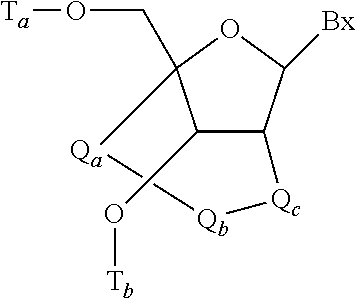
- wherein:
-
- Bx is a heterocyclic base moiety;
- -Qa-Qb-Qc- is —CH2—N(Rc)—CH2—, —C(═O)—N(Rc)—CH2—, —CH2—O—N(Rc)—, —CH2—N(Rc)—O— or —N(Rc)—O—CH2;
- Rc is C1-C12 alkyl or an amino protecting group; and
- Ta and Tb are each, independently H, a hydroxyl protecting group, a conjugate group, a reactive phosphorus group, a phosphorus moiety or a covalent attachment to a support medium.
- In certain embodiments, bicyclic nucleosides have the formula:
-

- wherein:
-
- Bx is a heterocyclic base moiety;
- Ta and Tb are each, independently H, a hydroxyl protecting group, a conjugate group, a reactive phosphorus group, a phosphorus moiety or a covalent attachment to a support medium;
- Za is C1-C6 alkyl, C2-C6 alkenyl, C2-C6 alkynyl, substituted C1-C6 alkyl, substituted C2-C6 alkenyl, substituted C2-C6 alkynyl, acyl, substituted acyl, substituted amide, thiol or substituted thiol.
- In one embodiment, each of the substituted groups, is, independently, mono or poly substituted with substituent groups independently selected from halogen, oxo, hydroxyl, OJc, NJcJd, SJc, N3, OC(═X)Jc, and NJcC(═X)NJcJd, wherein each Jc, Jd and Je is, independently, H, C1-C6 alkyl, or substituted C1-C6 alkyl and X is O or NJc.
- In certain embodiments, bicyclic nucleosides have the formula:
-

- wherein:
-
- Bx is a heterocyclic base moiety;
- Ta and Tb are each, independently H, a hydroxyl protecting group, a conjugate group, a reactive phosphorus group, a phosphorus moiety or a covalent attachment to a support medium;
- Zb is C1-C6 alkyl, C2-C6 alkenyl, C2-C6 alkynyl, substituted C1-C6 alkyl, substituted C2-C6 alkenyl, substituted C2-C6 alkynyl or substituted acyl (C(═O)—).
- In certain embodiments, bicyclic nucleosides have the formula:
-
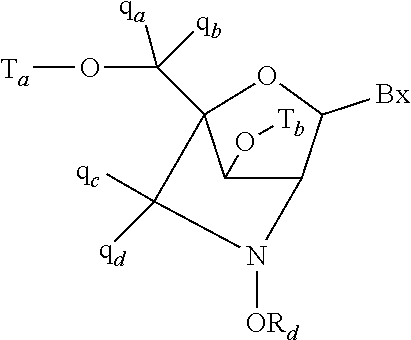
- wherein:
-
- Bx is a heterocyclic base moiety;
- Ta and Tb are each, independently H, a hydroxyl protecting group, a conjugate group, a reactive phosphorus group, a phosphorus moiety or a covalent attachment to a support medium;
- Rd is C1-C6 alkyl, substituted C1-C6 alkyl, C2-C6 alkenyl, substituted C2-C6 alkenyl, C2-C6 alkynyl or substituted C2-C6 alkynyl;
- each qa, qb, qc and qd is, independently, H, halogen, C1-C6 alkyl, substituted C1-C6 alkyl, C2-C6 alkenyl, substituted C2-C6 alkenyl, C2-C6 alkynyl or substituted C2-C6 alkynyl, C1-C6 alkoxyl, substituted C1-C6 alkoxyl, acyl, substituted acyl, C1-C6 aminoalkyl or substituted C1-C6 aminoalkyl;
- In certain embodiments, bicyclic nucleosides have the formula:
-
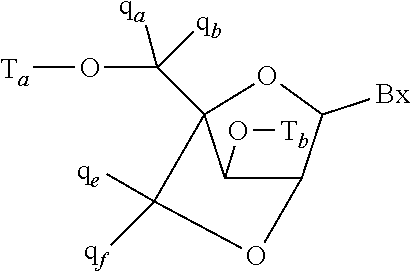
- wherein:
-
- Bx is a heterocyclic base moiety;
- Ta and Tb are each, independently H, a hydroxyl protecting group, a conjugate group, a reactive phosphorus group, a phosphorus moiety or a covalent attachment to a support medium;
- qa, qb, qe and qf are each, independently, hydrogen, halogen, C1-C12 alkyl, substituted C1-C12 alkyl, C2-C12 alkenyl, substituted C2-C12 alkenyl, C2-C12 alkynyl, substituted C2-C12 alkynyl, C1-C12 alkoxy, substituted C1-C12 alkoxy, OJj, SJj, SOJj, SO2Jj, NJjJk, N3, CN, C(═O)OJj, C(═O)NJjJk, C(═O)Jj, O—C(═O)NJjJk, N(H)C(═NH)NJjJk, N(H)C(═O)NJjJk or N(H)C(═S)NJjJk;
- or qe and qf together are ═C(qg)(qh);
- qg and qh are each, independently, H, halogen, C1-C12 alkyl or substituted C1-C12 alkyl.
- The synthesis and preparation of adenine, cytosine, guanine, 5-methyl-cytosine, thymine and uracil bicyclic nucleosides having a 4′-CH2—O-2′ bridge, along with their oligomerization, and nucleic acid recognition properties have been described (Koshkin et al., Tetrahedron, 1998, 54, 3607-3630). The synthesis of bicyclic nucleosides has also been described in WO 98/39352 and WO 99/14226.
- Analogs of various bicyclic nucleosides that have 4′ to 2′ bridging groups such as 4′-CH2—O-2′ and 4′-CH2—S-2′, have also been prepared (Kumar et al., Bioorg. Med. Chem. Lett., 1998, 8, 2219-2222). Preparation of oligodeoxyribonucleotide duplexes comprising bicyclic nucleosides for use as substrates for nucleic acid polymerases has also been described (Wengel et al., WO 99/14226). Furthermore, synthesis of 2′-amino-BNA, a novel conformationally restricted high-affinity oligonucleotide analog has been described in the art (Singh et al., J. Org. Chem., 1998, 63, 10035-10039). In addition, 2′-amino- and 2′-methylamino-BNA's have been prepared and the thermal stability of their duplexes with complementary RNA and DNA strands has been previously reported.
- In certain embodiments, bicyclic nucleosides have the formula:
-
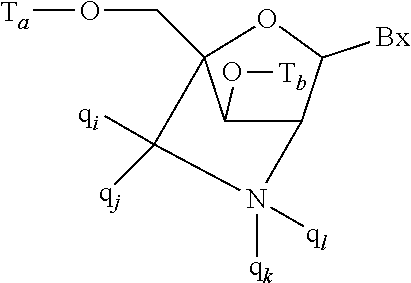
- wherein:
-
- Bx is a heterocyclic base moiety;
- Ta and Tb are each, independently H, a hydroxyl protecting group, a conjugate group, a reactive phosphorus group, a phosphorus moiety or a covalent attachment to a support medium;
- each qi, qj, qk and qi is, independently, H, halogen, C1-C12 alkyl, substituted C1-C12 alkyl, C2-C12 alkenyl, substituted C2-C12 alkenyl, C2-C12 alkynyl, substituted C2-C12 alkynyl, C1-C12 alkoxyl, substituted C1-C12 alkoxyl, OJj, SJj, SOJj, SO2Jj, NJjJk, N3, CN, C(═O)OJj, C(═O)NJjJk, C(═O)Jj, O—C(═O)NJjJk, N(H)C(═NH)NJjJk, N(H)C(═O)NJjJk or N(H)C(═S)NJjJk; and
- qi and qj or qi and qk together are ═C(qg)(qh), wherein qg and qh are each, independently, H, halogen, C1-C12 alkyl or substituted C1-C12 alkyl.
- One carbocyclic bicyclic nucleoside having a 4′-(CH2)3-2′ bridge and the alkenyl analog bridge 4′-CH═CH—CH2-2′ have been described (Frier et al., Nucleic Acids Research, 1997, 25(22), 4429-4443 and Albaek et al., J. Org. Chem., 2006, 71, 7731-7740). The synthesis and preparation of carbocyclic bicyclic nucleosides along with their oligomerization and biochemical studies have also been described (Srivastava et al., J. Am. Chem. Soc. 2007, 129(26), 8362-8379).
- In certain embodiments, bicyclic nucleosides include, but are not limited to, (A) α-L-methyleneoxy (4′-CH2—O-2′) BNA, (B) β-D-methyleneoxy (4′-CH2—O-2′) BNA, (C) ethyleneoxy (4′-(CH2)2—O-2′) BNA, (D) aminooxy (4′-CH2—O—N(R)-2′) BNA, (E) oxyamino (4′-CH2—N(R)—O-2′) BNA, (F) methyl(methyleneoxy) (4′-CH(CH3)—O-2′) BNA (also referred to as constrained ethyl or cEt), (G) methylene-thio (4′-CH2—S-2′) BNA, (H) methylene-amino (4′-CH2—N(R)-2′) BNA, (I) methyl carbocyclic (4′-CH2—CH(CH3)-2′) BNA, (J) propylene carbocyclic (4′-(CH2)3-2′) BNA, and (K) vinyl BNA as depicted below.
-

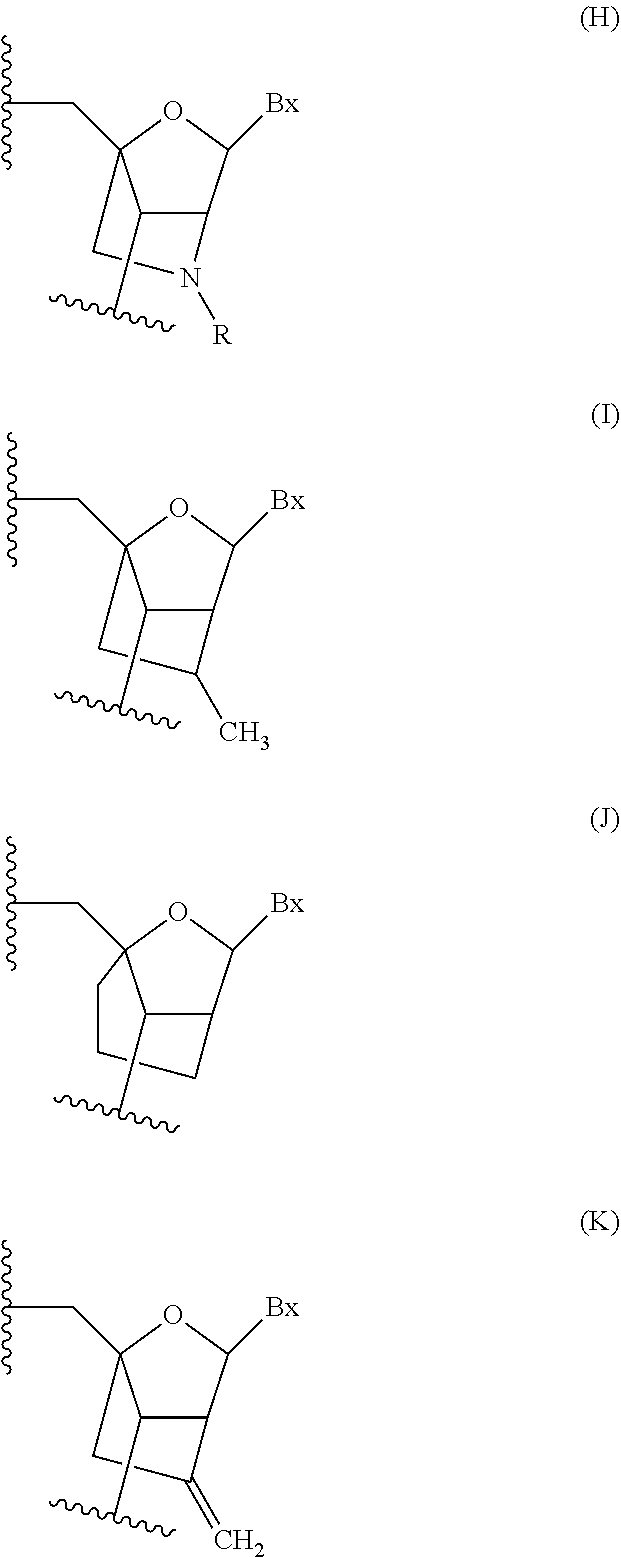
- wherein Bx is the base moiety and R is, independently, H, a protecting group, C1-C6 alkyl or C1-C6 alkoxy.
- In certain embodiments, nucleosides are modified by replacement of the ribosyl ring with a sugar surrogate. Such modification includes without limitation, replacement of the ribosyl ring with a surrogate ring system (sometimes referred to as DNA analogs) such as a morpholino ring, a cyclohexenyl ring, a cyclohexyl ring or a tetrahydropyranyl ring such as one having one of the formula:
-

- In certain embodiments, sugar surrogates are selected having the formula:
-

- wherein:
-
- Bx is a heterocyclic base moiety;
- T3 and T4 are each, independently, an internucleoside linking group linking the tetrahydropyran nucleoside analog to the oligomeric compound or one of T3 and T4 is an internucleoside linking group linking the tetrahydropyran nucleoside analog to an oligomeric compound or oligonucleotide and the other of T3 and T4 is H, a hydroxyl protecting group, a linked conjugate group or a 5′ or 3-terminal group;
q1, q2, q3, q4, q5, q6 and q7 are each independently, H, C1-C6 alkyl, substituted C1-C6 alkyl, C2-C6 alkenyl, substituted C2-C6 alkenyl, C2-C6 alkynyl or substituted C2-C6 alkynyl; and - one of R1 and R2 is hydrogen and the other is selected from halogen, substituted or unsubstituted alkoxy, NJ1J2, SJ1, N3, OC(═X)J1, OC(═X)NJ1J2, NJ3C(═X)NJ1J2 and CN, wherein X is O, S or NJ1 and each J1, J2 and J3 is, independently, H or C1-C6 alkyl.
- In certain embodiments, qi, q2, q3, q4, q5, q6 and q7 are each H. In certain embodiments, at least one of qi, q2, q3, q4, q5, q6 and q7 is other than H. In certain embodiments, at least one of qi, q2, q3, q4, q5, q6 and q7 is methyl. In certain embodiments, THP nucleosides are provided wherein one of R1 and R2 is F. In certain embodiments, R1 is fluoro and R2 is H; R1 is methoxy and R2 is H, and R1 is methoxyethoxy and R2 is H.
- Such sugar surrogates include, but are not limited to, what is referred to in the art as hexitol nucleic acid (HNA), altritol nucleic acid (ANA), and mannitol nucleic acid (MNA) (see Leumann, C. J., Bioorg. & Med. Chem., 2002, 10, 841-854).
- In certain embodiments, sugar surrogates comprise rings having more than 5 atoms and more than one heteroatom. For example nucleosides comprising morpholino sugar moieties and their use in oligomeric compounds has been reported (see for example: Braasch et al., Biochemistry, 2002, 41, 4503-4510; and U.S. Pat. Nos. 5,698,685; 5,166,315; 5,185,444; and 5,034,506).
- As used here, the term “morpholino” means a sugar surrogate having the following structure:
-
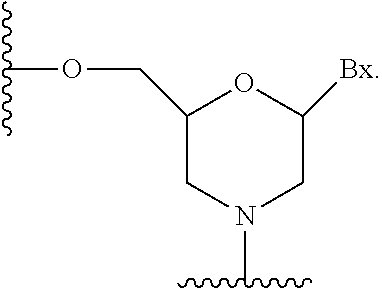
- In certain embodiments, morpholinos may be modified, for example by adding or altering various substituent groups from the above morpholino structure. Such sugar surrogates are referred to herein as “modified morpholinos.”
- In certain embodiments, antisense compounds comprise one or more modified cyclohexenyl nucleosides, which is a nucleoside having a six-membered cyclohexenyl in place of the pentofuranosyl residue in naturally occurring nucleosides. Modified cyclohexenyl nucleosides include, but are not limited to those described in the art (see for example commonly owned, published PCT Application WO 2010/036696, published on Apr. 10, 2010, Robeyns et al., J. Am. Chem. Soc., 2008, 130(6), 1979-1984; Horvith et al., Tetrahedron Letters, 2007, 48, 3621-3623; Nauwelaerts et al., J. Am. Chem. Soc., 2007, 129(30), 9340-9348; Gu et al., Nucleosides, Nucleotides & Nucleic Acids, 2005, 24(5-7), 993-998; Nauwelaerts et al., Nucleic Acids Research, 2005, 33(8), 2452-2463; Robeyns et al., Acta Crystallographica, Section F: Structural Biology and Crystallization Communications, 2005, F61(6), 585-586; Gu et al., Tetrahedron, 2004, 60(9), 2111-2123; Gu et al., Oligonucleotides, 2003, 13(6), 479-489; Wang et al., J. Org. Chem., 2003, 68, 4499-4505; Verbeure et al., Nucleic Acids Research, 2001, 29(24), 4941-4947; Wang et al., J Org. Chem., 2001, 66, 8478-82; Wang et al., Nucleosides, Nucleotides & Nucleic Acids, 2001, 20(4-7), 785-788; Wang et al., J. Am. Chem., 2000, 122, 8595-8602; Published PCT application, WO 06/047842; and Published PCT Application WO 01/049687; the text of each is incorporated by reference herein, in their entirety). Certain modified cyclohexenyl nucleosides have the formula:
-
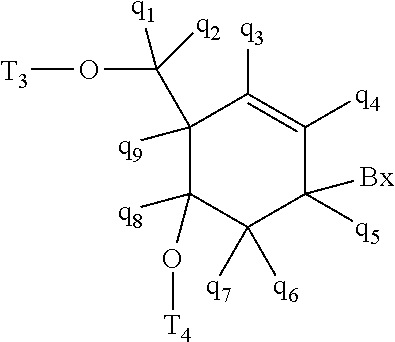
- wherein:
-
- Bx is a heterocyclic base moiety;
- T3 and T4 are each, independently, an internucleoside linking group linking the cyclohexenyl nucleoside analog to an antisense compound or one of T3 and T4 is an internucleoside linking group linking the tetrahydropyran nucleoside analog to an antisense compound and the other of T3 and T4 is H, a hydroxyl protecting group, a linked conjugate group, or a 5′- or 3′-terminal group; and
qi, q2, q3, q4, q5, q6, q7, q8 and q9 are each, independently, H, C1-C6 alkyl, substituted C1-C6 alkyl, C2-C6 alkenyl, substituted C2-C6 alkenyl, C2-C6 alkynyl, substituted C2-C6 alkynyl or other sugar substituent group.
- Many other bicyclic and tricyclic sugar surrogate ring systems are also known in the art that can be used to modify nucleosides for incorporation into antisense compounds (see for example review article: Leumann, Christian J., Bioorg. & Med. Chem., 2002, 10, 841-854). Such ring systems can undergo various additional substitutions to enhance activity.
- Methods for the preparations of modified sugars are well known to those skilled in the art. Some representative U.S. patents that teach the preparation of such modified sugars include without limitation, U.S.: 4,981,957; 5,118,800; 5,319,080; 5,359,044; 5,393,878; 5,446,137; 5,466,786; 5,514,785; 5,519,134; 5,567,811; 5,576,427; 5,591,722; 5,597,909; 5,610,300; 5,627,053; 5,639,873; 5,646,265; 5,670,633; 5,700,920; 5,792,847 and 6,600,032 and International Application PCT/US2005/019219, filed Jun. 2, 2005 and published as WO 2005/121371 on Dec. 22, 2005, and each of which is herein incorporated by reference in its entirety.
- In nucleotides having modified sugar moieties, the nucleobase moieties (natural, modified or a combination thereof) are maintained for hybridization with an appropriate nucleic acid target.
- In certain embodiments, antisense compounds targeted to a DMPK nucleic acid comprise one or more nucleotides having modified sugar moieties. In certain embodiments, the modified sugar moiety is 2′-MOE. In certain embodiments, the 2′-MOE modified nucleotides are arranged in a gapmer motif.
- Nucleobase (or base) modifications or substitutions are structurally distinguishable from, yet functionally interchangeable with, naturally occurring or synthetic unmodified nucleobases. Both natural and modified nucleobases are capable of participating in hydrogen bonding. Such nucleobase modifications can impart nuclease stability, binding affinity or some other beneficial biological property to antisense compounds. Modified nucleobases include synthetic and natural nucleobases such as, for example, 5-methylcytosine (5-me-C). Certain nucleobase substitutions, including 5-methylcytosine substitutions, are particularly useful for increasing the binding affinity of an antisense compound for a target nucleic acid. For example, 5-methylcytosine substitutions have been shown to increase nucleic acid duplex stability by 0.6-1.2° C. (Sanghvi, Y. S., Crooke, S. T. and Lebleu, B., eds., Antisense Research and Applications, CRC Press, Boca Raton, 1993, pp. 276-278).
- Additional unmodified nucleobases include 5-hydroxymethyl cytosine, xanthine, hypoxanthine, 2-aminoadenine, 6-methyl and other alkyl derivatives of adenine and guanine, 2-propyl and other alkyl derivatives of adenine and guanine, 2-thiouracil, 2-thiothymine and 2-thiocytosine, 5-halouracil and cytosine, 5-propynyl (—C≡C—CH3) uracil and cytosine and other alkynyl derivatives of pyrimidine bases, 6-azo uracil, cytosine and thymine, 5-uracil (pseudouracil), 4-thiouracil, 8-halo, 8-amino, 8-thiol, 8-thioalkyl, 8-hydroxyl and other 8-substituted adenines and guanines, 5-halo particularly 5-bromo, 5-trifluoromethyl and other 5-substituted uracils and cytosines, 7-methylguanine and 7-methyladenine, 2-F-adenine, 2-amino-adenine, 8-azaguanine and 8-azaadenine, 7-deazaguanine and 7-deazaadenine and 3-deazaguanine and 3-deazaadenine.
- Heterocyclic base moieties can also include those in which the purine or pyrimidine base is replaced with other heterocycles, for example 7-deaza-adenine, 7-deazaguanosine, 2-aminopyridine and 2-pyridone. Nucleobases that are particularly useful for increasing the binding affinity of antisense compounds include 5-substituted pyrimidines, 6-azapyrimidines and N-2, N-6 and 0-6 substituted purines, including 2 aminopropyladenine, 5-propynyluracil and 5-propynylcytosine.
- In certain embodiments, antisense compounds targeted to a DMPK nucleic acid comprise one or more modified nucleobases. In certain embodiments, gap-widened antisense oligonucleotides targeted to a DMPK nucleic acid comprise one or more modified nucleobases. In certain embodiments, the modified nucleobase is 5-methylcytosine. In certain embodiments, each cytosine is a 5-methylcytosine.
- In certain embodiments, antisense compounds targeted to a DMPK nucleic acid have chemically modified subunits arranged in patterns, or motifs, to confer to the antisense compounds properties such as enhanced the inhibitory activity, increased binding affinity for a target nucleic acid, or resistance to degradation by in vivo nucleases.
- Chimeric antisense compounds typically contain at least one region modified so as to confer increased resistance to nuclease degradation, increased cellular uptake, increased binding affinity for the target nucleic acid, and/or increased inhibitory activity. A second region of a chimeric antisense compound can optionally serve as a substrate for the cellular endonuclease RNase H, which cleaves the RNA strand of an RNA:DNA duplex.
- Antisense compounds having a gapmer motif are considered chimeric antisense compounds. In a gapmer an internal region having a plurality of nucleotides that supports RNaseH cleavage is positioned between external regions having a plurality of nucleotides that are chemically distinct from the nucleosides of the internal region. In the case of an antisense oligonucleotide having a gapmer motif, the gap segment generally serves as the substrate for endonuclease cleavage, while the wing segments comprise modified nucleosides. In certain embodiments, the regions of a gapmer are differentiated by the types of sugar moieties comprising each distinct region. The types of sugar moieties that are used to differentiate the regions of a gapmer can in some embodiments include β-D-ribonucleosides, β-D-deoxyribonucleosides, 2′-modified nucleosides (such 2′-modified nucleosides can include 2′-MOE, and 2′-O—CH3, among others), and bicyclic sugar modified nucleosides (such bicyclic sugar modified nucleosides can include those having a 4′-(CH2)n—O-2′ bridge, where n=1 or n=2). The wing-gap-wing motif is frequently described as “X—Y—Z”, where “X” represents the length of the 5′ wing region, “Y” represents the length of the gap region, and “Z” represents the length of the 3′ wing region. As used herein, a gapmer described as “X—Y—Z” has a configuration such that the gap segment is positioned immediately adjacent each of the 5′ wing segment and the 3′ wing segment. Thus, no intervening nucleotides exist between the 5′ wing segment and gap segment, or the gap segment and the 3′ wing segment. Any of the antisense compounds described herein can have a gapmer motif. In some embodiments, X and Z are the same, in other embodiments they are different. In a preferred embodiment, Y is between 8 and 15 nucleotides. X, Y or Z can be any of 1, 2, 3, 4, 5, 6, 7, 8, 9, 10, 11, 12, 13, 14, 15, 16, 17, 18, 19, 20, 25, 30 or more nucleotides. Thus, gapmers include, but are not limited to, for example 5-10-5, 4-8-4, 4-12-3, 4-12-4, 3-14-3, 2-13-5, 2-16-2, 1-18-1, 3-10-3, 2-10-2, 1-10-1, 2-8-2, 6-8-6, 5-8-5, 5-7-5, 1-8-1, or 2-6-2.
- In certain embodiments, the antisense compound as a “wingmer” motif, having a wing-gap or gap-wing configuration, i.e. an X-Y or Y-Z configuration as described above for the gapmer configuration. Thus, wingmer configurations include, but are not limited to, for example 5-10, 8-4, 4-12, 12-4, 3-14, 16-2, 18-1, 10-3, 2-10, 1-10, 8-2, 2-13, or 5-13.
- In certain embodiments, antisense compounds targeted to a DMPK nucleic acid possess a 5-10-5 gapmer motif. In certain embodiments, antisense compounds targeted to a DMPK nucleic acid possess a 5-7-5 gapmer motif. In certain embodiments, antisense compounds targeted to a DMPK nucleic acid possess a 3-10-3 gapmer motif. In certain embodiments, antisense compounds targeted to a DMPK nucleic acid possess a 4-8-4 gapmer motif.
- In certain embodiments, an antisense compound targeted to a DMPK nucleic acid has a gap-widened motif.
- In certain embodiments, antisense compounds of any of these gapmer or wingmer motifs contain at least 8, at least 9, at least 10, at least 11, at least 12, at least 13, at least 14, at least 15, at least 16, at least 17, at least 18, or at least 19, contiguous nucleobases of the nucleobase sequence of any of the exemplary antisense compounds described herein (e.g., at least 8 contiguous nucleobases of a nucleobase sequence recited in any one of SEQ ID NOs: 23, 24, 25, 26, 27, 28, 29, 30, 31, 32, or 33-874.
- In certain embodiments, the present invention provides oligomeric compounds comprising oligonucleotides. In certain embodiments, such oligonucleotides comprise one or more chemical modification. In certain embodiments, chemically modified oligonucleotides comprise one or more modified sugars. In certain embodiments, chemically modified oligonucleotides comprise one or more modified nucleobases. In certain embodiments, chemically modified oligonucleotides comprise one or more modified internucleoside linkages. In certain embodiments, the chemically modifications (sugar modifications, nucleobase modifications, and/or linkage modifications) define a pattern or motif. In certain embodiments, the patterns of chemical modifications of sugar moieties, internucleoside linkages, and nucleobases are each independent of one another. Thus, an oligonucleotide may be described by its sugar modification motif, internucleoside linkage motif and/or nucleobase modification motif (as used herein, nucleobase modification motif describes the chemical modifications to the nucleobases independent of the sequence of nucleobases).
- In certain embodiments, oligonucleotides comprise one or more type of modified sugar moieties and/or naturally occurring sugar moieties arranged along an oligonucleotide or region thereof in a defined pattern or sugar modification motif. Such motifs may include any of the sugar modifications discussed herein and/or other known sugar modifications.
- In certain embodiments, the oligonucleotides comprise or consist of a region having a gapmer sugar modification motif, which comprises two external regions or “wings” and an internal region or “gap.” The three regions of a gapmer motif (the 5′-wing, the gap, and the 3′-wing) form a contiguous sequence of nucleosides wherein at least some of the sugar moieties of the nucleosides of each of the wings differ from at least some of the sugar moieties of the nucleosides of the gap. Specifically, at least the sugar moieties of the nucleosides of each wing that are closest to the gap (the 3′-most nucleoside of the 5′-wing and the 5′-most nucleoside of the 3′-wing) differ from the sugar moiety of the neighboring gap nucleosides, thus defining the boundary between the wings and the gap. In certain embodiments, the sugar moieties within the gap are the same as one another. In certain embodiments, the gap includes one or more nucleoside having a sugar moiety that differs from the sugar moiety of one or more other nucleosides of the gap. In certain embodiments, the sugar modification motifs of the two wings are the same as one another (symmetric gapmer). In certain embodiments, the sugar modification motifs of the 5′-wing differs from the sugar modification motif of the 3′-wing (asymmetric gapmer).
- In certain embodiments, the 5′-wing of a gapmer consists of 1 to 5 linked nucleosides. In certain embodiments, the 5′-wing of a gapmer consists of 2 to 5 linked nucleosides. In certain embodiments, the 5′-wing of a gapmer consists of 3 to 5 linked nucleosides. In certain embodiments, the 5′-wing of a gapmer consists of 4 or 5 linked nucleosides. In certain embodiments, the 5′-wing of a gapmer consists of 1 to 4 linked nucleosides. In certain embodiments, the 5′-wing of a gapmer consists of 1 to 3 linked nucleosides. In certain embodiments, the 5′-wing of a gapmer consists of 1 or 2 linked nucleosides. In certain embodiments, the 5′-wing of a gapmer consists of 2 to 4 linked nucleosides. In certain embodiments, the 5′-wing of a gapmer consists of 2 or 3 linked nucleosides. In certain embodiments, the 5′-wing of a gapmer consists of 3 or 4 linked nucleosides. In certain embodiments, the 5′-wing of a gapmer consists of 1 nucleoside. In certain embodiments, the 5′-wing of a gapmer consists of 2 linked nucleosides. In certain embodiments, the 5′-wing of a gapmer consists of 3linked nucleosides. In certain embodiments, the 5′-wing of a gapmer consists of 4 linked nucleosides. In certain embodiments, the 5′-wing of a gapmer consists of 5 linked nucleosides.
- In certain embodiments, the 5′-wing of a gapmer comprises at least one bicyclic nucleoside. In certain embodiments, the 5′-wing of a gapmer comprises at least two bicyclic nucleosides. In certain embodiments, the 5′-wing of a gapmer comprises at least three bicyclic nucleosides. In certain embodiments, the 5′-wing of a gapmer comprises at least four bicyclic nucleosides. In certain embodiments, the 5′-wing of a gapmer comprises at least one constrained ethyl nucleoside. In certain embodiments, the 5′-wing of a gapmer comprises at least one LNA nucleoside. In certain embodiments, each nucleoside of the 5′-wing of a gapmer is a bicyclic nucleoside. In certain embodiments, each nucleoside of the 5′-wing of a gapmer is a constrained ethyl nucleoside. In certain embodiments, each nucleoside of the 5′-wing of a gapmer is a LNA nucleoside.
- In certain embodiments, the 5′-wing of a gapmer comprises at least one non-bicyclic modified nucleoside. In certain embodiments, the 5′-wing of a gapmer comprises at least one 2′-substituted nucleoside. In certain embodiments, the 5′-wing of a gapmer comprises at least one 2′-MOE nucleoside. In certain embodiments, the 5′-wing of a gapmer comprises at least one 2′-OMe nucleoside. In certain embodiments, each nucleoside of the 5′-wing of a gapmer is a non-bicyclic modified nucleoside. In certain embodiments, each nucleoside of the 5′-wing of a gapmer is a 2′-substituted nucleoside. In certain embodiments, each nucleoside of the 5′-wing of a gapmer is a 2′-MOE nucleoside. In certain embodiments, each nucleoside of the 5′-wing of a gapmer is a 2′-OMe nucleoside.
- In certain embodiments, the 5′-wing of a gapmer comprises at least one bicyclic nucleoside and at least one non-bicyclic modified nucleoside. In certain embodiments, the 5′-wing of a gapmer comprises at least one bicyclic nucleoside and at least one 2′-substituted nucleoside. In certain embodiments, the 5′-wing of a gapmer comprises at least one bicyclic nucleoside and at least one 2′-MOE nucleoside. In certain embodiments, the 5′-wing of a gapmer comprises at least one bicyclic nucleoside and at least one 2′-OMe nucleoside. In certain embodiments, the 5′-wing of a gapmer comprises at least one bicyclic nucleoside and at least one 2′-deoxynucleoside.
- In certain embodiments, the 5′-wing of a gapmer comprises at least one constrained ethyl nucleoside and at least one non-bicyclic modified nucleoside. In certain embodiments, the 5′-wing of a gapmer comprises at least one constrained ethyl nucleoside and at least one 2′-substituted nucleoside. In certain embodiments, the 5′-wing of a gapmer comprises at least one constrained ethyl nucleoside and at least one 2′-MOE nucleoside. In certain embodiments, the 5′-wing of a gapmer comprises at least one constrained ethyl nucleoside and at least one 2′-OMe nucleoside. In certain embodiments, the 5′-wing of a gapmer comprises at least one constrained ethyl nucleoside and at least one 2′-deoxynucleoside.
- In certain embodiments, the 5′-wing of a gapmer comprises at least one LNA nucleoside and at least one non-bicyclic modified nucleoside. In certain embodiments, the 5′-wing of a gapmer comprises at least one LNA nucleoside and at least one 2′-substituted nucleoside. In certain embodiments, the 5′-wing of a gapmer comprises at least one LNA nucleoside and at least one 2′-MOE nucleoside. In certain embodiments, the 5′-wing of a gapmer comprises at least one LNA nucleoside and at least one 2′-OMe nucleoside. In certain embodiments, the 5′-wing of a gapmer comprises at least one LNA nucleoside and at least one 2′-deoxynucleoside.
- In certain embodiments, the 5′-wing of a gapmer comprises three constrained ethyl nucleosides. In certain embodiments, the 5′-wing of a gapmer comprises two bicyclic nucleosides and two non bicyclic modified nucleosides. In certain embodiments, the 5′-wing of a gapmer comprises two constrained ethyl nucleosides and two 2′-MOE nucleosides. In certain embodiments, the 5′-wing of a gapmer comprises two bicyclic nucleosides and two non bicyclic modified nucleosides. In certain embodiments, the 5′-wing of a gapmer comprises two constrained ethyl nucleosides and two 2′-MOE nucleosides. In certain embodiments, the 5′-wing of a gapmer comprises two constrained ethyl nucleosides and three 2′-MOE nucleosides.
- In certain embodiments, the 5′-wing of a gapmer comprises three LNA nucleosides. In certain embodiments, the 5′-wing of a gapmer comprises two LNA nucleosides and two non bicyclic modified nucleosides. In certain embodiments, the 5′-wing of a gapmer comprises two LNA nucleosides and two 2′-MOE nucleosides. In certain embodiments, the 5′-wing of a gapmer comprises two LNA and two non bicyclic modified nucleosides. In certain embodiments, the 5′-wing of a gapmer comprises two LNA nucleosides and two 2′-MOE nucleosides. In certain embodiments, the 5′-wing of a gapmer comprises two LNA nucleosides and three 2′-MOE nucleosides.
- In certain embodiments, the 5′-wing of a gapmer comprises three constrained ethyl nucleosides. In certain embodiments, the 5′-wing of a gapmer comprises two bicyclic nucleosides and two non bicyclic modified nucleosides. In certain embodiments, the 5′-wing of a gapmer comprises two constrained ethyl nucleosides and two 2′-OMe nucleosides. In certain embodiments, the 5′-wing of a gapmer comprises two bicyclic nucleosides and two non bicyclic modified nucleosides. In certain embodiments, the 5′-wing of a gapmer comprises two constrained ethyl nucleosides and two 2′-OMe nucleosides. In certain embodiments, the 5′-wing of a gapmer comprises two constrained ethyl nucleosides and three 2′-OMe nucleosides.
- In certain embodiments, the 5′-wing of a gapmer comprises three LNA nucleosides. In certain embodiments, the 5′-wing of a gapmer comprises two LNA nucleosides and two non bicyclic modified nucleosides. In certain embodiments, the 5′-wing of a gapmer comprises two LNA nucleosides and two 2′-OMe nucleosides. In certain embodiments, the 5′-wing of a gapmer comprises two LNA and two non bicyclic modified nucleosides. In certain embodiments, the 5′-wing of a gapmer comprises two LNA nucleosides and two 2′-OMe nucleosides. In certain embodiments, the 5′-wing of a gapmer comprises two LNA nucleosides and three 2′-OMe nucleosides.
- In certain embodiments, the 5′-wing of a gapmer has an AABB motif, wherein each A is selected from among a 2′-MOE nucleoside and a 2′OMe nucleoside. In certain embodiments, the 5′-wing of a gapmer has an AABB motif, wherein each B is selected from among a cEt, LNA, α-L-LNA, ENA and 2′-thio LNA nucleoside. In certain embodiments, the 5′-wing of a gapmer has an AABB motif, wherein each A represents a 2′-MOE nucleoside and each B represents a constrained ethyl nucleoside.
- In certain embodiments, the 5′-wing of a gapmer has an AAABB motif, wherein each A is selected from among a 2′-MOE nucleoside and a 2′OMe nucleoside. In certain embodiments, the 5′-wing of a gapmer has an AABB motif, wherein each B is selected from among a cEt, LNA, α-L-LNA, ENA and 2′-thio LNA nucleoside. In certain embodiments, the 5′-wing of a gapmer has an AABB motif, wherein each A represents a 2′-MOE nucleoside and each B represents a constrained ethyl nucleoside.
- In certain embodiments, the 3′-wing of a gapmer consists of 1 to 5 linked nucleosides. In certain embodiments, the 3′-wing of a gapmer consists of 2 to 5 linked nucleosides. In certain embodiments, the 3′-wing of a gapmer consists of 3 to 5 linked nucleosides. In certain embodiments, the 3′-wing of a gapmer consists of 4 or 5 linked nucleosides. In certain embodiments, the 3′-wing of a gapmer consists of 1 to 4 linked nucleosides. In certain embodiments, the 3′-wing of a gapmer consists of 1 to 3 linked nucleosides. In certain embodiments, the 3′-wing of a gapmer consists of 1 or 2 linked nucleosides. In certain embodiments, the 3′-wing of a gapmer consists of 2 to 4 linked nucleosides. In certain embodiments, the 3′-wing of a gapmer consists of 2 or 3 linked nucleosides. In certain embodiments, the 3′-wing of a gapmer consists of 3 or 4 linked nucleosides. In certain embodiments, the 3′-wing of a gapmer consists of 1 nucleoside. In certain embodiments, the 3′-wing of a gapmer consists of 2 linked nucleosides. In certain embodiments, the 3′-wing of a gapmer consists of 3linked nucleosides. In certain embodiments, the 3′-wing of a gapmer consists of 4 linked nucleosides. In certain embodiments, the 3′-wing of a gapmer consists of 5 linked nucleosides.
- In certain embodiments, the 3′-wing of a gapmer comprises at least one bicyclic nucleoside. In certain embodiments, the 3′-wing of a gapmer comprises at least one constrained ethyl nucleoside. In certain embodiments, the 3′-wing of a gapmer comprises at least one LNA nucleoside. In certain embodiments, each nucleoside of the 3′-wing of a gapmer is a bicyclic nucleoside. In certain embodiments, each nucleoside of the 3′-wing of a gapmer is a constrained ethyl nucleoside. In certain embodiments, each nucleoside of the 3′-wing of a gapmer is a LNA nucleoside.
- In certain embodiments, the 3′-wing of a gapmer comprises at least one non-bicyclic modified nucleoside. In certain embodiments, the 3′-wing of a gapmer comprises at least two non-bicyclic modified nucleosides. In certain embodiments, the 3′-wing of a gapmer comprises at least three non-bicyclic modified nucleosides. In certain embodiments, the 3′-wing of a gapmer comprises at least four non-bicyclic modified nucleosides. In certain embodiments, the 3′-wing of a gapmer comprises at least one 2′-substituted nucleoside. In certain embodiments, the 3′-wing of a gapmer comprises at least one 2′-MOE nucleoside. In certain embodiments, the 3′-wing of a gapmer comprises at least one 2′-OMe nucleoside. In certain embodiments, each nucleoside of the 3′-wing of a gapmer is a non-bicyclic modified nucleoside. In certain embodiments, each nucleoside of the 3′-wing of a gapmer is a 2′-substituted nucleoside. In certain embodiments, each nucleoside of the 3′-wing of a gapmer is a 2′-MOE nucleoside. In certain embodiments, each nucleoside of the 3′-wing of a gapmer is a 2′-OMe nucleoside.
- In certain embodiments, the 3′-wing of a gapmer comprises at least one bicyclic nucleoside and at least one non-bicyclic modified nucleoside. In certain embodiments, the 3′-wing of a gapmer comprises at least one bicyclic nucleoside and at least one 2′-substituted nucleoside. In certain embodiments, the 3′-wing of a gapmer comprises at least one bicyclic nucleoside and at least one 2′-MOE nucleoside. In certain embodiments, the 3′-wing of a gapmer comprises at least one bicyclic nucleoside and at least one 2′-OMe nucleoside. In certain embodiments, the 3′-wing of a gapmer comprises at least one bicyclic nucleoside and at least one 2′-deoxynucleoside.
- In certain embodiments, the 3′-wing of a gapmer comprises at least one constrained ethyl nucleoside and at least one non-bicyclic modified nucleoside. In certain embodiments, the 3′-wing of a gapmer comprises at least one constrained ethyl nucleoside and at least one 2′-substituted nucleoside. In certain embodiments, the 3′-wing of a gapmer comprises at least one constrained ethyl nucleoside and at least one 2′-MOE nucleoside. In certain embodiments, the 3′-wing of a gapmer comprises at least one constrained ethyl nucleoside and at least one 2′-OMe nucleoside. In certain embodiments, the 3′-wing of a gapmer comprises at least one constrained ethyl nucleoside and at least one 2′-deoxynucleoside.
- In certain embodiments, the 3′-wing of a gapmer comprises at least one LNA nucleoside and at least one non-bicyclic modified nucleoside. In certain embodiments, the 3′-wing of a gapmer comprises at least one LNA nucleoside and at least one 2′-substituted nucleoside. In certain embodiments, the 3′-wing of a gapmer comprises at least one LNA nucleoside and at least one 2′-MOE nucleoside. In certain embodiments, the 3′-wing of a gapmer comprises at least one LNA nucleoside and at least one 2′-OMe nucleoside. In certain embodiments, the 3′-wing of a gapmer comprises at least one LNA nucleoside and at least one 2′-deoxynucleoside.
- In certain embodiments, the 3′-wing of a gapmer comprises three constrained ethyl nucleosides. In certain embodiments, the 3′-wing of a gapmer comprises two bicyclic nucleosides and two non bicyclic modified nucleosides. In certain embodiments, the 3′-wing of a gapmer comprises two constrained ethyl nucleosides and two 2′-MOE nucleosides. In certain embodiments, the 3′-wing of a gapmer comprises two bicyclic nucleosides and two non bicyclic modified nucleosides. In certain embodiments, the 3′-wing of a gapmer comprises two constrained ethyl nucleosides and two 2′-MOE nucleosides. In certain embodiments, the 5′-wing of a gapmer comprises two constrained ethyl nucleosides and three 2′-MOE nucleosides.
- In certain embodiments, the 3′-wing of a gapmer comprises three LNA nucleosides. In certain embodiments, the 3′-wing of a gapmer comprises two LNA nucleosides and two non bicyclic modified nucleosides. In certain embodiments, the 3′-wing of a gapmer comprises two LNA nucleosides and two 2′-MOE nucleosides. In certain embodiments, the 3′-wing of a gapmer comprises two LNA and two non bicyclic modified nucleosides. In certain embodiments, the 3′-wing of a gapmer comprises two LNA nucleosides and two 2′-MOE nucleosides. In certain embodiments, the 3′-wing of a gapmer comprises two LNA nucleosides and three 2′-MOE nucleosides.
- In certain embodiments, the 3′-wing of a gapmer comprises three constrained ethyl nucleosides. In certain embodiments, the 3′-wing of a gapmer comprises two bicyclic nucleosides and two non bicyclic modified nucleosides. In certain embodiments, the 3′-wing of a gapmer comprises two constrained ethyl nucleosides and two 2′-OMe nucleosides. In certain embodiments, the 3′-wing of a gapmer comprises two bicyclic nucleosides and two non bicyclic modified nucleosides. In certain embodiments, the 3′-wing of a gapmer comprises two constrained ethyl nucleosides and two 2′-OMe nucleosides. In certain embodiments, the 3′-wing of a gapmer comprises two constrained ethyl nucleosides and three 2′-OMe nucleosides.
- In certain embodiments, the 3′-wing of a gapmer comprises three LNA nucleosides. In certain embodiments, the 3′-wing of a gapmer comprises two LNA nucleosides and two non bicyclic modified nucleosides. In certain embodiments, the 3′-wing of a gapmer comprises two LNA nucleosides and two 2′-OMe nucleosides. In certain embodiments, the 3′-wing of a gapmer comprises two LNA and two non bicyclic modified nucleosides. In certain embodiments, the 3′-wing of a gapmer comprises two LNA nucleosides and two 2′-OMe nucleosides. In certain embodiments, the 3′-wing of a gapmer comprises two LNA nucleosides and three 2′-OMe nucleosides.
- In certain embodiments, the 3′-wing of a gapmer has a BBAA motif, wherein each A is selected from among a 2′-MOE nucleoside and a 2′OMe nucleoside. In certain embodiments, the 3′-wing of a gapmer has an BBAA motif, wherein each B is selected from among a cEt, LNA, α-L-LNA, ENA and 2′-thio LNA nucleoside. In certain embodiments, the 3′-wing of a gapmer has a BBAA motif, wherein each A represents a 2′-MOE nucleoside and each B represents a constrained ethyl nucleoside.
- In certain embodiments, the 3′-wing of a gapmer has a BBAAA motif, wherein each A is selected from among a 2′-MOE nucleoside and a 2′OMe nucleoside. In certain embodiments, the 3′-wing of a gapmer has a BBAA motif, wherein each B is selected from among a cEt, LNA, α-L-LNA, ENA and 2′-thio LNA nucleoside. In certain embodiments, the 3′-wing of a gapmer has a BBAA motif, wherein each A represents a 2′-MOE nucleoside and each B represents a constrained ethyl nucleoside.
- Antisense oligonucleotides can be admixed with pharmaceutically acceptable active or inert substance for the preparation of pharmaceutical compositions or formulations. Compositions and methods for the formulation of pharmaceutical compositions are dependent upon a number of criteria, including, but not limited to, route of administration, extent of disease, or dose to be administered.
- Antisense compound targeted to a DMPK nucleic acid can be utilized in pharmaceutical compositions by combining the antisense compound with a suitable pharmaceutically acceptable diluent or carrier. A pharmaceutically acceptable diluent includes phosphate-buffered saline (PBS). PBS is a diluent suitable for use in compositions to be delivered parenterally. Accordingly, in one embodiment, employed in the methods described herein is a pharmaceutical composition comprising an antisense compound targeted to a DMPK nucleic acid and a pharmaceutically acceptable diluent. In certain embodiments, the pharmaceutically acceptable diluent is PBS. In certain embodiments, the antisense compound is an antisense oligonucleotide.
- Pharmaceutical compositions comprising antisense compounds encompass any pharmaceutically acceptable salts, esters, or salts of such esters, or any other oligonucleotide which, upon administration to an animal, including a human, is capable of providing (directly or indirectly) the biologically active metabolite or residue thereof. Accordingly, for example, the disclosure is also drawn to pharmaceutically acceptable salts of antisense compounds, prodrugs, pharmaceutically acceptable salts of such prodrugs, and other bioequivalents. Suitable pharmaceutically acceptable salts include, but are not limited to, sodium and potassium salts.
- A prodrug can include the incorporation of additional nucleosides at one or both ends of an antisense compound which are cleaved by endogenous nucleases within the body, to form the active antisense compound.
- Antisense compounds can be covalently linked to one or more moieties or conjugates which enhance the activity, cellular distribution or cellular uptake of the resulting antisense oligonucleotides. Typical conjugate groups include cholesterol moieties and lipid moieties. Additional conjugate groups include carbohydrates, phospholipids, biotin, phenazine, folate, phenanthridine, anthraquinone, acridine, fluoresceins, rhodamines, coumarins, and dyes.
- Antisense compounds can also be modified to have one or more stabilizing groups that are generally attached to one or both termini of antisense compounds to enhance properties such as, for example, nuclease stability. Included in stabilizing groups are cap structures. These terminal modifications protect the antisense compound having terminal nucleic acid from exonuclease degradation, and can help in delivery and/or localization within a cell. The cap can be present at the 5′-terminus (5′-cap), or at the 3′-terminus (3′-cap), or can be present on both termini. Cap structures are well known in the art and include, for example, inverted deoxy abasic caps. Further 3′ and 5′-stabilizing groups that can be used to cap one or both ends of an antisense compound to impart nuclease stability include those disclosed in WO 03/004602 published on Jan. 16, 2003.
- The effects of antisense compounds on the level, activity or expression of DMPK nucleic acids can be tested in vitro in a variety of cell types. Cell types used for such analyses are available from commercial vendors (e.g. American Type Culture Collection, Manassas, VA; Zen-Bio, Inc., Research Triangle Park, NC; Clonetics Corporation, Walkersville, MD) and cells are cultured according to the vendor's instructions using commercially available reagents (e.g. Invitrogen Life Technologies, Carlsbad, CA). Illustrative cell types include, but are not limited to, HepG2 cells, Hep3B cells, primary hepatocytes, A549 cells, GM04281 fibroblasts and LLC-MK2 cells.
- Described herein are methods for treatment of cells with antisense oligonucleotides, which can be modified appropriately for treatment with other antisense compounds.
- In general, cells are treated with antisense oligonucleotides when the cells reach approximately 60-80% confluence in culture.
- One reagent commonly used to introduce antisense oligonucleotides into cultured cells includes the cationic lipid transfection reagent LIPOFECTIN® (Invitrogen, Carlsbad, CA). Antisense oligonucleotides are mixed with LIPOFECTIN® in OPTI-MEM® 1 (Invitrogen, Carlsbad, CA) to achieve the desired final concentration of antisense oligonucleotide and a LIPOFECTIN® concentration that typically ranges 2 to 12 μg/mL per 100 nM antisense oligonucleotide.
- Another reagent used to introduce antisense oligonucleotides into cultured cells includes LIPOFECTAMINE 2000® (Invitrogen, Carlsbad, CA). Antisense oligonucleotide is mixed with LIPOFECTAMINE 2000® in OPTI-MEM® 1 reduced serum medium (Invitrogen, Carlsbad, CA) to achieve the desired concentration of antisense oligonucleotide and a LIPOFECTAMINE® concentration that typically ranges 2 to 12 μg/mL per 100 nM antisense oligonucleotide.
- Another reagent used to introduce antisense oligonucleotides into cultured cells includes Cytofectin® (Invitrogen, Carlsbad, CA). Antisense oligonucleotide is mixed with Cytofectin® in OPTI-MEM® 1 reduced serum medium (Invitrogen, Carlsbad, CA) to achieve the desired concentration of antisense oligonucleotide and a Cytofectin® concentration that typically ranges 2 to 12 μg/mL per 100 nM antisense oligonucleotide.
- Another technique used to introduce antisense oligonucleotides into cultured cells includes electroporation.
- Cells are treated with antisense oligonucleotides by routine methods. Cells are typically harvested 16-24 hours after antisense oligonucleotide treatment, at which time RNA or protein levels of target nucleic acids are measured by methods known in the art and described herein. In general, when treatments are performed in multiple replicates, the data are presented as the average of the replicate treatments.
- The concentration of antisense oligonucleotide used varies from cell line to cell line. Methods to determine the optimal antisense oligonucleotide concentration for a particular cell line are well known in the art. Antisense oligonucleotides are typically used at concentrations ranging from 1 nM to 300 nM when transfected with LIPOFECTAMINE2000®, Lipofectin or Cytofectin. Antisense oligonucleotides are used at higher concentrations ranging from 625 to 20,000 nM when transfected using electroporation.
- RNA analysis can be performed on total cellular RNA or poly(A)+ mRNA. Methods of RNA isolation are well known in the art. RNA is prepared using methods well known in the art, for example, using the TRIZOL® Reagent (Invitrogen, Carlsbad, CA) according to the manufacturer's recommended protocols.
- Inhibition of levels or expression of a DMPK nucleic acid can be assayed in a variety of ways known in the art. For example, target nucleic acid levels can be quantitated by, e.g., Northern blot analysis, competitive polymerase chain reaction (PCR), or quantitative real-time PCR. RNA analysis can be performed on total cellular RNA or poly(A)+mRNA. Methods of RNA isolation are well known in the art. Northern blot analysis is also routine in the art. Quantitative real-time PCR can be conveniently accomplished using the commercially available ABI PRISM® 7600, 7700, or 7900 Sequence Detection System, available from PE-Applied Biosystems, Foster City, CA and used according to manufacturer's instructions.
- Quantitation of target RNA levels can be accomplished by quantitative real-time PCR using the ABI PRISM® 7600, 7700, or 7900 Sequence Detection System (PE-Applied Biosystems, Foster City, CA) according to manufacturer's instructions. Methods of quantitative real-time PCR are well known in the art.
- Prior to real-time PCR, the isolated RNA is subjected to a reverse transcriptase (RT) reaction, which produces complementary DNA (cDNA) that is then used as the substrate for the real-time PCR amplification. The RT and real-time PCR reactions are performed sequentially in the same sample well. RT and real-time PCR reagents are obtained from Invitrogen (Carlsbad, CA). RT, real-time-PCR reactions are carried out by methods well known to those skilled in the art.
- Gene (or RNA) target quantities obtained by real time PCR are normalized using either the expression level of a gene whose expression is constant, such as cyclophilin A, or by quantifying total RNA using RIBOGREEN® (Invitrogen, Inc. Carlsbad, CA). Cyclophilin A expression is quantified by real time PCR, by being run simultaneously with the target, multiplexing, or separately. Total RNA is quantified using RIBOGREEN® RNA quantification reagent (Invitrogen, Inc. Eugene, OR). Methods of RNA quantification by RIBOGREEN® are taught in Jones, L. J., et al, (Analytical Biochemistry, 1998, 265, 368-374). A CYTOFLUOR® 4000 instrument (PE Applied Biosystems) is used to measure RIBOGREEN® fluorescence.
- Probes and primers are designed to hybridize to a DMPK nucleic acid. Methods for designing real-time PCR probes and primers are well known in the art, and can include the use of software such as PRIMER EXPRESS® Software (Applied Biosystems, Foster City, CA).
- Antisense inhibition of DMPK nucleic acids can be assessed by measuring DMPK protein levels. Protein levels of DMPK can be evaluated or quantitated in a variety of ways well known in the art, such as immunoprecipitation, Western blot analysis (immunoblotting), enzyme-linked immunosorbent assay (ELISA), quantitative protein assays, protein activity assays (for example, caspase activity assays), immunohistochemistry, immunocytochemistry or fluorescence-activated cell sorting (FACS). Antibodies directed to a target can be identified and obtained from a variety of sources, such as the MSRS catalog of antibodies (Aerie Corporation, Birmingham, MI), or can be prepared via conventional monoclonal or polyclonal antibody generation methods well known in the art.
- Antisense compounds, for example, antisense oligonucleotides, are tested in animals to assess their ability to inhibit expression of DMPK and produce phenotypic changes. Testing can be performed in normal animals, or in experimental disease models, for example, the HSALR mouse model of myotonic dystrophy (DM1).
- The HSALR mouse model is an established model for DM1 (Mankodi, A. et al. Science. 289: 1769, 2000). The mice carry a human skeletal actin (hACTA1) transgene with 220 CTG repeats inserted in the 3′ UTR of the gene. The hACTA1-CUGexp transcript accumulates in nuclear foci in skeletal muscles and results in myotonia similar to that in human DM1 (Mankodi, A. et al. Mol. Cell 10: 35, 2002; Lin, X. et al. Hum. Mol. Genet. 15: 2087, 2006). Hence, it is expected that amelioration of DM1 symptoms in the HSALR mouse by antisense inhibition of the hACTA1 transgene would predict amelioration of similar symptoms in human patients by antisense inhibition of the DMPK transcript.
- Expression of CUGexp RNA in mice causes extensive remodeling of the muscle transcriptome, much of which is reproduced by ablation of MBNL1. Hence, it is expected that normalization of the transcriptome in HSALR mice would predict normalization of the human transcriptome in DM1 patients by antisense inhibition of the DMPK transcript.
- For administration to animals, antisense oligonucleotides are formulated in a pharmaceutically acceptable diluent, such as phosphate-buffered saline. Administration includes parenteral routes of administration. Following a period of treatment with antisense oligonucleotides, RNA is isolated from tissue and changes in DMPK nucleic acid expression are measured. Changes in DMPK protein levels are also measured.
- Myotonic dystrophy (DM1) is caused by CTG repeat expansions in the 3′ untranslated region of the DMPK gene (Brook, J. D. et al. Cell. 68: 799, 1992). This mutation leads to RNA dominance, a process in which expression of RNA containing an expanded CUG repeat (CUGexp) induces cell dysfunction (Osborne R J and Thornton C A., Human Molecular Genetics., 2006, 15(2): R162-R169). Such CUGexp are retained in the nuclear foci of skeletal muscles (Davis, B. M. et al. Proc. Natl. Acad. Sci. U.S.A. 94:7388, 1997). The accumulation of CUGexp in the nuclear foci leads to the sequestration of poly(CUG)-binding proteins, such as, Muscleblind-like 1 (MBLN1) (Miller, J. W. et al. EMBO J. 19: 4439, 2000). MBLN1 is a splicing factor and regulates the splicing of genes such as Sercal, CIC-1, Titin, and Zasp. Therefore, sequestration of MBLN1 by CUGexp triggers misregulated alternative splicing of the exons of genes that MBLN1 normally controls (Lin, X. et al. Hum. Mol. Genet. 15: 2087, 2006). Correction of alternative splicing in an animal displaying such disregulation, such as, for example, in a DM1 patient and the HSALR mouse model, is a useful indicator for the efficacy of a treatment, including treatment with an antisense oligonucleotide.
- Myotonic dystrophy (DM1) is caused by CTG repeat expansions in the 3′ untranslated region of the DMPK gene. In certain embodiments, expansions in the 3′ untranslated region of the DMPK gene results in the transcription of RNA containing an expanded CUG repeat, and RNA containing an expanded CUG repeat (CUGexp) is retained in the nuclear foci of skeletal muscles. In certain instances, the cellular machinery responsible for exporting mRNA from the nucleus into the cytoplasm does not export RNA containing an expanded CUG repeat from the nucleus or does so less efficiently. In certain embodiments, cells do not export DMPK CUGexp mRNA from the nucleus or such export is reduced. Accordingly, in certain embodiments, DMPK CUGexp mRNA accumulates in the nucleus. In certain embodiments, more copies of DMPK CUGexp mRNA are present in the nucleus of a cell than are copies of wild-type DMPK mRNA, which is exported normally. In such embodiments, antisense compounds that reduce target in the nucleus will preferentially reduce mutant DMPK CUGexp mRNA relative to wild type DMPK mRNA, due to their relative abundances in the nucleus, even if the antisense compound does not otherwise distinguish between mutant and wild type. Since RNase H dependent antisense compounds are active in the nucleus, such compounds are particularly well suited for such use.
- In certain instances, wild-type DMPK pre-mRNA and mutant CUGexp DMPK pre-mRNA are expected to be processed into mRNA at similar rate. Accordingly, approximately the same amount of wild-type DMPK pre-mRNA and mutant CUGexp DMPK pre-mRNA are expected to be present in the nucleus of a cell. However, after processing, wild type DMPK mRNA is exported from the nucleus relatively quickly, and mutant CUGexp DMPK mRNA is exported slowly or not at all. In certain such embodiments, mutant CUGexp DMPK mRNA accumulates in the nucleus in greater amounts than wild-type DMPK mRNA. In certain such embodiments, an antisense oligonucleotide targeted to the mRNA, will preferentially reduce the expression of the mutant CUGexp DMPK mRNA compared to the wild-type DMPK mRNA because more copies of the mutant CUGexp DMPK mRNA are present in the nucleus of the cell. In certain embodiments, antisense compounds targeted to pre-mRNA and not mRNA (e.g., targeting an intron) are not expected to preferentially reduce mutant DMPK relative to wild type, because the nuclear abundance of the two pre-mRNAs is likely to be similar. In certain embodiments, antisense compounds described herein are not targeted to introns of DMPK pre-mRNA. In certain embodiments, antisense compounds described herein are targeted to exons or exon-exon junctions present in DMPK mRNA. In certain embodiments, use of an antisense oligonucleotide to target the mRNA is therefore preferred because an antisense oligonucleotide having one or more features described herein (i) has activity in the nucleus of a cell and (2) will preferentially reduce mutant CUGexp DMPK mRNA compared to wild-type DMPK mRNA.
- DM1 severity in mouse models is determined, at least in part, by the level of CUGexp transcript accumulation in the nucleus or nuclear foci. A useful physiological marker for DM1 severity is the development of high-frequency runs of involuntary action potentials (myotonia).
- In certain embodiments, provided herein are methods of treating an individual comprising administering one or more pharmaceutical compositions as described herein. In certain embodiments, the individual has type 1 myotonic dystrophy (DM1).
- Accordingly, provided herein are methods for ameliorating a symptom associated with type 1 myotonic dystrophy in a subject in need thereof. In certain embodiments, provided is a method for reducing the rate of onset of a symptom associated with type 1 myotonic dystrophy. In certain embodiments, provided is a method for reducing the severity of a symptom associated with type 1 myotonic dystrophy. In certain embodiments, symptoms associated with DM1 include muscle stiffness, myotonia, disabling distal weakness, weakness in face and jaw muscles, difficulty in swallowing, drooping of the eyelids (ptosis), weakness of neck muscles, weakness in arm and leg muscles, persistent muscle pain, hypersomnia, muscle wasting, dysphagia, respiratory insufficiency, irregular heartbeat, heart muscle damage, apathy, insulin resistance, and cataracts. In children, the symptoms may also be developmental delays, learning problems, language and speech issues, and personality development issues.
- In certain embodiments, the methods comprise administering to an individual in need thereof a therapeutically effective amount of a compound targeted to a DMPK nucleic acid.
- In certain embodiments, administration of an antisense compound targeted to a DMPK nucleic acid results in reduction of DMPK expression by at least about 15%, by at least about 20%, by at least about 25%, by at least about 30%, by at least about 35%, by at least about 40%, by at least about 45%, by at least about 50%, by at least about 55%, by at least about 60%, by least about 65%, by least about 70%, by least about 75%, by least about 80%, by at least about 85%, by at least about 90%, by at least about 95% or by at least about 99%, or a range defined by any two of these values.
- In certain embodiments, pharmaceutical compositions comprising an antisense compound targeted to DMPK are used for the preparation of a medicament for treating a patient suffering or susceptible to type 1 myotonic dystrophy.
- In certain embodiments, the methods described herein include administering a compound comprising a modified oligonucleotide having a contiguous nucleobases portion as described herein of a sequence recited in SEQ ID NOs: 23, 24, 25, 26, 27, 28, 29, 30, 31, 32, or 33-874.
- In certain embodiments, the compounds and compositions as described herein are administered parenterally.
- In certain embodiments, parenteral administration is by infusion. Infusion can be chronic or continuous or short or intermittent. In certain embodiments, infused pharmaceutical agents are delivered with a pump. In certain embodiments, parenteral administration is by injection (e.g., bolus injection). The injection can be delivered with a syringe.
- Parenteral administration includes subcutaneous administration, intravenous administration, intramuscular administration, intraarterial administration, intraperitoneal administration, or intracranial administration, e.g., intrathecal or intracerebroventricular administration. Administration can be continuous, or chronic, or short, or intermittent.
- In certain embodiments, the administering is subcutaneous, intravenous, intracerebral, intracerebroventricular, intrathecal or another administration that results in a systemic effect of the oligonucleotide (systemic administration is characterized by a systemic effect, i.e., an effect in more than one tissue) or delivery to the CNS or to the CSF.
- The duration of action as measured by inhibition of alpha 1 actin and reduction of myotonia in the HSALR mouse model of DM1 is prolonged in muscle tissue including quadriceps, gastrocnemius, and the tibialis anterior (see Examples, below). Subcutaneous injections of antisense oligonucleotide for 4 weeks results in inhibition of alpha 1 actin by at least 70% in quadriceps, gastrocnemius, and the tibialis anterior in HSALR mice for at least 11 weeks (77 days) after termination of dosing. Subcutaneous injections of antisense oligonucleotide for 4 weeks results in elimination of myotonia in quadriceps, gastrocnemius, and the tibialis anterior in HSALR mice for at least 11 weeks (77 days) after termination of dosing.
- In certain embodiments, delivery of a compound of composition, as described herein, results in at least 70% down-regulation of a target mRNA and/or target protein for at least 77 days. In certain embodiments, delivery of a compound or composition, as described herein, results in 50%, 55%, 60%, 65%, 70%, 75%, 80%, 85%, 90%, 95%, or 100% down-regulation of a target mRNA and/or target protein for at least 30 days, at least 35 days, at least 40 days, at least 45 days, at least 50 days, at least 55 days, at least 60 days, at least 65 days, at least 70 days, at least 75 days, at least 76 days, at least 77 days, at least 78 days, at least 79 days, at least 80 days, at least 85 days, at least 90 days, at least 95 days, at least 100 days, at least 105 days, at least 110 days, at least 115 days, at least 120 days, at least 1 year.
- In certain embodiments, an antisense oligonucleotide is delivered by injection or infusion once every 77 days. In certain embodiments, an antisense oligonucleotide is delivered by injection or infusion once every month, every two months, every three months, every 6 months, twice a year or once a year.
- In certain embodiments, a first agent comprising the modified oligonucleotide of the invention is co-administered with one or more secondary agents. In certain embodiments, such second agents are designed to treat the same type 1 myotonic dystrophy as the first agent described herein. In certain embodiments, such second agents are designed to treat a different disease, disorder, or condition as the first agent described herein. In certain embodiments, such second agents are designed to treat an undesired side effect of one or more pharmaceutical compositions as described herein. In certain embodiments, second agents are co-administered with the first agent to treat an undesired effect of the first agent. In certain embodiments, second agents are co-administered with the first agent to produce a combinational effect. In certain embodiments, second agents are co-administered with the first agent to produce a synergistic effect.
- In certain embodiments, a first agent and one or more second agents are administered at the same time. In certain embodiments, the first agent and one or more second agents are administered at different times. In certain embodiments, the first agent and one or more second agents are prepared together in a single pharmaceutical formulation. In certain embodiments, the first agent and one or more second agents are prepared separately.
- In certain embodiments, the compounds disclosed herein benefit from one or more improved in vitro and/or in vivo properties relative to an appropriate comparator compound.
- In certain embodiments, ISIS 445569, a 5-10-5 MOE gapmer, having a sequence of (from 5′ to 3′) CGGAGCGGTTGTGAACTGGC (incorporated herein as SEQ ID NO: 24), wherein each internucleoside linkage is a phosphorothioate linkage, each cytosine is a 5-methylcytosine, and each of nucleosides 1-5 and 16-20 comprise a 2′-O-methoxyethyl moiety, which was previously described in WO 2012/012443, incorporated herein by reference, is a comparator compound.
- ISIS 445569 is an appropriate representative comparator compound because ISIS 445569 demonstrates statistically significant reduction of human DMPK in vitro as measured using a plurality of primer probe sets (see e.g. Example 1 and Example 2 of WO 2012/012443). Additionally, ISIS 445569 demonstrates statistically significant dose-dependent inhibition of human DMPK in vitro in both human skeletal muscle cells and DM1 fibroblasts (see e.g. Example 4 and Example 5 of WO 2012/012443 and Example 28 of WO 2012/012467). ISIS 445569 also reduces human DMPK transcript expression in transgenic mice (Examples 23 and 24 of WO 2012/012443 and Examples 29 and 30 of WO 2012/012467). ISIS 445569 was a preferred human DMPK antisense compound in WO 2012/012443 and WO 2012/012467.
- In certain embodiments, the compounds disclosed herein benefit from improved activity and/or improved tolerability relative to appropriate comparator compounds, such as ISIS 445569. For example, in certain embodiments, ISIS 598769, ISIS 598768, and/or ISIS 486178 have more activity and/or tolerability than appropriate comparator compounds, such as ISIS 445569.
- In certain embodiments, the compounds disclosed herein are more potent than appropriate comparator compounds, such as ISIS 445569. For example, as provided in Example 10 (described herein), ISIS 598769 achieved an IC50 of 1.9 μM, ISIS 598768 achieved an IC50 of 1.2 μM, and ISIS 486178 achieved an IC50 of 0.7 μM in a 6 point dose response curve (61.7 nM, 185.2 nM, 555.6 nM, 1666.7 nM, 5000.0 nM, and 15000.0 nM) in cultured in HepG2 cells when transfected using electroporation, whereas ISIS 445569 achieved an IC50 of 2.3 μM. Thus, ISIS 598769, ISIS 598768, and ISIS 486178 are more potent than the comparator compound, ISIS 445569.
- In certain embodiments, the compounds disclosed herein have greater activity than appropriate comparator compounds, such as ISIS 445569, at achieving dose-dependent inhibition of DMPK across multiple different muscle tissues. In another example, as provided in Example 16 (described herein), ISIS 598768 and ISIS 598769 achieved greater dose-dependent inhibition than the comparator compound ISIS 445569 across several different muscle tissues when administered subcutaneously to DMSXL transgenic mice twice a week for 4 weeks with 25 mg/kg/week, 50 mg/kg/wk, or 100 mg/kg/wk. In some muscle tissues, for example, in the tibialis anterior, both ISIS 598768 and ISIS 598769 achieved greater inhibition of DMPK at 25, 50 and 100 mg/kg/wk than ISIS 445569 achieved at 200 mg/kg/wk. In the quadriceps and gastrocnemius, both ISIS 598768 and ISIS 598769 achieved equal or greater inhibition of DMPK at 50 mg/kg/wk than ISIS 445569 achieved at 100 or 200 mg/kg/wk. Thus, ISIS 598768 and ISIS 598769 have greater activity than ISIS 445569 at achieving dose-dependent inhibition of DMPK across multiple different muscle tissues.
- In certain embodiments, the compounds disclosed herein are more tolerable than appropriate comparator compounds, such as ISIS 445569, when administered to CD-1 mice. In another example, as provided in Example 17 (described herein), ISIS 598769, ISIS 598768, and ISIS 486178 exhibited more favorable tolerability markers than ISIS 445569 when administered to CD-1 mice. ISIS 598769, ISIS 598768, and ISIS 486178 were administered subcutaneously twice a week for 6 weeks at 50 mg/kg/wk. ISIS 445569 was administered subcutaneously twice a week for 6 weeks at 100 mg/kg/wk. After treatment, ALT, AST, and BUN levels were lower in ISIS 486178 and ISIS 598768 treated mice than in ISIS 445569 treated mice. After treatment, ALT and AST levels were lower in ISIS 598769 treated mice than in ISIS 445569 treated mice. Therefore, ISIS 598769, ISIS 598768, and ISIS 486178 are more tolerable than the comparator compound, ISIS 445569 in CD-1 mice.
- In certain embodiments, the compounds disclosed herein are more tolerable than appropriate comparator compounds, such as ISIS 445569, when administered to Sprague-Dawley rats. In another example, as provided in Example 18 (described herein), ISIS 598769, ISIS 598768, and ISIS 486178 exhibited more favorable tolerability markers than ISIS 445569 when administered to Sprague-Dawley rats. ISIS 598769, ISIS 598768, and ISIS 486178 were administered subcutaneously twice a week for 6 weeks at 50 mg/kg/wk. ISIS 445569 was administered subcutaneously twice a week for 6 weeks at 100 mg/kg/wk. After treatment, ALT and AST levels were lower in ISIS 486178, ISIS 598769, and ISIS 598768 treated mice than in ISIS 445569 treated mice. Therefore ISIS 598769, ISIS 598768, and ISIS 486178 are more tolerable than the comparator compound, ISIS 445569 in Sprague-Dawley rats.
- In certain embodiments, the compounds disclosed herein exhibit more favorable tolerability markers in cynomolgous monkeys than appropriate comparator compounds, such as ISIS 445569. In another example, as provided in Example 19 (described herein), ISIS 598769, ISIS 598768, and ISIS 486178 exhibited more favorable tolerability markers in cynomolgous monkeys including Alanine aminotransferase (ALT), aspartate aminotransferase (AST), lactate dehydrogenase (LDH), and creatine kinase (CK) assessment. In certain embodiments, ALT and AST levels are used as indicators of hepatotoxicity. For example, in certain embodiments, elevated ALT and AST levels indicate trauma to liver cells. In certain embodiments, elevated CK levels are associated with damage to cells in muscle tissue. In certain embodiments, elevated LDH levels are associated with cellular tissue damage.
- In certain embodiments, the compounds disclosed herein are more tolerable than appropriate comparator compounds, such as ISIS 445569, when administered to cynomolgous monkeys. As provided in Example 19, groups of cynomolgous monkeys were treated with 40 mg/kg/wk of ISIS 598769, ISIS 598768, ISIS 486178, and ISIS 445569. Treatment with ISIS 445569 resulted in elevated ALT and AST levels at 93 days into treatment. Treatment with ISIS 598768, and ISIS 486178 resulted in lower ALT and AST levels at 58 and 93 days into treatment compared to ISIS 445569. Treatment with ISIS 598769, resulted in lower AST levels at 58 and 93 days into treatment and lower ALT levels at 93 days of treatment compared to ISIS 445569. Furthermore, the ALT and AST levels of monkeys receiving doses of ISIS 598769, ISIS 598768, and ISIS 486178 were consistent with the ALT and AST levels of monkeys given saline. Treatment with ISIS 445569 resulted in elevated LDH levels compared to the LDH levels measured in animals given ISIS 598769, ISIS 598768, and ISIS 486178 at 93 days into treatment. Additionally, treatment with ISIS 445569 resulted in elevated CK levels compared to the CK levels measured in animals given ISIS 598769, ISIS 598768, and ISIS 486178 at 93 days into treatment. Therefore, ISIS 598769, ISIS 598768, and ISIS 486178 are more tolerable than the comparator compound, ISIS 445569.
- As the data discussed above demonstrate, ISIS 598769, ISIS 598768, and ISIS 486178 possess a wider range of well-tolerated doses at which ISIS 598769, ISIS 598768, and ISIS 486178 are active compared to the comparator compound, ISIS 445569. Additionally, the totality of the data presented in the examples herein and discussed above demonstrate that each of ISIS 598769, ISIS 598768, and ISIS 486178 possess a number of safety and activity advantages over the comparator compound, ISIS 445569. In other words, each of ISIS 598769, ISIS 598768, and ISIS 486178 are likely to be safer and more active drugs in humans than ISIS 445569.
- In certain embodiments, ISIS 445569 is likely to be a safer and more active drug in humans for reducing CUGexp DMPK mRNA and\or treating conditions or symptoms associated with having myotonic dystrophy type 1 than the other compounds disclosed in WO 2012/012443 and/or WO 2012/012467.
- In certain embodiments, ISIS 512497 has a better safety profile in primates and CD-1 mice than ISIS 445569. In certain embodiments, ISIS 512497 achieves greater knockdown of human DMPK nucleic acid in multiple muscle tissues when administered at the same dose and at lower doses than ISIS 445569.
- In certain embodiments, ISIS 486178 has a better safety profile in mice, rats, and primates than ISIS 445569. In certain embodiments, ISIS 486178 achieves greater knockdown of human DMPK nucleic acid in one or more muscle tissues when administered at the same dose and at lower doses than ISIS 445569.
- In certain embodiments, ISIS 570808 achieves much greater knockdown of human DMPK nucleic acid at least five different muscle tissues when administered at the same dose and at lower dose than ISIS 445569.
- In certain embodiments, ISIS 594292 achieves greater knockdown of human DMPK nucleic acid in one or more muscle tissues when administered at the same dose as ISIS 445569. In certain embodiments, ISIS 486178 has a better safety profile in primates than ISIS 445569.
- In certain embodiments, ISIS 569473 achieves greater knockdown of human DMPK nucleic acid in one or more muscle tissues when administered at the same dose as ISIS 445569. In certain embodiments, ISIS 569473 has a better safety profile in primates than ISIS 445569.
- In certain embodiments, ISIS 594300 achieves greater knockdown of human DMPK nucleic acid in one or more muscle tissues when administered at the same dose as ISIS 445569. In certain embodiments, ISIS 594300 has a better safety profile in primates than ISIS 445569.
- In certain embodiments, ISIS 598777 achieves greater knockdown of human DMPK nucleic acid in one or more muscle tissues when administered at the same dose as ISIS 445569. In certain embodiments, ISIS 598777 has a better safety profile in primates than ISIS 445569.
- In certain embodiments, ISIS 598768 achieves greater knockdown of human DMPK nucleic acid in one or more muscle tissues when administered at the same dose as ISIS 445569. In certain embodiments, ISIS 598768 has a better safety profile in primates than ISIS 445569.
- In certain embodiments, ISIS 598769 achieves greater knockdown of human DMPK nucleic acid in one or more muscle tissues when administered at the same dose as ISIS 445569. In certain embodiments, ISIS 598769 has a better safety profile in primates than ISIS 445569.
- While certain compounds, compositions and methods described herein have been described with specificity in accordance with certain embodiments, the following examples serve only to illustrate the compounds described herein and are not intended to limit the same. Each of the references, GenBank accession numbers, and the like recited in the present application is incorporated herein by reference in its entirety.
- Although the sequence listing accompanying this filing identifies each sequence as either “RNA” or “DNA” as required, in reality, those sequences may be modified with any combination of chemical modifications. One of skill in the art will readily appreciate that such designation as “RNA” or “DNA” to describe modified oligonucleotides is, in certain instances, arbitrary. For example, an oligonucleotide comprising a nucleoside comprising a 2′-OH sugar moiety and a thymine base could be described as a DNA having a modified sugar (2′-OH for the natural 2′-H of DNA) or as an RNA having a modified base (thymine (methylated uracil) for natural uracil of RNA).
- Accordingly, nucleic acid sequences provided herein, including, but not limited to those in the sequence listing, are intended to encompass nucleic acids containing any combination of natural or modified RNA and/or DNA, including, but not limited to such nucleic acids having modified nucleobases. By way of further example and without limitation, an oligomeric compound having the nucleobase sequence “ATCGATCG” encompasses any oligomeric compounds having such nucleobase sequence, whether modified or unmodified, including, but not limited to, such compounds comprising RNA bases, such as those having sequence “AUCGAUCG” and those having some DNA bases and some RNA bases such as “AUCGATCG” and oligomeric compounds having other modified or naturally occurring bases, such as “ATmeCGAUCG,” wherein meC indicates a cytosine base comprising a methyl group at the 5-position.
- While certain compounds, compositions and methods described herein have been described with specificity in accordance with certain embodiments, the following examples serve only to illustrate the compounds described herein and are not intended to limit the same. Each of the references recited in the present application is incorporated herein by reference in its entirety.
- A series of antisense oligonucleotides (ASOs) were designed to target hDMPK. The newly designed ASOs were prepared using standard oligonucleotide synthesis well known in the art and are described in Tables 1 and 2, below. Subscripts “s” indicate phosphorothioate internucleoside linkages; subscripts “k” indicate 6′-(S)—CH3 bicyclic nucleosides (cEt); subscripts “e” indicate 2′-O-methoxyethyl (MOE) modified nucleosides; and subscripts “d” indicate β-D-2′-deoxyribonucleosides. “mC” indicates 5-methylcytosine nucleosides.
- The antisense oligonucleotides are targeted to either SEQ ID NO: 1 (GENBANK Accession No. NM_001081560.1) and/or SEQ ID NO: 2 (the complement of GENBANK Accession No. NT_011109.15 truncated from nucleotides 18540696 to 18555106). “Start site” indicates the 5′-most nucleoside to which the gapmer is targeted in the human gene sequence. “Stop site” indicates the 3′-most nucleoside to which the gapmer is targeted human gene sequence.
-
TABLE 1 Design of antisense oligonucleotides targeting hDMPK and targeted to SEQ ID NO 2 Unmodi- Modi- fied fied ISIS Start Stop SEQ ID SEQ ID No Composition (5′ to 3′) Motif Length Site Site No No. 486178 Aks mCksAksAdsTdsAdsAdsAds kkk-10- 16 13836 13851 23 881 TdsAds mCds mCdsGdsAksGksGk kkk 445569 mCesGesGesAesGes mCdsGdsGdsTdsTdsGds e5-d10- 20 13226 13245 24 1443 TdsGdsAdsAds mCesTesGesGes mCe e5 512497 Ges mCesGes mCes mAesCds mCdsTdsTds mCds e5-d10- 20 8608 8627 25 1444 mCds mCdsGdsAdsAdsTesGesTes mCes mCe e5 598768 mCes mCes mCksGksAdsAdsTdsGds eekk-d8- 16 8603 8618 26 1342 Tds mCds mCdsGdsAks mCksAesGe kkee 594300 mCesGesGesAksGks mCdsGdsGds eeekk- 17 13229 13245 27 1441 TdsTdsGdsTdsGksAksAes mCesTe d7-kkeee 594292 Aes mCesAesAksTksAdsAdsAdsTds eeekk- 17 13835 13851 28 1442 Ads mCds mCdsGksAksGesGesAe d7-kkeee 569473 GksAks mCksAdsAdsTds mCdsTds kkk-d10- 16 5082 5097 29 882 mCds mCdsGds mCds mCdsAksGksGk kkk 598769 Tes mCes mCks mCksGdsAdsAdsTds eekk-d8- 16 8604 8619 30 1343 GdsTds mCds mCdsGksAks mCesAe kkee 570808 TksGksTksAdsAdsTdsGdsTds kkk-d10- 16 10201 10216 31 883 TdsGdsTds mCds mCdsAksGksTk kkk 598777 GesTesGksTksAdsAdsTdsGds eekk-d8- 16 10202 10217 32 1344 TdsTdsGdsTds mCks mCksAesGe kkee -
TABLE 2 Design of antisense oligonucleotides targeting hDMPK and targeted to SEQ ID NO 1 ISIS Start Stop No. Composition (5′ to 3′) Motif Length Site Site 486178 Aks mCksAksAdsTdsAdsAdsAds kkk-10-kkk 16 2773 2788 Tds mAds mCds mCdsGdsAksGksGk 445569 CesGesGesAesGes mCdsGdsGdsTdsTdsGds e5-d10-e5 20 2163 2182 TdsGdsAdsAds mCesTesGesGes mCe 512497 Ges mCesGes mCesAes mCds mCdsTdsTds mCds e5-d10-e5 20 1348 1367 mCds mCdsGdsAdsAdsTesGesTes mCes mCe 598768 mCes mCes mCksGksAdsAdsTdsGds eekk-d8-kkee 16 1343 1358 Tds mCds mCdsGdsAks mCksAesGe 594300 mCesGesGesAksGks mCdsGdsGds eeekk-d7-kkeee 17 2166 2182 TdsTdsGdsTdsGksAksAes mCesTe 594292 Aes mCesAesAksTksAdsAdsAdsTds eeekk-d7-kkeee 17 2772 2788 Ads mCds mCdsGksAksGesGesAe 569473 GksAks mCksAdsAdsTds mCdsTds kkk-d10-kkk 16 730 745 mCds mCdsGds mCds mCdsAksGksGk 598769 Tes mCes mCks mCksGdsAdsAdsTds eekk-d8-kkee 16 1344 1359 GdsTds mCds mCdsGksAks mCesAe - Antisense oligonucleotides targeted to a human DMPK nucleic acid were tested for their effect on DMPK RNA transcript in vitro. Cultured hSKMc cells at a density of 20,000 cells per well were transfected using electroporation with 10,000 nM antisense oligonucleotide. After approximately 24 hours, RNA was isolated from the cells and DMPK transcript levels were measured by quantitative real-time PCR. DMPK RNA transcript levels were adjusted according to total RNA content, as measured by RIBOGREEN®. Results are presented as percent expression of DMPK, relative to untreated control cells.
- The antisense oligonucleotides in Tables 3, 4, 5, and 6 are 5-10-5 gapmers, where the gap segment comprises ten 2′-deoxynucleosides and each wing segment comprises five 2′-MOE nucleosides. The internucleoside linkages throughout each gapmer are phosphorothioate (P═S) linkages. All cytsoine residues throughout each gapmer are 5-methylcytosines. ‘Target start site’ indicates the 5′-most nucleoside to which the antisense oligonucleotide is targeted in the human genomic gene sequence. ‘Target stop site’ indicates the 3′-most nucleoside to which the antisense oligonucleotide is targeted in the human genomic sequence. All the antisense oligonucleotides listed in Table 3, 4, or 5 target SEQ ID NO: 1 (GENBANK Accession No. NM_001081560.1). All the antisense oligonucleotides listed in Table 6 target SEQ ID NO: 2 (the complement of GENBANK Accession No. NT_011109.15 truncated from nucleotides 18540696 to 18555106).
- Several of the antisense oligonucleotides in Tables 2, 3, 4, and 5 demonstrated significant inhibition of DMPK mRNA levels under the conditions specified above.
-
TABLE 3 Inhibition of human DMPK RNA transcript in hSKMc by 5-10-5 gapmers targeting SEQ ID NO: 1 Start Site Stop Site SEQ ISIS % Target on Seq ID: on Seq ID No. Sequence Expression 1 ID: 1 NO. UTC N/A 100.0 N/A N/A 33 444401 TTGCACTTTGCGAACCAACG 7.3 2490 2509 34 512326 CGACACCTCGCCCCTCTTCA 13.4 528 547 35 512327 ACGACACCTCGCCCCTCTTC 40.8 529 548 36 512328 CACGACACCTCGCCCCTCTT 27.8 530 549 37 512329 GCACGACACCTCGCCCCTCT 16.5 531 550 38 512330 AGCACGACACCTCGCCCCTC 17.9 532 551 39 512331 AAGCACGACACCTCGCCCCT 18.8 533 552 40 512332 GAAGCACGACACCTCGCCCC 23.3 534 553 41 512333 GGAAGCACGACACCTCGCCC 28.1 535 554 42 512334 CGGAAGCACGACACCTCGCC 16.3 536 555 43 512335 ACGGAAGCACGACACCTCGC 28.7 537 556 44 512336 CACGGAAGCACGACACCTCG 15.9 538 557 45 512337 TCACGGAAGCACGACACCTC 18.8 539 558 46 512338 CTCACGGAAGCACGACACCT 16.4 540 559 47 512339 CCTCACGGAAGCACGACACC 20.2 541 560 48 512340 TCCTCACGGAAGCACGACAC 19.3 542 561 49 512341 CTCCTCACGGAAGCACGACA 15.2 543 562 50 512342 TCTCCTCACGGAAGCACGAC 16.2 544 563 51 512343 CTCTCCTCACGGAAGCACGA 16.4 545 564 52 512344 CCTCTCCTCACGGAAGCACG 15.7 546 565 53 512345 CCCTCTCCTCACGGAAGCAC 14.7 547 566 54 512346 TCCCTCTCCTCACGGAAGCA 20.6 548 567 55 512347 GTCCCTCTCCTCACGGAAGC 32.6 549 568 56 512348 CGTCCCTCTCCTCACGGAAG 31.5 550 569 57 512349 GGTCCCCATTCACCAACACG 41.6 568 587 58 512350 CGGTCCCCATTCACCAACAC 31.6 569 588 59 512351 CCGGTCCCCATTCACCAACA 38.1 570 589 60 512352 GCCGGTCCCCATTCACCAAC 55.5 571 590 61 512353 CGCCGGTCCCCATTCACCAA 42.9 572 591 62 512354 CCGCCGGTCCCCATTCACCA 35.7 573 592 63 512355 ACCGCCGGTCCCCATTCACC 51.4 574 593 64 512356 CACCGCCGGTCCCCATTCAC 34.4 575 594 65 512357 CCACCGCCGGTCCCCATTCA 40.4 576 595 66 512358 TCCACCGCCGGTCCCCATTC 35.5 577 596 67 512359 ATCCACCGCCGGTCCCCATT 41.7 578 597 68 512360 GATCCACCGCCGGTCCCCAT 51.0 579 598 69 512361 TGATCCACCGCCGGTCCCCA 35.9 580 599 70 512362 GTGATCCACCGCCGGTCCCC 53.2 581 600 71 512363 CGTGATCCACCGCCGGTCCC 28.2 582 601 72 512364 TTCTCATCCTGGAAGGCGAA 34.6 611 630 73 512365 GTTCTCATCCTGGAAGGCGA 57.1 612 631 74 512366 AGTTCTCATCCTGGAAGGCG 72.1 613 632 75 512367 GTAGTTCTCATCCTGGAAGG 47.1 615 634 76 512368 GGTAGTTCTCATCCTGGAAG 56.0 616 635 77 512369 AGGTAGTTCTCATCCTGGAA 48.3 617 636 78 512370 CAGGTAGTTCTCATCCTGGA 20.2 618 637 79 512371 TACAGGTAGTTCTCATCCTG 44.0 620 639 80 512372 GTACAGGTAGTTCTCATCCT 64.1 621 640 81 512373 GGTACAGGTAGTTCTCATCC 54.2 622 641 82 512374 AGGTACAGGTAGTTCTCATC 65.6 623 642 83 512375 CCAGGTACAGGTAGTTCTCA 45.7 625 644 84 512376 ACCAGGTACAGGTAGTTCTC 60.4 626 645 85 512377 GACCAGGTACAGGTAGTTCT 62.2 627 646 86 512378 TGACCAGGTACAGGTAGTTC 64.9 628 647 87 512379 CATGACCAGGTACAGGTAGT 39.2 630 649 88 512380 CCATGACCAGGTACAGGTAG 27.7 631 650 89 512381 TCCATGACCAGGTACAGGTA 21.6 632 651 90 512382 CTCCATGACCAGGTACAGGT 25.7 633 652 91 512383 ACTCCATGACCAGGTACAGG 28.6 634 653 92 512384 TACTCCATGACCAGGTACAG 23.7 635 654 93 512385 ATACTCCATGACCAGGTACA 20.8 636 655 94 512386 AATACTCCATGACCAGGTAC 22.0 637 656 95 512387 TAATACTCCATGACCAGGTA 14.7 638 657 96 512388 CGTAATACTCCATGACCAGG 10.4 640 659 97 512389 AGCAGTGTCAGCAGGTCCCC 15.0 665 684 98 512390 CAGCAGTGTCAGCAGGTCCC 13.0 666 685 99 512391 TCAGCAGTGTCAGCAGGTCC 22.3 667 686 100 512392 CTCAGCAGTGTCAGCAGGTC 16.4 668 687 101 512393 GCTCAGCAGTGTCAGCAGGT 22.2 669 688 102 512394 TGCTCAGCAGTGTCAGCAGG 26.2 670 689 103 512395 TTGCTCAGCAGTGTCAGCAG 27.4 671 690 104 512396 CTTGCTCAGCAGTGTCAGCA 15.7 672 691 105 512397 ACTTGCTCAGCAGTGTCAGC 43.5 673 692 106 512398 AACTTGCTCAGCAGTGTCAG 26.9 674 693 107 512399 AAACTTGCTCAGCAGTGTCA 20.0 675 694 108 512400 CAAACTTGCTCAGCAGTGTC 23.1 676 695 109 512401 CCAAACTTGCTCAGCAGTGT 20.5 677 696 110 512402 CCCAAACTTGCTCAGCAGTG 13.5 678 697 33 -
TABLE 4 Inhibition of human DMPK RNA transcript in hSKMc by 5-10-5 gapmers targeting SEQ ID NO: 1 Start Site Stop Site SEQ ISIS % Target on Seq ID: on Seq ID No. Sequence Expression 1 ID: 1 NO. UTC N/A 100 N/A N/A 444401 TTGCACTTTGCGAACCAACG 13.4 2490 2509 33 512480 GTGAGCCCGTCCTCCACCAA 29.8 1310 1329 111 512481 AGTGAGCCCGTCCTCCACCA 15.6 1311 1330 112 512482 CAGTGAGCCCGTCCTCCACC 10.7 1312 1331 113 512483 GCAGTGAGCCCGTCCTCCAC 33.3 1313 1332 114 512484 GGCAGTGAGCCCGTCCTCCA 9.6 1314 1333 115 512485 TGGCAGTGAGCCCGTCCTCC 8.8 1315 1334 116 512486 CATGGCAGTGAGCCCGTCCT 10.5 1317 1336 117 512487 CCATGGCAGTGAGCCCGTCC 10.1 1318 1337 118 512488 TCCATGGCAGTGAGCCCGTC 13.7 1319 1338 119 512489 CTCCATGGCAGTGAGCCCGT 16.9 1320 1339 120 512490 TCTCCATGGCAGTGAGCCCG 29.1 1321 1340 121 512491 GTCTCCATGGCAGTGAGCCC 41.3 1322 1341 122 512492 CCTTCCCGAATGTCCGACAG 8.8 1343 1362 123 512493 ACCTTCCCGAATGTCCGACA 12.1 1344 1363 124 512494 CACCTTCCCGAATGTCCGAC 6 1345 1364 125 512495 GCACCTTCCCGAATGTCCGA 8.5 1346 1365 126 512496 CGCACCTTCCCGAATGTCCG 5.6 1347 1366 127 512497 GCGCACCTTCCCGAATGTCC 7.7 1348 1367 25 512498 GGCGCACCTTCCCGAATGTC 15 1349 1368 128 512499 ACAAAAGGCAGGTGGACCCC 22.8 1373 1392 129 512500 CACAAAAGGCAGGTGGACCC 22 1374 1393 130 512501 CCACAAAAGGCAGGTGGACC 16.4 1375 1394 131 512502 CCCACAAAAGGCAGGTGGAC 15.8 1376 1395 132 512503 GCCCACAAAAGGCAGGTGGA 25.1 1377 1396 133 512504 AGCCCACAAAAGGCAGGTGG 24.7 1378 1397 134 512505 TAGCCCACAAAAGGCAGGTG 20.7 1379 1398 135 512506 GTAGCCCACAAAAGGCAGGT 20.7 1380 1399 136 512507 AGTAGCCCACAAAAGGCAGG 27.8 1381 1400 137 512508 GAGTAGCCCACAAAAGGCAG 43.9 1382 1401 138 512509 GGAGTAGCCCACAAAAGGCA 29.9 1383 1402 139 512510 AGGAGTAGCCCACAAAAGGC 31.9 1384 1403 140 512511 TAGGAGTAGCCCACAAAAGG 59.9 1385 1404 141 512512 GTAGGAGTAGCCCACAAAAG 40.1 1386 1405 142 512513 AGTAGGAGTAGCCCACAAAA 48.1 1387 1406 143 512514 GAGTAGGAGTAGCCCACAAA 53.3 1388 1407 144 512515 GGAGTAGGAGTAGCCCACAA 24.7 1389 1408 145 512516 AGGAGTAGGAGTAGCCCACA 22.1 1390 1409 146 512517 CAGGAGTAGGAGTAGCCCAC 15.4 1391 1410 147 512518 GCAGGAGTAGGAGTAGCCCA 32.8 1392 1411 148 512519 TGCAGGAGTAGGAGTAGCCC 37.6 1393 1412 149 512520 ATGCAGGAGTAGGAGTAGCC 47.4 1394 1413 150 512521 CATGCAGGAGTAGGAGTAGC 67.2 1395 1414 151 512522 CCATGCAGGAGTAGGAGTAG 58.8 1396 1415 152 512523 GCCATGCAGGAGTAGGAGTA 42.4 1397 1416 153 512524 GGCCATGCAGGAGTAGGAGT 34.1 1398 1417 154 512525 GGGCCATGCAGGAGTAGGAG 44.5 1399 1418 155 512526 AGGGCCATGCAGGAGTAGGA 42 1400 1419 156 512527 GAGGGCCATGCAGGAGTAGG 46.3 1401 1420 157 512528 CTGAGGGCCATGCAGGAGTA 25.3 1403 1422 158 512529 CCTGAGGGCCATGCAGGAGT 28.1 1404 1423 159 512530 CCCTGAGGGCCATGCAGGAG 22.8 1405 1424 160 512531 TCCCTGAGGGCCATGCAGGA 25.7 1406 1425 161 512532 GTCCCTGAGGGCCATGCAGG 17 1407 1426 162 512533 TGTCCCTGAGGGCCATGCAG 18.9 1408 1427 163 512534 CTGTCCCTGAGGGCCATGCA 27.3 1409 1428 164 512535 ACTGTCCCTGAGGGCCATGC 16.5 1410 1429 165 512536 CACTGTCCCTGAGGGCCATG 26 1411 1430 166 512537 TCACTGTCCCTGAGGGCCAT 22.7 1412 1431 167 512538 CTCACTGTCCCTGAGGGCCA 20.2 1413 1432 168 512539 CCTCACTGTCCCTGAGGGCC 19.3 1414 1433 169 512540 ACCTCACTGTCCCTGAGGGC 31 1415 1434 170 512541 GACCTCACTGTCCCTGAGGG 51.4 1416 1435 171 512542 GGACCTCACTGTCCCTGAGG 28 1417 1436 172 512543 GGGACCTCACTGTCCCTGAG 42.6 1418 1437 173 512544 CCTCCAGTTCCATGGGTGTG 16.7 1444 1463 174 512545 GCCTCCAGTTCCATGGGTGT 21.9 1445 1464 175 512546 GGCCTCCAGTTCCATGGGTG 19 1446 1465 176 512547 CGGCCTCCAGTTCCATGGGT 14.9 1447 1466 177 512548 TCGGCCTCCAGTTCCATGGG 23 1448 1467 178 512549 CTCGGCCTCCAGTTCCATGG 15.7 1449 1468 179 512550 GCTCGGCCTCCAGTTCCATG 16.2 1450 1469 180 512551 TGCTCGGCCTCCAGTTCCAT 17.7 1451 1470 181 512552 CTGCTCGGCCTCCAGTTCCA 18.4 1452 1471 182 512553 GCTGCTCGGCCTCCAGTTCC 22 1453 1472 183 512554 AGCTGCTCGGCCTCCAGTTC 32.4 1454 1473 184 512555 CAGCTGCTCGGCCTCCAGTT 15.7 1455 1474 185 512556 GCAGCTGCTCGGCCTCCAGT 16.3 1456 1475 186 -
TABLE 5 Inhibition of human DMPK RNA transcript in hSKMc by 5-10-5 gapmers targeting SEQ ID NO: 1 Start Site Stop Site SEQ ISIS % Target on Seq ID: on Seq ID No. Sequence Expression 1 ID: 1 NO. UTC N/A 100.0 N/A N/A 444401 TTGCACTTTGCGAACCAACG 7.0 2490 2509 33 512557 AGCAGCTGCTCGGCCTCCAG 25.2 1457 1476 187 512558 AAGCAGCTGCTCGGCCTCCA 16.1 1458 1477 188 512559 CAAGCAGCTGCTCGGCCTCC 21.9 1459 1478 189 512560 TCAAGCAGCTGCTCGGCCTC 24.8 1460 1479 190 512561 CTCAAGCAGCTGCTCGGCCT 19.8 1461 1480 191 512562 GCTCAAGCAGCTGCTCGGCC 11.6 1462 1481 192 512563 GGCTCAAGCAGCTGCTCGGC 19.8 1463 1482 193 512564 TGGCTCAAGCAGCTGCTCGG 31.9 1464 1483 194 512565 GTGGCTCAAGCAGCTGCTCG 27.5 1465 1484 195 512566 TGTGGCTCAAGCAGCTGCTC 35.4 1466 1485 196 512567 GTGTGGCTCAAGCAGCTGCT 24.8 1467 1486 197 512568 CCACTTCAGCTGTTTCATCC 43.1 1525 1544 198 512569 TGCCACTTCAGCTGTTTCAT 35.0 1527 1546 199 512570 CTGCCACTTCAGCTGTTTCA 27.8 1528 1547 200 512571 ACTGCCACTTCAGCTGTTTC 78.9 1529 1548 201 512572 AACTGCCACTTCAGCTGTTT 36.4 1530 1549 202 512573 GAACTGCCACTTCAGCTGTT 30.3 1531 1550 203 512574 GGAACTGCCACTTCAGCTGT 66.7 1532 1551 204 512575 TGGAACTGCCACTTCAGCTG 22.6 1533 1552 205 512576 CTGGAACTGCCACTTCAGCT 22.9 1534 1553 206 512577 GCTGGAACTGCCACTTCAGC 59.5 1535 1554 207 512578 CGCTGGAACTGCCACTTCAG 24.9 1536 1555 208 512579 CCGCTGGAACTGCCACTTCA 42.5 1537 1556 209 512580 GCCGCTGGAACTGCCACTTC 20.0 1538 1557 210 512581 AGCCGCTGGAACTGCCACTT 19.4 1539 1558 211 512582 CTCAGCCTCTGCCGCAGGGA 22.1 1560 1579 212 512583 CCTCAGCCTCTGCCGCAGGG 33.7 1561 1580 213 512584 GGCCTCAGCCTCTGCCGCAG 24.6 1563 1582 214 512585 CGGCCTCAGCCTCTGCCGCA 55.1 1564 1583 215 512586 TCGGCCTCAGCCTCTGCCGC 60.8 1565 1584 216 512587 CTCGGCCTCAGCCTCTGCCG 31.8 1566 1585 217 512588 CCTCGGCCTCAGCCTCTGCC 16.4 1567 1586 218 512589 ACCTCGGCCTCAGCCTCTGC 31.1 1568 1587 219 512590 CACCTCGGCCTCAGCCTCTG 39.7 1569 1588 220 512591 TCACCTCGGCCTCAGCCTCT 24.8 1570 1589 221 512592 GTCACCTCGGCCTCAGCCTC 28.7 1571 1590 222 512593 CGTCACCTCGGCCTCAGCCT 20.3 1572 1591 223 512594 AGCACCTCCTCCTCCAGGGC 18.4 1610 1629 224 512595 GAGCACCTCCTCCTCCAGGG 19.9 1611 1630 225 512596 TGAGCACCTCCTCCTCCAGG 15.6 1612 1631 226 512597 GTGAGCACCTCCTCCTCCAG 22.3 1613 1632 227 512598 GGTGAGCACCTCCTCCTCCA 19.4 1614 1633 228 512599 GGGTGAGCACCTCCTCCTCC 17.3 1615 1634 229 512600 CGGGTGAGCACCTCCTCCTC 12.2 1616 1635 230 512601 CCGGGTGAGCACCTCCTCCT 15.9 1617 1636 231 512602 GCCGGGTGAGCACCTCCTCC 15.7 1618 1637 232 512603 TGCCGGGTGAGCACCTCCTC 15.1 1619 1638 233 512604 CTGCCGGGTGAGCACCTCCT 24.5 1620 1639 234 512605 TCTGCCGGGTGAGCACCTCC 33.8 1621 1640 235 512606 GCTCTGCCGGGTGAGCACCT 26.1 1623 1642 236 512607 GGCTCTGCCGGGTGAGCACC 50.4 1624 1643 237 512608 AGGCTCTGCCGGGTGAGCAC 42.9 1625 1644 238 512609 CAGGCTCTGCCGGGTGAGCA 39.2 1626 1645 239 512610 TCAGGCTCTGCCGGGTGAGC 20.2 1627 1646 240 512611 GCTCAGGCTCTGCCGGGTGA 22.5 1629 1648 241 512612 CGGCTCAGGCTCTGCCGGGT 27.0 1631 1650 242 512613 CCGGCTCAGGCTCTGCCGGG 68.8 1632 1651 243 512614 CCCGGCTCAGGCTCTGCCGG 58.8 1633 1652 244 512615 TCCCGGCTCAGGCTCTGCCG 24.8 1634 1653 245 512616 CTCCCGGCTCAGGCTCTGCC 10.4 1635 1654 246 512617 TCTCCCGGCTCAGGCTCTGC 12.8 1636 1655 247 512618 ATCTCCCGGCTCAGGCTCTG 13.3 1637 1656 248 512619 CATCTCCCGGCTCAGGCTCT 7.7 1638 1657 249 512620 CCATCTCCCGGCTCAGGCTC 2.8 1639 1658 250 512621 TCCATCTCCCGGCTCAGGCT 2.6 1640 1659 251 512622 CTCCATCTCCCGGCTCAGGC 1.5 1641 1660 252 512623 CCTCCATCTCCCGGCTCAGG 1.4 1642 1661 253 512624 GCCTCCATCTCCCGGCTCAG 2.0 1643 1662 254 512625 GGCCTCCATCTCCCGGCTCA 8.3 1644 1663 255 512626 TGGCCTCCATCTCCCGGCTC 9.4 1645 1664 256 512627 ATGGCCTCCATCTCCCGGCT 6.3 1646 1665 257 512628 GATGGCCTCCATCTCCCGGC 2.7 1647 1666 258 512629 GGATGGCCTCCATCTCCCGG 1.3 1648 1667 259 512630 CGGATGGCCTCCATCTCCCG 1.5 1649 1668 260 512631 GCGGATGGCCTCCATCTCCC 2.4 1650 1669 261 512632 TGCGGATGGCCTCCATCTCC 2.2 1651 1670 262 512633 GTTCCGAGCCTCTGCCTCGC 29.2 1701 1720 263 -
TABLE 6 Inhibition of human DMPK RNA transcript in hSKMc by 5-10-5 gapmers targeting SEQ ID NO: 2 Start Site Stop Site SEQ ISIS % Target on Seq ID: on Seq ID No. Sequence Expression 2 ID: 2 NO. UTC N/A 100.0 N/A N/A 444401 TTGCACTTTGCGAACCAACG 7.0 13553 13572 33 444436 GTCGGAGGACGAGGTCAATA 9.7 13748 13767 264 512634 AGGGCCTCAGCCTGGCCGAA 31.7 13452 13471 265 512635 CAGGGCCTCAGCCTGGCCGA 39.5 13453 13472 266 512636 GTCAGGGCCTCAGCCTGGCC 20.5 13455 13474 267 512637 CGTCAGGGCCTCAGCCTGGC 23.3 13456 13475 268 512638 AGCAAATTTCCCGAGTAAGC 14.7 13628 13647 269 512639 AAGCAAATTTCCCGAGTAAG 21.2 13629 13648 270 512640 AAAAGCAAATTTCCCGAGTA 23.0 13631 13650 271 512641 CAAAAGCAAATTTCCCGAGT 19.7 13632 13651 272 512642 GCAAAAGCAAATTTCCCGAG 26.6 13633 13652 273 512643 GGCAAAAGCAAATTTCCCGA 12.8 13634 13653 274 512644 TGGCAAAAGCAAATTTCCCG 12.2 13635 13654 275 512645 TTTGGCAAAAGCAAATTTCC 24.2 13637 13656 276 512646 GTTTGGCAAAAGCAAATTTC 25.5 13638 13657 277 512647 GGGTTTGGCAAAAGCAAATT 43.0 13640 13659 278 512648 CGGGTTTGGCAAAAGCAAAT 27.2 13641 13660 279 512649 AAGCGGGTTTGGCAAAAGCA 27.0 13644 13663 280 512650 AATATCCAAACCGCCGAAGC 45.7 13728 13747 281 512651 AAATATCCAAACCGCCGAAG 56.6 13729 13748 282 512652 ATAAATATCCAAACCGCCGA 39.0 13731 13750 283 512653 AATAAATATCCAAACCGCCG 34.7 13732 13751 284 512654 TCAATAAATATCCAAACCGC 34.7 13734 13753 285 512655 GTCAATAAATATCCAAACCG 19.1 13735 13754 286 512656 GGTCAATAAATATCCAAACC 24.3 13736 13755 287 512657 AGGTCAATAAATATCCAAAC 23.5 13737 13756 288 512658 GAGGTCAATAAATATCCAAA 24.2 13738 13757 289 512659 ACGAGGTCAATAAATATCCA 28.3 13740 13759 290 512660 GACGAGGTCAATAAATATCC 17.8 13741 13760 291 512661 AGGACGAGGTCAATAAATAT 45.7 13743 13762 292 512662 GAGGACGAGGTCAATAAATA 27.6 13744 13763 293 512663 CGGAGGACGAGGTCAATAAA 15.8 13746 13765 294 512664 TCGGAGGACGAGGTCAATAA 10.8 13747 13766 295 512665 AGTCGGAGGACGAGGTCAAT 15.4 13749 13768 296 512666 GAGTCGGAGGACGAGGTCAA 18.8 13750 13769 297 512667 GCGAGTCGGAGGACGAGGTC 26.0 13752 13771 298 512668 AGCGAGTCGGAGGACGAGGT 21.7 13753 13772 299 512669 CAGCGAGTCGGAGGACGAGG 13.7 13754 13773 300 512670 TCAGCGAGTCGGAGGACGAG 16.5 13755 13774 301 512671 GTCAGCGAGTCGGAGGACGA 17.4 13756 13775 302 512672 CTGTCAGCGAGTCGGAGGAC 25.2 13758 13777 303 512673 CCTGTCAGCGAGTCGGAGGA 18.4 13759 13778 304 512674 AGCCTGTCAGCGAGTCGGAG 16.8 13761 13780 305 512675 GTCTCAGTGCATCCAAAACG 11.8 13807 13826 306 512676 GGTCTCAGTGCATCCAAAAC 17.7 13808 13827 307 512677 GGGTCTCAGTGCATCCAAAA 11.2 13809 13828 308 512678 GGAGGGCCTTTTATTCGCGA 17.8 13884 13903 309 512679 TGGAGGGCCTTTTATTCGCG 13.2 13885 13904 310 512680 ATGGAGGGCCTTTTATTCGC 19.3 13886 13905 311 512681 GATGGAGGGCCTTTTATTCG 30.5 13887 13906 312 512682 AGATGGAGGGCCTTTTATTC 50.8 13888 13907 313 512683 CAGATGGAGGGCCTTTTATT 46.1 13889 13908 314 512684 GCAGATGGAGGGCCTTTTAT 50.4 13890 13909 315 512685 CCCTCAGGCTCTCTGCTTTA 34.7 655 674 316 512686 GCCCTCAGGCTCTCTGCTTT 47.9 656 675 317 512687 AGCCCTCAGGCTCTCTGCTT 47.4 657 676 318 512688 TAGCCCTCAGGCTCTCTGCT 54.1 658 677 319 512689 TTAGCCCTCAGGCTCTCTGC 48.0 659 678 320 512690 TTTAGCCCTCAGGCTCTCTG 50.7 660 679 321 512691 ATTTAGCCCTCAGGCTCTCT 47.3 661 680 322 512692 AATTTAGCCCTCAGGCTCTC 44.8 662 681 323 512693 AAATTTAGCCCTCAGGCTCT 39.2 663 682 324 512694 TAAATTTAGCCCTCAGGCTC 48.0 664 683 325 512695 TTAAATTTAGCCCTCAGGCT 54.9 665 684 326 512696 GTTAAATTTAGCCCTCAGGC 48.1 666 685 327 512697 AGTTAAATTTAGCCCTCAGG 39.3 667 686 328 512698 CAGTTAAATTTAGCCCTCAG 47.5 668 687 329 512699 ACAGTTAAATTTAGCCCTCA 68.2 669 688 330 512700 GACAGTTAAATTTAGCCCTC 59.2 670 689 331 512701 GGACAGTTAAATTTAGCCCT 63.7 671 690 332 512702 CGGACAGTTAAATTTAGCCC 50.7 672 691 333 512703 TCGGACAGTTAAATTTAGCC 39.6 673 692 334 512704 CTCGGACAGTTAAATTTAGC 36.5 674 693 335 512705 ACTCGGACAGTTAAATTTAG 59.1 675 694 336 512706 GACTCGGACAGTTAAATTTA 50.0 676 695 337 512707 CGACTCGGACAGTTAAATTT 63.0 677 696 338 512708 CCGACTCGGACAGTTAAATT 34.3 678 697 339 512709 TCCGACTCGGACAGTTAAAT 39.5 679 698 340 - A series of antisense oligonucleotides (ASOs) were designed to target hDMPK. The newly designed ASOs were prepared using standard oligonucleotide synthesis well known in the art and are described in Table 7, below. Subscripts “s” indicate phosphorothioate internucleoside linkages; subscripts “k” indicate 6′-(S)—CH3 bicyclic nucleosides (cEt); subscripts “e” indicate 2′-O-methoxyethyl (MOE) modified nucleosides; and subscripts “d” indicate β-D-2′-deoxyribonucleosides. “mC” indicates 5-methylcytosine nucleosides.
- The antisense oligonucleotides targeted to a human DMPK nucleic acid were tested for their effect on DMPK RNA transcript in vitro. Cultured HepG2 cells at a density of 20,000 cells per well were transfected using electroporation with 4,500 nM antisense oligonucleotide. After approximately 24 hours, RNA was isolated from the cells and DMPK transcript levels were measured by quantitative real-time PCR. DMPK RNA transcript levels were adjusted according to total RNA content, as measured by RIBOGREEN®. Results are presented as percent expression of DMPK, relative to untreated control cells.
- ‘Target start site’ indicates the 5′-most nucleoside to which the antisense oligonucleotide is targeted in the human genomic gene sequence. ‘Target stop site’ indicates the 3′-most nucleoside to which the antisense oligonucleotide is targeted in the human genomic sequence. All the antisense oligonucleotides listed in Table 7 target SEQ ID NO: 1 (GENBANK Accession No. NM_001081560.1).
- Several of the antisense oligonucleotides demonstrated significant inhibition of DMPK mRNA levels under the conditions specified above.
-
TABLE 7 Inhibition of human DMPK RNA transcript in HepG2 cells targeting SEQ ID NO: 1 Start Stop Site Site Un- on on modified Modified ISIS % Target Seq Seq Seq ID Seq ID No. Sequence Expression ID: 1 ID: 1 No. No. UTC N/A 100 N/A N/A 533424 Tes mCesTes mCds mCdsTds mCdsAds mCdsGds 34.4 548 563 341 1345 GdsAdsAdsGks mCksAk 533425 mCesTes mCesTds mCds mCdsTds mCdsAds m 32.1 549 564 342 1346 CdsGdsGdsAdsAksGks mCk 533426 mCes mCesTes mCdsTds mCds mCdsTds mCds 52.1 550 565 343 1347 Ads mCdsGdsGdsAksAksGk 533427 AesAesAes mCdsTdsTdsGds mCdsTds mCds 36.8 679 694 344 1348 AdsGds mCdsAksGksTk 533428 mCesAesAesAds mCdsTdsTdsGds mCdsTds 59.9 680 695 345 1349 mCdsAdsGds mCksAksGk 533429 mCes mCesAesAdsAds mCdsTdsTdsGds mCds 39.3 681 696 346 1350 Tds mCdsAdsGks mCksAk 533430 mCes mCes mCesAdsAdsAds mCdsTdsTdsGds 37.6 682 697 347 1351 mCdsTds mCdsAksGks mCk 533431 mCes mCes mCes mCdsAdsAdsAds mCdsTdsTds 39.6 683 698 348 1352 Gds mCdsTds mCksAksGk 533432 Tes mCes mCes mCds mCdsAdsAdsAds mCdsTds 52.1 684 699 349 1353 dsTdsGds mCdsTks mCksAk 533433 GesTesTesTdsGdsAdsTdsGdsTds mCds mCds 53.9 782 797 350 1354 CdsTdsGksTksGk 533434 GesGesTesTdsTdsGdsAdsTdsGdsTds mCds 38.1 783 798 351 1355 mCds mCdsTksGksTk 533435 GesGesGesTdsTdsTdsGdsAdsTdsGdsTds m 43.7 784 799 352 1356 Cds mCds mCksTksGk 533436 Aes mCesAesGds mCds mCdsTdsGds mCdsAds 29.5 927 942 353 1357 GdsGdsAdsTks mCksTk 533437 mCesAes mCesAdsGds mCds mCdsTdsGds m 48.6 928 943 354 1358 CdsAdsGdsGdsAksTks mCk 533438 mCes mCesAes mCdsAdsGds mCds mCdsTds 46.9 929 944 355 1359 Gds mCdsAdsGdsGksAksTk 533439 mCes mCes mCesAds mCdsAdsGds mCds mCds 43.6 930 945 356 1360 TdsGds mCdsAdsGksGksAk 533440 Ges mCes mCes mCdsAds mCdsAdsGds mCds m 26.9 931 946 357 1361 CdsTdsGds mCdsAksGksGk 533441 mCesGes mCes mCds mCdsAds mCdsAdsGds m 31.3 932 947 358 1362 Cds mCdsTdsGds mCksAksGk 533442 mCes mCesGes mCds mCds mCdsAds mCdsAds 20.5 933 948 359 1363 Gds mCds mCdsTdsGks mCksAk 533443 Aes mCes mCesGds mCds mCds mCdsAds mCds 13.7 934 949 360 1364 AdsGds mCds mCdsTksGks mCk 533444 mCesAes mCesCdsGds mCds mCds mCdsAds 29.4 935 950 361 1365 mCdsAdsGds mCds mCksTksGk 533445 mCes mCesAes mCds mCdsGds mCds mCds mCds 32 936 951 362 1366 Ads mCdsAdsGds mCks mCksTk 533446 mCes mCes mCesAds mCdsCds mGds mCds mCds 8.3 937 952 363 1367 mCdsAds mCdsAdsGks mCks mCk 533447 Ges mCes mCes mCdsAds mCds mCdsGds mCds 18.3 938 953 364 1368 mCds mCdsAds mCdsAksGks mCk 533448 mCes mCesAesGdsGds mCds mCds mCdsAds m 19.4 942 957 365 1369 Cds mCdsGds mCds mCks mCksAk 533449 mCes mCes mCesAdsGdsGds mCds mCds mCds 24.2 943 958 366 1370 Ads mCds mCdsGds mCks mCks mCk 533450 Tes mCes mCes mCdsAdsGdsGds mCds mCds m 39.2 944 959 367 1371 CdsAds mCds mCdsGks mCks mCk 533451 TesGes mCes mCdsTdsGdsTds mCds mCds mCds 44.2 950 965 368 1372 AdsGdsGds mCks mCks mCk 533452 mCesTesGes mCds mCdsTdsGdsTds mCds mCds 55.6 951 966 369 1373 mCdsAdsGdsGks mCks mCk 533453 Ges mCesTesGdsCds mCdsTdsGdsTds mCds 71.2 952 967 370 1374 mCdsAdsGksGks mCk 533454 GesGesTesGdsGds mCdsAds mCds mCdsTds 39.6 1276 1291 371 1375 Tds mCdsGdsAksAksAk 533455 mCesGesGesTdsGdsGds mCdsAds mCds mCds 52.9 1277 1292 372 1376 TdsTds mCdsGksAksAk 533456 Tes mCesGesGdsTdsGdsGds mCdsAds mCds 27 1278 1293 373 1377 mCdsTdsTds mCksGksAk 533457 AesGesTesGdsAdsGds mCds mCds mCdsGds 51.5 1315 1330 374 1378 Tds mCdsCdsTks mCks mCk 533458 mCesAesGesTdsGdsAdsGds mCds mCds mCds 55.1 1316 1331 375 1379 GdsTds mCds mCksTks mCk 533459 Ges mCesAesGdsTdsGdsAdsGdsCds mCds 33.7 1317 1332 376 1380 mCdsGdsTds mCks mCksTk 533460 Tes mCes mCes mCdsGdsAdsAdsTdsGdsTds 28.7 1344 1359 377 1381 Cds mCdsGdsAks mCksAk 533461 TesTes mCes mCds mCdsGdsAdsAdsTdsGds 36.2 1345 1360 378 1382 Tds mCds mCdsGksAks mCk 533462 mCesTesTesCds mCds mCdsGdsAdsAdsTds 23 1346 1361 379 1383 GdsTds mCdsCksGksAk 533463 mCes mCesTesTdsCds mCds mCdsGdsAdsAds 11.5 1347 1362 380 1384 TdsGdsTds mCksCksGk 533464 Aes mCes mCesTdsTdsCds mCds mCdsGdsAds 19.9 1348 1363 381 1385 AdsTdsGdsTks mCks mCk 533465 mCesAes mCes mCdsTdsTdsCds mCds mCds 30.2 1349 1364 382 1386 GdsAdsAdsTdsGksTksCk 533466 Ges mCesAesCds mCdsTdsTdsCds mCds m 30.2 1350 1365 383 1387 CdsGdsAdsAdsTksGksTk 533467 mCesGes mCesAds mCdsCdsTdsTds mCds 35.5 1351 1366 384 1388 Cds mCdsGdsAdsAksTksGk 533468 AesTes mCes mCdsGds mCdsTds mCds mCdsTds 47.4 1746 1761 385 1389 Gds mCdsAdsAks mCksTk 533469 mCesAesTes mCds mCdsGds mCdsTdsCds m 51.2 1747 1762 386 1390 CdsTdsGds mCdsAksAks mCk 533470 mCes mCesAesTdsCds mCdsGds mCdsTds m 35.5 1748 1763 387 1391 Cds mCdsTdsGdsCksAksAk 533471 Ges mCesTesCds mCds mCdsTds mCdsTdsGds 65.6 1770 1785 388 1392 mCds mCdsTdsGks mCksAk 533472 AesGesGesTdsGdsGdsAdsTds mCds mCdsGds 51.8 1816 1831 389 1393 TdsGdsGks mCks mCk 533473 GesGesGesAdsAdsGdsGdsTdsGdsGdsAds 44.9 1820 1835 390 1394 Tds mCds mCksGksTk 533474 Aes mCesAesGdsGdsAdsGds mCdsAdsGds 80.8 1955 1970 391 1395 GdsGdsAdsAksAksGk 533475 mCesAesGesAdsCdsTdsGds mCdsGdsGds 95.5 2034 2049 392 1396 TdsGdsAdsGksTksTk 533476 GesGes mCesTdsCds mCdsTdsGdsGdsGds 55.7 2050 2065 393 1397 mCdsGdsGds mCksGksCk 533477 GesGes mCesGdsGds mCdsTds mCds mCdsTds 45.8 2053 2068 394 1398 GdsGdsGds mCksGksGk 533478 mCesGes mCesGdsGdsGds mCdsGdsGds mCds 83.7 2057 2072 395 1399 Tds mCds mCdsTksGksGk 533479 GesAesGesCdsGds mCdsGdsGdsGds mCds 79.8 2060 2075 396 1400 GdsGds mCdsTksCks mCk 533480 GesGesTesTds mCdsAdsGdsGdsGdsAdsGds 49.4 2068 2083 397 1401 mCdsGds mCksGksGk 533481 AesGesTesTasmCdsTdsAdsGdsGdsGdsTds 37 2076 2091 398 1402 Tds mCdsAksGksGk 533482 mCesAesGesTdsTdsCdsTdsAdsGdsGdsGds 28.5 2077 2092 399 1403 TdsTds mCksAksGk 533483 AesCesAesGdsTdsTds mCdsTdsAdsGdsGds 42 2078 2093 400 1404 GdsTdsTks mCksAk 533484 GesAes mCesAdsGdsTdsTds mCdsTdsAdsGds 37.4 2079 2094 401 1405 GdsGdsTksTks mCk 533485 AesGesAes mCdsAdsGdsTdsTds mCdsTdsAds 66.5 2080 2095 402 1406 GdsGdsGksTksTk 533486 AesAesGesAds mCdsAdsGdsTdsTdsCdsTds 62.4 2081 2096 403 1407 AdsGdsGksGksTk 533487 GesAesAesGdsAds mCdsAdsGdsTdsTds mCds 56.9 2082 2097 404 1408 TdsAdsGksGksGk 533488 mCesGesAesAdsGdsAds mCdsAdsGdsTdsTds 36.8 2083 2098 405 1409 mCdsTdsAksGksGk 533489 Tes mCesGesAdsAdsGdsAds mCdsAdsGdsTds 49.6 2084 2099 406 1410 Tds mCdsTksAksGk 533490 GesTesCesGdsAdsAdsGdsAds mCdsAds 40.4 2085 2100 407 1411 GdsTdsTds mCksTksAk 533491 AesGesTes mCdsGdsAdsAdsGdsAds mCds 37.4 2086 2101 408 1412 AdsGdsTdsTks mCksTk 533492 GesAesGesTds mCdsGdsAdsAdsGdsAds m 36.6 2087 2102 409 1413 CdsAdsGdsTksTks mCk 533493 GesGesAesGdsTdsCdsGdsAdsAdsGdsAds 33.2 2088 2103 410 1414 mCdsAdsGksTksTk 533494 mCesGesGesAdsGdsTds mCdsGdsAdsAds 45.3 2089 2104 411 1415 GdsAds mCdsAksGksTk 533495 mCes mCesGesGdsAdsGdsTds mCdsGdsAds 45.9 2090 2105 412 1416 AdsGdsAds mCksAksGk 533496 mCes mCes mCesGdsGdsAdsGdsTds mCdsGds 51.3 2091 2106 413 1417 AdsAdsGdsAks mCksAk 533497 mCes mCes mCes mCdsGdsGdsAdsGdsTds m 49.2 2092 2107 414 1418 CdsGdsAdsAdsGksAks mCk 533498 Ges mCes mCes mCds mCdsGdsGdsAdsGdsTds 52.3 2093 2108 415 1419 mCdsGdsAdsAksGksAk 533499 GesGes mCes mCds mCds mCdsGdsGdsAdsGds 54.9 2094 2109 416 1420 Tds mCdsGdsAksAksGk 533500 GesGesGes mCds mCds mCds mCdsGdsGdsAds 46.7 2095 2110 417 1421 GdsTds mCdsGksAksAk 533809 Aes mCesAesAdsTdsAdsAdsAdsTdsAds mCds 51.4 2773 2788 418 1422 mCdsGdsAksGksGk - A series of antisense oligonucleotides (ASOs) were designed to target hDMPK The newly designed ASOs were prepared using standard oligonucleotide synthesis well known in the art and are described in Table 8, below. Subscripts “s” indicate phosphorothioate internucleoside linkages; subscripts “k” indicate 6′-(S)—CH3 bicyclic nucleosides (cEt); subscripts “e” indicate 2′-O-methoxyethyl (MOE) modified nucleosides; and subscripts “d” indicate β-D-2′-deoxyribonucleosides. “cmC” indicates 5-methylcytosine nucleosides.
- The antisense oligonucleotides are targeted to SEQ ID NO: 1 (GENBANK Accession No. NM_001081560.1). “Start site” indicates the 5′-most nucleoside to which the gapmer is targeted in the human gene sequence. “Stop site” indicates the 3′-most nucleoside to which the gapmer is targeted human gene sequence.
-
TABLE 8 Design of antisense oligonucleotides targeting hDMPK Un- modified Modified ISIS Start Stop SEQ ID SEQ ID No. Composition (5′ to 3′) Site Site NO NO 533440 Ges mCes mCes mCdsAds mCdsAdsGds mCds mCdsTdsGds mCds 931 946 357 1361 AksGksGk 533442 mCes mCesGes mCds mCds mCdsAds mCdsAdsGds mCds mCdsTds 933 948 359 1363 Gks mCksAk 533443 Aes mCes mCesGds mCds mCds mCdsAds mCdsAdsGds mCds m 934 949 360 1364 CdsTksGks mCk 533446 mCes mCes mCesAds mCds mCdsGds mCds mCds mCdsAds mCds 937 952 363 1367 AdsGks mCks mCk 533447 Ges mCes mCes mCdsAds mCds mCdsGds mCds mCds mCdsAds m 938 953 364 1368 CdsAksGks mCk 533448 mCes mCesAesGdsGds mCds mCds mCdsAds mCds mCdsGds m 942 957 365 1369 Cds mCks mCksAk 533449 mCes mCes mCesAdsGdsGds mCds mCds mCdsAds mCds mCds 943 958 366 1370 Gds mCks mCks mCk 533462 mCesTesTes mCds mCds mCdsGdsAdsAdsTdsGdsTds mCds m 1346 1361 379 1383 CksGksAk 533463 mCes mCesTesTds mCds mCds mCdsGdsAdsAdsTdsGdsTds m 1347 1362 380 1384 Cks mCksGk 533464 Aes mCes mCesTdsTds mCds mCds mCdsGdsAdsAdsTdsGdsTks 1348 1363 381 1385 mCks mCk 533529 mCesGesGesTdsTdsGdsTdsGdsAdsAds mCdsTdsGdsGks m 2162 2177 23 1423 CksAk 533530 AesGes mCesGdsGdsTdsTdsGdsTdsGdsAdsAds mCdsTksGks 2164 2179 419 1424 Gk 533599 Ges mCesAes mCdsTdsTdsTdsGds mCdsGdsAdsAds mCds mCks 2492 2507 420 1425 AksAk 533600 TesGes mCesAds mCdsTdsTdsTdsGds mCdsGdsAdsAds mCks 2493 2508 421 1426 CksAk - Antisense oligonucleotides targeted to a human DMPK nucleic acid were tested for their effect on human DMPK RNA transcript in vitro. Cultured HepG2 cells at a density of 20,000 cells per well were transfected using electroporation with 625 nM, 1250 nM, 2500 nM, 5000 nM, and 10000.0 nM concentrations of each antisense oligonucleotide. After approximately 24 hours, RNA was isolated from the cells and DMPK RNA transcript levels were measured by quantitative real-time PCR using primer probe set RTS3164 (forward sequence AGCCTGAGCCGGGAGATG, designated herein as SEQ ID NO: 20; reverse sequence GCGTAGTTGACTGGCGAAGTT, designated herein as SEQ ID NO: 21; probe sequence AGGCCATCCGCACGGACAACCX, designated herein as SEQ ID NO: 22). Human DMPK RNA transcript levels were adjusted according to total RNA content, as measured by RIBOGREEN®. Results are presented in the table below as percent expression of human DMPK, relative to untreated control (UTC) cells. The tested antisense oligonucleotide sequences demonstrated dose-dependent inhibition of human DMPK mRNA levels under the conditions specified above.
-
TABLE 9 Inhibition of human DMPK RNA transcript in HepG2 cells targeting SEQ ID NO: 1 ISIS Dose % Target Start Site Stop Site No. (nM) Expression on Seq ID: 1 on Seq ID: 1 UTC N/A 100 N/A N/A 486178 625.0 39.4 2773 2788 486178 1250.0 31.2 2773 2788 486178 2500.0 20.6 2773 2788 486178 5000.0 13 2773 2788 486178 10000.0 11.5 2773 2788 533440 625.0 55.4 931 946 533440 1250.0 40.4 931 946 533440 2500.0 25.4 931 946 533440 5000.0 22.6 931 946 533440 10000.0 10.3 931 946 533442 625.0 55.2 933 948 533442 1250.0 33.1 933 948 533442 2500.0 29 933 948 533442 5000.0 16.9 933 948 533442 10000.0 7.2 933 948 533443 625.0 44.8 934 949 533443 1250.0 29.4 934 949 533443 2500.0 19.9 934 949 533443 5000.0 10.8 934 949 533443 10000.0 7 934 949 533446 625.0 50.9 937 952 533446 1250.0 35.5 937 952 533446 2500.0 30.4 937 952 533446 5000.0 14.6 937 952 533446 10000.0 14 937 952 533447 625.0 53.3 938 953 533447 1250.0 31.7 938 953 533447 2500.0 16.8 938 953 533447 5000.0 11.7 938 953 533447 10000.0 4.4 938 953 533448 625.0 58.8 942 957 533448 1250.0 36.9 942 957 533448 2500.0 24.8 942 957 533448 5000.0 11.5 942 957 533448 10000.0 10.1 942 957 533449 625.0 61.1 943 958 533449 1250.0 42.8 943 958 533449 2500.0 30.4 943 958 533449 5000.0 20.2 943 958 533449 10000.0 10.1 943 958 533462 625.0 50.7 1346 1361 533462 1250.0 32.3 1346 1361 533462 2500.0 29.2 1346 1361 533462 5000.0 12.5 1346 1361 533462 10000.0 5.8 1346 1361 533463 625.0 39.1 1347 1362 533463 1250.0 23.7 1347 1362 533463 2500.0 12.6 1347 1362 533463 5000.0 9.3 1347 1362 533463 10000.0 3.2 1347 1362 533464 625.0 48.8 1348 1363 533464 1250.0 36.4 1348 1363 533464 2500.0 24.5 1348 1363 533464 5000.0 11.7 1348 1363 533464 10000.0 5 1348 1363 533529 625.0 35.8 2162 2177 533529 1250.0 26.4 2162 2177 533529 2500.0 18.3 2162 2177 533529 5000.0 14.8 2162 2177 533529 10000.0 14.7 2162 2177 533530 625.0 47.4 2164 2179 533530 1250.0 22.1 2164 2179 533530 2500.0 21.5 2164 2179 533530 5000.0 14.4 2164 2179 533530 10000.0 8 2164 2179 533599 625.0 31.3 2492 2507 533599 1250.0 21.9 2492 2507 533599 2500.0 13.1 2492 2507 533599 5000.0 8.8 2492 2507 533599 10000.0 7.3 2492 2507 533600 625.0 33.8 2493 2508 533600 1250.0 20.9 2493 2508 533600 2500.0 16.5 2493 2508 533600 5000.0 10.4 2493 2508 533600 10000.0 12.1 2493 2508 - A series of antisense oligonucleotides (ASOs) were designed to target hDMPK. The newly designed ASOs were prepared using standard oligonucleotide synthesis well known in the art and are described in Table 10, below. Subscripts “s” indicate phosphorothioate intemnucleoside linkages; subscripts “k” indicate 6′-(S)—CH3 bicyclic nucleosides (cEt); subscripts “e” indicate 2′-O-methoxyethyl (MOE) modified nucleosides; and subscripts “d” indicate β-D-2′-deoxyribonucleosides. mC indicates 5-methylcytosine nucleosides.
- The antisense oligonucleotides are targeted to SEQ ID NO: 2 (the complement of GENBANK Accession No. NT_011109.15 truncated from nucleotides 18540696 to 18555106). “Start site” indicates the 5′-most nucleoside to which the gapmer is targeted in the human gene sequence. “Stop site” indicates the 3′-most nucleoside to which the gapmer is targeted human gene sequence.
-
TABLE 10 Design of antisense oligonucleotides targeting hDMPK Start Stop Un- Site on Site on modified Modified ISIS Seq Seq Seq Seq ID No. Sequence ID: 2 ID: 2 ID No. No. UTC N/A N/A N/A 486178 Aks mCksAksAdsTdsAdsAdsAdsTdsAds mCds mCdsGdsAksGks 13836 13851 23 881 Gk 533597 Aes mCesTesTdsTdsGds mCdsGdsAdsAds mCds mCdsAdsAks mCks 13553 13568 422 1427 Gk 533603 AesAesAesGds mCdsTdsTdsTdsGds mCdsAds mCdsTdsTksTks 13563 13578 423 1428 Gk 533617 Tes mCes mCes mCdsGdsAdsGdsTdsAdsAdsGds mCdsAdsGksGks 13624 13639 424 1429 mCk 533649 Ges mCesAesGds mCdsGds mCdsAdsAdsGdsTdsGdsAdsGksGks 13686 13701 425 1430 Ak 533694 GesTes mCesAdsGds mCdsGdsAdsGdsTds mCdsGdsGdsAksGks 13760 13775 426 1431 Gk 533697 mCesCesTesGdsTds mCdsAdsGds mCdsGdsAdsGdsTds mCksGks 13763 13778 427 1432 Gk 533698 Ges mCes mCesTdsGdsTds mCdsAdsGds mCdsGdsAdsGdsTks mCks 13764 13779 428 1433 Gk 533699 AesGes mCes mCdsTdsGdsTds mCdsAdsGds mCdsGdsAdsGksTks 13765 13780 429 1434 mCk 533711 GesGesGesTds mCdsTds mCdsAdsGdsTdsGds mCdsAdsTks mCks 13813 13828 430 1435 mCk 533721 AesGesGesTdsTdsTdsTdsTds mCds mCdsAdsGdsAdsGksGks m 2580 2595 431 1436 Ck 533722 AesAesGesGdsTdsTdsTdsTdsTds mCds mCdsAdsGdsAksGksGk 2581 2596 432 1437 533751 GesGesTes mCdsAds mCdsTdsGds mCdsTdsGdsGdsGdsTks mCks 6446 6461 433 1438 mCk 533786 GesTesGesGdsTdsTdsTds mCdsTdsGdsTdsCdsTdsGks mCksTk 11099 11114 434 1439 533787 mCesGesTesGdsGdsTdsTdsTds mCdsTdsGdsTds mCdsTksGks m 11100 11115 435 1440 Ck - Antisense oligonucleotides targeted to a human DMPK nucleic acid were tested for their effect on human DMPK RNA transcript in vitro. Cultured HepG2 cells at a density of 20,000 cells per well were transfected using electroporation with 625 nM, 1250 nM, 2500 nM, 5000 nM, and 10000.0 nM concentrations of each antisense oligonucleotide. After approximately 24 hours, RNA was isolated from the cells and DMPK RNA transcript levels were measured by quantitative real-time PCR using primer probe set RTS3164 (forward sequence AGCCTGAGCCGGGAGATG, designated herein as SEQ ID NO: 20; reverse sequence GCGTAGTTGACTGGCGAAGTT, designated herein as SEQ ID NO: 21; probe sequence AGGCCATCCGCACGGACAACCX, designated herein as SEQ ID NO: 22). Human DMPK RNA transcript levels were adjusted according to total RNA content, as measured by RIBOGREEN®. Results are presented as percent expression of human DMPK, relative to untreated control (UTC) cells and are shown in the table below. The tested antisense oligonucleotide sequences demonstrated dose-dependent inhibition of human DMPK mRNA levels under the conditions specified above.
-
TABLE 11 Inhibition of human DMPK RNA transcript in HepG2 cells targeting SEQ ID NO: 1 ISIS Dose % Target Start Site Stop Site No. (nM) Expression on Seq ID: 2 on Seq ID: 2 UTC NA 100 N/A N/A 486178 625.000 39.4 13836 13851 486178 1250.000 27.3 13836 13851 486178 2500.000 14 13836 13851 486178 5000.000 16.3 13836 13851 486178 10000.000 8.3 13836 13851 533597 625.000 42.4 13553 13568 533597 1250.000 30.3 13553 13568 533597 2500.000 15.3 13553 13568 533597 5000.000 10 13553 13568 533597 10000.000 10.6 13553 13568 533603 625.000 48.2 13563 13578 533603 1250.000 31.1 13563 13578 533603 2500.000 22.4 13563 13578 533603 5000.000 15.6 13563 13578 533603 10000.000 9.9 13563 13578 533617 625.000 38.4 13624 13639 533617 1250.000 26.3 13624 13639 533617 2500.000 21.6 13624 13639 533617 5000.000 15.8 13624 13639 533617 10000.000 14.6 13624 13639 533649 625.000 52.2 13686 13701 533649 1250.000 27.8 13686 13701 533649 2500.000 24.6 13686 13701 533649 5000.000 20.5 13686 13701 533649 10000.000 14.5 13686 13701 533694 625.000 53.3 13760 13775 533694 1250.000 29.4 13760 13775 533694 2500.000 23.6 13760 13775 533694 5000.000 18.7 13760 13775 533694 10000.000 13.5 13760 13775 533697 625.000 30.6 13763 13778 533697 1250.000 14.9 13763 13778 533697 2500.000 13.8 13763 13778 533697 5000.000 9.7 13763 13778 533697 10000.000 7.1 13763 13778 533698 625.000 23.4 13764 13779 533698 1250.000 15.5 13764 13779 533698 2500.000 13.8 13764 13779 533698 5000.000 12.4 13764 13779 533698 10000.000 10.2 13764 13779 533699 625.000 38.2 13765 13780 533699 1250.000 26.9 13765 13780 533699 2500.000 17.6 13765 13780 533699 5000.000 12.9 13765 13780 533699 10000.000 9.3 13765 13780 533711 625.000 35.1 13813 13828 533711 1250.000 34.6 13813 13828 533711 2500.000 22.4 13813 13828 533711 5000.000 22 13813 13828 533711 10000.000 13 13813 13828 533721 625.000 36.3 2580 2595 533721 1250.000 29.8 2580 2595 533721 2500.000 23.2 2580 2595 533721 5000.000 17.8 2580 2595 533721 10000.000 17.2 2580 2595 533722 625.000 48.5 2581 2596 533722 1250.000 28.6 2581 2596 533722 2500.000 21.9 2581 2596 533722 5000.000 28.1 2581 2596 533722 10000.000 13.8 2581 2596 533751 625.000 37.7 6446 6461 533751 1250.000 21.6 6446 6461 533751 2500.000 12.6 6446 6461 533751 5000.000 9.7 6446 6461 533751 10000.000 8.5 6446 6461 533786 625.000 53.6 11099 11114 533786 1250.000 26.6 11099 11114 533786 2500.000 14.7 11099 11114 533786 5000.000 9.6 11099 11114 533786 10000.000 5.5 11099 11114 533787 625.000 43.8 11100 11115 533787 1250.000 27.7 11100 11115 533787 2500.000 16.3 11100 11115 533787 5000.000 7 11100 11115 533787 10000.000 4.5 11100 11115 - A series of antisense oligonucleotides (ASOs) were designed to target hDMPK. The newly designed ASOs were prepared using standard oligonucleotide synthesis well known in the art and are described in Table 12, below. Subscripts “s” indicate phosphorothioate internucleoside linkages; subscripts “k” indicate 6′-(S)—CH3 bicyclic nucleosides (cEt); subscripts “e” indicate 2′-methoxyethyl (MOE) modified nucleosides; and subscripts “d” indicate β-D-2′-deoxyribonucleosides. “mC” indicates 5-methylcytosine nucleosides.
- The antisense oligonucleotides targeted to a human DMPK nucleic acid were tested for their effect on DMPK RNA transcript in vitro. Cultured hSKMC cells at a density of 20,000 cells per well were transfected using electroporation with 800 nM antisense oligonucleotide. After approximately 24 hours, RNA was isolated from the cells and DMPK transcript levels were measured by quantitative real-time PCR. DMPK RNA transcript levels were adjusted according to total RNA content, as measured by RIBOGREEN®. Results are presented as percent expression of DMPK, relative to untreated control cells.
- ‘Target start site’ indicates the 5′-most nucleoside to which the antisense oligonucleotide is targeted in the human genomic gene sequence. ‘Target stop site’ indicates the 3′-most nucleoside to which the antisense oligonucleotide is targeted in the human genomic sequence. All the antisense oligonucleotides listed in Table 12 target SEQ ID NO: 1 (GENBANK Accession No. NM_001081560.1).
- Several of the antisense oligonucleotides demonstrated significant inhibition of DMPK mRNA levels under the conditions specified above.
-
TABLE 12 Inhibition of human DMPK RNA transcript in HepG2 cells using ASOs targeting SEQ ID NO: 1 Start Stop Site Site on on Unmodified Modified % Target Seq Seq Seq ID Seq ID ISIS No. Sequence Expression ID: 1 ID: 1 No. No. UTC N/A 100 N/A N/A 444401 TesTesGes mCesAes mCdsTdsTdsTdsGds mCdsGdsAdsAds 25.2 2490 2509 33 1445 mCds mCesAesAes mCesGe 444436 GesTes mCesGesGesAdsGdsGdsAds mCdsGdsAdsGdsGds 30.8 2685 2704 264 1446 Tds mCesAesAesTesAe 486072 AksAksGksAds mCdsAdsGdsTdsTds mCdsTdsAdsGdsGks 36.8 2081 2096 403 884 GksTk 486073 mCksGksAksAdsGdsAds mCdsAdsGdsTdsTds mCdsTdsAks 22.4 2083 2098 405 885 GksGk 486075 GksTks mCksGdsAdsAdsGdsAds mCdsAdsGdsTdsTds mCks 41.3 2085 2100 407 886 TksAk 486076 AksGksTks mCdsGdsAdsAdsGdsAds mCdsAdsGdsTdsTks 22.4 2086 2101 408 887 mCksTk 486077 GksAksGksTds mCdsGdsAdsAdsGdsAds mCdsAdsGdsTks 35.2 2087 2102 409 888 Tks mCk 486078 mCksGksGksAdsGdsTds mCdsGdsAdsAdsGdsAds mCdsAks 12.4 2089 2104 411 889 GksTk 486079 mCks mCks mCksGdsGdsAdsGdsTds mCdsGdsAdsAdsGds 36.5 2091 2106 413 890 Aks mCksAk 486080 mCks mCks mCks mCdsGdsGdsAdsGdsTds mCdsGdsAdsAds 19.9 2092 2107 414 891 GksAks mCk 486085 GksAksAks mCdsTdsGdsGds mCdsAdsGdsGds mCdsGdsGks 30.1 2155 2170 436 892 TksGk 486086 TksGksTksGdsAdsAds mCdsTdsGdsGds mCdsAdsGdsGks 17.2 2158 2173 437 893 mCksGk 486087 GksGksTksTdsGdsTdsGdsAdsAds mCdsTdsGdsGds mCks 11.5 2161 2176 438 894 AksGk 486088 GksAksGks mCdsGdsGdsTdsTdsGdsTdsGdsAdsAds mCks 21.7 2165 2180 439 895 TksGk 486094 Aks mCksTksGdsGdsAdsGds mCdsTdsGdsGdsGds mCdsGks 30.2 2193 2208 440 896 GksAk 486096 AksGksGksAds mCdsTdsGdsGdsAdsGds mCdsTdsGdsGks 43.5 2196 2211 441 897 Gks mCk 486097 Tks mCksAks mCdsAdsGdsGdsAds mCdsTdsGdsGdsAdsGks 54.5 2200 2215 442 898 mCksTk 486098 AksTks mCksAds mCdsAdsGdsGdsAds mCdsTdsGdsGdsAks 77.3 2201 2216 443 899 Gks mCk 486099 GksGksAksTds mCdsAds mCdsAdsGdsGdsAds mCdsTdsGks 24.8 2203 2218 444 900 GksAk 486101 mCksAksGks mCds mCdsTdsGdsGds mCds mCdsGdsAdsAds 31.6 2386 2401 445 901 AksGksAk 486102 mCksTks mCksAdsGds mCds mCdsTdsGdsGds mCds mCdsGds 35.1 2388 2403 446 902 AksAksAk 486104 GksTks mCksAdsGdsGdsGds mCds mCdsTds mCdsAdsGds m 26.9 2396 2411 447 903 Cks mCksTk 486105 mCksGksTks mCdsAdsGdsGdsGds mCds mCdsTds mCdsAds 48.4 2397 2412 448 904 Gks mCks mCk 486110 TksTksTksGds mCdsAds mCdsTdsTdsTdsGds mCdsGdsAks 31.6 2495 2510 449 905 Aks mCk 486111 GksAksAksAdsGds mCdsTdsTdsTdsGds mCdsAds mCdsTks 31.9 2501 2516 450 906 TksTk 486112 AksAksTksTdsTds mCds mCds mCdsGdsAdsGdsTdsAdsAks 47.4 2565 2580 451 907 Gks mCk 486115 Gks mCksAksAdsAdsTdsTdsTds mCds mCds mCdsGdsAds 20.8 2568 2583 452 90 GksTksAk 486116 AksGks mCksAdsAdsAdsTdsTdsTds mCds mCds mCdsGds 23.9 2569 2584 453 909 AksGksTk 486117 AksAksGks mCdsAdsAdsAdsTdsTdsTds mCds mCds mCds 22 2570 2585 454 910 GksAksGk 486118 AksAksAksGds mCdsAdsAdsAdsTdsTdsTds mCds mCds m 26.7 2571 2586 455 911 CksGksAk 486119 AksAksAksAdsGds mCdsAdsAdsAdsTdsTdsTds mCds mCks 33.5 2572 2587 456 912 mCksGk 486120 Gks mCksAksAdsAdsAdsGds mCdsAdsAdsAdsTdsTdsTks 51.4 2574 2589 457 913 mCks mCk 486121 GksGks mCksAdsAdsAdsAdsGds mCdsAdsAdsAdsTdsTks 60.8 2575 2590 458 914 Tks mCk 486123 TksTksGksGds mCdsAdsAdsAdsAdsGds mCdsAdsAdsAks 39.8 2577 2592 459 915 TksTk 486125 GksTksTksTdsGdsGds mCdsAdsAdsAdsAdsGds mCdsAks 32.7 2579 2594 460 916 AksAk 486126 GksGksTksTdsTdsGdsGds mCdsAdsAdsAdsAdsGds mCks 19.2 2580 2595 461 917 AksAk 486127 GksGksGksTdsTdsTdsGdsGds mCdsAdsAdsAdsAdsGks m 36.1 2581 2596 462 918 CksAk 486128 Gks mCksGksGdsGdsTdsTdsTdsGdsGds mCdsAdsAdsAks 39.1 2583 2598 463 919 AksGk 486129 AksGks mCksGdsGdsGdsTdsTdsTdsGdsGds mCdsAdsAks 31.4 2584 2599 464 920 AksAk 486130 AksAksGks mCdsGdsGdsGdsTdsTdsTdsGdsGds mCdsAks 35.7 2585 2600 465 921 AksAk 486133 mCksTks mCks mCdsGdsAdsGdsAdsGds mCdsAdsGds mCds 45.9 2631 2646 466 922 Gks mCksAk 486134 Gks mCksTks mCds mCdsGdsAdsGdsAdsGds mCdsAdsGds m 29.5 2632 2647 467 923 CksGks mCk 486135 GksGks mCksTds mCds mCdsGdsAdsGdsAdsGds mCdsAds 51.4 2633 2648 468 924 Gks mCksGk 486142 TksAksAksAdsTdsAdsTds mCds mCdsAdsAdsAds mCds m 64.4 2671 2686 469 925 CksGks mCk 486147 GksTks mCksAdsAdsTdsAdsAdsAdsTdsAdsTds mCds mCks 16.1 2676 2691 470 926 AksAk 486148 AksGksGksTds mCdsAdsAdsTdsAdsAdsAdsTdsAdsTks m 18.3 2678 2693 471 927 Cks mCk 486149 mCksGksAksGdsGdsTds mCdsAdsAdsTdsAdsAdsAdsTks 37.9 2680 2695 472 928 AksTk 486150 Aks mCksGksAdsGdsGdsTds mCdsAdsAdsTdsAdsAdsAks 45.3 2681 2696 473 929 TksAk 486151 GksAks mCksGdsAdsGdsGdsTds mCdsAdsAdsTdsAdsAks 52.2 2682 2697 474 930 AksTk 486152 GksGksAks mCdsGdsAdsGdsGdsTds mCdsAdsAdsTdsAks 19.8 2683 2698 475 931 AksAk 486153 AksGksGksAds mCdsGdsAdsGdsGdsTds mCdsAdsAdsTks 19.9 2684 2699 476 932 AksAk 486154 GksAksGksGdsAds mCdsGdsAdsGdsGdsTds mCdsAdsAks 19.6 2685 2700 477 933 TksAk 486155 GksGksAksGdsGdsAds mCdsGdsAdsGdsGdsTds mCdsAks 38.3 2686 2701 478 934 AksTk 486156 mCksGksGksAdsGdsGdsAds mCdsGdsAdsGdsGdsTds mCks 14.1 2687 2702 479 935 AksAk 486157 Tks mCksGksGdsAdsGdsGdsAds mCdsGdsAdsGdsGdsTks 23.2 2688 2703 480 936 mCksAk 486158 GksTks mCksGdsGdsAdsGdsGdsAds mCdsGdsAdsGdsGks 34.5 2689 2704 481 937 Tks mCk 486159 AksGksTks mCdsGdsGdsAdsGdsGdsAds mCdsGdsAdsGks 23.7 2690 2705 482 938 GksTk 486160 GksAksGksTds mCdsGdsGdsAdsGdsGdsAds mCdsGdsAks 14.3 2691 2706 483 939 GksGk 486161 mCksGksAksGdsTds mCdsGdsGdsAdsGdsGdsAds mCdsGks 29 2692 2707 484 940 AksGk 486162 AksGks mCksGdsAdsGdsTds mCdsGdsGdsAdsGdsGdsAks 20.6 2694 2709 485 941 mCksGk 486163 mCksAksGks mCdsGdsAdsGdsTds mCdsGdsGdsAdsGdsGks 29 2695 2710 486 942 Aks mCk 486164 Tks mCksAksGds mCdsGdsAdsGdsTds mCdsGdsGdsAdsGks 17 2696 2711 487 943 GksAk 486165 GksTks mCksAdsGds mCdsGdsAdsGdsTds mCdsGdsGdsAks 14.2 2697 2712 426 944 GksGk 486166 TksGksTks mCdsAdsGds mCdsGdsAdsGdsTds mCdsGdsGks 25.1 2698 2713 488 945 AksGk 486167 mCksTksGksTds mCdsAdsGds mCdsGdsAdsGdsTds mCds 15 2699 2714 489 946 GksGksAk 486168 mCks mCksTksGdsTds mCdsAdsGds mCdsGdsAdsGdsTds m 12.4 2700 2715 427 947 CksGksGk 486169 Gks mCks mCksTdsGdsTds mCdsAdsGds mCdsGdsAdsGds 24.5 2701 2716 428 948 Tks mCksGk 486170 AksGks mCks mCdsTdsGdsTds mCdsAdsGds mCdsGdsAds 16.3 2702 2717 429 949 GksTks mCk 486171 mCksAksGksTdsGds mCdsAdsTds mCds mCdsAdsAdsAds 31.8 2744 2759 490 950 Aks mCksGk 486172 Tks mCksAksGdsTdsGds mCdsAdsTds mCds mCdsAdsAds 23.1 2745 2760 491 951 AksAks mCk 486173 mCksTks mCksAdsGdsTdsGds mCdsAdsTds mCds mCdsAds 23 2746 2761 492 952 AksAksAk 486174 Tks mCksTks mCdsAdsGdsTdsGds mCdsAdsTds mCds mCds 50.9 2747 2762 493 953 AksAksAk 486175 GksTks mCksTds mCdsAdsGdsTdsGds mCdsAdsTds mCds m 17.2 2748 2763 494 954 CksAksAk 486176 GksGksGksTds mCdsTds mCdsAdsGdsTdsGds mCdsAdsTks 37.6 2750 2765 430 955 mCks mCk 486177 mCksAksAksTdsAdsAdsAdsTdsAds mCds mCdsGdsAdsGks 40 2772 2787 495 956 GksAk 486178 Aks mCksAksAdsTdsAdsAdsAdsTdsAds mCds mCdsGdsAks 11.3 2773 2788 23 881 GksGk 486179 AksGksAks mCdsAdsAdsTdsAdsAdsAdsTdsAds mCds mCks 13.5 2775 2790 496 957 GksAk 486180 mCksAksGksAds mCdsAdsAdsTdsAdsAdsAdsTdsAds mCks 18.6 2776 2791 497 958 mCksGk - A series of antisense oligonucleotides (ASOs) were designed to target hDMPK. The newly designed ASOs were prepared using standard oligonucleotide synthesis well known in the art and are described in Table 13 to 18, below. Subscripts “s” indicate phosphorothioate internucleoside linkages; subscripts “k” indicate 6′-(S)—CH3 bicyclic nucleosides (cEt); subscripts “e” indicate 2′-methoxyethyl (MOE) modified nucleosides; and subscripts “d” indicate β-D-2′-deoxyribonucleosides. “mC” indicates 5-methylcytosine nucleosides.
- The antisense oligonucleotides targeted to a human DMPK nucleic acid were tested for their effect on DMPK RNA transcript in vitro. Cultured HepG2 cells at a density of 20,000 cells per well were transfected using electroporation with 4,500 nM antisense oligonucleotide. After approximately 24 hours, RNA was isolated from the cells and DMPK transcript levels were measured by quantitative real-time PCR. DMPK RNA transcript levels were adjusted according to total RNA content, as measured by RIBOGREEN®. Results are presented as percent expression of DMPK, relative to untreated control cells, with “% Target Expression” representing the percent expression of DMPK relative to untreated control cells
- All the antisense oligonucleotides listed in Table 13 target SEQ TD NO: 1 (GENBANK Accession No. NM_001081560.1). All the antisense oligonucleotides listed in Table 14 to 18 target SEQ ID NO: 2 (the complement of GENBANK Accession No. NT_011109.15 truncated from nucleotides 18540696 to 18555106). ‘Target start site’ indicates the 5′-most nucleoside to which the antisense oligonucleotide is targeted in the human genomic gene sequence. ‘Target stop site’ indicates the 3′-most nucleoside to which the antisense oligonucleotide is targeted in the human genomic sequence.
-
TABLE 13 Inhibition of human DMPK RNA transcript in HepG2 cells targeting SEQ ID NO: 1 Start Stop Site Site on on Sec Seq Modified ISIS % Target ID: ID: Unmodified Seq ID No. Sequence Expression 1 1 Seq ID No. No UTC N/A 100 N/A N/A 445569 mCesGesGesAesGes mCdsGdsGdsTdsTdsGdsTdsGdsAdsAds 36.7 2163 2182 24 1443 mCesTesGesGes mCe 486178 Aks mCksAksAdsTdsAdsAdsAdsTdsAds mCds mCdsGdsAks 21.3 2773 2788 23 881 GksGk 569403 mCksAks mCksGdsGdsAdsAdsGds mCdsAds mCdsGdsAds m 18.8 542 557 498 959 CksAks mCk 569404 Tks mCksAks mCdsGdsGdsAdsAdsGds mCdsAds mCdsGdsAks 25.2 543 558 499 960 mCksAk 569405 mCksTks mCksAds mCdsGdsGdsAdsAdsGds mCdsAds mCdsGks 21.2 544 559 500 961 Aks mCk 569406 mCks mCksTks mCdsTds mCds mCdsTds mCdsAds mCdsGdsGds 27.9 550 565 343 962 AksAksGk 569407 GksTks mCks mCds mCdsTds mCdsTds mCds mCdsTds mCdsAds m 30.9 553 568 501 963 CksGksGk 569408 mCksGksTks mCds mCds mCdsTds mCdsTds mCds mCdsTds mCds 32.8 554 569 502 964 Aks mCksGk 569409 mCks mCks mCksAdsTdsTds mCdsAds mCds mCdsAdsAds mCds 33 568 583 503 965 Aks mCksGk 569410 mCks mCks mCks mCdsAdsTdsTds mCdsAds mCds mCdsAdsAds 42.1 569 584 504 966 mCksAks mCk 569411 Tks mCks mCks mCds mCdsAdsTdsTds mCdsAds mCds mCdsAds 68.6 570 585 505 967 Aks mCksAk 569412 GksTks mCks mCds mCds mCdsAdsTdsTds mCdsAds mCds mCds 60.7 571 586 506 968 AksAks mCk 569413 GksGksTks mCds mCds mCds mCdsAdsTdsTds mCdsAds mCds m 65.1 572 587 507 969 CksAksAk 569414 mCksGksGksTds mCds mCds mCds mCdsAdsTdsTds mCdsAds m 54.4 573 588 508 970 Cks mCksAk 569415 mCks mCksGksGdsTds mCds mCds mCds mCdsAdsTdsTds mCds 51.3 574 589 509 971 Aks mCks mCk 569416 Gks mCks mCksGdsGdsTds mCds mCds mCds mCdsAdsTdsTds m 57.9 575 590 510 972 CksAks mCk 569417 mCksGks mCks mCdsGdsGdsTds mCds mCds mCds mCdsAdsTds 43.2 576 591 511 973 Tks mCksAk 569418 mCks mCksGks mCds mCdsGdsGdsTds mCds mCds mCds mCdsAds 79.3 577 592 512 974 TksTks mCk 569419 Aks mCks mCksGds mCds mCdsGdsGdsTds mCds mCds mCds mCds 36 578 593 513 975 AksTksTk 569420 mCksAks mCks mCdsGds mCds mCdsGdsGdsTds mCds mCds mCds 36.2 579 594 514 976 mCksAksTk 569421 mCks mCksAks mCds mCdsGds mCds mCdsGdsGdsTds mCds mCds 34.7 580 595 515 977 mCks mCksAk 569422 Tks mCks mCksAds mCds mCdsGds mCds mCdsGdsGdsTds mCds 40 581 596 516 978 mCks mCks mCk 569423 AksTks mCks mCdsAds mCds mCdsGds mCds mCdsGdsGdsTds m 31.6 582 597 517 979 Cks mCks mCk 569424 GksAksTks mCds mCdsAds mCds mCdsGds mCdsCdsGdsGds 56 583 598 518 980 Tks mCks mCk 569425 TksGksAksTds mCds mCdsAds mCds mCdsGds mCds mCdsGds 53.9 584 599 519 981 GksTks mCk 569426 GksTksGksAdsTds mCds mCdsAds mCds mCdsGds mCds mCds 54.1 585 600 520 982 GksGksTk 569427 mCksGksTksGdsAdsTds mCds mCdsAds mCds mCdsGds mCds m 34.8 586 601 521 983 CksGksGk 569428 mCksAksTks mCds mCdsTdsGdsGdsAdsAdsGdsGds mCdsGks 71 611 626 522 984 AksAk 569429 Tks mCksAksTds mCds mCdsTdsGdsGdsAdsAdsGdsGds mCks 51.1 612 627 523 985 GksAk 569430 AksGksTksTds mCdsTds mCdsAdsTds mCds mCdsTdsGdsGks 69.2 617 632 524 986 AksAk 569431 TksAksGksTdsTds mCdsTds mCdsAdsTds mCds mCdsTdsGks 48.6 618 633 525 987 GksAk 569432 GksTksAksGdsTdsTds mCdsTds mCdsAdsTds mCds mCdsTks 29.6 619 634 526 988 GksGk 569433 mCksAksGksGdsTdsAds mCdsAdsGdsGdsTdsAdsGdsTksTks 36.5 628 643 527 989 mCk 569434 mCks mCksAksGdsGdsTdsAds mCdsAdsGdsGdsTdsAdsGks 51 629 644 528 990 TksTk 569435 GksAks mCks mCdsAdsGdsGdsTdsAds mCdsAdsGdsGdsTks 49.9 631 646 529 991 AksGk 569436 mCksTks mCks mCdsAdsTdsGdsAds mCds mCdsAdsGdsGdsTks 41 637 652 530 992 Aks mCk 569437 Aks mCksTks mCds mCdsAdsTdsGdsAds mCds mCdsAdsGdsGks 32.9 638 653 531 993 TksAk 569438 TksAks mCksTds mCds mCdsAdsTdsGdsAds mCds mCdsAdsGks 25.7 639 654 532 994 GksTk 569439 AksTksAks mCdsTds mCds mCdsAdsTdsGdsAds mCds mCdsAks 9.4 640 655 533 995 GksGk 569440 AksAksTksAds mCdsTds mCds mCdsAdsTdsGdsAds mCds mCks 21.2 641 656 534 996 AksGk 569441 TksAksAksTdsAds mCdsTds mCds mCdsAdsTdsGdsAds mCks m 30.8 642 657 535 997 CksAk 569442 GksTksAksAdsTdsAds mCdsTds mCds mCdsAdsTdsGdsAks m 29.8 643 658 536 998 Cks mCk 569443 mCksGksTksAdsAdsTdsAds mCdsTds mCds mCdsAdsTdsGks 25.3 644 659 537 999 Aks mCk 569444 mCksTksTksGds mCdsTds mCdsAdsGds mCdsAdsGdsTdsGks 19.3 676 691 538 1000 Tks mCk 569445 Aks mCksTksTdsGds mCdsTds mCdsAdsGds mCdsAdsGdsTks 35 677 692 539 1001 GksTk 569446 AksAks mCksTdsTdsGds mCdsTds mCdsAdsGds mCdsAdsGks 30 678 693 540 1002 TksGk 569447 AksAksAks mCdsTdsTdsGds mCdsTds mCdsAdsGds mCdsAks 32.2 679 694 344 1003 GksTk 569448 mCks mCksAksAdsAds mCdsTdsTdsGds mCdsTds mCdsAdsGks 30.1 681 696 346 1004 mCksAk 569449 mCks mCks mCksAdsAdsAds mCdsTdsTdsGds mCdsTds mCds 18.4 682 697 347 1005 AksGks mCk 569450 mCks mCks mCks mCdsAdsAdsAds mCdsTdsTdsGds mCdsTds m 44.8 683 698 348 1006 CksAksGk 569451 Gks mCksTks mCds mCds mCds mCdsAdsAdsAds mCdsTdsTds 47 686 701 541 1007 Gks mCksTk 569452 mCksGks mCksTds mCds mCds mCds mCdsAdsAdsAds mCdsTds 35.4 687 702 542 1008 TksGks mCk 569453 mCks mCksGks mCdsTds mCds mCds mCds mCdsAdsAdsAds mCds 46.6 688 703 543 1009 TksTksGk 569454 Tks mCks mCksGds mCdsTds mCds mCds mCds mCdsAdsAdsAds 29.4 689 704 544 1010 mCksTksTk 569455 AksTks mCks mCdsGds mCdsTds mCds mCds mCds mCdsAdsAds 36.9 690 705 545 1011 Aks mCksTk 569456 AksAksTks mCds mCdsGds mCdsTds mCds mCds mCds mCdsAds 32.9 691 706 546 1012 AksAks mCk 569457 GksAksAksTds mCds mCdsGds mCdsTds mCds mCds mCds mCds 41.7 692 707 547 1013 AksAksAk 569458 GksGksAksAdsTds mCds mCdsGds mCdsTds mCds mCds mCds m 36.4 693 708 548 1014 CksAksAk 569459 mCksGksGksAdsAdsTds mCds mCdsGds mCdsTds mCds mCds m 30 694 709 549 1015 Cks mCksAk 569460 mCks mCksGksGdsAdsAdsTds mCds mCdsGds mCdsTds mCds m 26.5 695 710 550 1016 Cks mCks mCk 569461 Gks mCks mCksGdsGdsAdsAdsTds mCds mCdsGds mCdsTds m 36.5 696 711 551 1017 Cks mCks mCk 569462 AksGksAksAdsGds mCdsGds mCdsGds mCds mCdsAdsTds mCks 26 713 728 552 1018 Tks mCk 569463 TksAksGksAdsAdsGds mCdsGds mCdsGds mCds mCdsAdsTks 40.3 714 729 553 1019 mCksTk 569464 GksTksAksGdsAdsAdsGds mCdsGds mCdsGds mCds mCdsAks 28.9 715 730 554 1020 Tks mCk 569465 GksGksTksAdsGdsAdsAdsGds mCdsGds mCdsGds mCds mCks 35.7 716 731 555 1021 AksTk 569466 AksGksGksTdsAdsGdsAdsAdsGds mCdsGds mCdsGds mCks m 31.1 717 732 556 1022 CksAk 569467 mCksAksGksGdsTdsAdsGdsAdsAdsGds mCdsGds mCdsGks m 14.8 718 733 557 1023 Cks mCk 569468 mCks mCksAksGdsGdsTdsAdsGdsAdsAdsGds mCdsGds mCks 32.1 719 734 558 1024 Gks mCk 569469 Gks mCks mCksAdsGdsGdsTdsAdsGdsAdsAdsGds mCdsGks m 54.5 720 735 559 1025 CksGk 569470 mCksGks mCks mCdsAdsGdsGdsTdsAdsGdsAdsAdsGds mCks 50.5 721 736 560 1026 Gks mCk 569471 mCks mCksGks mCds mCdsAdsGdsGdsTdsAdsGdsAdsAdsGks 56.6 722 737 561 1027 mCksGk 569472 Tks mCks mCksGds mCds mCdsAdsGdsGdsTdsAdsGdsAdsAks 44.1 723 738 562 1028 Gks mCk 569473 GksAks mCksAdsAdsTds mCdsTds mCds mCdsGds mCds mCds 14.2 730 745 29 882 AksGksGk 569474 TksGksAks mCdsAdsAdsTds mCdsTds mCds mCdsGds mCds m 25.9 731 746 563 1029 CksAksGk 569475 AksTksGksAds mCdsAdsAdsTds mCdsTds mCds mCdsGds mCks 28.7 732 747 564 1030 mCksAk 569476 mCksAksTksGdsAds mCdsAdsAdsTds mCdsTds mCds mCdsGks 27.4 733 748 565 1031 mCks mCk 569477 mCks mCksAksTdsGdsAds mCdsAdsAdsTds mCdsTds mCds m 52.4 734 749 566 1032 CksGks mCk 569478 Gks mCks mCksAdsTdsGdsAds mCdsAdsAdsTds mCdsTds mCks 50.5 735 750 567 1033 mCksGk 569479 GksGks mCks mCdsAdsTdsGdsAds mCdsAdsAdsTds mCdsTks m 48.4 736 751 568 1034 Cks mCk -
TABLE 14 Inhibition of human DMPK RNA transcript in HepG2 cells targeting SEQ ID NO: 2 Start Stop Un- Sequence Site Site modified Modified ISIS % Target on Seq on Seq Seq ID Seq ID No. Expression ID: 2 ID: 2 No. No. UTC N/A 100 N/A N/A 445569 mCesGesGesAesGes mCdsGdsGdsTdsTdsGdsTdsGds 31.4 13226 13245 24 1443 AdsAds mCesTesGesGes mCe 486178 Aks mCksAksAdsTdsAdsAdsAdsTdsAds mCds mCdsGds 25.3 13836 13851 23 881 AksGksGk 570801 mCks mCksAksAds mCdsTdsGdsTdsTds mCdsTds mCdsTds 22.7 10165 10180 569 1035 TksAksGk 570802 AksAks mCks mCdsAdsAds mCdsTdsGdsTdsTds mCdsTds 22.6 10167 10182 570 1036 mCksTksTk 570803 mCks mCksAksGdsTdsAdsAdsTdsAdsAdsAdsAdsGds 37.4 10190 10205 571 1037 mCksTksGk 570804 GksTks mCks mCdsAdsGdsTdsAdsAdsTdsAdsAdsAdsAks 24.9 10192 10207 572 1038 Gks mCk 570805 GksTksTksGdsTds mCds mCdsAdsGdsTdsAdsAdsTdsAks 23.8 10195 10210 573 1039 AksAk 570806 AksTksGksTdsTdsGdsTds mCds mCdsAdsGdsTdsAdsAks 21.9 10197 10212 574 1040 TksAk 570807 TksAksAksTdsGdsTdsTdsGdsTds mCds mCdsAdsGdsTks 20 10199 10214 575 1041 AksAk 570808 TksGksTksAdsAdsTdsGdsTdsTdsGdsTds mCds mCdsAks 11.5 10201 10216 31 883 GksTk 570809 TksTks mCksAdsAdsTds mCds mCdsTdsGdsAds mCds mCds 34.7 10279 10294 576 1042 mCksAks mCk 570810 GksGksTksTds mCdsAdsAdsTds mCds mCdsTdsGdsAds 76.4 10281 10296 577 1043 mCks mCks mCk 570811 TksGksGksGdsTdsTds mCdsAdsAdsTds mCds mCdsTds 72.4 10283 10298 578 1044 GksAks mCk 570812 GksAksTksGdsGdsGdsTdsTds mCdsAdsAdsTds mCds 49 10285 10300 579 1045 mCksTksGk 570813 AksGksGksAdsTdsGdsGdsGdsTdsTds mCdsAdsAdsTks 80.8 10287 10302 580 1046 570814 AksGksAksGdsGdsAdsTdsGdsGdsGdsTdsTds mCdsAks 43.3 10289 10304 581 1047 AksTk 570815 AksTksAksGdsAdsGdsGdsAdsTdsGdsGdsGdsTdsTks 63.2 10291 10306 582 1048 CksAk 570816 mCks mCks mCksTds mCds mCdsTdsGdsTdsGdsGdsGdsAds 38.8 10349 10364 583 1049 Aks mCksAk 570817 GksTks mCks mCds mCdsTds mCds mCdsTdsGdsTdsGdsGds 91 10351 10366 584 1050 GksAksAk 570818 mCksAksGksTds mCds mCds mCdsTds mCds mCdsTdsGds 64.8 10353 10368 585 1051 TdsGksGksGk 570819 AksGks mCksAdsGdsTds mCds mCds mCdsTds mCds mCds 28.5 10355 10370 586 1052 TdsGksTksGk 570820 Aks mCksTks mCdsAdsGds mCdsTdsGdsTdsGdsGdsGds 62.9 10417 10432 587 1053 AksAksGk 570821 mCks mCks mCksAds mCdsTds mCdsAdsGds mCdsTdsGds 79.9 10420 10435 588 1054 TdsGksGksGk 570822 Aks mCks mCks mCds mCdsAds mCdsTds mCdsAdsGds mCds 47.5 10422 10437 589 1055 TdsGksTksGk 570823 Aks mCksAks mCds mCds mCds mCdsAds mCdsTds mCdsAds 78.1 10424 10439 590 1056 Gds mCksTksGk 570824 Gks mCksAks mCdsAds mCds mCds mCds mCdsAds mCdsTds 82.5 10426 10441 591 1057 mCdsAksGks mCk 570825 Tks mCksAksGds mCdsAds mCdsAds mCds mCds mCds mCds 52.6 10429 10444 592 1058 Ads mCksTks mCk 570826 GksTksGksGdsTds mCds mCdsTdsAdsAdsGdsAds mCds 30.9 10474 10489 593 1059 TksGksGk 570827 GksAksTksGdsTdsGdsGdsTds mCds mCdsTdsAdsAdsGks 25.5 10477 10492 594 1060 Aks mCk 570828 mCksAksGksAdsTdsGdsTdsGdsGdsTds mCds mCdsTds 18.6 10479 10494 595 1061 AksAksGk 570829 mCks mCksTks mCds mCdsAds mCdsAdsGdsAdsTdsGdsTds 44.5 10485 10500 596 1062 GksGksTk 570830 mCksAks mCks mCdsTds mCds mCdsAds mCdsAdsGdsAds 67.4 10487 10502 597 1063 TdsGksTksGk 570831 GksGks mCks mCdsAds mCds mCdsTdsCds mCdsAds mCds 56.3 10490 10505 598 1064 AdsGksAksTk 570832 TksGks mCksTdsTdsGdsGds mCdsTds mCdsTdsGdsGds 42.4 10501 10516 599 1065 mCks mCksAk 570833 Aks mCksTksGds mCdsTdsTdsGdsGds mCdsTds mCdsTds 16 10503 10518 600 1066 GksGks mCk 570834 AksGksAks mCdsTdsGds mCdsTdsTdsGdsGds mCdsTds 47.5 10505 10520 601 1067 mCksTksGk 570835 GksGksAksGdsAds mCdsTdsGds mCdsTdsTdsGdsGds 37.2 10507 10522 602 1068 mCksTks mCk 570836 TksGks mCksAdsGdsAds mCds mCds mCds mCdsTds mCds 63.1 10556 10571 603 1069 TdsTks mCksTk 570837 mCksTks mCks mCdsTds mCds mCds mCdsTdsTdsGdsAds 60.7 10579 10594 604 1070 mCdsAksTksGk 570838 mCks mCksAksGdsAds mCds mCds mCds mCdsCdsAdsTds 42.9 10609 10624 605 1071 GdsTksTks mCk 570839 GksTks mCks mCdsAdsGdsAds mCds mCds mCds mCds mCds 64.3 10611 10626 606 1072 AdsTksGksTk 570840 GksGksGksTds mCds mCdsAdsGdsAds mCds mCds mCds 68.5 10613 10628 607 1073 mCds mCksAksTk 570841 Aks mCks mCksTdsTds mCdsTdsGds mCdsAdsGdsGdsGds 14.9 10631 10646 608 1074 Aks mCksTk 570842 TksAksAksAds mCds mCdsTdsTds mmCdsTdsGds mCdsAds 51.7 10634 10649 609 1075 GksGksGk 570843 GksAksAksAdsAdsGds mCds mCds mCdsTdsGds mCds mCds 46.3 10684 10699 610 1076 mCks mCksTk 570844 TksAksGksGdsAdsAdsAdsAdsGds mCds mCds mCdsTds 52.3 10687 10702 611 1077 Gks mCks mCk 570845 mCksIksTksAdsGdsGdsAdsAdsAdsAdsGds mCds mCds 53.8 10689 10704 612 1078 mCksTksGk 570846 TksGks mCksTdsTdsAdsGdsGdsAdsAdsAdsAdsGds mCks 47.8 10691 10706 613 1079 mCks mCk 570847 Tks mCksTksGds mCdsTdsTdsAdsGdsGdsAdsAdsAdsAks 43.9 10693 10708 614 1080 Gks mCk 570848 mCksTks mCks mCdsIds mCdsTdsGds mCdsTdsTdsAdsGds 67.9 10697 10712 615 1081 GksAksAk 570849 mCks mCks mCksTds mCds mCdsTds mCdsTdsGds mCdsTds 50.8 10699 10714 616 1082 TdsAksGksGk 570850 mCksTksGksAdsTdsTdsTdsGdsAdsGdsGdsAdsAdsGks 41.1 10759 10774 617 1083 GksGk 570851 Tks mCks mCksTdsGdsAdsTdsTdsTdsGdsAdsGdsGdsAks 87.4 10761 10776 618 1084 AksGk 570852 mCks mCksTks mCds mCdsTdsGdsAdsTdsTdsTdsGdsAds 75.8 10763 10778 619 1085 GksGksAk 570853 GksAks mCks mCdsTds mCds mCdsTdsGdsAdsTdsTdsTds 87.4 10765 10780 620 1086 GksAksGk 570854 AksAksGksAds mCds mCdsTds mCds mCdsTdsGdsAdsTds 60.3 10767 10782 621 1087 TksTksGk 570855 mCks mCksAksAdsGdsAds mCds mCdsTds mCds mCdsTds 61.4 10769 10784 622 1088 GdsAksTksTk 570856 mCksTksGks mCdsTdsTds mCds mCdsAdsAdsGdsAds mCds 40.4 10775 10790 623 1089 mCksTks mCk 570857 AksGks mCksTdsGds mCdsTdsTds mCds mCdsAdsAdsGds 48.5 10777 10792 624 1090 Aks mCks mCk 570858 Gks mCksAksGds mmCdsTdsGds mCdsTdsTds mCds mCds 87.7 10779 10794 625 1091 AdsAksGksAk 570859 mCksTksGksGdsTdsGdsGdsAdsGdsAdsAds mCds mCds 92.6 10816 10831 626 1092 AksGksAk 570860 mCksTks mCksTdsGdsGdsTdsGdsGdsAdsGdsAdsAds 86.6 10818 10833 627 1093 mCksCksAk 570861 TksTks mCksTds mCdsTdsGdsGdsTdsGdsGdsAdsGdsAks 82.6 10820 10835 628 1094 Aks mCk 570862 GksAksTksTds mCdsTds mCdsTdsGdsGdsTdsGdsGdsAks 76.1 10822 10837 629 1095 GksAk 570863 Aks mCksTksTdsAds mCdsTdsGdsTdsTdsTds mCdsAds 80.6 10981 10996 630 1096 Tks mCks mCk 570864 mCksGksGksAds mCds mCds mCds mCds mCdsTds mCds mC 58.7 11002 11017 631 1097 mCds mCksTks mCk 570865 GksAks mCksGdsGdsAds mCds mCds mCds mCds mCdsTds 61.5 11004 11019 632 1098 mCds mCks mCks mCk 570866 mCksTksGksAds mCdsGdsGdsAds mCds mCds mCds mCds 47.6 11006 11021 633 1099 mCdsTks mCks mCk 570867 mCks mCks mCksTdsGdsAds mCdsGdsGdsAds mCds mCds 69.5 11008 11023 634 1100 mCds mCks mCksTk 570868 AksAksGks mCds mCds mCdsTds mCdsAds mCds mCdsTds 54 11036 11051 635 1101 TdsTksTks mCk 570869 GksGksAksAdsGds mCds mCds mCdsTds mCdsAds mCds 37.5 11038 11053 636 1102 mCdsTksTksTk 570870 mCksGksGksGdsAdsAdsGds mCds mCds mCdsTds mCdsAds 70.7 11040 11055 637 1103 mCks mCksTk 570871 mCks mCks mCksGdsGdsGdsAdsAdsGds mCds mCds mCds 71.2 11042 11057 638 1104 Tds mCksAks mCk 570872 mCksAks mCks mCds mCdsGdsGdsGdsAdsAdsGds mCds 51.6 11044 11059 639 1105 mCds mCksTks mCk 570873 Gks mCks mCksAds mCds mCdsCdsGdsGdsGdsAdsAdsGds 45.8 11046 11061 640 1106 mCks mCks mCk 570874 Aks mCksGks mCds mCdsAds mCds mCds mCdsGdsGdsGds 31.8 11048 11063 641 1107 AdsAksGks mCk 570875 mCksTksGksTdsTds mCdsAdsGdsGdsAdsAdsGdsTds 14.3 11082 11097 642 1108 mCks mCks mCk 570876 TksTks mCksTdsGdsTdsTds mCdsAdsGdsGdsAdsAdsGks 18 11084 11099 643 1109 Tks mCk 570877 Gks mCksTksTds mCdsTdsGdsTdsTds mCdsAdsGdsGds 44 11086 11101 644 1110 AksAksGk -
TABLE 15 Inhibition of human DMPK RNA transcript in HepG2 cells targeting SEQ ID NO: 2 Start Stop Site on Site on Modified ISIS % Target Seq Seq ID: Unmodified Seq ID No. Sequence Expression ID: 2 2 Seq ID No. No. UTC N/A 100 N/A N/A 445569 mCesGesGesAesGes mCdsGdsGdsTdsTdsGdsTdsGds 55 13226 13245 24 1443 AdsAds mCesTesGesGes mCe 486178 Aks mCksAksAdsTdsAdsAdsAdsTdsAds mCds mCds 33.9 13836 13851 23 881 GdsAksGksGk 570647 Gks mCksTksTdsGdsGdsGds mCds mCds mCdsAds mCds 80.3 5718 5733 645 1111 mCds mCks mCksTk 570648 AksGksGks mCdsTdsTdsGdsGdsGds mCds mCds mCds 92.3 5720 5735 646 1112 Ads mCks mCks mCk 570649 mCksGksAksGdsGds mCdsTdsTdsGdsGdsGds mCds m 100.7 5722 5737 647 1113 Cds mCksAks mCk 570650 AksGks mCksGdsAdsGdsGds mCdsTdsTdsGdsGdsGds 75.8 5724 5739 648 1114 mCks mCks mCk 570651 AksGksAksGds mCdsGdsAdsGdsGds mCdsTdsTdsGds 99.8 5726 5741 649 1115 GksGks mCk 570652 Gks mCksAksGdsAdsGds mCdsGdsAdsGdsGds mCds 135.4 5728 5743 650 1116 TdsTksGksGk 570653 GksAksGks mCdsAdsGdsAdsGds mCdsGdsAdsGds 111.5 5730 5745 651 1117 Gds mCksTksTk 570654 AksAksAksGdsGdsAdsGds mCdsAdsGdsAdsGds m 87.5 5734 5749 652 1118 CdsGksAksGk 570655 mCksAksAksAdsAdsGdsGdsAdsGds mCdsAdsGds 94.5 5736 5751 653 1119 AdsGks mCksGk 570656 TksGksGksAds mCds mCdsAdsAdsAdsAdsGdsGdsAds 75.4 5741 5756 654 1120 Gks mCksAk 570657 mCks mCksTksGdsGdsAds mCds mCdsAdsAdsAdsAds 87.3 5743 5758 655 1121 GdsGksAksGk 570658 mCksAks mCks mCdsTdsGdsGdsAds mCds mCdsAdsAds 93.2 5745 5760 656 1122 AdsAksGksGk 570659 mCksGks mCksAds mCds mCdsTdsGdsGdsAds mCds m 70 5747 5762 657 1123 CdsAdsAksAksAk 570660 GksAks mCks mCdsGds mCdsAds mCds mCdsTdsGdsGds 46.4 5750 5765 658 1124 Ads mCks mCksAk 570661 Aks mCks mCksTdsTdsGdsTdsAdsGdsTdsGdsGdsAds 44 5951 5966 659 1125 mCksGksAk 570662 Tks mCksAks mCds mCdsTdsTdsGdsTdsAdsGdsTdsGds 76.8 5953 5968 660 1126 GksAks mCk 570663 Gks mCksTks mCdsAds mCds mCdsTdsTdsGdsTdsAds 69.5 5955 5970 661 1127 GdsTksGksGk 570664 GksGksAksGdsAdsGdsGdsAdsGdsGds mCdsGdsAds 88.2 6015 6030 662 1111 TksAksGk 570665 AksGksGksGdsAdsGdsAdsGdsGdsAdsGdsGds mCds 96.9 6017 6032 663 1112 GksAksTk 570666 mCksTks mCks mCdsTdsGds mCdsTds mCdsAdsGdsAds 74.7 6028 6043 664 1113 GdsGksGksAk 570667 GksTksGks mCdsTds mCds mCdsTdsGds mCdsTds mCds 77.5 6031 6046 665 1114 AdsGksAksGk 570668 AksGksGksTdsGds mCdsTds mCds mCdsTdsGds mCds 76.7 6033 6048 666 1115 Tds mCksAksGk 570669 AksGksAksGdsGdsTdsGds mCdsTds mCds mCdsTds 43.3 6035 6050 667 1116 Gds mCksTks mCk 570670 AksGksAksGdsAdsGdsGdsTdsGds mCdsTds mCds m 27.1 6037 6052 668 1117 CdsTksGks mCk 570671 Aks mCks mCks mCds mCdsGds mCds mCds mCds mCds m 42.6 6291 6306 669 1118 CdsGds mCdsTks mCksAk 570672 mCksTksAks mCds mCds mCds mCdsGds mCds mCds m 44.9 6293 6308 670 1119 Cds mCds mCdsGks mCksTk 570673 Aks mCks mCksTdsAds mCds mCds mCds mCdsGds mCds 36.6 6295 6310 671 1120 mCds mCds mCks mCksGk 570674 GksTksAks mCds mCdsTdsAds mCds mCds mCds mCds 52 6297 6312 672 1121 Gds mCds mCks mCks mCk 570675 AksGksGksTdsAds mCds mCdsTdsAds mCds mCds mCds 56.4 6299 6314 673 1122 mCdsGks mCks mCk 570676 GksGksGksAdsGdsGdsTdsTds mCds mCds mCdsGds m 51.4 6329 6344 674 1123 CdsAksGks mCk 570677 GksTks mCks mCdsTdsTdsAds mCdsTds mCds mCdsAds 28 6360 6375 675 1124 Ads mCksTksTk 570678 mCksTksGksTds mCds mCdsTdsTdsAds mCdsTds mCds 33.6 6362 6377 676 1125 CdsAksAks mCk 570679 mCksAks mCksTdsGdsTds mCds mCdsTdsTdsAds mCds 7.9 6364 6379 677 1126 Tds mCks mCksAk 570680 GksGks mCksAds mCdsTdsGdsTds mCds mCdsTdsTds 20.2 6366 6381 678 1127 Ads mCksTks mCk 570681 TksAksGksGds mCdsAds mCdsTdsGdsTds mCds mCds 38.3 6368 6383 679 1145 TdsTksAks mCk 570682 GksGksTksAdsGdsGds mCdsAds mCdsTdsGdsTds m 13.9 6370 6385 680 1146 Cds mCksTksTk 570683 GksTks mCksAds mCdsTdsGds mCdsTdsGdsGdsGdsTds 29 6445 6460 681 1147 mCks mCksTk 570684 GksGksTks mCdsAds mCdsTdsGds mCdsTdsGdsGds 21.3 6446 6461 43 1148 GdsTks mCks mCk 570685 AksGksGksTds mCdsAds mCdsTdsGds mCdsTdsGds 16.9 6447 6462 682 1149 GdsGksTks mCk 570686 mCksTksAksGdsGdsTds mCdsAds mCdsTdsGds mCds 19.6 6449 6464 683 1150 TdsGksGksGk 570687 GksTks mCksTdsAdsGdsGdsTds mCdsAds mCdsTds 15.7 6451 6466 684 1151 Gds mCksTksGk 570688 AksAksGksTds mCdsTdsAdsGdsGdsTds mCdsAds m 16.6 6453 6468 685 1152 CdsTksGks mCk 570689 Gks mCksAks mCdsTds mCds mCdsAdsTdsTdsGdsTds m 13.2 6530 6545 686 1153 CdsTks mCksAk 570690 mCksTksGks mCdsAds mCdsTds mCds mCdsAdsTdsTds 50.1 6532 6547 687 1154 GdsTks mCksTk 570691 mCks mCks mCksTdsGds mCdsAds mCdsTds mCds mCds 48.4 6534 6549 688 1155 AdsTdsTksGksTk 570692 mCks mCks mCks mCds mCdsTdsGds mCdsAds mCdsTds 74 6536 6551 689 1156 mCds mCdsAksTksTk 570693 mCksTksTksGds mCdsTdsGdsAdsGdsTds mCdsAds 25.3 6559 6574 690 1157 GdsGksAksGk 570694 Tks mCks mCksTdsTdsGds mCdsTdsGdsAdsGdsTds m 39.5 6561 6576 691 1158 CdsAksGksGk 570695 mCksTksTks mCds mCdsTdsTdsGds mCdsTdsGdsAds 22.9 6563 6578 692 1159 GdsTks mCksAk 570696 Aks mCks mCksTdsTds mCds mCdsTdsTdsGds mCdsTds 52.5 6565 6580 693 1160 GdsAksGksTk 570697 GksGksAks mCds mCdsTdsTds mCds mCdsTdsTdsGds m 37.6 6567 6582 694 1161 CdsTksGksAk 570698 mCksAksGksGdsAds mCds mCdsTdsTds mCds mCdsTds 44.2 6569 6584 695 1162 TdsGks mCksTk 570699 AksGks mCks mCds mCdsTds mCds mCdsAdsGdsGdsAds 26.6 6576 6591 696 1163 mCds mCksTksTk 570700 TksAksGks mCdsTds mCds mCds mCds mCdsAds mCds 33.6 6594 6609 697 1164 Tds mCds mCksAksGk 570701 GksAksTksAdsGds mCdsTds mCds mCds mCds mCdsAds 20.4 6596 6611 698 1165 mCdsTks mCks mCk 570702 mCksAksGksAdsTdsAdsGds mCdsTds mCds mCds mCds 33.8 6598 6613 699 1166 mCdsAks mCksTk 570703 mCksTks mCksAdsGdsAdsTdsAdsGds mCdsTds mCds 25.8 6600 6615 700 1167 mCds mCks mCksAk 570704 AksGks mCksTds mCdsAdsGdsAdsTdsAdsGds mCds 29.1 6602 6617 701 1168 Tds mCks mCks mCk 570705 Tks mCksAksGds mCdsTds mCdsAdsGdsAdsTdsAds 47.4 6604 6619 702 1169 Gds mCksTks mCk 570706 Tks mCksTks mCdsAdsGds mCdsTds mCdsAdsGdsAds 33.4 6606 6621 703 1170 TdsAksGks mCk 570707 GksAksGksTds mCds mCdsTds mCdsTds mCds mCdsTds 49 6636 6651 704 1171 Gds mCksTksTk 570708 GksGksAksGdsGdsAdsGdsTds mCds mCdsTds mCds 79.2 6640 6655 705 1172 Tds mCks mCksTk 570709 GksAksGksGdsAdsGdsGdsAdsGdsTds mCds mCdsTds 63.3 6642 6657 706 1173 mCksTks mCk 570710 mCksAksAksAdsAdsGdsGdsGds mCdsAds mCds mCds 38.8 6713 6728 707 1174 mCdsAksGksAk 570711 AksGks mCksAdsAdsAdsAdsGdsGdsGds mCdsAds m 13.7 6715 6730 708 1175 Cds mCks mCksAk 570712 GksGksAksTds mCds mCds mCds mCdsAdsGdsTdsAds 45.8 6733 6748 709 1176 TdsTksGksTk 570713 mCksTksGksGdsAdsTds mCds mCds mCds mCdsAdsGds 45.6 6735 6750 710 1177 TdsAksTksTk 570714 TksGks mCksTdsGdsGdsAdsTds mCds mCds mCds mCds 43.6 6737 6752 711 1178 AdsGksTksAk 570715 AksTksTks mCdsTds mCdsTdsAdsGdsAds mCdsTdsGds 18.3 6789 6804 712 1179 mCksAksAk 570716 TksAksAksTdsTds mCdsTds mCdsTdsAdsGdsAds mCds 15.1 6791 6806 713 1180 TksGks mCk 570717 Tks mCksTksAdsAdsTdsTds mCdsTds mCdsTdsAdsGds 49.9 6793 6808 714 1181 Aks mCksTk 570718 Tks mCksTks mCdsTdsAdsAdsTdsTds mCdsTds mCds 77.6 6795 6810 715 1182 TdsAksGksAk 570719 mCksTks mCks mCdsAdsTdsAdsAdsTdsTds mCdsTds m 42 6804 6819 716 1183 CdsTksAksAk 570720 Aks mCksTks mCdsTds mCds mCdsAdsTdsAdsAdsTds 28.5 6807 6822 717 1184 Tds mCksTks mCk 570721 Aks mCksAks mCdsTds mCdsTds mCds mCdsAdsTdsAds 27.4 6809 6824 718 1185 AdsTksTks mCk 570722 mCks mCksAks mCdsAds mCdsTds mCdsTds mCds mCds 35.4 6811 6826 719 1186 AdsTdsAksAksTk 570723 TksGks mCks mCdsAds mCdsAds mCdsTds mCdsTds m 45 6813 6828 720 1187 Cds mCdsAksTksAk -
TABLE 16 Inhibition of human DMPK RNA transcript in HepG2 cells targeting SEQ ID NO: 2 Start Stop Site on Site on Modified ISIS % Target Seq Seq Unmodified Seq ID No. Sequence Expression ID: 2 ID: 2 Seq ID No. No. UTC N/A 100 N/A N/A 445569 mCesGesGesAesGes mCdsGdsGdsTdsTdsGdsTds 33.9 13226 13245 24 1443 GdsAdsAds mCesTesGesGes mCe 486178 Aks mCksAksAdsTdsAdsAdsAdsTdsAds mCds mCds 21.5 13836 13851 23 881 GdsAksGksGk 570339 mCks mCks mCksAdsTdsGds mCds mCds mCdsAdsTds 56.2 1534 1549 721 1188 mCds mCdsTksGks mCk 570340 GksGksAks mCdsAdsGdsAdsGdsAdsAdsAdsTds 46.7 1597 1612 722 1189 GdsTksTksGk 570341 GksGks mCksAdsTdsAdsGdsGdsAds mCdsAdsGds 35.6 1603 1618 723 1190 AdsGksAksAk 570342 GksTksGksGds mCdsAdsTdsAdsGdsGdsAds mCds 34.8 1605 1620 724 1191 AdsGksAksGk 570343 TksGksGksTdsGdsGds mCdsAdsTdsAdsGdsGdsAds 60.3 1607 1622 725 1192 mCksAksGk 570344 mCksTksTksAds mCdsTds mCdsTdsGds mCds mCds m 49.6 1627 1642 726 1193 Cds mCdsTks mCks mCk 570345 Aks mCks mCksTdsTdsAds mCdsTds mCdsTdsGds m 48.6 1629 1644 727 1194 Cds mCds mCks mCksTk 570346 TksGksAks mCds mCdsTdsTdsAds mCdsTds mCdsTds 36.8 1631 1646 728 1195 Gds mCks mCks mCk 570347 Gks mCksTksGdsAds mCds mCdsTdsTdsAds mCdsTds 53.5 1633 1648 729 1196 mCdsTksGks mCk 570348 mCksTksGks mCdsTdsGdsAds mCds mCdsTdsTdsAds 59 1635 1650 730 1197 mCdsTks mCksTk 570349 mCksTks mCksTdsGds mCdsTdsGdsAds mCds mCds 70.8 1637 1652 731 1198 TdsTdsAks mCksTk 570350 Gks mCks mCksTds mCdsTdsGds mCdsTdsGdsAds m 54 1639 1654 732 1199 Cds mCdsTksTksAk 570351 mCks mCksAksTdsGdsGds mCdsTds mCdsTdsGdsAds 52.6 1666 1681 733 1200 GdsTks mCksAk 570352 AksGks mCks mCdsAdsTdsGdsGds mCdsTds mCdsTds 60.7 1668 1683 734 1201 GdsAksGksTk 570353 TksAksAksGds mCds mCdsAdsTdsGdsGds mCdsTds 82.3 1670 1685 735 1202 mCdsTksGksAk 570354 TksAksGks mCds mCdsTdsGds mCdsTdsGdsTdsGds 40.8 1687 1702 736 1203 Ads mCksTks mCk 570355 AksTksGksGdsGdsAdsGdsGds mCdsTdsGdsTdsTds 90.7 1707 1722 737 1204 GksGks mCk 570356 mCks mCksAksTdsGdsGdsGdsAdsGdsGds mCdsTds 73.9 1709 1724 738 1205 GdsTksTksGk 570357 GksGks mCks mCdsAdsTdsGdsGdsGdsAdsGdsGds 94.9 1711 1726 739 1206 mCdsTksGksTk 570358 GksTksGks mCdsAdsGdsAdsGdsAdsGdsGds mCds 73.5 1720 1735 740 1207 mCdsAksTksGk 570359 GksAksGks mCdsTds mCds mCds mCdsAdsGds mCds 70.2 1759 1774 741 1208 AdsTdsGksAks mCk 570360 AksGksGksGdsAdsGds mCdsTds mCds mCds mCds 56.1 1762 1777 742 1209 AdsGds mCksAksTk 570361 Gks mCks mCksAdsTdsAdsGdsAdsGds mCds mCds m 54.9 1799 1814 743 1210 CdsAds mCksTksTk 570362 GksGksGks mCds mCdsAdsTdsAdsGdsAdsGds mCds 78.1 1801 1816 744 1211 mCds mCksAks mCk 570363 AksTksGks mCdsTdsGdsGds mCds mCds mCdsTds m 76.2 1848 1863 745 1212 Cds mCdsTksGksGk 570364 AksGks mCksTdsGds mCds mCds mCds mCdsAdsTds 92.6 1857 1872 746 1213 Gds mCdsTksGksGk 570365 mCksGks mCks mCds mCds mCdsTdsGdsGds mCdsAds 73.6 1867 1882 747 1214 Gds mCdsTksGks mCk 570366 TksGks mCksGds mCds mCds mCds mCdsTdsGdsGds m 76.6 1869 1884 748 1215 CdsAdsGks mCksTk 570367 Gks mCksTksGds mCdsGds mCds mCds mCds mCdsTds 79.1 1871 1886 749 1216 GdsGds mCksAksGk 570368 mCksGksGks mCdsTdsGds mCdsGds mCds mCds mCds 82.9 1873 1888 750 1217 mCdsTdsGksGks mCk 570369 GksTks mCksGdsGds mCdsTdsGds mCdsGds mCds m 47.5 1875 1890 751 1218 Cds mCds mCksTksGk 570370 mCksTksGksTds mCdsGdsGds mCdsTdsGds mCdsGds 79.6 1877 1892 752 1219 mCds mCks mCks mCk 570371 Gks mCks mCksTdsGdsTds mCdsGdsGds mCdsTdsGds 58.4 1879 1894 753 1220 mCdsGks mCks mCk 570372 mCksTksGks mCds mCdsTdsGdsTds mCdsGdsGds m 49.9 1881 1896 754 1221 CdsTdsGks mCksGk 570373 Aks mCks mCksTdsGds mCds mCdsTdsGdsTds mCds 27.4 1883 1898 755 1222 GdsGds mCksTksGk 570374 Aks mCksAks mCds mCdsTdsGds mCds mCdsTdsGds 54.3 1885 1900 756 1223 Tds mCdsGksGks mCk 570375 GksAksAks mCdsAds mCds mCdsTdsGds mCds mCds 50.5 1887 1902 757 1224 TdsGdsTks mCksGk 570376 mCks mCksGksAdsAds mCdsAds mCds mCdsTdsGds 57.7 1889 1904 758 1225 mCds mCdsTksGksTk 570377 mCksGks mCksCdsGdsAdsAds mCdsAds mCds mCds 69.3 1891 1906 759 1226 TdsGds mCks mCksTk 570378 mCks mCksTksGdsGdsGds mCdsAds mCds mCdsTds 188.2 1925 1940 760 1227 GdsTdsTksGksGk 570379 GksTksGks mCds mCdsTdsGdsGdsGds mCdsAds mCds 111.5 1928 1943 761 1228 mCdsTksGksTk 570380 mCksGks mCks mCds mCdsTds mCds mCds mCdsAdsGds 78 1938 1953 762 1229 TdsGds mCks mCksTk 570381 Aks mCks mCksGds mCds mCds mCdsTds mCds mCds m 74.9 1940 1955 763 1230 CdsAdsGdsTksGks mCk 570382 Tks mCksAks mCds mCdsGds mCds mCds mCdsTds m 71.6 1942 1957 764 1231 Cds mCds mCdsAksGksTk 570383 AksGksTks mCdsAds mCds mCdsGds mCds mCds mCds 62.1 1944 1959 765 1232 Tds mCds mCks mCksAk 570384 TksGksAksGdsTds mCdsAds mCds mCdsGds mCds m 65.6 1946 1961 766 1233 Cds mCdsTks mCks mCk 570385 mCksGksTksGdsAdsGdsTds mCdsAds mCds mCds 37.3 1948 1963 767 1234 Gds mCds mCks mCksTk 570386 mCksAksAksAdsGds mCdsTdsGdsGdsTdsTds mCds 30.5 1974 1989 768 1235 Tds mCks mCks mCk 570387 TksGks mCksAdsAdsAdsGds mCdsTdsGdsGdsTds 35.8 1976 1991 769 1236 Tds mCksTks mCk 570388 Tks mCksTksGds mCdsAdsAdsAdsGds mCdsTdsGds 30.1 1978 1993 770 1237 GdsTksTks mCk 570389 TksGksTks mCdsTdsGds mCdsAdsAdsAdsGds mCds 50.1 1980 1995 771 1238 TdsGksGksTk 570390 mCks mCksTksGdsTds mCdsTdsGds mCdsAdsAdsAds 36 1982 1997 772 1239 Gds mCksTksGk 570391 mCksGks mCks mCdsTdsGdsTds mCdsTdsGds mCds 31.1 1984 1999 773 1240 AdsAdsAksGks mCk 570392 TksTksGksTds mCds mCds mCdsTds mCds mCdsTds 62.9 2022 2037 774 1241 GdsGdsAksTks mCk 570393 AksGksTksTdsGdsTds mCds mCds mCdsTds mCds m 57.1 2024 2039 775 1242 CdsTdsGksGksAk 570394 AksAksAksGdsTdsTdsGdsTds mCds mCds mCdsTds 56.2 2026 2041 776 1243 mCds mCksTksGk 570395 mCks mCksAksAdsAdsGdsTdsTdsGdsTds mCds mCds 48.9 2028 2043 777 1244 mCdsTks mCks mCk 570396 Aks mCks mCks mCdsAdsAdsAdsGdsTdsTdsGdsTds 59.9 2030 2045 778 1245 mCds mCks mCksTk 570397 GksAksAks mCds mCds mCdsAdsAdsAdsGdsTdsTds 47.9 2032 2047 779 1246 GdsTks mCks mCk 570398 GksAksAksGdsAdsAds mCds mCds mCdsAdsAdsAds 60 2035 2050 780 1247 GdsTksTksGk 570399 mCks mCksAksGdsAdsAdsGdsAdsAds mCds mCds m 51.2 2038 2053 781 1248 CdsAdsAksAksGk 570400 mCksAks mCks mCds mCdsAdsGdsAdsAdsGdsAds 51.1 2041 2056 782 1249 Ads mCds mCks mCksAk 570401 Gks mCksAksGdsAdsAds mCds mCdsTdsAds mCds 44.9 2066 2081 783 1250 AdsAdsAksAksGk 570402 GksTksGks mCdsAdsGdsAdsAds mCds mCdsTdsAds 53 2068 2083 784 1251 mCdsAksAksAk 570403 GksGksGksTdsGds mCdsAdsGdsAdsAds mCds mCds 51.5 2070 2085 785 1252 TdsAks mCksAk 570404 GksTksGksGdsGdsTdsGds mCdsAdsGdsAdsAds m 57.4 2072 2087 786 1253 Cds mCksTksAk 570405 mCks mCksAks mCdsAds mCdsGdsGds mCdsTds mCds 54.3 2116 2131 787 1254 AdsTdsAksGksGk 570406 Aks mCks mCks mCdsAds mCdsAds mCdsGdsGds mCds 43.6 2118 2133 788 1255 Tds mCdsAksTksAk 570407 TksGksAks mCds mCds mCdsAds mCdsAds mCdsGds 44 2120 2135 789 1256 Gds mCdsTks mCksAk 570408 Gks mCksTksGdsAds mCds mCds mCdsAds mCdsAds 56.5 2122 2137 790 1257 CdsGdsGks mCksTk 570409 TksGksGks mCdsTdsGdsAds mCds mCds mCdsAds m 54.8 2124 2139 791 1258 CdsAds mCksGksGk 570410 GksGksTksGdsGds mCdsTdsGdsAds mCds mCds m 46.8 2126 2141 792 1259 CdsAds mCksAks mCk 570411 AksTksGksGdsTdsGdsGds mCdsTdsGdsAds mCds m 73.8 2128 2143 793 1260 Cds mCksAks mCk 570412 GksAksAksTdsGdsGdsTdsGdsGds mCdsTdsGdsAds 43.5 2130 2145 794 1261 mCks mCks mCk 570413 mCksTksAksAdsAdsGdsGdsAds mCdsGds mCdsAds 54.4 2159 2174 795 1262 GdsGksGksAk 570414 AksAks mCksTdsAdsAdsAdsGdsGdsAds mCdsGds 49.1 2161 2176 796 1263 mCdsAksGksGk 570415 GksAksGksAdsAds mCdsTdsAdsAdsAdsGdsGds 35.4 2164 2179 797 1264 Ads mCksGks mCk -
TABLE 17 Inhibition of human DMPK RNA transcript in HepG2 cell stargeting SEQ ID NO: 2 Start Stop Site on Site on Modified ISIS % Target Seq Seq Unmodified Seq ID No. Sequence Expression ID: 2 ID: 2 Seq ID No. No. UTC N/A 100 N/A N/A 445569 mCesGesGesAesGes mCdsGdsGdsTdsTdsGdsTds 41.4 13226 13245 24 1443 GdsAdsAds mCesTesGesGes mCe 486178 Aks mCksAksAdsTdsAdsAdsAdsTdsAds mCds m 24 13836 13851 23 881 CdsGdsAksGksGk 570493 AksTksTksGdsGdsTds mCds mCds mCdsAdsAds 112.1 3973 3988 798 1265 Gds mCds mCks mCks mCk 570494 mCks mCksAksTdsTdsGdsGdsTds mCds mCds mCds 91.3 3975 3990 799 1266 AdsAdsGks mCks mCk 570495 Gks mCks mCks mCdsAdsTdsTdsGdsGdsTds mCds 103.4 3977 3992 800 1267 mCds mCdsAksAksGk 570496 Aks mCksGks mCds mCds mCdsAdsTdsTdsGdsGds 67.8 3979 3994 801 1268 Tds mCds mCks mCksAk 570497 mCks mCksAks mCdsGds mCds mCds mCdsAdsTds 77.3 3981 3996 802 1269 TdsGdsGdsTks mCks mCk 570498 mCksAks mCks mCdsAds mCdsGds mCds mCds mCds 98.3 3983 3998 803 1270 AdsTdsTdsGksGksTk 570499 AksGksAks mCds mCds mCdsAdsAds mCdsTds m 63.7 4036 4051 804 1271 Cds mCdsAds mCks mCks mCk 570500 Tks mCksAks mCds mCdsTds mCdsGds mCds mCds 43 4181 4196 805 1272 mCds mCdsTds mCksTksTk 570501 mCks mCksTks mCdsAds mCds mCdsTds mCdsGds 38.1 4183 4198 806 1273 mCds mCds mCds mCksTks mCk 570502 AksGks mCks mCds mCds mCdsTds mCdsAds mCds 85.4 4187 4202 807 1274 mCdsTds mCdsGks mCks mCk 570503 mCksTks mCksAdsAdsAdsGds mCds mCds mCds m 115.8 4210 4225 808 1275 Cds mCds mCdsAks mCksGk 570504 AksTks mCks mCdsTds mCdsAdsAdsAdsGds mCds 114.5 4213 4228 809 1276 mCds mCds mCks mCks mCk 570505 GksGksAksTds mCds mCdsTds mCdsAdsAdsAds 88.1 4215 4230 810 1277 Gds mCds mCks mCks mCk 570506 Gks mCksGksGdsAdsTds mCds mCdsTds mCdsAds 93.1 4217 4232 811 1278 AdsAdsGks mCks mCk 570507 Gks mCksGks mCdsGdsGdsAdsTds mCds mCdsTds 102.9 4219 4234 812 1279 mCdsAdsAksAksGk 570508 GksGksGks mCdsGds mCdsGdsGdsAdsTds mCds 78.5 4221 4236 813 1280 mCdsTds mCksAksAk 570509 GksAksGks mCdsTdsGds mCdsAdsGds mCds mCds 192.2 4239 4254 814 1281 GdsGdsAksGksAk 570510 AksGksGksAdsGds mCdsTdsGds mCdsAdsGds m 219.8 4241 4256 815 1282 Cds mCdsGksGksAk 570511 mCksGksGksAdsGdsGdsAdsGds mCdsTdsGds m 128.6 4244 4259 816 1283 CdsAdsGks mCks mCk 570512 Aks mCks mCks mCdsGdsGdsAdsGdsGdsAdsGds 89.9 4247 4262 817 1284 mCdsTdsGks mCksAk 570513 Gks mCksAks mCds mCds mCdsGdsGdsAdsGdsGds 96.1 4249 4264 818 1285 AdsGds mCksTksGk 570514 GksGksGks mCdsAds mCds mCds mCdsGdsGdsAds 67.8 4251 4266 819 1286 GdsGdsAksGks mCk 570515 mCksAksGksGdsGds mCdsAds mCds mCds mCds 64.2 4253 4268 820 1287 GdsGdsAdsGksGksAk 570516 TksGks mCksAdsGdsGdsGds mCdsAds mCds mCds 62.2 4255 4270 821 1288 mCdsGdsGksAksGk 570517 mCks mCksTksGds mCdsAdsGdsGdsGds mCdsAds 77.7 4257 4272 822 1289 mCds mCds mCksGksGk 570518 mCksGksAks mCdsAds mCds mCdsTdsGds mCds 79 4262 4277 823 1290 AdsGdsGdsGks mCksAk 570519 mCksAks mCksGdsAds mCdsAds mCds mCdsTds 68.5 4264 4279 824 1291 Gds mCdsAdsGksGksGk 570520 AksGks mCksAds mCdsGdsAds mCdsAds mCds m 39.8 4266 4281 825 1292 CdsTdsGds mCksAksGk 570521 GksAksAksGds mCdsAds mCdsGdsAds mCdsAds 32.4 4268 4283 826 1293 mCds mCdsTksGks mCk 570522 mCks mCksAksGdsGdsTdsAdsGdsTdsTds mCds 41 4353 4368 827 1294 Tds mCdsAksTks mCk 570523 mCksAks mCks mCdsAdsGdsGdsTdsAdsGdsTds 71.9 4355 4370 828 1295 Tds mCdsTks mCksAk 570524 mCksTks mCksAds mCds mCdsAdsGdsGdsTdsAds 105.9 4357 4372 829 1296 GdsTdsTks mCksTk 570525 AksGks mCksTds mCdsAds mCds mCdsAdsGdsGds 99.3 4359 4374 830 1297 TdsAdsGksTksTk 570526 GksGksAksGds mCdsTds mCdsAds mCds mCdsAds 85.2 4361 4376 831 1298 GdsGdsTksAksGk 570527 mCks mCksGksGdsAdsGds mCdsTds mCdsAds m 82.5 4363 4378 832 1299 Cds mCdsAdsGksGksTk 570528 Gks mCks mCks mCdsGdsGdsAdsGds mCdsTds m 60.5 4365 4380 833 1300 CdsAds mCds mCksAksGk 570529 TksAksGksAdsGds mCdsTdsTds mCds mCdsTds m 35.4 4435 4450 834 1301 CdsTds mCks mCks mCk 570530 mCks mCksTksAdsGdsAdsGds mCdsTdsTds mCds 29.4 4437 4452 835 1302 mCdsTds mCksTks mCk 570531 AksTks mCks mCdsTdsAdsGdsAdsGds mCdsTds 30.4 4439 4454 836 1303 Tds mCds mCksTks mCk 570532 mCksAksAksTds mCds mCdsTdsAdsGdsAdsGds m 30.3 4441 4456 837 1304 CdsTdsTks mCks mCk 570533 mCks mCks mCksAdsAdsTds mCds mCdsTdsAds 54.1 4443 4458 838 1305 GdsAdsGds mCksTksTk 570534 mCks mCks mCks mCds mCdsAdsAdsTds mCds mCds 60.1 4445 4460 839 1306 TdsAdsGdsAksGks mCk 570535 mCksAks mCks mCds mCds mCds mCdsAdsAdsTds 68.5 4447 4462 840 1307 mCds mCdsTdsAksGksAk 570536 AksGks mCksAds mCds mCds mCds mCds mCdsAds 37.5 4449 4464 841 1308 AdsTds mCds mCksTksAk 570537 Gks mCksAksGds mCdsAds mCds mCds mCds mCds 50.9 4451 4466 842 1309 mCdsAdsAdsTks mCks mCk 570538 GksGksGks mCdsAdsGds mCdsAds mCds mCds m 67.7 4453 4468 843 1310 Cds mCds mCdsAksAksTk 570539 TksGksAks mCdsAds mCdsAds mCds mCds mCds 55.9 4498 4513 844 1311 Tds mCdsTdsTksAks mCk 570540 mCks mCksTksGdsAds mCdsAds mCdsAds mCds m 45.1 4500 4515 845 1312 Cds mCdsTds mCksTksTk 570541 mCksAks mCks mCdsTdsGdsAds mCdsAds mCds 30.9 4502 4517 846 1313 Ads mCds mCds mCksTks mCk 570542 Tks mCks mCksAds mCds mCdsTdsGdsAds mCds 35 4504 4519 847 1314 Ads mCdsAds mCks mCks mCk 570543 mCksAksTks mCds mCdsAds mCds mCdsTdsGds 48 4506 4521 848 1315 Ads mCdsAds mCksAks mCk 570544 mCksTks mCksAdsTds mCds mCdsAds mCds mCds 37.1 4508 4523 849 1316 TdsGdsAds mCksAks mCk 570545 mCks mCks mCksTds mCdsAdsTds mCds mCdsAds 46 4510 4525 850 1317 mCds mCdsTdsGksAks mCk 570546 Gks mCks mCks mCds mCdsTds mCdsAdsTds mCds 79.2 4512 4527 851 1318 mCdsAds mCds mCksTksGk 570547 AksGksGks mCds mCds mCds mCdsTds mCdsAds 40.7 4514 4529 852 1319 Tds mCds mCdsAks mCks mCk 570548 GksAksAksGdsGds mCds mCds mCds mCdsTds m 35.9 4516 4531 853 1320 CdsAdsTds mCks mCksAk 570549 AksGksGksTdsAdsAdsGdsAdsGdsAds mCds m 18.8 4613 4628 854 1321 Cds mCds mCks mCks mCk 570550 mCks mCksAksGdsGdsTdsAdsAdsGdsAdsGds 16.2 4615 4630 855 1322 Ads mCds mCks mCks mCk 570551 TksTks mCks mCdsAdsGdsGdsTdsAdsAdsGdsAds 38.9 4617 4632 856 1323 GdsAks mCks mCk 570552 mCks mCksAksTdsTds mCds mCdsAdsGdsGdsTds 28.6 4620 4635 857 1324 AdsAdsGksAksGk 570553 Tks mCks mCks mCdsAdsTdsTds mCds mCdsAdsGds 42.6 4622 4637 858 1325 GdsTdsAksAksGk 570554 TksAksTks mCds mCds mCdsAdsTdsTds mCds mCds 31.8 4624 4639 859 1326 AdsGdsGksTksAk 570555 mCks mCksTksAdsTds mCds mCds mCdsAdsTdsTds 62 4626 4641 860 1327 mCds mCdsAksGksGk 570556 GksAks mCks mCdsTdsAdsTds mCds mCds mCds 20 4628 4643 861 1328 AdsTdsTds mCks mCksAk 570557 AksAksGksAds mCds mCdsTdsAdsTds mCds mCds 29.8 4630 4645 862 1329 mCdsAdsTksTks mCk 570558 TksGksAksAdsGdsAds mCds mCdsTdsAdsTds m 45.5 4632 4647 863 1330 Cds mCds mCksAksTk 570559 TksGksGks mCds mCds mCds mCdsGdsTdsTdsAds 72.7 4650 4665 864 1331 GdsAdsAksTksTk 570560 AksGksTksGdsGds mCds mCds mCds mCdsGdsTds 33.7 4652 4667 865 1332 TdsAdsGksAksAk 570561 Gks mCksAksGdsTdsGdsGds mCds mCds mCds m 17.5 4654 4669 866 1333 CdsGdsTdsTksAksGk 570562 AksGksGks mCdsAdsGdsTdsGdsGds mCds mCds 27.9 4656 4671 867 1334 mCds mCdsGksTksTk 570563 mCksTksAksGdsGds mCdsAdsGdsTdsGdsGds m 31.3 4658 4673 868 1335 Cds mCds mCks mCksGk 570564 mCks mCks mCksTdsAdsGdsGds mCdsAdsGdsTds 23.8 4660 4675 869 1336 GdsGds mCks mCks mCk 570565 AksGksGksTds mCds mCds mCdsAdsGdsAds mCds 17.2 4678 4693 870 1337 Ads mCdsTks mCks mCk 570566 AksTksAksGdsGdsTds mCds mCds mCdsAdsGds 33.1 4680 4695 871 1338 Ads mCdsAks mCksTk 570567 GksAksAksTdsAdsGdsGdsTds mCds mCds mCds 51.8 4682 4697 872 1339 AdsGdsAks mCksAk 570568 GksAksGksAdsAdsTdsAdsGdsGdsTds mCds m 20.3 4684 4699 873 1340 Cds mCdsAksGksAk 570569 mCksAksGksAdsGdsAdsAdsTdsAdsGdsGdsTds 19 4686 4701 874 1341 mCds mCks mCksAk -
TABLE 18 Inhibition of human DMPK RNA transcript in HepG2 cell stargeting SEQ ID NO: 2 Start Stop Site on Site on Modified ISIS % Target Seq Seq Unmodified Seq ID No. Sequence Expression ID: 2 ID: 2 Seq ID No. No. UTC N/A 100 N/A N/A 445569 mCesGesGesAesGes mCdsGdsGdsTdsTdsGdsTds 33.8 13226 13245 24 1443 GdsAdsAds mCesTesGesGes mCe 486178 Aks mCksAksAdsTdsAdsAdsAdsTdsAds mCds m 24.4 13836 13851 23 881 CdsGdsAksGksGk 570647 Gks mCksTksTdsGdsGdsGds mCds mCds mCdsAds 60.6 5718 5733 645 1111 mCds mCds mCks mCksTk 570648 AksGksGks mCdsTdsTdsGdsGdsGds mCds mCds m 82 5720 5735 646 1112 CdsAds mCks mCks mCk 570649 mCksGksAksGdsGds mCdsTdsTdsGdsGdsGds m 133.4 5722 5737 647 1113 Cds mCds mCksAks mCk 570650 AksGks mCksGdsAdsGdsGds mCdsTdsTdsGdsGds 54.1 5724 5739 648 1114 Gds mCks mCks mCk 570651 AksGksAksGds mCdsGdsAdsGdsGds mCdsTdsTds 88.5 5726 5741 649 1115 GdsGksGks mCk 570652 Gks mCksAksGdsAdsGds mCdsGdsAdsGdsGds m 162.9 5728 5743 650 1116 CdsTdsTksGksGk 570653 GksAksGks mCdsAdsGdsAdsGds mCdsGdsAds 130 5730 5745 651 1117 GdsGds mCksTksTk 570654 AksAksAksGdsGdsAdsGds mCdsAdsGdsAdsGds 66.5 5734 5749 652 1118 mCdsGksAksGk 570655 mCksAksAksAdsAdsGdsGdsAdsGds mCdsAds 79 5736 5751 653 1119 GdsAdsGks mCksGk 570656 TksGksGksAds mCds mCdsAdsAdsAdsAdsGds 57.4 5741 5756 654 1120 GdsAdsGks mCksAk 570657 mCks mCksTksGdsGdsAds mCds mCdsAdsAdsAds 129.2 5743 5758 655 1121 AdsGdsGksAksGk 570658 mCksAks mCks mCdsTdsGdsGdsAds mCds mCds 66.3 5745 5760 656 1122 AdsAdsAdsAksGksGk 570659 mCksGks mCksAds mCds mCdsTdsGdsGdsAds m 58.7 5747 5762 657 1123 Cds mCdsAdsAksAksAk 570660 GksAks mCks mCdsGds mCdsAds mCds mCdsTds 55.4 5750 5765 658 1124 GdsGdsAds mCks mCksAk 570661 Aks mCks mCksTdsTdsGdsTdsAdsGdsTdsGdsGds 45.4 5951 5966 659 1125 Ads mCksGksAk 570662 Tks mCksAks mCds mCdsTdsTdsGdsTdsAdsGds 63.5 5953 5968 660 1126 TdsGdsGksAks mCk 570663 Gks mCksTks mCdsAds mCds mCdsTdsTdsGdsTds 56.6 5955 5970 661 1127 AdsGdsTksGksGk 570664 GksGksAksGdsAdsGdsGdsAdsGdsGds mCdsGds 125.6 6015 6030 662 1111 AdsTksAksGk 570665 AksGksGksGdsAdsGdsAdsGdsGdsAdsGdsGds m 64.2 6017 6032 663 1112 CdsGksAksTk 570666 mCksTks mCks mCdsTdsGds mCdsTds mCdsAdsGds 59 6028 6043 664 1113 AdsGdsGksGksAk 570667 GksTksGks mCdsTds mCds mCdsTdsGds mCdsTds 82.3 6031 6046 665 1114 mCdsAdsGksAksGk 570668 AksGksGksTdsGds mCdsTds mCds mCdsTdsGds m 96.2 6033 6048 666 1115 CdsTds mCksAksGk 570669 AksGksAksGdsGdsTdsGds mCdsTds mCds mCds 26.2 6035 6050 667 1116 TdssGds mCksTks mCk 570670 AksGksAksGdsAdsGdsGdsTdsGds mCdsTds mCds 18.2 6037 6052 668 1117 mCdsTksGks mCk 570671 Aks mCks mCks mCds mCdsGds mCds mCds mCds mCds 29.2 6291 6306 669 1118 mCdsGds mCdsTks mCksAk 570672 mCksTksAks mCds mCds mCds mCdsGds mCds mCds 50.3 6293 6308 670 1119 mCds mCds mCdsGks mCksTk 570673 Aks mCks mCksTdsAds mCds mCds mCds mCdsGds m 26.8 6295 6310 671 1120 Cds mCds mCds mCks mCksGk 570674 GksTksAks mCds mCdsTdsAds mCds mCds mCds m 40.8 6297 6312 672 1121 CdsGds mCds mCks mCks mCk 570675 AksGksGksTdsAds mCds mCdsTdsAds mCds mCds 56.1 6299 6314 673 1122 mCds mCdsGks mCks mCk 570676 GksGksGksAdsGdsGdsTdsTds mCds mCds mCds 95 6329 6344 674 1123 Gds mCdsAksGks mCk 570677 GksTks mCks mCdsTdsTdsAds mCdsTds mCds mCds 23 6360 6375 675 1124 AdsAds mCksTksTk 570678 mCksTksGksTds mCds mCdsTdsTdsAds mCdsTds m 23.4 6362 6377 676 1125 Cds mCdsAksAks mCk 570679 mCksAks mCksTdsGdsTds mCds mCdsTdsTdsAds 7.4 6364 6379 677 1126 mCdsTds mCks mCksAk 570680 GksGks mCksAds mCdsTdsGdsTds mCds mCdsTds 20.6 6366 6381 678 1127 TdsAds mCksTks mCk 570681 TksAksGksGds mCdsAds mCdsTdsGdsTds mCds m 29 6368 6383 679 1145 CdsTdsTksAks mCk 570682 GksGksTksAdsGdsGds mCdsAds mCdsTdsGdsTds 10.5 6370 6385 680 1146 mCds mCksTksTk 570683 GksTks mCksAds mCdsTdsGds mCdsTdsGdsGds 23 6445 6460 681 1147 GdsTds mCks mCksTk 570684 GksGksTks mCdsAds mCdsTdsGds mCdsTdsGds 22.5 6446 6461 433 1148 GdsGdsTks mCks mCk 570685 AksGksGksTds mCdsAds mCdsTdsGds mCdsTds 10.2 6447 6462 682 1149 GdsGdsGksTks mCk 570686 mCksTksAksGdsGdsTds mCdsAds mCdsTdsGds m 11.1 6449 6464 683 1150 CdsTdsGksGksGk 570687 GksTks mCksTdsAdsGdsGdsTds mCdsAds mCds 11.7 6451 6466 684 1151 TdsGds mCksTksGk 570688 AksAksGksTds mCdsTdsAdsGdsGdsTds mCdsAds 14.6 6453 6468 685 1152 mCdsTksGks mCk 570689 Gks mCksAks mCdsTds mCds mCdsAdsTdsTdsGds 10.1 6530 6545 686 1153 Tds mCdsTks mCksAk 570690 mCksTksGks mCdsAds mCdsTds mCds mCdsAdsTds 35.4 6532 6547 687 1154 TdsGdsTks mCksTk 570691 mCks mCks mCksTdsGds mCdsAds mCdsTds mCds m 33.6 6534 6549 688 1155 CdsAdsTdsTksGksTk 570692 mCks mCks mCks mCds mCdsTdsGds mCdsAds mCds 77.3 6536 6551 689 1156 Tds mCds mCdsAksTksTk 570693 mCksTksTksGds mCdsTdsGdsAdsGdsTds mCds 18.9 6559 6574 690 1157 AdsGdsGksAksGk 570694 Tks mCks mCksTdsTdsGds mCdsTdsGdsAdsGds 30.9 6561 6576 691 1158 Tds mCdsAksGksGk 570695 mCksTksTks mCds mCdsTdsTdsGds mCdsTdsGds 21 6563 6578 692 1159 AdsGdsTks mCksAk 570696 Aks mCks mCksTdsTds mCds mCdsTdsTdsGds mCds 50.3 6565 6580 693 1160 TdsGdsAksGksTk 570697 GksGksAks mCds mCdsTdsTds mCds mCdsTdsTds 28.3 6567 6582 694 1161 Gds mCdsTksGksAk 570698 mCksAksGksGdsAds mCds mCdsTdsTads mCds mCds 47.6 6569 6584 695 1162 TdsTdsGks mCksTk 570699 AksGks mCks mCds mCdsTds mCds mCdsAdsGds 17.9 6576 6591 696 1163 GdsAds mCds mCksTksTk 570700 TksAksGks mCdsTds mCds mCds mCds mCdsAds m 24.1 6594 6609 697 1164 CdsTds mCds mCksAksGk 570701 GksAksTksAdsGds mCdsTds mCdsmmCds mCds m 12.9 6596 6611 698 1165 CdsAds mCdsTks mCks mCk 570702 mCksAksGksAdsTdsAdsGds mCdsTds mCds mCds 24 6598 6613 699 1166 mCds mCdsAks mCksTk 570703 CksTks mCksAdsGdsAdsTdsAdsGds mCdsTds m 22.3 6600 6615 700 1167 Cds mCds mCks mCksAk 570704 AksGks mCksTds mCdsAdsGdsAdsTdsAdsGds m 31.8 6602 6617 701 1168 CdsTds mCks mCks mCk 570705 Tks mCksAksGds mCdsTds mCdsAdsGdsAdsTds 33.9 6604 6619 702 1169 AdsGds mCksTks mCk 570706 Tks mCksTks mCdsAdsGds mCdsTds mCdsAdsGds 28.1 6606 6621 703 1170 AdsTdsAksGks mCk 570707 GksAksGksTds mCds mCdsTds mCdsTds mCds mCds 37.2 6636 6651 704 1171 TdsGds mCksTksTk 570708 GksGksAksGdsGdsAdsGdsTds mCds mCdsTds m 66.3 6640 6655 705 1172 CdsTds mCks mCksTk 570709 GksAksGksGdsAdsGdsGdsAdsGdsTds mCds m 52.7 6642 6657 706 1173 CdsTds mCksTks mCk 570710 mCksAksAksAdsAdsGdsGdsGds mCdsAds mCds 31.8 6713 6728 707 1174 mCds mCdsAksGksAk 570711 AksGks mCksAdsAdsAdsAdsGdsGdsGds mCds 12.3 6715 6730 708 1175 Ads mCds mCks mCksAk 570712 GksGksAksTds mCds mCds mCds mCdsAdsGdsTds 37.1 6733 6748 709 1176 AdsTdsTksGksTk 570713 mCksTksGksGdsAdsTds mCds mCds mCds mCdsAds 42.4 6735 6750 710 1177 GdsTdsAksTksTk 570714 TksGks mCksTdsGdsGdsAdsTds mCds mCds mCds 31.4 6737 6752 711 1178 mCdsAdsGksTksAk 570715 AksTksTks mCdsTds mCdsTdsAdsGdsAds mCds 12.1 6789 6804 712 1179 TdsGds mCksAksAk 570716 TksAksAksTdsTds mCdsTds mCdsTdsAdsGdsAds 9 6791 6806 713 1180 mCdsTksGks mCk 570717 Tks mCksTksAdsAdsTdsTds mCdsTds mCdsTdsAds 32.1 6793 6808 714 1181 GdsAks mCksTk 570718 Tks mCksTks mCdsTdsAdsAdsTdsTds mCdsTds m 71.4 6795 6810 715 1182 CdsTdsAksGksAk 570719 mCksTks mCks mCdsAdsTdsAdsAdsTdsTds mCds 36.9 6804 6819 716 1183 Tds mCdsTksAksAk 570720 Aks mCksTks mCdsTds mCds mCdsAdsTdsAdsAds 17.1 6807 6822 717 1184 TdsTds mCksTks mCk 570721 Aks mCksAks mCdsTds mCdsTds mCds mCdsAdsTds 23.7 6809 6824 718 1185 AdsAdsTksTks mCk 570722 mCks mCksAks mCdsAds mCdsTds mCdsTds mCds m 34.4 6811 6826 719 1186 CdsAdsTdsAksAksTk 570723 TksGks mCks mCdsAds mCdsAds mCdsTds mCdsTds 38.7 6813 6828 720 1187 mCds mCdsAksTksAk - Antisense oligonucleotides targeted to a human DMPK nucleic acid were tested for their effect on human DMPK RNA transcript in vitro. Cultured HepG2 cells at a density of 20,000 cells per well were transfected using electroporation with 61.7 nM, 185.2 nM, 555.6 nM, 1666.7 nM, 5000.0 nM, and 15000.0 nM concentrations of each antisense oligonucleotide. After approximately 24 hours, RNA was isolated from the cells and DMPK RNA transcript levels were measured by quantitative real-time PCR using primer probe set RTS3164 (forward sequence AGCCTGAGCCGGGAGATG, designated herein as SEQ ID NO: 20; reverse sequence GCGTAGTTGACTGGCGAAGTT, designated herein as SEQ ID NO: 21; probe sequence AGGCCATCCGCACGGACAACCX, designated herein as SEQ ID NO: 22). Human DMPK RNA transcript levels were adjusted according to total RNA content, as measured by RIBOGREEN®. Results are presented as percent expression of human DMPK, relative to untreated control (UTC) cells. For example, if the UTC is 100 and a dose of 5000 nM of ISIS No. 445569 yields a % Expression of human DMPK of 35 then the 5000 nM dose of ISIS reduced expression of human DMPK by 65% relative to the UTC. The half maximal inhibitory concentration (IC50) of each oligonucleotide is presented in the table below and was calculated by plotting the concentrations of oligonucleotides used versus the percent inhibition of human DMPK mRNA expression achieved at each concentration, and noting the concentration of oligonucleotide at which 50% inhibition of human DMPK mlRNA expression was achieved compared to the control. The results are presented in Table 19.
- The tested antisense oligonucleotide sequences demonstrated dose-dependent inhibition of human DMPK mRNA levels under the conditions specified above.
-
TABLE 19 Dose response studies for with antisense oligonucleotides targeting hDMPK in HepG2 Cells ISIS Dose % Expression No. (nM) of human DMPK IC50 UTC ND 100 ND 445569 61.7 115.3 2.3 185.2 87.9 555.6 69.0 1666.7 57.2 5000.0 35.0 15000.0 22.6 512497 61.7 108.6 2 185.2 98.4 555.6 77.9 1666.7 57.2 5000.0 28.0 15000.0 12.8 486178 61.7 88.2 0.7 185.2 67.1 555.6 49.4 1666.7 32.8 5000.0 26.7 15000.0 11.8 569473 61.7 107.9 0.6 185.2 66.5 555.6 33.6 1666.7 23.5 5000.0 12.8 15000.0 9.2 570808 61.7 77.2 0.2 185.2 52.7 555.6 20.6 1666.7 8.1 5000.0 7.2 15000.0 5.4 594292 61.7 96.2 5.5 185.2 99.6 555.6 80.0 1666.7 59.0 5000.0 45.5 15000.0 42.8 594300 61.7 101.7 >15 185.2 104.3 555.6 101.6 1666.7 93.6 5000.0 74.9 15000.0 66.8 598768 61.7 95.5 1.2 185.2 83.6 555.6 70.6 1666.7 40.7 5000.0 22.2 15000.0 7.3 598769 61.7 103.9 1.9 185.2 105.3 555.6 76.1 1666.7 50.4 5000.0 29.8 15000.0 12.1 598777 61.7 96.4 0.9 185.2 69.4 555.6 41.8 1666.7 42.8 5000.0 16.4 15000.0 27.1 - Antisense oligonucleotides targeted to a human DMPK nucleic acid were tested for their effect on human DMPK RNA transcript in vitro. Cultured Steinert DM1 myoblast cells at a density of 20,000 cells per well were transfected using electroporation with 61.7 nM, 185.2 nM, 555.6 nM, 1666.7 nM, 5000.0 nM, and 15000.0 nM concentrations of each antisense oligonucleotide. After approximately 24 hours, RNA was isolated from the cells and DMPK RNA transcript levels were measured by quantitative real-time PCR using primer probe set RTS3164 described above. Human DMPK RNA transcript levels were adjusted according to total RNA content, as measured by RIBOGREEN®. Results are presented as percent (%) expression of human DMPK, relative to untreated control (UTC) cells. The half maximal inhibitory concentration (IC50) of each oligonucleotide is presented in the table below and was calculated by plotting the concentrations of oligonucleotides used versus the percent inhibition of human DMPK mRNA expression achieved at each concentration, and noting the concentration of oligonucleotide at which 50% inhibition of human DMPK mRNA expression was achieved compared to the control. The results are presented in Table 20.
- The tested antisense oligonucleotide sequences demonstrated dose-dependent inhibition of human DMPK mRNA levels under the conditions specified above.
-
TABLE 20 Dose response studies for with antisense oligonucleotides targeting hDMPK in Steinert DM1 Cells ISIS Dose % Expression No. (nM) of human DMPK IC50 UTC ND 100 ND 445569 61.7 58.3 0.4 185.2 56.7 555.6 58.5 1666.7 40.9 5000.0 26.0 15000.0 23.5 512497 61.7 78.1 5.1 185.2 77.5 555.6 98.8 1666.7 71.2 5000.0 51.3 15000.0 22.8 486178 61.7 78.0 0.5 185.2 61.3 555.6 43.3 1666.7 27.4 5000.0 24.6 15000.0 16.9 569473 61.7 83.3 0.6 185.2 54.8 555.6 64.5 1666.7 26.1 5000.0 19.4 15000.0 15.4 570808 61.7 103.6 0.9 185.2 77.8 555.6 46.7 1666.7 25.2 5000.0 20.8 15000.0 19.3 594292 61.7 100.1 5.6 185.2 109.7 555.6 72.6 1666.7 66.2 5000.0 39.5 15000.0 45.7 594300 61.7 96.2 5.6 185.2 87.1 555.6 70.3 1666.7 66.4 5000.0 58.1 15000.0 33.2 598768 61.7 77.0 0.7 185.2 62.9 555.6 62.0 1666.7 35.6 5000.0 24.5 15000.0 21.0 598769 61.7 70.3 0.4 185.2 49.2 555.6 55.3 1666.7 33.2 5000.0 27.1 15000.0 13.4 598777 61.7 87.7 1 185.2 61.7 555.6 57.3 1666.7 37.9 5000.0 30.0 15000.0 29.7 - Antisense oligonucleotides targeted to a rhesus monkey DMPK nucleic acid were tested for their effect on rhesus monkey DMPK RNA transcript in vitro. Cultured cynomolgus monkey primary hepatocytes cells at a density of 20,000 cells per well were transfected using electroporation with 61.7 nM, 185.2 nM, 555.6 nM, 1666.7 nM, 5000.0 nM, and 15000.0 nM concentrations of each antisense oligonucleotide. After approximately 24 hours, RNA was isolated from the cells and DMPK RNA transcript levels were measured by quantitative real-time PCR using primer probe set RTS3164 described above. Rhesus monkey DMPK RNA transcript levels were adjusted according to total RNA content, as measured by RIBOGREEN®. Results are presented as percent (0) expression of rhesus monkey DMPK, relative to untreated control (UTC) cells. The half maximal inhibitory concentration (IC50) of each oligonucleotide is presented in the table below and was calculated by plotting the concentrations of oligonucleotides used versus the percent inhibition of rhesus monkey DMPK mRNA expression achieved at each concentration, and noting the concentration of oligonucleotide at which 50% inhibition of rhesus monkey DMPK mRNA expression was achieved compared to the control.
- The tested antisense oligonucleotide sequences demonstrated dose-dependent inhibition of rhesus monkey DMPK mRNA levels under the conditions specified above.
-
TABLE 21 Dose response studies for with antisense oligonucleotides targeting rhesus monkey DMPK in cynomolgus monkey primary hepatocytes ISIS Dose % Expression No. (nM) of human DMPK IC50 UTC ND 100 ND 445569 61.7 79.7 1.4 185.2 41.1 555.6 58.1 1666.7 33.5 5000.0 46.9 15000.0 50.0 512497 61.7 123.4 1.5 185.2 63.7 555.6 44.8 1666.7 34.1 5000.0 51.2 15000.0 23.5 486178 61.7 51.1 <.06 185.2 30.6 555.6 22.0 1666.7 23.5 5000.0 9.8 15000.0 19.2 569473 61.7 82.1 .2 185.2 39.4 555.6 17.7 1666.7 28.5 5000.0 20.0 15000.0 15.6 570808 61.7 74.6 0.1 185.2 27.6 555.6 16.4 1666.7 25.6 5000.0 8.8 15000.0 21.9 594292 61.7 93.0 >15 185.2 82.1 555.6 106.0 1666.7 91.1 5000.0 62.2 15000.0 70.4 594300 61.7 105.5 >15 185.2 91.8 555.6 114.9 1666.7 65.7 5000.0 110.2 15000.0 118.8 598768 61.7 70.3 0.4 185.2 57.8 555.6 58.5 1666.7 16.5 5000.0 24.0 15000.0 13.4 598769 61.7 76.5 1.1 185.2 65.1 555.6 64.0 1666.7 34.4 5000.0 60.9 15000.0 8.6 598777 61.7 161.4 2.1 185.2 51.7 555.6 47.5 1666.7 34.6 5000.0 27.8 15000.0 52.9 - To test the effect of antisense inhibition for the treatment of myotonic dystrophy type 1 (DM1), an appropriate mouse model was required. The transgenic mouse model, DMSXL carrying the hDMPK gene with large expansions of over 1000 CTG repeats was generated (Huguet et al., PLOS Genetics, 2012, 8(11), e1003034-e1003043). These DMSXL mice express the mutant hDMPK allele and display muscle weakness phenotype similar to that seen in DM1 patients.
- ISIS 486178 from Table 1 was selected and tested for antisense inhibition of hDMPK transcript in vivo. ISIS 445569 was included in the study for comparison.
- DMSXL mice were maintained on a 12-hour light/dark cycle and fed ad libitum normal Purina mouse chow. Animals were acclimated for at least 7 days in the research facility before initiation of the experiment. Antisense oligonucleotides (ASOs) were prepared in PBS and sterilized by filtering through a 0.2 micron filter. ASOs were dissolved in 0.9% PBS for injection.
- DMSXL mice received subcutaneous injections of ISIS 445569 at 50 mg/kg or ISIS 486178 at 25 mg/kg twice per week for 4 weeks. The control group received subcutaneous injections of PBS twice weekly for 4 weeks. Each treatment group consisted of 4 animals.
- Inhibition of hDMPK mRNA Levels
- Twenty four hours after the final dose, the mice were sacrificed and tissues were collected. mRNA was isolated for real-time PCR analysis of hDMPK and normalized to 18s RNA. Human primer probe set RTS3164 was used to measure mRNA levels. The results are expressed as the average percent of hDMPK mRNA levels for each treatment group, relative to PBS control.
- Human primer probe set RTS3164 (forward sequence AGCCTGAGCCGGGAGATG, designated herein as SEQ ID NO: 20; reverse sequence GCGTAGTTGACTGGCGAAGTT, designated herein as SEQ ID NO: 21; probe sequence AGGCCATCCGCACGGACAACCX, designated herein as SEQ ID NO: 22).
- As presented in Table 22 below, treatment with antisense oligonucleotides reduced hDMPK transcript expression. The results indicate that treatment with ISIS 445569 and 486178 resulted in reduction of hDMPK mRNA levels in DMSXL mice.
-
TABLE 22 Effect of antisense oligonucleotides on hDMPK inhibition in DMSXL mice hDMPK ISIS Dosage Tissue mRNA levels No. (mg/kg) Type (% PBS) Motif/Length PBS 0 486178 25 Tibialis 70.7 kkk-d10-kkk Anterior (16 mer) Soleus 67.3 Quadriceps 73.9 Latissiumus 71.0 grand dorsi Triceps 67.1 Diaphragm 68.9 Heart 30.8 Brain 11.8 445569 50 Tibialis 38.4 e5-d10-e5 Anterior (20 mer) Soleus 47.5 Quadriceps 41.3 Latissiumus 35.7 grand dorsi Triceps 30.5 Diaphragm 44.7 Heart 7.6 Brain 13.1 - Mice were assessed for grip strength performance in wild-type (WT) and DMSXL forelimb using a commercial grip strength dynamometer as described in the literature ((Huguet et al., PLOS Genetics, 2012, 8(11), e1003034-e1003043).
- DMSXL mice received subcutaneous injections of ISIS 486178 at 25 mg/kg or ISIS 445569 at 50 mg/kg twice per week for 4 weeks. The control DMSXL group received subcutaneous injections of PBS twice weekly for 4 weeks. Each treatment group consisted of 4 animals. The forelimb force for each treatment group and WT was measured at day 0, 30, and 60 using the griptest. The grip strength performance was determined by measuring the force difference between day 60 and day 0. Results are presented as the average forelimb force from each group.
- As illustrated in Table 23, below, treatment with ASOs targeting hDMPK improved muscle strength in DMSXL mice compared to untreated control. ISIS 486178, an ASO with cEt modifications, demonstrated substantial improvement in the forelimb strength (+3.4) compared to ISIS 445569 with MOE modifications (+0.38).
-
TABLE 23 Effect of ASO treatment on muscle strength in DMSXL mice targeting hDMPK Forelimb force (g) Treatment group Day 0 Day 30 Day 60 Δ = Day 60 − Day 0 Untreated control 72.2 70.2 67.5 −4.6 ASO 486178 62.3 65.7 65.6 +3.4 ASO 445569 64.3 68 64.7 +0.38 Wild type (WT) 75.2 76.5 78.4 +3.2 - The muscle fiber distribution in DMSXL mice targeting hDMPK in the presence and absence of ISIS 445569 and 486178 was also assessed. Both ASOs were previously described in Table 1, above.
- DMSXL mice received subcutaneous injections of ISIS 486178 at 25 mg/kg or ISIS 445569 at 50 mg/kg twice per week for 4 weeks. The control DMSXL group received subcutaneous injections of PBS twice weekly for 4 weeks. Each treatment group consisted of 4 animals. The muscle fiber distribution was assessed and the results are presented Table 44, below.
- As illustrated, treatment with ASOs targeting hDMPK decreased the distribution of DM1 Associated Type 2c muscle fiber in the tibialis anterior (TA) of DMSXL mice compared to untreated control. The results demonstrated that normal pattern of fiber distribution in the skeletal muscles can be restored with ASO treatment. ISIS 445569 demonstrated an improvement in the muscle fiber distribution as compared to the untreated control; however ISIS 486178, an ASO with cEt modifications, demonstrated muscle fiber distribution that was more consistent with the muscle fiber distribution found in the wild-type mice.
-
TABLE 24 Effect of ASO treatment on muscle fiber distribution in DMSXL mice targeting hDMPK Fiber Type Distribution in TA muscle Treatment group Fiber 1 Fiber 2a Fiber 2c Untreated control 4% 25% 5.90% ASO 486178 3.10% 15% 0.70% ASO 445569 4% 21% 2% Wild type (WT) 3.30% 15% 0.00% - The newly designed ASOs from Table 1, above, were further evaluated in a dose-response study for antisense inhibition of hDMPK transcript in vivo. ISIS 445569 was included in the study for comparison.
- DMSXL mice were maintained on a 12-hour light/dark cycle and fed ad libitum normal Purina mouse chow. Animals were acclimated for at least 7 days in the research facility before initiation of the experiment. Antisense oligonucleotides (ASOs) were prepared in PBS and sterilized by filtering through a 0.2 micron filter. ASOs were dissolved in 0.9% PBS for injection.
- DMSXL mice received subcutaneous injections of PBS or ASOs from Table 1, above, targeting hDMPK. The ASO was dosed twice per week for 4 weeks at the indicated doses in Table 25, below. The control group received subcutaneous injections of PBS twice weekly for 4 weeks. Each treatment group consisted of 4 animals.
- Inhibition of hDMPK mRNA Levels
- Forty eight hours after the final dose, the mice were sacrificed and tissue from the tibialis anterior muscles, quadriceps muscles (left), gastrocnemius muscles, heart and diaphragm was isolated. mRNA was isolated for real-time PCR analysis of hDMPK and normalized to RIBOGREEN®. Human primer probe set RTS3164 was used to measure mRNA levels. The results summarized in Table 25, below, were independently generated from various dose-response studies. The results are presented as the average percent of hDMPK mRNA expression levels for each treatment group, relative to PBS control.
- As presented, treatment with antisense oligonucleotides reduced hDMPK transcript expression in a dose-dependent manner.
-
TABLE 25 Dose-dependent inhibition of hDMPK mRNA levels in DMSXL mice hDMPK mRNA levels (% PBS) ISIS No. mg/kg/wk TA Quad (Left) Gastroc Heart Diaphragm PBS 0 100 100 100 100 100 445569 50 54.7 80.3 97.1 55.4 21.7 100 28.3 42.1 71.3 48.9 19.7 200 22.2 33.9 45.2 34.2 10.0 512497 50 23.8 48.9 52.9 44.4 35.0 100 9.7 28.7 24.8 43.8 24.2 200 11.4 22.4 16.4 42.0 15.2 486178 25 59.1 56.1 63.1 75.3 39.1 50 33.8 61.9 58.7 59.2 32.5 100 36.6 65.8 51.6 47.3 26.2 570808 25 26.3 41.1 39.8 44.9 17.3 50 12.2 13.0 36.3 18.4 8.1 100 6.1 5.4 7.9 10.2 3.0 594292 25 48.8 32.2 68.8 70.6 72.7 50 32.0 30.4 41.1 85.1 48.3 100 31.6 39.6 53.3 63.9 40.2 598768 25 16.9 27.1 27.5 56.3 26.9 50 10.2 33.6 24.1 30.8 20.2 100 6.8 22.0 25.5 22.6 13.1 598769 25 21.6 50.8 48.1 61.0 30.3 50 12.7 25.1 42.3 36.4 16.7 100 12.8 18.4 33.2 32.0 20.2 569473 25 42.0 21.8 48.9 51.8 34.8 50 41.6 16.2 47.6 55.6 23.6 100 31.9 19.2 31.9 35.6 20.5 594300 25 114.5 56.7 96.2 91.0 62.6 50 44.3 22.3 52.8 69.3 54.7 100 73.0 22.6 56.6 78.3 44.5 598777 25 49.4 28.8 76.1 97.1 58.7 50 44.8 13.6 36.5 87.4 40.8 100 31.8 10.1 22.5 86.8 33.6 TA = Tibialis Anterior; Quad = Quadriceps; Gastroc = Gastrocnemius - The newly designed ASOs from Table 1, above, were further evaluated in a 6 week study to assess plasma chemistry, body/organ weights and histology. Groups of CD-1 mice were administered 100 mg/kg/wk of ISIS 445569 or ISIS 512497. Further groups of CD-1 mice were administered 50 mg/kg/wk of ISIS 486178, ISIS 570808, ISIS 594292, ISIS 598768, ISIS 598769, ISIS 569473, ISIS 594300, and ISIS 598777. After six weeks and two days after each group of mice received the last dose, the mice were sacrificed and tissues were collected for analysis. For each group of mice, analysis to measure alanine transaminase levels, aspartate aminotransferase levels, blood urea nitrogen (BUN) levels, albumin levels, total bilirubin, and creatine levels was measured. Additionally, organ weights were also measured, the results of which are presented in the tables below.
-
TABLE 26 Plasma Chemistry in CD-1 mice BUN Albumin T. Bil Creatinine ISIS No. ALT (U/L) AST (U/L) (mg/dL) (g/dL) (mg/dL) (mg/dL) PBS 31.75 60.75 32.73 2.99 0.23 0.16 486178 65.00 103.00 27.18 2.90 0.19 0.13 445569 162.75 195.25 29.70 3.38 0.26 0.14 570808 313.50 332.50 32.40 2.81 0.28 0.15 594292 58.75 133.00 28.15 2.94 0.21 0.13 598768 45.50 92.00 26.85 2.90 0.21 0.11 598769 69.25 94.25 32.73 2.89 0.18 0.13 512497 101.25 144.50 26.90 2.90 0.19 0.12 569473 75.75 137.00 28.98 3.05 0.26 0.13 594300 46.00 76.75 24.70 2.94 0.18 0.11 598777 186.50 224.25 24.68 2.97 0.30 0.11 -
TABLE 27 Body & Organ Weights in CD-1 mice ISIS No. *Kidney % BW *Liver % BW *Spleen % BW PBS 1.00 1.00 1.00 486178 1.05 1.05 1.03 445569 1.07 1.09 1.23 570808 0.94 1.27 1.43 594292 1.03 1.03 1.16 598768 1.14 1.08 0.97 598769 0.97 1.05 1.04 512497 0.99 1.17 1.38 569473 1.02 1.01 1.09 594300 1.14 1.07 1.02 598777 1.05 1.20 1.01 *Fold change over Saline control group - The newly designed ASOs from Table 1, above, were further evaluated in a 6 week study to assess plasma chemistry, body/organ weights and histology. Groups of Sprague-Dawley rats were administered 100 mpk/wk of ISIS 445569 or ISIS 512497. Further groups of Groups of Sprague-Dawley rats were administered 50 mpk/wk of ISIS 486178, ISIS 570808, ISIS 594292, ISIS 598768, ISIS 598769, ISIS 569473, ISIS 594300, and ISIS 598777. After six weeks and two days after each group of mice received the last dose, the mice were sacrificed and tissues were collected for analysis. For each group of mice, analysis to measure alanine transaminase levels, aspartate aminotransferase levels, blood urea nitrogen (BUN) levels, albumin levels, total bilirubin, creatine levels, and urinary creatine levels was measured. Additionally, organ weights were also measured, the results of which are presented in the tables below.
-
TABLE 28 Plasma Chemistry & Urine Analysis in Sprague-Dawley Rats ALT AST BUN Total protein T.Bil Creatinine Urine ISIS No. (U/L) (U/L) (mg/dl) (mg/dl) (mg/dl) (mg/dl) MTP/Creatine Saline 59.25 100.35 18.05 3.47 0.158 0.30 1.09 569473 101 198.25 25.9 2.74 0.195 0.4025 4.59 512497 211 240.25 19.32 3.58 0.17 0.39 6.18 598768 78.2 103.5 20.6 3.36 0.14 0.38 3.85 598769 84.5 104.5 18.6 3.52 0.15 0.34 3.02 570808 82 141 23.8 3.08 0.21 0.4 2.71 598777 109 119.5 21.65 3.79 0.22 0.37 2.56 445569 117.5 163.2 22.45 3.86 0.18 0.47 6.4 594300 66 80.75 17.53 3.59 0.12 0.29 4.72 486178 56.8 80.75 23.3 5.28 0.08 3.0 4.5 594292 64.5 80.5 19.62 3.38 0.098 0.29 5.17 -
TABLE 29 Plasma Chemistry & Urine Analysis in Sprague-Dawley Rats ISIS No. Kidney (fold)* Liver (fold)* Spleen (fold)* Saline 1 1 1 569473 1.46 1.20 0.82 512497 1.03 1.22 1.94 598768 0.92 0.92 1.49 598769 0.93 1.04 0.98 570808 1.18 0.98 2.43 598777 1.07 0.93 2.31 445569 1 1.13 3.25 594300 1.03 1.04 1.94 486178 0.87 0.89 1.45 594292 1.08 1.01 2.04 *Fold change over Saline control group - Groups of 4 cynomolgus male monkeys were administered 40 mg/kg/wk of ISIS 445569, ISIS 512497, ISIS 486178, ISIS 570808, ISIS 594292, ISIS 598768, ISIS 598769, ISIS 569473, ISIS 594300, and ISIS 598777 via subcutaneous injection. Thirteen weeks after the first dose, the animals were sacrificed and tissue analysis was performed. mRNA was isolated for real-time PCR analysis of rhesus monkey DMPK and normalized to RIBOGREEN®. Primer probe set RTS3164 (described above) was used to measure mRNA levels and the results are shown in Table 30 below. Additionally, further mRNA was isolated for real-time PCR analysis of rhesus monkey DMPK and normalized to RIBOGREEN® using primer probe set RTS4447 and the results are shown in Table 31 below. RTS4447 (forward sequence AGCCTGAGCCGGGAGATG, designated herein as SEQ ID NO: 20; reverse sequence GCGTAGTTGACTGGCAAAGTT, designated herein as SEQ ID NO: 21; probe sequence AGGCCATCCGCATGGCCAACC, designated herein as SEQ ID NO: 22).
-
TABLE 30 Dose-dependent inhibition of DMPK mRNA levels in Cynomolgus Monkeys using Primer Probe Set RTS3164 hDMPK mRNA levels (% PBS) ISIS No. mg/kg/wk TA Quad (Left) Gastroc Kidney Heart Liver PBS 0 100 100 100 100 100 100 486178 40 26.1 30.8 49.3 55.3 45.8 44.9 445569 40 68.5 82.2 128.9 65.6 91.2 113.5 512497 40 60.3 58.7 66.7 61.9 74.2 68.1 598768 40 69.1 64.9 80.7 58.1 70.6 100.8 594300 40 73.6 80.2 106.0 57.9 97.5 91.6 594292 40 55.6 52.0 71.9 46.2 72.1 81.6 569473 40 44.8 31.7 61.6 44.0 58.7 28.0 598769 40 31.7 28.9 49.7 26.8 45.0 38.6 570808 40 2.5 4.4 6.4 29.7 17.5 7.2 598777 40 53.3 31.8 76.4 42.7 44.6 111.6 -
TABLE 31 Dose-dependent inhibition of DMPK mRNA levels in Cynomolgus Monkeys using Primer Probe Set RTS4447 hDMPK mRNA levels (% PBS) ISIS No. mg/kg/wk TA Quad (Left) Gastroc Kidney Heart Liver PBS 0 100.0 100.0 100.0 100.0 100.0 100.0 486178 40 26.7 29.0 32.9 57.0 49.4 58.1 445569 40 85.4 87.4 147.1 77.1 97.2 93.6 512497 40 66.4 70.4 94.2 81.9 87.6 79.5 598768 40 48.3 76.4 106.7 73.7 81.0 85.1 594300 40 100.9 113.5 219.6 96.9 131.0 118.9 594292 40 76.5 75.7 151.7 86.6 107.1 108.6 569473 40 52.6 51.7 114.2 72.9 87.2 53.7 598769 40 45.2 57.6 86.3 56.6 65.4 72.5 570808 40 6.6 8.3 14.8 60.7 27.9 35.0 598777 40 55.1 56.8 124.1 78.6 88.9 131.2 - Groups of cynomolgus male monkeys were administered 40 mg/kg of ISIS 445569, ISIS 512497, ISIS 486178, ISIS 570808, ISIS 594292, ISIS 598768, ISIS 598769, ISIS 569473, ISIS 594300, and ISIS 598777 via subcutaneous injection on days 1, 3, 5, and 7. Following administration on day 7, each monkey was administered 40 mg/kg/wk of ISIS 445569, ISIS 512497, ISIS 486178, ISIS 570808, ISIS 594292, ISIS 598768, ISIS 598769, ISIS 569473, ISIS 594300, and ISIS 598777 via subcutaneous injection.
- 48 hours after each monkey received a subcutaneous dose on days 28 and 91, blood and urine samples were taken for analysis. Some of the monkeys had blood and urine taken 48 hours after the dose given on day 56. Alanine aminotransferase (ALT), aspartate aminotransferase (AST), lactate dehydrogenase (LDH), and creatine kinase (CK) were measured for each animal in a treatment group and the average values are presented in the table below. Day of Sample values with a negative represent time point before treatment began. For example, a Day of Treatment value of −7 represents a sample taken 7 days before the first dose. Thirteen weeks after the first dose, the animals were sacrificed and tissue analysis was performed.
-
TABLE 32 Plasma Chemistry & Urine Analysis in Cynomolgus Monkeys ISIS Day of ALT AST LDH CK No. Sample (U/L) (U/L) (mg/dl) (mg/dl) Saline −14 34.2 25.9 604.0 160.8 −7 38.8 27.8 861.3 249.0 30 43.0 34.4 1029.0 300.0 93 66.1 43.0 1257.3 898.8 486178 −14 37.6 40.5 670.0 236.8 −7 49.8 55.0 1039.8 380.8 30 47.0 41.2 875.4 415.0 93 59.7 43.6 960.6 809.6 594292 −14 38.9 32.0 776.3 375.8 −7 37.8 38.4 877.3 210.0 30 35.4 39.6 666.0 93.8 93 49.8 46.3 958.5 339.0 569473 −14 49.4 49.8 1185.3 365.3 −7 50.4 59.7 1609.5 261.0 30 46.7 52.5 1390.8 107.8 93 56.3 49.8 1483.3 524.5 570808 −14 47.1 46.8 896.0 448.3 −7 44.4 63.6 913.3 257.3 30 47.1 57.7 660.5 125.0 93 79.8 92.2 813.5 294.0 598768 −14 37.9 41.6 666.3 253.8 −7 41.4 53.5 754.0 231.5 30 37.2 38.9 652.3 106.3 93 45.8 41.5 721.3 238.3 598769 −14 44.2 36.1 1106.8 456.8 −7 45.7 41.5 1323.3 214.0 30 40.3 42.0 981.0 147.8 58 56.7 49.9 1101.5 552.3 93 69.0 50.3 1167.3 749.5 512497 −14 31.5 34.3 689.3 293.8 −7 39.0 45.4 1110.3 286.0 30 47.2 60.2 960.5 202.5 93 69.6 87.1 997.0 1118.5 594300 −14 42.0 34.0 935.5 459.5 −7 42.1 53.6 1020.5 272.0 30 28.0 34.6 620.8 124.5 58 42.9 48.5 883.5 169.8 93 45.7 45.7 835.5 252.3 598777 −14 45.6 37.7 707.0 558.5 −7 43.3 50.0 705.8 200.3 30 50.2 47.3 585.3 159.3 93 79.2 56.1 1029.0 785.0 445569 −14 40.2 44.2 835.8 404.0 −7 41.0 46.1 1074.3 305.5 30 45.9 61.7 994.8 283.0 58 51.6 85.1 739.0 117.8 93 99.3 97.5 1583.5 2114.0
Claims (27)
1. A compound comprising a single-stranded modified oligonucleotide consisting of 10-30 linked nucleosides and having a nucleobase sequence comprising a portion of at least 12 contiguous nucleobases 100% complementary to a target region of equal length of a DMPK nucleic acid, wherein the modified oligonucleotide comprises at least one modified internucleoside linkage and/or at least one modified nucleoside comprising a modified sugar.
2. The compound of claim 1 , wherein the modified oligonucleotide has a nucleobase sequence comprising a portion of at least 12 contiguous nucleobases 100% complementary to an equal length portion of nucleobases 636-697, 1317-1366, 1446-1486, 1610-1638, 1635-1670, or 2696-2717 of SEQ ID NO: 1 or nucleobases 6445-6468, 6789-6806, 13628-13657, 13735-13760, or 13746-13905 of SEQ ID NO: 2, and wherein the nucleobase sequence of the modified oligonucleotide is at least 90% complementary to SEQ ID NO: 1 or SEQ ID NO: 2 as measured over the entirety of the modified oligonucleotide.
3. The compound of claim 2 , wherein the modified oligonucleotide comprises at least one modified internucleoside linkage.
4. The compound of claim 3 , wherein each internucleoside linkage is a phosphorothioate internucleoside linkage.
5. The compound of claim 4 , wherein the modified oligonucleotide comprises at least one modified nucleoside comprising a modified sugar.
6. The compound of claim 5 , wherein the modified oligonucleotide comprises at least two modified nucleosides comprising a modified sugar.
7. The compound of claim 5 , wherein the modified sugar is a bicyclic sugar.
8. The compound of claim 7 , wherein the bicyclic sugar is selected from cEt, LNA, α-L-LNA, ENA, and 2′-thio LNA.
9. The compound of claim 5 , wherein the modified oligonucleotide comprises at least one 2′-substituted nucleoside.
10. The compound of claim 9 , wherein the 2′-substituted nucleoside is selected from 2′-OCH3, 2′-F, and 2′-O-methoxyethyl.
11. The compound of claim 10 , wherein the modified oligonucleotide comprises:
a gap segment consisting of 7-11 linked deoxynucleosides;
a 5′ wing segment consisting of 2-6 linked nucleosides;
a 3′ wing segment consisting of 2-6 linked nucleosides;
wherein the gap segment is positioned between the 5′ wing segment and the 3′ wing segment and wherein each nucleoside of each wing segment comprises a modified sugar.
12. The compound of claim 11 , wherein the modified oligonucleotide consists of 16, 17, 18, 19, or 20 linked nucleosides.
13. The compound of claim 1 , wherein the modified oligonucleotide has a nucleobase sequence comprising a portion of at least 12 contiguous nucleobases of any of SEQ ID NOs: 33, 94-110, 530-539, 25, 117-128, 376-384, 176-197, 224-233, 246-262, 426-429, 487-489, 433, 681-685, 712-713, 269-277, 286-291, 23, 264, 294-311, or 426-430, and wherein the nucleobase sequence of the modified oligonucleotide is at least 90% complementary to SEQ ID NO: 1 or SEQ ID NO: 2 as measured over the entirety of the modified oligonucleotide.
14. The compound of claim 13 , wherein the modified oligonucleotide comprises at least one modified internucleoside linkage.
15. The compound of claim 14 , wherein each internucleoside linkage of the modified oligonucleotide is a phosphorothioate internucleoside linkage.
16. The compound of claim 15 , wherein the modified oligonucleotide comprises at least one modified nucleoside comprising a modified sugar.
17. The compound of claim 16 , wherein the modified oligonucleotide comprises at least two modified nucleosides comprising a modified sugar.
18. The compound of claim 16 , wherein the modified sugar is a bicyclic sugar.
19. The compound of claim 18 , wherein the bicyclic sugar is selected from cEt, LNA, α-L-LNA, ENA, and 2′-thio LNA.
20. The compound of claim 16 , wherein the modified oligonucleotide comprises at least one 2′-substituted nucleoside.
21. The compound of claim 20 , wherein the 2′-substituted nucleoside is selected from 2′-OCH3, 2′-F, and 2′-O-methoxyethyl.
22. The compound of claim 21 , wherein the modified oligonucleotide comprises:
a gap segment consisting of 7-10 linked deoxynucleosides;
a 5′ wing segment consisting of 2-5 linked nucleosides;
a 3′ wing segment consisting of 2-5 linked nucleosides;
wherein the gap segment is positioned between the 5′ wing segment and the 3′ wing segment and wherein each nucleoside of each wing segment comprises a modified sugar.
23. The compound of claim 22 , wherein the modified oligonucleotide consists of 16, 17, 18, 19, or 20 linked nucleosides.
24. A composition comprising the compound of claim 1 and a pharmaceutically acceptable carrier or diluent.
25. A composition comprising the compound of claim 13 and a pharmaceutically acceptable carrier or diluent.
26. A method of treating type 1 myotonic dystrophy (DM1) in an animal comprising administering to an animal in need thereof a composition according to claim 2 .
27. A method of treating type 1 myotonic dystrophy (DM1) in an animal comprising administering to an animal in need thereof a composition according to claim 13 .
Priority Applications (1)
| Application Number | Priority Date | Filing Date | Title |
|---|---|---|---|
| US18/627,154 US20250066792A1 (en) | 2013-08-09 | 2024-04-04 | Compounds and methods for modulation of dystrophia myotonica-protein kinase (dmpk) expression |
Applications Claiming Priority (7)
| Application Number | Priority Date | Filing Date | Title |
|---|---|---|---|
| US201361864439P | 2013-08-09 | 2013-08-09 | |
| US201361889337P | 2013-10-10 | 2013-10-10 | |
| PCT/US2014/050481 WO2015021457A2 (en) | 2013-08-09 | 2014-08-11 | Compounds and methods for modulation of dystrophia myotonica-protein kinase (dmpk) expression |
| US201614911248A | 2016-02-09 | 2016-02-09 | |
| US16/167,783 US10954519B2 (en) | 2013-08-09 | 2018-10-23 | Compounds and methods for modulation of dystrophia myotonica-protein kinase (DMPK) expression |
| US17/173,139 US11981897B2 (en) | 2013-08-09 | 2021-02-10 | Compounds and methods for modulation of dystrophia myotonica-protein kinase (DMPK) expression |
| US18/627,154 US20250066792A1 (en) | 2013-08-09 | 2024-04-04 | Compounds and methods for modulation of dystrophia myotonica-protein kinase (dmpk) expression |
Related Parent Applications (1)
| Application Number | Title | Priority Date | Filing Date |
|---|---|---|---|
| US17/173,139 Continuation US11981897B2 (en) | 2013-08-09 | 2021-02-10 | Compounds and methods for modulation of dystrophia myotonica-protein kinase (DMPK) expression |
Publications (1)
| Publication Number | Publication Date |
|---|---|
| US20250066792A1 true US20250066792A1 (en) | 2025-02-27 |
Family
ID=52462058
Family Applications (4)
| Application Number | Title | Priority Date | Filing Date |
|---|---|---|---|
| US14/911,248 Abandoned US20160304877A1 (en) | 2013-08-09 | 2014-08-11 | Compounds and methods for modulation of dystrophia myotonica-protein kinase (dmpk) expression |
| US16/167,783 Active US10954519B2 (en) | 2013-08-09 | 2018-10-23 | Compounds and methods for modulation of dystrophia myotonica-protein kinase (DMPK) expression |
| US17/173,139 Active US11981897B2 (en) | 2013-08-09 | 2021-02-10 | Compounds and methods for modulation of dystrophia myotonica-protein kinase (DMPK) expression |
| US18/627,154 Pending US20250066792A1 (en) | 2013-08-09 | 2024-04-04 | Compounds and methods for modulation of dystrophia myotonica-protein kinase (dmpk) expression |
Family Applications Before (3)
| Application Number | Title | Priority Date | Filing Date |
|---|---|---|---|
| US14/911,248 Abandoned US20160304877A1 (en) | 2013-08-09 | 2014-08-11 | Compounds and methods for modulation of dystrophia myotonica-protein kinase (dmpk) expression |
| US16/167,783 Active US10954519B2 (en) | 2013-08-09 | 2018-10-23 | Compounds and methods for modulation of dystrophia myotonica-protein kinase (DMPK) expression |
| US17/173,139 Active US11981897B2 (en) | 2013-08-09 | 2021-02-10 | Compounds and methods for modulation of dystrophia myotonica-protein kinase (DMPK) expression |
Country Status (27)
| Country | Link |
|---|---|
| US (4) | US20160304877A1 (en) |
| EP (2) | EP3030658B1 (en) |
| JP (4) | JP2016530882A (en) |
| KR (1) | KR102589140B1 (en) |
| CN (1) | CN105452464A (en) |
| AU (2) | AU2014306284B2 (en) |
| BR (1) | BR112016002399A2 (en) |
| CA (1) | CA2920776A1 (en) |
| CL (1) | CL2016000301A1 (en) |
| CY (1) | CY1124522T1 (en) |
| DK (1) | DK3030658T3 (en) |
| ES (1) | ES2895099T3 (en) |
| HR (1) | HRP20211365T1 (en) |
| HU (1) | HUE055867T2 (en) |
| IL (3) | IL243917B (en) |
| LT (1) | LT3030658T (en) |
| MX (2) | MX380778B (en) |
| PH (1) | PH12016500263A1 (en) |
| PL (1) | PL3030658T3 (en) |
| PT (1) | PT3030658T (en) |
| RS (1) | RS62403B1 (en) |
| RU (1) | RU2690333C2 (en) |
| SG (1) | SG11201600941YA (en) |
| SI (1) | SI3030658T1 (en) |
| SM (1) | SMT202100554T1 (en) |
| TW (1) | TW201536329A (en) |
| WO (1) | WO2015021457A2 (en) |
Families Citing this family (48)
| Publication number | Priority date | Publication date | Assignee | Title |
|---|---|---|---|---|
| EP3031920B1 (en) | 2010-07-19 | 2019-08-21 | Ionis Pharmaceuticals, Inc. | Modulation of dystrophia myotonica-protein kinase (dmpk) expression |
| US9828582B2 (en) | 2013-03-19 | 2017-11-28 | Duke University | Compositions and methods for the induction and tuning of gene expression |
| TW201536329A (en) | 2013-08-09 | 2015-10-01 | Isis Pharmaceuticals Inc | Compound and method for regulating the manifestation of dystrophic myotonic protein kinase (DMPK) |
| US10676726B2 (en) | 2015-02-09 | 2020-06-09 | Duke University | Compositions and methods for epigenome editing |
| CN107429250B (en) * | 2015-04-03 | 2022-03-01 | Ionis制药公司 | Compounds and methods for modulating TMPRSS6 expression |
| EP3353306A4 (en) | 2015-09-25 | 2019-06-05 | Ionis Pharmaceuticals, Inc. | ANTISENSE CONJUGATED COMPOUNDS AND THEIR USE |
| MX2018006116A (en) | 2015-11-16 | 2019-04-04 | Res Institute At Nationwide Children´S Hospital | Materials and methods for treatment of titin-based myopathies and other titinopaties. |
| EA201891317A3 (en) | 2015-11-30 | 2019-04-30 | Дьюк Юниверсити | THERAPEUTIC TARGETS FOR CORRECTION OF HUMAN DISTROPHIN GENE BY EDITING GENES AND METHODS OF THEIR APPLICATION |
| MA45328A (en) | 2016-04-01 | 2019-02-06 | Avidity Biosciences Llc | NUCLEIC ACID-POLYPEPTIDE COMPOSITIONS AND USES THEREOF |
| US20190127713A1 (en) | 2016-04-13 | 2019-05-02 | Duke University | Crispr/cas9-based repressors for silencing gene targets in vivo and methods of use |
| WO2018002812A1 (en) | 2016-06-29 | 2018-01-04 | Crispr Therapeutics Ag | Materials and methods for treatment of myotonic dystrophy type 1 (dm1) and other related disorders |
| KR102824513B1 (en) * | 2016-07-05 | 2025-06-25 | 바이오마린 테크놀로지스 비.브이. | Pre-mrna splice switching or modulating oligonucleotides comprising bicyclic scaffold moieties, with improved characteristics for the treatment of genetic disorders |
| JP7490211B2 (en) | 2016-07-19 | 2024-05-27 | デューク ユニバーシティ | Therapeutic Applications of CPF1-Based Genome Editing |
| US20180193270A1 (en) | 2016-11-29 | 2018-07-12 | PureTech Health LLC | Exosomes for delivery of therapeutic agents |
| SG10202107429WA (en) | 2017-01-06 | 2021-08-30 | Avidity Biosciences Inc | Nucleic acid-polypeptide compositions and methods of inducing exon skipping |
| EP3599844A4 (en) * | 2017-06-07 | 2021-01-13 | University of Massachusetts | ANTI-ADAM33 OLIGONUCLEOTIDES AND RELATED PROCEDURES |
| GB201711809D0 (en) | 2017-07-21 | 2017-09-06 | Governors Of The Univ Of Alberta | Antisense oligonucleotide |
| KR102850887B1 (en) | 2017-08-03 | 2025-08-28 | 보이저 테라퓨틱스, 인크. | Compositions and methods for delivering AAV |
| EP3720448A4 (en) | 2017-12-06 | 2021-11-03 | Avidity Biosciences, Inc. | COMPOSITIONS AND METHODS FOR THE TREATMENT OF MUSCLE ATROPHY AND MYOTONIC DYSTROPHY |
| EP3740580A4 (en) | 2018-01-19 | 2021-10-20 | Duke University | GENOMIC ENGINEERING WITH CRISPR-CAS SYSTEMS IN EUKARYOTES |
| CA3089080A1 (en) | 2018-01-31 | 2019-08-08 | Research Institute At Nationwide Children's Hospital | Gene therapy for limb-girdle muscular dystrophy type 2c |
| CA3090901A1 (en) | 2018-02-12 | 2019-08-15 | Ionis Pharmaceuticals, Inc. | Modified compounds and uses thereof |
| JP7507697B2 (en) | 2018-06-29 | 2024-06-28 | リサーチ インスティチュート アット ネイションワイド チルドレンズ ホスピタル | Recombinant adeno-associated virus products and methods for treating limb-girdle muscular dystrophy 2a |
| US12097263B2 (en) | 2018-08-02 | 2024-09-24 | Dyne Therapeutics, Inc. | Muscle targeting complexes and uses thereof for treating myotonic dystrophy |
| US12018087B2 (en) | 2018-08-02 | 2024-06-25 | Dyne Therapeutics, Inc. | Muscle-targeting complexes comprising an anti-transferrin receptor antibody linked to an oligonucleotide and methods of delivering oligonucleotide to a subject |
| JP7705793B2 (en) * | 2018-08-02 | 2025-07-10 | ダイン セラピューティクス,インコーポレーテッド | Muscle-targeting complexes and their uses for treating myotonic dystrophy - Patent Application 20070123333 |
| US11911484B2 (en) | 2018-08-02 | 2024-02-27 | Dyne Therapeutics, Inc. | Muscle targeting complexes and uses thereof for treating myotonic dystrophy |
| US20220193250A1 (en) | 2018-08-02 | 2022-06-23 | Dyne Therapeutics, Inc. | Muscle targeting complexes and uses thereof for treating facioscapulohumeral muscular dystrophy |
| US12370264B1 (en) | 2018-08-02 | 2025-07-29 | Dyne Therapeutics, Inc. | Complexes comprising an anti-transferrin receptor antibody linked to an oligonucleotide and method of delivering oligonucleotide to a subject |
| JP2021534755A (en) | 2018-08-22 | 2021-12-16 | リサーチ インスティチュート アット ネイションワイド チルドレンズ ホスピタル | Recombinant virus products and methods for suppressing the expression of myotonic dystrophy protein kinase and / or interfering with trinucleotide repeat elongation in the 3'untranslated region of the DMPK gene. |
| IL319265A (en) | 2018-12-21 | 2025-04-01 | Avidity Biosciences Inc | Anti-transferrin receptor antibodies and uses thereof |
| CN113766935A (en) | 2019-02-26 | 2021-12-07 | 全国儿童医院研究所 | Adeno-associated viral vector delivery of beta-myoglycan and treatment of muscular dystrophy |
| US12497615B2 (en) | 2019-04-25 | 2025-12-16 | Avidity Biosciences, Inc. | Nucleic acid compositions and methods of multi-exon skipping |
| PL4017871T3 (en) | 2019-08-21 | 2024-07-08 | Research Institute At Nationwide Children's Hospital | Adeno-associated virus vector delivery of alpha-sarcoglycan and the treatment of muscular dystrophy |
| TW202144572A (en) | 2020-03-19 | 2021-12-01 | 美商亞維代堤生物科學公司 | Compositions and methods of treating facioscapulohumeral muscular dystrophy |
| BR112022019137A2 (en) | 2020-03-27 | 2023-01-31 | Avidity Biosciences Inc | COMPOSITIONS AND METHODS OF TREATMENT OF MUSCULAR DYSTROPHY |
| JP2023130528A (en) * | 2020-06-24 | 2023-09-21 | 田辺三菱製薬株式会社 | Compounds, methods and pharmaceutical compositions for modulating PLP1 expression |
| AU2021414227A1 (en) | 2020-12-31 | 2023-07-06 | Dyne Therapeutics, Inc. | Muscle targeting complexes and uses thereof for treating myotonic dystrophy |
| US11633498B2 (en) * | 2021-07-09 | 2023-04-25 | Dyne Therapeutics, Inc. | Muscle targeting complexes and uses thereof for treating myotonic dystrophy |
| US11969475B2 (en) * | 2021-07-09 | 2024-04-30 | Dyne Therapeutics, Inc. | Muscle targeting complexes and uses thereof for treating facioscapulohumeral muscular dystrophy |
| US11638761B2 (en) | 2021-07-09 | 2023-05-02 | Dyne Therapeutics, Inc. | Muscle targeting complexes and uses thereof for treating Facioscapulohumeral muscular dystrophy |
| US20250177433A1 (en) * | 2021-09-01 | 2025-06-05 | Ionis Pharmaceuticals, Inc. | Compounds and methods for reducing dmpk expression |
| EP4396352A4 (en) * | 2021-09-01 | 2025-10-01 | Ionis Pharmaceuticals Inc | Compounds and methods for reducing DMPK expression |
| CA3231330A1 (en) | 2021-09-16 | 2023-03-23 | Avidity Biosciences, Inc. | Compositions and methods of treating facioscapulohumeral muscular dystrophy |
| JP2023059858A (en) | 2021-10-15 | 2023-04-27 | リサーチ インスティチュート アット ネイションワイド チルドレンズ ホスピタル | Self-complementary adeno-associated virus vector and use thereof in treatment of muscular dystrophy |
| US12071621B2 (en) | 2022-04-05 | 2024-08-27 | Avidity Biosciences, Inc. | Anti-transferrin receptor antibody-PMO conjugates for inducing DMD exon 44 skipping |
| CA3255934A1 (en) | 2022-04-15 | 2023-10-19 | Dyne Therapeutics, Inc. | Muscle targeting complexes and formulations for treating myotonic dystrophy |
| WO2025206092A1 (en) * | 2024-03-27 | 2025-10-02 | 田辺三菱製薬株式会社 | Compound and pharmaceutical composition for regulating myoregulin expression |
Family Cites Families (130)
| Publication number | Priority date | Publication date | Assignee | Title |
|---|---|---|---|---|
| US3687808A (en) | 1969-08-14 | 1972-08-29 | Univ Leland Stanford Junior | Synthetic polynucleotides |
| US5118800A (en) | 1983-12-20 | 1992-06-02 | California Institute Of Technology | Oligonucleotides possessing a primary amino group in the terminal nucleotide |
| FR2567892B1 (en) | 1984-07-19 | 1989-02-17 | Centre Nat Rech Scient | NOVEL OLIGONUCLEOTIDES, THEIR PREPARATION PROCESS AND THEIR APPLICATIONS AS MEDIATORS IN DEVELOPING THE EFFECTS OF INTERFERONS |
| US5367066A (en) | 1984-10-16 | 1994-11-22 | Chiron Corporation | Oligonucleotides with selectably cleavable and/or abasic sites |
| FR2575751B1 (en) | 1985-01-08 | 1987-04-03 | Pasteur Institut | NOVEL ADENOSINE DERIVATIVE NUCLEOSIDES, THEIR PREPARATION AND THEIR BIOLOGICAL APPLICATIONS |
| US5185444A (en) | 1985-03-15 | 1993-02-09 | Anti-Gene Deveopment Group | Uncharged morpolino-based polymers having phosphorous containing chiral intersubunit linkages |
| US5166315A (en) | 1989-12-20 | 1992-11-24 | Anti-Gene Development Group | Sequence-specific binding polymers for duplex nucleic acids |
| US5034506A (en) | 1985-03-15 | 1991-07-23 | Anti-Gene Development Group | Uncharged morpholino-based polymers having achiral intersubunit linkages |
| US5506337A (en) | 1985-03-15 | 1996-04-09 | Antivirals Inc. | Morpholino-subunit combinatorial library and method |
| EP0366685B1 (en) | 1987-06-24 | 1994-10-19 | Howard Florey Institute Of Experimental Physiology And Medicine | Nucleoside derivatives |
| US5175273A (en) | 1988-07-01 | 1992-12-29 | Genentech, Inc. | Nucleic acid intercalating agents |
| US5134066A (en) | 1989-08-29 | 1992-07-28 | Monsanto Company | Improved probes using nucleosides containing 3-dezauracil analogs |
| US5591722A (en) | 1989-09-15 | 1997-01-07 | Southern Research Institute | 2'-deoxy-4'-thioribonucleosides and their antiviral activity |
| WO1991004753A1 (en) | 1989-10-02 | 1991-04-18 | Cetus Corporation | Conjugates of antisense oligonucleotides and therapeutic uses thereof |
| EP0942000B1 (en) | 1989-10-24 | 2004-06-23 | Isis Pharmaceuticals, Inc. | 2'-Modified oligonucleotides |
| US5130302A (en) | 1989-12-20 | 1992-07-14 | Boron Bilogicals, Inc. | Boronated nucleoside, nucleotide and oligonucleotide compounds, compositions and methods for using same |
| US5459255A (en) | 1990-01-11 | 1995-10-17 | Isis Pharmaceuticals, Inc. | N-2 substituted purines |
| US5670633A (en) | 1990-01-11 | 1997-09-23 | Isis Pharmaceuticals, Inc. | Sugar modified oligonucleotides that detect and modulate gene expression |
| US5646265A (en) | 1990-01-11 | 1997-07-08 | Isis Pharmceuticals, Inc. | Process for the preparation of 2'-O-alkyl purine phosphoramidites |
| US5587470A (en) | 1990-01-11 | 1996-12-24 | Isis Pharmaceuticals, Inc. | 3-deazapurines |
| US5681941A (en) | 1990-01-11 | 1997-10-28 | Isis Pharmaceuticals, Inc. | Substituted purines and oligonucleotide cross-linking |
| GB9009980D0 (en) | 1990-05-03 | 1990-06-27 | Amersham Int Plc | Phosphoramidite derivatives,their preparation and the use thereof in the incorporation of reporter groups on synthetic oligonucleotides |
| DK0455905T3 (en) | 1990-05-11 | 1998-12-07 | Microprobe Corp | Dipsticks for nucleic acid hybridization assays and method for covalent immobilization of oligonucleotides |
| CA2088258C (en) | 1990-07-27 | 2004-09-14 | Phillip Dan Cook | Nuclease resistant, pyrimidine modified oligonucleotides that detect and modulate gene expression |
| US5432272A (en) | 1990-10-09 | 1995-07-11 | Benner; Steven A. | Method for incorporating into a DNA or RNA oligonucleotide using nucleotides bearing heterocyclic bases |
| US6582908B2 (en) | 1990-12-06 | 2003-06-24 | Affymetrix, Inc. | Oligonucleotides |
| ES2103918T3 (en) | 1991-10-17 | 1997-10-01 | Ciba Geigy Ag | BICYCLE NUCLEOSIDES, OLIGONUCLEOTIDES, PROCEDURE FOR THEIR OBTAINING AND INTERMEDIATE PRODUCTS. |
| US5594121A (en) | 1991-11-07 | 1997-01-14 | Gilead Sciences, Inc. | Enhanced triple-helix and double-helix formation with oligomers containing modified purines |
| US5484908A (en) | 1991-11-26 | 1996-01-16 | Gilead Sciences, Inc. | Oligonucleotides containing 5-propynyl pyrimidines |
| AU3222793A (en) | 1991-11-26 | 1993-06-28 | Gilead Sciences, Inc. | Enhanced triple-helix and double-helix formation with oligomers containing modified pyrimidines |
| TW393513B (en) | 1991-11-26 | 2000-06-11 | Isis Pharmaceuticals Inc | Enhanced triple-helix and double-helix formation with oligomers containing modified pyrimidines |
| US5359044A (en) | 1991-12-13 | 1994-10-25 | Isis Pharmaceuticals | Cyclobutyl oligonucleotide surrogates |
| FR2687679B1 (en) | 1992-02-05 | 1994-10-28 | Centre Nat Rech Scient | OLIGOTHIONUCLEOTIDES. |
| US5955265A (en) | 1992-02-06 | 1999-09-21 | Massachusetts Institute Of Technology | DNA sequence encoding the myotonic dystrophy gene and uses thereof |
| US5434257A (en) | 1992-06-01 | 1995-07-18 | Gilead Sciences, Inc. | Binding compentent oligomers containing unsaturated 3',5' and 2',5' linkages |
| EP0577558A2 (en) | 1992-07-01 | 1994-01-05 | Ciba-Geigy Ag | Carbocyclic nucleosides having bicyclic rings, oligonucleotides therefrom, process for their preparation, their use and intermediates |
| EP0673559A1 (en) | 1992-12-14 | 1995-09-27 | Honeywell Inc. | Motor system with individually controlled redundant windings |
| US5552282A (en) * | 1993-02-19 | 1996-09-03 | Baylor College Of Medicine | Diagnosis of myotonic muscular dystrophy |
| CA2159631A1 (en) | 1993-03-30 | 1994-10-13 | Sanofi | Acyclic nucleoside analogs and oligonucleotide sequences containing them |
| US5502177A (en) | 1993-09-17 | 1996-03-26 | Gilead Sciences, Inc. | Pyrimidine derivatives for labeled binding partners |
| US5801154A (en) | 1993-10-18 | 1998-09-01 | Isis Pharmaceuticals, Inc. | Antisense oligonucleotide modulation of multidrug resistance-associated protein |
| US5457187A (en) | 1993-12-08 | 1995-10-10 | Board Of Regents University Of Nebraska | Oligonucleotides containing 5-fluorouracil |
| US5446137B1 (en) | 1993-12-09 | 1998-10-06 | Behringwerke Ag | Oligonucleotides containing 4'-substituted nucleotides |
| US5519134A (en) | 1994-01-11 | 1996-05-21 | Isis Pharmaceuticals, Inc. | Pyrrolidine-containing monomers and oligomers |
| US5596091A (en) | 1994-03-18 | 1997-01-21 | The Regents Of The University Of California | Antisense oligonucleotides comprising 5-aminoalkyl pyrimidine nucleotides |
| US5627053A (en) | 1994-03-29 | 1997-05-06 | Ribozyme Pharmaceuticals, Inc. | 2'deoxy-2'-alkylnucleotide containing nucleic acid |
| US5646269A (en) | 1994-04-28 | 1997-07-08 | Gilead Sciences, Inc. | Method for oligonucleotide analog synthesis |
| US5525711A (en) | 1994-05-18 | 1996-06-11 | The United States Of America As Represented By The Secretary Of The Department Of Health And Human Services | Pteridine nucleotide analogs as fluorescent DNA probes |
| US5597909A (en) | 1994-08-25 | 1997-01-28 | Chiron Corporation | Polynucleotide reagents containing modified deoxyribose moieties, and associated methods of synthesis and use |
| US9096636B2 (en) * | 1996-06-06 | 2015-08-04 | Isis Pharmaceuticals, Inc. | Chimeric oligomeric compounds and their use in gene modulation |
| WO2005121371A2 (en) | 2004-06-03 | 2005-12-22 | Isis Pharmaceuticals, Inc. | Double strand compositions comprising differentially modified strands for use in gene modulation |
| USRE44779E1 (en) | 1997-03-07 | 2014-02-25 | Santaris Pharma A/S | Bicyclonucleoside and oligonucleotide analogues |
| US6770748B2 (en) | 1997-03-07 | 2004-08-03 | Takeshi Imanishi | Bicyclonucleoside and oligonucleotide analogue |
| JP3756313B2 (en) | 1997-03-07 | 2006-03-15 | 武 今西 | Novel bicyclonucleosides and oligonucleotide analogues |
| US6329501B1 (en) | 1997-05-29 | 2001-12-11 | Auburn University | Methods and compositions for targeting compounds to muscle |
| US6794499B2 (en) | 1997-09-12 | 2004-09-21 | Exiqon A/S | Oligonucleotide analogues |
| NZ503765A (en) | 1997-09-12 | 2002-04-26 | Exiqon As | Bi-cyclic and tri-cyclic nucleotide analogues |
| US6028183A (en) | 1997-11-07 | 2000-02-22 | Gilead Sciences, Inc. | Pyrimidine derivatives and oligonucleotides containing same |
| US6007992A (en) | 1997-11-10 | 1999-12-28 | Gilead Sciences, Inc. | Pyrimidine derivatives for labeled binding partners |
| US20030228597A1 (en) | 1998-04-13 | 2003-12-11 | Cowsert Lex M. | Identification of genetic targets for modulation by oligonucleotides and generation of oligonucleotides for gene modulation |
| US6043352A (en) | 1998-08-07 | 2000-03-28 | Isis Pharmaceuticals, Inc. | 2'-O-Dimethylaminoethyloxyethyl-modified oligonucleotides |
| US6107092A (en) | 1999-03-29 | 2000-08-22 | Isis Pharmaceuticals Inc. | Antisense modulation of SRA expression |
| JP2002543214A (en) | 1999-05-04 | 2002-12-17 | エクシコン エ/エス | L-ribo-LNA analog |
| US6525191B1 (en) | 1999-05-11 | 2003-02-25 | Kanda S. Ramasamy | Conformationally constrained L-nucleosides |
| JP2003509030A (en) | 1999-09-17 | 2003-03-11 | アイシス・ファーマシューティカルス・インコーポレーテッド | Antisense oligonucleotide regulation of transforming growth factor-β expression |
| EP1244667B1 (en) | 1999-12-30 | 2006-04-05 | K.U. Leuven Research & Development | Cyclohexene nucleic acids |
| AU2001250572A1 (en) | 2000-04-07 | 2001-10-23 | Epigenomics Ag | Detection of single nucleotide polymorphisms (snp's) and cytosine-methylations |
| AU2001268737A1 (en) | 2000-06-30 | 2002-01-14 | Brown University Research Foundation | Methods to screen for antibiotic agents and their use in treatment of opportunistic infections |
| WO2002097134A2 (en) | 2001-05-25 | 2002-12-05 | Isis Pharmaceuticals, Inc. | Modified peptide nucleic acid |
| WO2003004602A2 (en) | 2001-07-03 | 2003-01-16 | Isis Pharmaceuticals, Inc. | Nuclease resistant chimeric oligonucleotides |
| US20030158403A1 (en) | 2001-07-03 | 2003-08-21 | Isis Pharmaceuticals, Inc. | Nuclease resistant chimeric oligonucleotides |
| US7407943B2 (en) | 2001-08-01 | 2008-08-05 | Isis Pharmaceuticals, Inc. | Antisense modulation of apolipoprotein B expression |
| WO2003013437A2 (en) | 2001-08-07 | 2003-02-20 | University Of Delaware | Compositions and methods for the prevention and treatment of huntington's disease |
| US20060009409A1 (en) * | 2002-02-01 | 2006-01-12 | Woolf Tod M | Double-stranded oligonucleotides |
| EP1575498A2 (en) | 2002-09-25 | 2005-09-21 | Pharmacia Corporation | Antisense modulation of microsomal prostaglandin e2 synthase expression |
| AU2003290598A1 (en) | 2002-11-05 | 2004-06-03 | Isis Pharmaceuticals, Inc. | Modified oligonucleotides for use in rna interference |
| WO2004041889A2 (en) | 2002-11-05 | 2004-05-21 | Isis Pharmaceuticals, Inc. | Polycyclic sugar surrogate-containing oligomeric compounds and compositions for use in gene modulation |
| EP2305813A3 (en) | 2002-11-14 | 2012-03-28 | Dharmacon, Inc. | Fuctional and hyperfunctional sirna |
| WO2006006948A2 (en) | 2002-11-14 | 2006-01-19 | Dharmacon, Inc. | METHODS AND COMPOSITIONS FOR SELECTING siRNA OF IMPROVED FUNCTIONALITY |
| US20050019746A1 (en) | 2003-01-23 | 2005-01-27 | Eirx Therapeutics Limited | Apoptosis-related kinase/GPCRs |
| US7598227B2 (en) | 2003-04-16 | 2009-10-06 | Isis Pharmaceuticals Inc. | Modulation of apolipoprotein C-III expression |
| US8158354B2 (en) | 2003-05-13 | 2012-04-17 | Ibis Biosciences, Inc. | Methods for rapid purification of nucleic acids for subsequent analysis by mass spectrometry by solution capture |
| AU2004239114B2 (en) | 2003-05-14 | 2008-03-13 | Japan Science And Technology Agency | Inhibition of the expression of huntingtin gene |
| WO2004106356A1 (en) | 2003-05-27 | 2004-12-09 | Syddansk Universitet | Functionalized nucleotide derivatives |
| AU2004257167B2 (en) * | 2003-07-03 | 2012-03-29 | The Trustees Of The University Of Pennsylvania | Inhibition of Syk kinase expression |
| EP1661905B9 (en) | 2003-08-28 | 2012-12-19 | IMANISHI, Takeshi | Novel artificial nucleic acids of n-o bond crosslinkage type |
| EP1677822B1 (en) | 2003-09-18 | 2014-04-23 | Isis Pharmaceuticals, Inc. | 4'-thionucleosides and oligomeric compounds |
| US7208174B2 (en) | 2003-12-18 | 2007-04-24 | Hoffmann-La Roche Inc. | Liposome compositions |
| AU2003300239A1 (en) * | 2003-12-29 | 2005-07-21 | Galapagos Genomics N.V. | Modulators of bone homeostasis identified in a high-throughput screen |
| US7374927B2 (en) | 2004-05-03 | 2008-05-20 | Affymetrix, Inc. | Methods of analysis of degraded nucleic acid samples |
| CA2566286A1 (en) | 2004-05-11 | 2005-12-08 | Rnai Co., Ltd. | Polynucleotide causing rna interfere and method of regulating gene expression with the use of the same |
| EP1766052A4 (en) | 2004-06-03 | 2009-12-16 | Isis Pharmaceuticals Inc | CHIMERIC OLIGOMER COMPOSITIONS WITH CAP |
| EP2397563A3 (en) | 2004-09-17 | 2012-07-18 | Isis Pharmaceuticals, Inc. | Enhanced antisense oligonucleotides |
| WO2006047842A2 (en) | 2004-11-08 | 2006-05-11 | K.U. Leuven Research And Development | Modified nucleosides for rna interference |
| US20070299027A1 (en) | 2006-01-26 | 2007-12-27 | Gene Hung | Compositions and their uses directed to huntingtin |
| CN102908630B (en) | 2006-01-27 | 2014-11-19 | Isis制药公司 | 6-modified bicyclic nucleic acid analogs |
| US8158364B2 (en) | 2006-04-11 | 2012-04-17 | The Board Of Regents Of The University Of Texas System | Methods and compositions involving nucleotide repeat disorders |
| US7547684B2 (en) | 2006-05-11 | 2009-06-16 | Isis Pharmaceuticals, Inc. | 5′-modified bicyclic nucleic acid analogs |
| CA2660523C (en) | 2006-08-11 | 2019-03-19 | Prosensa Technologies B.V. | Methods and means for treating dna repeat instability associated genetic disorders |
| EP3034083B1 (en) | 2006-09-21 | 2020-12-09 | University of Rochester | Antisense oligonucleotides for use in treating myotonic dystrophy |
| DK2410054T4 (en) | 2006-10-18 | 2020-02-10 | Ionis Pharmaceuticals Inc | Antisense Compounds |
| EA017613B1 (en) | 2006-12-20 | 2013-01-30 | Новаркс | Universal tumor cell vaccine for anti cancer therapeutic and prophylactic utilization |
| WO2008101157A1 (en) | 2007-02-15 | 2008-08-21 | Isis Pharmaceuticals, Inc. | 5'-substituted-2'-f modified nucleosides and oligomeric compounds prepared therefrom |
| WO2008150729A2 (en) | 2007-05-30 | 2008-12-11 | Isis Pharmaceuticals, Inc. | N-substituted-aminomethylene bridged bicyclic nucleic acid analogs |
| ES2386492T3 (en) | 2007-06-08 | 2012-08-21 | Isis Pharmaceuticals, Inc. | Carbocyclic bicyclic nucleic acid analogs |
| US20100016215A1 (en) * | 2007-06-29 | 2010-01-21 | Avi Biopharma, Inc. | Compound and method for treating myotonic dystrophy |
| ATE538127T1 (en) | 2007-07-05 | 2012-01-15 | Isis Pharmaceuticals Inc | 6-DISUBSTITUTED BICYCLIC NUCLEIC ACID ANALOGUES |
| US7973019B1 (en) | 2007-10-03 | 2011-07-05 | Alcon Research, Ltd. | Transferrin/transferrin receptor-mediated siRNA delivery |
| US8546556B2 (en) | 2007-11-21 | 2013-10-01 | Isis Pharmaceuticals, Inc | Carbocyclic alpha-L-bicyclic nucleic acid analogs |
| EP2265627A2 (en) | 2008-02-07 | 2010-12-29 | Isis Pharmaceuticals, Inc. | Bicyclic cyclohexitol nucleic acid analogs |
| CA2714120A1 (en) | 2008-02-08 | 2009-08-13 | Prosensa Holding Bv | Methods and means for treating dna repeat instability associated genetic disorders |
| JP2011529686A (en) | 2008-07-29 | 2011-12-15 | ザ ボード オブ リージェンツ オブ ザ ユニバーシティー オブ テキサス システム | Selective inhibition of polyglutamine protein expression |
| GB0816778D0 (en) | 2008-09-12 | 2008-10-22 | Isis Innovation | Gene silencing |
| WO2010036698A1 (en) | 2008-09-24 | 2010-04-01 | Isis Pharmaceuticals, Inc. | Substituted alpha-l-bicyclic nucleosides |
| WO2010036696A1 (en) | 2008-09-24 | 2010-04-01 | Isis Pharmaceuticals, Inc. | Cyclohexenyl nucleic acid analogs |
| CA2746001C (en) * | 2008-12-04 | 2020-03-31 | Joseph Collard | Treatment of sirtuin 1 (sirt1) related diseases by inhibition of natural antisense transcript to sirtuin 1 |
| US20120149756A1 (en) | 2009-04-10 | 2012-06-14 | Associatin Institut de Myologie | Tricyclo-dna antisense oligonucleotides, compositions, and methods for the treatment of disease |
| EP2462153B1 (en) | 2009-08-06 | 2015-07-29 | Isis Pharmaceuticals, Inc. | Bicyclic cyclohexose nucleic acid analogs |
| US9574191B2 (en) | 2010-02-03 | 2017-02-21 | The Board Of Regents Of The University Of Texas System | Selective inhibition of polyglutamine protein expression |
| JP2013518603A (en) * | 2010-02-08 | 2013-05-23 | アイシス ファーマシューティカルズ, インコーポレーテッド | Methods and compositions useful for the treatment of diseases or conditions associated with repeated stretch |
| US9080170B2 (en) | 2010-03-17 | 2015-07-14 | Association Institut De Myologie | Modified U7 snRNAs for treatment of neuromuscular diseases |
| EP3031920B1 (en) | 2010-07-19 | 2019-08-21 | Ionis Pharmaceuticals, Inc. | Modulation of dystrophia myotonica-protein kinase (dmpk) expression |
| WO2012043633A1 (en) * | 2010-09-30 | 2012-04-05 | 独立行政法人国立精神・神経医療研究センター | Inhibitor of expression of dominantly mutated gene |
| EA201492122A1 (en) * | 2012-05-16 | 2015-10-30 | Рана Терапьютикс, Инк. | COMPOSITIONS AND METHODS FOR MODULATING UTRN EXPRESSION |
| EP2850184A4 (en) | 2012-05-16 | 2016-01-27 | Rana Therapeutics Inc | COMPOSITIONS AND METHODS FOR MODULATING GENE EXPRESSION |
| DK2951191T3 (en) | 2013-01-31 | 2019-01-14 | Ionis Pharmaceuticals Inc | PROCEDURE FOR MANUFACTURING OLIGOMERIC COMPOUNDS USING MODIFIED CLUTCH PROTOCOLS |
| TW201536329A (en) | 2013-08-09 | 2015-10-01 | Isis Pharmaceuticals Inc | Compound and method for regulating the manifestation of dystrophic myotonic protein kinase (DMPK) |
| US20210052631A1 (en) | 2015-09-25 | 2021-02-25 | Ionis Pharmaceuticals, Inc. | Conjugated antisense compounds and their use |
| US20250177433A1 (en) | 2021-09-01 | 2025-06-05 | Ionis Pharmaceuticals, Inc. | Compounds and methods for reducing dmpk expression |
| EP4396352A4 (en) | 2021-09-01 | 2025-10-01 | Ionis Pharmaceuticals Inc | Compounds and methods for reducing DMPK expression |
-
2014
- 2014-08-08 TW TW103127342A patent/TW201536329A/en unknown
- 2014-08-11 EP EP14834532.5A patent/EP3030658B1/en active Active
- 2014-08-11 US US14/911,248 patent/US20160304877A1/en not_active Abandoned
- 2014-08-11 JP JP2016533487A patent/JP2016530882A/en not_active Withdrawn
- 2014-08-11 DK DK14834532.5T patent/DK3030658T3/en active
- 2014-08-11 CA CA2920776A patent/CA2920776A1/en not_active Abandoned
- 2014-08-11 SM SM20210554T patent/SMT202100554T1/en unknown
- 2014-08-11 HR HRP20211365TT patent/HRP20211365T1/en unknown
- 2014-08-11 WO PCT/US2014/050481 patent/WO2015021457A2/en not_active Ceased
- 2014-08-11 RS RS20211175A patent/RS62403B1/en unknown
- 2014-08-11 BR BR112016002399A patent/BR112016002399A2/en not_active Application Discontinuation
- 2014-08-11 EP EP21187583.6A patent/EP3995580A3/en active Pending
- 2014-08-11 RU RU2016107785A patent/RU2690333C2/en active
- 2014-08-11 KR KR1020167005877A patent/KR102589140B1/en active Active
- 2014-08-11 ES ES14834532T patent/ES2895099T3/en active Active
- 2014-08-11 SI SI201431880T patent/SI3030658T1/en unknown
- 2014-08-11 PL PL14834532T patent/PL3030658T3/en unknown
- 2014-08-11 CN CN201480043058.2A patent/CN105452464A/en active Pending
- 2014-08-11 PT PT14834532T patent/PT3030658T/en unknown
- 2014-08-11 AU AU2014306284A patent/AU2014306284B2/en active Active
- 2014-08-11 HU HUE14834532A patent/HUE055867T2/en unknown
- 2014-08-11 SG SG11201600941YA patent/SG11201600941YA/en unknown
- 2014-08-11 LT LTEPPCT/US2014/050481T patent/LT3030658T/en unknown
- 2014-08-11 MX MX2016001789A patent/MX380778B/en unknown
-
2016
- 2016-02-02 IL IL243917A patent/IL243917B/en active IP Right Grant
- 2016-02-05 CL CL2016000301A patent/CL2016000301A1/en unknown
- 2016-02-05 PH PH12016500263A patent/PH12016500263A1/en unknown
- 2016-02-09 MX MX2020006981A patent/MX2020006981A/en unknown
-
2018
- 2018-10-23 US US16/167,783 patent/US10954519B2/en active Active
-
2019
- 2019-11-25 JP JP2019212072A patent/JP7059242B2/en active Active
-
2020
- 2020-08-25 IL IL276934A patent/IL276934B/en unknown
- 2020-10-23 AU AU2020257145A patent/AU2020257145A1/en not_active Abandoned
-
2021
- 2021-02-10 US US17/173,139 patent/US11981897B2/en active Active
- 2021-09-22 CY CY20211100834T patent/CY1124522T1/en unknown
- 2021-09-30 IL IL286830A patent/IL286830A/en unknown
-
2022
- 2022-02-28 JP JP2022029819A patent/JP2022071053A/en active Pending
-
2024
- 2024-02-13 JP JP2024019301A patent/JP2024056842A/en active Pending
- 2024-04-04 US US18/627,154 patent/US20250066792A1/en active Pending
Also Published As
Similar Documents
| Publication | Publication Date | Title |
|---|---|---|
| US11981897B2 (en) | Compounds and methods for modulation of dystrophia myotonica-protein kinase (DMPK) expression | |
| US12480126B2 (en) | Modulation of dystrophia myotonica-protein kinase (DMPK) expression | |
| US10837016B2 (en) | Modulation of huntingtin expression | |
| US10443052B2 (en) | Compositions for modulating C9ORF72 expression |
Legal Events
| Date | Code | Title | Description |
|---|---|---|---|
| STPP | Information on status: patent application and granting procedure in general |
Free format text: DOCKETED NEW CASE - READY FOR EXAMINATION |