US20150037360A1 - Lysosome-Cleavable Linker - Google Patents
Lysosome-Cleavable Linker Download PDFInfo
- Publication number
- US20150037360A1 US20150037360A1 US14/378,138 US201314378138A US2015037360A1 US 20150037360 A1 US20150037360 A1 US 20150037360A1 US 201314378138 A US201314378138 A US 201314378138A US 2015037360 A1 US2015037360 A1 US 2015037360A1
- Authority
- US
- United States
- Prior art keywords
- formula
- moiety
- groups
- compound according
- alkyl
- Prior art date
- Legal status (The legal status is an assumption and is not a legal conclusion. Google has not performed a legal analysis and makes no representation as to the accuracy of the status listed.)
- Granted
Links
- 239000013543 active substance Substances 0.000 claims abstract description 30
- 102000004169 proteins and genes Human genes 0.000 claims abstract description 30
- 108090000623 proteins and genes Proteins 0.000 claims abstract description 30
- 108090000765 processed proteins & peptides Proteins 0.000 claims abstract description 25
- 150000001875 compounds Chemical class 0.000 claims description 122
- 125000005647 linker group Chemical group 0.000 claims description 62
- 125000004434 sulfur atom Chemical group 0.000 claims description 57
- 229910052717 sulfur Inorganic materials 0.000 claims description 56
- 206010028980 Neoplasm Diseases 0.000 claims description 50
- 102000008394 Immunoglobulin Fragments Human genes 0.000 claims description 43
- 108010021625 Immunoglobulin Fragments Proteins 0.000 claims description 43
- 125000004169 (C1-C6) alkyl group Chemical group 0.000 claims description 39
- 201000011510 cancer Diseases 0.000 claims description 36
- 125000001424 substituent group Chemical group 0.000 claims description 35
- 230000007062 hydrolysis Effects 0.000 claims description 34
- 238000006460 hydrolysis reaction Methods 0.000 claims description 34
- -1 CD11 Proteins 0.000 claims description 30
- 235000018102 proteins Nutrition 0.000 claims description 29
- 239000012634 fragment Substances 0.000 claims description 27
- 239000000427 antigen Substances 0.000 claims description 25
- 102000036639 antigens Human genes 0.000 claims description 25
- 108091007433 antigens Proteins 0.000 claims description 25
- 125000005843 halogen group Chemical group 0.000 claims description 25
- 238000000034 method Methods 0.000 claims description 25
- 125000004432 carbon atom Chemical group C* 0.000 claims description 24
- 125000000843 phenylene group Chemical group C1(=C(C=CC=C1)*)* 0.000 claims description 22
- 230000009870 specific binding Effects 0.000 claims description 21
- 125000000623 heterocyclic group Chemical group 0.000 claims description 19
- 230000003301 hydrolyzing effect Effects 0.000 claims description 19
- 125000005549 heteroarylene group Chemical group 0.000 claims description 18
- 125000004435 hydrogen atom Chemical group [H]* 0.000 claims description 18
- 230000001225 therapeutic effect Effects 0.000 claims description 17
- 125000000041 C6-C10 aryl group Chemical group 0.000 claims description 15
- 125000000151 cysteine group Chemical group N[C@@H](CS)C(=O)* 0.000 claims description 15
- 125000004452 carbocyclyl group Chemical group 0.000 claims description 14
- 231100000599 cytotoxic agent Toxicity 0.000 claims description 14
- 229940127089 cytotoxic agent Drugs 0.000 claims description 13
- 239000002254 cytotoxic agent Substances 0.000 claims description 13
- 229910052799 carbon Inorganic materials 0.000 claims description 12
- 125000002252 acyl group Chemical group 0.000 claims description 10
- 150000003857 carboxamides Chemical class 0.000 claims description 10
- 239000008194 pharmaceutical composition Substances 0.000 claims description 10
- 125000000542 sulfonic acid group Chemical group 0.000 claims description 10
- 102100030086 Receptor tyrosine-protein kinase erbB-2 Human genes 0.000 claims description 9
- 125000001313 C5-C10 heteroaryl group Chemical group 0.000 claims description 8
- 101001012157 Homo sapiens Receptor tyrosine-protein kinase erbB-2 Proteins 0.000 claims description 8
- 229910019142 PO4 Inorganic materials 0.000 claims description 8
- 229910052757 nitrogen Inorganic materials 0.000 claims description 8
- 125000004442 acylamino group Chemical group 0.000 claims description 7
- 125000000732 arylene group Chemical group 0.000 claims description 7
- 125000004093 cyano group Chemical group *C#N 0.000 claims description 7
- 125000004433 nitrogen atom Chemical group N* 0.000 claims description 7
- NBIIXXVUZAFLBC-UHFFFAOYSA-K phosphate Chemical compound [O-]P([O-])([O-])=O NBIIXXVUZAFLBC-UHFFFAOYSA-K 0.000 claims description 7
- 239000010452 phosphate Substances 0.000 claims description 7
- 229940124530 sulfonamide Drugs 0.000 claims description 7
- 150000003456 sulfonamides Chemical class 0.000 claims description 7
- 125000002023 trifluoromethyl group Chemical group FC(F)(F)* 0.000 claims description 7
- 125000004178 (C1-C4) alkyl group Chemical group 0.000 claims description 6
- 125000006585 (C6-C10) arylene group Chemical group 0.000 claims description 6
- KXDHJXZQYSOELW-UHFFFAOYSA-N Carbamic acid Chemical group NC(O)=O KXDHJXZQYSOELW-UHFFFAOYSA-N 0.000 claims description 6
- 102000050554 Eph Family Receptors Human genes 0.000 claims description 6
- 108091008815 Eph receptors Proteins 0.000 claims description 6
- 125000004450 alkenylene group Chemical group 0.000 claims description 6
- 125000002947 alkylene group Chemical group 0.000 claims description 6
- 125000004419 alkynylene group Chemical group 0.000 claims description 6
- 239000003085 diluting agent Substances 0.000 claims description 6
- 125000004191 (C1-C6) alkoxy group Chemical group 0.000 claims description 4
- BGFTWECWAICPDG-UHFFFAOYSA-N 2-[bis(4-chlorophenyl)methyl]-4-n-[3-[bis(4-chlorophenyl)methyl]-4-(dimethylamino)phenyl]-1-n,1-n-dimethylbenzene-1,4-diamine Chemical compound C1=C(C(C=2C=CC(Cl)=CC=2)C=2C=CC(Cl)=CC=2)C(N(C)C)=CC=C1NC(C=1)=CC=C(N(C)C)C=1C(C=1C=CC(Cl)=CC=1)C1=CC=C(Cl)C=C1 BGFTWECWAICPDG-UHFFFAOYSA-N 0.000 claims description 4
- 108010008014 B-Cell Maturation Antigen Proteins 0.000 claims description 4
- 102000006942 B-Cell Maturation Antigen Human genes 0.000 claims description 4
- 102100041003 Glutamate carboxypeptidase 2 Human genes 0.000 claims description 4
- 101000892862 Homo sapiens Glutamate carboxypeptidase 2 Proteins 0.000 claims description 4
- 101001133056 Homo sapiens Mucin-1 Proteins 0.000 claims description 4
- 101000851376 Homo sapiens Tumor necrosis factor receptor superfamily member 8 Proteins 0.000 claims description 4
- 102100034256 Mucin-1 Human genes 0.000 claims description 4
- 102100036857 Tumor necrosis factor receptor superfamily member 8 Human genes 0.000 claims description 4
- 239000001257 hydrogen Substances 0.000 claims description 4
- 229910052739 hydrogen Inorganic materials 0.000 claims description 4
- 125000000449 nitro group Chemical group [O-][N+](*)=O 0.000 claims description 4
- 125000003837 (C1-C20) alkyl group Chemical group 0.000 claims description 3
- 125000000229 (C1-C4)alkoxy group Chemical group 0.000 claims description 3
- 125000006649 (C2-C20) alkynyl group Chemical group 0.000 claims description 3
- 102100031585 ADP-ribosyl cyclase/cyclic ADP-ribose hydrolase 1 Human genes 0.000 claims description 3
- 102100038080 B-cell receptor CD22 Human genes 0.000 claims description 3
- 102100024222 B-lymphocyte antigen CD19 Human genes 0.000 claims description 3
- 102100022005 B-lymphocyte antigen CD20 Human genes 0.000 claims description 3
- 125000003358 C2-C20 alkenyl group Chemical group 0.000 claims description 3
- 125000000882 C2-C6 alkenyl group Chemical group 0.000 claims description 3
- 125000003601 C2-C6 alkynyl group Chemical group 0.000 claims description 3
- 108700012439 CA9 Proteins 0.000 claims description 3
- 101150013553 CD40 gene Proteins 0.000 claims description 3
- 102100032912 CD44 antigen Human genes 0.000 claims description 3
- 102100025221 CD70 antigen Human genes 0.000 claims description 3
- 102100024423 Carbonic anhydrase 9 Human genes 0.000 claims description 3
- 102100025012 Dipeptidyl peptidase 4 Human genes 0.000 claims description 3
- 102000018651 Epithelial Cell Adhesion Molecule Human genes 0.000 claims description 3
- 108010066687 Epithelial Cell Adhesion Molecule Proteins 0.000 claims description 3
- 101710088083 Glomulin Proteins 0.000 claims description 3
- 102100030595 HLA class II histocompatibility antigen gamma chain Human genes 0.000 claims description 3
- 102100026122 High affinity immunoglobulin gamma Fc receptor I Human genes 0.000 claims description 3
- 101000777636 Homo sapiens ADP-ribosyl cyclase/cyclic ADP-ribose hydrolase 1 Proteins 0.000 claims description 3
- 101000884305 Homo sapiens B-cell receptor CD22 Proteins 0.000 claims description 3
- 101000980825 Homo sapiens B-lymphocyte antigen CD19 Proteins 0.000 claims description 3
- 101000897405 Homo sapiens B-lymphocyte antigen CD20 Proteins 0.000 claims description 3
- 101000868273 Homo sapiens CD44 antigen Proteins 0.000 claims description 3
- 101000934356 Homo sapiens CD70 antigen Proteins 0.000 claims description 3
- 101000908391 Homo sapiens Dipeptidyl peptidase 4 Proteins 0.000 claims description 3
- 101001082627 Homo sapiens HLA class II histocompatibility antigen gamma chain Proteins 0.000 claims description 3
- 101000913074 Homo sapiens High affinity immunoglobulin gamma Fc receptor I Proteins 0.000 claims description 3
- 101001057504 Homo sapiens Interferon-stimulated gene 20 kDa protein Proteins 0.000 claims description 3
- 101001055144 Homo sapiens Interleukin-2 receptor subunit alpha Proteins 0.000 claims description 3
- 101000777628 Homo sapiens Leukocyte antigen CD37 Proteins 0.000 claims description 3
- 101001018034 Homo sapiens Lymphocyte antigen 75 Proteins 0.000 claims description 3
- 101000934338 Homo sapiens Myeloid cell surface antigen CD33 Proteins 0.000 claims description 3
- 101000581981 Homo sapiens Neural cell adhesion molecule 1 Proteins 0.000 claims description 3
- 101000874179 Homo sapiens Syndecan-1 Proteins 0.000 claims description 3
- 101000834948 Homo sapiens Tomoregulin-2 Proteins 0.000 claims description 3
- 101000904724 Homo sapiens Transmembrane glycoprotein NMB Proteins 0.000 claims description 3
- 102100026878 Interleukin-2 receptor subunit alpha Human genes 0.000 claims description 3
- 102100031586 Leukocyte antigen CD37 Human genes 0.000 claims description 3
- 102100033486 Lymphocyte antigen 75 Human genes 0.000 claims description 3
- 102000003735 Mesothelin Human genes 0.000 claims description 3
- 108090000015 Mesothelin Proteins 0.000 claims description 3
- 101100369076 Mus musculus Tdgf1 gene Proteins 0.000 claims description 3
- 102100025243 Myeloid cell surface antigen CD33 Human genes 0.000 claims description 3
- 102100027347 Neural cell adhesion molecule 1 Human genes 0.000 claims description 3
- 101710100969 Receptor tyrosine-protein kinase erbB-3 Proteins 0.000 claims description 3
- 102100029986 Receptor tyrosine-protein kinase erbB-3 Human genes 0.000 claims description 3
- 102100035721 Syndecan-1 Human genes 0.000 claims description 3
- 102100026160 Tomoregulin-2 Human genes 0.000 claims description 3
- 102100023935 Transmembrane glycoprotein NMB Human genes 0.000 claims description 3
- 102100040245 Tumor necrosis factor receptor superfamily member 5 Human genes 0.000 claims description 3
- 150000001356 alkyl thiols Chemical class 0.000 claims description 3
- 108010087914 epidermal growth factor receptor VIII Proteins 0.000 claims description 3
- 102000052116 epidermal growth factor receptor activity proteins Human genes 0.000 claims description 3
- 108700015053 epidermal growth factor receptor activity proteins Proteins 0.000 claims description 3
- 108010021309 integrin beta6 Proteins 0.000 claims description 3
- YOHYSYJDKVYCJI-UHFFFAOYSA-N n-[3-[[6-[3-(trifluoromethyl)anilino]pyrimidin-4-yl]amino]phenyl]cyclopropanecarboxamide Chemical compound FC(F)(F)C1=CC=CC(NC=2N=CN=C(NC=3C=C(NC(=O)C4CC4)C=CC=3)C=2)=C1 YOHYSYJDKVYCJI-UHFFFAOYSA-N 0.000 claims description 3
- 229920001481 poly(stearyl methacrylate) Polymers 0.000 claims description 3
- 101150047061 tag-72 gene Proteins 0.000 claims description 3
- 102100037241 Endoglin Human genes 0.000 claims description 2
- 101000881679 Homo sapiens Endoglin Proteins 0.000 claims description 2
- 229940123237 Taxane Drugs 0.000 claims description 2
- 229940045799 anthracyclines and related substance Drugs 0.000 claims description 2
- 229940049706 benzodiazepine Drugs 0.000 claims description 2
- 125000003310 benzodiazepinyl group Chemical class N1N=C(C=CC2=C1C=CC=C2)* 0.000 claims description 2
- 229930195731 calicheamicin Natural products 0.000 claims description 2
- 229960005501 duocarmycin Drugs 0.000 claims description 2
- 229930184221 duocarmycin Natural products 0.000 claims description 2
- 239000002253 acid Substances 0.000 abstract description 22
- 238000003776 cleavage reaction Methods 0.000 abstract description 12
- 230000007017 scission Effects 0.000 abstract description 12
- 210000003712 lysosome Anatomy 0.000 abstract description 11
- 230000001868 lysosomic effect Effects 0.000 abstract description 11
- HEDRZPFGACZZDS-MICDWDOJSA-N Trichloro(2H)methane Chemical compound [2H]C(Cl)(Cl)Cl HEDRZPFGACZZDS-MICDWDOJSA-N 0.000 description 54
- 239000000203 mixture Substances 0.000 description 49
- 210000004027 cell Anatomy 0.000 description 44
- XEKOWRVHYACXOJ-UHFFFAOYSA-N Ethyl acetate Chemical compound CCOC(C)=O XEKOWRVHYACXOJ-UHFFFAOYSA-N 0.000 description 36
- AOJJSUZBOXZQNB-TZSSRYMLSA-N Doxorubicin Chemical compound O([C@H]1C[C@@](O)(CC=2C(O)=C3C(=O)C=4C=CC=C(C=4C(=O)C3=C(O)C=21)OC)C(=O)CO)[C@H]1C[C@H](N)[C@H](O)[C@H](C)O1 AOJJSUZBOXZQNB-TZSSRYMLSA-N 0.000 description 32
- 239000000243 solution Substances 0.000 description 31
- 239000000562 conjugate Substances 0.000 description 27
- WYRSGXAIHNMKOL-UHFFFAOYSA-N $l^{1}-sulfanylethane Chemical compound CC[S] WYRSGXAIHNMKOL-UHFFFAOYSA-N 0.000 description 24
- FAPWRFPIFSIZLT-UHFFFAOYSA-M Sodium chloride Chemical compound [Na+].[Cl-] FAPWRFPIFSIZLT-UHFFFAOYSA-M 0.000 description 23
- KRKNYBCHXYNGOX-UHFFFAOYSA-N citric acid Chemical compound OC(=O)CC(O)(C(O)=O)CC(O)=O KRKNYBCHXYNGOX-UHFFFAOYSA-N 0.000 description 21
- RTZKZFJDLAIYFH-UHFFFAOYSA-N Diethyl ether Chemical compound CCOCC RTZKZFJDLAIYFH-UHFFFAOYSA-N 0.000 description 20
- 201000009030 Carcinoma Diseases 0.000 description 18
- 229940049595 antibody-drug conjugate Drugs 0.000 description 18
- 235000019439 ethyl acetate Nutrition 0.000 description 18
- 238000004895 liquid chromatography mass spectrometry Methods 0.000 description 17
- CSNNHWWHGAXBCP-UHFFFAOYSA-L Magnesium sulfate Chemical compound [Mg+2].[O-][S+2]([O-])([O-])[O-] CSNNHWWHGAXBCP-UHFFFAOYSA-L 0.000 description 16
- 239000000872 buffer Substances 0.000 description 16
- 230000002494 anti-cea effect Effects 0.000 description 15
- OKKJLVBELUTLKV-MZCSYVLQSA-N Deuterated methanol Chemical compound [2H]OC([2H])([2H])[2H] OKKJLVBELUTLKV-MZCSYVLQSA-N 0.000 description 14
- 241000282414 Homo sapiens Species 0.000 description 14
- XLYOFNOQVPJJNP-UHFFFAOYSA-N water Chemical compound O XLYOFNOQVPJJNP-UHFFFAOYSA-N 0.000 description 14
- 239000011780 sodium chloride Substances 0.000 description 13
- 229910001868 water Inorganic materials 0.000 description 13
- 238000006243 chemical reaction Methods 0.000 description 12
- 239000000463 material Substances 0.000 description 12
- 239000007787 solid Substances 0.000 description 12
- YMWUJEATGCHHMB-UHFFFAOYSA-N Dichloromethane Chemical compound ClCCl YMWUJEATGCHHMB-UHFFFAOYSA-N 0.000 description 11
- 208000015914 Non-Hodgkin lymphomas Diseases 0.000 description 11
- 125000003342 alkenyl group Chemical group 0.000 description 11
- 125000000304 alkynyl group Chemical group 0.000 description 11
- 230000027455 binding Effects 0.000 description 11
- 150000001721 carbon Chemical group 0.000 description 11
- 239000003208 petroleum Substances 0.000 description 11
- PEEHTFAAVSWFBL-UHFFFAOYSA-N Maleimide Chemical compound O=C1NC(=O)C=C1 PEEHTFAAVSWFBL-UHFFFAOYSA-N 0.000 description 10
- 0 [1*]SC(C(=O)C[3*][2*])=C(C)C(=O)O.[1*]SC(C(=O)O)=C(C)C(=O)C[3*][2*] Chemical compound [1*]SC(C(=O)C[3*][2*])=C(C)C(=O)O.[1*]SC(C(=O)O)=C(C)C(=O)C[3*][2*] 0.000 description 10
- 125000000217 alkyl group Chemical group 0.000 description 10
- 229940079593 drug Drugs 0.000 description 10
- 239000003814 drug Substances 0.000 description 10
- 125000001072 heteroaryl group Chemical group 0.000 description 10
- DOESCBOQHCBGON-UHFFFAOYSA-N 3-(2,3-diethyl-3h-thiophen-2-yl)furan-2,5-dione Chemical compound CCC1C=CSC1(CC)C1=CC(=O)OC1=O DOESCBOQHCBGON-UHFFFAOYSA-N 0.000 description 9
- ZMANZCXQSJIPKH-UHFFFAOYSA-N Triethylamine Chemical compound CCN(CC)CC ZMANZCXQSJIPKH-UHFFFAOYSA-N 0.000 description 9
- 230000037396 body weight Effects 0.000 description 9
- 238000003818 flash chromatography Methods 0.000 description 9
- 239000007924 injection Substances 0.000 description 9
- 238000002347 injection Methods 0.000 description 9
- 239000007788 liquid Substances 0.000 description 9
- HFDCQWOJXVWFPC-UHFFFAOYSA-N 3-(3,4-diethyl-5-phenylthiophen-2-yl)-1-(hydroxymethyl)pyrrole-2,5-dione Chemical compound CCC=1C(CC)=C(C=2C=CC=CC=2)SC=1C1=CC(=O)N(CO)C1=O HFDCQWOJXVWFPC-UHFFFAOYSA-N 0.000 description 8
- WMFOQBRAJBCJND-UHFFFAOYSA-M Lithium hydroxide Chemical compound [Li+].[OH-] WMFOQBRAJBCJND-UHFFFAOYSA-M 0.000 description 8
- SGZWYNUJLMTSMJ-UHFFFAOYSA-N benzyl n-phenylcarbamate Chemical compound C=1C=CC=CC=1COC(=O)NC1=CC=CC=C1 SGZWYNUJLMTSMJ-UHFFFAOYSA-N 0.000 description 8
- 229910052943 magnesium sulfate Inorganic materials 0.000 description 8
- BDAGIHXWWSANSR-UHFFFAOYSA-N methanoic acid Natural products OC=O BDAGIHXWWSANSR-UHFFFAOYSA-N 0.000 description 8
- SAOKSEAZOIEPGA-UHFFFAOYSA-N 3,4-dibromo-1-phenylpyrrole-2,5-dione Chemical compound O=C1C(Br)=C(Br)C(=O)N1C1=CC=CC=C1 SAOKSEAZOIEPGA-UHFFFAOYSA-N 0.000 description 7
- GEKJEMDSKURVLI-UHFFFAOYSA-N 3,4-dibromofuran-2,5-dione Chemical compound BrC1=C(Br)C(=O)OC1=O GEKJEMDSKURVLI-UHFFFAOYSA-N 0.000 description 7
- 239000000611 antibody drug conjugate Substances 0.000 description 7
- 239000012267 brine Substances 0.000 description 7
- 238000002360 preparation method Methods 0.000 description 7
- HPALAKNZSZLMCH-UHFFFAOYSA-M sodium;chloride;hydrate Chemical compound O.[Na+].[Cl-] HPALAKNZSZLMCH-UHFFFAOYSA-M 0.000 description 7
- 239000000126 substance Substances 0.000 description 7
- 238000000108 ultra-filtration Methods 0.000 description 7
- JCODRYXCUUCANC-UHFFFAOYSA-N 1-(hydroxymethyl)-3-(3,4,5-triphenylthiophen-2-yl)pyrrole-2,5-dione Chemical compound O=C1N(CO)C(=O)C=C1C1=C(C=2C=CC=CC=2)C(C=2C=CC=CC=2)=C(C=2C=CC=CC=2)S1 JCODRYXCUUCANC-UHFFFAOYSA-N 0.000 description 6
- 206010006187 Breast cancer Diseases 0.000 description 6
- 208000026310 Breast neoplasm Diseases 0.000 description 6
- 241001465754 Metazoa Species 0.000 description 6
- 239000000047 product Substances 0.000 description 6
- 239000013076 target substance Substances 0.000 description 6
- RPDUPGMCWWCFRL-UHFFFAOYSA-N 3-(3,4-diethylthiophen-2-yl)-1-phenylpyrrole-2,5-dione Chemical compound CCC1=CSC(C=2C(N(C(=O)C=2)C=2C=CC=CC=2)=O)=C1CC RPDUPGMCWWCFRL-UHFFFAOYSA-N 0.000 description 5
- 208000001333 Colorectal Neoplasms Diseases 0.000 description 5
- PEDCQBHIVMGVHV-UHFFFAOYSA-N Glycerine Chemical compound OCC(O)CO PEDCQBHIVMGVHV-UHFFFAOYSA-N 0.000 description 5
- 125000003118 aryl group Chemical group 0.000 description 5
- 230000008859 change Effects 0.000 description 5
- 208000037265 diseases, disorders, signs and symptoms Diseases 0.000 description 5
- 229960004679 doxorubicin Drugs 0.000 description 5
- 238000001802 infusion Methods 0.000 description 5
- 238000001990 intravenous administration Methods 0.000 description 5
- 230000002132 lysosomal effect Effects 0.000 description 5
- FSQQTNAZHBEJLS-UPHRSURJSA-N maleamic acid Chemical compound NC(=O)\C=C/C(O)=O FSQQTNAZHBEJLS-UPHRSURJSA-N 0.000 description 5
- 201000001441 melanoma Diseases 0.000 description 5
- YVESAOJZLFCAHI-UHFFFAOYSA-N methyl 3,4-dibromo-2,5-dioxopyrrole-1-carboxylate Chemical compound COC(=O)N1C(=O)C(Br)=C(Br)C1=O YVESAOJZLFCAHI-UHFFFAOYSA-N 0.000 description 5
- 125000002950 monocyclic group Chemical group 0.000 description 5
- 239000012044 organic layer Substances 0.000 description 5
- 235000021317 phosphate Nutrition 0.000 description 5
- 125000003367 polycyclic group Chemical group 0.000 description 5
- 210000002966 serum Anatomy 0.000 description 5
- OSWFIVFLDKOXQC-UHFFFAOYSA-N 4-(3-methoxyphenyl)aniline Chemical compound COC1=CC=CC(C=2C=CC(N)=CC=2)=C1 OSWFIVFLDKOXQC-UHFFFAOYSA-N 0.000 description 4
- QTBSBXVTEAMEQO-UHFFFAOYSA-N Acetic acid Chemical compound CC(O)=O QTBSBXVTEAMEQO-UHFFFAOYSA-N 0.000 description 4
- WEVYAHXRMPXWCK-UHFFFAOYSA-N Acetonitrile Chemical compound CC#N WEVYAHXRMPXWCK-UHFFFAOYSA-N 0.000 description 4
- IJGRMHOSHXDMSA-UHFFFAOYSA-N Atomic nitrogen Chemical compound N#N IJGRMHOSHXDMSA-UHFFFAOYSA-N 0.000 description 4
- 206010009944 Colon cancer Diseases 0.000 description 4
- KCXVZYZYPLLWCC-UHFFFAOYSA-N EDTA Chemical compound OC(=O)CN(CC(O)=O)CCN(CC(O)=O)CC(O)=O KCXVZYZYPLLWCC-UHFFFAOYSA-N 0.000 description 4
- 241001529936 Murinae Species 0.000 description 4
- 206010033128 Ovarian cancer Diseases 0.000 description 4
- 206010061535 Ovarian neoplasm Diseases 0.000 description 4
- JUJWROOIHBZHMG-UHFFFAOYSA-N Pyridine Chemical compound C1=CC=NC=C1 JUJWROOIHBZHMG-UHFFFAOYSA-N 0.000 description 4
- 238000013019 agitation Methods 0.000 description 4
- 125000003275 alpha amino acid group Chemical group 0.000 description 4
- 239000003708 ampul Substances 0.000 description 4
- 125000001164 benzothiazolyl group Chemical group S1C(=NC2=C1C=CC=C2)* 0.000 description 4
- 230000015572 biosynthetic process Effects 0.000 description 4
- 239000003153 chemical reaction reagent Substances 0.000 description 4
- 238000013270 controlled release Methods 0.000 description 4
- 238000011033 desalting Methods 0.000 description 4
- 230000000694 effects Effects 0.000 description 4
- DNJIEGIFACGWOD-UHFFFAOYSA-N ethanethiol Chemical compound CCS DNJIEGIFACGWOD-UHFFFAOYSA-N 0.000 description 4
- 235000019253 formic acid Nutrition 0.000 description 4
- CBOIHMRHGLHBPB-UHFFFAOYSA-N hydroxymethyl Chemical compound O[CH2] CBOIHMRHGLHBPB-UHFFFAOYSA-N 0.000 description 4
- 208000032839 leukemia Diseases 0.000 description 4
- 125000004076 pyridyl group Chemical group 0.000 description 4
- 229920006395 saturated elastomer Polymers 0.000 description 4
- 239000002904 solvent Substances 0.000 description 4
- 238000003786 synthesis reaction Methods 0.000 description 4
- 238000012360 testing method Methods 0.000 description 4
- 208000031261 Acute myeloid leukaemia Diseases 0.000 description 3
- 208000010839 B-cell chronic lymphocytic leukemia Diseases 0.000 description 3
- WVDDGKGOMKODPV-UHFFFAOYSA-N Benzyl alcohol Chemical compound OCC1=CC=CC=C1 WVDDGKGOMKODPV-UHFFFAOYSA-N 0.000 description 3
- BTBUEUYNUDRHOZ-UHFFFAOYSA-N Borate Chemical compound [O-]B([O-])[O-] BTBUEUYNUDRHOZ-UHFFFAOYSA-N 0.000 description 3
- NKCSCJJKKHOPNS-UHFFFAOYSA-N CCSC1=C(SCC)C(=O)OC1=O Chemical compound CCSC1=C(SCC)C(=O)OC1=O NKCSCJJKKHOPNS-UHFFFAOYSA-N 0.000 description 3
- 238000002965 ELISA Methods 0.000 description 3
- 208000017604 Hodgkin disease Diseases 0.000 description 3
- 208000010747 Hodgkins lymphoma Diseases 0.000 description 3
- 206010025323 Lymphomas Diseases 0.000 description 3
- OKKJLVBELUTLKV-UHFFFAOYSA-N Methanol Chemical compound OC OKKJLVBELUTLKV-UHFFFAOYSA-N 0.000 description 3
- 208000034578 Multiple myelomas Diseases 0.000 description 3
- SJRJJKPEHAURKC-UHFFFAOYSA-N N-Methylmorpholine Chemical compound CN1CCOCC1 SJRJJKPEHAURKC-UHFFFAOYSA-N 0.000 description 3
- 206010035226 Plasma cell myeloma Diseases 0.000 description 3
- DNIAPMSPPWPWGF-UHFFFAOYSA-N Propylene glycol Chemical compound CC(O)CO DNIAPMSPPWPWGF-UHFFFAOYSA-N 0.000 description 3
- YXFVVABEGXRONW-UHFFFAOYSA-N Toluene Chemical compound CC1=CC=CC=C1 YXFVVABEGXRONW-UHFFFAOYSA-N 0.000 description 3
- 230000002378 acidificating effect Effects 0.000 description 3
- 239000004480 active ingredient Substances 0.000 description 3
- 230000001154 acute effect Effects 0.000 description 3
- 235000001014 amino acid Nutrition 0.000 description 3
- 150000001413 amino acids Chemical class 0.000 description 3
- 238000004458 analytical method Methods 0.000 description 3
- WDODWFPDZYSKIA-UHFFFAOYSA-N benzeneselenol Chemical compound [SeH]C1=CC=CC=C1 WDODWFPDZYSKIA-UHFFFAOYSA-N 0.000 description 3
- 125000003785 benzimidazolyl group Chemical group N1=C(NC2=C1C=CC=C2)* 0.000 description 3
- 125000004541 benzoxazolyl group Chemical group O1C(=NC2=C1C=CC=C2)* 0.000 description 3
- 230000004071 biological effect Effects 0.000 description 3
- 230000008033 biological extinction Effects 0.000 description 3
- 125000001246 bromo group Chemical group Br* 0.000 description 3
- 239000011203 carbon fibre reinforced carbon Substances 0.000 description 3
- 239000000969 carrier Substances 0.000 description 3
- 239000003795 chemical substances by application Substances 0.000 description 3
- 230000021615 conjugation Effects 0.000 description 3
- 231100000433 cytotoxic Toxicity 0.000 description 3
- 230000001472 cytotoxic effect Effects 0.000 description 3
- 239000007857 degradation product Substances 0.000 description 3
- 208000035475 disorder Diseases 0.000 description 3
- 239000003937 drug carrier Substances 0.000 description 3
- 125000005842 heteroatom Chemical group 0.000 description 3
- 238000001727 in vivo Methods 0.000 description 3
- 150000002500 ions Chemical class 0.000 description 3
- 229910003002 lithium salt Inorganic materials 0.000 description 3
- 159000000002 lithium salts Chemical class 0.000 description 3
- 208000020816 lung neoplasm Diseases 0.000 description 3
- 239000011976 maleic acid Substances 0.000 description 3
- 125000002757 morpholinyl group Chemical group 0.000 description 3
- 239000003921 oil Substances 0.000 description 3
- 125000003386 piperidinyl group Chemical group 0.000 description 3
- 239000000843 powder Substances 0.000 description 3
- 210000002307 prostate Anatomy 0.000 description 3
- 125000003373 pyrazinyl group Chemical group 0.000 description 3
- 125000002098 pyridazinyl group Chemical group 0.000 description 3
- 125000000714 pyrimidinyl group Chemical group 0.000 description 3
- 125000000719 pyrrolidinyl group Chemical group 0.000 description 3
- 125000000168 pyrrolyl group Chemical group 0.000 description 3
- 239000011347 resin Substances 0.000 description 3
- 229920005989 resin Polymers 0.000 description 3
- 241000894007 species Species 0.000 description 3
- 239000003826 tablet Substances 0.000 description 3
- 125000003718 tetrahydrofuranyl group Chemical group 0.000 description 3
- 125000001412 tetrahydropyranyl group Chemical group 0.000 description 3
- 125000005958 tetrahydrothienyl group Chemical group 0.000 description 3
- 125000004632 tetrahydrothiopyranyl group Chemical group S1C(CCCC1)* 0.000 description 3
- 125000001544 thienyl group Chemical group 0.000 description 3
- 125000004568 thiomorpholinyl group Chemical group 0.000 description 3
- 229960000575 trastuzumab Drugs 0.000 description 3
- NXLNNXIXOYSCMB-UHFFFAOYSA-N (4-nitrophenyl) carbonochloridate Chemical compound [O-][N+](=O)C1=CC=C(OC(Cl)=O)C=C1 NXLNNXIXOYSCMB-UHFFFAOYSA-N 0.000 description 2
- BHPSIKROCCEKQR-UHFFFAOYSA-N 3-sulfanylpyrrole-2,5-dione Chemical compound SC1=CC(=O)NC1=O BHPSIKROCCEKQR-UHFFFAOYSA-N 0.000 description 2
- HCXJFMDOHDNDCC-UHFFFAOYSA-N 5-$l^{1}-oxidanyl-3,4-dihydropyrrol-2-one Chemical group O=C1CCC(=O)[N]1 HCXJFMDOHDNDCC-UHFFFAOYSA-N 0.000 description 2
- PAYRUJLWNCNPSJ-UHFFFAOYSA-N Aniline Chemical compound NC1=CC=CC=C1 PAYRUJLWNCNPSJ-UHFFFAOYSA-N 0.000 description 2
- CIWBSHSKHKDKBQ-JLAZNSOCSA-N Ascorbic acid Chemical compound OC[C@H](O)[C@H]1OC(=O)C(O)=C1O CIWBSHSKHKDKBQ-JLAZNSOCSA-N 0.000 description 2
- 208000032791 BCR-ABL1 positive chronic myelogenous leukemia Diseases 0.000 description 2
- UFQKFXGUPKDTIP-UHFFFAOYSA-N CNC(=O)OCC1=CC=C(C)C=C1 Chemical compound CNC(=O)OCC1=CC=C(C)C=C1 UFQKFXGUPKDTIP-UHFFFAOYSA-N 0.000 description 2
- CURLTUGMZLYLDI-UHFFFAOYSA-N Carbon dioxide Chemical compound O=C=O CURLTUGMZLYLDI-UHFFFAOYSA-N 0.000 description 2
- HEDRZPFGACZZDS-UHFFFAOYSA-N Chloroform Chemical compound ClC(Cl)Cl HEDRZPFGACZZDS-UHFFFAOYSA-N 0.000 description 2
- 208000010833 Chronic myeloid leukaemia Diseases 0.000 description 2
- 102400001368 Epidermal growth factor Human genes 0.000 description 2
- 101800003838 Epidermal growth factor Proteins 0.000 description 2
- WQZGKKKJIJFFOK-GASJEMHNSA-N Glucose Natural products OC[C@H]1OC(O)[C@H](O)[C@@H](O)[C@@H]1O WQZGKKKJIJFFOK-GASJEMHNSA-N 0.000 description 2
- 208000031422 Lymphocytic Chronic B-Cell Leukemia Diseases 0.000 description 2
- 208000033776 Myeloid Acute Leukemia Diseases 0.000 description 2
- CUFNTPHRKSBCSU-UHFFFAOYSA-N O=C(NC1=CC=CC=C1)OCC1=CC=C(N2C(=O)C(SC3=CC=CC=C3)=C(SC3=CC=CC=C3)C2=O)C=C1 Chemical compound O=C(NC1=CC=CC=C1)OCC1=CC=C(N2C(=O)C(SC3=CC=CC=C3)=C(SC3=CC=CC=C3)C2=O)C=C1 CUFNTPHRKSBCSU-UHFFFAOYSA-N 0.000 description 2
- 108091005804 Peptidases Proteins 0.000 description 2
- 208000006664 Precursor Cell Lymphoblastic Leukemia-Lymphoma Diseases 0.000 description 2
- OFOBLEOULBTSOW-UHFFFAOYSA-N Propanedioic acid Natural products OC(=O)CC(O)=O OFOBLEOULBTSOW-UHFFFAOYSA-N 0.000 description 2
- 239000004365 Protease Substances 0.000 description 2
- PZBFGYYEXUXCOF-UHFFFAOYSA-N TCEP Chemical compound OC(=O)CCP(CCC(O)=O)CCC(O)=O PZBFGYYEXUXCOF-UHFFFAOYSA-N 0.000 description 2
- 208000009956 adenocarcinoma Diseases 0.000 description 2
- 239000002671 adjuvant Substances 0.000 description 2
- VSCWAEJMTAWNJL-UHFFFAOYSA-K aluminium trichloride Chemical compound Cl[Al](Cl)Cl VSCWAEJMTAWNJL-UHFFFAOYSA-K 0.000 description 2
- 230000010056 antibody-dependent cellular cytotoxicity Effects 0.000 description 2
- 125000004604 benzisothiazolyl group Chemical group S1N=C(C2=C1C=CC=C2)* 0.000 description 2
- 125000004603 benzisoxazolyl group Chemical group O1N=C(C2=C1C=CC=C2)* 0.000 description 2
- 125000004618 benzofuryl group Chemical group O1C(=CC2=C1C=CC=C2)* 0.000 description 2
- 125000004196 benzothienyl group Chemical group S1C(=CC2=C1C=CC=C2)* 0.000 description 2
- WQZGKKKJIJFFOK-VFUOTHLCSA-N beta-D-glucose Chemical compound OC[C@H]1O[C@@H](O)[C@H](O)[C@@H](O)[C@@H]1O WQZGKKKJIJFFOK-VFUOTHLCSA-N 0.000 description 2
- 229910021538 borax Inorganic materials 0.000 description 2
- 229910052794 bromium Inorganic materials 0.000 description 2
- 239000007853 buffer solution Substances 0.000 description 2
- HQABUPZFAYXKJW-UHFFFAOYSA-N butan-1-amine Chemical compound CCCCN HQABUPZFAYXKJW-UHFFFAOYSA-N 0.000 description 2
- 125000001309 chloro group Chemical group Cl* 0.000 description 2
- 208000032852 chronic lymphocytic leukemia Diseases 0.000 description 2
- 239000011248 coating agent Substances 0.000 description 2
- 238000000576 coating method Methods 0.000 description 2
- 238000004440 column chromatography Methods 0.000 description 2
- 125000000113 cyclohexyl group Chemical group [H]C1([H])C([H])([H])C([H])([H])C([H])(*)C([H])([H])C1([H])[H] 0.000 description 2
- 125000001511 cyclopentyl group Chemical group [H]C1([H])C([H])([H])C([H])([H])C([H])(*)C1([H])[H] 0.000 description 2
- 239000002619 cytotoxin Substances 0.000 description 2
- 238000013461 design Methods 0.000 description 2
- 239000008121 dextrose Substances 0.000 description 2
- 125000005879 dioxolanyl group Chemical group 0.000 description 2
- 201000010099 disease Diseases 0.000 description 2
- 125000005411 dithiolanyl group Chemical group S1SC(CC1)* 0.000 description 2
- 239000012636 effector Substances 0.000 description 2
- 229940116977 epidermal growth factor Drugs 0.000 description 2
- 235000011187 glycerol Nutrition 0.000 description 2
- 125000001183 hydrocarbyl group Chemical group 0.000 description 2
- 125000002632 imidazolidinyl group Chemical group 0.000 description 2
- 125000002883 imidazolyl group Chemical group 0.000 description 2
- 239000007943 implant Substances 0.000 description 2
- 238000011534 incubation Methods 0.000 description 2
- 125000003453 indazolyl group Chemical group N1N=C(C2=C1C=CC=C2)* 0.000 description 2
- 125000001041 indolyl group Chemical group 0.000 description 2
- 239000004615 ingredient Substances 0.000 description 2
- NOESYZHRGYRDHS-UHFFFAOYSA-N insulin Chemical compound N1C(=O)C(NC(=O)C(CCC(N)=O)NC(=O)C(CCC(O)=O)NC(=O)C(C(C)C)NC(=O)C(NC(=O)CN)C(C)CC)CSSCC(C(NC(CO)C(=O)NC(CC(C)C)C(=O)NC(CC=2C=CC(O)=CC=2)C(=O)NC(CCC(N)=O)C(=O)NC(CC(C)C)C(=O)NC(CCC(O)=O)C(=O)NC(CC(N)=O)C(=O)NC(CC=2C=CC(O)=CC=2)C(=O)NC(CSSCC(NC(=O)C(C(C)C)NC(=O)C(CC(C)C)NC(=O)C(CC=2C=CC(O)=CC=2)NC(=O)C(CC(C)C)NC(=O)C(C)NC(=O)C(CCC(O)=O)NC(=O)C(C(C)C)NC(=O)C(CC(C)C)NC(=O)C(CC=2NC=NC=2)NC(=O)C(CO)NC(=O)CNC2=O)C(=O)NCC(=O)NC(CCC(O)=O)C(=O)NC(CCCNC(N)=N)C(=O)NCC(=O)NC(CC=3C=CC=CC=3)C(=O)NC(CC=3C=CC=CC=3)C(=O)NC(CC=3C=CC(O)=CC=3)C(=O)NC(C(C)O)C(=O)N3C(CCC3)C(=O)NC(CCCCN)C(=O)NC(C)C(O)=O)C(=O)NC(CC(N)=O)C(O)=O)=O)NC(=O)C(C(C)CC)NC(=O)C(CO)NC(=O)C(C(C)O)NC(=O)C1CSSCC2NC(=O)C(CC(C)C)NC(=O)C(NC(=O)C(CCC(N)=O)NC(=O)C(CC(N)=O)NC(=O)C(NC(=O)C(N)CC=1C=CC=CC=1)C(C)C)CC1=CN=CN1 NOESYZHRGYRDHS-UHFFFAOYSA-N 0.000 description 2
- 125000000904 isoindolyl group Chemical group C=1(NC=C2C=CC=CC12)* 0.000 description 2
- 125000004628 isothiazolidinyl group Chemical group S1N(CCC1)* 0.000 description 2
- 125000001786 isothiazolyl group Chemical group 0.000 description 2
- 125000003965 isoxazolidinyl group Chemical group 0.000 description 2
- 125000000842 isoxazolyl group Chemical group 0.000 description 2
- 210000004072 lung Anatomy 0.000 description 2
- 208000003747 lymphoid leukemia Diseases 0.000 description 2
- VZCYOOQTPOCHFL-UPHRSURJSA-N maleic acid Chemical compound OC(=O)\C=C/C(O)=O VZCYOOQTPOCHFL-UPHRSURJSA-N 0.000 description 2
- 239000012528 membrane Substances 0.000 description 2
- 125000002496 methyl group Chemical group [H]C([H])([H])* 0.000 description 2
- LXCFILQKKLGQFO-UHFFFAOYSA-N methylparaben Chemical compound COC(=O)C1=CC=C(O)C=C1 LXCFILQKKLGQFO-UHFFFAOYSA-N 0.000 description 2
- 230000004048 modification Effects 0.000 description 2
- 238000012986 modification Methods 0.000 description 2
- 208000025113 myeloid leukemia Diseases 0.000 description 2
- 125000000160 oxazolidinyl group Chemical group 0.000 description 2
- 125000002971 oxazolyl group Chemical group 0.000 description 2
- 229910052760 oxygen Inorganic materials 0.000 description 2
- DGTNSSLYPYDJGL-UHFFFAOYSA-N phenyl isocyanate Chemical compound O=C=NC1=CC=CC=C1 DGTNSSLYPYDJGL-UHFFFAOYSA-N 0.000 description 2
- 230000004962 physiological condition Effects 0.000 description 2
- 239000002504 physiological saline solution Substances 0.000 description 2
- 125000004193 piperazinyl group Chemical group 0.000 description 2
- 125000006239 protecting group Chemical group 0.000 description 2
- 239000012460 protein solution Substances 0.000 description 2
- 238000000746 purification Methods 0.000 description 2
- 125000003072 pyrazolidinyl group Chemical group 0.000 description 2
- 125000003226 pyrazolyl group Chemical group 0.000 description 2
- UMJSCPRVCHMLSP-UHFFFAOYSA-N pyridine Natural products COC1=CC=CN=C1 UMJSCPRVCHMLSP-UHFFFAOYSA-N 0.000 description 2
- 229960004641 rituximab Drugs 0.000 description 2
- 208000000587 small cell lung carcinoma Diseases 0.000 description 2
- 238000002415 sodium dodecyl sulfate polyacrylamide gel electrophoresis Methods 0.000 description 2
- 235000010339 sodium tetraborate Nutrition 0.000 description 2
- 125000000547 substituted alkyl group Chemical group 0.000 description 2
- 125000003107 substituted aryl group Chemical group 0.000 description 2
- 238000001356 surgical procedure Methods 0.000 description 2
- 239000000725 suspension Substances 0.000 description 2
- 230000009885 systemic effect Effects 0.000 description 2
- 230000008685 targeting Effects 0.000 description 2
- 238000002560 therapeutic procedure Methods 0.000 description 2
- 125000001984 thiazolidinyl group Chemical group 0.000 description 2
- 125000000335 thiazolyl group Chemical group 0.000 description 2
- RMVRSNDYEFQCLF-UHFFFAOYSA-N thiophenol Chemical compound SC1=CC=CC=C1 RMVRSNDYEFQCLF-UHFFFAOYSA-N 0.000 description 2
- VZCYOOQTPOCHFL-UHFFFAOYSA-N trans-butenedioic acid Natural products OC(=O)C=CC(O)=O VZCYOOQTPOCHFL-UHFFFAOYSA-N 0.000 description 2
- 239000012581 transferrin Substances 0.000 description 2
- 125000004306 triazinyl group Chemical group 0.000 description 2
- 125000001425 triazolyl group Chemical group 0.000 description 2
- BSVBQGMMJUBVOD-UHFFFAOYSA-N trisodium borate Chemical compound [Na+].[Na+].[Na+].[O-]B([O-])[O-] BSVBQGMMJUBVOD-UHFFFAOYSA-N 0.000 description 2
- 210000004881 tumor cell Anatomy 0.000 description 2
- 238000004704 ultra performance liquid chromatography Methods 0.000 description 2
- VBEQCZHXXJYVRD-GACYYNSASA-N uroanthelone Chemical compound C([C@@H](C(=O)N[C@H](C(=O)N[C@@H](CS)C(=O)N[C@@H](CC(N)=O)C(=O)N[C@@H](CS)C(=O)N[C@H](C(=O)N[C@@H]([C@@H](C)CC)C(=O)NCC(=O)N[C@@H](CC=1C=CC(O)=CC=1)C(=O)N[C@@H](CO)C(=O)NCC(=O)N[C@@H](CC(O)=O)C(=O)N[C@@H](CCCNC(N)=N)C(=O)N[C@@H](CS)C(=O)N[C@@H](CCC(N)=O)C(=O)N[C@@H]([C@@H](C)O)C(=O)N[C@@H](CCCNC(N)=N)C(=O)N[C@@H](CC(O)=O)C(=O)N[C@@H](CC(C)C)C(=O)N[C@@H](CCCNC(N)=N)C(=O)N[C@@H](CC=1C2=CC=CC=C2NC=1)C(=O)N[C@@H](CC=1C2=CC=CC=C2NC=1)C(=O)N[C@@H](CCC(O)=O)C(=O)N[C@@H](CC(C)C)C(=O)N[C@@H](CCCNC(N)=N)C(O)=O)C(C)C)[C@@H](C)O)NC(=O)[C@H](CO)NC(=O)[C@H](CC(O)=O)NC(=O)[C@H](CC(C)C)NC(=O)[C@H](CO)NC(=O)[C@H](CCC(O)=O)NC(=O)[C@@H](NC(=O)[C@H](CC=1NC=NC=1)NC(=O)[C@H](CCSC)NC(=O)[C@H](CS)NC(=O)[C@@H](NC(=O)CNC(=O)CNC(=O)[C@H](CC(N)=O)NC(=O)[C@H](CC(C)C)NC(=O)[C@H](CS)NC(=O)[C@H](CC=1C=CC(O)=CC=1)NC(=O)CNC(=O)[C@H](CC(O)=O)NC(=O)[C@H](CC=1C=CC(O)=CC=1)NC(=O)[C@H](CO)NC(=O)[C@H](CO)NC(=O)[C@H]1N(CCC1)C(=O)[C@H](CS)NC(=O)CNC(=O)[C@H]1N(CCC1)C(=O)[C@H](CC=1C=CC(O)=CC=1)NC(=O)[C@H](CO)NC(=O)[C@@H](N)CC(N)=O)C(C)C)[C@@H](C)CC)C1=CC=C(O)C=C1 VBEQCZHXXJYVRD-GACYYNSASA-N 0.000 description 2
- 239000003643 water by type Substances 0.000 description 2
- 239000000080 wetting agent Substances 0.000 description 2
- AXKGIPZJYUNAIW-UHFFFAOYSA-N (4-aminophenyl)methanol Chemical compound NC1=CC=C(CO)C=C1 AXKGIPZJYUNAIW-UHFFFAOYSA-N 0.000 description 1
- 125000006656 (C2-C4) alkenyl group Chemical group 0.000 description 1
- 125000006650 (C2-C4) alkynyl group Chemical group 0.000 description 1
- 125000006570 (C5-C6) heteroaryl group Chemical group 0.000 description 1
- GEYOCULIXLDCMW-UHFFFAOYSA-N 1,2-phenylenediamine Chemical compound NC1=CC=CC=C1N GEYOCULIXLDCMW-UHFFFAOYSA-N 0.000 description 1
- JPRPJUMQRZTTED-UHFFFAOYSA-N 1,3-dioxolanyl Chemical group [CH]1OCCO1 JPRPJUMQRZTTED-UHFFFAOYSA-N 0.000 description 1
- AZQWKYJCGOJGHM-UHFFFAOYSA-N 1,4-benzoquinone Chemical group O=C1C=CC(=O)C=C1 AZQWKYJCGOJGHM-UHFFFAOYSA-N 0.000 description 1
- 150000003923 2,5-pyrrolediones Chemical class 0.000 description 1
- BIKSKRPHKQWJCW-UHFFFAOYSA-N 3,4-dibromopyrrole-2,5-dione Chemical compound BrC1=C(Br)C(=O)NC1=O BIKSKRPHKQWJCW-UHFFFAOYSA-N 0.000 description 1
- 206010000830 Acute leukaemia Diseases 0.000 description 1
- 208000024893 Acute lymphoblastic leukemia Diseases 0.000 description 1
- 208000014697 Acute lymphocytic leukaemia Diseases 0.000 description 1
- 206010000890 Acute myelomonocytic leukaemia Diseases 0.000 description 1
- 102100024321 Alkaline phosphatase, placental type Human genes 0.000 description 1
- 201000003076 Angiosarcoma Diseases 0.000 description 1
- 206010003571 Astrocytoma Diseases 0.000 description 1
- 208000023275 Autoimmune disease Diseases 0.000 description 1
- 241000894006 Bacteria Species 0.000 description 1
- 206010004146 Basal cell carcinoma Diseases 0.000 description 1
- 206010004593 Bile duct cancer Diseases 0.000 description 1
- 206010005003 Bladder cancer Diseases 0.000 description 1
- 206010005949 Bone cancer Diseases 0.000 description 1
- 208000018084 Bone neoplasm Diseases 0.000 description 1
- 102100024217 CAMPATH-1 antigen Human genes 0.000 description 1
- FMAIMIOZWBDRGG-UHFFFAOYSA-N CCC(=O)C(C)=C(C)C(=O)O Chemical compound CCC(=O)C(C)=C(C)C(=O)O FMAIMIOZWBDRGG-UHFFFAOYSA-N 0.000 description 1
- NUDXGDMLPDIGRF-UHFFFAOYSA-N CCCCNC(=O)OCC1=CC=C(N2C(=O)C(SCC)=C(SCC)C2=O)C=C1 Chemical compound CCCCNC(=O)OCC1=CC=C(N2C(=O)C(SCC)=C(SCC)C2=O)C=C1 NUDXGDMLPDIGRF-UHFFFAOYSA-N 0.000 description 1
- KPSYNNGMXJMUBJ-UHFFFAOYSA-N CCSC1=C(SCC)C(=O)N(C2=CC=C(CO)C=C2)C1=O Chemical compound CCSC1=C(SCC)C(=O)N(C2=CC=C(CO)C=C2)C1=O KPSYNNGMXJMUBJ-UHFFFAOYSA-N 0.000 description 1
- IOKHXEGNUAXHMB-UHFFFAOYSA-N CCSC1=C(SCC)C(=O)N(C2=CC=C(COC(=O)NC3=CC=CC=C3)C=C2)C1=O Chemical compound CCSC1=C(SCC)C(=O)N(C2=CC=C(COC(=O)NC3=CC=CC=C3)C=C2)C1=O IOKHXEGNUAXHMB-UHFFFAOYSA-N 0.000 description 1
- RXCSWJPGVZJKQN-UHFFFAOYSA-N CCSC1=C(SCC)C(=O)N(C2=CC=C(COC(=O)OC3=CC=C([N+](=O)[O-])C=C3)C=C2)C1=O Chemical compound CCSC1=C(SCC)C(=O)N(C2=CC=C(COC(=O)OC3=CC=C([N+](=O)[O-])C=C3)C=C2)C1=O RXCSWJPGVZJKQN-UHFFFAOYSA-N 0.000 description 1
- QNCZFADZRSSLMB-UHFFFAOYSA-N CCSC1=C(SCC)C(=O)N(C2=CC=CC=C2)C1=O Chemical compound CCSC1=C(SCC)C(=O)N(C2=CC=CC=C2)C1=O QNCZFADZRSSLMB-UHFFFAOYSA-N 0.000 description 1
- 229940124292 CD20 monoclonal antibody Drugs 0.000 description 1
- 108010065524 CD52 Antigen Proteins 0.000 description 1
- DQEYUNACHKYDBZ-UHFFFAOYSA-N CNC(CSC)C(C)=O Chemical compound CNC(CSC)C(C)=O DQEYUNACHKYDBZ-UHFFFAOYSA-N 0.000 description 1
- MFIFAHVRYINIAM-MCHSYIMZSA-N CO[2H]C(=O)OCC1=CC=C(N2C(=O)C(SC)=C(SC)C2=O)C=C1 Chemical compound CO[2H]C(=O)OCC1=CC=C(N2C(=O)C(SC)=C(SC)C2=O)C=C1 MFIFAHVRYINIAM-MCHSYIMZSA-N 0.000 description 1
- GBHMFEHIWKGZGT-RQPCTOOASA-N CO[2H]C(=O)OCC1=CC=C(NC(=O)/C(SC)=C(/SC)C(=O)O)C=C1 Chemical compound CO[2H]C(=O)OCC1=CC=C(NC(=O)/C(SC)=C(/SC)C(=O)O)C=C1 GBHMFEHIWKGZGT-RQPCTOOASA-N 0.000 description 1
- VUGWZXYFEVQVFS-UHFFFAOYSA-N CSC1=C(SC)C(=O)OC1=O Chemical compound CSC1=C(SC)C(=O)OC1=O VUGWZXYFEVQVFS-UHFFFAOYSA-N 0.000 description 1
- OKTJSMMVPCPJKN-UHFFFAOYSA-N Carbon Chemical group [C] OKTJSMMVPCPJKN-UHFFFAOYSA-N 0.000 description 1
- 102000000844 Cell Surface Receptors Human genes 0.000 description 1
- 108010001857 Cell Surface Receptors Proteins 0.000 description 1
- 206010008342 Cervix carcinoma Diseases 0.000 description 1
- 208000005243 Chondrosarcoma Diseases 0.000 description 1
- 201000009047 Chordoma Diseases 0.000 description 1
- 208000006332 Choriocarcinoma Diseases 0.000 description 1
- 102000011022 Chorionic Gonadotropin Human genes 0.000 description 1
- 108010062540 Chorionic Gonadotropin Proteins 0.000 description 1
- 208000009798 Craniopharyngioma Diseases 0.000 description 1
- 239000004971 Cross linker Substances 0.000 description 1
- 229920000858 Cyclodextrin Polymers 0.000 description 1
- 102000004127 Cytokines Human genes 0.000 description 1
- 108090000695 Cytokines Proteins 0.000 description 1
- 101710112752 Cytotoxin Proteins 0.000 description 1
- 201000009051 Embryonal Carcinoma Diseases 0.000 description 1
- 206010014967 Ependymoma Diseases 0.000 description 1
- 241000588724 Escherichia coli Species 0.000 description 1
- 208000006168 Ewing Sarcoma Diseases 0.000 description 1
- 201000008808 Fibrosarcoma Diseases 0.000 description 1
- WSFSSNUMVMOOMR-UHFFFAOYSA-N Formaldehyde Chemical compound O=C WSFSSNUMVMOOMR-UHFFFAOYSA-N 0.000 description 1
- 208000032612 Glial tumor Diseases 0.000 description 1
- 201000010915 Glioblastoma multiforme Diseases 0.000 description 1
- 206010018338 Glioma Diseases 0.000 description 1
- 102000003886 Glycoproteins Human genes 0.000 description 1
- 108090000288 Glycoproteins Proteins 0.000 description 1
- 102000010956 Glypican Human genes 0.000 description 1
- 108050001154 Glypican Proteins 0.000 description 1
- 108050007237 Glypican-3 Proteins 0.000 description 1
- 208000001258 Hemangiosarcoma Diseases 0.000 description 1
- 108060003951 Immunoglobulin Proteins 0.000 description 1
- 102000001706 Immunoglobulin Fab Fragments Human genes 0.000 description 1
- 108010054477 Immunoglobulin Fab Fragments Proteins 0.000 description 1
- 102000017727 Immunoglobulin Variable Region Human genes 0.000 description 1
- 108010067060 Immunoglobulin Variable Region Proteins 0.000 description 1
- 108090001061 Insulin Proteins 0.000 description 1
- 102100023915 Insulin Human genes 0.000 description 1
- 102000014150 Interferons Human genes 0.000 description 1
- 108010050904 Interferons Proteins 0.000 description 1
- 108010038453 Interleukin-2 Receptors Proteins 0.000 description 1
- 102000010789 Interleukin-2 Receptors Human genes 0.000 description 1
- 102000015696 Interleukins Human genes 0.000 description 1
- 108010063738 Interleukins Proteins 0.000 description 1
- KFZMGEQAYNKOFK-UHFFFAOYSA-N Isopropanol Chemical compound CC(C)O KFZMGEQAYNKOFK-UHFFFAOYSA-N 0.000 description 1
- 208000008839 Kidney Neoplasms Diseases 0.000 description 1
- 108090001090 Lectins Proteins 0.000 description 1
- 102000004856 Lectins Human genes 0.000 description 1
- 208000018142 Leiomyosarcoma Diseases 0.000 description 1
- NNJVILVZKWQKPM-UHFFFAOYSA-N Lidocaine Chemical compound CCN(CC)CC(=O)NC1=C(C)C=CC=C1C NNJVILVZKWQKPM-UHFFFAOYSA-N 0.000 description 1
- 206010058467 Lung neoplasm malignant Diseases 0.000 description 1
- 208000007054 Medullary Carcinoma Diseases 0.000 description 1
- 208000000172 Medulloblastoma Diseases 0.000 description 1
- 208000035490 Megakaryoblastic Acute Leukemia Diseases 0.000 description 1
- 206010027406 Mesothelioma Diseases 0.000 description 1
- 208000035489 Monocytic Acute Leukemia Diseases 0.000 description 1
- 208000003445 Mouth Neoplasms Diseases 0.000 description 1
- 108010063954 Mucins Proteins 0.000 description 1
- 208000033761 Myelogenous Chronic BCR-ABL Positive Leukemia Diseases 0.000 description 1
- 208000033835 Myelomonocytic Acute Leukemia Diseases 0.000 description 1
- 206010029260 Neuroblastoma Diseases 0.000 description 1
- 208000010505 Nose Neoplasms Diseases 0.000 description 1
- VHMQOMPOQQHKTI-UHFFFAOYSA-N O=C(OCC1=CC=C(N2C(=O)C(SC3=CC=CC=C3)=C(SC3=CC=CC=C3)C2=O)C=C1)OC1=CC=C([N+](=O)[O-])C=C1 Chemical compound O=C(OCC1=CC=C(N2C(=O)C(SC3=CC=CC=C3)=C(SC3=CC=CC=C3)C2=O)C=C1)OC1=CC=C([N+](=O)[O-])C=C1 VHMQOMPOQQHKTI-UHFFFAOYSA-N 0.000 description 1
- WYJJJUWNUPSLGC-UHFFFAOYSA-N O=C1C(Br)=C(Br)C(=O)N1C1=CC=C(CO)C=C1 Chemical compound O=C1C(Br)=C(Br)C(=O)N1C1=CC=C(CO)C=C1 WYJJJUWNUPSLGC-UHFFFAOYSA-N 0.000 description 1
- UMMXCVNVGUFBRI-UHFFFAOYSA-N O=C1C(SC2=CC=CC=C2)=C(SC2=CC=CC=C2)C(=O)N1C1=CC=C(CO)C=C1 Chemical compound O=C1C(SC2=CC=CC=C2)=C(SC2=CC=CC=C2)C(=O)N1C1=CC=C(CO)C=C1 UMMXCVNVGUFBRI-UHFFFAOYSA-N 0.000 description 1
- 201000010133 Oligodendroglioma Diseases 0.000 description 1
- 108700020796 Oncogene Proteins 0.000 description 1
- 102000043276 Oncogene Human genes 0.000 description 1
- 206010061902 Pancreatic neoplasm Diseases 0.000 description 1
- 108090000526 Papain Proteins 0.000 description 1
- 102000057297 Pepsin A Human genes 0.000 description 1
- 108090000284 Pepsin A Proteins 0.000 description 1
- 102000035195 Peptidases Human genes 0.000 description 1
- 206010057249 Phagocytosis Diseases 0.000 description 1
- 208000007641 Pinealoma Diseases 0.000 description 1
- 206010060862 Prostate cancer Diseases 0.000 description 1
- 102000007066 Prostate-Specific Antigen Human genes 0.000 description 1
- 108010072866 Prostate-Specific Antigen Proteins 0.000 description 1
- 208000000236 Prostatic Neoplasms Diseases 0.000 description 1
- 102100035703 Prostatic acid phosphatase Human genes 0.000 description 1
- 101710100968 Receptor tyrosine-protein kinase erbB-2 Proteins 0.000 description 1
- 206010038389 Renal cancer Diseases 0.000 description 1
- 208000006265 Renal cell carcinoma Diseases 0.000 description 1
- 201000000582 Retinoblastoma Diseases 0.000 description 1
- 102100037486 Reverse transcriptase/ribonuclease H Human genes 0.000 description 1
- 241000283984 Rodentia Species 0.000 description 1
- 229910020008 S(O) Inorganic materials 0.000 description 1
- 206010039491 Sarcoma Diseases 0.000 description 1
- 201000010208 Seminoma Diseases 0.000 description 1
- 229920001800 Shellac Polymers 0.000 description 1
- 208000000453 Skin Neoplasms Diseases 0.000 description 1
- 206010041067 Small cell lung cancer Diseases 0.000 description 1
- VMHLLURERBWHNL-UHFFFAOYSA-M Sodium acetate Chemical compound [Na+].CC([O-])=O VMHLLURERBWHNL-UHFFFAOYSA-M 0.000 description 1
- DWAQJAXMDSEUJJ-UHFFFAOYSA-M Sodium bisulfite Chemical compound [Na+].OS([O-])=O DWAQJAXMDSEUJJ-UHFFFAOYSA-M 0.000 description 1
- 208000005718 Stomach Neoplasms Diseases 0.000 description 1
- 208000000389 T-cell leukemia Diseases 0.000 description 1
- 208000028530 T-cell lymphoblastic leukemia/lymphoma Diseases 0.000 description 1
- 206010042971 T-cell lymphoma Diseases 0.000 description 1
- 208000024313 Testicular Neoplasms Diseases 0.000 description 1
- 206010057644 Testis cancer Diseases 0.000 description 1
- 206010043515 Throat cancer Diseases 0.000 description 1
- 102000004338 Transferrin Human genes 0.000 description 1
- 108090000901 Transferrin Proteins 0.000 description 1
- 208000006105 Uterine Cervical Neoplasms Diseases 0.000 description 1
- 208000002495 Uterine Neoplasms Diseases 0.000 description 1
- 102000005789 Vascular Endothelial Growth Factors Human genes 0.000 description 1
- 108010019530 Vascular Endothelial Growth Factors Proteins 0.000 description 1
- 101710205049 Vesicle-associated membrane protein 8 Proteins 0.000 description 1
- 208000014070 Vestibular schwannoma Diseases 0.000 description 1
- 208000033559 Waldenström macroglobulinemia Diseases 0.000 description 1
- 208000008383 Wilms tumor Diseases 0.000 description 1
- GCLOAIYFFFXDAB-NGZNDRDESA-N [H][C@]1(O[C@H]2C[C@H](NC(=O)OCC3=CC=C(N4C(=O)C(SC5=CC=CC=C5)=C(SC5=CC=CC=C5)C4=O)C=C3)[C@H](O)[C@H](C)O2)C[C@](O)(C(=O)CO)CC2=C1C(O)=C1C(=O)C3=C(C=CC=C3OC)C(=O)C1=C2O Chemical compound [H][C@]1(O[C@H]2C[C@H](NC(=O)OCC3=CC=C(N4C(=O)C(SC5=CC=CC=C5)=C(SC5=CC=CC=C5)C4=O)C=C3)[C@H](O)[C@H](C)O2)C[C@](O)(C(=O)CO)CC2=C1C(O)=C1C(=O)C3=C(C=CC=C3OC)C(=O)C1=C2O GCLOAIYFFFXDAB-NGZNDRDESA-N 0.000 description 1
- YEOSQWAPNWBNAA-USGGBSEESA-M [Li]OC(=O)/C(SCC)=C(/SCC)C(=O)NC1=CC=C(CO)C=C1 Chemical compound [Li]OC(=O)/C(SCC)=C(/SCC)C(=O)NC1=CC=C(CO)C=C1 YEOSQWAPNWBNAA-USGGBSEESA-M 0.000 description 1
- JCONNHUMDTZADU-TVWXOORISA-M [Li]OC(=O)/C(SCC)=C(/SCC)C(=O)NC1=CC=C(COC(=O)NC2=CC=CC=C2)C=C1 Chemical compound [Li]OC(=O)/C(SCC)=C(/SCC)C(=O)NC1=CC=C(COC(=O)NC2=CC=CC=C2)C=C1 JCONNHUMDTZADU-TVWXOORISA-M 0.000 description 1
- HROSONBXEWGITE-AFEZEDKISA-M [Li]OC(=O)/C(SCC)=C(/SCC)C(=O)NC1=CC=CC=C1 Chemical compound [Li]OC(=O)/C(SCC)=C(/SCC)C(=O)NC1=CC=CC=C1 HROSONBXEWGITE-AFEZEDKISA-M 0.000 description 1
- 238000002835 absorbance Methods 0.000 description 1
- 238000011481 absorbance measurement Methods 0.000 description 1
- 150000001242 acetic acid derivatives Chemical class 0.000 description 1
- 230000021736 acetylation Effects 0.000 description 1
- 238000006640 acetylation reaction Methods 0.000 description 1
- 208000004064 acoustic neuroma Diseases 0.000 description 1
- 208000017733 acquired polycythemia vera Diseases 0.000 description 1
- 208000037831 acute erythroleukemic leukemia Diseases 0.000 description 1
- 208000037832 acute lymphoblastic B-cell leukemia Diseases 0.000 description 1
- 208000037833 acute lymphoblastic T-cell leukemia Diseases 0.000 description 1
- 208000013593 acute megakaryoblastic leukemia Diseases 0.000 description 1
- 208000020700 acute megakaryocytic leukemia Diseases 0.000 description 1
- 208000011912 acute myelomonocytic leukemia M4 Diseases 0.000 description 1
- 208000036676 acute undifferentiated leukemia Diseases 0.000 description 1
- 125000004414 alkyl thio group Chemical group 0.000 description 1
- 102000013529 alpha-Fetoproteins Human genes 0.000 description 1
- 108010026331 alpha-Fetoproteins Proteins 0.000 description 1
- 125000000539 amino acid group Chemical group 0.000 description 1
- 239000003242 anti bacterial agent Substances 0.000 description 1
- 230000001093 anti-cancer Effects 0.000 description 1
- 230000009830 antibody antigen interaction Effects 0.000 description 1
- 230000000890 antigenic effect Effects 0.000 description 1
- 239000003963 antioxidant agent Substances 0.000 description 1
- 235000006708 antioxidants Nutrition 0.000 description 1
- 230000006907 apoptotic process Effects 0.000 description 1
- 239000012062 aqueous buffer Substances 0.000 description 1
- 239000012300 argon atmosphere Substances 0.000 description 1
- 125000002029 aromatic hydrocarbon group Chemical group 0.000 description 1
- 235000010323 ascorbic acid Nutrition 0.000 description 1
- 229960005070 ascorbic acid Drugs 0.000 description 1
- 239000011668 ascorbic acid Substances 0.000 description 1
- 238000003556 assay Methods 0.000 description 1
- 239000012298 atmosphere Substances 0.000 description 1
- 229940120638 avastin Drugs 0.000 description 1
- 125000002393 azetidinyl group Chemical group 0.000 description 1
- 235000019445 benzyl alcohol Nutrition 0.000 description 1
- 201000007180 bile duct carcinoma Diseases 0.000 description 1
- 201000001531 bladder carcinoma Diseases 0.000 description 1
- 208000003362 bronchogenic carcinoma Diseases 0.000 description 1
- 244000309464 bull Species 0.000 description 1
- 125000000484 butyl group Chemical group [H]C([*])([H])C([H])([H])C([H])([H])C([H])([H])[H] 0.000 description 1
- 239000006227 byproduct Substances 0.000 description 1
- 229940112129 campath Drugs 0.000 description 1
- 239000002775 capsule Substances 0.000 description 1
- 125000002837 carbocyclic group Chemical group 0.000 description 1
- 239000001569 carbon dioxide Substances 0.000 description 1
- 229910002092 carbon dioxide Inorganic materials 0.000 description 1
- 125000002915 carbonyl group Chemical group [*:2]C([*:1])=O 0.000 description 1
- 125000003178 carboxy group Chemical group [H]OC(*)=O 0.000 description 1
- 239000005018 casein Substances 0.000 description 1
- BECPQYXYKAMYBN-UHFFFAOYSA-N casein, tech. Chemical compound NCCCCC(C(O)=O)N=C(O)C(CC(O)=O)N=C(O)C(CCC(O)=N)N=C(O)C(CC(C)C)N=C(O)C(CCC(O)=O)N=C(O)C(CC(O)=O)N=C(O)C(CCC(O)=O)N=C(O)C(C(C)O)N=C(O)C(CCC(O)=N)N=C(O)C(CCC(O)=N)N=C(O)C(CCC(O)=N)N=C(O)C(CCC(O)=O)N=C(O)C(CCC(O)=O)N=C(O)C(COP(O)(O)=O)N=C(O)C(CCC(O)=N)N=C(O)C(N)CC1=CC=CC=C1 BECPQYXYKAMYBN-UHFFFAOYSA-N 0.000 description 1
- 235000021240 caseins Nutrition 0.000 description 1
- 201000010881 cervical cancer Diseases 0.000 description 1
- 229960005395 cetuximab Drugs 0.000 description 1
- 239000002738 chelating agent Substances 0.000 description 1
- 125000003636 chemical group Chemical group 0.000 description 1
- 238000007385 chemical modification Methods 0.000 description 1
- 239000003638 chemical reducing agent Substances 0.000 description 1
- 229910052801 chlorine Inorganic materials 0.000 description 1
- 208000024207 chronic leukemia Diseases 0.000 description 1
- 150000001860 citric acid derivatives Chemical class 0.000 description 1
- 238000010367 cloning Methods 0.000 description 1
- 208000029742 colonic neoplasm Diseases 0.000 description 1
- 230000000052 comparative effect Effects 0.000 description 1
- 230000004540 complement-dependent cytotoxicity Effects 0.000 description 1
- 239000012141 concentrate Substances 0.000 description 1
- 230000001268 conjugating effect Effects 0.000 description 1
- 238000007796 conventional method Methods 0.000 description 1
- 238000001816 cooling Methods 0.000 description 1
- 239000013078 crystal Substances 0.000 description 1
- 125000004122 cyclic group Chemical group 0.000 description 1
- 125000000392 cycloalkenyl group Chemical group 0.000 description 1
- 125000000753 cycloalkyl group Chemical group 0.000 description 1
- 125000001995 cyclobutyl group Chemical group [H]C1([H])C([H])([H])C([H])(*)C1([H])[H] 0.000 description 1
- 125000001559 cyclopropyl group Chemical group [H]C1([H])C([H])([H])C1([H])* 0.000 description 1
- 208000002445 cystadenocarcinoma Diseases 0.000 description 1
- 235000018417 cysteine Nutrition 0.000 description 1
- 230000001419 dependent effect Effects 0.000 description 1
- 238000004807 desolvation Methods 0.000 description 1
- 239000010432 diamond Substances 0.000 description 1
- 238000010790 dilution Methods 0.000 description 1
- 239000012895 dilution Substances 0.000 description 1
- 239000002270 dispersing agent Substances 0.000 description 1
- 150000002019 disulfides Chemical class 0.000 description 1
- 239000002552 dosage form Substances 0.000 description 1
- 239000003995 emulsifying agent Substances 0.000 description 1
- 239000000839 emulsion Substances 0.000 description 1
- 238000005538 encapsulation Methods 0.000 description 1
- 210000001163 endosome Anatomy 0.000 description 1
- 239000002702 enteric coating Substances 0.000 description 1
- 238000009505 enteric coating Methods 0.000 description 1
- 208000037828 epithelial carcinoma Diseases 0.000 description 1
- 229940082789 erbitux Drugs 0.000 description 1
- OXAILEVWWOWVBB-UHFFFAOYSA-N ethyl 2-(1,3-dithietan-2-ylidene)-3-oxobutanoate Chemical compound CCOC(=O)C(C(C)=O)=C1SCS1 OXAILEVWWOWVBB-UHFFFAOYSA-N 0.000 description 1
- 125000001495 ethyl group Chemical group [H]C([H])([H])C([H])([H])* 0.000 description 1
- 230000001747 exhibiting effect Effects 0.000 description 1
- 239000000835 fiber Substances 0.000 description 1
- 239000000706 filtrate Substances 0.000 description 1
- 239000012467 final product Substances 0.000 description 1
- 229910052731 fluorine Inorganic materials 0.000 description 1
- 125000001153 fluoro group Chemical group F* 0.000 description 1
- 238000009472 formulation Methods 0.000 description 1
- 238000013467 fragmentation Methods 0.000 description 1
- 238000006062 fragmentation reaction Methods 0.000 description 1
- 125000000524 functional group Chemical group 0.000 description 1
- 125000002541 furyl group Chemical group 0.000 description 1
- 102000037865 fusion proteins Human genes 0.000 description 1
- 108020001507 fusion proteins Proteins 0.000 description 1
- 239000007789 gas Substances 0.000 description 1
- 206010017758 gastric cancer Diseases 0.000 description 1
- 239000007903 gelatin capsule Substances 0.000 description 1
- 238000007429 general method Methods 0.000 description 1
- 239000011521 glass Substances 0.000 description 1
- 208000005017 glioblastoma Diseases 0.000 description 1
- 230000013595 glycosylation Effects 0.000 description 1
- 238000006206 glycosylation reaction Methods 0.000 description 1
- 239000003102 growth factor Substances 0.000 description 1
- 201000009277 hairy cell leukemia Diseases 0.000 description 1
- 201000010536 head and neck cancer Diseases 0.000 description 1
- 208000014829 head and neck neoplasm Diseases 0.000 description 1
- 208000025750 heavy chain disease Diseases 0.000 description 1
- 201000002222 hemangioblastoma Diseases 0.000 description 1
- 206010073071 hepatocellular carcinoma Diseases 0.000 description 1
- 229940022353 herceptin Drugs 0.000 description 1
- 125000004051 hexyl group Chemical group [H]C([H])([H])C([H])([H])C([H])([H])C([H])([H])C([H])([H])C([H])([H])* 0.000 description 1
- 229940084986 human chorionic gonadotropin Drugs 0.000 description 1
- 125000002887 hydroxy group Chemical group [H]O* 0.000 description 1
- 125000002636 imidazolinyl group Chemical group 0.000 description 1
- 229940127121 immunoconjugate Drugs 0.000 description 1
- 102000018358 immunoglobulin Human genes 0.000 description 1
- 238000000338 in vitro Methods 0.000 description 1
- 238000000099 in vitro assay Methods 0.000 description 1
- 238000005462 in vivo assay Methods 0.000 description 1
- 230000002401 inhibitory effect Effects 0.000 description 1
- 239000007972 injectable composition Substances 0.000 description 1
- 229940125396 insulin Drugs 0.000 description 1
- 229940047124 interferons Drugs 0.000 description 1
- 229940047122 interleukins Drugs 0.000 description 1
- 238000007918 intramuscular administration Methods 0.000 description 1
- 125000002346 iodo group Chemical group I* 0.000 description 1
- 125000000959 isobutyl group Chemical group [H]C([H])([H])C([H])(C([H])([H])[H])C([H])([H])* 0.000 description 1
- 125000001449 isopropyl group Chemical group [H]C([H])([H])C([H])(*)C([H])([H])[H] 0.000 description 1
- 239000007951 isotonicity adjuster Substances 0.000 description 1
- 201000010982 kidney cancer Diseases 0.000 description 1
- 229950000518 labetuzumab Drugs 0.000 description 1
- 239000002523 lectin Substances 0.000 description 1
- 229960004194 lidocaine Drugs 0.000 description 1
- 230000000670 limiting effect Effects 0.000 description 1
- 229950002950 lintuzumab Drugs 0.000 description 1
- 208000012987 lip and oral cavity carcinoma Diseases 0.000 description 1
- 206010024627 liposarcoma Diseases 0.000 description 1
- 239000002502 liposome Substances 0.000 description 1
- 210000004185 liver Anatomy 0.000 description 1
- 239000003589 local anesthetic agent Substances 0.000 description 1
- 201000005202 lung cancer Diseases 0.000 description 1
- 208000037829 lymphangioendotheliosarcoma Diseases 0.000 description 1
- 208000012804 lymphangiosarcoma Diseases 0.000 description 1
- 230000000527 lymphocytic effect Effects 0.000 description 1
- 239000008176 lyophilized powder Substances 0.000 description 1
- 125000003588 lysine group Chemical group [H]N([H])C([H])([H])C([H])([H])C([H])([H])C([H])([H])C([H])(N([H])[H])C(*)=O 0.000 description 1
- 230000014759 maintenance of location Effects 0.000 description 1
- FPYJFEHAWHCUMM-UHFFFAOYSA-N maleic anhydride Chemical compound O=C1OC(=O)C=C1 FPYJFEHAWHCUMM-UHFFFAOYSA-N 0.000 description 1
- 230000036210 malignancy Effects 0.000 description 1
- 208000015486 malignant pancreatic neoplasm Diseases 0.000 description 1
- 238000004519 manufacturing process Methods 0.000 description 1
- 238000001819 mass spectrum Methods 0.000 description 1
- 230000001404 mediated effect Effects 0.000 description 1
- 208000023356 medullary thyroid gland carcinoma Diseases 0.000 description 1
- 206010027191 meningioma Diseases 0.000 description 1
- XMJHPCRAQCTCFT-UHFFFAOYSA-N methyl chloroformate Chemical compound COC(Cl)=O XMJHPCRAQCTCFT-UHFFFAOYSA-N 0.000 description 1
- 239000004292 methyl p-hydroxybenzoate Substances 0.000 description 1
- 235000010270 methyl p-hydroxybenzoate Nutrition 0.000 description 1
- 229960002216 methylparaben Drugs 0.000 description 1
- 239000003094 microcapsule Substances 0.000 description 1
- 239000011859 microparticle Substances 0.000 description 1
- 230000035772 mutation Effects 0.000 description 1
- 208000001611 myxosarcoma Diseases 0.000 description 1
- 208000037830 nasal cancer Diseases 0.000 description 1
- 239000006199 nebulizer Substances 0.000 description 1
- 230000001613 neoplastic effect Effects 0.000 description 1
- 231100000252 nontoxic Toxicity 0.000 description 1
- 230000003000 nontoxic effect Effects 0.000 description 1
- 239000000346 nonvolatile oil Substances 0.000 description 1
- 238000010606 normalization Methods 0.000 description 1
- 230000000269 nucleophilic effect Effects 0.000 description 1
- 239000002773 nucleotide Substances 0.000 description 1
- 125000003729 nucleotide group Chemical group 0.000 description 1
- 238000011275 oncology therapy Methods 0.000 description 1
- 239000012074 organic phase Substances 0.000 description 1
- 201000008968 osteosarcoma Diseases 0.000 description 1
- 230000002611 ovarian Effects 0.000 description 1
- 125000001715 oxadiazolyl group Chemical group 0.000 description 1
- 125000003566 oxetanyl group Chemical group 0.000 description 1
- 125000005476 oxopyrrolidinyl group Chemical group 0.000 description 1
- 125000004430 oxygen atom Chemical group O* 0.000 description 1
- 239000006179 pH buffering agent Substances 0.000 description 1
- 201000002528 pancreatic cancer Diseases 0.000 description 1
- 208000008443 pancreatic carcinoma Diseases 0.000 description 1
- 229940055729 papain Drugs 0.000 description 1
- 235000019834 papain Nutrition 0.000 description 1
- 208000004019 papillary adenocarcinoma Diseases 0.000 description 1
- 201000010198 papillary carcinoma Diseases 0.000 description 1
- 238000007911 parenteral administration Methods 0.000 description 1
- 230000036961 partial effect Effects 0.000 description 1
- 230000006320 pegylation Effects 0.000 description 1
- 239000008188 pellet Substances 0.000 description 1
- 125000001147 pentyl group Chemical group C(CCCC)* 0.000 description 1
- 229940111202 pepsin Drugs 0.000 description 1
- 238000002823 phage display Methods 0.000 description 1
- 230000008782 phagocytosis Effects 0.000 description 1
- 239000000546 pharmaceutical excipient Substances 0.000 description 1
- 239000002831 pharmacologic agent Substances 0.000 description 1
- 239000012071 phase Substances 0.000 description 1
- 125000001997 phenyl group Chemical group [H]C1=C([H])C([H])=C(*)C([H])=C1[H] 0.000 description 1
- 239000007981 phosphate-citrate buffer Substances 0.000 description 1
- 150000003013 phosphoric acid derivatives Chemical class 0.000 description 1
- 208000024724 pineal body neoplasm Diseases 0.000 description 1
- 201000004123 pineal gland cancer Diseases 0.000 description 1
- 108010031345 placental alkaline phosphatase Proteins 0.000 description 1
- 239000004033 plastic Substances 0.000 description 1
- 229920003023 plastic Polymers 0.000 description 1
- 208000037244 polycythemia vera Diseases 0.000 description 1
- 229920001223 polyethylene glycol Polymers 0.000 description 1
- 230000001323 posttranslational effect Effects 0.000 description 1
- 230000002028 premature Effects 0.000 description 1
- 230000001855 preneoplastic effect Effects 0.000 description 1
- 239000003755 preservative agent Substances 0.000 description 1
- 230000002335 preservative effect Effects 0.000 description 1
- 125000002924 primary amino group Chemical group [H]N([H])* 0.000 description 1
- 102000004196 processed proteins & peptides Human genes 0.000 description 1
- 210000004765 promyelocyte Anatomy 0.000 description 1
- 125000001436 propyl group Chemical group [H]C([*])([H])C([H])([H])C([H])([H])[H] 0.000 description 1
- 108010043671 prostatic acid phosphatase Proteins 0.000 description 1
- 125000004309 pyranyl group Chemical group O1C(C=CC=C1)* 0.000 description 1
- 125000002755 pyrazolinyl group Chemical group 0.000 description 1
- 238000011002 quantification Methods 0.000 description 1
- 239000010453 quartz Substances 0.000 description 1
- 239000011541 reaction mixture Substances 0.000 description 1
- 230000009257 reactivity Effects 0.000 description 1
- 102000005962 receptors Human genes 0.000 description 1
- 108020003175 receptors Proteins 0.000 description 1
- 238000003259 recombinant expression Methods 0.000 description 1
- 238000009877 rendering Methods 0.000 description 1
- 230000003252 repetitive effect Effects 0.000 description 1
- 230000000717 retained effect Effects 0.000 description 1
- 238000012552 review Methods 0.000 description 1
- 201000009410 rhabdomyosarcoma Diseases 0.000 description 1
- 125000006413 ring segment Chemical group 0.000 description 1
- 238000009666 routine test Methods 0.000 description 1
- 102200081893 rs137854510 Human genes 0.000 description 1
- 229930195734 saturated hydrocarbon Natural products 0.000 description 1
- HFHDHCJBZVLPGP-UHFFFAOYSA-N schardinger α-dextrin Chemical compound O1C(C(C2O)O)C(CO)OC2OC(C(C2O)O)C(CO)OC2OC(C(C2O)O)C(CO)OC2OC(C(O)C2O)C(CO)OC2OC(C(C2O)O)C(CO)OC2OC2C(O)C(O)C1OC2CO HFHDHCJBZVLPGP-UHFFFAOYSA-N 0.000 description 1
- 201000008407 sebaceous adenocarcinoma Diseases 0.000 description 1
- 238000012163 sequencing technique Methods 0.000 description 1
- 239000004208 shellac Substances 0.000 description 1
- ZLGIYFNHBLSMPS-ATJNOEHPSA-N shellac Chemical compound OCCCCCC(O)C(O)CCCCCCCC(O)=O.C1C23[C@H](C(O)=O)CCC2[C@](C)(CO)[C@@H]1C(C(O)=O)=C[C@@H]3O ZLGIYFNHBLSMPS-ATJNOEHPSA-N 0.000 description 1
- 229940113147 shellac Drugs 0.000 description 1
- 235000013874 shellac Nutrition 0.000 description 1
- VYPSYNLAJGMNEJ-UHFFFAOYSA-N silicon dioxide Inorganic materials O=[Si]=O VYPSYNLAJGMNEJ-UHFFFAOYSA-N 0.000 description 1
- 201000000849 skin cancer Diseases 0.000 description 1
- 239000001632 sodium acetate Substances 0.000 description 1
- 235000017281 sodium acetate Nutrition 0.000 description 1
- 235000010267 sodium hydrogen sulphite Nutrition 0.000 description 1
- 239000001488 sodium phosphate Substances 0.000 description 1
- 229910000162 sodium phosphate Inorganic materials 0.000 description 1
- 239000007921 spray Substances 0.000 description 1
- 206010041823 squamous cell carcinoma Diseases 0.000 description 1
- 239000003381 stabilizer Substances 0.000 description 1
- 230000000087 stabilizing effect Effects 0.000 description 1
- 239000007858 starting material Substances 0.000 description 1
- 239000008227 sterile water for injection Substances 0.000 description 1
- 238000003756 stirring Methods 0.000 description 1
- 201000011549 stomach cancer Diseases 0.000 description 1
- 238000010254 subcutaneous injection Methods 0.000 description 1
- 239000007929 subcutaneous injection Substances 0.000 description 1
- 238000006467 substitution reaction Methods 0.000 description 1
- 239000000758 substrate Substances 0.000 description 1
- 239000003774 sulfhydryl reagent Substances 0.000 description 1
- 239000004094 surface-active agent Substances 0.000 description 1
- 239000000375 suspending agent Substances 0.000 description 1
- 238000013268 sustained release Methods 0.000 description 1
- 239000012730 sustained-release form Substances 0.000 description 1
- 201000010965 sweat gland carcinoma Diseases 0.000 description 1
- 206010042863 synovial sarcoma Diseases 0.000 description 1
- 125000000999 tert-butyl group Chemical group [H]C([H])([H])C(*)(C([H])([H])[H])C([H])([H])[H] 0.000 description 1
- 201000003120 testicular cancer Diseases 0.000 description 1
- 125000003831 tetrazolyl group Chemical group 0.000 description 1
- 125000001113 thiadiazolyl group Chemical group 0.000 description 1
- 125000002053 thietanyl group Chemical group 0.000 description 1
- 125000003396 thiol group Chemical group [H]S* 0.000 description 1
- 150000003573 thiols Chemical group 0.000 description 1
- 230000036962 time dependent Effects 0.000 description 1
- 210000001519 tissue Anatomy 0.000 description 1
- 230000000699 topical effect Effects 0.000 description 1
- RYFMWSXOAZQYPI-UHFFFAOYSA-K trisodium phosphate Chemical compound [Na+].[Na+].[Na+].[O-]P([O-])([O-])=O RYFMWSXOAZQYPI-UHFFFAOYSA-K 0.000 description 1
- 125000005455 trithianyl group Chemical group 0.000 description 1
- 238000000870 ultraviolet spectroscopy Methods 0.000 description 1
- 229930195735 unsaturated hydrocarbon Natural products 0.000 description 1
- 208000010570 urinary bladder carcinoma Diseases 0.000 description 1
- 206010046766 uterine cancer Diseases 0.000 description 1
- 235000013311 vegetables Nutrition 0.000 description 1
- 239000003981 vehicle Substances 0.000 description 1
- 239000008215 water for injection Substances 0.000 description 1
- 238000009736 wetting Methods 0.000 description 1
Images


Classifications
-
- A61K47/48384—
-
- A—HUMAN NECESSITIES
- A61—MEDICAL OR VETERINARY SCIENCE; HYGIENE
- A61K—PREPARATIONS FOR MEDICAL, DENTAL OR TOILETRY PURPOSES
- A61K31/00—Medicinal preparations containing organic active ingredients
- A61K31/70—Carbohydrates; Sugars; Derivatives thereof
- A61K31/7028—Compounds having saccharide radicals attached to non-saccharide compounds by glycosidic linkages
- A61K31/7034—Compounds having saccharide radicals attached to non-saccharide compounds by glycosidic linkages attached to a carbocyclic compound, e.g. phloridzin
- A61K31/704—Compounds having saccharide radicals attached to non-saccharide compounds by glycosidic linkages attached to a carbocyclic compound, e.g. phloridzin attached to a condensed carbocyclic ring system, e.g. sennosides, thiocolchicosides, escin, daunorubicin
-
- A—HUMAN NECESSITIES
- A61—MEDICAL OR VETERINARY SCIENCE; HYGIENE
- A61K—PREPARATIONS FOR MEDICAL, DENTAL OR TOILETRY PURPOSES
- A61K47/00—Medicinal preparations characterised by the non-active ingredients used, e.g. carriers or inert additives; Targeting or modifying agents chemically bound to the active ingredient
- A61K47/50—Medicinal preparations characterised by the non-active ingredients used, e.g. carriers or inert additives; Targeting or modifying agents chemically bound to the active ingredient the non-active ingredient being chemically bound to the active ingredient, e.g. polymer-drug conjugates
- A61K47/51—Medicinal preparations characterised by the non-active ingredients used, e.g. carriers or inert additives; Targeting or modifying agents chemically bound to the active ingredient the non-active ingredient being chemically bound to the active ingredient, e.g. polymer-drug conjugates the non-active ingredient being a modifying agent
- A61K47/68—Medicinal preparations characterised by the non-active ingredients used, e.g. carriers or inert additives; Targeting or modifying agents chemically bound to the active ingredient the non-active ingredient being chemically bound to the active ingredient, e.g. polymer-drug conjugates the non-active ingredient being a modifying agent the modifying agent being an antibody, an immunoglobulin or a fragment thereof, e.g. an Fc-fragment
- A61K47/6801—Drug-antibody or immunoglobulin conjugates defined by the pharmacologically or therapeutically active agent
- A61K47/6803—Drugs conjugated to an antibody or immunoglobulin, e.g. cisplatin-antibody conjugates
- A61K47/6807—Drugs conjugated to an antibody or immunoglobulin, e.g. cisplatin-antibody conjugates the drug or compound being a sugar, nucleoside, nucleotide, nucleic acid, e.g. RNA antisense
- A61K47/6809—Antibiotics, e.g. antitumor antibiotics anthracyclins, adriamycin, doxorubicin or daunomycin
-
- A—HUMAN NECESSITIES
- A61—MEDICAL OR VETERINARY SCIENCE; HYGIENE
- A61K—PREPARATIONS FOR MEDICAL, DENTAL OR TOILETRY PURPOSES
- A61K47/00—Medicinal preparations characterised by the non-active ingredients used, e.g. carriers or inert additives; Targeting or modifying agents chemically bound to the active ingredient
- A61K47/50—Medicinal preparations characterised by the non-active ingredients used, e.g. carriers or inert additives; Targeting or modifying agents chemically bound to the active ingredient the non-active ingredient being chemically bound to the active ingredient, e.g. polymer-drug conjugates
- A61K47/51—Medicinal preparations characterised by the non-active ingredients used, e.g. carriers or inert additives; Targeting or modifying agents chemically bound to the active ingredient the non-active ingredient being chemically bound to the active ingredient, e.g. polymer-drug conjugates the non-active ingredient being a modifying agent
- A61K47/68—Medicinal preparations characterised by the non-active ingredients used, e.g. carriers or inert additives; Targeting or modifying agents chemically bound to the active ingredient the non-active ingredient being chemically bound to the active ingredient, e.g. polymer-drug conjugates the non-active ingredient being a modifying agent the modifying agent being an antibody, an immunoglobulin or a fragment thereof, e.g. an Fc-fragment
- A61K47/6801—Drug-antibody or immunoglobulin conjugates defined by the pharmacologically or therapeutically active agent
- A61K47/6803—Drugs conjugated to an antibody or immunoglobulin, e.g. cisplatin-antibody conjugates
- A61K47/6811—Drugs conjugated to an antibody or immunoglobulin, e.g. cisplatin-antibody conjugates the drug being a protein or peptide, e.g. transferrin or bleomycin
-
- A—HUMAN NECESSITIES
- A61—MEDICAL OR VETERINARY SCIENCE; HYGIENE
- A61K—PREPARATIONS FOR MEDICAL, DENTAL OR TOILETRY PURPOSES
- A61K47/00—Medicinal preparations characterised by the non-active ingredients used, e.g. carriers or inert additives; Targeting or modifying agents chemically bound to the active ingredient
- A61K47/50—Medicinal preparations characterised by the non-active ingredients used, e.g. carriers or inert additives; Targeting or modifying agents chemically bound to the active ingredient the non-active ingredient being chemically bound to the active ingredient, e.g. polymer-drug conjugates
- A61K47/51—Medicinal preparations characterised by the non-active ingredients used, e.g. carriers or inert additives; Targeting or modifying agents chemically bound to the active ingredient the non-active ingredient being chemically bound to the active ingredient, e.g. polymer-drug conjugates the non-active ingredient being a modifying agent
- A61K47/68—Medicinal preparations characterised by the non-active ingredients used, e.g. carriers or inert additives; Targeting or modifying agents chemically bound to the active ingredient the non-active ingredient being chemically bound to the active ingredient, e.g. polymer-drug conjugates the non-active ingredient being a modifying agent the modifying agent being an antibody, an immunoglobulin or a fragment thereof, e.g. an Fc-fragment
- A61K47/6835—Medicinal preparations characterised by the non-active ingredients used, e.g. carriers or inert additives; Targeting or modifying agents chemically bound to the active ingredient the non-active ingredient being chemically bound to the active ingredient, e.g. polymer-drug conjugates the non-active ingredient being a modifying agent the modifying agent being an antibody, an immunoglobulin or a fragment thereof, e.g. an Fc-fragment the modifying agent being an antibody or an immunoglobulin bearing at least one antigen-binding site
- A61K47/6851—Medicinal preparations characterised by the non-active ingredients used, e.g. carriers or inert additives; Targeting or modifying agents chemically bound to the active ingredient the non-active ingredient being chemically bound to the active ingredient, e.g. polymer-drug conjugates the non-active ingredient being a modifying agent the modifying agent being an antibody, an immunoglobulin or a fragment thereof, e.g. an Fc-fragment the modifying agent being an antibody or an immunoglobulin bearing at least one antigen-binding site the antibody targeting a determinant of a tumour cell
- A61K47/6853—Carcino-embryonic antigens
-
- A—HUMAN NECESSITIES
- A61—MEDICAL OR VETERINARY SCIENCE; HYGIENE
- A61K—PREPARATIONS FOR MEDICAL, DENTAL OR TOILETRY PURPOSES
- A61K47/00—Medicinal preparations characterised by the non-active ingredients used, e.g. carriers or inert additives; Targeting or modifying agents chemically bound to the active ingredient
- A61K47/50—Medicinal preparations characterised by the non-active ingredients used, e.g. carriers or inert additives; Targeting or modifying agents chemically bound to the active ingredient the non-active ingredient being chemically bound to the active ingredient, e.g. polymer-drug conjugates
- A61K47/51—Medicinal preparations characterised by the non-active ingredients used, e.g. carriers or inert additives; Targeting or modifying agents chemically bound to the active ingredient the non-active ingredient being chemically bound to the active ingredient, e.g. polymer-drug conjugates the non-active ingredient being a modifying agent
- A61K47/68—Medicinal preparations characterised by the non-active ingredients used, e.g. carriers or inert additives; Targeting or modifying agents chemically bound to the active ingredient the non-active ingredient being chemically bound to the active ingredient, e.g. polymer-drug conjugates the non-active ingredient being a modifying agent the modifying agent being an antibody, an immunoglobulin or a fragment thereof, e.g. an Fc-fragment
- A61K47/6835—Medicinal preparations characterised by the non-active ingredients used, e.g. carriers or inert additives; Targeting or modifying agents chemically bound to the active ingredient the non-active ingredient being chemically bound to the active ingredient, e.g. polymer-drug conjugates the non-active ingredient being a modifying agent the modifying agent being an antibody, an immunoglobulin or a fragment thereof, e.g. an Fc-fragment the modifying agent being an antibody or an immunoglobulin bearing at least one antigen-binding site
- A61K47/6851—Medicinal preparations characterised by the non-active ingredients used, e.g. carriers or inert additives; Targeting or modifying agents chemically bound to the active ingredient the non-active ingredient being chemically bound to the active ingredient, e.g. polymer-drug conjugates the non-active ingredient being a modifying agent the modifying agent being an antibody, an immunoglobulin or a fragment thereof, e.g. an Fc-fragment the modifying agent being an antibody or an immunoglobulin bearing at least one antigen-binding site the antibody targeting a determinant of a tumour cell
- A61K47/6855—Medicinal preparations characterised by the non-active ingredients used, e.g. carriers or inert additives; Targeting or modifying agents chemically bound to the active ingredient the non-active ingredient being chemically bound to the active ingredient, e.g. polymer-drug conjugates the non-active ingredient being a modifying agent the modifying agent being an antibody, an immunoglobulin or a fragment thereof, e.g. an Fc-fragment the modifying agent being an antibody or an immunoglobulin bearing at least one antigen-binding site the antibody targeting a determinant of a tumour cell the tumour determinant being from breast cancer cell
-
- A—HUMAN NECESSITIES
- A61—MEDICAL OR VETERINARY SCIENCE; HYGIENE
- A61K—PREPARATIONS FOR MEDICAL, DENTAL OR TOILETRY PURPOSES
- A61K47/00—Medicinal preparations characterised by the non-active ingredients used, e.g. carriers or inert additives; Targeting or modifying agents chemically bound to the active ingredient
- A61K47/50—Medicinal preparations characterised by the non-active ingredients used, e.g. carriers or inert additives; Targeting or modifying agents chemically bound to the active ingredient the non-active ingredient being chemically bound to the active ingredient, e.g. polymer-drug conjugates
- A61K47/51—Medicinal preparations characterised by the non-active ingredients used, e.g. carriers or inert additives; Targeting or modifying agents chemically bound to the active ingredient the non-active ingredient being chemically bound to the active ingredient, e.g. polymer-drug conjugates the non-active ingredient being a modifying agent
- A61K47/68—Medicinal preparations characterised by the non-active ingredients used, e.g. carriers or inert additives; Targeting or modifying agents chemically bound to the active ingredient the non-active ingredient being chemically bound to the active ingredient, e.g. polymer-drug conjugates the non-active ingredient being a modifying agent the modifying agent being an antibody, an immunoglobulin or a fragment thereof, e.g. an Fc-fragment
- A61K47/6889—Conjugates wherein the antibody being the modifying agent and wherein the linker, binder or spacer confers particular properties to the conjugates, e.g. peptidic enzyme-labile linkers or acid-labile linkers, providing for an acid-labile immuno conjugate wherein the drug may be released from its antibody conjugated part in an acidic, e.g. tumoural or environment
-
- A—HUMAN NECESSITIES
- A61—MEDICAL OR VETERINARY SCIENCE; HYGIENE
- A61P—SPECIFIC THERAPEUTIC ACTIVITY OF CHEMICAL COMPOUNDS OR MEDICINAL PREPARATIONS
- A61P35/00—Antineoplastic agents
-
- C—CHEMISTRY; METALLURGY
- C07—ORGANIC CHEMISTRY
- C07D—HETEROCYCLIC COMPOUNDS
- C07D207/00—Heterocyclic compounds containing five-membered rings not condensed with other rings, with one nitrogen atom as the only ring hetero atom
- C07D207/02—Heterocyclic compounds containing five-membered rings not condensed with other rings, with one nitrogen atom as the only ring hetero atom with only hydrogen or carbon atoms directly attached to the ring nitrogen atom
- C07D207/18—Heterocyclic compounds containing five-membered rings not condensed with other rings, with one nitrogen atom as the only ring hetero atom with only hydrogen or carbon atoms directly attached to the ring nitrogen atom having one double bond between ring members or between a ring member and a non-ring member
- C07D207/22—Heterocyclic compounds containing five-membered rings not condensed with other rings, with one nitrogen atom as the only ring hetero atom with only hydrogen or carbon atoms directly attached to the ring nitrogen atom having one double bond between ring members or between a ring member and a non-ring member with hetero atoms or with carbon atoms having three bonds to hetero atoms with at the most one bond to halogen, e.g. ester or nitrile radicals, directly attached to ring carbon atoms
- C07D207/24—Oxygen or sulfur atoms
-
- C—CHEMISTRY; METALLURGY
- C07—ORGANIC CHEMISTRY
- C07H—SUGARS; DERIVATIVES THEREOF; NUCLEOSIDES; NUCLEOTIDES; NUCLEIC ACIDS
- C07H15/00—Compounds containing hydrocarbon or substituted hydrocarbon radicals directly attached to hetero atoms of saccharide radicals
- C07H15/26—Acyclic or carbocyclic radicals, substituted by hetero rings
-
- C—CHEMISTRY; METALLURGY
- C07—ORGANIC CHEMISTRY
- C07K—PEPTIDES
- C07K16/00—Immunoglobulins [IGs], e.g. monoclonal or polyclonal antibodies
- C07K16/18—Immunoglobulins [IGs], e.g. monoclonal or polyclonal antibodies against material from animals or humans
-
- A—HUMAN NECESSITIES
- A61—MEDICAL OR VETERINARY SCIENCE; HYGIENE
- A61K—PREPARATIONS FOR MEDICAL, DENTAL OR TOILETRY PURPOSES
- A61K39/00—Medicinal preparations containing antigens or antibodies
- A61K2039/505—Medicinal preparations containing antigens or antibodies comprising antibodies
-
- C—CHEMISTRY; METALLURGY
- C07—ORGANIC CHEMISTRY
- C07K—PEPTIDES
- C07K2317/00—Immunoglobulins specific features
- C07K2317/20—Immunoglobulins specific features characterized by taxonomic origin
- C07K2317/24—Immunoglobulins specific features characterized by taxonomic origin containing regions, domains or residues from different species, e.g. chimeric, humanized or veneered
-
- C—CHEMISTRY; METALLURGY
- C07—ORGANIC CHEMISTRY
- C07K—PEPTIDES
- C07K2317/00—Immunoglobulins specific features
- C07K2317/50—Immunoglobulins specific features characterized by immunoglobulin fragments
Definitions
- the invention relates to conjugates comprising a protein or peptide and a therapeutically active agent connected via a thiomaleamic acid linker that is susceptible to hydrolysis under lysosomal conditions.
- ADCs Antibody-drug-conjugates combine the power of antibody selectivity with the therapeutic activity of small drugs.
- ADCs for use in cancer therapy.
- an antibody is selected typically to target a cell surface receptor that is over-expressed on the surface of cancer cells. After the specific antibody-antigen interaction has occurred at the cancer cell, the ADC becomes internalised and subsequently processed through endosomes and then lysosomes within the cell.
- an ADC it is generally necessary for an ADC to fragment and thereby to release the drug in order to achieve a therapeutic effect. Typically, this has been accomplished through the use of labile linkers connecting, or “conjugating”, the drug to the antibody. It is important that the linker retains its structural integrity until the ADC has been successfully delivered to the target cell, but then cleaves to release the drug cargo once the ADC has been localised.
- the present inventors have identified a particular type of linker that is susceptible to acid-catalysed cleavage at a pH of from 4 to 5, which aligns ideally with the pH environment within the lysosome.
- the linker is not susceptible to cleavage at higher pHs such as those characterising blood serum.
- the linker does not derive its lability from protease-catalysed cleavage, meaning that there is no danger of undesirable protease-catalysed drug release in blood serum. Consequently, conjugates comprising the new linker are ideally suited for therapeutic applications that involve cell-specific targeting and release of a drug cargo within the targeted cell.
- the present invention provides compound comprising a moiety of formula (I) or (I′)
- R 1 being linked to the 2-position of the moiety of formula (I) via a first sulfur atom attached to the 2-position of the moiety of formula (I); and R 1 being linked to the 3-position of the moiety of formula (I′) via a first sulfur atom attached to the 3-position of the moiety of formula (I′).
- the present invention also provides a pharmaceutical composition
- a pharmaceutical composition comprising: (i) a compound comprising a moiety of formula (I) or (I′); and (ii) a pharmaceutically acceptable diluent or carrier.
- the present invention further provides a method of ameliorating or reducing the incidence of cancer in a subject, which method comprises the administration to the said subject of an effective amount of a compound comprising a moiety of formula (I) or (I′) and wherein R 1 is an antibody or antibody fragment that is capable of specific binding to a cancer cell and R 2 is a cytotoxic agent.
- the present invention still further provides a compound comprising a moiety of formula (I) or (I′) for use in a method of treatment of the human or animal body by therapy.
- the present invention also provides a compound comprising a moiety of formula (I) or (I′) for use in a method of treatment of cancer, wherein R 1 is an antibody or antibody fragment that is capable of specific binding to a cancer cell and R 2 is a cytotoxic agent.
- FIG. 1 depicts the results of time-dependent LCMS analysis of the hydrolysis of a modified antibody compound as described in Example 1.
- the x-axis represents time in hours and the y-axis represents the LCMS signal as a percentage of signal corresponding to complete hydrolysis.
- Open squares correspond to results obtained at 37° C. and filled diamonds correspond to results obtained at ambient temperature.
- FIG. 2 depicts the results of ELISA analysis of the retention of binding of Trastuzumab-Fab to HER2 after conjugation according to the procedure described in Example 2.
- the x-axis represents the log of the concentration of HER Fab in nM and the y-axis represents absorbance [AU].
- Filled circles correspond to the DOX-linked HER Fab of Example 2
- open circles correspond to an unmodified HER Fab (control)
- open triangles correspond to a ‘processed’ HER Fab as described in Example 2 (control).
- FIG. 3 depicts DAR (drug-to antibody ratio) of the full Trastuzumab-DOX conjugate of Example 3, as measured by UV/Vis analysis, as a function of time under lysosomal pH as described in Example 3.
- the y-axis represents DAR.
- the blocks along the x-axis, from left to right, represent the following test results: (i) after synthesis; (ii) after pH change; (iii) one day after pH change; (iv) two days after pH change; (v) three days after pH change; and (vi) four days after pH change.
- an “antibody” includes monoclonal antibodies, polyclonal antibodies, monospecific antibodies and multispecific antibodies (e.g., bispecific antibodies).
- An “antibody fragment” is a fragment of such an antibody that exhibits the desired biological activity, e.g. the activity or substantially the activity of its corresponding “intact” antibody.
- Antibodies (and antibody fragments) as used herein includes fusion proteins of antibodies (and antibody fragments) where a protein is fused via a covalent bond to the antibody (or antibody fragment). Also included are chemical analogues and derivatives of antibodies and antibody fragments, provided that the antibody or antibody fragment maintains its ability to bind specifically to its target antigen. Thus, for example, chemical modifications are possible (e.g., glycosylation, acetylation, PEGylation and other modifications without limitation) provided specific binding ability is retained.
- An antibody comprises a variable region, which is capable of specific binding to a target antigen, and a constant region.
- An antibody as defined herein can be of any type or class (e.g., IgG, IgE, IgM, IgD, and IgA) or subclass (e.g., IgG1, IgG2, IgG3, IgG4, IgA1 and IgA2).
- the antibody can be derived from any suitable species.
- the antibody is of human or murine origin.
- An antibody can be, for example, human, humanized or chimeric.
- a “monoclonal antibody” is an antibody obtained from a population of substantially homogeneous antibodies, i.e., the individual antibodies comprising the population are identical except for possible naturally-occurring mutations that may be present in minor amounts. Monoclonal antibodies are highly specific, being directed against a single antigenic site.
- “Monoclonal antibodies” as defined herein may be chimeric antibodies in which a portion of the heavy and/or light chain is identical to or homologous with the corresponding sequence of antibodies derived from a particular species or belonging to a particular antibody class or subclass, while the remainder of the chain(s) is identical to or homologous with the corresponding sequences of antibodies derived from another species or belonging to another antibody class or subclass, as well as fragments of such antibodies, so long as they exhibit the desired biological activity.
- an “intact antibody” is one that comprises an antigen-binding variable region as well as a light chain constant domain (CL) and heavy chain constant domains, CH1, CH2, CR3 and CH4, as appropriate for the antibody class.
- the constant domains may be native sequence constant domains such as human native sequence constant domains or amino acid sequence variants thereof.
- an intact antibody may have one or more “effector functions”, which refers to those biological activities attributable to the Fc region (e.g., a native sequence Fc region or amino acid sequence variant Fc region) of an antibody.
- effector functions include complement dependent cytotoxicity, antibody-dependent cell-mediated cytotoxicity (ADCC) and antibody-dependent cell-mediated phagocytosis.
- antibody fragment comprises a portion of an intact antibody, preferably comprising the antigen-binding or variable region thereof.
- antibody fragments include Fab, Fab′, F(ab′) 2 , and Fv fragments, diabodies, triabodies, tetrabodies, linear antibodies, single-chain antibody molecules, scFv, scFv-Fc, multispecific antibody fragments formed from antibody fragment(s), a fragment(s) produced by a Fab expression library, or an epitope-binding fragments of any of the above which immunospecifically bind to a target antigen (e.g., a cancer cell antigen).
- a target antigen e.g., a cancer cell antigen
- “Humanized” forms of non-human (e.g., rodent) antibodies are chimeric antibodies that contain minimal sequence derived from non-human immunoglobulin.
- binding to a target cell or “binding to a cancer cell” is to be understand as referring to protein or peptide (e.g., antibody) binding to a predetermined target substance (e.g. antigen or antigens) that is expressed on such a cell.
- a predetermined target substance e.g., an antigen and/or groups of antigens
- binding to a target cell or “binding to a cancer cell” is to be understand as referring to protein or peptide (e.g., antibody) binding to a predetermined target substance (e.g. antigen or antigens) that is expressed on such a cell.
- the protein or peptide binds with an affinity of at least about 1 ⁇ 10 7 M ⁇ 1 , and/or binds to the predetermined target substance (e.g., antigen, antigens or cell) with an affinity that is at least two-fold greater than its affinity for binding to a non-specific control substance (e.g., BSA, casein, non-cancer cells) other than the predetermined target substance or a closely-related target substance.
- a non-specific control substance e.g., BSA, casein, non-cancer cells
- alkyl includes both saturated straight chain and branched alkyl groups.
- an alkyl group is a C 1-20 alkyl group, more preferably a C 1-15 , more preferably still a C 1-42 alkyl group, more preferably still, a C 1-6 alkyl group, and most preferably a C 1-4 alkyl group.
- Particularly preferred alkyl groups include, for example, methyl, ethyl, propyl, isopropyl, butyl, isobutyl, tert-butyl, pentyl and hexyl.
- alkylene should be construed accordingly.
- alkenyl refers to a group containing one or more carbon-carbon double bonds, which may be branched or unbranched.
- the alkenyl group is a C 2-20 alkenyl group, more preferably a C 2-15 alkenyl group, more preferably still a C 2-12 alkenyl group, or preferably a C 2-6 alkenyl group, and most preferably a C 2-4 alkenyl group.
- alkenylene should be construed accordingly.
- alkynyl refers to a carbon chain containing one or more triple bonds, which may be branched or unbranched.
- the alkynyl group is a C 2-20 alkynyl group, more preferably a C 2-15 alkynyl group, more preferably still a C 2-12 alkynyl group, or preferably a C 2-6 alkynyl group and most preferably a C 2-4 alkynyl group.
- alkynylene should be construed accordingly.
- an alkyl, alkenyl or alkynyl group is typically unsubstituted. However, where such a group is indicated to be unsubstituted or substituted, one or more hydrogen atoms are optionally replaced by halogen atoms or sulfonic acid groups.
- a substituted alkyl, alkenyl or alkynyl group has from 1 to 10 substituents, more preferably 1 to 5 substituents, more preferably still 1, 2 or 3 substituents and most preferably 1 or 2 substituents, for example 1 substituent.
- a substituted alkyl, alkenyl or alkynyl group carries not more than 2 sulfonic acid substituents. Halogen atoms are preferred substituents.
- an alkyl, alkenyl or alkynyl group is unsubstituted.
- alkylene, alkenylene or alkynylene group in which (a) 0, 1 or 2 carbon atoms may be replaced by groups selected from C 6-10 arylene, 5- to 10-membered heteroarylene, C 3-7 carbocyclylene and 5- to 10-membered heterocyclylene groups, and (b) 0, 1 or 2 —CH 2 — groups may be replaced by groups selected from —O—, —S—, —S—S—, —C(O)—, —N(H)—, —N(C 1-6 alkyl)-, —O—C(O)—, O—C(O)—NH—, —NH—C(O)— and —NH—C(O)-0 groups, preferably at least one carbon atom is replaced.
- Preferred groups for replacing a carbon atom are phenylene, 5- to 6-membered heteroarylene, C 5-6 carbocyclylene and 5- to 6-membered heterocyclylene groups.
- at least one —CH 2 — group is replaced, preferably by a group selected from —O—C(O)—, O—C(O)—NH—, —NH—C(O)— and —NH—C(O)—O.
- a total of 0, 1, 2 or 3 of said carbon atoms and —CH 2 — groups are preferably replaced, more preferably a total of 2 or 3.
- At least one carbon atom is replaced and at least one —CH 2 — group is replaced by a group selected from —O—C(O)—, O—C(O)—NH—, —NH—C(O)— and —NH—C(O)—O (most preferably the said carbon atom being adjacent to the nitrogen at the 5-position of the moiety of formula (I) and the said —CH 2 — group being adjacent to R 2 ).
- the reference to “0, 1 or 2 carbon atoms” means any terminal or non-terminal carbon atom in the alkyl, alkenyl or alkynyl chain, or alkylene, alkenylene or alkynylene chain, including any hydrogen atoms attached to that carbon atom.
- the reference to “0, 1 or 2 —CH 2 — groups” refers to a group which does not correspond to a terminal carbon atom in the alkyl, alkenyl or alkynyl chain (but may correspond to a terminal carbon atom in the alkylene, alkenylene or alkynylene chain).
- a C 6-10 aryl group is a monocyclic or polycyclic 6- to 10-membered aromatic hydrocarbon ring system having from 6 to 10 carbon atoms. Phenyl is preferred.
- the term “arylene” should be construed accordingly.
- a preferred arylene group is a phenylene group.
- a 5- to 10-membered heteroaryl group is a monocyclic or polycyclic 5- to 10-membered aromatic ring system, such as a 5- or 6-membered ring, containing at least one heteroatom, for example 1, 2, 3 or 4 heteroatoms, selected from O, S and N. When the ring contains 4 heteroatoms these are preferably all nitrogen atoms.
- heteroarylene should be construed accordingly.
- Examples of monocyclic heteroaryl groups include thienyl, furyl, pyrrolyl, imidazolyl, thiazolyl, isothiazolyl, pyrazolyl, oxazolyl, isoxazolyl, triazolyl, thiadiazolyl, oxadiazolyl, pyridinyl, pyridazinyl, pyrimidinyl, pyrazinyl, triazinyl and tetrazolyl groups.
- polycyclic heteroaryl groups examples include benzothienyl, benzofuryl, benzimidazolyl, benzothiazolyl, benzisothiazolyl, benzoxazolyl, benzisoxazolyl, benztriazolyl, indolyl, isoindolyl and indazolyl groups.
- Preferred polycyclic groups include indolyl, isoindolyl, benzimidazolyl, indazolyl, benzofuryl, benzothienyl, benzoxazolyl, benzisoxazolyl, benzothiazolyl and benzisothiazolyl groups, more preferably benzimidazolyl, benzoxazolyl and benzothiazolyl, most preferably benzothiazolyl.
- monocyclic heteroaryl groups are preferred.
- the heteroaryl group is a 5- to 6-membered heteroaryl group.
- Particularly preferred heteroaryl groups are thienyl, pyrrolyl, imidazolyl, thiazolyl, isothiazolyl, pyrazolyl, oxazolyl, isoxazolyl, triazolyl, pyridinyl, pyridazinyl, pyrimidinyl and pyrazinyl groups. More preferred groups are thienyl, pyridinyl, pyridazinyl, pyrimidinyl, pyrazinyl, pyrrolyl and triazinyl, most preferably pyridinyl.
- a 5- to 10-membered heterocyclyl group is a non-aromatic, saturated or unsaturated, monocyclic or polycyclic C 5-10 carbocyclic ring system in which one or more, for example 1, 2, 3 or 4, of the carbon atoms are replaced with a moiety selected from N, O, S, S(O) and S(O) 2 .
- the 5- to 10-membered heterocyclyl group is a 5- to 6-membered ring.
- the term “heterocyclyene” should be construed accordingly.
- heterocyclyl groups include azetidinyl, oxetanyl, thietanyl, pyrrolidinyl, imidazolidinyl, oxazolidinyl, isoxazolidinyl, thiazolidinyl, isothiazolidinyl, tetrahydrofuranyl, tetrahydrothienyl, tetrahydropyranyl, tetrahydrothiopyranyl, dithiolanyl, dioxolanyl, pyrazolidinyl, piperidinyl, piperazinyl, hexahydropyrimidinyl, methylenedioxyphenyl, ethylenedioxyphenyl, thiomorpholinyl, S-oxo-thiomorpholinyl, S,S-dioxo-thiomorpholinyl, morpholinyl, 1,3-dioxolanyl, 1,4-dioxo
- Preferred heterocyclyl groups are pyrrolidinyl, imidazolidinyl, oxazolidinyl, isoxazolidinyl, thiazolidinyl, isothiazolidinyl, tetrahydrofuranyl, tetrahydrothienyl, tetrahydropyranyl, tetrahydrothiopyranyl, dithiolanyl, dioxolanyl, pyrazolidinyl, piperidinyl, piperazinyl, hexahydropyrimidinyl, thiomorpholinyl and morpholinyl groups and moieties.
- heterocyclyl groups are tetrahydropyranyl, tetrahydrothiopyranyl, thiomorpholinyl, tetrahydrofuranyl, tetrahydrothienyl, piperidinyl, morpholinyl and pyrrolidinyl groups.
- heteroaryl and heterocyclyl groups refer to an “N” moiety which can be present in the ring, as will be evident to a skilled chemist the N atom will be protonated (or will carry a substituent as defined below) if it is attached to each of the adjacent ring atoms via a single bond.
- a C 3-7 carbocyclyl group is a non-aromatic saturated or unsaturated hydrocarbon ring having from 3 to 7 carbon atoms.
- it is a saturated or mono-unsaturated hydrocarbon ring (i.e. a cycloalkyl moiety or a cycloalkenyl moiety) having from 3 to 7 carbon atoms, more preferably having from 5 to 6 carbon atoms.
- Examples include cyclopropyl, cyclobutyl, cyclopentyl and cyclohexyl and their mono-unsaturated variants.
- Particularly preferred carbocyclic groups are cyclopentyl and cyclohexyl.
- the term “carbocyclylene” should be construed accordingly.
- a carbocyclyl or heterocyclyl group may be replaced by —C(O)— groups.
- the “carbon atoms” being replaced are understood to include the hydrogen atoms to which they are attached.
- 1 or 2 carbon atoms are replaced, preferably two such carbon atoms are replaced.
- Preferred such carbocyclyl groups include a benzoquinone group and preferred such heterocyclyl groups include succinimido and maleimido groups.
- an aryl, heteroaryl, carbocyclyl or heterocyclyl group is typically unsubstituted. However, where such a group is indicated to be unsubstituted or substituted, one or more hydrogen atoms are optionally replaced by halogen atoms or C 1-6 alkyl, C 1-6 alkoxy, C 1-6 alkylthiol, —N(C 1-6 alkyl)(C 1-6 alkyl), nitro or sulfonic acid groups.
- a substituted aryl, heteroaryl, carbocyclyl or heterocyclyl group has from 1 to 4 substituents, more preferably 1 to 2 substituents and most preferably 1 substituent.
- a substituted aryl, heteroaryl, carbocyclyl or heterocyclyl group carries not more than 2 nitro substituents and not more than 2 sulfonic acid substituents.
- Preferred substituents are halogen atoms and C 1-4 alkyl and C 1-4 alkoxy groups. Particularly preferred substituents are halogen atoms.
- an aryl, heteroaryl, carbocyclyl or heterocyclyl group is unsubstituted.
- halogen atoms are typically F, Cl, Br or I atoms, preferably Br or Cl atoms, more preferably Br atoms.
- a C 1-6 alkoxy group is a C 1-6 alkyl (e.g. a C 1-4 alkyl) group which is attached to an oxygen atom.
- a C 1-6 alkylthiol group is a C 1-6 alkyl (e.g. a C 1-4 alkyl) group which is attached to a sulfur atom.
- the symbol means a point of attachment to another chemical group.
- the specific chemical identity of any such groups attached via this point of attachment is not important in view of the functioning of the invention, as further explained herein.
- the compound comprising a moiety of formula (I) or (I′) constitutes a conjugate through which a protein or peptide R 1 is linked (typically covalently) via a thiomaleamic acid linker moiety to a therapeutically active agent R 2 .
- This linker is stable under physiological conditions, but is susceptible to efficient cleavage at the pH conditions characterising the lysosome.
- a fragment of the formula H 2 N—R 3 —R 2 may be produced by acid-catalysed hydrolysis.
- the thiomaleamic acid linker moiety bearing at least one electron donating thioether bond attached at the 2-position and/or the 3-position, has been found to undergo highly efficient hydrolysis typically in the pH range of 4 to 5, which corresponds precisely to the pH in the lysosome (for example, in human lysosomes in vivo).
- compositions of matter that comprise (a) a compound comprising the moiety of formula (I) (including such compositions that contain substantially no compound comprising the moiety of formula (I′)), or (b) a compound comprising the moiety of formula (I′) (including such compositions that contain substantially no compound comprising the moiety of formula (I)), or (c) a mixture of a compound comprising the moiety of formula (I) and a compound comprising the moiety of formula (I′), or (d) any other mixture of compounds that fall within the definition of the formula (I) and/or (I′).
- the protein or peptide is linked to the carbon-carbon double bond at the 2- and 3-positions of the moiety of formula (I) or (I′) via a single sulfur atom (for purposes of clarity referred to herein as a “first sulfur atom”).
- the compound comprising a moiety of formula (I) or (I′) is a compound of formula (Ia) or (Ib):
- R 1 being linked to the 2-position of the moiety of formula (Ia) via a first sulfur atom attached to the 2-position of the moiety of formula (Ia); and R 1 being linked to the 3-position of the moiety of formula (Ib) via a first sulfur atom attached to the 3-position of the moiety of formula (Ib).
- the protein or peptide is linked to the carbon-carbon double bond at both the 2-position and the 3-position of the moiety of formula (I) or (I′) (i.e., in a “bridging” arrangement), via two different sulfur atoms (for purposes of clarity referred to herein as a “first sulfur atom” and a “second sulfur atom”).
- the compound comprising a moiety of formula (I) or (I′) is a compound of formula (Ic):
- R 1 being linked to the 2-position of the moiety of formula (Ic) via a first sulfur atom attached to the 2-position of the moiety of formula (Ic) and R 1 being linked to the 3-position of the moiety of formula (Ic) via a second sulfur atom attached to the 3-position of the moiety of formula (Ic).
- R 1 is said to be “linked” to the 2-position and/or the 3-position.
- “Linked” in this context should be construed broadly, and encompasses any means by which R 1 can directly or indirectly be attached, typically covalently, to the relevant position.
- “attached” in this context therefore means directly bound, typically covalently bound.
- a “first sulfur atom attached to the 2-position of the moiety of formula (I)” is as shown in the chemical structure, i.e. the sulfur atom is (covalently) directly bound to the carbon atom at the 2-position.
- “linked” means that R 1 may itself comprises a sulfur atom, which sulfur atom is attached to the relevant position (i.e., R 1 is directly attached through the said sulfur atom).
- R 1 may be attached to an intermediate “sub-linker” group, which sub-linker group comprises a sulfur atom, which sulfur atom is attached to the relevant position (i.e., R 1 is indirectly linked through the sub-linker group and then the said sulfur atom).
- sub-linker groups have commonly been used in ADCs to attach antibodies and antibody fragments to further linker groups, the latter linker groups being capable of cleaving in vivo to generate the desired therapeutic effect.
- modification of lysine residues in antibodies with thiol-bearing linking groups e.g., amide-alkyl-thiol reagents
- thiol-bearing linking groups e.g., amide-alkyl-thiol reagents
- R 1 is linked to the relevant position in the moiety of formula (I) or (I′) by direct attachment of a sulfur atom in a cysteine residue of R 1 to that position.
- R 1 is preferably attached to the 2-position of the moiety of formula (I) (and (Ia)) via a first sulfur atom, which first sulfur atom is the sulfur atom of a first cysteine residue in R 1 .
- R 1 is preferably attached to the 3-position of the moiety of formula (I′) (and (Ib)) via a first sulfur atom, which first sulfur atom is the sulfur atom of a first cysteine residue in R 1 .
- R 1 is attached to the 2-position of the moiety of formula (Ic) via a first sulfur atom, which first sulfur atom is the sulfur atom of a first cysteine residue in R 1 , and R 1 is also attached to the 3-position of the moiety of formula (Ic) via a second sulfur atom, which second sulfur atom is the sulfur atom of a second cysteine residue in R 1 .
- cysteine residue in a protein or peptide is a residue of formula
- Attachment of R 1 via at least a first cysteine residue can be seen to be particularly convenient, since it makes use of functional groups that are already present in the protein or peptide and therefore does not rely on preliminary functionalisation of R 1 prior to generation of the conjugate (e.g., by addition of a “sub-linker” such as those described above and/or the use of post-translational techniques to introduce non-native, sulfhydryl-containing amino acid residues).
- proteins and peptides in their isolated forms contain disulfide bridges —S—S— which are formed by sulfur-sulfur bonding of the sulfur atoms of two different cysteine residues in the protein or peptide.
- Antibodies for example are well known to contain disulfide bridges that link together their discrete chains (known as interchain disulfides).
- the term “in isolated form” refers to the structure of the protein or peptide when it is not attached to the thiomaleamic acid linker (or otherwise functionalised).
- the compound is a compound of formula (Ic) in which the first sulfur atom is a first cysteine residue of R 1 and the second sulfur atom is a second cysteine residue of R 1 and the first sulfur atom and second sulfur atom are attached to one another via a disulfide bridge —S—S— when the protein or peptide is in isolated form.
- R 1 is an antibody or antibody fragment
- the said disulfide bridge is an interchain disulfide bridge.
- the disulfide bridge that existed in the isolated protein or peptide can be seen to have been substituted by an analogue of such a bridge, i.e. the cyclic system comprising the carbons at the 2- and 3-positions of the moiety of formula (Ic) in conjunction with the sulfur atoms of the two cysteines linked via the underlying amino acid sequence of the protein or peptide R 1 .
- R 1 is typically a protein or peptide that is capable of specific binding to a target of interest, for example a target cell.
- R 1 is capable of specific binding to a cancer cell.
- Non-limiting examples of R1 include antibodies, antibody fragments, lectins, glycoproteins, growth factors, cytokines, interferons, interleukins, insulin and transferrin and any other protein or peptide that is capable of specific binding to a target cell of therapeutic interest.
- R 1 is an antibody or an antibody fragment.
- the antibody or antibody fragment is capable of specific binding to a target cell, for example a cancer cell.
- the antibody may be polyclonal or monoclonal, but is preferably monoclonal.
- the antibody is preferably a chimeric, human or humanized antibody.
- the antibody fragment is preferably a Fab or an scFvs antibody fragment.
- the present application is not a primer on antibodies.
- a worker skilled in the art of preparing bioconjugates, such as ADCs would be familiar with working this antibodies and would readily be capable of selecting suitable antibodies or fragments thereof for designing specific compounds of the present invention.
- the specific identity of an antibody or antibody fragment may be determined by various criteria, a primary criterion being the intended therapeutic application and thus the target antigen.
- an ADC is intended to target a cell such as a cancer cell
- the antibody or antibody fragment will be selected so that its antigen is an antigen over-expressed by that cell with respect to expression on non-cancer cells, e.g. an antigen that is over-expressed on the surface of a particular type of cancer cell.
- This enables the ADC to be targeted specifically to the cells on which the therapeutic effect (e.g., a cytotoxic effect achieved via a cytotoxic therapeutically active agent) is desired.
- the thiomaleamic acid linker moiety is suitable for connecting any antibody/antibody fragment to any therapeutically active agent.
- Numerous ADCs have already been developed wherein an antibody/antibody fragment is conjugated to a therapeutically active agent via a known linker.
- Compounds of the present invention include compounds that comprise any of these previously known “pairs” of antibody/antibody fragment and therapeutically active agent, but modified to be conjugated via the thiomaleamic acid linker moiety.
- Antibodies immunospecific for a cancer cell antigen can be obtained commercially or produced by any method known to one of skill in the art such as, e.g., recombinant expression techniques.
- the nucleotide sequence encoding antibodies immunospecific for a cancer cell antigen can be obtained, e.g., from the GenBank database or a database like it, the literature publications, or by routine cloning and sequencing.
- Non-limiting exemplary antibodies and antibody fragments for use in the present invention include antibodies and antibody fragments that are capable of specific binding to the following antigens (exemplary, but non-limiting, corresponding disease states being listed in parentheses): CA125 (ovarian), CA15-3 (carcinomas), CA19-9 (carcinomas), CA 242 (colorectal), L6 (carcinomas), CD2 (Hodgkin's Disease or non-Hodgkin's lymphoma), CD3, CD4, CD5, CD6, CD11, CD25, CD26, CD37, CD44, CD64, CD74, CD205, CD227, CD79, CD 105, CD138, CD20 (non-Hodgkin's lymphoma), CD52 (leukemia), CD33 (leukemia), CD22 (lymphoma), CD38 (multiple myeloma), CD40 (lymphoma), CD19 (non-Hodgkin's lymphoma), CD30 (CD30+ malignancies), CD70, CD56 (small
- antibodies and antibody fragments include those capable of specific binding to the following antigens: MY9, B4, EpCAM, CD2, CD3, CD4, CD5, CD6, CD11, CD19, CD20, CD22, CD25, CD26, CD30, CD33, CD37, CD38, CD40, CD44, CD56, CD64, CD70, CD74, CD79, CD105, CD138, CD205, CD227, EphA receptors, EphB receptors, EGFR, EGFRvIII, HER2, HER3, BCMA, PSMA, Lewis Y, mesothelin, cripto, alpha(v)beta3, alpha(v)beta5, alpha(v)beta6 integrin, C242, CA125, GPNMB, ED-B, TMEFF2, FAP, TAG-72, GD2, CAIX and 5T4.
- RITUXAN® rituximab; Genentech
- OVAREX a murine antibody for the treatment of ovarian cancer
- PANOREX Gaxo Wellcome, NC
- Cetuximab ERBITUX an anti-EGFR IgG chimeric antibody for the treatment of epidermal growth factor positive cancers, such as head and neck cancer
- Vitaxin MedImmune, Inc., MD
- CAMPATH I/H (Leukosite, MA) which is a humanized IgG 1 antibody for the treatment of chronic lymphocytic leukemia (CLL);
- CLL chronic lymphocytic leukemia
- R 2 has greater therapeutic activity following hydrolysis of the moiety of formula (I) or (I′) than when it forms part of the moiety of formula (I) or (I′).
- the therapeutically active agent “drug cargo” of the conjugate must be released from the ADC in order to exhibit its therapeutic activity.
- a skilled person would readily understand how to assess whether “greater therapeutic activity” is achieved when R 2 has been released by hydrolysis of the moiety of formula (I) or (I′).
- routine tests such as in vitro tests, for example using standard cell lines that express a particular antigen of interest, that are used in the art to assess the potency of particular classes of therapeutically active agents.
- Such tests can be carried out on a comparative basis, i.e. by carrying out the test on both the compound comprising the moiety of formula (I) or (I′) and on the hydrolysis product thereof (i.e., on R 2 or the hydrolysis fragment that retains the group R 2 ).
- R 2 is capable of exerting a therapeutic effect when the compound comprising a moiety of formula (I) or (I′) has been internalised within a target cell and following hydrolysis of the moiety of formula (I) or (I′) within said target cell (e.g., within the lysosome of said target cell).
- R 2 is a cytotoxic agent.
- cytotoxic agents include anthracyclines, auristatins, maytansinoids, calicheamicins, taxanes, benzodiazepines and duocarmycins.
- the purpose of the cytotoxic agent is typically to exert a cytotoxic effect on the cancer cell following specific targeting thereof by R 1 and release of R 2 via cleavage of the thiomaleamic acid linker moiety in the lysosome.
- R 1 is an antibody or antibody fragment that is capable of specific binding to a cancer cell and R 2 is a cytotoxic agent.
- the compound comprising a moiety of formula (I) or (I′) may comprise a further linker moiety R 3 that connects the nitrogen atom at the 5-position of the thiomaleamic acid moiety to the therapeutically active agent R 2 .
- R 3 may be a bond, i.e. the therapeutically active agent R 2 may be connected directly to the 5-position of the thiomaleamic acid moiety.
- the moiety of formula (I) or (I′) is capable of hydrolyzing at a pH of from 4 to 5 to release a fragment of the formula H 2 N—R 3 —R 2 .
- hydrolyzing at a pH of from 4 to 5 is meant hydrolyzing under aqueous conditions at at least one pH that lies in the range of 4 to 5 (e.g., at a temperature of 30-40° C. such as 37° C.).
- the moiety of formula (I) or (I′) is therefore capable of hydrolyzing in the lysosome of a subject, for example a human subject, in vivo, since the lysosomal environment is an aqueous environment having a pH in the region of 4 to 5.
- the therapeutically active agent is defined herein as the group R 2
- it may in certain embodiments exert its therapeutic effect within the cell while still carrying for example a linker moiety R 3 , a fragment of the linker moiety R 3 produced on hydrolysis of R 3 or the group H 2 N— produced when R 2 is a bond and the thiomaleamic acid moiety undergoes hydrolysis.
- the therapeutic effect may be effected by a hydrolysis fragment of compound comprising the moiety of formula (I) or (I′) that retains the group R 2 .
- the present invention explicitly includes compounds wherein the therapeutic effect is ultimately achieved not by a fully isolated therapeutically active agent R 2 , but by a substance that comprises R 2 attached to a further moiety such as those described, provided of course that cleavage of the thiomaleamic acid linker moiety has occurred.
- the therapeutically active agent R 2 may be capable of achieving its therapeutic effect while still attached thereto (in which case R 3 does not itself need to hydrolyze to thereby release the therapeutically active agent). However, preferably when R 3 is a linker moiety, it is further capable of hydrolyzing to release the therapeutically active agent.
- release the therapeutically active agent is meant that R 3 undergoes hydrolysis to release a fragment that consists of or comprises R 2 , said fragment being capable of exhibiting the desired therapeutic effect.
- R 3 is a linker moiety it is further capable of hydrolyzing to release the therapeutically active agent
- said linker moiety is further capable of hydrolyzing at a pH of from 4 to 5.
- hydrolyzing at a pH of from 4 to 5 is meant hydrolyzing under aqueous conditions at at least one pH that lies in the range of 4 to 5 (e.g., at a temperature of 30-40° C. such as 37° C.).
- linker moiety R 3 is not capable of hydrolyzing to release the therapeutically active agent at a pH of greater than 7, more preferably not greater than 6, most preferably not greater than 5.5.
- a preferred linker moiety R 3 is a linker moiety that is a C 1-20 alkylene group, a C 2-20 alkenylene group or a C 2-20 alkynylene group, which is unsubstituted or substituted by one or more substituents selected from halogen atoms and sulfonic acid groups, and in which (a) 0, 1 or 2 carbon atoms are replaced by groups selected from C 6-10 arylene, 5- to 10-membered heteroarylene, C 3-7 carbocyclylene and 5- to 10-membered heterocyclylene groups, and (b) 0, 1 or 2 —CH 2 — groups are replaced by groups selected from —O—, —S—, —S—S—, —C(O)—, —NH—, —N(C 1-6 alkyl)-, —O—C(O)—, —O—C(O)—NH—, —NH—C(O)— and —NH—C(O)—O— groups, wherein
- any arylene, heteroarylene, carbocyclylene and heterocyclylene groups are substituted by at most two substituents and more preferably they are unsubstituted.
- Preferred substituents include C 1-6 alkyl, —O(C 1-6 alkyl), carboxamide and acyl.
- R 3 is a linker moiety it preferably contains a phenylene group attached to the nitrogen atom at the 5-position in the moiety of formula (I) or (I′), said phenylene group being unsubstituted or substituted by one or more substituents selected from halogen atoms and nitro, carboxyl, cyano, acyl, acylamino, carboxamide, sulfonamide, trifluoromethyl, phosphate, C 1-6 alkyl, C 6-10 aryl, 5- to 10-membered heteroaryl, C 3-7 carbocyclyl, 5- to 10-membered heterocyclyl, —OR x , —SR x , —N(R x )(R y ) and —SO 2 —R x groups, wherein R x and R y are independently selected from hydrogen atoms and C 1-6 alkyl and C 6-10 aryl groups.
- phenylene group increases the hydrolysis reactivity at a pH of from 4 to 5 of the compound comprising a moiety of formula (I) or (I′) by rendering the fragment —N(H)—R 3 —R 2 a better leaving group.
- substituents for the phenylene group include C 1-6 alkyl, —O(C 1-6 alkyl), carboxamide and acyl.
- the phenylene group is substituted by at most two substituents and more preferably the phenylene group is unsubstituted.
- R 3 is a linker moiety it preferably is a linker moiety that, together with the group R 2 , comprises a carbamate moiety of formula —O—C(O)—N(H)— or —N(H)—C(O)—O—.
- a carbamate moiety is susceptible to hydrolysis to release a hydroxyl-functionalised fragment, an amine-functionalised fragment, and carbon dioxide.
- R 3 is a linker moiety it has the formula -[A]-[B]-[C]-, wherein:
- Preferred substituents for the phenylene group [A] include C 1-6 alkyl, —O(C 1-6 alkyl), carboxamide and acyl.
- Preferably [A] is a phenylene group having at most two substituents, and most preferably said phenylene group is unsubstituted.
- An exemplary linker moiety R 3 has the formula
- the moiety of formula (I) or (I′) is capable of hydrolyzing at a pH of from 4 to 5 to release a fragment of the formula H 2 N—R 2 .
- hydrolyzing at a pH of from 4 to 5 is meant hydrolyzing under aqueous conditions at at least one pH that lies in the range of 4 to 5 (e.g., at a temperature of 30-40° C. such as 37° C.).
- the compound comprising a moiety of formula (I) or (I′) is not capable of hydrolyzing to release the therapeutically active agent or a fragment of formula H 2 N—R 3 —R 2 or H 2 N—R 2 at a pH of 7 or higher, more preferably not 6 or higher, most preferably not higher than 5.5.
- R 1 is an antibody or antibody fragment that is capable of specific binding to a cancer cell, such as those herein defined
- R 2 is a cytotoxic agent, such as those herein defined
- R 3 is a linker moiety such as those herein defined and that: (i) contains a phenylene group attached to the nitrogen atom at the 5-position in the moiety of formula (I) or (I′), said phenylene group being unsubstituted or substituted by one or more substituents selected from halogen atoms and nitro, carboxyl, cyano, acyl, acylamino, carboxamide, sulfonamide, trifluoromethyl, phosphate, C 1-6 alkyl, C 6-10 aryl, 5- to 10-membered heteroaryl, C 3-7 carbocyclyl, 5- to 10-membered heterocyclyl, —OR x , —SR x , —N(R x )(R y ) and —SO
- R 1 is an antibody or antibody fragment that is capable of specific binding to a cancer cell, such as those herein defined
- R 2 is a cytotoxic agent, such as those herein defined
- R 3 is a linker moiety of the formula -[A]-[B]-[C]-, as herein defined.
- R 4 is preferably a hydrogen or halogen atom or an unsubstituted C 1-6 alkyl, C 2-6 alkenyl or C 2-6 alkynyl group, in which (a) 0 or 1 carbon atom is replaced by a group selected from phenylene, 5- to 6-membered heteroarylene, C 5-6 carbocyclylene and 5- to 6-membered heterocyclylene groups, wherein said phenylene, heteroarylene, carbocyclylene and heterocyclylene groups are unsubstituted or substituted by one or two substituents selected from halogen atoms and C 1-4 alkyl and C 1-4 alkoxy groups, and (b) 0, 1 or 2 —CH 2 — groups are replaced by groups selected from —O—, —S— and —C(O)— groups.
- R 4 represents a hydrogen atom or an unsubstituted C 1-6 alkyl group, in which (a) 0 or 1 carbon atom is replaced by a group selected from unsubstituted phenylene, 5- to 6-membered heteroarylene, C 5-6 carbocyclylene and 5- to 6-membered heterocyclylene groups.
- R 4 is a hydrogen atom or an unsubstituted C 1-6 alkyl group.
- the compounds comprising a moiety of formula (I) or (I′) can be produced using routine techniques known in the art for attaching cross-linker reagents to functional moieties, such as those described in “Bioconjugate Techniques” (Greg T. Hermanson, Academic Press Inc., 1996), the content of which is herein incorporated by reference in its entirety. Further examples of suitable conditions for carrying out such reactions can be found in the Examples section of the present specification.
- a reagent carries more than one reactive group
- groups such as hydroxyl, amino and carboxy groups, where these are desired in the final product, to avoid their unwanted participation in the reactions (see, for example, Greene, T. W., “Protecting Groups in Organic Synthesis”, John Wiley and Sons, 1999).
- Conventional protecting groups may be used in conjunction with standard practice.
- One preferred method for producing compounds comprising a moiety of formula (I) or (I′) involves hydrolyzing a corresponding thiomaleimide-linked conjugate of formula (II)
- R 1 , R 3 and R 2 are as herein defined.
- hydrolysis of the thiomaleimide-linked conjugate of formula (II) can generate a compound comprising a moiety of formula (I) and/or a compound comprising a moiety of formula (I′), depending on the degree of regioselectivity of the hydrolysis.
- regioselectivity can be achieved using known techniques such as the use of additional substituents (e.g., at the 3-position in the formula (II)) to direct the site at which hydrolysis is initiated (for example by nucleophilic attack at either the 1-position or the 4-position in the formula (II)).
- electron-donating, electron-withdrawing, or sterically-hindering substituents may be sited at the 3-position of the formula (II).
- a mixture of a compound comprising a moiety of formula (I) and a compound comprising a moiety of formula (I′) as formed by hydrolysis of the conjugate of the formula (II) can be purified using conventional methods; alternatively such a mixture can typically be used as is.
- Hydrolysis of such compounds to produce compounds of the present invention can be effected using known techniques for hydrolysis of maleimide compounds into maleaimic acid compounds (see for example Machida et al., Chem. Pharm. Bull. 1977 24 2739 and Ryan et al. Chem. Commun 2011 47 5452).
- One suitable method is to subject the compound of formula (II), (IIa) or (IIc) to mildly basic aqueous conditions (e.g., a pH of 7.1 or higher, for example 7.2 to 10), at a temperature of from 0 to 50° C. (e.g., from 20 to 40° C.). Any base or basic buffer solution could be used. LiOH is one suitable example.
- a PBS buffer solution at a pH of 7.4 is also effective.
- the pharmaceutical composition of the present invention is suitable for veterinary or human administration.
- compositions can be in any form that allows for the composition to be administered to a patient.
- the composition may for example be in the form of a solid or liquid.
- Typical routes of administration include, without limitation, parenteral, ocular and intra-tumor.
- Parenteral administration includes subcutaneous injections, intravenous, intramuscular or intrasternal injection or infusion techniques.
- the compositions are administered parenterally.
- the compositions are administered intravenously.
- compositions can take the form of one or more dosage units, where for example, a tablet can be a single dosage unit, and a container of a compound of the present invention in liquid form can hold a plurality of dosage units.
- compositions are preferably non-toxic in the amounts used. It will be evident to those of ordinary skill in the art that the optimal dosage of the active ingredient(s) in the pharmaceutical composition will depend on a variety of factors. Relevant factors include, without limitation, the type of animal (e.g., human), the particular form of the compound of the present invention, the manner of administration, and the composition employed.
- the pharmaceutically acceptable diluent or carrier can be solid or particulate, so that the compositions are, for example, in tablet or powder form.
- the carrier(s) can be liquid.
- the carrier(s) can be particulate.
- the pharmaceutical composition can be in the form of a liquid, e.g., a solution, emulsion or suspension.
- a surfactant e.g., a surfactant, preservative, wetting agent, dispersing agent, suspending agent, buffer, stabilizer and isotonic agent can also be included.
- Liquid pharmaceutical compositions can also include one or more of the following; sterile diluents such as water for injection, saline solution, preferably physiological saline, Ringer's solution, isotonic sodium chloride, fixed oils such as synthetic mono or digylcerides which can serve as the solvent or suspending medium, polyethylene glycols, glycerin, cyclodextrin, propylene glycol or other solvents; antibacterial agents such as benzyl alcohol or methyl paraben; antioxidants such as ascorbic acid or sodium bisulfite; chelating agents such as ethylenediaminetetraacetic acid; buffers such as acetates, citrates, phosphates or amino acids and agents for the adjustment of tonicity such as sodium chloride or dextrose.
- sterile diluents such as water for injection, saline solution, preferably physiological saline, Ringer's solution, isotonic sodium chloride
- fixed oils such as synthetic mono
- a parenteral composition can be enclosed in ampoule, a disposable syringe or a multiple-dose vial made of glass, plastic or other material.
- Physiological saline is an exemplary adjuvant.
- An injectable composition is preferably sterile.
- the amount of the compound comprising a moiety of formula (I) or (I′) that is effective in the treatment of a particular disorder or condition will depend on the nature of the disorder or condition, and can be determined by standard clinical techniques. In addition, in vitro or in vivo assays can optionally be employed to help identify optimal dosage ranges. The precise dose to be employed in the compositions will also depend on the route of administration, and the seriousness of the disease or disorder, and should be decided according to the judgment of the practitioner and each patient's circumstances.
- compositions comprise an effective amount of a compound comprising a moiety of formula (I) or (I′) such that a suitable dosage will be obtained. Typically, this amount is at least about 0.01% of compound comprising a moiety of formula (I) or (I′) by weight of the composition.
- pharmaceutical compositions are prepared so that a parenteral dosage unit contains from about 0.01% to about 2% by weight of the compound comprising a moiety of formula (I) or (I′).
- the composition can comprise from about 0.01 to about 100 mg of a compound comprising a moiety of formula (I) or (I′) per kg of the patient's body weight. In one aspect, the composition can include from about 1 to about 100 mg of a compound comprising a moiety of formula (I) or (I′) per kg of the patient's body weight. In another aspect, the amount administered will be in the range from about 0.1 to about 25 mg/kg of body weight of the compound comprising a moiety of formula (I) or (I′).
- the dosage of compound comprising a moiety of formula (I) or (I′) administered to a patient is typically about 0.01 mg/kg to about 20 mg/kg of the patient's body weight. In one aspect, the dosage administered to a patient is between about 0.01 mg/kg to about 10 mg/kg of the patient's body weight. In another aspect, the dosage administered to a patient is between about 0.1 mg/kg and about 10 mg/kg of the patient's body weight. In yet another aspect, the dosage administered to a patient is between about 0.1 mg/kg and about 5 mg/kg of the patient's body weight. In yet another aspect the dosage administered is between about 0.1 mg/kg to about 3 mg/kg of the patient's body weight. In yet another aspect, the dosage administered is between about 1 mg/kg to about 3 mg/kg of the patient's body weight.
- the compound comprising a moiety of formula (I) or (I′) can be administered by any convenient route, for example by infusion or bolus injection. Administration can be systemic or local. Various delivery systems are known, e.g., encapsulation in liposomes, microparticles, microcapsules, capsules, etc., and can be used to administer a compound comprising a moiety of formula (I) or (I′). In certain embodiments, more than one compound comprising a moiety of formula (I) or (I′) is administered to a patient.
- This can be achieved, for example, and not by way of limitation, by local infusion during surgery; topical application, e.g., in conjunction with a wound dressing after surgery; by injection; by means of a catheter; or by means of an implant, the implant being of a porous, non-porous, or gelatinous material, including membranes, such as sialastic membranes, or fibers.
- administration can be by direct injection at the site (or former site) of a cancer, tumor or neoplastic or pre-neoplastic tissue, in another embodiment, administration can be by direct injection at the site (or former site) of a manifestation of an autoimmune disease.
- the compound comprising a moiety of formula (I) or (I′) can be delivered in a controlled release system, such as but not limited to, a pump or various polymeric materials can be used.
- a controlled-release system can be placed in proximity of the target of the compound comprising a moiety of formula (I) or (I′), e.g., the liver, thus requiring only a fraction of the systemic dose (see, e.g., Goodson, in Medical Applications of Controlled Release, supra, vol. 2, pp. 115-138 (1984)).
- Other controlled-release systems discussed in the review by Langer (Science 249:1527-1533 (1990)) can be used.
- carrier or diluent refers to a diluent, adjuvant or excipient, with which a compound comprising a moiety of formula (I) or (I′) is administered.
- Such pharmaceutical carriers can be liquids, such as water and oils, including those of petroleum, animal, vegetable or synthetic origin.
- the carriers can be saline, and the like.
- auxiliary, stabilizing and other agents can be used.
- the compound comprising a moiety of formula (I) or (I′) and pharmaceutically acceptable carriers are sterile. Water is an exemplary carrier when the compound comprising a moiety of formula (I) or (I′) is administered intravenously.
- Saline solutions and aqueous dextrose and glycerol solutions can also be employed as liquid carriers, particularly for injectable solutions.
- the present compositions can also contain minor amounts of wetting or emulsifying agents, or pH buffering agents.
- compositions can take the form of solutions, pellets, powders, sustained-release formulations, or any other form suitable for use.
- suitable pharmaceutical carriers are described in “Remington's Pharmaceutical Sciences” by E. W. Martin.
- the compound comprising a moiety of formula (I) or (I′) may be formulated in accordance with routine procedures as a pharmaceutical composition adapted for intravenous administration to animals, particularly human beings.
- the carriers or vehicles for intravenous administration are sterile isotonic aqueous buffer solutions.
- the compositions can also include a solubilizing agent.
- Compositions for intravenous administration can optionally comprise a local anesthetic such as lidocaine to ease pain at the site of the injection.
- the ingredients are supplied either separately or mixed together in unit dosage form, for example, as a dry lyophilized powder or water free concentrate in a hermetically sealed container such as an ampoule or sachette indicating the quantity of active agent.
- a compound comprising a moiety of formula (I) or (I′) is to be administered by infusion, it can be dispensed, for example, with an infusion bottle containing sterile pharmaceutical grade water or saline.
- an ampoule of sterile water for injection or saline can be provided so that the ingredients can be mixed prior to administration.
- the composition can include various materials that modify the physical form of a solid or liquid dosage unit.
- the composition can include materials that form a coating shell around the active ingredients.
- the materials that form the coating shell are typically inert, and can be selected from, for example, sugar, shellac, and other enteric coating agents.
- the active ingredients can be encased in a gelatin capsule.
- the present compositions can include a pharmacological agent used in the treatment of cancer.
- the compounds comprising a moiety of formula (I) or (I′) are particularly useful for treating cancer. Specifically, the compound comprising a moiety of formula (I) or (I′) is useful for inhibiting the multiplication of a tumor cell or cancer cell, causing apoptosis in a tumor or cancer cell, or for treating cancer in a patient.
- the compounds comprising a moiety of formula (I) or (I′) can be used accordingly in a variety of settings for the treatment of animal cancers.
- the compound comprising a moiety of formula (I) or (I′) can be used to deliver a therapeutically active agent to a tumor cell or cancer cell.
- the compounds of the present invention can thus be used in a method of ameliorating or reducing the incidence of cancer (such as those defined herein) in a subject, which method comprises the administration to the said subject of an effective amount of a compound comprising a moiety of formula (I) or (I′) and wherein R 1 is an antibody or antibody fragment that is capable of specific binding to an antigen present on a cancerous cell and R 2 is a cytotoxic agent.
- Examples of types of cancers that can be treated with a compound comprising a moiety of formula (I) or (I′) include, but are not limited to:
- cancers susceptible to treatment according to the present invention are those herein disclosed in parentheses in conjunction with specific antibodies or antibody fragments as herein disclosed.
- the present invention further provides a compound comprising a moiety of formula (I) or (I′) for use in a method of treatment of the human or animal body by therapy.
- the method of treatment is a method of treatment of cancer, wherein R 1 is an antibody or antibody fragment that is capable of specific binding to an antigen present on a cancerous cell and R 2 is a cytotoxic agent.
- Types of cancer are again those outlined elsewhere herein.
- 2,3-dibromo-maleic anhydride 1 (0.50 g, 1.97 mmol) was dissolved in AcOH (25 mL) and aniline (0.180 mL, 1.97 mmol) was added. The mixture was stirred at room temperature for 3 h and then at 130° C. for 90 min. Then the mixture was concentrated to dryness and traces of AcOH were removed by repetitive addition and concentration of toluene. The crude residue was purified by flash chromatography to give the title compound as a pale yellow solid (0.37 g, 1.12 mmol, 57%).
- N-phenyl-dibromomaleimide 2 (237 mg, 0.72 mmol) in DCM (30 mL) were added ethanethiol (0.11 mL, 1.50 mmol) and NEt 3 (0.21 mL, 1.50 mmol) and the mixture was stirred for 15 min at room temperature and then concentrated to dryness. The crude residue was purified by flash chromatography to give the desired product (195 mg g, 0.66 mmol, 93%).
- N-hydroxymethylphenyl-dibromomaleimide 5 (315 mg, 0.872 mmol) in DCM (40 mL) were added ethanethiol (0.18 mL, 2.33 mmol) and NEt 3 (0.33 mL, 2.33 mmol) and the mixture was stirred for 1 h at room temperature and then concentrated to dryness. The crude residue was purified by flash chromatography to afford the desired compound as a yellow solid (242 mg, 0.748 mmol, 86%).
- N-Phenyl-diethylthiolmaleimide 3 (19.0 mg, 0.065 mmol) was dissolved in a mixture of CD 3 OD/D 2 O 1/1 (2 mL) and LiOH (146 mg, 3.48 mmol) was added. The solution was stirred at room temperature for 24 h to generate the desired maleamic acid, lithium salt
- N-Hydroxymethylphenyl-diethylthiolmaleimide 6 (17.5 mg, 0.054 mmol) was dissolved in a mixture of CD 3 OD/D 2 O 1/1 (1.6 mL) and LiOH (102 mg, 2.44 mmol) was added. The solution was stirred at room temperature for 30 min to generate the desired maleamic acid, lithium salt.
- p-(diethylthiolmaleimide)-benzyl phenylcarbamate 7 (19.5 mg, 0.044 mmol) was dissolved in a mixture of CD 3 OD/D 2 O 1/1 (1.6 mL) and LiOH (102 mg, 2.44 mmol) was added. The solution was stirred at room temperature for 2 h to generate the desired maleamic acid, lithium salt.
- N-hydroxymethylphenyl-dibromomaleimide 5 (139 mg, 0.385 mmol) in DCM (18 mL) was added NEt 3 (0.145 mL, 1.04 mmol) and phenylthiol (0.08 mL, 0.809 mmol) and the mixture was stirred for 30 min at room temperature and then concentrated to dryness. The crude residue was purified by flash chromatography to afford a yellow solid (159 mg, 0.378 mmol, 98%).
- N-hydroxymethylphenyl-diphenylthiolmaleimide 10 (30 mg, 0.071 mmol) in DCM (2 mL) were added 4-nitrophenylchloroformate (17 mg, 0.085 mmol) and pyridine (0.007 mL, 0.085 mmol) and the mixture was stirred for 24 h at room temperature. Then DCM (10 mL) and 10% aqueous citric acid (10 mL) were added and the organic layer was washed with H 2 O and brine, dried over MgSO 4 , filtered and concentrated. The crude residue was purified by flash chromatography to afford the title compound (30 mg, 0.051 mmol, 72%).
- the electron spray source of the MS was operated with a capillary voltage of 3.5 kV and a cone voltage of 20-200 V. Nitrogen was used as the nebulizer and desolvation gas at a total flow of 600 L/h. Total mass spectra were reconstructed from the ion series using the MaxEnt 1 algorithm pre-installed on MassLynx software.
- MS data was carried out by normalisation of all identifiable peptide or protein signals (starting material, product, side and degradation products) to 100% according to their unmodified signal strength (relative ion count).
- Anti-CEA is single chain antibody fragment directed against the most N-terminal (extracellular) Ig domain of human CEA which it binds with low nM affinity.
- the original scFv is a mouse antibody isolated from a phage display and is produced in large quantities in bacteria ( E. coli ).
- the construct used in this work (internal name shMFELL2Cys) is a humanised version (28 amino acid substitutions) comprising the variable domain of a heavy and a light chain respectively which are connected by a peptide linker and has a MW of 26,742 Da (246 amino acids).
- a His 6 -tag has been added to the C-terminus to facilitate purification and an artificial disulfide bond was introduced opposite to the antigen binding site (G44C and A239C) to stabilise the protein.
- a crystal structure of the parental antibody is available (PDB code: 1QOK).
- the material supplied by Dr Berend Tolner (UCL Cancer Institute) was to 90% pure as estimated from SDS-PAGE analysis.
- Anti-CEA was supplied in PBS (pH 7.4) in varying concentrations and stored in aliquots at ⁇ 20° C.
- the antibody fragment was diluted in PBS (pH 7.4) and DMF (final amount 20% v/v) to yield a concentration of 70.0 ⁇ M (1.87 mg/ml) prior to experimentation.
- An extinction coefficient of ⁇ 280 48735 M ⁇ 1 cm ⁇ 1 was used to calculate protein concentrations.
- Anti-CEA linked via maleimide to benzyl phenylcarbamate was prepared as described and the excess of the maleimide compound was removed by purification on PD MiniTrap G-25 desalting columns (GE Healthcare) following manufacturers' instructions. The concentration of the protein solution was determined by UV/Vis spectroscopy.
- the modified antibody in PBS, pH 7.4 was incubated at ambient temperature or at 37° C. for 6 h and aliquots were withdrawn at 1, 2, 4 and 6 h and subjected to LCMS to analyse for hydrolysis of the maleimide bridge to produce the desired thiomaleamic acid construct (required mass 27,078 Da). Full hydrolysis was observed at 37° C. after 6 h, as shown in FIG. 1 .
- Anti-CEA linked via maleimide to benzyl phenylcarbamate was prepared, purified and the concentration determined as described.
- Anti-CEA linked via maleimide to benzyl phenylcarbamate (in PBS, pH 7.4) was incubated at 37° C. for 5 d. Aliquots were removed every 24 h and analysed for degradation products of the maleimide compound by LCMS. No prominent mass ions corresponding to potential fragmentation of the linker were observed.
- Anti-CEA linked via maleimide to benzyl phenylcarbamate was prepared, purified and the concentration determined as described. The material was incubated for 20 h at 37° C. and complete hydrolysis confirmed by LCMS. The resulting thiomaleamic acid construct was then transferred into a pH 4.0 or pH 5.0 buffer (50 mM citric acid, 150 mM sodium chloride) on PD MiniTrap G-25 desalting columns and the eluate concentrated with ultrafiltration columns (5 kDa MWCO, Sartorius).
- Anti-CEA was prepared in PBS, pH 7.4, 10% DMF (v/v), 20% MeCN (v/v) at the concentration described above. To the antibody fragment were added 5 equiv of p-(diphenylthiolmaleimide)-benzyl DOXcarbamate 14 (in DMF) followed by 25 equiv of benzeneselenol (in DMF). Full conversion to an anti-CEA-DOX conjugate (required mass 27,510 Da) was observed by LCMS after 30 min at ambient temperature.
- the anti-CEA-DOX conjugate was prepared as described and purified on PD MiniTrap G-25 desalting columns. The material was incubated for 20 h at 37° C. and complete hydrolysis to the desired thiomaleamic acid construct confirmed by LCMS (required mass 27,528 Da). The buffer-pH (PBS, pH 7.4) was then changed to pH 4.5 (50 mM citric acid, 150 mM sodium chloride) via PD MiniTrap G-25 desalting columns and the eluate concentrated with ultrafiltration columns (5 kDa MWCO).
- the thiomaleamic acid construct was incubated at 37° C. and aliquots analysed after 0.5, 2, 5, 24 and 48 h by LCMS. Doxorubicin was released upon linker disassembly and anti-CEA-maleic acid formed in >80% yield (after 48 h). The appearance of free doxorubicin could be monitored in addition to the anti-CEA maleic acid.
- Immobilized pepsin (0.15 mL) was washed 4 ⁇ with buffer (20 mM sodium acetate, pH 3.1) and Trastuzumab (0.5 mL, 6.41 mg/mL in the same buffer) was added. The mixture was incubated for 5 h at 37° C. under agitation (1,100 rpm). The resin was separated from the digest using a filter column, and washed 3 ⁇ with digest buffer (50 mM sodium phosphate, 1 mM EDTA, 150 mM NaCl, pH 6.8). The digest was combined with the washes and the volume adjusted to 0.5 mL (Trastuzumab-Fab2, observed mass by LCMS: 97,303 Da).
- Immobilised papain (1 mL, 0.25 mg/mL) was activated with 10 mM DTT (in digest buffer) under an argon atmosphere and constant agitation (1,100 rpm) for 1 h at 25° C. in the dark.
- the resin was washed 4 ⁇ with digest buffer (without DTT) and the 0.5 mL of Trastuzumab-Fab2 solution was added.
- the mixture was incubated for 16 h at 37° C. under constant agitation (1,100 rpm) in the dark.
- the resin was separated from the digest using a filter column, washed 3 ⁇ with PBS (pH 7.0) and the digest combined with the washes.
- the buffer was exchanged completely for PBS using ultrafiltration columns (5 kDa MWCO) and the volume adjusted to 0.4 mL.
- Trastuzumab-Fab 50 ⁇ L, 1.72 mg/mL
- borate buffer 25 mM sodium borate, 25 mM NaCl, 1 mM EDTA, pH 8.0
- TCEP 15 ⁇ L, 0.103 mg/mL, 3 equiv
- MeCN 13 ⁇ L, 20% v/v
- DMF 6.5 ⁇ L, 10% v/v
- p-(diphenylthiolmaleimide)-benzyl phenylcarbamate in DMF (1.15 ⁇ L, 7.82 mg/mL, 5 equiv) were added.
- the reaction was maintained at 37° C. for 1 h and analysed by LCMS, showing quantitative conversion to the desired Trastuzumab-Fab-DOX conjugate (observed mass 48,429 Da).
- the Trastuzumab-Fab-DOX conjugate 1 was prepared as described above and the buffer was exchanged for PBS (pH 7.4). The sample was incubated at 37° C. for 20 h and complete hydrolysis to yield conjugate 2 confirmed by LCMS (observed mass 48,433 Da).
- Trastuzumab-Fab-DOX Conjugate 2 is Stable at Physiological Temperature and pH
- Trastuzumab-Fab-DOX conjugate 2 was incubated for 3 d at 37° C. No degradation products were observed by LCMS.
- Trastuzumab-Fab-DOX conjugate 2 was prepared as described. The pH was then changed by ultrafiltration (10 kDa MWCO, Sartorius) to pH 4.5 (50 mM citric acid, 150 mM sodium chloride). The antibody conjugate was incubated at 37° C. and aliquots were analysed after 2, 6, 24, 48 and 72 h by LCMS. Doxorubicin was released upon linker disassembly and Trastuzumab-Fab-maleic anhydride formed (mass 47740 Da, quantitative conversion over 72 h).
- the Trastuzumab-Fab-DOX conjugate was prepared and purified as described.
- a ‘processed Trastuzumab-Fab sample’ was prepared as a control by subjecting Trastuzumab-Fab to all conjugation conditions other than reducing agent.
- the concentration of the material was measured using a Bradford standard curve (Quick Start Bardford Kit, BioRad).
- ELISA plates were coated with soluble HER2 diluted to a final concentration of 0.25 ⁇ g/ml in PBS, incubated for 2 h at ambient temperature, washed and blocked over night at 4° C. with a 1% BSA solution (in PBS, Sigma-Aldrich).
- DOX is Released from Full Trastuzumab-DOX Conjugate at Lysosomal pH
- the full Trastuzumab-DOX conjugate was synthesised and purified as described.
- the sample was incubated for 16 h at 37° C. to facilitate hydrolysis of the maleimide bridges.
- the DAR was measured and the buffer exchanged for a pH 4.5 citric acid buffer (50 mM citric acid, 150 mM sodium chloride) by ultrafiltration (10 kDa MWCO). Aliquots were withdrawn during the following incubation at 37° C. after 24, 48, 72 and 96 h and extensively washed in ultrafiltration columns (10 kDa MWCO) with sterile H 2 O at 4° C. to remove any released doxorubicin. The DAR of these samples was then immediately determined by UV/Vis as described above. The results are shown in FIG. 3 .
Landscapes
- Health & Medical Sciences (AREA)
- Chemical & Material Sciences (AREA)
- Life Sciences & Earth Sciences (AREA)
- Engineering & Computer Science (AREA)
- Bioinformatics & Cheminformatics (AREA)
- General Health & Medical Sciences (AREA)
- Organic Chemistry (AREA)
- Medicinal Chemistry (AREA)
- Pharmacology & Pharmacy (AREA)
- Animal Behavior & Ethology (AREA)
- Public Health (AREA)
- Veterinary Medicine (AREA)
- Epidemiology (AREA)
- Immunology (AREA)
- Molecular Biology (AREA)
- Cell Biology (AREA)
- Biochemistry (AREA)
- Oncology (AREA)
- Genetics & Genomics (AREA)
- Biotechnology (AREA)
- Biophysics (AREA)
- Proteomics, Peptides & Aminoacids (AREA)
- Nuclear Medicine, Radiotherapy & Molecular Imaging (AREA)
- General Chemical & Material Sciences (AREA)
- Chemical Kinetics & Catalysis (AREA)
- Peptides Or Proteins (AREA)
- Medicinal Preparation (AREA)
- Pharmaceuticals Containing Other Organic And Inorganic Compounds (AREA)
- Medicines Containing Antibodies Or Antigens For Use As Internal Diagnostic Agents (AREA)
Abstract
Description
- The invention relates to conjugates comprising a protein or peptide and a therapeutically active agent connected via a thiomaleamic acid linker that is susceptible to hydrolysis under lysosomal conditions.
- Antibody-drug-conjugates (ADCs) combine the power of antibody selectivity with the therapeutic activity of small drugs.
- Interest in this rapidly growing field has focussed primarily on ADCs for use in cancer therapy. In such conjugates, an antibody is selected typically to target a cell surface receptor that is over-expressed on the surface of cancer cells. After the specific antibody-antigen interaction has occurred at the cancer cell, the ADC becomes internalised and subsequently processed through endosomes and then lysosomes within the cell.
- It is generally necessary for an ADC to fragment and thereby to release the drug in order to achieve a therapeutic effect. Typically, this has been accomplished through the use of labile linkers connecting, or “conjugating”, the drug to the antibody. It is important that the linker retains its structural integrity until the ADC has been successfully delivered to the target cell, but then cleaves to release the drug cargo once the ADC has been localised.
- Many linkers currently favoured in the art derive their lability through their susceptibility to cleavage by the protease enzymes that exist within the lysosome. However, proteases are also present in significant quantities in blood serum. Unfortunately, this can lead to premature release of the drug cargo when an ADC is administered systemically. This in turn can generate potentially serious side effects, particularly in view of the fact that the drug part of an anti-cancer ADC is typically a cytotoxin.
- Consequently, there is a need in the art for further linkers that do not cleave prematurely, for example in blood serum following administration of an ADC, but which still cleave efficiently to release a drug cargo once an ADC has been delivered to a target cell.
- This patent application describes bioconjugates that are connected via a specifically designed thiomaleamic acid linker moiety that is stable under physiological conditions such as those characterising blood serum, but which undergoes efficient acid-catalysed cleavage under pH conditions directly aligned with those existing within the lysosome.
- The present inventors have identified a particular type of linker that is susceptible to acid-catalysed cleavage at a pH of from 4 to 5, which aligns ideally with the pH environment within the lysosome. The linker is not susceptible to cleavage at higher pHs such as those characterising blood serum. Furthermore, the linker does not derive its lability from protease-catalysed cleavage, meaning that there is no danger of undesirable protease-catalysed drug release in blood serum. Consequently, conjugates comprising the new linker are ideally suited for therapeutic applications that involve cell-specific targeting and release of a drug cargo within the targeted cell.
- Thus, the present invention provides compound comprising a moiety of formula (I) or (I′)
-
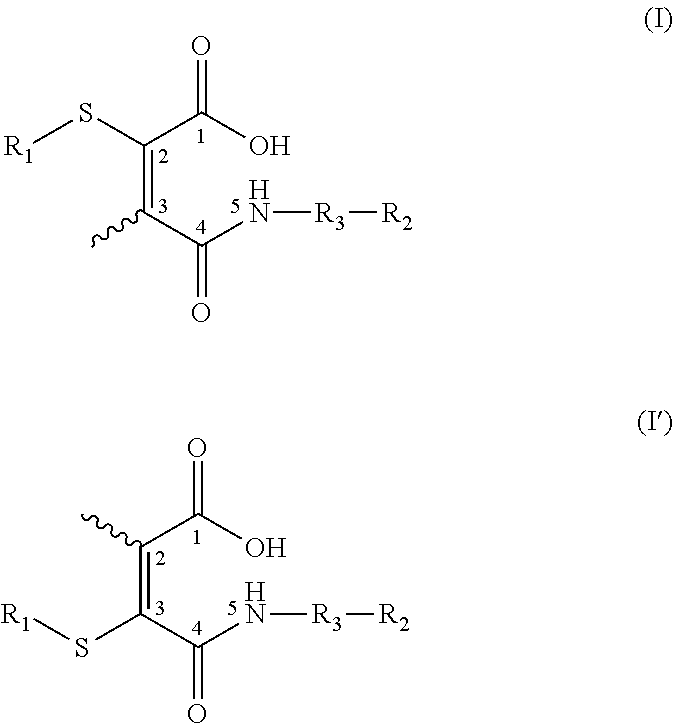
- wherein:
-
- R1 is a protein or peptide;
- R2 is a therapeutically active agent; and
- R3 is a linker moiety or a bond;
- R1 being linked to the 2-position of the moiety of formula (I) via a first sulfur atom attached to the 2-position of the moiety of formula (I); and R1 being linked to the 3-position of the moiety of formula (I′) via a first sulfur atom attached to the 3-position of the moiety of formula (I′).
- The present invention also provides a pharmaceutical composition comprising: (i) a compound comprising a moiety of formula (I) or (I′); and (ii) a pharmaceutically acceptable diluent or carrier.
- The present invention further provides a method of ameliorating or reducing the incidence of cancer in a subject, which method comprises the administration to the said subject of an effective amount of a compound comprising a moiety of formula (I) or (I′) and wherein R1 is an antibody or antibody fragment that is capable of specific binding to a cancer cell and R2 is a cytotoxic agent.
- The present invention still further provides a compound comprising a moiety of formula (I) or (I′) for use in a method of treatment of the human or animal body by therapy.
- The present invention also provides a compound comprising a moiety of formula (I) or (I′) for use in a method of treatment of cancer, wherein R1 is an antibody or antibody fragment that is capable of specific binding to a cancer cell and R2 is a cytotoxic agent.
- Further preferred features and embodiments are described in the accompanying description and the appended claims.
-
FIG. 1 depicts the results of time-dependent LCMS analysis of the hydrolysis of a modified antibody compound as described in Example 1. The x-axis represents time in hours and the y-axis represents the LCMS signal as a percentage of signal corresponding to complete hydrolysis. Open squares correspond to results obtained at 37° C. and filled diamonds correspond to results obtained at ambient temperature. -
FIG. 2 depicts the results of ELISA analysis of the retention of binding of Trastuzumab-Fab to HER2 after conjugation according to the procedure described in Example 2. The x-axis represents the log of the concentration of HER Fab in nM and the y-axis represents absorbance [AU]. Filled circles correspond to the DOX-linked HER Fab of Example 2, open circles correspond to an unmodified HER Fab (control) and open triangles correspond to a ‘processed’ HER Fab as described in Example 2 (control). -
FIG. 3 depicts DAR (drug-to antibody ratio) of the full Trastuzumab-DOX conjugate of Example 3, as measured by UV/Vis analysis, as a function of time under lysosomal pH as described in Example 3. The y-axis represents DAR. The blocks along the x-axis, from left to right, represent the following test results: (i) after synthesis; (ii) after pH change; (iii) one day after pH change; (iv) two days after pH change; (v) three days after pH change; and (vi) four days after pH change. - As used herein, an “antibody” includes monoclonal antibodies, polyclonal antibodies, monospecific antibodies and multispecific antibodies (e.g., bispecific antibodies). An “antibody fragment” is a fragment of such an antibody that exhibits the desired biological activity, e.g. the activity or substantially the activity of its corresponding “intact” antibody.
- Antibodies (and antibody fragments) as used herein includes fusion proteins of antibodies (and antibody fragments) where a protein is fused via a covalent bond to the antibody (or antibody fragment). Also included are chemical analogues and derivatives of antibodies and antibody fragments, provided that the antibody or antibody fragment maintains its ability to bind specifically to its target antigen. Thus, for example, chemical modifications are possible (e.g., glycosylation, acetylation, PEGylation and other modifications without limitation) provided specific binding ability is retained.
- An antibody comprises a variable region, which is capable of specific binding to a target antigen, and a constant region. An antibody as defined herein can be of any type or class (e.g., IgG, IgE, IgM, IgD, and IgA) or subclass (e.g., IgG1, IgG2, IgG3, IgG4, IgA1 and IgA2). The antibody can be derived from any suitable species. In some embodiments, the antibody is of human or murine origin. An antibody can be, for example, human, humanized or chimeric.
- As used herein a “monoclonal antibody” is an antibody obtained from a population of substantially homogeneous antibodies, i.e., the individual antibodies comprising the population are identical except for possible naturally-occurring mutations that may be present in minor amounts. Monoclonal antibodies are highly specific, being directed against a single antigenic site.
- “Monoclonal antibodies” as defined herein may be chimeric antibodies in which a portion of the heavy and/or light chain is identical to or homologous with the corresponding sequence of antibodies derived from a particular species or belonging to a particular antibody class or subclass, while the remainder of the chain(s) is identical to or homologous with the corresponding sequences of antibodies derived from another species or belonging to another antibody class or subclass, as well as fragments of such antibodies, so long as they exhibit the desired biological activity.
- An “intact antibody” is one that comprises an antigen-binding variable region as well as a light chain constant domain (CL) and heavy chain constant domains, CH1, CH2, CR3 and CH4, as appropriate for the antibody class. The constant domains may be native sequence constant domains such as human native sequence constant domains or amino acid sequence variants thereof.
- An intact antibody may have one or more “effector functions”, which refers to those biological activities attributable to the Fc region (e.g., a native sequence Fc region or amino acid sequence variant Fc region) of an antibody. Examples of antibody effector functions include complement dependent cytotoxicity, antibody-dependent cell-mediated cytotoxicity (ADCC) and antibody-dependent cell-mediated phagocytosis.
- An “antibody fragment” comprises a portion of an intact antibody, preferably comprising the antigen-binding or variable region thereof. Examples of antibody fragments include Fab, Fab′, F(ab′)2, and Fv fragments, diabodies, triabodies, tetrabodies, linear antibodies, single-chain antibody molecules, scFv, scFv-Fc, multispecific antibody fragments formed from antibody fragment(s), a fragment(s) produced by a Fab expression library, or an epitope-binding fragments of any of the above which immunospecifically bind to a target antigen (e.g., a cancer cell antigen).
- “Humanized” forms of non-human (e.g., rodent) antibodies are chimeric antibodies that contain minimal sequence derived from non-human immunoglobulin.
- The term “capable of specific binding” refers to protein or peptide (e.g., antibody) binding to a predetermined target substance (e.g., an antigen and/or groups of antigens), e.g. a target substance that is expressed on the surface of a cell; thus the term “binding to a target cell” or “binding to a cancer cell” is to be understand as referring to protein or peptide (e.g., antibody) binding to a predetermined target substance (e.g. antigen or antigens) that is expressed on such a cell.
- Typically, the protein or peptide (e.g., antibody) binds with an affinity of at least about 1×10⁷ M−1, and/or binds to the predetermined target substance (e.g., antigen, antigens or cell) with an affinity that is at least two-fold greater than its affinity for binding to a non-specific control substance (e.g., BSA, casein, non-cancer cells) other than the predetermined target substance or a closely-related target substance.
- As used herein, the term “alkyl” includes both saturated straight chain and branched alkyl groups. Preferably, an alkyl group is a C1-20 alkyl group, more preferably a C1-15, more preferably still a C1-42 alkyl group, more preferably still, a C1-6 alkyl group, and most preferably a C1-4 alkyl group. Particularly preferred alkyl groups include, for example, methyl, ethyl, propyl, isopropyl, butyl, isobutyl, tert-butyl, pentyl and hexyl. The term “alkylene” should be construed accordingly.
- As used herein, the term “alkenyl” refers to a group containing one or more carbon-carbon double bonds, which may be branched or unbranched. Preferably the alkenyl group is a C2-20 alkenyl group, more preferably a C2-15 alkenyl group, more preferably still a C2-12 alkenyl group, or preferably a C2-6 alkenyl group, and most preferably a C2-4 alkenyl group. The term “alkenylene” should be construed accordingly.
- As used herein, the term “alkynyl” refers to a carbon chain containing one or more triple bonds, which may be branched or unbranched. Preferably the alkynyl group is a C2-20 alkynyl group, more preferably a C2-15 alkynyl group, more preferably still a C2-12 alkynyl group, or preferably a C2-6 alkynyl group and most preferably a C2-4 alkynyl group. The term “alkynylene” should be construed accordingly.
- Unless otherwise specified, an alkyl, alkenyl or alkynyl group is typically unsubstituted. However, where such a group is indicated to be unsubstituted or substituted, one or more hydrogen atoms are optionally replaced by halogen atoms or sulfonic acid groups. Preferably, a substituted alkyl, alkenyl or alkynyl group has from 1 to 10 substituents, more preferably 1 to 5 substituents, more preferably still 1, 2 or 3 substituents and most preferably 1 or 2 substituents, for example 1 substituent. Preferably a substituted alkyl, alkenyl or alkynyl group carries not more than 2 sulfonic acid substituents. Halogen atoms are preferred substituents. Preferably, though, an alkyl, alkenyl or alkynyl group is unsubstituted.
- In the moiety that is an alkyl, alkenyl or alkynyl group in which (a) 0, 1 or 2 carbon atoms may be replaced by groups selected from C6-10 arylene, 5- to 10-membered heteroarylene, C3-7 carbocyclylene and 5- to 10-membered heterocyclylene groups, and (b) 0, 1 or 2 —CH2— groups may be replaced by groups selected from —O—, —S—, —S—S—, —C(O)— and —N(C1-6 alkyl)- groups, a total of 0, 1 or 2 of said carbon atoms and —CH2— groups are preferably replaced, more preferably a total of 0 or 1. Most preferably, none of the carbon atoms or —CH2— groups is replaced.
- In the moiety that is an alkylene, alkenylene or alkynylene group, in which (a) 0, 1 or 2 carbon atoms may be replaced by groups selected from C6-10 arylene, 5- to 10-membered heteroarylene, C3-7 carbocyclylene and 5- to 10-membered heterocyclylene groups, and (b) 0, 1 or 2 —CH2— groups may be replaced by groups selected from —O—, —S—, —S—S—, —C(O)—, —N(H)—, —N(C1-6 alkyl)-, —O—C(O)—, O—C(O)—NH—, —NH—C(O)— and —NH—C(O)-0 groups, preferably at least one carbon atom is replaced. Preferred groups for replacing a carbon atom are phenylene, 5- to 6-membered heteroarylene, C5-6 carbocyclylene and 5- to 6-membered heterocyclylene groups. Preferably at least one —CH2— group is replaced, preferably by a group selected from —O—C(O)—, O—C(O)—NH—, —NH—C(O)— and —NH—C(O)—O. Preferably a total of 0, 1, 2 or 3 of said carbon atoms and —CH2— groups are preferably replaced, more preferably a total of 2 or 3. Particularly preferably, at least one carbon atom is replaced and at least one —CH2— group is replaced by a group selected from —O—C(O)—, O—C(O)—NH—, —NH—C(O)— and —NH—C(O)—O (most preferably the said carbon atom being adjacent to the nitrogen at the 5-position of the moiety of formula (I) and the said —CH2— group being adjacent to R2).
- As used herein, the reference to “0, 1 or 2 carbon atoms” means any terminal or non-terminal carbon atom in the alkyl, alkenyl or alkynyl chain, or alkylene, alkenylene or alkynylene chain, including any hydrogen atoms attached to that carbon atom. As used herein, the reference to “0, 1 or 2 —CH2— groups” refers to a group which does not correspond to a terminal carbon atom in the alkyl, alkenyl or alkynyl chain (but may correspond to a terminal carbon atom in the alkylene, alkenylene or alkynylene chain).
- As used herein, a C6-10 aryl group is a monocyclic or polycyclic 6- to 10-membered aromatic hydrocarbon ring system having from 6 to 10 carbon atoms. Phenyl is preferred. The term “arylene” should be construed accordingly. Thus, a preferred arylene group is a phenylene group.
- As used herein, a 5- to 10-membered heteroaryl group is a monocyclic or polycyclic 5- to 10-membered aromatic ring system, such as a 5- or 6-membered ring, containing at least one heteroatom, for example 1, 2, 3 or 4 heteroatoms, selected from O, S and N. When the ring contains 4 heteroatoms these are preferably all nitrogen atoms. The term “heteroarylene” should be construed accordingly.
- Examples of monocyclic heteroaryl groups include thienyl, furyl, pyrrolyl, imidazolyl, thiazolyl, isothiazolyl, pyrazolyl, oxazolyl, isoxazolyl, triazolyl, thiadiazolyl, oxadiazolyl, pyridinyl, pyridazinyl, pyrimidinyl, pyrazinyl, triazinyl and tetrazolyl groups.
- Examples of polycyclic heteroaryl groups include benzothienyl, benzofuryl, benzimidazolyl, benzothiazolyl, benzisothiazolyl, benzoxazolyl, benzisoxazolyl, benztriazolyl, indolyl, isoindolyl and indazolyl groups. Preferred polycyclic groups include indolyl, isoindolyl, benzimidazolyl, indazolyl, benzofuryl, benzothienyl, benzoxazolyl, benzisoxazolyl, benzothiazolyl and benzisothiazolyl groups, more preferably benzimidazolyl, benzoxazolyl and benzothiazolyl, most preferably benzothiazolyl. However, monocyclic heteroaryl groups are preferred.
- Preferably the heteroaryl group is a 5- to 6-membered heteroaryl group. Particularly preferred heteroaryl groups are thienyl, pyrrolyl, imidazolyl, thiazolyl, isothiazolyl, pyrazolyl, oxazolyl, isoxazolyl, triazolyl, pyridinyl, pyridazinyl, pyrimidinyl and pyrazinyl groups. More preferred groups are thienyl, pyridinyl, pyridazinyl, pyrimidinyl, pyrazinyl, pyrrolyl and triazinyl, most preferably pyridinyl.
- As used herein, a 5- to 10-membered heterocyclyl group is a non-aromatic, saturated or unsaturated, monocyclic or polycyclic C5-10 carbocyclic ring system in which one or more, for example 1, 2, 3 or 4, of the carbon atoms are replaced with a moiety selected from N, O, S, S(O) and S(O)2. Preferably, the 5- to 10-membered heterocyclyl group is a 5- to 6-membered ring. The term “heterocyclyene” should be construed accordingly.
- Examples of heterocyclyl groups include azetidinyl, oxetanyl, thietanyl, pyrrolidinyl, imidazolidinyl, oxazolidinyl, isoxazolidinyl, thiazolidinyl, isothiazolidinyl, tetrahydrofuranyl, tetrahydrothienyl, tetrahydropyranyl, tetrahydrothiopyranyl, dithiolanyl, dioxolanyl, pyrazolidinyl, piperidinyl, piperazinyl, hexahydropyrimidinyl, methylenedioxyphenyl, ethylenedioxyphenyl, thiomorpholinyl, S-oxo-thiomorpholinyl, S,S-dioxo-thiomorpholinyl, morpholinyl, 1,3-dioxolanyl, 1,4-dioxolanyl, trioxolanyl, trithianyl, imidazolinyl, pyranyl, pyrazolinyl, thioxolanyl, thioxothiazolidinyl, 1H-pyrazol-5-(4H)-onyl, 1,3,4-thiadiazol-2(3H)-thionyl, oxopyrrolidinyl, oxothiazolidinyl, oxopyrazolidinyl, succinimido and maleimido groups and moieties. Preferred heterocyclyl groups are pyrrolidinyl, imidazolidinyl, oxazolidinyl, isoxazolidinyl, thiazolidinyl, isothiazolidinyl, tetrahydrofuranyl, tetrahydrothienyl, tetrahydropyranyl, tetrahydrothiopyranyl, dithiolanyl, dioxolanyl, pyrazolidinyl, piperidinyl, piperazinyl, hexahydropyrimidinyl, thiomorpholinyl and morpholinyl groups and moieties. More preferred heterocyclyl groups are tetrahydropyranyl, tetrahydrothiopyranyl, thiomorpholinyl, tetrahydrofuranyl, tetrahydrothienyl, piperidinyl, morpholinyl and pyrrolidinyl groups.
- For the avoidance of doubt, although the above definitions of heteroaryl and heterocyclyl groups refer to an “N” moiety which can be present in the ring, as will be evident to a skilled chemist the N atom will be protonated (or will carry a substituent as defined below) if it is attached to each of the adjacent ring atoms via a single bond.
- As used herein, a C3-7 carbocyclyl group is a non-aromatic saturated or unsaturated hydrocarbon ring having from 3 to 7 carbon atoms. Preferably it is a saturated or mono-unsaturated hydrocarbon ring (i.e. a cycloalkyl moiety or a cycloalkenyl moiety) having from 3 to 7 carbon atoms, more preferably having from 5 to 6 carbon atoms. Examples include cyclopropyl, cyclobutyl, cyclopentyl and cyclohexyl and their mono-unsaturated variants. Particularly preferred carbocyclic groups are cyclopentyl and cyclohexyl. The term “carbocyclylene” should be construed accordingly.
- Where specified, 0, 1 or 2 carbon atoms in a carbocyclyl or heterocyclyl group may be replaced by —C(O)— groups. As used herein, the “carbon atoms” being replaced are understood to include the hydrogen atoms to which they are attached. When 1 or 2 carbon atoms are replaced, preferably two such carbon atoms are replaced. Preferred such carbocyclyl groups include a benzoquinone group and preferred such heterocyclyl groups include succinimido and maleimido groups.
- Unless otherwise specified, an aryl, heteroaryl, carbocyclyl or heterocyclyl group is typically unsubstituted. However, where such a group is indicated to be unsubstituted or substituted, one or more hydrogen atoms are optionally replaced by halogen atoms or C1-6 alkyl, C1-6 alkoxy, C1-6 alkylthiol, —N(C1-6 alkyl)(C1-6 alkyl), nitro or sulfonic acid groups. Preferably, a substituted aryl, heteroaryl, carbocyclyl or heterocyclyl group has from 1 to 4 substituents, more preferably 1 to 2 substituents and most preferably 1 substituent. Preferably a substituted aryl, heteroaryl, carbocyclyl or heterocyclyl group carries not more than 2 nitro substituents and not more than 2 sulfonic acid substituents. Preferred substituents are halogen atoms and C1-4 alkyl and C1-4 alkoxy groups. Particularly preferred substituents are halogen atoms. Preferably, though, an aryl, heteroaryl, carbocyclyl or heterocyclyl group is unsubstituted.
- As used herein, halogen atoms are typically F, Cl, Br or I atoms, preferably Br or Cl atoms, more preferably Br atoms.
- As used herein, a C1-6 alkoxy group is a C1-6 alkyl (e.g. a C1-4 alkyl) group which is attached to an oxygen atom.
- As used herein, a C1-6 alkylthiol group is a C1-6 alkyl (e.g. a C1-4 alkyl) group which is attached to a sulfur atom.
- As used herein, the symbolmeans a point of attachment to another chemical group. The specific chemical identity of any such groups attached via this point of attachment is not important in view of the functioning of the invention, as further explained herein.

- The compound comprising a moiety of formula (I) or (I′) constitutes a conjugate through which a protein or peptide R1 is linked (typically covalently) via a thiomaleamic acid linker moiety to a therapeutically active agent R2. The inventors have found that this linker is stable under physiological conditions, but is susceptible to efficient cleavage at the pH conditions characterising the lysosome.
- The thiomaleamic acid linker moiety
-
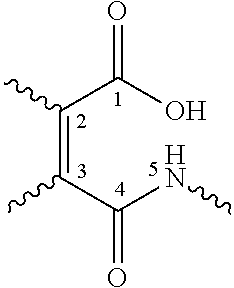
- is believed to hydrolyse under acidic conditions in order to cleave the bond between the carbonyl group at the 4-position and the nitrogen atom at the 5-position. Thus, from the compounds of the present invention a fragment of the formula H2N—R3—R2 may be produced by acid-catalysed hydrolysis. Surprisingly, the thiomaleamic acid linker moiety, bearing at least one electron donating thioether bond attached at the 2-position and/or the 3-position, has been found to undergo highly efficient hydrolysis typically in the pH range of 4 to 5, which corresponds precisely to the pH in the lysosome (for example, in human lysosomes in vivo).
- It will be evident that the formulae (I) and (I′) differ only in the location of the sulfur atom through which R1 is linked to the thiomaleamic acid linker moiety. It is not important for the purposes of the present invention whether R1 is attached via the 2-position as in formula (I), the 3-position as in formula (I′), or both the 2-position and the 3-position (as in the compound of formula (Ic)).
- For the avoidance of doubt, the present invention includes within its scope compositions of matter that comprise (a) a compound comprising the moiety of formula (I) (including such compositions that contain substantially no compound comprising the moiety of formula (I′)), or (b) a compound comprising the moiety of formula (I′) (including such compositions that contain substantially no compound comprising the moiety of formula (I)), or (c) a mixture of a compound comprising the moiety of formula (I) and a compound comprising the moiety of formula (I′), or (d) any other mixture of compounds that fall within the definition of the formula (I) and/or (I′).
- In one embodiment, the protein or peptide is linked to the carbon-carbon double bond at the 2- and 3-positions of the moiety of formula (I) or (I′) via a single sulfur atom (for purposes of clarity referred to herein as a “first sulfur atom”). Preferably in this embodiment, the compound comprising a moiety of formula (I) or (I′) is a compound of formula (Ia) or (Ib):
-
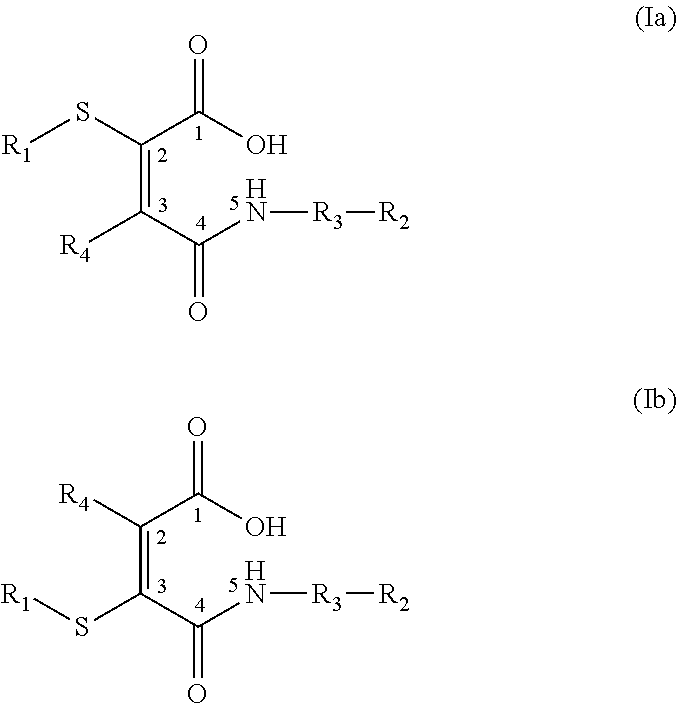
- wherein:
-
- R4 is a hydrogen or halogen atom or a C1-20 alkyl, C2-20 alkenyl or C2-20 alkynyl group, which group is unsubstituted or substituted by one or more substituents selected from halogen atoms and sulfonic acid groups, and in which (a) 0, 1 or 2 carbon atoms are replaced by groups selected from C6-10 arylene, 5- to 10-membered heteroarylene, C3-7 carbocyclylene and 5- to 10-membered heterocyclylene groups, and (b) 0, 1 or 2 —CH2— groups are replaced by groups selected from —O—, —S—, —S—S—, —C(O)— and —N(C1-6 alkyl)- groups, wherein:
- (i) said arylene, heteroarylene, carbocyclylene and heterocyclylene groups are unsubstituted or substituted by one or more substituents selected from halogen atoms and C1-6 alkyl, C1-6 alkoxy, C1-6 alkylthiol, —N(C1-6 alkyl)(C1-6 alkyl), nitro and sulfonic acid groups; and
- (ii) 0, 1 or 2 carbon atoms in said carbocyclylene and heterocyclylene groups are replaced by —C(O)— groups;
- R4 is a hydrogen or halogen atom or a C1-20 alkyl, C2-20 alkenyl or C2-20 alkynyl group, which group is unsubstituted or substituted by one or more substituents selected from halogen atoms and sulfonic acid groups, and in which (a) 0, 1 or 2 carbon atoms are replaced by groups selected from C6-10 arylene, 5- to 10-membered heteroarylene, C3-7 carbocyclylene and 5- to 10-membered heterocyclylene groups, and (b) 0, 1 or 2 —CH2— groups are replaced by groups selected from —O—, —S—, —S—S—, —C(O)— and —N(C1-6 alkyl)- groups, wherein:
- R1 being linked to the 2-position of the moiety of formula (Ia) via a first sulfur atom attached to the 2-position of the moiety of formula (Ia); and R1 being linked to the 3-position of the moiety of formula (Ib) via a first sulfur atom attached to the 3-position of the moiety of formula (Ib).
- In an alternative, and preferred, embodiment, the protein or peptide is linked to the carbon-carbon double bond at both the 2-position and the 3-position of the moiety of formula (I) or (I′) (i.e., in a “bridging” arrangement), via two different sulfur atoms (for purposes of clarity referred to herein as a “first sulfur atom” and a “second sulfur atom”). Preferably in this embodiment, the compound comprising a moiety of formula (I) or (I′) is a compound of formula (Ic):
-

- R1 being linked to the 2-position of the moiety of formula (Ic) via a first sulfur atom attached to the 2-position of the moiety of formula (Ic) and R1 being linked to the 3-position of the moiety of formula (Ic) via a second sulfur atom attached to the 3-position of the moiety of formula (Ic).
- In the compound comprising a moiety of formula (I) or (I′) (and necessarily also in the compounds of formulae (Ia), (Ib) and (Ic)), R1 is said to be “linked” to the 2-position and/or the 3-position. “Linked” in this context should be construed broadly, and encompasses any means by which R1 can directly or indirectly be attached, typically covalently, to the relevant position. For the avoidance of doubt, “attached” in this context therefore means directly bound, typically covalently bound. For example, a “first sulfur atom attached to the 2-position of the moiety of formula (I)” is as shown in the chemical structure, i.e. the sulfur atom is (covalently) directly bound to the carbon atom at the 2-position.
- By contrast, “linked” means that R1 may itself comprises a sulfur atom, which sulfur atom is attached to the relevant position (i.e., R1 is directly attached through the said sulfur atom). Alternatively, R1 may be attached to an intermediate “sub-linker” group, which sub-linker group comprises a sulfur atom, which sulfur atom is attached to the relevant position (i.e., R1 is indirectly linked through the sub-linker group and then the said sulfur atom).
- As workers in this field would be aware, “sub-linker” groups have commonly been used in ADCs to attach antibodies and antibody fragments to further linker groups, the latter linker groups being capable of cleaving in vivo to generate the desired therapeutic effect. For example, modification of lysine residues in antibodies with thiol-bearing linking groups (e.g., amide-alkyl-thiol reagents) has been used in order to render the said antibodies susceptible to functionalisation with conventional maleimide linkers.
- The specific chemical identity of any such “sub-linker” group used in order to link R1 via a sulfur atom to the 2- and/or the 3-position of the compounds of the present invention is not important and could be selected as a matter of routine by those skilled in the art using known techniques.
- Preferably, however, in the compounds of the present invention R1 is linked to the relevant position in the moiety of formula (I) or (I′) by direct attachment of a sulfur atom in a cysteine residue of R1 to that position. In other words, R1 is preferably attached to the 2-position of the moiety of formula (I) (and (Ia)) via a first sulfur atom, which first sulfur atom is the sulfur atom of a first cysteine residue in R1. Furthermore, R1 is preferably attached to the 3-position of the moiety of formula (I′) (and (Ib)) via a first sulfur atom, which first sulfur atom is the sulfur atom of a first cysteine residue in R1. In compounds of formula (Ic), preferably R1 is attached to the 2-position of the moiety of formula (Ic) via a first sulfur atom, which first sulfur atom is the sulfur atom of a first cysteine residue in R1, and R1 is also attached to the 3-position of the moiety of formula (Ic) via a second sulfur atom, which second sulfur atom is the sulfur atom of a second cysteine residue in R1.
- For the avoidance of doubt, a cysteine residue in a protein or peptide is a residue of formula
-
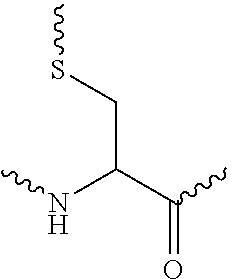
- Attachment of R1 via at least a first cysteine residue (e.g., a first cysteine residue and a second cysteine residue) can be seen to be particularly convenient, since it makes use of functional groups that are already present in the protein or peptide and therefore does not rely on preliminary functionalisation of R1 prior to generation of the conjugate (e.g., by addition of a “sub-linker” such as those described above and/or the use of post-translational techniques to introduce non-native, sulfhydryl-containing amino acid residues).
- Many proteins and peptides in their isolated forms contain disulfide bridges —S—S— which are formed by sulfur-sulfur bonding of the sulfur atoms of two different cysteine residues in the protein or peptide. Antibodies for example are well known to contain disulfide bridges that link together their discrete chains (known as interchain disulfides). The term “in isolated form” refers to the structure of the protein or peptide when it is not attached to the thiomaleamic acid linker (or otherwise functionalised).
- In one preferred embodiment of the present invention, the compound is a compound of formula (Ic) in which the first sulfur atom is a first cysteine residue of R1 and the second sulfur atom is a second cysteine residue of R1 and the first sulfur atom and second sulfur atom are attached to one another via a disulfide bridge —S—S— when the protein or peptide is in isolated form. For example, when R1 is an antibody or antibody fragment, preferably the said disulfide bridge is an interchain disulfide bridge. In this embodiment, the disulfide bridge that existed in the isolated protein or peptide can be seen to have been substituted by an analogue of such a bridge, i.e. the cyclic system comprising the carbons at the 2- and 3-positions of the moiety of formula (Ic) in conjunction with the sulfur atoms of the two cysteines linked via the underlying amino acid sequence of the protein or peptide R1.
- R1 is typically a protein or peptide that is capable of specific binding to a target of interest, for example a target cell. Preferably R1 is capable of specific binding to a cancer cell. Non-limiting examples of R1 include antibodies, antibody fragments, lectins, glycoproteins, growth factors, cytokines, interferons, interleukins, insulin and transferrin and any other protein or peptide that is capable of specific binding to a target cell of therapeutic interest.
- Preferably, R1 is an antibody or an antibody fragment. Preferably the antibody or antibody fragment is capable of specific binding to a target cell, for example a cancer cell.
- The antibody may be polyclonal or monoclonal, but is preferably monoclonal. The antibody is preferably a chimeric, human or humanized antibody. The antibody fragment is preferably a Fab or an scFvs antibody fragment.
- The present application is not a primer on antibodies. A worker skilled in the art of preparing bioconjugates, such as ADCs, would be familiar with working this antibodies and would readily be capable of selecting suitable antibodies or fragments thereof for designing specific compounds of the present invention. It will be appreciated that the specific identity of an antibody or antibody fragment may be determined by various criteria, a primary criterion being the intended therapeutic application and thus the target antigen. Typically where an ADC is intended to target a cell such as a cancer cell the antibody or antibody fragment will be selected so that its antigen is an antigen over-expressed by that cell with respect to expression on non-cancer cells, e.g. an antigen that is over-expressed on the surface of a particular type of cancer cell. This enables the ADC to be targeted specifically to the cells on which the therapeutic effect (e.g., a cytotoxic effect achieved via a cytotoxic therapeutically active agent) is desired.
- In principle the thiomaleamic acid linker moiety is suitable for connecting any antibody/antibody fragment to any therapeutically active agent. Numerous ADCs have already been developed wherein an antibody/antibody fragment is conjugated to a therapeutically active agent via a known linker. Compounds of the present invention include compounds that comprise any of these previously known “pairs” of antibody/antibody fragment and therapeutically active agent, but modified to be conjugated via the thiomaleamic acid linker moiety.
- Antibodies immunospecific for a cancer cell antigen can be obtained commercially or produced by any method known to one of skill in the art such as, e.g., recombinant expression techniques. The nucleotide sequence encoding antibodies immunospecific for a cancer cell antigen can be obtained, e.g., from the GenBank database or a database like it, the literature publications, or by routine cloning and sequencing.
- Non-limiting exemplary antibodies and antibody fragments for use in the present invention include antibodies and antibody fragments that are capable of specific binding to the following antigens (exemplary, but non-limiting, corresponding disease states being listed in parentheses): CA125 (ovarian), CA15-3 (carcinomas), CA19-9 (carcinomas), CA 242 (colorectal), L6 (carcinomas), CD2 (Hodgkin's Disease or non-Hodgkin's lymphoma), CD3, CD4, CD5, CD6, CD11, CD25, CD26, CD37, CD44, CD64, CD74, CD205, CD227, CD79, CD 105, CD138, CD20 (non-Hodgkin's lymphoma), CD52 (leukemia), CD33 (leukemia), CD22 (lymphoma), CD38 (multiple myeloma), CD40 (lymphoma), CD19 (non-Hodgkin's lymphoma), CD30 (CD30+ malignancies), CD70, CD56 (small-cell lung cancer, ovarian cancer, multiple myeloma, solid tumors), Lewis Y (carcinomas), Lewis X (carcinomas), human chorionic gonadotropin (carcinoma), alpha fetoprotein (carcinomas), placental alkaline phosphatase (carcinomas), prostate specific antigen (prostate), prostate specific membrane antigen (prostate), prostatic acid phosphatase (prostate), epidermal growth factor (carcinomas), MAGE-1 (carcinomas), MAGE-2 (carcinomas), MAGE-3 (carcinomas), MAGE-4 (carcinomas), anti-transferrin receptor (carcinomas), p97 (melanoma), MUC1 (breast cancer), CEA (colorectal), gp100 (melanoma), MARTI (melanoma), IL-2 receptor (T-cell leukemia and lymphomas), mucin (carcinomas), P21 (carcinomas), MPG (melanoma), Neu oncogene product (carcinomas), BCMA, Glypican-3, Liv-1 or Lewis Y (epithelial tumors), HER2 (breast cancer), GPNMB (breast cancer), CanAg (solid tumors), DS-6 (breast cancer, ovarian cancer, solid tumors), HLA-Dr10 (non-Hodgkin's lymphoma), VEGF (lung and colorectal cancers), MY9, B4, EpCAM, EphA receptors, EphB receptors, EGFR, EGFRvIII, HER2, HER3, BCMA, PSMA, mesothelin, cripto, alpha(v)beta3, alpha(v)beta5, alpha(v)beta6 integrin, C242, EDB, TMEFF2, FAP, TAG-72, GD2, CAIX and 5T4.
- Currently particularly preferred antibodies and antibody fragments include those capable of specific binding to the following antigens: MY9, B4, EpCAM, CD2, CD3, CD4, CD5, CD6, CD11, CD19, CD20, CD22, CD25, CD26, CD30, CD33, CD37, CD38, CD40, CD44, CD56, CD64, CD70, CD74, CD79, CD105, CD138, CD205, CD227, EphA receptors, EphB receptors, EGFR, EGFRvIII, HER2, HER3, BCMA, PSMA, Lewis Y, mesothelin, cripto, alpha(v)beta3, alpha(v)beta5, alpha(v)beta6 integrin, C242, CA125, GPNMB, ED-B, TMEFF2, FAP, TAG-72, GD2, CAIX and 5T4.
- Examples of antibodies known for use in the treatment of cancer include RITUXAN® (rituximab; Genentech) which is a chimeric anti-CD20 monoclonal antibody for the treatment of patients with non-Hodgkin's lymphoma; OVAREX which is a murine antibody for the treatment of ovarian cancer; PANOREX (Glaxo Wellcome, NC) which is a murine IgG2a antibody for the treatment of colorectal cancer; Cetuximab ERBITUX (Imclone Systems Inc., NY) which is an anti-EGFR IgG chimeric antibody for the treatment of epidermal growth factor positive cancers, such as head and neck cancer; Vitaxin (MedImmune, Inc., MD) which is a humanized antibody for the treatment of sarcoma; CAMPATH I/H (Leukosite, MA) which is a humanized IgG1 antibody for the treatment of chronic lymphocytic leukemia (CLL); SMART MI95 (Protein Design Labs, Inc., CA) and SGN-33 (Seattle Genetics, Inc., WA) which is a humanized anti-CD 33 IgG antibody for the treatment of acute myeloid leukemia (AML); LYMPHOCIDE (Immunomedics, Inc., NJ) which is a humanized anti-CD22 IgG antibody for the treatment of non-Hodgkin's lymphoma; SMART ID10 (Protein Design Labs, Inc., CA) which is a humanized anti-HLA-DR antibody for the treatment of non-Hodgkin's lymphoma; ONCOLYM (Techniclone, Inc., CA) which is a radiolabeled murine anti-HLA-Dr10 antibody for the treatment of non-Hodgkin's lymphoma; ALLOMUNE (BioTransplant, CA) which is a humanized anti-CD2 mAb for the treatment of Hodgkin's Disease or non-Hodgkin's lymphoma; AVASTIN (Genentech, Inc., CA) which is an anti-VEGF humanized antibody for the treatment of lung and colorectal cancers; Epratuzamab (Immunomedics, Inc., NJ and Amgen, CA) which is an anti-CD22 antibody for the treatment of non-Hodgkin's lymphoma; CEACIDE (Immunoniedics, NJ) which is a humanized anti-CEA antibody for the treatment of colorectal cancer; and Herceptin (TRASTUZUMAB), which is an anti-HER2/neu receptor monoclonal antibody for the treatment of breast cancer.
- Preferably R2 has greater therapeutic activity following hydrolysis of the moiety of formula (I) or (I′) than when it forms part of the moiety of formula (I) or (I′).
- As is well known by those skilled in the art of synthesising ADCs, typically the therapeutically active agent “drug cargo” of the conjugate must be released from the ADC in order to exhibit its therapeutic activity. A skilled person would readily understand how to assess whether “greater therapeutic activity” is achieved when R2 has been released by hydrolysis of the moiety of formula (I) or (I′). For example, the skilled person would be familiar with routine tests, such as in vitro tests, for example using standard cell lines that express a particular antigen of interest, that are used in the art to assess the potency of particular classes of therapeutically active agents. Such tests can be carried out on a comparative basis, i.e. by carrying out the test on both the compound comprising the moiety of formula (I) or (I′) and on the hydrolysis product thereof (i.e., on R2 or the hydrolysis fragment that retains the group R2).
- Typically, therefore R2 is capable of exerting a therapeutic effect when the compound comprising a moiety of formula (I) or (I′) has been internalised within a target cell and following hydrolysis of the moiety of formula (I) or (I′) within said target cell (e.g., within the lysosome of said target cell).
- Preferably R2 is a cytotoxic agent. Preferred cytotoxic agents include anthracyclines, auristatins, maytansinoids, calicheamicins, taxanes, benzodiazepines and duocarmycins. As would be readily understood by those skilled in the art, the purpose of the cytotoxic agent is typically to exert a cytotoxic effect on the cancer cell following specific targeting thereof by R1 and release of R2 via cleavage of the thiomaleamic acid linker moiety in the lysosome.
- Preferably R1 is an antibody or antibody fragment that is capable of specific binding to a cancer cell and R2 is a cytotoxic agent.
- The compound comprising a moiety of formula (I) or (I′) may comprise a further linker moiety R3 that connects the nitrogen atom at the 5-position of the thiomaleamic acid moiety to the therapeutically active agent R2. Alternatively R3 may be a bond, i.e. the therapeutically active agent R2 may be connected directly to the 5-position of the thiomaleamic acid moiety.
- Typically the moiety of formula (I) or (I′) is capable of hydrolyzing at a pH of from 4 to 5 to release a fragment of the formula H2N—R3—R2. By “hydrolyzing at a pH of from 4 to 5” is meant hydrolyzing under aqueous conditions at at least one pH that lies in the range of 4 to 5 (e.g., at a temperature of 30-40° C. such as 37° C.). Typically the moiety of formula (I) or (I′) is therefore capable of hydrolyzing in the lysosome of a subject, for example a human subject, in vivo, since the lysosomal environment is an aqueous environment having a pH in the region of 4 to 5.
- It will be appreciated that while the therapeutically active agent is defined herein as the group R2, it may in certain embodiments exert its therapeutic effect within the cell while still carrying for example a linker moiety R3, a fragment of the linker moiety R3 produced on hydrolysis of R3 or the group H2N— produced when R2 is a bond and the thiomaleamic acid moiety undergoes hydrolysis. In other words, the therapeutic effect may be effected by a hydrolysis fragment of compound comprising the moiety of formula (I) or (I′) that retains the group R2. For the avoidance of doubt, the present invention explicitly includes compounds wherein the therapeutic effect is ultimately achieved not by a fully isolated therapeutically active agent R2, but by a substance that comprises R2 attached to a further moiety such as those described, provided of course that cleavage of the thiomaleamic acid linker moiety has occurred.
- When R3 is a linker moiety, the therapeutically active agent R2 may be capable of achieving its therapeutic effect while still attached thereto (in which case R3 does not itself need to hydrolyze to thereby release the therapeutically active agent). However, preferably when R3 is a linker moiety, it is further capable of hydrolyzing to release the therapeutically active agent. By “release the therapeutically active agent” is meant that R3 undergoes hydrolysis to release a fragment that consists of or comprises R2, said fragment being capable of exhibiting the desired therapeutic effect.
- Preferably if when R3 is a linker moiety it is further capable of hydrolyzing to release the therapeutically active agent, said linker moiety is further capable of hydrolyzing at a pH of from 4 to 5. Again, by “hydrolyzing at a pH of from 4 to 5” is meant hydrolyzing under aqueous conditions at at least one pH that lies in the range of 4 to 5 (e.g., at a temperature of 30-40° C. such as 37° C.).
- Preferably said linker moiety R3 is not capable of hydrolyzing to release the therapeutically active agent at a pH of greater than 7, more preferably not greater than 6, most preferably not greater than 5.5.
- For the avoidance of doubt, it is not important whether in the compound comprising a moiety of formula (I) or (I′) in which R3 is a linker moiety, said compound in practice initially hydrolyzes to release a fragment H2N—R3—R2 which then undergoes further hydrolysis of the linker R3 to release the therapeutically active agent, or whether in practice the first step in the disintegration of the compound is via hydrolysis of the linker R3 to release the therapeutically active agent.
- A preferred linker moiety R3 is a linker moiety that is a C1-20 alkylene group, a C2-20 alkenylene group or a C2-20 alkynylene group, which is unsubstituted or substituted by one or more substituents selected from halogen atoms and sulfonic acid groups, and in which (a) 0, 1 or 2 carbon atoms are replaced by groups selected from C6-10 arylene, 5- to 10-membered heteroarylene, C3-7 carbocyclylene and 5- to 10-membered heterocyclylene groups, and (b) 0, 1 or 2 —CH2— groups are replaced by groups selected from —O—, —S—, —S—S—, —C(O)—, —NH—, —N(C1-6 alkyl)-, —O—C(O)—, —O—C(O)—NH—, —NH—C(O)— and —NH—C(O)—O— groups, wherein:
- (i) said arylene, heteroarylene, carbocyclylene and heterocyclylene groups are unsubstituted or substituted by one or more substituents selected from halogen atoms and nitro, carboxyl, cyano, acyl, acylamino, carboxamide, sulfonamide, trifluoromethyl, phosphate, C1-6 alkyl, C6-10 aryl, 5- to 10-membered heteroaryl, C3-7 carbocyclyl, 5- to 10-membered heterocyclyl, —ORx, —SRx, —N(Rx)(Ry) and —SO2—Rx groups, wherein Rx and Ry are independently selected from hydrogen atoms and C1-6 alkyl and C6-10 aryl groups; and
- (ii) 0, 1 or 2 carbon atoms in said carbocyclylene and heterocyclylene groups are replaced by —C(O)— groups.
- Preferably any arylene, heteroarylene, carbocyclylene and heterocyclylene groups are substituted by at most two substituents and more preferably they are unsubstituted. Preferred substituents include C1-6 alkyl, —O(C1-6 alkyl), carboxamide and acyl.
- When R3 is a linker moiety it preferably contains a phenylene group attached to the nitrogen atom at the 5-position in the moiety of formula (I) or (I′), said phenylene group being unsubstituted or substituted by one or more substituents selected from halogen atoms and nitro, carboxyl, cyano, acyl, acylamino, carboxamide, sulfonamide, trifluoromethyl, phosphate, C1-6 alkyl, C6-10 aryl, 5- to 10-membered heteroaryl, C3-7 carbocyclyl, 5- to 10-membered heterocyclyl, —ORx, —SRx, —N(Rx)(Ry) and —SO2—Rx groups, wherein Rx and Ry are independently selected from hydrogen atoms and C1-6 alkyl and C6-10 aryl groups.
- The presence of phenylene group increases the hydrolysis reactivity at a pH of from 4 to 5 of the compound comprising a moiety of formula (I) or (I′) by rendering the fragment —N(H)—R3—R2 a better leaving group. Preferred substituents for the phenylene group include C1-6 alkyl, —O(C1-6 alkyl), carboxamide and acyl. Preferably the phenylene group is substituted by at most two substituents and more preferably the phenylene group is unsubstituted.
- When R3 is a linker moiety it preferably is a linker moiety that, together with the group R2, comprises a carbamate moiety of formula —O—C(O)—N(H)— or —N(H)—C(O)—O—. As is well known in organic synthetic chemistry, a carbamate moiety is susceptible to hydrolysis to release a hydroxyl-functionalised fragment, an amine-functionalised fragment, and carbon dioxide.
- Preferably when R3 is a linker moiety it has the formula -[A]-[B]-[C]-, wherein:
-
- [A] is a phenylene group that is unsubstituted or substituted by one or more substituents selected from halogen atoms and nitro, carboxyl, cyano, acyl, acylamino, carboxamide, sulfonamide, trifluoromethyl, phosphate, C1-6 alkyl, C6-10 aryl, 5- to 10-membered heteroaryl, C3-7 carbocyclyl, 5- to 10-membered heterocyclyl, —ORx, —SRx, —N(Rx)(Ry) and —SO2—Rx groups, wherein Rx and Ry are independently selected from hydrogen atoms and C1-6 alkyl and C6-10 aryl groups;
- [B] is a bond or a C1-6 alkyl group; and
- [C] is a group of formula —O—C(O)—NH—, —O—C(O)—, —N(H)—C(O)—O— or —N(H)—C(O)—, such that the fragment [C]—[R2]— is attached to the fragment -[A]-[B]- via a carbamate moiety of formula —O—C(O)—N(H)— or —N(H)—C(O)—O—.
- Preferred substituents for the phenylene group [A] include C1-6 alkyl, —O(C1-6 alkyl), carboxamide and acyl. Preferably [A] is a phenylene group having at most two substituents, and most preferably said phenylene group is unsubstituted.
- An exemplary linker moiety R3 has the formula
-

- Typically when R3 is a bond, the moiety of formula (I) or (I′) is capable of hydrolyzing at a pH of from 4 to 5 to release a fragment of the formula H2N—R2. Again, by “hydrolyzing at a pH of from 4 to 5” is meant hydrolyzing under aqueous conditions at at least one pH that lies in the range of 4 to 5 (e.g., at a temperature of 30-40° C. such as 37° C.).
- Preferably the compound comprising a moiety of formula (I) or (I′) is not capable of hydrolyzing to release the therapeutically active agent or a fragment of formula H2N—R3—R2 or H2N—R2 at a pH of 7 or higher, more preferably not 6 or higher, most preferably not higher than 5.5.
- In one currently preferred aspect, R1 is an antibody or antibody fragment that is capable of specific binding to a cancer cell, such as those herein defined, R2 is a cytotoxic agent, such as those herein defined, and R3 is a linker moiety such as those herein defined and that: (i) contains a phenylene group attached to the nitrogen atom at the 5-position in the moiety of formula (I) or (I′), said phenylene group being unsubstituted or substituted by one or more substituents selected from halogen atoms and nitro, carboxyl, cyano, acyl, acylamino, carboxamide, sulfonamide, trifluoromethyl, phosphate, C1-6 alkyl, C6-10 aryl, 5- to 10-membered heteroaryl, C3-7 carbocyclyl, 5- to 10-membered heterocyclyl, —ORx, —SRx, —N(Rx)(Ry) and —SO2—Rx groups, wherein Rx and Ry are independently selected from hydrogen atoms and C1-6 alkyl and C6-10 aryl groups; and/or (preferably and) (ii) (ii) together with the group R2, comprises a carbamate moiety of formula —O—C(O)—N(H)— or —N(H)—C(O)—O—.
- Particularly preferably R1 is an antibody or antibody fragment that is capable of specific binding to a cancer cell, such as those herein defined, R2 is a cytotoxic agent, such as those herein defined, and R3 is a linker moiety of the formula -[A]-[B]-[C]-, as herein defined.
- In the compound of formula (Ia) or (Ib) R4 is preferably a hydrogen or halogen atom or an unsubstituted C1-6 alkyl, C2-6 alkenyl or C2-6 alkynyl group, in which (a) 0 or 1 carbon atom is replaced by a group selected from phenylene, 5- to 6-membered heteroarylene, C5-6 carbocyclylene and 5- to 6-membered heterocyclylene groups, wherein said phenylene, heteroarylene, carbocyclylene and heterocyclylene groups are unsubstituted or substituted by one or two substituents selected from halogen atoms and C1-4 alkyl and C1-4 alkoxy groups, and (b) 0, 1 or 2 —CH2— groups are replaced by groups selected from —O—, —S— and —C(O)— groups.
- More preferably, R4 represents a hydrogen atom or an unsubstituted C1-6 alkyl group, in which (a) 0 or 1 carbon atom is replaced by a group selected from unsubstituted phenylene, 5- to 6-membered heteroarylene, C5-6 carbocyclylene and 5- to 6-membered heterocyclylene groups.
- Most preferably R4 is a hydrogen atom or an unsubstituted C1-6 alkyl group.
- The compounds comprising a moiety of formula (I) or (I′) can be produced using routine techniques known in the art for attaching cross-linker reagents to functional moieties, such as those described in “Bioconjugate Techniques” (Greg T. Hermanson, Academic Press Inc., 1996), the content of which is herein incorporated by reference in its entirety. Further examples of suitable conditions for carrying out such reactions can be found in the Examples section of the present specification.
- As would be understood by those of skill in the art, where a reagent carries more than one reactive group, it may be desirable to effect chemical protection of reactive groups that are not intended to take part in the reaction. For example, it may be necessary to protect groups such as hydroxyl, amino and carboxy groups, where these are desired in the final product, to avoid their unwanted participation in the reactions (see, for example, Greene, T. W., “Protecting Groups in Organic Synthesis”, John Wiley and Sons, 1999). Conventional protecting groups may be used in conjunction with standard practice.
- One preferred method for producing compounds comprising a moiety of formula (I) or (I′) involves hydrolyzing a corresponding thiomaleimide-linked conjugate of formula (II)
-
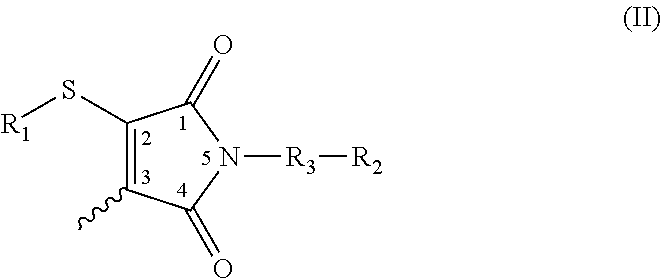
- wherein R1, R3 and R2 are as herein defined. It will be appreciated that hydrolysis of the thiomaleimide-linked conjugate of formula (II) can generate a compound comprising a moiety of formula (I) and/or a compound comprising a moiety of formula (I′), depending on the degree of regioselectivity of the hydrolysis. If desired, regioselectivity can be achieved using known techniques such as the use of additional substituents (e.g., at the 3-position in the formula (II)) to direct the site at which hydrolysis is initiated (for example by nucleophilic attack at either the 1-position or the 4-position in the formula (II)). For example, electron-donating, electron-withdrawing, or sterically-hindering substituents may be sited at the 3-position of the formula (II). If required, a mixture of a compound comprising a moiety of formula (I) and a compound comprising a moiety of formula (I′) as formed by hydrolysis of the conjugate of the formula (II) can be purified using conventional methods; alternatively such a mixture can typically be used as is.
- Compounds of the formulae (Ia) and (Ib) can thus be readily made by hydrolysis of corresponding compounds of formulae (IIa) below.
-
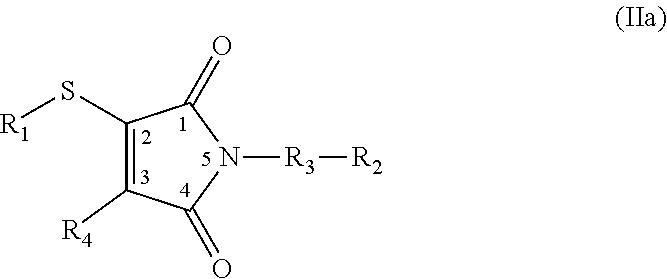
- Further, compounds of the formulae (Ic) can be readily made by hydrolysis of corresponding compounds of formulae (IIc) below.
-
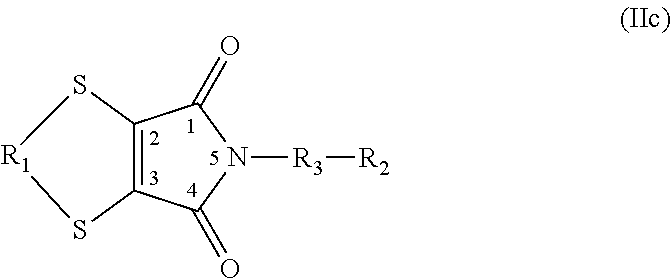
- Methods for making compounds having the general structures (II), (IIa) and (IIc) are described in detail in WO 2011/018611, the content of which is herein incorporated by reference in its entirety.
- Hydrolysis of such compounds to produce compounds of the present invention can be effected using known techniques for hydrolysis of maleimide compounds into maleaimic acid compounds (see for example Machida et al., Chem. Pharm. Bull. 1977 24 2739 and Ryan et al. Chem. Commun 2011 47 5452). One suitable method is to subject the compound of formula (II), (IIa) or (IIc) to mildly basic aqueous conditions (e.g., a pH of 7.1 or higher, for example 7.2 to 10), at a temperature of from 0 to 50° C. (e.g., from 20 to 40° C.). Any base or basic buffer solution could be used. LiOH is one suitable example. A PBS buffer solution at a pH of 7.4 is also effective.
- The pharmaceutical composition of the present invention is suitable for veterinary or human administration.
- The present pharmaceutical compositions can be in any form that allows for the composition to be administered to a patient. The composition may for example be in the form of a solid or liquid. Typical routes of administration include, without limitation, parenteral, ocular and intra-tumor. Parenteral administration includes subcutaneous injections, intravenous, intramuscular or intrasternal injection or infusion techniques. In one aspect, the compositions are administered parenterally. In a specific embodiment, the compositions are administered intravenously.
- Compositions can take the form of one or more dosage units, where for example, a tablet can be a single dosage unit, and a container of a compound of the present invention in liquid form can hold a plurality of dosage units.
- Materials used in preparing the pharmaceutical compositions are preferably non-toxic in the amounts used. It will be evident to those of ordinary skill in the art that the optimal dosage of the active ingredient(s) in the pharmaceutical composition will depend on a variety of factors. Relevant factors include, without limitation, the type of animal (e.g., human), the particular form of the compound of the present invention, the manner of administration, and the composition employed.
- The pharmaceutically acceptable diluent or carrier can be solid or particulate, so that the compositions are, for example, in tablet or powder form. The carrier(s) can be liquid. In addition, the carrier(s) can be particulate.
- The pharmaceutical composition can be in the form of a liquid, e.g., a solution, emulsion or suspension. In a composition for administration by injection, one or more of a surfactant, preservative, wetting agent, dispersing agent, suspending agent, buffer, stabilizer and isotonic agent can also be included.
- Liquid pharmaceutical compositions, whether they are solutions, suspensions or other like form, can also include one or more of the following; sterile diluents such as water for injection, saline solution, preferably physiological saline, Ringer's solution, isotonic sodium chloride, fixed oils such as synthetic mono or digylcerides which can serve as the solvent or suspending medium, polyethylene glycols, glycerin, cyclodextrin, propylene glycol or other solvents; antibacterial agents such as benzyl alcohol or methyl paraben; antioxidants such as ascorbic acid or sodium bisulfite; chelating agents such as ethylenediaminetetraacetic acid; buffers such as acetates, citrates, phosphates or amino acids and agents for the adjustment of tonicity such as sodium chloride or dextrose. A parenteral composition can be enclosed in ampoule, a disposable syringe or a multiple-dose vial made of glass, plastic or other material. Physiological saline is an exemplary adjuvant. An injectable composition is preferably sterile.
- The amount of the compound comprising a moiety of formula (I) or (I′) that is effective in the treatment of a particular disorder or condition will depend on the nature of the disorder or condition, and can be determined by standard clinical techniques. In addition, in vitro or in vivo assays can optionally be employed to help identify optimal dosage ranges. The precise dose to be employed in the compositions will also depend on the route of administration, and the seriousness of the disease or disorder, and should be decided according to the judgment of the practitioner and each patient's circumstances.
- The compositions comprise an effective amount of a compound comprising a moiety of formula (I) or (I′) such that a suitable dosage will be obtained. Typically, this amount is at least about 0.01% of compound comprising a moiety of formula (I) or (I′) by weight of the composition. In an exemplary embodiment, pharmaceutical compositions are prepared so that a parenteral dosage unit contains from about 0.01% to about 2% by weight of the compound comprising a moiety of formula (I) or (I′).
- For intravenous administration, the composition can comprise from about 0.01 to about 100 mg of a compound comprising a moiety of formula (I) or (I′) per kg of the patient's body weight. In one aspect, the composition can include from about 1 to about 100 mg of a compound comprising a moiety of formula (I) or (I′) per kg of the patient's body weight. In another aspect, the amount administered will be in the range from about 0.1 to about 25 mg/kg of body weight of the compound comprising a moiety of formula (I) or (I′).
- Generally, the dosage of compound comprising a moiety of formula (I) or (I′) administered to a patient is typically about 0.01 mg/kg to about 20 mg/kg of the patient's body weight. In one aspect, the dosage administered to a patient is between about 0.01 mg/kg to about 10 mg/kg of the patient's body weight. In another aspect, the dosage administered to a patient is between about 0.1 mg/kg and about 10 mg/kg of the patient's body weight. In yet another aspect, the dosage administered to a patient is between about 0.1 mg/kg and about 5 mg/kg of the patient's body weight. In yet another aspect the dosage administered is between about 0.1 mg/kg to about 3 mg/kg of the patient's body weight. In yet another aspect, the dosage administered is between about 1 mg/kg to about 3 mg/kg of the patient's body weight.
- The compound comprising a moiety of formula (I) or (I′) can be administered by any convenient route, for example by infusion or bolus injection. Administration can be systemic or local. Various delivery systems are known, e.g., encapsulation in liposomes, microparticles, microcapsules, capsules, etc., and can be used to administer a compound comprising a moiety of formula (I) or (I′). In certain embodiments, more than one compound comprising a moiety of formula (I) or (I′) is administered to a patient.
- In specific embodiments, it can be desirable to administer one or more compound comprising a moiety of formula (I) or (I′) locally to the area in need of treatment. This can be achieved, for example, and not by way of limitation, by local infusion during surgery; topical application, e.g., in conjunction with a wound dressing after surgery; by injection; by means of a catheter; or by means of an implant, the implant being of a porous, non-porous, or gelatinous material, including membranes, such as sialastic membranes, or fibers. In one embodiment, administration can be by direct injection at the site (or former site) of a cancer, tumor or neoplastic or pre-neoplastic tissue, in another embodiment, administration can be by direct injection at the site (or former site) of a manifestation of an autoimmune disease.
- The compound comprising a moiety of formula (I) or (I′) can be delivered in a controlled release system, such as but not limited to, a pump or various polymeric materials can be used. Also, a controlled-release system can be placed in proximity of the target of the compound comprising a moiety of formula (I) or (I′), e.g., the liver, thus requiring only a fraction of the systemic dose (see, e.g., Goodson, in Medical Applications of Controlled Release, supra, vol. 2, pp. 115-138 (1984)). Other controlled-release systems discussed in the review by Langer (Science 249:1527-1533 (1990)) can be used.
- The term “carrier or diluent” refers to a diluent, adjuvant or excipient, with which a compound comprising a moiety of formula (I) or (I′) is administered. Such pharmaceutical carriers can be liquids, such as water and oils, including those of petroleum, animal, vegetable or synthetic origin. The carriers can be saline, and the like. In addition, auxiliary, stabilizing and other agents can be used. Preferably, when administered to a patient, the compound comprising a moiety of formula (I) or (I′) and pharmaceutically acceptable carriers are sterile. Water is an exemplary carrier when the compound comprising a moiety of formula (I) or (I′) is administered intravenously. Saline solutions and aqueous dextrose and glycerol solutions can also be employed as liquid carriers, particularly for injectable solutions. The present compositions, if desired, can also contain minor amounts of wetting or emulsifying agents, or pH buffering agents.
- The present compositions can take the form of solutions, pellets, powders, sustained-release formulations, or any other form suitable for use. Other examples of suitable pharmaceutical carriers are described in “Remington's Pharmaceutical Sciences” by E. W. Martin.
- The compound comprising a moiety of formula (I) or (I′) may be formulated in accordance with routine procedures as a pharmaceutical composition adapted for intravenous administration to animals, particularly human beings. Typically, the carriers or vehicles for intravenous administration are sterile isotonic aqueous buffer solutions. Where necessary, the compositions can also include a solubilizing agent. Compositions for intravenous administration can optionally comprise a local anesthetic such as lidocaine to ease pain at the site of the injection. Generally, the ingredients are supplied either separately or mixed together in unit dosage form, for example, as a dry lyophilized powder or water free concentrate in a hermetically sealed container such as an ampoule or sachette indicating the quantity of active agent. Where a compound comprising a moiety of formula (I) or (I′) is to be administered by infusion, it can be dispensed, for example, with an infusion bottle containing sterile pharmaceutical grade water or saline. Where the compound comprising a moiety of formula (I) or (I′) is administered by injection, an ampoule of sterile water for injection or saline can be provided so that the ingredients can be mixed prior to administration.
- The composition can include various materials that modify the physical form of a solid or liquid dosage unit. For example, the composition can include materials that form a coating shell around the active ingredients. The materials that form the coating shell are typically inert, and can be selected from, for example, sugar, shellac, and other enteric coating agents. Alternatively, the active ingredients can be encased in a gelatin capsule.
- Whether in solid or liquid form, the present compositions can include a pharmacological agent used in the treatment of cancer.
- The compounds comprising a moiety of formula (I) or (I′) are particularly useful for treating cancer. Specifically, the compound comprising a moiety of formula (I) or (I′) is useful for inhibiting the multiplication of a tumor cell or cancer cell, causing apoptosis in a tumor or cancer cell, or for treating cancer in a patient. The compounds comprising a moiety of formula (I) or (I′) can be used accordingly in a variety of settings for the treatment of animal cancers.
- The compound comprising a moiety of formula (I) or (I′) can be used to deliver a therapeutically active agent to a tumor cell or cancer cell. The compounds of the present invention can thus be used in a method of ameliorating or reducing the incidence of cancer (such as those defined herein) in a subject, which method comprises the administration to the said subject of an effective amount of a compound comprising a moiety of formula (I) or (I′) and wherein R1 is an antibody or antibody fragment that is capable of specific binding to an antigen present on a cancerous cell and R2 is a cytotoxic agent.
- Examples of types of cancers that can be treated with a compound comprising a moiety of formula (I) or (I′) include, but are not limited to:
-
- Solid tumors, including but not limited to fibrosarcoma, myxosarcoma, liposarcoma, chondrosarcoma, osteogenic sarcoma, chordoma, angiosarcoma, endotheliosarcoma, lymphangiosarcoma, lymphangioendotheliosarcoma, synovioma, mesothelioma, Ewing's tumor, leiomyosarcoma, rhabdomyosarcoma, colon cancer, colorectal cancer, kidney cancer, pancreatic cancer, bone cancer, breast cancer, ovarian cancer, prostate cancer, esophogeal cancer, stomach cancer, oral cancer, nasal cancer, throat cancer, squamous cell carcinoma, basal cell carcinoma, adenocarcinoma, sweat gland carcinoma, sebaceous gland carcinoma, papillary carcinoma, papillary adenocarcinomas, cystadenocarcinoma, medullary carcinoma, bronchogenic carcinoma, renal cell carcinoma, hepatoma, bile duct carcinoma, choriocarcinoma, seminoma, embryonal carcinoma, Wilms' tumor, cervical cancer, uterine cancer, testicular cancer, small cell lung carcinoma, bladder carcinoma, lung cancer, epithelial carcinoma, glioma, glioblastoma multiforme, astrocytoma, medulloblastoma, craniopharyngioma, ependymoma, pinealoma, hemangioblastoma, acoustic neuroma, oligodendroglioma, meningioma, skin cancer, melanoma, neuroblastoma and retinoblastoma,
- blood-borne cancers, including but not limited to acute lymphoblastic leukemia “ALL”, acute lymphoblastic B-cell leukemia, acute lymphoblastic T-cell leukemia, acute myeloblastic leukemia “AML”, acute promyelocyte leukemia “APL”, acute monoblastic leukemia, acute erythroleukemic leukemia, acute megakaryoblastic leukemia, acute myelomonocytic leukemia, acute nonlymphocyctic leukemia, acute undifferentiated leukemia, chronic myelocytic leukemia “CML”, chronic lymphocytic leukemia “CLL”, hairy cell leukaemia and multiple myelomal
- acute and chronic leukemias such as lymphoblastic, myelogenous, lymphocytic and myelocytic leukemias; and
- lymphomas such as Hodgkin's disease, non-Hodgkin's Lymphoma, Multiple myeloma, Waldenstrom's macroglobulinemia, Heavy chain disease and Polycythemia vera.
- Further examples of cancers susceptible to treatment according to the present invention are those herein disclosed in parentheses in conjunction with specific antibodies or antibody fragments as herein disclosed.
- The present invention further provides a compound comprising a moiety of formula (I) or (I′) for use in a method of treatment of the human or animal body by therapy. Typically the method of treatment is a method of treatment of cancer, wherein R1 is an antibody or antibody fragment that is capable of specific binding to an antigen present on a cancerous cell and R2 is a cytotoxic agent. Types of cancer are again those outlined elsewhere herein.
- The following Examples, which do not limit the scope of the invention, further illustrate the principles of the present invention.
-
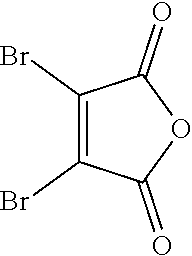
- Under an inert atmosphere, a mixture of maleic anhydride (1.50 g, 15.3 mmol), AlCl3 (0.30 g, 0.21 mmol) and Br2 (1.57 mL, 30.6 mmol) was heated at 160° C. in a sealed ampule for 20 h. Upon cooling to room temperature the reaction mixture was carefully opened to air, EtOAc was added the solid filtered off and repeatedly washed with further EtOAc. The filtrate was finally concentrated in vacuo to give the title compound (I) as a yellow solid (3.25 g, 12.8 mmol, 83%).
- m.p. 107-110° C.; νmax (cm−1) 1769, 1706, 1590; δC (CDCl3, 125 MHz) 164.4 (s), 125.9 (s); HRMS (CI) calculated for C4O3Br2 [M]+ 253.82087, observed: 253.82082.
-
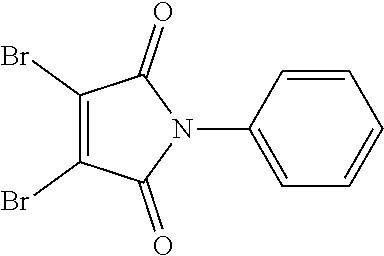
- 2,3-dibromo-maleic anhydride 1 (0.50 g, 1.97 mmol) was dissolved in AcOH (25 mL) and aniline (0.180 mL, 1.97 mmol) was added. The mixture was stirred at room temperature for 3 h and then at 130° C. for 90 min. Then the mixture was concentrated to dryness and traces of AcOH were removed by repetitive addition and concentration of toluene. The crude residue was purified by flash chromatography to give the title compound as a pale yellow solid (0.37 g, 1.12 mmol, 57%).
- Rf 0.35 (10% EtOAc/petroleum ether); m.p. 136-138° C.; νmax (cm−1) 3058, 1727, 1715, 1646, 1610, 1598, 1501, 1382, 1265, 1113; δH (CDCl3, 500 MHz) 7.48-747 (2H, m, ArH), 7.44-7.40 (1H, m, ArH), 7.33 (2H, d, J=7.2 Hz, ArH); δC (CDCl3, 150 MHz) 163.0, 132.8, 130.8, 129.5, 128.8, 126.2; HRMS (EI) calculated for C10H5O2NBr2 328.86816, observed 328.86854.
-
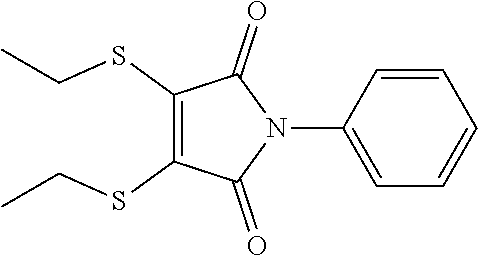
- To a solution of N-phenyl-dibromomaleimide 2 (237 mg, 0.72 mmol) in DCM (30 mL) were added ethanethiol (0.11 mL, 1.50 mmol) and NEt3 (0.21 mL, 1.50 mmol) and the mixture was stirred for 15 min at room temperature and then concentrated to dryness. The crude residue was purified by flash chromatography to give the desired product (195 mg g, 0.66 mmol, 93%).
- Rf 0.36 (10% EtOAc/petroleum ether); νmax (cm−1) 2965, 2926, 2851, 1706, 1598, 1501, 1371; δH (CDCl3, 600 MHz) 7.48-7.44 (2H, m, ArH), 7.37-7.33 (3H, m, ArH), 3.37 (4H, q, J=7.4 Hz, CH3CH2S), 1.38 (6H, t, J=7.4 Hz, CH3CH2S); δC (CDCl3, 150 MHz) 165.5, 135.7, 131.6, 129.2, 128.0, 126.2, 26.5, 15.8; HRMS (EI) calculated for C14H15O2NS2 293.05387, observed 293.05403.
-
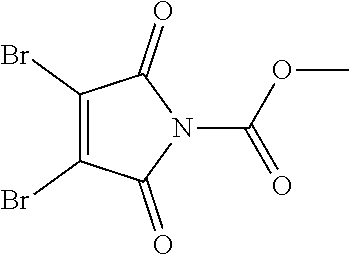
- To a solution of dibromomaleimide (1.00 g, 3.9 mmol) and N-methylmorpholine (0.433 mL, 3.9 mmol) in THF (35 mL) was added methylchloroformate (0.304 mL, 3.9 mmol) and the mixture was stirred for 20 min at room temperature. Then CH2Cl2 (40 mL) was added, the organic phase was washed with H2O, dried over MgSO4 and the solvent removed in vacuo to yield the desired product as a pink powder (1.18 g, 3.8 mmol, 97%).
- m.p. 115-118° C.; νmax (cm−1) 3236, 2962, 1809, 1769, 1730, 1602; δH (CDCl3, 500 MHz) 4.00 (3H, s, CH3); δC (CDCl3, 125 MHz) 159.3, 147.0, 131.5, 54.9; MS (CI) m/z (%) 314 (M+H, 100), 206 (13), 111 (12); Mass calculated for C6H3O4N79Br2: 310.8423, observed: 310.8427.
-
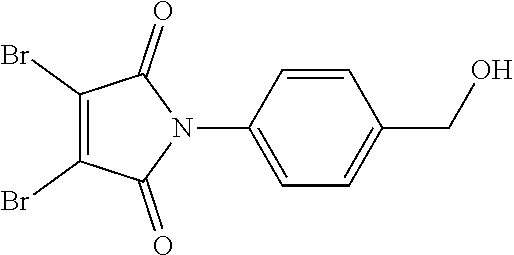
- To a solution of N-methoxycarbonyl-dibromomaleimide 4 (300 mg, 0.965 mmol) in DCM (42 mL) was added 4-aminobenzylalcohol (119 mg, 0.965 mmol). After 2 h of stirring at room temperature the mixture was concentrated to dryness and the crude residue was purified by flash chromatography to give the desired compound as a yellow solid (345 mg, 0.955 mmol, 99%).
- Rf 0.53 (70% EtOAc/petroleum ether); m.p. 217-220° C.; νmax (cm−1) 3364, 1732, 1714, 1610, 1519, 1403, 809; δH (CDCl3, 600 MHz) 7.49 (2H, d, J=8.4 Hz, ArH), 7.33 (2H, d, J=8.4 Hz, ArH), 4.75 (2H, s, CH2OH); δC (CDCl3, 150 MHz) 163.0, 141.6, 130.2, 130.0, 127.8, 126.3, 64.7; Mass calculated for C11H7O3NBr2: 358.87871, observed: 358.87983.
-
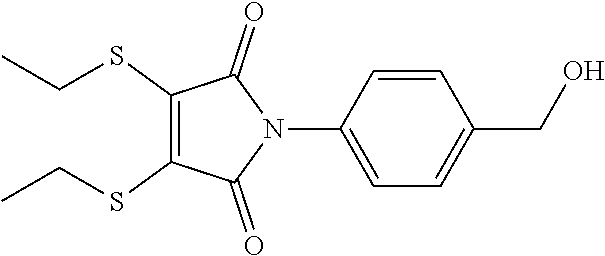
- To a solution of N-hydroxymethylphenyl-dibromomaleimide 5 (315 mg, 0.872 mmol) in DCM (40 mL) were added ethanethiol (0.18 mL, 2.33 mmol) and NEt3 (0.33 mL, 2.33 mmol) and the mixture was stirred for 1 h at room temperature and then concentrated to dryness. The crude residue was purified by flash chromatography to afford the desired compound as a yellow solid (242 mg, 0.748 mmol, 86%).
- Rf 0.55 (70% EtOAc/petroleum ether); m.p. 50-52° C.; νmax (cm−1) 3381, 2967, 2928, 2869, 1702, 1514, 1373, 1190; δH (CDCl3, 600 MHz) 7.45 (2H, d, J=8.4 Hz, ArH), 7.33 (2H, d, J=8.4 Hz, ArH), 4.72 (2H, s, CH2OH), 3.37 (4H, q, J=7.4 Hz, CH3CH2S), 1.37 (6H, t, J=7.4 Hz, CH3CH2S); δC (CDCl3, 150 MHz) 165.5, 140.7, 135.7, 130.9, 127.6, 126.3, 64.9, 26.5, 15.8; Mass calculated for C15H17O3NS2: 323.06443, observed: 323.06342.
-
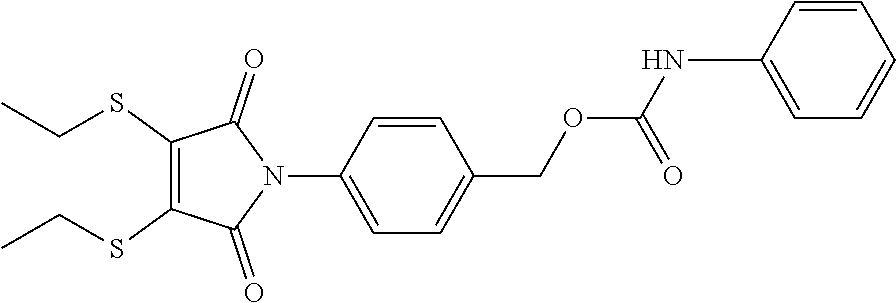
- To a solution of N-hydroxymethylphenyl-diethylthiolmaleimide 6 (100 mg, 0.309 mmol) in DCM (14 mL) were added phenylisocyanate (0.035 mL, 0.322 mmol) and NEt3 (0.091 mL, 0.653 mmol) and the mixture was stirred for 2 days at room temperature and then concentrated to dryness. The crude residue was purified by flash chromatography to afford the desired compound as a yellow solid (84 mg, 0.190 mmol, 62%).
- Rf 0.69 (50% EtOAc/petroleum ether); m.p. 97-99° C.; νmax (cm−1) 3374, 2964, 2928, 1733, 1705, 1598, 1532, 1444, 1378, 1208; δH (CDCl3, 600 MHz) 7.49 (2H, d, J=8.3 Hz, ArHCH2O), 7.39-7.35 (4H, m, ArHCH2O and ArHNH), 7.32-7.30 (2H, m, ArHNH), 7.07 (1H, t, J=7.4 Hz, ArHNH), 6.66 (1H, br s, NH), 5.22 (2H, s, CH2OCONH), 3.37 (4H, q, J=7.4 Hz, CH3CH2S), 1.37 (6H, t, J=7.4 Hz, CH3CH2S); δC (CDCl3, 150 MHz) 165.4, 153.2, 137.7, 135.8, 131.6, 129.2, 129.1, 126.3, 126.2, 123.7, 118.8, 66.4, 26.5, 15.8; Mass calculated for C22H22N2O4NaS2: 465.0919, observed: 465.0923.
-

- N-Phenyl-diethylthiolmaleimide 3 (19.0 mg, 0.065 mmol) was dissolved in a mixture of CD3OD/D2O 1/1 (2 mL) and LiOH (146 mg, 3.48 mmol) was added. The solution was stirred at room temperature for 24 h to generate the desired maleamic acid, lithium salt
-

- δH (CD3OD, 600 MHz) 7.46 (2H, d, J=7.8 Hz, ArH), 7.38 (2H, t. J=7.8 Hz, ArH), 7.18 (1H, t, J=7.8 Hz, ArH), 2.90 (2H, q, J=7.5 Hz, CH3CH2S), 2.80 (2H, q, J=7.5 Hz, CH3CH2S), 1.31 (3H, t, J=7.5 Hz, CH3CH2S), 1.29 (3H, t, J=7.5 Hz, CH3CH2S; δC (CD3OD, 150 MHz) 171.7, 166.0, 156.9, 139.6, 130.4, 130.3, 126.3, 122.8, 122.7, 119.9, 28.9, 28.0, 15.7, 15.3.
- The solution was then acidified with 2N HCl to pH 4 and extracted with EtOAc. The resulting organic layer was washed with brine, dried over MgSO4, filtered and concentrated to obtain 8 (14.0 mg, 0.065 mmol 100%).
- νmax (cm−1) 2969, 2930, 1761, 1518, 1379, 1244; δH (CDCl3, 600 MHz) 3.37 (4H, q, J=7.4 Hz, CH3CH2S), 1.36 (6H, t, J=7.4 Hz, CH3CH2S); δC (CDCl3, 150 MHz) 160.4, 136.9, 26.5, 15.8; HRMS (EI) calculated for C8H10O3S2 218.00659, observed 218.00712.
-
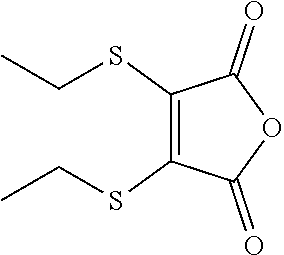
- N-Hydroxymethylphenyl-diethylthiolmaleimide 6 (17.5 mg, 0.054 mmol) was dissolved in a mixture of CD3OD/D2O 1/1 (1.6 mL) and LiOH (102 mg, 2.44 mmol) was added. The solution was stirred at room temperature for 30 min to generate the desired maleamic acid, lithium salt.
-
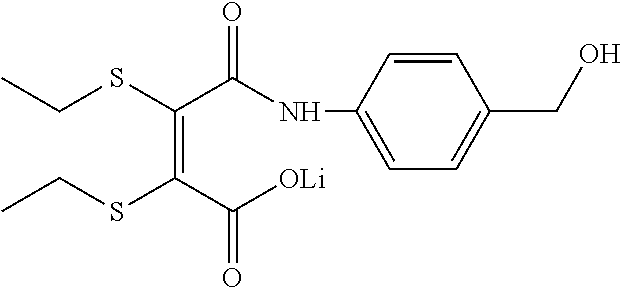
- δH (CD3OD, 600 MHz) 7.44 (2H, d, J=8.7 Hz, ArH), 7.36 (2H, d, J=8.7 Hz, ArH), 4.59 (2H, s, CH2OH), 2.90 (2H, q, J=7.2 Hz, CH3CH2S), 2.80 (2H, q, J=7.2 Hz, CH3CH2S), 1.31 (3H, t, J=7.2 Hz, CH3CH2S), 1.29 (3H, t, J=7.2 Hz, CH3CH2S).
- The solution was then acidified with 2N HCl to pH 4 and extracted with EtOAc. The resulting organic layer was washed with brine, dried over MgSO4, filtered and concentrated to obtain 8 (11.6 mg, 0.053 mmol 98%).
-
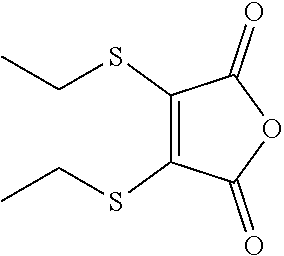
- p-(diethylthiolmaleimide)-benzyl phenylcarbamate 7 (19.5 mg, 0.044 mmol) was dissolved in a mixture of CD3OD/D2O 1/1 (1.6 mL) and LiOH (102 mg, 2.44 mmol) was added. The solution was stirred at room temperature for 2 h to generate the desired maleamic acid, lithium salt.
-

- δH (CD3OD, 600 MHz) 7.52 (2H, d, J=8.3 Hz, ArHCH2O), 7.41 (2H, d, J=8.3 Hz, ArHCH2O), 7.38-7.36 (2H, m, ArHNH), 7.31 (2H, t, J=7.2 Hz, ArHNH), 7.07 (1H, t, J=7.2 Hz, ArHNH), 5.14 (2H, s, CH2OCONH), 2.91 (2H, q, J=7.5 Hz, CH3CH2S), 2.79 (2H, q, J=7.5 Hz, CH3CH2S), 1.30 (3H, t, J=7.5 Hz, CH3CH2S), 1.28 (3H, t, J=7.5 Hz, CH3CH2S).
- The solution was then acidified with 2N HCl to pH 4 and the mixture was stirred overnight. Then it was extracted with EtOAc and the resulting organic layer was washed with brine, dried over MgSO4, filtered and concentrated to obtain 8 (9.6 mg, 0.044 mmol 100%).
-
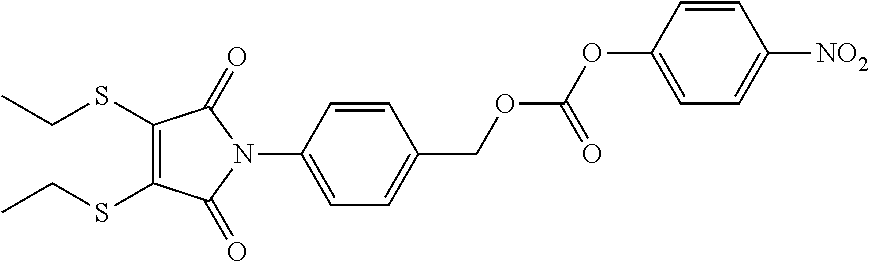
- To a solution of N-hydroxymethylphenyl-diethylthiolmaleimide 6 (40 mg, 0.124 mmol) in dry THF (3 mL) were added 4-nitrophenylchloroformate (30 mg, 0.148 mmol) and pyridine (0.012 mL, 0.148 mmol) and the mixture was stirred for 24 h at room temperature. Then EtOAc (10 mL) and 10% aqueous citric acid (10 mL) were added and the organic layer was washed with H2O and brine, dried over MgSO4, filtered and concentrated. The crude residue was purified by flash chromatography to afford the title compound (52 mg, 0.106 mmol, 86%).
- Rf 0.68 (50% EtOAc/petroleum ether); νmax (cm−1) 3386, 2929, 1707, 1593, 1516, 1499, 1339, 1289, 1111; δH (CDCl3, 600 MHz) 8.26 (2H, d, J=8.4 Hz, ArHNO2), 7.52 (2H, d, J=8.4 Hz, ArHNO2), 7.39 (2H, d, J=8.5 Hz, ArHCH2O), 7.36 (2H, d, J=8.5 Hz, ArHCH2O), 5.30 (2H, s, CH2OCO2), 3.36 (4H, q, J=7.4 Hz, CH3CH2S), 1.37 (6H, t, J=7.4 Hz, CH3CH2S); δC (CDCl3, 150 MHz) 165.4, 155.6, 152.5, 145.5, 135.8, 133.8, 132.3, 129.5, 126.5, 125.2, 122.0, 70.3, 26.5, 15.8; Mass calculated for C22H20O7N2S2: 488.07064, observed: 488.06954.
-
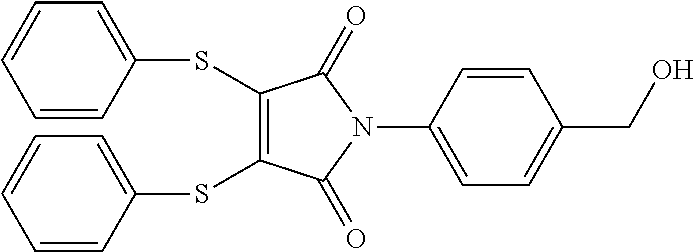
- To a solution of N-hydroxymethylphenyl-dibromomaleimide 5 (139 mg, 0.385 mmol) in DCM (18 mL) was added NEt3 (0.145 mL, 1.04 mmol) and phenylthiol (0.08 mL, 0.809 mmol) and the mixture was stirred for 30 min at room temperature and then concentrated to dryness. The crude residue was purified by flash chromatography to afford a yellow solid (159 mg, 0.378 mmol, 98%).
- Rf 0.63 (70% EtOAc/petroleum ether); m.p. 111-113° C.; νmax (cm−1) 3388, 3057, 2928, 2874, 1705, 1515, 1381, 735; δH (CDCl3, 600 MHz) 7.46 (2H, d, J=8.4 Hz, ArHCH2OH), 7.32 (2H, d, J=8.4 Hz, ArHCH2OH), 7.31-7.26 (5H, m, ArHS), 4.70 (2H, s, CH2OH); δC (CDCl3, 150 MHz) 165.8, 140.7, 135.8, 132.2, 130.8, 129.2, 128.8, 128.7, 127.6, 126.1, 64.9; Mass calculated for C23H17O3NS2: 419.06498, observed: 419.06531.
-
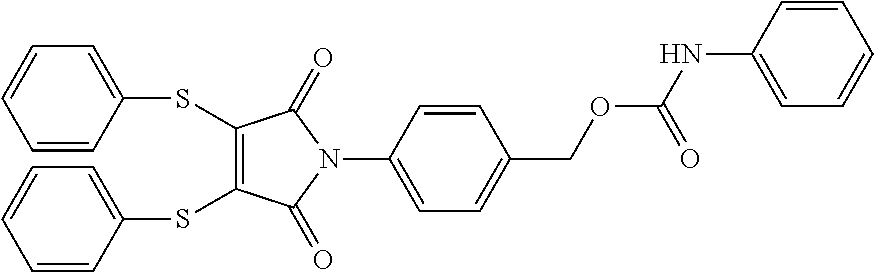
- To a solution of N-hydroxymethylphenyl-diphenylthiolmaleimide 10 (105 mg, 0.251 mmol) in DCM (12 mL) were added phenylisocyanate (0.028 mL, 0.263 mmol) and NEt3 (0.073 mL, 0.526 mmol) and the mixture was stirred for 2 days at room temperature and then concentrated to dryness. The crude residue was purified by flash chromatography to afford the title compound as a yellow solid (107 mg, 0.198 mmol, 79%).
- Rf 0.48 (30% EtOAc/petroleum ether); m.p. 130-132° C.; νmax (cm−1) 3367, 2928, 1714, 1600, 1535, 1444, 1384, 1218; δH (CDCl3, 600 MHz) 7.45 (2H, d, J=8.4 Hz, ArHCH2O), 7.37-7.33 (4H, m, ArHCH2O and ArHNH), 7.32-7.21 (12H, m, ArHNH and ArHS), 7.07 (1H, t, J=7.4 Hz, ArHNH), 6.54 (1H, br s, NH), 5.18 (2H, s, CH2OCONH); δC (CDCl3, 150 MHz) 165.7, 153.2, 137.7, 135.8, 132.3, 131.5, 129.5, 129.2, 129.2, 129.0, 128.8, 128.7, 126.0, 121.5, 118.8, 66.4; Mass calculated for C30H22N2O4NaS2: 561.0919, observed: 561.0939.
-
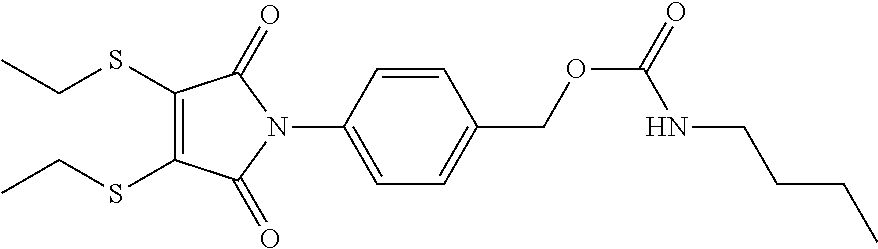
- A solution of p-(diethylthiolmaleimide)-benzyl 4-nitrophenyl carbonate 9 (44.3 mg, 0.091 mmol) and butylamine (0.01 mL, 0.100 mmol) in NMP (4 mL) at room temperature were treated with Et3N (0.014 mL, 0.100 mmol). The mixture was allowed to stand in the dark for 2 days and then it was diluted with EtOAc and was washed with H2O and brine, dried over MgSO4, filtered and concentrated in vacuo. The crude residue was purified by column chromatography to give the title product as yellow oil (17.6 mg, 0.042 mmol, 46%).
- Rf 0.53 (30% EtOAc/petroleum ether); νmax (cm−1) 3350, 2960, 2930, 2871, 1709, 1518, 1380, 1247; δH (CDCl3, 600 MHz) 7.44 (2H, d, J=8.2 Hz, ArH), 7.32 (2H, d, J=8.2 Hz, ArH), 5.10 (2H, s, CH2OCONH), 4.74 (1H, br s, NH), 3.36 (4H, q, J=7.4 Hz, CH3CH2S), 3.19 (2H, q, J=6.7 Hz, CH2NH), 1.51-1.46 (2H, m, CH3CH2CH2CH2NH), 1.37 (6H, t, J=7.4 Hz, CH3CH2S), 1.36-1.30 (2H, m, CH3CH2CH2CH2NH), 0.92 (3H, t, J=7.3 Hz, CH3CH2CH2CH2NH); δC (CDCl3, 150 MHz) 165.4, 156.3, 136.5, 135.8, 131.3, 128.9, 126.2, 66.9, 40.9, 32.1, 26.4, 20.0, 15.8, 13.9; Mass calculated for C20H26N2O4NaS2: 445.1232, observed: 445.1232.
-

- To a solution of N-hydroxymethylphenyl-diphenylthiolmaleimide 10 (30 mg, 0.071 mmol) in DCM (2 mL) were added 4-nitrophenylchloroformate (17 mg, 0.085 mmol) and pyridine (0.007 mL, 0.085 mmol) and the mixture was stirred for 24 h at room temperature. Then DCM (10 mL) and 10% aqueous citric acid (10 mL) were added and the organic layer was washed with H2O and brine, dried over MgSO4, filtered and concentrated. The crude residue was purified by flash chromatography to afford the title compound (30 mg, 0.051 mmol, 72%).
- Rf 0.63 (50% EtOAc/petroleum ether); νmax (cm−1) 3080, 1767, 1714, 1594, 1520, 1382, 1339, 1260, 1213; δH (CDCl3, 600 MHz) 8.27 (2H, d, J=8.3 Hz, ArHNO2), 7.49 (2H, d, J=8.3 Hz, ArHNO2), 7.40 (2H, d, J=8.3 Hz, ArHCH2O), 7.37 (2H, d, J=8.3 Hz, ArHCH2O), 7.33-7.26 (10H, m, ArHS) 5.28 (2H, s, CH2OCO2); δC (CDCl3, 150 MHz) 165.6, 155.5, 152.5, 147.6, 135.9, 133.8, 132.3, 132.1, 129.5, 129.2, 128.8, 128.7, 126.2, 125.5, 121.9, 70.3.
-

- A solution of p-(diphenylthiolmaleimide)-benzyl 4-nitrophenyl carbonate 13 (9.8 mg, 0.017 mmol) and DOX.HCl (10 mg, 0.018 mmol) in NMP (0.3 mL) at room temperature were treated with Et3N (0.0025 mL, 0.018 mmol). The mixture was allowed to stand in the dark for 3 days and then it was diluted with 10% i-propanol/EtOAc and was washed with H2O and brine, dried over MgSO4, filtered and concentrated in vacuo. The crude residue was purified by column chromatography to give the title product as yellow oil (16.4 mg, 0.0166 mmol, 99%).
- Rf 0.35 (5% MeOH/DCM); [α]D 20=+91.3 (c 1.1, CHCl3); νmax (cm−1) 3481, 3080, 1716, 1580, 1517, 1383, 1286, 1073, 987; δH (CDCl3, 600 MHz) 13.96 (1H, s, DOX), 13.22 (1H, s, DOX), 8.02 (1H, d, J=8.2 Hz, DOX), 7.77 (1H, d, J=8.2 Hz), 7.38 (2H, d, J=8.2 Hz, DOX), 7.34 (2H, d, J=8.2 Hz, ArHCH2), 7.31-7.22 (12H, m, ArHCH2 (2) and ArHS (10)), 5.49 (1H, br s, DOX), 5.27 (1H, br s, DOX), 5.18 (1H, d, J=8.6 Hz, DOX), 5.03-4.98 (2H, m, DOX), 4.75 (2H, s, CH2O), 4.14-4.10 (1H, m, DOX), 4.07 (3H, s, DOX), 3.86-3.82 (1H, m, DOX), 3.65 (1H, s, DOX), 3.25 (1H, d, J=18.7 Hz, DOX), 2.98 (1H, d, J=18.7 Hz), 2.32 (1H, d, J=14.6 Hz, DOX), 2.16 (1H, dd, J=14.6 and 4.0 Hz, DOX), 1.86 (1H, dd, J=13.4 and 4.9 Hz, DOX), 1.79-1.76 (1H, m, DOX), 1.27 (3H, d, J=6.6 Hz, DOX); δC (CDCl3, 150 MHz) 214.0, 187.2, 186.8, 165.7, 161.1, 156.3, 155.7, 155.5, 136.1, 135.9, 135.7, 135.6, 133.7, 132.2, 131.2, 129.2, 129.2, 128.9, 128.9, 128.7, 125.9, 120.9, 120.0, 118.6, 111.7, 111.5, 100.8, 76.7, 69.7, 69.6, 67.4, 66.1, 65.7, 56.8, 47.1, 35.7, 34.1, 30.2, 17.0; Mass calculated for C51H44N2O15NaS2: 1011.2081, observed: 1011.2122.
- LCMS was performed on protein samples using a Waters Acquity UPLC connected to Waters Acquity Single Quad Detector [column, Acquity UPLC BEH C18 1.7 μm 2.1×50 mm; wavelength, 254 nm; mobile phase, 95:5 water (0.1% formic acid): MeCN (0.1% formic acid), gradient over 4 min to 5:95 water (0.1% formic acid): MeCN (0.1% formic acid); flow rate, 0.6 mL/min; MS mode, ES+/−; scan range, m/z=95-2000; scan time, 0.25 s]. Data were obtained in continuum mode. Sample volume was 30 μl and injection volumes were 3-9 μl with partial loop fill. The electron spray source of the MS was operated with a capillary voltage of 3.5 kV and a cone voltage of 20-200 V. Nitrogen was used as the nebulizer and desolvation gas at a total flow of 600 L/h. Total mass spectra were reconstructed from the ion series using the MaxEnt 1 algorithm pre-installed on MassLynx software.
- Relative quantification of MS data was carried out by normalisation of all identifiable peptide or protein signals (starting material, product, side and degradation products) to 100% according to their unmodified signal strength (relative ion count).
- Absorbance measurements were carried out on a Carry Bio 100 (Varian) UV/Vis spectrophotometer equipped with a temperature-controlled 12× sample holder in quartz cuvettes (1 cm path length, volume 75 μl) at 25° C. Samples were baseline corrected and slits set to 5 nm. Protein solutions were scanned from 450-250 nm and concentration calculated using either the published or calculated (based on the amino acid sequence via the ProtParam tool of the ExPASy data base; http://expasy.org/sprot/) molar extinction coefficients with Lambert Beers law.
- Anti-CEA is single chain antibody fragment directed against the most N-terminal (extracellular) Ig domain of human CEA which it binds with low nM affinity. The original scFv is a mouse antibody isolated from a phage display and is produced in large quantities in bacteria (E. coli). The construct used in this work (internal name shMFELL2Cys) is a humanised version (28 amino acid substitutions) comprising the variable domain of a heavy and a light chain respectively which are connected by a peptide linker and has a MW of 26,742 Da (246 amino acids). A His6-tag has been added to the C-terminus to facilitate purification and an artificial disulfide bond was introduced opposite to the antigen binding site (G44C and A239C) to stabilise the protein. A crystal structure of the parental antibody is available (PDB code: 1QOK). The material supplied by Dr Berend Tolner (UCL Cancer Institute) was to 90% pure as estimated from SDS-PAGE analysis.
- Anti-CEA was supplied in PBS (pH 7.4) in varying concentrations and stored in aliquots at −20° C. The antibody fragment was diluted in PBS (pH 7.4) and DMF (
final amount 20% v/v) to yield a concentration of 70.0 μM (1.87 mg/ml) prior to experimentation. An extinction coefficient of ε280=48735 M−1 cm−1 was used to calculate protein concentrations. - To anti-CEA were added 20 equiv of p-(diphenylthiolmaleimide)-benzyl phenylcarbamate 11 (in DMF) followed by 15 equiv of benzeneselenol (in DMF). The reaction was maintained at ambient temperature for 20 min, after which another portion of benzeneselenol was added. The sample was analysed by LCMS after 45 min and showed 99% conversion to anti-CEA linked via maleimide to benzyl phenylcarbamate (required mass 27,060 Da).
- Anti-CEA linked via maleimide to benzyl phenylcarbamate was prepared as described and the excess of the maleimide compound was removed by purification on PD MiniTrap G-25 desalting columns (GE Healthcare) following manufacturers' instructions. The concentration of the protein solution was determined by UV/Vis spectroscopy.
- The modified antibody (in PBS, pH 7.4) was incubated at ambient temperature or at 37° C. for 6 h and aliquots were withdrawn at 1, 2, 4 and 6 h and subjected to LCMS to analyse for hydrolysis of the maleimide bridge to produce the desired thiomaleamic acid construct (required mass 27,078 Da). Full hydrolysis was observed at 37° C. after 6 h, as shown in
FIG. 1 . - Anti-CEA linked via maleimide to benzyl phenylcarbamate was prepared, purified and the concentration determined as described.
- Anti-CEA linked via maleimide to benzyl phenylcarbamate (in PBS, pH 7.4) was incubated at 37° C. for 5 d. Aliquots were removed every 24 h and analysed for degradation products of the maleimide compound by LCMS. No prominent mass ions corresponding to potential fragmentation of the linker were observed.
- Anti-CEA linked via maleimide to benzyl phenylcarbamate was prepared, purified and the concentration determined as described. The material was incubated for 20 h at 37° C. and complete hydrolysis confirmed by LCMS. The resulting thiomaleamic acid construct was then transferred into a pH 4.0 or pH 5.0 buffer (50 mM citric acid, 150 mM sodium chloride) on PD MiniTrap G-25 desalting columns and the eluate concentrated with ultrafiltration columns (5 kDa MWCO, Sartorius).
- The samples were incubated at 37° C. and aliquots withdrawn and analysed by LCMS after 0.5, 2, 5, 24 and 48 h. Disassembly of the linker and formation of the antibody fragment with maleic acid inserted into the disulfide bond (required mass 26,854 Da) was observed with great efficiency (>90% conversion in both cases after 48 h).
- Anti-CEA was prepared in PBS, pH 7.4, 10% DMF (v/v), 20% MeCN (v/v) at the concentration described above. To the antibody fragment were added 5 equiv of p-(diphenylthiolmaleimide)-benzyl DOXcarbamate 14 (in DMF) followed by 25 equiv of benzeneselenol (in DMF). Full conversion to an anti-CEA-DOX conjugate (required mass 27,510 Da) was observed by LCMS after 30 min at ambient temperature.
- The anti-CEA-DOX conjugate was prepared as described and purified on PD MiniTrap G-25 desalting columns. The material was incubated for 20 h at 37° C. and complete hydrolysis to the desired thiomaleamic acid construct confirmed by LCMS (required mass 27,528 Da). The buffer-pH (PBS, pH 7.4) was then changed to pH 4.5 (50 mM citric acid, 150 mM sodium chloride) via PD MiniTrap G-25 desalting columns and the eluate concentrated with ultrafiltration columns (5 kDa MWCO).
- The thiomaleamic acid construct was incubated at 37° C. and aliquots analysed after 0.5, 2, 5, 24 and 48 h by LCMS. Doxorubicin was released upon linker disassembly and anti-CEA-maleic acid formed in >80% yield (after 48 h). The appearance of free doxorubicin could be monitored in addition to the anti-CEA maleic acid.
- Immobilized pepsin (0.15 mL) was washed 4× with buffer (20 mM sodium acetate, pH 3.1) and Trastuzumab (0.5 mL, 6.41 mg/mL in the same buffer) was added. The mixture was incubated for 5 h at 37° C. under agitation (1,100 rpm). The resin was separated from the digest using a filter column, and washed 3× with digest buffer (50 mM sodium phosphate, 1 mM EDTA, 150 mM NaCl, pH 6.8). The digest was combined with the washes and the volume adjusted to 0.5 mL (Trastuzumab-Fab2, observed mass by LCMS: 97,303 Da).
- Immobilised papain (1 mL, 0.25 mg/mL) was activated with 10 mM DTT (in digest buffer) under an argon atmosphere and constant agitation (1,100 rpm) for 1 h at 25° C. in the dark. The resin was washed 4× with digest buffer (without DTT) and the 0.5 mL of Trastuzumab-Fab2 solution was added. The mixture was incubated for 16 h at 37° C. under constant agitation (1,100 rpm) in the dark. The resin was separated from the digest using a filter column, washed 3× with PBS (pH 7.0) and the digest combined with the washes. The buffer was exchanged completely for PBS using ultrafiltration columns (5 kDa MWCO) and the volume adjusted to 0.4 mL.
- The digest was analysed by SDS-PAGE, LCMS (observed mass 47,650 Da) and the concentration of the FAb fragment was determined by UV/VIS using a molecular extinction coefficient of 280=68,590 M−1 cm−1. Yield [Fab]: 400 μl of a 3.33 mg/mL solution (64%).
-
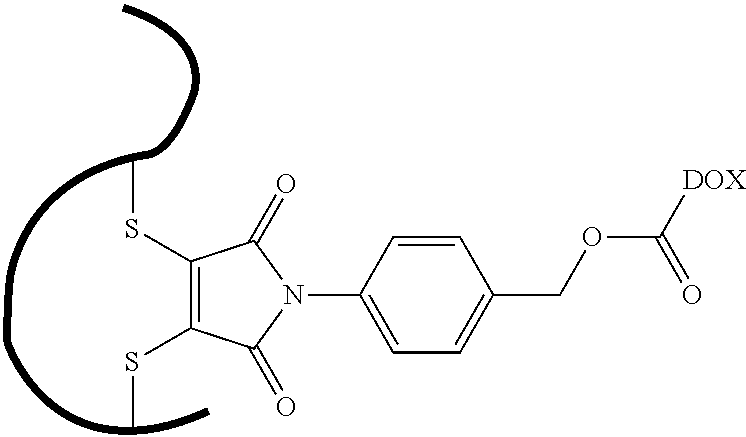
- To a solution of Trastuzumab-Fab (50 μL, 1.72 mg/mL) in borate buffer (25 mM sodium borate, 25 mM NaCl, 1 mM EDTA, pH 8.0), was added TCEP (15 μL, 0.103 mg/mL, 3 equiv) and after incubation at 90 min at 37° C., MeCN (13 μL, 20% v/v), DMF (6.5 μL, 10% v/v) and p-(diphenylthiolmaleimide)-benzyl phenylcarbamate in DMF (1.15 μL, 7.82 mg/mL, 5 equiv) were added. The reaction was maintained at 37° C. for 1 h and analysed by LCMS, showing quantitative conversion to the desired Trastuzumab-Fab-DOX conjugate (observed mass 48,429 Da).
-
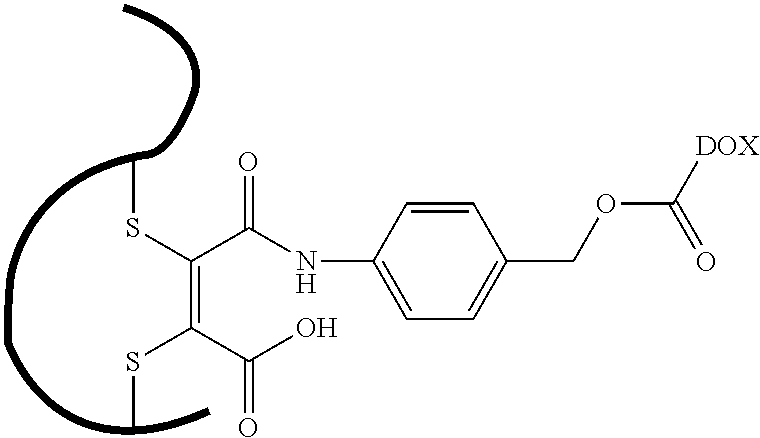
- The Trastuzumab-Fab-DOX conjugate 1 was prepared as described above and the buffer was exchanged for PBS (pH 7.4). The sample was incubated at 37° C. for 20 h and complete hydrolysis to yield
conjugate 2 confirmed by LCMS (observed mass 48,433 Da). - Trastuzumab-Fab-
DOX conjugate 2 was incubated for 3 d at 37° C. No degradation products were observed by LCMS. - DOX is Released from Trastuzumab-Fab-
DOX Conjugate 2 at Lysosomal pH -
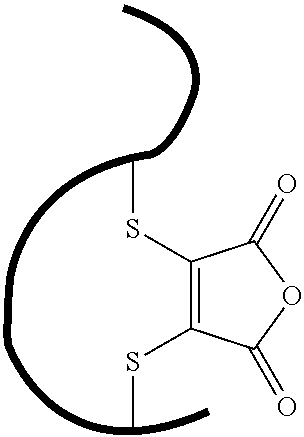
- Trastuzumab-Fab-
DOX conjugate 2 was prepared as described. The pH was then changed by ultrafiltration (10 kDa MWCO, Sartorius) to pH 4.5 (50 mM citric acid, 150 mM sodium chloride). The antibody conjugate was incubated at 37° C. and aliquots were analysed after 2, 6, 24, 48 and 72 h by LCMS. Doxorubicin was released upon linker disassembly and Trastuzumab-Fab-maleic anhydride formed (mass 47740 Da, quantitative conversion over 72 h). - Binding of Trastuzumab-Fab to HER2 is Maintained after Conjugation of Linker-DOX
- The Trastuzumab-Fab-DOX conjugate was prepared and purified as described. A ‘processed Trastuzumab-Fab sample’ was prepared as a control by subjecting Trastuzumab-Fab to all conjugation conditions other than reducing agent. The concentration of the material was measured using a Bradford standard curve (Quick Start Bardford Kit, BioRad). ELISA plates were coated with soluble HER2 diluted to a final concentration of 0.25 μg/ml in PBS, incubated for 2 h at ambient temperature, washed and blocked over night at 4° C. with a 1% BSA solution (in PBS, Sigma-Aldrich). Plates were washed and the Trastuzumab-Fab and its analogues were added after dilution to the indicated concentrations (typically 30.0, 10.0, 3.33, 1.11, 0.37 and 0.12 nM) in PBS. The assay was incubated at ambient temperature for 2 h, washed and the primary antibody (anti-human IgG, Fab-specific-HRP, 1:5,000 in PBS) added. The plates were washed after 1 h at ambient temperature and freshly prepared substrate solution (one tablet of o-phenylenediamine in 25 ml 50 μM phosphate citrate buffer, Sigma-Aldrich) was added to each well. When a strong orange colour had developed the reaction was stopped by addition of 4 M HCl and the plates read at a wavelength of 490 nm Controls were included in every ELISA, in which PBS had been added to some of the wells instead of HER2 or instead of the antibody fragment. The results are shown in
FIG. 2 . Each sample was tested in triplicate, and errors are shown as the standard deviation of the average. - To full trastuzumab (15 μM, 2.2 mg/ml) in borate buffer (25 mM sodium borate, 25 mM NaCl, 1 mM EDTA, pH 8.0, 15% DMF v/v) were added 15 equiv p-(diphenylthiolmaleimide)-benzyl phenylcarbamate (in DMF) followed by 10 equiv TCEP (in borate buffer). The reaction was maintained for 2 h at 37° C. under mild agitation and stopped via the addition of 50 eq maleimide (in DMF). The excess of reagents were removed by ultrafiltration (10 kDa MWCO) and the buffer exchanged for PBS (pH 7.4). The drug-to-antibody ratio (DAR) was measured via UV/Vis an calculated with the formula
-
- DOX is Released from Full Trastuzumab-DOX Conjugate at Lysosomal pH
- The full Trastuzumab-DOX conjugate was synthesised and purified as described. The sample was incubated for 16 h at 37° C. to facilitate hydrolysis of the maleimide bridges. The DAR was measured and the buffer exchanged for a pH 4.5 citric acid buffer (50 mM citric acid, 150 mM sodium chloride) by ultrafiltration (10 kDa MWCO). Aliquots were withdrawn during the following incubation at 37° C. after 24, 48, 72 and 96 h and extensively washed in ultrafiltration columns (10 kDa MWCO) with sterile H2O at 4° C. to remove any released doxorubicin. The DAR of these samples was then immediately determined by UV/Vis as described above. The results are shown in
FIG. 3 .
Claims (28)

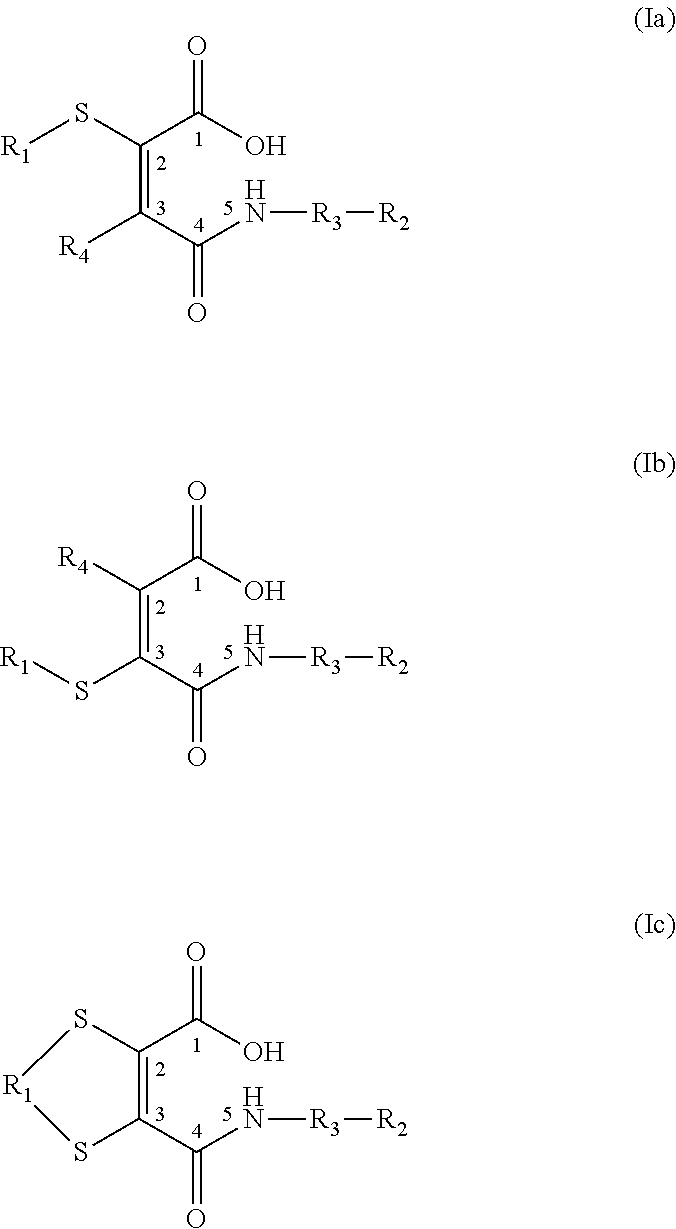
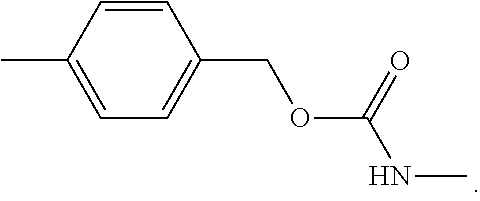
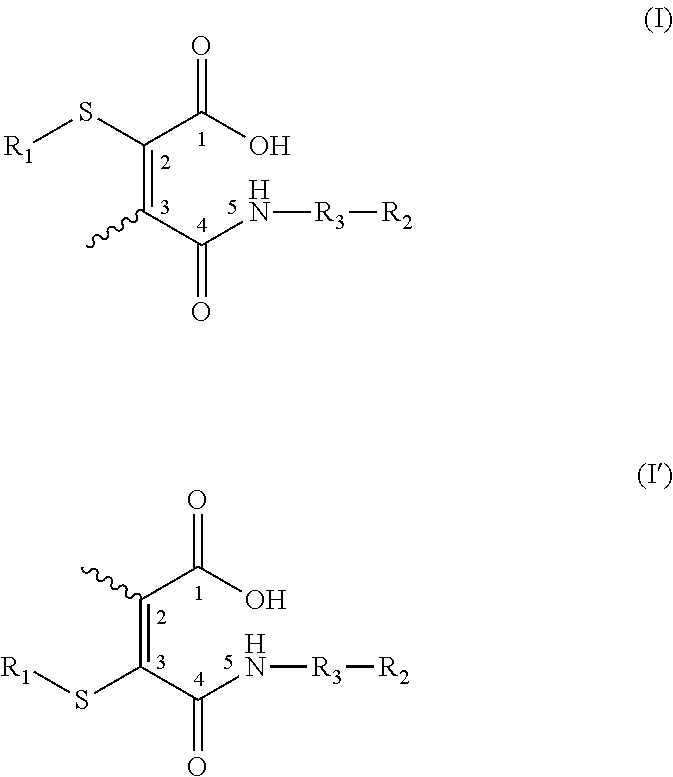
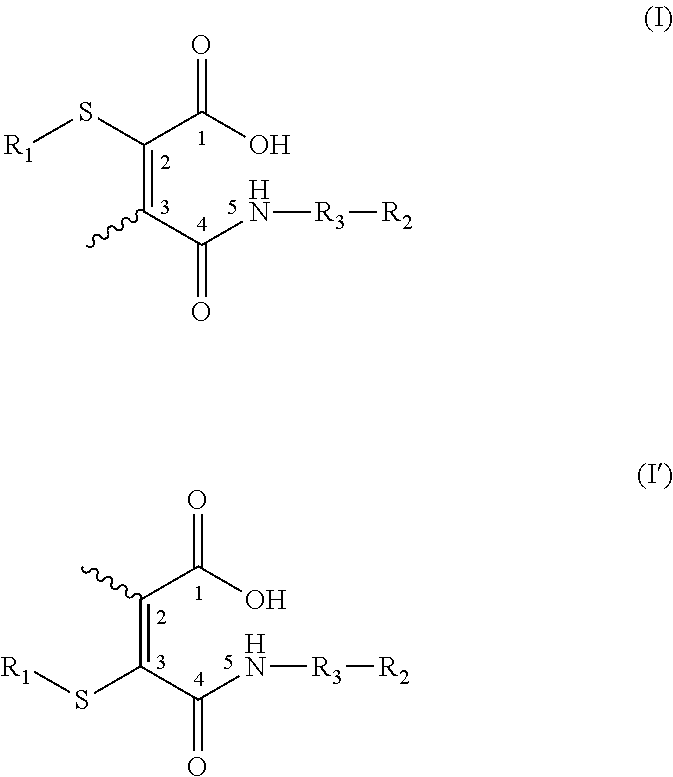
Priority Applications (1)
| Application Number | Priority Date | Filing Date | Title |
|---|---|---|---|
| US14/378,138 US10010623B2 (en) | 2012-02-16 | 2013-02-05 | Lysosome-cleavable linker |
Applications Claiming Priority (3)
| Application Number | Priority Date | Filing Date | Title |
|---|---|---|---|
| US201261599451P | 2012-02-16 | 2012-02-16 | |
| US14/378,138 US10010623B2 (en) | 2012-02-16 | 2013-02-05 | Lysosome-cleavable linker |
| PCT/GB2013/050258 WO2013121175A1 (en) | 2012-02-16 | 2013-02-05 | Lysosome-cleavable linker |
Publications (2)
| Publication Number | Publication Date |
|---|---|
| US20150037360A1 true US20150037360A1 (en) | 2015-02-05 |
| US10010623B2 US10010623B2 (en) | 2018-07-03 |
Family
ID=47666417
Family Applications (1)
| Application Number | Title | Priority Date | Filing Date |
|---|---|---|---|
| US14/378,138 Expired - Fee Related US10010623B2 (en) | 2012-02-16 | 2013-02-05 | Lysosome-cleavable linker |
Country Status (3)
| Country | Link |
|---|---|
| US (1) | US10010623B2 (en) |
| EP (1) | EP2814512A1 (en) |
| WO (1) | WO2013121175A1 (en) |
Cited By (23)
| Publication number | Priority date | Publication date | Assignee | Title |
|---|---|---|---|---|
| US20150031861A1 (en) * | 2012-03-09 | 2015-01-29 | Ucl Business Plc | Chemical Modification of Antibodies |
| WO2018237335A1 (en) | 2017-06-23 | 2018-12-27 | VelosBio Inc. | Ror1 antibody immunoconjugates |
| US10174094B2 (en) * | 2009-08-10 | 2019-01-08 | Ucl Business Plc | Reversible covalent linkage of functional molecules |
| US10487149B2 (en) | 2016-04-01 | 2019-11-26 | Avidity Biosciences, Inc. | Nucleic acid-polypeptide compositions and uses thereof |
| US10881743B2 (en) | 2017-12-06 | 2021-01-05 | Avidity Biosciences, Inc. | Compositions and methods of treating muscle atrophy and myotonic dystrophy |
| US10913800B2 (en) | 2018-12-21 | 2021-02-09 | Avidity Biosciences, Inc. | Anti-transferrin receptor antibodies and uses thereof |
| US10994020B2 (en) | 2017-01-06 | 2021-05-04 | Avidity Biosciences, Inc. | Nucleic acid-polypeptide compositions and methods of inducing exon skipping |
| US11110180B2 (en) | 2017-10-04 | 2021-09-07 | Avidity Biosciences Inc. | Nucleic acid-polypeptide compositions and uses thereof |
| WO2021188390A1 (en) | 2020-03-19 | 2021-09-23 | Avidity Biosciences, Inc. | Compositions and methods of treating facioscapulohumeral muscular dystrophy |
| WO2021195469A1 (en) | 2020-03-27 | 2021-09-30 | Avidity Biosciences, Inc. | Compositions and methods of treating muscle dystrophy |
| US11142767B2 (en) | 2017-07-21 | 2021-10-12 | The Governors Of The University Of Alberta | Antisense oligonucleotides that bind to exon 51 of human dystrophin pre-mRNA |
| CN114249782A (en) * | 2022-01-05 | 2022-03-29 | 湖南大学 | A kind of prodrug that selectively destroys senescent cell lysosomes and its preparation method and application |
| US11578090B2 (en) | 2019-06-06 | 2023-02-14 | Avidity Biosciences, Inc. | Nucleic acid-polypeptide compositions and uses thereof |
| WO2023122347A2 (en) | 2021-12-23 | 2023-06-29 | Mirecule, Inc. | Compositions for delivery of polynucleotides |
| WO2023195805A2 (en) | 2022-04-07 | 2023-10-12 | 트윈피그바이오랩(주) | Itgb2-mediated drug delivery system |
| WO2024026474A1 (en) | 2022-07-29 | 2024-02-01 | Regeneron Pharmaceuticals, Inc. | Compositions and methods for transferrin receptor (tfr)-mediated delivery to the brain and muscle |
| US11912779B2 (en) | 2021-09-16 | 2024-02-27 | Avidity Biosciences, Inc. | Compositions and methods of treating facioscapulohumeral muscular dystrophy |
| WO2024107765A2 (en) | 2022-11-14 | 2024-05-23 | Regeneron Pharmaceuticals, Inc. | Compositions and methods for fibroblast growth factor receptor 3-mediated delivery to astrocytes |
| US12006499B2 (en) | 2019-06-06 | 2024-06-11 | Avidity Biosciences, Inc. | Una amidites and uses thereof |
| US12071621B2 (en) | 2022-04-05 | 2024-08-27 | Avidity Biosciences, Inc. | Anti-transferrin receptor antibody-PMO conjugates for inducing DMD exon 44 skipping |
| US12409230B2 (en) | 2023-06-30 | 2025-09-09 | Avidity Biosciences, Inc. | Compositions comprising PLN-targeting anti-transferrin receptor antibody-polynucleotides and methods of use thereof to treat cardiomyopathy |
| US12491257B2 (en) | 2023-06-27 | 2025-12-09 | Avidity Biosciences, Inc. | Compositions and methods of using PRKAG2-targeting antibody-oligonucleotide conjugates |
| US12497615B2 (en) | 2019-04-25 | 2025-12-16 | Avidity Biosciences, Inc. | Nucleic acid compositions and methods of multi-exon skipping |
Families Citing this family (15)
| Publication number | Priority date | Publication date | Assignee | Title |
|---|---|---|---|---|
| AU2012245260B2 (en) | 2011-04-22 | 2016-09-08 | Aptevo Research And Development Llc | Prostate-specific membrane antigen binding proteins and related compositions and methods |
| WO2014197866A1 (en) | 2013-06-06 | 2014-12-11 | Igenica Biotherapeutics, Inc. | Modified antibodies and related compounds, compositions, and methods of use |
| JP6224268B2 (en) | 2014-01-10 | 2017-11-01 | シントン・バイオファーマシューティカルズ・ビー.ブイ.Synthon Biopharmaceuticals B.V. | Duocarmycin ADC for use in the treatment of endometrial cancer |
| LT3092010T (en) | 2014-01-10 | 2018-10-25 | Synthon Biopharmaceuticals B.V. | Method for purifying cys-linked antibody-drug conjugates |
| PT2948184T (en) | 2014-01-10 | 2016-07-08 | Synthon Biopharmaceuticals Bv | Duocarmycin adcs showing improved in vivo antitumor activity |
| WO2015140792A1 (en) | 2014-03-16 | 2015-09-24 | Hadasit Medical Research Services And Development Ltd. | Type iii deiodinase inhibitors and uses thereof |
| JP6863888B2 (en) * | 2014-10-01 | 2021-04-21 | メディミューン,エルエルシー | How to conjugate a polypeptide |
| CN104558122A (en) * | 2015-01-07 | 2015-04-29 | 中国药科大学 | Integrin acceptor related antitumor polypeptide and treatment and diagnosis applications thereof |
| UA126278C2 (en) | 2015-09-21 | 2022-09-14 | Аптево Рісьорч Енд Девелопмент Ллс | Cd3 binding polypeptides |
| CN108101825B (en) * | 2016-11-25 | 2022-02-22 | 迈威(上海)生物科技股份有限公司 | Disubstituted maleimide linker for antibody-drug coupling, preparation method and application thereof |
| JP7058666B2 (en) * | 2016-11-25 | 2022-04-22 | マブウェル (シャンハイ) バイオサイエンス カンパニー リミテッド | Bi-substituted maleamide linkers for antibody-drug conjugates and their preparation methods and uses |
| CN109810039B (en) * | 2017-11-22 | 2021-11-12 | 迈威(上海)生物科技股份有限公司 | Disubstituted maleimide-based linker for antibody-drug coupling, preparation method and application thereof |
| KR20210083282A (en) | 2018-12-17 | 2021-07-06 | 레메젠 코, 리미티드 | Connectors and Applications of Connectors for Use in Antibody-Drug Conjugates |
| US12435116B2 (en) | 2019-10-16 | 2025-10-07 | Clarence Hurt | Compounds, compositions, methods, and uses for treating insulin resistance, type 2 diabetes and metabolic syndrome |
| US20230372526A1 (en) * | 2020-09-29 | 2023-11-23 | Mabwell (shanghai) Bioscience Co., Ltd. | Preparation method for bis-substituted bridging antibody-drug conjugate |
Family Cites Families (6)
| Publication number | Priority date | Publication date | Assignee | Title |
|---|---|---|---|---|
| US2859243A (en) | 1955-05-09 | 1958-11-04 | Whiffen And Sons Ltd | Bis-maleamic acid |
| US7442764B2 (en) | 1999-06-07 | 2008-10-28 | Mirns Bio Corporation | Reversible modification of amine-containing compounds |
| GB0017084D0 (en) * | 2000-07-13 | 2000-08-30 | Univ Bristol | Inhibition of the cystic fibrosis transmembrane conductance regulator chloride channel |
| US20090074885A1 (en) | 2003-09-08 | 2009-03-19 | Roche Madison Inc. | Reversible Hydrophobic Modification of Drugs for Improved Delivery to Cells |
| EP2464974A1 (en) | 2009-08-10 | 2012-06-20 | UCL Business PLC | Functionalisation of solid substrates |
| BR112014013526A8 (en) | 2011-12-05 | 2017-06-13 | Igenica Biotherapeutics Inc | antibody-drug conjugates and related compounds, compositions and methods |
-
2013
- 2013-02-05 WO PCT/GB2013/050258 patent/WO2013121175A1/en not_active Ceased
- 2013-02-05 US US14/378,138 patent/US10010623B2/en not_active Expired - Fee Related
- 2013-02-05 EP EP13702827.0A patent/EP2814512A1/en not_active Withdrawn
Non-Patent Citations (3)
| Title |
|---|
| Doronina et al. (âDoroninaâ, BioconjugateChem., 2006, 17, 114-124) * |
| Lyon et al Nature Biotech 2014, 32, 1059-1062 * |
| Smith et al. (âSmithâ, J. Am. Chem. Soc., 2010, 132, 1960-1965), * |
Cited By (66)
| Publication number | Priority date | Publication date | Assignee | Title |
|---|---|---|---|---|
| US10933142B2 (en) | 2009-08-10 | 2021-03-02 | Ucl Business Ltd | Reversible covalent linkage of functional molecules |
| US10174094B2 (en) * | 2009-08-10 | 2019-01-08 | Ucl Business Plc | Reversible covalent linkage of functional molecules |
| US10548982B2 (en) | 2009-08-10 | 2020-02-04 | Ucl Business Ltd | Reversible covalent linkage of functional molecules |
| US20150031861A1 (en) * | 2012-03-09 | 2015-01-29 | Ucl Business Plc | Chemical Modification of Antibodies |
| US12351637B2 (en) | 2016-04-01 | 2025-07-08 | Avidity Biosciences, Inc. | Nucleic acid-polypeptide compositions and uses thereof |
| US12234290B2 (en) | 2016-04-01 | 2025-02-25 | Avidity Biosciences, Inc. | Nucleic acid-polypeptide compositions and uses thereof |
| US10487149B2 (en) | 2016-04-01 | 2019-11-26 | Avidity Biosciences, Inc. | Nucleic acid-polypeptide compositions and uses thereof |
| US10550188B2 (en) | 2016-04-01 | 2020-02-04 | Avidity Biosciences, Inc. | Nucleic acid-polypeptide compositions and uses thereof |
| US10787519B2 (en) | 2016-04-01 | 2020-09-29 | Avidity Biosciences, Inc. | Nucleic acid-polypeptide compositions and uses thereof |
| US10800848B2 (en) | 2016-04-01 | 2020-10-13 | Avidity Biosciences, Inc. | Nucleic acid-polypeptide compositions and uses thereof |
| US11400163B2 (en) | 2017-01-06 | 2022-08-02 | Avidity Biosciences, Inc. | Nucleic acid-polypeptide compositions and methods of inducing exon skipping |
| US10994020B2 (en) | 2017-01-06 | 2021-05-04 | Avidity Biosciences, Inc. | Nucleic acid-polypeptide compositions and methods of inducing exon skipping |
| US12064483B2 (en) | 2017-01-06 | 2024-08-20 | Avidity Biosciences, Inc. | Nucleic acid-polypeptide compositions and methods of inducing exon skipping |
| US11311627B1 (en) | 2017-01-06 | 2022-04-26 | Avidity Biosciences Llc | Nucleic acid-polypeptide compositions and methods of inducing exon skipping |
| EP4556489A2 (en) | 2017-01-06 | 2025-05-21 | Avidity Biosciences, Inc. | Nucleic acid-polypeptide compositions and methods of inducing exon skipping |
| US11179472B2 (en) | 2017-01-06 | 2021-11-23 | Avidity Biosciences, Inc. | Nucleic acid-polypeptide compositions and methods of inducing exon skipping |
| WO2018237335A1 (en) | 2017-06-23 | 2018-12-27 | VelosBio Inc. | Ror1 antibody immunoconjugates |
| USRE50631E1 (en) | 2017-06-23 | 2025-10-14 | VelosBio Inc. | ROR1 antibody immunoconjugates |
| US10335496B2 (en) | 2017-06-23 | 2019-07-02 | VelosBio Inc. | ROR1 antibody immunoconjugates |
| US11142767B2 (en) | 2017-07-21 | 2021-10-12 | The Governors Of The University Of Alberta | Antisense oligonucleotides that bind to exon 51 of human dystrophin pre-mRNA |
| US11891603B2 (en) | 2017-07-21 | 2024-02-06 | The Governors Of The University Of Alberta | Antisense oligonucleotides that bind to exon 51 of human dystrophin pre-mRNA |
| US12364769B2 (en) | 2017-10-04 | 2025-07-22 | Avidity Biosciences, Inc. | Nucleic acid-polypeptide compositions and uses thereof |
| US11110180B2 (en) | 2017-10-04 | 2021-09-07 | Avidity Biosciences Inc. | Nucleic acid-polypeptide compositions and uses thereof |
| US11364302B1 (en) | 2017-10-04 | 2022-06-21 | Avidity Biosciences, Inc. | Nucleic acid-polypeptide compositions and uses thereof |
| US11872287B2 (en) | 2017-12-06 | 2024-01-16 | Avidity Biosciences, Inc. | Compositions and methods of treating muscle atrophy and myotonic dystrophy |
| US12263224B2 (en) | 2017-12-06 | 2025-04-01 | Avidity Biosciences, Inc. | Compositions and methods of treating muscle atrophy and myotonic dystrophy |
| US11497814B2 (en) | 2017-12-06 | 2022-11-15 | Avidity Biosciences, Inc. | Compositions and methods of treating muscle atrophy and myotonic dystrophy |
| US11253607B2 (en) | 2017-12-06 | 2022-02-22 | Avidity Biosciences, Inc. | Compositions and methods of treating muscle atrophy and myotonic dystrophy |
| US11246941B2 (en) | 2017-12-06 | 2022-02-15 | Avidity Biosciences, Inc. | Compositions and methods of treating muscle atrophy and myotonic dystrophy |
| US11554176B2 (en) | 2017-12-06 | 2023-01-17 | Avidity Biosciences, Inc. | Compositions and methods of treating muscle atrophy and myotonic dystrophy |
| US11712478B2 (en) | 2017-12-06 | 2023-08-01 | Avidity Biosciences, Inc. | Compositions and methods of treating muscle atrophy and myotonic dystrophy |
| US11576980B2 (en) | 2017-12-06 | 2023-02-14 | Avidity Biosciences, Inc. | Compositions and methods of treating muscle atrophy and myotonic dystrophy |
| US11583591B2 (en) | 2017-12-06 | 2023-02-21 | Avidity Biosciences Llc | Compositions and methods of treating muscle atrophy and myotonic dystrophy |
| US10881743B2 (en) | 2017-12-06 | 2021-01-05 | Avidity Biosciences, Inc. | Compositions and methods of treating muscle atrophy and myotonic dystrophy |
| US10913800B2 (en) | 2018-12-21 | 2021-02-09 | Avidity Biosciences, Inc. | Anti-transferrin receptor antibodies and uses thereof |
| US11834510B2 (en) | 2018-12-21 | 2023-12-05 | Avidity Biosciences, Inc. | Anti-transferrin receptor antibodies and uses thereof |
| US11028179B2 (en) | 2018-12-21 | 2021-06-08 | Avidity Biosciences, Inc. | Anti-transferrin receptor antibodies and uses thereof |
| US12497615B2 (en) | 2019-04-25 | 2025-12-16 | Avidity Biosciences, Inc. | Nucleic acid compositions and methods of multi-exon skipping |
| US11578090B2 (en) | 2019-06-06 | 2023-02-14 | Avidity Biosciences, Inc. | Nucleic acid-polypeptide compositions and uses thereof |
| US12365704B2 (en) | 2019-06-06 | 2025-07-22 | Avidity Biosciences, Inc. | Nucleic acid-polypeptide compositions and uses thereof |
| US12006499B2 (en) | 2019-06-06 | 2024-06-11 | Avidity Biosciences, Inc. | Una amidites and uses thereof |
| WO2021188390A1 (en) | 2020-03-19 | 2021-09-23 | Avidity Biosciences, Inc. | Compositions and methods of treating facioscapulohumeral muscular dystrophy |
| US11555190B2 (en) | 2020-03-19 | 2023-01-17 | Avidity Biosciences, Inc. | Compositions and methods of treating Facioscapulohumeral muscular dystrophy |
| US11999955B2 (en) | 2020-03-19 | 2024-06-04 | Avidity Biosciences, Inc. | Compositions and methods of treating facioscapulohumeral muscular dystrophy |
| US12529056B2 (en) | 2020-03-19 | 2026-01-20 | Avidity Biosciences, Inc. | Compositions and methods of treating facioscapulohumeral muscular dystrophy |
| US12049629B2 (en) | 2020-03-19 | 2024-07-30 | Avidity Biosciences, Inc. | Compositions and methods of treating Facioscapulohumeral muscular dystrophy |
| US12104156B2 (en) | 2020-03-19 | 2024-10-01 | Avidity Biosciences, Inc. | Compositions and methods of treating facioscapulohumeral muscular dystrophy |
| US11525137B2 (en) | 2020-03-19 | 2022-12-13 | Avidity Biosciences, Inc. | Compositions and methods of treating Facioscapulohumeral muscular dystrophy |
| WO2021195469A1 (en) | 2020-03-27 | 2021-09-30 | Avidity Biosciences, Inc. | Compositions and methods of treating muscle dystrophy |
| EP4656242A2 (en) | 2020-03-27 | 2025-12-03 | Avidity Biosciences, Inc. | Compositions and methods of treating muscle dystrophy |
| US12427202B2 (en) | 2020-03-27 | 2025-09-30 | Avidity Biosciences, Inc. | Compositions and methods of treating muscle dystrophy |
| US11446387B2 (en) | 2020-03-27 | 2022-09-20 | Avidity Biosciences, Inc. | Compositions and methods of treating muscle dystrophy |
| US11707532B2 (en) | 2020-03-27 | 2023-07-25 | Avidity Biosciences, Inc. | Compositions and methods of treating muscle dystrophy |
| US12071485B2 (en) | 2021-09-16 | 2024-08-27 | Avidity Biosciences, Inc. | Compositions and methods of treating facioscapulohumeral muscular dystrophy |
| US12157774B2 (en) | 2021-09-16 | 2024-12-03 | Avidity Biosciences, Inc. | Compositions and methods of treating facioscapulohumeral muscular dystrophy |
| US12486328B2 (en) | 2021-09-16 | 2025-12-02 | Avidity Biosciences, Inc. | Compositions and methods of treating facioscapulohumeral muscular dystrophy |
| US11912779B2 (en) | 2021-09-16 | 2024-02-27 | Avidity Biosciences, Inc. | Compositions and methods of treating facioscapulohumeral muscular dystrophy |
| WO2023122347A2 (en) | 2021-12-23 | 2023-06-29 | Mirecule, Inc. | Compositions for delivery of polynucleotides |
| CN114249782A (en) * | 2022-01-05 | 2022-03-29 | 湖南大学 | A kind of prodrug that selectively destroys senescent cell lysosomes and its preparation method and application |
| US12359202B2 (en) | 2022-04-05 | 2025-07-15 | Avidity Biosciences, Inc. | Anti-transferrin receptor antibody-PMO conjugates for inducing DMD exon 44 skipping |
| US12071621B2 (en) | 2022-04-05 | 2024-08-27 | Avidity Biosciences, Inc. | Anti-transferrin receptor antibody-PMO conjugates for inducing DMD exon 44 skipping |
| WO2023195805A2 (en) | 2022-04-07 | 2023-10-12 | 트윈피그바이오랩(주) | Itgb2-mediated drug delivery system |
| WO2024026474A1 (en) | 2022-07-29 | 2024-02-01 | Regeneron Pharmaceuticals, Inc. | Compositions and methods for transferrin receptor (tfr)-mediated delivery to the brain and muscle |
| WO2024107765A2 (en) | 2022-11-14 | 2024-05-23 | Regeneron Pharmaceuticals, Inc. | Compositions and methods for fibroblast growth factor receptor 3-mediated delivery to astrocytes |
| US12491257B2 (en) | 2023-06-27 | 2025-12-09 | Avidity Biosciences, Inc. | Compositions and methods of using PRKAG2-targeting antibody-oligonucleotide conjugates |
| US12409230B2 (en) | 2023-06-30 | 2025-09-09 | Avidity Biosciences, Inc. | Compositions comprising PLN-targeting anti-transferrin receptor antibody-polynucleotides and methods of use thereof to treat cardiomyopathy |
Also Published As
| Publication number | Publication date |
|---|---|
| WO2013121175A1 (en) | 2013-08-22 |
| EP2814512A1 (en) | 2014-12-24 |
| US10010623B2 (en) | 2018-07-03 |
Similar Documents
| Publication | Publication Date | Title |
|---|---|---|
| US10010623B2 (en) | Lysosome-cleavable linker | |
| US20230381321A1 (en) | Camptothecin conjugates | |
| US20150031861A1 (en) | Chemical Modification of Antibodies | |
| Badescu et al. | Bridging disulfides for stable and defined antibody drug conjugates | |
| EP3107557B1 (en) | Hydrophilic antibody-drug conjugates | |
| AU2019272250B2 (en) | Anti-mesothelin antibody and antibody-drug conjugate thereof | |
| KR102442906B1 (en) | Methylene carbamate linkers for use with targeted-drug conjugates | |
| EP3157560A1 (en) | Her2 antibody-drug conjugates | |
| NO20160447A1 (en) | Method of Targeting Specific Cell Populations Using Cell Binding Agent Maytansinoid Conjugates Bound via a Non-cleavable Linker, Said Conjugates and Preparation of Said Conjugates | |
| CN106661123A (en) | Anti-Cd22 Antibody-Drug Conjugates And Methods Of Using Thereof | |
| CA3097199A1 (en) | Anti-sez6 antibody drug conjugates and methods of use | |
| KR102530542B1 (en) | Materials and methods relating to linkers for use in protein drug conjugates | |
| JP2023552290A (en) | GPC3 binding agents, conjugates thereof and methods of use thereof | |
| US20250213715A1 (en) | Anti-cspg4 binding agents, conjugates thereof and methods of using the same | |
| CA3195850A1 (en) | Anti-msln binding agents, conjugates thereof and methods of using the same | |
| KR20250084935A (en) | Linker-payload compounds, conjugates and applications thereof | |
| AU2017354027B2 (en) | Distribution of engineered-cysteine caps | |
| KR20130138608A (en) | Site-specific antibody-cytotoxin conjugate and use thereof | |
| EP4433096A1 (en) | Gpc3 binding agents, conjugates thereof and methods of using the same | |
| EP4637831A1 (en) | Antibody-drug conjugates with masked pbd dimers | |
| HK1232123B (en) | Hydrophilic antibody-drug conjugates | |
| TW202128229A (en) | Methylene carbamate linkers for use with targeted-drug conjugates |
Legal Events
| Date | Code | Title | Description |
|---|---|---|---|
| AS | Assignment |
Owner name: UCL BUSINESS PLC, UNITED KINGDOM Free format text: ASSIGNMENT OF ASSIGNORS INTEREST;ASSIGNOR:SMITH, MARK EDWARD BRENNAN;REEL/FRAME:033900/0133 Effective date: 20140926 |
|
| FEPP | Fee payment procedure |
Free format text: ENTITY STATUS SET TO SMALL (ORIGINAL EVENT CODE: SMAL); ENTITY STATUS OF PATENT OWNER: SMALL ENTITY |
|
| STCF | Information on status: patent grant |
Free format text: PATENTED CASE |
|
| FEPP | Fee payment procedure |
Free format text: MAINTENANCE FEE REMINDER MAILED (ORIGINAL EVENT CODE: REM.); ENTITY STATUS OF PATENT OWNER: SMALL ENTITY |
|
| LAPS | Lapse for failure to pay maintenance fees |
Free format text: PATENT EXPIRED FOR FAILURE TO PAY MAINTENANCE FEES (ORIGINAL EVENT CODE: EXP.); ENTITY STATUS OF PATENT OWNER: SMALL ENTITY |
|
| STCH | Information on status: patent discontinuation |
Free format text: PATENT EXPIRED DUE TO NONPAYMENT OF MAINTENANCE FEES UNDER 37 CFR 1.362 |
|
| FP | Lapsed due to failure to pay maintenance fee |
Effective date: 20220703 |