US20110301351A1 - Platinum (II) Di (2-Pyrazolyl) Benzene Chloride Analogs and Uses - Google Patents
Platinum (II) Di (2-Pyrazolyl) Benzene Chloride Analogs and Uses Download PDFInfo
- Publication number
- US20110301351A1 US20110301351A1 US12/809,367 US80936708A US2011301351A1 US 20110301351 A1 US20110301351 A1 US 20110301351A1 US 80936708 A US80936708 A US 80936708A US 2011301351 A1 US2011301351 A1 US 2011301351A1
- Authority
- US
- United States
- Prior art keywords
- platinum
- compound
- aromatic
- pyrazolyl
- membered
- Prior art date
- Legal status (The legal status is an assumption and is not a legal conclusion. Google has not performed a legal analysis and makes no representation as to the accuracy of the status listed.)
- Abandoned
Links
- ODUSDKQPSFWRID-UHFFFAOYSA-N C1[V][U]C[Y]1 Chemical compound C1[V][U]C[Y]1 ODUSDKQPSFWRID-UHFFFAOYSA-N 0.000 description 7
- RDOXTESZEPMUJZ-UHFFFAOYSA-N COC1=CC=CC=C1 Chemical compound COC1=CC=CC=C1 RDOXTESZEPMUJZ-UHFFFAOYSA-N 0.000 description 5
- SXJQJZTWUJYCAW-UHFFFAOYSA-O C1=COC=N1.C1=COC=N1.C1=CSC=N1.C1=CSC=N1.CN1C=CC=N1.CN1C=CN=C1.CN1C=CN=C1.C[N+]1=CNC=C1 Chemical compound C1=COC=N1.C1=COC=N1.C1=CSC=N1.C1=CSC=N1.CN1C=CC=N1.CN1C=CN=C1.CN1C=CN=C1.C[N+]1=CNC=C1 SXJQJZTWUJYCAW-UHFFFAOYSA-O 0.000 description 4
- ZTFWVYZNOVZEFD-UHFFFAOYSA-M Cl[Pt]12C3=C(C=CC=C3N3C=CC=N31)N1C=CC=N12 Chemical compound Cl[Pt]12C3=C(C=CC=C3N3C=CC=N31)N1C=CC=N12 ZTFWVYZNOVZEFD-UHFFFAOYSA-M 0.000 description 4
- ZBSNUVPWKBKCBB-UHFFFAOYSA-N [W][Pt]12C3=C(C=CC=C3[Y]3C[U][V]C31)[Y]1C[U][V]C12 Chemical compound [W][Pt]12C3=C(C=CC=C3[Y]3C[U][V]C31)[Y]1C[U][V]C12 ZBSNUVPWKBKCBB-UHFFFAOYSA-N 0.000 description 4
- 0 C*1II(CNC(I)=C)c2cccc3c2*1(*)*(C)I(CNC(I)=C)I3 Chemical compound C*1II(CNC(I)=C)c2cccc3c2*1(*)*(C)I(CNC(I)=C)I3 0.000 description 1
Images


Classifications
-
- H—ELECTRICITY
- H10—SEMICONDUCTOR DEVICES; ELECTRIC SOLID-STATE DEVICES NOT OTHERWISE PROVIDED FOR
- H10K—ORGANIC ELECTRIC SOLID-STATE DEVICES
- H10K85/00—Organic materials used in the body or electrodes of devices covered by this subclass
- H10K85/30—Coordination compounds
- H10K85/341—Transition metal complexes, e.g. Ru(II)polypyridine complexes
- H10K85/346—Transition metal complexes, e.g. Ru(II)polypyridine complexes comprising platinum
-
- C—CHEMISTRY; METALLURGY
- C07—ORGANIC CHEMISTRY
- C07F—ACYCLIC, CARBOCYCLIC OR HETEROCYCLIC COMPOUNDS CONTAINING ELEMENTS OTHER THAN CARBON, HYDROGEN, HALOGEN, OXYGEN, NITROGEN, SULFUR, SELENIUM OR TELLURIUM
- C07F15/00—Compounds containing elements of Groups 8, 9, 10 or 18 of the Periodic Table
- C07F15/0006—Compounds containing elements of Groups 8, 9, 10 or 18 of the Periodic Table compounds of the platinum group
- C07F15/0086—Platinum compounds
-
- C—CHEMISTRY; METALLURGY
- C09—DYES; PAINTS; POLISHES; NATURAL RESINS; ADHESIVES; COMPOSITIONS NOT OTHERWISE PROVIDED FOR; APPLICATIONS OF MATERIALS NOT OTHERWISE PROVIDED FOR
- C09K—MATERIALS FOR MISCELLANEOUS APPLICATIONS, NOT PROVIDED FOR ELSEWHERE
- C09K11/00—Luminescent, e.g. electroluminescent, chemiluminescent materials
- C09K11/06—Luminescent, e.g. electroluminescent, chemiluminescent materials containing organic luminescent materials
-
- C—CHEMISTRY; METALLURGY
- C09—DYES; PAINTS; POLISHES; NATURAL RESINS; ADHESIVES; COMPOSITIONS NOT OTHERWISE PROVIDED FOR; APPLICATIONS OF MATERIALS NOT OTHERWISE PROVIDED FOR
- C09K—MATERIALS FOR MISCELLANEOUS APPLICATIONS, NOT PROVIDED FOR ELSEWHERE
- C09K2211/00—Chemical nature of organic luminescent or tenebrescent compounds
- C09K2211/10—Non-macromolecular compounds
- C09K2211/1003—Carbocyclic compounds
- C09K2211/1007—Non-condensed systems
-
- C—CHEMISTRY; METALLURGY
- C09—DYES; PAINTS; POLISHES; NATURAL RESINS; ADHESIVES; COMPOSITIONS NOT OTHERWISE PROVIDED FOR; APPLICATIONS OF MATERIALS NOT OTHERWISE PROVIDED FOR
- C09K—MATERIALS FOR MISCELLANEOUS APPLICATIONS, NOT PROVIDED FOR ELSEWHERE
- C09K2211/00—Chemical nature of organic luminescent or tenebrescent compounds
- C09K2211/10—Non-macromolecular compounds
- C09K2211/1018—Heterocyclic compounds
- C09K2211/1025—Heterocyclic compounds characterised by ligands
- C09K2211/1029—Heterocyclic compounds characterised by ligands containing one nitrogen atom as the heteroatom
-
- C—CHEMISTRY; METALLURGY
- C09—DYES; PAINTS; POLISHES; NATURAL RESINS; ADHESIVES; COMPOSITIONS NOT OTHERWISE PROVIDED FOR; APPLICATIONS OF MATERIALS NOT OTHERWISE PROVIDED FOR
- C09K—MATERIALS FOR MISCELLANEOUS APPLICATIONS, NOT PROVIDED FOR ELSEWHERE
- C09K2211/00—Chemical nature of organic luminescent or tenebrescent compounds
- C09K2211/10—Non-macromolecular compounds
- C09K2211/1018—Heterocyclic compounds
- C09K2211/1025—Heterocyclic compounds characterised by ligands
- C09K2211/1029—Heterocyclic compounds characterised by ligands containing one nitrogen atom as the heteroatom
- C09K2211/1037—Heterocyclic compounds characterised by ligands containing one nitrogen atom as the heteroatom with sulfur
-
- C—CHEMISTRY; METALLURGY
- C09—DYES; PAINTS; POLISHES; NATURAL RESINS; ADHESIVES; COMPOSITIONS NOT OTHERWISE PROVIDED FOR; APPLICATIONS OF MATERIALS NOT OTHERWISE PROVIDED FOR
- C09K—MATERIALS FOR MISCELLANEOUS APPLICATIONS, NOT PROVIDED FOR ELSEWHERE
- C09K2211/00—Chemical nature of organic luminescent or tenebrescent compounds
- C09K2211/10—Non-macromolecular compounds
- C09K2211/1018—Heterocyclic compounds
- C09K2211/1025—Heterocyclic compounds characterised by ligands
- C09K2211/1044—Heterocyclic compounds characterised by ligands containing two nitrogen atoms as heteroatoms
-
- C—CHEMISTRY; METALLURGY
- C09—DYES; PAINTS; POLISHES; NATURAL RESINS; ADHESIVES; COMPOSITIONS NOT OTHERWISE PROVIDED FOR; APPLICATIONS OF MATERIALS NOT OTHERWISE PROVIDED FOR
- C09K—MATERIALS FOR MISCELLANEOUS APPLICATIONS, NOT PROVIDED FOR ELSEWHERE
- C09K2211/00—Chemical nature of organic luminescent or tenebrescent compounds
- C09K2211/18—Metal complexes
- C09K2211/185—Metal complexes of the platinum group, i.e. Os, Ir, Pt, Ru, Rh or Pd
-
- H—ELECTRICITY
- H10—SEMICONDUCTOR DEVICES; ELECTRIC SOLID-STATE DEVICES NOT OTHERWISE PROVIDED FOR
- H10K—ORGANIC ELECTRIC SOLID-STATE DEVICES
- H10K50/00—Organic light-emitting devices
- H10K50/10—OLEDs or polymer light-emitting diodes [PLED]
- H10K50/11—OLEDs or polymer light-emitting diodes [PLED] characterised by the electroluminescent [EL] layers
-
- Y—GENERAL TAGGING OF NEW TECHNOLOGICAL DEVELOPMENTS; GENERAL TAGGING OF CROSS-SECTIONAL TECHNOLOGIES SPANNING OVER SEVERAL SECTIONS OF THE IPC; TECHNICAL SUBJECTS COVERED BY FORMER USPC CROSS-REFERENCE ART COLLECTIONS [XRACs] AND DIGESTS
- Y02—TECHNOLOGIES OR APPLICATIONS FOR MITIGATION OR ADAPTATION AGAINST CLIMATE CHANGE
- Y02B—CLIMATE CHANGE MITIGATION TECHNOLOGIES RELATED TO BUILDINGS, e.g. HOUSING, HOUSE APPLIANCES OR RELATED END-USER APPLICATIONS
- Y02B20/00—Energy efficient lighting technologies, e.g. halogen lamps or gas discharge lamps
Definitions
- This invention relates to platinum(II) di(2-pyrazolyl)benzene chloride and analogs, and more particularly to the synthesis and use thereof.
- an organic light-emitting device (OLED) 100 may include a layer of indium tin oxide (ITO) as an anode 102 , a layer of hole-transporting materials (HTL) 104 , a layer of emissive materials (EML) 106 including emitter(s) and host(s), a layer of electron-transporting materials (ETL) 108 , and a metal cathode layer 110 on substrate 112 .
- the emission color of OLED 100 may be determined by the emission energy (optical energy gap) of the emitter(s) in the layer of emissive materials.
- Phosphorescent OLEDs may have higher device efficiency than fluorescent OLEDs (i.e., OLEDs with fluorescent emitters).
- Some emitters for blue phosphorescent OLEDs include iridium—a relatively scarce element—in the form of cyclometalated iridium complexes.
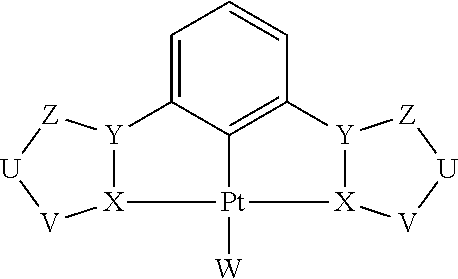
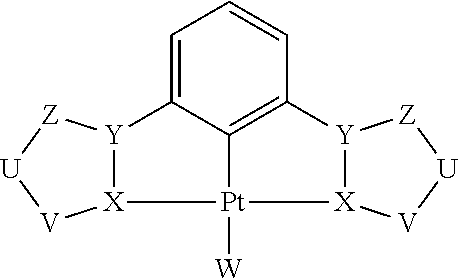
- a luminescent compound has the generic formula
- the six-membered ring in this generic formula denotes benzene or pyridine.
- a light emitting device includes the luminescent compound shown above.
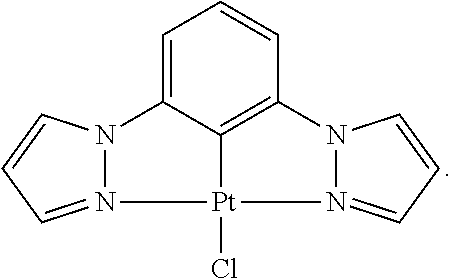
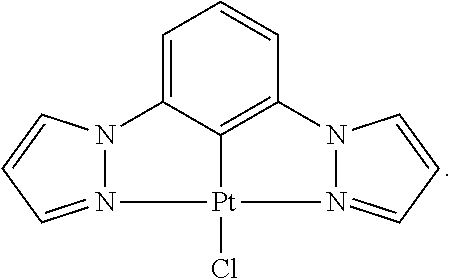
- the luminescent compound is platinum(II) di(2-pyrazolyl)benzene chloride, with the formula:
- the luminescent compound is phosphorescent.
- the compound is capable of emitting light in the blue range of the visible spectrum. In some cases, the compound is capable of emitting white light.
- the light emitting device may be an organic light emitting device.
- a method of making a platinum(II) complex includes forming a 1,3-di-substituted aromatic six-membered ring with two aromatic five-membered heterocycles, and reacting the 1,3-di-substituted six-membered ring with an acidic platinum-containing solution to form the platinum(II) complex.
- the aromatic five-membered heterocycles are selected from the group consisting of pyrazolyl, substituted pyrazolyl, imidazolyl, substituted imidazolyl, thiazolyl, and substituted thiazolyl.
- the benzene is fluorinated, difluorinated, or methylated. Fluorinating the benzene ring may increase the emission energy, shifting the emission toward the blue end of the visible spectrum.
- the benzene may be bonded to a heteroatom, such as a nitrogen atom or a sulfur atom, in the heterocycle.
- the platinum atom in the platinum(II) complex may be bonded to a carbon atom and two nitrogen atoms.
- the platinum(II) complex is platinum(II) di(2-pyrazolyl)benzene chloride.
- the aromatic six-membered ring is benzene or pyridine. In some cases, when the six-membered ring is pyridine, an increase in the emission energy may result.
- Phosphorescent blue OLEDs with the platinum complexes described herein as emitters can be produced at low cost and provide operationally stable displays.
- FIG. 1 illustrates an organic light emitting device (OLED).
- FIG. 2 shows precursors for platinum(II) di(2-pyrazolyl)benzene chloride and analogs.
- FIG. 3 shows platinum(II) di(2-pyrazolyl)benzene and analogs.
- FIG. 4 shows a room temperature emission spectrum of platinum(II) di(2-pyrazolyl)benzene chloride in dichloromethane.
- FIG. 5 shows room temperature and 77K emission spectra of platinum(II) di(3,5-dimethyl-2-pyrazolyl)benzene chloride in solution.
- FIG. 6 shows a room temperature emission spectrum of platinum(II) di(3,5-dimethyl-2-pyrazolyl)benzene chloride in thin film of poly(methyl methacrylate) (PMMA).
- FIG. 7 shows a room temperature emission spectrum of platinum(II) di(3,5-dimethyl-2-pyrazolyl)benzene phenoxide in a thin film of poly(carbonate).
- FIG. 8 shows a room temperature emission spectrum of platinum(II) di(3,5-dimethyl-2-pyrazolyl)toluene chloride in a thin film of poly(methyl methacrylate) (PMMA).
- FIG. 9 shows a room temperature emission spectrum of platinum(II) di(methyl-imidazolyl)benzene chloride in a solution of dichloromethane.
- FIG. 10 shows a room temperature emission spectrum of platinum(II) di(methyl-imidazolyl)benzene chloride in a thin film of poly(methyl methacrylate) (PMMA).
- FIG. 11A shows a room temperature emission spectrum of platinum(II) di(methyl-imidazolyl)toluene chloride in a thin film of poly(methyl methacrylate) (PMMA).
- FIG. 11B shows a 77K emission spectrum of platinum(II) di(methyl-imidazolyl)pyridine chloride in a solution of 2-methyl-tetrahydrofuran.
- FIG. 12 shows a room temperature emission spectrum of platinum(II) di(thiazolyl)(4,6-difluoro-benzene) chloride in a solution of dichloromethane.
- the platinum complexes described herein can be used as emitters for OLEDs, absorbers for solar cells, luminescent labels for bio-applications, and the like.
- Blue phosphorescent OLEDs may include platinum complexes with high band-gap ligands, including the five-membered rings depicted herein.
- W can be —Cl or
- the aromatic six-membered ring in this generic formula denotes benzene or pyridine.
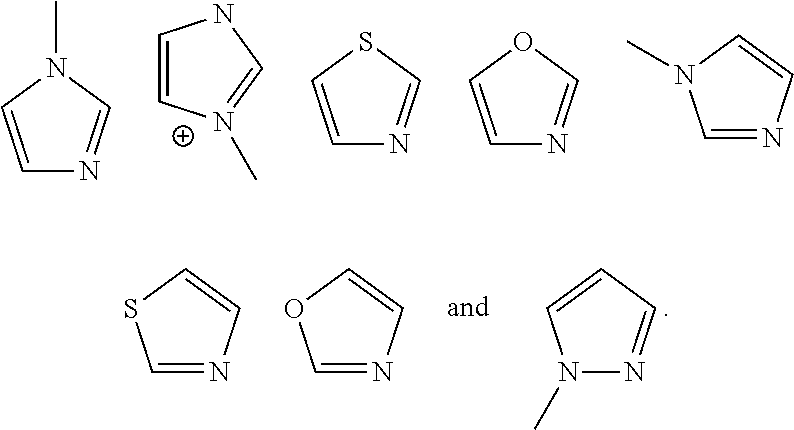
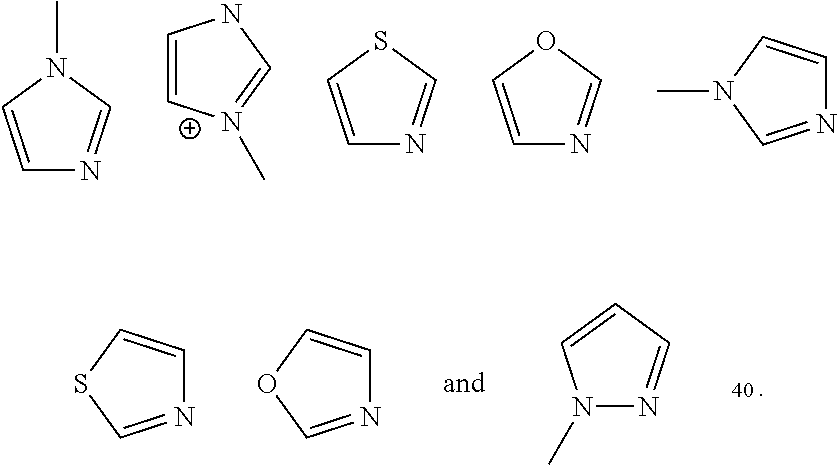
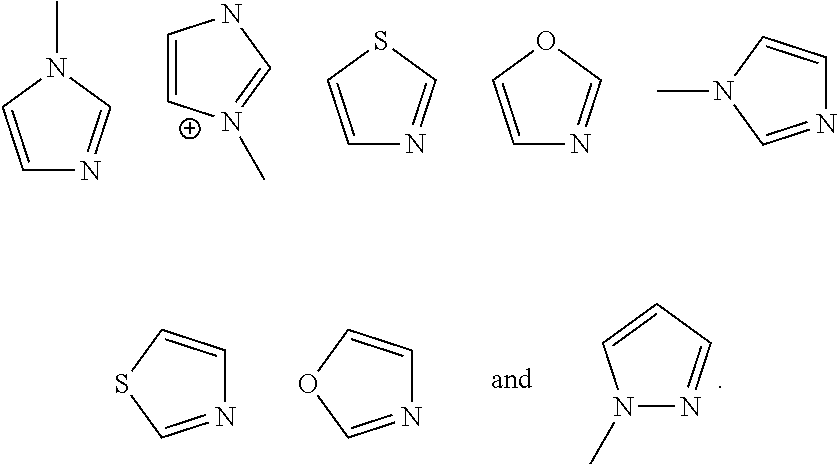
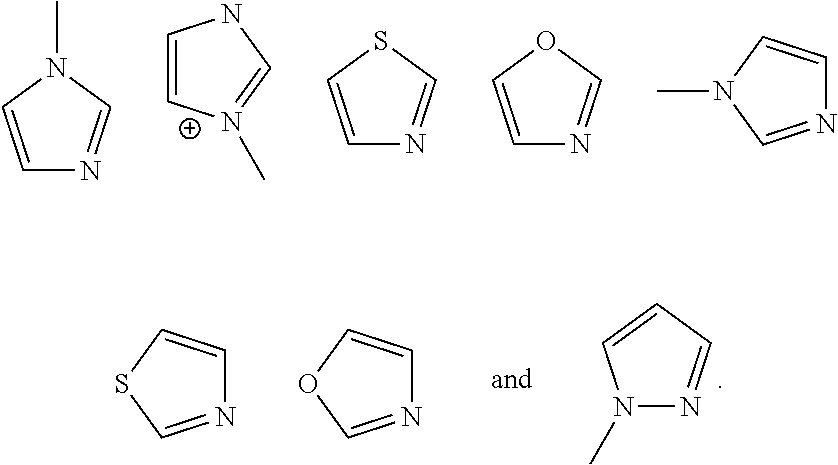
- the aromatic five-membered heterocycle can be, for example, substituted pyrazolyl, imidazolyl, substituted imidazolyl, thiazolyl, and substituted thiazolyl ligands shown below:
- the luminescent compound is platinum(II) di(2-pyrazolyl)benzene chloride, shown below:
- the benzene ring is substituted, such as fluorinated or methylated in one or more positions. Fluorinating the benzene ring increases the emission energy, shifting the emission toward the blue end of the visible spectrum.
- the six-membered ring is a pyridyl ring rather than benzene.
- Platinum(II) di(2-pyrazolyl)benzene chloride and analogs described herein may be prepared from the ligands depicted in FIG. 2 . Synthesis of the ligands is described below.
- HL 1 After standard cycles of evacuation and back-fill with dry and pure nitrogen, an oven-dried Schlenk flask equipped with a magnetic stir bar was charged with Cu 2 O (0.1 mmol, 10 mol %), syn-2-pyridinealdoxime (0.4 mmol, 20 mol %), the pyrazole (2.5 mmol), Cs 2 CO 3 (5.0 mmol), and the 1,3-dibromobenzene (1.0 mmol), and anhydrous and degassed acetonitrile (20 mL). The flask was stirred in an oil bath, and refluxed for 3 days.
- HL 2 HL 2 was synthesized in 64% yield using the same procedure as HL 1 except that 1,3-diiodobenzene was used as starting material.
- HL 3 1,3-bis(4,4,5,5-tetramethyl-1,3,2-dioxaborolan-2-yl)benzene (1.0 mmol), Pd(OAc) 2 (0.05 equiv), PPh 3 (0.2 equiv), 1-methyl-2-iodoimidazole (2.5 mmol) were resolved in dimethoxyethane/2M K 2 CO 3 aqueous solution (20 mL, 1:1) under nitrogen atmosphere. The mixture was heated and refluxed for 24 h. After being cooled to room temperature, the reaction mixture was diluted with EtOAc, and poured into a brine solution. The organic layer was separated, and washed with the water, dried, filtered, and the filtrate was concentrated under reduced pressure.
- HL 4 was synthesized in 40% yield using the same procedure as HL 3 except that 1,3-difluoro-4,6-bis(4,4,5,5-tetramethyl-1,3,2-dioxaborolan-2-yl)benzene was used as starting material instead of 1,3-bis(4,4,5,5-tetramethyl-1,3,2-dioxaborolan-2-yl)-benzene.
- HL 5 was synthesized in 25% yield using the same procedure as HL 3 except that 2-bromothiozole was used as starting material instead of 1-methyl-2-iodoimidazole.
- HL 6 HL 6 was synthesized in 65% yield using the same procedure as HL 1 except that imidazole was used as starting material.
- HL 7 Methyl iodide (3 equiv) was syringed into a 50 mL round-bottomed flask charged with HL 6 (10 mmol) and DMSO (30 mL). The reaction was stirred under nitrogen in room temperature for 48 h. The mixture was poured into EtOAc (60 mL), and the white precipitate was formed, filtered, washed with ether, and air-dried to obtain HL 7 in 85% yield.
- HL 8 was synthesized in 60% yield using the same procedure as HL 1 except that 1,3-diiodotoluene was used as starting material.
- HL 9 A mixture of 3,5-diiodotoluene (1.1 g, 3.0 mmol), 1-methylimidazole (7.5 mmol), Pd(OAc) 2 (5 mg, 0.01 mmol), KI (2.0 g, 12 mmol), and CuI (2.4 g, 12.2 mmol) in degassed DMF (12 mL) was heated under Ar at 140° C. for 10 days. After cooling to room temperature, the mixture was poured into NH 3 solution (10%, 50 mL), and CH 2 Cl 2 (40 ⁇ 3 mL) was added. The organic phase was separated and dried (MgSO 4 ), and the solvent was evaporated.
- HL 10 HL 10 was synthesized in 35% yield using the same procedure as HL 1 except that 1,3-dibromopyridine was used as starting material.
- HL 11 was synthesized in 35% yield using the same procedure as HL 9 except that 1,3-dibromopyridine was used as starting material.
- Pyridine-containing structures may be similarly synthesized.
- Platinum(II) complexes were prepared from HL 1 -HL 11 as described below.
- Acetic acid (3 mL) and water (0.3 mL) were added to a mixture of the ligand HL n (e.g., 1.0 mmol) and K 2 PtCl 4 (1 equiv) in a glass vessel with a magnetic stir bar.
- the vessel was capped, and then the mixture was heated under microwave irradiation for 30-60 minutes. Upon cooling to room temperature, a yellow or yellow-orange precipitate was formed. The precipitate was separated off from the yellow solution, washed sequentially with methanol, water, ethanol, and diethyl ether (e.g., 3 ⁇ 5 mL of each), and dried under vacuum.
- PtL 1-11 Cl Platinum (II) Ligand chloride (PtL 1-11 Cl) were treated with phenol and potassium hydroxide in acetone to give PtL 1-11 OPh for 2-3 hs after being filtrated, washed by water, acetone, and ether.
- FIG. 3 shows platinum(II) di(2-pyrazolyl)benzene chloride and analogs synthesized from the ligands. 1 H NMR data for these compounds in DMSO or CDCl 3 are listed below.
- PtL 2 OPh 1 H NMR (CDCl 3 ): 7.07-7.16 (m, 5H), 7.02 (d, 2H), 6.49 (t, 1h), 6.01 (s, 2H), 2.71 (s, 6H), 2.45 (s, 6H).
- PtL 2 OPhBu-t 1 H NMR (CDCl 3 ): 7.13 (t, 1H), 7.08 (d, 2H), 7.02 (d, 2H), 7.00 (d, 2H), 6.00 (s, 2H), 2.71 (s, 6H), 2.47 (s, 6H), 1.25 (s, 9H).
- PtL 3 OPh 1 H NMR (CDCl 3 ): 7.23 (d, 2H), 7.17 (d, 2H), 7.11 (t, 1H), 7.06 (t, 1H), 6.85-6.87 (m, 4H), 6.78 (d, 2H), 3.99 (s, 6H).
- FIGS. 4-12 show photoluminescence spectra for several Pt complexes including PtL 1 Cl, PtL 2 Cl, PtL 3 Cl, PtL 5 Cl, PtL 8 Cl, PtL 9 Cl, PtL 11 Cl and PtL 2 OPh.
- FIG. 4 shows a room temperature emission spectrum of platinum(II) di(2-pyrazolyl)benzene chloride in dichloromethane.
- FIG. 5 shows room temperature (plot 500 ) and 77K (plot 502 ) emission spectra of platinum(II) di(3,5-dimethyl-2-pyrazolyl)benzene chloride in solution.
- FIG. 6 shows a room temperature emission spectrum of platinum(II) di(3,5-dimethyl-2-pyrazolyl)benzene chloride in thin film of poly(methyl methacrylate) (PMMA).
- FIG. 7 shows a room temperature emission spectrum of platinum(II) di(3,5-dimethyl-2-pyrazolyl)benzene phenoxide in a thin film of poly(carbonate).
- FIG. 8 shows a room temperature emission spectrum of platinum(II) di(3,5-dimethyl-2-pyrazolyl)toluene chloride in a thin film of poly(methyl methacrylate) (PMMA).
- FIG. 9 shows a room temperature emission spectrum of platinum(II) di(methyl-imidazolyl)benzene chloride in a solution of dichloromethane.
- FIG. 10 shows a room temperature emission spectrum of platinum(II) di(methyl-imidazolyl)benzene chloride in a thin film of poly(methyl methacrylate) (PMMA).
- FIG. 11A shows a room temperature emission spectrum of platinum(II) di(methyl-imidazolyl)toluene chloride in a thin film of poly(methyl methacrylate) (PMMA).
- FIG. 11B shows a 77K emission spectrum of platinum(II) di(methyl-imidazolyl)pyridine chloride in a solution of 2-methyl-tetrahydrofuran.
- FIG. 12 shows a room temperature emission spectrum of platinum(II) di(thiazolyl)(4,6-difluoro-benzene) chloride in a solution of dichloromethane.
- these complexes provide the capability of tuning the emission energy of platinum(II) complexes over a range between ultraviolet and near-infrared, as well as improved emission in the blue wavelength range.
- These complexes can be used as luminescent labels, emitters for OLEDs, and other applications that benefit from efficient blue emission and high stability (longer lifetime).
Landscapes
- Chemical & Material Sciences (AREA)
- Organic Chemistry (AREA)
- Engineering & Computer Science (AREA)
- Materials Engineering (AREA)
- Crystallography & Structural Chemistry (AREA)
- Inorganic Chemistry (AREA)
- Electroluminescent Light Sources (AREA)
Abstract
Synthesis of platinum(II) di(2-pyrazolyl)benzene chloride and analogs includes forming a 1,3-di-substituted benzene including two aromatic five-membered heterocycles, and reacting the 1,3-di-substituted benzene with an acidic platinum-containing solution to form a luminescent platinum(II) complex. The luminescent platinum(II) complex is capable of emitting blue and white light and can be used as an emitter in a light emitting device.
Description
- This document claims priority from U.S. Patent Provisional Application Ser. No. 61/016,155 entitled “Platinum(II) Di(2-Pyrazolyl) Benzene Chloride Analogs and Uses” and filed on Dec. 21, 2007, the entire contents of which are incorporated herein by reference as part of the disclosure of this document.
- This invention relates to platinum(II) di(2-pyrazolyl)benzene chloride and analogs, and more particularly to the synthesis and use thereof.
- As depicted in
FIG. 1 , an organic light-emitting device (OLED) 100 may include a layer of indium tin oxide (ITO) as ananode 102, a layer of hole-transporting materials (HTL) 104, a layer of emissive materials (EML) 106 including emitter(s) and host(s), a layer of electron-transporting materials (ETL) 108, and ametal cathode layer 110 onsubstrate 112. The emission color of OLED 100 may be determined by the emission energy (optical energy gap) of the emitter(s) in the layer of emissive materials. Phosphorescent OLEDs (i.e., OLEDs with phosphorescent emitters) may have higher device efficiency than fluorescent OLEDs (i.e., OLEDs with fluorescent emitters). Some emitters for blue phosphorescent OLEDs include iridium—a relatively scarce element—in the form of cyclometalated iridium complexes. - In one aspect, a luminescent compound has the generic formula
-
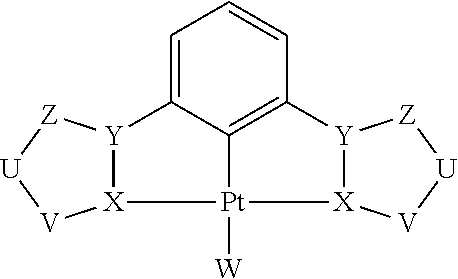
- where
-

- is an aromatic heterocycle
and where W is —Cl or -

- The six-membered ring in this generic formula denotes benzene or pyridine.
- In another aspect, a light emitting device includes the luminescent compound shown above.
- In certain implementations,
-

- is selected from the group consisting of
-
- In certain implementations, the luminescent compound is platinum(II) di(2-pyrazolyl)benzene chloride, with the formula:
-
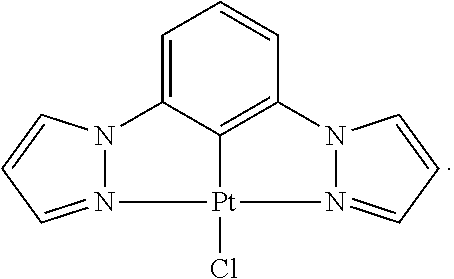
- In some implementations, the luminescent compound is phosphorescent. The compound is capable of emitting light in the blue range of the visible spectrum. In some cases, the compound is capable of emitting white light. The light emitting device may be an organic light emitting device.
- In another aspect, a method of making a platinum(II) complex includes forming a 1,3-di-substituted aromatic six-membered ring with two aromatic five-membered heterocycles, and reacting the 1,3-di-substituted six-membered ring with an acidic platinum-containing solution to form the platinum(II) complex.
- In some implementations, the aromatic five-membered heterocycles are selected from the group consisting of pyrazolyl, substituted pyrazolyl, imidazolyl, substituted imidazolyl, thiazolyl, and substituted thiazolyl. In certain implementations, the benzene is fluorinated, difluorinated, or methylated. Fluorinating the benzene ring may increase the emission energy, shifting the emission toward the blue end of the visible spectrum. The benzene may be bonded to a heteroatom, such as a nitrogen atom or a sulfur atom, in the heterocycle. The platinum atom in the platinum(II) complex may be bonded to a carbon atom and two nitrogen atoms. In some embodiments, the platinum(II) complex is platinum(II) di(2-pyrazolyl)benzene chloride. In certain implementations, the aromatic six-membered ring is benzene or pyridine. In some cases, when the six-membered ring is pyridine, an increase in the emission energy may result.
- Phosphorescent blue OLEDs with the platinum complexes described herein as emitters can be produced at low cost and provide operationally stable displays.
- The details of one or more embodiments of the invention are set forth in the accompanying drawings and the description below. Other features, objects, and advantages of the invention will be apparent from the description and drawings, and from the claims.
-
FIG. 1 illustrates an organic light emitting device (OLED). -
FIG. 2 shows precursors for platinum(II) di(2-pyrazolyl)benzene chloride and analogs. -
FIG. 3 shows platinum(II) di(2-pyrazolyl)benzene and analogs. -
FIG. 4 shows a room temperature emission spectrum of platinum(II) di(2-pyrazolyl)benzene chloride in dichloromethane. -
FIG. 5 shows room temperature and 77K emission spectra of platinum(II) di(3,5-dimethyl-2-pyrazolyl)benzene chloride in solution. -
FIG. 6 shows a room temperature emission spectrum of platinum(II) di(3,5-dimethyl-2-pyrazolyl)benzene chloride in thin film of poly(methyl methacrylate) (PMMA). -
FIG. 7 shows a room temperature emission spectrum of platinum(II) di(3,5-dimethyl-2-pyrazolyl)benzene phenoxide in a thin film of poly(carbonate). -
FIG. 8 shows a room temperature emission spectrum of platinum(II) di(3,5-dimethyl-2-pyrazolyl)toluene chloride in a thin film of poly(methyl methacrylate) (PMMA). -
FIG. 9 shows a room temperature emission spectrum of platinum(II) di(methyl-imidazolyl)benzene chloride in a solution of dichloromethane. -
FIG. 10 shows a room temperature emission spectrum of platinum(II) di(methyl-imidazolyl)benzene chloride in a thin film of poly(methyl methacrylate) (PMMA). -
FIG. 11A shows a room temperature emission spectrum of platinum(II) di(methyl-imidazolyl)toluene chloride in a thin film of poly(methyl methacrylate) (PMMA). -
FIG. 11B shows a 77K emission spectrum of platinum(II) di(methyl-imidazolyl)pyridine chloride in a solution of 2-methyl-tetrahydrofuran. -
FIG. 12 shows a room temperature emission spectrum of platinum(II) di(thiazolyl)(4,6-difluoro-benzene) chloride in a solution of dichloromethane. - The platinum complexes described herein can be used as emitters for OLEDs, absorbers for solar cells, luminescent labels for bio-applications, and the like. Blue phosphorescent OLEDs may include platinum complexes with high band-gap ligands, including the five-membered rings depicted herein.
- Platinum(II) di(2-pyrazolyl)benzene chloride and analogs may be represented as:
-
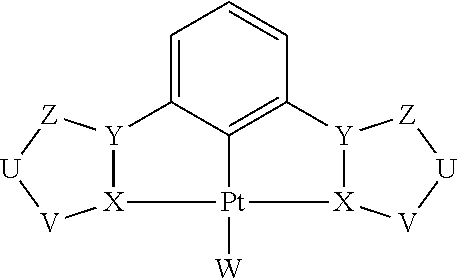
- in which:
-

- is an aromatic heterocycle,
-

- The aromatic six-membered ring in this generic formula denotes benzene or pyridine. The aromatic five-membered heterocycle can be, for example, substituted pyrazolyl, imidazolyl, substituted imidazolyl, thiazolyl, and substituted thiazolyl ligands shown below:
-
- In some embodiments, the luminescent compound is platinum(II) di(2-pyrazolyl)benzene chloride, shown below:
-
- In some cases, the benzene ring is substituted, such as fluorinated or methylated in one or more positions. Fluorinating the benzene ring increases the emission energy, shifting the emission toward the blue end of the visible spectrum. In certain cases, the six-membered ring is a pyridyl ring rather than benzene.
- Platinum(II) di(2-pyrazolyl)benzene chloride and analogs described herein may be prepared from the ligands depicted in
FIG. 2 . Synthesis of the ligands is described below. - HL1: After standard cycles of evacuation and back-fill with dry and pure nitrogen, an oven-dried Schlenk flask equipped with a magnetic stir bar was charged with Cu2O (0.1 mmol, 10 mol %), syn-2-pyridinealdoxime (0.4 mmol, 20 mol %), the pyrazole (2.5 mmol), Cs2CO3 (5.0 mmol), and the 1,3-dibromobenzene (1.0 mmol), and anhydrous and degassed acetonitrile (20 mL). The flask was stirred in an oil bath, and refluxed for 3 days. The reaction mixture was allowed to cool to room temperature, diluted with dichloromethane and filtered through a plug of CELITE® (World Minerals Inc., Santa Barbara, Calif.), the filter cake being further washed with dichloromethane (20 mL). The filtrate was concentrated under vacuo to yield a residue, which was purified by flash column chromatography on silica gel to obtain the pure product HL1 in 80% yield. 1H NMR (CDCl3): 6.51 (dd, 2H), 7.52 (t, 1H), 7.62 (dd, 2H), 7.76 (d, 2H), 8.02 (d, 2H), 8.10 (s, 1H).
- HL2: HL2 was synthesized in 64% yield using the same procedure as HL1 except that 1,3-diiodobenzene was used as starting material. 1H NMR (CDCl3): 2.6 (s 12H), 6.0 (s, 2H), 7.42 (dd, 2H), 7.51 (t, 2H), 7.55 (t, 2H).
- HL3: 1,3-bis(4,4,5,5-tetramethyl-1,3,2-dioxaborolan-2-yl)benzene (1.0 mmol), Pd(OAc)2 (0.05 equiv), PPh3 (0.2 equiv), 1-methyl-2-iodoimidazole (2.5 mmol) were resolved in dimethoxyethane/2M K2CO3 aqueous solution (20 mL, 1:1) under nitrogen atmosphere. The mixture was heated and refluxed for 24 h. After being cooled to room temperature, the reaction mixture was diluted with EtOAc, and poured into a brine solution. The organic layer was separated, and washed with the water, dried, filtered, and the filtrate was concentrated under reduced pressure. The residue was purified by column chromatography on silica gel to obtain the pure product HL3 in 34% yield. 1H NMR (CDCl3): 3.72 (s 6H), 7.12 (d, 2H), 7.47 (t, 1H), 7.48 (d, 2H), 7.56 (s, 1H), 7.72 (d, 2H).
- HL4: HL4 was synthesized in 40% yield using the same procedure as HL3 except that 1,3-difluoro-4,6-bis(4,4,5,5-tetramethyl-1,3,2-dioxaborolan-2-yl)benzene was used as starting material instead of 1,3-bis(4,4,5,5-tetramethyl-1,3,2-dioxaborolan-2-yl)-benzene. 1H NMR (CDCl3): 3.63 (s, 6H), 7.09 (t, 1H), 7.13 (d, 2H), 7.35 (t, 1H), 7.60 (d, 2H).
- HL5: HL5 was synthesized in 25% yield using the same procedure as HL3 except that 2-bromothiozole was used as starting material instead of 1-methyl-2-iodoimidazole. 1H NMR (CDCl3): 7.13 (t, 1H), 7.49 (d, 2H), 7.98 (d, 2H), 9.23 (t, 1H).
- HL6: HL6 was synthesized in 65% yield using the same procedure as HL1 except that imidazole was used as starting material. 1H NMR (DMSO): 7.26 (2H), 7.34 (2H), 7.41 (1H), 7.43 (2H), 7.62 (1H), 7.92 (2H).
- HL7: Methyl iodide (3 equiv) was syringed into a 50 mL round-bottomed flask charged with HL6 (10 mmol) and DMSO (30 mL). The reaction was stirred under nitrogen in room temperature for 48 h. The mixture was poured into EtOAc (60 mL), and the white precipitate was formed, filtered, washed with ether, and air-dried to obtain HL7 in 85% yield. 1H NMR (DMSO): 3.99 (s, 6H), 7.97-8.00 (m, 3H), 8.00 (s, 2H), 8.31 (s, 1H), 8.37 (s, 2H), 9.89 (s, 2H).
- HL8: HL8 was synthesized in 60% yield using the same procedure as HL1 except that 1,3-diiodotoluene was used as starting material. 1H NMR (CDCl3): 2.28 (s, 6H), 2.32 (s, 6H), 2.44 (s, 3H), 5.98 (s, 2H), 7.26-7.28 (m, 3H).
- HL9: A mixture of 3,5-diiodotoluene (1.1 g, 3.0 mmol), 1-methylimidazole (7.5 mmol), Pd(OAc)2 (5 mg, 0.01 mmol), KI (2.0 g, 12 mmol), and CuI (2.4 g, 12.2 mmol) in degassed DMF (12 mL) was heated under Ar at 140° C. for 10 days. After cooling to room temperature, the mixture was poured into NH3 solution (10%, 50 mL), and CH2Cl2 (40×3 mL) was added. The organic phase was separated and dried (MgSO4), and the solvent was evaporated. The crude product was purified by chromatograph (silica gel; ethyl acetate/methanol, 4:1) to give ligand HL9 as a light yellow solid (40%). 1H NMR (CDCl3): δ2.44 (s, 3H), 3.78 (s, 6H), 6.97 (d, 2H), 7.11 (d, 2H), 7.52 (s, 2H), 7.60 (s, 1H).
- HL10: HL10 was synthesized in 35% yield using the same procedure as HL1 except that 1,3-dibromopyridine was used as starting material. 1H NMR (CDCl3): 2.3 (s, 6H), 2.4 (s, 6H), 6.06 (s, 2H), 8.00 (t, 1H), 8.71 (d, 2H).
- HL11: HL11 was synthesized in 35% yield using the same procedure as HL9 except that 1,3-dibromopyridine was used as starting material.
- Pyridine-containing structures may be similarly synthesized.
- Platinum(II) complexes were prepared from HL1-HL11 as described below.
- Acetic acid (3 mL) and water (0.3 mL) were added to a mixture of the ligand HLn (e.g., 1.0 mmol) and K2PtCl4 (1 equiv) in a glass vessel with a magnetic stir bar. The vessel was capped, and then the mixture was heated under microwave irradiation for 30-60 minutes. Upon cooling to room temperature, a yellow or yellow-orange precipitate was formed. The precipitate was separated off from the yellow solution, washed sequentially with methanol, water, ethanol, and diethyl ether (e.g., 3×5 mL of each), and dried under vacuum.
- Platinum (II) Ligand chloride (PtL1-11Cl) were treated with phenol and potassium hydroxide in acetone to give PtL1-11OPh for 2-3 hs after being filtrated, washed by water, acetone, and ether.
-
FIG. 3 shows platinum(II) di(2-pyrazolyl)benzene chloride and analogs synthesized from the ligands. 1H NMR data for these compounds in DMSO or CDCl3 are listed below. - PtL1Cl: 1H NMR (DMSO): 6.84 (dd, 2H), 7.37 (t, 1H), 7.48 (d, 2H), 7.93 (d, 2H), 8.91 (d, 2H).
- PtL2Cl: 1H NMR (DMSO): 2.62 (s, 6H), 2.72 (s, 6H), 6.32 (s, 2H), 7.19-7.20 (m, 3H).
- PtL3Cl: 1H NMR (CDCl3): 7.40 (dd, 2H), 7.28 (d, 2H), 7.13 (t, 1H), 6.93 (d, 2H).
- PtL5Cl: 1H NMR (DMSO): 7.28 (t, 1H), 7.95 (d, 2H), 8.14 (d, 2H).
- PtL8Cl: 1H NMR (CDCl3): 2.65 (s, 6H), 2.76 (s, 6H), 6.34 (s, 2H), 7.09 (s, 2H).
- PtL9Cl: 1H NMR (CDCl3): 7.37 (dd, 2H), 7.11 (d, 2H), 6.91 (d, 2H), 4.04 (s, 6H), 2.34 (s, 3H).
- PtL2Cl: 1H NMR (CDCl3): δ2.78 (s, 6H), 2.79 (s, 6H), 6.11 (s, 2H), 8.27 (s, 2H).
- PtL2OPh: 1H NMR (CDCl3): 7.07-7.16 (m, 5H), 7.02 (d, 2H), 6.49 (t, 1h), 6.01 (s, 2H), 2.71 (s, 6H), 2.45 (s, 6H).
- PtL2OPhBu-t: 1H NMR (CDCl3): 7.13 (t, 1H), 7.08 (d, 2H), 7.02 (d, 2H), 7.00 (d, 2H), 6.00 (s, 2H), 2.71 (s, 6H), 2.47 (s, 6H), 1.25 (s, 9H).
- PtL3OPh: 1H NMR (CDCl3): 7.23 (d, 2H), 7.17 (d, 2H), 7.11 (t, 1H), 7.06 (t, 1H), 6.85-6.87 (m, 4H), 6.78 (d, 2H), 3.99 (s, 6H).
-
FIGS. 4-12 show photoluminescence spectra for several Pt complexes including PtL1Cl, PtL2Cl, PtL3Cl, PtL5Cl, PtL8Cl, PtL9Cl, PtL11Cl and PtL2OPh. -
FIG. 4 shows a room temperature emission spectrum of platinum(II) di(2-pyrazolyl)benzene chloride in dichloromethane. -
FIG. 5 shows room temperature (plot 500) and 77K (plot 502) emission spectra of platinum(II) di(3,5-dimethyl-2-pyrazolyl)benzene chloride in solution. -
FIG. 6 shows a room temperature emission spectrum of platinum(II) di(3,5-dimethyl-2-pyrazolyl)benzene chloride in thin film of poly(methyl methacrylate) (PMMA). -
FIG. 7 shows a room temperature emission spectrum of platinum(II) di(3,5-dimethyl-2-pyrazolyl)benzene phenoxide in a thin film of poly(carbonate). -
FIG. 8 shows a room temperature emission spectrum of platinum(II) di(3,5-dimethyl-2-pyrazolyl)toluene chloride in a thin film of poly(methyl methacrylate) (PMMA). -
FIG. 9 shows a room temperature emission spectrum of platinum(II) di(methyl-imidazolyl)benzene chloride in a solution of dichloromethane. -
FIG. 10 shows a room temperature emission spectrum of platinum(II) di(methyl-imidazolyl)benzene chloride in a thin film of poly(methyl methacrylate) (PMMA). -
FIG. 11A shows a room temperature emission spectrum of platinum(II) di(methyl-imidazolyl)toluene chloride in a thin film of poly(methyl methacrylate) (PMMA). -
FIG. 11B shows a 77K emission spectrum of platinum(II) di(methyl-imidazolyl)pyridine chloride in a solution of 2-methyl-tetrahydrofuran. -
FIG. 12 shows a room temperature emission spectrum of platinum(II) di(thiazolyl)(4,6-difluoro-benzene) chloride in a solution of dichloromethane. - As seen in these spectra, these complexes provide the capability of tuning the emission energy of platinum(II) complexes over a range between ultraviolet and near-infrared, as well as improved emission in the blue wavelength range. These complexes can be used as luminescent labels, emitters for OLEDs, and other applications that benefit from efficient blue emission and high stability (longer lifetime).
- A number of embodiments of the invention have been described. Nevertheless, it will be understood that various modifications may be made without departing from the spirit and scope of the invention.
Claims (26)
1. A luminescent compound comprising:
wherein

is an aromatic heterocycle, the six-membered aromatic ring is a phenyl or pyridinyl group,
and W is —Cl or

2. The compound of claim 1 , wherein

is selected from the group consisting of
3. The compound of claim 1 , wherein the compound comprises:

4. The compound of claim 1 , wherein the compound is phosphorescent.
5. The compound of claim 1 , wherein the compound is capable of emitting light in the blue range of the visible spectrum.
6. The compound of claim 1 , wherein the compound is capable of emitting white light.
7. (canceled)
8. A light emitting device comprising a luminescent compound comprising:
wherein

is an aromatic heterocycle, the six-membered aromatic ring is a phenyl or pyridinyl group,
and W is —Cl or

9. The device of claim 8 , wherein

is selected from the group consisting of
10. The device of claim 8 , wherein the compound is phosphorescent.
11. The device of claim 8 , wherein the compound is capable of emitting light in the blue range of the visible spectrum.
12. The device of claim 8 , wherein the compound is capable of emitting white light.
13. The device of claim 8 , wherein the compound comprises:
14. The device of claim 8 , wherein the device is an organic light emitting device.
15. (canceled)
16. A method of making a platinum(II) complex, the method comprising:
(a) forming an aromatic 1,3-di-substituted six-membered ring, wherein each substituent is an aromatic five-membered heterocycle; and
(b) reacting the 1,3-di-substituted aromatic six-membered ring with an acidic platinum-containing solution to form the platinum(II) complex.
17. The method of claim 16 , wherein the aromatic five-membered heterocycles are pyrazolyl groups.
18. The method of claim 16 , wherein the aromatic five-membered heterocycles are selected from the group consisting of substituted pyrazolyl, imidazolyl, substituted imidazolyl, thiazolyl, and substituted thiazolyl groups.
19. The method of claim 18 , wherein an atom in the six-membered ring is bonded to a heteroatom in each heterocycle.
20. The method of claim 19 , wherein the six-membered ring is bonded to a nitrogen atom or a sulfur atom in each heterocycle.
21. The method of claim 16 , wherein the two aromatic heterocycles are the same.
22. The method of claim 16 , wherein the platinum(II) complex comprises a platinum atom bonded to a carbon atom and two nitrogen atoms.
23. The method of claim 16 , wherein the aromatic six-membered ring is benzyl group.
24. The method of claim 23 , wherein the platinum(II) complex is platinum(II) di(2-pyrazolyl)benzene chloride.
25. The method of claim 23 , wherein the benzene is fluorinated, difluorinated, or methylated.
26. The method of claim 16 , wherein the aromatic six-membered ring is a pyridinyl group.
Priority Applications (1)
| Application Number | Priority Date | Filing Date | Title |
|---|---|---|---|
| US12/809,367 US20110301351A1 (en) | 2007-12-21 | 2008-12-19 | Platinum (II) Di (2-Pyrazolyl) Benzene Chloride Analogs and Uses |
Applications Claiming Priority (3)
| Application Number | Priority Date | Filing Date | Title |
|---|---|---|---|
| US1615507P | 2007-12-21 | 2007-12-21 | |
| US12/809,367 US20110301351A1 (en) | 2007-12-21 | 2008-12-19 | Platinum (II) Di (2-Pyrazolyl) Benzene Chloride Analogs and Uses |
| PCT/US2008/087847 WO2009086209A2 (en) | 2007-12-21 | 2008-12-19 | Platinum(ii) di(2-pyrazolyl)benzene chloride analogs and uses |
Related Parent Applications (1)
| Application Number | Title | Priority Date | Filing Date |
|---|---|---|---|
| PCT/US2008/087847 A-371-Of-International WO2009086209A2 (en) | 2007-12-21 | 2008-12-19 | Platinum(ii) di(2-pyrazolyl)benzene chloride analogs and uses |
Related Child Applications (1)
| Application Number | Title | Priority Date | Filing Date |
|---|---|---|---|
| US14/063,332 Division US8846940B2 (en) | 2007-12-21 | 2013-10-25 | Platinum (II) di (2-pyrazolyl) benzene chloride analogs and uses |
Publications (1)
| Publication Number | Publication Date |
|---|---|
| US20110301351A1 true US20110301351A1 (en) | 2011-12-08 |
Family
ID=40825058
Family Applications (3)
| Application Number | Title | Priority Date | Filing Date |
|---|---|---|---|
| US12/809,367 Abandoned US20110301351A1 (en) | 2007-12-21 | 2008-12-19 | Platinum (II) Di (2-Pyrazolyl) Benzene Chloride Analogs and Uses |
| US14/063,332 Active US8846940B2 (en) | 2007-12-21 | 2013-10-25 | Platinum (II) di (2-pyrazolyl) benzene chloride analogs and uses |
| US14/499,896 Active US9082989B2 (en) | 2007-12-21 | 2014-09-29 | Platinum (II) di (2-pyrazolyl) benzene chloride analogs and uses |
Family Applications After (2)
| Application Number | Title | Priority Date | Filing Date |
|---|---|---|---|
| US14/063,332 Active US8846940B2 (en) | 2007-12-21 | 2013-10-25 | Platinum (II) di (2-pyrazolyl) benzene chloride analogs and uses |
| US14/499,896 Active US9082989B2 (en) | 2007-12-21 | 2014-09-29 | Platinum (II) di (2-pyrazolyl) benzene chloride analogs and uses |
Country Status (2)
| Country | Link |
|---|---|
| US (3) | US20110301351A1 (en) |
| WO (1) | WO2009086209A2 (en) |
Cited By (47)
| Publication number | Priority date | Publication date | Assignee | Title |
|---|---|---|---|---|
| US20110028723A1 (en) * | 2008-02-29 | 2011-02-03 | Arizona Board Of Regents For And On Behalf Of Arizona State University | Tridentate Platinum (II) Complexes |
| US8846940B2 (en) * | 2007-12-21 | 2014-09-30 | Arizona Board Of Regents For And On Behalf Of Arizona State University | Platinum (II) di (2-pyrazolyl) benzene chloride analogs and uses |
| US9502671B2 (en) | 2014-07-28 | 2016-11-22 | Arizona Board Of Regents On Behalf Of Arizona State University | Tridentate cyclometalated metal complexes with six-membered coordination rings |
| US20180331305A1 (en) * | 2017-05-10 | 2018-11-15 | Samsung Display Co., Ltd. | Organometallic compound and organic light-emitting device including the same |
| US10727422B2 (en) | 2010-04-30 | 2020-07-28 | Arizona Board Of Regents On Behalf Of Arizona State University | Synthesis of four coordinated palladium complexes and their applications in light emitting devices thereof |
| US10745615B2 (en) | 2014-08-22 | 2020-08-18 | Arizona Board Of Regents On Behalf Of Arizona State University | Metal-assisted delayed fluorescent materials as co-host materials for fluorescent OLEDs |
| US10790457B2 (en) | 2014-07-29 | 2020-09-29 | Arizona Board Of Regents On Behalf Of Arizona State University | Metal-assisted delayed fluorescent emitters containing tridentate ligands |
| US10804476B2 (en) | 2011-05-26 | 2020-10-13 | Arizona Board Of Regents, Acting For And On Behalf Of Arizona State University | Synthesis of platinum and palladium complexes as narrow-band phosphorescent emitters for full color displays |
| US10822363B2 (en) | 2016-10-12 | 2020-11-03 | Arizona Board Of Regents On Behalf Of Arizona State University | Narrow band red phosphorescent tetradentate platinum (II) complexes |
| US10836785B2 (en) | 2015-06-03 | 2020-11-17 | Arizona Board Of Regents On Behalf Of Arizona State University | Tetradentate and octahedral metal complexes containing naphthyridinocarbazole and its analogues |
| US10851106B2 (en) | 2017-05-19 | 2020-12-01 | Arizona Board Of Regents, Acting For And On Behalf Of Arizona State University | Substituted benzo[4,5]imidazo[1,2-F]phenanthridines, dibenzo[I.K]benzo[4,5]imidazo[1,2-F]benzofurophenanthridines and dibenzo[I.K]benzo[4,5]imidazo[1,2-F]benzo[4,5]thienophenanthridines as thermally assisted delayed fluorescent materials |
| US10886478B2 (en) | 2014-07-24 | 2021-01-05 | Arizona Board Of Regents On Behalf Of Arizona State University | Tetradentate platinum (II) complexes cyclometalated with functionalized phenyl carbene ligands and their analogues |
| US10930865B2 (en) | 2015-08-04 | 2021-02-23 | Arizona Board Of Regents On Behalf Of Arizona State University | Tetradentate platinum (II) and palladium (II) complexes, devices, and uses thereof |
| US10937976B2 (en) | 2014-01-07 | 2021-03-02 | Arizona Board Of Regents On Behalf Of Arizona State University | Tetradentate platinum and palladium complex emitters containing phenyl-pyrazole and its analogues |
| US10944064B2 (en) | 2014-11-10 | 2021-03-09 | Arizona Board Of Regents On Behalf Of Arizona State University | Tetradentate metal complexes with carbon group bridging ligands |
| US10991897B2 (en) | 2014-11-10 | 2021-04-27 | Arizona Board Of Regents On Behalf Of Arizona State University | Emitters based on octahedral metal complexes |
| US10995108B2 (en) | 2012-10-26 | 2021-05-04 | Arizona Board Of Regents On Behalf Of Arizona State University | Metal complexes, methods, and uses thereof |
| US11011712B2 (en) | 2014-06-02 | 2021-05-18 | Arizona Board Of Regents On Behalf Of Arizona State University | Tetradentate cyclometalated platinum complexes containing 9,10-dihydroacridine and its analogues |
| US11063228B2 (en) | 2017-05-19 | 2021-07-13 | Arizona Board Of Regents On Behalf Of Arizona State University | Metal-assisted delayed fluorescent emitters employing benzo-imidazo-phenanthridine and analogues |
| US11101435B2 (en) | 2017-05-19 | 2021-08-24 | Arizona Board Of Regents On Behalf Of Arizona State University | Tetradentate platinum and palladium complexes based on biscarbazole and analogues |
| US11114626B2 (en) | 2012-09-24 | 2021-09-07 | Arizona Board Of Regents On Behalf Of Arizona State University | Metal compounds, methods, and uses thereof |
| US11124533B2 (en) | 2019-04-08 | 2021-09-21 | Samsung Display Co., Ltd. | Organometallic compound and organic light-emitting device including the same |
| CN113512067A (en) * | 2020-04-09 | 2021-10-19 | 三星显示有限公司 | Organometallic compound and organic light-emitting device including the same |
| US11183670B2 (en) | 2016-12-16 | 2021-11-23 | Arizona Board Of Regents On Behalf Of Arizona State University | Organic light emitting diode with split emissive layer |
| US11189808B2 (en) | 2013-10-14 | 2021-11-30 | Arizona Board Of Regents On Behalf Of Arizona State University | Platinum complexes and devices |
| US11245078B2 (en) | 2015-08-25 | 2022-02-08 | Arizona Board Of Regents On Behalf Of Arizona State University | Thermally activated delayed fluorescent material based on 9,10-dihydro-9,9-dimethylacridine analogues for prolonging device longevity |
| US11329244B2 (en) | 2014-08-22 | 2022-05-10 | Arizona Board Of Regents On Behalf Of Arizona State University | Organic light-emitting diodes with fluorescent and phosphorescent emitters |
| US11335865B2 (en) | 2016-04-15 | 2022-05-17 | Arizona Board Of Regents On Behalf Of Arizona State University | OLED with multi-emissive material layer |
| US11450816B2 (en) | 2017-05-19 | 2022-09-20 | Arizona Board Of Regents On Behalf Of Arizona State University | Donor-acceptor type thermally activated delayed fluorescent materials based on imidazo[1,2-f]phenanthridine and analogues |
| US11569459B2 (en) | 2019-05-10 | 2023-01-31 | Samsung Display Co., Ltd. | Organometallic compound having imidazopyrazine-based ligand and organic light-emitting device including the same |
| US11594688B2 (en) | 2017-10-17 | 2023-02-28 | Arizona Board Of Regents On Behalf Of Arizona State University | Display and lighting devices comprising phosphorescent excimers with preferred molecular orientation as monochromatic emitters |
| US11594691B2 (en) | 2019-01-25 | 2023-02-28 | Arizona Board Of Regents On Behalf Of Arizona State University | Light outcoupling efficiency of phosphorescent OLEDs by mixing horizontally aligned fluorescent emitters |
| US11631822B2 (en) | 2020-03-23 | 2023-04-18 | Samsung Display Co., Ltd. | Organometallic compound and organic light-emitting device including the same |
| US11647643B2 (en) | 2017-10-17 | 2023-05-09 | Arizona Board Of Regents On Behalf Of Arizona State University | Hole-blocking materials for organic light emitting diodes |
| US11708385B2 (en) | 2017-01-27 | 2023-07-25 | Arizona Board Of Regents On Behalf Of Arizona State University | Metal-assisted delayed fluorescent emitters employing pyrido-pyrrolo-acridine and analogues |
| US11785838B2 (en) | 2019-10-02 | 2023-10-10 | Arizona Board Of Regents On Behalf Of Arizona State University | Green and red organic light-emitting diodes employing excimer emitters |
| US11878988B2 (en) | 2019-01-24 | 2024-01-23 | Arizona Board Of Regents On Behalf Of Arizona State University | Blue phosphorescent emitters employing functionalized imidazophenthridine and analogues |
| US11925104B2 (en) | 2017-07-21 | 2024-03-05 | Samsung Display Co., Ltd. | Organometallic compound and organic light-emitting device including the same |
| US11950495B2 (en) | 2019-06-14 | 2024-04-02 | Samsung Display Co., Ltd. | Organic light-emitting device and organometallic compound |
| US11945985B2 (en) | 2020-05-19 | 2024-04-02 | Arizona Board Of Regents On Behalf Of Arizona State University | Metal assisted delayed fluorescent emitters for organic light-emitting diodes |
| US12037348B2 (en) | 2018-03-09 | 2024-07-16 | Arizona Board Of Regents On Behalf Of Arizona State University | Blue and narrow band green and red emitting metal complexes |
| US12043611B2 (en) | 2014-08-15 | 2024-07-23 | Arizona Board Of Regents On Behalf Of Arizona State University | Non-platinum metal complexes for excimer based single dopant white organic light emitting diodes |
| US12091429B2 (en) | 2018-07-16 | 2024-09-17 | Arizona Board Of Regents On Behalf Of Arizona State University | Fluorinated porphyrin derivatives for optoelectronic applications |
| US12168661B2 (en) | 2020-02-21 | 2024-12-17 | Arizona Board Of Regents On Behalf Of Arizona State University | Functional materials based on stable chemical structure |
| US12503644B2 (en) | 2020-05-19 | 2025-12-23 | Arizona Board Of Regents On Behalf Of Arizona State University | Metal assisted delayed fluorescent emitters for organic light-emitting diodes |
| US12534665B2 (en) | 2019-04-15 | 2026-01-27 | Samsung Display Co., Ltd. | Organometallic compound, organic light-emitting device including the same, and apparatus including the light-emitting device |
| US12545678B2 (en) | 2021-09-09 | 2026-02-10 | Arizona Board Of Regents On Behalf Of Arizon State University | Blue thermally activated delayed fluorescent emitters and hosts based on functionalized imidazolyl groups |
Families Citing this family (18)
| Publication number | Priority date | Publication date | Assignee | Title |
|---|---|---|---|---|
| JPS6180011A (en) * | 1984-09-28 | 1986-04-23 | Toshiba Corp | Dimension measuring apparatus |
| US8106199B2 (en) | 2007-02-13 | 2012-01-31 | Arizona Board Of Regents For And On Behalf Of Arizona State University | Organometallic materials for optical emission, optical absorption, and devices including organometallic materials |
| CN108003196B (en) * | 2012-07-19 | 2021-07-23 | Udc 爱尔兰有限责任公司 | Dinuclear metal complexes containing carbene ligands and use thereof in OLEDs |
| WO2015131158A1 (en) | 2014-02-28 | 2015-09-03 | Arizona Board Of Regents On Behalf Of Arizona State University | Chiral metal complexes as emitters for organic polarized electroluminescent devices |
| US10361382B2 (en) * | 2016-01-15 | 2019-07-23 | The University Of Hong Kong | Platinum complexes for blue OLED application |
| CN110582550B (en) * | 2017-04-19 | 2023-11-28 | 香港大学 | Dendrimers containing luminescent platinum (II) compounds for organic light-emitting devices and preparation thereof |
| KR102804493B1 (en) | 2019-04-30 | 2025-05-09 | 삼성디스플레이 주식회사 | Organic light emitting device |
| KR102867203B1 (en) | 2020-07-13 | 2025-10-16 | 삼성디스플레이 주식회사 | Light emitting device, electronic apparatus including the same and organometallic compound |
| KR102801011B1 (en) | 2020-07-13 | 2025-04-30 | 삼성디스플레이 주식회사 | Light emitting device and electronic apparatus including the same |
| KR20220037040A (en) | 2020-09-16 | 2022-03-24 | 삼성디스플레이 주식회사 | Organometallic compound and light emitting device comprising the same and electronic apparatus comprising the same |
| KR102870801B1 (en) | 2020-10-13 | 2025-10-14 | 삼성디스플레이 주식회사 | Organometallic compound and light emitting device including the same and electronic apparatus including the same |
| KR102779968B1 (en) | 2020-12-02 | 2025-03-13 | 삼성디스플레이 주식회사 | Organometallic compound and light emitting device including the same and electronic apparatus including the same |
| KR20220078797A (en) | 2020-12-03 | 2022-06-13 | 삼성디스플레이 주식회사 | Organometallic compound, light emitting device including the same and electronic apparatus including the device |
| KR20220085924A (en) | 2020-12-15 | 2022-06-23 | 삼성디스플레이 주식회사 | Light emitting device and electronic apparatus comprising same |
| KR20220085892A (en) | 2020-12-15 | 2022-06-23 | 삼성디스플레이 주식회사 | Organic electroluminescence device and organometallic compound for organic electroluminescence device |
| KR102892042B1 (en) | 2021-03-25 | 2025-11-28 | 삼성디스플레이 주식회사 | Organic electroluminescence device and organometallic compound for organic electroluminescence device |
| CN115141232A (en) | 2021-03-31 | 2022-10-04 | 三星显示有限公司 | Organometallic compound, light-emitting device including the same, and electronic device |
| CN115197274A (en) | 2021-04-02 | 2022-10-18 | 三星显示有限公司 | Organometallic compound, light-emitting device including the same, and electronic device |
Citations (1)
| Publication number | Priority date | Publication date | Assignee | Title |
|---|---|---|---|---|
| US20060093854A1 (en) * | 2004-11-04 | 2006-05-04 | Fujitsu Limited | Organometallic complex, light-emitting solid, organic electroluminescent element and organic electroluminescent display |
Family Cites Families (20)
| Publication number | Priority date | Publication date | Assignee | Title |
|---|---|---|---|---|
| WO2000070655A2 (en) | 1999-05-13 | 2000-11-23 | The Trustees Of Princeton University | Very high efficiency organic light emitting devices based on electrophosphorescence |
| JP3965319B2 (en) | 2001-03-08 | 2007-08-29 | ザ ユニヴァーシティ オブ ホンコン | Organometallic light emitting material |
| US6580027B2 (en) | 2001-06-11 | 2003-06-17 | Trustees Of Princeton University | Solar cells using fullerenes |
| US7166368B2 (en) | 2001-11-07 | 2007-01-23 | E. I. Du Pont De Nemours And Company | Electroluminescent platinum compounds and devices made with such compounds |
| US20060094875A1 (en) | 2002-11-01 | 2006-05-04 | Hisanori Itoh | Platinum complexes |
| US7029766B2 (en) | 2003-12-05 | 2006-04-18 | Eastman Kodak Company | Organic element for electroluminescent devices |
| DE10358665A1 (en) | 2003-12-12 | 2005-07-07 | Basf Ag | Use of platinum (II) complexes as luminescent materials in organic light-emitting diodes (OLEDs) |
| US6885026B1 (en) | 2004-01-30 | 2005-04-26 | Eastman Kodak Company | Organic element for electroluminescent devices |
| TWI245586B (en) | 2004-03-30 | 2005-12-11 | Fujitsu Ltd | Phosphorescent solid body, organic electroluminescent element, and organic electroluminescent device |
| JP4880450B2 (en) | 2004-04-30 | 2012-02-22 | 富士フイルム株式会社 | Organometallic complex, luminescent solid, organic EL device and organic EL display |
| JP4796808B2 (en) * | 2004-09-17 | 2011-10-19 | 富士フイルム株式会社 | Organic electroluminescence device |
| GB2437453B (en) | 2005-02-04 | 2011-05-04 | Konica Minolta Holdings Inc | Material for organic electroluminescence element, organic electroluminescence element, display device and lighting device |
| JP4786917B2 (en) * | 2005-03-17 | 2011-10-05 | 富士フイルム株式会社 | Organometallic complex, luminescent solid, organic EL device and organic EL display |
| JPWO2006100888A1 (en) | 2005-03-22 | 2008-08-28 | コニカミノルタホールディングス株式会社 | Organic EL element material, organic EL element, display device and lighting device |
| JP2006282965A (en) * | 2005-04-05 | 2006-10-19 | Konica Minolta Holdings Inc | Organic electroluminescent device material, organic electroluminescent device, display device and lighting device |
| JP2008069268A (en) | 2006-09-14 | 2008-03-27 | Konica Minolta Holdings Inc | Organic electroluminescent element material, organic electroluminescent element, displaying device and lighting device |
| US8106199B2 (en) | 2007-02-13 | 2012-01-31 | Arizona Board Of Regents For And On Behalf Of Arizona State University | Organometallic materials for optical emission, optical absorption, and devices including organometallic materials |
| WO2009086209A2 (en) | 2007-12-21 | 2009-07-09 | Arizona Board Of Regents For And On Behalf Of Arizona State University | Platinum(ii) di(2-pyrazolyl)benzene chloride analogs and uses |
| WO2009111299A2 (en) | 2008-02-29 | 2009-09-11 | Arizona Board Of Regents For And On Behalf Of Arizona State University | Tridentate platinum (ii) complexes |
| WO2011050003A2 (en) * | 2009-10-19 | 2011-04-28 | University Of Mississippi | Air-stable, blue light emitting chemical compounds |
-
2008
- 2008-12-19 WO PCT/US2008/087847 patent/WO2009086209A2/en not_active Ceased
- 2008-12-19 US US12/809,367 patent/US20110301351A1/en not_active Abandoned
-
2013
- 2013-10-25 US US14/063,332 patent/US8846940B2/en active Active
-
2014
- 2014-09-29 US US14/499,896 patent/US9082989B2/en active Active
Patent Citations (1)
| Publication number | Priority date | Publication date | Assignee | Title |
|---|---|---|---|---|
| US20060093854A1 (en) * | 2004-11-04 | 2006-05-04 | Fujitsu Limited | Organometallic complex, light-emitting solid, organic electroluminescent element and organic electroluminescent display |
Cited By (86)
| Publication number | Priority date | Publication date | Assignee | Title |
|---|---|---|---|---|
| US8846940B2 (en) * | 2007-12-21 | 2014-09-30 | Arizona Board Of Regents For And On Behalf Of Arizona State University | Platinum (II) di (2-pyrazolyl) benzene chloride analogs and uses |
| US9082989B2 (en) | 2007-12-21 | 2015-07-14 | Arizona Board of Regents for and on behalf of Arizona State Univesity | Platinum (II) di (2-pyrazolyl) benzene chloride analogs and uses |
| US9203039B2 (en) | 2008-02-29 | 2015-12-01 | Arizona Board Of Regents For And On Behalf Of Arizona State University | Tridentate platinum (II) complexes |
| US8669364B2 (en) | 2008-02-29 | 2014-03-11 | Arizona Board Of Regents For And On Behalf Of Arizona State University | Tridentate platinum (II) complexes |
| US9076974B2 (en) | 2008-02-29 | 2015-07-07 | Arizona Board Of Regents For And On Behalf Of Arizona State University | Tridentate platinum (II) complexes |
| US8389725B2 (en) | 2008-02-29 | 2013-03-05 | Arizona Board Of Regents For And On Behalf Of Arizona State University | Tridentate platinum (II) complexes |
| US20110028723A1 (en) * | 2008-02-29 | 2011-02-03 | Arizona Board Of Regents For And On Behalf Of Arizona State University | Tridentate Platinum (II) Complexes |
| US10727422B2 (en) | 2010-04-30 | 2020-07-28 | Arizona Board Of Regents On Behalf Of Arizona State University | Synthesis of four coordinated palladium complexes and their applications in light emitting devices thereof |
| US10804476B2 (en) | 2011-05-26 | 2020-10-13 | Arizona Board Of Regents, Acting For And On Behalf Of Arizona State University | Synthesis of platinum and palladium complexes as narrow-band phosphorescent emitters for full color displays |
| US11121328B2 (en) | 2011-05-26 | 2021-09-14 | Arizona Board Of Regents On Behalf Of Arizona State University | Synthesis of platinum and palladium complexes as narrow-band phosphorescent emitters for full color displays |
| US11114626B2 (en) | 2012-09-24 | 2021-09-07 | Arizona Board Of Regents On Behalf Of Arizona State University | Metal compounds, methods, and uses thereof |
| US12232411B2 (en) | 2012-09-24 | 2025-02-18 | Arizona Board Of Regents On Behalf Of Arizona State University | Metal compounds, methods, and uses thereof |
| US12043633B2 (en) | 2012-10-26 | 2024-07-23 | Arizona Board Of Regents On Behalf Of Arizona State University | Metal complexes, methods, and uses thereof |
| US10995108B2 (en) | 2012-10-26 | 2021-05-04 | Arizona Board Of Regents On Behalf Of Arizona State University | Metal complexes, methods, and uses thereof |
| US11189808B2 (en) | 2013-10-14 | 2021-11-30 | Arizona Board Of Regents On Behalf Of Arizona State University | Platinum complexes and devices |
| US12167676B2 (en) | 2013-10-14 | 2024-12-10 | Arizona Board Of Regents On Behalf Of Arizona State University | Platinum complexes and devices |
| US11930698B2 (en) | 2014-01-07 | 2024-03-12 | Arizona Board Of Regents On Behalf Of Arizona State University | Tetradentate platinum and palladium complex emitters containing phenyl-pyrazole and its analogues |
| US10937976B2 (en) | 2014-01-07 | 2021-03-02 | Arizona Board Of Regents On Behalf Of Arizona State University | Tetradentate platinum and palladium complex emitters containing phenyl-pyrazole and its analogues |
| US11839144B2 (en) | 2014-06-02 | 2023-12-05 | Arizona Board Of Regents On Behalf Of Arizona State University | Tetradentate cyclometalated platinum complexes containing 9,10-dihydroacridine and its analogues |
| US11011712B2 (en) | 2014-06-02 | 2021-05-18 | Arizona Board Of Regents On Behalf Of Arizona State University | Tetradentate cyclometalated platinum complexes containing 9,10-dihydroacridine and its analogues |
| US12082486B2 (en) | 2014-07-24 | 2024-09-03 | Arizona Board Of Regents On Behalf Of Arizona State University | Tetradentate platinum (II) complexes cyclometalated with functionalized phenyl carbene ligands and their analogues |
| US10886478B2 (en) | 2014-07-24 | 2021-01-05 | Arizona Board Of Regents On Behalf Of Arizona State University | Tetradentate platinum (II) complexes cyclometalated with functionalized phenyl carbene ligands and their analogues |
| US10964897B2 (en) | 2014-07-28 | 2021-03-30 | Arizona Board Of Regents On Behalf Of Arizona State University | Tridentate cyclometalated metal complexes with six-membered coordination rings |
| US10411202B2 (en) | 2014-07-28 | 2019-09-10 | Arizon Board Of Regents On Behalf Of Arizona State University | Tridentate cyclometalated metal complexes with six-membered coordination rings |
| US9985224B2 (en) | 2014-07-28 | 2018-05-29 | Arizona Board Of Regents On Behalf Of Arizona State University | Tridentate cyclometalated metal complexes with six-membered coordination rings |
| US9502671B2 (en) | 2014-07-28 | 2016-11-22 | Arizona Board Of Regents On Behalf Of Arizona State University | Tridentate cyclometalated metal complexes with six-membered coordination rings |
| US12082488B2 (en) | 2014-07-29 | 2024-09-03 | Arizona Board Of Regents On Behalf Of Arizona State University | Metal-assisted delayed fluorescent emitters containing tridentate ligands |
| US10790457B2 (en) | 2014-07-29 | 2020-09-29 | Arizona Board Of Regents On Behalf Of Arizona State University | Metal-assisted delayed fluorescent emitters containing tridentate ligands |
| US11145830B2 (en) | 2014-07-29 | 2021-10-12 | Arizona Board Of Regents On Behalf Of Arizona State University | Metal-assisted delayed fluorescent emitters containing tridentate ligands |
| US12043611B2 (en) | 2014-08-15 | 2024-07-23 | Arizona Board Of Regents On Behalf Of Arizona State University | Non-platinum metal complexes for excimer based single dopant white organic light emitting diodes |
| US12492336B2 (en) | 2014-08-22 | 2025-12-09 | Arizona Board Of Regents On Behalf Of Arizona State University | Organic light-emitting diodes with fluorescent and phosphorescent emitters |
| US12221573B2 (en) | 2014-08-22 | 2025-02-11 | Arizona Board Of Regents On Behalf Of Arizona State University | Metal-assisted delayed fluorescent materials as co-host materials for fluorescent OLEDs |
| US11795387B2 (en) | 2014-08-22 | 2023-10-24 | Arizona Board Of Regents On Behalf Of Arizona State University | Metal-assisted delayed fluorescent materials as co-host materials for fluorescent OLEDs |
| US11329244B2 (en) | 2014-08-22 | 2022-05-10 | Arizona Board Of Regents On Behalf Of Arizona State University | Organic light-emitting diodes with fluorescent and phosphorescent emitters |
| US11339324B2 (en) | 2014-08-22 | 2022-05-24 | Arizona Board Of Regents On Behalf Of Arizona State University | Metal-assisted delayed fluorescent materials as co-host materials for fluorescent OLEDs |
| US10745615B2 (en) | 2014-08-22 | 2020-08-18 | Arizona Board Of Regents On Behalf Of Arizona State University | Metal-assisted delayed fluorescent materials as co-host materials for fluorescent OLEDs |
| US10944064B2 (en) | 2014-11-10 | 2021-03-09 | Arizona Board Of Regents On Behalf Of Arizona State University | Tetradentate metal complexes with carbon group bridging ligands |
| US11856840B2 (en) | 2014-11-10 | 2023-12-26 | Arizona Board Of Regents On Behalf Of Arizona State University | Emitters based on octahedral metal complexes |
| US10991897B2 (en) | 2014-11-10 | 2021-04-27 | Arizona Board Of Regents On Behalf Of Arizona State University | Emitters based on octahedral metal complexes |
| US12302745B2 (en) | 2014-11-10 | 2025-05-13 | Arizona Board Of Regents On Behalf Of Arizona State University | Tetradentate metal complexes with carbon group bridging ligands |
| US11653560B2 (en) | 2014-11-10 | 2023-05-16 | Arizona Board Of Regents On Behalf Of Arizona State University | Tetradentate metal complexes with carbon group bridging ligands |
| US11472827B2 (en) | 2015-06-03 | 2022-10-18 | Arizona Board Of Regents On Behalf Of Arizona State University | Tetradentate and octahedral metal complexes containing naphthyridinocarbazole and its analogues |
| US10836785B2 (en) | 2015-06-03 | 2020-11-17 | Arizona Board Of Regents On Behalf Of Arizona State University | Tetradentate and octahedral metal complexes containing naphthyridinocarbazole and its analogues |
| US12312366B2 (en) | 2015-06-03 | 2025-05-27 | Arizona Board Of Regents On Behalf Of Arizona State University | Tetradentate and octahedral metal complexes containing naphthyridinocarbazole and its analogues |
| US10930865B2 (en) | 2015-08-04 | 2021-02-23 | Arizona Board Of Regents On Behalf Of Arizona State University | Tetradentate platinum (II) and palladium (II) complexes, devices, and uses thereof |
| US12010914B2 (en) | 2015-08-25 | 2024-06-11 | Arizona Board Of Regents On Behalf Of Arizona State University | Thermally activated delayed fluorescent material based on 9,10-dihydro-9,9-dimethylacridine analogues for prolonging device longevity |
| US11245078B2 (en) | 2015-08-25 | 2022-02-08 | Arizona Board Of Regents On Behalf Of Arizona State University | Thermally activated delayed fluorescent material based on 9,10-dihydro-9,9-dimethylacridine analogues for prolonging device longevity |
| US11335865B2 (en) | 2016-04-15 | 2022-05-17 | Arizona Board Of Regents On Behalf Of Arizona State University | OLED with multi-emissive material layer |
| US10822363B2 (en) | 2016-10-12 | 2020-11-03 | Arizona Board Of Regents On Behalf Of Arizona State University | Narrow band red phosphorescent tetradentate platinum (II) complexes |
| US11183670B2 (en) | 2016-12-16 | 2021-11-23 | Arizona Board Of Regents On Behalf Of Arizona State University | Organic light emitting diode with split emissive layer |
| US11708385B2 (en) | 2017-01-27 | 2023-07-25 | Arizona Board Of Regents On Behalf Of Arizona State University | Metal-assisted delayed fluorescent emitters employing pyrido-pyrrolo-acridine and analogues |
| US20180331305A1 (en) * | 2017-05-10 | 2018-11-15 | Samsung Display Co., Ltd. | Organometallic compound and organic light-emitting device including the same |
| US12356849B2 (en) * | 2017-05-10 | 2025-07-08 | Samsung Display Co., Ltd. | Organometallic compound and organic light-emitting device including the same |
| US11974495B2 (en) | 2017-05-19 | 2024-04-30 | Arizona Board Of Regents On Behalf Of Arizona State University | Tetradentate platinum and palladium complexes based on biscarbazole and analogues |
| US12193327B2 (en) | 2017-05-19 | 2025-01-07 | Arizona Board of Regents on Behalf Arizona State University | Donor-acceptor type thermally activated delayed fluorescent materials based on imidazo[1,2-f]phenanthridine and analogues |
| US12534462B2 (en) | 2017-05-19 | 2026-01-27 | Arizona Board Of Regents On Behalf Of Arizona State University | Substituted heteroaryls as thermally assisted delayed fluorescent materials |
| US11450816B2 (en) | 2017-05-19 | 2022-09-20 | Arizona Board Of Regents On Behalf Of Arizona State University | Donor-acceptor type thermally activated delayed fluorescent materials based on imidazo[1,2-f]phenanthridine and analogues |
| US11101435B2 (en) | 2017-05-19 | 2021-08-24 | Arizona Board Of Regents On Behalf Of Arizona State University | Tetradentate platinum and palladium complexes based on biscarbazole and analogues |
| US12010908B2 (en) | 2017-05-19 | 2024-06-11 | Arizona Board Of Regents On Behalf Of Arizona State University | Metal-assisted delayed fluorescent emitters employing benzo-imidazo-phenanthridine and analogues |
| US11063228B2 (en) | 2017-05-19 | 2021-07-13 | Arizona Board Of Regents On Behalf Of Arizona State University | Metal-assisted delayed fluorescent emitters employing benzo-imidazo-phenanthridine and analogues |
| US10851106B2 (en) | 2017-05-19 | 2020-12-01 | Arizona Board Of Regents, Acting For And On Behalf Of Arizona State University | Substituted benzo[4,5]imidazo[1,2-F]phenanthridines, dibenzo[I.K]benzo[4,5]imidazo[1,2-F]benzofurophenanthridines and dibenzo[I.K]benzo[4,5]imidazo[1,2-F]benzo[4,5]thienophenanthridines as thermally assisted delayed fluorescent materials |
| US11603370B2 (en) | 2017-05-19 | 2023-03-14 | Arizona Board Of Regents On Behalf Of Arizona State University | Substituted heteroaryls as thermally assisted delayed fluorescent materials |
| US11925104B2 (en) | 2017-07-21 | 2024-03-05 | Samsung Display Co., Ltd. | Organometallic compound and organic light-emitting device including the same |
| US11594688B2 (en) | 2017-10-17 | 2023-02-28 | Arizona Board Of Regents On Behalf Of Arizona State University | Display and lighting devices comprising phosphorescent excimers with preferred molecular orientation as monochromatic emitters |
| US11647643B2 (en) | 2017-10-17 | 2023-05-09 | Arizona Board Of Regents On Behalf Of Arizona State University | Hole-blocking materials for organic light emitting diodes |
| US12120945B2 (en) | 2017-10-17 | 2024-10-15 | Arizona Board Of Regents On Behalf Of Arizona State University | Display and lighting devices comprising phosphorescent excimers with preferred molecular orientation as monochromatic emitters |
| US12037348B2 (en) | 2018-03-09 | 2024-07-16 | Arizona Board Of Regents On Behalf Of Arizona State University | Blue and narrow band green and red emitting metal complexes |
| US12091429B2 (en) | 2018-07-16 | 2024-09-17 | Arizona Board Of Regents On Behalf Of Arizona State University | Fluorinated porphyrin derivatives for optoelectronic applications |
| US12448405B2 (en) | 2019-01-24 | 2025-10-21 | Arizona Board Of Regents On Behalf Of Arizona State University | Blue phosphorescent emitters employing functionalized imidazophenthridine and analogues |
| US11878988B2 (en) | 2019-01-24 | 2024-01-23 | Arizona Board Of Regents On Behalf Of Arizona State University | Blue phosphorescent emitters employing functionalized imidazophenthridine and analogues |
| US11594691B2 (en) | 2019-01-25 | 2023-02-28 | Arizona Board Of Regents On Behalf Of Arizona State University | Light outcoupling efficiency of phosphorescent OLEDs by mixing horizontally aligned fluorescent emitters |
| US12082490B2 (en) | 2019-01-25 | 2024-09-03 | Arizona Board Of Regents On Behalf Of Arizona State University | Light outcoupling efficiency of phosphorescent OLEDs by mixing horizontally aligned fluorescent emitters |
| US11697664B2 (en) | 2019-04-08 | 2023-07-11 | Samsung Display Co., Ltd. | Organometallic compound and organic light-emitting device including the same |
| US11124533B2 (en) | 2019-04-08 | 2021-09-21 | Samsung Display Co., Ltd. | Organometallic compound and organic light-emitting device including the same |
| US12534665B2 (en) | 2019-04-15 | 2026-01-27 | Samsung Display Co., Ltd. | Organometallic compound, organic light-emitting device including the same, and apparatus including the light-emitting device |
| US11569459B2 (en) | 2019-05-10 | 2023-01-31 | Samsung Display Co., Ltd. | Organometallic compound having imidazopyrazine-based ligand and organic light-emitting device including the same |
| US11950495B2 (en) | 2019-06-14 | 2024-04-02 | Samsung Display Co., Ltd. | Organic light-emitting device and organometallic compound |
| US12501821B2 (en) | 2019-06-14 | 2025-12-16 | Samsung Display Co., Ltd. | Organic light-emitting device and organometallic compound |
| US11785838B2 (en) | 2019-10-02 | 2023-10-10 | Arizona Board Of Regents On Behalf Of Arizona State University | Green and red organic light-emitting diodes employing excimer emitters |
| US12120946B2 (en) | 2019-10-02 | 2024-10-15 | Arizona Board Of Regents On Behalf Of Arizona State University | Green and red organic light-emitting diodes employing excimer emitters |
| US12168661B2 (en) | 2020-02-21 | 2024-12-17 | Arizona Board Of Regents On Behalf Of Arizona State University | Functional materials based on stable chemical structure |
| US11631822B2 (en) | 2020-03-23 | 2023-04-18 | Samsung Display Co., Ltd. | Organometallic compound and organic light-emitting device including the same |
| CN113512067A (en) * | 2020-04-09 | 2021-10-19 | 三星显示有限公司 | Organometallic compound and organic light-emitting device including the same |
| US11945985B2 (en) | 2020-05-19 | 2024-04-02 | Arizona Board Of Regents On Behalf Of Arizona State University | Metal assisted delayed fluorescent emitters for organic light-emitting diodes |
| US12503644B2 (en) | 2020-05-19 | 2025-12-23 | Arizona Board Of Regents On Behalf Of Arizona State University | Metal assisted delayed fluorescent emitters for organic light-emitting diodes |
| US12545678B2 (en) | 2021-09-09 | 2026-02-10 | Arizona Board Of Regents On Behalf Of Arizon State University | Blue thermally activated delayed fluorescent emitters and hosts based on functionalized imidazolyl groups |
Also Published As
| Publication number | Publication date |
|---|---|
| WO2009086209A2 (en) | 2009-07-09 |
| US9082989B2 (en) | 2015-07-14 |
| WO2009086209A3 (en) | 2009-10-08 |
| US20150018558A1 (en) | 2015-01-15 |
| US8846940B2 (en) | 2014-09-30 |
| US20140066628A1 (en) | 2014-03-06 |
Similar Documents
| Publication | Publication Date | Title |
|---|---|---|
| US9082989B2 (en) | Platinum (II) di (2-pyrazolyl) benzene chloride analogs and uses | |
| KR102584939B1 (en) | Metal complex with fluorine substitution | |
| US11114626B2 (en) | Metal compounds, methods, and uses thereof | |
| US12247150B2 (en) | Organic electroluminescent materials and devices | |
| US9203039B2 (en) | Tridentate platinum (II) complexes | |
| US9425415B2 (en) | Four coordinated platinum and palladium complexes with geometrically distorted charge transfer state and their applications in light emitting devices | |
| JP5281270B2 (en) | Iridium complex compound, organic electroluminescence device using the same, and use thereof | |
| WO2015027060A1 (en) | Phosphorescent tetradentate metal complexes having modified emission spectra | |
| Lee et al. | Fluorine-free blue phosphorescent emitters for efficient phosphorescent organic light emitting diodes | |
| US20200176691A1 (en) | Transition metal luminescent complexes and methods of use | |
| US9843001B2 (en) | Blue luminescent compounds | |
| JP5943467B2 (en) | Diphenylsulfone derivative, host material comprising the same, and organic electroluminescence device using the same | |
| US12116378B2 (en) | Transition metal luminescent complexes and methods of use | |
| EP4311851B1 (en) | Dinuclear platinum complexes for oled applications | |
| US20220185826A1 (en) | Tandem Carbene Phosphors | |
| KR20220143594A (en) | Light-emitting material with a polycyclic ligand | |
| KR100786471B1 (en) | Organometallic compound, organic electroluminescent device using same and method for manufacturing same |
Legal Events
| Date | Code | Title | Description |
|---|---|---|---|
| AS | Assignment |
Owner name: ARIZONA BOARD OF REGENTS FOR AND ON BEHALF OF ARIZ Free format text: ASSIGNMENT OF ASSIGNORS INTEREST;ASSIGNORS:LI, JIAN;WANG, ZIXING;SIGNING DATES FROM 20101008 TO 20101013;REEL/FRAME:025173/0340 |
|
| STCB | Information on status: application discontinuation |
Free format text: ABANDONED -- FAILURE TO RESPOND TO AN OFFICE ACTION |