US12116378B2 - Transition metal luminescent complexes and methods of use - Google Patents
Transition metal luminescent complexes and methods of use Download PDFInfo
- Publication number
- US12116378B2 US12116378B2 US16/707,871 US201916707871A US12116378B2 US 12116378 B2 US12116378 B2 US 12116378B2 US 201916707871 A US201916707871 A US 201916707871A US 12116378 B2 US12116378 B2 US 12116378B2
- Authority
- US
- United States
- Prior art keywords
- substituted
- unsubstituted
- heteroaryl
- light
- aryl
- Prior art date
- Legal status (The legal status is an assumption and is not a legal conclusion. Google has not performed a legal analysis and makes no representation as to the accuracy of the status listed.)
- Active, expires
Links
- 150000003624 transition metals Chemical class 0.000 title claims abstract description 40
- 238000000034 method Methods 0.000 title claims description 26
- 229910052723 transition metal Inorganic materials 0.000 title abstract description 36
- 239000003446 ligand Substances 0.000 claims abstract description 75
- 239000000463 material Substances 0.000 claims abstract description 18
- -1 phenylethynyl Chemical group 0.000 claims description 160
- 125000001072 heteroaryl group Chemical group 0.000 claims description 158
- 150000001875 compounds Chemical class 0.000 claims description 139
- 125000003118 aryl group Chemical group 0.000 claims description 130
- 125000000623 heterocyclic group Chemical group 0.000 claims description 97
- 125000000217 alkyl group Chemical group 0.000 claims description 89
- 125000000304 alkynyl group Chemical group 0.000 claims description 67
- 125000003342 alkenyl group Chemical group 0.000 claims description 65
- 125000000753 cycloalkyl group Chemical group 0.000 claims description 62
- PXHVJJICTQNCMI-UHFFFAOYSA-N nickel Substances [Ni] PXHVJJICTQNCMI-UHFFFAOYSA-N 0.000 claims description 59
- 125000001424 substituent group Chemical group 0.000 claims description 51
- 125000002924 primary amino group Chemical group [H]N([H])* 0.000 claims description 44
- 125000002915 carbonyl group Chemical group [*:2]C([*:1])=O 0.000 claims description 43
- 125000003107 substituted aryl group Chemical group 0.000 claims description 40
- 125000003545 alkoxy group Chemical group 0.000 claims description 35
- 125000003178 carboxy group Chemical group [H]OC(*)=O 0.000 claims description 35
- 125000003368 amide group Chemical group 0.000 claims description 33
- 125000002877 alkyl aryl group Chemical group 0.000 claims description 32
- LFGREXWGYUGZLY-UHFFFAOYSA-N phosphoryl Chemical group [P]=O LFGREXWGYUGZLY-UHFFFAOYSA-N 0.000 claims description 32
- 229910052799 carbon Inorganic materials 0.000 claims description 30
- 150000002367 halogens Chemical group 0.000 claims description 29
- 229910052736 halogen Inorganic materials 0.000 claims description 26
- 125000001997 phenyl group Chemical group [H]C1=C([H])C([H])=C(*)C([H])=C1[H] 0.000 claims description 26
- 125000004093 cyano group Chemical group *C#N 0.000 claims description 25
- 229910052760 oxygen Inorganic materials 0.000 claims description 25
- UHOVQNZJYSORNB-UHFFFAOYSA-N Benzene Chemical compound C1=CC=CC=C1 UHOVQNZJYSORNB-UHFFFAOYSA-N 0.000 claims description 24
- 125000000472 sulfonyl group Chemical group *S(*)(=O)=O 0.000 claims description 24
- 125000005015 aryl alkynyl group Chemical group 0.000 claims description 23
- BDHFUVZGWQCTTF-UHFFFAOYSA-M sulfonate Chemical compound [O-]S(=O)=O BDHFUVZGWQCTTF-UHFFFAOYSA-M 0.000 claims description 23
- QVGXLLKOCUKJST-UHFFFAOYSA-N atomic oxygen Chemical compound [O] QVGXLLKOCUKJST-UHFFFAOYSA-N 0.000 claims description 22
- 239000001301 oxygen Substances 0.000 claims description 22
- IJGRMHOSHXDMSA-UHFFFAOYSA-N Atomic nitrogen Chemical compound N#N IJGRMHOSHXDMSA-UHFFFAOYSA-N 0.000 claims description 21
- 125000004122 cyclic group Chemical group 0.000 claims description 21
- 229910052759 nickel Inorganic materials 0.000 claims description 21
- 239000007787 solid Substances 0.000 claims description 21
- 229910052717 sulfur Inorganic materials 0.000 claims description 19
- CINYXYWQPZSTOT-UHFFFAOYSA-N 3-[3-[3,5-bis(3-pyridin-3-ylphenyl)phenyl]phenyl]pyridine Chemical compound C1=CN=CC(C=2C=C(C=CC=2)C=2C=C(C=C(C=2)C=2C=C(C=CC=2)C=2C=NC=CC=2)C=2C=C(C=CC=2)C=2C=NC=CC=2)=C1 CINYXYWQPZSTOT-UHFFFAOYSA-N 0.000 claims description 18
- XEEYBQQBJWHFJM-UHFFFAOYSA-N Iron Chemical compound [Fe] XEEYBQQBJWHFJM-UHFFFAOYSA-N 0.000 claims description 18
- 125000005499 phosphonyl group Chemical group 0.000 claims description 18
- 125000005842 heteroatom Chemical group 0.000 claims description 17
- 125000000392 cycloalkenyl group Chemical group 0.000 claims description 16
- 239000000203 mixture Substances 0.000 claims description 16
- 125000000547 substituted alkyl group Chemical group 0.000 claims description 16
- RYGMFSIKBFXOCR-UHFFFAOYSA-N Copper Chemical group [Cu] RYGMFSIKBFXOCR-UHFFFAOYSA-N 0.000 claims description 15
- 125000005110 aryl thio group Chemical group 0.000 claims description 15
- 229910052802 copper Inorganic materials 0.000 claims description 15
- 239000010949 copper Chemical group 0.000 claims description 15
- 239000011593 sulfur Substances 0.000 claims description 15
- NINIDFKCEFEMDL-UHFFFAOYSA-N Sulfur Chemical compound [S] NINIDFKCEFEMDL-UHFFFAOYSA-N 0.000 claims description 14
- OKTJSMMVPCPJKN-UHFFFAOYSA-N Carbon Chemical group [C] OKTJSMMVPCPJKN-UHFFFAOYSA-N 0.000 claims description 13
- 125000005018 aryl alkenyl group Chemical group 0.000 claims description 13
- GUTLYIVDDKVIGB-UHFFFAOYSA-N cobalt atom Chemical group [Co] GUTLYIVDDKVIGB-UHFFFAOYSA-N 0.000 claims description 13
- PQXKHYXIUOZZFA-UHFFFAOYSA-M lithium fluoride Chemical compound [Li+].[F-] PQXKHYXIUOZZFA-UHFFFAOYSA-M 0.000 claims description 13
- 229910052757 nitrogen Inorganic materials 0.000 claims description 13
- 239000000243 solution Substances 0.000 claims description 13
- 150000001408 amides Chemical class 0.000 claims description 12
- 229910017052 cobalt Inorganic materials 0.000 claims description 12
- 239000010941 cobalt Substances 0.000 claims description 12
- XFXPMWWXUTWYJX-UHFFFAOYSA-N Cyanide Chemical compound N#[C-] XFXPMWWXUTWYJX-UHFFFAOYSA-N 0.000 claims description 11
- 230000007935 neutral effect Effects 0.000 claims description 11
- 238000007254 oxidation reaction Methods 0.000 claims description 11
- 125000004426 substituted alkynyl group Chemical group 0.000 claims description 11
- RFDGVZHLJCKEPT-UHFFFAOYSA-N tris(2,4,6-trimethyl-3-pyridin-3-ylphenyl)borane Chemical compound CC1=C(B(C=2C(=C(C=3C=NC=CC=3)C(C)=CC=2C)C)C=2C(=C(C=3C=NC=CC=3)C(C)=CC=2C)C)C(C)=CC(C)=C1C1=CC=CN=C1 RFDGVZHLJCKEPT-UHFFFAOYSA-N 0.000 claims description 11
- ZMZDMBWJUHKJPS-UHFFFAOYSA-M Thiocyanate anion Chemical compound [S-]C#N ZMZDMBWJUHKJPS-UHFFFAOYSA-M 0.000 claims description 10
- 125000002947 alkylene group Chemical group 0.000 claims description 10
- ZMZDMBWJUHKJPS-UHFFFAOYSA-N hydrogen thiocyanate Natural products SC#N ZMZDMBWJUHKJPS-UHFFFAOYSA-N 0.000 claims description 10
- 230000003647 oxidation Effects 0.000 claims description 10
- 125000005415 substituted alkoxy group Chemical group 0.000 claims description 10
- 150000003460 sulfonic acids Chemical class 0.000 claims description 10
- HCHKCACWOHOZIP-UHFFFAOYSA-N Zinc Chemical group [Zn] HCHKCACWOHOZIP-UHFFFAOYSA-N 0.000 claims description 9
- 125000005104 aryl silyl group Chemical group 0.000 claims description 9
- 229910052742 iron Inorganic materials 0.000 claims description 9
- 229910052725 zinc Chemical group 0.000 claims description 9
- 239000011701 zinc Chemical group 0.000 claims description 9
- 239000011521 glass Substances 0.000 claims description 8
- 150000004820 halides Chemical class 0.000 claims description 8
- WPBNNNQJVZRUHP-UHFFFAOYSA-L manganese(2+);methyl n-[[2-(methoxycarbonylcarbamothioylamino)phenyl]carbamothioyl]carbamate;n-[2-(sulfidocarbothioylamino)ethyl]carbamodithioate Chemical group [Mn+2].[S-]C(=S)NCCNC([S-])=S.COC(=O)NC(=S)NC1=CC=CC=C1NC(=S)NC(=O)OC WPBNNNQJVZRUHP-UHFFFAOYSA-L 0.000 claims description 8
- 125000002577 pseudohalo group Chemical group 0.000 claims description 8
- 125000005017 substituted alkenyl group Chemical group 0.000 claims description 8
- AWXGSYPUMWKTBR-UHFFFAOYSA-N 4-carbazol-9-yl-n,n-bis(4-carbazol-9-ylphenyl)aniline Chemical compound C12=CC=CC=C2C2=CC=CC=C2N1C1=CC=C(N(C=2C=CC(=CC=2)N2C3=CC=CC=C3C3=CC=CC=C32)C=2C=CC(=CC=2)N2C3=CC=CC=C3C3=CC=CC=C32)C=C1 AWXGSYPUMWKTBR-UHFFFAOYSA-N 0.000 claims description 7
- VFUDMQLBKNMONU-UHFFFAOYSA-N 9-[4-(4-carbazol-9-ylphenyl)phenyl]carbazole Chemical group C12=CC=CC=C2C2=CC=CC=C2N1C1=CC=C(C=2C=CC(=CC=2)N2C3=CC=CC=C3C3=CC=CC=C32)C=C1 VFUDMQLBKNMONU-UHFFFAOYSA-N 0.000 claims description 7
- 229910052782 aluminium Inorganic materials 0.000 claims description 7
- 239000012948 isocyanate Chemical class 0.000 claims description 7
- 150000002513 isocyanates Chemical class 0.000 claims description 7
- 150000002894 organic compounds Chemical class 0.000 claims description 7
- 238000005424 photoluminescence Methods 0.000 claims description 7
- TXBFHHYSJNVGBX-UHFFFAOYSA-N (4-diphenylphosphorylphenyl)-triphenylsilane Chemical compound C=1C=CC=CC=1P(C=1C=CC(=CC=1)[Si](C=1C=CC=CC=1)(C=1C=CC=CC=1)C=1C=CC=CC=1)(=O)C1=CC=CC=C1 TXBFHHYSJNVGBX-UHFFFAOYSA-N 0.000 claims description 6
- STTGYIUESPWXOW-UHFFFAOYSA-N 2,9-dimethyl-4,7-diphenyl-1,10-phenanthroline Chemical compound C=12C=CC3=C(C=4C=CC=CC=4)C=C(C)N=C3C2=NC(C)=CC=1C1=CC=CC=C1 STTGYIUESPWXOW-UHFFFAOYSA-N 0.000 claims description 6
- GEQBRULPNIVQPP-UHFFFAOYSA-N 2-[3,5-bis(1-phenylbenzimidazol-2-yl)phenyl]-1-phenylbenzimidazole Chemical compound C1=CC=CC=C1N1C2=CC=CC=C2N=C1C1=CC(C=2N(C3=CC=CC=C3N=2)C=2C=CC=CC=2)=CC(C=2N(C3=CC=CC=C3N=2)C=2C=CC=CC=2)=C1 GEQBRULPNIVQPP-UHFFFAOYSA-N 0.000 claims description 6
- DHDHJYNTEFLIHY-UHFFFAOYSA-N 4,7-diphenyl-1,10-phenanthroline Chemical compound C1=CC=CC=C1C1=CC=NC2=C1C=CC1=C(C=3C=CC=CC=3)C=CN=C21 DHDHJYNTEFLIHY-UHFFFAOYSA-N 0.000 claims description 6
- ZOKIJILZFXPFTO-UHFFFAOYSA-N 4-methyl-n-[4-[1-[4-(4-methyl-n-(4-methylphenyl)anilino)phenyl]cyclohexyl]phenyl]-n-(4-methylphenyl)aniline Chemical compound C1=CC(C)=CC=C1N(C=1C=CC(=CC=1)C1(CCCCC1)C=1C=CC(=CC=1)N(C=1C=CC(C)=CC=1)C=1C=CC(C)=CC=1)C1=CC=C(C)C=C1 ZOKIJILZFXPFTO-UHFFFAOYSA-N 0.000 claims description 6
- VEXZGXHMUGYJMC-UHFFFAOYSA-M Chloride anion Chemical compound [Cl-] VEXZGXHMUGYJMC-UHFFFAOYSA-M 0.000 claims description 6
- 125000001300 boranyl group Chemical group [H]B([H])[*] 0.000 claims description 6
- 239000002019 doping agent Substances 0.000 claims description 6
- FVZVCSNXTFCBQU-UHFFFAOYSA-N phosphanyl Chemical group [PH2] FVZVCSNXTFCBQU-UHFFFAOYSA-N 0.000 claims description 6
- DETFWTCLAIIJRZ-UHFFFAOYSA-N triphenyl-(4-triphenylsilylphenyl)silane Chemical compound C1=CC=CC=C1[Si](C=1C=CC(=CC=1)[Si](C=1C=CC=CC=1)(C=1C=CC=CC=1)C=1C=CC=CC=1)(C=1C=CC=CC=1)C1=CC=CC=C1 DETFWTCLAIIJRZ-UHFFFAOYSA-N 0.000 claims description 6
- VYZAMTAEIAYCRO-UHFFFAOYSA-N Chromium Chemical group [Cr] VYZAMTAEIAYCRO-UHFFFAOYSA-N 0.000 claims description 5
- RTAQQCXQSZGOHL-UHFFFAOYSA-N Titanium Chemical group [Ti] RTAQQCXQSZGOHL-UHFFFAOYSA-N 0.000 claims description 5
- 229910052804 chromium Inorganic materials 0.000 claims description 5
- 239000011651 chromium Chemical group 0.000 claims description 5
- XLJMAIOERFSOGZ-UHFFFAOYSA-M cyanate Chemical compound [O-]C#N XLJMAIOERFSOGZ-UHFFFAOYSA-M 0.000 claims description 5
- IBAHLNWTOIHLKE-UHFFFAOYSA-N cyano cyanate Chemical class N#COC#N IBAHLNWTOIHLKE-UHFFFAOYSA-N 0.000 claims description 5
- 238000005401 electroluminescence Methods 0.000 claims description 5
- AMGQUBHHOARCQH-UHFFFAOYSA-N indium;oxotin Chemical compound [In].[Sn]=O AMGQUBHHOARCQH-UHFFFAOYSA-N 0.000 claims description 5
- NONOKGVFTBWRLD-UHFFFAOYSA-N isocyanatosulfanylimino(oxo)methane Chemical class O=C=NSN=C=O NONOKGVFTBWRLD-UHFFFAOYSA-N 0.000 claims description 5
- 229910052706 scandium Inorganic materials 0.000 claims description 5
- SIXSYDAISGFNSX-UHFFFAOYSA-N scandium atom Chemical group [Sc] SIXSYDAISGFNSX-UHFFFAOYSA-N 0.000 claims description 5
- 229910052719 titanium Inorganic materials 0.000 claims description 5
- 239000010936 titanium Chemical group 0.000 claims description 5
- 229910052720 vanadium Inorganic materials 0.000 claims description 5
- GPPXJZIENCGNKB-UHFFFAOYSA-N vanadium Chemical group [V]#[V] GPPXJZIENCGNKB-UHFFFAOYSA-N 0.000 claims description 5
- ADLVDYMTBOSDFE-UHFFFAOYSA-N 5-chloro-6-nitroisoindole-1,3-dione Chemical compound C1=C(Cl)C([N+](=O)[O-])=CC2=C1C(=O)NC2=O ADLVDYMTBOSDFE-UHFFFAOYSA-N 0.000 claims description 4
- CPELXLSAUQHCOX-UHFFFAOYSA-M Bromide Chemical compound [Br-] CPELXLSAUQHCOX-UHFFFAOYSA-M 0.000 claims description 4
- 101000837344 Homo sapiens T-cell leukemia translocation-altered gene protein Proteins 0.000 claims description 4
- 102100028692 T-cell leukemia translocation-altered gene protein Human genes 0.000 claims description 4
- XAGFODPZIPBFFR-UHFFFAOYSA-N aluminium Chemical compound [Al] XAGFODPZIPBFFR-UHFFFAOYSA-N 0.000 claims description 4
- 125000000129 anionic group Chemical group 0.000 claims description 4
- XMBWDFGMSWQBCA-UHFFFAOYSA-N hydrogen iodide Chemical compound I XMBWDFGMSWQBCA-UHFFFAOYSA-N 0.000 claims description 4
- 239000007788 liquid Substances 0.000 claims description 4
- HZVOZRGWRWCICA-UHFFFAOYSA-N methanediyl Chemical compound [CH2] HZVOZRGWRWCICA-UHFFFAOYSA-N 0.000 claims description 4
- 238000010129 solution processing Methods 0.000 claims description 4
- 125000005346 substituted cycloalkyl group Chemical group 0.000 claims description 4
- 150000007944 thiolates Chemical class 0.000 claims description 4
- UTMBURFHCCZQCN-UHFFFAOYSA-N 2-[3,5-bis[6-(3-pyridin-3-ylphenyl)pyridin-2-yl]phenyl]-6-(3-pyridin-3-ylphenyl)pyridine Chemical compound N1=CC(=CC=C1)C=1C=C(C=CC=1)C1=CC=CC(=N1)C1=CC(=CC(=C1)C1=NC(=CC=C1)C1=CC(=CC=C1)C=1C=NC=CC=1)C1=NC(=CC=C1)C1=CC(=CC=C1)C=1C=NC=CC=1 UTMBURFHCCZQCN-UHFFFAOYSA-N 0.000 claims description 3
- WCXKTQVEKDHQIY-UHFFFAOYSA-N 3-[3-[3-(3,5-dipyridin-3-ylphenyl)phenyl]-5-pyridin-3-ylphenyl]pyridine Chemical compound C1=CN=CC(C=2C=C(C=C(C=2)C=2C=NC=CC=2)C=2C=C(C=CC=2)C=2C=C(C=C(C=2)C=2C=NC=CC=2)C=2C=NC=CC=2)=C1 WCXKTQVEKDHQIY-UHFFFAOYSA-N 0.000 claims description 3
- OGGKVJMNFFSDEV-UHFFFAOYSA-N 3-methyl-n-[4-[4-(n-(3-methylphenyl)anilino)phenyl]phenyl]-n-phenylaniline Chemical group CC1=CC=CC(N(C=2C=CC=CC=2)C=2C=CC(=CC=2)C=2C=CC(=CC=2)N(C=2C=CC=CC=2)C=2C=C(C)C=CC=2)=C1 OGGKVJMNFFSDEV-UHFFFAOYSA-N 0.000 claims description 3
- MZYDBGLUVPLRKR-UHFFFAOYSA-N 9-(3-carbazol-9-ylphenyl)carbazole Chemical compound C12=CC=CC=C2C2=CC=CC=C2N1C1=CC(N2C3=CC=CC=C3C3=CC=CC=C32)=CC=C1 MZYDBGLUVPLRKR-UHFFFAOYSA-N 0.000 claims description 3
- AZDRQVAHHNSJOQ-UHFFFAOYSA-N alumane Chemical group [AlH3] AZDRQVAHHNSJOQ-UHFFFAOYSA-N 0.000 claims description 3
- 239000004411 aluminium Substances 0.000 claims description 3
- 230000005684 electric field Effects 0.000 claims description 3
- IBHBKWKFFTZAHE-UHFFFAOYSA-N n-[4-[4-(n-naphthalen-1-ylanilino)phenyl]phenyl]-n-phenylnaphthalen-1-amine Chemical group C1=CC=CC=C1N(C=1C2=CC=CC=C2C=CC=1)C1=CC=C(C=2C=CC(=CC=2)N(C=2C=CC=CC=2)C=2C3=CC=CC=C3C=CC=2)C=C1 IBHBKWKFFTZAHE-UHFFFAOYSA-N 0.000 claims description 3
- 230000004044 response Effects 0.000 claims description 3
- 230000003595 spectral effect Effects 0.000 claims description 3
- 238000001771 vacuum deposition Methods 0.000 claims description 3
- VEQPNABPJHWNSG-UHFFFAOYSA-N Nickel(2+) Chemical compound [Ni+2] VEQPNABPJHWNSG-UHFFFAOYSA-N 0.000 abstract description 18
- 238000004020 luminiscence type Methods 0.000 abstract description 14
- 229910052751 metal Inorganic materials 0.000 abstract description 14
- 239000002184 metal Substances 0.000 abstract description 7
- 238000009877 rendering Methods 0.000 abstract description 3
- 239000010410 layer Substances 0.000 description 70
- YMWUJEATGCHHMB-UHFFFAOYSA-N Dichloromethane Chemical compound ClCCl YMWUJEATGCHHMB-UHFFFAOYSA-N 0.000 description 49
- RTZKZFJDLAIYFH-UHFFFAOYSA-N Diethyl ether Chemical compound CCOCC RTZKZFJDLAIYFH-UHFFFAOYSA-N 0.000 description 38
- 125000003710 aryl alkyl group Chemical group 0.000 description 32
- 125000002887 hydroxy group Chemical group [H]O* 0.000 description 32
- 125000004414 alkyl thio group Chemical group 0.000 description 27
- 125000002485 formyl group Chemical class [H]C(*)=O 0.000 description 22
- 125000004435 hydrogen atom Chemical group [H]* 0.000 description 21
- 150000002148 esters Chemical class 0.000 description 19
- 229910052739 hydrogen Inorganic materials 0.000 description 19
- QAOWNCQODCNURD-UHFFFAOYSA-L Sulfate Chemical compound [O-]S([O-])(=O)=O QAOWNCQODCNURD-UHFFFAOYSA-L 0.000 description 18
- YXFVVABEGXRONW-UHFFFAOYSA-N Toluene Chemical compound CC1=CC=CC=C1 YXFVVABEGXRONW-UHFFFAOYSA-N 0.000 description 18
- 239000001257 hydrogen Substances 0.000 description 18
- 229910019142 PO4 Inorganic materials 0.000 description 17
- 125000004397 aminosulfonyl group Chemical group NS(=O)(=O)* 0.000 description 17
- 229940125782 compound 2 Drugs 0.000 description 17
- 150000002431 hydrogen Chemical group 0.000 description 17
- NBIIXXVUZAFLBC-UHFFFAOYSA-K phosphate Chemical compound [O-]P([O-])([O-])=O NBIIXXVUZAFLBC-UHFFFAOYSA-K 0.000 description 17
- 239000010452 phosphate Substances 0.000 description 17
- UJOBWOGCFQCDNV-UHFFFAOYSA-N 9H-carbazole Chemical compound C1=CC=C2C3=CC=CC=C3NC2=C1 UJOBWOGCFQCDNV-UHFFFAOYSA-N 0.000 description 16
- 239000000460 chlorine Substances 0.000 description 16
- 125000001188 haloalkyl group Chemical group 0.000 description 16
- ACVYVLVWPXVTIT-UHFFFAOYSA-M phosphinate Chemical compound [O-][PH2]=O ACVYVLVWPXVTIT-UHFFFAOYSA-M 0.000 description 16
- UEZVMMHDMIWARA-UHFFFAOYSA-M phosphonate Chemical compound [O-]P(=O)=O UEZVMMHDMIWARA-UHFFFAOYSA-M 0.000 description 16
- 150000007970 thio esters Chemical class 0.000 description 16
- 125000002813 thiocarbonyl group Chemical group *C(*)=S 0.000 description 16
- 125000002252 acyl group Chemical group 0.000 description 15
- 125000004453 alkoxycarbonyl group Chemical group 0.000 description 15
- 150000001409 amidines Chemical class 0.000 description 15
- 150000001540 azides Chemical class 0.000 description 15
- 150000002466 imines Chemical class 0.000 description 15
- AWIJRPNMLHPLNC-UHFFFAOYSA-N methanethioic s-acid Chemical compound SC=O AWIJRPNMLHPLNC-UHFFFAOYSA-N 0.000 description 15
- 125000001181 organosilyl group Chemical group [SiH3]* 0.000 description 15
- DUYAAUVXQSMXQP-UHFFFAOYSA-M thioacetate Chemical compound CC([S-])=O DUYAAUVXQSMXQP-UHFFFAOYSA-M 0.000 description 15
- 238000010521 absorption reaction Methods 0.000 description 14
- 125000004432 carbon atom Chemical group C* 0.000 description 14
- HRGDZIGMBDGFTC-UHFFFAOYSA-N platinum(2+) Chemical class [Pt+2] HRGDZIGMBDGFTC-UHFFFAOYSA-N 0.000 description 13
- 125000002023 trifluoromethyl group Chemical group FC(F)(F)* 0.000 description 13
- BASFCYQUMIYNBI-UHFFFAOYSA-N platinum Substances [Pt] BASFCYQUMIYNBI-UHFFFAOYSA-N 0.000 description 11
- 125000004429 atom Chemical group 0.000 description 9
- 125000005843 halogen group Chemical group 0.000 description 9
- KDLHZDBZIXYQEI-UHFFFAOYSA-N palladium Substances [Pd] KDLHZDBZIXYQEI-UHFFFAOYSA-N 0.000 description 9
- 125000005312 heteroarylalkynyl group Chemical group 0.000 description 8
- 125000000951 phenoxy group Chemical group [H]C1=C([H])C([H])=C(O*)C([H])=C1[H] 0.000 description 8
- 239000000126 substance Substances 0.000 description 8
- 125000000999 tert-butyl group Chemical group [H]C([H])([H])C(*)(C([H])([H])[H])C([H])([H])[H] 0.000 description 8
- 230000007704 transition Effects 0.000 description 8
- 125000005106 triarylsilyl group Chemical group 0.000 description 8
- 150000001412 amines Chemical class 0.000 description 7
- 229910052801 chlorine Inorganic materials 0.000 description 7
- 230000005281 excited state Effects 0.000 description 7
- CBMIPXHVOVTTTL-UHFFFAOYSA-N gold(3+) Chemical compound [Au+3] CBMIPXHVOVTTTL-UHFFFAOYSA-N 0.000 description 7
- MUJIDPITZJWBSW-UHFFFAOYSA-N palladium(2+) Chemical class [Pd+2] MUJIDPITZJWBSW-UHFFFAOYSA-N 0.000 description 7
- 125000003356 phenylsulfanyl group Chemical group [*]SC1=C([H])C([H])=C([H])C([H])=C1[H] 0.000 description 7
- 238000000103 photoluminescence spectrum Methods 0.000 description 7
- 238000003786 synthesis reaction Methods 0.000 description 7
- ZCYVEMRRCGMTRW-UHFFFAOYSA-N 7553-56-2 Chemical compound [I] ZCYVEMRRCGMTRW-UHFFFAOYSA-N 0.000 description 6
- WKBOTKDWSSQWDR-UHFFFAOYSA-N Bromine atom Chemical compound [Br] WKBOTKDWSSQWDR-UHFFFAOYSA-N 0.000 description 6
- ZAMOUSCENKQFHK-UHFFFAOYSA-N Chlorine atom Chemical compound [Cl] ZAMOUSCENKQFHK-UHFFFAOYSA-N 0.000 description 6
- PXGOKWXKJXAPGV-UHFFFAOYSA-N Fluorine Chemical compound FF PXGOKWXKJXAPGV-UHFFFAOYSA-N 0.000 description 6
- OKKJLVBELUTLKV-UHFFFAOYSA-N Methanol Chemical compound OC OKKJLVBELUTLKV-UHFFFAOYSA-N 0.000 description 6
- 229920000144 PEDOT:PSS Polymers 0.000 description 6
- HEMHJVSKTPXQMS-UHFFFAOYSA-M Sodium hydroxide Chemical compound [OH-].[Na+] HEMHJVSKTPXQMS-UHFFFAOYSA-M 0.000 description 6
- 230000015572 biosynthetic process Effects 0.000 description 6
- GDTBXPJZTBHREO-UHFFFAOYSA-N bromine Substances BrBr GDTBXPJZTBHREO-UHFFFAOYSA-N 0.000 description 6
- 229910052794 bromium Inorganic materials 0.000 description 6
- 229910052731 fluorine Inorganic materials 0.000 description 6
- 239000011737 fluorine Substances 0.000 description 6
- 229910052740 iodine Inorganic materials 0.000 description 6
- 239000011630 iodine Substances 0.000 description 6
- 239000010409 thin film Substances 0.000 description 6
- 238000012546 transfer Methods 0.000 description 6
- CSCPPACGZOOCGX-WFGJKAKNSA-N acetone d6 Chemical compound [2H]C([2H])([2H])C(=O)C([2H])([2H])[2H] CSCPPACGZOOCGX-WFGJKAKNSA-N 0.000 description 5
- 125000000751 azo group Chemical group [*]N=N[*] 0.000 description 5
- 230000008901 benefit Effects 0.000 description 5
- 125000001183 hydrocarbyl group Chemical group 0.000 description 5
- 150000002576 ketones Chemical class 0.000 description 5
- 238000004519 manufacturing process Methods 0.000 description 5
- 230000004048 modification Effects 0.000 description 5
- 238000012986 modification Methods 0.000 description 5
- 239000000758 substrate Substances 0.000 description 5
- 238000005160 1H NMR spectroscopy Methods 0.000 description 4
- 125000000339 4-pyridyl group Chemical group N1=C([H])C([H])=C([*])C([H])=C1[H] 0.000 description 4
- YQEZLKZALYSWHR-UHFFFAOYSA-N Ketamine Chemical compound C=1C=CC=C(Cl)C=1C1(NC)CCCCC1=O YQEZLKZALYSWHR-UHFFFAOYSA-N 0.000 description 4
- JUJWROOIHBZHMG-UHFFFAOYSA-N Pyridine Chemical compound C1=CC=NC=C1 JUJWROOIHBZHMG-UHFFFAOYSA-N 0.000 description 4
- 125000001797 benzyl group Chemical group [H]C1=C([H])C([H])=C(C([H])=C1[H])C([H])([H])* 0.000 description 4
- ILAHWRKJUDSMFH-UHFFFAOYSA-N boron tribromide Chemical compound BrB(Br)Br ILAHWRKJUDSMFH-UHFFFAOYSA-N 0.000 description 4
- 239000013626 chemical specie Substances 0.000 description 4
- 238000006880 cross-coupling reaction Methods 0.000 description 4
- 229910052805 deuterium Inorganic materials 0.000 description 4
- 125000004663 dialkyl amino group Chemical group 0.000 description 4
- 125000004986 diarylamino group Chemical group 0.000 description 4
- 125000005240 diheteroarylamino group Chemical group 0.000 description 4
- DMBHHRLKUKUOEG-UHFFFAOYSA-N diphenylamine Chemical compound C=1C=CC=CC=1NC1=CC=CC=C1 DMBHHRLKUKUOEG-UHFFFAOYSA-N 0.000 description 4
- 238000001194 electroluminescence spectrum Methods 0.000 description 4
- 229960003299 ketamine Drugs 0.000 description 4
- 125000002524 organometallic group Chemical group 0.000 description 4
- 229910052763 palladium Inorganic materials 0.000 description 4
- 229910052697 platinum Inorganic materials 0.000 description 4
- 229920003227 poly(N-vinyl carbazole) Polymers 0.000 description 4
- 125000003367 polycyclic group Chemical group 0.000 description 4
- 108090000765 processed proteins & peptides Proteins 0.000 description 4
- 125000004076 pyridyl group Chemical group 0.000 description 4
- 125000006413 ring segment Chemical group 0.000 description 4
- 229940124530 sulfonamide Drugs 0.000 description 4
- 150000003456 sulfonamides Chemical class 0.000 description 4
- 125000004665 trialkylsilyl group Chemical group 0.000 description 4
- ITMCEJHCFYSIIV-UHFFFAOYSA-M triflate Chemical compound [O-]S(=O)(=O)C(F)(F)F ITMCEJHCFYSIIV-UHFFFAOYSA-M 0.000 description 4
- 125000000391 vinyl group Chemical group [H]C([*])=C([H])[H] 0.000 description 4
- 238000004009 13C{1H}-NMR spectroscopy Methods 0.000 description 3
- QTBSBXVTEAMEQO-UHFFFAOYSA-N Acetic acid Chemical compound CC(O)=O QTBSBXVTEAMEQO-UHFFFAOYSA-N 0.000 description 3
- LSNNMFCWUKXFEE-UHFFFAOYSA-M Bisulfite Chemical compound OS([O-])=O LSNNMFCWUKXFEE-UHFFFAOYSA-M 0.000 description 3
- 125000005024 alkenyl aryl group Chemical group 0.000 description 3
- 125000005741 alkyl alkenyl group Chemical group 0.000 description 3
- 125000005025 alkynylaryl group Chemical group 0.000 description 3
- 150000007942 carboxylates Chemical class 0.000 description 3
- 238000006555 catalytic reaction Methods 0.000 description 3
- 238000012512 characterization method Methods 0.000 description 3
- 238000013461 design Methods 0.000 description 3
- YMWUJEATGCHHMB-DICFDUPASA-N dichloromethane-d2 Chemical compound [2H]C([2H])(Cl)Cl YMWUJEATGCHHMB-DICFDUPASA-N 0.000 description 3
- 230000005284 excitation Effects 0.000 description 3
- 125000000592 heterocycloalkyl group Chemical group 0.000 description 3
- RAXXELZNTBOGNW-UHFFFAOYSA-N imidazole Natural products C1=CNC=N1 RAXXELZNTBOGNW-UHFFFAOYSA-N 0.000 description 3
- 238000001906 matrix-assisted laser desorption--ionisation mass spectrometry Methods 0.000 description 3
- 125000004433 nitrogen atom Chemical group N* 0.000 description 3
- 239000003960 organic solvent Substances 0.000 description 3
- 229910052698 phosphorus Inorganic materials 0.000 description 3
- 229910052700 potassium Inorganic materials 0.000 description 3
- 239000002243 precursor Substances 0.000 description 3
- 238000000746 purification Methods 0.000 description 3
- 238000006862 quantum yield reaction Methods 0.000 description 3
- 238000006467 substitution reaction Methods 0.000 description 3
- 125000004434 sulfur atom Chemical group 0.000 description 3
- YLQBMQCUIZJEEH-UHFFFAOYSA-N tetrahydrofuran Natural products C=1C=COC=1 YLQBMQCUIZJEEH-UHFFFAOYSA-N 0.000 description 3
- 238000002207 thermal evaporation Methods 0.000 description 3
- PBEXVWXHXPEARD-UHFFFAOYSA-N 1-ethynyl-2,3,4,5,6-pentafluorobenzene Chemical group FC1=C(F)C(F)=C(C#C)C(F)=C1F PBEXVWXHXPEARD-UHFFFAOYSA-N 0.000 description 2
- PJUOHDQXFNPPRF-UHFFFAOYSA-N 2,6-diphenylpyridine Chemical compound C1=CC=CC=C1C1=CC=CC(C=2C=CC=CC=2)=N1 PJUOHDQXFNPPRF-UHFFFAOYSA-N 0.000 description 2
- ZXLQVVRBSAUVJB-UHFFFAOYSA-N 2-(3-pyridin-2-ylphenyl)pyridine Chemical compound N1=CC=CC=C1C1=CC=CC(C=2N=CC=CC=2)=C1 ZXLQVVRBSAUVJB-UHFFFAOYSA-N 0.000 description 2
- BVRGSBHPVXHTHR-UHFFFAOYSA-N 2-pyridin-2-yl-6-thiophen-2-ylpyridine Chemical compound C1=CSC(C=2N=C(C=CC=2)C=2N=CC=CC=2)=C1 BVRGSBHPVXHTHR-UHFFFAOYSA-N 0.000 description 2
- 125000005986 4-piperidonyl group Chemical group 0.000 description 2
- WEVYAHXRMPXWCK-UHFFFAOYSA-N Acetonitrile Chemical compound CC#N WEVYAHXRMPXWCK-UHFFFAOYSA-N 0.000 description 2
- KXDHJXZQYSOELW-UHFFFAOYSA-M Carbamate Chemical compound NC([O-])=O KXDHJXZQYSOELW-UHFFFAOYSA-M 0.000 description 2
- YZCKVEUIGOORGS-OUBTZVSYSA-N Deuterium Chemical compound [2H] YZCKVEUIGOORGS-OUBTZVSYSA-N 0.000 description 2
- UFHFLCQGNIYNRP-UHFFFAOYSA-N Hydrogen Chemical compound [H][H] UFHFLCQGNIYNRP-UHFFFAOYSA-N 0.000 description 2
- MZRVEZGGRBJDDB-UHFFFAOYSA-N N-Butyllithium Chemical compound [Li]CCCC MZRVEZGGRBJDDB-UHFFFAOYSA-N 0.000 description 2
- UFWIBTONFRDIAS-UHFFFAOYSA-N Naphthalene Chemical compound C1=CC=CC2=CC=CC=C21 UFWIBTONFRDIAS-UHFFFAOYSA-N 0.000 description 2
- OAICVXFJPJFONN-UHFFFAOYSA-N Phosphorus Chemical compound [P] OAICVXFJPJFONN-UHFFFAOYSA-N 0.000 description 2
- 229920001609 Poly(3,4-ethylenedioxythiophene) Polymers 0.000 description 2
- KYQCOXFCLRTKLS-UHFFFAOYSA-N Pyrazine Chemical compound C1=CN=CC=N1 KYQCOXFCLRTKLS-UHFFFAOYSA-N 0.000 description 2
- KAESVJOAVNADME-UHFFFAOYSA-N Pyrrole Chemical compound C=1C=CNC=1 KAESVJOAVNADME-UHFFFAOYSA-N 0.000 description 2
- WYURNTSHIVDZCO-UHFFFAOYSA-N Tetrahydrofuran Chemical compound C1CCOC1 WYURNTSHIVDZCO-UHFFFAOYSA-N 0.000 description 2
- YTPLMLYBLZKORZ-UHFFFAOYSA-N Thiophene Chemical compound C=1C=CSC=1 YTPLMLYBLZKORZ-UHFFFAOYSA-N 0.000 description 2
- YRKCREAYFQTBPV-UHFFFAOYSA-N acetylacetone Chemical compound CC(=O)CC(C)=O YRKCREAYFQTBPV-UHFFFAOYSA-N 0.000 description 2
- 150000005215 alkyl ethers Chemical class 0.000 description 2
- 150000001413 amino acids Chemical class 0.000 description 2
- MWPLVEDNUUSJAV-UHFFFAOYSA-N anthracene Chemical compound C1=CC=CC2=CC3=CC=CC=C3C=C21 MWPLVEDNUUSJAV-UHFFFAOYSA-N 0.000 description 2
- 150000008378 aryl ethers Chemical class 0.000 description 2
- 125000004104 aryloxy group Chemical group 0.000 description 2
- 239000011203 carbon fibre reinforced carbon Substances 0.000 description 2
- 150000003857 carboxamides Chemical class 0.000 description 2
- 238000006243 chemical reaction Methods 0.000 description 2
- WDECIBYCCFPHNR-UHFFFAOYSA-N chrysene Chemical compound C1=CC=CC2=CC=C3C4=CC=CC=C4C=CC3=C21 WDECIBYCCFPHNR-UHFFFAOYSA-N 0.000 description 2
- 229920001577 copolymer Polymers 0.000 description 2
- VPUGDVKSAQVFFS-UHFFFAOYSA-N coronene Chemical compound C1=C(C2=C34)C=CC3=CC=C(C=C3)C4=C4C3=CC=C(C=C3)C4=C2C3=C1 VPUGDVKSAQVFFS-UHFFFAOYSA-N 0.000 description 2
- 230000008878 coupling Effects 0.000 description 2
- 238000010168 coupling process Methods 0.000 description 2
- 238000005859 coupling reaction Methods 0.000 description 2
- 239000008367 deionised water Substances 0.000 description 2
- 229910021641 deionized water Inorganic materials 0.000 description 2
- 150000001975 deuterium Chemical group 0.000 description 2
- 125000005265 dialkylamine group Chemical group 0.000 description 2
- 125000005266 diarylamine group Chemical group 0.000 description 2
- 125000006575 electron-withdrawing group Chemical group 0.000 description 2
- 238000011067 equilibration Methods 0.000 description 2
- 230000007717 exclusion Effects 0.000 description 2
- 239000010931 gold Substances 0.000 description 2
- 125000005067 haloformyl group Chemical group 0.000 description 2
- 230000007062 hydrolysis Effects 0.000 description 2
- 238000006460 hydrolysis reaction Methods 0.000 description 2
- 150000003949 imides Chemical class 0.000 description 2
- 125000001841 imino group Chemical group [H]N=* 0.000 description 2
- 238000010348 incorporation Methods 0.000 description 2
- 125000002462 isocyano group Chemical group *[N+]#[C-] 0.000 description 2
- AWJUIBRHMBBTKR-UHFFFAOYSA-N isoquinoline Chemical compound C1=NC=CC2=CC=CC=C21 AWJUIBRHMBBTKR-UHFFFAOYSA-N 0.000 description 2
- 150000002540 isothiocyanates Chemical class 0.000 description 2
- KWGKDLIKAYFUFQ-UHFFFAOYSA-M lithium chloride Chemical compound [Li+].[Cl-] KWGKDLIKAYFUFQ-UHFFFAOYSA-M 0.000 description 2
- 238000002156 mixing Methods 0.000 description 2
- AIYYMMQIMJOTBM-UHFFFAOYSA-L nickel(ii) acetate Chemical compound [Ni+2].CC([O-])=O.CC([O-])=O AIYYMMQIMJOTBM-UHFFFAOYSA-L 0.000 description 2
- 150000002825 nitriles Chemical class 0.000 description 2
- 125000000449 nitro group Chemical group [O-][N+](*)=O 0.000 description 2
- PGXGNDUJVQMEOW-UHFFFAOYSA-N nitro(nitroso)phosphane Chemical compound [O-][N+](=O)PN=O PGXGNDUJVQMEOW-UHFFFAOYSA-N 0.000 description 2
- NFHFRUOZVGFOOS-UHFFFAOYSA-N palladium;triphenylphosphane Chemical compound [Pd].C1=CC=CC=C1P(C=1C=CC=CC=1)C1=CC=CC=C1.C1=CC=CC=C1P(C=1C=CC=CC=1)C1=CC=CC=C1.C1=CC=CC=C1P(C=1C=CC=CC=1)C1=CC=CC=C1.C1=CC=CC=C1P(C=1C=CC=CC=1)C1=CC=CC=C1 NFHFRUOZVGFOOS-UHFFFAOYSA-N 0.000 description 2
- 230000037361 pathway Effects 0.000 description 2
- YNPNZTXNASCQKK-UHFFFAOYSA-N phenanthrene Chemical compound C1=CC=C2C3=CC=CC=C3C=CC2=C1 YNPNZTXNASCQKK-UHFFFAOYSA-N 0.000 description 2
- 239000011574 phosphorus Substances 0.000 description 2
- 125000004193 piperazinyl group Chemical group 0.000 description 2
- 125000003386 piperidinyl group Chemical group 0.000 description 2
- 125000004928 piperidonyl group Chemical group 0.000 description 2
- 229920001606 poly(lactic acid-co-glycolic acid) Polymers 0.000 description 2
- 229920000767 polyaniline Polymers 0.000 description 2
- 229920001184 polypeptide Polymers 0.000 description 2
- 229920000128 polypyrrole Polymers 0.000 description 2
- 229920000123 polythiophene Polymers 0.000 description 2
- 102000004196 processed proteins & peptides Human genes 0.000 description 2
- BBEAQIROQSPTKN-UHFFFAOYSA-N pyrene Chemical compound C1=CC=C2C=CC3=CC=CC4=CC=C1C2=C43 BBEAQIROQSPTKN-UHFFFAOYSA-N 0.000 description 2
- 125000000714 pyrimidinyl group Chemical group 0.000 description 2
- 238000010791 quenching Methods 0.000 description 2
- 230000009467 reduction Effects 0.000 description 2
- 238000006722 reduction reaction Methods 0.000 description 2
- 125000005420 sulfonamido group Chemical group S(=O)(=O)(N*)* 0.000 description 2
- 125000001544 thienyl group Chemical group 0.000 description 2
- 125000003396 thiol group Chemical group [H]S* 0.000 description 2
- GEGIENATMYITAP-UHFFFAOYSA-N trifluoro(nitro)methane Chemical compound [O-][N+](=O)C(F)(F)F GEGIENATMYITAP-UHFFFAOYSA-N 0.000 description 2
- 125000004385 trihaloalkyl group Chemical group 0.000 description 2
- XLYOFNOQVPJJNP-UHFFFAOYSA-N water Chemical compound O XLYOFNOQVPJJNP-UHFFFAOYSA-N 0.000 description 2
- VNDYJBBGRKZCSX-UHFFFAOYSA-L zinc bromide Chemical compound Br[Zn]Br VNDYJBBGRKZCSX-UHFFFAOYSA-L 0.000 description 2
- 125000000008 (C1-C10) alkyl group Chemical group 0.000 description 1
- 125000004502 1,2,3-oxadiazolyl group Chemical group 0.000 description 1
- 125000004511 1,2,3-thiadiazolyl group Chemical group 0.000 description 1
- 125000004504 1,2,4-oxadiazolyl group Chemical group 0.000 description 1
- 125000004514 1,2,4-thiadiazolyl group Chemical group 0.000 description 1
- 125000004506 1,2,5-oxadiazolyl group Chemical group 0.000 description 1
- 125000004517 1,2,5-thiadiazolyl group Chemical group 0.000 description 1
- 125000001781 1,3,4-oxadiazolyl group Chemical group 0.000 description 1
- 125000004520 1,3,4-thiadiazolyl group Chemical group 0.000 description 1
- JSRLURSZEMLAFO-UHFFFAOYSA-N 1,3-dibromobenzene Chemical compound BrC1=CC=CC(Br)=C1 JSRLURSZEMLAFO-UHFFFAOYSA-N 0.000 description 1
- VYXHVRARDIDEHS-UHFFFAOYSA-N 1,5-cyclooctadiene Chemical compound C1CC=CCCC=C1 VYXHVRARDIDEHS-UHFFFAOYSA-N 0.000 description 1
- 239000004912 1,5-cyclooctadiene Substances 0.000 description 1
- AQDLTYRHGNJZMB-UHFFFAOYSA-N 1-(3-tert-butyl-5-isoquinolin-1-ylphenyl)isoquinoline Chemical compound C(C)(C)(C)C=1C=C(C=C(C=1)C1=NC=CC2=CC=CC=C12)C1=NC=CC2=CC=CC=C12 AQDLTYRHGNJZMB-UHFFFAOYSA-N 0.000 description 1
- XNCMQRWVMWLODV-UHFFFAOYSA-N 1-phenylbenzimidazole Chemical group C1=NC2=CC=CC=C2N1C1=CC=CC=C1 XNCMQRWVMWLODV-UHFFFAOYSA-N 0.000 description 1
- 125000005955 1H-indazolyl group Chemical group 0.000 description 1
- WXRFPTPIIVUOLC-UHFFFAOYSA-N 2-(2,4-difluoro-5-pyridin-2-ylphenyl)pyridine Chemical compound FC1=CC(F)=C(C=2N=CC=CC=2)C=C1C1=CC=CC=N1 WXRFPTPIIVUOLC-UHFFFAOYSA-N 0.000 description 1
- NGQBFRWYOPBBRX-UHFFFAOYSA-N 2-(3-isoquinolin-3-yl-11,12-dihydrobenzo[c]phenanthridin-6-yl)phenol Chemical compound C1=NC(=CC2=CC=CC=C12)C1=CC2=C(CCC3=C4C=CC=CC4=C(N=C23)C2=C(C=CC=C2)O)C=C1 NGQBFRWYOPBBRX-UHFFFAOYSA-N 0.000 description 1
- HHQLJXVRRBMQKR-UHFFFAOYSA-N 2-(3-phenyl-5-pyridin-2-ylphenyl)pyridine Chemical compound C1=CC=CC=C1C1=CC(C=2N=CC=CC=2)=CC(C=2N=CC=CC=2)=C1 HHQLJXVRRBMQKR-UHFFFAOYSA-N 0.000 description 1
- FMJXSSNLLMLZAR-UHFFFAOYSA-N 2-(3-tert-butyl-5-pyridin-2-ylphenyl)pyridine Chemical compound C=1C(C(C)(C)C)=CC(C=2N=CC=CC=2)=CC=1C1=CC=CC=N1 FMJXSSNLLMLZAR-UHFFFAOYSA-N 0.000 description 1
- QBVVQSRDVGZKLS-UHFFFAOYSA-N 2-(7-phenyl-9-pyridin-2-yl-5,6-dihydrobenzo[h]quinolin-2-yl)phenol Chemical compound C1(=CC=CC=C1)C1=CC(=CC2=C1CCC=1C=CC(=NC2=1)C1=C(C=CC=C1)O)C1=NC=CC=C1 QBVVQSRDVGZKLS-UHFFFAOYSA-N 0.000 description 1
- OCXWORZBKFKXOM-UHFFFAOYSA-N 2-(7-tert-butyl-9-pyridin-2-yl-5,6-dihydrobenzo[h]quinolin-2-yl)phenol Chemical compound C(C)(C)(C)C1=CC(=CC2=C1CCC=1C=CC(=NC2=1)C1=C(C=CC=C1)O)C1=NC=CC=C1 OCXWORZBKFKXOM-UHFFFAOYSA-N 0.000 description 1
- WLFBZWNMSDCICR-UHFFFAOYSA-N 2-(9-pyridin-2-yl-5,6-dihydrobenzo[h]quinolin-2-yl)phenol Chemical compound N1=C(C=CC=C1)C1=CC2=C(CCC=3C=CC(=NC2=3)C2=C(C=CC=C2)O)C=C1 WLFBZWNMSDCICR-UHFFFAOYSA-N 0.000 description 1
- IMSODMZESSGVBE-UHFFFAOYSA-N 2-Oxazoline Chemical compound C1CN=CO1 IMSODMZESSGVBE-UHFFFAOYSA-N 0.000 description 1
- UMZKTNBYIODYPT-UHFFFAOYSA-N 2-[3-(2,3,4,5,6-pentafluorophenyl)-5-pyridin-2-ylphenyl]pyridine Chemical compound N1=C(C=CC=C1)C1=CC(=CC(=C1)C1=C(C(=C(C(=C1F)F)F)F)F)C1=NC=CC=C1 UMZKTNBYIODYPT-UHFFFAOYSA-N 0.000 description 1
- LCJNLWOUAWFSGU-UHFFFAOYSA-N 2-[3-(2,5-dimethylphenyl)-5-pyridin-2-ylphenyl]pyridine Chemical compound N1=C(C=CC=C1)C1=CC(=CC(=C1)C1=C(C=CC(=C1)C)C)C1=NC=CC=C1 LCJNLWOUAWFSGU-UHFFFAOYSA-N 0.000 description 1
- CMWKPLBEYXZNRV-UHFFFAOYSA-N 2-[3-(4-bromophenyl)-5-pyridin-2-ylphenyl]pyridine Chemical compound Brc1ccc(cc1)-c1cc(cc(c1)-c1ccccn1)-c1ccccn1 CMWKPLBEYXZNRV-UHFFFAOYSA-N 0.000 description 1
- ZBJATIRLFQZJOV-UHFFFAOYSA-N 2-[3-(4-chlorophenyl)-5-pyridin-2-ylphenyl]pyridine Chemical compound N1=C(C=CC=C1)C1=CC(=CC(=C1)C1=CC=C(C=C1)Cl)C1=NC=CC=C1 ZBJATIRLFQZJOV-UHFFFAOYSA-N 0.000 description 1
- AYSVZOUCCNOVID-UHFFFAOYSA-N 2-[3-(4-ethylphenyl)-5-pyridin-2-ylphenyl]pyridine Chemical compound N1=C(C=CC=C1)C1=CC(=CC(=C1)C1=CC=C(C=C1)CC)C1=NC=CC=C1 AYSVZOUCCNOVID-UHFFFAOYSA-N 0.000 description 1
- MMAMKDDTZUYOMV-UHFFFAOYSA-N 2-[3-(4-fluorophenyl)-5-pyridin-2-ylphenyl]pyridine Chemical compound N1=C(C=CC=C1)C1=CC(=CC(=C1)C1=CC=C(C=C1)F)C1=NC=CC=C1 MMAMKDDTZUYOMV-UHFFFAOYSA-N 0.000 description 1
- CNRUJFMGDPZECO-UHFFFAOYSA-N 2-[3-(4-iodophenyl)-5-pyridin-2-ylphenyl]pyridine Chemical compound N1=C(C=CC=C1)C1=CC(=CC(=C1)C1=CC=C(C=C1)I)C1=NC=CC=C1 CNRUJFMGDPZECO-UHFFFAOYSA-N 0.000 description 1
- NDWMEYWUPBTTLS-UHFFFAOYSA-N 2-[3-(4-methoxyphenyl)-5-pyridin-2-ylphenyl]pyridine Chemical compound N1=C(C=CC=C1)C1=CC(=CC(=C1)C1=CC=C(C=C1)OC)C1=NC=CC=C1 NDWMEYWUPBTTLS-UHFFFAOYSA-N 0.000 description 1
- TZNHAAVNOVTZMX-UHFFFAOYSA-N 2-[3-(4-methylphenyl)-5-pyridin-2-ylphenyl]pyridine Chemical compound C1=CC(C)=CC=C1C1=CC(C=2N=CC=CC=2)=CC(C=2N=CC=CC=2)=C1 TZNHAAVNOVTZMX-UHFFFAOYSA-N 0.000 description 1
- DNRBUUJBNJMWGT-UHFFFAOYSA-N 2-[3-(4-nitrophenyl)-5-pyridin-2-ylphenyl]pyridine Chemical compound N1=C(C=CC=C1)C1=CC(=CC(=C1)C1=CC=C(C=C1)[N+](=O)[O-])C1=NC=CC=C1 DNRBUUJBNJMWGT-UHFFFAOYSA-N 0.000 description 1
- OGONPHWCHWFVDE-UHFFFAOYSA-N 2-[3-(4-propan-2-ylphenyl)-5-pyridin-2-ylphenyl]pyridine Chemical compound N1=C(C=CC=C1)C1=CC(=CC(=C1)C1=CC=C(C=C1)C(C)C)C1=NC=CC=C1 OGONPHWCHWFVDE-UHFFFAOYSA-N 0.000 description 1
- UDJIMDZIBAYIBG-UHFFFAOYSA-N 2-[3-[4-(4-methylphenyl)sulfonylphenyl]-5-pyridin-2-ylphenyl]pyridine Chemical compound N1=C(C=CC=C1)C1=CC(=CC(=C1)C1=CC=C(C=C1)S(=O)(=O)C1=CC=C(C)C=C1)C1=NC=CC=C1 UDJIMDZIBAYIBG-UHFFFAOYSA-N 0.000 description 1
- MERGZJIXTSQPDP-UHFFFAOYSA-N 2-[3-pyridin-2-yl-5-(2,3,4-trimethoxyphenyl)phenyl]pyridine Chemical compound N1=C(C=CC=C1)C1=CC(=CC(=C1)C1=C(C(=C(C=C1)OC)OC)OC)C1=NC=CC=C1 MERGZJIXTSQPDP-UHFFFAOYSA-N 0.000 description 1
- MWRIIICMRDQOKQ-UHFFFAOYSA-N 2-[7-(2,3,4,5,6-pentafluorophenyl)-9-pyridin-2-yl-5,6-dihydrobenzo[h]quinolin-2-yl]phenol Chemical compound FC1=C(C(=C(C(=C1F)F)F)F)C1=CC(=CC2=C1CCC=1C=CC(=NC2=1)C1=C(C=CC=C1)O)C1=NC=CC=C1 MWRIIICMRDQOKQ-UHFFFAOYSA-N 0.000 description 1
- OXKJZVULFWVOTH-UHFFFAOYSA-N 2-[7-(4-bromophenyl)-9-pyridin-2-yl-5,6-dihydrobenzo[h]quinolin-2-yl]phenol Chemical compound BrC1=CC=C(C=C1)C1=CC(=CC2=C1CCC=1C=CC(=NC2=1)C1=C(C=CC=C1)O)C1=NC=CC=C1 OXKJZVULFWVOTH-UHFFFAOYSA-N 0.000 description 1
- JAINYIMPWUMLBB-UHFFFAOYSA-N 2-[7-(4-chlorophenyl)-9-pyridin-2-yl-5,6-dihydrobenzo[h]quinolin-2-yl]phenol Chemical compound ClC1=CC=C(C=C1)C1=CC(=CC2=C1CCC=1C=CC(=NC2=1)C1=C(C=CC=C1)O)C1=NC=CC=C1 JAINYIMPWUMLBB-UHFFFAOYSA-N 0.000 description 1
- DZGLTHBBSXVBLX-UHFFFAOYSA-N 2-[7-(4-diphenylphosphanylphenyl)-9-pyridin-2-yl-5,6-dihydrobenzo[h]quinolin-2-yl]phenol Chemical compound C1(=CC=CC=C1)P(C1=CC=C(C=C1)C1=CC(=CC2=C1CCC=1C=CC(=NC2=1)C1=C(C=CC=C1)O)C1=NC=CC=C1)C1=CC=CC=C1 DZGLTHBBSXVBLX-UHFFFAOYSA-N 0.000 description 1
- ZFPKTSTWOSKLOL-UHFFFAOYSA-N 2-[7-(4-fluorophenyl)-9-pyridin-2-yl-5,6-dihydrobenzo[h]quinolin-2-yl]phenol Chemical compound FC1=CC=C(C=C1)C1=CC(=CC2=C1CCC=1C=CC(=NC2=1)C1=C(C=CC=C1)O)C1=NC=CC=C1 ZFPKTSTWOSKLOL-UHFFFAOYSA-N 0.000 description 1
- AIOQHNPVNBFMCO-UHFFFAOYSA-N 2-[7-(4-iodophenyl)-9-pyridin-2-yl-5,6-dihydrobenzo[h]quinolin-2-yl]phenol Chemical compound IC1=CC=C(C=C1)C1=CC(=CC2=C1CCC=1C=CC(=NC2=1)C1=C(C=CC=C1)O)C1=NC=CC=C1 AIOQHNPVNBFMCO-UHFFFAOYSA-N 0.000 description 1
- ATXRNJFGWYTHFY-UHFFFAOYSA-N 2-[7-(4-methoxyphenyl)-9-pyridin-2-yl-5,6-dihydrobenzo[h]quinolin-2-yl]phenol Chemical compound COC1=CC=C(C=C1)C1=CC(=CC2=C1CCC=1C=CC(=NC2=1)C1=C(C=CC=C1)O)C1=NC=CC=C1 ATXRNJFGWYTHFY-UHFFFAOYSA-N 0.000 description 1
- HGKQLKILZCIAOL-UHFFFAOYSA-N 2-[7-(4-methylphenyl)-9-pyridin-2-yl-5,6-dihydrobenzo[h]quinolin-2-yl]phenol Chemical compound N1=C(C=CC=C1)C1=CC2=C(CCC=3C=CC(=NC2=3)C2=C(C=CC=C2)O)C(=C1)C1=CC=C(C=C1)C HGKQLKILZCIAOL-UHFFFAOYSA-N 0.000 description 1
- OZCHMSDQMFAHRF-UHFFFAOYSA-N 2-[7-(4-nitrophenyl)-9-pyridin-2-yl-5,6-dihydrobenzo[h]quinolin-2-yl]phenol Chemical compound [N+](=O)([O-])C1=CC=C(C=C1)C1=CC(=CC2=C1CCC=1C=CC(=NC2=1)C1=C(C=CC=C1)O)C1=NC=CC=C1 OZCHMSDQMFAHRF-UHFFFAOYSA-N 0.000 description 1
- ZDNRXZCSJYWIGV-UHFFFAOYSA-N 2-[7-(4-propan-2-ylphenyl)-9-pyridin-2-yl-5,6-dihydrobenzo[h]quinolin-2-yl]phenol Chemical compound C(C)(C)C1=CC=C(C=C1)C1=CC(=CC2=C1CCC=1C=CC(=NC2=1)C1=C(C=CC=C1)O)C1=NC=CC=C1 ZDNRXZCSJYWIGV-UHFFFAOYSA-N 0.000 description 1
- ALUIKDUWUMYLPN-UHFFFAOYSA-N 2-[7-[4-(dimethylamino)phenyl]-9-pyridin-2-yl-5,6-dihydrobenzo[h]quinolin-2-yl]phenol Chemical compound CN(C1=CC=C(C=C1)C1=CC(=CC2=C1CCC=1C=CC(=NC2=1)C1=C(C=CC=C1)O)C1=NC=CC=C1)C ALUIKDUWUMYLPN-UHFFFAOYSA-N 0.000 description 1
- SYOXMBWZTNMFTD-UHFFFAOYSA-N 2-[9-pyridin-2-yl-7-(2,3,4-trimethoxyphenyl)-5,6-dihydrobenzo[h]quinolin-2-yl]phenol Chemical compound N1=C(C=CC=C1)C1=CC2=C(CCC=3C=CC(=NC2=3)C2=C(C=CC=C2)O)C(=C1)C1=C(C(=C(C=C1)OC)OC)OC SYOXMBWZTNMFTD-UHFFFAOYSA-N 0.000 description 1
- IMRWILPUOVGIMU-UHFFFAOYSA-N 2-bromopyridine Chemical compound BrC1=CC=CC=N1 IMRWILPUOVGIMU-UHFFFAOYSA-N 0.000 description 1
- POIHGNUQPJHDTP-UHFFFAOYSA-N 2-phenyl-6-pyridin-2-ylpyridine Chemical compound C1=CC=CC=C1C1=CC=CC(C=2N=CC=CC=2)=N1 POIHGNUQPJHDTP-UHFFFAOYSA-N 0.000 description 1
- ACSHDTNTFKFOOH-UHFFFAOYSA-N 3-[4-[3,5-bis(4-pyridin-3-ylphenyl)phenyl]phenyl]pyridine Chemical compound C1=CN=CC(C=2C=CC(=CC=2)C=2C=C(C=C(C=2)C=2C=CC(=CC=2)C=2C=NC=CC=2)C=2C=CC(=CC=2)C=2C=NC=CC=2)=C1 ACSHDTNTFKFOOH-UHFFFAOYSA-N 0.000 description 1
- VVLKUZCAKNGGGD-UHFFFAOYSA-N 4-(3,5-dipyridin-2-ylphenyl)-N,N-dimethylaniline Chemical compound C1=CC(N(C)C)=CC=C1C1=CC(C=2N=CC=CC=2)=CC(C=2N=CC=CC=2)=C1 VVLKUZCAKNGGGD-UHFFFAOYSA-N 0.000 description 1
- HCJKRAZOAJCLSB-UHFFFAOYSA-N 4-(3,5-dipyridin-2-ylphenyl)-N,N-diphenylaniline Chemical compound N1=C(C=CC=C1)C1=CC(=CC(=C1)C1=CC=C(C=C1)N(C1=CC=CC=C1)C1=CC=CC=C1)C1=NC=CC=C1 HCJKRAZOAJCLSB-UHFFFAOYSA-N 0.000 description 1
- GAMYYCRTACQSBR-UHFFFAOYSA-N 4-azabenzimidazole Chemical compound C1=CC=C2NC=NC2=N1 GAMYYCRTACQSBR-UHFFFAOYSA-N 0.000 description 1
- VPWGBTJSPYGYDQ-UHFFFAOYSA-N 4-tert-butyl-2-[5-(4-tert-butylpyridin-2-yl)-2,4-difluorophenyl]pyridine Chemical compound CC(C)(C)C1=CC=NC(C=2C(=CC(F)=C(C=2)C=2N=CC=C(C=2)C(C)(C)C)F)=C1 VPWGBTJSPYGYDQ-UHFFFAOYSA-N 0.000 description 1
- 125000002471 4H-quinolizinyl group Chemical group C=1(C=CCN2C=CC=CC12)* 0.000 description 1
- YGVDCGFUUUJCDF-UHFFFAOYSA-N 7-bromo-3,4-dihydro-2h-naphthalen-1-one Chemical compound C1CCC(=O)C2=CC(Br)=CC=C21 YGVDCGFUUUJCDF-UHFFFAOYSA-N 0.000 description 1
- DHHFGQADZVYGIE-UHFFFAOYSA-N 9h-carbazole-1-carboxylic acid Chemical compound C12=CC=CC=C2NC2=C1C=CC=C2C(=O)O DHHFGQADZVYGIE-UHFFFAOYSA-N 0.000 description 1
- USFZMSVCRYTOJT-UHFFFAOYSA-N Ammonium acetate Chemical compound N.CC(O)=O USFZMSVCRYTOJT-UHFFFAOYSA-N 0.000 description 1
- 239000005695 Ammonium acetate Substances 0.000 description 1
- LSAUSHPIFJYKGA-UHFFFAOYSA-N C1(=CC=CC=2C3=CC=CC=C3NC1=2)[Ni+] Chemical compound C1(=CC=CC=2C3=CC=CC=C3NC1=2)[Ni+] LSAUSHPIFJYKGA-UHFFFAOYSA-N 0.000 description 1
- 238000010499 C–H functionalization reaction Methods 0.000 description 1
- CWYNVVGOOAEACU-UHFFFAOYSA-N Fe2+ Chemical group [Fe+2] CWYNVVGOOAEACU-UHFFFAOYSA-N 0.000 description 1
- BDAGIHXWWSANSR-UHFFFAOYSA-M Formate Chemical compound [O-]C=O BDAGIHXWWSANSR-UHFFFAOYSA-M 0.000 description 1
- WHXSMMKQMYFTQS-UHFFFAOYSA-N Lithium Chemical compound [Li] WHXSMMKQMYFTQS-UHFFFAOYSA-N 0.000 description 1
- 238000006411 Negishi coupling reaction Methods 0.000 description 1
- 229910021586 Nickel(II) chloride Inorganic materials 0.000 description 1
- 239000004677 Nylon Substances 0.000 description 1
- ZCQWOFVYLHDMMC-UHFFFAOYSA-N Oxazole Chemical compound C1=COC=N1 ZCQWOFVYLHDMMC-UHFFFAOYSA-N 0.000 description 1
- PCNDJXKNXGMECE-UHFFFAOYSA-N Phenazine Natural products C1=CC=CC2=NC3=CC=CC=C3N=C21 PCNDJXKNXGMECE-UHFFFAOYSA-N 0.000 description 1
- WTKZEGDFNFYCGP-UHFFFAOYSA-N Pyrazole Chemical compound C=1C=NNC=1 WTKZEGDFNFYCGP-UHFFFAOYSA-N 0.000 description 1
- CZPWVGJYEJSRLH-UHFFFAOYSA-N Pyrimidine Chemical compound C1=CN=CN=C1 CZPWVGJYEJSRLH-UHFFFAOYSA-N 0.000 description 1
- 239000005864 Sulphur Substances 0.000 description 1
- 238000006161 Suzuki-Miyaura coupling reaction Methods 0.000 description 1
- FZWLAAWBMGSTSO-UHFFFAOYSA-N Thiazole Chemical compound C1=CSC=N1 FZWLAAWBMGSTSO-UHFFFAOYSA-N 0.000 description 1
- BBAWTPDTGRXPDG-UHFFFAOYSA-N [1,3]thiazolo[4,5-b]pyridine Chemical compound C1=CC=C2SC=NC2=N1 BBAWTPDTGRXPDG-UHFFFAOYSA-N 0.000 description 1
- GBKYFASVJPZWLI-UHFFFAOYSA-N [Pt+2].N1C(C=C2C(=C(CC)C(C=C3C(=C(CC)C(=C4)N3)CC)=N2)CC)=C(CC)C(CC)=C1C=C1C(CC)=C(CC)C4=N1 Chemical compound [Pt+2].N1C(C=C2C(=C(CC)C(C=C3C(=C(CC)C(=C4)N3)CC)=N2)CC)=C(CC)C(CC)=C1C=C1C(CC)=C(CC)C4=N1 GBKYFASVJPZWLI-UHFFFAOYSA-N 0.000 description 1
- 238000000862 absorption spectrum Methods 0.000 description 1
- 125000002015 acyclic group Chemical group 0.000 description 1
- 150000001336 alkenes Chemical class 0.000 description 1
- 125000004183 alkoxy alkyl group Chemical group 0.000 description 1
- 239000012036 alkyl zinc reagent Substances 0.000 description 1
- 229940043376 ammonium acetate Drugs 0.000 description 1
- 235000019257 ammonium acetate Nutrition 0.000 description 1
- 229910052787 antimony Inorganic materials 0.000 description 1
- 238000013459 approach Methods 0.000 description 1
- 229910052785 arsenic Inorganic materials 0.000 description 1
- YCOXTKKNXUZSKD-UHFFFAOYSA-N as-o-xylenol Natural products CC1=CC=C(O)C=C1C YCOXTKKNXUZSKD-UHFFFAOYSA-N 0.000 description 1
- 125000003785 benzimidazolyl group Chemical group N1=C(NC2=C1C=CC=C2)* 0.000 description 1
- 125000004604 benzisothiazolyl group Chemical group S1N=C(C2=C1C=CC=C2)* 0.000 description 1
- 125000004603 benzisoxazolyl group Chemical group O1N=C(C2=C1C=CC=C2)* 0.000 description 1
- 125000000499 benzofuranyl group Chemical group O1C(=CC2=C1C=CC=C2)* 0.000 description 1
- 125000001164 benzothiazolyl group Chemical group S1C(=NC2=C1C=CC=C2)* 0.000 description 1
- 125000004196 benzothienyl group Chemical group S1C(=CC2=C1C=CC=C2)* 0.000 description 1
- 125000004935 benzoxazolinyl group Chemical group O1C(=NC2=C1C=CC=C2)* 0.000 description 1
- 125000004541 benzoxazolyl group Chemical group O1C(=NC2=C1C=CC=C2)* 0.000 description 1
- 125000005512 benztetrazolyl group Chemical group 0.000 description 1
- 125000002619 bicyclic group Chemical group 0.000 description 1
- 230000008033 biological extinction Effects 0.000 description 1
- 239000005388 borosilicate glass Substances 0.000 description 1
- 125000000484 butyl group Chemical group [H]C([*])([H])C([H])([H])C([H])([H])C([H])([H])[H] 0.000 description 1
- 125000000609 carbazolyl group Chemical group C1(=CC=CC=2C3=CC=CC=C3NC12)* 0.000 description 1
- 125000002837 carbocyclic group Chemical group 0.000 description 1
- 125000004623 carbolinyl group Chemical group 0.000 description 1
- BVKZGUZCCUSVTD-UHFFFAOYSA-N carbonic acid Chemical compound OC(O)=O BVKZGUZCCUSVTD-UHFFFAOYSA-N 0.000 description 1
- 150000001732 carboxylic acid derivatives Chemical class 0.000 description 1
- 239000003054 catalyst Substances 0.000 description 1
- 230000003197 catalytic effect Effects 0.000 description 1
- 125000003016 chromanyl group Chemical group O1C(CCC2=CC=CC=C12)* 0.000 description 1
- 125000004230 chromenyl group Chemical group O1C(C=CC2=CC=CC=C12)* 0.000 description 1
- 125000000259 cinnolinyl group Chemical group N1=NC(=CC2=CC=CC=C12)* 0.000 description 1
- 230000002860 competitive effect Effects 0.000 description 1
- 229940125904 compound 1 Drugs 0.000 description 1
- 229940126214 compound 3 Drugs 0.000 description 1
- XYNZKHQSHVOGHB-UHFFFAOYSA-N copper(3+) Chemical group [Cu+3] XYNZKHQSHVOGHB-UHFFFAOYSA-N 0.000 description 1
- VXRUJZQPKRBJKH-UHFFFAOYSA-N corannulene Chemical compound C1=CC(C2=C34)=CC=C3C=CC3=C4C4=C2C1=CC=C4C=C3 VXRUJZQPKRBJKH-UHFFFAOYSA-N 0.000 description 1
- 125000001995 cyclobutyl group Chemical group [H]C1([H])C([H])([H])C([H])(*)C1([H])[H] 0.000 description 1
- 125000000113 cyclohexyl group Chemical group [H]C1([H])C([H])([H])C([H])([H])C([H])(*)C([H])([H])C1([H])[H] 0.000 description 1
- 125000001511 cyclopentyl group Chemical group [H]C1([H])C([H])([H])C([H])([H])C([H])(*)C1([H])[H] 0.000 description 1
- 125000001559 cyclopropyl group Chemical group [H]C1([H])C([H])([H])C1([H])* 0.000 description 1
- 125000004856 decahydroquinolinyl group Chemical group N1(CCCC2CCCCC12)* 0.000 description 1
- 239000003599 detergent Substances 0.000 description 1
- 238000009792 diffusion process Methods 0.000 description 1
- 150000002019 disulfides Chemical class 0.000 description 1
- 230000000694 effects Effects 0.000 description 1
- 239000012039 electrophile Substances 0.000 description 1
- 238000000921 elemental analysis Methods 0.000 description 1
- 230000008030 elimination Effects 0.000 description 1
- 238000003379 elimination reaction Methods 0.000 description 1
- 238000000295 emission spectrum Methods 0.000 description 1
- 238000005516 engineering process Methods 0.000 description 1
- 150000002170 ethers Chemical class 0.000 description 1
- 125000001495 ethyl group Chemical group [H]C([H])([H])C([H])([H])* 0.000 description 1
- 238000001914 filtration Methods 0.000 description 1
- GVEPBJHOBDJJJI-UHFFFAOYSA-N fluoranthrene Natural products C1=CC(C2=CC=CC=C22)=C3C2=CC=CC3=C1 GVEPBJHOBDJJJI-UHFFFAOYSA-N 0.000 description 1
- 125000000524 functional group Chemical group 0.000 description 1
- 125000003838 furazanyl group Chemical group 0.000 description 1
- 125000002541 furyl group Chemical group 0.000 description 1
- 229910052732 germanium Inorganic materials 0.000 description 1
- 150000002390 heteroarenes Chemical class 0.000 description 1
- 238000002114 high-resolution electrospray ionisation mass spectrometry Methods 0.000 description 1
- 125000002768 hydroxyalkyl group Chemical group 0.000 description 1
- 125000002632 imidazolidinyl group Chemical group 0.000 description 1
- 125000002636 imidazolinyl group Chemical group 0.000 description 1
- 125000002883 imidazolyl group Chemical group 0.000 description 1
- 125000004926 indolenyl group Chemical group 0.000 description 1
- 125000003387 indolinyl group Chemical group N1(CCC2=CC=CC=C12)* 0.000 description 1
- 125000003406 indolizinyl group Chemical group C=1(C=CN2C=CC=CC12)* 0.000 description 1
- 125000001041 indolyl group Chemical group 0.000 description 1
- 238000002347 injection Methods 0.000 description 1
- 239000007924 injection Substances 0.000 description 1
- 238000007641 inkjet printing Methods 0.000 description 1
- SNHMUERNLJLMHN-UHFFFAOYSA-N iodobenzene Chemical compound IC1=CC=CC=C1 SNHMUERNLJLMHN-UHFFFAOYSA-N 0.000 description 1
- MILUBEOXRNEUHS-UHFFFAOYSA-N iridium(3+) Chemical compound [Ir+3] MILUBEOXRNEUHS-UHFFFAOYSA-N 0.000 description 1
- 125000004936 isatinoyl group Chemical group N1(C(=O)C(=O)C2=CC=CC=C12)C(=O)* 0.000 description 1
- 125000001977 isobenzofuranyl group Chemical group C=1(OC=C2C=CC=CC12)* 0.000 description 1
- 125000000959 isobutyl group Chemical group [H]C([H])([H])C([H])(C([H])([H])[H])C([H])([H])* 0.000 description 1
- 125000003384 isochromanyl group Chemical group C1(OCCC2=CC=CC=C12)* 0.000 description 1
- 125000005438 isoindazolyl group Chemical group 0.000 description 1
- 125000004594 isoindolinyl group Chemical group C1(NCC2=CC=CC=C12)* 0.000 description 1
- 125000000904 isoindolyl group Chemical group C=1(NC=C2C=CC=CC12)* 0.000 description 1
- 125000001449 isopropyl group Chemical group [H]C([H])([H])C([H])(*)C([H])([H])[H] 0.000 description 1
- 125000002183 isoquinolinyl group Chemical group C1(=NC=CC2=CC=CC=C12)* 0.000 description 1
- 125000001786 isothiazolyl group Chemical group 0.000 description 1
- 125000000842 isoxazolyl group Chemical group 0.000 description 1
- 229910052745 lead Inorganic materials 0.000 description 1
- 229910052744 lithium Inorganic materials 0.000 description 1
- QSHDDOUJBYECFT-UHFFFAOYSA-N mercury Chemical compound [Hg] QSHDDOUJBYECFT-UHFFFAOYSA-N 0.000 description 1
- 229910052753 mercury Inorganic materials 0.000 description 1
- BRMYZIKAHFEUFJ-UHFFFAOYSA-L mercury diacetate Chemical compound CC(=O)O[Hg]OC(C)=O BRMYZIKAHFEUFJ-UHFFFAOYSA-L 0.000 description 1
- 229910021645 metal ion Inorganic materials 0.000 description 1
- 125000002496 methyl group Chemical group [H]C([H])([H])* 0.000 description 1
- 239000003068 molecular probe Substances 0.000 description 1
- 125000002950 monocyclic group Chemical group 0.000 description 1
- 125000002757 morpholinyl group Chemical group 0.000 description 1
- 125000004593 naphthyridinyl group Chemical group N1=C(C=CC2=CC=CN=C12)* 0.000 description 1
- QMMRZOWCJAIUJA-UHFFFAOYSA-L nickel dichloride Chemical compound Cl[Ni]Cl QMMRZOWCJAIUJA-UHFFFAOYSA-L 0.000 description 1
- QJGQUHMNIGDVPM-UHFFFAOYSA-N nitrogen group Chemical group [N] QJGQUHMNIGDVPM-UHFFFAOYSA-N 0.000 description 1
- 125000000018 nitroso group Chemical group N(=O)* 0.000 description 1
- 229920001778 nylon Polymers 0.000 description 1
- 125000004930 octahydroisoquinolinyl group Chemical group C1(NCCC2CCCC=C12)* 0.000 description 1
- 239000012044 organic layer Substances 0.000 description 1
- 125000000160 oxazolidinyl group Chemical group 0.000 description 1
- QNNHQVPFZIFNFK-UHFFFAOYSA-N oxazolo[4,5-b]pyridine Chemical compound C1=CC=C2OC=NC2=N1 QNNHQVPFZIFNFK-UHFFFAOYSA-N 0.000 description 1
- 125000002971 oxazolyl group Chemical group 0.000 description 1
- 238000005691 oxidative coupling reaction Methods 0.000 description 1
- 230000001590 oxidative effect Effects 0.000 description 1
- 125000004095 oxindolyl group Chemical group N1(C(CC2=CC=CC=C12)=O)* 0.000 description 1
- 125000004430 oxygen atom Chemical group O* 0.000 description 1
- 150000002940 palladium Chemical class 0.000 description 1
- 150000002978 peroxides Chemical class 0.000 description 1
- 125000004934 phenanthridinyl group Chemical group C1(=CC=CC2=NC=C3C=CC=CC3=C12)* 0.000 description 1
- 125000004625 phenanthrolinyl group Chemical group N1=C(C=CC2=CC=C3C=CC=NC3=C12)* 0.000 description 1
- 125000001791 phenazinyl group Chemical group C1(=CC=CC2=NC3=CC=CC=C3N=C12)* 0.000 description 1
- ISWSIDIOOBJBQZ-UHFFFAOYSA-N phenol group Chemical group C1(=CC=CC=C1)O ISWSIDIOOBJBQZ-UHFFFAOYSA-N 0.000 description 1
- ISWSIDIOOBJBQZ-UHFFFAOYSA-M phenolate Chemical compound [O-]C1=CC=CC=C1 ISWSIDIOOBJBQZ-UHFFFAOYSA-M 0.000 description 1
- 229940031826 phenolate Drugs 0.000 description 1
- 150000002989 phenols Chemical class 0.000 description 1
- 125000001484 phenothiazinyl group Chemical group C1(=CC=CC=2SC3=CC=CC=C3NC12)* 0.000 description 1
- 125000004932 phenoxathinyl group Chemical group 0.000 description 1
- 125000001644 phenoxazinyl group Chemical group C1(=CC=CC=2OC3=CC=CC=C3NC12)* 0.000 description 1
- 125000005538 phosphinite group Chemical group 0.000 description 1
- 125000004437 phosphorous atom Chemical group 0.000 description 1
- 125000004592 phthalazinyl group Chemical group C1(=NN=CC2=CC=CC=C12)* 0.000 description 1
- 229960005235 piperonyl butoxide Drugs 0.000 description 1
- 125000004591 piperonyl group Chemical group C(C1=CC=2OCOC2C=C1)* 0.000 description 1
- 229920001467 poly(styrenesulfonates) Polymers 0.000 description 1
- LPNYRYFBWFDTMA-UHFFFAOYSA-N potassium tert-butoxide Chemical compound [K+].CC(C)(C)[O-] LPNYRYFBWFDTMA-UHFFFAOYSA-N 0.000 description 1
- 150000005375 primary alkyl halides Chemical class 0.000 description 1
- 230000008569 process Effects 0.000 description 1
- 125000001436 propyl group Chemical group [H]C([*])([H])C([H])([H])C([H])([H])[H] 0.000 description 1
- 238000004983 proton decoupled 13C NMR spectroscopy Methods 0.000 description 1
- 125000001042 pteridinyl group Chemical group N1=C(N=CC2=NC=CN=C12)* 0.000 description 1
- 125000000561 purinyl group Chemical group N1=C(N=C2N=CNC2=C1)* 0.000 description 1
- 125000004309 pyranyl group Chemical group O1C(C=CC=C1)* 0.000 description 1
- 125000003373 pyrazinyl group Chemical group 0.000 description 1
- 125000003072 pyrazolidinyl group Chemical group 0.000 description 1
- 125000002755 pyrazolinyl group Chemical group 0.000 description 1
- 125000003226 pyrazolyl group Chemical group 0.000 description 1
- PBMFSQRYOILNGV-UHFFFAOYSA-N pyridazine Chemical compound C1=CC=NN=C1 PBMFSQRYOILNGV-UHFFFAOYSA-N 0.000 description 1
- 125000002098 pyridazinyl group Chemical group 0.000 description 1
- UMJSCPRVCHMLSP-UHFFFAOYSA-N pyridine Natural products COC1=CC=CN=C1 UMJSCPRVCHMLSP-UHFFFAOYSA-N 0.000 description 1
- 125000000719 pyrrolidinyl group Chemical group 0.000 description 1
- 125000001422 pyrrolinyl group Chemical group 0.000 description 1
- 125000000168 pyrrolyl group Chemical group 0.000 description 1
- 125000002294 quinazolinyl group Chemical group N1=C(N=CC2=CC=CC=C12)* 0.000 description 1
- 125000002943 quinolinyl group Chemical group N1=C(C=CC2=CC=CC=C12)* 0.000 description 1
- 125000001567 quinoxalinyl group Chemical group N1=C(C=NC2=CC=CC=C12)* 0.000 description 1
- 125000004621 quinuclidinyl group Chemical group N12C(CC(CC1)CC2)* 0.000 description 1
- 230000008707 rearrangement Effects 0.000 description 1
- 238000001953 recrystallisation Methods 0.000 description 1
- 238000010992 reflux Methods 0.000 description 1
- 238000007363 ring formation reaction Methods 0.000 description 1
- 150000003839 salts Chemical class 0.000 description 1
- 150000005376 secondary alkyl halides Chemical class 0.000 description 1
- 229910052711 selenium Inorganic materials 0.000 description 1
- 229910052710 silicon Inorganic materials 0.000 description 1
- 125000003808 silyl group Chemical group [H][Si]([H])([H])[*] 0.000 description 1
- PUZPDOWCWNUUKD-UHFFFAOYSA-M sodium fluoride Chemical compound [F-].[Na+] PUZPDOWCWNUUKD-UHFFFAOYSA-M 0.000 description 1
- 241000894007 species Species 0.000 description 1
- 238000004528 spin coating Methods 0.000 description 1
- 238000003756 stirring Methods 0.000 description 1
- 239000000725 suspension Substances 0.000 description 1
- 229910052714 tellurium Inorganic materials 0.000 description 1
- 125000003718 tetrahydrofuranyl group Chemical group 0.000 description 1
- 125000003039 tetrahydroisoquinolinyl group Chemical group C1(NCCC2=CC=CC=C12)* 0.000 description 1
- 125000000147 tetrahydroquinolinyl group Chemical group N1(CCCC2=CC=CC=C12)* 0.000 description 1
- 150000003536 tetrazoles Chemical class 0.000 description 1
- 125000003831 tetrazolyl group Chemical group 0.000 description 1
- 125000004627 thianthrenyl group Chemical group C1(=CC=CC=2SC3=CC=CC=C3SC12)* 0.000 description 1
- 125000000335 thiazolyl group Chemical group 0.000 description 1
- 150000003566 thiocarboxylic acids Chemical class 0.000 description 1
- 238000006177 thiolation reaction Methods 0.000 description 1
- 150000003573 thiols Chemical class 0.000 description 1
- 229930192474 thiophene Natural products 0.000 description 1
- 229910052718 tin Inorganic materials 0.000 description 1
- 230000009466 transformation Effects 0.000 description 1
- 150000003852 triazoles Chemical class 0.000 description 1
- GYUURHMITDQTRU-UHFFFAOYSA-N tributyl(pyridin-2-yl)stannane Chemical compound CCCC[Sn](CCCC)(CCCC)C1=CC=CC=N1 GYUURHMITDQTRU-UHFFFAOYSA-N 0.000 description 1
- 125000006617 triphenylamine group Chemical group 0.000 description 1
- 238000002371 ultraviolet--visible spectrum Methods 0.000 description 1
- 238000001429 visible spectrum Methods 0.000 description 1
- 125000001834 xanthenyl group Chemical group C1=CC=CC=2OC3=CC=CC=C3C(C12)* 0.000 description 1
- 229940102001 zinc bromide Drugs 0.000 description 1
Images


Classifications
-
- C—CHEMISTRY; METALLURGY
- C07—ORGANIC CHEMISTRY
- C07F—ACYCLIC, CARBOCYCLIC OR HETEROCYCLIC COMPOUNDS CONTAINING ELEMENTS OTHER THAN CARBON, HYDROGEN, HALOGEN, OXYGEN, NITROGEN, SULFUR, SELENIUM OR TELLURIUM
- C07F15/00—Compounds containing elements of Groups 8, 9, 10 or 18 of the Periodic Table
- C07F15/04—Nickel compounds
-
- H—ELECTRICITY
- H10—SEMICONDUCTOR DEVICES; ELECTRIC SOLID-STATE DEVICES NOT OTHERWISE PROVIDED FOR
- H10K—ORGANIC ELECTRIC SOLID-STATE DEVICES
- H10K85/00—Organic materials used in the body or electrodes of devices covered by this subclass
- H10K85/30—Coordination compounds
- H10K85/331—Metal complexes comprising an iron-series metal, e.g. Fe, Co, Ni
-
- H—ELECTRICITY
- H10—SEMICONDUCTOR DEVICES; ELECTRIC SOLID-STATE DEVICES NOT OTHERWISE PROVIDED FOR
- H10K—ORGANIC ELECTRIC SOLID-STATE DEVICES
- H10K85/00—Organic materials used in the body or electrodes of devices covered by this subclass
- H10K85/30—Coordination compounds
- H10K85/341—Transition metal complexes, e.g. Ru(II)polypyridine complexes
-
- H—ELECTRICITY
- H10—SEMICONDUCTOR DEVICES; ELECTRIC SOLID-STATE DEVICES NOT OTHERWISE PROVIDED FOR
- H10K—ORGANIC ELECTRIC SOLID-STATE DEVICES
- H10K2101/00—Properties of the organic materials covered by group H10K85/00
- H10K2101/10—Triplet emission
-
- H—ELECTRICITY
- H10—SEMICONDUCTOR DEVICES; ELECTRIC SOLID-STATE DEVICES NOT OTHERWISE PROVIDED FOR
- H10K—ORGANIC ELECTRIC SOLID-STATE DEVICES
- H10K50/00—Organic light-emitting devices
- H10K50/10—OLEDs or polymer light-emitting diodes [PLED]
- H10K50/11—OLEDs or polymer light-emitting diodes [PLED] characterised by the electroluminescent [EL] layers
Definitions
- the disclosed invention is generally in the field of transition metal luminescent complexes, particularly luminescent nickel(II) complexes containing cyclometalating tridentate and tetradentate ligands, and their use in organic light-emitting devices (OLEDs).
- transition metal luminescent complexes particularly luminescent nickel(II) complexes containing cyclometalating tridentate and tetradentate ligands, and their use in organic light-emitting devices (OLEDs).
- Transition metal complexes have gained significant interest in commercial and academic settings as molecular probes, catalysts, and luminescent materials. As luminescent materials, transition metal complexes are increasingly being explored as potential alternatives to pure organic-based materials due to their potential for improved luminescence efficiency compared to pure organic-based materials.
- Multilayer phosphorescent OLEDs based on this complex exhibited bright green electroluminescence (EL) with high current efficiencies (CEs) of up to 38.9 cd A ⁇ 1 and external quantum efficiencies (EQEs) of up to 11.5% [Tam, A. Y.-Y.; Tsang, D. P.-K.; Chan, M.-Y.; Zhu, N.; Yam V. W.-W. Chem. Commun. 47, 3383 (2011)].
- EL electroluminescence
- CEs current efficiencies
- EQEs external quantum efficiencies
- transition metal complexes with other isoelectronic d 8 transition metal centers are relatively less explored, particularly due to the lack of luminescence at room temperature.
- the presence of thermally accessible and low-lying d-d ligand-field excited states would quench the luminescence excited state via thermal equilibration or energy transfer.
- introducing strong donor ligands into gold(III), i.e., a d 8 complex improved the luminescent properties of the gold(III) complexes.
- the cyclometalated palladium(II) complexes were found to be emissive only in the solid state and in glassy solutions at 77 K.
- the palladium(II) complex displayed strong phosphorescence both in solid state and in solution at room temperature.
- the luminescent properties of the metal complexes are closely related to the denticity of the chelating ligands. It appears that for square-planar metal complexes, their thermal stability and rigidity are of great importance in the device performance as well as the operational lifetime.
- the first tetradentate platinum(II) metal complex used as emitting materials was [Pt(OEP)] [Baldo, M. A.; O'Brien, D. F.; You, A.; Shoustikov, A.; Sibley, S.; Thompson, M. E.; Forrest, S. R. Nature 395, 151 (1998)].
- the doped electroluminescent devices based on this emitter showed peak external and internal quantum efficiencies of 4% and 23%, respectively.
- Isoelectronic d 8 nickel(II) complexes have long been studied for their catalytic properties and are often low-cost replacements for palladium and platinum to catalyze the cross-coupling reactions, such as Suzuki-Miyaura and Negishi reactions [Tasker, S. Z.; Standley, E. A.; Jamison, T. F. Nature 509, 299 (2014)].
- the isoelectronic d 8 nickel(II) complexes are found to be non-emissive at room temperature, and only weak emission is found at low temperature in the solid state or in glass [Shields, B. J.; Kudisch, B.; Scholes, G. D.; Doyle, A. G. J. Am. Chem.
- Nickel is more electropositive than palladium and platinum, which facilitates the oxidative coupling reaction and allows for the use of cross-coupling electrophiles that would be considerably less reactive under palladium catalysis, such as phenol derivatives [Li, B.-J.; Yu, D.-G.; Sun, C.-L.; Shi, Z.-J. Eur. Chem. J. 17, 1728 (2011); Mesganaw, T.; Garg, N. K.
- nickel(II) complexes for catalysis, the chemistry of cyclometalated nickel(II) is essentially unexplored and underdeveloped, and their luminescence properties are virtually unknown.
- nickel i.e., 1 st row transition metal
- nickel has the weakest d-d splitting energies when compared to the group 10 analogs including palladium (2 nd row transition metal) and platinum (3 nd row transition metal).
- transition metal complexes that have weak d-d splitting energies comparable to those of nickel(II) complexes are non-emissive, and have been considered unsuitable when designing luminescent transition metal complexes. Accordingly, there remains a need to develop improved and economically efficient transition metal complexes so that OLED-containing products can have improved efficiencies and be more affordable.
- the cyclometalating ligands surrounding the central metal atom typically have a denticity of three or higher.
- the introduction of an ancillary ligand with strong ⁇ -donating properties renders the metal center more electron-rich, with the additional advantage of further raising the energy of the d-d states, which would result in enhanced luminescence by increasing the chances of populating the emissive state.
- the compounds are emissive at room temperature and/or low temperature in various media, rendering them useful as light-emitting materials for OLEDs.
- the luminescent compound has the formula:
- FIG. 1 shows the UV-visible absorption spectra of the compounds of 1, 2, 3, and 4 in dichloromethane at 298 K, in accordance with one or more embodiments herein.
- FIG. 2 shows the normalized photoluminescence spectrum of compounds 1 and 3 in dichloromethane at 298 K, in accordance with one or more embodiments herein.
- FIG. 3 shows the normalized photoluminescence spectrum of compound 2 in a degassed toluene at 298 K, in accordance with one or more embodiments herein.
- FIG. 4 shows the normalized photoluminescence spectrum of compound 2 in a solid state at 77 K.
- FIG. 5 shows the normalized photoluminescence spectrum of compound 2 in a solid state at 298 K.
- FIG. 6 shows the normalized photoluminescence spectrum of thin films of 10 wt % compound 2 doped into 1,3-bis(carbazol-9-yl)benzene (MCP) at 298 K.
- FIG. 7 shows the EL spectrum of a solution-processable OLED with compound 2 doped into MCP as the light-emitting layer in accordance with one or more embodiments herein.
- Inset Magnified view of the EL spectrum showing the emission band from compound 2.
- FIG. 8 is a schematic of a light-emitting device.
- the device contains (i) a cathode 110 including a first layer 120 and a second layer 130 ; (ii) an electron transporting layer 140 ; (iii) a carrier confinement layer 150 ; (iv) a light-emitting layer 160 ; (v) a hole-transporting layer 170 ; and (vi) an anode 180 .
- room temperature refers to a temperature between about 288 K and about 303 K, such as 308 K.
- low temperature refers to a temperature between about 70 K and about 150 K, such as 77 K.
- cyclometalating ligand includes, but is not limited to, 1,3-bis(2-pyridyl)benzene (N ⁇ circumflex over ( ) ⁇ C ⁇ circumflex over ( ) ⁇ N), 1,3-di(pyridin-2-yl)-5-tert-butylbenzene (N ⁇ circumflex over ( ) ⁇ C t Bu ⁇ circumflex over ( ) ⁇ N), 1,3-di(isoquinolinyl)-5-tert-butylbenzene (N (isoquin) ⁇ circumflex over ( ) ⁇ C t Bu ⁇ circumflex over ( ) ⁇ N (isoquin) ), 1,3-di(pyridin-2-yl)-5-phenylbenzene (N ⁇ circumflex over ( ) ⁇ CPh ⁇ circumflex over ( ) ⁇ N), 1,3-difluoro-4,6-di(pyridin-2-yl)benzene (N ⁇ circumflex over ( )
- “Pseudohalide” includes, but is not limited to, cyanate, thiocyanate and cyanide.
- Alkyl includes straight and branched chain alkyl groups, as well as cycloalkyl groups with alkyl groups having a cyclic structure. Preferred alkyl groups are those containing between one to eighteen carbon atoms and includes methyl, ethyl, propyl, isopropyl, butyl, isobutyl, tert-butyl, and other similar compounds.
- alkyl group may be optionally substituted with one or more substituents selected from hydrogen atom, deuterium atom, formaldehyde, cyano, alkylalkynyl, substituted alkylalkynyl, arylalkynyl, substituted arylalkynyl, heteroarylalkynyl, substituted heteroarylalkynyl, condensed polycyclic, substituted condensed polycyclic, aryl, alkyl, heteroaryl, nitro, trifluoromethane, cyano, arylether, alkylether, heteroarylether, diarylamine, dialkylamine, diheteroarylamine, diarylborane, triarylsilane, trialkylsilane, alkenyl, alkylaryl, cycloalkyl, haloformyl, hydroxyl, aldehyde, carboxamide, amine, amino, alkoxy, azo, benzyl, carbonate este
- the moieties substituted on the hydrocarbon chain can themselves be substituted, if appropriate.
- the substituents of a substituted alkyl may include halogen, hydroxy, nitro, thiols, amino, azido, imino, amido, phosphoryl (including phosphonate and phosphinate), sulfonyl (including sulfate, sulfonamido, sulfamoyl and sulfonate), and silyl groups, as well as ethers, alkylthios, carbonyls (including ketones, aldehydes, carboxylates, and esters), haloalkyls, —CN and the like. Cycloalkyls can be substituted in the same manner.
- “Substituted,” as used herein, refers to all permissible substituents of the compounds or functional groups described herein.
- the permissible substituents include acyclic and cyclic, branched and unbranched, carbocyclic and heterocyclic, aromatic and nonaromatic substituents of organic compounds.
- Illustrative substituents include, but are not limited to, halogens, hydroxyl groups, or any other organic groupings containing any number of carbon atoms, preferably 1-14 carbon atoms, and optionally include one or more heteroatoms such as oxygen, sulfur, or nitrogen grouping in linear, branched, or cyclic structural formats.
- substituents include alkyl, substituted alkyl, alkenyl, substituted alkenyl, alkynyl, substituted alkynyl, phenyl, substituted phenyl, aryl, substituted aryl, heteroaryl, substituted heteroaryl, halo, hydroxyl, alkoxy, substituted alkoxy, phenoxy, substituted phenoxy, aroxy, substituted aroxy, alkylthio, substituted alkylthio, phenylthio, substituted phenylthio, arylthio, substituted arylthio, cyano, isocyano, substituted isocyano, carbonyl, substituted carbonyl, carboxyl, substituted carboxyl, amino, substituted amino, amido, substituted amido, sulfonyl, substituted sulfonyl, sulfonic acid, phosphoryl, substituted phosphoryl, phosphonyl, substituted phosphonyl, polyaryl
- unsubstituted alkenylaryl as used herein includes an aryl group which has an alkenyl group as a substituent.
- substituted alkenylaryl refers to an alkenylaryl group having one or more substituents replacing one or more hydrogen atoms of the group.
- unsubstituted alkynylaryl as used herein includes an aryl group which has an alkynyl group as a substituent.
- substituted alkynylaryl refers to an alkynylaryl group having one or more substituents replacing one or more hydrogen atoms of the group.
- unsubstituted alkylalkenyl as used herein includes an alkenyl group which has an alkynyl group as a substituent.
- substituted alkylalkenyl refers to an alkylalkenyl group having one or more substituents replacing one or more hydrogen atoms of the group.
- unsubstituted arylalkenyl as used herein includes an alkenyl group has an aryl group as a substituent.
- substituted arylalkenyl refers to an arylalkenyl group having one or more substituents replacing one or more hydrogen atoms of the group.
- substituted alkynylalkenyl refers to an alkynylalkenyl group having one or more substituents replacing one or more hydrogen atoms of the group.
- unsubstituted alkynylalkenyl as used herein includes an alkenyl group which has an alkynyl group as a substituent.
- unsubstituted alkylalkynyl as used herein includes an alkynyl group which has an alkyl group as a substituent.
- substituted alkylalkynyl refers to an alkylalkynyl group having one or more substituents replacing one or more hydrogen atoms of the group.
- unsubstituted arylalkynyl as used herein includes an alkynyl group which has an aryl group as a substituent.
- substituted arylalkynyl refers to an arylalkynyl group having one or more substituents replacing one or more hydrogen atoms of the group.
- heteroatom as used herein includes, but is not limited to, S, O, N, P, Se, Te, As, Sb, Bi, B, Si, Ge, Sn and Pb.
- Heteroatoms such as nitrogen may have hydrogen substituents and/or any permissible substituents of organic compounds described herein which satisfy the valences of the heteroatoms. It is understood that “substitution” or “substituted” includes the implicit proviso that such substitution is in accordance with permitted valence of the substituted atom and the substituent, and that the substitution results in a stable compound, i.e. a compound that does not spontaneously undergo transformation such as by rearrangement, cyclization, elimination, etc.
- alkenyl as used herein is a hydrocarbon group having, for example, from 2 to 24 carbon atoms and a structural formula containing at least one carbon-carbon double bond.
- Asymmetric structures such as (AB)C ⁇ C(CD) are intended to include both the E and Z isomers. This may be presumed in structural formulae herein wherein an asymmetric alkene is present, or it may be explicitly indicated by the bond symbol C.
- alkynyl group as used herein is a hydrocarbon group having, for example, 2 to 24 carbon atoms and a structural formula containing at least one carbon-carbon triple bond.
- aryl as used herein is any C 5 -C 26 carbon-based aromatic group, fused aromatic, fused heterocyclic, or biaromatic ring systems. Broadly defined, “aryl,” as used herein, includes 5-, 6-, 7-, 8-, 9-, 10-, 14-, 18-, and 24-membered single-ring aromatic groups, including, but not limited to, benzene, naphthalene, anthracene, phenanthrene, chrysene, pyrene, corannulene, coronene, etc.
- Aryl further encompasses polycyclic ring systems having two or more cyclic rings in which two or more carbons are common to two adjoining rings (i.e., “fused rings”) wherein at least one of the rings is aromatic, e.g., the other cyclic ring or rings can be cycloalkyls, cycloalkenyls, cycloalkynyls, aryls and/or heterocycles.
- the aryl group can be substituted with one or more groups including, but not limited to, alkyl, alkynyl, alkenyl, aryl, halide, nitro, amino, ester, ketone, aldehyde, hydroxy, carboxylic acid, or alkoxy.
- substituted aryl refers to an aryl group, wherein one or more hydrogen atoms on one or more aromatic rings are substituted with one or more substituents including, but not limited to, halogen, azide, alkyl, aralkyl, alkenyl, alkynyl, cycloalkyl, hydroxyl, alkoxy, carbonyl (such as a ketone, aldehyde, carboxyl, alkoxycarbonyl, formyl, or an acyl), silyl, ether, ester, thiocarbonyl (such as a thioester, a thioacetate, or a thioformate), alkoxyl, phosphoryl, phosphate, phosphonate, phosphinate, amino (or quarternized amino), amido, amidine, imine, cyano, nitro, azido, sulfhydryl, imino, alkylthio, sulfate,
- Heterocycle refers to a cyclic radical attached via a ring carbon or nitrogen atom of a monocyclic or bicyclic ring containing 3-10 ring atoms, and preferably from 5-6 ring atoms, consisting of carbon and one to four heteroatoms each selected from the group consisting of non-peroxide oxygen, sulfur, and N(Y) wherein Y is absent or is H, O, C 1 -C 10 alkyl, phenyl or benzyl, and optionally containing 1-3 double bonds and optionally substituted with one or more substituents.
- Heterocyclyl are distinguished from heteroaryl by definition.
- heterocycles include, but are not limited to piperazinyl, piperidinyl, piperidonyl, 4-piperidonyl, dihydrofuro[2,3-b]tetrahydrofuran, morpholinyl, piperazinyl, piperidinyl, piperidonyl, 4-piperidonyl, piperonyl, pyranyl, 2H-pyrrolyl, 4H-quinolizinyl, quinuclidinyl, tetrahydrofuranyl, 6H-1,2,5-thiadiazinyl.
- Heterocyclic groups can optionally be substituted with one or more substituents as defined above for alkyl and aryl.
- heteroaryl refers to C 5 -C 26 -membered aromatic, fused aromatic, biaromatic ring systems, or combinations thereof, in which one or more carbon atoms on one or more aromatic ring structures have been substituted with a heteroatom.
- Suitable heteroatoms include, but are not limited to, oxygen, sulfur, and nitrogen.
- heteroaryl includes 5-, 6-, 7-, 8-, 9-, 10-, 14-, 18-, and 24-membered single-ring aromatic groups that may include from one to four heteroatoms, for example, pyrrole, furan, thiophene, imidazole, oxazole, thiazole, triazole, tetrazole, pyrazole, pyridine, pyrazine, pyridazine and pyrimidine, and the like.
- heteroaryl may also be referred to as “aryl heterocycles” or “heteroaromatics.”
- “Heteroaryl” further encompasses polycyclic ring systems having two or more rings in which two or more carbons are common to two adjoining rings (i.e., “fused rings”) wherein at least one of the rings is heteroaromatic, e.g., the other cyclic ring or rings can be cycloalkyls, cycloalkenyls, cycloalkynyls, aryls, heterocycles, or combinations thereof.
- heteroaryl rings include, but are not limited to, benzimidazolyl, benzofuranyl, benzothiofuranyl, benzothiophenyl, benzoxazolyl, benzoxazolinyl, benzthiazolyl, benztriazolyl, benztetrazolyl, benzisoxazolyl, benzisothiazolyl, benzimidazolinyl, carbazolyl, 4aH-carbazolyl, carbolinyl, chromanyl, chromenyl, cinnolinyl, decahydroquinolinyl, 2H,6H-1,5,2-dithiazinyl, furanyl, furazanyl, imidazolidinyl, imidazolinyl, imidazolyl, 1H-indazolyl, indolenyl, indolinyl, indolizinyl, indolyl, 3H-indolyl, is
- substituted heteroaryl refers to a heteroaryl group in which one or more hydrogen atoms on one or more heteroaromatic rings are substituted with one or more substituents including, but not limited to, halogen, azide, alkyl, aralkyl, alkenyl, alkynyl, cycloalkyl, hydroxyl, alkoxy, carbonyl (such as a ketone, aldehyde, carboxyl, alkoxycarbonyl, formyl, or an acyl), silyl, ether, ester, thiocarbonyl (such as a thioester, a thioacetate, or a thioformate), alkoxyl, phosphoryl, phosphate, phosphonate, phosphinate, amino (or quarternized amino), amido, amidine, imine, cyano, nitro, azido, sulfhydryl, imino, alkylthio, sul
- substituents including
- substituted alkenyl refers to alkenyl moieties having one or more substituents replacing one or more hydrogen atoms on one or more carbons of the hydrocarbon backbone.
- substituents include, but are not limited to, halogen, azide, alkyl, aralkyl, alkenyl, alkynyl, cycloalkyl, hydroxyl, carbonyl (such as a carboxyl, alkoxycarbonyl, formyl, or an acyl), silyl, ether, ester, thiocarbonyl (such as a thioester, a thioacetate, or a thioformate), alkoxyl, phosphoryl, phosphate, phosphonate, phosphinate, amino (or quarternized amino), amido, amidine, imine, cyano, nitro, azido, sulfhydryl, alkylthio, sulfate, sulfonate,
- substituted alkynyl refers to alkynyl moieties having one or more substituents replacing one or more hydrogen atoms on one or more carbons of the hydrocarbon backbone.
- substituents include, but are not limited to, halogen, azide, alkyl, aralkyl, alkenyl, alkynyl, cycloalkyl, hydroxyl, carbonyl (such as a carboxyl, alkoxycarbonyl, formyl, or an acyl), silyl, ether, ester, thiocarbonyl (such as a thioester, a thioacetate, or a thioformate), alkoxyl, phosphoryl, phosphate, phosphonate, phosphinate, amino (or quarternized amino), amido, amidine, imine, cyano, nitro, azido, sulfhydryl, alkylthio, sulfate, sulfonate
- cycloalkyl as used herein is a non-aromatic carbon-based ring composed of at least three carbon atoms.
- examples of cycloalkyl groups include, but are not limited to, cyclopropyl, cyclobutyl, cyclopentyl, cyclohexyl, etc.
- heterocycloalkyl group is a cycloalkyl group as defined above where at least one of the carbon atoms of the ring is substituted with a heteroatom such as, but not limited to, nitrogen, oxygen, sulphur, or phosphorus.
- aralkyl as used herein is an aryl group having an alkyl, alkynyl, or alkenyl group as defined above attached to the aromatic group.
- An example of an aralkyl group is a benzyl group.
- hydroxyalkyl group as used herein is an alkyl, alkenyl, alkynyl, aryl, aralkyl, cycloalkyl, halogenated alkyl, or heterocycloalkyl group described above that has at least one hydrogen atom substituted with a hydroxyl group.
- alkoxyalkyl group is defined as an alkyl, alkenyl, alkynyl, aryl, aralkyl, cycloalkyl, halogenated alkyl, or heterocycloalkyl group described above that has at least one hydrogen atom substituted with an alkoxy group described above.
- Carbonyl as used herein, is art-recognized and includes such moieties as can be represented by the general formula:
- R represents a hydrogen, a substituted or unsubstituted alkyl, substituted or unsubstituted alkenyl, substituted or unsubstituted alkynyl, substituted or unsubstituted cycloalkyl, substituted or unsubstituted heterocyclyl, substituted or unsubstituted alkylaryl, substituted or unsubstituted arylalkyl, substituted or unsubstituted aryl, or substituted or unsubstituted heteroaryl, —(CH 2 ) m —R′′, or a pharmaceutical acceptable salt
- R′ represents a hydrogen, substituted or unsubstituted alkyl, substituted or unsubstituted alkenyl, substituted or unsubstituted alkynyl, substituted or unsubstituted cycloalkyl, substituted or unsubstituted heterocyclyl
- X is oxygen and R is defines as above, the moiety is also referred to as a carboxyl group.
- the formula represents a ‘carboxylic acid’.
- the formula represents a ‘formate’.
- the formula represents an “ester”.
- the oxygen atom of the above formula is replaced by a sulfur atom, the formula represents a ‘thiocarbonyl’ group.
- substituted carbonyl refers to a carbonyl, as defined above, wherein one or more hydrogen atoms in R, R′ or a group to which the moiety
- substituents include, but are not limited to, halogen, azide, alkyl, aralkyl, alkenyl, alkynyl, cycloalkyl, hydroxyl, carbonyl (such as a carboxyl, alkoxycarbonyl, formyl, or an acyl), silyl, ether, ester, thiocarbonyl (such as a thioester, a thioacetate, or a thioformate), alkoxyl, phosphoryl, phosphate, phosphonate, phosphinate, amino (or quarternized amino), amido, amidine, imine, cyano, nitro, azido, sulfhydryl, alkylthio, sulfate, sulfonate, sulfamoyl, sulfonamido, sulfonyl, heterocyclyl, alkylaryl, haloalkyl,
- R iv is an alkyl, alkenyl, alkynyl, cycloalkyl, heterocyclyl, alkylaryl, arylalkyl, aryl, or heteroaryl.
- a straight chain or branched chain alkyl, alkenyl, and alkynyl have 30 or fewer carbon atoms in its backbone (e.g., C 1 -C 30 for straight chain alkyl, C 3 -C 30 for branched chain alkyl, C 2 -C 30 for straight chain alkenyl and alkynyl, C 3 -C 30 for branched chain alkenyl and alkynyl), preferably 20 or fewer, more preferably 15 or fewer, most preferably 10 or fewer.
- preferred cycloalkyls, heterocyclyls, aryls and heteroaryls have from 3-10 carbon atoms in their ring structure, and more preferably have 5, 6 or 7 carbons in the ring structure.
- substituted carboxyl refers to a carboxyl, as defined above, wherein one or more hydrogen atoms in R iv are substituted.
- substituents include, but are not limited to, halogen, azide, alkyl, aralkyl, alkenyl, alkynyl, cycloalkyl, hydroxyl, carbonyl (such as a carboxyl, alkoxycarbonyl, formyl, or an acyl), silyl, ether, ester, thiocarbonyl (such as a thioester, a thioacetate, or a thioformate), alkoxyl, phosphoryl, phosphate, phosphonate, phosphinate, amino (or quarternized amino), amido, amidine, imine, cyano, nitro, azido, sulfhydryl, alkylthio, sulfate, sulfonate, sulfamoyl,
- phenoxy is recognized, and refers to a compound of the formula —OR v wherein R v is (i.e., —O—C 6 H 5 ).
- R v is (i.e., —O—C 6 H 5 ).
- a phenoxy is a species of the aroxy genus.
- substituted phenoxy refers to a phenoxy group, as defined above, having one or more substituents replacing one or more hydrogen atoms on one or more carbons of the phenyl ring.
- substituents include, but are not limited to, halogen, azide, alkyl, aralkyl, alkenyl, alkynyl, cycloalkyl, hydroxyl, carbonyl (such as a carboxyl, alkoxycarbonyl, formyl, or an acyl), silyl, ether, ester, thiocarbonyl (such as a thioester, a thioacetate, or a thioformate), alkoxyl, phosphoryl, phosphate, phosphonate, phosphinate, amino (or quarternized amino), amido, amidine, imine, cyano, nitro, azido, sulfhydryl, alkylthio, sulfate, sul
- aromatic radicals are represented by —O-aryl or —O-heteroaryl, wherein aryl and heteroaryl are as defined herein.
- substituted aroxy and “substituted aryloxy,” as used interchangeably herein, represent —O-aryl or —O-heteroaryl, having one or more substituents replacing one or more hydrogen atoms on one or more ring atoms of the aryl and heteroaryl, as defined herein.
- substituents include, but are not limited to, halogen, azide, alkyl, aralkyl, alkenyl, alkynyl, cycloalkyl, hydroxyl, carbonyl (such as a carboxyl, alkoxycarbonyl, formyl, or an acyl), silyl, ether, ester, thiocarbonyl (such as a thioester, a thioacetate, or a thioformate), alkoxyl, phosphoryl, phosphate, phosphonate, phosphinate, amino (or quarternized amino), amido, amidine, imine, cyano, nitro, azido, sulfhydryl, alkylthio, sulfate, sulfonate, sulfamoyl, sulfonamido, sulfonyl, heterocyclyl, alkylaryl, haloalkyl, —CN, aryl, hetero
- alkylthio refers to an alkyl group, as defined above, having a sulfur radical attached thereto.
- the “alkylthio” moiety is represented by —S-alkyl.
- Representative alkylthio groups include methylthio, ethylthio, and the like.
- alkylthio also encompasses cycloalkyl groups having a sulfur radical attached thereto.
- substituted alkylthio refers to an alkylthio group having one or more substituents replacing one or more hydrogen atoms on one or more carbon atoms of the alkylthio backbone.
- substituents include, but are not limited to, halogen, azide, alkyl, aralkyl, alkenyl, alkynyl, cycloalkyl, hydroxyl, carbonyl (such as a carboxyl, alkoxycarbonyl, formyl, or an acyl), silyl, ether, ester, thiocarbonyl (such as a thioester, a thioacetate, or a thioformate), alkoxyl, phosphoryl, phosphate, phosphonate, phosphinate, amino (or quarternized amino), amido, amidine, imine, cyano, nitro, azido, sulfhydryl, alkylthio, sulfate, s
- phenylthio is art recognized, and refers to —S—C 6 H 5 , i.e., a phenyl group attached to a sulfur atom.
- substituted phenylthio refers to a phenylthio group, as defined above, having one or more substituents replacing a hydrogen on one or more carbons of the phenyl ring.
- substituents include, but are not limited to, halogen, azide, alkyl, aralkyl, alkenyl, alkynyl, cycloalkyl, hydroxyl, carbonyl (such as a carboxyl, alkoxycarbonyl, formyl, or an acyl), silyl, ether, ester, thiocarbonyl (such as a thioester, a thioacetate, or a thioformate), alkoxyl, phosphoryl, phosphate, phosphonate, phosphinate, amino (or quarternized amino), amido, amidine, imine, cyano, nitro, azido, sulfhydryl, alkylthio, sulfate,
- Arylthio refers to —S-aryl or —S-heteroaryl groups, wherein aryl and heteroaryl as defined herein.
- substituted arylthio represents —S-aryl or —S-heteroaryl, having one or more substituents replacing a hydrogen atom on one or more ring atoms of the aryl and heteroaryl rings as defined herein.
- substituents include, but are not limited to, halogen, azide, alkyl, aralkyl, alkenyl, alkynyl, cycloalkyl, hydroxyl, carbonyl (such as a carboxyl, alkoxycarbonyl, formyl, or an acyl), silyl, ether, ester, thiocarbonyl (such as a thioester, a thioacetate, or a thioformate), alkoxyl, phosphoryl, phosphate, phosphonate, phosphinate, amino (or quarternized amino), amido, amidine, imine, cyano, nitro, azido, sulfhydryl, alkylthio, sulfate, sulfonate, sulfamoyl, sulfonamido, sulfonyl, heterocyclyl, alkylaryl, haloalkyl, —CN, aryl, hetero
- amide or “amido” are used interchangeably, refer to both “unsubstituted amido” and “substituted amido” and are represented by the general formula:
- E is absent, or E is substituted or unsubstituted alkyl, substituted or unsubstituted alkenyl, substituted or unsubstituted alkynyl, substituted or unsubstituted aralkyl, substituted or unsubstituted cycloalkyl, substituted or unsubstituted aryl, substituted or unsubstituted heteroaryl, substituted or unsubstituted heterocyclyl, wherein independently of E, R and R′ each independently represent a hydrogen, substituted or unsubstituted alkyl, substituted or unsubstituted alkenyl, substituted or unsubstituted alkynyl, substituted or unsubstituted carbonyl, substituted or unsubstituted cycloalkyl, substituted or unsubstituted heterocyclyl, substituted or unsubstituted alkylaryl, substituted or unsubstituted arylalkyl,
- R and R′ can be a carbonyl, e.g., R and R′ together with the nitrogen do not form an imide.
- R and R′ each independently represent a hydrogen atom, substituted or unsubstituted alkyl, a substituted or unsubstituted alkenyl, or —(CH 2 ) m —R′′′.
- E oxygen
- a carbamate is formed. The carbamate cannot be attached to another chemical species, such as to form an oxygen-oxygen bond, or other unstable bonds, as understood by one of ordinary skill in the art.
- E is absent, or E is alkyl, alkenyl, alkynyl, aralkyl, alkylaryl, cycloalkyl, aryl, heteroaryl, heterocyclyl, wherein independently of E, R represents a hydrogen, substituted or unsubstituted alkyl, substituted or unsubstituted alkenyl, substituted or unsubstituted alkynyl, substituted or unsubstituted amine, substituted or unsubstituted cycloalkyl, substituted or unsubstituted heterocyclyl, substituted or unsubstituted alkylaryl, substituted or unsubstituted arylalkyl, substituted or unsubstituted aryl, or substituted or unsubstituted heteroaryl, —(CH 2 ) m —R′′′, or E and R taken together with the S atom to which they are attached complete a heterocycle having from 3 to 14 atoms in the atom
- substituted sulfonyl represents a sulfonyl in which E, R, or both, are independently substituted.
- substituents include, but are not limited to, halogen, azide, alkyl, aralkyl, alkenyl, alkynyl, cycloalkyl, hydroxyl, carbonyl (such as a carboxyl, alkoxycarbonyl, formyl, or an acyl), silyl, ether, ester, thiocarbonyl (such as a thioester, a thioacetate, or a thioformate), alkoxyl, phosphoryl, phosphate, phosphonate, phosphinate, amino (or quarternized amino), amido, amidine, imine, cyano, nitro, azido, sulfhydryl, alkylthio, sulfate, sulfonate, sulfamoyl, sulfamoyl
- sulfonic acid refers to a sulfonyl, as defined above, wherein R is hydroxyl, and E is absent, or E is substituted or unsubstituted cycloalkyl, substituted or unsubstituted heterocyclyl, substituted or unsubstituted alkylaryl, substituted or unsubstituted arylalkyl, substituted or unsubstituted aryl, or substituted or unsubstituted heteroaryl.
- sulfate refers to a sulfonyl, as defined above, wherein E is absent, oxygen, alkoxy, aroxy, substituted alkoxy or substituted aroxy, as defined above, and R is independently hydroxyl, alkoxy, aroxy, substituted alkoxy or substituted aroxy, as defined above.
- E oxygen
- the sulfate cannot be attached to another chemical species, such as to form an oxygen-oxygen bond, or other unstable bonds, as understood by one of ordinary skill in the art.
- sulfonate refers to a sulfonyl, as defined above, wherein E is oxygen, alkoxy, aroxy, substituted alkoxy or substituted aroxy, as defined above, and R is independently hydrogen, substituted or unsubstituted alkyl, substituted or unsubstituted alkenyl, substituted or unsubstituted alkynyl, substituted or unsubstituted amine, substituted or unsubstituted cycloalkyl, substituted or unsubstituted heterocyclyl, substituted or unsubstituted alkylaryl, substituted or unsubstituted arylalkyl, substituted or unsubstituted aryl, or substituted or unsubstituted heteroaryl, —(CH 2 ) m —R′′′, R′′′ represents a hydroxy group, substituted or unsubstituted carbonyl group, an aryl, a cycloalkyl ring
- sulfamoyl refers to a sulfonamide or sulfonamide represented by the formula
- E is absent, or E is substituted or unsubstituted alkyl, substituted or unsubstituted alkenyl, substituted or unsubstituted alkynyl, substituted or unsubstituted aralkyl, substituted or unsubstituted alkylaryl, substituted or unsubstituted cycloalkyl, substituted or unsubstituted aryl, substituted or unsubstituted heteroaryl, substituted or unsubstituted heterocyclyl, wherein independently of E, R and R′ each independently represent a hydrogen, substituted or unsubstituted alkyl, substituted or unsubstituted alkenyl, substituted or unsubstituted alkynyl, substituted or unsubstituted carbonyl, substituted or unsubstituted cycloalkyl, substituted or unsubstituted heterocyclyl, substituted or unsubstituted alkylaryl, substituted or
- E is absent, or E is substituted or unsubstituted alkyl, substituted or unsubstituted alkenyl, substituted or unsubstituted alkynyl, substituted or unsubstituted aralkyl, substituted or unsubstituted alkylaryl, substituted or unsubstituted cycloalkyl, substituted or unsubstituted aryl, substituted or unsubstituted heteroaryl, substituted or unsubstituted heterocyclyl, wherein, independently of E, R vi and R vii are independently hydrogen, substituted or unsubstituted alkyl, substituted or unsubstituted alkenyl, substituted or unsubstituted alkynyl, substituted or unsubstituted carbonyl, substituted or unsubstituted cycloalkyl, substituted or unsubstituted heterocyclyl, substituted or unsubstituted alkylaryl, substituted or
- substituted phosphonyl represents a phosphonyl in which E, R vi and R vii are independently substituted.
- substituents include, but are not limited to, halogen, azide, alkyl, aralkyl, alkenyl, alkynyl, cycloalkyl, hydroxyl, carbonyl (such as a carboxyl, alkoxycarbonyl, formyl, or an acyl), silyl, ether, ester, thiocarbonyl (such as a thioester, a thioacetate, or a thioformate), alkoxyl, phosphoryl, phosphate, phosphonate, phosphinate, amino (or quarternized amino), amido, amidine, imine, cyano, nitro, azido, sulfhydryl, alkylthio, sulfate, sulfonate, sulfamoyl, sulfona
- phosphoryl defines a phosphonyl in which E is absent, oxygen, alkoxy, aroxy, substituted alkoxy or substituted aroxy, as defined above, and independently of E, R vi and R vii are independently hydroxyl, alkoxy, aroxy, substituted alkoxy or substituted aroxy, as defined above.
- E oxygen
- the phosphoryl cannot be attached to another chemical species, such as to form an oxygen-oxygen bond, or other unstable bonds, as understood by one of ordinary skill in the art.
- the substituents include, but are not limited to, halogen, azide, alkyl, aralkyl, alkenyl, alkynyl, cycloalkyl, hydroxyl, carbonyl (such as a carboxyl, alkoxycarbonyl, formyl, or an acyl), silyl, ether, ester, thiocarbonyl (such as a thioester, a thioacetate, or a thioformate), alkoxyl, phosphoryl, phosphate, phosphonate, phosphinate, amino (or quarternized amino), amido, amidine, imine, cyano, nitro, azido, sulfhydryl, alkylthio, sulfate, sulfonate, sulfamoyl, sulfonamido, sulfonyl, heterocyclyl, alkylaryl, halo
- polyaryl refers to a chemical moiety that includes two or more aryls, heteroaryls, and combinations thereof.
- the aryls, heteroaryls, and combinations thereof, are fused, or linked via a single bond, ether, ester, carbonyl, amide, sulfonyl, sulfonamide, alkyl, azo, and combinations thereof.
- the chemical moiety can be referred to as a “polyheteroaryl.”
- substituted polyaryl refers to a polyaryl in which one or more of the aryls, heteroaryls are substituted, with one or more substituents including, but not limited to, halogen, azide, alkyl, aralkyl, alkenyl, alkynyl, cycloalkyl, hydroxyl, carbonyl (such as a carboxyl, alkoxycarbonyl, formyl, or an acyl), silyl, ether, ester, thiocarbonyl (such as a thioester, a thioacetate, or a thioformate), alkoxyl, phosphoryl, phosphate, phosphonate, phosphinate, amino (or quarternized amino), amido, amidine, imine, cyano, nitro, azido, sulfhydryl, alkylthio, sulfate, sulfonate, sulfamoyl,
- cyclic refers to a substituted or unsubstituted cycloalkyl, substituted or unsubstituted cycloalkenyl, substituted or unsubstituted cycloalkynyl, substituted or unsubstituted heterocyclyl that, preferably, have from 3 to 20 carbon atoms, as geometric constraints permit.
- the cyclic structures are formed from single or fused ring systems.
- the substituted cycloalkyls, cycloalkenyls, cycloalkynyls and heterocyclyls are substituted as defined above for the alkyls, alkenyls, alkynyls and heterocyclyls, respectively.
- “Derivative” as relates to a given compound or moiety refers to another compound or moiety that is structurally similar, functionally similar, or both, to the specified compound or moiety.
- Structural similarity can be determined using any criterion known in the art, such as the Tanimoto coefficient that provides a quantitative measure of similarity between two compounds based on their molecular descriptors.
- the molecular descriptors are 2D properties such as fingerprints, topological indices, and maximum common substructures, or 3D properties such as overall shape, and molecular fields. Tanimoto coefficients range between zero and one, inclusive, for dissimilar and identical pairs of molecules, respectively.
- a compound can be considered a derivative of a specified compound, if it has a Tanimoto coefficient with the specified compound between 0.5 and 1.0, inclusive, preferably between 0.7 and 1.0, inclusive, most preferably between 0.85 and 1.0, inclusive.
- a compound is functionally similar to a specified, if it induces the same effect as the specified compound.
- “Derivative” can also refer to a modification including, but not limited to, hydrolysis, reduction, or oxidation products, of the compound or moiety. Hydrolysis, reduction, and oxidation reactions are known in the art.
- transition metal complexes containing a central metal atom traditionally known to have weak d-d splitting energies Described herein are transition metal complexes containing a central metal atom traditionally known to have weak d-d splitting energies.
- this work demonstrates for the first time the utilization of luminescent nickel(II) complexes for the fabrication of OLEDs.
- square planar d 8 metal complexes for OLED applications can be synthesized by the incorporation of the tridentate or tetradentate ligands into the d 8 metal center.
- the ligand is a cyclometalating ligand, i.e., capable of forming a metal-carbon ⁇ -bond.
- the complexes described herein preferably, are photo-stable, and are emissive at room temperatures, low temperatures, or a combination thereof, in various media, such as solid, liquid, or solution state.
- the transition metal complexes represent compounds that are useful as light-emitting materials for OLEDs.
- the ligands form coordination complexes with various metal ions, in particular nickel(II).
- the luminescent compound has the formula:
- the linkage when R 1 is linked to C, can be a bond (single, double, triple bond), absent, oxygen, sulfur, unsubstituted amino, substituted amino, unsubstituted alkylene, substituted alkylene, unsubstituted alkyl, substituted alkyl, substituted carbonyl, unsubstituted carbonyl, substituted carboxyl, unsubstituted carboxyl, substituted amido, unsubstituted amido, substituted sulfonyl, unsubstituted sulfonyl, substituted sulfonic acid, unsubstituted sulfonic acid, substituted phosphoryl, unsubstituted phosphoryl, substituted phosphonyl, or unsubstituted phosphonyl.
- the linkage between R 1 and C is a single bond.
- the compound has the structure:
- the transition metal atom (M) is nickel, cobalt, copper, or iron. More preferably, M is nickel(II), cobalt(I), copper(III), or iron(II). Most preferably, M is nickel(II).
- M has a d 6 , d 7 , or d 8 electron configuration, most preferably d 8 .
- the M has an oxidation state of +2. In some forms, M has an oxidation state of zero (0). In some forms, M has an oxidation state of +1. In some forms, M has an oxidation state of +3.
- A, B, and C are independently unsubstituted heteroaryl, substituted heteroaryl, unsubstituted aryl, or substituted aryl.
- At least one of A, B, and C is six-membered unsubstituted heteroaryl, six-membered substituted heteroaryl, six-membered unsubstituted aryl, or six-membered substituted aryl.
- A, B, and C are independently six-membered unsubstituted heteroaryl, six-membered substituted heteroaryl, six-membered unsubstituted aryl, or six-membered substituted aryl.
- A, B, and C are each independently unsubstituted heteroaryl, substituted heteroaryl, unsubstituted aryl, substituted aryl, unsubstituted polyheteroaryl, substituted polyaryl, unsubstituted polyheteroaryl, substituted polyheteroaryl, substituted cycloalkyl, unsubstituted cycloalkyl, substituted heterocyclyl, unsubstituted heterocyclyl, substituted cycloalkenyl, unsubstituted cycloalkenyl, substituted cycloalkynyl, or unsubstituted cycloalkynyl, wherein, preferably, a bond between at least one of A, B, and C and M is metal-carbon ⁇ -bond.
- R 1 is unsubstituted heteroaryl (carbazole), substituted heteroaryl, unsubstituted polyaryl, substituted polyaryl, unsubstituted polyheteroaryl, substituted polyheteroaryl, substituted aryl (4-tert-butylphenyl), unsubstituted aryl (phenyl), substituted C 3 -C 20 heterocyclyl (substituted C 3 heterocyclyl such as 1,3-dimethyl-2,3-dihydro-1H-imidazol-2-yl), unsubstituted C 3 -C 20 heterocyclyl (dihydro-1H-imidazol-2-yl), substituted N-alkylidynearylaminium (2,6-dimethyl-N-methylidynebenezaminium), unsubstituted N-alkylidynearylaminium (2,6-dimethyl-N-ethylidynebenezaminium), un
- R 1 is unsubstituted heteroaryl (carbazole), substituted heteroaryl), substituted heteroaryl, unsubstituted polyaryl, substituted polyaryl, substituted polyheteroaryl, substituted polyheteroaryl, substituted aryl (4-tert-butylphenyl), unsubstituted aryl (phenyl), substituted C 3 -C 20 heterocyclyl (substituted C 3 heterocyclyl such as 1,3-dimethyl-2,3-dihydro-1H-imidazol-2-yl), substituted N-alkylidynearylaminium (2,6-dimethyl-N-methylidynebenezaminium), unsubstituted arylalkynyl (phenylethynyl), substituted arylalkynyl (4-tert-butyl phenylethynyl), unsubstituted alkenyl (ethenyl),
- R 1 is unsubstituted heteroaryl (carbazole), substituted heteroaryl, unsubstituted polyaryl, substituted polyaryl, unsubstituted polyheteroaryl, substituted polyheteroaryl, or halogen.
- the linkage when R 1 is linked to C, can be a bond (single, double, triple bond), absent, oxygen, sulfur, unsubstituted amino, substituted amino, unsubstituted alkylene, substituted alkylene, unsubstituted alkyl, substituted alkyl, substituted carbonyl, unsubstituted carbonyl, substituted carboxyl, unsubstituted carboxyl, substituted amido, unsubstituted amido, substituted sulfonyl, unsubstituted sulfonyl, substituted sulfonic acid, unsubstituted sulfonic acid, substituted phosphoryl, unsubstituted phosphoryl, substituted phosphonyl, or unsubstituted phosphonyl.
- the linkage between R 1 and C is a single bond.
- the compounds display photoluminescence or electroluminescence. In some forms, the compound emits light at room temperature, low temperature, or both.
- the compound can be in a solid, liquid, glassy, or solution state.
- photoluminescence properties of the compound can be in a spectral range between 380 nm and 1,050 nm, inclusive.
- the compound emits light in response to (i) the passage of an electric current or (ii) to an electric field. In some forms, the compound emits light independent of its concentration.
- C is not linked to R 1 .
- A, B, and C of Formula I or Formula II of the cyclometalating ligand can be independently unsubstituted heteroaryl, substituted heteroaryl, unsubstituted aryl, substituted aryl, unsubstituted polyaryl, substituted polyaryl, unsubstituted polyheteroaryl, substituted polyheteroaryl, unsubstituted C 3 -C 20 cycloalkyl, substituted C 3 -C 20 cycloalkyl, unsubstituted C 3 -C 20 heterocyclyl, substituted C 3 -C 20 heterocyclyl, unsubstituted C 3 -C 20 cycloalkenyl, substituted C 3 -C 20 cycloalkenyl, unsubstituted C 3 -C 20 cycloalkynyl, or substituted C 3 -C 20 cycloalkynyl, our preferred substituent groups should be all included.
- the compound has a structure:
- light-emitting devices having an ordered structure containing an anode, a hole-transporting layer, a light-emitting layer, an electron-transporting layer, and a cathode, wherein the light-emitting layer contains a luminescent compound as described above for Formula I.
- the light-emitting device can include (i) a cathode 110 preferably including an aluminum layer 120 and a lithium layer 130 ; (ii) optionally, an electron transporting layer 140 preferably containing 1,3,5-tri(m-pyridin-3-ylphenyl)benzene; (iii) optionally, a carrier confinement layer 150 preferably containing tris(2,4,6-trimethyl-3-(pyridin-3-yl)phenyl)borane (3TPYMB); (iv) a light-emitting layer 160 preferably containing MCP and any of the luminescent compounds described above for Formula I, such as compound 2; (v) optionally, a hole-transporting layer 170 preferably containing poly(3,4 ethylenedioxythiophene):poly(styrene sulfonate) (PEDOT:PSS); and (vi) an anode 180 preferably containing indium tin oxide-coated glass.
- a cathode 110 preferably
- the light-emitting device contains an electron-transporting layer and a hole-transporting layer.
- the light-emitting layer is formed by doping the luminescent compound as a dopant into a host compound and the luminescent compound has a percent composition between about 5 wt % and 50 wt %, such as 10 wt %, of the light-emitting layer.
- the light-emitting layer contains a host compound that is selected from, but is not limited to, MCP, 4,4′-bis(carbazol-9-yl)biphenyl (CBP), 4,4′,4′′-tris(carbazol-9-yl)-triphenylamine (TCTA), 3-(4-biphenylyl)-4-phenyl-5-tert-butylphenyl-1,2,butylphenyl-1,2,4-triazole (TAZ), p-bis(triphenylsilyl)benzene (UGH2) and diphenyl-4-triphenylsilylphenyl-phosphine oxide (TSPO1).
- the light-emitting layer has a thickness between about 10 nm and 60 nm, such as 30 nm.
- the hole-transporting layer contains an organic compound that can be, but is not limited to, 4,4′-bis[N-(1-naphthyl)-N-phenylamino]biphenyl (NPB), 4,4′-bis[N-(3-methylphenyl)-N-phenylamino]biphenyl (TPD), 4,4′,4′′-tris[(3-methylphenyl)phenylamino] triphenylamine (MTDATA), and di-[4-(N,N-ditolyl-amino)phenyl]cyclohexane (TAPC).
- NBP 4,4′-bis[N-(1-naphthyl)-N-phenylamino]biphenyl
- TPD 4,4′-bis[N-(3-methylphenyl)-N-phenylamino]biphenyl
- MTDATA 4,4′,4′′-tris[(3-methylphenyl)phen
- polymeric hole-transporting materials can be used including poly(N-vinylcarbazole) (PVK), polythiophene, polypyrrole, polyaniline, and copolymers including PEDOT:PSS.
- the hole-transporting layer has a thickness between about 10 nm and 70 nm, such as 40 nm.
- the electron-transporting layer contains an organic compound that can be, but is not limited to, 1,3,5-tris(phenyl-2-benzimidazolyl)-benzene (TPBI), 1,3,5-tri[(3-pyridyl)-phen-3-yl] benzene (TmPyPB), bathocuproine (BCP), bathophenanthroline (BPhen) and bis(2-methyl-8-quinolinolate)-4-(phenylphenolate)-aluminum (BAlq), 1,3,5-tri[(3-pyridyl)-phen-3-yl]benzene (TmPyPB),1,3-bis[3,5-di(pyridin-3-yl)-phenyl]benzene (BmPyPhB) and 1,3,5-tris(6-(3-(pyridin-3-yl)phenyl)pyridin-2-yl)benzene (Tm3PyP26PyB).
- TPBI 1,
- the light-emitting device contains a carrier confinement layer inserted between the hole-transporting layer and the light-emitting layer, or between the light-emitting layer and the electron-transporting layer.
- the carrier confinement layer improves the performance of the light-emitting device.
- the carrier confinement layer contains an organic compound that can be, but is not limited to, CBP, TCTA, 3TPYMB, BmPyPhB, and Tm3PyP26PyB.
- the carrier confinement layer has a thickness between about 5 nm and about 50 nm, such as 10 nm.
- the anode of the light-emitting device contains indium tin oxide-coated glass.
- the cathode of the light-emitting device contains lithium fluoride, aluminium, or a combination thereof.
- the lithium fluoride forms a layer having a thickness between about 0.05 nm and 5 nm, such as 1 nm.
- the aluminium forms a layer having a thickness between about 50 nm and about 250 nm, such as 150 nm.
- any compound or subgroup of compounds can be either specifically included for or excluded from use or included in or excluded from a list of compounds.
- any one or more of the compounds described herein, with a structure depicted herein, or referred to in the Tables or the Examples herein can be specifically included, excluded, or combined in any combination, in a set or subgroup of such compounds.
- Such specific sets, subgroups, inclusions, and exclusions can be applied to any aspect of the compositions and methods described here.
- a set of compounds that specifically excludes one or more particular compounds can be used or applied in the context of compounds per se (for example, a list or set of compounds), compositions including the compound, any one or more of the disclosed methods, or combinations of these.
- Different sets and subgroups of compounds with such specific inclusions and exclusions can be used or applied in the context of compounds per se, compositions including one or more of the compounds, or any of the disclosed methods. All of these different sets and subgroups of compounds—and the different sets of compounds, compositions, and methods using or applying the compounds—are specifically and individual contemplated and should be considered as specifically and individually described.
- the following can be specifically included or excluded, as a group or individually, from any compounds per se (for example, a list or set of compounds), compositions including the compound, or any one or more of the disclosed methods, or combinations of these.
- the compounds of Formula I or Formula II can exclude any of the complexes containing tetradentate ligands described in U.S. Patent Application Publication 2018/0194790 by Li, et al.
- A, B, C, and R 1 are not substituted polyheteroaryl, unsubstituted polyheteroaryl, substituted polyaryl, or unsubstituted polyaryl.
- R 1 are not substituted polyheteroaryl, unsubstituted polyheteroaryl, substituted polyaryl, or unsubstituted polyaryl.
- M can exclude Pt 2+ , Pd 2+ , Ir 3+, and/or Au 3+ .
- any one or combination of first row transition metals can be excluded.
- transition metal complexes and their ligands described herein can be synthesized using methods known in the art of organic chemical synthesis. For instance, tridentate ligands, N ⁇ circumflex over ( ) ⁇ C ⁇ circumflex over ( ) ⁇ N and 3-CF 3 —N ⁇ circumflex over ( ) ⁇ C(tBu) ⁇ circumflex over ( ) ⁇ N—CF 3 -3, and the corresponding precursor compounds, [N ⁇ circumflex over ( ) ⁇ (N ⁇ circumflex over ( ) ⁇ C ⁇ circumflex over ( ) ⁇ N)Cl] and [Ni(3-CF 3 —N ⁇ circumflex over ( ) ⁇ C(tBu) ⁇ circumflex over ( ) ⁇ N—CF 3 -3)Cl] can be prepared according by modification of a procedure reported in the literature [Soro, B.; Stoccoro, S.; Minghetti, G.; Zucca, A.; Cinellu, M.
- ligands with a desired denticity can be synthesized following the approached described by Turner, “ Luminescent cyclometalated platinum and palladium complexes with novel photophysical properties ” Diss. 2014 and Cheng, [Cheng, G.; Kui, S. C.
- the target transition metal complex can be synthesized by reacting the corresponding precursor compound with the corresponding ancillary ligand in the presence of a suitable base in an organic solvent.
- Specific transition metal complexes, such as those containing nickel(II) are disclosed in the Examples.
- OLEDs containing one or more transition metal complexes described above for Formula I are also described.
- a preferred method of making the OLEDs involves vacuum deposition or solution processing techniques such as spin-coating and ink-jet printing.
- a method of making an OLED including a transition metal complex described herein is disclosed in the Examples.
- the transition metal complexes described herein are photo-stable, and are emissive at room temperatures, low temperatures, or a combination thereof. Accordingly, the compounds described herein can be incorporated into OLEDs and used in commercial applications such smart phones, televisions, monitors, digital cameras, tablet computers, and lighting fixtures that usually operate at room temperatures.
- compositions and methods can be further understood through the following numbered paragraphs.
- 2-Bromopyridine (Sigma-Aldrich), 1,3-dibromobenzene (Sigma-Aldrich), zinc bromide (Sigma-Aldrich), lithium chloride (Sigma-Aldrich), tetrakis(triphenylphosphine)palladium (Sigma-Aldrich), carbazole (Sigma-Aldrich), n-butyllithium (Sigma-Aldrich), sodium hydroxide (J&K Chemical), 2-(tributyl stannyl)pyridine (Sigma-Aldrich), nickel(II) chloride (Sigma-Aldrich), nickel(II) acetate (Sigma-Aldrich), mercury(II) acetate (Sigma-Aldrich), 7-bromo-1-tetralone (Sigma-Aldrich), potassium tert-butoxide (Sigma-Aldrich), ammonium acetate (Sigma-Aldrich), sodium flu
- Tridentate ligands N ⁇ circumflex over ( ) ⁇ C ⁇ circumflex over ( ) ⁇ N and 3-CF 3 —N ⁇ circumflex over ( ) ⁇ C(tBu) ⁇ circumflex over ( ) ⁇ N—CF 3 -3, and the precursor compounds, [Ni(N ⁇ circumflex over ( ) ⁇ C ⁇ circumflex over ( ) ⁇ N)Cl] and [Ni(3-CF 3 —N ⁇ circumflex over ( ) ⁇ C(tBu) ⁇ circumflex over ( ) ⁇ N—CF 3 -3)Cl] were prepared according to modification of a procedure reported in the literature [Soro, B.; Stoccoro, S.; Minghetti, G.; Zucca, A.; Cinellu, M.
- the target compounds were synthesized by the reaction of [Ni(N ⁇ circumflex over ( ) ⁇ C ⁇ circumflex over ( ) ⁇ N)Cl] with the corresponding carbazole ligand in the presence of base in organic solvents.
- compound 2 as shown herein was synthesized by stirring a mixture of [Ni(N ⁇ circumflex over ( ) ⁇ C ⁇ circumflex over ( ) ⁇ N)Cl] (100 mg, 0.31 mmol), carbazole (103 mg, 0.62 mmol) and NaOH (61.7 mg, 1.55 mmol) in MeOH/CH 2 Cl 2 (1:1, v/v) overnight at 80° C. under inert atmosphere.
- the UV-vis absorption data of compounds 1-4 in dichloromethane at 298 K have been summarized in TABLE 1.
- the UV-vis absorption spectra of compounds 1 and 3 in dichloromethane at 298 K feature a broad and intense absorption band at ca. 270-320 nm with extinction coefficients ( ⁇ ) on the order of 10 4 dm 3 mol ⁇ 1 cm ⁇ 1 , as shown in FIG. 1 .
- This absorption band is tentatively assigned as the intraligand (IL) ⁇ * transition of the cyclometalating N ⁇ circumflex over ( ) ⁇ C ⁇ circumflex over ( ) ⁇ N ligand.
- IL intraligand
- MLCT metal-to-ligand charge transfer
- the carbazolylnickel(II) complex 2 exhibits intense absorption bands at ca. 270-350 nm, which are attributed to IL ⁇ * transition of the cyclometalating N ⁇ circumflex over ( ) ⁇ C ⁇ circumflex over ( ) ⁇ N ligands. A moderately intense absorption band at ca. 350-470 nm is also observed.
- This absorption band is assigned as predominantly MLCT [d ⁇ (Ni) ⁇ *(N ⁇ circumflex over ( ) ⁇ C ⁇ circumflex over ( ) ⁇ N)] with some mixing of LLCT [ ⁇ (carbazolate) ⁇ *(N ⁇ circumflex over ( ) ⁇ C ⁇ circumflex over ( ) ⁇ N)] transitions.
- LLCT ⁇ (carbazolate) ⁇ *(N ⁇ circumflex over ( ) ⁇ C ⁇ circumflex over ( ) ⁇ N)] transitions.
- For 4 similar to 1 and 2, intense absorption bands at around 270-350 nm are observed and the absorption bands at ⁇ 350 nm are attributed to the spin-allowed intraligand IL [ ⁇ *] transition of the cyclometalating N ⁇ circumflex over ( ) ⁇ C ⁇ circumflex over ( ) ⁇ N ⁇ circumflex over ( ) ⁇ O ligand of 4.
- a moderately intense absorption band at about 350-400 nm is observed for 4, which is tentatively assigned as the MLCT [d ⁇ (Ni) ⁇ *(N ⁇ circumflex over ( ) ⁇ C ⁇ circumflex over ( ) ⁇ N ⁇ circumflex over ( ) ⁇ O)] transition with mixing of an intraligand charge transfer (ILCT) transition from the phenolate to the pyridine moieties of the N ⁇ circumflex over ( ) ⁇ C ⁇ circumflex over ( ) ⁇ N ⁇ circumflex over ( ) ⁇ O ligand whereas the lowest-energy absorption bands can be assigned as the admixture of the metal-centered (MC) and ILCT transitions transition from the phenolic to the pyridyl moieties of the N ⁇ circumflex over ( ) ⁇ C ⁇ circumflex over ( ) ⁇ N ⁇ circumflex over ( ) ⁇ O ligand.
- ILCT intraligand charge transfer
- the emission energy shows excellent resemblance to that in degassed toluene solution at 298 K.
- the emission property of compound 2 has been studied in the solid-state MCP thin film.
- FIG. 6 depicts the normalized photoluminescence spectra of thin films of 10 wt % of compound 2 doped into MCP at 298 K, where compound 2 shows a structureless emission band with peak maximum at ca. 600 nm.
- PEDOT:PSS (Clevious AI4083) was purchased from Heraeus Ltd and had been filtered by using 0.2 m nylon filter before use.
- 3TPyMB, MCP, TmPyPB were purchased from Luminescence Technology Corp., while LiF and Al were purchased from Sigma-Aldrich and Good Fellow, respectively. All the materials were used without further purification.
- a transparent anode indium tin oxide (ITO)-coated borosilicate glass substrate (38 mm ⁇ 38 mm) with sheet resistance of 30 ⁇ per square was ultrasonicated in the commercial detergent Decon 90, rinsed in deionized water having a resistivity of 18.2 M ⁇ for 15 minutes, and then dried in an oven at 120° C. for at least an hour.
- the substrate was next subjected to an UV-ozone treatment in a Jelight 42-220 UVO-Cleaner equipped with a mercury grid lamp for 15 minutes in order to increase the work function of the ITO-coated glass substrate for better hole injection into an organic layer.
- step (g) A 1-nm thick LiF layer and a 150 nm thick Al layer were deposited by thermal evaporation on the TmPyPB layer of step (f) to form an electron-injecting cathode.
- FIG. 7 depicts the EL spectrum for device based on 10 wt % compound 2 doped in MCP as light-emitting layer.
- a broad EL spectrum with emission peak at ca. 600 nm is observed with increasing operating voltage.
- red emission is in good agreement with the photoluminescence spectrum in thin film and is coming from compound 2.
- undesirable exciplex emission at ⁇ 440 nm is noted, which may be due to the poor energy transfer from MCP to the nickel(II) compound, this finding demonstrates the first class of luminescent nickel(II) compounds that emit at room temperature and their potential applications in OLEDs.
Landscapes
- Chemical & Material Sciences (AREA)
- Organic Chemistry (AREA)
- Inorganic Chemistry (AREA)
- Engineering & Computer Science (AREA)
- Materials Engineering (AREA)
- Crystallography & Structural Chemistry (AREA)
- Electroluminescent Light Sources (AREA)
Abstract
Description

-
- wherein:
- M is a first-row transition metal (such as scandium, titanium, vanadium, chromium, manganese, iron, cobalt, nickel, copper, and zinc), preferably M is nickel or copper;
- X, Y and Z are independently nitrogen or carbon;
- A, B, and C are cyclic structure derivatives of phenyl groups, unsubstituted heteroaryl groups, substituted heteroaryl groups, unsubstituted heterocyclic groups, or substituted heterocyclic groups, wherein the dashed line indicates that R1 is optionally linked or unlinked to C, preferably R1 is not linked to C; preferably, rings A, B, and C are independently benzene, phenyl derivatives, unsubstituted heteroaryl, substituted heteroaryl, heteroaryl derivatives, unsubstituted heterocycle, substituted heterocycle, or heterocyclic derivatives (each optionally independently with one or more unsubstituted alkyl, unsubstituted alkenyl, unsubstituted alkynyl, unsubstituted aryl, unsubstituted cycloalkyl, OR, NR2, SR, C(O)R, C(O)OR, C(O)NR2, CN, CF3, NO2, SO2, SOR, SO3R, halo, unsubstituted aryl, substituted aryl, unsubstituted heteroaryl, substituted heteroaryl, or unsubstituted heterocyclic groups, wherein R is independently unsubstituted alkyl, unsubstituted alkenyl, unsubstituted alkynyl, unsubstituted alkyaryl, unsubstituted aryl, or unsubstituted cycloalkyl);
- R1 is any carbon or heteroatom donor ligand, halide or pseudohalide, which could be either anionic or neutral. Preferably, R1 is selected from, but not limited to, unsubstituted alkyl, substituted alkyl, unsubstituted aryl, substituted aryl, unsubstituted heteroaryl, substituted heteroaryl, unsubstituted alkynyl, substituted alkynyl, unsubstituted alkoxy, amide, thiolate, phosphide, chloride, bromide, iodide, cyanate, thiocyanate, cyanide, isocyanide or N-heterocyclic carbene; and
- n is zero, a positive integer or a negative integer.

wherein X is a bond, or represents an oxygen or a sulfur, and R represents a hydrogen, a substituted or unsubstituted alkyl, substituted or unsubstituted alkenyl, substituted or unsubstituted alkynyl, substituted or unsubstituted cycloalkyl, substituted or unsubstituted heterocyclyl, substituted or unsubstituted alkylaryl, substituted or unsubstituted arylalkyl, substituted or unsubstituted aryl, or substituted or unsubstituted heteroaryl, —(CH2)m—R″, or a pharmaceutical acceptable salt, R′ represents a hydrogen, substituted or unsubstituted alkyl, substituted or unsubstituted alkenyl, substituted or unsubstituted alkynyl, substituted or unsubstituted cycloalkyl, substituted or unsubstituted heterocyclyl, substituted or unsubstituted alkylaryl, substituted or unsubstituted arylalkyl, substituted or unsubstituted aryl, or substituted or unsubstituted heteroaryl or —(CH2)m—R″; R″ represents a hydroxy group, substituted or unsubstituted carbonyl group, an aryl, a cycloalkyl ring, a cycloalkenyl ring, a heterocycle, or a polycycle; and m is zero or an integer ranging from 1 to 8. Where X is oxygen and R is defines as above, the moiety is also referred to as a carboxyl group. When X is oxygen and R is hydrogen, the formula represents a ‘carboxylic acid’. Where X is oxygen and R′ is hydrogen, the formula represents a ‘formate’. Where X is oxygen and R or R′ is not hydrogen, the formula represents an “ester”. In general, where the oxygen atom of the above formula is replaced by a sulfur atom, the formula represents a ‘thiocarbonyl’ group. Where X is sulfur and R or R′ is not hydrogen, the formula represents a ‘thioester.’ Where X is sulfur and R is hydrogen, the formula represents a ‘thiocarboxylic acid.’ Where X is sulfur and R′ is hydrogen, the formula represents a ‘thioformate.’ Where X is a bond and R is not hydrogen, the above formula represents a ‘ketone.’ Where X is a bond and R is hydrogen, the above formula represents an ‘aldehyde.’

is attached, are independently substituted. Such substituents include, but are not limited to, halogen, azide, alkyl, aralkyl, alkenyl, alkynyl, cycloalkyl, hydroxyl, carbonyl (such as a carboxyl, alkoxycarbonyl, formyl, or an acyl), silyl, ether, ester, thiocarbonyl (such as a thioester, a thioacetate, or a thioformate), alkoxyl, phosphoryl, phosphate, phosphonate, phosphinate, amino (or quarternized amino), amido, amidine, imine, cyano, nitro, azido, sulfhydryl, alkylthio, sulfate, sulfonate, sulfamoyl, sulfonamido, sulfonyl, heterocyclyl, alkylaryl, haloalkyl, —CN, aryl, heteroaryl, and combinations thereof.

and is defined more specifically by the formula —RivCOOH, wherein Riv is an alkyl, alkenyl, alkynyl, cycloalkyl, heterocyclyl, alkylaryl, arylalkyl, aryl, or heteroaryl. In preferred forms, a straight chain or branched chain alkyl, alkenyl, and alkynyl have 30 or fewer carbon atoms in its backbone (e.g., C1-C30 for straight chain alkyl, C3-C30 for branched chain alkyl, C2-C30 for straight chain alkenyl and alkynyl, C3-C30 for branched chain alkenyl and alkynyl), preferably 20 or fewer, more preferably 15 or fewer, most preferably 10 or fewer. Likewise, preferred cycloalkyls, heterocyclyls, aryls and heteroaryls have from 3-10 carbon atoms in their ring structure, and more preferably have 5, 6 or 7 carbons in the ring structure.

wherein, E is absent, or E is substituted or unsubstituted alkyl, substituted or unsubstituted alkenyl, substituted or unsubstituted alkynyl, substituted or unsubstituted aralkyl, substituted or unsubstituted cycloalkyl, substituted or unsubstituted aryl, substituted or unsubstituted heteroaryl, substituted or unsubstituted heterocyclyl, wherein independently of E, R and R′ each independently represent a hydrogen, substituted or unsubstituted alkyl, substituted or unsubstituted alkenyl, substituted or unsubstituted alkynyl, substituted or unsubstituted carbonyl, substituted or unsubstituted cycloalkyl, substituted or unsubstituted heterocyclyl, substituted or unsubstituted alkylaryl, substituted or unsubstituted arylalkyl, substituted or unsubstituted aryl, or substituted or unsubstituted heteroaryl, —(CH2)m—R′″, or R and R′ taken together with the N atom to which they are attached complete a heterocycle having from 3 to 14 atoms in the ring structure; R′″ represents a hydroxy group, substituted or unsubstituted carbonyl group, an aryl, a cycloalkyl ring, a cycloalkenyl ring, a heterocycle, or a polycycle; and m is zero or an integer ranging from 1 to 8. In preferred forms, only one of R and R′ can be a carbonyl, e.g., R and R′ together with the nitrogen do not form an imide. In preferred forms, R and R′ each independently represent a hydrogen atom, substituted or unsubstituted alkyl, a substituted or unsubstituted alkenyl, or —(CH2)m—R′″. When E is oxygen, a carbamate is formed. The carbamate cannot be attached to another chemical species, such as to form an oxygen-oxygen bond, or other unstable bonds, as understood by one of ordinary skill in the art.

wherein E is absent, or E is alkyl, alkenyl, alkynyl, aralkyl, alkylaryl, cycloalkyl, aryl, heteroaryl, heterocyclyl, wherein independently of E, R represents a hydrogen, substituted or unsubstituted alkyl, substituted or unsubstituted alkenyl, substituted or unsubstituted alkynyl, substituted or unsubstituted amine, substituted or unsubstituted cycloalkyl, substituted or unsubstituted heterocyclyl, substituted or unsubstituted alkylaryl, substituted or unsubstituted arylalkyl, substituted or unsubstituted aryl, or substituted or unsubstituted heteroaryl, —(CH2)m—R′″, or E and R taken together with the S atom to which they are attached complete a heterocycle having from 3 to 14 atoms in the ring structure; R′″ represents a hydroxy group, substituted or unsubstituted carbonyl group, an aryl, a cycloalkyl ring, a cycloalkenyl ring, a heterocycle, or a polycycle; and m is zero or an integer ranging from 1 to 8. In preferred forms, only one of E and R can be substituted or unsubstituted amine, to form a “sulfonamide” or “sulfonamido.” The substituted or unsubstituted amine is as defined above.
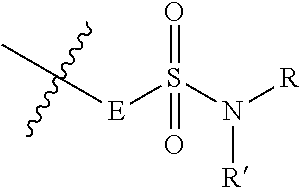
wherein E is absent, or E is substituted or unsubstituted alkyl, substituted or unsubstituted alkenyl, substituted or unsubstituted alkynyl, substituted or unsubstituted aralkyl, substituted or unsubstituted alkylaryl, substituted or unsubstituted cycloalkyl, substituted or unsubstituted aryl, substituted or unsubstituted heteroaryl, substituted or unsubstituted heterocyclyl, wherein independently of E, R and R′ each independently represent a hydrogen, substituted or unsubstituted alkyl, substituted or unsubstituted alkenyl, substituted or unsubstituted alkynyl, substituted or unsubstituted carbonyl, substituted or unsubstituted cycloalkyl, substituted or unsubstituted heterocyclyl, substituted or unsubstituted alkylaryl, substituted or unsubstituted arylalkyl, substituted or unsubstituted aryl, or substituted or unsubstituted heteroaryl, —(CH2)m—R′″, or R and R′ taken together with the N atom to which they are attached complete a heterocycle having from 3 to 14 atoms in the ring structure; R′″ represents a hydroxy group, substituted or unsubstituted carbonyl group, an aryl, a cycloalkyl ring, a cycloalkenyl ring, a heterocycle, or a polycycle; and m is zero or an integer ranging from 1 to 8. In preferred forms, only one of R and R′ can be a carbonyl, e.g., R and R′ together with the nitrogen do not form an imide.
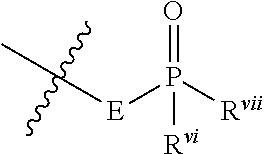
wherein E is absent, or E is substituted or unsubstituted alkyl, substituted or unsubstituted alkenyl, substituted or unsubstituted alkynyl, substituted or unsubstituted aralkyl, substituted or unsubstituted alkylaryl, substituted or unsubstituted cycloalkyl, substituted or unsubstituted aryl, substituted or unsubstituted heteroaryl, substituted or unsubstituted heterocyclyl, wherein, independently of E, Rvi and Rvii are independently hydrogen, substituted or unsubstituted alkyl, substituted or unsubstituted alkenyl, substituted or unsubstituted alkynyl, substituted or unsubstituted carbonyl, substituted or unsubstituted cycloalkyl, substituted or unsubstituted heterocyclyl, substituted or unsubstituted alkylaryl, substituted or unsubstituted arylalkyl, substituted or unsubstituted aryl, or substituted or unsubstituted heteroaryl, —(CH2)m—R′″, or R and R′ taken together with the P atom to which they are attached complete a heterocycle having from 3 to 14 atoms in the ring structure; R′″ represents a hydroxy group, substituted or unsubstituted carbonyl group, an aryl, a cycloalkyl ring, a cycloalkenyl ring, a heterocycle, or a polycycle; and m is zero or an integer ranging from 1 to 8.

wherein:
-
- the compound has an overall negative, neutral, or positive charge;
- M is a first-row transition metal atom (such as scandium, titanium, vanadium, chromium, manganese, iron, cobalt, nickel, copper, and zinc), preferably M is nickel, copper, iron, or cobalt, most preferably M is nickel;
- M has an oxidation state between 0 and +7 inclusive, preferably 0, +1, +2, or +3;
- A, B, and C are each independently unsubstituted heteroaryl, substituted heteroaryl, unsubstituted aryl, substituted aryl, unsubstituted polyaryl, substituted polyaryl, unsubstituted polyheteroaryl, substituted polyheteroaryl, substituted C3-C20 cycloalkyl, unsubstituted C3-C20 cycloalkyl, substituted C3-C20 heterocyclyl, unsubstituted C3-C20 heterocyclyl, substituted C3-C20 cycloalkenyl, unsubstituted C3-C20 cycloalkenyl, substituted C3-C20 cycloalkynyl, or unsubstituted C3-C20 cycloalkynyl, preferably at least one of A, B, and C is a substituted aryl or unsubstituted aryl, and another of A, B, and C is a substituted heteroaryl or unsubstituted heteroaryl, preferably, a bond between at least one of A, B, and C and M is metal-carbon σ-bond; wherein the dashed line indicates that R1 is optionally linked or unlinked to C, preferably R1 is not linked to C;
- q is 1 or 2, preferably 1;
- p is 1 (tridentate ligand), 2 (tetradentate ligand), or 3 (pentadentate ligand), preferably 1 or 2;
- G and J are each independently a bond (single, double, triple bond), absent, oxygen, sulfur, unsubstituted amino, substituted amino, unsubstituted alkylene, substituted alkylene, unsubstituted alkyl, substituted alkyl, substituted carbonyl, unsubstituted carbonyl, substituted carboxyl, unsubstituted carboxyl, substituted amido, unsubstituted amido, substituted sulfonyl, unsubstituted sulfonyl, substituted sulfonic acid, unsubstituted sulfonic acid, substituted phosphoryl, unsubstituted phosphoryl, substituted phosphonyl, or unsubstituted phosphonyl; preferably G and J are each a single bond;
- R1 is carbon or heteroatom donor ligand, halide, or pseudohalide, which could be either mono-anionic or neutral, such as unsubstituted heteroaryl (carbazole), substituted heteroaryl, unsubstituted polyaryl, substituted polyaryl, unsubstituted polyheteroaryl, substituted polyheteroaryl, substituted aryl (4-tert-butylphenyl), unsubstituted aryl (phenyl), substituted C3-C20 heterocyclyl (substituted C3 heterocyclyl such as 1,3-dimethyl-2,3-dihydro-1H-imidazol-2-yl), unsubstituted C3-C20 heterocyclyl (2,3-dihydro-1H-imidazol-2-yl), substituted N-alkylidynearylaminium (2,6-dimethyl-N-methylidynebenezaminium), unsubstituted N-alkylidynearylaminium (2,6-dimethyl-N-ethylidynebenezaminium), unsubstituted arylalkynyl (phenylethynyl), substituted arylalkynyl (4-tert-butyl phenylethynyl), unsubstituted alkyl, substituted alkyl, unsubstituted alkynyl, substituted alkynyl, unsubstituted alkenyl (ethenyl), substituted alkenyl (3,3-dimethylbutenyl, 2-phenylethenyl), unsubstituted arylalkenyl (2-phenylethenyl), substituted arylalkenyl (2-(3,5-di-tert-butylphenyl)ethenyl), unsubstituted heteroaryl (pyridin-4yl), substituted heteroaryl (2,6-dimethylpyridin-4yl), halogen (chlorine, fluorine, bromine, iodine), cyano, substituted cyano, cyanate, isocyanate, thioisocyanate, thiocyanate, substituted amino (N,N-diarylamine such as N,N-diphenylamine), unsubstituted amino, phosphide, substituted phosphino (diarylphosphino such as diphenylphosphino), unsubstituted phosphino, hydroxy, unsubstituted alkoxy, substituted alkoxy, unsubstituted amide, substituted amide, unsubstituted aroxy (phenoxy), substituted aroxy, unsubstituted arylthio (phenylthio), substituted arylthio, unsubstituted arylselenyl (phenylselenyl), substituted arylselenyl, unsubstituted arylsilyl (triarylsilyl such as triphenylsilyl), substituted arylsilyl, unsubstituted arylboranyl (diarylboranyl such as diphenylboranyl), substituted arylboranyl, unsubstituted alkylboranyl, substituted alkylboranyl, unsubstituted boranyl, substituted boranyl, sulfonate (trifluoromethanesulfonate), or N-heterocylic carbene;
- r is 0, 1, or 2, preferably r is 1; and optionally wherein substituted means substituted with one or more substituents selected from unsubstituted alkyl, alkyl having one or more alkyl substituents (t-butyl), alkyl having one or more halogen substituents (trifluoromethyl), halogen (chlorine, fluorine, bromine, iodine), unsubstituted aryl (phenyl), aryl having one or more alkyl substituents (2,6-dimethylphenyl, 4-tert-butylphenyl, 3,5-di-tert-butylphenyl), substituted aryl, unsubstituted heteroaryl, substituted heteroaryl, substituted C3-C20 cycloalkyl, unsubstituted C3-C20 cycloalkyl, substituted C3-C20 heterocyclyl, unsubstituted C3-C20 heterocyclyl, substituted C3-C20 cycloalkenyl, unsubstituted C3-C20 cycloalkenyl, substituted C3-C20 cycloalkynyl, or unsubstituted C3-C20 cycloalkynyl, OR, NR2, SR, C(O)R, C(O)OR, C(O)NR2, CN, CF3, NO2, SO2, SOR, and SO3R, wherein R is independently unsubstituted alkyl, unsubstituted alkenyl, unsubstituted alkynyl, unsubstituted alkylaryl, unsubstituted aryl, unsubstituted C3-C20 cycloalkyl, unsubstituted C3-C20 heterocyclyl, unsubstituted C3-C20 cycloalkenyl, or unsubstituted C3-C20 cycloalkynyl.
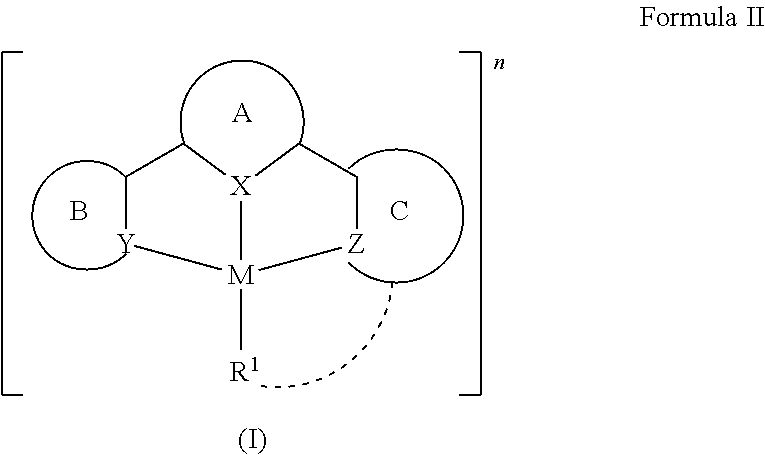
-
- wherein:
- M is a first-row transition metal (such as scandium, titanium, vanadium, chromium, manganese, iron, cobalt, nickel, copper, and zinc), preferably M is nickel or copper;
- X, Y, and Z are independently nitrogen or carbon;
- A, B, and C are cyclic structure derivatives of phenyl groups, unsubstituted heteroaryl groups, substituted heteroaryl groups, unsubstituted heterocyclic groups, or substituted heterocyclic groups, wherein the dashed line indicates that R1 is optionally linked or unlinked to C, preferably R1 is not linked to C; preferably, rings A, B, and C are independently benzene, phenyl derivatives, unsubstituted heteroaryl, substituted heteroaryl, heteroaryl derivatives, unsubstituted, heterocycle, substituted heterocycle, or heterocyclic derivatives (each optionally independently with one or more unsubstituted alkyl, unsubstituted alkenyl, unsubstituted alkynyl, unsubstituted aryl, unsubstituted cycloalkyl, OR, NR2, SR, C(O)R, C(O)OR, C(O)NR2, CN, CF3, NO2, SO2, SOR, SO3R, halo, unsubstituted aryl, substituted aryl, unsubstituted heteroaryl, substituted heteroaryl, or unsubstituted heterocyclic groups, wherein R is independently unsubstituted alkyl, unsubstituted alkenyl, unsubstituted alkynyl, unsubstituted alkyaryl, unsubstituted aryl, or unsubstituted cycloalkyl);
- R1 is any carbon or heteroatom donor ligand, halide or pseudohalide, which could be either anionic or neutral. Preferably, R1 is selected from, but not limited to, unsubstituted alkyl, substituted alkyl, unsubstituted aryl, substituted aryl, unsubstituted heteroaryl, substituted heteroaryl, unsubstituted polyaryl, substituted polyaryl, alkynyl, substituted alkynyl, alkoxy, amide, thiolate, phosphide, chloride, bromide, iodide, cyanate, thiocyanate, cyanide, isocyanide or N-heterocyclic carbene; and
- n is zero, a positive integer or a negative integer.
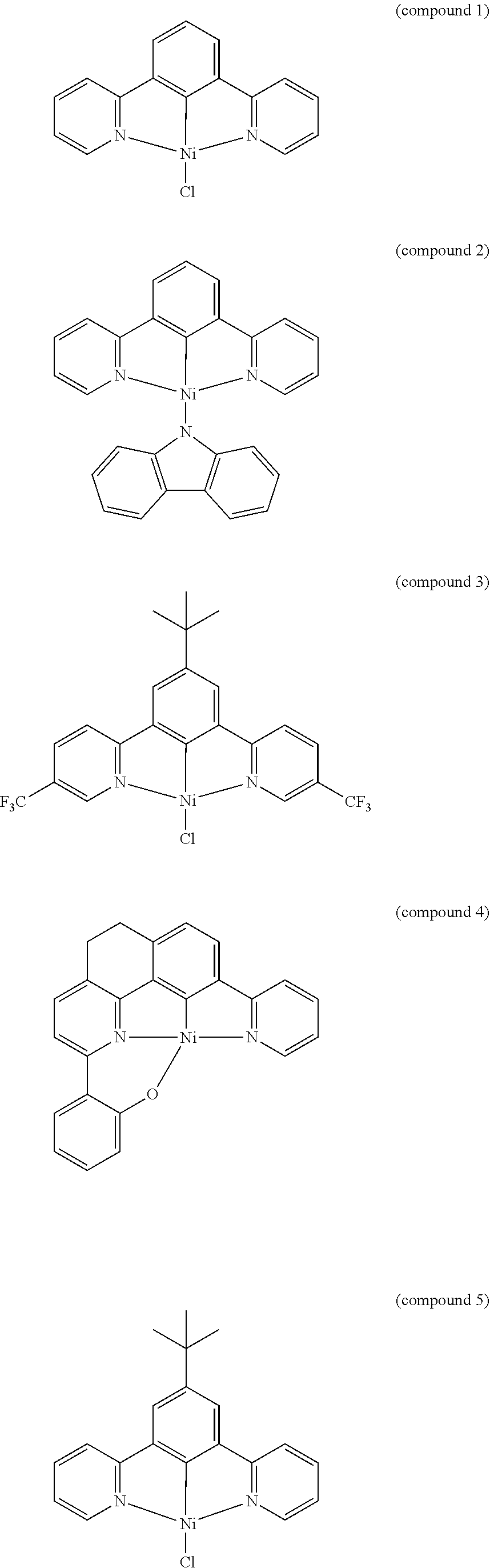

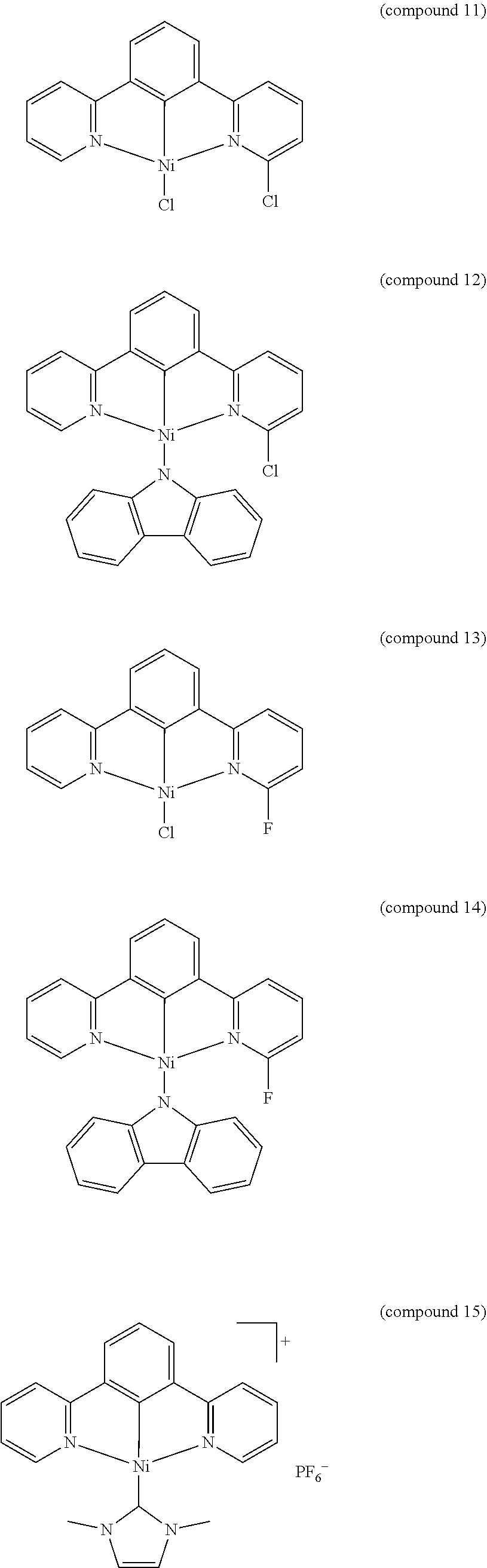

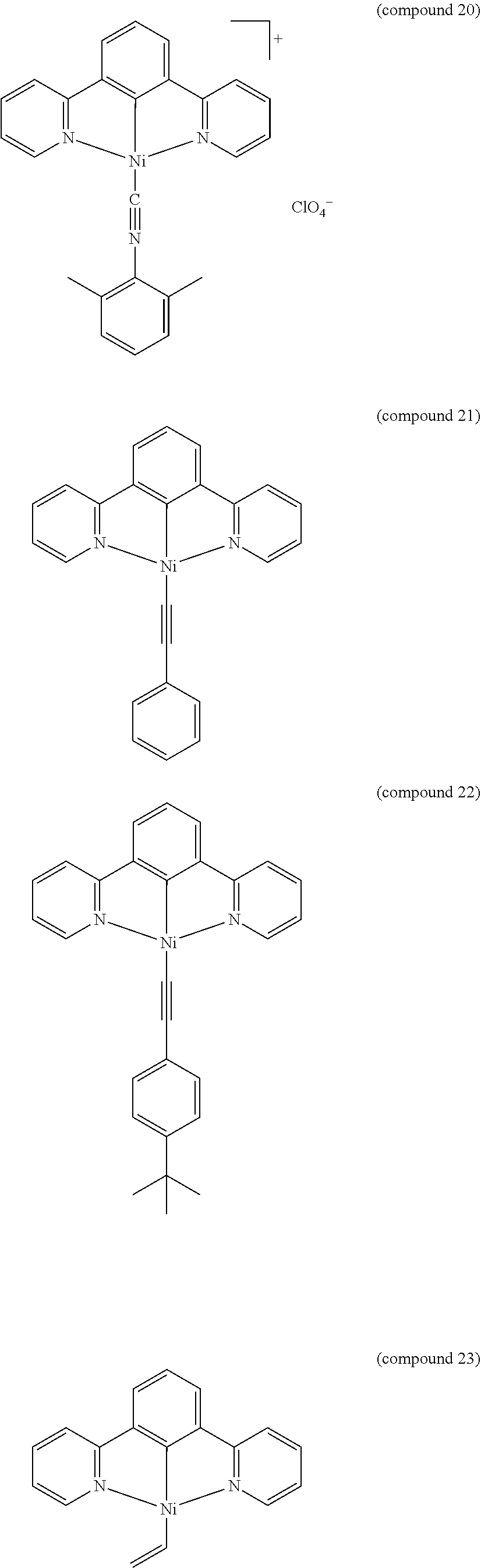


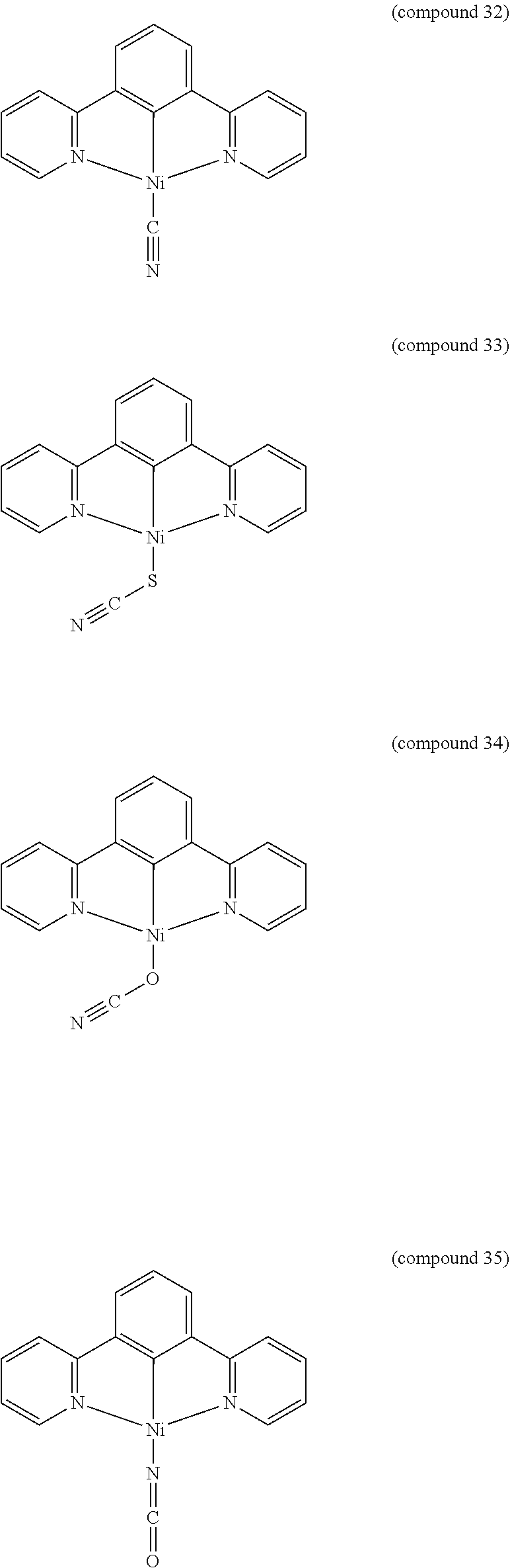
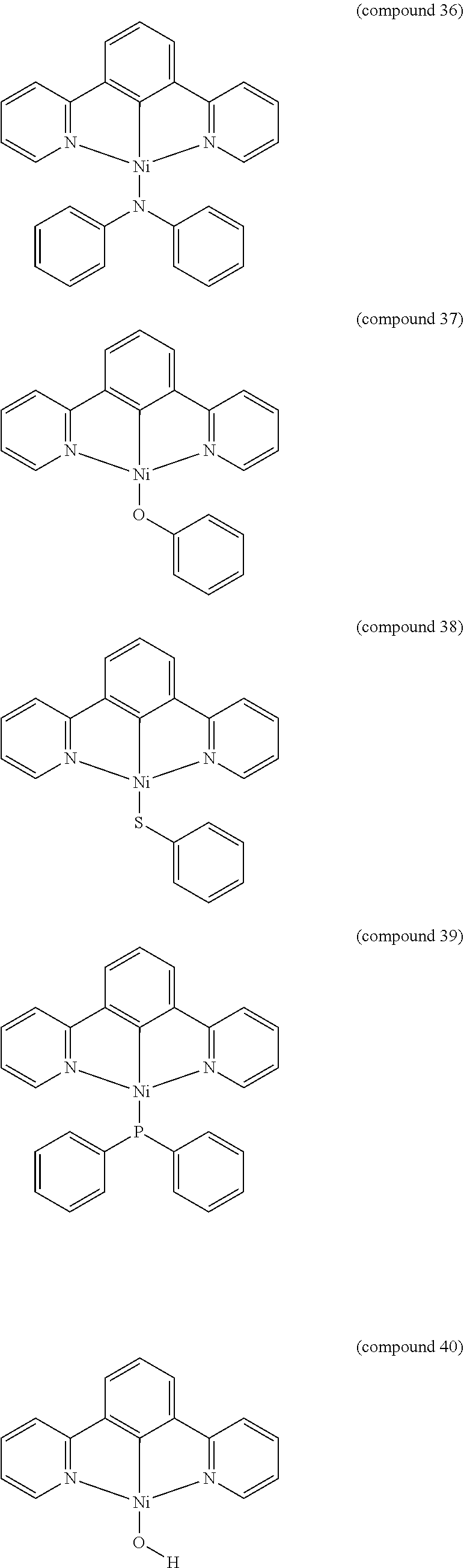


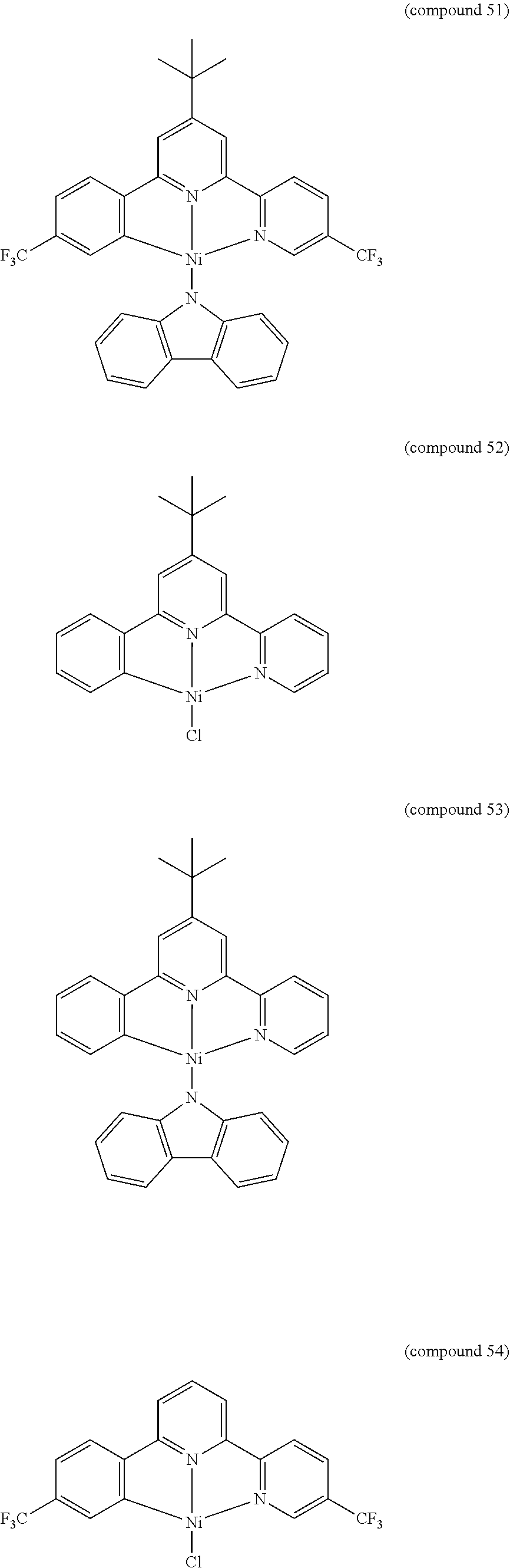


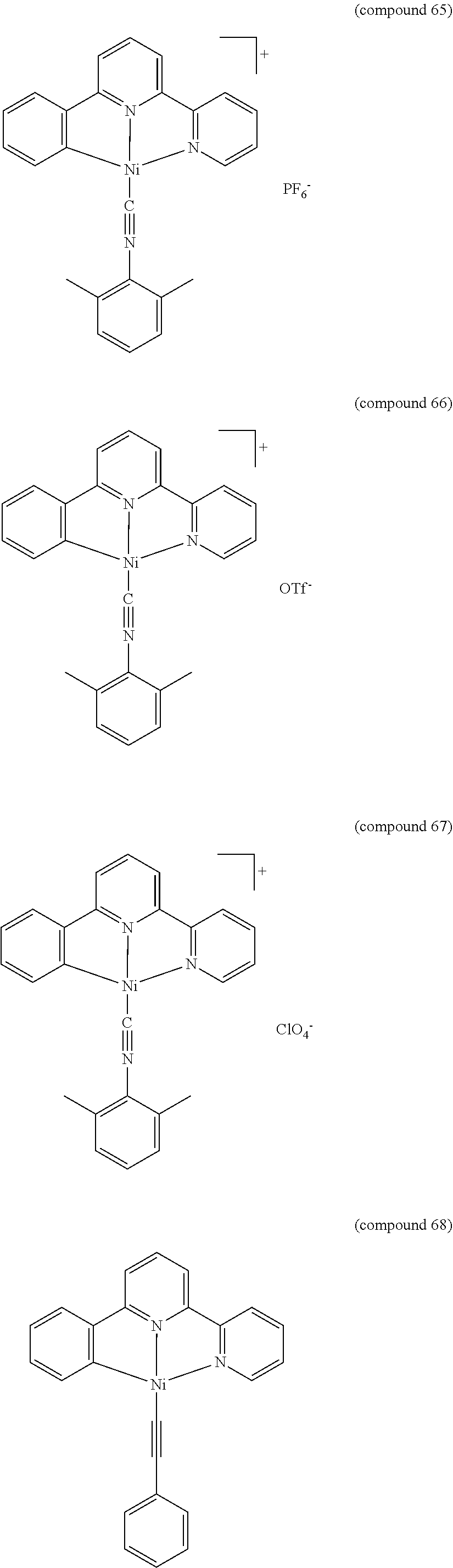
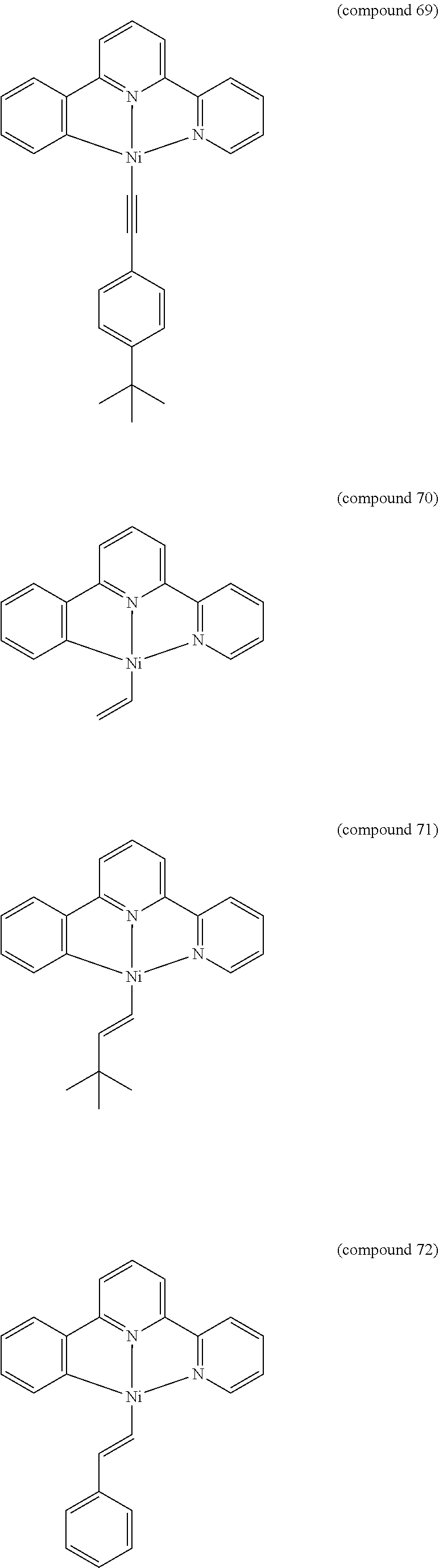

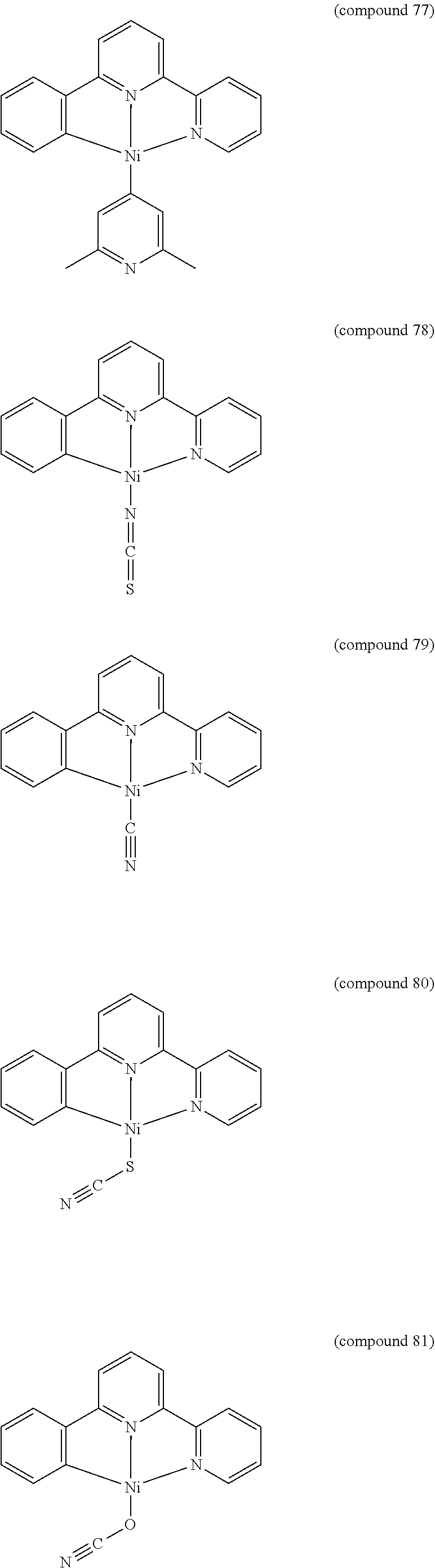
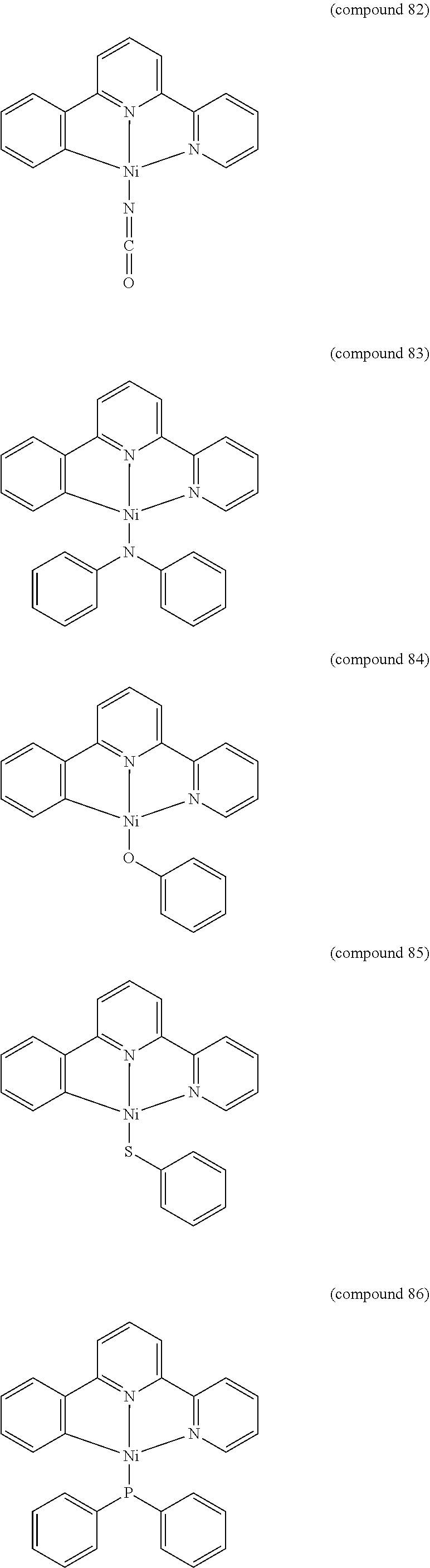

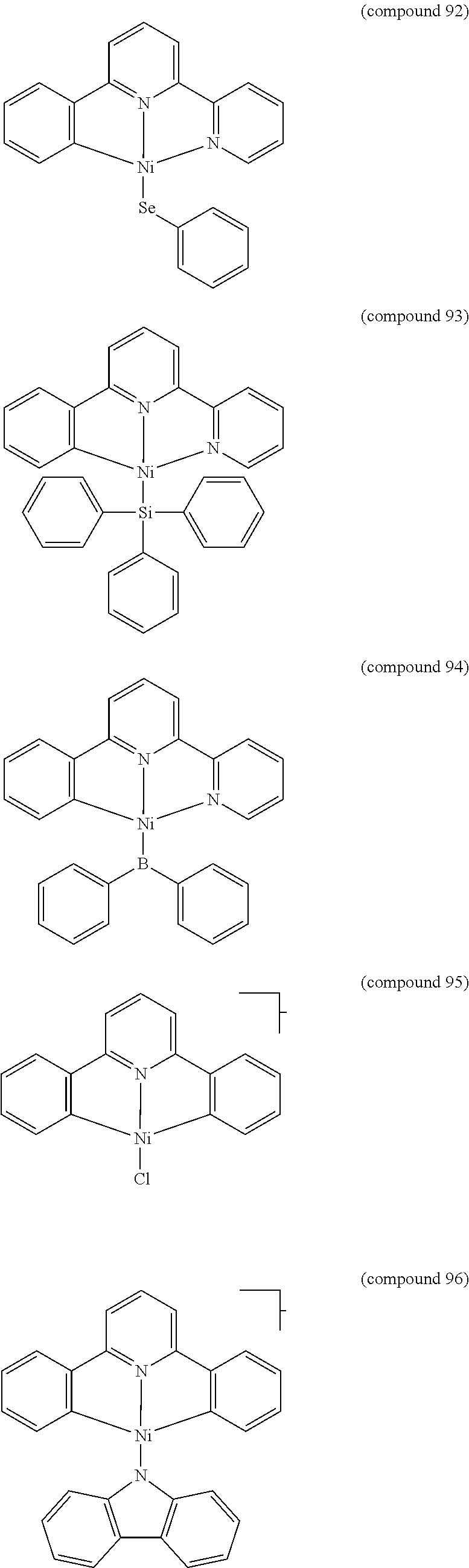
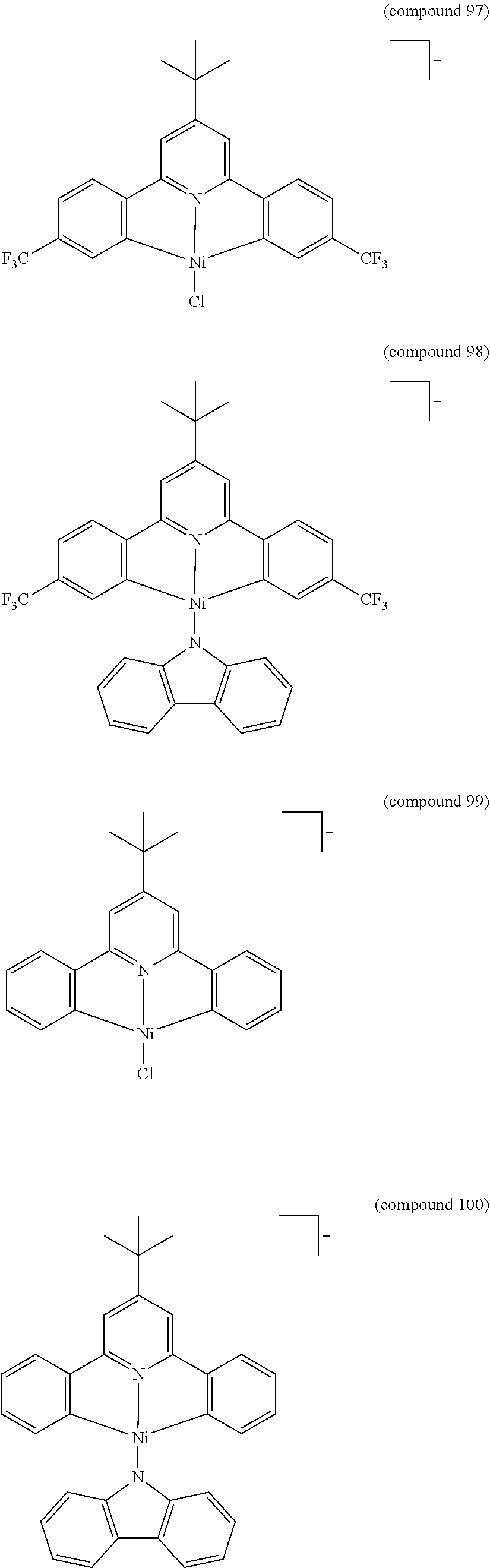
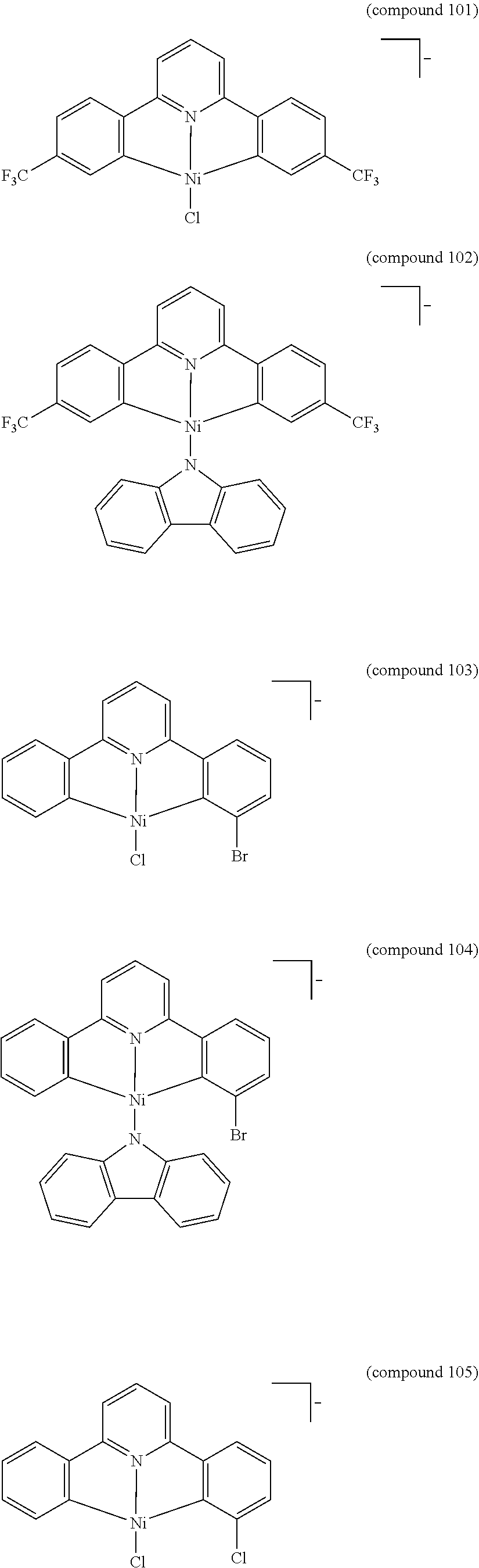

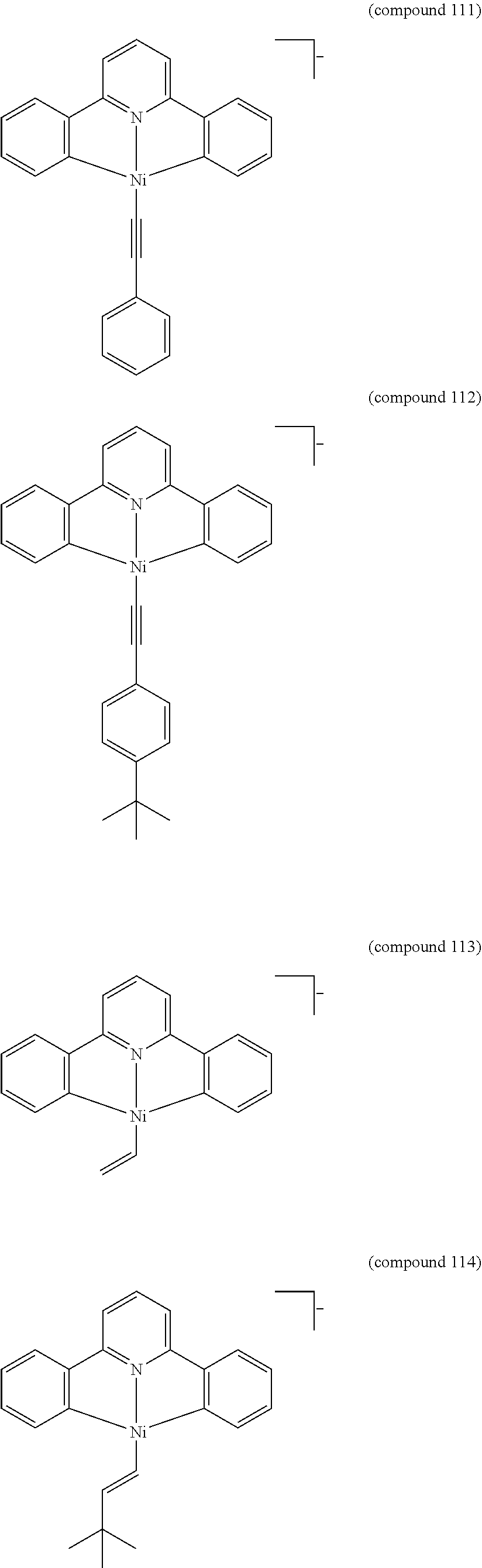
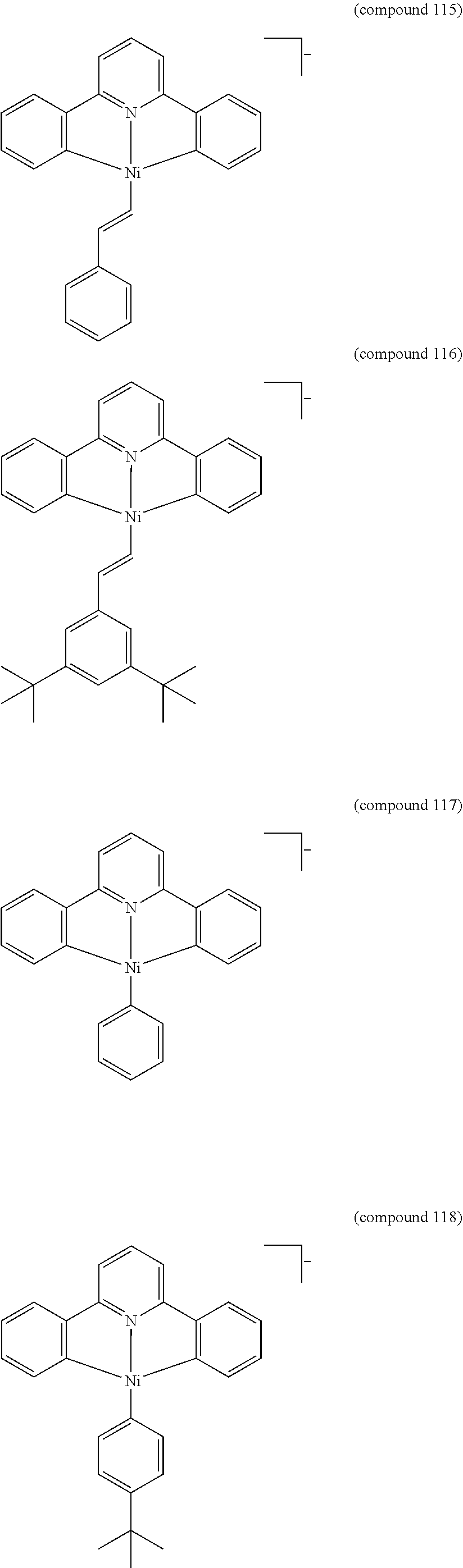

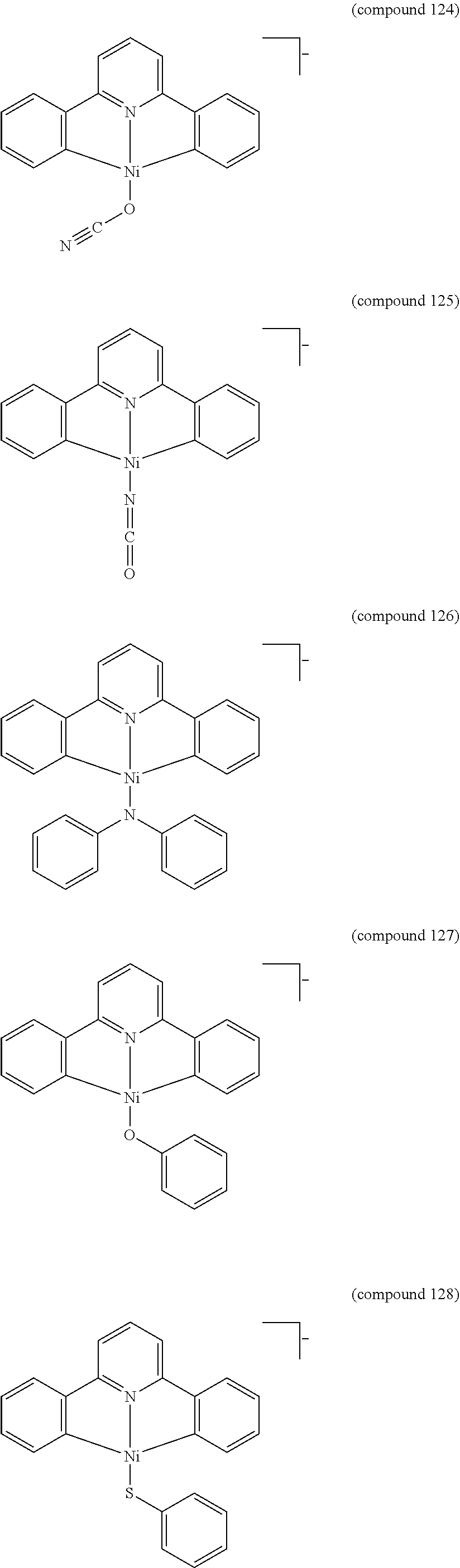

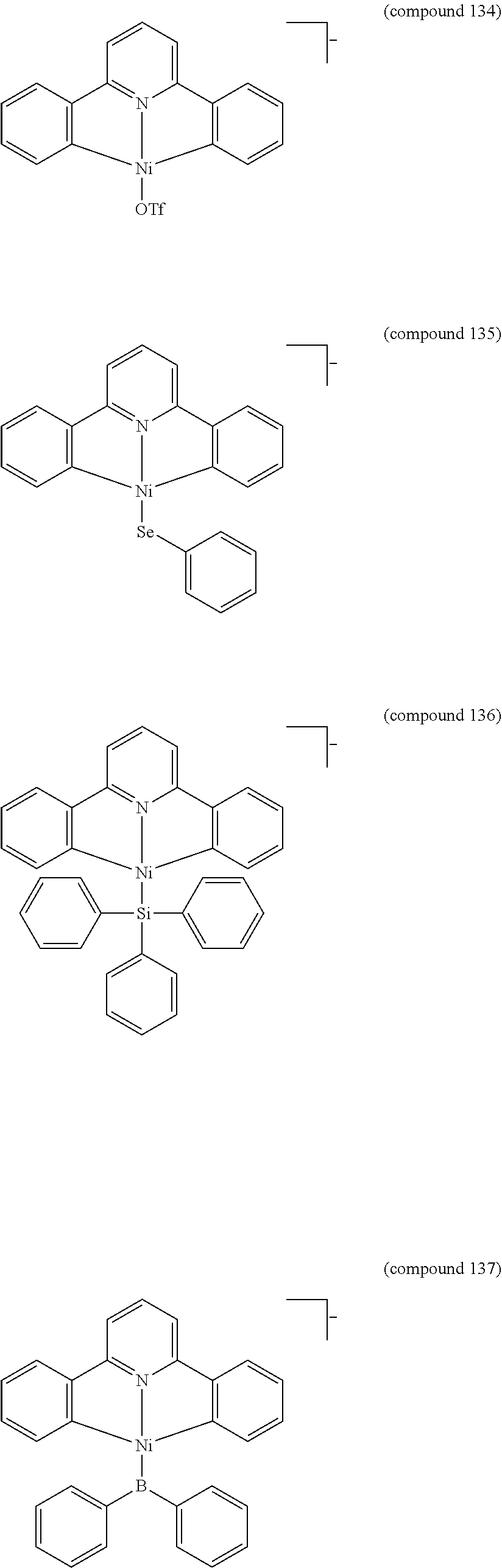
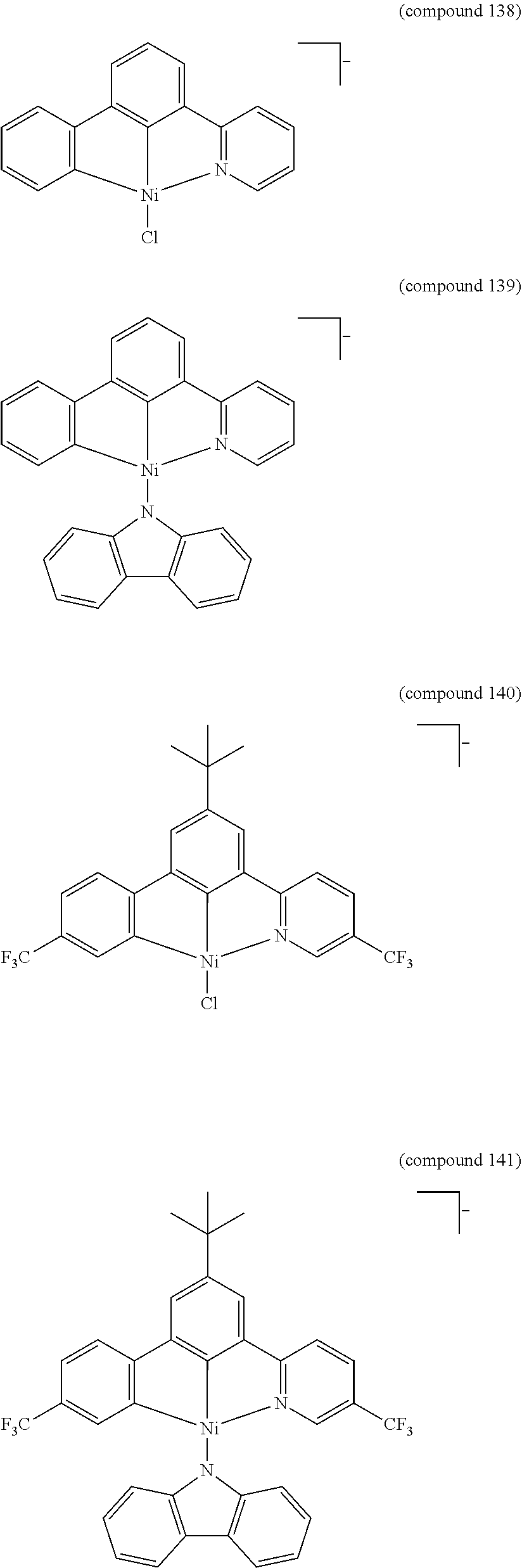

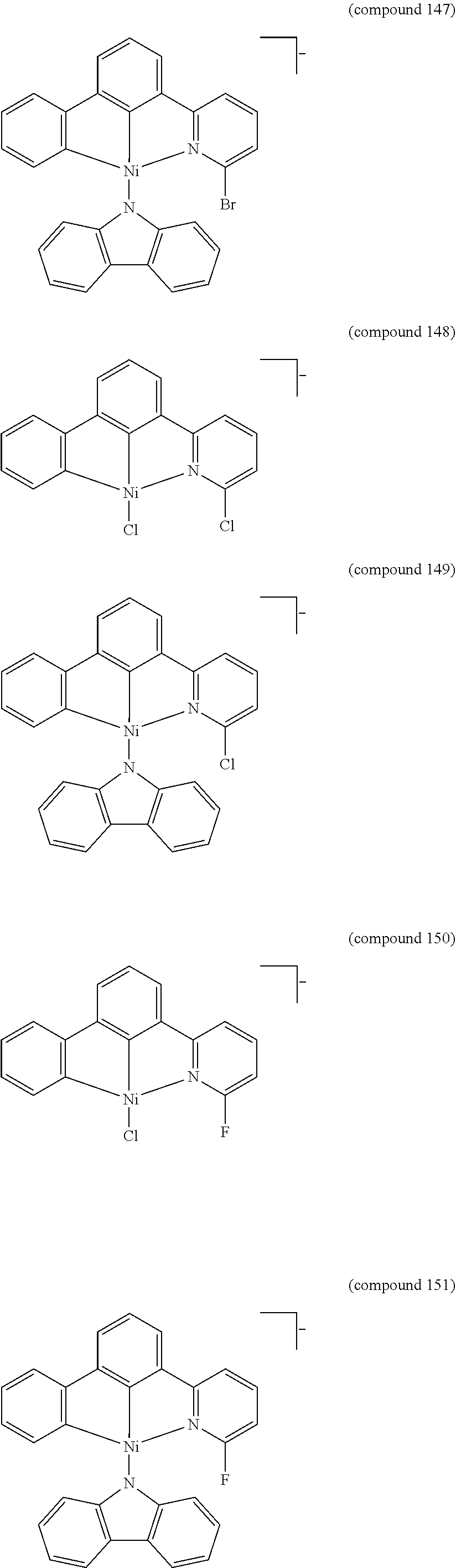
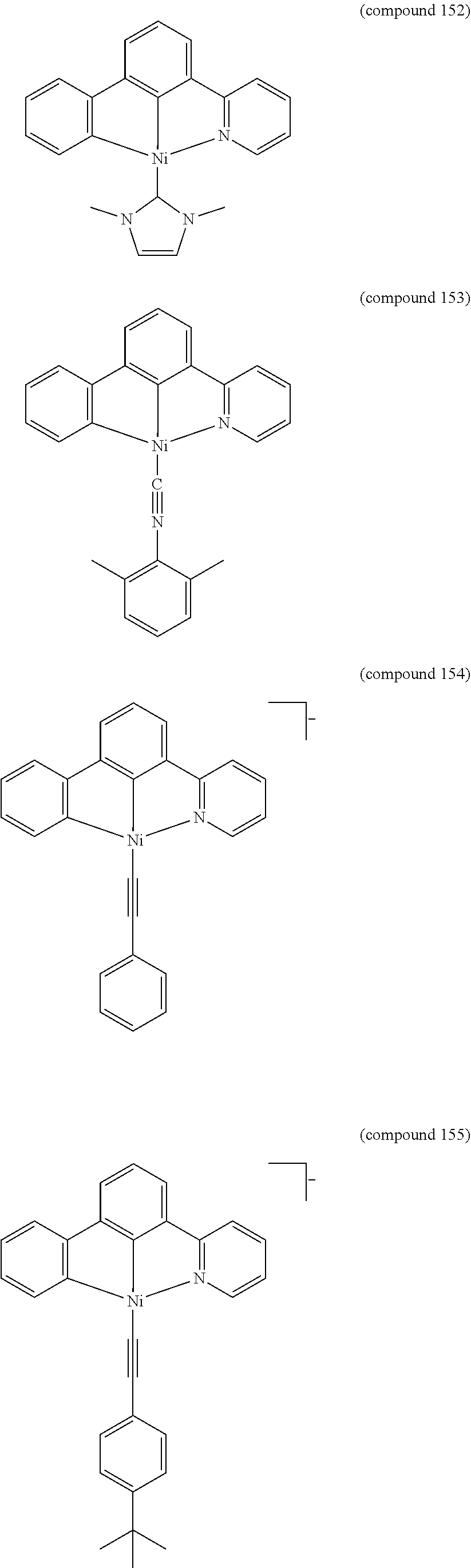


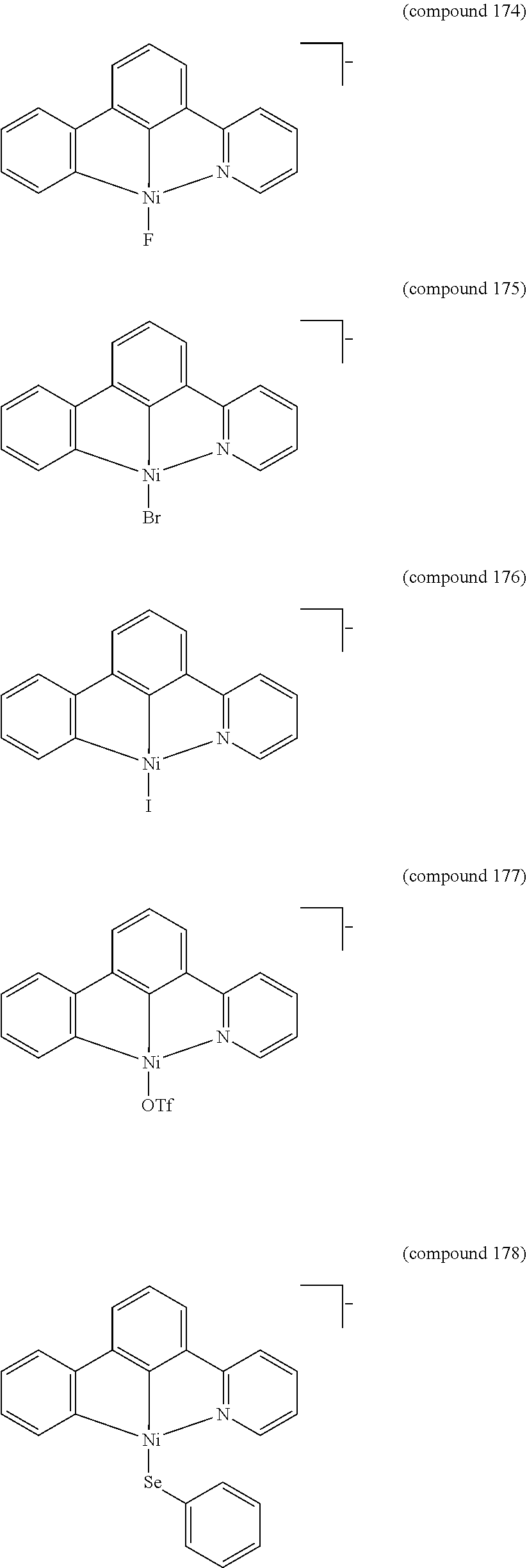


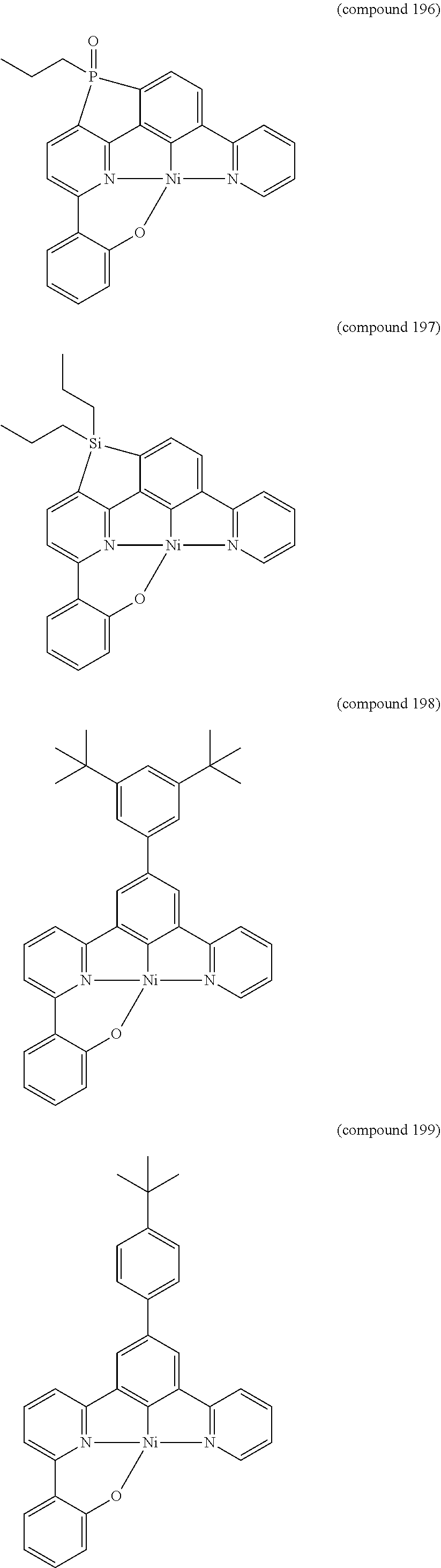
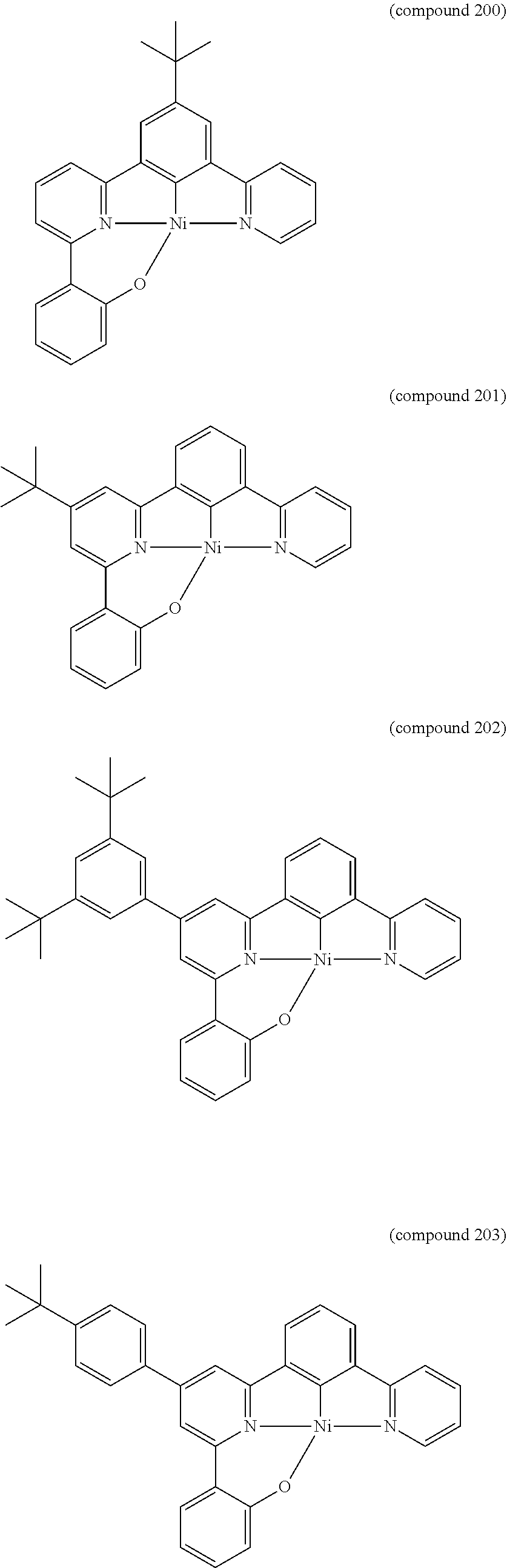


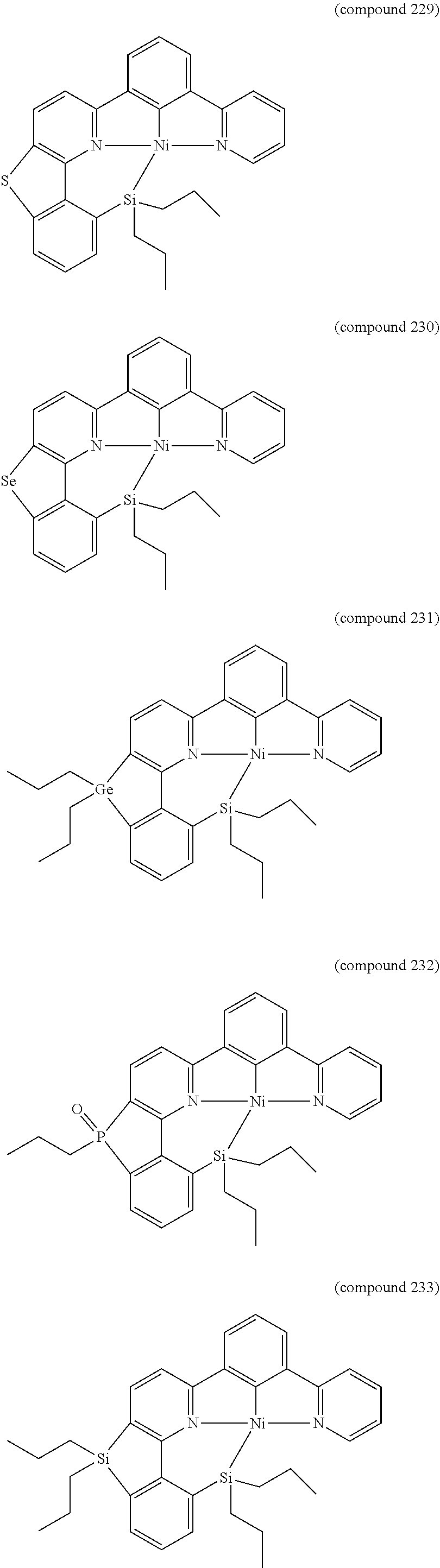


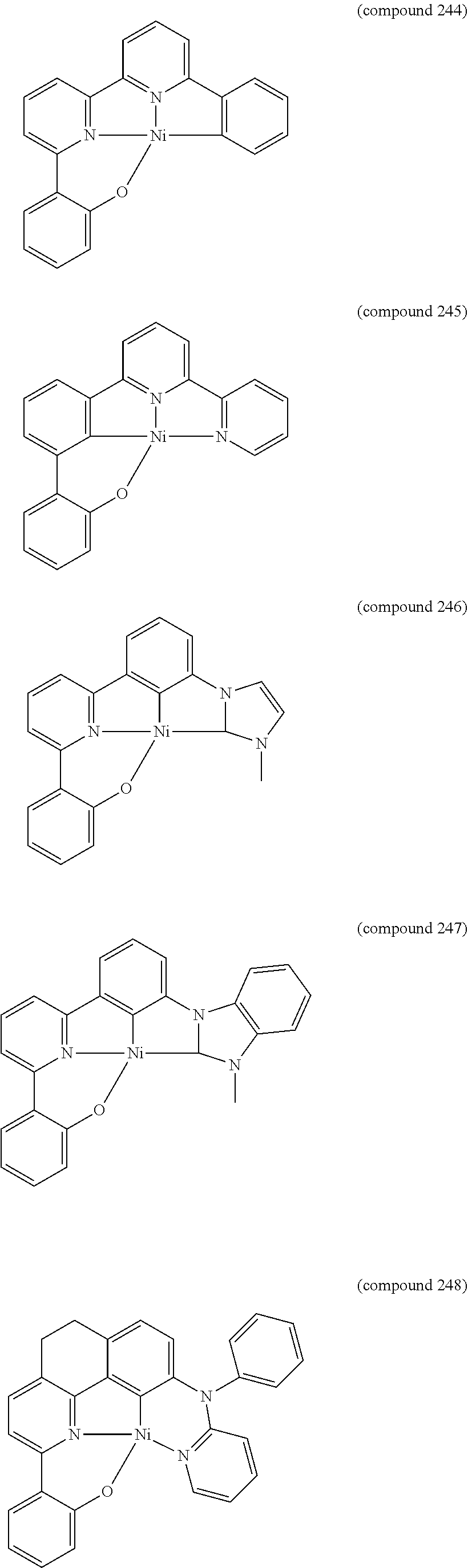
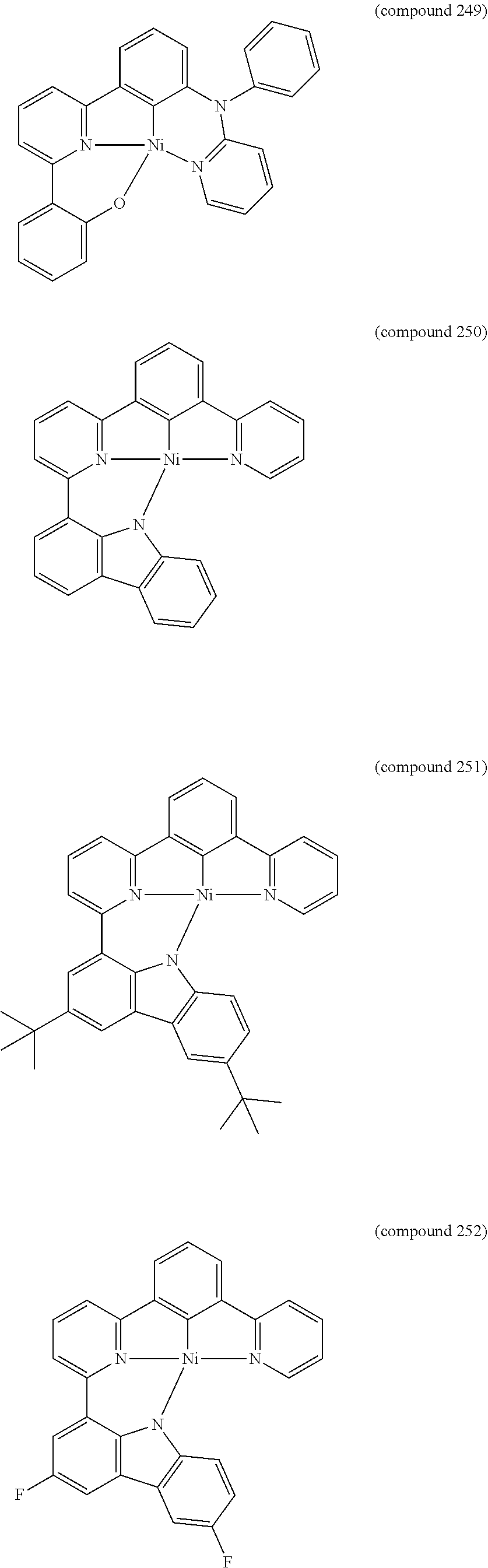
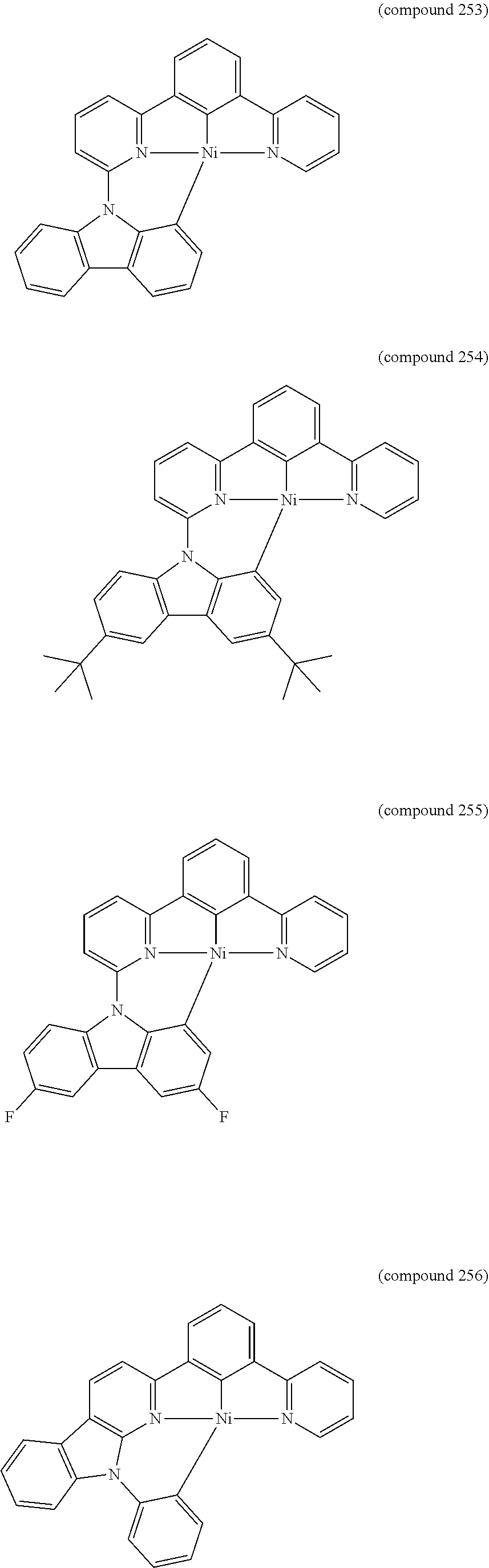
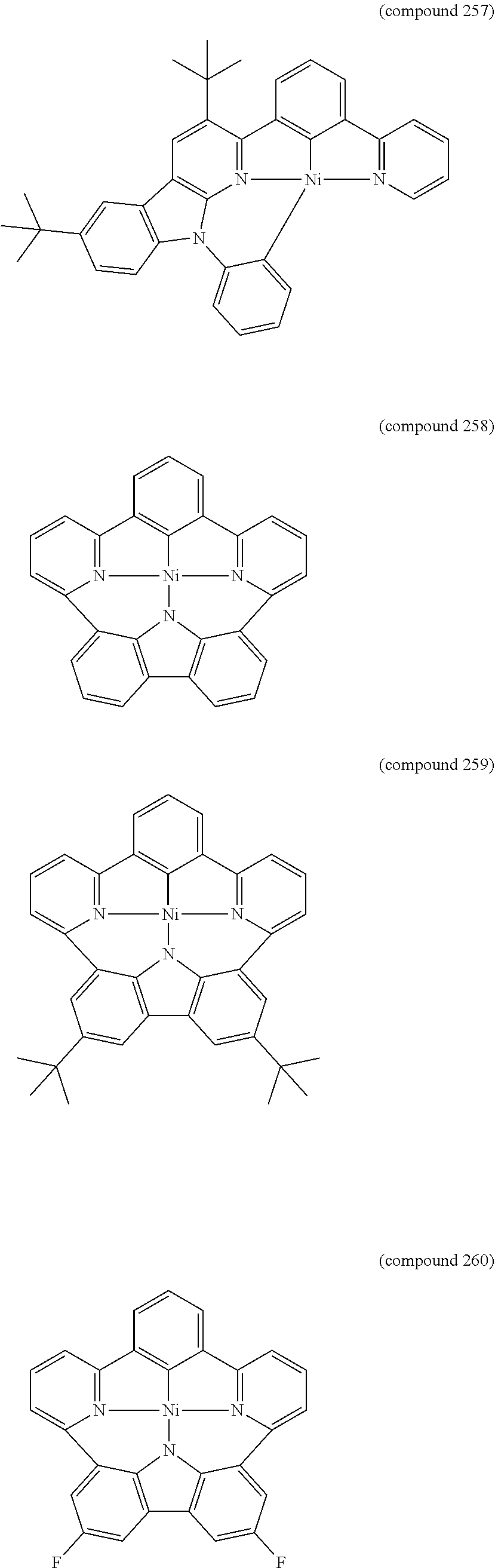
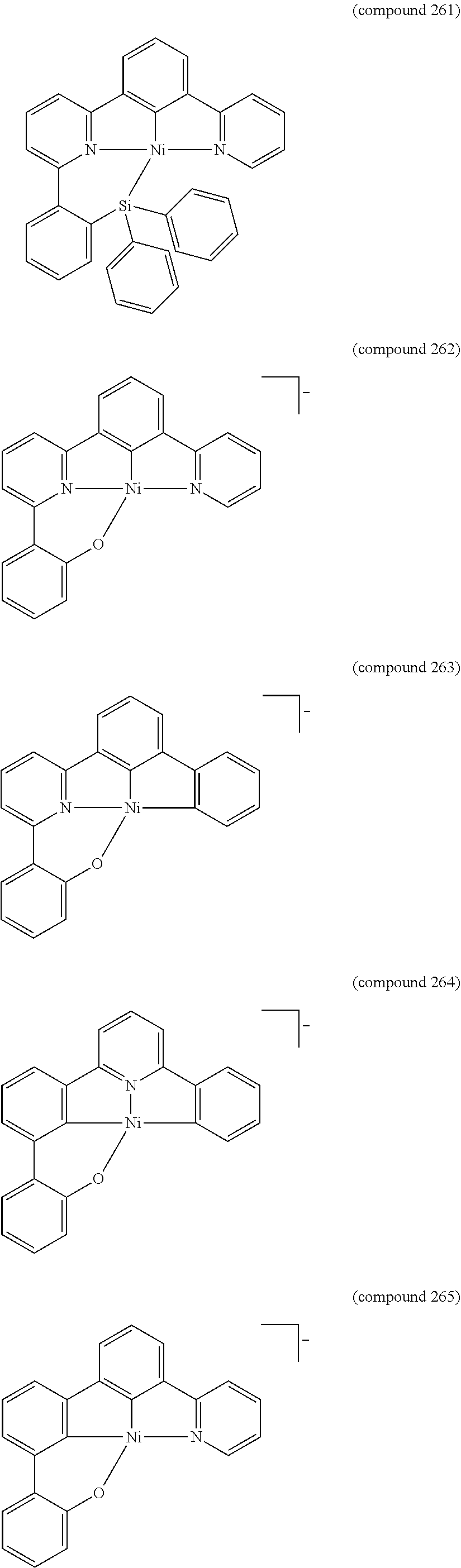
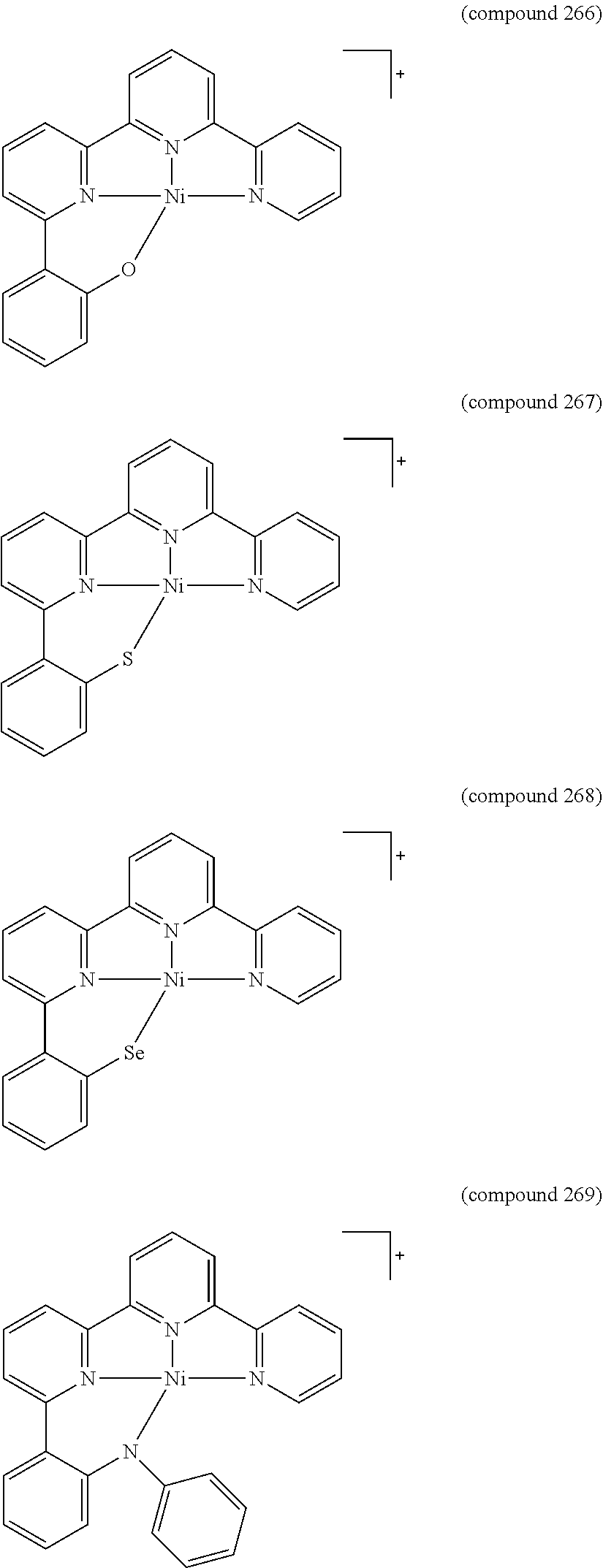
-
- 1. A luminescent compound having the formula:
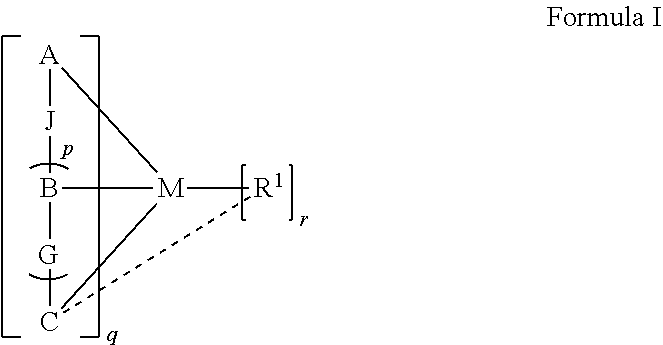
-
- wherein:
- the compound has an overall negative, neutral, or positive charge;
- M is a first-row transition metal atom, preferably M is nickel, copper, iron, or cobalt, most preferably M is nickel;
- M has an oxidation state between 0 and +7 inclusive, preferably 0, +1, +2, or +3;
- A, B, and C are each independently unsubstituted heteroaryl, substituted heteroaryl, unsubstituted aryl, substituted aryl, unsubstituted polyaryl, substituted polyaryl, unsubstituted polyheteroaryl, substituted polyheteroaryl, substituted C3-C20 cycloalkyl, unsubstituted C3-C20 cycloalkyl, substituted C3-C20 heterocyclyl, unsubstituted C3-C20 heterocyclyl, substituted C3-C20 cycloalkenyl, unsubstituted C3-C20 cycloalkenyl, substituted C3-C20 cycloalkynyl, or unsubstituted C3-C20 cycloalkynyl, preferably at least one of A, B, and C is a substituted aryl or unsubstituted aryl, and another of A, B, and C is a substituted heteroaryl or unsubstituted heteroaryl, preferably, a bond between at least one of A, B, and C and M is metal-carbon σ-bond; wherein the dashed line indicates that R1 is optionally linked or unlinked to C, preferably R1 is not linked to C;
- q is 1 or 2, preferably 1;
- p is 1 (tridentate ligand), 2 (tetradentate ligand), or 3 (pentadentate ligand), preferably 1 or 2;
- G and J are each independently a bond (single, double, triple bond), absent, oxygen, sulfur, unsubstituted amino, substituted amino, unsubstituted alkylene, substituted alkylene, unsubstituted alkyl, substituted alkyl, substituted carbonyl, unsubstituted carbonyl, substituted carboxyl, unsubstituted carboxyl, substituted amido, unsubstituted amido, substituted sulfonyl, unsubstituted sulfonyl, substituted sulfonic acid, unsubstituted sulfonic acid, substituted phosphoryl, unsubstituted phosphoryl, substituted phosphonyl, or unsubstituted phosphonyl; preferably G and J are each a single bond;
- R1 is carbon or heteroatom donor ligand, halide, or pseudohalide, which could be either mono-anionic or neutral, such as unsubstituted heteroaryl (carbazole), substituted heteroaryl, unsubstituted polyaryl, substituted polyaryl, unsubstituted polyheteroaryl, substituted polyheteroaryl, substituted aryl (4-tert-butylphenyl), unsubstituted aryl (phenyl), substituted C3-C20 heterocyclyl (substituted C3 heterocyclyl such as 1,3-dimethyl-2,3-dihydro-1H-imidazol-2-yl), unsubstituted C3-C20 heterocyclyl (2,3-dihydro-1H-imidazol-2-yl), substituted N-alkylidynearylaminium (2,6-dimethyl-N-methylidynebenezaminium), unsubstituted N-alkylidynearylaminium (2,6-dimethyl-N-ethylidynebenezaminium), unsubstituted arylalkynyl (phenylethynyl), substituted arylalkynyl (4-tert-butyl phenylethynyl), unsubstituted alkyl, substituted alkyl, unsubstituted alkynyl, substituted alkynyl, unsubstituted alkenyl (ethenyl), substituted alkenyl (3,3-dimethylbutenyl, 2-phenylethenyl), unsubstituted arylalkenyl (2-phenylethenyl), substituted arylalkenyl (2-(3,5-di-tert-butylphenyl)ethenyl), unsubstituted heteroaryl (pyridin-4yl), substituted heteroaryl (2,6-dimethylpyridin-4yl), halogen (chlorine, fluorine, bromine, iodine), cyano, substituted cyano, cyanate, isocyanate, thioisocyanate, thiocyanate, substituted amino (N,N-diarylamine such as N,N-diphenylamine), unsubstituted amino, phosphide, substituted phosphino (diarylphosphino such as diphenylphosphino), unsubstituted phosphino, hydroxy, unsubstituted alkoxy, substituted alkoxy, unsubstituted amide, substituted amide, unsubstituted aroxy (phenoxy), substituted aroxy, unsubstituted arylthio (phenylthio), substituted arylthio, unsubstituted arylselenyl (phenylselenyl), substituted arylselenyl, unsubstituted arylsilyl (triarylsilyl such as triphenylsilyl), substituted arylsilyl, unsubstituted arylboraneyl (diarylboraneyl such as diphenylboraneyl), substituted arylboraneyl, unsubstituted alkylboranyl, substituted alkylboranyl, unsubstituted boranyl, substituted boranyl, sulfonate (trifluoromethanesulfonate), or N-heterocylic carbene;
- r is 0, 1, or 2, preferably r is 1; and optionally wherein substituted means substituted with one or more substituents selected from unsubstituted alkyl, alkyl having one or more alkyl substituents (t-butyl), alkyl having one or more halogen substituents (trifluoromethyl), halogen (chlorine, fluorine, bromine, iodine), unsubstituted aryl (phenyl), aryl having one or more alkyl substituents (2,6-dimethylphenyl, 4-tert-butylphenyl, 3,5-di-tert-butylphenyl), substituted aryl, unsubstituted heteroaryl, substituted heteroaryl, substituted C3-C20 cycloalkyl, unsubstituted C3-C20 cycloalkyl, substituted C3-C20 heterocyclyl, unsubstituted C3-C20 heterocyclyl, substituted C3-C20 cycloalkenyl, unsubstituted C3-C20 cycloalkenyl, substituted C3-C20 cycloalkynyl, or unsubstituted C3-C20 cycloalkynyl, OR, NR2, SR, C(O)R, C(O)OR, C(O)NR2, CN, CF3, NO2, SO2, SOR, and SO3R, wherein R is independently unsubstituted alkyl, unsubstituted alkenyl, unsubstituted alkynyl, unsubstituted alkylaryl, unsubstituted aryl, unsubstituted C3-C20 cycloalkyl, unsubstituted C3-C20 heterocyclyl, unsubstituted C3-C20 cycloalkenyl, or unsubstituted C3-C20 cycloalkynyl, and
- optionally wherein, (i) when p is 1 and C is linked to R1, A, B, C, and R1 are not substituted polyheteroaryl, unsubstituted polyheteroaryl, substituted polyaryl, or unsubstituted polyaryl; or (ii) when p is 1 and C is linked to R1, A, B, C, and R1, and M is cobalt, copper, nickel, manganese, or zinc, R1 are not substituted polyheteroaryl, unsubstituted polyheteroaryl, substituted polyaryl, or unsubstituted polyaryl.
- 2. The luminescent compound of paragraph 1 having the formula:
- wherein:

-
-
- wherein:
- M is a first-row transition metal (such as scandium, titanium, vanadium, chromium, manganese, iron, cobalt, nickel, copper, and zinc), preferably M is nickel or copper;
- X, Y and Z are independently nitrogen or carbon;
- A, B, and C are cyclic structure derivatives of phenyl groups, unsubstituted heteroaryl groups, substituted heteroaryl groups, unsubstituted heterocyclic groups, or substituted heterocyclic groups, wherein the dashed line indicates that R1 is optionally linked or unlinked to C, preferably R1 is not linked to C; preferably, rings A, B, and C are independently benzene, phenyl derivatives, unsubstituted heteroaryl, substituted heteroaryl groups, heteroaryl derivatives, unsubstituted heterocycle, substituted heterocycle, or heterocyclic derivatives (each optionally independently with one or more unsubstituted alkyl, unsubstituted alkenyl, unsubstituted alkynyl, unsubstituted aryl, unsubstituted cycloalkyl, OR, NR2, SR, C(O)R, C(O)OR, C(O)NR2, CN, CF3, NO2, SO2, SOR, SO3R, halo, unsubstituted aryl, substituted aryl, unsubstituted heteroaryl, substituted heteroaryl, or unsubstituted heterocyclic groups, wherein R is independently unsubstituted alkyl, unsubstituted alkenyl, unsubstituted alkynyl, unsubstituted alkyaryl, unsubstituted aryl, or unsubstituted cycloalkyl);
- R1 is any carbon or heteroatom donor ligand, halide or pseudohalide, which could be either anionic or neutral, preferably, R1 is selected from, but not limited to, unsubstituted alkyl, substituted alkyl, unsubstituted aryl, substituted aryl, unsubstituted heteroaryl, substituted heteroaryl, unsubstituted polyaryl, substituted polyaryl, unsubstituted alkynyl, substituted alkynyl, unsubstituted alkoxy, amide, thiolate, phosphide, chloride, bromide, iodide, cyanate, thiocyanate, cyanide, isocyanide, or N-heterocyclic carbene; and
- n is zero, a positive integer, or a negative integer.
- 3. The luminescent compound of
paragraph - 4. The luminescent compound of any one of
paragraphs 1 to 3, wherein M has an oxidation state of 0, 1, +2, or +3, preferably +2. - 5. The luminescent compound of any one of
paragraphs 1 to 4, wherein M is nickel. - 6. The luminescent compound of any one of
paragraphs 1 to 5, wherein A, B, and C are each independently unsubstituted heteroaryl, substituted heteroaryl, unsubstituted aryl, substituted aryl, unsubstituted polyheteroaryl, substituted polyheteroaryl, unsubstituted polyaryl, substituted polyaryl, substituted cycloalkyl, unsubstituted cycloalkyl, substituted heterocyclyl, unsubstituted heterocyclyl, substituted cycloalkenyl, unsubstituted cycloalkenyl, substituted cycloalkynyl, or unsubstituted cycloalkynyl, wherein, preferably, a bond between at least one of A, B, and C and M is metal-carbon σ-bond. - 7. The luminescent compound of any one of
paragraphs 1 to 6, wherein A, B, and C are independently unsubstituted heteroaryl, substituted heteroaryl, unsubstituted aryl, or substituted aryl. - 8. The luminescent compound of any one of
paragraphs 1 to 7, displaying photoluminescence or electroluminescence. - 9. The luminescent compound of any one of
paragraphs 1 to 8, having a square-planar geometry. - 10. The luminescent compound of any one of
paragraphs 1 to 9, wherein the luminescent compound emits light at room temperature, low temperature, or both. - 11. The luminescent compound of any one of
paragraphs 1 to 10, wherein the compound is in a solid, liquid, glassy, or solution state. - 12. The luminescent compound of any one of
paragraphs 1 to 11, wherein the luminescent compound has photoluminescent properties in a spectral range between 380 nm and 1050 nm, inclusive. - 13. The luminescent compound of any one of
paragraphs 1 to 12, wherein the luminescent compound emits light in response to (i) the passage of an electric current or (ii) to an electric field. - 14. The luminescent compound of any one of
paragraphs 1 to 13, wherein the luminescent compound emits light independent of its concentration. - 15. The luminescent compound of any one of
paragraphs 1 to 14, wherein C is not linked to R1. - 16. The luminescent compound of any one of
paragraphs 1 to 15, selected from
-


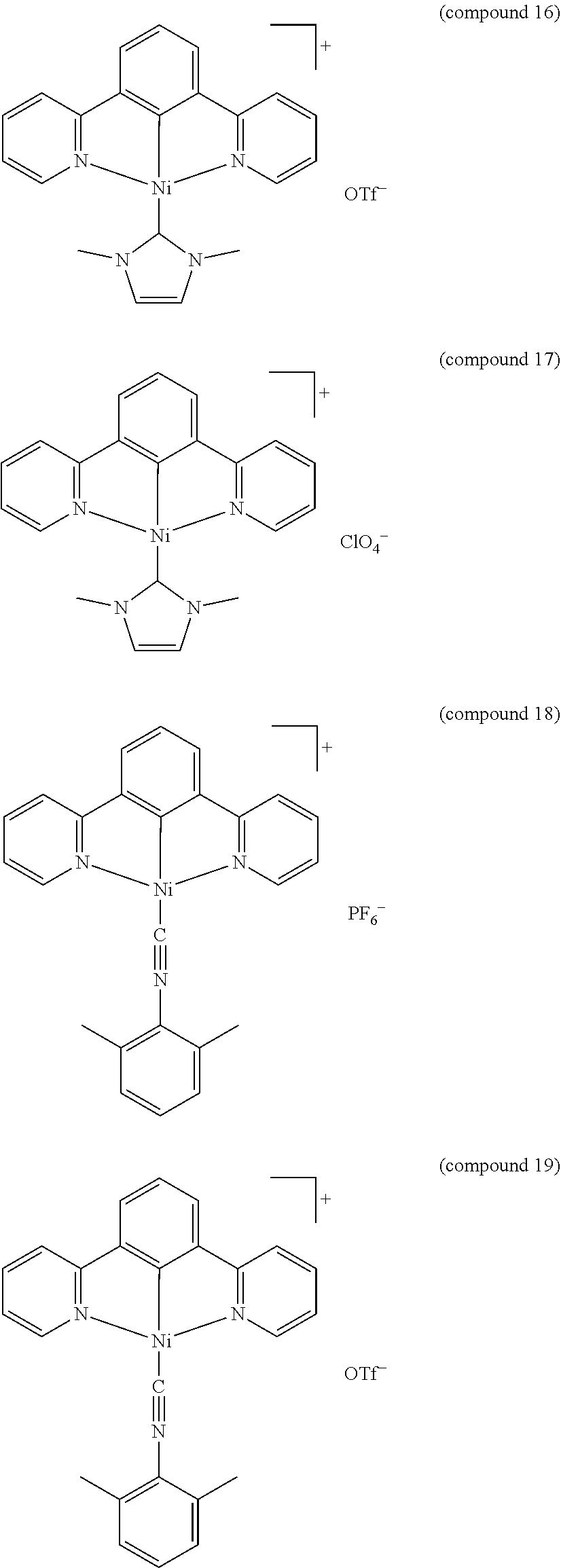
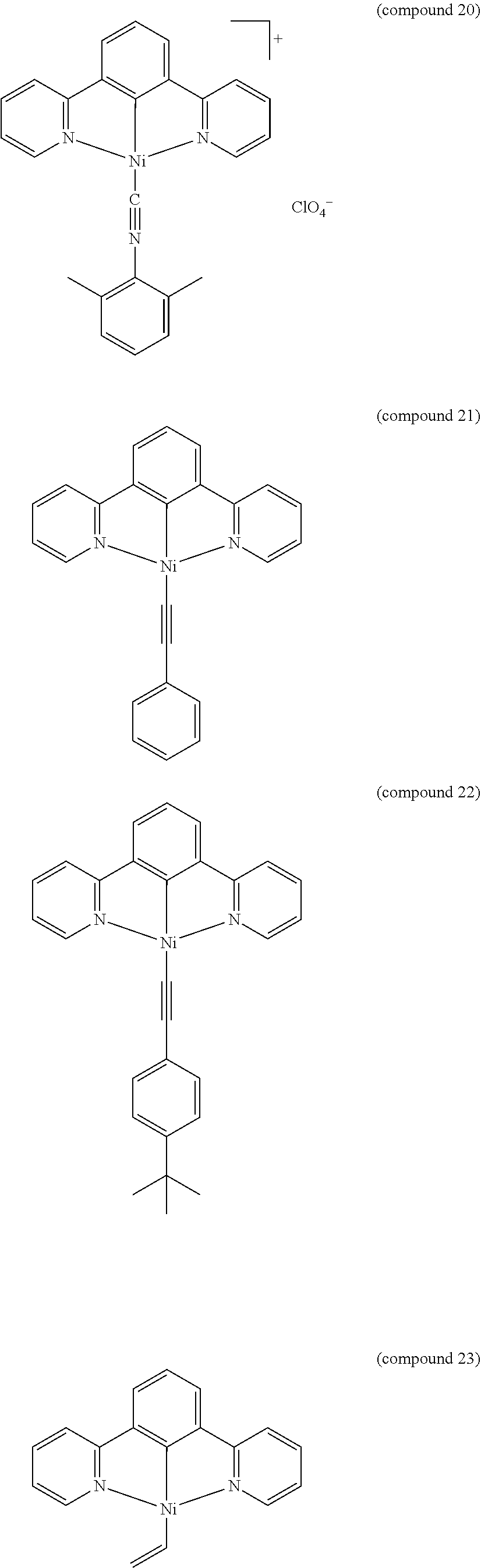
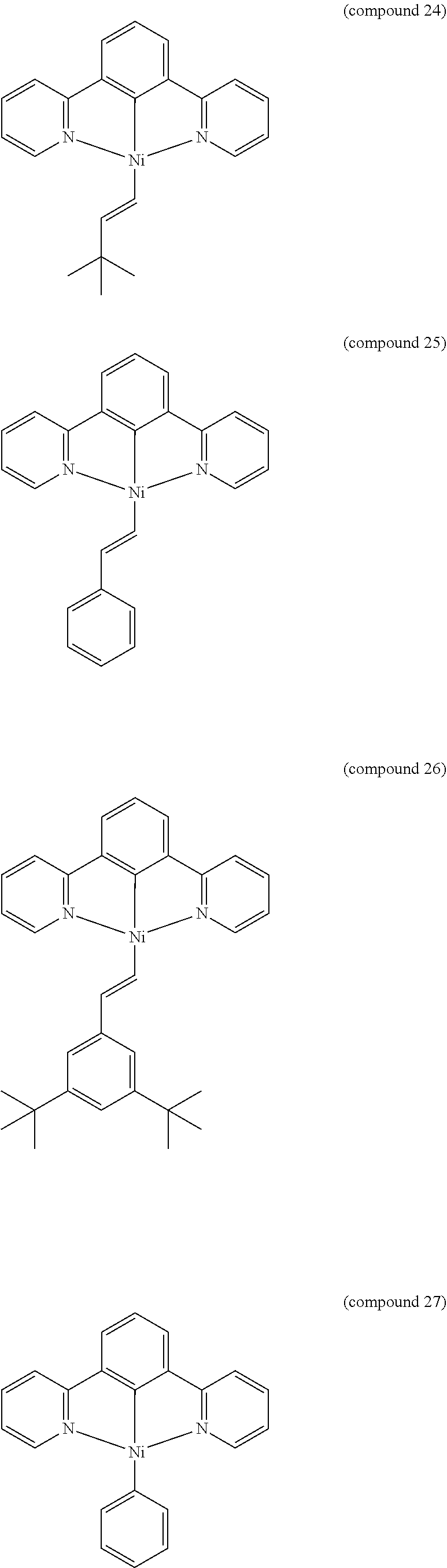
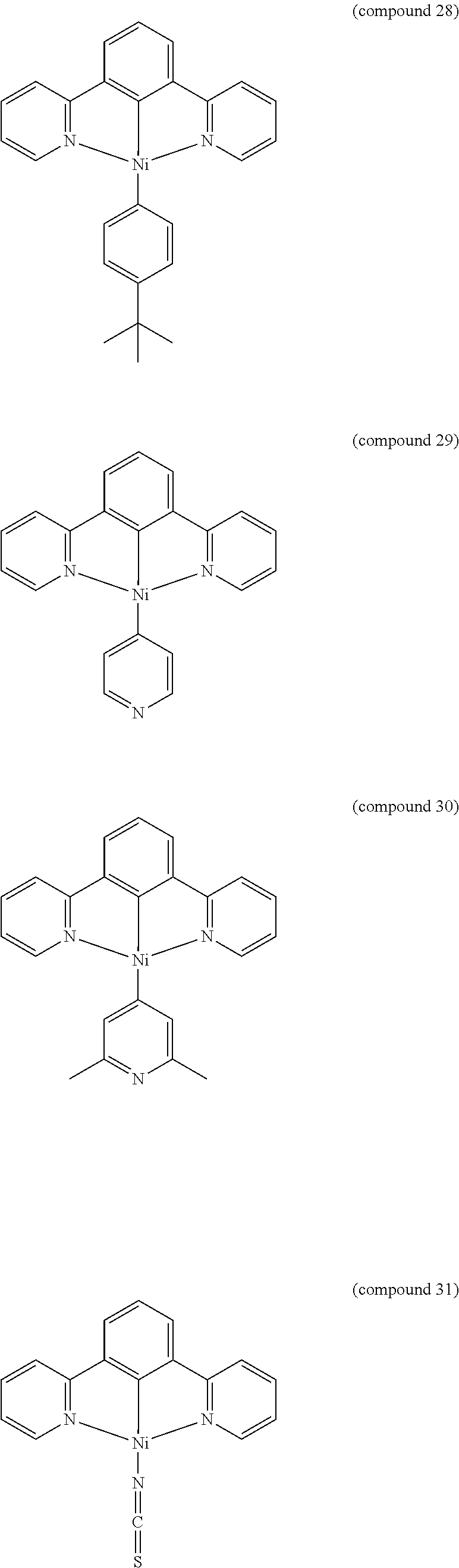


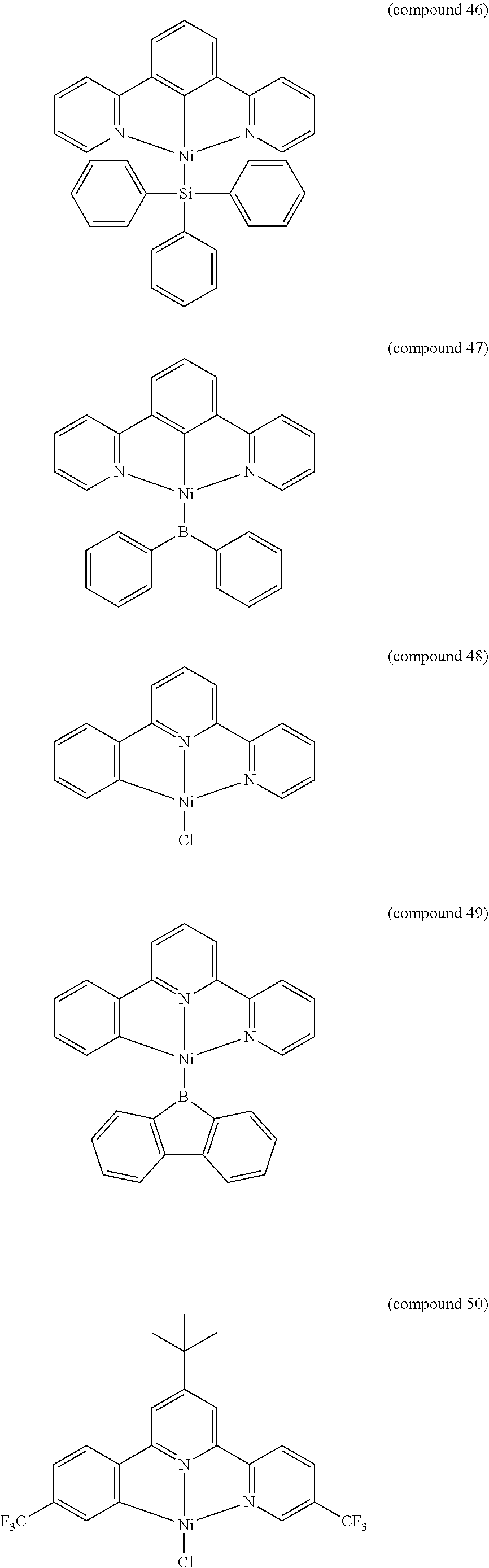
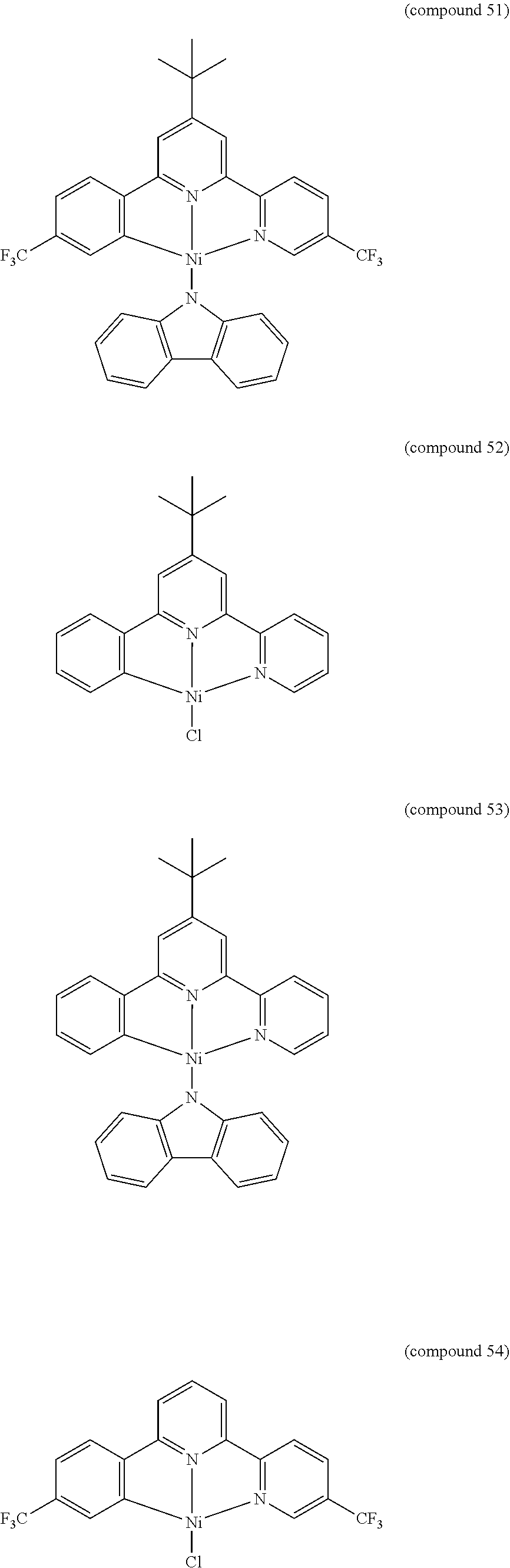


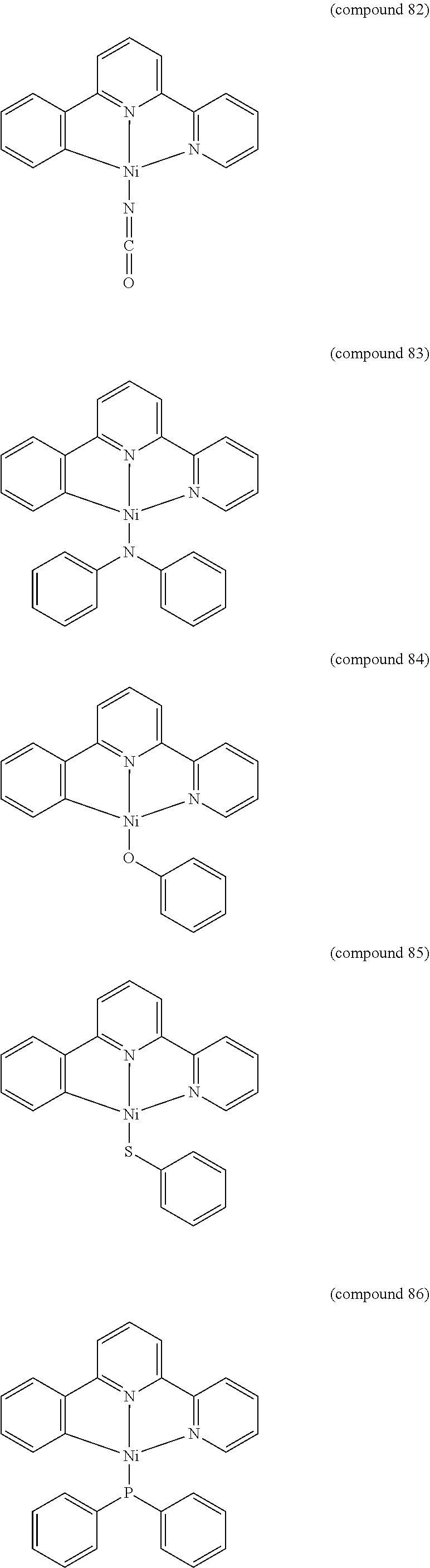

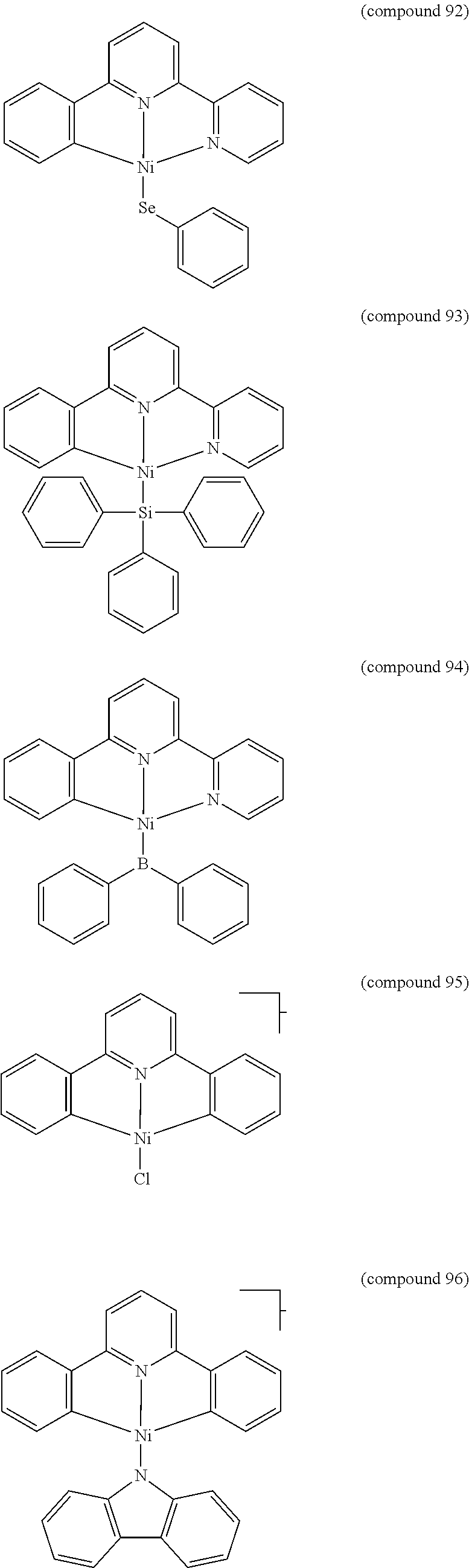


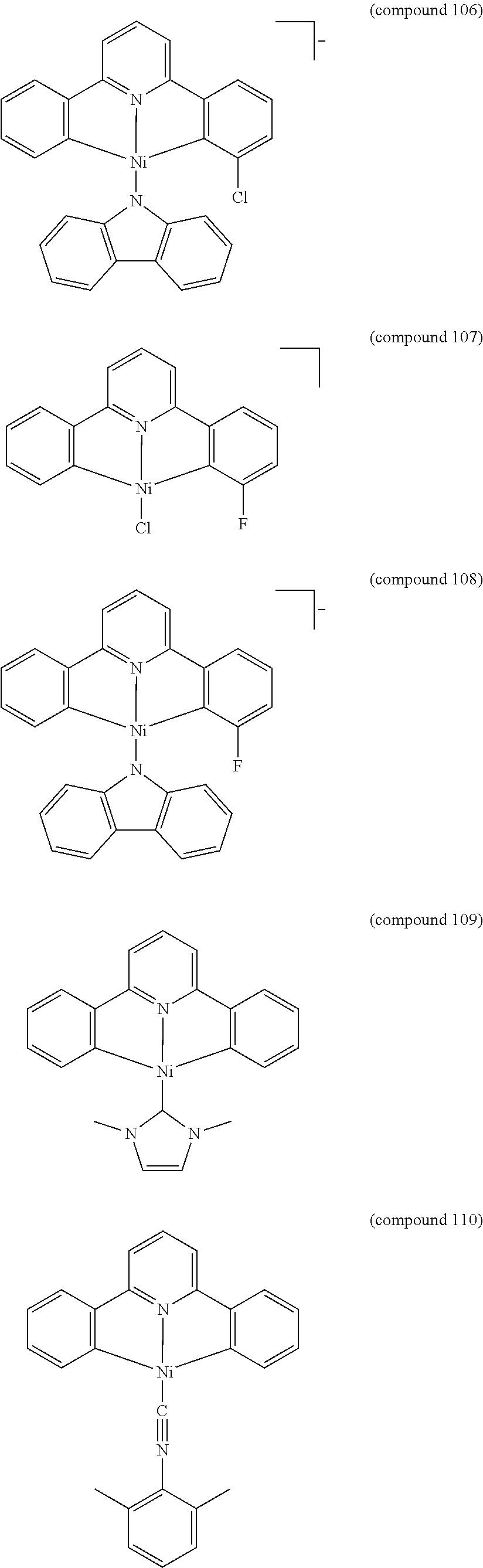


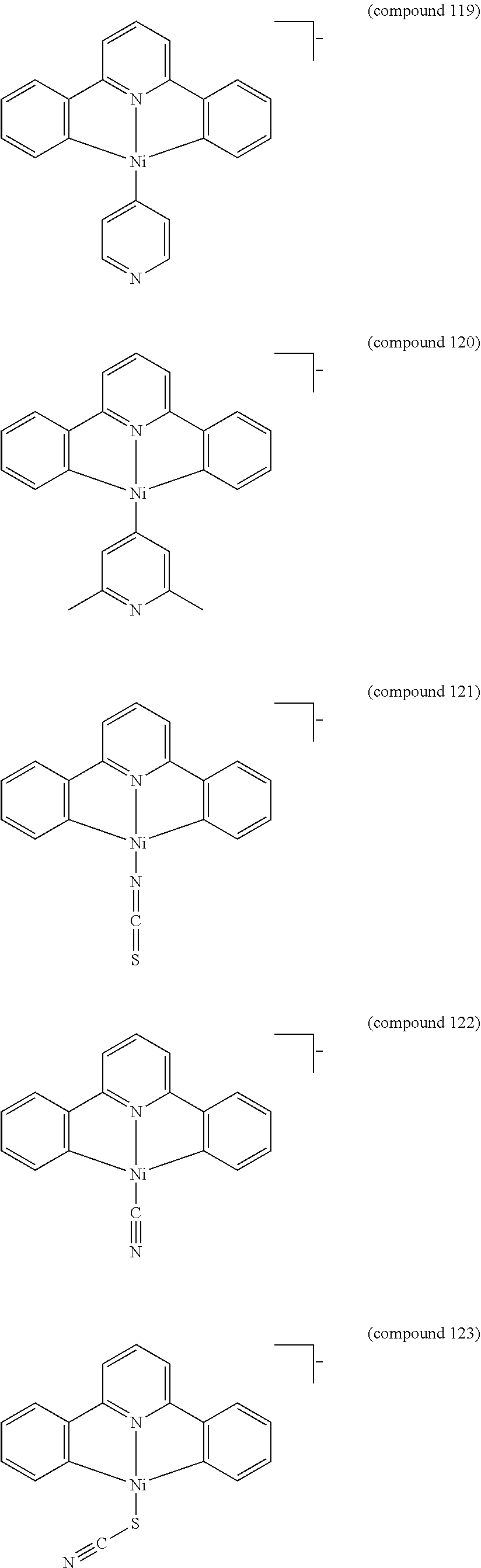


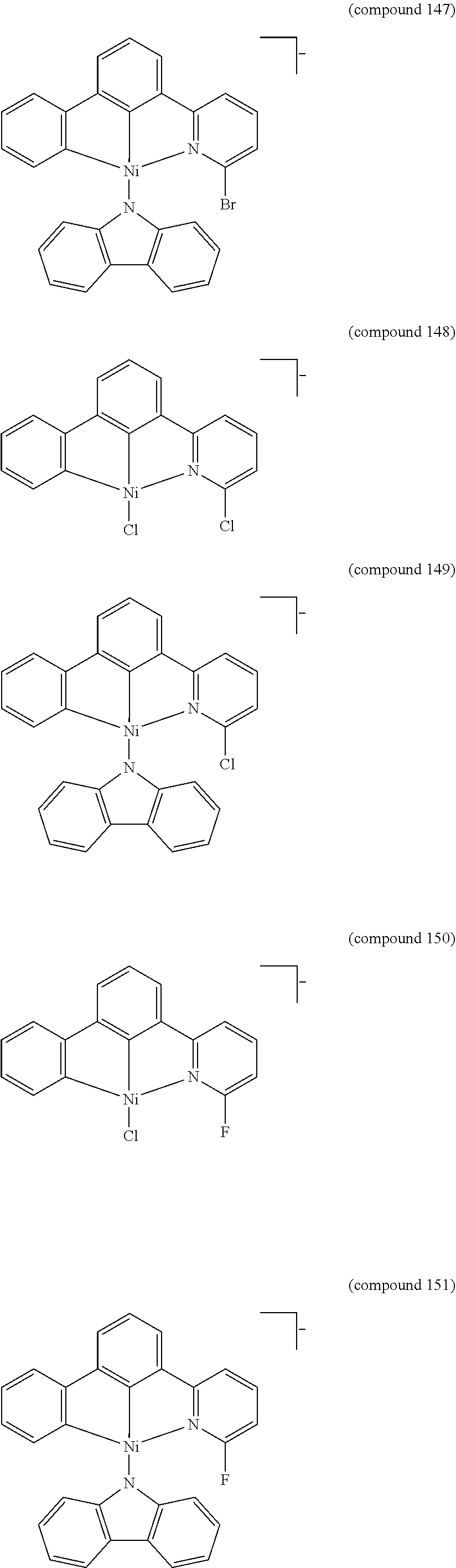
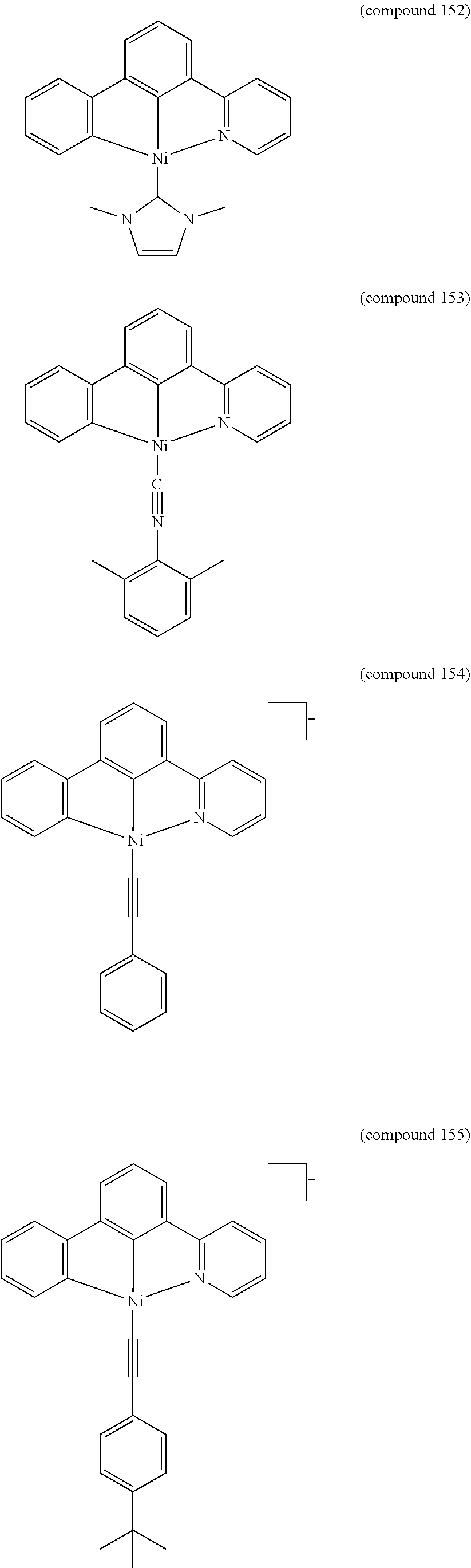
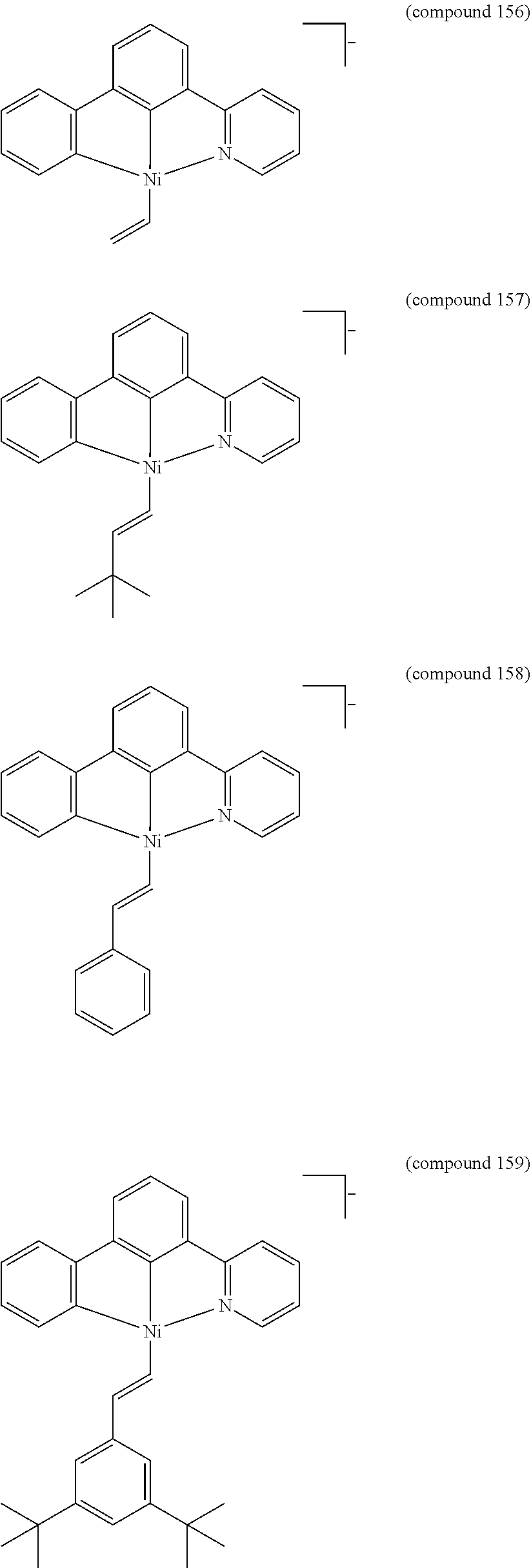
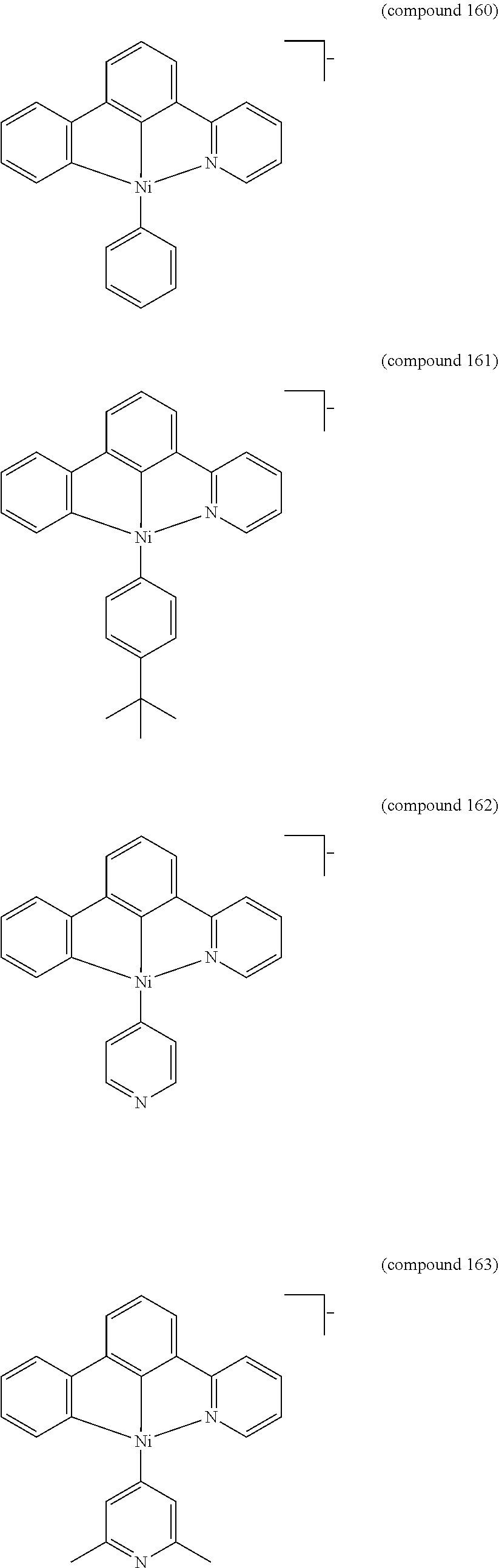


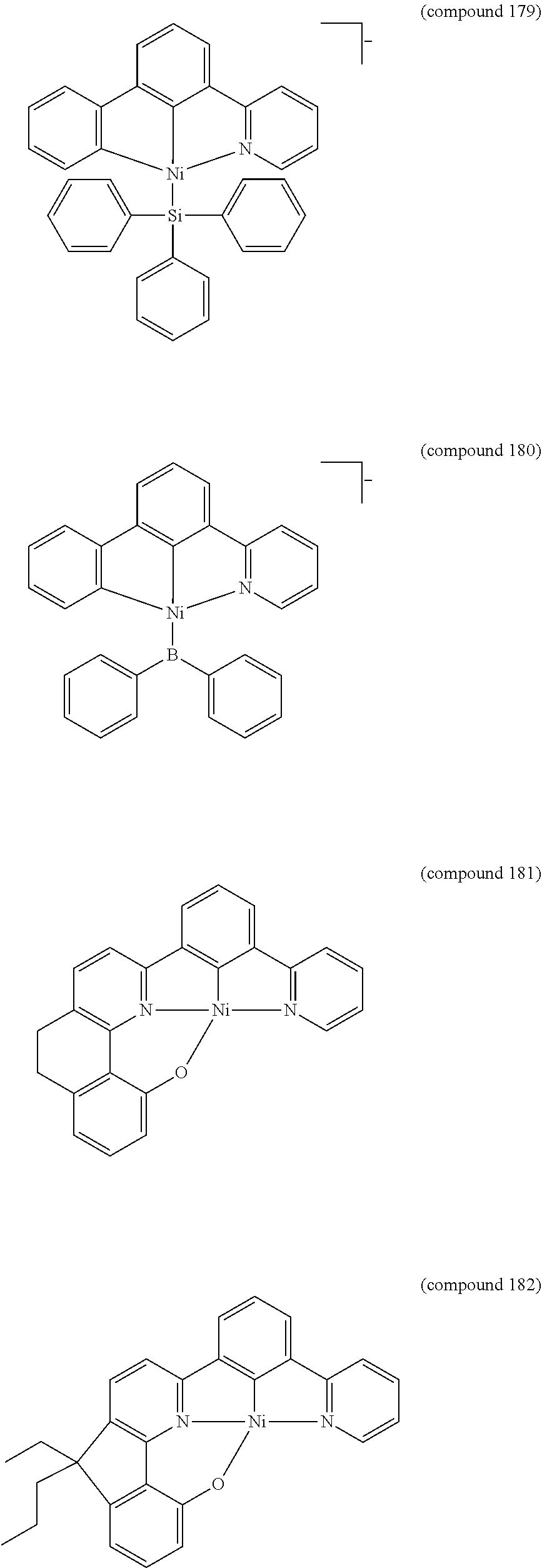


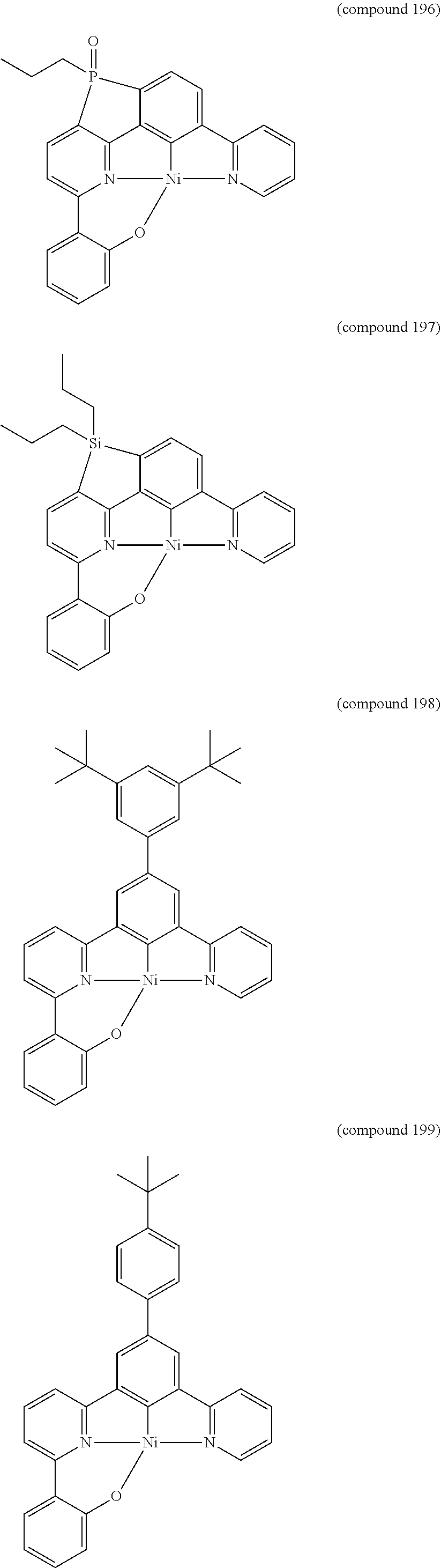

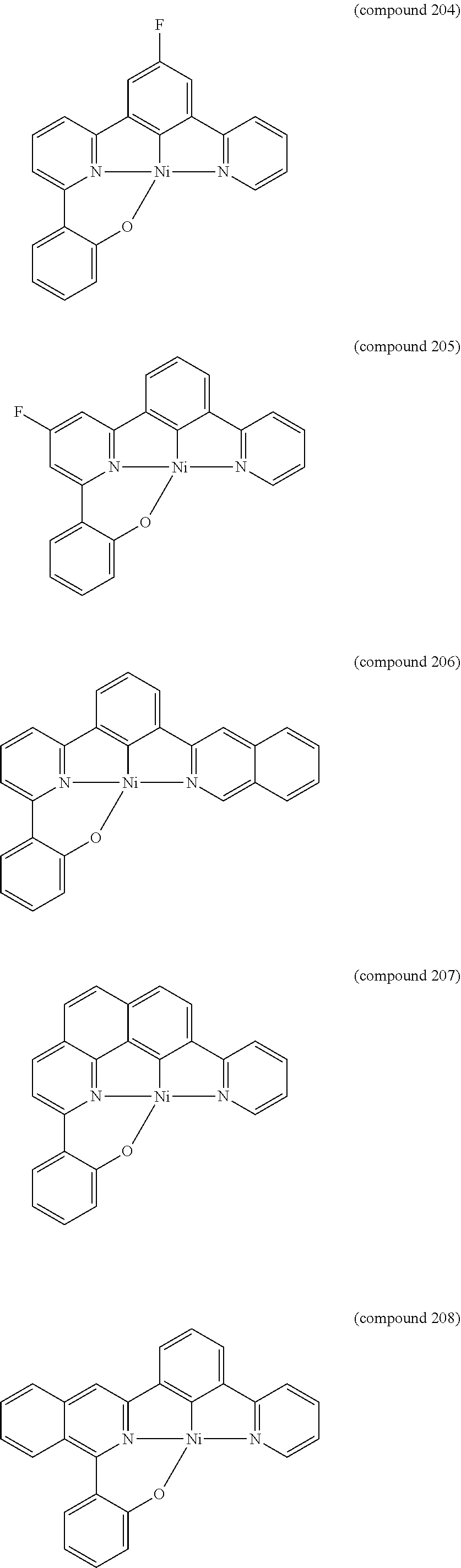


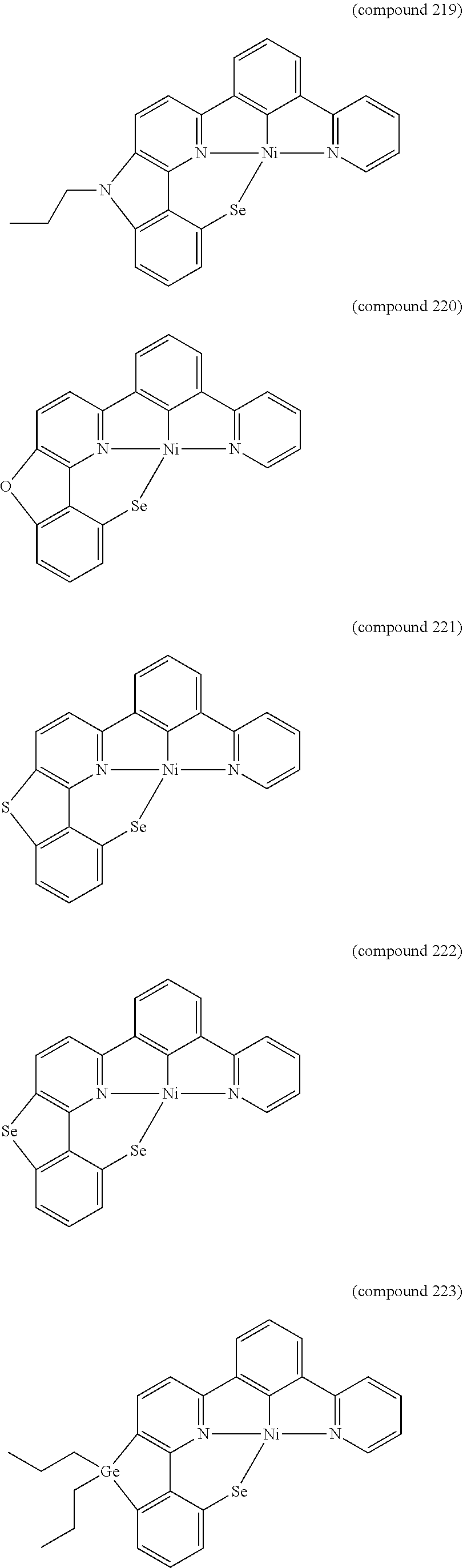


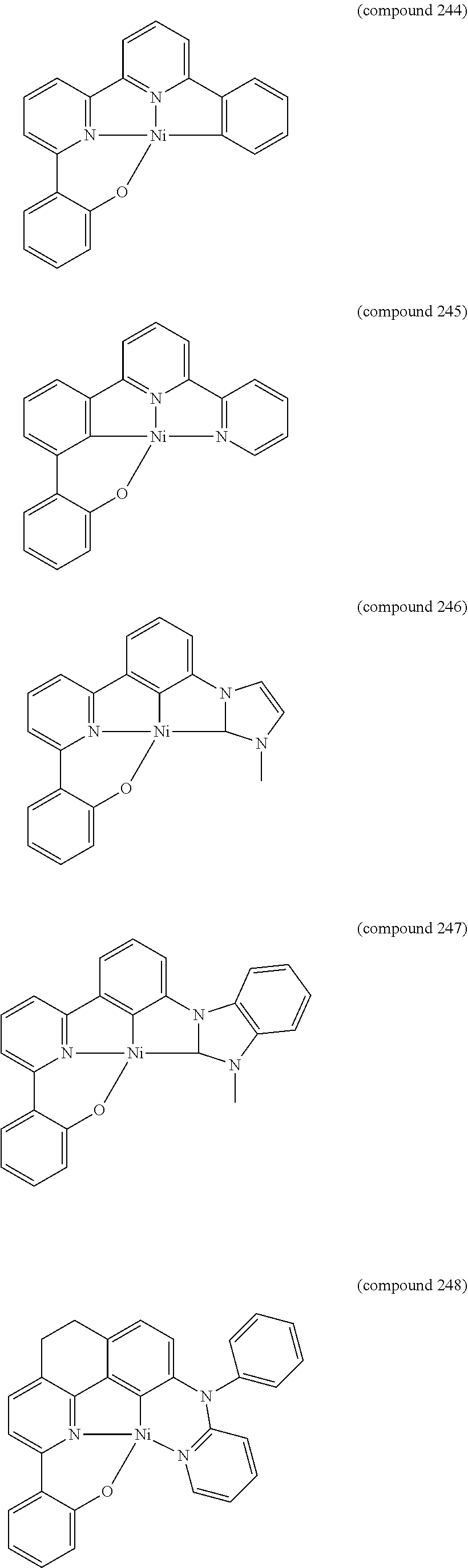


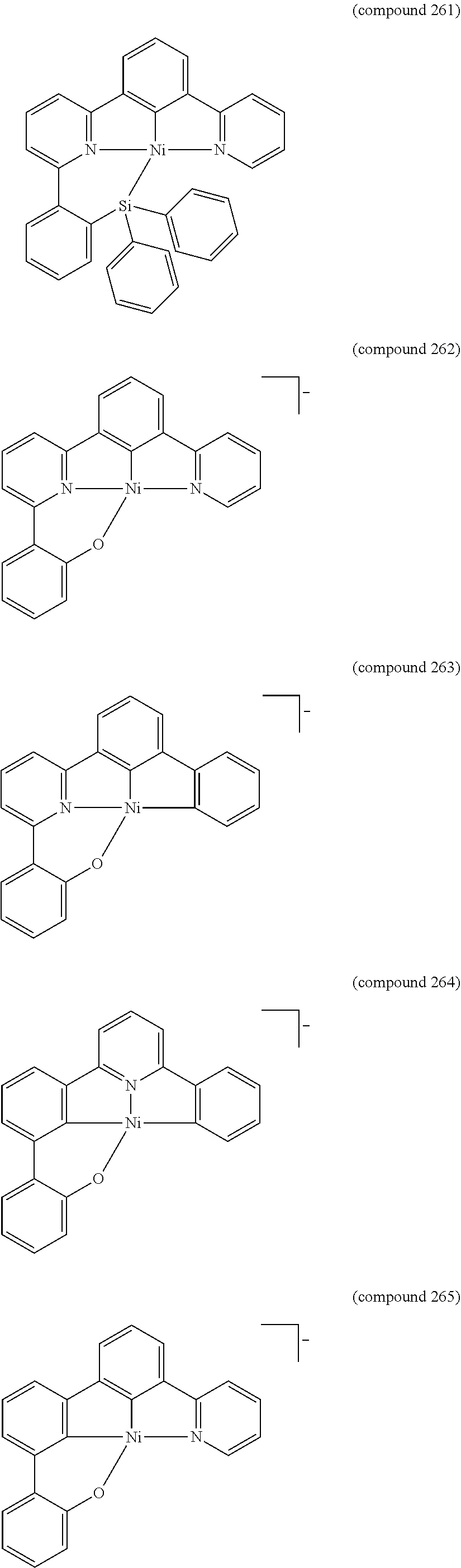

-
- 17. A light-emitting device comprising an anode, a light-emitting layer, and a cathode, wherein the light-emitting layer comprises the luminescent compound of any one of
paragraphs 1 to 16, and optionally a host compound. - 18. The light-emitting device of paragraph 17, further comprising an electron-transporting layer and a hole-transporting layer.
- 19. The light-emitting device of paragraph 17 or 18, wherein the light-emitting layer comprises the luminescent compound as a dopant of the host compound, wherein the dopant has a percent composition between about 5 wt % and 50 wt %, such as 10 wt %, of the light-emitting layer.
- 20. The light-emitting device of any one of paragraphs 17 to 19, wherein the host compound is selected from 1,3-bis(carbazol-9-yl)benzene (MCP), 4,4′-bis(carbazol-9-yl)biphenyl (CBP), 4,4′,4″-tris(carbazol-9-yl)-triphenylamine (TCTA), 3-(4-biphenylyl)-4-phenyl-5-tert-butylphenyl-1,2,butylphenyl-1,2,4-triazole (TAZ), p-bis(triphenylsilyl)benzene (UGH2) and diphenyl-4-triphenylsilylphenyl-phosphine oxide (TSPO1), and combinations thereof.
- 21. The light-emitting device of any one of paragraphs 17 to 20, wherein the light-emitting layer has a thickness between about 10 nm and 60 nm, such as 30 nm.
- 22. The light-emitting device of any one of paragraphs 18 to 21, wherein the hole-transporting layer comprises 4,4′-bis[N-(1-naphthyl)-N-phenylamino]biphenyl (NPB), 4,4′-bis[N-(3-methylphenyl)-N-phenylamino]biphenyl (TPD), 4,4′,4″-tris[(3-methylphenyl)phenylamino] triphenylamine (MTDATA), and di-[4-(N,N-ditolyl-amino)phenyl]cyclohexane (TAPC). In addition, polymeric hole-transporting materials can be used including poly(N-vinylcarbazole) (PVK), polythiophene, polypyrrole, polyaniline, and copolymers including poly(3,4-ethylenedioxythiophene):poly(4-styrene-sulfonate) (PEDOT:PSS), and mixtures thereof.
- 23. The light-emitting device of any one of paragraphs 18 to 22, wherein the hole-transporting layer has a thickness between about 10 nm and 70 nm, such as 40 nm.
- 24. The light-emitting device of any one of paragraphs 18 to 23, wherein the electron-transporting layer comprises 1,3,5-tris(phenyl-2-benzimidazolyl)-benzene (TPBI), 1,3,5-tri[(3-pyridyl)-phen-3-yl] benzene (TmPyPB), bathocuproine (BCP), bathophenanthroline (BPhen) and bis(2-methyl-8-quinolinolate)-4-(phenylphenolate)-aluminum (BAlq), tris-[2,4,6-trimethyl-3-(pyridin-3-yl)phenyl]borane (3TPYMB), 1,3,5-tri[(3-pyridyl)-phen-3-yl]benzene (TmPyPB),1,3-bis[3,5-di(pyridin-3-yl)-phenyl]benzene (BmPyPhB) and 1,3,5-tris(6-(3-(pyridin-3-yl)phenyl)pyridin-2-yl)benzene (Tm3PyP26PyB), and mixtures thereof.
- 25. The light-emitting device of any one of paragraphs 18 to 24, wherein the electron-transporting layer has a thickness between about 10 nm and 60 nm, such as 40 nm.
- 26. The light-emitting device of any one of paragraphs 17 to 25, further comprising a carrier confinement layer.
- 27. The light-emitting device of paragraph 26, wherein the carrier confinement layer comprises an organic compound, such as tris(2,4,6-trimethyl-3-(pyridin-3-yl)phenyl)borane (3TPYMB).
- 28. The light-emitting device of paragraph 26 or 27, wherein the carrier confinement layer has a thickness between about 5 nm and about 50 nm, such as 10 nm.
- 29. The light-emitting device of any one of paragraphs 17 to 28, wherein the anode comprises indium tin oxide-coated glass.
- 30. The light-emitting device of any one of paragraphs 17 to 29, wherein the cathode comprises lithium fluoride, aluminium, or a combination thereof.
- 31. The light-emitting device paragraph 30, wherein the lithium fluoride forms a layer having a thickness between about 0.05 nm and 5 nm, such as 1 nm.
- 32. The light-emitting device of paragraph 30 or 31, wherein the aluminium forms a layer having a thickness between about 50 nm and about 250 nm, such as 150 nm.
- 33. The light-emitting device of any one of paragraphs 17 to 32, wherein the light-emitting layer is prepared using a vacuum deposition or solution processing technique.
- 34. The light-emitting device of any one of paragraphs 26 to 33, wherein the light-emitting layer, the electron-transporting layer, hole-transporting layer, and carrier confinement layer are located between the anode and the cathode.
- 17. A light-emitting device comprising an anode, a light-emitting layer, and a cathode, wherein the light-emitting layer comprises the luminescent compound of any one of
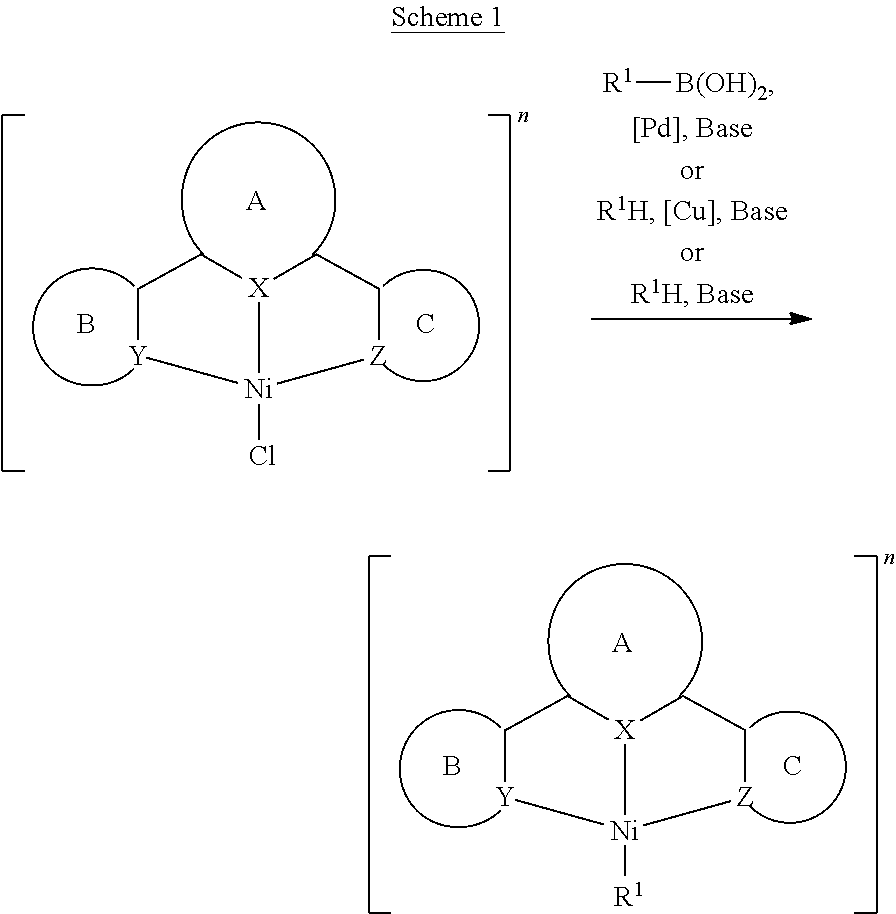
In this schematic:
-
- R1 can be selected from, but is not limited to, alkyl, substituted alkyl, aryl, substituted aryl, heteroaryl, substituted heteroaryl, heterocyclic aryl, substituted heterocyclic aryl, alkynyl or substituted alkynyl. R1 could also be a group with heteroatom as the donor atom and is selected from, but not limited to, nitrogen, oxygen, sulfur or phosphorus;
- rings A, B, and C are independently benzene, phenyl derivatives, heterocycle or heterocyclic derivatives, but are not limited to, with one or more alkyl, alkenyl, alkynyl, aryl, cycloalkyl, OR, NR2, SR, C(O)R, C(O)OR, C(O)NR2, CN, CF3, NO2, SO2, SOR, SO3R, halo, aryl, substituted aryl, heteroaryl, substituted heteroaryl or heterocyclic group, wherein R is independently alkyl, alkenyl, alkynyl, alkyaryl, aryl, or cycloalkyl; and
- n is zero, a positive integer or a negative integer.
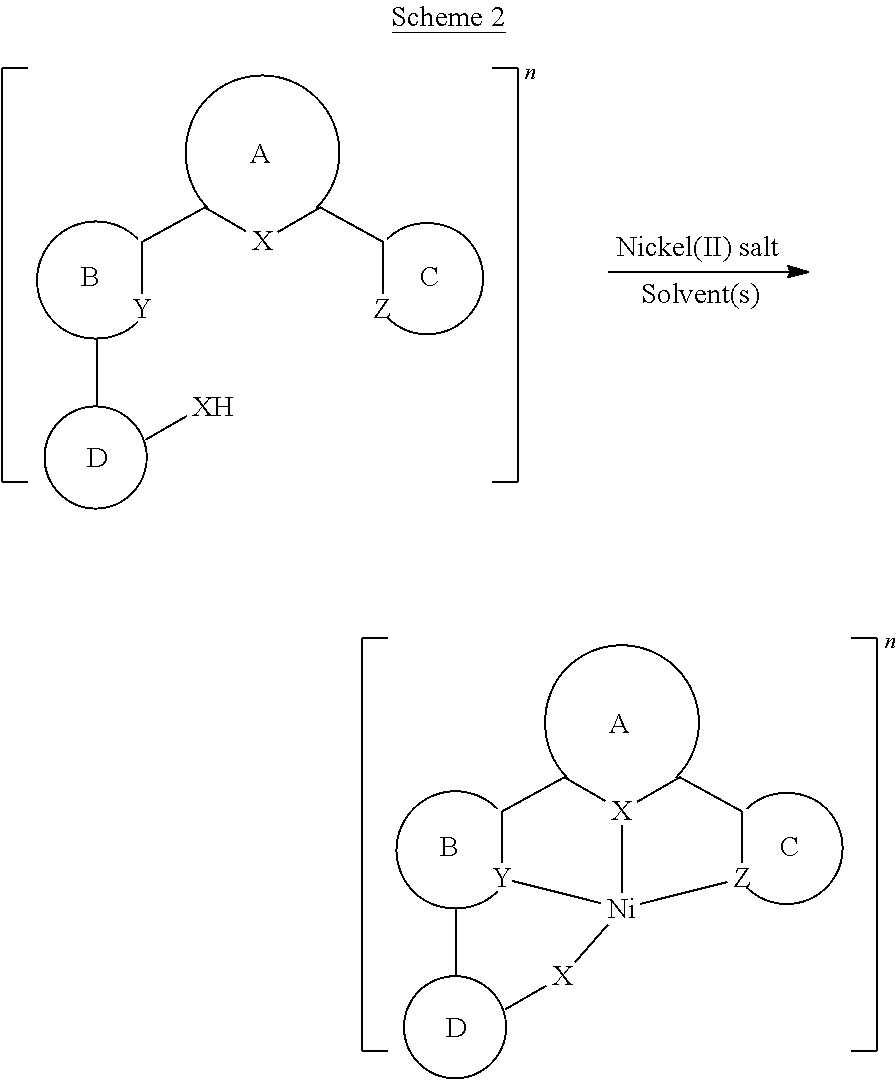
In this schematic:
-
- Rings A, B, C and D are independently benzene, phenyl derivatives, heterocycle or heterocyclic derivatives, but are not limited to, with one or more alkyl, alkenyl, alkynyl, aryl, cycloalkyl, OR, NR2, SR, C(O)R, C(O)OR, C(O)NR2, CN, CF3, NO2, SO2, SOR, SO3R, halo, aryl, substituted aryl, heteroaryl, substituted heteroaryl or heterocyclic group, wherein R is independently alkyl, alkenyl, alkynyl, alkyaryl, aryl, or cycloalkyl;
- X can be selected from, but is not limited to, O, S, Se, NR, CR2, SiR2, wherein R is independently alkyl, alkenyl, alkynyl, alkyaryl, aryl, or cycloalkyl; and
- n is zero, a positive integer or a negative integer.
(a) Synthesis
| TABLE 1 |
| Absorption data for compounds 1-4 |
| Medium | Absorption λmax/nm | |
| Compound | (T/K) | (εmax/dm3 mol−1 cm−1) |
| 1 | CH2Cl2 (298) | 278 (16390), 309 sh (6510), 335 (3990), |
| 407 (3820), 431 (3565) | ||
| 2 | CH2Cl2 (298) | 281 (32910), 290 sh (59370), 310 (9525), |
| 333(6445), 368 sh (2980), 385 (3935), | ||
| 425 (2750) | ||
| 3 | CH2Cl2 (298) | 288 (29560), 322 sh (10615), 340 (6615), |
| 423 (6335), 449 (7400) | ||
| 4 | CH2Cl2 (298) | 305 (17670), 318 (17025), 400 (8300), |
| 436 (4970) | ||

| TABLE 2 |
| Emission data for compounds 1-4 |
| Compound | Medium (T/K) | Emission λmax/ |
| 1 | CH2Cl2 (298) | 500 |
| 2 | Toluene (298) | 467, 495, 568 |
| Solid (298) | 600 | |
| Solid (77) | 466, 500, 570 | |
| Thin film (298) | 600 | |
| 10% in |
||
| 3 | CH2Cl2 (298) | 500 |
| 4 | CH2Cl2 (298) | Non-emissive |
| Glass (77) | Non-emissive | |
| Solid (77) | Non-emissive | |
Claims (36)


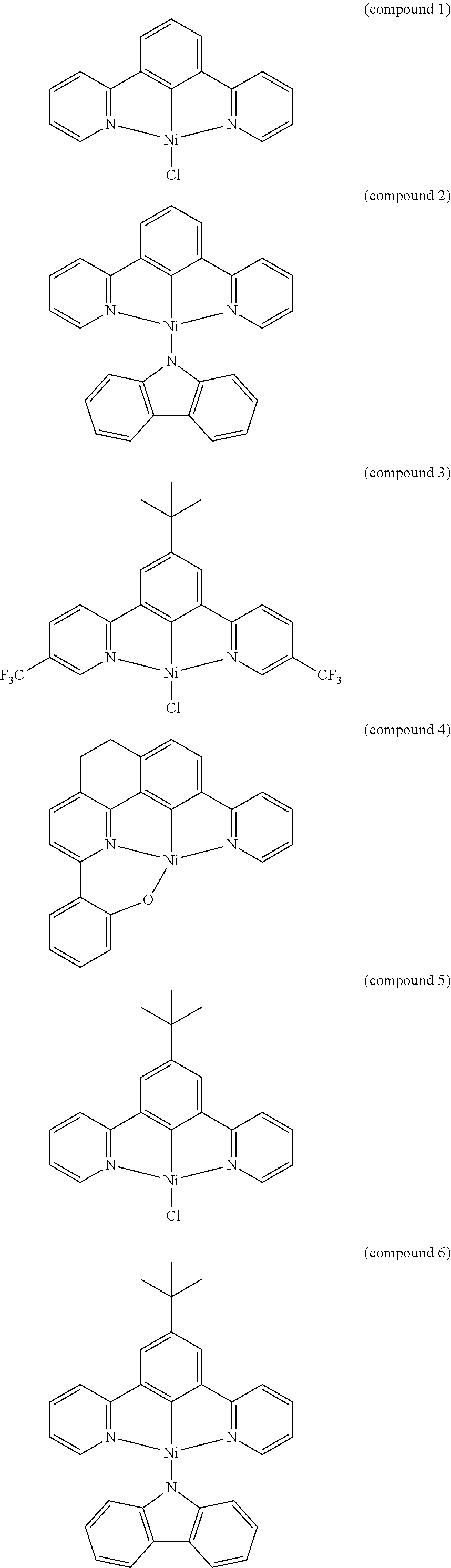
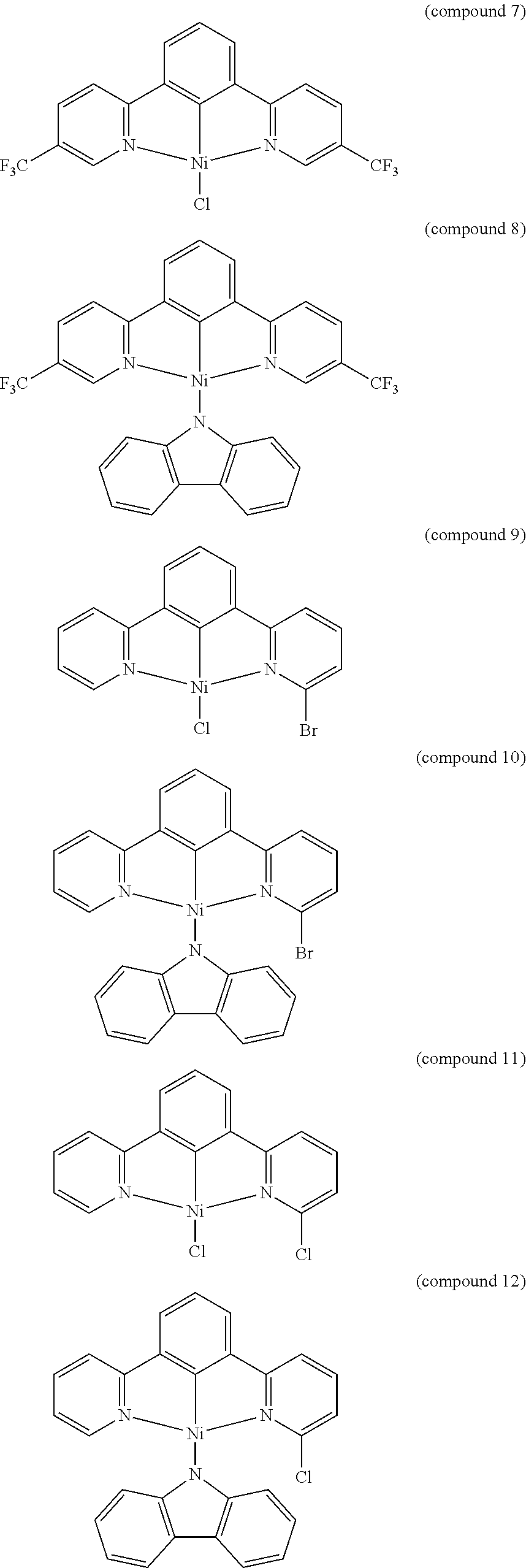
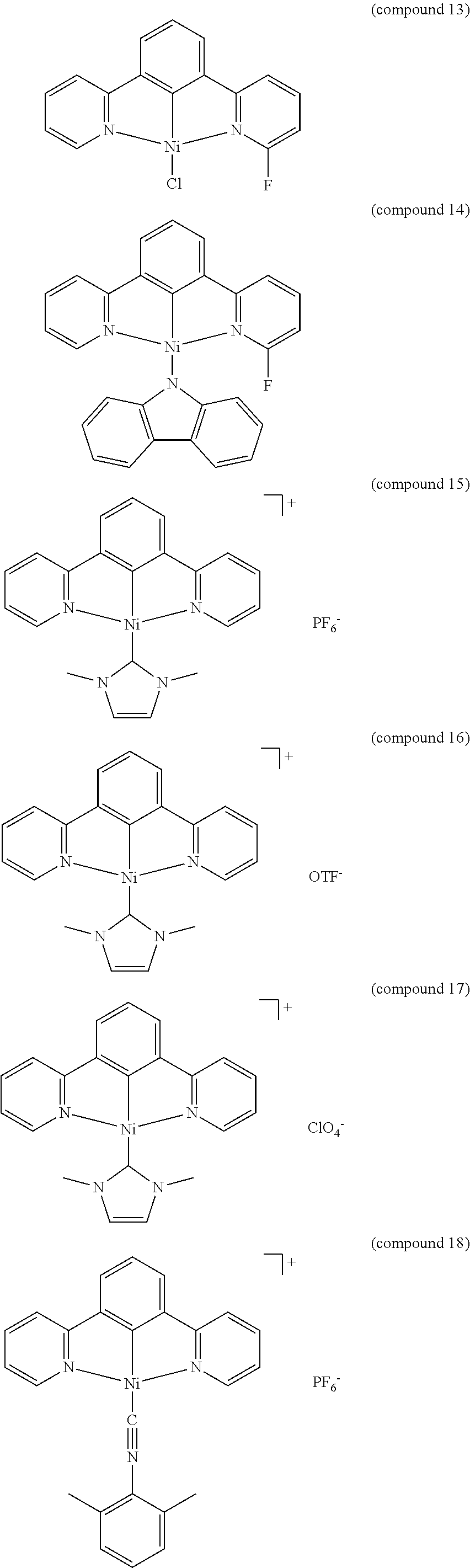


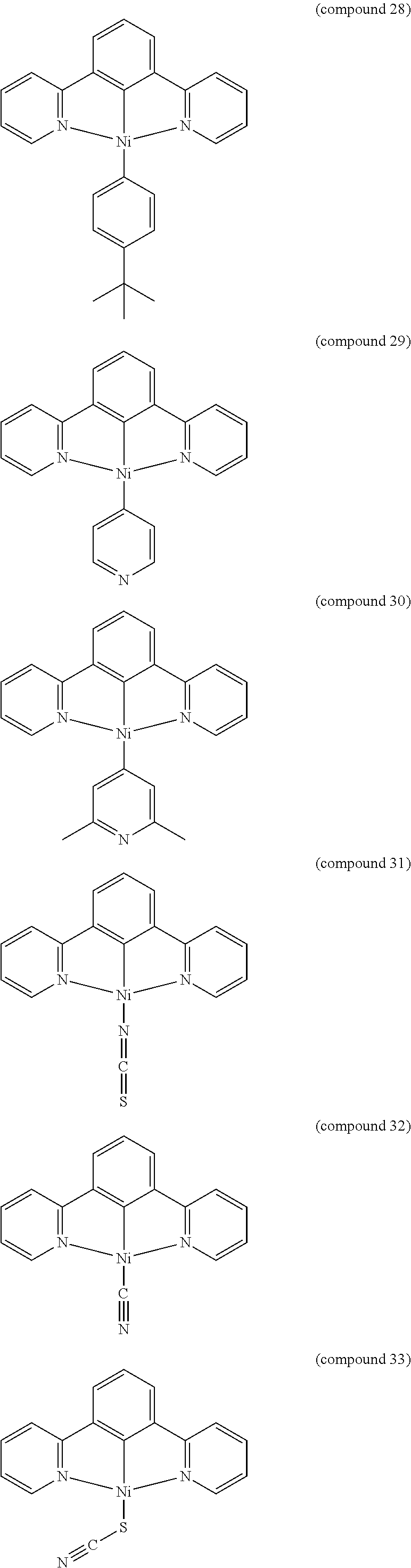
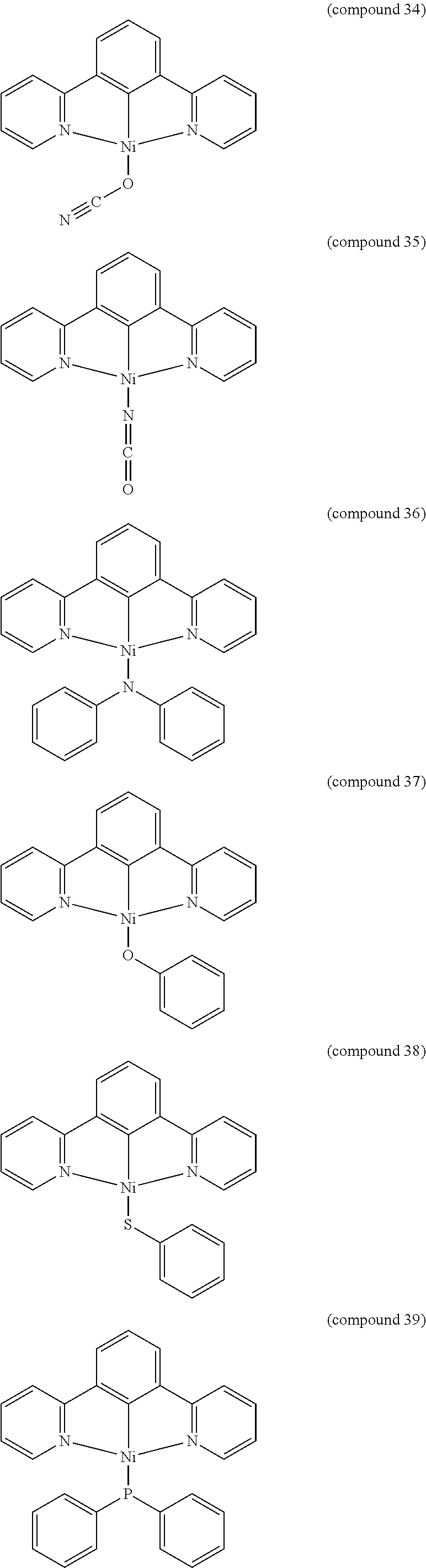
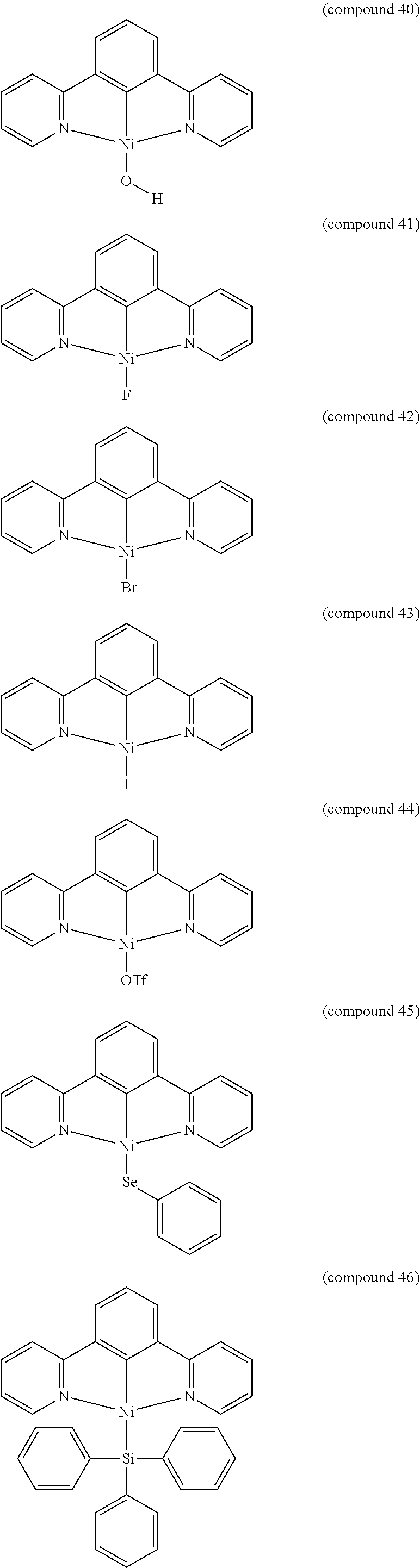
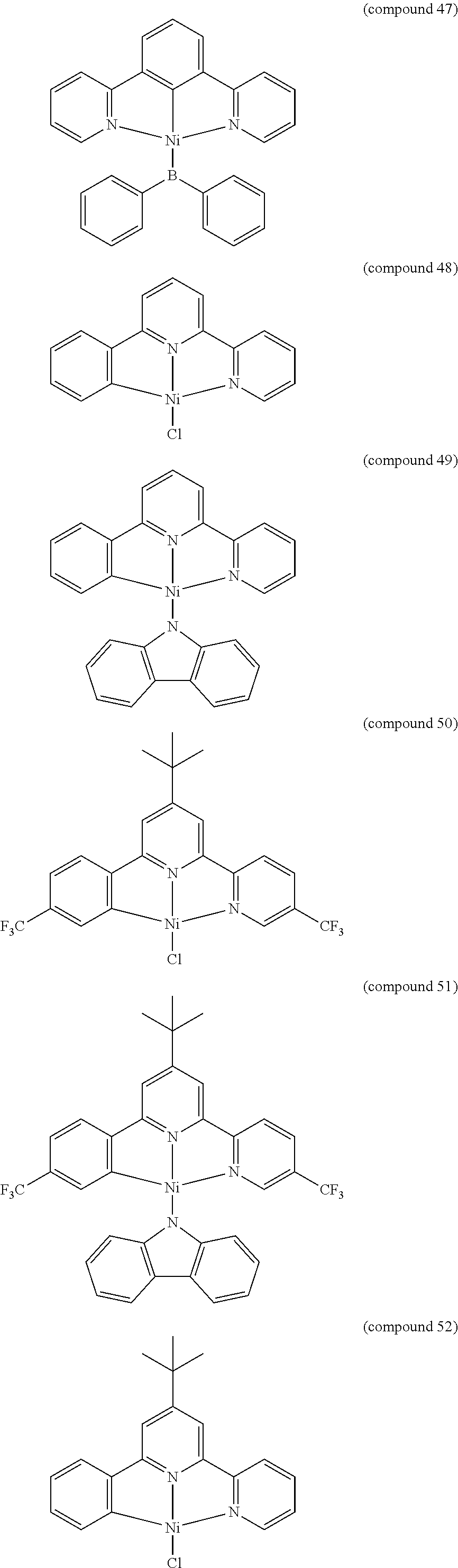
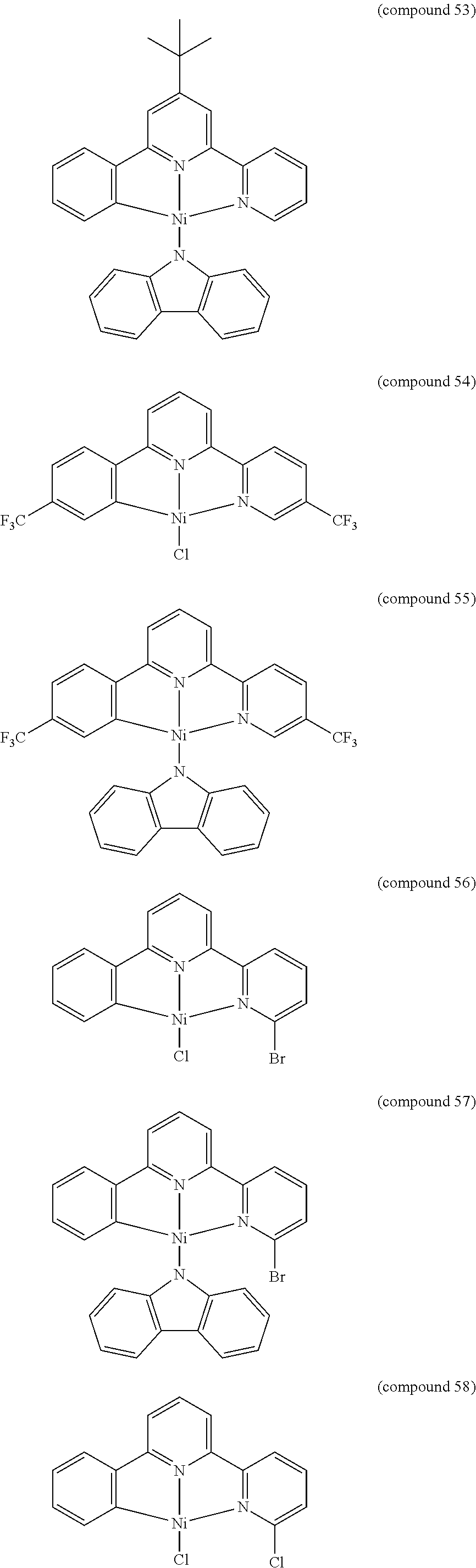


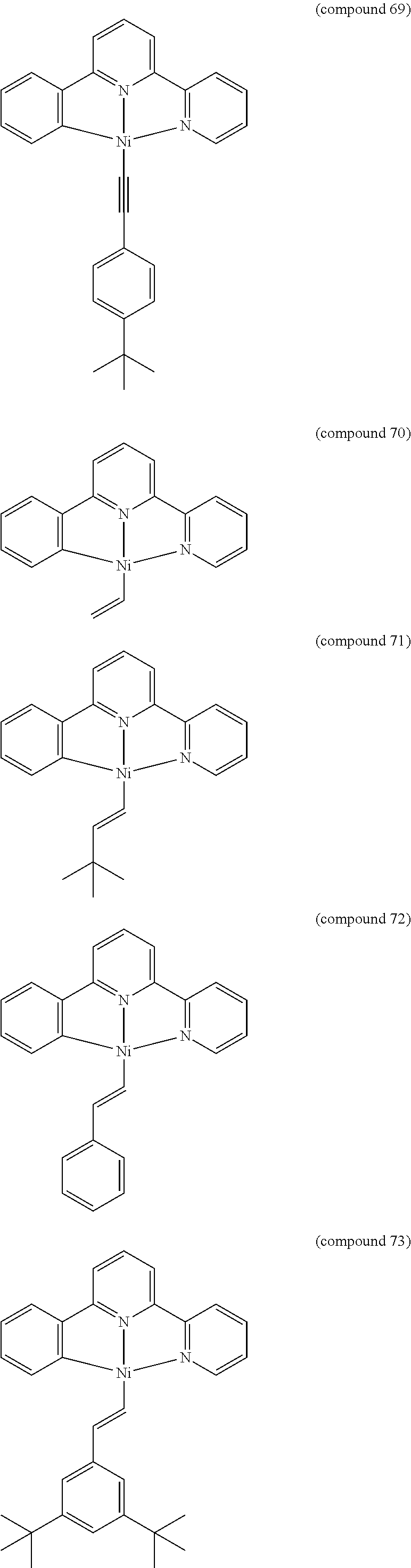

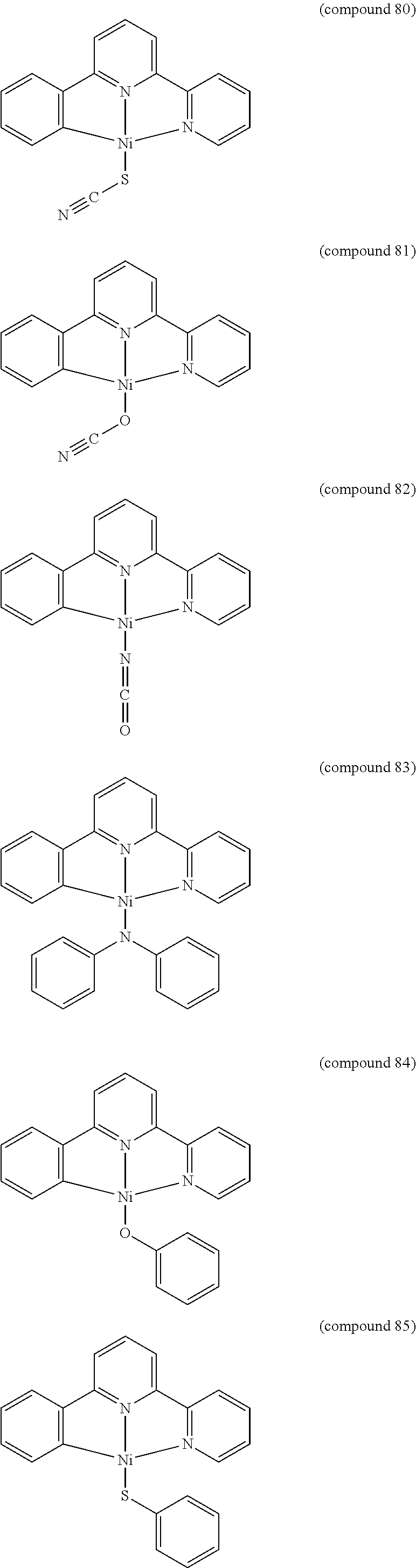


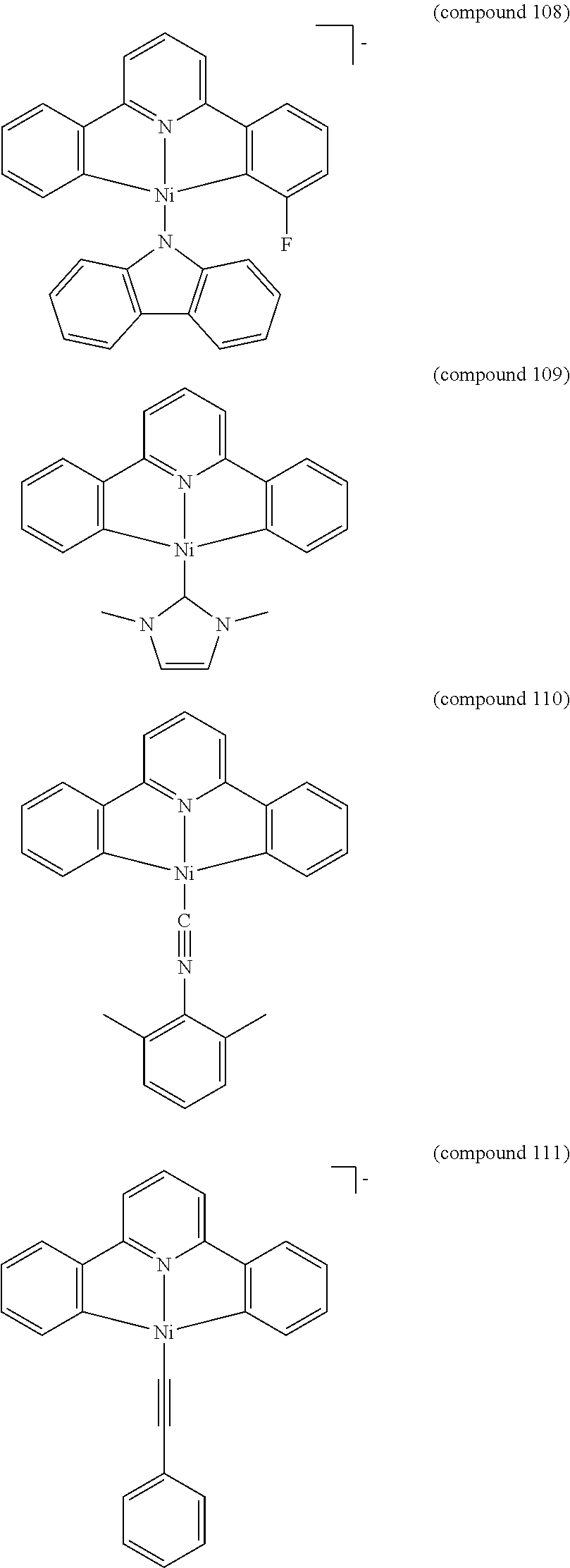


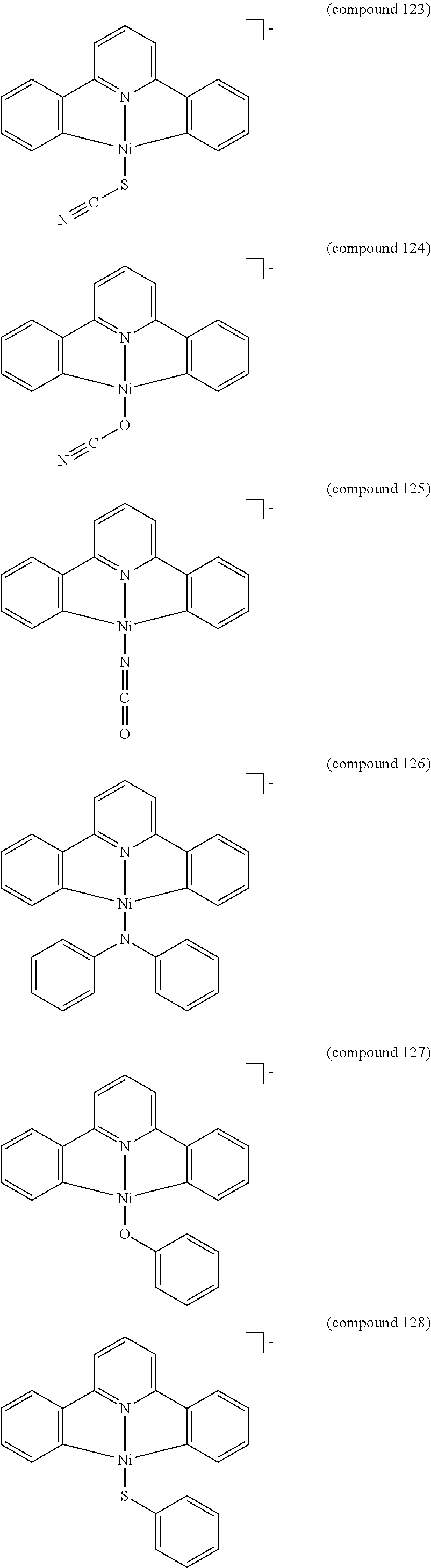
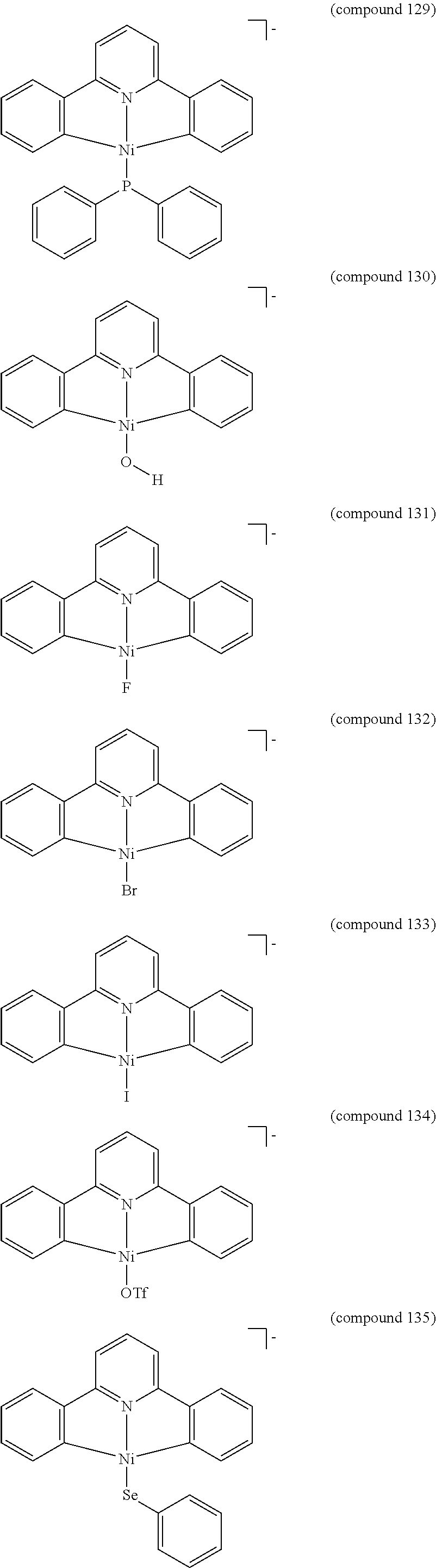


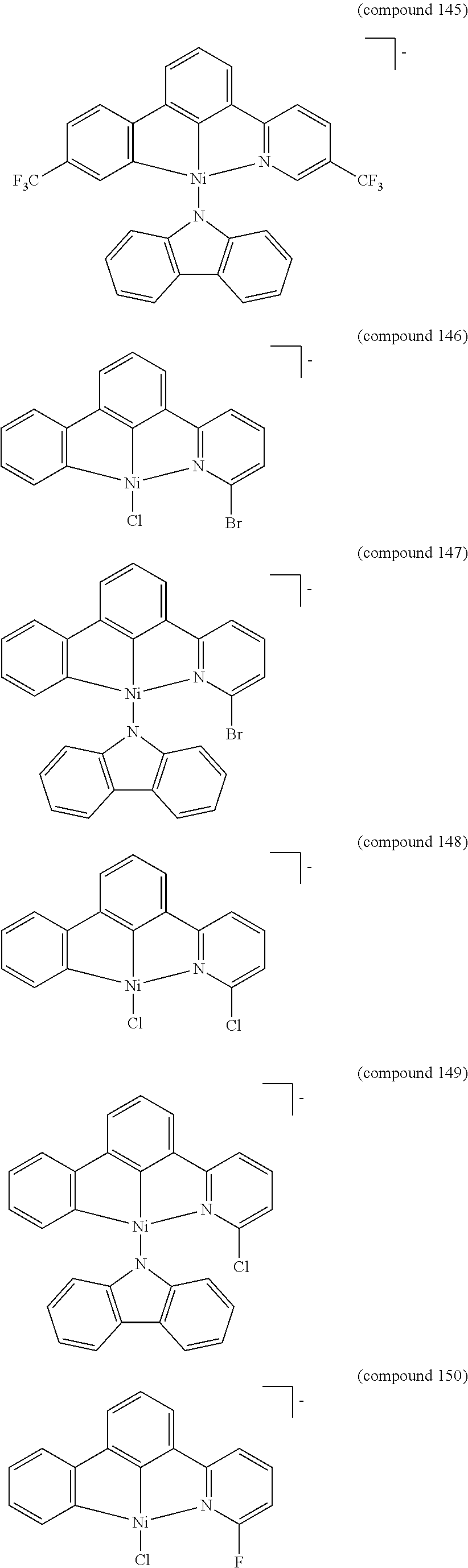
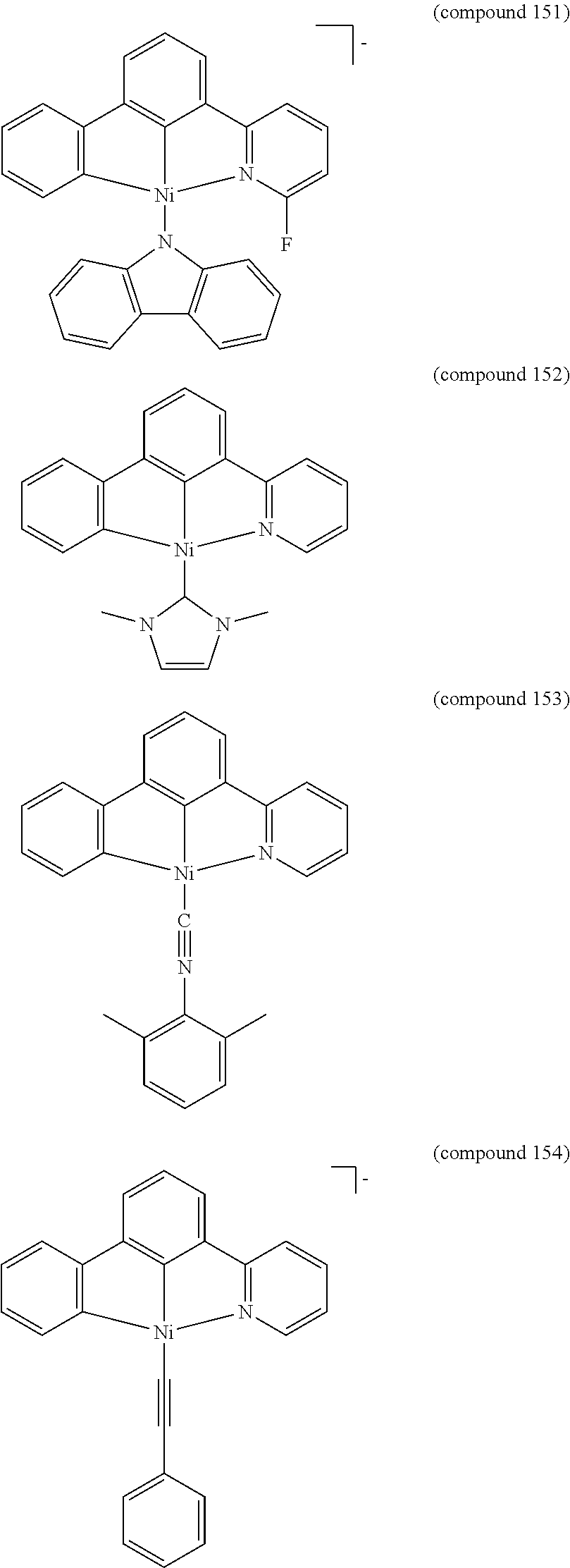

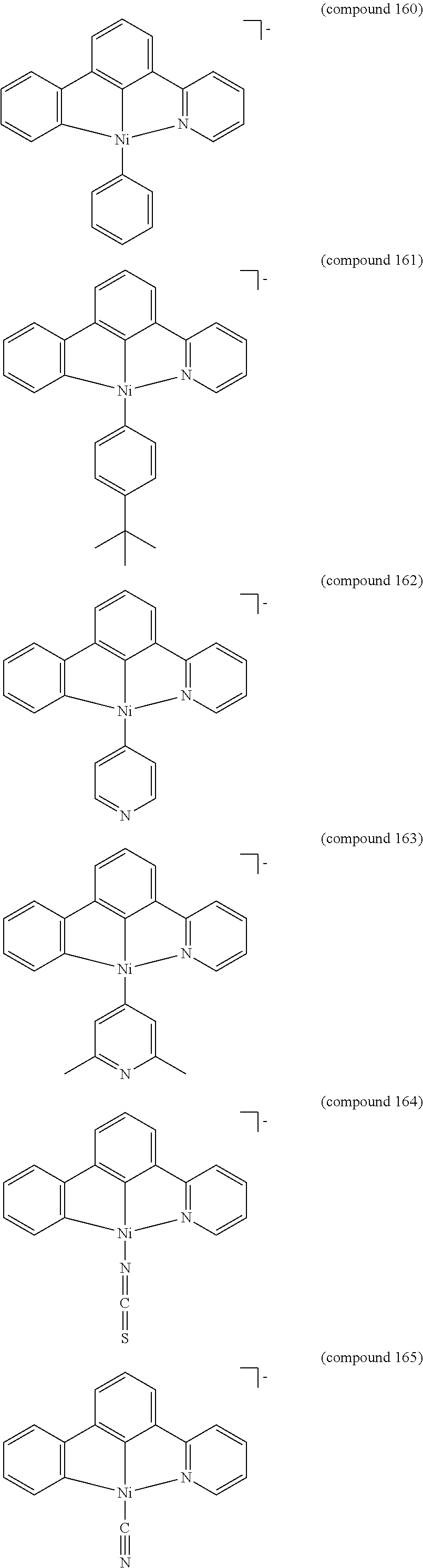
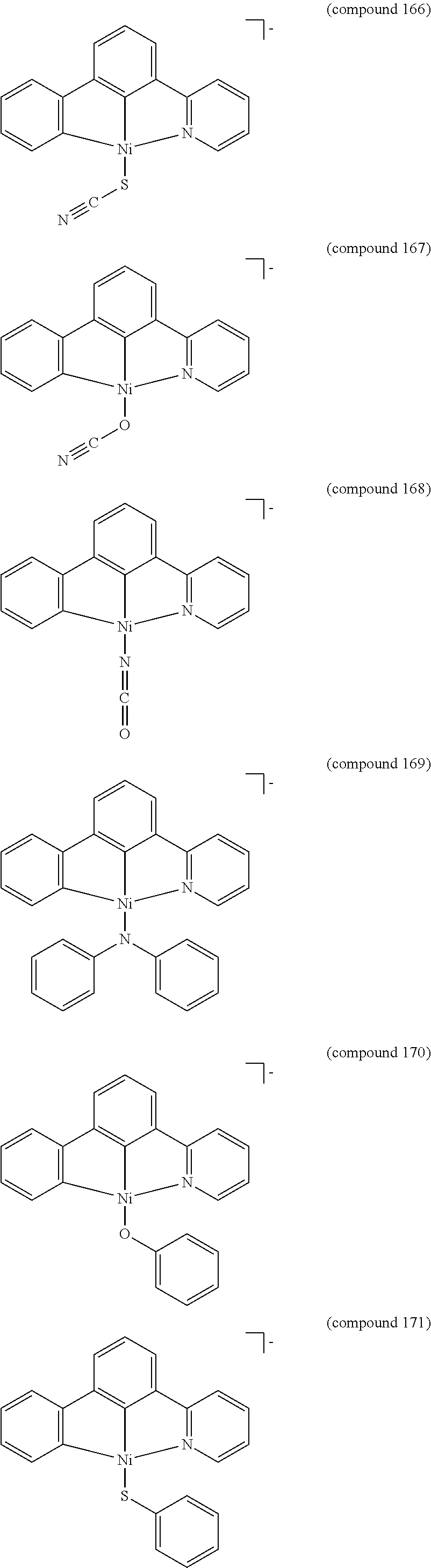
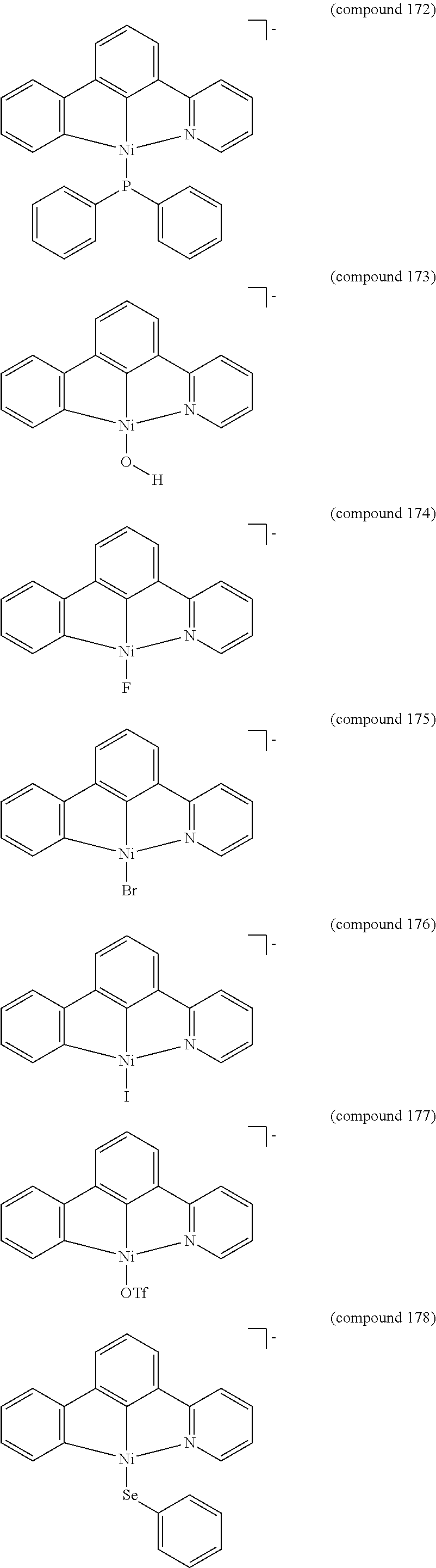
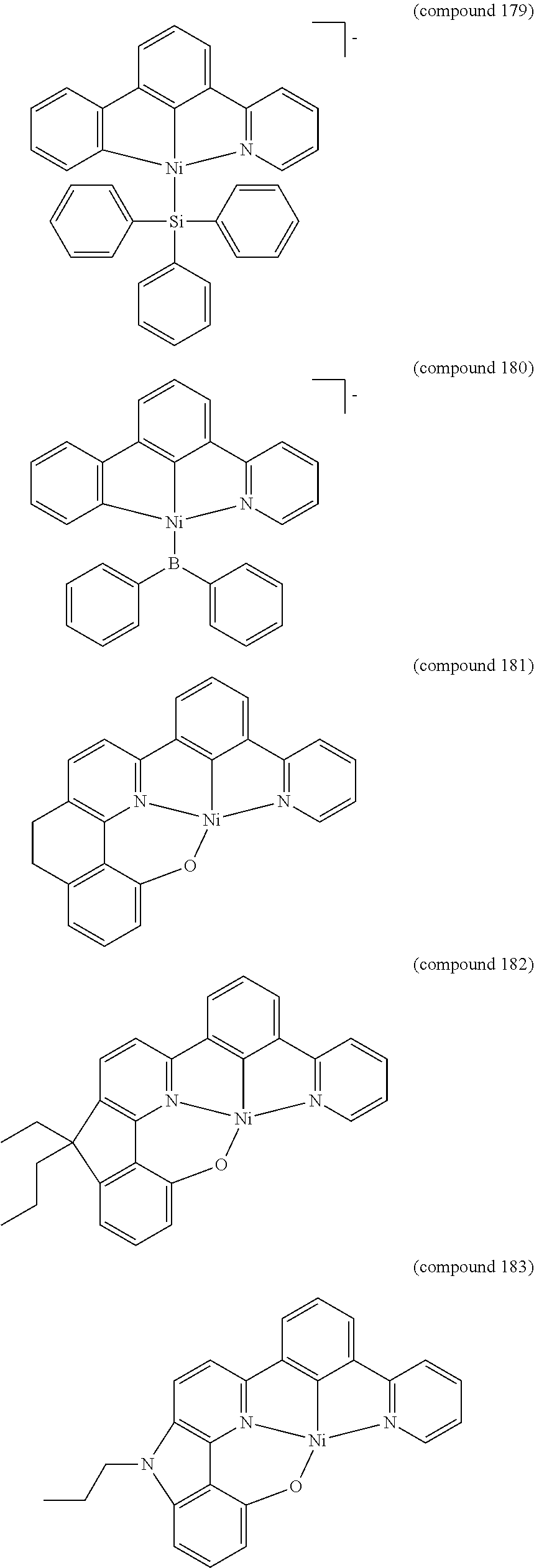
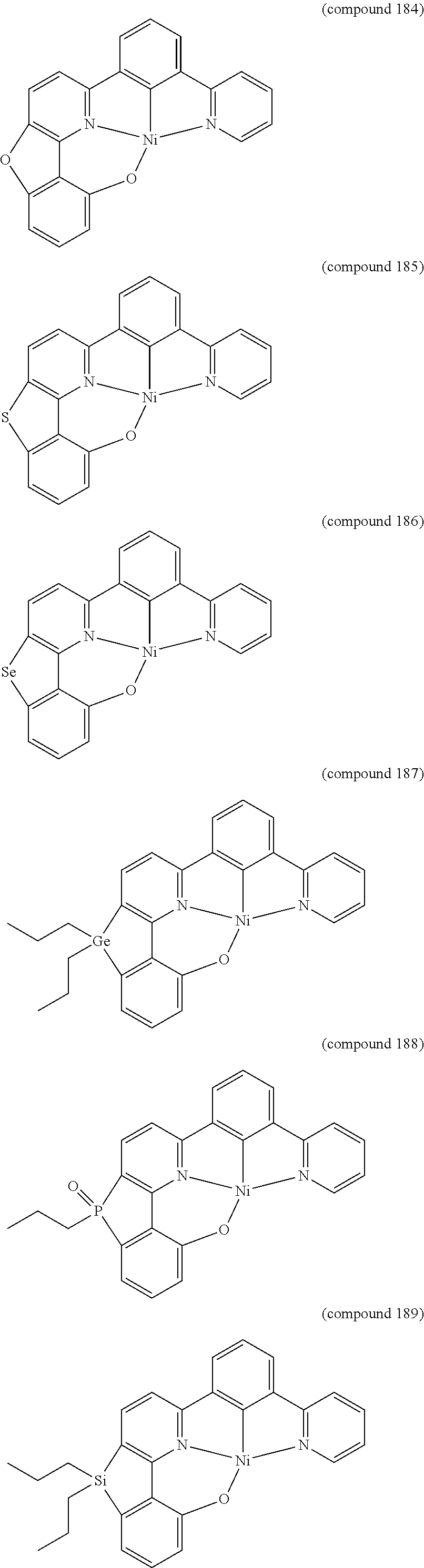
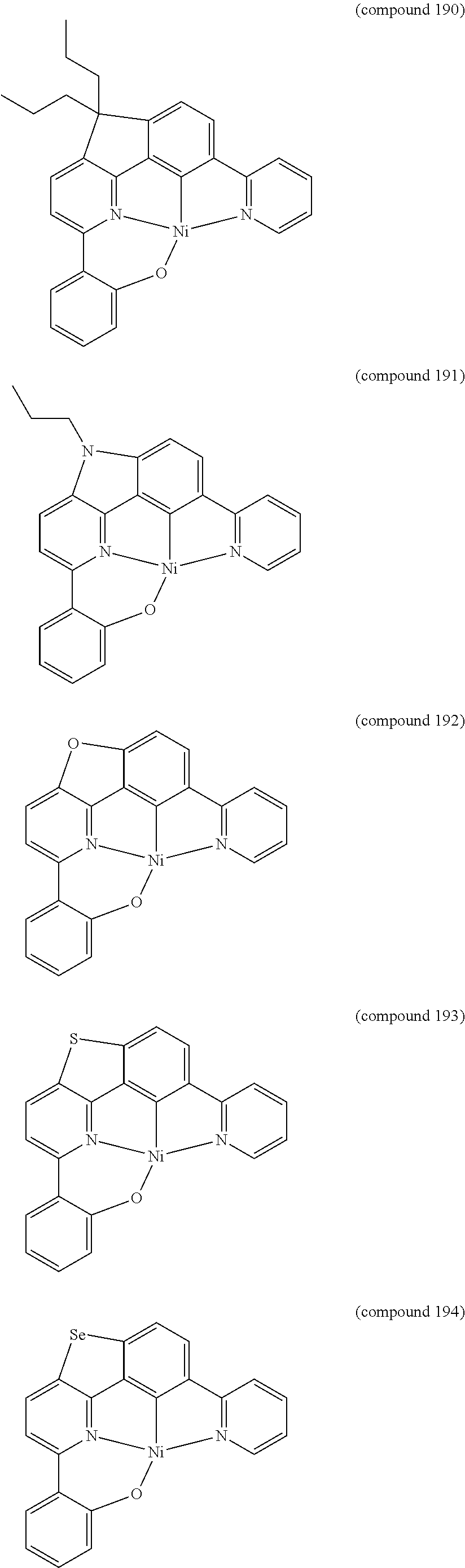
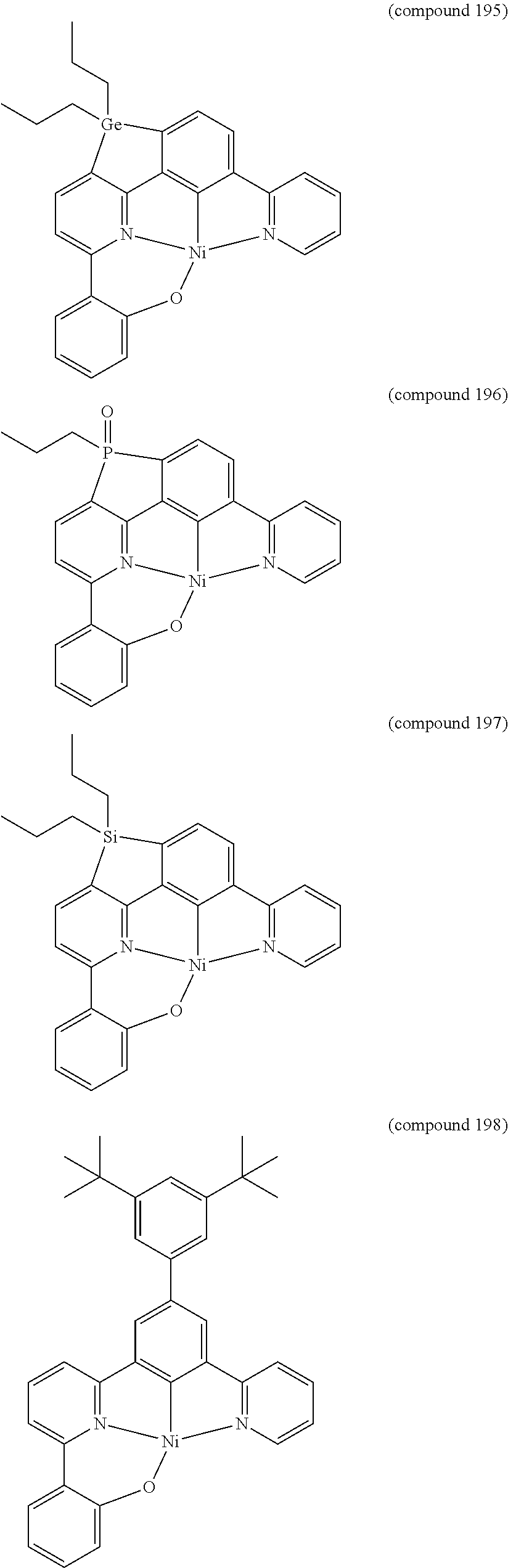


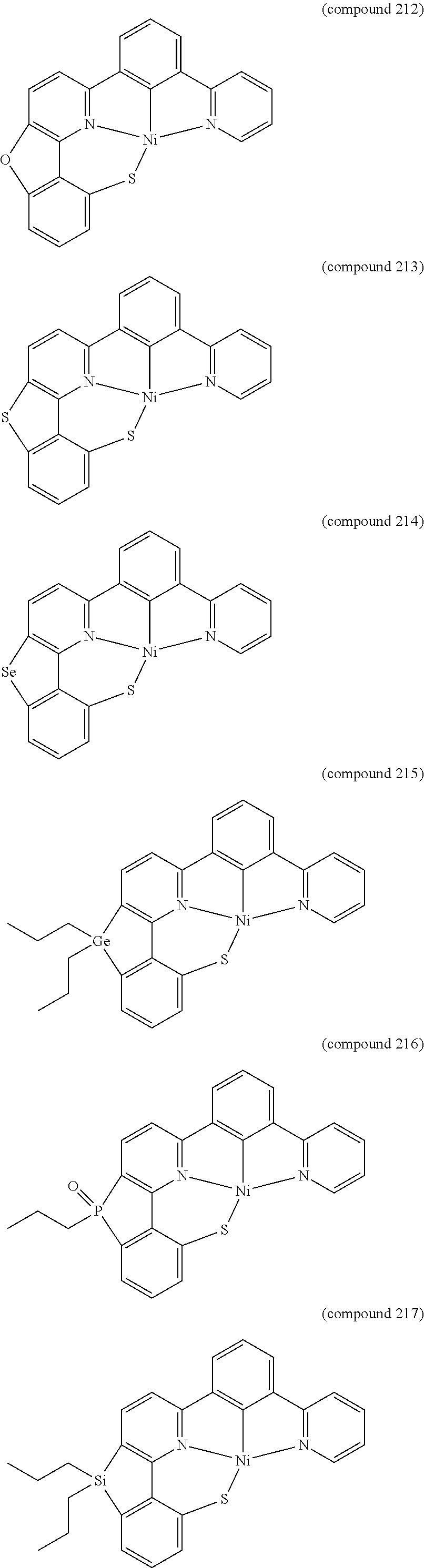


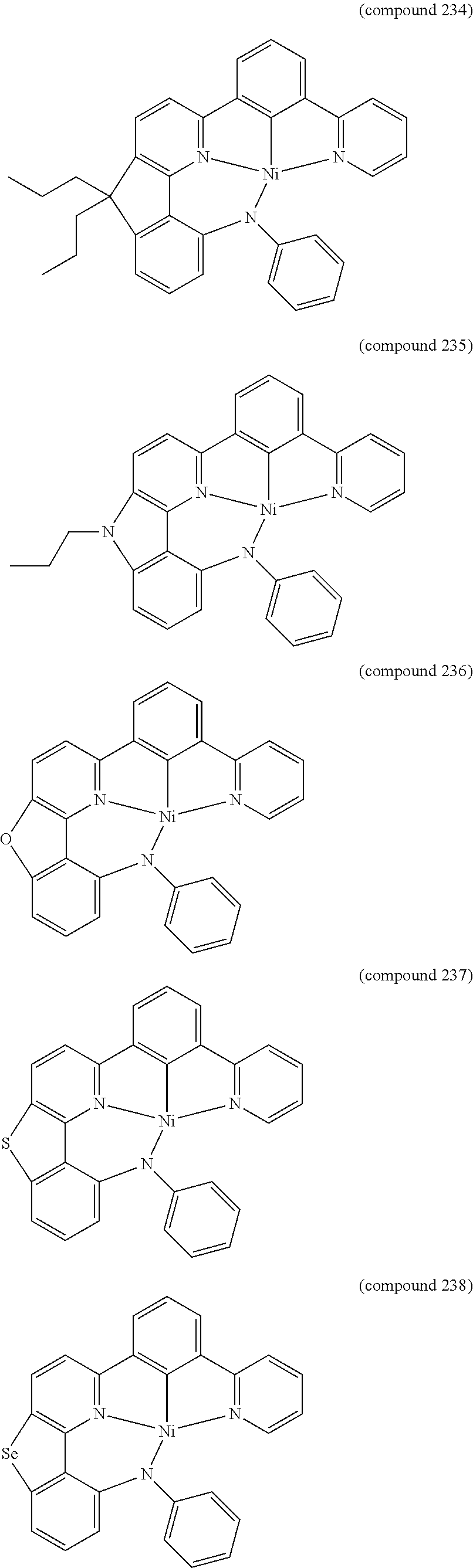
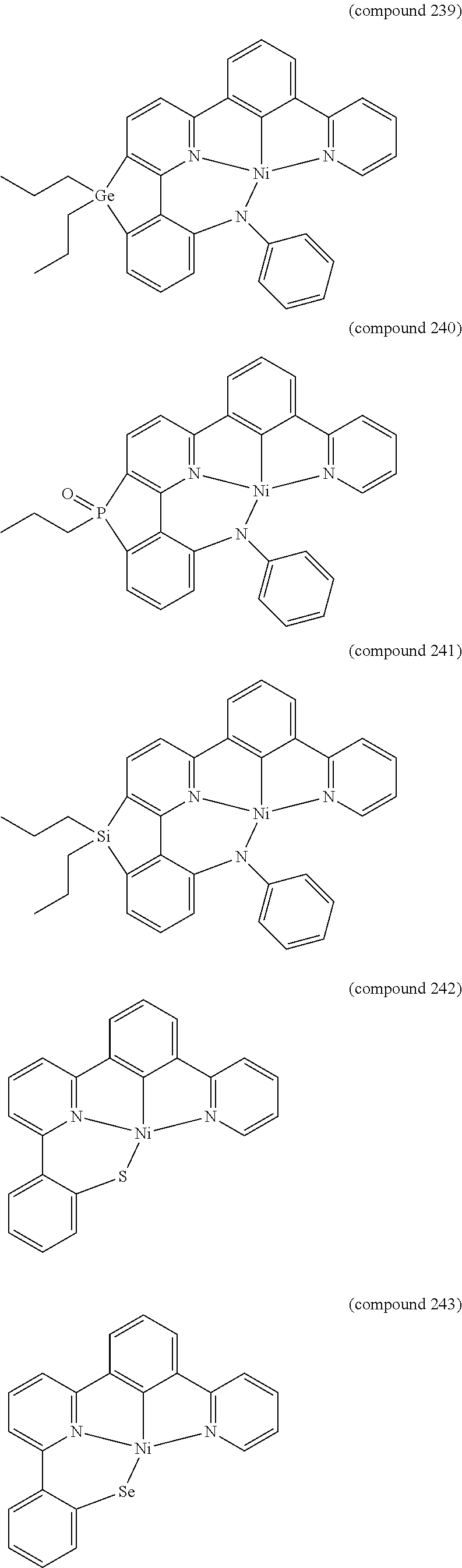
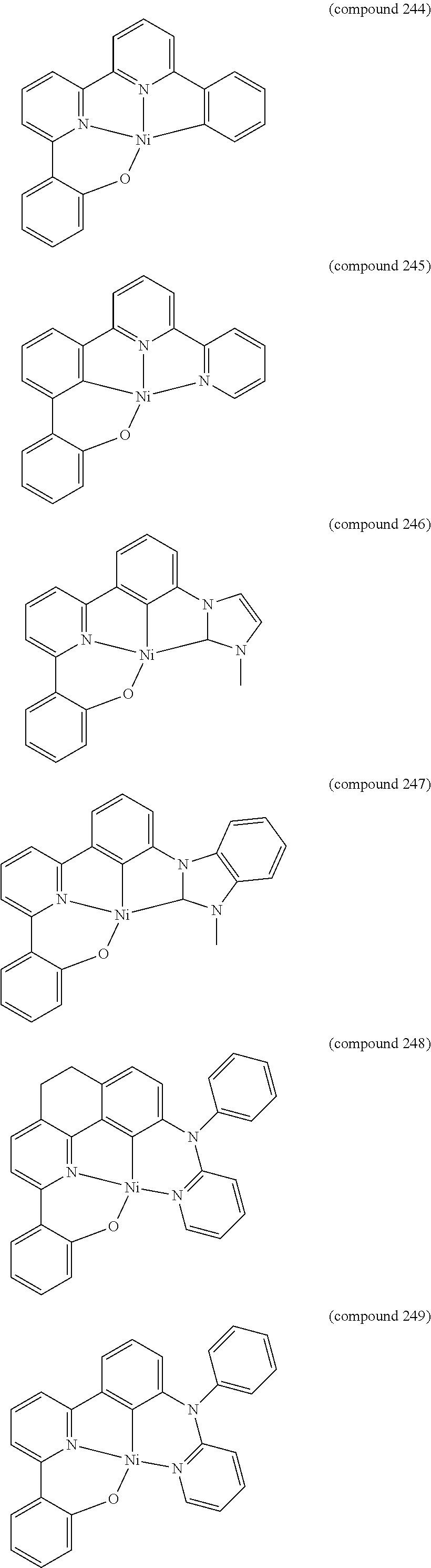
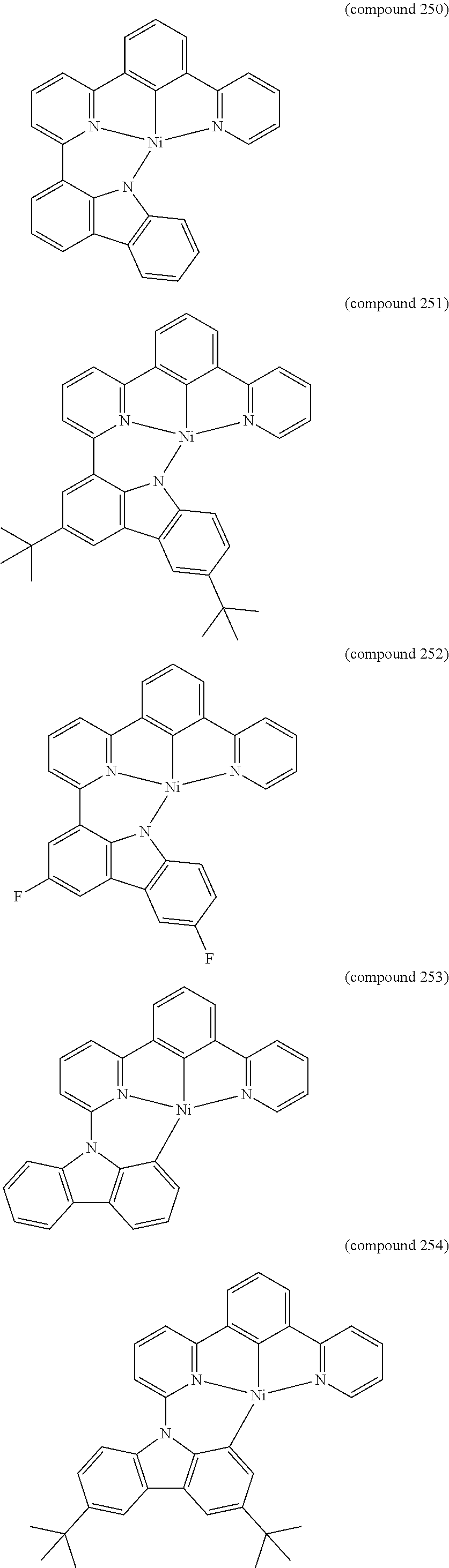

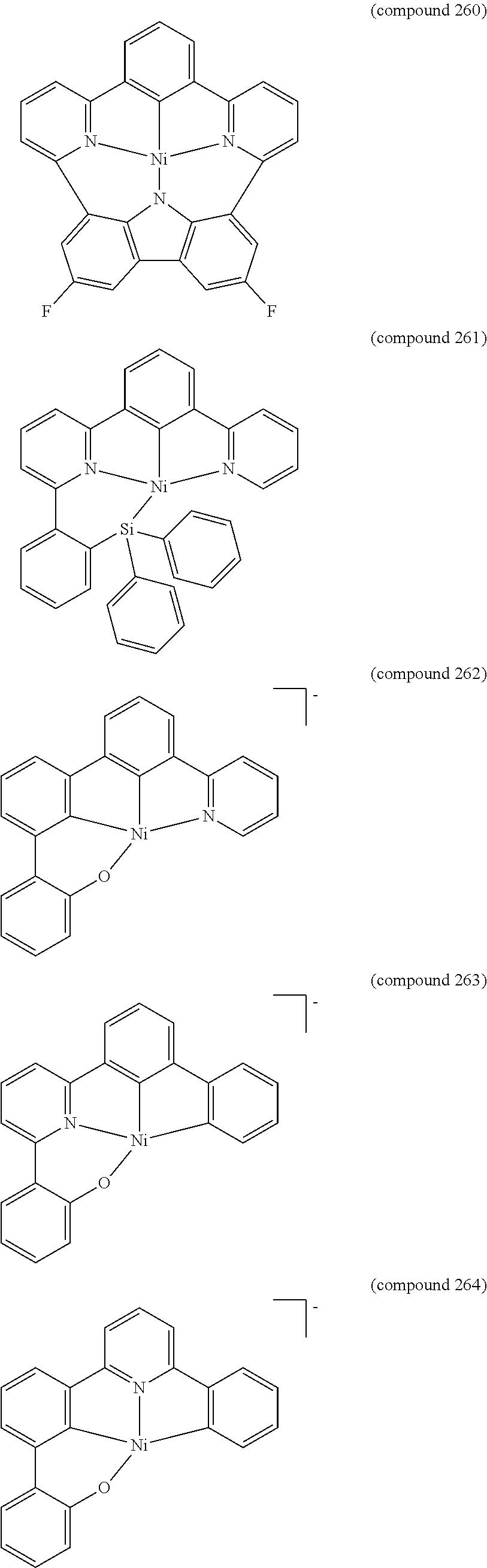
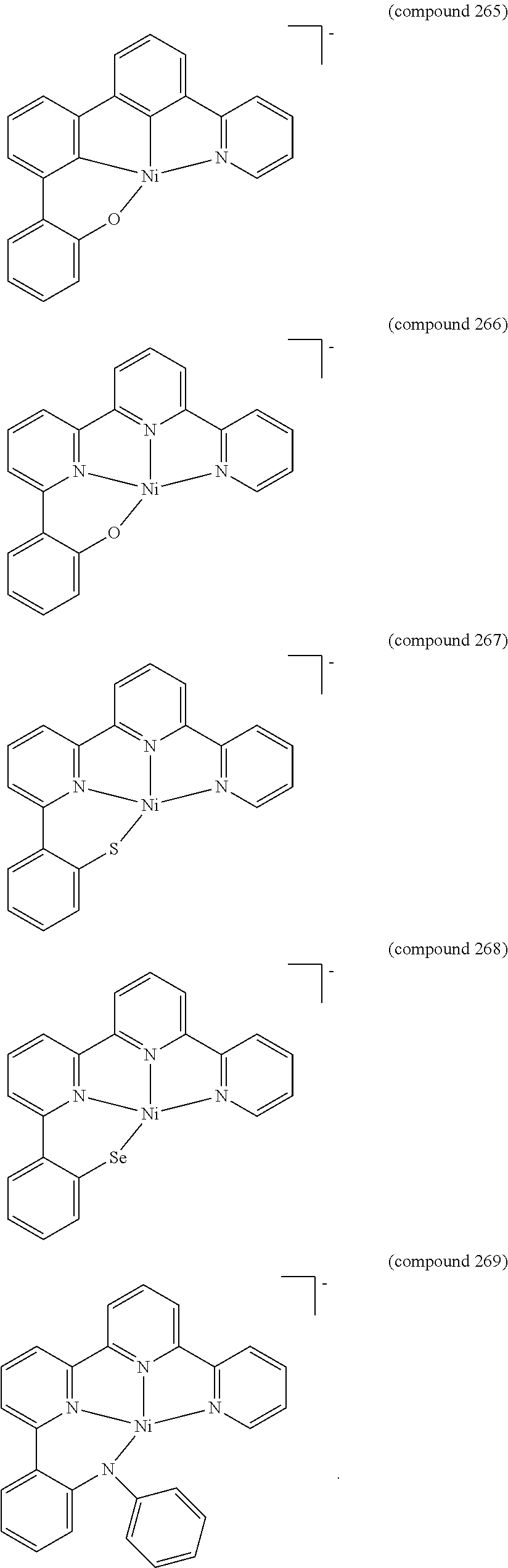
Priority Applications (1)
| Application Number | Priority Date | Filing Date | Title |
|---|---|---|---|
| US16/707,871 US12116378B2 (en) | 2018-12-04 | 2019-12-09 | Transition metal luminescent complexes and methods of use |
Applications Claiming Priority (4)
| Application Number | Priority Date | Filing Date | Title |
|---|---|---|---|
| US201862775195P | 2018-12-04 | 2018-12-04 | |
| US201962793570P | 2019-01-17 | 2019-01-17 | |
| US16/702,864 US20200176691A1 (en) | 2018-12-04 | 2019-12-04 | Transition metal luminescent complexes and methods of use |
| US16/707,871 US12116378B2 (en) | 2018-12-04 | 2019-12-09 | Transition metal luminescent complexes and methods of use |
Related Parent Applications (1)
| Application Number | Title | Priority Date | Filing Date |
|---|---|---|---|
| US16/702,864 Continuation-In-Part US20200176691A1 (en) | 2018-12-04 | 2019-12-04 | Transition metal luminescent complexes and methods of use |
Publications (2)
| Publication Number | Publication Date |
|---|---|
| US20200172562A1 US20200172562A1 (en) | 2020-06-04 |
| US12116378B2 true US12116378B2 (en) | 2024-10-15 |
Family
ID=70849927
Family Applications (1)
| Application Number | Title | Priority Date | Filing Date |
|---|---|---|---|
| US16/707,871 Active 2041-04-08 US12116378B2 (en) | 2018-12-04 | 2019-12-09 | Transition metal luminescent complexes and methods of use |
Country Status (1)
| Country | Link |
|---|---|
| US (1) | US12116378B2 (en) |
Cited By (1)
| Publication number | Priority date | Publication date | Assignee | Title |
|---|---|---|---|---|
| US12545698B2 (en) | 2022-05-31 | 2026-02-10 | Versitech Limited | Dinuclear platinum (II) red emitters for OLED applications |
Families Citing this family (2)
| Publication number | Priority date | Publication date | Assignee | Title |
|---|---|---|---|---|
| US12180232B2 (en) | 2021-09-28 | 2024-12-31 | Arizona Board Of Regents On Behalf Of Arizona State University | Late first row transition metal aryl diimine catalysts for hydrofunctionalization and dehydrocoupling |
| WO2025101788A1 (en) * | 2023-11-10 | 2025-05-15 | Thedford Keith Hollis | Ccc-nhc pincer metal complexes for organic light emitting diodes |
Citations (54)
| Publication number | Priority date | Publication date | Assignee | Title |
|---|---|---|---|---|
| US3771964A (en) | 1972-02-28 | 1973-11-13 | Miles Lab | Test composition and device for ascorbic acid determination |
| US4303409A (en) | 1979-04-24 | 1981-12-01 | Shionogi & Co., Ltd. | Method, composition and test strip for colorimetric analysis of ascorbic acid |
| DE4304728A1 (en) | 1993-02-13 | 1994-08-18 | Igor Dr Popov | Method and assay kit for determining ascorbic acid in biological samples |
| US5709854A (en) | 1993-04-30 | 1998-01-20 | Massachusetts Institute Of Technology | Tissue formation by injecting a cell-polymeric solution that gels in vivo |
| JPH11326207A (en) | 1998-05-15 | 1999-11-26 | New Food Creation Gijutsu Kenkyu Kumiai | Method for determination of ascorbic acid |
| US6129761A (en) | 1995-06-07 | 2000-10-10 | Reprogenesis, Inc. | Injectable hydrogel compositions |
| US6153399A (en) | 1997-01-20 | 2000-11-28 | Kyowa Medex Co., Ltd. | Determining ascorbic acid using ASOD and LEUCO chromogen |
| US20020034656A1 (en) | 1998-09-14 | 2002-03-21 | Thompson Mark E. | Organometallic complexes as phosphorescent emitters in organic LEDs |
| US20020117662A1 (en) | 2000-12-25 | 2002-08-29 | Fuji Photo Film Co., Ltd. | Novel indole derivative, material for light-emitting device and light-emitting device using the same |
| CN1381545A (en) | 2001-03-08 | 2002-11-27 | 香港大学 | Organometallic Light Emissive Materials |
| WO2004083868A1 (en) | 2003-03-21 | 2004-09-30 | Unilever Plc | Sensor for ascorbic acid or a salt thereof |
| US6858229B1 (en) | 1999-04-26 | 2005-02-22 | California Institute Of Technology | In situ forming hydrogels |
| US20050123751A1 (en) | 2003-08-25 | 2005-06-09 | Tetsuo Tsutsui | Electrode device for organic device, electronic device having electrode device for organic device, and method of forming electrode device for organic device |
| US20050214576A1 (en) | 2000-08-11 | 2005-09-29 | Sergey Lamansky | Organometallic compounds and emission-shifting organic electrophosphorescence |
| WO2005118606A1 (en) | 2004-06-04 | 2005-12-15 | National Institute Of Advanced Industrial Science And Technology | Fluorine-substituted iridium complex and luminescent material made with the same |
| US20060091378A1 (en) | 2004-10-29 | 2006-05-04 | Yam Vivian W | Luminescent gold (III) compounds, their preparation, and light-emitting devices containing same |
| CN1894269A (en) | 2003-10-30 | 2007-01-10 | 默克专利有限公司 | Metal complexes with bipodal ligands |
| CN101059474A (en) | 2007-05-28 | 2007-10-24 | 东北师范大学 | Electrochemical sensor for simultaneously determining epinephrine and ascorbic acid |
| US20080036373A1 (en) | 2006-08-10 | 2008-02-14 | Takasago International Corporation | Platinum complex and light-emitting device |
| WO2009021907A1 (en) | 2007-08-10 | 2009-02-19 | Unilever Plc | Disposable sensor for liquid samples |
| CN100510704C (en) | 2007-08-30 | 2009-07-08 | 桂林工学院 | Method for measuring vitamin C by gold nano particulate spectrophotometry |
| US20090206735A1 (en) | 2006-04-13 | 2009-08-20 | Universitaet Regenburg | Biphenyl-metal complexes-monomeric and oligomeric triplet emitters for oled applications |
| US7598546B1 (en) | 2008-06-30 | 2009-10-06 | National Yunlin University Of Science And Technology | Separative extended gate field effect transistor based vitamin C sensor and forming method thereof |
| CN101587094A (en) | 2009-05-26 | 2009-11-25 | 上海大学 | Method for concurrent measurement of dopamine and ascorbic acid using glassy carbon electrode |
| CN101667626A (en) | 2003-06-02 | 2010-03-10 | 富士胶片株式会社 | Organic electroluminescent devices and metal complex compounds |
| CN102227438A (en) | 2008-11-28 | 2011-10-26 | 独立行政法人理化学研究所 | Novel compound and utilization of same |
| CN102532003A (en) | 2011-08-03 | 2012-07-04 | 苏州科技学院 | Terpyridyl derivative with electroluminescent and electrochromic characteristics and complex thereof |
| CN102564963A (en) | 2011-12-15 | 2012-07-11 | 东华大学 | Polyaniline nano fiber film vitamin C color sensor and detection method thereof |
| WO2012102243A1 (en) * | 2011-01-24 | 2012-08-02 | 株式会社日立製作所 | Organic light-emitting device and light source using same |
| CN102666560A (en) | 2009-10-14 | 2012-09-12 | 巴斯夫欧洲公司 | Dinuclear platinum-carbene complexes and the use thereof in oleds |
| CN102971396A (en) | 2010-04-30 | 2013-03-13 | 代表亚利桑那大学的亚利桑那校董会 | Synthesis of four coordinated palladium complexes and their applications in light emitting devices thereof |
| US20130228758A1 (en) * | 2012-03-01 | 2013-09-05 | Vivian Wing Wah Yam | Dendrimers Containing Luminescent Gold (III) Compounds for Organic Light-Emitting Devices and Their Preparation |
| WO2013161515A1 (en) * | 2012-04-27 | 2013-10-31 | 株式会社 日立製作所 | Organic luminescent element |
| CN103399056A (en) | 2013-08-15 | 2013-11-20 | 无锡百灵传感技术有限公司 | Preparation method of electrochemical sensor for simultaneously detecting ascorbic acid, epinephrine and uric acid |
| CN103604849A (en) | 2013-05-27 | 2014-02-26 | 济南大学 | Electrochemical sensor capable of simultaneously detecting dopamine, ascorbic acid and uric acid |
| WO2014041465A2 (en) | 2012-09-13 | 2014-03-20 | Mintek | Diagnostic probe |
| WO2014128843A1 (en) * | 2013-02-20 | 2014-08-28 | 株式会社 日立製作所 | Organic light-emitting element, and light source device using same |
| WO2014203385A1 (en) * | 2013-06-21 | 2014-12-24 | 株式会社 日立製作所 | Substrate for organic electronics and method for manufacturing organic electronics |
| CN104267013A (en) | 2014-06-26 | 2015-01-07 | 广西师范学院 | Method for detecting potassium dichromate and ascorbic acid by using graphene quantum dot probe |
| WO2015099546A1 (en) | 2013-12-23 | 2015-07-02 | Feedback Research Limited | Systems and methods for sensing ascorbate in liquid samples |
| US20150194616A1 (en) | 2014-01-07 | 2015-07-09 | Jian Li | Tetradentate Platinum And Palladium Complex Emitters Containing Phenyl-Pyrazole And Its Analogues |
| CN107074895A (en) | 2014-11-18 | 2017-08-18 | Udc 爱尔兰有限责任公司 | For Pt the or Pd carbene complexes in Organic Light Emitting Diode |
| US20180194790A1 (en) | 2012-10-26 | 2018-07-12 | Jian Li | Metal Complexes, Methods, and Uses Thereof |
| WO2019015658A1 (en) | 2017-07-19 | 2019-01-24 | The University Of Hong Kong | Color-tunable organic light emitting diode devices based on a single emitter and methods thereof |
| WO2019079505A1 (en) | 2017-10-17 | 2019-04-25 | Jian Li | Hole-blocking materials for organic light emitting diodes |
| CN109841759A (en) | 2018-12-29 | 2019-06-04 | 香港大学深圳研究院 | A kind of OLED device and preparation method thereof based on platinum complex |
| US20200176691A1 (en) | 2018-12-04 | 2020-06-04 | The University Of Hong Kong | Transition metal luminescent complexes and methods of use |
| CN111320613A (en) | 2018-12-17 | 2020-06-23 | 广东阿格蕾雅光电材料有限公司 | Platinum (II) tetradentate ONNO complex luminescent material, preparation method and application thereof in organic light-emitting diode |
| CN111662334A (en) | 2019-03-06 | 2020-09-15 | 三星显示有限公司 | Organometallic compound, organic light emitting device, and apparatus including organic light emitting device |
| US20230165135A1 (en) | 2021-11-23 | 2023-05-25 | Versitech Limited | d10 METAL CARBENE COMPLEXES FOR OLED APPLICATIONS |
| US20240023360A1 (en) | 2020-10-30 | 2024-01-18 | The University Of Hong Kong | Color-tunable oled having long operational lifetime |
| US20240049591A1 (en) | 2022-07-28 | 2024-02-08 | The University Of Hong Kong | Dinuclear platinum complexes for oled application |
| US20240083931A1 (en) | 2022-08-15 | 2024-03-14 | The University Of Hong Kong | Dinuclear platinum(ii) emitters for red and/or near-infrared oleds |
| US20240124494A1 (en) | 2022-09-16 | 2024-04-18 | Versitech Limited | Metal-assisted multi-resonance thermally-activated delayed-fluorescence emitters for oled applications |
-
2019
- 2019-12-09 US US16/707,871 patent/US12116378B2/en active Active
Patent Citations (59)
| Publication number | Priority date | Publication date | Assignee | Title |
|---|---|---|---|---|
| US3771964A (en) | 1972-02-28 | 1973-11-13 | Miles Lab | Test composition and device for ascorbic acid determination |
| US4303409A (en) | 1979-04-24 | 1981-12-01 | Shionogi & Co., Ltd. | Method, composition and test strip for colorimetric analysis of ascorbic acid |
| DE4304728A1 (en) | 1993-02-13 | 1994-08-18 | Igor Dr Popov | Method and assay kit for determining ascorbic acid in biological samples |
| US5709854A (en) | 1993-04-30 | 1998-01-20 | Massachusetts Institute Of Technology | Tissue formation by injecting a cell-polymeric solution that gels in vivo |
| US6129761A (en) | 1995-06-07 | 2000-10-10 | Reprogenesis, Inc. | Injectable hydrogel compositions |
| US6153399A (en) | 1997-01-20 | 2000-11-28 | Kyowa Medex Co., Ltd. | Determining ascorbic acid using ASOD and LEUCO chromogen |
| JPH11326207A (en) | 1998-05-15 | 1999-11-26 | New Food Creation Gijutsu Kenkyu Kumiai | Method for determination of ascorbic acid |
| US20020034656A1 (en) | 1998-09-14 | 2002-03-21 | Thompson Mark E. | Organometallic complexes as phosphorescent emitters in organic LEDs |
| US6858229B1 (en) | 1999-04-26 | 2005-02-22 | California Institute Of Technology | In situ forming hydrogels |
| US20050214576A1 (en) | 2000-08-11 | 2005-09-29 | Sergey Lamansky | Organometallic compounds and emission-shifting organic electrophosphorescence |
| US7553560B2 (en) | 2000-08-11 | 2009-06-30 | The Trustees Of Princeton University | Organometallic compounds and emission-shifting organic electrophosphorescence |
| US20020117662A1 (en) | 2000-12-25 | 2002-08-29 | Fuji Photo Film Co., Ltd. | Novel indole derivative, material for light-emitting device and light-emitting device using the same |
| CN1381545A (en) | 2001-03-08 | 2002-11-27 | 香港大学 | Organometallic Light Emissive Materials |
| US20020179885A1 (en) * | 2001-03-08 | 2002-12-05 | Chi-Ming Che | Organometallic light-emitting material |
| US20070074971A1 (en) | 2003-03-21 | 2007-04-05 | Atkinson Anne L | Sensor for ascorbic acid or a salt thereof |
| WO2004083868A1 (en) | 2003-03-21 | 2004-09-30 | Unilever Plc | Sensor for ascorbic acid or a salt thereof |
| EP1606631A1 (en) | 2003-03-21 | 2005-12-21 | Unilever Plc | Sensor for ascorbic acid or a salt thereof |
| CN101667626A (en) | 2003-06-02 | 2010-03-10 | 富士胶片株式会社 | Organic electroluminescent devices and metal complex compounds |
| US20050123751A1 (en) | 2003-08-25 | 2005-06-09 | Tetsuo Tsutsui | Electrode device for organic device, electronic device having electrode device for organic device, and method of forming electrode device for organic device |
| CN1894269A (en) | 2003-10-30 | 2007-01-10 | 默克专利有限公司 | Metal complexes with bipodal ligands |
| WO2005118606A1 (en) | 2004-06-04 | 2005-12-15 | National Institute Of Advanced Industrial Science And Technology | Fluorine-substituted iridium complex and luminescent material made with the same |
| US20060091378A1 (en) | 2004-10-29 | 2006-05-04 | Yam Vivian W | Luminescent gold (III) compounds, their preparation, and light-emitting devices containing same |
| US20090206735A1 (en) | 2006-04-13 | 2009-08-20 | Universitaet Regenburg | Biphenyl-metal complexes-monomeric and oligomeric triplet emitters for oled applications |
| US20080036373A1 (en) | 2006-08-10 | 2008-02-14 | Takasago International Corporation | Platinum complex and light-emitting device |
| CN101059474A (en) | 2007-05-28 | 2007-10-24 | 东北师范大学 | Electrochemical sensor for simultaneously determining epinephrine and ascorbic acid |
| WO2009021907A1 (en) | 2007-08-10 | 2009-02-19 | Unilever Plc | Disposable sensor for liquid samples |
| CN100510704C (en) | 2007-08-30 | 2009-07-08 | 桂林工学院 | Method for measuring vitamin C by gold nano particulate spectrophotometry |
| US7598546B1 (en) | 2008-06-30 | 2009-10-06 | National Yunlin University Of Science And Technology | Separative extended gate field effect transistor based vitamin C sensor and forming method thereof |
| CN102227438A (en) | 2008-11-28 | 2011-10-26 | 独立行政法人理化学研究所 | Novel compound and utilization of same |
| CN101587094A (en) | 2009-05-26 | 2009-11-25 | 上海大学 | Method for concurrent measurement of dopamine and ascorbic acid using glassy carbon electrode |
| CN102666560A (en) | 2009-10-14 | 2012-09-12 | 巴斯夫欧洲公司 | Dinuclear platinum-carbene complexes and the use thereof in oleds |
| CN102971396A (en) | 2010-04-30 | 2013-03-13 | 代表亚利桑那大学的亚利桑那校董会 | Synthesis of four coordinated palladium complexes and their applications in light emitting devices thereof |
| WO2012102243A1 (en) * | 2011-01-24 | 2012-08-02 | 株式会社日立製作所 | Organic light-emitting device and light source using same |
| CN102532003A (en) | 2011-08-03 | 2012-07-04 | 苏州科技学院 | Terpyridyl derivative with electroluminescent and electrochromic characteristics and complex thereof |
| CN102564963A (en) | 2011-12-15 | 2012-07-11 | 东华大学 | Polyaniline nano fiber film vitamin C color sensor and detection method thereof |
| CN104334681A (en) | 2012-03-01 | 2015-02-04 | 香港大学 | Dendrimers Containing Luminescent Gold(III) Compounds for Organic Light-Emitting Devices and Their Preparation |
| US20130228758A1 (en) * | 2012-03-01 | 2013-09-05 | Vivian Wing Wah Yam | Dendrimers Containing Luminescent Gold (III) Compounds for Organic Light-Emitting Devices and Their Preparation |
| WO2013161515A1 (en) * | 2012-04-27 | 2013-10-31 | 株式会社 日立製作所 | Organic luminescent element |
| WO2014041465A2 (en) | 2012-09-13 | 2014-03-20 | Mintek | Diagnostic probe |
| US20180194790A1 (en) | 2012-10-26 | 2018-07-12 | Jian Li | Metal Complexes, Methods, and Uses Thereof |
| WO2014128843A1 (en) * | 2013-02-20 | 2014-08-28 | 株式会社 日立製作所 | Organic light-emitting element, and light source device using same |
| CN103604849A (en) | 2013-05-27 | 2014-02-26 | 济南大学 | Electrochemical sensor capable of simultaneously detecting dopamine, ascorbic acid and uric acid |
| WO2014203385A1 (en) * | 2013-06-21 | 2014-12-24 | 株式会社 日立製作所 | Substrate for organic electronics and method for manufacturing organic electronics |
| CN103399056A (en) | 2013-08-15 | 2013-11-20 | 无锡百灵传感技术有限公司 | Preparation method of electrochemical sensor for simultaneously detecting ascorbic acid, epinephrine and uric acid |
| WO2015099546A1 (en) | 2013-12-23 | 2015-07-02 | Feedback Research Limited | Systems and methods for sensing ascorbate in liquid samples |
| US20150194616A1 (en) | 2014-01-07 | 2015-07-09 | Jian Li | Tetradentate Platinum And Palladium Complex Emitters Containing Phenyl-Pyrazole And Its Analogues |
| CN104267013A (en) | 2014-06-26 | 2015-01-07 | 广西师范学院 | Method for detecting potassium dichromate and ascorbic acid by using graphene quantum dot probe |
| CN107074895A (en) | 2014-11-18 | 2017-08-18 | Udc 爱尔兰有限责任公司 | For Pt the or Pd carbene complexes in Organic Light Emitting Diode |
| WO2019015658A1 (en) | 2017-07-19 | 2019-01-24 | The University Of Hong Kong | Color-tunable organic light emitting diode devices based on a single emitter and methods thereof |
| WO2019079505A1 (en) | 2017-10-17 | 2019-04-25 | Jian Li | Hole-blocking materials for organic light emitting diodes |
| US20200176691A1 (en) | 2018-12-04 | 2020-06-04 | The University Of Hong Kong | Transition metal luminescent complexes and methods of use |
| CN111320613A (en) | 2018-12-17 | 2020-06-23 | 广东阿格蕾雅光电材料有限公司 | Platinum (II) tetradentate ONNO complex luminescent material, preparation method and application thereof in organic light-emitting diode |
| CN109841759A (en) | 2018-12-29 | 2019-06-04 | 香港大学深圳研究院 | A kind of OLED device and preparation method thereof based on platinum complex |
| CN111662334A (en) | 2019-03-06 | 2020-09-15 | 三星显示有限公司 | Organometallic compound, organic light emitting device, and apparatus including organic light emitting device |
| US20240023360A1 (en) | 2020-10-30 | 2024-01-18 | The University Of Hong Kong | Color-tunable oled having long operational lifetime |
| US20230165135A1 (en) | 2021-11-23 | 2023-05-25 | Versitech Limited | d10 METAL CARBENE COMPLEXES FOR OLED APPLICATIONS |
| US20240049591A1 (en) | 2022-07-28 | 2024-02-08 | The University Of Hong Kong | Dinuclear platinum complexes for oled application |
| US20240083931A1 (en) | 2022-08-15 | 2024-03-14 | The University Of Hong Kong | Dinuclear platinum(ii) emitters for red and/or near-infrared oleds |
| US20240124494A1 (en) | 2022-09-16 | 2024-04-18 | Versitech Limited | Metal-assisted multi-resonance thermally-activated delayed-fluorescence emitters for oled applications |
Non-Patent Citations (57)
Cited By (1)
| Publication number | Priority date | Publication date | Assignee | Title |
|---|---|---|---|---|
| US12545698B2 (en) | 2022-05-31 | 2026-02-10 | Versitech Limited | Dinuclear platinum (II) red emitters for OLED applications |
Also Published As
| Publication number | Publication date |
|---|---|
| US20200172562A1 (en) | 2020-06-04 |
Similar Documents
| Publication | Publication Date | Title |
|---|---|---|
| US20200176691A1 (en) | Transition metal luminescent complexes and methods of use | |
| US20210391545A1 (en) | Metal Compounds, Methods, and Uses Thereof | |
| US8846940B2 (en) | Platinum (II) di (2-pyrazolyl) benzene chloride analogs and uses | |
| CN104370974B (en) | One kind is using nitrogen heterocyclic ring Cabbeen as complex of iridium of the second main part and preparation method thereof | |
| Feng et al. | Rational design and characterization of heteroleptic phosphorescent iridium (III) complexes for highly efficient deep-blue OLEDs | |
| JP2012517492A (en) | Luminescent material used as host dopant in light emitting layer of OLED | |
| WO2015027060A1 (en) | Phosphorescent tetradentate metal complexes having modified emission spectra | |
| Yang et al. | Thiazole-based metallophosphors of iridium with balanced carrier injection/transporting features and their two-colour WOLEDs fabricated by both vacuum deposition and solution processing-vacuum deposition hybrid strategy | |
| Yan et al. | Regioselective Syntheses of Imidazo [4, 5-b] pyrazin-2-ylidene-Based Chelates and Blue Emissive Iridium (III) Phosphors for Solution-Processed OLEDs | |
| Cho et al. | Phenylimidazole-based homoleptic iridium (III) compounds for blue phosphorescent organic light-emitting diodes with high efficiency and long lifetime | |
| EP4545541A1 (en) | Circularly polarized light-emitting material and use, light-emitting display device, and display apparatus | |
| Lee et al. | Fluorine-free blue phosphorescent emitters for efficient phosphorescent organic light emitting diodes | |
| Tang et al. | Rational molecular design for realizing high performance sky-blue-emitting gold (III) complexes with monoaryl auxiliary ligands and their applications for both solution-processable and vacuum-deposited organic light-emitting devices | |
| Han et al. | Highly efficient orange-red electroluminescence of iridium complexes with good electron mobility | |
| Mei et al. | Highly efficient orange phosphorescent organic light-emitting diodes based on an iridium (iii) complex with diethyldithiocarbamate (S^ S) as the ancillary ligand | |
| Giridhar et al. | A systematic identification of efficiency enrichment between thiazole and benzothiazole based yellow iridium (III) complexes | |
| CN108997382B (en) | Cuprous halide complex containing dimethylthiophene bidentate phosphine ligand and its synthesis method and application | |
| US12116378B2 (en) | Transition metal luminescent complexes and methods of use | |
| CN114702528A (en) | A N^N^C^N tetradentate platinum(II) complex containing carbazole derivatives and its application | |
| Lan et al. | 2-phenylpyridine-based phosphorescent Ir (III) complexes for highly efficient greenish-blue organic light-emitting diodes with EQEs up to 33.5% | |
| CN115651029B (en) | Tetradentate cyclometalated platinum (II) complex phosphorescent material based on spirofluorene-biphenyl-azaacridine and application thereof | |
| Tao et al. | Highly efficient and concentration-insensitive OLEDs based on alkyl sterically modified red homoleptic phenylphthalazine iridium complexes | |
| EP4311851A1 (en) | Dinuclear platinum complexes for oled applications | |
| EP4324896B1 (en) | Dinuclear platinum(ii) emitters for red and/or near-infrared oleds | |
| Zhao et al. | Fluoro-benzenesulfonyl-functionalized 2-phenylthiazole-type iridium (iii) complexes for efficient solution-processed organic light-emitting diodes |
Legal Events
| Date | Code | Title | Description |
|---|---|---|---|
| FEPP | Fee payment procedure |
Free format text: ENTITY STATUS SET TO UNDISCOUNTED (ORIGINAL EVENT CODE: BIG.); ENTITY STATUS OF PATENT OWNER: SMALL ENTITY |
|
| FEPP | Fee payment procedure |
Free format text: ENTITY STATUS SET TO SMALL (ORIGINAL EVENT CODE: SMAL); ENTITY STATUS OF PATENT OWNER: SMALL ENTITY |
|
| STPP | Information on status: patent application and granting procedure in general |
Free format text: APPLICATION DISPATCHED FROM PREEXAM, NOT YET DOCKETED |
|
| STPP | Information on status: patent application and granting procedure in general |
Free format text: DOCKETED NEW CASE - READY FOR EXAMINATION |
|
| STPP | Information on status: patent application and granting procedure in general |
Free format text: NON FINAL ACTION MAILED |
|
| STPP | Information on status: patent application and granting procedure in general |
Free format text: FINAL REJECTION MAILED |
|
| STPP | Information on status: patent application and granting procedure in general |
Free format text: NON FINAL ACTION MAILED |
|
| STPP | Information on status: patent application and granting procedure in general |
Free format text: RESPONSE TO NON-FINAL OFFICE ACTION ENTERED AND FORWARDED TO EXAMINER |
|
| STPP | Information on status: patent application and granting procedure in general |
Free format text: FINAL REJECTION MAILED |
|
| STPP | Information on status: patent application and granting procedure in general |
Free format text: RESPONSE AFTER FINAL ACTION FORWARDED TO EXAMINER |
|
| STPP | Information on status: patent application and granting procedure in general |
Free format text: ADVISORY ACTION MAILED |
|
| STPP | Information on status: patent application and granting procedure in general |
Free format text: DOCKETED NEW CASE - READY FOR EXAMINATION |
|
| STPP | Information on status: patent application and granting procedure in general |
Free format text: NOTICE OF ALLOWANCE MAILED -- APPLICATION RECEIVED IN OFFICE OF PUBLICATIONS |
|
| ZAAB | Notice of allowance mailed |
Free format text: ORIGINAL CODE: MN/=. |
|
| STPP | Information on status: patent application and granting procedure in general |
Free format text: PUBLICATIONS -- ISSUE FEE PAYMENT VERIFIED |
|
| STCF | Information on status: patent grant |
Free format text: PATENTED CASE |