US20090252791A1 - Pharmaceutical compositions comprising a triptan and a nonsteroidal anti-inflammatory drug - Google Patents
Pharmaceutical compositions comprising a triptan and a nonsteroidal anti-inflammatory drug Download PDFInfo
- Publication number
- US20090252791A1 US20090252791A1 US12/417,005 US41700509A US2009252791A1 US 20090252791 A1 US20090252791 A1 US 20090252791A1 US 41700509 A US41700509 A US 41700509A US 2009252791 A1 US2009252791 A1 US 2009252791A1
- Authority
- US
- United States
- Prior art keywords
- tablet
- naproxen
- sumatriptan
- active pharmaceutical
- triptan
- Prior art date
- Legal status (The legal status is an assumption and is not a legal conclusion. Google has not performed a legal analysis and makes no representation as to the accuracy of the status listed.)
- Abandoned
Links
- ZISSAWUMDACLOM-UHFFFAOYSA-N triptane Chemical compound CC(C)C(C)(C)C ZISSAWUMDACLOM-UHFFFAOYSA-N 0.000 title claims abstract description 122
- 229940021182 non-steroidal anti-inflammatory drug Drugs 0.000 title claims abstract description 60
- 239000000041 non-steroidal anti-inflammatory agent Substances 0.000 title claims abstract description 54
- 239000008194 pharmaceutical composition Substances 0.000 title description 14
- 239000003826 tablet Substances 0.000 claims abstract description 197
- 239000008185 minitablet Substances 0.000 claims abstract description 24
- KQKPFRSPSRPDEB-UHFFFAOYSA-N sumatriptan Chemical group CNS(=O)(=O)CC1=CC=C2NC=C(CCN(C)C)C2=C1 KQKPFRSPSRPDEB-UHFFFAOYSA-N 0.000 claims description 158
- CMWTZPSULFXXJA-VIFPVBQESA-N naproxen Chemical group C1=C([C@H](C)C(O)=O)C=CC2=CC(OC)=CC=C21 CMWTZPSULFXXJA-VIFPVBQESA-N 0.000 claims description 111
- CMWTZPSULFXXJA-UHFFFAOYSA-N Naproxen Natural products C1=C(C(C)C(O)=O)C=CC2=CC(OC)=CC=C21 CMWTZPSULFXXJA-UHFFFAOYSA-N 0.000 claims description 105
- 229960002009 naproxen Drugs 0.000 claims description 105
- 229960003708 sumatriptan Drugs 0.000 claims description 88
- 229960000658 sumatriptan succinate Drugs 0.000 claims description 67
- 239000008186 active pharmaceutical agent Substances 0.000 claims description 60
- CDBRNDSHEYLDJV-FVGYRXGTSA-M naproxen sodium Chemical group [Na+].C1=C([C@H](C)C([O-])=O)C=CC2=CC(OC)=CC=C21 CDBRNDSHEYLDJV-FVGYRXGTSA-M 0.000 claims description 59
- 229960003940 naproxen sodium Drugs 0.000 claims description 58
- 150000003839 salts Chemical class 0.000 claims description 55
- 239000007942 layered tablet Substances 0.000 claims description 29
- 239000003814 drug Substances 0.000 claims description 26
- 239000012535 impurity Substances 0.000 claims description 26
- 229940079593 drug Drugs 0.000 claims description 20
- 239000012458 free base Substances 0.000 claims description 6
- 239000008363 phosphate buffer Substances 0.000 claims description 5
- 238000003756 stirring Methods 0.000 claims description 5
- 238000007654 immersion Methods 0.000 claims 2
- 239000000203 mixture Substances 0.000 abstract description 118
- 238000009472 formulation Methods 0.000 abstract description 21
- 239000002552 dosage form Substances 0.000 abstract description 20
- 239000002775 capsule Substances 0.000 abstract description 13
- 239000010410 layer Substances 0.000 description 131
- HQKMJHAJHXVSDF-UHFFFAOYSA-L magnesium stearate Chemical compound [Mg+2].CCCCCCCCCCCCCCCCCC([O-])=O.CCCCCCCCCCCCCCCCCC([O-])=O HQKMJHAJHXVSDF-UHFFFAOYSA-L 0.000 description 93
- 239000008187 granular material Substances 0.000 description 79
- XLYOFNOQVPJJNP-UHFFFAOYSA-N water Substances O XLYOFNOQVPJJNP-UHFFFAOYSA-N 0.000 description 60
- 229920000168 Microcrystalline cellulose Polymers 0.000 description 51
- 235000019813 microcrystalline cellulose Nutrition 0.000 description 51
- 239000008108 microcrystalline cellulose Substances 0.000 description 48
- 229940016286 microcrystalline cellulose Drugs 0.000 description 48
- 235000019359 magnesium stearate Nutrition 0.000 description 46
- DPXJVFZANSGRMM-UHFFFAOYSA-N acetic acid;2,3,4,5,6-pentahydroxyhexanal;sodium Chemical compound [Na].CC(O)=O.OCC(O)C(O)C(O)C(O)C=O DPXJVFZANSGRMM-UHFFFAOYSA-N 0.000 description 39
- 239000000463 material Substances 0.000 description 39
- 229920002785 Croscarmellose sodium Polymers 0.000 description 37
- 229960001681 croscarmellose sodium Drugs 0.000 description 37
- 235000010947 crosslinked sodium carboxy methyl cellulose Nutrition 0.000 description 37
- WHNWPMSKXPGLAX-UHFFFAOYSA-N N-Vinyl-2-pyrrolidone Chemical compound C=CN1CCCC1=O WHNWPMSKXPGLAX-UHFFFAOYSA-N 0.000 description 31
- 235000013855 polyvinylpyrrolidone Nutrition 0.000 description 27
- 229920000036 polyvinylpyrrolidone Polymers 0.000 description 26
- 229940069328 povidone Drugs 0.000 description 24
- UIIMBOGNXHQVGW-UHFFFAOYSA-M Sodium bicarbonate Chemical compound [Na+].OC([O-])=O UIIMBOGNXHQVGW-UHFFFAOYSA-M 0.000 description 22
- 238000000034 method Methods 0.000 description 22
- 239000000243 solution Substances 0.000 description 22
- OKKJLVBELUTLKV-UHFFFAOYSA-N Methanol Chemical compound OC OKKJLVBELUTLKV-UHFFFAOYSA-N 0.000 description 21
- 239000000454 talc Substances 0.000 description 21
- 229940033134 talc Drugs 0.000 description 21
- 235000012222 talc Nutrition 0.000 description 21
- 229910052623 talc Inorganic materials 0.000 description 21
- 238000001035 drying Methods 0.000 description 20
- 238000004090 dissolution Methods 0.000 description 19
- 239000004615 ingredient Substances 0.000 description 17
- GUBGYTABKSRVRQ-XLOQQCSPSA-N Alpha-Lactose Chemical compound O[C@@H]1[C@@H](O)[C@@H](O)[C@@H](CO)O[C@H]1O[C@@H]1[C@@H](CO)O[C@H](O)[C@H](O)[C@H]1O GUBGYTABKSRVRQ-XLOQQCSPSA-N 0.000 description 16
- 229920003084 Avicel® PH-102 Polymers 0.000 description 16
- -1 500 mg) Chemical compound 0.000 description 15
- 239000011248 coating agent Substances 0.000 description 15
- 238000000576 coating method Methods 0.000 description 14
- 238000004519 manufacturing process Methods 0.000 description 14
- VYPSYNLAJGMNEJ-UHFFFAOYSA-N Silicium dioxide Chemical compound O=[Si]=O VYPSYNLAJGMNEJ-UHFFFAOYSA-N 0.000 description 13
- 238000002156 mixing Methods 0.000 description 13
- 238000012545 processing Methods 0.000 description 13
- 229960004977 anhydrous lactose Drugs 0.000 description 12
- WSVLPVUVIUVCRA-KPKNDVKVSA-N Alpha-lactose monohydrate Chemical compound O.O[C@@H]1[C@@H](O)[C@@H](O)[C@@H](CO)O[C@H]1O[C@@H]1[C@@H](CO)O[C@H](O)[C@H](O)[C@H]1O WSVLPVUVIUVCRA-KPKNDVKVSA-N 0.000 description 11
- 229960001021 lactose monohydrate Drugs 0.000 description 11
- 239000000047 product Substances 0.000 description 11
- 235000017557 sodium bicarbonate Nutrition 0.000 description 11
- 229910000030 sodium bicarbonate Inorganic materials 0.000 description 11
- 239000000126 substance Substances 0.000 description 11
- 239000011230 binding agent Substances 0.000 description 10
- 239000003085 diluting agent Substances 0.000 description 10
- 239000000843 powder Substances 0.000 description 10
- WEVYAHXRMPXWCK-UHFFFAOYSA-N Acetonitrile Chemical compound CC#N WEVYAHXRMPXWCK-UHFFFAOYSA-N 0.000 description 9
- 229920003109 sodium starch glycolate Polymers 0.000 description 9
- 239000008109 sodium starch glycolate Substances 0.000 description 9
- 229940079832 sodium starch glycolate Drugs 0.000 description 9
- 229920001328 Polyvinylidene chloride Polymers 0.000 description 8
- FUFJGUQYACFECW-UHFFFAOYSA-L calcium hydrogenphosphate Chemical compound [Ca+2].OP([O-])([O-])=O FUFJGUQYACFECW-UHFFFAOYSA-L 0.000 description 8
- 235000010979 hydroxypropyl methyl cellulose Nutrition 0.000 description 8
- 229920003088 hydroxypropyl methyl cellulose Polymers 0.000 description 8
- 239000004800 polyvinyl chloride Substances 0.000 description 8
- 229920002472 Starch Polymers 0.000 description 7
- GWEVSGVZZGPLCZ-UHFFFAOYSA-N Titan oxide Chemical compound O=[Ti]=O GWEVSGVZZGPLCZ-UHFFFAOYSA-N 0.000 description 7
- 239000003795 chemical substances by application Substances 0.000 description 7
- 238000007906 compression Methods 0.000 description 7
- 230000006835 compression Effects 0.000 description 7
- 229920000915 polyvinyl chloride Polymers 0.000 description 7
- 229920000523 polyvinylpolypyrrolidone Polymers 0.000 description 7
- 235000013809 polyvinylpolypyrrolidone Nutrition 0.000 description 7
- 239000004094 surface-active agent Substances 0.000 description 7
- LFQSCWFLJHTTHZ-UHFFFAOYSA-N Ethanol Chemical compound CCO LFQSCWFLJHTTHZ-UHFFFAOYSA-N 0.000 description 6
- 229920003081 Povidone K 30 Polymers 0.000 description 6
- 239000001913 cellulose Substances 0.000 description 6
- 235000010980 cellulose Nutrition 0.000 description 6
- 229920002678 cellulose Polymers 0.000 description 6
- 239000007891 compressed tablet Substances 0.000 description 6
- 229960000913 crospovidone Drugs 0.000 description 6
- 235000019700 dicalcium phosphate Nutrition 0.000 description 6
- 229940095079 dicalcium phosphate anhydrous Drugs 0.000 description 6
- 239000006185 dispersion Substances 0.000 description 6
- 150000002148 esters Chemical class 0.000 description 6
- 239000012530 fluid Substances 0.000 description 6
- 239000000546 pharmaceutical excipient Substances 0.000 description 6
- 235000019698 starch Nutrition 0.000 description 6
- 229940124597 therapeutic agent Drugs 0.000 description 6
- 229940075614 colloidal silicon dioxide Drugs 0.000 description 5
- 239000003086 colorant Substances 0.000 description 5
- 239000000314 lubricant Substances 0.000 description 5
- 229920002153 Hydroxypropyl cellulose Polymers 0.000 description 4
- GUBGYTABKSRVRQ-QKKXKWKRSA-N Lactose Natural products OC[C@H]1O[C@@H](O[C@H]2[C@H](O)[C@@H](O)C(O)O[C@@H]2CO)[C@H](O)[C@@H](O)[C@H]1O GUBGYTABKSRVRQ-QKKXKWKRSA-N 0.000 description 4
- 229920003082 Povidone K 90 Polymers 0.000 description 4
- FAPWRFPIFSIZLT-UHFFFAOYSA-M Sodium chloride Chemical compound [Na+].[Cl-] FAPWRFPIFSIZLT-UHFFFAOYSA-M 0.000 description 4
- 239000011324 bead Substances 0.000 description 4
- 150000001875 compounds Chemical class 0.000 description 4
- 239000007884 disintegrant Substances 0.000 description 4
- 235000010977 hydroxypropyl cellulose Nutrition 0.000 description 4
- 239000005414 inactive ingredient Substances 0.000 description 4
- 229960001375 lactose Drugs 0.000 description 4
- 239000008101 lactose Substances 0.000 description 4
- 229940057948 magnesium stearate Drugs 0.000 description 4
- 229940079502 naproxen 500 mg Drugs 0.000 description 4
- 229940082449 naproxen sodium 500 mg Drugs 0.000 description 4
- 239000008188 pellet Substances 0.000 description 4
- 239000004014 plasticizer Substances 0.000 description 4
- 229920000642 polymer Polymers 0.000 description 4
- 239000011734 sodium Chemical class 0.000 description 4
- 229910052708 sodium Inorganic materials 0.000 description 4
- 235000015424 sodium Nutrition 0.000 description 4
- 159000000000 sodium salts Chemical class 0.000 description 4
- 239000007921 spray Substances 0.000 description 4
- 150000003890 succinate salts Chemical class 0.000 description 4
- 239000000725 suspension Substances 0.000 description 4
- 238000012360 testing method Methods 0.000 description 4
- ZRRNJJURLBXWLL-REWJHTLYSA-N (2r,3r,4r,5s)-6-(octylamino)hexane-1,2,3,4,5-pentol Chemical compound CCCCCCCCNC[C@H](O)[C@@H](O)[C@H](O)[C@H](O)CO ZRRNJJURLBXWLL-REWJHTLYSA-N 0.000 description 3
- XUKUURHRXDUEBC-SXOMAYOGSA-N (3s,5r)-7-[2-(4-fluorophenyl)-3-phenyl-4-(phenylcarbamoyl)-5-propan-2-ylpyrrol-1-yl]-3,5-dihydroxyheptanoic acid Chemical compound C=1C=CC=CC=1C1=C(C=2C=CC(F)=CC=2)N(CC[C@@H](O)C[C@H](O)CC(O)=O)C(C(C)C)=C1C(=O)NC1=CC=CC=C1 XUKUURHRXDUEBC-SXOMAYOGSA-N 0.000 description 3
- OUVJWFRUESFCCY-UHFFFAOYSA-N 1-(6-methoxynaphthalen-2-yl)ethanol Chemical compound C1=C(C(C)O)C=CC2=CC(OC)=CC=C21 OUVJWFRUESFCCY-UHFFFAOYSA-N 0.000 description 3
- AAEQXEDPVFIFDK-UHFFFAOYSA-N 3-(4-fluorobenzoyl)-2-(2-methylpropanoyl)-n,3-diphenyloxirane-2-carboxamide Chemical compound C=1C=CC=CC=1NC(=O)C1(C(=O)C(C)C)OC1(C=1C=CC=CC=1)C(=O)C1=CC=C(F)C=C1 AAEQXEDPVFIFDK-UHFFFAOYSA-N 0.000 description 3
- OUCSEDFVYPBLLF-KAYWLYCHSA-N 5-(4-fluorophenyl)-1-[2-[(2r,4r)-4-hydroxy-6-oxooxan-2-yl]ethyl]-n,4-diphenyl-2-propan-2-ylpyrrole-3-carboxamide Chemical compound C=1C=CC=CC=1C1=C(C=2C=CC(F)=CC=2)N(CC[C@H]2OC(=O)C[C@H](O)C2)C(C(C)C)=C1C(=O)NC1=CC=CC=C1 OUCSEDFVYPBLLF-KAYWLYCHSA-N 0.000 description 3
- CSCPPACGZOOCGX-UHFFFAOYSA-N Acetone Chemical compound CC(C)=O CSCPPACGZOOCGX-UHFFFAOYSA-N 0.000 description 3
- YMWUJEATGCHHMB-UHFFFAOYSA-N Dichloromethane Chemical compound ClCCl YMWUJEATGCHHMB-UHFFFAOYSA-N 0.000 description 3
- XEKOWRVHYACXOJ-UHFFFAOYSA-N Ethyl acetate Chemical compound CCOC(C)=O XEKOWRVHYACXOJ-UHFFFAOYSA-N 0.000 description 3
- DGAQECJNVWCQMB-PUAWFVPOSA-M Ilexoside XXIX Chemical compound C[C@@H]1CC[C@@]2(CC[C@@]3(C(=CC[C@H]4[C@]3(CC[C@@H]5[C@@]4(CC[C@@H](C5(C)C)OS(=O)(=O)[O-])C)C)[C@@H]2[C@]1(C)O)C)C(=O)O[C@H]6[C@@H]([C@H]([C@@H]([C@H](O6)CO)O)O)O.[Na+] DGAQECJNVWCQMB-PUAWFVPOSA-M 0.000 description 3
- KFZMGEQAYNKOFK-UHFFFAOYSA-N Isopropanol Chemical compound CC(C)O KFZMGEQAYNKOFK-UHFFFAOYSA-N 0.000 description 3
- 229920000881 Modified starch Polymers 0.000 description 3
- ZMXDDKWLCZADIW-UHFFFAOYSA-N N,N-Dimethylformamide Chemical compound CN(C)C=O ZMXDDKWLCZADIW-UHFFFAOYSA-N 0.000 description 3
- DNIAPMSPPWPWGF-UHFFFAOYSA-N Propylene glycol Chemical compound CC(O)CO DNIAPMSPPWPWGF-UHFFFAOYSA-N 0.000 description 3
- UIIMBOGNXHQVGW-DEQYMQKBSA-M Sodium bicarbonate-14C Chemical compound [Na+].O[14C]([O-])=O UIIMBOGNXHQVGW-DEQYMQKBSA-M 0.000 description 3
- HEMHJVSKTPXQMS-UHFFFAOYSA-M Sodium hydroxide Chemical compound [OH-].[Na+] HEMHJVSKTPXQMS-UHFFFAOYSA-M 0.000 description 3
- XAAHAAMILDNBPS-UHFFFAOYSA-L calcium hydrogenphosphate dihydrate Chemical compound O.O.[Ca+2].OP([O-])([O-])=O XAAHAAMILDNBPS-UHFFFAOYSA-L 0.000 description 3
- 239000007931 coated granule Substances 0.000 description 3
- 238000007872 degassing Methods 0.000 description 3
- 238000013461 design Methods 0.000 description 3
- 235000019441 ethanol Nutrition 0.000 description 3
- MVPICKVDHDWCJQ-UHFFFAOYSA-N ethyl 3-pyrrolidin-1-ylpropanoate Chemical compound CCOC(=O)CCN1CCCC1 MVPICKVDHDWCJQ-UHFFFAOYSA-N 0.000 description 3
- 125000001495 ethyl group Chemical group [H]C([H])([H])C([H])([H])* 0.000 description 3
- 239000000945 filler Substances 0.000 description 3
- 239000007888 film coating Substances 0.000 description 3
- 238000009501 film coating Methods 0.000 description 3
- 238000004128 high performance liquid chromatography Methods 0.000 description 3
- 238000002347 injection Methods 0.000 description 3
- 239000007924 injection Substances 0.000 description 3
- 239000007788 liquid Substances 0.000 description 3
- 239000012528 membrane Substances 0.000 description 3
- 239000002245 particle Substances 0.000 description 3
- 229920000728 polyester Polymers 0.000 description 3
- 229920001223 polyethylene glycol Polymers 0.000 description 3
- 238000002360 preparation method Methods 0.000 description 3
- 239000000741 silica gel Substances 0.000 description 3
- 229910002027 silica gel Inorganic materials 0.000 description 3
- 239000011780 sodium chloride Substances 0.000 description 3
- 229940045902 sodium stearyl fumarate Drugs 0.000 description 3
- PORMUFZNYQJOEI-UHFFFAOYSA-N sumatriptan succinate Chemical compound OC(=O)CCC(O)=O.CNS(=O)(=O)CC1=CC=C2NC=C(CCN(C)C)C2=C1 PORMUFZNYQJOEI-UHFFFAOYSA-N 0.000 description 3
- 239000004408 titanium dioxide Substances 0.000 description 3
- JNYAEWCLZODPBN-JGWLITMVSA-N (2r,3r,4s)-2-[(1r)-1,2-dihydroxyethyl]oxolane-3,4-diol Chemical class OC[C@@H](O)[C@H]1OC[C@H](O)[C@H]1O JNYAEWCLZODPBN-JGWLITMVSA-N 0.000 description 2
- SPFMQWBKVUQXJV-BTVCFUMJSA-N (2r,3s,4r,5r)-2,3,4,5,6-pentahydroxyhexanal;hydrate Chemical compound O.OC[C@@H](O)[C@@H](O)[C@H](O)[C@@H](O)C=O SPFMQWBKVUQXJV-BTVCFUMJSA-N 0.000 description 2
- KBPLFHHGFOOTCA-UHFFFAOYSA-N 1-Octanol Chemical compound CCCCCCCCO KBPLFHHGFOOTCA-UHFFFAOYSA-N 0.000 description 2
- VBICKXHEKHSIBG-UHFFFAOYSA-N 1-monostearoylglycerol Chemical class CCCCCCCCCCCCCCCCCC(=O)OCC(O)CO VBICKXHEKHSIBG-UHFFFAOYSA-N 0.000 description 2
- IIZPXYDJLKNOIY-JXPKJXOSSA-N 1-palmitoyl-2-arachidonoyl-sn-glycero-3-phosphocholine Chemical compound CCCCCCCCCCCCCCCC(=O)OC[C@H](COP([O-])(=O)OCC[N+](C)(C)C)OC(=O)CCC\C=C/C\C=C/C\C=C/C\C=C/CCCCC IIZPXYDJLKNOIY-JXPKJXOSSA-N 0.000 description 2
- QTBSBXVTEAMEQO-UHFFFAOYSA-N Acetic acid Chemical compound CC(O)=O QTBSBXVTEAMEQO-UHFFFAOYSA-N 0.000 description 2
- LLFXXOGYYGFSFW-UHFFFAOYSA-N CNS(=O)(=O)CC1=CC=C2C(=C1)C(CCN(C)C)=CN2CO Chemical compound CNS(=O)(=O)CC1=CC=C2C(=C1)C(CCN(C)C)=CN2CO LLFXXOGYYGFSFW-UHFFFAOYSA-N 0.000 description 2
- OYPRJOBELJOOCE-UHFFFAOYSA-N Calcium Chemical compound [Ca] OYPRJOBELJOOCE-UHFFFAOYSA-N 0.000 description 2
- VTYYLEPIZMXCLO-UHFFFAOYSA-L Calcium carbonate Chemical compound [Ca+2].[O-]C([O-])=O VTYYLEPIZMXCLO-UHFFFAOYSA-L 0.000 description 2
- 229920002134 Carboxymethyl cellulose Polymers 0.000 description 2
- 108010037462 Cyclooxygenase 2 Proteins 0.000 description 2
- FBPFZTCFMRRESA-FSIIMWSLSA-N D-Glucitol Natural products OC[C@H](O)[C@H](O)[C@@H](O)[C@H](O)CO FBPFZTCFMRRESA-FSIIMWSLSA-N 0.000 description 2
- FBPFZTCFMRRESA-KVTDHHQDSA-N D-Mannitol Chemical compound OC[C@@H](O)[C@@H](O)[C@H](O)[C@H](O)CO FBPFZTCFMRRESA-KVTDHHQDSA-N 0.000 description 2
- FBPFZTCFMRRESA-JGWLITMVSA-N D-glucitol Chemical compound OC[C@H](O)[C@@H](O)[C@H](O)[C@H](O)CO FBPFZTCFMRRESA-JGWLITMVSA-N 0.000 description 2
- 229920003134 Eudragit® polymer Polymers 0.000 description 2
- VZCYOOQTPOCHFL-OWOJBTEDSA-N Fumaric acid Chemical compound OC(=O)\C=C\C(O)=O VZCYOOQTPOCHFL-OWOJBTEDSA-N 0.000 description 2
- PEDCQBHIVMGVHV-UHFFFAOYSA-N Glycerine Chemical compound OCC(O)CO PEDCQBHIVMGVHV-UHFFFAOYSA-N 0.000 description 2
- 229920002774 Maltodextrin Polymers 0.000 description 2
- 239000005913 Maltodextrin Substances 0.000 description 2
- 229930195725 Mannitol Natural products 0.000 description 2
- VVQNEPGJFQJSBK-UHFFFAOYSA-N Methyl methacrylate Chemical compound COC(=O)C(C)=C VVQNEPGJFQJSBK-UHFFFAOYSA-N 0.000 description 2
- LRHPLDYGYMQRHN-UHFFFAOYSA-N N-Butanol Chemical compound CCCCO LRHPLDYGYMQRHN-UHFFFAOYSA-N 0.000 description 2
- ISWSIDIOOBJBQZ-UHFFFAOYSA-N Phenol Chemical compound OC1=CC=CC=C1 ISWSIDIOOBJBQZ-UHFFFAOYSA-N 0.000 description 2
- NBIIXXVUZAFLBC-UHFFFAOYSA-N Phosphoric acid Chemical compound OP(O)(O)=O NBIIXXVUZAFLBC-UHFFFAOYSA-N 0.000 description 2
- 239000004698 Polyethylene Substances 0.000 description 2
- 239000004353 Polyethylene glycol 8000 Substances 0.000 description 2
- 239000004743 Polypropylene Substances 0.000 description 2
- 102100038280 Prostaglandin G/H synthase 2 Human genes 0.000 description 2
- CZMRCDWAGMRECN-UGDNZRGBSA-N Sucrose Chemical compound O[C@H]1[C@H](O)[C@@H](CO)O[C@@]1(CO)O[C@@H]1[C@H](O)[C@@H](O)[C@H](O)[C@@H](CO)O1 CZMRCDWAGMRECN-UGDNZRGBSA-N 0.000 description 2
- WYURNTSHIVDZCO-UHFFFAOYSA-N Tetrahydrofuran Chemical compound C1CCOC1 WYURNTSHIVDZCO-UHFFFAOYSA-N 0.000 description 2
- DOOTYTYQINUNNV-UHFFFAOYSA-N Triethyl citrate Chemical compound CCOC(=O)CC(O)(C(=O)OCC)CC(=O)OCC DOOTYTYQINUNNV-UHFFFAOYSA-N 0.000 description 2
- XLOMVQKBTHCTTD-UHFFFAOYSA-N Zinc monoxide Chemical compound [Zn]=O XLOMVQKBTHCTTD-UHFFFAOYSA-N 0.000 description 2
- VJHCJDRQFCCTHL-UHFFFAOYSA-N acetic acid 2,3,4,5,6-pentahydroxyhexanal Chemical compound CC(O)=O.OCC(O)C(O)C(O)C(O)C=O VJHCJDRQFCCTHL-UHFFFAOYSA-N 0.000 description 2
- 239000002253 acid Substances 0.000 description 2
- 238000004458 analytical method Methods 0.000 description 2
- 125000000129 anionic group Chemical group 0.000 description 2
- 238000013459 approach Methods 0.000 description 2
- 230000004888 barrier function Effects 0.000 description 2
- 239000011575 calcium Substances 0.000 description 2
- 229910052791 calcium Inorganic materials 0.000 description 2
- 235000010948 carboxy methyl cellulose Nutrition 0.000 description 2
- 239000001768 carboxy methyl cellulose Substances 0.000 description 2
- 229950008138 carmellose Drugs 0.000 description 2
- 239000004359 castor oil Substances 0.000 description 2
- 235000019438 castor oil Nutrition 0.000 description 2
- 125000002091 cationic group Chemical group 0.000 description 2
- 238000002648 combination therapy Methods 0.000 description 2
- 230000000052 comparative effect Effects 0.000 description 2
- 230000001186 cumulative effect Effects 0.000 description 2
- 238000001514 detection method Methods 0.000 description 2
- 229960000673 dextrose monohydrate Drugs 0.000 description 2
- JQVDAXLFBXTEQA-UHFFFAOYSA-N dibutylamine Chemical compound CCCCNCCCC JQVDAXLFBXTEQA-UHFFFAOYSA-N 0.000 description 2
- FLKPEMZONWLCSK-UHFFFAOYSA-N diethyl phthalate Chemical compound CCOC(=O)C1=CC=CC=C1C(=O)OCC FLKPEMZONWLCSK-UHFFFAOYSA-N 0.000 description 2
- 229940088679 drug related substance Drugs 0.000 description 2
- 230000000694 effects Effects 0.000 description 2
- 238000005516 engineering process Methods 0.000 description 2
- 150000002170 ethers Chemical class 0.000 description 2
- 239000012467 final product Substances 0.000 description 2
- 239000000796 flavoring agent Substances 0.000 description 2
- 239000007903 gelatin capsule Substances 0.000 description 2
- 235000011187 glycerol Nutrition 0.000 description 2
- ZEMPKEQAKRGZGQ-XOQCFJPHSA-N glycerol triricinoleate Natural products CCCCCC[C@@H](O)CC=CCCCCCCCC(=O)OC[C@@H](COC(=O)CCCCCCCC=CC[C@@H](O)CCCCCC)OC(=O)CCCCCCCC=CC[C@H](O)CCCCCC ZEMPKEQAKRGZGQ-XOQCFJPHSA-N 0.000 description 2
- 238000005469 granulation Methods 0.000 description 2
- 230000003179 granulation Effects 0.000 description 2
- IPCSVZSSVZVIGE-UHFFFAOYSA-N hexadecanoic acid Chemical compound CCCCCCCCCCCCCCCC(O)=O IPCSVZSSVZVIGE-UHFFFAOYSA-N 0.000 description 2
- 229920001903 high density polyethylene Polymers 0.000 description 2
- 239000004700 high-density polyethylene Substances 0.000 description 2
- 229940031705 hydroxypropyl methylcellulose 2910 Drugs 0.000 description 2
- 238000000338 in vitro Methods 0.000 description 2
- CGIGDMFJXJATDK-UHFFFAOYSA-N indomethacin Chemical compound CC1=C(CC(O)=O)C2=CC(OC)=CC=C2N1C(=O)C1=CC=C(Cl)C=C1 CGIGDMFJXJATDK-UHFFFAOYSA-N 0.000 description 2
- UQSXHKLRYXJYBZ-UHFFFAOYSA-N iron oxide Inorganic materials [Fe]=O UQSXHKLRYXJYBZ-UHFFFAOYSA-N 0.000 description 2
- 235000013980 iron oxide Nutrition 0.000 description 2
- VBMVTYDPPZVILR-UHFFFAOYSA-N iron(2+);oxygen(2-) Chemical class [O-2].[Fe+2] VBMVTYDPPZVILR-UHFFFAOYSA-N 0.000 description 2
- 239000000787 lecithin Substances 0.000 description 2
- 235000010445 lecithin Nutrition 0.000 description 2
- 229940067606 lecithin Drugs 0.000 description 2
- 229940031703 low substituted hydroxypropyl cellulose Drugs 0.000 description 2
- 229940035034 maltodextrin Drugs 0.000 description 2
- 239000000594 mannitol Substances 0.000 description 2
- 235000010355 mannitol Nutrition 0.000 description 2
- 239000011159 matrix material Substances 0.000 description 2
- 229920003145 methacrylic acid copolymer Polymers 0.000 description 2
- LXCFILQKKLGQFO-UHFFFAOYSA-N methylparaben Chemical compound COC(=O)C1=CC=C(O)C=C1 LXCFILQKKLGQFO-UHFFFAOYSA-N 0.000 description 2
- 238000003801 milling Methods 0.000 description 2
- GRHYJEBKFWDYFD-UHFFFAOYSA-N n,n-dimethyl-2-[5-(methylsulfamoylmethyl)-1h-indol-3-yl]ethanamine oxide Chemical compound CNS(=O)(=O)CC1=CC=C2NC=C(CC[N+](C)(C)[O-])C2=C1 GRHYJEBKFWDYFD-UHFFFAOYSA-N 0.000 description 2
- YDTVAJYBEHCVJY-UHFFFAOYSA-N n-methyl-1-[3-[2-(methylamino)ethyl]-1h-indol-5-yl]methanesulfonamide Chemical compound C1=C(CS(=O)(=O)NC)C=C2C(CCNC)=CNC2=C1 YDTVAJYBEHCVJY-UHFFFAOYSA-N 0.000 description 2
- QIQXTHQIDYTFRH-UHFFFAOYSA-N octadecanoic acid Chemical compound CCCCCCCCCCCCCCCCCC(O)=O QIQXTHQIDYTFRH-UHFFFAOYSA-N 0.000 description 2
- 230000009965 odorless effect Effects 0.000 description 2
- 238000004806 packaging method and process Methods 0.000 description 2
- 229920000573 polyethylene Polymers 0.000 description 2
- 229940085678 polyethylene glycol 8000 Drugs 0.000 description 2
- 235000019446 polyethylene glycol 8000 Nutrition 0.000 description 2
- 229920001155 polypropylene Polymers 0.000 description 2
- 239000008213 purified water Substances 0.000 description 2
- 239000000377 silicon dioxide Substances 0.000 description 2
- 235000012239 silicon dioxide Nutrition 0.000 description 2
- 238000004513 sizing Methods 0.000 description 2
- 235000019812 sodium carboxymethyl cellulose Nutrition 0.000 description 2
- 229920001027 sodium carboxymethylcellulose Polymers 0.000 description 2
- IGRAQVLKCQVBQA-DBQHITQZSA-M sodium;butanedioic acid;1-[3-[2-(dimethylamino)ethyl]-1h-indol-5-yl]-n-methylmethanesulfonamide;(2s)-2-(6-methoxynaphthalen-2-yl)propanoate Chemical compound [Na+].OC(=O)CCC(O)=O.C1=C([C@H](C)C([O-])=O)C=CC2=CC(OC)=CC=C21.CNS(=O)(=O)CC1=CC=C2NC=C(CCN(C)C)C2=C1 IGRAQVLKCQVBQA-DBQHITQZSA-M 0.000 description 2
- 239000002904 solvent Substances 0.000 description 2
- 239000000600 sorbitol Substances 0.000 description 2
- 235000010356 sorbitol Nutrition 0.000 description 2
- 229940032147 starch Drugs 0.000 description 2
- 239000008107 starch Substances 0.000 description 2
- 229940072316 treximet Drugs 0.000 description 2
- URAYPUMNDPQOKB-UHFFFAOYSA-N triacetin Chemical compound CC(=O)OCC(OC(C)=O)COC(C)=O URAYPUMNDPQOKB-UHFFFAOYSA-N 0.000 description 2
- 239000001069 triethyl citrate Substances 0.000 description 2
- VMYFZRTXGLUXMZ-UHFFFAOYSA-N triethyl citrate Natural products CCOC(=O)C(O)(C(=O)OCC)C(=O)OCC VMYFZRTXGLUXMZ-UHFFFAOYSA-N 0.000 description 2
- 235000013769 triethyl citrate Nutrition 0.000 description 2
- 238000005550 wet granulation Methods 0.000 description 2
- 0 *[C@@]([H])(C)c1ccc2cc(OC)ccc2c1 Chemical compound *[C@@]([H])(C)c1ccc2cc(OC)ccc2c1 0.000 description 1
- JLPULHDHAOZNQI-ZTIMHPMXSA-N 1-hexadecanoyl-2-(9Z,12Z-octadecadienoyl)-sn-glycero-3-phosphocholine Chemical compound CCCCCCCCCCCCCCCC(=O)OC[C@H](COP([O-])(=O)OCC[N+](C)(C)C)OC(=O)CCCCCCC\C=C/C\C=C/CCCCC JLPULHDHAOZNQI-ZTIMHPMXSA-N 0.000 description 1
- XZKIQVHTBKDYKE-UHFFFAOYSA-N 1-naphthalen-2-yloxypropan-2-one Chemical compound C1=CC=CC2=CC(OCC(=O)C)=CC=C21 XZKIQVHTBKDYKE-UHFFFAOYSA-N 0.000 description 1
- PWVUXRBUUYZMKM-UHFFFAOYSA-N 2-(2-hydroxyethoxy)ethyl octadecanoate Chemical class CCCCCCCCCCCCCCCCCC(=O)OCCOCCO PWVUXRBUUYZMKM-UHFFFAOYSA-N 0.000 description 1
- ZNQVEEAIQZEUHB-UHFFFAOYSA-N 2-ethoxyethanol Chemical compound CCOCCO ZNQVEEAIQZEUHB-UHFFFAOYSA-N 0.000 description 1
- RFVNOJDQRGSOEL-UHFFFAOYSA-N 2-hydroxyethyl octadecanoate Chemical class CCCCCCCCCCCCCCCCCC(=O)OCCO RFVNOJDQRGSOEL-UHFFFAOYSA-N 0.000 description 1
- NVZFZMCNALTPBY-XVFCMESISA-N 4-amino-1-[(2r,3r,4r,5r)-3-fluoro-4-hydroxy-5-(hydroxymethyl)oxolan-2-yl]pyrimidin-2-one Chemical compound O=C1N=C(N)C=CN1[C@H]1[C@H](F)[C@H](O)[C@@H](CO)O1 NVZFZMCNALTPBY-XVFCMESISA-N 0.000 description 1
- WKEMJKQOLOHJLZ-UHFFFAOYSA-N Almogran Chemical compound C1=C2C(CCN(C)C)=CNC2=CC=C1CS(=O)(=O)N1CCCC1 WKEMJKQOLOHJLZ-UHFFFAOYSA-N 0.000 description 1
- 244000099147 Ananas comosus Species 0.000 description 1
- 235000007119 Ananas comosus Nutrition 0.000 description 1
- GUBGYTABKSRVRQ-DCSYEGIMSA-N Beta-Lactose Chemical compound OC[C@H]1O[C@@H](O[C@H]2[C@H](O)[C@@H](O)[C@H](O)O[C@@H]2CO)[C@H](O)[C@@H](O)[C@H]1O GUBGYTABKSRVRQ-DCSYEGIMSA-N 0.000 description 1
- UVOHQDUMFGSNEJ-UHFFFAOYSA-N CNS(=O)(=O)CC1=CC=C2NC(CC3=CC4=C(C=C3)NC=C4CCN(C)C)=C(CCN(C)C)C2=C1 Chemical compound CNS(=O)(=O)CC1=CC=C2NC(CC3=CC4=C(C=C3)NC=C4CCN(C)C)=C(CCN(C)C)C2=C1 UVOHQDUMFGSNEJ-UHFFFAOYSA-N 0.000 description 1
- ZFYFBPCRUQZGJE-UHFFFAOYSA-N COC(=O)C(C)C1=CC=C2C=C(OC)C=CC2=C1 Chemical compound COC(=O)C(C)C1=CC=C2C=C(OC)C=CC2=C1 ZFYFBPCRUQZGJE-UHFFFAOYSA-N 0.000 description 1
- WCUHIVUVLKYTQK-UHFFFAOYSA-N COC1=C2C=CC=CC2=CC=C1C(C)=O Chemical compound COC1=C2C=CC=CC2=CC=C1C(C)=O WCUHIVUVLKYTQK-UHFFFAOYSA-N 0.000 description 1
- BLZHCFTXAMODFX-UHFFFAOYSA-N COC1=CC2=CC(C(C)C)=C(C(C)C(=O)O)C=C2C=C1 Chemical compound COC1=CC2=CC(C(C)C)=C(C(C)C(=O)O)C=C2C=C1 BLZHCFTXAMODFX-UHFFFAOYSA-N 0.000 description 1
- LZZYPRNAOMGNLH-UHFFFAOYSA-M Cetrimonium bromide Chemical compound [Br-].CCCCCCCCCCCCCCCC[N+](C)(C)C LZZYPRNAOMGNLH-UHFFFAOYSA-M 0.000 description 1
- 229920002261 Corn starch Polymers 0.000 description 1
- PYGXAGIECVVIOZ-UHFFFAOYSA-N Dibutyl decanedioate Chemical compound CCCCOC(=O)CCCCCCCCC(=O)OCCCC PYGXAGIECVVIOZ-UHFFFAOYSA-N 0.000 description 1
- 235000019739 Dicalciumphosphate Nutrition 0.000 description 1
- IAZDPXIOMUYVGZ-UHFFFAOYSA-N Dimethylsulphoxide Chemical compound CS(C)=O IAZDPXIOMUYVGZ-UHFFFAOYSA-N 0.000 description 1
- 102000002322 Egg Proteins Human genes 0.000 description 1
- 108010000912 Egg Proteins Proteins 0.000 description 1
- 108010010803 Gelatin Proteins 0.000 description 1
- 229920002907 Guar gum Polymers 0.000 description 1
- 101001071230 Homo sapiens PHD finger protein 20 Proteins 0.000 description 1
- 101000610640 Homo sapiens U4/U6 small nuclear ribonucleoprotein Prp3 Proteins 0.000 description 1
- UFHFLCQGNIYNRP-UHFFFAOYSA-N Hydrogen Chemical compound [H][H] UFHFLCQGNIYNRP-UHFFFAOYSA-N 0.000 description 1
- 229920000663 Hydroxyethyl cellulose Polymers 0.000 description 1
- 240000007472 Leucaena leucocephala Species 0.000 description 1
- 235000010643 Leucaena leucocephala Nutrition 0.000 description 1
- 235000019759 Maize starch Nutrition 0.000 description 1
- ZRVUJXDFFKFLMG-UHFFFAOYSA-N Meloxicam Chemical compound OC=1C2=CC=CC=C2S(=O)(=O)N(C)C=1C(=O)NC1=NC=C(C)S1 ZRVUJXDFFKFLMG-UHFFFAOYSA-N 0.000 description 1
- 235000019886 MethocelTM Nutrition 0.000 description 1
- 208000019695 Migraine disease Diseases 0.000 description 1
- 239000012901 Milli-Q water Substances 0.000 description 1
- KTDZCOWXCWUPEO-UHFFFAOYSA-N NS-398 Chemical compound CS(=O)(=O)NC1=CC=C([N+]([O-])=O)C=C1OC1CCCCC1 KTDZCOWXCWUPEO-UHFFFAOYSA-N 0.000 description 1
- BLXXJMDCKKHMKV-UHFFFAOYSA-N Nabumetone Chemical compound C1=C(CCC(C)=O)C=CC2=CC(OC)=CC=C21 BLXXJMDCKKHMKV-UHFFFAOYSA-N 0.000 description 1
- 229920002302 Nylon 6,6 Polymers 0.000 description 1
- 102100036878 PHD finger protein 20 Human genes 0.000 description 1
- 208000002193 Pain Diseases 0.000 description 1
- 235000021314 Palmitic acid Nutrition 0.000 description 1
- 229920003171 Poly (ethylene oxide) Polymers 0.000 description 1
- 239000002202 Polyethylene glycol Substances 0.000 description 1
- 229920003080 Povidone K 25 Polymers 0.000 description 1
- XBDQKXXYIPTUBI-UHFFFAOYSA-M Propionate Chemical compound CCC([O-])=O XBDQKXXYIPTUBI-UHFFFAOYSA-M 0.000 description 1
- XBDQKXXYIPTUBI-UHFFFAOYSA-N Propionic acid Chemical class CCC(O)=O XBDQKXXYIPTUBI-UHFFFAOYSA-N 0.000 description 1
- CMCJFUXWBBHIIL-UHFFFAOYSA-N Propylene glycol stearate Chemical class CC(O)CO.CCCCCCCCCCCCCCCCCC(O)=O CMCJFUXWBBHIIL-UHFFFAOYSA-N 0.000 description 1
- 101001110823 Saccharomyces cerevisiae (strain ATCC 204508 / S288c) 60S ribosomal protein L6-A Proteins 0.000 description 1
- 101000712176 Saccharomyces cerevisiae (strain ATCC 204508 / S288c) 60S ribosomal protein L6-B Proteins 0.000 description 1
- DBMJMQXJHONAFJ-UHFFFAOYSA-M Sodium laurylsulphate Chemical compound [Na+].CCCCCCCCCCCCOS([O-])(=O)=O DBMJMQXJHONAFJ-UHFFFAOYSA-M 0.000 description 1
- 239000004141 Sodium laurylsulphate Substances 0.000 description 1
- 229920002125 Sokalan® Polymers 0.000 description 1
- 235000021355 Stearic acid Nutrition 0.000 description 1
- 229930006000 Sucrose Natural products 0.000 description 1
- 102100040374 U4/U6 small nuclear ribonucleoprotein Prp3 Human genes 0.000 description 1
- TVXBFESIOXBWNM-UHFFFAOYSA-N Xylitol Natural products OCCC(O)C(O)C(O)CCO TVXBFESIOXBWNM-UHFFFAOYSA-N 0.000 description 1
- XLYXPKQAJJKXDV-UHFFFAOYSA-K [Na+].[Ca+2].CCCCCCCCCCCCCCCCCC([O-])=O.CCCCCCCCCCCCCCCCCC([O-])=O.CCCCCCCCCCCCCCCCCC([O-])=O Chemical compound [Na+].[Ca+2].CCCCCCCCCCCCCCCCCC([O-])=O.CCCCCCCCCCCCCCCCCC([O-])=O.CCCCCCCCCCCCCCCCCC([O-])=O XLYXPKQAJJKXDV-UHFFFAOYSA-K 0.000 description 1
- 238000002835 absorbance Methods 0.000 description 1
- 239000006096 absorbing agent Substances 0.000 description 1
- 229960000583 acetic acid Drugs 0.000 description 1
- KXKVLQRXCPHEJC-UHFFFAOYSA-N acetic acid trimethyl ester Natural products COC(C)=O KXKVLQRXCPHEJC-UHFFFAOYSA-N 0.000 description 1
- PQLVXDKIJBQVDF-UHFFFAOYSA-N acetic acid;hydrate Chemical compound O.CC(O)=O PQLVXDKIJBQVDF-UHFFFAOYSA-N 0.000 description 1
- 150000007513 acids Chemical class 0.000 description 1
- 239000004480 active ingredient Substances 0.000 description 1
- 239000000654 additive Substances 0.000 description 1
- 239000003463 adsorbent Substances 0.000 description 1
- 230000002411 adverse Effects 0.000 description 1
- 239000000556 agonist Substances 0.000 description 1
- 229960002133 almotriptan Drugs 0.000 description 1
- XAGFODPZIPBFFR-UHFFFAOYSA-N aluminium Chemical compound [Al] XAGFODPZIPBFFR-UHFFFAOYSA-N 0.000 description 1
- 229910052782 aluminium Inorganic materials 0.000 description 1
- SNAAJJQQZSMGQD-UHFFFAOYSA-N aluminum magnesium Chemical compound [Mg].[Al] SNAAJJQQZSMGQD-UHFFFAOYSA-N 0.000 description 1
- 229940088990 ammonium stearate Drugs 0.000 description 1
- 229940072359 anaprox Drugs 0.000 description 1
- 230000003110 anti-inflammatory effect Effects 0.000 description 1
- QVGXLLKOCUKJST-UHFFFAOYSA-N atomic oxygen Chemical compound [O] QVGXLLKOCUKJST-UHFFFAOYSA-N 0.000 description 1
- JPNZKPRONVOMLL-UHFFFAOYSA-N azane;octadecanoic acid Chemical compound [NH4+].CCCCCCCCCCCCCCCCCC([O-])=O JPNZKPRONVOMLL-UHFFFAOYSA-N 0.000 description 1
- 229910000019 calcium carbonate Inorganic materials 0.000 description 1
- 229960003563 calcium carbonate Drugs 0.000 description 1
- 235000010216 calcium carbonate Nutrition 0.000 description 1
- 239000001506 calcium phosphate Substances 0.000 description 1
- 239000000378 calcium silicate Substances 0.000 description 1
- 229910052918 calcium silicate Inorganic materials 0.000 description 1
- CJZGTCYPCWQAJB-UHFFFAOYSA-L calcium stearate Chemical compound [Ca+2].CCCCCCCCCCCCCCCCCC([O-])=O.CCCCCCCCCCCCCCCCCC([O-])=O CJZGTCYPCWQAJB-UHFFFAOYSA-L 0.000 description 1
- 235000013539 calcium stearate Nutrition 0.000 description 1
- 239000008116 calcium stearate Substances 0.000 description 1
- 229940078456 calcium stearate Drugs 0.000 description 1
- OYACROKNLOSFPA-UHFFFAOYSA-N calcium;dioxido(oxo)silane Chemical compound [Ca+2].[O-][Si]([O-])=O OYACROKNLOSFPA-UHFFFAOYSA-N 0.000 description 1
- 239000004203 carnauba wax Substances 0.000 description 1
- 235000013869 carnauba wax Nutrition 0.000 description 1
- 229960000590 celecoxib Drugs 0.000 description 1
- RZEKVGVHFLEQIL-UHFFFAOYSA-N celecoxib Chemical compound C1=CC(C)=CC=C1C1=CC(C(F)(F)F)=NN1C1=CC=C(S(N)(=O)=O)C=C1 RZEKVGVHFLEQIL-UHFFFAOYSA-N 0.000 description 1
- OIQPTROHQCGFEF-UHFFFAOYSA-L chembl1371409 Chemical compound [Na+].[Na+].OC1=CC=C2C=C(S([O-])(=O)=O)C=CC2=C1N=NC1=CC=C(S([O-])(=O)=O)C=C1 OIQPTROHQCGFEF-UHFFFAOYSA-L 0.000 description 1
- 239000013066 combination product Substances 0.000 description 1
- 229940127555 combination product Drugs 0.000 description 1
- 229920001531 copovidone Polymers 0.000 description 1
- 239000007950 delayed release tablet Substances 0.000 description 1
- 230000001419 dependent effect Effects 0.000 description 1
- SWXVUIWOUIDPGS-UHFFFAOYSA-N diacetone alcohol Chemical compound CC(=O)CC(C)(C)O SWXVUIWOUIDPGS-UHFFFAOYSA-N 0.000 description 1
- 229940099371 diacetylated monoglycerides Drugs 0.000 description 1
- NEFBYIFKOOEVPA-UHFFFAOYSA-K dicalcium phosphate Chemical compound [Ca+2].[Ca+2].[O-]P([O-])([O-])=O NEFBYIFKOOEVPA-UHFFFAOYSA-K 0.000 description 1
- 229910000390 dicalcium phosphate Inorganic materials 0.000 description 1
- 229940038472 dicalcium phosphate Drugs 0.000 description 1
- 229940028356 diethylene glycol monobutyl ether Drugs 0.000 description 1
- XXJWXESWEXIICW-UHFFFAOYSA-N diethylene glycol monoethyl ether Chemical compound CCOCCOCCO XXJWXESWEXIICW-UHFFFAOYSA-N 0.000 description 1
- 229940075557 diethylene glycol monoethyl ether Drugs 0.000 description 1
- 229960001760 dimethyl sulfoxide Drugs 0.000 description 1
- 238000007907 direct compression Methods 0.000 description 1
- YHAIUSTWZPMYGG-UHFFFAOYSA-L disodium;2,2-dioctyl-3-sulfobutanedioate Chemical compound [Na+].[Na+].CCCCCCCCC(C([O-])=O)(C(C([O-])=O)S(O)(=O)=O)CCCCCCCC YHAIUSTWZPMYGG-UHFFFAOYSA-L 0.000 description 1
- 238000009826 distribution Methods 0.000 description 1
- 238000009506 drug dissolution testing Methods 0.000 description 1
- 238000007908 dry granulation Methods 0.000 description 1
- 238000007580 dry-mixing Methods 0.000 description 1
- 235000013345 egg yolk Nutrition 0.000 description 1
- 210000002969 egg yolk Anatomy 0.000 description 1
- 229960002472 eletriptan Drugs 0.000 description 1
- OTLDLQZJRFYOJR-LJQANCHMSA-N eletriptan Chemical compound CN1CCC[C@@H]1CC1=CN=C2[C]1C=C(CCS(=O)(=O)C=1C=CC=CC=1)C=C2 OTLDLQZJRFYOJR-LJQANCHMSA-N 0.000 description 1
- 238000009505 enteric coating Methods 0.000 description 1
- 239000002702 enteric coating Substances 0.000 description 1
- 229960005293 etodolac Drugs 0.000 description 1
- XFBVBWWRPKNWHW-UHFFFAOYSA-N etodolac Chemical compound C1COC(CC)(CC(O)=O)C2=N[C]3C(CC)=CC=CC3=C21 XFBVBWWRPKNWHW-UHFFFAOYSA-N 0.000 description 1
- 229960004945 etoricoxib Drugs 0.000 description 1
- MNJVRJDLRVPLFE-UHFFFAOYSA-N etoricoxib Chemical compound C1=NC(C)=CC=C1C1=NC=C(Cl)C=C1C1=CC=C(S(C)(=O)=O)C=C1 MNJVRJDLRVPLFE-UHFFFAOYSA-N 0.000 description 1
- 238000011156 evaluation Methods 0.000 description 1
- 239000003925 fat Substances 0.000 description 1
- 229940051147 fd&c yellow no. 6 Drugs 0.000 description 1
- 239000000835 fiber Substances 0.000 description 1
- 238000011049 filling Methods 0.000 description 1
- 235000019634 flavors Nutrition 0.000 description 1
- 229960002390 flurbiprofen Drugs 0.000 description 1
- SYTBZMRGLBWNTM-UHFFFAOYSA-N flurbiprofen Chemical compound FC1=CC(C(C(O)=O)C)=CC=C1C1=CC=CC=C1 SYTBZMRGLBWNTM-UHFFFAOYSA-N 0.000 description 1
- 235000013355 food flavoring agent Nutrition 0.000 description 1
- 230000037406 food intake Effects 0.000 description 1
- 235000003599 food sweetener Nutrition 0.000 description 1
- 229960002284 frovatriptan Drugs 0.000 description 1
- SIBNYOSJIXCDRI-SECBINFHSA-N frovatriptan Chemical compound C1=C(C(N)=O)[CH]C2=C(C[C@H](NC)CC3)C3=NC2=C1 SIBNYOSJIXCDRI-SECBINFHSA-N 0.000 description 1
- 239000001530 fumaric acid Substances 0.000 description 1
- 229960002598 fumaric acid Drugs 0.000 description 1
- 239000007789 gas Substances 0.000 description 1
- 239000000499 gel Substances 0.000 description 1
- 239000008273 gelatin Substances 0.000 description 1
- 229920000159 gelatin Polymers 0.000 description 1
- 235000019322 gelatine Nutrition 0.000 description 1
- 235000011852 gelatine desserts Nutrition 0.000 description 1
- 239000012362 glacial acetic acid Substances 0.000 description 1
- 239000011521 glass Substances 0.000 description 1
- 150000002314 glycerols Chemical class 0.000 description 1
- 239000001087 glyceryl triacetate Substances 0.000 description 1
- 235000013773 glyceryl triacetate Nutrition 0.000 description 1
- 235000011868 grain product Nutrition 0.000 description 1
- 239000000665 guar gum Substances 0.000 description 1
- 235000010417 guar gum Nutrition 0.000 description 1
- 229960002154 guar gum Drugs 0.000 description 1
- 239000008172 hydrogenated vegetable oil Substances 0.000 description 1
- RNYJXPUAFDFIQJ-UHFFFAOYSA-N hydron;octadecan-1-amine;chloride Chemical compound [Cl-].CCCCCCCCCCCCCCCCCC[NH3+] RNYJXPUAFDFIQJ-UHFFFAOYSA-N 0.000 description 1
- 235000019447 hydroxyethyl cellulose Nutrition 0.000 description 1
- 239000001866 hydroxypropyl methyl cellulose Substances 0.000 description 1
- UFVKGYZPFZQRLF-UHFFFAOYSA-N hydroxypropyl methyl cellulose Chemical compound OC1C(O)C(OC)OC(CO)C1OC1C(O)C(O)C(OC2C(C(O)C(OC3C(C(O)C(O)C(CO)O3)O)C(CO)O2)O)C(CO)O1 UFVKGYZPFZQRLF-UHFFFAOYSA-N 0.000 description 1
- 238000001727 in vivo Methods 0.000 description 1
- KHLVKKOJDHCJMG-QDBORUFSSA-L indigo carmine Chemical compound [Na+].[Na+].N/1C2=CC=C(S([O-])(=O)=O)C=C2C(=O)C\1=C1/NC2=CC=C(S(=O)(=O)[O-])C=C2C1=O KHLVKKOJDHCJMG-QDBORUFSSA-L 0.000 description 1
- 239000004179 indigotine Substances 0.000 description 1
- 235000012738 indigotine Nutrition 0.000 description 1
- 229960000905 indomethacin Drugs 0.000 description 1
- 239000003112 inhibitor Substances 0.000 description 1
- 230000002452 interceptive effect Effects 0.000 description 1
- JMMWKPVZQRWMSS-UHFFFAOYSA-N isopropanol acetate Natural products CC(C)OC(C)=O JMMWKPVZQRWMSS-UHFFFAOYSA-N 0.000 description 1
- 229940011051 isopropyl acetate Drugs 0.000 description 1
- GWYFCOCPABKNJV-UHFFFAOYSA-N isovaleric acid Chemical compound CC(C)CC(O)=O GWYFCOCPABKNJV-UHFFFAOYSA-N 0.000 description 1
- 235000021579 juice concentrates Nutrition 0.000 description 1
- DKYWVDODHFEZIM-UHFFFAOYSA-N ketoprofen Chemical compound OC(=O)C(C)C1=CC=CC(C(=O)C=2C=CC=CC=2)=C1 DKYWVDODHFEZIM-UHFFFAOYSA-N 0.000 description 1
- 229960000991 ketoprofen Drugs 0.000 description 1
- OZWKMVRBQXNZKK-UHFFFAOYSA-N ketorolac Chemical compound OC(=O)C1CCN2C1=CC=C2C(=O)C1=CC=CC=C1 OZWKMVRBQXNZKK-UHFFFAOYSA-N 0.000 description 1
- 229960004752 ketorolac Drugs 0.000 description 1
- XMGQYMWWDOXHJM-UHFFFAOYSA-N limonene Chemical compound CC(=C)C1CCC(C)=CC1 XMGQYMWWDOXHJM-UHFFFAOYSA-N 0.000 description 1
- OXROWJKCGCOJDO-JLHYYAGUSA-N lornoxicam Chemical compound O=C1C=2SC(Cl)=CC=2S(=O)(=O)N(C)\C1=C(\O)NC1=CC=CC=N1 OXROWJKCGCOJDO-JLHYYAGUSA-N 0.000 description 1
- 229960002202 lornoxicam Drugs 0.000 description 1
- 229920001684 low density polyethylene Polymers 0.000 description 1
- 239000004702 low-density polyethylene Substances 0.000 description 1
- ZLNQQNXFFQJAID-UHFFFAOYSA-L magnesium carbonate Chemical compound [Mg+2].[O-]C([O-])=O ZLNQQNXFFQJAID-UHFFFAOYSA-L 0.000 description 1
- 239000001095 magnesium carbonate Substances 0.000 description 1
- 229910000021 magnesium carbonate Inorganic materials 0.000 description 1
- 229960001708 magnesium carbonate Drugs 0.000 description 1
- 235000014380 magnesium carbonate Nutrition 0.000 description 1
- 229940037627 magnesium lauryl sulfate Drugs 0.000 description 1
- HBNDBUATLJAUQM-UHFFFAOYSA-L magnesium;dodecyl sulfate Chemical compound [Mg+2].CCCCCCCCCCCCOS([O-])(=O)=O.CCCCCCCCCCCCOS([O-])(=O)=O HBNDBUATLJAUQM-UHFFFAOYSA-L 0.000 description 1
- 230000014759 maintenance of location Effects 0.000 description 1
- 238000005259 measurement Methods 0.000 description 1
- HYYBABOKPJLUIN-UHFFFAOYSA-N mefenamic acid Chemical compound CC1=CC=CC(NC=2C(=CC=CC=2)C(O)=O)=C1C HYYBABOKPJLUIN-UHFFFAOYSA-N 0.000 description 1
- 229960001929 meloxicam Drugs 0.000 description 1
- HEBKCHPVOIAQTA-UHFFFAOYSA-N meso ribitol Natural products OCC(O)C(O)C(O)CO HEBKCHPVOIAQTA-UHFFFAOYSA-N 0.000 description 1
- 229940117841 methacrylic acid copolymer Drugs 0.000 description 1
- ZFYFBPCRUQZGJE-JTQLQIEISA-N methyl (2s)-2-(6-methoxynaphthalen-2-yl)propanoate Chemical compound C1=C(OC)C=CC2=CC([C@H](C)C(=O)OC)=CC=C21 ZFYFBPCRUQZGJE-JTQLQIEISA-N 0.000 description 1
- 229920000609 methyl cellulose Polymers 0.000 description 1
- 125000002496 methyl group Chemical group [H]C([H])([H])* 0.000 description 1
- 239000004292 methyl p-hydroxybenzoate Substances 0.000 description 1
- 235000010270 methyl p-hydroxybenzoate Nutrition 0.000 description 1
- 235000010981 methylcellulose Nutrition 0.000 description 1
- 229960002216 methylparaben Drugs 0.000 description 1
- 206010027599 migraine Diseases 0.000 description 1
- 235000019426 modified starch Nutrition 0.000 description 1
- 239000002808 molecular sieve Substances 0.000 description 1
- 125000000896 monocarboxylic acid group Chemical group 0.000 description 1
- 229910000402 monopotassium phosphate Inorganic materials 0.000 description 1
- 235000019796 monopotassium phosphate Nutrition 0.000 description 1
- WQEPLUUGTLDZJY-UHFFFAOYSA-N n-Pentadecanoic acid Natural products CCCCCCCCCCCCCCC(O)=O WQEPLUUGTLDZJY-UHFFFAOYSA-N 0.000 description 1
- HDUWKQUHMUSICC-UHFFFAOYSA-N n-[6-(2,4-difluorophenyl)sulfanyl-1-oxo-2,3-dihydroinden-5-yl]methanesulfonamide Chemical compound CS(=O)(=O)NC1=CC=2CCC(=O)C=2C=C1SC1=CC=C(F)C=C1F HDUWKQUHMUSICC-UHFFFAOYSA-N 0.000 description 1
- 229960004270 nabumetone Drugs 0.000 description 1
- 229960005254 naratriptan Drugs 0.000 description 1
- AMKVXSZCKVJAGH-UHFFFAOYSA-N naratriptan Chemical compound C12=CC(CCS(=O)(=O)NC)=CC=C2NC=C1C1CCN(C)CC1 AMKVXSZCKVJAGH-UHFFFAOYSA-N 0.000 description 1
- 229940097496 nasal spray Drugs 0.000 description 1
- 239000007922 nasal spray Substances 0.000 description 1
- 230000007935 neutral effect Effects 0.000 description 1
- 231100000252 nontoxic Toxicity 0.000 description 1
- 230000003000 nontoxic effect Effects 0.000 description 1
- OQCDKBAXFALNLD-UHFFFAOYSA-N octadecanoic acid Natural products CCCCCCCC(C)CCCCCCCCC(O)=O OQCDKBAXFALNLD-UHFFFAOYSA-N 0.000 description 1
- 239000003921 oil Substances 0.000 description 1
- 235000019198 oils Nutrition 0.000 description 1
- 239000003605 opacifier Substances 0.000 description 1
- 229940100692 oral suspension Drugs 0.000 description 1
- 239000007968 orange flavor Substances 0.000 description 1
- 229960002739 oxaprozin Drugs 0.000 description 1
- OFPXSFXSNFPTHF-UHFFFAOYSA-N oxaprozin Chemical compound O1C(CCC(=O)O)=NC(C=2C=CC=CC=2)=C1C1=CC=CC=C1 OFPXSFXSNFPTHF-UHFFFAOYSA-N 0.000 description 1
- JCGNDDUYTRNOFT-UHFFFAOYSA-N oxolane-2,4-dione Chemical compound O=C1COC(=O)C1 JCGNDDUYTRNOFT-UHFFFAOYSA-N 0.000 description 1
- 239000001301 oxygen Substances 0.000 description 1
- 229910052760 oxygen Inorganic materials 0.000 description 1
- 239000005022 packaging material Substances 0.000 description 1
- 238000005192 partition Methods 0.000 description 1
- 150000003904 phospholipids Chemical class 0.000 description 1
- 235000011007 phosphoric acid Nutrition 0.000 description 1
- PJNZPQUBCPKICU-UHFFFAOYSA-N phosphoric acid;potassium Chemical compound [K].OP(O)(O)=O PJNZPQUBCPKICU-UHFFFAOYSA-N 0.000 description 1
- 239000000049 pigment Substances 0.000 description 1
- 229960002702 piroxicam Drugs 0.000 description 1
- QYSPLQLAKJAUJT-UHFFFAOYSA-N piroxicam Chemical compound OC=1C2=CC=CC=C2S(=O)(=O)N(C)C=1C(=O)NC1=CC=CC=N1 QYSPLQLAKJAUJT-UHFFFAOYSA-N 0.000 description 1
- 230000036470 plasma concentration Effects 0.000 description 1
- 229920000570 polyether Polymers 0.000 description 1
- 229920000193 polymethacrylate Polymers 0.000 description 1
- 229920005862 polyol Polymers 0.000 description 1
- 150000003077 polyols Chemical class 0.000 description 1
- 229920000136 polysorbate Polymers 0.000 description 1
- 229940068965 polysorbates Drugs 0.000 description 1
- 229920006316 polyvinylpyrrolidine Polymers 0.000 description 1
- 229940114930 potassium stearate Drugs 0.000 description 1
- ANBFRLKBEIFNQU-UHFFFAOYSA-M potassium;octadecanoate Chemical compound [K+].CCCCCCCCCCCCCCCCCC([O-])=O ANBFRLKBEIFNQU-UHFFFAOYSA-M 0.000 description 1
- 229920001592 potato starch Polymers 0.000 description 1
- 229940116317 potato starch Drugs 0.000 description 1
- 235000019814 powdered cellulose Nutrition 0.000 description 1
- 229920003124 powdered cellulose Polymers 0.000 description 1
- 239000002243 precursor Substances 0.000 description 1
- 235000013772 propylene glycol Nutrition 0.000 description 1
- 238000011002 quantification Methods 0.000 description 1
- 150000003242 quaternary ammonium salts Chemical class 0.000 description 1
- 239000012858 resilient material Substances 0.000 description 1
- 230000002441 reversible effect Effects 0.000 description 1
- 229940100486 rice starch Drugs 0.000 description 1
- 229960000425 rizatriptan Drugs 0.000 description 1
- TXHZXHICDBAVJW-UHFFFAOYSA-N rizatriptan Chemical compound C=1[C]2C(CCN(C)C)=CN=C2C=CC=1CN1C=NC=N1 TXHZXHICDBAVJW-UHFFFAOYSA-N 0.000 description 1
- 229960000371 rofecoxib Drugs 0.000 description 1
- RZJQGNCSTQAWON-UHFFFAOYSA-N rofecoxib Chemical compound C1=CC(S(=O)(=O)C)=CC=C1C1=C(C=2C=CC=CC=2)C(=O)OC1 RZJQGNCSTQAWON-UHFFFAOYSA-N 0.000 description 1
- QZAYGJVTTNCVMB-UHFFFAOYSA-N serotonin Chemical compound C1=C(O)C=C2C(CCN)=CNC2=C1 QZAYGJVTTNCVMB-UHFFFAOYSA-N 0.000 description 1
- 239000002356 single layer Substances 0.000 description 1
- 239000000344 soap Substances 0.000 description 1
- URGAHOPLAPQHLN-UHFFFAOYSA-N sodium aluminosilicate Chemical compound [Na+].[Al+3].[O-][Si]([O-])=O.[O-][Si]([O-])=O URGAHOPLAPQHLN-UHFFFAOYSA-N 0.000 description 1
- 235000011121 sodium hydroxide Nutrition 0.000 description 1
- 235000019333 sodium laurylsulphate Nutrition 0.000 description 1
- RYYKJJJTJZKILX-UHFFFAOYSA-M sodium octadecanoate Chemical compound [Na+].CCCCCCCCCCCCCCCCCC([O-])=O RYYKJJJTJZKILX-UHFFFAOYSA-M 0.000 description 1
- 229940080350 sodium stearate Drugs 0.000 description 1
- HFQQZARZPUDIFP-UHFFFAOYSA-M sodium;2-dodecylbenzenesulfonate Chemical compound [Na+].CCCCCCCCCCCCC1=CC=CC=C1S([O-])(=O)=O HFQQZARZPUDIFP-UHFFFAOYSA-M 0.000 description 1
- 239000007787 solid Substances 0.000 description 1
- 229960002920 sorbitol Drugs 0.000 description 1
- 229940083466 soybean lecithin Drugs 0.000 description 1
- 229910001220 stainless steel Inorganic materials 0.000 description 1
- 239000010935 stainless steel Substances 0.000 description 1
- 229940114926 stearate Drugs 0.000 description 1
- 239000008117 stearic acid Substances 0.000 description 1
- 210000002784 stomach Anatomy 0.000 description 1
- 238000003860 storage Methods 0.000 description 1
- 239000007929 subcutaneous injection Substances 0.000 description 1
- 238000010254 subcutaneous injection Methods 0.000 description 1
- 239000005720 sucrose Substances 0.000 description 1
- 150000005846 sugar alcohols Chemical class 0.000 description 1
- 239000003765 sweetening agent Substances 0.000 description 1
- 239000007916 tablet composition Substances 0.000 description 1
- YLQBMQCUIZJEEH-UHFFFAOYSA-N tetrahydrofuran Natural products C=1C=COC=1 YLQBMQCUIZJEEH-UHFFFAOYSA-N 0.000 description 1
- 230000001225 therapeutic effect Effects 0.000 description 1
- MIMJSJSRRDZIPW-UHFFFAOYSA-N tilmacoxib Chemical compound C=1C=C(S(N)(=O)=O)C(F)=CC=1C=1OC(C)=NC=1C1CCCCC1 MIMJSJSRRDZIPW-UHFFFAOYSA-N 0.000 description 1
- 229960005196 titanium dioxide Drugs 0.000 description 1
- 235000010215 titanium dioxide Nutrition 0.000 description 1
- OGIDPMRJRNCKJF-UHFFFAOYSA-N titanium oxide Inorganic materials [Ti]=O OGIDPMRJRNCKJF-UHFFFAOYSA-N 0.000 description 1
- VZCYOOQTPOCHFL-UHFFFAOYSA-N trans-butenedioic acid Natural products OC(=O)C=CC(O)=O VZCYOOQTPOCHFL-UHFFFAOYSA-N 0.000 description 1
- 229960002622 triacetin Drugs 0.000 description 1
- QORWJWZARLRLPR-UHFFFAOYSA-H tricalcium bis(phosphate) Chemical compound [Ca+2].[Ca+2].[Ca+2].[O-]P([O-])([O-])=O.[O-]P([O-])([O-])=O QORWJWZARLRLPR-UHFFFAOYSA-H 0.000 description 1
- 235000019731 tricalcium phosphate Nutrition 0.000 description 1
- 229960002004 valdecoxib Drugs 0.000 description 1
- LNPDTQAFDNKSHK-UHFFFAOYSA-N valdecoxib Chemical compound CC=1ON=C(C=2C=CC=CC=2)C=1C1=CC=C(S(N)(=O)=O)C=C1 LNPDTQAFDNKSHK-UHFFFAOYSA-N 0.000 description 1
- 235000019871 vegetable fat Nutrition 0.000 description 1
- 239000003981 vehicle Substances 0.000 description 1
- 235000008979 vitamin B4 Nutrition 0.000 description 1
- 239000003643 water by type Substances 0.000 description 1
- 230000004584 weight gain Effects 0.000 description 1
- 235000019786 weight gain Nutrition 0.000 description 1
- 229940100445 wheat starch Drugs 0.000 description 1
- 239000000811 xylitol Substances 0.000 description 1
- HEBKCHPVOIAQTA-SCDXWVJYSA-N xylitol Chemical compound OC[C@H](O)[C@@H](O)[C@H](O)CO HEBKCHPVOIAQTA-SCDXWVJYSA-N 0.000 description 1
- 235000010447 xylitol Nutrition 0.000 description 1
- 229960002675 xylitol Drugs 0.000 description 1
- 239000011787 zinc oxide Substances 0.000 description 1
- 235000014692 zinc oxide Nutrition 0.000 description 1
- XOOUIPVCVHRTMJ-UHFFFAOYSA-L zinc stearate Chemical compound [Zn+2].CCCCCCCCCCCCCCCCCC([O-])=O.CCCCCCCCCCCCCCCCCC([O-])=O XOOUIPVCVHRTMJ-UHFFFAOYSA-L 0.000 description 1
- 229960001360 zolmitriptan Drugs 0.000 description 1
- ULSDMUVEXKOYBU-ZDUSSCGKSA-N zolmitriptan Chemical compound C1=C2C(CCN(C)C)=CNC2=CC=C1C[C@H]1COC(=O)N1 ULSDMUVEXKOYBU-ZDUSSCGKSA-N 0.000 description 1
Classifications
-
- A—HUMAN NECESSITIES
- A61—MEDICAL OR VETERINARY SCIENCE; HYGIENE
- A61K—PREPARATIONS FOR MEDICAL, DENTAL OR TOILETRY PURPOSES
- A61K31/00—Medicinal preparations containing organic active ingredients
- A61K31/33—Heterocyclic compounds
- A61K31/395—Heterocyclic compounds having nitrogen as a ring hetero atom, e.g. guanethidine or rifamycins
- A61K31/40—Heterocyclic compounds having nitrogen as a ring hetero atom, e.g. guanethidine or rifamycins having five-membered rings with one nitrogen as the only ring hetero atom, e.g. sulpiride, succinimide, tolmetin, buflomedil
- A61K31/403—Heterocyclic compounds having nitrogen as a ring hetero atom, e.g. guanethidine or rifamycins having five-membered rings with one nitrogen as the only ring hetero atom, e.g. sulpiride, succinimide, tolmetin, buflomedil condensed with carbocyclic rings, e.g. carbazole
- A61K31/404—Indoles, e.g. pindolol
-
- A—HUMAN NECESSITIES
- A61—MEDICAL OR VETERINARY SCIENCE; HYGIENE
- A61K—PREPARATIONS FOR MEDICAL, DENTAL OR TOILETRY PURPOSES
- A61K9/00—Medicinal preparations characterised by special physical form
- A61K9/20—Pills, tablets, discs, rods
- A61K9/2072—Pills, tablets, discs, rods characterised by shape, structure or size; Tablets with holes, special break lines or identification marks; Partially coated tablets; Disintegrating flat shaped forms
- A61K9/2077—Tablets comprising drug-containing microparticles in a substantial amount of supporting matrix; Multiparticulate tablets
-
- A—HUMAN NECESSITIES
- A61—MEDICAL OR VETERINARY SCIENCE; HYGIENE
- A61K—PREPARATIONS FOR MEDICAL, DENTAL OR TOILETRY PURPOSES
- A61K9/00—Medicinal preparations characterised by special physical form
- A61K9/20—Pills, tablets, discs, rods
- A61K9/2072—Pills, tablets, discs, rods characterised by shape, structure or size; Tablets with holes, special break lines or identification marks; Partially coated tablets; Disintegrating flat shaped forms
- A61K9/2086—Layered tablets, e.g. bilayer tablets; Tablets of the type inert core-active coat
- A61K9/209—Layered tablets, e.g. bilayer tablets; Tablets of the type inert core-active coat containing drug in at least two layers or in the core and in at least one outer layer
Definitions
- the present invention relates to pharmaceutical compositions comprising a triptan and a nonsteroidal anti-inflammatory drug.
- the present invention relates to fixed dose pharmaceutical compositions comprising sumatriptan, or any pharmaceutically acceptable salts thereof, and naproxen, or any pharmaceutically acceptable salts thereof.
- Sumatriptan is a selective 5-hydroxytryptamine 1 receptor subtype agonist.
- Sumatriptan has a chemical name 3-[2-(dimethylamino)ethyl]-N-methyl-1H-indole-5-methanesulfonamide, and structure (1).
- Sumatriptan is a white to off-white powder that is readily soluble in water and in saline. Sumatriptan is commercially available as IMITREXTM by GlaxoSmithKline, in the form of a nasal spray delivering 5 or 20 mg of sumitriptan/100 ⁇ L unit dose.
- Sumatriptan succinate has a chemical name 3-[2-(dimethylamino)ethyl]-N-methyl-indole-5-methanesulfonamide succinate (1:1), and structure (2).
- sumatriptan succinate is a white to off-white powder that is readily soluble in water and in saline. It is commercially available in products sold as IMITREXTM by GlaxoSmithKline as 25, 50 and 100 mg sumatriptan tablets, and 8 and 12 mg/mL sumatriptan subcutaneous injections.
- Naproxen is a proprionic acid derivative related to the arylacetic acid group of certain nonsteroidal anti-inflammatory drugs.
- Chemical names for naproxen and naproxen sodium include (S)-6-methoxy- ⁇ -methyl-2-naphthaleneacetic acid, and (S)-6-methoxy- ⁇ -methyl-2-naphthaleneacetic acid, sodium salt.
- the compounds are represented by structure (3), where R ⁇ COOH for naproxen and R ⁇ COONa for naproxen sodium.
- Naproxen has a molecular weight of 230.26 and a molecular formula C 14 H 14 O 3 .
- Naproxen sodium has a molecular weight of 252.23 and the molecular formula C 14 H 13 NaO 3 .
- Naproxen is an odorless, white to off-white crystalline substance. It is lipid-soluble, practically insoluble in water at low pH and freely soluble in water at high pH. The octanol/water partition coefficient of naproxen at pH 7.4 is 1.6 to 1.8.
- Naproxen sodium is a white to creamy white, crystalline solid, freely soluble in water at neutral pH.
- NAPROSYNTM naproxen tablets
- NAPROSYNTM naproxen tablets
- the inactive ingredients used in these formulations are croscarmellose sodium, iron oxides, povidone and magnesium stearate.
- EC-NAPROSYNTM naproxen delayed-release tablets
- the inactive ingredients used in these formulations are croscarmellose sodium, povidone and magnesium stearate.
- the enteric coating contains methacrylic acid copolymer, talc, triethyl citrate, sodium hydroxide and purified water.
- the dissolution of this enteric-coated naproxen tablet is pH dependent with rapid dissolution above pH 6. There is no dissolution below pH 4.
- ANAPROXTM (naproxen sodium tablets) is available from Hoffman-La Roche as blue tablets containing 275 mg of naproxen sodium and ANAPROXTM DS (naproxen sodium tablets) is available as dark blue tablets containing 550 mg of naproxen sodium for oral administration.
- the inactive ingredients are magnesium stearate, microcrystalline cellulose, povidone and talc.
- the coating suspension for the ANAPROX 275 mg tablet may contain hydroxypropyl methylcellulose 2910, Opaspray K-1-4210A, polyethylene glycol 8000 or Opadry YS-1-4215.
- the coating suspension for the ANAPROX DS 550 mg tablet may contain hydroxypropyl methylcellulose 2910, Opaspray K-1-4227, polyethylene glycol 8000 or Opadry YS-1-4216.
- NAPROSYNTM nearen suspension
- NAPROSYNTM is available as a light orange-colored opaque oral suspension containing 125 mg/5 mL of naproxen in a vehicle containing sucrose, magnesium aluminum silicate, sorbitol solution and sodium chloride (30 mg/5 mL, 1.5 mEq), methylparaben, fumaric acid, FD&C Yellow No. 6, imitation pineapple flavor, imitation orange flavor and purified water.
- the pH of the suspension ranges from 2.2 to 3.7.
- the term “substantially all” indicates that at least 90%, and preferably greater than 95%, of the total therapeutic agent present in the tablet is included within one distinct layer.
- the layers should be arranged such that the individual therapeutic agents dissolve independently of one another, i.e., dissolution should occur at approximately the same rate as would occur if the drugs were given separately.
- dissolution should occur at approximately the same rate as would occur if the drugs were given separately.
- approximately the same rate indicates that the time for complete dissolution of agent when drugs are given in the combination tablet should require the same amount of time ⁇ 10% as when the same amount of agent is given alone.
- the layers are arranged so that they are juxtaposed symmetrically along a single planar surface such that essentially all of the triptan-containing layer is on one side of the plane and essentially all of the NSAID-containing layer is on the other side.
- the term “essentially all” in the patent is equivalent to “substantially all” and means that at least 90% and preferably greater than 95% of the therapeutic agent is present.
- a combination product of naproxen (500 mg) and sumatriptan (85 mg) is commercially available and sold as TREXIMETTM by GlaxoSmithKline.
- Each TREXIMET tablet for oral administration contains 119 mg of sumatriptan succinate equivalent to 85 mg of sumatriptan and 500 mg of naproxen sodium.
- Each tablet also contains the inactive ingredients croscarmellose sodium, dextrose monohydrate, dibasic calcium phosphate, FD&C Blue No. 2, lecithin, magnesium stearate, maltodextrin, microcrystalline cellulose, povidone, sodium bicarbonate, sodium carboxymethyl cellulose, talc, and titanium dioxide. It is believed that this formulation is intended to fall within the scope of the '183 patent.
- compositions comprising sumatriptan and naproxen that provide desired stability and release profiles in vitro and in vivo.
- the present invention provides alternate design and compositions having fixed doses of sumatriptan and naproxen.
- the present invention relates to pharmaceutical compositions comprising both a triptan and a nonsteroidal anti-inflammatory (NSAID). Further the present invention relates to fixed dose pharmaceutical compositions comprising a triptan, or any pharmaceutically acceptable salt thereof, and an NSAID, or any pharmaceutically acceptable salt thereof.
- NSAID nonsteroidal anti-inflammatory
- fixed dose pharmaceutical compositions of a triptan and an NSAID are presented as layered tablets or mini-tablets. These include layers in a side-by-side arrangement. Layered tablets also include inlay tablets; wherein an “outer” tablet comprises either a triptan or NSAID and an “inner” tablet comprises a triptan when outer tablet comprises an NSAID or comprises an NSAID when the outer tablet comprises a triptan.
- the inner tablet is completely surrounded or coated by the outer layer or tablet.
- the core includes the triptan and the coating includes the NSAID.
- the multilayer tablet comprises a triptan or its salts and an NSAID or its salts wherein: a) between 10% or more of the triptan or its salts and up to about 90% thereof is in a first layer of the tablet together with the NSAID or its salts; and b) the remaining triptan or its salts is in a second layer of the tablet.
- the combination layer contains an amount of triptan which is more than 10% of the total amount of triptan in the overall dosage form, but not more than about 90% thereof.
- the balance of the triptan is located in the second layer.
- Substantially all of the NSAID should be disposed in the first layer.
- the amount of triptan in the first layer is more than 10%, and in still another embodiment, 12% or more, 13% or more, 14% or more, 15% or more and 20% or more, and up to about 50%.
- the percent reflects the percentage of, in this instance, the triptan in the first layer relative to the total amount of triptan in the dosage form. The percentages have the same overall meaning when it is the NSAID that is distributed in two layers. The layers may be in a side-by-side, inlay, or coated arrangement.
- the triptan is sumatriptan and its salts and the NSAID is naproxen and its salts.
- the multilayer tablet comprises sumatriptan or any of its salts and naproxen or any of its salts, wherein: a) between 10% or more of the naproxen or its salts and up to about 90% thereof is in a first layer of the tablet together with sumatriptan or its salts; and b) the remaining naproxen or its salts is in a second layer of the tablet.
- the amount of naproxen in the first layer is more than 10%, and in still another embodiment, 12% or more, 13% or more, 14% or more, 15% or more and 20% or more.
- the layers may be in a side-by-side, inlay or coated arrangement.
- the present invention is a compressed tablet or a mini-tablet including two layers or more.
- a first layer includes substantially all of a first active pharmaceutical ingredient (“API”), which is either a triptan or its salt, or an NSAID or its salt, and more than 10% of a second API and a second layer which is generally devoid of the first API and comprises the balance of the second API.
- API active pharmaceutical ingredient
- These layers may be in a side-by-side relationship, in a coated core where one layer completely surrounds the other, or where one layer is embedded in the other, but at least one surface of each layer is exposed (also “inlay tablets”).
- the layer which contains a mixture may comprise more than 10% of the second API up to about 90% thereof by weight of the second API.
- the lower limit can, in some embodiments, be about 11%, 12%, 13%, 14%, 15%, 16%, 17%, 18%, 19%, 20%, 25% or about 30% and the maximum amount can, in some embodiments, be about 80%, 70%, 60%, 50% or about 40%.
- the invention is directed to a composition including at least 10% of the sumatriptan succinate that is present (e.g., about 17.85 mg of total dose 119 mg which is 15% of total dose), together with substantially all of the naproxen sodium (e.g., 500 mg), in the first layer and a second layer with the remaining amount of sumatriptan succinate (e.g., 101.15 mg) that is present, wherein both the layers are compressed into a bilayer tablet.
- the sumatriptan succinate e.g., about 17.85 mg of total dose 119 mg which is 15% of total dose
- substantially all of the naproxen sodium e.g., 500 mg
- the remaining amount of sumatriptan succinate e.g., 101.15 mg
- sumatriptan and naproxen are presented in a capsule.
- These can be capsules that include tablets or minitablets, which are layered as described herein.
- the invention includes granules, powders, or mini-tablets and blends of a triptan or its salts and an NSAID or its salts, filled together into capsule. This is particularly useful for lower strengths, such as 250 mg of naproxen.
- the capsule may be filled with two portions of granules or powders, wherein one portion comprises a triptan and an NSAID and the other portion comprise just the remainder of the triptan.
- the invention includes granules or blends of sumatriptan or its salts and naproxen or its salts together compressed into a monolithic tablet.
- the monolithic tablet may comprise a blend of two portions of granules or powders, wherein one portion comprises part of a triptan and an NSAID and the other portion comprises the remainder of the triptan.
- the reverse, where two layers contain the NSAID, is also contemplated for each.
- triptan and NSAID may be used, sumatriptan and naproxen are described. And where salts are described, sumatriptan in the form of its succinate salt and naproxen in the form of its sodium salt are described.
- the invention includes stable pharmaceutical compositions comprising sumatriptan or its salts and naproxen or its salts, wherein sumatriptan is in the form of its succinate salt and naproxen is in the form of its sodium salt.
- an inlay tablet comprising: an inner tablet and an outer tablet which encompass all but at least a portion of one face of the inner tablet, the inner tablet comprising a first active pharmaceutical ingredient which is a triptan or a nonsteroidal anti-inflammatory drug, and the outer tablet comprising a second active pharmaceutical ingredient which is a triptan or a nonsteroidal anti-inflammatory drug, and wherein the first and the second active pharmaceutical ingredients are not both triptans or both nonsteroidal anti-inflammatory drugs; a compressed layered tablet or mini-tablet comprising: a first layer comprising least one triptan and at least one nonsteroidal anti-inflammatory drug, wherein the first layer comprises substantially all of one of the triptan or the nonsteroidal anti-inflammatory drug and from about 13% to about 85% by weight of the other, and a second layer which includes the balance of the triptan or the nonsteroidal anti-inflammatory drug present in the tablet or mini-tablet; and a compressed layered tablet or mini-tablet comprising: naproxen sodium and sum
- the invention includes processes to prepare compositions.
- compositions of the present invention include methods of using pharmaceutical compositions of the present invention.
- One embodiment of the invention is an inlay tablet comprising: an inner tablet and an outer tablet which encompass all but at least a portion of one face of the inner tablet, the inner tablet comprising a first active pharmaceutical ingredient which is a triptan or a nonsteroidal anti-inflammatory drug, and the outer tablet comprising a second active pharmaceutical ingredient which is a triptan or a nonsteroidal anti-inflammatory drug, and wherein the first and the second active pharmaceutical ingredients are not both triptans or both nonsteroidal anti-inflammatory drugs.
- the invention comprises a compressed layered tablet comprising: a first layer comprising substantially all of a first active pharmaceutical ingredient found in the tablet and at least 10%, but less than 90% of the total amount of a second active pharmaceutical ingredient found in the tablet, with the balance of the second active pharmaceutical ingredient disposed in a second layer, the first and the second layers being arranged side-by-side, and wherein the first and second active pharmaceutical ingredients are selected from the group consisting of triptans and nonsteroidal anti-inflammatory drugs, and further when the first active pharmaceutical ingredient is a triptan, the second active pharmaceutical ingredient is a nonsteroidal anti-inflammatory drug and when the first active pharmaceutical ingredient is a nonsteroidal anti-inflammatory drug, the second active pharmaceutical ingredient is a triptan.
- the tablet may be a mini-tablet, the triptan may be sumitriptan and its salts, and the NSAID may be naproxen and its salts.
- a compressed layered tablet or mini-tablet comprising: naproxen sodium and sumatriptan succinate, wherein a first layer comprises substantially all of the naproxen sodium present in the tablet or mini-tablet and about 13% by weight of the sumatriptan succinate found therein, and a second layer which includes the balance of the sumatriptan succinate, the layers being arranged side-by-side.
- “consisting essentially of” means that the invention may include ingredients in addition to those recited in the claim, but only if the additional ingredients do not materially alter the basic and novel characteristics of the claimed invention. Preferably, such additives will not be present at all or only in trace amounts. However, it may be possible to include up to about 10% by weight of materials that could materially alter the basic and novel characteristics of the invention as long as the utility of the compounds (as opposed to the degree of utility) is maintained. All ranges recited herein include the endpoints, including those that recite a range “between” two values. Terms such as “about,” “generally,” “substantially,” and the like are to be construed as modifying a term or value such that it is not an absolute. Such terms will be defined by the circumstances and the terms that they modify as those terms are understood by those of skill in the art. This includes, at very least, the degree of expected experimental error, technique error and instrument error for a given technique used to measure a value.
- a final product such as, for example, a tablet or other dosage form of the invention as, for example, containing particles having a certain particle size or distribution, or a certain type of, for example, a specific form of a filler
- a recitation may be satisfied if the materials used prior to final production (in the case of a tablet for example, blending and tablet formulation), for example, meet that recitation.
- the materials used prior to final production in the case of a tablet for example, blending and tablet formulation
- a multilayered dosage form can in fact be constructed wherein at least one layer includes all of one API and more than 10% of the other and the second layer includes the balance of the second API.
- These formulations are sufficiently stable and have sufficient release characteristics to be acceptable for the treatment of various conditions.
- the APIs are sumatriptan and naproxen, and salts thereof, it is believed that a compressed tablet of one of the APIs and 10% or more of the other, with the balance being in the second layer is at least bioequivalent to the TREXIMET tablets.
- Triptans may include, without limitation, sumatriptan, eletriptan, rizatriptan, frovatriptan, almotriptan, zolmitriptan, and naratriptan, including pharmaceutically acceptable salts and esters thereof.
- Sumatriptan, including pharmaceutically acceptable salts and esters thereof is used in one particular embodiment and may be in the form of sumatriptan free base or its pharmaceutically acceptable salts, esters or isomers, in any polymorphic or amorphous form or combinations thereof.
- Sumatriptan is used in the invention in the range of 1 mg to 300 mg, or 25 mg to 100 mg, per dosage unit based on the weight of the contained free base equivalent.
- NSAIDs may include, without limitation, flurbiprofen, ketoprofen, naproxen, oxaprozin, etodolac, indomethacin, ketorolac, nabumetone, mefanamic acid, piroxicam, lornoxicam, and meloxicam, including pharmaceutically acceptable salts or esters thereof.
- Another group of NSAIDs that can be used is the cyclooxygenase-2 (COX-2) inhibitors.
- COX-2 cyclooxygenase-2
- Members of this group include rofecoxib, celecoxib, valdecoxib, etoricoxib, JTE-522, L-745,337, NS398, and pharmaceutically acceptable salts thereof.
- Naproxen is used in one particular embodiment and may be in the form of naproxen free base or any of its pharmaceutically acceptable salts or isomers, in any polymorphic or amorphous form or combinations thereof. Naproxen used in the invention is in the range of 250 mg to 550 mg, per dosage unit based on the weight of the contained free base equivalent.
- triptan or “NSAID” herein, either generally or as a specific drug compound, will be used to include both the drug in its free form, and in the form of any substances that provide the drug to the body, following ingestion of a pharmaceutical composition.
- Such substances can be salts, esters, or other derivatives of the drug.
- Inlay tablets according to the present invention are tablets wherein a first tablet (“inner tablet”) is positioned within a comparatively larger “outer” tablet in such a way that at least one surface, face, or part, of the first tablet is not in contact with a surface of the other, relatively larger, outer tablet.
- first tablet inner tablet
- outer tablet outer tablet
- “smaller” and “larger” in this context generally relate to comparative surface area.
- the inner tablet may be larger in terms of volume, weight or dose. However, it is at least partially and generally substantially surrounded by the “outer” tablet.
- fixed dose pharmaceutical compositions comprising sumatriptan and naproxen are presented as inlay tablets, wherein an outer tablet comprises either sumatriptan or naproxen, and an inner tablet comprises sumatriptan when an outer tablet comprises naproxen, or an inner tablet comprises naproxen when the outer tablet comprises sumatriptan.
- the naproxen is present as the sodium salt and the sumatriptan is present as the succinate salt.
- either the inner or the outer tablet includes a mixture of both naproxen and its salts and sumatriptan and its salts, while the other layer comprises only one of these two APIs.
- the amount of one of these APIs is substantially all of that API present in the dosage form.
- the second API is present in the mixed API layer in an amount of at least 10% by weight of the total amount of that API in the overall dosage form. It can be present in an amount of about 11%, 12%, 13%, 14%, 15%, 16%, 17%, 18%, 19%, 20%, 25%, and 30%, or more, up to about 90%.
- a multilayer tablet comprises sumatriptan and naproxen wherein: a) 10% or more of the sumatriptan is in a first layer of the tablet along with substantially all of the naproxen; and b) the remaining sumatriptan is in a second layer of the tablet.
- These may be side-by-side layered tablets and coated tablets where one layer completely surrounds the other, as well as inlay tablets as described.
- a multilayer tablet comprises sumatriptan succinate and naproxen sodium wherein: a) 10% or more of the sumatriptan succinate is in a first layer of the tablet along with substantially all of the naproxen sodium; and b) the remaining sumatriptan succinate is in a second layer of the tablet.
- These may be side-by-side layered tablets and coated tablets where one layer completely surrounds the other, as well as inlay tablets as just described.
- a multilayer tablet comprises sumatriptan and naproxen wherein: a) 10% or more of the naproxen is in a first layer of the tablet along with substantially all of the sumatriptan; and b) the remaining naproxen is in a second layer of the tablet.
- These may be side-by-side layered tablets and coated tablets where one layer completely surrounds the other, as well as inlay tablets as just described.
- a multilayer tablet comprises sumatriptan succinate and naproxen sodium wherein: a) 10% or more of the naproxen sodium is in a first layer of the tablet along with substantially all of the sumatriptan succinate; and b) the remaining naproxen sodium is in a second layer of the tablet.
- These may be side-by-side layered tablets and coated tablets where one layer completely surrounds the other, as well as inlay tablets as just described. All of the foregoing may also be mini-tablets which can be filled into a capsule. And all of the tablets and mini-tablets may be coated with other materials including rate controlling materials.
- that part of the sumatriptan or naproxen can be presented as uncoated or coated granules, particles, pellets or beads.
- sumatriptan and naproxen are presented in a capsule.
- capsules comprise sumatriptan and naproxen, wherein either one or both of sumatriptan and naproxen are presented as a powder, granules, coated granules, beads, coated beads, pellets, coated pellets, tablets, coated tablets, mini-tablets, coated mini-tablets, or as two separate smaller capsules, wherein each capsule is filled with sumatriptan and naproxen.
- the invention includes granules or blends of sumatriptan succinate and naproxen sodium, filled together into empty hard gelatin capsules.
- the invention includes stable pharmaceutical compositions comprising sumatriptan or its salts and naproxen or its salts, wherein sumatriptan is in the form of its succinate salt and naproxen is in the form of its sodium salt.
- Impurity A chemically known as 3-[2(Dimethylamino)ethyl]-2-[[3-[2-(dimethylamino)ethyl]-1H indol-5-yl]methyl]-1H-indol-5-yl]-N-Methyl methane sulphonamide, and represented by structure IV.
- Impurity B chemically known as N-Methyl[3-[2-(methyl amino)ethyl]-1H-indol-5-yl]methane sulphonamide, and represented by structure V.
- Impurity C chemically known as [3-[2-(dimethylamino)ethyl]-1-(hydroxyl methyl)-1H-indol-5-yl]-N-methane sulphonamide, and represented by structure VI.
- Impurity D chemically known as N,N-Dimethyl-2-[5-[(methyl sulphamoyl)methyl]-1H indol -3-yl]ethanamine N-oxide, and represented by structure VII.
- Impurity E chemically known as 2-Acetyl-methoxy naphthalene, and represented by structure VIII.
- Impurity F chemically known as 2-methyl-6-methoxy-a-methyl-2-napthaleneacetate, and represented by structure IX.
- Impurity G chemically known as 3-isopropyl-6-methoxy-a-methyl-2-napthaleneacetate, and represented by structure X.
- Impurity H chemically known as 1-(6-methoxy-2-naphthyl)ethylalcohol, and represented by structure XI.
- Impurity I chemically known as n-octyl d-glucamine, and represented by structure XII.
- the invention includes granules or blends of sumatriptan or its salts and naproxen or its salts, together compressed into multilayered tablets including side-by-side tablets, inlay tablets or tablets in which one layer or tablet surrounds the other.
- These include mini-tablets.
- Sumatriptan and naproxen powders, granules, beads, pellets or tablets can be prepared using techniques known to persons skilled in the art. Techniques that can be used include but are not limited to any one or more of direct blending, dry granulation, or wet granulation techniques, extrusion-spherinization, drug layering onto inert materials, direct compression, wet granulation followed by compression techniques, or any other pharmaceutical formulation techniques.
- Blends or granules comprising active ingredients may comprise one or more of pharmaceutically acceptable excipients such as but not limited to diluents, disintegrants, binders, lubricants, surfactants, glidants, coloring agents, film formers, plasticizers, opacifying agents, sweeteners, flavoring agents and the like.
- pharmaceutically acceptable excipients such as but not limited to diluents, disintegrants, binders, lubricants, surfactants, glidants, coloring agents, film formers, plasticizers, opacifying agents, sweeteners, flavoring agents and the like.
- lactose examples include starches, lactose, mannitol (PearlitolTM SD200), cellulose derivatives, confectioner's sugar and the like.
- Different grades of lactose include but are not limited to lactose monohydrate, lactose DT (direct tableting), lactose anhydrous, FlowlacTM (available from Meggle Products), PharmatoseTM (available from DMV) and others.
- Different starches include but are not limited to maize starch, potato starch, rice starch, wheat starch, pregelatinized starch (commercially available as PCS PC10 from Signet Chemical Corporation) and starch 1500, starch 1500 LM grade (low moisture content grade) from Colorcon, fully pregelatinized starch (commercially available as National 78-1551 from Essex Grain Products) and others.
- Different celluloses that can be used include crystalline cellulose and powdered cellulose. Examples of crystalline cellulose products include but are not limited to CEOLUSTM KG801, AvicelTM PH101, PH102, PH301, PH302 and PHF20, and PH112, microcrystalline cellulose 114, and microcrystaline cellulose 112.
- diluents include but are not limited to carmellose, sugar alcohols such as mannitol (PearlitolTM SD200), sorbitol, and xylitol, calcium carbonate, magnesium carbonate, dibasic calcium phosphate, and tribasic calcium phosphate.
- the amounts used are consistent with known formulation practice, but generally range from about 5% to about 60%, and in another embodiment, from about 15% to about 40%, by weight of the tablet or layer as appropriate.
- crospovidones examples of commercially available crospovidone products including but not limited to crosslinked povidone, KollidonTM CL [manufactured by BASF (Germany)], PolyplasdoneTM XL, XI-10, and INF-10 [manufactured by ISP Inc.
- low-substituted hydroxypropylcellulose examples include but are not limited to low-substituted hydroxypropylcellulose LH11, LH21, LH31, LH22, LH32, LH20, LH30, LH32 and LH33 (all manufactured by Shin-Etsu Chemical Co., Ltd.).
- Other useful disintegrants include sodium starch glycolate, colloidal silicon dioxide, and starches. The amounts used are consistent with known formulation practice, but generally range from about 0.5 to about 20%, and in another embodiment, from about 2 to about 10%, by weight of the tablet or layer as appropriate.
- binders include but are not limited to hydroxypropylcelluloses, also called HPC (KlucelTM-LF, Klucel EXF) and useful in various grades, hydroxypropyl methylcelluloses, also called hypromelloses or HPMC (MethocelTM) and useful in various grades, polyvinylpyrrolidones or povidones (such as grades PVP-K25, PVP-K29, PVP-K30, and PVP-K90), PlasdoneTM S 630 (copovidone), powdered acacia, gelatin, guar gum, carbomers (CarbopolTM), methylcelluloses, polymethacrylates, and starches.
- the amounts used are consistent with known formulation practice, but generally range from about 0.5 to about 20%, and in another embodiment, from about 1 to about 7.5%, by weight of the tablet or layer as appropriate.
- Useful tablet lubricants include magnesium stearate, glyceryl monostearates, palmitic acid, talc, carnauba wax, calcium stearate sodium, sodium or magnesium lauryl sulfate, calcium soaps, zinc stearate, polyoxyethylene monostearates, calcium silicate, silicon dioxide, hydrogenated vegetable oils and fats, stearic acid and combinations thereof.
- the amounts used are consistent with known formulation practice, but generally range from about 0.1 to about 10%, and in another embodiment, from about 0.5 to about 5%, by weight of the tablet or layer as appropriate.
- Useful surface-active agents include non-ionic, cationic or anionic surface-active agents.
- Useful non-ionic surface-active agents include ethylene glycol stearates, propylene glycol stearates, diethylene glycol stearates, glycerol stearates, sorbitan esters (SPANTM), polyoxyethylene derivatives of sorbitan esters, or polysorbates (TWEENTM), aliphatic alcohols and PEG ethers, phenol and PEG ethers.
- Useful cationic surface-active agents include quaternary ammonium salts (e.g.
- amine salts e.g., octadecylamine hydrochloride
- Useful anionic surface-active agents include sodium stearate, potassium stearate, ammonium stearate, and calcium stearate, triethenolamine stearate, sodium lauryl sulphate, sodium dioctylsulphosuccinate, and sodium dodecylbenzenesulphonate.
- Natural surface-active agents may also be used, such as for example phospholipids, e.g.
- diacylphosphatidyl glycerols diaceylphosphatidyl cholines, and diaceylphosphatidic acids, the precursors and derivatives thereof, such as for example soybean lecithin and egg yolk.
- the amounts used are consistent with known formulation practice, but generally range from about 0.1 to about 10% and in another embodiment, from about 0.5 to about 5%, by weight of the tablet or layer as appropriate.
- solvents can be used in the processes of preparation of pharmaceutical compositions of the present invention including but not limited to water, methanol, ethanol, acidified ethanol, acetone, diacetone, polyols, polyethers, oils, esters, alkyl ketones, methylene chloride, isopropyl alcohol, butyl alcohol, methyl acetate, ethyl acetate, isopropyl acetate, castor oil, ethylene glycol monoethyl ether, diethylene glycol monobutyl ether, diethylene glycol monoethyl ether, dimethylsulphoxide, N,N-dimethylformamide, tetrahydrofuran, and any mixtures thereof.
- solvents will evaporate during the formulation processes.
- Coloring agents can be used to color code the compositions, for example, to indicate the type and dosage of the therapeutic agent therein.
- Suitable coloring agents include, without limitation, natural and/or artificial compounds such as FD&C coloring agents, natural juice concentrates, pigments such as titanium oxide, silicon dioxide, iron oxides, and zinc oxide, combinations thereof, and the like.
- the amounts used are consistent with known formulation practice, but generally range from about 0.001 to about 2%, and in another embodiment, from about 0.005 to about 0.1%, by weight of the tablet or layer as appropriate.
- One or more glidant materials which improve the flow properties of powder blends and minimize dosage form weight variation, can be used.
- Useful glidants include but are not limited to silicone dioxide, talc and combinations thereof.
- the amounts used are consistent with known formulation practice, but generally range from about 0.5 to about 10%, and in another embodiment, from about 1 to about 5%, by weight of the tablet or layer as appropriate.
- Film-forming polymers that are useful in the invention include but are not limited to cellulose derivatives such as hydroxypropyl celluloses, hydroxyethyl celluloses, hydroxypropyl methylcelluloses, methacrylic acid copolymers, lactose, starch derivatives, and the like.
- cellulose derivatives such as hydroxypropyl celluloses, hydroxyethyl celluloses, hydroxypropyl methylcelluloses, methacrylic acid copolymers, lactose, starch derivatives, and the like.
- the amounts used are consistent with known formulation practice, but generally range from about 1 to about 20%, and in another embodiment, from about 1 to about 10%, by weight of the tablet or layer as appropriate.
- plasticizers for film coatings include but are not limited to substances such as castor oil, diacetylated monoglycerides, dibutyl sebacate, diethyl phthalate, glycerin, polyethylene glycol, propylene glycol, triacetin, and triethyl citrate. Also, mixtures of plasticizers may be utilized. The type of plasticizer depends upon the type of coating agent. An opacifier like titanium dioxide may also be present in an amount ranging from about 10% to about 20%, based on the total weight of the coating. Film coatings can also contain coloring agents.
- Coating can also be accomplished using pre-formulated coating products, which usually require only mixing with a liquid before use.
- Useful products include those sold by Colorcon as OPADRYTM or OPAGLOSS, for example OPAGLOSS 2 Blue (97W80859) and others.
- the amounts used are consistent with known formulation practice, but generally range from about 1 to about 15%, and in another embodiment, from about 1 to about 10%, by weight of the tablet or layer as appropriate.
- the invention includes processes to prepare pharmaceutical compositions, wherein a specific embodiment of a process comprises:
- step 2) materials optionally, granulating the step 2) materials using a binder solution or dispersion, and subsequently drying and sizing through a sieve;
- step 2) optionally, compacting the step 2) materials into compacts and subsequently milling and sizing through a sieve;
- step 2) blending either step 2) or step 3) or step 4) product with sifted glidant and other excipients, if any;
- step 6) adding sifted lubricant to step 5) materials and blending;
- step 6) filling the step 6) product into capsules or compressing into tablets.
- the formulations prepared are further packaged using appropriate packaging materials such as containers, including closures, composed of polyethylene (high density polyethylene or low density polyethylene), and/or polypropylene, and/or glass, stainless steel bottles, etc. Also useful are various blisters or strips composed of aluminum or high-density polypropylene, or polyvinyl chloride, or polyvinyl chloride (PVC) coated with polyvinylidene dichloride (PVDC), generally termed PVC/PVDC.
- appropriate packaging materials such as containers, including closures, composed of polyethylene (high density polyethylene or low density polyethylene), and/or polypropylene, and/or glass, stainless steel bottles, etc.
- various blisters or strips composed of aluminum or high-density polypropylene, or polyvinyl chloride, or polyvinyl chloride (PVC) coated with polyvinylidene dichloride (PVDC), generally termed PVC/PVDC.
- PVC/PVDC 40 gsm Different grades of PVC/PVDC are available as PVC/PVDC 40 gsm, PVC/PVDC 60 gsm, PVC/PVDC 90 gsm, etc., where “gsm” indicates the grams of PVDC coating per square meter of PVC film.
- moisture adsorbents like silica gel (Sorb-IT® supplied by Multisorb Technologies is a prepackaged sachet-style packet of silica gel commonly used in the packaging), molecular sieves, etc. and oxygen absorbers such as Ageless® (manufactured by Mitsubishi Gas Chemical), or Stabilox® (manufactured by Multisorb Technologies) are included in packaged products.
- a pharmaceutical coil may be used during packaging to provide a safe, nontoxic, aesthetically pleasing, easy to use, traditional filler. It ensures freshness and stability in shipping and storing.
- An example polyester coil (supplied by Carolina Inc, Pharmaceutical coil) is white, odorless, soft, low moisture, resilient material comprised of 100% polyester fibers.
- the pharmaceutical dosage forms of the present invention are intended for oral administration to a patient in need thereof.
- the invention relates to analytical methods for analysis of sumatriptan- and naproxen-related impurities using high performance liquid chromatography (HPLC), wherein a method comprises:
- Mobile phase A 1.36 g of potassium dihydrogen phosphate (anhydrous) and 1.5 mL of dibutylamine are added to 1000 mL of water, and pH is adjusted to 3.0 with orthophosphoric acid. The solution is filtered through 0.45 ⁇ m hydrophilic membrane filter and degassed in a sonicator for about 10 minutes.
- Mobile phase B Water, methanol and acetonitrile are mixed in the volume ratio of 200:150:650, respectively, followed by degassing in a sonicator for 10 minutes
- Diluent Mobile phase A, methanol and acetontrile are mixed in the volume ratio of 500:250:250, respectively.
- Liquid chromatograph is equipped with a 225 nm UV detector.
- Phase A Phase B 0 95 5 5 95 5 35 90 10 50 50 50 55 40 60 57 — 100 60 — 100 62 95 5 70 95 5
- Mobile Phase Water, acetonitrile and glacial acetic acid are mixed in the volume ratio of 50:50:1 and filtered through 0.45 ⁇ m nylon 66 membrane filter, followed by degassing in a sonicator for about 10 minutes.
- Diluent 900 mL of acetonitrile is mixed with 100 mL of milli-Q water, followed by degassing in a sonicator for about 10 minutes.
- Liquid chromatograph is equipped with a 260 nm UV detector.
- RRT relative retention times
- LOD limits of detection
- LOQ limits of quantification
- Drug Impurity RRT LOD LOQ Sumatriptan Impurity A 2.10 0.005 0.017 Impurity B 0.78 0.005 0.015 Impurity C 1.15 0.008 0.020 Impurity D 1.57 0.008 0.022 Naproxen Impurity E 1.32 0.00033 0.001 Impurity F 2.24 0.005 0.017 Impurity G 4.64 0.011 0.032 Impurity H 0.84 0.001 0.006
- Pharmaceutical dosage forms can be subjected to in vitro dissolution evaluations according to Test 711 “Dissolution” in United States Pharmacopoeia 29, United States Pharmacopeial Convention, Inc., Rockville, Md., 2005 (“USP”), to determine the rate at which the drug substance is released from the dosage forms, and the content of drug substance can conveniently be determined in solutions using techniques such as high performance liquid chromatography (HPLC).
- HPLC high performance liquid chromatography
- step 6) Blend the granules of step 5) with anhydrous lactose, microcrystalline cellulose, and croscarmellose sodium in a double cone blender for about 10 minutes.
- step 1) Place step 1) materials into a granulator and dry mix.
- step 4) Sift the granules of step 3) through an ASTM #20 mesh sieve.
- step 6) Blend the granules of step 4) with step 5) materials in a double cone blender for about 10 minutes.
- step 6) Blend step 6) with step 7) materials.
- step 2) Place sumatriptan succinate and lactose monohydrate of step 1) into a granulator and dry mix.
- step 5 Sift the granules of step 4) through an ASTM #20 mesh sieve.
- step 1) Place step 1) materials into a granulator and dry mix.
- step 3 Dissolve povidone in water to form a binder solution and granulate step 2) materials using the binder solution.
- step 7) Blend the granules of step 5) with step 6) materials in a double cone blender for about 10 minutes.
- step 1) Granulate the mixture of step 1) with the step 2) dispersion.
- step 4) Dry the granules of step 3) in a fluid bed dryer (FBD) to obtain a loss on drying not more than 2% at 60° C.
- BFD fluid bed dryer
- step 5 Sift the dried granules of step 4) through an ASTM #30 mesh sieve.
- step 7) Blend the granules of step 5) and sifted materials of step 6) in a double cone blender for about 5 minutes.
- step 9) Blend the mixture of step 7) with magnesium stearate of step 8) for about 5 minutes.
- step 2) Spray the solution of step 2) onto the blend of step 1) in a fluid bed processor fitted with top spray, to prepare granules.
- step 5 Spray the solution of step 4) onto the granules of step 3).
- step 6) Dry the granules of step 5) in the FBD to obtain a loss on drying not more than 2% at 70° C.
- step 8) Blend the granules of step 6) and sifted materials of step 7) in a double cone blender for about 5 minutes.
- step 10) Blend the mixture of step 8) with sifted materials of step 9) for about 5 minutes.
- step 2) Coat the tablets of step 1) with a dispersion of Opagloss II Blue.
- Blend 1 Sumatriptan succinate 23.8 Lactose monohydrate 9 Water* q.s. Anhydrous lactose 9 Microcrystalline cellulose 1.1 Croscarmellose sodium 0.5 Magnesium stearate 0.2 Blend 2 Naproxen sodium 50 Microcrystalline cellulose 4 Povidone 0.2 Water* q.s. Microcrystalline cellulose 1 Croscarmellose sodium 0.5 Talc 0.5 Magnesium stearate 0.2 *Evaporates during processing.
- Blend 1 Prepare Blend 1 according to the process for the inner tablet of Example 1 and compress into mini-tablet 1.
- Blend 2 Prepare Blend 2 according to the process for the outer tablet blend of Example 1 and compress into mini-tablet 2.
- Bilayer Tablet Comprising Sumatriptan 119 mg and Naproxen 500 mg
- Blend 1 Sumatriptan succinate 10 Naproxen sodium 6.3 Polymer ⁇ 0.4 Lactose monohydrate 10 Methanol q.s. Water* q.s. Anhydrous lactose 20 Microcrystalline cellulose 2.2 Croscarmellose sodium 0.4 Magnesium stearate 0.2 Blend 2 Naproxen sodium 35.7 Microcrystalline cellulose 4.5 Povidone K-30 2 Water* q.s. Microcrystalline cellulose 4.5 Croscarmellose sodium 1.1 Talc 2.3 Magnesium stearate 0.4 *Evaporates during processing.
- ⁇ Polymer is any one or more of Eudragit TM EPO, HPMC, povidone, and Eudragit RD 100.
- step 2) materials using step 1) solution.
- step 5 Sift the granules of step 4) through an ASTM #20 mesh sieve.
- Blend 2 Prepare blend 2 according to the naproxen layer process in Example 2.
- Blend 1 and blend 2 are compressed together as a monolithic tablet or as a bilayer tablet.
- Bilayer Tablet Comprising Sumatriptan 119 mg and Naproxen 500 mg; Approximately 15% Sumatriptan in the Naproxen Layer
- Opagloss 2 Blue contains maltodextrin, titanium dioxide, dextrose monohydrate, sodium carboxymethyl cellulose, lecithin, FDC blue # 2, and is supplied by Colorcon Asia Private Limited.
- Naproxen sodium and Avicel PH 101 are sifted through an ASTM #24 mesh sieve and transferred to a fluid bed processor.
- step 2) The material of step 1) is pre-warmed for about 5-10 minutes.
- PVP K 90 is dissolved in water to prepare a binder solution.
- step 3) Binder solution of step 3) is sprayed onto step 2) materials.
- step 4) Wet granules from step 4) are partially dried at an inlet temperature of about 65 ⁇ 10° C., until loss on drying at 65 ⁇ 5° C. less than about 15% w/w is achieved.
- Talc and magnesium stearate are sifted through an ASTM #60 mesh sieve and added to step 8) blend, followed by blending for about 5 minutes.
- Step 1) materials are placed into a granulator and dry mixed for about 5 minutes.
- Step 3) materials are granulated using step 2) dispersion.
- Magnesium stearate is sifted through an ASTM #40 mesh sieve and added to step 7) blend, followed by blending for about 5 minutes.
- Opagloss 2 Blue is dispersed in water and stirred for about 45 minutes.
- Tablets prepared as above are packed in closed high density polyethylene containers with a 1 g Sorb-it silica gel pouch and polyester coil, and stored for 3 months at accelerated stability conditions of 40° C. and 75% RH. Samples are analyzed for water content by the Karl Fischer method, dissolution, and for impurities by HPLC. The data are tabulated below. Dissolution conditions: 900 ml of pH 6.8 phosphate buffer in USP type I apparatus with sinkers, at 50 rpm stirring.
- a pharmacokinetic study is conducted. Pharmacokinetic parameters C max (maximum concentration of drug in the plasma), AUC 0-t (area under the curve from the time of administration to the last time of a measurable plasma concentration), and AUC 0- ⁇ (area under the curve from the time of administration to time infinity) are determined for tablets of Example 7 (test product, or “T”) and TREXIME® 85 mg/500 mg tablets (reference product, or “R”), in a crossover study involving 72 (fasting) and 67 (fed) subjects, with drug administered both in fasting and fed conditions. The average results for sumatriptan and naproxen are shown in Table 4.
- step 1) Materials using water.
- step 4) Sift the granules of step 4) through an ASTM #20 mesh sieve.
- step 1) Place step 1) materials into a granulator and dry mix.
- step 2) materials using step 3) binder solution.
- step 1) materials Blend step 1) materials with step 2) materials for about 10 minutes.
- step 5) Blend step 3) with step 4) materials for about 5 minutes.
- step 6) Coat the naproxen tablet of step 3) using the step 5) dispersion.
- Bilayer Tablet Comprising Sumatriptan 119 mg and Naproxen 500 mg
- Step 1) materials are granulated with water.
- Magnesium stearate is sifted through an ASTM #60 mesh sieve, added to the step 4) blend, and blended for about 5 minutes.
- Naproxen and Avicel PH102 are sifted through an ASTM #30 mesh sieve and placed into a fluid bed processor.
- Povidone is dissolved in water and sprayed over the blend in the fluid bed processor at an inlet air temperature of about 53-56° C., followed by drying.
- step 3 Sodium bicarbonate, Avicel PH102, crospovidone, and colloidal silicon dioxide are sifted through an ASTM #40 mesh sieve. The sifted materials and a portion of sumatriptan blend from Layer I are added to step 2) materials and blended for about 5 minutes.
- Magnesium stearate is sifted through an ASTM #60 mesh sieve, added to step 3) blend and blended for about 5 minutes.
- step 1 is granulated using 285 g of water in 5 minutes with impeller at fast speed and chopper at slow speed.
- Granules are dried at 60° C. until loss on drying is less than 2% w/w.
- Step 3 granules are sifted through an ASTM #30 mesh sieve and mixed with remaining ingredients, except magnesium stearate, for 5 minutes.
- step 4 mixture is blended with magnesium stearate for 5 minutes.
- Sodium bicarbonate, sodium starch glycolate, croscarmellose sodium, Avicel PH1 02, and naproxen sodium (first quantity) are sifted together through an ASTM #30 mesh sieve and are blended in a polyethylene bag.
- Naproxen sodium (second quantity) and PVP K90 are dissolved in methanol.
- Step 1 blend is granulated with step 2 solution using a fluid bed processor (FBP) with top spray.
- FBP fluid bed processor
- Step 4 granules are sifted through an ASTM #22 mesh sieve and mixed with microcrystalline cellulose and croscarmellose sodium (second quantity) for 5 minutes.
- Step 5 mixture is blended with colloidal silicon dioxide, sodium stearyl fumarate, and magnesium stearate for 5 minutes.
- the tablets of Examples 11 and 12 are subjected to dissolution testing in 900 ml of pH 6.8 phosphate buffer, at 50 rpm stirring in USP type I apparatus. The data are tabulated below.
- step 2 The mixture of step 1 is granulated using water.
- Granules are dried at 65° C. ⁇ 10° C. until loss on drying at 65° C. ⁇ 5° C. is less than 2% w/w.
- Naproxen and MCC are dry mixed for about 5 minutes in a granulator.
- Step 1) materials are granulated using povidone solution from step 2).
- the wet granules are dried at 60° C. for about 15 minutes and milled through a 4 mm screen, followed by milling through a 2 mm screen.
- step 1) Sumatriptan granules, naproxen granules and step 1) materials are blended for about 15 minutes.
- Step 3 Magnesium stearate is sifted through an ASTM #60 mesh sieve, added to step 2) materials and blended for another 5 minutes.
- step 3) The lubricated blend of step 3) is compressed into monolithic tablets having an average weight of 1011 mg.
Landscapes
- Health & Medical Sciences (AREA)
- Chemical & Material Sciences (AREA)
- Medicinal Chemistry (AREA)
- Pharmacology & Pharmacy (AREA)
- Epidemiology (AREA)
- Life Sciences & Earth Sciences (AREA)
- Animal Behavior & Ethology (AREA)
- General Health & Medical Sciences (AREA)
- Public Health (AREA)
- Veterinary Medicine (AREA)
- Engineering & Computer Science (AREA)
- Bioinformatics & Cheminformatics (AREA)
- Acyclic And Carbocyclic Compounds In Medicinal Compositions (AREA)
- Medicinal Preparation (AREA)
Abstract
Description
- The present invention relates to pharmaceutical compositions comprising a triptan and a nonsteroidal anti-inflammatory drug. In certain embodiments, the present invention relates to fixed dose pharmaceutical compositions comprising sumatriptan, or any pharmaceutically acceptable salts thereof, and naproxen, or any pharmaceutically acceptable salts thereof.
- Sumatriptan is a selective 5-hydroxytryptamine1 receptor subtype agonist. Sumatriptan has a chemical name 3-[2-(dimethylamino)ethyl]-N-methyl-1H-indole-5-methanesulfonamide, and structure (1).
-

- The empirical formula is C14H21N3O2S, representing a molecular weight of 295.4. Sumatriptan is a white to off-white powder that is readily soluble in water and in saline. Sumatriptan is commercially available as IMITREX™ by GlaxoSmithKline, in the form of a nasal spray delivering 5 or 20 mg of sumitriptan/100 μL unit dose.
- Sumatriptan succinate has a chemical name 3-[2-(dimethylamino)ethyl]-N-methyl-indole-5-methanesulfonamide succinate (1:1), and structure (2).
-

- The empirical formula for sumatriptan succinate is C14H21N3O2S.C4H6O4, representing a molecular weight of 413.5. Sumatriptan succinate is a white to off-white powder that is readily soluble in water and in saline. It is commercially available in products sold as IMITREX™ by GlaxoSmithKline as 25, 50 and 100 mg sumatriptan tablets, and 8 and 12 mg/mL sumatriptan subcutaneous injections.
- Naproxen is a proprionic acid derivative related to the arylacetic acid group of certain nonsteroidal anti-inflammatory drugs.
- Chemical names for naproxen and naproxen sodium, respectively, include (S)-6-methoxy-α-methyl-2-naphthaleneacetic acid, and (S)-6-methoxy-α-methyl-2-naphthaleneacetic acid, sodium salt. The compounds are represented by structure (3), where R═COOH for naproxen and R═COONa for naproxen sodium.
-
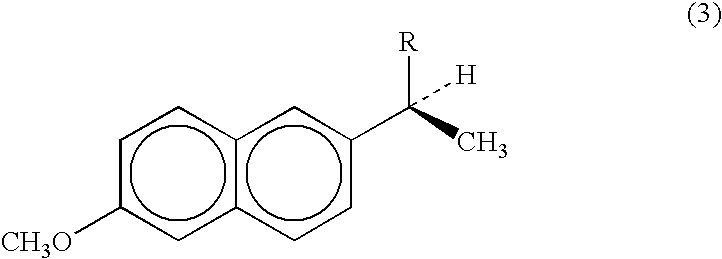
- Naproxen has a molecular weight of 230.26 and a molecular formula C14H14O3. Naproxen sodium has a molecular weight of 252.23 and the molecular formula C14H13NaO3. Naproxen is an odorless, white to off-white crystalline substance. It is lipid-soluble, practically insoluble in water at low pH and freely soluble in water at high pH. The octanol/water partition coefficient of naproxen at pH 7.4 is 1.6 to 1.8. Naproxen sodium is a white to creamy white, crystalline solid, freely soluble in water at neutral pH. NAPROSYN™ (naproxen tablets) are available from Hoffman-La Roche as yellow tablets containing 250 mg of naproxen, pink tablets containing 375 mg of naproxen and yellow tablets containing 500 mg of naproxen, for oral administration. The inactive ingredients used in these formulations are croscarmellose sodium, iron oxides, povidone and magnesium stearate. EC-NAPROSYN™ (naproxen delayed-release tablets) is available as enteric-coated white tablets containing 375 mg and 500 mg of naproxen for oral administration. The inactive ingredients used in these formulations are croscarmellose sodium, povidone and magnesium stearate. The enteric coating contains methacrylic acid copolymer, talc, triethyl citrate, sodium hydroxide and purified water. The dissolution of this enteric-coated naproxen tablet is pH dependent with rapid dissolution above pH 6. There is no dissolution below pH 4.
- ANAPROX™ (naproxen sodium tablets) is available from Hoffman-La Roche as blue tablets containing 275 mg of naproxen sodium and ANAPROX™ DS (naproxen sodium tablets) is available as dark blue tablets containing 550 mg of naproxen sodium for oral administration. The inactive ingredients are magnesium stearate, microcrystalline cellulose, povidone and talc. The coating suspension for the ANAPROX 275 mg tablet may contain hydroxypropyl methylcellulose 2910, Opaspray K-1-4210A, polyethylene glycol 8000 or Opadry YS-1-4215. The coating suspension for the ANAPROX DS 550 mg tablet may contain hydroxypropyl methylcellulose 2910, Opaspray K-1-4227, polyethylene glycol 8000 or Opadry YS-1-4216. NAPROSYN™ (naproxen suspension) is available as a light orange-colored opaque oral suspension containing 125 mg/5 mL of naproxen in a vehicle containing sucrose, magnesium aluminum silicate, sorbitol solution and sodium chloride (30 mg/5 mL, 1.5 mEq), methylparaben, fumaric acid, FD&C Yellow No. 6, imitation pineapple flavor, imitation orange flavor and purified water. The pH of the suspension ranges from 2.2 to 3.7.
- Combination therapies in which triptan drugs are combined with NSAIDs for treatment of migraine patients have been reported. See for example U.S. Pat. Nos. 6,060,499; 5,872,145; 6,586,458; and 6,384,034; U.S. Published Patent Application No. 2002/0099059; EP 1051993; EP 1064967; EP 1051995; EP 10649966; and EP 1064948. In general, NSAIDs have been delivered orally, for example in the form of either single or multilayer tablets or as coated granules: U.S. Pat. Nos. 6,365,184; 5,637,320; 5,480,650; and 6,387,410. Triptans have been given orally, intranasally and by injection. See U.S. Pat. Nos. 4,816,470; 5,307,845; 5,307,953; 5,554,639; 5,705,520; and 6,368,627; and International Application Publication No. WO 00/06161. See also U.S. Patent Application Publication Nos. 2007/0184109 and 2007/0207200.
- Although a work has been done in the area of dosage forms for triptans and NSAIDs, work is still needed, particularly where these agents are combined. The way in which such dosage forms are constructed may affect not only the stability of the individual therapeutic agents but also the speed at which the individual agents dissolve and become available to provide pain relief to patients.
- Consider, for example, U.S. Pat. No. 7,332,183 (“'183 patent”), which is directed to a multilayer pharmaceutical tablet comprising naproxen (preferably naproxen sodium) at a therapeutic dosage of between 200 and 600 mg, and a triptan. Most preferably, the tablet has 40 mg of sumatriptan succinate, 400 mg naproxen sodium. One of the patent's central themes is that substantially all of the triptan must be found in one layer of the tablet and substantially all of the naproxen must be found in a second, separate layer. These two layers are in a side-by-side arrangement such that the dissolution of the naproxen occurs, allegedly, independently of the dissolution of triptan. This tablet arrangement allegedly has surprisingly better properties than other tablet arrangements. According to the patent, in the stomach, naproxen forms a gel-like matrix that retards the dissolution of triptans (or other drugs) unless the two agents are maintained in distinct, side by side layers.
- According to the '183 patent, the term “substantially all” indicates that at least 90%, and preferably greater than 95%, of the total therapeutic agent present in the tablet is included within one distinct layer. The layers should be arranged such that the individual therapeutic agents dissolve independently of one another, i.e., dissolution should occur at approximately the same rate as would occur if the drugs were given separately. The '183 patent notes that “approximately the same rate” indicates that the time for complete dissolution of agent when drugs are given in the combination tablet should require the same amount of time ±10% as when the same amount of agent is given alone. This can allegedly be achieved by placing the individual layers in a side-by-side arrangement, as opposed to, for example, in a single layer tablet matrix containing both agents or one layer forming a core surrounded by the other layer. Again, according to the '183 patent, in a preferred embodiment, the layers are arranged so that they are juxtaposed symmetrically along a single planar surface such that essentially all of the triptan-containing layer is on one side of the plane and essentially all of the NSAID-containing layer is on the other side. The term “essentially all” in the patent is equivalent to “substantially all” and means that at least 90% and preferably greater than 95% of the therapeutic agent is present. These layers may come into direct contact with one another or, alternatively, they may be separated by one or more additional layers, e.g., a barrier layer or coating which prevents the therapeutic agents from interacting with one another.
- This patent is interesting for many reasons. For one thing, it demonstrates how important the role of proper formulation can be. For another, the patent describes a bilayered tablet which seeks to segregate the naproxen and sumatriptan completely such that their rate of dissolution is independent of each other. Moreover, dissolution should continue at about the same rate for each active when compared to tablets administering the actives separately. This is a curious requirement or more correctly, the concern with the relationship of the layers, rather than the composition, is curious. Dissolution is related to a number of factors including surface area. But composition plays a big role. Moreover, the exposed surface area of each bilayer according to the patent will be significantly reduced relative to individual tablets because of the faces in intimate contact. Therefore, achieving the desired result, without a change in composition, might require an unusual tablet structure.
- The patent is also interesting because it suggests that the naproxen gels and unless nearly completely segregated, the dissolution properties of the sumatriptan can be adversely affected. So complete is this teaching that the patent even suggests that nonphysical mixtures, which are nonetheless interactive, such as coating a core of one active with the other, is unacceptable. (See id. at Sections B and C, which describe comparative tablets having a naproxen core and sumatriptan film coating and a physical admixture of granulations.)
- The need to so completely separate the actives adds to cost and to formulation difficulties. And, the requirement that the dissolution of the actives be virtually unchanged despite being in a multilayered tablet raises questions about the structure and architecture of the dosage forms, the types of excipients needed to accomplish this goal, and the formulation techniques necessary. Yet, if true, the '183 patent's concerns about mixtures all but preclude combination therapy using anything other than separate tablets, which again can add to cost and adds to the inconvenience of taking the medication.
- A combination product of naproxen (500 mg) and sumatriptan (85 mg) is commercially available and sold as TREXIMET™ by GlaxoSmithKline. Each TREXIMET tablet for oral administration contains 119 mg of sumatriptan succinate equivalent to 85 mg of sumatriptan and 500 mg of naproxen sodium. Each tablet also contains the inactive ingredients croscarmellose sodium, dextrose monohydrate, dibasic calcium phosphate, FD&C Blue No. 2, lecithin, magnesium stearate, maltodextrin, microcrystalline cellulose, povidone, sodium bicarbonate, sodium carboxymethyl cellulose, talc, and titanium dioxide. It is believed that this formulation is intended to fall within the scope of the '183 patent.
- There exists a need for an alternate design approach to compositions comprising sumatriptan and naproxen that provide desired stability and release profiles in vitro and in vivo. The present invention provides alternate design and compositions having fixed doses of sumatriptan and naproxen.
- The present invention relates to pharmaceutical compositions comprising both a triptan and a nonsteroidal anti-inflammatory (NSAID). Further the present invention relates to fixed dose pharmaceutical compositions comprising a triptan, or any pharmaceutically acceptable salt thereof, and an NSAID, or any pharmaceutically acceptable salt thereof.
- In an embodiment of the invention, fixed dose pharmaceutical compositions of a triptan and an NSAID are presented as layered tablets or mini-tablets. These include layers in a side-by-side arrangement. Layered tablets also include inlay tablets; wherein an “outer” tablet comprises either a triptan or NSAID and an “inner” tablet comprises a triptan when outer tablet comprises an NSAID or comprises an NSAID when the outer tablet comprises a triptan. In still another embodiment, the inner tablet is completely surrounded or coated by the outer layer or tablet. In one particular aspect of this latter embodiment, the core includes the triptan and the coating includes the NSAID.
- In another embodiment of the invention, the multilayer tablet comprises a triptan or its salts and an NSAID or its salts wherein: a) between 10% or more of the triptan or its salts and up to about 90% thereof is in a first layer of the tablet together with the NSAID or its salts; and b) the remaining triptan or its salts is in a second layer of the tablet. This means that the combination layer contains an amount of triptan which is more than 10% of the total amount of triptan in the overall dosage form, but not more than about 90% thereof. The balance of the triptan is located in the second layer. Substantially all of the NSAID (except any that could migrate at the interface during tablet compression, should be disposed in the first layer. In another embodiment, the amount of triptan in the first layer is more than 10%, and in still another embodiment, 12% or more, 13% or more, 14% or more, 15% or more and 20% or more, and up to about 50%. Again, the percent reflects the percentage of, in this instance, the triptan in the first layer relative to the total amount of triptan in the dosage form. The percentages have the same overall meaning when it is the NSAID that is distributed in two layers. The layers may be in a side-by-side, inlay, or coated arrangement. In one embodiment, the triptan is sumatriptan and its salts and the NSAID is naproxen and its salts.
- In an embodiment of the invention, the multilayer tablet comprises sumatriptan or any of its salts and naproxen or any of its salts, wherein: a) between 10% or more of the naproxen or its salts and up to about 90% thereof is in a first layer of the tablet together with sumatriptan or its salts; and b) the remaining naproxen or its salts is in a second layer of the tablet. In another embodiment, the amount of naproxen in the first layer is more than 10%, and in still another embodiment, 12% or more, 13% or more, 14% or more, 15% or more and 20% or more. The layers may be in a side-by-side, inlay or coated arrangement.
- Stated another way, in one embodiment, the present invention is a compressed tablet or a mini-tablet including two layers or more. A first layer includes substantially all of a first active pharmaceutical ingredient (“API”), which is either a triptan or its salt, or an NSAID or its salt, and more than 10% of a second API and a second layer which is generally devoid of the first API and comprises the balance of the second API. These layers may be in a side-by-side relationship, in a coated core where one layer completely surrounds the other, or where one layer is embedded in the other, but at least one surface of each layer is exposed (also “inlay tablets”). The layer which contains a mixture may comprise more than 10% of the second API up to about 90% thereof by weight of the second API. The lower limit can, in some embodiments, be about 11%, 12%, 13%, 14%, 15%, 16%, 17%, 18%, 19%, 20%, 25% or about 30% and the maximum amount can, in some embodiments, be about 80%, 70%, 60%, 50% or about 40%.
- One embodiment, the invention is directed to a composition including at least 10% of the sumatriptan succinate that is present (e.g., about 17.85 mg of total dose 119 mg which is 15% of total dose), together with substantially all of the naproxen sodium (e.g., 500 mg), in the first layer and a second layer with the remaining amount of sumatriptan succinate (e.g., 101.15 mg) that is present, wherein both the layers are compressed into a bilayer tablet.
- In an embodiment of the invention, sumatriptan and naproxen are presented in a capsule. These can be capsules that include tablets or minitablets, which are layered as described herein.
- In yet another embodiment the invention includes granules, powders, or mini-tablets and blends of a triptan or its salts and an NSAID or its salts, filled together into capsule. This is particularly useful for lower strengths, such as 250 mg of naproxen. In one further embodiment, the capsule may be filled with two portions of granules or powders, wherein one portion comprises a triptan and an NSAID and the other portion comprise just the remainder of the triptan.
- Further an embodiment the invention includes granules or blends of sumatriptan or its salts and naproxen or its salts together compressed into a monolithic tablet. The monolithic tablet may comprise a blend of two portions of granules or powders, wherein one portion comprises part of a triptan and an NSAID and the other portion comprises the remainder of the triptan. The reverse, where two layers contain the NSAID, is also contemplated for each.
- For each of the various embodiments, while any triptan and NSAID may be used, sumatriptan and naproxen are described. And where salts are described, sumatriptan in the form of its succinate salt and naproxen in the form of its sodium salt are described.
- Further embodiments the invention includes stable pharmaceutical compositions comprising sumatriptan or its salts and naproxen or its salts, wherein sumatriptan is in the form of its succinate salt and naproxen is in the form of its sodium salt.
- In other embodiments, there is provided an inlay tablet comprising: an inner tablet and an outer tablet which encompass all but at least a portion of one face of the inner tablet, the inner tablet comprising a first active pharmaceutical ingredient which is a triptan or a nonsteroidal anti-inflammatory drug, and the outer tablet comprising a second active pharmaceutical ingredient which is a triptan or a nonsteroidal anti-inflammatory drug, and wherein the first and the second active pharmaceutical ingredients are not both triptans or both nonsteroidal anti-inflammatory drugs; a compressed layered tablet or mini-tablet comprising: a first layer comprising least one triptan and at least one nonsteroidal anti-inflammatory drug, wherein the first layer comprises substantially all of one of the triptan or the nonsteroidal anti-inflammatory drug and from about 13% to about 85% by weight of the other, and a second layer which includes the balance of the triptan or the nonsteroidal anti-inflammatory drug present in the tablet or mini-tablet; and a compressed layered tablet or mini-tablet comprising: naproxen sodium and sumatriptan succinate wherein a first layer comprises substantially all of the naproxen sodium present in the tablet or mini-tablet and about 13% by weight of the sumatriptan succinate present therein, and a second layer which includes the balance of the sumatriptan succinate, the layers being arranged side-by-side.
- In an embodiment the invention includes processes to prepare compositions.
- Further embodiments include methods of using pharmaceutical compositions of the present invention.
- One embodiment of the invention is an inlay tablet comprising: an inner tablet and an outer tablet which encompass all but at least a portion of one face of the inner tablet, the inner tablet comprising a first active pharmaceutical ingredient which is a triptan or a nonsteroidal anti-inflammatory drug, and the outer tablet comprising a second active pharmaceutical ingredient which is a triptan or a nonsteroidal anti-inflammatory drug, and wherein the first and the second active pharmaceutical ingredients are not both triptans or both nonsteroidal anti-inflammatory drugs.
- In another embodiment, the invention comprises a compressed layered tablet comprising: a first layer comprising substantially all of a first active pharmaceutical ingredient found in the tablet and at least 10%, but less than 90% of the total amount of a second active pharmaceutical ingredient found in the tablet, with the balance of the second active pharmaceutical ingredient disposed in a second layer, the first and the second layers being arranged side-by-side, and wherein the first and second active pharmaceutical ingredients are selected from the group consisting of triptans and nonsteroidal anti-inflammatory drugs, and further when the first active pharmaceutical ingredient is a triptan, the second active pharmaceutical ingredient is a nonsteroidal anti-inflammatory drug and when the first active pharmaceutical ingredient is a nonsteroidal anti-inflammatory drug, the second active pharmaceutical ingredient is a triptan. The tablet may be a mini-tablet, the triptan may be sumitriptan and its salts, and the NSAID may be naproxen and its salts.
- In still another embodiment, there is provided a compressed layered tablet or mini-tablet comprising: naproxen sodium and sumatriptan succinate, wherein a first layer comprises substantially all of the naproxen sodium present in the tablet or mini-tablet and about 13% by weight of the sumatriptan succinate found therein, and a second layer which includes the balance of the sumatriptan succinate, the layers being arranged side-by-side.
- While the specification concludes with claims particularly pointing and distinctly claiming the invention, it is believed that the present invention will be better understood from the following description. All percentages and ratios used herein are by weight of the total composition and all measurements made are at 25° C. and normal pressure unless otherwise designated. All temperatures are in degrees Celsius unless specified otherwise. The present invention can comprise (open ended) or consist essentially of the components of the present invention as well as other ingredients or elements described herein. As used herein, “comprising” means the elements recited, or their equivalent in structure or function, plus any other element or elements which are not recited. The terms “having” and “including” are also to be construed as open ended unless the context suggests otherwise. As used herein, “consisting essentially of” means that the invention may include ingredients in addition to those recited in the claim, but only if the additional ingredients do not materially alter the basic and novel characteristics of the claimed invention. Preferably, such additives will not be present at all or only in trace amounts. However, it may be possible to include up to about 10% by weight of materials that could materially alter the basic and novel characteristics of the invention as long as the utility of the compounds (as opposed to the degree of utility) is maintained. All ranges recited herein include the endpoints, including those that recite a range “between” two values. Terms such as “about,” “generally,” “substantially,” and the like are to be construed as modifying a term or value such that it is not an absolute. Such terms will be defined by the circumstances and the terms that they modify as those terms are understood by those of skill in the art. This includes, at very least, the degree of expected experimental error, technique error and instrument error for a given technique used to measure a value.
- Note that while the specification and claims may refer to a final product such as, for example, a tablet or other dosage form of the invention as, for example, containing particles having a certain particle size or distribution, or a certain type of, for example, a specific form of a filler, it may be difficult to tell from the final dosage form that the recitation is satisfied. However, such a recitation may be satisfied if the materials used prior to final production (in the case of a tablet for example, blending and tablet formulation), for example, meet that recitation. Indeed, as to any property or characteristic of a final product which cannot be ascertained from the dosage form directly, it is sufficient if that property resides in the components recited just prior to final production steps.
- The art often discusses separate dosage forms or dosage forms where all of a triptan and all of an NSAID are mixed together in some sort of admixture. This can be a mixture of separately granulated APIs or a simple mixture, usually with excipients. Where layered dosage forms are disclosed according to the '183 patent, the layers generally are discrete with substantially all of one API in one layer and all of the other API in another layer. This art suggests that the first, an admixture, is undesired because the NSAID can interfere with absorbance of the triptan. See '183 patent, column 3, lines 45-67. But even that is not sufficient. Even a tablet made of a core of a naproxen salt, surrounded completely by a layer of a sumatriptan salt, was found to be unacceptable. See id. at Tables 6-10 and 12.
- Yet, it has been discovered that a multilayered dosage form can in fact be constructed wherein at least one layer includes all of one API and more than 10% of the other and the second layer includes the balance of the second API. These formulations are sufficiently stable and have sufficient release characteristics to be acceptable for the treatment of various conditions. In one particular embodiment, where the APIs are sumatriptan and naproxen, and salts thereof, it is believed that a compressed tablet of one of the APIs and 10% or more of the other, with the balance being in the second layer is at least bioequivalent to the TREXIMET tablets.
- This approach has several advantages. For one thing, instead of fearing the effect of, for example, naproxen, on the release rate of, for example, sumatriptan, one can harness the rate release effect to help tailor the desired release rate of sumatriptan or another triptan as appropriate. This may provide considerable advancements in terms of the design of the dosage form providing a release profile for a triptan wherein some is released from one layer at one rate and released from a second layer at a second rate. Using such physical means for accomplishing these goals can reduce the need for certain types of excipients or technique which may themselves impart costs or concerns about chemical instability or incompatibility.
- In addition, in conventional side-by-side layered tablets where the two tablets are formed together in a conventional methodology, considerable blending occurring at the interface. The '183 patent would require extra care and vigilance in ensuring that, as a result of such blending, less than 10%, preferably less than 5%, of one active is mixed with the other. Indeed, the '183 patent discusses the possibility of producing the tablets separately and/or with a barrier layer to physically prevent any intermingling. According to the present invention, it has been discovered that such steps are unnecessary, saving considerably in terms of formulation efficiency and cost.
- Triptans may include, without limitation, sumatriptan, eletriptan, rizatriptan, frovatriptan, almotriptan, zolmitriptan, and naratriptan, including pharmaceutically acceptable salts and esters thereof. Sumatriptan, including pharmaceutically acceptable salts and esters thereof, is used in one particular embodiment and may be in the form of sumatriptan free base or its pharmaceutically acceptable salts, esters or isomers, in any polymorphic or amorphous form or combinations thereof. Sumatriptan is used in the invention in the range of 1 mg to 300 mg, or 25 mg to 100 mg, per dosage unit based on the weight of the contained free base equivalent.
- NSAIDs may include, without limitation, flurbiprofen, ketoprofen, naproxen, oxaprozin, etodolac, indomethacin, ketorolac, nabumetone, mefanamic acid, piroxicam, lornoxicam, and meloxicam, including pharmaceutically acceptable salts or esters thereof. Another group of NSAIDs that can be used is the cyclooxygenase-2 (COX-2) inhibitors. Members of this group include rofecoxib, celecoxib, valdecoxib, etoricoxib, JTE-522, L-745,337, NS398, and pharmaceutically acceptable salts thereof. Naproxen is used in one particular embodiment and may be in the form of naproxen free base or any of its pharmaceutically acceptable salts or isomers, in any polymorphic or amorphous form or combinations thereof. Naproxen used in the invention is in the range of 250 mg to 550 mg, per dosage unit based on the weight of the contained free base equivalent.
- A recitation of “triptan” or “NSAID” herein, either generally or as a specific drug compound, will be used to include both the drug in its free form, and in the form of any substances that provide the drug to the body, following ingestion of a pharmaceutical composition. Such substances can be salts, esters, or other derivatives of the drug.
- Inlay tablets according to the present invention are tablets wherein a first tablet (“inner tablet”) is positioned within a comparatively larger “outer” tablet in such a way that at least one surface, face, or part, of the first tablet is not in contact with a surface of the other, relatively larger, outer tablet. Note that “smaller” and “larger” in this context generally relate to comparative surface area. The inner tablet may be larger in terms of volume, weight or dose. However, it is at least partially and generally substantially surrounded by the “outer” tablet.
- In an embodiment of the invention, fixed dose pharmaceutical compositions comprising sumatriptan and naproxen are presented as inlay tablets, wherein an outer tablet comprises either sumatriptan or naproxen, and an inner tablet comprises sumatriptan when an outer tablet comprises naproxen, or an inner tablet comprises naproxen when the outer tablet comprises sumatriptan. In a further embodiment, the naproxen is present as the sodium salt and the sumatriptan is present as the succinate salt. In still another embodiment, either the inner or the outer tablet includes a mixture of both naproxen and its salts and sumatriptan and its salts, while the other layer comprises only one of these two APIs. In a further embodiment, the amount of one of these APIs is substantially all of that API present in the dosage form. However, the second API is present in the mixed API layer in an amount of at least 10% by weight of the total amount of that API in the overall dosage form. It can be present in an amount of about 11%, 12%, 13%, 14%, 15%, 16%, 17%, 18%, 19%, 20%, 25%, and 30%, or more, up to about 90%.
- In an embodiment of the invention, a multilayer tablet comprises sumatriptan and naproxen wherein: a) 10% or more of the sumatriptan is in a first layer of the tablet along with substantially all of the naproxen; and b) the remaining sumatriptan is in a second layer of the tablet. These may be side-by-side layered tablets and coated tablets where one layer completely surrounds the other, as well as inlay tablets as described.
- In an embodiment of the invention, a multilayer tablet comprises sumatriptan succinate and naproxen sodium wherein: a) 10% or more of the sumatriptan succinate is in a first layer of the tablet along with substantially all of the naproxen sodium; and b) the remaining sumatriptan succinate is in a second layer of the tablet. These may be side-by-side layered tablets and coated tablets where one layer completely surrounds the other, as well as inlay tablets as just described.
- In an embodiment of the invention, a multilayer tablet comprises sumatriptan and naproxen wherein: a) 10% or more of the naproxen is in a first layer of the tablet along with substantially all of the sumatriptan; and b) the remaining naproxen is in a second layer of the tablet. These may be side-by-side layered tablets and coated tablets where one layer completely surrounds the other, as well as inlay tablets as just described.
- In an embodiment of the invention, a multilayer tablet comprises sumatriptan succinate and naproxen sodium wherein: a) 10% or more of the naproxen sodium is in a first layer of the tablet along with substantially all of the sumatriptan succinate; and b) the remaining naproxen sodium is in a second layer of the tablet. These may be side-by-side layered tablets and coated tablets where one layer completely surrounds the other, as well as inlay tablets as just described. All of the foregoing may also be mini-tablets which can be filled into a capsule. And all of the tablets and mini-tablets may be coated with other materials including rate controlling materials.
- In an embodiment of the invention, wherein part of the sumatriptan or naproxen is placed in a layer comprising the other drug, that part of the sumatriptan or naproxen can be presented as uncoated or coated granules, particles, pellets or beads.
- In an embodiment of the invention, sumatriptan and naproxen are presented in a capsule. In an embodiment of the invention wherein the composition is presented as capsules, capsules comprise sumatriptan and naproxen, wherein either one or both of sumatriptan and naproxen are presented as a powder, granules, coated granules, beads, coated beads, pellets, coated pellets, tablets, coated tablets, mini-tablets, coated mini-tablets, or as two separate smaller capsules, wherein each capsule is filled with sumatriptan and naproxen.
- In one of the embodiments the invention includes granules or blends of sumatriptan succinate and naproxen sodium, filled together into empty hard gelatin capsules.
- Further embodiments the invention includes stable pharmaceutical compositions comprising sumatriptan or its salts and naproxen or its salts, wherein sumatriptan is in the form of its succinate salt and naproxen is in the form of its sodium salt.
- The following are some potential impurities of sumatriptan succinate which could be formed in the formulation during processing or during storage conditions:
- 1) Impurity A, chemically known as 3-[2(Dimethylamino)ethyl]-2-[[3-[2-(dimethylamino)ethyl]-1H indol-5-yl]methyl]-1H-indol-5-yl]-N-Methyl methane sulphonamide, and represented by structure IV.
-
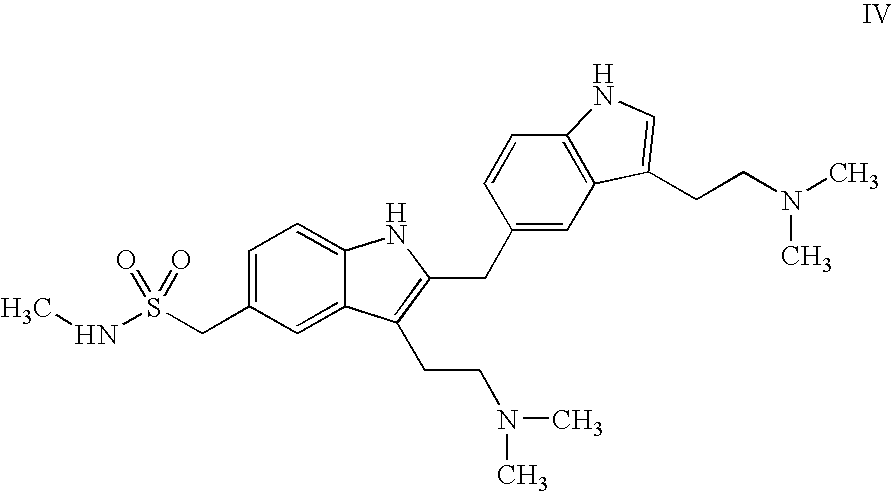
- 2) Impurity B, chemically known as N-Methyl[3-[2-(methyl amino)ethyl]-1H-indol-5-yl]methane sulphonamide, and represented by structure V.
-

- 3) Impurity C, chemically known as [3-[2-(dimethylamino)ethyl]-1-(hydroxyl methyl)-1H-indol-5-yl]-N-methane sulphonamide, and represented by structure VI.
-

- 4) Impurity D, chemically known as N,N-Dimethyl-2-[5-[(methyl sulphamoyl)methyl]-1H indol -3-yl]ethanamine N-oxide, and represented by structure VII.
-
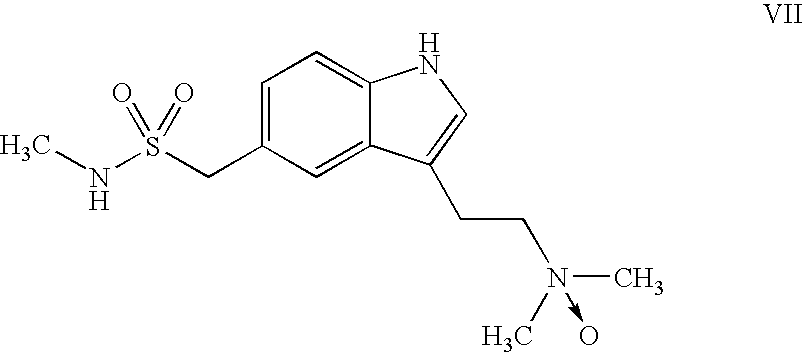
- Some potential impurities of naproxen sodium are as below:
- 5) Impurity E, chemically known as 2-Acetyl-methoxy naphthalene, and represented by structure VIII.
-

- 6) Impurity F, chemically known as 2-methyl-6-methoxy-a-methyl-2-napthaleneacetate, and represented by structure IX.
-

- 7) Impurity G, chemically known as 3-isopropyl-6-methoxy-a-methyl-2-napthaleneacetate, and represented by structure X.
-

- 8) Impurity H, chemically known as 1-(6-methoxy-2-naphthyl)ethylalcohol, and represented by structure XI.
-

- 9) Impurity I, chemically known as n-octyl d-glucamine, and represented by structure XII.
-

- In yet another embodiment the invention includes granules or blends of sumatriptan or its salts and naproxen or its salts, together compressed into multilayered tablets including side-by-side tablets, inlay tablets or tablets in which one layer or tablet surrounds the other. These include mini-tablets. Sumatriptan and naproxen powders, granules, beads, pellets or tablets can be prepared using techniques known to persons skilled in the art. Techniques that can be used include but are not limited to any one or more of direct blending, dry granulation, or wet granulation techniques, extrusion-spherinization, drug layering onto inert materials, direct compression, wet granulation followed by compression techniques, or any other pharmaceutical formulation techniques.
- Blends or granules comprising active ingredients may comprise one or more of pharmaceutically acceptable excipients such as but not limited to diluents, disintegrants, binders, lubricants, surfactants, glidants, coloring agents, film formers, plasticizers, opacifying agents, sweeteners, flavoring agents and the like.
- Various useful fillers or diluents include but are not limited to starches, lactose, mannitol (Pearlitol™ SD200), cellulose derivatives, confectioner's sugar and the like. Different grades of lactose include but are not limited to lactose monohydrate, lactose DT (direct tableting), lactose anhydrous, Flowlac™ (available from Meggle Products), Pharmatose™ (available from DMV) and others. Different starches include but are not limited to maize starch, potato starch, rice starch, wheat starch, pregelatinized starch (commercially available as PCS PC10 from Signet Chemical Corporation) and starch 1500, starch 1500 LM grade (low moisture content grade) from Colorcon, fully pregelatinized starch (commercially available as National 78-1551 from Essex Grain Products) and others. Different celluloses that can be used include crystalline cellulose and powdered cellulose. Examples of crystalline cellulose products include but are not limited to CEOLUS™ KG801, Avicel™ PH101, PH102, PH301, PH302 and PHF20, and PH112, microcrystalline cellulose 114, and microcrystaline cellulose 112. Other useful diluents include but are not limited to carmellose, sugar alcohols such as mannitol (Pearlitol™ SD200), sorbitol, and xylitol, calcium carbonate, magnesium carbonate, dibasic calcium phosphate, and tribasic calcium phosphate. The amounts used are consistent with known formulation practice, but generally range from about 5% to about 60%, and in another embodiment, from about 15% to about 40%, by weight of the tablet or layer as appropriate.
- Various useful disintegrants include but are not limited to carmellose calcium (Gotoku Yakuhin Co., Ltd.), carboxymethylstarch sodium (Matsutani Kagaku Co., Ltd., Kimura Sangyo Co., Ltd., etc.), croscarmellose sodium (Ac-di-sol™ from FMC-Asahi Chemical Industry Co., Ltd.), crospovidones, examples of commercially available crospovidone products including but not limited to crosslinked povidone, Kollidon™ CL [manufactured by BASF (Germany)], Polyplasdone™ XL, XI-10, and INF-10 [manufactured by ISP Inc. (USA)], and low-substituted hydroxypropyl celluloses. Examples of low-substituted hydroxypropylcellulose include but are not limited to low-substituted hydroxypropylcellulose LH11, LH21, LH31, LH22, LH32, LH20, LH30, LH32 and LH33 (all manufactured by Shin-Etsu Chemical Co., Ltd.). Other useful disintegrants include sodium starch glycolate, colloidal silicon dioxide, and starches. The amounts used are consistent with known formulation practice, but generally range from about 0.5 to about 20%, and in another embodiment, from about 2 to about 10%, by weight of the tablet or layer as appropriate.
- Various useful binders include but are not limited to hydroxypropylcelluloses, also called HPC (Klucel™-LF, Klucel EXF) and useful in various grades, hydroxypropyl methylcelluloses, also called hypromelloses or HPMC (Methocel™) and useful in various grades, polyvinylpyrrolidones or povidones (such as grades PVP-K25, PVP-K29, PVP-K30, and PVP-K90), Plasdone™ S 630 (copovidone), powdered acacia, gelatin, guar gum, carbomers (Carbopol™), methylcelluloses, polymethacrylates, and starches. The amounts used are consistent with known formulation practice, but generally range from about 0.5 to about 20%, and in another embodiment, from about 1 to about 7.5%, by weight of the tablet or layer as appropriate.
- Useful tablet lubricants include magnesium stearate, glyceryl monostearates, palmitic acid, talc, carnauba wax, calcium stearate sodium, sodium or magnesium lauryl sulfate, calcium soaps, zinc stearate, polyoxyethylene monostearates, calcium silicate, silicon dioxide, hydrogenated vegetable oils and fats, stearic acid and combinations thereof. The amounts used are consistent with known formulation practice, but generally range from about 0.1 to about 10%, and in another embodiment, from about 0.5 to about 5%, by weight of the tablet or layer as appropriate.
- Useful surface-active agents include non-ionic, cationic or anionic surface-active agents. Useful non-ionic surface-active agents include ethylene glycol stearates, propylene glycol stearates, diethylene glycol stearates, glycerol stearates, sorbitan esters (SPAN™), polyoxyethylene derivatives of sorbitan esters, or polysorbates (TWEEN™), aliphatic alcohols and PEG ethers, phenol and PEG ethers. Useful cationic surface-active agents include quaternary ammonium salts (e.g. cetyltrimethylammonium bromide) and amine salts (e.g., octadecylamine hydrochloride). Useful anionic surface-active agents include sodium stearate, potassium stearate, ammonium stearate, and calcium stearate, triethenolamine stearate, sodium lauryl sulphate, sodium dioctylsulphosuccinate, and sodium dodecylbenzenesulphonate. Natural surface-active agents may also be used, such as for example phospholipids, e.g. diacylphosphatidyl glycerols, diaceylphosphatidyl cholines, and diaceylphosphatidic acids, the precursors and derivatives thereof, such as for example soybean lecithin and egg yolk. The amounts used are consistent with known formulation practice, but generally range from about 0.1 to about 10% and in another embodiment, from about 0.5 to about 5%, by weight of the tablet or layer as appropriate.
- Various solvents can be used in the processes of preparation of pharmaceutical compositions of the present invention including but not limited to water, methanol, ethanol, acidified ethanol, acetone, diacetone, polyols, polyethers, oils, esters, alkyl ketones, methylene chloride, isopropyl alcohol, butyl alcohol, methyl acetate, ethyl acetate, isopropyl acetate, castor oil, ethylene glycol monoethyl ether, diethylene glycol monobutyl ether, diethylene glycol monoethyl ether, dimethylsulphoxide, N,N-dimethylformamide, tetrahydrofuran, and any mixtures thereof. Typically, solvents will evaporate during the formulation processes.
- Coloring agents can be used to color code the compositions, for example, to indicate the type and dosage of the therapeutic agent therein. Suitable coloring agents include, without limitation, natural and/or artificial compounds such as FD&C coloring agents, natural juice concentrates, pigments such as titanium oxide, silicon dioxide, iron oxides, and zinc oxide, combinations thereof, and the like. The amounts used are consistent with known formulation practice, but generally range from about 0.001 to about 2%, and in another embodiment, from about 0.005 to about 0.1%, by weight of the tablet or layer as appropriate.
- One or more glidant materials, which improve the flow properties of powder blends and minimize dosage form weight variation, can be used. Useful glidants include but are not limited to silicone dioxide, talc and combinations thereof. The amounts used are consistent with known formulation practice, but generally range from about 0.5 to about 10%, and in another embodiment, from about 1 to about 5%, by weight of the tablet or layer as appropriate.
- Film-forming polymers that are useful in the invention include but are not limited to cellulose derivatives such as hydroxypropyl celluloses, hydroxyethyl celluloses, hydroxypropyl methylcelluloses, methacrylic acid copolymers, lactose, starch derivatives, and the like. The amounts used are consistent with known formulation practice, but generally range from about 1 to about 20%, and in another embodiment, from about 1 to about 10%, by weight of the tablet or layer as appropriate.
- Various useful plasticizers for film coatings include but are not limited to substances such as castor oil, diacetylated monoglycerides, dibutyl sebacate, diethyl phthalate, glycerin, polyethylene glycol, propylene glycol, triacetin, and triethyl citrate. Also, mixtures of plasticizers may be utilized. The type of plasticizer depends upon the type of coating agent. An opacifier like titanium dioxide may also be present in an amount ranging from about 10% to about 20%, based on the total weight of the coating. Film coatings can also contain coloring agents.
- Coating can also be accomplished using pre-formulated coating products, which usually require only mixing with a liquid before use. Useful products include those sold by Colorcon as OPADRY™ or OPAGLOSS, for example OPAGLOSS 2 Blue (97W80859) and others. The amounts used are consistent with known formulation practice, but generally range from about 1 to about 15%, and in another embodiment, from about 1 to about 10%, by weight of the tablet or layer as appropriate.
- In an aspect the invention includes processes to prepare pharmaceutical compositions, wherein a specific embodiment of a process comprises:
- 1) sifting drug and excipients such as diluents, disintegrants, glidants, lubricants etc through a sieve;
- 2) dry mixing sifted ingredients except glidants and lubricants;
- 3) optionally, granulating the step 2) materials using a binder solution or dispersion, and subsequently drying and sizing through a sieve;
- 4) optionally, compacting the step 2) materials into compacts and subsequently milling and sizing through a sieve;
- 5) blending either step 2) or step 3) or step 4) product with sifted glidant and other excipients, if any;
- 6) adding sifted lubricant to step 5) materials and blending;
- 7) filling the step 6) product into capsules or compressing into tablets.
- The formulations prepared are further packaged using appropriate packaging materials such as containers, including closures, composed of polyethylene (high density polyethylene or low density polyethylene), and/or polypropylene, and/or glass, stainless steel bottles, etc. Also useful are various blisters or strips composed of aluminum or high-density polypropylene, or polyvinyl chloride, or polyvinyl chloride (PVC) coated with polyvinylidene dichloride (PVDC), generally termed PVC/PVDC. Different grades of PVC/PVDC are available as PVC/PVDC 40 gsm, PVC/PVDC 60 gsm, PVC/PVDC 90 gsm, etc., where “gsm” indicates the grams of PVDC coating per square meter of PVC film. For stability various moisture adsorbents like silica gel (Sorb-IT® supplied by Multisorb Technologies is a prepackaged sachet-style packet of silica gel commonly used in the packaging), molecular sieves, etc. and oxygen absorbers such as Ageless® (manufactured by Mitsubishi Gas Chemical), or Stabilox® (manufactured by Multisorb Technologies) are included in packaged products.
- Sometimes a pharmaceutical coil may be used during packaging to provide a safe, nontoxic, aesthetically pleasing, easy to use, traditional filler. It ensures freshness and stability in shipping and storing. An example polyester coil (supplied by Carolina Inc, Pharmaceutical coil) is white, odorless, soft, low moisture, resilient material comprised of 100% polyester fibers.
- The pharmaceutical dosage forms of the present invention are intended for oral administration to a patient in need thereof.
- In an embodiment, the invention relates to analytical methods for analysis of sumatriptan- and naproxen-related impurities using high performance liquid chromatography (HPLC), wherein a method comprises:
- For Sumatriptan-Related Impurities:
- Mobile phase A: 1.36 g of potassium dihydrogen phosphate (anhydrous) and 1.5 mL of dibutylamine are added to 1000 mL of water, and pH is adjusted to 3.0 with orthophosphoric acid. The solution is filtered through 0.45 μm hydrophilic membrane filter and degassed in a sonicator for about 10 minutes.
- Mobile phase B: Water, methanol and acetonitrile are mixed in the volume ratio of 200:150:650, respectively, followed by degassing in a sonicator for 10 minutes
- Diluent: Mobile phase A, methanol and acetontrile are mixed in the volume ratio of 500:250:250, respectively.
- Chromatographic System:
- a) Liquid chromatograph is equipped with a 225 nm UV detector.
- b) 250 mm×4.6 mm, 5 μm, Waters Spherisob ODS-1 or equivalent column.
- c) Column temperature: 25° C.
- d) Flow rate: 1 mL per minute.
- e) Injection volume: 10 μL.
- f) Run time: 70 minutes.
- Mobile Phase Gradient Program:
-
Time % of Mobile % of Mobile (minutes) Phase A Phase B 0 95 5 5 95 5 35 90 10 50 50 50 55 40 60 57 — 100 60 — 100 62 95 5 70 95 5 - Preparation of Test Sample:
- Accurately weigh a portion of crushed tablet powder equivalent to 100 mg of sumatriptan succinate into a 100 mL volumetric flask. To this, 70 mL of diluent is added and sonicated for 20 minutes with intermediate shaking. The volume is made up with diluent, followed by centrifuging a portion of the solution in a centrifuge tube with a cap at 4000 rpm for about 10 minutes. Finally, the solution is filtered through a 0.45 μm hydrophilic membrane filter.
- For Naproxen Sodium-Related Impurities:
- Mobile Phase: Water, acetonitrile and glacial acetic acid are mixed in the volume ratio of 50:50:1 and filtered through 0.45 μm nylon 66 membrane filter, followed by degassing in a sonicator for about 10 minutes.
- Diluent: 900 mL of acetonitrile is mixed with 100 mL of milli-Q water, followed by degassing in a sonicator for about 10 minutes.
- Sample Preparation:
- Accurately weighed amount of the crushed tablet powder equivalent to 250 mg of naproxen sodium is placed in a 100 mL volumetric flask. To this, 70 mL of diluent is added and sonicated for about 20 minutes, then diluted to volume with diluent. Centrifuge a portion of the above solution in a centrifuge tube with cap at 4000 rpm for 10 minutes.
- Chromatographic System:
- a) Liquid chromatograph is equipped with a 260 nm UV detector.
- b) Column: 250 mm×4.6 mm, Symmetryshield, RP18, 5 μm column or equivalent.
- c) Column temperature: Ambient.
- d) Flow rate: 1 mL per minute.
- e) Injection volume: 10 μL.
- f) Run time: 50 minutes for blank and 15 minutes for standard.
- Representative relative retention times (RRT), where sumatriptan or naproxen equals 1, limits of detection (LOD), and limits of quantification (LOQ) of various drug-related impurities are tabulated below.
-
Drug Impurity RRT LOD LOQ Sumatriptan Impurity A 2.10 0.005 0.017 Impurity B 0.78 0.005 0.015 Impurity C 1.15 0.008 0.020 Impurity D 1.57 0.008 0.022 Naproxen Impurity E 1.32 0.00033 0.001 Impurity F 2.24 0.005 0.017 Impurity G 4.64 0.011 0.032 Impurity H 0.84 0.001 0.006 - Pharmaceutical dosage forms can be subjected to in vitro dissolution evaluations according to Test 711 “Dissolution” in United States Pharmacopoeia 29, United States Pharmacopeial Convention, Inc., Rockville, Md., 2005 (“USP”), to determine the rate at which the drug substance is released from the dosage forms, and the content of drug substance can conveniently be determined in solutions using techniques such as high performance liquid chromatography (HPLC).
- Certain specific aspects and embodiments of the invention will be explained in more detail with reference to the following examples, being provided only for purposes of illustration, and it is to be understood that the present invention is not to be limited thereto.
-
-
Ingredient Percent Inner Smaller Tablet Sumatriptan succinate 10 Lactose monohydrate 10 Water* q.s. Anhydrous lactose 20.1 Microcrystalline cellulose 2.2 Croscarmellose sodium 0.4 Magnesium stearate 0.2 Outer Larger Tablet Naproxen sodium 42.2 Microcrystalline cellulose 4.5 Povidone 2 Water* q.s. Microcrystalline cellulose 4.5 Croscarmellose sodium 1.1 Talc 2.3 Magnesium stearate 0.4 *Evaporates during processing. - Manufacturing Process:
- A. Inner Tablet.
- 1) Separately sift sumatriptan succinate, lactose monohydrate, anhydrous lactose, microcrystalline cellulose, and croscarmellose sodium through an ASTM #40 mesh sieve, and sift magnesium stearate through an ASTM #80 mesh sieve.
- 2) Place sumatriptan succinate and lactose monohydrate into a granulator and dry mix.
- 3) Granulate step 2) using water.
- 4) Dry the granules until the loss on drying is not more than 2% w/w at 60° C.
- 5) Sift the dried granules through an ASTM #20 mesh sieve.
- 6) Blend the granules of step 5) with anhydrous lactose, microcrystalline cellulose, and croscarmellose sodium in a double cone blender for about 10 minutes.
- 7) Blend step 6) materials with magnesium stearate for about 5 minutes.
- 8) Compress the lubricated blend into tablets.
- B. Outer Tablet Blend.
- 1) Co-sift naproxen sodium and microcrystalline cellulose (first quantity) through an ASTM #40 mesh sieve.
- 2) Place step 1) materials into a granulator and dry mix.
- 3) Dissolve povidone in water to prepare a binder solution and granulate step 2), then dry until the loss on drying is not more than 2% w/w at 60° C.
- 4) Sift the granules of step 3) through an ASTM #20 mesh sieve.
- 5) Co-sift microcrystalline cellulose (second quantity), croscarmellose sodium through an ASTM #40 mesh sieve.
- 6) Blend the granules of step 4) with step 5) materials in a double cone blender for about 10 minutes.
- 7) Sift talc and magnesium stearate through an ASTM #80 mesh sieve.
- 8) Blend step 6) with step 7) materials.
- C. Inlay Tablet.
- 1) Compress inner tablets together with the outer tablet blend into inlay tablets.
-
-
Ingredient Percent Layer 1 Sumatriptan succinate 8.5 Lactose monohydrate 10 Water* q.s. Anhydrous lactose 20.1 Microcrystalline cellulose 2.2 Croscarmellose sodium 0.4 Magnesium stearate 0.2 Layer 2 Naproxen sodium 42.2 Microcrystalline cellulose 4.5 Povidone 2 Water* q.s. Sumatriptan succinate 1.5 Microcrystalline cellulose 4.5 Croscarmellose sodium 1.1 Talc 2.3 Magnesium stearate 0.4 *Evaporates during processing. - Manufacturing Process:
- Layer 1.
- 1) Sift sumatriptan succinate, lactose monohydrate, anhydrous lactose, microcrystalline cellulose, croscarmellose sodium through an ASTM #40 mesh sieve separately, and sift magnesium stearate through an ASTM #80 mesh sieve.
- 2) Place sumatriptan succinate and lactose monohydrate of step 1) into a granulator and dry mix.
- 3) Granulate step 2) materials using water.
- 4) Dry the granules until loss on drying is not more than 2% at 60° C.
- 5) Sift the granules of step 4) through an ASTM #20 mesh sieve.
- 6) Blend anhydrous lactose, microcrystalline cellulose, and croscarmellose sodium with granules of step 5) in a double cone blender for about 10 minutes.
- 7) Blend step 6) with magnesium stearate for about 5 minutes.
- Layer 2.
- 1) Co-sift naproxen sodium and microcrystalline cellulose (first quantity) through an ASTM #40 mesh sieve.
- 2) Place step 1) materials into a granulator and dry mix.
- 3) Dissolve povidone in water to form a binder solution and granulate step 2) materials using the binder solution.
- 4) Dry the granules until loss on drying is not more than 2% w/w at 60° C.
- 5) Sift the granules through an ASTM #20 mesh sieve.
- 6) Co-sift sumatriptan succinate, microcrystalline cellulose (second quantity), and croscarmellose sodium through an ASTM #40 mesh sieve.
- 7) Blend the granules of step 5) with step 6) materials in a double cone blender for about 10 minutes.
- 8) Sift talc and magnesium stearate through an ASTM #80 mesh sieve.
- 9) Blend step 7) materials with step 8).
- C. Bilayer Tablet.
- 1) Compress Layer 1 blend and Layer 2 blend together to form bilayer tablets.
-
-
Ingredient Percent Layer 1 Intragranular Sumatriptan succinate 8.87 Dibasic calcium phosphate dihydrate 10.44 Croscarmellose sodium 1.75 FD&C blue lake blend 0.01 Water* q.s. Layer 1 Extragranular Microcrystalline cellulose 8.57 Sodium bicarbonate 3.51 Magnesium stearate 0.35 Layer 1 Total 33.5 Layer 2 Intragranular Naproxen sodium 43.86 Microcrystalline cellulose 4.74 Povidone 2.37 Water* q.s. Sumatriptan succinate 1.57 Povidone 0.08 Water* q.s. Layer 2 Extragranular Microcrystalline cellulose 3.46 Crospovidine 2.72 Talc 2.37 Magnesium stearate 0.59 Layer 2 Total 61.76 Total for compressed tablet 95.26 Coating Opagloss II Blue (97W80859) 4.74 Total for coated tablet 100 *Evaporates during processing. - Manufacturing Process:
- Layer 1.
- 1) Separately sift sumatriptan succinate, dibasic calcium phosphate dihydrate and croscarmellose sodium through an ASTM #40 mesh sieve, and mix for 5 minutes in a rapid mixer granulator (RMG).
- 2) Disperse FD&C lake blend in water.
- 3) Granulate the mixture of step 1) with the step 2) dispersion.
- 4) Dry the granules of step 3) in a fluid bed dryer (FBD) to obtain a loss on drying not more than 2% at 60° C.
- 5) Sift the dried granules of step 4) through an ASTM #30 mesh sieve.
- 6) Sift microcrystalline cellulose and sodium bicarbonate through an ASTM #40 mesh sieve separately.
- 7) Blend the granules of step 5) and sifted materials of step 6) in a double cone blender for about 5 minutes.
- 8) Sift magnesium stearate through an ASTM #60 mesh sieve.
- 9) Blend the mixture of step 7) with magnesium stearate of step 8) for about 5 minutes.
- Layer 2
- 1) Co-sift naproxen sodium and microcrystalline cellulose through an ASTM #30 mesh sieve.
- 2) Dissolve povidone in water
- 3) Spray the solution of step 2) onto the blend of step 1) in a fluid bed processor fitted with top spray, to prepare granules.
- 4) Dissolve sumatriptan succinate in water together with povidone.
- 5) Spray the solution of step 4) onto the granules of step 3).
- 6) Dry the granules of step 5) in the FBD to obtain a loss on drying not more than 2% at 70° C.
- 7) Sift microcrystalline cellulose and crospovidone through an ASTM #40 mesh sieve separately.
- 8) Blend the granules of step 6) and sifted materials of step 7) in a double cone blender for about 5 minutes.
- 9) Sift magnesium stearate and talc through an ASTM #60 mesh sieve.
- 10) Blend the mixture of step 8) with sifted materials of step 9) for about 5 minutes.
- Bilayer Tablets
- 1) Compress the Layer 1 blend and Layer 2 blend together to form bilayer tablets.
- 2) Coat the tablets of step 1) with a dispersion of Opagloss II Blue.
-
-
Ingredient Percent Layer 1 Sumatriptan succinate 10 Lactose monohydrate 10 Water* q.s. Naproxen sodium 6.3 Anhydrous lactose 20.1 Microcrystalline cellulose 2.2 Croscarmellose sodium 0.4 Magnesium stearate 0.2 Layer 2 Naproxen sodium 35.9 Microcrystalline cellulose 4.5 Povidone 2 Water* q.s. Microcrystalline cellulose 4.5 Croscarmellose sodium 1.1 Talc 2.3 Magnesium stearate 0.4 *Evaporates during processing. - Manufacturing process: similar to that of Example 2, except include naproxen sodium in step 6) with extragranular materials of Layer 1.
-
-
Ingredient Percent Blend 1 Sumatriptan succinate 23.8 Lactose monohydrate 9 Water* q.s. Anhydrous lactose 9 Microcrystalline cellulose 1.1 Croscarmellose sodium 0.5 Magnesium stearate 0.2 Blend 2 Naproxen sodium 50 Microcrystalline cellulose 4 Povidone 0.2 Water* q.s. Microcrystalline cellulose 1 Croscarmellose sodium 0.5 Talc 0.5 Magnesium stearate 0.2 *Evaporates during processing. - Manufacturing Process:
- 1) Prepare Blend 1 according to the process for the inner tablet of Example 1 and compress into mini-tablet 1.
- 2) Prepare Blend 2 according to the process for the outer tablet blend of Example 1 and compress into mini-tablet 2.
- 3) Fill a mini-tablet 1 and a mini-tablet 2 into an empty hard gelatin capsule shell.
-
-
Ingredient Percent Blend 1 Sumatriptan succinate 10 Naproxen sodium 6.3 Polymer‡ 0.4 Lactose monohydrate 10 Methanol q.s. Water* q.s. Anhydrous lactose 20 Microcrystalline cellulose 2.2 Croscarmellose sodium 0.4 Magnesium stearate 0.2 Blend 2 Naproxen sodium 35.7 Microcrystalline cellulose 4.5 Povidone K-30 2 Water* q.s. Microcrystalline cellulose 4.5 Croscarmellose sodium 1.1 Talc 2.3 Magnesium stearate 0.4 *Evaporates during processing. ‡Polymer is any one or more of Eudragit ™ EPO, HPMC, povidone, and Eudragit RD 100. - Manufacturing Process:
- Blend 1.
- 1) Dissolve naproxen sodium and polymer in a methanol and water mixture.
- 2) Sift sumatriptan succinate and lactose monohydrate through an ASTM #40 mesh sieve. Dry mix for about 5 minutes.
- 3) Granulate step 2) materials using step 1) solution.
- 4) Dry the granules in a dryer until loss on drying is not more than 2% at 60° C.
- 5) Sift the granules of step 4) through an ASTM #20 mesh sieve.
- 6) Blend anhydrous lactose, microcrystalline cellulose, and croscarmellose sodium with granules of step 5) in a double cone blender for about 10 minutes.
- 7) Blend the step 6) mixture with magnesium stearate for about 5 minutes.
- Blend 2. Prepare blend 2 according to the naproxen layer process in Example 2.
- Compression. Blend 1 and blend 2 are compressed together as a monolithic tablet or as a bilayer tablet.
-
-
Ingredient mg/Tablet Percent Layer 1 Naproxen Sodium 500 44.76 Avicel PH101 (MCC) 54 4.8 Povidone (PVPK90) 27 2.41 Water* q.s. q.s. Sumatriptan Succinate 17.85 1.6 Povidone (PVPK90) 1 0.09 Water* q.s. q.s. Microcrystalline cellulose 39.4 3.53 (Avicel PH102) Crospovidone 31 2.76 Talc 27 2.42 Magnesium stearate 6.75 0.6 Layer 1 Total 62.97 Layer 2 Sumatriptan succinate 101.15 9.06 Dibasic calcium phosphate dihydrate 119 10.65 Croscarmellose sodium 20 1.8 Lake Blend Blue (LB 332) 0.13 0.01 Water* q.s. q.s. Microcrystalline cellulose 97.72 8.75 (Avicel PH 102) Sodium bicarbonate 40 3.6 Magnesium stearate 4 0.4 Layer 2 Total 382 34.27 Total for compressed tablet 1086 Coating Opagloss 2 Blue (97W80859)@ 31 2.76 Water* q.s. q.s. Total for coated tablet 1117 100 *Evaporates during processing. @ Opagloss 2 Blue (97W80859) contains maltodextrin, titanium dioxide, dextrose monohydrate, sodium carboxymethyl cellulose, lecithin, FDC blue # 2, and is supplied by Colorcon Asia Private Limited. - Manufacturing Process:
- Blend for Layer 1.
- 1) Naproxen sodium and Avicel PH 101 are sifted through an ASTM #24 mesh sieve and transferred to a fluid bed processor.
- 2) The material of step 1) is pre-warmed for about 5-10 minutes.
- 3) PVP K 90 is dissolved in water to prepare a binder solution.
- 4) Binder solution of step 3) is sprayed onto step 2) materials.
- 5) Wet granules from step 4) are partially dried at an inlet temperature of about 65±10° C., until loss on drying at 65±5° C. less than about 15% w/w is achieved.
- 6) Sumatriptan succinate and povidone are dissolved in water and this solution is sprayed on above step 6) partially dried granules. The granules are dried at 65±10° C., until loss on drying less than about 2% w/w is achieved.
- 7) The dried granules are sifted through an ASTM #24 mesh sieve. Oversize granules are milled through a 1.5 mm screen and again sifted through the ASTM #24 mesh sieve.
- 8) Avicel PH 102 and crospovidone are sifted through an ASTM #40 mesh sieve and added to step 7) granules, followed by blending for about 5 minutes.
- 9) Talc and magnesium stearate are sifted through an ASTM #60 mesh sieve and added to step 8) blend, followed by blending for about 5 minutes.
- Blend for Layer 2.
- 1) Sumatriptan succinate, dibasic calcium phosphate, and croscarmellose sodium are sifted through an ASTM #30 mesh sieve.
- 2) Lake blend blue is dispersed in water.
- 3) Step 1) materials are placed into a granulator and dry mixed for about 5 minutes.
- 4) Step 3) materials are granulated using step 2) dispersion.
- 5) The wet granules are dried at 65±10° C. until loss on drying less than abut 2% w/w is achieved.
- 6) The dried granules are sifted through an ASTM #30 mesh sieve. Oversize granules are milled through a 1 mm screen and again sifted through the ASTM #30 mesh sieve.
- 7) Avicel PH102 and sodium bicarbonate are sifted through an ASTM #40 mesh sieve and added to step 6) granules, followed by blending for about 5 minutes.
- 8) Magnesium stearate is sifted through an ASTM #40 mesh sieve and added to step 7) blend, followed by blending for about 5 minutes.
- Compression
- 1) Layer 1 and layer 2 blends are compressed into bilayer tablets.
- Coating
- 1) Opagloss 2 Blue is dispersed in water and stirred for about 45 minutes.
- 2) The above compressed tablets are coated with dispersion from step 1) until about 3% weight gain is achieved.
- Stability Data:
- Tablets prepared as above are packed in closed high density polyethylene containers with a 1 g Sorb-it silica gel pouch and polyester coil, and stored for 3 months at accelerated stability conditions of 40° C. and 75% RH. Samples are analyzed for water content by the Karl Fischer method, dissolution, and for impurities by HPLC. The data are tabulated below. Dissolution conditions: 900 ml of pH 6.8 phosphate buffer in USP type I apparatus with sinkers, at 50 rpm stirring.
-
Parameter Initial 1 Month 3 Months Impurities Sumatriptan-related Impurity A 0.06 0.06 0.06 Impurity B 0.01 0.02 0.02 Impurity C BLD BLD BLD Impurity D 0.07 0.1 0.11 Naproxen-related Impurity E 0.005 0.006 0.007 Impurity F BLD* BLD BLD Impurity G BLD BLD BLD Impurity H 0.001 BLD 0.001 Total Impurities 0.19 0.28 0.31 Dissolution (in 45 minutes) Sumatriptan 100.6 99.5 99.6 Naproxen 101.6 100 97.6 Water by KF 4.9 5.1 4.5 *BLD: Below limit of detection. - A pharmacokinetic study is conducted. Pharmacokinetic parameters Cmax (maximum concentration of drug in the plasma), AUC0-t (area under the curve from the time of administration to the last time of a measurable plasma concentration), and AUC0-∝ (area under the curve from the time of administration to time infinity) are determined for tablets of Example 7 (test product, or “T”) and TREXIME® 85 mg/500 mg tablets (reference product, or “R”), in a crossover study involving 72 (fasting) and 67 (fed) subjects, with drug administered both in fasting and fed conditions. The average results for sumatriptan and naproxen are shown in Table 4.
-
TABLE 4 Fasting Fed Sample and Drug Cmax AUC0-t AUC0-∝ Cmax AUC0-t AUC0-∝ Test Sumatriptan 75.5 306.5 314.9 49 257.6 267 Naproxen 67.06 1302 1406.3 57.08 1134.3 1228.4 Reference Sumatriptan 68.08 280.6 290.4 48.83 254.9 264.6 Naproxen 65.49 1298.5 1397.3 56.43 1125.6 1222.7 -
-
Ingredient Percent Granules 1 Sumatriptan succinate 11.84 Sodium starch glycolate 1.19 Anhydrous lactose 17.4 Water* q.s. Granules 2 Naproxen sodium 49.7 Microcrystalline cellulose 5.27 Povidone K-30 2.4 Water* q.s. Sodium starch glycolate 1.2 Extragranular Microcrystalline cellulose 5.3 Sodium starch glycolate 1.2 Croscarmellose sodium 1.3 Talc 2.7 Magnesium stearate 0.5 *Evaporates during processing. - Manufacturing Process:
- Granules 1.
- 1) Sift sumatriptan succinate sodium starch glycolate, and anhydrous lactose through an ASTM #40 mesh sieve and mix.
- 2) Granulate step 1) materials using water.
- 3) Dry the granules in a dryer until loss on drying is not more than 2% at 60° C.
- 4) Sift the granules of step 4) through an ASTM #20 mesh sieve.
- Granules 2.
- 1) Sift naproxen sodium, microcrystalline cellulose and sodium starch glycolate through an ASTM #40 mesh sieve.
- 2) Place step 1) materials into a granulator and dry mix.
- 3) Dissolve povidone in water to form a binder solution.
- 4) Granulate step 2) materials using step 3) binder solution.
- 5) Dry the granules in a dryer until the loss on drying is not more than 2% w/w at 60° C.
- 6) Sift the granules through an ASTM #20 mesh sieve.
- Blending.
- 1) Mix granules 1 and granules 2.
- 2) Sift extragranular microcrystalline cellulose, sodium starch glycolate, and croscarmellose sodium through an ASTM #40 mesh sieve.
- 3) Blend step 1) materials with step 2) materials for about 10 minutes.
- 4) Sift talc and magnesium stearate through an ASTM #80 mesh sieve.
- 5) Blend step 3) with step 4) materials for about 5 minutes.
- Compression.
- 1) Compress the final lubricated blend into a single layered tablet.
-
-
Ingredient Percent Naproxen Blend Naproxen sodium 60.64 Microcrystalline cellulose 6.42 Povidone K-30 2.86 Water* q.s. Microcrystalline cellulose 6.43 Croscarmellose sodium 1.58 Talc 3.28 Magnesium stearate 0.6 Seal Coating Hydroxypropyl methylcellulose (HPMC 5 cps) 2.2 Water* q.s. Outer Coating Sumatriptan succinate 14.4 Povidone K-30 0.73 Talc 0.43 Magnesium stearate 0.43 Water* q.s. *Evaporates during processing. - Manufacturing Process:
- 1) Prepare a naproxen blend according to Example 2.
- 2) Compress the naproxen blend into a tablet.
- 3) Seal-coat the naproxen tablet of step 2) using HPMC 5 cps solution in water.
- 4) Dissolve sumatriptan succinate and povidone K-30 in water.
- 5) Disperse talc and magnesium stearate in the step 4) solution.
- 6) Coat the naproxen tablet of step 3) using the step 5) dispersion.
-
-
Ingredient Grams Sumatriptan Layer Sumatriptan succinate 119 Dibasic calcium phosphate (Anhydroux 119 Emcompress) Croscarmellose sodium 20 Microcrystalline cellulose (Avicel PH102) 98 Sodium bicarbonate 40 Magnesium stearate 4 Naproxen Layer Naproxen sodium 500 Microcrystalline cellulose (Avicel PH102) 54 Povidone K 90 40.5 Water* 450 Sumatriptan granules from Layer 1 38.7 Sodium bicarbonate 20 Microcrystalline cellulose (Avicel PH102) 20 Crospovidone 31 Colloidal silicon dioxide 7 Sodium stearyl fumarate 14 Magnesium stearate 7 *Evaporates during processing. - Manufacturing Process:
- Layer 1.
- 1) Sumatriptan succinate, dibasic calcium phosphate, and croscarmellose sodium are sifted through an ASTM #40 mesh sieve and dry mixed in a granulator for about 5 minutes.
- 2) Step 1) materials are granulated with water.
- 3) The wet granules are dried for about 1 hour until loss on drying at 65±10C is less than 2% w/w.
- 4) Avicel PH102 and sodium bicarbonate are sifted through an ASTM #40 mesh sieve, added to the above granules and blended for about 10 minutes.
- 5) Magnesium stearate is sifted through an ASTM #60 mesh sieve, added to the step 4) blend, and blended for about 5 minutes.
- Layer 2:
- 1) Naproxen and Avicel PH102 are sifted through an ASTM #30 mesh sieve and placed into a fluid bed processor.
- 2) Povidone is dissolved in water and sprayed over the blend in the fluid bed processor at an inlet air temperature of about 53-56° C., followed by drying.
- 3) Sodium bicarbonate, Avicel PH102, crospovidone, and colloidal silicon dioxide are sifted through an ASTM #40 mesh sieve. The sifted materials and a portion of sumatriptan blend from Layer I are added to step 2) materials and blended for about 5 minutes.
- 4) Magnesium stearate is sifted through an ASTM #60 mesh sieve, added to step 3) blend and blended for about 5 minutes.
- Compression:
- 732.2 mg of naproxen layer and 361.3 mg of sumatriptan layer are compressed together into a bilayer tablet.
- The above compressed tablets are tested for dissolution characteristics in 900 mL of pH 6.8 phosphate buffer at 50 rpm stirring, in USP type I apparatus. The data are tabulated below.
-
Cumulative % of Drug Dissolved Minutes Sumatriptan Naproxen 5 90 17 15 94 45 30 96 78 45 95 97 60 96 100 -
-
Grams Ingredient 11 12 Sumatriptan Granules Sumatriptan succinate 99.3 117 Dibasic calcium phosphate 99.3 117 Microcrystalline cellulose (Avicel PH102) 98.51 98.32 Croscarmellose sodium 19.7 19.66 Sodium bicarbonate 39.41 39.33 Magnesium stearate 1.97 1.97 Naproxen Granules Naproxen sodium 187.5 187.5 Sodium bicarbonate 12.5 12.5 Sodium starch glycolate 6.25 6.25 Crosscarmellose sodium 15.6 15.6 Microcrystalline cellulose (Avicel PH102) 33.8 33.8 Povidone K90 26.25 26.25 Naproxen sodium 125 125 Methanol* 750 750 Microcrystalline cellulose (Avicel PH 102) 5 5 Croscarmellose sodium 10.5 10.5 Colloidal silicon dioxide 2 2 Sodium stearyl fumarate 13.5 13.5 Magnesium stearate part 2 3.5 3.5 *Evaporates during processing. - Manufacturing Process:
- A. Sumatriptan Succinate Granules:
- 1. Sumatriptan succinate and dicalcium phosphate are blended in a rapid mixer granulator for 5 minutes.
- 2. The blend of step 1 is granulated using 285 g of water in 5 minutes with impeller at fast speed and chopper at slow speed.
- 3. Granules are dried at 60° C. until loss on drying is less than 2% w/w.
- 4. Step 3 granules are sifted through an ASTM #30 mesh sieve and mixed with remaining ingredients, except magnesium stearate, for 5 minutes.
- 5. The step 4 mixture is blended with magnesium stearate for 5 minutes.
- B. Naproxen Sodium Granules:
- 1. Sodium bicarbonate, sodium starch glycolate, croscarmellose sodium, Avicel PH1 02, and naproxen sodium (first quantity) are sifted together through an ASTM #30 mesh sieve and are blended in a polyethylene bag.
- 2. Naproxen sodium (second quantity) and PVP K90 are dissolved in methanol.
- 3. Step 1 blend is granulated with step 2 solution using a fluid bed processor (FBP) with top spray.
- 4. After granulation, drying is carried out in the FBP to obtain a loss on drying not more than 2.5% w/w.
- 5. Step 4 granules are sifted through an ASTM #22 mesh sieve and mixed with microcrystalline cellulose and croscarmellose sodium (second quantity) for 5 minutes.
- 6. Step 5 mixture is blended with colloidal silicon dioxide, sodium stearyl fumarate, and magnesium stearate for 5 minutes.
- C. Compression:
- 705 mg of naproxen granules and 422 mg of sumatriptan granules are compressed together into a bilayer tablet.
- The tablets of Examples 11 and 12 are subjected to dissolution testing in 900 ml of pH 6.8 phosphate buffer, at 50 rpm stirring in USP type I apparatus. The data are tabulated below.
-
Cumulative % of Drug Dissolved 11 12 Minutes Sumatriptan Naproxen Sumatriptan Naproxen 10 90 34 92 31 15 90 49 96 46 30 91 86 99 82 45 91 100 100 100 60 92 101 100 100 -
-
Ingredient Grams Sumatriptan Granules Sumatriptan succinate 119 Anhydrous Emcompress 119 Water* 285 Naproxen Granules Naproxen sodium 500 Avicel PH102 (MCC) 54 Povidone 27 Water* 550 Extragranular Avicel PH102 98.32 Croscarmellose sodium (CCS) 19.66 Sodium bicarbonate 39.33 Magnesium stearate 1.97 *Evaporates during processing. - Manufacturing Process:
- Sumatriptan Granules
- 1) Sumatriptan succinate and Anhydrous Emcompress are blended in a granulator for about 5 minutes.
- 2) The mixture of step 1 is granulated using water.
- 3) Granules are dried at 65° C.±10° C. until loss on drying at 65° C.±5° C. is less than 2% w/w.
- Naproxen Granules:
- 1) Naproxen and MCC are dry mixed for about 5 minutes in a granulator.
- 2) Povidone is dissolved in water.
- 3) Step 1) materials are granulated using povidone solution from step 2).
- 4) The wet granules are dried at 60° C. for about 15 minutes and milled through a 4 mm screen, followed by milling through a 2 mm screen.
- 5) The granules are further dried for another hour at 60° C. until loss on drying at 65° C.±10° C. is less than 2% w/w.
- Blending:
- 1) Avicel PH102, CCS, and sodium bicarbonate are sifted through an ASTM #40 mesh sieve.
- 2) Sumatriptan granules, naproxen granules and step 1) materials are blended for about 15 minutes.
- 3) Magnesium stearate is sifted through an ASTM #60 mesh sieve, added to step 2) materials and blended for another 5 minutes.
- 4) The lubricated blend of step 3) is compressed into monolithic tablets having an average weight of 1011 mg.
Claims (25)
Priority Applications (1)
| Application Number | Priority Date | Filing Date | Title |
|---|---|---|---|
| US12/417,005 US20090252791A1 (en) | 2008-04-02 | 2009-04-02 | Pharmaceutical compositions comprising a triptan and a nonsteroidal anti-inflammatory drug |
Applications Claiming Priority (4)
| Application Number | Priority Date | Filing Date | Title |
|---|---|---|---|
| IN833CH2008 | 2008-04-02 | ||
| IN833/CHE/2008 | 2008-04-02 | ||
| US7542108P | 2008-06-25 | 2008-06-25 | |
| US12/417,005 US20090252791A1 (en) | 2008-04-02 | 2009-04-02 | Pharmaceutical compositions comprising a triptan and a nonsteroidal anti-inflammatory drug |
Publications (1)
| Publication Number | Publication Date |
|---|---|
| US20090252791A1 true US20090252791A1 (en) | 2009-10-08 |
Family
ID=41133485
Family Applications (1)
| Application Number | Title | Priority Date | Filing Date |
|---|---|---|---|
| US12/417,005 Abandoned US20090252791A1 (en) | 2008-04-02 | 2009-04-02 | Pharmaceutical compositions comprising a triptan and a nonsteroidal anti-inflammatory drug |
Country Status (1)
| Country | Link |
|---|---|
| US (1) | US20090252791A1 (en) |
Cited By (4)
| Publication number | Priority date | Publication date | Assignee | Title |
|---|---|---|---|---|
| US20030232876A1 (en) * | 1996-08-16 | 2003-12-18 | Pozen, Inc. | Methods of treating headaches using 5-HT agonists in combination with long-acting NSAIDs |
| US20180153799A1 (en) * | 2016-02-19 | 2018-06-07 | Zosano Pharma Corporation | Method of rapidly achieving therapeutic concentrations of triptans for treatment of migraines |
| US11660264B2 (en) | 2017-08-23 | 2023-05-30 | Emergex USA Corporation | Method of rapidly achieving therapeutic concentrations of triptans for treatment of migraines and cluster headaches |
| US11660265B2 (en) | 2018-06-28 | 2023-05-30 | Emergex USA Corporation | Method of rapidly achieving therapeutic concentrations of triptans for treatment of migraines and cluster headaches |
Citations (16)
| Publication number | Priority date | Publication date | Assignee | Title |
|---|---|---|---|---|
| US4816470A (en) * | 1982-06-07 | 1989-03-28 | Glaxo Group Limited | Heterocyclic compounds |
| US5037845A (en) * | 1984-08-01 | 1991-08-06 | Glaxo Group Limited | Indole derivative |
| US5307953A (en) * | 1991-12-03 | 1994-05-03 | Glaxo Group Limited | Single dose dispenser having a piercing member |
| US5480650A (en) * | 1992-09-11 | 1996-01-02 | Alfa Wassermann S.P.A. | Programmed release tablets containing naproxen |
| US5554639A (en) * | 1990-12-12 | 1996-09-10 | Glaxo Group Limited | Medicaments |
| US5637320A (en) * | 1990-01-15 | 1997-06-10 | Elan Corporation, Plc | Controlled absorption naproxen formulation for once-daily administration |
| US5872145A (en) * | 1996-08-16 | 1999-02-16 | Pozen, Inc. | Formulation of 5-HT agonist and NSAID for treatment of migraine |
| US6365184B1 (en) * | 1996-01-08 | 2002-04-02 | Astrazeneca Ab | Oral pharmaceutical dosage forms comprising a proton pump inhibitor and a NSAID |
| US6368627B1 (en) * | 1991-03-08 | 2002-04-09 | Glaxo Group Limited | Compositions |
| US6384034B2 (en) * | 1998-11-02 | 2002-05-07 | Merck & Co., Inc. | Method of treating migraines and pharmaceutical compositions |
| US6387410B1 (en) * | 1998-09-10 | 2002-05-14 | Norton Healthcare Ltd | Anti-inflammatory pharmaceutical formulations |
| US20020099059A1 (en) * | 2000-08-23 | 2002-07-25 | Joel Saper | Combination therapy for the treatment of migraine |
| US6586458B1 (en) * | 1996-08-16 | 2003-07-01 | Pozen Inc. | Methods of treating headaches using 5-HT agonists in combination with long-acting NSAIDs |
| US20070184109A1 (en) * | 2003-06-06 | 2007-08-09 | Floyd Alison G | Compositions comprising triptans and nsaids |
| US20070207200A1 (en) * | 2006-03-06 | 2007-09-06 | Pozen Inc. | Dosage forms for administering combinations of drugs |
| US7332183B2 (en) * | 2002-12-26 | 2008-02-19 | Pozen Inc. | Multilayer dosage forms containing NSAIDs and triptans |
-
2009
- 2009-04-02 US US12/417,005 patent/US20090252791A1/en not_active Abandoned
Patent Citations (18)
| Publication number | Priority date | Publication date | Assignee | Title |
|---|---|---|---|---|
| US4816470A (en) * | 1982-06-07 | 1989-03-28 | Glaxo Group Limited | Heterocyclic compounds |
| US5037845A (en) * | 1984-08-01 | 1991-08-06 | Glaxo Group Limited | Indole derivative |
| US5637320A (en) * | 1990-01-15 | 1997-06-10 | Elan Corporation, Plc | Controlled absorption naproxen formulation for once-daily administration |
| US5554639A (en) * | 1990-12-12 | 1996-09-10 | Glaxo Group Limited | Medicaments |
| US5705520A (en) * | 1990-12-12 | 1998-01-06 | Glaxo Group Limited | Medicaments |
| US6368627B1 (en) * | 1991-03-08 | 2002-04-09 | Glaxo Group Limited | Compositions |
| US5307953A (en) * | 1991-12-03 | 1994-05-03 | Glaxo Group Limited | Single dose dispenser having a piercing member |
| US5480650A (en) * | 1992-09-11 | 1996-01-02 | Alfa Wassermann S.P.A. | Programmed release tablets containing naproxen |
| US6365184B1 (en) * | 1996-01-08 | 2002-04-02 | Astrazeneca Ab | Oral pharmaceutical dosage forms comprising a proton pump inhibitor and a NSAID |
| US6060499A (en) * | 1996-08-16 | 2000-05-09 | Pozen, Inc. | Anti-migraine methods and compositions using 5-HT agonists with long-acting NSAIDs |
| US5872145A (en) * | 1996-08-16 | 1999-02-16 | Pozen, Inc. | Formulation of 5-HT agonist and NSAID for treatment of migraine |
| US6586458B1 (en) * | 1996-08-16 | 2003-07-01 | Pozen Inc. | Methods of treating headaches using 5-HT agonists in combination with long-acting NSAIDs |
| US6387410B1 (en) * | 1998-09-10 | 2002-05-14 | Norton Healthcare Ltd | Anti-inflammatory pharmaceutical formulations |
| US6384034B2 (en) * | 1998-11-02 | 2002-05-07 | Merck & Co., Inc. | Method of treating migraines and pharmaceutical compositions |
| US20020099059A1 (en) * | 2000-08-23 | 2002-07-25 | Joel Saper | Combination therapy for the treatment of migraine |
| US7332183B2 (en) * | 2002-12-26 | 2008-02-19 | Pozen Inc. | Multilayer dosage forms containing NSAIDs and triptans |
| US20070184109A1 (en) * | 2003-06-06 | 2007-08-09 | Floyd Alison G | Compositions comprising triptans and nsaids |
| US20070207200A1 (en) * | 2006-03-06 | 2007-09-06 | Pozen Inc. | Dosage forms for administering combinations of drugs |
Cited By (7)
| Publication number | Priority date | Publication date | Assignee | Title |
|---|---|---|---|---|
| US20030232876A1 (en) * | 1996-08-16 | 2003-12-18 | Pozen, Inc. | Methods of treating headaches using 5-HT agonists in combination with long-acting NSAIDs |
| US8022095B2 (en) | 1996-08-16 | 2011-09-20 | Pozen, Inc. | Methods of treating headaches using 5-HT agonists in combination with long-acting NSAIDs |
| US20180153799A1 (en) * | 2016-02-19 | 2018-06-07 | Zosano Pharma Corporation | Method of rapidly achieving therapeutic concentrations of triptans for treatment of migraines |
| US11058630B2 (en) * | 2016-02-19 | 2021-07-13 | Zosano Pharma Corporation | Method of rapidly achieving therapeutic concentrations of triptans for treatment of migraines |
| US11839683B2 (en) | 2016-02-19 | 2023-12-12 | Emergex USA Corporation | Method of rapidly achieving therapeutic concentrations of triptans for treatment of migraines |
| US11660264B2 (en) | 2017-08-23 | 2023-05-30 | Emergex USA Corporation | Method of rapidly achieving therapeutic concentrations of triptans for treatment of migraines and cluster headaches |
| US11660265B2 (en) | 2018-06-28 | 2023-05-30 | Emergex USA Corporation | Method of rapidly achieving therapeutic concentrations of triptans for treatment of migraines and cluster headaches |
Similar Documents
| Publication | Publication Date | Title |
|---|---|---|
| JP5845172B2 (en) | Orally disintegrating tablet composition comprising a combination of high and low dose drugs | |
| TWI619516B (en) | Tofacitinib oral sustained release dosage forms | |
| JP5634882B2 (en) | Drug delivery system comprising weakly basic drug and organic acid | |
| TWI519322B (en) | Compositions comprising weakly basic drugs and controlled-release dosage forms | |
| KR101207618B1 (en) | Pharmaceutical formulation for treating cardiovascular disease | |
| US20070237820A1 (en) | Pharmaceutical formulations containing a non-steroidal antinflammatory drug and an antiulcerative drug | |
| US7741374B1 (en) | Methods of use of fenofibric acid | |
| US20120128764A1 (en) | Controlled-release compositions comprising a proton pump inhibitor | |
| US20120003311A9 (en) | Method for controlled release of an acid-unstable physiologically active substance | |
| AU2006241771B2 (en) | Composition containing anti-dementia drug | |
| US7303761B2 (en) | Stabilised pharmaceutical composition comprising an extended release non-steroidal anti-inflammatory agent and an immediate release prostaglandin | |
| US20110287097A1 (en) | Pharmaceutical compositions comprising ropinirole | |
| CZ298851B6 (en) | Controlled-release tablet for oral administration of active substances | |
| KR101506607B1 (en) | Oral cephalotaxine dosage forms | |
| US20100305163A1 (en) | Pharmaceutical formulations comprising nsaid and proton pump inhibitor drugs | |
| US20100260842A1 (en) | Pseudoephedrine pharmaceutical formulations | |
| US20090252791A1 (en) | Pharmaceutical compositions comprising a triptan and a nonsteroidal anti-inflammatory drug | |
| WO2004062552A2 (en) | Pharmaceutical composition containing a nsaid and a benzimidazole derivative | |
| AU2017349091A1 (en) | Esomeprazole-containing complex capsule and preparation method therefor | |
| WO2009048940A2 (en) | Diacerein pharmaceutical formulations | |
| US20060160852A1 (en) | Composition containing anti-dementia drug | |
| JP6866136B2 (en) | Orally disintegrating tablets containing duloxetine hydrochloride | |
| HU231052B1 (en) | Stable pharmaceutical composition containing bisoprolol and ramipril | |
| US20150224056A1 (en) | Pharmaceutical compositions of ibuprofen and famotidine | |
| US20080085311A1 (en) | Antihistamine-decongestant combinations |
Legal Events
| Date | Code | Title | Description |
|---|---|---|---|
| AS | Assignment |
Owner name: DR. REDDY'S LABORATORIES LIMITED, INDIA Free format text: ASSIGNMENT OF ASSIGNORS INTEREST;ASSIGNORS:SREEDHARALA, VENKATA NOOKARAJU;PATIL, ATUL VISHVANATH;KHARWADE, PRAMOD;AND OTHERS;REEL/FRAME:022580/0539;SIGNING DATES FROM 20090407 TO 20090417 Owner name: DR. REDDY'S LABORATORIES, INC., NEW JERSEY Free format text: ASSIGNMENT OF ASSIGNORS INTEREST;ASSIGNORS:SREEDHARALA, VENKATA NOOKARAJU;PATIL, ATUL VISHVANATH;KHARWADE, PRAMOD;AND OTHERS;REEL/FRAME:022580/0539;SIGNING DATES FROM 20090407 TO 20090417 |
|
| STCB | Information on status: application discontinuation |
Free format text: ABANDONED -- FAILURE TO RESPOND TO AN OFFICE ACTION |