US20100305163A1 - Pharmaceutical formulations comprising nsaid and proton pump inhibitor drugs - Google Patents
Pharmaceutical formulations comprising nsaid and proton pump inhibitor drugs Download PDFInfo
- Publication number
- US20100305163A1 US20100305163A1 US12/782,964 US78296410A US2010305163A1 US 20100305163 A1 US20100305163 A1 US 20100305163A1 US 78296410 A US78296410 A US 78296410A US 2010305163 A1 US2010305163 A1 US 2010305163A1
- Authority
- US
- United States
- Prior art keywords
- naproxen
- esomeprazole
- coating
- formulation
- steroidal anti
- Prior art date
- Legal status (The legal status is an assumption and is not a legal conclusion. Google has not performed a legal analysis and makes no representation as to the accuracy of the status listed.)
- Abandoned
Links
- 239000008194 pharmaceutical composition Substances 0.000 title claims abstract description 66
- 229940126409 proton pump inhibitor Drugs 0.000 title claims description 18
- 239000000612 proton pump inhibitor Substances 0.000 title claims description 17
- 239000003814 drug Substances 0.000 title abstract description 41
- 229940079593 drug Drugs 0.000 title abstract description 40
- CMWTZPSULFXXJA-VIFPVBQESA-N naproxen Chemical compound C1=C([C@H](C)C(O)=O)C=CC2=CC(OC)=CC=C21 CMWTZPSULFXXJA-VIFPVBQESA-N 0.000 claims abstract description 148
- CMWTZPSULFXXJA-UHFFFAOYSA-N Naproxen Natural products C1=C(C(C)C(O)=O)C=CC2=CC(OC)=CC=C21 CMWTZPSULFXXJA-UHFFFAOYSA-N 0.000 claims abstract description 144
- 229960002009 naproxen Drugs 0.000 claims abstract description 141
- 229960004770 esomeprazole Drugs 0.000 claims abstract description 79
- SUBDBMMJDZJVOS-DEOSSOPVSA-N esomeprazole Chemical compound C([S@](=O)C1=NC2=CC=C(C=C2N1)OC)C1=NC=C(C)C(OC)=C1C SUBDBMMJDZJVOS-DEOSSOPVSA-N 0.000 claims abstract description 79
- 229940021182 non-steroidal anti-inflammatory drug Drugs 0.000 claims abstract description 29
- 238000000034 method Methods 0.000 claims abstract description 27
- 239000000041 non-steroidal anti-inflammatory agent Substances 0.000 claims abstract description 21
- 239000000203 mixture Substances 0.000 claims description 102
- 238000009472 formulation Methods 0.000 claims description 40
- 239000012530 fluid Substances 0.000 claims description 26
- SUBDBMMJDZJVOS-UHFFFAOYSA-N 5-methoxy-2-{[(4-methoxy-3,5-dimethylpyridin-2-yl)methyl]sulfinyl}-1H-benzimidazole Chemical compound N=1C2=CC(OC)=CC=C2NC=1S(=O)CC1=NC=C(C)C(OC)=C1C SUBDBMMJDZJVOS-UHFFFAOYSA-N 0.000 claims description 6
- 229960000381 omeprazole Drugs 0.000 claims description 6
- BSYNRYMUTXBXSQ-UHFFFAOYSA-N Aspirin Chemical compound CC(=O)OC1=CC=CC=C1C(O)=O BSYNRYMUTXBXSQ-UHFFFAOYSA-N 0.000 claims description 2
- 208000007107 Stomach Ulcer Diseases 0.000 claims description 2
- 229960001138 acetylsalicylic acid Drugs 0.000 claims description 2
- MJIHNNLFOKEZEW-RUZDIDTESA-N dexlansoprazole Chemical compound CC1=C(OCC(F)(F)F)C=CN=C1C[S@@](=O)C1=NC2=CC=CC=C2N1 MJIHNNLFOKEZEW-RUZDIDTESA-N 0.000 claims description 2
- 229960003568 dexlansoprazole Drugs 0.000 claims description 2
- 229960003174 lansoprazole Drugs 0.000 claims description 2
- MJIHNNLFOKEZEW-UHFFFAOYSA-N lansoprazole Chemical compound CC1=C(OCC(F)(F)F)C=CN=C1CS(=O)C1=NC2=CC=CC=C2N1 MJIHNNLFOKEZEW-UHFFFAOYSA-N 0.000 claims description 2
- 229960004157 rabeprazole Drugs 0.000 claims description 2
- YREYEVIYCVEVJK-UHFFFAOYSA-N rabeprazole Chemical compound COCCCOC1=CC=NC(CS(=O)C=2NC3=CC=CC=C3N=2)=C1C YREYEVIYCVEVJK-UHFFFAOYSA-N 0.000 claims description 2
- 208000024891 symptom Diseases 0.000 claims description 2
- 239000012736 aqueous medium Substances 0.000 claims 5
- 206010002556 Ankylosing Spondylitis Diseases 0.000 claims 1
- 201000008482 osteoarthritis Diseases 0.000 claims 1
- 206010039073 rheumatoid arthritis Diseases 0.000 claims 1
- 150000003839 salts Chemical class 0.000 abstract description 18
- 239000002253 acid Substances 0.000 abstract description 9
- 230000001225 therapeutic effect Effects 0.000 abstract description 7
- 239000003638 chemical reducing agent Substances 0.000 abstract 1
- 239000010410 layer Substances 0.000 description 96
- 239000003826 tablet Substances 0.000 description 81
- 238000000576 coating method Methods 0.000 description 75
- KFZMGEQAYNKOFK-UHFFFAOYSA-N Isopropanol Chemical compound CC(C)O KFZMGEQAYNKOFK-UHFFFAOYSA-N 0.000 description 66
- 239000011248 coating agent Substances 0.000 description 63
- HQKMJHAJHXVSDF-UHFFFAOYSA-L magnesium stearate Chemical compound [Mg+2].CCCCCCCCCCCCCCCCCC([O-])=O.CCCCCCCCCCCCCCCCCC([O-])=O HQKMJHAJHXVSDF-UHFFFAOYSA-L 0.000 description 54
- XLYOFNOQVPJJNP-UHFFFAOYSA-N water Substances O XLYOFNOQVPJJNP-UHFFFAOYSA-N 0.000 description 50
- WHNWPMSKXPGLAX-UHFFFAOYSA-N N-Vinyl-2-pyrrolidone Chemical compound C=CN1CCCC1=O WHNWPMSKXPGLAX-UHFFFAOYSA-N 0.000 description 39
- 238000009505 enteric coating Methods 0.000 description 39
- 239000002702 enteric coating Substances 0.000 description 39
- 235000013855 polyvinylpyrrolidone Nutrition 0.000 description 32
- DPXJVFZANSGRMM-UHFFFAOYSA-N acetic acid;2,3,4,5,6-pentahydroxyhexanal;sodium Chemical compound [Na].CC(O)=O.OCC(O)C(O)C(O)C(O)C=O DPXJVFZANSGRMM-UHFFFAOYSA-N 0.000 description 31
- 229920000036 polyvinylpyrrolidone Polymers 0.000 description 31
- 229920002785 Croscarmellose sodium Polymers 0.000 description 30
- 229960001681 croscarmellose sodium Drugs 0.000 description 30
- 235000010947 crosslinked sodium carboxy methyl cellulose Nutrition 0.000 description 30
- 239000006185 dispersion Substances 0.000 description 28
- 239000004615 ingredient Substances 0.000 description 27
- 235000019359 magnesium stearate Nutrition 0.000 description 27
- 229940069328 povidone Drugs 0.000 description 26
- 239000008187 granular material Substances 0.000 description 25
- 229940051518 naproxen and esomeprazole Drugs 0.000 description 25
- 239000000454 talc Substances 0.000 description 25
- 235000012222 talc Nutrition 0.000 description 25
- 229910052623 talc Inorganic materials 0.000 description 25
- CSCPPACGZOOCGX-UHFFFAOYSA-N Acetone Chemical compound CC(C)=O CSCPPACGZOOCGX-UHFFFAOYSA-N 0.000 description 21
- OKKJLVBELUTLKV-UHFFFAOYSA-N Methanol Chemical compound OC OKKJLVBELUTLKV-UHFFFAOYSA-N 0.000 description 21
- GDCRSXZBSIRSFR-UHFFFAOYSA-N ethyl prop-2-enoate;2-methylprop-2-enoic acid Chemical compound CC(=C)C(O)=O.CCOC(=O)C=C GDCRSXZBSIRSFR-UHFFFAOYSA-N 0.000 description 21
- 229920003088 hydroxypropyl methyl cellulose Polymers 0.000 description 21
- -1 pabutidine Chemical compound 0.000 description 21
- 229920000168 Microcrystalline cellulose Polymers 0.000 description 20
- 235000010979 hydroxypropyl methyl cellulose Nutrition 0.000 description 20
- 235000019813 microcrystalline cellulose Nutrition 0.000 description 20
- 229940016286 microcrystalline cellulose Drugs 0.000 description 20
- 239000008108 microcrystalline cellulose Substances 0.000 description 20
- 239000008188 pellet Substances 0.000 description 20
- 239000000126 substance Substances 0.000 description 19
- HEMHJVSKTPXQMS-UHFFFAOYSA-M Sodium hydroxide Chemical compound [OH-].[Na+] HEMHJVSKTPXQMS-UHFFFAOYSA-M 0.000 description 18
- 230000004888 barrier function Effects 0.000 description 18
- 239000001069 triethyl citrate Substances 0.000 description 17
- 235000013769 triethyl citrate Nutrition 0.000 description 17
- VMYFZRTXGLUXMZ-UHFFFAOYSA-N triethyl citrate Natural products CCOC(=O)C(O)(C(=O)OCC)C(=O)OCC VMYFZRTXGLUXMZ-UHFFFAOYSA-N 0.000 description 17
- DOOTYTYQINUNNV-UHFFFAOYSA-N Triethyl citrate Chemical compound CCOC(=O)CC(O)(C(=O)OCC)CC(=O)OCC DOOTYTYQINUNNV-UHFFFAOYSA-N 0.000 description 16
- 229920000642 polymer Polymers 0.000 description 15
- GUBGYTABKSRVRQ-XLOQQCSPSA-N Alpha-Lactose Chemical compound O[C@@H]1[C@@H](O)[C@@H](O)[C@@H](CO)O[C@H]1O[C@@H]1[C@@H](CO)O[C@H](O)[C@H](O)[C@H]1O GUBGYTABKSRVRQ-XLOQQCSPSA-N 0.000 description 14
- GUBGYTABKSRVRQ-QKKXKWKRSA-N Lactose Natural products OC[C@H]1O[C@@H](O[C@H]2[C@H](O)[C@@H](O)C(O)O[C@@H]2CO)[C@H](O)[C@@H](O)[C@H]1O GUBGYTABKSRVRQ-QKKXKWKRSA-N 0.000 description 14
- FLKPEMZONWLCSK-UHFFFAOYSA-N diethyl phthalate Chemical compound CCOC(=O)C1=CC=CC=C1C(=O)OCC FLKPEMZONWLCSK-UHFFFAOYSA-N 0.000 description 14
- 229960001375 lactose Drugs 0.000 description 14
- 239000008101 lactose Substances 0.000 description 14
- 238000004519 manufacturing process Methods 0.000 description 13
- KWORUUGOSLYAGD-YPPDDXJESA-N esomeprazole magnesium Chemical compound [Mg+2].C([S@](=O)C=1[N-]C2=CC=C(C=C2N=1)OC)C1=NC=C(C)C(OC)=C1C.C([S@](=O)C=1[N-]C2=CC=C(C=C2N=1)OC)C1=NC=C(C)C(OC)=C1C KWORUUGOSLYAGD-YPPDDXJESA-N 0.000 description 12
- 239000000463 material Substances 0.000 description 12
- WSVLPVUVIUVCRA-KPKNDVKVSA-N Alpha-lactose monohydrate Chemical compound O.O[C@@H]1[C@@H](O)[C@@H](O)[C@@H](CO)O[C@H]1O[C@@H]1[C@@H](CO)O[C@H](O)[C@H](O)[C@H]1O WSVLPVUVIUVCRA-KPKNDVKVSA-N 0.000 description 11
- 229920003138 Eudragit® L 30 D-55 Polymers 0.000 description 11
- 229920003081 Povidone K 30 Polymers 0.000 description 11
- 229960000197 esomeprazole magnesium Drugs 0.000 description 11
- 230000002496 gastric effect Effects 0.000 description 11
- 229960001021 lactose monohydrate Drugs 0.000 description 11
- 229920003135 Eudragit® L 100-55 Polymers 0.000 description 10
- 239000003795 chemical substances by application Substances 0.000 description 10
- 229920001223 polyethylene glycol Polymers 0.000 description 10
- 239000011253 protective coating Substances 0.000 description 10
- YMWUJEATGCHHMB-UHFFFAOYSA-N Dichloromethane Chemical compound ClCCl YMWUJEATGCHHMB-UHFFFAOYSA-N 0.000 description 9
- 239000001866 hydroxypropyl methyl cellulose Substances 0.000 description 9
- 239000007942 layered tablet Substances 0.000 description 9
- 229960003940 naproxen sodium Drugs 0.000 description 9
- 239000000243 solution Substances 0.000 description 9
- 239000007921 spray Substances 0.000 description 9
- 239000004094 surface-active agent Substances 0.000 description 9
- 229920003082 Povidone K 90 Polymers 0.000 description 8
- VYPSYNLAJGMNEJ-UHFFFAOYSA-N Silicium dioxide Chemical compound O=[Si]=O VYPSYNLAJGMNEJ-UHFFFAOYSA-N 0.000 description 8
- 150000001875 compounds Chemical class 0.000 description 8
- 229920001577 copolymer Polymers 0.000 description 8
- 238000001035 drying Methods 0.000 description 8
- 239000000546 pharmaceutical excipient Substances 0.000 description 8
- 239000011148 porous material Substances 0.000 description 8
- VBICKXHEKHSIBG-UHFFFAOYSA-N 1-monostearoylglycerol Chemical class CCCCCCCCCCCCCCCCCC(=O)OCC(O)CO VBICKXHEKHSIBG-UHFFFAOYSA-N 0.000 description 7
- LFQSCWFLJHTTHZ-UHFFFAOYSA-N Ethanol Chemical compound CCO LFQSCWFLJHTTHZ-UHFFFAOYSA-N 0.000 description 7
- LYCAIKOWRPUZTN-UHFFFAOYSA-N Ethylene glycol Chemical compound OCCO LYCAIKOWRPUZTN-UHFFFAOYSA-N 0.000 description 7
- 229920002153 Hydroxypropyl cellulose Polymers 0.000 description 7
- 229920002565 Polyethylene Glycol 400 Polymers 0.000 description 7
- 229920002472 Starch Polymers 0.000 description 7
- 239000002775 capsule Substances 0.000 description 7
- 230000000694 effects Effects 0.000 description 7
- 235000010977 hydroxypropyl cellulose Nutrition 0.000 description 7
- 229960003943 hypromellose Drugs 0.000 description 7
- 229960003511 macrogol Drugs 0.000 description 7
- CPLXHLVBOLITMK-UHFFFAOYSA-N magnesium oxide Inorganic materials [Mg]=O CPLXHLVBOLITMK-UHFFFAOYSA-N 0.000 description 7
- 238000009498 subcoating Methods 0.000 description 7
- 230000004584 weight gain Effects 0.000 description 7
- 235000019786 weight gain Nutrition 0.000 description 7
- 229920003139 Eudragit® L 100 Polymers 0.000 description 6
- DNIAPMSPPWPWGF-UHFFFAOYSA-N Propylene glycol Chemical compound CC(O)CO DNIAPMSPPWPWGF-UHFFFAOYSA-N 0.000 description 6
- UIIMBOGNXHQVGW-UHFFFAOYSA-M Sodium bicarbonate Chemical compound [Na+].OC([O-])=O UIIMBOGNXHQVGW-UHFFFAOYSA-M 0.000 description 6
- 239000013543 active substance Substances 0.000 description 6
- 235000010980 cellulose Nutrition 0.000 description 6
- 229920002678 cellulose Polymers 0.000 description 6
- 238000007906 compression Methods 0.000 description 6
- 230000006835 compression Effects 0.000 description 6
- 239000000395 magnesium oxide Substances 0.000 description 6
- CDBRNDSHEYLDJV-FVGYRXGTSA-M naproxen sodium Chemical compound [Na+].C1=C([C@H](C)C([O-])=O)C=CC2=CC(OC)=CC=C21 CDBRNDSHEYLDJV-FVGYRXGTSA-M 0.000 description 6
- 239000004014 plasticizer Substances 0.000 description 6
- 229920001983 poloxamer Polymers 0.000 description 6
- 235000011121 sodium hydroxide Nutrition 0.000 description 6
- 235000019698 starch Nutrition 0.000 description 6
- 239000000725 suspension Substances 0.000 description 6
- OYPRJOBELJOOCE-UHFFFAOYSA-N Calcium Chemical compound [Ca] OYPRJOBELJOOCE-UHFFFAOYSA-N 0.000 description 5
- DGAQECJNVWCQMB-PUAWFVPOSA-M Ilexoside XXIX Chemical compound C[C@@H]1CC[C@@]2(CC[C@@]3(C(=CC[C@H]4[C@]3(CC[C@@H]5[C@@]4(CC[C@@H](C5(C)C)OS(=O)(=O)[O-])C)C)[C@@H]2[C@]1(C)O)C)C(=O)O[C@H]6[C@@H]([C@H]([C@@H]([C@H](O6)CO)O)O)O.[Na+] DGAQECJNVWCQMB-PUAWFVPOSA-M 0.000 description 5
- 239000002202 Polyethylene glycol Substances 0.000 description 5
- 239000011230 binding agent Substances 0.000 description 5
- 239000011575 calcium Substances 0.000 description 5
- 229910052791 calcium Inorganic materials 0.000 description 5
- 239000001913 cellulose Substances 0.000 description 5
- 239000003086 colorant Substances 0.000 description 5
- 239000007884 disintegrant Substances 0.000 description 5
- 239000000314 lubricant Substances 0.000 description 5
- AXZKOIWUVFPNLO-UHFFFAOYSA-N magnesium;oxygen(2-) Chemical compound [O-2].[Mg+2] AXZKOIWUVFPNLO-UHFFFAOYSA-N 0.000 description 5
- 229910052708 sodium Inorganic materials 0.000 description 5
- 229920003084 Avicel® PH-102 Polymers 0.000 description 4
- CTKXFMQHOOWWEB-UHFFFAOYSA-N Ethylene oxide/propylene oxide copolymer Chemical compound CCCOC(C)COCCO CTKXFMQHOOWWEB-UHFFFAOYSA-N 0.000 description 4
- CERQOIWHTDAKMF-UHFFFAOYSA-N Methacrylic acid Chemical compound CC(=C)C(O)=O CERQOIWHTDAKMF-UHFFFAOYSA-N 0.000 description 4
- VVQNEPGJFQJSBK-UHFFFAOYSA-N Methyl methacrylate Chemical compound COC(=O)C(C)=C VVQNEPGJFQJSBK-UHFFFAOYSA-N 0.000 description 4
- 229920002125 Sokalan® Polymers 0.000 description 4
- 239000004480 active ingredient Substances 0.000 description 4
- 239000000654 additive Substances 0.000 description 4
- 230000000181 anti-adherent effect Effects 0.000 description 4
- 229920002301 cellulose acetate Polymers 0.000 description 4
- 230000003111 delayed effect Effects 0.000 description 4
- 239000003085 diluting agent Substances 0.000 description 4
- 239000002552 dosage form Substances 0.000 description 4
- 235000019325 ethyl cellulose Nutrition 0.000 description 4
- 229920001249 ethyl cellulose Polymers 0.000 description 4
- 239000007888 film coating Substances 0.000 description 4
- 238000009501 film coating Methods 0.000 description 4
- BXWNKGSJHAJOGX-UHFFFAOYSA-N hexadecan-1-ol Chemical compound CCCCCCCCCCCCCCCCO BXWNKGSJHAJOGX-UHFFFAOYSA-N 0.000 description 4
- 150000007524 organic acids Chemical class 0.000 description 4
- 235000005985 organic acids Nutrition 0.000 description 4
- 239000000049 pigment Substances 0.000 description 4
- 229920001993 poloxamer 188 Polymers 0.000 description 4
- 229940044519 poloxamer 188 Drugs 0.000 description 4
- 239000000843 powder Substances 0.000 description 4
- 238000002360 preparation method Methods 0.000 description 4
- 239000011734 sodium Substances 0.000 description 4
- 238000005507 spraying Methods 0.000 description 4
- 238000003756 stirring Methods 0.000 description 4
- VTYYLEPIZMXCLO-UHFFFAOYSA-L Calcium carbonate Chemical class [Ca+2].[O-]C([O-])=O VTYYLEPIZMXCLO-UHFFFAOYSA-L 0.000 description 3
- XEKOWRVHYACXOJ-UHFFFAOYSA-N Ethyl acetate Chemical compound CCOC(C)=O XEKOWRVHYACXOJ-UHFFFAOYSA-N 0.000 description 3
- 239000001856 Ethyl cellulose Substances 0.000 description 3
- ZZSNKZQZMQGXPY-UHFFFAOYSA-N Ethyl cellulose Chemical compound CCOCC1OC(OC)C(OCC)C(OCC)C1OC1C(O)C(O)C(OC)C(CO)O1 ZZSNKZQZMQGXPY-UHFFFAOYSA-N 0.000 description 3
- 229920003134 Eudragit® polymer Polymers 0.000 description 3
- ZMXDDKWLCZADIW-UHFFFAOYSA-N N,N-Dimethylformamide Chemical compound CN(C)C=O ZMXDDKWLCZADIW-UHFFFAOYSA-N 0.000 description 3
- MBBZMMPHUWSWHV-BDVNFPICSA-N N-methylglucamine Chemical compound CNC[C@H](O)[C@@H](O)[C@H](O)[C@H](O)CO MBBZMMPHUWSWHV-BDVNFPICSA-N 0.000 description 3
- HVUMOYIDDBPOLL-XWVZOOPGSA-N Sorbitan monostearate Chemical compound CCCCCCCCCCCCCCCCCC(=O)OC[C@@H](O)[C@H]1OC[C@H](O)[C@H]1O HVUMOYIDDBPOLL-XWVZOOPGSA-N 0.000 description 3
- 229910052782 aluminium Inorganic materials 0.000 description 3
- XAGFODPZIPBFFR-UHFFFAOYSA-N aluminium Chemical compound [Al] XAGFODPZIPBFFR-UHFFFAOYSA-N 0.000 description 3
- 239000004203 carnauba wax Substances 0.000 description 3
- 229940082483 carnauba wax Drugs 0.000 description 3
- 235000013869 carnauba wax Nutrition 0.000 description 3
- 239000004359 castor oil Substances 0.000 description 3
- 235000019438 castor oil Nutrition 0.000 description 3
- KRKNYBCHXYNGOX-UHFFFAOYSA-N citric acid Chemical class OC(=O)CC(O)(C(O)=O)CC(O)=O KRKNYBCHXYNGOX-UHFFFAOYSA-N 0.000 description 3
- 239000011247 coating layer Substances 0.000 description 3
- 230000001186 cumulative effect Effects 0.000 description 3
- MTHSVFCYNBDYFN-UHFFFAOYSA-N diethylene glycol Chemical class OCCOCCO MTHSVFCYNBDYFN-UHFFFAOYSA-N 0.000 description 3
- 238000004090 dissolution Methods 0.000 description 3
- 150000002191 fatty alcohols Chemical class 0.000 description 3
- 239000000945 filler Substances 0.000 description 3
- ZEMPKEQAKRGZGQ-XOQCFJPHSA-N glycerol triricinoleate Natural products CCCCCC[C@@H](O)CC=CCCCCCCCC(=O)OC[C@@H](COC(=O)CCCCCCCC=CC[C@@H](O)CCCCCC)OC(=O)CCCCCCCC=CC[C@H](O)CCCCCC ZEMPKEQAKRGZGQ-XOQCFJPHSA-N 0.000 description 3
- 230000002209 hydrophobic effect Effects 0.000 description 3
- LDHBWEYLDHLIBQ-UHFFFAOYSA-M iron(3+);oxygen(2-);hydroxide;hydrate Chemical compound O.[OH-].[O-2].[Fe+3] LDHBWEYLDHLIBQ-UHFFFAOYSA-M 0.000 description 3
- 238000011068 loading method Methods 0.000 description 3
- 150000007522 mineralic acids Chemical class 0.000 description 3
- QIQXTHQIDYTFRH-UHFFFAOYSA-N octadecanoic acid Chemical compound CCCCCCCCCCCCCCCCCC(O)=O QIQXTHQIDYTFRH-UHFFFAOYSA-N 0.000 description 3
- 229940100692 oral suspension Drugs 0.000 description 3
- PNJWIWWMYCMZRO-UHFFFAOYSA-N pent‐4‐en‐2‐one Natural products CC(=O)CC=C PNJWIWWMYCMZRO-UHFFFAOYSA-N 0.000 description 3
- 229920000523 polyvinylpolypyrrolidone Polymers 0.000 description 3
- 235000013809 polyvinylpolypyrrolidone Nutrition 0.000 description 3
- 235000012239 silicon dioxide Nutrition 0.000 description 3
- 239000000377 silicon dioxide Substances 0.000 description 3
- 235000017557 sodium bicarbonate Nutrition 0.000 description 3
- 229910000030 sodium bicarbonate Inorganic materials 0.000 description 3
- 239000002904 solvent Substances 0.000 description 3
- 235000000346 sugar Nutrition 0.000 description 3
- JNYAEWCLZODPBN-JGWLITMVSA-N (2r,3r,4s)-2-[(1r)-1,2-dihydroxyethyl]oxolane-3,4-diol Chemical class OC[C@@H](O)[C@H]1OC[C@H](O)[C@H]1O JNYAEWCLZODPBN-JGWLITMVSA-N 0.000 description 2
- KBPLFHHGFOOTCA-UHFFFAOYSA-N 1-Octanol Chemical compound CCCCCCCCO KBPLFHHGFOOTCA-UHFFFAOYSA-N 0.000 description 2
- RFVNOJDQRGSOEL-UHFFFAOYSA-N 2-hydroxyethyl octadecanoate Chemical class CCCCCCCCCCCCCCCCCC(=O)OCCO RFVNOJDQRGSOEL-UHFFFAOYSA-N 0.000 description 2
- 229920002134 Carboxymethyl cellulose Polymers 0.000 description 2
- DQEFEBPAPFSJLV-UHFFFAOYSA-N Cellulose propionate Chemical compound CCC(=O)OCC1OC(OC(=O)CC)C(OC(=O)CC)C(OC(=O)CC)C1OC1C(OC(=O)CC)C(OC(=O)CC)C(OC(=O)CC)C(COC(=O)CC)O1 DQEFEBPAPFSJLV-UHFFFAOYSA-N 0.000 description 2
- 229920000858 Cyclodextrin Polymers 0.000 description 2
- FBPFZTCFMRRESA-FSIIMWSLSA-N D-Glucitol Natural products OC[C@H](O)[C@H](O)[C@@H](O)[C@H](O)CO FBPFZTCFMRRESA-FSIIMWSLSA-N 0.000 description 2
- FBPFZTCFMRRESA-KVTDHHQDSA-N D-Mannitol Chemical compound OC[C@@H](O)[C@@H](O)[C@H](O)[C@H](O)CO FBPFZTCFMRRESA-KVTDHHQDSA-N 0.000 description 2
- FBPFZTCFMRRESA-JGWLITMVSA-N D-glucitol Chemical compound OC[C@H](O)[C@@H](O)[C@H](O)[C@H](O)CO FBPFZTCFMRRESA-JGWLITMVSA-N 0.000 description 2
- 229920001353 Dextrin Polymers 0.000 description 2
- 239000004375 Dextrin Substances 0.000 description 2
- 239000004150 EU approved colour Substances 0.000 description 2
- JIGUQPWFLRLWPJ-UHFFFAOYSA-N Ethyl acrylate Chemical compound CCOC(=O)C=C JIGUQPWFLRLWPJ-UHFFFAOYSA-N 0.000 description 2
- 108010010803 Gelatin Proteins 0.000 description 2
- 229920001503 Glucan Polymers 0.000 description 2
- PEDCQBHIVMGVHV-UHFFFAOYSA-N Glycerine Chemical compound OCC(O)CO PEDCQBHIVMGVHV-UHFFFAOYSA-N 0.000 description 2
- 229920002907 Guar gum Polymers 0.000 description 2
- 206010061218 Inflammation Diseases 0.000 description 2
- FYYHWMGAXLPEAU-UHFFFAOYSA-N Magnesium Chemical compound [Mg] FYYHWMGAXLPEAU-UHFFFAOYSA-N 0.000 description 2
- 229930195725 Mannitol Natural products 0.000 description 2
- BAPJBEWLBFYGME-UHFFFAOYSA-N Methyl acrylate Chemical compound COC(=O)C=C BAPJBEWLBFYGME-UHFFFAOYSA-N 0.000 description 2
- 229920000881 Modified starch Polymers 0.000 description 2
- LRHPLDYGYMQRHN-UHFFFAOYSA-N N-Butanol Chemical compound CCCCO LRHPLDYGYMQRHN-UHFFFAOYSA-N 0.000 description 2
- 208000008469 Peptic Ulcer Diseases 0.000 description 2
- ISWSIDIOOBJBQZ-UHFFFAOYSA-N Phenol Chemical compound OC1=CC=CC=C1 ISWSIDIOOBJBQZ-UHFFFAOYSA-N 0.000 description 2
- NBIIXXVUZAFLBC-UHFFFAOYSA-N Phosphoric acid Chemical class OP(O)(O)=O NBIIXXVUZAFLBC-UHFFFAOYSA-N 0.000 description 2
- 239000004743 Polypropylene Substances 0.000 description 2
- ZLMJMSJWJFRBEC-UHFFFAOYSA-N Potassium Chemical compound [K] ZLMJMSJWJFRBEC-UHFFFAOYSA-N 0.000 description 2
- WCUXLLCKKVVCTQ-UHFFFAOYSA-M Potassium chloride Chemical compound [Cl-].[K+] WCUXLLCKKVVCTQ-UHFFFAOYSA-M 0.000 description 2
- 229920001800 Shellac Polymers 0.000 description 2
- FAPWRFPIFSIZLT-UHFFFAOYSA-M Sodium chloride Chemical compound [Na+].[Cl-] FAPWRFPIFSIZLT-UHFFFAOYSA-M 0.000 description 2
- 235000021355 Stearic acid Nutrition 0.000 description 2
- CZMRCDWAGMRECN-UGDNZRGBSA-N Sucrose Chemical compound O[C@H]1[C@H](O)[C@@H](CO)O[C@@]1(CO)O[C@@H]1[C@H](O)[C@@H](O)[C@H](O)[C@@H](CO)O1 CZMRCDWAGMRECN-UGDNZRGBSA-N 0.000 description 2
- WYURNTSHIVDZCO-UHFFFAOYSA-N Tetrahydrofuran Chemical compound C1CCOC1 WYURNTSHIVDZCO-UHFFFAOYSA-N 0.000 description 2
- XLOMVQKBTHCTTD-UHFFFAOYSA-N Zinc monoxide Chemical compound [Zn]=O XLOMVQKBTHCTTD-UHFFFAOYSA-N 0.000 description 2
- VJHCJDRQFCCTHL-UHFFFAOYSA-N acetic acid 2,3,4,5,6-pentahydroxyhexanal Chemical compound CC(O)=O.OCC(O)C(O)C(O)C(O)C=O VJHCJDRQFCCTHL-UHFFFAOYSA-N 0.000 description 2
- 150000007513 acids Chemical class 0.000 description 2
- 125000000129 anionic group Chemical group 0.000 description 2
- 239000011324 bead Substances 0.000 description 2
- 235000013871 bee wax Nutrition 0.000 description 2
- 239000012166 beeswax Substances 0.000 description 2
- 235000010948 carboxy methyl cellulose Nutrition 0.000 description 2
- 229950008138 carmellose Drugs 0.000 description 2
- 229920001525 carrageenan Polymers 0.000 description 2
- 125000002091 cationic group Chemical group 0.000 description 2
- 229920006218 cellulose propionate Polymers 0.000 description 2
- 229960000541 cetyl alcohol Drugs 0.000 description 2
- HVYWMOMLDIMFJA-DPAQBDIFSA-N cholesterol Chemical compound C1C=C2C[C@@H](O)CC[C@]2(C)[C@@H]2[C@@H]1[C@@H]1CC[C@H]([C@H](C)CCCC(C)C)[C@@]1(C)CC2 HVYWMOMLDIMFJA-DPAQBDIFSA-N 0.000 description 2
- 239000007931 coated granule Substances 0.000 description 2
- 229960000913 crospovidone Drugs 0.000 description 2
- 235000019425 dextrin Nutrition 0.000 description 2
- 239000002662 enteric coated tablet Substances 0.000 description 2
- 150000002170 ethers Chemical class 0.000 description 2
- 239000003925 fat Substances 0.000 description 2
- 239000008273 gelatin Substances 0.000 description 2
- 229920000159 gelatin Polymers 0.000 description 2
- 235000019322 gelatine Nutrition 0.000 description 2
- 235000011852 gelatine desserts Nutrition 0.000 description 2
- 235000011187 glycerol Nutrition 0.000 description 2
- 235000010417 guar gum Nutrition 0.000 description 2
- 239000000665 guar gum Substances 0.000 description 2
- 229960002154 guar gum Drugs 0.000 description 2
- IPCSVZSSVZVIGE-UHFFFAOYSA-N hexadecanoic acid Chemical compound CCCCCCCCCCCCCCCC(O)=O IPCSVZSSVZVIGE-UHFFFAOYSA-N 0.000 description 2
- 229920001903 high density polyethylene Polymers 0.000 description 2
- 239000004700 high-density polyethylene Substances 0.000 description 2
- 150000004677 hydrates Chemical class 0.000 description 2
- 239000008172 hydrogenated vegetable oil Substances 0.000 description 2
- UFVKGYZPFZQRLF-UHFFFAOYSA-N hydroxypropyl methyl cellulose Chemical compound OC1C(O)C(OC)OC(CO)C1OC1C(O)C(O)C(OC2C(C(O)C(OC3C(C(O)C(O)C(CO)O3)O)C(CO)O2)O)C(CO)O1 UFVKGYZPFZQRLF-UHFFFAOYSA-N 0.000 description 2
- 239000012729 immediate-release (IR) formulation Substances 0.000 description 2
- 238000000338 in vitro Methods 0.000 description 2
- CGIGDMFJXJATDK-UHFFFAOYSA-N indomethacin Chemical compound CC1=C(CC(O)=O)C2=CC(OC)=CC=C2N1C(=O)C1=CC=C(Cl)C=C1 CGIGDMFJXJATDK-UHFFFAOYSA-N 0.000 description 2
- 230000004054 inflammatory process Effects 0.000 description 2
- 239000003112 inhibitor Substances 0.000 description 2
- 235000013980 iron oxide Nutrition 0.000 description 2
- UQSXHKLRYXJYBZ-UHFFFAOYSA-N iron oxide Inorganic materials [Fe]=O UQSXHKLRYXJYBZ-UHFFFAOYSA-N 0.000 description 2
- VBMVTYDPPZVILR-UHFFFAOYSA-N iron(2+);oxygen(2-) Chemical class [O-2].[Fe+2] VBMVTYDPPZVILR-UHFFFAOYSA-N 0.000 description 2
- 229920001684 low density polyethylene Polymers 0.000 description 2
- 239000004702 low-density polyethylene Substances 0.000 description 2
- 239000011777 magnesium Substances 0.000 description 2
- 229910052749 magnesium Inorganic materials 0.000 description 2
- 159000000003 magnesium salts Chemical class 0.000 description 2
- 239000000594 mannitol Substances 0.000 description 2
- 235000010355 mannitol Nutrition 0.000 description 2
- 229960003194 meglumine Drugs 0.000 description 2
- 229920000609 methyl cellulose Polymers 0.000 description 2
- XJRBAMWJDBPFIM-UHFFFAOYSA-N methyl vinyl ether Chemical compound COC=C XJRBAMWJDBPFIM-UHFFFAOYSA-N 0.000 description 2
- 235000010981 methylcellulose Nutrition 0.000 description 2
- 239000008185 minitablet Substances 0.000 description 2
- GLDOVTGHNKAZLK-UHFFFAOYSA-N octadecan-1-ol Chemical compound CCCCCCCCCCCCCCCCCCO GLDOVTGHNKAZLK-UHFFFAOYSA-N 0.000 description 2
- OQCDKBAXFALNLD-UHFFFAOYSA-N octadecanoic acid Natural products CCCCCCCC(C)CCCCCCCCC(O)=O OQCDKBAXFALNLD-UHFFFAOYSA-N 0.000 description 2
- 239000003605 opacifier Substances 0.000 description 2
- 229940006093 opthalmologic coloring agent diagnostic Drugs 0.000 description 2
- 150000007530 organic bases Chemical class 0.000 description 2
- 239000003960 organic solvent Substances 0.000 description 2
- 239000006179 pH buffering agent Substances 0.000 description 2
- 239000002245 particle Substances 0.000 description 2
- 239000008363 phosphate buffer Substances 0.000 description 2
- 150000003904 phospholipids Chemical class 0.000 description 2
- 235000011007 phosphoric acid Nutrition 0.000 description 2
- 238000005498 polishing Methods 0.000 description 2
- 229920000193 polymethacrylate Polymers 0.000 description 2
- 229920001155 polypropylene Polymers 0.000 description 2
- 229920002451 polyvinyl alcohol Polymers 0.000 description 2
- 235000019422 polyvinyl alcohol Nutrition 0.000 description 2
- 229910052700 potassium Inorganic materials 0.000 description 2
- 239000011591 potassium Substances 0.000 description 2
- 235000013772 propylene glycol Nutrition 0.000 description 2
- 239000004208 shellac Substances 0.000 description 2
- 229940113147 shellac Drugs 0.000 description 2
- 235000013874 shellac Nutrition 0.000 description 2
- ZLGIYFNHBLSMPS-ATJNOEHPSA-N shellac Chemical compound OCCCCCC(O)C(O)CCCCCCCC(O)=O.C1C23[C@H](C(O)=O)CCC2[C@](C)(CO)[C@@H]1C(C(O)=O)=C[C@@H]3O ZLGIYFNHBLSMPS-ATJNOEHPSA-N 0.000 description 2
- 239000008109 sodium starch glycolate Substances 0.000 description 2
- 229940079832 sodium starch glycolate Drugs 0.000 description 2
- 229920003109 sodium starch glycolate Polymers 0.000 description 2
- 239000007909 solid dosage form Substances 0.000 description 2
- 239000012453 solvate Substances 0.000 description 2
- 239000000600 sorbitol Substances 0.000 description 2
- 235000010356 sorbitol Nutrition 0.000 description 2
- 229940032147 starch Drugs 0.000 description 2
- 239000008107 starch Substances 0.000 description 2
- 239000008117 stearic acid Substances 0.000 description 2
- 238000012360 testing method Methods 0.000 description 2
- HLZKNKRTKFSKGZ-UHFFFAOYSA-N tetradecan-1-ol Chemical compound CCCCCCCCCCCCCCO HLZKNKRTKFSKGZ-UHFFFAOYSA-N 0.000 description 2
- URAYPUMNDPQOKB-UHFFFAOYSA-N triacetin Chemical compound CC(=O)OCC(OC(C)=O)COC(C)=O URAYPUMNDPQOKB-UHFFFAOYSA-N 0.000 description 2
- 239000001993 wax Substances 0.000 description 2
- 229920001285 xanthan gum Polymers 0.000 description 2
- 235000010493 xanthan gum Nutrition 0.000 description 2
- 239000000230 xanthan gum Substances 0.000 description 2
- 229940082509 xanthan gum Drugs 0.000 description 2
- 0 *[C@@]([H])(C)c1ccc2cc(OC)ccc2c1 Chemical compound *[C@@]([H])(C)c1ccc2cc(OC)ccc2c1 0.000 description 1
- ZORQXIQZAOLNGE-UHFFFAOYSA-N 1,1-difluorocyclohexane Chemical compound FC1(F)CCCCC1 ZORQXIQZAOLNGE-UHFFFAOYSA-N 0.000 description 1
- OKMWKBLSFKFYGZ-UHFFFAOYSA-N 1-behenoylglycerol Chemical class CCCCCCCCCCCCCCCCCCCCCC(=O)OCC(O)CO OKMWKBLSFKFYGZ-UHFFFAOYSA-N 0.000 description 1
- JLPULHDHAOZNQI-ZTIMHPMXSA-N 1-hexadecanoyl-2-(9Z,12Z-octadecadienoyl)-sn-glycero-3-phosphocholine Chemical compound CCCCCCCCCCCCCCCC(=O)OC[C@H](COP([O-])(=O)OCC[N+](C)(C)C)OC(=O)CCCCCCC\C=C/C\C=C/CCCCC JLPULHDHAOZNQI-ZTIMHPMXSA-N 0.000 description 1
- IIZPXYDJLKNOIY-JXPKJXOSSA-N 1-palmitoyl-2-arachidonoyl-sn-glycero-3-phosphocholine Chemical compound CCCCCCCCCCCCCCCC(=O)OC[C@H](COP([O-])(=O)OCC[N+](C)(C)C)OC(=O)CCC\C=C/C\C=C/C\C=C/C\C=C/CCCCC IIZPXYDJLKNOIY-JXPKJXOSSA-N 0.000 description 1
- PWVUXRBUUYZMKM-UHFFFAOYSA-N 2-(2-hydroxyethoxy)ethyl octadecanoate Chemical class CCCCCCCCCCCCCCCCCC(=O)OCCOCCO PWVUXRBUUYZMKM-UHFFFAOYSA-N 0.000 description 1
- FLPJVCMIKUWSDR-UHFFFAOYSA-N 2-(4-formylphenoxy)acetamide Chemical compound NC(=O)COC1=CC=C(C=O)C=C1 FLPJVCMIKUWSDR-UHFFFAOYSA-N 0.000 description 1
- ZNQVEEAIQZEUHB-UHFFFAOYSA-N 2-ethoxyethanol Chemical compound CCOCCO ZNQVEEAIQZEUHB-UHFFFAOYSA-N 0.000 description 1
- 102220487426 Actin-related protein 2/3 complex subunit 3_K15M_mutation Human genes 0.000 description 1
- 229920001450 Alpha-Cyclodextrin Polymers 0.000 description 1
- UIERETOOQGIECD-UHFFFAOYSA-N Angelic acid Natural products CC=C(C)C(O)=O UIERETOOQGIECD-UHFFFAOYSA-N 0.000 description 1
- 241000416162 Astragalus gummifer Species 0.000 description 1
- GUBGYTABKSRVRQ-DCSYEGIMSA-N Beta-Lactose Chemical compound OC[C@H]1O[C@@H](O[C@H]2[C@H](O)[C@@H](O)[C@H](O)O[C@@H]2CO)[C@H](O)[C@@H](O)[C@H]1O GUBGYTABKSRVRQ-DCSYEGIMSA-N 0.000 description 1
- COVZYZSDYWQREU-UHFFFAOYSA-N Busulfan Chemical compound CS(=O)(=O)OCCCCOS(C)(=O)=O COVZYZSDYWQREU-UHFFFAOYSA-N 0.000 description 1
- KWKYRPFSNQBPAZ-UHFFFAOYSA-N COc1c(C)cnc(CS(=O)C2=Nc3cc(C)ccc3N2C)c1C Chemical compound COc1c(C)cnc(CS(=O)C2=Nc3cc(C)ccc3N2C)c1C KWKYRPFSNQBPAZ-UHFFFAOYSA-N 0.000 description 1
- 229920000623 Cellulose acetate phthalate Polymers 0.000 description 1
- 229920001747 Cellulose diacetate Polymers 0.000 description 1
- 229920002284 Cellulose triacetate Polymers 0.000 description 1
- 235000013913 Ceratonia Nutrition 0.000 description 1
- 241001060815 Ceratonia Species 0.000 description 1
- LZZYPRNAOMGNLH-UHFFFAOYSA-M Cetrimonium bromide Chemical compound [Br-].CCCCCCCCCCCCCCCC[N+](C)(C)C LZZYPRNAOMGNLH-UHFFFAOYSA-M 0.000 description 1
- 229920001661 Chitosan Polymers 0.000 description 1
- 244000060011 Cocos nucifera Species 0.000 description 1
- 235000013162 Cocos nucifera Nutrition 0.000 description 1
- 239000004859 Copal Substances 0.000 description 1
- 229920002261 Corn starch Polymers 0.000 description 1
- PYGXAGIECVVIOZ-UHFFFAOYSA-N Dibutyl decanedioate Chemical compound CCCCOC(=O)CCCCCCCCC(=O)OCCCC PYGXAGIECVVIOZ-UHFFFAOYSA-N 0.000 description 1
- IAZDPXIOMUYVGZ-UHFFFAOYSA-N Dimethylsulphoxide Chemical compound CS(C)=O IAZDPXIOMUYVGZ-UHFFFAOYSA-N 0.000 description 1
- 102000002322 Egg Proteins Human genes 0.000 description 1
- 108010000912 Egg Proteins Proteins 0.000 description 1
- 102000004190 Enzymes Human genes 0.000 description 1
- 108090000790 Enzymes Proteins 0.000 description 1
- 206010062532 Erosive duodenitis Diseases 0.000 description 1
- PIICEJLVQHRZGT-UHFFFAOYSA-N Ethylenediamine Chemical compound NCCN PIICEJLVQHRZGT-UHFFFAOYSA-N 0.000 description 1
- 229920000926 Galactomannan Polymers 0.000 description 1
- 206010017865 Gastritis erosive Diseases 0.000 description 1
- 229920002148 Gellan gum Polymers 0.000 description 1
- 244000068988 Glycine max Species 0.000 description 1
- 235000010469 Glycine max Nutrition 0.000 description 1
- 241000782205 Guibourtia conjugata Species 0.000 description 1
- 229940122957 Histamine H2 receptor antagonist Drugs 0.000 description 1
- VEXZGXHMUGYJMC-UHFFFAOYSA-N Hydrochloric acid Chemical compound Cl VEXZGXHMUGYJMC-UHFFFAOYSA-N 0.000 description 1
- 229920000663 Hydroxyethyl cellulose Polymers 0.000 description 1
- HEFNNWSXXWATRW-UHFFFAOYSA-N Ibuprofen Chemical compound CC(C)CC1=CC=C(C(C)C(O)=O)C=C1 HEFNNWSXXWATRW-UHFFFAOYSA-N 0.000 description 1
- KMZQAVXSMUKBPD-DJWKRKHSSA-N Lafutidine Chemical compound C=1C=COC=1C[S+]([O-])CC(=O)NC\C=C/COC(N=CC=1)=CC=1CN1CCCCC1 KMZQAVXSMUKBPD-DJWKRKHSSA-N 0.000 description 1
- 235000010643 Leucaena leucocephala Nutrition 0.000 description 1
- 240000007472 Leucaena leucocephala Species 0.000 description 1
- WHXSMMKQMYFTQS-UHFFFAOYSA-N Lithium Chemical compound [Li] WHXSMMKQMYFTQS-UHFFFAOYSA-N 0.000 description 1
- KDXKERNSBIXSRK-UHFFFAOYSA-N Lysine Natural products NCCCCC(N)C(O)=O KDXKERNSBIXSRK-UHFFFAOYSA-N 0.000 description 1
- 239000004472 Lysine Substances 0.000 description 1
- 235000019759 Maize starch Nutrition 0.000 description 1
- 229920000057 Mannan Polymers 0.000 description 1
- ZRVUJXDFFKFLMG-UHFFFAOYSA-N Meloxicam Chemical compound OC=1C2=CC=CC=C2S(=O)(=O)N(C)C=1C(=O)NC1=NC=C(C)S1 ZRVUJXDFFKFLMG-UHFFFAOYSA-N 0.000 description 1
- 229910020038 Mg6Al2 Inorganic materials 0.000 description 1
- BLXXJMDCKKHMKV-UHFFFAOYSA-N Nabumetone Chemical compound C1=C(CCC(C)=O)C=CC2=CC(OC)=CC=C21 BLXXJMDCKKHMKV-UHFFFAOYSA-N 0.000 description 1
- 229910004291 O3.2SiO2 Inorganic materials 0.000 description 1
- 235000021314 Palmitic acid Nutrition 0.000 description 1
- IQPSEEYGBUAQFF-UHFFFAOYSA-N Pantoprazole Chemical compound COC1=CC=NC(CS(=O)C=2NC3=CC=C(OC(F)F)C=C3N=2)=C1OC IQPSEEYGBUAQFF-UHFFFAOYSA-N 0.000 description 1
- 229920003171 Poly (ethylene oxide) Polymers 0.000 description 1
- 229920001328 Polyvinylidene chloride Polymers 0.000 description 1
- 229920003080 Povidone K 25 Polymers 0.000 description 1
- XBDQKXXYIPTUBI-UHFFFAOYSA-M Propionate Chemical compound CCC([O-])=O XBDQKXXYIPTUBI-UHFFFAOYSA-M 0.000 description 1
- HDSBZMRLPLPFLQ-UHFFFAOYSA-N Propylene glycol alginate Chemical compound OC1C(O)C(OC)OC(C(O)=O)C1OC1C(O)C(O)C(C)C(C(=O)OCC(C)O)O1 HDSBZMRLPLPFLQ-UHFFFAOYSA-N 0.000 description 1
- CMCJFUXWBBHIIL-UHFFFAOYSA-N Propylene glycol stearate Chemical class CC(O)CO.CCCCCCCCCCCCCCCCCC(O)=O CMCJFUXWBBHIIL-UHFFFAOYSA-N 0.000 description 1
- 229920002305 Schizophyllan Polymers 0.000 description 1
- UIIMBOGNXHQVGW-DEQYMQKBSA-M Sodium bicarbonate-14C Chemical compound [Na+].O[14C]([O-])=O UIIMBOGNXHQVGW-DEQYMQKBSA-M 0.000 description 1
- DBMJMQXJHONAFJ-UHFFFAOYSA-M Sodium laurylsulphate Chemical compound [Na+].CCCCCCCCCCCCOS([O-])(=O)=O DBMJMQXJHONAFJ-UHFFFAOYSA-M 0.000 description 1
- 239000004141 Sodium laurylsulphate Substances 0.000 description 1
- NWGKJDSIEKMTRX-AAZCQSIUSA-N Sorbitan monooleate Chemical compound CCCCCCCC\C=C/CCCCCCCC(=O)OC[C@@H](O)[C@H]1OC[C@H](O)[C@H]1O NWGKJDSIEKMTRX-AAZCQSIUSA-N 0.000 description 1
- 229930182558 Sterol Natural products 0.000 description 1
- 229930006000 Sucrose Natural products 0.000 description 1
- 235000009470 Theobroma cacao Nutrition 0.000 description 1
- 244000299461 Theobroma cacao Species 0.000 description 1
- GWEVSGVZZGPLCZ-UHFFFAOYSA-N Titan oxide Chemical compound O=[Ti]=O GWEVSGVZZGPLCZ-UHFFFAOYSA-N 0.000 description 1
- 229920001615 Tragacanth Polymers 0.000 description 1
- TVXBFESIOXBWNM-UHFFFAOYSA-N Xylitol Natural products OCCC(O)C(O)C(O)CCO TVXBFESIOXBWNM-UHFFFAOYSA-N 0.000 description 1
- 229920002494 Zein Polymers 0.000 description 1
- 201000008629 Zollinger-Ellison syndrome Diseases 0.000 description 1
- NNLVGZFZQQXQNW-ADJNRHBOSA-N [(2r,3r,4s,5r,6s)-4,5-diacetyloxy-3-[(2s,3r,4s,5r,6r)-3,4,5-triacetyloxy-6-(acetyloxymethyl)oxan-2-yl]oxy-6-[(2r,3r,4s,5r,6s)-4,5,6-triacetyloxy-2-(acetyloxymethyl)oxan-3-yl]oxyoxan-2-yl]methyl acetate Chemical compound O([C@@H]1O[C@@H]([C@H]([C@H](OC(C)=O)[C@H]1OC(C)=O)O[C@H]1[C@@H]([C@@H](OC(C)=O)[C@H](OC(C)=O)[C@@H](COC(C)=O)O1)OC(C)=O)COC(=O)C)[C@@H]1[C@@H](COC(C)=O)O[C@@H](OC(C)=O)[C@H](OC(C)=O)[C@H]1OC(C)=O NNLVGZFZQQXQNW-ADJNRHBOSA-N 0.000 description 1
- XLYXPKQAJJKXDV-UHFFFAOYSA-K [Na+].[Ca+2].CCCCCCCCCCCCCCCCCC([O-])=O.CCCCCCCCCCCCCCCCCC([O-])=O.CCCCCCCCCCCCCCCCCC([O-])=O Chemical compound [Na+].[Ca+2].CCCCCCCCCCCCCCCCCC([O-])=O.CCCCCCCCCCCCCCCCCC([O-])=O.CCCCCCCCCCCCCCCCCC([O-])=O XLYXPKQAJJKXDV-UHFFFAOYSA-K 0.000 description 1
- KXKVLQRXCPHEJC-UHFFFAOYSA-N acetic acid trimethyl ester Natural products COC(C)=O KXKVLQRXCPHEJC-UHFFFAOYSA-N 0.000 description 1
- IYKJEILNJZQJPU-UHFFFAOYSA-N acetic acid;butanedioic acid Chemical class CC(O)=O.OC(=O)CCC(O)=O IYKJEILNJZQJPU-UHFFFAOYSA-N 0.000 description 1
- AEMQUICCWRPKDB-UHFFFAOYSA-N acetic acid;cyclohexane-1,2-dicarboxylic acid Chemical class CC(O)=O.OC(=O)C1CCCCC1C(O)=O AEMQUICCWRPKDB-UHFFFAOYSA-N 0.000 description 1
- GAMPNQJDUFQVQO-UHFFFAOYSA-N acetic acid;phthalic acid Chemical class CC(O)=O.OC(=O)C1=CC=CC=C1C(O)=O GAMPNQJDUFQVQO-UHFFFAOYSA-N 0.000 description 1
- NIXOWILDQLNWCW-UHFFFAOYSA-N acrylic acid group Chemical group C(C=C)(=O)O NIXOWILDQLNWCW-UHFFFAOYSA-N 0.000 description 1
- 239000008186 active pharmaceutical agent Substances 0.000 description 1
- 235000010443 alginic acid Nutrition 0.000 description 1
- 229920000615 alginic acid Polymers 0.000 description 1
- 239000000783 alginic acid Substances 0.000 description 1
- 229960001126 alginic acid Drugs 0.000 description 1
- 150000004781 alginic acids Chemical class 0.000 description 1
- 125000001931 aliphatic group Chemical group 0.000 description 1
- AZDRQVAHHNSJOQ-UHFFFAOYSA-N alumane Chemical class [AlH3] AZDRQVAHHNSJOQ-UHFFFAOYSA-N 0.000 description 1
- 235000010210 aluminium Nutrition 0.000 description 1
- WNROFYMDJYEPJX-UHFFFAOYSA-K aluminium hydroxide Chemical compound [OH-].[OH-].[OH-].[Al+3] WNROFYMDJYEPJX-UHFFFAOYSA-K 0.000 description 1
- 229910000147 aluminium phosphate Inorganic materials 0.000 description 1
- 150000001413 amino acids Chemical class 0.000 description 1
- 229940088990 ammonium stearate Drugs 0.000 description 1
- 229940069428 antacid Drugs 0.000 description 1
- 239000003159 antacid agent Substances 0.000 description 1
- 230000001458 anti-acid effect Effects 0.000 description 1
- 239000003911 antiadherent Substances 0.000 description 1
- 229940053200 antiepileptics fatty acid derivative Drugs 0.000 description 1
- 239000002518 antifoaming agent Substances 0.000 description 1
- 239000002216 antistatic agent Substances 0.000 description 1
- 125000003118 aryl group Chemical group 0.000 description 1
- JPNZKPRONVOMLL-UHFFFAOYSA-N azane;octadecanoic acid Chemical compound [NH4+].CCCCCCCCCCCCCCCCCC([O-])=O JPNZKPRONVOMLL-UHFFFAOYSA-N 0.000 description 1
- JUHORIMYRDESRB-UHFFFAOYSA-N benzathine Chemical compound C=1C=CC=CC=1CNCCNCC1=CC=CC=C1 JUHORIMYRDESRB-UHFFFAOYSA-N 0.000 description 1
- WPYMKLBDIGXBTP-UHFFFAOYSA-N benzoic acid group Chemical group C(C1=CC=CC=C1)(=O)O WPYMKLBDIGXBTP-UHFFFAOYSA-N 0.000 description 1
- 230000015572 biosynthetic process Effects 0.000 description 1
- IRLVOMNMSKSKMH-UHFFFAOYSA-N butanedioic acid;[1-methyl-5-[3-[3-(piperidin-1-ylmethyl)phenoxy]propylamino]-1,2,4-triazol-3-yl]methanol Chemical compound OC(=O)CCC(O)=O.CN1N=C(CO)N=C1NCCCOC1=CC=CC(CN2CCCCC2)=C1.CN1N=C(CO)N=C1NCCCOC1=CC=CC(CN2CCCCC2)=C1 IRLVOMNMSKSKMH-UHFFFAOYSA-N 0.000 description 1
- 235000010410 calcium alginate Nutrition 0.000 description 1
- 239000000648 calcium alginate Substances 0.000 description 1
- 229960002681 calcium alginate Drugs 0.000 description 1
- 229910000019 calcium carbonate Inorganic materials 0.000 description 1
- 229960003563 calcium carbonate Drugs 0.000 description 1
- 235000010216 calcium carbonate Nutrition 0.000 description 1
- XAAHAAMILDNBPS-UHFFFAOYSA-L calcium hydrogenphosphate dihydrate Chemical compound O.O.[Ca+2].OP([O-])([O-])=O XAAHAAMILDNBPS-UHFFFAOYSA-L 0.000 description 1
- 235000011116 calcium hydroxide Nutrition 0.000 description 1
- 239000000378 calcium silicate Substances 0.000 description 1
- 229910052918 calcium silicate Inorganic materials 0.000 description 1
- CJZGTCYPCWQAJB-UHFFFAOYSA-L calcium stearate Chemical compound [Ca+2].CCCCCCCCCCCCCCCCCC([O-])=O.CCCCCCCCCCCCCCCCCC([O-])=O CJZGTCYPCWQAJB-UHFFFAOYSA-L 0.000 description 1
- 235000013539 calcium stearate Nutrition 0.000 description 1
- 239000008116 calcium stearate Substances 0.000 description 1
- 229940078456 calcium stearate Drugs 0.000 description 1
- OKHHGHGGPDJQHR-YMOPUZKJSA-L calcium;(2s,3s,4s,5s,6r)-6-[(2r,3s,4r,5s,6r)-2-carboxy-6-[(2r,3s,4r,5s,6r)-2-carboxylato-4,5,6-trihydroxyoxan-3-yl]oxy-4,5-dihydroxyoxan-3-yl]oxy-3,4,5-trihydroxyoxane-2-carboxylate Chemical compound [Ca+2].O[C@@H]1[C@H](O)[C@H](O)O[C@@H](C([O-])=O)[C@H]1O[C@H]1[C@@H](O)[C@@H](O)[C@H](O[C@H]2[C@H]([C@@H](O)[C@H](O)[C@H](O2)C([O-])=O)O)[C@H](C(O)=O)O1 OKHHGHGGPDJQHR-YMOPUZKJSA-L 0.000 description 1
- OYACROKNLOSFPA-UHFFFAOYSA-N calcium;dioxido(oxo)silane Chemical compound [Ca+2].[O-][Si]([O-])=O OYACROKNLOSFPA-UHFFFAOYSA-N 0.000 description 1
- 239000004204 candelilla wax Substances 0.000 description 1
- 235000013868 candelilla wax Nutrition 0.000 description 1
- 229940073532 candelilla wax Drugs 0.000 description 1
- BVKZGUZCCUSVTD-UHFFFAOYSA-N carbonic acid Chemical class OC(O)=O BVKZGUZCCUSVTD-UHFFFAOYSA-N 0.000 description 1
- 229920003123 carboxymethyl cellulose sodium Polymers 0.000 description 1
- 229940063834 carboxymethylcellulose sodium Drugs 0.000 description 1
- 235000010418 carrageenan Nutrition 0.000 description 1
- 229960000590 celecoxib Drugs 0.000 description 1
- RZEKVGVHFLEQIL-UHFFFAOYSA-N celecoxib Chemical compound C1=CC(C)=CC=C1C1=CC(C(F)(F)F)=NN1C1=CC=C(S(N)(=O)=O)C=C1 RZEKVGVHFLEQIL-UHFFFAOYSA-N 0.000 description 1
- 229920006217 cellulose acetate butyrate Polymers 0.000 description 1
- 229920001727 cellulose butyrate Polymers 0.000 description 1
- 229920003086 cellulose ether Polymers 0.000 description 1
- 229940043431 ceratonia Drugs 0.000 description 1
- 229940074979 cetyl palmitate Drugs 0.000 description 1
- VDANGULDQQJODZ-UHFFFAOYSA-N chloroprocaine Chemical compound CCN(CC)CCOC(=O)C1=CC=C(N)C=C1Cl VDANGULDQQJODZ-UHFFFAOYSA-N 0.000 description 1
- 229960002023 chloroprocaine Drugs 0.000 description 1
- 235000012000 cholesterol Nutrition 0.000 description 1
- OEYIOHPDSNJKLS-UHFFFAOYSA-N choline Chemical compound C[N+](C)(C)CCO OEYIOHPDSNJKLS-UHFFFAOYSA-N 0.000 description 1
- 229960001231 choline Drugs 0.000 description 1
- 229960001380 cimetidine Drugs 0.000 description 1
- CCGSUNCLSOWKJO-UHFFFAOYSA-N cimetidine Chemical compound N#CNC(=N/C)\NCCSCC1=NC=N[C]1C CCGSUNCLSOWKJO-UHFFFAOYSA-N 0.000 description 1
- 239000007979 citrate buffer Substances 0.000 description 1
- 239000008199 coating composition Substances 0.000 description 1
- 229940075614 colloidal silicon dioxide Drugs 0.000 description 1
- 239000000084 colloidal system Substances 0.000 description 1
- 239000002131 composite material Substances 0.000 description 1
- 239000012141 concentrate Substances 0.000 description 1
- 238000013270 controlled release Methods 0.000 description 1
- 229920001531 copovidone Polymers 0.000 description 1
- 229940111134 coxibs Drugs 0.000 description 1
- WZHCOOQXZCIUNC-UHFFFAOYSA-N cyclandelate Chemical compound C1C(C)(C)CC(C)CC1OC(=O)C(O)C1=CC=CC=C1 WZHCOOQXZCIUNC-UHFFFAOYSA-N 0.000 description 1
- 239000003255 cyclooxygenase 2 inhibitor Substances 0.000 description 1
- 239000007950 delayed release tablet Substances 0.000 description 1
- 230000002939 deleterious effect Effects 0.000 description 1
- SWXVUIWOUIDPGS-UHFFFAOYSA-N diacetone alcohol Chemical compound CC(=O)CC(C)(C)O SWXVUIWOUIDPGS-UHFFFAOYSA-N 0.000 description 1
- 229940099371 diacetylated monoglycerides Drugs 0.000 description 1
- 235000019700 dicalcium phosphate Nutrition 0.000 description 1
- 229940095079 dicalcium phosphate anhydrous Drugs 0.000 description 1
- 229960001259 diclofenac Drugs 0.000 description 1
- DCOPUUMXTXDBNB-UHFFFAOYSA-N diclofenac Chemical compound OC(=O)CC1=CC=CC=C1NC1=C(Cl)C=CC=C1Cl DCOPUUMXTXDBNB-UHFFFAOYSA-N 0.000 description 1
- ZBCBWPMODOFKDW-UHFFFAOYSA-N diethanolamine Chemical compound OCCNCCO ZBCBWPMODOFKDW-UHFFFAOYSA-N 0.000 description 1
- 229940043237 diethanolamine Drugs 0.000 description 1
- 229940028356 diethylene glycol monobutyl ether Drugs 0.000 description 1
- XXJWXESWEXIICW-UHFFFAOYSA-N diethylene glycol monoethyl ether Chemical compound CCOCCOCCO XXJWXESWEXIICW-UHFFFAOYSA-N 0.000 description 1
- 229940075557 diethylene glycol monoethyl ether Drugs 0.000 description 1
- YHAIUSTWZPMYGG-UHFFFAOYSA-L disodium;2,2-dioctyl-3-sulfobutanedioate Chemical compound [Na+].[Na+].CCCCCCCCC(C([O-])=O)(C(C([O-])=O)S(O)(=O)=O)CCCCCCCC YHAIUSTWZPMYGG-UHFFFAOYSA-L 0.000 description 1
- LQZZUXJYWNFBMV-UHFFFAOYSA-N dodecan-1-ol Chemical compound CCCCCCCCCCCCO LQZZUXJYWNFBMV-UHFFFAOYSA-N 0.000 description 1
- 239000003937 drug carrier Substances 0.000 description 1
- 229940088679 drug related substance Drugs 0.000 description 1
- 208000000718 duodenal ulcer Diseases 0.000 description 1
- 201000006549 dyspepsia Diseases 0.000 description 1
- ZQHFZHPUZXNPMF-UHFFFAOYSA-N ebrotidine Chemical compound S1C(N=C(N)N)=NC(CSCCN=CNS(=O)(=O)C=2C=CC(Br)=CC=2)=C1 ZQHFZHPUZXNPMF-UHFFFAOYSA-N 0.000 description 1
- 229950002377 ebrotidine Drugs 0.000 description 1
- 235000013345 egg yolk Nutrition 0.000 description 1
- 210000002969 egg yolk Anatomy 0.000 description 1
- 150000002148 esters Chemical class 0.000 description 1
- 125000001495 ethyl group Chemical group [H]C([H])([H])C([H])([H])* 0.000 description 1
- 229940012017 ethylenediamine Drugs 0.000 description 1
- 229960005293 etodolac Drugs 0.000 description 1
- XFBVBWWRPKNWHW-UHFFFAOYSA-N etodolac Chemical compound C1COC(CC)(CC(O)=O)C2=N[C]3C(CC)=CC=CC3=C21 XFBVBWWRPKNWHW-UHFFFAOYSA-N 0.000 description 1
- 229960004945 etoricoxib Drugs 0.000 description 1
- MNJVRJDLRVPLFE-UHFFFAOYSA-N etoricoxib Chemical compound C1=NC(C)=CC=C1C1=NC=C(Cl)C=C1C1=CC=C(S(C)(=O)=O)C=C1 MNJVRJDLRVPLFE-UHFFFAOYSA-N 0.000 description 1
- XUFQPHANEAPEMJ-UHFFFAOYSA-N famotidine Chemical compound NC(N)=NC1=NC(CSCCC(N)=NS(N)(=O)=O)=CS1 XUFQPHANEAPEMJ-UHFFFAOYSA-N 0.000 description 1
- 229960001596 famotidine Drugs 0.000 description 1
- 235000019197 fats Nutrition 0.000 description 1
- 238000011049 filling Methods 0.000 description 1
- 229960002390 flurbiprofen Drugs 0.000 description 1
- SYTBZMRGLBWNTM-UHFFFAOYSA-N flurbiprofen Chemical compound FC1=CC(C(C(O)=O)C)=CC=C1C1=CC=CC=C1 SYTBZMRGLBWNTM-UHFFFAOYSA-N 0.000 description 1
- 230000027119 gastric acid secretion Effects 0.000 description 1
- 210000001914 gastric parietal cell Anatomy 0.000 description 1
- 201000000052 gastrinoma Diseases 0.000 description 1
- 208000021302 gastroesophageal reflux disease Diseases 0.000 description 1
- 210000001035 gastrointestinal tract Anatomy 0.000 description 1
- 239000000499 gel Substances 0.000 description 1
- 239000003349 gelling agent Substances 0.000 description 1
- 239000011521 glass Substances 0.000 description 1
- 125000005456 glyceride group Chemical class 0.000 description 1
- YQEMORVAKMFKLG-UHFFFAOYSA-N glycerine monostearate Natural products CCCCCCCCCCCCCCCCCC(=O)OC(CO)CO YQEMORVAKMFKLG-UHFFFAOYSA-N 0.000 description 1
- SVUQHVRAGMNPLW-UHFFFAOYSA-N glycerol monostearate Natural products CCCCCCCCCCCCCCCCC(=O)OCC(O)CO SVUQHVRAGMNPLW-UHFFFAOYSA-N 0.000 description 1
- 150000002314 glycerols Chemical class 0.000 description 1
- 150000002327 glycerophospholipids Chemical class 0.000 description 1
- 229940049654 glyceryl behenate Drugs 0.000 description 1
- 229940075507 glyceryl monostearate Drugs 0.000 description 1
- FETSQPAGYOVAQU-UHFFFAOYSA-N glyceryl palmitostearate Chemical class OCC(O)CO.CCCCCCCCCCCCCCCC(O)=O.CCCCCCCCCCCCCCCCCC(O)=O FETSQPAGYOVAQU-UHFFFAOYSA-N 0.000 description 1
- 229940046813 glyceryl palmitostearate Drugs 0.000 description 1
- 239000001087 glyceryl triacetate Substances 0.000 description 1
- 235000013773 glyceryl triacetate Nutrition 0.000 description 1
- 229940100242 glycol stearate Drugs 0.000 description 1
- 150000002334 glycols Chemical class 0.000 description 1
- 235000011868 grain product Nutrition 0.000 description 1
- 238000005469 granulation Methods 0.000 description 1
- 230000003179 granulation Effects 0.000 description 1
- IUJAMGNYPWYUPM-UHFFFAOYSA-N hentriacontane Chemical compound CCCCCCCCCCCCCCCCCCCCCCCCCCCCCCC IUJAMGNYPWYUPM-UHFFFAOYSA-N 0.000 description 1
- PXDJXZJSCPSGGI-UHFFFAOYSA-N hexadecanoic acid hexadecyl ester Natural products CCCCCCCCCCCCCCCCOC(=O)CCCCCCCCCCCCCCC PXDJXZJSCPSGGI-UHFFFAOYSA-N 0.000 description 1
- 238000004128 high performance liquid chromatography Methods 0.000 description 1
- 238000009478 high shear granulation Methods 0.000 description 1
- 229920001519 homopolymer Polymers 0.000 description 1
- RNYJXPUAFDFIQJ-UHFFFAOYSA-N hydron;octadecan-1-amine;chloride Chemical compound [Cl-].CCCCCCCCCCCCCCCCCC[NH3+] RNYJXPUAFDFIQJ-UHFFFAOYSA-N 0.000 description 1
- 235000019447 hydroxyethyl cellulose Nutrition 0.000 description 1
- 229920003132 hydroxypropyl methylcellulose phthalate Polymers 0.000 description 1
- 229920000639 hydroxypropylmethylcellulose acetate succinate Polymers 0.000 description 1
- 229960001680 ibuprofen Drugs 0.000 description 1
- 238000001727 in vivo Methods 0.000 description 1
- 229960000905 indomethacin Drugs 0.000 description 1
- 230000005764 inhibitory process Effects 0.000 description 1
- 150000007529 inorganic bases Chemical class 0.000 description 1
- JMMWKPVZQRWMSS-UHFFFAOYSA-N isopropanol acetate Natural products CC(C)OC(C)=O JMMWKPVZQRWMSS-UHFFFAOYSA-N 0.000 description 1
- 229940011051 isopropyl acetate Drugs 0.000 description 1
- GWYFCOCPABKNJV-UHFFFAOYSA-N isovaleric acid Chemical compound CC(C)CC(O)=O GWYFCOCPABKNJV-UHFFFAOYSA-N 0.000 description 1
- 235000021579 juice concentrates Nutrition 0.000 description 1
- DKYWVDODHFEZIM-UHFFFAOYSA-N ketoprofen Chemical compound OC(=O)C(C)C1=CC=CC(C(=O)C=2C=CC=CC=2)=C1 DKYWVDODHFEZIM-UHFFFAOYSA-N 0.000 description 1
- 229960000991 ketoprofen Drugs 0.000 description 1
- OZWKMVRBQXNZKK-UHFFFAOYSA-N ketorolac Chemical compound OC(=O)C1CCN2C1=CC=C2C(=O)C1=CC=CC=C1 OZWKMVRBQXNZKK-UHFFFAOYSA-N 0.000 description 1
- 229960004752 ketorolac Drugs 0.000 description 1
- 229960003303 lafutidine Drugs 0.000 description 1
- 235000010445 lecithin Nutrition 0.000 description 1
- 239000000787 lecithin Substances 0.000 description 1
- 229940067606 lecithin Drugs 0.000 description 1
- 230000003902 lesion Effects 0.000 description 1
- 239000007788 liquid Substances 0.000 description 1
- 229910052744 lithium Inorganic materials 0.000 description 1
- 229960002202 lornoxicam Drugs 0.000 description 1
- OXROWJKCGCOJDO-JLHYYAGUSA-N lornoxicam Chemical compound O=C1C=2SC(Cl)=CC=2S(=O)(=O)N(C)\C1=C(\O)NC1=CC=CC=N1 OXROWJKCGCOJDO-JLHYYAGUSA-N 0.000 description 1
- 238000009476 low shear granulation Methods 0.000 description 1
- 229940031703 low substituted hydroxypropyl cellulose Drugs 0.000 description 1
- ZLNQQNXFFQJAID-UHFFFAOYSA-L magnesium carbonate Chemical compound [Mg+2].[O-]C([O-])=O ZLNQQNXFFQJAID-UHFFFAOYSA-L 0.000 description 1
- 239000001095 magnesium carbonate Substances 0.000 description 1
- 229910000021 magnesium carbonate Inorganic materials 0.000 description 1
- 229960001708 magnesium carbonate Drugs 0.000 description 1
- 235000014380 magnesium carbonate Nutrition 0.000 description 1
- VTHJTEIRLNZDEV-UHFFFAOYSA-L magnesium dihydroxide Chemical class [OH-].[OH-].[Mg+2] VTHJTEIRLNZDEV-UHFFFAOYSA-L 0.000 description 1
- 235000012254 magnesium hydroxide Nutrition 0.000 description 1
- 229940037627 magnesium lauryl sulfate Drugs 0.000 description 1
- HBNDBUATLJAUQM-UHFFFAOYSA-L magnesium;dodecyl sulfate Chemical compound [Mg+2].CCCCCCCCCCCCOS([O-])(=O)=O.CCCCCCCCCCCCOS([O-])(=O)=O HBNDBUATLJAUQM-UHFFFAOYSA-L 0.000 description 1
- FPYJFEHAWHCUMM-UHFFFAOYSA-N maleic anhydride Chemical compound O=C1OC(=O)C=C1 FPYJFEHAWHCUMM-UHFFFAOYSA-N 0.000 description 1
- LUEWUZLMQUOBSB-GFVSVBBRSA-N mannan Chemical class O[C@H]1[C@@H](O)[C@H](O)[C@@H](CO)O[C@H]1O[C@@H]1[C@@H](CO)O[C@@H](O[C@@H]2[C@H](O[C@@H](O[C@H]3[C@H](O[C@@H](O)[C@@H](O)[C@H]3O)CO)[C@@H](O)[C@H]2O)CO)[C@H](O)[C@H]1O LUEWUZLMQUOBSB-GFVSVBBRSA-N 0.000 description 1
- 229960001929 meloxicam Drugs 0.000 description 1
- HEBKCHPVOIAQTA-UHFFFAOYSA-N meso ribitol Natural products OCC(O)C(O)C(O)CO HEBKCHPVOIAQTA-UHFFFAOYSA-N 0.000 description 1
- 229910052751 metal Inorganic materials 0.000 description 1
- 239000002184 metal Substances 0.000 description 1
- 229920003145 methacrylic acid copolymer Polymers 0.000 description 1
- 125000005397 methacrylic acid ester group Chemical group 0.000 description 1
- FYFFGSSZFBZTAH-UHFFFAOYSA-N methylaminomethanetriol Chemical compound CNC(O)(O)O FYFFGSSZFBZTAH-UHFFFAOYSA-N 0.000 description 1
- 239000001923 methylcellulose Substances 0.000 description 1
- 239000004200 microcrystalline wax Substances 0.000 description 1
- 235000019808 microcrystalline wax Nutrition 0.000 description 1
- 239000001788 mono and diglycerides of fatty acids Chemical class 0.000 description 1
- 125000000896 monocarboxylic acid group Chemical group 0.000 description 1
- 210000004877 mucosa Anatomy 0.000 description 1
- 229940043348 myristyl alcohol Drugs 0.000 description 1
- WQEPLUUGTLDZJY-UHFFFAOYSA-N n-Pentadecanoic acid Natural products CCCCCCCCCCCCCCC(O)=O WQEPLUUGTLDZJY-UHFFFAOYSA-N 0.000 description 1
- GOQYKNQRPGWPLP-UHFFFAOYSA-N n-heptadecyl alcohol Natural products CCCCCCCCCCCCCCCCCO GOQYKNQRPGWPLP-UHFFFAOYSA-N 0.000 description 1
- 229960004270 nabumetone Drugs 0.000 description 1
- 239000000025 natural resin Substances 0.000 description 1
- 231100000252 nontoxic Toxicity 0.000 description 1
- 230000003000 nontoxic effect Effects 0.000 description 1
- 230000009965 odorless effect Effects 0.000 description 1
- 239000003921 oil Substances 0.000 description 1
- 235000019198 oils Nutrition 0.000 description 1
- 229960002739 oxaprozin Drugs 0.000 description 1
- OFPXSFXSNFPTHF-UHFFFAOYSA-N oxaprozin Chemical compound O1C(CCC(=O)O)=NC(C=2C=CC=CC=2)=C1C1=CC=CC=C1 OFPXSFXSNFPTHF-UHFFFAOYSA-N 0.000 description 1
- JCGNDDUYTRNOFT-UHFFFAOYSA-N oxolane-2,4-dione Chemical compound O=C1COC(=O)C1 JCGNDDUYTRNOFT-UHFFFAOYSA-N 0.000 description 1
- 239000005022 packaging material Substances 0.000 description 1
- 229960005019 pantoprazole Drugs 0.000 description 1
- 229960004662 parecoxib Drugs 0.000 description 1
- TZRHLKRLEZJVIJ-UHFFFAOYSA-N parecoxib Chemical compound C1=CC(S(=O)(=O)NC(=O)CC)=CC=C1C1=C(C)ON=C1C1=CC=CC=C1 TZRHLKRLEZJVIJ-UHFFFAOYSA-N 0.000 description 1
- 238000005192 partition Methods 0.000 description 1
- 208000011906 peptic ulcer disease Diseases 0.000 description 1
- WLJVXDMOQOGPHL-UHFFFAOYSA-N phenylacetic acid Chemical compound OC(=O)CC1=CC=CC=C1 WLJVXDMOQOGPHL-UHFFFAOYSA-N 0.000 description 1
- 150000003016 phosphoric acids Chemical class 0.000 description 1
- 229960002702 piroxicam Drugs 0.000 description 1
- QYSPLQLAKJAUJT-UHFFFAOYSA-N piroxicam Chemical compound OC=1C2=CC=CC=C2S(=O)(=O)N(C)C=1C(=O)NC1=CC=CC=N1 QYSPLQLAKJAUJT-UHFFFAOYSA-N 0.000 description 1
- 229920001308 poly(aminoacid) Polymers 0.000 description 1
- 229920000570 polyether Polymers 0.000 description 1
- 229920005862 polyol Polymers 0.000 description 1
- 150000003077 polyols Chemical class 0.000 description 1
- 235000010482 polyoxyethylene sorbitan monooleate Nutrition 0.000 description 1
- 229920002503 polyoxyethylene-polyoxypropylene Polymers 0.000 description 1
- 229920001282 polysaccharide Polymers 0.000 description 1
- 239000005017 polysaccharide Substances 0.000 description 1
- 150000004804 polysaccharides Chemical class 0.000 description 1
- 229920000136 polysorbate Polymers 0.000 description 1
- 229920000053 polysorbate 80 Polymers 0.000 description 1
- 229920002689 polyvinyl acetate Polymers 0.000 description 1
- 239000011118 polyvinyl acetate Substances 0.000 description 1
- 229920000915 polyvinyl chloride Polymers 0.000 description 1
- 239000004800 polyvinyl chloride Substances 0.000 description 1
- 239000001103 potassium chloride Substances 0.000 description 1
- 235000011164 potassium chloride Nutrition 0.000 description 1
- 229940114930 potassium stearate Drugs 0.000 description 1
- ANBFRLKBEIFNQU-UHFFFAOYSA-M potassium;octadecanoate Chemical compound [K+].CCCCCCCCCCCCCCCCCC([O-])=O ANBFRLKBEIFNQU-UHFFFAOYSA-M 0.000 description 1
- 229920001592 potato starch Polymers 0.000 description 1
- 229940116317 potato starch Drugs 0.000 description 1
- 229920003124 powdered cellulose Polymers 0.000 description 1
- 235000019814 powdered cellulose Nutrition 0.000 description 1
- 239000002243 precursor Substances 0.000 description 1
- 230000002265 prevention Effects 0.000 description 1
- MFDFERRIHVXMIY-UHFFFAOYSA-N procaine Chemical compound CCN(CC)CCOC(=O)C1=CC=C(N)C=C1 MFDFERRIHVXMIY-UHFFFAOYSA-N 0.000 description 1
- 229960004919 procaine Drugs 0.000 description 1
- 235000010409 propane-1,2-diol alginate Nutrition 0.000 description 1
- 239000000770 propane-1,2-diol alginate Substances 0.000 description 1
- 150000005599 propionic acid derivatives Chemical class 0.000 description 1
- 125000001453 quaternary ammonium group Chemical group 0.000 description 1
- 150000003242 quaternary ammonium salts Chemical class 0.000 description 1
- VMXUWOKSQNHOCA-LCYFTJDESA-N ranitidine Chemical compound [O-][N+](=O)/C=C(/NC)NCCSCC1=CC=C(CN(C)C)O1 VMXUWOKSQNHOCA-LCYFTJDESA-N 0.000 description 1
- 229960000620 ranitidine Drugs 0.000 description 1
- 230000001105 regulatory effect Effects 0.000 description 1
- 229940100486 rice starch Drugs 0.000 description 1
- 229960000371 rofecoxib Drugs 0.000 description 1
- RZJQGNCSTQAWON-UHFFFAOYSA-N rofecoxib Chemical compound C1=CC(S(=O)(=O)C)=CC=C1C1=C(C=2C=CC=CC=2)C(=O)OC1 RZJQGNCSTQAWON-UHFFFAOYSA-N 0.000 description 1
- 229920006395 saturated elastomer Polymers 0.000 description 1
- 150000004671 saturated fatty acids Chemical class 0.000 description 1
- 235000003441 saturated fatty acids Nutrition 0.000 description 1
- 238000009491 slugging Methods 0.000 description 1
- 210000000813 small intestine Anatomy 0.000 description 1
- 239000000344 soap Substances 0.000 description 1
- 235000010413 sodium alginate Nutrition 0.000 description 1
- 239000000661 sodium alginate Substances 0.000 description 1
- 229940005550 sodium alginate Drugs 0.000 description 1
- 239000011780 sodium chloride Substances 0.000 description 1
- 235000019333 sodium laurylsulphate Nutrition 0.000 description 1
- RYYKJJJTJZKILX-UHFFFAOYSA-M sodium octadecanoate Chemical compound [Na+].CCCCCCCCCCCCCCCCCC([O-])=O RYYKJJJTJZKILX-UHFFFAOYSA-M 0.000 description 1
- 159000000000 sodium salts Chemical class 0.000 description 1
- 229940080350 sodium stearate Drugs 0.000 description 1
- HFQQZARZPUDIFP-UHFFFAOYSA-M sodium;2-dodecylbenzenesulfonate Chemical compound [Na+].CCCCCCCCCCCCC1=CC=CC=C1S([O-])(=O)=O HFQQZARZPUDIFP-UHFFFAOYSA-M 0.000 description 1
- 235000011069 sorbitan monooleate Nutrition 0.000 description 1
- 239000001593 sorbitan monooleate Substances 0.000 description 1
- 229940035049 sorbitan monooleate Drugs 0.000 description 1
- 235000011076 sorbitan monostearate Nutrition 0.000 description 1
- 239000001587 sorbitan monostearate Substances 0.000 description 1
- 229940035048 sorbitan monostearate Drugs 0.000 description 1
- 229960002920 sorbitol Drugs 0.000 description 1
- 229940083466 soybean lecithin Drugs 0.000 description 1
- 238000005563 spheronization Methods 0.000 description 1
- 150000003408 sphingolipids Chemical class 0.000 description 1
- 229940114926 stearate Drugs 0.000 description 1
- 150000003432 sterols Chemical class 0.000 description 1
- 235000003702 sterols Nutrition 0.000 description 1
- 210000002784 stomach Anatomy 0.000 description 1
- 239000005720 sucrose Substances 0.000 description 1
- 150000005846 sugar alcohols Chemical class 0.000 description 1
- 150000008163 sugars Chemical class 0.000 description 1
- 238000010998 test method Methods 0.000 description 1
- YLQBMQCUIZJEEH-UHFFFAOYSA-N tetrahydrofuran Natural products C=1C=COC=1 YLQBMQCUIZJEEH-UHFFFAOYSA-N 0.000 description 1
- 229940124597 therapeutic agent Drugs 0.000 description 1
- UIERETOOQGIECD-ONEGZZNKSA-N tiglic acid Chemical compound C\C=C(/C)C(O)=O UIERETOOQGIECD-ONEGZZNKSA-N 0.000 description 1
- OGIDPMRJRNCKJF-UHFFFAOYSA-N titanium oxide Inorganic materials [Ti]=O OGIDPMRJRNCKJF-UHFFFAOYSA-N 0.000 description 1
- 235000010487 tragacanth Nutrition 0.000 description 1
- 239000000196 tragacanth Substances 0.000 description 1
- 229940116362 tragacanth Drugs 0.000 description 1
- 229960002622 triacetin Drugs 0.000 description 1
- QORWJWZARLRLPR-UHFFFAOYSA-H tricalcium bis(phosphate) Chemical compound [Ca+2].[Ca+2].[Ca+2].[O-]P([O-])([O-])=O.[O-]P([O-])([O-])=O QORWJWZARLRLPR-UHFFFAOYSA-H 0.000 description 1
- 235000019731 tricalcium phosphate Nutrition 0.000 description 1
- 125000005591 trimellitate group Chemical group 0.000 description 1
- 150000004670 unsaturated fatty acids Chemical class 0.000 description 1
- 235000021122 unsaturated fatty acids Nutrition 0.000 description 1
- 229960002004 valdecoxib Drugs 0.000 description 1
- LNPDTQAFDNKSHK-UHFFFAOYSA-N valdecoxib Chemical compound CC=1ON=C(C=2C=CC=CC=2)C=1C1=CC=C(S(N)(=O)=O)C=C1 LNPDTQAFDNKSHK-UHFFFAOYSA-N 0.000 description 1
- 235000019871 vegetable fat Nutrition 0.000 description 1
- 239000003981 vehicle Substances 0.000 description 1
- 235000008979 vitamin B4 Nutrition 0.000 description 1
- 238000005550 wet granulation Methods 0.000 description 1
- 229940100445 wheat starch Drugs 0.000 description 1
- 229940045860 white wax Drugs 0.000 description 1
- 239000000811 xylitol Substances 0.000 description 1
- HEBKCHPVOIAQTA-SCDXWVJYSA-N xylitol Chemical compound OC[C@H](O)[C@@H](O)[C@H](O)CO HEBKCHPVOIAQTA-SCDXWVJYSA-N 0.000 description 1
- 235000010447 xylitol Nutrition 0.000 description 1
- 229960002675 xylitol Drugs 0.000 description 1
- 239000005019 zein Substances 0.000 description 1
- 229940093612 zein Drugs 0.000 description 1
- 150000003751 zinc Chemical class 0.000 description 1
- 239000011787 zinc oxide Substances 0.000 description 1
- 235000014692 zinc oxide Nutrition 0.000 description 1
- XOOUIPVCVHRTMJ-UHFFFAOYSA-L zinc stearate Chemical compound [Zn+2].CCCCCCCCCCCCCCCCCC([O-])=O.CCCCCCCCCCCCCCCCCC([O-])=O XOOUIPVCVHRTMJ-UHFFFAOYSA-L 0.000 description 1
Classifications
-
- A—HUMAN NECESSITIES
- A61—MEDICAL OR VETERINARY SCIENCE; HYGIENE
- A61K—PREPARATIONS FOR MEDICAL, DENTAL OR TOILETRY PURPOSES
- A61K45/00—Medicinal preparations containing active ingredients not provided for in groups A61K31/00 - A61K41/00
- A61K45/06—Mixtures of active ingredients without chemical characterisation, e.g. antiphlogistics and cardiaca
-
- A—HUMAN NECESSITIES
- A61—MEDICAL OR VETERINARY SCIENCE; HYGIENE
- A61K—PREPARATIONS FOR MEDICAL, DENTAL OR TOILETRY PURPOSES
- A61K31/00—Medicinal preparations containing organic active ingredients
- A61K31/33—Heterocyclic compounds
- A61K31/395—Heterocyclic compounds having nitrogen as a ring hetero atom, e.g. guanethidine or rifamycins
- A61K31/435—Heterocyclic compounds having nitrogen as a ring hetero atom, e.g. guanethidine or rifamycins having six-membered rings with one nitrogen as the only ring hetero atom
- A61K31/44—Non condensed pyridines; Hydrogenated derivatives thereof
- A61K31/4427—Non condensed pyridines; Hydrogenated derivatives thereof containing further heterocyclic ring systems
- A61K31/4439—Non condensed pyridines; Hydrogenated derivatives thereof containing further heterocyclic ring systems containing a five-membered ring with nitrogen as a ring hetero atom, e.g. omeprazole
-
- A—HUMAN NECESSITIES
- A61—MEDICAL OR VETERINARY SCIENCE; HYGIENE
- A61P—SPECIFIC THERAPEUTIC ACTIVITY OF CHEMICAL COMPOUNDS OR MEDICINAL PREPARATIONS
- A61P1/00—Drugs for disorders of the alimentary tract or the digestive system
- A61P1/04—Drugs for disorders of the alimentary tract or the digestive system for ulcers, gastritis or reflux esophagitis, e.g. antacids, inhibitors of acid secretion, mucosal protectants
-
- A—HUMAN NECESSITIES
- A61—MEDICAL OR VETERINARY SCIENCE; HYGIENE
- A61P—SPECIFIC THERAPEUTIC ACTIVITY OF CHEMICAL COMPOUNDS OR MEDICINAL PREPARATIONS
- A61P19/00—Drugs for skeletal disorders
- A61P19/02—Drugs for skeletal disorders for joint disorders, e.g. arthritis, arthrosis
-
- A—HUMAN NECESSITIES
- A61—MEDICAL OR VETERINARY SCIENCE; HYGIENE
- A61P—SPECIFIC THERAPEUTIC ACTIVITY OF CHEMICAL COMPOUNDS OR MEDICINAL PREPARATIONS
- A61P29/00—Non-central analgesic, antipyretic or antiinflammatory agents, e.g. antirheumatic agents; Non-steroidal antiinflammatory drugs [NSAID]
Definitions
- aspects of the present invention relate to pharmaceutical formulations comprising an NSAID and a proton pump inhibitor, for therapeutic purposes, and methods of preparing the same. Further aspects of the present invention relate to fixed dose pharmaceutical formulations comprising naproxen, or pharmaceutically acceptable salts thereof, and esomeprazole, or pharmaceutically acceptable salts thereof.
- Naproxen is a propionic acid derivative in the arylacetic acid group of nonsteroidal anti-inflammatory drugs (NSAID).
- NSAID nonsteroidal anti-inflammatory drugs
- a chemical name for naproxen is (S)-6-methoxy- ⁇ -methyl-2-naphthaleneacetic acid. It has been available for many years and has been found to be acceptably non-toxic by many regulatory agencies. Naproxen is used as either its free acid form or its sodium salt, naproxen sodium.
- the compounds are represented by structure (1), where R ⁇ COOH for naproxen and R ⁇ COONa for naproxen sodium.
- Naproxen has a molecular weight of 230.26 and a molecular formula C 14 H 14 O 3 . It is an odorless, white to off-white crystalline substance. It is lipid-soluble, practically insoluble in water at low pH and freely soluble in water at high pH. The octanol/water partition coefficient of naproxen at pH 7.4 is 1.6 to 1.8.
- NAPROSYNTM naproxen tablets
- NAPROSYNTM are available from Hoffman-La Roche as yellow tablets containing 250 mg of naproxen, pink tablets containing 375 mg of naproxen and yellow tablets containing 500 mg of naproxen for oral administration.
- EC-NAPROSYNTM naproxen delayed-release tablets
- ANAPROXTM naproxen sodium tablets
- ANAPROXTM DS naproxen sodium tablets
- NAPROSYNTM naproxen suspension
- NAPROSYNTM naproxen suspension
- Esomeprazole is a proton pump inhibitor that reduces gastric acid secretion through inhibition of H/K + -ATPase enzyme in gastric parietal cells. It was developed and is marketed by AstraZeneca in products sold as NEXIUMTM which is used in the treatment of dyspepsia, peptic ulcer disease, gastro-esophageal reflux disease and Zollinger-Ellison syndrome.
- Esomeprazole is the S-enantiomer of omeprazole (marketed as PRILOSECTTM), having improved efficacy over the racemic mixture of omeprazole. It has a molecular formula C 17 H 18 N 3 O 3 S and is represented by structure (2).
- NEXIUMTM products are supplied in delayed-release capsules and in packets for a delayed-release oral suspension.
- Each delayed-release capsule contains 20 mg or 40 mg of esomeprazole (as esomeprazole magnesium trihydrate) in the form of enteric-coated granules.
- Each packet of NEXIUMTM For Delayed-Release Oral Suspension contains 10 mg, 20 mg, or 40 mg of esomeprazole, in the form of the same enteric-coated granules used in NEXIUMTM Delayed-Release Capsules, and also inactive granules.
- the esomeprazole granules and inactive granules are constituted with water to form a suspension and are given by oral, nasogastric or gastric administration.
- NSAIDs including naproxen
- NSAIDs are among the most commonly prescribed and used drugs world-wide.
- their use is frequently limited by an increased risk of gastrointestinal side-effects, mainly upper gastrointestinal side-effects like peptic ulceration and dyspeptic symptoms.
- Proton pump inhibitors such as omeprazole have been shown to be able to prevent gastric and duodenal erosions in healthy volunteers during treatment with NSAIDs.
- Clinical studies have shown, that omeprazole heals gastric as well as duodenal ulcers as quickly and effectively in patients on continuous NSAID treatment as in non-NSAID users.
- the present invention relates to pharmaceutical formulations comprising a proton pump inhibitor and a non-steroidal anti-inflammatory drug.
- Embodiments of the present invention relate to pharmaceutical formulations comprising naproxen and esomeprazole for therapeutic purposes, and methods of preparing the formulations.
- the invention includes pharmaceutical formulations comprising naproxen and esomeprazole, wherein at least a portion of naproxen is released when the formulations are immersed into aqueous fluids having pH values below about 3.5.
- the invention includes pharmaceutical formulations comprising naproxen and esomeprazole, wherein a portion of naproxen is released when the formulations are immersed into aqueous fluids having pH values less than about 3.5, and the remaining portion of naproxen is released when the formulations are immersed into aqueous fluids having pH values about 3.5 or higher.
- the invention includes pharmaceutical formulations comprising naproxen and esomeprazole, wherein at least a portion of naproxen and at least a portion of esomeprazole are released when the formulations are immersed into aqueous fluids having pH values less than about 3.5.
- the invention includes pharmaceutical formulations comprising naproxen and esomeprazole, wherein a portion of naproxen and at least a portion of esomeprazole are released when the formulations are immersed into aqueous fluids having pH values less than about 3.5, and a remaining portion of naproxen is released when the formulations are immersed into aqueous fluids having pH values about 3.5 or higher.
- the invention includes pharmaceutical formulations comprising naproxen and esomeprazole, wherein at least about 5% of naproxen is released when the formulations are immersed into aqueous fluids having pH values less than about 3.5, and a remaining portion of naproxen is released when the formulations are immersed into aqueous fluids having pH values about 3.5 or higher.
- the invention includes methods of preparing pharmaceutical formulations of the present invention.
- the invention includes methods of treating patients suffering from pain, inflammation, and/or other conditions using pharmaceutical formulations of the present invention.
- the invention includes methods of reducing the risk of gastrointestinal side effects in patients taking naproxen for pain relief and for other conditions using pharmaceutical formulations of the present invention.
- aspects of the present invention relate to pharmaceutical formulations comprising a proton pump inhibitor and a non-steroidal anti-inflammatory drug.
- Non-steroidal anti-inflammatory drugs include any of aspirin, ibuprofen, naproxen, flurbiprofen, ketoprofen, oxaprozin, etodolac, indomethacin, ketorolac, lornoxicam, nabumetone, diclofenac, and COX-2 inhibitors such as celecoxib, rofecoxib, meloxicam, piroxicam, valdecoxib, parecoxib and etoricoxib. Salts of the drug compounds also can be used herein.
- Proton pump inhibitors include any of drugs such as omeprazole, esomeprazole, pantoprazole, lansoprazole, dexlansoprazole, rabeprazole, and other “acid inhibitors” such as H2 blockers including cimetidine, ranitidine, ebrotidine, pabutidine, lafutidine, loxtidine, and famotidine. Salts of the drug compounds also can be used herein.
- drugs such as omeprazole, esomeprazole, pantoprazole, lansoprazole, dexlansoprazole, rabeprazole, and other “acid inhibitors” such as H2 blockers including cimetidine, ranitidine, ebrotidine, pabutidine, lafutidine, loxtidine, and famotidine. Salts of the drug compounds also can be used herein.
- Embodiments of the present invention relate to pharmaceutical formulations comprising naproxen and esomeprazole. Further embodiments of the present invention relate to fixed dose pharmaceutical formulations comprising naproxen, or pharmaceutically acceptable salts thereof, and esomeprazole, or pharmaceutically acceptable salts thereof, for therapeutic purposes, and methods of preparing the same.
- naproxen includes the compound naproxen, pharmaceutically acceptable salts of naproxen, isomers, solvates and hydrates thereof, and any polymorphic or amorphous forms or combinations thereof. Naproxen is used in the present invention in the range of about 50 to 1500 mg, or about 100 to 1250 mg, or about 350 to 800 mg, or about 275 to 550 mg, or about 250 mg to 500 mg, per dosage unit.
- esomeprazole includes the compound esomeprazole, pharmaceutically acceptable salts of esomeprazole, solvates and hydrates thereof, and any polymorphic or amorphous form or combinations thereof.
- Esomeprazole is used in the present invention in the range of about 5 to 100 mg, or about 10 to 60 mg, or about 20 to 40 mg, per dosage unit.
- the terms “pharmaceutically acceptable salt,” or “salt,” include salts prepared using inorganic acids or bases, and organic acids or bases. Examples include metal salts such as aluminum, calcium, lithium, magnesium, potassium, sodium, and zinc salts. Examples of organic bases include N,N′-dibenzylethylenediamine, chloroprocaine, choline, diethanolamine, ethylenediamine, meglumaine (N-methylglucamine), lysine, and procaine. Examples of inorganic acids are hydrochloric, hydrobromic, hydroiodic, sulfuric, and phosphoric acids.
- Appropriate organic acids include, for example, aliphatic, aromatic, carboxylic and sulfonic classes of organic acids, some examples of which are formic, acetic, propionic, succinic, glycolic, glucoronic, maleic, furoic, glutamic, benzoic, anthranilic, salicylic, phenylacetic, mandelic, embonic (pamoic), methanesulfonic, ethanesulfonic, pantothenic, benzenesulfonic, stearic, sulfanilic, algenic, and galacturonic acids.
- organic acids include, for example, aliphatic, aromatic, carboxylic and sulfonic classes of organic acids, some examples of which are formic, acetic, propionic, succinic, glycolic, glucoronic, maleic, furoic, glutamic, benzoic, anthranilic, salicylic, phenylacetic, mandelic, embonic (pam
- the invention includes pharmaceutical formulations comprising naproxen and esomeprazole, wherein at least a portion of naproxen is released when the pH of a surrounding medium is below about 3.5.
- the invention includes pharmaceutical formulations comprising naproxen and esomeprazole, wherein a portion of naproxen is released when the pH of a surrounding medium is below about 3.5, and the remaining portion of naproxen is released when the pH of a surrounding medium is 3.5 or higher.
- compositions according to the present invention can be presented in forms such as tablets, multilayered tablets, capsules, granules, spheroids, beads, pellets, mini-tablets, powders, sachets, gels, dispersions, solutions, and suspensions.
- particle includes particles such as granules, spheroids, beads, pellets, and mini-tablets.
- At least a portion of naproxen means at least about 5%, or at least about 10%, or at least about 20%, or at least about 50%, of naproxen contained in a formulation.
- the invention includes pharmaceutical formulations comprising naproxen and esomeprazole, wherein at least a portion of naproxen and at least a portion of esomeprazole are released when the pH of a surrounding medium is below about 3.5.
- the invention includes pharmaceutical formulations comprising naproxen and esomeprazole, wherein a portion of naproxen and at least a portion of esomeprazole are released when the pH of a surrounding medium is below about 3.5, and a remaining portion of naproxen is released when the pH of a surrounding medium is 3.5 or higher.
- the invention includes pharmaceutical formulations comprising naproxen and esomeprazole, wherein at least a portion of naproxen and a portion of esomeprazole are released when the pH of a surrounding medium is below about 3.5, and a remaining portion of esomeprazole is released when the pH of a surrounding medium is 3.5 or higher.
- esomeprazole means at least about 50%, or at least about 70%, or at least about 90%, or about 100%, of esomeprazole contained in a formulation.
- the invention includes pharmaceutical formulations comprising naproxen and esomeprazole, wherein at least a portion of naproxen begins to be released from the pharmaceutical formulation immediately following administration, or within about 0.5 hour, or within about 1 hour, or within about 2 hours, following administration.
- the invention includes pharmaceutical formulations comprising naproxen and esomeprazole, wherein at least a portion of esomeprazole begins to be released from the pharmaceutical formulation immediately following administration, or within about 0.5 hour, or within about 1 hour, or within about 2 hours, following administration.
- compositions of embodiments of the present invention are advantageous as they provide drug release in such a way that they provide a rapid onset of action, due to the release of at least a portion of naproxen when the pH of the surrounding medium is below about 3.5. Also, they provide release of at least a portion of esomeprazole along with at least a portion of naproxen, when the pH of the surrounding medium is below about 3.5, which elevates gastric pH before the release of the remaining portion of naproxen, occurring when the pH of the surrounding medium is 3.5 or higher. This tends to alleviate some of the deleterious effects of the naproxen on the gastro-duodenal mucosa.
- Release of drugs from their formulations in the body can be simulated using in vitro methods such as those described in Test 711 “Dissolution” of United States Pharmacopeia 29, United States Pharmacopeial Convention, Rockville, Md., 2005 (“USP”). Release profiles are determined by immersing a dosage form in an aqueous fluid and measuring the drug concentration in the fluid at various elapsed times.
- USP gives compositions for various aqueous fluids that correspond to physiologic fluids, in test methods and in monographs for individual drug substances. Drug concentrations in dissolution fluids can be determined using techniques such as high performance liquid chromatography.
- the invention includes pharmaceutical formulations comprising naproxen and esomeprazole, wherein the formulations are in monolithic form or multiparticulate form.
- the present invention includes oral fixed unit dose formulations such as enteric coated tablets, multilayered tablets, multiple unit tableted dosage forms, capsules filled with enteric coated pellets, etc.
- the invention includes pharmaceutical formulations comprising naproxen and esomeprazole, wherein the formulations are bi-layer tablets having an outer layer comprising at least a portion of the contained naproxen and at least a portion of the contained esomeprazole, and an inner core which comprises the remaining portion of naproxen.
- the layers containing an active ingredient can be referred to as “active layers” and a layer that generally does not contain an active substance can be referred to as a “barrier layer” or a “support layer.”
- Multi-layered tablets of the present invention can be prepared as two-layer tablets, three-layer tablets, or in greater numbers of layers if desired.
- at least one layer will contain an active substance to be released from the tablet and least one layer will be a barrier or support layer with respect to the active substance-containing layer or layers.
- the invention includes pharmaceutical formulations comprising naproxen and esomeprazole, wherein said formulations are multi-layer tablets having an active layer comprising at least a portion of the contained naproxen and at least a portion of the contained esomeprazole, an inner core comprising the remaining portion of naproxen, and a polymeric barrier layer surrounding the inner core that does not dissolve unless the surrounding medium has a pH of at least about 3.5, or at a pH of at least about 4, or at a pH of at least about 5.
- the invention includes multi-layer tablets comprising: (a) an active layer comprising at least a portion of naproxen; (b) a second active layer comprising at least a portion of esomeprazole; (c) an inner core comprising the remaining portion of naproxen; and (d) and a polymeric barrier layer surrounding the inner core that does not dissolve unless the surrounding medium has a pH of at least 3.5; wherein the active layer (a) is formed over polymeric barrier layer (d). In another embodiment, the active layer (b) is formed over polymeric barrier layer (d).
- Multi-layered tablets of the invention can be prepared using methods known to those having skill in the art.
- pharmaceutical formulations of the invention optionally have one or more coatings which are functional or non-functional.
- Functional coatings include controlled release coatings; and non-functional coatings include seal coatings and elegant coatings.
- the invention includes pharmaceutical formulations comprising naproxen and esomeprazole, wherein the formulations are in multiparticulate form.
- the invention includes pharmaceutical formulations comprising multiparticulates, wherein each particle comprises naproxen and/or esomeprazole, optionally together with one or more pharmaceutically acceptable excipients.
- multiparticulates comprising naproxen are composed of a core comprising naproxen and optionally one or more pharmaceutically acceptable excipients.
- multiparticulates comprising naproxen are uncoated. In other embodiments, multiparticulates comprising naproxen include one or more coatings over a core.
- multiparticulates comprising esomeprazole are composed of a core comprising esomeprazole, and optionally one or more pharmaceutically acceptable excipients.
- multiparticulates comprising esomeprazole are uncoated. In other embodiments, multiparticulates comprising esomeprazole include one or more coatings over a core.
- multiparticulates have a non-functional seal coating, a functional coating, or both.
- an initial seal coating can be applied directly onto a core.
- multiparticulates further contain a coating layer comprising one or more enteric polymers, over an initial seal coating, if present, or directly over an uncoated multiparticulate naproxen core, to provide control of drug release.
- an enteric coating may be applied to esomeprazole-containing multiparticulates.
- enteric-coated multiparticulates are further coated with a final seal coating.
- any one or all of the coating formulations optionally contain naproxen, esomeprazole, or a combination thereof.
- multiparticulates comprising naproxen comprise a non-pariel core, such as inert sugar or similar substances, unto which naproxen is coated, optionally together with one or more pharmaceutically acceptable excipients, using any techniques such as powder layering, solution spraying, or suspension spraying.
- multiparticulates comprising esomeprazole comprise a non-pariel core such as inert sugar or similar substances, onto which esomeprazole is coated, optionally together with one or more pharmaceutically acceptable excipients, using any technique such as powder layering, solution spraying, or suspension spraying.
- the formulations of the invention are composed of naproxen-loaded non-pariel cores, having a coating comprising one or more enteric polymers.
- the invention includes pharmaceutical formulations comprising multiparticulates, comprising naproxen in a drug-containing core and a coating comprising one or more enteric polymers, and optionally having one or more further coatings.
- the invention includes pharmaceutical formulations comprising multiparticulates, comprising esomeprazole in a drug-containing core and a coating comprising one or more enteric polymers, and optionally having one or more further coatings.
- multiparticulates comprising naproxen contain a non-functional seal coating, a functional coating, or both.
- multiparticulates comprising esomeprazole contain a non-functional seal coating, a functional coating, or both.
- an initial seal coating is applied directly to drug-containing cores.
- enteric-coated multiparticulates are further coated with a final seal coating.
- the invention includes pharmaceutical formulations comprising:
- the invention includes pharmaceutical formulations comprising:
- a first set of multiparticulates comprising at least a portion of naproxen, wherein naproxen is released when the pH of a surrounding medium is below about 3.5
- a second set of multiparticulates comprising the remaining portion of naproxen, wherein naproxen is released when the pH of a surrounding medium is 3.5 or higher
- a third set of multiparticulates comprising esomeprazole, wherein esomeprazole is released when the pH of a surrounding medium is below about 3.5.
- the multiparticulate formulations of the invention can be prepared using techniques described herein, as well as other methods known to those having skill in the art.
- multiparticulates comprising naproxen and esomeprazole can be combined with a pharmaceutically acceptable carrier, and optionally other excipients, and compounded to form pharmaceutical formulations, i.e., can be compressed into tablets or placed into suitable capsule shells, using techniques known to those having skill in the art.
- the invention includes pharmaceutical formulations comprising naproxen and esomeprazole, wherein said formulations include an enteric coating layer which is deliberately formed such that the enteric coating is a partial or thin, “leaky,” or permeable enteric coating.
- enteric-coated formulations are prepared such that upon contacting gastric fluid, either in vivo or in vitro, the leaky enteric coating layer allows at least a portion of the active ingredient to be released from the pharmaceutical formulation when the pH of a surrounding medium is below about 3.5. This release begins immediately following administration, or within about 0.5 hour, or within about 1 hour, or within about 2 hours, following administration.
- the enteric material composition may be made leaky by incorporating pore forming materials that allow gastric fluid to penetrate into the formulation and drug to be released from the formulation when the pH of a surrounding medium is below about 3.5.
- the invention includes pharmaceutical formulations comprising naproxen, esomeprazole and a leaky enteric coating layer.
- the invention includes pharmaceutical formulations comprising naproxen, esomeprazole and a leaky enteric coating layer from which at least a portion of naproxen in the formulation is released when the pH of a surrounding medium is below about 3.5 and remaining portion of naproxen in the formulation is released when the pH of a surrounding medium is 3.5 or higher.
- the invention includes pharmaceutical formulations comprising at least a portion of naproxen in the formulation is released when the pH of a surrounding medium is below about 3.5, such as about 2.5 to 3.5, and a remaining portion of naproxen in the formulation is released when the pH of a surrounding medium is 3.5 or higher.
- the invention includes pharmaceutical formulations comprising naproxen, esomeprazole, and an enteric coating layer comprising one or more pore forming agents.
- the invention includes pharmaceutical formulations comprising an inner core comprising naproxen and an enteric coating layer on the core comprising one or more pore forming agents.
- the invention includes pharmaceutical formulations comprising naproxen substantially homogeneously admixed with at least one enteric material comprising a pore forming agent.
- the present invention includes pharmaceutical formulations comprising naproxen, esomeprazole, and an enteric coating layer comprising one or more pore forming agents, wherein the amount of pore forming agent is from about 0-400% by weight of enteric polymer, or from about 5-200% by weight of enteric polymer, or from about 10-100% or from about 15-50% by weight of enteric polymer.
- One or more pore forming agents that can be used in the present invention include hydrophilic, hydrophobic, or a combination of both hydrophilic and hydrophobic, substances.
- pore forming agents include, without limitation: salts such as sodium chloride, potassium chloride, and magnesium salts; sugars, such as lactose, sucrose, sorbitol, and mannitol; hydroxylated compounds, including polyvinyl alcohols and glycols, such as polyethylene glycol and propylene glycol; cellulose-derived materials, such as hydroxypropyl celluloses and hydroxy propyl methycelluloses; methacrylic acid copolymers; miscellaneous materials such as croscarmellose sodium, crospovidone sodium starch glycolate, talc, silicon dioxide, polyvinylpyrrolidones, gelling agents such as carbopol, and xanthan gum; and any mixtures thereof.
- An inner core comprising naproxen or esomeprazole may be prepared using optional pharmaceutically acceptable excipients such as binders, fillers, disintegrants, lubricants, etc., by methods known to those having skill in the art such as low- or high-shear granulation, wet granulation, slugging, fluidized-bed granulation, and extrusion-spheronization.
- the manufactured inner core can be used for further processing, e.g., can be provided with an enteric coating material and can further be coated with active ingredient layers comprising naproxen or esomeprazole, optionally using separating functional or non-functional coating layers.
- the active ingredient layers comprising naproxen or esomeprazole, together with optional pharmaceutically acceptable excipients such as fillers, binders, plasticizers, anti-tacking and anti-static agents, etc., can be applied to an inner core by coating or layering procedures in suitable equipment such as coating pans, coating granulators, or in a fluidized bed apparatus, using water and/or organic solvents for the coating process.
- suitable equipment such as coating pans, coating granulators, or in a fluidized bed apparatus, using water and/or organic solvents for the coating process.
- An inner core or active layer comprising esomeprazole may also contain alkaline, pharmaceutically acceptable substances.
- substances include, but are not limited to, substances such as the sodium, potassium, calcium, magnesium and aluminum salts of phosphoric acid, carbonic acid, citric acid, and other suitable weak inorganic or organic acids, aluminum hydroxide, sodium bicarbonate, substances frequently used in antacid preparations such as aluminum, calcium and magnesium hydroxides; magnesium oxide or composite substances, such as Al 2 O 3 .6MgO.CO 2 .12H 2 O, (Mg 6 Al 2 (OH) 16 CO 3 .4H 2 O), MgO.Al 2 O 3 .2SiO 2 .nH 2 O and similar compounds, organic pH-buffering substances such as trihydroxymethyl aminomethane, basic amino acids and their salts, and other pharmaceutically acceptable pH-buffering substances.
- the present invention includes pharmaceutical formulations comprising naproxen, esomeprazole and at least one alkaline substance, wherein the amount of alkaline substance is from about 10 to about 1800% by weight of esomeprazole, or from about 25 to about 1500% by weight of esomeprazole, or from about 50 to about 1200% by weight of esomeprazole, or from about 100 to about 900% by weight of esomeprazole.
- Enteric polymers that can be used in the present invention include, without limitation thereto, cellulose acetate phthalates, hydroxypropyl methylcellulose phthalates, polyvinyl acetate phthalates, hydroxypropyl methylcellulose acetate succinates, cellulose acetate trimellitates, hydroxypropyl methylcellulose succinates, cellulose acetate succinates, cellulose acetate hexahydrophthalates, cellulose propionate phthalates, copolymers of methylmethacrylic acid and methyl methacrylate, copolymers of methyl acrylate, methylmethacrylate and methacrylic acid, copolymers of methylvinyl ether and maleic anhydride (GantrezTM ES products), ethyl methyacrylate-methylmethacrylate-chlorotrimethylammonium ethyl acrylate copolymers, natural resins such as zein, shellac and copal collophorium, carboxymethyl e
- Enteric coating layers are applied onto an inner core, or onto an inner core covered with a seal coating layer, using suitable coating techniques.
- the enteric coating layer material may be dispersed or dissolved in either water or in a suitable organic solvent.
- One or more enteric coating layers, separately or in combination, can be used.
- pharmaceutical formulations of the present invention optionally include additives additional to the active agents, which include without limitation diluents, binders, disintegrants, surfactants, and other additives that are commonly used in solid dosage form preparations.
- lactose examples include starches, lactose, cellulose derivatives, confectioner's sugar and the like.
- Different grades of lactose include but are not limited to lactose monohydrate, lactose DT (direct tableting), lactose anhydrous, FLOWLACTM (available from Meggle Products), PHARMATOSETM (available from DMV) and others.
- Different starches include but are not limited to maize starch, potato starch, rice starch, wheat starch, pregelatinized starch (commercially available as PCS PC10 from Signet Chemical Corporation) and starch 1500, starch 1500 LM grade (low moisture content grade) from Colorcon, fully pregelatinized starch (commercially available as National 78-1551 from Essex Grain Products), and others.
- Different cellulose materials that can be used include crystalline celluloses and powdered celluloses. Examples of crystalline cellulose products include but are not limited to CEOLUSTM KG801, AVICELTM PH101, PH102, PH301, PH302, PH-F20, PH-112, microcrystalline cellulose 114, and microcrystalline cellulose 112.
- diluents include but are not limited to carmellose, sugar alcohols such as mannitol (PEARLITOLTM SD200), sorbitol and xylitol, calcium carbonate, magnesium carbonate, dibasic calcium phosphate, and tribasic calcium phosphate.
- sugar alcohols such as mannitol (PEARLITOLTM SD200)
- sorbitol and xylitol include but are not limited to carmellose, sugar alcohols such as mannitol (PEARLITOLTM SD200), sorbitol and xylitol, calcium carbonate, magnesium carbonate, dibasic calcium phosphate, and tribasic calcium phosphate.
- binders include but are not limited to hydroxypropylcelluloses, also called HPC (KLUCELTM LF, or EXF) and useful in various grades, hydroxypropyl methylcelluloses, also called hypromelloses or HPMC (METHOCELTM) and useful in various grades, polyvinylpyrrolidones or povidones (such as grades PVP-K25, PVP-K29, PVP-K30, and PVP-K90), PLASDONETM S 630 (copovidone), powdered acacia, gelatin, guar gum, carbomers (CARBOPOLTM), methylcelluloses, polymethacrylates, and starches.
- HPC hydroxypropylcelluloses
- EXF hydroxypropyl methylcelluloses
- MEXF hydroxypropyl methylcelluloses
- PLASDONETM S 630 copovidone
- powdered acacia gelatin
- guar gum carbomers
- CARBOPOLTM carbomers
- crospovidones examples of commercially available crospovidone products including but not limited to crosslinked povidone, KOLLIDONTM CL [manufactured by BASF (Germany)], POLYPLASDONETM XL, XI-10, and INF-10 manufactured by ISP Inc. (USA), and low-substituted hydroxypropylcelluloses.
- low-substituted hydroxypropylcelluloses include but are not limited to low-substituted hydroxypropylcellulose LH11, LH21, LH31, LH22, LH32, LH20, LH30, LH32 and LH33 (all manufactured by Shin-Etsu Chemical Co., Ltd.).
- Other useful disintegrants include sodium starch glycolate, colloidal silicon dioxide, and starches.
- Useful surface-active agents include non-ionic, cationic and anionic surface-active agents.
- Useful non-ionic surface-active agents include ethylene glycol stearates, propylene glycol stearates, diethylene glycol stearates, glycerol stearates, sorbitan esters (SPANTM products) and polyhydroxyethylenically treated sorbitan esters (TWEENTM products), aliphatic alcohols and PEG ethers, phenol and PEG ethers.
- Useful cationic surface-active agents include quaternary ammonium salts (e.g., cetyltrimethylammonium bromide) and amine salts (e.g., octadecylamine hydrochloride).
- Useful anionic surface-active agents include sodium stearate, potassium stearate, ammonium stearate, and calcium stearate, triethenolamine stearate, sodium lauryl sulphate, sodium dioctylsulphosuccinate, and sodium dodecylbenzenesulphonate.
- Natural surface-active agents may also be used, such as for example phospholipids, e.g. diacylphosphatidyl glycerols, diaceylphosphatidyl cholines, and diaceylphosphatidic acids, the precursors and derivatives thereof, such as for example soybean lecithin and egg yolk.
- any pharmaceutically acceptable tableting lubricant can be added to assist with compressing tablets.
- Useful tablet lubricants include magnesium stearate, glyceryl monostearates, palmitic acid, talc, carnauba wax, calcium stearate sodium, sodium or magnesium lauryl sulfate, calcium soaps, zinc stearate, polyoxyethylene monostearates, calcium silicate, silicon dioxide, hydrogenated vegetable oils and fats, stearic acid and combinations thereof.
- One or more glidant materials which improve the flow properties of powder blends and minimize dosage form weight variations can be used.
- Useful glidants include but are not limited to silicone dioxide, talc, and combinations thereof.
- Coloring agents can be used to color code the formulations, for example, to indicate the type and dosage of the therapeutic agent therein.
- Suitable coloring agents include, without limitation, natural and/or artificial compounds such as FD&C coloring agents, natural juice concentrates, pigments such as titanium oxide, iron oxides, silicon dioxide, zinc oxide, combinations thereof, and the like.
- solvents can be used in the processes for preparation of pharmaceutical formulations of the present invention, including but not limited to water, methanol, ethanol, acidified ethanol, acetone, diacetone, polyols, polyethers, oils, esters, alkyl ketones, methylene chloride, isopropyl alcohol, butyl alcohol, methyl acetate, ethyl acetate, isopropyl acetate, castor oil, ethylene glycol monoethyl ether, diethylene glycol monobutyl ether, diethylene glycol monoethyl ether, dimethylsuiphoxide, N,N-dimethylformamide, tetrahydrofuran, and any mixtures thereof.
- pharmaceutical formulations of the present invention optionally include one or more polymers additional to the active agents, additives and enteric polymers that are commonly used in solid dosage form preparations.
- One or more polymers that can be used in the present invention include hydrophilic, hydrophobic, and lipophilic substances, and combinations thereof.
- examples of polymers that can be used in present invention include, without limitation thereto, cellulose ethers, e.g., hydroxypropyl methylcelluloses or hypromelloses (HPMC), hydroxypropylcelluloses (HPC), hydroxyethylcelluloses, ethylcelluloses and carboxymethylcellulose sodium, polymers of vinylpyrrolidone, including homopolymers (povidones) and cross-linked polyvinylpyrrolidones, carboxymethylstarches, polyethylene glycols, polyoxyethylenes, poloxamers (polyoxyethylene-polyoxypropylene copolymers), polyvinylalcohols, glucanes (glucans), carrageenans, scleroglucanes (scieroglucans), mannans, galactomannans, gellans, alginic acid and derivatives (
- gelatin methyl vinyl ether/maleic anhydride copolymers
- polysaccharides e.g. carageenan, guar gum, xanthan gum, tragacanth and ceratonia
- alpha, beta or gamma cyclodextrins e.g. dextrin
- dextrin derivatives e.g. dextrin
- polymethacrylates e.g.
- copolymers of acrylic and methacrylic acid esters containing quaternary ammonium groups include acrylic acid polymers (e.g., carbomers); shellac, and derivatives thereof, cellulose acetate, cellulose butyrate, cellulose diacetate, cellulose triacetate, cellulose propionate, cellulose acetate butyrate, and other acetylated cellulose derivatives, etc.
- lipophilic substances examples include, without limitation thereto, waxes (e.g., carnauba wax, microcrystalline wax, beeswax, polyethoxylated beeswax); natural fats (coconut, soya, cocoa) including modified forms such as totally or partially hydrogenated, hydrogenated castor oil, hydrogenated vegetable oil, and fatty acid derivatives such as mono-, bi- and tri-substituted glycerides, phospholipids, glycerophospholipids, glyceryl palmitostearate, glyceryl behenate, glyceryl monostearate, diethylene glycol palmitostearate, polyethylene glycol stearate, polyethylene glycol palmitostearate, polyoxyethylene-glycol palmitostearate, glyceryl monopalmitostearate, cetyl palmitate, fatty alcohols associated with polyethoxylate fatty alcohols, cetyl alcohol, stearic acid,
- Coating materials used for film coating include the polymers described above.
- Useful additives for coating include but are not limited to plasticizers, antiadherents, opacifiers, solvents, and optionally colorants, lubricants, pigments, antifoam agents, and polishing agents.
- plasticizers include but are not limited to substances such as castor oil, diacetylated monoglycerides, dibutyl sebacate, diethyl phthalate, glycerin, polyethylene glycol, propylene glycol, triacetin, and triethyl citrate. Also, mixtures of plasticizers may be utilized. The type of plasticizer depends upon the type of coating agent. An opacifier like titianium dioxide may also be present in an amount ranging from about 10% (w/w) to about 20% (w/w) based on the total weight of the coating.
- Antiadhesives are frequently used in the film coating process to avoid sticking effects during film formation and drying.
- An example of a useful antiadhesive for this purpose is talc.
- the antiadhesive is frequently present in the film coating in an amount of about 5% (w/w) to about 15% (w/w) based upon the total weight of the coating.
- colouring agents and pigments may be present in the film coating.
- Various colouring agents include but are not limited to iron oxides, which can be red, yellow, black or blends thereof.
- Suitable polishing agents include polyethylene glycols of differing molecular weights and mixtures thereof, talc, surfactants (e.g. glycerol monostearate and poloxamers), fatty alcohols (e.g., stearyl alcohol, cetyl alcohol, lauryl alcohol and myristyl alcohol) and waxes (e.g., carnauba wax, candelilla wax and white wax).
- surfactants e.g. glycerol monostearate and poloxamers
- fatty alcohols e.g., stearyl alcohol, cetyl alcohol, lauryl alcohol and myristyl alcohol
- waxes e.g., carnauba wax, candelilla wax and white wax.
- polyethylene glycols having molecular weights of 3,000-20,000 are employed.
- Opadry formulations generally comprise polymer, plasticizer and, if desired, pigment in a dry concentrate that requires only dispersion in a liquid prior to use. Opadry formulas produce attractive, elegant coatings on a variety of tablet cores and can be used in both aqueous and organic coating procedures.
- the invention includes methods of preparing pharmaceutical formulations of the present invention.
- Equipment suitable for processing the pharmaceutical formulations of the present invention include rapid mixer granulators, planetary mixers, mass mixers, ribbon mixers, fluid bed processors, mechanical sifters, blenders, roller compacters, extrusion-spheronizers, compression machines, capsule filling machines, rotating bowls or coating pans; tray dryers, fluid bed dryers, rotary cone vacuum dryers, and the like, multimills, fluid energy mills, ball mills, colloid mills, roller mills, hammer mills, and the like, and different sieves. All sieves that are used for processing the pharmaceutical formulations of the present invention are according to the standards of ASTM (American Society for Testing Materials).
- the invention includes use of packaging materials such as containers and closures of high-density polyethylene (HDPE), low-density polyethylene (LDPE) and or polypropylene and/or glass, and blisters or strips composed of aluminum or high-density polypropylene, polyvinyl chloride, polyvinylidene dichloride, etc.
- packaging materials such as containers and closures of high-density polyethylene (HDPE), low-density polyethylene (LDPE) and or polypropylene and/or glass, and blisters or strips composed of aluminum or high-density polypropylene, polyvinyl chloride, polyvinylidene dichloride, etc.
- the invention includes methods of treating patients suffering from pain, inflammation and/or other conditions using pharmaceutical formulations of the present invention. In aspects, the invention includes methods of reducing the risk of gastrointestinal side effects in people taking naproxen for pain relief and for other conditions using pharmaceutical formulations of the present invention.
- the pharmaceutical dosage forms of the present invention are intended for oral administration to a patient in need thereof.
- step 1 Dissolve povidone in water and use to granulate the dry mixture of step 1.
- step 6 Coat the tablets of step 6 with the coating dispersion of step 7.
- Example 2 a barrier layer is applied between the naproxen core and enteric coating.
- Example 3 a barrier layer is applied between the naproxen core and enteric coating, and another barrier layer is applied over the esomeprazole layer.
- Example 4 Opadry Clear YS-1-7006 is used in the naproxen layer instead of Eudragit L-100-55.
- Example 5 Opadry Clear YS-1-7006 is used in the naproxen layer instead of Eudragit L-100-55, and a barrier layer is applied over the esomeprazole layer.
- step 1 Dissolve povidone in water and use to granulate the dry mixture of step 1.
- step 4 Dry the pellets of step 4 and separate into two portions, Part I having 92% of naproxen pellets and Part II having 8% of naproxen pellets, by weight.
- step 6 Spray the coating solution of step 6 onto 92% w/w of naproxen pellets of step 5.
- step 8 Spray the coating solution of step 8 onto 8% w/w of naproxen pellets of step 5.
- step 13 Mix the blend of step 12 with esomeprazole blend of step 11, enteric coated pellets of step 7, and enteric coated pellets of step 9.
- step 14 Compress the lubricated blend of step 14 into tablets.
- Example 7 a barrier layer coating is applied to naproxen pellets before enteric coating.
- Example 8 a barrier layer coating is applied to naproxen pellets before enteric coating, and there is an additional ingredient HPMC in the esomeprazole blend.
- Example 9 a barrier layer coating is applied to naproxen pellets before enteric coating, and there is an additional ingredient sodium bicarbonate in the esomeprazole blend.
- Example 10 a barrier layer coating is applied to naproxen pellets before enteric coating, and there are additional ingredients HPMC and sodium bicarbonate in the esomeprazole blend.
- step 1 Dissolve povidone in water and use to granulate the dry mixture of step 1.
- step 6 Coat the tablets of step 6 with the dispersion of step 7.
- Example 12 manufacturing process is similar to that of Example 11, except that Span 60 is used instead of lactose in the enteric coating.
- Example 13 manufacturing process is similar to that of Example 11, except that Tween 80 is used instead of lactose in the enteric coating.
- Naproxen is granulated with a 10% weight by weight dispersion of Eudragit L30-D55 in water loaded in a fluid bed coater, using a top spray technique. The granules are dried.
- Lactose and croscarmellose sodium are added to the granules and blended for about 5 minutes.
- Magnesium stearate is added and blended for about 5 minutes, then the mixture is compressed into tablets.
- Tablets are coated with an Opadry dispersion using a coating pan, to produce a 5% weight gain, and then are dried.
- Drug layering ingredients are mixed to form dispersion and sprayed on to the sub-coated tablets by pan coating.
- Drug layered tablets are coated with a dispersion of protective coating ingredients, and dried.
- Naproxen is granulated with a povidone solution by top spray in a fluid bed coater, and the granules are dried.
- Dry granules are coated with a 10% w/w dispersion of Eudragit L30-D55 in water by top spray, and the granules are dried to a loss on drying (LOD) of 2% or less.
- LOD loss on drying
- Croscarmellose sodium is blended with the granules for 5 minutes.
- Magnesium stearate is added and blended for 5 minutes.
- Tablets are coated with Opadry dispersion in a coating pan, to produce at 5% weight gain, after drying.
- Drug layering ingredients are mixed to form dispersion and sprayed on to the sub-coated tablets by pan coating.
- Drug layered tablets are coated with a dispersion of protective coating ingredients, and dried.
- Naproxen is granulated with a 10% w/w dispersion of Eudragit L30-D55 in a fluid bed processor, with top spray. The granules are dried to a LOD less than 2% w/w.
- Lactose and croscarmellose sodium are added and blended for 5 minutes.
- Esomeprazole magnesium, povidone, microcrystalline cellulose, and croscarmellose sodium ares mixed in a rapid mixer granulator for 5 minutes.
- Meglumine is dissolved in methanol and used to granulate the blend of step 1.
- Granules are dried in a fluid bed dryer to a LOD less than 2%.
- Granules are blended with croscarmellose sodium and microcrystalline cellulose for 5 minutes.
- Layer 1 is placed into a die and lightly compressed.
- Layer 2 is added to the die and lightly compressed.
- Layer 3 is added and compressed to form a tri-layer tablet.
- Tablets are coated with the protective coating dispersion by pan coating, to produce a 3% weight gain, after drying.
- Naproxen and croscarmellose sodium are mixed and granulated using a solution of povidone and water, in a fluid bed processor with top spray. The granules are dried to a LOD less than 2% w/w.
- Croscarmellose sodium (second quantity) is added and blended for 5 minutes.
- the dispersion is coated onto tablets, to produce an 18.5% weight gain, after drying.
- Drug loading ingredients are mixed & made dispersion and used to coat the subcoated tablets by pan coating.
- Drug layered tablets are coated with a mixture of protective coating ingredients.
- Naproxen and croscarmellose sodium are mixed and granulated with a solution of povidone in water, in a fluid bed processor with top spray. Granules are dried to a LOD less than 2% w/w.
- Croscarmellose sodium (second quantity) is added and blended for 5 minutes.
- the dispersion is coated onto tablets to produce a 7.3% weight gain, after drying.
- the dispersion is coated onto tablets to produce an 11.05% weight gain, after drying.
- Subcoating ingredients are mixed and coated onto the tablets.
- Drug loading ingredients are mixed to make dispersion and coated onto subcoated tablets by pan coating.
- Drug layered tablets are coated with a mixture of the protective coating ingredients.
- Naproxen and croscarmellose sodium are mixed and granulated with a solution of povidone in water, in a fluid bed processor with top spray. Granules are dried to a LOD less than 2% w/w.
- Croscarmellose sodium (second quantity) is added and blended for 5 minutes.
- Ethyl cellulose, HPMC, and triethyl citrate are dispersed in a mixture of isopropyl alcohol and methylene chloride (1:1 volume ratio).
- the dispersion is coated onto tablets to produce a 8-9% weight gain, after drying.
- Subcoating ingredients are mixed to form a suspension and coated onto the tablets, then the tablets are dried.
- Drug loading ingredients are mixed to form a dispersion and coated onto subcoated tablets by pan coating, then the tablets are dried.
- Drug layered tablets are coated with a mixture of the protective coating ingredients, and dried.
- Tablets prepared in Examples 14-19 are tested for naproxen component release using USP apparatus 2 (paddle) and 1000 mL of pH 3.5 citrate buffer, with 50 RPM stirring. The results are shown in Table 1.
- Tablets prepared in Examples 14-19 for acid resistance were tested for naproxen component release in USP apparatus 2 (paddle), using 1000 mL of 0.1N HCl for the first two hours, then 1000 mL of pH 6.8 phosphate buffer, with 50 rpm stirring. Results are shown in Table 2.
- Tablets prepared in Examples 14-19 are tested for esomeprazole component release using USP apparatus 1 (basket), 1000 mL of pH 6.8 phosphate buffer, and 50 rpm rotation. The results are shown in Table 3.
Landscapes
- Health & Medical Sciences (AREA)
- General Health & Medical Sciences (AREA)
- Life Sciences & Earth Sciences (AREA)
- Chemical & Material Sciences (AREA)
- Veterinary Medicine (AREA)
- Medicinal Chemistry (AREA)
- Animal Behavior & Ethology (AREA)
- Public Health (AREA)
- Pharmacology & Pharmacy (AREA)
- Epidemiology (AREA)
- Nuclear Medicine, Radiotherapy & Molecular Imaging (AREA)
- Organic Chemistry (AREA)
- General Chemical & Material Sciences (AREA)
- Chemical Kinetics & Catalysis (AREA)
- Rheumatology (AREA)
- Bioinformatics & Cheminformatics (AREA)
- Engineering & Computer Science (AREA)
- Orthopedic Medicine & Surgery (AREA)
- Immunology (AREA)
- Pain & Pain Management (AREA)
- Physical Education & Sports Medicine (AREA)
- Pharmaceuticals Containing Other Organic And Inorganic Compounds (AREA)
- Medicinal Preparation (AREA)
- Acyclic And Carbocyclic Compounds In Medicinal Compositions (AREA)
Abstract
Description
- Aspects of the present invention relate to pharmaceutical formulations comprising an NSAID and a proton pump inhibitor, for therapeutic purposes, and methods of preparing the same. Further aspects of the present invention relate to fixed dose pharmaceutical formulations comprising naproxen, or pharmaceutically acceptable salts thereof, and esomeprazole, or pharmaceutically acceptable salts thereof.
- Naproxen is a propionic acid derivative in the arylacetic acid group of nonsteroidal anti-inflammatory drugs (NSAID). A chemical name for naproxen is (S)-6-methoxy-α-methyl-2-naphthaleneacetic acid. It has been available for many years and has been found to be acceptably non-toxic by many regulatory agencies. Naproxen is used as either its free acid form or its sodium salt, naproxen sodium. The compounds are represented by structure (1), where R═COOH for naproxen and R═COONa for naproxen sodium.
-

- Naproxen has a molecular weight of 230.26 and a molecular formula C14H14O3. It is an odorless, white to off-white crystalline substance. It is lipid-soluble, practically insoluble in water at low pH and freely soluble in water at high pH. The octanol/water partition coefficient of naproxen at pH 7.4 is 1.6 to 1.8. NAPROSYN™ (naproxen tablets) are available from Hoffman-La Roche as yellow tablets containing 250 mg of naproxen, pink tablets containing 375 mg of naproxen and yellow tablets containing 500 mg of naproxen for oral administration. EC-NAPROSYN™ (naproxen delayed-release tablets) are available as enteric-coated white tablets containing 375 mg and 500 mg of naproxen for oral administration. ANAPROX™ (naproxen sodium tablets) is available from Hoffman-La Roche as blue tablets containing 275 mg of naproxen sodium and ANAPROX™ DS (naproxen sodium tablets) is available as dark blue tablets containing 550 mg of naproxen sodium for oral administration. NAPROSYN™ (naproxen suspension) is available as a light orange-colored opaque oral suspension containing 125 mg/5 mL of naproxen, in a vehicle.
- Esomeprazole is a proton pump inhibitor that reduces gastric acid secretion through inhibition of H/K+-ATPase enzyme in gastric parietal cells. It was developed and is marketed by AstraZeneca in products sold as NEXIUM™ which is used in the treatment of dyspepsia, peptic ulcer disease, gastro-esophageal reflux disease and Zollinger-Ellison syndrome. Esomeprazole is the S-enantiomer of omeprazole (marketed as PRILOSECT™), having improved efficacy over the racemic mixture of omeprazole. It has a molecular formula C17H18N3O3S and is represented by structure (2).
-
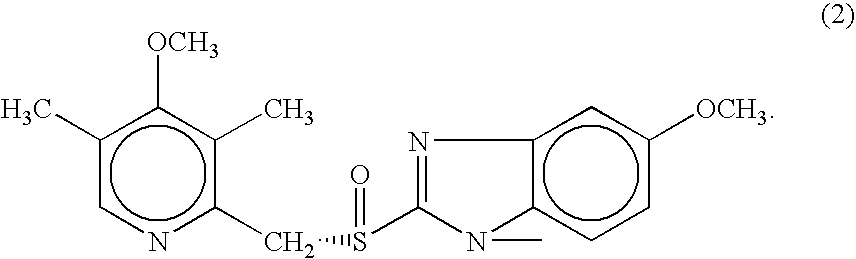
- NEXIUM™ products are supplied in delayed-release capsules and in packets for a delayed-release oral suspension. Each delayed-release capsule contains 20 mg or 40 mg of esomeprazole (as esomeprazole magnesium trihydrate) in the form of enteric-coated granules. Each packet of NEXIUM™ For Delayed-Release Oral Suspension contains 10 mg, 20 mg, or 40 mg of esomeprazole, in the form of the same enteric-coated granules used in NEXIUM™ Delayed-Release Capsules, and also inactive granules. The esomeprazole granules and inactive granules are constituted with water to form a suspension and are given by oral, nasogastric or gastric administration.
- NSAIDs, including naproxen, are among the most commonly prescribed and used drugs world-wide. Despite the therapeutic benefits of NSAIDs, their use is frequently limited by an increased risk of gastrointestinal side-effects, mainly upper gastrointestinal side-effects like peptic ulceration and dyspeptic symptoms. It appears that a major factor contributing to the development of these lesions is the presence of acid in the stomach and upper small intestine of patients. Proton pump inhibitors such as omeprazole have been shown to be able to prevent gastric and duodenal erosions in healthy volunteers during treatment with NSAIDs. Clinical studies have shown, that omeprazole heals gastric as well as duodenal ulcers as quickly and effectively in patients on continuous NSAID treatment as in non-NSAID users.
- Recognizing the potential benefits of proton pump inhibitors for the prevention of NSAID-induced gastroduodenal damage, there are strategies disclosed in the art for combining the two types of active agents for therapeutic purposes, other than by concomitant administration. U.S. Pat. No. 6,365,184 suggested a means of delivery that would expose the gastrointestinal tract to NSAIDs prior to onset of PPI activity. U.S. Pat. No. 6,926,907 discloses pharmaceutical formulations that provide coordinated release of an acid inhibitor and an NSAID.
- There remains a need for alternative pharmaceutical formulations comprising naproxen and esomeprazole in order to reduce the risk of gastrointestinal side effects in people taking naproxen for pain relief and for other conditions, and thereby improve patient compliance.
- In aspects, the present invention relates to pharmaceutical formulations comprising a proton pump inhibitor and a non-steroidal anti-inflammatory drug.
- Embodiments of the present invention relate to pharmaceutical formulations comprising naproxen and esomeprazole for therapeutic purposes, and methods of preparing the formulations.
- In embodiments, the invention includes pharmaceutical formulations comprising naproxen and esomeprazole, wherein at least a portion of naproxen is released when the formulations are immersed into aqueous fluids having pH values below about 3.5.
- In embodiments, the invention includes pharmaceutical formulations comprising naproxen and esomeprazole, wherein a portion of naproxen is released when the formulations are immersed into aqueous fluids having pH values less than about 3.5, and the remaining portion of naproxen is released when the formulations are immersed into aqueous fluids having pH values about 3.5 or higher.
- In embodiments, the invention includes pharmaceutical formulations comprising naproxen and esomeprazole, wherein at least a portion of naproxen and at least a portion of esomeprazole are released when the formulations are immersed into aqueous fluids having pH values less than about 3.5.
- In embodiments, the invention includes pharmaceutical formulations comprising naproxen and esomeprazole, wherein a portion of naproxen and at least a portion of esomeprazole are released when the formulations are immersed into aqueous fluids having pH values less than about 3.5, and a remaining portion of naproxen is released when the formulations are immersed into aqueous fluids having pH values about 3.5 or higher.
- In embodiments, the invention includes pharmaceutical formulations comprising naproxen and esomeprazole, wherein at least about 5% of naproxen is released when the formulations are immersed into aqueous fluids having pH values less than about 3.5, and a remaining portion of naproxen is released when the formulations are immersed into aqueous fluids having pH values about 3.5 or higher.
- In an aspect, the invention includes methods of preparing pharmaceutical formulations of the present invention.
- In an aspect, the invention includes methods of treating patients suffering from pain, inflammation, and/or other conditions using pharmaceutical formulations of the present invention. In a further aspect, the invention includes methods of reducing the risk of gastrointestinal side effects in patients taking naproxen for pain relief and for other conditions using pharmaceutical formulations of the present invention.
- Aspects of the present invention relate to pharmaceutical formulations comprising a proton pump inhibitor and a non-steroidal anti-inflammatory drug.
- Non-steroidal anti-inflammatory drugs include any of aspirin, ibuprofen, naproxen, flurbiprofen, ketoprofen, oxaprozin, etodolac, indomethacin, ketorolac, lornoxicam, nabumetone, diclofenac, and COX-2 inhibitors such as celecoxib, rofecoxib, meloxicam, piroxicam, valdecoxib, parecoxib and etoricoxib. Salts of the drug compounds also can be used herein.
- Proton pump inhibitors include any of drugs such as omeprazole, esomeprazole, pantoprazole, lansoprazole, dexlansoprazole, rabeprazole, and other “acid inhibitors” such as H2 blockers including cimetidine, ranitidine, ebrotidine, pabutidine, lafutidine, loxtidine, and famotidine. Salts of the drug compounds also can be used herein.
- For simplification, the discussion herein will pertain primarily to formulations comprising combinations of: the non-steroidal anti-inflammatory drug naproxen, or a salt thereof; and the proton pump inhibitor drug esomprazole, or a salt thereof such as the magnesium salt; but those skilled in the art will recognize that other drugs having similar therapeutic effects can be substituted therefor.
- Embodiments of the present invention relate to pharmaceutical formulations comprising naproxen and esomeprazole. Further embodiments of the present invention relate to fixed dose pharmaceutical formulations comprising naproxen, or pharmaceutically acceptable salts thereof, and esomeprazole, or pharmaceutically acceptable salts thereof, for therapeutic purposes, and methods of preparing the same.
- As used herein the term “naproxen” includes the compound naproxen, pharmaceutically acceptable salts of naproxen, isomers, solvates and hydrates thereof, and any polymorphic or amorphous forms or combinations thereof. Naproxen is used in the present invention in the range of about 50 to 1500 mg, or about 100 to 1250 mg, or about 350 to 800 mg, or about 275 to 550 mg, or about 250 mg to 500 mg, per dosage unit.
- As used herein the term “esomeprazole” includes the compound esomeprazole, pharmaceutically acceptable salts of esomeprazole, solvates and hydrates thereof, and any polymorphic or amorphous form or combinations thereof. Esomeprazole is used in the present invention in the range of about 5 to 100 mg, or about 10 to 60 mg, or about 20 to 40 mg, per dosage unit.
- As used herein, the terms “pharmaceutically acceptable salt,” or “salt,” include salts prepared using inorganic acids or bases, and organic acids or bases. Examples include metal salts such as aluminum, calcium, lithium, magnesium, potassium, sodium, and zinc salts. Examples of organic bases include N,N′-dibenzylethylenediamine, chloroprocaine, choline, diethanolamine, ethylenediamine, meglumaine (N-methylglucamine), lysine, and procaine. Examples of inorganic acids are hydrochloric, hydrobromic, hydroiodic, sulfuric, and phosphoric acids. Appropriate organic acids include, for example, aliphatic, aromatic, carboxylic and sulfonic classes of organic acids, some examples of which are formic, acetic, propionic, succinic, glycolic, glucoronic, maleic, furoic, glutamic, benzoic, anthranilic, salicylic, phenylacetic, mandelic, embonic (pamoic), methanesulfonic, ethanesulfonic, pantothenic, benzenesulfonic, stearic, sulfanilic, algenic, and galacturonic acids.
- The foregoing lists are not intended to be exhaustive, and many other substances can be used.
- In embodiments, the invention includes pharmaceutical formulations comprising naproxen and esomeprazole, wherein at least a portion of naproxen is released when the pH of a surrounding medium is below about 3.5.
- In embodiments, the invention includes pharmaceutical formulations comprising naproxen and esomeprazole, wherein a portion of naproxen is released when the pH of a surrounding medium is below about 3.5, and the remaining portion of naproxen is released when the pH of a surrounding medium is 3.5 or higher.
- Pharmaceutical formulations according to the present invention can be presented in forms such as tablets, multilayered tablets, capsules, granules, spheroids, beads, pellets, mini-tablets, powders, sachets, gels, dispersions, solutions, and suspensions.
- As used herein the term “particulate” includes particles such as granules, spheroids, beads, pellets, and mini-tablets.
- As used herein the term “at least a portion of naproxen” means at least about 5%, or at least about 10%, or at least about 20%, or at least about 50%, of naproxen contained in a formulation.
- The term “about” is related to a pH, ranging from 0 to 3.5.
- In embodiments, the invention includes pharmaceutical formulations comprising naproxen and esomeprazole, wherein at least a portion of naproxen and at least a portion of esomeprazole are released when the pH of a surrounding medium is below about 3.5.
- In embodiments, the invention includes pharmaceutical formulations comprising naproxen and esomeprazole, wherein a portion of naproxen and at least a portion of esomeprazole are released when the pH of a surrounding medium is below about 3.5, and a remaining portion of naproxen is released when the pH of a surrounding medium is 3.5 or higher.
- In embodiments, the invention includes pharmaceutical formulations comprising naproxen and esomeprazole, wherein at least a portion of naproxen and a portion of esomeprazole are released when the pH of a surrounding medium is below about 3.5, and a remaining portion of esomeprazole is released when the pH of a surrounding medium is 3.5 or higher.
- As used herein the term “at least a portion of esomeprazole” means at least about 50%, or at least about 70%, or at least about 90%, or about 100%, of esomeprazole contained in a formulation.
- In embodiments, the invention includes pharmaceutical formulations comprising naproxen and esomeprazole, wherein at least a portion of naproxen begins to be released from the pharmaceutical formulation immediately following administration, or within about 0.5 hour, or within about 1 hour, or within about 2 hours, following administration.
- In an embodiment, the invention includes pharmaceutical formulations comprising naproxen and esomeprazole, wherein at least a portion of esomeprazole begins to be released from the pharmaceutical formulation immediately following administration, or within about 0.5 hour, or within about 1 hour, or within about 2 hours, following administration.
- Pharmaceutical formulations of embodiments of the present invention are advantageous as they provide drug release in such a way that they provide a rapid onset of action, due to the release of at least a portion of naproxen when the pH of the surrounding medium is below about 3.5. Also, they provide release of at least a portion of esomeprazole along with at least a portion of naproxen, when the pH of the surrounding medium is below about 3.5, which elevates gastric pH before the release of the remaining portion of naproxen, occurring when the pH of the surrounding medium is 3.5 or higher. This tends to alleviate some of the deleterious effects of the naproxen on the gastro-duodenal mucosa.
- Release of drugs from their formulations in the body can be simulated using in vitro methods such as those described in Test 711 “Dissolution” of United States Pharmacopeia 29, United States Pharmacopeial Convention, Rockville, Md., 2005 (“USP”). Release profiles are determined by immersing a dosage form in an aqueous fluid and measuring the drug concentration in the fluid at various elapsed times. The USP gives compositions for various aqueous fluids that correspond to physiologic fluids, in test methods and in monographs for individual drug substances. Drug concentrations in dissolution fluids can be determined using techniques such as high performance liquid chromatography.
- In embodiments, the invention includes pharmaceutical formulations comprising naproxen and esomeprazole, wherein the formulations are in monolithic form or multiparticulate form. The present invention includes oral fixed unit dose formulations such as enteric coated tablets, multilayered tablets, multiple unit tableted dosage forms, capsules filled with enteric coated pellets, etc.
- In embodiments, the invention includes pharmaceutical formulations comprising naproxen and esomeprazole, wherein the formulations are bi-layer tablets having an outer layer comprising at least a portion of the contained naproxen and at least a portion of the contained esomeprazole, and an inner core which comprises the remaining portion of naproxen.
- The layers containing an active ingredient can be referred to as “active layers” and a layer that generally does not contain an active substance can be referred to as a “barrier layer” or a “support layer.” Multi-layered tablets of the present invention can be prepared as two-layer tablets, three-layer tablets, or in greater numbers of layers if desired. In embodiments, at least one layer will contain an active substance to be released from the tablet and least one layer will be a barrier or support layer with respect to the active substance-containing layer or layers.
- In embodiments, the invention includes pharmaceutical formulations comprising naproxen and esomeprazole, wherein said formulations are multi-layer tablets having an active layer comprising at least a portion of the contained naproxen and at least a portion of the contained esomeprazole, an inner core comprising the remaining portion of naproxen, and a polymeric barrier layer surrounding the inner core that does not dissolve unless the surrounding medium has a pH of at least about 3.5, or at a pH of at least about 4, or at a pH of at least about 5.
- In embodiments, the invention includes multi-layer tablets comprising: (a) an active layer comprising at least a portion of naproxen; (b) a second active layer comprising at least a portion of esomeprazole; (c) an inner core comprising the remaining portion of naproxen; and (d) and a polymeric barrier layer surrounding the inner core that does not dissolve unless the surrounding medium has a pH of at least 3.5; wherein the active layer (a) is formed over polymeric barrier layer (d). In another embodiment, the active layer (b) is formed over polymeric barrier layer (d).
- Multi-layered tablets of the invention can be prepared using methods known to those having skill in the art.
- In embodiments, pharmaceutical formulations of the invention optionally have one or more coatings which are functional or non-functional. Functional coatings include controlled release coatings; and non-functional coatings include seal coatings and elegant coatings.
- In embodiments, the invention includes pharmaceutical formulations comprising naproxen and esomeprazole, wherein the formulations are in multiparticulate form.
- In embodiments, the invention includes pharmaceutical formulations comprising multiparticulates, wherein each particle comprises naproxen and/or esomeprazole, optionally together with one or more pharmaceutically acceptable excipients.
- In embodiments, multiparticulates comprising naproxen are composed of a core comprising naproxen and optionally one or more pharmaceutically acceptable excipients.
- In embodiments, multiparticulates comprising naproxen are uncoated. In other embodiments, multiparticulates comprising naproxen include one or more coatings over a core.
- In embodiments, multiparticulates comprising esomeprazole are composed of a core comprising esomeprazole, and optionally one or more pharmaceutically acceptable excipients.
- In embodiments, multiparticulates comprising esomeprazole are uncoated. In other embodiments, multiparticulates comprising esomeprazole include one or more coatings over a core.
- In embodiments, multiparticulates have a non-functional seal coating, a functional coating, or both.
- In embodiments, an initial seal coating can be applied directly onto a core.
- In embodiments, multiparticulates further contain a coating layer comprising one or more enteric polymers, over an initial seal coating, if present, or directly over an uncoated multiparticulate naproxen core, to provide control of drug release.
- In embodiments, an enteric coating may be applied to esomeprazole-containing multiparticulates.
- In embodiments, enteric-coated multiparticulates are further coated with a final seal coating.
- In embodiments, any one or all of the coating formulations optionally contain naproxen, esomeprazole, or a combination thereof.
- In embodiments, multiparticulates comprising naproxen comprise a non-pariel core, such as inert sugar or similar substances, unto which naproxen is coated, optionally together with one or more pharmaceutically acceptable excipients, using any techniques such as powder layering, solution spraying, or suspension spraying.
- In embodiments, multiparticulates comprising esomeprazole comprise a non-pariel core such as inert sugar or similar substances, onto which esomeprazole is coated, optionally together with one or more pharmaceutically acceptable excipients, using any technique such as powder layering, solution spraying, or suspension spraying.
- In embodiments, the formulations of the invention are composed of naproxen-loaded non-pariel cores, having a coating comprising one or more enteric polymers.
- In embodiments, the invention includes pharmaceutical formulations comprising multiparticulates, comprising naproxen in a drug-containing core and a coating comprising one or more enteric polymers, and optionally having one or more further coatings.
- In embodiments, the invention includes pharmaceutical formulations comprising multiparticulates, comprising esomeprazole in a drug-containing core and a coating comprising one or more enteric polymers, and optionally having one or more further coatings.
- In embodiments, multiparticulates comprising naproxen contain a non-functional seal coating, a functional coating, or both.
- In embodiments, multiparticulates comprising esomeprazole contain a non-functional seal coating, a functional coating, or both.
- In embodiments, an initial seal coating is applied directly to drug-containing cores.
- In embodiments, enteric-coated multiparticulates are further coated with a final seal coating.
- In embodiments, the invention includes pharmaceutical formulations comprising:
- (a) a first set of multiparticulates comprising at least a portion of naproxen, wherein naproxen is released when the pH of a surrounding medium is below about 3.5; (b) a second set of multiparticulates comprising the remaining portion of naproxen, wherein naproxen is released when the pH of a surrounding medium is 3.5 or higher; and (c) a third set of multiparticulates comprising at least a portion of esomeprazole, wherein esomeprazole is released when the pH of a surrounding medium is below about 3.5.
- In embodiments, the invention includes pharmaceutical formulations comprising:
- (a) a first set of multiparticulates comprising at least a portion of naproxen, wherein naproxen is released when the pH of a surrounding medium is below about 3.5; (b) a second set of multiparticulates comprising the remaining portion of naproxen, wherein naproxen is released when the pH of a surrounding medium is 3.5 or higher; and (c) a third set of multiparticulates comprising esomeprazole, wherein esomeprazole is released when the pH of a surrounding medium is below about 3.5.
- The multiparticulate formulations of the invention can be prepared using techniques described herein, as well as other methods known to those having skill in the art.
- In embodiments, multiparticulates comprising naproxen and esomeprazole can be combined with a pharmaceutically acceptable carrier, and optionally other excipients, and compounded to form pharmaceutical formulations, i.e., can be compressed into tablets or placed into suitable capsule shells, using techniques known to those having skill in the art.
- In embodiments, the invention includes pharmaceutical formulations comprising naproxen and esomeprazole, wherein said formulations include an enteric coating layer which is deliberately formed such that the enteric coating is a partial or thin, “leaky,” or permeable enteric coating. These enteric-coated formulations are prepared such that upon contacting gastric fluid, either in vivo or in vitro, the leaky enteric coating layer allows at least a portion of the active ingredient to be released from the pharmaceutical formulation when the pH of a surrounding medium is below about 3.5. This release begins immediately following administration, or within about 0.5 hour, or within about 1 hour, or within about 2 hours, following administration. The enteric material composition may be made leaky by incorporating pore forming materials that allow gastric fluid to penetrate into the formulation and drug to be released from the formulation when the pH of a surrounding medium is below about 3.5.
- In embodiments, the invention includes pharmaceutical formulations comprising naproxen, esomeprazole and a leaky enteric coating layer.
- In embodiments, the invention includes pharmaceutical formulations comprising naproxen, esomeprazole and a leaky enteric coating layer from which at least a portion of naproxen in the formulation is released when the pH of a surrounding medium is below about 3.5 and remaining portion of naproxen in the formulation is released when the pH of a surrounding medium is 3.5 or higher.
- In embodiments, the invention includes pharmaceutical formulations comprising at least a portion of naproxen in the formulation is released when the pH of a surrounding medium is below about 3.5, such as about 2.5 to 3.5, and a remaining portion of naproxen in the formulation is released when the pH of a surrounding medium is 3.5 or higher.
- In embodiments, the invention includes pharmaceutical formulations comprising naproxen, esomeprazole, and an enteric coating layer comprising one or more pore forming agents.
- In embodiments, the invention includes pharmaceutical formulations comprising an inner core comprising naproxen and an enteric coating layer on the core comprising one or more pore forming agents.
- In embodiments, the invention includes pharmaceutical formulations comprising naproxen substantially homogeneously admixed with at least one enteric material comprising a pore forming agent.
- In embodiments, the present invention includes pharmaceutical formulations comprising naproxen, esomeprazole, and an enteric coating layer comprising one or more pore forming agents, wherein the amount of pore forming agent is from about 0-400% by weight of enteric polymer, or from about 5-200% by weight of enteric polymer, or from about 10-100% or from about 15-50% by weight of enteric polymer.
- One or more pore forming agents that can be used in the present invention include hydrophilic, hydrophobic, or a combination of both hydrophilic and hydrophobic, substances. Examples of pore forming agents include, without limitation: salts such as sodium chloride, potassium chloride, and magnesium salts; sugars, such as lactose, sucrose, sorbitol, and mannitol; hydroxylated compounds, including polyvinyl alcohols and glycols, such as polyethylene glycol and propylene glycol; cellulose-derived materials, such as hydroxypropyl celluloses and hydroxy propyl methycelluloses; methacrylic acid copolymers; miscellaneous materials such as croscarmellose sodium, crospovidone sodium starch glycolate, talc, silicon dioxide, polyvinylpyrrolidones, gelling agents such as carbopol, and xanthan gum; and any mixtures thereof.
- An inner core comprising naproxen or esomeprazole may be prepared using optional pharmaceutically acceptable excipients such as binders, fillers, disintegrants, lubricants, etc., by methods known to those having skill in the art such as low- or high-shear granulation, wet granulation, slugging, fluidized-bed granulation, and extrusion-spheronization. The manufactured inner core can be used for further processing, e.g., can be provided with an enteric coating material and can further be coated with active ingredient layers comprising naproxen or esomeprazole, optionally using separating functional or non-functional coating layers.
- The active ingredient layers comprising naproxen or esomeprazole, together with optional pharmaceutically acceptable excipients such as fillers, binders, plasticizers, anti-tacking and anti-static agents, etc., can be applied to an inner core by coating or layering procedures in suitable equipment such as coating pans, coating granulators, or in a fluidized bed apparatus, using water and/or organic solvents for the coating process.
- An inner core or active layer comprising esomeprazole may also contain alkaline, pharmaceutically acceptable substances. Such substances include, but are not limited to, substances such as the sodium, potassium, calcium, magnesium and aluminum salts of phosphoric acid, carbonic acid, citric acid, and other suitable weak inorganic or organic acids, aluminum hydroxide, sodium bicarbonate, substances frequently used in antacid preparations such as aluminum, calcium and magnesium hydroxides; magnesium oxide or composite substances, such as Al2O3.6MgO.CO2.12H2O, (Mg6Al2(OH)16CO3.4H2O), MgO.Al2O3.2SiO2.nH2O and similar compounds, organic pH-buffering substances such as trihydroxymethyl aminomethane, basic amino acids and their salts, and other pharmaceutically acceptable pH-buffering substances.
- In embodiments, the present invention includes pharmaceutical formulations comprising naproxen, esomeprazole and at least one alkaline substance, wherein the amount of alkaline substance is from about 10 to about 1800% by weight of esomeprazole, or from about 25 to about 1500% by weight of esomeprazole, or from about 50 to about 1200% by weight of esomeprazole, or from about 100 to about 900% by weight of esomeprazole.
- Enteric polymers that can be used in the present invention include, without limitation thereto, cellulose acetate phthalates, hydroxypropyl methylcellulose phthalates, polyvinyl acetate phthalates, hydroxypropyl methylcellulose acetate succinates, cellulose acetate trimellitates, hydroxypropyl methylcellulose succinates, cellulose acetate succinates, cellulose acetate hexahydrophthalates, cellulose propionate phthalates, copolymers of methylmethacrylic acid and methyl methacrylate, copolymers of methyl acrylate, methylmethacrylate and methacrylic acid, copolymers of methylvinyl ether and maleic anhydride (Gantrez™ ES products), ethyl methyacrylate-methylmethacrylate-chlorotrimethylammonium ethyl acrylate copolymers, natural resins such as zein, shellac and copal collophorium, carboxymethyl ethylcellulose, co-polymerized methacrylic acid/methacrylic acid methyl esters such as, for instance, materials known under the trade name EUDRAGIT® L12.5, L100, S12.5, and S100, and several commercially available enteric dispersion systems (e.g., EUDRAGITt®L30D55, FS30D, L100-55, and S100, all sold by Evonik Industries, Germany), KOLLICOAT® MAE30D and 30DP (BASF), ESTACRYL® 30D (Eastman Chemical), AQUATERIC® and AQUACOAT® CPD30 (FMC), and any mixtures thereof.
- Enteric coating layers are applied onto an inner core, or onto an inner core covered with a seal coating layer, using suitable coating techniques. The enteric coating layer material may be dispersed or dissolved in either water or in a suitable organic solvent. One or more enteric coating layers, separately or in combination, can be used.
- In certain embodiments, pharmaceutical formulations of the present invention optionally include additives additional to the active agents, which include without limitation diluents, binders, disintegrants, surfactants, and other additives that are commonly used in solid dosage form preparations.
- Various useful fillers or diluents include but are not limited to starches, lactose, cellulose derivatives, confectioner's sugar and the like. Different grades of lactose include but are not limited to lactose monohydrate, lactose DT (direct tableting), lactose anhydrous, FLOWLAC™ (available from Meggle Products), PHARMATOSE™ (available from DMV) and others. Different starches include but are not limited to maize starch, potato starch, rice starch, wheat starch, pregelatinized starch (commercially available as PCS PC10 from Signet Chemical Corporation) and starch 1500, starch 1500 LM grade (low moisture content grade) from Colorcon, fully pregelatinized starch (commercially available as National 78-1551 from Essex Grain Products), and others. Different cellulose materials that can be used include crystalline celluloses and powdered celluloses. Examples of crystalline cellulose products include but are not limited to CEOLUS™ KG801, AVICEL™ PH101, PH102, PH301, PH302, PH-F20, PH-112, microcrystalline cellulose 114, and microcrystalline cellulose 112. Other useful diluents include but are not limited to carmellose, sugar alcohols such as mannitol (PEARLITOL™ SD200), sorbitol and xylitol, calcium carbonate, magnesium carbonate, dibasic calcium phosphate, and tribasic calcium phosphate.
- Various useful binders include but are not limited to hydroxypropylcelluloses, also called HPC (KLUCEL™ LF, or EXF) and useful in various grades, hydroxypropyl methylcelluloses, also called hypromelloses or HPMC (METHOCEL™) and useful in various grades, polyvinylpyrrolidones or povidones (such as grades PVP-K25, PVP-K29, PVP-K30, and PVP-K90), PLASDONE™ S 630 (copovidone), powdered acacia, gelatin, guar gum, carbomers (CARBOPOL™), methylcelluloses, polymethacrylates, and starches.
- Various useful disintegrants include but are not limited to carmellose calcium (Gotoku Yakuhin Co., Ltd.), carboxymethylstarch sodium (Matsutani Kagaku Co., Ltd., Kimura Sangyo Co., Ltd., etc.), croscarmellose sodium (Ac-di-sol™ from FMC-Asahi Chemical Industry Co., Ltd.), crospovidones, examples of commercially available crospovidone products including but not limited to crosslinked povidone, KOLLIDON™ CL [manufactured by BASF (Germany)], POLYPLASDONE™ XL, XI-10, and INF-10 manufactured by ISP Inc. (USA), and low-substituted hydroxypropylcelluloses. Examples of low-substituted hydroxypropylcelluloses include but are not limited to low-substituted hydroxypropylcellulose LH11, LH21, LH31, LH22, LH32, LH20, LH30, LH32 and LH33 (all manufactured by Shin-Etsu Chemical Co., Ltd.). Other useful disintegrants include sodium starch glycolate, colloidal silicon dioxide, and starches.
- Useful surface-active agents include non-ionic, cationic and anionic surface-active agents. Useful non-ionic surface-active agents include ethylene glycol stearates, propylene glycol stearates, diethylene glycol stearates, glycerol stearates, sorbitan esters (SPAN™ products) and polyhydroxyethylenically treated sorbitan esters (TWEEN™ products), aliphatic alcohols and PEG ethers, phenol and PEG ethers. Useful cationic surface-active agents include quaternary ammonium salts (e.g., cetyltrimethylammonium bromide) and amine salts (e.g., octadecylamine hydrochloride). Useful anionic surface-active agents include sodium stearate, potassium stearate, ammonium stearate, and calcium stearate, triethenolamine stearate, sodium lauryl sulphate, sodium dioctylsulphosuccinate, and sodium dodecylbenzenesulphonate. Natural surface-active agents may also be used, such as for example phospholipids, e.g. diacylphosphatidyl glycerols, diaceylphosphatidyl cholines, and diaceylphosphatidic acids, the precursors and derivatives thereof, such as for example soybean lecithin and egg yolk.
- An effective amount of any pharmaceutically acceptable tableting lubricant can be added to assist with compressing tablets. Useful tablet lubricants include magnesium stearate, glyceryl monostearates, palmitic acid, talc, carnauba wax, calcium stearate sodium, sodium or magnesium lauryl sulfate, calcium soaps, zinc stearate, polyoxyethylene monostearates, calcium silicate, silicon dioxide, hydrogenated vegetable oils and fats, stearic acid and combinations thereof.
- One or more glidant materials, which improve the flow properties of powder blends and minimize dosage form weight variations can be used. Useful glidants include but are not limited to silicone dioxide, talc, and combinations thereof.
- Coloring agents can be used to color code the formulations, for example, to indicate the type and dosage of the therapeutic agent therein. Suitable coloring agents include, without limitation, natural and/or artificial compounds such as FD&C coloring agents, natural juice concentrates, pigments such as titanium oxide, iron oxides, silicon dioxide, zinc oxide, combinations thereof, and the like.
- Various solvents can be used in the processes for preparation of pharmaceutical formulations of the present invention, including but not limited to water, methanol, ethanol, acidified ethanol, acetone, diacetone, polyols, polyethers, oils, esters, alkyl ketones, methylene chloride, isopropyl alcohol, butyl alcohol, methyl acetate, ethyl acetate, isopropyl acetate, castor oil, ethylene glycol monoethyl ether, diethylene glycol monobutyl ether, diethylene glycol monoethyl ether, dimethylsuiphoxide, N,N-dimethylformamide, tetrahydrofuran, and any mixtures thereof.
- In certain embodiments, pharmaceutical formulations of the present invention optionally include one or more polymers additional to the active agents, additives and enteric polymers that are commonly used in solid dosage form preparations.
- One or more polymers that can be used in the present invention include hydrophilic, hydrophobic, and lipophilic substances, and combinations thereof. Examples of polymers that can be used in present invention include, without limitation thereto, cellulose ethers, e.g., hydroxypropyl methylcelluloses or hypromelloses (HPMC), hydroxypropylcelluloses (HPC), hydroxyethylcelluloses, ethylcelluloses and carboxymethylcellulose sodium, polymers of vinylpyrrolidone, including homopolymers (povidones) and cross-linked polyvinylpyrrolidones, carboxymethylstarches, polyethylene glycols, polyoxyethylenes, poloxamers (polyoxyethylene-polyoxypropylene copolymers), polyvinylalcohols, glucanes (glucans), carrageenans, scleroglucanes (scieroglucans), mannans, galactomannans, gellans, alginic acid and derivatives (e.g., sodium or calcium alginate, propylene glycol alginate), polyaminoacids (e.g. gelatin), methyl vinyl ether/maleic anhydride copolymers, polysaccharides (e.g. carageenan, guar gum, xanthan gum, tragacanth and ceratonia), alpha, beta or gamma cyclodextrins, and dextrin derivatives (e.g. dextrin), polymethacrylates (e.g. copolymers of acrylic and methacrylic acid esters containing quaternary ammonium groups); acrylic acid polymers (e.g., carbomers); shellac, and derivatives thereof, cellulose acetate, cellulose butyrate, cellulose diacetate, cellulose triacetate, cellulose propionate, cellulose acetate butyrate, and other acetylated cellulose derivatives, etc.
- Examples of lipophilic substances that can be used in the present invention include, without limitation thereto, waxes (e.g., carnauba wax, microcrystalline wax, beeswax, polyethoxylated beeswax); natural fats (coconut, soya, cocoa) including modified forms such as totally or partially hydrogenated, hydrogenated castor oil, hydrogenated vegetable oil, and fatty acid derivatives such as mono-, bi- and tri-substituted glycerides, phospholipids, glycerophospholipids, glyceryl palmitostearate, glyceryl behenate, glyceryl monostearate, diethylene glycol palmitostearate, polyethylene glycol stearate, polyethylene glycol palmitostearate, polyoxyethylene-glycol palmitostearate, glyceryl monopalmitostearate, cetyl palmitate, fatty alcohols associated with polyethoxylate fatty alcohols, cetyl alcohol, stearic acid, saturated or unsaturated fatty acids and their hydrogenated derivatives, lecithin, cephalins, chitosan and derivatives thereof, sphingolipids, sterols such as cholesterol and its substituted derivatives, etc.
- Coating materials used for film coating include the polymers described above. Useful additives for coating include but are not limited to plasticizers, antiadherents, opacifiers, solvents, and optionally colorants, lubricants, pigments, antifoam agents, and polishing agents.
- Various useful plasticizers include but are not limited to substances such as castor oil, diacetylated monoglycerides, dibutyl sebacate, diethyl phthalate, glycerin, polyethylene glycol, propylene glycol, triacetin, and triethyl citrate. Also, mixtures of plasticizers may be utilized. The type of plasticizer depends upon the type of coating agent. An opacifier like titianium dioxide may also be present in an amount ranging from about 10% (w/w) to about 20% (w/w) based on the total weight of the coating.
- Antiadhesives are frequently used in the film coating process to avoid sticking effects during film formation and drying. An example of a useful antiadhesive for this purpose is talc. The antiadhesive is frequently present in the film coating in an amount of about 5% (w/w) to about 15% (w/w) based upon the total weight of the coating.
- When coloured tablets are desired, the colour is normally applied in the coating. Consequently, colouring agents and pigments may be present in the film coating. Various colouring agents include but are not limited to iron oxides, which can be red, yellow, black or blends thereof.
- Suitable polishing agents include polyethylene glycols of differing molecular weights and mixtures thereof, talc, surfactants (e.g. glycerol monostearate and poloxamers), fatty alcohols (e.g., stearyl alcohol, cetyl alcohol, lauryl alcohol and myristyl alcohol) and waxes (e.g., carnauba wax, candelilla wax and white wax). In some embodiments, polyethylene glycols having molecular weights of 3,000-20,000 are employed.
- As alternatives to the above coating ingredients, sometimes pre-formulated coating products such as OPADRY™ (supplied by Colorcon) will be used. Opadry formulations generally comprise polymer, plasticizer and, if desired, pigment in a dry concentrate that requires only dispersion in a liquid prior to use. Opadry formulas produce attractive, elegant coatings on a variety of tablet cores and can be used in both aqueous and organic coating procedures.
- In an embodiment, the invention includes methods of preparing pharmaceutical formulations of the present invention.
- Equipment suitable for processing the pharmaceutical formulations of the present invention include rapid mixer granulators, planetary mixers, mass mixers, ribbon mixers, fluid bed processors, mechanical sifters, blenders, roller compacters, extrusion-spheronizers, compression machines, capsule filling machines, rotating bowls or coating pans; tray dryers, fluid bed dryers, rotary cone vacuum dryers, and the like, multimills, fluid energy mills, ball mills, colloid mills, roller mills, hammer mills, and the like, and different sieves. All sieves that are used for processing the pharmaceutical formulations of the present invention are according to the standards of ASTM (American Society for Testing Materials).
- In some embodiments, the invention includes use of packaging materials such as containers and closures of high-density polyethylene (HDPE), low-density polyethylene (LDPE) and or polypropylene and/or glass, and blisters or strips composed of aluminum or high-density polypropylene, polyvinyl chloride, polyvinylidene dichloride, etc.
- In aspects, the invention includes methods of treating patients suffering from pain, inflammation and/or other conditions using pharmaceutical formulations of the present invention. In aspects, the invention includes methods of reducing the risk of gastrointestinal side effects in people taking naproxen for pain relief and for other conditions using pharmaceutical formulations of the present invention.
- The pharmaceutical dosage forms of the present invention are intended for oral administration to a patient in need thereof.
- Certain specific aspects and embodiments of the invention will be explained in more detail with reference to the following examples, being provided only for purposes of illustration, and it is to be understood that the present invention is not deemed to be limited thereto.
-
-
Ingredient mg/Tablet Core Tablet Naproxen 460 Microcrystalline cellulose 115 Povidone (PVP K30) 20 Talc 15 Magnesium stearate 10 Tablet Total 620 Enteric Coating Eudragit ™ L-100-55** 37.2 Triethyl citrate 3.72 Talc 18.6 Water* q.s. Isopropyl alcohol* q.s. Coating Total 59.52 Naproxen Layer Naproxen 40 Eudragit L-100-55 7 Triethyl citrate 0.7 Talc 4.1 Isopropyl alcohol* q.s. Layer Total 51.8 Esomeprazole Layer Esomeprazole magnesium 20 Opadry ™ Clear YS-1-7006*** 15 Water* q.s. Isopropyl alcohol* q.s. Layer Total 35 *Evaporates during processing. **Eudragit L-100-55 is sold by Evonik Industries Ltd., Germany, and contains anionic copolymer based on methacrylic acid and ethyl acrylate. ***Opadry Clear is a product of Colorcon, containing 91% w/w of hydroxypropyl methylcellulose (E-6) and 9% w/w of polyethylene glycol. - Manufacturing Process:
- Core Tablet
- 1. Sift naproxen and microcrystalline cellulose through a #20 mesh sieve and mix.
- 2. Dissolve povidone in water and use to granulate the dry mixture of step 1.
- 3. Dry the wet mass at 70° C. for 1 hour and sift the granules through a #30 mesh sieve.
- 4. Sift talc through a #40 mesh sieve and mix with the dried granules of step 3.
- 5. Sift magnesium stearate through a #40 mesh sieve and mix with the blend of step 4.
- 6. Compress the lubricated blend of step 5 into tablets.
- 7. Disperse Eudragit L-100-55, triethyl citrate and talc in a mixture of water and isopropyl alcohol.
- 8. Coat the tablets of step 6 with the coating dispersion of step 7.
- Naproxen Layer
- 9. Disperse Eudragit L-100-55, triethyl citrate and talc in isopropyl alcohol.
- 10. Dissolve naproxen in the dispersion of step 9.
- 11. Coat the naproxen enteric coated tablets of step 8 with the dispersion of step 10.
- Esomeprazole Layer
- 12. Dissolve esomeprazole magnesium in a dispersion of Opadry Clear in water and isopropyl alcohol.
- 13. Coat the layered tablets of step 11 with the dispersion of step 12.
-
-
mg/Tablet Ingredient 2 3 4 5 Core Naproxen 460 460 460 460 Microcrystalline cellulose 115 115 115 115 Povidone (PVP K30) 20 20 20 20 Talc 15 15 15 15 Magnesium stearate 10 10 10 10 Core Total 620 620 620 620 Barrier Layer Opadry Clear YS-1-7006 18 18 — — Water* q.s. q.s. — — Layer Total 18 18 — — Enteric Coating Eudragit L-100-55 37.2 37.2 37.2 37.2 Triethyl citrate 3.72 3.72 3.72 3.72 Talc 18.6 18.6 18.6 18.6 Water* q.s. q.s. q.s. q.s. Isopropyl alcohol* q.s. q.s. q.s. q.s. Coating Total 59.52 59.52 59.52 59.52 Naproxen Layer Naproxen 40 40 40 40 Opadry Clear YS-1-7006 — — 30 30 Eudragit L-100-55 7 7 — — Triethyl citrate 0.7 0.7 — — Talc 4.1 4.1 — — Water* q.s. q.s. q.s. q.s. Isopropyl alcohol* q.s. q.s. — — Layer Total 51.8 51.8 70 70 Esomeprazole Layer Esomeprazole magnesium 20 20 20 20 Opadry Clear YS-1-7006 15 15 15 15 Water* q.s. q.s. q.s. q.s. Isopropyl alcohol* q.s. q.s. q.s. q.s. Layer Total 35 35 35 35 Barrier Layer Opadry Clear YS-1-7006 — 24 — 25 Water* — q.s. — q.s. Layer Total — 24 — 25 *Evaporates during processing. - Manufacturing processes are similar to that of Example 1, with the following differences:
- Example 2: a barrier layer is applied between the naproxen core and enteric coating.
- Example 3: a barrier layer is applied between the naproxen core and enteric coating, and another barrier layer is applied over the esomeprazole layer.
- Example 4: Opadry Clear YS-1-7006 is used in the naproxen layer instead of Eudragit L-100-55.
- Example 5: Opadry Clear YS-1-7006 is used in the naproxen layer instead of Eudragit L-100-55, and a barrier layer is applied over the esomeprazole layer.
-
-
Ingredient mg/Tablet Naproxen Pellets Naproxen 500 Microcrystalline cellulose (Avicel ™ PH200) 64 Povidone (PVP K90) 6 Pellet Total 570 Enteric Coating (Part I) Eudragit L-100 46.74 Diethyl phthalate 9.69 Acetone q.s. Isopropyl alcohol q.s. Part I Total 56.43 Enteric Coating (Part II) Eudragit L-100 6.26 Diethyl phthalate 10.65 Acetone* q.s. Isopropyl alcohol* q.s. Part II Total 16.91 Esomeprazole Blend Esomeprazole 20 Microcrystalline cellulose (Avicel PH101) 78 Magnesium stearate 2 Blend Total 100 Compression Microcrystalline cellulose (Avicel PH102) 300 Lactose 70 Magnesium stearate 10 Compression Total 380 *Evaporates during processing. - Manufacturing Process:
- Naproxen Pellets
- 1. Sift naproxen and Avicel PH200 through a #20 mesh sieve and mix.
- 2. Dissolve povidone in water and use to granulate the dry mixture of step 1.
- 3. Mix the wet mass of step 2.
- 4. Pass the wet mass through an extruder-spheronizer to form pellets.
- 5. Dry the pellets of step 4 and separate into two portions, Part I having 92% of naproxen pellets and Part II having 8% of naproxen pellets, by weight.
- Enteric Coating (Part I)
- 6. Dissolve Eudragit L-100 and diethyl phthalate in a mixture of isopropyl alcohol and acetone.
- 7. Spray the coating solution of step 6 onto 92% w/w of naproxen pellets of step 5.
- Enteric Coating (Part II)
- 8. Dissolve Eudragit L-100 and diethyl phthalate in a mixture of isopropyl alcohol and acetone.
- 9. Spray the coating solution of step 8 onto 8% w/w of naproxen pellets of step 5.
- Esomeprazole Blend
- 10. Sift esomeprazole and Avicel PH101 through a #20 mesh sieve and mix.
- 11. Sift magnesium stearate through a #40 mesh sieve and mix with the blend of step 10.
- Compression
- 12. Sift Avicel PH102 and lactose through a #20 mesh sieve and mix.
- 13. Mix the blend of step 12 with esomeprazole blend of step 11, enteric coated pellets of step 7, and enteric coated pellets of step 9.
- 14. Sift magnesium stearate through a #40 mesh sieve and mix with the blend of step 13.
- 15. Compress the lubricated blend of step 14 into tablets.
-
-
mg/Tablet Ingredient 7 8 9 10 Naproxen Pellets Naproxen 500 500 500 500 Microcrystalline cellulose 64 64 64 64 (Avicel PH200) Povidone (PVP K90) 6 6 6 6 Pellet Total 570 570 570 570 Barrier Layer Povidone K30 28.5 57 57 57 Alcohol* q.s. q.s. q.s. q.s. Layer Total 28.5 57 57 57 Enteric Coating (Part I) Eudragit L-100 49.8 49.8 49.8 49.8 Diethyl phthalate 10.17 10.17 10.17 10.17 Acetone* q.s. q.s. q.s. q.s. Isopropyl alcohol* q.s. q.s. q.s. q.s. Part I Coating Total 59.97 59.97 59.97 59.97 Enteric Coating (Part II) Eudragit L-100 6.5 6.5 6.5 6.5 Diethyl phthalate 11.05 11.05 11.05 11.05 Acetone* q.s. q.s. q.s. q.s. Isopropyl alcohol* q.s. q.s. q.s. q.s. Part II Coating Total 17.55 17.55 17.55 17.55 Esomeprazole Blend Esomeprazole 20 20 20 20 Sodium bicarbonate — — 140 140 Hydroxypropyl — 2 — 2 methylcellulose (HPMC) Microcrystalline cellulose — 76 — 76 (Avicel PH101) Microcrystalline cellulose 78 — 36 — (Avicel PH102) Water* — q.s. — q.s. Magnesium stearate 2 2 4 2 Blend Total 100 100 200 240 Compression Microcrystalline cellulose 300 300 300 300 (Avicel PH102) Lactose 70 70 70 70 Magnesium stearate 10 10 10 10 Compression Total 380 380 380 380 *Evaporates during processing. - Manufacturing processes are similar to that of Example 6, with the following differences:
- Example 7: a barrier layer coating is applied to naproxen pellets before enteric coating.
- Example 8: a barrier layer coating is applied to naproxen pellets before enteric coating, and there is an additional ingredient HPMC in the esomeprazole blend.
- Example 9: a barrier layer coating is applied to naproxen pellets before enteric coating, and there is an additional ingredient sodium bicarbonate in the esomeprazole blend.
- Example 10: a barrier layer coating is applied to naproxen pellets before enteric coating, and there are additional ingredients HPMC and sodium bicarbonate in the esomeprazole blend.
-
-
mg/Tablet Ingredient 11 12 13 Core Naproxen 500 500 500 Microcrystalline cellulose 115 115 115 Povidone (PVP K30) 20 20 20 Talc 15 15 15 Magnesium stearate 10 10 10 Core Total 660 660 660 Enteric Coating Eudragit L-100-55 40 40 40 Triethyl citrate 4 4 4 Lactose 6 — — Span ™ 60** — 4 — Tween ™ 80*** — — 2 Talc 20 20 20 Water* q.s. q.s. q.s. Isopropyl alcohol* q.s. q.s. q.s. Layer Total 70 68 66 Esomeprazole Layer Esomeprazole magnesium 20 20 20 Opadry Clear YS-1-7006 15 15 15 Water* q.s. q.s. q.s. Isopropyl alcohol* q.s. q.s. q.s. Layer Total 35 35 35 *Evaporates during processing. **SPAN 60 is Sorbitan monostearate. ***Span 80 is Sorbitan monooleate. - Example 11 Manufacturing Process:
- Core
- 1. Sift naproxen and microcrystalline cellulose through a #20 mesh sieve and mix.
- 2. Dissolve povidone in water and use to granulate the dry mixture of step 1.
- 3. Dry the wet mass at 70° C. for 1 hour and sift the granules through a #30 mesh sieve.
- 4. Sift talc through a #40 mesh sieve and mix with the dried granules of step 3.
- 5. Sift magnesium stearate through a #40 mesh sieve and mix with the blend of step 4.
- 6. Compress the lubricated blend of step 5 into tablets.
- Enteric Coating
- 7. Disperse Eudragit L-100-55, triethyl citrate, lactose and talc in a mixture of water and isopropyl alcohol.
- 8. Coat the tablets of step 6 with the dispersion of step 7.
- Esomeprazole Layer
- 9. Dissolve esomeprazole magnesium in a dispersion of Opadry Clear in water and isopropyl alcohol.
- 10. Coat the layered tablets of step 8 with the dispersion of step 9.
- Example 12 manufacturing process is similar to that of Example 11, except that Span 60 is used instead of lactose in the enteric coating.
- Example 13 manufacturing process is similar to that of Example 11, except that Tween 80 is used instead of lactose in the enteric coating.
-
-
mg/Tablet Ingredient 14 15 Core Naproxen 500 500 Povidone (PVP K90) — 15 Eudragit L30 D55 50 45 Water* q.s. qs Lactose monohydrate 15 — Talc 13.5 Croscarmellose sodium 10 14.4 Magnesium stearate 3 3 Core Total 578 590.9 Subcoating Opadry Clear 39B590000 28.9 29.5 Water* q.s. q.s. Coating Total 28.9 29.5 Drug Layering Esomeprazole magnesium 20.7 20.71 Hypromellose 3 cP 10 10 Povidone (PVP K30) 5 5 Macrogol PEG 400 4 4 Poloxamer 188 (Lutrol ™ F68) 3 3 Croscarmellose sodium 4 4 Lactose monohydrate 23 23 Magnesium oxide light 5 5 Methanol* q.s. q.s. Water* q.s. q.s. Drug Layer Total 74.7 74.7 Protective Coating Hypromellose 3 cP 3.5 3.5 Lactose monohydrate 10.5 10.5 Croscarmellose sodium 4.8 4.8 Macrogol PEG 400 0.44 0.4 Iron oxide, yellow 0.12 0.12 Water* q.s. q.s. Coating Total 19.4 19.4 Tablet Total 701.01 714.5 *Evaporates during processing - Manufacturing process for Example 14:
- 1. Naproxen is granulated with a 10% weight by weight dispersion of Eudragit L30-D55 in water loaded in a fluid bed coater, using a top spray technique. The granules are dried.
- 2. Lactose and croscarmellose sodium are added to the granules and blended for about 5 minutes.
- 3. Magnesium stearate is added and blended for about 5 minutes, then the mixture is compressed into tablets.
- 4. Tablets are coated with an Opadry dispersion using a coating pan, to produce a 5% weight gain, and then are dried.
- 5. Drug layering ingredients are mixed to form dispersion and sprayed on to the sub-coated tablets by pan coating.
- 6. Drug layered tablets are coated with a dispersion of protective coating ingredients, and dried.
- Manufacturing Process for Example 15:
- 1. Naproxen is granulated with a povidone solution by top spray in a fluid bed coater, and the granules are dried.
- 2. Dry granules are coated with a 10% w/w dispersion of Eudragit L30-D55 in water by top spray, and the granules are dried to a loss on drying (LOD) of 2% or less.
- 3. Croscarmellose sodium is blended with the granules for 5 minutes.
- 4. Magnesium stearate is added and blended for 5 minutes.
- 5. The mixture is compressed into tablets.
- 6. Tablets are coated with Opadry dispersion in a coating pan, to produce at 5% weight gain, after drying.
- 7. Drug layering ingredients are mixed to form dispersion and sprayed on to the sub-coated tablets by pan coating.
- 8. Drug layered tablets are coated with a dispersion of protective coating ingredients, and dried.
-
-
Ingredient mg/Tablet Naproxen Layer (Layer 1) Naproxen 500 Eudragit L30 D55 50 Water* q.s. Lactose monohydrate 15 Croscarmellose sodium 10 Magnesium stearate 3 Layer Total 578 Intermediate Layer (Layer 2) Microcrystalline cellulose 10 Lactose monohydrate 100 Povidone (PVP K90) 20 Magnesium stearate 5 Layer Total 225 Drug Layer (Layer 3) Esomeprazole magnesium 20.7 Povidone (PVP K30) 20 Microcrystalline cellulose 100 Croscarmellose sodium 15 Meglumine 5 Methanol* q.s. Croscarmellose sodium 10 Microcrystalline cellulose 150 Magnesium stearate 5.00 Layer Total 325.7 Final Coating Opadry Yellow 33.8 Water* q.s. Coating Total 33.8 Tablet Total 1162.5 *Evaporates during processing. - Manufacturing Process:
- I) Layer 1
- 1. Naproxen is granulated with a 10% w/w dispersion of Eudragit L30-D55 in a fluid bed processor, with top spray. The granules are dried to a LOD less than 2% w/w.
- 2. Lactose and croscarmellose sodium are added and blended for 5 minutes.
- 3. Magnesium stearate was added and blended for 5 minutes. II) Layer 2 1. Microcrystalline cellulose, lactose and povidone are blended for 5 minutes.
- 2. Magnesium stearate is added and blended for 5 minutes. III) Layer 3
- 1. Esomeprazole magnesium, povidone, microcrystalline cellulose, and croscarmellose sodium ares mixed in a rapid mixer granulator for 5 minutes.
- 2. Meglumine is dissolved in methanol and used to granulate the blend of step 1. Granules are dried in a fluid bed dryer to a LOD less than 2%.
- 3. Granules are blended with croscarmellose sodium and microcrystalline cellulose for 5 minutes.
- 4. Magnesium stearate is added and blended for 5 minutes. IV) Tableting
- 1. Layer 1 is placed into a die and lightly compressed. Layer 2 is added to the die and lightly compressed. Layer 3 is added and compressed to form a tri-layer tablet.
- 2. Tablets are coated with the protective coating dispersion by pan coating, to produce a 3% weight gain, after drying.
-
-
Ingredient mg/Tablet Core Naproxen 465 Povidone (PVP K90) 15 Croscarmellose sodium 15 Water* q.s. Croscarmellose sodium 15 Magnesium stearate 3 Enteric Coating Naproxen 35 Eudragit ™ L30 D55** 45 Talc 9 Triethyl citrate 4.5 Sodium hydroxide 1.13 Water* q.s. Coating Total 94.63 Subcoating Opadry Clear 39B590000 25.65 Water* q.s. Coating Total 25.65 Drug Layering Esomeprazole magnesium 20.71 Hypromellose 3 cP 10 Povidone (PVP K30) 5 Macrogol PEG 400 4 Poloxamer 188 (Lutrol F68) 3 Croscarmellose sodium 4 Lactose monohydrate 23 Magnesium oxide light 5 Methanol* q.s. Water* q.s. Drug Layer Total 74.71 Protective Coating Hypromellose 3 cP 3.49 Lactose monohydrate 10.55 Croscarmellose sodium 4.80 Macrogol PEG 400 0.44 Iron oxide, yellow 0.12 Water* q.s. Coating Total 19.4 *Evaporates during processing. **Eudragit L30 D55 is a product of Evonik Industries Ltd, Germany, and contains anionic copolymer based on methacrylic acid and ethyl acrylate. - Manufacturing Process:
- 1. Naproxen and croscarmellose sodium (first quantity) are mixed and granulated using a solution of povidone and water, in a fluid bed processor with top spray. The granules are dried to a LOD less than 2% w/w.
- 2. Croscarmellose sodium (second quantity) is added and blended for 5 minutes.
- 3. Magnesium stearate is added and blended for 5 minutes.
- 4. The blend is compressed into tablets.
- 5. Talc, triethyl citrate, and sodium hydroxide are combined with Eudragit L30-D55, the mixture is stirred for 30 minutes, then naproxen is added and stirring is continued for 15 minutes.
- 6. The dispersion is coated onto tablets, to produce an 18.5% weight gain, after drying.
- 7. Tablets are coated with subcoating ingredients.
- 8. Drug loading ingredients are mixed & made dispersion and used to coat the subcoated tablets by pan coating.
- 9. Drug layered tablets are coated with a mixture of protective coating ingredients.
-
-
Ingredient mg/Tablet Core Naproxen 465 Povidone (PVP K90) 15 Croscarmellose sodium 15 Water* q.s. Croscarmellose sodium 15 Magnesium stearate 3 Core Total 513 Enteric Coating (Part 1) Eudragit L30 D55 35 Talc 7 Triethyl citrate 3.5 Sodium hydroxide 0.88 Water* q.s. Coating Total 46.38 Enteric Coating (Part 2) Naproxen 35 Eudragit L30 D55 15 Talc 3 Triethyl citrate 1.5 Sodium hydroxide 0.38 Povidone (PVP K30) 15 Water* q.s. Coating Total 69.88 Subcoating Opadry Clear 39B590000 25.65 Water* q.s. Coating Total 25.65 Drug Layering Esomeprazole magnesium 20.71 Hypromellose 3 cP 10 Povidone (PVP K30) 5 Macrogol PEG 400 4 Poloxamer 188 (Lutrol F68) 3 Croscarmellose sodium 4 Lactose monohydrate 23 Magnesium oxide light 5 Methanol* q.s. Water* q.s. Drug Layer Total 74.71 Protective Coating Hypromellose 3 cP 3.49 Lactose monohydrate 10.55 Croscarmellose sodium 4.8 Macrogol PEG 400 0.44 Iron oxide, yellow 0.12 Water* q.s. Coating Total 19.4 Tablet Total 632.76 *Evaporates during processing. - Manufacturing Process:
- Core:
- 1. Naproxen and croscarmellose sodium (first quantity) are mixed and granulated with a solution of povidone in water, in a fluid bed processor with top spray. Granules are dried to a LOD less than 2% w/w.
- 2. Croscarmellose sodium (second quantity) is added and blended for 5 minutes.
- 3. Magnesium stearate is added and blended for 5 minutes.
- 4. The mixture is compressed into tablets.
- Enteric Coating (Part 1):
- 5. Talc, triethyl citrate, and sodium hydroxide are combined with Eudragit L30-D55 and the mixture is stirred for 30 minutes.
- 6. The dispersion is coated onto tablets to produce a 7.3% weight gain, after drying.
- Enteric Coating (Part 2):
- 7. Talc, triethyl citrate, and sodium hydroxide are combined with Eudragit L30-D55 and the mixture is stirred for 30 minutes and naproxen is added and stirring is continued for 15 minutes.
- 8. The dispersion is coated onto tablets to produce an 11.05% weight gain, after drying.
- 9. Subcoating ingredients are mixed and coated onto the tablets.
- 10. Drug loading ingredients are mixed to make dispersion and coated onto subcoated tablets by pan coating.
- 11. Drug layered tablets are coated with a mixture of the protective coating ingredients.
-
-
Ingredient mg/Tablet Core Naproxen 500 Povidone (PVP K90) 15 Croscarmellose sodium 15 Water* q.s. Croscarmellose sodium 15 Magnesium stearate 3 Core Total 548 Delayed Release Coating Ethylcellulose 35 HPMC K15M Premium CR 7 Triethyl citrate 4.2 Isopropyl alcohol* q.s. Methylene chloride* q.s. Coating Total 46.2 Subcoating Opadry Clear 39B590000 27.4 Water* q.s. Coating Total 27.4 Drug Layering Esomeprazole magnesium 20.71 Hypromellose 3 cP 10 Povidone (PVP K30) 5 Macrogol PEG 400 4 Poloxamer 188 (Lutrol F68) 3 Croscarmellose sodium 4 Lactose monohydrate 23 Magnesium oxide light 5 Methanol* q.s. Water* q.s. Drug Layer Total 74.71 Protective Coating Opadry Brown 02B86964 20.9 Water* q.s. Coating Total 20.9 Tablet Total 671.01 *Evaporates during processing. - Manufacturing Process:
- 1. Naproxen and croscarmellose sodium (first quantity) are mixed and granulated with a solution of povidone in water, in a fluid bed processor with top spray. Granules are dried to a LOD less than 2% w/w.
- 2. Croscarmellose sodium (second quantity) is added and blended for 5 minutes.
- 3. Magnesium stearate is added and blended for 5 minutes.
- 4. The mixture is compressed into tablets.
- 5. Ethyl cellulose, HPMC, and triethyl citrate are dispersed in a mixture of isopropyl alcohol and methylene chloride (1:1 volume ratio).
- 6. The dispersion is coated onto tablets to produce a 8-9% weight gain, after drying.
- 7. Subcoating ingredients are mixed to form a suspension and coated onto the tablets, then the tablets are dried.
- 8. Drug loading ingredients are mixed to form a dispersion and coated onto subcoated tablets by pan coating, then the tablets are dried.
- 9. Drug layered tablets are coated with a mixture of the protective coating ingredients, and dried.
- Tablets prepared in Examples 14-19 are tested for naproxen component release using USP apparatus 2 (paddle) and 1000 mL of pH 3.5 citrate buffer, with 50 RPM stirring. The results are shown in Table 1.
-
TABLE 1 Cumulative % of Drug Released Minutes 14 15 16 17 18 19 5 0 0 0 0 0 — 10 0 0 1 0 0 0 15 1 0 2 1 0 — 30 3 2 6 4 2 0 45 8 7 9 8 9 — 60 12 12 13 12 14 1 - Tablets prepared in Examples 14-19 for acid resistance were tested for naproxen component release in USP apparatus 2 (paddle), using 1000 mL of 0.1N HCl for the first two hours, then 1000 mL of pH 6.8 phosphate buffer, with 50 rpm stirring. Results are shown in Table 2.
-
TABLE 2 Cumulative % of Drug Released Time 14 15 16 17 18 19 2 hours 0 0 0 0 0 0 2 hours, 45 minutes 92 100 88 92 97 87 - Tablets prepared in Examples 14-19 are tested for esomeprazole component release using USP apparatus 1 (basket), 1000 mL of pH 6.8 phosphate buffer, and 50 rpm rotation. The results are shown in Table 3.
-
TABLE 3 Cumulative % of Drug Released Minutes 14 15 16 17 18 19 5 2 16 2 14 5 2 10 7 34 11 25 14 11 15 16 54 27 25 26 27 30 52 92 75 63 58 75 45 83 95 96 86 74 96 60 85 94 96 101 93 96
Claims (10)
Priority Applications (1)
| Application Number | Priority Date | Filing Date | Title |
|---|---|---|---|
| US12/782,964 US20100305163A1 (en) | 2009-05-20 | 2010-05-19 | Pharmaceutical formulations comprising nsaid and proton pump inhibitor drugs |
Applications Claiming Priority (6)
| Application Number | Priority Date | Filing Date | Title |
|---|---|---|---|
| IN1158/CHE/2009 | 2009-05-20 | ||
| IN1158CH2009 | 2009-05-20 | ||
| US29123309P | 2009-12-30 | 2009-12-30 | |
| IN806CH2010 | 2010-03-25 | ||
| IN806/CHE/2010 | 2010-03-25 | ||
| US12/782,964 US20100305163A1 (en) | 2009-05-20 | 2010-05-19 | Pharmaceutical formulations comprising nsaid and proton pump inhibitor drugs |
Publications (1)
| Publication Number | Publication Date |
|---|---|
| US20100305163A1 true US20100305163A1 (en) | 2010-12-02 |
Family
ID=43220950
Family Applications (1)
| Application Number | Title | Priority Date | Filing Date |
|---|---|---|---|
| US12/782,964 Abandoned US20100305163A1 (en) | 2009-05-20 | 2010-05-19 | Pharmaceutical formulations comprising nsaid and proton pump inhibitor drugs |
Country Status (1)
| Country | Link |
|---|---|
| US (1) | US20100305163A1 (en) |
Cited By (7)
| Publication number | Priority date | Publication date | Assignee | Title |
|---|---|---|---|---|
| WO2011144994A1 (en) * | 2010-05-21 | 2011-11-24 | Lupin Limited | Pharmaceutical compositions of nsaid and acid inhibitor |
| KR20130115593A (en) * | 2012-04-12 | 2013-10-22 | 한미약품 주식회사 | Pharmaceutical composite formulation comprising non-steroidal anti-inflammatory drug and proton pump inhibitor, and method for preparing the same |
| JP2014516080A (en) * | 2011-06-08 | 2014-07-07 | エスティーアイ ファーマ, エルエルシー | Water-soluble pharmaceutically active organic compound formulation with controlled absorption for once-daily administration |
| WO2015150943A1 (en) | 2014-03-29 | 2015-10-08 | Wockhardt Limited | Pharmaceutical composition of nsaid and ppi or salt thereof |
| CN105900334A (en) * | 2014-01-16 | 2016-08-24 | 瑞典爱立信有限公司 | Method and apparatus for regulating peak power capability |
| WO2017018473A1 (en) * | 2015-07-30 | 2017-02-02 | 武田薬品工業株式会社 | Tablet |
| CN106668017A (en) * | 2015-11-11 | 2017-05-17 | 上海星泰医药科技有限公司 | Naproxen and esomeprazole magnesium compound enteric-coated capsule and preparation method thereof |
Citations (7)
| Publication number | Priority date | Publication date | Assignee | Title |
|---|---|---|---|---|
| US6365184B1 (en) * | 1996-01-08 | 2002-04-02 | Astrazeneca Ab | Oral pharmaceutical dosage forms comprising a proton pump inhibitor and a NSAID |
| US6926907B2 (en) * | 2001-06-01 | 2005-08-09 | Pozen Inc. | Pharmaceutical compositions for the coordinated delivery of NSAIDs |
| US20050249811A1 (en) * | 2001-06-01 | 2005-11-10 | Pozen Inc. | Pharmaceutical compositions for the coordinated delivery of NSAIDs |
| US20050249806A1 (en) * | 2004-02-10 | 2005-11-10 | Santarus, Inc. | Combination of proton pump inhibitor, buffering agent, and nonsteroidal anti-inflammatory drug |
| US20070122470A1 (en) * | 2005-11-30 | 2007-05-31 | Dick Johansson | New Combination Dosage Form |
| US20090214602A1 (en) * | 2006-04-04 | 2009-08-27 | Mark Goldsmith | Oral dosage forms including an antiplatelet agent and an enterically coated acid inhibitor |
| US20100062064A1 (en) * | 2008-09-09 | 2010-03-11 | Astrazeneca Uk Ltd. | Method for Delivering A Pharmaceutical Composition to Patient in Need Thereof |
-
2010
- 2010-05-19 US US12/782,964 patent/US20100305163A1/en not_active Abandoned
Patent Citations (7)
| Publication number | Priority date | Publication date | Assignee | Title |
|---|---|---|---|---|
| US6365184B1 (en) * | 1996-01-08 | 2002-04-02 | Astrazeneca Ab | Oral pharmaceutical dosage forms comprising a proton pump inhibitor and a NSAID |
| US6926907B2 (en) * | 2001-06-01 | 2005-08-09 | Pozen Inc. | Pharmaceutical compositions for the coordinated delivery of NSAIDs |
| US20050249811A1 (en) * | 2001-06-01 | 2005-11-10 | Pozen Inc. | Pharmaceutical compositions for the coordinated delivery of NSAIDs |
| US20050249806A1 (en) * | 2004-02-10 | 2005-11-10 | Santarus, Inc. | Combination of proton pump inhibitor, buffering agent, and nonsteroidal anti-inflammatory drug |
| US20070122470A1 (en) * | 2005-11-30 | 2007-05-31 | Dick Johansson | New Combination Dosage Form |
| US20090214602A1 (en) * | 2006-04-04 | 2009-08-27 | Mark Goldsmith | Oral dosage forms including an antiplatelet agent and an enterically coated acid inhibitor |
| US20100062064A1 (en) * | 2008-09-09 | 2010-03-11 | Astrazeneca Uk Ltd. | Method for Delivering A Pharmaceutical Composition to Patient in Need Thereof |
Non-Patent Citations (1)
| Title |
|---|
| "Oral Anticoagulants vs Aspirin in Nonvalvular Atrial Fibrillation" by Walraven et al., JAMA, November 20, 2002-Vol 288, No. 19. * |
Cited By (12)
| Publication number | Priority date | Publication date | Assignee | Title |
|---|---|---|---|---|
| WO2011144994A1 (en) * | 2010-05-21 | 2011-11-24 | Lupin Limited | Pharmaceutical compositions of nsaid and acid inhibitor |
| JP2014516080A (en) * | 2011-06-08 | 2014-07-07 | エスティーアイ ファーマ, エルエルシー | Water-soluble pharmaceutically active organic compound formulation with controlled absorption for once-daily administration |
| EP2717860A4 (en) * | 2011-06-08 | 2014-11-05 | Sti Pharma Llc | WATER-SOLUBLE PHARMACEUTICAL ORGANIC PREPARATION WITH CONTROLLED ABSORPTION ADMINISTERED ONCE DAILY |
| US10463611B2 (en) | 2011-06-08 | 2019-11-05 | Sti Pharma, Llc | Controlled absorption water-soluble pharmaceutically active organic compound formulation for once-daily administration |
| US11191719B2 (en) | 2011-06-08 | 2021-12-07 | Sti Pharma, Llc | Controlled absorption water-soluble pharmaceutically active organic compound formulation for once-daily administration |
| KR20130115593A (en) * | 2012-04-12 | 2013-10-22 | 한미약품 주식회사 | Pharmaceutical composite formulation comprising non-steroidal anti-inflammatory drug and proton pump inhibitor, and method for preparing the same |
| CN105900334A (en) * | 2014-01-16 | 2016-08-24 | 瑞典爱立信有限公司 | Method and apparatus for regulating peak power capability |
| WO2015150943A1 (en) | 2014-03-29 | 2015-10-08 | Wockhardt Limited | Pharmaceutical composition of nsaid and ppi or salt thereof |
| WO2017018473A1 (en) * | 2015-07-30 | 2017-02-02 | 武田薬品工業株式会社 | Tablet |
| JPWO2017018473A1 (en) * | 2015-07-30 | 2018-05-17 | 武田薬品工業株式会社 | tablet |
| US10835541B2 (en) | 2015-07-30 | 2020-11-17 | Takeda Pharmaceutical Company Limited | Tablet |
| CN106668017A (en) * | 2015-11-11 | 2017-05-17 | 上海星泰医药科技有限公司 | Naproxen and esomeprazole magnesium compound enteric-coated capsule and preparation method thereof |
Similar Documents
| Publication | Publication Date | Title |
|---|---|---|
| JP6815358B2 (en) | Timed pulse emission system | |
| USRE42096E1 (en) | Oral pulsed dose drug delivery system | |
| JP5634882B2 (en) | Drug delivery system comprising weakly basic drug and organic acid | |
| JP2002532425A (en) | New pharmaceutical formulations | |
| US20090263475A1 (en) | Dexlansoprazole compositions | |
| KR20010033427A (en) | Oral Pharmaceutical Pulsed Release Dosage Form | |
| US20100305163A1 (en) | Pharmaceutical formulations comprising nsaid and proton pump inhibitor drugs | |
| US20150209432A1 (en) | Pharmaceutical compositions of proton pump inhibitor | |
| US20190008787A1 (en) | Multilayered pharmaceutically active compound-releasing microparticles in a liquid dosage form | |
| JP2014533656A5 (en) | ||
| EP1596838A2 (en) | Once a day orally administered pharmaceutical compositions comprising a proton pump inhibitor and a prokinetic agent | |
| US20110287097A1 (en) | Pharmaceutical compositions comprising ropinirole | |
| EP2661260A2 (en) | Modified release benzimidazole formulations | |
| US20090226517A1 (en) | Pharmaceutical formulations comprising duloxetine | |
| US20110244033A1 (en) | Tamsulosin pellets for fixed dose combination | |
| WO2004062552A2 (en) | Pharmaceutical composition containing a nsaid and a benzimidazole derivative | |
| AU2017349091A1 (en) | Esomeprazole-containing complex capsule and preparation method therefor | |
| US20090136550A1 (en) | Modified release formulations of diltiazem | |
| SI21301A (en) | Pharmaceutical form with controlled release | |
| KR20100130882A (en) | Sustained release nonsteroidal anti-inflammatory composition and preparation method thereof | |
| US20110293713A1 (en) | Pharmaceutical formulations comprising nsaid and proton pump inhibitor drugs | |
| AU2007311493B2 (en) | Multiple unit tablet compositions of benzimidazole compounds | |
| WO2004089333A2 (en) | A stable benzimidazole formulation | |
| WO2010018593A2 (en) | Gastric acid resistant benzimidazole multiple unit tablet composition | |
| US20090123536A1 (en) | Oral Pharmaceutical Form of Losartan |
Legal Events
| Date | Code | Title | Description |
|---|---|---|---|
| AS | Assignment |
Owner name: DR. REDDY'S LABORATORIES LIMITED, INDIA Free format text: ASSIGNMENT OF ASSIGNORS INTEREST;ASSIGNORS:YEDURKAR, PRAMOD DATTATRAY;KHARWADE, PRAMOD;VISHWANATHAN, NARAYANAN BADRI;AND OTHERS;SIGNING DATES FROM 20100730 TO 20100803;REEL/FRAME:024801/0494 Owner name: DR. REDDY'S LABORATORIES, INC., NEW JERSEY Free format text: ASSIGNMENT OF ASSIGNORS INTEREST;ASSIGNORS:YEDURKAR, PRAMOD DATTATRAY;KHARWADE, PRAMOD;VISHWANATHAN, NARAYANAN BADRI;AND OTHERS;SIGNING DATES FROM 20100730 TO 20100803;REEL/FRAME:024801/0494 |
|
| STCB | Information on status: application discontinuation |
Free format text: ABANDONED -- FAILURE TO RESPOND TO AN OFFICE ACTION |