US20080242598A1 - Alpha Helical Mimics, Their Uses and Methods For Their Production - Google Patents
Alpha Helical Mimics, Their Uses and Methods For Their Production Download PDFInfo
- Publication number
- US20080242598A1 US20080242598A1 US10/593,407 US59340705A US2008242598A1 US 20080242598 A1 US20080242598 A1 US 20080242598A1 US 59340705 A US59340705 A US 59340705A US 2008242598 A1 US2008242598 A1 US 2008242598A1
- Authority
- US
- United States
- Prior art keywords
- seq
- amino acid
- cyclo
- peptide
- group
- Prior art date
- Legal status (The legal status is an assumption and is not a legal conclusion. Google has not performed a legal analysis and makes no representation as to the accuracy of the status listed.)
- Granted
Links
- 238000000034 method Methods 0.000 title claims description 59
- 108090000765 processed proteins & peptides Proteins 0.000 claims abstract description 334
- 102000004196 processed proteins & peptides Human genes 0.000 claims abstract description 155
- 125000004122 cyclic group Chemical group 0.000 claims abstract description 60
- 102000004169 proteins and genes Human genes 0.000 claims abstract description 55
- 108090000623 proteins and genes Proteins 0.000 claims abstract description 55
- 230000003278 mimic effect Effects 0.000 claims abstract description 52
- 239000005557 antagonist Substances 0.000 claims abstract description 22
- 239000000556 agonist Substances 0.000 claims abstract description 12
- 150000001875 compounds Chemical class 0.000 claims description 104
- 125000000539 amino acid group Chemical group 0.000 claims description 95
- -1 4-imidazolyl Chemical group 0.000 claims description 87
- 150000001413 amino acids Chemical group 0.000 claims description 80
- 235000001014 amino acid Nutrition 0.000 claims description 66
- 229940024606 amino acid Drugs 0.000 claims description 64
- 235000018102 proteins Nutrition 0.000 claims description 51
- 210000004899 c-terminal region Anatomy 0.000 claims description 49
- 230000027455 binding Effects 0.000 claims description 39
- 238000009739 binding Methods 0.000 claims description 38
- 150000001732 carboxylic acid derivatives Chemical group 0.000 claims description 38
- 230000015572 biosynthetic process Effects 0.000 claims description 37
- 125000002496 methyl group Chemical group [H]C([H])([H])* 0.000 claims description 35
- KDXKERNSBIXSRK-YFKPBYRVSA-N L-lysine Chemical compound NCCCC[C@H](N)C(O)=O KDXKERNSBIXSRK-YFKPBYRVSA-N 0.000 claims description 33
- 239000000203 mixture Substances 0.000 claims description 33
- KDXKERNSBIXSRK-UHFFFAOYSA-N Lysine Natural products NCCCCC(N)C(O)=O KDXKERNSBIXSRK-UHFFFAOYSA-N 0.000 claims description 31
- 208000037265 diseases, disorders, signs and symptoms Diseases 0.000 claims description 30
- 108020003175 receptors Proteins 0.000 claims description 30
- 239000004472 Lysine Substances 0.000 claims description 24
- 125000002915 carbonyl group Chemical group [*:2]C([*:1])=O 0.000 claims description 23
- 230000000694 effects Effects 0.000 claims description 23
- 201000010099 disease Diseases 0.000 claims description 22
- 235000018977 lysine Nutrition 0.000 claims description 22
- 108010069514 Cyclic Peptides Proteins 0.000 claims description 20
- 102000001189 Cyclic Peptides Human genes 0.000 claims description 20
- WHUUTDBJXJRKMK-VKHMYHEASA-N L-glutamic acid Chemical compound OC(=O)[C@@H](N)CCC(O)=O WHUUTDBJXJRKMK-VKHMYHEASA-N 0.000 claims description 20
- 150000002678 macrocyclic compounds Chemical class 0.000 claims description 20
- 125000003277 amino group Chemical group 0.000 claims description 19
- 239000003446 ligand Substances 0.000 claims description 19
- 150000007649 L alpha amino acids Chemical class 0.000 claims description 18
- 150000001408 amides Chemical class 0.000 claims description 18
- 125000004203 4-hydroxyphenyl group Chemical group [H]OC1=C([H])C([H])=C(*)C([H])=C1[H] 0.000 claims description 17
- 125000001424 substituent group Chemical group 0.000 claims description 17
- 125000001495 ethyl group Chemical group [H]C([H])([H])C([H])([H])* 0.000 claims description 16
- 230000003993 interaction Effects 0.000 claims description 16
- 108010020615 nociceptin receptor Proteins 0.000 claims description 16
- 108091092195 Intron Proteins 0.000 claims description 15
- 235000003704 aspartic acid Nutrition 0.000 claims description 15
- OQFSQFPPLPISGP-UHFFFAOYSA-N beta-carboxyaspartic acid Natural products OC(=O)C(N)C(C(O)=O)C(O)=O OQFSQFPPLPISGP-UHFFFAOYSA-N 0.000 claims description 15
- WHUUTDBJXJRKMK-UHFFFAOYSA-N Glutamic acid Natural products OC(=O)C(N)CCC(O)=O WHUUTDBJXJRKMK-UHFFFAOYSA-N 0.000 claims description 14
- XUJNEKJLAYXESH-REOHCLBHSA-N L-Cysteine Chemical compound SC[C@H](N)C(O)=O XUJNEKJLAYXESH-REOHCLBHSA-N 0.000 claims description 14
- ROHFNLRQFUQHCH-YFKPBYRVSA-N L-leucine Chemical compound CC(C)C[C@H](N)C(O)=O ROHFNLRQFUQHCH-YFKPBYRVSA-N 0.000 claims description 14
- 238000010534 nucleophilic substitution reaction Methods 0.000 claims description 14
- 238000007363 ring formation reaction Methods 0.000 claims description 14
- QNAYBMKLOCPYGJ-REOHCLBHSA-N L-alanine Chemical compound C[C@H](N)C(O)=O QNAYBMKLOCPYGJ-REOHCLBHSA-N 0.000 claims description 13
- CKLJMWTZIZZHCS-REOHCLBHSA-N L-aspartic acid Chemical compound OC(=O)[C@@H](N)CC(O)=O CKLJMWTZIZZHCS-REOHCLBHSA-N 0.000 claims description 13
- ZDXPYRJPNDTMRX-VKHMYHEASA-N L-glutamine Chemical compound OC(=O)[C@@H](N)CCC(N)=O ZDXPYRJPNDTMRX-VKHMYHEASA-N 0.000 claims description 13
- 235000004279 alanine Nutrition 0.000 claims description 13
- 125000004429 atom Chemical group 0.000 claims description 13
- 235000013922 glutamic acid Nutrition 0.000 claims description 13
- 239000004220 glutamic acid Substances 0.000 claims description 13
- 239000004475 Arginine Substances 0.000 claims description 12
- COLNVLDHVKWLRT-QMMMGPOBSA-N L-phenylalanine Chemical compound OC(=O)[C@@H](N)CC1=CC=CC=C1 COLNVLDHVKWLRT-QMMMGPOBSA-N 0.000 claims description 12
- ODKSFYDXXFIFQN-UHFFFAOYSA-N arginine Natural products OC(=O)C(N)CCCNC(N)=N ODKSFYDXXFIFQN-UHFFFAOYSA-N 0.000 claims description 12
- 235000009697 arginine Nutrition 0.000 claims description 12
- ODKSFYDXXFIFQN-BYPYZUCNSA-P L-argininium(2+) Chemical compound NC(=[NH2+])NCCC[C@H]([NH3+])C(O)=O ODKSFYDXXFIFQN-BYPYZUCNSA-P 0.000 claims description 11
- HNDVDQJCIGZPNO-YFKPBYRVSA-N L-histidine Chemical compound OC(=O)[C@@H](N)CC1=CN=CN1 HNDVDQJCIGZPNO-YFKPBYRVSA-N 0.000 claims description 11
- FFEARJCKVFRZRR-BYPYZUCNSA-N L-methionine Chemical compound CSCC[C@H](N)C(O)=O FFEARJCKVFRZRR-BYPYZUCNSA-N 0.000 claims description 11
- 230000002349 favourable effect Effects 0.000 claims description 11
- ROHFNLRQFUQHCH-UHFFFAOYSA-N Leucine Natural products CC(C)CC(N)C(O)=O ROHFNLRQFUQHCH-UHFFFAOYSA-N 0.000 claims description 10
- 208000002193 Pain Diseases 0.000 claims description 10
- 150000002148 esters Chemical class 0.000 claims description 10
- ZDXPYRJPNDTMRX-UHFFFAOYSA-N glutamine Natural products OC(=O)C(N)CCC(N)=O ZDXPYRJPNDTMRX-UHFFFAOYSA-N 0.000 claims description 10
- 235000004554 glutamine Nutrition 0.000 claims description 10
- 235000005772 leucine Nutrition 0.000 claims description 10
- 229930182817 methionine Natural products 0.000 claims description 10
- 235000006109 methionine Nutrition 0.000 claims description 10
- QIVBCDIJIAJPQS-VIFPVBQESA-N L-tryptophane Chemical compound C1=CC=C2C(C[C@H](N)C(O)=O)=CNC2=C1 QIVBCDIJIAJPQS-VIFPVBQESA-N 0.000 claims description 9
- OUYCCCASQSFEME-QMMMGPOBSA-N L-tyrosine Chemical compound OC(=O)[C@@H](N)CC1=CC=C(O)C=C1 OUYCCCASQSFEME-QMMMGPOBSA-N 0.000 claims description 9
- 235000018417 cysteine Nutrition 0.000 claims description 9
- XUJNEKJLAYXESH-UHFFFAOYSA-N cysteine Natural products SCC(N)C(O)=O XUJNEKJLAYXESH-UHFFFAOYSA-N 0.000 claims description 9
- HNDVDQJCIGZPNO-UHFFFAOYSA-N histidine Natural products OC(=O)C(N)CC1=CN=CN1 HNDVDQJCIGZPNO-UHFFFAOYSA-N 0.000 claims description 9
- 235000014304 histidine Nutrition 0.000 claims description 9
- 230000000269 nucleophilic effect Effects 0.000 claims description 9
- 230000036407 pain Effects 0.000 claims description 9
- COLNVLDHVKWLRT-UHFFFAOYSA-N phenylalanine Natural products OC(=O)C(N)CC1=CC=CC=C1 COLNVLDHVKWLRT-UHFFFAOYSA-N 0.000 claims description 9
- 235000008729 phenylalanine Nutrition 0.000 claims description 9
- 125000000391 vinyl group Chemical group [H]C([*])=C([H])[H] 0.000 claims description 9
- 229920002554 vinyl polymer Polymers 0.000 claims description 9
- 230000003213 activating effect Effects 0.000 claims description 8
- 208000035475 disorder Diseases 0.000 claims description 8
- 125000001165 hydrophobic group Chemical group 0.000 claims description 8
- 230000001404 mediated effect Effects 0.000 claims description 8
- 125000001997 phenyl group Chemical group [H]C1=C([H])C([H])=C(*)C([H])=C1[H] 0.000 claims description 8
- NGNBDVOYPDDBFK-UHFFFAOYSA-N 2-[2,4-di(pentan-2-yl)phenoxy]acetyl chloride Chemical compound CCCC(C)C1=CC=C(OCC(Cl)=O)C(C(C)CCC)=C1 NGNBDVOYPDDBFK-UHFFFAOYSA-N 0.000 claims description 7
- 125000006374 C2-C10 alkenyl group Chemical group 0.000 claims description 7
- 125000005865 C2-C10alkynyl group Chemical group 0.000 claims description 7
- 125000001313 C5-C10 heteroaryl group Chemical group 0.000 claims description 7
- 108020004414 DNA Proteins 0.000 claims description 7
- AGPKZVBTJJNPAG-WHFBIAKZSA-N L-isoleucine Chemical compound CC[C@H](C)[C@H](N)C(O)=O AGPKZVBTJJNPAG-WHFBIAKZSA-N 0.000 claims description 7
- 229960000310 isoleucine Drugs 0.000 claims description 7
- OUYCCCASQSFEME-UHFFFAOYSA-N tyrosine Natural products OC(=O)C(N)CC1=CC=C(O)C=C1 OUYCCCASQSFEME-UHFFFAOYSA-N 0.000 claims description 7
- 235000002374 tyrosine Nutrition 0.000 claims description 7
- 150000007930 O-acyl isoureas Chemical class 0.000 claims description 6
- QIVBCDIJIAJPQS-UHFFFAOYSA-N Tryptophan Natural products C1=CC=C2C(CC(N)C(O)=O)=CNC2=C1 QIVBCDIJIAJPQS-UHFFFAOYSA-N 0.000 claims description 6
- 150000008065 acid anhydrides Chemical class 0.000 claims description 6
- 206010015037 epilepsy Diseases 0.000 claims description 6
- 125000000524 functional group Chemical group 0.000 claims description 6
- AGPKZVBTJJNPAG-UHFFFAOYSA-N isoleucine Natural products CCC(C)C(N)C(O)=O AGPKZVBTJJNPAG-UHFFFAOYSA-N 0.000 claims description 6
- 235000014705 isoleucine Nutrition 0.000 claims description 6
- 238000013518 transcription Methods 0.000 claims description 6
- 230000035897 transcription Effects 0.000 claims description 6
- 208000019901 Anxiety disease Diseases 0.000 claims description 5
- 230000036506 anxiety Effects 0.000 claims description 5
- 230000005540 biological transmission Effects 0.000 claims description 5
- 125000002843 carboxylic acid group Chemical group 0.000 claims description 5
- 229940127240 opiate Drugs 0.000 claims description 5
- QSLPNSWXUQHVLP-UHFFFAOYSA-N $l^{1}-sulfanylmethane Chemical compound [S]C QSLPNSWXUQHVLP-UHFFFAOYSA-N 0.000 claims description 4
- 125000002252 acyl group Chemical group 0.000 claims description 4
- OFHCOWSQAMBJIW-AVJTYSNKSA-N alfacalcidol Chemical compound C1(/[C@@H]2CC[C@@H]([C@]2(CCC1)C)[C@H](C)CCCC(C)C)=C\C=C1\C[C@@H](O)C[C@H](O)C1=C OFHCOWSQAMBJIW-AVJTYSNKSA-N 0.000 claims description 4
- 239000003085 diluting agent Substances 0.000 claims description 4
- 125000002147 dimethylamino group Chemical group [H]C([H])([H])N(*)C([H])([H])[H] 0.000 claims description 4
- 125000000956 methoxy group Chemical group [H]C([H])([H])O* 0.000 claims description 4
- 150000004714 phosphonium salts Chemical class 0.000 claims description 4
- OSFBJERFMQCEQY-UHFFFAOYSA-N propylidene Chemical compound [CH]CC OSFBJERFMQCEQY-UHFFFAOYSA-N 0.000 claims description 4
- 230000025915 regulation of apoptotic process Effects 0.000 claims description 4
- 230000002103 transcriptional effect Effects 0.000 claims description 4
- 108010078814 Tumor Suppressor Protein p53 Proteins 0.000 claims description 3
- 102000015098 Tumor Suppressor Protein p53 Human genes 0.000 claims description 3
- 208000029650 alcohol withdrawal Diseases 0.000 claims description 3
- 230000036528 appetite Effects 0.000 claims description 3
- 235000019789 appetite Nutrition 0.000 claims description 3
- 230000004094 calcium homeostasis Effects 0.000 claims description 3
- 230000031154 cholesterol homeostasis Effects 0.000 claims description 3
- 230000007423 decrease Effects 0.000 claims description 3
- 230000005847 immunogenicity Effects 0.000 claims description 3
- 230000037356 lipid metabolism Effects 0.000 claims description 3
- 230000015654 memory Effects 0.000 claims description 3
- 238000002703 mutagenesis Methods 0.000 claims description 3
- 231100000350 mutagenesis Toxicity 0.000 claims description 3
- 125000006239 protecting group Chemical group 0.000 claims description 3
- 230000003938 response to stress Effects 0.000 claims description 3
- 238000010839 reverse transcription Methods 0.000 claims description 3
- 230000002194 synthesizing effect Effects 0.000 claims description 3
- 230000005760 tumorsuppression Effects 0.000 claims description 3
- 125000005500 uronium group Chemical group 0.000 claims description 3
- 230000004075 alteration Effects 0.000 claims description 2
- 239000003937 drug carrier Substances 0.000 claims description 2
- 125000001475 halogen functional group Chemical group 0.000 claims 4
- 230000001594 aberrant effect Effects 0.000 claims 1
- 239000002671 adjuvant Substances 0.000 claims 1
- 125000003275 alpha amino acid group Chemical group 0.000 abstract description 45
- 238000002360 preparation method Methods 0.000 abstract description 8
- 230000004071 biological effect Effects 0.000 abstract description 5
- 239000000463 material Substances 0.000 abstract description 5
- 125000001570 methylene group Chemical group [H]C([H])([*:1])[*:2] 0.000 description 111
- XLYOFNOQVPJJNP-UHFFFAOYSA-N water Substances O XLYOFNOQVPJJNP-UHFFFAOYSA-N 0.000 description 64
- JGFZNNIVVJXRND-UHFFFAOYSA-N N,N-Diisopropylethylamine (DIPEA) Chemical compound CCN(C(C)C)C(C)C JGFZNNIVVJXRND-UHFFFAOYSA-N 0.000 description 52
- WEVYAHXRMPXWCK-UHFFFAOYSA-N Acetonitrile Chemical compound CC#N WEVYAHXRMPXWCK-UHFFFAOYSA-N 0.000 description 50
- 229920005989 resin Polymers 0.000 description 38
- 239000011347 resin Substances 0.000 description 38
- IAZDPXIOMUYVGZ-UHFFFAOYSA-N Dimethylsulphoxide Chemical compound CS(C)=O IAZDPXIOMUYVGZ-UHFFFAOYSA-N 0.000 description 36
- 229910052739 hydrogen Inorganic materials 0.000 description 36
- 239000001257 hydrogen Substances 0.000 description 36
- YMWUJEATGCHHMB-UHFFFAOYSA-N Dichloromethane Chemical compound ClCCl YMWUJEATGCHHMB-UHFFFAOYSA-N 0.000 description 33
- 238000006243 chemical reaction Methods 0.000 description 27
- RTZKZFJDLAIYFH-UHFFFAOYSA-N Diethyl ether Chemical compound CCOCC RTZKZFJDLAIYFH-UHFFFAOYSA-N 0.000 description 26
- 102000005962 receptors Human genes 0.000 description 26
- DTQVDTLACAAQTR-UHFFFAOYSA-N trifluoroacetic acid Substances OC(=O)C(F)(F)F DTQVDTLACAAQTR-UHFFFAOYSA-N 0.000 description 25
- 239000002904 solvent Substances 0.000 description 24
- DHMQDGOQFOQNFH-UHFFFAOYSA-N Glycine Chemical compound NCC(O)=O DHMQDGOQFOQNFH-UHFFFAOYSA-N 0.000 description 23
- 239000000243 solution Substances 0.000 description 22
- 238000001142 circular dichroism spectrum Methods 0.000 description 20
- 229920001184 polypeptide Polymers 0.000 description 20
- CKLJMWTZIZZHCS-UWTATZPHSA-N D-aspartic acid Chemical compound OC(=O)[C@H](N)CC(O)=O CKLJMWTZIZZHCS-UWTATZPHSA-N 0.000 description 19
- 230000008878 coupling Effects 0.000 description 18
- 238000010168 coupling process Methods 0.000 description 18
- 238000005859 coupling reaction Methods 0.000 description 18
- 238000005481 NMR spectroscopy Methods 0.000 description 17
- 229920001223 polyethylene glycol Polymers 0.000 description 17
- 238000011282 treatment Methods 0.000 description 17
- 239000002202 Polyethylene glycol Substances 0.000 description 16
- PULGYDLMFSFVBL-SMFNREODSA-N nociceptin Chemical class C([C@@H](C(=O)N[C@H](C(=O)NCC(=O)N[C@@H](C)C(=O)N[C@@H](CCCNC(N)=N)C(=O)N[C@@H](CCCCN)C(=O)N[C@@H](CO)C(=O)N[C@@H](C)C(=O)N[C@@H](CCCNC(N)=N)C(=O)N[C@@H](CCCCN)C(=O)N[C@@H](CC(C)C)C(=O)N[C@@H](C)C(=O)N[C@@H](CC(N)=O)C(=O)N[C@@H](CCC(N)=O)C(O)=O)[C@@H](C)O)NC(=O)CNC(=O)CNC(=O)[C@@H](N)CC=1C=CC=CC=1)C1=CC=CC=C1 PULGYDLMFSFVBL-SMFNREODSA-N 0.000 description 16
- 229960005261 aspartic acid Drugs 0.000 description 15
- 125000004432 carbon atom Chemical group C* 0.000 description 15
- 125000004435 hydrogen atom Chemical group [H]* 0.000 description 15
- 238000006467 substitution reaction Methods 0.000 description 15
- 101000721661 Homo sapiens Cellular tumor antigen p53 Proteins 0.000 description 14
- 108090000631 Trypsin Proteins 0.000 description 14
- 102000004142 Trypsin Human genes 0.000 description 14
- 239000004480 active ingredient Substances 0.000 description 14
- 235000008206 alpha-amino acids Nutrition 0.000 description 14
- 239000003795 chemical substances by application Substances 0.000 description 14
- 238000010511 deprotection reaction Methods 0.000 description 14
- 238000004949 mass spectrometry Methods 0.000 description 14
- 239000012588 trypsin Substances 0.000 description 14
- FUOOLUPWFVMBKG-UHFFFAOYSA-N 2-Aminoisobutyric acid Chemical compound CC(C)(N)C(O)=O FUOOLUPWFVMBKG-UHFFFAOYSA-N 0.000 description 13
- 102100025064 Cellular tumor antigen p53 Human genes 0.000 description 13
- 102400001111 Nociceptin Human genes 0.000 description 13
- 108090000622 Nociceptin Proteins 0.000 description 13
- 229960002989 glutamic acid Drugs 0.000 description 13
- 230000004048 modification Effects 0.000 description 13
- 238000012986 modification Methods 0.000 description 13
- 238000001228 spectrum Methods 0.000 description 13
- 108050002772 E3 ubiquitin-protein ligase Mdm2 Proteins 0.000 description 12
- NQRYJNQNLNOLGT-UHFFFAOYSA-N Piperidine Chemical compound C1CCNCC1 NQRYJNQNLNOLGT-UHFFFAOYSA-N 0.000 description 12
- 230000004913 activation Effects 0.000 description 12
- 229960003767 alanine Drugs 0.000 description 12
- 150000001370 alpha-amino acid derivatives Chemical class 0.000 description 12
- 238000002983 circular dichroism Methods 0.000 description 12
- 239000003814 drug Substances 0.000 description 12
- 238000003786 synthesis reaction Methods 0.000 description 12
- 125000003088 (fluoren-9-ylmethoxy)carbonyl group Chemical group 0.000 description 11
- 0 CC[C@H]1NC(=O)C2=CC=CC(=C2)CNC(=O)[C@H](CC(=O)O)NC(=O)CNC(=O)[C@H](CCCNC(=N)N)N(C)C1=O.[H]C(=O)NC1CNC(=O)/C=C/[C@H](CC2=CC=C(O)C=C2)NC(=O)[C@@H](CC2=CC=CC=C2)NC(=O)C(=O)[C@H](CCCNC(=N)N)NC(=O)[C@@H]2CCCN2C1=O.[H]N1CCC[C@H](NC(=O)[C@H](CC2=CC=CC=C2)NC(C)=O)C(=O)N2CCC[C@H]2C(=O)N([H])[C@H](CC2CCCCC2)C(=O)N[C@@H](CC2=CNC3=C2C=CC=C3)C(=O)NC(CCCn[c+](n)n)C1=O Chemical compound CC[C@H]1NC(=O)C2=CC=CC(=C2)CNC(=O)[C@H](CC(=O)O)NC(=O)CNC(=O)[C@H](CCCNC(=N)N)N(C)C1=O.[H]C(=O)NC1CNC(=O)/C=C/[C@H](CC2=CC=C(O)C=C2)NC(=O)[C@@H](CC2=CC=CC=C2)NC(=O)C(=O)[C@H](CCCNC(=N)N)NC(=O)[C@@H]2CCCN2C1=O.[H]N1CCC[C@H](NC(=O)[C@H](CC2=CC=CC=C2)NC(C)=O)C(=O)N2CCC[C@H]2C(=O)N([H])[C@H](CC2CCCCC2)C(=O)N[C@@H](CC2=CNC3=C2C=CC=C3)C(=O)NC(CCCn[c+](n)n)C1=O 0.000 description 11
- 102000012199 E3 ubiquitin-protein ligase Mdm2 Human genes 0.000 description 11
- 239000004471 Glycine Substances 0.000 description 11
- 238000003556 assay Methods 0.000 description 11
- 230000002209 hydrophobic effect Effects 0.000 description 11
- 125000002924 primary amino group Chemical class [H]N([H])* 0.000 description 11
- RHQDFWAXVIIEBN-UHFFFAOYSA-N Trifluoroethanol Chemical compound OCC(F)(F)F RHQDFWAXVIIEBN-UHFFFAOYSA-N 0.000 description 10
- 229960003121 arginine Drugs 0.000 description 10
- 238000003776 cleavage reaction Methods 0.000 description 10
- 230000006870 function Effects 0.000 description 10
- PJJJBBJSCAKJQF-UHFFFAOYSA-N guanidinium chloride Chemical compound [Cl-].NC(N)=[NH2+] PJJJBBJSCAKJQF-UHFFFAOYSA-N 0.000 description 10
- 230000007017 scission Effects 0.000 description 10
- 239000000126 substance Substances 0.000 description 10
- QTBSBXVTEAMEQO-UHFFFAOYSA-N Acetic acid Chemical compound CC(O)=O QTBSBXVTEAMEQO-UHFFFAOYSA-N 0.000 description 9
- HEMHJVSKTPXQMS-UHFFFAOYSA-M Sodium hydroxide Chemical compound [OH-].[Na+] HEMHJVSKTPXQMS-UHFFFAOYSA-M 0.000 description 9
- ZMANZCXQSJIPKH-UHFFFAOYSA-N Triethylamine Chemical compound CCN(CC)CC ZMANZCXQSJIPKH-UHFFFAOYSA-N 0.000 description 9
- 230000037396 body weight Effects 0.000 description 9
- 229960002433 cysteine Drugs 0.000 description 9
- 229960002743 glutamine Drugs 0.000 description 9
- 229960003136 leucine Drugs 0.000 description 9
- 229960004452 methionine Drugs 0.000 description 9
- 230000006641 stabilisation Effects 0.000 description 9
- 238000011105 stabilization Methods 0.000 description 9
- 210000004027 cell Anatomy 0.000 description 8
- 230000001419 dependent effect Effects 0.000 description 8
- LYCAIKOWRPUZTN-UHFFFAOYSA-N ethylene glycol Natural products OCCO LYCAIKOWRPUZTN-UHFFFAOYSA-N 0.000 description 8
- 125000005842 heteroatom Chemical group 0.000 description 8
- 229960002885 histidine Drugs 0.000 description 8
- 125000005647 linker group Chemical group 0.000 description 8
- 229960003646 lysine Drugs 0.000 description 8
- 229910052757 nitrogen Inorganic materials 0.000 description 8
- 229960005190 phenylalanine Drugs 0.000 description 8
- 239000008363 phosphate buffer Substances 0.000 description 8
- 230000010287 polarization Effects 0.000 description 8
- 150000003839 salts Chemical class 0.000 description 8
- 239000000523 sample Substances 0.000 description 8
- MTCFGRXMJLQNBG-REOHCLBHSA-N (2S)-2-Amino-3-hydroxypropansäure Chemical compound OC[C@H](N)C(O)=O MTCFGRXMJLQNBG-REOHCLBHSA-N 0.000 description 7
- AHLPHDHHMVZTML-BYPYZUCNSA-N L-Ornithine Chemical compound NCCC[C@H](N)C(O)=O AHLPHDHHMVZTML-BYPYZUCNSA-N 0.000 description 7
- 206010028980 Neoplasm Diseases 0.000 description 7
- 239000000872 buffer Substances 0.000 description 7
- 239000000969 carrier Substances 0.000 description 7
- 229940079593 drug Drugs 0.000 description 7
- 239000007788 liquid Substances 0.000 description 7
- 125000002950 monocyclic group Chemical group 0.000 description 7
- 238000010647 peptide synthesis reaction Methods 0.000 description 7
- 239000000047 product Substances 0.000 description 7
- FBNFRRNBFASDKS-IBGZPJMESA-N (2s)-2-(9h-fluoren-9-ylmethoxycarbonylamino)-4-oxo-4-prop-2-enoxybutanoic acid Chemical compound C1=CC=C2C(COC(=O)N[C@@H](CC(=O)OCC=C)C(=O)O)C3=CC=CC=C3C2=C1 FBNFRRNBFASDKS-IBGZPJMESA-N 0.000 description 6
- XKRFYHLGVUSROY-UHFFFAOYSA-N Argon Chemical compound [Ar] XKRFYHLGVUSROY-UHFFFAOYSA-N 0.000 description 6
- 102000035195 Peptidases Human genes 0.000 description 6
- 108091005804 Peptidases Proteins 0.000 description 6
- 125000002015 acyclic group Chemical group 0.000 description 6
- 125000000217 alkyl group Chemical group 0.000 description 6
- 238000013459 approach Methods 0.000 description 6
- 229910052799 carbon Inorganic materials 0.000 description 6
- 239000013078 crystal Substances 0.000 description 6
- 238000002875 fluorescence polarization Methods 0.000 description 6
- 210000001035 gastrointestinal tract Anatomy 0.000 description 6
- 230000001939 inductive effect Effects 0.000 description 6
- 230000008569 process Effects 0.000 description 6
- 210000002966 serum Anatomy 0.000 description 6
- 239000007790 solid phase Substances 0.000 description 6
- 239000003826 tablet Substances 0.000 description 6
- 229960004441 tyrosine Drugs 0.000 description 6
- 125000003903 2-propenyl group Chemical group [H]C([*])([H])C([H])=C([H])[H] 0.000 description 5
- 102100021569 Apoptosis regulator Bcl-2 Human genes 0.000 description 5
- 101000971171 Homo sapiens Apoptosis regulator Bcl-2 Proteins 0.000 description 5
- ONIBWKKTOPOVIA-BYPYZUCNSA-N L-Proline Chemical compound OC(=O)[C@@H]1CCCN1 ONIBWKKTOPOVIA-BYPYZUCNSA-N 0.000 description 5
- SNDPXSYFESPGGJ-UHFFFAOYSA-N L-norVal-OH Natural products CCCC(N)C(O)=O SNDPXSYFESPGGJ-UHFFFAOYSA-N 0.000 description 5
- AYFVYJQAPQTCCC-GBXIJSLDSA-N L-threonine Chemical compound C[C@@H](O)[C@H](N)C(O)=O AYFVYJQAPQTCCC-GBXIJSLDSA-N 0.000 description 5
- AHLPHDHHMVZTML-UHFFFAOYSA-N Orn-delta-NH2 Natural products NCCCC(N)C(O)=O AHLPHDHHMVZTML-UHFFFAOYSA-N 0.000 description 5
- 125000003118 aryl group Chemical group 0.000 description 5
- 125000002619 bicyclic group Chemical group 0.000 description 5
- 238000004364 calculation method Methods 0.000 description 5
- 125000003178 carboxy group Chemical group [H]OC(*)=O 0.000 description 5
- 238000000978 circular dichroism spectroscopy Methods 0.000 description 5
- 238000004128 high performance liquid chromatography Methods 0.000 description 5
- 125000003588 lysine group Chemical group [H]N([H])C([H])([H])C([H])([H])C([H])([H])C([H])([H])C([H])(N([H])[H])C(*)=O 0.000 description 5
- FEMOMIGRRWSMCU-UHFFFAOYSA-N ninhydrin Chemical compound C1=CC=C2C(=O)C(O)(O)C(=O)C2=C1 FEMOMIGRRWSMCU-UHFFFAOYSA-N 0.000 description 5
- 229960003104 ornithine Drugs 0.000 description 5
- 229960001153 serine Drugs 0.000 description 5
- 238000002922 simulated annealing Methods 0.000 description 5
- 239000011550 stock solution Substances 0.000 description 5
- 238000005556 structure-activity relationship Methods 0.000 description 5
- 230000001225 therapeutic effect Effects 0.000 description 5
- 229960004799 tryptophan Drugs 0.000 description 5
- PAJPWUMXBYXFCZ-UHFFFAOYSA-N 1-aminocyclopropanecarboxylic acid Chemical compound OC(=O)C1(N)CC1 PAJPWUMXBYXFCZ-UHFFFAOYSA-N 0.000 description 4
- 238000005160 1H NMR spectroscopy Methods 0.000 description 4
- KDSNLYIMUZNERS-UHFFFAOYSA-N 2-methylpropanamine Chemical compound CC(C)CN KDSNLYIMUZNERS-UHFFFAOYSA-N 0.000 description 4
- JDDWRLPTKIOUOF-UHFFFAOYSA-N 9h-fluoren-9-ylmethyl n-[[4-[2-[bis(4-methylphenyl)methylamino]-2-oxoethoxy]phenyl]-(2,4-dimethoxyphenyl)methyl]carbamate Chemical compound COC1=CC(OC)=CC=C1C(C=1C=CC(OCC(=O)NC(C=2C=CC(C)=CC=2)C=2C=CC(C)=CC=2)=CC=1)NC(=O)OCC1C2=CC=CC=C2C2=CC=CC=C21 JDDWRLPTKIOUOF-UHFFFAOYSA-N 0.000 description 4
- CKLJMWTZIZZHCS-UHFFFAOYSA-N Aspartic acid Chemical compound OC(=O)C(N)CC(O)=O CKLJMWTZIZZHCS-UHFFFAOYSA-N 0.000 description 4
- PEDCQBHIVMGVHV-UHFFFAOYSA-N Glycerine Chemical compound OCC(O)CO PEDCQBHIVMGVHV-UHFFFAOYSA-N 0.000 description 4
- DCXYFEDJOCDNAF-REOHCLBHSA-N L-asparagine Chemical compound OC(=O)[C@@H](N)CC(N)=O DCXYFEDJOCDNAF-REOHCLBHSA-N 0.000 description 4
- LRQKBLKVPFOOQJ-YFKPBYRVSA-N L-norleucine Chemical compound CCCC[C@H]([NH3+])C([O-])=O LRQKBLKVPFOOQJ-YFKPBYRVSA-N 0.000 description 4
- 101710151321 Melanostatin Proteins 0.000 description 4
- 102400000064 Neuropeptide Y Human genes 0.000 description 4
- NFHFRUOZVGFOOS-UHFFFAOYSA-N Pd(PPh3)4 Substances [Pd].C1=CC=CC=C1P(C=1C=CC=CC=1)C1=CC=CC=C1.C1=CC=CC=C1P(C=1C=CC=CC=1)C1=CC=CC=C1.C1=CC=CC=C1P(C=1C=CC=CC=1)C1=CC=CC=C1.C1=CC=CC=C1P(C=1C=CC=CC=1)C1=CC=CC=C1 NFHFRUOZVGFOOS-UHFFFAOYSA-N 0.000 description 4
- MTCFGRXMJLQNBG-UHFFFAOYSA-N Serine Natural products OCC(N)C(O)=O MTCFGRXMJLQNBG-UHFFFAOYSA-N 0.000 description 4
- 125000002777 acetyl group Chemical group [H]C([H])([H])C(*)=O 0.000 description 4
- 230000010933 acylation Effects 0.000 description 4
- 125000003342 alkenyl group Chemical group 0.000 description 4
- 125000000304 alkynyl group Chemical group 0.000 description 4
- 150000001412 amines Chemical class 0.000 description 4
- 239000002246 antineoplastic agent Substances 0.000 description 4
- 229940009098 aspartate Drugs 0.000 description 4
- 150000001735 carboxylic acids Chemical class 0.000 description 4
- 230000015556 catabolic process Effects 0.000 description 4
- 210000002421 cell wall Anatomy 0.000 description 4
- 125000000753 cycloalkyl group Chemical group 0.000 description 4
- 238000011161 development Methods 0.000 description 4
- 210000005081 epithelial layer Anatomy 0.000 description 4
- 239000000706 filtrate Substances 0.000 description 4
- GNBHRKFJIUUOQI-UHFFFAOYSA-N fluorescein Chemical compound O1C(=O)C2=CC=CC=C2C21C1=CC=C(O)C=C1OC1=CC(O)=CC=C21 GNBHRKFJIUUOQI-UHFFFAOYSA-N 0.000 description 4
- 125000005843 halogen group Chemical group 0.000 description 4
- WGCNASOHLSPBMP-UHFFFAOYSA-N hydroxyacetaldehyde Natural products OCC=O WGCNASOHLSPBMP-UHFFFAOYSA-N 0.000 description 4
- 238000010348 incorporation Methods 0.000 description 4
- 230000001965 increasing effect Effects 0.000 description 4
- BDAGIHXWWSANSR-UHFFFAOYSA-N methanoic acid Natural products OC=O BDAGIHXWWSANSR-UHFFFAOYSA-N 0.000 description 4
- 230000003389 potentiating effect Effects 0.000 description 4
- 239000002244 precipitate Substances 0.000 description 4
- 229960002429 proline Drugs 0.000 description 4
- 229940024999 proteolytic enzymes for treatment of wounds and ulcers Drugs 0.000 description 4
- FSYKKLYZXJSNPZ-UHFFFAOYSA-N sarcosine Chemical compound C[NH2+]CC([O-])=O FSYKKLYZXJSNPZ-UHFFFAOYSA-N 0.000 description 4
- 150000003384 small molecules Chemical class 0.000 description 4
- 239000007787 solid Substances 0.000 description 4
- 238000010532 solid phase synthesis reaction Methods 0.000 description 4
- 230000003595 spectral effect Effects 0.000 description 4
- 230000000087 stabilizing effect Effects 0.000 description 4
- 238000003756 stirring Methods 0.000 description 4
- 125000000999 tert-butyl group Chemical group [H]C([H])([H])C(*)(C([H])([H])[H])C([H])([H])[H] 0.000 description 4
- 238000002560 therapeutic procedure Methods 0.000 description 4
- PYOKUURKVVELLB-UHFFFAOYSA-N trimethyl orthoformate Chemical compound COC(OC)OC PYOKUURKVVELLB-UHFFFAOYSA-N 0.000 description 4
- RHMALYOXPBRJBG-WXHCCQJTSA-N (2s)-6-amino-2-[[(2s)-2-[[(2s)-2-[[(2s)-2-[[(2s)-6-amino-2-[[(2s)-2-[[(2s)-2-[[2-[[(2s,3r)-2-[[(2s)-2-[[2-[[2-[[(2r)-2-amino-3-phenylpropanoyl]amino]acetyl]amino]acetyl]amino]-3-phenylpropanoyl]amino]-3-hydroxybutanoyl]amino]acetyl]amino]propanoyl]amino]- Chemical compound C([C@@H](C(=O)N[C@@H]([C@H](O)C)C(=O)NCC(=O)N[C@@H](C)C(=O)N[C@@H](CCCN=C(N)N)C(=O)N[C@@H](CCCCN)C(=O)N[C@@H](CO)C(=O)N[C@@H](C)C(=O)N[C@@H](CCCN=C(N)N)C(=O)N[C@@H](CCCCN)C(N)=O)NC(=O)CNC(=O)CNC(=O)[C@H](N)CC=1C=CC=CC=1)C1=CC=CC=C1 RHMALYOXPBRJBG-WXHCCQJTSA-N 0.000 description 3
- 125000000008 (C1-C10) alkyl group Chemical group 0.000 description 3
- WFDIJRYMOXRFFG-UHFFFAOYSA-N Acetic anhydride Chemical compound CC(=O)OC(C)=O WFDIJRYMOXRFFG-UHFFFAOYSA-N 0.000 description 3
- UHOVQNZJYSORNB-UHFFFAOYSA-N Benzene Chemical compound C1=CC=CC=C1 UHOVQNZJYSORNB-UHFFFAOYSA-N 0.000 description 3
- WVDDGKGOMKODPV-UHFFFAOYSA-N Benzyl alcohol Chemical compound OCC1=CC=CC=C1 WVDDGKGOMKODPV-UHFFFAOYSA-N 0.000 description 3
- 108010078311 Calcitonin Gene-Related Peptide Receptors Proteins 0.000 description 3
- 108010056643 Corticotropin-Releasing Hormone Receptors Proteins 0.000 description 3
- XUJNEKJLAYXESH-UWTATZPHSA-N D-Cysteine Chemical compound SC[C@@H](N)C(O)=O XUJNEKJLAYXESH-UWTATZPHSA-N 0.000 description 3
- 102400000242 Dynorphin A(1-17) Human genes 0.000 description 3
- 108010065372 Dynorphins Proteins 0.000 description 3
- KCXVZYZYPLLWCC-UHFFFAOYSA-N EDTA Chemical compound OC(=O)CN(CC(O)=O)CCN(CC(O)=O)CC(O)=O KCXVZYZYPLLWCC-UHFFFAOYSA-N 0.000 description 3
- SNDPXSYFESPGGJ-BYPYZUCNSA-N L-2-aminopentanoic acid Chemical compound CCC[C@H](N)C(O)=O SNDPXSYFESPGGJ-BYPYZUCNSA-N 0.000 description 3
- QWCKQJZIFLGMSD-VKHMYHEASA-N L-alpha-aminobutyric acid Chemical compound CC[C@H](N)C(O)=O QWCKQJZIFLGMSD-VKHMYHEASA-N 0.000 description 3
- KZSNJWFQEVHDMF-BYPYZUCNSA-N L-valine Chemical compound CC(C)[C@H](N)C(O)=O KZSNJWFQEVHDMF-BYPYZUCNSA-N 0.000 description 3
- 108090000137 Opioid Receptors Proteins 0.000 description 3
- 102000003840 Opioid Receptors Human genes 0.000 description 3
- UTJLXEIPEHZYQJ-UHFFFAOYSA-N Ornithine Natural products OC(=O)C(C)CCCN UTJLXEIPEHZYQJ-UHFFFAOYSA-N 0.000 description 3
- 108090000445 Parathyroid hormone Proteins 0.000 description 3
- ONIBWKKTOPOVIA-UHFFFAOYSA-N Proline Natural products OC(=O)C1CCCN1 ONIBWKKTOPOVIA-UHFFFAOYSA-N 0.000 description 3
- 229930006000 Sucrose Natural products 0.000 description 3
- CZMRCDWAGMRECN-UGDNZRGBSA-N Sucrose Chemical compound O[C@H]1[C@H](O)[C@@H](CO)O[C@@]1(CO)O[C@@H]1[C@H](O)[C@@H](O)[C@H](O)[C@@H](CO)O1 CZMRCDWAGMRECN-UGDNZRGBSA-N 0.000 description 3
- 239000004473 Threonine Substances 0.000 description 3
- 238000005917 acylation reaction Methods 0.000 description 3
- 239000000654 additive Substances 0.000 description 3
- 230000008484 agonism Effects 0.000 description 3
- 125000003295 alanine group Chemical group N[C@@H](C)C(=O)* 0.000 description 3
- 230000006907 apoptotic process Effects 0.000 description 3
- 229910052786 argon Inorganic materials 0.000 description 3
- WPYMKLBDIGXBTP-UHFFFAOYSA-N benzoic acid group Chemical group C(C1=CC=CC=C1)(=O)O WPYMKLBDIGXBTP-UHFFFAOYSA-N 0.000 description 3
- 125000001797 benzyl group Chemical group [H]C1=C([H])C([H])=C(C([H])=C1[H])C([H])([H])* 0.000 description 3
- 229920001222 biopolymer Polymers 0.000 description 3
- 238000006664 bond formation reaction Methods 0.000 description 3
- 201000011510 cancer Diseases 0.000 description 3
- 150000001718 carbodiimides Chemical class 0.000 description 3
- 239000011203 carbon fibre reinforced carbon Substances 0.000 description 3
- 239000003153 chemical reaction reagent Substances 0.000 description 3
- 239000011248 coating agent Substances 0.000 description 3
- 238000012937 correction Methods 0.000 description 3
- 125000000392 cycloalkenyl group Chemical group 0.000 description 3
- 125000001295 dansyl group Chemical group [H]C1=C([H])C(N(C([H])([H])[H])C([H])([H])[H])=C2C([H])=C([H])C([H])=C(C2=C1[H])S(*)(=O)=O 0.000 description 3
- 238000006731 degradation reaction Methods 0.000 description 3
- 229940116901 diethyldithiocarbamate Drugs 0.000 description 3
- LMBWSYZSUOEYSN-UHFFFAOYSA-N diethyldithiocarbamic acid Chemical compound CCN(CC)C(S)=S LMBWSYZSUOEYSN-UHFFFAOYSA-N 0.000 description 3
- JMNJYGMAUMANNW-FIXZTSJVSA-N dynorphin a Chemical compound C([C@@H](C(=O)N[C@@H](CC(C)C)C(=O)N[C@@H](CCCNC(N)=N)C(=O)N[C@@H](CCCNC(N)=N)C(=O)N[C@@H]([C@@H](C)CC)C(=O)N[C@@H](CCCNC(N)=N)C(=O)N1[C@@H](CCC1)C(=O)N[C@@H](CCCCN)C(=O)N[C@@H](CC(C)C)C(=O)N[C@@H](CCCCN)C(=O)N[C@@H](CC=1C2=CC=CC=C2NC=1)C(=O)N[C@@H](CC(O)=O)C(=O)N[C@@H](CC(N)=O)C(=O)N[C@@H](CCC(N)=O)C(O)=O)NC(=O)CNC(=O)CNC(=O)[C@@H](N)CC=1C=CC(O)=CC=1)C1=CC=CC=C1 JMNJYGMAUMANNW-FIXZTSJVSA-N 0.000 description 3
- 239000006274 endogenous ligand Substances 0.000 description 3
- 238000002474 experimental method Methods 0.000 description 3
- 239000008187 granular material Substances 0.000 description 3
- 229960000789 guanidine hydrochloride Drugs 0.000 description 3
- 125000001072 heteroaryl group Chemical group 0.000 description 3
- 125000000623 heterocyclic group Chemical group 0.000 description 3
- 229930195733 hydrocarbon Natural products 0.000 description 3
- 230000001976 improved effect Effects 0.000 description 3
- 239000004615 ingredient Substances 0.000 description 3
- 150000002500 ions Chemical class 0.000 description 3
- 125000001449 isopropyl group Chemical group [H]C([H])([H])C([H])(*)C([H])([H])[H] 0.000 description 3
- 150000003951 lactams Chemical class 0.000 description 3
- 238000004895 liquid chromatography mass spectrometry Methods 0.000 description 3
- 125000004433 nitrogen atom Chemical group N* 0.000 description 3
- 239000006072 paste Substances 0.000 description 3
- 125000003367 polycyclic group Polymers 0.000 description 3
- 239000000843 powder Substances 0.000 description 3
- 239000003755 preservative agent Substances 0.000 description 3
- 230000002265 prevention Effects 0.000 description 3
- 230000002797 proteolythic effect Effects 0.000 description 3
- 238000000425 proton nuclear magnetic resonance spectrum Methods 0.000 description 3
- 230000035484 reaction time Effects 0.000 description 3
- 230000009467 reduction Effects 0.000 description 3
- 238000006722 reduction reaction Methods 0.000 description 3
- 238000001896 rotating frame Overhauser effect spectroscopy Methods 0.000 description 3
- 239000012086 standard solution Substances 0.000 description 3
- 239000005720 sucrose Substances 0.000 description 3
- 239000000725 suspension Substances 0.000 description 3
- 125000003396 thiol group Chemical group [H]S* 0.000 description 3
- 229960002898 threonine Drugs 0.000 description 3
- 230000007704 transition Effects 0.000 description 3
- JBWKIWSBJXDJDT-UHFFFAOYSA-N triphenylmethyl chloride Chemical compound C=1C=CC=CC=1C(C=1C=CC=CC=1)(Cl)C1=CC=CC=C1 JBWKIWSBJXDJDT-UHFFFAOYSA-N 0.000 description 3
- 229960005486 vaccine Drugs 0.000 description 3
- YBJHBAHKTGYVGT-ZKWXMUAHSA-N (+)-Biotin Chemical compound N1C(=O)N[C@@H]2[C@H](CCCCC(=O)O)SC[C@@H]21 YBJHBAHKTGYVGT-ZKWXMUAHSA-N 0.000 description 2
- OJBNDXHENJDCBA-QFIPXVFZSA-N (2s)-2-(9h-fluoren-9-ylmethoxycarbonylamino)-6-(prop-2-enoxycarbonylamino)hexanoic acid Chemical compound C1=CC=C2C(COC(=O)N[C@@H](CCCCNC(=O)OCC=C)C(=O)O)C3=CC=CC=C3C2=C1 OJBNDXHENJDCBA-QFIPXVFZSA-N 0.000 description 2
- BVAUMRCGVHUWOZ-ZETCQYMHSA-N (2s)-2-(cyclohexylazaniumyl)propanoate Chemical compound OC(=O)[C@H](C)NC1CCCCC1 BVAUMRCGVHUWOZ-ZETCQYMHSA-N 0.000 description 2
- LDUWTIUXPVCEQF-LURJTMIESA-N (2s)-2-(cyclopentylamino)propanoic acid Chemical compound OC(=O)[C@H](C)NC1CCCC1 LDUWTIUXPVCEQF-LURJTMIESA-N 0.000 description 2
- NPDBDJFLKKQMCM-SCSAIBSYSA-N (2s)-2-amino-3,3-dimethylbutanoic acid Chemical compound CC(C)(C)[C@H](N)C(O)=O NPDBDJFLKKQMCM-SCSAIBSYSA-N 0.000 description 2
- AXDLCFOOGCNDST-VIFPVBQESA-N (2s)-3-(4-hydroxyphenyl)-2-(methylamino)propanoic acid Chemical compound CN[C@H](C(O)=O)CC1=CC=C(O)C=C1 AXDLCFOOGCNDST-VIFPVBQESA-N 0.000 description 2
- JYEVQYFWINBXJU-QFIPXVFZSA-N (2s)-6-(9h-fluoren-9-ylmethoxycarbonylamino)-2-[(2-methylpropan-2-yl)oxycarbonylamino]hexanoic acid Chemical compound C1=CC=C2C(COC(=O)NCCCC[C@H](NC(=O)OC(C)(C)C)C(O)=O)C3=CC=CC=C3C2=C1 JYEVQYFWINBXJU-QFIPXVFZSA-N 0.000 description 2
- GVJHHUAWPYXKBD-UHFFFAOYSA-N (±)-α-Tocopherol Chemical compound OC1=C(C)C(C)=C2OC(CCCC(C)CCCC(C)CCCC(C)C)(C)CCC2=C1C GVJHHUAWPYXKBD-UHFFFAOYSA-N 0.000 description 2
- VBICKXHEKHSIBG-UHFFFAOYSA-N 1-monostearoylglycerol Chemical compound CCCCCCCCCCCCCCCCCC(=O)OCC(O)CO VBICKXHEKHSIBG-UHFFFAOYSA-N 0.000 description 2
- NHJVRSWLHSJWIN-UHFFFAOYSA-N 2,4,6-trinitrobenzenesulfonic acid Chemical compound OS(=O)(=O)C1=C([N+]([O-])=O)C=C([N+]([O-])=O)C=C1[N+]([O-])=O NHJVRSWLHSJWIN-UHFFFAOYSA-N 0.000 description 2
- KGSVNOLLROCJQM-UHFFFAOYSA-N 2-(benzylamino)acetic acid Chemical compound OC(=O)CNCC1=CC=CC=C1 KGSVNOLLROCJQM-UHFFFAOYSA-N 0.000 description 2
- FALRKNHUBBKYCC-UHFFFAOYSA-N 2-(chloromethyl)pyridine-3-carbonitrile Chemical compound ClCC1=NC=CC=C1C#N FALRKNHUBBKYCC-UHFFFAOYSA-N 0.000 description 2
- QWCKQJZIFLGMSD-UHFFFAOYSA-N 2-Aminobutanoic acid Natural products CCC(N)C(O)=O QWCKQJZIFLGMSD-UHFFFAOYSA-N 0.000 description 2
- HZAXFHJVJLSVMW-UHFFFAOYSA-N 2-Aminoethan-1-ol Chemical compound NCCO HZAXFHJVJLSVMW-UHFFFAOYSA-N 0.000 description 2
- WZUODJNEIXSNEU-UHFFFAOYSA-N 2-Hydroxy-4-methoxybenzaldehyde Chemical compound COC1=CC=C(C=O)C(O)=C1 WZUODJNEIXSNEU-UHFFFAOYSA-N 0.000 description 2
- CWAYDJFPMMUKOI-UHFFFAOYSA-N 2-amino-2-methylbutanedioic acid Chemical compound OC(=O)C(N)(C)CC(O)=O CWAYDJFPMMUKOI-UHFFFAOYSA-N 0.000 description 2
- IZHVBANLECCAGF-UHFFFAOYSA-N 2-hydroxy-3-(octadecanoyloxy)propyl octadecanoate Chemical compound CCCCCCCCCCCCCCCCCC(=O)OCC(O)COC(=O)CCCCCCCCCCCCCCCCC IZHVBANLECCAGF-UHFFFAOYSA-N 0.000 description 2
- VJROPLWGFCORRM-UHFFFAOYSA-N 2-methylbutan-1-amine Chemical compound CCC(C)CN VJROPLWGFCORRM-UHFFFAOYSA-N 0.000 description 2
- GAUBNQMYYJLWNF-UHFFFAOYSA-N 3-(Carboxymethylamino)propanoic acid Chemical compound OC(=O)CCNCC(O)=O GAUBNQMYYJLWNF-UHFFFAOYSA-N 0.000 description 2
- TVZRAEYQIKYCPH-UHFFFAOYSA-N 3-(trimethylsilyl)propane-1-sulfonic acid Chemical compound C[Si](C)(C)CCCS(O)(=O)=O TVZRAEYQIKYCPH-UHFFFAOYSA-N 0.000 description 2
- OSWFIVFLDKOXQC-UHFFFAOYSA-N 4-(3-methoxyphenyl)aniline Chemical compound COC1=CC=CC(C=2C=CC(N)=CC=2)=C1 OSWFIVFLDKOXQC-UHFFFAOYSA-N 0.000 description 2
- OBKXEAXTFZPCHS-UHFFFAOYSA-N 4-phenylbutyric acid Chemical compound OC(=O)CCCC1=CC=CC=C1 OBKXEAXTFZPCHS-UHFFFAOYSA-N 0.000 description 2
- ATRRKUHOCOJYRX-UHFFFAOYSA-N Ammonium bicarbonate Chemical compound [NH4+].OC([O-])=O ATRRKUHOCOJYRX-UHFFFAOYSA-N 0.000 description 2
- 101100107610 Arabidopsis thaliana ABCF4 gene Proteins 0.000 description 2
- CIWBSHSKHKDKBQ-JLAZNSOCSA-N Ascorbic acid Chemical compound OC[C@H](O)[C@H]1OC(=O)C(O)=C1O CIWBSHSKHKDKBQ-JLAZNSOCSA-N 0.000 description 2
- IJGRMHOSHXDMSA-UHFFFAOYSA-N Atomic nitrogen Chemical compound N#N IJGRMHOSHXDMSA-UHFFFAOYSA-N 0.000 description 2
- 102000051485 Bcl-2 family Human genes 0.000 description 2
- 108700038897 Bcl-2 family Proteins 0.000 description 2
- 102100026596 Bcl-2-like protein 1 Human genes 0.000 description 2
- FCOUAMHDUOXLBX-UHFFFAOYSA-N CC12(CNC(=O)C1)CNC(=O)C2 Chemical compound CC12(CNC(=O)C1)CNC(=O)C2 FCOUAMHDUOXLBX-UHFFFAOYSA-N 0.000 description 2
- YRKRGYRYEQYTOH-UHFFFAOYSA-N CC1CNC(=O)C1 Chemical compound CC1CNC(=O)C1 YRKRGYRYEQYTOH-UHFFFAOYSA-N 0.000 description 2
- 101100436100 Caenorhabditis elegans asp-6 gene Proteins 0.000 description 2
- 108060001064 Calcitonin Proteins 0.000 description 2
- 102000014468 Calcitonin Gene-Related Peptide Receptors Human genes 0.000 description 2
- OKTJSMMVPCPJKN-UHFFFAOYSA-N Carbon Chemical compound [C] OKTJSMMVPCPJKN-UHFFFAOYSA-N 0.000 description 2
- 102000014914 Carrier Proteins Human genes 0.000 description 2
- 102100021752 Corticoliberin Human genes 0.000 description 2
- 239000000055 Corticotropin-Releasing Hormone Substances 0.000 description 2
- AHLPHDHHMVZTML-SCSAIBSYSA-N D-Ornithine Chemical compound NCCC[C@@H](N)C(O)=O AHLPHDHHMVZTML-SCSAIBSYSA-N 0.000 description 2
- QNAYBMKLOCPYGJ-UHFFFAOYSA-N D-alpha-Ala Natural products CC([NH3+])C([O-])=O QNAYBMKLOCPYGJ-UHFFFAOYSA-N 0.000 description 2
- WHUUTDBJXJRKMK-GSVOUGTGSA-N D-glutamic acid Chemical compound OC(=O)[C@H](N)CCC(O)=O WHUUTDBJXJRKMK-GSVOUGTGSA-N 0.000 description 2
- 229930182847 D-glutamic acid Natural products 0.000 description 2
- KDXKERNSBIXSRK-RXMQYKEDSA-N D-lysine Chemical compound NCCCC[C@@H](N)C(O)=O KDXKERNSBIXSRK-RXMQYKEDSA-N 0.000 description 2
- QSJXEFYPDANLFS-UHFFFAOYSA-N Diacetyl Chemical compound CC(=O)C(C)=O QSJXEFYPDANLFS-UHFFFAOYSA-N 0.000 description 2
- QOSSAOTZNIDXMA-UHFFFAOYSA-N Dicylcohexylcarbodiimide Chemical compound C1CCCCC1N=C=NC1CCCCC1 QOSSAOTZNIDXMA-UHFFFAOYSA-N 0.000 description 2
- 108010016626 Dipeptides Proteins 0.000 description 2
- 229930195710 D‐cysteine Natural products 0.000 description 2
- 108010003751 Elongin Proteins 0.000 description 2
- 102000004190 Enzymes Human genes 0.000 description 2
- 108090000790 Enzymes Proteins 0.000 description 2
- 108010056764 Eptifibatide Proteins 0.000 description 2
- 101800002068 Galanin Proteins 0.000 description 2
- 102400001370 Galanin Human genes 0.000 description 2
- 108010010803 Gelatin Proteins 0.000 description 2
- 229920000084 Gum arabic Polymers 0.000 description 2
- 108010068250 Herpes Simplex Virus Protein Vmw65 Proteins 0.000 description 2
- 101001051083 Homo sapiens Galectin-12 Proteins 0.000 description 2
- 101001034009 Homo sapiens Glutamate receptor-interacting protein 1 Proteins 0.000 description 2
- 101000602930 Homo sapiens Nuclear receptor coactivator 2 Proteins 0.000 description 2
- OAKJQQAXSVQMHS-UHFFFAOYSA-N Hydrazine Chemical compound NN OAKJQQAXSVQMHS-UHFFFAOYSA-N 0.000 description 2
- QNAYBMKLOCPYGJ-UWTATZPHSA-N L-Alanine Natural products C[C@@H](N)C(O)=O QNAYBMKLOCPYGJ-UWTATZPHSA-N 0.000 description 2
- 235000019766 L-Lysine Nutrition 0.000 description 2
- 125000000570 L-alpha-aspartyl group Chemical group [H]OC(=O)C([H])([H])[C@]([H])(N([H])[H])C(*)=O 0.000 description 2
- ODKSFYDXXFIFQN-BYPYZUCNSA-N L-arginine Chemical compound OC(=O)[C@@H](N)CCCN=C(N)N ODKSFYDXXFIFQN-BYPYZUCNSA-N 0.000 description 2
- 239000004201 L-cysteine Substances 0.000 description 2
- 235000013878 L-cysteine Nutrition 0.000 description 2
- 102000000853 LDL receptors Human genes 0.000 description 2
- 108010001831 LDL receptors Proteins 0.000 description 2
- PCLIMKBDDGJMGD-UHFFFAOYSA-N N-bromosuccinimide Chemical compound BrN1C(=O)CCC1=O PCLIMKBDDGJMGD-UHFFFAOYSA-N 0.000 description 2
- 125000000729 N-terminal amino-acid group Chemical group 0.000 description 2
- 108020005497 Nuclear hormone receptor Proteins 0.000 description 2
- 102100037223 Nuclear receptor coactivator 1 Human genes 0.000 description 2
- 102100037226 Nuclear receptor coactivator 2 Human genes 0.000 description 2
- 208000001132 Osteoporosis Diseases 0.000 description 2
- KDLHZDBZIXYQEI-UHFFFAOYSA-N Palladium Chemical compound [Pd] KDLHZDBZIXYQEI-UHFFFAOYSA-N 0.000 description 2
- 102000003982 Parathyroid hormone Human genes 0.000 description 2
- BHHGXPLMPWCGHP-UHFFFAOYSA-N Phenethylamine Chemical compound NCCC1=CC=CC=C1 BHHGXPLMPWCGHP-UHFFFAOYSA-N 0.000 description 2
- 229920002594 Polyethylene Glycol 8000 Polymers 0.000 description 2
- 101100068078 Saccharomyces cerevisiae (strain ATCC 204508 / S288c) GCN4 gene Proteins 0.000 description 2
- 108010077895 Sarcosine Proteins 0.000 description 2
- FAPWRFPIFSIZLT-UHFFFAOYSA-M Sodium chloride Chemical compound [Na+].[Cl-] FAPWRFPIFSIZLT-UHFFFAOYSA-M 0.000 description 2
- AYFVYJQAPQTCCC-UHFFFAOYSA-N Threonine Natural products CC(O)C(N)C(O)=O AYFVYJQAPQTCCC-UHFFFAOYSA-N 0.000 description 2
- 108090000190 Thrombin Proteins 0.000 description 2
- 238000010521 absorption reaction Methods 0.000 description 2
- 239000000205 acacia gum Substances 0.000 description 2
- 229960000583 acetic acid Drugs 0.000 description 2
- 239000002253 acid Substances 0.000 description 2
- 230000001154 acute effect Effects 0.000 description 2
- 150000001299 aldehydes Chemical group 0.000 description 2
- 150000007933 aliphatic carboxylic acids Chemical class 0.000 description 2
- 125000001931 aliphatic group Chemical group 0.000 description 2
- 230000029936 alkylation Effects 0.000 description 2
- 238000005804 alkylation reaction Methods 0.000 description 2
- DLAMVQGYEVKIRE-UHFFFAOYSA-N alpha-(methylamino)isobutyric acid Chemical compound CNC(C)(C)C(O)=O DLAMVQGYEVKIRE-UHFFFAOYSA-N 0.000 description 2
- 150000001371 alpha-amino acids Chemical class 0.000 description 2
- 125000003368 amide group Chemical group 0.000 description 2
- 239000001099 ammonium carbonate Substances 0.000 description 2
- 235000012501 ammonium carbonate Nutrition 0.000 description 2
- 238000004458 analytical method Methods 0.000 description 2
- 150000008064 anhydrides Chemical class 0.000 description 2
- 230000008485 antagonism Effects 0.000 description 2
- 230000002424 anti-apoptotic effect Effects 0.000 description 2
- 125000000637 arginyl group Chemical group N[C@@H](CCCNC(N)=N)C(=O)* 0.000 description 2
- 229960001230 asparagine Drugs 0.000 description 2
- 230000008901 benefit Effects 0.000 description 2
- 239000011230 binding agent Substances 0.000 description 2
- 239000012148 binding buffer Substances 0.000 description 2
- 108091008324 binding proteins Proteins 0.000 description 2
- 230000000975 bioactive effect Effects 0.000 description 2
- 230000031018 biological processes and functions Effects 0.000 description 2
- 239000004305 biphenyl Substances 0.000 description 2
- 210000004369 blood Anatomy 0.000 description 2
- 239000008280 blood Substances 0.000 description 2
- 230000021235 carbamoylation Effects 0.000 description 2
- 230000025084 cell cycle arrest Effects 0.000 description 2
- 150000001793 charged compounds Chemical class 0.000 description 2
- 230000002860 competitive effect Effects 0.000 description 2
- 229940125904 compound 1 Drugs 0.000 description 2
- 229940126214 compound 3 Drugs 0.000 description 2
- 229920001577 copolymer Polymers 0.000 description 2
- 239000006071 cream Substances 0.000 description 2
- XLJMAIOERFSOGZ-UHFFFAOYSA-M cyanate Chemical compound [O-]C#N XLJMAIOERFSOGZ-UHFFFAOYSA-M 0.000 description 2
- 150000001923 cyclic compounds Chemical class 0.000 description 2
- 125000000596 cyclohexenyl group Chemical group C1(=CCCCC1)* 0.000 description 2
- 125000000113 cyclohexyl group Chemical group [H]C1([H])C([H])([H])C([H])([H])C([H])(*)C([H])([H])C1([H])[H] 0.000 description 2
- 125000002433 cyclopentenyl group Chemical group C1(=CCCC1)* 0.000 description 2
- 125000001511 cyclopentyl group Chemical group [H]C1([H])C([H])([H])C([H])([H])C([H])(*)C1([H])[H] 0.000 description 2
- XVOYSCVBGLVSOL-UHFFFAOYSA-N cysteic acid Chemical compound OC(=O)C(N)CS(O)(=O)=O XVOYSCVBGLVSOL-UHFFFAOYSA-N 0.000 description 2
- 239000003398 denaturant Substances 0.000 description 2
- 229940039227 diagnostic agent Drugs 0.000 description 2
- 239000000032 diagnostic agent Substances 0.000 description 2
- ZUOUZKKEUPVFJK-UHFFFAOYSA-N diphenyl Chemical compound C1=CC=CC=C1C1=CC=CC=C1 ZUOUZKKEUPVFJK-UHFFFAOYSA-N 0.000 description 2
- 238000010494 dissociation reaction Methods 0.000 description 2
- 230000005593 dissociations Effects 0.000 description 2
- 239000000839 emulsion Substances 0.000 description 2
- 229940088598 enzyme Drugs 0.000 description 2
- CZKPOZZJODAYPZ-LROMGURASA-N eptifibatide Chemical compound N1C(=O)[C@H](CC(O)=O)NC(=O)CNC(=O)[C@H](CCCCNC(=N)N)NC(=O)CCSSC[C@@H](C(N)=O)NC(=O)[C@@H]2CCCN2C(=O)[C@@H]1CC1=CNC2=CC=CC=C12 CZKPOZZJODAYPZ-LROMGURASA-N 0.000 description 2
- 230000005284 excitation Effects 0.000 description 2
- 230000007717 exclusion Effects 0.000 description 2
- 239000000796 flavoring agent Substances 0.000 description 2
- 235000013355 food flavoring agent Nutrition 0.000 description 2
- 235000003599 food sweetener Nutrition 0.000 description 2
- 235000019253 formic acid Nutrition 0.000 description 2
- 238000009472 formulation Methods 0.000 description 2
- 125000002541 furyl group Chemical group 0.000 description 2
- 239000000499 gel Substances 0.000 description 2
- 239000008273 gelatin Substances 0.000 description 2
- 229920000159 gelatin Polymers 0.000 description 2
- 235000019322 gelatine Nutrition 0.000 description 2
- 235000011852 gelatine desserts Nutrition 0.000 description 2
- 235000011187 glycerol Nutrition 0.000 description 2
- LEQAOMBKQFMDFZ-UHFFFAOYSA-N glyoxal Chemical compound O=CC=O LEQAOMBKQFMDFZ-UHFFFAOYSA-N 0.000 description 2
- 150000002430 hydrocarbons Chemical class 0.000 description 2
- 125000001183 hydrocarbyl group Chemical group 0.000 description 2
- 125000001041 indolyl group Chemical group 0.000 description 2
- 230000002401 inhibitory effect Effects 0.000 description 2
- 238000002347 injection Methods 0.000 description 2
- 239000007924 injection Substances 0.000 description 2
- JDNTWHVOXJZDSN-UHFFFAOYSA-N iodoacetic acid Chemical compound OC(=O)CI JDNTWHVOXJZDSN-UHFFFAOYSA-N 0.000 description 2
- GCHPUFAZSONQIV-UHFFFAOYSA-N isovaline Chemical compound CCC(C)(N)C(O)=O GCHPUFAZSONQIV-UHFFFAOYSA-N 0.000 description 2
- 230000000670 limiting effect Effects 0.000 description 2
- 239000000314 lubricant Substances 0.000 description 2
- LGAILEFNHXWAJP-BMEPFDOTSA-N macrocycle Chemical group N([C@H]1[C@@H](C)CC)C(=O)C(N=2)=CSC=2CNC(=O)C(=C(O2)C)N=C2[C@H]([C@@H](C)CC)NC(=O)C2=CSC1=N2 LGAILEFNHXWAJP-BMEPFDOTSA-N 0.000 description 2
- HQKMJHAJHXVSDF-UHFFFAOYSA-L magnesium stearate Chemical compound [Mg+2].CCCCCCCCCCCCCCCCCC([O-])=O.CCCCCCCCCCCCCCCCCC([O-])=O HQKMJHAJHXVSDF-UHFFFAOYSA-L 0.000 description 2
- 230000014759 maintenance of location Effects 0.000 description 2
- 230000036210 malignancy Effects 0.000 description 2
- 229910052751 metal Inorganic materials 0.000 description 2
- 239000002184 metal Substances 0.000 description 2
- LXCFILQKKLGQFO-UHFFFAOYSA-N methylparaben Chemical compound COC(=O)C1=CC=C(O)C=C1 LXCFILQKKLGQFO-UHFFFAOYSA-N 0.000 description 2
- 238000002156 mixing Methods 0.000 description 2
- SLZIZIJTGAYEKK-CIJSCKBQSA-N molport-023-220-247 Chemical compound C([C@@H](C(=O)N[C@@H](C)C(=O)N[C@@H]([C@@H](C)CC)C(=O)N[C@@H](CC(O)=O)C(=O)N[C@@H](CC(N)=O)C(=O)N[C@@H](CC=1N=CNC=1)C(=O)N[C@@H](CCCNC(N)=N)C(=O)N[C@@H](CO)C(=O)N[C@@H](CC=1C=CC=CC=1)C(=O)N[C@@H](CC=1N=CNC=1)C(=O)N[C@@H](CC(O)=O)C(=O)N[C@@H](CCCCN)C(=O)N[C@@H](CC=1C=CC(O)=CC=1)C(=O)NCC(=O)N[C@@H](CC(C)C)C(=O)N[C@@H](C)C(N)=O)NC(=O)[C@H]1N(CCC1)C(=O)CNC(=O)[C@H](CC(C)C)NC(=O)[C@H](CC(C)C)NC(=O)[C@H](CC=1C=CC(O)=CC=1)NC(=O)CNC(=O)[C@H](C)NC(=O)[C@H](CO)NC(=O)[C@H](CC(N)=O)NC(=O)[C@H](CC(C)C)NC(=O)[C@@H](NC(=O)[C@H](CC=1C2=CC=CC=C2NC=1)NC(=O)CN)[C@@H](C)O)C1=CNC=N1 SLZIZIJTGAYEKK-CIJSCKBQSA-N 0.000 description 2
- 239000001788 mono and diglycerides of fatty acids Substances 0.000 description 2
- DNIAPMSPPWPWGF-UHFFFAOYSA-N monopropylene glycol Natural products CC(O)CO DNIAPMSPPWPWGF-UHFFFAOYSA-N 0.000 description 2
- 238000000465 moulding Methods 0.000 description 2
- 125000004123 n-propyl group Chemical group [H]C([H])([H])C([H])([H])C([H])([H])* 0.000 description 2
- 125000001624 naphthyl group Chemical group 0.000 description 2
- 102000006255 nuclear receptors Human genes 0.000 description 2
- 108020004017 nuclear receptors Proteins 0.000 description 2
- URPYMXQQVHTUDU-OFGSCBOVSA-N nucleopeptide y Chemical compound C([C@@H](C(=O)N[C@@H]([C@@H](C)CC)C(=O)N[C@@H](CC(N)=O)C(=O)N[C@@H](CC(C)C)C(=O)N[C@@H]([C@@H](C)CC)C(=O)N[C@@H]([C@@H](C)O)C(=O)N[C@@H](CCCNC(N)=N)C(=O)N[C@@H](CCC(N)=O)C(=O)N[C@@H](CCCNC(N)=N)C(=O)N[C@@H](CC=1C=CC(O)=CC=1)C(N)=O)NC(=O)[C@H](CC=1NC=NC=1)NC(=O)[C@H](CCCNC(N)=N)NC(=O)[C@H](CC(C)C)NC(=O)[C@H](C)NC(=O)[C@H](CO)NC(=O)[C@H](CC=1C=CC(O)=CC=1)NC(=O)[C@H](CC=1C=CC(O)=CC=1)NC(=O)[C@H](CCCNC(N)=N)NC(=O)[C@H](C)NC(=O)[C@H](CC(C)C)NC(=O)[C@H](CC(O)=O)NC(=O)[C@H](CCC(O)=O)NC(=O)[C@H](C)NC(=O)[C@H]1N(CCC1)C(=O)[C@H](C)NC(=O)[C@H](CC(O)=O)NC(=O)[C@H](CCC(O)=O)NC(=O)CNC(=O)[C@H]1N(CCC1)C(=O)[C@H](CC(N)=O)NC(=O)[C@H](CC(O)=O)NC(=O)[C@H]1N(CCC1)C(=O)[C@H](CCCCN)NC(=O)[C@H](CO)NC(=O)[C@H]1N(CCC1)C(=O)[C@@H](N)CC=1C=CC(O)=CC=1)C1=CC=C(O)C=C1 URPYMXQQVHTUDU-OFGSCBOVSA-N 0.000 description 2
- 230000003647 oxidation Effects 0.000 description 2
- 238000007254 oxidation reaction Methods 0.000 description 2
- 229910052760 oxygen Inorganic materials 0.000 description 2
- 239000000199 parathyroid hormone Substances 0.000 description 2
- 229960001319 parathyroid hormone Drugs 0.000 description 2
- 230000006320 pegylation Effects 0.000 description 2
- 239000000816 peptidomimetic Substances 0.000 description 2
- 239000008194 pharmaceutical composition Substances 0.000 description 2
- 239000000546 pharmaceutical excipient Substances 0.000 description 2
- 239000012071 phase Substances 0.000 description 2
- 229950009215 phenylbutanoic acid Drugs 0.000 description 2
- OJUGVDODNPJEEC-UHFFFAOYSA-N phenylglyoxal Chemical compound O=CC(=O)C1=CC=CC=C1 OJUGVDODNPJEEC-UHFFFAOYSA-N 0.000 description 2
- 229920000642 polymer Polymers 0.000 description 2
- 229920001451 polypropylene glycol Polymers 0.000 description 2
- 239000001267 polyvinylpyrrolidone Substances 0.000 description 2
- 229920000036 polyvinylpyrrolidone Polymers 0.000 description 2
- 235000013855 polyvinylpyrrolidone Nutrition 0.000 description 2
- 239000013641 positive control Substances 0.000 description 2
- 230000000861 pro-apoptotic effect Effects 0.000 description 2
- 230000035755 proliferation Effects 0.000 description 2
- OCAAZRFBJBEVPS-UHFFFAOYSA-N prop-2-enyl carbamate Chemical compound NC(=O)OCC=C OCAAZRFBJBEVPS-UHFFFAOYSA-N 0.000 description 2
- QELSKZZBTMNZEB-UHFFFAOYSA-N propylparaben Chemical compound CCCOC(=O)C1=CC=C(O)C=C1 QELSKZZBTMNZEB-UHFFFAOYSA-N 0.000 description 2
- 230000017854 proteolysis Effects 0.000 description 2
- 238000000746 purification Methods 0.000 description 2
- 125000004076 pyridyl group Chemical group 0.000 description 2
- 125000000168 pyrrolyl group Chemical group 0.000 description 2
- 230000004044 response Effects 0.000 description 2
- 230000002441 reversible effect Effects 0.000 description 2
- 125000002914 sec-butyl group Chemical group [H]C([H])([H])C([H])([H])C([H])(*)C([H])([H])[H] 0.000 description 2
- 229910052711 selenium Inorganic materials 0.000 description 2
- 239000012279 sodium borohydride Substances 0.000 description 2
- 229910000033 sodium borohydride Inorganic materials 0.000 description 2
- LPXPTNMVRIOKMN-UHFFFAOYSA-M sodium nitrite Chemical compound [Na+].[O-]N=O LPXPTNMVRIOKMN-UHFFFAOYSA-M 0.000 description 2
- 241000894007 species Species 0.000 description 2
- 108010004034 stable plasma protein solution Proteins 0.000 description 2
- 239000007858 starting material Substances 0.000 description 2
- 229940014800 succinic anhydride Drugs 0.000 description 2
- 229910052717 sulfur Inorganic materials 0.000 description 2
- 239000004094 surface-active agent Substances 0.000 description 2
- 239000003765 sweetening agent Substances 0.000 description 2
- 150000003512 tertiary amines Chemical class 0.000 description 2
- 238000012360 testing method Methods 0.000 description 2
- 239000002562 thickening agent Substances 0.000 description 2
- 125000001544 thienyl group Chemical group 0.000 description 2
- FYSNRJHAOHDILO-UHFFFAOYSA-N thionyl chloride Chemical compound ClS(Cl)=O FYSNRJHAOHDILO-UHFFFAOYSA-N 0.000 description 2
- 238000011200 topical administration Methods 0.000 description 2
- 229910052723 transition metal Inorganic materials 0.000 description 2
- 229960004295 valine Drugs 0.000 description 2
- QDZOEBFLNHCSSF-PFFBOGFISA-N (2S)-2-[[(2R)-2-[[(2S)-1-[(2S)-6-amino-2-[[(2S)-1-[(2R)-2-amino-5-carbamimidamidopentanoyl]pyrrolidine-2-carbonyl]amino]hexanoyl]pyrrolidine-2-carbonyl]amino]-3-(1H-indol-3-yl)propanoyl]amino]-N-[(2R)-1-[[(2S)-1-[[(2R)-1-[[(2S)-1-[[(2S)-1-amino-4-methyl-1-oxopentan-2-yl]amino]-4-methyl-1-oxopentan-2-yl]amino]-3-(1H-indol-3-yl)-1-oxopropan-2-yl]amino]-1-oxo-3-phenylpropan-2-yl]amino]-3-(1H-indol-3-yl)-1-oxopropan-2-yl]pentanediamide Chemical compound C([C@@H](C(=O)N[C@H](CC=1C2=CC=CC=C2NC=1)C(=O)N[C@@H](CC(C)C)C(=O)N[C@@H](CC(C)C)C(N)=O)NC(=O)[C@@H](CC=1C2=CC=CC=C2NC=1)NC(=O)[C@H](CCC(N)=O)NC(=O)[C@@H](CC=1C2=CC=CC=C2NC=1)NC(=O)[C@H]1N(CCC1)C(=O)[C@H](CCCCN)NC(=O)[C@H]1N(CCC1)C(=O)[C@H](N)CCCNC(N)=N)C1=CC=CC=C1 QDZOEBFLNHCSSF-PFFBOGFISA-N 0.000 description 1
- RSPOGBIHKNKRFJ-MSZQBOFLSA-N (2S)-2-amino-2,3-dimethylpentanoic acid Chemical compound C[C@@](C(=O)O)(C(CC)C)N RSPOGBIHKNKRFJ-MSZQBOFLSA-N 0.000 description 1
- CWLQUGTUXBXTLF-RXMQYKEDSA-N (2r)-1-methylpyrrolidine-2-carboxylic acid Chemical compound CN1CCC[C@@H]1C(O)=O CWLQUGTUXBXTLF-RXMQYKEDSA-N 0.000 description 1
- YAXAFCHJCYILRU-RXMQYKEDSA-N (2r)-2-(methylamino)-4-methylsulfanylbutanoic acid Chemical compound CN[C@@H](C(O)=O)CCSC YAXAFCHJCYILRU-RXMQYKEDSA-N 0.000 description 1
- XLBVNMSMFQMKEY-SCSAIBSYSA-N (2r)-2-(methylamino)pentanedioic acid Chemical compound CN[C@@H](C(O)=O)CCC(O)=O XLBVNMSMFQMKEY-SCSAIBSYSA-N 0.000 description 1
- GDFAOVXKHJXLEI-GSVOUGTGSA-N (2r)-2-(methylamino)propanoic acid Chemical compound CN[C@H](C)C(O)=O GDFAOVXKHJXLEI-GSVOUGTGSA-N 0.000 description 1
- SCIFESDRCALIIM-SECBINFHSA-N (2r)-2-(methylazaniumyl)-3-phenylpropanoate Chemical compound CN[C@@H](C(O)=O)CC1=CC=CC=C1 SCIFESDRCALIIM-SECBINFHSA-N 0.000 description 1
- QHSCIWIRXWFIGH-ZCFIWIBFSA-N (2r)-2-amino-2-methylpentanedioic acid Chemical compound OC(=O)[C@@](N)(C)CCC(O)=O QHSCIWIRXWFIGH-ZCFIWIBFSA-N 0.000 description 1
- NHTGHBARYWONDQ-SNVBAGLBSA-N (2r)-2-amino-3-(4-hydroxyphenyl)-2-methylpropanoic acid Chemical compound OC(=O)[C@@](N)(C)CC1=CC=C(O)C=C1 NHTGHBARYWONDQ-SNVBAGLBSA-N 0.000 description 1
- HYOWVAAEQCNGLE-SNVBAGLBSA-N (2r)-2-azaniumyl-2-methyl-3-phenylpropanoate Chemical compound [O-]C(=O)[C@@]([NH3+])(C)CC1=CC=CC=C1 HYOWVAAEQCNGLE-SNVBAGLBSA-N 0.000 description 1
- ZYVMPHJZWXIFDQ-ZCFIWIBFSA-N (2r)-2-azaniumyl-2-methyl-4-methylsulfanylbutanoate Chemical compound CSCC[C@@](C)(N)C(O)=O ZYVMPHJZWXIFDQ-ZCFIWIBFSA-N 0.000 description 1
- LWHHAVWYGIBIEU-ZCFIWIBFSA-N (2r)-2-methylpyrrolidin-1-ium-2-carboxylate Chemical compound OC(=O)[C@@]1(C)CCCN1 LWHHAVWYGIBIEU-ZCFIWIBFSA-N 0.000 description 1
- CYZKJBZEIFWZSR-ZCFIWIBFSA-N (2r)-3-(1h-imidazol-5-yl)-2-(methylamino)propanoic acid Chemical compound CN[C@@H](C(O)=O)CC1=CN=CN1 CYZKJBZEIFWZSR-ZCFIWIBFSA-N 0.000 description 1
- CZCIKBSVHDNIDH-LLVKDONJSA-N (2r)-3-(1h-indol-3-yl)-2-(methylamino)propanoic acid Chemical compound C1=CC=C2C(C[C@@H](NC)C(O)=O)=CNC2=C1 CZCIKBSVHDNIDH-LLVKDONJSA-N 0.000 description 1
- AKCRVYNORCOYQT-RXMQYKEDSA-N (2r)-3-methyl-2-(methylazaniumyl)butanoate Chemical compound C[NH2+][C@H](C(C)C)C([O-])=O AKCRVYNORCOYQT-RXMQYKEDSA-N 0.000 description 1
- LNSMPSPTFDIWRQ-GSVOUGTGSA-N (2r)-4-amino-2-(methylamino)-4-oxobutanoic acid Chemical compound CN[C@@H](C(O)=O)CC(N)=O LNSMPSPTFDIWRQ-GSVOUGTGSA-N 0.000 description 1
- NTWVQPHTOUKMDI-RXMQYKEDSA-N (2r)-5-(diaminomethylideneamino)-2-(methylamino)pentanoic acid Chemical compound CN[C@@H](C(O)=O)CCCNC(N)=N NTWVQPHTOUKMDI-RXMQYKEDSA-N 0.000 description 1
- KSZFSNZOGAXEGH-SCSAIBSYSA-N (2r)-5-amino-2-(methylamino)-5-oxopentanoic acid Chemical compound CN[C@@H](C(O)=O)CCC(N)=O KSZFSNZOGAXEGH-SCSAIBSYSA-N 0.000 description 1
- OZRWQPFBXDVLAH-RXMQYKEDSA-N (2r)-5-amino-2-(methylamino)pentanoic acid Chemical compound CN[C@@H](C(O)=O)CCCN OZRWQPFBXDVLAH-RXMQYKEDSA-N 0.000 description 1
- KSPIYJQBLVDRRI-NTSWFWBYSA-N (2r,3s)-3-methyl-2-(methylazaniumyl)pentanoate Chemical compound CC[C@H](C)[C@@H](NC)C(O)=O KSPIYJQBLVDRRI-NTSWFWBYSA-N 0.000 description 1
- NVXKJPGRZSDYPK-JTQLQIEISA-N (2s)-2-(methylamino)-4-phenylbutanoic acid Chemical compound CN[C@H](C(O)=O)CCC1=CC=CC=C1 NVXKJPGRZSDYPK-JTQLQIEISA-N 0.000 description 1
- HOKKHZGPKSLGJE-VKHMYHEASA-N (2s)-2-(methylamino)butanedioic acid Chemical compound CN[C@H](C(O)=O)CC(O)=O HOKKHZGPKSLGJE-VKHMYHEASA-N 0.000 description 1
- FPDYKABXINADKS-LURJTMIESA-N (2s)-2-(methylazaniumyl)hexanoate Chemical compound CCCC[C@H](NC)C(O)=O FPDYKABXINADKS-LURJTMIESA-N 0.000 description 1
- HCPKYUNZBPVCHC-YFKPBYRVSA-N (2s)-2-(methylazaniumyl)pentanoate Chemical compound CCC[C@H](NC)C(O)=O HCPKYUNZBPVCHC-YFKPBYRVSA-N 0.000 description 1
- MRTPISKDZDHEQI-YFKPBYRVSA-N (2s)-2-(tert-butylamino)propanoic acid Chemical compound OC(=O)[C@H](C)NC(C)(C)C MRTPISKDZDHEQI-YFKPBYRVSA-N 0.000 description 1
- WWTBZEKOSBFBEM-SPWPXUSOSA-N (2s)-2-[[2-benzyl-3-[hydroxy-[(1r)-2-phenyl-1-(phenylmethoxycarbonylamino)ethyl]phosphoryl]propanoyl]amino]-3-(1h-indol-3-yl)propanoic acid Chemical compound N([C@@H](CC=1C2=CC=CC=C2NC=1)C(=O)O)C(=O)C(CP(O)(=O)[C@H](CC=1C=CC=CC=1)NC(=O)OCC=1C=CC=CC=1)CC1=CC=CC=C1 WWTBZEKOSBFBEM-SPWPXUSOSA-N 0.000 description 1
- WTDHSXGBDZBWAW-QMMMGPOBSA-N (2s)-2-[cyclohexyl(methyl)azaniumyl]propanoate Chemical compound OC(=O)[C@H](C)N(C)C1CCCCC1 WTDHSXGBDZBWAW-QMMMGPOBSA-N 0.000 description 1
- IUYZJPXOXGRNNE-ZETCQYMHSA-N (2s)-2-[cyclopentyl(methyl)amino]propanoic acid Chemical compound OC(=O)[C@H](C)N(C)C1CCCC1 IUYZJPXOXGRNNE-ZETCQYMHSA-N 0.000 description 1
- ZTTWHZHBPDYSQB-LBPRGKRZSA-N (2s)-2-amino-3-(1h-indol-3-yl)-2-methylpropanoic acid Chemical compound C1=CC=C2C(C[C@@](N)(C)C(O)=O)=CNC2=C1 ZTTWHZHBPDYSQB-LBPRGKRZSA-N 0.000 description 1
- SAQLLHDEEMZENJ-VIFPVBQESA-N (2s)-2-amino-3-[4-(phosphonomethyl)phenyl]propanoic acid Chemical compound OC(=O)[C@@H](N)CC1=CC=C(CP(O)(O)=O)C=C1 SAQLLHDEEMZENJ-VIFPVBQESA-N 0.000 description 1
- GPYTYOMSQHBYTK-LURJTMIESA-N (2s)-2-azaniumyl-2,3-dimethylbutanoate Chemical compound CC(C)[C@](C)([NH3+])C([O-])=O GPYTYOMSQHBYTK-LURJTMIESA-N 0.000 description 1
- LWHHAVWYGIBIEU-LURJTMIESA-N (2s)-2-methylpyrrolidin-1-ium-2-carboxylate Chemical compound [O-]C(=O)[C@]1(C)CCC[NH2+]1 LWHHAVWYGIBIEU-LURJTMIESA-N 0.000 description 1
- KWWFNGCKGYUCLC-RXMQYKEDSA-N (2s)-3,3-dimethyl-2-(methylamino)butanoic acid Chemical compound CN[C@H](C(O)=O)C(C)(C)C KWWFNGCKGYUCLC-RXMQYKEDSA-N 0.000 description 1
- XKZCXMNMUMGDJG-AWEZNQCLSA-N (2s)-3-[(6-acetylnaphthalen-2-yl)amino]-2-aminopropanoic acid Chemical compound C1=C(NC[C@H](N)C(O)=O)C=CC2=CC(C(=O)C)=CC=C21 XKZCXMNMUMGDJG-AWEZNQCLSA-N 0.000 description 1
- LNSMPSPTFDIWRQ-VKHMYHEASA-N (2s)-4-amino-2-(methylamino)-4-oxobutanoic acid Chemical compound CN[C@H](C(O)=O)CC(N)=O LNSMPSPTFDIWRQ-VKHMYHEASA-N 0.000 description 1
- XJODGRWDFZVTKW-LURJTMIESA-N (2s)-4-methyl-2-(methylamino)pentanoic acid Chemical compound CN[C@H](C(O)=O)CC(C)C XJODGRWDFZVTKW-LURJTMIESA-N 0.000 description 1
- KSZFSNZOGAXEGH-BYPYZUCNSA-N (2s)-5-amino-2-(methylamino)-5-oxopentanoic acid Chemical compound CN[C@H](C(O)=O)CCC(N)=O KSZFSNZOGAXEGH-BYPYZUCNSA-N 0.000 description 1
- OZRWQPFBXDVLAH-YFKPBYRVSA-N (2s)-5-amino-2-(methylamino)pentanoic acid Chemical compound CN[C@H](C(O)=O)CCCN OZRWQPFBXDVLAH-YFKPBYRVSA-N 0.000 description 1
- LJRDOKAZOAKLDU-UDXJMMFXSA-N (2s,3s,4r,5r,6r)-5-amino-2-(aminomethyl)-6-[(2r,3s,4r,5s)-5-[(1r,2r,3s,5r,6s)-3,5-diamino-2-[(2s,3r,4r,5s,6r)-3-amino-4,5-dihydroxy-6-(hydroxymethyl)oxan-2-yl]oxy-6-hydroxycyclohexyl]oxy-4-hydroxy-2-(hydroxymethyl)oxolan-3-yl]oxyoxane-3,4-diol;sulfuric ac Chemical compound OS(O)(=O)=O.N[C@@H]1[C@@H](O)[C@H](O)[C@H](CN)O[C@@H]1O[C@H]1[C@@H](O)[C@H](O[C@H]2[C@@H]([C@@H](N)C[C@@H](N)[C@@H]2O)O[C@@H]2[C@@H]([C@@H](O)[C@H](O)[C@@H](CO)O2)N)O[C@@H]1CO LJRDOKAZOAKLDU-UDXJMMFXSA-N 0.000 description 1
- KMOUUZVZFBCRAM-OLQVQODUSA-N (3as,7ar)-3a,4,7,7a-tetrahydro-2-benzofuran-1,3-dione Chemical compound C1C=CC[C@@H]2C(=O)OC(=O)[C@@H]21 KMOUUZVZFBCRAM-OLQVQODUSA-N 0.000 description 1
- GVJHHUAWPYXKBD-IEOSBIPESA-N (R)-alpha-Tocopherol Natural products OC1=C(C)C(C)=C2O[C@@](CCC[C@H](C)CCC[C@H](C)CCCC(C)C)(C)CCC2=C1C GVJHHUAWPYXKBD-IEOSBIPESA-N 0.000 description 1
- MIOPJNTWMNEORI-GMSGAONNSA-N (S)-camphorsulfonic acid Chemical compound C1C[C@@]2(CS(O)(=O)=O)C(=O)C[C@@H]1C2(C)C MIOPJNTWMNEORI-GMSGAONNSA-N 0.000 description 1
- AZWHPGZNOIYGFB-UHFFFAOYSA-N 1,3,5-trimethylcyclohexane-1,3,5-tricarboxylic acid Chemical compound OC(=O)C1(C)CC(C)(C(O)=O)CC(C)(C(O)=O)C1 AZWHPGZNOIYGFB-UHFFFAOYSA-N 0.000 description 1
- YJTKZCDBKVTVBY-UHFFFAOYSA-N 1,3-Diphenylbenzene Chemical group C1=CC=CC=C1C1=CC=CC(C=2C=CC=CC=2)=C1 YJTKZCDBKVTVBY-UHFFFAOYSA-N 0.000 description 1
- KKHFRAFPESRGGD-UHFFFAOYSA-N 1,3-dimethyl-7-[3-(n-methylanilino)propyl]purine-2,6-dione Chemical compound C1=NC=2N(C)C(=O)N(C)C(=O)C=2N1CCCN(C)C1=CC=CC=C1 KKHFRAFPESRGGD-UHFFFAOYSA-N 0.000 description 1
- VFWCMGCRMGJXDK-UHFFFAOYSA-N 1-chlorobutane Chemical class CCCCCl VFWCMGCRMGJXDK-UHFFFAOYSA-N 0.000 description 1
- 125000000530 1-propynyl group Chemical group [H]C([H])([H])C#C* 0.000 description 1
- YSFQIJDACSFIOH-UHFFFAOYSA-N 2,2-diaminopropanoic acid Chemical group CC(N)(N)C(O)=O YSFQIJDACSFIOH-UHFFFAOYSA-N 0.000 description 1
- 150000003923 2,5-pyrrolediones Chemical class 0.000 description 1
- WAAJQPAIOASFSC-UHFFFAOYSA-N 2-(1-hydroxyethylamino)acetic acid Chemical compound CC(O)NCC(O)=O WAAJQPAIOASFSC-UHFFFAOYSA-N 0.000 description 1
- UEQSFWNXRZJTKB-UHFFFAOYSA-N 2-(2,2-diphenylethylamino)acetic acid Chemical compound C=1C=CC=CC=1C(CNCC(=O)O)C1=CC=CC=C1 UEQSFWNXRZJTKB-UHFFFAOYSA-N 0.000 description 1
- PIINGYXNCHTJTF-UHFFFAOYSA-N 2-(2-azaniumylethylamino)acetate Chemical compound NCCNCC(O)=O PIINGYXNCHTJTF-UHFFFAOYSA-N 0.000 description 1
- SMZOUWXMTYCWNB-UHFFFAOYSA-N 2-(2-methoxy-5-methylphenyl)ethanamine Chemical compound COC1=CC=C(C)C=C1CCN SMZOUWXMTYCWNB-UHFFFAOYSA-N 0.000 description 1
- XCDGCRLSSSSBIA-UHFFFAOYSA-N 2-(2-methylsulfanylethylamino)acetic acid Chemical compound CSCCNCC(O)=O XCDGCRLSSSSBIA-UHFFFAOYSA-N 0.000 description 1
- STMXJQHRRCPJCJ-UHFFFAOYSA-N 2-(3,3-diphenylpropylamino)acetic acid Chemical compound C=1C=CC=CC=1C(CCNCC(=O)O)C1=CC=CC=C1 STMXJQHRRCPJCJ-UHFFFAOYSA-N 0.000 description 1
- DHGYLUFLENKZHH-UHFFFAOYSA-N 2-(3-aminopropylamino)acetic acid Chemical compound NCCCNCC(O)=O DHGYLUFLENKZHH-UHFFFAOYSA-N 0.000 description 1
- OGAULEBSQQMUKP-UHFFFAOYSA-N 2-(4-aminobutylamino)acetic acid Chemical compound NCCCCNCC(O)=O OGAULEBSQQMUKP-UHFFFAOYSA-N 0.000 description 1
- KFDPCYZHENQOBV-UHFFFAOYSA-N 2-(bromomethyl)-4-nitrophenol Chemical compound OC1=CC=C([N+]([O-])=O)C=C1CBr KFDPCYZHENQOBV-UHFFFAOYSA-N 0.000 description 1
- IVCQRTJVLJXKKJ-UHFFFAOYSA-N 2-(butan-2-ylazaniumyl)acetate Chemical compound CCC(C)NCC(O)=O IVCQRTJVLJXKKJ-UHFFFAOYSA-N 0.000 description 1
- KQLGGQARRCMYGD-UHFFFAOYSA-N 2-(cyclobutylamino)acetic acid Chemical compound OC(=O)CNC1CCC1 KQLGGQARRCMYGD-UHFFFAOYSA-N 0.000 description 1
- DICMQVOBSKLBBN-UHFFFAOYSA-N 2-(cyclodecylamino)acetic acid Chemical compound OC(=O)CNC1CCCCCCCCC1 DICMQVOBSKLBBN-UHFFFAOYSA-N 0.000 description 1
- NPLBBQAAYSJEMO-UHFFFAOYSA-N 2-(cycloheptylazaniumyl)acetate Chemical compound OC(=O)CNC1CCCCCC1 NPLBBQAAYSJEMO-UHFFFAOYSA-N 0.000 description 1
- CTVIWLLGUFGSLY-UHFFFAOYSA-N 2-(cyclohexylazaniumyl)-2-methylpropanoate Chemical compound OC(=O)C(C)(C)NC1CCCCC1 CTVIWLLGUFGSLY-UHFFFAOYSA-N 0.000 description 1
- OQMYZVWIXPPDDE-UHFFFAOYSA-N 2-(cyclohexylazaniumyl)acetate Chemical compound OC(=O)CNC1CCCCC1 OQMYZVWIXPPDDE-UHFFFAOYSA-N 0.000 description 1
- PNKNDNFLQNMQJL-UHFFFAOYSA-N 2-(cyclooctylazaniumyl)acetate Chemical compound OC(=O)CNC1CCCCCCC1 PNKNDNFLQNMQJL-UHFFFAOYSA-N 0.000 description 1
- DXQCCQKRNWMECV-UHFFFAOYSA-N 2-(cyclopropylazaniumyl)acetate Chemical compound OC(=O)CNC1CC1 DXQCCQKRNWMECV-UHFFFAOYSA-N 0.000 description 1
- PRVOMNLNSHAUEI-UHFFFAOYSA-N 2-(cycloundecylamino)acetic acid Chemical compound OC(=O)CNC1CCCCCCCCCC1 PRVOMNLNSHAUEI-UHFFFAOYSA-N 0.000 description 1
- HEPOIJKOXBKKNJ-UHFFFAOYSA-N 2-(propan-2-ylazaniumyl)acetate Chemical compound CC(C)NCC(O)=O HEPOIJKOXBKKNJ-UHFFFAOYSA-N 0.000 description 1
- NIXOWILDQLNWCW-UHFFFAOYSA-N 2-Propenoic acid Natural products OC(=O)C=C NIXOWILDQLNWCW-UHFFFAOYSA-N 0.000 description 1
- AWEZYTUWDZADKR-UHFFFAOYSA-N 2-[(2-amino-2-oxoethyl)azaniumyl]acetate Chemical compound NC(=O)CNCC(O)=O AWEZYTUWDZADKR-UHFFFAOYSA-N 0.000 description 1
- MNDBDVPDSHGIHR-UHFFFAOYSA-N 2-[(3-amino-3-oxopropyl)amino]acetic acid Chemical compound NC(=O)CCNCC(O)=O MNDBDVPDSHGIHR-UHFFFAOYSA-N 0.000 description 1
- YDBPFLZECVWPSH-UHFFFAOYSA-N 2-[3-(diaminomethylideneamino)propylamino]acetic acid Chemical compound NC(=N)NCCCNCC(O)=O YDBPFLZECVWPSH-UHFFFAOYSA-N 0.000 description 1
- HAAUVXXFRQXTTQ-UHFFFAOYSA-N 2-[4-(azaniumylmethyl)phenyl]acetate Chemical compound NCC1=CC=C(CC(O)=O)C=C1 HAAUVXXFRQXTTQ-UHFFFAOYSA-N 0.000 description 1
- GOJUJUVQIVIZAV-UHFFFAOYSA-N 2-amino-4,6-dichloropyrimidine-5-carbaldehyde Chemical group NC1=NC(Cl)=C(C=O)C(Cl)=N1 GOJUJUVQIVIZAV-UHFFFAOYSA-N 0.000 description 1
- HBMWPJLCTYKAGL-UHFFFAOYSA-N 2-amino-6-sulfanylhexanoic acid Chemical compound OC(=O)C(N)CCCCS HBMWPJLCTYKAGL-UHFFFAOYSA-N 0.000 description 1
- 125000001431 2-aminoisobutyric acid group Chemical group [#6]C([#6])(N*)C(*)=O 0.000 description 1
- WTOFYLAWDLQMBZ-UHFFFAOYSA-N 2-azaniumyl-3-thiophen-2-ylpropanoate Chemical compound OC(=O)C(N)CC1=CC=CS1 WTOFYLAWDLQMBZ-UHFFFAOYSA-N 0.000 description 1
- 125000006176 2-ethylbutyl group Chemical group [H]C([H])([H])C([H])([H])C([H])(C([H])([H])*)C([H])([H])C([H])([H])[H] 0.000 description 1
- 125000004493 2-methylbut-1-yl group Chemical group CC(C*)CC 0.000 description 1
- LEACJMVNYZDSKR-UHFFFAOYSA-N 2-octyldodecan-1-ol Chemical compound CCCCCCCCCCC(CO)CCCCCCCC LEACJMVNYZDSKR-UHFFFAOYSA-N 0.000 description 1
- 125000001494 2-propynyl group Chemical group [H]C#CC([H])([H])* 0.000 description 1
- 238000012573 2D experiment Methods 0.000 description 1
- 238000012583 2D total correlation spectroscopy experiment Methods 0.000 description 1
- ATAFDSCDEDHMOK-UHFFFAOYSA-N 3,3-diaminopropanoic acid Chemical compound NC(N)CC(O)=O ATAFDSCDEDHMOK-UHFFFAOYSA-N 0.000 description 1
- LJGHYPLBDBRCRZ-UHFFFAOYSA-N 3-(3-aminophenyl)sulfonylaniline Chemical compound NC1=CC=CC(S(=O)(=O)C=2C=C(N)C=CC=2)=C1 LJGHYPLBDBRCRZ-UHFFFAOYSA-N 0.000 description 1
- WBXOONOXOHMGQW-UHFFFAOYSA-N 3-aminobicyclo[2.2.1]heptane-4-carboxylic acid Chemical compound C1CC2(C(O)=O)C(N)CC1C2 WBXOONOXOHMGQW-UHFFFAOYSA-N 0.000 description 1
- FBTSQILOGYXGMD-LURJTMIESA-N 3-nitro-L-tyrosine Chemical class OC(=O)[C@@H](N)CC1=CC=C(O)C([N+]([O-])=O)=C1 FBTSQILOGYXGMD-LURJTMIESA-N 0.000 description 1
- 101800000535 3C-like proteinase Proteins 0.000 description 1
- 101800002396 3C-like proteinase nsp5 Proteins 0.000 description 1
- QINFHQJDXOHVGR-UHFFFAOYSA-N 4-[[4-(aminomethyl)phenyl]diazenyl]benzoic acid Chemical compound C1=CC(CN)=CC=C1N=NC1=CC=C(C(O)=O)C=C1 QINFHQJDXOHVGR-UHFFFAOYSA-N 0.000 description 1
- FICLVQOYKYBXFN-VIFPVBQESA-N 6-chloro-L-tryptophan Chemical group ClC1=CC=C2C(C[C@H](N)C(O)=O)=CNC2=C1 FICLVQOYKYBXFN-VIFPVBQESA-N 0.000 description 1
- 229920001817 Agar Polymers 0.000 description 1
- 208000007848 Alcoholism Diseases 0.000 description 1
- GUBGYTABKSRVRQ-XLOQQCSPSA-N Alpha-Lactose Chemical compound O[C@@H]1[C@@H](O)[C@@H](O)[C@@H](CO)O[C@H]1O[C@@H]1[C@@H](CO)O[C@H](O)[C@H](O)[C@H]1O GUBGYTABKSRVRQ-XLOQQCSPSA-N 0.000 description 1
- QGZKDVFQNNGYKY-UHFFFAOYSA-O Ammonium Chemical compound [NH4+] QGZKDVFQNNGYKY-UHFFFAOYSA-O 0.000 description 1
- IYMAXBFPHPZYIK-BQBZGAKWSA-N Arg-Gly-Asp Chemical compound NC(N)=NCCC[C@H](N)C(=O)NCC(=O)N[C@@H](CC(O)=O)C(O)=O IYMAXBFPHPZYIK-BQBZGAKWSA-N 0.000 description 1
- DCXYFEDJOCDNAF-UHFFFAOYSA-N Asparagine Natural products OC(=O)C(N)CC(N)=O DCXYFEDJOCDNAF-UHFFFAOYSA-N 0.000 description 1
- 108010011485 Aspartame Proteins 0.000 description 1
- 108010017384 Blood Proteins Proteins 0.000 description 1
- 102000004506 Blood Proteins Human genes 0.000 description 1
- 206010005949 Bone cancer Diseases 0.000 description 1
- 208000018084 Bone neoplasm Diseases 0.000 description 1
- 241000167854 Bourreria succulenta Species 0.000 description 1
- 108091003079 Bovine Serum Albumin Proteins 0.000 description 1
- 208000003174 Brain Neoplasms Diseases 0.000 description 1
- 206010006187 Breast cancer Diseases 0.000 description 1
- 208000026310 Breast neoplasm Diseases 0.000 description 1
- 125000001433 C-terminal amino-acid group Chemical group 0.000 description 1
- HXUKIOUAPQBYDN-UHFFFAOYSA-N C=CCOC(=O)C(C)CC=C.C=CCOC(=O)C(CC=C)C(C1=C(O)C=C(OC)C=C1)C1(C)CC1.CC1CC1.CN.COC1=CC(O)=C(C(C)C2(C)CC2)C=C1.COC1=CC(O)=C(CC2(C)CC2)C=C1.S=PP=S.S=PP=S Chemical compound C=CCOC(=O)C(C)CC=C.C=CCOC(=O)C(CC=C)C(C1=C(O)C=C(OC)C=C1)C1(C)CC1.CC1CC1.CN.COC1=CC(O)=C(C(C)C2(C)CC2)C=C1.COC1=CC(O)=C(CC2(C)CC2)C=C1.S=PP=S.S=PP=S HXUKIOUAPQBYDN-UHFFFAOYSA-N 0.000 description 1
- VZDGDWUSYXUGQV-UHFFFAOYSA-N C=CCOC(=O)C(CC=C)(NC)C(C)=O.CC(=O)C1(N)CNC(=O)C1.CN.CNC(N)(C(C)=O)C(=O)O.CNC1(C(C)=O)CNC(=O)C1.S=PP=S Chemical compound C=CCOC(=O)C(CC=C)(NC)C(C)=O.CC(=O)C1(N)CNC(=O)C1.CN.CNC(N)(C(C)=O)C(=O)O.CNC1(C(C)=O)CNC(=O)C1.S=PP=S VZDGDWUSYXUGQV-UHFFFAOYSA-N 0.000 description 1
- DEMASGKZMOPPIX-YJRNPTFWSA-T CC(=O)NCC(=O)N[C@@H](CC1=CC=CC=C1)C(=O)C[C@H](C(=O)N[C@H]1CCCCNC(=O)C[C@@H](C(=O)N[C@H]2CCCCNC(=O)C[C@@H](C(N)=O)NC(=O)[C@H](CC(C)C)NC(=O)[C@H](CCCCN)NC(=O)[C@H](CCCNC(N)=[NH2+])NC2=O)NC(=O)[C@H](CCCCN)NC(=O)[C@H](CCCNC(N)=[NH2+])NC(=O)[C@H](C)NC1=O)C(C)O.CC(C)C[C@@H]1NC(=O)[C@H](CCCCN)NC(=O)[C@H](CCCNC(N)=[NH2+])NC(=O)[C@@H](NC(=O)[C@@H]2CC(=O)NCCCC[C@H](NC(=O)[C@@H](CC(=O)[C@H](CC3=CC=CC=C3)NC(=O)CNC(=O)CNC(=O)CNCC3=CC=CC=C3)C(C)O)C(=O)N[C@@H](C)C(=O)N[C@@H](CCCNC(N)=[NH2+])C(=O)N[C@@H](CCCCN)C(=O)N2)CCCCNC(=O)C[C@@H](C(N)=O)NC1=O.CC(C)C[C@@H]1NC(=O)[C@H](CCCCN)NC(=O)[C@H](CCCNC(N)=[NH2+])NC(=O)[C@@H](NC(=O)[C@@H]2CC(=O)NCCCC[C@H](NC(=O)[C@@H](CC(=O)[C@H](CC3=CC=CC=C3)NC(=O)CNC(=O)CNC(=O)[C@@H](N)CC3=CC=CC=C3)C(C)O)C(=O)N[C@@H](C)C(=O)N[C@@H](CCCNC(N)=[NH2+])C(=O)N[C@@H](CCCCN)C(=O)N2)CCCCNC(=O)C[C@@H](C(N)=O)NC1=O Chemical compound CC(=O)NCC(=O)N[C@@H](CC1=CC=CC=C1)C(=O)C[C@H](C(=O)N[C@H]1CCCCNC(=O)C[C@@H](C(=O)N[C@H]2CCCCNC(=O)C[C@@H](C(N)=O)NC(=O)[C@H](CC(C)C)NC(=O)[C@H](CCCCN)NC(=O)[C@H](CCCNC(N)=[NH2+])NC2=O)NC(=O)[C@H](CCCCN)NC(=O)[C@H](CCCNC(N)=[NH2+])NC(=O)[C@H](C)NC1=O)C(C)O.CC(C)C[C@@H]1NC(=O)[C@H](CCCCN)NC(=O)[C@H](CCCNC(N)=[NH2+])NC(=O)[C@@H](NC(=O)[C@@H]2CC(=O)NCCCC[C@H](NC(=O)[C@@H](CC(=O)[C@H](CC3=CC=CC=C3)NC(=O)CNC(=O)CNC(=O)CNCC3=CC=CC=C3)C(C)O)C(=O)N[C@@H](C)C(=O)N[C@@H](CCCNC(N)=[NH2+])C(=O)N[C@@H](CCCCN)C(=O)N2)CCCCNC(=O)C[C@@H](C(N)=O)NC1=O.CC(C)C[C@@H]1NC(=O)[C@H](CCCCN)NC(=O)[C@H](CCCNC(N)=[NH2+])NC(=O)[C@@H](NC(=O)[C@@H]2CC(=O)NCCCC[C@H](NC(=O)[C@@H](CC(=O)[C@H](CC3=CC=CC=C3)NC(=O)CNC(=O)CNC(=O)[C@@H](N)CC3=CC=CC=C3)C(C)O)C(=O)N[C@@H](C)C(=O)N[C@@H](CCCNC(N)=[NH2+])C(=O)N[C@@H](CCCCN)C(=O)N2)CCCCNC(=O)C[C@@H](C(N)=O)NC1=O DEMASGKZMOPPIX-YJRNPTFWSA-T 0.000 description 1
- WAYBFQQJMCGZRC-QOVNPHLHSA-N CC(C)CNC(=O)[C@@H]1CC(=O)NCCCC[C@H](NC(=O)CCCC2=CC=CC=C2)C(=O)N[C@@H](C)C(=O)N[C@@H](C)C(=O)N[C@@H](C)C(=O)N1 Chemical compound CC(C)CNC(=O)[C@@H]1CC(=O)NCCCC[C@H](NC(=O)CCCC2=CC=CC=C2)C(=O)N[C@@H](C)C(=O)N[C@@H](C)C(=O)N[C@@H](C)C(=O)N1 WAYBFQQJMCGZRC-QOVNPHLHSA-N 0.000 description 1
- 101100129088 Caenorhabditis elegans lys-2 gene Proteins 0.000 description 1
- 102000055006 Calcitonin Human genes 0.000 description 1
- 102000004414 Calcitonin Gene-Related Peptide Human genes 0.000 description 1
- OYPRJOBELJOOCE-UHFFFAOYSA-N Calcium Chemical compound [Ca] OYPRJOBELJOOCE-UHFFFAOYSA-N 0.000 description 1
- 239000004215 Carbon black (E152) Substances 0.000 description 1
- 229920002134 Carboxymethyl cellulose Polymers 0.000 description 1
- 208000000094 Chronic Pain Diseases 0.000 description 1
- 206010009944 Colon cancer Diseases 0.000 description 1
- 101710191405 Conantokin-G Proteins 0.000 description 1
- 229920002261 Corn starch Polymers 0.000 description 1
- 101710113174 Corticoliberin Proteins 0.000 description 1
- 102400000739 Corticotropin Human genes 0.000 description 1
- 101800000414 Corticotropin Proteins 0.000 description 1
- 229920002785 Croscarmellose sodium Polymers 0.000 description 1
- LVZWSLJZHVFIQJ-UHFFFAOYSA-N Cyclopropane Chemical compound C1CC1 LVZWSLJZHVFIQJ-UHFFFAOYSA-N 0.000 description 1
- CDWXSPKJKIUEQF-UHFFFAOYSA-N Cyclotheonamide A Natural products N1C(=O)C(CC=2C=CC=CC=2)NC(=O)C(=O)C(CCCN=C(N)N)NC(=O)C2CCCN2C(=O)C(NC=O)CNC(=O)C=CC1CC1=CC=C(O)C=C1 CDWXSPKJKIUEQF-UHFFFAOYSA-N 0.000 description 1
- 150000007650 D alpha amino acids Chemical class 0.000 description 1
- AGPKZVBTJJNPAG-RFZPGFLSSA-N D-Isoleucine Chemical compound CC[C@@H](C)[C@@H](N)C(O)=O AGPKZVBTJJNPAG-RFZPGFLSSA-N 0.000 description 1
- ONIBWKKTOPOVIA-SCSAIBSYSA-N D-Proline Chemical compound OC(=O)[C@H]1CCCN1 ONIBWKKTOPOVIA-SCSAIBSYSA-N 0.000 description 1
- MTCFGRXMJLQNBG-UWTATZPHSA-N D-Serine Chemical compound OC[C@@H](N)C(O)=O MTCFGRXMJLQNBG-UWTATZPHSA-N 0.000 description 1
- 229930195711 D-Serine Natural products 0.000 description 1
- ODKSFYDXXFIFQN-SCSAIBSYSA-N D-arginine Chemical compound OC(=O)[C@H](N)CCCNC(N)=N ODKSFYDXXFIFQN-SCSAIBSYSA-N 0.000 description 1
- 229930028154 D-arginine Natural products 0.000 description 1
- ZDXPYRJPNDTMRX-GSVOUGTGSA-N D-glutamine Chemical compound OC(=O)[C@H](N)CCC(N)=O ZDXPYRJPNDTMRX-GSVOUGTGSA-N 0.000 description 1
- 229930195715 D-glutamine Natural products 0.000 description 1
- HNDVDQJCIGZPNO-RXMQYKEDSA-N D-histidine Chemical compound OC(=O)[C@H](N)CC1=CN=CN1 HNDVDQJCIGZPNO-RXMQYKEDSA-N 0.000 description 1
- 229930195721 D-histidine Natural products 0.000 description 1
- 229930182845 D-isoleucine Natural products 0.000 description 1
- ROHFNLRQFUQHCH-RXMQYKEDSA-N D-leucine Chemical compound CC(C)C[C@@H](N)C(O)=O ROHFNLRQFUQHCH-RXMQYKEDSA-N 0.000 description 1
- 229930182819 D-leucine Natural products 0.000 description 1
- FFEARJCKVFRZRR-SCSAIBSYSA-N D-methionine Chemical compound CSCC[C@@H](N)C(O)=O FFEARJCKVFRZRR-SCSAIBSYSA-N 0.000 description 1
- 229930182818 D-methionine Natural products 0.000 description 1
- COLNVLDHVKWLRT-MRVPVSSYSA-N D-phenylalanine Chemical compound OC(=O)[C@H](N)CC1=CC=CC=C1 COLNVLDHVKWLRT-MRVPVSSYSA-N 0.000 description 1
- 229930182832 D-phenylalanine Natural products 0.000 description 1
- 125000001711 D-phenylalanine group Chemical group [H]N([H])[C@@]([H])(C(=O)[*])C([H])([H])C1=C([H])C([H])=C([H])C([H])=C1[H] 0.000 description 1
- 229930182820 D-proline Natural products 0.000 description 1
- AYFVYJQAPQTCCC-STHAYSLISA-N D-threonine Chemical compound C[C@H](O)[C@@H](N)C(O)=O AYFVYJQAPQTCCC-STHAYSLISA-N 0.000 description 1
- 229930182822 D-threonine Natural products 0.000 description 1
- 229930182827 D-tryptophan Natural products 0.000 description 1
- QIVBCDIJIAJPQS-SECBINFHSA-N D-tryptophane Chemical compound C1=CC=C2C(C[C@@H](N)C(O)=O)=CNC2=C1 QIVBCDIJIAJPQS-SECBINFHSA-N 0.000 description 1
- OUYCCCASQSFEME-MRVPVSSYSA-N D-tyrosine Chemical compound OC(=O)[C@H](N)CC1=CC=C(O)C=C1 OUYCCCASQSFEME-MRVPVSSYSA-N 0.000 description 1
- 229930195709 D-tyrosine Natural products 0.000 description 1
- KZSNJWFQEVHDMF-SCSAIBSYSA-N D-valine Chemical compound CC(C)[C@@H](N)C(O)=O KZSNJWFQEVHDMF-SCSAIBSYSA-N 0.000 description 1
- 229930182831 D-valine Natural products 0.000 description 1
- 102000004163 DNA-directed RNA polymerases Human genes 0.000 description 1
- 108090000626 DNA-directed RNA polymerases Proteins 0.000 description 1
- CJAORFIPPWIGPG-QXYJMILXSA-N Deltorphin C Chemical class C([C@@H](C(=O)N[C@@H](CC(O)=O)C(=O)N[C@H](C(=O)N[C@@H](C(C)C)C(=O)NCC(N)=O)C(C)C)NC(=O)[C@@H](C)NC(=O)[C@@H](N)CC=1C=CC(O)=CC=1)C1=CC=CC=C1 CJAORFIPPWIGPG-QXYJMILXSA-N 0.000 description 1
- 206010012335 Dependence Diseases 0.000 description 1
- 229920002307 Dextran Polymers 0.000 description 1
- BWGNESOTFCXPMA-UHFFFAOYSA-N Dihydrogen disulfide Chemical compound SS BWGNESOTFCXPMA-UHFFFAOYSA-N 0.000 description 1
- 102100032257 E3 ubiquitin-protein ligase Mdm2 Human genes 0.000 description 1
- 102000004662 Elongin Human genes 0.000 description 1
- 102000005593 Endopeptidases Human genes 0.000 description 1
- 108010059378 Endopeptidases Proteins 0.000 description 1
- 108010007005 Estrogen Receptor alpha Proteins 0.000 description 1
- 102100038595 Estrogen receptor Human genes 0.000 description 1
- LFQSCWFLJHTTHZ-UHFFFAOYSA-N Ethanol Chemical compound CCO LFQSCWFLJHTTHZ-UHFFFAOYSA-N 0.000 description 1
- PIICEJLVQHRZGT-UHFFFAOYSA-N Ethylenediamine Chemical compound NCCN PIICEJLVQHRZGT-UHFFFAOYSA-N 0.000 description 1
- 238000005863 Friedel-Crafts acylation reaction Methods 0.000 description 1
- 238000003547 Friedel-Crafts alkylation reaction Methods 0.000 description 1
- 229940125633 GPCR agonist Drugs 0.000 description 1
- WQZGKKKJIJFFOK-GASJEMHNSA-N Glucose Natural products OC[C@H]1OC(O)[C@H](O)[C@@H](O)[C@@H]1O WQZGKKKJIJFFOK-GASJEMHNSA-N 0.000 description 1
- SXRSQZLOMIGNAQ-UHFFFAOYSA-N Glutaraldehyde Chemical compound O=CCCCC=O SXRSQZLOMIGNAQ-UHFFFAOYSA-N 0.000 description 1
- 108010068370 Glutens Proteins 0.000 description 1
- 244000068988 Glycine max Species 0.000 description 1
- 235000010469 Glycine max Nutrition 0.000 description 1
- 108090000288 Glycoproteins Proteins 0.000 description 1
- 102000003886 Glycoproteins Human genes 0.000 description 1
- 244000148687 Glycosmis pentaphylla Species 0.000 description 1
- 108010078851 HIV Reverse Transcriptase Proteins 0.000 description 1
- 101000867983 Homo sapiens C5a anaphylatoxin chemotactic receptor 1 Proteins 0.000 description 1
- 101000946053 Homo sapiens Lysosomal-associated transmembrane protein 4A Proteins 0.000 description 1
- 101001135770 Homo sapiens Parathyroid hormone Proteins 0.000 description 1
- 101001135995 Homo sapiens Probable peptidyl-tRNA hydrolase Proteins 0.000 description 1
- CPELXLSAUQHCOX-UHFFFAOYSA-N Hydrogen bromide Chemical class Br CPELXLSAUQHCOX-UHFFFAOYSA-N 0.000 description 1
- DGAQECJNVWCQMB-PUAWFVPOSA-M Ilexoside XXIX Chemical compound C[C@@H]1CC[C@@]2(CC[C@@]3(C(=CC[C@H]4[C@]3(CC[C@@H]5[C@@]4(CC[C@@H](C5(C)C)OS(=O)(=O)[O-])C)C)[C@@H]2[C@]1(C)O)C)C(=O)O[C@H]6[C@@H]([C@H]([C@@H]([C@H](O6)CO)O)O)O.[Na+] DGAQECJNVWCQMB-PUAWFVPOSA-M 0.000 description 1
- 208000008839 Kidney Neoplasms Diseases 0.000 description 1
- FFEARJCKVFRZRR-UHFFFAOYSA-N L-Methionine Natural products CSCCC(N)C(O)=O FFEARJCKVFRZRR-UHFFFAOYSA-N 0.000 description 1
- GDFAOVXKHJXLEI-UHFFFAOYSA-N L-N-Boc-N-methylalanine Natural products CNC(C)C(O)=O GDFAOVXKHJXLEI-UHFFFAOYSA-N 0.000 description 1
- ZGUNAGUHMKGQNY-ZETCQYMHSA-N L-alpha-phenylglycine zwitterion Chemical compound OC(=O)[C@@H](N)C1=CC=CC=C1 ZGUNAGUHMKGQNY-ZETCQYMHSA-N 0.000 description 1
- 150000008575 L-amino acids Chemical class 0.000 description 1
- 229930064664 L-arginine Natural products 0.000 description 1
- 235000014852 L-arginine Nutrition 0.000 description 1
- 229930182816 L-glutamine Natural products 0.000 description 1
- JTTHKOPSMAVJFE-VIFPVBQESA-N L-homophenylalanine Chemical compound OC(=O)[C@@H](N)CCC1=CC=CC=C1 JTTHKOPSMAVJFE-VIFPVBQESA-N 0.000 description 1
- 229930182844 L-isoleucine Natural products 0.000 description 1
- 239000004395 L-leucine Substances 0.000 description 1
- 235000019454 L-leucine Nutrition 0.000 description 1
- 229930195722 L-methionine Natural products 0.000 description 1
- 229930182821 L-proline Natural products 0.000 description 1
- 125000002707 L-tryptophyl group Chemical group [H]C1=C([H])C([H])=C2C(C([C@](N([H])[H])(C(=O)[*])[H])([H])[H])=C([H])N([H])C2=C1[H] 0.000 description 1
- NHTGHBARYWONDQ-JTQLQIEISA-N L-α-methyl-Tyrosine Chemical compound OC(=O)[C@](N)(C)CC1=CC=C(O)C=C1 NHTGHBARYWONDQ-JTQLQIEISA-N 0.000 description 1
- GUBGYTABKSRVRQ-QKKXKWKRSA-N Lactose Natural products OC[C@H]1O[C@@H](O[C@H]2[C@H](O)[C@@H](O)C(O)O[C@@H]2CO)[C@H](O)[C@@H](O)[C@H]1O GUBGYTABKSRVRQ-QKKXKWKRSA-N 0.000 description 1
- 235000010643 Leucaena leucocephala Nutrition 0.000 description 1
- 240000007472 Leucaena leucocephala Species 0.000 description 1
- WHXSMMKQMYFTQS-UHFFFAOYSA-N Lithium Chemical compound [Li] WHXSMMKQMYFTQS-UHFFFAOYSA-N 0.000 description 1
- 108010015340 Low Density Lipoprotein Receptor-Related Protein-1 Proteins 0.000 description 1
- 206010058467 Lung neoplasm malignant Diseases 0.000 description 1
- 102100034728 Lysosomal-associated transmembrane protein 4A Human genes 0.000 description 1
- 108060003100 Magainin Proteins 0.000 description 1
- FYYHWMGAXLPEAU-UHFFFAOYSA-N Magnesium Chemical compound [Mg] FYYHWMGAXLPEAU-UHFFFAOYSA-N 0.000 description 1
- PEEHTFAAVSWFBL-UHFFFAOYSA-N Maleimide Chemical compound O=C1NC(=O)C=C1 PEEHTFAAVSWFBL-UHFFFAOYSA-N 0.000 description 1
- 102000018697 Membrane Proteins Human genes 0.000 description 1
- 108010052285 Membrane Proteins Proteins 0.000 description 1
- 208000026139 Memory disease Diseases 0.000 description 1
- CERQOIWHTDAKMF-UHFFFAOYSA-N Methacrylic acid Chemical compound CC(=C)C(O)=O CERQOIWHTDAKMF-UHFFFAOYSA-N 0.000 description 1
- 101100260702 Mus musculus Tinagl1 gene Proteins 0.000 description 1
- HSHXDCVZWHOWCS-UHFFFAOYSA-N N'-hexadecylthiophene-2-carbohydrazide Chemical compound CCCCCCCCCCCCCCCCNNC(=O)c1cccs1 HSHXDCVZWHOWCS-UHFFFAOYSA-N 0.000 description 1
- CYZKJBZEIFWZSR-LURJTMIESA-N N(alpha)-methyl-L-histidine Chemical compound CN[C@H](C(O)=O)CC1=CNC=N1 CYZKJBZEIFWZSR-LURJTMIESA-N 0.000 description 1
- CZCIKBSVHDNIDH-NSHDSACASA-N N(alpha)-methyl-L-tryptophan Chemical compound C1=CC=C2C(C[C@H]([NH2+]C)C([O-])=O)=CNC2=C1 CZCIKBSVHDNIDH-NSHDSACASA-N 0.000 description 1
- WRUZLCLJULHLEY-UHFFFAOYSA-N N-(p-hydroxyphenyl)glycine Chemical compound OC(=O)CNC1=CC=C(O)C=C1 WRUZLCLJULHLEY-UHFFFAOYSA-N 0.000 description 1
- NQTADLQHYWFPDB-UHFFFAOYSA-N N-Hydroxysuccinimide Chemical compound ON1C(=O)CCC1=O NQTADLQHYWFPDB-UHFFFAOYSA-N 0.000 description 1
- VKZGJEWGVNFKPE-UHFFFAOYSA-N N-Isobutylglycine Chemical compound CC(C)CNCC(O)=O VKZGJEWGVNFKPE-UHFFFAOYSA-N 0.000 description 1
- SCIFESDRCALIIM-UHFFFAOYSA-N N-Me-Phenylalanine Natural products CNC(C(O)=O)CC1=CC=CC=C1 SCIFESDRCALIIM-UHFFFAOYSA-N 0.000 description 1
- HOKKHZGPKSLGJE-GSVOUGTGSA-N N-Methyl-D-aspartic acid Chemical compound CN[C@@H](C(O)=O)CC(O)=O HOKKHZGPKSLGJE-GSVOUGTGSA-N 0.000 description 1
- NTWVQPHTOUKMDI-YFKPBYRVSA-N N-Methyl-arginine Chemical compound CN[C@H](C(O)=O)CCCN=C(N)N NTWVQPHTOUKMDI-YFKPBYRVSA-N 0.000 description 1
- GDFAOVXKHJXLEI-VKHMYHEASA-N N-methyl-L-alanine Chemical compound C[NH2+][C@@H](C)C([O-])=O GDFAOVXKHJXLEI-VKHMYHEASA-N 0.000 description 1
- XLBVNMSMFQMKEY-BYPYZUCNSA-N N-methyl-L-glutamic acid Chemical compound CN[C@H](C(O)=O)CCC(O)=O XLBVNMSMFQMKEY-BYPYZUCNSA-N 0.000 description 1
- YAXAFCHJCYILRU-YFKPBYRVSA-N N-methyl-L-methionine Chemical compound C[NH2+][C@H](C([O-])=O)CCSC YAXAFCHJCYILRU-YFKPBYRVSA-N 0.000 description 1
- SCIFESDRCALIIM-VIFPVBQESA-N N-methyl-L-phenylalanine Chemical compound C[NH2+][C@H](C([O-])=O)CC1=CC=CC=C1 SCIFESDRCALIIM-VIFPVBQESA-N 0.000 description 1
- AKCRVYNORCOYQT-YFKPBYRVSA-N N-methyl-L-valine Chemical compound CN[C@@H](C(C)C)C(O)=O AKCRVYNORCOYQT-YFKPBYRVSA-N 0.000 description 1
- CWLQUGTUXBXTLF-YFKPBYRVSA-N N-methylproline Chemical compound CN1CCC[C@H]1C(O)=O CWLQUGTUXBXTLF-YFKPBYRVSA-N 0.000 description 1
- 101150054880 NASP gene Proteins 0.000 description 1
- 108090001146 Nuclear Receptor Coactivator 1 Proteins 0.000 description 1
- 208000008589 Obesity Diseases 0.000 description 1
- 108091034117 Oligonucleotide Chemical group 0.000 description 1
- 102000001490 Opioid Peptides Human genes 0.000 description 1
- 108010093625 Opioid Peptides Proteins 0.000 description 1
- 206010033128 Ovarian cancer Diseases 0.000 description 1
- 206010061535 Ovarian neoplasm Diseases 0.000 description 1
- 102100036893 Parathyroid hormone Human genes 0.000 description 1
- 102000043299 Parathyroid hormone-related Human genes 0.000 description 1
- 101710123753 Parathyroid hormone-related protein Proteins 0.000 description 1
- 229940083963 Peptide antagonist Drugs 0.000 description 1
- 229920003171 Poly (ethylene oxide) Polymers 0.000 description 1
- 229920001214 Polysorbate 60 Polymers 0.000 description 1
- 239000004372 Polyvinyl alcohol Substances 0.000 description 1
- ZLMJMSJWJFRBEC-UHFFFAOYSA-N Potassium Chemical compound [K] ZLMJMSJWJFRBEC-UHFFFAOYSA-N 0.000 description 1
- 102100031156 Prohibitin-2 Human genes 0.000 description 1
- 102100021923 Prolow-density lipoprotein receptor-related protein 1 Human genes 0.000 description 1
- 239000004365 Protease Substances 0.000 description 1
- 101100244562 Pseudomonas aeruginosa (strain ATCC 15692 / DSM 22644 / CIP 104116 / JCM 14847 / LMG 12228 / 1C / PRS 101 / PAO1) oprD gene Proteins 0.000 description 1
- 101100163901 Rattus norvegicus Asic2 gene Proteins 0.000 description 1
- 206010038389 Renal cancer Diseases 0.000 description 1
- 108091027981 Response element Proteins 0.000 description 1
- 235000011034 Rubus glaucus Nutrition 0.000 description 1
- 244000235659 Rubus idaeus Species 0.000 description 1
- 235000009122 Rubus idaeus Nutrition 0.000 description 1
- 229910006124 SOCl2 Inorganic materials 0.000 description 1
- 108010084592 Saporins Proteins 0.000 description 1
- 229920001800 Shellac Polymers 0.000 description 1
- DWAQJAXMDSEUJJ-UHFFFAOYSA-M Sodium bisulfite Chemical compound [Na+].OS([O-])=O DWAQJAXMDSEUJJ-UHFFFAOYSA-M 0.000 description 1
- BCKXLBQYZLBQEK-KVVVOXFISA-M Sodium oleate Chemical compound [Na+].CCCCCCCC\C=C/CCCCCCCC([O-])=O BCKXLBQYZLBQEK-KVVVOXFISA-M 0.000 description 1
- HVUMOYIDDBPOLL-XWVZOOPGSA-N Sorbitan monostearate Chemical compound CCCCCCCCCCCCCCCCCC(=O)OC[C@@H](O)[C@H]1OC[C@H](O)[C@H]1O HVUMOYIDDBPOLL-XWVZOOPGSA-N 0.000 description 1
- 235000021355 Stearic acid Nutrition 0.000 description 1
- 102400000096 Substance P Human genes 0.000 description 1
- 101800003906 Substance P Proteins 0.000 description 1
- 102000003141 Tachykinin Human genes 0.000 description 1
- 208000024313 Testicular Neoplasms Diseases 0.000 description 1
- 206010057644 Testis cancer Diseases 0.000 description 1
- NYTOUQBROMCLBJ-UHFFFAOYSA-N Tetranitromethane Chemical compound [O-][N+](=O)C([N+]([O-])=O)([N+]([O-])=O)[N+]([O-])=O NYTOUQBROMCLBJ-UHFFFAOYSA-N 0.000 description 1
- 241001264631 Theonella sp. Species 0.000 description 1
- 108010034949 Thyroglobulin Proteins 0.000 description 1
- 102000009843 Thyroglobulin Human genes 0.000 description 1
- 229920001615 Tragacanth Polymers 0.000 description 1
- 101800001690 Transmembrane protein gp41 Proteins 0.000 description 1
- 229940122618 Trypsin inhibitor Drugs 0.000 description 1
- 101710162629 Trypsin inhibitor Proteins 0.000 description 1
- 108010040002 Tumor Suppressor Proteins Proteins 0.000 description 1
- 102000001742 Tumor Suppressor Proteins Human genes 0.000 description 1
- KZSNJWFQEVHDMF-UHFFFAOYSA-N Valine Natural products CC(C)C(N)C(O)=O KZSNJWFQEVHDMF-UHFFFAOYSA-N 0.000 description 1
- 102000055135 Vasoactive Intestinal Peptide Human genes 0.000 description 1
- 108010003205 Vasoactive Intestinal Peptide Proteins 0.000 description 1
- 229930003427 Vitamin E Natural products 0.000 description 1
- 229920002494 Zein Polymers 0.000 description 1
- HCHKCACWOHOZIP-UHFFFAOYSA-N Zinc Chemical compound [Zn] HCHKCACWOHOZIP-UHFFFAOYSA-N 0.000 description 1
- JLCPHMBAVCMARE-UHFFFAOYSA-N [3-[[3-[[3-[[3-[[3-[[3-[[3-[[3-[[3-[[3-[[3-[[5-(2-amino-6-oxo-1H-purin-9-yl)-3-[[3-[[3-[[3-[[3-[[3-[[5-(2-amino-6-oxo-1H-purin-9-yl)-3-[[5-(2-amino-6-oxo-1H-purin-9-yl)-3-hydroxyoxolan-2-yl]methoxy-hydroxyphosphoryl]oxyoxolan-2-yl]methoxy-hydroxyphosphoryl]oxy-5-(5-methyl-2,4-dioxopyrimidin-1-yl)oxolan-2-yl]methoxy-hydroxyphosphoryl]oxy-5-(6-aminopurin-9-yl)oxolan-2-yl]methoxy-hydroxyphosphoryl]oxy-5-(6-aminopurin-9-yl)oxolan-2-yl]methoxy-hydroxyphosphoryl]oxy-5-(6-aminopurin-9-yl)oxolan-2-yl]methoxy-hydroxyphosphoryl]oxy-5-(6-aminopurin-9-yl)oxolan-2-yl]methoxy-hydroxyphosphoryl]oxyoxolan-2-yl]methoxy-hydroxyphosphoryl]oxy-5-(5-methyl-2,4-dioxopyrimidin-1-yl)oxolan-2-yl]methoxy-hydroxyphosphoryl]oxy-5-(4-amino-2-oxopyrimidin-1-yl)oxolan-2-yl]methoxy-hydroxyphosphoryl]oxy-5-(5-methyl-2,4-dioxopyrimidin-1-yl)oxolan-2-yl]methoxy-hydroxyphosphoryl]oxy-5-(5-methyl-2,4-dioxopyrimidin-1-yl)oxolan-2-yl]methoxy-hydroxyphosphoryl]oxy-5-(6-aminopurin-9-yl)oxolan-2-yl]methoxy-hydroxyphosphoryl]oxy-5-(6-aminopurin-9-yl)oxolan-2-yl]methoxy-hydroxyphosphoryl]oxy-5-(4-amino-2-oxopyrimidin-1-yl)oxolan-2-yl]methoxy-hydroxyphosphoryl]oxy-5-(4-amino-2-oxopyrimidin-1-yl)oxolan-2-yl]methoxy-hydroxyphosphoryl]oxy-5-(4-amino-2-oxopyrimidin-1-yl)oxolan-2-yl]methoxy-hydroxyphosphoryl]oxy-5-(6-aminopurin-9-yl)oxolan-2-yl]methoxy-hydroxyphosphoryl]oxy-5-(4-amino-2-oxopyrimidin-1-yl)oxolan-2-yl]methyl [5-(6-aminopurin-9-yl)-2-(hydroxymethyl)oxolan-3-yl] hydrogen phosphate Chemical group Cc1cn(C2CC(OP(O)(=O)OCC3OC(CC3OP(O)(=O)OCC3OC(CC3O)n3cnc4c3nc(N)[nH]c4=O)n3cnc4c3nc(N)[nH]c4=O)C(COP(O)(=O)OC3CC(OC3COP(O)(=O)OC3CC(OC3COP(O)(=O)OC3CC(OC3COP(O)(=O)OC3CC(OC3COP(O)(=O)OC3CC(OC3COP(O)(=O)OC3CC(OC3COP(O)(=O)OC3CC(OC3COP(O)(=O)OC3CC(OC3COP(O)(=O)OC3CC(OC3COP(O)(=O)OC3CC(OC3COP(O)(=O)OC3CC(OC3COP(O)(=O)OC3CC(OC3COP(O)(=O)OC3CC(OC3COP(O)(=O)OC3CC(OC3COP(O)(=O)OC3CC(OC3COP(O)(=O)OC3CC(OC3COP(O)(=O)OC3CC(OC3CO)n3cnc4c(N)ncnc34)n3ccc(N)nc3=O)n3cnc4c(N)ncnc34)n3ccc(N)nc3=O)n3ccc(N)nc3=O)n3ccc(N)nc3=O)n3cnc4c(N)ncnc34)n3cnc4c(N)ncnc34)n3cc(C)c(=O)[nH]c3=O)n3cc(C)c(=O)[nH]c3=O)n3ccc(N)nc3=O)n3cc(C)c(=O)[nH]c3=O)n3cnc4c3nc(N)[nH]c4=O)n3cnc4c(N)ncnc34)n3cnc4c(N)ncnc34)n3cnc4c(N)ncnc34)n3cnc4c(N)ncnc34)O2)c(=O)[nH]c1=O JLCPHMBAVCMARE-UHFFFAOYSA-N 0.000 description 1
- CLZISMQKJZCZDN-UHFFFAOYSA-N [benzotriazol-1-yloxy(dimethylamino)methylidene]-dimethylazanium Chemical compound C1=CC=C2N(OC(N(C)C)=[N+](C)C)N=NC2=C1 CLZISMQKJZCZDN-UHFFFAOYSA-N 0.000 description 1
- 235000010489 acacia gum Nutrition 0.000 description 1
- 230000021736 acetylation Effects 0.000 description 1
- 238000006640 acetylation reaction Methods 0.000 description 1
- 230000002378 acidificating effect Effects 0.000 description 1
- 125000000641 acridinyl group Chemical group C1(=CC=CC2=NC3=CC=CC=C3C=C12)* 0.000 description 1
- 239000013543 active substance Substances 0.000 description 1
- 150000001263 acyl chlorides Chemical class 0.000 description 1
- 239000000443 aerosol Substances 0.000 description 1
- 239000008272 agar Substances 0.000 description 1
- 235000010419 agar Nutrition 0.000 description 1
- 229940023476 agar Drugs 0.000 description 1
- 230000002776 aggregation Effects 0.000 description 1
- 238000004220 aggregation Methods 0.000 description 1
- 238000012867 alanine scanning Methods 0.000 description 1
- 235000010443 alginic acid Nutrition 0.000 description 1
- 239000000783 alginic acid Substances 0.000 description 1
- 229920000615 alginic acid Polymers 0.000 description 1
- 229960001126 alginic acid Drugs 0.000 description 1
- 150000004781 alginic acids Chemical class 0.000 description 1
- 125000004453 alkoxycarbonyl group Chemical group 0.000 description 1
- 125000005210 alkyl ammonium group Chemical group 0.000 description 1
- 150000001350 alkyl halides Chemical class 0.000 description 1
- 229940087168 alpha tocopherol Drugs 0.000 description 1
- HSFWRNGVRCDJHI-UHFFFAOYSA-N alpha-acetylene Natural products C#C HSFWRNGVRCDJHI-UHFFFAOYSA-N 0.000 description 1
- HYOWVAAEQCNGLE-JTQLQIEISA-N alpha-methyl-L-phenylalanine Chemical compound OC(=O)[C@](N)(C)CC1=CC=CC=C1 HYOWVAAEQCNGLE-JTQLQIEISA-N 0.000 description 1
- ZYVMPHJZWXIFDQ-LURJTMIESA-N alpha-methylmethionine Chemical compound CSCC[C@](C)(N)C(O)=O ZYVMPHJZWXIFDQ-LURJTMIESA-N 0.000 description 1
- 238000010976 amide bond formation reaction Methods 0.000 description 1
- 238000010640 amide synthesis reaction Methods 0.000 description 1
- 229940093740 amino acid and derivative Drugs 0.000 description 1
- UGJQDKYTAYNNBH-UHFFFAOYSA-N amino cyclopropanecarboxylate Chemical compound NOC(=O)C1CC1 UGJQDKYTAYNNBH-UHFFFAOYSA-N 0.000 description 1
- 230000036592 analgesia Effects 0.000 description 1
- 230000003042 antagnostic effect Effects 0.000 description 1
- 239000003242 anti bacterial agent Substances 0.000 description 1
- 230000000049 anti-anxiety effect Effects 0.000 description 1
- 230000000844 anti-bacterial effect Effects 0.000 description 1
- 230000003466 anti-cipated effect Effects 0.000 description 1
- 230000000843 anti-fungal effect Effects 0.000 description 1
- 230000002785 anti-thrombosis Effects 0.000 description 1
- 239000003146 anticoagulant agent Substances 0.000 description 1
- 239000003429 antifungal agent Substances 0.000 description 1
- 229940121375 antifungal agent Drugs 0.000 description 1
- 239000003963 antioxidant agent Substances 0.000 description 1
- 235000006708 antioxidants Nutrition 0.000 description 1
- 239000002249 anxiolytic agent Substances 0.000 description 1
- 230000001640 apoptogenic effect Effects 0.000 description 1
- 230000009925 apoptotic mechanism Effects 0.000 description 1
- 239000002830 appetite depressant Substances 0.000 description 1
- 239000011260 aqueous acid Substances 0.000 description 1
- 101150088826 arg1 gene Proteins 0.000 description 1
- 150000004982 aromatic amines Chemical class 0.000 description 1
- 125000006615 aromatic heterocyclic group Chemical group 0.000 description 1
- 150000004945 aromatic hydrocarbons Chemical class 0.000 description 1
- 235000010323 ascorbic acid Nutrition 0.000 description 1
- 239000011668 ascorbic acid Substances 0.000 description 1
- 229960005070 ascorbic acid Drugs 0.000 description 1
- 125000003289 ascorbyl group Chemical group [H]O[C@@]([H])(C([H])([H])O*)[C@@]1([H])OC(=O)C(O*)=C1O* 0.000 description 1
- 235000009582 asparagine Nutrition 0.000 description 1
- IAOZJIPTCAWIRG-QWRGUYRKSA-N aspartame Chemical compound OC(=O)C[C@H](N)C(=O)N[C@H](C(=O)OC)CC1=CC=CC=C1 IAOZJIPTCAWIRG-QWRGUYRKSA-N 0.000 description 1
- 239000000605 aspartame Substances 0.000 description 1
- 235000010357 aspartame Nutrition 0.000 description 1
- 229960003438 aspartame Drugs 0.000 description 1
- CKLJMWTZIZZHCS-REOHCLBHSA-L aspartate group Chemical group N[C@@H](CC(=O)[O-])C(=O)[O-] CKLJMWTZIZZHCS-REOHCLBHSA-L 0.000 description 1
- 238000000429 assembly Methods 0.000 description 1
- 230000000712 assembly Effects 0.000 description 1
- 239000000305 astragalus gummifer gum Substances 0.000 description 1
- 230000001580 bacterial effect Effects 0.000 description 1
- 239000003899 bactericide agent Substances 0.000 description 1
- 230000004888 barrier function Effects 0.000 description 1
- 239000011324 bead Substances 0.000 description 1
- 235000012216 bentonite Nutrition 0.000 description 1
- 239000000440 bentonite Substances 0.000 description 1
- 229910000278 bentonite Inorganic materials 0.000 description 1
- 229940092782 bentonite Drugs 0.000 description 1
- SVPXDRXYRYOSEX-UHFFFAOYSA-N bentoquatam Chemical compound O.O=[Si]=O.O=[Al]O[Al]=O SVPXDRXYRYOSEX-UHFFFAOYSA-N 0.000 description 1
- 125000000499 benzofuranyl group Chemical group O1C(=CC2=C1C=CC=C2)* 0.000 description 1
- 125000001164 benzothiazolyl group Chemical group S1C(=NC2=C1C=CC=C2)* 0.000 description 1
- 125000004196 benzothienyl group Chemical group S1C(=CC2=C1C=CC=C2)* 0.000 description 1
- RROBIDXNTUAHFW-UHFFFAOYSA-N benzotriazol-1-yloxy-tris(dimethylamino)phosphanium Chemical compound C1=CC=C2N(O[P+](N(C)C)(N(C)C)N(C)C)N=NC2=C1 RROBIDXNTUAHFW-UHFFFAOYSA-N 0.000 description 1
- 125000004541 benzoxazolyl group Chemical group O1C(=NC2=C1C=CC=C2)* 0.000 description 1
- 235000019445 benzyl alcohol Nutrition 0.000 description 1
- 125000001584 benzyloxycarbonyl group Chemical group C(=O)(OCC1=CC=CC=C1)* 0.000 description 1
- WQZGKKKJIJFFOK-VFUOTHLCSA-N beta-D-glucose Chemical compound OC[C@H]1O[C@@H](O)[C@H](O)[C@@H](O)[C@@H]1O WQZGKKKJIJFFOK-VFUOTHLCSA-N 0.000 description 1
- 230000001588 bifunctional effect Effects 0.000 description 1
- 229960002685 biotin Drugs 0.000 description 1
- 235000020958 biotin Nutrition 0.000 description 1
- 239000011616 biotin Substances 0.000 description 1
- 235000010290 biphenyl Nutrition 0.000 description 1
- 229940098773 bovine serum albumin Drugs 0.000 description 1
- 210000004556 brain Anatomy 0.000 description 1
- 150000001649 bromium compounds Chemical class 0.000 description 1
- 125000001246 bromo group Chemical group Br* 0.000 description 1
- 125000004369 butenyl group Chemical group C(=CCC)* 0.000 description 1
- 125000000484 butyl group Chemical group [H]C([*])([H])C([H])([H])C([H])([H])C([H])([H])[H] 0.000 description 1
- 125000000480 butynyl group Chemical group [*]C#CC([H])([H])C([H])([H])[H] 0.000 description 1
- BBBFJLBPOGFECG-VJVYQDLKSA-N calcitonin Chemical compound N([C@H](C(=O)N[C@@H](CC(C)C)C(=O)NCC(=O)N[C@@H](CCCCN)C(=O)N[C@@H](CC(C)C)C(=O)N[C@@H](CO)C(=O)N[C@@H](CCC(N)=O)C(=O)N[C@@H](CCC(O)=O)C(=O)N[C@@H](CC(C)C)C(=O)N[C@@H](CC=1NC=NC=1)C(=O)N[C@@H](CCCCN)C(=O)N[C@@H](CC(C)C)C(=O)N[C@@H](CCC(N)=O)C(=O)N[C@@H]([C@@H](C)O)C(=O)N[C@@H](CC=1C=CC(O)=CC=1)C(=O)N1[C@@H](CCC1)C(=O)N[C@@H](CCCNC(N)=N)C(=O)N[C@@H]([C@@H](C)O)C(=O)N[C@@H](CC(N)=O)C(=O)N[C@@H]([C@@H](C)O)C(=O)NCC(=O)N[C@@H](CO)C(=O)NCC(=O)N[C@@H]([C@@H](C)O)C(=O)N1[C@@H](CCC1)C(N)=O)C(C)C)C(=O)[C@@H]1CSSC[C@H](N)C(=O)N[C@@H](CO)C(=O)N[C@@H](CC(N)=O)C(=O)N[C@@H](CC(C)C)C(=O)N[C@@H](CO)C(=O)N[C@@H]([C@@H](C)O)C(=O)N1 BBBFJLBPOGFECG-VJVYQDLKSA-N 0.000 description 1
- 229960004015 calcitonin Drugs 0.000 description 1
- 239000011575 calcium Substances 0.000 description 1
- 229910052791 calcium Inorganic materials 0.000 description 1
- 238000004422 calculation algorithm Methods 0.000 description 1
- 239000002775 capsule Substances 0.000 description 1
- 239000001768 carboxy methyl cellulose Substances 0.000 description 1
- 235000010948 carboxy methyl cellulose Nutrition 0.000 description 1
- 239000008112 carboxymethyl-cellulose Substances 0.000 description 1
- 230000000747 cardiac effect Effects 0.000 description 1
- 230000003197 catalytic effect Effects 0.000 description 1
- 150000001768 cations Chemical class 0.000 description 1
- 238000005119 centrifugation Methods 0.000 description 1
- 229940081733 cetearyl alcohol Drugs 0.000 description 1
- 238000012512 characterization method Methods 0.000 description 1
- 230000009920 chelation Effects 0.000 description 1
- 125000003636 chemical group Chemical group 0.000 description 1
- 235000019693 cherries Nutrition 0.000 description 1
- 125000001309 chloro group Chemical group Cl* 0.000 description 1
- AWGTVRDHKJQFAX-UHFFFAOYSA-M chloro(phenyl)mercury Chemical compound Cl[Hg]C1=CC=CC=C1 AWGTVRDHKJQFAX-UHFFFAOYSA-M 0.000 description 1
- VIMWCINSBRXAQH-UHFFFAOYSA-M chloro-(2-hydroxy-5-nitrophenyl)mercury Chemical compound OC1=CC=C([N+]([O-])=O)C=C1[Hg]Cl VIMWCINSBRXAQH-UHFFFAOYSA-M 0.000 description 1
- OEYIOHPDSNJKLS-UHFFFAOYSA-N choline Chemical compound C[N+](C)(C)CCO OEYIOHPDSNJKLS-UHFFFAOYSA-N 0.000 description 1
- 229960001231 choline Drugs 0.000 description 1
- 235000019868 cocoa butter Nutrition 0.000 description 1
- 229940110456 cocoa butter Drugs 0.000 description 1
- 208000029742 colonic neoplasm Diseases 0.000 description 1
- 238000010668 complexation reaction Methods 0.000 description 1
- 229940125782 compound 2 Drugs 0.000 description 1
- 229940126208 compound 22 Drugs 0.000 description 1
- 239000007891 compressed tablet Substances 0.000 description 1
- 238000007906 compression Methods 0.000 description 1
- 230000006835 compression Effects 0.000 description 1
- HTBKFGWATIYCSF-QGXIKSNHSA-N conantokin g Chemical compound NC(=O)C[C@@H](C(N)=O)NC(=O)[C@H](CO)NC(=O)[C@H](CCCCN)NC(=O)[C@H](CC(C(O)=O)C(O)=O)NC(=O)[C@H](CCCNC(N)=N)NC(=O)[C@H]([C@@H](C)CC)NC(=O)[C@H](CC(C)C)NC(=O)[C@H](CC(C(O)=O)C(O)=O)NC(=O)[C@H](CCC(N)=O)NC(=O)[C@H](CC(N)=O)NC(=O)[C@H](CC(C(O)=O)C(O)=O)NC(=O)[C@H](CCC(N)=O)NC(=O)[C@H](CC(C)C)NC(=O)[C@H](CC(C(O)=O)C(O)=O)NC(=O)[C@H](CC(C(O)=O)C(O)=O)NC(=O)[C@H](CCC(O)=O)NC(=O)CN HTBKFGWATIYCSF-QGXIKSNHSA-N 0.000 description 1
- 239000007859 condensation product Substances 0.000 description 1
- 230000021615 conjugation Effects 0.000 description 1
- 238000013270 controlled release Methods 0.000 description 1
- 239000008120 corn starch Substances 0.000 description 1
- 238000007887 coronary angioplasty Methods 0.000 description 1
- IDLFZVILOHSSID-OVLDLUHVSA-N corticotropin Chemical compound C([C@@H](C(=O)N[C@@H](CO)C(=O)N[C@@H](CCSC)C(=O)N[C@@H](CCC(O)=O)C(=O)N[C@@H](CC=1NC=NC=1)C(=O)N[C@@H](CC=1C=CC=CC=1)C(=O)N[C@@H](CCCNC(N)=N)C(=O)N[C@@H](CC=1C2=CC=CC=C2NC=1)C(=O)NCC(=O)N[C@@H](CCCCN)C(=O)N1[C@@H](CCC1)C(=O)N[C@@H](C(C)C)C(=O)NCC(=O)N[C@@H](CCCCN)C(=O)N[C@@H](CCCCN)C(=O)N[C@@H](CCCNC(N)=N)C(=O)N[C@@H](CCCNC(N)=N)C(=O)N1[C@@H](CCC1)C(=O)N[C@@H](C(C)C)C(=O)N[C@@H](CCCCN)C(=O)N[C@@H](C(C)C)C(=O)N[C@@H](CC=1C=CC(O)=CC=1)C(=O)N1[C@@H](CCC1)C(=O)N[C@@H](CC(N)=O)C(=O)NCC(=O)N[C@@H](C)C(=O)N[C@@H](CCC(O)=O)C(=O)N[C@@H](CC(O)=O)C(=O)N[C@@H](CCC(O)=O)C(=O)N[C@@H](CO)C(=O)N[C@@H](C)C(=O)N[C@@H](CCC(O)=O)C(=O)N[C@@H](C)C(=O)N[C@@H](CC=1C=CC=CC=1)C(=O)N1[C@@H](CCC1)C(=O)N[C@@H](CC(C)C)C(=O)N[C@@H](CCC(O)=O)C(=O)N[C@@H](CC=1C=CC=CC=1)C(O)=O)NC(=O)[C@@H](N)CO)C1=CC=C(O)C=C1 IDLFZVILOHSSID-OVLDLUHVSA-N 0.000 description 1
- 229960000258 corticotropin Drugs 0.000 description 1
- 235000010947 crosslinked sodium carboxy methyl cellulose Nutrition 0.000 description 1
- 239000001767 crosslinked sodium carboxy methyl cellulose Substances 0.000 description 1
- 238000002425 crystallisation Methods 0.000 description 1
- 230000008025 crystallization Effects 0.000 description 1
- 108010045325 cyclic arginine-glycine-aspartic acid peptide Proteins 0.000 description 1
- 125000001995 cyclobutyl group Chemical group [H]C1([H])C([H])([H])C([H])(*)C1([H])[H] 0.000 description 1
- 125000000582 cycloheptyl group Chemical group [H]C1([H])C([H])([H])C([H])([H])C([H])([H])C([H])(*)C([H])([H])C1([H])[H] 0.000 description 1
- ORQXBVXKBGUSBA-UHFFFAOYSA-N cyclohexyl D-alanine Natural products OC(=O)C(N)CC1CCCCC1 ORQXBVXKBGUSBA-UHFFFAOYSA-N 0.000 description 1
- 125000006547 cyclononyl group Chemical group [H]C1([H])C([H])([H])C([H])([H])C([H])([H])C([H])([H])C([H])(*)C([H])([H])C([H])([H])C1([H])[H] 0.000 description 1
- 125000000522 cyclooctenyl group Chemical group C1(=CCCCCCC1)* 0.000 description 1
- 125000000640 cyclooctyl group Chemical group [H]C1([H])C([H])([H])C([H])([H])C([H])([H])C([H])(*)C([H])([H])C([H])([H])C1([H])[H] 0.000 description 1
- 125000001559 cyclopropyl group Chemical group [H]C1([H])C([H])([H])C1([H])* 0.000 description 1
- 108010090124 cyclotheonamide A Proteins 0.000 description 1
- CDWXSPKJKIUEQF-AOLOITIXSA-N cyclotheonamide a Chemical compound C([C@@H]1\C=C/C(=O)NC[C@@H](C(=O)N2CCC[C@H]2C(=O)N[C@@H](C(C(=O)N[C@H](CC=2C=CC=CC=2)C(=O)N1)=O)CCCNC(=N)N)NC=O)C1=CC=C(O)C=C1 CDWXSPKJKIUEQF-AOLOITIXSA-N 0.000 description 1
- 125000000151 cysteine group Chemical group N[C@@H](CS)C(=O)* 0.000 description 1
- 229940127089 cytotoxic agent Drugs 0.000 description 1
- 230000006378 damage Effects 0.000 description 1
- 238000007405 data analysis Methods 0.000 description 1
- 125000003493 decenyl group Chemical group [H]C([*])=C([H])C([H])([H])C([H])([H])C([H])([H])C([H])([H])C([H])([H])C([H])([H])C([H])([H])C([H])([H])[H] 0.000 description 1
- 238000005034 decoration Methods 0.000 description 1
- 230000003247 decreasing effect Effects 0.000 description 1
- 125000002704 decyl group Chemical group [H]C([H])([H])C([H])([H])C([H])([H])C([H])([H])C([H])([H])C([H])([H])C([H])([H])C([H])([H])C([H])([H])C([H])([H])* 0.000 description 1
- 125000005070 decynyl group Chemical group [H]C([H])([H])C([H])([H])C([H])([H])C([H])([H])C([H])([H])C([H])([H])C([H])([H])C([H])([H])C#C* 0.000 description 1
- 230000003413 degradative effect Effects 0.000 description 1
- 230000000593 degrading effect Effects 0.000 description 1
- 108700023159 delta Opioid Receptors Proteins 0.000 description 1
- 102000048124 delta Opioid Receptors Human genes 0.000 description 1
- 238000004925 denaturation Methods 0.000 description 1
- 230000036425 denaturation Effects 0.000 description 1
- 238000009795 derivation Methods 0.000 description 1
- 238000001212 derivatisation Methods 0.000 description 1
- 231100000223 dermal penetration Toxicity 0.000 description 1
- 238000013461 design Methods 0.000 description 1
- 230000000368 destabilizing effect Effects 0.000 description 1
- 238000010586 diagram Methods 0.000 description 1
- 150000008050 dialkyl sulfates Chemical class 0.000 description 1
- ZBCBWPMODOFKDW-UHFFFAOYSA-N diethanolamine Chemical compound OCCNCCO ZBCBWPMODOFKDW-UHFFFAOYSA-N 0.000 description 1
- FFYPMLJYZAEMQB-UHFFFAOYSA-N diethyl pyrocarbonate Chemical compound CCOC(=O)OC(=O)OCC FFYPMLJYZAEMQB-UHFFFAOYSA-N 0.000 description 1
- DENRZWYUOJLTMF-UHFFFAOYSA-N diethyl sulfate Chemical compound CCOS(=O)(=O)OCC DENRZWYUOJLTMF-UHFFFAOYSA-N 0.000 description 1
- 229940008406 diethyl sulfate Drugs 0.000 description 1
- HPNMFZURTQLUMO-UHFFFAOYSA-N diethylamine Chemical compound CCNCC HPNMFZURTQLUMO-UHFFFAOYSA-N 0.000 description 1
- 230000029087 digestion Effects 0.000 description 1
- 239000000539 dimer Substances 0.000 description 1
- 125000000118 dimethyl group Chemical group [H]C([H])([H])* 0.000 description 1
- 125000000532 dioxanyl group Chemical group 0.000 description 1
- 230000006806 disease prevention Effects 0.000 description 1
- 208000037765 diseases and disorders Diseases 0.000 description 1
- 239000007884 disintegrant Substances 0.000 description 1
- 239000002270 dispersing agent Substances 0.000 description 1
- 239000006185 dispersion Substances 0.000 description 1
- 239000012153 distilled water Substances 0.000 description 1
- 150000002019 disulfides Chemical class 0.000 description 1
- 239000002552 dosage form Substances 0.000 description 1
- 206010013663 drug dependence Diseases 0.000 description 1
- 238000004836 empirical method Methods 0.000 description 1
- 239000008387 emulsifying waxe Substances 0.000 description 1
- 229940066758 endopeptidases Drugs 0.000 description 1
- 239000002702 enteric coating Substances 0.000 description 1
- 238000009505 enteric coating Methods 0.000 description 1
- 230000002255 enzymatic effect Effects 0.000 description 1
- 229960004468 eptifibatide Drugs 0.000 description 1
- 125000000031 ethylamino group Chemical group [H]C([H])([H])C([H])([H])N([H])[*] 0.000 description 1
- 229940012017 ethylenediamine Drugs 0.000 description 1
- 125000002534 ethynyl group Chemical group [H]C#C* 0.000 description 1
- 239000004744 fabric Substances 0.000 description 1
- 150000002191 fatty alcohols Chemical class 0.000 description 1
- 239000000945 filler Substances 0.000 description 1
- 238000001914 filtration Methods 0.000 description 1
- 125000001153 fluoro group Chemical group F* 0.000 description 1
- 239000006260 foam Substances 0.000 description 1
- 230000037406 food intake Effects 0.000 description 1
- 235000012631 food intake Nutrition 0.000 description 1
- 239000012634 fragment Substances 0.000 description 1
- 238000004108 freeze drying Methods 0.000 description 1
- 230000005714 functional activity Effects 0.000 description 1
- 230000004927 fusion Effects 0.000 description 1
- WIGCFUFOHFEKBI-UHFFFAOYSA-N gamma-tocopherol Natural products CC(C)CCCC(C)CCCC(C)CCCC1CCC2C(C)C(O)C(C)C(C)C2O1 WIGCFUFOHFEKBI-UHFFFAOYSA-N 0.000 description 1
- 230000030279 gene silencing Effects 0.000 description 1
- 238000007429 general method Methods 0.000 description 1
- 239000012362 glacial acetic acid Substances 0.000 description 1
- 239000008103 glucose Substances 0.000 description 1
- 125000000291 glutamic acid group Chemical group N[C@@H](CCC(O)=O)C(=O)* 0.000 description 1
- 150000002307 glutamic acids Chemical class 0.000 description 1
- 235000021312 gluten Nutrition 0.000 description 1
- 229940074045 glyceryl distearate Drugs 0.000 description 1
- 229940075507 glyceryl monostearate Drugs 0.000 description 1
- 125000003827 glycol group Chemical group 0.000 description 1
- 150000002334 glycols Chemical class 0.000 description 1
- 125000003630 glycyl group Chemical group [H]N([H])C([H])([H])C(*)=O 0.000 description 1
- 229940015043 glyoxal Drugs 0.000 description 1
- 210000000224 granular leucocyte Anatomy 0.000 description 1
- 238000009499 grossing Methods 0.000 description 1
- ZRALSGWEFCBTJO-UHFFFAOYSA-N guanidine group Chemical group NC(=N)N ZRALSGWEFCBTJO-UHFFFAOYSA-N 0.000 description 1
- 229940093915 gynecological organic acid Drugs 0.000 description 1
- 229910052736 halogen Inorganic materials 0.000 description 1
- 150000002367 halogens Chemical group 0.000 description 1
- 230000036541 health Effects 0.000 description 1
- 230000002949 hemolytic effect Effects 0.000 description 1
- 125000003187 heptyl group Chemical group [H]C([*])([H])C([H])([H])C([H])([H])C([H])([H])C([H])([H])C([H])([H])C([H])([H])[H] 0.000 description 1
- 125000006038 hexenyl group Chemical group 0.000 description 1
- 125000004051 hexyl group Chemical group [H]C([H])([H])C([H])([H])C([H])([H])C([H])([H])C([H])([H])C([H])([H])* 0.000 description 1
- 125000005980 hexynyl group Chemical group 0.000 description 1
- 125000000487 histidyl group Chemical group [H]N([H])C(C(=O)O*)C([H])([H])C1=C([H])N([H])C([H])=N1 0.000 description 1
- 102000056190 human C5AR1 Human genes 0.000 description 1
- 102000058004 human PTH Human genes 0.000 description 1
- 238000006698 hydrazinolysis reaction Methods 0.000 description 1
- 125000002887 hydroxy group Chemical group [H]O* 0.000 description 1
- UWYVPFMHMJIBHE-OWOJBTEDSA-N hydroxymaleic acid group Chemical group O/C(/C(=O)O)=C/C(=O)O UWYVPFMHMJIBHE-OWOJBTEDSA-N 0.000 description 1
- 235000010979 hydroxypropyl methyl cellulose Nutrition 0.000 description 1
- 239000001866 hydroxypropyl methyl cellulose Substances 0.000 description 1
- 229920003088 hydroxypropyl methyl cellulose Polymers 0.000 description 1
- 238000003384 imaging method Methods 0.000 description 1
- 125000002632 imidazolidinyl group Chemical group 0.000 description 1
- 125000002883 imidazolyl group Chemical group 0.000 description 1
- 125000001841 imino group Chemical group [H]N=* 0.000 description 1
- NBZBKCUXIYYUSX-UHFFFAOYSA-N iminodiacetic acid Chemical compound OC(=O)CNCC(O)=O NBZBKCUXIYYUSX-UHFFFAOYSA-N 0.000 description 1
- 230000028993 immune response Effects 0.000 description 1
- 230000002163 immunogen Effects 0.000 description 1
- 238000000338 in vitro Methods 0.000 description 1
- 238000001727 in vivo Methods 0.000 description 1
- 239000000411 inducer Substances 0.000 description 1
- 239000003701 inert diluent Substances 0.000 description 1
- 208000027866 inflammatory disease Diseases 0.000 description 1
- 239000003112 inhibitor Substances 0.000 description 1
- 230000005764 inhibitory process Effects 0.000 description 1
- 230000000266 injurious effect Effects 0.000 description 1
- 238000003780 insertion Methods 0.000 description 1
- 230000037431 insertion Effects 0.000 description 1
- 230000010354 integration Effects 0.000 description 1
- 229940056984 integrilin Drugs 0.000 description 1
- 230000009878 intermolecular interaction Effects 0.000 description 1
- 230000008863 intramolecular interaction Effects 0.000 description 1
- 238000007918 intramuscular administration Methods 0.000 description 1
- 238000001990 intravenous administration Methods 0.000 description 1
- 150000004694 iodide salts Chemical class 0.000 description 1
- 125000002346 iodo group Chemical group I* 0.000 description 1
- PGLTVOMIXTUURA-UHFFFAOYSA-N iodoacetamide Chemical compound NC(=O)CI PGLTVOMIXTUURA-UHFFFAOYSA-N 0.000 description 1
- 208000028867 ischemia Diseases 0.000 description 1
- 238000006317 isomerization reaction Methods 0.000 description 1
- 125000001972 isopentyl group Chemical group [H]C([H])([H])C([H])(C([H])([H])[H])C([H])([H])C([H])([H])* 0.000 description 1
- 125000002183 isoquinolinyl group Chemical group C1(=NC=CC2=CC=CC=C12)* 0.000 description 1
- 102000048260 kappa Opioid Receptors Human genes 0.000 description 1
- 108010045069 keyhole-limpet hemocyanin Proteins 0.000 description 1
- 201000010982 kidney cancer Diseases 0.000 description 1
- 230000002147 killing effect Effects 0.000 description 1
- 239000008101 lactose Substances 0.000 description 1
- 230000013016 learning Effects 0.000 description 1
- 208000032839 leukemia Diseases 0.000 description 1
- 150000002632 lipids Chemical class 0.000 description 1
- 229910052744 lithium Inorganic materials 0.000 description 1
- 201000007270 liver cancer Diseases 0.000 description 1
- 201000004514 liver lymphoma Diseases 0.000 description 1
- 208000014018 liver neoplasm Diseases 0.000 description 1
- 230000006742 locomotor activity Effects 0.000 description 1
- 239000006210 lotion Substances 0.000 description 1
- 239000007937 lozenge Substances 0.000 description 1
- 201000005202 lung cancer Diseases 0.000 description 1
- 208000020816 lung neoplasm Diseases 0.000 description 1
- 230000002934 lysing effect Effects 0.000 description 1
- 229920001427 mPEG Polymers 0.000 description 1
- 239000011777 magnesium Substances 0.000 description 1
- 229910052749 magnesium Inorganic materials 0.000 description 1
- 235000019359 magnesium stearate Nutrition 0.000 description 1
- FPYJFEHAWHCUMM-UHFFFAOYSA-N maleic anhydride Chemical compound O=C1OC(=O)C=C1 FPYJFEHAWHCUMM-UHFFFAOYSA-N 0.000 description 1
- 230000003211 malignant effect Effects 0.000 description 1
- 238000007726 management method Methods 0.000 description 1
- 210000004379 membrane Anatomy 0.000 description 1
- 239000012528 membrane Substances 0.000 description 1
- 239000001525 mentha piperita l. herb oil Substances 0.000 description 1
- 150000002739 metals Chemical class 0.000 description 1
- 229920000609 methyl cellulose Polymers 0.000 description 1
- SJFKGZZCMREBQH-UHFFFAOYSA-N methyl ethanimidate Chemical compound COC(C)=N SJFKGZZCMREBQH-UHFFFAOYSA-N 0.000 description 1
- 239000004292 methyl p-hydroxybenzoate Substances 0.000 description 1
- 235000010270 methyl p-hydroxybenzoate Nutrition 0.000 description 1
- OSWPMRLSEDHDFF-UHFFFAOYSA-N methyl salicylate Chemical compound COC(=O)C1=CC=CC=C1O OSWPMRLSEDHDFF-UHFFFAOYSA-N 0.000 description 1
- 235000010981 methylcellulose Nutrition 0.000 description 1
- 239000001923 methylcellulose Substances 0.000 description 1
- 229960002216 methylparaben Drugs 0.000 description 1
- 239000002480 mineral oil Substances 0.000 description 1
- 235000010446 mineral oil Nutrition 0.000 description 1
- 150000007522 mineralic acids Chemical class 0.000 description 1
- 238000000302 molecular modelling Methods 0.000 description 1
- 239000002324 mouth wash Substances 0.000 description 1
- 102000051367 mu Opioid Receptors Human genes 0.000 description 1
- XJODGRWDFZVTKW-ZCFIWIBFSA-N n-methylleucine Chemical compound CN[C@@H](C(O)=O)CC(C)C XJODGRWDFZVTKW-ZCFIWIBFSA-N 0.000 description 1
- 239000003887 narcotic antagonist Substances 0.000 description 1
- 229930014626 natural product Natural products 0.000 description 1
- 239000006199 nebulizer Substances 0.000 description 1
- 238000006396 nitration reaction Methods 0.000 description 1
- QJGQUHMNIGDVPM-UHFFFAOYSA-N nitrogen group Chemical group [N] QJGQUHMNIGDVPM-UHFFFAOYSA-N 0.000 description 1
- 125000005187 nonenyl group Chemical group C(=CCCCCCCC)* 0.000 description 1
- 125000001400 nonyl group Chemical group [H]C([*])([H])C([H])([H])C([H])([H])C([H])([H])C([H])([H])C([H])([H])C([H])([H])C([H])([H])C([H])([H])[H] 0.000 description 1
- 125000005071 nonynyl group Chemical group C(#CCCCCCCC)* 0.000 description 1
- 238000001208 nuclear magnetic resonance pulse sequence Methods 0.000 description 1
- 238000000655 nuclear magnetic resonance spectrum Methods 0.000 description 1
- 238000012585 nuclear overhauser effect spectroscopy experiment Methods 0.000 description 1
- 238000010899 nucleation Methods 0.000 description 1
- 239000002773 nucleotide Chemical group 0.000 description 1
- 125000003729 nucleotide group Chemical group 0.000 description 1
- 235000020824 obesity Nutrition 0.000 description 1
- GLDOVTGHNKAZLK-UHFFFAOYSA-N octadecan-1-ol Chemical compound CCCCCCCCCCCCCCCCCCO GLDOVTGHNKAZLK-UHFFFAOYSA-N 0.000 description 1
- QIQXTHQIDYTFRH-UHFFFAOYSA-N octadecanoic acid Chemical compound CCCCCCCCCCCCCCCCCC(O)=O QIQXTHQIDYTFRH-UHFFFAOYSA-N 0.000 description 1
- OQCDKBAXFALNLD-UHFFFAOYSA-N octadecanoic acid Natural products CCCCCCCC(C)CCCCCCCCC(O)=O OQCDKBAXFALNLD-UHFFFAOYSA-N 0.000 description 1
- 125000004365 octenyl group Chemical group C(=CCCCCCC)* 0.000 description 1
- 125000002347 octyl group Chemical group [H]C([*])([H])C([H])([H])C([H])([H])C([H])([H])C([H])([H])C([H])([H])C([H])([H])C([H])([H])[H] 0.000 description 1
- 125000005069 octynyl group Chemical group [H]C([H])([H])C([H])([H])C([H])([H])C([H])([H])C([H])([H])C([H])([H])C#C* 0.000 description 1
- 239000003921 oil Substances 0.000 description 1
- 239000002674 ointment Substances 0.000 description 1
- ZQPPMHVWECSIRJ-KTKRTIGZSA-N oleic acid group Chemical group C(CCCCCCC\C=C/CCCCCCCC)(=O)O ZQPPMHVWECSIRJ-KTKRTIGZSA-N 0.000 description 1
- 239000003401 opiate antagonist Substances 0.000 description 1
- 239000003399 opiate peptide Substances 0.000 description 1
- 150000007524 organic acids Chemical class 0.000 description 1
- 235000005985 organic acids Nutrition 0.000 description 1
- OXZNHYPGOAWYLT-FISSOZIDSA-N ostabolin Chemical compound C([C@H](NC(=O)[C@H](CCSC)NC(=O)[C@H](CC(C)C)NC(=O)[C@H](CCC(N)=O)NC(=O)[C@@H](NC(=O)[C@H](CCC(O)=O)NC(=O)[C@H](CO)NC(=O)[C@@H](NC(=O)[C@@H](N)CO)C(C)C)[C@@H](C)CC)C(=O)N[C@@H](CC(N)=O)C(=O)N[C@@H](CC(C)C)C(=O)NCC(=O)N[C@@H](CCCCN)C(=O)N[C@@H](CC1N=CN=C1)C(=O)N[C@@H](CC(C)C)C(=O)N[C@@H](CC(N)=O)C(=O)N[C@@H](CO)C(=O)N[C@@H](CCSC)C(=O)OC(=O)CC[C@H](NC(=O)[C@@H](NC(=O)[C@H](CCCNC(N)=N)NC(=O)[C@@H](N)CCC(O)=O)C(C)C)C(=O)N[C@@H](CC=1C2=CC=CC=C2NC=1)C(=O)N[C@@H](CC(C)C)C(=O)NC(=O)[C@@H](NC(=O)[C@H](CC(O)=O)NC(=O)[C@H](CCC(N)=O)NC(=O)[C@H](CC(C)C)NC(=O)[C@H](CCCCN)NC(=O)[C@H](CCCCN)NC(=O)[C@@H](N)CCCNC(N)=N)C(C)C)C1C=NC=N1 OXZNHYPGOAWYLT-FISSOZIDSA-N 0.000 description 1
- 150000002923 oximes Chemical class 0.000 description 1
- 238000012856 packing Methods 0.000 description 1
- 229910052763 palladium Inorganic materials 0.000 description 1
- IPCSVZSSVZVIGE-UHFFFAOYSA-N palmitic acid group Chemical group C(CCCCCCCCCCCCCCC)(=O)O IPCSVZSSVZVIGE-UHFFFAOYSA-N 0.000 description 1
- 238000007911 parenteral administration Methods 0.000 description 1
- 230000036961 partial effect Effects 0.000 description 1
- 235000010603 pastilles Nutrition 0.000 description 1
- 229960001639 penicillamine Drugs 0.000 description 1
- NQPDZGIKBAWPEJ-UHFFFAOYSA-N pentanoic acid group Chemical class C(CCCC)(=O)O NQPDZGIKBAWPEJ-UHFFFAOYSA-N 0.000 description 1
- 125000002255 pentenyl group Chemical group C(=CCCC)* 0.000 description 1
- 125000001147 pentyl group Chemical group C(CCCC)* 0.000 description 1
- 125000005981 pentynyl group Chemical group 0.000 description 1
- 235000019477 peppermint oil Nutrition 0.000 description 1
- 238000005897 peptide coupling reaction Methods 0.000 description 1
- 239000000813 peptide hormone Substances 0.000 description 1
- 230000007030 peptide scission Effects 0.000 description 1
- 230000000144 pharmacologic effect Effects 0.000 description 1
- 238000009521 phase II clinical trial Methods 0.000 description 1
- 238000009522 phase III clinical trial Methods 0.000 description 1
- 125000001791 phenazinyl group Chemical group C1(=CC=CC2=NC3=CC=CC=C3N=C12)* 0.000 description 1
- WLJVXDMOQOGPHL-UHFFFAOYSA-N phenylacetic acid Chemical compound OC(=O)CC1=CC=CC=C1 WLJVXDMOQOGPHL-UHFFFAOYSA-N 0.000 description 1
- UYWQUFXKFGHYNT-UHFFFAOYSA-N phenylmethyl ester of formic acid Natural products O=COCC1=CC=CC=C1 UYWQUFXKFGHYNT-UHFFFAOYSA-N 0.000 description 1
- XYFCBTPGUUZFHI-UHFFFAOYSA-O phosphonium Chemical compound [PH4+] XYFCBTPGUUZFHI-UHFFFAOYSA-O 0.000 description 1
- UHZYTMXLRWXGPK-UHFFFAOYSA-N phosphorus pentachloride Chemical compound ClP(Cl)(Cl)(Cl)Cl UHZYTMXLRWXGPK-UHFFFAOYSA-N 0.000 description 1
- 125000004193 piperazinyl group Chemical group 0.000 description 1
- 125000005936 piperidyl group Chemical group 0.000 description 1
- 235000010989 polyoxyethylene sorbitan monostearate Nutrition 0.000 description 1
- 239000001818 polyoxyethylene sorbitan monostearate Substances 0.000 description 1
- 229920001282 polysaccharide Chemical group 0.000 description 1
- 239000005017 polysaccharide Chemical group 0.000 description 1
- 150000004804 polysaccharides Chemical group 0.000 description 1
- 229940113124 polysorbate 60 Drugs 0.000 description 1
- 229920005990 polystyrene resin Polymers 0.000 description 1
- 229920002451 polyvinyl alcohol Polymers 0.000 description 1
- 239000011591 potassium Substances 0.000 description 1
- 229910052700 potassium Inorganic materials 0.000 description 1
- 238000002953 preparative HPLC Methods 0.000 description 1
- 238000000079 presaturation Methods 0.000 description 1
- 230000002335 preservative effect Effects 0.000 description 1
- 150000003141 primary amines Chemical class 0.000 description 1
- 230000000069 prophylactic effect Effects 0.000 description 1
- 125000001501 propionyl group Chemical group O=C([*])C([H])([H])C([H])([H])[H] 0.000 description 1
- 125000001436 propyl group Chemical group [H]C([*])([H])C([H])([H])C([H])([H])[H] 0.000 description 1
- 239000004405 propyl p-hydroxybenzoate Substances 0.000 description 1
- 235000010232 propyl p-hydroxybenzoate Nutrition 0.000 description 1
- QQONPFPTGQHPMA-UHFFFAOYSA-N propylene Natural products CC=C QQONPFPTGQHPMA-UHFFFAOYSA-N 0.000 description 1
- 125000004805 propylene group Chemical group [H]C([H])([H])C([H])([*:1])C([H])([H])[*:2] 0.000 description 1
- 229960003415 propylparaben Drugs 0.000 description 1
- 238000001243 protein synthesis Methods 0.000 description 1
- 230000004850 protein–protein interaction Effects 0.000 description 1
- 230000006337 proteolytic cleavage Effects 0.000 description 1
- 125000000561 purinyl group Chemical group N1=C(N=C2N=CNC2=C1)* 0.000 description 1
- 125000003373 pyrazinyl group Chemical group 0.000 description 1
- 125000003072 pyrazolidinyl group Chemical group 0.000 description 1
- 125000003226 pyrazolyl group Chemical group 0.000 description 1
- 125000002098 pyridazinyl group Chemical group 0.000 description 1
- NGVDGCNFYWLIFO-UHFFFAOYSA-N pyridoxal 5'-phosphate Chemical compound CC1=NC=C(COP(O)(O)=O)C(C=O)=C1O NGVDGCNFYWLIFO-UHFFFAOYSA-N 0.000 description 1
- 235000007682 pyridoxal 5'-phosphate Nutrition 0.000 description 1
- 239000011589 pyridoxal 5'-phosphate Substances 0.000 description 1
- 229960001327 pyridoxal phosphate Drugs 0.000 description 1
- 125000000714 pyrimidinyl group Chemical group 0.000 description 1
- 125000000719 pyrrolidinyl group Chemical group 0.000 description 1
- 125000001422 pyrrolinyl group Chemical group 0.000 description 1
- 125000002294 quinazolinyl group Chemical group N1=C(N=CC2=CC=CC=C12)* 0.000 description 1
- 125000002943 quinolinyl group Chemical group N1=C(C=CC2=CC=CC=C12)* 0.000 description 1
- 239000000941 radioactive substance Substances 0.000 description 1
- 239000000018 receptor agonist Substances 0.000 description 1
- 229940044601 receptor agonist Drugs 0.000 description 1
- 238000005932 reductive alkylation reaction Methods 0.000 description 1
- 230000001105 regulatory effect Effects 0.000 description 1
- 239000003488 releasing hormone Substances 0.000 description 1
- 238000012552 review Methods 0.000 description 1
- 238000006798 ring closing metathesis reaction Methods 0.000 description 1
- CVHZOJJKTDOEJC-UHFFFAOYSA-N saccharin Chemical compound C1=CC=C2C(=O)NS(=O)(=O)C2=C1 CVHZOJJKTDOEJC-UHFFFAOYSA-N 0.000 description 1
- 229940043230 sarcosine Drugs 0.000 description 1
- 229920006395 saturated elastomer Polymers 0.000 description 1
- DUIOPKIIICUYRZ-UHFFFAOYSA-N semicarbazide Chemical compound NNC(N)=O DUIOPKIIICUYRZ-UHFFFAOYSA-N 0.000 description 1
- 230000035945 sensitivity Effects 0.000 description 1
- 238000000926 separation method Methods 0.000 description 1
- 238000012163 sequencing technique Methods 0.000 description 1
- 125000003607 serino group Chemical group [H]N([H])[C@]([H])(C(=O)[*])C(O[H])([H])[H] 0.000 description 1
- 238000007493 shaping process Methods 0.000 description 1
- 239000004208 shellac Substances 0.000 description 1
- ZLGIYFNHBLSMPS-ATJNOEHPSA-N shellac Chemical compound OCCCCCC(O)C(O)CCCCCCCC(O)=O.C1C23[C@H](C(O)=O)CCC2[C@](C)(CO)[C@@H]1C(C(O)=O)=C[C@@H]3O ZLGIYFNHBLSMPS-ATJNOEHPSA-N 0.000 description 1
- 229940113147 shellac Drugs 0.000 description 1
- 235000013874 shellac Nutrition 0.000 description 1
- 230000008054 signal transmission Effects 0.000 description 1
- 235000015424 sodium Nutrition 0.000 description 1
- 239000011734 sodium Substances 0.000 description 1
- 229940083542 sodium Drugs 0.000 description 1
- 229910052708 sodium Inorganic materials 0.000 description 1
- WXMKPNITSTVMEF-UHFFFAOYSA-M sodium benzoate Chemical compound [Na+].[O-]C(=O)C1=CC=CC=C1 WXMKPNITSTVMEF-UHFFFAOYSA-M 0.000 description 1
- 239000004299 sodium benzoate Substances 0.000 description 1
- 235000010234 sodium benzoate Nutrition 0.000 description 1
- 229960003885 sodium benzoate Drugs 0.000 description 1
- 239000011780 sodium chloride Substances 0.000 description 1
- 239000004289 sodium hydrogen sulphite Substances 0.000 description 1
- 235000010267 sodium hydrogen sulphite Nutrition 0.000 description 1
- 239000012064 sodium phosphate buffer Substances 0.000 description 1
- 239000008109 sodium starch glycolate Substances 0.000 description 1
- 229940079832 sodium starch glycolate Drugs 0.000 description 1
- 229920003109 sodium starch glycolate Polymers 0.000 description 1
- 235000011076 sorbitan monostearate Nutrition 0.000 description 1
- 239000001587 sorbitan monostearate Substances 0.000 description 1
- 229940035048 sorbitan monostearate Drugs 0.000 description 1
- 239000007921 spray Substances 0.000 description 1
- 239000008117 stearic acid Substances 0.000 description 1
- 230000000707 stereoselective effect Effects 0.000 description 1
- 230000003335 steric effect Effects 0.000 description 1
- 230000000638 stimulation Effects 0.000 description 1
- 210000002784 stomach Anatomy 0.000 description 1
- 230000035882 stress Effects 0.000 description 1
- 238000007920 subcutaneous administration Methods 0.000 description 1
- 208000011117 substance-related disease Diseases 0.000 description 1
- WPLOVIFNBMNBPD-ATHMIXSHSA-N subtilin Chemical group CC1SCC(NC2=O)C(=O)NC(CC(N)=O)C(=O)NC(C(=O)NC(CCCCN)C(=O)NC(C(C)CC)C(=O)NC(=C)C(=O)NC(CCCCN)C(O)=O)CSC(C)C2NC(=O)C(CC(C)C)NC(=O)C1NC(=O)C(CCC(N)=O)NC(=O)C(CC(C)C)NC(=O)C(NC(=O)C1NC(=O)C(=C/C)/NC(=O)C(CCC(N)=O)NC(=O)C(CC(C)C)NC(=O)C(C)NC(=O)CNC(=O)C(NC(=O)C(NC(=O)C2NC(=O)CNC(=O)C3CCCN3C(=O)C(NC(=O)C3NC(=O)C(CC(C)C)NC(=O)C(=C)NC(=O)C(CCC(O)=O)NC(=O)C(NC(=O)C(CCCCN)NC(=O)C(N)CC=4C5=CC=CC=C5NC=4)CSC3)C(C)SC2)C(C)C)C(C)SC1)CC1=CC=CC=C1 WPLOVIFNBMNBPD-ATHMIXSHSA-N 0.000 description 1
- 239000006228 supernatant Substances 0.000 description 1
- 230000008093 supporting effect Effects 0.000 description 1
- 239000000829 suppository Substances 0.000 description 1
- 230000001629 suppression Effects 0.000 description 1
- 230000004083 survival effect Effects 0.000 description 1
- 239000000375 suspending agent Substances 0.000 description 1
- 239000012622 synthetic inhibitor Substances 0.000 description 1
- 108060008037 tachykinin Proteins 0.000 description 1
- 239000000454 talc Substances 0.000 description 1
- 229910052623 talc Inorganic materials 0.000 description 1
- 201000003120 testicular cancer Diseases 0.000 description 1
- MHXBHWLGRWOABW-UHFFFAOYSA-N tetradecyl octadecanoate Chemical compound CCCCCCCCCCCCCCCCCC(=O)OCCCCCCCCCCCCCC MHXBHWLGRWOABW-UHFFFAOYSA-N 0.000 description 1
- 125000003718 tetrahydrofuranyl group Chemical group 0.000 description 1
- 125000001712 tetrahydronaphthyl group Chemical group C1(CCCC2=CC=CC=C12)* 0.000 description 1
- 125000001412 tetrahydropyranyl group Chemical group 0.000 description 1
- RWRDLPDLKQPQOW-UHFFFAOYSA-N tetrahydropyrrole Substances C1CCNC1 RWRDLPDLKQPQOW-UHFFFAOYSA-N 0.000 description 1
- 125000003554 tetrahydropyrrolyl group Chemical group 0.000 description 1
- 125000000335 thiazolyl group Chemical group 0.000 description 1
- 150000003568 thioethers Chemical class 0.000 description 1
- 125000005505 thiomorpholino group Chemical group 0.000 description 1
- 229960004072 thrombin Drugs 0.000 description 1
- 229960002175 thyroglobulin Drugs 0.000 description 1
- 210000001519 tissue Anatomy 0.000 description 1
- 230000030968 tissue homeostasis Effects 0.000 description 1
- 238000004448 titration Methods 0.000 description 1
- AOBORMOPSGHCAX-DGHZZKTQSA-N tocofersolan Chemical compound OCCOC(=O)CCC(=O)OC1=C(C)C(C)=C2O[C@](CCC[C@H](C)CCC[C@H](C)CCCC(C)C)(C)CCC2=C1C AOBORMOPSGHCAX-DGHZZKTQSA-N 0.000 description 1
- 229960000984 tocofersolan Drugs 0.000 description 1
- 230000000699 topical effect Effects 0.000 description 1
- 238000001551 total correlation spectroscopy Methods 0.000 description 1
- 238000006257 total synthesis reaction Methods 0.000 description 1
- 239000003053 toxin Chemical group 0.000 description 1
- 231100000765 toxin Toxicity 0.000 description 1
- 108700012359 toxins Chemical group 0.000 description 1
- 108091008023 transcriptional regulators Proteins 0.000 description 1
- 230000009466 transformation Effects 0.000 description 1
- 150000003624 transition metals Chemical class 0.000 description 1
- 230000014616 translation Effects 0.000 description 1
- 239000002753 trypsin inhibitor Substances 0.000 description 1
- 125000000430 tryptophan group Chemical group [H]N([H])C(C(=O)O*)C([H])([H])C1=C([H])N([H])C2=C([H])C([H])=C([H])C([H])=C12 0.000 description 1
- 238000002495 two-dimensional nuclear magnetic resonance spectrum Methods 0.000 description 1
- 238000004104 two-dimensional total correlation spectroscopy Methods 0.000 description 1
- 125000001493 tyrosinyl group Chemical group [H]OC1=C([H])C([H])=C(C([H])=C1[H])C([H])([H])C([H])(N([H])[H])C(*)=O 0.000 description 1
- 230000003827 upregulation Effects 0.000 description 1
- 238000011144 upstream manufacturing Methods 0.000 description 1
- 239000004474 valine Substances 0.000 description 1
- 230000003612 virological effect Effects 0.000 description 1
- 235000019165 vitamin E Nutrition 0.000 description 1
- 229940046009 vitamin E Drugs 0.000 description 1
- 239000011709 vitamin E Substances 0.000 description 1
- 239000008215 water for injection Substances 0.000 description 1
- 238000001363 water suppression through gradient tailored excitation Methods 0.000 description 1
- 229920003169 water-soluble polymer Polymers 0.000 description 1
- 239000001993 wax Substances 0.000 description 1
- 239000009637 wintergreen oil Substances 0.000 description 1
- 239000000230 xanthan gum Substances 0.000 description 1
- 229920001285 xanthan gum Polymers 0.000 description 1
- 235000010493 xanthan gum Nutrition 0.000 description 1
- 229940082509 xanthan gum Drugs 0.000 description 1
- 239000005019 zein Substances 0.000 description 1
- 229940093612 zein Drugs 0.000 description 1
- 229910052725 zinc Inorganic materials 0.000 description 1
- 239000011701 zinc Substances 0.000 description 1
- 150000004799 α-ketoamides Chemical class 0.000 description 1
- 239000002076 α-tocopherol Substances 0.000 description 1
- 235000004835 α-tocopherol Nutrition 0.000 description 1
- 108020001588 κ-opioid receptors Proteins 0.000 description 1
- 108020001612 μ-opioid receptors Proteins 0.000 description 1
Images


Classifications
-
- C—CHEMISTRY; METALLURGY
- C07—ORGANIC CHEMISTRY
- C07K—PEPTIDES
- C07K7/00—Peptides having 5 to 20 amino acids in a fully defined sequence; Derivatives thereof
- C07K7/64—Cyclic peptides containing only normal peptide links
-
- A—HUMAN NECESSITIES
- A61—MEDICAL OR VETERINARY SCIENCE; HYGIENE
- A61P—SPECIFIC THERAPEUTIC ACTIVITY OF CHEMICAL COMPOUNDS OR MEDICINAL PREPARATIONS
- A61P25/00—Drugs for disorders of the nervous system
-
- A—HUMAN NECESSITIES
- A61—MEDICAL OR VETERINARY SCIENCE; HYGIENE
- A61P—SPECIFIC THERAPEUTIC ACTIVITY OF CHEMICAL COMPOUNDS OR MEDICINAL PREPARATIONS
- A61P25/00—Drugs for disorders of the nervous system
- A61P25/08—Antiepileptics; Anticonvulsants
-
- A—HUMAN NECESSITIES
- A61—MEDICAL OR VETERINARY SCIENCE; HYGIENE
- A61P—SPECIFIC THERAPEUTIC ACTIVITY OF CHEMICAL COMPOUNDS OR MEDICINAL PREPARATIONS
- A61P25/00—Drugs for disorders of the nervous system
- A61P25/30—Drugs for disorders of the nervous system for treating abuse or dependence
- A61P25/32—Alcohol-abuse
-
- A—HUMAN NECESSITIES
- A61—MEDICAL OR VETERINARY SCIENCE; HYGIENE
- A61P—SPECIFIC THERAPEUTIC ACTIVITY OF CHEMICAL COMPOUNDS OR MEDICINAL PREPARATIONS
- A61P35/00—Antineoplastic agents
-
- C—CHEMISTRY; METALLURGY
- C07—ORGANIC CHEMISTRY
- C07K—PEPTIDES
- C07K7/00—Peptides having 5 to 20 amino acids in a fully defined sequence; Derivatives thereof
- C07K7/50—Cyclic peptides containing at least one abnormal peptide link
- C07K7/54—Cyclic peptides containing at least one abnormal peptide link with at least one abnormal peptide link in the ring
- C07K7/56—Cyclic peptides containing at least one abnormal peptide link with at least one abnormal peptide link in the ring the cyclisation not occurring through 2,4-diamino-butanoic acid
-
- A—HUMAN NECESSITIES
- A61—MEDICAL OR VETERINARY SCIENCE; HYGIENE
- A61K—PREPARATIONS FOR MEDICAL, DENTAL OR TOILETRY PURPOSES
- A61K38/00—Medicinal preparations containing peptides
Definitions
- This invention relates generally to short chain peptides that have been constrained to adopt an alpha helical conformation and to their use as alpha helical scaffolds for directing amino acid side chains into positions analogous to those found in longer chain alpha helical peptides and for attaching peptidic or non-peptidic appendages in order to mimic side chains of longer alpha helical peptides.
- the invention relates to alpha helical cyclic pentapeptides and their use as alpha helical scaffolds or macrocyclic alpha helical modules, either alone, or within longer chain peptides or attached to other macrocyclic peptides or attached to non-peptidic structures, for the purpose of mimicking naturally occurring peptides or proteins, and as agonists or antagonists of the biological activity of naturally-occurring peptides or proteins or for the preparation of new materials.
- the alpha helix is a fundamental structural unit in the fabric of proteins, with 30% of all amino acids in proteins occurring in alpha helices. 1 When helical sequences of amino acids are exposed on an exterior surface of a protein, the helix frequently interacts with another protein, a segment of DNA or of RNA. 2,3 This biomolecular recognition is central to a large range of biological processes, for example those summarized in Table 1. In most cases however only a few alpha helical turns are actually involved in the molecular recognition. For example, transcriptional regulators (e.g. p53, NF-kBp65, VP16c) 4-6 apoptosis regulators (e.g. Bak) 7 and RNA-transporter proteins (e.g. Rev) 8 all contain a short alpha helical sequence of only 2-4 turns that mediates function by direct interaction with a receptor.
- transcriptional regulators e.g. p53, NF-kBp65, VP16c
- apoptosis regulators
- Short peptide sequences of less than 15 amino acid residues that correspond to these helical protein regions are not thermodynamically stable structures in water when removed from their protein environments. 24,25 Short synthetic peptides corresponding to such alpha helical recognition motifs tend not to display appreciable helical structure in water, away from the helix-stabilizing hydrophobic environments of proteins. If short peptide alpha helices could be stabilized or mimicked by small molecules, such compounds might be valuable chemical or biological probes and lead to development of novel pharmaceuticals, vaccines, diagnostics, biopolymers, and industrial agents. The goal of structurally mimicking short alpha helices with small molecules that have biological activity comparable to proteins has not yet been realized.
- Attempts to stabilize short alpha helical peptides have met with limited success to date.
- Examples of methods used to stabilize alpha helicity in peptides longer than 15 residues are helix-nucleating templates 26-29 , metals 30-35 , unnatural amino acids 36,37 , non-covalent side chain constraints 38,39 and covalent side chain linkers (e.g. disulfide- 40,41 , hydrazone- 42 , lactam- 43-50 , aliphatic linkers 51-53 ).
- Helix nucleating templates are organic molecules at the N- or C-terminus of a peptide which can make hydrogen bonds with the first or last four NH or C ⁇ O groups in the peptide, and thus nucleate helicity throughout the rest of the peptide. Such a task is not trivial due to the specific position, pitch and orientation of the required NH or C ⁇ O groups.
- Transition metals 30-35 are often found in proteins serving both catalytic and structural roles. By exploiting the ability of transition metals such as Cu 2+ , Zn 2+ , Cd 2+ , Ru 3 , Pd 2+ to bind both acidic and basic residues it has been possible to achieve helix stabilization. Chelation of metals to donor groups generally yields 1 kcal/mol ⁇ 1 in helix stabilization, however stabilization is very dependent on solvent, salt concentration and pH.
- an analogue of p53 containing Aib and 1-aminocyclopropanecarboxylic acid (Ac 3 c) yielded a peptide 1735 more active than the native peptide 67 .
- Aib was substituted into deltorphin-C analogues a 10-fold K i increase in selectivity was obtained for ⁇ vs ⁇ opioid receptor subtypes 68 .
- Disullide bridges have been employed to stabilize helices via two methods.
- the first involves the use of a modified, unnatural amino acid D,L 2-amino-6-mercaptohexanoic acid placed at the i th (D) and i+7 th (L) residues to stabilize two turns of an alpha helix 41 .
- the second approach involves using a D-cysteine (i) and L-cysteine (i+3) disulfide to stabilize a single alpha helical turn. This approach was successful to a certain extent, however the conformation was quite solvent dependent 40 . It has recently been reported that this approach was used to constrain the SRC-1 peptide, which is known to adopt an alpha helical conformation in the estrogen receptor- ⁇ , and inhibit this receptor with a K i of 25 nM 69 .
- Lactam bridges have often been used to increase helicity and turn conformations in long peptides. They generally involve the covalent amide linkage of the side chains of lysine/ornithine residues with the side chains of aspartic/glutamic acid residues at either i to i+3 or i to i+4 positions. These constraints although initially examined in model peptides have been applied to numerous biological targets in which the bioactive conformation is deemed to be helical. In general this constraint has been employed in relatively long sequences (15-30 residues) generally to create monocyclic analogues, but in some cases, up to three lactam bridges have been included.
- this hexapeptide scaffold is limited for general application as a template since only two of six residues are available for interaction with a biological target.
- the synthesis and properties of side-chain lactam bridged peptides, their alpha helical nature, functional activity and potential for improved proteolysis resistance has recently been reviewed 43 .
- Modified lactam-type bridges can also be spaced i to i+7, therefore requiring longer linkers, and in this regard, aspartic/glutamic acid, and/or diaminopropionic acid residues provide a convenient functionality to which linkers can be attached.
- Some of these have included diaminopentane linkers joined to two glutamic acids 53 , 4-(aminomethyl)-phenylacetic acid linked via aspartic acid and 1,3-diaminopropionic acid 49 , or alternately 4-(aminomethyl)-phenylazobenzoic acid joined to the N- and C-terminus of an octapeptide.
- the two former methods resulted in reasonably stable helices, whilst the latter resulted in a 3 10 helical/random coil conformation depending on the cis/trans isomerization of the azo linkage.
- Ring closing metathesis has been used in helix stabilization.
- this approach has been utilized with allyl-modified serine/homoserine residues in i ⁇ i+4 fashion. It has not been overly successful in stabilizing alpha helicity, although some 3 10 stabilization was observed.
- Other approaches have incorporated both S- and R- ⁇ -methyl- ⁇ -allylglycine, along with the ⁇ -homoallyl and ⁇ -homohomoallyl derivatives, positioned at either i ⁇ i+4 or i ⁇ i+7 51 . It was found that the R-isomer at the i position and the S-isomer at the i+7 position, with an 11 carbon link provided 44% helix stability compared to the uncyclized peptide.
- Non-peptidic mimicry of alpha helices has been rare, with only a few examples reported.
- the first reported non-peptidic helix mimetics were 1,1,6-trisubstituted indanes, that when coupled to an amino acid were capable of presenting three side chains in a helical like conformation. When applied as tachykinin mimetics, they had micromolar affinity for NK and NK 3 receptors 73 . These type of molecules were recently applied to magainin mimicry, and whilst they were capable of killing bacterial strains they still maintained high hemolytic activity 74 .
- Kahne and co-workers developed a pentasaccharide helix mimetic based on GCN4 which bound DNA with micromolar affinity 75 .
- cyclic pentapeptides adopting alpha helices on their own. Usually cyclic pentapeptides have been used to mimic the smaller beta or gamma turns of peptides and proteins. There are numerous examples of cyclic peptides that mimic beta or gamma turns reported in the literature as demonstrated by several reviews 73-81 .
- a prime example is synthetic compound 1 which is a cyclic pentapeptide containing the RGD tripeptide sequence. This compound is a potent glycoprotein IIb/IIIa antagonist and orally bioavailable antithrombotic and antitumor agent 73,82,83 .
- Compound 1 provides a demonstration of how the simple insertion into a cyclopeptide of a rigid amino acid as a conformational constraint can result in favorable biological and pharmacological properties; and a number of its derivatives are in advanced clinical trials.
- the cyclic RGD-containing heptapeptide drug eptifibatide (Integrilin) has been shown to reduce the incidence of cardiac events in patients at risk of abrupt vessel closure after coronary angioplasty 84 .
- Constraints do not need to be complex, as shown in compound 2 where an ornithine (or lysine) side chain is used to form the macrocycle.
- This constraint in conjunction with proline and D-cyclohexylalanine constraints, induces intramolecular hydrogen bonding that confers potent antagonism (IC 50 10 nM) against human C5a receptors on polymorphonuclear leukocytes both in vitro and in vivo 85 .
- C5a antagonists are expected to be useful for combating inflammatory diseases.
- Cyclotheonamide A (Compound 3) is a 19-membered cyclic pentapeptide possessing ⁇ -keto amide and trans-4-aminobutenoyl constraints. It was isolated from the marine sponge Theonella sp. and was shown to inhibit the serine proteases thrombin (Ki 180 nM) and trypsin (Ki 23 nM). The NMR solution structure of compound 3 was recently found to be the same in water as those found in the solid state when bound to trypsin and thrombin 86 , suggesting that this natural product is pre-organized for enzyme binding, and that selectivity is associated with the positioning of the D-Phe side chain.
- Lactam bridges (i ⁇ i+3, i ⁇ i+4, i ⁇ i+7) have previously been reported to increase alpha helicity in longer peptides, although the literature is very inconsistent about their capacity to do so 43-51 . There have been no reports of cyclic pentapeptides adopting alpha helical structures.
- calcitonin which has been launched for the treatment of osteoporosis
- the parathyroid hormone which is in phase II clinical trials for the treatment of osteoporosis
- a substance-P/saporin conjugate which is in preclinical trials for the treatment of pain
- conantokin-G which is under development for the treatment of epilepsy
- This invention is predicated in part on the unexpected discovery that certain short chain peptides, which comprise at least one macrocyclic pentapeptide unit, are highly alpha helical in their own right in water even when subjected to denaturing conditions (e.g., 8M guanidine.HCl; trypsin; human plasma).
- denaturing conditions e.g. 8M guanidine.HCl; trypsin; human plasma.
- the present invention resides in novel alpha helical compounds and non peptidic structures, which use one or more such cyclic pentapeptides or their analogues as alpha helical scaffolds that can project additional peptidic, cyclic, and non-peptidic appendages into positions typical of side chains of alpha helical peptides and protein segments.
- the present invention is also directed to methods for their preparation and use, as described hereinafter.
- an element means one element or more than one element.
- At least one embodiment of the present invention provides compounds comprising at least one macrocyclic moiety, particularly a cyclic pentapeptide moiety, which has surprising alpha helicity in water, even under strong protein denaturing conditions such as high temperature (e.g., 40 to 80° C.), or the presence of up to 8M guanidine hydrochloride, or the presence of proteolytic enzymes such as trypsin.
- strong protein denaturing conditions such as high temperature (e.g., 40 to 80° C.), or the presence of up to 8M guanidine hydrochloride, or the presence of proteolytic enzymes such as trypsin.
- a compound comprising at least one alpha helical cyclic peptide, wherein the peptide consists essentially of a sequence of five amino acid residues having a first terminal residue and a second terminal residue that are separated by an intervening sequence of three amino acid residues, and wherein the side chains of the first and second terminal residues are linked to each other, with the proviso that when the compound comprises a single cyclic peptide it is selected from a compound that consists essentially of the single peptide or a compound that comprises the single peptide and a non-peptide moiety or a compound that comprises the single peptide and at least one other peptide that comprises at least one amino acid whose side chain has been derivatized and that when the compound comprises two or more cyclic peptides, at least two of these are located immediately adjacent to each other.
- alpha helical refers to a three dimensional structural conformation which is analogous to those found in proteins and polypeptides.
- the alpha helix conformation found in naturally occurring proteins and polypeptides has its side chains extending to the outside of the structure, has a complete turn every 3.6 amino acids, is right-handed and typically has hydrogen bonding between the carbonyl groups of the amide bond and an amide N—H group 4 amino acids further on in the sequence.
- the cyclic peptides of the present invention have a helicity calculated from molar elipticities obtained from circular dichroism spectroscopy (CD spectroscopy) and are expressed as a percentage of the theoretical helicity obtainable for that peptide or a relative helicity compared to a reference standard or standard helix.
- amino acid refers to compounds having an amino group and a carboxylic acid group.
- An amino acid may be a naturally occurring amino acid or non-naturally occurring amino acid and may be a proteogenic amino acid or a non-proteogenic amino acid.
- the amino acids incorporated into the amino acid sequences of the present invention may be L- ⁇ -amino acids, D- ⁇ -amino acids or mixtures thereof.
- the cyclic peptides of the invention are linked directly or indirectly to non-peptide moieties.
- moieties include, but are not limited to, aldehydes, toxins; drugs; polysaccharides; nucleotides; oligonucleotides; labels such as radioactive substances (e.g. 111 In, 125 I, 131 I, 99m Tc, 212 B, 90 Y, 186 Rh); biotin; fluorescent tags; imaging reagents (e.g., those described in U.S. Pat. No. 4,741,900 and U.S. Pat. No.
- hydrocarbon linkers e.g., an allyl group or derivative thereof conjugated to a moiety providing for attachment to a solid substratum, or to a moiety providing for easy separation or purification (e.g., a hapten recognized by an antibody bound to a magnetic bead), etc.
- Linkage of the peptide to the non-peptide moiety may be by any of several well-known methods in the art.
- Suitable naturally occurring proteogenic amino acids are shown in Table 2 together with their one letter and three letter codes.
- Suitable non-proteogenic or non-naturally occurring amino acids may be prepared by side chain modification or by total synthesis.
- side chain modifications contemplated by the present invention include, but are not limited to modifications of amino groups such as by reductive alkylation by reaction with an aldehyde followed by reduction with NaBH 4 ; amidination with methylacetimidate; acylation with acetic anhydride; carbamoylation of amino groups with cyanate; trinitrobenzylation of amino groups with 2,4,6-trinitrobenzene sulphonic acid (TNBS); acylation of amino groups with succinic anhydride and tetrahydrophthalic anhydride; and pyridoxylation of lysine with pyridoxal-5-phosphate followed by reduction with NaBH 4 .
- side chain modifications contemplated by the present invention include, but are not limited to modifications of amino groups such as by reductive alkylation by reaction with an aldehyde followed by reduction with NaBH 4 ; amidination with methylace
- the guanidine group of arginine residues may be modified by the formation of heterocyclic condensation products with reagents such as 2,3-butanedione, phenylglyoxal and glyoxal.
- the carboxyl group may be modified by carbodiimide activation via O-acylisourea formation followed by subsequent derivatisation, for example, to a corresponding amide.
- Sulfhydryl groups may be modified by methods such as carboxymethylation with iodoacetic acid or iodoacetamide; performic acid oxidation to cysteic acid; formation of a mixed disulfides with other thiol compounds; reaction with maleimide, maleic anhydride or other substituted maleimide; formation of mercurial derivatives using 4-chloromercuribenzoate, 4-chloromercuriphenylsulfonic acid, phenylmercury chloride, 2-chloromercuri-4-nitrophenol and other mercurials; carbamoylation with cyanate at alkaline pH.
- Tryptophan residues may be modified by, for example, oxidation with N-bromosuccinimide or alkylation of the indole ring with 2-hydroxy-5-nitrobenzyl bromide or sulfenyl halides.
- Tyrosine residues on the other hand, may be altered by nitration with tetranitromethane to form a 3-nitrotyrosine derivative.
- Modification of the imidazole ring of a histidine residue may be accomplished by alkylation with iodoacetic acid derivatives or N-carboethoxylation with diethylpyrocarbonate.
- Examples of incorporating unnatural amino acids and derivatives during protein synthesis include, but are not limited to, use of norleucine, t-butylglycine, norvaline, phenylglycine, ornithine, sarcosine, 2-thienyl alanine and/or D-isomers of amino acids.
- Examples of suitable non-proteogenic or non-naturally occurring amino acids contemplated herein is shown in Table 3.
- Non-conventional amino acid Code Non-conventional amino acid Code ⁇ -aminobutyric acid Abu L-N-methylalanine Nmala ⁇ -amino- ⁇ -methylbutyrate Mgabu L-N-methylarginine Nmarg aminocyclopropane-carboxylate Cpro L-N-methylasparagine Nmasn L-N-methylaspartic acid Nmasp L-N-methylcysteine Nmcys aminonorbornyl-carboxylate Norb L-N-methylglutamine Nmgln cyclohexylalanine Chexa L-N-methylglutamic acid Nmglu cyclopentylalanine Cpen L-N-methylhistidine Nmhis D-alanine Dal L-N-methylisolleucine Nmile D-arginine Darg L-N-methylleucine Nmleu D-aspartic acid Dasp L-N-methyllysine Nmlys D-cystein
- amino acid side chain or “side chain” refers to the characterizing substituent of the amino acid. This term refers to the substituent bound to the ⁇ -carbon of either a natural or non-natural ⁇ -amino acid. For example, the characterizing substituents of some naturally occurring amino acids are shown in Table 4.
- proline Another naturally occurring amino acid is proline.
- the cyclic peptide is a macrocycle formed by consecutively linking at least 18 to 22 atoms, wherein the first and last atoms are bonded to one another to form a ring.
- the macrocycle is formed from 19 to 21 atoms, especially preferred are macrocycles formed from 20 atoms.
- the first terminal residue and second terminal residue of the pentapeptide are alpha amino acids.
- the resulting macrocycle ring size is preferably 18-22 atoms, more preferably 20 atoms.
- the resulting macrocycle ring size is preferably 18-22 atoms, more preferably 20 atoms. It will be apparent to persons skilled in the art that modifications to the substituents at the first and second terminal residues of the pentapeptide will result in a slightly different optimal macrocycle requirements.
- the two amino acid side chains of the first and second terminal residues defined above may be linked in any suitable manner to form a cyclic pentapeptide.
- the side chains are linked by a covalent bond either directly or through a linker.
- the side chains are covalently linked to one another without an intervening linker, for example, by formation of a lactam bridge between a side chain carboxylic acid group and a side chain amino group or a disulfide bond between two side chain thiol groups.
- a carboxylic acid in the side chain of one amino acid residue is reacted with an amine in the side chain of a second amino acid residue to form an amide bond or lactam bridge.
- one of the amino acid residues having a side chain participating in the linkage is selected from L-aspartic acid, L-glutamic acid, D-aspartic acid, D-glutamic acid, L- ⁇ -methyl-aspartic acid, L- ⁇ -methylglutamic acid, D- ⁇ -methylaspartic acid and D- ⁇ -methyl-glutamic acid
- the other amino acid residue having a side chain participating in the linkage is selected from L-lysine, L-ornithine, D-lysine, D-ornithine, L- ⁇ -methyllysine, D- ⁇ -methyllysine, L- ⁇ -methylomithine and D- ⁇ -methylomithine.
- the amide bond is formed by reaction of an L-aspartic acid or L-glutamic acid with an L-lysine or L-ornithine.
- amino acid residues in the sequence are D- or L- ⁇ -amino acids, especially L- ⁇ -amino acids.
- each Xaa is independently selected from any amino acid residue
- R 1 is selected from H, an N-terminal capping group, a non-peptidic group or a group that mimics an amino acid side chain;
- R 2 is selected from H, a C-terminal capping group, a group that mimics an amino acid side chain or a group that activates the terminal carboxylic acid carbonyl group to nucleophilic substitution;
- each R′ and R′′ are independently selected from H, C 1 -C 10 alkyl, C 2 -C 10 alkenyl, C 2 -C 10 alkynyl, C 3 -C 10 cylcoalkyl, C 5 -C 10 cycloalkenyl, —OH, —OC 1 -C 10 alkyl, —NH 2 , —NH(C 1 -C 10 alkyl), —N(C 1 -C 10 alkyl) 2 , C 6 -C 12 aryl, C 3 -C 10 heterocyclyl, C 5 -C 10 heteroaryl and halo;
- L is selected from —NH—C(O)—, —C(O)—NH—, —S—S—, —CH(OH)CH 2 —, CH 2 CH(OH)—, —CH ⁇ CH—, —CH 2 —CH 2 —, —NH—CH 2 — —CH 2 —NH—, —CH 2 —S—, —S—CH 2 —, —C(O)—CH 2 —, —CH 2 —C(O)—, —S(O) t —NH—, —NH—S(O) r —, CH 2 —P( ⁇ O)(OH)— and —P( ⁇ O)(OH)—CH 2 —;
- n 1 to 4
- n is an integer from 1 to 4, and
- t 0, 1 or 2
- n+n 4, 5 or 6 and wherein when m is 2, n is not 3 and when m is 3, n is not 2.
- alkyl refers to a saturated, straight or branched chain hydrocarbon group, preferably having 1 to 10 carbon atoms.
- suitable alkyl groups include, but are not limited to, methyl, ethyl, n-propyl, isopropyl, butyl, sec-butyl, tert-butyl, pentyl, 2-methylbutyl, 3-methylbutyl, 4-methylbutyl, hexyl, 2-ethylbutyl, heptyl, octyl, nonyl and decyl.
- Preferred alkyl groups have 1 to 6 carbon atoms.
- Especially preferred alkyl groups have 1 to 3 carbon atoms.
- alkenyl refers to a straight or branched chain hydrocarbons containing at least one carbon-carbon double bond.
- Suitable alkenyl groups having 2 to 10 carbon atoms include, but are not limited to, vinyl, allyl, 1-methylvinyl, butenyl, pentenyl, hexenyl, heptenyl, octenyl, nonenyl and decenyl.
- Preferred alkenyl groups have 2 to 6 carbon atoms.
- Especially preferred alkenyl groups have 2 or 3 carbon atoms.
- alkynyl refers to straight chain hydrocarbons containing at least one carbon-carbon triple bond.
- Suitable alkynyl groups having 2 to 10 carbon atoms include, but not limited to, ethynyl, 1-propynyl, 2-propynyl, butynyl, pentynyl, hexynyl, heptynyl, octynyl, nonynyl and decynyl.
- Preferred alkynyl groups have 2 to 6 carbon atoms.
- Especially preferred alkynyl groups have 2 or 3 carbon atoms.
- halo is intended to include fluoro, chloro, bromo and iodo.
- cycloalkyl refers to saturated mono- or poly-cyclic hydrocarbon groups. Suitable cycloalkyl groups having 3 to 10 carbon atoms include, but are not limited to, cyclopropyl, cyclobutyl, cyclopentyl, cyclohexyl, cycloheptyl, cyclooctyl, cyclononyl, cyclodecyl and the like. Preferred cycloalkyl groups include cyclopentyl and cyclohexyl.
- cycloalkenyl refers to saturated mono- or poly-cyclic hydrocarbon groups containing at least one carbon-carbon double bond. Suitable cycloalkenyl groups having 5 to 10 carbon atoms include, but are not limited to, cyclopentenyl, 1-methyl-cyclopentenyl, cyclohexenyl, cyclooctenyl, 1,3-cyclopentadienyl, 1,3-hexadienyl, 1,3-cyclohexadienyl, 1,4-cyclohexadienyl, 1,3-cycloheptadienyl, 1,3,5-cycloheptatrienyl and 1,3,5,7-cyclooctatetraenyl.
- Preferred cycloalkenyl groups include cyclopentenyl and cyclohexenyl.
- aryl used either alone or in compound words denotes single, polynuclear, conjugated or fused residues of aromatic hydrocarbons.
- aryl include, but are not limited to, phenyl, biphenyl, naphthyl, tetrahydronaphthyl.
- Preferred aryl groups include phenyl and naphthyl.
- heteroaryl refers to aromatic heterocyclic ring systems, wherein one or more carbon atoms (and where appropriate, hydrogen atoms attached thereto) of a cyclic hydrocarbon residue are replaced with a heteroatom to provide an aromatic residue. Where two or more carbon atoms are replaced, this may be by two or more of the same heteroatom or by different heteroatoms. Suitable heteroatoms include O, N, S and Se.
- heteroaryl examples include, but are not limited to, pyridyl, thienyl, furyl, pyrrolyl, indolyl, pyridazinyl, pyrazolyl, pyrazinyl, thiazolyl, pyrimidinyl, quinolinyl, isoquinolinyl, benzofuranyl, benzothienyl, purinyl, quinazolinyl, phenazinyl, acridinyl, benzoxazolyl, benzothiazolyl and the like.
- Preferred heteroaryl groups include pyridyl, thienyl, furyl, pyrrolyl.
- heterocyclyl when used alone or in compound words includes monocyclic, polycyclic, fused or conjugated hydrocarbon residues, preferably C 3-10 , preferably C 3-6 , wherein one or more carbon atoms (and where appropriate, hydrogen atoms attached thereto) are replaced by a heteroatom so as to provide a non-aromatic residue.
- Suitable heteroatoms include, O, N, S, and Se. Where two or more carbon atoms are replaced, this may be by two or more of the same heteroatom or by different heteroatoms.
- heterocyclic groups may include pyrrolidinyl, pyrrolinyl, piperidyl, piperazinyl, morpholino, indolinyl, imidazolidinyl, pyrazolidinyl, thiomorpholino, dioxanyl, tetrahydrofuranyl, tetrahydropyranyl, tetrahydropyrrolyl etc.
- any one of the following may apply:
- R 1 is selected from H, an N-terminal capping group that stabilizes the terminus of a helix, usually having hydrogen atoms able to form hydrogen bonds or having a negative charge at the N-terminus to match with the helix dipole, a non-peptidic group or a mimic of an amino acid side chain.
- Suitable N-terminal capping groups include acyl and N-succinate.
- Suitable groups that mimic an amino acid side chain are any natural or unnatural amino acid side chain that is attached to the N-terminal amino group of the peptide through a carbonyl group derived from a carboxylic acid by formation of an amide bond.
- Suitable mimics of amino acid side chains include, but are not limited to:
- non-peptidic groups enhance the stability, bioavailability or activity of the peptides.
- Suitable non-peptidic groups include, but are not limited to hydrophobic groups such as carbobenzoxyl, dansyl, t-butyloxycarbonyl, acetyl, 9-fluorenylmethoxycarbonyl, groups which stabilize or mimic alpha-helices, groups which mimic the secondary structure of peptides, particularly alpha helical peptides, such as those disclosed in WO 03/018587, groups which improve bioavailability, such as hydrophilic groups which aid aqueous solubility, for example, cyclodextrans; groups which are recognized by transport receptors to allow or improve transport of the peptides to the site of activity, for example, transport across cell walls or through an epithelial layer such as skin or the gut wall.
- R 2 is selected from H, a C-terminal capping group that stabilizes the terminus of a helix, usually having hydrogen atoms able to form hydrogen bonds or having a positive charge at the C-terminus to match with the helix dipole, a peptide of 1, 2, 3, 4 or 5 amino acid residues optionally capped with a C-terminal capping group that stabilizes the terminus of a helix, usually having hydrogen atoms able to form hydrogen bonds or having a positive charge at the C-terminus to match with the helix dipole, a mimic of an amino acid side chain or a group which activates the terminal carboxylic acid carbonyl group to nucleophilic substitution.
- a suitable C-terminal capping group is NH 2 .
- Suitable mimics of amino acid side chains are any common or unnatural amino acid side chain that is attached to the C-terminal carbonyl group of the peptide through an amine group by formation of an amide bond.
- Suitable mimics of amino acid side chains include but are not limited to:
- Suitable groups which activate the C-terminal carboxylic to nucleophilic attack include converting the carboxylic acid to an acid chloride, an acid anhydride, an acyl azide, an O-acylisourea, a phosphonium derivative or an activated ester, especially those known in the art for activating carboxylic acids for peptide bond formation.
- non-peptidic groups enhance the stability and circulating time, or decrease immunogenicity, or increase solubility, bioavailability or activity of the peptides (see U.S. Pat. No. 4,179,337).
- Suitable non-peptidic groups include but are not limited to hydrophobic groups such as t-butyl, groups which stabilize or mimic alpha-helices, groups which mimic the secondary structure of peptides, particularly alpha helical peptides, such as those disclosed in WO 03/018587, groups which improve bioavailability, such as hydrophilic groups which aid aqueous solubility, for example, cyclodextrans; groups which are recognized by transport receptors to allow or improve transport of the peptides to the site of activity, for example, transport across cell walls or through an epithelial layer such as skin or the gut wall.
- PEG polyethylene glycol
- pegylation refers to the process of reacting a poly(alkylene glycol), suitably an activated poly(alkylene glycol), with a facilitator such as an amino acid, e.g. lysine, to form a covalent bond.
- pegylation is often carried out using poly(ethylene glycol) or derivatives thereof, such as methoxy poly(ethylene glycol), the term is not intended to be so limited here, but is intended to include any other useful poly(alkylene glycol), such as, for example poly(propylene glycol).
- the chemical moieties for derivitization may also be selected from water soluble polymers such as polyethylene glycol, ethylene glycol/propylene glycol copolymers, carboxymethylcellulose, dextran, polyvinyl alcohol and the like.
- the pentapeptide compounds may be modified at random positions within the molecule, or at predetermined positions within the molecule and may include one, two, three or more attached chemical moieties. In some embodiments, the modification occurs at a position outside of the cyclic pentapeptide moiety, for example at amino acids preceding the cyclic pentapeptide moiety or at the N-terminus.
- the polymer may be of any molecular weight, and may be branched or unbranched.
- polyethylene glycol exemplary examples include micropegylated groups devised specifically to enhance oral delivery in peptides as described in WO2004047871. Methods for attaching Peg groups are well described in the patent literature (WO2004047871, U.S. Pat. No. 5,643,575; EP 0 401 384; WO03057235A2)
- polyethylene glycol may be covalently bound through amino acid residues via a reactive group, such as, a free amino or carboxyl group.
- Reactive groups are those to which an activated polyethylene glycol molecule may be bound.
- reaction chemistries may be employed to attach polyethylene glycol to specific amino acid residues (e.g., lysine, histidine, aspartic acid, glutamic acid, or cysteine) of the polypeptide or to more than one type of amino acid residue (e.g., lysine, histidine, aspartic acid, glutamic acid, cysteine and combinations thereof) of the protein or polypeptide.
- Polyethylene glycol may be attached to the protein or polypeptide either directly or by an intervening linker.
- Polyethylene glycol can also be attached to polypeptides using a number of different intervening linkers.
- U.S. Pat. No. 5,612,460 discloses urethane linkers for connecting polyethylene glycol to proteins.
- Protein polyethylene glycol conjugates wherein the polyethylene glycol is attached to the protein or polypeptide by a linker can also be produced by reaction of proteins or polypeptides with compounds such as MPEG-succinimidylsuccinate, MPEG activated with 1, I′-carbonyldiimidazole, MPEG-2,4,5-trichloropenylcarbonate, MPEG-p-nitrophenolcarbonate, and various MPEG-succinate derivatives.
- MPEG-succinimidylsuccinate MPEG activated with 1, I′-carbonyldiimidazole
- MPEG-2,4,5-trichloropenylcarbonate MPEG-p-nitrophenolcarbonate
- MPEG-succinate derivatives A number of additional polyethylene glycol derivatives and reaction chemistries for attaching polyethylene glycol to proteins and polypeptides are described in WO 03/057235; PCT/GB03/00062; U.S. Pat. No. 5,428,128; U.S. Pat. No.
- Each R′ is selected from H, CH 3 , CH 2 CH 3 , vinyl, OH, OCH 3 , NH 2 , NH(CH 3 ), N(CH 3 ) 2 , phenyl, F or Cl; most preferably H or CH 3 , especially H.
- Each R′′ is selected from H, CH 3 , CH 2 CH 3 or vinyl, especially H.
- n 1 and n is 3 or 4
- m 2 and n is 4
- m 3 and n is 1 or m is 4 and n is 1 or 2, especially where m is 1 and n is 4.
- Each Xaa may be any amino acid residue selected to mimic the amino acid residues in a known alpha helical peptide of interest or to prepare an unknown peptide having new properties.
- An individual Xaa can be the same or different as another Xaa and is preferably selected from a D- or L-alpha amino acid residue.
- Especially preferred peptides of formula (I) have at least one Xaa which is a D- or L-alpha amino acid residue that is favorable to helix formation.
- peptides in which 2 or 3 of Xaa are D- or L-alpha amino acid residues that are favorable to helix formation, for example, alanine, arginine, lysine, methionine, leucine, glutamic acid, glutamine, cysteine, isoleucine, phenylalanine, tyrosine, tryptophan, histidine and aspartic acid, especially alanine, arginine, lysine, methionine, leucine, glutamic acid and glutamine.
- L is preferably —NH—C(O)— or —C(O)—NH—.
- the cyclic pentapeptides of the invention display tolerance of variation of Xaa residues, with most amino acid substitutions of these residues retaining a high degree of helicity.
- the range of amino acid substitutions that could be made at a specific Xaa residue would be readily apparent to a person of skill in the art.
- peptides of the invention include, but are not limited to:
- Especially preferred peptides are those of SEQ ID NO. 1, SEQ ID NO. 2, SEQ ID NO. 4, SEQ ID NO. 6 and SEQ ID NO. 7, more especially SEQ ID NO. 1 and SEQ ID NO. 7.
- amino acid sequences represented by the above peptides include:
- the peptide compound comprises at least one cyclic pentapeptide of the invention and at least 1, 2, 3, 4, 5, 6, 7, 8, 9, 10, 11, 12, 13, 14, 15 or more amino acid residues adjacent thereto.
- the peptide compound comprises a single cyclic pentapeptide of the invention and another amino acid residue located immediately upstream or downstream thereof.
- the present invention provides a method for constructing a constrained helical peptide comprising the steps of: (1) synthesizing a peptide, wherein the peptide comprises a sequence of five amino acid residues having a first terminal residue and a second terminal residue that are separated by an intervening sequence of three amino acid residues, and wherein the individual side chains of the first and second terminal residues are linkable to each other; and (2) cyclizing the peptide by linking the side chain of the first terminal residue with the side chain of the second terminal residue, thereby yielding a constrained helical peptide.
- the first terminal residue has a side chain containing an amide bond-forming substituent and the second terminal residue has a side chain containing a functional group capable of forming an amide linkage with the side chain amide bond-forming substituent of the first terminal residue and the peptide is cyclised by reacting the side chain amide bond-forming substituent of the first terminal residue with the functional group of the second terminal residue to form an amide bond linkage, thereby yielding a constrained helical peptide.
- reactive groups on the side chains, including the amide forming substituents are suitably protected, for example, carboxy groups can be suitably protected as esters such as methyl, ethyl, allyl, benzyl, t-butyl or phenyl esters and amino groups can be suitably protected with alkyloxy carbonyl, allyloxycarbonyl (Alloc), benzyloxycarbonyl (Z), t-butoxycarbonyl (Boc), 2-(4-biphenylyl)-isopropoxycarbonyl (Bpoc), 9-fluorenylmethoxycarbonyl (Fmoc), triphenylmethyl (trityl) or 2-nitrophenylsulphenyl (Nps) groups, which may be removed after synthesis of the peptide and before reaction to form the amide bond linkage.
- Suitable methods for selectively protecting and deprotecting functional groups can be found in Green & Wutz 94 and Taylor (2002) 43 .
- peptides of the present invention may be prepared using techniques known in the art. For example, peptides can be synthesized using various solid phase techniques 91 or using an automated synthesis and standard Fmoc chemistry 92 . These techniques are also suitable for incorporating non-naturally occurring amino acid residues into the amino acid sequence.
- non-naturally occurring amino acids may be incorporated into the sequence by manipulation of a residue in the sequence.
- the hydroxy group or thiol group of threonine, serine or cysteine may be alkylated to provide an ether or thioether, or substituents may be introduced into the phenyl ring of phenylalanine or tyrosine using known substitution reactions such as Friedel-Crafts alkylation or acylation.
- the peptides of the present invention may be substantially purified using preparative HPLC.
- the composition of the peptides can be confirmed by amino acid analysis or by sequencing, for example, using the Edman Degradation procedure.
- Suitable protecting groups for use during solid phase synthesis or solution phase of the amino acid sequences together with suitable protecting and deprotecting methods for reactive functional groups such as amines and carboxylic acids, are known in the art, for example, as found in Green & Wutz 94 .
- cyclization to form a cyclic peptide may be achieved by methods known in the art.
- an amide bond may be formed between a side chain carboxylic acid and a side chain amine by activation of the carboxylic acid, for example, as an acid chloride, acid anhydride, an acyl azide, a carbodiimide, an acyloxyphosphonium or uronium compound or an active ester, and allowing nucleophilic attack from the amine nitrogen atom.
- a particularly preferred method of activating the carboxylic acid to nucleophilic attack is preparation of an acyloxyphosphonium or uronium derivative of the carboxylic acid, for example, by reaction with the carboxylic acid with benzotriazolyloxy-tri-(dimethylamino)phosphonium hexafluorophosphate (BOP) or benzotriazolyloxy-tris-(pyrrolidinyl)phosphonium hexafluorophosphate (Py-BOP) in the presence of a tertiary amine such as triethylamine or diisopropylethylamine (DIPEA) or similar reaction using Benzotriazol-1-yl-1,1,3,3-tetramethyluronium ion (HBTU).
- BOP benzotriazolyloxy-tri-(dimethylamino)phosphonium hexafluorophosphate
- Py-BOP benzotriazolyloxy-tris-(pyrrol
- the peptides of the invention are designed to mimic binding determinants from alpha helical binding domains of known proteins. Such peptides have a number of uses, including the determination of whether a binding determinant in an alpha helical binding domain of a known protein can serve as a structural model for the design of peptidomimetics or small molecules capable of mimicking or antagonizing the binding activity of the intact protein.
- the practitioner may select a binding protein with an alpha helical domain that interacts with a ligand, and then identify a candidate binding determinant situated within a sequence of (e.g., three or more) contiguous amino acid residues in the helical binding domain.
- the candidate binding determinant can be identified by using mutagenesis (e.g., alanine scanning mutagenesis) to determine whether the candidate sequence contains one or more amino acid residues that are critical for ligand binding. Subsequently, a constrained peptide containing the candidate sequence is designed by selecting two residues in the candidate sequence (designated i and i+4) which are separated by an intervening sequence of n ⁇ 1 (e.g., 3) amino acid residues and which do not substantially interact with ligand (as determined by mutagenesis in the previous step) for substitution with amino acid residues having side chains that can be linked to each other.
- mutagenesis e.g., alanine scanning mutagenesis
- the peptide is synthesized and the side chains of the foreign i and i+4 residues are used to tether the peptide in an alpha helical conformation according to the methods of the invention described herein. Finally, the peptide's binding activity with the ligand is assayed, e.g., in a binding competition assay with the intact binding protein, and the results of the assay can be used to determine whether a peptidomimetic or small molecule antagonist could be developed using the binding determinant as a structural model.
- the invention contemplates the use an alpha helical cyclic peptide, wherein the peptide comprises a sequence of five amino acid residues having a first terminal residue and a second terminal residue that are separated by an intervening sequence of three amino acid residues, and wherein the side chains of the first and second terminal residues are linked to each other as a scaffold for presenting the side chains of at least some of the five amino acid residues in a (three dimensional) conformation that is analogous to the conformation of amino acid side chains of at least a portion of an alpha helical domain of a known protein.
- the side chains of at least 1 or 2 or all 3 of the intervening amino acid residues are so analogously presented.
- the side chains of at least 1 or 2 or all 3 of the intervening amino acid residues and at least one terminal amino acid residue are so analogously presented.
- at least part of the conformationally constrained secondary structure defined by the five amino acid residues i.e., pentapeptide
- ligand-receptor binding pairs include protein-DNA binding partners (e.g., Zif268 and G/C rich major groove), protein-RNA binding partners (e.g., HIV reverse transcriptase and Rev response element (RRE); ⁇ -N peptide and BoxB RNA; p22 peptides and BoxB RNA) and protein-protein binding partners (e.g., p53 and HDM2; Bak and Bcl-X L ; VHL peptide and Elongin C; VP16 activation domain and HTAF II 31; hPTH and hPTHrP; Dynorphin A and ⁇ , ⁇ -Opioid receptors; Apolipoprotein-E and LDL receptor; Neuropeptide-Y and NPY receptors; Galanin and Gal receptors; Corticotropin Releasing Factor and CRF receptors; Calcitonin Gene Related Peptide and CGRP receptors; Nociceptin and ORL1 receptor; Vasointestinal P
- the constrained helical peptides of the present invention are believed to derive their activity by interaction of the face of the helix opposing the i ⁇ i+4 constraint.
- the positions i ⁇ i+4 of a first constrained helical pentapeptide will be offset by approximately one third of a turn relative to positions i ⁇ i+4 of a second constrained helical pentapeptide.
- the i ⁇ i+4 faces of the two helices will not be aligned directly in the same plane and will be out of register by approximately one third of a turn.
- the helical peptide may simply comprise two or three consecutive constrained helical pentapeptides.
- the helical peptide may comprise two consecutive constrained helical pentapeptides spaced from a third constrained helical pentapeptide by about 1, 2, 5, 8 or 9 natural or unnatural helix-forming amino acid residues.
- the helical peptide may comprise three consecutive constrained helical pentapeptides spaced from a fourth constrained helical pentapeptide by about 0, 3, 4, 6 or 7 natural or unnatural helix-forming amino acid residues; or alternatively 1, 2, 5, 6 or 9 natural or unnatural helix-forming amino acid residues, depending on which face is required to be kept substantially free of any cyclizing linkages.
- the helical peptide may comprise four consecutive constrained helical pentapeptides spaced from a fifth constrained helical pentapeptide by about 1, 2 or 3 natural or unnatural helix-forming amino acid residues. In still other illustrative examples, the helical peptide may comprise five consecutive constrained helical pentapeptides spaced from a sixth constrained helical pentapeptide by about 2, 7, 12 or 17 natural or unnatural helix-forming amino acid residues.
- the conformationally constrained peptide comprises a plurality (e.g., 2, 3, 4, 5, 6, 7, 8, 9 or more) of pentapeptides as broadly described above.
- the present invention provides the use of a conformationally constrained peptide having a plurality of alpha helical pentapeptide sequences, wherein the pentapeptide sequences comprise a sequence of five amino acid residues having a first terminal residue and a second terminal residue that are separated by an intervening sequence of three amino acid residues, and wherein the side chains of the first and second terminal residues are linked to each other, as a scaffold for presenting the side chains of at least some of the amino acid residues of the pentapeptide sequences in a (three-dimensional) configuration that is analogous to the configuration of amino acid side chains of at least a portion of an alpha helical domain of a known protein.
- the term “scaffold” is used in its broadest sense and includes a region or domain that has a conserved tertiary structural motif that can be modified to display one or more specific amino acid residues in a fixed conformation.
- the side chains of at least 1 or 2 or all 3 of the intervening amino acid residues of each pentapeptide sequence are so analogously presented. In other embodiments, the side chains of at least 1 or 2 or all 3 of the intervening amino acid residues and at least one terminal amino acid residue of each pentapeptide sequence are so analogously presented.
- at least part of the conformationally constrained secondary structure defined by the pentapeptide sequences mimics a member of a ligand-receptor binding pair.
- some or all of the pentapeptides are located adjacent to each other. Alternatively, at least one of the pentapeptides is spaced from a pair of adjacent pentapeptides.
- the conformationally constrained peptides of the invention are designed to mimic epitopes in proteins and are used to selectively raise polyclonal or monoclonal antibodies against such individual epitopes. Since the peptides will frequently be too small to generate an immune response, the peptides can be conjugated to carriers known to be immunogenic in the species to be immunized, e.g., keyhole limpet hemocyanin, serum albumin, bovine thyroglobulin, or soybean trypsin inhibitor using a bifunctional or derivatising agent, for example, maleimidobenzoyl sulfosuccinimide ester (conjugation through cysteine residues), N-hydroxysuccinimide (through lysine residues), glutaraldehyde, succinic anhydride, SQCl 2 , or R 1 N ⁇ C ⁇ NR, where R and R 1 are different alkyl groups.
- a bifunctional or derivatising agent for example, maleimidobenzo
- the macrocyclic moiety of the pentapeptide is stable in water to temperatures of up to about 80° C. and stable to denaturants such as 8M guanidine hydrochloride, and to the degradative effects of proteolytic enzymes such as trypsin or those present in human serum.
- the alpha helical short-chain peptides are therefore suitable for use as chemical or biological probes, pharmaceuticals, biotechnology products such as vaccines or diagnostic agents, new components of novel biopolymers and as industrial agents.
- alpha helical pentapeptides of the invention can be used alone to mimic a specific peptide motif of a protein or polypeptide or may be incorporated into a larger polymeric or non polymeric non-peptidic molecules or into hybrids of peptidic and non-peptidic components.
- a use of at least one alpha helical cyclic peptide wherein the peptide comprises a sequence of five amino acid residues having a first terminal residue and a second terminal residue that are separated by an intervening sequence of three amino acid residues, and wherein the side chains of the first and second terminal residues are linked to each other, as a macrocyclic module for incorporation into a non-peptidic molecular structure, or for constructing a multi-macrocyclic structure that mimics multiple turns of an alpha helix.
- Multi-macrocyclic structures may provide new or unknown three dimensional positioning of side chains in an alpha helix or may mimic a portion of, or an entire, alpha helical motif from a known protein or polypeptide.
- the alpha helical cyclic peptide which is used as the scaffold or macrocyclic module, has the formula (II):
- each Xaa is independently selected from any amino acid
- each R′ and R′′ are independently selected from H, C 1 -C 10 alkyl, C 2 -C 10 alkenyl, C 2 -C 10 alkynyl, C 3 -C 10 cylcoalkyl, C 5 -C 10 cycloalkenyl, —OH, —OC 1 -C 10 alkyl, —NH 2 , —NH(C 1 -C 10 alkyl), —N(C 1 -C 10 alkyl) 2 , C 6 -C 10 aryl, C 3 -C 10 heterocyclyl, C 5 -C 10 heteroaryl and halo;
- L is selected from —NH—C(O)—, —C(O)—NH—, —S—S—, —CH(OH)CH 2 —, CH 2 CH(OH)—, —CH ⁇ CH—, —CH 2 —CH 2 —, —NH—CH 2 — —CH 2 —NH—, —CH 2 —S—, —S—CH 2 —, —C(O)—CH 2 —, —CH 2 —C(O)—, —S(O) t —NH—, —NH—S(O) t —, CH 2 —P( ⁇ O)(OH)— and —P( ⁇ O)(OH)—CH 2 —;
- R 3 is selected from H, an N-capping group or a mimic of an amino acid side chain
- R 4 is selected from H, a C-terminal capping group, a mimic of an amino acid side chain or a group which activates the terminal carboxylic acid carbonyl group to nucleophilic substitution;
- n 1 to 4
- n is an integer from 1 to 4, and
- t 0, 1 or 2
- n+n 4, 5 or 6 and wherein when m is 2, n is not 3 and when m is 3, n is not 2.
- any one of the following may apply:
- R 1 is selected from H, an N-terminal capping group that stabilizes the terminus of a helix, usually having hydrogen atoms able to form hydrogen bonds or having a negative charge at the N-terminus to match with the helix dipole, or a mimic of an amino acid side chain.
- Suitable N-terminal capping groups include acyl and N-succinate.
- Suitable groups that mimic an amino acid side chain are any natural or unnatural amino acid side chain that is attached to the N-terminal amino group of the peptide through a carbonyl group derived from a carboxylic acid by formation of an amide bond.
- Suitable mimics of amino acid side chains include, but are not limited to:
- R 2 is selected from H, a C-terminal capping group that stabilizes the terminus of a helix, usually having hydrogen atoms able to form hydrogen bonds or having a positive charge at the C-terminus to match with the helix dipole, a mimic of an amino acid side chain or a group which activates the terminal carboxylic acid carbonyl group to nucleophilic substitution.
- a suitable C-terminal capping group is NH 2 .
- Suitable mimics of amino acid side chains are any common or unnatural amino acid side chain that is attached to the C-terminal carbonyl group of the peptide through an amine group by formation of an amide bond. Suitable mimics of amino acid side chains include but are not limited to:
- Suitable groups which activate the C-terminal carboxylic to nucleophilic attack include converting the carboxylic acid to an acid chloride, an acid anhydride, an acyl azide, an O-acylisourea, a phosphonium derivative or an activated ester, especially those known in the art for activating carboxylic acids for peptide bond formation;
- Each R′ is selected from H, CH 3 , CH 2 CH 3 , vinyl, OH, OCH 3 , NH 2 , NH(CH 3 ), N(CH 3 ) 2 , phenyl, F or Cl; most preferably H or CH 3 , especially H;
- Each R′′ is selected from H, CH 3 , CH 2 CH 3 or vinyl, especially H;
- n 1 and n is 3 or 4
- m 2 and n is 4
- m 3 and n is 1 or m is 4 and n is 1 or 2, especially where m is 1 and n is 4;
- Each Xaa may be any amino acid residue selected to mimic the amino acid residues in a known alpha helical peptide of interest or to prepare an unknown peptide having new properties.
- Xaa is preferably a D- or L-alpha amino acid residue.
- Especially preferred peptides of formula (II) have at least one Xaa which is a D- or L-alpha amino acid residue that is favorable to helix formation.
- peptides in which 2 or 3 of Xaa are D- or L-alpha amino acid residues that are favourable to helix formation, for example, alanine, arginine, lysine, methionine, leucine, glutamic acid, glutamine, cysteine, isoleucine, phenylalanine, tyrosine, tryptophan, histidine and aspartic acid, especially alanine, arginine, lysine, methionine, leucine, glutamic acid and glutamine; and
- L is selected from —NH—C(O)— and —C(O)—NH—.
- Scaffolds or macrocyclic modules of formula (II) can be prepared as described for peptides of formula (I).
- N-terminal capping groups may and groups which mimic an amino acid side chain may be introduced by methods known in the art.
- the N-terminal amino group may be reacted with a carboxylic acid derivative of the capping group or mimic or an activated carboxylic acid derivative to form an amide bond.
- C-terminal capping groups and groups which mimic an amino acid side chain may be introduced by methods known in the art.
- the C-terminal carboxylic acid may be activated and reacted with an amine derivative, preferably a primary amine derivative of the C-terminal capping group or group that mimics an amino acid side chain.
- C-terminal carboxylic acid groups or any other carboxylic acid groups that require activation toward nucleophilic substitution can be activated by methods known in the art 95 .
- the carboxylic acid may be activated by conversion to an acyl chloride using PCl 5 or SOCl 2 , conversion to an acyl azide by hydrazinolysis of a protected amino acid or peptide ester followed by treatment with NaNO 2 in aqueous acid, conversion to a symmetrical or mixed anhydride using two equivalents of an amino acid and a dicyclohexylcarbodiimide or by reaction with an acid chloride in a dry solvent in the presence of a mild base, conversion to an O-acylisourea by reaction with dicyclohexylcarbodiimide or by conversion to an acyloxyphosphonium or uronium species by reacting a carboxylate anion with a phosphonium or uronium cation, for example, BOP, PyBOP or HBTU.
- the pentapeptide of formula (III) is an example of a peptide of formula (II) in which the three variable amino acid residues that represent Xaa are all alanine, the macrocycle is formed by amide bond formation between a lysine residue and an aspartic acid residue, R 3 is an amide formed from the reaction of phenylbutanoic acid and the N-terminal amino group and mimics a phenylalanine side chain, and R 4 is an amide formed by the reaction of isobutyl amine with an activated C-terminal carboxylic acid and mimics a valine side chain.
- the scaffold or macrocyclic module may also be incorporated into a multi-macrocyclic structure or may be incorporated into a non-peptidic molecule.
- macrocyclic module refers to a cyclic pentapeptide which may be unsubstituted at the N and C termini or may be activated for incorporation into a larger structure.
- a pentacyclic peptide of formula II in which R 3 is H and R 4 is H or a group which activates the terminal carboxylic acid carbonyl group to nucleophilic substitution is a macrocyclic module.
- Preparation of a Non-Peptidic Molecule Incorporating a Scaffold or Macrocyclic module may be prepared by reacting the N-terminal and/or activated C-terminal of the macrocyclic module with desired non-peptidic moieties.
- a number of modules which may be the same or different, may be prepared as described herein and then consecutively linked to form a multi-macrocyclic peptide that mimics a number of turns of an alpha helix.
- the multi-macrocyclic peptide may then be used to mimic a protein or polypeptide or part thereof, or may be incorporated into a longer peptide sequence.
- a conformationally constrained peptide having a plurality of alpha helical pentapeptide sequences, wherein the pentapeptide sequences comprise a sequence of five amino acid residues having a first terminal residue and a second terminal residue that are separated by an intervening sequence of three amino acid residues, and wherein the side chains of the first and second terminal residues are linked to each other.
- At least one of the alpha helical pentapeptide sequences is a pentapeptide module of formula (II).
- the number of macrocyclic modules in the peptide or polypeptide will depend on the length of the alpha helical portion of the polypeptide required. If the peptide is intended to mimic an alpha helical portion of a known protein or polypeptide, the number of macrocyclic modules will be determined by the number of turns in the alpha helical portion of the known protein or polypeptide. For example, two cyclic pentapeptide modules of Formula (II) could be linked such that the N-terminal nitrogen atom is directly bonded to the C-terminal carbonyl group, to form a 2.8-turn alpha helix.
- the conformationally constrained peptide having a plurality of alpha helical pentapeptide sequences is a compound of formula (IV):
- each Xaa is independently selected from any amino acid residue
- R 1 is selected from H, an N-terminal capping group, a peptide of 1 to 20 amino acid residues optionally capped by an N-terminal capping group, a non-peptidic group or a group that mimics an amino acid side chain;
- R 2 is selected from H, a C-terminal capping group, a peptide of 1 to 20 amino acids optionally capped by a C-terminal capping group, a group that mimics an amino acid side chain or a group that activates the terminal carboxylic acid carbonyl group to nucleophilic substitution;
- each R′ and R′′ are independently selected from H, C 1 -C 10 alkyl, C 2 -C 10 alkenyl, C 2 -C 10 alkynyl, C 3 -C 10 cylcoalkyl, C 5 -C 10 cycloalkenyl, —OH, —OC 1 -C 10 alkyl, —NH 2 , —NH(C 1 -C 10 alkyl), —N(C 1 -C 10 alkyl) 2 , C 6 -C 10 aryl, C 3 -C 10 heterocyclyl, C 5 -C 10 heteroaryl and halo;
- L is selected from —NH—C(O)—, —C(O)—NH—, —S—S—, —CH(OH)CH 2 —, CH 2 CH(OH)—, —CH ⁇ CH—, —CH 2 —CH 2 —, —NH—CH 2 — —CH 2 —NH—, —CH 2 —S—, —S—CH 2 —, —C(O)—CH 2 —, —CH 2 —C(O)—, —S(O) t —NH—, —NH—S(O) t —, CH 2 —P( ⁇ O)(OH)— and —P( ⁇ O)(OH)—CH 2 —;
- n 1 to 4
- n is an integer from 1 to 4, and
- t 0, 1 or 2
- n+n 4, 5 or 6 and wherein when m is 2, n is not 3 and when m is 3, n is not 2;
- p is an integer from 2 to 12; with the proviso that bicyclo (Lys 13 -Asp 17 , Lys 18 -Asp 22 ) [Ala 1 , Nlc 8 , Lys 18 , Asp 22 , Leu 27 ] hPTH (1-31) NH 2 is excluded.
- any one of the following may apply:
- R 1 is selected from H, an N-terminal capping group that stabilizes the terminus of a helix, usually having hydrogen atoms able to form hydrogen bonds or having a negative charge at the N-terminus to match with the helix dipole, a peptide of 1 to 15, 1 to 10 or 1 to 5 amino acid residues optionally capped with an N-terminal capping group that stabilizes the terminus of a helix, usually having hydrogen atoms able to form hydrogen bonds or having a negative charge at the N-terminus to match with the helix dipole, or a mimic of an amino acid side chain.
- Suitable N-terminal capping groups include acyl and N-succinate.
- Suitable groups that mimic an amino acid side chain are any natural or unnatural amino acid side chain that is attached to the N-terminal amino group of the peptide through a carbonyl group derived from a carboxylic acid by formation of an amide bond.
- Suitable mimics of amino acid side chains include, but are not limited to:
- non-peptidic groups enhance the stability, bioavailability or activity of the peptides.
- Suitable non-peptidic groups include, but are not limited to hydrophobic groups such as carbobenzoxyl, dansyl, t-butyloxycarbonyl, acetyl, 9-fluorenylmethoxycarbonyl, groups which stabilize or mimic alpha-helices, groups which mimic the secondary structure of peptides, particularly alpha helical peptides, such as those disclosed in WO 03/018587, groups which improve bioavailability, such as hydrophilic groups which aid aqueous solubility, for example, cyclodextrans; groups which are recognized by transport receptors to allow or improve transport of the peptides to the site of activity, for example, transport across cell walls or through an epithelial layer such as skin or the gut wall;
- R 2 is selected from H, a C-terminal capping group that stabilizes the terminus of a helix, usually having hydrogen atoms able to form hydrogen bonds or having a positive charge at the C-terminus to match with the helix dipole, a peptide of 1 to 15, 1 to 10 or 1 to 5 amino acid residues optionally capped with a C-terminal capping group that stabilizes the terminus of a helix, usually having hydrogen atoms able to form hydrogen bonds or having a positive charge at the C-terminus to match with the helix dipole, a mimic of an amino acid side chain or a group which activates the terminal carboxylic acid carbonyl group to nucleophilic substitution.
- a suitable C-teiminal capping group is NH 2 .
- Suitable mimics of amino acid side chains are any common or unnatural amino acid side chain that is attached to the C-terminal carbonyl group of the peptide through an amine group by formation of an amide bond. Suitable mimics of amino acid side chains include but are not limited to:
- Suitable groups which activate the C-terminal carboxylic to nucleophilic attack include converting the carboxylic acid to an acid chloride, an acid anhydride, an acyl azide, an O-acylisourea, a phosphonium derivative or an activated ester, especially those known in the art for activating carboxylic acids for peptide bond formation;
- non-peptidic groups enhance the stability, bioavailability or activity of the peptides.
- Suitable non-peptidic groups include but are not limited to hydrophobic groups such as t-butyl, groups which stabilize or mimic alpha-helices, groups which mimic the secondary structure of peptides, particularly alpha helical peptides, such as those disclosed in WO 03/018587, groups which improve bioavailability, such as hydrophilic groups which aid aqueous solubility, for example, cyclodextrans; groups which are recognized by transport receptors to allow or improve transport of the peptides to the site of activity, for example, transport across cell walls or through an epithelial layer such as skin or the gut wall;
- Each R′ is selected from H, CH 3 , CH 2 CH 3 , vinyl, OH, OCH 3 , NH 2 , NH(CH 3 ), N(CH 3 ) 2 , phenyl, F or Cl; most preferably H or CH 3 , especially H;
- Each R′′ is selected from H, CH 3 , CH 2 CH 3 or vinyl, especially H;
- n 1 and n is 3 or 4
- m 2 and n is 4
- m 3 and n is 1 or m is 4 and n is 1 or 2, especially where m is 1 and n is 4;
- Each Xaa may be any amino acid residue selected to mimic the amino acid residues in a known alpha helical peptide of interest or to prepare an unknown peptide having new properties.
- Xaa is preferably a D- or L-alpha amino acid residue.
- Especially preferred peptides of formula (IV) have at least one Xaa which is a D- or L-alpha amino acid residue that is favorable to helix formation.
- peptides in which 2 or 3 of Xaa are D- or L-alpha amino acid residues that are favorable to helix formation, for example, alanine, arginine, lysine, methionine, leucine, glutamic acid, glutamine, cysteine, isoleucine, phenylalanine, tyrosine, tryptophan, histidine and aspartic acid, especially alanine, arginine, lysine, methionine, leucine, glutamic acid and glutamine;
- L is —NH—C(O)— or —C(O)—NH—;
- p is selected to provide the appropriate number of turns in the alpha helix.
- peptides where p is 2 to 11, 2 to 10, 2 to 9 or 2 to 8, 2 to 7, 2 to 6, 2 to 5, 2 to 4, 2 to 3, 3 to 10, 3 to 9, 3 to 8, 3 to 7, 3 to 6, 3 to 5, especially 2 to 5.
- Preferred peptides containing more than one consecutive macrocyclic module include those of formula (V):
- each 1,5-cyclo(Zaa-XaaXaaXaa-Yaa) is independently selected from:
- cyclo-1,5-KXaaXaaXaaD [SEQ ID NO: 32] cyclo-1,5-DXaaXaaXaaK [SEQ ID NO: 33] cyclo-1,5-KXaaXaaXaaE [SEQ ID NO: 34] cyclo-1,5-EXaaXaaXaaK [SEQ ID NO: 35] cyclo-1,5-OXaaXaaXaaD [SEQ ID NO: 36] and cyclo-1,5-DXaaXaaXaaO [SEQ ID NO: 37]
- q is an integer from 2 to 12 and R 1 and R 2 are as defined above.
- 1,5-cyclo(Zaa-XaaXaaXaa-Yaa) sequences include:
- cyclo-1,5-KARAD [SEQ ID NO: 38] cyclo-1,5-DARAK [SEQ ID NO: 39] cyclo-1,5-KARAE [SEQ ID NO: 40] cyclo-1,5-EARAK [SEQ ID NO: 41] cyclo-1,5-OARAD [SEQ ID NO: 42] cyclo-1,5-DARAO [SEQ ID NO: 43] cyclo-1,5-KAAAD [SEQ ID NO: 44] and cyclo-1,5-KGSAD. [SEQ ID NO: 45]
- individual macrocyclic modules in the peptide are different.
- individual macrocyclic modules in the peptide are the same.
- peptides containing more than one consecutive cyclic pentapeptide module which are very stable alpha helices in water include:
- Peptides comprising more than one macrocyclic module can be prepared by conventional solid phase synthesis as described for single macrocycles above, where cyclization occurs while the peptide is still attached to the solid phase resin by incorporation of amino acid residues with suitably protected side chains such as allyl protected aspartic acid or Alloc protected lysine, deprotection and cyclization. Further amino acid residues may be added to the resin bound macrocycle including other amino acid residues with suitable protected side chains, after the addition of five further amino acids, further cyclization may be effected to provide two consecutively linked macrocycles. This may be continued until the desired number of macrocycles is present and then the peptide can be cleaved from the resin.
- a single cyclic macrocyclic module may be prepared using solid phase synthesis as hereinbefore described.
- the single macrocyclic module may be cleaved from the resin and undergo either N-terminal protection or deprotection or C-terminal protection or deprotection.
- a macrocycle having N-terminal protection and a macrocycle having C-terminal protection may then be reacted with one another by activating the unprotected carboxylic acid to nucleophilic attack by the unprotected amine nitrogen, to provide a multi-macrocyclic structure.
- N-terminal and/or C-terminal protection and deprotection of a single macrocyclic module and a multi-macrocyclic module followed by coupling will allow the preparation of a multi-macrocyclic peptide.
- the C-terminal carboxylic acid may be activated by formation of an acid chloride, acid anhydride, an acyl azide, a carbodiimide, an acyloxyphosphonium compound or an active ester, and allowing nucleophilic attack from the N-terminal nitrogen atom.
- a particularly preferred method of activating the carboxylic acid to nucleophilic attack is preparation of an acyloxyphosphonium derivative of the carboxylic acid, for example, by reaction with the carboxylic acid with BOP, Py-BOP or HBTU in the presence of a tertiary amine such as triethylamine or diisopropylethylamine.
- the helically constrained peptides described herein can be synthesized with additional chemical groups present at their amino and/or carboxy termini, such that, for example, the stability, bioavailability, and/or inhibitory activity of the peptides is enhanced.
- additional chemical groups such as carbobenzoxyl, dansyl, or t-butyloxycarbonyl groups, may be added to the amino termini.
- An acetyl group or a 9-fluorenylmethoxy-carbonyl group may be placed at the amino termini.
- a hydrophobic group, t-butyloxycarbonyl, or an amido group may be added to carboxy termini.
- the peptides of the invention can be synthesized such that their steric configuration is altered.
- the D-isomer of one or more of the amino acid residues of the peptide can be used, rather than the usual L-isomer.
- the compounds can contain at least one bond linking adjacent amino acids that is a non-peptide bond, and is preferably not helix breaking.
- Non-peptide bonds for use in flanking sequences include an imino, ester, hydrazine, semicarbazide, oxime, or azo bond.
- at least one of the amino acid residues of the peptides of the invention can be substituted by one of the well known non-naturally occurring amino acid residues, that is preferably not helix breaking.
- the non-natural amino acid or non-amide bond linking adjacent amino acids when present, is present outside of the internal sequence, and is, preferably, not helix breaking.
- at least one of the amino acid residues of the peptides of the invention can be substituted by one of the well known non-naturally occurring amino acid residues. Alterations such as these can serve to increase the stability, bioavailability, immunogenicity, and/or inhibitory action of the peptides of the invention.
- the opioid receptor-like 1 (ORL-1) is the most recently identified member of the opioid receptor family 137 . Unlike the other three types of opioid receptor ( ⁇ , ⁇ , ⁇ ), the ORL-1 receptor does not display affinity for the naturally occurring opioid peptide ligands or for many synthetic opiates that selectively bind ⁇ -, ⁇ -, ⁇ -receptors 137 . In 1995 the endogenous ligand for the ORL-1 receptor was identified and called nociceptin (NC).
- NC nociceptin
- nociceptin consists of an N-terminal tetrapeptide which is referred to as the “message” sequence and is primarily responsible for triggering stimulation of the receptor, whilst the remaining C-terminal portion is referred to as the “address” sequence and is involved in binding and receptor specificity 137 .
- nociceptin is an ideal target to show that constraining biologically important helices into an alpha helical conformation can improve activity and affinity.
- the peptides of SEQ ID NOs: 49 to 51 were designed using the available SAR.
- the peptide of SEQ ID NO: 49 is designed to be a nociceptin mimetic for agonism, whilst the peptide of SEQ ID NO: 50 is based on the recently reported antagonist [Nphe1]NC (1-15).
- the peptide of SEQ ID NO: 51 consists of just the address sequence and the inventors consider that if this peptide has sufficiently high affinity for the receptor it may function as an antagonist. There are no studies to date on peptides incorporating only the address sequence.
- compositions which comprise one or more compounds of the invention.
- the compounds themselves may be present in the compositions in any of a wide variety of forms. For example, two or more compounds may be merely mixed together or may be more closely associated through complexation, crystallization, or ionic or covalent bonding.
- a wide variety of prophylactic, diagnostic, and therapeutic treatments may be prepared from the compounds and compositions of the present invention, due in large part to the cross-reactivity—i.e., agonism or antagonism—of the macrocyclic moieties of the compounds with one or more naturally-occurring peptides or polypeptides.
- a compound of the present invention finds utility as a molecular mimic or antagonist of a member of a ligand-receptor binding pair that underlies or is otherwise associated with the development of a particular disease or condition, wherein the ligand-receptor interaction is mediated at least in part by one or more alpha helical motifs present in the ligand or the receptor.
- a compound of the present invention having one or more macrocyclic moieties that antagonize the interaction of a ligand and a receptor will be useful in the prevention or treatment of a disease or condition that results from inappropriate activation of the receptor by the ligand.
- a disease or condition may arise through inadequate activation of a receptor, in which case the disease or condition may be treated or prevented by means of a compound having one or more macrocyclic moieties that mimic the binding determinants of the ligand or the receptor.
- Illustrative diseases or conditions mediated by alpha-helix associated ligand-receptor interactions include diseases or conditions related to DNA transcription, diseases related to RNA reverse transcription, diseases or disorders related to transcriptional antitermination, diseases related to apoptosis regulation and tumor suppression, for example, cancers such as brain tumors, breast cancer, lung cancer, bone cancer, colon cancer, ovarian cancer, testicular cancer, renal cancer, liver cancer, lymphoma and leukemia; diseases or disorders related to calcium homeostasis, diseases or disorders related to pain transmission, diseases or disorders associated with lipid metabolism and cholesterol homeostasis, diseases and disorders related to stress response, or to anxiety, appetite, alcohol withdrawal, opiate withdrawal or epilepsy.
- cancers such as brain tumors, breast cancer, lung cancer, bone cancer, colon cancer, ovarian cancer, testicular cancer, renal cancer, liver cancer, lymphoma and leukemia
- diseases or disorders related to calcium homeostasis diseases or disorders related to pain transmission, diseases or disorders associated with lipid metabolism and cholesterol home
- a further aspect of the invention contemplates a method for treating or preventing a disease or condition associated with a ligand-receptor interaction that is mediated at least in part by an alpha helical domain present in the ligand or the receptor, comprising administering an effective amount of a compound comprising at least one alpha helical cyclic peptide, wherein each peptide comprises a sequence of five amino acid residues having a first terminal residue and a second terminal residue that are separated by an intervening sequence of three amino acid residues, and wherein the side chains of the first and second terminal residues are linked to each other and wherein the side chains of at least some of the amino acid residues of the or each peptide are in a (three-dimensional) configuration that is analogous to the configuration of amino acid side chains of at least a portion of the alpha helical domain of the ligand or the receptor.
- the compound is a compound of any one of formula (I), (II) or (IV).
- the term “effective amount” relates to an amount of compound which, when administered according to a desired dosing regimen, provides the desired mediation of the disease or disorder, therapeutic activity or disease prevention. Dosing may occur at intervals of minutes, hours, days, weeks, months or years or continuously over any one of these periods.
- a therapeutic, or treatment effective amount is an amount of the compound which, when administered according to a desired dosing regimen, is sufficient to at least partially attain the desired therapeutic effect, or delay the onset of, or inhibit the progression of or halt or partially or fully reverse the onset or progression of the disease or disorder.
- a prevention effective amount of compound which when administered to the desired dosing regimen is sufficient to at least partially prevent or delay the onset of a particular disease or condition.
- Yet another aspect of the invention provides a use of a compound comprising an alpha helical cyclic peptide, wherein the peptide comprises a sequence of five amino acid residues having a first terminal residue and a second terminal residue that are separated by an intervening sequence of three amino acid residues, and wherein the side chains of the first and second terminal residues are linked to each other, in the preparation of a medicament for the treatment or prevention of a disease or disorder mediated by the interaction of alpha helical peptides with biomolecules.
- Suitable dosages may lie within the range of about 0.1 ng per kg of body weight to 1 g per kg of body weight per dosage.
- the dosage is preferably in the range of 1 ⁇ g to 1 g per kg of body weight per dosage, such as is in the range of 1 mg to 1 g per kg of body weight per dosage.
- the dosage is in the range of 1 mg to 500 mg per kg of body weight per dosage.
- the dosage is in the range of 1 mg to 250 mg per kg of body weight per dosage.
- the dosage is in the range of 1 mg to 100 mg per kg of body weight per dosage, such as up to 50 mg per kg of body weight per dosage.
- the dosage is in the range of 1 ⁇ g to 1 mg per kg of body weight per dosage.
- Suitable dosage amounts and dosing regimens can be determined by the attending physician and may depend on the severity of the condition as well as the general age, health and weight of the subject.
- the active ingredient may be administered in a single dose or a series of doses. While it is possible for the active ingredient to be administered alone, it is preferable to present it as a composition, preferably as a pharmaceutical composition.
- the invention contemplates a pharmaceutical composition
- a pharmaceutical composition comprising a compound comprising an alpha helical cyclic peptide, wherein the peptide comprises a sequence of five amino acid residues having a first terminal residue and a second terminal residue that are separated by an intervening sequence of three amino acid residues, and wherein the side chains of the first and second terminal residues are linked to each other, or a conformationally constrained peptide having a plurality of alpha helical pentapeptide sequences, wherein the pentapeptide sequences comprise a sequence of five amino acid residues having a first terminal residue and a second terminal residue that are separated by an intervening sequence of three amino acid residues, and wherein the side-chains of the first and second terminal residues are linked to each other, or a pharmaceutically acceptable salt thereof and a pharmaceutically acceptable carrier, excipient or diluent.
- Suitable pharmaceutically acceptable salts include, but are not limited to, salts of pharmaceutically acceptable inorganic acids such as hydrochloric, sulfuric, phosphoric, nitric, carbonic, boric, sulfamic, and hydrobromic acids, or salts of pharmaceutically acceptable organic acids such as acetic, propionic, butyric, tartaric, maleic, hydroxymaleic, fumaric, malic, citric, lactic, mucic, gluconic, benzoic, succinic, oxalic, phenylacetic, methanesulphonic, toluenesulphonic, benzenesulphonic, salicylic, sulphanilic, aspartic, glutamic, edetic, stearic, palmitic, oleic, lauric, pantothenic, tannic, ascorbic and valeric acids.
- pharmaceutically acceptable inorganic acids such as hydrochloric, sulfuric, phosphoric, nitric, carbonic,
- Base salts include, but are not limited to, those formed with pharmaceutically acceptable cations, such as sodium, potassium, lithium, calcium, magnesium, zinc, ammonium, alkylammonium such as salts formed from triethylamine, alkoxyammonium such as those formed with ethanolamine and salts formed from ethylenediamine, choline or amino acids such as arginine, lysine or histidine.
- pharmaceutically acceptable cations such as sodium, potassium, lithium, calcium, magnesium, zinc, ammonium, alkylammonium such as salts formed from triethylamine, alkoxyammonium such as those formed with ethanolamine and salts formed from ethylenediamine, choline or amino acids such as arginine, lysine or histidine.
- Basic nitrogen-containing groups may be quarternised with such agents as lower alkyl halide, such as methyl, ethyl, propyl, and butyl chlorides, bromides and iodides; dialkyl sulfates like dimethyl and diethyl sulfate; and others.
- lower alkyl halide such as methyl, ethyl, propyl, and butyl chlorides, bromides and iodides
- dialkyl sulfates like dimethyl and diethyl sulfate; and others.
- compositions of such compositions are well known to those skilled in the art.
- the composition may contain pharmaceutically acceptable additives such as carriers, diluents or excipients. These include, where appropriate, all conventional solvents, dispersion agents, fillers, solid carriers, coating agents, antifungal and antibacterial agents, dermal penetration agents, surfactants, isotonic and absorption agents and the like. It will be understood that the compositions of the invention may also include other supplementary physiologically active agents.
- compositions include those suitable for oral, rectal, inhalational, nasal, transdermal, topical (including buccal and sublingual), vaginal or parenteral (including subcutaneous, intramuscular, intraspinal, intravenous and intradermal) administration.
- the compositions may conveniently be presented in unit dosage form and may be prepared by any methods well known in the art of pharmacy. Such methods include the step of bringing into association the active ingredient with the carrier which constitutes one or more accessory ingredients. In general, the compositions are prepared by uniformly and intimately bringing into association the active ingredient with liquid carriers or finely divided solid carriers or both, and then if necessary shaping the product.
- compositions for use in the present invention may be formulated to be water or lipid soluble.
- compositions of the present invention suitable for oral administration may be presented as discrete units such as capsules, sachets or tablets each containing a predetermined amount of the active ingredient; as a powder or granules; as a solution or a suspension in an aqueous or non-aqueous liquid; or as an oil-in-water liquid emulsion or a water-in-oil liquid emulsion.
- the active ingredient may also be presented as a bolus, electuary or paste.
- a tablet may be made by compression or moulding, optionally with one or more accessory ingredients.
- Compressed tablets may be prepared by compressing in a suitable machine the active ingredient in a free-flowing form such as a powder or granules, optionally mixed with a binder (eg inert diluent, preservative, disintegrant (eg. sodium starch glycolate, cross-linked polyvinyl pyrrolidone, cross-linked sodium carboxymethyl cellulose)) surface-active or dispersing agent.
- a binder eg inert diluent, preservative, disintegrant (eg. sodium starch glycolate, cross-linked polyvinyl pyrrolidone, cross-linked sodium carboxymethyl cellulose)
- Moulded tablets may be made by moulding in a suitable machine a mixture of the powdered compound moistened with an inert liquid diluent.
- the tablets may optionally be coated or scored and may be formulated so as to provide slow or controlled release of the active ingredient therein using, for example, hydroxypropylmethyl cellulose in varying proportions to provide the desired release profile. Tablets may optionally be provided with an enteric coating, to provide release in parts of the gut other than the stomach.
- compositions suitable for topical administration in the mouth include lozenges comprising the active ingredient in a flavored base, usually sucrose and acacia or tragacanth gum; pastilles comprising the active ingredient in an inert basis such as gelatin and glycerin, or sucrose and acacia gum; and mouthwashes comprising the active ingredient in a suitable liquid carrier.
- the compounds of Formula (I) or (IV) may also be administered intranasally or via inhalation, for example by atomizer, aerosol or nebulizer means.
- compositions suitable for topical administration to the skin may comprise the compounds dissolved or suspended in any suitable carrier or base and may be in the form of lotions, gel, creams, pastes, ointments and the like.
- suitable carriers include mineral oil, propylene, glycol, polyoxyethylene, polyoxypropylene, emulsifying wax, sorbitan monostearate, polysorbate 60, cetyl esters wax, cetearyl alcohol, 2-octyldodecanol, benzyl alcohol and water.
- Transdermal devices such as patches, may also be used to administer the compounds of the invention.
- compositions for rectal administration may be presented as a suppository with a suitable carrier base comprising, for example, cocoa butter, gelatin, glycerin or polyethylene glycol.
- compositions suitable for vaginal administration may be presented as pessaries, tampons, creams, gels, pastes, foams or spray formulations containing in addition to the active ingredient such carriers as are known in the art to be appropriate.
- compositions suitable for parenteral administration include aqueous and non-aqueous isotonic sterile injection solutions which may contain anti-oxidants, buffers, bactericides and solutes which render the composition isotonic with the blood of the intended recipient; and aqueous and non-aqueous sterile suspensions which may include suspending agents and thickening agents.
- the compositions may be presented in unit-dose or multi-dose sealed containers, for example, ampoules and vials, and may be stored in a freeze-dried (lyophilized) condition requiring only the addition of the sterile liquid carrier, for example water for injections, immediately prior to use.
- Extemporaneous injection solutions and suspensions may be prepared from sterile powders, granules and tablets of the kind previously described.
- Preferred unit dosage compositions are those containing a daily dose or unit, daily sub-dose, as herein above described, or an appropriate fraction thereof, of the active ingredient.
- compositions of this invention may include other agents conventional in the art having regard to the type of composition in question, for example, those suitable for oral administration may include such further agents as binders, sweeteners, thickeners, flavoring agents, disintegrating agents, coating agents, preservatives, lubricants and/or time delay agents.
- suitable sweeteners include sucrose, lactose, glucose, aspartame or saccharine.
- Suitable disintegrating agents include corn starch, methylcellulose, polyvinylpyrrolidone, xanthan gum, bentonite, alginic acid or agar.
- Suitable flavoring agents include peppermint oil, oil of wintergreen, cherry, orange or raspberry flavoring.
- Suitable coating agents include polymers or copolymers of acrylic acid and/or methacrylic acid and/or their esters, waxes, fatty alcohols, zein, shellac or gluten.
- Suitable preservatives include sodium benzoate, vitamin E, alpha-tocopherol, ascorbic acid, methyl paraben, propyl paraben or sodium bisulphite.
- Suitable lubricants include magnesium stearate, stearic acid, sodium oleate, sodium chloride or talc.
- Suitable time delay agents include glyceryl monostearate or glyceryl distearate.
- FIG. 1 depicts: left, CD spectra of cyclic pentapeptides SEQ ID NOs: 10 (pink), 11 (blue), 8 (black), 9 (red), 12 (light blue), 13 (purple), 18 (red), 19 (yellow) in 10 mM phosphate buffer (pH 7.4, 25° C.) and; right, schematic demonstrating the positions of the three hydrogen bonds (dotted lines) important for stabilization of the pentapeptide helix.
- FIG. 2 depicts CD spectra of compounds SEQ ID NOS: 23 (black), 24 (grey), 25 (red), 26 (blue), 27 (yellow), 28 (purple), 29 (green), 30 (light blue), 31 (orange) in 10 mM phosphate buffer (pH 7.4, 25° C.) demonstrating the variation of helicity by varying the residues within the lactam cycle.
- FIG. 3 depicts: left, a ROE Summary Diagram (left) and 20 lowest energy calculated structures for Ac-(cyclo-2,6)—R[KAAAD]—NH 2 (23) in 90% H 2 O: 10% D 2 O at 20° C. Thickness of bars reflects intensity of ROEs; right, lactam bridge in purple
- FIG. 4 depicts CD spectra of 8 in 10 nM phosphate buffer (black) (pH 7.4, 25° C.) and 50% TFE (red).
- FIG. 5 is a graphical representation showing the variation in molar elipticity of 8 at 215 nm with increasing [guanidine.HCl] at 25° C.
- FIG. 6 depicts a CD spectrum comparing the helicity of SEQ ID NOs: 46 and 47 with their acyclic linear analogues SEQ ID NOs: 54 and 55.
- FIG. 7 depicts the sequential and medium ROEs, temperature coefficients, and coupling constants for SEQ ID NO: 46 in 90% H 2 O: 10% D 2 O.
- FIG. 8 depicts (a) Helical wheel for dimer SEQ ID NO: 46, cyclo(1-5, 6-10)-Ac-[KARADKARAD]—NH 2 showing side chain distribution; (b) side view of SEQ ID NO: 46 with helical backbone (yellow), bridging lactam restraints (white), exposed side chains (green spheres); and (c) SEQ ID NO: 46 viewed end on.
- FIG. 9 depicts CD spectra in 10 mM phosphate buffer, pH 7.4, 25° C. for 32-44 mM solutions of (a) SEQ ID NO: 46 (—), SEQ ID NO: 47 (—--—) and acyclic analogues SEQ ID NO: 54 (——) and SEQ ID NO: 55(---); (b) SEQ ID NO: 46 (—) versus SEQ ID NO: 47 (---), SEQ ID NO: 54 (——) and SEQ ID NO: 55 (—-—) in 50% TFE.
- FIG. 10 is a illustration of the crystal structure of Bad (grey) bound to Bcl-x L protein, NMR structures of monocycle(purple) and bicycle (green) overlay closely with the Bad helix and can display the side chains required for binding in the correct position.
- PDBID 1g5j
- FIG. 11 is an illustration of the crystal structure of p53 (grey) bound to MDM2 oncoprotein (PDBID: 1ycq), with monocycle (Ac-R[KAAAD]—NH 2 [SEQ ID NO: 23]) overlayed showing it can position the binding residues in the required position
- FIG. 12 depicts CD spectra of constrained nociceptin mimetics SEQ ID NOs: 79 and 77, known peptidic agonist (FGGFTGARKSARK-NH 2 ; K i :0.3 nM), and linear address sequence (AcTGARKSARK-NH 2 ).
- Peptides represented by SEQ ID NO. 8 to SEQ ID NO: 31 were prepared on 0.25 mmol scale by manual stepwise solid phase peptide synthesis using HCTU/DIPEA activation for Fmoc chemistry on Rink Amide MBHA resin (substitution 0.78 mmol.g ⁇ 1 ), or Tentagel S RAM resin (substitution 0.25 mmol.g ⁇ 1 ), or Trityl chloride resin (substitution 1.0 mmol.g ⁇ 1 ).
- the allyl ester of aspartic acid and allyl carbamate of lysine were removed by treating the peptide resin with Pd(PPh 3 ) 4 (0.1 eq) and N,N-dimethylbarbituric acid (4 eq), in DCM, under argon and in the dark for 2 hrs, this procedure was repeated once. After which the peptide was washed with DCM, DMF and 0.5% diethyldithiocarbamate in DMF. 2 mg of resin was subjected to cleavage and the progress of the reaction monitored by MS. This process was repeated if necessary.
- Cyclization was effected on-resin using 1.5 eq BOP, 2 eq DIPEA in DMSO/NMP (1:4). The reaction was monitored by cleavage of 2 mg resin and subjecting the residue to MS, total reaction time was ⁇ 24 hours. The peptides were simultaneously deprotected and cleaved from the resin by 2 hr treatment of the washed and dried resin in 95% TFA, 2.5% TIPS, 2.5% H 2 O, or 1% TFA in DCM (15 ⁇ l per 10 mg resin). The solution was then filtered, the filtrate concentrated in vacuo and the peptide precipitated with cold diethyl ether.
- the peptide precipitate was filtered washed with copious amounts of diethyl ether, redissolved in 1:1 acetonitrile/water and lyophilised.
- Synthesis of the peptide of formula (II) was achieved by standard Fmoc SPPS protocols using trityl chloride polystyrene resin.
- the peptide was capped with phenyl butanoic acid, cleaved from the resin using 1% TFA in dichloromethane (DCM) leaving side chain protecting groups intact.
- Isobutylamine was then coupled on using BOP, DIPEA, with CuCl 2 —additive known to minimize racemisation of the C-terminal residue. Following this final deprotection was effected with 95% TFA, 2.5% TIPS, 2.5% H 2 O.
- NH 2 — (cyclo-1-5)-KARAD-NH 2 (SEQ ID NO. 52) was prepared by manual stepwise solid phase peptide synthesis using HBTU/DIPEA activation for Fmoc chemistry 107 on Rink Amide MBHA resin (substitution 0.78 mmol.g ⁇ 1 , 1.56 mmol, 2000 mg).
- DIPEA diisopropylethylamine
- DIPEA (135 ⁇ L, 0.38 mmol) was added to a solution of Boc-(cyclo1-5)-KAR(Pbj)AD-OH [SEQ ID NO: 53] (66 mg, 0.077 mmol), NH 2 — (cyclo1-5)-KARAD-NH 2 [SEQ ID NO: 52](42 mg, 0.074 mmol, and BOP (52 mg, 0.154 mmol) in DMF (5 mL). After stirring (2 h, RT), solvent was evaporated in vacuo, the residue dissolved in H 2 O/MeCN (1:1), lyophilized and purified (rpHPLC).
- DIPEA diisopropylethylamine
- Cyclization was effected on-resin using 1.5 eq BOP, 2 eq DIPEA in DMSO/NMP (1:4). The reaction was monitored by cleavage of 2 mg resin and subjecting the residue to MS, total reaction time was ⁇ 24. After subsequent piperidine deprotection, the resin was shaken with 2-hydroxy-4-methoxybenzaldehyde in dimethylormamide/trimethylorthoformate (1:1) for 10 hr, the resin was then drained and NaBH(OAc) 3 (10 eq) in dimethylormamide/trimethylorthoformate (1:1).
- the resin was then acylated overnight with the symmetrical anhydride of Fmoc-Asp(OAll)-OH (generated by stirring 6 eq Fmoc-Asp(OAll)-OH, and 3 eq Diisopropylcarbodimide in DCM for 30 mins). Cleavage of a small amount of resin and analysis by MS indicated complete N ⁇ acylation after 24 hrs. The remaining residues were introduced using the standard HCTU/DIPEA activation, and allyl deprotection and macrolactamization was achieved as previously described.
- the peptide resin was deprotected, washed and dried. Final cleavage of the peptides was achieved with 92.5% TFA, 2.5% TIPS, 2.5% EDT, 2.5% H 2 O. The solution was then filtered, the filtrate concentrated in vacuo and the peptide precipitated with cold diethyl ether. The peptide precipitate was filtered washed with copious amounts of diethyl ether, redissolved in 1:1 acetonitrile/water and lyophilised. The crude peptides were purified by rp-HPLC (R t1 :Vydac C18 column, 300 ⁇ .
- Circular Dichroism was performed on peptides having SEQ ID NOs: 8 to 14 and 18 to 31, using methods described above.
- the molar elipticities at 222 nm, 208 nm and 190 nm, ratios of elipticities at 222 nm/208 nm and relative helicity are shown in Tables 6 and 7.
- CD spectra of these peptides are given in FIG. 1 .
- the CD spectrum for SEQ ID NO: 8 shows a slight shift in its minima to lower wavelengths compared with longer alpha helical peptides (222 nm ⁇ 215 nm, 208 nm ⁇ 207 nm), as has been observed before in short fixed nucleus alanine helices 116 .
- longer alpha helical peptides 222 nm ⁇ 215 nm, 208 nm ⁇ 207 nm
- the negative minimum at 215 nm is consistent with the long wavelength n ⁇ * transition commonly observed for alpha helices and beta sheets in the 215-230 nm wavelength range.
- the observed positive maximum at 190 nm and negative minimum at 207 nm characterize the structure as alpha helix rather than beta sheet, as these bands can only arise from exciton splitting of the NV 1 transition by the interaction of electric dipole transition moments among amides in the well defined geometry of the alpha helix.
- the relative intensities of these peaks for SEQ ID NO 8 mirror those observed for other alpha helices, therefore we have quoted the intensities at 190 nm, 207 nm and 215 nm in Table 6.
- FIG. 2 shows that helicity is dependent on which residues intervene between the bridging residues.
- the helical structure is tolerant of substitution by alpha helix inducing residues like Ala ([SEQ ID NO: 23], Leu [SEQ ID NO: 24], Met [SEQ ID NO: 25], Gln [SEQ ID NO: 26] and Phe [SEQ ID NO: 27], as demonstrated by the deep minima at 215/207 nm, high maximum at 190 nm, and high ratio ⁇ 215 / ⁇ 207 .
- There is some variation in the intensity at these wavelengths which closely mirrors the intrinsic alpha helical propensity of specific amino acids determined in protein environments 35 .
- the system can be perturbed by replacing the central residue with glycine [SEQ ID NO: 28], which results in a decrease in intensity at 215 nm, 207 nm and 190 nm, along with the appearance of a deeper minimum at 20 nm that is commonly observed for 3 10 -helicity/random coil structures.
- This reduction in alpha helicity also results from placement of two [SEQ ID NO: 29] or three [SEQ ID NO: 30] helix disfavoring residues between the bridging residues, although based on the shape of their CD spectra there is some bias towards a helical conformation.
- SEQ ID NO: 31 where three alpha helix breaking residues are present [SEQ ID NO: 31], total abolition of helicity was indicated by the single deep minimum at 200 nm characteristic of a random coil.
- Structural characterization was conducted for SEQ ID NO. 8 and SEQ ID NO 23 using 1D and 2D 1 H-NMR spectroscopy in 90% H 2 O: 10% D 2 O at 288 K (pH 4.0). 2D-TOCSY spectra at 600 MHz were used to identify resonances for each amino acid. Due to the molecular weight of the macrocycle, ROESY instead of NOESY spectra had to be used to identify sequential connectivity and intra-residue NH—NH and NH—CH cross peaks Spectral overlap in SEQ ID NO. 8 prevented unambiguous identification of key long range ROEs, however SEQ ID NO. 23 gave well defined resonances and was investigated further. There were a number of spectral features that are characteristic of well-defined structure in the cyclic hexapeptide [SEQ ID NO: 23], and specifically characteristic of alpha helicity.
- ROESY spectra of non sequential medium range d ⁇ N (i,i+4), d ⁇ N (i,i+3), d ⁇ (i,i+3) ROEs suggest helical structure, and the particularly prominent d ⁇ N (i,i+ 4 ) versus weak d ⁇ N (i,i+2) ROEs supports a high proportion of alpha helicity rather than 3 10 -helicity or turn conformations.
- the final 16 lowest energy structures contained no dihedral angle (>20) or distance (>0.1 ⁇ ) violations and are displayed in FIG. 3 .
- Luo and Baldwin 122 determined that the random coil ([ ⁇ ] C ) and infinite alpha helix ([ ⁇ ] ⁇ 222 ) molar elipticities are temperature dependent based on the equations:
- T temperature in degrees Celsius
- N p is the number of peptide units
- k is a finite length correction
- Peptides having SEQ ID NOs: 30 and 31 have three of the same amino acids between linking amino acids, namely Serine or Glycine, and such amino acids are known in proteins to be the least favorable to helix formation. In fact Serine is often termed a helix breaker and Glycine is often thought of as a beta/gamma turn inducer.
- the peptide having SEQ ID NO: 29 suggests that even with two of these amino acids present, the cyclic pentapapetide can still have appreciable alpha helicity.
- CD Spectra for SEQ ID NOs: 8 to 13, 18 and 19 and SEQ ID NOs: 23 to 31 can be found in FIGS. 1 and 2 , respectively.
- the present inventors have disclosed the first 5-residue peptides that display essentially complete alpha helicity in water, making them the shortest and most stable peptide alpha helices known. This result, confirmed by NMR-derived structure determination in water, was unique for pentapeptides cyclized through amide formation specifically between Lysine and Aspartate at positions i and i+4 respectively. Their alpha helical nature has been convincingly established by circular dichroism and 1 H-NMR spectra, neither of which were concentration dependent, thus ruling out alpha helicity due to aggregation.
- the inventors have systematically examined the effects of different lactam bridges on alpha helix stability in simple pentapeptides, cyclized through side chain to side chain coupling. They have shown that cyclic pentapeptides of defined size (20-membered rings) and specific composition have the capacity to adopt a single alpha turn conformation that is remarkably stable in water. Spectral data from circular dichroism and 2D 1 H NMR strongly support alpha helicity for such cycles in water, even under severe peptide-denaturing conditions such as high concentrations of guanidine hydrochloride ( ⁇ 8 M).
- the helix stability is dependent upon sequence, according to normal rules of protein-based structure e.g., those residues known to favor alpha helicity in proteins also favor alpha helicity in these cyclic pentapeptides.
- these simple systems are not complicated by effects of side chain packing, folding, intra- or inter-molecular interactions other than with solvent, and thus would appear to offer excellent opportunities to investigate effects of individual natural or unnatural amino acid components on the alpha helix.
- the cycles remained intact under peptide-denaturing conditions, they may be useful as templates in longer peptides for studying unfolding/refolding and for ‘seeding’ structure in proteins and polypeptides.
- the stability of the cycles under peptide-degrading conditions also suggests that they may have useful alpha helix-mimicking properties in biologically relevant environments.
- FIG. 5 clearly shows that SEQ ID NO: 8 is conformationally stable, the pentapeptide maintains full alpha helicity even in the presence of 8M guanidinium chloride. These conditions readily denature peptides and proteins, but do not affect alpha helicity in 8.
- a standard solution of Ac-KARAD-NH 2 and Ac-(cyclo-1,5)-KARAD-NH 2 (1 mg/mL) was prepared in 100 mM ammonium carbonate buffer at pH ⁇ 8.2. To 100 ⁇ L of each solution was added 1 mg/mL of trypsin (1 ⁇ L). The digest was conducted at room temperature with 5 ⁇ L aliquots taken at 1, 4, 8, 28, 48, 55, 110, 155 minutes. Aliquots were diluted with 5 ⁇ L of 3% TFA to stop the reaction and analyzed by LC-MS using 2.1 ⁇ 150 mm Phenomenex 300 ⁇ C18 5 ⁇ m column, with a 3% per minute linear gradient of 0-60% acetonitrile over 20 minutes. The amount of starting material left in each sample was quantified by determination of total ion counts for the molecular ion.
- Standard solutions of Ac-KARAD-NH 2 and Ac-(cyclo-1,5)-KARAD-NH 2 (1 mg/mL) were prepared in water. 200 ⁇ L of each peptide was added to human serum 800 ⁇ L and incubated at 37° C. Acetonitrile/water 3:1 (300 ⁇ L) was added to aliquots (100 ⁇ L) of serum at 5, 15, 30, 45 and 60 minutes to precipitate serum proteins, which were removed by centrifugation. The decanted supernatant was analyzed by LC-MS MS with a 2.1 ⁇ 150 mm Phenomenex 300A C18 5 um column, using a 3% per minute linear gradient from 0%-60% acetonitrile over 20 minutes. The amount of starting material left in each sample was quantified by determination of total ion counts for the molecular ion.
- the molar elipticities at 222 nm, 208 nm and 190 nm, ratios of elipticities at 222 nm/208 nm and percentage helicity are shown in Table 8.
- FIG. 6 A CD Spectrum comparing the helicity of SEQ ID NOs: 46 and 47 with their acyclic linear analogues SEQ ID NOs: 54 and 55 is shown in FIG. 6 .
- Three dimensional structures were calculated for SEQ ID NO: 46 in water, initially using torsional angle dynamic simulated annealing in DYANA 112 , followed by dynamic simulated annealing and energy minimization in Xplor (3.851) 113 from 89 ROE (24 sequential, 38 medium range, 27 intra-residue) distance restraints, 9 phi angle restraints ( 3 J NHCH ⁇ , ⁇ 65 ⁇ 30°) and 2 chi 1 angle restraints ( 3 J NHCH ⁇ , ⁇ 1 ⁇ 60 ⁇ 30°). No explicit H-bond restraints were included in calculations.
- Final structures indicate 3 well-defined alpha helical turns for SEQ ID NO: 46 in water, with lactam bridges in the locations anticipated from FIG. 8 .
- the helical macrocycles were conformationally very stable even under protein-denaturing conditions, as illustrated by the low dependence of their CD spectra on temperature between 5-65° C. ( FIG. 9 a ) and on the concentration of guanidine.HCl ( FIG. 9 b ).
- Peptide cleavage products were eluted using a linear gradient of acetonitrile from 0 to 80% in aqueous 0.01% formic acid over 20 minutes at a rate of 300 ⁇ L/min.
- Rate of degradation of either SEQ ID NO: 32 or SEQ ID NO: 43 was quantified by determining extracted ion counts of chromatograms relative to control solutions (containing no enzyme) using a QSTAR PULSAR Electrospray QqTOF Mass Spectrometer and analyzed using BioMultiview (SCIEX Software).
- Retention time of SEQ ID NO: 46 11.64 minutes.
- Retention time of linear peptide SEQ ID NO: 54 7.43 minutes.
- SEQ ID NO: 46 was also found to be highly resistant to proteolytic cleavage by trypsin (97% recovered intact after 2 h), whereas the linear peptide Ac-KARADKARAD-NH 2 (SEQ ID NO: 54) was completely degraded within 30 seconds.
- Apoptosis the process by which unwanted or damaged cells are removed during development and tissue homeostasis, has been implicated in several malignancies.
- the Bcl-2 family of proteins contains of several homologues that can display either pro-(Bad, Bak, Bid, Bim, Bax) or anti-(Bcl-2, Bcl-xL, Bcl-W) apoptotic activity.
- anti apoptotic members of the Bcl-2 family are usually up-regulated resulting in the survival of cancer cells, therefore synthetic inhibitors and anti-apoptotic members are attractive chemotherapeutic agents 126 .
- the BH3 domains of pro-apoptotic members (Bad, Bak, Bid, Bim) interact with target proteins (Bcl-2, Bcl-x L , Bcl-w) via a short region of alpha helix (indicated in FIG. 10 ) with the general formula:
- Xaa is any natural alpha amino acid
- Baa is a hydrophobic alpha amino acid
- Zaa is a negatively charged alpha amino acid
- C 1 is a hydrophobic N-terminal capping group
- K is a lysine
- D is an aspartate
- Xaa is any natural or unnatural
- Baa is any natural or unnatural hydrophobic alpha amino acid
- Zaa is any natural or unnatural negatively charged alpha amino acid
- C 2 is a hydrophobic C-terminal capping group.
- C 1 is an N-terminal capping group
- Xaa is any amino acid
- Zaa is any negatively charged natural or unnatural alpha amino acid
- C 2 is a C-terminal capping group.
- Binding affinities can be measured relative to the native peptide by competitive fluorescence polarization assay using the fluorescein labeled Bad peptide Flu- ⁇ ANLWAAQRYGRELRRMSDKKFVDSFKK-NH 2 as a probe.
- the dissociation constant of this peptide for Bcl-x L is 0.6 nM 130 and for Bcl-2 is 3 nM 131 .
- the assay is performed according to Zhang et al. 131 Briefly, a stock solution of 5 nM of the fluorescein labeled Bad peptide, 25 nm of Bcl-2, 1 mM EDTA, and 0.05% PEG-8000 in 20 mM phosphate buffer pH 7.4 is prepared.
- IC 50 values were obtained by non-linear least squares fitting of the data to the equation:
- the protein p53 acts as a potent tumor suppressor that prevents the proliferation of malignant cells causing cell cycle arrest or apoptosis, however it is the most frequently inactivated protein in human cancers 132 .
- p53 is tightly controlled by the protein MDM2, however its up-regulation results in the proliferation of cancer cells. It has been demonstrated that inhibitors of MDM2 can restore the cell cycle arrest of apoptotic mechanism resulting in the destruction of cancer cells 133 , indicating that p53 binds to MDM2 via and alpha helical conformation.
- Xaa is any natural amino acid and Baa is any natural hydrophobic ⁇ -amino acid.
- Aib is ⁇ -aminoisobutyric acid
- Pmp is 4-(Phosphonomethyl)-L-phenylalanine
- 6ClW is 6-Chloro-L-Tryptophan
- Ac 3 c is 1-aminocyclopropane carboxylic acid.
- C 1 is a hydrophobic N-terminal capping group (natural or unnatural ⁇ -amino acid or dipeptide, aliphatic or aromatic carboxylic acid)
- K is a lysine
- Zaa is a negatively, natural or unnatural ⁇ -amino acid
- Baa is a hydrophobic, natural or unnatural ⁇ -amino acid—preferably an L-tryptophan derivative with halogen or alkyl substitution in the 5 or 6 position
- Xaa is any natural or unnatural ⁇ -amino acid
- D is aspartate
- C 2 is a hydrophobic C-terminal capping group (natural or unnatural ⁇ -amino acid or dipeptide, aliphatic or aromatic amine). Examples of molecules of this sort could include:
- Binding affinities can be measured relative to the native peptide by competitive fluorescence polarization assay using the fluorescein labeled p53 peptide Ac-FR(Dpr-Flu)(Ac 6 c)(6-Br-W)EEL-NH 2 as a probe.
- the dissociation constant of this peptide for MDM2 is 2 nM (5).
- the assay is performed according to Zhang et. al. 136 . Briefly, a stock solution of 10 nM of the fluorescein labeled p53 peptide, 30 nM of MDM2, 1 mM EDTA, and 0.05% PEG-8000 in 20 mM phosphate buffer pH 7.4 is prepared.
- IC 50 values were obtained by non-linear least squares fitting of the data to the equation:
- the function of the ORL-1 receptor includes pain transmission, stress and anxiety, learning and memory, locomotor activity, food intake, motivational properties of drugs of abuse 137 .
- Agonists of the ORL-1 receptor have likely uses for anti-anxiety therapy, appetite suppressants, alcohol and opiate withdrawal therapies, anti-epilepsy drugs.
- Antagonists of the ORL-1 receptor have likely uses for analgesia/pain therapy, alleviation of memory disorders 137 .
- the receptor is activated by the endogenous ligand nociceptin which has the sequence:
- FGGF N-terminal residues
- SAR data indicated that the dibasic repeat (residues 8,9 and 12,13) is especially important for binding 138 .
- the address sequence binds to the ORL-1 receptor in an ⁇ -helical conformation 139 .
- C 1 is a suitable N-terminal capping group (1-5 natural or unnatural ⁇ -amino acids, aliphatic/aromatic carboxylic acid or non-peptidic opioid antagonist), K is lysine, Xaa is any amino acid, D is aspartate, C 2 is a suitable C-terminal capping group (primary or an aliphatic/aromatic secondary amide).
- K is lysine
- Xaa is any amino acid
- D is aspartate
- C 2 is a suitable C-terminal capping group (primary or an aliphatic/aromatic secondary amide).
- Compounds of this type could include:
- Cyclo(6-10,11-15)-FGGFT[KARKD] SEQ ID NO: 76 [KRKLD]-NH 2 (agonist) Cyclo(6-10,11-15)-NpheGGFT[KARKD] SEQ ID NO: 77 [KRKLD]-NH 2 (antagonist) Cyclo(2-6,7-11)-Ac-T[KARKD][KRKLD]- SEQ ID NO: 78 NH 2 (antagonist) Cyclo(2-6,7-11)-(8-napthalen-1-yl- SEQ ID NO: 79 methyl-4-oxo-1-phenyl-1,3,8-triaza- spiro[4,5]dec-3-yl)-acetoyl-[KARKD] [KRKLD]-NH 2 (antagonist)
- endogenous ligand is known to be cleaved by endopeptidases at the several positions 137 (see below). Given that the monocyclic and bicyclic strategy prevent cleavage by proteases within the cycle, the mimetics described above would be expected to be metabolically stable.
- Membranes from recombinant HEK-293 cells expression hORL-1 are prepared as described in (Zhang et al.) 140 .
- the above peptides are incubated with 0.1 nM [ 3 H]-nociceptin, 20 ⁇ g membrane protein/well in a final volume of 500 ⁇ L of binding buffer in 96-well plates for 2 hr at room temperature.
- Binding reactions are terminated by rapid filtration onto 96 well Unifilter GF/C filter plates pre-soaked in 0.5% polyethylenamine using 96-well tissue harvester, followed by three washes with ice cold binding buffer. Filter plates are dried at 50° C. for 3 hrs, and then scintillation cocktail is added (50 ⁇ g/well) and plates counted in a scintillation counter for 1 min/well. Data is analyzed using the one-site competition curve fitting function in PRISM.
- Fmoc-Asp(OAllyl)-OH and tetrakis(triphenylphosphino)palladium were obtained from Sigma-Aldrich (Sydney, Australia). Boc-Lys(Fmoc)-OH, Rink Amide MBHA resin and other L-amino acids were obtained from Novabiochem (Melbourne, Australia). Benzotriazol-1-yl-1,1,3,3-tetramethyluronium (HBTU) and benzotriazol-1-yloxy-tris(dimethylamino)-phosphonium (BOP) were obtained from Richelieu Biotechnologies (Quebec Canada). All other reagents were of peptide synthesis grade and obtained from Auspep (Melbourne, Australia).
- Samples for NMR analysis of peptides were prepared by dissolving the peptide 3 mg in 450 ul H 2 O and 50 ul D 2 O (5 mmol) and adjusting the pH of the solution to 4.5 by adding HCl or NaOH and stirring for 30 min.
- 1D and 2D 1 H NMR spectra were recorded on both Bruker ARX-500 and Bruker Avance DMX-750 spectrometers at 278K. All spectra were recorded in the phase sensitive mode using time proportional phasing incrementation 96 .
- 2D experiments included TOCSY using MLEV-17 spin lock sequence with a mixing time of 100 ms, NOESY with a mixing time of 300 ms.
- Stereospecific assignments of ⁇ -methylene protons and ⁇ 1 dihedral angles were derived from 1D 1 H spectra 3 J ⁇ and set to ⁇ 60 ⁇ 30° for both aspartic acid residues.
- Initial structures were generated using a torsion angle simulated annealing protocol in DYANA until no violations were obtained.
- Final structures were calculated using XPLOR 3.851. Starting structures with randomized ⁇ and ⁇ angles and extended side chains were generated using an ab initio simulated annealing protocol 101 .
- the calculations were performed using the standard forcefield parameter set (PARALLHDG.PRO) and topology file (TOPALLHDG.PRO) in XPLOR with in house modifications to generated lactam bridges between lysing and aspartic acid residues.
- Refinement of structures was achieved using the conjugate gradient Powell algorithm with 1000 cycles of energy minimization and a refined forcefield based on the program CHARMm 102 . Structures were visualized with MOLMOL 103 and InsightII
- CD experiments were performed on a Jasco Model J-710 spectropolarimeter which was routinely calibrated with (1S)-(+)-10-camphorsulfonic acid. Temperature control was achieved using a Neslab RTE-111 circulating water bath. Spectra were recorded in a 0.1 cm Jasco cell between 310-185 nm at 50 nm/min with a band width of 1.0 nm, response time of 2 sec, resolution step width of 0.1 nm and sensitivity of 20, 50 or 100 mdeg. Each spectrum represents the average of 5 scans with smoothing to reduce noise. Peptide samples for CD spectroscopy were dissolved in distilled water ( ⁇ 1 mg/mL).
- Each stock solution was diluted to a final concentration of 50 ⁇ M in 10 mM sodium phosphate buffer (pH7.4), with or without additives (2,2,2-trifluoroethanol (TFE) or guanidine.HCl). Guanidine.HCl denaturation experiments were performed according to Creighton 105 .
- CD data in ellipticity was converted to mean peptide ellipticity using the equation:
- ⁇ is the ellipticity in millidegrees
- C is the peptide molar concentration (M)
- 1 is the cell path length (cm)
Landscapes
- Health & Medical Sciences (AREA)
- Chemical & Material Sciences (AREA)
- Organic Chemistry (AREA)
- General Health & Medical Sciences (AREA)
- Medicinal Chemistry (AREA)
- Life Sciences & Earth Sciences (AREA)
- Molecular Biology (AREA)
- Proteomics, Peptides & Aminoacids (AREA)
- Nuclear Medicine, Radiotherapy & Molecular Imaging (AREA)
- Animal Behavior & Ethology (AREA)
- General Chemical & Material Sciences (AREA)
- Public Health (AREA)
- Veterinary Medicine (AREA)
- Pharmacology & Pharmacy (AREA)
- Chemical Kinetics & Catalysis (AREA)
- Genetics & Genomics (AREA)
- Biophysics (AREA)
- Biochemistry (AREA)
- Neurosurgery (AREA)
- Neurology (AREA)
- Biomedical Technology (AREA)
- Bioinformatics & Cheminformatics (AREA)
- Engineering & Computer Science (AREA)
- Addiction (AREA)
- Pain & Pain Management (AREA)
- Psychiatry (AREA)
- Peptides Or Proteins (AREA)
- Medicines That Contain Protein Lipid Enzymes And Other Medicines (AREA)
Abstract
Description
- This invention relates generally to short chain peptides that have been constrained to adopt an alpha helical conformation and to their use as alpha helical scaffolds for directing amino acid side chains into positions analogous to those found in longer chain alpha helical peptides and for attaching peptidic or non-peptidic appendages in order to mimic side chains of longer alpha helical peptides. More particularly the invention relates to alpha helical cyclic pentapeptides and their use as alpha helical scaffolds or macrocyclic alpha helical modules, either alone, or within longer chain peptides or attached to other macrocyclic peptides or attached to non-peptidic structures, for the purpose of mimicking naturally occurring peptides or proteins, and as agonists or antagonists of the biological activity of naturally-occurring peptides or proteins or for the preparation of new materials.
- Bibliographic details of the publications numerically referred to in this specification are collected at the end of the description.
- The alpha helix is a fundamental structural unit in the fabric of proteins, with 30% of all amino acids in proteins occurring in alpha helices.1 When helical sequences of amino acids are exposed on an exterior surface of a protein, the helix frequently interacts with another protein, a segment of DNA or of RNA.2,3 This biomolecular recognition is central to a large range of biological processes, for example those summarized in Table 1. In most cases however only a few alpha helical turns are actually involved in the molecular recognition. For example, transcriptional regulators (e.g. p53, NF-kBp65, VP16c)4-6 apoptosis regulators (e.g. Bak)7 and RNA-transporter proteins (e.g. Rev)8 all contain a short alpha helical sequence of only 2-4 turns that mediates function by direct interaction with a receptor.
-
TABLE 1 Some Biological Processes Mediated by Interaction of Alpha-Helices with Other Biomolecules α-Helical Peptide Biological target Process Mediated Reference Protein-DNA interactions Zif268 G/C rich major DNA transcription 9 groove Protein-RNA interactions HIV Reverse Rev Response RNA reverse transcription 10 Transcriptase Element (RRE) λ-N peptide BoxB RNA Transcriptional anti- 10 termination P22 peptides BoxB RNA Transcriptional anti- 10 termination Protein-Protein interactions p53 HDM2 Tumor Suppressor silencing 4 Bak Bcl-XL Apoptosis Regulation 7 VHL peptide Elongin C DNA transcription 11 VP16 activation domain HTAFII31 DNA transcription 12 hPTH hPTHrP Calcium homeostasis 13 Dynorphin A κ,δ-Opioid Pain signal transmission 14, 15 receptors Apolipoprotein-E LDL receptor Lipid metabolism, 16 cholesterol homeostasis Neuropeptide-Y NPY receptors Multiple functions 17 Galanin Gal receptors Multiple functions 18 Corticotropin CRF receptors Stress responses 19 Releasing Factor Calcitonin Gene CGRP receptors Multiple functions 20 Related Peptide Nociceptin ORL1 receptor Pain transmission Vasointestinal VPAC1 & 2 Multiple functions 21 Peptide Nuclear Coactivators Nuclear Receptors DNA Transcription 22, 23 (eg. SRC1, GRIP1) - Short peptide sequences of less than 15 amino acid residues that correspond to these helical protein regions are not thermodynamically stable structures in water when removed from their protein environments.24,25 Short synthetic peptides corresponding to such alpha helical recognition motifs tend not to display appreciable helical structure in water, away from the helix-stabilizing hydrophobic environments of proteins. If short peptide alpha helices could be stabilized or mimicked by small molecules, such compounds might be valuable chemical or biological probes and lead to development of novel pharmaceuticals, vaccines, diagnostics, biopolymers, and industrial agents. The goal of structurally mimicking short alpha helices with small molecules that have biological activity comparable to proteins has not yet been realized.
- Attempts to stabilize short alpha helical peptides have met with limited success to date. Examples of methods used to stabilize alpha helicity in peptides longer than 15 residues are helix-nucleating templates26-29, metals30-35, unnatural amino acids36,37, non-covalent side chain constraints38,39 and covalent side chain linkers (e.g. disulfide-40,41, hydrazone-42, lactam-43-50, aliphatic linkers51-53). Although mimics of short alpha helical segments have remained elusive, some recent attempts have been reported using non-peptidic oligoamide and terphenyl scaffolds that project 2-3 substituents into similar three dimensional space as the side chains of an alpha helix54-56.
- Helix nucleating templates are organic molecules at the N- or C-terminus of a peptide which can make hydrogen bonds with the first or last four NH or C═O groups in the peptide, and thus nucleate helicity throughout the rest of the peptide. Such a task is not trivial due to the specific position, pitch and orientation of the required NH or C═O groups. Several attempts have had some success, these include Kemp's triacid, cyclic proline molecules,26,57-61, Mueller's Cage compound62, Bartlett's cap28, and Kahn's cap63. There have also been some attempts to synthesize capping groups by replacing a hydrogen bond with a covalent link as in the case of Satterthwait's cap64.
- Transition metals30-35 are often found in proteins serving both catalytic and structural roles. By exploiting the ability of transition metals such as Cu2+, Zn2+, Cd2+, Ru3, Pd2+ to bind both acidic and basic residues it has been possible to achieve helix stabilization. Chelation of metals to donor groups generally yields 1 kcal/mol−1 in helix stabilization, however stabilization is very dependent on solvent, salt concentration and pH.
- Unnatural amino acids have also been reported to favor helix stabilization. In general n-alkyl substitution, α,α- and γγ-disubstitution increases helix stability. β,β-Disubstitution reduces helicity, and β-tertiary substitution totally abolishes helix propensity, thus it appears the helix is quite sensitive to steric effects at the beta position65. α-Aminoisobutyric acid (Aib) in particular is known to stabilize α- and 310-helical conformations and has been used to improve the biological activity of several peptides. Nociceptin analogues containing 1 or 2 Aib residues resulted in 10-15 fold increases in potency and affinity (Ki=0.02 nM)66. Similarly an analogue of p53 containing Aib and 1-aminocyclopropanecarboxylic acid (Ac3c) yielded a peptide 1735 more active than the native peptide67. Finally when Aib was substituted into deltorphin-C analogues a 10-fold Ki increase in selectivity was obtained for δ vs μ opioid receptor subtypes68.
- Disullide bridges have been employed to stabilize helices via two methods. The first involves the use of a modified, unnatural amino acid D,L 2-amino-6-mercaptohexanoic acid placed at the ith (D) and i+7th (L) residues to stabilize two turns of an alpha helix41. The second approach involves using a D-cysteine (i) and L-cysteine (i+3) disulfide to stabilize a single alpha helical turn. This approach was successful to a certain extent, however the conformation was quite solvent dependent40. It has recently been reported that this approach was used to constrain the SRC-1 peptide, which is known to adopt an alpha helical conformation in the estrogen receptor-α, and inhibit this receptor with a Ki of 25 nM69.
- Lactam bridges have often been used to increase helicity and turn conformations in long peptides. They generally involve the covalent amide linkage of the side chains of lysine/ornithine residues with the side chains of aspartic/glutamic acid residues at either i to i+3 or i to i+4 positions. These constraints although initially examined in model peptides have been applied to numerous biological targets in which the bioactive conformation is deemed to be helical. In general this constraint has been employed in relatively long sequences (15-30 residues) generally to create monocyclic analogues, but in some cases, up to three lactam bridges have been included. Some examples of their use include PTH, NPY, CRF, GCN4, Galanin and Dynorphin-A. Despite their inception over 10 years ago, there is still a lack of consensus over which residue combinations are the best, although it appears i to i+4 spacing is optimal for alpha helicity. Early pioneering work by Taylor48 suggested Lys→Asp was the optimal combination, however, later work by Houston identified Glu→Lys as optimal, although this study totally neglected to use aspartic acid70. More recent work by Taylor has involved using overlapping lactam bridges to yield a highly rigid hexapeptide alpha helix, highly resistant to chemical and thermal degradation45, and with some templating capability71. However, this hexapeptide scaffold is limited for general application as a template since only two of six residues are available for interaction with a biological target. The synthesis and properties of side-chain lactam bridged peptides, their alpha helical nature, functional activity and potential for improved proteolysis resistance has recently been reviewed43.
- Modified lactam-type bridges can also be spaced i to i+7, therefore requiring longer linkers, and in this regard, aspartic/glutamic acid, and/or diaminopropionic acid residues provide a convenient functionality to which linkers can be attached. Some of these have included diaminopentane linkers joined to two glutamic acids53, 4-(aminomethyl)-phenylacetic acid linked via aspartic acid and 1,3-diaminopropionic acid49, or alternately 4-(aminomethyl)-phenylazobenzoic acid joined to the N- and C-terminus of an octapeptide. The two former methods resulted in reasonably stable helices, whilst the latter resulted in a 310 helical/random coil conformation depending on the cis/trans isomerization of the azo linkage.
- Ring closing metathesis has been used in helix stabilization. Pioneered by Grubbs72, this approach has been utilized with allyl-modified serine/homoserine residues in i→i+4 fashion. It has not been overly successful in stabilizing alpha helicity, although some 310 stabilization was observed. Other approaches have incorporated both S- and R-α-methyl-α-allylglycine, along with the α-homoallyl and α-homohomoallyl derivatives, positioned at either i→i+4 or i→i+751. It was found that the R-isomer at the i position and the S-isomer at the i+7 position, with an 11 carbon link provided 44% helix stability compared to the uncyclized peptide.
- Non-peptidic mimicry of alpha helices has been rare, with only a few examples reported. The first reported non-peptidic helix mimetics were 1,1,6-trisubstituted indanes, that when coupled to an amino acid were capable of presenting three side chains in a helical like conformation. When applied as tachykinin mimetics, they had micromolar affinity for NK and NK3 receptors73. These type of molecules were recently applied to magainin mimicry, and whilst they were capable of killing bacterial strains they still maintained high hemolytic activity74. Recently Kahne and co-workers developed a pentasaccharide helix mimetic based on GCN4 which bound DNA with micromolar affinity75. By far the most successful approach to non-peptidic alpha helix mimicry has been achieved by Hamilton and co-workers who have successfully developed two generic types of molecules—terphenyls and oligoamides capable of mimicking the i, i+4, i+7 side chains on one face of an alpha helix. These mimetics have been successfully applied to inhibition of HIV gp41 mediated viral fusion with an IC50 of 15.7 μg/mL76, and also inhibit Bak/Bcl-XL complex with low micromolar to nanomolar efficiency77,78.
- There have been no previous reports of cyclic pentapeptides adopting alpha helices on their own. Usually cyclic pentapeptides have been used to mimic the smaller beta or gamma turns of peptides and proteins. There are numerous examples of cyclic peptides that mimic beta or gamma turns reported in the literature as demonstrated by several reviews73-81. A prime example is
synthetic compound 1 which is a cyclic pentapeptide containing the RGD tripeptide sequence. This compound is a potent glycoprotein IIb/IIIa antagonist and orally bioavailable antithrombotic and antitumor agent73,82,83.Compound 1 provides a demonstration of how the simple insertion into a cyclopeptide of a rigid amino acid as a conformational constraint can result in favorable biological and pharmacological properties; and a number of its derivatives are in advanced clinical trials. For example, in phase III clinical trials, the cyclic RGD-containing heptapeptide drug eptifibatide (Integrilin) has been shown to reduce the incidence of cardiac events in patients at risk of abrupt vessel closure after coronary angioplasty84. -

- Constraints do not need to be complex, as shown in
compound 2 where an ornithine (or lysine) side chain is used to form the macrocycle. This constraint, in conjunction with proline and D-cyclohexylalanine constraints, induces intramolecular hydrogen bonding that confers potent antagonism (IC 50 10 nM) against human C5a receptors on polymorphonuclear leukocytes both in vitro and in vivo85. C5a antagonists are expected to be useful for combating inflammatory diseases. - Cyclotheonamide A (Compound 3) is a 19-membered cyclic pentapeptide possessing α-keto amide and trans-4-aminobutenoyl constraints. It was isolated from the marine sponge Theonella sp. and was shown to inhibit the serine proteases thrombin (Ki 180 nM) and trypsin (Ki 23 nM). The NMR solution structure of
compound 3 was recently found to be the same in water as those found in the solid state when bound to trypsin and thrombin86, suggesting that this natural product is pre-organized for enzyme binding, and that selectivity is associated with the positioning of the D-Phe side chain. - Lactam bridges (i→i+3, i→i+4, i→i+7) have previously been reported to increase alpha helicity in longer peptides, although the literature is very inconsistent about their capacity to do so43-51. There have been no reports of cyclic pentapeptides adopting alpha helical structures.
- The synthesis and conformation of multicyclic alpha helical peptides comprising three repeats of a heptapeptide constrained by a side-chain to side-chain lactam bridge in (i)→(i+4) positions has been reported48,114. These studies showed that spaced cyclic moieties in a peptide can induce or stabilize alpha helicity.
- Conformational restrictions in the form of (i)→(i+4) lactam bridges incorporated into known peptide sequences to induce helical conformation have also been reported115. Three constrained helical 31-residue peptides derived from human parathyroid hormone and containing 1, 2 or 3 cyclic moieties were shown to be potent agonists of the parathyroid hormone and parathyroid hormone-related protein receptor
- There are few studies that report alpha helicity for the theoretical minimum (pentapeptide) sequence needed to define a beta turn, the existence and properties of which are not well defined despite the likelihood that only one or a few turns of a protein helix need to be mimicked for agonist/antagonist biological activity.
- There are many commercially important peptides that are known to adopt alpha helical structures that would benefit from improved structural stabilization and improved resistance to proteolysis. Some examples include calcitonin which has been launched for the treatment of osteoporosis, the parathyroid hormone which is in phase II clinical trials for the treatment of osteoporosis, a substance-P/saporin conjugate which is in preclinical trials for the treatment of pain and conantokin-G which is under development for the treatment of epilepsy (Pharmaprojects, 2004).
- Accordingly, there is a need for stabilized short peptide alpha helices that can mimic biological molecules or that can be incorporated into non-peptidic or semi-peptidic compounds to mimic biological molecules. Such peptides could potentially be valuable as chemical and biological probes, pharmaceuticals, biotechnology products such as vaccines, or diagnostic agents, new components of biopolymers and industrial agents.
- This invention is predicated in part on the unexpected discovery that certain short chain peptides, which comprise at least one macrocyclic pentapeptide unit, are highly alpha helical in their own right in water even when subjected to denaturing conditions (e.g., 8M guanidine.HCl; trypsin; human plasma). Based on this discovery, the present invention resides in novel alpha helical compounds and non peptidic structures, which use one or more such cyclic pentapeptides or their analogues as alpha helical scaffolds that can project additional peptidic, cyclic, and non-peptidic appendages into positions typical of side chains of alpha helical peptides and protein segments. The present invention is also directed to methods for their preparation and use, as described hereinafter.
- Unless defined otherwise, all technical and scientific terms used herein have the same meaning as commonly understood by those of ordinary skill in the art to which the invention belongs. Although any methods and materials similar or equivalent to those described herein can be used in the practice or testing of the present invention, preferred methods and materials are described. For the purposes of the present invention, the following terms are defined below.
- The articles “a” and “an” are used herein to refer to one or to more than one (i.e. to at least one) of the grammatical object of the article. By way of example, “an element” means one element or more than one element.
- Throughout this specification and the claims which follow, unless the context requires otherwise, the word “comprise,” and variations such as “comprises” and “comprising,” will be understood to imply the inclusion of a stated integer or step or group of integers or steps but not the exclusion of any other integer or step or group of integers or steps.
- Advantageously, at least one embodiment of the present invention provides compounds comprising at least one macrocyclic moiety, particularly a cyclic pentapeptide moiety, which has surprising alpha helicity in water, even under strong protein denaturing conditions such as high temperature (e.g., 40 to 80° C.), or the presence of up to 8M guanidine hydrochloride, or the presence of proteolytic enzymes such as trypsin.
- According to one aspect of the present invention there is provided a compound comprising at least one alpha helical cyclic peptide, wherein the peptide consists essentially of a sequence of five amino acid residues having a first terminal residue and a second terminal residue that are separated by an intervening sequence of three amino acid residues, and wherein the side chains of the first and second terminal residues are linked to each other, with the proviso that when the compound comprises a single cyclic peptide it is selected from a compound that consists essentially of the single peptide or a compound that comprises the single peptide and a non-peptide moiety or a compound that comprises the single peptide and at least one other peptide that comprises at least one amino acid whose side chain has been derivatized and that when the compound comprises two or more cyclic peptides, at least two of these are located immediately adjacent to each other.
- As used herein “alpha helical” refers to a three dimensional structural conformation which is analogous to those found in proteins and polypeptides. The alpha helix conformation found in naturally occurring proteins and polypeptides has its side chains extending to the outside of the structure, has a complete turn every 3.6 amino acids, is right-handed and typically has hydrogen bonding between the carbonyl groups of the amide bond and an amide N—
H group 4 amino acids further on in the sequence. The cyclic peptides of the present invention have a helicity calculated from molar elipticities obtained from circular dichroism spectroscopy (CD spectroscopy) and are expressed as a percentage of the theoretical helicity obtainable for that peptide or a relative helicity compared to a reference standard or standard helix. - As used herein, the term “amino acid” refers to compounds having an amino group and a carboxylic acid group. An amino acid may be a naturally occurring amino acid or non-naturally occurring amino acid and may be a proteogenic amino acid or a non-proteogenic amino acid. The amino acids incorporated into the amino acid sequences of the present invention may be L-α-amino acids, D-α-amino acids or mixtures thereof.
- In some embodiments, the cyclic peptides of the invention are linked directly or indirectly to non-peptide moieties. Such moieties include, but are not limited to, aldehydes, toxins; drugs; polysaccharides; nucleotides; oligonucleotides; labels such as radioactive substances (e.g. 111In, 125I, 131I, 99mTc, 212B, 90Y, 186Rh); biotin; fluorescent tags; imaging reagents (e.g., those described in U.S. Pat. No. 4,741,900 and U.S. Pat. No. 5,326,856); hydrocarbon linkers (e.g., an allyl group or derivative thereof) conjugated to a moiety providing for attachment to a solid substratum, or to a moiety providing for easy separation or purification (e.g., a hapten recognized by an antibody bound to a magnetic bead), etc. Linkage of the peptide to the non-peptide moiety may be by any of several well-known methods in the art.
- Suitable naturally occurring proteogenic amino acids are shown in Table 2 together with their one letter and three letter codes.
-
TABLE 2 Amino Acid one letter code three letter code L-alanine A Ala L-arginine R Arg L-asparagine N Asn L-aspartic acid D Asp L-cysteine C Cys L-glutamine Q Gln L-glutamic acid E Glu glycine G Gly L-histidine H His L-isoleucine. I Ile L-leucine L Leu L-lysine K Lys L-methionine M Met L-phenylalanine F Phe L-proline P Pro L-serine S Ser L-threonine T Thr L-tryptophan W Trp L-tyrosine Y Tyr L-valine V Val - Suitable non-proteogenic or non-naturally occurring amino acids may be prepared by side chain modification or by total synthesis. Examples of side chain modifications contemplated by the present invention include, but are not limited to modifications of amino groups such as by reductive alkylation by reaction with an aldehyde followed by reduction with NaBH4; amidination with methylacetimidate; acylation with acetic anhydride; carbamoylation of amino groups with cyanate; trinitrobenzylation of amino groups with 2,4,6-trinitrobenzene sulphonic acid (TNBS); acylation of amino groups with succinic anhydride and tetrahydrophthalic anhydride; and pyridoxylation of lysine with pyridoxal-5-phosphate followed by reduction with NaBH4.
- The guanidine group of arginine residues may be modified by the formation of heterocyclic condensation products with reagents such as 2,3-butanedione, phenylglyoxal and glyoxal.
- The carboxyl group may be modified by carbodiimide activation via O-acylisourea formation followed by subsequent derivatisation, for example, to a corresponding amide.
- Sulfhydryl groups may be modified by methods such as carboxymethylation with iodoacetic acid or iodoacetamide; performic acid oxidation to cysteic acid; formation of a mixed disulfides with other thiol compounds; reaction with maleimide, maleic anhydride or other substituted maleimide; formation of mercurial derivatives using 4-chloromercuribenzoate, 4-chloromercuriphenylsulfonic acid, phenylmercury chloride, 2-chloromercuri-4-nitrophenol and other mercurials; carbamoylation with cyanate at alkaline pH.
- Tryptophan residues may be modified by, for example, oxidation with N-bromosuccinimide or alkylation of the indole ring with 2-hydroxy-5-nitrobenzyl bromide or sulfenyl halides. Tyrosine residues on the other hand, may be altered by nitration with tetranitromethane to form a 3-nitrotyrosine derivative.
- Modification of the imidazole ring of a histidine residue may be accomplished by alkylation with iodoacetic acid derivatives or N-carboethoxylation with diethylpyrocarbonate.
- Examples of incorporating unnatural amino acids and derivatives during protein synthesis include, but are not limited to, use of norleucine, t-butylglycine, norvaline, phenylglycine, ornithine, sarcosine, 2-thienyl alanine and/or D-isomers of amino acids. Examples of suitable non-proteogenic or non-naturally occurring amino acids contemplated herein is shown in Table 3.
-
TABLE 3 Non-conventional amino acid Code Non-conventional amino acid Code α-aminobutyric acid Abu L-N-methylalanine Nmala α-amino-α-methylbutyrate Mgabu L-N-methylarginine Nmarg aminocyclopropane-carboxylate Cpro L-N-methylasparagine Nmasn L-N-methylaspartic acid Nmasp L-N-methylcysteine Nmcys aminonorbornyl-carboxylate Norb L-N-methylglutamine Nmgln cyclohexylalanine Chexa L-N-methylglutamic acid Nmglu cyclopentylalanine Cpen L-N-methylhistidine Nmhis D-alanine Dal L-N-methylisolleucine Nmile D-arginine Darg L-N-methylleucine Nmleu D-aspartic acid Dasp L-N-methyllysine Nmlys D-cysteine Dcys L-N-methylmethionine Nmmet D-glutamine Dgln L-N-methylnorleucine Nmnle D-glutamic acid Dglu L-N-methylnorvaline Nmnva D-histidine Dhis L-N-methylornithine Nmorn D-isoleucine Dile L-N-methylphenylalanine Nmphe D-leucine Dleu L-N-methylproline Nmpro D-lysine Dlys L-N-methylserine Nmser D-methionine Dmet L-N-methylthreonine Nmthr D-ornithine Dorn L-N-methyltryptophan Nmtrp D-phenylalanine Dphe L-N-methyltyrosine Nmtyr D-proline Dpro L-N-methylvaline Nmval D-serine Dser L-N-methylethylglycine Nmetg D-threonine Dthr L-N-methyl-t-butylglycine Nmtbug D-tryptophan Dtrp L-norleucine Nle D-tyrosine Dtyr L-norvaline Nva D-valine Dval α-methyl-aminoisobutyrate Maib D-α-methylalanine Dmala α-methyl--aminobutyrate Mgabu D-α-methylarginine Dmarg α-methylcyclohexylalanine Mchexa D-α-methylasparagine Dmasn α-methylcylcopentylalanine Mcpen D-α-methylaspartate Dmasp α-methyl-α-napthylalanine Manap D-α-methylcysteine Dmcys α-methylpenicillamine Mpen D-α-methylglutamine Dmgln N-(4-aminobutyl)glycine Nglu D-α-methylhistidine Dmhis N-(2-aminoethyl)glycine Naeg D-α-methylisoleucine Dmile N-(3-aminopropyl)glycine Norn D-α-methylleucine Dmleu N-amino-α-methylbutyrate Nmaabu D-α-methyllysine Dmlys α-napthylalanine Anap D-α-methylmethionine Dmmet N-benzylglycine Nphe D-α-methylornithine Dmorn N-(2-carbamylethyl)glycine Ngln D-α-methylphenylalanine Dmphe N-(carbamylmethyl)glycine Nasn D-α-methylproline Dmpro N-(2-carboxyethyl)glycine Nglu D-α-methylserine Dmser N-(carboxymethyl)glycine Nasp D-α-methylthreonine Dmthr N-cyclobutylglycine Ncbut D-α-methyltryptophan Dmtrp N-cycloheptylglycine Nchep D-α-methyltyrosine Dmty N-cyclohexylglycine Nchex D-α-methylvaline Dmval N-cyclodecylglycine Ncdec D-N-methylalanine Dnmala N-cylcododecylglycine Ncdod D-N-methylarginine Dnmarg N-cyclooctylglycine Ncoct D-N-methylasparagine Dnmasn N-cyclopropylglycine Ncpro D-N-methylaspartate Dnmasp N-cycloundecylglycine Ncund D-N-methylcysteine Dnmcys N-(2,2-diphenylethyl)glycine Nbhm D-N-methylglutamine Dnmgln N-(3,3-diphenylpropyl)glycine Nbhe D-N-methylglutamate Dnmglu N-(3-guanidinopropyl)glycine Narg D-N-methylhistidine Dnmhis N-(1-hydroxyethyl)glycine Nthr D-N-methylisoleucine Dnmile N-(hydroxyethyl))glycine Nser D-N-methylleucine Dnmleu N-(imidazolylethyl))glycine Nhis D-N-methyllysine Dnmlys N-(3-indolylyethyl)glycine Nhtrp N-methylcyclohexylalanine Nmchexa D-N-methylmethionine Dnmmet D-N-methylornithine Dnmorn N-methylcyclopentylalanine Nmcpen N-methylglycine Nala D-N-methylphenylalanine Dnmphe N-methylaminoisobutyrate Nmaib D-N-methylproline Dnmpro N-(1-methylpropyl)glycine Nile D-N-methylserine Dnmser N-(2-methylpropyl)glycine Nleu D-N-methylthreonine Dnmthr D-N-methyltryptophan Dnmtrp N-(1-methylethyl)glycine Nval D-N-methyltyrosine Dnmtyr N-methyl-napthylalanine Nmanap D-N-methylvaline Dnmval N-methylpenicillamine Nmpen L-t-butylglycine Tbug N-(p-hydroxyphenyl)glycine Nhtyr L-ethylglycine Etg N-(thiomethyl)glycine Ncys L-homophenylalanine Hphe penicillamine Pen L-α-methylarginine Marg L-α-methylalanine Mala L-α-methylaspartate Masp L-α-methylasparagine Masn L-α-methylcysteine Mcys L-α-methyl-t-butylglycine Mtbug L-α-methylglutamine Mgln L-methylethylglycine Metg L-α-methylhistidine Mhis L-α-methylglutamate Mglu L-α-methylisoleucine Mile L-α-methylhomophenylalanine Mhphe L-α-methylleucine Mleu N-(2-methylthioethyl)glycine Nmet L-α-methylmethionine Mmet L-α-methyllysine Mlys L-α-methylnorvaline Mnva L-α-methylnorleucine Mnle L-α-methylphenylalanine Mphe L-α-methylornithine Morn L-α-methylserine Mser L-α-methylproline Mpro L-α-methyltryptophan Mtrp L-α-methylthreonine Mthr L-α-methylvaline Mval L-α-methyltyrosine Mtyr N-(N-(2,2-diphenylethyl) Nnbhm L-N-methylhomophenylalanine Nmhphe carbamylmethyl)glycine N-(N-(3,3-diphenylpropyl) Nnbhe 1-carboxy-1-(2,2-diphenyl Nmbc carbamylmethyl)glycine ethylamino)cyclopropane - As used herein, “amino acid side chain” or “side chain” refers to the characterizing substituent of the amino acid. This term refers to the substituent bound to the α-carbon of either a natural or non-natural α-amino acid. For example, the characterizing substituents of some naturally occurring amino acids are shown in Table 4.
-
TABLE 4 The Proteinogenic Amino Acids 
Amino acid —R Alanine —CH3 Arginine —(CH2)3NHC(═NH)NH2 Asparagine —CH2CONH2 Aspartic acid —CH2CO2H Cysteine —CH2SH Glutamine —(CH2)2CONH2 Glutamic acid —(CH2)2CO2H Glycine —H Histidine —CH2(4-imidazolyl) Isoleucine —CH(CH3)CH2CH3 Leucine —CH2CH(CH3)2 Lysine —(CH2)4NH2 Methionine —(CH2)2SCH3 Phenylalanine —CH2Ph Serine —CH2OH Threonine —CH(CH3)OH Tryptophan —CH2(3-indolyl) Tyrosine —CH2(4-hydroxyphenyl) Valine —CH(CH3)2 - Another naturally occurring amino acid is proline.
-

- in which the α-side chain terminates in a bond with the amino acid amine nitrogen atom. Some non-limiting examples of characterizing substituents of non-naturally occurring amino acids are shown in Table 5:
-
TABLE 5 Non-Natural Amino Acids 
Amino acid —R α-aminobutyric acid —CH2CH3 ornithine —(CH2)3NH2 cyclohexylalanine —CH2C6H10 cyclopentylalanine —CH2C5H8 norvaline —CH2CH2CH3 norleucine —(CH2)3CH3 - In some embodiments, the cyclic peptide is a macrocycle formed by consecutively linking at least 18 to 22 atoms, wherein the first and last atoms are bonded to one another to form a ring. In a preferred embodiment the macrocycle is formed from 19 to 21 atoms, especially preferred are macrocycles formed from 20 atoms. In some embodiments, the first terminal residue and second terminal residue of the pentapeptide are alpha amino acids. In these embodiments, the resulting macrocycle ring size is preferably 18-22 atoms, more preferably 20 atoms. In particular, where one of the first terminal residue and second terminal residue of the pentapeptide is Lys and the other is Asp, the resulting macrocycle ring size is preferably 18-22 atoms, more preferably 20 atoms. It will be apparent to persons skilled in the art that modifications to the substituents at the first and second terminal residues of the pentapeptide will result in a slightly different optimal macrocycle requirements.
- The two amino acid side chains of the first and second terminal residues defined above may be linked in any suitable manner to form a cyclic pentapeptide. In some embodiments, the side chains are linked by a covalent bond either directly or through a linker. In an illustrative example, the side chains are covalently linked to one another without an intervening linker, for example, by formation of a lactam bridge between a side chain carboxylic acid group and a side chain amino group or a disulfide bond between two side chain thiol groups. In a preferred embodiment, a carboxylic acid in the side chain of one amino acid residue is reacted with an amine in the side chain of a second amino acid residue to form an amide bond or lactam bridge.
- In some embodiments, one of the amino acid residues having a side chain participating in the linkage is selected from L-aspartic acid, L-glutamic acid, D-aspartic acid, D-glutamic acid, L-α-methyl-aspartic acid, L-α-methylglutamic acid, D-α-methylaspartic acid and D-α-methyl-glutamic acid, and the other amino acid residue having a side chain participating in the linkage is selected from L-lysine, L-ornithine, D-lysine, D-ornithine, L-α-methyllysine, D-α-methyllysine, L-α-methylomithine and D-α-methylomithine. Preferably the amide bond is formed by reaction of an L-aspartic acid or L-glutamic acid with an L-lysine or L-ornithine.
- In a preferred embodiment of the invention the amino acid residues in the sequence are D- or L-α-amino acids, especially L-α-amino acids.
- In another aspect of the invention there is provided a compound having the following formula (I):
-
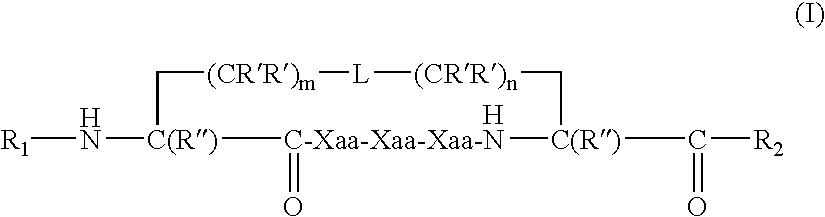
- wherein each Xaa is independently selected from any amino acid residue;
- R1 is selected from H, an N-terminal capping group, a non-peptidic group or a group that mimics an amino acid side chain;
- R2 is selected from H, a C-terminal capping group, a group that mimics an amino acid side chain or a group that activates the terminal carboxylic acid carbonyl group to nucleophilic substitution;
- each R′ and R″ are independently selected from H, C1-C10 alkyl, C2-C10 alkenyl, C2-C10 alkynyl, C3-C10cylcoalkyl, C5-C10cycloalkenyl, —OH, —OC1-C10 alkyl, —NH2, —NH(C1-C10alkyl), —N(C1-C10alkyl)2, C6-C12aryl, C3-C10heterocyclyl, C5-C10heteroaryl and halo;
- L is selected from —NH—C(O)—, —C(O)—NH—, —S—S—, —CH(OH)CH2—, CH2CH(OH)—, —CH═CH—, —CH2—CH2—, —NH—CH2— —CH2—NH—, —CH2—S—, —S—CH2—, —C(O)—CH2—, —CH2—C(O)—, —S(O)t—NH—, —NH—S(O)r—, CH2—P(═O)(OH)— and —P(═O)(OH)—CH2—;
- m is an integer from 1 to 4,
- n is an integer from 1 to 4, and
- t is 0, 1 or 2,
- wherein m+n=4, 5 or 6 and wherein when m is 2, n is not 3 and when m is 3, n is not 2.
- As used herein, the term “alkyl” refers to a saturated, straight or branched chain hydrocarbon group, preferably having 1 to 10 carbon atoms. Examples of suitable alkyl groups include, but are not limited to, methyl, ethyl, n-propyl, isopropyl, butyl, sec-butyl, tert-butyl, pentyl, 2-methylbutyl, 3-methylbutyl, 4-methylbutyl, hexyl, 2-ethylbutyl, heptyl, octyl, nonyl and decyl. Preferred alkyl groups have 1 to 6 carbon atoms. Especially preferred alkyl groups have 1 to 3 carbon atoms.
- As used herein, the term “alkenyl” refers to a straight or branched chain hydrocarbons containing at least one carbon-carbon double bond. Suitable alkenyl groups having 2 to 10 carbon atoms and include, but are not limited to, vinyl, allyl, 1-methylvinyl, butenyl, pentenyl, hexenyl, heptenyl, octenyl, nonenyl and decenyl. Preferred alkenyl groups have 2 to 6 carbon atoms. Especially preferred alkenyl groups have 2 or 3 carbon atoms.
- As used herein, the term “alkynyl” refers to straight chain hydrocarbons containing at least one carbon-carbon triple bond. Suitable alkynyl groups having 2 to 10 carbon atoms include, but not limited to, ethynyl, 1-propynyl, 2-propynyl, butynyl, pentynyl, hexynyl, heptynyl, octynyl, nonynyl and decynyl. Preferred alkynyl groups have 2 to 6 carbon atoms. Especially preferred alkynyl groups have 2 or 3 carbon atoms.
- As used herein, “halo” is intended to include fluoro, chloro, bromo and iodo.
- As used herein, the term “cycloalkyl” refers to saturated mono- or poly-cyclic hydrocarbon groups. Suitable cycloalkyl groups having 3 to 10 carbon atoms include, but are not limited to, cyclopropyl, cyclobutyl, cyclopentyl, cyclohexyl, cycloheptyl, cyclooctyl, cyclononyl, cyclodecyl and the like. Preferred cycloalkyl groups include cyclopentyl and cyclohexyl.
- As used herein, the term “cycloalkenyl” refers to saturated mono- or poly-cyclic hydrocarbon groups containing at least one carbon-carbon double bond. Suitable cycloalkenyl groups having 5 to 10 carbon atoms include, but are not limited to, cyclopentenyl, 1-methyl-cyclopentenyl, cyclohexenyl, cyclooctenyl, 1,3-cyclopentadienyl, 1,3-hexadienyl, 1,3-cyclohexadienyl, 1,4-cyclohexadienyl, 1,3-cycloheptadienyl, 1,3,5-cycloheptatrienyl and 1,3,5,7-cyclooctatetraenyl. Preferred cycloalkenyl groups include cyclopentenyl and cyclohexenyl.
- The term “aryl” used either alone or in compound words denotes single, polynuclear, conjugated or fused residues of aromatic hydrocarbons. Examples of aryl include, but are not limited to, phenyl, biphenyl, naphthyl, tetrahydronaphthyl. Preferred aryl groups include phenyl and naphthyl.
- The term “heteroaryl” refers to aromatic heterocyclic ring systems, wherein one or more carbon atoms (and where appropriate, hydrogen atoms attached thereto) of a cyclic hydrocarbon residue are replaced with a heteroatom to provide an aromatic residue. Where two or more carbon atoms are replaced, this may be by two or more of the same heteroatom or by different heteroatoms. Suitable heteroatoms include O, N, S and Se. Examples of heteroaryl include, but are not limited to, pyridyl, thienyl, furyl, pyrrolyl, indolyl, pyridazinyl, pyrazolyl, pyrazinyl, thiazolyl, pyrimidinyl, quinolinyl, isoquinolinyl, benzofuranyl, benzothienyl, purinyl, quinazolinyl, phenazinyl, acridinyl, benzoxazolyl, benzothiazolyl and the like. Preferred heteroaryl groups include pyridyl, thienyl, furyl, pyrrolyl.
- The term “heterocyclyl” when used alone or in compound words includes monocyclic, polycyclic, fused or conjugated hydrocarbon residues, preferably C3-10, preferably C3-6, wherein one or more carbon atoms (and where appropriate, hydrogen atoms attached thereto) are replaced by a heteroatom so as to provide a non-aromatic residue. Suitable heteroatoms include, O, N, S, and Se. Where two or more carbon atoms are replaced, this may be by two or more of the same heteroatom or by different heteroatoms. Suitable examples of heterocyclic groups may include pyrrolidinyl, pyrrolinyl, piperidyl, piperazinyl, morpholino, indolinyl, imidazolidinyl, pyrazolidinyl, thiomorpholino, dioxanyl, tetrahydrofuranyl, tetrahydropyranyl, tetrahydropyrrolyl etc.
- In preferred embodiments, any one of the following may apply:
- R1 is selected from H, an N-terminal capping group that stabilizes the terminus of a helix, usually having hydrogen atoms able to form hydrogen bonds or having a negative charge at the N-terminus to match with the helix dipole, a non-peptidic group or a mimic of an amino acid side chain. Suitable N-terminal capping groups include acyl and N-succinate. Suitable groups that mimic an amino acid side chain are any natural or unnatural amino acid side chain that is attached to the N-terminal amino group of the peptide through a carbonyl group derived from a carboxylic acid by formation of an amide bond. Suitable mimics of amino acid side chains include, but are not limited to:
- CH3CH2C(O)(CH2)uC(O)—, NH2(NH═)CNHC(O)(CH2)uC(O)—, H2NC(O)(CH2)2C(O)(CH2)uC(O)—, HOC(O)(CH2)2C(O)(CH2)uC(O)—, HS(CH2)2C(O)(CH2)uC(O)—, H2NC(O)(CH2)3C(O)(CH2)uC(O)—, HOC(O)(CH2)2C(O)(CH2)uC(O)—, (4-imidazolyl)(CH2)C(O)(CH2)uC(O)—, CH3CH2CH(CH3)CH2C(O)(CH2)uC(O)—, (CH3)2CH(CH2)2C(O)(CH2)uC(O)—, H2N(CH2)5C(O)(CH2)uC(O)—, CH3S(CH2)3C(O)(CH2)uC(O)—, Ph(CH2)2C(O)(CH2)uC(O)—, Ph(CH2)4C(O)(CH2)uC(O)—, HO(CH2)2C(O)(CH2)uC(O)—, HOCH(CH3)CH2C(O)(CH2)uC(O)—, (3-indolyl)(CH2)2(CH2)uC(O)—, (4-hydroxyphenyl)(CH2)2C(O)(CH2)uC(O)—, (4-hydroxyphenyl)(CH2)3C(O)(CH2)uC(O)—, (CH3)2CHCH2C(O)(CH2)uC(O)—, CH3CH2CH2C(O)(CH2)uC(O)—, C6H10CH2C(O)(CH2)uC(O)—, C5H8CH2C(O)(CH2)uC(O)—, CH3C(O)(CH2)uC(O)—, CH3(CH2)4C(O)(CH2)uC(O)—, CH3(CH2)5C(O)(CH2)uC(O)—, HOC(O)CH2C(O)(CH2)uC(O)—, HS(CH2)C(O)(CH2)uC(O)—, H2N(CH2)4C(O)(CH2)uC(O)— and HOCH2C(O)(CH2)uC(O)— wherein u is 0 or an integer from 1 to 10. The preferred non-peptidic groups enhance the stability, bioavailability or activity of the peptides. Suitable non-peptidic groups include, but are not limited to hydrophobic groups such as carbobenzoxyl, dansyl, t-butyloxycarbonyl, acetyl, 9-fluorenylmethoxycarbonyl, groups which stabilize or mimic alpha-helices, groups which mimic the secondary structure of peptides, particularly alpha helical peptides, such as those disclosed in WO 03/018587, groups which improve bioavailability, such as hydrophilic groups which aid aqueous solubility, for example, cyclodextrans; groups which are recognized by transport receptors to allow or improve transport of the peptides to the site of activity, for example, transport across cell walls or through an epithelial layer such as skin or the gut wall.
- R2 is selected from H, a C-terminal capping group that stabilizes the terminus of a helix, usually having hydrogen atoms able to form hydrogen bonds or having a positive charge at the C-terminus to match with the helix dipole, a peptide of 1, 2, 3, 4 or 5 amino acid residues optionally capped with a C-terminal capping group that stabilizes the terminus of a helix, usually having hydrogen atoms able to form hydrogen bonds or having a positive charge at the C-terminus to match with the helix dipole, a mimic of an amino acid side chain or a group which activates the terminal carboxylic acid carbonyl group to nucleophilic substitution. A suitable C-terminal capping group is NH2. Suitable mimics of amino acid side chains are any common or unnatural amino acid side chain that is attached to the C-terminal carbonyl group of the peptide through an amine group by formation of an amide bond. Suitable mimics of amino acid side chains include but are not limited to:
- —NH(CH2)uNHCH2CH3, —NH(CH2)uNH(CH2)4NHC(═NH)NH2, —NH(CH2)uNH(CH2)2C(O)NH2, —NH(CH2)uNH(CH2)2CO2H, —NH(CH2)uNH(CH2)2SH, —NH(CH2)uNH(CH2)3C(O)NH2, —NH(CH2)uNH(CH2)3CO2H, —NH(CH2)uNH(CH2)2(4-imidazolyl), —NH(CH2)uNHCH2CH(CH3)CH2CH3, —NH(CH2)uNH—(CH2)2CH(CH3)2, —NH(CH2)uNH(CH2)5NH2, —NH(CH2)uNH(CH3)3SCH3, —NH(CH2)uNH(CH2)2(3-indolyl), —NH(CH2)uNH(CH2)2(4-hydroxyphenyl), —NH(CH2)uNH(CH2)3(4-hydroxyphenyl), —NH(CH2)uNH—CH2CH(CH3)2, —(NHCH2)uNHCH2CH2CH3, —NH(CH2)uNH—CH2C6H10, —NH(CH2)uNHCH2C5H8, —NH(CH2)uNHCH3, —NH(CH2)uNH(CH2)4CH3, —NH(CH2)uNH(CH2)SCH3, —NH(CH2)uNHCH2CO2H, —NH(CH2)uNHCH2SH, —NH(CH2)uNH(CH2)2OH, —NH(CH2)uNH(CH2)5NH2 and —NH(CH2)uNHCH2OH; wherein u is 0 or an integer from 1 to 10.
- Suitable groups which activate the C-terminal carboxylic to nucleophilic attack include converting the carboxylic acid to an acid chloride, an acid anhydride, an acyl azide, an O-acylisourea, a phosphonium derivative or an activated ester, especially those known in the art for activating carboxylic acids for peptide bond formation.
- In some embodiments, non-peptidic groups enhance the stability and circulating time, or decrease immunogenicity, or increase solubility, bioavailability or activity of the peptides (see U.S. Pat. No. 4,179,337). Suitable non-peptidic groups include but are not limited to hydrophobic groups such as t-butyl, groups which stabilize or mimic alpha-helices, groups which mimic the secondary structure of peptides, particularly alpha helical peptides, such as those disclosed in WO 03/018587, groups which improve bioavailability, such as hydrophilic groups which aid aqueous solubility, for example, cyclodextrans; groups which are recognized by transport receptors to allow or improve transport of the peptides to the site of activity, for example, transport across cell walls or through an epithelial layer such as skin or the gut wall. In some embodiments, PEG (polyethylene glycol) groups are conjugated to the peptide compounds to make those compounds more easily formulated and orally available. The amphiphilic nature of PEG helps protect the parent peptide from enzymatic breakdown and positions the drug for absorption across the gastrointestinal tract into the plasma. The terms “pegylated” and “pegylation” refer to the process of reacting a poly(alkylene glycol), suitably an activated poly(alkylene glycol), with a facilitator such as an amino acid, e.g. lysine, to form a covalent bond. Although “pegylation” is often carried out using poly(ethylene glycol) or derivatives thereof, such as methoxy poly(ethylene glycol), the term is not intended to be so limited here, but is intended to include any other useful poly(alkylene glycol), such as, for example poly(propylene glycol). The chemical moieties for derivitization may also be selected from water soluble polymers such as polyethylene glycol, ethylene glycol/propylene glycol copolymers, carboxymethylcellulose, dextran, polyvinyl alcohol and the like. The pentapeptide compounds may be modified at random positions within the molecule, or at predetermined positions within the molecule and may include one, two, three or more attached chemical moieties. In some embodiments, the modification occurs at a position outside of the cyclic pentapeptide moiety, for example at amino acids preceding the cyclic pentapeptide moiety or at the N-terminus.
- The polymer may be of any molecular weight, and may be branched or unbranched. For polyethylene glycol, exemplary examples include micropegylated groups devised specifically to enhance oral delivery in peptides as described in WO2004047871. Methods for attaching Peg groups are well described in the patent literature (WO2004047871, U.S. Pat. No. 5,643,575;
EP 0 401 384; WO03057235A2) For example, polyethylene glycol may be covalently bound through amino acid residues via a reactive group, such as, a free amino or carboxyl group. Reactive groups are those to which an activated polyethylene glycol molecule may be bound. One or more reaction chemistries may be employed to attach polyethylene glycol to specific amino acid residues (e.g., lysine, histidine, aspartic acid, glutamic acid, or cysteine) of the polypeptide or to more than one type of amino acid residue (e.g., lysine, histidine, aspartic acid, glutamic acid, cysteine and combinations thereof) of the protein or polypeptide. Polyethylene glycol may be attached to the protein or polypeptide either directly or by an intervening linker. Polyethylene glycol can also be attached to polypeptides using a number of different intervening linkers. For example, U.S. Pat. No. 5,612,460 discloses urethane linkers for connecting polyethylene glycol to proteins. Protein polyethylene glycol conjugates wherein the polyethylene glycol is attached to the protein or polypeptide by a linker can also be produced by reaction of proteins or polypeptides with compounds such as MPEG-succinimidylsuccinate, MPEG activated with 1, I′-carbonyldiimidazole, MPEG-2,4,5-trichloropenylcarbonate, MPEG-p-nitrophenolcarbonate, and various MPEG-succinate derivatives. A number of additional polyethylene glycol derivatives and reaction chemistries for attaching polyethylene glycol to proteins and polypeptides are described in WO 03/057235; PCT/GB03/00062; U.S. Pat. No. 5,428,128; U.S. Pat. No. 6,127,355; and U.S. Pat. No. 5,880,131. - Each R′ is selected from H, CH3, CH2CH3, vinyl, OH, OCH3, NH2, NH(CH3), N(CH3)2, phenyl, F or Cl; most preferably H or CH3, especially H.
- Each R″ is selected from H, CH3, CH2CH3 or vinyl, especially H.
- m is 1 and n is 3 or 4, m is 2 and n is 4, m is 3 and n is 1 or m is 4 and n is 1 or 2, especially where m is 1 and n is 4.
- Each Xaa may be any amino acid residue selected to mimic the amino acid residues in a known alpha helical peptide of interest or to prepare an unknown peptide having new properties. An individual Xaa can be the same or different as another Xaa and is preferably selected from a D- or L-alpha amino acid residue. Especially preferred peptides of formula (I) have at least one Xaa which is a D- or L-alpha amino acid residue that is favorable to helix formation. Even more preferred are peptides in which 2 or 3 of Xaa are D- or L-alpha amino acid residues that are favorable to helix formation, for example, alanine, arginine, lysine, methionine, leucine, glutamic acid, glutamine, cysteine, isoleucine, phenylalanine, tyrosine, tryptophan, histidine and aspartic acid, especially alanine, arginine, lysine, methionine, leucine, glutamic acid and glutamine.
- L is preferably —NH—C(O)— or —C(O)—NH—.
- Surprisingly, the cyclic pentapeptides of the invention display tolerance of variation of Xaa residues, with most amino acid substitutions of these residues retaining a high degree of helicity. The range of amino acid substitutions that could be made at a specific Xaa residue would be readily apparent to a person of skill in the art.
- Representative peptides of the invention include, but are not limited to:
-
Ac-cyclo-1,5-[KXaaXaaXaaD]-NH2 [SEQ ID NO. 1] Ac-cyclo-1,5-[DXaaXaaXaaK]-NH2 [SEQ ID NO. 2] Ac-cyclo-1,5-[KXaaXaaXaaE]-NH2 [SEQ ID NO. 3] Ac-cyclo-1,5-[EXaaXaaXaaK]-NH2 [SEQ ID NO. 4] Ac-cyclo-1,5-[OXaaXaaXaaD]-NH2 [SEQ ID NO. 5] Ac-cyclo-1,5-[DXaaXaaXaaO]-NH2 [SEQ ID NO. 6] Ac-Xaa-cyclo-2,6-[KXaaXaaXaaD]-NH2 [SEQ ID NO. 7] - Especially preferred peptides are those of SEQ ID NO. 1, SEQ ID NO. 2, SEQ ID NO. 4, SEQ ID NO. 6 and SEQ ID NO. 7, more especially SEQ ID NO. 1 and SEQ ID NO. 7.
- Illustrative examples of amino acid sequences represented by the above peptides include:
-
Ac-(cyclo-1,5)-[KARAD]-NH2 [SEQ ID NO. 8] Ac-(cyclo-1,5)-[DARAK]-NH2 [SEQ ID NO. 9] Ac-(cyclo-1,5)-[KARAE]-NH2 [SEQ ID NO. 10] Ac-(cyclo-1,5)-[EARAK]-NH2 [SEQ ID NO. 11] Ac-(cyclo-1,5)-[OARAD]-NH2 [SEQ ID NO. 12] Ac-(cyclo-1,5)-[DARAO]-NH2 [SEQ ID NO. 13] Ac-[KARAD]-NH2 [SEQ ID NO. 14] Ac-cyclo-2,6-R[KLLLD]-NH2 [SEQ ID NO. 15] Ac-cyclo-2,6-R[KLALD]-NH2 [SEQ ID NO. 16] Ac-cyclo-2,6-R[KLFAD]-NH2 [SEQ ID NO. 17] Ac-(cyclo-1,5)-[OARAE]-NH2 [SEQ ID NO. 18] Ac-(cyclo-1,5)-[EARAO]-NH2 [SEQ ID NO. 19] Ac-(cyclo-1,5)-[KARAD]-OH [SEQ ID NO. 20] H-(cyclo-1,5)-[KARAD]-NH2 [SEQ ID NO. 21] H-(cyclo-1,5)-[KARAD]-OH [SEQ ID NO. 22] Ac-(cyclo-2,6)-R[KAAAD]-NH2 [SEQ ID NO. 23] Ac-(cyclo-2,6)-R[KALAD]-NH2 [SEQ ID NO. 24] Ac-(cyclo-2,6)-R[KAMAD]-NH2 [SEQ ID NO. 25] Ac-(cyclo-2,6)-R[KAQAD]-NH2 [SEQ ID NO. 26] Ac-(cyclo-2,6)-R[KAFAD]-NH2 [SEQ ID NO. 27] Ac-(cyclo-2,6)-R[KAGAD]-NH2 [SEQ ID NO. 28] Ac-(cyclo-2,6)-R[KGSAD]-NH2 [SEQ ID NO. 29] Ac-(cyclo-2,6)-R[KSSSD]-NH2 [SEQ ID NO. 30] Ac-(cyclo-2,6)-R[KGGGD]-NH2 [SEQ ID NO. 31] - In some embodiments, the peptide compound comprises at least one cyclic pentapeptide of the invention and at least 1, 2, 3, 4, 5, 6, 7, 8, 9, 10, 11, 12, 13, 14, 15 or more amino acid residues adjacent thereto. In specific embodiments, the peptide compound comprises a single cyclic pentapeptide of the invention and another amino acid residue located immediately upstream or downstream thereof.
- In another aspect, the present invention provides a method for constructing a constrained helical peptide comprising the steps of: (1) synthesizing a peptide, wherein the peptide comprises a sequence of five amino acid residues having a first terminal residue and a second terminal residue that are separated by an intervening sequence of three amino acid residues, and wherein the individual side chains of the first and second terminal residues are linkable to each other; and (2) cyclizing the peptide by linking the side chain of the first terminal residue with the side chain of the second terminal residue, thereby yielding a constrained helical peptide. In certain embodiments, the first terminal residue has a side chain containing an amide bond-forming substituent and the second terminal residue has a side chain containing a functional group capable of forming an amide linkage with the side chain amide bond-forming substituent of the first terminal residue and the peptide is cyclised by reacting the side chain amide bond-forming substituent of the first terminal residue with the functional group of the second terminal residue to form an amide bond linkage, thereby yielding a constrained helical peptide. During peptide synthesis, reactive groups on the side chains, including the amide forming substituents are suitably protected, for example, carboxy groups can be suitably protected as esters such as methyl, ethyl, allyl, benzyl, t-butyl or phenyl esters and amino groups can be suitably protected with alkyloxy carbonyl, allyloxycarbonyl (Alloc), benzyloxycarbonyl (Z), t-butoxycarbonyl (Boc), 2-(4-biphenylyl)-isopropoxycarbonyl (Bpoc), 9-fluorenylmethoxycarbonyl (Fmoc), triphenylmethyl (trityl) or 2-nitrophenylsulphenyl (Nps) groups, which may be removed after synthesis of the peptide and before reaction to form the amide bond linkage. Suitable methods for selectively protecting and deprotecting functional groups can be found in Green & Wutz94 and Taylor (2002)43.
- The peptides of the present invention may be prepared using techniques known in the art. For example, peptides can be synthesized using various solid phase techniques91 or using an automated synthesis and standard Fmoc chemistry92. These techniques are also suitable for incorporating non-naturally occurring amino acid residues into the amino acid sequence.
- Alternatively, non-naturally occurring amino acids may be incorporated into the sequence by manipulation of a residue in the sequence. For example, the hydroxy group or thiol group of threonine, serine or cysteine may be alkylated to provide an ether or thioether, or substituents may be introduced into the phenyl ring of phenylalanine or tyrosine using known substitution reactions such as Friedel-Crafts alkylation or acylation.
- Once the peptides of the present invention have been prepared, they may be substantially purified using preparative HPLC. The composition of the peptides can be confirmed by amino acid analysis or by sequencing, for example, using the Edman Degradation procedure.
- Suitable protecting groups for use during solid phase synthesis or solution phase of the amino acid sequences, together with suitable protecting and deprotecting methods for reactive functional groups such as amines and carboxylic acids, are known in the art, for example, as found in Green & Wutz94.
- Once the peptide is prepared and deprotection of the side chains is effected, cyclization to form a cyclic peptide may be achieved by methods known in the art. For example, an amide bond may be formed between a side chain carboxylic acid and a side chain amine by activation of the carboxylic acid, for example, as an acid chloride, acid anhydride, an acyl azide, a carbodiimide, an acyloxyphosphonium or uronium compound or an active ester, and allowing nucleophilic attack from the amine nitrogen atom. A particularly preferred method of activating the carboxylic acid to nucleophilic attack is preparation of an acyloxyphosphonium or uronium derivative of the carboxylic acid, for example, by reaction with the carboxylic acid with benzotriazolyloxy-tri-(dimethylamino)phosphonium hexafluorophosphate (BOP) or benzotriazolyloxy-tris-(pyrrolidinyl)phosphonium hexafluorophosphate (Py-BOP) in the presence of a tertiary amine such as triethylamine or diisopropylethylamine (DIPEA) or similar reaction using Benzotriazol-1-yl-1,1,3,3-tetramethyluronium ion (HBTU).
- A representative solid phase synthesis is shown in Scheme 1:
-

- The peptides of the invention are designed to mimic binding determinants from alpha helical binding domains of known proteins. Such peptides have a number of uses, including the determination of whether a binding determinant in an alpha helical binding domain of a known protein can serve as a structural model for the design of peptidomimetics or small molecules capable of mimicking or antagonizing the binding activity of the intact protein. In using the peptides of the invention for this purpose, the practitioner may select a binding protein with an alpha helical domain that interacts with a ligand, and then identify a candidate binding determinant situated within a sequence of (e.g., three or more) contiguous amino acid residues in the helical binding domain. The candidate binding determinant can be identified by using mutagenesis (e.g., alanine scanning mutagenesis) to determine whether the candidate sequence contains one or more amino acid residues that are critical for ligand binding. Subsequently, a constrained peptide containing the candidate sequence is designed by selecting two residues in the candidate sequence (designated i and i+4) which are separated by an intervening sequence of n−1 (e.g., 3) amino acid residues and which do not substantially interact with ligand (as determined by mutagenesis in the previous step) for substitution with amino acid residues having side chains that can be linked to each other. The peptide is synthesized and the side chains of the foreign i and i+4 residues are used to tether the peptide in an alpha helical conformation according to the methods of the invention described herein. Finally, the peptide's binding activity with the ligand is assayed, e.g., in a binding competition assay with the intact binding protein, and the results of the assay can be used to determine whether a peptidomimetic or small molecule antagonist could be developed using the binding determinant as a structural model.
- Thus, in a further aspect, the invention contemplates the use an alpha helical cyclic peptide, wherein the peptide comprises a sequence of five amino acid residues having a first terminal residue and a second terminal residue that are separated by an intervening sequence of three amino acid residues, and wherein the side chains of the first and second terminal residues are linked to each other as a scaffold for presenting the side chains of at least some of the five amino acid residues in a (three dimensional) conformation that is analogous to the conformation of amino acid side chains of at least a portion of an alpha helical domain of a known protein. In some embodiments, the side chains of at least 1 or 2 or all 3 of the intervening amino acid residues are so analogously presented. In other embodiments, the side chains of at least 1 or 2 or all 3 of the intervening amino acid residues and at least one terminal amino acid residue are so analogously presented. Suitably, at least part of the conformationally constrained secondary structure defined by the five amino acid residues (i.e., pentapeptide) mimics a member of a ligand-receptor binding pair. Illustrative examples of ligand-receptor binding pairs include protein-DNA binding partners (e.g., Zif268 and G/C rich major groove), protein-RNA binding partners (e.g., HIV reverse transcriptase and Rev response element (RRE); λ-N peptide and BoxB RNA; p22 peptides and BoxB RNA) and protein-protein binding partners (e.g., p53 and HDM2; Bak and Bcl-XL; VHL peptide and Elongin C; VP16 activation domain and HTAFII31; hPTH and hPTHrP; Dynorphin A and κ,δ-Opioid receptors; Apolipoprotein-E and LDL receptor; Neuropeptide-Y and NPY receptors; Galanin and Gal receptors; Corticotropin Releasing Factor and CRF receptors; Calcitonin Gene Related Peptide and CGRP receptors; Nociceptin and ORL1 receptor; Vasointestinal Peptide and VPAC1&2; and Nuclear Coactivators (eg. SRC1, GRIP1) and Nuclear Receptors.
- While not wishing to be limited by any one particular theory or mode of operation, the constrained helical peptides of the present invention are believed to derive their activity by interaction of the face of the helix opposing the i→i+4 constraint. However, when two or more tandemly arrayed constrained helical peptides are present, as part of an extended helix polypeptide backbone or super helix, the positions i→i+4 of a first constrained helical pentapeptide will be offset by approximately one third of a turn relative to positions i→i+4 of a second constrained helical pentapeptide. In other words, the i→i+4 faces of the two helices will not be aligned directly in the same plane and will be out of register by approximately one third of a turn. Thus, in certain embodiments where an extended helix polypeptide backbone or super helix is required for interaction with a biomolecule of interest, it may be desirable to take this offset into account when designing a helical peptide so that one face of its helix is substantially free of any cyclizing linkages that may occlude or otherwise interfere with this interaction. In illustrative examples, the helical peptide may simply comprise two or three consecutive constrained helical pentapeptides. In other illustrative examples, the helical peptide may comprise two consecutive constrained helical pentapeptides spaced from a third constrained helical pentapeptide by about 1, 2, 5, 8 or 9 natural or unnatural helix-forming amino acid residues. In still other illustrative examples, the helical peptide may comprise three consecutive constrained helical pentapeptides spaced from a fourth constrained helical pentapeptide by about 0, 3, 4, 6 or 7 natural or unnatural helix-forming amino acid residues; or alternatively 1, 2, 5, 6 or 9 natural or unnatural helix-forming amino acid residues, depending on which face is required to be kept substantially free of any cyclizing linkages. In still other illustrative examples, the helical peptide may comprise four consecutive constrained helical pentapeptides spaced from a fifth constrained helical pentapeptide by about 1, 2 or 3 natural or unnatural helix-forming amino acid residues. In still other illustrative examples, the helical peptide may comprise five consecutive constrained helical pentapeptides spaced from a sixth constrained helical pentapeptide by about 2, 7, 12 or 17 natural or unnatural helix-forming amino acid residues. The optimal spacing between cyclic pentapeptide modules is determined on a case-by-case basis and would be readily apparent to a person skilled in the art through simple molecular modeling experiments using commercially available programs (e.g., InsightII)104.
- In certain embodiments which require mimicking multiple turns of an alpha helical binding domain, the conformationally constrained peptide comprises a plurality (e.g., 2, 3, 4, 5, 6, 7, 8, 9 or more) of pentapeptides as broadly described above. Accordingly, in yet another aspect, the present invention provides the use of a conformationally constrained peptide having a plurality of alpha helical pentapeptide sequences, wherein the pentapeptide sequences comprise a sequence of five amino acid residues having a first terminal residue and a second terminal residue that are separated by an intervening sequence of three amino acid residues, and wherein the side chains of the first and second terminal residues are linked to each other, as a scaffold for presenting the side chains of at least some of the amino acid residues of the pentapeptide sequences in a (three-dimensional) configuration that is analogous to the configuration of amino acid side chains of at least a portion of an alpha helical domain of a known protein.
- As used herein, the term “scaffold” is used in its broadest sense and includes a region or domain that has a conserved tertiary structural motif that can be modified to display one or more specific amino acid residues in a fixed conformation.
- In some embodiments, the side chains of at least 1 or 2 or all 3 of the intervening amino acid residues of each pentapeptide sequence are so analogously presented. In other embodiments, the side chains of at least 1 or 2 or all 3 of the intervening amino acid residues and at least one terminal amino acid residue of each pentapeptide sequence are so analogously presented. Suitably, at least part of the conformationally constrained secondary structure defined by the pentapeptide sequences mimics a member of a ligand-receptor binding pair. In illustrative examples, some or all of the pentapeptides are located adjacent to each other. Alternatively, at least one of the pentapeptides is spaced from a pair of adjacent pentapeptides.
- In certain embodiments, the conformationally constrained peptides of the invention are designed to mimic epitopes in proteins and are used to selectively raise polyclonal or monoclonal antibodies against such individual epitopes. Since the peptides will frequently be too small to generate an immune response, the peptides can be conjugated to carriers known to be immunogenic in the species to be immunized, e.g., keyhole limpet hemocyanin, serum albumin, bovine thyroglobulin, or soybean trypsin inhibitor using a bifunctional or derivatising agent, for example, maleimidobenzoyl sulfosuccinimide ester (conjugation through cysteine residues), N-hydroxysuccinimide (through lysine residues), glutaraldehyde, succinic anhydride, SQCl2, or R1 N═C═NR, where R and R1 are different alkyl groups.
- Advantageously, the macrocyclic moiety of the pentapeptide is stable in water to temperatures of up to about 80° C. and stable to denaturants such as 8M guanidine hydrochloride, and to the degradative effects of proteolytic enzymes such as trypsin or those present in human serum. The alpha helical short-chain peptides are therefore suitable for use as chemical or biological probes, pharmaceuticals, biotechnology products such as vaccines or diagnostic agents, new components of novel biopolymers and as industrial agents.
- The alpha helical pentapeptides of the invention can be used alone to mimic a specific peptide motif of a protein or polypeptide or may be incorporated into a larger polymeric or non polymeric non-peptidic molecules or into hybrids of peptidic and non-peptidic components.
- In another aspect of the present invention there is provided a use of at least one alpha helical cyclic peptide, wherein the peptide comprises a sequence of five amino acid residues having a first terminal residue and a second terminal residue that are separated by an intervening sequence of three amino acid residues, and wherein the side chains of the first and second terminal residues are linked to each other, as a macrocyclic module for incorporation into a non-peptidic molecular structure, or for constructing a multi-macrocyclic structure that mimics multiple turns of an alpha helix.
- Multi-macrocyclic structures may provide new or unknown three dimensional positioning of side chains in an alpha helix or may mimic a portion of, or an entire, alpha helical motif from a known protein or polypeptide.
- In a preferred embodiment, the alpha helical cyclic peptide, which is used as the scaffold or macrocyclic module, has the formula (II):
-

- wherein each Xaa is independently selected from any amino acid;
- each R′ and R″ are independently selected from H, C1-C10 alkyl, C2-C10 alkenyl, C2-C10 alkynyl, C3-C10cylcoalkyl, C5-C10cycloalkenyl, —OH, —OC1-C10 alkyl, —NH2, —NH(C1-C10alkyl), —N(C1-C10alkyl)2, C6-C10aryl, C3-C10heterocyclyl, C5-C10heteroaryl and halo;
- L is selected from —NH—C(O)—, —C(O)—NH—, —S—S—, —CH(OH)CH2—, CH2CH(OH)—, —CH═CH—, —CH2—CH2—, —NH—CH2— —CH2—NH—, —CH2—S—, —S—CH2—, —C(O)—CH2—, —CH2—C(O)—, —S(O)t—NH—, —NH—S(O)t—, CH2—P(═O)(OH)— and —P(═O)(OH)—CH2—;
- R3 is selected from H, an N-capping group or a mimic of an amino acid side chain,
- R4 is selected from H, a C-terminal capping group, a mimic of an amino acid side chain or a group which activates the terminal carboxylic acid carbonyl group to nucleophilic substitution;
- m is an integer from 1 to 4,
- n is an integer from 1 to 4, and
- t is 0, 1 or 2,
- wherein m+n=4, 5 or 6 and wherein when m is 2, n is not 3 and when m is 3, n is not 2.
- In preferred embodiments, any one of the following may apply:
- R1 is selected from H, an N-terminal capping group that stabilizes the terminus of a helix, usually having hydrogen atoms able to form hydrogen bonds or having a negative charge at the N-terminus to match with the helix dipole, or a mimic of an amino acid side chain. Suitable N-terminal capping groups include acyl and N-succinate. Suitable groups that mimic an amino acid side chain are any natural or unnatural amino acid side chain that is attached to the N-terminal amino group of the peptide through a carbonyl group derived from a carboxylic acid by formation of an amide bond. Suitable mimics of amino acid side chains include, but are not limited to:
- CH3CH2C(O)(CH2)uC(O)—, NH2(NH═)CNHC(O)(CH2)uC(O)—, H2NC(O)(CH2)2C(O)(CH2)uC(O)—, HOC(O)(CH2)2C(O)(CH2)uC(O)—, HS(CH2)2C(O)(CH2)uC(O)—, H2NC(O)(CH2)3C(O)(CH2)uC(O)—, HOC(O)(CH2)2C(O)(CH2)uC(O)—, (4-imidazolyl)(CH2)C(O)(CH2)uC(O)—, CH3CH2CH(CH3)CH2C(O)(CH2)uC(O)—, (CH3)2CH(CH2)2C(O)(CH2)uC(O)—, H2N(CH2)5C(O)(CH2)uC(O)—, CH3S(CH2)3C(O)(CH2)uC(O)—, Ph(CH2)2C(O)(CH2)uC(O)—, Ph(CH2)4C(O)(CH2)uC(O)—, HO(CH2)2C(O)(CH2)uC(O)—, HOCH(CH3)CH2C(O)(CH2)uC(O)—, (3-indolyl)(CH2)2(CH2)uC(O)—, (4-hydroxyphenyl)(CH2)2C(O)(CH2)uC(O)—, (4-hydroxyphenyl)(CH2)3C(O)(CH2)uC(O)—, (CH3)2CHCH2C(O)(CH2)uC(O)—, CH3CH2CH2C(O)(CH2)uC(O)—, C6H10CH2C(O)(CH2)uC(O)—, C5H5CH2C(O)(CH2)uC(O)—, CH3C(O)(CH2)uC(O)—, CH3(CH2)4C(O)(CH2)uC(O)—, CH3(CH2)5C(O)(CH2)uC(O)—, HOC(O)CH2C(O)(CH2)uC(O)—, HS(CH2)C(O)(CH2)uC(O)—, H2N(CH2)4C(O)(CH2)uC(O)— and HOCH2C(O)(CH2)uC(O)— wherein u is 0 or an integer from 1 to 10;
- R2 is selected from H, a C-terminal capping group that stabilizes the terminus of a helix, usually having hydrogen atoms able to form hydrogen bonds or having a positive charge at the C-terminus to match with the helix dipole, a mimic of an amino acid side chain or a group which activates the terminal carboxylic acid carbonyl group to nucleophilic substitution. A suitable C-terminal capping group is NH2. Suitable mimics of amino acid side chains are any common or unnatural amino acid side chain that is attached to the C-terminal carbonyl group of the peptide through an amine group by formation of an amide bond. Suitable mimics of amino acid side chains include but are not limited to:
- —NH(CH2)uNHCH2CH3, —NH(CH2)uNH(CH2)4NHC(═NH)NH2, —NH(CH2)uNH(CH2)2C(O)NH2, —NH(CH2)uNH(CH2)2CO2H, —NH(CH2)uNH(CH2)2SH, —NH(CH2)uNH(CH2)3C(O)NH2, —NH(CH2)uNH(CH2)3CO2H, —NH(CH2)uNH(CH2)2(4-imidazolyl), —NH(CH2)uNHCH2CH(CH3)CH2CH3, —NH(CH2)uNH(CH2)2CH(CH3)2, —NH(CH2)uNH(CH2)5NH2, —NH(CH2)uNH(CH3)3SCH3, —NH(CH2)uNH(CH2)2(3-indolyi), —NH(CH2)uNH(CH2)2(4-hydroxyphenyl), —NH(CH2)uNH(CH2)3(4-hydroxyphenyl), —NH(CH2)uNHCH2CH(CH3)2, —NH(CH2)uNHCH2CH2CH3, —NH(CH2)uNHCH2C6H10, —NH(CH2)uNHCH2C5H8, —NH(CH2)uNHCH3, —NH(CH2)uNH(CH2)4CH3, —NH(CH2)uNH(CH2)5CH3, —NH(CH2)uNHCH2CO2H, —NH(CH2)uNHCH2SH, —NH(CH2)uNH(CH2)2OH, —NH(CH2)uNH(CH2)5NH2 and —NH(CH2)uNHCH2OH; wherein u is 0 or an integer from 1 to 10.
- Suitable groups which activate the C-terminal carboxylic to nucleophilic attack include converting the carboxylic acid to an acid chloride, an acid anhydride, an acyl azide, an O-acylisourea, a phosphonium derivative or an activated ester, especially those known in the art for activating carboxylic acids for peptide bond formation;
- Each R′ is selected from H, CH3, CH2CH3, vinyl, OH, OCH3, NH2, NH(CH3), N(CH3)2, phenyl, F or Cl; most preferably H or CH3, especially H;
- Each R″ is selected from H, CH3, CH2CH3 or vinyl, especially H;
- m is 1 and n is 3 or 4, m is 2 and n is 4, m is 3 and n is 1 or m is 4 and n is 1 or 2, especially where m is 1 and n is 4;
- Each Xaa may be any amino acid residue selected to mimic the amino acid residues in a known alpha helical peptide of interest or to prepare an unknown peptide having new properties. Xaa is preferably a D- or L-alpha amino acid residue. Especially preferred peptides of formula (II) have at least one Xaa which is a D- or L-alpha amino acid residue that is favorable to helix formation. Even more preferred are peptides in which 2 or 3 of Xaa are D- or L-alpha amino acid residues that are favourable to helix formation, for example, alanine, arginine, lysine, methionine, leucine, glutamic acid, glutamine, cysteine, isoleucine, phenylalanine, tyrosine, tryptophan, histidine and aspartic acid, especially alanine, arginine, lysine, methionine, leucine, glutamic acid and glutamine; and
- L is selected from —NH—C(O)— and —C(O)—NH—.
- Scaffolds or macrocyclic modules of formula (II) can be prepared as described for peptides of formula (I).
- N-terminal capping groups may and groups which mimic an amino acid side chain may be introduced by methods known in the art. For example the N-terminal amino group may be reacted with a carboxylic acid derivative of the capping group or mimic or an activated carboxylic acid derivative to form an amide bond.
- C-terminal capping groups and groups which mimic an amino acid side chain may be introduced by methods known in the art. For example the C-terminal carboxylic acid may be activated and reacted with an amine derivative, preferably a primary amine derivative of the C-terminal capping group or group that mimics an amino acid side chain.
- C-terminal carboxylic acid groups or any other carboxylic acid groups that require activation toward nucleophilic substitution can be activated by methods known in the art95. For example the carboxylic acid may be activated by conversion to an acyl chloride using PCl5 or SOCl2, conversion to an acyl azide by hydrazinolysis of a protected amino acid or peptide ester followed by treatment with NaNO2 in aqueous acid, conversion to a symmetrical or mixed anhydride using two equivalents of an amino acid and a dicyclohexylcarbodiimide or by reaction with an acid chloride in a dry solvent in the presence of a mild base, conversion to an O-acylisourea by reaction with dicyclohexylcarbodiimide or by conversion to an acyloxyphosphonium or uronium species by reacting a carboxylate anion with a phosphonium or uronium cation, for example, BOP, PyBOP or HBTU.
- A representative example of an alpha helical pentapeptide as a scaffold for projecting attached substituents into positions normally occupied the side chains of longer peptides than pentapeptides is given by formula (II):
-
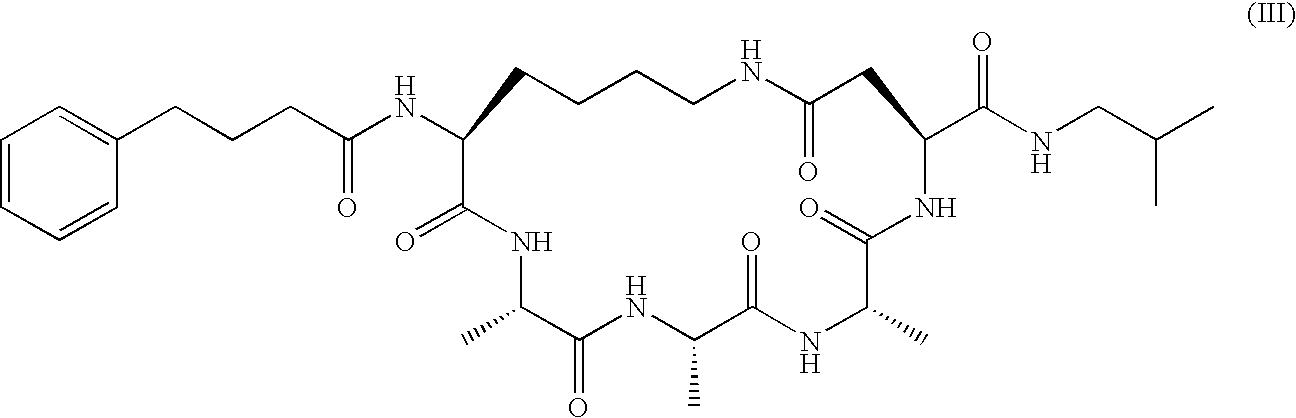
- The pentapeptide of formula (III) is an example of a peptide of formula (II) in which the three variable amino acid residues that represent Xaa are all alanine, the macrocycle is formed by amide bond formation between a lysine residue and an aspartic acid residue, R3 is an amide formed from the reaction of phenylbutanoic acid and the N-terminal amino group and mimics a phenylalanine side chain, and R4 is an amide formed by the reaction of isobutyl amine with an activated C-terminal carboxylic acid and mimics a valine side chain.
- The scaffold or macrocyclic module may also be incorporated into a multi-macrocyclic structure or may be incorporated into a non-peptidic molecule.
- As used herein, the term “macrocyclic module” refers to a cyclic pentapeptide which may be unsubstituted at the N and C termini or may be activated for incorporation into a larger structure. For example, a pentacyclic peptide of formula II in which R3 is H and R4 is H or a group which activates the terminal carboxylic acid carbonyl group to nucleophilic substitution is a macrocyclic module.
- Preparation of a Non-Peptidic Molecule Incorporating a Scaffold or Macrocyclic module may be prepared by reacting the N-terminal and/or activated C-terminal of the macrocyclic module with desired non-peptidic moieties.
- Alternatively, a number of modules, which may be the same or different, may be prepared as described herein and then consecutively linked to form a multi-macrocyclic peptide that mimics a number of turns of an alpha helix. The multi-macrocyclic peptide may then be used to mimic a protein or polypeptide or part thereof, or may be incorporated into a longer peptide sequence.
- Accordingly, in a further aspect of the invention there is provided a conformationally constrained peptide having a plurality of alpha helical pentapeptide sequences, wherein the pentapeptide sequences comprise a sequence of five amino acid residues having a first terminal residue and a second terminal residue that are separated by an intervening sequence of three amino acid residues, and wherein the side chains of the first and second terminal residues are linked to each other.
- In a preferred embodiment at least one of the alpha helical pentapeptide sequences is a pentapeptide module of formula (II).
- The number of macrocyclic modules in the peptide or polypeptide will depend on the length of the alpha helical portion of the polypeptide required. If the peptide is intended to mimic an alpha helical portion of a known protein or polypeptide, the number of macrocyclic modules will be determined by the number of turns in the alpha helical portion of the known protein or polypeptide. For example, two cyclic pentapeptide modules of Formula (II) could be linked such that the N-terminal nitrogen atom is directly bonded to the C-terminal carbonyl group, to form a 2.8-turn alpha helix. In a similar manner, three consecutively linked cyclic pentapeptide modules would form a 4.2-turn alpha helix, four consecutively linked cyclic pentapeptide modules would form a 5.6-turn alpha helix, five consecutively linked cyclic pentapeptide modules would form a 6.9-turn alpha helix, six consecutively linked cyclic pentapeptide modules would form a 8.3-turn alpha helix and larger alpha helices may be obtained in a similar fashion. In this manner multi-macrocyclic assemblies which are alpha helical in nature can be obtained.
- In a preferred embodiment the conformationally constrained peptide having a plurality of alpha helical pentapeptide sequences, is a compound of formula (IV):
-
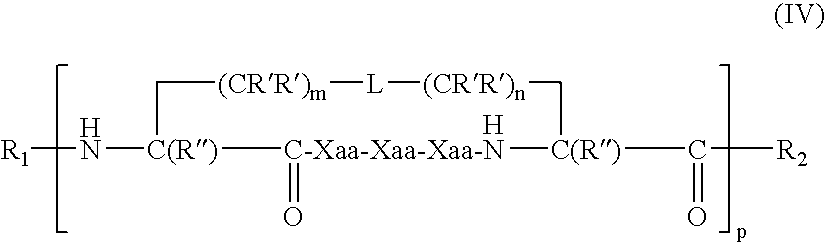
- wherein each Xaa is independently selected from any amino acid residue;
- R1 is selected from H, an N-terminal capping group, a peptide of 1 to 20 amino acid residues optionally capped by an N-terminal capping group, a non-peptidic group or a group that mimics an amino acid side chain;
- R2 is selected from H, a C-terminal capping group, a peptide of 1 to 20 amino acids optionally capped by a C-terminal capping group, a group that mimics an amino acid side chain or a group that activates the terminal carboxylic acid carbonyl group to nucleophilic substitution;
- each R′ and R″ are independently selected from H, C1-C10 alkyl, C2-C10 alkenyl, C2-C10 alkynyl, C3-C10cylcoalkyl, C5-C10cycloalkenyl, —OH, —OC1-C10 alkyl, —NH2, —NH(C1-C10alkyl), —N(C1-C10alkyl)2, C6-C10aryl, C3-C10heterocyclyl, C5-C10heteroaryl and halo;
- L is selected from —NH—C(O)—, —C(O)—NH—, —S—S—, —CH(OH)CH2—, CH2CH(OH)—, —CH═CH—, —CH2—CH2—, —NH—CH2— —CH2—NH—, —CH2—S—, —S—CH2—, —C(O)—CH2—, —CH2—C(O)—, —S(O)t—NH—, —NH—S(O)t—, CH2—P(═O)(OH)— and —P(═O)(OH)—CH2—;
- m is an integer from 1 to 4,
- n is an integer from 1 to 4, and
- t is 0, 1 or 2,
- wherein m+n=4, 5 or 6 and wherein when m is 2, n is not 3 and when m is 3, n is not 2; and
- p is an integer from 2 to 12; with the proviso that bicyclo (Lys13-Asp17, Lys18-Asp22) [Ala1, Nlc8, Lys18, Asp22, Leu27] hPTH (1-31) NH2 is excluded.
- In preferred embodiments, any one of the following may apply:
- R1 is selected from H, an N-terminal capping group that stabilizes the terminus of a helix, usually having hydrogen atoms able to form hydrogen bonds or having a negative charge at the N-terminus to match with the helix dipole, a peptide of 1 to 15, 1 to 10 or 1 to 5 amino acid residues optionally capped with an N-terminal capping group that stabilizes the terminus of a helix, usually having hydrogen atoms able to form hydrogen bonds or having a negative charge at the N-terminus to match with the helix dipole, or a mimic of an amino acid side chain. Suitable N-terminal capping groups include acyl and N-succinate. Suitable groups that mimic an amino acid side chain are any natural or unnatural amino acid side chain that is attached to the N-terminal amino group of the peptide through a carbonyl group derived from a carboxylic acid by formation of an amide bond. Suitable mimics of amino acid side chains include, but are not limited to:
- CH3CH2C(O)(CH2)uC(O)—, NH2(NH═)CNHC(O)(CH2)uC(O)—, H2NC(O)(CH2)2C(O)(CH2)uC(O)—, HOC(O)(CH2)2C(O)(CH2)uC(O)—, HS(CH2)2C(O)(CH2)uC(O)—, H2NC(O)(CH2)3C(O)(CH2)uC(O)—, HOC(O)(CH2)2C(O)(CH2)uC(O)—, (4-imidazolyl)(CH2)C(O)(CH2)uC(O)—, CH3CH2CH(CH3)CH2C(O)(CH2)uC(O)—,
- (CH3)2CH(CH2)2C(O)(CH2)uC(O)—, H2N(CH2)5C(O)(CH2)uC(O)—, CH3S(CH2)3C(O)(CH2)uC(O)—, Ph(CH2)2C(O)(CH2)uC(O)—, Ph(CH2)4C(O)(CH2)uC(O)—, HO(CH2)2C(O)(CH2)uC(O)—, HOCH(CH3)CH2C(O)(CH2)uC(O)—, (3-indolyl)(CH2)2(CH2)uC(O)—, (4-hydroxyphenyl)(CH2)2C(O)(CH2)uC(O)—, (4-hydroxyphenyl)(CH2)3C(O)(CH2)uC(O)—, (CH3)2CHCH2C(O)(CH2)uC(O)—, CH3CH2CH2C(O)(CH2)3C(O)—, C6H10CH2C(O)(CH2)uC(O)—, C5H8CH2C(O)(CH2)uC(O)—, CH3C(O)(CH2)uC(O)—, CH3(CH2)4C(O)(CH2)uC(O)—, CH3(CH2)5C(O)(CH2)uC(O)—, HOC(O)CH2C(O)(CH2)uC(O)—, HS(CH2)C(O)(CH2)uC(O)—, H2N(CH2)4C(O)(CH2)uC(O)— and HOCH2C(O)(CH2)uC(O)— wherein u is 0 or an integer from 1 to 10. The preferred non-peptidic groups enhance the stability, bioavailability or activity of the peptides. Suitable non-peptidic groups include, but are not limited to hydrophobic groups such as carbobenzoxyl, dansyl, t-butyloxycarbonyl, acetyl, 9-fluorenylmethoxycarbonyl, groups which stabilize or mimic alpha-helices, groups which mimic the secondary structure of peptides, particularly alpha helical peptides, such as those disclosed in WO 03/018587, groups which improve bioavailability, such as hydrophilic groups which aid aqueous solubility, for example, cyclodextrans; groups which are recognized by transport receptors to allow or improve transport of the peptides to the site of activity, for example, transport across cell walls or through an epithelial layer such as skin or the gut wall;
- R2 is selected from H, a C-terminal capping group that stabilizes the terminus of a helix, usually having hydrogen atoms able to form hydrogen bonds or having a positive charge at the C-terminus to match with the helix dipole, a peptide of 1 to 15, 1 to 10 or 1 to 5 amino acid residues optionally capped with a C-terminal capping group that stabilizes the terminus of a helix, usually having hydrogen atoms able to form hydrogen bonds or having a positive charge at the C-terminus to match with the helix dipole, a mimic of an amino acid side chain or a group which activates the terminal carboxylic acid carbonyl group to nucleophilic substitution. A suitable C-teiminal capping group is NH2. Suitable mimics of amino acid side chains are any common or unnatural amino acid side chain that is attached to the C-terminal carbonyl group of the peptide through an amine group by formation of an amide bond. Suitable mimics of amino acid side chains include but are not limited to:
-
- —NH(CH2)uNHCH2CH3, —NH(CH2)uNH(CH2)4NHC(═NH)NH2, —NH(CH2)uNH(CH2)2C(O)NH2, —NH(CH2)uNH(CH2)2CO2H, —NH(CH2)uNH(CH2)2SH, —NH(CH2)uNH(CH2)3C(O)NH2, —NH(CH2)uNH(CH2)3CO2H, —NH(CH2)uNH(CH2)2(4-imidazolyl), —NH(CH2)uNHCH2CH(CH3)CH2CH3, —NH(CH2)uNH(CH2)2CH(CH3)2, —NH(CH2)uNH(CH2)5NH2, —NH(CH2)uNH(CH3)3SCH3, —NH(CH2)uNH(CH2)2(3-indolyl), —NH(CH2)uNH(CH2)2(4-hydroxyphenyl), —NH(CH2)uNH(CH2)3(4-hydroxyphenyl), —NH(CH2)uNHCH2CH(CH3)2, —NH(CH2)uNHCH2CH2CH3, —NH(CH2)uNHCH2C6H10—NH(CH 2)uNHCH2C5H8, —NH(CH2)uNHCH3, —NH(CH2)uNH(CH2)4CH3, —NH(CH2)uNH(CH2)5CH3, —NH(CH2)uNHCH2CO2H, —NH(CH2)uNHCH2SH, —NH(CH2)uNH(CH2)2OH, —NH(CH2)5NH(CH2)5NH2 and —NH(CH2)uNHCH2OH; wherein u is 0 or an integer from 1 to 10.
- Suitable groups which activate the C-terminal carboxylic to nucleophilic attack include converting the carboxylic acid to an acid chloride, an acid anhydride, an acyl azide, an O-acylisourea, a phosphonium derivative or an activated ester, especially those known in the art for activating carboxylic acids for peptide bond formation;
- The preferred non-peptidic groups enhance the stability, bioavailability or activity of the peptides. Suitable non-peptidic groups include but are not limited to hydrophobic groups such as t-butyl, groups which stabilize or mimic alpha-helices, groups which mimic the secondary structure of peptides, particularly alpha helical peptides, such as those disclosed in WO 03/018587, groups which improve bioavailability, such as hydrophilic groups which aid aqueous solubility, for example, cyclodextrans; groups which are recognized by transport receptors to allow or improve transport of the peptides to the site of activity, for example, transport across cell walls or through an epithelial layer such as skin or the gut wall;
- Each R′ is selected from H, CH3, CH2CH3, vinyl, OH, OCH3, NH2, NH(CH3), N(CH3)2, phenyl, F or Cl; most preferably H or CH3, especially H;
- Each R″ is selected from H, CH3, CH2CH3 or vinyl, especially H;
- m is 1 and n is 3 or 4, m is 2 and n is 4, m is 3 and n is 1 or m is 4 and n is 1 or 2, especially where m is 1 and n is 4;
- Each Xaa may be any amino acid residue selected to mimic the amino acid residues in a known alpha helical peptide of interest or to prepare an unknown peptide having new properties. Xaa is preferably a D- or L-alpha amino acid residue. Especially preferred peptides of formula (IV) have at least one Xaa which is a D- or L-alpha amino acid residue that is favorable to helix formation. Even more preferred are peptides in which 2 or 3 of Xaa are D- or L-alpha amino acid residues that are favorable to helix formation, for example, alanine, arginine, lysine, methionine, leucine, glutamic acid, glutamine, cysteine, isoleucine, phenylalanine, tyrosine, tryptophan, histidine and aspartic acid, especially alanine, arginine, lysine, methionine, leucine, glutamic acid and glutamine;
- L is —NH—C(O)— or —C(O)—NH—;
- Preferably p is selected to provide the appropriate number of turns in the alpha helix. Especially preferred are those peptides where p is 2 to 11, 2 to 10, 2 to 9 or 2 to 8, 2 to 7, 2 to 6, 2 to 5, 2 to 4, 2 to 3, 3 to 10, 3 to 9, 3 to 8, 3 to 7, 3 to 6, 3 to 5, especially 2 to 5.
- Preferred peptides containing more than one consecutive macrocyclic module include those of formula (V):
-
R1-[1,5-cyclo(Zaa-XaaXaaXaa-Yaa)]q—R2 (V) - wherein each 1,5-cyclo(Zaa-XaaXaaXaa-Yaa) is independently selected from:
-
cyclo-1,5-KXaaXaaXaaD [SEQ ID NO: 32] cyclo-1,5-DXaaXaaXaaK [SEQ ID NO: 33] cyclo-1,5-KXaaXaaXaaE [SEQ ID NO: 34] cyclo-1,5-EXaaXaaXaaK [SEQ ID NO: 35] cyclo-1,5-OXaaXaaXaaD [SEQ ID NO: 36] and cyclo-1,5-DXaaXaaXaaO [SEQ ID NO: 37] - q is an integer from 2 to 12 and R1 and R2 are as defined above.
- Illustrative examples of 1,5-cyclo(Zaa-XaaXaaXaa-Yaa) sequences include:
-
cyclo-1,5-KARAD [SEQ ID NO: 38] cyclo-1,5-DARAK [SEQ ID NO: 39] cyclo-1,5-KARAE [SEQ ID NO: 40] cyclo-1,5-EARAK [SEQ ID NO: 41] cyclo-1,5-OARAD [SEQ ID NO: 42] cyclo-1,5-DARAO [SEQ ID NO: 43] cyclo-1,5-KAAAD [SEQ ID NO: 44] and cyclo-1,5-KGSAD. [SEQ ID NO: 45] - In another embodiment, individual macrocyclic modules in the peptide are different.
- In yet another embodiment, individual macrocyclic modules in the peptide are the same.
- Examples of peptides containing more than one consecutive cyclic pentapeptide module which are very stable alpha helices in water include:
-
[SEQ ID NO: 46] cyclo(1-5, 6-10)-Ac-[KARADKARAD]-NH2 and [SEQ ID NO: 47] cyclo(1-5, 6-10, 11-15)-Ac-[KARADKARADKARAD]-NH2. - Peptides comprising more than one macrocyclic module can be prepared by conventional solid phase synthesis as described for single macrocycles above, where cyclization occurs while the peptide is still attached to the solid phase resin by incorporation of amino acid residues with suitably protected side chains such as allyl protected aspartic acid or Alloc protected lysine, deprotection and cyclization. Further amino acid residues may be added to the resin bound macrocycle including other amino acid residues with suitable protected side chains, after the addition of five further amino acids, further cyclization may be effected to provide two consecutively linked macrocycles. This may be continued until the desired number of macrocycles is present and then the peptide can be cleaved from the resin.
- Alternatively, a single cyclic macrocyclic module may be prepared using solid phase synthesis as hereinbefore described. The single macrocyclic module may be cleaved from the resin and undergo either N-terminal protection or deprotection or C-terminal protection or deprotection. A macrocycle having N-terminal protection and a macrocycle having C-terminal protection may then be reacted with one another by activating the unprotected carboxylic acid to nucleophilic attack by the unprotected amine nitrogen, to provide a multi-macrocyclic structure. Further N-terminal and/or C-terminal protection and deprotection of a single macrocyclic module and a multi-macrocyclic module followed by coupling will allow the preparation of a multi-macrocyclic peptide.
- Two macrocyclic modules may be coupled using conventional peptide coupling chemistry. For example, the C-terminal carboxylic acid may be activated by formation of an acid chloride, acid anhydride, an acyl azide, a carbodiimide, an acyloxyphosphonium compound or an active ester, and allowing nucleophilic attack from the N-terminal nitrogen atom. A particularly preferred method of activating the carboxylic acid to nucleophilic attack is preparation of an acyloxyphosphonium derivative of the carboxylic acid, for example, by reaction with the carboxylic acid with BOP, Py-BOP or HBTU in the presence of a tertiary amine such as triethylamine or diisopropylethylamine.
- A representative synthesis of a multi-macrocyclic peptide where each macrocyclic module is the same is shown in
Scheme 2. -
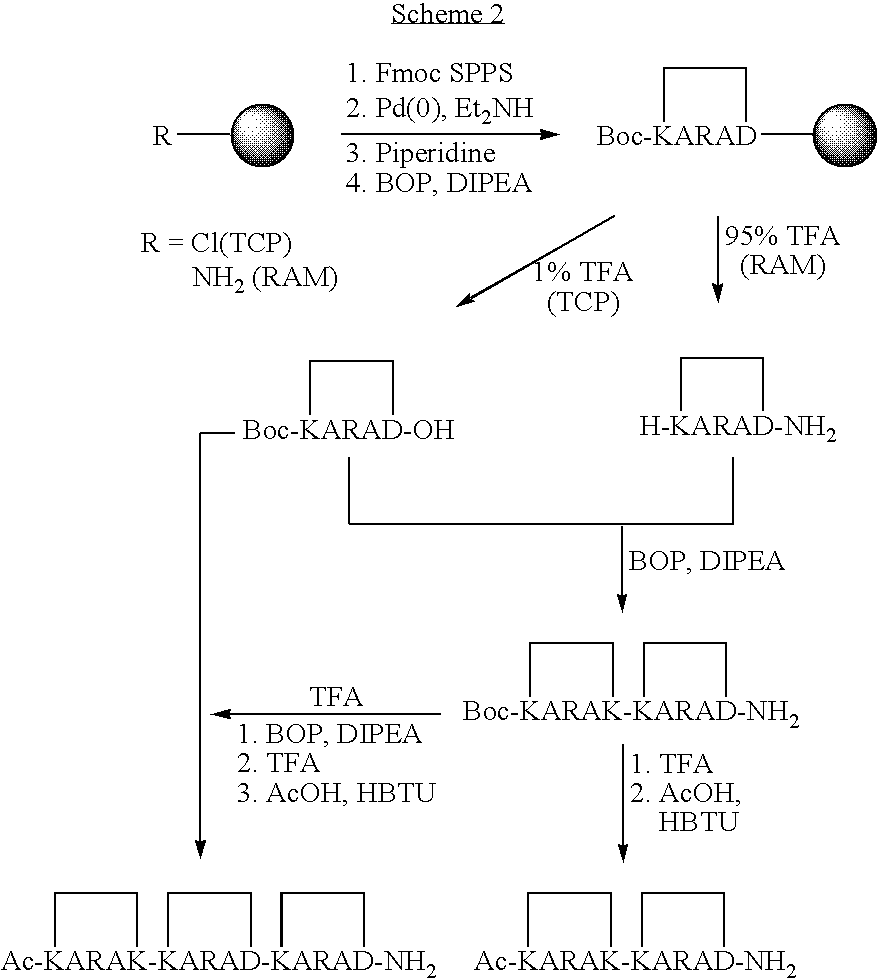
- The helically constrained peptides described herein can be synthesized with additional chemical groups present at their amino and/or carboxy termini, such that, for example, the stability, bioavailability, and/or inhibitory activity of the peptides is enhanced. For example, hydrophobic groups such as carbobenzoxyl, dansyl, or t-butyloxycarbonyl groups, may be added to the amino termini. An acetyl group or a 9-fluorenylmethoxy-carbonyl group may be placed at the amino termini. A hydrophobic group, t-butyloxycarbonyl, or an amido group may be added to carboxy termini. Furthermore, the peptides of the invention can be synthesized such that their steric configuration is altered. For example, the D-isomer of one or more of the amino acid residues of the peptide can be used, rather than the usual L-isomer. The compounds can contain at least one bond linking adjacent amino acids that is a non-peptide bond, and is preferably not helix breaking. Non-peptide bonds for use in flanking sequences include an imino, ester, hydrazine, semicarbazide, oxime, or azo bond. Still further, at least one of the amino acid residues of the peptides of the invention can be substituted by one of the well known non-naturally occurring amino acid residues, that is preferably not helix breaking. Desirably, the non-natural amino acid or non-amide bond linking adjacent amino acids, when present, is present outside of the internal sequence, and is, preferably, not helix breaking. Still further, at least one of the amino acid residues of the peptides of the invention can be substituted by one of the well known non-naturally occurring amino acid residues. Alterations such as these can serve to increase the stability, bioavailability, immunogenicity, and/or inhibitory action of the peptides of the invention.
- A representative example of alpha helical cyclic pentapeptides incorporated in a modular fashion into biologically active sequences is described. The opioid receptor-like 1 (ORL-1) is the most recently identified member of the opioid receptor family137. Unlike the other three types of opioid receptor (μ, δ, κ), the ORL-1 receptor does not display affinity for the naturally occurring opioid peptide ligands or for many synthetic opiates that selectively bind μ-, δ-, κ-receptors137. In 1995 the endogenous ligand for the ORL-1 receptor was identified and called nociceptin (NC). Like other opioid receptor peptide ligands nociceptin consists of an N-terminal tetrapeptide which is referred to as the “message” sequence and is primarily responsible for triggering stimulation of the receptor, whilst the remaining C-terminal portion is referred to as the “address” sequence and is involved in binding and receptor specificity137.
-

- Recent NMR structures of NC and related peptides revealed a highly helical structure in the address domain and suggested amphipathicity98-139. Another recent report successfully substituted Aib residues into the NC address sequence resulting in increased potency and affinity in 13-residue peptide sequences. Structure-activity relationship (SAR) studies suggest the minimal sequence is NC1-13. An alanine scan showed the first five residues (FGGFT) are critical, whilst G6 and A7 appear to tolerate substitution, R8 is highly crucial, whilst the remaining residues are necessary but tolerate alanine substitution 138. Another recent report identified a pure, selective peptide antagonist of the ORL-1 receptor which involved replacing the first residue in the native sequence with Nphe137.
- Since the present invention establishes a general method for constraining short peptides into alpha helical conformations, nociceptin is an ideal target to show that constraining biologically important helices into an alpha helical conformation can improve activity and affinity. Thus the peptides of SEQ ID NOs: 49 to 51 were designed using the available SAR. The peptide of SEQ ID NO: 49 is designed to be a nociceptin mimetic for agonism, whilst the peptide of SEQ ID NO: 50 is based on the recently reported antagonist [Nphe1]NC (1-15). The peptide of SEQ ID NO: 51 consists of just the address sequence and the inventors consider that if this peptide has sufficiently high affinity for the receptor it may function as an antagonist. There are no studies to date on peptides incorporating only the address sequence.
-

- The reaction scheme for the synthesis of the Nociceptin mimetics of SEQ ID NOs: 49 to 51 is shown in
Scheme 3. The 2-hydroxy-4-methoxybenzyl protecting group is used during synthesis of multi-macrocyclic compounds, however this group is removed during deprotection and cleavage of the peptides from the resin. -

- The present invention also provides compositions which comprise one or more compounds of the invention. The compounds themselves may be present in the compositions in any of a wide variety of forms. For example, two or more compounds may be merely mixed together or may be more closely associated through complexation, crystallization, or ionic or covalent bonding.
- Those of skill in the art will appreciate that a wide variety of prophylactic, diagnostic, and therapeutic treatments may be prepared from the compounds and compositions of the present invention, due in large part to the cross-reactivity—i.e., agonism or antagonism—of the macrocyclic moieties of the compounds with one or more naturally-occurring peptides or polypeptides. Thus, a compound of the present invention finds utility as a molecular mimic or antagonist of a member of a ligand-receptor binding pair that underlies or is otherwise associated with the development of a particular disease or condition, wherein the ligand-receptor interaction is mediated at least in part by one or more alpha helical motifs present in the ligand or the receptor. Accordingly, in some embodiments, a compound of the present invention having one or more macrocyclic moieties that antagonize the interaction of a ligand and a receptor will be useful in the prevention or treatment of a disease or condition that results from inappropriate activation of the receptor by the ligand. In other embodiments, a disease or condition may arise through inadequate activation of a receptor, in which case the disease or condition may be treated or prevented by means of a compound having one or more macrocyclic moieties that mimic the binding determinants of the ligand or the receptor. Illustrative diseases or conditions mediated by alpha-helix associated ligand-receptor interactions include diseases or conditions related to DNA transcription, diseases related to RNA reverse transcription, diseases or disorders related to transcriptional antitermination, diseases related to apoptosis regulation and tumor suppression, for example, cancers such as brain tumors, breast cancer, lung cancer, bone cancer, colon cancer, ovarian cancer, testicular cancer, renal cancer, liver cancer, lymphoma and leukemia; diseases or disorders related to calcium homeostasis, diseases or disorders related to pain transmission, diseases or disorders associated with lipid metabolism and cholesterol homeostasis, diseases and disorders related to stress response, or to anxiety, appetite, alcohol withdrawal, opiate withdrawal or epilepsy.
- Thus, a further aspect of the invention contemplates a method for treating or preventing a disease or condition associated with a ligand-receptor interaction that is mediated at least in part by an alpha helical domain present in the ligand or the receptor, comprising administering an effective amount of a compound comprising at least one alpha helical cyclic peptide, wherein each peptide comprises a sequence of five amino acid residues having a first terminal residue and a second terminal residue that are separated by an intervening sequence of three amino acid residues, and wherein the side chains of the first and second terminal residues are linked to each other and wherein the side chains of at least some of the amino acid residues of the or each peptide are in a (three-dimensional) configuration that is analogous to the configuration of amino acid side chains of at least a portion of the alpha helical domain of the ligand or the receptor. Preferably the compound is a compound of any one of formula (I), (II) or (IV).
- As used herein, the term “effective amount” relates to an amount of compound which, when administered according to a desired dosing regimen, provides the desired mediation of the disease or disorder, therapeutic activity or disease prevention. Dosing may occur at intervals of minutes, hours, days, weeks, months or years or continuously over any one of these periods. A therapeutic, or treatment effective amount is an amount of the compound which, when administered according to a desired dosing regimen, is sufficient to at least partially attain the desired therapeutic effect, or delay the onset of, or inhibit the progression of or halt or partially or fully reverse the onset or progression of the disease or disorder. A prevention effective amount of compound which when administered to the desired dosing regimen is sufficient to at least partially prevent or delay the onset of a particular disease or condition.
- Yet another aspect of the invention provides a use of a compound comprising an alpha helical cyclic peptide, wherein the peptide comprises a sequence of five amino acid residues having a first terminal residue and a second terminal residue that are separated by an intervening sequence of three amino acid residues, and wherein the side chains of the first and second terminal residues are linked to each other, in the preparation of a medicament for the treatment or prevention of a disease or disorder mediated by the interaction of alpha helical peptides with biomolecules.
- Suitable dosages may lie within the range of about 0.1 ng per kg of body weight to 1 g per kg of body weight per dosage. The dosage is preferably in the range of 1 μg to 1 g per kg of body weight per dosage, such as is in the range of 1 mg to 1 g per kg of body weight per dosage. In one embodiment, the dosage is in the range of 1 mg to 500 mg per kg of body weight per dosage. In another embodiment, the dosage is in the range of 1 mg to 250 mg per kg of body weight per dosage. In yet another preferred embodiment, the dosage is in the range of 1 mg to 100 mg per kg of body weight per dosage, such as up to 50 mg per kg of body weight per dosage. In yet another embodiment, the dosage is in the range of 1 μg to 1 mg per kg of body weight per dosage.
- Suitable dosage amounts and dosing regimens can be determined by the attending physician and may depend on the severity of the condition as well as the general age, health and weight of the subject.
- The active ingredient may be administered in a single dose or a series of doses. While it is possible for the active ingredient to be administered alone, it is preferable to present it as a composition, preferably as a pharmaceutical composition.
- According to a further aspect, the invention contemplates a pharmaceutical composition comprising a compound comprising an alpha helical cyclic peptide, wherein the peptide comprises a sequence of five amino acid residues having a first terminal residue and a second terminal residue that are separated by an intervening sequence of three amino acid residues, and wherein the side chains of the first and second terminal residues are linked to each other, or a conformationally constrained peptide having a plurality of alpha helical pentapeptide sequences, wherein the pentapeptide sequences comprise a sequence of five amino acid residues having a first terminal residue and a second terminal residue that are separated by an intervening sequence of three amino acid residues, and wherein the side-chains of the first and second terminal residues are linked to each other, or a pharmaceutically acceptable salt thereof and a pharmaceutically acceptable carrier, excipient or diluent.
- Suitable pharmaceutically acceptable salts include, but are not limited to, salts of pharmaceutically acceptable inorganic acids such as hydrochloric, sulfuric, phosphoric, nitric, carbonic, boric, sulfamic, and hydrobromic acids, or salts of pharmaceutically acceptable organic acids such as acetic, propionic, butyric, tartaric, maleic, hydroxymaleic, fumaric, malic, citric, lactic, mucic, gluconic, benzoic, succinic, oxalic, phenylacetic, methanesulphonic, toluenesulphonic, benzenesulphonic, salicylic, sulphanilic, aspartic, glutamic, edetic, stearic, palmitic, oleic, lauric, pantothenic, tannic, ascorbic and valeric acids.
- Base salts include, but are not limited to, those formed with pharmaceutically acceptable cations, such as sodium, potassium, lithium, calcium, magnesium, zinc, ammonium, alkylammonium such as salts formed from triethylamine, alkoxyammonium such as those formed with ethanolamine and salts formed from ethylenediamine, choline or amino acids such as arginine, lysine or histidine.
- Basic nitrogen-containing groups may be quarternised with such agents as lower alkyl halide, such as methyl, ethyl, propyl, and butyl chlorides, bromides and iodides; dialkyl sulfates like dimethyl and diethyl sulfate; and others.
- The formulation of such compositions is well known to those skilled in the art. The composition may contain pharmaceutically acceptable additives such as carriers, diluents or excipients. These include, where appropriate, all conventional solvents, dispersion agents, fillers, solid carriers, coating agents, antifungal and antibacterial agents, dermal penetration agents, surfactants, isotonic and absorption agents and the like. It will be understood that the compositions of the invention may also include other supplementary physiologically active agents.
- The carrier must be pharmaceutically acceptable in the sense of being compatible with the other ingredients of the composition and not injurious to the subject. Compositions include those suitable for oral, rectal, inhalational, nasal, transdermal, topical (including buccal and sublingual), vaginal or parenteral (including subcutaneous, intramuscular, intraspinal, intravenous and intradermal) administration. The compositions may conveniently be presented in unit dosage form and may be prepared by any methods well known in the art of pharmacy. Such methods include the step of bringing into association the active ingredient with the carrier which constitutes one or more accessory ingredients. In general, the compositions are prepared by uniformly and intimately bringing into association the active ingredient with liquid carriers or finely divided solid carriers or both, and then if necessary shaping the product.
- Depending on the disease or condition to be treated, it may or may not be desirable for a compound of Formula (I) or (IV) to cross the blood/brain barrier. Thus the compositions for use in the present invention may be formulated to be water or lipid soluble.
- Compositions of the present invention suitable for oral administration may be presented as discrete units such as capsules, sachets or tablets each containing a predetermined amount of the active ingredient; as a powder or granules; as a solution or a suspension in an aqueous or non-aqueous liquid; or as an oil-in-water liquid emulsion or a water-in-oil liquid emulsion. The active ingredient may also be presented as a bolus, electuary or paste.
- A tablet may be made by compression or moulding, optionally with one or more accessory ingredients. Compressed tablets may be prepared by compressing in a suitable machine the active ingredient in a free-flowing form such as a powder or granules, optionally mixed with a binder (eg inert diluent, preservative, disintegrant (eg. sodium starch glycolate, cross-linked polyvinyl pyrrolidone, cross-linked sodium carboxymethyl cellulose)) surface-active or dispersing agent. Moulded tablets may be made by moulding in a suitable machine a mixture of the powdered compound moistened with an inert liquid diluent. The tablets may optionally be coated or scored and may be formulated so as to provide slow or controlled release of the active ingredient therein using, for example, hydroxypropylmethyl cellulose in varying proportions to provide the desired release profile. Tablets may optionally be provided with an enteric coating, to provide release in parts of the gut other than the stomach.
- Compositions suitable for topical administration in the mouth include lozenges comprising the active ingredient in a flavored base, usually sucrose and acacia or tragacanth gum; pastilles comprising the active ingredient in an inert basis such as gelatin and glycerin, or sucrose and acacia gum; and mouthwashes comprising the active ingredient in a suitable liquid carrier.
- The compounds of Formula (I) or (IV) may also be administered intranasally or via inhalation, for example by atomizer, aerosol or nebulizer means.
- Compositions suitable for topical administration to the skin may comprise the compounds dissolved or suspended in any suitable carrier or base and may be in the form of lotions, gel, creams, pastes, ointments and the like. Suitable carriers include mineral oil, propylene, glycol, polyoxyethylene, polyoxypropylene, emulsifying wax, sorbitan monostearate, polysorbate 60, cetyl esters wax, cetearyl alcohol, 2-octyldodecanol, benzyl alcohol and water. Transdermal devices, such as patches, may also be used to administer the compounds of the invention.
- Compositions for rectal administration may be presented as a suppository with a suitable carrier base comprising, for example, cocoa butter, gelatin, glycerin or polyethylene glycol.
- Compositions suitable for vaginal administration may be presented as pessaries, tampons, creams, gels, pastes, foams or spray formulations containing in addition to the active ingredient such carriers as are known in the art to be appropriate.
- Compositions suitable for parenteral administration include aqueous and non-aqueous isotonic sterile injection solutions which may contain anti-oxidants, buffers, bactericides and solutes which render the composition isotonic with the blood of the intended recipient; and aqueous and non-aqueous sterile suspensions which may include suspending agents and thickening agents. The compositions may be presented in unit-dose or multi-dose sealed containers, for example, ampoules and vials, and may be stored in a freeze-dried (lyophilized) condition requiring only the addition of the sterile liquid carrier, for example water for injections, immediately prior to use. Extemporaneous injection solutions and suspensions may be prepared from sterile powders, granules and tablets of the kind previously described.
- Preferred unit dosage compositions are those containing a daily dose or unit, daily sub-dose, as herein above described, or an appropriate fraction thereof, of the active ingredient.
- It should be understood that in addition to the active ingredients particularly mentioned above, the compositions of this invention may include other agents conventional in the art having regard to the type of composition in question, for example, those suitable for oral administration may include such further agents as binders, sweeteners, thickeners, flavoring agents, disintegrating agents, coating agents, preservatives, lubricants and/or time delay agents. Suitable sweeteners include sucrose, lactose, glucose, aspartame or saccharine. Suitable disintegrating agents include corn starch, methylcellulose, polyvinylpyrrolidone, xanthan gum, bentonite, alginic acid or agar. Suitable flavoring agents include peppermint oil, oil of wintergreen, cherry, orange or raspberry flavoring. Suitable coating agents include polymers or copolymers of acrylic acid and/or methacrylic acid and/or their esters, waxes, fatty alcohols, zein, shellac or gluten. Suitable preservatives include sodium benzoate, vitamin E, alpha-tocopherol, ascorbic acid, methyl paraben, propyl paraben or sodium bisulphite. Suitable lubricants include magnesium stearate, stearic acid, sodium oleate, sodium chloride or talc. Suitable time delay agents include glyceryl monostearate or glyceryl distearate.
-
FIG. 1 depicts: left, CD spectra of cyclic pentapeptides SEQ ID NOs: 10 (pink), 11 (blue), 8 (black), 9 (red), 12 (light blue), 13 (purple), 18 (red), 19 (yellow) in 10 mM phosphate buffer (pH 7.4, 25° C.) and; right, schematic demonstrating the positions of the three hydrogen bonds (dotted lines) important for stabilization of the pentapeptide helix. -
FIG. 2 depicts CD spectra of compounds SEQ ID NOS: 23 (black), 24 (grey), 25 (red), 26 (blue), 27 (yellow), 28 (purple), 29 (green), 30 (light blue), 31 (orange) in 10 mM phosphate buffer (pH 7.4, 25° C.) demonstrating the variation of helicity by varying the residues within the lactam cycle. -
FIG. 3 depicts: left, a ROE Summary Diagram (left) and 20 lowest energy calculated structures for Ac-(cyclo-2,6)—R[KAAAD]—NH2 (23) in 90% H2O: 10% D2O at 20° C. Thickness of bars reflects intensity of ROEs; right, lactam bridge in purple -
FIG. 4 depicts CD spectra of 8 in 10 nM phosphate buffer (black) (pH 7.4, 25° C.) and 50% TFE (red). -
FIG. 5 is a graphical representation showing the variation in molar elipticity of 8 at 215 nm with increasing [guanidine.HCl] at 25° C. -
FIG. 6 depicts a CD spectrum comparing the helicity of SEQ ID NOs: 46 and 47 with their acyclic linear analogues SEQ ID NOs: 54 and 55. -
FIG. 7 depicts the sequential and medium ROEs, temperature coefficients, and coupling constants for SEQ ID NO: 46 in 90% H2O: 10% D2O. -
FIG. 8 depicts (a) Helical wheel for dimer SEQ ID NO: 46, cyclo(1-5, 6-10)-Ac-[KARADKARAD]—NH2 showing side chain distribution; (b) side view of SEQ ID NO: 46 with helical backbone (yellow), bridging lactam restraints (white), exposed side chains (green spheres); and (c) SEQ ID NO: 46 viewed end on. -
FIG. 9 depicts CD spectra in 10 mM phosphate buffer, pH 7.4, 25° C. for 32-44 mM solutions of (a) SEQ ID NO: 46 (—), SEQ ID NO: 47 (—--—) and acyclic analogues SEQ ID NO: 54 (——) and SEQ ID NO: 55(---); (b) SEQ ID NO: 46 (—) versus SEQ ID NO: 47 (---), SEQ ID NO: 54 (——) and SEQ ID NO: 55 (—-—) in 50% TFE. -
FIG. 10 is a illustration of the crystal structure of Bad (grey) bound to Bcl-xL protein, NMR structures of monocycle(purple) and bicycle (green) overlay closely with the Bad helix and can display the side chains required for binding in the correct position. (PDBID: 1g5j) -
FIG. 11 is an illustration of the crystal structure of p53 (grey) bound to MDM2 oncoprotein (PDBID: 1ycq), with monocycle (Ac-R[KAAAD]—NH2 [SEQ ID NO: 23]) overlayed showing it can position the binding residues in the required position -
FIG. 12 depicts CD spectra of constrained nociceptin mimetics SEQ ID NOs: 79 and 77, known peptidic agonist (FGGFTGARKSARK-NH2; Ki:0.3 nM), and linear address sequence (AcTGARKSARK-NH2). - Those skilled in the art will appreciate that the invention described herein is susceptible to variations and modifications other than those specifically described. It is to be understood that the invention includes all such variations and modifications which fall within the spirit and scope. The invention also includes all of the steps, features, compositions and compounds referred to or indicated in this specification, individually or collectively, and any and all combinations of any two or more of said steps or features.
- The invention will now be described with reference to the following examples which are included for the purpose of illustration only and are not intended to limit the generality of the invention hereinbefore described.
- Peptides represented by SEQ ID NO. 8 to SEQ ID NO: 31 were prepared on 0.25 mmol scale by manual stepwise solid phase peptide synthesis using HCTU/DIPEA activation for Fmoc chemistry on Rink Amide MBHA resin (substitution 0.78 mmol.g−1), or Tentagel S RAM resin (substitution 0.25 mmol.g−1), or Trityl chloride resin (substitution 1.0 mmol.g−1). Four equivalents of amino acid and eight equivalents of diisopropylethylamine (DIPEA) were employed in each coupling step (45 mins), except for Fmoc-Asp(OAllyl)-OH and Fmoc-Lys(Alloc)-OH where only 2 equivalents were used. Fmoc deprotections were achieved with 3×5 min treatments with excess 1:1 piperidine:DMF. Coupling yields were monitored by quantitative ninhydrin assay51 and double couplings were employed for yields below 99.6%. After the assembly was complete, the allyl ester of aspartic acid and allyl carbamate of lysine were removed by treating the peptide resin with Pd(PPh3)4 (0.1 eq) and N,N-dimethylbarbituric acid (4 eq), in DCM, under argon and in the dark for 2 hrs, this procedure was repeated once. After which the peptide was washed with DCM, DMF and 0.5% diethyldithiocarbamate in DMF. 2 mg of resin was subjected to cleavage and the progress of the reaction monitored by MS. This process was repeated if necessary.
- Cyclization was effected on-resin using 1.5 eq BOP, 2 eq DIPEA in DMSO/NMP (1:4). The reaction was monitored by cleavage of 2 mg resin and subjecting the residue to MS, total reaction time was <24 hours. The peptides were simultaneously deprotected and cleaved from the resin by 2 hr treatment of the washed and dried resin in 95% TFA, 2.5% TIPS, 2.5% H2O, or 1% TFA in DCM (15 μl per 10 mg resin). The solution was then filtered, the filtrate concentrated in vacuo and the peptide precipitated with cold diethyl ether. The peptide precipitate was filtered washed with copious amounts of diethyl ether, redissolved in 1:1 acetonitrile/water and lyophilised. The crude peptides were purified by rp-HPLC (Rt1:Vydac C18 column, 300 Å. 22×250 mm, 214 nm, Solvent A=0.1% TFA in H2O, Solvent B=0.1% TFA, 10% H2O in Acetonitrile. Gradient: 0% B to 100% B over 30 mins. Rt 2:Phenomenex C18 column, 300 Å. 22×250 mm, 214 nm, Solvent A=0.1% TFA in H2O, Solvent B=0.1% TFA, 10% H2O in Acetonitrile. Gradient: 0% B to 100% B over 30 mins.). 1H NMR was carried out in H2O:D2O (9:1) at 298K.
- Synthesis of the peptide of formula (II) was achieved by standard Fmoc SPPS protocols using trityl chloride polystyrene resin. The peptide was capped with phenyl butanoic acid, cleaved from the resin using 1% TFA in dichloromethane (DCM) leaving side chain protecting groups intact. Isobutylamine was then coupled on using BOP, DIPEA, with CuCl2—additive known to minimize racemisation of the C-terminal residue. Following this final deprotection was effected with 95% TFA, 2.5% TIPS, 2.5% H2O.
- NH2— (cyclo-1-5)-KARAD-NH2 (SEQ ID NO. 52) was prepared by manual stepwise solid phase peptide synthesis using HBTU/DIPEA activation for Fmoc chemistry107 on Rink Amide MBHA resin (substitution 0.78 mmol.g−1, 1.56 mmol, 2000 mg). Four equivalents of amino acid and eight equivalents of diisopropylethylamine (DIPEA) were employed in each coupling step (45 mins), except for Fmoc-Asp(OAllyl)-OH and Boc-Lys(Fmoc)-OH where only 2 equivalents were used. Fmoc deprotections were achieved with 3×5 min treatments with excess 1:1 piperidine:DMF. Coupling yields were monitored by quantitative ninhydrin assay108 and double couplings were employed for yields below 99.6%. After the assembly was complete, the allyl ester of aspartic acid was removed by treating the peptide resin with Pd(PPh3)4 (0.05 eq) and diethylamine (5 eq) in DCM, under argon and in the dark for 2 hrs. After which the peptide was washed with DCM, DMF and 0.5% diethyldithiocarbamate in DMF. 2 mg of resin was subjected to cleavage and the progress of the reaction monitored by Mass spectrometry (MS). This process was repeated if necessary. Following Allyl ester deprotection the N(ζ)-Fmoc group was removed by treatment with piperidine (1:1 in DMF). Cyclization was effected on-resin using 1.5 eq BOP, 2 eq DIPEA in DMF/Benzene (2:1). The reaction was monitored by cleaving 2 mg resin and subjecting the residue to MS, total reaction time was approximately 48-72 hours. The peptides were simultaneously deprotected and cleaved from the resin by 2 hr treatment of the washed and dried resin in 95% TFA, 2.5% TIPS, 2.5% H2O (15 μl per 10 mg resin). The solution was then filtered, the filtrate concentrated in vacuo and the peptide precipitated with cold diethyl ether. The peptide precipitate was filtered washed with copious amounts of diethyl ether, redissolved in 1:1 acetonitrile/water and lyophilised. The crude peptides were purified by rp-HPLC (Vydac C18 column, 300 Å. 22×250 mm, 214 nm, Solvent A=0.1% TFA in H2O, Solvent B=0.1% TFA, 10% H2O in Acetonitrile. Gradient: 0% B to 100% B over 30 mins.
Yield 30% (isolated). [Rt=12.82 min]. MS: [M+H+] (calc.)=calc. 541.31 (expt.)=541.39. - Boc-(cyclo-1-5)-KAR(Pbf)AD-OH (SEQ ID NO. 53) was synthesized in an analogous manner to peptide (SEQ ID NO: 52 above), however using trityl chloride resin (0.95 mmol.g−1, 1.28 g, 1.16 mmol). Cleavage was achieved using 50
mL 10% acetic acid, 20% 2,2,2-trifluoroethanol, 70% DCM for 2 hrs. After lyophilization the crude peptide was deemed pure enough by analytical HPLC and used without further purification. Yield 50%. MS: [M+H+] (calc)=893.43 (expt.)=893.67]. - To DIPEA (135 μL, 0.38 mmol) was added to a solution of Boc-cyclo(1-5)-KAR(Pbf)AD-OH [SEQ ID NO: 53] (154 mg, 0.17 mmol), NH2-cyclo(1-5)-KARAD-NH2 [SEQ ID NO: 52] (102 mg, 0.19 mmol, and BOP (80 mg, 0.18 mmol) in DMF (5 mL). After stirring (2 h, RT), solvent was evaporated in vacuo, the residue dissolved in H2O/MeCN (1:1), lyophilized and purified (rpHPLC). The product was treated with TFA/TIPS19:1 (1 h, 20° C.), evaporated, and reacted (2 h, 20° C.) with AcOH (15 μL, 0.26 mmol), 0.5M HBTU (500 μL 0.25 mmol) and DIPEA (90 μL, 0.52 mmol). Solvent was removed in vacuo, H2O/MeCN (1:1) added, lyophilized and purified (rpHPLC) to yield cyclo(1-5, 6-10)-Ac-[KARADKARAD]—NH2 [SEQ ID NO: 46] (19.1 mg, 10% isolated). MS [M+H+] (calc.) 1106.6 (expt.) 1106.97, [M+2H]/2 (calc.)=554.3 (expt.)=554.04. Anal. rpHPLC: 14.8 min. (
Gradient 0%-100% acetonitrile over 30 min). - DIPEA (135 μL, 0.38 mmol) was added to a solution of Boc-(cyclo1-5)-KAR(Pbj)AD-OH [SEQ ID NO: 53] (66 mg, 0.077 mmol), NH2— (cyclo1-5)-KARAD-NH2 [SEQ ID NO: 52](42 mg, 0.074 mmol, and BOP (52 mg, 0.154 mmol) in DMF (5 mL). After stirring (2 h, RT), solvent was evaporated in vacuo, the residue dissolved in H2O/MeCN (1:1), lyophilized and purified (rpHPLC). The product (34 mg, 0.024 mmol) was treated with TFA/TIPS 19:1 (1 h, 20° C.), evaporated, and reacted (2 h, RT) with peptide Boc-(cyclo1-5)-KAR(Pbf)AD-OH ([SEQ ID NO: 53] (20 mg, 0.024 mmol), BOP (15 mg, 0.034 mmol), and lastly DIPEA (50 μL, 0.24 mmol). The solvent was evaporated in vacuo, the residue dissolved in H2O/MeCN (1:1), lyophilized and purified (rpHPLC). The product was once again treated with TFA/TIPS 19:1 (1 h, 20° C.), evaporated, and reacted with AcOH (2 μL, 0.0132 mmol),
BOP 7 mg, 0.016 mmol) and DIPEA (19 μL, 0.138 mmol) for 2 hrs at RT. The solvent was removed in vacuo, H2O/MeCN (1:1) added, lyophilized and purified (rpHPLC) to yield cyclo(1-5, 6-10, 11-15)-Ac-[KARADKARADKARAD]—NH2 [SEQ ID NO: 47] (7.8 mg, 5.5% (isolated). MS [M+2H+]/2 (calc.)=815.44 (expt.)=815.55. [M+3H]/3 (calc.)=543.97 (expt.)=544.03. Anal. rpHPLC: 15.09 min. - Linear Peptides Ac(KARAD)u-NH2 where n=2 (SEQ ID NO: 54) and n=3 (SEQ ID NO: 55) were prepared by manual stepwise solid phase peptide synthesis using HBTU/DIPEA activation for Fmoc chemistry107 on Rink Amide MBHA resin (substitution 0.78 mmol.g−1, 0.5 mmol, 648 mg). Four equivalents of amino acid and eight equivalents of diisopropylethylamine (DIPEA) were employed in each coupling step (45 min). Fmoc deprotections were achieved with 3×5 min treatments with excess 1:1 piperidine:DMF. Coupling yields were monitored by quantitative ninhydrin assay108 and double couplings were employed for yields below 99.6%. After assembly of the first 10 residues, the peptide resin was washed, dried and split into two portions, one portion was acetylated, whilst to the other was added the final 5 residues. N-terminal acetylation was achieved by treating the fully protected peptide with 4 equivalents of glacial acetic acid, 4 equivalents of HBTU, and 8 equivalents of DIPEA. The peptides were simultaneously deprotected and cleaved from the resin by 2-hr treatment of the washed and dried resin in 95% TFA, 2.5% TIPS, 2.5% H2O (15 μL per 10 mg resin). The solution was then filtered, the filtrate concentrated in vacuo and the peptide precipitated with cold diethyl ether. The peptide precipitate was filtered washed with copious amounts of diethyl ether, redissolved in 1:1 acetonitrile/water and lyophilized. The crude peptides were purified by rp-HPLC (Vydac C18 column, 300 Å. 22×250 mm, 214 nm, Solvent A=0.1% TFA in H2O, Solvent B=0.1% TFA, 10% H2O in Acetonitrile. Gradient: 0% B to 100% B over 30 mins. (SEQ ID NO: 54)
Yield 20% (isolated). [Rt=12.65 min]. MS: [M+H+] (calc.)=1142.63 (expt.)=1142.75; [M+2H+]/2 (calc.) 571.85 (expt.)=571.86. (SEQ ID NO: 55)Yield 30% (isolated) [Rt=13.16 min]. MS: [M+2H+]/2 (calc.)=842.46 (expt.)=842.64; [M+3H+]/3 (calc.) 561.98 (expt.)=562.08. - Synthesis of SEQ ID NOs: 77 to 80 was carried on Tentagel-S-RAM resin (0.25 mmol scale) by manual stepwise solid phase peptide synthesis using HCTU/DIPEA activation Tentagel-S-RAM resin using standard Fmoc SPPS (scheme), Four equivalents of amino acid and eight equivalents of diisopropylethylamine (DIPEA) were employed in each coupling step (45 mins), except for Fmoc-Asp(OAllyl)-OH and Fmoc-Lys(Alloc)-OH where only 2 equivalents were used. Fmoc deprotections were achieved with 3×5 min treatments with excess 1:1 piperidine:DMF. Coupling yields were monitored by quantitative ninhydrin assay and double couplings were employed for yields below 99.6%. After the assembly was complete, the allyl ester of aspartic acid and allyl carbamate of lysine were removed by treating the peptide resin with Pd(PPh3)4 (0.1 eq) and N,N-dimethylbarbituric acid (4 eq), in DCM, under argon and in the dark for 2 hrs, this procedure was repeated once. After which the peptide was washed with DCM, DMF and 0.5% diethyldithiocarbamate in DMF. 2 mg of resin was subjected to cleavage and the progress of the reaction monitored by MS. This process was repeated if necessary.
- Cyclization was effected on-resin using 1.5 eq BOP, 2 eq DIPEA in DMSO/NMP (1:4). The reaction was monitored by cleavage of 2 mg resin and subjecting the residue to MS, total reaction time was <24. After subsequent piperidine deprotection, the resin was shaken with 2-hydroxy-4-methoxybenzaldehyde in dimethylormamide/trimethylorthoformate (1:1) for 10 hr, the resin was then drained and NaBH(OAc)3 (10 eq) in dimethylormamide/trimethylorthoformate (1:1). The ninhydrin test indicated that the 2-hydroxy-4-methoxybenzyl had successfully (>99.4%) been introduced onto Nα of lysine. The resin was then acylated overnight with the symmetrical anhydride of Fmoc-Asp(OAll)-OH (generated by stirring 6 eq Fmoc-Asp(OAll)-OH, and 3 eq Diisopropylcarbodimide in DCM for 30 mins). Cleavage of a small amount of resin and analysis by MS indicated complete Nα acylation after 24 hrs. The remaining residues were introduced using the standard HCTU/DIPEA activation, and allyl deprotection and macrolactamization was achieved as previously described. After attachment of the final 5 residues the peptide resin was deprotected, washed and dried. Final cleavage of the peptides was achieved with 92.5% TFA, 2.5% TIPS, 2.5% EDT, 2.5% H2O. The solution was then filtered, the filtrate concentrated in vacuo and the peptide precipitated with cold diethyl ether. The peptide precipitate was filtered washed with copious amounts of diethyl ether, redissolved in 1:1 acetonitrile/water and lyophilised. The crude peptides were purified by rp-HPLC (Rt1:Vydac C18 column, 300 Å. 22×250 mm, 214 nm, Solvent A=0.1% TFA in H2O, Solvent B=0.1% TFA, 10% H2O in Acetonitrile. Gradient: 0% B to 100% B over 30 mins. Rt2:Phenomenex C18 column, 300 Å. 22×250 mm, 214 nm, Solvent A=0.1% TFA in H2O, Solvent B=0.1% TFA, 10% H2O in Acetonitrile. Gradient: 0% B to 100% B over 30 mins.).
- CD and NMR Studies on Cyclic Penta and Hexapeptides
- Circular Dichroism (CD) was performed on peptides having SEQ ID NOs: 8 to 14 and 18 to 31, using methods described above. The molar elipticities at 222 nm, 208 nm and 190 nm, ratios of elipticities at 222 nm/208 nm and relative helicity are shown in Tables 6 and 7. CD spectra of these peptides are given in
FIG. 1 . -
TABLE 6 CD spectra on peptides having one cyclic pentapeptide module - effects of varying the bridge partner and the termini Molar elipticities ([θ] deg.cm2.dmol−1.residue−1) at λ = 215, 207 and 190 nm, ratios of elipticities at 215/207 nm, and percentage helicity for peptides in 10 mM phosphate buffer (pH 7.4, 25° C.). Relative Peptide [θ]215 [θ]207 [θ]190 θ215/θ207 helicityc Ac-(cyclo-1,5)-[KARAE]-NH2 −1068 −3393 −10611 0.31 0.08 [SEQ ID NO: 10] Ac-(cyclo-1,5)-[EARAK]-NH2 −7430 −12803 20735 0.58 0.58 [SEQ ID NO: 11] Ac-(cyclo-1,5)-[KARAD]-NH2 −12757 −12211 38300 1.04 1.00 [SEQ ID NO: 8] Ac-(cyclo-1,5)-[DARAK]-NH2 −7723 −10705 15600 0.72 0.60 [SEQ ID NO: 9] Ac-(cyolo-1,5)-[OARAD]-NH2 92 −2077 −4613 −0.04 0 [SEQ ID NO: 12] Ac-(cyclo-1,5)-[DARAO]-NH2 −4671 −9748 −6954 0.48 0.37 [SEQ ID NO: 13] Ac-(cyclo-1,5)-[OARAE]-NH2 741 −3368 −16228 −0.22 0 [SEQ ID NO: 18] Ac-(cyclo-1,5)-[EARAO]-NH2 2442 −1917 −11256 −1.27 0 [SEQ ID NO: 19] Ac-KARAD-NH2 −524 −5555 −7372 0.09 0.04 [SEQ ID NO: ZZ14] Ac-(cyclo-1,5)-[KARAD]-OH 207 −5643 −13953 −0.04 0 [SEQ ID NO: 20] a −625 −3195 −2659 0.20 0.06 H-(cyclo-1,5)-[KARAD]-NH2 −812 −2228 1355 0.36 0.06 [SEQ ID NO: 21] b −2590 −3327 8452 0.78 0.2 H-(cyclo-1,5)-[KARAD]-OH −1033 −5737 −4966 0.18 0.08 [SEQ ID NO: 22] aIn 0.01 M HCl pH 2. bIn 0.001 M NaOH pH 10.c[θ]215 (8)/[θ]215 (x) refer to “Quantitation of helicity”. - Of interest, the CD spectrum for SEQ ID NO: 8 shows a slight shift in its minima to lower wavelengths compared with longer alpha helical peptides (222 nm→215 nm, 208 nm →207 nm), as has been observed before in short fixed nucleus alanine helices116. Given that these are the first CD spectra of very short isolated alpha helices, it is not surprising that their CD spectra differ from those of much longer helices. Theoretical studies117, 118 into the chiroptic properties of the alpha helix have predicted that short alpha helices should have different CD spectra from longer alpha helices. The negative minimum at 215 nm is consistent with the long wavelength n→π* transition commonly observed for alpha helices and beta sheets in the 215-230 nm wavelength range.119 The observed positive maximum at 190 nm and negative minimum at 207 nm characterize the structure as alpha helix rather than beta sheet, as these bands can only arise from exciton splitting of the NV1 transition by the interaction of electric dipole transition moments among amides in the well defined geometry of the alpha helix. The relative intensities of these peaks for
SEQ ID NO 8 mirror those observed for other alpha helices, therefore we have quoted the intensities at 190 nm, 207 nm and 215 nm in Table 6. - Certain residues are known to favor or disfavor alpha helicity, therefore the residues in this system were altered in an attempt to gain insight into the helicity for these cycles. Initial solubility issues with hydrophobic pentapeptides prompted us to incorporate an additional arginine at the N-terminus. Nine K(i)→D(i+4) side-chain cyclised hexapeptides were synthesized with the three residues intervening the bridge systematically replaced by alpha helix inducing (alanine, leucine, methionine, glutamine), alpha helix indifferent (phenylalanine, serine), or alpha helix breaking (glycine) residues (Table 7).
-
TABLE 7 Molar elipticities ([θ] deg.cm2.dmol−1.residue−1) at λ = 215, 207 and 190 nm, ratios of elipticities at 215/207 nm, and percentage helicity for cyclic peptides 23-31 in 10 mM phosphate buffer pH 7.4 at 25° C. Relative Peptide [θ]215 [θ]207 [θ]190 θ215/θ207 Helicitya Ac-(cyclo-2,6)-R[KAAAD]-NH2 −13537 −13684 39352 0.99 0.91 [SEQ ID NO: 23] Ac-(cyclo-2,6)-R[KALAD]-NH2 −14798 −15165 46621 0.98 1.00 [SEQ ID NO: 24] Ac-(cyclo-2,6)-R[KAMAD]-NH2 −11853 −12296 38464 0.96 0.80 [SEQ ID NO: 25] Ac-(cyclo-2,6)-R[KAQAD]-NH2 −11394 −12279 36865 0.93 0.84 [SEQ ID NO: 26] Ac-(cyclo-2,6)-R[KAFAD]-NH2 −8644 −9087 27718 0.95 0.76 [SEQ ID NO: 27] Ac-(cyclo-2,6)-R[KAGAD]-NH2 −4874 −7678 10036 0.63 0.32 [SEQ ID NO: 28] Ac-(cyclo-2,6)-R[KGSAD]-NH2 −4810 −6975 12831 0.69 0.32 [SEQ ID NO: 29] Ac-(cyclo-2,6)-R[KSSSD]-NH2 −4432 −8017 6827 0.55 0.30 [SEQ ID NO: 30] Ac-(cyclo-2,6)-R[KGGGD]-NH2 −2131 −4868 −1593 0.44 0.14 [SEQ ID NO: 31] aθ215 [SEQ ID NO: 24]/θ215 (x) refer to “Quantitation of helicity” section below. -
FIG. 2 shows that helicity is dependent on which residues intervene between the bridging residues. The helical structure is tolerant of substitution by alpha helix inducing residues like Ala ([SEQ ID NO: 23], Leu [SEQ ID NO: 24], Met [SEQ ID NO: 25], Gln [SEQ ID NO: 26] and Phe [SEQ ID NO: 27], as demonstrated by the deep minima at 215/207 nm, high maximum at 190 nm, and high ratio θ215/θ207. There is some variation in the intensity at these wavelengths which closely mirrors the intrinsic alpha helical propensity of specific amino acids determined in protein environments35. The system can be perturbed by replacing the central residue with glycine [SEQ ID NO: 28], which results in a decrease in intensity at 215 nm, 207 nm and 190 nm, along with the appearance of a deeper minimum at 20 nm that is commonly observed for 310-helicity/random coil structures. This reduction in alpha helicity also results from placement of two [SEQ ID NO: 29] or three [SEQ ID NO: 30] helix disfavoring residues between the bridging residues, although based on the shape of their CD spectra there is some bias towards a helical conformation. Not surprisingly, where three alpha helix breaking residues are present [SEQ ID NO: 31], total abolition of helicity was indicated by the single deep minimum at 200 nm characteristic of a random coil. - Structural characterization was conducted for SEQ ID NO. 8 and SEQ ID NO 23 using 1D and 2D 1H-NMR spectroscopy in 90% H2O: 10% D2O at 288 K (pH 4.0). 2D-TOCSY spectra at 600 MHz were used to identify resonances for each amino acid. Due to the molecular weight of the macrocycle, ROESY instead of NOESY spectra had to be used to identify sequential connectivity and intra-residue NH—NH and NH—CH cross peaks Spectral overlap in SEQ ID NO. 8 prevented unambiguous identification of key long range ROEs, however SEQ ID NO. 23 gave well defined resonances and was investigated further. There were a number of spectral features that are characteristic of well-defined structure in the cyclic hexapeptide [SEQ ID NO: 23], and specifically characteristic of alpha helicity.
- First, there were conspicuously low coupling constants (3JNHCHα<6 Hz) for all amide resonances except D6, as normally observed in alpha helical peptides. Second, all of the residues displayed a upfield shift (0.18 to 0.32 ppm) for 6(Hα) relative to the corresponding residue in random coil structures, this also being typical of helical peptides. Third, there was a low temperature dependence for amide NH chemical shifts, with temperature coefficients (A6/T) being ≦4 ppb/K for Ala3, Ala4, Ala5, Asp6, and one C-terminal amide NH (FIG. S5, Supporting Information), consistent with their involvement in hydrogen bonds that characterise an alpha helix. Fourthly, the observation in ROESY spectra of non sequential medium range dαN(i,i+4), dαN(i,i+3), dαβ(i,i+3) ROEs (
FIG. 4 ) suggest helical structure, and the particularly prominent dαN(i,i+4) versus weak dαN(i,i+2) ROEs supports a high proportion of alpha helicity rather than 310-helicity or turn conformations. - The three dimensional structure for the hexapeptide 23 in 90% H2O: 10% D2O at 20° C. was calculated using dynamic simulated annealing and energy minimization in Xplor (3.851) from 81 ROE (26 sequential, 25 medium range, 30 intra-residue) distance restraints, and 4 phi angle restraints (3JNHCHα<6Hzφ=−65±30°). No explicit Hbond restraints were included in calculations. The final 16 lowest energy structures contained no dihedral angle (>20) or distance (>0.1 Å) violations and are displayed in
FIG. 3 . These lowest energy structures indicate a well defined alpha turn, with four i→i+4 hydrogen bonds involving NH protons of the C-terminal amide, Asp6, Ala5, Ala4 and the CO oxygens of Ala3, Lys2, Arg1 and N-terminal amide. The backbone pairwise RMSD for this family of structures for Ac-(cyclo-2,6)—R[KAAAD]—NH2 (23) in water is 0.35 Å, indicating a fairly tight structural convergence. When 23 was superimposed on an idealized textbook hexapeptide alpha helix (i.e. backbone dihedral angles set ψ=−47°, φ=−57°), the backbone pairwise RMSD=0.81 Å. However, for just the cyclic pentapeptide component of 23, the backbone pairwise RMSD=0.22 Å over backbone carbon and nitrogen atoms. This structural evidence strongly supports the conclusion that the endocyclic residues are in a highly alpha helical conformation, more so than the exocyclic Arg residue. - To see whether the alpha helicity exhibited by 8 in water could be increased, a CD spectrum was acquired for 8 in 50% aqueous TFE (a helix-inducing solvent which increases helicity for peptides).
FIG. 4 shows that the presence of 50% TFE does not increase molar elipticity at 215 nm, suggesting that 8 is already maximally alpha helical in water alone. This optimum alpha helicity is also supported by the ratio θ215/θ207>1 in water alone, as reported for an idealized (100%) alpha helix120. Although there is some controversy regarding the accuracy of this ratio121, in this case it is at least still indicative of substantial alpha helicity. - The NMR analysis indicated the presence of 3 hydrogen bonds within the pentapeptide cycle. To investigate the importance of these hydrogen bonds for the conformational stability of 8, we synthesized a series of analogues with variable potential for forming intramolecular hydrogen bonds. Since 1,5-hydrogen bonds are characteristic of alpha helicity, inclusion or exclusion of the N-terminal acetyl group or the C-terminal amide group allowed variation between 1-3 potential hydrogen bonds (
FIG. 1 ). Thus Ac-(cyclo-1,5)-[KARAD]-NH2 (8) can form 3potential intramolecular 1,5-hydrogen bonds (FIG. 1 ), while Ac-(cyclo-1,5)-[KARAD]-OH (20) and H-(cyclo-1,5)-[KARAD]—NH2 (21) can form only two hydrogen bonds, and H-(cyclo-1,5)-[KARAD]-OH (22) can only form 1 hydrogen bond. - Of this group of four peptides, only 8 showed alpha helical structure in water at pH 7 (see Table 6), indicating that a minimum of 3 hydrogen bonds is required for alpha helicity in a pentapeptide sequence (see
FIG. 1 ). Since the effect of charges at the N- and C-termini might be expected to destabilize helicity, CD spectra were also recorded for 20 and 21 in 0.01M HCl (pH 2) and 0.001M NaOH (pH 11), ensuring that the uncapped termini were fully protonated and deprotonated respectively. The pH had little effect on conformation, both 20 and 21 showed slight increases in helicity, but remained largely unstructured. Compound 22 was not examined at high or low pH as one of the termini will always be charged. - Assuming that mean alpha helix content (fH) is linearly related to elipticity at 222 nm, or in our case 215 nm ([θ]obs215), then the equation for calculating helix content is:
-
f H=([θ]obs215−[θ]C)/([θ]∞215−[θ]C) (1) - Luo and Baldwin122 determined that the random coil ([θ]C) and infinite alpha helix ([θ]∞222) molar elipticities are temperature dependent based on the equations:
-
[θ]C=2220−53 T (2a) -
[θ]∞215=(−44000+250 T)(1−k/Np) (2b) - where T is temperature in degrees Celsius, Np is the number of peptide units, and k is a finite length correction.
- Despite the widespread use of
equation 1, a key problem is the implementation of a suitable k factor for which a range of values between 2.4-4.5 have been used121. Baldwin has suggested using k=3.0 for carboxyamidated peptides and 4.0 for unblocked peptides123. For 8, variation of the k factor from 2.4 to 4.5 resulted in 56-135% helicity, so it was clear that the k factor can impact significantly on reported values of alpha helical content. There is no empirical method to determine a suitable k factor, and the problem of choosing one becomes particularly acute for short peptides. Given our compelling high resolution NMR data and CD studies in the presence of benign, helix stabilizing, and helix destabilizing environments, we believe it is highly likely that the equilibrium between random coil, partial helix and pure alpha helix is shifted significantly towards pure alpha helix such that fH is ˜1 and the contribution of [θ]C is ˜0. Based on the assumption that 8 has 100% a-helicity, we can derive k˜4, which is within the suggested range. If we apply this value to equation 2b then the percentage helicities for the alpha helical compounds in tables 6 and 7 are 100% (8), 83% (23), 91% (24), 73% (25), 70% (26), 53% (27). - There are however, problems associated with this derivation. Firstly, despite the significance of the Luo-Baldwin study, it does not reflect the properties of very short peptides. Secondly it is based on extrapolating TFE titration data to CD data acquired in water alone121. Thirdly, their study is calibrated to elipticity at 222 nm, whereas the absolute minimum in these peptides occurs at 215 nm. Given these difficulties, we have expressed relative rather than absolute helicities for the peptides in Tables 6 and 7.
- The implication of these results are that appreciable alpha helicity (50-100%) can be achieved in cyclic pentapeptides using systems like for example, SEQ ID NO: 8.
- Twenty membered macrocycles related to that in SEQ ID NO: 8, with the same ring size and same positioned amide linker but with different intervening amino acids between K and D at positions i+1, i+2, and i+3 were also examined [SEQ ID NOs: 14 to 17 and 23 to 31]. An arginine was also tacked onto the N-terminus to promote aqueous solubility but would not be expected to affect rank orders of helicity in the following compounds. The rank order for decreasing alpha-helicity in these 20-membered cyclic pentapeptides was SEQ ID NOs: 24>23>26>25>27>28=29>30>31. Peptides having SEQ ID NOs: 30 and 31 have three of the same amino acids between linking amino acids, namely Serine or Glycine, and such amino acids are known in proteins to be the least favorable to helix formation. In fact Serine is often termed a helix breaker and Glycine is often thought of as a beta/gamma turn inducer. The peptide having SEQ ID NO: 29 suggests that even with two of these amino acids present, the cyclic pentapapetide can still have appreciable alpha helicity.
- CD Spectra for SEQ ID NOs: 8 to 13, 18 and 19 and SEQ ID NOs: 23 to 31 can be found in
FIGS. 1 and 2 , respectively. - Herein the present inventors have disclosed the first 5-residue peptides that display essentially complete alpha helicity in water, making them the shortest and most stable peptide alpha helices known. This result, confirmed by NMR-derived structure determination in water, was unique for pentapeptides cyclized through amide formation specifically between Lysine and Aspartate at positions i and i+4 respectively. Their alpha helical nature has been convincingly established by circular dichroism and 1H-NMR spectra, neither of which were concentration dependent, thus ruling out alpha helicity due to aggregation. Failure to enhance alpha helicity (especially of 8) using 50% TFE, failure to diminish it with 8M guanidine.HCl, and lack of success in degrading it with proteolytic enzymes, supports our conclusion of an exceptionally high proportion of alpha helical conformers in the structural ensemble, especially for
compound 8. - Conventional head to tail cyclic pentapeptides are traditionally associated with various types of β and gamma turn conformations in solution, although in water they tend to display no well defined structure at all. In the literature of peptide hormones there is evidence that lactam bridges, particularly (i, i+4) linkages, can increase helicity in longer peptides and enhance bioactivity. However there is considerable disparity in the alpha helix stabilizing effects of various lactam bridges, with little agreement about which sequences, ring sizes, and ring compositions impart the highest alpha helicity43, and suggestions that effectiveness is case dependent50. Here, the inventors have systematically examined the effects of different lactam bridges on alpha helix stability in simple pentapeptides, cyclized through side chain to side chain coupling. They have shown that cyclic pentapeptides of defined size (20-membered rings) and specific composition have the capacity to adopt a single alpha turn conformation that is remarkably stable in water. Spectral data from circular dichroism and 2D 1H NMR strongly support alpha helicity for such cycles in water, even under severe peptide-denaturing conditions such as high concentrations of guanidine hydrochloride (≦8 M). These results also demonstrate that a single lactam bridge can effectively stabilize alpha helicity in short peptides, which contrasts with the best results to date where two overlapping lactam bridges were required to necessitate alpha helix stabilization in short peptides49,124.
- A feature of this work is the finding that appreciable alpha helicity is dependent not only on the cyclic constraint that produces a 20-membered ring, but also on accompanying formation of three intramolecular 13-membered hydrogen bonded rings. Thus three i→i+4 hydrogen bonds together with the cyclic constraint would appear to be the minimum requirements to stabilize an alpha turn, since either removal of just one of these hydrogen bonds or minor modification to the cyclic restraint was sufficient to collapse the alpha helical structure. It is worth pointing out that, for a conventional uncapped peptide, three 1→5 hydrogen bonds would require a minimum sequence of seven amino acids. In the absence of the thermodynamic stability afforded by the cyclic constraint, it is therefore now explicable as to why acyclic peptides can only be highly alpha helical if they are much longer.
- The significant difference observed in the RMSD values between the alpha helical
hexapeptide structure 8 and its cyclic pentapeptide structural component is consistent with the need for the cyclization restraint, rather than just 3 (or 4) hydrogen bonds, for alpha helicity. Although NMR data at low temperature did indicate that the exocyclic Arg residue in 8 was in an alpha helical environment created by 4 hydrogen bonds and the cyclization constraint, the deviation from an idealized alpha helix was larger for the hexapeptide over the pentapeptide, reflecting less alpha helicity for this residue which is outside the cycle. This does not necessarily mean that the cyclic pentapeptide cannot transmit alpha helicity to multiple attached exocyclic residues, only that it isn't very effective in inducing helicity in a single attached residue. This slight fall off in helical integrity outside the cycle is not too surprising, since the termini of protein/peptide alpha helices are normally quite disordered in solution structures, and certainly more disordered than found for the ends of 8. - The helix stability is dependent upon sequence, according to normal rules of protein-based structure e.g., those residues known to favor alpha helicity in proteins also favor alpha helicity in these cyclic pentapeptides. However unlike proteins, these simple systems are not complicated by effects of side chain packing, folding, intra- or inter-molecular interactions other than with solvent, and thus would appear to offer excellent opportunities to investigate effects of individual natural or unnatural amino acid components on the alpha helix. Since the cycles remained intact under peptide-denaturing conditions, they may be useful as templates in longer peptides for studying unfolding/refolding and for ‘seeding’ structure in proteins and polypeptides. The stability of the cycles under peptide-degrading conditions (trypsin, human serum) also suggests that they may have useful alpha helix-mimicking properties in biologically relevant environments.
- In another context the observations here complete the picture for cyclic peptides as mimetics of the key elements of protein structure. While i→i+4 side chain to side chain cyclization herein has produced a stable alpha turn with a 13-membered hydrogen bonded ring in pentapeptides, i→i+3 side chain to side chain cyclization is known to produce the beta turn with a 10-membered hydrogen bonded ring (multiples of which constitute the 310-helix) in tetrapeptides, and i→i+2 side chain to side chain cyclization has produced the gamma turn involving a 7-membered hydrogen bonded ring as well as the beta strand, depending upon the constraints in the cycle, in tripeptides. Clearly cyclization, together with appropriate use of molecular constraints in peptide sequences, can be systematically and effectively used to mimic any of the fundamental structural elements of proteins.
- In summary, the high conformational and proteolytic stability of these alpha helical cyclic pentapeptides suggests their use as single turn alpha helical modules, with capacity for decoration by peptidic, cyclic, or non-peptidic appendages, to mimic bioactive peptide or protein alpha helical segments,
- Using the molar elipticity at 215 nm as an indicator of alpha helicity,
FIG. 5 clearly shows that SEQ ID NO: 8 is conformationally stable, the pentapeptide maintains full alpha helicity even in the presence of 8M guanidinium chloride. These conditions readily denature peptides and proteins, but do not affect alpha helicity in 8. - A standard solution of Ac-KARAD-NH2 and Ac-(cyclo-1,5)-KARAD-NH2 (1 mg/mL) was prepared in 100 mM ammonium carbonate buffer at pH ˜8.2. To 100 μL of each solution was added 1 mg/mL of trypsin (1 μL). The digest was conducted at room temperature with 5 μL aliquots taken at 1, 4, 8, 28, 48, 55, 110, 155 minutes. Aliquots were diluted with 5 μL of 3% TFA to stop the reaction and analyzed by LC-MS using 2.1×150
mm Phenomenex 300Å C18 5 μm column, with a 3% per minute linear gradient of 0-60% acetonitrile over 20 minutes. The amount of starting material left in each sample was quantified by determination of total ion counts for the molecular ion. - Compound of
SEQ ID NO 8 and its acyclic version SEQ ID NO: 14 were incubated with trypsin (pH 8.2), aliquots removed at intervals between 1 and 155 minutes, and analyzed by LCMS. The cyclic compound remained intact over this period, whereas the acyclic analogue completely hydrolyzed within a few minutes to fragments Ac-KAR-OH, H-ARAD-NH2, H-AR-OH and H-AD-NH2. Similarly thecyclic compound 8 was not degraded by human serum (1 h, 37° C.). These results prove that the peptide sequence in 8, being held in an alpha helical conformation, is not susceptible to recognition by the proteolytic enzyme. This is consistent with other observations that only an extended or linear peptide conformation is recognized, not only by trypsin, but by all proteolytic enzymes125 Presumably the cycle is too tightly locked into an alpha helical turn to permit significant unwinding to the extended format needed for recognition by trypsin. - Standard solutions of Ac-KARAD-NH2 and Ac-(cyclo-1,5)-KARAD-NH2 (1 mg/mL) were prepared in water. 200 μL of each peptide was added to human serum 800 μL and incubated at 37° C. Acetonitrile/water 3:1 (300 μL) was added to aliquots (100 μL) of serum at 5, 15, 30, 45 and 60 minutes to precipitate serum proteins, which were removed by centrifugation. The decanted supernatant was analyzed by LC-MS MS with a 2.1×150 mm
Phenomenex 300A C18 5 um column, using a 3% per minute linear gradient from 0%-60% acetonitrile over 20 minutes. The amount of starting material left in each sample was quantified by determination of total ion counts for the molecular ion. - CD was performed on peptides having one [SEQ ID NO: 8] or more than one modular macrocycle [SEQ ID NOs: 46 and 47], as compared with corresponding linear peptides, Ac[KARAD]n-NH2 where n=1 [SEQ ID NO: 14], n=2 [SEQ ID NO: 54] and n=3 [SEQ ID NO: 55]. The molar elipticities at 222 nm, 208 nm and 190 nm, ratios of elipticities at 222 nm/208 nm and percentage helicity are shown in Table 8.
-
TABLE 8 Peptide [θ]222 [θ]208 [θ]192 θ222/θ208 % helicity* SEQ ID NO: 8 −15464 −17039 52191 0.98 79 SEQ ID NO: 46 −32340 −24957 104187 1.29 99 SEQ ID NO: 47 −31987 −23842 100811 1.34 88 SEQ ID NO: 14 −732 −5758 −14779 0.12 0.8 SEQ ID NO: 54 −1836 −8552 −12237 0.21 3 SEQ ID NO: 55 −3852 −9788 −8024 0.39 7 *% = fH × 100, [θ∞H]222 = −44000 degcm2dmol−1residue−1 86, k = 2.685. - A CD Spectrum comparing the helicity of SEQ ID NOs: 46 and 47 with their acyclic linear analogues SEQ ID NOs: 54 and 55 is shown in
FIG. 6 . - To confirm this compelling CD evidence of high alpha helical structure, we have also examined NMR spectra for pentapeptide SEQ ID NO:46 in 90% H2O: 10% D2O. We identified multiple spectral features (
FIG. 7 ) characteristic of alpha helicity including: (i) upfield CHα chemical shifts;109 (ii) coupling constants 3JNCK≦6 Hz110 for all amide NHs (2.2-5.2 Hz) except D10; (iii) low temperature dependence of chemical shifts (Δ/T≦4 ppb/deg) for 7 amide NHs,111 consistent with all expected helix-defining H-bonds except for K1→D5; and (iv) non-sequential medium range ROEs dαN(i, i+3), dαN(i, i+4) and dαβ(i, i+3) in ROESY spectra.100 In particular the high intensity dαN(i, i+4) and very weak dαN(i, i+2) ROEs are striking, indicating a lack of substantial contributions from beta or gamma turns to the conformational mix and establishing alpha rather than 310-helicity. - Three dimensional structures were calculated for SEQ ID NO: 46 in water, initially using torsional angle dynamic simulated annealing in DYANA112, followed by dynamic simulated annealing and energy minimization in Xplor (3.851)113 from 89 ROE (24 sequential, 38 medium range, 27 intra-residue) distance restraints, 9 phi angle restraints (3JNHCHα, φ−65±30°) and 2
chi 1 angle restraints (3JNHCHα, χ1−60±30°). No explicit H-bond restraints were included in calculations. Final structures indicate 3 well-defined alpha helical turns for SEQ ID NO: 46 in water, with lactam bridges in the locations anticipated fromFIG. 8 . - The helical macrocycles were conformationally very stable even under protein-denaturing conditions, as illustrated by the low dependence of their CD spectra on temperature between 5-65° C. (
FIG. 9 a) and on the concentration of guanidine.HCl (FIG. 9 b). - In summary, 10- and 15-residue peptides were engineered to form 3 and 4 consecutive alpha helical turns via 2 and 3 macrocycles shown to maintain high conformational stability in water even under strong protein-denaturing conditions. CD and 2D-NMR spectra provide compelling evidence of alpha helicity that could not be increased by adding TFE. Assembly of consecutive cyclic pentapeptide modules appears to be a suitable strategy for general mimicry of small alpha helical protein segments that bind receptors/ligands on one helical face. Their high conformational and proteolytic stability bring enormous advantages over linear peptides, and suggest potential uses as biological probes and drug leads.
- Solutions of SEQ ID NO: 46 (25 μM) and linear peptide SEQ ID NO: 54 (26 μM) were incubated with trypsin (1 μg/mL) in 25 mM ammonium carbonate buffer (pH=8) at room temperature. Aliquots were taken at 30 seconds, 1 minute, 5 minutes, 15 minutes, 30 minutes, 1 hour and 2 hours, and diluted with an equivalent volume of 3% trifluoroacetic acid. The resultant solutions were analyzed using a 2×75 mm, 3 μm, Aqua C-18 column (Phenomenex) equilibrated in aqueous formic acid (0.1%). Peptide cleavage products were eluted using a linear gradient of acetonitrile from 0 to 80% in aqueous 0.01% formic acid over 20 minutes at a rate of 300 μL/min. Rate of degradation of either SEQ ID NO: 32 or SEQ ID NO: 43 was quantified by determining extracted ion counts of chromatograms relative to control solutions (containing no enzyme) using a QSTAR PULSAR Electrospray QqTOF Mass Spectrometer and analyzed using BioMultiview (SCIEX Software). Retention time of SEQ ID NO: 46=11.64 minutes. Retention time of linear peptide SEQ ID NO: 54=7.43 minutes. SEQ ID NO: 46 was also found to be highly resistant to proteolytic cleavage by trypsin (97% recovered intact after 2 h), whereas the linear peptide Ac-KARADKARAD-NH2 (SEQ ID NO: 54) was completely degraded within 30 seconds.
- Apoptosis, the process by which unwanted or damaged cells are removed during development and tissue homeostasis, has been implicated in several malignancies. The Bcl-2 family of proteins contains of several homologues that can display either pro-(Bad, Bak, Bid, Bim, Bax) or anti-(Bcl-2, Bcl-xL, Bcl-W) apoptotic activity. In the case of malignancies, anti apoptotic members of the Bcl-2 family are usually up-regulated resulting in the survival of cancer cells, therefore synthetic inhibitors and anti-apoptotic members are attractive chemotherapeutic agents126. The crystal/NMR structures of Bad-Bcl-xL (1g5j)128, Bak-Bcl-xL (1bx1)127, and Bim-Bcl-xL (1pq1)129 demonstrate that pro-apoptotic members interact with Bcl-xL via and alpha helix (as indicated in
FIG. 10 ). - The BH3 domains of pro-apoptotic members (Bad, Bak, Bid, Bim) interact with target proteins (Bcl-2, Bcl-xL, Bcl-w) via a short region of alpha helix (indicated in
FIG. 10 ) with the general formula: -
[SEQ ID 56] Baa1-Xaa2-Xaa3-Xaa4-Baa5-Xaa6-Xaa7-Baa8-Xaa9- Zaa10-Xaa11-Baa12 - Where subscript number indicates residue position, Xaa is any natural alpha amino acid, Baa is a hydrophobic alpha amino acid, and Zaa is a negatively charged alpha amino acid.
- The necessity of alpha helicity for binding allows bicyclic mimetics to be constructed (around the 1-12 region of formula (VI) based on the general formula:
-

- Where C1 is a hydrophobic N-terminal capping group, K is a lysine, D is an aspartate, Xaa is any natural or unnatural, Baa is any natural or unnatural hydrophobic alpha amino acid, Zaa is any natural or unnatural negatively charged alpha amino acid, C2 is a hydrophobic C-terminal capping group.
- Overlay of the NMR structure of the bicycle Ac-[KARAD][KARAD]—NH2 [SEQ ID NO:46] over the crystal structure of the Bad helix (
FIG. 10 ) shows it can position the side chains required for binding in the appropriate position. Examples of bicyclic molecules that can adopt this structure are given in Table 9. -
TABLE 9 Bicyclic Bad helix mimics cyclo(2-6,7-11)-Y[KRELD][KMADD]F SEQ ID NO: 57 cyclo(2-6,7-11)-V[KRQLD][KIADD]I SEQ ID NO: 58 cyclo(2-6,7-11)-I[KAQED][KVADD]M SEQ ID NO: 59 cyclo(2-6,7-11)-I[KAQED][KIADD]F SEQ ID NO: 60 cyclo(2-6,7-11)-3-(4-hydroxyphenyl)- SEQ ID NO: 61 propionyl[KRELD][KMADD]-phenethyl- amide cyclo(2-6,7-11)-iso-valeroyl[KRQLD] SEQ ID NO: 62 [KIADD]2-methylbutylamide cyclo(2-6,7-11)-3-methylpentanoyl- SEQ ID NO: 63 [KAQED][KVADD]-3-methylsulfanyl- propylamide cyclo(2-6,7-11)-3-methylpentanoyl- SEQ ID NO: 64 [KAQED][KIADD]-phenethylamide - Similarly monocyclic mimetics based on the general formula (VII) 5-12 region with appropriate capping groups at either end based on the general formula:
-

- Where C1 is an N-terminal capping group, Xaa is any amino acid, Zaa is any negatively charged natural or unnatural alpha amino acid, C2 is a C-terminal capping group. An overlay of the NMR structure of the monocycle Ac-[KARAD]—NH2 [SEQ ID NO 8] onto the crystal structure of the complexed Bad peptide places the required side chains in the appropriate positions (
FIG. 6 ). Examples of monocycles that can adopt the appropriate structure are given in Table 10. -
TABLE 10 Monocyclic Bad helix mimics with peptidic and/or non-peptidic flanking regions Cyclo(3,7).LR[KMADD]F SEQ ID NO: 65 Cyclo(3,7)-LA[KIADD]I SEQ ID NO: 66 Cyclo(3,7)-LA[KVADD]I SEQ ID NO: 67 Cyclo(3,7)-LA[KIADD]F SEQ ID NO: 68 Cyclo(2,6)-7-methyl octanoyl-[KMADD]- SEQ ID NO: 69 Phenethylamide Cyclo(2,6)-7-methyl octanoyl-[KIADD]- SEQ ID NO: 70 2-methylbutylamide Cyclo(2,6)-7-methyl octanoyl-[KVADD]- SEQ ID NO: 71 2-methylbutylamide Cyclo(2,6)-7-methyl octanoyl-[KMADD]- SEQ ID NO: 72 Phenethylamide - Binding affinities can be measured relative to the native peptide by competitive fluorescence polarization assay using the fluorescein labeled Bad peptide Flu-αANLWAAQRYGRELRRMSDKKFVDSFKK-NH2 as a probe. The dissociation constant of this peptide for Bcl-xL is 0.6 nM130 and for Bcl-2 is 3 nM131. The assay is performed according to Zhang et al.131 Briefly, a stock solution of 5 nM of the fluorescein labeled Bad peptide, 25 nm of Bcl-2, 1 mM EDTA, and 0.05% PEG-8000 in 20 mM phosphate buffer pH 7.4 is prepared. 120 μL of this solution is placed into 8 wells of a 96 well plate, and 25, 5, 1, 0.5, 0.25, 0.1, 0.05, 0.01 μM compound from a DMSO stock. The total DMSO concentration is adjusted to 5% by the addition of neat DMSO. A negative (5 nm Flu-Bad, 5% DMSO in buffer), and positive control (5 nm Bad peptide, 25 nm Bcl-2, 5% DMSO in buffer) were used to determine the free and bound polarization values for the assay. The plate is incubated for 2 hr at room temperature, and then polarization was measured at room temperature using a BMG FLUOstar fluorescence polarization spectrometer with excitation at 485 nm and emission at 530 nm. IC50 values were obtained by non-linear least squares fitting of the data to the equation:
-
Observed polarization=(bound polarization−free polarization)1+10(Log IC50-Concentration) - The protein p53 acts as a potent tumor suppressor that prevents the proliferation of malignant cells causing cell cycle arrest or apoptosis, however it is the most frequently inactivated protein in human cancers132. p53 is tightly controlled by the protein MDM2, however its up-regulation results in the proliferation of cancer cells. It has been demonstrated that inhibitors of MDM2 can restore the cell cycle arrest of apoptotic mechanism resulting in the destruction of cancer cells133, indicating that p53 binds to MDM2 via and alpha helical conformation. Furthermore is has been demonstrated that synthetic peptides corresponding to the p53 sequence, that contain helix inducing residues such as Aib (α-amino isobutyric acid) possess a higher affinity for MDM2 than the native peptide135.
- The interaction of p53 with MDM2 depends on 3 critical hydrophobic contacts in a 12 residue sequence indicated by the general formula indicated below (FB)
-
Xaa-Xaa-Xaa-Baa-Xaa-Xaa-Xaa-Baa-Xaa-Xaa-Baa-Xaa(FB) - Where Xaa is any natural amino acid and Baa is any natural hydrophobic α-amino acid.
- Modification of this sequence by others incorporating helix inducing amino acid residues has resulted in high affinity ligands for MDM2.
-
Acetyl-Phe-Met-Aib-Pmp-6ClW-Glu-Ac3c-Leu-NH2IC50=5 nm - Where Aib is α-aminoisobutyric acid, Pmp is 4-(Phosphonomethyl)-L-phenylalanine, 6ClW is 6-Chloro-L-Tryptophan, and Ac3c is 1-aminocyclopropane carboxylic acid.
- Application of the monocycle prototype would constrain the p53 sequence into the required conformation for binding to MDM2, resulting in high affinity, metabolically stable anticancer agents of the general formula (VIII).
-
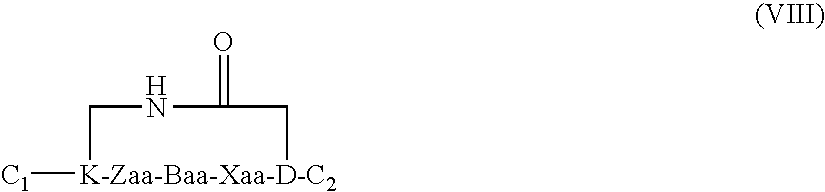
- Where C1 is a hydrophobic N-terminal capping group (natural or unnatural α-amino acid or dipeptide, aliphatic or aromatic carboxylic acid), K is a lysine, Zaa is a negatively, natural or unnatural α-amino acid, Baa is a hydrophobic, natural or unnatural α-amino acid—preferably an L-tryptophan derivative with halogen or alkyl substitution in the 5 or 6 position, Xaa is any natural or unnatural α-amino acid, D is aspartate, and C2 is a hydrophobic C-terminal capping group (natural or unnatural α-amino acid or dipeptide, aliphatic or aromatic amine). Examples of molecules of this sort could include:
-
Cyclo(3,7)-FM[K(Pmp)(6ClW)ED]L SEQID: 73 Cyclo(3,7)-3-Phenylpropanoyl-M[K(Pmp) SEQID: 74 (6ClW)ED]isopentylamide Cyclo(2,6)-6-Phenylheptanoyl-[K(Pmp) SEQID: 75 (6ClW)ED]-isopentylamide - Overlay of the NMR structure of monocycle on the crystal structure of p53 shows that the monocycle places the binding residues in the required positions (
FIG. 11 ). - Binding affinities can be measured relative to the native peptide by competitive fluorescence polarization assay using the fluorescein labeled p53 peptide Ac-FR(Dpr-Flu)(Ac6c)(6-Br-W)EEL-NH2 as a probe. The dissociation constant of this peptide for MDM2 is 2 nM (5). The assay is performed according to Zhang et. al.136. Briefly, a stock solution of 10 nM of the fluorescein labeled p53 peptide, 30 nM of MDM2, 1 mM EDTA, and 0.05% PEG-8000 in 20 mM phosphate buffer pH 7.4 is prepared. 120 of this solution is placed into 8 wells of a 96 well plate, and 25, 5, 1, 0.5, 0.25, 0.1, 0.05, 0.01 μM compound from a DMSO stock. The total DMSO concentration is adjusted to 5% by the addition of neat DMSO. A negative (10 nM Flu-p53, 5% DMSO in buffer), and positive control (10 nM Flu-p53 peptide, 30 nM MDM2, 5% DMSO in buffer) were used to determine the free and bound polarization values for the assay. The plate is incubated for 2 hr at room temperature, and then polarization was measured at room temperature using a BMG FLUOstar fluorescence polarization spectrometer with excitation at 485 nm and emission at 530 nm. IC50 values were obtained by non-linear least squares fitting of the data to the equation:
-
Observed polarization=(bound polarization−free polarization)1+10(Log IC50-concentration) - The function of the ORL-1 receptor includes pain transmission, stress and anxiety, learning and memory, locomotor activity, food intake, motivational properties of drugs of abuse137. Agonists of the ORL-1 receptor have likely uses for anti-anxiety therapy, appetite suppressants, alcohol and opiate withdrawal therapies, anti-epilepsy drugs. Antagonists of the ORL-1 receptor have likely uses for analgesia/pain therapy, alleviation of memory disorders137.
- The receptor is activated by the endogenous ligand nociceptin which has the sequence:
-
F1-G2-G3-F4-T5-G6-A7-R8-K9-S10-A11-R12-K13-L14-A15 - Portions of this sequence serve different roles, the four N-terminal residues (FGGF) serves as a ‘message sequence’, actually activating the receptor, whilst the remaining sequence serves as an ‘address’ and is responsible for receptor binding and specificity, SAR data indicated that the dibasic repeat (
residues -

- Where C1 is a suitable N-terminal capping group (1-5 natural or unnatural α-amino acids, aliphatic/aromatic carboxylic acid or non-peptidic opioid antagonist), K is lysine, Xaa is any amino acid, D is aspartate, C2 is a suitable C-terminal capping group (primary or an aliphatic/aromatic secondary amide). Compounds of this type could include:
-
Cyclo(6-10,11-15)-FGGFT[KARKD] SEQ ID NO: 76 [KRKLD]-NH2 (agonist) Cyclo(6-10,11-15)-NpheGGFT[KARKD] SEQ ID NO: 77 [KRKLD]-NH2 (antagonist) Cyclo(2-6,7-11)-Ac-T[KARKD][KRKLD]- SEQ ID NO: 78 NH2 (antagonist) Cyclo(2-6,7-11)-(8-napthalen-1-yl- SEQ ID NO: 79 methyl-4-oxo-1-phenyl-1,3,8-triaza- spiro[4,5]dec-3-yl)-acetoyl-[KARKD] [KRKLD]-NH2 (antagonist) - Furthermore the endogenous ligand is known to be cleaved by endopeptidases at the several positions137 (see below). Given that the monocyclic and bicyclic strategy prevent cleavage by proteases within the cycle, the mimetics described above would be expected to be metabolically stable.
-

- Membranes from recombinant HEK-293 cells expression hORL-1 are prepared as described in (Zhang et al.)140. The above peptides are incubated with 0.1 nM [3H]-nociceptin, 20 μg membrane protein/well in a final volume of 500 μL of binding buffer in 96-well plates for 2 hr at room temperature. Binding reactions are terminated by rapid filtration onto 96 well Unifilter GF/C filter plates pre-soaked in 0.5% polyethylenamine using 96-well tissue harvester, followed by three washes with ice cold binding buffer. Filter plates are dried at 50° C. for 3 hrs, and then scintillation cocktail is added (50 μg/well) and plates counted in a scintillation counter for 1 min/well. Data is analyzed using the one-site competition curve fitting function in PRISM.
- Incorporation of the bicyclic strategy as indicated above has been shown by CD spectroscopy to increase helicity in 76 and 77 compared to the reported native agonist and antagonist sequences (F/Nphe-GGFTGARKSARK) as indicated in
FIG. 12 . - Fmoc-Asp(OAllyl)-OH and tetrakis(triphenylphosphino)palladium were obtained from Sigma-Aldrich (Sydney, Australia). Boc-Lys(Fmoc)-OH, Rink Amide MBHA resin and other L-amino acids were obtained from Novabiochem (Melbourne, Australia). Benzotriazol-1-yl-1,1,3,3-tetramethyluronium (HBTU) and benzotriazol-1-yloxy-tris(dimethylamino)-phosphonium (BOP) were obtained from Richelieu Biotechnologies (Quebec Canada). All other reagents were of peptide synthesis grade and obtained from Auspep (Melbourne, Australia).
- Samples for NMR analysis of peptides were prepared by dissolving the
peptide 3 mg in 450 ul H2O and 50 ul D2O (5 mmol) and adjusting the pH of the solution to 4.5 by adding HCl or NaOH and stirring for 30 min. 1D and 2D 1H NMR spectra were recorded on both Bruker ARX-500 and Bruker Avance DMX-750 spectrometers at 278K. All spectra were recorded in the phase sensitive mode using time proportional phasing incrementation96. 2D experiments included TOCSY using MLEV-17 spin lock sequence with a mixing time of 100 ms, NOESY with a mixing time of 300 ms. Water suppression was achieved using watergate W5 pulse sequences with gradients using double echo97. 2D TOCSY and NOESY experiments were recorded over 7936.5 Hz with 4096 complex data points in F2 and 512 increments in F1 with 16 and 48 scans per increment respectively. Spectra were processed using XWINNMR (Brulcer, Germany). The t1 dimensions of all 2D spectra were zero filled with 2048 real data points, and 90° phase-shifted sine bell window functions applied in both dimensions followed by fourier transformation and fifth order polynomial baseline correction. Chemical shifts were referenced to TSP an internal standard at 0.00 ppm. Processed spectra were analyzed using the program SparkyNMR98 and assigned using the sequential assignment technique99. - Cross peaks in NOESY spectra were integrated and calibrated in SparkyNMR98, and distance constraints derived using the standard CALIBA function in DYANA100. Corrections for pseudo atoms were added to distance constraints where needed. Backbone dihedral angle restraints were inferred from 3JNHCHα coupling constants in 1D spectra at 278K and 288K, φ was restrained to −65±300 for 3
J NHCHα≦6 Hz. Peptide bond ω angles were all set to trans, and structures were calculation without explicit hydrogen bond restraints. Stereospecific assignments of β-methylene protons and χ1 dihedral angles were derived from 1D 1H spectra 3Jαβ and set to −60±30° for both aspartic acid residues. Initial structures were generated using a torsion angle simulated annealing protocol in DYANA until no violations were obtained. Final structures were calculated using XPLOR 3.851. Starting structures with randomized φ and ψ angles and extended side chains were generated using an ab initio simulated annealing protocol101. The calculations were performed using the standard forcefield parameter set (PARALLHDG.PRO) and topology file (TOPALLHDG.PRO) in XPLOR with in house modifications to generated lactam bridges between lysing and aspartic acid residues. Refinement of structures was achieved using the conjugate gradient Powell algorithm with 1000 cycles of energy minimization and a refined forcefield based on the program CHARMm102. Structures were visualized with MOLMOL103 and InsightII104. - CD experiments were performed on a Jasco Model J-710 spectropolarimeter which was routinely calibrated with (1S)-(+)-10-camphorsulfonic acid. Temperature control was achieved using a Neslab RTE-111 circulating water bath. Spectra were recorded in a 0.1 cm Jasco cell between 310-185 nm at 50 nm/min with a band width of 1.0 nm, response time of 2 sec, resolution step width of 0.1 nm and sensitivity of 20, 50 or 100 mdeg. Each spectrum represents the average of 5 scans with smoothing to reduce noise. Peptide samples for CD spectroscopy were dissolved in distilled water (˜1 mg/mL). Each stock solution was diluted to a final concentration of 50 μM in 10 mM sodium phosphate buffer (pH7.4), with or without additives (2,2,2-trifluoroethanol (TFE) or guanidine.HCl). Guanidine.HCl denaturation experiments were performed according to Creighton105.
- Accurate concentration determination of stock solutions were obtained by 1D 1H NMR using the method of Larive et. al.106 Briefly 475 μL of the initial peptide stock solution was mixed with 50 μL of D2O, and spiked with an internal standard 25 μL of 10.077mM DSS (the concentration of which had carefully been back-calibrated by NMR from a standard solution of L-tryptophan—the concentration of which was determined by UV 6278=5579). 1D 1H NMR spectra were then recorded with presaturation and a relaxation delay (d1) of 30 seconds to allow for full relaxation of peptide and DSS 1H signals to facilitate accurate integration of proton signals with S/N>250:1. This method provides reproducible concentrations within ±2%.
- CD data in ellipticity was converted to mean peptide ellipticity using the equation:
-
[θ]=θ/10×C×N p×1) - where θ is the ellipticity in millidegrees, C is the peptide molar concentration (M), 1 is the cell path length (cm), and Np is the number of peptide units (ie. pentapeptides Np=6, hexapeptides Np=7, 10 & 11 Np=5, 12Np=4.)
-
- Relative helicities were employed to allow scaling of compounds by dividing the [θ]obS215(8)/[θ]obs215(X) for pentapeptides, and [θ]obs215(24)/[θ]obs215(x) for hexapeptides.
- The disclosure of every patent, patent application, and publication cited herein is hereby incorporated herein by reference in its entirety.
- The citation of any reference herein should not be construed as an admission that such reference is available as “Prior Art” to the instant application.
- Throughout the specification the aim has been to describe the preferred embodiments of the invention without limiting the invention to any one embodiment or specific collection of features. Those of skill in the art will therefore appreciate that, in light of the instant disclosure, various modifications and changes can be made in the particular embodiments exemplified without departing from the scope of the present invention. All such modifications and changes are intended to be included within the scope of the appended claims.
-
- (1) Barlow, D. J.; Thornton, J. M. J. Mol. Biol. 1988, 201, 601.
- (2) Fairlie, D.; West, M.; Wong, A. Curr. Med. Chem. 1998, 5, 29.
- (3) Andrews, M. J. I.; Tabor, A. B. Tetrahedron 1999, 55, 11711.
- (4) Kussie, P. H.; Gorina, S.; Marechal, V.; Elenbaas, B.; Moreau, J.; Levine, A. J.; Pavletich, N. P. Science 1996, 274, 948-953.
- (5) Burley, S. K.; Roeder, R. G. Ann. Rev. Biochem. 1996, 65, 769.
- (6) Uesugi, M.; Nyaguile, O.; Lu, H.; Levine, A. J.; Verdine, G. L. Science 1997, 277, 1310.
- (7) Saffler, M.; Liang, H.; Nettesheim, D.; Meadows, R. P.; Harlan, J. E.; Eberstadt, M.; Yoon, H. S.; Shuker, S. B.; Chang, B. S.; Minn, A. J.; Thompson, C. B.; Fesik, S. W. Science 1997, 275, 983-986.
- (8) Tan, R.; Chen, L.; Buettner, J. A.; Hudson, D.; Franlcel, A. D. Cell 1993, 73, 1031.
- (9) Pabo, C. O.; Peisach, E.; Grant, R. A. Annual Review of Biochemistry 2001, 70, 313-340.
- (10) Weiss, M. A.; Narayana, N. Biopolymers 1998, 48, 167-180.
- (11) Botuyan, M. V.; Mer, G.; Yi, G.; Koth, C. M.; Case, D. A.; Edwards, A. M.; Chazin, W. J.; Arrowsmith, C. H. J. Mol. Biol. 2001, 312, 177-186.
- (12) Uesugi, M.; Nyanguile, O.; Lu, H.; Levine, A. J.; Verdine, G. L. Science 1997, 277, 1310-1313.
- (13) Jin, L.; Briggs, S. L.; Chandrasekhar, S.; Chirgadze, N.Y.; Clawson, D. K.; Scheivitz, R. W.; Smiley, D. L.; Tashjian, A. H.; Zhang, F. Journal of Biological Chemistry 2000, 275, 27238-27244.
- (14) Schwyzer, R. Biochemistry 1986, 25, 4281-4286.
- (15) Bennett, M. A.; Murray, T. F.; Aldrich, J. V. Journal of Medicinal Chemistry 2002, 45, 5617-5619.
- (16) Zaiou, M. Z.; Arnold, K. S.; Newhouse, Y. M.; Innerarity, T. L.; Weisgraber, K. H.; Segall, M. L.; Phillips, M. C.; Lund-Katz, S. Journal of Lipid Reseach 2000, 41, 1087-1095.
- (17) Kirby, D. A.; Koerber, S. C.; Craig, A. G.; Feinstein, R. D.; Delmas, L.; Brown, M. R.; Rivier, J. E. Journal of Medicinal Chemistry 1993, 36, 385-393.
- (18) Carpenter, K. A.; Schmidt, R.; Yue, S. Y.; Hodzic, L.; Pou, C.; Payza, K.; Godbout, C.; Brown, W.; Roberts, E. Biochemistry 1999, 38, 15295-15304.
- (19) Miranda, A.; Labrichi, S. L.; Gulyas, J.; Koerber, S. C.; Craig, A. G.; Corrigan, A.; Rivier, C.; Vale, W.; Rivier, J. Journal of Medicinal Chemistry 1997, 40, 3651-3658.
- (20) Li, J. Z.; Matsuura, J. E.; Waugh, D. J. J.; Adrian, T. E.; Abel, P. W.; Manning, M. C.; Smith, D. D. Journal of Medicinal Chemistry 1997, 40, 3071-3076.
- (21) Nicole, P.; Lins, L.; Rouyer-Fessard, C.; Drouot, C.; Fulcrand, P.; Thomas, A.; Couvineau, A.; Martinez, J.; Brasseur, R.; Laburthe, M. J Biol Chem 2000, 275, 24003-24012.
- (22) McInerney, E. M.; Rose, D. W.; Flynn, S. E.; Westin, S.; Mullen, T. M.; Krones, A.; Inostroza, J.; Torchia, J.; Nolte, R. T.; Assa-Munt, N.; Milburn, M. V.; Glass, C. K.; Rosenfeld, M. G. Genes Dev 1998, 12, 3357-3368.
- (23) Chang, C.; Norris, J. D.; Gron, H.; Paige, L. A.; Hamilton, P. T.; Kenan, D. J.; Fowlkes, D.; McDonnell, D. P. Mol Cell Biol 1999, 19, 8226-8239.
- (24) Zimm, B.; Bragg, J. J. Chem. Phys. 1959, 31, 526.
- (25) Scholtz, A.; Baldwin, R. L. Annu. Rev. Biophys. Biomol. Struct. 1992, 21, 95.
- (26) Kemp, D.; Curran, T.; Boyd, J.; Allen, T. J. Org. Chem. 1991, 56, 6683.
- (27) Müller, K.; Obrecht, D.; Knierzinger, A.; Stankovic, C.; Spiegler, C.; Bannwarth, W.; Trzeciak, A.; Englert, G.; Labhardt, A. M.; Schoenholzer, P. Perspect. Med. Chem. 1993, 513.
- (28) Austin, R.; Maplestone, R. A.; Sefler, A. M.; Liu, K.; Hruzewicz, W. N.; Liu, C.; Cho, H. S.; Wemmer, D. E.; Bartlett, P. A. J. Am. Chem. Soc. 1997, 119, 6461.
- (29) Aurora, R.; Rose, G. D.
Protein Science 1998, 7, 21. - (30) Ghadiri, M. R.; Choi, C. J. Am. Chem. Soc. 1990, 112, 1630.
- (31) Ruan, F.; Chen, Y.; Hopkins, P. B. J. Am. Chem. Soc; 1990, 112, 9403.
- (32) Ghadiri, M. R.; Fernholz, H. J. Am. Chem. Soc. 1990, 112, 9633.
- (33) Kohn, W. D.; Kay, C. M.; Sykes, B. D.; Hodges, R. S. J. Am. Chem. Soc. 1998, 120, 1124.
- (34) Kelso, M. J.; Hoang, H.; Appleton, T. G.; Fairlie, D. P. J. Am. Chem. Soc. 2000, 122, 10488.
- (35) Kelso, M. J.; Hoang, H. N.; Oliver, W. N.; Sokolenko, N.; March, D. R.; Appleton, T. G.; Fairlie, D. P. Angew Chem, Int. Edit. 2003, 42, 421-424.
- (36) Rajashankar, K. R.; Ramakumar, S.; Jain, R. M.; Chauhan, V. S. J. Am. Chem. Soc. 1995, 117, 10129.
- (37) Karle, I. L.; Balaram, P. Biochem. 1990, 29, 6747.
- (38) Mayne, L.; Englander, S. W.; Qiu, R.; Yang, J.; Gong, Y.; Spek, E. J.; Kallenbach, N. R. J. Am. Chem. Soc. 1998, 120, 10643.
- (39) Albert, J. S.; Hamilton, A. Biochem. 1995, 34, 984.
- (40) Pellegrini, M.; Royo, M.; Chorev, M.; Mierke, D. F. J. Pep. Res. 1997, 49, 404.
- (41) Jackson, D. Y.; King, D. S.; Chmielewski, J.; Singh, S.; Schultz, P. G. J. Am. Chem. Soc. 1991, 113, 9391.
- (42) Cabezas, E.; Satterthwait, A. C. J. Am. Chem. Soc. 1999, 121, 3862.
- (43) Taylor, J. W. Biopolymers 2002, 66, 49.
- (44) Schievano, E.; Mammi, S.; Bisello, A.; Rosenblatt, M.; Chorev, M.; Peggion, E. J. Pept. Sci. 1999, 5, 330.
- (45) Bracken, C.; Gulyas, J.; Taylor, J. W.; Baum, J. J. Am. Chem. Soc. 1994, 116, 6431.
- (46) Phelan, J. C.; Skelton, N. J.; Braisted, A. C.; McDowell, R. S. J. Am. Chem. Soc. 1997, 119, 455. (e) Taylor, J. W.; Yu, C. Bioorg. Med. Chem. 1999, 7, 161.
- (47) Chen, S.-T.; Chen, H.-J.; Yu, H.-M.; Wang, K.-T. J. Chem. Res. (S) 1993, 228;
- (48) Osapay, G.; Taylor, J. W. J. Am. Chem. Soc. 1992, 114, 6966.
- (49) Yu, C,; Taylor, J. W. Tet Lett. 1996, 37, 1731.
- (50) Geistlinger T. R.; Guy, R. K. J. Am. Chem. Soc. 2001, 123, 1525.
- (51) Schafmeister, C. E.; Po, J.; Verdine, G. L. J. Am. Chem. Soc. 2000, 122, 5891.
- (52) Blackwell, H. E.; Sadowsky, J. D.; Howard, R. J.; Sampson, J. N.; Chao, J. A.; Steinmetz, W. E.; O'Leary, D. J.; Grubbs, R. H. J. Org. Chem. 2001, 66, 5291.
- (53) Judice, J. K.; Tom, J. Y. K.; Huang, W.; Wrin, T.; Vennari, J.; Petropoulos, C. J.; McDowell, R. S. Proc. Natl. Acad. Sci. 1997, 94, 13426.
- (54) Orner, B. P.; Ernst, J. T.; Hamilton, A. D. J. Am. Chem. Soc. 2001, 123, 5382.
- (55) Kutzki, O.; Park, H. S.; Ernst, J. T.; Orner, B. P.; Yin, H.; Hamilton, A. D. J. Am. Chem. Soc. 2002, 124, 11838.
- (56) Ernst, J. T.; Becerril, J.; Park, H. S.; Yin, H.; Hamilton, A. D. Angew Chem. Int. Edit. 2003, 42, 535.
- (57) Kemp, D. S.; Curran, T. P.; Davis, W. M.; Boyd, J. G.; Muendel, C. Journal of Organic Chemistry 1991, 56, 6672-6682.
- (58) Kemp, D. S.; Rothman, J. H. Tetrahedron Letters 1995, 36, 4019-4022.
- (59) Kemp, D. S.; Rothman, J. H. Tetrahedron Letters 1995, 36, 4023-4026.
- (60) Kemp, D. S.; Rothman, J. H.; Curran, T. C.; Blanchard, D. E. Tetrahedron Letters 1995, 36, 3809-3812.
- (61) Kemp, D. S.; Rothman, J. H. Tetrahedron Letters 1995, 36, 3813-3816.
- (62) Mueller, K.; Obrecht, D.; Knierzinger, A.; Stankovic, C.; Spiegler, C.; Bannwarth, W.; Trzeciak, A.; Englert, G.; Labhardt, A. M.; Schoenholzer, P. Perspectives in Medicinal Chemistry 1993, 513-531.
- (63) Kahn, M.; Kim, H.-O.; Urban, J.; Molecumetics Ltd.: United States, 1999; Vol. 5859184.
- (64) Cabezas, E.; Satterthwait, A. C. J. Am. Chem. Soc. 1999, 121, 3862-3875.
- (65) Lyu, P. C.; Sherman, J. C.; Chen, A.; Kallenbach, N. R. Proc. Natl. Acad. Sci. U.S.A. 1991, 88, 5317-5320.
- (66) Zhang, C.; Miller, W.; Valenzano, K. J.; Kyle, D. J. Journal of Medicinal Chemistry 2002, 45, 5280-5286.
- (67) Garcia-Echeverria, C.; Chene, P.; Blommers, M. J. J.; Furet, P. Journal of Medicinal Chemistry 2000, 43, 3205-3208.
- (68) Bryant, S. D.; Guerrini, R.; Salvadori, S.; Bianchi, C.; Tomatis, R.; Attila, M.; Lazarus, L. H. Journal of Medicinal Chemistry 1997, 40, 2579-2587.
- (69) Leduc, A.; Trent, J. O.; Wittliff, J. L.; Bramlett, K. S.; Briggs, S. L.; Chirgadze, N. Y.; Wang, Y.; Burris, T. P.; Spatola, A. F. Proc. Natl. Acad. Sci. U.S.A. 2003, 100, 11273-11278.
- (70) Houston, M. E.; Gannon, C. L.; Kay, C. M.; Hodges, R. S. Journal of
Peptide Science 1995, 1, 274-282. - (71) Tian, Y.; Ramesh, C. V.; Ma, X.; Naqvi, S.; Patel, T.; Cenizal, T.; Tiscione, M.; Diaz, K.; Crea, T.; Arnold, E.; Arnold, G. F.; Taylor, J. W. Journal of Peptide Research 2002, 59, 264-276.
- (72) Blackwell, H. E.; Grubbs, R. H. Angewandte Chemie-International Edition 1998, 37, 3281-3284.
- (73) Fairlie D P, Abbenante G, March D R: Macrocyclic peptidomimetics—forcing peptides into bioactive conformations. Curr. Med. Chem. (1995) 2:654-686.
- (74) Stradley, S.; Rizo, J.; Bruch, M.; Stroup, A.; Gierasch, L. Biopolymers, 1990, 29, 263.
- (75) Toniolo, C. Int. J. Peptide Protein Res. 1990, 35, 287.
- (76) Schiller, P. W. in Medicinal Chemistry for the 21st Century, Wermuth, C. G. (ed.) IUPAC/Blackwell, London, 1992, pp. 215-232.
- (77) Kemp, D. S. in Medicinal Chemistry for the 21st Century, Wermuth, C. G. (ed.) IUPAC/Blackwell, London, 1992, pp. 259-277.
- (78) Kessler, H.; Diefenbach, B.; Finsinger, D.; Geyer, A.; Gurrath, M.; Goodman, S. L.; Hoelzemann, G.; Haubner, R.; Jonczyk, A. Lett. Pept. Sci. 1995, 2, 155.
- (79) Marraud, M.; Aubry, A. Biopolymers 1996, 40, 45.
- (80) X.-M.Cheng, S, S. Nikam, Doherty, A. M. Curr. Med. Chem. 1994, 1, 271.
- (81) Holzemann, G. Kontakte (Darmstadt) 1991, 1, 3-12; 2, 55.
- (82) Zhang L H, Pesti J A, Costello T D, Sheeran P J, Uyeda R, Ma P, Kauffman G S, Ward R, McMillan J L: An efficient synthesis of cyclic RGD peptides as antithrombotic agents. J. Org. Chem. (1996) 61:5180-5185.
- (83) Haubner R, Finsinger D, Kessler H: Stereisomeric peptide libraries and peptidomimetics for designing selective inhibitors of the □V□3 integrin for a new cancer therapy. Angew. Chem., Int. Ed. Engl. (1997) 36:1374-1389.
- (84) White H D: Unmet therapeutic needs in the management of acute ischemia. Am. J. Cardiology (1997) 80:B2-B10.
- (85) Finch, A. M.; Wong, A. K.; Wadi, S. K.; Paczkowski, N. J.; Fairlie, D. P.; Taylor, S. M. Low Molecular Weight Peptidic and Cyclic Antagonists of the Receptor for the Complement Factor C5a, J. Med. Chem. 1999, 42, 1965-1974.
- (86) McDonnel P A, Caldwell G W, Leo G C, Podlogar B L, Maryanoff B E: NMR three dimensional solution structure of the serine protease inhibitor cyclotheonamide A. Biopolymers (1997) 41: 349-358.
- (87) Gani, D.; Lewis, A.; Rutherford, T.; Wilkie, J.; Stirling, I.; Jenn, T.; Ryan, M. D. Tetrahedron 1998, 54, 15793-15819.
- (88) Lewis, A.; Ryan, M. D.; Gani, D. Journal of the Chemical Society-
Perkin Transactions 1 1998, 3767-3775. - (89) Lewis, A.; Wilkie, J.; Rutherford, T. J.; Gani, D. Journal of the Chemical Society-
Perkin Transactions 1 1998, 3777-3793. - (90) Lewis, A.; Rutherford, T. J.; Wilkie, J.; Jenn, T.; Gani, D. Journal of the Chemical Society-
Perkin Transactions 1 1998, 3795-3806. - (91) Roberge et. al. Science, 269, 202-204, 1995
- (92) Fields, C G, Lloyd D H. Macdonald R L. Otteson K M. Noble R L; Peptide Research 4(2), 95-101, 1991.
- (93) Sambrook et. al. Molecular Cloning: A Laboratory Manual, 2nd Edition, Cold Spring Harbor Laboratory Press Plainview, N.Y., 1989.
- (94) Green T W and Wutz P, Protective groups in Organic Synthesis, John Wiley & Son, 3rd Edition, 1999.
- (95) John Jones, Amino Acid and Peptide Synthesis, Oxford University Press, 1992. New York
- (96) Marion, D.; Wüthrich, K. Biochem. Biophys. Res. Commun. 113: 967 (1983).
- (97) Liu, M.; Mao, X.; He, C.; Huang, H.; Nicholson, J. K.; Lindon, J. C. J. Magn. Reson. 132: 125 (1998)
- (98) T. D. Goddard and D. G. Kneller,
SPARKY 3, University of California, San Francisco. - (99) Wüthrich, K. NMR of Proteins and Nucleic Acids. Wiley-Interscience. New York. (1986).
- (100) Güntert, P., Mumenthaler, C. & Wüthrich, K. J. Mol. Biol. 273: 283-298 (1997).
- (101) Nilges, M.; Gronenborn, A. M.; Brünger, A. T.; Clore, G. M. Prot. Eng. 2: 27 (1988).
- (102) Brooks, B. R.; Bruccoleri, R. E.; Olafson, B. D.; States, D. J.; Swaminathan, S.; Karplus, M. J. Comput. Chem. 4: 187 (1983).
- (103) Koradi, R., Billeter, M., and Wüthrich, K. J Mol Graphics 14, 51-55 (1996)
- (104) Insight II, Version 2000, Molecular Simulations Inc. San Diego Calif.
- (105) Creighton, T. E. Protein Structure: A Practical Approach. 2nd Ed. Oxford University Press, New York. pp 299-321. (1997).
- (106) Larive, C. K.; Jayawickrama, D.; Orfi, L. Appl. Spec. 51: 1531 (1997).
- (107) Engelbretsen, D. R.; Garnham, B. G.; Bergman, D. A.; Alewood, P. F. Tetrahedron Lett. 36: 8871 (1995).
- (108) Sarin, V.; Kent, S. B. H.; Tan, J. P.; Merrifield, R. B. Anal. Biochem. 117: 147 (1981).
- (109) Wishart, D. S.; Sykes, B. D.; Richards, F. M. Biochem. 1992, 31, 1647.
- (110) Dyson, H. J.; Wright, P. E. Ann. Rev. Biophys. Chem. 1991, 20, 519.
- (111) Waltho, J. P.; Feher, V. A.; Merutka, G.; Dyson, H. J.; Wright, P. E. Biochemistry 1993, 32, 6337.
- (112) Güntert, P.; Mumenthaler, C.; Wüthrich, K. J. Mol. Biol. 1997, 273, 283.
- (113) Brünger, A. T. X-PLOR Manual Version 3.1, 1992, Yale University, New Haven, Conn.
- (114) Osapay, G., Taylor, J. W., J. Am. Chem. Soc., 1990, 112, 6046-6051.
- (115) Condon, S. M. et. al., J. Am. Chem. Soc., 2000, 112, 3007-3014.
- (116) Chin, D. H.; Woody, R. W.; Rohl, C. A.; Baldwin, R. L., Proc. Natl. Acad. Sci. U.S.A. 2002, 99, 15416-15421
- (117) Tinoco Jr., I.; Woody, R. W.; Bradley, D. F., J. Chem. Phys. 1963, 38, 1317-1325
- (118) Woody, R. W.; Tinoco Jr., I., J. Chem. Phys. 1967, 42, 4927-4944
- (119) Woody, R. W.; Koslowski, A., Biophys. Chem. 2002, 101, 535-551
- (120) Manning, M. C.; Woody, R. W., Biopolymers 1991, 31, 569-586
- (121) Wallimann, P.; Kennedy, R. J.; Miller, S. S.; Shalongo, W.; Kemp, D. S., J. Am. Chem. Soc. 2003, 125, 1203-1220
- (122) Luo, P. Z.; Baldwin, R. L., Biochemistry 1997, 36, 8413-8421
- (123) Rohl, C. A.; Baldwin, R. L., Methods Enzymol. 1998, 295, 1-26
- (124) Tian, Y.; Ramesh, C. V.; Ma, X.; Naqvi, S.; Patel, T.; Cenizal, T.; Tiscione, M.; Diaz, K.; Crea, T.; Arnold, E.; Arnold, G. F.; Taylor, J. W., J. Pept. Res. 2002, 59, 264-276
- (125) Tyndall, J. D. A.; Fairlie, D. P., J. Mol. Recognit. 1999, 12, 363-370; (b) Fairlie, D. P.; Tyndall, J. D. A.; Reid, R. C.; Wong, A. K.; Abbenante, G.; Scanlon, M. J.; March, D. R.; Bergman, D. A.; Chai, C. L. L.; Burkett, B. A., J. Med. Chem. 2000, 43, 1271-1281
- (126) Cory, S.; Huang, D. C. S.; Adams, J. M., Oncogene., 2003, 22: 8590-8607; Wang, S.; Yang, D.; Lippman, M. E., Seminars in Oncology., 2003, 30(5):133-142.). The crystal/NMR structures of Bad-Bcl-xL (1g5j) (Petros, A. M.; Nettesheim, D. G.; Wang, Y.; Olejniczak, E. T.; Meadows, R. P.; Mack, J.; Swift, K.; Matayoshi, E. D.; Zhang, H.; Thompson, C. B.; Fesik, S. W. Protein Science. 2000, 9:2528-2534
- (127) Sattler, M.; Liang, H.; Nettesheim, D.; Meadows, R. P.; Harlan, J. E.; Eberstadt, M.; Yoon, H. S.; Shuker, S. B.; Chang, B. S.; Minn, A. J.; Thompson, C. B.; Fesik, S. W. Science. 1997. 275:983-986
- (128) Petros, A. M.; Nettesheim, D. G.; Wang, Y.; Olejniczak, E. T.; Meadows, R. P.; Mack, J.; Swift, K.; Matayoshi, E. D.; Zhang, H.; Thompson, C. B.; Fesik, S. W. Protein Science. 2000, 9:2528-2534
- (129) Liu, X.; Dai, S.; Zhu, Y.; Marrack, P.; Kappler, J. W. Immunity. 2003. 19:341-352
- (130) Joseph, M. K.; Solomon, L. R.; Petros, A. M.; Cai, J.; Simmer, R. L.; Zhang, H.; Rosenberg, S.; Ng, S. Oncogene. 2004, 23:835-38
- (131) Zhang, H.; Niummer, P.; Rosenberg, S. H.; Ng, S.; Joseph, M., Anal. Biochem. 2002, 307: 70-75
- (132) Hollstein, M.; Sidransky, D.; Vogelstein, C.; Harris, C. Science. 1991, 253: 49
- (133) Vassilev, L. T.; Vu, B. T.; Graves, B.; Carvajal, D.; Podlaski, F.; Filipovic, Z.; Kong, N.; Kammlott, U.; Lukacs, C.; Klein, C.; Fotouhi, N.; Liu, E. A. Science. 2004, 303:844-848
- (134) Kussie, P. H.; Gorina, S.; Marechal, V.; Elenbaas, B.; Moreau, J.; Levine, A. J.; Pavletich, N. P., Science. 1996, 274: 948-953
- (135) Garcia-Echeverria, C.; Chene, P.; Blommers, M. J. J.; Furet, P., J. Med. Chem. 2000, 43: 3205-3208
- (136) Zhang, R.; Mayhood, T.; Lipari, P.; Wang, Y.; Durkin, J.; Syto, R.; Gesell, J.; McNemar, C.; Windsor, W., Anal. Biochem. 2004, 331:138-146
- (137) Calo, G.; Guerrini, R.; Salvadori, S.; Regoli, D. Brit. J. Pharinacol. 2000, 129:1261-83
- (138) Reinscheid, R. K.; Ardati, A.; Monsma Jr, F. J.; Civelli, O. J. Biol. Chem. 1996, 24(14): 14163-68
- (139) Salvadori, S.; Picone, D.; Tancredi, T.; Guerrini, R.; Spadaccini, R.; Lazarus, L. H.; Regoli, D.; Temussi, P. A. Biochem. Biophys. Res. Comm. 1997, 233:640-643
- (140) Zhang, C.; Miller, W.; Valenzano, K. J.; Kyle, D. J., J. Med. Chem. 2002, 45:5280-5286
- (141) Guerrini, R.; Carra, G.; Calo, G.; et al. J. Pept. Res. 2004, 63:477-484
Claims (60)


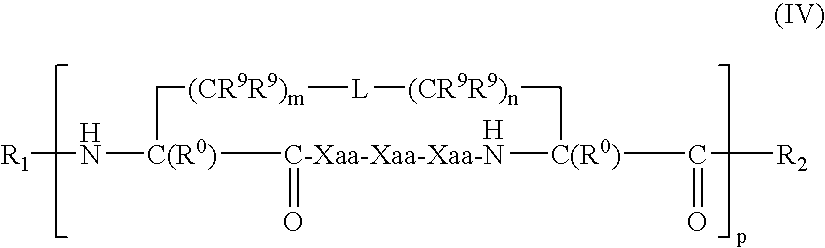
Applications Claiming Priority (3)
| Application Number | Priority Date | Filing Date | Title |
|---|---|---|---|
| AU2004901447A AU2004901447A0 (en) | 2004-03-19 | Molecular mimics and methods for their production | |
| AU2004901447 | 2004-03-19 | ||
| PCT/AU2005/000400 WO2005090388A1 (en) | 2004-03-19 | 2005-03-21 | Alpha helical mimics, their uses and methods for their production |
Related Parent Applications (1)
| Application Number | Title | Priority Date | Filing Date |
|---|---|---|---|
| PCT/AU2005/000400 A-371-Of-International WO2005090388A1 (en) | 2004-03-19 | 2005-03-21 | Alpha helical mimics, their uses and methods for their production |
Related Child Applications (1)
| Application Number | Title | Priority Date | Filing Date |
|---|---|---|---|
| US13/483,926 Division US8629241B2 (en) | 2004-03-19 | 2012-05-30 | Alpha helical mimics, their uses and methods for their production |
Publications (2)
| Publication Number | Publication Date |
|---|---|
| US20080242598A1 true US20080242598A1 (en) | 2008-10-02 |
| US8193310B2 US8193310B2 (en) | 2012-06-05 |
Family
ID=34993641
Family Applications (2)
| Application Number | Title | Priority Date | Filing Date |
|---|---|---|---|
| US10/593,407 Expired - Fee Related US8193310B2 (en) | 2004-03-19 | 2005-03-21 | Alpha helical mimics, their uses and methods for their production |
| US13/483,926 Expired - Fee Related US8629241B2 (en) | 2004-03-19 | 2012-05-30 | Alpha helical mimics, their uses and methods for their production |
Family Applications After (1)
| Application Number | Title | Priority Date | Filing Date |
|---|---|---|---|
| US13/483,926 Expired - Fee Related US8629241B2 (en) | 2004-03-19 | 2012-05-30 | Alpha helical mimics, their uses and methods for their production |
Country Status (3)
| Country | Link |
|---|---|
| US (2) | US8193310B2 (en) |
| EP (1) | EP1737884B1 (en) |
| WO (1) | WO2005090388A1 (en) |
Cited By (21)
| Publication number | Priority date | Publication date | Assignee | Title |
|---|---|---|---|---|
| WO2010060112A1 (en) * | 2008-11-24 | 2010-05-27 | Aileron Therapeutics, Inc. | Peptidomimetic macrocycles with improved properties |
| US20100168388A1 (en) * | 2007-01-31 | 2010-07-01 | Federico Bernal | Stabilized p53 peptides and uses thereof |
| US20100216688A1 (en) * | 2008-09-22 | 2010-08-26 | Aileron Therapeutics, Inc. | Peptidomimetic macrocycles |
| WO2012016186A1 (en) * | 2010-07-29 | 2012-02-02 | President And Fellows Of Harvard College | Macrocyclic kinase inhibitors and uses thereof |
| US8859723B2 (en) | 2010-08-13 | 2014-10-14 | Aileron Therapeutics, Inc. | Peptidomimetic macrocycles |
| US8927500B2 (en) | 2012-02-15 | 2015-01-06 | Aileron Therapeutics, Inc. | Peptidomimetic macrocycles |
| US8987414B2 (en) | 2012-02-15 | 2015-03-24 | Aileron Therapeutics, Inc. | Triazole-crosslinked and thioether-crosslinked peptidomimetic macrocycles |
| WO2013059530A3 (en) * | 2011-10-18 | 2015-06-11 | Aileron Therapeutics, Inc. | Peptidomimetic macrocycles |
| US9096684B2 (en) | 2011-10-18 | 2015-08-04 | Aileron Therapeutics, Inc. | Peptidomimetic macrocycles |
| US9243038B2 (en) | 2011-07-01 | 2016-01-26 | President And Fellows Of Harvard College | Macrocyclic insulin-degrading enzyme (IDE) inhibitors and uses thereof |
| JP2016519059A (en) * | 2013-03-13 | 2016-06-30 | プレジデント アンド フェローズ オブ ハーバード カレッジ | Stapled and stitched polypeptides and uses thereof |
| US9604919B2 (en) | 2012-11-01 | 2017-03-28 | Aileron Therapeutics, Inc. | Disubstituted amino acids and methods of preparation and use thereof |
| US10023613B2 (en) | 2015-09-10 | 2018-07-17 | Aileron Therapeutics, Inc. | Peptidomimetic macrocycles as modulators of MCL-1 |
| US10253067B2 (en) | 2015-03-20 | 2019-04-09 | Aileron Therapeutics, Inc. | Peptidomimetic macrocycles and uses thereof |
| US10301351B2 (en) | 2007-03-28 | 2019-05-28 | President And Fellows Of Harvard College | Stitched polypeptides |
| CN110184265A (en) * | 2019-05-22 | 2019-08-30 | 上海大学 | The preparation method and applications of nano enzyme based on gold nanoparticle |
| US10471120B2 (en) | 2014-09-24 | 2019-11-12 | Aileron Therapeutics, Inc. | Peptidomimetic macrocycles and uses thereof |
| US10905739B2 (en) | 2014-09-24 | 2021-02-02 | Aileron Therapeutics, Inc. | Peptidomimetic macrocycles and formulations thereof |
| US11040976B2 (en) | 2015-04-24 | 2021-06-22 | President And Fellows Of Harvard College | Substrate selective inhibitors of insulin-degrading enzyme (IDE) and uses thereof |
| US11091522B2 (en) | 2018-07-23 | 2021-08-17 | Aileron Therapeutics, Inc. | Peptidomimetic macrocycles and uses thereof |
| US11674136B2 (en) | 2018-02-09 | 2023-06-13 | President And Fellows Of Harvard College | DNA-templated macrocycle library |
Families Citing this family (27)
| Publication number | Priority date | Publication date | Assignee | Title |
|---|---|---|---|---|
| US7192713B1 (en) | 1999-05-18 | 2007-03-20 | President And Fellows Of Harvard College | Stabilized compounds having secondary structure motifs |
| CN107090025A (en) | 2003-11-05 | 2017-08-25 | 达纳-法伯癌症研究所股份有限公司 | Stable alpha helical peptides and application thereof |
| WO2007041689A2 (en) * | 2005-10-04 | 2007-04-12 | President And Fellows Of Harvard College | Methods of site-specific labeling of molecules and molecules produced thereby |
| WO2008076904A1 (en) | 2006-12-14 | 2008-06-26 | Aileron Therapeutics, Inc. | Bis-sulfhydryl macrocyclization systems |
| US7981998B2 (en) | 2006-12-14 | 2011-07-19 | Aileron Therapeutics, Inc. | Bis-sulfhydryl macrocyclization systems |
| EP2564862B1 (en) | 2007-02-23 | 2017-08-02 | Aileron Therapeutics, Inc. | Substituted amino acids for preparing triazole linked macrocyclic peptides |
| CN101980718A (en) | 2008-02-08 | 2011-02-23 | 爱勒让治疗公司 | Therapeutic peptidomimetic macrocycles |
| WO2010011313A2 (en) | 2008-07-23 | 2010-01-28 | President And Fellows Of Harvard College | Ligation of stapled polypeptides |
| EP2342221B1 (en) | 2008-09-22 | 2018-11-07 | Aileron Therapeutics, Inc. | Methods for preparing purified polypeptide compositions |
| BRPI1006139A2 (en) | 2009-01-14 | 2017-05-30 | Aileron Therapeutics Inc | peptidomimetic macrocycles |
| CA2768299C (en) | 2009-07-13 | 2018-03-20 | President And Fellows Of Harvard College | Bifunctional stapled polypeptides and uses thereof |
| CN102712675A (en) | 2009-09-22 | 2012-10-03 | 爱勒让治疗公司 | Peptidomimetic macrocycles |
| CA2781402C (en) * | 2009-11-23 | 2017-03-21 | Palatin Technologies, Inc. | Melanocortin-1 receptor-specific cyclic peptides |
| EP2576598A4 (en) * | 2010-06-07 | 2014-08-13 | Univ Queensland | MIMETICS OF NOCICEPTIN |
| US8957026B2 (en) | 2010-09-22 | 2015-02-17 | President And Fellows Of Harvard College | Beta-catenin targeting peptides and uses thereof |
| US9487562B2 (en) | 2011-06-17 | 2016-11-08 | President And Fellows Of Harvard College | Stabilized polypeptides as regulators of RAB GTPase function |
| WO2014052647A2 (en) | 2012-09-26 | 2014-04-03 | President And Fellows Of Harvard College | Proline-locked stapled peptides and uses thereof |
| GB201302837D0 (en) * | 2013-02-19 | 2013-04-03 | Univ Singapore | Therapeutic Agents |
| BR112015031277A2 (en) | 2013-06-14 | 2017-09-19 | Harvard College | INSULIN RECEPTOR MODULATORS FROM STABILIZED POLYPEPTIDES, INSULIN ANALOGS, PHARMACEUTICAL COMPOSITIONS COMPRISING THE SAID POLYPEPTIDES AND METHODS OF PREPARATION AND USES THEREOF |
| WO2015044900A1 (en) * | 2013-09-27 | 2015-04-02 | Aurigene Discovery Technologies Limited | Therapeutic immunomodulating compounds |
| US10294273B2 (en) | 2014-04-02 | 2019-05-21 | University Of Rochester | Macrocyclic peptidomimetics for alpha-helix mimicry |
| CA2949535C (en) | 2014-05-21 | 2023-09-12 | President And Fellows Of Harvard College | Ras inhibitory peptides and uses thereof |
| US10059741B2 (en) | 2015-07-01 | 2018-08-28 | Aileron Therapeutics, Inc. | Peptidomimetic macrocycles |
| JP7286317B2 (en) | 2015-10-27 | 2023-06-05 | エフ. ホフマン-ラ ロシュ アーゲー | Peptide macrocycles against Acinetobacter baumannii |
| EP3388444A1 (en) | 2017-04-10 | 2018-10-17 | F. Hoffmann-La Roche AG | Anti-bacterial peptide macrocycles and use thereof |
| US11505573B2 (en) | 2018-03-28 | 2022-11-22 | Hoffmann-La Roche Inc. | Peptide macrocycles against Acinetobacter baumannii |
| US11819532B2 (en) | 2018-04-23 | 2023-11-21 | Hoffmann-La Roche Inc. | Peptide macrocycles against Acinetobacter baumannii |
Citations (3)
| Publication number | Priority date | Publication date | Assignee | Title |
|---|---|---|---|---|
| US5149779A (en) * | 1990-07-26 | 1992-09-22 | Merck & Co., Inc. | Humoral hypercalcemic factor antagonists |
| US5364851A (en) * | 1991-06-14 | 1994-11-15 | International Synthecon, Llc | Conformationally restricted biologically active peptides, methods for their production and uses thereof |
| US6169071B1 (en) * | 1996-07-12 | 2001-01-02 | Mcgill University | Compounds and methods for modulating cell adhesion |
Family Cites Families (11)
| Publication number | Priority date | Publication date | Assignee | Title |
|---|---|---|---|---|
| US5324844A (en) | 1989-04-19 | 1994-06-28 | Enzon, Inc. | Active carbonates of polyalkylene oxides for modification of polypeptides |
| WO1995000162A1 (en) | 1993-06-21 | 1995-01-05 | Enzon, Inc. | Site specific synthesis of conjugated peptides |
| US5965566A (en) | 1993-10-20 | 1999-10-12 | Enzon, Inc. | High molecular weight polymer-based prodrugs |
| US5880131A (en) | 1993-10-20 | 1999-03-09 | Enzon, Inc. | High molecular weight polymer-based prodrugs |
| DE69518838T2 (en) | 1994-05-18 | 2001-05-03 | The Protein Engineering Network Of Centres Of Excellence (Pence), Inc. | HETERODIME COMPOSITION OF IMMUNOGENIC POLYPEPTIDES AND METHOD FOR THE USE THEREOF |
| US5840833A (en) | 1995-10-27 | 1998-11-24 | Molecumetics, Ltd | Alpha-helix mimetics and methods relating thereto |
| US5942489A (en) | 1996-05-03 | 1999-08-24 | The Administrators Of The Tulane Educational Fund | HGH-RH(1-29)NH2 analogues having antagonistic activity |
| US6680175B2 (en) * | 1998-05-05 | 2004-01-20 | Adherex Technologies, Inc. | Methods for diagnosing and evaluating cancer |
| SE9804614A0 (en) | 1998-07-06 | 2000-01-07 | A+ Science Invest Ab | New peptides and use thereof |
| EP1474163A2 (en) | 2002-01-10 | 2004-11-10 | Imperial College Innovations Limited | Modification of feeding behavior |
| WO2004067021A1 (en) | 2003-01-24 | 2004-08-12 | Gardella Thomas J | Conformationally constrained parathyroid hormone (pth) analogs with lactam bridges |
-
2005
- 2005-03-21 WO PCT/AU2005/000400 patent/WO2005090388A1/en not_active Ceased
- 2005-03-21 EP EP05714272.1A patent/EP1737884B1/en not_active Expired - Lifetime
- 2005-03-21 US US10/593,407 patent/US8193310B2/en not_active Expired - Fee Related
-
2012
- 2012-05-30 US US13/483,926 patent/US8629241B2/en not_active Expired - Fee Related
Patent Citations (3)
| Publication number | Priority date | Publication date | Assignee | Title |
|---|---|---|---|---|
| US5149779A (en) * | 1990-07-26 | 1992-09-22 | Merck & Co., Inc. | Humoral hypercalcemic factor antagonists |
| US5364851A (en) * | 1991-06-14 | 1994-11-15 | International Synthecon, Llc | Conformationally restricted biologically active peptides, methods for their production and uses thereof |
| US6169071B1 (en) * | 1996-07-12 | 2001-01-02 | Mcgill University | Compounds and methods for modulating cell adhesion |
Non-Patent Citations (1)
| Title |
|---|
| Lanigan MD, Pennington MW, Lefievre Y, Rauer H, Norton RS, "Designed Peptide Analogues of the Potassium Channel Blocker ShK Toxin," Biochemistry, 2001, 40: 15528-15537. * |
Cited By (46)
| Publication number | Priority date | Publication date | Assignee | Title |
|---|---|---|---|---|
| US9527896B2 (en) | 2007-01-31 | 2016-12-27 | Dana-Farber Cancer Institute, Inc. | Stabilized p53 peptides and uses thereof |
| US20100168388A1 (en) * | 2007-01-31 | 2010-07-01 | Federico Bernal | Stabilized p53 peptides and uses thereof |
| US10202431B2 (en) | 2007-01-31 | 2019-02-12 | Aileron Therapeutics, Inc. | Stabilized P53 peptides and uses thereof |
| US8889632B2 (en) | 2007-01-31 | 2014-11-18 | Dana-Farber Cancer Institute, Inc. | Stabilized p53 peptides and uses thereof |
| US10301351B2 (en) | 2007-03-28 | 2019-05-28 | President And Fellows Of Harvard College | Stitched polypeptides |
| US8399405B2 (en) | 2008-09-22 | 2013-03-19 | Aileron Therapeutics, Inc. | Peptidomimetic macrocycles |
| US20100216688A1 (en) * | 2008-09-22 | 2010-08-26 | Aileron Therapeutics, Inc. | Peptidomimetic macrocycles |
| US8524653B2 (en) | 2008-09-22 | 2013-09-03 | Aileron Therapeutics, Inc. | Peptidomimetic macrocycles |
| US9175045B2 (en) | 2008-09-22 | 2015-11-03 | Aileron Therapeutics, Inc. | Peptidomimetic macrocycles |
| JP2012509902A (en) * | 2008-11-24 | 2012-04-26 | エルロン・セラピューティクス・インコーポレイテッド | Peptidomimetic macrocycles with improved properties |
| US20100298201A1 (en) * | 2008-11-24 | 2010-11-25 | Aileron Therapeutics, Inc. | Peptidomimetic macrocycles with improved properties |
| AU2016216698B2 (en) * | 2008-11-24 | 2018-02-22 | Aileron Therapeutics, Inc. | Peptidomimetic macrocycles with improved properties |
| WO2010060112A1 (en) * | 2008-11-24 | 2010-05-27 | Aileron Therapeutics, Inc. | Peptidomimetic macrocycles with improved properties |
| JP2015091868A (en) * | 2008-11-24 | 2015-05-14 | エルロン・セラピューティクス・インコーポレイテッドAileron Therapeutics,Inc. | Peptidomimetic macrocycle with improved property |
| US9458202B2 (en) * | 2008-11-24 | 2016-10-04 | Aileron Therapeutics, Inc. | Peptidomimetic macrocycles with improved properties |
| AU2009316288B2 (en) * | 2008-11-24 | 2016-05-19 | Aileron Therapeutics, Inc. | Peptidomimetic macrocycles with improved properties |
| US8975232B2 (en) | 2010-07-29 | 2015-03-10 | President And Fellows Of Harvard College | Macrocyclic kinase inhibitors and uses thereof |
| WO2012016186A1 (en) * | 2010-07-29 | 2012-02-02 | President And Fellows Of Harvard College | Macrocyclic kinase inhibitors and uses thereof |
| US8859723B2 (en) | 2010-08-13 | 2014-10-14 | Aileron Therapeutics, Inc. | Peptidomimetic macrocycles |
| US9957299B2 (en) | 2010-08-13 | 2018-05-01 | Aileron Therapeutics, Inc. | Peptidomimetic macrocycles |
| US9243038B2 (en) | 2011-07-01 | 2016-01-26 | President And Fellows Of Harvard College | Macrocyclic insulin-degrading enzyme (IDE) inhibitors and uses thereof |
| US9096684B2 (en) | 2011-10-18 | 2015-08-04 | Aileron Therapeutics, Inc. | Peptidomimetic macrocycles |
| US10308699B2 (en) | 2011-10-18 | 2019-06-04 | Aileron Therapeutics, Inc. | Peptidomimetic macrocycles |
| WO2013059530A3 (en) * | 2011-10-18 | 2015-06-11 | Aileron Therapeutics, Inc. | Peptidomimetic macrocycles |
| US9522947B2 (en) | 2011-10-18 | 2016-12-20 | Aileron Therapeutics, Inc. | Peptidomimetic macrocycles |
| US8987414B2 (en) | 2012-02-15 | 2015-03-24 | Aileron Therapeutics, Inc. | Triazole-crosslinked and thioether-crosslinked peptidomimetic macrocycles |
| US8927500B2 (en) | 2012-02-15 | 2015-01-06 | Aileron Therapeutics, Inc. | Peptidomimetic macrocycles |
| US10213477B2 (en) | 2012-02-15 | 2019-02-26 | Aileron Therapeutics, Inc. | Peptidomimetic macrocycles |
| US10227380B2 (en) | 2012-02-15 | 2019-03-12 | Aileron Therapeutics, Inc. | Triazole-crosslinked and thioether-crosslinked peptidomimetic macrocycles |
| US9505804B2 (en) | 2012-02-15 | 2016-11-29 | Aileron Therapeutics, Inc. | Peptidomimetic macrocycles |
| US9604919B2 (en) | 2012-11-01 | 2017-03-28 | Aileron Therapeutics, Inc. | Disubstituted amino acids and methods of preparation and use thereof |
| US9845287B2 (en) | 2012-11-01 | 2017-12-19 | Aileron Therapeutics, Inc. | Disubstituted amino acids and methods of preparation and use thereof |
| US10669230B2 (en) | 2012-11-01 | 2020-06-02 | Aileron Therapeutics, Inc. | Disubstituted amino acids and methods of preparation and use thereof |
| JP2016519059A (en) * | 2013-03-13 | 2016-06-30 | プレジデント アンド フェローズ オブ ハーバード カレッジ | Stapled and stitched polypeptides and uses thereof |
| KR20210076179A (en) * | 2013-03-13 | 2021-06-23 | 프레지던트 앤드 펠로우즈 오브 하바드 칼리지 | Stapled and stitched polypeptides and uses thereof |
| US11332496B2 (en) | 2013-03-13 | 2022-05-17 | President And Fellows Of Harvard College | Stapled and stitched polypeptides and uses thereof |
| KR102637496B1 (en) | 2013-03-13 | 2024-02-19 | 프레지던트 앤드 펠로우즈 오브 하바드 칼리지 | Stapled and stitched polypeptides and uses thereof |
| US12258423B2 (en) | 2013-03-13 | 2025-03-25 | President And Fellows Of Harvard College | Stapled and stitched polypeptides and uses thereof |
| US10471120B2 (en) | 2014-09-24 | 2019-11-12 | Aileron Therapeutics, Inc. | Peptidomimetic macrocycles and uses thereof |
| US10905739B2 (en) | 2014-09-24 | 2021-02-02 | Aileron Therapeutics, Inc. | Peptidomimetic macrocycles and formulations thereof |
| US10253067B2 (en) | 2015-03-20 | 2019-04-09 | Aileron Therapeutics, Inc. | Peptidomimetic macrocycles and uses thereof |
| US11040976B2 (en) | 2015-04-24 | 2021-06-22 | President And Fellows Of Harvard College | Substrate selective inhibitors of insulin-degrading enzyme (IDE) and uses thereof |
| US10023613B2 (en) | 2015-09-10 | 2018-07-17 | Aileron Therapeutics, Inc. | Peptidomimetic macrocycles as modulators of MCL-1 |
| US11674136B2 (en) | 2018-02-09 | 2023-06-13 | President And Fellows Of Harvard College | DNA-templated macrocycle library |
| US11091522B2 (en) | 2018-07-23 | 2021-08-17 | Aileron Therapeutics, Inc. | Peptidomimetic macrocycles and uses thereof |
| CN110184265A (en) * | 2019-05-22 | 2019-08-30 | 上海大学 | The preparation method and applications of nano enzyme based on gold nanoparticle |
Also Published As
| Publication number | Publication date |
|---|---|
| WO2005090388A1 (en) | 2005-09-29 |
| EP1737884A4 (en) | 2008-10-29 |
| US8193310B2 (en) | 2012-06-05 |
| US8629241B2 (en) | 2014-01-14 |
| EP1737884A1 (en) | 2007-01-03 |
| EP1737884B1 (en) | 2016-10-19 |
| US20120238507A1 (en) | 2012-09-20 |
Similar Documents
| Publication | Publication Date | Title |
|---|---|---|
| US8193310B2 (en) | Alpha helical mimics, their uses and methods for their production | |
| US20090088389A1 (en) | Novel x-conotoxin peptides (-ii) | |
| US9023986B2 (en) | Glucose-dependent insulinotropic peptide analogs | |
| US20050256301A1 (en) | Cyclised conotoxin peptides | |
| US8354372B2 (en) | Cyclised alpha-conotoxin peptides | |
| EP2406279B1 (en) | Compositions for prevention and treatment of neurodegenerative diseases | |
| CN111690041A (en) | Polypeptide with anti-tumor activity, preparation method and application thereof | |
| EP1572725B1 (en) | Chi-conotoxin peptides having a n-terminal pyroglutamic acid | |
| US11136351B2 (en) | Alpha conotoxin peptides | |
| AU2005222732B2 (en) | Alpha helical mimics, their uses and methods for their production | |
| US20080027003A1 (en) | Peptides Useful for Treating Gnrh Associated Diseases | |
| US20110092448A1 (en) | Peptide Conjugate for Oral Delivery of Hydrophilic Peptide Analgesics | |
| HK1166808A (en) | Chi-conotoxin peptides | |
| HK1164340A (en) | Chi-conotoxin peptides (ii) | |
| HK1080870B (en) | Chi-conotoxin peptides having a n-terminal pyroglutamic acid | |
| HK1029595B (en) | Cyclic antagonists of c5a receptors and g protein-coupled receptors |
Legal Events
| Date | Code | Title | Description |
|---|---|---|---|
| AS | Assignment |
Owner name: THE UNIVERSITY OF QUEENSLAND, AUSTRALIA Free format text: ASSIGNMENT OF ASSIGNORS INTEREST;ASSIGNORS:FAIRLIE, DAVID P.;SHEPHERD, NICHOLAS E.;REEL/FRAME:018808/0686;SIGNING DATES FROM 20061203 TO 20061211 Owner name: THE UNIVERSITY OF QUEENSLAND, AUSTRALIA Free format text: ASSIGNMENT OF ASSIGNORS INTEREST;ASSIGNORS:FAIRLIE, DAVID P.;SHEPHERD, NICHOLAS E.;SIGNING DATES FROM 20061203 TO 20061211;REEL/FRAME:018808/0686 |
|
| ZAAA | Notice of allowance and fees due |
Free format text: ORIGINAL CODE: NOA |
|
| ZAAB | Notice of allowance mailed |
Free format text: ORIGINAL CODE: MN/=. |
|
| STCF | Information on status: patent grant |
Free format text: PATENTED CASE |
|
| FEPP | Fee payment procedure |
Free format text: PAT HOLDER CLAIMS SMALL ENTITY STATUS, ENTITY STATUS SET TO SMALL (ORIGINAL EVENT CODE: LTOS); ENTITY STATUS OF PATENT OWNER: SMALL ENTITY |
|
| REFU | Refund |
Free format text: REFUND - PAYMENT OF MAINTENANCE FEE, 4TH YEAR, LARGE ENTITY (ORIGINAL EVENT CODE: R1551); ENTITY STATUS OF PATENT OWNER: SMALL ENTITY |
|
| FPAY | Fee payment |
Year of fee payment: 4 |
|
| MAFP | Maintenance fee payment |
Free format text: PAYMENT OF MAINTENANCE FEE, 8TH YR, SMALL ENTITY (ORIGINAL EVENT CODE: M2552); ENTITY STATUS OF PATENT OWNER: SMALL ENTITY Year of fee payment: 8 |
|
| FEPP | Fee payment procedure |
Free format text: MAINTENANCE FEE REMINDER MAILED (ORIGINAL EVENT CODE: REM.); ENTITY STATUS OF PATENT OWNER: SMALL ENTITY |
|
| STCH | Information on status: patent discontinuation |
Free format text: PATENT EXPIRED DUE TO NONPAYMENT OF MAINTENANCE FEES UNDER 37 CFR 1.362 |
|
| FP | Lapsed due to failure to pay maintenance fee |
Effective date: 20240605 |