CN102712675A - Peptidomimetic macrocycles - Google Patents
Peptidomimetic macrocycles Download PDFInfo
- Publication number
- CN102712675A CN102712675A CN2010800479181A CN201080047918A CN102712675A CN 102712675 A CN102712675 A CN 102712675A CN 2010800479181 A CN2010800479181 A CN 2010800479181A CN 201080047918 A CN201080047918 A CN 201080047918A CN 102712675 A CN102712675 A CN 102712675A
- Authority
- CN
- China
- Prior art keywords
- amino acid
- peptidomimetic macrocycle
- peptidomimetic
- independently
- macrocycle
- Prior art date
- Legal status (The legal status is an assumption and is not a legal conclusion. Google has not performed a legal analysis and makes no representation as to the accuracy of the status listed.)
- Pending
Links
- 239000000816 peptidomimetic Substances 0.000 title claims abstract description 241
- 150000002678 macrocyclic compounds Chemical class 0.000 title claims abstract description 238
- 150000001413 amino acids Chemical class 0.000 claims abstract description 181
- 238000000034 method Methods 0.000 claims abstract description 60
- 206010028980 Neoplasm Diseases 0.000 claims abstract description 37
- 201000011510 cancer Diseases 0.000 claims abstract description 11
- 239000004971 Cross linker Substances 0.000 claims abstract description 5
- 125000000217 alkyl group Chemical group 0.000 claims description 62
- 102000015735 Beta-catenin Human genes 0.000 claims description 61
- 108060000903 Beta-catenin Proteins 0.000 claims description 61
- 125000005647 linker group Chemical group 0.000 claims description 57
- 125000003342 alkenyl group Chemical group 0.000 claims description 44
- 125000000304 alkynyl group Chemical group 0.000 claims description 44
- 125000003710 aryl alkyl group Chemical group 0.000 claims description 44
- 125000001316 cycloalkyl alkyl group Chemical group 0.000 claims description 40
- 125000000592 heterocycloalkyl group Chemical group 0.000 claims description 40
- 125000003275 alpha amino acid group Chemical group 0.000 claims description 36
- 125000000753 cycloalkyl group Chemical group 0.000 claims description 36
- 125000003118 aryl group Chemical group 0.000 claims description 35
- 125000004404 heteroalkyl group Chemical group 0.000 claims description 32
- 229910052736 halogen Inorganic materials 0.000 claims description 29
- 150000002367 halogens Chemical group 0.000 claims description 27
- 229910005965 SO 2 Inorganic materials 0.000 claims description 24
- 125000004450 alkenylene group Chemical group 0.000 claims description 21
- 125000002947 alkylene group Chemical group 0.000 claims description 21
- 230000003993 interaction Effects 0.000 claims description 21
- 125000002496 methyl group Chemical group [H]C([H])([H])* 0.000 claims description 19
- 125000004419 alkynylene group Chemical group 0.000 claims description 18
- 239000003814 drug Substances 0.000 claims description 18
- 229910052739 hydrogen Inorganic materials 0.000 claims description 18
- 229940124597 therapeutic agent Drugs 0.000 claims description 18
- 125000002993 cycloalkylene group Chemical group 0.000 claims description 17
- 125000004474 heteroalkylene group Chemical group 0.000 claims description 17
- 125000006588 heterocycloalkylene group Chemical group 0.000 claims description 17
- 239000001257 hydrogen Substances 0.000 claims description 17
- 229910002091 carbon monoxide Inorganic materials 0.000 claims description 16
- 229910052717 sulfur Inorganic materials 0.000 claims description 15
- 229910052760 oxygen Inorganic materials 0.000 claims description 13
- 230000000694 effects Effects 0.000 claims description 12
- 125000000732 arylene group Chemical group 0.000 claims description 8
- 125000005549 heteroarylene group Chemical group 0.000 claims description 8
- 125000003277 amino group Chemical group 0.000 claims description 5
- 150000002431 hydrogen Chemical group 0.000 claims 2
- 230000003042 antagnostic effect Effects 0.000 claims 1
- 208000037265 diseases, disorders, signs and symptoms Diseases 0.000 abstract description 45
- 201000010099 disease Diseases 0.000 abstract description 31
- 230000004156 Wnt signaling pathway Effects 0.000 abstract description 4
- 230000008685 targeting Effects 0.000 abstract description 4
- 235000001014 amino acid Nutrition 0.000 description 173
- 108090000765 processed proteins & peptides Proteins 0.000 description 71
- 239000002243 precursor Substances 0.000 description 65
- 150000001875 compounds Chemical class 0.000 description 62
- 210000004027 cell Anatomy 0.000 description 55
- 108090000623 proteins and genes Proteins 0.000 description 48
- 102000004196 processed proteins & peptides Human genes 0.000 description 45
- IAZDPXIOMUYVGZ-UHFFFAOYSA-N Dimethylsulphoxide Chemical compound CS(C)=O IAZDPXIOMUYVGZ-UHFFFAOYSA-N 0.000 description 43
- 102000004169 proteins and genes Human genes 0.000 description 39
- 125000004429 atom Chemical group 0.000 description 37
- 230000027455 binding Effects 0.000 description 36
- 239000003153 chemical reaction reagent Substances 0.000 description 36
- -1 Cu(CO 2 CH 3 ) 2 Chemical class 0.000 description 35
- 235000018102 proteins Nutrition 0.000 description 35
- 230000015572 biosynthetic process Effects 0.000 description 34
- 238000003786 synthesis reaction Methods 0.000 description 30
- ZMXDDKWLCZADIW-UHFFFAOYSA-N N,N-Dimethylformamide Chemical compound CN(C)C=O ZMXDDKWLCZADIW-UHFFFAOYSA-N 0.000 description 28
- 239000011203 carbon fibre reinforced carbon Substances 0.000 description 27
- 108010016283 TCF Transcription Factors Proteins 0.000 description 25
- 102000000479 TCF Transcription Factors Human genes 0.000 description 25
- 229920001184 polypeptide Polymers 0.000 description 25
- 229910052799 carbon Inorganic materials 0.000 description 23
- 239000000243 solution Substances 0.000 description 23
- 239000000203 mixture Substances 0.000 description 21
- 238000005804 alkylation reaction Methods 0.000 description 17
- 125000000539 amino acid group Chemical group 0.000 description 17
- 239000003446 ligand Substances 0.000 description 16
- 239000007790 solid phase Substances 0.000 description 16
- XUJNEKJLAYXESH-REOHCLBHSA-N L-Cysteine Chemical compound SC[C@H](N)C(O)=O XUJNEKJLAYXESH-REOHCLBHSA-N 0.000 description 15
- 239000002253 acid Substances 0.000 description 15
- 150000001345 alkine derivatives Chemical class 0.000 description 15
- 125000004435 hydrogen atom Chemical group [H]* 0.000 description 15
- 238000005710 macrocyclization reaction Methods 0.000 description 15
- 208000035475 disorder Diseases 0.000 description 14
- 238000002360 preparation method Methods 0.000 description 14
- 238000011282 treatment Methods 0.000 description 14
- 238000003556 assay Methods 0.000 description 13
- 125000004432 carbon atom Chemical group C* 0.000 description 13
- 125000003178 carboxy group Chemical group [H]OC(*)=O 0.000 description 13
- 238000006243 chemical reaction Methods 0.000 description 13
- 229920005989 resin Polymers 0.000 description 13
- 239000011347 resin Substances 0.000 description 13
- XLYOFNOQVPJJNP-UHFFFAOYSA-N water Chemical compound O XLYOFNOQVPJJNP-UHFFFAOYSA-N 0.000 description 13
- OKKJLVBELUTLKV-UHFFFAOYSA-N Methanol Chemical compound OC OKKJLVBELUTLKV-UHFFFAOYSA-N 0.000 description 12
- JGFZNNIVVJXRND-UHFFFAOYSA-N N,N-Diisopropylethylamine (DIPEA) Chemical compound CCN(C(C)C)C(C)C JGFZNNIVVJXRND-UHFFFAOYSA-N 0.000 description 12
- FAPWRFPIFSIZLT-UHFFFAOYSA-M Sodium chloride Chemical compound [Na+].[Cl-] FAPWRFPIFSIZLT-UHFFFAOYSA-M 0.000 description 12
- 102000013814 Wnt Human genes 0.000 description 12
- 108050003627 Wnt Proteins 0.000 description 12
- 238000002474 experimental method Methods 0.000 description 12
- 239000011550 stock solution Substances 0.000 description 12
- YMWUJEATGCHHMB-UHFFFAOYSA-N Dichloromethane Chemical compound ClCCl YMWUJEATGCHHMB-UHFFFAOYSA-N 0.000 description 11
- 101150017815 TCF4 gene Proteins 0.000 description 11
- 238000005755 formation reaction Methods 0.000 description 11
- 239000002953 phosphate buffered saline Substances 0.000 description 11
- 239000002904 solvent Substances 0.000 description 11
- 238000012360 testing method Methods 0.000 description 11
- WEVYAHXRMPXWCK-UHFFFAOYSA-N Acetonitrile Chemical compound CC#N WEVYAHXRMPXWCK-UHFFFAOYSA-N 0.000 description 10
- 208000024827 Alzheimer disease Diseases 0.000 description 10
- 102000016904 Armadillo Domain Proteins Human genes 0.000 description 10
- 108010014223 Armadillo Domain Proteins Proteins 0.000 description 10
- KDXKERNSBIXSRK-YFKPBYRVSA-N L-lysine Chemical compound NCCCC[C@H](N)C(O)=O KDXKERNSBIXSRK-YFKPBYRVSA-N 0.000 description 10
- 238000002875 fluorescence polarization Methods 0.000 description 10
- 238000000338 in vitro Methods 0.000 description 10
- 238000004949 mass spectrometry Methods 0.000 description 10
- 125000001570 methylene group Chemical group [H]C([H])([*:1])[*:2] 0.000 description 10
- 238000010647 peptide synthesis reaction Methods 0.000 description 10
- WYURNTSHIVDZCO-UHFFFAOYSA-N tetrahydrofuran Substances C1CCOC1 WYURNTSHIVDZCO-UHFFFAOYSA-N 0.000 description 10
- DTQVDTLACAAQTR-UHFFFAOYSA-N trifluoroacetic acid Substances OC(=O)C(F)(F)F DTQVDTLACAAQTR-UHFFFAOYSA-N 0.000 description 10
- 125000006527 (C1-C5) alkyl group Chemical group 0.000 description 9
- KDXKERNSBIXSRK-UHFFFAOYSA-N Lysine Natural products NCCCCC(N)C(O)=O KDXKERNSBIXSRK-UHFFFAOYSA-N 0.000 description 9
- IVRMZWNICZWHMI-UHFFFAOYSA-N azide group Chemical group [N-]=[N+]=[N-] IVRMZWNICZWHMI-UHFFFAOYSA-N 0.000 description 9
- 230000030833 cell death Effects 0.000 description 9
- 125000005842 heteroatom Chemical group 0.000 description 9
- 239000000126 substance Substances 0.000 description 9
- 230000029936 alkylation Effects 0.000 description 8
- 239000007864 aqueous solution Substances 0.000 description 8
- 230000004663 cell proliferation Effects 0.000 description 8
- 239000003795 chemical substances by application Substances 0.000 description 8
- MHMNJMPURVTYEJ-UHFFFAOYSA-N fluorescein-5-isothiocyanate Chemical compound O1C(=O)C2=CC(N=C=S)=CC=C2C21C1=CC=C(O)C=C1OC1=CC(O)=CC=C21 MHMNJMPURVTYEJ-UHFFFAOYSA-N 0.000 description 8
- 125000001072 heteroaryl group Chemical group 0.000 description 8
- 125000006239 protecting group Chemical group 0.000 description 8
- 150000003839 salts Chemical class 0.000 description 8
- 239000000523 sample Substances 0.000 description 8
- 125000001424 substituent group Chemical group 0.000 description 8
- 150000003568 thioethers Chemical class 0.000 description 8
- XDTDZXZZJXVVOL-QMMMGPOBSA-N (2s)-2-amino-2-methylhept-6-ynoic acid Chemical compound OC(=O)[C@](N)(C)CCCC#C XDTDZXZZJXVVOL-QMMMGPOBSA-N 0.000 description 7
- FSBNDYYRTZBHAN-LURJTMIESA-N (2s)-2-amino-2-methylpent-4-ynoic acid Chemical compound OC(=O)[C@](N)(C)CC#C FSBNDYYRTZBHAN-LURJTMIESA-N 0.000 description 7
- 102100022699 Lymphoid enhancer-binding factor 1 Human genes 0.000 description 7
- 108090001093 Lymphoid enhancer-binding factor 1 Proteins 0.000 description 7
- 230000004913 activation Effects 0.000 description 7
- 230000006907 apoptotic process Effects 0.000 description 7
- 239000002585 base Substances 0.000 description 7
- 238000005119 centrifugation Methods 0.000 description 7
- 238000001727 in vivo Methods 0.000 description 7
- 230000037361 pathway Effects 0.000 description 7
- 210000002966 serum Anatomy 0.000 description 7
- 239000006228 supernatant Substances 0.000 description 7
- 102000000905 Cadherin Human genes 0.000 description 6
- 108050007957 Cadherin Proteins 0.000 description 6
- 201000009030 Carcinoma Diseases 0.000 description 6
- QNAYBMKLOCPYGJ-REOHCLBHSA-N L-alanine Chemical compound C[C@H](N)C(O)=O QNAYBMKLOCPYGJ-REOHCLBHSA-N 0.000 description 6
- 239000004201 L-cysteine Substances 0.000 description 6
- DGYHPLMPMRKMPD-UHFFFAOYSA-N L-propargyl glycine Natural products OC(=O)C(N)CC#C DGYHPLMPMRKMPD-UHFFFAOYSA-N 0.000 description 6
- DGYHPLMPMRKMPD-BYPYZUCNSA-N L-propargylglycine Chemical group OC(=O)[C@@H](N)CC#C DGYHPLMPMRKMPD-BYPYZUCNSA-N 0.000 description 6
- 239000004472 Lysine Substances 0.000 description 6
- 235000004279 alanine Nutrition 0.000 description 6
- 238000004458 analytical method Methods 0.000 description 6
- 125000002619 bicyclic group Chemical group 0.000 description 6
- 239000003054 catalyst Substances 0.000 description 6
- 230000024245 cell differentiation Effects 0.000 description 6
- 230000003463 hyperproliferative effect Effects 0.000 description 6
- 239000007788 liquid Substances 0.000 description 6
- LGAILEFNHXWAJP-BMEPFDOTSA-N macrocycle Chemical group N([C@H]1[C@@H](C)CC)C(=O)C(N=2)=CSC=2CNC(=O)C(=C(O2)C)N=C2[C@H]([C@@H](C)CC)NC(=O)C2=CSC1=N2 LGAILEFNHXWAJP-BMEPFDOTSA-N 0.000 description 6
- 206010061289 metastatic neoplasm Diseases 0.000 description 6
- 125000002950 monocyclic group Chemical group 0.000 description 6
- 230000001613 neoplastic effect Effects 0.000 description 6
- 229910052757 nitrogen Inorganic materials 0.000 description 6
- 230000008569 process Effects 0.000 description 6
- 239000011780 sodium chloride Substances 0.000 description 6
- 125000001431 2-aminoisobutyric acid group Chemical group [#6]C([#6])(N*)C(*)=O 0.000 description 5
- 208000023275 Autoimmune disease Diseases 0.000 description 5
- OKTJSMMVPCPJKN-UHFFFAOYSA-N Carbon Chemical compound [C] OKTJSMMVPCPJKN-UHFFFAOYSA-N 0.000 description 5
- VMQMZMRVKUZKQL-UHFFFAOYSA-N Cu+ Chemical compound [Cu+] VMQMZMRVKUZKQL-UHFFFAOYSA-N 0.000 description 5
- 235000013878 L-cysteine Nutrition 0.000 description 5
- 241000699670 Mus sp. Species 0.000 description 5
- ZKXZFGRTCPLEEW-LWOQYNTDSA-N [(5r)-1-amino-5-carboxy-5-(methylamino)pentyl]-diazonioazanide Chemical compound CN[C@@H](C(O)=O)CCCC(N)N=[N+]=[N-] ZKXZFGRTCPLEEW-LWOQYNTDSA-N 0.000 description 5
- 150000001540 azides Chemical class 0.000 description 5
- 210000004899 c-terminal region Anatomy 0.000 description 5
- 239000012634 fragment Substances 0.000 description 5
- 230000014509 gene expression Effects 0.000 description 5
- 206010073071 hepatocellular carcinoma Diseases 0.000 description 5
- 230000001965 increasing effect Effects 0.000 description 5
- 208000027866 inflammatory disease Diseases 0.000 description 5
- 208000032839 leukemia Diseases 0.000 description 5
- 238000004895 liquid chromatography mass spectrometry Methods 0.000 description 5
- 230000035699 permeability Effects 0.000 description 5
- 239000012071 phase Substances 0.000 description 5
- 102000005962 receptors Human genes 0.000 description 5
- 108020003175 receptors Proteins 0.000 description 5
- 206010039073 rheumatoid arthritis Diseases 0.000 description 5
- 239000007787 solid Substances 0.000 description 5
- 238000006467 substitution reaction Methods 0.000 description 5
- 230000004083 survival effect Effects 0.000 description 5
- 239000003826 tablet Substances 0.000 description 5
- 210000001519 tissue Anatomy 0.000 description 5
- IJQLLGJUHGAQIC-LURJTMIESA-N (2s)-2-aminohept-6-ynoic acid Chemical compound OC(=O)[C@@H](N)CCCC#C IJQLLGJUHGAQIC-LURJTMIESA-N 0.000 description 4
- 125000003088 (fluoren-9-ylmethoxy)carbonyl group Chemical group 0.000 description 4
- 208000024893 Acute lymphoblastic leukemia Diseases 0.000 description 4
- QGZKDVFQNNGYKY-UHFFFAOYSA-N Ammonia Chemical compound N QGZKDVFQNNGYKY-UHFFFAOYSA-N 0.000 description 4
- 102000013455 Amyloid beta-Peptides Human genes 0.000 description 4
- 108010090849 Amyloid beta-Peptides Proteins 0.000 description 4
- 101710137189 Amyloid-beta A4 protein Proteins 0.000 description 4
- 101710151993 Amyloid-beta precursor protein Proteins 0.000 description 4
- 102100022704 Amyloid-beta precursor protein Human genes 0.000 description 4
- 208000001333 Colorectal Neoplasms Diseases 0.000 description 4
- CYTSBCIIEHUPDU-ACZMJKKPSA-N Gln-Asp-Ala Chemical compound [H]N[C@@H](CCC(N)=O)C(=O)N[C@@H](CC(O)=O)C(=O)N[C@@H](C)C(O)=O CYTSBCIIEHUPDU-ACZMJKKPSA-N 0.000 description 4
- PKVWNYGXMNWJSI-CIUDSAMLSA-N Gln-Gln-Gln Chemical compound [H]N[C@@H](CCC(N)=O)C(=O)N[C@@H](CCC(N)=O)C(=O)N[C@@H](CCC(N)=O)C(O)=O PKVWNYGXMNWJSI-CIUDSAMLSA-N 0.000 description 4
- CKLJMWTZIZZHCS-REOHCLBHSA-N L-aspartic acid Chemical compound OC(=O)[C@@H](N)CC(O)=O CKLJMWTZIZZHCS-REOHCLBHSA-N 0.000 description 4
- 125000003545 alkoxy group Chemical group 0.000 description 4
- DZHSAHHDTRWUTF-SIQRNXPUSA-N amyloid-beta polypeptide 42 Chemical compound C([C@@H](C(=O)N[C@@H](C)C(=O)N[C@@H](CCC(O)=O)C(=O)N[C@@H](CC(O)=O)C(=O)N[C@H](C(=O)NCC(=O)N[C@@H](CO)C(=O)N[C@@H](CC(N)=O)C(=O)N[C@@H](CCCCN)C(=O)NCC(=O)N[C@@H](C)C(=O)N[C@H](C(=O)N[C@@H]([C@@H](C)CC)C(=O)NCC(=O)N[C@@H](CC(C)C)C(=O)N[C@@H](CCSC)C(=O)N[C@@H](C(C)C)C(=O)NCC(=O)NCC(=O)N[C@@H](C(C)C)C(=O)N[C@@H](C(C)C)C(=O)N[C@@H]([C@@H](C)CC)C(=O)N[C@@H](C)C(O)=O)[C@@H](C)CC)C(C)C)NC(=O)[C@H](CC=1C=CC=CC=1)NC(=O)[C@@H](NC(=O)[C@H](CC(C)C)NC(=O)[C@H](CCCCN)NC(=O)[C@H](CCC(N)=O)NC(=O)[C@H](CC=1N=CNC=1)NC(=O)[C@H](CC=1N=CNC=1)NC(=O)[C@@H](NC(=O)[C@H](CCC(O)=O)NC(=O)[C@H](CC=1C=CC(O)=CC=1)NC(=O)CNC(=O)[C@H](CO)NC(=O)[C@H](CC(O)=O)NC(=O)[C@H](CC=1N=CNC=1)NC(=O)[C@H](CCCNC(N)=N)NC(=O)[C@H](CC=1C=CC=CC=1)NC(=O)[C@H](CCC(O)=O)NC(=O)[C@H](C)NC(=O)[C@@H](N)CC(O)=O)C(C)C)C(C)C)C1=CC=CC=C1 DZHSAHHDTRWUTF-SIQRNXPUSA-N 0.000 description 4
- 239000005557 antagonist Substances 0.000 description 4
- 239000012131 assay buffer Substances 0.000 description 4
- 230000004071 biological effect Effects 0.000 description 4
- 239000000460 chlorine Substances 0.000 description 4
- XUJNEKJLAYXESH-UHFFFAOYSA-N cysteine Natural products SCC(N)C(O)=O XUJNEKJLAYXESH-UHFFFAOYSA-N 0.000 description 4
- 235000018417 cysteine Nutrition 0.000 description 4
- 230000006378 damage Effects 0.000 description 4
- 238000010511 deprotection reaction Methods 0.000 description 4
- 239000002552 dosage form Substances 0.000 description 4
- 229910052731 fluorine Inorganic materials 0.000 description 4
- 238000007429 general method Methods 0.000 description 4
- 230000003394 haemopoietic effect Effects 0.000 description 4
- 231100000844 hepatocellular carcinoma Toxicity 0.000 description 4
- 238000004128 high performance liquid chromatography Methods 0.000 description 4
- 239000003112 inhibitor Substances 0.000 description 4
- 239000007924 injection Substances 0.000 description 4
- 238000002347 injection Methods 0.000 description 4
- 239000002609 medium Substances 0.000 description 4
- 230000035772 mutation Effects 0.000 description 4
- 210000002569 neuron Anatomy 0.000 description 4
- 125000002924 primary amino group Chemical group [H]N([H])* 0.000 description 4
- 230000002062 proliferating effect Effects 0.000 description 4
- 239000012460 protein solution Substances 0.000 description 4
- 230000011664 signaling Effects 0.000 description 4
- 125000003396 thiol group Chemical group [H]S* 0.000 description 4
- 150000003852 triazoles Chemical class 0.000 description 4
- FSBNDYYRTZBHAN-ZCFIWIBFSA-N (2r)-2-amino-2-methylpent-4-ynoic acid Chemical compound OC(=O)[C@@](N)(C)CC#C FSBNDYYRTZBHAN-ZCFIWIBFSA-N 0.000 description 3
- SCYULBFZEHDVBN-UHFFFAOYSA-N 1,1-Dichloroethane Chemical compound CC(Cl)Cl SCYULBFZEHDVBN-UHFFFAOYSA-N 0.000 description 3
- OISVCGZHLKNMSJ-UHFFFAOYSA-N 2,6-dimethylpyridine Chemical compound CC1=CC=CC(C)=N1 OISVCGZHLKNMSJ-UHFFFAOYSA-N 0.000 description 3
- QKNYBSVHEMOAJP-UHFFFAOYSA-N 2-amino-2-(hydroxymethyl)propane-1,3-diol;hydron;chloride Chemical compound Cl.OCC(N)(CO)CO QKNYBSVHEMOAJP-UHFFFAOYSA-N 0.000 description 3
- 125000004105 2-pyridyl group Chemical group N1=C([*])C([H])=C([H])C([H])=C1[H] 0.000 description 3
- HBAQYPYDRFILMT-UHFFFAOYSA-N 8-[3-(1-cyclopropylpyrazol-4-yl)-1H-pyrazolo[4,3-d]pyrimidin-5-yl]-3-methyl-3,8-diazabicyclo[3.2.1]octan-2-one Chemical class C1(CC1)N1N=CC(=C1)C1=NNC2=C1N=C(N=C2)N1C2C(N(CC1CC2)C)=O HBAQYPYDRFILMT-UHFFFAOYSA-N 0.000 description 3
- 208000014697 Acute lymphocytic leukaemia Diseases 0.000 description 3
- 208000032467 Aplastic anaemia Diseases 0.000 description 3
- 0 CC1C*(C2)C2C1 Chemical compound CC1C*(C2)C2C1 0.000 description 3
- 206010009944 Colon cancer Diseases 0.000 description 3
- 108020004414 DNA Proteins 0.000 description 3
- LRQKBLKVPFOOQJ-YFKPBYRVSA-N L-norleucine Chemical compound CCCC[C@H]([NH3+])C([O-])=O LRQKBLKVPFOOQJ-YFKPBYRVSA-N 0.000 description 3
- COLNVLDHVKWLRT-QMMMGPOBSA-N L-phenylalanine Chemical compound OC(=O)[C@@H](N)CC1=CC=CC=C1 COLNVLDHVKWLRT-QMMMGPOBSA-N 0.000 description 3
- 201000003793 Myelodysplastic syndrome Diseases 0.000 description 3
- 238000005481 NMR spectroscopy Methods 0.000 description 3
- 208000012902 Nervous system disease Diseases 0.000 description 3
- 208000025966 Neurological disease Diseases 0.000 description 3
- 206010061535 Ovarian neoplasm Diseases 0.000 description 3
- 208000006664 Precursor Cell Lymphoblastic Leukemia-Lymphoma Diseases 0.000 description 3
- DNIAPMSPPWPWGF-UHFFFAOYSA-N Propylene glycol Chemical compound CC(O)CO DNIAPMSPPWPWGF-UHFFFAOYSA-N 0.000 description 3
- 206010039491 Sarcoma Diseases 0.000 description 3
- 208000006011 Stroke Diseases 0.000 description 3
- 102000040945 Transcription factor Human genes 0.000 description 3
- 108091023040 Transcription factor Proteins 0.000 description 3
- 102000004142 Trypsin Human genes 0.000 description 3
- 108090000631 Trypsin Proteins 0.000 description 3
- 208000024780 Urticaria Diseases 0.000 description 3
- 208000033559 Waldenström macroglobulinemia Diseases 0.000 description 3
- HUZCMINOFBKDBN-NQPNHJOESA-N [(5r)-1,5-diamino-5-carboxyhexyl]-diazonioazanide Chemical compound OC(=O)[C@@](N)(C)CCCC(N)N=[N+]=[N-] HUZCMINOFBKDBN-NQPNHJOESA-N 0.000 description 3
- 230000002159 abnormal effect Effects 0.000 description 3
- 238000009825 accumulation Methods 0.000 description 3
- 150000001408 amides Chemical group 0.000 description 3
- 230000002424 anti-apoptotic effect Effects 0.000 description 3
- 239000002246 antineoplastic agent Substances 0.000 description 3
- 239000003125 aqueous solvent Substances 0.000 description 3
- 210000004369 blood Anatomy 0.000 description 3
- 239000008280 blood Substances 0.000 description 3
- 239000002775 capsule Substances 0.000 description 3
- 230000015556 catabolic process Effects 0.000 description 3
- 238000012512 characterization method Methods 0.000 description 3
- AHWRJPOOFGXEKF-UHFFFAOYSA-M chlororuthenium(1+);1,2,3,4,5-pentamethylcyclopenta-1,3-diene;triphenylphosphane Chemical compound [Ru+]Cl.CC=1C(C)=C(C)[C-](C)C=1C.C1=CC=CC=C1P(C=1C=CC=CC=1)C1=CC=CC=C1.C1=CC=CC=C1P(C=1C=CC=CC=1)C1=CC=CC=C1 AHWRJPOOFGXEKF-UHFFFAOYSA-M 0.000 description 3
- 125000004122 cyclic group Chemical group 0.000 description 3
- 238000006731 degradation reaction Methods 0.000 description 3
- 230000001419 dependent effect Effects 0.000 description 3
- 238000010790 dilution Methods 0.000 description 3
- 239000012895 dilution Substances 0.000 description 3
- 150000002148 esters Chemical class 0.000 description 3
- 125000001495 ethyl group Chemical group [H]C([H])([H])C([H])([H])* 0.000 description 3
- 125000000623 heterocyclic group Chemical group 0.000 description 3
- 150000002430 hydrocarbons Chemical group 0.000 description 3
- 206010020718 hyperplasia Diseases 0.000 description 3
- 210000000987 immune system Anatomy 0.000 description 3
- 238000011534 incubation Methods 0.000 description 3
- 238000001802 infusion Methods 0.000 description 3
- 230000003834 intracellular effect Effects 0.000 description 3
- 229910052740 iodine Inorganic materials 0.000 description 3
- 150000002500 ions Chemical class 0.000 description 3
- 210000004072 lung Anatomy 0.000 description 3
- 230000036210 malignancy Effects 0.000 description 3
- 230000001404 mediated effect Effects 0.000 description 3
- 208000023356 medullary thyroid gland carcinoma Diseases 0.000 description 3
- 201000001441 melanoma Diseases 0.000 description 3
- 238000002844 melting Methods 0.000 description 3
- 230000008018 melting Effects 0.000 description 3
- BDAGIHXWWSANSR-UHFFFAOYSA-N methanoic acid Natural products OC=O BDAGIHXWWSANSR-UHFFFAOYSA-N 0.000 description 3
- 239000000178 monomer Substances 0.000 description 3
- 208000010125 myocardial infarction Diseases 0.000 description 3
- 210000000056 organ Anatomy 0.000 description 3
- 239000008194 pharmaceutical composition Substances 0.000 description 3
- 230000029279 positive regulation of transcription, DNA-dependent Effects 0.000 description 3
- 239000000843 powder Substances 0.000 description 3
- 230000002265 prevention Effects 0.000 description 3
- 238000000159 protein binding assay Methods 0.000 description 3
- 238000010532 solid phase synthesis reaction Methods 0.000 description 3
- BDHFUVZGWQCTTF-UHFFFAOYSA-M sulfonate Chemical compound [O-]S(=O)=O BDHFUVZGWQCTTF-UHFFFAOYSA-M 0.000 description 3
- 208000024891 symptom Diseases 0.000 description 3
- 125000000999 tert-butyl group Chemical group [H]C([H])([H])C(*)(C([H])([H])[H])C([H])([H])[H] 0.000 description 3
- 238000004448 titration Methods 0.000 description 3
- 238000001890 transfection Methods 0.000 description 3
- 239000012588 trypsin Substances 0.000 description 3
- 229910052727 yttrium Inorganic materials 0.000 description 3
- CPUSCHYXEUZMSV-SSDOTTSWSA-N (2r)-2,6-diamino-2-methylhexanoic acid Chemical compound OC(=O)[C@@](N)(C)CCCCN CPUSCHYXEUZMSV-SSDOTTSWSA-N 0.000 description 2
- GODBNEKCRNPFAL-RXMQYKEDSA-N (2r)-2-amino-2-methyl-4-sulfanylbutanoic acid Chemical compound OC(=O)[C@@](N)(C)CCS GODBNEKCRNPFAL-RXMQYKEDSA-N 0.000 description 2
- XDTDZXZZJXVVOL-MRVPVSSYSA-N (2r)-2-amino-2-methylhept-6-ynoic acid Chemical compound OC(=O)[C@@](N)(C)CCCC#C XDTDZXZZJXVVOL-MRVPVSSYSA-N 0.000 description 2
- OCVMRPUTOUMOLZ-SNVBAGLBSA-N (2r)-2-amino-2-methylnon-8-ynoic acid Chemical compound OC(=O)[C@@](N)(C)CCCCCC#C OCVMRPUTOUMOLZ-SNVBAGLBSA-N 0.000 description 2
- WTFKXZRWELKUFM-SECBINFHSA-N (2r)-2-amino-2-methyloct-7-ynoic acid Chemical compound OC(=O)[C@@](N)(C)CCCCC#C WTFKXZRWELKUFM-SECBINFHSA-N 0.000 description 2
- DGYHPLMPMRKMPD-SCSAIBSYSA-N (2r)-2-azaniumylpent-4-ynoate Chemical compound OC(=O)[C@H](N)CC#C DGYHPLMPMRKMPD-SCSAIBSYSA-N 0.000 description 2
- CPUSCHYXEUZMSV-ZETCQYMHSA-N (2s)-2,6-diamino-2-methylhexanoic acid Chemical compound OC(=O)[C@](N)(C)CCCCN CPUSCHYXEUZMSV-ZETCQYMHSA-N 0.000 description 2
- NZBONMFLYFGTAC-SCSAIBSYSA-N (2s)-2-amino-2-methyl-3-sulfanylpropanoic acid Chemical compound SC[C@](N)(C)C(O)=O NZBONMFLYFGTAC-SCSAIBSYSA-N 0.000 description 2
- WTFKXZRWELKUFM-VIFPVBQESA-N (2s)-2-amino-2-methyloct-7-ynoic acid Chemical compound OC(=O)[C@](N)(C)CCCCC#C WTFKXZRWELKUFM-VIFPVBQESA-N 0.000 description 2
- WSLDOOZREJYCGB-UHFFFAOYSA-N 1,2-Dichloroethane Chemical compound ClCCCl WSLDOOZREJYCGB-UHFFFAOYSA-N 0.000 description 2
- UMCMPZBLKLEWAF-BCTGSCMUSA-N 3-[(3-cholamidopropyl)dimethylammonio]propane-1-sulfonate Chemical compound C([C@H]1C[C@H]2O)[C@H](O)CC[C@]1(C)[C@@H]1[C@@H]2[C@@H]2CC[C@H]([C@@H](CCC(=O)NCCC[N+](C)(C)CCCS([O-])(=O)=O)C)[C@@]2(C)[C@@H](O)C1 UMCMPZBLKLEWAF-BCTGSCMUSA-N 0.000 description 2
- 208000036762 Acute promyelocytic leukaemia Diseases 0.000 description 2
- 208000003200 Adenoma Diseases 0.000 description 2
- 206010001233 Adenoma benign Diseases 0.000 description 2
- 208000016683 Adult T-cell leukemia/lymphoma Diseases 0.000 description 2
- 208000037259 Amyloid Plaque Diseases 0.000 description 2
- 208000003343 Antiphospholipid Syndrome Diseases 0.000 description 2
- CIWBSHSKHKDKBQ-JLAZNSOCSA-N Ascorbic acid Chemical compound OC[C@H](O)[C@H]1OC(=O)C(O)=C1O CIWBSHSKHKDKBQ-JLAZNSOCSA-N 0.000 description 2
- 201000001320 Atherosclerosis Diseases 0.000 description 2
- 208000032791 BCR-ABL1 positive chronic myelogenous leukemia Diseases 0.000 description 2
- 206010006187 Breast cancer Diseases 0.000 description 2
- 208000026310 Breast neoplasm Diseases 0.000 description 2
- 208000005623 Carcinogenesis Diseases 0.000 description 2
- 206010007509 Cardiac amyloidosis Diseases 0.000 description 2
- 208000024172 Cardiovascular disease Diseases 0.000 description 2
- 206010008111 Cerebral haemorrhage Diseases 0.000 description 2
- 208000006332 Choriocarcinoma Diseases 0.000 description 2
- 208000010833 Chronic myeloid leukaemia Diseases 0.000 description 2
- JPVYNHNXODAKFH-UHFFFAOYSA-N Cu2+ Chemical class [Cu+2] JPVYNHNXODAKFH-UHFFFAOYSA-N 0.000 description 2
- XUJNEKJLAYXESH-UWTATZPHSA-N D-Cysteine Chemical compound SC[C@@H](N)C(O)=O XUJNEKJLAYXESH-UWTATZPHSA-N 0.000 description 2
- KDXKERNSBIXSRK-RXMQYKEDSA-N D-lysine Chemical compound NCCCC[C@@H](N)C(O)=O KDXKERNSBIXSRK-RXMQYKEDSA-N 0.000 description 2
- 230000004568 DNA-binding Effects 0.000 description 2
- RTZKZFJDLAIYFH-UHFFFAOYSA-N Diethyl ether Chemical compound CCOCC RTZKZFJDLAIYFH-UHFFFAOYSA-N 0.000 description 2
- AOJJSUZBOXZQNB-TZSSRYMLSA-N Doxorubicin Chemical compound O([C@H]1C[C@@](O)(CC=2C(O)=C3C(=O)C=4C=CC=C(C=4C(=O)C3=C(O)C=21)OC)C(=O)CO)[C@H]1C[C@H](N)[C@H](O)[C@H](C)O1 AOJJSUZBOXZQNB-TZSSRYMLSA-N 0.000 description 2
- 229930195710 D‐cysteine Natural products 0.000 description 2
- 206010016202 Familial Amyloidosis Diseases 0.000 description 2
- 208000007465 Giant cell arteritis Diseases 0.000 description 2
- DHMQDGOQFOQNFH-UHFFFAOYSA-N Glycine Chemical compound NCC(O)=O DHMQDGOQFOQNFH-UHFFFAOYSA-N 0.000 description 2
- 208000035895 Guillain-Barré syndrome Diseases 0.000 description 2
- 241000725303 Human immunodeficiency virus Species 0.000 description 2
- UFHFLCQGNIYNRP-UHFFFAOYSA-N Hydrogen Chemical compound [H][H] UFHFLCQGNIYNRP-UHFFFAOYSA-N 0.000 description 2
- 206010020751 Hypersensitivity Diseases 0.000 description 2
- 208000022559 Inflammatory bowel disease Diseases 0.000 description 2
- AHLPHDHHMVZTML-BYPYZUCNSA-N L-Ornithine Chemical compound NCCC[C@H](N)C(O)=O AHLPHDHHMVZTML-BYPYZUCNSA-N 0.000 description 2
- FFFHZYDWPBMWHY-VKHMYHEASA-N L-homocysteine Chemical compound OC(=O)[C@@H](N)CCS FFFHZYDWPBMWHY-VKHMYHEASA-N 0.000 description 2
- 108060001084 Luciferase Proteins 0.000 description 2
- 239000005089 Luciferase Substances 0.000 description 2
- 206010025323 Lymphomas Diseases 0.000 description 2
- 208000007054 Medullary Carcinoma Diseases 0.000 description 2
- 241001465754 Metazoa Species 0.000 description 2
- 206010049567 Miller Fisher syndrome Diseases 0.000 description 2
- 241000699666 Mus <mouse, genus> Species 0.000 description 2
- 208000033761 Myelogenous Chronic BCR-ABL Positive Leukemia Diseases 0.000 description 2
- SECXISVLQFMRJM-UHFFFAOYSA-N N-Methylpyrrolidone Chemical compound CN1CCCC1=O SECXISVLQFMRJM-UHFFFAOYSA-N 0.000 description 2
- 238000011789 NOD SCID mouse Methods 0.000 description 2
- 108091034117 Oligonucleotide Proteins 0.000 description 2
- 206010033128 Ovarian cancer Diseases 0.000 description 2
- 108091005804 Peptidases Proteins 0.000 description 2
- 108010043958 Peptoids Proteins 0.000 description 2
- 206010035226 Plasma cell myeloma Diseases 0.000 description 2
- 208000002151 Pleural effusion Diseases 0.000 description 2
- 208000033826 Promyelocytic Acute Leukemia Diseases 0.000 description 2
- 239000004365 Protease Substances 0.000 description 2
- JUJWROOIHBZHMG-UHFFFAOYSA-N Pyridine Chemical compound C1=CC=NC=C1 JUJWROOIHBZHMG-UHFFFAOYSA-N 0.000 description 2
- 241000700159 Rattus Species 0.000 description 2
- 229920002684 Sepharose Polymers 0.000 description 2
- 208000000453 Skin Neoplasms Diseases 0.000 description 2
- 208000031673 T-Cell Cutaneous Lymphoma Diseases 0.000 description 2
- 102000043043 TCF/LEF family Human genes 0.000 description 2
- 108091084789 TCF/LEF family Proteins 0.000 description 2
- 206010043276 Teratoma Diseases 0.000 description 2
- DKGAVHZHDRPRBM-UHFFFAOYSA-N Tert-Butanol Chemical compound CC(C)(C)O DKGAVHZHDRPRBM-UHFFFAOYSA-N 0.000 description 2
- YZCKVEUIGOORGS-NJFSPNSNSA-N Tritium Chemical compound [3H] YZCKVEUIGOORGS-NJFSPNSNSA-N 0.000 description 2
- 208000016025 Waldenstroem macroglobulinemia Diseases 0.000 description 2
- 101100536758 Xenopus laevis tcf3 gene Proteins 0.000 description 2
- JLCPHMBAVCMARE-UHFFFAOYSA-N [3-[[3-[[3-[[3-[[3-[[3-[[3-[[3-[[3-[[3-[[3-[[5-(2-amino-6-oxo-1H-purin-9-yl)-3-[[3-[[3-[[3-[[3-[[3-[[5-(2-amino-6-oxo-1H-purin-9-yl)-3-[[5-(2-amino-6-oxo-1H-purin-9-yl)-3-hydroxyoxolan-2-yl]methoxy-hydroxyphosphoryl]oxyoxolan-2-yl]methoxy-hydroxyphosphoryl]oxy-5-(5-methyl-2,4-dioxopyrimidin-1-yl)oxolan-2-yl]methoxy-hydroxyphosphoryl]oxy-5-(6-aminopurin-9-yl)oxolan-2-yl]methoxy-hydroxyphosphoryl]oxy-5-(6-aminopurin-9-yl)oxolan-2-yl]methoxy-hydroxyphosphoryl]oxy-5-(6-aminopurin-9-yl)oxolan-2-yl]methoxy-hydroxyphosphoryl]oxy-5-(6-aminopurin-9-yl)oxolan-2-yl]methoxy-hydroxyphosphoryl]oxyoxolan-2-yl]methoxy-hydroxyphosphoryl]oxy-5-(5-methyl-2,4-dioxopyrimidin-1-yl)oxolan-2-yl]methoxy-hydroxyphosphoryl]oxy-5-(4-amino-2-oxopyrimidin-1-yl)oxolan-2-yl]methoxy-hydroxyphosphoryl]oxy-5-(5-methyl-2,4-dioxopyrimidin-1-yl)oxolan-2-yl]methoxy-hydroxyphosphoryl]oxy-5-(5-methyl-2,4-dioxopyrimidin-1-yl)oxolan-2-yl]methoxy-hydroxyphosphoryl]oxy-5-(6-aminopurin-9-yl)oxolan-2-yl]methoxy-hydroxyphosphoryl]oxy-5-(6-aminopurin-9-yl)oxolan-2-yl]methoxy-hydroxyphosphoryl]oxy-5-(4-amino-2-oxopyrimidin-1-yl)oxolan-2-yl]methoxy-hydroxyphosphoryl]oxy-5-(4-amino-2-oxopyrimidin-1-yl)oxolan-2-yl]methoxy-hydroxyphosphoryl]oxy-5-(4-amino-2-oxopyrimidin-1-yl)oxolan-2-yl]methoxy-hydroxyphosphoryl]oxy-5-(6-aminopurin-9-yl)oxolan-2-yl]methoxy-hydroxyphosphoryl]oxy-5-(4-amino-2-oxopyrimidin-1-yl)oxolan-2-yl]methyl [5-(6-aminopurin-9-yl)-2-(hydroxymethyl)oxolan-3-yl] hydrogen phosphate Polymers Cc1cn(C2CC(OP(O)(=O)OCC3OC(CC3OP(O)(=O)OCC3OC(CC3O)n3cnc4c3nc(N)[nH]c4=O)n3cnc4c3nc(N)[nH]c4=O)C(COP(O)(=O)OC3CC(OC3COP(O)(=O)OC3CC(OC3COP(O)(=O)OC3CC(OC3COP(O)(=O)OC3CC(OC3COP(O)(=O)OC3CC(OC3COP(O)(=O)OC3CC(OC3COP(O)(=O)OC3CC(OC3COP(O)(=O)OC3CC(OC3COP(O)(=O)OC3CC(OC3COP(O)(=O)OC3CC(OC3COP(O)(=O)OC3CC(OC3COP(O)(=O)OC3CC(OC3COP(O)(=O)OC3CC(OC3COP(O)(=O)OC3CC(OC3COP(O)(=O)OC3CC(OC3COP(O)(=O)OC3CC(OC3COP(O)(=O)OC3CC(OC3CO)n3cnc4c(N)ncnc34)n3ccc(N)nc3=O)n3cnc4c(N)ncnc34)n3ccc(N)nc3=O)n3ccc(N)nc3=O)n3ccc(N)nc3=O)n3cnc4c(N)ncnc34)n3cnc4c(N)ncnc34)n3cc(C)c(=O)[nH]c3=O)n3cc(C)c(=O)[nH]c3=O)n3ccc(N)nc3=O)n3cc(C)c(=O)[nH]c3=O)n3cnc4c3nc(N)[nH]c4=O)n3cnc4c(N)ncnc34)n3cnc4c(N)ncnc34)n3cnc4c(N)ncnc34)n3cnc4c(N)ncnc34)O2)c(=O)[nH]c1=O JLCPHMBAVCMARE-UHFFFAOYSA-N 0.000 description 2
- 230000002378 acidificating effect Effects 0.000 description 2
- 239000004480 active ingredient Substances 0.000 description 2
- 208000002552 acute disseminated encephalomyelitis Diseases 0.000 description 2
- 208000009956 adenocarcinoma Diseases 0.000 description 2
- 201000006966 adult T-cell leukemia Diseases 0.000 description 2
- 238000005865 alkene metathesis reaction Methods 0.000 description 2
- 150000001336 alkenes Chemical group 0.000 description 2
- 125000002877 alkyl aryl group Chemical group 0.000 description 2
- 230000007815 allergy Effects 0.000 description 2
- 230000003281 allosteric effect Effects 0.000 description 2
- 206010002022 amyloidosis Diseases 0.000 description 2
- 206010002026 amyotrophic lateral sclerosis Diseases 0.000 description 2
- 238000010171 animal model Methods 0.000 description 2
- 238000013459 approach Methods 0.000 description 2
- 206010003246 arthritis Diseases 0.000 description 2
- 208000006673 asthma Diseases 0.000 description 2
- 125000000852 azido group Chemical group *N=[N+]=[N-] 0.000 description 2
- 230000008901 benefit Effects 0.000 description 2
- 239000012148 binding buffer Substances 0.000 description 2
- 238000005415 bioluminescence Methods 0.000 description 2
- 230000029918 bioluminescence Effects 0.000 description 2
- 230000017531 blood circulation Effects 0.000 description 2
- 210000001185 bone marrow Anatomy 0.000 description 2
- 210000004556 brain Anatomy 0.000 description 2
- 210000000481 breast Anatomy 0.000 description 2
- 229910052794 bromium Inorganic materials 0.000 description 2
- 230000036952 cancer formation Effects 0.000 description 2
- 231100000504 carcinogenesis Toxicity 0.000 description 2
- 230000010261 cell growth Effects 0.000 description 2
- 230000003833 cell viability Effects 0.000 description 2
- 230000001413 cellular effect Effects 0.000 description 2
- 230000004700 cellular uptake Effects 0.000 description 2
- 229920002678 cellulose Polymers 0.000 description 2
- 235000010980 cellulose Nutrition 0.000 description 2
- 238000000978 circular dichroism spectroscopy Methods 0.000 description 2
- 210000001072 colon Anatomy 0.000 description 2
- 208000029742 colonic neoplasm Diseases 0.000 description 2
- 230000009137 competitive binding Effects 0.000 description 2
- 230000008878 coupling Effects 0.000 description 2
- 238000010168 coupling process Methods 0.000 description 2
- 238000005859 coupling reaction Methods 0.000 description 2
- 201000007241 cutaneous T cell lymphoma Diseases 0.000 description 2
- 229940127089 cytotoxic agent Drugs 0.000 description 2
- 238000001514 detection method Methods 0.000 description 2
- 238000003745 diagnosis Methods 0.000 description 2
- 238000010586 diagram Methods 0.000 description 2
- 239000012153 distilled water Substances 0.000 description 2
- 238000002330 electrospray ionisation mass spectrometry Methods 0.000 description 2
- 230000009881 electrostatic interaction Effects 0.000 description 2
- 230000008030 elimination Effects 0.000 description 2
- 238000003379 elimination reaction Methods 0.000 description 2
- 230000013020 embryo development Effects 0.000 description 2
- 125000000524 functional group Chemical group 0.000 description 2
- 125000002541 furyl group Chemical group 0.000 description 2
- 230000012010 growth Effects 0.000 description 2
- 229960000789 guanidine hydrochloride Drugs 0.000 description 2
- PJJJBBJSCAKJQF-UHFFFAOYSA-N guanidinium chloride Chemical compound [Cl-].NC(N)=[NH2+] PJJJBBJSCAKJQF-UHFFFAOYSA-N 0.000 description 2
- 201000000079 gynecomastia Diseases 0.000 description 2
- 201000009277 hairy cell leukemia Diseases 0.000 description 2
- 125000001188 haloalkyl group Chemical group 0.000 description 2
- 125000005843 halogen group Chemical group 0.000 description 2
- 208000014951 hematologic disease Diseases 0.000 description 2
- 125000004475 heteroaralkyl group Chemical group 0.000 description 2
- 125000005114 heteroarylalkoxy group Chemical group 0.000 description 2
- 125000004446 heteroarylalkyl group Chemical group 0.000 description 2
- 125000001165 hydrophobic group Chemical group 0.000 description 2
- 125000002768 hydroxyalkyl group Chemical group 0.000 description 2
- NPZTUJOABDZTLV-UHFFFAOYSA-N hydroxybenzotriazole Substances O=C1C=CC=C2NNN=C12 NPZTUJOABDZTLV-UHFFFAOYSA-N 0.000 description 2
- RAXXELZNTBOGNW-UHFFFAOYSA-N imidazole Natural products C1=CNC=N1 RAXXELZNTBOGNW-UHFFFAOYSA-N 0.000 description 2
- 230000028993 immune response Effects 0.000 description 2
- 230000001976 improved effect Effects 0.000 description 2
- 208000015181 infectious disease Diseases 0.000 description 2
- 230000002757 inflammatory effect Effects 0.000 description 2
- 208000014674 injury Diseases 0.000 description 2
- 201000003159 intraductal papilloma Diseases 0.000 description 2
- 238000001990 intravenous administration Methods 0.000 description 2
- 238000001294 liquid chromatography-tandem mass spectrometry Methods 0.000 description 2
- 210000004185 liver Anatomy 0.000 description 2
- 238000004020 luminiscence type Methods 0.000 description 2
- 208000012804 lymphangiosarcoma Diseases 0.000 description 2
- 210000004324 lymphatic system Anatomy 0.000 description 2
- 239000012139 lysis buffer Substances 0.000 description 2
- 229920002521 macromolecule Polymers 0.000 description 2
- 238000004519 manufacturing process Methods 0.000 description 2
- 238000005259 measurement Methods 0.000 description 2
- 230000007246 mechanism Effects 0.000 description 2
- 230000002503 metabolic effect Effects 0.000 description 2
- 238000005649 metathesis reaction Methods 0.000 description 2
- HZVOZRGWRWCICA-UHFFFAOYSA-N methanediyl Chemical compound [CH2] HZVOZRGWRWCICA-UHFFFAOYSA-N 0.000 description 2
- 201000005962 mycosis fungoides Diseases 0.000 description 2
- 201000000050 myeloid neoplasm Diseases 0.000 description 2
- VMGAPWLDMVPYIA-HIDZBRGKSA-N n'-amino-n-iminomethanimidamide Chemical compound N\N=C\N=N VMGAPWLDMVPYIA-HIDZBRGKSA-N 0.000 description 2
- 229960003104 ornithine Drugs 0.000 description 2
- 201000010198 papillary carcinoma Diseases 0.000 description 2
- 230000001575 pathological effect Effects 0.000 description 2
- COLNVLDHVKWLRT-UHFFFAOYSA-N phenylalanine Natural products OC(=O)C(N)CC1=CC=CC=C1 COLNVLDHVKWLRT-UHFFFAOYSA-N 0.000 description 2
- 229910052698 phosphorus Inorganic materials 0.000 description 2
- 239000000902 placebo Substances 0.000 description 2
- 229940068196 placebo Drugs 0.000 description 2
- 238000006116 polymerization reaction Methods 0.000 description 2
- 208000025638 primary cutaneous T-cell non-Hodgkin lymphoma Diseases 0.000 description 2
- 229940002612 prodrug Drugs 0.000 description 2
- 239000000651 prodrug Substances 0.000 description 2
- 230000004850 protein–protein interaction Effects 0.000 description 2
- 230000017854 proteolysis Effects 0.000 description 2
- 230000006337 proteolytic cleavage Effects 0.000 description 2
- 238000000611 regression analysis Methods 0.000 description 2
- 230000001105 regulatory effect Effects 0.000 description 2
- BOLDJAUMGUJJKM-LSDHHAIUSA-N renifolin D Natural products CC(=C)[C@@H]1Cc2c(O)c(O)ccc2[C@H]1CC(=O)c3ccc(O)cc3O BOLDJAUMGUJJKM-LSDHHAIUSA-N 0.000 description 2
- 230000004044 response Effects 0.000 description 2
- 238000007363 ring formation reaction Methods 0.000 description 2
- 150000003384 small molecules Chemical class 0.000 description 2
- 239000011734 sodium Substances 0.000 description 2
- 241000894007 species Species 0.000 description 2
- 238000013112 stability test Methods 0.000 description 2
- 239000000758 substrate Substances 0.000 description 2
- WPLOVIFNBMNBPD-ATHMIXSHSA-N subtilin Chemical compound CC1SCC(NC2=O)C(=O)NC(CC(N)=O)C(=O)NC(C(=O)NC(CCCCN)C(=O)NC(C(C)CC)C(=O)NC(=C)C(=O)NC(CCCCN)C(O)=O)CSC(C)C2NC(=O)C(CC(C)C)NC(=O)C1NC(=O)C(CCC(N)=O)NC(=O)C(CC(C)C)NC(=O)C(NC(=O)C1NC(=O)C(=C/C)/NC(=O)C(CCC(N)=O)NC(=O)C(CC(C)C)NC(=O)C(C)NC(=O)CNC(=O)C(NC(=O)C(NC(=O)C2NC(=O)CNC(=O)C3CCCN3C(=O)C(NC(=O)C3NC(=O)C(CC(C)C)NC(=O)C(=C)NC(=O)C(CCC(O)=O)NC(=O)C(NC(=O)C(CCCCN)NC(=O)C(N)CC=4C5=CC=CC=C5NC=4)CSC3)C(C)SC2)C(C)C)C(C)SC1)CC1=CC=CC=C1 WPLOVIFNBMNBPD-ATHMIXSHSA-N 0.000 description 2
- 239000000725 suspension Substances 0.000 description 2
- 208000011580 syndromic disease Diseases 0.000 description 2
- 230000002194 synthesizing effect Effects 0.000 description 2
- 206010043207 temporal arteritis Diseases 0.000 description 2
- 230000001225 therapeutic effect Effects 0.000 description 2
- 125000001544 thienyl group Chemical group 0.000 description 2
- VZCYOOQTPOCHFL-UHFFFAOYSA-N trans-butenedioic acid Natural products OC(=O)C=CC(O)=O VZCYOOQTPOCHFL-UHFFFAOYSA-N 0.000 description 2
- 238000013518 transcription Methods 0.000 description 2
- 230000035897 transcription Effects 0.000 description 2
- 230000002103 transcriptional effect Effects 0.000 description 2
- 229910052723 transition metal Inorganic materials 0.000 description 2
- 150000003624 transition metals Chemical class 0.000 description 2
- LWIHDJKSTIGBAC-UHFFFAOYSA-K tripotassium phosphate Chemical compound [K+].[K+].[K+].[O-]P([O-])([O-])=O LWIHDJKSTIGBAC-UHFFFAOYSA-K 0.000 description 2
- 229910052722 tritium Inorganic materials 0.000 description 2
- 229910052721 tungsten Inorganic materials 0.000 description 2
- 229910052720 vanadium Inorganic materials 0.000 description 2
- 210000003462 vein Anatomy 0.000 description 2
- DGVVWUTYPXICAM-UHFFFAOYSA-N β‐Mercaptoethanol Chemical compound OCCS DGVVWUTYPXICAM-UHFFFAOYSA-N 0.000 description 2
- DMGYERSWNFEQDT-RXMQYKEDSA-N (2R)-2-(methylamino)pent-4-ynoic acid Chemical compound CN[C@H](CC#C)C(=O)O DMGYERSWNFEQDT-RXMQYKEDSA-N 0.000 description 1
- JMHBRCHHTBVRNO-SSDOTTSWSA-N (2r)-2-amino-2-methylhex-5-ynoic acid Chemical compound OC(=O)[C@@](N)(C)CCC#C JMHBRCHHTBVRNO-SSDOTTSWSA-N 0.000 description 1
- LNDPCYHWPSQBCA-LURJTMIESA-N (2s)-2,5-diamino-2-methylpentanoic acid Chemical compound OC(=O)[C@](N)(C)CCCN LNDPCYHWPSQBCA-LURJTMIESA-N 0.000 description 1
- JMHBRCHHTBVRNO-ZETCQYMHSA-N (2s)-2-amino-2-methylhex-5-ynoic acid Chemical compound OC(=O)[C@](N)(C)CCC#C JMHBRCHHTBVRNO-ZETCQYMHSA-N 0.000 description 1
- OCVMRPUTOUMOLZ-JTQLQIEISA-N (2s)-2-amino-2-methylnon-8-ynoic acid Chemical compound OC(=O)[C@](N)(C)CCCCCC#C OCVMRPUTOUMOLZ-JTQLQIEISA-N 0.000 description 1
- CDDYDNDKMRLQEC-YFKPBYRVSA-N (2s)-2-azaniumyl-2-methylbut-3-ynoate Chemical compound C#C[C@@](N)(C)C(O)=O CDDYDNDKMRLQEC-YFKPBYRVSA-N 0.000 description 1
- FZVNGRBNGFKOSD-UHFFFAOYSA-N 1,2-difluorodecane Chemical compound CCCCCCCCC(F)CF FZVNGRBNGFKOSD-UHFFFAOYSA-N 0.000 description 1
- OHZUYIYVVGVSCE-UHFFFAOYSA-N 1,3-dimethylcyclodecane Chemical compound CC1CCCCCCCC(C)C1 OHZUYIYVVGVSCE-UHFFFAOYSA-N 0.000 description 1
- IXPNQXFRVYWDDI-UHFFFAOYSA-N 1-methyl-2,4-dioxo-1,3-diazinane-5-carboximidamide Chemical compound CN1CC(C(N)=N)C(=O)NC1=O IXPNQXFRVYWDDI-UHFFFAOYSA-N 0.000 description 1
- KXSKAZFMTGADIV-UHFFFAOYSA-N 2-[3-(2-hydroxyethoxy)propoxy]ethanol Chemical group OCCOCCCOCCO KXSKAZFMTGADIV-UHFFFAOYSA-N 0.000 description 1
- WTOFYLAWDLQMBZ-UHFFFAOYSA-N 2-azaniumyl-3-thiophen-2-ylpropanoate Chemical compound OC(=O)C(N)CC1=CC=CS1 WTOFYLAWDLQMBZ-UHFFFAOYSA-N 0.000 description 1
- XWKFPIODWVPXLX-UHFFFAOYSA-N 2-methyl-5-methylpyridine Natural products CC1=CC=C(C)N=C1 XWKFPIODWVPXLX-UHFFFAOYSA-N 0.000 description 1
- 229940080296 2-naphthalenesulfonate Drugs 0.000 description 1
- OSWFIVFLDKOXQC-UHFFFAOYSA-N 4-(3-methoxyphenyl)aniline Chemical compound COC1=CC=CC(C=2C=CC(N)=CC=2)=C1 OSWFIVFLDKOXQC-UHFFFAOYSA-N 0.000 description 1
- 125000004860 4-ethylphenyl group Chemical group [H]C1=C([H])C(=C([H])C([H])=C1*)C([H])([H])C([H])([H])[H] 0.000 description 1
- 125000003143 4-hydroxybenzyl group Chemical group [H]C([*])([H])C1=C([H])C([H])=C(O[H])C([H])=C1[H] 0.000 description 1
- 125000004861 4-isopropyl phenyl group Chemical group [H]C1=C([H])C(=C([H])C([H])=C1*)C([H])(C([H])([H])[H])C([H])([H])[H] 0.000 description 1
- 125000000590 4-methylphenyl group Chemical group [H]C1=C([H])C(=C([H])C([H])=C1*)C([H])([H])[H] 0.000 description 1
- 208000023769 AA amyloidosis Diseases 0.000 description 1
- 101150030271 AXIN1 gene Proteins 0.000 description 1
- QTBSBXVTEAMEQO-UHFFFAOYSA-M Acetate Chemical compound CC([O-])=O QTBSBXVTEAMEQO-UHFFFAOYSA-M 0.000 description 1
- HRPVXLWXLXDGHG-UHFFFAOYSA-N Acrylamide Chemical compound NC(=O)C=C HRPVXLWXLXDGHG-UHFFFAOYSA-N 0.000 description 1
- 206010000830 Acute leukaemia Diseases 0.000 description 1
- 208000031261 Acute myeloid leukaemia Diseases 0.000 description 1
- 208000026872 Addison Disease Diseases 0.000 description 1
- 229920001817 Agar Polymers 0.000 description 1
- 229920000936 Agarose Polymers 0.000 description 1
- 206010027654 Allergic conditions Diseases 0.000 description 1
- 208000032671 Allergic granulomatous angiitis Diseases 0.000 description 1
- 206010049153 Allergic sinusitis Diseases 0.000 description 1
- GUBGYTABKSRVRQ-XLOQQCSPSA-N Alpha-Lactose Chemical compound O[C@@H]1[C@@H](O)[C@@H](O)[C@@H](CO)O[C@H]1O[C@@H]1[C@@H](CO)O[C@H](O)[C@H](O)[C@H]1O GUBGYTABKSRVRQ-XLOQQCSPSA-N 0.000 description 1
- 206010001935 American trypanosomiasis Diseases 0.000 description 1
- QGZKDVFQNNGYKY-UHFFFAOYSA-O Ammonium Chemical compound [NH4+] QGZKDVFQNNGYKY-UHFFFAOYSA-O 0.000 description 1
- 101800001718 Amyloid-beta protein Proteins 0.000 description 1
- 206010002025 Amyloidosis senile Diseases 0.000 description 1
- 206010002329 Aneurysm Diseases 0.000 description 1
- 206010002383 Angina Pectoris Diseases 0.000 description 1
- 208000028185 Angioedema Diseases 0.000 description 1
- 201000003076 Angiosarcoma Diseases 0.000 description 1
- 206010002556 Ankylosing Spondylitis Diseases 0.000 description 1
- 108090000672 Annexin A5 Proteins 0.000 description 1
- 102000004121 Annexin A5 Human genes 0.000 description 1
- 206010003210 Arteriosclerosis Diseases 0.000 description 1
- 241000416162 Astragalus gummifer Species 0.000 description 1
- 206010003571 Astrocytoma Diseases 0.000 description 1
- 206010003827 Autoimmune hepatitis Diseases 0.000 description 1
- 102000051172 Axin Human genes 0.000 description 1
- 108700012045 Axin Proteins 0.000 description 1
- NOWKCMXCCJGMRR-UHFFFAOYSA-N Aziridine Chemical compound C1CN1 NOWKCMXCCJGMRR-UHFFFAOYSA-N 0.000 description 1
- 208000010839 B-cell chronic lymphocytic leukemia Diseases 0.000 description 1
- 208000023328 Basedow disease Diseases 0.000 description 1
- 208000009137 Behcet syndrome Diseases 0.000 description 1
- 208000008439 Biliary Liver Cirrhosis Diseases 0.000 description 1
- 208000033222 Biliary cirrhosis primary Diseases 0.000 description 1
- 206010005003 Bladder cancer Diseases 0.000 description 1
- 208000019838 Blood disease Diseases 0.000 description 1
- 208000003174 Brain Neoplasms Diseases 0.000 description 1
- WKBOTKDWSSQWDR-UHFFFAOYSA-N Bromine atom Chemical compound [Br] WKBOTKDWSSQWDR-UHFFFAOYSA-N 0.000 description 1
- 206010006417 Bronchial carcinoma Diseases 0.000 description 1
- 208000003170 Bronchiolo-Alveolar Adenocarcinoma Diseases 0.000 description 1
- FERIUCNNQQJTOY-UHFFFAOYSA-M Butyrate Chemical compound CCCC([O-])=O FERIUCNNQQJTOY-UHFFFAOYSA-M 0.000 description 1
- FERIUCNNQQJTOY-UHFFFAOYSA-N Butyric acid Natural products CCCC(O)=O FERIUCNNQQJTOY-UHFFFAOYSA-N 0.000 description 1
- 125000001433 C-terminal amino-acid group Chemical group 0.000 description 1
- 125000000882 C2-C6 alkenyl group Chemical group 0.000 description 1
- 125000003601 C2-C6 alkynyl group Chemical group 0.000 description 1
- 241000283707 Capra Species 0.000 description 1
- OKTJSMMVPCPJKN-NJFSPNSNSA-N Carbon-14 Chemical compound [14C] OKTJSMMVPCPJKN-NJFSPNSNSA-N 0.000 description 1
- 208000009458 Carcinoma in Situ Diseases 0.000 description 1
- 108010076667 Caspases Proteins 0.000 description 1
- 102000011727 Caspases Human genes 0.000 description 1
- 206010008342 Cervix carcinoma Diseases 0.000 description 1
- 208000024699 Chagas disease Diseases 0.000 description 1
- 241000252505 Characidae Species 0.000 description 1
- ZAMOUSCENKQFHK-UHFFFAOYSA-N Chlorine atom Chemical compound [Cl] ZAMOUSCENKQFHK-UHFFFAOYSA-N 0.000 description 1
- 208000005243 Chondrosarcoma Diseases 0.000 description 1
- 201000009047 Chordoma Diseases 0.000 description 1
- 208000017667 Chronic Disease Diseases 0.000 description 1
- 208000006545 Chronic Obstructive Pulmonary Disease Diseases 0.000 description 1
- 208000006344 Churg-Strauss Syndrome Diseases 0.000 description 1
- KRKNYBCHXYNGOX-UHFFFAOYSA-K Citrate Chemical compound [O-]C(=O)CC(O)(CC([O-])=O)C([O-])=O KRKNYBCHXYNGOX-UHFFFAOYSA-K 0.000 description 1
- 102000008169 Co-Repressor Proteins Human genes 0.000 description 1
- 108010060434 Co-Repressor Proteins Proteins 0.000 description 1
- 108020004705 Codon Proteins 0.000 description 1
- 208000015943 Coeliac disease Diseases 0.000 description 1
- 108010035532 Collagen Proteins 0.000 description 1
- 102000008186 Collagen Human genes 0.000 description 1
- 206010053138 Congenital aplastic anaemia Diseases 0.000 description 1
- 108091035707 Consensus sequence Proteins 0.000 description 1
- 208000025212 Constitutional neutropenia Diseases 0.000 description 1
- 229910021589 Copper(I) bromide Inorganic materials 0.000 description 1
- 229910021591 Copper(I) chloride Inorganic materials 0.000 description 1
- 208000009798 Craniopharyngioma Diseases 0.000 description 1
- 208000020406 Creutzfeldt Jacob disease Diseases 0.000 description 1
- 208000003407 Creutzfeldt-Jakob Syndrome Diseases 0.000 description 1
- 208000010859 Creutzfeldt-Jakob disease Diseases 0.000 description 1
- 208000011231 Crohn disease Diseases 0.000 description 1
- 108010058546 Cyclin D1 Proteins 0.000 description 1
- CMSMOCZEIVJLDB-UHFFFAOYSA-N Cyclophosphamide Chemical compound ClCCN(CCCl)P1(=O)NCCCO1 CMSMOCZEIVJLDB-UHFFFAOYSA-N 0.000 description 1
- FBPFZTCFMRRESA-FSIIMWSLSA-N D-Glucitol Natural products OC[C@H](O)[C@H](O)[C@@H](O)[C@H](O)CO FBPFZTCFMRRESA-FSIIMWSLSA-N 0.000 description 1
- FFFHZYDWPBMWHY-GSVOUGTGSA-N D-Homocysteine Chemical compound OC(=O)[C@H](N)CCS FFFHZYDWPBMWHY-GSVOUGTGSA-N 0.000 description 1
- IGXWBGJHJZYPQS-SSDOTTSWSA-N D-Luciferin Chemical compound OC(=O)[C@H]1CSC(C=2SC3=CC=C(O)C=C3N=2)=N1 IGXWBGJHJZYPQS-SSDOTTSWSA-N 0.000 description 1
- FBPFZTCFMRRESA-KVTDHHQDSA-N D-Mannitol Chemical compound OC[C@@H](O)[C@@H](O)[C@H](O)[C@H](O)CO FBPFZTCFMRRESA-KVTDHHQDSA-N 0.000 description 1
- AHLPHDHHMVZTML-SCSAIBSYSA-N D-Ornithine Chemical compound NCCC[C@@H](N)C(O)=O AHLPHDHHMVZTML-SCSAIBSYSA-N 0.000 description 1
- FBPFZTCFMRRESA-JGWLITMVSA-N D-glucitol Chemical compound OC[C@H](O)[C@@H](O)[C@H](O)[C@H](O)CO FBPFZTCFMRRESA-JGWLITMVSA-N 0.000 description 1
- SNPQGCDJHZAVOB-SOMABOLJSA-N D-glucosyl-N-tetracosanoylsphinganine Chemical compound CCCCCCCCCCCCCCCCCCCCCCCC(=O)N[C@H]([C@H](O)CCCCCCCCCCCCCCC)COC1O[C@H](CO)[C@@H](O)[C@H](O)[C@H]1O SNPQGCDJHZAVOB-SOMABOLJSA-N 0.000 description 1
- 206010011878 Deafness Diseases 0.000 description 1
- 201000004624 Dermatitis Diseases 0.000 description 1
- 206010012438 Dermatitis atopic Diseases 0.000 description 1
- YZCKVEUIGOORGS-OUBTZVSYSA-N Deuterium Chemical compound [2H] YZCKVEUIGOORGS-OUBTZVSYSA-N 0.000 description 1
- FEWJPZIEWOKRBE-JCYAYHJZSA-N Dextrotartaric acid Chemical compound OC(=O)[C@H](O)[C@@H](O)C(O)=O FEWJPZIEWOKRBE-JCYAYHJZSA-N 0.000 description 1
- 101100278318 Dictyostelium discoideum dohh-2 gene Proteins 0.000 description 1
- 201000010374 Down Syndrome Diseases 0.000 description 1
- 206010013700 Drug hypersensitivity Diseases 0.000 description 1
- 239000006144 Dulbecco’s modified Eagle's medium Substances 0.000 description 1
- 208000007033 Dysgerminoma Diseases 0.000 description 1
- 201000009051 Embryonal Carcinoma Diseases 0.000 description 1
- 241000196324 Embryophyta Species 0.000 description 1
- 206010014561 Emphysema Diseases 0.000 description 1
- 201000009273 Endometriosis Diseases 0.000 description 1
- 208000018428 Eosinophilic granulomatosis with polyangiitis Diseases 0.000 description 1
- 206010014967 Ependymoma Diseases 0.000 description 1
- 239000004593 Epoxy Substances 0.000 description 1
- 208000000461 Esophageal Neoplasms Diseases 0.000 description 1
- 208000006168 Ewing Sarcoma Diseases 0.000 description 1
- 208000034846 Familial Amyloid Neuropathies Diseases 0.000 description 1
- 201000004939 Fanconi anemia Diseases 0.000 description 1
- 208000007659 Fibroadenoma Diseases 0.000 description 1
- 208000001640 Fibromyalgia Diseases 0.000 description 1
- 201000008808 Fibrosarcoma Diseases 0.000 description 1
- 206010016654 Fibrosis Diseases 0.000 description 1
- PXGOKWXKJXAPGV-UHFFFAOYSA-N Fluorine Chemical compound FF PXGOKWXKJXAPGV-UHFFFAOYSA-N 0.000 description 1
- 208000004262 Food Hypersensitivity Diseases 0.000 description 1
- VZCYOOQTPOCHFL-OWOJBTEDSA-N Fumaric acid Chemical compound OC(=O)\C=C\C(O)=O VZCYOOQTPOCHFL-OWOJBTEDSA-N 0.000 description 1
- 102100024165 G1/S-specific cyclin-D1 Human genes 0.000 description 1
- 108010010803 Gelatin Proteins 0.000 description 1
- 208000003736 Gerstmann-Straussler-Scheinker Disease Diseases 0.000 description 1
- 206010072075 Gerstmann-Straussler-Scheinker syndrome Diseases 0.000 description 1
- 208000032612 Glial tumor Diseases 0.000 description 1
- 206010018338 Glioma Diseases 0.000 description 1
- 239000004471 Glycine Substances 0.000 description 1
- AEMRFAOFKBGASW-UHFFFAOYSA-M Glycolate Chemical compound OCC([O-])=O AEMRFAOFKBGASW-UHFFFAOYSA-M 0.000 description 1
- 208000024869 Goodpasture syndrome Diseases 0.000 description 1
- 206010072579 Granulomatosis with polyangiitis Diseases 0.000 description 1
- 208000015023 Graves' disease Diseases 0.000 description 1
- 239000007821 HATU Substances 0.000 description 1
- 208000001204 Hashimoto Disease Diseases 0.000 description 1
- 208000030836 Hashimoto thyroiditis Diseases 0.000 description 1
- 206010019280 Heart failures Diseases 0.000 description 1
- 208000001258 Hemangiosarcoma Diseases 0.000 description 1
- 208000035186 Hemolytic Autoimmune Anemia Diseases 0.000 description 1
- 102100022057 Hepatocyte nuclear factor 1-alpha Human genes 0.000 description 1
- 208000032838 Hereditary amyloidosis with primary renal involvement Diseases 0.000 description 1
- 206010019889 Hereditary neuropathic amyloidosis Diseases 0.000 description 1
- 241000238631 Hexapoda Species 0.000 description 1
- 208000017604 Hodgkin disease Diseases 0.000 description 1
- 208000010747 Hodgkins lymphoma Diseases 0.000 description 1
- 241000282412 Homo Species 0.000 description 1
- 101001045751 Homo sapiens Hepatocyte nuclear factor 1-alpha Proteins 0.000 description 1
- 101000604197 Homo sapiens Neuronatin Proteins 0.000 description 1
- 101000693243 Homo sapiens Paternally-expressed gene 3 protein Chemical group 0.000 description 1
- 101000976959 Homo sapiens Transcription factor 4 Proteins 0.000 description 1
- 101000596772 Homo sapiens Transcription factor 7-like 1 Proteins 0.000 description 1
- 101000596771 Homo sapiens Transcription factor 7-like 2 Proteins 0.000 description 1
- 101000666382 Homo sapiens Transcription factor E2-alpha Proteins 0.000 description 1
- 208000023105 Huntington disease Diseases 0.000 description 1
- VEXZGXHMUGYJMC-UHFFFAOYSA-N Hydrochloric acid Chemical compound Cl VEXZGXHMUGYJMC-UHFFFAOYSA-N 0.000 description 1
- CPELXLSAUQHCOX-UHFFFAOYSA-N Hydrogen bromide Chemical compound Br CPELXLSAUQHCOX-UHFFFAOYSA-N 0.000 description 1
- 208000035150 Hypercholesterolemia Diseases 0.000 description 1
- 208000031226 Hyperlipidaemia Diseases 0.000 description 1
- 206010020772 Hypertension Diseases 0.000 description 1
- 206010021245 Idiopathic thrombocytopenic purpura Diseases 0.000 description 1
- DGAQECJNVWCQMB-PUAWFVPOSA-M Ilexoside XXIX Chemical compound C[C@@H]1CC[C@@]2(CC[C@@]3(C(=CC[C@H]4[C@]3(CC[C@@H]5[C@@]4(CC[C@@H](C5(C)C)OS(=O)(=O)[O-])C)C)[C@@H]2[C@]1(C)O)C)C(=O)O[C@H]6[C@@H]([C@H]([C@@H]([C@H](O6)CO)O)O)O.[Na+] DGAQECJNVWCQMB-PUAWFVPOSA-M 0.000 description 1
- 206010052210 Infantile genetic agranulocytosis Diseases 0.000 description 1
- 206010061218 Inflammation Diseases 0.000 description 1
- 208000005615 Interstitial Cystitis Diseases 0.000 description 1
- 208000037396 Intraductal Noninfiltrating Carcinoma Diseases 0.000 description 1
- 206010073094 Intraductal proliferative breast lesion Diseases 0.000 description 1
- 208000000209 Isaacs syndrome Diseases 0.000 description 1
- 208000007766 Kaposi sarcoma Diseases 0.000 description 1
- 208000000675 Krukenberg Tumor Diseases 0.000 description 1
- FFFHZYDWPBMWHY-UHFFFAOYSA-N L-Homocysteine Natural products OC(=O)C(N)CCS FFFHZYDWPBMWHY-UHFFFAOYSA-N 0.000 description 1
- 235000019766 L-Lysine Nutrition 0.000 description 1
- 125000000415 L-cysteinyl group Chemical group O=C([*])[C@@](N([H])[H])([H])C([H])([H])S[H] 0.000 description 1
- FFEARJCKVFRZRR-BYPYZUCNSA-N L-methionine Chemical compound CSCC[C@H](N)C(O)=O FFEARJCKVFRZRR-BYPYZUCNSA-N 0.000 description 1
- OUYCCCASQSFEME-QMMMGPOBSA-N L-tyrosine Chemical compound OC(=O)[C@@H](N)CC1=CC=C(O)C=C1 OUYCCCASQSFEME-QMMMGPOBSA-N 0.000 description 1
- JVTAAEKCZFNVCJ-UHFFFAOYSA-M Lactate Chemical compound CC(O)C([O-])=O JVTAAEKCZFNVCJ-UHFFFAOYSA-M 0.000 description 1
- GUBGYTABKSRVRQ-QKKXKWKRSA-N Lactose Natural products OC[C@H]1O[C@@H](O[C@H]2[C@H](O)[C@@H](O)C(O)O[C@@H]2CO)[C@H](O)[C@@H](O)[C@H]1O GUBGYTABKSRVRQ-QKKXKWKRSA-N 0.000 description 1
- 208000018142 Leiomyosarcoma Diseases 0.000 description 1
- 235000010643 Leucaena leucocephala Nutrition 0.000 description 1
- 240000007472 Leucaena leucocephala Species 0.000 description 1
- 206010073099 Lobular breast carcinoma in situ Diseases 0.000 description 1
- 208000000185 Localized scleroderma Diseases 0.000 description 1
- 208000019693 Lung disease Diseases 0.000 description 1
- 206010058467 Lung neoplasm malignant Diseases 0.000 description 1
- FYYHWMGAXLPEAU-UHFFFAOYSA-N Magnesium Chemical compound [Mg] FYYHWMGAXLPEAU-UHFFFAOYSA-N 0.000 description 1
- PEEHTFAAVSWFBL-UHFFFAOYSA-N Maleimide Chemical compound O=C1NC(=O)C=C1 PEEHTFAAVSWFBL-UHFFFAOYSA-N 0.000 description 1
- OFOBLEOULBTSOW-UHFFFAOYSA-L Malonate Chemical compound [O-]C(=O)CC([O-])=O OFOBLEOULBTSOW-UHFFFAOYSA-L 0.000 description 1
- 241000124008 Mammalia Species 0.000 description 1
- 229930195725 Mannitol Natural products 0.000 description 1
- 208000037196 Medullary thyroid carcinoma Diseases 0.000 description 1
- 208000000172 Medulloblastoma Diseases 0.000 description 1
- 208000035490 Megakaryoblastic Acute Leukemia Diseases 0.000 description 1
- 206010027476 Metastases Diseases 0.000 description 1
- 206010027462 Metastases to ovary Diseases 0.000 description 1
- 206010027982 Morphoea Diseases 0.000 description 1
- YNAVUWVOSKDBBP-UHFFFAOYSA-N Morpholine Natural products C1COCCN1 YNAVUWVOSKDBBP-UHFFFAOYSA-N 0.000 description 1
- 102100038895 Myc proto-oncogene protein Human genes 0.000 description 1
- 101710135898 Myc proto-oncogene protein Proteins 0.000 description 1
- 208000005927 Myosarcoma Diseases 0.000 description 1
- HSHXDCVZWHOWCS-UHFFFAOYSA-N N'-hexadecylthiophene-2-carbohydrazide Chemical compound CCCCCCCCCCCCCCCCNNC(=O)c1cccs1 HSHXDCVZWHOWCS-UHFFFAOYSA-N 0.000 description 1
- 229910002651 NO3 Inorganic materials 0.000 description 1
- 238000011887 Necropsy Methods 0.000 description 1
- 206010028851 Necrosis Diseases 0.000 description 1
- 206010029098 Neoplasm skin Diseases 0.000 description 1
- 208000034176 Neoplasms, Germ Cell and Embryonal Diseases 0.000 description 1
- 208000034179 Neoplasms, Glandular and Epithelial Diseases 0.000 description 1
- 206010029260 Neuroblastoma Diseases 0.000 description 1
- 206010072359 Neuromyotonia Diseases 0.000 description 1
- 102100038816 Neuronatin Human genes 0.000 description 1
- PVNIIMVLHYAWGP-UHFFFAOYSA-N Niacin Chemical compound OC(=O)C1=CC=CN=C1 PVNIIMVLHYAWGP-UHFFFAOYSA-N 0.000 description 1
- NHNBFGGVMKEFGY-UHFFFAOYSA-N Nitrate Chemical compound [O-][N+]([O-])=O NHNBFGGVMKEFGY-UHFFFAOYSA-N 0.000 description 1
- 208000015914 Non-Hodgkin lymphomas Diseases 0.000 description 1
- 108091028043 Nucleic acid sequence Proteins 0.000 description 1
- 206010030155 Oesophageal carcinoma Diseases 0.000 description 1
- 201000010133 Oligodendroglioma Diseases 0.000 description 1
- AHLPHDHHMVZTML-UHFFFAOYSA-N Orn-delta-NH2 Natural products NCCCC(N)C(O)=O AHLPHDHHMVZTML-UHFFFAOYSA-N 0.000 description 1
- 240000007594 Oryza sativa Species 0.000 description 1
- 235000007164 Oryza sativa Nutrition 0.000 description 1
- 208000010191 Osteitis Deformans Diseases 0.000 description 1
- 206010073261 Ovarian theca cell tumour Diseases 0.000 description 1
- 229910019142 PO4 Inorganic materials 0.000 description 1
- 208000027868 Paget disease Diseases 0.000 description 1
- 206010061902 Pancreatic neoplasm Diseases 0.000 description 1
- 206010033645 Pancreatitis Diseases 0.000 description 1
- 208000018737 Parkinson disease Diseases 0.000 description 1
- 102100025757 Paternally-expressed gene 3 protein Human genes 0.000 description 1
- 208000029082 Pelvic Inflammatory Disease Diseases 0.000 description 1
- 206010034277 Pemphigoid Diseases 0.000 description 1
- 201000011152 Pemphigus Diseases 0.000 description 1
- 102000035195 Peptidases Human genes 0.000 description 1
- 208000027190 Peripheral T-cell lymphomas Diseases 0.000 description 1
- 208000031845 Pernicious anaemia Diseases 0.000 description 1
- 241001440127 Phyllodes Species 0.000 description 1
- 206010035610 Pleural Neoplasms Diseases 0.000 description 1
- 208000002664 Pleural Solitary Fibrous Tumor Diseases 0.000 description 1
- 239000002202 Polyethylene glycol Substances 0.000 description 1
- 208000007048 Polymyalgia Rheumatica Diseases 0.000 description 1
- 206010036105 Polyneuropathy Diseases 0.000 description 1
- 208000032236 Predisposition to disease Diseases 0.000 description 1
- 208000006091 Primary angiitis of the central nervous system Diseases 0.000 description 1
- 208000012654 Primary biliary cholangitis Diseases 0.000 description 1
- 102000029797 Prion Human genes 0.000 description 1
- 108091000054 Prion Proteins 0.000 description 1
- XBDQKXXYIPTUBI-UHFFFAOYSA-M Propionate Chemical compound CCC([O-])=O XBDQKXXYIPTUBI-UHFFFAOYSA-M 0.000 description 1
- 206010060862 Prostate cancer Diseases 0.000 description 1
- 208000000236 Prostatic Neoplasms Diseases 0.000 description 1
- 229940124158 Protease/peptidase inhibitor Drugs 0.000 description 1
- 201000004681 Psoriasis Diseases 0.000 description 1
- 108020004511 Recombinant DNA Proteins 0.000 description 1
- 108010008281 Recombinant Fusion Proteins Proteins 0.000 description 1
- 208000015634 Rectal Neoplasms Diseases 0.000 description 1
- 208000006265 Renal cell carcinoma Diseases 0.000 description 1
- 208000007014 Retinitis pigmentosa Diseases 0.000 description 1
- 201000000582 Retinoblastoma Diseases 0.000 description 1
- 102100037486 Reverse transcriptase/ribonuclease H Human genes 0.000 description 1
- 206010039085 Rhinitis allergic Diseases 0.000 description 1
- 239000002262 Schiff base Substances 0.000 description 1
- 150000004753 Schiff bases Chemical class 0.000 description 1
- 206010039710 Scleroderma Diseases 0.000 description 1
- 201000010208 Seminoma Diseases 0.000 description 1
- 208000021386 Sjogren Syndrome Diseases 0.000 description 1
- 206010041067 Small cell lung cancer Diseases 0.000 description 1
- 244000061456 Solanum tuberosum Species 0.000 description 1
- 235000002595 Solanum tuberosum Nutrition 0.000 description 1
- 208000006045 Spondylarthropathies Diseases 0.000 description 1
- 229920002472 Starch Polymers 0.000 description 1
- 208000005718 Stomach Neoplasms Diseases 0.000 description 1
- 229930006000 Sucrose Natural products 0.000 description 1
- CZMRCDWAGMRECN-UGDNZRGBSA-N Sucrose Chemical compound O[C@H]1[C@H](O)[C@@H](CO)O[C@@]1(CO)O[C@@H]1[C@H](O)[C@@H](O)[C@H](O)[C@@H](CO)O1 CZMRCDWAGMRECN-UGDNZRGBSA-N 0.000 description 1
- 206010049418 Sudden Cardiac Death Diseases 0.000 description 1
- QAOWNCQODCNURD-UHFFFAOYSA-L Sulfate Chemical compound [O-]S([O-])(=O)=O QAOWNCQODCNURD-UHFFFAOYSA-L 0.000 description 1
- NINIDFKCEFEMDL-UHFFFAOYSA-N Sulfur Chemical compound [S] NINIDFKCEFEMDL-UHFFFAOYSA-N 0.000 description 1
- 108700005078 Synthetic Genes Proteins 0.000 description 1
- 208000031672 T-Cell Peripheral Lymphoma Diseases 0.000 description 1
- 102000006467 TATA-Box Binding Protein Human genes 0.000 description 1
- 108010044281 TATA-Box Binding Protein Proteins 0.000 description 1
- 208000001106 Takayasu Arteritis Diseases 0.000 description 1
- 208000024313 Testicular Neoplasms Diseases 0.000 description 1
- 206010057644 Testis cancer Diseases 0.000 description 1
- 208000002903 Thalassemia Diseases 0.000 description 1
- 208000031981 Thrombocytopenic Idiopathic Purpura Diseases 0.000 description 1
- 208000007536 Thrombosis Diseases 0.000 description 1
- 229920001615 Tragacanth Polymers 0.000 description 1
- 102100023489 Transcription factor 4 Human genes 0.000 description 1
- 102100035097 Transcription factor 7-like 1 Human genes 0.000 description 1
- 101710150448 Transcriptional regulator Myc Proteins 0.000 description 1
- 206010052779 Transplant rejections Diseases 0.000 description 1
- 239000007983 Tris buffer Substances 0.000 description 1
- 235000021307 Triticum Nutrition 0.000 description 1
- 241000209140 Triticum Species 0.000 description 1
- 206010067584 Type 1 diabetes mellitus Diseases 0.000 description 1
- 108090000848 Ubiquitin Proteins 0.000 description 1
- 102000044159 Ubiquitin Human genes 0.000 description 1
- 208000007097 Urinary Bladder Neoplasms Diseases 0.000 description 1
- 208000006105 Uterine Cervical Neoplasms Diseases 0.000 description 1
- 208000002495 Uterine Neoplasms Diseases 0.000 description 1
- 108010019530 Vascular Endothelial Growth Factors Proteins 0.000 description 1
- 102000005789 Vascular Endothelial Growth Factors Human genes 0.000 description 1
- 206010047115 Vasculitis Diseases 0.000 description 1
- 241000251539 Vertebrata <Metazoa> Species 0.000 description 1
- 208000014070 Vestibular schwannoma Diseases 0.000 description 1
- 208000036142 Viral infection Diseases 0.000 description 1
- 206010047642 Vitiligo Diseases 0.000 description 1
- 208000008383 Wilms tumor Diseases 0.000 description 1
- 208000027418 Wounds and injury Diseases 0.000 description 1
- 206010048211 Xanthelasma Diseases 0.000 description 1
- 241000021375 Xenogenes Species 0.000 description 1
- 241000269368 Xenopus laevis Species 0.000 description 1
- 240000008042 Zea mays Species 0.000 description 1
- 235000005824 Zea mays ssp. parviglumis Nutrition 0.000 description 1
- 235000002017 Zea mays subsp mays Nutrition 0.000 description 1
- QFLNJOIJUNDRFH-CNZKWPKMSA-N [(5r)-1,5-diamino-5-carboxypentyl]-diazonioazanide Chemical compound [N-]=[N+]=NC(N)CCC[C@@H](N)C(O)=O QFLNJOIJUNDRFH-CNZKWPKMSA-N 0.000 description 1
- PNDPGZBMCMUPRI-XXSWNUTMSA-N [125I][125I] Chemical compound [125I][125I] PNDPGZBMCMUPRI-XXSWNUTMSA-N 0.000 description 1
- CTHNKWFUDCMLIQ-UHFFFAOYSA-N [4-(nitrooxymethyl)phenyl] 2-acetyloxybenzoate Chemical compound CC(=O)OC1=CC=CC=C1C(=O)OC1=CC=C(CO[N+]([O-])=O)C=C1 CTHNKWFUDCMLIQ-UHFFFAOYSA-N 0.000 description 1
- 230000001594 aberrant effect Effects 0.000 description 1
- 238000002835 absorbance Methods 0.000 description 1
- 238000010521 absorption reaction Methods 0.000 description 1
- DPXJVFZANSGRMM-UHFFFAOYSA-N acetic acid;2,3,4,5,6-pentahydroxyhexanal;sodium Chemical compound [Na].CC(O)=O.OCC(O)C(O)C(O)C(O)C=O DPXJVFZANSGRMM-UHFFFAOYSA-N 0.000 description 1
- 125000002777 acetyl group Chemical group [H]C([H])([H])C(*)=O 0.000 description 1
- 208000004064 acoustic neuroma Diseases 0.000 description 1
- 230000009471 action Effects 0.000 description 1
- 230000003213 activating effect Effects 0.000 description 1
- 230000009056 active transport Effects 0.000 description 1
- 230000001154 acute effect Effects 0.000 description 1
- 208000021841 acute erythroid leukemia Diseases 0.000 description 1
- 208000013593 acute megakaryoblastic leukemia Diseases 0.000 description 1
- 208000020700 acute megakaryocytic leukemia Diseases 0.000 description 1
- WNLRTRBMVRJNCN-UHFFFAOYSA-L adipate(2-) Chemical compound [O-]C(=O)CCCCC([O-])=O WNLRTRBMVRJNCN-UHFFFAOYSA-L 0.000 description 1
- 239000008272 agar Substances 0.000 description 1
- 235000010419 agar Nutrition 0.000 description 1
- 235000010443 alginic acid Nutrition 0.000 description 1
- 239000000783 alginic acid Substances 0.000 description 1
- 229920000615 alginic acid Polymers 0.000 description 1
- 229960001126 alginic acid Drugs 0.000 description 1
- 150000004781 alginic acids Chemical class 0.000 description 1
- 125000001931 aliphatic group Chemical group 0.000 description 1
- 229910052783 alkali metal Inorganic materials 0.000 description 1
- 150000001340 alkali metals Chemical class 0.000 description 1
- 229910052784 alkaline earth metal Inorganic materials 0.000 description 1
- 150000001342 alkaline earth metals Chemical class 0.000 description 1
- 125000004453 alkoxycarbonyl group Chemical group 0.000 description 1
- 125000004448 alkyl carbonyl group Chemical group 0.000 description 1
- 125000005157 alkyl carboxy group Chemical group 0.000 description 1
- 150000001350 alkyl halides Chemical class 0.000 description 1
- 125000004390 alkyl sulfonyl group Chemical group 0.000 description 1
- 230000002152 alkylating effect Effects 0.000 description 1
- 201000010105 allergic rhinitis Diseases 0.000 description 1
- 150000001370 alpha-amino acid derivatives Chemical class 0.000 description 1
- 235000008206 alpha-amino acids Nutrition 0.000 description 1
- 125000003368 amide group Chemical group 0.000 description 1
- 150000001412 amines Chemical class 0.000 description 1
- 208000007502 anemia Diseases 0.000 description 1
- 238000002399 angioplasty Methods 0.000 description 1
- 239000003242 anti bacterial agent Substances 0.000 description 1
- 230000003217 anti-cancerogenic effect Effects 0.000 description 1
- 229940088710 antibiotic agent Drugs 0.000 description 1
- 229940041181 antineoplastic drug Drugs 0.000 description 1
- 206010002906 aortic stenosis Diseases 0.000 description 1
- 230000001640 apoptogenic effect Effects 0.000 description 1
- 208000011775 arteriosclerosis disease Diseases 0.000 description 1
- 125000002102 aryl alkyloxo group Chemical group 0.000 description 1
- 150000001502 aryl halides Chemical class 0.000 description 1
- 125000004104 aryloxy group Chemical group 0.000 description 1
- 235000010323 ascorbic acid Nutrition 0.000 description 1
- 239000011668 ascorbic acid Substances 0.000 description 1
- 229960005070 ascorbic acid Drugs 0.000 description 1
- 235000003704 aspartic acid Nutrition 0.000 description 1
- 201000008937 atopic dermatitis Diseases 0.000 description 1
- 230000001746 atrial effect Effects 0.000 description 1
- 201000000448 autoimmune hemolytic anemia Diseases 0.000 description 1
- 208000027625 autoimmune inner ear disease Diseases 0.000 description 1
- 201000003710 autoimmune thrombocytopenic purpura Diseases 0.000 description 1
- 239000011324 bead Substances 0.000 description 1
- 229940077388 benzenesulfonate Drugs 0.000 description 1
- SRSXLGNVWSONIS-UHFFFAOYSA-M benzenesulfonate Chemical compound [O-]S(=O)(=O)C1=CC=CC=C1 SRSXLGNVWSONIS-UHFFFAOYSA-M 0.000 description 1
- 125000003785 benzimidazolyl group Chemical group N1=C(NC2=C1C=CC=C2)* 0.000 description 1
- WPYMKLBDIGXBTP-UHFFFAOYSA-N benzoic acid Chemical compound OC(=O)C1=CC=CC=C1 WPYMKLBDIGXBTP-UHFFFAOYSA-N 0.000 description 1
- RWCCWEUUXYIKHB-UHFFFAOYSA-N benzophenone Chemical compound C=1C=CC=CC=1C(=O)C1=CC=CC=C1 RWCCWEUUXYIKHB-UHFFFAOYSA-N 0.000 description 1
- 239000012965 benzophenone Substances 0.000 description 1
- 125000001797 benzyl group Chemical group [H]C1=C([H])C([H])=C(C([H])=C1[H])C([H])([H])* 0.000 description 1
- PNPBGYBHLCEVMK-UHFFFAOYSA-L benzylidene(dichloro)ruthenium;tricyclohexylphosphane Chemical compound Cl[Ru](Cl)=CC1=CC=CC=C1.C1CCCCC1P(C1CCCCC1)C1CCCCC1.C1CCCCC1P(C1CCCCC1)C1CCCCC1 PNPBGYBHLCEVMK-UHFFFAOYSA-L 0.000 description 1
- 229940000635 beta-alanine Drugs 0.000 description 1
- UCMIRNVEIXFBKS-UHFFFAOYSA-N beta-aminopropionic acid Natural products NCCC(O)=O UCMIRNVEIXFBKS-UHFFFAOYSA-N 0.000 description 1
- OQFSQFPPLPISGP-UHFFFAOYSA-N beta-carboxyaspartic acid Natural products OC(=O)C(N)C(C(O)=O)C(O)=O OQFSQFPPLPISGP-UHFFFAOYSA-N 0.000 description 1
- 239000011230 binding agent Substances 0.000 description 1
- 230000008275 binding mechanism Effects 0.000 description 1
- 238000005298 biophysical measurement Methods 0.000 description 1
- OWMVSZAMULFTJU-UHFFFAOYSA-N bis-tris Chemical compound OCCN(CCO)C(CO)(CO)CO OWMVSZAMULFTJU-UHFFFAOYSA-N 0.000 description 1
- 230000000903 blocking effect Effects 0.000 description 1
- 210000000601 blood cell Anatomy 0.000 description 1
- 238000009534 blood test Methods 0.000 description 1
- 238000009835 boiling Methods 0.000 description 1
- 208000005881 bovine spongiform encephalopathy Diseases 0.000 description 1
- 210000000133 brain stem Anatomy 0.000 description 1
- 201000005389 breast carcinoma in situ Diseases 0.000 description 1
- 208000030270 breast disease Diseases 0.000 description 1
- 201000003149 breast fibroadenoma Diseases 0.000 description 1
- GDTBXPJZTBHREO-UHFFFAOYSA-N bromine Substances BrBr GDTBXPJZTBHREO-UHFFFAOYSA-N 0.000 description 1
- 208000003362 bronchogenic carcinoma Diseases 0.000 description 1
- 208000000594 bullous pemphigoid Diseases 0.000 description 1
- 239000006227 byproduct Substances 0.000 description 1
- 150000001720 carbohydrates Chemical class 0.000 description 1
- 235000014633 carbohydrates Nutrition 0.000 description 1
- 150000001721 carbon Chemical group 0.000 description 1
- 239000001768 carboxy methyl cellulose Substances 0.000 description 1
- 125000004181 carboxyalkyl group Chemical group 0.000 description 1
- 125000002057 carboxymethyl group Chemical group [H]OC(=O)C([H])([H])[*] 0.000 description 1
- 208000002458 carcinoid tumor Diseases 0.000 description 1
- 239000000969 carrier Substances 0.000 description 1
- 230000021164 cell adhesion Effects 0.000 description 1
- 230000006727 cell loss Effects 0.000 description 1
- 238000003654 cell permeability assay Methods 0.000 description 1
- 238000012054 celltiter-glo Methods 0.000 description 1
- 239000001913 cellulose Substances 0.000 description 1
- 210000003169 central nervous system Anatomy 0.000 description 1
- 208000025434 cerebellar degeneration Diseases 0.000 description 1
- 210000003710 cerebral cortex Anatomy 0.000 description 1
- 201000010881 cervical cancer Diseases 0.000 description 1
- 230000008859 change Effects 0.000 description 1
- 125000003636 chemical group Chemical group 0.000 description 1
- 239000007795 chemical reaction product Substances 0.000 description 1
- 239000003638 chemical reducing agent Substances 0.000 description 1
- 229910052801 chlorine Inorganic materials 0.000 description 1
- 208000006990 cholangiocarcinoma Diseases 0.000 description 1
- 230000001684 chronic effect Effects 0.000 description 1
- 208000025302 chronic primary adrenal insufficiency Diseases 0.000 description 1
- 238000001142 circular dichroism spectrum Methods 0.000 description 1
- 208000029664 classic familial adenomatous polyposis Diseases 0.000 description 1
- 208000009060 clear cell adenocarcinoma Diseases 0.000 description 1
- 238000003776 cleavage reaction Methods 0.000 description 1
- 239000013599 cloning vector Substances 0.000 description 1
- 238000000975 co-precipitation Methods 0.000 description 1
- 229920001436 collagen Polymers 0.000 description 1
- 239000000084 colloidal system Substances 0.000 description 1
- 230000004732 colorectal carcinogenesis Effects 0.000 description 1
- 208000016576 colorectal neuroendocrine tumor G1 Diseases 0.000 description 1
- 238000012875 competitive assay Methods 0.000 description 1
- 230000000295 complement effect Effects 0.000 description 1
- 230000009918 complex formation Effects 0.000 description 1
- OXBLHERUFWYNTN-UHFFFAOYSA-M copper(I) chloride Chemical compound [Cu]Cl OXBLHERUFWYNTN-UHFFFAOYSA-M 0.000 description 1
- 235000005822 corn Nutrition 0.000 description 1
- 239000012043 crude product Substances 0.000 description 1
- 239000013078 crystal Substances 0.000 description 1
- 125000004093 cyano group Chemical group *C#N 0.000 description 1
- 125000001995 cyclobutyl group Chemical group [H]C1([H])C([H])([H])C([H])(*)C1([H])[H] 0.000 description 1
- LMGZGXSXHCMSAA-UHFFFAOYSA-N cyclodecane Chemical compound C1CCCCCCCCC1 LMGZGXSXHCMSAA-UHFFFAOYSA-N 0.000 description 1
- 125000000582 cycloheptyl group Chemical group [H]C1([H])C([H])([H])C([H])([H])C([H])([H])C([H])(*)C([H])([H])C1([H])[H] 0.000 description 1
- 125000000596 cyclohexenyl group Chemical group C1(=CCCCC1)* 0.000 description 1
- 125000000113 cyclohexyl group Chemical group [H]C1([H])C([H])([H])C([H])([H])C([H])(*)C([H])([H])C1([H])[H] 0.000 description 1
- 125000000640 cyclooctyl group Chemical group [H]C1([H])C([H])([H])C([H])([H])C([H])([H])C([H])(*)C([H])([H])C([H])([H])C1([H])[H] 0.000 description 1
- 125000002433 cyclopentenyl group Chemical group C1(=CCCC1)* 0.000 description 1
- 125000001511 cyclopentyl group Chemical group [H]C1([H])C([H])([H])C([H])([H])C([H])(*)C1([H])[H] 0.000 description 1
- 229960004397 cyclophosphamide Drugs 0.000 description 1
- 125000001559 cyclopropyl group Chemical group [H]C1([H])C([H])([H])C1([H])* 0.000 description 1
- 208000002445 cystadenocarcinoma Diseases 0.000 description 1
- 208000007321 cystadenofibroma Diseases 0.000 description 1
- 210000000805 cytoplasm Anatomy 0.000 description 1
- 230000001086 cytosolic effect Effects 0.000 description 1
- 231100000895 deafness Toxicity 0.000 description 1
- 230000003247 decreasing effect Effects 0.000 description 1
- 230000007547 defect Effects 0.000 description 1
- 230000006735 deficit Effects 0.000 description 1
- 230000007850 degeneration Effects 0.000 description 1
- 201000001981 dermatomyositis Diseases 0.000 description 1
- 238000013461 design Methods 0.000 description 1
- 230000001687 destabilization Effects 0.000 description 1
- 229910052805 deuterium Inorganic materials 0.000 description 1
- 239000003085 diluting agent Substances 0.000 description 1
- 125000000532 dioxanyl group Chemical group 0.000 description 1
- LOKCTEFSRHRXRJ-UHFFFAOYSA-I dipotassium trisodium dihydrogen phosphate hydrogen phosphate dichloride Chemical compound P(=O)(O)(O)[O-].[K+].P(=O)(O)([O-])[O-].[Na+].[Na+].[Cl-].[K+].[Cl-].[Na+] LOKCTEFSRHRXRJ-UHFFFAOYSA-I 0.000 description 1
- 238000006073 displacement reaction Methods 0.000 description 1
- MOTZDAYCYVMXPC-UHFFFAOYSA-N dodecyl hydrogen sulfate Chemical compound CCCCCCCCCCCCOS(O)(=O)=O MOTZDAYCYVMXPC-UHFFFAOYSA-N 0.000 description 1
- 229940043264 dodecyl sulfate Drugs 0.000 description 1
- 229960004679 doxorubicin Drugs 0.000 description 1
- 229940000406 drug candidate Drugs 0.000 description 1
- 239000003937 drug carrier Substances 0.000 description 1
- 238000009509 drug development Methods 0.000 description 1
- 208000028715 ductal breast carcinoma in situ Diseases 0.000 description 1
- 201000007273 ductal carcinoma in situ Diseases 0.000 description 1
- 230000002526 effect on cardiovascular system Effects 0.000 description 1
- 238000001962 electrophoresis Methods 0.000 description 1
- 238000010828 elution Methods 0.000 description 1
- 239000000839 emulsion Substances 0.000 description 1
- 208000001991 endodermal sinus tumor Diseases 0.000 description 1
- 208000027858 endometrioid tumor Diseases 0.000 description 1
- 230000003511 endothelial effect Effects 0.000 description 1
- 230000002255 enzymatic effect Effects 0.000 description 1
- 230000000925 erythroid effect Effects 0.000 description 1
- 201000004101 esophageal cancer Diseases 0.000 description 1
- VJJPUSNTGOMMGY-MRVIYFEKSA-N etoposide Chemical compound COC1=C(O)C(OC)=CC([C@@H]2C3=CC=4OCOC=4C=C3[C@@H](O[C@H]3[C@@H]([C@@H](O)[C@@H]4O[C@H](C)OC[C@H]4O3)O)[C@@H]3[C@@H]2C(OC3)=O)=C1 VJJPUSNTGOMMGY-MRVIYFEKSA-N 0.000 description 1
- 229960005420 etoposide Drugs 0.000 description 1
- 238000011156 evaluation Methods 0.000 description 1
- 230000005284 excitation Effects 0.000 description 1
- 230000007717 exclusion Effects 0.000 description 1
- 230000029142 excretion Effects 0.000 description 1
- 230000001747 exhibiting effect Effects 0.000 description 1
- 201000007891 familial visceral amyloidosis Diseases 0.000 description 1
- 230000002349 favourable effect Effects 0.000 description 1
- 201000010972 female reproductive endometrioid cancer Diseases 0.000 description 1
- 239000000835 fiber Substances 0.000 description 1
- 230000004761 fibrosis Effects 0.000 description 1
- 239000000945 filler Substances 0.000 description 1
- 239000000796 flavoring agent Substances 0.000 description 1
- 239000007850 fluorescent dye Substances 0.000 description 1
- 239000011737 fluorine Substances 0.000 description 1
- 125000001153 fluoro group Chemical group F* 0.000 description 1
- PTCGDEVVHUXTMP-UHFFFAOYSA-N flutolanil Chemical compound CC(C)OC1=CC=CC(NC(=O)C=2C(=CC=CC=2)C(F)(F)F)=C1 PTCGDEVVHUXTMP-UHFFFAOYSA-N 0.000 description 1
- 230000004907 flux Effects 0.000 description 1
- 201000003444 follicular lymphoma Diseases 0.000 description 1
- 235000020932 food allergy Nutrition 0.000 description 1
- 235000013355 food flavoring agent Nutrition 0.000 description 1
- 235000019253 formic acid Nutrition 0.000 description 1
- 238000009472 formulation Methods 0.000 description 1
- 206010017758 gastric cancer Diseases 0.000 description 1
- 230000002496 gastric effect Effects 0.000 description 1
- 239000000499 gel Substances 0.000 description 1
- 239000008273 gelatin Substances 0.000 description 1
- 229920000159 gelatin Polymers 0.000 description 1
- 235000019322 gelatine Nutrition 0.000 description 1
- 235000011852 gelatine desserts Nutrition 0.000 description 1
- 230000002068 genetic effect Effects 0.000 description 1
- 208000003064 gonadoblastoma Diseases 0.000 description 1
- 239000008187 granular material Substances 0.000 description 1
- 229940093915 gynecological organic acid Drugs 0.000 description 1
- 150000004820 halides Chemical class 0.000 description 1
- 201000010536 head and neck cancer Diseases 0.000 description 1
- 208000014829 head and neck neoplasm Diseases 0.000 description 1
- 208000016354 hearing loss disease Diseases 0.000 description 1
- 201000002222 hemangioblastoma Diseases 0.000 description 1
- 208000018706 hematopoietic system disease Diseases 0.000 description 1
- 230000011132 hemopoiesis Effects 0.000 description 1
- MNWFXJYAOYHMED-UHFFFAOYSA-N heptanoic acid Chemical compound CCCCCCC(O)=O MNWFXJYAOYHMED-UHFFFAOYSA-N 0.000 description 1
- 125000004415 heterocyclylalkyl group Chemical group 0.000 description 1
- FUZZWVXGSFPDMH-UHFFFAOYSA-N hexanoic acid Chemical compound CCCCCC(O)=O FUZZWVXGSFPDMH-UHFFFAOYSA-N 0.000 description 1
- 208000002557 hidradenitis Diseases 0.000 description 1
- 201000007162 hidradenitis suppurativa Diseases 0.000 description 1
- 238000000703 high-speed centrifugation Methods 0.000 description 1
- XMBWDFGMSWQBCA-UHFFFAOYSA-N hydrogen iodide Chemical compound I XMBWDFGMSWQBCA-UHFFFAOYSA-N 0.000 description 1
- 230000007062 hydrolysis Effects 0.000 description 1
- 238000006460 hydrolysis reaction Methods 0.000 description 1
- 230000002209 hydrophobic effect Effects 0.000 description 1
- 125000002887 hydroxy group Chemical group [H]O* 0.000 description 1
- 239000001866 hydroxypropyl methyl cellulose Substances 0.000 description 1
- 235000010979 hydroxypropyl methyl cellulose Nutrition 0.000 description 1
- 229920003088 hydroxypropyl methyl cellulose Polymers 0.000 description 1
- 230000002390 hyperplastic effect Effects 0.000 description 1
- 208000015210 hypertensive heart disease Diseases 0.000 description 1
- 208000006575 hypertriglyceridemia Diseases 0.000 description 1
- 230000001096 hypoplastic effect Effects 0.000 description 1
- 238000003384 imaging method Methods 0.000 description 1
- 125000002883 imidazolyl group Chemical group 0.000 description 1
- 230000005847 immunogenicity Effects 0.000 description 1
- 238000001114 immunoprecipitation Methods 0.000 description 1
- 238000002513 implantation Methods 0.000 description 1
- 201000004933 in situ carcinoma Diseases 0.000 description 1
- 238000005462 in vivo assay Methods 0.000 description 1
- 238000011503 in vivo imaging Methods 0.000 description 1
- 238000011065 in-situ storage Methods 0.000 description 1
- 238000010348 incorporation Methods 0.000 description 1
- 125000001041 indolyl group Chemical group 0.000 description 1
- 230000001939 inductive effect Effects 0.000 description 1
- 230000004968 inflammatory condition Effects 0.000 description 1
- 230000004054 inflammatory process Effects 0.000 description 1
- 230000028709 inflammatory response Effects 0.000 description 1
- 230000005764 inhibitory process Effects 0.000 description 1
- 206010022498 insulinoma Diseases 0.000 description 1
- 230000010354 integration Effects 0.000 description 1
- 230000002452 interceptive effect Effects 0.000 description 1
- 238000013152 interventional procedure Methods 0.000 description 1
- 230000006662 intracellular pathway Effects 0.000 description 1
- 238000007912 intraperitoneal administration Methods 0.000 description 1
- 230000009545 invasion Effects 0.000 description 1
- 206010073095 invasive ductal breast carcinoma Diseases 0.000 description 1
- 201000010985 invasive ductal carcinoma Diseases 0.000 description 1
- 206010073096 invasive lobular breast carcinoma Diseases 0.000 description 1
- PNDPGZBMCMUPRI-UHFFFAOYSA-N iodine Chemical compound II PNDPGZBMCMUPRI-UHFFFAOYSA-N 0.000 description 1
- 229940044173 iodine-125 Drugs 0.000 description 1
- 208000028867 ischemia Diseases 0.000 description 1
- 230000000302 ischemic effect Effects 0.000 description 1
- 238000002955 isolation Methods 0.000 description 1
- 230000000155 isotopic effect Effects 0.000 description 1
- 238000005304 joining Methods 0.000 description 1
- 208000017169 kidney disease Diseases 0.000 description 1
- 230000002147 killing effect Effects 0.000 description 1
- 239000008101 lactose Substances 0.000 description 1
- 230000000670 limiting effect Effects 0.000 description 1
- 206010024627 liposarcoma Diseases 0.000 description 1
- 201000007270 liver cancer Diseases 0.000 description 1
- 201000011059 lobular neoplasia Diseases 0.000 description 1
- 230000007774 longterm Effects 0.000 description 1
- 239000007937 lozenge Substances 0.000 description 1
- 238000003670 luciferase enzyme activity assay Methods 0.000 description 1
- 201000005202 lung cancer Diseases 0.000 description 1
- 208000020816 lung neoplasm Diseases 0.000 description 1
- 206010025135 lupus erythematosus Diseases 0.000 description 1
- 125000000040 m-tolyl group Chemical group [H]C1=C([H])C(*)=C([H])C(=C1[H])C([H])([H])[H] 0.000 description 1
- 201000000564 macroglobulinemia Diseases 0.000 description 1
- 239000011777 magnesium Substances 0.000 description 1
- 229910052749 magnesium Inorganic materials 0.000 description 1
- VZCYOOQTPOCHFL-UPHRSURJSA-N maleic acid Chemical compound OC(=O)\C=C/C(O)=O VZCYOOQTPOCHFL-UPHRSURJSA-N 0.000 description 1
- 230000003211 malignant effect Effects 0.000 description 1
- 208000006178 malignant mesothelioma Diseases 0.000 description 1
- 208000015486 malignant pancreatic neoplasm Diseases 0.000 description 1
- 208000027202 mammary Paget disease Diseases 0.000 description 1
- 238000007726 management method Methods 0.000 description 1
- 239000000594 mannitol Substances 0.000 description 1
- 235000010355 mannitol Nutrition 0.000 description 1
- 208000008585 mastocytosis Diseases 0.000 description 1
- 239000000463 material Substances 0.000 description 1
- 208000020968 mature T-cell and NK-cell non-Hodgkin lymphoma Diseases 0.000 description 1
- 239000012528 membrane Substances 0.000 description 1
- 206010027191 meningioma Diseases 0.000 description 1
- QSHDDOUJBYECFT-UHFFFAOYSA-N mercury Chemical compound [Hg] QSHDDOUJBYECFT-UHFFFAOYSA-N 0.000 description 1
- 229910052753 mercury Inorganic materials 0.000 description 1
- 230000004060 metabolic process Effects 0.000 description 1
- 239000002207 metabolite Substances 0.000 description 1
- 229910052751 metal Inorganic materials 0.000 description 1
- 239000002184 metal Substances 0.000 description 1
- 230000009401 metastasis Effects 0.000 description 1
- 230000001394 metastastic effect Effects 0.000 description 1
- 229930182817 methionine Natural products 0.000 description 1
- PGXWDLGWMQIXDT-UHFFFAOYSA-N methylsulfinylmethane;hydrate Chemical compound O.CS(C)=O PGXWDLGWMQIXDT-UHFFFAOYSA-N 0.000 description 1
- 239000011325 microbead Substances 0.000 description 1
- 150000007522 mineralic acids Chemical class 0.000 description 1
- 238000002156 mixing Methods 0.000 description 1
- 230000004048 modification Effects 0.000 description 1
- 238000012986 modification Methods 0.000 description 1
- 201000002335 monodermal teratoma Diseases 0.000 description 1
- 125000002757 morpholinyl group Chemical group 0.000 description 1
- 210000004877 mucosa Anatomy 0.000 description 1
- 201000006417 multiple sclerosis Diseases 0.000 description 1
- 201000002077 muscle cancer Diseases 0.000 description 1
- 230000000869 mutational effect Effects 0.000 description 1
- 206010028417 myasthenia gravis Diseases 0.000 description 1
- 208000031225 myocardial ischemia Diseases 0.000 description 1
- 208000009091 myxoma Diseases 0.000 description 1
- 210000004897 n-terminal region Anatomy 0.000 description 1
- KVBGVZZKJNLNJU-UHFFFAOYSA-M naphthalene-2-sulfonate Chemical compound C1=CC=CC2=CC(S(=O)(=O)[O-])=CC=C21 KVBGVZZKJNLNJU-UHFFFAOYSA-M 0.000 description 1
- 125000001624 naphthyl group Chemical group 0.000 description 1
- 201000003631 narcolepsy Diseases 0.000 description 1
- 230000017074 necrotic cell death Effects 0.000 description 1
- 239000013642 negative control Substances 0.000 description 1
- 210000005170 neoplastic cell Anatomy 0.000 description 1
- 208000012108 neoplastic polyp Diseases 0.000 description 1
- 208000029522 neoplastic syndrome Diseases 0.000 description 1
- 210000005036 nerve Anatomy 0.000 description 1
- 201000011519 neuroendocrine tumor Diseases 0.000 description 1
- 210000002682 neurofibrillary tangle Anatomy 0.000 description 1
- 230000000926 neurological effect Effects 0.000 description 1
- 208000004235 neutropenia Diseases 0.000 description 1
- 235000001968 nicotinic acid Nutrition 0.000 description 1
- 239000011664 nicotinic acid Substances 0.000 description 1
- 125000000449 nitro group Chemical group [O-][N+](*)=O 0.000 description 1
- 208000002154 non-small cell lung carcinoma Diseases 0.000 description 1
- 231100001221 nontumorigenic Toxicity 0.000 description 1
- 150000007523 nucleic acids Chemical group 0.000 description 1
- 125000003261 o-tolyl group Chemical group [H]C1=C([H])C(*)=C(C([H])=C1[H])C([H])([H])[H] 0.000 description 1
- 231100000590 oncogenic Toxicity 0.000 description 1
- 230000002246 oncogenic effect Effects 0.000 description 1
- 150000007524 organic acids Chemical class 0.000 description 1
- 235000005985 organic acids Nutrition 0.000 description 1
- 239000003960 organic solvent Substances 0.000 description 1
- 229910052762 osmium Inorganic materials 0.000 description 1
- 201000008482 osteoarthritis Diseases 0.000 description 1
- 201000008968 osteosarcoma Diseases 0.000 description 1
- 230000002611 ovarian Effects 0.000 description 1
- 208000025207 ovarian monodermal teratoma Diseases 0.000 description 1
- 210000001672 ovary Anatomy 0.000 description 1
- 230000002018 overexpression Effects 0.000 description 1
- 230000003647 oxidation Effects 0.000 description 1
- 238000007254 oxidation reaction Methods 0.000 description 1
- 125000004043 oxo group Chemical group O=* 0.000 description 1
- 201000002528 pancreatic cancer Diseases 0.000 description 1
- 208000008443 pancreatic carcinoma Diseases 0.000 description 1
- 208000021255 pancreatic insulinoma Diseases 0.000 description 1
- 208000004019 papillary adenocarcinoma Diseases 0.000 description 1
- 230000007170 pathology Effects 0.000 description 1
- 230000006320 pegylation Effects 0.000 description 1
- 239000008188 pellet Substances 0.000 description 1
- 201000001976 pemphigus vulgaris Diseases 0.000 description 1
- 230000035515 penetration Effects 0.000 description 1
- 239000000137 peptide hydrolase inhibitor Substances 0.000 description 1
- 239000008177 pharmaceutical agent Substances 0.000 description 1
- 230000003285 pharmacodynamic effect Effects 0.000 description 1
- 125000001997 phenyl group Chemical group [H]C1=C([H])C([H])=C(*)C([H])=C1[H] 0.000 description 1
- NBIIXXVUZAFLBC-UHFFFAOYSA-K phosphate Chemical compound [O-]P([O-])([O-])=O NBIIXXVUZAFLBC-UHFFFAOYSA-K 0.000 description 1
- 239000010452 phosphate Substances 0.000 description 1
- 239000008363 phosphate buffer Substances 0.000 description 1
- 230000026731 phosphorylation Effects 0.000 description 1
- 238000006366 phosphorylation reaction Methods 0.000 description 1
- 229940075930 picrate Drugs 0.000 description 1
- OXNIZHLAWKMVMX-UHFFFAOYSA-M picrate anion Chemical compound [O-]C1=C([N+]([O-])=O)C=C([N+]([O-])=O)C=C1[N+]([O-])=O OXNIZHLAWKMVMX-UHFFFAOYSA-M 0.000 description 1
- 239000006187 pill Substances 0.000 description 1
- 125000004193 piperazinyl group Chemical group 0.000 description 1
- 229950010765 pivalate Drugs 0.000 description 1
- IUGYQRQAERSCNH-UHFFFAOYSA-N pivalic acid Chemical compound CC(C)(C)C(O)=O IUGYQRQAERSCNH-UHFFFAOYSA-N 0.000 description 1
- 201000003437 pleural cancer Diseases 0.000 description 1
- 201000003144 pneumothorax Diseases 0.000 description 1
- 229920001223 polyethylene glycol Polymers 0.000 description 1
- 208000005987 polymyositis Diseases 0.000 description 1
- 230000007824 polyneuropathy Effects 0.000 description 1
- 229920005990 polystyrene resin Polymers 0.000 description 1
- 235000013855 polyvinylpyrrolidone Nutrition 0.000 description 1
- 239000001267 polyvinylpyrrolidone Substances 0.000 description 1
- 229920000036 polyvinylpyrrolidone Polymers 0.000 description 1
- 229910000160 potassium phosphate Inorganic materials 0.000 description 1
- 235000011009 potassium phosphates Nutrition 0.000 description 1
- 235000012015 potatoes Nutrition 0.000 description 1
- 238000001556 precipitation Methods 0.000 description 1
- 230000002028 premature Effects 0.000 description 1
- 239000003755 preservative agent Substances 0.000 description 1
- 150000003141 primary amines Chemical class 0.000 description 1
- 208000017449 primary central nervous system vasculitis Diseases 0.000 description 1
- 239000000047 product Substances 0.000 description 1
- 230000000069 prophylactic effect Effects 0.000 description 1
- 230000002797 proteolythic effect Effects 0.000 description 1
- 239000003586 protic polar solvent Substances 0.000 description 1
- 238000000746 purification Methods 0.000 description 1
- UMJSCPRVCHMLSP-UHFFFAOYSA-N pyridine Natural products COC1=CC=CN=C1 UMJSCPRVCHMLSP-UHFFFAOYSA-N 0.000 description 1
- 125000004076 pyridyl group Chemical group 0.000 description 1
- 125000000714 pyrimidinyl group Chemical group 0.000 description 1
- 125000000719 pyrrolidinyl group Chemical group 0.000 description 1
- 125000002943 quinolinyl group Chemical group N1=C(C=CC2=CC=CC=C12)* 0.000 description 1
- 230000002285 radioactive effect Effects 0.000 description 1
- 206010038038 rectal cancer Diseases 0.000 description 1
- 201000001275 rectum cancer Diseases 0.000 description 1
- 230000002829 reductive effect Effects 0.000 description 1
- 238000009877 rendering Methods 0.000 description 1
- 230000008439 repair process Effects 0.000 description 1
- 208000037803 restenosis Diseases 0.000 description 1
- 230000000717 retained effect Effects 0.000 description 1
- 230000002441 reversible effect Effects 0.000 description 1
- 238000012552 review Methods 0.000 description 1
- 201000009410 rhabdomyosarcoma Diseases 0.000 description 1
- 235000009566 rice Nutrition 0.000 description 1
- 238000006798 ring closing metathesis reaction Methods 0.000 description 1
- 229910052707 ruthenium Inorganic materials 0.000 description 1
- YGSDEFSMJLZEOE-UHFFFAOYSA-M salicylate Chemical compound OC1=CC=CC=C1C([O-])=O YGSDEFSMJLZEOE-UHFFFAOYSA-M 0.000 description 1
- 229960001860 salicylate Drugs 0.000 description 1
- 239000012723 sample buffer Substances 0.000 description 1
- 201000000306 sarcoidosis Diseases 0.000 description 1
- 229920006395 saturated elastomer Polymers 0.000 description 1
- 201000000980 schizophrenia Diseases 0.000 description 1
- 230000007017 scission Effects 0.000 description 1
- 201000008662 sclerosing adenosis of breast Diseases 0.000 description 1
- 208000008864 scrapie Diseases 0.000 description 1
- 208000018964 sebaceous gland cancer Diseases 0.000 description 1
- 150000003335 secondary amines Chemical class 0.000 description 1
- 229910052710 silicon Inorganic materials 0.000 description 1
- 239000010703 silicon Substances 0.000 description 1
- 201000000849 skin cancer Diseases 0.000 description 1
- 239000002002 slurry Substances 0.000 description 1
- 208000000587 small cell lung carcinoma Diseases 0.000 description 1
- 229910052708 sodium Inorganic materials 0.000 description 1
- 235000010413 sodium alginate Nutrition 0.000 description 1
- 239000000661 sodium alginate Substances 0.000 description 1
- 229940005550 sodium alginate Drugs 0.000 description 1
- 235000010378 sodium ascorbate Nutrition 0.000 description 1
- PPASLZSBLFJQEF-RKJRWTFHSA-M sodium ascorbate Substances [Na+].OC[C@@H](O)[C@H]1OC(=O)C(O)=C1[O-] PPASLZSBLFJQEF-RKJRWTFHSA-M 0.000 description 1
- 229960005055 sodium ascorbate Drugs 0.000 description 1
- 235000019812 sodium carboxymethyl cellulose Nutrition 0.000 description 1
- 229920001027 sodium carboxymethylcellulose Polymers 0.000 description 1
- PPASLZSBLFJQEF-RXSVEWSESA-M sodium-L-ascorbate Chemical compound [Na+].OC[C@H](O)[C@H]1OC(=O)C(O)=C1[O-] PPASLZSBLFJQEF-RXSVEWSESA-M 0.000 description 1
- 239000012439 solid excipient Substances 0.000 description 1
- 208000014653 solitary fibrous tumor Diseases 0.000 description 1
- 230000000392 somatic effect Effects 0.000 description 1
- 239000000600 sorbitol Substances 0.000 description 1
- 125000006850 spacer group Chemical group 0.000 description 1
- 208000002320 spinal muscular atrophy Diseases 0.000 description 1
- 201000005671 spondyloarthropathy Diseases 0.000 description 1
- 206010041823 squamous cell carcinoma Diseases 0.000 description 1
- 238000012289 standard assay Methods 0.000 description 1
- 238000010561 standard procedure Methods 0.000 description 1
- 235000019698 starch Nutrition 0.000 description 1
- 239000008223 sterile water Substances 0.000 description 1
- 201000011549 stomach cancer Diseases 0.000 description 1
- 230000002739 subcortical effect Effects 0.000 description 1
- KDYFGRWQOYBRFD-UHFFFAOYSA-L succinate(2-) Chemical compound [O-]C(=O)CCC([O-])=O KDYFGRWQOYBRFD-UHFFFAOYSA-L 0.000 description 1
- 239000005720 sucrose Substances 0.000 description 1
- 235000000346 sugar Nutrition 0.000 description 1
- 150000008163 sugars Chemical class 0.000 description 1
- 239000011593 sulfur Substances 0.000 description 1
- 229910021653 sulphate ion Inorganic materials 0.000 description 1
- 239000000829 suppository Substances 0.000 description 1
- 210000000225 synapse Anatomy 0.000 description 1
- 230000009885 systemic effect Effects 0.000 description 1
- 229940095064 tartrate Drugs 0.000 description 1
- 102000013498 tau Proteins Human genes 0.000 description 1
- 108010026424 tau Proteins Proteins 0.000 description 1
- 150000003512 tertiary amines Chemical class 0.000 description 1
- 201000003120 testicular cancer Diseases 0.000 description 1
- 125000003718 tetrahydrofuranyl group Chemical group 0.000 description 1
- NQRYJNQNLNOLGT-UHFFFAOYSA-N tetrahydropyridine hydrochloride Natural products C1CCNCC1 NQRYJNQNLNOLGT-UHFFFAOYSA-N 0.000 description 1
- 208000001644 thecoma Diseases 0.000 description 1
- 238000002560 therapeutic procedure Methods 0.000 description 1
- 125000000335 thiazolyl group Chemical group 0.000 description 1
- 125000005309 thioalkoxy group Chemical group 0.000 description 1
- 150000003573 thiols Chemical class 0.000 description 1
- 125000004055 thiomethyl group Chemical group [H]SC([H])([H])* 0.000 description 1
- 208000013818 thyroid gland medullary carcinoma Diseases 0.000 description 1
- JOXIMZWYDAKGHI-UHFFFAOYSA-N toluene-4-sulfonic acid Chemical compound CC1=CC=C(S(O)(=O)=O)C=C1 JOXIMZWYDAKGHI-UHFFFAOYSA-N 0.000 description 1
- 231100000419 toxicity Toxicity 0.000 description 1
- 230000001988 toxicity Effects 0.000 description 1
- 231100000048 toxicity data Toxicity 0.000 description 1
- 239000003053 toxin Substances 0.000 description 1
- 231100000765 toxin Toxicity 0.000 description 1
- 108700012359 toxins Proteins 0.000 description 1
- 235000010487 tragacanth Nutrition 0.000 description 1
- 239000000196 tragacanth Substances 0.000 description 1
- 229940116362 tragacanth Drugs 0.000 description 1
- 108091006108 transcriptional coactivators Proteins 0.000 description 1
- 239000012096 transfection reagent Substances 0.000 description 1
- 238000012546 transfer Methods 0.000 description 1
- 230000009466 transformation Effects 0.000 description 1
- 238000000844 transformation Methods 0.000 description 1
- 230000001052 transient effect Effects 0.000 description 1
- 238000003146 transient transfection Methods 0.000 description 1
- 201000007905 transthyretin amyloidosis Diseases 0.000 description 1
- 230000008733 trauma Effects 0.000 description 1
- 238000011269 treatment regimen Methods 0.000 description 1
- LENZDBCJOHFCAS-UHFFFAOYSA-N tris Chemical compound OCC(N)(CO)CO LENZDBCJOHFCAS-UHFFFAOYSA-N 0.000 description 1
- 201000007423 tubular adenocarcinoma Diseases 0.000 description 1
- 230000004614 tumor growth Effects 0.000 description 1
- 208000029729 tumor suppressor gene on chromosome 11 Diseases 0.000 description 1
- 231100000588 tumorigenic Toxicity 0.000 description 1
- 230000000381 tumorigenic effect Effects 0.000 description 1
- 208000001072 type 2 diabetes mellitus Diseases 0.000 description 1
- OUYCCCASQSFEME-UHFFFAOYSA-N tyrosine Natural products OC(=O)C(N)CC1=CC=C(O)C=C1 OUYCCCASQSFEME-UHFFFAOYSA-N 0.000 description 1
- ZDPHROOEEOARMN-UHFFFAOYSA-N undecanoic acid Chemical compound CCCCCCCCCCC(O)=O ZDPHROOEEOARMN-UHFFFAOYSA-N 0.000 description 1
- 230000009452 underexpressoin Effects 0.000 description 1
- 201000005112 urinary bladder cancer Diseases 0.000 description 1
- 206010046766 uterine cancer Diseases 0.000 description 1
- 230000002792 vascular Effects 0.000 description 1
- 208000019553 vascular disease Diseases 0.000 description 1
- 230000035899 viability Effects 0.000 description 1
- 230000009385 viral infection Effects 0.000 description 1
- 230000037314 wound repair Effects 0.000 description 1
Images


Classifications
-
- A—HUMAN NECESSITIES
- A61—MEDICAL OR VETERINARY SCIENCE; HYGIENE
- A61K—PREPARATIONS FOR MEDICAL, DENTAL OR TOILETRY PURPOSES
- A61K38/00—Medicinal preparations containing peptides
- A61K38/16—Peptides having more than 20 amino acids; Gastrins; Somatostatins; Melanotropins; Derivatives thereof
-
- A—HUMAN NECESSITIES
- A61—MEDICAL OR VETERINARY SCIENCE; HYGIENE
- A61K—PREPARATIONS FOR MEDICAL, DENTAL OR TOILETRY PURPOSES
- A61K38/00—Medicinal preparations containing peptides
- A61K38/04—Peptides having up to 20 amino acids in a fully defined sequence; Derivatives thereof
- A61K38/12—Cyclic peptides, e.g. bacitracins; Polymyxins; Gramicidins S, C; Tyrocidins A, B or C
-
- A—HUMAN NECESSITIES
- A61—MEDICAL OR VETERINARY SCIENCE; HYGIENE
- A61P—SPECIFIC THERAPEUTIC ACTIVITY OF CHEMICAL COMPOUNDS OR MEDICINAL PREPARATIONS
- A61P35/00—Antineoplastic agents
-
- A—HUMAN NECESSITIES
- A61—MEDICAL OR VETERINARY SCIENCE; HYGIENE
- A61P—SPECIFIC THERAPEUTIC ACTIVITY OF CHEMICAL COMPOUNDS OR MEDICINAL PREPARATIONS
- A61P35/00—Antineoplastic agents
- A61P35/02—Antineoplastic agents specific for leukemia
-
- A—HUMAN NECESSITIES
- A61—MEDICAL OR VETERINARY SCIENCE; HYGIENE
- A61P—SPECIFIC THERAPEUTIC ACTIVITY OF CHEMICAL COMPOUNDS OR MEDICINAL PREPARATIONS
- A61P35/00—Antineoplastic agents
- A61P35/04—Antineoplastic agents specific for metastasis
-
- C—CHEMISTRY; METALLURGY
- C07—ORGANIC CHEMISTRY
- C07K—PEPTIDES
- C07K14/00—Peptides having more than 20 amino acids; Gastrins; Somatostatins; Melanotropins; Derivatives thereof
-
- C—CHEMISTRY; METALLURGY
- C07—ORGANIC CHEMISTRY
- C07K—PEPTIDES
- C07K7/00—Peptides having 5 to 20 amino acids in a fully defined sequence; Derivatives thereof
- C07K7/50—Cyclic peptides containing at least one abnormal peptide link
-
- C—CHEMISTRY; METALLURGY
- C07—ORGANIC CHEMISTRY
- C07K—PEPTIDES
- C07K7/00—Peptides having 5 to 20 amino acids in a fully defined sequence; Derivatives thereof
- C07K7/64—Cyclic peptides containing only normal peptide links
-
- A—HUMAN NECESSITIES
- A61—MEDICAL OR VETERINARY SCIENCE; HYGIENE
- A61K—PREPARATIONS FOR MEDICAL, DENTAL OR TOILETRY PURPOSES
- A61K38/00—Medicinal preparations containing peptides
Landscapes
- Health & Medical Sciences (AREA)
- Chemical & Material Sciences (AREA)
- Life Sciences & Earth Sciences (AREA)
- Organic Chemistry (AREA)
- Medicinal Chemistry (AREA)
- General Health & Medical Sciences (AREA)
- Proteomics, Peptides & Aminoacids (AREA)
- Veterinary Medicine (AREA)
- Pharmacology & Pharmacy (AREA)
- Animal Behavior & Ethology (AREA)
- Public Health (AREA)
- Gastroenterology & Hepatology (AREA)
- Biophysics (AREA)
- Biochemistry (AREA)
- Genetics & Genomics (AREA)
- Molecular Biology (AREA)
- Engineering & Computer Science (AREA)
- Epidemiology (AREA)
- Immunology (AREA)
- Bioinformatics & Cheminformatics (AREA)
- General Chemical & Material Sciences (AREA)
- Nuclear Medicine, Radiotherapy & Molecular Imaging (AREA)
- Chemical Kinetics & Catalysis (AREA)
- Oncology (AREA)
- Hematology (AREA)
- Medicines That Contain Protein Lipid Enzymes And Other Medicines (AREA)
- Peptides Or Proteins (AREA)
Abstract
本发明公开了包含螺旋如α-螺旋的拟肽大环化合物,以及使用这类大环化合物治疗疾病诸如癌症的方法。在其他方面,该拟肽大环化合物包含α,α-二取代的氨基酸,或者可以包含连接至少两个氨基酸的α-位的交联体,或者所述两个氨基酸中的至少一个可以是α,α-二取代的氨基酸。本发明还包括靶向Wnt信号传导途径的成分,如Tcf4-β-连环蛋白复合体。The present invention discloses peptidomimetic macrocycles comprising helices, such as alpha-helices, and methods of using such macrocycles to treat diseases, such as cancer. In other aspects, the peptidomimetic macrocycle comprises an α,α-disubstituted amino acid, or may comprise a cross-linker linking the α-position of at least two amino acids, or at least one of the two amino acids may be an α , α-disubstituted amino acid. The invention also includes targeting components of the Wnt signaling pathway, such as the Tcf4-beta-catenin complex.
Description
交叉引用cross reference
本申请要求2009年9月22日提交的美国临时申请61/244,819的优先权,该美国临时申请通过引用整体并入本文。This application claims priority to US Provisional Application 61/244,819, filed September 22, 2009, which is hereby incorporated by reference in its entirety.
发明背景Background of the invention
β-连环蛋白是钙粘着蛋白复合体的亚单位。β-连环蛋白是细胞粘附所必需的,并且作为Wnt途径的细胞内介质。Wnt信号传导途径在胚胎发育和肿瘤发生中起关键作用。细胞核和细胞质中的较少部分β-连环蛋白由Wnt信号调节。Wnt信号传导通过在Tcf/LEF家族的DNA-结合高速泳动族(HMG)-盒蛋白与β-连环蛋白之间形成复合体来激活基因转录。在未受刺激的细胞中,胞质β-连环蛋白被泛素连接酶-蛋白体系统组成性降解。Wnt信号传导抑制这一过程,使β-连环蛋白累积,并且随后转移到细胞核,在细胞核中它与TCF/LEF-1转录因子家族的成员形成转录激活复合体。Tcf/LEF-1蛋白本身没有固有的转录活性,它们通过向启动子募集协阻抑物来抑制Wnt靶基因的转录。当β-连环蛋白结合Tcf/LEF-1因子并且向启动子募集转录因子诸如p300/CBP和TATA结合蛋白时,发生靶基因的转录激活(Hecht,A.等人.J.Biol.Chem.274(1999),第18017-18025页)。遗传学和生物化学研究表明,Wnt信号传导途径控制脊椎动物和无脊椎动物的胚胎发育中的多个过程。Wnt细胞内途径的不当激活与多种人类癌症有关,特别是与结肠癌有关(K.W.Kinzler和B.Vogelstein,Cell 87(1996),第159-170页)。结直肠癌、肝细胞癌(HCC)和其他癌症中的关键分子损伤是由例如c-myc、细胞周期蛋白D1、VEGF等T细胞因子(TCF)依赖性基因的β-连环蛋白依赖型转录激活引起的。对于肿瘤发生,β-连环蛋白与TCF之间复合体的形成是Wnt靶基因激活的关键步骤(M.Bienz和H.Clevers Cell 103(2000),第311-320页)。在大多数结直肠癌中发现了腺瘤性结肠息肉(APC)基因—细胞β-连环蛋白水平的一种重要调节物—中的突变。靶向Wnt途径中APC下游的元件,如Tcf4-β-连环蛋白复合体的形成和活性,代表了一种可能有效的治疗常见人类癌症的手段,并且亟需靶向Wnt信号传导途径成分如Tcf4-β-连环蛋白复合体的治疗方法。β-catenin is a subunit of the cadherin complex. β-catenin is required for cell adhesion and acts as an intracellular mediator of the Wnt pathway. The Wnt signaling pathway plays a key role in embryonic development and tumorigenesis. A lesser fraction of β-catenin in the nucleus and cytoplasm is regulated by Wnt signaling. Wnt signaling activates gene transcription by forming a complex between DNA-binding high mobility group (HMG)-box proteins of the Tcf/LEF family and β-catenin. In unstimulated cells, cytosolic β-catenin is constitutively degraded by the ubiquitin ligase-proteosome system. Wnt signaling inhibits this process, allowing β-catenin to accumulate and subsequently translocate to the nucleus where it forms a transcriptional activation complex with members of the TCF/LEF-1 family of transcription factors. Tcf/LEF-1 proteins have no inherent transcriptional activity themselves, and they repress the transcription of Wnt target genes by recruiting co-repressors to the promoter. Transcriptional activation of target genes occurs when β-catenin binds the Tcf/LEF-1 factor and recruits transcription factors such as p300/CBP and TATA-binding proteins to the promoter (Hecht, A. et al. J. Biol. Chem. 274 (1999), pp. 18017-18025). Genetic and biochemical studies have shown that the Wnt signaling pathway controls multiple processes in embryonic development in both vertebrates and invertebrates. Inappropriate activation of the Wnt intracellular pathway has been linked to various human cancers, especially colon cancer (K.W. Kinzler and B. Vogelstein, Cell 87 (1996), pp. 159-170). Key molecular impairments in colorectal, hepatocellular carcinoma (HCC), and other cancers are β-catenin-dependent transcriptional activation of T-cell factor (TCF)-dependent genes such as c-myc, cyclin D1, VEGF, etc. caused. For tumorigenesis, complex formation between β-catenin and TCF is a key step in the activation of Wnt target genes (M. Bienz and H. Clevers Cell 103 (2000), pp. 311-320). Mutations in the adenomatous polyposis coli (APC) gene, an important regulator of cellular beta-catenin levels, are found in the majority of colorectal cancers. Targeting elements downstream of the APC in the Wnt pathway, such as the formation and activity of the Tcf4-β-catenin complex, represents a potentially effective approach to the treatment of common human cancers, and there is an urgent need to target Wnt signaling pathway components such as Tcf4 - Methods of treatment of the beta-catenin complex.
发明内容 Contents of the invention
在一个方面,本发明提供了一种拟肽大环化合物,其包含与选自表1中氨基酸序列的氨基酸序列至少约60%、80%、90%或95%相同的氨基酸序列。或者,所述拟肽大环化合物的氨基酸序列选自表1中的氨基酸序列。在某些实施方案中,拟肽大环化合物包含螺旋,如α-螺旋。在其他实施方案中,拟肽大环化合物包含α,α-二取代的氨基酸。本发明的拟肽大环化合物可包含连接至少两个氨基酸的α-位的交联体(crosslinker)。所述两个氨基酸中的至少一个可以是α,α-二取代的氨基酸。In one aspect, the invention provides a peptidomimetic macrocycle comprising an amino acid sequence at least about 60%, 80%, 90% or 95% identical to an amino acid sequence selected from the amino acid sequences in Table 1. Alternatively, the amino acid sequence of the peptidomimetic macrocycle is selected from the amino acid sequences in Table 1. In certain embodiments, the peptidomimetic macrocycle comprises a helix, such as an alpha-helix. In other embodiments, the peptidomimetic macrocycle comprises an α,α-disubstituted amino acid. The peptidomimetic macrocycles of the present invention may comprise a crosslinker linking the α-position of at least two amino acids. At least one of the two amino acids may be an α,α-disubstituted amino acid.
在某些实施方案中,拟肽大环化合物具有下式:In certain embodiments, the peptidomimetic macrocycle has the formula:
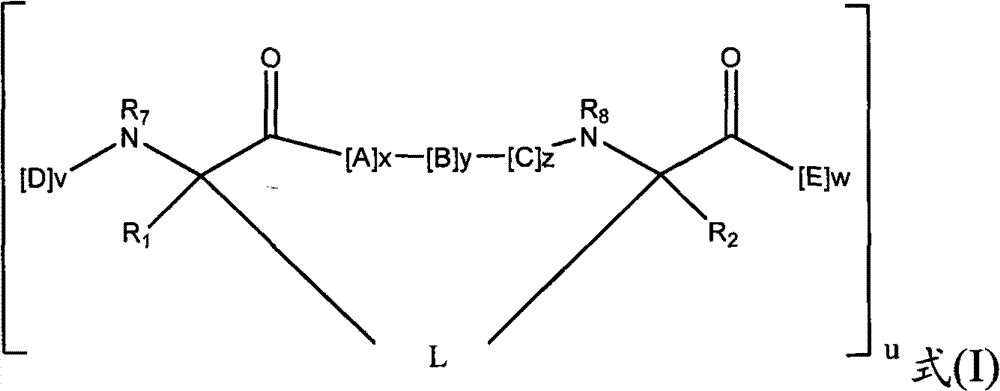
其中:in:
A、C、D和E各自独立地为天然或非天然氨基酸;A, C, D and E are each independently a natural or unnatural amino acid;
B为天然或非天然氨基酸、氨基酸类似物、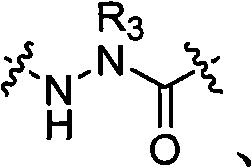
R1和R2独立地为-H、烷基、烯基、炔基、芳基烷基、环烷基、环烷基烷基、杂烷基或杂环烷基,它们是未取代的或被卤素取代的;R and R are independently -H, alkyl, alkenyl, alkynyl, arylalkyl, cycloalkyl, cycloalkylalkyl, heteroalkyl, or heterocycloalkyl, which are unsubstituted or substituted by halogen;
R3为氢、烷基、烯基、炔基、芳基烷基、杂烷基、环烷基、杂环烷基、环烷基烷基、环芳基或杂环芳基,它们任选地被R5取代; R is hydrogen, alkyl, alkenyl, alkynyl, arylalkyl, heteroalkyl, cycloalkyl, heterocycloalkyl, cycloalkylalkyl, cycloaryl or heterocyclic aryl, which optionally Ground is replaced by R 5 ;
L为式-L1-L2-的大环形成连接体;L is a macrocycle-forming linker of the formula -L 1 -L 2 -;
L1和L2独立地为亚烷基、亚烯基、亚炔基、杂亚烷基、亚环烷基、杂亚环烷基、亚环芳基、杂亚环芳基或[-R4-K-R4-]n,它们各自任选地被R5取代;L and L are independently alkylene, alkenylene, alkynylene, heteroalkylene, cycloalkylene, heterocycloalkylene, cycloarylene, heterocycloarylene, or [-R 4 -KR 4 -] n , each of which is optionally substituted by R 5 ;
各个R4为亚烷基、亚烯基、亚炔基、杂亚烷基、亚环烷基、杂亚环烷基、亚芳基或杂亚芳基; each R is alkylene, alkenylene, alkynylene, heteroalkylene, cycloalkylene, heterocycloalkylene, arylene, or heteroarylene;
各个K为O、S、SO、SO2、CO、CO2或CONR3;Each K is O, S, SO, SO 2 , CO, CO 2 or CONR 3 ;
各个R5独立地为卤素、烷基、-OR6、-N(R6)2、-SR6、-SOR6、-SO2R6、-CO2R6、荧光部分、放射性同位素或治疗剂;Each R 5 is independently halogen, alkyl, -OR 6 , -N(R 6 ) 2 , -SR 6 , -SOR 6 , -SO 2 R 6 , -CO 2 R 6 , a fluorescent moiety, a radioisotope, or a therapeutic agent;
各个R6独立地为-H、烷基、烯基、炔基、芳基烷基、环烷基烷基、杂环烷基、荧光部分、放射性同位素或治疗剂;each R is independently -H, alkyl, alkenyl, alkynyl, arylalkyl, cycloalkylalkyl, heterocycloalkyl, fluorescent moiety, radioisotope, or therapeutic agent;
R7为-H、烷基、烯基、炔基、芳基烷基、环烷基、杂烷基、环烷基烷基、杂环烷基、环芳基或杂环芳基,它们任选地被R5取代,或是具有D残基的环状结构的一部分; R is -H, alkyl, alkenyl, alkynyl, arylalkyl, cycloalkyl, heteroalkyl, cycloalkylalkyl, heterocycloalkyl, cycloaryl or heterocyclic aryl, any of which is optionally substituted by R 5 , or is part of a ring structure with a D residue;
R8为-H、烷基、烯基、炔基、芳基烷基、环烷基、杂烷基、环烷基烷基、杂环烷基、环芳基或杂环芳基,它们任选地被R5取代,或是具有E残基的环状结构的一部分; R is -H, alkyl, alkenyl, alkynyl, arylalkyl, cycloalkyl, heteroalkyl, cycloalkylalkyl, heterocycloalkyl, cycloaryl or heterocyclic aryl, any of which is optionally substituted by R 5 , or is part of a ring structure with an E residue;
v和w独立地为1-1000的整数;v and w are independently integers from 1-1000;
u、x、y和z独立地为0-10的整数;且u, x, y and z are independently integers from 0 to 10; and
n为1-5的整数。n is an integer of 1-5.
在其他实施方案中,拟肽大环化合物可包含连接该拟肽大环化合物内的第一氨基酸的骨架氨基与第二氨基酸的交联体。例如,本发明提供式(IV)或(IVa)的拟肽大环化合物:In other embodiments, the peptidomimetic macrocycle may comprise a cross-linker linking a backbone amino group of a first amino acid within the peptidomimetic macrocycle to a second amino acid. For example, the present invention provides peptidomimetic macrocycles of formula (IV) or (IVa):
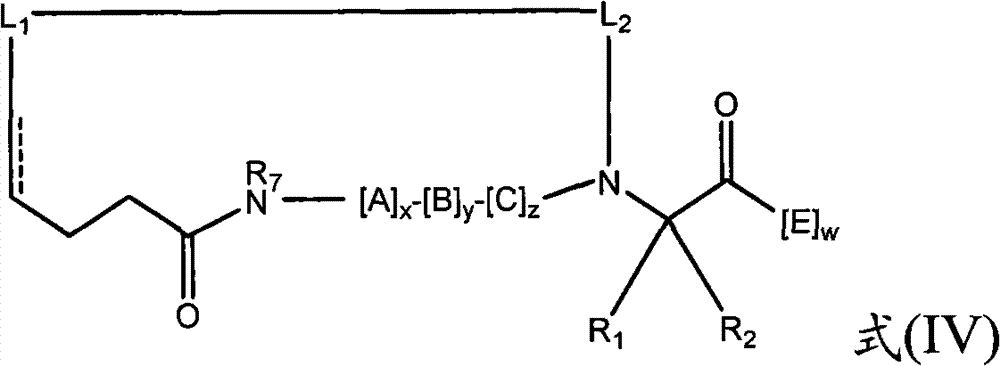
其中:in:
A、C、D和E各自独立地为天然或非天然氨基酸;A, C, D and E are each independently a natural or unnatural amino acid;
B为天然或非天然氨基酸、氨基酸类似物、
R1和R2独立地为-H、烷基、烯基、炔基、芳基烷基、环烷基、环烷基烷基、杂烷基或杂环烷基,它们是未取代的或被卤素取代的,或是具有E残基的环状结构的一部分;R and R are independently -H, alkyl, alkenyl, alkynyl, arylalkyl, cycloalkyl, cycloalkylalkyl, heteroalkyl, or heterocycloalkyl, which are unsubstituted or Halogen substituted, or part of a ring structure with an E residue;
R3为氢、烷基、烯基、炔基、芳基烷基、杂烷基、环烷基、杂环烷基、环烷基烷基、环芳基或杂环芳基,它们任选地被R5取代; R is hydrogen, alkyl, alkenyl, alkynyl, arylalkyl, heteroalkyl, cycloalkyl, heterocycloalkyl, cycloalkylalkyl, cycloaryl or heterocyclic aryl, which optionally Ground is replaced by R 5 ;
L1和L2独立地为亚烷基、亚烯基、亚炔基、杂亚烷基、亚环烷基、杂亚环烷基、亚环芳基、杂亚环芳基或[-R4-K-R4-]n,它们各自任选地被R5取代;L and L are independently alkylene, alkenylene, alkynylene, heteroalkylene, cycloalkylene, heterocycloalkylene, cycloarylene, heterocycloarylene, or [-R 4 -KR 4 -] n , each of which is optionally substituted by R 5 ;
各个R4为亚烷基、亚烯基、亚炔基、杂亚烷基、亚环烷基、杂亚环烷基、亚芳基或杂亚芳基; each R is alkylene, alkenylene, alkynylene, heteroalkylene, cycloalkylene, heterocycloalkylene, arylene, or heteroarylene;
各个K为O、S、SO、SO2、CO、CO2或CONR3;Each K is O, S, SO, SO 2 , CO, CO 2 or CONR 3 ;
各个R5独立地为卤素、烷基、-OR6、-N(R6)2、-SR6、-SOR6、-SO2R6、-CO2R6、荧光部分、放射性同位素或治疗剂;Each R 5 is independently halogen, alkyl, -OR 6 , -N(R 6 ) 2 , -SR 6 , -SOR 6 , -SO 2 R 6 , -CO 2 R 6 , a fluorescent moiety, a radioisotope, or a therapeutic agent;
各个R6独立地为-H、烷基、烯基、炔基、芳基烷基、环烷基烷基、杂环烷基、荧光部分、放射性同位素或治疗剂;each R is independently -H, alkyl, alkenyl, alkynyl, arylalkyl, cycloalkylalkyl, heterocycloalkyl, fluorescent moiety, radioisotope, or therapeutic agent;
R7为-H、烷基、烯基、炔基、芳基烷基、环烷基、杂烷基、环烷基烷基、杂环烷基、环芳基或杂环芳基,它们任选地被R5取代; R is -H, alkyl, alkenyl, alkynyl, arylalkyl, cycloalkyl, heteroalkyl, cycloalkylalkyl, heterocycloalkyl, cycloaryl or heterocyclic aryl, any of which optionally replaced by R 5 ;
v和w独立地为1-1000的整数;v and w are independently integers from 1-1000;
u、x、y和z独立地为0-10的整数;且u, x, y and z are independently integers from 0 to 10; and
n为1-5的整数。n is an integer of 1-5.
另外,本发明提供一种治疗个体癌症的方法,包括向该个体施用本发明的拟肽大环化合物。本发明还提供了一种调节个体中的β-连环蛋白活性的方法,包括向该个体施用本发明的拟肽大环化合物,或者一种拮抗个体中β-连环蛋白与TCF/LEF蛋白之间的相互作用的方法,包括向该个体施用这种拟肽大环化合物。Additionally, the invention provides a method of treating cancer in an individual comprising administering to the individual a peptidomimetic macrocycle of the invention. The present invention also provides a method for modulating the activity of β-catenin in an individual, comprising administering to the individual a peptidomimetic macrocycle of the present invention, or a method that antagonizes the interaction between β-catenin and TCF/LEF proteins in the individual. A method for the interaction of , comprising administering the peptidomimetic macrocycle to the individual.
参考引入References
本说明书中提及的所有出版物、专利和专利申请均通过引用方式并入本文,就如同各个单独的出版物、专利或专利申请明确地和单个地通过引用并入本文一样。All publications, patents, and patent applications mentioned in this specification are herein incorporated by reference as if each individual publication, patent, or patent application was specifically and individually indicated to be incorporated by reference.
附图说明 Description of drawings
在所附的权利要求书中详细地阐明了本发明的新特征。通过参考以下阐述了利用本发明原理的说明性实施方案的详细描述和附图,将会更好地理解本发明的特征和优点。在这些附图中:The novel features of the invention are set forth with particularity in the appended claims. The features and advantages of the present invention will be better understood by reference to the following detailed description and accompanying drawings which set forth illustrative embodiments utilizing the principles of the invention. In these drawings:
图1说明本发明的TCF拟肽大环化合物前体与β-连环蛋白的可能的结合模式。Figure 1 illustrates the possible binding mode of the TCF peptidomimetic macrocycle precursors of the present invention to β-catenin.
图2说明本发明的TCF拟肽大环化合物前体与β-连环蛋白的可能的结合模式。Figure 2 illustrates the possible binding mode of the TCF peptidomimetic macrocycle precursors of the present invention to β-catenin.
图3说明本发明的TCF拟肽大环化合物前体与β-连环蛋白的可能的结合模式。Figure 3 illustrates the possible binding modes of the TCF peptidomimetic macrocycle precursors of the present invention to β-catenin.
图4a-c显示示例性的本发明拟肽大环化合物。Figures 4a-c show exemplary peptidomimetic macrocycles of the invention.
发明详述Detailed description of the invention
如本文所用,术语“大环化合物”是指这样一种分子,该分子具有包含由至少9个共价键合的原子形成的环或环形的化学结构。As used herein, the term "macrocycle" refers to a molecule having a chemical structure comprising a ring or ring formed by at least 9 covalently bonded atoms.
如本文所用,术语“拟肽大环化合物”或“交联的多肽”是指包含通过多个肽键连接的多个氨基酸残基和至少一个大环形成连接体的化合物,所述大环形成连接体在第一天然存在的或非天然存在的氨基酸残基(或类似物)与同一分子内的第二天然存在的或非天然存在的氨基酸残基(或类似物)之间形成大环。拟肽大环化合物包括其中大环形成连接体连接第一氨基酸残基(或类似物)的α碳和第二氨基酸残基(或类似物)的α碳的实施方案。拟肽大环化合物任选地包含位于一个或多个氨基酸残基和/或氨基酸类似物残基之间的一个或多个非肽键,且除了形成大环化合物的任意残基外,任选地还包含一个或多个非天然存在的氨基酸残基或氨基酸类似物残基。当在拟肽大环化合物的上下文中提及时,“相应的非交联的多肽”理解为涉及与大环化合物长度相同的多肽,并且该多肽包含对应于大环化合物的野生型序列的等同天然氨基酸。As used herein, the term "peptidomimetic macrocycle" or "cross-linked polypeptide" refers to a compound comprising a plurality of amino acid residues connected by a plurality of peptide bonds and at least one macrocycle-forming linker that forms A linker forms a macrocycle between a first naturally occurring or non-naturally occurring amino acid residue (or analog) and a second naturally occurring or non-naturally occurring amino acid residue (or analog) within the same molecule. Peptidomimetic macrocycles include embodiments wherein the macrocycle forms a linker linking the alpha carbon of a first amino acid residue (or analog) to the alpha carbon of a second amino acid residue (or analog). The peptidomimetic macrocycle optionally comprises one or more non-peptide bonds between one or more amino acid residues and/or amino acid analog residues, and in addition to any residues forming the macrocycle, optionally It also includes one or more non-naturally occurring amino acid residues or amino acid analog residues. When referred to in the context of a peptidomimetic macrocycle, "corresponding non-crosslinked polypeptide" is understood to relate to a polypeptide of the same length as the macrocycle and which comprises the equivalent native sequence corresponding to the wild-type sequence of the macrocycle. amino acid.
除非另外说明,本文提及的化合物和结构也意在包括仅在是否存在一个或多个同位素富集原子上不同的化合物。例如,本发明包括具有本发明结构但其中氢被氘或氚替代或者其中碳原子被13C-或14C-富集的碳替代或者其中碳原子被硅替代的化合物。本发明的化合物也可以在构成这些化合物的一个或多个原子处含有非天然比例的原子同位素。例如,该化合物可以用诸如氚(3H)、碘-125(125I)或碳-14(14C)的放射性同位素放射性标记。本发明化合物的所有同位素变化,无论是否是放射性的,均包含在本发明的范围内。Unless otherwise stated, references to compounds and structures herein are also intended to include compounds that differ only in the presence or absence of one or more isotopically enriched atoms. For example, the invention includes compounds having the structure of the invention but wherein hydrogen is replaced by deuterium or tritium or wherein carbon atoms are replaced by13C- or14C -enriched carbons or wherein carbon atoms are replaced by silicon. The compounds of the present invention may also contain unnatural proportions of atomic isotopes at one or more of the atoms that constitute these compounds. For example, the compound can be radiolabeled with a radioisotope such as tritium ( 3H ), iodine-125 ( 125I ), or carbon-14 ( 14C ). All isotopic variations of the compounds of the invention, whether radioactive or not, are encompassed within the scope of the invention.
如本文所用,术语“稳定性”是指如通过圆二色光谱、NMR或另一种生物物理测量法测定的,本发明拟肽大环化合物在溶液中保持特定的二级结构,或在体外或体内不会被蛋白水解作用降解。本发明所预期的二级结构的非限制性例子是α-螺旋、β-转角和β-折叠。As used herein, the term "stability" means that the peptidomimetic macrocycles of the invention maintain a specific secondary structure in solution, or in vitro, as determined by circular dichroism spectroscopy, NMR, or another biophysical measurement. Or in vivo will not be degraded by proteolysis. Non-limiting examples of secondary structures contemplated by the present invention are α-helices, β-turns and β-sheets.
如本文所用,术语“螺旋稳定性”是指如通过圆二色光谱或NMR测量的,本发明的拟肽大环化合物保持α-螺旋结构。例如,在某些实施方案中,与相应的非交联的大环化合物相比,如通过圆二色光谱测定的,本发明的拟肽大环化合物在α-螺旋度上表现出至少1.25、1.5、1.75或2倍的增加。As used herein, the term "helical stability" means that the peptidomimetic macrocycles of the invention maintain an alpha-helical structure as measured by circular dichroism spectroscopy or NMR. For example, in certain embodiments, the peptidomimetic macrocycles of the invention exhibit an alpha-helicity of at least 1.25, 1.5, 1.75 or 2-fold increase.
术语“α-氨基酸”或简称为“氨基酸”是指含有的氨基和羧基都结合到被称为α-碳的碳上的分子。合适的氨基酸包括但不限于天然存在的氨基酸的D-异构体和L-异构体,以及通过有机合成或其他代谢途径制备的非天然存在的氨基酸。除非上下文另外特别指出,本文所用的术语氨基酸旨在包括氨基酸类似物。The term "alpha-amino acid" or simply "amino acid" refers to a molecule containing both an amino group and a carboxyl group bonded to a carbon called an alpha-carbon. Suitable amino acids include, but are not limited to, the D-isomers and L-isomers of naturally occurring amino acids, as well as non-naturally occurring amino acids prepared by organic synthesis or other metabolic routes. Unless the context specifically indicates otherwise, the term amino acid as used herein is intended to include amino acid analogs.
术语“天然存在的氨基酸”是指在自然界合成的肽中通常发现的20种氨基酸中的任一种,已知其单字母缩写为A、R、N、C、D、Q、E、G、H、I、L、K、M、F、P、S、T、W、Y和V。The term "naturally occurring amino acid" refers to any of the 20 amino acids commonly found in peptides synthesized in nature, known by their single-letter abbreviations A, R, N, C, D, Q, E, G, H, I, L, K, M, F, P, S, T, W, Y, and V.
术语“氨基酸类似物”或“非天然氨基酸”是指在结构上类似于氨基酸并且在形成拟肽大环化合物中可代替氨基酸的分子。氨基酸类似物包括但不限于除了在氨基和羧基(例如,α-氨基β-羧酸)之间包含一个或多个额外的亚甲基基团以外,或除了用相似反应性基团替代氨基或羧基(例如,用仲胺或叔胺替代伯胺,或用酯替代羧基)以外,在结构上与本文定义的氨基酸相同的化合物。The term "amino acid analog" or "unnatural amino acid" refers to a molecule that is structurally similar to an amino acid and that can substitute for an amino acid in the formation of a peptidomimetic macrocycle. Amino acid analogs include, but are not limited to, except that one or more additional methylene groups are included between the amino and carboxyl groups (e.g., α-amino β-carboxylic acid), or that the amino group is replaced by a similarly reactive group or Compounds that are structurally identical to the amino acids defined herein, except for the carboxyl group (for example, a secondary or tertiary amine in place of a primary amine, or an ester in place of a carboxyl group).
“非必需”氨基酸残基是可以基于多肽的野生型序列发生改变但不消除或根本改变多肽的基本生物学或生物化学活性(例如,受体结合或激活)的残基。“必需”氨基酸残基是当基于多肽的野生型序列发生改变时导致多肽的基本生物学或生物化学活性消除或基本消除的残基。"Nonessential" amino acid residues are residues that may be altered based on the wild-type sequence of the polypeptide without eliminating or substantially altering the polypeptide's essential biological or biochemical activity (eg, receptor binding or activation). An "essential" amino acid residue is one that, when altered based on the wild-type sequence of the polypeptide, results in the elimination or substantial elimination of essential biological or biochemical activity of the polypeptide.
“保守氨基酸置换”是氨基酸残基被具有相似侧链的氨基酸残基所替代的氨基酸置换。本领域中已定义了具有相似侧链的氨基酸残基的家族。这些家族包括具有碱性侧链的氨基酸(例如,K、R、H)、具有酸性侧链的氨基酸(例如,D、E)、具有不带电荷的极性侧链的氨基酸(例如,G、N、Q、S、T、Y、C)、具有非极性侧链的氨基酸(例如,A、V、L、I、P、F、M、W)、具有β分支的侧链的氨基酸(例如,T、V、I)和具有芳香族侧链的氨基酸(例如,Y、F、W、H)。因此,多肽中预测的非必需氨基酸残基例如优选地被来自同一侧链家族的另一种氨基酸残基所替代。可接受的置换的其他例子是基于电子等排考虑(例如,正亮氨酸取代甲硫氨酸)或其他性质(如2-噻吩丙氨酸取代苯丙氨酸)的置换。A "conservative amino acid substitution" is an amino acid substitution in which an amino acid residue is replaced by an amino acid residue having a similar side chain. Families of amino acid residues having similar side chains have been defined in the art. These families include amino acids with basic side chains (e.g., K, R, H), acidic side chains (e.g., D, E), amino acids with uncharged polar side chains (e.g., G, N, Q, S, T, Y, C), amino acids with non-polar side chains (e.g., A, V, L, I, P, F, M, W), amino acids with beta branched side chains ( For example, T, V, I) and amino acids with aromatic side chains (eg, Y, F, W, H). Thus, a predicted nonessential amino acid residue in a polypeptide, for example, is preferably replaced by another amino acid residue from the same side chain family. Other examples of acceptable substitutions are those based on isosteric considerations (eg, norleucine for methionine) or other properties (eg, 2-thienylalanine for phenylalanine).
在本文中与大环化合物或大环形成连接体一起使用的术语“元”是指形成或可以形成大环的原子,并且不包括取代基或侧链原子。以此类推,环癸烷、1,2-二氟-癸烷和1,3-二甲基-环癸烷都被认为是十元大环化合物,因为氢或氟取代基或甲基侧链都没有参与形成大环。The term "member" as used herein in connection with a macrocycle or a macrocycle-forming linker refers to an atom that forms or can form a macrocycle and does not include substituents or side chain atoms. By analogy, cyclodecane, 1,2-difluoro-decane, and 1,3-dimethyl-cyclodecane are all considered ten-membered macrocycles because the hydrogen or fluorine substituents or the methyl side chain Neither participated in the formation of the macrocycle.
当用作分子结构的一部分时,符号
术语“氨基酸侧链”是指连接到氨基酸中的α-碳上的部分。例如,丙氨酸的氨基酸侧链是甲基,苯丙氨酸的氨基酸侧链是苯甲基,半胱氨酸的氨基酸侧链是硫甲基,天冬氨酸的氨基酸侧链是羧甲基,酪氨酸的氨基酸侧链是4-羟基苯甲基,等等。也包括其他非天然存在的氨基酸侧链,例如,天然产生的氨基酸侧链(例如,氨基酸代谢物)或合成制备的氨基酸侧链(例如,α,α-二取代的氨基酸)。The term "amino acid side chain" refers to the moiety attached to the alpha-carbon in an amino acid. For example, the amino acid side chain of alanine is methyl, the amino acid side chain of phenylalanine is benzyl, the amino acid side chain of cysteine is thiomethyl, and the amino acid side chain of aspartic acid is carboxymethyl base, the amino acid side chain of tyrosine is 4-hydroxybenzyl, and so on. Also included are other non-naturally occurring amino acid side chains, eg, naturally occurring amino acid side chains (eg, amino acid metabolites) or synthetically prepared amino acid side chains (eg, α,α-disubstituted amino acids).
术语“α,α-二取代的氨基酸”是指包含的氨基和羧基都结合到碳(α-碳)上而该碳(α-碳)连接到两个天然或非天然氨基酸侧链上的分子或部分。The term "α,α-disubstituted amino acid" refers to a molecule comprising both an amino group and a carboxyl group bonded to a carbon (α-carbon) attached to two natural or unnatural amino acid side chains or part.
术语“多肽”包括通过共价键(例如,酰胺键)连接的两个或多个天然或非天然存在的氨基酸。本文所述的多肽包括全长蛋白质(例如,完全加工的蛋白质)以及较短的氨基酸序列(例如,天然存在的蛋白质的片段或合成的多肽片段)。The term "polypeptide" includes two or more naturally or non-naturally occurring amino acids linked by a covalent bond (eg, an amide bond). Polypeptides described herein include full-length proteins (eg, fully processed proteins) as well as shorter amino acid sequences (eg, fragments of naturally occurring proteins or synthetic polypeptide fragments).
本文所用的术语“大环化试剂”或“大环形成试剂”是指任何可以用来通过介导两个反应性基团之间的反应而制备本发明的拟肽大环化合物的试剂。该反应性基团可以是,例如,叠氮和炔,在这种情况下,大环化试剂包括但不限于Cu试剂,如提供反应性Cu(I)物质的试剂,如CuBr、CuI或CuOTf,以及通过加入还原剂诸如抗坏血酸或抗坏血酸钠可以原位转化为活性Cu(I)试剂的Cu(II)盐,如Cu(CO2CH3)2、CuSO4和CuCl2。大环化试剂另外可以包括,例如,本领域已知的Ru试剂,如Cp*RuCl(PPh3)2、[Cp*RuCl]4,或其他可以提供反应性Ru(II)物质的Ru试剂。在其他情况下,反应性基团为末端烯类。在这样的实施方案中,大环化试剂或大环形成试剂为复分解催化剂,包括但不限于稳定的后过渡金属卡宾络合物催化剂,如VIII族过渡金属卡宾催化剂。例如,这样的催化剂为具有+2氧化态、电子计数为16且五配位的Ru和Os金属中心。其他催化剂在Grubbs等人,″Ring ClosingMetathesis and Related Processes in Organic Synthesis″Acc.Chem.Res.1995,28,446-452和美国专利5,811,515中公开。在另外其他情况下,反应性基团为巯基。在这样的实施方案中,大环化试剂为,例如,用两个巯基反应性基团如卤素基团官能化的连接体。As used herein, the term "macrocyclization reagent" or "macrocycle-forming reagent" refers to any reagent that can be used to prepare a peptidomimetic macrocycle of the invention by mediating a reaction between two reactive groups. The reactive groups can be, for example, azides and alkynes, in which case macrocyclizing reagents include, but are not limited to, Cu reagents such as reagents that provide reactive Cu(I) species such as CuBr, CuI or CuOTf , and Cu(II) salts such as Cu(CO 2 CH 3 ) 2 , CuSO 4 and CuCl 2 , which can be converted in situ to active Cu(I) reagents by adding reducing agents such as ascorbic acid or sodium ascorbate. Macrocyclization reagents can additionally include, for example, Ru reagents known in the art, such as Cp*RuCl( PPh3 ) 2 , [Cp*RuCl] 4 , or other Ru reagents that can provide reactive Ru(II) species. In other cases, the reactive group is a terminal alkene. In such embodiments, the macrocyclizing or macroring forming reagent is a metathesis catalyst, including but not limited to a stable late transition metal carbene complex catalyst, such as a Group VIII transition metal carbene catalyst. For example, such catalysts are Ru and Os metal centers with an oxidation state of +2, an electron count of 16, and five coordination. Other catalysts are disclosed in Grubbs et al., "Ring Closing Metathesis and Related Processes in Organic Synthesis" Acc. Chem. Res. 1995, 28, 446-452 and US Patent 5,811,515. In yet other instances, the reactive group is a sulfhydryl group. In such embodiments, the macrocyclizing agent is, for example, a linker functionalized with two sulfhydryl-reactive groups, such as halo groups.
术语“卤代”或“卤素”是指氟、氯、溴或碘或其基团。The term "halo" or "halogen" refers to fluorine, chlorine, bromine or iodine, or groups thereof.
术语“烷基”是指含有指定数目的碳原子的直链或支链烃链。例如,C1-C10表示该基团中具有1-10(含端值)个碳原子。在没有指定任何数值时,“烷基”是其中具有1-20(含端值)个碳原子的链(直链或支链)。The term "alkyl" refers to a straight or branched hydrocarbon chain containing the indicated number of carbon atoms. For example, C 1 -C 10 means that the group has 1-10 (inclusive) carbon atoms in it. When no numerical value is specified, "alkyl" is a chain (straight or branched) having 1 to 20 carbon atoms in it, inclusive.
术语“亚烷基”是指二价烷基(即,-R-)。The term "alkylene" refers to a divalent alkyl group (ie, -R-).
术语“烯基”是指具有一个或多个碳-碳双键的直链或支链烃链。烯基部分含有指定数目的碳原子。例如,C2-C10表示该基团中具有2-10(含端值)个碳原子。术语“低级烯基”是指C2-C6烯基链。在没有指定任何数值时,“烯基”是其中具有2-20(含端值)个碳原子的链(直链或支链)。The term "alkenyl" refers to a straight or branched hydrocarbon chain having one or more carbon-carbon double bonds. Alkenyl moieties contain the indicated number of carbon atoms. For example, C 2 -C 10 means that the group has 2-10 (inclusive) carbon atoms in it. The term "lower alkenyl" refers to a C2 - C6 alkenyl chain. When no numerical value is specified, "alkenyl" is a chain (straight or branched) having from 2 to 20, inclusive, carbon atoms in it.
术语“炔基”是指具有一个或多个碳-碳叁键的直链或支链烃链。炔基部分含有指定数目的碳原子。例如,C2-C10表示该基团中具有2-10(含端值)个碳原子。术语“低级炔基”是指C2-C6炔基链。在没有指定任何数值时,“炔基”是其中具有2-20(含端值)个碳原子的链(直链或支链)。The term "alkynyl" refers to a straight or branched hydrocarbon chain having one or more carbon-carbon triple bonds. The alkynyl moiety contains the indicated number of carbon atoms. For example, C 2 -C 10 means that the group has 2-10 (inclusive) carbon atoms in it. The term "lower alkynyl" refers to a C2 - C6 alkynyl chain. When no numerical value is specified, "alkynyl" is a chain (straight or branched) having 2 to 20 carbon atoms in it, inclusive.
术语“芳基”是指6碳单环或10碳双环的芳香环系统,其中各环的0、1、2、3或4个原子被取代基取代。芳基的例子包括苯基、萘基等。术语“芳基烷基”或术语“芳烷基”是指被芳基取代的烷基。术语“芳基烷氧基”是指被芳基取代的烷氧基。The term "aryl" refers to a 6-carbon monocyclic or 10-carbon bicyclic aromatic ring system wherein 0, 1, 2, 3 or 4 atoms of each ring are substituted by a substituent. Examples of aryl groups include phenyl, naphthyl and the like. The term "arylalkyl" or the term "aralkyl" refers to an alkyl group substituted with an aryl group. The term "arylalkoxy" refers to an alkoxy group substituted with an aryl group.
“烷基芳基(arylalkyl)”是指如上定义的芳基,其中芳基的氢原子中的一个被如上定义的C1-C5烷基取代。烷基芳基的代表性例子包括但不限于:2-甲基苯基、3-甲基苯基、4-甲基苯基、2-乙基苯基、3-乙基苯基、4-乙基苯基、2-丙基苯基、3-丙基苯基、4-丙基苯基、2-丁基苯基、3-丁基苯基、4-丁基苯基、2-戊基苯基、3-戊基苯基、4-戊基苯基、2-异丙基苯基、3-异丙基苯基、4-异丙基苯基、2-异丁基苯基、3-异丁基苯基、4-异丁基苯基、2-仲丁基苯基、3-仲丁基苯基、4-仲丁基苯基、2-叔丁基苯基、3-叔丁基苯基和4-叔丁基苯基。"Arylalkyl" refers to an aryl group as defined above, wherein one of the hydrogen atoms of the aryl group is replaced by a C 1 -C 5 alkyl group as defined above. Representative examples of alkylaryl groups include, but are not limited to: 2-methylphenyl, 3-methylphenyl, 4-methylphenyl, 2-ethylphenyl, 3-ethylphenyl, 4- Ethylphenyl, 2-propylphenyl, 3-propylphenyl, 4-propylphenyl, 2-butylphenyl, 3-butylphenyl, 4-butylphenyl, 2-pentylphenyl phenyl, 3-pentylphenyl, 4-pentylphenyl, 2-isopropylphenyl, 3-isopropylphenyl, 4-isopropylphenyl, 2-isobutylphenyl, 3-isobutylphenyl, 4-isobutylphenyl, 2-sec-butylphenyl, 3-sec-butylphenyl, 4-sec-butylphenyl, 2-tert-butylphenyl, 3- tert-butylphenyl and 4-tert-butylphenyl.
“酰胺基芳基(arylamido)”是指如上定义的芳基,其中芳基的氢原子中的一个被一个或多个-C(O)NH2基团取代。酰胺基芳基的代表性例子包括:2-C(O)NH2-苯基、3-C(O)NH2-苯基、4-C(O)NH2-苯基、2-C(O)NH2-吡啶基、3-C(O)NH2-吡啶基和4-C(O)NH2-吡啶基。"Arylamido" refers to an aryl group as defined above, wherein one of the hydrogen atoms of the aryl group is replaced by one or more -C(O) NH2 groups. Representative examples of amidoaryl include: 2-C(O) NH2 -phenyl, 3-C(O) NH2 -phenyl, 4-C(O) NH2 -phenyl, 2-C( O)NH 2 -pyridyl, 3-C(O)NH 2 -pyridyl and 4-C(O)NH 2 -pyridyl.
“杂环基烷基(alkylheterocycle)”是指如上定义的C1-C5烷基其中C1-C5烷基的氢原子中的一个被杂环取代。杂环基烷基的代表性例子包括但不限于:-CH2CH2-吗啉、-CH2CH2-哌啶、-CH2CH2CH2-吗啉和-CH2CH2CH2-咪唑。"Alkylheterocycle" refers to a C 1 -C 5 alkyl group as defined above wherein one of the hydrogen atoms of the C 1 -C 5 alkyl group is replaced by a heterocycle. Representative examples of heterocyclylalkyl include , but are not limited to, -CH2CH2 -morpholine , -CH2CH2 - piperidine, -CH2CH2CH2 - morpholine , and -CH2CH2CH2 - imidazole.
“酰胺基烷基(alkylamido)”是指如上定义的C1-C5烷基其中C1-C5烷基的氢原子中的一个被-C(O)NH2基团取代。酰胺基烷基的代表性例子包括但不限于:-CH2-C(O)NH2、-CH2CH2-C(O)NH2、-CH2CH2CH2C(O)NH2、-CH2CH2CH2CH2C(O)NH2、-CH2CH2CH2CH2CH2C(O)NH2、-CH2CH(C(O)NH2)CH3、-CH2CH(C(O)NH2)CH2CH3、-CH(C(O)NH2)CH2CH3、-C(CH3)2CH2C(O)NH2、-CH2-CH2-NH-C(O)-CH3、-CH2-CH2-NH-C(O)-CH3-CH3和-CH2-CH2-NH-C(O)-CH=CH2。"Alkylamido" refers to a C 1 -C 5 alkyl group as defined above wherein one of the hydrogen atoms of the C 1 -C 5 alkyl group is replaced by a -C(O)NH 2 group. Representative examples of amidoalkyl include, but are not limited to: -CH2 -C(O ) NH2 , -CH2CH2 - C(O) NH2 , -CH2CH2CH2C (O) NH2 , -CH 2 CH 2 CH 2 CH 2 C(O)NH 2 , -CH 2 CH 2 CH 2 CH 2 CH 2 C(O)NH 2 , -CH 2 CH(C(O)NH 2 )CH 3 , -CH 2 CH(C(O)NH 2 )CH 2 CH 3 , -CH(C(O)NH 2 )CH 2 CH 3 , -C(CH 3 ) 2 CH 2 C(O)NH 2 , -CH 2 -CH 2 -NH-C(O)-CH 3 , -CH 2 -CH 2 -NH-C(O)-CH 3 -CH 3 and -CH 2 -CH 2 -NH-C(O)-CH = CH2 .
“羟烷基”是指如上定义的C1-C5烷基其中C1-C5烷基的氢原子中的一个被羟基取代。羟烷基的代表性例子包括但不限于:-CH2OH、-CH2CH2OH、-CH2CH2CH2OH、-CH2CH2CH2CH2OH、-CH2CH2CH2CH2CH2OH、-CH2CH(OH)CH3、-CH2CH(OH)CH2CH3、-CH(OH)CH3和-C(CH3)2CH2OH。"Hydroxyalkyl" refers to a C 1 -C 5 alkyl group as defined above wherein one of the hydrogen atoms of the C 1 -C 5 alkyl group is replaced by a hydroxy group. Representative examples of hydroxyalkyl include, but are not limited to : -CH2OH , -CH2CH2OH , -CH2CH2CH2OH , -CH2CH2CH2CH2OH , -CH2CH2CH 2CH2CH2OH , -CH2CH (OH ) CH3 , -CH2CH (OH) CH2CH3 , -CH (OH) CH3 , and -C( CH3 ) 2CH2OH .
“羧基烷基(alkylcarboxy)”是指如上定义的C1-C5烷基其中C1-C5烷基的氢原子中的一个被-COOH基团取代。羧基烷基的代表性例子包括但不限于:-CH2COOH、-CH2CH2COOH、-CH2CH2CH2COOH、-CH2CH2CH2CH2COOH、-CH2CH(COOH)CH3、-CH2CH2CH2CH2CH2COOH、-CH2CH(COOH)CH2CH3、-CH(COOH)CH2CH3和-C(CH3)2CH2COOH。"Alkylcarboxy" means a C 1 -C 5 alkyl group as defined above wherein one of the hydrogen atoms of the C 1 -C 5 alkyl group is replaced by a -COOH group. Representative examples of carboxyalkyl include , but are not limited to : -CH2COOH , -CH2CH2COOH , -CH2CH2CH2COOH , -CH2CH2CH2CH2COOH , -CH2CH (COOH ) CH3 , -CH2CH2CH2CH2CH2COOH , -CH2CH ( COOH ) CH2CH3 , -CH( COOH ) CH2CH3 and -C ( CH3 ) 2CH2COOH .
本文使用的术语“环烷基”包括具有3-12个碳、优选3-8个碳、更优选3-6个碳的饱和的和部分不饱和的环烃基,其中环烷基另外任选地被取代。一些环烷基包括但不限于:环丙基、环丁基、环戊基、环戊烯基、环己基、环己烯基、环庚基和环辛基。The term "cycloalkyl" as used herein includes saturated and partially unsaturated cyclic hydrocarbon groups having 3-12 carbons, preferably 3-8 carbons, more preferably 3-6 carbons, wherein cycloalkyl is additionally optionally was replaced. Some cycloalkyl groups include, but are not limited to, cyclopropyl, cyclobutyl, cyclopentyl, cyclopentenyl, cyclohexyl, cyclohexenyl, cycloheptyl, and cyclooctyl.
术语“杂芳基”是指芳香族的5-8元单环、8-12元双环或11-14元三环的环系统,其如果是单环则具有1-3个杂原子,如果是双环则具有1-6个杂原子,或者如果是三环则具有1-9个杂原子,所述杂原子选自O、N或S(例如,如果是单环、双环或三环,分别为碳原子和1-3、1-6或1-9个O、N或S杂原子),其中各个环的0、1、2、3或4个原子被取代基取代。杂芳基的例子包括吡啶基、呋喃基(furyl或furanyl)、咪唑基、苯并咪唑基、嘧啶基、噻吩基(thiophenyl或thienyl)、喹啉基、吲哚基、噻唑基等。The term "heteroaryl" refers to an aromatic 5-8 membered monocyclic, 8-12 membered bicyclic or 11-14 membered tricyclic ring system having 1-3 heteroatoms if monocyclic, and if Bicyclic then has 1-6 heteroatoms, or if tricyclic, 1-9 heteroatoms selected from O, N or S (e.g. if monocyclic, bicyclic or tricyclic, respectively carbon atoms and 1-3, 1-6 or 1-9 O, N or S heteroatoms), wherein 0, 1, 2, 3 or 4 atoms of each ring are substituted by a substituent. Examples of heteroaryl groups include pyridyl, furyl or furanyl, imidazolyl, benzimidazolyl, pyrimidinyl, thiophenyl or thienyl, quinolinyl, indolyl, thiazolyl, and the like.
术语“杂芳基烷基”或术语“杂芳烷基”是指被杂芳基取代的烷基。术语“杂芳基烷氧基”是指被杂芳基取代的烷氧基。The term "heteroarylalkyl" or the term "heteroaralkyl" refers to an alkyl group substituted with a heteroaryl group. The term "heteroarylalkoxy" refers to an alkoxy group substituted with a heteroaryl group.
术语“杂芳基烷基”或术语“杂芳烷基”是指被杂芳基取代的烷基。术语“杂芳基烷氧基”是指被杂芳基取代的烷氧基。The term "heteroarylalkyl" or the term "heteroaralkyl" refers to an alkyl group substituted with a heteroaryl group. The term "heteroarylalkoxy" refers to an alkoxy group substituted with a heteroaryl group.
术语“杂环基”是指非芳香族的5-8元单环、8-12元双环或11-14元三环的环系统,其如果是单环则具有1-3个杂原子,如果是双环则具有1-6个杂原子,或者如果是三环则具有1-9个杂原子,所述杂原子选自O、N或S(例如,如果是单环、双环或三环,分别为碳原子和1-3、1-6或1-9个O、N或S杂原子),其中各个环的0、1、2或3个原子被取代基取代。杂环基的例子包括哌嗪基、吡咯烷基、二氧杂环己基、吗啉基、四氢呋喃基等。The term "heterocyclyl" refers to a non-aromatic 5-8 membered monocyclic, 8-12 membered bicyclic or 11-14 membered tricyclic ring system which, if monocyclic, has 1-3 heteroatoms, if 1-6 heteroatoms if bicyclic, or 1-9 heteroatoms if tricyclic, selected from O, N or S (for example, if monocyclic, bicyclic or tricyclic, respectively is a carbon atom and 1-3, 1-6 or 1-9 O, N or S heteroatoms), wherein 0, 1, 2 or 3 atoms of each ring are substituted by a substituent. Examples of heterocyclic groups include piperazinyl, pyrrolidinyl, dioxanyl, morpholinyl, tetrahydrofuranyl and the like.
术语“取代基”是指取代任何分子、化合物或部分上的第二原子或基团如氢原子的基团。合适的取代基包括但不限于卤素、羟基、巯基、氧代、硝基、卤代烷基、烷基、烷芳基、芳基、芳烷基、烷氧基、硫代烷氧基、芳氧基、氨基、烷氧羰基、酰胺基、羧基、链烷磺酰基、烷基羰基和氰基。The term "substituent" refers to a group that replaces a second atom or group, such as a hydrogen atom, on any molecule, compound or moiety. Suitable substituents include, but are not limited to, halogen, hydroxy, mercapto, oxo, nitro, haloalkyl, alkyl, alkaryl, aryl, aralkyl, alkoxy, thioalkoxy, aryloxy , amino, alkoxycarbonyl, amido, carboxyl, alkanesulfonyl, alkylcarbonyl and cyano.
在某些实施方案中,本发明的化合物包含一个或多个不对称中心,因而作为外消旋体或外消旋混合物、单一对映异构体、单独的非对映异构体和非对映体混合物存在。除非另外明确地指出,本发明包括这些化合物的所有这些异构体形式。在某些实施方案中,本发明的化合物也表现为多种互变异构形式,在这些情况下,本发明包括本文所述化合物的所有互变异构形式(例如,如果环系统的烷基化作用导致在多个位置发生烷基化,那么本发明包括所有这些反应产物)。除非另外明确地指出,本发明包括这些化合物的所有这些异构体形式。除非另外明确地指出,本发明包括本文所述化合物的所有晶形。In certain embodiments, the compounds of the present invention contain one or more asymmetric centers and are thus present as racemates or racemic mixtures, single enantiomers, individual diastereomers and diastereomers A mixture of enantiomers exists. Unless expressly stated otherwise, the present invention includes all such isomeric forms of these compounds. In certain embodiments, the compounds of the invention also exhibit multiple tautomeric forms, and in these cases, the invention includes all tautomeric forms of the compounds described herein (for example, if the alkyl group of the ring system If alkylation results in alkylation at multiple positions, then the invention includes all such reaction products). Unless expressly stated otherwise, the present invention includes all such isomeric forms of these compounds. Unless expressly stated otherwise, the present invention includes all crystalline forms of the compounds described herein.
如本文所用,术语“增加”和“减少”分别意味着导致至少5%的统计学显著的(即,p<0.1)增加或减少。As used herein, the terms "increase" and "decrease" mean causing a statistically significant (ie, p<0.1 ) increase or decrease of at least 5%, respectively.
如本文所用,提及变量的数值范围意味着表示本发明可以采用等于该范围内的任意值的该变量实施。因此,对于本身不连续的变量,该变量等于该数值范围内的任意整数值,包括该范围的端点。类似地,对于本身连续的变量,该变量等于该数值范围内的任意实值,包括该范围的端点。作为例子,而不是限制,如果变量本身是不连续的,描述为具有0-2之间的值的变量取0、1或2的值;而如果变量本身是连续的,则取0.0、0.1、0.01、0.001的值或≥0且≤2的其他任何实值。As used herein, reference to a numerical range for a variable is meant to mean that the invention can be practiced with that variable equal to any value within the range. Thus, for a variable that is not inherently continuous, the variable is equal to any integer value within the numerical range, including the endpoints of the range. Similarly, for a variable that is inherently continuous, the variable is equal to any real value within the numerical range, including the endpoints of the range. By way of example, and not limitation, a variable described as having a value between 0 and 2 takes on values 0, 1, or 2 if the variable itself is discontinuous, and 0.0, 0.1, A value of 0.01, 0.001, or any other real value ≥0 and ≤2.
如本文所用,除非另外特别指出,单词“或”以“和/或”的包含性含义使用,而非“或/或”的排它性的含义。As used herein, unless specifically stated otherwise, the word "or" is used in the inclusive sense of "and/or" rather than the exclusive meaning of "or/or".
术语“平均”表示对于每个数据点通过进行至少3次独立的重复而获得的平均值。The term "average" denotes the mean value obtained for each data point by performing at least 3 independent replicates.
术语“生物活性”包括本发明的大环化合物的结构和功能特性。生物活性是,例如,结构稳定性、α-螺旋性、对靶标的亲和性、对蛋白水解降解的抗性、细胞渗透性,细胞内稳定性、体内稳定性或它们的任意组合。The term "biological activity" includes both structural and functional properties of the macrocycles of the invention. Biological activity is, for example, structural stability, alpha-helicity, affinity for a target, resistance to proteolytic degradation, cell permeability, intracellular stability, in vivo stability, or any combination thereof.
在下面的附图和描述中阐述了本发明的一种或多种具体实施方案的细节。从说明书、附图和权利要求书中可以清楚地看出本发明的其他特征、目的和优势。The details of one or more specific embodiments of the invention are set forth in the accompanying drawings and the description below. Other features, objects and advantages of the invention will be apparent from the description, drawings and claims.
在某些实施方案中,肽序列来源于含有β-连环蛋白结合域(CBD)的蛋白质。In certain embodiments, the peptide sequence is derived from a protein containing a β-catenin binding domain (CBD).
β-连环蛋白的一级结构包括其磷酸化依赖性降解所需的约130个残基的N-末端区,募集转录辅激活物的C-末端约100个残基的区段,和跨越残基134-668的12个犰狳蛋白重复的中心结构域(Peifer M.等人,Cell 76,789-791,1994)。该核心犰狳蛋白重复区与钙粘着蛋白、APC和Tcf家族转录因子相互作用。该区的晶体结构显示每个犰狳蛋白重复由三个螺旋组成;12个重复堆积形成螺旋的超螺旋。得到的杆状结构具有带正电荷的长表面,推测该表面是结合相互作用蛋白质中的酸性序列的结合位点。这些结合配偶体既使用相似的序列又使用差异的序列来结合β-连环蛋白表面上的不同区域。The primary structure of β-catenin includes an N-terminal region of approximately 130 residues required for its phosphorylation-dependent degradation, a C-terminal segment of approximately 100 residues that recruits transcriptional coactivators, and a spanning residue The central domain of the 12 armadillo protein repeats at bases 134-668 (Peifer M. et al., Cell 76, 789-791, 1994). This core armadillo protein repeat region interacts with cadherin, APC and Tcf family transcription factors. The crystal structure of this region shows that each armadillo protein repeat consists of three helices; 12 repeats stack to form a helical supercoil. The resulting rod-like structures have long, positively charged surfaces that are presumed to be binding sites for acidic sequences in interacting proteins. These binding partners use both similar and divergent sequences to bind different regions on the surface of β-catenin.
Tcf/LEF家族有四个成员。Tcf/LEF-1家族成员与β-连环蛋白在该蛋白质的大中心核心结合,该中心核心包含12个犰狳蛋白重复。每个犰狳蛋白重复由三个α螺旋组成,12个重复一起形成以带正电荷的长沟为特征的超螺旋(A.H.Huber,W.J.Nelson和W.I.Weis,Cell 90(1997),第871-882页)。包括TCF1、TCF3和TCF4在内的Tcf/LEF-1家族成员的CBD对应于位于该蛋白质的N末端的大约60个氨基酸(J.Behrens等人,Nature 382(1996),第638-642页)。例如,Tcf4/β-连环蛋白复合体的结构显示两个明显的蛋白质间相互作用位点:结合β-连环蛋白犰狳蛋白重复4-9的延伸区(Tcf4的残基13-25)和结合犰狳蛋白重复3-5的C-末端螺旋(残基40-50)(Poy F等人.Nat Structural Biol.,vol.8 no 12,2001)。Tcf4(残基13-25)肽的延伸部分在连续犰狳蛋白重复之间的扭转产生的带正电荷的沟中结合。Asp 16和Glu 17分别与β-连环蛋白Lys435和Lys 508形成盐桥氢键,Lys 435和Lys 508位于识别沟任一侧上的结合肽的侧翼。延伸区的C-末端也通过静电相互作用锚定,该相互作用是Tcf4中的Glu 24与β-连环蛋白中的Lys 312之间的盐桥。许多居间接触在性质上是疏水性的;Tcf4残基Ile 19和Phe 21的侧链一起装入由β-连环蛋白残基Cys 466、Pro 463和Arg 386的脂肪族部分围成的缝隙中。量热研究已经确定了Tcf4中的Asp 16是高亲和力结合的关键残基。β-连环蛋白中Lys 435或Lys 312的突变消除了爪蟾(Xenopus)Tcf3(XTcf3)的共沉淀(Graham,T.A.,Weaver,C.,Mao,F.,Kimelman,D.&Xu,W.Cell 103,885-896 2000)。Tcf4中的残基40-50构成两亲性螺旋,该螺旋位于在由β-连环蛋白中的犰狳蛋白重复3、4和5形成的浅沟中。Tcf4螺旋的一面上的疏水性残基嵌入该沟的底部。Tcf4残基Asp40、Lys 45和Ser 47沿着该沟的边缘形成极性和静电相互作用,有助于螺旋的识别。Asp 40的侧链在β-连环蛋白的Arg 376和Lys 335之间延伸,Lys 45与His 260和Asn 261氢键键合,并且Ser 47与Lys 292氢键键合。这些相互作用也存在于XTcf3-β-连环蛋白复合体中,http://www.nature.com/nsmb/journal/v8/n12/full/nsb720.html-B19#B19(Graham,T.A.,Weaver,C.,Mao,F.,Kimelman,D.&Xu,W.Cell 103,885-896(2000))。The Tcf/LEF family has four members. Tcf/LEF-1 family members bind to β-catenin in the protein's large central core, which contains 12 armadillo protein repeats. Each armadillo protein repeat consists of three alpha helices, and together 12 repeats form a superhelix characterized by a long positively charged groove (A.H. Huber, W.J. Nelson and W.I. Weis, Cell 90 (1997), pp. 871-882 Page). The CBD of Tcf/LEF-1 family members including TCF1, TCF3 and TCF4 corresponds to approximately 60 amino acids located at the N-terminus of the protein (J. Behrens et al., Nature 382 (1996), pp. 638-642) . For example, the structure of the Tcf4/β-catenin complex reveals two distinct protein-protein interaction sites: the stretch that binds β-catenin armadillo protein repeats 4-9 (residues 13-25 of Tcf4) and the binding C-terminal helix of armadillo protein repeats 3-5 (residues 40-50) (Poy F et al. Nat Structural Biol., vol. 8 no 12, 2001). The extended portion of the Tcf4 (residues 13-25) peptide binds in the positively charged groove created by the twist between consecutive armadillo protein repeats. Asp 16 and Glu 17 form salt bridge hydrogen bonds with β-catenin Lys 435 and Lys 508, respectively, which flank the binding peptide on either side of the recognition groove. The C-terminus of the elongate is also anchored by an electrostatic interaction, which is a salt bridge between Glu 24 in Tcf4 and Lys 312 in β-catenin. Many intervening contacts are hydrophobic in nature; the side chains of Tcf4 residues Ile 19 and Phe 21 fit together into a gap bounded by the aliphatic portion of β-catenin residues Cys 466, Pro 463, and Arg 386. Calorimetric studies have identified Asp 16 in Tcf4 as a key residue for high affinity binding. Mutation of Lys 435 or Lys 312 in β-catenin abolishes co-precipitation of Xenopus Tcf3 (XTcf3) (Graham, T.A., Weaver, C., Mao, F., Kimelman, D. & Xu, W. Cell 103, 885-896 2000). Residues 40-50 in Tcf4 constitute an amphipathic helix that lies in a shallow groove formed by armadillo protein repeats 3, 4 and 5 in β-catenin. Hydrophobic residues on one side of the Tcf4 helix insert into the bottom of this groove. Tcf4 residues Asp40, Lys 45, and Ser 47 form polar and electrostatic interactions along the edge of this groove that contribute to helix recognition. The side chain of Asp 40 extends between Arg 376 and Lys 335 of β-catenin, Lys 45 is hydrogen bonded to His 260 and Asn 261, and Ser 47 is hydrogen bonded to Lys 292. These interactions are also present in the XTcf3-β-catenin complex, http://www.nature.com/nsmb/journal/v8/n12/full/nsb720.html-B19#B19 (Graham, T.A., Weaver, C., Mao, F., Kimelman, D. & Xu, W. Cell 103, 885-896 (2000)).
Tcf/LEF-1家族的所有成员也具有位于该蛋白质的C末端一半内的高度保守的HMG DNA结合域。特别是,来自爪蟾的XTcf3-CBD从N末端到C末端由β发夹模块、含有β链的延伸区和α螺旋组成。XTcf3-CBD沿超螺旋的长轴以反平行方式围绕β-连环蛋白的犰狳蛋白重复区缠绕(Graham TA等人.Cell,Vol103 issue 6,2000)。XTcf3-CBD的螺旋区由残基Asp-40至Glu-51组成。XTcf3-CBD的螺旋与β-连环蛋白中犰狳蛋白重复3和4的第三螺旋接近反平行。XTcf3-CBD螺旋由Tcf/LEF-1家族共有序列N′-DLAKSSLV-C′组成。XTcf3-CBD的Asp-40和Lys-45的侧链分别与β-连环蛋白的Lys-335和Asn-261的侧链配位。这两个相互作用可以作为系链起作用,以稳定螺旋的相对定位。xTcf3的α-螺旋结合区靠着β-连环蛋白的臂重复3和4的H3螺旋包裹。XTcf3-CBD螺旋中的四个疏水性残基——Leu-41、Val-44、Leu-48和Val-49,构成与β-连环蛋白沟互补的表面(Graham TA等人.Cell,Vol103 issue 6,2000)。由于阻断β-连环蛋白和TCF之间相互作用的化合物可能是用于治疗由Wnt途径不当激活引起的癌症的有用的药物制剂,通过本发明的方法产生的CBD肽的任何新结构可用于预防和/或治疗众多类型的其中Wnt途径起作用的癌症。这样的癌症包括结直肠肿瘤、肝细胞癌、黑色素瘤和其他在Wnt途径成分中具有突变的肿瘤。All members of the Tcf/LEF-1 family also have a highly conserved HMG DNA-binding domain located within the C-terminal half of the protein. In particular, the XTcf3-CBD from Xenopus laevis consists of a β-hairpin module, a β-strand-containing elongation, and an α-helix from N-terminus to C-terminus. XTcf3-CBD wraps around the armadillo protein repeat region of β-catenin in an antiparallel manner along the long axis of the superhelix (Graham TA et al. Cell, Vol103 issue 6, 2000). The helical region of XTcf3-CBD consists of residues Asp-40 to Glu-51. The helix of XTcf3-CBD is nearly antiparallel to the third helix of armadillo protein repeats 3 and 4 in β-catenin. The XTcf3-CBD helix consists of the Tcf/LEF-1 family consensus sequence N'-DLAKSSLV-C'. The side chains of Asp-40 and Lys-45 of XTcf3-CBD coordinate with the side chains of Lys-335 and Asn-261 of β-catenin, respectively. These two interactions can act as tethers to stabilize the relative positioning of the helices. The α-helix binding region of xTcf3 wraps around the H3 helices of arm repeats 3 and 4 of β-catenin. Four hydrophobic residues in the XTcf3-CBD helix—Leu-41, Val-44, Leu-48, and Val-49—constitute the surface complementary to the β-catenin groove (Graham TA et al. Cell, Vol103 issue 6, 2000). Since compounds that block the interaction between β-catenin and TCF may be useful pharmaceutical agents for the treatment of cancers caused by inappropriate activation of the Wnt pathway, any new structure of the CBD peptide produced by the method of the present invention may be used to prevent And/or treat numerous types of cancers in which the Wnt pathway plays a role. Such cancers include colorectal tumors, hepatocellular carcinoma, melanoma and other tumors with mutations in Wnt pathway components.
靶向β-连环蛋白/TCF的相互作用使得可以通过抑制β-连环蛋白/TCF复合体而选择性针对多种类型的癌症,包括但不限于结直肠肿瘤、肝细胞癌、黑色素瘤和其他在Wnt途径成分中具有突变的肿瘤。目前还没有β-连环蛋白/TCF相互作用的小分子抑制剂。其他Tcf家族成员、钙粘着蛋白及可能APC本身所使用的结合表面的明显重叠代表了药物开发中的复杂因素,因为破坏β-连环蛋白/TCF相互作用的抑制剂可能会破坏β-连环蛋白/钙粘着蛋白相互作用或β-连环蛋白/APC或轴蛋白相互作用。这些复合体中的任一个的去稳定化可导致毒性,或者在APC的情况下,引起正常细胞中Tcf4的恶性激活。尽管在E-钙粘着蛋白和xTcf3结合机制中发现有相似性,具有热力学差异的β-连环蛋白配体之间结合的局部区域使得可能设计出β-连环蛋白-Tcf相互作用的特异性抑制剂。突变研究提示α-螺旋区对于钙粘着蛋白结合β-连环蛋白的重要性较低,因此对于β-连环蛋白/TCF相互作用更加特异。因此,本发明还提供一种治疗包括但不限于癌症和过度增生疾病的疾病的方法,包括向β-连环蛋白施用本发明的TCF拟肽大环化合物。Targeting the β-catenin/TCF interaction allows the selective targeting of various types of cancers including, but not limited to, colorectal tumors, hepatocellular carcinoma, melanoma and others in Tumors with mutations in Wnt pathway components. There are currently no small molecule inhibitors of the β-catenin/TCF interaction. The apparent overlap of binding surfaces used by other Tcf family members, cadherins, and possibly APC itself represents a complicating factor in drug development, as inhibitors that disrupt β-catenin/TCF interactions may disrupt β-catenin/TCF interactions. Cadherin interaction or β-catenin/APC or Axin interaction. Destabilization of either of these complexes can lead to toxicity or, in the case of APC, malignant activation of Tcf4 in normal cells. Despite similarities found in E-cadherin and xTcf3 binding mechanisms, localized regions of binding between β-catenin ligands with thermodynamic differences make it possible to design specific inhibitors of β-catenin-Tcf interactions . Mutational studies suggest that the α-helical region is less important for cadherin binding to β-catenin and thus more specific for β-catenin/TCF interaction. Accordingly, the invention also provides a method of treating diseases including, but not limited to, cancer and hyperproliferative diseases, comprising administering a TCF peptidomimetic macrocycle of the invention to β-catenin.
下面给出了用于本发明的合适的β-连环蛋白/TCF肽的非限制性示例列表:A non-limiting exemplary list of suitable β-catenin/TCF peptides for use in the invention is given below:
表1Table 1


表1显示适合合成拟肽大环化合物的β-连环蛋白/TCF序列。“间隔区”表示非肽连接体链如PEGn。Table 1 shows β-catenin/TCF sequences suitable for the synthesis of peptidomimetic macrocycles. "Spacer" denotes a non-peptide linker chain such as PEGn.
本发明的拟肽大环化合物Peptidomimetic macrocycles of the present invention
在某些实施方案中,本发明的拟肽大环化合物具有式(I):In certain embodiments, the peptidomimetic macrocycles of the invention have formula (I):
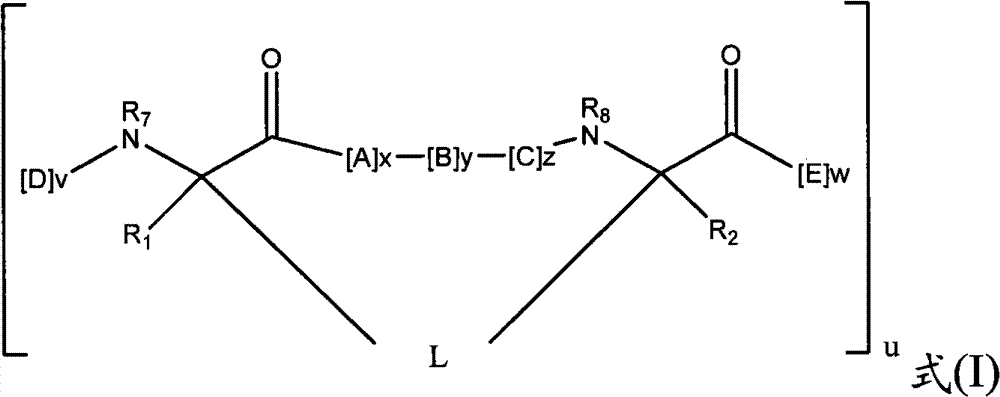
其中:in:
A、C、D和E各自独立地为天然或非天然氨基酸;A, C, D and E are each independently a natural or unnatural amino acid;
B为天然或非天然氨基酸、氨基酸类似物、
R1和R2独立地为-H、烷基、烯基、炔基、芳基烷基、环烷基、环烷基烷基、杂烷基或杂环烷基,它们是未取代的或被卤素取代的;R and R are independently -H, alkyl, alkenyl, alkynyl, arylalkyl, cycloalkyl, cycloalkylalkyl, heteroalkyl, or heterocycloalkyl, which are unsubstituted or substituted by halogen;
R3为氢、烷基、烯基、炔基、芳基烷基、杂烷基、环烷基、杂环烷基、环烷基烷基、环芳基或杂环芳基,它们任选地被R5取代; R is hydrogen, alkyl, alkenyl, alkynyl, arylalkyl, heteroalkyl, cycloalkyl, heterocycloalkyl, cycloalkylalkyl, cycloaryl or heterocyclic aryl, which optionally Ground is replaced by R 5 ;
L为式-L1-L2-的大环形成连接体;L is a macrocycle-forming linker of the formula -L 1 -L 2 -;
L1和L2独立地为亚烷基、亚烯基、亚炔基、杂亚烷基、亚环烷基、杂亚环烷基、亚环芳基、杂亚环芳基或[-R4-K-R4-]n,它们各自任选地被R5取代;L and L are independently alkylene, alkenylene, alkynylene, heteroalkylene, cycloalkylene, heterocycloalkylene, cycloarylene, heterocycloarylene, or [-R 4 -KR 4 -] n , each of which is optionally substituted by R 5 ;
各个R4为亚烷基、亚烯基、亚炔基、杂亚烷基、亚环烷基、杂亚环烷基、亚芳基或杂亚芳基; each R is alkylene, alkenylene, alkynylene, heteroalkylene, cycloalkylene, heterocycloalkylene, arylene, or heteroarylene;
各个K为O、S、SO、SO2、CO、CO2或CONR3;Each K is O, S, SO, SO 2 , CO, CO 2 or CONR 3 ;
各个R5独立地为卤素、烷基、-OR6、-N(R6)2、-SR6、-SOR6、-SO2R6、-CO2R6、荧光部分、放射性同位素或治疗剂;Each R 5 is independently halogen, alkyl, -OR 6 , -N(R 6 ) 2 , -SR 6 , -SOR 6 , -SO 2 R 6 , -CO 2 R 6 , a fluorescent moiety, a radioisotope, or a therapeutic agent;
各个R6独立地为-H、烷基、烯基、炔基、芳基烷基、环烷基烷基、杂环烷基、荧光部分、放射性同位素或治疗剂;each R is independently -H, alkyl, alkenyl, alkynyl, arylalkyl, cycloalkylalkyl, heterocycloalkyl, fluorescent moiety, radioisotope, or therapeutic agent;
R7为-H、烷基、烯基、炔基、芳基烷基、环烷基、杂烷基、环烷基烷基、杂环烷基、环芳基或杂环芳基,它们任选地被R5取代,或是具有D残基的环状结构的一部分; R is -H, alkyl, alkenyl, alkynyl, arylalkyl, cycloalkyl, heteroalkyl, cycloalkylalkyl, heterocycloalkyl, cycloaryl or heterocyclic aryl, any of which is optionally substituted by R 5 , or is part of a ring structure with a D residue;
R8为-H、烷基、烯基、炔基、芳基烷基、环烷基、杂烷基、环烷基烷基、杂环烷基、环芳基或杂环芳基,它们任选地被R5取代,或是具有E残基的环状结构的一部分; R is -H, alkyl, alkenyl, alkynyl, arylalkyl, cycloalkyl, heteroalkyl, cycloalkylalkyl, heterocycloalkyl, cycloaryl or heterocyclic aryl, any of which is optionally substituted by R 5 , or is part of a ring structure with an E residue;
v和w独立地为1-1000的整数;v and w are independently integers from 1-1000;
u、x、y和z独立地为0-10的整数;且u, x, y and z are independently integers from 0 to 10; and
n为1-5的整数。n is an integer of 1-5.
在一个实施例中,R1和R2中的至少一个是未取代的或被卤素取代的烷基。在另一个实施例中,R1和R2均独立地为未取代的或被卤素取代的烷基。在某些实施方案中,R1和R2中的至少一个为甲基。在其他实施方案中,R1和R2为甲基。In one embodiment, at least one of R 1 and R 2 is alkyl that is unsubstituted or substituted with halogen. In another embodiment, R 1 and R 2 are both independently unsubstituted or halogen substituted alkyl. In certain embodiments, at least one of R and R is methyl. In other embodiments, R1 and R2 are methyl.
在本发明的某些实施方案中,x+y+z至少为3。在本发明的其他实施方案中,x+y+z为1、2、3、4、5、6、7、8、9或10。本发明的大环化合物或大环化合物前体中每次出现的A、B、C、D或E独立地选择。例如,由式[A]x表示的序列,当x为3时,包括其中氨基酸不相同的实施方案,例如Gln-Asp-Ala,以及其中氨基酸相同的实施方案,例如Gln-Gln-Gln。这适用于指定范围内x、y或z的任意值。类似地,当u大于1时,本发明的各个化合物可包含相同或不同的拟肽大环化合物。例如,本发明的化合物可以包含含有不同连接体长度或化学组成的拟肽大环化合物。In certain embodiments of the invention, x+y+z is at least 3. In other embodiments of the invention, x+y+z is 1, 2, 3, 4, 5, 6, 7, 8, 9 or 10. Each occurrence of A, B, C, D or E in the macrocycle or macrocycle precursor of the invention is selected independently. For example, the sequence represented by formula [A] x , when x is 3, includes embodiments in which the amino acids are not identical, such as Gln-Asp-Ala, and embodiments in which the amino acids are identical, such as Gln-Gln-Gln. This works for any value of x, y or z within the specified range. Similarly, when u is greater than 1, each compound of the invention may comprise the same or different peptidomimetic macrocycles. For example, compounds of the invention may comprise peptidomimetic macrocycles containing linkers of varying length or chemical composition.
在某些实施方案中,本发明的拟肽大环化合物包含α-螺旋二级结构且R8为-H,其允许螺旋内氢键键合。在某些实施方案中,A、B、C、D或E中的至少一个为α,α-二取代的氨基酸。在一个实施例中,B为α,α-二取代的氨基酸。例如,A、B、C、D或E中的至少一个为2-氨基异丁酸。在其他实施方案中,A、B、C、D或E中的至少一个为In certain embodiments, the peptidomimetic macrocycles of the invention comprise an α-helical secondary structure and R is -H , which allows intrahelical hydrogen bonding. In certain embodiments, at least one of A, B, C, D or E is an α,α-disubstituted amino acid. In one embodiment, B is an α,α-disubstituted amino acid. For example, at least one of A, B, C, D or E is 2-aminoisobutyric acid. In other embodiments, at least one of A, B, C, D or E is

在其他实施方案中,选择从第一Cα到第二Cα测量的大环形成连接体L的长度,以稳定希望的二级肽结构,例如由拟肽大环化合物的残基(包括但不是必须限于第一Cα到第二Cα之间的残基)形成的α-螺旋。In other embodiments, the length of the macrocycle-forming linker L, measured from the first Cα to the second Cα, is selected to stabilize the desired secondary peptide structure, for example by residues of the peptidomimetic macrocycle (including but not necessarily limited to residues between the first Cα and the second Cα) to form an α-helix.
在一个实施方案中,式(I)的拟肽大环化合物为:In one embodiment, the peptidomimetic macrocycle of formula (I) is:

其中各个R1和R2独立地为-H、烷基、烯基、炔基、芳基烷基、环烷基、环烷基烷基、杂烷基或杂环烷基,它们是未取代的或被卤素取代的。wherein each of R and R is independently -H, alkyl, alkenyl, alkynyl, arylalkyl, cycloalkyl, cycloalkylalkyl, heteroalkyl, or heterocycloalkyl, which are unsubstituted or substituted by halogen.
在相关实施方案中,式(I)的拟肽大环化合物为:In a related embodiment, the peptidomimetic macrocycle of formula (I) is:

在其他实施方案中,式(I)的拟肽大环化合物是以下所示通式中的任一个的化合物:In other embodiments, the peptidomimetic macrocycle of formula (I) is a compound of any of the general formulas shown below:

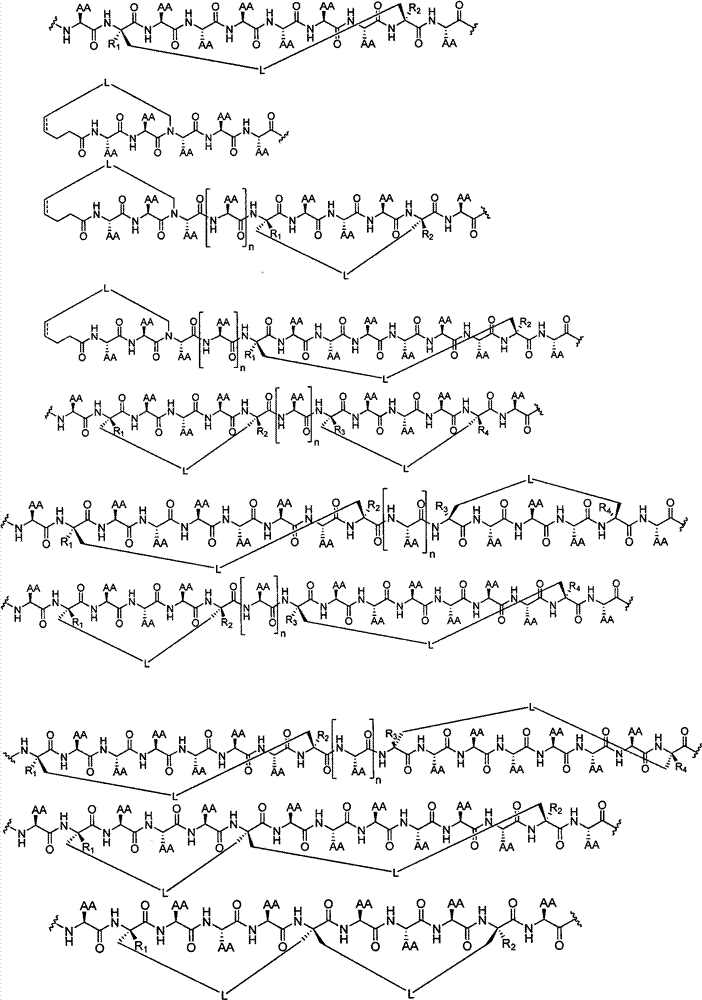

其中“AA”表示任何天然或非天然氨基酸侧链,且为如上定义的[D]v、[E]w,且n为0至20、50、100、200、300、400或500的整数。在某些实施方案中,n为0。在其他实施方案中,n小于50。where "AA" means any natural or unnatural amino acid side chain, and is [D] v , [E] w as defined above, and n is an integer of 0 to 20, 50, 100, 200, 300, 400 or 500. In certain embodiments, n is 0. In other embodiments, n is less than 50.
大环形成连接体L的示例性实施方案如下所示。Exemplary embodiments of macrocycle-forming linkers L are shown below.
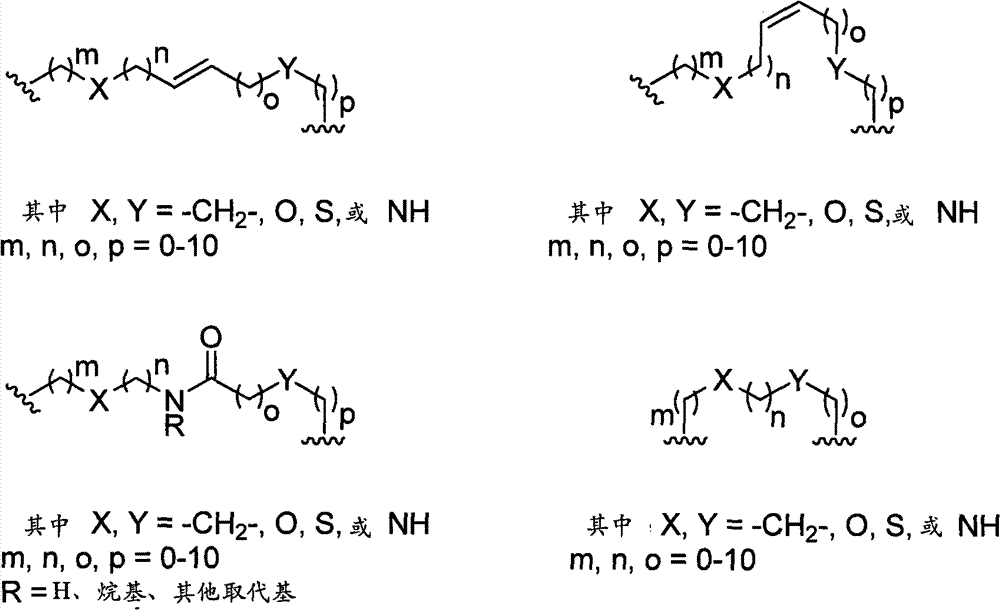
在某些实施方案中,本发明的拟肽大环化合物具有式(II):In certain embodiments, the peptidomimetic macrocycles of the invention have formula (II):
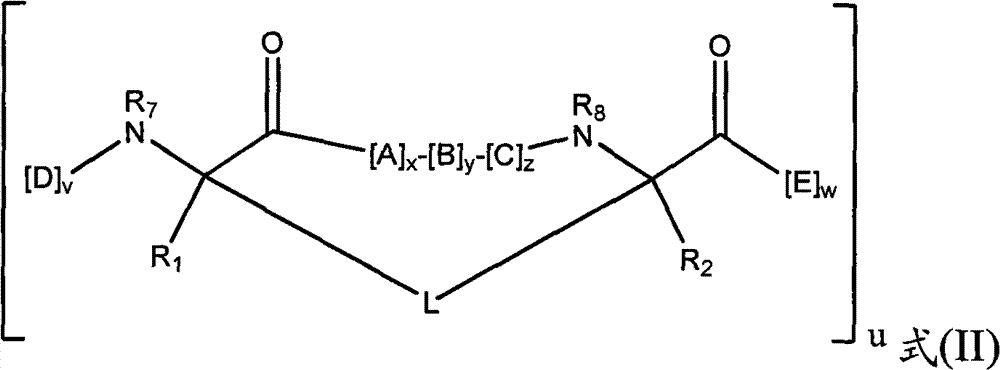
其中:in:
A、C、D和E各自独立地为天然或非天然氨基酸;A, C, D and E are each independently a natural or unnatural amino acid;
B为天然或非天然氨基酸、氨基酸类似物、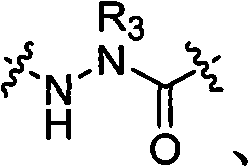
R1和R2独立地为-H、烷基、烯基、炔基、芳基烷基、环烷基、环烷基烷基、杂烷基或杂环烷基,它们是未取代的或被卤素取代的;R and R are independently -H, alkyl, alkenyl, alkynyl, arylalkyl, cycloalkyl, cycloalkylalkyl, heteroalkyl, or heterocycloalkyl, which are unsubstituted or substituted by halogen;
R3为氢、烷基、烯基、炔基、芳基烷基、杂烷基、环烷基、杂环烷基、环烷基烷基、环芳基或杂环芳基,它们任选地被R5取代; R is hydrogen, alkyl, alkenyl, alkynyl, arylalkyl, heteroalkyl, cycloalkyl, heterocycloalkyl, cycloalkylalkyl, cycloaryl or heterocyclic aryl, which optionally Ground is replaced by R 5 ;
L为下式的大环形成连接体:L is a macrocyclic linker of the following formula:
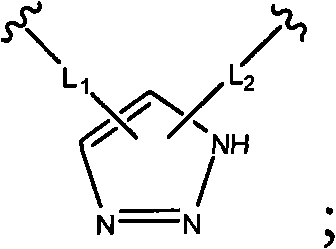
L1、L2和L3独立地为亚烷基、亚烯基、亚炔基、杂亚烷基、亚环烷基、杂亚环烷基、亚环芳基、杂亚环芳基或[-R4-K-R4-]n,它们各自任选地被R5取代;L 1 , L 2 and L 3 are independently alkylene, alkenylene, alkynylene, heteroalkylene, cycloalkylene, heterocycloalkylene, cycloarylene, heterocycloarylene, or [-R 4 -KR 4 -] n , each of which is optionally substituted by R 5 ;
各个R4为亚烷基、亚烯基、亚炔基、杂亚烷基、亚环烷基、杂亚环烷基、亚芳基或杂亚芳基; each R is alkylene, alkenylene, alkynylene, heteroalkylene, cycloalkylene, heterocycloalkylene, arylene, or heteroarylene;
各个K为O、S、SO、SO2、CO、CO2或CONR3;Each K is O, S, SO, SO 2 , CO, CO 2 or CONR 3 ;
各个R5独立地为卤素、烷基、-OR6、-N(R6)2、-SR6、-SOR6、-SO2R6、-CO2R6、荧光部分、放射性同位素或治疗剂;Each R 5 is independently halogen, alkyl, -OR 6 , -N(R 6 ) 2 , -SR 6 , -SOR 6 , -SO 2 R 6 , -CO 2 R 6 , a fluorescent moiety, a radioisotope, or a therapeutic agent;
各个R6独立地为-H、烷基、烯基、炔基、芳基烷基、环烷基烷基、杂环烷基、荧光部分、放射性同位素或治疗剂;each R is independently -H, alkyl, alkenyl, alkynyl, arylalkyl, cycloalkylalkyl, heterocycloalkyl, fluorescent moiety, radioisotope, or therapeutic agent;
R7为-H、烷基、烯基、炔基、芳基烷基、环烷基、杂烷基、环烷基烷基、杂环烷基、环芳基或杂环芳基,它们任选地被R5取代,或是具有D残基的环状结构的一部分; R is -H, alkyl, alkenyl, alkynyl, arylalkyl, cycloalkyl, heteroalkyl, cycloalkylalkyl, heterocycloalkyl, cycloaryl or heterocyclic aryl, any of which is optionally substituted by R 5 , or is part of a ring structure with a D residue;
R8为-H、烷基、烯基、炔基、芳基烷基、环烷基、杂烷基、环烷基烷基、杂环烷基、环芳基或杂环芳基,它们任选地被R5取代,或是具有E残基的环状结构的一部分 R is -H, alkyl, alkenyl, alkynyl, arylalkyl, cycloalkyl, heteroalkyl, cycloalkylalkyl, heterocycloalkyl, cycloaryl or heterocyclic aryl, any of which optionally substituted by R5 , or part of a ring structure with an E residue
v和w独立地为1-1000的整数;v and w are independently integers from 1-1000;
u、x、y和z独立地为0-10的整数;且u, x, y and z are independently integers from 0 to 10; and
n为1-5的整数。n is an integer of 1-5.
在一个实施例中,R1和R2中的至少一个是未取代的或被卤素取代的烷基。在另一个实施例中,R1和R2均独立地为未取代的或被卤素取代的烷基。在某些实施方案中,R1和R2中的至少一个为甲基。在其他实施方案中,R1和R2为甲基。In one embodiment, at least one of R 1 and R 2 is alkyl that is unsubstituted or substituted with halogen. In another embodiment, R 1 and R 2 are both independently unsubstituted or halogen substituted alkyl. In certain embodiments, at least one of R and R is methyl. In other embodiments, R1 and R2 are methyl.
在本发明的某些实施方案中,x+y+z至少为3。在本发明的其他实施方案中,x+y+z为1、2、3、4、5、6、7、8、9或10。本发明的大环化合物或大环化合物前体中每次出现的A、B、C、D或E独立地选择。例如,由式[A]x表示的序列,当x为3时,包括其中氨基酸不相同的实施方案,例如Gln-Asp-Ala,以及其中氨基酸相同的实施方案,例如Gln-Gln-Gln。这适用于指定范围内x、y或z的任意值。In certain embodiments of the invention, x+y+z is at least 3. In other embodiments of the invention, x+y+z is 1, 2, 3, 4, 5, 6, 7, 8, 9 or 10. Each occurrence of A, B, C, D or E in the macrocycle or macrocycle precursor of the invention is selected independently. For example, the sequence represented by formula [A] x , when x is 3, includes embodiments in which the amino acids are not identical, such as Gln-Asp-Ala, and embodiments in which the amino acids are identical, such as Gln-Gln-Gln. This works for any value of x, y or z within the specified range.
在某些实施方案中,本发明的拟肽大环化合物包含α-螺旋二级结构且R8为-H,其允许螺旋内氢键键合。在某些实施方案中,A、B、C、D或E中的至少一个为α,α-二取代的氨基酸。在一个实施例中,B为α,α-二取代的氨基酸。例如,A、B、C、D或E中的至少一个为2-氨基异丁酸。在其他实施方案中,A、B、C、D或E中的至少一个为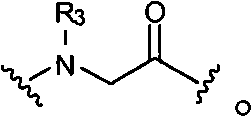
在其他实施方案中,选择从第一Cα到第二Cα测量的大环形成连接体L的长度,以稳定希望的肽二级结构,例如由拟肽大环化合物的残基(包括但不是必须限于第一Cα到第二Cα之间的残基)形成的α-螺旋。In other embodiments, the length of the macrocycle-forming linker L, measured from the first Cα to the second Cα, is selected to stabilize the desired peptide secondary structure, for example by residues of the peptidomimetic macrocycle (including but not necessarily limited to residues between the first Cα and the second Cα) to form an α-helix.
大环形成连接体L的示例性实施方案如下所示。Exemplary embodiments of macrocycle-forming linkers L are shown below.


在其他实施方案中,本发明提供式(III)的拟肽大环化合物:In other embodiments, the present invention provides peptidomimetic macrocycles of formula (III):
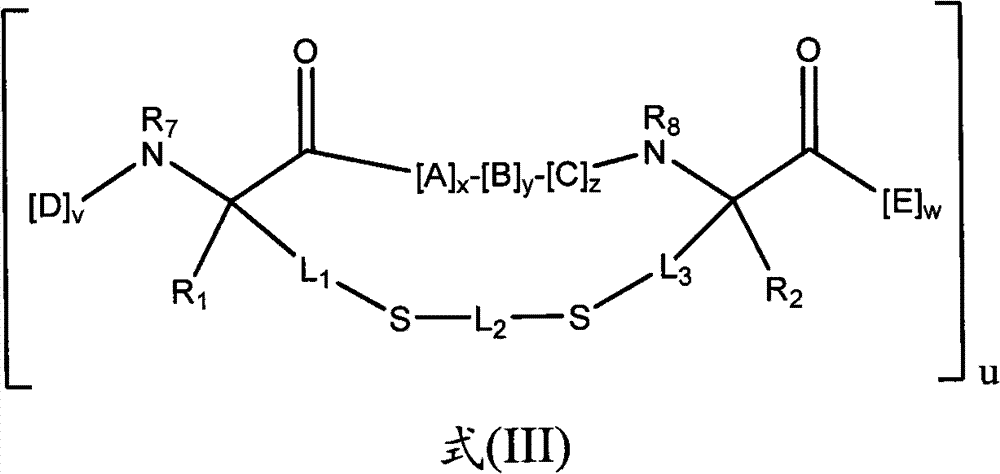
其中:in:
A、C、D和E各自独立地为天然或非天然氨基酸;A, C, D and E are each independently a natural or unnatural amino acid;
B为天然或非天然氨基酸、氨基酸类似物、
R1和R2独立地为-H、烷基、烯基、炔基、芳基烷基、环烷基、环烷基烷基、杂烷基或杂环烷基,它们是未取代的或被卤素取代的;R and R are independently -H, alkyl, alkenyl, alkynyl, arylalkyl, cycloalkyl, cycloalkylalkyl, heteroalkyl, or heterocycloalkyl, which are unsubstituted or substituted by halogen;
R3为氢、烷基、烯基、炔基、芳基烷基、杂烷基、环烷基、杂环烷基、环烷基烷基、环芳基或杂环芳基,它们是未取代的或被R5取代的; R is hydrogen, alkyl, alkenyl, alkynyl, arylalkyl, heteroalkyl, cycloalkyl, heterocycloalkyl, cycloalkylalkyl, cycloaryl or heteroaryl, which are not Substituted or substituted by R 5 ;
L1、L2、L3和L4独立地为亚烷基、亚烯基、亚炔基、杂亚烷基、亚环烷基、杂亚环烷基、亚环芳基、杂亚环芳基或[-R4-K-R4-]n,它们各自是未取代的或被R5取代的;L 1 , L 2 , L 3 and L 4 are independently alkylene, alkenylene, alkynylene, heteroalkylene, cycloalkylene, heterocycloalkylene, cycloarylene, heterocyclylene Aryl or [-R 4 -KR 4 -] n , each of which is unsubstituted or substituted by R 5 ;
K为O、S、SO、SO2、CO、CO2或CONR3;K is O, S, SO, SO 2 , CO, CO 2 or CONR 3 ;
各个R4为亚烷基、亚烯基、亚炔基、杂亚烷基、亚环烷基、杂亚环烷基、亚芳基或杂亚芳基; each R is alkylene, alkenylene, alkynylene, heteroalkylene, cycloalkylene, heterocycloalkylene, arylene, or heteroarylene;
各个R5独立地为卤素、烷基、-OR6、-N(R6)2、-SR6、-SOR6、-SO2R6、-CO2R6、荧光部分、放射性同位素或治疗剂;Each R 5 is independently halogen, alkyl, -OR 6 , -N(R 6 ) 2 , -SR 6 , -SOR 6 , -SO 2 R 6 , -CO 2 R 6 , a fluorescent moiety, a radioisotope, or a therapeutic agent;
各个R6独立地为-H、烷基、烯基、炔基、芳基烷基、环烷基烷基、杂环烷基、荧光部分、放射性同位素或治疗剂;each R is independently -H, alkyl, alkenyl, alkynyl, arylalkyl, cycloalkylalkyl, heterocycloalkyl, fluorescent moiety, radioisotope, or therapeutic agent;
R7为-H、烷基、烯基、炔基、芳基烷基、环烷基、杂烷基、环烷基烷基、杂环烷基、环芳基或杂环芳基,它们是未取代的或被R5取代的,或是具有D残基的环状结构的一部分; R is -H, alkyl, alkenyl, alkynyl, arylalkyl, cycloalkyl, heteroalkyl, cycloalkylalkyl, heterocycloalkyl, cycloaryl or heterocyclic aryl, which are Unsubstituted or substituted by R 5 , or part of a ring structure with a D residue;
R8为-H、烷基、烯基、炔基、芳基烷基、环烷基、杂烷基、环烷基烷基、杂环烷基、环芳基或杂环芳基,它们是未取代的或被R5取代的,或是具有E残基的环状结构的一部分;R is -H , alkyl, alkenyl, alkynyl, arylalkyl, cycloalkyl, heteroalkyl, cycloalkylalkyl, heterocycloalkyl, cycloaryl or heteroaryl, which are Unsubstituted or substituted by R 5 , or part of a ring structure with an E residue;
v和w独立地为1-1000的整数;v and w are independently integers from 1-1000;
u、x、y和z独立地为0-10的整数;且u, x, y and z are independently integers from 0 to 10; and
n为1-5的整数。n is an integer of 1-5.
在一个实施例中,R1和R2中的至少一个是未取代的或被卤素取代的烷基。在另一个实例中,R1和R2均独立地为未取代的或被卤素取代的烷基。在某些实施方案中,R1和R2中的至少一个为甲基。在其他实施方案中,R1和R2为甲基。In one embodiment, at least one of R 1 and R 2 is alkyl that is unsubstituted or substituted with halogen. In another example, both R and R are independently unsubstituted or halogen-substituted alkyl. In certain embodiments, at least one of R and R is methyl. In other embodiments, R1 and R2 are methyl.
在本发明的某些实施方案中,x+y+z至少为3。在本发明的其他实施方案中,x+y+z为1、2、3、4、5、6、7、8、9或10。本发明的大环化合物或大环化合物前体中每次出现的A、B、C、D或E独立地选择。例如,由式[A]x表示的序列,当x为3时,包括其中氨基酸不相同的实施方案,例如Gln-Asp-Ala,以及其中氨基酸相同的实施方案,例如Gln-Gln-Gln。这适用于指定范围内x、y或z的任意值。In certain embodiments of the invention, x+y+z is at least 3. In other embodiments of the invention, x+y+z is 1, 2, 3, 4, 5, 6, 7, 8, 9 or 10. Each occurrence of A, B, C, D or E in the macrocycle or macrocycle precursor of the invention is selected independently. For example, the sequence represented by formula [A] x , when x is 3, includes embodiments in which the amino acids are not identical, such as Gln-Asp-Ala, and embodiments in which the amino acids are identical, such as Gln-Gln-Gln. This works for any value of x, y or z within the specified range.
在某些实施方案中,本发明的拟肽大环化合物包含α-螺旋二级结构且R8为-H,其允许螺旋内氢键键合。在某些实施方案中,A、B、C、D或E中的至少一个为α,α-二取代的氨基酸。在一个实施例中,B为α,α-二取代的氨基酸。例如,A、B、C、D或E中的至少一个为2-氨基异丁酸。在其他实施方案中,A、B、C、D或E中的至少一个为
在其他实施方案中,选择从第一Cα到第二Cα测量的大环形成连接体[-L1-S-L2-S-L3-]的长度,以稳定希望的二级肽结构,例如由拟肽大环化合物的残基(包括但不是必须限于第一Cα到第二Cα之间的残基)形成的α-螺旋。In other embodiments, the length of the macrocycle-forming linker [-L 1 -SL 2 -SL 3 -] measured from the first Cα to the second Cα is selected to stabilize the desired secondary peptide structure, e.g., from a peptidomimetic An α-helix formed by the residues of the macrocycle, including but not necessarily limited to residues between the first Cα and the second Cα.
例如,大环化合物或大环化合物前体通过溶液相或固相方法合成,并且可以包含天然存在的和非天然存在的氨基酸。参见,例如,Hunt,″The Non-Protein Amino Acids,Chemistry and Biochemistry of the Amino Acids,G.C.Barrett编著,Chapman and Hall,1985。在某些实施方案中,巯基部分是氨基酸残基L-半胱氨酸、D-半胱氨酸、α-甲基-L-半胱氨酸、α-甲基-D-半胱氨酸、L-高半胱氨酸、D-高半胱氨酸、α-甲基-L-高半胱氨酸或α-甲基-D-高半胱氨酸的侧链。双烷基化试剂具有通式X-L2-Y,其中L2是连接体部分,且X和Y是被-SH部分替代以与L2形成键的离去基团。在某些实施方案中,X和Y是诸如I、Br或Cl的卤素。For example, macrocycles or macrocycle precursors are synthesized by solution phase or solid phase methods and may contain naturally occurring and non-naturally occurring amino acids. See, e.g., Hunt, "The Non-Protein Amino Acids, Chemistry and Biochemistry of the Amino Acids ," edited by GC Barrett, Chapman and Hall, 1985. In certain embodiments, the sulfhydryl moiety is the amino acid residue L-cysteine , D-cysteine, α-methyl-L-cysteine, α-methyl-D-cysteine, L-homocysteine, D-homocysteine, α- The side chain of methyl-L-homocysteine or α-methyl-D-homocysteine. The dialkylating agent has the general formula XL 2 -Y, wherein L 2 is a linker moiety, and X and Y are leaving groups replaced by -SH moieties to form a bond with L. In certain embodiments, X and Y are halogens such as I, Br, or Cl.
在其他实施方案中,为了促进细胞摄取,进一步修饰式I、II或III化合物中的D和/或E。在某些实施方案中,将拟肽大环化合物脂质化(lipidating)或PEG化有利于细胞摄取、提高生物利用度、增强血液循环、改变药代动力学、降低免疫原性和/或降低所需的给药频率。In other embodiments, D and/or E in the compound of formula I, II or III are further modified in order to facilitate cellular uptake. In certain embodiments, lipidating or PEGylation of peptidomimetic macrocycles facilitates cellular uptake, increases bioavailability, enhances blood circulation, alters pharmacokinetics, reduces immunogenicity, and/or reduces desired dosing frequency.
在其他实施方案中,式I、II或III化合物中的[D]和[E]中的至少一个代表包含另外的大环形成连接体的部分,从而使拟肽大环化合物包含至少两个大环形成连接体。在特定实施方案中,拟肽大环化合物包含两个大环形成连接体。In other embodiments, at least one of [D] and [E] in the compound of formula I, II or III represents a moiety comprising an additional macrocycle-forming linker such that the peptidomimetic macrocycle comprises at least two macrocycles. The loop forms a linker. In certain embodiments, the peptidomimetic macrocycle comprises two macrocycles forming a linker.
在本发明的拟肽大环化合物中,本文所述的任何大环形成连接体可以与表1-4中所示的任何序列任意组合使用,也可以与本文所述的任何R-取代基任意组合使用。In the peptidomimetic macrocycles of the present invention, any of the macrocycle-forming linkers described herein can be used in any combination with any of the sequences shown in Tables 1-4, and in any combination with any of the R-substituents described herein. Use in combination.
在某些实施方案中,拟肽大环化合物包含至少一个α-螺旋基序。例如,式I、II或III化合物中的A、B和/或C包含一个或多个α-螺旋。一般来说,α-螺旋每圈包含3至4个氨基酸残基。在某些实施方案中,拟肽大环化合物的α-螺旋包括1至5圈,因此包含3至20个氨基酸残基。在特定实施方案中,α-螺旋包括1圈、2圈、3圈、4圈或5圈。在某些实施方案中,大环形成连接体稳定拟肽大环化合物内包含的α-螺旋基序。因此,在某些实施方案中,选择大环形成连接体L从第一Cα到第二Cα的长度,以提高α-螺旋的稳定性。在某些实施方案中,大环形成连接体跨越α-螺旋的1圈至5圈。在某些实施方案中,大环形成连接体跨越α-螺旋的大约1圈、2圈、3圈、4圈或5圈。在某些实施方案中,大环形成连接体的长度为每圈α-螺旋大约
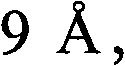
在其他实施方案中,本发明提供式(IV)或式(IVa)的拟肽大环化合物:In other embodiments, the present invention provides peptidomimetic macrocycles of formula (IV) or formula (IVa):
其中:in:
A、C、D和E各自独立地为天然或非天然氨基酸;A, C, D and E are each independently a natural or unnatural amino acid;
B为天然或非天然氨基酸、氨基酸类似物、[-NH-L3-CO-]、[-NH-L3-SO2-]或[-NH-L3-];B is natural or unnatural amino acid, amino acid analogue, [-NH-L 3 -CO-], [-NH-L 3 -SO 2 -] or [-NH-L 3 -];
R1和R2独立地为-H、烷基、烯基、炔基、芳基烷基、环烷基、环烷基烷基、杂烷基或杂环烷基,它们是未取代的或被卤素取代的,或是具有E残基的环状结构的一部分;R and R are independently -H, alkyl, alkenyl, alkynyl, arylalkyl, cycloalkyl, cycloalkylalkyl, heteroalkyl, or heterocycloalkyl, which are unsubstituted or Halogen substituted, or part of a ring structure with an E residue;
R3为氢、烷基、烯基、炔基、芳基烷基、杂烷基、环烷基、杂环烷基、环烷基烷基、环芳基或杂环芳基,它们任选地被R5取代; R is hydrogen, alkyl, alkenyl, alkynyl, arylalkyl, heteroalkyl, cycloalkyl, heterocycloalkyl, cycloalkylalkyl, cycloaryl or heterocyclic aryl, which optionally Ground is replaced by R 5 ;
L为式-L1-L2-的大环形成连接体;L is a macrocycle-forming linker of the formula -L 1 -L 2 -;
L1和L2独立地为亚烷基、亚烯基、亚炔基、杂亚烷基、亚环烷基、杂亚环烷基、亚环芳基、杂亚环芳基或[-R4-K-R4-]n,它们各自任选地被R5取代;L and L are independently alkylene, alkenylene, alkynylene, heteroalkylene, cycloalkylene, heterocycloalkylene, cycloarylene, heterocycloarylene, or [-R 4 -KR 4 -] n , each of which is optionally substituted by R 5 ;
各个R4为亚烷基、亚烯基、亚炔基、杂亚烷基、亚环烷基、杂亚环烷基、亚芳基或杂亚芳基; each R is alkylene, alkenylene, alkynylene, heteroalkylene, cycloalkylene, heterocycloalkylene, arylene, or heteroarylene;
各个K为O、S、SO、SO2、CO、CO2或CONR3;Each K is O, S, SO, SO 2 , CO, CO 2 or CONR 3 ;
各个R5独立地为卤素、烷基、-OR6、-N(R6)2、-SR6、-SOR6、-SO2R6、-CO2R6、荧光部分、放射性同位素或治疗剂;Each R 5 is independently halogen, alkyl, -OR 6 , -N(R 6 ) 2 , -SR 6 , -SOR 6 , -SO 2 R 6 , -CO 2 R 6 , a fluorescent moiety, a radioisotope, or a therapeutic agent;
各个R6独立地为-H、烷基、烯基、炔基、芳基烷基、环烷基烷基、杂环烷基、荧光基团、放射性同位素或治疗剂;each R is independently -H, alkyl, alkenyl, alkynyl, arylalkyl, cycloalkylalkyl, heterocycloalkyl, fluorophore, radioisotope, or therapeutic agent;
R7为-H、烷基、烯基、炔基、芳基烷基、环烷基、杂烷基、环烷基烷基、杂环烷基、环芳基或杂环芳基,它们任选地被R5取代; R is -H, alkyl, alkenyl, alkynyl, arylalkyl, cycloalkyl, heteroalkyl, cycloalkylalkyl, heterocycloalkyl, cycloaryl or heterocyclic aryl, any of which optionally replaced by R 5 ;
v和w独立地为1-1000的整数;v and w are independently integers from 1-1000;
u、x、y和z独立地为0-10的整数;且u, x, y and z are independently integers from 0 to 10; and
n为1-5的整数。n is an integer of 1-5.
在一个实例中,R1和R2中的至少一个是未取代的或被卤素取代的烷基。在另一个实例中,R1和R2均独立地为未取代的或被卤素取代的烷基。在某些实施方案中,R1和R2中的至少一个为甲基。在其他实施方案中,R1和R2为甲基。In one example, at least one of R 1 and R 2 is alkyl that is unsubstituted or substituted with halogen. In another example, both R and R are independently unsubstituted or halogen-substituted alkyl. In certain embodiments, at least one of R and R is methyl. In other embodiments, R1 and R2 are methyl.
在本发明的某些实施方案中,x+y+z至少为1。在本发明的其他实施方案中,x+y+z至少为2。在本发明的其他实施方案中,x+y+z为3、4、5、6、7、8、9或10。本发明的大环化合物或大环化合物前体中每次出现的A、B、C、D或E独立地选择。例如,由式[A]x表示的序列,当x为3时,包括其中氨基酸不相同的实施方案,例如Gln-Asp-Ala,以及其中氨基酸相同的实施方案,例如Gln-Gln-Gln。这适用于指定范围内x、y或z的任意值。In certain embodiments of the invention, x+y+z is at least 1. In other embodiments of the invention, x+y+z is at least 2. In other embodiments of the invention, x+y+z is 3, 4, 5, 6, 7, 8, 9 or 10. Each occurrence of A, B, C, D or E in the macrocycle or macrocycle precursor of the invention is selected independently. For example, the sequence represented by formula [A] x , when x is 3, includes embodiments in which the amino acids are not identical, such as Gln-Asp-Ala, and embodiments in which the amino acids are identical, such as Gln-Gln-Gln. This works for any value of x, y or z within the specified range.
在某些实施方案中,本发明的拟肽大环化合物包含α-螺旋二级结构且R8为-H,其允许螺旋内氢键键合。在某些实施方案中,A、B、C、D或E中的至少一个为α,α-二取代的氨基酸。在一个实施例中,B为α,α-二取代的氨基酸。例如,A、B、C、D或E中的至少一个为2-氨基异丁酸。在其他实施方案中,A、B、C、D或E中的至少一个为
在其他实施方案中,选择从第一Cα到第二Cα测量的大环形成连接体L的长度,以稳定希望的二级肽结构,例如由拟肽大环化合物的残基(包括但不是必须限于第一Cα到第二Cα之间的残基)形成的α-螺旋。In other embodiments, the length of the macrocycle-forming linker L, measured from the first Cα to the second Cα, is selected to stabilize the desired secondary peptide structure, for example by residues of the peptidomimetic macrocycle (including but not necessarily limited to residues between the first Cα and the second Cα) to form an α-helix.
大环形成连接体-L1-L2-的示例性实施方案如下所示。Exemplary embodiments of the macrocycle-forming linker -L 1 -L 2 - are shown below.

拟肽大环化合物的制备Preparation of peptidomimetic macrocycles
本发明的拟肽大环化合物可以通过本领域已知的众多方法中的任何一种来制备。例如,表1、2、3或4中由“X”表示的任何残基可以被能够与同一分子中的第二残基或这样的残基的前体形成交联体的残基。The peptidomimetic macrocycles of the invention can be prepared by any of a number of methods known in the art. For example, any residue represented by "X" in Tables 1, 2, 3 or 4 may be replaced by a residue capable of forming a cross-link with a second residue in the same molecule or a precursor to such a residue.
各种实现拟肽大环化合物制备的方法是本领域已知的。例如,Schafmeister等人,J.Am.Chem.Soc.122:5891-5892(2000);Schafmeister&Verdine,J.Am.Chem.Soc.122:5891(2005);Walensky等人,Science305:1466-1470(2004)和美国专利7,192,713中描述了式I的拟肽大环化合物的制备。在所引用的参考文献中公开的α,α-二取代的氨基酸和氨基酸前体可以用于拟肽大环化合物前体多肽的合成。例如,“S5-烯氨基酸”是(S)-α-(2’-戊烯基)丙氨酸,且“R8-烯氨基酸”是(R)-α-(2’-辛烯基)丙氨酸。在将这样的氨基酸掺入前体多肽中之后,末端烯烃与复分解反应催化剂反应,从而导致拟肽大环化合物的形成。Various methods to effect the preparation of peptidomimetic macrocycles are known in the art. For example, Schafmeister et al., J.Am.Chem.Soc.122:5891-5892 (2000); Schafmeister & Verdine, J.Am.Chem.Soc.122:5891 (2005); Walensky et al., Science 305:1466-1470 ( 2004) and US Pat. No. 7,192,713 describe the preparation of peptidomimetic macrocycles of formula I. The α,α-disubstituted amino acids and amino acid precursors disclosed in the cited references can be used in the synthesis of peptidomimetic macrocycle precursor polypeptides. For example, "S5-ene amino acid" is (S)-α-(2'-pentenyl)alanine, and "R8-ene amino acid" is (R)-α-(2'-octenyl)alanine acid. After incorporation of such amino acids into precursor polypeptides, the terminal alkene is reacted with a metathesis catalyst, resulting in the formation of the peptidomimetic macrocycle.
在其他实施方案中,本发明的拟肽大环化合物具有式IV或IVa。制备这样的大环化合物的方法例如在美国专利7,202,332中描述。In other embodiments, the peptidomimetic macrocycles of the invention have Formula IV or IVa. Methods for preparing such macrocycles are described, for example, in US Patent 7,202,332.
在某些实施方案中,这些拟肽大环化合物的合成包括多步骤的过程,该过程的特征在于:合成含有叠氮部分和炔部分的拟肽前体;然后将拟肽前体与大环化试剂接触以产生三唑连接的拟肽大环化合物。这样的方法例如在2008年2月25日提交的美国申请12/037,041中描述。大环化合物或大环化合物前体例如通过溶液相或固相方法合成,并且可以包含天然存在的和非天然存在的氨基酸。参见,例如,Hunt,″The Non-Protein Amino Acids″,Chemistry and Biochemistry of the Amino Acids,G.C.Barrett编著,Chapman and Hall,1985。In certain embodiments, the synthesis of these peptidomimetic macrocycles involves a multi-step process characterized by: synthesis of a peptidomimetic precursor containing an azide moiety and an alkyne moiety; then combining the peptidomimetic precursor with the macrocycle Chemical reagents to produce triazole-linked peptidomimetic macrocycles. Such methods are described, for example, in US application 12/037,041, filed February 25, 2008. Macrocycles or macrocycle precursors are synthesized, for example, by solution phase or solid phase methods, and may comprise naturally occurring and non-naturally occurring amino acids. See, eg, Hunt, "The Non-Protein Amino Acids", Chemistry and Biochemistry of the Amino Acids , eds. GC Barrett, Chapman and Hall, 1985.
在某些实施方案中,叠氮连接到残基的α-碳上,炔连接到另一个残基的α-碳上。在某些实施方案中,叠氮部分是氨基酸L-赖氨酸、D-赖氨酸、α-甲基-L-赖氨酸、α-甲基-D-赖氨酸、L-鸟氨酸、D-鸟氨酸、α-甲基-L-鸟氨酸或α-甲基-D-鸟氨酸的叠氮基类似物。在另一个实施方案中,炔部分是L-炔丙基甘氨酸。在另外其他的实施方案中,炔部分是选自下组的氨基酸:L-炔丙基甘氨酸、D-炔丙基甘氨酸、(S)-2-氨基-2-甲基-4-戊炔酸、(R)-2-氨基-2-甲基-4-戊炔酸、(S)-2-氨基-2-甲基-5-己炔酸、(R)-2-氨基-2-甲基-5-己炔酸、(S)-2-氨基-2-甲基-6-庚炔酸、(R)-2-氨基-2-甲基-6-庚炔酸、(S)-2-氨基-2-甲基-7-辛炔酸、(R)-2-氨基-2-甲基-7-辛炔酸、(S)-2-氨基-2-甲基-8-壬炔酸和(R)-2-氨基-2-甲基-8-壬炔酸。In certain embodiments, the azide is attached to the alpha-carbon of a residue and the alkyne is attached to the alpha-carbon of another residue. In certain embodiments, the azide moiety is the amino acid L-lysine, D-lysine, alpha-methyl-L-lysine, alpha-methyl-D-lysine, L-ornithine acid, D-ornithine, α-methyl-L-ornithine or azido analogues of α-methyl-D-ornithine. In another embodiment, the alkyne moiety is L-propargylglycine. In yet other embodiments, the alkyne moiety is an amino acid selected from the group consisting of L-propargylglycine, D-propargylglycine, (S)-2-amino-2-methyl-4-pentynoic acid , (R)-2-amino-2-methyl-4-pentynoic acid, (S)-2-amino-2-methyl-5-hexynoic acid, (R)-2-amino-2-methyl Base-5-hexynoic acid, (S)-2-amino-2-methyl-6-heptynoic acid, (R)-2-amino-2-methyl-6-heptynoic acid, (S)- 2-Amino-2-methyl-7-octynoic acid, (R)-2-amino-2-methyl-7-octynoic acid, (S)-2-amino-2-methyl-8-nonan alkynoic acid and (R)-2-amino-2-methyl-8-nonynoic acid.
在某些实施方案中,本发明提供一种合成拟肽大环化合物的方法,该方法包括将式V或式VI的拟肽前体与大环化试剂接触的步骤:In certain embodiments, the present invention provides a method of synthesizing a peptidomimetic macrocycle, the method comprising the step of contacting a peptidomimetic precursor of formula V or formula VI with a macrocyclization reagent:
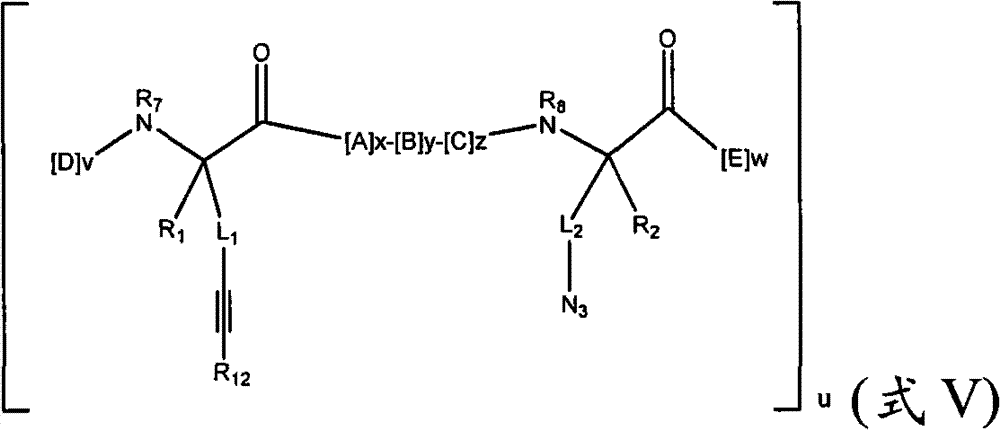

其中,v、w、x、y、z、A、B、C、D、E、R1、R2、R7、R8、L1和L2如式(II)中所定义;当大环化试剂是Cu试剂时,R12为-H,当大环化试剂是Ru试剂时,R12为-H或烷基;而且进一步地,其中所述接触步骤导致在式III或式IV中的炔部分和叠氮部分之间形成共价连接。例如,当大环化试剂是Ru试剂时,R12可以是甲基。Wherein, v, w, x, y, z, A, B, C, D, E, R 1 , R 2 , R 7 , R 8 , L 1 and L 2 are as defined in formula (II); when larger When the cyclization reagent is a Cu reagent, R 12 is -H, and when the macrocyclization reagent is a Ru reagent, R 12 is -H or an alkyl group; and further, wherein the contacting step results in formula III or formula IV A covalent link is formed between the alkyne moiety and the azide moiety. For example, when the macrocyclizing reagent is a Ru reagent, R12 can be methyl.
在本发明的拟肽大环化合物中,R1和R2中的至少一个为烷基、烯基、炔基、芳基烷基、环烷基、环烷基烷基、杂烷基或杂环烷基,它们是未取代的或被卤素取代的。在某些实施方案中,R1和R2均独立地为烷基、烯基、炔基、芳基烷基、环烷基、环烷基烷基、杂烷基或杂环烷基,它们是未取代的或被卤素取代的。在某些实施方案中,A、B、C、D或E中的至少一个是α,α-二取代的氨基酸。在一个实例中,B是α,α-二取代的氨基酸。例如,A、B、C、D或E中的至少一个是2-氨基异丁酸。In the peptidomimetic macrocycles of the present invention, at least one of R and R is alkyl, alkenyl, alkynyl, arylalkyl, cycloalkyl, cycloalkylalkyl, heteroalkyl or hetero Cycloalkyl, which are unsubstituted or substituted by halogen. In certain embodiments, R and R are each independently alkyl, alkenyl, alkynyl, arylalkyl, cycloalkyl, cycloalkylalkyl, heteroalkyl, or heterocycloalkyl, which is unsubstituted or substituted with halogen. In certain embodiments, at least one of A, B, C, D or E is an α,α-disubstituted amino acid. In one example, B is an α,α-disubstituted amino acid. For example, at least one of A, B, C, D or E is 2-aminoisobutyric acid.
例如,R1和R2中的至少一个是未取代的或被卤素-取代的烷基。在另一个实例中,R1和R2均独立地是未取代的或被卤素-取代的烷基。在某些实施方案中,R1和R2中的至少一个是甲基。在其他实施方案中,R1和R2是甲基。大环化试剂可以是Cu试剂或Ru试剂。For example, at least one of R1 and R2 is unsubstituted or halogen-substituted alkyl. In another example, both R and R are independently unsubstituted or halo-substituted alkyl. In certain embodiments, at least one of R and R is methyl. In other embodiments, R1 and R2 are methyl. The macrocyclization reagent can be a Cu reagent or a Ru reagent.
在某些实施方案中,拟肽前体在接触步骤之前纯化。在其他实施方案中,拟肽大环化合物在接触步骤之后纯化。在另外其他的实施方案中,拟肽大环化合物在接触步骤之后重折叠。该方法可以在溶液中进行,或者,可选择地,该方法可以在固体载体上进行。In certain embodiments, the peptidomimetic precursors are purified prior to the contacting step. In other embodiments, the peptidomimetic macrocycle is purified after the contacting step. In still other embodiments, the peptidomimetic macrocycle is refolded after the contacting step. The method can be carried out in solution or, alternatively, the method can be carried out on a solid support.
本发明也涉及在结合拟肽前体或拟肽大环化合物的靶大分子的存在下,在有利于所述结合的条件下进行本发明的方法。在某些实施方案中,在优先结合拟肽前体或拟肽大环化合物的靶大分子的存在下,在有利于所述结合的条件下进行本发明的方法。该方法也可应用于合成拟肽大环化合物的文库。The invention also relates to carrying out the method of the invention in the presence of a target macromolecule that binds to a peptidomimetic precursor or peptidomimetic macrocycle, under conditions favorable for said binding. In certain embodiments, the methods of the invention are performed in the presence of a target macromolecule that preferentially binds to a peptidomimetic precursor or peptidomimetic macrocycle, under conditions that favor said binding. This method can also be applied to the synthesis of libraries of peptidomimetic macrocycles.
在某些实施方案中,式V或式VI的拟肽前体的炔部分是选自下组的氨基酸的侧链:L-炔丙基甘氨酸、D-炔丙基甘氨酸、(S)-2-氨基-2-甲基-4-戊炔酸、(R)-2-氨基-2-甲基-4-戊炔酸、(S)-2-氨基-2-甲基-5-己炔酸、(R)-2-氨基-2-甲基-5-己炔酸、(S)-2-氨基-2-甲基-6-庚炔酸、(R)-2-氨基-2-甲基-6-庚炔酸、(S)-2-氨基-2-甲基-7-辛炔酸、(R)-2-氨基-2-甲基-7-辛炔酸、(S)-2-氨基-2-甲基-8-壬炔酸和(R)-2-氨基-2-甲基-8-壬炔酸。在其他实施方案中,式V或式VI的拟肽前体的叠氮部分是选自下组的氨基酸的侧链:ε-叠氮基-L-赖氨酸、ε-叠氮基-D-赖氨酸、ε-叠氮基-α-甲基-L-赖氨酸、ε-叠氮基-α-甲基-D-赖氨酸、δ-叠氮基-α-甲基-L-鸟氨酸和δ-叠氮基-α-甲基-D-鸟氨酸。In certain embodiments, the alkyne portion of the peptidomimetic precursor of Formula V or VI is the side chain of an amino acid selected from the group consisting of L-propargylglycine, D-propargylglycine, (S)-2 -Amino-2-methyl-4-pentynoic acid, (R)-2-amino-2-methyl-4-pentynoic acid, (S)-2-amino-2-methyl-5-hexyne acid, (R)-2-amino-2-methyl-5-hexynoic acid, (S)-2-amino-2-methyl-6-heptynoic acid, (R)-2-amino-2- Methyl-6-heptynoic acid, (S)-2-amino-2-methyl-7-octynoic acid, (R)-2-amino-2-methyl-7-octynoic acid, (S) -2-Amino-2-methyl-8-nonynoic acid and (R)-2-amino-2-methyl-8-nonynoic acid. In other embodiments, the azide moiety of the peptidomimetic precursor of Formula V or VI is the side chain of an amino acid selected from the group consisting of ε-azido-L-lysine, ε-azido-D -Lysine, ε-azido-α-methyl-L-lysine, ε-azido-α-methyl-D-lysine, δ-azido-α-methyl- L-ornithine and delta-azido-alpha-methyl-D-ornithine.
在某些实施方案中,x+y+z为3,并且A、B和C独立地是天然或非天然氨基酸。在其他实施方案中,x+y+z为6,且A、B和C独立地是天然或非天然氨基酸。In certain embodiments, x+y+z is 3, and A, B, and C are independently natural or unnatural amino acids. In other embodiments, x+y+z is 6, and A, B and C are independently natural or unnatural amino acids.
在某些实施方案中,接触步骤在选自质子溶剂、水性溶剂、有机溶剂及其混合物的溶剂中进行。例如,溶剂可以选自H2O、THF、THF/H2O、tBuOH/H2O、DMF、DIPEA、CH3CN或CH2Cl2、ClCH2CH2Cl或其混合物。溶剂可以是有利于螺旋形成的溶剂。In certain embodiments, the contacting step is performed in a solvent selected from the group consisting of protic solvents, aqueous solvents, organic solvents, and mixtures thereof. For example, the solvent may be selected from H2O , THF, THF/ H2O , tBuOH/ H2O , DMF, DIPEA, CH3CN or CH2Cl2 , ClCH2CH2Cl or mixtures thereof. The solvent may be one that favors helical formation.
将可替代的但等效的保护基团、离去基团或试剂替换,并按照可选择的序列或顺序进行某些合成步骤,以产生希望的化合物。用于合成本文所述的化合物的合成化学转化和保护基团方法(保护和脱保护)包括,例如,如以下文献中所述的方法:Larock,Comprehensive Organic Transformations,VCH Publishers(1989);Greene和Wuts,Protective Groups in Organic Synthesis,第2版,John Wiley and Sons(1991);Fieser和Fieser,Fieser and Fieser′s Reagents for Organic Synthesis,John Wileyand Sons(1994);和Paquette编著,Encyclopedia of Reagents for Organic Synthesis,John Wiley and Sons(1995)及其后续版本。Alternative but equivalent protecting groups, leaving groups or reagents are substituted and certain synthetic steps are performed in an alternative sequence or sequence to give the desired compound. Synthetic chemical transformations and protecting group methods (protection and deprotection) for the synthesis of compounds described herein include, for example, methods as described in: Larock, Comprehensive Organic Transformations , VCH Publishers (1989); Greene and Wuts, Protective Groups in Organic Synthesis , 2nd ed., John Wiley and Sons (1991); Fieser and Fieser, Fieser and Fieser's Reagents for Organic Synthesis , John Wiley and Sons (1994); and Paquette, eds., Encyclopedia of Reagents for Organic Synthesis , John Wiley and Sons (1995) and subsequent editions.
本发明的拟肽大环化合物例如通过化学合成方法制备,如Fields等人,Synthetic Peptides:A User′s Guide中的第3章,Grant,W.H.编著,Freeman&Co.,New York,N.Y.,1992,第77页中所述的方法。因此,例如,采用具有被tBoc或Fmoc化学保护的胺的自动化Merrifield固相合成技术,在例如自动化肽合成仪(例如,Applied Biosystems(FosterCity,CA),430A、431或433型)上使用侧链保护的氨基酸合成肽。The peptidomimetic macrocycles of the present invention are prepared, for example, by chemical synthesis, as in Chapter 3 of Fields et al ., Synthetic Peptides: A User's Guide , edited by Grant, WH, Freeman & Co., New York, NY, 1992, p. method described on page 77. Thus, for example, using automated Merrifield solid-phase synthesis techniques with amines chemically protected by tBoc or Fmoc, using side chains on, for example, an automated peptide synthesizer (e.g., Applied Biosystems (Foster City, CA), Model 430A, 431 or 433). Protected amino acids for synthetic peptides.
一种产生本文所述的拟肽前体和拟肽大环化合物的方式使用固相肽合成法(SPPS)。将C-末端氨基酸经由与连接体分子的酸不稳定的键连接到交联的聚苯乙烯树脂上。这种树脂不溶于用于合成的溶剂,从而使得洗去过量的试剂和副产物相对简单和快速。N-末端用在酸中稳定、但可用碱去除的Fmoc基团保护。必要时,用碱稳定的、酸不稳定的基团保护侧链官能团。One way to produce the peptidomimetic precursors and peptidomimetic macrocycles described herein uses solid phase peptide synthesis (SPPS). The C-terminal amino acid is attached to the cross-linked polystyrene resin via an acid-labile bond to the linker molecule. This resin is insoluble in the solvent used for the synthesis, making it relatively simple and quick to wash away excess reagents and by-products. The N-terminus is protected with an acid-stable but base-removable Fmoc group. When necessary, side chain functional groups are protected with base-stable, acid-labile groups.
例如,通过使用天然的化学连接结合单个的合成肽来产生较长的拟肽前体。或者,通过公知的重组DNA和蛋白质表达技术生物合成较长的合成肽。在公知的标准手册中提供了这些技术的详细方案。为了构建编码本发明的拟肽前体的基因,逆向翻译氨基酸序列以获得编码该氨基酸序列的核酸序列,优选地使用对于将表达该基因的生物体为最佳的密码子。然后,通常通过合成编码该肽的寡核苷酸和在必要时合成任何调节元件来制备合成的基因。将合成的基因插入合适的克隆载体中,并转染到宿主细胞内。然后在适合所选择的表达系统和宿主的合适条件下表达该肽。通过标准方法纯化并表征该肽。For example, longer peptidomimetic precursors are produced by joining individual synthetic peptides using natural chemical linkages. Alternatively, longer synthetic peptides are biosynthesized by well known recombinant DNA and protein expression techniques. Detailed protocols for these techniques are provided in well known standard manuals. To construct the gene encoding the peptidomimetic precursor of the invention, the amino acid sequence is reverse translated to obtain the nucleic acid sequence encoding the amino acid sequence, preferably using codons optimal for the organism in which the gene will be expressed. Synthetic genes are then typically prepared by synthesizing oligonucleotides encoding the peptide and, if necessary, any regulatory elements. The synthesized gene is inserted into a suitable cloning vector and transfected into host cells. The peptide is then expressed under suitable conditions suitable for the expression system and host chosen. The peptide was purified and characterized by standard methods.
例如,使用例如高通量多通道组合合成仪(例如,来自CreoSalus,Louisville,KY的Thuramed TETRAS多通道肽合成仪或来自AAPPTEC,Inc.,Louisville,KY的Apex 396型多通道肽合成仪)以高通量的组合方式制备拟肽前体。For example, using, for example, a high-throughput multi-channel combinatorial synthesizer (e.g., the Thuramed TETRAS Multi-channel Peptide Synthesizer from CreoSalus, Louisville, KY or the Apex Model 396 Multi-channel Peptide Synthesizer from AAPPTEC, Inc., Louisville, KY) to High-throughput combinatorial preparation of peptidomimetic precursors.
提供以下合成方案只是为了说明本发明,而并非意在限制如本文所述的本发明的范围。该图可以概要描述为以下内容:该说明性的方案显示了叠氮基氨基酸类似物ε-叠氮基-α-甲基-L-赖氨酸和ε-叠氮基-α-甲基-D-赖氨酸,以及炔氨基酸类似物L-炔丙基甘氨酸、(S)-2-氨基-2-甲基-4-戊炔酸和(S)-2-氨基-2-甲基-6-庚炔酸。因此,在下面的合成方案中,R1、R2、R7和R8各自为-H;各个L1为-(CH2)4-;且各个L2为-(CH2)-。但是,如以上整个发明详述部分所指出的,可以采用许多其他的氨基酸类似物,其中R1、R2、R7、R8、L1和L2可以独立地选自本文公开的各种结构。The following synthetic schemes are provided only to illustrate the invention and are not intended to limit the scope of the invention as described herein. The diagram can be schematically described as follows: This illustrative scheme shows the azidoamino acid analogs ε-azido-α-methyl-L-lysine and ε-azido-α-methyl- D-lysine, and the alkyne amino acid analogs L-propargylglycine, (S)-2-amino-2-methyl-4-pentynoic acid, and (S)-2-amino-2-methyl- 6-heptynoic acid. Thus, in the following synthetic schemes, each of R 1 , R 2 , R 7 , and R 8 is —H; each of L 1 is —(CH 2 ) 4 —; and each of L 2 is —(CH 2 )—. However, as indicated above throughout the Detailed Description of the Invention, many other amino acid analogs may be employed, wherein R 1 , R 2 , R 7 , R 8 , L 1 and L 2 may be independently selected from the various amino acid analogs disclosed herein. structure.
合成方案1:Synthesis scheme 1:

合成方案1描述了本发明的几种化合物的制备。如Belokon等人(1998),Tetrahedron Asymm.9:4249-4252所述制备由手性辅剂(S)-2-[N-(N’-苄基脯氨酰)氨基]苯甲酮(BPB)衍生的席夫碱和诸如甘氨酸或丙氨酸的氨基酸的Ni(II)络合物。产生的络合物随后与包含叠氮部分或炔部分的烷基化试剂反应,以产生对映体富集的本发明的化合物。如需要,产生的化合物可以进行保护以用于肽合成。Synthetic Scheme 1 describes the preparation of several compounds of the invention. Prepared from the chiral auxiliary (S)-2-[N-(N'-benzylprolyl)amino]benzophenone (BPB) as described in Belokon et al. (1998), Tetrahedron Asymm.9:4249-4252. )-derived Schiff bases and Ni(II) complexes of amino acids such as glycine or alanine. The resulting complex is then reacted with an alkylating reagent containing an azide or alkyne moiety to produce an enantiomerically enriched compound of the invention. The resulting compound can be protected for peptide synthesis, if desired.
合成方案2:Synthesis scheme 2:
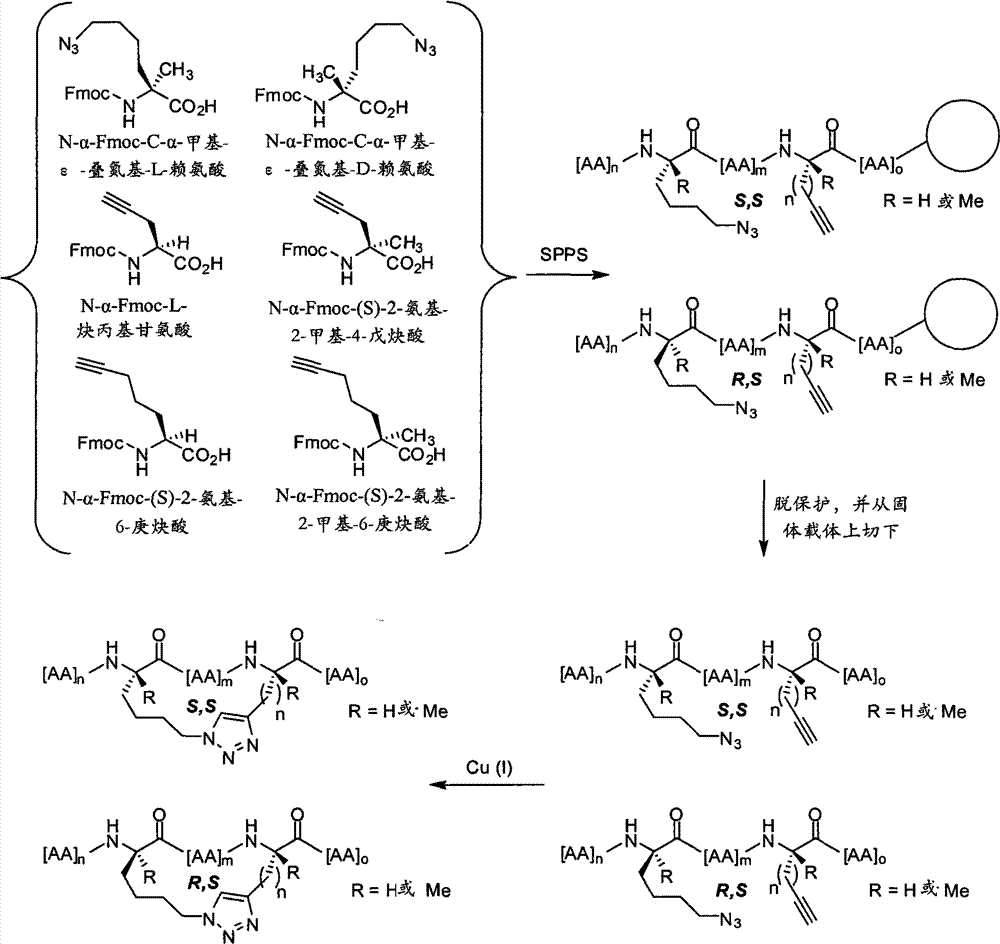
在如合成方案2所示的用于合成拟肽大环化合物的一般方法中,拟肽前体包含叠氮部分和炔部分,并且通过溶液相或固相肽合成法(SPPS),使用可商购的氨基酸N-α-Fmoc-L-炔丙基甘氨酸以及以下氨基酸的N-α-Fmoc保护的形式合成:(S)-2-氨基-2-甲基-4-戊炔酸、(S)-2-氨基-6-庚炔酸、(S)-2-氨基-2-甲基-6-庚炔酸、N-甲基-ε-叠氮基-L-赖氨酸和N-甲基-ε-叠氮基-D-赖氨酸。然后通过标准条件(例如,强酸如95%TFA)将拟肽前体脱保护并从固相树脂上切下。拟肽前体作为粗制混合物与大环化试剂如Cu(I)在有机溶液或水性溶液中进行反应,或者在反应之前进行纯化(Rostovtsev等人(2002),Angew.Chem.Int.Ed.41:2596-2599;Tornoe等人(2002),J.Org.Chem.67:3057-3064;Deiters等人(2003),J.Am.Chem.Soc.125:11782-11783;Punna等人(2005),Angew.Chem.Int.Ed.44:2215-2220)。在一个实施方案中,在有利于α-螺旋形成的条件下进行三唑形成反应。在一个实施方案中,在选自H2O、THF、CH3CN、DMF、DIPEA、tBuOH或其混合物的溶剂中进行大环化步骤。在另一个实施方案中,在DMF中进行大环化步骤。在某些实施方案中,在经缓冲的水性溶剂或部分水性溶剂中进行大环化步骤。In the general method for the synthesis of peptidomimetic macrocycles as shown in Synthetic Scheme 2, the peptidomimetic precursors contain an azide moiety and an alkyne moiety, and by solution-phase or solid-phase peptide synthesis (SPPS), using commercially available The purchased amino acid N-α-Fmoc-L-propargylglycine and the N-α-Fmoc protected form of the following amino acids were synthesized: (S)-2-amino-2-methyl-4-pentynoic acid, (S )-2-amino-6-heptynoic acid, (S)-2-amino-2-methyl-6-heptynoic acid, N-methyl-ε-azido-L-lysine and N- Methyl-ε-azido-D-lysine. The peptidomimetic precursor is then deprotected and cleaved from the solid phase resin by standard conditions (eg, strong acid such as 95% TFA). Peptidomimetic precursors are reacted as crude mixtures with macrocyclizing reagents such as Cu(I) in organic or aqueous solutions, or are purified prior to the reaction (Rostovtsev et al. (2002), Angew.Chem.Int.Ed. 41:2596-2599; Tornoe et al. (2002), J.Org.Chem.67:3057-3064; Deiters et al. (2003), J.Am.Chem.Soc.125:11782-11783; Punna et al. ( 2005), Angew. Chem. Int. Ed. 44:2215-2220). In one embodiment, the triazole formation reaction is carried out under conditions that favor alpha-helix formation. In one embodiment, the macrocyclization step is performed in a solvent selected from H2O , THF, CH3CN , DMF, DIPEA, tBuOH or mixtures thereof. In another embodiment, the macrocyclization step is performed in DMF. In certain embodiments, the macrocyclization step is performed in a buffered aqueous or partially aqueous solvent.
合成方案3:Synthesis scheme 3:
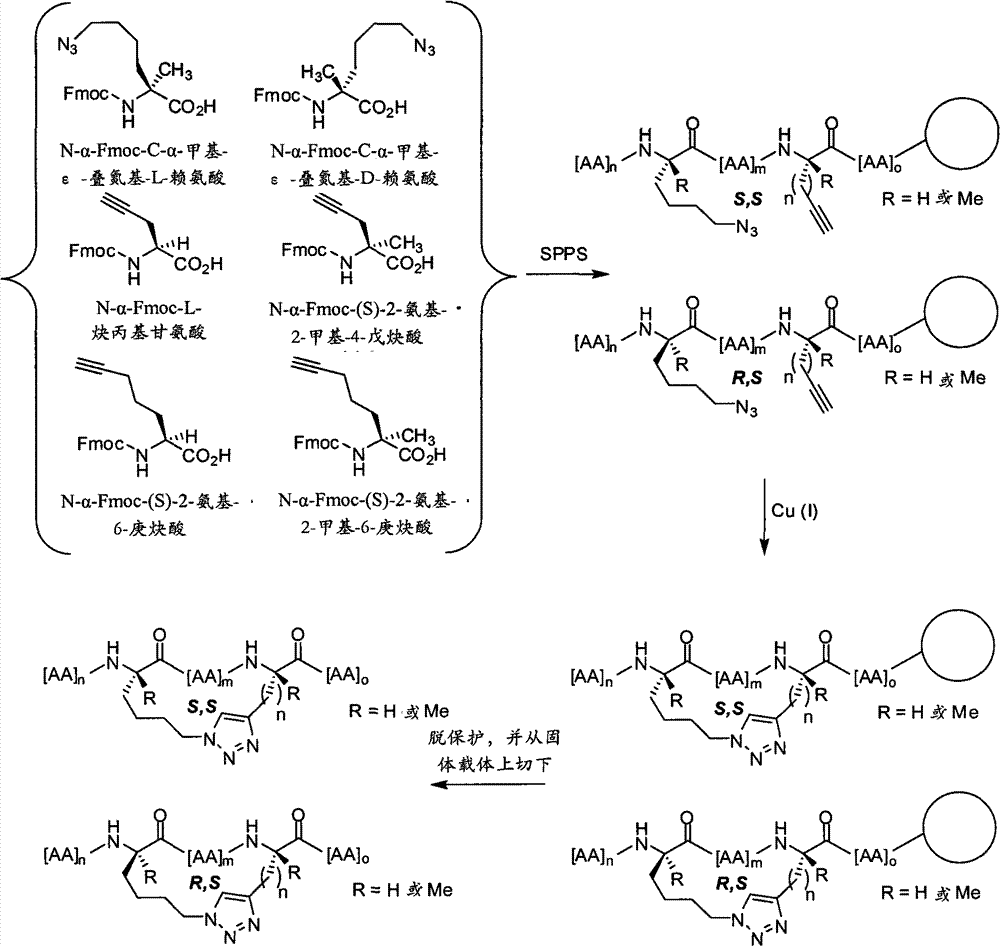
在如合成方案3所示的用于合成拟肽大环化合物的一般方法中,拟肽前体包含叠氮部分和炔部分,并且通过固相肽合成法(SPPS),使用可商购的氨基酸N-α-Fmoc-L-炔丙基甘氨酸以及以下氨基酸的N-α-Fmoc保护的形式合成:(S)-2-氨基-2-甲基-4-戊炔酸、(S)-2-氨基-6-庚炔酸、(S)-2-氨基-2-甲基-6-庚炔酸、N-甲基-ε-叠氮基-L-赖氨酸和N-甲基-ε-叠氮基-D-赖氨酸。拟肽前体作为粗制混合物与大环化试剂如Cu(I)试剂在树脂上反应(Rostovtsev等人(2002),Angew.Chem.Int.Ed.41:2596-2599;Tornoe等人(2002),J.Org.Chem.67:3057-3064;Deiters等人(2003),J.Am.Chem.Soc.125:11782-11783;Punna等人(2005),Angew.Chem.Int.Ed.44:2215-2220)。然后通过标准条件(例如,强酸如95%TFA)将得到的含三唑的拟肽大环化合物脱保护并从固相树脂上切下。在某些实施方案中,在选自CH2Cl2、ClCH2CH2Cl、DMF、THF、NMP、DIPEA、2,6-二甲基吡啶、吡啶、DMSO、H2O或其混合物的溶剂中进行大环化步骤。在某些实施方案中,在经缓冲的水性溶剂或部分水性溶剂中进行大环化步骤。In the general method for the synthesis of peptidomimetic macrocycles as shown in Synthetic Scheme 3, the peptidomimetic precursors contain an azide moiety and an alkyne moiety, and by solid-phase peptide synthesis (SPPS), using commercially available amino acids Synthesis of N-α-Fmoc-L-propargylglycine and N-α-Fmoc protected forms of the following amino acids: (S)-2-amino-2-methyl-4-pentynoic acid, (S)-2 -Amino-6-heptynoic acid, (S)-2-amino-2-methyl-6-heptynoic acid, N-methyl-ε-azido-L-lysine and N-methyl- ε-azido-D-lysine. Peptidomimetic precursors are reacted as crude mixtures with macrocyclizing reagents such as Cu(I) reagents on resins (Rostovtsev et al. (2002), Angew. Chem. Int. Ed. 41:2596-2599; Tornoe et al. (2002 ), J.Org.Chem.67:3057-3064; Deiters et al. (2003), J.Am.Chem.Soc.125:11782-11783; Punna et al. (2005), Angew.Chem.Int.Ed. 44:2215-2220). The resulting triazole-containing peptidomimetic macrocycle is then deprotected and cleaved from the solid phase resin by standard conditions (eg, strong acid such as 95% TFA). In certain embodiments, in a solvent selected from CH 2 Cl 2 , ClCH 2 CH 2 Cl, DMF, THF, NMP, DIPEA, 2,6-lutidine, pyridine, DMSO, H 2 O, or mixtures thereof The macrocyclization step was performed in . In certain embodiments, the macrocyclization step is performed in a buffered aqueous or partially aqueous solvent.
合成方案4:Synthetic Scheme 4:
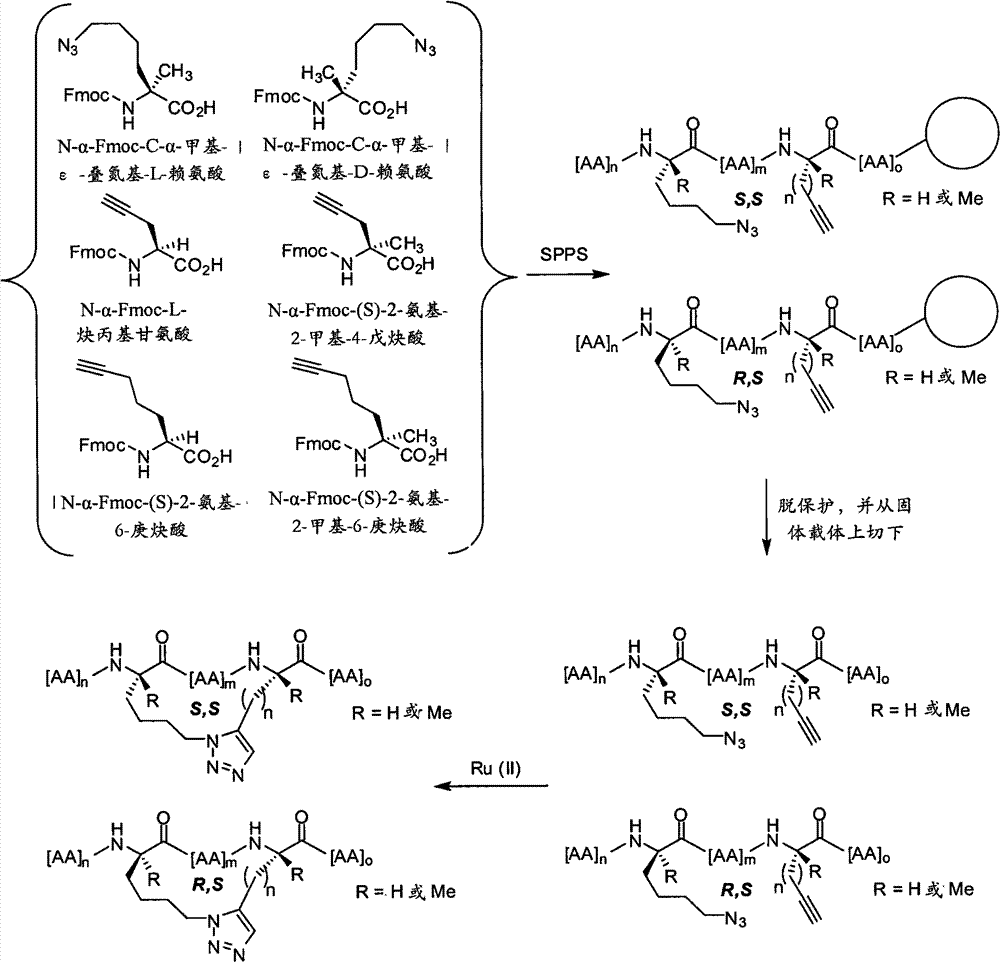
在如合成方案4所示的用于合成拟肽大环化合物的一般方法中,拟肽前体包含叠氮部分和炔部分,并且通过溶液相或固相肽合成法(SPPS),使用可商购的氨基酸N-α-Fmoc-L-炔丙基甘氨酸以及以下氨基酸的N-α-Fmoc保护的形式合成:(S)-2-氨基-2-甲基-4-戊炔酸、(S)-2-氨基-6-庚炔酸、(S)-2-氨基-2-甲基-6-庚炔酸、N-甲基-ε-叠氮基-L-赖氨酸和N-甲基-ε-叠氮基-D-赖氨酸。然后通过标准条件(例如,强酸如95%TFA)将拟肽前体脱保护并从固相树脂上切下。拟肽前体作为粗制混合物与大环化试剂如Cu(II)试剂例如Cp*RuCl(PPh3)2或[Cp*RuCl]4进行反应,或者在反应之前进行纯化(Rasmussen等人(2007),Org.Lett.9:5337-5339;Zhang等人(2005),J.Am.Chem.Soc.127:15998-15999)。在某些实施方案中,在选自DMF、CH3CN和THF的溶剂中进行大环化步骤。In the general method for the synthesis of peptidomimetic macrocycles as shown in Synthetic Scheme 4, the peptidomimetic precursors contain an azide moiety and an alkyne moiety, and by solution-phase or solid-phase peptide synthesis (SPPS), using commercially available The purchased amino acid N-α-Fmoc-L-propargylglycine and the N-α-Fmoc protected form of the following amino acids were synthesized: (S)-2-amino-2-methyl-4-pentynoic acid, (S )-2-amino-6-heptynoic acid, (S)-2-amino-2-methyl-6-heptynoic acid, N-methyl-ε-azido-L-lysine and N- Methyl-ε-azido-D-lysine. The peptidomimetic precursor is then deprotected and cleaved from the solid phase resin by standard conditions (eg, strong acid such as 95% TFA). The peptidomimetic precursors were reacted as a crude mixture with macrocyclizing reagents such as Cu(II) reagents such as Cp*RuCl(PPh 3 ) 2 or [Cp*RuCl] 4 , or were purified prior to the reaction (Rasmussen et al. (2007 ), Org. Lett. 9: 5337-5339; Zhang et al. (2005), J. Am. Chem. Soc. 127: 15998-15999). In certain embodiments, the macrocyclization step is performed in a solvent selected from DMF, CH3CN , and THF.
合成方案5:Synthetic Scheme 5:
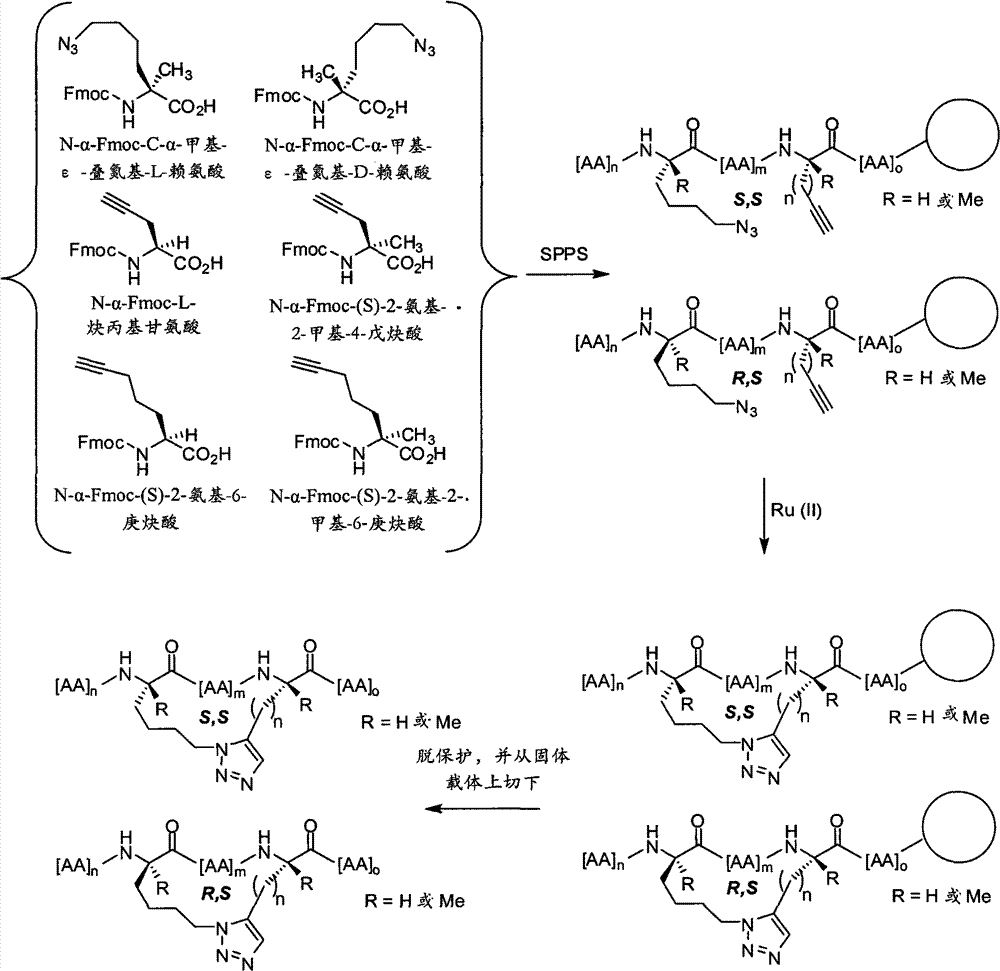
在如合成方案5所示的用于合成拟肽大环化合物的一般方法中,拟肽前体包含叠氮部分和炔部分,并且通过固相肽合成法(SPPS),使用可商购的氨基酸N-α-Fmoc-L-炔丙基甘氨酸以及以下氨基酸的N-α-Fmoc保护的形式合成:(S)-2-氨基-2-甲基-4-戊炔酸、(S)-2-氨基-6-庚炔酸、(S)-2-氨基-2-甲基-6-庚炔酸、N-甲基-ε-叠氮基-L-赖氨酸和N-甲基-ε-叠氮基-D-赖氨酸。拟肽前体作为粗制混合物与大环化试剂如Ru(II)试剂在树脂上反应。例如,该试剂可以是Cp*RuCl(PPh3)2或[Cp*RuCl]4(Rasmussen等人(2007),Org.Lett.9:5337-5339;Zhang等人(2005),J.Am.Chem.Soc.127:15998-15999)。在某些实施方案中,在选自CH2Cl2、ClCH2CH2Cl、CH3CN、DMF和THF的溶剂中进行大环化步骤。In the general method for the synthesis of peptidomimetic macrocycles as shown in Synthetic Scheme 5, the peptidomimetic precursors contain an azide moiety and an alkyne moiety, and by solid-phase peptide synthesis (SPPS), using commercially available amino acids Synthesis of N-α-Fmoc-L-propargylglycine and N-α-Fmoc protected forms of the following amino acids: (S)-2-amino-2-methyl-4-pentynoic acid, (S)-2 -Amino-6-heptynoic acid, (S)-2-amino-2-methyl-6-heptynoic acid, N-methyl-ε-azido-L-lysine and N-methyl- ε-azido-D-lysine. The peptidomimetic precursor is reacted as a crude mixture with a macrocyclization reagent such as Ru(II) reagent on the resin. For example, the reagent can be Cp*RuCl(PPh 3 ) 2 or [Cp*RuCl] 4 (Rasmussen et al. (2007), Org. Lett. 9:5337-5339; Zhang et al. (2005), J.Am. Chem. Soc. 127:15998-15999). In certain embodiments, the macrocyclization step is performed in a solvent selected from CH2Cl2 , ClCH2CH2Cl , CH3CN , DMF , and THF.
本发明涉及在本文所述的拟肽大环化合物的合成中使用非天然存在的氨基酸和氨基酸类似物。任何适合于用来合成稳定的含三唑拟肽大环化合物的合成方法的氨基酸或氨基酸类似物都可以用于本发明。例如,认为L-炔丙基甘氨酸是本发明中有用的氨基酸。但是,含有不同氨基酸侧链的其他含炔的氨基酸也可用于本发明。例如,L-炔丙基甘氨酸在氨基酸的α-碳和氨基酸侧链的炔之间含有一个亚甲基单元。本发明也涉及使用在α-碳和炔之间具有多个亚甲基单元的氨基酸。另外,还认为氨基酸L-赖氨酸、D-赖氨酸、α-甲基-L-赖氨酸和α-甲基-D-赖氨酸的叠氮类似物是本发明的有用的氨基酸。但是,含有不同的氨基酸侧链的其他末端叠氮氨基酸也可以用于本发明。例如,L-赖氨酸的叠氮类似物在氨基酸的α-碳和氨基酸侧链的末端叠氮基之间含有4个亚甲基单元。本发明也涉及使用在α-碳和末端叠氮基之间具有少于或多于4个亚甲基单元的氨基酸。表2显示一些可用于制备本发明的拟肽大环化合物的氨基酸。The present invention relates to the use of non-naturally occurring amino acids and amino acid analogs in the synthesis of the peptidomimetic macrocycles described herein. Any amino acid or amino acid analogue suitable for use in the synthesis of stable triazole-containing peptidomimetic macrocycles may be used in the present invention. For example, L-propargylglycine is considered a useful amino acid in the present invention. However, other alkyne-containing amino acids containing different amino acid side chains are also useful in the present invention. For example, L-propargylglycine contains a methylene unit between the alpha-carbon of the amino acid and the alkyne of the amino acid side chain. The invention also relates to the use of amino acids with multiple methylene units between the α-carbon and the alkyne. In addition, azide analogs of the amino acids L-lysine, D-lysine, α-methyl-L-lysine, and α-methyl-D-lysine are also considered useful amino acids of the invention. . However, other terminal azide amino acids containing different amino acid side chains can also be used in the present invention. For example, the azide analog of L-lysine contains 4 methylene units between the alpha-carbon of the amino acid and the terminal azide group of the amino acid side chain. The present invention also relates to the use of amino acids having less or more than 4 methylene units between the alpha-carbon and the terminal azido group. Table 2 shows some amino acids that can be used to prepare the peptidomimetic macrocycles of the present invention.
表2Table 2
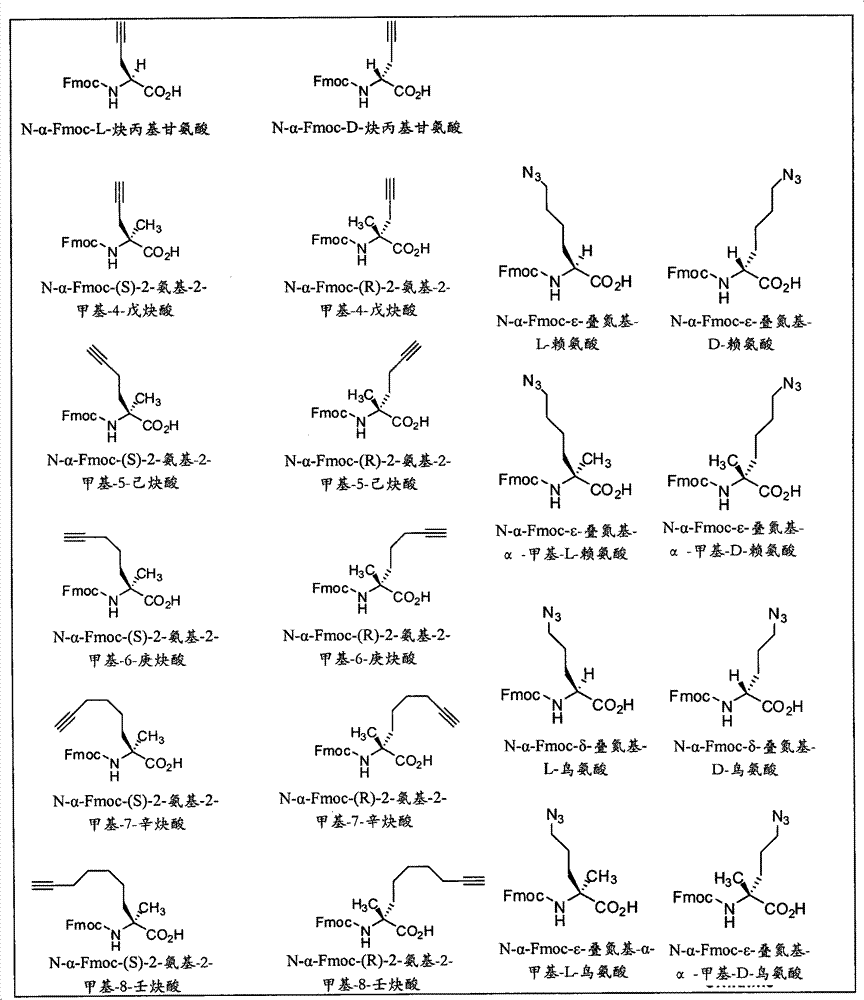
表2显示用于制备本发明的拟肽大环化合物的示例性氨基酸。Table 2 shows exemplary amino acids useful in the preparation of peptidomimetic macrocycles of the invention.
在某些实施方案中,氨基酸和氨基酸类似物是D-构型。在其他实施方案中,它们是L-构型。在某些实施方案中,拟肽中包含的某些氨基酸和氨基酸类似物是D-构型,而某些氨基酸和氨基酸类似物是L-构型。在某些实施方案中,氨基酸类似物是α,α-二取代的,如α-甲基-L-炔丙基甘氨酸、α-甲基-D-炔丙基甘氨酸、ε-叠氮基-α-甲基-L-赖氨酸和ε-叠氮基-α-甲基-D-赖氨酸。在某些实施方案中,氨基酸类似物是N-烷基化的,例如,N-甲基-L-炔丙基甘氨酸、N-甲基-D-炔丙基甘氨酸、N-甲基-ε-叠氮基-L-赖氨酸和N-甲基-ε-叠氮基-D-赖氨酸。In certain embodiments, amino acids and amino acid analogs are in the D-configuration. In other embodiments, they are in the L-configuration. In certain embodiments, certain amino acids and amino acid analogs comprised in the peptoids are in the D-configuration and certain amino acids and amino acid analogs are in the L-configuration. In certain embodiments, the amino acid analogs are α,α-disubstituted, such as α-methyl-L-propargylglycine, α-methyl-D-propargylglycine, ε-azido- α-methyl-L-lysine and ε-azido-α-methyl-D-lysine. In certain embodiments, the amino acid analogs are N-alkylated, e.g., N-methyl-L-propargylglycine, N-methyl-D-propargylglycine, N-methyl-ε -Azido-L-lysine and N-methyl-ε-azido-D-lysine.
在某些实施方案中,使用包括但不限于-Fmoc和-Boc的保护基团保护氨基酸的-NH部分。在其他实施方案中,在合成拟肽大环化合物之前不保护氨基酸。In certain embodiments, the -NH portion of an amino acid is protected with a protecting group including, but not limited to -Fmoc and -Boc. In other embodiments, the amino acids are not protected prior to synthesis of the peptidomimetic macrocycle.
在其他实施方案中,合成式III的拟肽大环化合物。这类大环化合物的制备在例如2007年12月17日提交的美国申请11/957,325中有描述。下面的合成方案描述了这类化合物的制备。该图可以概要描述为以下内容:该说明性的方案显示了由L-半胱氨酸或D-半胱氨酸衍生的氨基酸类似物,其中L1和L3都是-(CH2)-。但是,如以上整个发明详述部分所指出的,可以采用许多其他的氨基酸类似物,其中L1和L3可以独立地选自本文公开的各种结构。符号“[AA]m”、“[AA]n”、“[AA]o”表示酰胺键连接的部分如天然或非天然氨基酸的序列。如前面所述,每个出现的“AA”与任何其他出现的“AA”无关,而且诸如“[AA]m”的通式包括,例如,不相同氨基酸的序列以及相同氨基酸的序列。In other embodiments, peptidomimetic macrocycles of Formula III are synthesized. The preparation of such macrocycles is described, for example, in US application Ser. No. 11/957,325, filed December 17,2007. The following synthetic schemes describe the preparation of such compounds. The diagram can be schematically described as follows: This illustrative scheme shows amino acid analogs derived from L-cysteine or D-cysteine, where L1 and L3 are both -( CH2 )- . However, as indicated above throughout the Detailed Description of the Invention, many other amino acid analogs can be employed, wherein L1 and L3 can be independently selected from the various structures disclosed herein. The symbols "[AA] m ", "[AA] n ", "[AA] o " indicate sequences of amide bond-linked moieties such as natural or unnatural amino acids. As previously stated, each occurrence of "AA" is independent of any other occurrence of "AA", and a general formula such as "[AA] m " includes, for example, sequences of non-identical amino acids as well as sequences of identical amino acids.
合成方案6:Synthetic scheme 6:
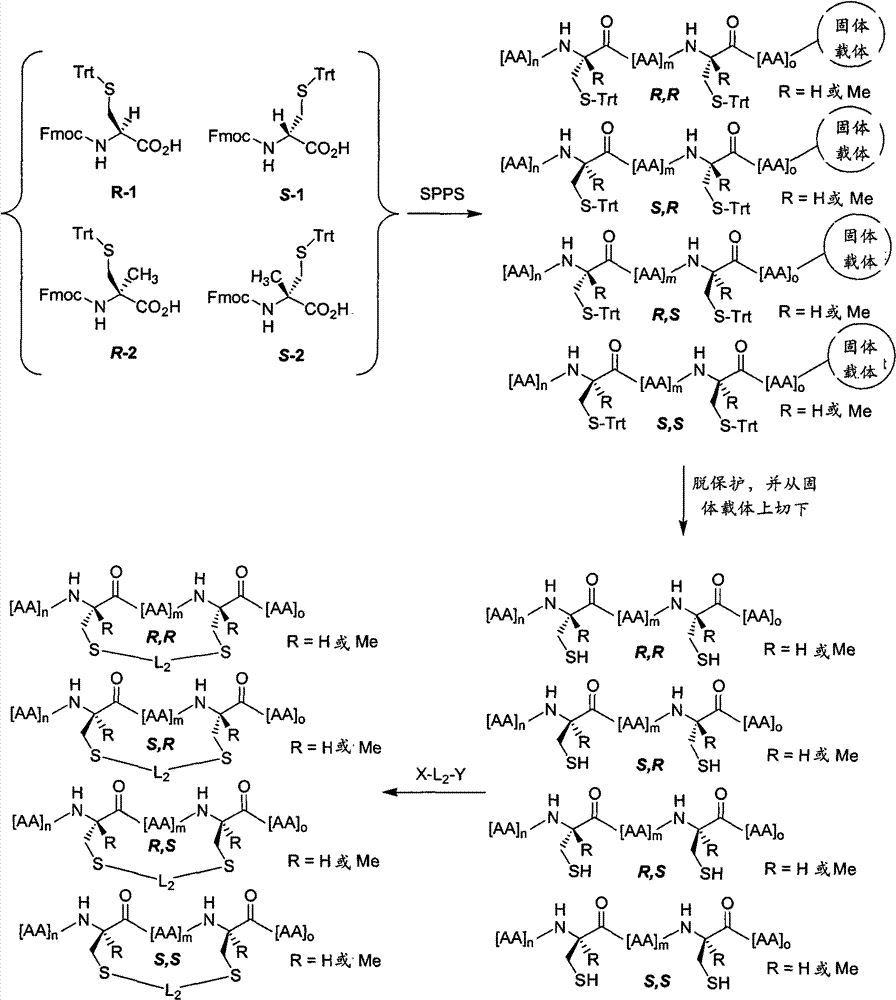
在合成方案6中,拟肽前体含有2个-SH部分,而且使用可商购的N-α-Fmoc氨基酸如N-α-Fmoc-S-三苯甲基-L-半胱氨酸或N-α-Fmoc-S-三苯甲基-D-半胱氨酸通过固相肽合成法(SPPS)来合成。通过已知方法(Seebach等人(1996),Angew.Chem.Int.Ed.Engl.35:2708-2748以及其中的参考文献)产生D-半胱氨酸或L-半胱氨酸的α-甲基化形式,然后通过已知方法(″Bioorganic Chemistry:Peptides and Proteins″,Oxford University Press,New York:1998,本文通过引用引入其完整内容)将其转化为适当保护的N-α-Fmoc-S-三苯甲基单体。接着通过标准条件(例如,强酸如95%TFA)对前体拟肽脱保护并从固相树脂上切下。前体拟肽作为粗制混合物与X-L2-Y在有机溶液或水性溶液中进行反应,或者在反应前进行纯化。在某些实施方案中,在稀释条件(即,0.15mmol/L)下进行烷基化反应,以有利于大环化并避免聚合。在某些实施方案中,在有机溶液如液体NH3中(Mosberg等人(1985),J.Am.Chem.Soc.107:2986-2987;Szewczuk等人(1992),Int.J.Peptide Protein Res.40:233-242)、NH3/MeOH中或NH3/DMF中(Or等人(1991),J.Org.Chem.56:3146-3149)进行烷基化反应。在其他实施方案中,在水性溶液如pH 8的6M盐酸胍中进行烷基化反应(Brunel等人(2005),Chem.Commun.(20):2552-2554)。在其他实施方案中,用于烷基化反应的溶剂是DMF或二氯乙烷。In Synthetic Scheme 6, the peptidomimetic precursor contains 2 -SH moieties, and a commercially available N-α-Fmoc amino acid such as N-α-Fmoc-S-trityl-L-cysteine or N-α-Fmoc-S-trityl-D-cysteine was synthesized by solid-phase peptide synthesis (SPPS). α-Cysteine or L-cysteine is produced by known methods (Seebach et al. The methylated form is then converted to the appropriately protected N-α-Fmoc- S-trityl monomer. The precursor peptidomimetic is then deprotected and cleaved from the solid phase resin by standard conditions (eg strong acid such as 95% TFA). Precursor peptidomimetics were reacted with XL2 -Y as a crude mixture in organic or aqueous solution, or were purified prior to the reaction. In certain embodiments, the alkylation reaction is performed under dilute conditions (ie, 0.15 mmol/L) to favor macrocyclization and avoid polymerization. In certain embodiments, in an organic solution such as liquid NH 3 (Mosberg et al. (1985), J. Am. Chem. Soc. 107:2986-2987; Szewczuk et al. Res. 40: 233-242), NH 3 /MeOH or NH 3 /DMF (Or et al. (1991), J. Org. Chem. 56: 3146-3149). In other embodiments, the alkylation reaction is performed in an aqueous solution such as 6M guanidine hydrochloride at pH 8 (Brunel et al. (2005), Chem. Commun. (20): 2552-2554). In other embodiments, the solvent used for the alkylation reaction is DMF or dichloroethane.
合成方案7:Synthetic Scheme 7:
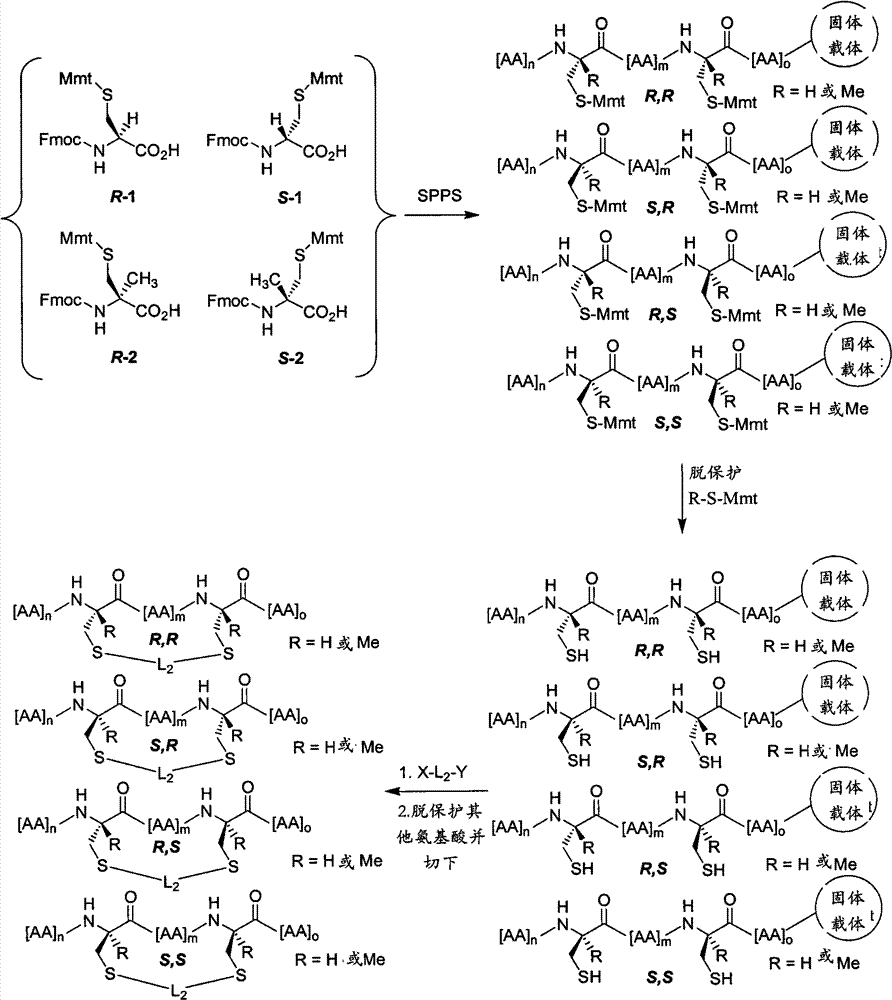
在合成方案7中,前体拟肽含有2个或更多个-SH部分,其中的2个特别地进行保护以允许其选择性地脱保护及随后烷基化以形成大环。通过固相肽合成法(SPPS),使用可商购的N-α-Fmoc氨基酸如N-α-Fmoc-S-对甲氧基三苯甲基-L-半胱氨酸或N-α-Fmoc-S-对甲氧基三苯甲基-D-半胱氨酸合成前体拟肽。通过已知方法(Seebach等人(1996),Angew.Chem.Int.Ed.Engl.35:2708-2748以及其中的参考文献)产生D-半胱氨酸或L-半胱氨酸的α-甲基化形式,然后通过已知方法(Bioorganic Chemistry:Peptides and Proteins,Oxford University Press,New York:1998,其完整内容通过引用并入本文)将其转化为适当保护的N-α-Fmoc-S-对甲氧基三苯甲基单体。然后通过标准条件(例如,弱酸,如DCM中的1%TFA)选择性地切下拟肽前体的Mmt保护基团。然后前体拟肽在树脂上与有机溶液中的X-L2-Y反应。例如,该反应在位阻碱如二异丙基乙胺的存在下发生。在某些实施方案中,烷基化反应在有机溶液如液体NH3中(Mosberg等人(1985),J.Am.Chem.Soc.107:2986-2987;Szewczuk等人(1992),Int.J.Peptide Protein Res.40:233-242)、NH3/MeOH中或NH3/DMF(Or等人(1991),J.Org.Chem.56:3146-3149)中进行。在其他实施方案中,烷基化反应在DMF或二氯乙烷中进行。然后通过标准条件(例如,强酸,如95%TFA)将拟肽大环化合物脱保护并从固相树脂上切下。In Synthetic Scheme 7, the precursor peptidomimetic contains 2 or more -SH moieties, 2 of which are specifically protected to allow their selective deprotection and subsequent alkylation to form a macrocycle. By solid-phase peptide synthesis (SPPS), using commercially available N-α-Fmoc amino acids such as N-α-Fmoc-S-p-methoxytrityl-L-cysteine or N-α- Fmoc-S-p-methoxytrityl-D-cysteine synthetic precursor peptidomimetic. α-cysteine or L-cysteine produced by known methods (Seebach et al. The methylated form is then converted into appropriately protected N-α-Fmoc-S by known methods ( Bioorganic Chemistry: Peptides and Proteins , Oxford University Press, New York: 1998, the entire contents of which are incorporated herein by reference) - p-methoxytrityl monomer. The Mmt protecting group of the peptidomimetic precursor is then selectively cleaved by standard conditions (eg, mild acid, such as 1% TFA in DCM). The precursor peptidomimetic is then reacted on the resin with XL2 -Y in organic solution. For example, the reaction occurs in the presence of a hindered base such as diisopropylethylamine. In certain embodiments, the alkylation reaction is carried out in an organic solution such as liquid NH (Mosberg et al. ( 1985 ), J. Am. Chem. Soc. 107: 2986-2987; Szewczuk et al. (1992), Int. J. Peptide Protein Res. 40:233-242), NH3 /MeOH or NH3 /DMF (Or et al. (1991), J. Org. Chem. 56:3146-3149). In other embodiments, the alkylation reaction is carried out in DMF or dichloroethane. The peptidomimetic macrocycle is then deprotected and cleaved from the solid phase resin by standard conditions (eg, strong acid, such as 95% TFA).
合成方案8:Synthetic Scheme 8:
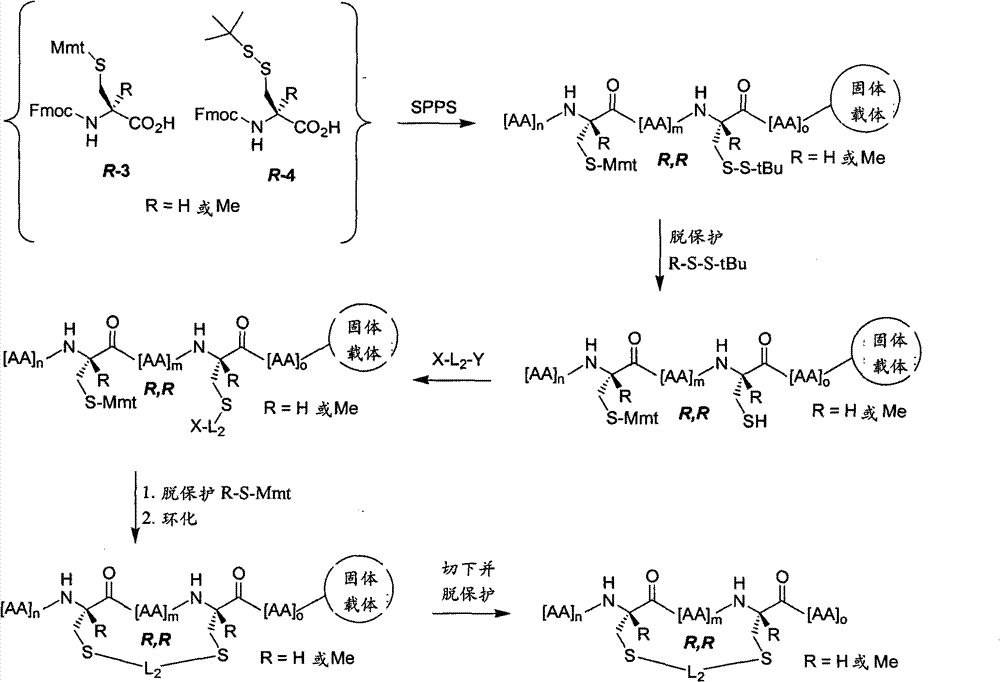
在合成方案8中,拟肽前体含有2个或更多个-SH部分,其中的2个进行特别保护以允许其选择性地脱保护和随后烷基化以形成大环。通过固相肽合成法(SPPS),使用可商购的N-α-Fmoc氨基酸如N-α-Fmoc-S-对甲氧基三苯甲基-L-半胱氨酸、N-α-Fmoc-S-对甲氧基三苯甲基-D-半胱氨酸、N-α-Fmoc-S-S-叔丁基-L-半胱氨酸和N-α-Fmoc-S-S-叔丁基-D-半胱氨酸合成拟肽前体。通过已知方法(Seebach等人(1996),Angew.Chem.Int.Ed.Engl.35:2708-2748以及其中的参考文献)产生D-半胱氨酸或L-半胱氨酸的α-甲基化形式,然后通过已知方法(Bioorganic Chemistry:Peptides and Proteins,Oxford University Press,New York:1998,其完整内容通过引用并入本文)将其转化为适当保护的N-α-Fmoc-S-对甲氧基三苯甲基或N-α-Fmoc-S-S-叔丁基单体。然后通过已知条件(例如,DMF中的20%的2-巯基乙醇,参考文献:Galande等人(2005),J.Comb.Chem.7:174-177)选择性地切下拟肽前体的S-S-叔丁基保护基团。然后前体拟肽在树脂上与有机溶液中的摩尔过量的X-L2-Y反应。例如,反应在位阻碱如二异丙基乙胺的存在下发生。然后通过标准条件(例如,弱酸,如DCM中的1%TFA)选择性地切下拟肽前体的Mmt保护基团。拟肽前体然后通过用有机溶液中的位阻碱处理而在树脂上环化。在某些实施方案中,在诸如NH3/MeOH或NH3/DMF(Or等人(1991),J.Org.Chem.56:3146-3149)的有机溶液中进行烷基化反应。然后通过标准条件(例如,强酸,如95%TFA)将拟肽大环化合物脱保护并从固相树脂上切下。In Synthetic Scheme 8, peptidomimetic precursors contain 2 or more -SH moieties, 2 of which are specifically protected to allow their selective deprotection and subsequent alkylation to form a macrocycle. By solid-phase peptide synthesis (SPPS), using commercially available N-α-Fmoc amino acids such as N-α-Fmoc-S-p-methoxytrityl-L-cysteine, N-α- Fmoc-S-p-methoxytrityl-D-cysteine, N-α-Fmoc-SS-tert-butyl-L-cysteine and N-α-Fmoc-SS-tert-butyl -D-cysteine synthetic peptidomimetic precursor. α-cysteine or L-cysteine produced by known methods (Seebach et al. The methylated form is then converted into appropriately protected N-α-Fmoc-S by known methods ( Bioorganic Chemistry: Peptides and Proteins , Oxford University Press, New York: 1998, the entire contents of which are incorporated herein by reference) - p-methoxytrityl or N-α-Fmoc-SS-tert-butyl monomer. The peptidomimetic precursor is then selectively cleaved by known conditions (e.g., 20% 2-mercaptoethanol in DMF, reference: Galande et al. (2005), J. Comb. Chem. 7: 174-177) The SS-tert-butyl protecting group. The precursor peptidomimetic is then reacted on the resin with a molar excess of XL2 -Y in organic solution. For example, the reaction occurs in the presence of a hindered base such as diisopropylethylamine. The Mmt protecting group of the peptidomimetic precursor is then selectively cleaved by standard conditions (eg, mild acid, such as 1% TFA in DCM). The peptidomimetic precursor is then cyclized on the resin by treatment with a hindered base in organic solution. In certain embodiments, the alkylation reaction is performed in an organic solution such as NH3 /MeOH or NH3 /DMF (Or et al. (1991), J. Org. Chem. 56:3146-3149). The peptidomimetic macrocycle is then deprotected and cleaved from the solid phase resin by standard conditions (eg, strong acid, such as 95% TFA).
合成方案9:Synthetic Scheme 9:

在合成方案9中,拟肽前体含有2个L-半胱氨酸部分。通过已知的活细胞中的生物表达系统或通过已知的体外无细胞表达方法合成拟肽前体。前体拟肽作为粗制混合物与X-L2-Y在有机溶液或水性溶液中进行反应,或者在反应之前进行纯化。在某些实施方案中,在稀释条件(即,0.15mmol/L)下进行烷基化反应,以利于大环化并避免聚合。在某些实施方案中,在有机溶液如液体NH3中(Mosberg等人(1985),J.Am.Chem.Soc.107:2986-2987;Szewczuk等人(1992),Int.J.Peptide Protein Res.40:233-242)、NH3/MeOH中或NH3/DMF中(Or等人(1991),J.Org.Chem.56:3146-3149)进行烷基化反应。在其他实施方案中,在水溶液如pH 8的6M盐酸胍中进行烷基化反应(Brunel等人(2005),Chem.Commun.(20):2552-2554)。在其他实施方案中,在DMF或二氯乙烷中进行烷基化反应。在另一实施方案中,在非变性水溶液中进行烷基化,在再另一个实施方案中,在有利于α-螺旋结构形成的条件下进行烷基化。在再另一个实施方案中,在有利于前体拟肽与另一种蛋白质结合的条件下进行烷基化,从而在烷基化过程中诱导结合的α-螺旋构象的形成。In Synthetic Scheme 9, the peptidomimetic precursor contains 2 L-cysteine moieties. The peptidomimetic precursors are synthesized by known biological expression systems in living cells or by known in vitro cell-free expression methods. Precursor peptoids were reacted with XL2 -Y as a crude mixture in organic or aqueous solution, or were purified prior to the reaction. In certain embodiments, the alkylation reaction is performed under dilute conditions (ie, 0.15 mmol/L) to facilitate macrocyclization and avoid polymerization. In certain embodiments, in an organic solution such as liquid NH 3 (Mosberg et al. (1985), J. Am. Chem. Soc. 107:2986-2987; Szewczuk et al. Res. 40: 233-242), NH 3 /MeOH or NH 3 /DMF (Or et al. (1991), J. Org. Chem. 56: 3146-3149). In other embodiments, the alkylation reaction is performed in an aqueous solution such as 6M guanidine hydrochloride at pH 8 (Brunel et al. (2005), Chem. Commun. (20): 2552-2554). In other embodiments, the alkylation reaction is performed in DMF or dichloroethane. In another embodiment, the alkylation is performed in a non-denaturing aqueous solution, and in yet another embodiment, the alkylation is performed under conditions that favor the formation of an alpha-helical structure. In yet another embodiment, the alkylation is carried out under conditions that favor association of the precursor peptidomimetic with another protein, thereby inducing the formation of an associated alpha-helical conformation during the alkylation.
本发明设想了适合与巯基反应的X和Y的各种实施方案。通常,X或Y各自独立地选自表5所示的一般性类别。例如,X和Y是诸如-Cl、-Br或-I的卤素。本文所述的任何大环形成连接体可以与表1-4所示的任何序列任意组合使用,也可以与本文表明的任何R-取代基任意组合使用。The present invention contemplates various embodiments of X and Y suitable for reacting with sulfhydryl groups. Typically, X or Y are each independently selected from the general categories shown in Table 5. For example, X and Y are halogens such as -Cl, -Br or -I. Any of the macrocycle-forming linkers described herein may be used in any combination with any of the sequences shown in Tables 1-4, as well as with any of the R-substituents indicated herein.
表3:能够与巯基反应的反应性基团和形成的连接的例子Table 3: Examples of reactive groups capable of reacting with sulfhydryl groups and linkages formed
本发明涉及在式(III)的拟肽大环化合物的合成中使用天然存在的和非天然存在的氨基酸和氨基酸类似物。任何适合用来合成稳定的含双巯基的拟肽大环化合物的合成方法的氨基酸或氨基酸类似物都可以用于本发明。例如,认为半胱氨酸是本发明中有用的氨基酸。但是,除半胱氨酸之外的含有不同氨基酸侧链的含硫氨基酸也是有用的。例如,半胱氨酸在氨基酸的α-碳和氨基酸侧链的末端-SH之间含有一个亚甲基单元。本发明也涉及使用在α-碳和末端-SH之间具有多个亚甲基单元的氨基酸。非限制的例子包括α-甲基-L-高半胱氨酸和α-甲基-D-高半胱氨酸。在某些实施方案中,氨基酸和氨基酸类似物是D-构型。在其他实施方案中,它们是L-构型。在某些实施方案中,拟肽中包含的某些氨基酸和氨基酸类似物是D-构型,而某些氨基酸和氨基酸类似物是L-构型。在某些实施方案中,氨基酸类似物是α,α-二取代的,如α-甲基-L-半胱氨酸和α-甲基-D-半胱氨酸。The present invention relates to the use of naturally occurring and non-naturally occurring amino acids and amino acid analogs in the synthesis of peptidomimetic macrocycles of formula (III). Any amino acid or amino acid analog that is suitable for use in the synthesis of stable bisthiol-containing peptidomimetic macrocycles can be used in the present invention. For example, cysteine is considered a useful amino acid in the present invention. However, sulfur-containing amino acids with different amino acid side chains other than cysteine are also useful. For example, cysteine contains a methylene unit between the alpha-carbon of the amino acid and the terminal -SH of the amino acid side chain. The invention also involves the use of amino acids with multiple methylene units between the alpha-carbon and the terminal -SH. Non-limiting examples include α-methyl-L-homocysteine and α-methyl-D-homocysteine. In certain embodiments, amino acids and amino acid analogs are in the D-configuration. In other embodiments, they are in the L-configuration. In certain embodiments, certain amino acids and amino acid analogs comprised in the peptidomimetics are in the D-configuration and certain amino acids and amino acid analogs are in the L-configuration. In certain embodiments, amino acid analogs are α,α-disubstituted, such as α-methyl-L-cysteine and α-methyl-D-cysteine.
本发明包括这样的大环化合物,其中大环形成连接体用来连接拟肽前体中的两个或多个-SH部分以形成本发明的拟肽大环化合物。如上所述,大环形成连接体赋予构象刚性、提高代谢稳定性和/或提高细胞渗透性。另外,在某些实施方案中,形成大环的连接稳定拟肽大环化合物的α-螺旋二级结构。大环形成连接体具有式X-L2-Y,其中X和Y都是如上定义的相同或不同的部分。X和Y都具有这样的化学特性,其允许一个大环形成连接体-L2-使含有双巯基的拟肽前体被双烷基化。如上定义,连接体-L2-包括亚烷基、亚烯基、亚炔基、杂亚烷基、亚环烷基、杂亚环烷基、亚环芳基或杂亚环芳基或-R4-K-R4-,它们都可以任选地被如上定义的R5基团取代。另外,除了连接含巯基氨基酸的-SH的碳之外,大环形成连接体-L2-中的1-3个碳原子任选地被杂原子如N、S或O替代。The invention includes macrocycles wherein a macrocycle-forming linker is used to link two or more -SH moieties in a peptidomimetic precursor to form a peptidomimetic macrocycle of the invention. As noted above, macrocycle-forming linkers confer conformational rigidity, increase metabolic stability, and/or increase cell permeability. Additionally, in certain embodiments, macrocycle-forming linkages stabilize the alpha-helical secondary structure of the peptidomimetic macrocycle. The macrocycle-forming linker has the formula XL2 -Y, wherein X and Y are both the same or different moieties as defined above. Both X and Y have chemical properties that allow a macrocycle-forming linker -L2- to dialkylate the peptidomimetic precursor containing a disulfhydryl group. As defined above, the linker -L 2 - comprises an alkylene, alkenylene, alkynylene, heteroalkylene, cycloalkylene, heterocycloalkylene, cycloarylene or heterocycloarylene or - R 4 -KR 4 -, all of which may be optionally substituted by R 5 groups as defined above. In addition, 1-3 carbon atoms in the macrocycle-forming linker -L2- are optionally replaced by heteroatoms such as N, S or O, except for the carbon of -SH to which the thiol-containing amino acid is attached.
大环形成连接体X-L2-Y的L2部分在长度上可以变化,除了其他原因,这主要取决于根据用来形成拟肽大环化合物的两个氨基酸类似物的位置之间的距离。另外,随着大环形成连接体的L1和/或L3部分的长度发生变化,L2的长度也可以变化,以产生具有合适总长度的连接体以形成稳定的拟肽大环化合物。例如,如果通过向每个L1和L3再添加一个亚甲基单元来改变所使用的氨基酸类似物,那么L2在长度上减少等同于大约两个亚甲基单元的长度,以抵消L1和L3的长度增加。The L2 portion of the macrocycle-forming linker XL2 -Y may vary in length, depending, among other reasons, on the distance between the positions of the two amino acid analogues used to form the peptidomimetic macrocycle. Additionally, as the length of the L1 and/or L3 portion of the macrocycle-forming linker is varied, the length of L2 can also be varied to produce a linker with an appropriate overall length to form a stable peptidomimetic macrocycle. For example, if the amino acid analog used is altered by adding one more methylene unit to each of L and L , then L is reduced in length by the equivalent of approximately two methylene units to offset L 1 and L 3 are increased in length.
在某些实施方案中,L2是式-(CH2)n-的亚烷基基团,其中,n为大约1至大约15之间的整数。例如,n为1、2、3、4、5、6、7、8、9或10。在其他实施方案中,L2为亚烯基基团。在另外其他的实施方案中,L2为芳基。In certain embodiments, L 2 is an alkylene group of the formula —(CH 2 ) n —, wherein n is an integer between about 1 and about 15. For example, n is 1, 2, 3, 4, 5, 6, 7, 8, 9 or 10. In other embodiments, L 2 is an alkenylene group. In still other embodiments, L is aryl.
表4显示X-L2-Y基团的另外的实施方案。Table 4 shows additional embodiments of the XL2 -Y group.
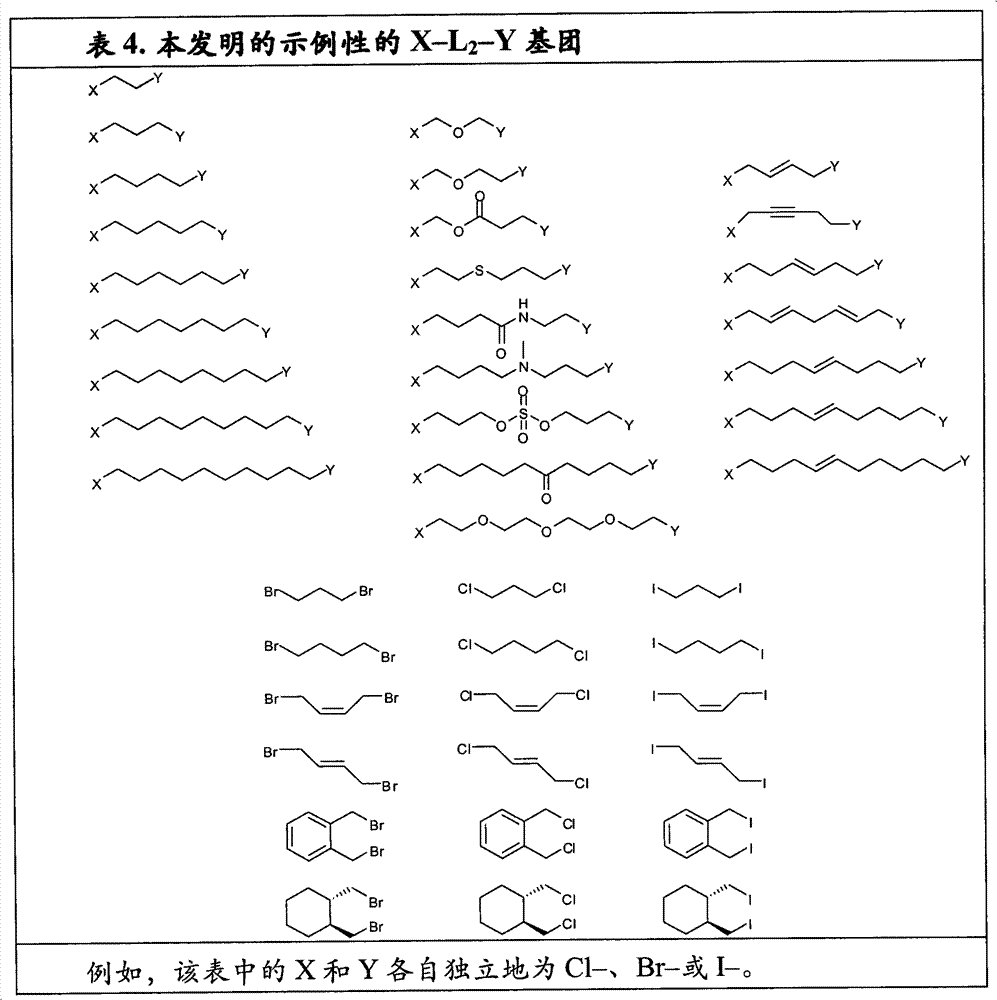
认为适用于进行本发明的形成拟肽大环化合物的另外的方法包括以下文献中公开的方法:Mustapa,M.Firouz Mohd等人,J.Org.Chem(2003),68,第8193-8198页;Yang,Bin等人Bioorg Med.Chem.Lett.(2004),14,第1403-1406页;美国专利5,364,851;美国专利5,446,128;美国专利5,824,483;美国专利6,713,280和美国专利7,202,332。在这样的实施方案中,使用在α-位含有另外的取代基R-的氨基酸前体。这样的氨基酸在希望的位置被并入大环化合物前体中,其可以处于交联连接体被取代的位置,或者,可选择地,在大环化合物前体序列中的其他位置。然后根据指定的方法实现前体的环化。Additional methods of forming peptidomimetic macrocycles considered suitable for carrying out the present invention include those disclosed in: Mustapa, M. Firouz Mohd et al., J. Org. Chem (2003), 68, pp. 8193-8198 (2004), 14, pp. 1403-1406; US Patent 5,364,851; US Patent 5,446,128; US Patent 5,824,483; US Patent 6,713,280 and US Patent 7,202,332. In such an embodiment, an amino acid precursor containing an additional substituent R- in the α-position is used. Such amino acids are incorporated into the macrocycle precursor at desired positions, which may be at positions where the cross-linker is substituted, or, alternatively, at other positions in the macrocycle precursor sequence. Cyclization of the precursor is then achieved according to the indicated method.
试验test
例如,本发明的拟肽大环化合物的性质通过例如使用下面所述的方法进行测定。在某些实施方案中,相对于缺乏本文所述的取代基的相应多肽,本发明的拟肽大环化合具有改善的生物学特性。For example, the properties of the peptidomimetic macrocycles of the invention are determined by, for example, using the methods described below. In certain embodiments, the peptidomimetic macrocycles of the invention have improved biological properties relative to corresponding polypeptides lacking the substituents described herein.
测定α-螺旋度的试验Test for the determination of alpha-helicity
在溶液中,具有α-螺旋结构域的多肽的二级结构在随机卷曲结构和α-螺旋结构之间达到动态平衡,这通常被称为“百分螺旋度”。因此,例如,未修饰的α-螺旋结构域在溶液中主要是随机卷曲,α-螺旋含量通常低于25%。另一方面,相比相应的非交联多肽,具有优化的连接体的拟肽大环化合物具有例如至少是其2倍的α-螺旋度。在某些实施方案中,本发明的大环化合物具有高于50%的α-螺旋度。为了测定本发明的拟肽大环化合物的螺旋度,将化合物溶解于水溶液(例如,pH 7的50mM磷酸钾溶液或蒸馏水,达到25-50μM的浓度)。使用标准测量参数(例如,温度,20℃;波长,190-260nm;步分辨率(step resolution),0.5nm;速度,20nm/sec;累积,10;响应,1秒;带宽,1nm;路径长度,0.1cm)在分光偏振计(例如,Jasco J-710)上获得圆二色性(CD)谱。通过将平均残基椭圆率(例如,[Φ]222obs)除以模型螺旋十肽的报道值(Yang等人(1986),Methods Enzymol.130:208)来计算各个肽的α-螺旋含量。In solution, the secondary structure of polypeptides with α-helical domains achieves a dynamic equilibrium between random coil and α-helical structures, which is often referred to as "percent helicity". Thus, for example, unmodified α-helical domains are predominantly random coils in solution, with an α-helical content typically below 25%. In another aspect, a peptidomimetic macrocycle with an optimized linker has, for example, at least twice the alpha-helicity compared to a corresponding non-crosslinked polypeptide. In certain embodiments, the macrocycles of the invention have an alpha-helicity of greater than 50%. To determine the helicity of a peptidomimetic macrocycle of the invention, the compound is dissolved in an aqueous solution (e.g., 50 mM potassium phosphate solution at pH 7 or distilled water to a concentration of 25-50 μM). Use standard measurement parameters (e.g., temperature, 20°C; wavelength, 190-260nm; step resolution, 0.5nm; velocity, 20nm/sec; accumulation, 10; response, 1 second; bandwidth, 1nm; path length , 0.1 cm) on a spectropolarimeter (eg, Jasco J-710) to obtain circular dichroism (CD) spectra. The α-helical content of individual peptides was calculated by dividing the average residue ellipticity (eg, [Φ]222 obs) by the reported value for model helical decapeptides (Yang et al. (1986), Methods Enzymol. 130:208).
测量解链温度(Tm)的试验Test for Measuring Melting Temperature (Tm)
含有二级结构如α-螺旋的本发明的拟肽大环化合物显示出例如比相应的非交联多肽更高的解链温度。通常,本发明的拟肽大环化合物显示>60℃的Tm,表明在水溶液中高度稳定的结构。为了测定大环形成对解链温度的效应,将拟肽大环化合物或未修饰的肽溶于蒸馏水中(例如,以50μM的终浓度),并且通过使用标准参数(例如,波长,222nm;步分辨率,0.5nm;速度,20nm/sec;累积,10;响应,1秒;带宽,1nm;温度上升速度,1℃/分钟;路径长度,0.1cm)在分光偏振计(例如,Jasco J-710)上,通过测量椭圆率在一定温度范围(例如,4-95℃)内的变化来测量Tm。The peptidomimetic macrocycles of the invention containing secondary structures such as α-helices exhibit, for example, higher melting temperatures than corresponding non-crosslinked polypeptides. In general, the peptidomimetic macrocycles of the present invention exhibit a Tm of >60°C, indicating a highly stable structure in aqueous solution. To determine the effect of macrocycle formation on melting temperature, peptidomimetic macrocycles or unmodified peptides are dissolved in distilled water (e.g., at a final concentration of 50 μM) and analyzed by using standard parameters (e.g., wavelength, 222 nm; step Resolution, 0.5nm; Velocity, 20nm/sec; Accumulation, 10; Response, 1 second; Bandwidth, 1nm; Temperature rise rate, 1°C/min; Path length, 0.1cm) in a spectropolarimeter (e.g., Jasco J- 710), Tm is measured by measuring the change of ellipticity over a certain temperature range (eg, 4-95 °C).
蛋白酶抗性试验protease resistance test
肽骨架的酰胺键易受到蛋白酶的水解,因而致使肽化合物在体内易于快速降解。但是,肽螺旋的形成通常包埋酰胺骨架,从而可以保护其免于蛋白水解裂解。本发明的拟肽大环化合物可以用体外胰蛋白酶的蛋白水解处理,以评价与相应的非交联多肽相比其降解速度的任何变化。例如,拟肽大环化合物和相应的非交联多肽与胰蛋白酶琼脂糖一起温育,并在不同时间点通过离心猝灭反应,随后进行HPLC注射以根据280nm处的紫外吸收对残留的底物进行定量。简单来说,拟肽大环化合物和拟肽前体(5mcg)与胰蛋白酶琼脂糖(Pierce)(S/E~125)温育0、10、20、90和180分钟。通过台式离心机高速离心猝灭反应;基于HPLC在280nm处的峰检测对分离的上清液中残余的底物进行定量。蛋白水解反应显示出一级动力学,且速率常数k由ln[S]相对于时间的曲线确定(k=-1X斜率)。The amide bond of the peptide backbone is susceptible to hydrolysis by proteases, thus rendering the peptide compound susceptible to rapid degradation in vivo. However, the formation of peptide helices often embeds the amide backbone, which can protect it from proteolytic cleavage. The peptidomimetic macrocycles of the invention can be proteolytically treated with in vitro trypsin to assess any changes in their rate of degradation compared to the corresponding non-crosslinked polypeptide. For example, peptidomimetic macrocycles and corresponding non-crosslinked polypeptides were incubated with tryptic agarose and the reaction was quenched by centrifugation at various time points, followed by HPLC injection to detect residual substrate based on UV absorbance at 280 nm. Quantify. Briefly, peptidomimetic macrocycles and peptidomimetic precursors (5 meg) were incubated with Trypsin Sepharose (Pierce) (S/E~125) for 0, 10, 20, 90 and 180 minutes. The reaction was quenched by high speed centrifugation in a benchtop centrifuge; residual substrate in the isolated supernatant was quantified based on HPLC peak detection at 280 nm. The proteolytic reaction exhibits first order kinetics and the rate constant k is determined from a plot of In[S] versus time (k=-1X slope).
体外稳定性试验In Vitro Stability Test
具有优化的连接体的拟肽大环化合物的体外半衰期例如至少为相应的非交联多肽的2倍高,且具有12小时或更长的体外半衰期。对于体外血清稳定性研究,可以使用多种测定方法。例如,将拟肽大环化合物和相应的非交联多肽(2mcg)与新鲜的小鼠、大鼠和/或人血清(2mL)一起在37℃下温育0、1、2、4、8和24小时。为了测定完整化合物的水平,可以使用下面的程序:通过将100μl的血清转移到2ml离心管中,接着加入10μL的50%甲酸和500μL乙腈并在4±2℃下以14,000RPM离心10分钟来提取样品。然后将上清液转移到新的2ml管中,并在N2<10psi、37℃下在Turbovap上蒸发。样品在100μL的50∶50乙腈∶水中重建,并进行LC-MS/MS分析。The in vitro half-life of a peptidomimetic macrocycle with an optimized linker is, for example, at least 2-fold higher than that of the corresponding non-crosslinked polypeptide, and has an in vitro half-life of 12 hours or more. For in vitro serum stability studies, a variety of assays are available. For example, incubate peptidomimetic macrocycles and corresponding non-crosslinked polypeptides (2mcg) with fresh mouse, rat and/or human serum (2mL) at 37°C for 0, 1, 2, 4, 8 and 24 hours. To determine the level of intact compound, the following procedure can be used: Extract by transferring 100 μl of serum to a 2 ml centrifuge tube followed by addition of 10 μL of 50% formic acid and 500 μL of acetonitrile and centrifugation at 14,000 RPM for 10 min at 4±2°C sample. The supernatant was then transferred to a new 2ml tube and evaporated on a Turbovap under N2 < 10 psi at 37°C. Samples were reconstituted in 100 μL of 50:50 acetonitrile:water and subjected to LC-MS/MS analysis.
体外结合试验in vitro binding assay
为了评价拟肽大环化合物和拟肽前体与受体蛋白的结合和亲和力,例如使用荧光偏振测定(FPA)。FPA技术使用偏振光和荧光示踪剂测量分子取向和分子迁移率。当用偏振光激发时,由于附着在高表观分子量的分子(例如,与大蛋白质结合的FITC标记的肽)上的荧光示踪剂(例如,FITC)与附着在较小分子(例如,在溶液中游离的FITC标记的肽)上的荧光示踪剂相比具有较慢的旋转速度,附着在高表观分子量的分子上的荧光示踪剂发射较高水平的偏振荧光。To evaluate the binding and affinity of peptidomimetic macrocycles and peptidomimetic precursors to receptor proteins, for example, fluorescence polarization assay (FPA) is used. The FPA technique uses polarized light and fluorescent tracers to measure molecular orientation and molecular mobility. When excited with polarized light, fluorescent tracers (e.g., FITC) attached to molecules of high apparent molecular weight (e.g., FITC-labeled peptides bound to large proteins) differ from those attached to smaller molecules (e.g., in Fluorescent tracers attached to molecules with high apparent molecular weight emit higher levels of polarized fluorescence compared to fluorescent tracers attached to free FITC-labeled peptides in solution, which have slower rotational speeds.
例如,荧光标记的拟肽大环化合物(25nM)与接受体蛋白(25-1000nM)在结合缓冲液(140mM NaCl、50mM Tris-HCL,pH 7.4)中在室温下温育30分钟。例如,用发光分光光度计(例如,Perkin-ElmerLS50B)通过荧光偏振测定结合活性。可以使用例如Graphpad Prism软件(GraphPad Software,Inc.,San Diego,CA)通过非线性回归分析来确定Kd值。在某些情况下,本发明的拟肽大环化合物显示出与相应的非交联多肽类似的或更低的Kd。For example, fluorescently labeled peptidomimetic macrocycles (25 nM) are incubated with acceptor proteins (25-1000 nM) in binding buffer (140 mM NaCl, 50 mM Tris-HCL, pH 7.4) for 30 min at room temperature. For example, binding activity is measured by fluorescence polarization using a luminescence spectrophotometer (eg, Perkin-Elmer LS50B). K values can be determined by nonlinear regression analysis using, for example, Graphpad Prism software (GraphPad Software, Inc., San Diego, CA). In certain instances, the peptidomimetic macrocycles of the invention exhibit similar or lower Kds than the corresponding non-crosslinked polypeptides.
表征肽-蛋白质相互作用拮抗剂的体外置换试验In Vitro Displacement Assays for Characterizing Peptide-Protein Interaction Antagonists
为了评价拮抗肽与接受体蛋白之间相互作用的化合物的结合和亲和力,例如,使用利用来源于拟肽前体序列的荧光标记的拟肽大环化合物的荧光偏振试验(FPA)。FPA技术使用偏振光和荧光示踪剂测量分子取向和分子迁移率。当用偏振光激发时,由于附着在高表观分子量的分子(例如,与大蛋白质结合的FITC标记的肽)上的荧光示踪剂(例如,FITC)与附着在较小分子(例如,在溶液中游离的FITC标记的肽)上的荧光示踪剂相比具有较低的旋转速度,附着在高表观分子量的分子上的荧光示踪剂发射较高水平的偏振荧光。拮抗荧光标记的拟肽大环化合物与接受体蛋白之间相互作用的化合物将在竞争性结合FPA实验中被检测到。To evaluate the binding and affinity of compounds that antagonize the interaction between the peptide and the receptor protein, for example, a fluorescence polarization assay (FPA) using a fluorescently labeled peptidomimetic macrocycle derived from the peptidomimetic precursor sequence is used. The FPA technique uses polarized light and fluorescent tracers to measure molecular orientation and molecular mobility. When excited with polarized light, fluorescent tracers (e.g., FITC) attached to molecules of high apparent molecular weight (e.g., FITC-labeled peptides bound to large proteins) differ from those attached to smaller molecules (e.g., in Fluorescent tracers attached to molecules with high apparent molecular weights emit higher levels of polarized fluorescence compared to fluorescent tracers attached to free FITC-labeled peptides in solution, which have lower rotational speeds. Compounds that antagonize the interaction between fluorescently labeled peptidomimetic macrocycles and acceptor proteins will be detected in competitive binding FPA assays.
例如,假定的拮抗剂化合物(1nM至1mM)和荧光标记的拟肽大环化合物(25nM)与接受体蛋白(50nM)一起在结合缓冲液(140mMNaCl、50mM Tris-HCL,pH 7.4)中在室温下温育30分钟。例如,用发光分光光度计(例如,Perkin-Elmer LS50B)通过荧光偏振测定拮抗剂的结合活性。可以使用例如Graphpad Prism软件(GraphPad Software,Inc.,San Diego,CA)通过非线性回归分析来确定Kd值。For example, putative antagonist compounds (1 nM to 1 mM) and fluorescently labeled peptidomimetic macrocycles (25 nM) were incubated with acceptor proteins (50 nM) in binding buffer (140 mM NaCl, 50 mM Tris-HCL, pH 7.4) at room temperature. Incubate for 30 minutes. For example, antagonist binding activity is measured by fluorescence polarization using a luminescence spectrophotometer (eg, Perkin-Elmer LS50B). K values can be determined by nonlinear regression analysis using, for example, Graphpad Prism software (GraphPad Software, Inc., San Diego, CA).
任一类型的分子如有机小分子、肽、寡核苷酸或蛋白质可以在该试验中作为假定的拮抗剂进行检测。Molecules of any type such as small organic molecules, peptides, oligonucleotides or proteins can be detected in this assay as putative antagonists.
通过亲和选择-质谱法对蛋白质-配体结合的测定Determination of protein-ligand binding by affinity selection-mass spectrometry
为了评估测试化合物对蛋白质的结合和亲和力,例如采用亲和选择-质谱分析试验。按照以下对于全系统对照实验概述的代表性程序,使用1μM拟肽大环化合物加5μM靶蛋白进行蛋白质-配体结合实验。将40μM拟肽大环化合物储备溶液的1μL DMSO等份溶解在19μLPBS(磷酸盐缓冲盐水:含有150mM NaCl的50mM,pH 7.5磷酸盐缓冲液)中。得到的溶液通过反复吸液进行混合并通过在10,000g下离心10分钟进行澄清。向4μL等份得到的上清液中加入4μL 10μM靶蛋白的PBS溶液。每个8.0μL实验样品因此含有在PBS中的浓度为5.0μM的40pmol(1.5μg)蛋白质,以及1μM拟肽大环化合物和2.5%DMSO。对每个浓度点如此制备的双份样品在室温下温育60分钟,然后冷却至4℃,之后进行5.0μL注入液的大小排阻层析-LC-MS分析。将含有靶蛋白、蛋白质-配体复合体和未结合的化合物的样品注入到SEC柱上,通过快速SEC步骤将复合体与未结合的成分在该柱上分离。采用UV检测器监测SEC柱洗脱液,以证实早期洗脱的蛋白质级分(在SEC柱的外水体积中洗脱的)从未结合的成分中(保留在柱上)良好地析出。含有蛋白质和蛋白质-配体复合体的峰从主UV检测器洗脱后,进入样品环路,在其中它被从SEC阶段的液流中截下,并通过阀门机构直接转移到LC-MS。通过ESI-MS以预期的m/z观察拟肽大环化合物的(M+3H)3+离子,证实检测到蛋白质-配体复合体。To assess the binding and affinity of a test compound for a protein, for example, an affinity selection-mass spectrometry assay is employed. Protein-ligand binding experiments were performed using 1 μM peptidomimetic macrocycle plus 5 μM target protein following the representative procedure outlined below for system-wide control experiments. A 1 μL DMSO aliquot of the 40 μM peptidomimetic macrocycle stock solution was dissolved in 19 μL PBS (phosphate buffered saline: 50 mM, pH 7.5 phosphate buffer containing 150 mM NaCl). The resulting solution was mixed by repeated pipetting and clarified by centrifugation at 10,000g for 10 minutes. To a 4 μL aliquot of the resulting supernatant was added 4 μL of a 10 μM target protein solution in PBS. Each 8.0 μL experimental sample thus contained 40 pmol (1.5 μg) protein at a concentration of 5.0 μM in PBS, together with 1 μM peptidomimetic macrocycle and 2.5% DMSO. Duplicate samples thus prepared for each concentration point were incubated at room temperature for 60 minutes and then cooled to 4°C before size exclusion chromatography-LC-MS analysis of 5.0 μL of infusion. A sample containing target protein, protein-ligand complex, and unbound compound is injected onto an SEC column where the complex is separated from unbound components by a fast SEC step. The SEC column eluate was monitored with a UV detector to verify that the early eluting protein fraction (eluted in the external water volume of the SEC column) was well separated from the unbound components (retained on the column). After elution from the main UV detector, peaks containing proteins and protein-ligand complexes enter the sample loop where they are intercepted from the SEC stage flow and transferred directly to the LC-MS via a valve mechanism. Detection of the protein-ligand complex was confirmed by ESI-MS observation of the (M+3H) 3+ ion of the peptidomimetic macrocycle at the expected m/z.
蛋白质-配体Kd滴定实验的测定Determination of protein-ligand Kd titration experiment
为了评估测试化合物对蛋白质的结合和亲和力,例如,进行蛋白质-配体Kd滴定实验。蛋白质-配体Kd滴定实验如下进行:将滴定剂拟肽大环化合物储备溶液(5,2.5,...,0.098mM)连续稀释,制备多个2μLDMSO等份,然后溶解在38μL PBS中。得到的溶液通过反复吸液进行混合并通过在10,000g下离心10分钟进行澄清。向4.0μL等份得到的上清液中加入4.0μL 10μM靶蛋白的PBS溶液。每个8.0μL实验样品因此含有在PBS中的浓度为5.0μM的40pmol(1.5μg)蛋白质,不同浓度(125,62.5,...,0.24μM)的滴定肽和2.5%DMSO。对每个浓度点如此制备的双份样品在室温下温育30分钟,然后冷却至4℃,之后进行2.0μL注入液的SEC-LC-MS分析。通过ESI-MS观察(M+H)1+、(M+2H)2+、(M+3H)3+和/或(M+Na)1+离子;对提取的离子色谱图进行定量,然后代入方程,以推导出结合亲和力Kd,如以下文献所述:“AGeneral Technique to Rank Protein-Ligand Binding Affinities and DetermineAllosteric vs.Direct Binding Site Competition in Compound Mixtures.”Annis,D.A.;Nazef,N.;Chuang,C.C.;Scott,M.P.;Nash,H.M.J.Am.Chem.Soc.2004,126,15495-15503,以及“ALIS:An Affinity Selection-Mass Spectrometry System for the Discovery and Characterization ofProtein-Ligand Interactions”D.A.Annis,C.-C.Chuang,and N.Nazef.InMass Spectrometry in Medicinal Chemistry.Wanner K,G:Wiley-VCH编著;2007:121-184.Mannhold R,Kubinyi H,Folkers G(系列编者):Methods and Principles in Medicinal Chemistry。To assess the binding and affinity of test compounds for proteins, for example, protein-ligand Kd titration experiments are performed. Protein-ligand Kd titration experiments were performed as follows: titrant peptidomimetic macrocycle stock solutions (5, 2.5, ..., 0.098 mM) were serially diluted and multiple 2 μL DMSO aliquots were prepared and dissolved in 38 μL PBS. The resulting solution was mixed by repeated pipetting and clarified by centrifugation at 10,000g for 10 minutes. To a 4.0 μL aliquot of the resulting supernatant was added 4.0 μL of a 10 μM target protein solution in PBS. Each 8.0 μL experimental sample thus contained 40 pmol (1.5 μg) protein at a concentration of 5.0 μM in PBS, titrated peptides at different concentrations (125, 62.5, . . . , 0.24 μM) and 2.5% DMSO. Duplicate samples thus prepared for each concentration point were incubated at room temperature for 30 minutes and then cooled to 4°C prior to SEC-LC-MS analysis of 2.0 μL of infusion. Observe (M+H) 1+ , (M+2H) 2+ , (M+3H) 3+ and/or (M+Na) 1+ ions by ESI-MS; quantify the extracted ion chromatograms, and then Substitute into the equation to derive the binding affinity K d as described in: "A General Technique to Rank Protein-Ligand Binding Affinities and Determine Allosteric vs. Direct Binding Site Competition in Compound Mixtures." Annis, DA; Nazef, N.; Chuang , CC; Scott, MP; Nash, HMJAm.Chem.Soc.2004, 126, 15495-15503, and "ALIS: An Affinity Selection-Mass Spectrometry System for the Discovery and Characterization of Protein-Ligand Interactions" DAAnnis, C.-C Chuang, and N. Nazef. In Mass Spectrometry in Medicinal Chemistry. Wanner K, G: Wiley-VCH ed.; 2007: 121-184. Mannhold R, Kubinyi H, Folkers G (serial editors): Methods and Principles in Medicinal Chemistry.
通过亲和选择-质谱法的竞争性结合实验的测定Determination of competitive binding experiments by affinity selection-mass spectrometry
为了确定测试化合物竞争性结合蛋白质的能力,例如,进行亲和选择-质谱分析试验。通过将三种化合物中每一种的2μL等份400μM储备液与14μL DMSO混合制备每种成分的40μM配体混合物。然后,将1μL等份的每种成分的40μM混合物与滴定剂拟肽大环化合物的连续稀释储备溶液(10,5,2.5,...,0.078mM)的1μL DMSO等份混合。将这些2μL样品溶解在38μL PBS中。得到的溶液通过反复吸液进行混合,并在10,000g下离心10分钟进行澄清。向4.0μL等份得到的上清液中加入4.0μL 10μM靶蛋白的PBS溶液。每个8.0μL实验样品因此含有在PBS中的浓度为5.0μM的40pmol(1.5μg)蛋白质,以及0.5μM配体、2.5%DMSO和不同浓度(125,62.5,...,0.98μM)的滴定剂拟肽大环化合物。对每个浓度点如此制备的双份样品在室温下温育60分钟,然后冷却至4℃,之后进行2.0μL注入液的SEC-LC-MS分析。这些和其他方法的另外细节在以下文献中提供:“A General Technique to RankProtein-Ligand Binding Affinities and Determine Allosteric vs.DirectBinding Site Competition in Compound Mixtures.”Annis,D.A.;Nazef,N.;Chuang,C.C.;Scott,M.P.;Nash,H.M.J.Am.Chem.Soc.2004,126,15495-15503;以及“ALIS:An Affinity Selection-Mass Spectrometry Systemfor the Discovery and Characterization of Protein-Ligand Interactions”D.A.Annis,C.-C.Chuang,and N.Nazef.In Mass Spectrometry in MedicinalChemistry.Wanner K,
完整细胞中的结合测定Binding assays in intact cells
有可能通过免疫沉淀实验测定肽或拟肽大环化合物与其天然接受体在完整细胞中的结合。例如,完整的细胞与荧光标记的(FITC-标记的)化合物在无血清的情况下温育4小时,接着进行血清置换并进一步温育4-18小时。然后使细胞沉淀,并在4℃下在裂解缓冲液(50mMTris[pH 7.6]、150mM NaCl、1%的CHAPS和蛋白酶抑制剂混合物)中温育10分钟。以14,000rpm离心提取物15分钟,收集上清液,并与10μl山羊抗-FITC抗体一起温育2小时,在4℃下旋转,接着进一步在4℃下与蛋白A/G Sepharose(50μl的50%微珠浆)温育2小时。快速离心之后,将沉淀物在含有渐增的盐浓度(例如,150、300、500mM)的裂解缓冲液中洗涤。随后以150mM NaCl再平衡微珠,之后加入含有SDS的样品缓冲液并煮沸。离心之后,任选地使用4%-12%梯度的Bis-Tris凝胶对上清液进行电泳,接着转移到Immobilon-P膜上。封闭后,任选地将印迹与检测FITC的抗体一起温育,也与一种或多种检测与拟肽大环化合物结合的蛋白质的抗体一起温育。It is possible to determine the binding of peptides or peptidomimetic macrocycles to their natural receptors in intact cells by immunoprecipitation experiments. For example, intact cells are incubated with fluorescently labeled (FITC-labeled) compounds for 4 hours in the absence of serum, followed by serum exchange and further incubation for 4-18 hours. Cells were then pelleted and incubated in lysis buffer (50 mM Tris [pH 7.6], 150 mM NaCl, 1% of CHAPS and protease inhibitor cocktail) for 10 min at 4°C. The extract was centrifuged at 14,000 rpm for 15 minutes, the supernatant was collected, and incubated with 10 μl of goat anti-FITC antibody for 2 hours, rotating at 4°C, followed by further incubation with protein A/G Sepharose (50 μl of 50 % microbead slurry) for 2 hours. After rapid centrifugation, the pellet was washed in lysis buffer containing increasing salt concentrations (eg, 150, 300, 500 mM). The beads were then re-equilibrated with 150 mM NaCl before addition of sample buffer containing SDS and boiling. After centrifugation, the supernatant is optionally subjected to electrophoresis using a 4%-12% gradient Bis-Tris gel, followed by transfer to an Immobilon-P membrane. After blocking, the blot is optionally incubated with antibodies that detect FITC and also with one or more antibodies that detect proteins bound to the peptidomimetic macrocycle.
细胞渗透性测定Cell Permeability Assay
与相应的非交联大环化合物相比,拟肽大环化合物例如具有更高的细胞渗透性。具有优化的连接体的拟肽大环化合物的细胞渗透性例如是相应的非交联大环化合物的至少2倍,并且常常观察到20%或更多的应用的拟肽大环化合物在4小时后已渗透入细胞。为了测定拟肽大环化合物和相应的非交联大环化合物的细胞渗透性,将完整的细胞与荧光标记的拟肽大环化合物或相应的非交联大环化合物(10μM)一起在不含血清的培养基中37℃温育4小时,用培养基洗涤2次,并与胰蛋白酶(0.25%)在37℃下温育10分钟。再次洗涤细胞并将其重悬浮于PBS中。例如,通过使用FACSCalibur流式细胞仪或Cellomics’KineticScan
细胞效力测定Cell Potency Assay
例如,在基于细胞的杀伤试验中,使用多种致瘤和非致瘤的细胞系及源自人类或小鼠细胞群体的原代细胞测定某些拟肽大环化合物的效力。例如,在与拟肽大环化合物(0.5-50μM)一起温育的24-96小时期间监测细胞的生存力,以鉴定那些以EC50<10μM杀死细胞的化合物。检测细胞生存力的几种标准测定是可以通过商业途径得到的,并且任选地用来评价拟肽大环化合物的效力。另外,测定膜联蛋白V和胱天蛋白酶激活的试验任选地用来评价拟肽大环化合物是否通过激活凋亡机制杀死细胞。例如,采用Cell Titer-glo试验,该试验测定作为细胞内ATP浓度函数的细胞生存力。For example, the potency of certain peptidomimetic macrocycles was determined in cell-based killing assays using a variety of tumorigenic and non-tumorigenic cell lines and primary cells derived from human or mouse cell populations. For example, the viability of cells is monitored during 24-96 hours of incubation with peptidomimetic macrocycles (0.5-50 μM) to identify those compounds that kill cells with EC50 < 10 μM. Several standard assays to measure cell viability are commercially available and are optionally used to assess the potency of peptidomimetic macrocycles. In addition, assays to measure annexin V and caspase activation are optionally used to assess whether the peptidomimetic macrocycle kills cells by activating the apoptotic machinery. For example, use the Cell Titer-glo assay, which measures cell viability as a function of intracellular ATP concentration.
体内稳定性试验In Vivo Stability Test
为了研究拟肽大环化合物的体内稳定性,例如,通过静脉内、腹膜内、口服或吸入途径以0.1-50mg/kg的浓度向小鼠和/或大鼠施用化合物,并在注射后0′、5′、15′、30′、1小时、4小时、8小时和24小时抽取血样。然后如上所述通过LC-MS/MS测定25μL新鲜血清中的完整化合物的水平。To study the in vivo stability of peptidomimetic macrocycles, for example, the compound is administered to mice and/or rats at a concentration of 0.1-50 mg/kg by intravenous, intraperitoneal, oral or inhalation route, and after injection 0' , 5', 15', 30', 1 hour, 4 hours, 8 hours and 24 hours to draw blood samples. Levels of intact compound in 25 μL of fresh serum were then determined by LC-MS/MS as described above.
动物模型中的体内效力In vivo potency in animal models
为了确定本发明的拟肽大环化合物在体内的抗致癌活性,例如,化合物单独给予(静脉内、腹膜内、口服、通过吸入或鼻途径)或与亚最佳剂量的相关化疗剂(例如,环磷酰胺、阿霉素、依托泊苷)联合给予。在一个实施例中,在NOD-SCID小鼠遭受全身辐射3小时后,通过尾静脉注射稳定表达萤光素酶的5×10⁶RS4;11细胞(来自急性淋巴细胞白血病患者的骨髓的细胞系)。如果不予处理,在该模型中这种形式的白血病在3周内是致命的。例如,通过对小鼠注射D-萤光素(60mg/kg)并对麻醉的动物进行成像(例如,Xenogen In Vivo ImagingSystem,Caliper Life Sciences,Hopkinton,MA)可容易地监测该白血病。通过Living Image Software(Caliper Life Sciences,Hopkinton,MA)进行光子通量(photonic flux)(光子/秒)的积分(integration)来对全身生物发光进行定量。例如,拟肽大环化合物单独地或与亚最佳剂量的相关化学治疗剂联合地通过尾静脉或静脉内途径以0.1mg/kg-50mg/kg的剂量向白血病小鼠施用(注射后10天/实验第1天,生物发光范围为14-16)7-21天。任选地,在整个实验过程中每隔一天对小鼠成像,并在实验期间每天监测其存活。在实验结束时任选地对死亡的小鼠进行尸体检查。另一种动物模型是将稳定表达萤光素酶的DoHH2(源自人类滤泡性淋巴瘤的细胞系)植入到NOD-SCID小鼠中。这些体内试验任选地产生初步的药代动力学、药效学和毒理学数据。To determine the anticarcinogenic activity of the peptidomimetic macrocycles of the invention in vivo, for example, the compounds are administered alone (intravenously, intraperitoneally, orally, by inhalation or nasal routes) or with suboptimal doses of relevant chemotherapeutic agents (e.g., cyclophosphamide, doxorubicin, etoposide) in combination. In one example, 5×10 6 RS4;11 cells stably expressing luciferase (a cell line derived from the bone marrow of an acute lymphoblastic leukemia patient) were injected via tail vein after NOD-SCID mice were subjected to whole body irradiation for 3 hours. ). Left untreated, this form of leukemia is fatal within 3 weeks in this model. For example, the leukemia is readily monitored by injecting mice with D-luciferin (60 mg/kg) and imaging the anesthetized animals (eg, Xenogen In Vivo Imaging System, Caliper Life Sciences, Hopkinton, MA). Whole body bioluminescence was quantified by integration of photonic flux (photons/second) by Living Image Software (Caliper Life Sciences, Hopkinton, MA). For example, peptidomimetic macrocycles were administered to leukemic mice at doses ranging from 0.1 mg/kg to 50 mg/kg by tail vein or intravenous route (10 days after injection) alone or in combination with suboptimal doses of relevant chemotherapeutic agents. /Experiment Day 1, bioluminescence ranged from 14-16)7-21 days. Optionally, mice were imaged every other day throughout the experiment and their survival was monitored daily during the experiment. Necropsy was optionally performed on dead mice at the end of the experiment. Another animal model is the implantation of DoHH2 (a cell line derived from human follicular lymphoma) stably expressing luciferase into NOD-SCID mice. These in vivo assays optionally generate preliminary pharmacokinetic, pharmacodynamic and toxicological data.
临床试验Clinical Trials
为了确定本发明的拟肽大环化合物对于人类治疗的适用性,进行了临床试验。例如,选择出诊断为患有癌症并需要治疗的患者并将他们分成治疗组和一个或多个对照组,其中,对治疗组施用本发明的拟肽大环化合物,而对照组接受安慰剂或已知的抗癌药物。这样,可以通过对患者组就如生存率和生活质量的因素进行比较来评价本发明的拟肽大环化合物的治疗安全性和有效性。在这个实施例中,相比于用安慰剂治疗的患者对照组,用拟肽大环化合物治疗的患者组显示提高的长期生存率。To determine the suitability of the peptidomimetic macrocycles of the present invention for human therapy, clinical trials were conducted. For example, patients diagnosed with cancer and in need of treatment are selected and divided into a treatment group and one or more control groups, wherein the treatment group is administered a peptidomimetic macrocycle of the invention and the control group receives a placebo or a control group. known anticancer drugs. Thus, the therapeutic safety and efficacy of the peptidomimetic macrocycles of the invention can be evaluated by comparing patient groups with respect to factors such as survival rate and quality of life. In this example, the group of patients treated with the peptidomimetic macrocycle exhibited improved long-term survival compared to a control group of patients treated with placebo.
药物组合物和给药途径Pharmaceutical composition and route of administration
本发明的拟肽大环化合物也包括其药学上可接受的衍生物或前药。“药学上可接受的衍生物”指本发明化合物的任何药学上可接受的盐、酯、酯的盐、前药或其他衍生物,其在向接受者施用后能够提供(直接或间接地)本发明的化合物。尤其有利的药学上可接受的衍生物是当向哺乳动物施用时可以提高本发明的化合物的生物利用度(例如,通过提高口服施用的化合物进入血液的吸收),或相对于母体物质增加活性化合物向生物区室(例如,脑或淋巴系统)的递送的那些衍生物。一些药学上可接受的衍生物包含提高水溶性或跨过胃肠粘膜的主动转运的化学基团。The peptidomimetic macrocycles of the present invention also include pharmaceutically acceptable derivatives or prodrugs thereof. "Pharmaceutically acceptable derivative" means any pharmaceutically acceptable salt, ester, salt of an ester, prodrug or other derivative of a compound of the invention which, upon administration to a recipient, is capable of providing (directly or indirectly) Compounds of the invention. Particularly advantageous pharmaceutically acceptable derivatives are those which, when administered to mammals, increase the bioavailability of the compounds of the invention (e.g., by increasing the absorption into the blood of orally administered compounds), or increase the active compound relative to the parent substance. Those derivatives for delivery to biological compartments (eg, brain or lymphatic system). Some pharmaceutically acceptable derivatives contain chemical groups that enhance water solubility or active transport across the gastrointestinal mucosa.
在某些实施方案中,本发明的拟肽大环化合物通过共价或非共价地连接的合适的官能团修饰,以提高选择性的生物学性质。这样的修饰包括那些提高进入特定生物区室(例如,血液、淋巴系统、中枢神经系统)的生物学渗透性、提高口服利用度、增加溶解性以允许注射施用、改变代谢以及改变排泄率的修饰。In certain embodiments, the peptidomimetic macrocycles of the invention are modified by covalently or non-covalently attached suitable functional groups to enhance selective biological properties. Such modifications include those that increase biological penetration into specific biological compartments (e.g., blood, lymphatic system, central nervous system), increase oral availability, increase solubility to allow injectable administration, alter metabolism, and alter excretion rates .
本发明的化合物的药学上可接受的盐包括那些由药学上可接受的无机和有机的酸和碱衍生的盐。合适的酸式盐的例子包括乙酸盐、己二酸盐、苯甲酸盐、苯磺酸盐、丁酸盐、柠檬酸盐、二葡糖酸盐、十二烷基硫酸盐、甲酸盐、延胡索酸盐、乙醇酸盐、半硫酸盐、庚酸盐、己酸盐、盐酸盐、氢溴酸盐、氢碘酸盐、乳酸盐、马来酸盐、丙二酸盐、甲磺酸盐、2-萘磺酸盐、烟酸盐、硝酸盐、棕榈酸盐(palmoate)、磷酸盐、苦味酸盐、新戊酸盐、丙酸盐、水杨酸盐、琥珀酸盐、硫酸盐、酒石酸盐、甲苯磺酸盐和十一酸盐。由合适的碱衍生的盐包括碱金属盐(例如,钠盐)、碱土金属盐(例如,镁盐)、铵盐和N-(烷基)4 +盐。Pharmaceutically acceptable salts of the compounds of this invention include those derived from pharmaceutically acceptable inorganic and organic acids and bases. Examples of suitable acid salts include acetate, adipate, benzoate, benzenesulfonate, butyrate, citrate, digluconate, lauryl sulfate, formic acid Salt, fumarate, glycolate, hemisulfate, heptanoate, hexanoate, hydrochloride, hydrobromide, hydroiodide, lactate, maleate, malonate, formazan Sulfonate, 2-naphthalenesulfonate, nicotinate, nitrate, palmoate, phosphate, picrate, pivalate, propionate, salicylate, succinate, Sulphate, tartrate, tosylate and undecanoate. Salts derived from appropriate bases include alkali metal (eg, sodium), alkaline earth metal (eg, magnesium), ammonium and N-(alkyl) 4+ salts .
为了由本发明的化合物制备药物组合物,药学上可接受的载体包括固体或液体载体。固体形式的制剂包括粉剂、片剂、丸剂、胶囊剂、扁囊剂、栓剂和分散颗粒剂。固体载体可以是一种或多种物质,其也可以作为稀释剂、调味剂、粘合剂、防腐剂、片剂崩解剂或包封材料发挥作用。在科学文献和专利文献中详细描述了配制和给药技术的细节,参见,例如,最新版本的Remington′s PharmaceuticalSciences,Maack Publishing Co,Easton PA。For preparing pharmaceutical compositions from the compounds of this invention, pharmaceutically acceptable carriers include solid or liquid carriers. Solid form preparations include powders, tablets, pills, capsules, cachets, suppositories, and dispersible granules. A solid carrier can be one or more substances, which may also act as diluents, flavoring agents, binders, preservatives, tablet disintegrating agents, or an encapsulating material. Details of formulation and administration techniques are well described in the scientific and patent literature, see, eg, the latest edition of Remington's Pharmaceutical Sciences, Maack Publishing Co, Easton PA.
在粉剂中,载体是细碎的固体,其与细碎的活性成分混合。在片剂中,活性成分与具有必要粘合性质的载体按照适当的比例混合,并压制成需要的形状和大小。In powders, the carrier is a finely divided solid, which is in admixture with the finely divided active ingredient. In tablets, the active ingredient is mixed with the carrier having the necessary binding properties in suitable proportions and compacted in the shape and size desired.
合适的固体赋形剂是碳水化合物或蛋白质填料,包括但不限于:糖,包括乳糖、蔗糖、甘露醇或山梨醇;来自玉米、小麦、水稻、马铃薯或其他植物的淀粉;纤维素,如甲基纤维素、羟丙基甲基纤维素或羧甲基纤维素钠;和树胶,包括阿拉伯树胶和黄蓍胶;以及蛋白质,如明胶和胶原蛋白。如果需要的话,加入崩解剂或增溶剂,如交联的聚乙烯吡咯烷酮、琼脂、海藻酸或其盐如海藻酸钠。Suitable solid excipients are carbohydrate or protein fillers, including but not limited to: sugars, including lactose, sucrose, mannitol, or sorbitol; starches from corn, wheat, rice, potatoes, or other plants; celluloses, such as formazan; cellulose, hydroxypropylmethylcellulose, or sodium carboxymethylcellulose; and gums, including acacia and tragacanth; and proteins, such as gelatin and collagen. If necessary, a disintegrating or solubilizing agent is added, such as cross-linked polyvinylpyrrolidone, agar, alginic acid or a salt thereof such as sodium alginate.
液体形式的制剂包括溶液、悬浮液和乳液,例如,水或水/丙二醇溶液。对于肠胃外注射,液体制剂可以在聚乙二醇水溶液中配制成溶液。Liquid form preparations include solutions, suspensions and emulsions, for example, water or water/propylene glycol solutions. For parenteral injection, liquid preparations can be formulated in solution in aqueous polyethylene glycol solution.
药物制剂优选为单位剂型。在这样的形式中,制剂细分为含有适量活性成分的单位剂量。单位剂型可以是包装制剂,该包装包含不连续量的制剂,如包装的片剂、胶囊和小瓶或安瓿中的粉末。另外,单位剂型也可以是胶囊、片剂、扁囊剂或锭剂本身,或者可以是包装形式的适当数目的这些剂型中的任一种。The pharmaceutical formulations are preferably in unit dosage form. In such form, the preparation is subdivided into unit doses containing appropriate quantities of the active component. The unit dosage form can be a packaged preparation, the package containing discrete quantities of preparation, such as packeted tablets, capsules, and powders in vials or ampoules. Also, the unit dosage form can be a capsule, tablet, cachet, or lozenge itself, or it can be the appropriate number of any of these in packaged form.
当本发明的组合物包含拟肽大环化合物和一种或多种另外的治疗剂或预防剂的组合时,该化合物和另外的药剂都应该以通常在单一治疗方案中施用的剂量的大约1-100%的剂量水平,更优选大约5-95%的剂量水平存在。在某些实施方案中,另外的药剂作为多剂量方案的一部分与本发明的化合物分开施用。或者,这些药剂是单一剂型的一部分,在单一组合物中与本发明的化合物混合在一起。When the compositions of the present invention comprise a combination of a peptidomimetic macrocycle and one or more additional therapeutic or prophylactic agents, both the compound and the additional agents should be dosed at about 1% of the dose normally administered in a single treatment regimen. - present at a dosage level of 100%, more preferably at a dosage level of about 5-95%. In certain embodiments, the additional agent is administered separately from the compound of the invention as part of a multiple dose regimen. Alternatively, these agents are part of a single dosage form, mixed together with the compound of the invention in a single composition.
使用方法Instructions
在一个方面,本发明提供了新的拟肽大环化合物,其可在竞争性结合试验中用于鉴别与拟肽大环化合物所模拟的蛋白质或肽的天然配体结合的物质。例如,在TCF/β-连环蛋白系统中,基于TCF的CBD肽的标记的拟肽大环化合物可以与竞争结合β-连环蛋白的小分子一起用于β-连环蛋白结合试验中。竞争结合研究允许在体外快速评价并确定对于TCF/β-连环蛋白系统特异性的药物候选物。可以使用本文公开的任何拟肽大环化合物及其结合配偶体进行这种结合研究。In one aspect, the present invention provides novel peptidomimetic macrocycles that can be used in competitive binding assays to identify substances that bind to the natural ligand of the protein or peptide that the peptidomimetic macrocycle mimics. For example, in the TCF/β-catenin system, labeled peptidomimetic macrocycles based on the TCF CBD peptide can be used in β-catenin binding assays together with small molecules that compete for binding to β-catenin. Competition binding studies allow rapid evaluation and identification of drug candidates specific for the TCF/β-catenin system in vitro. Such binding studies can be performed using any of the peptidomimetic macrocycles disclosed herein and their binding partners.
本发明进一步提供了抗拟肽大环化合物的抗体的生成。在某些实施方案中,这些抗体特异性地结合拟肽大环化合物和拟肽大环化合物相关的前体肽诸如TCF-CBD。例如,这样的抗体破坏天然的蛋白质-蛋白质相互作用,例如TCF与β-连环蛋白之间的结合。The invention further provides for the production of antibodies against the peptidomimetic macrocycle. In certain embodiments, these antibodies specifically bind peptidomimetic macrocycles and peptidomimetic macrocycle-related precursor peptides such as TCF-CBD. For example, such antibodies disrupt natural protein-protein interactions, such as the association between TCF and β-catenin.
在其他方面,本发明提供了对具有患与分子(包括β-连环蛋白)异常(例如,不足或过量)表达或活性有关的疾病的危险(或易患所述疾病)或患有所述疾病的个体的预防方法和治疗方法。In other aspects, the present invention provides information on individuals at risk for (or susceptible to) or suffering from a disease associated with aberrant (eg, insufficient or excessive) expression or activity of molecules, including β-catenin. Individual prevention and treatment methods.
在另一实施方案中,疾病至少部分地是由β-连环蛋白的异常水平(例如,过度表达或不足表达)引起,或由显示异常活性的β-连环蛋白的存在引起。这样,源自含CBD蛋白质如TCF的拟肽大环化合物通过使β-连环蛋白水平和/或活性降低或者使β-连环蛋白水平和/或活性升高,来例如缓解或减轻疾病的负面症状。In another embodiment, the disease is caused at least in part by abnormal levels (eg, overexpression or underexpression) of β-catenin, or by the presence of β-catenin exhibiting abnormal activity. Thus, peptidomimetic macrocycles derived from CBD-containing proteins such as TCF, for example, alleviate or alleviate negative symptoms of the disease by reducing or increasing β-catenin levels and/or activity .
另一方面,本发明提供了通过干扰结合配偶体之间(例如,TCF和β-连环蛋白之间)的相互作用或结合来治疗或预防疾病(包括过度增殖性疾病和炎性病症)的方法。这些方法包括向包括人类的温血动物施用有效量的本发明的化合物。在某些实施方案中,本发明的化合物的施用诱导细胞生长停止或凋亡。In another aspect, the invention provides methods of treating or preventing diseases, including hyperproliferative diseases and inflammatory disorders, by interfering with the interaction or binding between binding partners (e.g., between TCF and β-catenin) . These methods comprise administering to a warm-blooded animal, including humans, an effective amount of a compound of the invention. In certain embodiments, administration of a compound of the invention induces cell growth arrest or apoptosis.
如本文所用,术语“治疗”被定义为向患者应用或施用治疗剂,或者向从患者分离的组织或细胞系应用或施用治疗剂,所述患者患有疾病、疾病症状或具有患病倾向,目的是治愈、恢复、减轻、解除、改变、矫正、缓解、改善或影响疾病、疾病症状或患病倾向。As used herein, the term "treating" is defined as the application or administration of a therapeutic agent to a patient, or to a tissue or cell line isolated from a patient, who suffers from a disease, a symptom of a disease, or is predisposed to a disease, The purpose is to cure, restore, alleviate, relieve, alter, correct, alleviate, ameliorate, or affect a disease, disease symptoms, or predisposition to disease.
在某些实施方案中,本发明的拟肽大环化合物用来治疗、预防和/或诊断癌症和肿瘤性病症。如本文所用,术语“癌症”、“过度增殖的”和“肿瘤性的”指具有自主生长能力的细胞,即,以快速增殖的细胞生长为特征的异常状态或疾病。过度增殖性的和肿瘤性的疾病状态可以分类为病理性的,即,表现或构成疾病状态;或者可以分类为非病理性的,即,偏离正常但与疾病状态无关。该术语意味着包括所有类型的癌性生长或致癌过程、转移性组织或恶性转化的细胞、组织或器官,而与组织病理类型或侵袭阶段无关。转移性肿瘤可以由许多原发性肿瘤类型产生,包括但不限于:乳腺、肺、肝、结肠和卵巢来源的肿瘤。“病理性过度增殖”细胞出现于以恶性肿瘤生长为特征的疾病状态中。非病理性过度增殖细胞的例子包括与创伤修复有关的细胞增殖。细胞增殖和/或分化疾病的例子包括癌症,例如,癌瘤、肉瘤或转移性疾病。在某些实施方案中,拟肽大环化合物是用于控制乳腺癌、卵巢癌、结肠癌、肺癌、这些癌症的转移等的新的治疗剂。In certain embodiments, the peptidomimetic macrocycles of the invention are used to treat, prevent and/or diagnose cancer and neoplastic disorders. As used herein, the terms "cancer", "hyperproliferative" and "neoplastic" refer to cells with the ability to grow autonomously, ie, an abnormal state or disease characterized by rapidly proliferative cell growth. Hyperproliferative and neoplastic disease states can be classified as pathological, ie, manifesting or constituting a disease state, or as apathological, ie, deviate from normal but not related to the disease state. The term is meant to include all types of cancerous growths or oncogenic processes, metastatic tissues or malignantly transformed cells, tissues or organs, regardless of histopathological type or stage of invasion. Metastatic tumors can arise from many primary tumor types, including but not limited to: tumors of breast, lung, liver, colon, and ovarian origin. "Pathologically hyperproliferative" cells occur in disease states characterized by malignant tumor growth. Examples of non-pathological hyperproliferative cells include cell proliferation associated with wound repair. Examples of diseases of cell proliferation and/or differentiation include cancer, eg, carcinoma, sarcoma, or metastatic disease. In certain embodiments, peptidomimetic macrocycles are novel therapeutic agents for the management of breast cancer, ovarian cancer, colon cancer, lung cancer, metastasis of these cancers, and the like.
癌症或肿瘤病症的例子包括但不限于:纤维肉瘤、肌肉瘤、脂肪肉瘤、软骨肉瘤、成骨肉瘤、脊索瘤、血管肉瘤、内皮肉瘤、淋巴管肉瘤、淋巴管内皮肉瘤、滑膜瘤、间皮瘤、尤因氏瘤、平滑肌肉瘤、横纹肌肉瘤、胃癌、食道癌、直肠癌、胰腺癌、卵巢癌、前列腺癌、子宫癌、头颈癌、皮肤癌、脑癌、鳞状细胞癌、皮脂腺癌、乳头状癌、乳头状腺癌、囊腺癌、髓样癌、支气管原癌、肾细胞癌、肝细胞瘤、胆管癌、绒毛膜癌、精原细胞瘤、胚胎性癌、维尔姆氏肿瘤、子宫颈癌、睾丸癌、小细胞肺癌、非小细胞肺癌、膀胱癌、上皮癌、神经胶质瘤、星形细胞瘤、髓母细胞瘤、颅咽管瘤、室管膜瘤、松果体瘤、血管母细胞瘤、听神经瘤、少突神经胶质瘤、脑脊膜瘤、黑素瘤、神经母细胞瘤、视网膜母细胞瘤、白血病、淋巴瘤或卡波西肉瘤。Examples of cancer or neoplastic conditions include, but are not limited to: fibrosarcoma, myosarcoma, liposarcoma, chondrosarcoma, osteogenic sarcoma, chordoma, angiosarcoma, endothelial sarcoma, lymphangiosarcoma, lymphangioendothelial sarcoma, synovoma, mesenchymal Skin tumor, Ewing's tumor, leiomyosarcoma, rhabdomyosarcoma, gastric cancer, esophageal cancer, rectal cancer, pancreatic cancer, ovarian cancer, prostate cancer, uterine cancer, head and neck cancer, skin cancer, brain cancer, squamous cell carcinoma, sebaceous gland cancer , papillary carcinoma, papillary adenocarcinoma, cystadenocarcinoma, medullary carcinoma, bronchial carcinoma, renal cell carcinoma, hepatoma, cholangiocarcinoma, choriocarcinoma, seminoma, embryonal carcinoma, Wilm's tumor , cervical cancer, testicular cancer, small cell lung cancer, non-small cell lung cancer, bladder cancer, epithelial cancer, glioma, astrocytoma, medulloblastoma, craniopharyngioma, ependymoma, pinecone Somatic tumor, hemangioblastoma, acoustic neuroma, oligodendroglioma, meningioma, melanoma, neuroblastoma, retinoblastoma, leukemia, lymphoma, or Kaposi's sarcoma.
增殖性疾病的例子包括造血系统肿瘤性疾病。如本文所用,术语“造血系统肿瘤性疾病”包括涉及造血系统起源的(例如,源自骨髓、淋巴或红细胞谱系的)增生性/肿瘤性细胞或其前体细胞的疾病。优选地,疾病起因于分化不良的急性白血病,例如,成红细胞白血病和急性巨核母细胞性白血病。另外的示例性的骨髓疾病包括但不限于:急性早幼粒细胞白血病(APML)、急性髓性白血病(AML)和慢性髓性白血病(CML)(综述见Vaickus(1991),Crit Rev.Oncol./Hemotol.11:267-97);淋巴样恶性肿瘤包括但不限于急性淋巴母细胞性白血病(ALL),包括B-谱系ALL和T-谱系ALL、慢性淋巴细胞性白血病(CLL)、幼淋巴细胞性白血病(PLL)、多毛细胞白血病(HLL)和瓦尔登斯特伦巨球蛋白血症(WM)。其他形式的恶性淋巴瘤包括但不限于:非何杰金氏淋巴瘤及其变体、外周T细胞淋巴瘤、成人T细胞白血病/淋巴瘤(ATL)、皮肤T细胞淋巴瘤(CTCL)、巨粒淋巴细胞白血病(LGF)、何杰金氏病和里德-斯特恩伯格病。Examples of proliferative diseases include hematopoietic neoplastic diseases. As used herein, the term "hematopoietic neoplastic disease" includes diseases involving hyperplastic/neoplastic cells of hematopoietic origin (eg, derived from myeloid, lymphoid or erythroid lineages) or their precursors. Preferably, the disease arises from poorly differentiated acute leukemia, eg, erythroblastic leukemia and acute megakaryoblastic leukemia. Additional exemplary myeloid disorders include, but are not limited to, acute promyelocytic leukemia (APML), acute myeloid leukemia (AML) and chronic myeloid leukemia (CML) (for review see Vaickus (1991), Crit Rev. Oncol. /Hemotol.11:267-97); lymphoid malignancies include but are not limited to acute lymphoblastic leukemia (ALL), including B-lineage ALL and T-lineage ALL, chronic lymphocytic leukemia (CLL), prolymphoid Cellular leukemia (PLL), hairy cell leukemia (HLL) and Waldenstrom macroglobulinemia (WM). Other forms of malignant lymphoma include, but are not limited to: non-Hodgkin's lymphoma and its variants, peripheral T-cell lymphoma, adult T-cell leukemia/lymphoma (ATL), cutaneous T-cell lymphoma (CTCL), giant Myelolymphoblastic leukemia (LGF), Hodgkin's disease, and Reed-Sternberg disease.
乳腺的细胞增殖和/或分化疾病的例子包括但不限于:增生性乳腺疾病,包括,例如,上皮细胞增生、硬化性腺病和小导管乳头状瘤;肿瘤,例如,如纤维腺瘤、叶状瘤和肉瘤的间质肿瘤,和如大导管乳头状瘤的上皮肿瘤;乳腺癌,包括原位(非侵袭性)癌(包括原位导管癌(包括佩吉特病)和原位小叶癌)和侵袭性(浸润性)癌(包括但不限于,浸润性导管癌、浸润性小叶癌、髓样癌、胶体(粘液)癌、小管癌和侵袭性乳头状癌);和混杂性的恶性肿瘤。男性乳房疾病包括但不限于男性乳腺发育症和癌。Examples of cell proliferation and/or differentiation disorders of the breast include, but are not limited to: proliferative breast disorders including, for example, epithelial hyperplasia, sclerosing adenosis, and ductal papilloma; tumors, such as fibroadenoma, phyllodes Stromal neoplasms of tumors and sarcomas, and epithelial neoplasms such as large ductal papillomas; breast cancer, including carcinoma in situ (noninvasive) (including ductal carcinoma in situ (including Paget's disease) and lobular carcinoma in situ) and invasive (invasive) carcinomas (including but not limited to, invasive ductal carcinoma, invasive lobular carcinoma, medullary carcinoma, colloid (mucinous) carcinoma, tubular carcinoma, and invasive papillary carcinoma); and miscellaneous malignancies . Gynecomastia disorders include, but are not limited to, gynecomastia and carcinoma.
肺的细胞增殖和/或分化疾病的例子包括但不限于:支气管源性癌,包括类肿瘤综合征、细支气管肺泡癌、神经内分泌肿瘤,例如,支气管类癌瘤、混杂性肿瘤和转移性肿瘤;胸膜的病状包括炎性胸腔积液、非炎性胸腔积液、气胸和胸膜肿瘤(包括孤立性纤维瘤(胸膜纤维瘤)和恶性间皮瘤)。Examples of cell proliferation and/or differentiation disorders of the lung include, but are not limited to: Carcinomas of bronchogenic origin, including neoplastic syndromes, bronchioloalveolar carcinomas, neuroendocrine tumors, e.g., bronchial carcinoid tumors, miscellaneous tumors, and metastatic tumors ; Pleural pathologies include inflammatory pleural effusions, non-inflammatory pleural effusions, pneumothorax, and pleural tumors (including solitary fibrous tumors (pleural fibromas) and malignant mesothelioma).
结肠的细胞增殖和/或分化疾病的例子包括但不限于:非肿瘤性息肉、腺瘤、家族性综合征、结肠直肠癌形成、结肠直肠癌和类癌肿瘤。Examples of cell proliferation and/or differentiation disorders of the colon include, but are not limited to: non-neoplastic polyps, adenomas, familial syndromes, colorectal carcinogenesis, colorectal cancer, and carcinoid tumors.
肝的细胞增殖和/或分化疾病的例子包括但不限于:结节性增生、腺瘤和恶性肿瘤,包括原发肝癌和转移性肿瘤。Examples of cellular proliferation and/or differentiation disorders of the liver include, but are not limited to, nodular hyperplasia, adenoma, and malignancy, including primary liver cancer and metastatic tumors.
卵巢的细胞增殖和/或分化疾病的例子包括但不限于:卵巢肿瘤,例如,体腔上皮肿瘤、浆液性肿瘤、粘液瘤、子宫内膜样瘤、透明细胞腺癌、囊腺纤维瘤、布伦纳瘤、表面上皮肿瘤;生殖细胞瘤,例如,成熟(良性)畸胎瘤、单胚层畸胎瘤、不成熟的恶性畸胎瘤、无性细胞瘤、内胚层窦瘤、绒毛膜癌;性索-间质肿瘤(sex cord-stomal rumors),例如,粒层-卵泡膜细胞瘤、泡膜细胞瘤纤维瘤(thecomafibromas)、男性母细胞瘤、希尔细胞瘤(hill cell tumors)和性腺母细胞瘤;和诸如克鲁肯贝格瘤的转移性肿瘤。Examples of cell proliferation and/or differentiation disorders of the ovary include, but are not limited to: ovarian tumors, e.g., coelomic epithelial tumors, serous tumors, myxomas, endometrioid tumors, clear cell adenocarcinoma, cystadenofibroma, Burren Neoplasms, surface epithelial tumors; germ cell tumors, e.g., mature (benign) teratomas, monodermal teratomas, immature malignant teratomas, dysgerminomas, endodermal sinus tumors, choriocarcinomas; sex cord -Sex cord-stomal tumors, eg, granulosa-thecoma, thecomafibromas, androglastomas, hill cell tumors, and gonadoblastomas tumors; and metastatic tumors such as Krukenberg tumors.
在其他或进一步的实施方案中,本文所述的拟肽大环化合物用于治疗、预防或诊断以过度活跃的细胞死亡或由于生理损害导致的细胞死亡等为特征的病症。特征为过早的或不希望的细胞死亡或者不需要的或过度的细胞增殖的病症的一些例子包括但不限于细胞减少的/细胞减生的、无细胞的/再生障碍的或细胞过多的/增生性的病症。一些例子包括血液系统疾病,包括但不限于范可尼贫血、再生障碍性贫血、地中海贫血、先天性中性白细胞减少症和脊髓发育不良。In other or further embodiments, the peptidomimetic macrocycles described herein are used in the treatment, prevention or diagnosis of disorders characterized by hyperactive cell death or cell death due to physiological damage, among others. Some examples of disorders characterized by premature or unwanted cell death or unwanted or excessive cell proliferation include, but are not limited to, hypocellular/hypoplastic, acellular/dysplastic or hypercellular /Proliferative disorders. Some examples include hematological disorders including, but not limited to, Fanconi anemia, aplastic anemia, thalassemia, congenital neutropenia, and myelodysplasia.
在其他或进一步的实施方案中,本发明的拟肽大环化合物减少细胞凋亡,用于治疗与不需要的细胞死亡水平有关的病症。因此,在某些实施方案中,本发明的抗凋亡的拟肽大环化合物用来治疗诸如那些导致与病毒感染(例如,与人类免疫缺陷病毒(HIV)感染有关的感染)有关的细胞死亡的病症。许多种神经系统疾病的特征在于特定集合的神经元的逐渐损失。一个例子是阿尔茨海默病(AD)。阿尔茨海默病的特征在于大脑皮层和某些皮层下区域中的神经元和突触的损失。这种损失导致受影响区域的整体萎缩。淀粉质斑块和神经原纤维缠结在患有AD的患者的大脑中可见。阿尔茨海默病已被确定为蛋白质错误折叠的疾病,这是由于异常折叠的A-β和τ蛋白质在大脑中的积累。斑块由β-淀粉样蛋白组成。β-淀粉样蛋白是来自称为淀粉样前体蛋白(APP)的更大蛋白质的片段。APP对于神经生长、生存和伤后修复是关键的。在AD中,未知的过程导致APP被酶通过蛋白质水解裂解成较小的片段。这些片段中的一个是β-淀粉样蛋白的原纤维,其形成团块,这些团块在神经元之外以质密方式沉积(称为老年斑)。老年斑在神经细胞内继续生长成不溶性扭曲纤维,通常被称为缠结。因此,破坏β-淀粉样蛋白和其原始受体之间的相互作用对治疗AD是重要的。在某些实施方案中,在AD以及与细胞凋亡相关的其他神经疾病的治疗中,使用本发明的抗凋亡拟肽大环化合物。这些神经性病症包括阿尔茨海默病、帕金森病、肌萎缩侧索硬化(ALS)、视网膜色素变性、脊髓性肌萎缩和各种形式的小脑变性。这些疾病中的细胞损失不引发炎症反应,且细胞凋亡似乎是细胞死亡的机制。In other or further embodiments, the peptidomimetic macrocycles of the invention reduce apoptosis for use in the treatment of disorders associated with unwanted levels of cell death. Accordingly, in certain embodiments, the anti-apoptotic peptidomimetic macrocycles of the invention are used to treat cell death, such as those that cause cell death associated with viral infections (e.g., infections associated with human immunodeficiency virus (HIV) infection). disease. Many neurological diseases are characterized by the gradual loss of specific collections of neurons. An example is Alzheimer's disease (AD). Alzheimer's disease is characterized by the loss of neurons and synapses in the cerebral cortex and certain subcortical regions. This loss results in an overall shrinkage of the affected area. Amyloid plaques and neurofibrillary tangles are seen in the brains of patients with AD. Alzheimer's disease has been identified as a disease of protein misfolding due to the accumulation of abnormally folded A-beta and tau proteins in the brain. Plaques are composed of beta-amyloid protein. Beta-amyloid is a fragment from a larger protein called amyloid precursor protein (APP). APP is critical for nerve growth, survival and repair after injury. In AD, an unknown process leads to the enzymatic proteolytic cleavage of APP into smaller fragments. One of these fragments is fibrils of beta-amyloid, which form clumps that deposit in a dense manner outside neurons (called senile plaques). Age spots continue to grow within nerve cells into insoluble twisted fibers, often called tangles. Therefore, disrupting the interaction between β-amyloid and its original receptor is important for the treatment of AD. In certain embodiments, the anti-apoptotic peptidomimetic macrocycles of the invention are used in the treatment of AD and other neurological diseases associated with apoptosis. These neurological conditions include Alzheimer's disease, Parkinson's disease, amyotrophic lateral sclerosis (ALS), retinitis pigmentosa, spinal muscular atrophy, and various forms of cerebellar degeneration. Cell loss in these diseases does not trigger an inflammatory response, and apoptosis appears to be the mechanism of cell death.
此外,许多血液病与血细胞生成的减少有关。这些病症包括与慢性疾病有关的贫血、再生障碍性贫血、慢性中性粒细胞减少和骨髓增生异常综合征。与血细胞生成有关的病症(如骨髓增生异常综合征和某些形式的再生障碍性贫血)与骨髓内的凋亡性细胞死亡的增加有关。这些病症可能由促进细胞凋亡的基因活化、间质细胞或造血存活因子的获得性缺陷、或毒素和免疫应答介质的直接作用引起。与细胞死亡有关的两种常见的病症是心肌梗死和中风。在这两种病症中,缺血(血流急性丧失事件中产生的)中心区域中的细胞似乎由于组织坏死而迅速死亡。然而,在缺血中心区域以外,细胞在更长的时期内死亡,且形态学上显示似乎由于细胞凋亡而死亡。在其他或进一步的实施方案中,本发明的抗凋亡拟肽大环化合物用于治疗所有这些与不希望的细胞死亡有关的病症。In addition, many blood disorders are associated with decreased blood cell production. These conditions include anemia associated with chronic disease, aplastic anemia, chronic neutropenia, and myelodysplastic syndrome. Disorders associated with hematopoiesis, such as myelodysplastic syndromes and certain forms of aplastic anemia, are associated with increased apoptotic cell death within the bone marrow. These conditions may be caused by the activation of genes that promote apoptosis, acquired defects in mesenchymal or hematopoietic survival factors, or the direct action of toxins and mediators of the immune response. Two common conditions associated with cell death are myocardial infarction and stroke. In both conditions, cells in the central region of ischemia (produced during an acute loss of blood flow event) appear to die rapidly due to tissue necrosis. However, outside the ischemic center area, cells died over a longer period of time and morphologically appeared to die by apoptosis. In other or further embodiments, the anti-apoptotic peptidomimetic macrocycles of the invention are used to treat all of these disorders associated with unwanted cell death.
用本文所述的拟肽大环化合物治疗的神经病症的一些例子包括但不限于阿尔茨海默病、唐氏综合征、荷兰型遗传性脑出血淀粉样变性、反应性淀粉样变性、家族性淀粉样肾病伴荨麻疹和耳聋、穆-韦二氏综合征、特发性骨髓瘤;巨球蛋白血症相关的骨髓瘤、家族性淀粉样多发性神经病、家族性淀粉样心肌病、孤立性心脏淀粉样变性(Isolated CardiacAmyloid)、全身性老年性淀粉样变性、成人发病型糖尿病、胰岛素瘤、孤立性心房淀粉样变性、甲状腺髓样癌、家族性淀粉样变性、遗传性脑出血伴淀粉样变性、家族性淀粉样变性多发性神经病、瘙痒病、克-雅氏病、杰茨曼-斯脱司勒-史茵克(Gerstmann Straussler-Scheinker)综合征、牛海绵状脑炎、朊病毒介导的疾病和亨廷顿病。Some examples of neurological disorders treated with the peptidomimetic macrocycles described herein include, but are not limited to, Alzheimer's disease, Down syndrome, Dutch type hereditary cerebral hemorrhage amyloidosis, reactive amyloidosis, familial Amyloid nephropathy with urticaria and deafness, Moore-Wei syndrome, idiopathic myeloma; macroglobulinemia-associated myeloma, familial amyloid polyneuropathy, familial amyloid cardiomyopathy, isolated Cardiac amyloidosis (Isolated CardiacAmyloid), systemic senile amyloidosis, adult-onset diabetes mellitus, insulinoma, isolated atrial amyloidosis, medullary thyroid carcinoma, familial amyloidosis, hereditary cerebral hemorrhage with amyloid Degeneration, familial amyloidosis polyneuropathy, scrapie, Creutzfeldt-Jakob disease, Gerstmann-Straussler-Scheinker syndrome, bovine spongiform encephalitis, prion-mediated leading diseases and Huntington's disease.
在另一实施方案中,本文所述的拟肽大环化合物用于治疗、预防或诊断炎性病症。存在多种类型的炎性病症。某些炎症性疾病与免疫系统有关,例如自身免疫疾病。自身免疫疾病源自身体对于通常在体内存在的物质和组织(即,自身抗原)的过度活跃的免疫应答。换句话说,免疫系统攻击其自身的细胞。自身免疫疾病是免疫介导的疾病的主要原因。类风湿关节炎是自身免疫疾病的一个例子,其中免疫系统攻击关节,在关节处导致炎症(即关节炎)和破坏。它还可以损害一些器官如肺和皮肤。类风湿关节炎可能导致机能和活动性的显著损失。类风湿关节炎通过血液检查尤其是类风湿因子检验来诊断。采用本文所述的拟肽大环化合物治疗的自身免疫疾病的一些例子包括但不限于:急性播散性脑脊髓炎(ADEM)、阿狄森氏病、强直性脊柱炎、抗磷脂抗体综合征(APS)、自身免疫性溶血性贫血、自身免疫性肝炎、自身免疫性内耳疾病、白塞病、大疱性类天疱疮、乳糜泄、查加斯氏病、Churg-Strauss综合征、慢性阻塞性肺疾病(COPD)、克罗恩病、皮肌炎、1型糖尿病、子宫内膜异位症、古德帕斯丘综合征、格雷夫斯病、格林巴利综合征(GBS)、桥本氏病、化脓性汗腺炎、特发性血小板减少性紫癜、炎症肠病(IBD)、间质性膀胱炎、红斑狼疮、硬斑病、多发性硬化、重症肌无力、发作性睡病、神经性肌强直、寻常型天疱疮、恶性贫血、多发性肌炎、风湿性多肌痛、原发性胆汁性肝硬化、牛皮癣、类风湿性关节炎、精神分裂症、硬皮病、干燥综合征、颞动脉炎(也称为“巨细胞动脉炎”)、高安氏动脉炎、血管炎、白癜风和韦格纳肉芽肿。In another embodiment, the peptidomimetic macrocycles described herein are used in the treatment, prevention or diagnosis of inflammatory disorders. There are various types of inflammatory disorders. Certain inflammatory diseases involve the immune system, such as autoimmune diseases. Autoimmune diseases arise from an overactive immune response of the body to substances and tissues normally present in the body (ie, autoantigens). In other words, the immune system attacks its own cells. Autoimmune diseases are a major cause of immune-mediated diseases. Rheumatoid arthritis is an example of an autoimmune disease in which the immune system attacks the joints, causing inflammation (ie, arthritis) and destruction at the joints. It can also damage some organs such as the lungs and skin. Rheumatoid arthritis can result in significant loss of function and mobility. Rheumatoid arthritis is diagnosed by blood tests, especially the rheumatoid factor test. Some examples of autoimmune diseases treated with the peptidomimetic macrocycles described herein include, but are not limited to: acute disseminated encephalomyelitis (ADEM), Addison's disease, ankylosing spondylitis, antiphospholipid antibody syndrome (APS), autoimmune hemolytic anemia, autoimmune hepatitis, autoimmune inner ear disease, Behcet's disease, bullous pemphigoid, celiac disease, Chagas' disease, Churg-Strauss syndrome, chronic Obstructive pulmonary disease (COPD), Crohn's disease, dermatomyositis, type 1 diabetes, endometriosis, Goodpasture syndrome, Graves' disease, Guillain-Barré syndrome (GBS), Hashimoto's disease, hidradenitis suppurativa, idiopathic thrombocytopenic purpura, inflammatory bowel disease (IBD), interstitial cystitis, lupus erythematosus, morphea, multiple sclerosis, myasthenia gravis, narcolepsy , neuromyotonia, pemphigus vulgaris, pernicious anemia, polymyositis, polymyalgia rheumatica, primary biliary cirrhosis, psoriasis, rheumatoid arthritis, schizophrenia, scleroderma, Sjögren's syndrome, temporal arteritis (also called "giant cell arteritis"), Takayasu arteritis, vasculitis, vitiligo, and Wegener's granulomatosis.
采用本文所述的拟肽大环化合物治疗的其他类型炎性病症的一些例子包括但不限于:变态反应,包括变应性鼻炎/鼻窦炎、皮肤变态反应(风疹/荨麻疹、血管性水肿、特应性皮炎)、食物过敏、药物过敏、昆虫过敏;和罕见的变应性病症,如肥大细胞增多症、哮喘,包括骨关节炎、类风湿性关节炎和脊柱关节病在内的关节炎,中枢神经系统的原发性脉管炎、结节病、器官移植排斥反应、纤维肌痛、纤维化、胰腺炎和盆腔炎性疾病。Some examples of other types of inflammatory conditions treated with the peptidomimetic macrocycles described herein include, but are not limited to: allergies, including allergic rhinitis/sinusitis, skin allergies (urticaria/urticaria, angioedema, atopic dermatitis), food allergies, drug allergies, insect allergies; and rare allergic conditions such as mastocytosis, asthma, arthritis including osteoarthritis, rheumatoid arthritis, and spondyloarthropathy , primary vasculitis of the central nervous system, sarcoidosis, organ transplant rejection, fibromyalgia, fibrosis, pancreatitis, and pelvic inflammatory disease.
用本文所述的拟肽大环化合物治疗或预防的心血管病症(例如,炎性病症)的一些例子包括但不限于主动脉瓣狭窄、动脉粥样硬化、心肌梗死、中风、血栓形成、动脉瘤、心力衰竭、缺血性心脏病、心绞痛、心源性猝死、高血压性心脏病;非冠状血管疾病如小动脉硬化、小血管疾病、肾病、高甘油三酯血症、高胆固醇血症、高脂血症、黄瘤症、哮喘、高血压、肺气肿和慢性肺疾病;或与介入操作(“操作性血管创伤”)相关的心血管病症,如血管成形术和置入分流管、支架、合成或天然的切除移植物,留置导管、阀或其他可植入装置之后的再狭窄。优选的心血管疾病包括动脉粥样硬化、心肌梗死、动脉瘤和中风。Some examples of cardiovascular disorders (e.g., inflammatory disorders) that are treated or prevented with the peptidomimetic macrocycles described herein include, but are not limited to, aortic stenosis, atherosclerosis, myocardial infarction, stroke, thrombosis, arterial tumor, heart failure, ischemic heart disease, angina pectoris, sudden cardiac death, hypertensive heart disease; non-coronary vascular diseases such as arteriosclerosis, small vessel disease, kidney disease, hypertriglyceridemia, hypercholesterolemia , hyperlipidemia, xanthelasma, asthma, hypertension, emphysema, and chronic lung disease; or cardiovascular conditions associated with interventional procedures (“procedural vascular trauma”), such as angioplasty and placement of shunts , stents, synthetic or natural excisional grafts, restenosis following indwelling catheters, valves, or other implantable devices. Preferred cardiovascular diseases include atherosclerosis, myocardial infarction, aneurysm and stroke.
实施例 Example
实施例1Example 1
例如,由序列RDLADVKSSLVNES开始,通过将第4和第8氨基酸替换为α,α-二取代的氨基酸(例如S5烯氨基酸),来制备本发明的拟肽大环化合物。进行烯烃复分解反应,产生包含i至i+4交联的拟肽大环化合物。如前所述(Schafmeister等人(2000),J.Am.Chem.Soc.122:5891-5892;Walensky等人(2004)Science 305:1466-70;Walensky等人(2006)Mol Cell 24:199-210)合成、纯化并分析α-螺旋交联的多肽。在引用的参考文献中公开的α,α-二取代的氨基酸和氨基酸前体可以用于拟肽大环化合物前体多肽的合成。根据Williams等人(1991)J.Am.Chem.Soc.113:9276和Schafmeister等人(2000)J.Am.Chem Soc.122:5891所述合成含有烯侧链的α,α-二取代的非天然氨基酸。通过将两个天然存在的氨基酸(见上)替换为相应的合成氨基酸来设计交联的多肽。在i和i+4位以及在i和i+7位进行置换。另外的拟肽大环化合物如图4a-c所示合成。For example, starting from the sequence RDLADVKSSLVNES, the peptidomimetic macrocycles of the invention are prepared by replacing the 4th and 8th amino acids with α,α-disubstituted amino acids (eg S5 enaminoacids). Olefin metathesis is performed to generate peptidomimetic macrocycles containing i to i+4 crosslinks. (2000), J.Am.Chem.Soc. 122:5891-5892; Walensky et al. (2004) Science 305:1466-70; Walensky et al. (2006) Mol Cell 24:199 -210) Synthesis, purification and analysis of alpha-helical cross-linked polypeptides. The α,α-disubstituted amino acids and amino acid precursors disclosed in the cited references can be used in the synthesis of peptidomimetic macrocycle precursor polypeptides. Synthesis of α,α-disubstituted α,α-disubstituted compounds containing olefinic side chains according to Williams et al. (1991) J.Am.Chem.Soc.113:9276 and Schafmeister et al. unnatural amino acids. Cross-linked polypeptides are designed by replacing two naturally occurring amino acids (see above) with the corresponding synthetic amino acids. Substitutions are made at positions i and i+4 and at positions i and i+7. Additional peptidomimetic macrocycles were synthesized as shown in Figure 4a-c.
在图4a-c和其他地方所示的序列中,Nle表示正亮氨酸,Ac表示N-末端乙酰基,NH2表示C-末端酰胺,PEG3表示NH-(PEG)3-COOH(16个原子)连接体(Novabiochem cat#01-63-0199),PEG4表示NH-(PEG)4-COOH(19个原子)连接体(Novabiochem cat#01-63-0200),PEG5表示NH-(PEG)5-COOH(22个原子)连接体(Novabiochem cat#01-63-0204)。表示为$的氨基酸是通过包含一个双键的全碳交联体连接的(S)-α-(2’-戊烯基)丙氨酸(“S5-烯氨基酸”)。表示为$r8的氨基酸是由包含一个双键的全碳交联体连接的(R)-α-(2’-辛烯基)丙氨酸(“R8烯氨基酸”)。In the sequences shown in Figures 4a-c and elsewhere, Nle denotes norleucine, Ac denotes the N-terminal acetyl group, NH 2 denotes the C-terminal amide, PEG3 denotes NH-(PEG) 3 -COOH (16 atom) linker (Novabiochem cat#01-63-0199), PEG4 means NH-(PEG) 4 -COOH (19 atoms) linker (Novabiochem cat#01-63-0200), PEG5 means NH-(PEG) 5 -COOH (22 atoms) linker (Novabiochem cat# 01-63-0204). The amino acid denoted $ is (S)-α-(2'-pentenyl)alanine ("S5-ene amino acid") linked by an all-carbon cross-link comprising one double bond. The amino acid denoted $r8 is (R)-alpha-(2'-octenyl)alanine ("R8 enamino acid") linked by an all-carbon cross-link comprising one double bond.
非天然氨基酸(5-碳烯氨基酸的R和S对映异构体和8-碳烯氨基酸的S对映异构体)通过核磁共振(NMR)光谱法(Varian Mercury 400)和质谱法(Micromass LCT)进行表征。肽的合成使用固相条件、rink amideAM树脂(Novabiochem)和Fmoc主链保护基化学作用手动地或在自动肽合成仪(Applied Biosystems,model 433A)上进行。对于天然的Fmoc保护的氨基酸(Novabiochem)的偶联,使用10当量的氨基酸和1∶1∶2摩尔比的偶联试剂HBTU/HOBt(Novabiochem)/DIEA。非天然的氨基酸(4当量)利用1∶1∶2摩尔比的HATU(Applied Biosystems)/HOBt/DIEA进行偶联。在固相中,使用溶于脱气二氯甲烷中的10mM的Grubbs催化剂(Blackewell等人1994,同上)(Materia)进行烯烃复分解反应,并在室温下反应2小时。通过三氟乙酸介导的脱保护和切割实现复分解的化合物的分离,通过醚沉淀产生粗产物,在反相C18柱(Varian)上进行高效液相(HPLC)(Varian ProStar)以产生纯化合物。通过LC/MS质谱(Micromass LCT,与Agilent 1100 HPLC系统连接)和氨基酸分析(Applied Biosystems,420A型)确认纯产物的化学组成。Unnatural amino acids (R and S enantiomers of 5-carbene amino acids and S enantiomer of 8-carbene amino acids) were analyzed by nuclear magnetic resonance (NMR) spectroscopy (Varian Mercury 400) and mass spectrometry (Micromass LCT) for characterization. Peptide synthesis was performed manually or on an automated peptide synthesizer (Applied Biosystems, model 433A) using solid phase conditions, rink amide AM resin (Novabiochem) and Fmoc backbone protecting group chemistry. For coupling of native Fmoc protected amino acids (Novabiochem), 10 equivalents of amino acids and coupling reagents HBTU/HOBt (Novabiochem)/DIEA in a molar ratio of 1:1:2 were used. Unnatural amino acids (4 equivalents) were coupled using HATU (Applied Biosystems)/HOBt/DIEA in a molar ratio of 1:1:2. Olefin metathesis was carried out in solid phase using 10 mM Grubbs' catalyst (Blackewell et al. 1994, supra) (Materia) in degassed dichloromethane and reacted for 2 hours at room temperature. Isolation of metathesized compounds was achieved by trifluoroacetic acid-mediated deprotection and cleavage, crude products were produced by ether precipitation, and high performance liquid chromatography (HPLC) (Varian ProStar) on a reversed-phase C18 column (Varian) yielded pure compounds. The chemical composition of the pure product was confirmed by LC/MS mass spectrometry (Micromass LCT, coupled to an Agilent 1100 HPLC system) and amino acid analysis (Applied Biosystems, model 420A).
实施例2.TCF/β-连环蛋白竞争性荧光偏振试验Example 2. TCF/β-catenin competition fluorescence polarization assay
除非另外说明,以下实验在室温下进行。首先,制备包含25mMTris-Hcl pH 7.5、200mM氯化钠和5mM CHAPS的测定缓冲液。然后,向测定缓冲液中加入1M DTT至终浓度为2mM。将一份C-末端6X组氨酸标记的β-连环蛋白(aa 134-668,59KD,参见Poy F.等人,Nature Structure Bio.,8,1053(2001))(50.8μM储备液)在冰上融化,并在测定缓冲液中稀释至终浓度为125nM。将40μl该蛋白质储备液加至96孔板上除6个孔之外的所有孔中(这6个孔用作游离肽和空白)。用测定缓冲液将测试竞争肽由1mM DMSO储备液稀释为2×工作储备液。在测定缓冲液-DMSO中进行进一步稀释,以在所有孔中保持恒定DMSO浓度。进行稀释,使得肽具有40μM-0.7μM(2×)的工作浓度范围。作为基准,如上所述制备线性、非交联的肽竞争剂,但是其工作浓度范围为13-0.7μM。将50μl竞争剂2×储备液加至先前转移到96孔测定板中的40μl蛋白质溶液中。然后,制备10×荧光探针储备液。除了FAM荧光团与β-丙氨酸间隔区的n-末端偶联以外,该探针与线性基准肽相同。将该探针的1mM DMSO储备液连续稀释至终浓度为25nM(10×),将10μl该储备液加到除用作空白孔以外的所有孔中。将测定板在暗处保存,使反应在室温下进行3小时。然后在Biotek Synergy 2上使用以下设置读取反应:100ms延迟,每孔40次测量,使用485/20nM的激发滤光片和528/20nM的发射滤光片。然后用Graphpad Prism分析数据。Unless otherwise stated, the following experiments were performed at room temperature. First, prepare assay buffer containing 25 mM Tris-Hcl pH 7.5, 200 mM NaCl, and 5 mM CHAPS. Then, 1M DTT was added to the assay buffer to a final concentration of 2mM. An aliquot of C-terminal 6X histidine-tagged β-catenin (aa 134-668, 59KD, see Poy F. et al., Nature Structure Bio., 8, 1053 (2001)) (50.8 μM stock solution) in Thaw on ice and dilute in assay buffer to a final concentration of 125 nM. 40 [mu]l of this protein stock solution was added to all but 6 wells of the 96-well plate (these 6 wells were used as free peptide and blank). Test competitor peptides were diluted from 1 mM DMSO stock to 2× working stock in assay buffer. Further dilutions were performed in assay buffer-DMSO to maintain a constant DMSO concentration in all wells. Dilutions were made such that the peptides had a working concentration range of 40 μM-0.7 μM (2×). As a baseline, linear, non-cross-linked peptide competitors were prepared as described above, but at working concentrations ranging from 13-0.7 [mu]M. Add 50 μl competitor 2× stock solution to 40 μl protein solution previously transferred to the 96-well assay plate. Then, prepare a 10× fluorescent probe stock solution. This probe is identical to the linear reference peptide except that the FAM fluorophore is coupled to the n-terminus of the β-alanine spacer. A 1 mM DMSO stock solution of the probe was serially diluted to a final concentration of 25 nM (10×), and 10 μl of this stock solution was added to all wells except wells used as blanks. The assay plate was stored in the dark and the reaction was allowed to proceed for 3 hours at room temperature. Reactions were then read on a Biotek Synergy 2 with the following settings: 100 ms delay, 40 measurements per well, using an excitation filter of 485/20 nM and an emission filter of 528/20 nM. The data were then analyzed with Graphpad Prism.
测试拟肽大环化合物结合β-连环蛋白的能力,如表5所示。The peptidomimetic macrocycles were tested for their ability to bind β-catenin, as shown in Table 5.
表5table 5
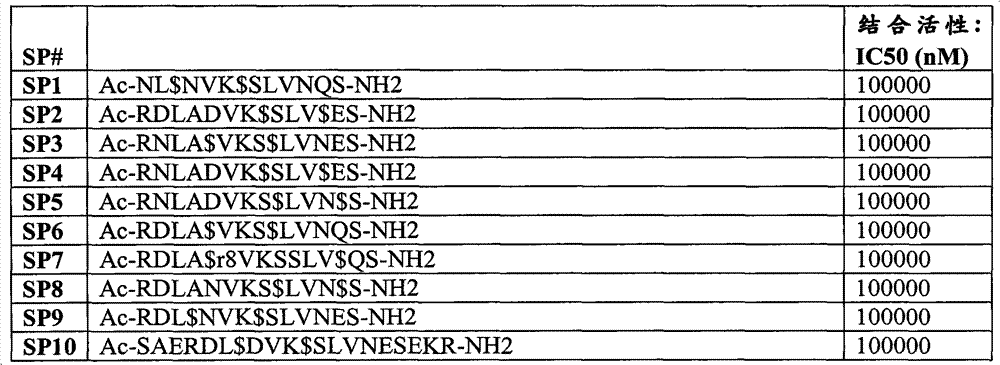
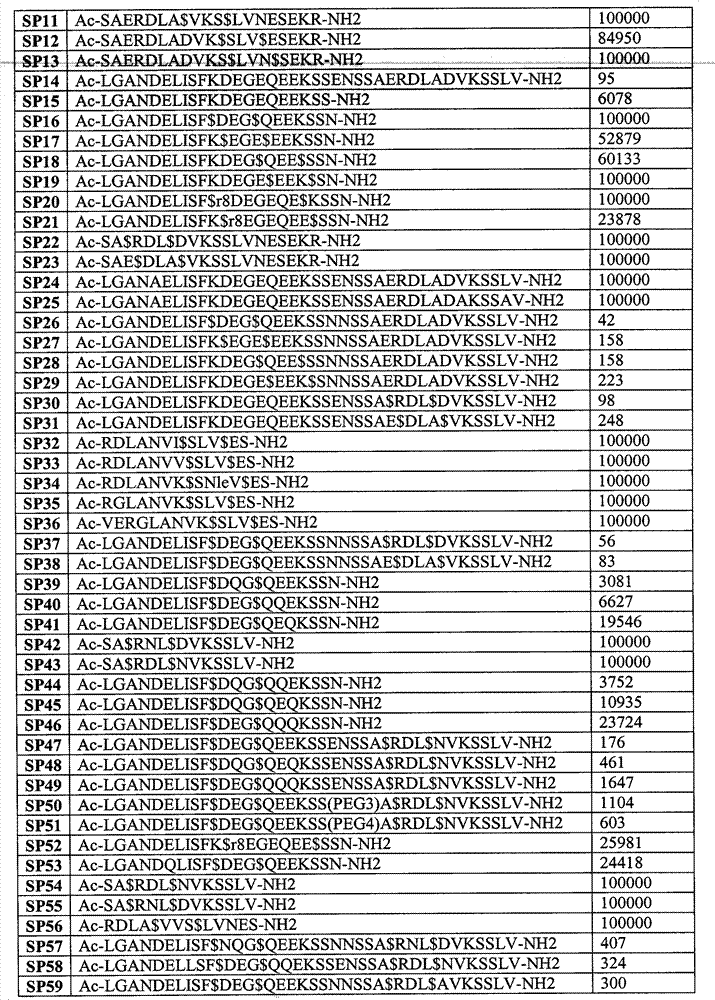

实施例3.TCf4/β-连环蛋白活性的HEK293T-3XTCF瞬时报道子试Example 3. HEK293T-3XTCF transient reporter test for TCf4/β-catenin activity 验test
在补充有1%抗霉菌-抗生素悬浮液的DMEM/10%FBS培养基中培养的HEK-293T细胞在转染前一天以每个100mm培养皿400万个细胞的密度接种。使细胞在37℃、5%CO2的孵箱中达到大约60%汇合过夜。在转染当天,洗涤细胞,并按照厂商的瞬时转染说明,使用Fugene 6转染试剂(Roche目录#11814443001),用3XTCF-luc报道子(Millipore,目录#21-170)(14.25μg)和pRL-TK(renilla-Luc)报道子(Promega Inc,目录#E224A)(0.75μg)的组合以3∶1(Fugene∶DNA)的比例瞬时转染。简言之,将45μl Fugene在OptiMem中稀释,并加入总共15μg DNA。在无血清条件下在室温形成复合体30分钟,将其加至于DMEM-10%FBS培养基(不合抗生素或选择剂)中的细胞中。将培养板放回孵箱中放置24小时。不使用DNA进行转染的假转染板作为阴性对照保持。在转染后24小时,收获细胞,洗涤并计数。然后将细胞在OptiMem(不含血清)或加有特定%的FBS的OptiMem中以20,000个细胞/60μl/孔的密度接种在96孔板中。用无菌水将拟肽大环化合物由10mM DMSO储备液稀释为8×工作储备液。在DMSO-水溶剂中进行进一步稀释,以使DMSO的终浓度在所有孔中保持恒定。向各孔中加入10μl稀释的大环化合物(10×希望的浓度)。作为基准分子,使用浓度范围为20μM-0.4μM的NO-阿司匹林。使用2μM终浓度的GSK-3b-抑制剂IV(BIO,CalBiochem目录#.361550))激活β-连环蛋白信号转录途径。在大环化合物处理24小时和/或48小时后,使用Dual-Glo萤光素酶测定系统(Promega,目录#E2940),按照厂商说明,用SynergyMultiplate读数仪测定TCF活性报道子。针对用Bio刺激的DMSO处理的细胞计算对报道子活性的抑制。HEK-293T cells cultured in DMEM/10% FBS medium supplemented with 1% antimycotic-antibiotic suspension were seeded at a density of 4 million cells per 100 mm dish one day before transfection. Allow cells to reach approximately 60% confluency overnight in a 37°C, 5% CO2 incubator. On the day of transfection, cells were washed and followed the manufacturer's instructions for transient transfection using Fugene 6 transfection reagent (Roche catalog #11814443001) with 3XTCF-luc reporter (Millipore, catalog #21-170) (14.25 μg) and A combination of pRL-TK (renilla-Luc) reporter (Promega Inc, catalog #E224A) (0.75 μg) was transiently transfected at a ratio of 3:1 (Fugene:DNA). Briefly, 45 μl Fugene was diluted in OptiMem and a total of 15 μg DNA was added. Complexes were formed under serum-free conditions at room temperature for 30 minutes and added to cells in DMEM-10% FBS medium (without antibiotics or selection agents). Return the plate to the incubator for 24 hours. Mock-transfected plates transfected without DNA were kept as negative controls. Twenty-four hours after transfection, cells were harvested, washed and counted. Cells were then seeded in 96-well plates at a density of 20,000 cells/60 μl/well in OptiMem (serum-free) or OptiMem plus the specified % FBS. The peptidomimetic macrocycle was diluted from a 10 mM DMSO stock solution to an 8X working stock solution with sterile water. Further dilutions were made in DMSO-water solvent so that the final concentration of DMSO was kept constant in all wells. 10 [mu]l of diluted macrocycle (1Ox desired concentration) was added to each well. As a reference molecule, NO-aspirin was used at a concentration ranging from 20 μM to 0.4 μM. The β-catenin signaling transcriptional pathway was activated using GSK-3b-Inhibitor IV (BIO, CalBiochem catalog #.361550)) at a final concentration of 2 μM. After 24 hours and/or 48 hours of macrocycle treatment, the TCF activity reporter was assayed with a Synergy Multiplate reader using the Dual-Glo Luciferase Assay System (Promega, Cat #E2940) following the manufacturer's instructions. Inhibition of reporter activity was calculated for cells treated with Bio-stimulated DMSO.
虽然本文已显示和描述了本发明的优选实施方案,但是对于本领域的技术人员显而易见的是,这些实施方案只是以举例的方式提供。在不背离本发明的情况下,本领域技术人员可以想到许多变化、改变和替换。应当理解,在实施本发明时,可以采用本文所述的本发明的实施方案的各种替代方案。旨在用下列权利要求限定本发明的范围,并且这些权利要求范围内的方法和结构及其等效形式也涵盖在本发明内。While preferred embodiments of the present invention have been shown and described herein, it will be obvious to those skilled in the art that these embodiments are provided by way of example only. Numerous variations, changes and substitutions will occur to those skilled in the art without departing from the invention. It should be understood that various alternatives to the embodiments of the invention described herein may be employed in practicing the invention. It is intended that the scope of the invention be defined by the following claims and that methods and structures within the scope of these claims and their equivalents be covered therein.
Claims (21)


Applications Claiming Priority (3)
| Application Number | Priority Date | Filing Date | Title |
|---|---|---|---|
| US24481909P | 2009-09-22 | 2009-09-22 | |
| US61/244,819 | 2009-09-22 | ||
| PCT/US2010/049892 WO2011038049A1 (en) | 2009-09-22 | 2010-09-22 | Peptidomimetic macrocycles |
Publications (1)
| Publication Number | Publication Date |
|---|---|
| CN102712675A true CN102712675A (en) | 2012-10-03 |
Family
ID=43796193
Family Applications (1)
| Application Number | Title | Priority Date | Filing Date |
|---|---|---|---|
| CN2010800479181A Pending CN102712675A (en) | 2009-09-22 | 2010-09-22 | Peptidomimetic macrocycles |
Country Status (7)
| Country | Link |
|---|---|
| US (3) | US20130072439A1 (en) |
| EP (1) | EP2480565A4 (en) |
| JP (1) | JP2013505300A (en) |
| CN (1) | CN102712675A (en) |
| AU (1) | AU2010298338A1 (en) |
| CA (1) | CA2774973A1 (en) |
| WO (1) | WO2011038049A1 (en) |
Cited By (2)
| Publication number | Priority date | Publication date | Assignee | Title |
|---|---|---|---|---|
| CN107106642A (en) * | 2014-09-24 | 2017-08-29 | 艾瑞朗医疗公司 | Peptidomimetic macrocyclic compounds and preparations thereof |
| CN113557030A (en) * | 2018-11-21 | 2021-10-26 | 恩多梅特生物科学公司 | Compositions and methods for treating endometriosis |
Families Citing this family (35)
| Publication number | Priority date | Publication date | Assignee | Title |
|---|---|---|---|---|
| WO2008076904A1 (en) | 2006-12-14 | 2008-06-26 | Aileron Therapeutics, Inc. | Bis-sulfhydryl macrocyclization systems |
| WO2008095063A1 (en) | 2007-01-31 | 2008-08-07 | Dana-Farber Cancer Institute, Inc. | Stabilized p53 peptides and uses thereof |
| EP2564862B1 (en) | 2007-02-23 | 2017-08-02 | Aileron Therapeutics, Inc. | Substituted amino acids for preparing triazole linked macrocyclic peptides |
| ES2430067T3 (en) | 2007-03-28 | 2013-11-18 | President And Fellows Of Harvard College | Sewn polypeptides |
| EP2342222B1 (en) | 2008-09-22 | 2018-03-21 | Aileron Therapeutics, Inc. | Peptidomimetic macrocycles |
| US9458202B2 (en) | 2008-11-24 | 2016-10-04 | Aileron Therapeutics, Inc. | Peptidomimetic macrocycles with improved properties |
| BRPI1006139A2 (en) | 2009-01-14 | 2017-05-30 | Aileron Therapeutics Inc | peptidomimetic macrocycles |
| CN102712675A (en) * | 2009-09-22 | 2012-10-03 | 爱勒让治疗公司 | Peptidomimetic macrocycles |
| DK2603600T3 (en) | 2010-08-13 | 2019-03-04 | Aileron Therapeutics Inc | PEPTIDOMIMETIC MACROCYCLES |
| US9428845B1 (en) | 2010-12-28 | 2016-08-30 | Warp Drive Bio, Inc. | Identifying new therapeutic agents |
| CA2852468A1 (en) | 2011-10-18 | 2013-04-25 | Aileron Therapeutics, Inc. | Peptidomimetic macrocyles |
| US20140275295A1 (en) * | 2011-10-19 | 2014-09-18 | Hiroyuki Kouji | Method for treating type i and type ii diabetes |
| SG10201606775YA (en) | 2012-02-15 | 2016-10-28 | Aileron Therapeutics Inc | Peptidomimetic macrocycles |
| HK1205454A1 (en) | 2012-02-15 | 2015-12-18 | Aileron Therapeutics, Inc. | Triazole-crosslinked and thioether-crosslinked peptidomimetic macrocycles |
| US20150011728A1 (en) * | 2012-02-22 | 2015-01-08 | New York University | Reversibly crosslinked helical hydrogen bond surrogate macrocycles |
| CA2887285A1 (en) | 2012-11-01 | 2014-05-08 | Aileron Therapeutics, Inc. | Disubstituted amino acids and methods of preparation and use thereof |
| WO2014138429A2 (en) | 2013-03-06 | 2014-09-12 | Aileron Therapeutics, Inc. | Peptidomimetic macrocycles and use thereof in regulating hif1alpha |
| US10294273B2 (en) * | 2014-04-02 | 2019-05-21 | University Of Rochester | Macrocyclic peptidomimetics for alpha-helix mimicry |
| JP2017533889A (en) | 2014-09-24 | 2017-11-16 | エルロン・セラピューティクス・インコーポレイテッドAileron Therapeutics,Inc. | Peptidomimetic macrocycles and uses thereof |
| US10533016B2 (en) | 2015-01-09 | 2020-01-14 | Revolution Medicines, Inc. | Compounds that participate in cooperative binding and uses thereof |
| TW201629069A (en) | 2015-01-09 | 2016-08-16 | 霍普驅動生物科技股份有限公司 | Compounds that participate in synergistic combination and their uses |
| JP2018516844A (en) | 2015-03-20 | 2018-06-28 | エルロン・セラピューティクス・インコーポレイテッドAileron Therapeutics,Inc. | Peptidomimetic macrocycles and uses thereof |
| US10059741B2 (en) | 2015-07-01 | 2018-08-28 | Aileron Therapeutics, Inc. | Peptidomimetic macrocycles |
| EP3347372A4 (en) | 2015-09-10 | 2019-09-04 | Aileron Therapeutics, Inc. | PEPTIDOMIMETIC MACROCYCLES AS MODULATORS OF MCL-1 |
| EP4242304A3 (en) | 2015-10-01 | 2024-02-07 | Revolution Medicines, Inc. | Methods and reagents for analyzing protein-protein interfaces |
| MA44680A (en) | 2016-04-12 | 2019-02-20 | Warp Drive Bio Inc | COMPOSITIONS AND PROCESSES FOR THE PRODUCTION OF COMPOUNDS |
| JP2020501519A (en) | 2016-10-28 | 2020-01-23 | ギンゴー バイオワークス, インコーポレイテッド | Compositions and methods for the production of compounds |
| WO2020023502A1 (en) | 2018-07-23 | 2020-01-30 | Aileron Therapeutics, Inc. | Peptidomimetic macrocycles and uses thereof |
| CN110833549B (en) * | 2018-08-15 | 2023-05-02 | 广西梧州制药(集团)股份有限公司 | Use of pyrazolopyrimidine derivative for the treatment of chronic pelvic inflammatory disease |
| KR20220109408A (en) | 2019-11-04 | 2022-08-04 | 레볼루션 메디슨즈, 인크. | RAS inhibitors |
| CN114901366A (en) | 2019-11-04 | 2022-08-12 | 锐新医药公司 | RAS inhibitors |
| PH12022550988A1 (en) | 2019-11-04 | 2023-10-09 | Revolution Medicines Inc | Ras inhibitors |
| IL301298A (en) | 2020-09-15 | 2023-05-01 | Revolution Medicines Inc | Indole derivatives as ras inhibitors in the treatment of cancer |
| AR125787A1 (en) | 2021-05-05 | 2023-08-16 | Revolution Medicines Inc | RAS INHIBITORS |
| AR127308A1 (en) | 2021-10-08 | 2024-01-10 | Revolution Medicines Inc | RAS INHIBITORS |
Family Cites Families (204)
| Publication number | Priority date | Publication date | Assignee | Title |
|---|---|---|---|---|
| US4000259A (en) | 1975-06-16 | 1976-12-28 | American Home Products Corporation | Cyclic dodecapeptide analogs of somatostatin and intermediates |
| US4191754A (en) | 1979-02-28 | 1980-03-04 | Merck & Co., Inc. | Bicyclic somatostatin analogs |
| US4270537A (en) | 1979-11-19 | 1981-06-02 | Romaine Richard A | Automatic hypodermic syringe |
| AU550730B2 (en) | 1982-03-09 | 1986-04-10 | Commonwealth Of Australia, The | Automated metal detection |
| US4596556A (en) | 1985-03-25 | 1986-06-24 | Bioject, Inc. | Hypodermic injection apparatus |
| US4730006A (en) | 1986-01-27 | 1988-03-08 | Merrell Dow Pharmaceuticals Inc. | Derivatives of 2,6-diamino-3-haloheptanedioic acid |
| US4886499A (en) | 1986-12-18 | 1989-12-12 | Hoffmann-La Roche Inc. | Portable injection appliance |
| GB8704027D0 (en) | 1987-02-20 | 1987-03-25 | Owen Mumford Ltd | Syringe needle combination |
| US4790824A (en) | 1987-06-19 | 1988-12-13 | Bioject, Inc. | Non-invasive hypodermic injection device |
| US4941880A (en) | 1987-06-19 | 1990-07-17 | Bioject, Inc. | Pre-filled ampule and non-invasive hypodermic injection device assembly |
| US4940460A (en) | 1987-06-19 | 1990-07-10 | Bioject, Inc. | Patient-fillable and non-invasive hypodermic injection device assembly |
| US5339163A (en) | 1988-03-16 | 1994-08-16 | Canon Kabushiki Kaisha | Automatic exposure control device using plural image plane detection areas |
| AU3439589A (en) | 1988-03-24 | 1989-10-16 | Terrapin Diagnostics, Inc. | Molecular sticks for controlling protein conformation |
| FR2638359A1 (en) | 1988-11-03 | 1990-05-04 | Tino Dalto | SYRINGE GUIDE WITH ADJUSTMENT OF DEPTH DEPTH OF NEEDLE IN SKIN |
| US5120859A (en) | 1989-09-22 | 1992-06-09 | Genentech, Inc. | Chimeric amino acid analogues |
| US5650133A (en) | 1990-01-19 | 1997-07-22 | Nycomed Salutar | Macrocyclic polyaza dichelates linked through ring nitrogens via an amide or ester functionality |
| US5712418A (en) | 1989-10-23 | 1998-01-27 | Research Corporation Technologies, Inc. | Synthesis and use of amino acid fluorides as peptide coupling reagents |
| US5312335A (en) | 1989-11-09 | 1994-05-17 | Bioject Inc. | Needleless hypodermic injection device |
| US5064413A (en) | 1989-11-09 | 1991-11-12 | Bioject, Inc. | Needleless hypodermic injection device |
| US5245009A (en) | 1990-03-23 | 1993-09-14 | The Salk Institute For Biological Studies | CRF antagonists |
| CA2047042A1 (en) | 1990-07-19 | 1992-01-20 | John Hannah | Cyclic hiv principal neutralizing determinant peptides |
| US5190521A (en) | 1990-08-22 | 1993-03-02 | Tecnol Medical Products, Inc. | Apparatus and method for raising a skin wheal and anesthetizing skin |
| EP0488258B1 (en) | 1990-11-27 | 1996-04-17 | Fuji Photo Film Co., Ltd. | Propenamide derivatives, polymers, copolymers and use thereof |
| US5527288A (en) | 1990-12-13 | 1996-06-18 | Elan Medical Technologies Limited | Intradermal drug delivery device and method for intradermal delivery of drugs |
| US5364851A (en) | 1991-06-14 | 1994-11-15 | International Synthecon, Llc | Conformationally restricted biologically active peptides, methods for their production and uses thereof |
| CA2072249C (en) | 1991-06-28 | 2003-06-17 | Saiko Hosokawa | Human monoclonal antibody specifically binding to surface antigen of cancer cell membrane |
| GB9114949D0 (en) | 1991-07-11 | 1991-08-28 | Smithkline Beecham Plc | Novel compounds |
| GB9118204D0 (en) | 1991-08-23 | 1991-10-09 | Weston Terence E | Needle-less injector |
| SE9102652D0 (en) | 1991-09-13 | 1991-09-13 | Kabi Pharmacia Ab | INJECTION NEEDLE ARRANGEMENT |
| US5328483A (en) | 1992-02-27 | 1994-07-12 | Jacoby Richard M | Intradermal injection device with medication and needle guard |
| EP1253156A3 (en) | 1992-04-03 | 2004-01-07 | California Institute Of Technology | High activity ruthenium or osmium metal carbene complexes for olefin metathesis reactions and synthesis and application thereof |
| US5411860A (en) | 1992-04-07 | 1995-05-02 | The Johns Hopkins University | Amplification of human MDM2 gene in human tumors |
| US5383851A (en) | 1992-07-24 | 1995-01-24 | Bioject Inc. | Needleless hypodermic injection device |
| US5569189A (en) | 1992-09-28 | 1996-10-29 | Equidyne Systems, Inc. | hypodermic jet injector |
| US5334144A (en) | 1992-10-30 | 1994-08-02 | Becton, Dickinson And Company | Single use disposable needleless injector |
| CA2161108A1 (en) | 1993-04-23 | 1994-11-10 | Herbert J. Evans | Polypeptides that include conformation-constraining groups which flank a protein-protein interaction site |
| US5446128A (en) | 1993-06-18 | 1995-08-29 | The Board Of Trustees Of The University Of Illinois | Alpha-helix mimetics and methods relating thereto |
| US5622852A (en) | 1994-10-31 | 1997-04-22 | Washington University | Bcl-x/Bcl-2 associated cell death regulator |
| US5536814A (en) | 1993-09-27 | 1996-07-16 | La Jolla Cancer Research Foundation | Integrin-binding peptides |
| US6287787B1 (en) | 1993-11-24 | 2001-09-11 | Torrey Pines Institute For Molecular Studies | Dimeric oligopeptide mixture sets |
| WO1995024176A1 (en) | 1994-03-07 | 1995-09-14 | Bioject, Inc. | Ampule filling device |
| US5466220A (en) | 1994-03-08 | 1995-11-14 | Bioject, Inc. | Drug vial mixing and transfer device |
| US5824483A (en) | 1994-05-18 | 1998-10-20 | Pence Inc. | Conformationally-restricted combinatiorial library composition and method |
| IL109943A (en) | 1994-06-08 | 2006-08-01 | Develogen Israel Ltd | Conformationally constrained backbone cyclized peptide analogs |
| US6407059B1 (en) | 1994-06-08 | 2002-06-18 | Peptor Limited | Conformationally constrained backbone cyclized peptide analogs |
| US5807746A (en) | 1994-06-13 | 1998-09-15 | Vanderbilt University | Method for importing biologically active molecules into cells |
| US7553929B2 (en) | 1994-06-13 | 2009-06-30 | Vanderbilt University | Cell permeable peptides for inhibition of inflammatory reactions and methods of use |
| US5770377A (en) | 1994-07-20 | 1998-06-23 | University Of Dundee | Interruption of binding of MDM2 and P53 protein and therapeutic application thereof |
| CN1132012C (en) | 1994-09-19 | 2003-12-24 | 里卡尔多·J·莫罗 | Cancer Detection and Treatment |
| US5599302A (en) | 1995-01-09 | 1997-02-04 | Medi-Ject Corporation | Medical injection system and method, gas spring thereof and launching device using gas spring |
| US6169073B1 (en) | 1995-02-16 | 2001-01-02 | Bayer Corporation | Peptides and peptidomimetics with structural similarity to human p53 that activate p53 function |
| EP0729972A1 (en) | 1995-02-28 | 1996-09-04 | F. Hoffmann-La Roche Ag | Peptide derivatives of tetrahydronaphthalene |
| US5675001A (en) | 1995-03-14 | 1997-10-07 | Hoffman/Barrett, L.L.C. | Heteroatom-functionalized porphyrazines and multimetallic complexes and polymers derived therefrom |
| US5731408A (en) | 1995-04-10 | 1998-03-24 | Arizona Board Of Regents On Behalf Of The University Of Arizona | Peptides having potent antagonist and agonist bioactivities at melanocortin receptors |
| US6054556A (en) | 1995-04-10 | 2000-04-25 | The Arizona Board Of Regents On Behalf Of The University Of Arizona | Melanocortin receptor antagonists and agonists |
| US5672584A (en) | 1995-04-25 | 1997-09-30 | The University Of Kansas | Cyclic prodrugs of peptides and peptide nucleic acids having improved metabolic stability and cell membrane permeability |
| US6184344B1 (en) | 1995-05-04 | 2001-02-06 | The Scripps Research Institute | Synthesis of proteins by native chemical ligation |
| SI0832096T1 (en) | 1995-05-04 | 2001-12-31 | Scripps Research Inst | Synthesis of proteins by native chemical ligation |
| US5730723A (en) | 1995-10-10 | 1998-03-24 | Visionary Medical Products Corporation, Inc. | Gas pressured needle-less injection device and method |
| US5817789A (en) | 1995-06-06 | 1998-10-06 | Transkaryotic Therapies, Inc. | Chimeric proteins for use in transport of a selected substance into cells |
| US6051554A (en) | 1995-06-07 | 2000-04-18 | Peptor Limited | Conformationally constrained backbone cyclized somatostatin analogs |
| US5811515A (en) | 1995-06-12 | 1998-09-22 | California Institute Of Technology | Synthesis of conformationally restricted amino acids, peptides, and peptidomimetics by catalytic ring closing metathesis |
| US5840833A (en) | 1995-10-27 | 1998-11-24 | Molecumetics, Ltd | Alpha-helix mimetics and methods relating thereto |
| US5849954A (en) | 1996-01-18 | 1998-12-15 | Research Corporation Technologies, Inc. | Method of peptide synthesis |
| US5849691A (en) | 1996-02-20 | 1998-12-15 | The United States Of America As Represented By The Department Of Health And Human Services | Peptidomimetic inhibitors of cathepsin D and plasmepsins I and II |
| GB9607549D0 (en) | 1996-04-11 | 1996-06-12 | Weston Medical Ltd | Spring-powered dispensing device |
| US5817752A (en) | 1996-06-06 | 1998-10-06 | La Jolla Pharmaceutical Company | Cyclic polypeptides comprising a thioether linkage and methods for their preparation |
| US5663316A (en) | 1996-06-18 | 1997-09-02 | Clontech Laboratories, Inc. | BBC6 gene for regulation of cell death |
| US7083983B2 (en) | 1996-07-05 | 2006-08-01 | Cancer Research Campaign Technology Limited | Inhibitors of the interaction between P53 and MDM2 |
| WO1998001467A2 (en) | 1996-07-05 | 1998-01-15 | Novartis Ag | Inhibitors of the interaction between p53 and mdm2 |
| AU722985B2 (en) * | 1996-07-12 | 2000-08-17 | Mcgill University | Compounds and methods for modulating cell adhesion |
| US5955593A (en) | 1996-09-09 | 1999-09-21 | Washington University | BH3 interacting domain death agonist |
| US20020064546A1 (en) | 1996-09-13 | 2002-05-30 | J. Milton Harris | Degradable poly(ethylene glycol) hydrogels with controlled half-life and precursors therefor |
| US5965703A (en) | 1996-09-20 | 1999-10-12 | Idun Pharmaceuticals | Human bad polypeptides, encoding nucleic acids and methods of use |
| US5856445A (en) | 1996-10-18 | 1999-01-05 | Washington University | Serine substituted mutants of BCL-XL /BCL-2 associated cell death regulator |
| US6271198B1 (en) | 1996-11-06 | 2001-08-07 | Genentech, Inc. | Constrained helical peptides and methods of making same |
| EP0948343B1 (en) | 1996-11-21 | 2006-02-08 | Promega Corporation | Alkyl peptide amides adapted for topical administration |
| EA199900752A1 (en) | 1997-02-20 | 2000-06-26 | Йеда Рисерч Энд Дивелопмент Ко. Лтд. | ANTIPATOGENIC SYNTHETIC PEPTIDES AND COMPOSITIONS INCLUDING THEM |
| US6849428B1 (en) | 1997-03-05 | 2005-02-01 | New England Biolabs, Inc. | Intein-mediated protein ligation of expressed proteins |
| US5851775A (en) * | 1997-03-20 | 1998-12-22 | Johns Hopkins University | β-catenin, Tcf-4, and APC interact to prevent cancer |
| CA2286867A1 (en) | 1997-04-11 | 1998-10-22 | Eli Lilly And Company | Combinatorial libraries of peptidomimetic macrocycles and processes therefor |
| US5993412A (en) | 1997-05-19 | 1999-11-30 | Bioject, Inc. | Injection apparatus |
| US7064193B1 (en) | 1997-09-17 | 2006-06-20 | The Walter And Eliza Hall Institute Of Medical Research | Therapeutic molecules |
| US6165732A (en) | 1997-10-14 | 2000-12-26 | Washington University | Method for identifying apoptosis modulating compounds |
| US6875594B2 (en) | 1997-11-13 | 2005-04-05 | The Rockefeller University | Methods of ligating expressed proteins |
| CA2316834C (en) | 1998-01-07 | 2006-01-03 | Shearwater Polymers, Inc. | Degradable heterobifunctional poly(ethylene glycol) acrylates and gels and conjugates derived therefrom |
| IT1298087B1 (en) | 1998-01-08 | 1999-12-20 | Fiderm S R L | DEVICE FOR CHECKING THE PENETRATION DEPTH OF A NEEDLE, IN PARTICULAR APPLICABLE TO A SYRINGE FOR INJECTIONS |
| US6030997A (en) | 1998-01-21 | 2000-02-29 | Eilat; Eran | Acid labile prodrugs |
| EP1054899A2 (en) * | 1998-02-21 | 2000-11-29 | Max-Delbrück-Centrum Für Molekulare Medizin | AGENTS FOR TREATING HUMAN ILLNESSES BASED ON $g(b)-CATENIN, AND THE PRODUCTION AND USE THEREOF |
| AU767185B2 (en) | 1998-03-23 | 2003-11-06 | President And Fellows Of Harvard College | Synthesis of compounds and libraries of compounds |
| EP1093458A4 (en) | 1998-04-15 | 2001-07-18 | Aventis Pharm Prod Inc | Process for the preparation of resin-bound cyclic peptides |
| US6277824B1 (en) * | 1998-07-10 | 2001-08-21 | Adherex Technologies | Compounds and methods for modulating adhesion molecule function |
| US6326354B1 (en) | 1998-08-19 | 2001-12-04 | Washington University | Modulation of apoptosis with bid |
| US7173005B2 (en) | 1998-09-02 | 2007-02-06 | Antyra Inc. | Insulin and IGF-1 receptor agonists and antagonists |
| US6572856B1 (en) | 1998-09-10 | 2003-06-03 | The University Of Virginia Patent Foundation | Methods for the prevention and treatment of cancer using anti-C3b(i) antibodies |
| EP1216309A2 (en) | 1999-03-01 | 2002-06-26 | Variagenics, Inc. | Methods for targeting rna molecules |
| IL145406A0 (en) | 1999-03-29 | 2002-06-30 | Procter & Gamble | Melanocortin receptor ligands |
| US6713280B1 (en) | 1999-04-07 | 2004-03-30 | Thomas Jefferson University | Enhancement of peptide cellular uptake |
| US7192713B1 (en) | 1999-05-18 | 2007-03-20 | President And Fellows Of Harvard College | Stabilized compounds having secondary structure motifs |
| CA2284459C (en) * | 1999-10-04 | 2012-12-11 | Neokimia Inc. | Combinatorial synthesis of libraries of macrocyclic compounds useful in drug discovery |
| US6348558B1 (en) | 1999-12-10 | 2002-02-19 | Shearwater Corporation | Hydrolytically degradable polymers and hydrogels made therefrom |
| AU2001231154A1 (en) * | 2000-01-24 | 2001-07-31 | Adherex Technologies Inc. | Peptidomimetic modulators of cell adhesion |
| DE10009341A1 (en) | 2000-02-22 | 2001-09-06 | Florian Kern | Method for antigen-specific stimulation of T lymphocytes |
| US6495674B1 (en) | 2000-02-25 | 2002-12-17 | The Salk Institute For Biological Studies | Evectins and their use |
| US7049290B2 (en) | 2000-07-28 | 2006-05-23 | Universität Zürich | Essential downstream component of the wingless signaling pathway and therapeutic and diagnostic applications based thereon |
| US6703382B2 (en) | 2000-08-16 | 2004-03-09 | Georgetown University Medical Center | Small molecule inhibitors targeted at Bcl-2 |
| AU2002217970A1 (en) * | 2000-11-28 | 2002-06-11 | Curis, Inc. | Wnt signalling assay, methods and uses thereof |
| WO2002064790A2 (en) | 2000-12-19 | 2002-08-22 | The Johns Hopkins University | Jfy1 protein induces rapid apoptosis |
| AU2002252246A1 (en) | 2001-03-09 | 2002-09-24 | University Of Louisville | Helicomimetics and stabilized lxxll peptidomimetics |
| US20040106548A1 (en) | 2001-09-07 | 2004-06-03 | Schmidt Michelle A | Conformationally constrained labeled peptides for imaging and therapy |
| EP1469871A4 (en) | 2001-12-31 | 2006-08-23 | Dana Farber Cancer Inst Inc | METHOD FOR TREATING APOPTOSIS AND COMPOSITIONS THEREFOR |
| AU2003207940A1 (en) | 2002-01-03 | 2003-07-30 | Yissum Research Development Company Of The Hebrew University Of Jerusalem | Conformationally constrained c-backbone cyclic peptides |
| WO2003070892A2 (en) | 2002-02-15 | 2003-08-28 | The Regents Of The University Of Michigan | Inhibitors of rgs proteins |
| US20030166138A1 (en) | 2002-02-21 | 2003-09-04 | Todd Kinsella | Cyclic peptides and analogs useful to treat allergies |
| ATE394674T1 (en) | 2002-04-22 | 2008-05-15 | Univ Florida | FUNCTIONALIZED NANOPARTICLES AND METHODS OF USE |
| EP2226316B1 (en) | 2002-05-30 | 2016-01-13 | The Scripps Research Institute | Copper-catalysed ligation of azides and acetylenes |
| SE0201863D0 (en) | 2002-06-18 | 2002-06-18 | Cepep Ab | Cell penetrating peptides |
| EP1541692A1 (en) | 2002-09-06 | 2005-06-15 | Kaneka Corporation | PROCESS FOR PRODUCING L-a-METHYLCYSTEINE DERIVATIVE |
| EP1590363A4 (en) | 2002-09-09 | 2006-11-02 | Dana Farber Cancer Inst Inc | PEPTIDES BH3 AND METHODS OF USE |
| PT1562941E (en) | 2002-11-07 | 2010-01-25 | Kosan Biosciences Inc | Trans-9,10-dehydroepothilone c and d, analogs thereof and methos of making the same |
| EP1572203B1 (en) | 2002-11-08 | 2007-11-07 | F. Hoffmann-La Roche Ag | Substituted 4-alkoxyoxazol derivatives as ppar agonists |
| US7166575B2 (en) | 2002-12-17 | 2007-01-23 | Nastech Pharmaceutical Company Inc. | Compositions and methods for enhanced mucosal delivery of peptide YY and methods for treating and preventing obesity |
| US20070032417A1 (en) | 2002-12-24 | 2007-02-08 | Walter And Eliza Hall Institute Of Medical Research | Peptides and therapeutic uses thereof |
| EP1452868A2 (en) | 2003-02-27 | 2004-09-01 | Pepscan Systems B.V. | Method for selecting a candidate drug compound |
| AU2003902743A0 (en) | 2003-06-02 | 2003-06-19 | Promics Pty Limited | Process for the preparation of cyclic peptides |
| WO2005007675A2 (en) | 2003-07-09 | 2005-01-27 | The Scripps Research Institute | TRIAZOLE ϵ-AMINO ACIDS |
| GB0317815D0 (en) | 2003-07-30 | 2003-09-03 | Amersham Health As | Imaging agents |
| US7829597B2 (en) | 2003-10-03 | 2010-11-09 | Merck, Sharp & Dohme, Inc. | Benzylether and benzylamino beta-secretase inhibitors for the treatment of alzheimer's disease |
| JP2007537989A (en) | 2003-10-16 | 2007-12-27 | アプラーゲン ゲゼルシャフト ミット ベシュレンクテル ハフツング | Stabilizing peptide |
| CN107090025A (en) * | 2003-11-05 | 2017-08-25 | 达纳-法伯癌症研究所股份有限公司 | Stable alpha helical peptides and application thereof |
| GB0404731D0 (en) | 2004-03-03 | 2004-04-07 | Indp Administrative Inst Nims | Method and products for the selective degradation of proteins |
| WO2005090388A1 (en) | 2004-03-19 | 2005-09-29 | The University Of Queensland | Alpha helical mimics, their uses and methods for their production |
| WO2005118620A2 (en) | 2004-05-27 | 2005-12-15 | New York University | Methods for preparing internally constraied peptides and peptidomimetics |
| WO2005118634A2 (en) | 2004-06-04 | 2005-12-15 | The Brigham And Women's Hospital, Inc. | Helical peptidomimetics with enhanced activity against beta-amyloid production |
| EP1602663A1 (en) | 2004-06-04 | 2005-12-07 | Chiralix B.V. | Triazole-linked glycoamino acids and glycopeptides |
| CN100335467C (en) | 2004-06-04 | 2007-09-05 | 中国科学院上海有机化学研究所 | Synthesis of 5-iodo-1,4-twice substituted-1,2,3-trioxazole compound |
| WO2006050034A1 (en) | 2004-10-29 | 2006-05-11 | Schering Corporation | Substituted 5-carboxyamide pyrazoles and [1,2,4]triazoles as antiviral agents |
| WO2006069001A2 (en) | 2004-12-20 | 2006-06-29 | Baylor College Of Medicine | Structural requirements for stat3 binding and recruitment to phosphototyrosine ligands |
| AU2006206848B2 (en) | 2005-01-24 | 2012-05-31 | Pepscan Systems B.V. | Binding compounds, immunogenic compounds and peptidomimetics |
| WO2006103666A2 (en) | 2005-03-28 | 2006-10-05 | Yeda Research And Development Co. Ltd. | Isolated bid polypeptides, polynucleotides encoding same and antibodies directed thereagainst and methods of using same for inducing cell cycle arrest or apoptosis |
| US20070020620A1 (en) | 2005-07-14 | 2007-01-25 | Finn M G | Compositions and methods for coupling a plurality of compounds to a scaffold |
| US20070161544A1 (en) | 2006-01-06 | 2007-07-12 | Peter Wipf | Selective targeting agents for mitcochondria |
| US7538190B2 (en) | 2006-02-17 | 2009-05-26 | Polychip Pharmaceuticals Pty Ltd | Methods for the synthesis of two or more dicarba bridges in organic compounds |
| US7745573B2 (en) | 2006-02-17 | 2010-06-29 | Polychip Pharmaceuticals Pty Ltd. | Conotoxin analogues and methods for synthesis of intramolecular dicarba bridge-containing peptides |
| GB0611405D0 (en) | 2006-06-09 | 2006-07-19 | Univ Belfast | FKBP-L: A novel inhibitor of angiogenesis |
| US20080213175A1 (en) | 2006-09-15 | 2008-09-04 | Kolb Hartmuth C | Click chemistry-derived cyclic peptidomimetics as integrin markers |
| US7897394B2 (en) | 2006-09-21 | 2011-03-01 | Intrexon Corporation | Endoplasmic reticulum localization signals |
| JP2010510236A (en) | 2006-11-15 | 2010-04-02 | ダナ−ファーバー キャンサー インスティテュート インク. | Stabilized MAML peptides and methods of use thereof |
| WO2008076904A1 (en) | 2006-12-14 | 2008-06-26 | Aileron Therapeutics, Inc. | Bis-sulfhydryl macrocyclization systems |
| US7981998B2 (en) | 2006-12-14 | 2011-07-19 | Aileron Therapeutics, Inc. | Bis-sulfhydryl macrocyclization systems |
| WO2008095063A1 (en) | 2007-01-31 | 2008-08-07 | Dana-Farber Cancer Institute, Inc. | Stabilized p53 peptides and uses thereof |
| EP2564862B1 (en) | 2007-02-23 | 2017-08-02 | Aileron Therapeutics, Inc. | Substituted amino acids for preparing triazole linked macrocyclic peptides |
| ES2430067T3 (en) | 2007-03-28 | 2013-11-18 | President And Fellows Of Harvard College | Sewn polypeptides |
| EP2152294B1 (en) | 2007-05-02 | 2017-07-26 | Dana-Farber Cancer Institute, Inc. | A bad bh3 domain peptide for use in treating or delaying the onset of diabetes. |
| US8921323B2 (en) | 2007-09-26 | 2014-12-30 | Dana Farber Cancer Institute, Inc. | Methods and compositions for modulating BCL-2 family polypeptides |
| US8871899B2 (en) | 2007-12-31 | 2014-10-28 | New York University | Control of viral-host membrane fusion with hydrogen bond surrogate-based artificial helices |
| SI2235064T1 (en) | 2008-01-07 | 2016-04-29 | Amgen Inc. | Method for making antibody fc-heterodimeric molecules using electrostatic steering effects |
| CN101980718A (en) * | 2008-02-08 | 2011-02-23 | 爱勒让治疗公司 | Therapeutic peptidomimetic macrocycles |
| EP2310407A4 (en) | 2008-04-08 | 2011-09-14 | Aileron Therapeutics Inc | BIOLOGIC EFFECTIVE PEPTIDOMIMETIC MACROCYCLES |
| US20110144303A1 (en) | 2008-04-08 | 2011-06-16 | Aileron Therapeutics, Inc. | Biologically Active Peptidomimetic Macrocycles |
| US20110250685A1 (en) | 2008-06-03 | 2011-10-13 | Nash Huw M | Compositions and methods for enhancing cellular transport of biomolecules |
| WO2010011313A2 (en) | 2008-07-23 | 2010-01-28 | President And Fellows Of Harvard College | Ligation of stapled polypeptides |
| ES2446249T3 (en) | 2008-09-18 | 2014-03-06 | New York University | Inhibition of interaction between hif-1a and p300 / cbp with propellers based on hydrogen bond substitutes |
| CA2737920A1 (en) | 2008-09-22 | 2010-03-25 | Aileron Therapeutics, Inc. | Peptidomimetic macrocycles |
| WO2010034028A1 (en) | 2008-09-22 | 2010-03-25 | Aileron Therapeutics, Inc. | Peptidomimetic marcrocycles |
| CN102197048A (en) | 2008-09-22 | 2011-09-21 | 爱勒让治疗公司 | Peptidomimetic macrocycles |
| CA2737914A1 (en) | 2008-09-22 | 2010-03-25 | Aileron Therapeutics, Inc. | Peptidomimetic macrocycles |
| EP2342221B1 (en) | 2008-09-22 | 2018-11-07 | Aileron Therapeutics, Inc. | Methods for preparing purified polypeptide compositions |
| EP2342222B1 (en) | 2008-09-22 | 2018-03-21 | Aileron Therapeutics, Inc. | Peptidomimetic macrocycles |
| US9458202B2 (en) | 2008-11-24 | 2016-10-04 | Aileron Therapeutics, Inc. | Peptidomimetic macrocycles with improved properties |
| CA2746256C (en) | 2008-12-09 | 2020-03-24 | Loren D. Walensky | Methods and compositions for specific modulation of mcl-1 |
| BRPI1006139A2 (en) | 2009-01-14 | 2017-05-30 | Aileron Therapeutics Inc | peptidomimetic macrocycles |
| CA2768299C (en) | 2009-07-13 | 2018-03-20 | President And Fellows Of Harvard College | Bifunctional stapled polypeptides and uses thereof |
| CN102712675A (en) * | 2009-09-22 | 2012-10-03 | 爱勒让治疗公司 | Peptidomimetic macrocycles |
| WO2011047215A1 (en) | 2009-10-14 | 2011-04-21 | Aileron Therapeutics, Inc. | Improved peptidomimetic macrocycles |
| US20130177979A1 (en) | 2010-06-22 | 2013-07-11 | University Of Central Florida Research Foundation, Inc. | Methods and compositions for cell permeable stat3 inhibitor |
| DK2603600T3 (en) | 2010-08-13 | 2019-03-04 | Aileron Therapeutics Inc | PEPTIDOMIMETIC MACROCYCLES |
| US8957026B2 (en) | 2010-09-22 | 2015-02-17 | President And Fellows Of Harvard College | Beta-catenin targeting peptides and uses thereof |
| EP2681235B1 (en) | 2011-03-04 | 2016-05-04 | New York University | Hydrogen bond surrogate macrocycles as modulators of ras |
| WO2012173846A2 (en) | 2011-06-06 | 2012-12-20 | Aileron Therapeutics, Inc. | Peptidomimetic macrocycles |
| US9487562B2 (en) | 2011-06-17 | 2016-11-08 | President And Fellows Of Harvard College | Stabilized polypeptides as regulators of RAB GTPase function |
| EP2721061A4 (en) | 2011-06-17 | 2014-11-05 | Harvard College | STABILIZED VARIANT MAML PEPTIDES AND USES THEREOF |
| CN103889437A (en) | 2011-08-31 | 2014-06-25 | 纽约大学 | Thioether-,ether-, and alkylamine-linked hydrogen bond surrogate pertidomimentics |
| CA2852468A1 (en) | 2011-10-18 | 2013-04-25 | Aileron Therapeutics, Inc. | Peptidomimetic macrocyles |
| WO2013059530A2 (en) | 2011-10-18 | 2013-04-25 | Aileron Therapeutics, Inc. | Peptidomimetic macrocycles |
| US8796257B2 (en) | 2011-12-02 | 2014-08-05 | Naeja Pharmaceutical Inc. | Bicyclic compounds and their use as antibacterial agents and β-lactamase inhibitors |
| HK1205454A1 (en) | 2012-02-15 | 2015-12-18 | Aileron Therapeutics, Inc. | Triazole-crosslinked and thioether-crosslinked peptidomimetic macrocycles |
| SG10201606775YA (en) | 2012-02-15 | 2016-10-28 | Aileron Therapeutics Inc | Peptidomimetic macrocycles |
| WO2014052647A2 (en) | 2012-09-26 | 2014-04-03 | President And Fellows Of Harvard College | Proline-locked stapled peptides and uses thereof |
| US20150225471A1 (en) | 2012-10-01 | 2015-08-13 | President And Fellows Of Harvard College | Stabilized polypeptide insulin receptor modulators |
| CA2887285A1 (en) | 2012-11-01 | 2014-05-08 | Aileron Therapeutics, Inc. | Disubstituted amino acids and methods of preparation and use thereof |
| WO2014138429A2 (en) | 2013-03-06 | 2014-09-12 | Aileron Therapeutics, Inc. | Peptidomimetic macrocycles and use thereof in regulating hif1alpha |
| US20170037086A1 (en) | 2014-04-09 | 2017-02-09 | Aileron Therapeutics, Inc. | Peptidomimetic macrocycles with pth activity |
| JP2017533889A (en) | 2014-09-24 | 2017-11-16 | エルロン・セラピューティクス・インコーポレイテッドAileron Therapeutics,Inc. | Peptidomimetic macrocycles and uses thereof |
| SG10201902598VA (en) | 2014-09-24 | 2019-04-29 | Aileron Therapeutics Inc | Peptidomimetic macrocycles and formulations thereof |
| JP2018516844A (en) | 2015-03-20 | 2018-06-28 | エルロン・セラピューティクス・インコーポレイテッドAileron Therapeutics,Inc. | Peptidomimetic macrocycles and uses thereof |
| US10059741B2 (en) | 2015-07-01 | 2018-08-28 | Aileron Therapeutics, Inc. | Peptidomimetic macrocycles |
| AU2016287754B2 (en) | 2015-07-02 | 2021-02-25 | Dana-Farber Cancer Institute, Inc. | Stabilized anti-microbial peptides |
| WO2017023933A2 (en) | 2015-08-03 | 2017-02-09 | Aileron Therapeutics, Inc. | Peptidomimetic macrocycles |
| EP3344275B8 (en) | 2015-09-03 | 2023-04-12 | Aileron Therapeutics, Inc. | Peptidomimetic macrocycles and uses thereof |
| EP3347372A4 (en) | 2015-09-10 | 2019-09-04 | Aileron Therapeutics, Inc. | PEPTIDOMIMETIC MACROCYCLES AS MODULATORS OF MCL-1 |
| WO2017165299A2 (en) | 2016-03-21 | 2017-09-28 | Aileron Therapeutics, Inc. | Companion diagnostic tool for peptidomimetic macrocycles |
| WO2017205786A1 (en) | 2016-05-27 | 2017-11-30 | Aileron Therapeutics, Inc. | Cell permeable peptidomimetic macrocycles |
| WO2017218949A2 (en) | 2016-06-17 | 2017-12-21 | Aileron Therapeutics, Inc. | Peptidomimetic macrocycles and uses thereof |
-
2010
- 2010-09-22 CN CN2010800479181A patent/CN102712675A/en active Pending
- 2010-09-22 JP JP2012531010A patent/JP2013505300A/en active Pending
- 2010-09-22 CA CA2774973A patent/CA2774973A1/en not_active Abandoned
- 2010-09-22 US US13/497,522 patent/US20130072439A1/en not_active Abandoned
- 2010-09-22 EP EP10819418.4A patent/EP2480565A4/en not_active Withdrawn
- 2010-09-22 AU AU2010298338A patent/AU2010298338A1/en not_active Abandoned
- 2010-09-22 WO PCT/US2010/049892 patent/WO2011038049A1/en not_active Ceased
-
2016
- 2016-11-11 US US15/349,478 patent/US10300109B2/en active Active
-
2017
- 2017-09-21 US US15/711,576 patent/US20180085426A1/en not_active Abandoned
Cited By (3)
| Publication number | Priority date | Publication date | Assignee | Title |
|---|---|---|---|---|
| CN107106642A (en) * | 2014-09-24 | 2017-08-29 | 艾瑞朗医疗公司 | Peptidomimetic macrocyclic compounds and preparations thereof |
| CN107106642B (en) * | 2014-09-24 | 2021-02-26 | 艾瑞朗医疗公司 | Peptidomimetic macrocycles and formulations thereof |
| CN113557030A (en) * | 2018-11-21 | 2021-10-26 | 恩多梅特生物科学公司 | Compositions and methods for treating endometriosis |
Also Published As
| Publication number | Publication date |
|---|---|
| US20170266254A1 (en) | 2017-09-21 |
| JP2013505300A (en) | 2013-02-14 |
| US20180085426A1 (en) | 2018-03-29 |
| AU2010298338A1 (en) | 2012-04-12 |
| US10300109B2 (en) | 2019-05-28 |
| CA2774973A1 (en) | 2011-03-31 |
| EP2480565A1 (en) | 2012-08-01 |
| WO2011038049A1 (en) | 2011-03-31 |
| EP2480565A4 (en) | 2014-01-01 |
| US20130072439A1 (en) | 2013-03-21 |
Similar Documents
| Publication | Publication Date | Title |
|---|---|---|
| CN102712675A (en) | Peptidomimetic macrocycles | |
| CN102482336B (en) | Peptidomimetic macrocycles | |
| US20200102351A1 (en) | Peptidomimetic macrocycles | |
| US20120115793A1 (en) | Peptidomimetic macrocycles | |
| US20120178700A1 (en) | Peptidomimetic macrocycles | |
| CN102197046A (en) | peptidomimetic macrocycle | |
| WO2012173846A2 (en) | Peptidomimetic macrocycles | |
| AU2008218116A1 (en) | Triazole macrocycle systems | |
| CN102223891A (en) | Peptidomimetic macrocycles with improved properties | |
| JP2013507927A (en) | Improved peptidomimetic macrocycles | |
| CN102203245A (en) | Peptidomimetic macrocycles | |
| HK1162181A (en) | Peptidomimetic macrocycles | |
| HK1161742A (en) | Peptidomimetic marcrocycles | |
| AU2012203906A1 (en) | Triazole macrocycle systems |
Legal Events
| Date | Code | Title | Description |
|---|---|---|---|
| C06 | Publication | ||
| PB01 | Publication | ||
| C10 | Entry into substantive examination | ||
| SE01 | Entry into force of request for substantive examination | ||
| C02 | Deemed withdrawal of patent application after publication (patent law 2001) | ||
| WD01 | Invention patent application deemed withdrawn after publication |
Application publication date: 20121003 |