US20080004281A1 - Methods for the modulation of crp by the selective modulation of ppar delta - Google Patents
Methods for the modulation of crp by the selective modulation of ppar delta Download PDFInfo
- Publication number
- US20080004281A1 US20080004281A1 US11/768,887 US76888707A US2008004281A1 US 20080004281 A1 US20080004281 A1 US 20080004281A1 US 76888707 A US76888707 A US 76888707A US 2008004281 A1 US2008004281 A1 US 2008004281A1
- Authority
- US
- United States
- Prior art keywords
- optionally substituted
- group
- compound
- crp
- term
- Prior art date
- Legal status (The legal status is an assumption and is not a legal conclusion. Google has not performed a legal analysis and makes no representation as to the accuracy of the status listed.)
- Abandoned
Links
- 238000000034 method Methods 0.000 title claims abstract description 42
- 101150014691 PPARA gene Proteins 0.000 title 1
- 108010015181 PPAR delta Proteins 0.000 claims abstract description 47
- 150000001875 compounds Chemical class 0.000 claims description 131
- -1 perhaloalkyl Chemical group 0.000 claims description 81
- 150000003839 salts Chemical class 0.000 claims description 35
- 125000000217 alkyl group Chemical group 0.000 claims description 28
- 229910052739 hydrogen Inorganic materials 0.000 claims description 19
- 239000001257 hydrogen Substances 0.000 claims description 18
- 239000000651 prodrug Substances 0.000 claims description 18
- 229940002612 prodrug Drugs 0.000 claims description 18
- 239000004480 active ingredient Substances 0.000 claims description 17
- 125000003545 alkoxy group Chemical group 0.000 claims description 13
- 108010016731 PPAR gamma Proteins 0.000 claims description 12
- 235000019152 folic acid Nutrition 0.000 claims description 12
- 229910052736 halogen Inorganic materials 0.000 claims description 10
- 125000001072 heteroaryl group Chemical group 0.000 claims description 10
- 125000004429 atom Chemical group 0.000 claims description 9
- 229940125904 compound 1 Drugs 0.000 claims description 9
- 125000004093 cyano group Chemical group *C#N 0.000 claims description 9
- 150000002148 esters Chemical class 0.000 claims description 9
- 125000000449 nitro group Chemical group [O-][N+](*)=O 0.000 claims description 9
- 108091008725 peroxisome proliferator-activated receptors alpha Proteins 0.000 claims description 9
- 229910052717 sulfur Inorganic materials 0.000 claims description 9
- 125000002915 carbonyl group Chemical group [*:2]C([*:1])=O 0.000 claims description 8
- 229910052760 oxygen Inorganic materials 0.000 claims description 8
- 229920006395 saturated elastomer Polymers 0.000 claims description 8
- 125000005346 substituted cycloalkyl group Chemical group 0.000 claims description 8
- 102000023984 PPAR alpha Human genes 0.000 claims description 7
- 239000011724 folic acid Substances 0.000 claims description 7
- OVBPIULPVIDEAO-LBPRGKRZSA-N folic acid Chemical compound C=1N=C2NC(N)=NC(=O)C2=NC=1CNC1=CC=C(C(=O)N[C@@H](CCC(O)=O)C(O)=O)C=C1 OVBPIULPVIDEAO-LBPRGKRZSA-N 0.000 claims description 7
- 125000004404 heteroalkyl group Chemical group 0.000 claims description 7
- 239000008194 pharmaceutical composition Substances 0.000 claims description 7
- 150000002367 halogens Chemical class 0.000 claims description 6
- 125000003107 substituted aryl group Chemical group 0.000 claims description 6
- SUTQDFLDQUPTKX-DYWLMRBWSA-N (2s)-4-[(2r,6s)-2,6-dimethyl-4-[4-(trifluoromethoxy)phenyl]piperazin-1-yl]sulfonyl-2,3-dihydro-1h-indene-2-carboxylic acid;4-methylbenzenesulfonic acid Chemical compound CC1=CC=C(S(O)(=O)=O)C=C1.C([C@@H](N([C@H](C)C1)S(=O)(=O)C=2C=3C[C@H](CC=3C=CC=2)C(O)=O)C)N1C1=CC=C(OC(F)(F)F)C=C1 SUTQDFLDQUPTKX-DYWLMRBWSA-N 0.000 claims description 5
- 229940014144 folate Drugs 0.000 claims description 5
- 239000002671 adjuvant Substances 0.000 claims description 4
- MDFFNEOEWAXZRQ-UHFFFAOYSA-N aminyl Chemical compound [NH2] MDFFNEOEWAXZRQ-UHFFFAOYSA-N 0.000 claims description 4
- 125000000392 cycloalkenyl group Chemical group 0.000 claims description 4
- UFHFLCQGNIYNRP-UHFFFAOYSA-N Hydrogen Chemical compound [H][H] UFHFLCQGNIYNRP-UHFFFAOYSA-N 0.000 claims description 3
- 229930195734 saturated hydrocarbon Natural products 0.000 claims description 3
- OVBPIULPVIDEAO-UHFFFAOYSA-N N-Pteroyl-L-glutaminsaeure Natural products C=1N=C2NC(N)=NC(=O)C2=NC=1CNC1=CC=C(C(=O)NC(CCC(O)=O)C(O)=O)C=C1 OVBPIULPVIDEAO-UHFFFAOYSA-N 0.000 claims description 2
- 229940126214 compound 3 Drugs 0.000 claims description 2
- 125000006448 cycloalkyl cycloalkyl group Chemical group 0.000 claims description 2
- 229960000304 folic acid Drugs 0.000 claims description 2
- 125000003929 folic acid group Chemical group 0.000 claims description 2
- 150000003536 tetrazoles Chemical class 0.000 claims description 2
- 229930195735 unsaturated hydrocarbon Natural products 0.000 claims description 2
- 150000002431 hydrogen Chemical class 0.000 claims 6
- 125000001183 hydrocarbyl group Chemical group 0.000 claims 2
- 125000004356 hydroxy functional group Chemical group O* 0.000 claims 2
- 102000000536 PPAR gamma Human genes 0.000 claims 1
- 125000001475 halogen functional group Chemical group 0.000 claims 1
- 239000004576 sand Substances 0.000 claims 1
- 125000000547 substituted alkyl group Chemical group 0.000 claims 1
- 108010074051 C-Reactive Protein Proteins 0.000 abstract description 45
- 102100032752 C-reactive protein Human genes 0.000 abstract description 45
- 239000000203 mixture Substances 0.000 description 78
- 239000002775 capsule Substances 0.000 description 38
- 239000000243 solution Substances 0.000 description 36
- YMWUJEATGCHHMB-UHFFFAOYSA-N Dichloromethane Chemical compound ClCCl YMWUJEATGCHHMB-UHFFFAOYSA-N 0.000 description 34
- 238000009472 formulation Methods 0.000 description 33
- WEVYAHXRMPXWCK-UHFFFAOYSA-N Acetonitrile Chemical compound CC#N WEVYAHXRMPXWCK-UHFFFAOYSA-N 0.000 description 27
- 208000037265 diseases, disorders, signs and symptoms Diseases 0.000 description 24
- IJGRMHOSHXDMSA-UHFFFAOYSA-N Atomic nitrogen Chemical compound N#N IJGRMHOSHXDMSA-UHFFFAOYSA-N 0.000 description 20
- XEKOWRVHYACXOJ-UHFFFAOYSA-N Ethyl acetate Chemical compound CCOC(C)=O XEKOWRVHYACXOJ-UHFFFAOYSA-N 0.000 description 19
- XLYOFNOQVPJJNP-UHFFFAOYSA-N water Substances O XLYOFNOQVPJJNP-UHFFFAOYSA-N 0.000 description 19
- 239000003814 drug Substances 0.000 description 18
- VYPSYNLAJGMNEJ-UHFFFAOYSA-N Silicium dioxide Chemical compound O=[Si]=O VYPSYNLAJGMNEJ-UHFFFAOYSA-N 0.000 description 16
- 208000035475 disorder Diseases 0.000 description 16
- VLKZOEOYAKHREP-UHFFFAOYSA-N n-Hexane Chemical class CCCCCC VLKZOEOYAKHREP-UHFFFAOYSA-N 0.000 description 16
- 108090000623 proteins and genes Proteins 0.000 description 16
- 102000004190 Enzymes Human genes 0.000 description 15
- 108090000790 Enzymes Proteins 0.000 description 15
- 125000004432 carbon atom Chemical group C* 0.000 description 15
- 229910052757 nitrogen Inorganic materials 0.000 description 15
- 238000012360 testing method Methods 0.000 description 14
- JOXIMZWYDAKGHI-UHFFFAOYSA-N toluene-4-sulfonic acid Chemical compound CC1=CC=C(S(O)(=O)=O)C=C1 JOXIMZWYDAKGHI-UHFFFAOYSA-N 0.000 description 14
- 108090000029 Peroxisome Proliferator-Activated Receptors Proteins 0.000 description 13
- 125000003118 aryl group Chemical group 0.000 description 13
- 238000011282 treatment Methods 0.000 description 13
- VEXZGXHMUGYJMC-UHFFFAOYSA-N Hydrochloric acid Chemical compound Cl VEXZGXHMUGYJMC-UHFFFAOYSA-N 0.000 description 12
- 230000000694 effects Effects 0.000 description 12
- 125000004435 hydrogen atom Chemical class [H]* 0.000 description 12
- HQKMJHAJHXVSDF-UHFFFAOYSA-L magnesium stearate Chemical compound [Mg+2].CCCCCCCCCCCCCCCCCC([O-])=O.CCCCCCCCCCCCCCCCCC([O-])=O HQKMJHAJHXVSDF-UHFFFAOYSA-L 0.000 description 12
- 229940124597 therapeutic agent Drugs 0.000 description 12
- 102100038831 Peroxisome proliferator-activated receptor alpha Human genes 0.000 description 11
- 102100038825 Peroxisome proliferator-activated receptor gamma Human genes 0.000 description 11
- 239000007788 liquid Substances 0.000 description 11
- 102000004169 proteins and genes Human genes 0.000 description 11
- 239000000725 suspension Substances 0.000 description 11
- 125000000623 heterocyclic group Chemical group 0.000 description 10
- 125000000592 heterocycloalkyl group Chemical group 0.000 description 10
- RTZKZFJDLAIYFH-UHFFFAOYSA-N Diethyl ether Chemical compound CCOCC RTZKZFJDLAIYFH-UHFFFAOYSA-N 0.000 description 9
- 238000012369 In process control Methods 0.000 description 9
- YXFVVABEGXRONW-UHFFFAOYSA-N Toluene Chemical compound CC1=CC=CC=C1 YXFVVABEGXRONW-UHFFFAOYSA-N 0.000 description 9
- 125000005843 halogen group Chemical group 0.000 description 9
- 238000010965 in-process control Methods 0.000 description 9
- 239000000546 pharmaceutical excipient Substances 0.000 description 9
- 239000000843 powder Substances 0.000 description 9
- 125000001424 substituent group Chemical group 0.000 description 9
- 239000003826 tablet Substances 0.000 description 9
- 241000282412 Homo Species 0.000 description 8
- CSNNHWWHGAXBCP-UHFFFAOYSA-L Magnesium sulfate Chemical compound [Mg+2].[O-][S+2]([O-])([O-])[O-] CSNNHWWHGAXBCP-UHFFFAOYSA-L 0.000 description 8
- 239000002253 acid Substances 0.000 description 8
- 125000003342 alkenyl group Chemical group 0.000 description 8
- 230000008901 benefit Effects 0.000 description 8
- 201000010099 disease Diseases 0.000 description 8
- 125000005842 heteroatom Chemical group 0.000 description 8
- 238000002347 injection Methods 0.000 description 8
- 239000007924 injection Substances 0.000 description 8
- 230000002829 reductive effect Effects 0.000 description 8
- 230000001225 therapeutic effect Effects 0.000 description 8
- WMFOQBRAJBCJND-UHFFFAOYSA-M Lithium hydroxide Chemical compound [Li+].[OH-] WMFOQBRAJBCJND-UHFFFAOYSA-M 0.000 description 7
- 230000027455 binding Effects 0.000 description 7
- 206010012601 diabetes mellitus Diseases 0.000 description 7
- 235000014113 dietary fatty acids Nutrition 0.000 description 7
- 235000019439 ethyl acetate Nutrition 0.000 description 7
- 239000000194 fatty acid Substances 0.000 description 7
- 229930195729 fatty acid Natural products 0.000 description 7
- 238000004519 manufacturing process Methods 0.000 description 7
- 238000002156 mixing Methods 0.000 description 7
- 239000000377 silicon dioxide Substances 0.000 description 7
- OKKJLVBELUTLKV-MZCSYVLQSA-N Deuterated methanol Chemical compound [2H]OC([2H])([2H])[2H] OKKJLVBELUTLKV-MZCSYVLQSA-N 0.000 description 6
- 241000282560 Macaca mulatta Species 0.000 description 6
- OKKJLVBELUTLKV-UHFFFAOYSA-N Methanol Chemical compound OC OKKJLVBELUTLKV-UHFFFAOYSA-N 0.000 description 6
- HEMHJVSKTPXQMS-UHFFFAOYSA-M Sodium hydroxide Chemical compound [OH-].[Na+] HEMHJVSKTPXQMS-UHFFFAOYSA-M 0.000 description 6
- 125000000304 alkynyl group Chemical group 0.000 description 6
- 125000003178 carboxy group Chemical group [H]OC(*)=O 0.000 description 6
- 239000003795 chemical substances by application Substances 0.000 description 6
- HVYWMOMLDIMFJA-DPAQBDIFSA-N cholesterol Chemical compound C1C=C2C[C@@H](O)CC[C@]2(C)[C@@H]2[C@@H]1[C@@H]1CC[C@H]([C@H](C)CCCC(C)C)[C@@]1(C)CC2 HVYWMOMLDIMFJA-DPAQBDIFSA-N 0.000 description 6
- 125000000753 cycloalkyl group Chemical group 0.000 description 6
- 229940079593 drug Drugs 0.000 description 6
- 150000004665 fatty acids Chemical class 0.000 description 6
- 239000000706 filtrate Substances 0.000 description 6
- NOESYZHRGYRDHS-UHFFFAOYSA-N insulin Chemical compound N1C(=O)C(NC(=O)C(CCC(N)=O)NC(=O)C(CCC(O)=O)NC(=O)C(C(C)C)NC(=O)C(NC(=O)CN)C(C)CC)CSSCC(C(NC(CO)C(=O)NC(CC(C)C)C(=O)NC(CC=2C=CC(O)=CC=2)C(=O)NC(CCC(N)=O)C(=O)NC(CC(C)C)C(=O)NC(CCC(O)=O)C(=O)NC(CC(N)=O)C(=O)NC(CC=2C=CC(O)=CC=2)C(=O)NC(CSSCC(NC(=O)C(C(C)C)NC(=O)C(CC(C)C)NC(=O)C(CC=2C=CC(O)=CC=2)NC(=O)C(CC(C)C)NC(=O)C(C)NC(=O)C(CCC(O)=O)NC(=O)C(C(C)C)NC(=O)C(CC(C)C)NC(=O)C(CC=2NC=NC=2)NC(=O)C(CO)NC(=O)CNC2=O)C(=O)NCC(=O)NC(CCC(O)=O)C(=O)NC(CCCNC(N)=N)C(=O)NCC(=O)NC(CC=3C=CC=CC=3)C(=O)NC(CC=3C=CC=CC=3)C(=O)NC(CC=3C=CC(O)=CC=3)C(=O)NC(C(C)O)C(=O)N3C(CCC3)C(=O)NC(CCCCN)C(=O)NC(C)C(O)=O)C(=O)NC(CC(N)=O)C(O)=O)=O)NC(=O)C(C(C)CC)NC(=O)C(CO)NC(=O)C(C(C)O)NC(=O)C1CSSCC2NC(=O)C(CC(C)C)NC(=O)C(NC(=O)C(CCC(N)=O)NC(=O)C(CC(N)=O)NC(=O)C(NC(=O)C(N)CC=1C=CC=CC=1)C(C)C)CC1=CN=CN1 NOESYZHRGYRDHS-UHFFFAOYSA-N 0.000 description 6
- 235000019359 magnesium stearate Nutrition 0.000 description 6
- 239000003921 oil Substances 0.000 description 6
- BWHMMNNQKKPAPP-UHFFFAOYSA-L potassium carbonate Chemical compound [K+].[K+].[O-]C([O-])=O BWHMMNNQKKPAPP-UHFFFAOYSA-L 0.000 description 6
- 238000002360 preparation method Methods 0.000 description 6
- 239000000047 product Substances 0.000 description 6
- 239000007787 solid Substances 0.000 description 6
- 208000024172 Cardiovascular disease Diseases 0.000 description 5
- 208000001145 Metabolic Syndrome Diseases 0.000 description 5
- 241001465754 Metazoa Species 0.000 description 5
- 102100038824 Peroxisome proliferator-activated receptor delta Human genes 0.000 description 5
- 238000003556 assay Methods 0.000 description 5
- 229910052799 carbon Inorganic materials 0.000 description 5
- 238000006243 chemical reaction Methods 0.000 description 5
- 150000002224 folic acids Chemical class 0.000 description 5
- 239000004615 ingredient Substances 0.000 description 5
- 239000010410 layer Substances 0.000 description 5
- 239000000314 lubricant Substances 0.000 description 5
- 235000019198 oils Nutrition 0.000 description 5
- 238000000926 separation method Methods 0.000 description 5
- 239000002904 solvent Substances 0.000 description 5
- 239000000126 substance Substances 0.000 description 5
- GZKJKQGQZUOKQC-PHIMTYICSA-N (3s,5r)-3,5-dimethyl-1-[[4-(trifluoromethoxy)phenyl]methyl]piperazine Chemical compound C1[C@@H](C)N[C@@H](C)CN1CC1=CC=C(OC(F)(F)F)C=C1 GZKJKQGQZUOKQC-PHIMTYICSA-N 0.000 description 4
- 238000005160 1H NMR spectroscopy Methods 0.000 description 4
- FNUIAXIWDUBUGM-FKEKPDDDSA-N 4-[(2s,6r)-2,6-dimethyl-4-[4-(trifluoromethoxy)phenyl]piperazin-1-yl]sulfonyl-2,3-dihydro-1h-indene-2-carboxylic acid Chemical compound C([C@@H](N([C@H](C)C1)S(=O)(=O)C=2C=3CC(CC=3C=CC=2)C(O)=O)C)N1C1=CC=C(OC(F)(F)F)C=C1 FNUIAXIWDUBUGM-FKEKPDDDSA-N 0.000 description 4
- LNEDSVIQALKFRN-MCPYQZEQSA-N 4-[(2s,6r)-2,6-dimethyl-4-[[4-(trifluoromethoxy)phenyl]methyl]piperazin-1-yl]sulfonyl-2,3-dihydro-1h-indene-2-carboxylic acid Chemical compound C([C@@H](N([C@H](C)C1)S(=O)(=O)C=2C=3CC(CC=3C=CC=2)C(O)=O)C)N1CC1=CC=C(OC(F)(F)F)C=C1 LNEDSVIQALKFRN-MCPYQZEQSA-N 0.000 description 4
- IAZDPXIOMUYVGZ-UHFFFAOYSA-N Dimethylsulphoxide Chemical compound CS(C)=O IAZDPXIOMUYVGZ-UHFFFAOYSA-N 0.000 description 4
- KFZMGEQAYNKOFK-UHFFFAOYSA-N Isopropanol Chemical compound CC(C)O KFZMGEQAYNKOFK-UHFFFAOYSA-N 0.000 description 4
- WHNWPMSKXPGLAX-UHFFFAOYSA-N N-Vinyl-2-pyrrolidone Chemical compound C=CN1CCCC1=O WHNWPMSKXPGLAX-UHFFFAOYSA-N 0.000 description 4
- 206010028980 Neoplasm Diseases 0.000 description 4
- 102000003728 Peroxisome Proliferator-Activated Receptors Human genes 0.000 description 4
- NINIDFKCEFEMDL-UHFFFAOYSA-N Sulfur Chemical compound [S] NINIDFKCEFEMDL-UHFFFAOYSA-N 0.000 description 4
- 201000000690 abdominal obesity-metabolic syndrome Diseases 0.000 description 4
- 125000002252 acyl group Chemical group 0.000 description 4
- 125000003277 amino group Chemical group 0.000 description 4
- 125000002619 bicyclic group Chemical class 0.000 description 4
- 210000004369 blood Anatomy 0.000 description 4
- 239000008280 blood Substances 0.000 description 4
- 229910002092 carbon dioxide Inorganic materials 0.000 description 4
- 238000004587 chromatography analysis Methods 0.000 description 4
- 125000004122 cyclic group Chemical group 0.000 description 4
- 235000005911 diet Nutrition 0.000 description 4
- 239000002552 dosage form Substances 0.000 description 4
- 239000000839 emulsion Substances 0.000 description 4
- 125000001188 haloalkyl group Chemical group 0.000 description 4
- 125000002887 hydroxy group Chemical group [H]O* 0.000 description 4
- 208000027866 inflammatory disease Diseases 0.000 description 4
- 238000004895 liquid chromatography mass spectrometry Methods 0.000 description 4
- 229910052943 magnesium sulfate Inorganic materials 0.000 description 4
- KLPPEZBHYAAHBS-UHFFFAOYSA-N methyl 4-amino-2,3-dihydro-1h-indene-2-carboxylate Chemical compound C1=CC(N)=C2CC(C(=O)OC)CC2=C1 KLPPEZBHYAAHBS-UHFFFAOYSA-N 0.000 description 4
- 239000012044 organic layer Substances 0.000 description 4
- 238000007254 oxidation reaction Methods 0.000 description 4
- 239000002245 particle Substances 0.000 description 4
- 150000003254 radicals Chemical class 0.000 description 4
- 102000005962 receptors Human genes 0.000 description 4
- 108020003175 receptors Proteins 0.000 description 4
- 230000009467 reduction Effects 0.000 description 4
- 210000002966 serum Anatomy 0.000 description 4
- LPXPTNMVRIOKMN-UHFFFAOYSA-M sodium nitrite Chemical compound [Na+].[O-]N=O LPXPTNMVRIOKMN-UHFFFAOYSA-M 0.000 description 4
- 239000003381 stabilizer Substances 0.000 description 4
- 238000003756 stirring Methods 0.000 description 4
- BDHFUVZGWQCTTF-UHFFFAOYSA-M sulfonate Chemical compound [O-]S(=O)=O BDHFUVZGWQCTTF-UHFFFAOYSA-M 0.000 description 4
- 239000011593 sulfur Substances 0.000 description 4
- VZCYOOQTPOCHFL-UHFFFAOYSA-N trans-butenedioic acid Natural products OC(=O)C=CC(O)=O VZCYOOQTPOCHFL-UHFFFAOYSA-N 0.000 description 4
- 150000003626 triacylglycerols Chemical class 0.000 description 4
- FNUIAXIWDUBUGM-UXLLHSPISA-N (2s)-4-[(2r,6s)-2,6-dimethyl-4-[4-(trifluoromethoxy)phenyl]piperazin-1-yl]sulfonyl-2,3-dihydro-1h-indene-2-carboxylic acid Chemical compound C([C@@H](N([C@H](C)C1)S(=O)(=O)C=2C=3C[C@H](CC=3C=CC=2)C(O)=O)C)N1C1=CC=C(OC(F)(F)F)C=C1 FNUIAXIWDUBUGM-UXLLHSPISA-N 0.000 description 3
- LNEDSVIQALKFRN-FCEWJHQRSA-N (2s)-4-[(2r,6s)-2,6-dimethyl-4-[[4-(trifluoromethoxy)phenyl]methyl]piperazin-1-yl]sulfonyl-2,3-dihydro-1h-indene-2-carboxylic acid Chemical compound C([C@@H](N([C@H](C)C1)S(=O)(=O)C=2C=3C[C@H](CC=3C=CC=2)C(O)=O)C)N1CC1=CC=C(OC(F)(F)F)C=C1 LNEDSVIQALKFRN-FCEWJHQRSA-N 0.000 description 3
- IQGHMTSQJHRRFH-UHFFFAOYSA-N 1,2-bis(bromomethyl)-3-nitrobenzene Chemical compound [O-][N+](=O)C1=CC=CC(CBr)=C1CBr IQGHMTSQJHRRFH-UHFFFAOYSA-N 0.000 description 3
- MSTNYGQPCMXVAQ-KIYNQFGBSA-N 5,6,7,8-tetrahydrofolic acid Chemical class N1C=2C(=O)NC(N)=NC=2NCC1CNC1=CC=C(C(=O)N[C@@H](CCC(O)=O)C(O)=O)C=C1 MSTNYGQPCMXVAQ-KIYNQFGBSA-N 0.000 description 3
- WSVLPVUVIUVCRA-KPKNDVKVSA-N Alpha-lactose monohydrate Chemical compound O.O[C@@H]1[C@@H](O)[C@@H](O)[C@@H](CO)O[C@H]1O[C@@H]1[C@@H](CO)O[C@H](O)[C@H](O)[C@H]1O WSVLPVUVIUVCRA-KPKNDVKVSA-N 0.000 description 3
- 201000001320 Atherosclerosis Diseases 0.000 description 3
- UHOVQNZJYSORNB-UHFFFAOYSA-N Benzene Chemical compound C1=CC=CC=C1 UHOVQNZJYSORNB-UHFFFAOYSA-N 0.000 description 3
- LSNNMFCWUKXFEE-UHFFFAOYSA-M Bisulfite Chemical compound OS([O-])=O LSNNMFCWUKXFEE-UHFFFAOYSA-M 0.000 description 3
- OKTJSMMVPCPJKN-UHFFFAOYSA-N Carbon Chemical compound [C] OKTJSMMVPCPJKN-UHFFFAOYSA-N 0.000 description 3
- CURLTUGMZLYLDI-UHFFFAOYSA-N Carbon dioxide Chemical compound O=C=O CURLTUGMZLYLDI-UHFFFAOYSA-N 0.000 description 3
- LFQSCWFLJHTTHZ-UHFFFAOYSA-N Ethanol Chemical compound CCO LFQSCWFLJHTTHZ-UHFFFAOYSA-N 0.000 description 3
- 108010010803 Gelatin Proteins 0.000 description 3
- WQZGKKKJIJFFOK-GASJEMHNSA-N Glucose Natural products OC[C@H]1OC(O)[C@H](O)[C@@H](O)[C@@H]1O WQZGKKKJIJFFOK-GASJEMHNSA-N 0.000 description 3
- PEDCQBHIVMGVHV-UHFFFAOYSA-N Glycerine Chemical compound OCC(O)CO PEDCQBHIVMGVHV-UHFFFAOYSA-N 0.000 description 3
- 206010061218 Inflammation Diseases 0.000 description 3
- 102000004877 Insulin Human genes 0.000 description 3
- 108090001061 Insulin Proteins 0.000 description 3
- 102000007330 LDL Lipoproteins Human genes 0.000 description 3
- 108010007622 LDL Lipoproteins Proteins 0.000 description 3
- 241000699670 Mus sp. Species 0.000 description 3
- SJRJJKPEHAURKC-UHFFFAOYSA-N N-Methylmorpholine Chemical compound CN1CCOCC1 SJRJJKPEHAURKC-UHFFFAOYSA-N 0.000 description 3
- 208000008589 Obesity Diseases 0.000 description 3
- ZLMJMSJWJFRBEC-UHFFFAOYSA-N Potassium Chemical compound [K] ZLMJMSJWJFRBEC-UHFFFAOYSA-N 0.000 description 3
- KWYUFKZDYYNOTN-UHFFFAOYSA-M Potassium hydroxide Chemical compound [OH-].[K+] KWYUFKZDYYNOTN-UHFFFAOYSA-M 0.000 description 3
- 102000001708 Protein Isoforms Human genes 0.000 description 3
- 108010029485 Protein Isoforms Proteins 0.000 description 3
- ZMANZCXQSJIPKH-UHFFFAOYSA-N Triethylamine Chemical compound CCN(CC)CC ZMANZCXQSJIPKH-UHFFFAOYSA-N 0.000 description 3
- 125000003282 alkyl amino group Chemical group 0.000 description 3
- 125000003368 amide group Chemical group 0.000 description 3
- 150000001408 amides Chemical class 0.000 description 3
- QVGXLLKOCUKJST-UHFFFAOYSA-N atomic oxygen Chemical compound [O] QVGXLLKOCUKJST-UHFFFAOYSA-N 0.000 description 3
- 239000002585 base Substances 0.000 description 3
- 125000005605 benzo group Chemical group 0.000 description 3
- 125000001797 benzyl group Chemical group [H]C1=C([H])C([H])=C(C([H])=C1[H])C([H])([H])* 0.000 description 3
- 230000015572 biosynthetic process Effects 0.000 description 3
- 125000001589 carboacyl group Chemical group 0.000 description 3
- 150000001721 carbon Chemical group 0.000 description 3
- 239000011203 carbon fibre reinforced carbon Substances 0.000 description 3
- 239000000969 carrier Substances 0.000 description 3
- 230000015556 catabolic process Effects 0.000 description 3
- 230000003915 cell function Effects 0.000 description 3
- 229960000913 crospovidone Drugs 0.000 description 3
- 230000037213 diet Effects 0.000 description 3
- YNOARURNDVTFQP-UHFFFAOYSA-N dimethyl 4-nitro-1,3-dihydroindene-2,2-dicarboxylate Chemical compound C1=CC([N+]([O-])=O)=C2CC(C(=O)OC)(C(=O)OC)CC2=C1 YNOARURNDVTFQP-UHFFFAOYSA-N 0.000 description 3
- 125000001495 ethyl group Chemical group [H]C([H])([H])C([H])([H])* 0.000 description 3
- 238000001914 filtration Methods 0.000 description 3
- 230000006870 function Effects 0.000 description 3
- 239000000499 gel Substances 0.000 description 3
- 239000008273 gelatin Substances 0.000 description 3
- 229920000159 gelatin Polymers 0.000 description 3
- 235000019322 gelatine Nutrition 0.000 description 3
- 235000011852 gelatine desserts Nutrition 0.000 description 3
- 230000002068 genetic effect Effects 0.000 description 3
- 239000008103 glucose Substances 0.000 description 3
- 239000008187 granular material Substances 0.000 description 3
- 235000009200 high fat diet Nutrition 0.000 description 3
- 238000004128 high performance liquid chromatography Methods 0.000 description 3
- 230000004054 inflammatory process Effects 0.000 description 3
- 229940125396 insulin Drugs 0.000 description 3
- SUMDYPCJJOFFON-UHFFFAOYSA-N isethionic acid Chemical compound OCCS(O)(=O)=O SUMDYPCJJOFFON-UHFFFAOYSA-N 0.000 description 3
- 229960001021 lactose monohydrate Drugs 0.000 description 3
- 150000002632 lipids Chemical class 0.000 description 3
- 210000002540 macrophage Anatomy 0.000 description 3
- 239000000463 material Substances 0.000 description 3
- NYJXDKNKMXJRLA-UHFFFAOYSA-N methyl 4-chlorosulfonyl-2,3-dihydro-1h-indene-2-carboxylate Chemical compound C1=CC(S(Cl)(=O)=O)=C2CC(C(=O)OC)CC2=C1 NYJXDKNKMXJRLA-UHFFFAOYSA-N 0.000 description 3
- KRHARWFTTQYZPM-UHFFFAOYSA-N methyl 4-nitro-2,3-dihydro-1h-indene-2-carboxylate Chemical compound C1=CC([N+]([O-])=O)=C2CC(C(=O)OC)CC2=C1 KRHARWFTTQYZPM-UHFFFAOYSA-N 0.000 description 3
- 235000020824 obesity Nutrition 0.000 description 3
- 125000001820 oxy group Chemical group [*:1]O[*:2] 0.000 description 3
- 239000001301 oxygen Substances 0.000 description 3
- 210000002824 peroxisome Anatomy 0.000 description 3
- 229920001223 polyethylene glycol Polymers 0.000 description 3
- 229920000523 polyvinylpolypyrrolidone Polymers 0.000 description 3
- 235000013809 polyvinylpolypyrrolidone Nutrition 0.000 description 3
- 229910052700 potassium Inorganic materials 0.000 description 3
- 239000011591 potassium Substances 0.000 description 3
- 229910000027 potassium carbonate Inorganic materials 0.000 description 3
- 230000008569 process Effects 0.000 description 3
- 238000000746 purification Methods 0.000 description 3
- 125000004076 pyridyl group Chemical group 0.000 description 3
- 239000011541 reaction mixture Substances 0.000 description 3
- 235000012239 silicon dioxide Nutrition 0.000 description 3
- 239000012453 solvate Substances 0.000 description 3
- 208000024891 symptom Diseases 0.000 description 3
- 239000005460 tetrahydrofolate Substances 0.000 description 3
- 125000004149 thio group Chemical group *S* 0.000 description 3
- VVIAGPKUTFNRDU-STQMWFEESA-N (6S)-5-formyltetrahydrofolic acid Chemical compound C([C@H]1CNC=2N=C(NC(=O)C=2N1C=O)N)NC1=CC=C(C(=O)N[C@@H](CCC(O)=O)C(O)=O)C=C1 VVIAGPKUTFNRDU-STQMWFEESA-N 0.000 description 2
- ZNOVTXRBGFNYRX-STQMWFEESA-N (6S)-5-methyltetrahydrofolic acid Chemical compound C([C@@H]1N(C=2C(=O)N=C(N)NC=2NC1)C)NC1=CC=C(C(=O)N[C@@H](CCC(O)=O)C(O)=O)C=C1 ZNOVTXRBGFNYRX-STQMWFEESA-N 0.000 description 2
- FCEHBMOGCRZNNI-UHFFFAOYSA-N 1-benzothiophene Chemical compound C1=CC=C2SC=CC2=C1 FCEHBMOGCRZNNI-UHFFFAOYSA-N 0.000 description 2
- PAMIQIKDUOTOBW-UHFFFAOYSA-N 1-methylpiperidine Chemical compound CN1CCCCC1 PAMIQIKDUOTOBW-UHFFFAOYSA-N 0.000 description 2
- WXTMDXOMEHJXQO-UHFFFAOYSA-N 2,5-dihydroxybenzoic acid Chemical compound OC(=O)C1=CC(O)=CC=C1O WXTMDXOMEHJXQO-UHFFFAOYSA-N 0.000 description 2
- HZAXFHJVJLSVMW-UHFFFAOYSA-N 2-Aminoethan-1-ol Chemical compound NCCO HZAXFHJVJLSVMW-UHFFFAOYSA-N 0.000 description 2
- QTBSBXVTEAMEQO-UHFFFAOYSA-M Acetate Chemical compound CC([O-])=O QTBSBXVTEAMEQO-UHFFFAOYSA-M 0.000 description 2
- 108010062271 Acute-Phase Proteins Proteins 0.000 description 2
- 102000011767 Acute-Phase Proteins Human genes 0.000 description 2
- 208000024827 Alzheimer disease Diseases 0.000 description 2
- QGZKDVFQNNGYKY-UHFFFAOYSA-N Ammonia Chemical compound N QGZKDVFQNNGYKY-UHFFFAOYSA-N 0.000 description 2
- CIWBSHSKHKDKBQ-JLAZNSOCSA-N Ascorbic acid Chemical compound OC[C@H](O)[C@H]1OC(=O)C(O)=C1O CIWBSHSKHKDKBQ-JLAZNSOCSA-N 0.000 description 2
- 208000037260 Atherosclerotic Plaque Diseases 0.000 description 2
- 210000002237 B-cell of pancreatic islet Anatomy 0.000 description 2
- BVKZGUZCCUSVTD-UHFFFAOYSA-M Bicarbonate Chemical compound OC([O-])=O BVKZGUZCCUSVTD-UHFFFAOYSA-M 0.000 description 2
- ASJHYVMXQIOKSB-PEXWOKJXSA-N C1=CC=CC=C1.CC.CC.CC.CCCS(C)(=O)=O.[3H]CC Chemical compound C1=CC=CC=C1.CC.CC.CC.CCCS(C)(=O)=O.[3H]CC ASJHYVMXQIOKSB-PEXWOKJXSA-N 0.000 description 2
- LNEDSVIQALKFRN-UHFFFAOYSA-N CC1CN(CC2=CC=C(OC(F)(F)F)C=C2)CC(C)N1S(=O)(=O)C1=CC=CC2=C1CC(C(=O)O)C2 Chemical compound CC1CN(CC2=CC=C(OC(F)(F)F)C=C2)CC(C)N1S(=O)(=O)C1=CC=CC2=C1CC(C(=O)O)C2 LNEDSVIQALKFRN-UHFFFAOYSA-N 0.000 description 2
- KXDHJXZQYSOELW-UHFFFAOYSA-M Carbamate Chemical compound NC([O-])=O KXDHJXZQYSOELW-UHFFFAOYSA-M 0.000 description 2
- 239000004215 Carbon black (E152) Substances 0.000 description 2
- KZBUYRJDOAKODT-UHFFFAOYSA-N Chlorine Chemical compound ClCl KZBUYRJDOAKODT-UHFFFAOYSA-N 0.000 description 2
- KRKNYBCHXYNGOX-UHFFFAOYSA-K Citrate Chemical compound [O-]C(=O)CC(O)(CC([O-])=O)C([O-])=O KRKNYBCHXYNGOX-UHFFFAOYSA-K 0.000 description 2
- 102000004127 Cytokines Human genes 0.000 description 2
- 108090000695 Cytokines Proteins 0.000 description 2
- FBPFZTCFMRRESA-FSIIMWSLSA-N D-Glucitol Natural products OC[C@H](O)[C@H](O)[C@@H](O)[C@H](O)CO FBPFZTCFMRRESA-FSIIMWSLSA-N 0.000 description 2
- FBPFZTCFMRRESA-JGWLITMVSA-N D-glucitol Chemical compound OC[C@H](O)[C@@H](O)[C@H](O)[C@H](O)CO FBPFZTCFMRRESA-JGWLITMVSA-N 0.000 description 2
- FEWJPZIEWOKRBE-JCYAYHJZSA-N Dextrotartaric acid Chemical compound OC(=O)[C@H](O)[C@@H](O)C(O)=O FEWJPZIEWOKRBE-JCYAYHJZSA-N 0.000 description 2
- ROSDSFDQCJNGOL-UHFFFAOYSA-N Dimethylamine Chemical compound CNC ROSDSFDQCJNGOL-UHFFFAOYSA-N 0.000 description 2
- QUSNBJAOOMFDIB-UHFFFAOYSA-N Ethylamine Chemical compound CCN QUSNBJAOOMFDIB-UHFFFAOYSA-N 0.000 description 2
- VZCYOOQTPOCHFL-OWOJBTEDSA-N Fumaric acid Chemical compound OC(=O)\C=C\C(O)=O VZCYOOQTPOCHFL-OWOJBTEDSA-N 0.000 description 2
- 208000032759 Hemolytic-Uremic Syndrome Diseases 0.000 description 2
- 101000741797 Homo sapiens Peroxisome proliferator-activated receptor delta Proteins 0.000 description 2
- CPELXLSAUQHCOX-UHFFFAOYSA-N Hydrogen bromide Chemical compound Br CPELXLSAUQHCOX-UHFFFAOYSA-N 0.000 description 2
- 208000013016 Hypoglycemia Diseases 0.000 description 2
- DGAQECJNVWCQMB-PUAWFVPOSA-M Ilexoside XXIX Chemical compound C[C@@H]1CC[C@@]2(CC[C@@]3(C(=CC[C@H]4[C@]3(CC[C@@H]5[C@@]4(CC[C@@H](C5(C)C)OS(=O)(=O)[O-])C)C)[C@@H]2[C@]1(C)O)C)C(=O)O[C@H]6[C@@H]([C@H]([C@@H]([C@H](O6)CO)O)O)O.[Na+] DGAQECJNVWCQMB-PUAWFVPOSA-M 0.000 description 2
- 206010022489 Insulin Resistance Diseases 0.000 description 2
- JVTAAEKCZFNVCJ-UHFFFAOYSA-M Lactate Chemical compound CC(O)C([O-])=O JVTAAEKCZFNVCJ-UHFFFAOYSA-M 0.000 description 2
- GUBGYTABKSRVRQ-QKKXKWKRSA-N Lactose Natural products OC[C@H]1O[C@@H](O[C@H]2[C@H](O)[C@@H](O)C(O)O[C@@H]2CO)[C@H](O)[C@@H](O)[C@H]1O GUBGYTABKSRVRQ-QKKXKWKRSA-N 0.000 description 2
- FYYHWMGAXLPEAU-UHFFFAOYSA-N Magnesium Chemical compound [Mg] FYYHWMGAXLPEAU-UHFFFAOYSA-N 0.000 description 2
- 241000124008 Mammalia Species 0.000 description 2
- 208000004451 Membranoproliferative Glomerulonephritis Diseases 0.000 description 2
- AFVFQIVMOAPDHO-UHFFFAOYSA-N Methanesulfonic acid Chemical compound CS(O)(=O)=O AFVFQIVMOAPDHO-UHFFFAOYSA-N 0.000 description 2
- BAVYZALUXZFZLV-UHFFFAOYSA-N Methylamine Chemical compound NC BAVYZALUXZFZLV-UHFFFAOYSA-N 0.000 description 2
- JLTDJTHDQAWBAV-UHFFFAOYSA-N N,N-dimethylaniline Chemical compound CN(C)C1=CC=CC=C1 JLTDJTHDQAWBAV-UHFFFAOYSA-N 0.000 description 2
- IMNFDUFMRHMDMM-UHFFFAOYSA-N N-Heptane Chemical compound CCCCCCC IMNFDUFMRHMDMM-UHFFFAOYSA-N 0.000 description 2
- PCLIMKBDDGJMGD-UHFFFAOYSA-N N-bromosuccinimide Chemical compound BrN1C(=O)CCC1=O PCLIMKBDDGJMGD-UHFFFAOYSA-N 0.000 description 2
- PVNIIMVLHYAWGP-UHFFFAOYSA-N Niacin Chemical compound OC(=O)C1=CC=CN=C1 PVNIIMVLHYAWGP-UHFFFAOYSA-N 0.000 description 2
- MUBZPKHOEPUJKR-UHFFFAOYSA-N Oxalic acid Chemical compound OC(=O)C(O)=O MUBZPKHOEPUJKR-UHFFFAOYSA-N 0.000 description 2
- 108010044210 PPAR-beta Proteins 0.000 description 2
- KDLHZDBZIXYQEI-UHFFFAOYSA-N Palladium Chemical compound [Pd] KDLHZDBZIXYQEI-UHFFFAOYSA-N 0.000 description 2
- 101710117029 Peroxisome proliferator-activated receptor delta Proteins 0.000 description 2
- NBIIXXVUZAFLBC-UHFFFAOYSA-N Phosphoric acid Chemical compound OP(O)(O)=O NBIIXXVUZAFLBC-UHFFFAOYSA-N 0.000 description 2
- GLUUGHFHXGJENI-UHFFFAOYSA-N Piperazine Chemical compound C1CNCCN1 GLUUGHFHXGJENI-UHFFFAOYSA-N 0.000 description 2
- NQRYJNQNLNOLGT-UHFFFAOYSA-N Piperidine Chemical compound C1CCNCC1 NQRYJNQNLNOLGT-UHFFFAOYSA-N 0.000 description 2
- 239000002202 Polyethylene glycol Substances 0.000 description 2
- 241000288906 Primates Species 0.000 description 2
- JUJWROOIHBZHMG-UHFFFAOYSA-N Pyridine Chemical compound C1=CC=NC=C1 JUJWROOIHBZHMG-UHFFFAOYSA-N 0.000 description 2
- YASAKCUCGLMORW-UHFFFAOYSA-N Rosiglitazone Chemical compound C=1C=CC=NC=1N(C)CCOC(C=C1)=CC=C1CC1SC(=O)NC1=O YASAKCUCGLMORW-UHFFFAOYSA-N 0.000 description 2
- 206010040047 Sepsis Diseases 0.000 description 2
- 229920002472 Starch Polymers 0.000 description 2
- 208000006011 Stroke Diseases 0.000 description 2
- QAOWNCQODCNURD-UHFFFAOYSA-N Sulfuric acid Chemical compound OS(O)(=O)=O QAOWNCQODCNURD-UHFFFAOYSA-N 0.000 description 2
- 241000534944 Thia Species 0.000 description 2
- YTPLMLYBLZKORZ-UHFFFAOYSA-N Thiophene Chemical compound C=1C=CSC=1 YTPLMLYBLZKORZ-UHFFFAOYSA-N 0.000 description 2
- 208000007536 Thrombosis Diseases 0.000 description 2
- GWEVSGVZZGPLCZ-UHFFFAOYSA-N Titan oxide Chemical compound O=[Ti]=O GWEVSGVZZGPLCZ-UHFFFAOYSA-N 0.000 description 2
- XSQUKJJJFZCRTK-UHFFFAOYSA-N Urea Chemical compound NC(N)=O XSQUKJJJFZCRTK-UHFFFAOYSA-N 0.000 description 2
- 208000035868 Vascular inflammations Diseases 0.000 description 2
- 230000002159 abnormal effect Effects 0.000 description 2
- 125000002777 acetyl group Chemical group [H]C([H])([H])C(*)=O 0.000 description 2
- 125000004442 acylamino group Chemical group 0.000 description 2
- ORILYTVJVMAKLC-UHFFFAOYSA-N adamantane Chemical compound C1C(C2)CC3CC1CC2C3 ORILYTVJVMAKLC-UHFFFAOYSA-N 0.000 description 2
- 210000000577 adipose tissue Anatomy 0.000 description 2
- 238000009098 adjuvant therapy Methods 0.000 description 2
- 239000000443 aerosol Substances 0.000 description 2
- 125000004450 alkenylene group Chemical group 0.000 description 2
- 125000004448 alkyl carbonyl group Chemical group 0.000 description 2
- 125000004414 alkyl thio group Chemical group 0.000 description 2
- 125000002947 alkylene group Chemical group 0.000 description 2
- 125000004419 alkynylene group Chemical group 0.000 description 2
- 230000001668 ameliorated effect Effects 0.000 description 2
- 150000001450 anions Chemical class 0.000 description 2
- 229940030600 antihypertensive agent Drugs 0.000 description 2
- 239000002220 antihypertensive agent Substances 0.000 description 2
- 125000003435 aroyl group Chemical group 0.000 description 2
- 125000003710 aryl alkyl group Chemical group 0.000 description 2
- 125000004104 aryloxy group Chemical group 0.000 description 2
- 238000010533 azeotropic distillation Methods 0.000 description 2
- SRSXLGNVWSONIS-UHFFFAOYSA-M benzenesulfonate Chemical compound [O-]S(=O)(=O)C1=CC=CC=C1 SRSXLGNVWSONIS-UHFFFAOYSA-M 0.000 description 2
- 125000004619 benzopyranyl group Chemical group O1C(C=CC2=C1C=CC=C2)* 0.000 description 2
- 125000001164 benzothiazolyl group Chemical group S1C(=NC2=C1C=CC=C2)* 0.000 description 2
- 239000011230 binding agent Substances 0.000 description 2
- 230000033228 biological regulation Effects 0.000 description 2
- 230000036772 blood pressure Effects 0.000 description 2
- 150000001649 bromium compounds Chemical class 0.000 description 2
- 125000002837 carbocyclic group Chemical group 0.000 description 2
- 150000001768 cations Chemical class 0.000 description 2
- 210000004027 cell Anatomy 0.000 description 2
- 230000008859 change Effects 0.000 description 2
- 239000003153 chemical reaction reagent Substances 0.000 description 2
- 238000004296 chiral HPLC Methods 0.000 description 2
- 235000012000 cholesterol Nutrition 0.000 description 2
- 230000001906 cholesterol absorption Effects 0.000 description 2
- 238000000576 coating method Methods 0.000 description 2
- 238000002648 combination therapy Methods 0.000 description 2
- 230000000295 complement effect Effects 0.000 description 2
- 239000002131 composite material Substances 0.000 description 2
- 238000007906 compression Methods 0.000 description 2
- 208000029078 coronary artery disease Diseases 0.000 description 2
- 238000002425 crystallisation Methods 0.000 description 2
- 230000008025 crystallization Effects 0.000 description 2
- NNBZCPXTIHJBJL-UHFFFAOYSA-N decalin Chemical compound C1CCCC2CCCCC21 NNBZCPXTIHJBJL-UHFFFAOYSA-N 0.000 description 2
- 230000003247 decreasing effect Effects 0.000 description 2
- 239000012954 diazonium Substances 0.000 description 2
- 230000004069 differentiation Effects 0.000 description 2
- 125000004982 dihaloalkyl group Chemical group 0.000 description 2
- ZUOUZKKEUPVFJK-UHFFFAOYSA-N diphenyl Chemical compound C1=CC=CC=C1C1=CC=CC=C1 ZUOUZKKEUPVFJK-UHFFFAOYSA-N 0.000 description 2
- 239000002270 dispersing agent Substances 0.000 description 2
- 239000008298 dragée Substances 0.000 description 2
- 239000000890 drug combination Substances 0.000 description 2
- 238000005538 encapsulation Methods 0.000 description 2
- 239000010685 fatty oil Substances 0.000 description 2
- 229940125753 fibrate Drugs 0.000 description 2
- 239000000945 filler Substances 0.000 description 2
- 239000012065 filter cake Substances 0.000 description 2
- 125000002485 formyl group Chemical group [H]C(*)=O 0.000 description 2
- 239000012458 free base Substances 0.000 description 2
- 125000002541 furyl group Chemical group 0.000 description 2
- 125000004438 haloalkoxy group Chemical group 0.000 description 2
- 230000036541 health Effects 0.000 description 2
- 238000010438 heat treatment Methods 0.000 description 2
- 229930195733 hydrocarbon Natural products 0.000 description 2
- 150000002430 hydrocarbons Chemical group 0.000 description 2
- 230000007062 hydrolysis Effects 0.000 description 2
- 238000006460 hydrolysis reaction Methods 0.000 description 2
- 230000002218 hypoglycaemic effect Effects 0.000 description 2
- 238000002513 implantation Methods 0.000 description 2
- 238000001802 infusion Methods 0.000 description 2
- 238000007918 intramuscular administration Methods 0.000 description 2
- 238000007912 intraperitoneal administration Methods 0.000 description 2
- 238000001990 intravenous administration Methods 0.000 description 2
- 150000004694 iodide salts Chemical class 0.000 description 2
- 238000002955 isolation Methods 0.000 description 2
- 229960001375 lactose Drugs 0.000 description 2
- 239000008101 lactose Substances 0.000 description 2
- 239000003446 ligand Substances 0.000 description 2
- KWGKDLIKAYFUFQ-UHFFFAOYSA-M lithium chloride Chemical compound [Li+].[Cl-] KWGKDLIKAYFUFQ-UHFFFAOYSA-M 0.000 description 2
- 239000011777 magnesium Substances 0.000 description 2
- 229910052749 magnesium Inorganic materials 0.000 description 2
- VZCYOOQTPOCHFL-UPHRSURJSA-N maleic acid Chemical compound OC(=O)\C=C/C(O)=O VZCYOOQTPOCHFL-UPHRSURJSA-N 0.000 description 2
- 230000007246 mechanism Effects 0.000 description 2
- 230000001404 mediated effect Effects 0.000 description 2
- 208000030159 metabolic disease Diseases 0.000 description 2
- 230000002503 metabolic effect Effects 0.000 description 2
- 230000004060 metabolic process Effects 0.000 description 2
- DFHCYTYRLVDRPW-JZXOWHBKSA-N methyl (2s)-4-[(2r,6s)-2,6-dimethyl-4-[4-(trifluoromethoxy)phenyl]piperazin-1-yl]sulfonyl-2,3-dihydro-1h-indene-2-carboxylate Chemical compound C([C@H](C)N([C@@H](C1)C)S(=O)(=O)C=2C=CC=C3C[C@@H](CC3=2)C(=O)OC)N1C1=CC=C(OC(F)(F)F)C=C1 DFHCYTYRLVDRPW-JZXOWHBKSA-N 0.000 description 2
- 125000002496 methyl group Chemical group [H]C([H])([H])* 0.000 description 2
- 150000007522 mineralic acids Chemical class 0.000 description 2
- 125000002950 monocyclic group Chemical group 0.000 description 2
- 238000000465 moulding Methods 0.000 description 2
- 235000001968 nicotinic acid Nutrition 0.000 description 2
- 239000011664 nicotinic acid Substances 0.000 description 2
- QJGQUHMNIGDVPM-UHFFFAOYSA-N nitrogen group Chemical group [N] QJGQUHMNIGDVPM-UHFFFAOYSA-N 0.000 description 2
- 150000007524 organic acids Chemical class 0.000 description 2
- 125000001181 organosilyl group Chemical group [SiH3]* 0.000 description 2
- 230000003647 oxidation Effects 0.000 description 2
- 238000007911 parenteral administration Methods 0.000 description 2
- 239000006072 paste Substances 0.000 description 2
- 230000001717 pathogenic effect Effects 0.000 description 2
- 125000006340 pentafluoro ethyl group Chemical group FC(F)(F)C(F)(F)* 0.000 description 2
- 239000003614 peroxisome proliferator Substances 0.000 description 2
- 230000000144 pharmacologic effect Effects 0.000 description 2
- 125000001997 phenyl group Chemical group [H]C1=C([H])C([H])=C(*)C([H])=C1[H] 0.000 description 2
- UEZVMMHDMIWARA-UHFFFAOYSA-M phosphonate Chemical compound [O-]P(=O)=O UEZVMMHDMIWARA-UHFFFAOYSA-M 0.000 description 2
- 235000011007 phosphoric acid Nutrition 0.000 description 2
- 239000006187 pill Substances 0.000 description 2
- HYAFETHFCAUJAY-UHFFFAOYSA-N pioglitazone Chemical compound N1=CC(CC)=CC=C1CCOC(C=C1)=CC=C1CC1C(=O)NC(=O)S1 HYAFETHFCAUJAY-UHFFFAOYSA-N 0.000 description 2
- 239000004014 plasticizer Substances 0.000 description 2
- 125000003367 polycyclic group Chemical group 0.000 description 2
- 125000006684 polyhaloalkyl group Polymers 0.000 description 2
- 229920000036 polyvinylpyrrolidone Polymers 0.000 description 2
- 235000013855 polyvinylpyrrolidone Nutrition 0.000 description 2
- 230000003389 potentiating effect Effects 0.000 description 2
- 125000002924 primary amino group Chemical group [H]N([H])* 0.000 description 2
- 230000000770 proinflammatory effect Effects 0.000 description 2
- 206010039073 rheumatoid arthritis Diseases 0.000 description 2
- 238000005070 sampling Methods 0.000 description 2
- 230000035945 sensitivity Effects 0.000 description 2
- 210000003491 skin Anatomy 0.000 description 2
- 239000011734 sodium Substances 0.000 description 2
- 229910052708 sodium Inorganic materials 0.000 description 2
- 235000010288 sodium nitrite Nutrition 0.000 description 2
- 239000000600 sorbitol Substances 0.000 description 2
- 235000019698 starch Nutrition 0.000 description 2
- 239000007858 starting material Substances 0.000 description 2
- 238000003860 storage Methods 0.000 description 2
- 238000006467 substitution reaction Methods 0.000 description 2
- KDYFGRWQOYBRFD-UHFFFAOYSA-L succinate(2-) Chemical compound [O-]C(=O)CCC([O-])=O KDYFGRWQOYBRFD-UHFFFAOYSA-L 0.000 description 2
- KZNICNPSHKQLFF-UHFFFAOYSA-N succinimide Chemical compound O=C1CCC(=O)N1 KZNICNPSHKQLFF-UHFFFAOYSA-N 0.000 description 2
- 125000000475 sulfinyl group Chemical group [*:2]S([*:1])=O 0.000 description 2
- 125000000472 sulfonyl group Chemical group *S(*)(=O)=O 0.000 description 2
- 239000000375 suspending agent Substances 0.000 description 2
- 208000011580 syndromic disease Diseases 0.000 description 2
- 238000007910 systemic administration Methods 0.000 description 2
- 239000000454 talc Substances 0.000 description 2
- 229910052623 talc Inorganic materials 0.000 description 2
- 229940095064 tartrate Drugs 0.000 description 2
- RMMXLENWKUUMAY-UHFFFAOYSA-N telmisartan Chemical compound CCCC1=NC2=C(C)C=C(C=3N(C4=CC=CC=C4N=3)C)C=C2N1CC(C=C1)=CC=C1C1=CC=CC=C1C(O)=O RMMXLENWKUUMAY-UHFFFAOYSA-N 0.000 description 2
- VZGDMQKNWNREIO-UHFFFAOYSA-N tetrachloromethane Chemical compound ClC(Cl)(Cl)Cl VZGDMQKNWNREIO-UHFFFAOYSA-N 0.000 description 2
- 150000003573 thiols Chemical class 0.000 description 2
- 230000000451 tissue damage Effects 0.000 description 2
- 231100000827 tissue damage Toxicity 0.000 description 2
- 238000011200 topical administration Methods 0.000 description 2
- UFTFJSFQGQCHQW-UHFFFAOYSA-N triformin Chemical compound O=COCC(OC=O)COC=O UFTFJSFQGQCHQW-UHFFFAOYSA-N 0.000 description 2
- GETQZCLCWQTVFV-UHFFFAOYSA-N trimethylamine Chemical compound CN(C)C GETQZCLCWQTVFV-UHFFFAOYSA-N 0.000 description 2
- 208000001072 type 2 diabetes mellitus Diseases 0.000 description 2
- LSPHULWDVZXLIL-UHFFFAOYSA-N (+/-)-Camphoric acid Chemical compound CC1(C)C(C(O)=O)CCC1(C)C(O)=O LSPHULWDVZXLIL-UHFFFAOYSA-N 0.000 description 1
- IFNWESYYDINUHV-OLQVQODUSA-N (2s,6r)-2,6-dimethylpiperazine Chemical compound C[C@H]1CNC[C@@H](C)N1 IFNWESYYDINUHV-OLQVQODUSA-N 0.000 description 1
- QYNUQALWYRSVHF-OLZOCXBDSA-N (6R)-5,10-methylenetetrahydrofolic acid Chemical compound C([C@H]1CNC=2N=C(NC(=O)C=2N1C1)N)N1C1=CC=C(C(=O)N[C@@H](CCC(O)=O)C(O)=O)C=C1 QYNUQALWYRSVHF-OLZOCXBDSA-N 0.000 description 1
- MSTNYGQPCMXVAQ-RYUDHWBXSA-N (6S)-5,6,7,8-tetrahydrofolic acid Chemical compound C([C@H]1CNC=2N=C(NC(=O)C=2N1)N)NC1=CC=C(C(=O)N[C@@H](CCC(O)=O)C(O)=O)C=C1 MSTNYGQPCMXVAQ-RYUDHWBXSA-N 0.000 description 1
- DSSYKIVIOFKYAU-XCBNKYQSSA-N (R)-camphor Chemical compound C1C[C@@]2(C)C(=O)C[C@@H]1C2(C)C DSSYKIVIOFKYAU-XCBNKYQSSA-N 0.000 description 1
- IWYDHOAUDWTVEP-ZETCQYMHSA-N (S)-mandelic acid Chemical compound OC(=O)[C@@H](O)C1=CC=CC=C1 IWYDHOAUDWTVEP-ZETCQYMHSA-N 0.000 description 1
- POPHMOPNVVKGRW-UHFFFAOYSA-N 1,2,3,4,4a,5,6,7-octahydronaphthalene Chemical compound C1CCC2CCCCC2=C1 POPHMOPNVVKGRW-UHFFFAOYSA-N 0.000 description 1
- DDMOUSALMHHKOS-UHFFFAOYSA-N 1,2-dichloro-1,1,2,2-tetrafluoroethane Chemical compound FC(F)(Cl)C(F)(F)Cl DDMOUSALMHHKOS-UHFFFAOYSA-N 0.000 description 1
- FVHAWXWFPBPFOS-UHFFFAOYSA-N 1,2-dimethyl-3-nitrobenzene Chemical compound CC1=CC=CC([N+]([O-])=O)=C1C FVHAWXWFPBPFOS-UHFFFAOYSA-N 0.000 description 1
- 125000005871 1,3-benzodioxolyl group Chemical group 0.000 description 1
- IGERFAHWSHDDHX-UHFFFAOYSA-N 1,3-dioxanyl Chemical group [CH]1OCCCO1 IGERFAHWSHDDHX-UHFFFAOYSA-N 0.000 description 1
- JPRPJUMQRZTTED-UHFFFAOYSA-N 1,3-dioxolanyl Chemical group [CH]1OCCO1 JPRPJUMQRZTTED-UHFFFAOYSA-N 0.000 description 1
- 125000005940 1,4-dioxanyl group Chemical group 0.000 description 1
- VFWCMGCRMGJXDK-UHFFFAOYSA-N 1-chlorobutane Chemical class CCCCCl VFWCMGCRMGJXDK-UHFFFAOYSA-N 0.000 description 1
- AUFGTPPARQZWDO-YPMHNXCESA-N 10-formyltetrahydrofolic acid Chemical compound C([C@H]1CNC=2N=C(NC(=O)C=2N1)N)N(C=O)C1=CC=C(C(=O)N[C@@H](CCC(O)=O)C(O)=O)C=C1 AUFGTPPARQZWDO-YPMHNXCESA-N 0.000 description 1
- HYZJCKYKOHLVJF-UHFFFAOYSA-N 1H-benzimidazole Chemical compound C1=CC=C2NC=NC2=C1 HYZJCKYKOHLVJF-UHFFFAOYSA-N 0.000 description 1
- YBYIRNPNPLQARY-UHFFFAOYSA-N 1H-indene Natural products C1=CC=C2CC=CC2=C1 YBYIRNPNPLQARY-UHFFFAOYSA-N 0.000 description 1
- LXFQSRIDYRFTJW-UHFFFAOYSA-M 2,4,6-trimethylbenzenesulfonate Chemical compound CC1=CC(C)=C(S([O-])(=O)=O)C(C)=C1 LXFQSRIDYRFTJW-UHFFFAOYSA-M 0.000 description 1
- OZAIFHULBGXAKX-UHFFFAOYSA-N 2-(2-cyanopropan-2-yldiazenyl)-2-methylpropanenitrile Chemical compound N#CC(C)(C)N=NC(C)(C)C#N OZAIFHULBGXAKX-UHFFFAOYSA-N 0.000 description 1
- 229940080296 2-naphthalenesulfonate Drugs 0.000 description 1
- WMPPDTMATNBGJN-UHFFFAOYSA-N 2-phenylethylbromide Chemical class BrCCC1=CC=CC=C1 WMPPDTMATNBGJN-UHFFFAOYSA-N 0.000 description 1
- XQNVDQZWOBPLQZ-UHFFFAOYSA-N 4-(trifluoromethoxy)benzaldehyde Chemical compound FC(F)(F)OC1=CC=C(C=O)C=C1 XQNVDQZWOBPLQZ-UHFFFAOYSA-N 0.000 description 1
- SUTQDFLDQUPTKX-QVLMFNNZSA-N 4-[(2s,6r)-2,6-dimethyl-4-[4-(trifluoromethoxy)phenyl]piperazin-1-yl]sulfonyl-2,3-dihydro-1h-indene-2-carboxylic acid;4-methylbenzenesulfonic acid Chemical compound CC1=CC=C(S(O)(=O)=O)C=C1.C([C@@H](N([C@H](C)C1)S(=O)(=O)C=2C=3CC(CC=3C=CC=2)C(O)=O)C)N1C1=CC=C(OC(F)(F)F)C=C1 SUTQDFLDQUPTKX-QVLMFNNZSA-N 0.000 description 1
- BNNMDMGPZUOOOE-UHFFFAOYSA-N 4-methylbenzenesulfonic acid Chemical group CC1=CC=C(S(O)(=O)=O)C=C1.CC1=CC=C(S(O)(=O)=O)C=C1 BNNMDMGPZUOOOE-UHFFFAOYSA-N 0.000 description 1
- JOAQINSXLLMRCV-UHFFFAOYSA-N 4-{[(2-amino-4-hydroxypteridin-6-yl)methyl]amino}benzoic acid Chemical compound C1=NC2=NC(N)=NC(O)=C2N=C1CNC1=CC=C(C(O)=O)C=C1 JOAQINSXLLMRCV-UHFFFAOYSA-N 0.000 description 1
- YCWUVLPMLLBDCU-STQMWFEESA-N 5-formimidoyltetrahydrofolic acid Chemical compound C([C@H]1CNC=2N=C(NC(=O)C=2N1C=N)N)NC1=CC=C(C(=O)N[C@@H](CCC(O)=O)C(O)=O)C=C1 YCWUVLPMLLBDCU-STQMWFEESA-N 0.000 description 1
- ODHCTXKNWHHXJC-VKHMYHEASA-N 5-oxo-L-proline Chemical compound OC(=O)[C@@H]1CCC(=O)N1 ODHCTXKNWHHXJC-VKHMYHEASA-N 0.000 description 1
- FHVDTGUDJYJELY-UHFFFAOYSA-N 6-{[2-carboxy-4,5-dihydroxy-6-(phosphanyloxy)oxan-3-yl]oxy}-4,5-dihydroxy-3-phosphanyloxane-2-carboxylic acid Chemical compound O1C(C(O)=O)C(P)C(O)C(O)C1OC1C(C(O)=O)OC(OP)C(O)C1O FHVDTGUDJYJELY-UHFFFAOYSA-N 0.000 description 1
- ZCYVEMRRCGMTRW-UHFFFAOYSA-N 7553-56-2 Chemical compound [I] ZCYVEMRRCGMTRW-UHFFFAOYSA-N 0.000 description 1
- HBAQYPYDRFILMT-UHFFFAOYSA-N 8-[3-(1-cyclopropylpyrazol-4-yl)-1H-pyrazolo[4,3-d]pyrimidin-5-yl]-3-methyl-3,8-diazabicyclo[3.2.1]octan-2-one Chemical class C1(CC1)N1N=CC(=C1)C1=NNC2=C1N=C(N=C2)N1C2C(N(CC1CC2)C)=O HBAQYPYDRFILMT-UHFFFAOYSA-N 0.000 description 1
- 239000005541 ACE inhibitor Substances 0.000 description 1
- 244000215068 Acacia senegal Species 0.000 description 1
- 208000004476 Acute Coronary Syndrome Diseases 0.000 description 1
- 102000004539 Acyl-CoA Oxidase Human genes 0.000 description 1
- 108020001558 Acyl-CoA oxidase Proteins 0.000 description 1
- 108010088751 Albumins Proteins 0.000 description 1
- 102000009027 Albumins Human genes 0.000 description 1
- QGZKDVFQNNGYKY-UHFFFAOYSA-O Ammonium Chemical compound [NH4+] QGZKDVFQNNGYKY-UHFFFAOYSA-O 0.000 description 1
- 206010002383 Angina Pectoris Diseases 0.000 description 1
- 229940123073 Angiotensin antagonist Drugs 0.000 description 1
- 206010003178 Arterial thrombosis Diseases 0.000 description 1
- 241000416162 Astragalus gummifer Species 0.000 description 1
- WKBOTKDWSSQWDR-UHFFFAOYSA-N Bromine atom Chemical compound [Br] WKBOTKDWSSQWDR-UHFFFAOYSA-N 0.000 description 1
- FERIUCNNQQJTOY-UHFFFAOYSA-M Butyrate Chemical compound CCCC([O-])=O FERIUCNNQQJTOY-UHFFFAOYSA-M 0.000 description 1
- FERIUCNNQQJTOY-UHFFFAOYSA-N Butyric acid Natural products CCCC(O)=O FERIUCNNQQJTOY-UHFFFAOYSA-N 0.000 description 1
- 239000005537 C09CA07 - Telmisartan Substances 0.000 description 1
- VUKJJBIJOXEQMW-UHFFFAOYSA-N C1=CC=CC=C1.C1=CC=CC=C1.CCC(=O)O.CCC(=O)O.CCCS(C)(=O)=O.CCS(C)(=O)=O Chemical compound C1=CC=CC=C1.C1=CC=CC=C1.CCC(=O)O.CCC(=O)O.CCCS(C)(=O)=O.CCS(C)(=O)=O VUKJJBIJOXEQMW-UHFFFAOYSA-N 0.000 description 1
- DFHCYTYRLVDRPW-BYICEURKSA-N COC(=O)C1CC2=CC=CC(S(=O)(=O)N3[C@@H](C)CN(C4=CC=C(OC(F)(F)F)C=C4)C[C@H]3C)=C2C1 Chemical compound COC(=O)C1CC2=CC=CC(S(=O)(=O)N3[C@@H](C)CN(C4=CC=C(OC(F)(F)F)C=C4)C[C@H]3C)=C2C1 DFHCYTYRLVDRPW-BYICEURKSA-N 0.000 description 1
- 238000011546 CRP measurement Methods 0.000 description 1
- OYPRJOBELJOOCE-UHFFFAOYSA-N Calcium Chemical compound [Ca] OYPRJOBELJOOCE-UHFFFAOYSA-N 0.000 description 1
- 229940127291 Calcium channel antagonist Drugs 0.000 description 1
- 241000282472 Canis lupus familiaris Species 0.000 description 1
- BVKZGUZCCUSVTD-UHFFFAOYSA-L Carbonate Chemical compound [O-]C([O-])=O BVKZGUZCCUSVTD-UHFFFAOYSA-L 0.000 description 1
- 208000005623 Carcinogenesis Diseases 0.000 description 1
- ZAMOUSCENKQFHK-UHFFFAOYSA-N Chlorine atom Chemical compound [Cl] ZAMOUSCENKQFHK-UHFFFAOYSA-N 0.000 description 1
- 208000017667 Chronic Disease Diseases 0.000 description 1
- 241000723346 Cinnamomum camphora Species 0.000 description 1
- 102000016550 Complement Factor H Human genes 0.000 description 1
- 108010053085 Complement Factor H Proteins 0.000 description 1
- 108010034753 Complement Membrane Attack Complex Proteins 0.000 description 1
- 208000011231 Crohn disease Diseases 0.000 description 1
- 102000005297 Cytochrome P-450 CYP4A Human genes 0.000 description 1
- 108010081498 Cytochrome P-450 CYP4A Proteins 0.000 description 1
- 101710102332 Cytochrome P450 4A6 Proteins 0.000 description 1
- VVNCNSJFMMFHPL-VKHMYHEASA-N D-penicillamine Chemical group CC(C)(S)[C@@H](N)C(O)=O VVNCNSJFMMFHPL-VKHMYHEASA-N 0.000 description 1
- 229920002307 Dextran Polymers 0.000 description 1
- 208000032131 Diabetic Neuropathies Diseases 0.000 description 1
- BWLUMTFWVZZZND-UHFFFAOYSA-N Dibenzylamine Chemical compound C=1C=CC=CC=1CNCC1=CC=CC=C1 BWLUMTFWVZZZND-UHFFFAOYSA-N 0.000 description 1
- 239000004338 Dichlorodifluoromethane Substances 0.000 description 1
- XBPCUCUWBYBCDP-UHFFFAOYSA-N Dicyclohexylamine Chemical compound C1CCCCC1NC1CCCCC1 XBPCUCUWBYBCDP-UHFFFAOYSA-N 0.000 description 1
- ZAFNJMIOTHYJRJ-UHFFFAOYSA-N Diisopropyl ether Chemical compound CC(C)OC(C)C ZAFNJMIOTHYJRJ-UHFFFAOYSA-N 0.000 description 1
- 208000032928 Dyslipidaemia Diseases 0.000 description 1
- LVGKNOAMLMIIKO-UHFFFAOYSA-N Elaidinsaeure-aethylester Natural products CCCCCCCCC=CCCCCCCCC(=O)OCC LVGKNOAMLMIIKO-UHFFFAOYSA-N 0.000 description 1
- 108010061435 Enalapril Proteins 0.000 description 1
- 241000792859 Enema Species 0.000 description 1
- 241000283086 Equidae Species 0.000 description 1
- PIICEJLVQHRZGT-UHFFFAOYSA-N Ethylenediamine Chemical compound NCCN PIICEJLVQHRZGT-UHFFFAOYSA-N 0.000 description 1
- 241000282326 Felis catus Species 0.000 description 1
- PXGOKWXKJXAPGV-UHFFFAOYSA-N Fluorine Chemical compound FF PXGOKWXKJXAPGV-UHFFFAOYSA-N 0.000 description 1
- BDAGIHXWWSANSR-UHFFFAOYSA-M Formate Chemical compound [O-]C=O BDAGIHXWWSANSR-UHFFFAOYSA-M 0.000 description 1
- 206010018364 Glomerulonephritis Diseases 0.000 description 1
- 206010018370 Glomerulonephritis membranoproliferative Diseases 0.000 description 1
- AEMRFAOFKBGASW-UHFFFAOYSA-M Glycolate Chemical compound OCC([O-])=O AEMRFAOFKBGASW-UHFFFAOYSA-M 0.000 description 1
- 229920000084 Gum arabic Polymers 0.000 description 1
- 229940121710 HMGCoA reductase inhibitor Drugs 0.000 description 1
- 101001051093 Homo sapiens Low-density lipoprotein receptor Proteins 0.000 description 1
- 101000604005 Homo sapiens NPC1-like intracellular cholesterol transporter 1 Proteins 0.000 description 1
- 206010060378 Hyperinsulinaemia Diseases 0.000 description 1
- 208000031226 Hyperlipidaemia Diseases 0.000 description 1
- 206010020772 Hypertension Diseases 0.000 description 1
- 108010001127 Insulin Receptor Proteins 0.000 description 1
- 102100036721 Insulin receptor Human genes 0.000 description 1
- 208000031773 Insulin resistance syndrome Diseases 0.000 description 1
- 102000004889 Interleukin-6 Human genes 0.000 description 1
- 108090001005 Interleukin-6 Proteins 0.000 description 1
- 206010022562 Intermittent claudication Diseases 0.000 description 1
- CKLJMWTZIZZHCS-REOHCLBHSA-N L-aspartic acid Chemical compound OC(=O)[C@@H](N)CC(O)=O CKLJMWTZIZZHCS-REOHCLBHSA-N 0.000 description 1
- WHUUTDBJXJRKMK-VKHMYHEASA-N L-glutamic acid Chemical compound OC(=O)[C@@H](N)CCC(O)=O WHUUTDBJXJRKMK-VKHMYHEASA-N 0.000 description 1
- FEWJPZIEWOKRBE-JCYAYHJZSA-L L-tartrate(2-) Chemical compound [O-]C(=O)[C@H](O)[C@@H](O)C([O-])=O FEWJPZIEWOKRBE-JCYAYHJZSA-L 0.000 description 1
- 235000010643 Leucaena leucocephala Nutrition 0.000 description 1
- 240000007472 Leucaena leucocephala Species 0.000 description 1
- 208000017170 Lipid metabolism disease Diseases 0.000 description 1
- WHXSMMKQMYFTQS-UHFFFAOYSA-N Lithium Chemical compound [Li] WHXSMMKQMYFTQS-UHFFFAOYSA-N 0.000 description 1
- 102100024640 Low-density lipoprotein receptor Human genes 0.000 description 1
- 241000282553 Macaca Species 0.000 description 1
- OFOBLEOULBTSOW-UHFFFAOYSA-L Malonate Chemical compound [O-]C(=O)CC([O-])=O OFOBLEOULBTSOW-UHFFFAOYSA-L 0.000 description 1
- 229920000168 Microcrystalline cellulose Polymers 0.000 description 1
- QIAFMBKCNZACKA-UHFFFAOYSA-N N-benzoylglycine Chemical compound OC(=O)CNC(=O)C1=CC=CC=C1 QIAFMBKCNZACKA-UHFFFAOYSA-N 0.000 description 1
- 150000001204 N-oxides Chemical class 0.000 description 1
- 102100038441 NPC1-like intracellular cholesterol transporter 1 Human genes 0.000 description 1
- 239000007832 Na2SO4 Substances 0.000 description 1
- 102000007399 Nuclear hormone receptor Human genes 0.000 description 1
- 108020005497 Nuclear hormone receptor Proteins 0.000 description 1
- 108091028043 Nucleic acid sequence Proteins 0.000 description 1
- 0 OC(**1Cc2ccccc2CCCCC1)=O Chemical compound OC(**1Cc2ccccc2CCCCC1)=O 0.000 description 1
- WKAJAKWUZNTYOH-XGONXTELSA-N OC(=O)[C@@H](N)CCC(O)=O.N1=C2C(=O)NC(N)=NC2=NC=C1CNC1=CC=C(C(=O)N[C@@H](CCC(O)=O)C(O)=O)C=C1 Chemical compound OC(=O)[C@@H](N)CCC(O)=O.N1=C2C(=O)NC(N)=NC2=NC=C1CNC1=CC=C(C(=O)N[C@@H](CCC(O)=O)C(O)=O)C=C1 WKAJAKWUZNTYOH-XGONXTELSA-N 0.000 description 1
- 241000283973 Oryctolagus cuniculus Species 0.000 description 1
- 229910019142 PO4 Inorganic materials 0.000 description 1
- 208000031481 Pathologic Constriction Diseases 0.000 description 1
- 208000005764 Peripheral Arterial Disease Diseases 0.000 description 1
- 208000030831 Peripheral arterial occlusive disease Diseases 0.000 description 1
- 208000018262 Peripheral vascular disease Diseases 0.000 description 1
- XBDQKXXYIPTUBI-UHFFFAOYSA-M Propionate Chemical compound CCC([O-])=O XBDQKXXYIPTUBI-UHFFFAOYSA-M 0.000 description 1
- LCTONWCANYUPML-UHFFFAOYSA-M Pyruvate Chemical compound CC(=O)C([O-])=O LCTONWCANYUPML-UHFFFAOYSA-M 0.000 description 1
- 108091027981 Response element Proteins 0.000 description 1
- 241000283984 Rodentia Species 0.000 description 1
- 125000005631 S-sulfonamido group Chemical group 0.000 description 1
- 229910006069 SO3H Inorganic materials 0.000 description 1
- 208000000453 Skin Neoplasms Diseases 0.000 description 1
- KEAYESYHFKHZAL-UHFFFAOYSA-N Sodium Chemical compound [Na] KEAYESYHFKHZAL-UHFFFAOYSA-N 0.000 description 1
- PMZURENOXWZQFD-UHFFFAOYSA-L Sodium Sulfate Chemical compound [Na+].[Na+].[O-]S([O-])(=O)=O PMZURENOXWZQFD-UHFFFAOYSA-L 0.000 description 1
- FAPWRFPIFSIZLT-UHFFFAOYSA-M Sodium chloride Chemical compound [Na+].[Cl-] FAPWRFPIFSIZLT-UHFFFAOYSA-M 0.000 description 1
- 229920002125 Sokalan® Polymers 0.000 description 1
- 208000007718 Stable Angina Diseases 0.000 description 1
- 229930006000 Sucrose Natural products 0.000 description 1
- CZMRCDWAGMRECN-UGDNZRGBSA-N Sucrose Chemical compound O[C@H]1[C@H](O)[C@@H](CO)O[C@@]1(CO)O[C@@H]1[C@H](O)[C@@H](O)[C@H](O)[C@@H](CO)O1 CZMRCDWAGMRECN-UGDNZRGBSA-N 0.000 description 1
- 229940100389 Sulfonylurea Drugs 0.000 description 1
- 229940123464 Thiazolidinedione Drugs 0.000 description 1
- 108010000499 Thromboplastin Proteins 0.000 description 1
- 208000034841 Thrombotic Microangiopathies Diseases 0.000 description 1
- 102100030859 Tissue factor Human genes 0.000 description 1
- 229920001615 Tragacanth Polymers 0.000 description 1
- 208000032109 Transient ischaemic attack Diseases 0.000 description 1
- DTQVDTLACAAQTR-UHFFFAOYSA-M Trifluoroacetate Chemical compound [O-]C(=O)C(F)(F)F DTQVDTLACAAQTR-UHFFFAOYSA-M 0.000 description 1
- 201000010390 abdominal obesity-metabolic syndrome 1 Diseases 0.000 description 1
- 235000010489 acacia gum Nutrition 0.000 description 1
- 239000000205 acacia gum Substances 0.000 description 1
- 238000009825 accumulation Methods 0.000 description 1
- 125000000738 acetamido group Chemical group [H]C([H])([H])C(=O)N([H])[*] 0.000 description 1
- DPXJVFZANSGRMM-UHFFFAOYSA-N acetic acid;2,3,4,5,6-pentahydroxyhexanal;sodium Chemical compound [Na].CC(O)=O.OCC(O)C(O)C(O)C(O)C=O DPXJVFZANSGRMM-UHFFFAOYSA-N 0.000 description 1
- 150000007513 acids Chemical class 0.000 description 1
- 125000000641 acridinyl group Chemical group C1(=CC=CC2=NC3=CC=CC=C3C=C12)* 0.000 description 1
- 230000009471 action Effects 0.000 description 1
- 230000004913 activation Effects 0.000 description 1
- 239000012190 activator Substances 0.000 description 1
- 125000004423 acyloxy group Chemical group 0.000 description 1
- 125000005073 adamantyl group Chemical group C12(CC3CC(CC(C1)C3)C2)* 0.000 description 1
- 230000003044 adaptive effect Effects 0.000 description 1
- 239000000654 additive Substances 0.000 description 1
- 230000000996 additive effect Effects 0.000 description 1
- WNLRTRBMVRJNCN-UHFFFAOYSA-L adipate(2-) Chemical compound [O-]C(=O)CCCCC([O-])=O WNLRTRBMVRJNCN-UHFFFAOYSA-L 0.000 description 1
- 210000001789 adipocyte Anatomy 0.000 description 1
- 230000002293 adipogenic effect Effects 0.000 description 1
- 206010064930 age-related macular degeneration Diseases 0.000 description 1
- 238000013019 agitation Methods 0.000 description 1
- 239000000556 agonist Substances 0.000 description 1
- 229940072056 alginate Drugs 0.000 description 1
- 235000010443 alginic acid Nutrition 0.000 description 1
- 229920000615 alginic acid Polymers 0.000 description 1
- 125000001931 aliphatic group Chemical group 0.000 description 1
- 229910052783 alkali metal Inorganic materials 0.000 description 1
- 150000001340 alkali metals Chemical class 0.000 description 1
- 125000004183 alkoxy alkyl group Chemical group 0.000 description 1
- 125000005012 alkyl thioether group Chemical group 0.000 description 1
- 125000001118 alkylidene group Chemical group 0.000 description 1
- HSFWRNGVRCDJHI-UHFFFAOYSA-N alpha-acetylene Natural products C#C HSFWRNGVRCDJHI-UHFFFAOYSA-N 0.000 description 1
- AWUCVROLDVIAJX-UHFFFAOYSA-N alpha-glycerophosphate Natural products OCC(O)COP(O)(O)=O AWUCVROLDVIAJX-UHFFFAOYSA-N 0.000 description 1
- 229910052782 aluminium Inorganic materials 0.000 description 1
- XAGFODPZIPBFFR-UHFFFAOYSA-N aluminium Chemical compound [Al] XAGFODPZIPBFFR-UHFFFAOYSA-N 0.000 description 1
- 229910000147 aluminium phosphate Inorganic materials 0.000 description 1
- 150000001412 amines Chemical class 0.000 description 1
- 229910021529 ammonia Inorganic materials 0.000 description 1
- 238000002399 angioplasty Methods 0.000 description 1
- 239000002369 angiotensin antagonist Substances 0.000 description 1
- 229940044094 angiotensin-converting-enzyme inhibitor Drugs 0.000 description 1
- 238000010171 animal model Methods 0.000 description 1
- 125000002178 anthracenyl group Chemical group C1(=CC=CC2=CC3=CC=CC=C3C=C12)* 0.000 description 1
- 229940125708 antidiabetic agent Drugs 0.000 description 1
- 239000003472 antidiabetic agent Substances 0.000 description 1
- 239000003524 antilipemic agent Substances 0.000 description 1
- 239000003963 antioxidant agent Substances 0.000 description 1
- 208000007474 aortic aneurysm Diseases 0.000 description 1
- 239000007864 aqueous solution Substances 0.000 description 1
- 239000008135 aqueous vehicle Substances 0.000 description 1
- 125000005018 aryl alkenyl group Chemical group 0.000 description 1
- 125000002102 aryl alkyloxo group Chemical group 0.000 description 1
- 125000005015 aryl alkynyl group Chemical group 0.000 description 1
- 125000001769 aryl amino group Chemical group 0.000 description 1
- 150000005840 aryl radicals Chemical class 0.000 description 1
- 125000005110 aryl thio group Chemical group 0.000 description 1
- 229940009098 aspartate Drugs 0.000 description 1
- 230000007214 atherothrombosis Effects 0.000 description 1
- 230000001363 autoimmune Effects 0.000 description 1
- 125000002393 azetidinyl group Chemical group 0.000 description 1
- 125000004069 aziridinyl group Chemical group 0.000 description 1
- 125000003828 azulenyl group Chemical group 0.000 description 1
- 230000009286 beneficial effect Effects 0.000 description 1
- JUHORIMYRDESRB-UHFFFAOYSA-N benzathine Chemical compound C=1C=CC=CC=1CNCCNCC1=CC=CC=C1 JUHORIMYRDESRB-UHFFFAOYSA-N 0.000 description 1
- 229940077388 benzenesulfonate Drugs 0.000 description 1
- WWIWLTSSHDKOKO-UHFFFAOYSA-N benzenesulfonic acid Chemical compound OS(=O)(=O)C1=CC=CC=C1.OS(=O)(=O)C1=CC=CC=C1 WWIWLTSSHDKOKO-UHFFFAOYSA-N 0.000 description 1
- 125000003785 benzimidazolyl group Chemical group N1=C(NC2=C1C=CC=C2)* 0.000 description 1
- 229940050390 benzoate Drugs 0.000 description 1
- 125000002047 benzodioxolyl group Chemical group O1OC(C2=C1C=CC=C2)* 0.000 description 1
- 125000004618 benzofuryl group Chemical group O1C(=CC2=C1C=CC=C2)* 0.000 description 1
- WPYMKLBDIGXBTP-UHFFFAOYSA-N benzoic acid Chemical compound OC(=O)C1=CC=CC=C1 WPYMKLBDIGXBTP-UHFFFAOYSA-N 0.000 description 1
- 125000005874 benzothiadiazolyl group Chemical group 0.000 description 1
- 125000004196 benzothienyl group Chemical group S1C(=CC2=C1C=CC=C2)* 0.000 description 1
- 125000003354 benzotriazolyl group Chemical group N1N=NC2=C1C=CC=C2* 0.000 description 1
- 125000004541 benzoxazolyl group Chemical group O1C(=NC2=C1C=CC=C2)* 0.000 description 1
- 125000003236 benzoyl group Chemical group [H]C1=C([H])C([H])=C(C([H])=C1[H])C(*)=O 0.000 description 1
- MKCBRYIXFFGIKN-UHFFFAOYSA-N bicyclo[1.1.1]pentane Chemical compound C1C2CC1C2 MKCBRYIXFFGIKN-UHFFFAOYSA-N 0.000 description 1
- LPCWKMYWISGVSK-UHFFFAOYSA-N bicyclo[3.2.1]octane Chemical compound C1C2CCC1CCC2 LPCWKMYWISGVSK-UHFFFAOYSA-N 0.000 description 1
- 238000002306 biochemical method Methods 0.000 description 1
- 230000004071 biological effect Effects 0.000 description 1
- 230000007321 biological mechanism Effects 0.000 description 1
- 230000031018 biological processes and functions Effects 0.000 description 1
- 239000004305 biphenyl Substances 0.000 description 1
- 235000010290 biphenyl Nutrition 0.000 description 1
- 230000037396 body weight Effects 0.000 description 1
- GDTBXPJZTBHREO-UHFFFAOYSA-N bromine Substances BrBr GDTBXPJZTBHREO-UHFFFAOYSA-N 0.000 description 1
- 229910052794 bromium Inorganic materials 0.000 description 1
- 125000001246 bromo group Chemical group Br* 0.000 description 1
- 239000000872 buffer Substances 0.000 description 1
- 239000011575 calcium Substances 0.000 description 1
- 229910052791 calcium Inorganic materials 0.000 description 1
- VSGNNIFQASZAOI-UHFFFAOYSA-L calcium acetate Chemical compound [Ca+2].CC([O-])=O.CC([O-])=O VSGNNIFQASZAOI-UHFFFAOYSA-L 0.000 description 1
- 239000001639 calcium acetate Substances 0.000 description 1
- 235000011092 calcium acetate Nutrition 0.000 description 1
- 229960005147 calcium acetate Drugs 0.000 description 1
- 159000000007 calcium salts Chemical class 0.000 description 1
- 229960000846 camphor Drugs 0.000 description 1
- 229930008380 camphor Natural products 0.000 description 1
- MIOPJNTWMNEORI-UHFFFAOYSA-N camphorsulfonic acid Chemical compound C1CC2(CS(O)(=O)=O)C(=O)CC1C2(C)C MIOPJNTWMNEORI-UHFFFAOYSA-N 0.000 description 1
- 201000011510 cancer Diseases 0.000 description 1
- 230000036952 cancer formation Effects 0.000 description 1
- 239000004202 carbamide Substances 0.000 description 1
- 125000003917 carbamoyl group Chemical group [H]N([H])C(*)=O 0.000 description 1
- 125000000609 carbazolyl group Chemical group C1(=CC=CC=2C3=CC=CC=C3NC12)* 0.000 description 1
- 239000001569 carbon dioxide Substances 0.000 description 1
- 229960004424 carbon dioxide Drugs 0.000 description 1
- KXDHJXZQYSOELW-UHFFFAOYSA-N carbonic acid monoamide Natural products NC(O)=O KXDHJXZQYSOELW-UHFFFAOYSA-N 0.000 description 1
- 125000005518 carboxamido group Chemical group 0.000 description 1
- 239000001768 carboxy methyl cellulose Substances 0.000 description 1
- 150000007942 carboxylates Chemical class 0.000 description 1
- 150000001732 carboxylic acid derivatives Chemical class 0.000 description 1
- 150000001734 carboxylic acid salts Chemical class 0.000 description 1
- 231100000504 carcinogenesis Toxicity 0.000 description 1
- 230000007211 cardiovascular event Effects 0.000 description 1
- 210000000748 cardiovascular system Anatomy 0.000 description 1
- 239000012876 carrier material Substances 0.000 description 1
- 230000003197 catalytic effect Effects 0.000 description 1
- 239000000460 chlorine Substances 0.000 description 1
- 229910052801 chlorine Inorganic materials 0.000 description 1
- 150000001805 chlorine compounds Chemical class 0.000 description 1
- 125000001309 chloro group Chemical group Cl* 0.000 description 1
- 125000004218 chloromethyl group Chemical group [H]C([H])(Cl)* 0.000 description 1
- 125000004617 chromonyl group Chemical group O1C(=CC(C2=CC=CC=C12)=O)* 0.000 description 1
- 230000001684 chronic effect Effects 0.000 description 1
- 208000020832 chronic kidney disease Diseases 0.000 description 1
- 208000022831 chronic renal failure syndrome Diseases 0.000 description 1
- 238000003776 cleavage reaction Methods 0.000 description 1
- 238000011260 co-administration Methods 0.000 description 1
- 230000015271 coagulation Effects 0.000 description 1
- 238000005345 coagulation Methods 0.000 description 1
- 229940110456 cocoa butter Drugs 0.000 description 1
- 235000019868 cocoa butter Nutrition 0.000 description 1
- 210000001072 colon Anatomy 0.000 description 1
- 208000029742 colonic neoplasm Diseases 0.000 description 1
- 229940125782 compound 2 Drugs 0.000 description 1
- 239000007891 compressed tablet Substances 0.000 description 1
- 230000006835 compression Effects 0.000 description 1
- 230000002153 concerted effect Effects 0.000 description 1
- 238000013270 controlled release Methods 0.000 description 1
- 125000000332 coumarinyl group Chemical group O1C(=O)C(=CC2=CC=CC=C12)* 0.000 description 1
- 239000006071 cream Substances 0.000 description 1
- 125000001995 cyclobutyl group Chemical group [H]C1([H])C([H])([H])C([H])(*)C1([H])[H] 0.000 description 1
- 125000000582 cycloheptyl group Chemical group [H]C1([H])C([H])([H])C([H])([H])C([H])([H])C([H])(*)C([H])([H])C1([H])[H] 0.000 description 1
- 125000000113 cyclohexyl group Chemical group [H]C1([H])C([H])([H])C([H])([H])C([H])(*)C([H])([H])C1([H])[H] 0.000 description 1
- 125000001511 cyclopentyl group Chemical group [H]C1([H])C([H])([H])C([H])([H])C([H])(*)C1([H])[H] 0.000 description 1
- 125000001559 cyclopropyl group Chemical group [H]C1([H])C([H])([H])C1([H])* 0.000 description 1
- 125000002704 decyl group Chemical group [H]C([H])([H])C([H])([H])C([H])([H])C([H])([H])C([H])([H])C([H])([H])C([H])([H])C([H])([H])C([H])([H])C([H])([H])* 0.000 description 1
- 230000002950 deficient Effects 0.000 description 1
- 239000003405 delayed action preparation Substances 0.000 description 1
- 230000002939 deleterious effect Effects 0.000 description 1
- 208000022401 dense deposit disease Diseases 0.000 description 1
- 230000001419 dependent effect Effects 0.000 description 1
- 230000008021 deposition Effects 0.000 description 1
- 238000011161 development Methods 0.000 description 1
- 230000018109 developmental process Effects 0.000 description 1
- 238000003745 diagnosis Methods 0.000 description 1
- 238000000502 dialysis Methods 0.000 description 1
- IJGRMHOSHXDMSA-UHFFFAOYSA-O diazynium Chemical compound [NH+]#N IJGRMHOSHXDMSA-UHFFFAOYSA-O 0.000 description 1
- PXBRQCKWGAHEHS-UHFFFAOYSA-N dichlorodifluoromethane Chemical compound FC(F)(Cl)Cl PXBRQCKWGAHEHS-UHFFFAOYSA-N 0.000 description 1
- 235000019404 dichlorodifluoromethane Nutrition 0.000 description 1
- 229940042935 dichlorodifluoromethane Drugs 0.000 description 1
- 125000006003 dichloroethyl group Chemical group 0.000 description 1
- 125000004774 dichlorofluoromethyl group Chemical group FC(Cl)(Cl)* 0.000 description 1
- 125000004772 dichloromethyl group Chemical group [H]C(Cl)(Cl)* 0.000 description 1
- 229940087091 dichlorotetrafluoroethane Drugs 0.000 description 1
- 230000000378 dietary effect Effects 0.000 description 1
- ZBCBWPMODOFKDW-UHFFFAOYSA-N diethanolamine Chemical compound OCCNCCO ZBCBWPMODOFKDW-UHFFFAOYSA-N 0.000 description 1
- 125000004177 diethyl group Chemical group [H]C([H])([H])C([H])([H])* 0.000 description 1
- HPNMFZURTQLUMO-UHFFFAOYSA-N diethylamine Chemical compound CCNCC HPNMFZURTQLUMO-UHFFFAOYSA-N 0.000 description 1
- 230000009699 differential effect Effects 0.000 description 1
- 125000006001 difluoroethyl group Chemical group 0.000 description 1
- LTVOKYUPTHZZQH-UHFFFAOYSA-N difluoromethane Chemical group F[C]F LTVOKYUPTHZZQH-UHFFFAOYSA-N 0.000 description 1
- 125000001028 difluoromethyl group Chemical group [H]C(F)(F)* 0.000 description 1
- 125000005433 dihydrobenzodioxinyl group Chemical group O1C(COC2=C1C=CC=C2)* 0.000 description 1
- 125000001070 dihydroindolyl group Chemical group N1(CCC2=CC=CC=C12)* 0.000 description 1
- 125000004611 dihydroisoindolyl group Chemical group C1(NCC2=CC=CC=C12)* 0.000 description 1
- 125000005045 dihydroisoquinolinyl group Chemical group C1(NC=CC2=CC=CC=C12)* 0.000 description 1
- 125000004655 dihydropyridinyl group Chemical group N1(CC=CC=C1)* 0.000 description 1
- 239000003085 diluting agent Substances 0.000 description 1
- 125000000118 dimethyl group Chemical group [H]C([H])([H])* 0.000 description 1
- BEPAFCGSDWSTEL-UHFFFAOYSA-N dimethyl malonate Chemical compound COC(=O)CC(=O)OC BEPAFCGSDWSTEL-UHFFFAOYSA-N 0.000 description 1
- GAFRWLVTHPVQGK-UHFFFAOYSA-N dipentyl sulfate Chemical class CCCCCOS(=O)(=O)OCCCCC GAFRWLVTHPVQGK-UHFFFAOYSA-N 0.000 description 1
- 238000004821 distillation Methods 0.000 description 1
- 238000009826 distribution Methods 0.000 description 1
- 125000003438 dodecyl group Chemical group [H]C([H])([H])C([H])([H])C([H])([H])C([H])([H])C([H])([H])C([H])([H])C([H])([H])C([H])([H])C([H])([H])C([H])([H])C([H])([H])C([H])([H])* 0.000 description 1
- 231100000673 dose–response relationship Toxicity 0.000 description 1
- 239000006196 drop Substances 0.000 description 1
- 239000003937 drug carrier Substances 0.000 description 1
- 230000002526 effect on cardiovascular system Effects 0.000 description 1
- 230000002500 effect on skin Effects 0.000 description 1
- 230000001804 emulsifying effect Effects 0.000 description 1
- GBXSMTUPTTWBMN-XIRDDKMYSA-N enalapril Chemical compound C([C@@H](C(=O)OCC)N[C@@H](C)C(=O)N1[C@@H](CCC1)C(O)=O)CC1=CC=CC=C1 GBXSMTUPTTWBMN-XIRDDKMYSA-N 0.000 description 1
- 229960000873 enalapril Drugs 0.000 description 1
- 239000007920 enema Substances 0.000 description 1
- 229940079360 enema for constipation Drugs 0.000 description 1
- 230000019439 energy homeostasis Effects 0.000 description 1
- 239000003623 enhancer Substances 0.000 description 1
- 230000009088 enzymatic function Effects 0.000 description 1
- 210000002615 epidermis Anatomy 0.000 description 1
- CCIVGXIOQKPBKL-UHFFFAOYSA-M ethanesulfonate Chemical compound CCS([O-])(=O)=O CCIVGXIOQKPBKL-UHFFFAOYSA-M 0.000 description 1
- 125000005678 ethenylene group Chemical group [H]C([*:1])=C([H])[*:2] 0.000 description 1
- 125000005677 ethinylene group Chemical group [*:2]C#C[*:1] 0.000 description 1
- LVGKNOAMLMIIKO-QXMHVHEDSA-N ethyl oleate Chemical compound CCCCCCCC\C=C/CCCCCCCC(=O)OCC LVGKNOAMLMIIKO-QXMHVHEDSA-N 0.000 description 1
- 229940093471 ethyl oleate Drugs 0.000 description 1
- 125000004672 ethylcarbonyl group Chemical group [H]C([H])([H])C([H])([H])C(*)=O 0.000 description 1
- 125000002534 ethynyl group Chemical group [H]C#C* 0.000 description 1
- 238000011156 evaluation Methods 0.000 description 1
- 238000001704 evaporation Methods 0.000 description 1
- 230000008020 evaporation Effects 0.000 description 1
- 230000029142 excretion Effects 0.000 description 1
- 239000000796 flavoring agent Substances 0.000 description 1
- 239000011737 fluorine Substances 0.000 description 1
- 229910052731 fluorine Inorganic materials 0.000 description 1
- 125000001153 fluoro group Chemical group F* 0.000 description 1
- 125000004216 fluoromethyl group Chemical group [H]C([H])(F)* 0.000 description 1
- 235000013305 food Nutrition 0.000 description 1
- 235000013355 food flavoring agent Nutrition 0.000 description 1
- 125000004612 furopyridinyl group Chemical group O1C(=CC2=C1C=CC=N2)* 0.000 description 1
- 229920000370 gamma-poly(glutamate) polymer Polymers 0.000 description 1
- 239000007789 gas Substances 0.000 description 1
- 229940114119 gentisate Drugs 0.000 description 1
- 229930195712 glutamate Natural products 0.000 description 1
- JFCQEDHGNNZCLN-UHFFFAOYSA-N glutaric acid Chemical compound OC(=O)CCCC(O)=O JFCQEDHGNNZCLN-UHFFFAOYSA-N 0.000 description 1
- 125000005456 glyceride group Chemical group 0.000 description 1
- 238000001631 haemodialysis Methods 0.000 description 1
- 125000000262 haloalkenyl group Chemical group 0.000 description 1
- 125000004995 haloalkylthio group Chemical group 0.000 description 1
- 125000000232 haloalkynyl group Chemical group 0.000 description 1
- 208000019622 heart disease Diseases 0.000 description 1
- 230000000322 hemodialysis Effects 0.000 description 1
- 230000002440 hepatic effect Effects 0.000 description 1
- 210000003494 hepatocyte Anatomy 0.000 description 1
- 125000006343 heptafluoro propyl group Chemical group 0.000 description 1
- MNWFXJYAOYHMED-UHFFFAOYSA-N heptanoic acid Chemical compound CCCCCCC(O)=O MNWFXJYAOYHMED-UHFFFAOYSA-N 0.000 description 1
- 239000004009 herbicide Substances 0.000 description 1
- FUZZWVXGSFPDMH-UHFFFAOYSA-N hexanoic acid Chemical compound CCCCCC(O)=O FUZZWVXGSFPDMH-UHFFFAOYSA-N 0.000 description 1
- 125000004051 hexyl group Chemical group [H]C([H])([H])C([H])([H])C([H])([H])C([H])([H])C([H])([H])C([H])([H])* 0.000 description 1
- 238000001794 hormone therapy Methods 0.000 description 1
- 125000000717 hydrazino group Chemical group [H]N([*])N([H])[H] 0.000 description 1
- 235000011167 hydrochloric acid Nutrition 0.000 description 1
- XMBWDFGMSWQBCA-UHFFFAOYSA-N hydrogen iodide Chemical compound I XMBWDFGMSWQBCA-UHFFFAOYSA-N 0.000 description 1
- QAOWNCQODCNURD-UHFFFAOYSA-M hydrogensulfate Chemical compound OS([O-])(=O)=O QAOWNCQODCNURD-UHFFFAOYSA-M 0.000 description 1
- 230000003301 hydrolyzing effect Effects 0.000 description 1
- 230000002209 hydrophobic effect Effects 0.000 description 1
- XLYOFNOQVPJJNP-UHFFFAOYSA-M hydroxide Chemical compound [OH-] XLYOFNOQVPJJNP-UHFFFAOYSA-M 0.000 description 1
- 125000002768 hydroxyalkyl group Chemical group 0.000 description 1
- 230000003451 hyperinsulinaemic effect Effects 0.000 description 1
- 201000008980 hyperinsulinism Diseases 0.000 description 1
- 206010020718 hyperplasia Diseases 0.000 description 1
- 239000005457 ice water Substances 0.000 description 1
- 125000002883 imidazolyl group Chemical group 0.000 description 1
- 125000001841 imino group Chemical group [H]N=* 0.000 description 1
- 238000001727 in vivo Methods 0.000 description 1
- 238000005462 in vivo assay Methods 0.000 description 1
- 125000003392 indanyl group Chemical group C1(CCC2=CC=CC=C12)* 0.000 description 1
- 125000003453 indazolyl group Chemical group N1N=C(C2=C1C=CC=C2)* 0.000 description 1
- 125000003454 indenyl group Chemical group C1(C=CC2=CC=CC=C12)* 0.000 description 1
- 125000003406 indolizinyl group Chemical group C=1(C=CN2C=CC=CC12)* 0.000 description 1
- 125000001041 indolyl group Chemical group 0.000 description 1
- 239000003701 inert diluent Substances 0.000 description 1
- 208000015181 infectious disease Diseases 0.000 description 1
- 230000003960 inflammatory cascade Effects 0.000 description 1
- 230000004968 inflammatory condition Effects 0.000 description 1
- 230000002757 inflammatory effect Effects 0.000 description 1
- 230000028709 inflammatory response Effects 0.000 description 1
- 239000003112 inhibitor Substances 0.000 description 1
- 230000002401 inhibitory effect Effects 0.000 description 1
- 210000005007 innate immune system Anatomy 0.000 description 1
- 230000003993 interaction Effects 0.000 description 1
- 229940100601 interleukin-6 Drugs 0.000 description 1
- 208000021156 intermittent vascular claudication Diseases 0.000 description 1
- 210000000936 intestine Anatomy 0.000 description 1
- 238000010255 intramuscular injection Methods 0.000 description 1
- 239000007927 intramuscular injection Substances 0.000 description 1
- 239000011630 iodine Substances 0.000 description 1
- 229910052740 iodine Inorganic materials 0.000 description 1
- 125000002346 iodo group Chemical group I* 0.000 description 1
- 239000003456 ion exchange resin Substances 0.000 description 1
- 229920003303 ion-exchange polymer Polymers 0.000 description 1
- 150000002500 ions Chemical class 0.000 description 1
- 230000000302 ischemic effect Effects 0.000 description 1
- 125000000959 isobutyl group Chemical group [H]C([H])([H])C([H])(C([H])([H])[H])C([H])([H])* 0.000 description 1
- 125000001261 isocyanato group Chemical group *N=C=O 0.000 description 1
- 125000004594 isoindolinyl group Chemical group C1(NCC2=CC=CC=C12)* 0.000 description 1
- 125000000904 isoindolyl group Chemical group C=1(NC=C2C=CC=CC12)* 0.000 description 1
- FZWBNHMXJMCXLU-BLAUPYHCSA-N isomaltotriose Chemical compound O[C@@H]1[C@@H](O)[C@H](O)[C@@H](CO)O[C@@H]1OC[C@@H]1[C@@H](O)[C@H](O)[C@@H](O)[C@@H](OC[C@@H](O)[C@@H](O)[C@H](O)[C@@H](O)C=O)O1 FZWBNHMXJMCXLU-BLAUPYHCSA-N 0.000 description 1
- 125000001972 isopentyl group Chemical group [H]C([H])([H])C([H])(C([H])([H])[H])C([H])([H])C([H])([H])* 0.000 description 1
- 125000001449 isopropyl group Chemical group [H]C([H])([H])C([H])(*)C([H])([H])[H] 0.000 description 1
- 125000005956 isoquinolyl group Chemical group 0.000 description 1
- 125000001786 isothiazolyl group Chemical group 0.000 description 1
- 125000001810 isothiocyanato group Chemical group *N=C=S 0.000 description 1
- 125000000842 isoxazolyl group Chemical group 0.000 description 1
- 208000017169 kidney disease Diseases 0.000 description 1
- GKQPCPXONLDCMU-CCEZHUSRSA-N lacidipine Chemical compound CCOC(=O)C1=C(C)NC(C)=C(C(=O)OCC)C1C1=CC=CC=C1\C=C\C(=O)OC(C)(C)C GKQPCPXONLDCMU-CCEZHUSRSA-N 0.000 description 1
- 229960004340 lacidipine Drugs 0.000 description 1
- 239000004922 lacquer Substances 0.000 description 1
- 230000003902 lesion Effects 0.000 description 1
- 230000000670 limiting effect Effects 0.000 description 1
- 239000000865 liniment Substances 0.000 description 1
- 230000004322 lipid homeostasis Effects 0.000 description 1
- 230000037356 lipid metabolism Effects 0.000 description 1
- 230000013190 lipid storage Effects 0.000 description 1
- 230000004132 lipogenesis Effects 0.000 description 1
- 239000002502 liposome Substances 0.000 description 1
- 229940057995 liquid paraffin Drugs 0.000 description 1
- 229910052744 lithium Inorganic materials 0.000 description 1
- 150000004668 long chain fatty acids Chemical class 0.000 description 1
- 239000006210 lotion Substances 0.000 description 1
- 239000007937 lozenge Substances 0.000 description 1
- 230000001050 lubricating effect Effects 0.000 description 1
- 208000020816 lung neoplasm Diseases 0.000 description 1
- 208000002780 macular degeneration Diseases 0.000 description 1
- UEGPKNKPLBYCNK-UHFFFAOYSA-L magnesium acetate Chemical compound [Mg+2].CC([O-])=O.CC([O-])=O UEGPKNKPLBYCNK-UHFFFAOYSA-L 0.000 description 1
- 239000011654 magnesium acetate Substances 0.000 description 1
- 235000011285 magnesium acetate Nutrition 0.000 description 1
- 229940069446 magnesium acetate Drugs 0.000 description 1
- 235000019341 magnesium sulphate Nutrition 0.000 description 1
- 230000014759 maintenance of location Effects 0.000 description 1
- 238000005259 measurement Methods 0.000 description 1
- 150000004667 medium chain fatty acids Chemical class 0.000 description 1
- 230000009245 menopause Effects 0.000 description 1
- 230000007102 metabolic function Effects 0.000 description 1
- 208000011661 metabolic syndrome X Diseases 0.000 description 1
- 229910052751 metal Inorganic materials 0.000 description 1
- 239000002184 metal Substances 0.000 description 1
- XZWYZXLIPXDOLR-UHFFFAOYSA-N metformin Chemical compound CN(C)C(=N)NC(N)=N XZWYZXLIPXDOLR-UHFFFAOYSA-N 0.000 description 1
- 229960003105 metformin Drugs 0.000 description 1
- RIFHJAODNHLCBH-UHFFFAOYSA-N methanethione Chemical group S=[CH] RIFHJAODNHLCBH-UHFFFAOYSA-N 0.000 description 1
- 150000004702 methyl esters Chemical class 0.000 description 1
- 125000004674 methylcarbonyl group Chemical group CC(=O)* 0.000 description 1
- 125000000325 methylidene group Chemical group [H]C([H])=* 0.000 description 1
- 229940016286 microcrystalline cellulose Drugs 0.000 description 1
- 235000019813 microcrystalline cellulose Nutrition 0.000 description 1
- 239000008108 microcrystalline cellulose Substances 0.000 description 1
- 238000012986 modification Methods 0.000 description 1
- 230000004048 modification Effects 0.000 description 1
- 239000007932 molded tablet Substances 0.000 description 1
- 125000002911 monocyclic heterocycle group Chemical group 0.000 description 1
- 125000006682 monohaloalkyl group Chemical group 0.000 description 1
- 125000002757 morpholinyl group Chemical group 0.000 description 1
- 210000003205 muscle Anatomy 0.000 description 1
- 125000001421 myristyl group Chemical group [H]C([*])([H])C([H])([H])C([H])([H])C([H])([H])C([H])([H])C([H])([H])C([H])([H])C([H])([H])C([H])([H])C([H])([H])C([H])([H])C([H])([H])C([H])([H])C([H])([H])[H] 0.000 description 1
- UQEIFYRRSNJVDO-UHFFFAOYSA-N n,n-dibenzyl-2-phenylethanamine Chemical compound C=1C=CC=CC=1CN(CC=1C=CC=CC=1)CCC1=CC=CC=C1 UQEIFYRRSNJVDO-UHFFFAOYSA-N 0.000 description 1
- 125000004108 n-butyl group Chemical group [H]C([H])([H])C([H])([H])C([H])([H])C([H])([H])* 0.000 description 1
- 125000004123 n-propyl group Chemical group [H]C([H])([H])C([H])([H])C([H])([H])* 0.000 description 1
- KVBGVZZKJNLNJU-UHFFFAOYSA-M naphthalene-2-sulfonate Chemical compound C1=CC=CC2=CC(S(=O)(=O)[O-])=CC=C21 KVBGVZZKJNLNJU-UHFFFAOYSA-M 0.000 description 1
- 125000001624 naphthyl group Chemical group 0.000 description 1
- 239000006199 nebulizer Substances 0.000 description 1
- 229960003512 nicotinic acid Drugs 0.000 description 1
- 231100000252 nontoxic Toxicity 0.000 description 1
- 230000003000 nontoxic effect Effects 0.000 description 1
- 125000002347 octyl group Chemical group [H]C([*])([H])C([H])([H])C([H])([H])C([H])([H])C([H])([H])C([H])([H])C([H])([H])C([H])([H])[H] 0.000 description 1
- 239000002674 ointment Substances 0.000 description 1
- 230000003287 optical effect Effects 0.000 description 1
- 235000005985 organic acids Nutrition 0.000 description 1
- 239000012074 organic phase Substances 0.000 description 1
- 239000003960 organic solvent Substances 0.000 description 1
- 239000003791 organic solvent mixture Substances 0.000 description 1
- 230000008520 organization Effects 0.000 description 1
- 125000001715 oxadiazolyl group Chemical group 0.000 description 1
- KHPXUQMNIQBQEV-UHFFFAOYSA-N oxaloacetic acid Chemical compound OC(=O)CC(=O)C(O)=O KHPXUQMNIQBQEV-UHFFFAOYSA-N 0.000 description 1
- AICOOMRHRUFYCM-ZRRPKQBOSA-N oxazine, 1 Chemical compound C([C@@H]1[C@H](C(C[C@]2(C)[C@@H]([C@H](C)N(C)C)[C@H](O)C[C@]21C)=O)CC1=CC2)C[C@H]1[C@@]1(C)[C@H]2N=C(C(C)C)OC1 AICOOMRHRUFYCM-ZRRPKQBOSA-N 0.000 description 1
- 125000002971 oxazolyl group Chemical group 0.000 description 1
- 230000001590 oxidative effect Effects 0.000 description 1
- 125000004430 oxygen atom Chemical group O* 0.000 description 1
- 235000010603 pastilles Nutrition 0.000 description 1
- 230000035515 penetration Effects 0.000 description 1
- 125000001147 pentyl group Chemical group C(CCCC)* 0.000 description 1
- 125000001151 peptidyl group Chemical group 0.000 description 1
- 230000000858 peroxisomal effect Effects 0.000 description 1
- 108091008765 peroxisome proliferator-activated receptors β/δ Proteins 0.000 description 1
- JRKICGRDRMAZLK-UHFFFAOYSA-L peroxydisulfate Chemical compound [O-]S(=O)(=O)OOS([O-])(=O)=O JRKICGRDRMAZLK-UHFFFAOYSA-L 0.000 description 1
- 239000000825 pharmaceutical preparation Substances 0.000 description 1
- 239000012071 phase Substances 0.000 description 1
- 125000004934 phenanthridinyl group Chemical group C1(=CC=CC2=NC=C3C=CC=CC3=C12)* 0.000 description 1
- 125000004625 phenanthrolinyl group Chemical group N1=C(C=CC2=CC=C3C=CC=NC3=C12)* 0.000 description 1
- 125000005561 phenanthryl group Chemical group 0.000 description 1
- NBIIXXVUZAFLBC-UHFFFAOYSA-K phosphate Chemical compound [O-]P([O-])([O-])=O NBIIXXVUZAFLBC-UHFFFAOYSA-K 0.000 description 1
- 239000010452 phosphate Substances 0.000 description 1
- 150000003016 phosphoric acids Chemical class 0.000 description 1
- XNGIFLGASWRNHJ-UHFFFAOYSA-L phthalate(2-) Chemical compound [O-]C(=O)C1=CC=CC=C1C([O-])=O XNGIFLGASWRNHJ-UHFFFAOYSA-L 0.000 description 1
- 230000004962 physiological condition Effects 0.000 description 1
- 229940075930 picrate Drugs 0.000 description 1
- OXNIZHLAWKMVMX-UHFFFAOYSA-M picrate anion Chemical compound [O-]C1=C([N+]([O-])=O)C=C([N+]([O-])=O)C=C1[N+]([O-])=O OXNIZHLAWKMVMX-UHFFFAOYSA-M 0.000 description 1
- 239000000049 pigment Substances 0.000 description 1
- 229960005095 pioglitazone Drugs 0.000 description 1
- 125000004193 piperazinyl group Chemical group 0.000 description 1
- 125000003386 piperidinyl group Chemical group 0.000 description 1
- 229950010765 pivalate Drugs 0.000 description 1
- IUGYQRQAERSCNH-UHFFFAOYSA-N pivalic acid Chemical compound CC(C)(C)C(O)=O IUGYQRQAERSCNH-UHFFFAOYSA-N 0.000 description 1
- 230000036470 plasma concentration Effects 0.000 description 1
- 230000004983 pleiotropic effect Effects 0.000 description 1
- 229920001983 poloxamer Polymers 0.000 description 1
- 229920001296 polysiloxane Polymers 0.000 description 1
- 239000001267 polyvinylpyrrolidone Substances 0.000 description 1
- JCBJVAJGLKENNC-UHFFFAOYSA-M potassium ethyl xanthate Chemical compound [K+].CCOC([S-])=S JCBJVAJGLKENNC-UHFFFAOYSA-M 0.000 description 1
- 229940069328 povidone Drugs 0.000 description 1
- 238000000634 powder X-ray diffraction Methods 0.000 description 1
- 239000002244 precipitate Substances 0.000 description 1
- 238000001556 precipitation Methods 0.000 description 1
- 239000003755 preservative agent Substances 0.000 description 1
- 230000002335 preservative effect Effects 0.000 description 1
- 238000002203 pretreatment Methods 0.000 description 1
- 150000003141 primary amines Chemical class 0.000 description 1
- MFDFERRIHVXMIY-UHFFFAOYSA-N procaine Chemical compound CCN(CC)CCOC(=O)C1=CC=C(N)C=C1 MFDFERRIHVXMIY-UHFFFAOYSA-N 0.000 description 1
- 229960004919 procaine Drugs 0.000 description 1
- 230000035755 proliferation Effects 0.000 description 1
- 239000003380 propellant Substances 0.000 description 1
- 125000004368 propenyl group Chemical group C(=CC)* 0.000 description 1
- 125000001436 propyl group Chemical group [H]C([*])([H])C([H])([H])C([H])([H])[H] 0.000 description 1
- 125000002568 propynyl group Chemical group [*]C#CC([H])([H])[H] 0.000 description 1
- 230000004853 protein function Effects 0.000 description 1
- 125000004309 pyranyl group Chemical group O1C(C=CC=C1)* 0.000 description 1
- 125000003373 pyrazinyl group Chemical group 0.000 description 1
- 125000003226 pyrazolyl group Chemical group 0.000 description 1
- 125000002098 pyridazinyl group Chemical group 0.000 description 1
- UMJSCPRVCHMLSP-UHFFFAOYSA-N pyridine Natural products COC1=CC=CN=C1 UMJSCPRVCHMLSP-UHFFFAOYSA-N 0.000 description 1
- 125000000714 pyrimidinyl group Chemical group 0.000 description 1
- 229940043131 pyroglutamate Drugs 0.000 description 1
- 125000000719 pyrrolidinyl group Chemical group 0.000 description 1
- 125000001422 pyrrolinyl group Chemical group 0.000 description 1
- 125000000168 pyrrolyl group Chemical group 0.000 description 1
- 238000012797 qualification Methods 0.000 description 1
- 125000002294 quinazolinyl group Chemical group N1=C(N=CC2=CC=CC=C12)* 0.000 description 1
- 125000005493 quinolyl group Chemical group 0.000 description 1
- 125000001567 quinoxalinyl group Chemical group N1=C(C=NC2=CC=CC=C12)* 0.000 description 1
- 238000001953 recrystallisation Methods 0.000 description 1
- 238000010992 reflux Methods 0.000 description 1
- 230000004044 response Effects 0.000 description 1
- 229960004586 rosiglitazone Drugs 0.000 description 1
- 230000007017 scission Effects 0.000 description 1
- 125000002914 sec-butyl group Chemical group [H]C([H])([H])C([H])([H])C([H])(*)C([H])([H])[H] 0.000 description 1
- 150000003335 secondary amines Chemical class 0.000 description 1
- 230000003248 secreting effect Effects 0.000 description 1
- 238000013207 serial dilution Methods 0.000 description 1
- 239000008159 sesame oil Substances 0.000 description 1
- 235000011803 sesame oil Nutrition 0.000 description 1
- 238000007493 shaping process Methods 0.000 description 1
- 230000019491 signal transduction Effects 0.000 description 1
- 239000000741 silica gel Substances 0.000 description 1
- 229910002027 silica gel Inorganic materials 0.000 description 1
- 238000010898 silica gel chromatography Methods 0.000 description 1
- 210000002027 skeletal muscle Anatomy 0.000 description 1
- AWUCVROLDVIAJX-GSVOUGTGSA-N sn-glycerol 3-phosphate Chemical compound OC[C@@H](O)COP(O)(O)=O AWUCVROLDVIAJX-GSVOUGTGSA-N 0.000 description 1
- 235000019812 sodium carboxymethyl cellulose Nutrition 0.000 description 1
- 229920001027 sodium carboxymethylcellulose Polymers 0.000 description 1
- 239000011780 sodium chloride Substances 0.000 description 1
- 239000012312 sodium hydride Substances 0.000 description 1
- 229910000104 sodium hydride Inorganic materials 0.000 description 1
- 229910052938 sodium sulfate Inorganic materials 0.000 description 1
- 239000012321 sodium triacetoxyborohydride Substances 0.000 description 1
- 239000007901 soft capsule Substances 0.000 description 1
- 239000007921 spray Substances 0.000 description 1
- 230000000087 stabilizing effect Effects 0.000 description 1
- 239000008107 starch Substances 0.000 description 1
- 230000007863 steatosis Effects 0.000 description 1
- 231100000240 steatosis hepatitis Toxicity 0.000 description 1
- 230000036262 stenosis Effects 0.000 description 1
- 208000037804 stenosis Diseases 0.000 description 1
- 230000004936 stimulating effect Effects 0.000 description 1
- 230000000638 stimulation Effects 0.000 description 1
- 238000007920 subcutaneous administration Methods 0.000 description 1
- 229960002317 succinimide Drugs 0.000 description 1
- 239000005720 sucrose Substances 0.000 description 1
- 150000003457 sulfones Chemical class 0.000 description 1
- 150000003462 sulfoxides Chemical class 0.000 description 1
- 125000004434 sulfur atom Chemical group 0.000 description 1
- 239000000829 suppository Substances 0.000 description 1
- 239000002511 suppository base Substances 0.000 description 1
- 239000004094 surface-active agent Substances 0.000 description 1
- 238000001356 surgical procedure Methods 0.000 description 1
- 230000002195 synergetic effect Effects 0.000 description 1
- 235000012222 talc Nutrition 0.000 description 1
- 229960005187 telmisartan Drugs 0.000 description 1
- 125000000999 tert-butyl group Chemical group [H]C([H])([H])C(*)(C([H])([H])[H])C([H])([H])[H] 0.000 description 1
- 125000001981 tert-butyldimethylsilyl group Chemical group [H]C([H])([H])[Si]([H])(C([H])([H])[H])[*]C(C([H])([H])[H])(C([H])([H])[H])C([H])([H])[H] 0.000 description 1
- 150000003512 tertiary amines Chemical class 0.000 description 1
- CBXCPBUEXACCNR-UHFFFAOYSA-N tetraethylammonium Chemical compound CC[N+](CC)(CC)CC CBXCPBUEXACCNR-UHFFFAOYSA-N 0.000 description 1
- 125000003039 tetrahydroisoquinolinyl group Chemical group C1(NCCC2=CC=CC=C12)* 0.000 description 1
- 125000001712 tetrahydronaphthyl group Chemical group C1(CCCC2=CC=CC=C12)* 0.000 description 1
- 125000004853 tetrahydropyridinyl group Chemical group N1(CCCC=C1)* 0.000 description 1
- 125000000147 tetrahydroquinolinyl group Chemical group N1(CCCC2=CC=CC=C12)* 0.000 description 1
- QEMXHQIAXOOASZ-UHFFFAOYSA-N tetramethylammonium Chemical compound C[N+](C)(C)C QEMXHQIAXOOASZ-UHFFFAOYSA-N 0.000 description 1
- 238000002560 therapeutic procedure Methods 0.000 description 1
- 238000011285 therapeutic regimen Methods 0.000 description 1
- 230000035924 thermogenesis Effects 0.000 description 1
- 125000001113 thiadiazolyl group Chemical group 0.000 description 1
- 150000001467 thiazolidinediones Chemical class 0.000 description 1
- 125000000335 thiazolyl group Chemical group 0.000 description 1
- 239000002562 thickening agent Substances 0.000 description 1
- 125000001544 thienyl group Chemical group 0.000 description 1
- 125000002813 thiocarbonyl group Chemical group *C(*)=S 0.000 description 1
- 125000000858 thiocyanato group Chemical group *SC#N 0.000 description 1
- 125000003396 thiol group Chemical group [H]S* 0.000 description 1
- 125000004568 thiomorpholinyl group Chemical group 0.000 description 1
- 229930192474 thiophene Natural products 0.000 description 1
- KJAMZCVTJDTESW-UHFFFAOYSA-N tiracizine Chemical compound C1CC2=CC=CC=C2N(C(=O)CN(C)C)C2=CC(NC(=O)OCC)=CC=C21 KJAMZCVTJDTESW-UHFFFAOYSA-N 0.000 description 1
- 210000001519 tissue Anatomy 0.000 description 1
- 239000004408 titanium dioxide Substances 0.000 description 1
- JOXIMZWYDAKGHI-UHFFFAOYSA-M toluene-4-sulfonate Chemical compound CC1=CC=C(S([O-])(=O)=O)C=C1 JOXIMZWYDAKGHI-UHFFFAOYSA-M 0.000 description 1
- 230000000699 topical effect Effects 0.000 description 1
- 235000010487 tragacanth Nutrition 0.000 description 1
- 239000000196 tragacanth Substances 0.000 description 1
- 229940116362 tragacanth Drugs 0.000 description 1
- 238000013518 transcription Methods 0.000 description 1
- 230000035897 transcription Effects 0.000 description 1
- 238000012250 transgenic expression Methods 0.000 description 1
- 201000010875 transient cerebral ischemia Diseases 0.000 description 1
- 238000011269 treatment regimen Methods 0.000 description 1
- 125000001425 triazolyl group Chemical group 0.000 description 1
- IMFACGCPASFAPR-UHFFFAOYSA-N tributylamine Chemical compound CCCCN(CCCC)CCCC IMFACGCPASFAPR-UHFFFAOYSA-N 0.000 description 1
- 229940066528 trichloroacetate Drugs 0.000 description 1
- YNJBWRMUSHSURL-UHFFFAOYSA-N trichloroacetic acid Chemical compound OC(=O)C(Cl)(Cl)Cl YNJBWRMUSHSURL-UHFFFAOYSA-N 0.000 description 1
- CYRMSUTZVYGINF-UHFFFAOYSA-N trichlorofluoromethane Chemical compound FC(Cl)(Cl)Cl CYRMSUTZVYGINF-UHFFFAOYSA-N 0.000 description 1
- 229940029284 trichlorofluoromethane Drugs 0.000 description 1
- 125000003866 trichloromethyl group Chemical group ClC(Cl)(Cl)* 0.000 description 1
- 125000002023 trifluoromethyl group Chemical group FC(F)(F)* 0.000 description 1
- 125000005423 trihalomethanesulfonamido group Chemical group 0.000 description 1
- 125000005152 trihalomethanesulfonyl group Chemical group 0.000 description 1
- 125000004951 trihalomethoxy group Chemical group 0.000 description 1
- GXPHKUHSUJUWKP-UHFFFAOYSA-N troglitazone Chemical compound C1CC=2C(C)=C(O)C(C)=C(C)C=2OC1(C)COC(C=C1)=CC=C1CC1SC(=O)NC1=O GXPHKUHSUJUWKP-UHFFFAOYSA-N 0.000 description 1
- 229960001641 troglitazone Drugs 0.000 description 1
- GXPHKUHSUJUWKP-NTKDMRAZSA-N troglitazone Natural products C([C@@]1(OC=2C(C)=C(C(=C(C)C=2CC1)O)C)C)OC(C=C1)=CC=C1C[C@H]1SC(=O)NC1=O GXPHKUHSUJUWKP-NTKDMRAZSA-N 0.000 description 1
- ZDPHROOEEOARMN-UHFFFAOYSA-N undecanoic acid Chemical compound CCCCCCCCCCC(O)=O ZDPHROOEEOARMN-UHFFFAOYSA-N 0.000 description 1
- 230000002485 urinary effect Effects 0.000 description 1
- 208000019553 vascular disease Diseases 0.000 description 1
- 235000013311 vegetables Nutrition 0.000 description 1
- 239000003981 vehicle Substances 0.000 description 1
- 125000000391 vinyl group Chemical group [H]C([*])=C([H])[H] 0.000 description 1
- 125000001834 xanthenyl group Chemical group C1=CC=CC=2OC3=CC=CC=C3C(C12)* 0.000 description 1
Classifications
-
- A—HUMAN NECESSITIES
- A61—MEDICAL OR VETERINARY SCIENCE; HYGIENE
- A61K—PREPARATIONS FOR MEDICAL, DENTAL OR TOILETRY PURPOSES
- A61K31/00—Medicinal preparations containing organic active ingredients
- A61K31/33—Heterocyclic compounds
- A61K31/395—Heterocyclic compounds having nitrogen as a ring hetero atom, e.g. guanethidine or rifamycins
- A61K31/495—Heterocyclic compounds having nitrogen as a ring hetero atom, e.g. guanethidine or rifamycins having six-membered rings with two or more nitrogen atoms as the only ring heteroatoms, e.g. piperazine or tetrazines
-
- A—HUMAN NECESSITIES
- A61—MEDICAL OR VETERINARY SCIENCE; HYGIENE
- A61K—PREPARATIONS FOR MEDICAL, DENTAL OR TOILETRY PURPOSES
- A61K31/00—Medicinal preparations containing organic active ingredients
- A61K31/33—Heterocyclic compounds
- A61K31/395—Heterocyclic compounds having nitrogen as a ring hetero atom, e.g. guanethidine or rifamycins
- A61K31/495—Heterocyclic compounds having nitrogen as a ring hetero atom, e.g. guanethidine or rifamycins having six-membered rings with two or more nitrogen atoms as the only ring heteroatoms, e.g. piperazine or tetrazines
- A61K31/4985—Pyrazines or piperazines ortho- or peri-condensed with heterocyclic ring systems
-
- A—HUMAN NECESSITIES
- A61—MEDICAL OR VETERINARY SCIENCE; HYGIENE
- A61P—SPECIFIC THERAPEUTIC ACTIVITY OF CHEMICAL COMPOUNDS OR MEDICINAL PREPARATIONS
- A61P19/00—Drugs for skeletal disorders
- A61P19/02—Drugs for skeletal disorders for joint disorders, e.g. arthritis, arthrosis
Definitions
- the present invention is directed to methods of reduction of C-reactive protein (CRP) by the selective modulation of the activity of peroxisome proliferator activated receptor-delta (PPAR ⁇ ), in a subject.
- CRP C-reactive protein
- PPAR ⁇ peroxisome proliferator activated receptor-delta
- Peroxisome proliferators are a structurally diverse group of compounds which, when administered to mammals, elicit dramatic increases in the size and number of hepatic and renal peroxisomes, as well as concomitant increases in the capacity of peroxisomes to metabolize fatty acids via increased expression of the enzymes required for the ⁇ -oxidation cycle (Lazarow and Fujiki, Ann. Rev. Cell Biol. 1:489-530 (1985); Vamecq and Draye, Essays Biochem. 24:1115-225 (1989); and Nelali et al., Cancer Res. 48:5316-5324 (1988)).
- PPARs Compounds that activate or otherwise interact with one or more of the PPARs have been implicated in the regulation of triglyceride and cholesterol levels in animal models.
- Compounds included in this group are the fibrate class of hypolipidemic drugs, herbicides, and phthalate plasticizers (Reddy and Lalwani, Crit. Rev. Toxicol. 12:1-58 (1983)).
- Peroxisome proliferation can also be elicited by dietary or physiological factors such as a high-fat diet and cold acclimatization.
- Biological processes modulated by PPAR are those modulated by receptors, or receptor combinations, which are responsive to the PPAR receptor ligands. These processes include, for example, plasma lipid transport and fatty acid catabolism, regulation of insulin sensitivity and blood glucose levels, which are involved in hypoglycemia/hyperinsulinemia (resulting from, for example, abnormal pancreatic beta cell function, insulin secreting tumors and/or autoimmune hypoglycemia due to autoantibodies to insulin, the insulin receptor, or autoantibodies that are stimulatory to pancreatic beta cells), macrophage differentiation which lead to the formation of atherosclerotic plaques, carcinogenesis, hyperplasia, and adipocyte differentiation. Additionally, recent evidence points to a role for PPAR ⁇ in the development of cancers, including colon, skin, and lung cancers. Modulators of PPAR could therefore find use in the treatment of cancers of various types.
- Subtypes of PPAR include PPAR ⁇ , PPAR ⁇ (also known as NUC1, PPAR ⁇ and FAAR) and two isoforms of PPAR ⁇ . These PPARs can regulate expression of target genes by binding to DNA sequence elements, termed PPAR response elements (PPRE).
- PPRE PPAR response elements
- PPRE's have been identified in the enhancers of a number of genes encoding proteins that regulate lipid metabolism suggesting that PPARs play a pivotal role in the adipogenic signaling cascade and lipid homeostasis (H. Keller and W. Wahli, Trends Endoodn. Met. 291-296, 4 (1993)).
- PPAR ⁇ a member of the nuclear hormone receptor superfamily activated by these chemicals.
- the receptor termed PPAR ⁇ , was subsequently shown to be activated by a variety of medium and long-chain fatty acids and to stimulate expression of the genes encoding rat acyl-CoA oxidase and hydratase-dehydrogenase (enzymes required for peroxisomal ⁇ -oxidation), as well as rabbit cytochrome P450 4A6, a fatty acid ⁇ -hydroxylase (Gottiere et al., Proc. Natl. Acad.
- Activators of the nuclear receptor PPAR ⁇ have been clinically shown to enhance insulin-action, to reduce serum glucose and to have small but significant effects on reducing serum triglyceride levels in patients with Type 2 diabetes. See, for example, D. E. Kelly et al., Curr. Opin. Endocrinol. Diabetes, 90-96, 5 (2), (1998); M. D. Johnson et al., Ann. Pharmacother., 337-348, 32 (3), (1997); and M. repelnegger et al., Curr. Ther. Res., 403-416, 58 (7), (1997).
- PPAR ⁇ (or alternatively, FAAR, PPAR ⁇ or NUC1) initially received much less attention than the other PPARs because of its ubiquitous expression and the unavailability of selective ligands.
- genetic studies and recently developed synthetic PPAR ⁇ agonists have helped reveal its role as a powerful regulator of fatty acid catabolism and energy homeostasis.
- Studies in adipose tissue and muscle have begun to uncover the metabolic functions of PPAR ⁇ .
- Transgenic expression of an activated form of PPAR ⁇ in adipose tissue produces lean mice that show enhanced fatty acid oxidation and are resistant to obesity, hyperlipidemia and tissue steatosis induced genetically or by a high-fat diet (Wang Y X et al. Cell 2003:113:159-70).
- the activated receptor induces genes required for fatty acid catabolism and adaptive thermogenesis.
- the transcription of PPAR ⁇ target genes for lipid storage and lipogenesis remain unchanged.
- PPAR ⁇ -deficient mice challenged with a high-fat diet show reduced energy uncoupling and are prone to obesity.
- PPAR ⁇ As a key regulator of fat-burning, a role that opposes the fat-storing function of PPAR ⁇ .
- PPAR ⁇ likewise upregulates fatty acid oxidation and energy expenditure, to a far greater extent than does the lesser-expressed PPAR ⁇ (Evans R M et al 2004 Nature Med 1-7, 10 (4), 2004).
- PPAR ⁇ and the other isoforms, PPAR ⁇ and PPAR ⁇ regulate distinct genetic networks.
- PPAR ⁇ is broadly expressed in the body and has been shown to be a valuable molecular target for treatment of dyslipidemia and other diseases.
- a potent and selective PPAR ⁇ compound was shown to decrease VLDL and increase HDL in a dose response manner (Oliver et al., Proc. Natl. Acad. Sci. U.S.A. 98: 5305, 2001).
- CRP C-reactive protein
- CRP is an acute phase protein produced by the hepatocyte upon stimulation by proinflammatory cytokines, particularly interleukin 6.
- CRP serum levels increase rapidly in response to infections, tissue damage, and several other inflammatory stimuli.
- High levels of CRP have been reported in patients with sepsis, rheumatoid arthritis, and conditions associated with tissue damage. CRP levels return to normal gradually upon resolution of the inflammatory cascade. Within individuals, CRP levels remain relatively constant over time, which makes it possible to monitor inflammatory responses based on serial CRP measurements.
- serum CRP can reach very high levels, eg, 300 mg/L.
- levels associated with an increased risk of developing coronary artery disease or cardiovascular events are very modest in comparison, eg, 3-10 mg/L (Ridker, 2003). Therefore, high sensitivity CRP (Hs-CRP) assays have been developed to examine moderate yet clinically relevant increases in CRP.
- CRP Crohn's disease
- CRP activates different complement fractions and colocalizes with the membrane attack complex in early atheromatous lesions (Torzewski M et al. Arterioscler Thromb Vasc Biol. 2000; 20:2094-2099); (ii) CRP stimulates tissue factor production; (iii) CRP stimulates the production and release of proinflammatory cytokines, and increases expression of adhesion molecules; (iv) CRP mediates the uptake of low-density lipoprotein (LDL) cholesterol by macrophages.
- LDL low-density lipoprotein
- the infusion of recombinant CRP activates inflammation and coagulation in humans (Bisoendial R J et al. Circ Res. 2005; 96:714-716), thus endorsing the hypothesis that CRP may have a pathogenic role in cardiovascular disease.
- a novel method for the reduction of CRP comprising the selective modulation of PPAR ⁇ activity has been discovered and is herein disclosed.
- said modulation is at least 100-fold selective for PPAR ⁇ over PPAR ⁇ and PPAR ⁇ .
- the selective modulation of PPAR ⁇ over PPAR ⁇ and PPAR is over 500-fold selective. In yet further embodiments, said modulation is over 1000-fold selective.
- the attenuation of CRP levels through modulation of PPAR ⁇ represents a heretofore unknown pharmacologic intervention strategy for the treatment of inflammatory diseases.
- Inflammatory diseases which may be ameliorated by the reduction of CRP via selective modulation of PPAR ⁇ include, but are not limited to, diabetes, heart disease, atherosclerosis, atherothrombosis, Alzheimer's Disease (AD), and diabetic neuropathy.
- the present invention uses a certain compounds from a class of sulfonyl-substituted bicyclic compounds, which are defined by structural Formula I, to modulate CRP levels:
- A is a saturated or unsaturated hydrocarbon chain or a heteroatom-comprising hydrocarbon chain having from 3 to 5 atoms, forming a five- to seven-membered ring;
- T is selected from the group consisting of —C(O)OH, —C(O)NH 2 , and tetrazole;
- G 1 is selected from the group consisting of —(CR 1 R 2 ) n —, -Z(CR 1 R 2 ) n —, —(CR 1 R 2 ) n Z-, —(CR 1 R 2 ) r Z(CR 1 R 2 ) s —;
- Z is O, S or NR
- n 0, 1, or 2;
- r and s are independently 0 or 1;
- R 1 and R 2 are independently selected from the group consisting of hydrogen, halo, optionally substituted lower alkyl, optionally substituted lower heteroalkyl, optionally substituted lower alkoxy, and lower perhaloalkyl or together may form an optionally substituted cycloalkyl;
- X 1 , X 2 , and X 3 are independently selected from the group consisting of hydrogen, optionally substituted lower alkyl, optionally substituted cycloalkyl, halogen, perhaloalkyl, hydroxy, optionally substituted lower alkoxy, nitro, cyano, and NH 2 ;
- G 2 is selected from the group consisting of a saturated or unsaturated cycloalkyl or heterocycloalkyl linker, optionally substituted with X 4 and X 5 ;
- X 4 and X 5 are independently selected from the group consisting of hydrogen, optionally substituted lower alkyl, halogen, lower perhaloalkyl, hydroxy, optionally substituted lower alkoxy, nitro, cyano, NH 2 , and CO 2 R;
- R is selected from the group consisting of optionally substituted lower alkyl and hydrogen
- G 3 is selected from the group consisting of a bond, a double bond, —(CR 3 R 4 ) m —, carbonyl, and —(CR 3 R 4 ) m CR 3 ⁇ CR 4 —;
- n 0, 1, or 2;
- R 3 and R 4 are independently selected from the group consisting of hydrogen, optionally substituted lower alkyl, optionally substituted lower alkoxy, optionally substituted aryl, lower perhaloalkyl, cyano, and nitro;
- G 4 is selected from the group consisting of hydrogen, optionally substituted aryl, optionally substituted heteroaryl, optionally substituted cycloalkyl, optionally substituted cycloheteroalkyl, optionally substituted cycloheteroaryl, optionally substituted cycloalkenyl, and —N ⁇ (CR 5 R 6 ); and
- R 5 and R 6 are independently selected from the group consisting of hydrogen, optionally substituted aryl, optionally substituted heteroaryl, optionally substituted cycloalkyl, optionally substituted cycloalkenyl, and optionally substituted cycloheteroalkyl.
- the compound of Formula I has the structural formula
- the compound is selected from the group consisting of Compound 1, Compound 1A, Compound 3, and Compound 3A, described below.
- the compound is Compound 1A.
- a method of reducing CRP comprising the administration of a therapeutically effective amount of (S)-4-[cis-2,6-dimethyl-4-(4-trifluoromethoxy-phenyl)-piperazine-1-sulfonyl]-indan-2-carboxylic acid tosylate, described below.
- said effective amount is greater than 20 mg per day when dosed orally. In yet further embodiments, said amount is between about 20 and about 140 mg per day when dosed orally. In yet further embodiments, said amount is between about 20 and about 80 mg per day when dosed orally. In yet further embodiments, said amount is between about 40 and about 80 mg per day when dosed orally. In certain embodiments, said effective amount, when dosed orally, is selected from the group consisting of: about 20 mg per day, about 40 mg per day, about 60 mg per day, about 80 mg per day, and about 100 mg per day.
- the present invention provides pharmaceutical composition comprising:
- said folate is folic acid.
- a method of treating a patient comprising:
- acyl refers to a carbonyl attached to an alkenyl, alkyl, aryl, cycloalkyl, heteroaryl, heterocycle, or any other moiety were the atom attached to the carbonyl is carbon.
- An “acetyl” group refers to a —C(O)CH 3 group.
- An “alkylcarbonyl” or “alkanoyl” group refers to an alkyl group attached to the parent molecular moiety through a carbonyl group. Examples of such groups include methylcarbonyl and ethylcarbonyl. Examples of acyl groups include formyl, alkanoyl and aroyl.
- alkenyl refers to a straight-chain or branched-chain hydrocarbon radical having one or more double bonds and containing from 2 to 20 carbon atoms. In certain embodiments, said alkenyl will comprise from 2 to 6 carbon atoms.
- alkenylene refers to a carbon-carbon double bond system attached at two or more positions such as ethenylene [(—CH ⁇ CH—), (—C::C—)]. Examples of suitable alkenyl radicals include ethenyl, propenyl, 2-methylpropenyl, 1,4-butadienyl and the like. Unless otherwise specified, the term “alkenyl” may include “alkenylene” groups.
- alkoxy refers to an alkyl ether radical, wherein the term alkyl is as defined below.
- suitable alkyl ether radicals include methoxy, ethoxy, n-propoxy, isopropoxy, n-butoxy, iso-butoxy, sec-butoxy, tert-butoxy, and the like.
- alkyl refers to a straight-chain or branched-chain alkyl radical containing from 1 to 20 carbon atoms. In certain embodiments, said alkyl will comprise from 1 to 10 carbon atoms. In further embodiments, said alkyl will comprise from 1 to 6 carbon atoms. Alkyl groups may be optionally substituted as defined herein. Examples of alkyl radicals include methyl, ethyl, n-propyl, isopropyl, n-butyl, isobutyl, sec-butyl, tert-butyl, pentyl, iso-amyl, hexyl, octyl, noyl and the like.
- alkylene refers to a saturated aliphatic group derived from a straight or branched chain saturated hydrocarbon attached at two or more positions, such as methylene (—CH 2 —). Unless otherwise specified, the term “alkyl” may include “alkylene” groups.
- alkylamino refers to an alkyl group attached to the parent molecular moiety through an amino group. Suitable alkylamino groups may be mono- or dialkylated, forming groups such as, for example, N-methylamino, N-ethylamino, N,N-dimethylamino, N,N-ethylmethylamino and the like.
- alkylidene refers to an alkenyl group in which one carbon atom of the carbon-carbon double bond belongs to the moiety to which the alkenyl group is attached.
- alkylthio refers to an alkyl thioether (R—S—) radical wherein the term alkyl is as defined above and wherein the sulfur may be singly or doubly oxidized.
- suitable alkyl thioether radicals include methylthio, ethylthio, n-propylthio, isopropylthio, n-butylthio, iso-butylthio, sec-butylthio, tert-butylthio, methanesulfonyl, ethanesulfinyl, and the like.
- alkynyl refers to a straight-chain or branched chain hydrocarbon radical having one or more triple bonds and containing from 2 to 20 carbon atoms. In certain embodiments, said alkynyl comprises from 2 to 6 carbon atoms. In further embodiments, said alkynyl comprises from 2 to 4 carbon atoms.
- alkynylene refers to a carbon-carbon triple bond attached at two positions such as ethynylene (—C:::C—, —C ⁇ C—).
- alkynyl radicals include ethynyl, propynyl, hydroxypropynyl, butyn-1-yl, butyn-2-yl, pentyn-1-yl, 3-methylbutyn-1-yl, hexyn-2-yl, and the like.
- alkynyl may include “alkynylene” groups.
- acylamino as used herein, alone or in combination, embraces an acyl group attached to the parent moiety through an amino group.
- An example of an “acylamino” group is acetylamino (CH 3 C(O)NH—).
- amino refers to —NRR′, wherein R and R′ are independently selected from the group consisting of hydrogen, alkyl, acyl, heteroalkyl, aryl, cycloalkyl, heteroaryl, and heterocycloalkyl, any of which may themselves be optionally substituted.
- aryl as used herein, alone or in combination, means a carbocyclic aromatic system containing one, two or three rings wherein such rings may be attached together in a pendent manner or may be fused.
- aryl embraces aromatic radicals such as benzyl, phenyl, naphthyl, anthracenyl, phenanthryl, indanyl, indenyl, annulenyl, azulenyl, tetrahydronaphthyl, and biphenyl.
- arylalkenyl or “aralkenyl,” as used herein, alone or in combination, refers to an aryl group attached to the parent molecular moiety through an alkenyl group.
- arylalkoxy or “aralkoxy,” as used herein, alone or in combination, refers to an aryl group attached to the parent molecular moiety through an alkoxy group.
- arylalkyl or “aralkyl,” as used herein, alone or in combination, refers to an aryl group attached to the parent molecular moiety through an alkyl group.
- arylalkynyl or “aralkynyl,” as used herein, alone or in combination, refers to an aryl group attached to the parent molecular moiety through an alkynyl group.
- arylalkanoyl or “aralkanoyl” or “aroyl,” as used herein, alone or in combination, refers to an acyl radical derived from an aryl-substituted alkanecarboxylic acid such as benzoyl, napthoyl, phenylacetyl, 3-phenylpropionyl (hydrocinnamoyl), 4-phenylbutyryl, (2-naphthyl)acetyl, 4-chlorohydrocinnamoyl, and the like.
- aryloxy refers to an aryl group attached to the parent molecular moiety through an oxy.
- carbamate refers to an ester of carbamic acid (—NHCOO—) which may be attached to the parent molecular moiety from either the nitrogen or acid end, and which may be optionally substituted as defined herein.
- O-carbamyl as used herein, alone or in combination, refers to a —OC(O)NRR′, group-with R and R′ as defined herein.
- N-carbamyl as used herein, alone or in combination, refers to a ROC(O)NR′— group, with R and R′ as defined herein.
- carbonyl when alone includes formyl [—C(O)H] and in combination is a —C(O)— group.
- carboxyl or “carboxy,” as used herein, refers to —C(O)OH or the corresponding “carboxylate” anion, such as is in a carboxylic acid salt.
- An “O-carboxy” group refers to a RC(O)O— group, where R is as defined herein.
- a “C-carboxy” group refers to a —C(O)OR groups where R is as defined herein.
- cyano as used herein, alone or in combination, refers to —CN.
- cycloalkyl or, alternatively, “carbocycle,” as used herein, alone or in combination, refers to a saturated or partially saturated monocyclic, bicyclic or tricyclic alkyl radical wherein each cyclic moiety contains from 3 to 12 carbon atom ring members and which may optionally be a benzo fused ring system which is optionally substituted as defined herein.
- said cycloalkyl will comprise from 5 to 7 carbon atoms.
- cycloalkyl radicals examples include cyclopropyl, cyclobutyl, cyclopentyl, cyclohexyl, cycloheptyl, octahydronaphthyl, 2,3-dihydro-1H-indenyl, adamantyl and the like.
- “Bicyclic” and “tricyclic” as used herein are intended to include both fused ring systems, such as decahydronaphthalene, octahydronaphthalene as well as the multicyclic (multicentered) saturated or partially unsaturated type. The latter type of isomer is exemplified in general by, bicyclo[1,1,1]pentane, camphor, adamantane, and bicyclo[3,2,1]octane.
- esters refers to a carboxy group bridging two moieties linked at carbon atoms.
- ether refers to an oxy group bridging two moieties linked at carbon atoms.
- halo or halogen, as used herein, alone or in combination, refers to fluorine, chlorine, bromine, or iodine.
- haloalkoxy refers to a haloalkyl group attached to the parent molecular moiety through an oxygen atom.
- haloalkyl refers to an alkyl radical having the meaning as defined above wherein one or more hydrogens are replaced with a halogen. Specifically embraced are monohaloalkyl, dihaloalkyl and polyhaloalkyl radicals.
- a monohaloalkyl radical for one example, may have an iodo, bromo, chloro or fluoro atom within the radical.
- Dihalo and polyhaloalkyl radicals may have two or more of the same halo atoms or a combination of different halo radicals.
- haloalkyl radicals include fluoromethyl, difluoromethyl, trifluoromethyl, chloromethyl, dichloromethyl, trichloromethyl, pentafluoroethyl, heptafluoropropyl, difluorochloromethyl, dichlorofluoromethyl, difluoroethyl, difluoropropyl, dichloroethyl and dichloropropyl.
- Haloalkylene refers to a haloalkyl group attached at two or more positions. Examples include fluoromethylene (—CFH—), difluoromethylene (—CF 2 —), chloromethylene (—CHCl—) and the like.
- heteroalkyl refers to a stable straight or branched chain, or cyclic hydrocarbon radical, or combinations thereof, fully saturated or containing from 1 to 3 degrees of unsaturation, consisting of the stated number of carbon atoms and from one to three heteroatoms selected from the group consisting of O, N, and S, and wherein the nitrogen and sulfur atoms may optionally be oxidized and the nitrogen heteroatom may optionally be quaternized.
- the heteroatom(s) O, N and S may be placed at any interior position of the heteroalkyl group. Up to two heteroatoms may be consecutive, such as, for example, —CH 2 —NH—OCH 3 —.
- heteroaryl refers to 3 to 7 membered unsaturated heteromonocyclic rings, or fused polycyclic rings in which at least one of the fused rings is unsaturated, wherein at least one atom is selected from the group consisting of O, S, and N. In certain embodiments, said heteroaryl will comprise from 5 to 7 carbon atoms.
- the term also embraces fused polycyclic groups wherein heterocyclic radicals are fused with aryl radicals, wherein heteroaryl radicals are fused with other heteroaryl radicals, or wherein heteroaryl radicals are fused with cycloalkyl radicals.
- heteroaryl groups include pyrrolyl, pyrrolinyl, imidazolyl, pyrazolyl, pyridyl, pyrimidinyl, pyrazinyl, pyridazinyl, triazolyl, pyranyl, furyl, thienyl, oxazolyl, isoxazolyl, oxadiazolyl, thiazolyl, thiadiazolyl, isothiazolyl, indolyl, isoindolyl, indolizinyl, benzimidazolyl, quinolyl, isoquinolyl, quinoxalinyl, quinazolinyl, indazolyl, benzotriazolyl, benzodioxolyl, benzopyranyl, benzoxazolyl, benzoxadiazolyl, benzothiazolyl, benzothiadiazolyl, benzofuryl, benzothienyl, chromonyl,
- Exemplary tricyclic heterocyclic groups include carbazolyl, benzidolyl, phenanthrolinyl, dibenzofuranyl, acridinyl, phenanthridinyl, xanthenyl and the like.
- heterocycloalkyl and, interchangeably, “heterocycle,” as used herein, alone or in combination, each refer to a saturated, partially unsaturated, or fully unsaturated monocyclic, bicyclic, or tricyclic heterocyclic radical containing at least one heteroatom as ring members, wherein each said heteroatom may be independently selected from the group consisting of nitrogen, oxygen, and sulfur
- said heterocycloalkyl will comprise from 1 to 4 heteroatoms as ring members.
- said heterocycloalkyl will comprise from 1 to 2 heteroatoms ring members.
- said heterocycloalkyl will comprise from 3 to 8 ring members in each ring.
- heterocycloalkyl will comprise from 3 to 7 ring members in each ring. In yet further embodiments, said heterocycloalkyl will comprise from 5 to 6 ring members in each ring.
- “Heterocycloalkyl” and “heterocycle” are intended to include sulfones, sulfoxides, N-oxides of tertiary nitrogen ring members, and carbocyclic fused and benzo fused ring systems; additionally, both terms also include systems where a heterocycle ring is fused to an aryl group, as defined herein, or an additional heterocycle group.
- Heterocycle groups of the invention are exemplified by aziridinyl, azetidinyl, 1,3-benzodioxolyl, dihydroisoindolyl, dihydroisoquinolinyl, dihydrocinnolinyl, dihydrobenzodioxinyl, dihydro[1,3]oxazolo[4,5-b]pyridinyl, benzothiazolyl, dihydroindolyl, dihy-dropyridinyl, 1,3-dioxanyl, 1,4-dioxanyl, 1,3-dioxolanyl, isoindolinyl, morpholinyl, piperazinyl, pyrrolidinyl, tetrahydropyridinyl, piperidinyl, thiomorpholinyl, and the like.
- the heterocycle groups may be optionally substituted unless specifically prohibited.
- hydrazinyl as used herein, alone or in combination, refers to two amino groups joined by a single bond, i.e., —N—N—.
- hydroxyalkyl refers to a hydroxy group attached to the parent molecular moiety through an alkyl group.
- amino as used herein, alone or in combination, refers to ⁇ N—.
- aminohydroxy refers to ⁇ N(OH) and ⁇ N—O—.
- the phrase “in the main chain” refers to the longest contiguous or adjacent chain of carbon atoms starting at the point of attachment of a group to the compounds of this invention.
- isocyanato refers to a —NCO group.
- isothiocyanato refers to a —NCS group.
- linear chain of atoms refers to the longest straight chain of atoms independently selected from carbon, nitrogen, oxygen and sulfur.
- lower means containing from 1 to and including 6 carbon atoms.
- mercaptyl as used herein, alone or in combination, refers to an RS— group, where R is as defined herein.
- nitro refers to —NO 2 .
- oxy or “oxa,” as used herein, alone or in combination, refer to —O—.
- perhaloalkoxy refers to an alkoxy group where all of the hydrogen atoms are replaced by halogen atoms.
- perhaloalkyl refers to an alkyl group where all of the hydrogen atoms are replaced by halogen atoms.
- sulfonate refers the —SO 3 H group and its anion as the sulfonic acid is used in salt formation.
- sulfonyl as used herein, alone or in combination, refers to —S(O) 2 —.
- N-sulfonamido refers to a RS( ⁇ O) 2 NR′— group with R and R′ as defined herein.
- S-sulfonamido refers to a —S( ⁇ O) 2 NRR′, group, with R and R′ as defined herein.
- thia and thio refer to a —S— group or an ether wherein the oxygen is replaced with sulfur.
- the oxidized derivatives of the thio group namely sulfinyl and sulfonyl, are included in the definition of thia and thio.
- thiol as used herein, alone or in combination, refers to an —SH group.
- thiocarbonyl when alone includes thioformyl —C(S)H and in combination is a —C(S)— group.
- N-thiocarbamyl refers to an ROC(S)NR′— group, with R and R′ as defined herein.
- O-thiocarbamyl refers to a —OC(S)NRR′, group with R and R′ as defined herein.
- thiocyanato refers to a —CNS group.
- trihalomethanesulfonamido refers to a X 3 CS(O) 2 NR— group with X is a halogen and R as defined herein.
- trihalomethanesulfonyl refers to a X 3 CS(O) 2 — group where X is a halogen.
- trihalomethoxy refers to a X 3 CO— group where X is a halogen.
- trimethysilyl as used herein, alone or in combination, refers to a silicone group substituted at its three free valences with groups as listed herein under the definition of substituted amino. Examples include trimethysilyl, tert-butyldimethylsilyl, triphenylsilyl and the like.
- any definition herein may be used in combination with any other definition to describe a composite structural group.
- the trailing element of any such definition is that which attaches to the parent moiety.
- the composite group alkylamido would represent an alkyl group attached to the parent molecule through an amido group
- the term alkoxyalkyl would represent an alkoxy group attached to the parent molecule through an alkyl group.
- the term “optionally substituted” means the anteceding group may be substituted or unsubstituted.
- the substituents of an “optionally substituted” group may include, without limitation, one or more substituents independently selected from the following groups or a particular designated set of groups, alone or in combination: lower alkyl, lower alkenyl, lower alkynyl, lower alkanoyl, lower heteroalkyl, lower heterocycloalkyl, lower haloalkyl, lower haloalkenyl, lower haloalkynyl, lower perhaloalkyl, lower perhaloalkoxy, lower cycloalkyl, phenyl, aryl, aryloxy, lower alkoxy, lower haloalkoxy, oxo, lower acyloxy, carbonyl, carboxyl, lower alkylcarbonyl, lower carboxyester, lower carboxamido, cyano, hydrogen, halogen, hydroxy, amino, lower alkylamino
- Two substituents may be joined together to form a fused five-, six-, or seven-membered carbocyclic or heterocyclic ring consisting of zero to three heteroatoms, for example forming methylenedioxy or ethylenedioxy.
- An optionally substituted group may be unsubstituted (e.g., —CH 2 CH 3 ), fully substituted (e.g., —CF 2 CF 3 ), monosubstituted (e.g., —CH 2 CH 2 F) or substituted at a level anywhere in-between fully substituted and monosubstituted (e.g., —CH 2 CF 3 ).
- R or the term R′ refers to a moiety selected from the group consisting of hydrogen, alkyl, cycloalkyl, heteroalkyl, aryl, heteroaryl and heterocycloalkyl, any of which may be optionally substituted.
- aryl, heterocycle, R, etc. occur more than one time in a formula or generic structure, its definition at each occurrence is independent of the definition at every other occurrence.
- certain groups may be attached to a parent molecule or may occupy a position in a chain of elements from either end as written.
- an unsymmetrical group such as —C(O)N(R)— may be attached to the parent moiety at either the carbon or the nitrogen.
- Individual stereoisomers of compounds can be prepared synthetically from commercially available starting materials which contain chiral centers or by preparation of mixtures of enantiomeric products followed by separation such as conversion to a mixture of diastereomers followed by separation or recrystallization, chromatographic techniques, direct separation of enantiomers on chiral chromatographic columns, or any other appropriate method known in the art.
- Starting compounds of particular stereochemistry are either commercially available or can be made and resolved by techniques known in the art.
- the compounds of the present invention may exist as geometric isomers.
- the present invention includes all cis, trans, syn, anti,
- compounds may exist as tautomers; all tautomeric isomers are provided by this invention.
- the compounds of the present invention can exist in unsolvated as well as solvated forms with pharmaceutically acceptable solvents such as water, ethanol, and the like. In general, the solvated forms are considered equivalent to the unsolvated forms for the purposes of the present invention.
- bonds refers to a covalent linkage between two atoms, or two moieties when the atoms joined by the bond are considered to be part of larger substructure.
- a bond may be single, double, or triple unless otherwise specified.
- a dashed line between two atoms in a drawing of a molecule indicates that an additional bond may be present or absent at that position.
- any element is designated to be “a bond,” what is meant is that said element collapses to a bond linking the elements on both its sides.
- G 3 when G 3 is designated to be “a bond”, the structure shown below (right side) is intended: the entity designated G 3 collapses to a bond connecting G 2 and G 4 :
- G 1 collapses to a bond connecting A and T.
- disease as used herein is intended to be generally synonymous, and is used interchangeably with, the terms “disorder” and “condition” (as in medical condition), in that all reflect an abnormal condition of the body or of one of its parts that impairs normal functioning and is typically manifested by distinguishing signs and symptoms.
- combination therapy means the administration of two or more therapeutic agents to treat a therapeutic condition or disorder described in the present disclosure. Such administration encompasses co-administration of these therapeutic agents in a substantially simultaneous manner, such as in a single capsule having a fixed ratio of active ingredients or in multiple, separate capsules for each active ingredient. In addition, such administration also encompasses use of each type of therapeutic agent in a sequential manner. In either case, the treatment regimen will provide beneficial effects of the drug combination in treating the conditions or disorders described herein.
- activate refers to increasing the cellular function of a target enzyme or protein.
- inhibitor refers to decreasing the cellular function of a target enzyme or protein.
- the target enzyme or protein function may be the interaction with a natural binding partner or catalytic activity.
- modulate refers to the ability of a compound of the invention to alter the function of a target enzyme or protein.
- a modulator may activate the activity of a target enzyme or protein.
- modulate also refers to altering the function of a target enzyme or protein by increasing or decreasing the probability that a complex forms between a target enzyme or protein and a natural binding partner.
- a modulator may increase the probability that such a complex forms between the target enzyme or protein and the natural binding partner, may increase or decrease the probability that a complex forms between the target enzyme or protein and the natural binding partner depending on the concentration of the compound exposed to the target enzyme or protein, and or may decrease the probability that a complex forms between the target enzyme or protein and the natural binding partner.
- selective means having the characteristic or property of being highly specific in binding, activity, or effect.
- Compounds described herein as selective for PPAR ⁇ over other isoforms for example, preferentially bind and/or modulate PPAR ⁇ in favor of PPAR ⁇ and PPAR ⁇ .
- the degree of selectivity may vary, but in many embodiments, a selective compound would be at least tenfold selective for the desired target (e.g., PPAR ⁇ ). In certain embodiments, the compound would be 100- to 1000-fold selective.
- a compound may be selective the sense of producing a differential effect. For example, such a compound may bind both PPAR ⁇ and PPAR ⁇ with equal or similar affinity, but activate one while inhibiting the other. Such a mechanism has not been described at this time, but, not wishing to be bound by theory, it is postulated here.
- PPAR ⁇ modulator is used herein to refer to a compound that exhibits an EC 50 with respect to PPAR ⁇ activity of no more than about 100 ⁇ M and more typically not more than about 50 ⁇ M, as measured in the PPAR ⁇ assay described generally hereinbelow.
- EC 50 is that concentration of modulator which either activates or reduces the activity of an enzyme (e.g., PPAR ⁇ ) to half-maximal level. Certain representative compounds of the present invention have been discovered to exhibit modulatory activity against PPAR ⁇ .
- compounds will exhibit an EC 50 with respect to PPAR ⁇ of no more than about 10 ⁇ M; in further embodiments, compounds will exhibit an EC 50 with respect to PPAR ⁇ of no more than about 5 ⁇ M; in yet further embodiments, compounds will exhibit an EC 50 with respect to PPAR ⁇ of not more than about 1 ⁇ M; in yet further embodiments, compounds will exhibit an EC 50 with respect to PPAR ⁇ of not more than about 200 nM, as measured in the PPAR ⁇ assay described herein.
- terapéuticaally effective amount refers to that amount of the compound being administered which will relieve to some extent one or more of the symptoms of the disease, condition or disorder being treated.
- prodrug refers to a compound that is made more active in vivo.
- Certain compounds of the present invention may also exist as prodrugs, as described in Hydrolysis in Drug and Prodrug Metabolism: Chemistry, Biochemistry, and Enzymology (Testa, Bernard and Mayer, Joachim M. Wiley-VHCA, Zurich, Switzerland 2003).
- Prodrugs of the compounds described herein are structurally modified forms of the compound that readily undergo chemical changes under physiological conditions to provide the compound.
- prodrugs can be converted to the compound by chemical or biochemical methods in an ex vivo environment. For example, prodrugs can be slowly converted to a compound when placed in a transdermal patch reservoir with a suitable enzyme or chemical reagent.
- Prodrugs are often useful because, in some situations, they may be easier to administer than the compound, or parent drug. They may, for instance, be bioavailable by oral administration whereas the parent drug is not. The prodrug may also have improved solubility in pharmaceutical compositions over the parent drug.
- a wide variety of prodrug derivatives are known in the art, such as those that rely on hydrolytic cleavage or oxidative activation of the prodrug.
- An example, without limitation, of a prodrug would be a compound which is administered as an ester (the “prodrug”), but then is metabolically hydrolyzed to the carboxylic acid, the active entity. Additional examples include peptidyl derivatives of a compound.
- the compounds of the present invention can exist as therapeutically acceptable salts.
- the present invention includes compounds listed above in the form of salts, including acid addition salts. Suitable salts include those formed with both organic and inorganic acids. Such acid addition salts will normally be pharmaceutically acceptable. However, salts of non-pharmaceutically acceptable salts may be of utility in the preparation and purification of the compound in question. Basic addition salts may also be formed and be pharmaceutically acceptable.
- Pharmaceutical Salts Properties, Selection, and Use (Stahl, P. Heinrich. Wiley-VCHA, Zurich, Switzerland, 2002).
- terapéuticaally acceptable salt represents salts or zwitterionic forms of the compounds of the present invention which are water or oil-soluble or dispersible and therapeutically acceptable as defined herein.
- the salts can be prepared during the final isolation and purification of the compounds or separately by reacting the appropriate compound in the form of the free base with a suitable acid.
- Representative acid addition salts include acetate, adipate, alginate, L-ascorbate, aspartate, benzoate, benzenesulfonate (besylate), bisulfate, butyrate, camphorate, camphorsulfonate, citrate, digluconate, formate, fumarate, gentisate, glutarate, glycerophosphate, glycolate, hemisulfate, heptanoate, hexanoate, hippurate, hydrochloride, hydrobromide, hydroiodide, 2-hydroxyethansulfonate (isethionate), lactate, maleate, malonate, DL-mandelate, mesitylenesulfonate, methanesulfonate, naphthylenesulfonate, nicotinate, 2-naphthalenesulfonate, oxalate, pamoate, pectinate, persulfate, 3-phenyl
- basic groups in the compounds of the present invention can be quaternized with methyl, ethyl, propyl, and butyl chlorides, bromides, and iodides; dimethyl, diethyl, dibutyl, and diamyl sulfates; decyl, lauryl, myristyl, and steryl chlorides, bromides, and iodides; and benzyl and phenethyl bromides.
- acids which can be employed to form therapeutically acceptable addition salts include inorganic acids such as hydrochloric, hydrobromic, sulfuric, and phosphoric, and organic acids such as oxalic, maleic, succinic, and citric. Salts can also be formed by coordination of the compounds with an alkali metal or alkaline earth ion.
- the present invention contemplates sodium, potassium, magnesium, and calcium salts of the compounds disclosed herein, and the like.
- Basic addition salts can be prepared during the final isolation and purification of the compounds by reacting a carboxy group with a suitable base such as the hydroxide, carbonate, or bicarbonate of a metal cation or with ammonia or an organic primary, secondary, or tertiary amine.
- a suitable base such as the hydroxide, carbonate, or bicarbonate of a metal cation or with ammonia or an organic primary, secondary, or tertiary amine.
- the cations of therapeutically acceptable salts include lithium, sodium, potassium, calcium, magnesium, and aluminum, as well as nontoxic quaternary amine cations such as ammonium, tetramethylammonium, tetraethylammonium, methylamine, dimethylamine, trimethylamine, triethylamine, diethylamine, ethylamine, tributylamine, pyridine, N,N-dimethylaniline, N-methylpiperidine, N-methylmorpholine, dicyclohexylamine, procaine, dibenzylamine, N,N-dibenzylphenethylamine, 1-ephenamine, and N,N′-dibenzylethylenediamine.
- Other representative organic amines useful for the formation of base addition salts include ethylenediamine, ethanolamine, diethanolamine, piperidine, and piperazine.
- the salt may be selected from the group consisting of the hydrochloride, hydrobromide, sulfonate, citrate, tartrate, phosphonate, lactate, pyruvate, acetate, succinate, oxalate, fumarate, maleate, oxaloacetate, methanesulfonate, ethanesulfonate, p-toluenesulfonate (tosylate), benzenesulfonate (besylate) and isethionate salts of compounds, including (S)-4-[cis-2,6-dimethyl-4-(4-trifluoromethoxy-phenyl)-piperazine-1-sulfonyl]-indan-2-carboxylic acid and (S)-4-[cis-2,6-dimethyl-4-(4-trifluoromethoxy-benzyl)-piperazine-1-sulfonyl]-indan-2-carboxylic acid and (S
- Salts of compounds of the present invention may be formed by contacting said compounds with an appropriate acid or counterion, either neat or in a suitable solvent.
- compounds of Formula I can be contacted with p-toluenesulfonic acid to yield the p-toluenesulfonate (tosylate) salt form of the invention.
- Compounds of Formula I including Compounds 1, 1A, 3, and 3A below, their racemates, and racemic mixtures thereof, prepared by any method can be contacted with a reagent selected from the group consisting of calcium acetate, hydrochloric acid, phosphoric acid, sulfuric acid, sodium hydroxide, potassium hydroxide, magnesium acetate, and p-toluenesulfonic acid, for example in a 1:1 ratio, in a suitable solvent.
- solvents include but are not limited to diisopropyl ether, toluene, dichloromethane, and acetonitrile.
- Any technique known in the art can be used to vary conditions to induce precipitation or crystallization, including, without limitation: stirring for varying lengths of time at varying ambient conditions, the addition of hexanes or diethyl ether, evaporation, and reduction of temperature.
- 4-[cis-2,6-dimethyl-4-(4-trifluoromethoxy-phenyl)-piperazine-1-sulfonyl]-indan-2-carboxylic acid can be contacted with p-toluenesulfonic acid to yield 4-[cis-2,6-dimethyl-4-(4-trifluoromethoxy-phenyl)-piperazine-1-sulfonyl]-indan-2-carboxylic acid tosylate.
- the present invention provides for salts of each racemate of compounds of Formula I, including (S)-4-[cis-2,6-dimethyl-4-(4-trifluoromethoxy-phenyl)-piperazine-1-sulfonyl]-indan-2-carboxylic acid tosylate. Additional methods of forming salts of compounds of Formula I are described below, and may also be found in U.S. patent application Ser. No. 11/552,134, filed Oct. 23, 2006, the disclosure of which is hereby incorporated by reference as if written herein in its entirety.
- compositions which comprise one or more of certain compounds of the present invention, or one or more pharmaceutically acceptable salts, esters, prodrugs, amides, or solvates thereof, together with one or more pharmaceutically acceptable carriers thereof and optionally one or more other therapeutic ingredients.
- the carrier(s) must be “acceptable” in the sense of being compatible with the other ingredients of the formulation and not deleterious to the recipient thereof. Proper formulation is dependent upon the route of administration chosen.
- compositions disclosed herein may be manufactured in any manner known in the art, e.g., by means of conventional mixing, dissolving, granulating, dragee-making, levigating, emulsifying, encapsulating, entrapping or compression processes.
- the formulations include those suitable for oral, parenteral (including subcutaneous, intradermal, intramuscular, intravenous, intraarticular, and intramedullary), intraperitoneal, transmucosal, transdermal, rectal and topical (including dermal, buccal, sublingual and intraocular) administration although the most suitable route may depend upon for example the condition and disorder of the recipient.
- the formulations may conveniently be presented in unit dosage form and may be prepared by any of the methods well known in the art of pharmacy. All methods include the step of bringing into association a compound of the subject invention or a pharmaceutically acceptable salt, ester, amide, prodrug or solvate thereof (“active ingredient”) with the carrier which constitutes one or more accessory ingredients.
- active ingredient a pharmaceutically acceptable salt, ester, amide, prodrug or solvate thereof
- the formulations are prepared by uniformly and intimately bringing into association the active ingredient with liquid carriers or finely divided solid carriers or both and then, if necessary, shaping the product into the desired formulation.
- Formulations of the present invention suitable for oral administration may be presented as discrete units such as capsules, cachets or tablets each containing a predetermined amount of the active ingredient; as a powder or granules; as a solution or a suspension in an aqueous liquid or a non-aqueous liquid; or as an oil-in-water liquid emulsion or a water-in-oil liquid emulsion.
- the active ingredient may also be presented as a bolus, electuary or paste.
- compositions which can be used orally include tablets, push-fit capsules made of gelatin, as well as soft, sealed capsules made of gelatin and a plasticizer, such as glycerol or sorbitol. Tablets may be made by compression or molding, optionally with one or more accessory ingredients. Compressed tablets may be prepared by compressing in a suitable machine the active ingredient in a free-flowing form such as a powder or granules, optionally mixed with binders, inert diluents, or lubricating, surface active or dispersing agents. Molded tablets may be made by molding in a suitable machine a mixture of the powdered compound moistened with an inert liquid diluent.
- the tablets may optionally be coated or scored and may be formulated so as to provide slow or controlled release of the active ingredient therein. All formulations for oral administration should be in dosages suitable for such administration.
- the push-fit capsules can contain the active ingredients in admixture with filler such as lactose, binders such as starches, and/or lubricants such as talc or magnesium stearate and, optionally, stabilizers.
- the active compounds may be dissolved or suspended in suitable liquids, such as fatty oils, liquid paraffin, or liquid polyethylene glycols.
- stabilizers may be added.
- Dragee cores are provided with suitable coatings.
- concentrated sugar solutions may be used, which may optionally contain gum arabic, talc, polyvinyl pyrrolidone, carbopol gel, polyethylene glycol, and/or titanium dioxide, lacquer solutions, and suitable organic solvents or solvent mixtures.
- Dyestuffs or pigments may be added to the tablets or dragee coatings for identification or to characterize different combinations of active compound doses.
- the compounds may be formulated for parenteral administration by injection, e.g., by bolus injection or continuous infusion.
- Formulations for injection may be presented in unit dosage form, e.g., in ampoules or in multi-dose containers, with an added preservative.
- the compositions may take such forms as suspensions, solutions or emulsions in oily or aqueous vehicles, and may contain formulatory agents such as suspending, stabilizing and/or dispersing agents.
- the formulations may be presented in unit-dose or multi-dose containers, for example sealed ampoules and vials, and may be stored in powder form or in a freeze-dried (lyophilized) condition requiring only the addition of the sterile liquid carrier, for example, saline or sterile pyrogen-free water, immediately prior to use.
- sterile liquid carrier for example, saline or sterile pyrogen-free water
- Extemporaneous injection solutions and suspensions may be prepared from sterile powders, granules and tablets of the kind previously described.
- Formulations for parenteral administration include aqueous and non-aqueous (oily) sterile injection solutions of the active compounds which may contain antioxidants, buffers, bacteriostats and solutes which render the formulation isotonic with the blood of the intended recipient; and aqueous and non-aqueous sterile suspensions which may include suspending agents and thickening agents.
- Suitable lipophilic solvents or vehicles include fatty oils such as sesame oil, or synthetic fatty acid esters, such as ethyl oleate or triglycerides, or liposomes.
- Aqueous injection suspensions may contain substances which increase the viscosity of the suspension, such as sodium carboxymethyl cellulose, sorbitol, or dextran.
- the suspension may also contain suitable stabilizers or agents which increase the solubility of the compounds to allow for the preparation of highly concentrated solutions.
- the compounds may also be formulated as a depot preparation. Such long acting formulations may be administered by implantation (for example subcutaneously or intramuscularly) or by intramuscular injection.
- the compounds may be formulated with suitable polymeric or hydrophobic materials (for example as an emulsion in an acceptable oil) or ion exchange resins, or as sparingly soluble derivatives, for example, as a sparingly soluble salt.
- compositions may take the form of tablets, lozenges, pastilles, or gels formulated in conventional manner.
- Such compositions may comprise the active ingredient in a flavored basis such as sucrose and acacia or tragacanth.
- the compounds may also be formulated in rectal compositions such as suppositories or retention enemas, e.g., containing conventional suppository bases such as cocoa butter, polyethylene glycol, or other glycerides.
- Certain compounds of the present invention may be administered topically, that is by non-systemic administration. This includes the application of a compound of the present invention externally to the epidermis or the buccal cavity and the instillation of such a compound into the ear, eye and nose, such that the compound does not significantly enter the blood stream.
- systemic administration refers to oral, intravenous, intraperitoneal and intramuscular administration.
- Formulations suitable for topical administration include liquid or semi-liquid preparations suitable for penetration through the skin to the site of inflammation such as gels, liniments, lotions, creams, ointments or pastes, and drops suitable for administration to the eye, ear or nose.
- the active ingredient for topical administration may comprise, for example, from 0.001% to 10% w/w (by weight) of the formulation. In certain embodiments, the active ingredient may comprise as much as 10% w/w. In other embodiments, it may comprise less than 5% w/w. In certain embodiments, the active ingredient may comprise from 2% w/w to 5% w/w. In other embodiments, it may comprise from 0.1% to 1% w/w of the formulation.
- compounds may be conveniently delivered from an insufflator, nebulizer pressurized packs or other convenient means of delivering an aerosol spray.
- Pressurized packs may comprise a suitable propellant such as dichlorodifluoromethane, trichlorofluoromethane, dichlorotetrafluoroethane, carbon dioxide or other suitable gas.
- the dosage unit may be determined by providing a valve to deliver a metered amount.
- the compounds according to the invention may take the form of a dry powder composition, for example a powder mix of the compound and a suitable powder base such as lactose or starch.
- the powder composition may be presented in unit dosage form, in for example, capsules, cartridges, gelatin or blister packs from which the powder may be administered with the aid of an inhalator or insufflator.
- the compound may be formulated as a tablet or capsule.
- the compound will be a compound of Formula I.
- the compound will be Compound 1A.
- the formulation will also comprise one or more fillers, such as lactose monohydrate, microcrystalline cellulose or Prosolv; one or more disintegrating agents such as povidone or crospovidone; and one or more lubricants such as magnesium stearate.
- the formulation will also comprise one or more glidants, such as silicon dioxide or Lutrol.
- formulations comprising compounds as described herein will be capsules which may comprise:
- Preferred unit dosage formulations are those containing an effective dose, as herein below recited, or an appropriate fraction thereof, of the active ingredient.
- formulations described above may include other agents conventional in the art having regard to the type of formulation in question, for example those suitable for oral administration may include flavoring agents.
- Compounds may be administered orally or via injection at a dose of from 0.1 to 500 mg/kg per day.
- the dose range for adult humans is generally from 5 mg to 2 g/day.
- Tablets or other forms of presentation provided in discrete units may conveniently contain an amount of one or more compounds which is effective at such dosage or as a multiple of the same, for instance, units containing 5 mg to 500 mg, usually around 10 mg to 200 mg.
- the amount of active ingredient that may be combined with the carrier materials to produce a single dosage form will vary depending upon the host treated and the particular mode of administration.
- the compounds can be administered in various modes, e.g. orally, topically, or by injection.
- the precise amount of compound administered to a patient will be the responsibility of the attendant physician.
- the specific dose level for any particular patient will depend upon a variety of factors including the activity of the specific compound employed, the age, body weight, general health, sex, diets, time of administration, route of administration, rate of excretion, drug combination, the precise disorder being treated, and the severity of the indication or condition being treated.
- the route of administration may vary depending on the condition and its severity.
- the compounds described herein may be administered in combination with another therapeutic agent.
- another therapeutic agent such as a pharmaceutically acceptable salt, ester, or prodrug thereof.
- the therapeutic effectiveness of one of the compounds described herein may be enhanced by administration of an adjuvant (i.e., by itself the adjuvant may only have minimal therapeutic benefit, but in combination with another therapeutic agent, the overall therapeutic benefit to the patient is enhanced).
- the benefit of experienced by a patient may be increased by administering one of the compounds described herein with another therapeutic agent (which also includes a therapeutic regimen) that also has therapeutic benefit.
- another therapeutic agent which also includes a therapeutic regimen
- increased therapeutic benefit may result by also providing the patient with another therapeutic agent for diabetes.
- the overall benefit experienced by the patient may simply be additive of the two therapeutic agents or the patient may experience a synergistic benefit.
- statin and/or other lipid lowering drugs for example MTP inhibitors and LDLR upregulators
- antidiabetic agents e.g. metformin, sulfonylureas, or PPAR-gamma, PPAR-alpha and PPAR-alpha/gamma modulators (for example thiazolidinediones such as e.g.
- Pioglitazone and Rosiglitazone, fibrates, and niacin include (c) antihypertensive agents such as angiotensin antagonists, e.g., telmisartan, calcium channel antagonists, e.g. lacidipine and ACE inhibitors, e.g., enalapril.
- angiotensin antagonists e.g., telmisartan
- calcium channel antagonists e.g. lacidipine
- ACE inhibitors e.g., enalapril.
- the present invention comprises administering PPAR ⁇ compounds together with folates.
- the folates which can be used include both pteroic acid monoglutamate (folic acid) and reduced forms such as dihydrofolates and tetrahydrofolates, polyglutamates thereof, optical isomers thereof and pharmaceutically acceptable salts thereof.
- the folates which are used are tetrahydrofolates; in further embodiments, the folates are natural stereoisomeric forms of tetrahydrofolates such as 5-formyl-(6S)-tetrahydrofolic acid, 5-methyl-(6S)-tetrahydrofolic acid, 5,10-methylene-(6R)-tetrahydrofolic acid, 5,10-methenyl-(6R)-tetrahydrofolic acid, 10-formyl-(6R)-tetrahydrofolic acid, 5-formimino-(6S)-tetrahydrofolic acid or (6S)-tetrahydrofolic acid or pharmaceutically acceptable salts thereof.
- tetrahydrofolates such as 5-formyl-(6S)-tetrahydrofolic acid, 5-methyl-(6S)-tetrahydrofolic acid, 5,10-methylene-(6R)-tetrahydrofolic acid, 5,10
- the folates which are used can generally be converted into one another by folate metabolism.
- 5-methyl-(6S)-tetrahydrofolic acid, 5-formyl-(6S)-tetrahydrofolic acid and pharmaceutically acceptable salts thereof are used (see US2006/0063768A1).
- the multiple therapeutic agents may be administered in any order or even simultaneously. If simultaneously, the multiple therapeutic agents may be provided in a single, unified form, or in multiple forms (by way of example only, either as a single pill or as two separate pills). One of the therapeutic agents may be given in multiple doses, or both may be given as multiple doses. If not simultaneous, the timing between the multiple doses may be any duration of time ranging from a few minutes to four weeks.
- the present invention provides methods for treating PPAR-mediated disorders in a human or animal subject in need of such treatment comprising administering to said subject an amount of a compound of the present invention effective to reduce or prevent said disorder in the subject in combination with at least one additional agent for the treatment of said disorder that is known in the art.
- the present invention provides therapeutic compositions comprising at least one compound of the present invention in combination with one or more additional agents for the treatment of PPAR-mediated disorders.
- PPAR delta modulators by virtue of lowering CRP levels, have the potential to treat a number of clinical conditions where vascular inflammation is a key contributor.
- Diseases, disorders, and conditions which may be ameliorated by methods and compositions disclosed herein include, without limitation: inflammatory disorders of the cardiovascular system, such as atherosclerosis, vascular inflammation, coronary artery disease, peripheral arterial and/or vascular disease, chronic intermittent claudication and thrombosis, any of which may or may not be associated with or complications arising from diabetes; metabolic inflammatory disorders such as diabetes and co-morbid inflammation associated with obesity; ischemic conditions such as stroke, aortic aneurysm, and transient ischemic attacks; complement factor diseases including those associated with complement factor H, for example, thrombotic microangiopathies, glomerulonephritides, hemolytic uremic syndrome (HUS), membranoproliferative glomerulonephritis (dense deposit disease), age-related macular degeneration and chronic conditions featuring debris deposition; symptoms associated with men
- Methods and compositions disclosed herein may also be employed in conjunction with therapies to treat the aforementioned disorders.
- methods and compositions disclosed herein may be ased as adjuvant therapy to hemodialysis or peritoneal dialysis for the treatment of renal diseases, or as adjuvant therapy in patients undergoing stent implantation surgery for stenosis or percutaneous transluminal angioplasty.
- the present invention provides a method of treating a patient by first testing for CRP levels using methods well known in the art (such as the method disclosed in US20060029976A1), second determining if the patient CRP levels are too high and then third if the levels are too high then having the patient take PPAR ⁇ compounds to lower the CRP levels.
- the compounds and formulations of the present invention are also useful for veterinary treatment of companion animals, exotic animals and farm animals, including mammals, rodents, and the like. More preferred animals include horses, dogs, and cats.
- 1,2-Bis(bromomethyl)-3-nitrobenzene A 1 liter flask was charged with 1,2-dimethyl-3-nitrobenzene (20 g, 0.13 mol), N-bromosuccinimide (50 g, 0.28 mol), azobis(isobutyronitrile) (5 g, 3.0 mmol), and 200 mL of dichloromethane. This was irradiated with a 120 watt floodlamp to affect gentle reflux under nitrogen for 18 hours. The mixture was then cooled and precipitated succinimide was removed by filtration. The filtrate was concentrated and the residue was purified by chromatography on silica (5%-50% CH 2 Cl 2 in hexanes) to give 2.6 g white solid (64%).
- Dimethyl-4-nitroindane-2,2-dicarboxylate To a solution stirred under nitrogen at room temperature, to 5.0 mL methanol in 15.0 mL ether was added 60% sodium hydride (0.84 g, 0.021 mol) in small portions. After the addition was complete, the nearly clear and colorless solution was stirred for 5 minutes. To it was then added 1.3 g dimethyl malonate, giving a slightly cloudy colorless solution. To this was rapidly added a suspension of 3.1 g 1,2-bis(bromomethyl)3-nitrobenzene, which immediate gave a precipitate suspended in a dark green solution. This was removed by filtration and the filtrate was concentrated. The residue was purified on silica (20%-100% CH 2 Cl 2 in hexanes) to give 1.93 g off-white solid (67%).
- Methyl-4-nitroindane-2-carboxylate A mixture of dimethyl-4-nitroindane-2,2-dicarboxylate (4.84 g, 0.0167 mol), lithium chloride (0.84 g, 0.0198 mol), 1.11 mL water, and 18 mL dimethylsulfoxide was heated to 160° C. under nitrogen for two hours. It was then allowed to cool and the dimethylsulfoxide was removed under high vacuum. The residue was purified on silica (10%-100% CH 2 Cl 2 in hexanes) to give 2.5 g white solid (65%).
- Methyl-4-aminoindane-2-carboxylate A mixture of methyl-4-nitroindane-2-carboxylate (2.4 g, 0.11 mol) and 10% palladium on carbon (1.1 g, 0.01 mol) in ethyl acetate (15 mL) was shaken under 55 PSI hydrogen for 1 hour. It was then filtered and the filtrate was concentrated to give 2.07 g white solid (100%).
- Methyl 4-chlorosulfonyl-indan-2-carboxylate A mixture of methyl-4-aminoindane-2-carboxylate (2.5 g, 0.013 mol), 12.5 mL acetonitrile, and 12.5 mL H 2 O was cooled to ⁇ 5° C. in an ice-salt bath. To this was added 2.6 mL concentrated HCl (0.014 mol). To this was added dropwise over 20 minutes a solution of 1.0 g sodium nitrite (0.021 mol) in 5 mL water. After the addition was complete the solution was stirred for 20 minutes. It was then transferred to a jacketed addition funnel cooled with ice water.
- 32% HCl is added to a solution of sodium nitrite in water and acetonitrile at 0° C.
- the solution is cooled to ⁇ 5° C. and a solution of (R,S)-4-amino-indan-2-carboxylic acid methyl ester hydrochloride in water, acetonitrile, and 32% HCl is added, keeping the temperature between ⁇ 7 and ⁇ 10° C.
- the resulting cold diazonium solution is added to a solution of potassium ethylxanthogenate, in water and acetonitrile, at 60° C. After heating at 60° C., the mixture is cooled to room temperature and extracted from dichloromethane. The organic solution is charged into the reactor and concentrated under reduced pressure.
- Potassium carbonate is added to a mixture of cis-3,5-dimethyl-1-(4-trifluoromethoxy-phenyl)-piperazine hydrochloride in dichloromethane and water. After stirring at room temperature, the organic phase is collected and the aqueous layer extracted from dichloromethane. The combined organic solution is charged into the reactor and concentrated under reduced pressure, followed by the addition of acetonitrile and potassium carbonate. A solution of (R,S)-4-chlorosulfonyl-indan-2-carboxylic acid, in acetonitrile, is added to the reaction mixture. After heating at 50° C., the reaction mixture is cooled to 20° C.
- the SMB method uses a Chiralpak AS column and nheptane/isopropanol (1:1 v/v) to yield the S-enantiomer, (S)-4-[cis-2,6-dimethyl-4-(4-trifluoromethoxy-phenyl)-piperazine-1-sulfonyl]-indan-2-carboxylic acid methyl ester (>99.0% by chiral HPLC).
- the reactor is charged with p-toluenesulfonic acid in toluene and water is removed by azeotropic distillation.
- the solution is cooled to 60° C., followed by the addition of the organic solution from the feeding vessel.
- the mixture is stirred at 83° C., then cooled to 10° C. to induce crystallization.
- the product suspension is filtered, the filter cake rinsed with heptane, and dried on a rotovap, at 40° C., to afford (S)-4-[cis-2,6-dimethyl-4-(4-trifluoromethoxy-phenyl)-piperazine-1-sulfonyl]-indan-2-carboxylic acid tosylate.
- Total fill weight of each capsule is 300 mg, not including capsule weight.
- Target compound dosage as free base is 1, 5, or 20 mg per capsule, thereby allowing for a range of dosages to be conveniently administered to a patient.
- Several exemplary dosages are set forth below in Table 1.
- the capsules above may be made by the following methods.
- Compound 1A is passed between two sieve screens to produce a consistent particle size in the range of 53 to 250 ⁇ m. Particle size and XRPD in-process control (IPC) testing are performed, for information only, to profile the particle size distribution and evaluate the solid-state characteristics of Compound 1A following the sieve step. An appropriate amount of Compound 1A is weighed for each batch. The excipients are passed through a 250 ⁇ m sieve, collected, and weighed. Approximately half of the excipients are added to the container for blending. Compound 1A is added to the container, followed by the remaining half of the excipients, such that Compound 1A is sandwiched between the excipients. The blend is then mixed until uniform.
- IPC in-process control
- Blend uniformity IPC (in-process control) testing is performed after blending by sampling 3 points within the container (top, middle, and bottom) and testing each sample for potency. A test result of 95-105% of target, with an RSD of 5%, must be achieved before the process can continue. Additional blend time is allowed to achieve a uniform blend if the IPC test results are not within the specified range.
- a measured aliquot of the Compound 1A stock formulation is separated to manufacture the lower strengths. This aliquot is removed from the manufacturing area. Magnesium stearate is passed through a 75 ⁇ m sieve, collected, weighed, added to the blender as a lubricant, and mixed until dispersed. The final blend is weighed and reconciled.
- Coni-Snap capsules (Swedish orange) are opened and the body of the capsule is placed on a Profill tray (holding 100 units) and the cap is placed on the corresponding tray. Blended materials are then flood fed into the body of the capsules using a spatula. The trays may be tamped to settle the blend in each capsule to assure uniform target fill weight. The capsules are then sealed by combining the filled bodies with the caps. Fill weight uniformity IPC testing is performed following encapsulation. Thirteen capsules are removed from a tray of 100 and weighed. This test result must be within the target fill weight (376 ⁇ 15 mg, including capsule weight) to pass. If the target fill weight specification is not met, the entire tray of 100 is weight checked and capsules not meeting weight specification are rejected. Following successful fill weight check, capsules are inspected, de-dusted, reconciled, and placed into a suitable in-process storage container.
- Compound 1A stock formulation aliquot can be used to manufacture the lower strengths using serial dilutions.
- the excipients are passed through a 250 ⁇ m sieve, collected, and weighed. Approximately half of the excipients are added to the container for blending.
- Compound 1A stock formulation aliquot is added to the container, followed by the remaining half of the excipients, such that Compound 1A stock formulation aliquot is sandwiched between the excipients.
- the blend is then mixed until uniform. Blend uniformity IPC testing is performed after blending by sampling 3 points within the container (top, middle, and bottom) and testing each sample for potency. A test result of 95-105% of target, with an RSD of 5%, must be achieved before the process can continue.
- Magnesium stearate is passed through a 75 ⁇ m sieve, collected, weighed, and added to the blender as a lubricant and mixed until dispersed. The final blend is weighed and reconciled.
- the Coni-Snap capsules (5 mg, dark green or 1 mg, white) are opened and the body of the capsule is placed on a Profill tray (holding 100 units) and the cap is placed on the corresponding tray. Blended materials are then flood fed into the body of the capsules using a spatula. The trays may be tamped to settle the blend in each capsule to assure uniform target fill weight.
- the capsules are then sealed by combining the filled bodies with the caps. Fill weight uniformity IPC testing is performed following encapsulation.
- Rhesus macaques share great genetic similarity with humans, and can naturally develop the same metabolic disorders having equivalent phenotypic hallmarks as those found in humans. (Hansen, B C: Presentation at the IBC Second International Conference, 5-4-2004). For example, both humans and nonhuman primates can develop metabolic syndrome, a suspected prodrome to diabetes mellitus, cardiovascular disease and other life-threatening conditions.
- Metabolic syndrome (alternately known by metabolic syndrome X, multiple risk factor syndrome, insulin resistance syndrome, plurimetabolic syndrome, diabesity, etc.) can be defined in both humans and non-human primates by measured increases in plasma LDL, triglycerides (TG), and plasma glucose, and a decrease in plasma HDL.
- metabolic syndrome is defined by the World Health Organization (WHO) as insulin resistance plus 2 of the following criteria: plasma TG ⁇ 150 mg/dL, HDL ⁇ 35 mg/dL (M); ⁇ 40 mg/dL (W), body mass index (BMI) >30, elevated blood pressure (BP) ⁇ 140/90 or drug R x , and urinary albumin >20 mg/min.
- WHO World Health Organization
- NCEP National Cholesterol Education Program
- blood samples were taken in order to determine baseline plasma levels of CRP were measured prior to beginning dosage with Compound 1 as tosylate salt.
- Dosage began on the same day at 6 mg/kg/day in divided doses, given with food, and continued for four weeks. Dose was subsequently escalated at 4-week intervals to 12 mg/kg/d, 24 mg/kg/d, and finally 48 mg/kg/day.
- Plasma samples were taken at the close of each 4-week regimen, and a final sample was taken after 4 weeks of washout following discontinuation of dosing.
- Quantitative measurements of plasma CRP in each sample taken were made by LabCorp, Inc. (Laboratory Corporation of America) by a multi-calibrator based high sensitivity wide ranged method using a immunoturbidometric assay.
- the limit of quantitation for the assay was 0.05 mg/dL and the highest point on the calibrator was 32 mg/dL.
- Mean values as percent change from baseline, and standard deviation as percent change from baseline, were calculated across the group and are shown in Table 2. Mean values for weeks 8-16 fell below the limit of quantiatation, and no data could therefore be reported for the standard deviation.
Landscapes
- Health & Medical Sciences (AREA)
- Chemical & Material Sciences (AREA)
- Medicinal Chemistry (AREA)
- Pharmacology & Pharmacy (AREA)
- Life Sciences & Earth Sciences (AREA)
- Animal Behavior & Ethology (AREA)
- General Health & Medical Sciences (AREA)
- Public Health (AREA)
- Veterinary Medicine (AREA)
- Epidemiology (AREA)
- Immunology (AREA)
- Orthopedic Medicine & Surgery (AREA)
- Rheumatology (AREA)
- Engineering & Computer Science (AREA)
- Bioinformatics & Cheminformatics (AREA)
- Physical Education & Sports Medicine (AREA)
- Chemical Kinetics & Catalysis (AREA)
- General Chemical & Material Sciences (AREA)
- Nuclear Medicine, Radiotherapy & Molecular Imaging (AREA)
- Organic Chemistry (AREA)
- Pharmaceuticals Containing Other Organic And Inorganic Compounds (AREA)
Abstract
The present invention discloses methods to reduce C-reactive protein (CRP) in patients in need thereof comprising the selective modulation of PPARδ.
Description
- This application claims the benefit of U.S. Provisional Application No. 60/817,571, filed Jun. 28, 2006, the disclosure of which is hereby incorporated by reference as if written herein in its entirety.
- The present invention is directed to methods of reduction of C-reactive protein (CRP) by the selective modulation of the activity of peroxisome proliferator activated receptor-delta (PPARδ), in a subject.
- Peroxisome proliferators are a structurally diverse group of compounds which, when administered to mammals, elicit dramatic increases in the size and number of hepatic and renal peroxisomes, as well as concomitant increases in the capacity of peroxisomes to metabolize fatty acids via increased expression of the enzymes required for the β-oxidation cycle (Lazarow and Fujiki, Ann. Rev. Cell Biol. 1:489-530 (1985); Vamecq and Draye, Essays Biochem. 24:1115-225 (1989); and Nelali et al., Cancer Res. 48:5316-5324 (1988)). Compounds that activate or otherwise interact with one or more of the PPARs have been implicated in the regulation of triglyceride and cholesterol levels in animal models. Compounds included in this group are the fibrate class of hypolipidemic drugs, herbicides, and phthalate plasticizers (Reddy and Lalwani, Crit. Rev. Toxicol. 12:1-58 (1983)). Peroxisome proliferation can also be elicited by dietary or physiological factors such as a high-fat diet and cold acclimatization.
- Biological processes modulated by PPAR are those modulated by receptors, or receptor combinations, which are responsive to the PPAR receptor ligands. These processes include, for example, plasma lipid transport and fatty acid catabolism, regulation of insulin sensitivity and blood glucose levels, which are involved in hypoglycemia/hyperinsulinemia (resulting from, for example, abnormal pancreatic beta cell function, insulin secreting tumors and/or autoimmune hypoglycemia due to autoantibodies to insulin, the insulin receptor, or autoantibodies that are stimulatory to pancreatic beta cells), macrophage differentiation which lead to the formation of atherosclerotic plaques, carcinogenesis, hyperplasia, and adipocyte differentiation. Additionally, recent evidence points to a role for PPARδ in the development of cancers, including colon, skin, and lung cancers. Modulators of PPAR could therefore find use in the treatment of cancers of various types.
- Subtypes of PPAR include PPARα, PPARδ (also known as NUC1, PPARβ and FAAR) and two isoforms of PPARγ. These PPARs can regulate expression of target genes by binding to DNA sequence elements, termed PPAR response elements (PPRE). To date, PPRE's have been identified in the enhancers of a number of genes encoding proteins that regulate lipid metabolism suggesting that PPARs play a pivotal role in the adipogenic signaling cascade and lipid homeostasis (H. Keller and W. Wahli, Trends Endoodn. Met. 291-296, 4 (1993)).
- Insight into the mechanism whereby peroxisome proliferators exert their pleiotropic effects was provided by the identification of a member of the nuclear hormone receptor superfamily activated by these chemicals (Isseman and Green, Nature 347-645-650 (1990)). The receptor, termed PPARα, was subsequently shown to be activated by a variety of medium and long-chain fatty acids and to stimulate expression of the genes encoding rat acyl-CoA oxidase and hydratase-dehydrogenase (enzymes required for peroxisomal β-oxidation), as well as rabbit cytochrome P450 4A6, a fatty acid ω-hydroxylase (Gottlicher et al., Proc. Natl. Acad. Sci. USA 89:4653-4657 (1992); Tugwood et al., EMBO J. 11:433-439 (1992); Bardot et al., Biochem. Biophys. Res. Comm. 192:37-45 (1993); Muerhoff et al., J. Biol. Chem. 267:19051-19053 (1992); and Marcus et al., Proc. Natl. Acad. Sci. USA 90(12):5723-5727 (1993)).
- Activators of the nuclear receptor PPARγ, for example troglitazone, have been clinically shown to enhance insulin-action, to reduce serum glucose and to have small but significant effects on reducing serum triglyceride levels in patients with Type 2 diabetes. See, for example, D. E. Kelly et al., Curr. Opin. Endocrinol. Diabetes, 90-96, 5 (2), (1998); M. D. Johnson et al., Ann. Pharmacother., 337-348, 32 (3), (1997); and M. Leutenegger et al., Curr. Ther. Res., 403-416, 58 (7), (1997).
- The third subtype of PPAR, PPARδ (or alternatively, FAAR, PPARβ or NUC1) initially received much less attention than the other PPARs because of its ubiquitous expression and the unavailability of selective ligands. However, genetic studies and recently developed synthetic PPARδ agonists have helped reveal its role as a powerful regulator of fatty acid catabolism and energy homeostasis. Studies in adipose tissue and muscle have begun to uncover the metabolic functions of PPARδ. Transgenic expression of an activated form of PPARδ in adipose tissue produces lean mice that show enhanced fatty acid oxidation and are resistant to obesity, hyperlipidemia and tissue steatosis induced genetically or by a high-fat diet (Wang Y X et al. Cell 2003:113:159-70). The activated receptor induces genes required for fatty acid catabolism and adaptive thermogenesis. Interestingly, the transcription of PPARγ target genes for lipid storage and lipogenesis remain unchanged. In parallel, PPARδ-deficient mice challenged with a high-fat diet show reduced energy uncoupling and are prone to obesity. Together, these data identify PPARδ as a key regulator of fat-burning, a role that opposes the fat-storing function of PPARγ. In skeletal muscle, PPARδ likewise upregulates fatty acid oxidation and energy expenditure, to a far greater extent than does the lesser-expressed PPARα (Evans R M et al 2004 Nature Med 1-7, 10 (4), 2004). Thus, despite their close evolutionary and structural kinship, PPARδ and the other isoforms, PPARγ and PPARα, regulate distinct genetic networks.
- PPARδ is broadly expressed in the body and has been shown to be a valuable molecular target for treatment of dyslipidemia and other diseases. For example, in a recent study in insulin-resistant obese rhesus monkeys, a potent and selective PPARδ compound was shown to decrease VLDL and increase HDL in a dose response manner (Oliver et al., Proc. Natl. Acad. Sci. U.S.A. 98: 5305, 2001). Also, in a recent study in wild-type and HDL-lacking, ABCA1−/− mice, a different potent and selective PPARδ compound was shown to reduce fractional cholesterol absorption in the intestine, and coincidentally reduce expression of the cholesterol-absorption protein NPC1L1 (van der Veen et al., J. Lipid Res. 2005 46: 526-534).
- Epidemiological studies suggest that C-reactive protein (CRP) is a strong predictor of cardiovascular risk (Ridker P. Circulation. 2003; 107:363-369). CRP may not only act as a predictor or cardiovasuclar risk but it may also cause diseases such as cardiovascular disease. Even slight increases in CRP without clinical indications of disease correlate with considerably increased cardio- and cerebrovascular morbidity and mortality (Ridker et al, N Engl J Med 1997; 336: 973-9; Haverkate et al, for the European Concerted Action on Thrombosis and Disabilities Angina Pectoris Study Group, The Lancet 1997; 349: 462-6; Harris et al, Am J Med 1999; 106: 506-12; Ridker et al, N Engl J Med 2002; 347 (20): 1557-65). CRP is an acute phase protein produced by the hepatocyte upon stimulation by proinflammatory cytokines, particularly interleukin 6. CRP serum levels increase rapidly in response to infections, tissue damage, and several other inflammatory stimuli. High levels of CRP have been reported in patients with sepsis, rheumatoid arthritis, and conditions associated with tissue damage. CRP levels return to normal gradually upon resolution of the inflammatory cascade. Within individuals, CRP levels remain relatively constant over time, which makes it possible to monitor inflammatory responses based on serial CRP measurements. In the presence of sepsis and active inflammatory conditions such as Crohn's disease and rheumatoid arthritis, serum CRP can reach very high levels, eg, 300 mg/L. In contrast, levels associated with an increased risk of developing coronary artery disease or cardiovascular events are very modest in comparison, eg, 3-10 mg/L (Ridker, 2003). Therefore, high sensitivity CRP (Hs-CRP) assays have been developed to examine moderate yet clinically relevant increases in CRP.
- The role of CRP as a component of the innate immune system has led researchers to suggest a pathogenic role for this acute phase protein in atherosclerosis (Li J J, Fang C H. Med Hypotheses. 2004; 62:499-506. Pasceri V et al. Circulation. 2000; 102:2165-2168). Strong evidence exists that CRP levels are associated with different forms of cardiovascular disease, including chronic stable angina, acute coronary syndrome, peripheral vascular disease, and stroke (Ridker, 2003). CRP has been found in active atherosclerotic plaques, where its accumulation antedates that of activated macrophages. CRP activates different complement fractions and colocalizes with the membrane attack complex in early atheromatous lesions (Torzewski M et al. Arterioscler Thromb Vasc Biol. 2000; 20:2094-2099); (ii) CRP stimulates tissue factor production; (iii) CRP stimulates the production and release of proinflammatory cytokines, and increases expression of adhesion molecules; (iv) CRP mediates the uptake of low-density lipoprotein (LDL) cholesterol by macrophages. In addition, the infusion of recombinant CRP activates inflammation and coagulation in humans (Bisoendial R J et al. Circ Res. 2005; 96:714-716), thus endorsing the hypothesis that CRP may have a pathogenic role in cardiovascular disease.
- A novel method for the reduction of CRP comprising the selective modulation of PPARδ activity has been discovered and is herein disclosed. In certain embodiments, said modulation is at least 100-fold selective for PPARδ over PPARγ and PPARα.
- In further embodiments, the selective modulation of PPARδ over PPARγ and PPAR is over 500-fold selective. In yet further embodiments, said modulation is over 1000-fold selective.
- The attenuation of CRP levels through modulation of PPARδ represents a heretofore unknown pharmacologic intervention strategy for the treatment of inflammatory diseases. Inflammatory diseases which may be ameliorated by the reduction of CRP via selective modulation of PPARδ include, but are not limited to, diabetes, heart disease, atherosclerosis, atherothrombosis, Alzheimer's Disease (AD), and diabetic neuropathy.
- In one embodiment, the present invention uses a certain compounds from a class of sulfonyl-substituted bicyclic compounds, which are defined by structural Formula I, to modulate CRP levels:
-

- or a salt, ester, or prodrug thereof, wherein;
- A is a saturated or unsaturated hydrocarbon chain or a heteroatom-comprising hydrocarbon chain having from 3 to 5 atoms, forming a five- to seven-membered ring;
- T is selected from the group consisting of —C(O)OH, —C(O)NH2, and tetrazole;
- G1 is selected from the group consisting of —(CR1R2)n—, -Z(CR1R2)n—, —(CR1R2)nZ-, —(CR1R2)rZ(CR1R2)s—;
- Z is O, S or NR;
- n is 0, 1, or 2;
- r and s are independently 0 or 1;
- R1 and R2 are independently selected from the group consisting of hydrogen, halo, optionally substituted lower alkyl, optionally substituted lower heteroalkyl, optionally substituted lower alkoxy, and lower perhaloalkyl or together may form an optionally substituted cycloalkyl;
- X1, X2, and X3 are independently selected from the group consisting of hydrogen, optionally substituted lower alkyl, optionally substituted cycloalkyl, halogen, perhaloalkyl, hydroxy, optionally substituted lower alkoxy, nitro, cyano, and NH2;
- G2 is selected from the group consisting of a saturated or unsaturated cycloalkyl or heterocycloalkyl linker, optionally substituted with X4 and X5;
- X4 and X5 are independently selected from the group consisting of hydrogen, optionally substituted lower alkyl, halogen, lower perhaloalkyl, hydroxy, optionally substituted lower alkoxy, nitro, cyano, NH2, and CO2R;
- R is selected from the group consisting of optionally substituted lower alkyl and hydrogen;
- G3 is selected from the group consisting of a bond, a double bond, —(CR3R4)m—, carbonyl, and —(CR3R4)mCR3═CR4—;
- m is 0, 1, or 2;
- R3 and R4 are independently selected from the group consisting of hydrogen, optionally substituted lower alkyl, optionally substituted lower alkoxy, optionally substituted aryl, lower perhaloalkyl, cyano, and nitro;
- G4 is selected from the group consisting of hydrogen, optionally substituted aryl, optionally substituted heteroaryl, optionally substituted cycloalkyl, optionally substituted cycloheteroalkyl, optionally substituted cycloheteroaryl, optionally substituted cycloalkenyl, and —N═(CR5R6); and
- R5 and R6 are independently selected from the group consisting of hydrogen, optionally substituted aryl, optionally substituted heteroaryl, optionally substituted cycloalkyl, optionally substituted cycloalkenyl, and optionally substituted cycloheteroalkyl.
- In further embodiments, the compound of Formula I has the structural formula
-

- and m is 0 or 1.
- In yet further embodiments, the compound is selected from the group consisting of Compound 1, Compound 1A, Compound 3, and Compound 3A, described below.
- In yet further embodiments, the compound is Compound 1A.
- In a related embodiment, also contemplated herein is a method of reducing CRP comprising the administration of a therapeutically effective amount of (S)-4-[cis-2,6-dimethyl-4-(4-trifluoromethoxy-phenyl)-piperazine-1-sulfonyl]-indan-2-carboxylic acid tosylate, described below.
- In further embodiments, said effective amount is greater than 20 mg per day when dosed orally. In yet further embodiments, said amount is between about 20 and about 140 mg per day when dosed orally. In yet further embodiments, said amount is between about 20 and about 80 mg per day when dosed orally. In yet further embodiments, said amount is between about 40 and about 80 mg per day when dosed orally. In certain embodiments, said effective amount, when dosed orally, is selected from the group consisting of: about 20 mg per day, about 40 mg per day, about 60 mg per day, about 80 mg per day, and about 100 mg per day.
- In other embodiments, the present invention provides pharmaceutical composition comprising:
- one or more selective PPARδ modulators;
- an amount of a folate effective to reduce CRP; and
- together with one or more pharmaceutically acceptable active ingredients or adjuvants.
- In further embodiments, said folate is folic acid.
- In another embodiment, also contemplated herein is a method of treating a patient, comprising:
- determining CRP levels of said patient;
- determining if said CRP levels are too high for said patient; and
- if said CRP levels are too high, having said patient take a therapeutically effective amount of a selective PPARδ modulator.
- As used herein, the terms below have the meanings indicated.
- When ranges of values are disclosed, and the notation “from n1 . . . to n2” is used, where n1 and n2 are the numbers, then unless otherwise specified, this notation is intended to include the numbers themselves and the range between them. This range may be integral or continuous between and including the end values. By way of example, the range “from 2 to 6 carbons” is intended to include two, three, four, five, and six carbons, since carbons come in integer units. Compare, by way of example, the range “from 1 to 3 μM (micromolar),” which is intended to include 1 μM, 3 μM, and everything in between to any number of significant figures (e.g., 1.255 μM, 2.1 μM, 2.9999 μM, etc.).
- The term “about,” as used herein, is intended to qualify the numerical values which it modifies, denoting such a value as variable within a margin of error. When no particular margin of error, such as a standard deviation to a mean value given in a chart or table of data, is recited, the term “about” should be understood to mean that range which would encompass the recited value and the range which would be included by rounding up or down to that figure as well, taking into account significant figures.
- The term “acyl,” as used herein, alone or in combination, refers to a carbonyl attached to an alkenyl, alkyl, aryl, cycloalkyl, heteroaryl, heterocycle, or any other moiety were the atom attached to the carbonyl is carbon. An “acetyl” group refers to a —C(O)CH3 group. An “alkylcarbonyl” or “alkanoyl” group refers to an alkyl group attached to the parent molecular moiety through a carbonyl group. Examples of such groups include methylcarbonyl and ethylcarbonyl. Examples of acyl groups include formyl, alkanoyl and aroyl.
- The term “alkenyl,” as used herein, alone or in combination, refers to a straight-chain or branched-chain hydrocarbon radical having one or more double bonds and containing from 2 to 20 carbon atoms. In certain embodiments, said alkenyl will comprise from 2 to 6 carbon atoms. The term “alkenylene” refers to a carbon-carbon double bond system attached at two or more positions such as ethenylene [(—CH═CH—), (—C::C—)]. Examples of suitable alkenyl radicals include ethenyl, propenyl, 2-methylpropenyl, 1,4-butadienyl and the like. Unless otherwise specified, the term “alkenyl” may include “alkenylene” groups.
- The term “alkoxy,” as used herein, alone or in combination, refers to an alkyl ether radical, wherein the term alkyl is as defined below. Examples of suitable alkyl ether radicals include methoxy, ethoxy, n-propoxy, isopropoxy, n-butoxy, iso-butoxy, sec-butoxy, tert-butoxy, and the like.
- The term “alkyl,” as used herein, alone or in combination, refers to a straight-chain or branched-chain alkyl radical containing from 1 to 20 carbon atoms. In certain embodiments, said alkyl will comprise from 1 to 10 carbon atoms. In further embodiments, said alkyl will comprise from 1 to 6 carbon atoms. Alkyl groups may be optionally substituted as defined herein. Examples of alkyl radicals include methyl, ethyl, n-propyl, isopropyl, n-butyl, isobutyl, sec-butyl, tert-butyl, pentyl, iso-amyl, hexyl, octyl, noyl and the like. The term “alkylene,” as used herein, alone or in combination, refers to a saturated aliphatic group derived from a straight or branched chain saturated hydrocarbon attached at two or more positions, such as methylene (—CH2—). Unless otherwise specified, the term “alkyl” may include “alkylene” groups.
- The term “alkylamino,” as used herein, alone or in combination, refers to an alkyl group attached to the parent molecular moiety through an amino group. Suitable alkylamino groups may be mono- or dialkylated, forming groups such as, for example, N-methylamino, N-ethylamino, N,N-dimethylamino, N,N-ethylmethylamino and the like.
- The term “alkylidene,” as used herein, alone or in combination, refers to an alkenyl group in which one carbon atom of the carbon-carbon double bond belongs to the moiety to which the alkenyl group is attached.
- The term “alkylthio,” as used herein, alone or in combination, refers to an alkyl thioether (R—S—) radical wherein the term alkyl is as defined above and wherein the sulfur may be singly or doubly oxidized. Examples of suitable alkyl thioether radicals include methylthio, ethylthio, n-propylthio, isopropylthio, n-butylthio, iso-butylthio, sec-butylthio, tert-butylthio, methanesulfonyl, ethanesulfinyl, and the like.
- The term “alkynyl,” as used herein, alone or in combination, refers to a straight-chain or branched chain hydrocarbon radical having one or more triple bonds and containing from 2 to 20 carbon atoms. In certain embodiments, said alkynyl comprises from 2 to 6 carbon atoms. In further embodiments, said alkynyl comprises from 2 to 4 carbon atoms. The term “alkynylene” refers to a carbon-carbon triple bond attached at two positions such as ethynylene (—C:::C—, —C≡C—). Examples of alkynyl radicals include ethynyl, propynyl, hydroxypropynyl, butyn-1-yl, butyn-2-yl, pentyn-1-yl, 3-methylbutyn-1-yl, hexyn-2-yl, and the like. Unless otherwise specified, the term “alkynyl” may include “alkynylene” groups.
- The terms “amido” and “carbamoyl,” as used herein, alone or in combination, refer to an amino group as described below attached to the parent molecular moiety through a carbonyl group, or vice versa. The term “C-amido” as used herein, alone or in combination, refers to a —C(═O)—NR2 group with R as defined herein. The term “N-amido” as used herein, alone or in combination, refers to a RC (═O)NH— group, with R as defined herein. The term “acylamino” as used herein, alone or in combination, embraces an acyl group attached to the parent moiety through an amino group. An example of an “acylamino” group is acetylamino (CH3C(O)NH—).
- The term “amino,” as used herein, alone or in combination, refers to —NRR′, wherein R and R′ are independently selected from the group consisting of hydrogen, alkyl, acyl, heteroalkyl, aryl, cycloalkyl, heteroaryl, and heterocycloalkyl, any of which may themselves be optionally substituted.
- The term “aryl,” as used herein, alone or in combination, means a carbocyclic aromatic system containing one, two or three rings wherein such rings may be attached together in a pendent manner or may be fused. The term “aryl” embraces aromatic radicals such as benzyl, phenyl, naphthyl, anthracenyl, phenanthryl, indanyl, indenyl, annulenyl, azulenyl, tetrahydronaphthyl, and biphenyl.
- The term “arylalkenyl” or “aralkenyl,” as used herein, alone or in combination, refers to an aryl group attached to the parent molecular moiety through an alkenyl group.
- The term “arylalkoxy” or “aralkoxy,” as used herein, alone or in combination, refers to an aryl group attached to the parent molecular moiety through an alkoxy group.
- The term “arylalkyl” or “aralkyl,” as used herein, alone or in combination, refers to an aryl group attached to the parent molecular moiety through an alkyl group.
- The term “arylalkynyl” or “aralkynyl,” as used herein, alone or in combination, refers to an aryl group attached to the parent molecular moiety through an alkynyl group.
- The term “arylalkanoyl” or “aralkanoyl” or “aroyl,” as used herein, alone or in combination, refers to an acyl radical derived from an aryl-substituted alkanecarboxylic acid such as benzoyl, napthoyl, phenylacetyl, 3-phenylpropionyl (hydrocinnamoyl), 4-phenylbutyryl, (2-naphthyl)acetyl, 4-chlorohydrocinnamoyl, and the like.
- The term aryloxy as used herein, alone or in combination, refers to an aryl group attached to the parent molecular moiety through an oxy.
- The terms “benzo” and “benz,” as used herein, alone or in combination, refer to the divalent radical C6H4=derived from benzene. Examples include benzothiophene and benzimidazole.
- The term “carbamate,” as used herein, alone or in combination, refers to an ester of carbamic acid (—NHCOO—) which may be attached to the parent molecular moiety from either the nitrogen or acid end, and which may be optionally substituted as defined herein.
- The term “O-carbamyl” as used herein, alone or in combination, refers to a —OC(O)NRR′, group-with R and R′ as defined herein.
- The term “N-carbamyl” as used herein, alone or in combination, refers to a ROC(O)NR′— group, with R and R′ as defined herein.
- The term “carbonyl,” as used herein, when alone includes formyl [—C(O)H] and in combination is a —C(O)— group.
- The term “carboxyl” or “carboxy,” as used herein, refers to —C(O)OH or the corresponding “carboxylate” anion, such as is in a carboxylic acid salt. An “O-carboxy” group refers to a RC(O)O— group, where R is as defined herein. A “C-carboxy” group refers to a —C(O)OR groups where R is as defined herein.
- The term “cyano,” as used herein, alone or in combination, refers to —CN.
- The term “cycloalkyl,” or, alternatively, “carbocycle,” as used herein, alone or in combination, refers to a saturated or partially saturated monocyclic, bicyclic or tricyclic alkyl radical wherein each cyclic moiety contains from 3 to 12 carbon atom ring members and which may optionally be a benzo fused ring system which is optionally substituted as defined herein. In certain embodiments, said cycloalkyl will comprise from 5 to 7 carbon atoms. Examples of such cycloalkyl radicals include cyclopropyl, cyclobutyl, cyclopentyl, cyclohexyl, cycloheptyl, octahydronaphthyl, 2,3-dihydro-1H-indenyl, adamantyl and the like. “Bicyclic” and “tricyclic” as used herein are intended to include both fused ring systems, such as decahydronaphthalene, octahydronaphthalene as well as the multicyclic (multicentered) saturated or partially unsaturated type. The latter type of isomer is exemplified in general by, bicyclo[1,1,1]pentane, camphor, adamantane, and bicyclo[3,2,1]octane.
- The term “ester,” as used herein, alone or in combination, refers to a carboxy group bridging two moieties linked at carbon atoms.
- The term “ether,” as used herein, alone or in combination, refers to an oxy group bridging two moieties linked at carbon atoms.
- The term “halo,” or “halogen,” as used herein, alone or in combination, refers to fluorine, chlorine, bromine, or iodine.
- The term “haloalkoxy,” as used herein, alone or in combination, refers to a haloalkyl group attached to the parent molecular moiety through an oxygen atom.
- The term “haloalkyl,” as used herein, alone or in combination, refers to an alkyl radical having the meaning as defined above wherein one or more hydrogens are replaced with a halogen. Specifically embraced are monohaloalkyl, dihaloalkyl and polyhaloalkyl radicals. A monohaloalkyl radical, for one example, may have an iodo, bromo, chloro or fluoro atom within the radical. Dihalo and polyhaloalkyl radicals may have two or more of the same halo atoms or a combination of different halo radicals. Examples of haloalkyl radicals include fluoromethyl, difluoromethyl, trifluoromethyl, chloromethyl, dichloromethyl, trichloromethyl, pentafluoroethyl, heptafluoropropyl, difluorochloromethyl, dichlorofluoromethyl, difluoroethyl, difluoropropyl, dichloroethyl and dichloropropyl. “Haloalkylene” refers to a haloalkyl group attached at two or more positions. Examples include fluoromethylene (—CFH—), difluoromethylene (—CF2—), chloromethylene (—CHCl—) and the like.
- The term “heteroalkyl,” as used herein, alone or in combination, refers to a stable straight or branched chain, or cyclic hydrocarbon radical, or combinations thereof, fully saturated or containing from 1 to 3 degrees of unsaturation, consisting of the stated number of carbon atoms and from one to three heteroatoms selected from the group consisting of O, N, and S, and wherein the nitrogen and sulfur atoms may optionally be oxidized and the nitrogen heteroatom may optionally be quaternized. The heteroatom(s) O, N and S may be placed at any interior position of the heteroalkyl group. Up to two heteroatoms may be consecutive, such as, for example, —CH2—NH—OCH3—.
- The term “heteroaryl,” as used herein, alone or in combination, refers to 3 to 7 membered unsaturated heteromonocyclic rings, or fused polycyclic rings in which at least one of the fused rings is unsaturated, wherein at least one atom is selected from the group consisting of O, S, and N. In certain embodiments, said heteroaryl will comprise from 5 to 7 carbon atoms. The term also embraces fused polycyclic groups wherein heterocyclic radicals are fused with aryl radicals, wherein heteroaryl radicals are fused with other heteroaryl radicals, or wherein heteroaryl radicals are fused with cycloalkyl radicals. Examples of heteroaryl groups include pyrrolyl, pyrrolinyl, imidazolyl, pyrazolyl, pyridyl, pyrimidinyl, pyrazinyl, pyridazinyl, triazolyl, pyranyl, furyl, thienyl, oxazolyl, isoxazolyl, oxadiazolyl, thiazolyl, thiadiazolyl, isothiazolyl, indolyl, isoindolyl, indolizinyl, benzimidazolyl, quinolyl, isoquinolyl, quinoxalinyl, quinazolinyl, indazolyl, benzotriazolyl, benzodioxolyl, benzopyranyl, benzoxazolyl, benzoxadiazolyl, benzothiazolyl, benzothiadiazolyl, benzofuryl, benzothienyl, chromonyl, coumarinyl, benzopyranyl, tetrahydroquinolinyl, tetrazolopyridazinyl, tetrahydroisoquinolinyl, thienopyridinyl, furopyridinyl, pyrrolopyridinyl and the like. Exemplary tricyclic heterocyclic groups include carbazolyl, benzidolyl, phenanthrolinyl, dibenzofuranyl, acridinyl, phenanthridinyl, xanthenyl and the like.
- The terms “heterocycloalkyl” and, interchangeably, “heterocycle,” as used herein, alone or in combination, each refer to a saturated, partially unsaturated, or fully unsaturated monocyclic, bicyclic, or tricyclic heterocyclic radical containing at least one heteroatom as ring members, wherein each said heteroatom may be independently selected from the group consisting of nitrogen, oxygen, and sulfur In certain embodiments, said heterocycloalkyl will comprise from 1 to 4 heteroatoms as ring members. In further embodiments, said heterocycloalkyl will comprise from 1 to 2 heteroatoms ring members. In certain embodiments, said heterocycloalkyl will comprise from 3 to 8 ring members in each ring. In further embodiments, said heterocycloalkyl will comprise from 3 to 7 ring members in each ring. In yet further embodiments, said heterocycloalkyl will comprise from 5 to 6 ring members in each ring. “Heterocycloalkyl” and “heterocycle” are intended to include sulfones, sulfoxides, N-oxides of tertiary nitrogen ring members, and carbocyclic fused and benzo fused ring systems; additionally, both terms also include systems where a heterocycle ring is fused to an aryl group, as defined herein, or an additional heterocycle group. Heterocycle groups of the invention are exemplified by aziridinyl, azetidinyl, 1,3-benzodioxolyl, dihydroisoindolyl, dihydroisoquinolinyl, dihydrocinnolinyl, dihydrobenzodioxinyl, dihydro[1,3]oxazolo[4,5-b]pyridinyl, benzothiazolyl, dihydroindolyl, dihy-dropyridinyl, 1,3-dioxanyl, 1,4-dioxanyl, 1,3-dioxolanyl, isoindolinyl, morpholinyl, piperazinyl, pyrrolidinyl, tetrahydropyridinyl, piperidinyl, thiomorpholinyl, and the like. The heterocycle groups may be optionally substituted unless specifically prohibited.
- The term “hydrazinyl” as used herein, alone or in combination, refers to two amino groups joined by a single bond, i.e., —N—N—.
- The term “hydroxy,” as used herein, alone or in combination, refers to —OH.
- The term “hydroxyalkyl,” as used herein, alone or in combination, refers to a hydroxy group attached to the parent molecular moiety through an alkyl group.
- The term “imino,” as used herein, alone or in combination, refers to ═N—.
- The term “iminohydroxy,” as used herein, alone or in combination, refers to ═N(OH) and ═N—O—.
- The phrase “in the main chain” refers to the longest contiguous or adjacent chain of carbon atoms starting at the point of attachment of a group to the compounds of this invention.
- The term “isocyanato” refers to a —NCO group.
- The term “isothiocyanato” refers to a —NCS group.
- The phrase “linear chain of atoms” refers to the longest straight chain of atoms independently selected from carbon, nitrogen, oxygen and sulfur.
- The term “lower,” as used herein, alone or in combination, means containing from 1 to and including 6 carbon atoms.
- The term “mercaptyl” as used herein, alone or in combination, refers to an RS— group, where R is as defined herein.
- The term “nitro,” as used herein, alone or in combination, refers to —NO2.
- The terms “oxy” or “oxa,” as used herein, alone or in combination, refer to —O—.
- The term “oxo,” as used herein, alone or in combination, refers to ═O.
- The term “perhaloalkoxy” refers to an alkoxy group where all of the hydrogen atoms are replaced by halogen atoms.
- The term “perhaloalkyl” as used herein, alone or in combination, refers to an alkyl group where all of the hydrogen atoms are replaced by halogen atoms.
- The terms “sulfonate,” “sulfonic acid,” and “sulfonic,” as used herein, alone or in combination, refer the —SO3H group and its anion as the sulfonic acid is used in salt formation.
- The term “sulfanyl,” as used herein, alone or in combination, refers to —S—.
- The term “sulfinyl,” as used herein, alone or in combination, refers to —S(O)—.
- The term “sulfonyl,” as used herein, alone or in combination, refers to —S(O)2—.
- The term “N-sulfonamido” refers to a RS(═O)2NR′— group with R and R′ as defined herein.
- The term “S-sulfonamido” refers to a —S(═O)2NRR′, group, with R and R′ as defined herein.
- The terms “thia” and “thio,” as used herein, alone or in combination, refer to a —S— group or an ether wherein the oxygen is replaced with sulfur. The oxidized derivatives of the thio group, namely sulfinyl and sulfonyl, are included in the definition of thia and thio.
- The term “thiol,” as used herein, alone or in combination, refers to an —SH group.
- The term “thiocarbonyl,” as used herein, when alone includes thioformyl —C(S)H and in combination is a —C(S)— group.
- The term “N-thiocarbamyl” refers to an ROC(S)NR′— group, with R and R′ as defined herein.
- The term “O-thiocarbamyl” refers to a —OC(S)NRR′, group with R and R′ as defined herein.
- The term “thiocyanato” refers to a —CNS group.
- The term “trihalomethanesulfonamido” refers to a X3CS(O)2NR— group with X is a halogen and R as defined herein.
- The term “trihalomethanesulfonyl” refers to a X3CS(O)2— group where X is a halogen.
- The term “trihalomethoxy” refers to a X3CO— group where X is a halogen.
- The term “trisubstituted silyl,” as used herein, alone or in combination, refers to a silicone group substituted at its three free valences with groups as listed herein under the definition of substituted amino. Examples include trimethysilyl, tert-butyldimethylsilyl, triphenylsilyl and the like.
- Any definition herein may be used in combination with any other definition to describe a composite structural group. By convention, the trailing element of any such definition is that which attaches to the parent moiety. For example, the composite group alkylamido would represent an alkyl group attached to the parent molecule through an amido group, and the term alkoxyalkyl would represent an alkoxy group attached to the parent molecule through an alkyl group.
- When a group is defined to be “null,” what is meant is that said group is absent.
- The term “optionally substituted” means the anteceding group may be substituted or unsubstituted. When substituted, the substituents of an “optionally substituted” group may include, without limitation, one or more substituents independently selected from the following groups or a particular designated set of groups, alone or in combination: lower alkyl, lower alkenyl, lower alkynyl, lower alkanoyl, lower heteroalkyl, lower heterocycloalkyl, lower haloalkyl, lower haloalkenyl, lower haloalkynyl, lower perhaloalkyl, lower perhaloalkoxy, lower cycloalkyl, phenyl, aryl, aryloxy, lower alkoxy, lower haloalkoxy, oxo, lower acyloxy, carbonyl, carboxyl, lower alkylcarbonyl, lower carboxyester, lower carboxamido, cyano, hydrogen, halogen, hydroxy, amino, lower alkylamino, arylamino, amido, nitro, thiol, lower alkylthio, lower haloalkylthio, lower perhaloalkylthio, arylthio, sulfonate, sulfonic acid, trisubstituted silyl, N3, SH, SCH3, C(O)CH3, CO2CH3, CO2H, pyridinyl, thiophene, furanyl, lower carbamate, and lower urea. Two substituents may be joined together to form a fused five-, six-, or seven-membered carbocyclic or heterocyclic ring consisting of zero to three heteroatoms, for example forming methylenedioxy or ethylenedioxy. An optionally substituted group may be unsubstituted (e.g., —CH2CH3), fully substituted (e.g., —CF2CF3), monosubstituted (e.g., —CH2CH2F) or substituted at a level anywhere in-between fully substituted and monosubstituted (e.g., —CH2CF3). Where substituents are recited without qualification as to substitution, both substituted and unsubstituted forms are encompassed. Where a substituent is qualified as “substituted,” the substituted form is specifically intended. Additionally, different sets of optional substituents to a particular moiety may be defined as needed; in these cases, the optional substitution will be as defined, often immediately following the phrase, “optionally substituted with.”
- The term R or the term R′, appearing by itself and without a number designation, unless otherwise defined, refers to a moiety selected from the group consisting of hydrogen, alkyl, cycloalkyl, heteroalkyl, aryl, heteroaryl and heterocycloalkyl, any of which may be optionally substituted. Such R and R′ groups should be understood to be optionally substituted as defined herein. Whether an R group has a number designation or not, every R group, including R, R′ and Rn where n=(1, 2, 3, . . . n), every substituent, and every term should be understood to be independent of every other in terms of selection from a group. Should any variable, substituent, or term (e.g. aryl, heterocycle, R, etc.) occur more than one time in a formula or generic structure, its definition at each occurrence is independent of the definition at every other occurrence. Those of skill in the art will further recognize that certain groups may be attached to a parent molecule or may occupy a position in a chain of elements from either end as written. Thus, by way of example only, an unsymmetrical group such as —C(O)N(R)— may be attached to the parent moiety at either the carbon or the nitrogen.
- Asymmetric centers exist in the compounds of the present invention. These centers are designated by the symbols “R” or “S,” depending on the configuration of substituents around the chiral carbon atom. It should be understood that the invention encompasses all stereochemical isomeric forms, including diastereomeric, enantiomeric, and epimeric forms, as well as d-isomers and l-isomers, and mixtures thereof. Individual stereoisomers of compounds can be prepared synthetically from commercially available starting materials which contain chiral centers or by preparation of mixtures of enantiomeric products followed by separation such as conversion to a mixture of diastereomers followed by separation or recrystallization, chromatographic techniques, direct separation of enantiomers on chiral chromatographic columns, or any other appropriate method known in the art. Starting compounds of particular stereochemistry are either commercially available or can be made and resolved by techniques known in the art. Additionally, the compounds of the present invention may exist as geometric isomers. The present invention includes all cis, trans, syn, anti, entgegen (E), and zusammen (Z) isomers as well as the appropriate mixtures thereof. Additionally, compounds may exist as tautomers; all tautomeric isomers are provided by this invention. Additionally, the compounds of the present invention can exist in unsolvated as well as solvated forms with pharmaceutically acceptable solvents such as water, ethanol, and the like. In general, the solvated forms are considered equivalent to the unsolvated forms for the purposes of the present invention.
- The term “bond” refers to a covalent linkage between two atoms, or two moieties when the atoms joined by the bond are considered to be part of larger substructure. A bond may be single, double, or triple unless otherwise specified. A dashed line between two atoms in a drawing of a molecule indicates that an additional bond may be present or absent at that position.
- In the event that any element is designated to be “a bond,” what is meant is that said element collapses to a bond linking the elements on both its sides. For example, in Formula I above, when G3 is designated to be “a bond”, the structure shown below (right side) is intended: the entity designated G3 collapses to a bond connecting G2 and G4:
-
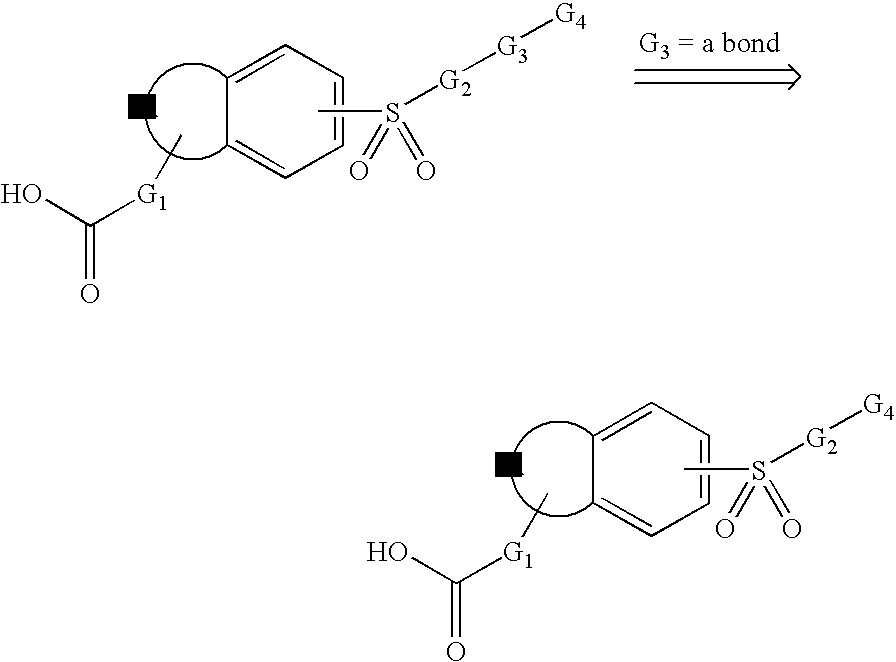
- The term “disease” as used herein is intended to be generally synonymous, and is used interchangeably with, the terms “disorder” and “condition” (as in medical condition), in that all reflect an abnormal condition of the body or of one of its parts that impairs normal functioning and is typically manifested by distinguishing signs and symptoms.
- The term “combination therapy” means the administration of two or more therapeutic agents to treat a therapeutic condition or disorder described in the present disclosure. Such administration encompasses co-administration of these therapeutic agents in a substantially simultaneous manner, such as in a single capsule having a fixed ratio of active ingredients or in multiple, separate capsules for each active ingredient. In addition, such administration also encompasses use of each type of therapeutic agent in a sequential manner. In either case, the treatment regimen will provide beneficial effects of the drug combination in treating the conditions or disorders described herein.
- The term “activate” refers to increasing the cellular function of a target enzyme or protein.
- The term “inhibit” refers to decreasing the cellular function of a target enzyme or protein. The target enzyme or protein function may be the interaction with a natural binding partner or catalytic activity.
- The term “modulate” refers to the ability of a compound of the invention to alter the function of a target enzyme or protein. A modulator may activate the activity of a target enzyme or protein. The term “modulate” also refers to altering the function of a target enzyme or protein by increasing or decreasing the probability that a complex forms between a target enzyme or protein and a natural binding partner. A modulator may increase the probability that such a complex forms between the target enzyme or protein and the natural binding partner, may increase or decrease the probability that a complex forms between the target enzyme or protein and the natural binding partner depending on the concentration of the compound exposed to the target enzyme or protein, and or may decrease the probability that a complex forms between the target enzyme or protein and the natural binding partner.
- The term “selective” as used herein means having the characteristic or property of being highly specific in binding, activity, or effect. Compounds described herein as selective for PPARδ over other isoforms, for example, preferentially bind and/or modulate PPARδ in favor of PPARγ and PPARα. The degree of selectivity may vary, but in many embodiments, a selective compound would be at least tenfold selective for the desired target (e.g., PPARδ). In certain embodiments, the compound would be 100- to 1000-fold selective. Alternatively, a compound may be selective the sense of producing a differential effect. For example, such a compound may bind both PPARδ and PPARγ with equal or similar affinity, but activate one while inhibiting the other. Such a mechanism has not been described at this time, but, not wishing to be bound by theory, it is postulated here.
- “PPARδ modulator” is used herein to refer to a compound that exhibits an EC50 with respect to PPARδ activity of no more than about 100 μM and more typically not more than about 50 μM, as measured in the PPARδ assay described generally hereinbelow. “EC50” is that concentration of modulator which either activates or reduces the activity of an enzyme (e.g., PPARδ) to half-maximal level. Certain representative compounds of the present invention have been discovered to exhibit modulatory activity against PPARδ. In certain embodiments, compounds will exhibit an EC50 with respect to PPARδ of no more than about 10 μM; in further embodiments, compounds will exhibit an EC50 with respect to PPARδ of no more than about 5 μM; in yet further embodiments, compounds will exhibit an EC50 with respect to PPARδ of not more than about 1 μM; in yet further embodiments, compounds will exhibit an EC50 with respect to PPARδ of not more than about 200 nM, as measured in the PPARδ assay described herein.
- The term “therapeutically effective amount” as used herein refers to that amount of the compound being administered which will relieve to some extent one or more of the symptoms of the disease, condition or disorder being treated.
- The term “prodrug” refers to a compound that is made more active in vivo. Certain compounds of the present invention may also exist as prodrugs, as described in Hydrolysis in Drug and Prodrug Metabolism: Chemistry, Biochemistry, and Enzymology (Testa, Bernard and Mayer, Joachim M. Wiley-VHCA, Zurich, Switzerland 2003). Prodrugs of the compounds described herein are structurally modified forms of the compound that readily undergo chemical changes under physiological conditions to provide the compound. Additionally, prodrugs can be converted to the compound by chemical or biochemical methods in an ex vivo environment. For example, prodrugs can be slowly converted to a compound when placed in a transdermal patch reservoir with a suitable enzyme or chemical reagent. Prodrugs are often useful because, in some situations, they may be easier to administer than the compound, or parent drug. They may, for instance, be bioavailable by oral administration whereas the parent drug is not. The prodrug may also have improved solubility in pharmaceutical compositions over the parent drug. A wide variety of prodrug derivatives are known in the art, such as those that rely on hydrolytic cleavage or oxidative activation of the prodrug. An example, without limitation, of a prodrug would be a compound which is administered as an ester (the “prodrug”), but then is metabolically hydrolyzed to the carboxylic acid, the active entity. Additional examples include peptidyl derivatives of a compound.
- The compounds of the present invention can exist as therapeutically acceptable salts. The present invention includes compounds listed above in the form of salts, including acid addition salts. Suitable salts include those formed with both organic and inorganic acids. Such acid addition salts will normally be pharmaceutically acceptable. However, salts of non-pharmaceutically acceptable salts may be of utility in the preparation and purification of the compound in question. Basic addition salts may also be formed and be pharmaceutically acceptable. For a more complete discussion of the preparation and selection of salts, refer to Pharmaceutical Salts: Properties, Selection, and Use (Stahl, P. Heinrich. Wiley-VCHA, Zurich, Switzerland, 2002).
- The term “therapeutically acceptable salt,” as used herein, represents salts or zwitterionic forms of the compounds of the present invention which are water or oil-soluble or dispersible and therapeutically acceptable as defined herein. The salts can be prepared during the final isolation and purification of the compounds or separately by reacting the appropriate compound in the form of the free base with a suitable acid. Representative acid addition salts include acetate, adipate, alginate, L-ascorbate, aspartate, benzoate, benzenesulfonate (besylate), bisulfate, butyrate, camphorate, camphorsulfonate, citrate, digluconate, formate, fumarate, gentisate, glutarate, glycerophosphate, glycolate, hemisulfate, heptanoate, hexanoate, hippurate, hydrochloride, hydrobromide, hydroiodide, 2-hydroxyethansulfonate (isethionate), lactate, maleate, malonate, DL-mandelate, mesitylenesulfonate, methanesulfonate, naphthylenesulfonate, nicotinate, 2-naphthalenesulfonate, oxalate, pamoate, pectinate, persulfate, 3-phenylproprionate, phosphonate, picrate, pivalate, propionate, pyroglutamate, succinate, sulfonate, tartrate, L-tartrate, trichloroacetate, trifluoroacetate, phosphate, glutamate, bicarbonate, para-toluenesulfonate (p-tosylate), and undecanoate. Also, basic groups in the compounds of the present invention can be quaternized with methyl, ethyl, propyl, and butyl chlorides, bromides, and iodides; dimethyl, diethyl, dibutyl, and diamyl sulfates; decyl, lauryl, myristyl, and steryl chlorides, bromides, and iodides; and benzyl and phenethyl bromides. Examples of acids which can be employed to form therapeutically acceptable addition salts include inorganic acids such as hydrochloric, hydrobromic, sulfuric, and phosphoric, and organic acids such as oxalic, maleic, succinic, and citric. Salts can also be formed by coordination of the compounds with an alkali metal or alkaline earth ion. Hence, the present invention contemplates sodium, potassium, magnesium, and calcium salts of the compounds disclosed herein, and the like.
- Basic addition salts can be prepared during the final isolation and purification of the compounds by reacting a carboxy group with a suitable base such as the hydroxide, carbonate, or bicarbonate of a metal cation or with ammonia or an organic primary, secondary, or tertiary amine. The cations of therapeutically acceptable salts include lithium, sodium, potassium, calcium, magnesium, and aluminum, as well as nontoxic quaternary amine cations such as ammonium, tetramethylammonium, tetraethylammonium, methylamine, dimethylamine, trimethylamine, triethylamine, diethylamine, ethylamine, tributylamine, pyridine, N,N-dimethylaniline, N-methylpiperidine, N-methylmorpholine, dicyclohexylamine, procaine, dibenzylamine, N,N-dibenzylphenethylamine, 1-ephenamine, and N,N′-dibenzylethylenediamine. Other representative organic amines useful for the formation of base addition salts include ethylenediamine, ethanolamine, diethanolamine, piperidine, and piperazine.
- In certain embodiments, the salt may be selected from the group consisting of the hydrochloride, hydrobromide, sulfonate, citrate, tartrate, phosphonate, lactate, pyruvate, acetate, succinate, oxalate, fumarate, maleate, oxaloacetate, methanesulfonate, ethanesulfonate, p-toluenesulfonate (tosylate), benzenesulfonate (besylate) and isethionate salts of compounds, including (S)-4-[cis-2,6-dimethyl-4-(4-trifluoromethoxy-phenyl)-piperazine-1-sulfonyl]-indan-2-carboxylic acid and (S)-4-[cis-2,6-dimethyl-4-(4-trifluoromethoxy-benzyl)-piperazine-1-sulfonyl]-indan-2-carboxylic acid. In further embodiments, the salt is the tosylate salt.
- Salts of compounds of the present invention may be formed by contacting said compounds with an appropriate acid or counterion, either neat or in a suitable solvent. For example, compounds of Formula I can be contacted with p-toluenesulfonic acid to yield the p-toluenesulfonate (tosylate) salt form of the invention. Compounds of Formula I, including Compounds 1, 1A, 3, and 3A below, their racemates, and racemic mixtures thereof, prepared by any method can be contacted with a reagent selected from the group consisting of calcium acetate, hydrochloric acid, phosphoric acid, sulfuric acid, sodium hydroxide, potassium hydroxide, magnesium acetate, and p-toluenesulfonic acid, for example in a 1:1 ratio, in a suitable solvent. Such solvents include but are not limited to diisopropyl ether, toluene, dichloromethane, and acetonitrile. Any technique known in the art can be used to vary conditions to induce precipitation or crystallization, including, without limitation: stirring for varying lengths of time at varying ambient conditions, the addition of hexanes or diethyl ether, evaporation, and reduction of temperature. In particular, 4-[cis-2,6-dimethyl-4-(4-trifluoromethoxy-phenyl)-piperazine-1-sulfonyl]-indan-2-carboxylic acid can be contacted with p-toluenesulfonic acid to yield 4-[cis-2,6-dimethyl-4-(4-trifluoromethoxy-phenyl)-piperazine-1-sulfonyl]-indan-2-carboxylic acid tosylate. The present invention provides for salts of each racemate of compounds of Formula I, including (S)-4-[cis-2,6-dimethyl-4-(4-trifluoromethoxy-phenyl)-piperazine-1-sulfonyl]-indan-2-carboxylic acid tosylate. Additional methods of forming salts of compounds of Formula I are described below, and may also be found in U.S. patent application Ser. No. 11/552,134, filed Oct. 23, 2006, the disclosure of which is hereby incorporated by reference as if written herein in its entirety.
- While it may be possible for the compounds, or their salts, esters, prodrugs, amides, or solvates, to be administered as raw chemical, it is also possible to present them as a pharmaceutical formulation. Accordingly, provided herein are pharmaceutical formulations which comprise one or more of certain compounds of the present invention, or one or more pharmaceutically acceptable salts, esters, prodrugs, amides, or solvates thereof, together with one or more pharmaceutically acceptable carriers thereof and optionally one or more other therapeutic ingredients. The carrier(s) must be “acceptable” in the sense of being compatible with the other ingredients of the formulation and not deleterious to the recipient thereof. Proper formulation is dependent upon the route of administration chosen. Any of the well-known techniques, carriers, and excipients may be used as suitable and as understood in the art; e.g., in Remington's Pharmaceutical Sciences. The pharmaceutical compositions disclosed herein may be manufactured in any manner known in the art, e.g., by means of conventional mixing, dissolving, granulating, dragee-making, levigating, emulsifying, encapsulating, entrapping or compression processes.
- The formulations include those suitable for oral, parenteral (including subcutaneous, intradermal, intramuscular, intravenous, intraarticular, and intramedullary), intraperitoneal, transmucosal, transdermal, rectal and topical (including dermal, buccal, sublingual and intraocular) administration although the most suitable route may depend upon for example the condition and disorder of the recipient. The formulations may conveniently be presented in unit dosage form and may be prepared by any of the methods well known in the art of pharmacy. All methods include the step of bringing into association a compound of the subject invention or a pharmaceutically acceptable salt, ester, amide, prodrug or solvate thereof (“active ingredient”) with the carrier which constitutes one or more accessory ingredients. In general, the formulations are prepared by uniformly and intimately bringing into association the active ingredient with liquid carriers or finely divided solid carriers or both and then, if necessary, shaping the product into the desired formulation.
- Formulations of the present invention suitable for oral administration may be presented as discrete units such as capsules, cachets or tablets each containing a predetermined amount of the active ingredient; as a powder or granules; as a solution or a suspension in an aqueous liquid or a non-aqueous liquid; or as an oil-in-water liquid emulsion or a water-in-oil liquid emulsion. The active ingredient may also be presented as a bolus, electuary or paste.
- Pharmaceutical preparations which can be used orally include tablets, push-fit capsules made of gelatin, as well as soft, sealed capsules made of gelatin and a plasticizer, such as glycerol or sorbitol. Tablets may be made by compression or molding, optionally with one or more accessory ingredients. Compressed tablets may be prepared by compressing in a suitable machine the active ingredient in a free-flowing form such as a powder or granules, optionally mixed with binders, inert diluents, or lubricating, surface active or dispersing agents. Molded tablets may be made by molding in a suitable machine a mixture of the powdered compound moistened with an inert liquid diluent. The tablets may optionally be coated or scored and may be formulated so as to provide slow or controlled release of the active ingredient therein. All formulations for oral administration should be in dosages suitable for such administration. The push-fit capsules can contain the active ingredients in admixture with filler such as lactose, binders such as starches, and/or lubricants such as talc or magnesium stearate and, optionally, stabilizers. In soft capsules, the active compounds may be dissolved or suspended in suitable liquids, such as fatty oils, liquid paraffin, or liquid polyethylene glycols. In addition, stabilizers may be added. Dragee cores are provided with suitable coatings. For this purpose, concentrated sugar solutions may be used, which may optionally contain gum arabic, talc, polyvinyl pyrrolidone, carbopol gel, polyethylene glycol, and/or titanium dioxide, lacquer solutions, and suitable organic solvents or solvent mixtures. Dyestuffs or pigments may be added to the tablets or dragee coatings for identification or to characterize different combinations of active compound doses.
- The compounds may be formulated for parenteral administration by injection, e.g., by bolus injection or continuous infusion. Formulations for injection may be presented in unit dosage form, e.g., in ampoules or in multi-dose containers, with an added preservative. The compositions may take such forms as suspensions, solutions or emulsions in oily or aqueous vehicles, and may contain formulatory agents such as suspending, stabilizing and/or dispersing agents. The formulations may be presented in unit-dose or multi-dose containers, for example sealed ampoules and vials, and may be stored in powder form or in a freeze-dried (lyophilized) condition requiring only the addition of the sterile liquid carrier, for example, saline or sterile pyrogen-free water, immediately prior to use. Extemporaneous injection solutions and suspensions may be prepared from sterile powders, granules and tablets of the kind previously described.
- Formulations for parenteral administration include aqueous and non-aqueous (oily) sterile injection solutions of the active compounds which may contain antioxidants, buffers, bacteriostats and solutes which render the formulation isotonic with the blood of the intended recipient; and aqueous and non-aqueous sterile suspensions which may include suspending agents and thickening agents. Suitable lipophilic solvents or vehicles include fatty oils such as sesame oil, or synthetic fatty acid esters, such as ethyl oleate or triglycerides, or liposomes. Aqueous injection suspensions may contain substances which increase the viscosity of the suspension, such as sodium carboxymethyl cellulose, sorbitol, or dextran. Optionally, the suspension may also contain suitable stabilizers or agents which increase the solubility of the compounds to allow for the preparation of highly concentrated solutions.
- In addition to the formulations described previously, the compounds may also be formulated as a depot preparation. Such long acting formulations may be administered by implantation (for example subcutaneously or intramuscularly) or by intramuscular injection. Thus, for example, the compounds may be formulated with suitable polymeric or hydrophobic materials (for example as an emulsion in an acceptable oil) or ion exchange resins, or as sparingly soluble derivatives, for example, as a sparingly soluble salt.
- For buccal or sublingual administration, the compositions may take the form of tablets, lozenges, pastilles, or gels formulated in conventional manner. Such compositions may comprise the active ingredient in a flavored basis such as sucrose and acacia or tragacanth.
- The compounds may also be formulated in rectal compositions such as suppositories or retention enemas, e.g., containing conventional suppository bases such as cocoa butter, polyethylene glycol, or other glycerides.
- Certain compounds of the present invention may be administered topically, that is by non-systemic administration. This includes the application of a compound of the present invention externally to the epidermis or the buccal cavity and the instillation of such a compound into the ear, eye and nose, such that the compound does not significantly enter the blood stream. In contrast, systemic administration refers to oral, intravenous, intraperitoneal and intramuscular administration.
- Formulations suitable for topical administration include liquid or semi-liquid preparations suitable for penetration through the skin to the site of inflammation such as gels, liniments, lotions, creams, ointments or pastes, and drops suitable for administration to the eye, ear or nose. The active ingredient for topical administration may comprise, for example, from 0.001% to 10% w/w (by weight) of the formulation. In certain embodiments, the active ingredient may comprise as much as 10% w/w. In other embodiments, it may comprise less than 5% w/w. In certain embodiments, the active ingredient may comprise from 2% w/w to 5% w/w. In other embodiments, it may comprise from 0.1% to 1% w/w of the formulation.
- For administration by inhalation, compounds may be conveniently delivered from an insufflator, nebulizer pressurized packs or other convenient means of delivering an aerosol spray. Pressurized packs may comprise a suitable propellant such as dichlorodifluoromethane, trichlorofluoromethane, dichlorotetrafluoroethane, carbon dioxide or other suitable gas. In the case of a pressurized aerosol, the dosage unit may be determined by providing a valve to deliver a metered amount. Alternatively, for administration by inhalation or insufflation, the compounds according to the invention may take the form of a dry powder composition, for example a powder mix of the compound and a suitable powder base such as lactose or starch. The powder composition may be presented in unit dosage form, in for example, capsules, cartridges, gelatin or blister packs from which the powder may be administered with the aid of an inhalator or insufflator.
- In certain embodiments, the compound may be formulated as a tablet or capsule.
- In further embodiments, the compound will be a compound of Formula I.
- In yet further embodiments, the compound will be Compound 1A.
- In certain embodiments, the formulation will also comprise one or more fillers, such as lactose monohydrate, microcrystalline cellulose or Prosolv; one or more disintegrating agents such as povidone or crospovidone; and one or more lubricants such as magnesium stearate. In yet further embodiments, the formulation will also comprise one or more glidants, such as silicon dioxide or Lutrol.
- In certain embodiments, formulations comprising compounds as described herein will be capsules which may comprise:
-
- a. 0.2-20% (S)-4-[cis-2,6-dimethyl-4-(4-trifluoromethoxy-phenyl)-piperazine-1-sulfonyl]-indan-2-carboxylic acid tosylate, the particle size thereof ranging from about 50 to about 250 microns;
- b. 0-99.99% lactose monohydrate;
- c. 0-10% crospovidone;
- d. 0-5% magnesium stearate; and
- e. 0-5% silicon dioxide.
- Yet further embodiments of formulations of compounds of the present invention presented as formulations may be found below.
- Preferred unit dosage formulations are those containing an effective dose, as herein below recited, or an appropriate fraction thereof, of the active ingredient.
- It should be understood that in addition to the ingredients particularly mentioned above, the formulations described above may include other agents conventional in the art having regard to the type of formulation in question, for example those suitable for oral administration may include flavoring agents.
- Compounds may be administered orally or via injection at a dose of from 0.1 to 500 mg/kg per day. The dose range for adult humans is generally from 5 mg to 2 g/day. Tablets or other forms of presentation provided in discrete units may conveniently contain an amount of one or more compounds which is effective at such dosage or as a multiple of the same, for instance, units containing 5 mg to 500 mg, usually around 10 mg to 200 mg.
- The amount of active ingredient that may be combined with the carrier materials to produce a single dosage form will vary depending upon the host treated and the particular mode of administration.
- The compounds can be administered in various modes, e.g. orally, topically, or by injection. The precise amount of compound administered to a patient will be the responsibility of the attendant physician. The specific dose level for any particular patient will depend upon a variety of factors including the activity of the specific compound employed, the age, body weight, general health, sex, diets, time of administration, route of administration, rate of excretion, drug combination, the precise disorder being treated, and the severity of the indication or condition being treated. Also, the route of administration may vary depending on the condition and its severity.
- In certain instances, it may be appropriate to administer at least one of the compounds described herein (or a pharmaceutically acceptable salt, ester, or prodrug thereof) in combination with another therapeutic agent. By way of example only, if one of the side effects experienced by a patient upon receiving one of the compounds herein is hypertension, then it may be appropriate to administer an anti-hypertensive agent in combination with the initial therapeutic agent. Or, by way of example only, the therapeutic effectiveness of one of the compounds described herein may be enhanced by administration of an adjuvant (i.e., by itself the adjuvant may only have minimal therapeutic benefit, but in combination with another therapeutic agent, the overall therapeutic benefit to the patient is enhanced). Or, by way of example only, the benefit of experienced by a patient may be increased by administering one of the compounds described herein with another therapeutic agent (which also includes a therapeutic regimen) that also has therapeutic benefit. By way of example only, in a treatment for diabetes involving administration of one of the compounds described herein, increased therapeutic benefit may result by also providing the patient with another therapeutic agent for diabetes. In any case, regardless of the disease, disorder or condition being treated, the overall benefit experienced by the patient may simply be additive of the two therapeutic agents or the patient may experience a synergistic benefit.
- Specific, non-limiting examples of possible combination therapies include use of the compounds of the invention with: (a) statin and/or other lipid lowering drugs for example MTP inhibitors and LDLR upregulators; (b) antidiabetic agents, e.g. metformin, sulfonylureas, or PPAR-gamma, PPAR-alpha and PPAR-alpha/gamma modulators (for example thiazolidinediones such as e.g. Pioglitazone and Rosiglitazone, fibrates, and niacin); and (c) antihypertensive agents such as angiotensin antagonists, e.g., telmisartan, calcium channel antagonists, e.g. lacidipine and ACE inhibitors, e.g., enalapril.
- In another embodiment, the present invention comprises administering PPARδ compounds together with folates. The folates which can be used include both pteroic acid monoglutamate (folic acid) and reduced forms such as dihydrofolates and tetrahydrofolates, polyglutamates thereof, optical isomers thereof and pharmaceutically acceptable salts thereof. In certain embodiments, the folates which are used are tetrahydrofolates; in further embodiments, the folates are natural stereoisomeric forms of tetrahydrofolates such as 5-formyl-(6S)-tetrahydrofolic acid, 5-methyl-(6S)-tetrahydrofolic acid, 5,10-methylene-(6R)-tetrahydrofolic acid, 5,10-methenyl-(6R)-tetrahydrofolic acid, 10-formyl-(6R)-tetrahydrofolic acid, 5-formimino-(6S)-tetrahydrofolic acid or (6S)-tetrahydrofolic acid or pharmaceutically acceptable salts thereof. The folates which are used can generally be converted into one another by folate metabolism. In certain embodiments, 5-methyl-(6S)-tetrahydrofolic acid, 5-formyl-(6S)-tetrahydrofolic acid and pharmaceutically acceptable salts thereof are used (see US2006/0063768A1).
- In any case, the multiple therapeutic agents (at least one of which is a PPARδ modulator) may be administered in any order or even simultaneously. If simultaneously, the multiple therapeutic agents may be provided in a single, unified form, or in multiple forms (by way of example only, either as a single pill or as two separate pills). One of the therapeutic agents may be given in multiple doses, or both may be given as multiple doses. If not simultaneous, the timing between the multiple doses may be any duration of time ranging from a few minutes to four weeks.
- Thus, in another aspect, the present invention provides methods for treating PPAR-mediated disorders in a human or animal subject in need of such treatment comprising administering to said subject an amount of a compound of the present invention effective to reduce or prevent said disorder in the subject in combination with at least one additional agent for the treatment of said disorder that is known in the art. In a related aspect, the present invention provides therapeutic compositions comprising at least one compound of the present invention in combination with one or more additional agents for the treatment of PPAR-mediated disorders.
- PPAR delta modulators, by virtue of lowering CRP levels, have the potential to treat a number of clinical conditions where vascular inflammation is a key contributor. Diseases, disorders, and conditions which may be ameliorated by methods and compositions disclosed herein include, without limitation: inflammatory disorders of the cardiovascular system, such as atherosclerosis, vascular inflammation, coronary artery disease, peripheral arterial and/or vascular disease, chronic intermittent claudication and thrombosis, any of which may or may not be associated with or complications arising from diabetes; metabolic inflammatory disorders such as diabetes and co-morbid inflammation associated with obesity; ischemic conditions such as stroke, aortic aneurysm, and transient ischemic attacks; complement factor diseases including those associated with complement factor H, for example, thrombotic microangiopathies, glomerulonephritides, hemolytic uremic syndrome (HUS), membranoproliferative glomerulonephritis (dense deposit disease), age-related macular degeneration and chronic conditions featuring debris deposition; symptoms associated with menopause, particularly in women receiving hormone therapy; and renal and nephritic disorders such as chronic kidney failure. Methods and compositions disclosed herein may also be employed in conjunction with therapies to treat the aforementioned disorders. For example, methods and compositions disclosed herein may be ased as adjuvant therapy to hemodialysis or peritoneal dialysis for the treatment of renal diseases, or as adjuvant therapy in patients undergoing stent implantation surgery for stenosis or percutaneous transluminal angioplasty.
- In yet another embodiment the present invention provides a method of treating a patient by first testing for CRP levels using methods well known in the art (such as the method disclosed in US20060029976A1), second determining if the patient CRP levels are too high and then third if the levels are too high then having the patient take PPARδ compounds to lower the CRP levels.
- Besides being useful for human treatment, the compounds and formulations of the present invention are also useful for veterinary treatment of companion animals, exotic animals and farm animals, including mammals, rodents, and the like. More preferred animals include horses, dogs, and cats.
- Other compounds which may be used according to the methods disclosed herein include certain of those described in: PCT/US2004/010737, filed on Apr. 7, 2004; PCT/US2004/010889, filed on Apr. 7, 2004; PCT/US2004/010970, filed on Apr. 7, 2004; U.S. application Ser. No. 10/820,647, filed Apr. 7, 2004; PCT/US2004/043031, filed Dec. 20, 2004; PCT/US2005/011751 filed Apr. 7, 2005; U.S. application Ser. No. 11/102,356 filed Apr. 7, 2005; U.S. application Ser. No. 11/258,463, filed Oct. 25, 2005; and U.S. Pat. No. 6,710,063, issued Mar. 23, 2004; the contents of all of which are hereby incorporated by reference in their entirety.
- The invention is further illustrated by the following examples.
-
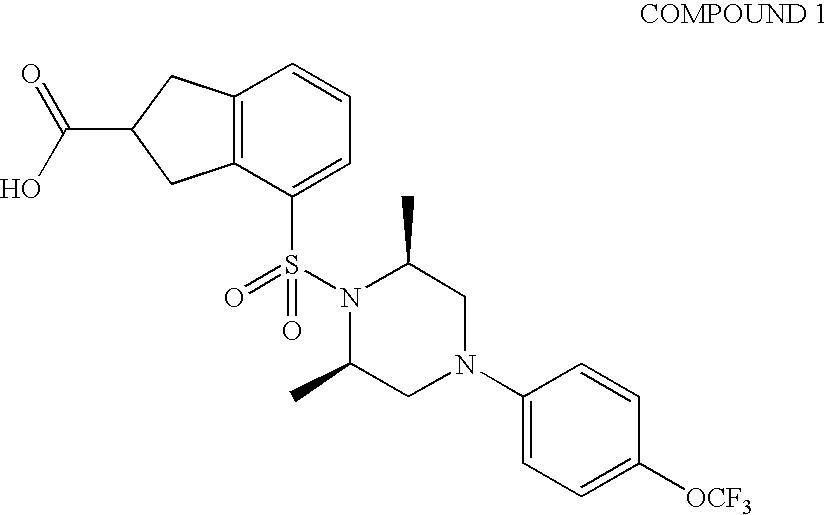
-
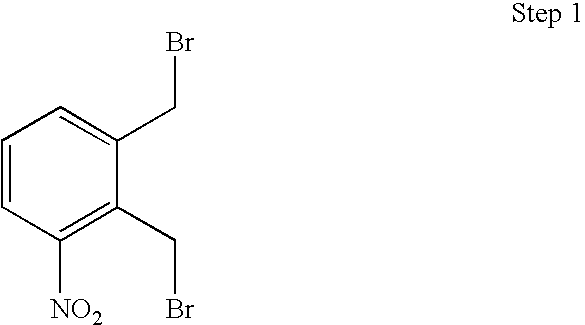
- 1,2-Bis(bromomethyl)-3-nitrobenzene: A 1 liter flask was charged with 1,2-dimethyl-3-nitrobenzene (20 g, 0.13 mol), N-bromosuccinimide (50 g, 0.28 mol), azobis(isobutyronitrile) (5 g, 3.0 mmol), and 200 mL of dichloromethane. This was irradiated with a 120 watt floodlamp to affect gentle reflux under nitrogen for 18 hours. The mixture was then cooled and precipitated succinimide was removed by filtration. The filtrate was concentrated and the residue was purified by chromatography on silica (5%-50% CH2Cl2 in hexanes) to give 2.6 g white solid (64%).
-
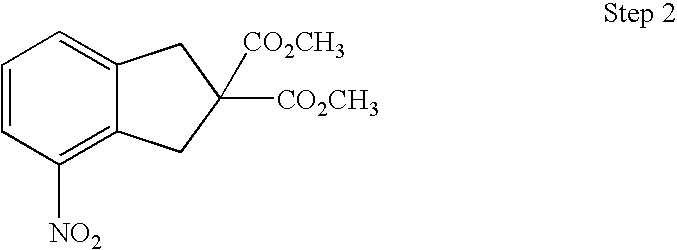
- Dimethyl-4-nitroindane-2,2-dicarboxylate: To a solution stirred under nitrogen at room temperature, to 5.0 mL methanol in 15.0 mL ether was added 60% sodium hydride (0.84 g, 0.021 mol) in small portions. After the addition was complete, the nearly clear and colorless solution was stirred for 5 minutes. To it was then added 1.3 g dimethyl malonate, giving a slightly cloudy colorless solution. To this was rapidly added a suspension of 3.1 g 1,2-bis(bromomethyl)3-nitrobenzene, which immediate gave a precipitate suspended in a dark green solution. This was removed by filtration and the filtrate was concentrated. The residue was purified on silica (20%-100% CH2Cl2 in hexanes) to give 1.93 g off-white solid (67%).
-

- Methyl-4-nitroindane-2-carboxylate: A mixture of dimethyl-4-nitroindane-2,2-dicarboxylate (4.84 g, 0.0167 mol), lithium chloride (0.84 g, 0.0198 mol), 1.11 mL water, and 18 mL dimethylsulfoxide was heated to 160° C. under nitrogen for two hours. It was then allowed to cool and the dimethylsulfoxide was removed under high vacuum. The residue was purified on silica (10%-100% CH2Cl2 in hexanes) to give 2.5 g white solid (65%).
-
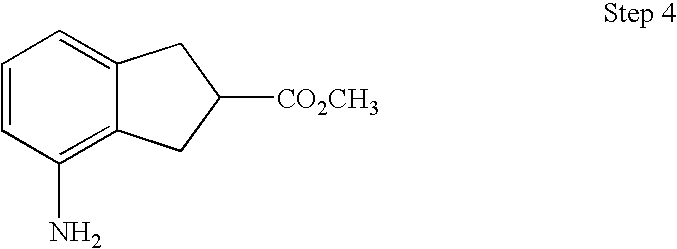
- Methyl-4-aminoindane-2-carboxylate: A mixture of methyl-4-nitroindane-2-carboxylate (2.4 g, 0.11 mol) and 10% palladium on carbon (1.1 g, 0.01 mol) in ethyl acetate (15 mL) was shaken under 55 PSI hydrogen for 1 hour. It was then filtered and the filtrate was concentrated to give 2.07 g white solid (100%).
-

- Methyl 4-chlorosulfonyl-indan-2-carboxylate: A mixture of methyl-4-aminoindane-2-carboxylate (2.5 g, 0.013 mol), 12.5 mL acetonitrile, and 12.5 mL H2O was cooled to −5° C. in an ice-salt bath. To this was added 2.6 mL concentrated HCl (0.014 mol). To this was added dropwise over 20 minutes a solution of 1.0 g sodium nitrite (0.021 mol) in 5 mL water. After the addition was complete the solution was stirred for 20 minutes. It was then transferred to a jacketed addition funnel cooled with ice water. The solution was added dropwise to a solution stirred under nitrogen at 55° C. of 4.2 g potassium thioxanthate (0.026 mol) in 20 mL H2O. As the addition took place, a dark layer rose to the top of the diazonium ion solution which was not added. After the addition was complete the mixture was stirred at 55° C. for 30 minutes, then was allowed to cool and was extracted with 40 mL ethyl acetate. The organic layer was dried (MgSO4) and concentrated. The residue was loaded on 80 mL silica gel which was slurry-packed in hexanes. This was eluted with 100 mL hexanes, then 1%-50% CH2Cl2 in hexanes in 50 mL fractions to give 1.3 g amber oil (33%).
- A mixture of 3.6 g of the above compound in 30 mL CCl4 and 10 mL H2O was vigorously stirred and cooled to 3 C. Chlorine gas was bubbled through at such a rate that the temperature stayed below 10° C. After conversion was complete, the phases were separated and the aqueous layer was extracted with CH2Cl2. The combined organic layers were dried (MgSO4) and concentrated to give 4.0 g yellow oil (100%).
-

- 4-[cis-2,6-Dimethyl-4-(4-trifluoromethoxy-phenyl)-piperazine-1-sulfonyl]-indan-2-methyl ester: A mixture of methyl 4-chlorosulfonyl-indan-2-carboxylate (2.13 g, 0.0078 mol) obtained from Step 6, cis-3,5-dimethyl-1-(4-trifluoromethoxy-phenyl)-piperidine (3.0 g, 0.0109 mol) obtained from Example 51, 20 mL acetonitrile, and 3.0 g K2CO3 (0.0217 mol) was heated to 60° C. under nitrogen with stirring for 20 hours. It was then filtered and the filtrate was concentrated. The residue was purified by chromatography on silica (5%-50% EtOAc in hexanes) to give 2.64 g viscous yellow oil (66%).
- 4-[cis-2,6-Dimethyl-4-(4-trifluoromethoxy-phenyl)-piperazine-1-sulfonyl]-indan-2-carboxylic acid: To a solution of 4-[cis-2,6-dimethyl-4-(4-trifluoromethoxy-phenyl)-piperazine-1-sulfonyl]-indan-2-methyl ester (2.64 g, 0.0052 mol) in the minimum amount of THF (ca 15 mL) was added a solution of 0.14 g LiOH (0.0057 mol) in the minimum amount of water (ca 2.5 mL). This was capped and stirred at room temperature for 12 hours. Examination by HPLC showed the reaction was 85% complete so an additional 0.020 g LiOH (0.125 eq total) was added and stirring was continued for 3 hours. It was then concentrated to remove THF and partitioned between EtOAc and water. The aqueous layer was treated with 0.54 mL conc. HCl. It was then extracted with ethyl acetate. The organic layer was dried (MgSO4) and concentrated to give 2.38 g yellow amorphous solid (93%).
-

- A single enantiomer of Compound 1 was obtained by chiral HPLC (chiralpak ASH 0.46×15 cm Hex/IPA 94:6 (v/v) with 0.1% TFA, flow rate 1 ml/min) separation from the racemate. LCMS 497.1 (M−1)−1.
-
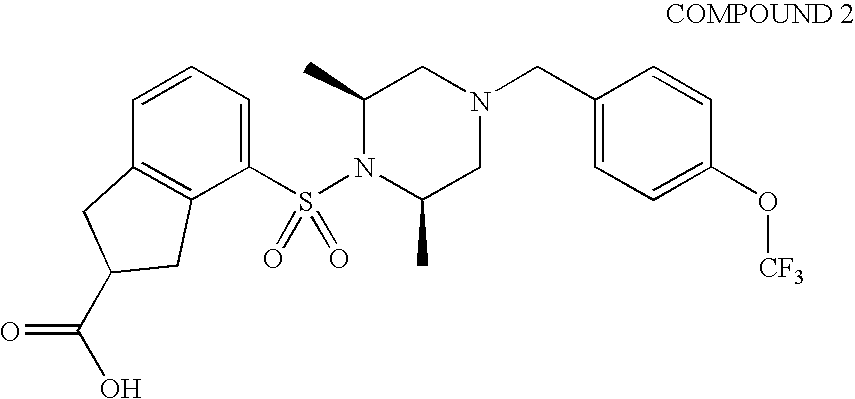
-
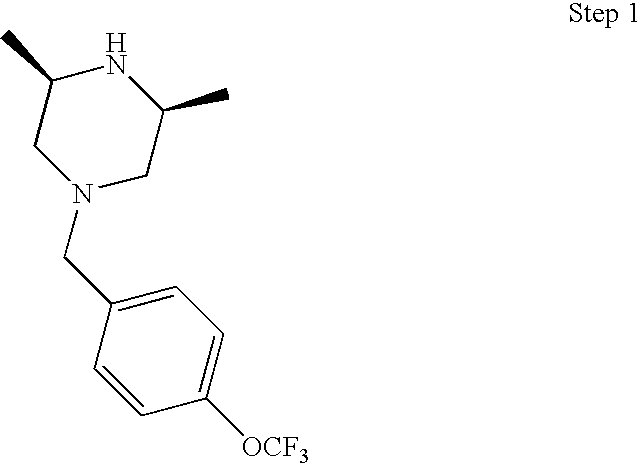
- cis-3,5-Dimethyl-1-(4-trifluoromethoxy-benzyl)-piperazine: To a solution of 4-(trifluoromethoxy)-benzaldehyde (776 uL, 4.38 mmol) in methylene chloride (30 mL) was added cis-2,6-dimethyl piperazine (1.0 g, 8.77 mmol). After 1 hour sodium triacetoxy borohydride (2.45 g, 8.77 mmol) was added to the mixture. The solution was stirred at room temperature for an additional 4 hours. The reaction was concentrated in vacuo, diluted with ethyl acetate and extracted with 1N HCl (2×50 mL). The aqueous layer was then neutralized with NaOH and extracted with ethyl acetate (3×50 mL). The organic layer was dried (Na2SO4) and concentrated to provide cis-3,5-dimethyl-1-(4-trifluoromethoxy-benzyl)-piperazine (1.01 g, 80%). 1H NMR (400 MHz, CD3OD) δ 7.42 (d, 2H), 7.23 (d, 2H), 3.54 (s, 2H), 2.98-2.88 (m, 2H), 2.82-2.74 (m, 2H), 1.69 (t, 2H), 1.05 (d, 6H); LCMS 289.5 (M+1)+.
- 4-[cis-2,6-Dimethyl-4-(4-trifluoromethoxy-benzyl)-piperazine-1-sulfonyl]-indan-2-carboxylic acid: The compound 4-[cis-2,6-dimethyl-4-(4-trifluoromethoxyl-benzyl)-piperazine-1-sulfonyl]-indan-2-carboxylic acid was synthesized according to the procedure for Compound 1 using cis-3,5-dimethyl-1-(4-trifluoromethoxy-benzyl)-piperazine. 1H NMR (400 MHz, CD3OD) δ 7.74-7.64 (m, 4H), 7.47 (d, 1H), 7.39-7.28 (m, 2H), 4.42 (s, 2H), 4.21-2.18 (m, 2H), 3.50-3.34 (m, 5H), 3.33-3.19 (m, 4H), 1.56 (d, 6H); LCMS 497.5 (M+1)+.
-
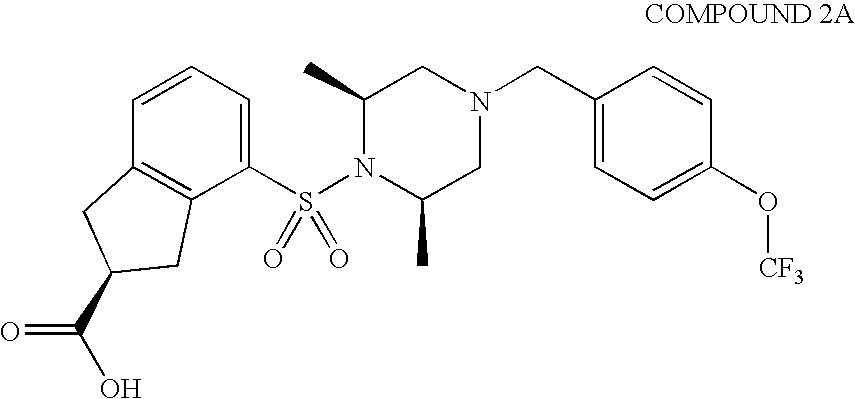
- The product from Compound 2 Step 1 and the product from Compound 1 Step 5 were reacted using the conditions outlined in Compound 1 Step 6 to yield the racemic methyl ester. Chiral separation using OJ-H, 25% methanol in CO2 (100 bar), 5 mL/min followed by hydrolysis using conditions outlined in Compound 1 Step 7 provided a single enantiomer of 4-(cis-2,6-dimethyl-4-(3-trifluoromethoxy)benzyl)piperazin-1-ylsulfonyl)-2,3-dihydro-1H-indene-2-carboxylic acid. 1H NMR (400 MHz, CD3OD) δ 7.66 (d, 1H), 7.46 (d, 1H), 7.41 (d, 2H), 7.36-7.30 (m, 1H), 7.19 (d, 2H), 4.08-3.99 (m, 1H), 3.94-3.8 (m, 1H), 3.56-3.49 (m, 2H), 3.43 (s, 2H), 3.40-3.22 (m, 3H), 2.57 (t, 2H), 2.09-1.92 (m, 2H), 1.56 (d, 6H); LCMS 513.5 (M+1)+.
- 32% HCl is added to a solution of sodium nitrite in water and acetonitrile at 0° C. The solution is cooled to −5° C. and a solution of (R,S)-4-amino-indan-2-carboxylic acid methyl ester hydrochloride in water, acetonitrile, and 32% HCl is added, keeping the temperature between −7 and −10° C. The resulting cold diazonium solution is added to a solution of potassium ethylxanthogenate, in water and acetonitrile, at 60° C. After heating at 60° C., the mixture is cooled to room temperature and extracted from dichloromethane. The organic solution is charged into the reactor and concentrated under reduced pressure. Dichloromethane and water are added, the mixture cooled to 5° C., and chlorine gas passed through the mixture. The organic solution is separated and the aqueous solution is extracted from dichloromethane. The combined organic solution is dried over magnesium sulfate and concentrated under reduced pressure to afford (R,S)-4-chlorosulfonyl-indan-2-carboxylic acid. HPLC may be used to monitor the reaction.
- Potassium carbonate is added to a mixture of cis-3,5-dimethyl-1-(4-trifluoromethoxy-phenyl)-piperazine hydrochloride in dichloromethane and water. After stirring at room temperature, the organic phase is collected and the aqueous layer extracted from dichloromethane. The combined organic solution is charged into the reactor and concentrated under reduced pressure, followed by the addition of acetonitrile and potassium carbonate. A solution of (R,S)-4-chlorosulfonyl-indan-2-carboxylic acid, in acetonitrile, is added to the reaction mixture. After heating at 50° C., the reaction mixture is cooled to 20° C. The mixture is transferred into a 200 L movable agitation feed tank, which is charged with Celite, and the suspension is stirred. The suspension is filtered, filter cake washed with acetonitrile, and the filtrate is concentrated under reduced pressure, cooled to 0-5° C., and 32% HCl added. Following further concentration and filtration, the filtrate is concentrated to give an oil which is purified by silica gel chromatography and recrystallized from isopropanol to give the product (R,S)-4-[cis-2,6-dimethyl-4-(4-trifluoromethoxy-phenyl)-piperazine-1-sulfonyl]-indan-2-carboxylic acid methyl ester (>95% by HPLC).
- Simulated moving bed (SMB) chromatography was used to separate the S- and R-enantiomers of (R,S)-4-[cis-2,6-dimethyl-4-(4-trifluoromethoxy-phenyl)-piperazine-1-sulfonyl]-indan-2-carboxylic acid methyl ester. The SMB method uses a Chiralpak AS column and nheptane/isopropanol (1:1 v/v) to yield the S-enantiomer, (S)-4-[cis-2,6-dimethyl-4-(4-trifluoromethoxy-phenyl)-piperazine-1-sulfonyl]-indan-2-carboxylic acid methyl ester (>99.0% by chiral HPLC).
- To a solution of (S)-4-[cis-2,6-dimethyl-4-(4-trifluoromethoxy-phenyl)-piperazine-1-sulfonyl]-indan-2-carboxylic acid methyl ester, in THF, is added a solution of lithium hydroxide in water, which is stirred at 20° C. and concentrated under reduced pressure. The reaction mixture is cooled to 9° C., neutralized with 32% HCl, and extracted from toluene. Water is removed from the organic solution by azeotropic distillation. Following distillation, the organic solution is cooled to ambient temperature and transferred to a feeding vessel. The reactor is charged with p-toluenesulfonic acid in toluene and water is removed by azeotropic distillation. The solution is cooled to 60° C., followed by the addition of the organic solution from the feeding vessel. The mixture is stirred at 83° C., then cooled to 10° C. to induce crystallization. The product suspension is filtered, the filter cake rinsed with heptane, and dried on a rotovap, at 40° C., to afford (S)-4-[cis-2,6-dimethyl-4-(4-trifluoromethoxy-phenyl)-piperazine-1-sulfonyl]-indan-2-carboxylic acid tosylate. 1HNMR δ 1.60 (d), 1.62 (d), 2.33 (s), 3.23 (m), 3.49 (m), 3.39 (m), 4.05 (m), 4.49 (m), 3.40 (dd), 3.23 (dd), 7.14 (d), 7.14 (d), 7.09 (d), 7.09 (d), 7.59 (d), 7.59 (d), 7.71 (d), 7.26, dd, 7.57 (d), 7.57 (d), 7.40 (d).
- Total fill weight of each capsule is 300 mg, not including capsule weight. Target compound dosage as free base is 1, 5, or 20 mg per capsule, thereby allowing for a range of dosages to be conveniently administered to a patient. Several exemplary dosages are set forth below in Table 1.
-
TABLE 1 Exemplary Formulations Capsule Target Dosage, Compound 1A 1 mg 5 mg 20 mg Capsule Color white green orange Compound 1A tosylate, mg 1.35 6.73 26.91 Lactose monohydrate, mg 277.65 272.27 252.09 Silicon dioxide, mg 3 3 3 Crospovidone, mg 15 15 15 Magnesium stearate, mg 3 3 3 (vegetable grade) Total Fill Weight, mg 300 300 300 - The capsules above may be made by the following methods.
- Compound 1A is passed between two sieve screens to produce a consistent particle size in the range of 53 to 250 μm. Particle size and XRPD in-process control (IPC) testing are performed, for information only, to profile the particle size distribution and evaluate the solid-state characteristics of Compound 1A following the sieve step. An appropriate amount of Compound 1A is weighed for each batch. The excipients are passed through a 250 μm sieve, collected, and weighed. Approximately half of the excipients are added to the container for blending. Compound 1A is added to the container, followed by the remaining half of the excipients, such that Compound 1A is sandwiched between the excipients. The blend is then mixed until uniform. Blend uniformity IPC (in-process control) testing is performed after blending by sampling 3 points within the container (top, middle, and bottom) and testing each sample for potency. A test result of 95-105% of target, with an RSD of 5%, must be achieved before the process can continue. Additional blend time is allowed to achieve a uniform blend if the IPC test results are not within the specified range. Upon acceptable blend uniformity results, a measured aliquot of the Compound 1A stock formulation is separated to manufacture the lower strengths. This aliquot is removed from the manufacturing area. Magnesium stearate is passed through a 75 μm sieve, collected, weighed, added to the blender as a lubricant, and mixed until dispersed. The final blend is weighed and reconciled. The Coni-Snap capsules (Swedish orange) are opened and the body of the capsule is placed on a Profill tray (holding 100 units) and the cap is placed on the corresponding tray. Blended materials are then flood fed into the body of the capsules using a spatula. The trays may be tamped to settle the blend in each capsule to assure uniform target fill weight. The capsules are then sealed by combining the filled bodies with the caps. Fill weight uniformity IPC testing is performed following encapsulation. Thirteen capsules are removed from a tray of 100 and weighed. This test result must be within the target fill weight (376±15 mg, including capsule weight) to pass. If the target fill weight specification is not met, the entire tray of 100 is weight checked and capsules not meeting weight specification are rejected. Following successful fill weight check, capsules are inspected, de-dusted, reconciled, and placed into a suitable in-process storage container.
- Compound 1A stock formulation aliquot can be used to manufacture the lower strengths using serial dilutions. The excipients are passed through a 250 μm sieve, collected, and weighed. Approximately half of the excipients are added to the container for blending. Compound 1A stock formulation aliquot is added to the container, followed by the remaining half of the excipients, such that Compound 1A stock formulation aliquot is sandwiched between the excipients. The blend is then mixed until uniform. Blend uniformity IPC testing is performed after blending by sampling 3 points within the container (top, middle, and bottom) and testing each sample for potency. A test result of 95-105% of target, with an RSD of 5%, must be achieved before the process can continue. Additional blend time is allowed to achieve a uniform blend if the IPC test results are not within the specified range. Upon acceptable blend uniformity results, an aliquot of Compound 1A stock formulation can be removed to manufacture the 1 mg strength. This aliquot is removed from the manufacturing area.
- Magnesium stearate is passed through a 75 μm sieve, collected, weighed, and added to the blender as a lubricant and mixed until dispersed. The final blend is weighed and reconciled. The Coni-Snap capsules (5 mg, dark green or 1 mg, white) are opened and the body of the capsule is placed on a Profill tray (holding 100 units) and the cap is placed on the corresponding tray. Blended materials are then flood fed into the body of the capsules using a spatula. The trays may be tamped to settle the blend in each capsule to assure uniform target fill weight. The capsules are then sealed by combining the filled bodies with the caps. Fill weight uniformity IPC testing is performed following encapsulation. Thirteen capsules are removed from a tray of 100 and weighed. This test result must be within the target fill weight (376±15 mg, including capsule weight) to pass. If the target fill weight specification is not met, the entire tray of 100 is weight checked and capsules not meeting weight specification are rejected. Following successful fill weight check, capsules are inspected, de-dusted, reconciled, and placed into a suitable in-process storage container.
- All compounds listed as Examples above are known PPARδ modulators. The activity of these and other compounds as PPARδ modulators is demonstrated in PCT/US2004/010737, filed on Apr. 7, 2004; PCT/US2004/010889, filed on Apr. 7, 2004; PCT/US2004/010970, filed on Apr. 7, 2004; U.S. application Ser. No. 10/820,647, filed Apr. 7, 2004; PCT/US2004/043031, filed Dec. 20, 2004; PCT/US2005/011751 filed Apr. 7, 2005; U.S. application Ser. No. 11/102,356 filed Apr. 7, 2005; and U.S. application Ser. No. 11/258,463, filed Oct. 25, 2005; the contents of all of which are hereby incorporated by reference as if written herein in their entirities.
- Rhesus macaques share great genetic similarity with humans, and can naturally develop the same metabolic disorders having equivalent phenotypic hallmarks as those found in humans. (Hansen, B C: Presentation at the IBC Second International Conference, 5-4-2004). For example, both humans and nonhuman primates can develop metabolic syndrome, a suspected prodrome to diabetes mellitus, cardiovascular disease and other life-threatening conditions.
- Metabolic syndrome (alternately known by metabolic syndrome X, multiple risk factor syndrome, insulin resistance syndrome, plurimetabolic syndrome, diabesity, etc.) can be defined in both humans and non-human primates by measured increases in plasma LDL, triglycerides (TG), and plasma glucose, and a decrease in plasma HDL. In humans, metabolic syndrome is defined by the World Health Organization (WHO) as insulin resistance plus 2 of the following criteria: plasma TG ≧150 mg/dL, HDL <35 mg/dL (M); <40 mg/dL (W), body mass index (BMI) >30, elevated blood pressure (BP) ≧140/90 or drug Rx, and urinary albumin >20 mg/min. Similar, alternative measures are defined by the National Cholesterol Education Program (NCEP). Comparable indices exist for the diagnosis of metabolic syndrome, and indeed, for may other disorders, in nonhuman primates (Hansen et al.). The similarities between humans and non-human primates such as rhesus macaques make the macaques ideal models for studying the biological mechanisms of metabolic and cardiovascular diseases and for identifying in preclinical trials candidates for pharmaceutical treatments for these disorders.
- In the present study, n=6 male obese rhesus macaques were selected for the study and prepared with 4 weeks of diet run-in (week −4 to week 0). At week 0, blood samples were taken in order to determine baseline plasma levels of CRP were measured prior to beginning dosage with Compound 1 as tosylate salt. Dosage began on the same day at 6 mg/kg/day in divided doses, given with food, and continued for four weeks. Dose was subsequently escalated at 4-week intervals to 12 mg/kg/d, 24 mg/kg/d, and finally 48 mg/kg/day. Plasma samples were taken at the close of each 4-week regimen, and a final sample was taken after 4 weeks of washout following discontinuation of dosing.
- Quantitative measurements of plasma CRP in each sample taken were made by LabCorp, Inc. (Laboratory Corporation of America) by a multi-calibrator based high sensitivity wide ranged method using a immunoturbidometric assay. The limit of quantitation for the assay was 0.05 mg/dL and the highest point on the calibrator was 32 mg/dL. Mean values as percent change from baseline, and standard deviation as percent change from baseline, were calculated across the group and are shown in Table 2. Mean values for weeks 8-16 fell below the limit of quantiatation, and no data could therefore be reported for the standard deviation.
-
TABLE 2 Plasma CRP Dose, mg/kg Mean Plasma Standard Deviation, Week per day CRP, ng/mL +/− in ng/mL 0 (diet run-in) 0 0.233 0.103 4 6 0.166 0.115 8 12 <0.05 n/a 12 24 <0.05 n/a 16 48 <0.05 n/a 20 (washout) 0 0.183 0.116 - Table 3 shows that plasma CRP was significantly reduced in hyperlipidemic rhesus macaques over 16 weeks of dose-escalating treatment with Compound 1. Most interestingly, by week 8, CRP levels were below detectable levels (LOQ=0.05 ng/mL) and remained undetectable throughout the rest of the dosing regimen. During the washout period, the CRP levels reverted back to the pre-treatment levels implying that these changes are treatment-related.
- From the foregoing description, one skilled in the art can easily ascertain the essential characteristics of this invention, and without departing from the spirit and scope thereof, can make various changes and modifications of the invention to adapt it to various usages and conditions.
Claims (13)
1. A method of reducing CRP comprising the selective modulation of PPARδ.
2. The method as recited in claim 1 wherein said selective modulation is 100-fold or greater for PPARδ over PPARα sand PPARγ.
3. The method as recited in claim 1 wherein said modulation comprises contacting said PPARδ with a compound of structural Formula I:

or a salt, ester, or prodrug thereof, wherein:
A is a saturated or unsaturated hydrocarbon chain or a heteroatom-comprising hydrocarbon chain having from 3 to 5 atoms, forming a five- to seven-membered ring;
T is selected from the group consisting of —C(O)OH, —C(O)NH2, and tetrazole;
G1 is selected from the group consisting of —(CR1R2)n—, -Z(CR1R2)n—, —(CR1R2)nZ-, —(CR1R2)rZ(CR1R2)n—,
Z is O, S or NR;
n is 0, 1, or 2;
r and s are independently 0 or 1;
R1 and R2 are independently selected from the group consisting of hydrogen, halo, optionally substituted lower alkyl, optionally substituted lower heteroalkyl, optionally substituted lower alkoxy, and lower perhaloalkyl or together may form an optionally substituted cycloalkyl;
X1, X2, and X3 are independently selected from the group consisting of hydrogen, optionally substituted lower alkyl, optionally substituted cycloalkyl, halogen, perhaloalkyl, hydroxy, optionally substituted lower alkoxy, nitro, cyano, and NH2;
G2 is selected from the group consisting of a saturated or unsaturated cycloalkyl or heterocycloalkyl linker, optionally substituted with X4 and X5;
X4 and X5 are independently selected from the group consisting of hydrogen, optionally substituted lower alkyl, halogen, lower perhaloalkyl, hydroxy, optionally substituted lower alkoxy, nitro, cyano, NH2, and CO2R, or X4 and X5 together may form a carbocycle;
R is selected from the group consisting of optionally substituted lower alkyl and hydrogen;
G3 is selected from the group consisting of a bond, a double bond, —(CR3R4)m—, carbonyl, and —(CR3R4)mCR3═CR4—;
m is 0, 1, or 2;
R3 and R4 are independently selected from the group consisting of hydrogen, optionally substituted lower alkyl, optionally substituted lower alkoxy, optionally substituted aryl, lower perhaloalkyl, cyano, and nitro;
G4 is selected from the group consisting of hydrogen, optionally substituted aryl, optionally substituted heteroaryl, optionally substituted cycloalkyl, optionally substituted cycloheteroalkyl, optionally substituted cycloheteroaryl, optionally substituted cycloalkenyl, and —N═(CR5R6); and
R5 and R6 are independently selected from the group consisting of hydrogen, optionally substituted alkyl, optionally substituted aryl, optionally substituted heteroaryl, optionally substituted cycloalkyl, optionally substituted cycloalkenyl, and optionally substituted cycloheteroalkyl.
4. The method as recited in claim 3 wherein the compound has the structural formula
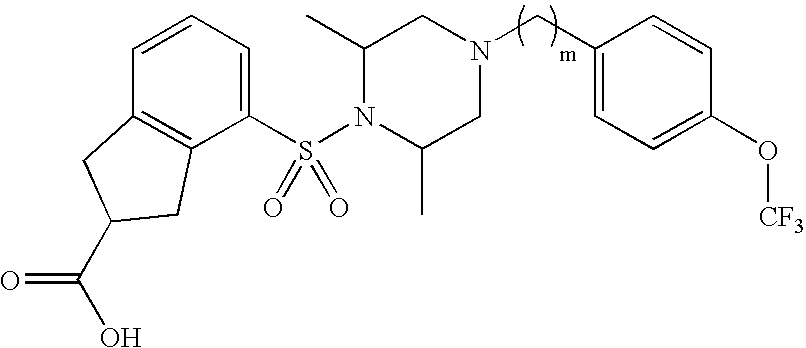
and m is 0 or 1.
5. The method as recited in claim 4 wherein said compound is selected from the group consisting of Compound 1, Compound 1A, Compound 3, and Compound 3A.
6. The method as recited in claim 3 wherein said compound is Compound 1A.
7. A method of reducing CRP comprising the administration of a therapeutically effective amount of (S)-4-[cis-2,6-dimethyl-4-(4-trifluoromethoxy-phenyl)-piperazine-1-sulfonyl]-indan-2-carboxylic acid tosylate.
8. The method as recited in claim 7 wherein said effective amount is greater than 20 mg per day when dosed orally.
9. The method as recited in claim 8 wherein said amount is between about 20 and about 140 mg per day when dosed orally.
10. The method as recited in claim 9 wherein said effective amount, when dosed orally, is selected from the group consisting of: about 20 mg per day, about 40 mg per day, about 60 mg per day, about 80 mg per day, and about 100 mg per day.
11. A pharmaceutical composition comprising:
a) a selective PPARδ modulator;
b) an amount of a folate effective to reduce CRP; and
c) together with one or more pharmaceutically acceptable active ingredients or adjuvants.
12. The pharmaceutical composition of claim 11 wherein said folate is folic acid.
13. A method of treating a patient comprising:
a. determining CRP levels of said patient;
b. determining if said CRP levels are too high for said patient; and
c. if said CRP levels are too high, having said patient take a therapeutically effective amount of a selective PPARδ modulator.
Priority Applications (1)
| Application Number | Priority Date | Filing Date | Title |
|---|---|---|---|
| US11/768,887 US20080004281A1 (en) | 2006-06-28 | 2007-06-26 | Methods for the modulation of crp by the selective modulation of ppar delta |
Applications Claiming Priority (2)
| Application Number | Priority Date | Filing Date | Title |
|---|---|---|---|
| US81757106P | 2006-06-28 | 2006-06-28 | |
| US11/768,887 US20080004281A1 (en) | 2006-06-28 | 2007-06-26 | Methods for the modulation of crp by the selective modulation of ppar delta |
Publications (1)
| Publication Number | Publication Date |
|---|---|
| US20080004281A1 true US20080004281A1 (en) | 2008-01-03 |
Family
ID=38877481
Family Applications (1)
| Application Number | Title | Priority Date | Filing Date |
|---|---|---|---|
| US11/768,887 Abandoned US20080004281A1 (en) | 2006-06-28 | 2007-06-26 | Methods for the modulation of crp by the selective modulation of ppar delta |
Country Status (1)
| Country | Link |
|---|---|
| US (1) | US20080004281A1 (en) |
Cited By (16)
| Publication number | Priority date | Publication date | Assignee | Title |
|---|---|---|---|---|
| US20070093504A1 (en) * | 2005-10-25 | 2007-04-26 | Kalyapsys, Inc. | Salts of Modulators Of PPAR and Methods of Treating Metabolic Disorders |
| US20070270434A1 (en) * | 2006-05-16 | 2007-11-22 | Kalypsys, Inc. | Sulfonyl-substituted bicyclic compounds as modulators of ppar |
| US20080176861A1 (en) * | 2007-01-23 | 2008-07-24 | Kalypsys, Inc. | Sulfonyl-substituted bicyclic compounds as ppar modulators for the treatment of non-alcoholic steatohepatitis |
| US20090029971A1 (en) * | 2004-10-29 | 2009-01-29 | Kalypsys, Inc. | Sulfonyl-substituted bicyclic compounds as modulators of ppar |
| WO2009021740A2 (en) | 2007-08-15 | 2009-02-19 | Sanofis-Aventis | Substituted tetrahydronaphthalenes, process for the preparation thereof and the use thereof as medicaments |
| US20090227599A1 (en) * | 1998-03-30 | 2009-09-10 | Kalypsys, Inc. | Sulfonyl-substituted bicyclic compounds as modulators of ppar |
| US20110178134A1 (en) * | 2008-02-07 | 2011-07-21 | Sanofi-Aventis | Novel phenyl-substituted imidazolidines, process for preparation thereof, medicaments comprising said compounds and use thereof |
| WO2011107494A1 (en) | 2010-03-03 | 2011-09-09 | Sanofi | Novel aromatic glycoside derivatives, medicaments containing said compounds, and the use thereof |
| WO2011157827A1 (en) | 2010-06-18 | 2011-12-22 | Sanofi | Azolopyridin-3-one derivatives as inhibitors of lipases and phospholipases |
| WO2011161030A1 (en) | 2010-06-21 | 2011-12-29 | Sanofi | Heterocyclic substituted methoxyphenyl derivatives having an oxo group, method for producing same, and use thereof as gpr40 receptor modulators |
| WO2012004269A1 (en) | 2010-07-05 | 2012-01-12 | Sanofi | (2-aryloxy-acetylamino)-phenyl-propionic acid derivatives, method for producing same and use thereof as pharmaceuticals |
| WO2012004270A1 (en) | 2010-07-05 | 2012-01-12 | Sanofi | Spirocyclically substituted 1,3-propane dioxide derivatives, methods for the production thereof and use of the same as medicament |
| WO2012010413A1 (en) | 2010-07-05 | 2012-01-26 | Sanofi | Aryloxy-alkylene substituted hydroxyphenyl hexynoic acids, methods for the production thereof and use of the same as medicament |
| WO2013037390A1 (en) | 2011-09-12 | 2013-03-21 | Sanofi | 6-(4-hydroxy-phenyl)-3-styryl-1h-pyrazolo[3,4-b]pyridine-4-carboxylic acid amide derivatives as kinase inhibitors |
| WO2013045413A1 (en) | 2011-09-27 | 2013-04-04 | Sanofi | 6-(4-hydroxy-phenyl)-3-alkyl-1h-pyrazolo[3,4-b]pyridine-4-carboxylic acid amide derivatives as kinase inhibitors |
| CN106061938A (en) * | 2014-02-28 | 2016-10-26 | 住友化学株式会社 | Method for producing 2-(halogenomethyl)-3-methylnitrobenzene |
Citations (10)
| Publication number | Priority date | Publication date | Assignee | Title |
|---|---|---|---|---|
| US6723740B2 (en) * | 1999-06-25 | 2004-04-20 | Smithkline Beecham Corporation | Activator of PPAR delta |
| US20040127443A1 (en) * | 2002-08-10 | 2004-07-01 | Pershadsingh Harrihar A. | Novel PPAR ligands that do not cause fluid retention, edema or congestive heart failure |
| US6787552B2 (en) * | 2000-08-11 | 2004-09-07 | Nippon Chemiphar Co., Ltd. | PPAR delta activators |
| US20040242459A1 (en) * | 2001-06-11 | 2004-12-02 | Forrest Michael J | Method for treating inflammatory diseases by administering a ppar-delta agonist |
| US20050020654A1 (en) * | 2003-03-15 | 2005-01-27 | Pershadsingh Harrihar A. | Novel PPAR agonists, pharmaceutical compositions and uses thereof |
| US20050080140A1 (en) * | 2003-10-13 | 2005-04-14 | Anges Mg, Inc. | Method for treating or preventing inflammatory disorders |
| US20050131035A1 (en) * | 2000-10-05 | 2005-06-16 | Buchan Kevin W. | Medicaments |
| US20060205736A1 (en) * | 1998-03-30 | 2006-09-14 | Kalypsys, Inc. | Sulfonyl-substituted bicyclic compounds as modulators of PPAR |
| US20070060626A1 (en) * | 2004-04-01 | 2007-03-15 | Aventis Pharmaceuticals Inc. | 1,3,4-oxadiazol-2-ones as ppar delta modulators and their use thereof |
| US20070093504A1 (en) * | 2005-10-25 | 2007-04-26 | Kalyapsys, Inc. | Salts of Modulators Of PPAR and Methods of Treating Metabolic Disorders |
-
2007
- 2007-06-26 US US11/768,887 patent/US20080004281A1/en not_active Abandoned
Patent Citations (11)
| Publication number | Priority date | Publication date | Assignee | Title |
|---|---|---|---|---|
| US20060205736A1 (en) * | 1998-03-30 | 2006-09-14 | Kalypsys, Inc. | Sulfonyl-substituted bicyclic compounds as modulators of PPAR |
| US7517884B2 (en) * | 1998-03-30 | 2009-04-14 | Kalypsys Inc. | Sulfonyl-substituted bicyclic compounds as modulators of PPAR |
| US6723740B2 (en) * | 1999-06-25 | 2004-04-20 | Smithkline Beecham Corporation | Activator of PPAR delta |
| US6787552B2 (en) * | 2000-08-11 | 2004-09-07 | Nippon Chemiphar Co., Ltd. | PPAR delta activators |
| US20050131035A1 (en) * | 2000-10-05 | 2005-06-16 | Buchan Kevin W. | Medicaments |
| US20040242459A1 (en) * | 2001-06-11 | 2004-12-02 | Forrest Michael J | Method for treating inflammatory diseases by administering a ppar-delta agonist |
| US20040127443A1 (en) * | 2002-08-10 | 2004-07-01 | Pershadsingh Harrihar A. | Novel PPAR ligands that do not cause fluid retention, edema or congestive heart failure |
| US20050020654A1 (en) * | 2003-03-15 | 2005-01-27 | Pershadsingh Harrihar A. | Novel PPAR agonists, pharmaceutical compositions and uses thereof |
| US20050080140A1 (en) * | 2003-10-13 | 2005-04-14 | Anges Mg, Inc. | Method for treating or preventing inflammatory disorders |
| US20070060626A1 (en) * | 2004-04-01 | 2007-03-15 | Aventis Pharmaceuticals Inc. | 1,3,4-oxadiazol-2-ones as ppar delta modulators and their use thereof |
| US20070093504A1 (en) * | 2005-10-25 | 2007-04-26 | Kalyapsys, Inc. | Salts of Modulators Of PPAR and Methods of Treating Metabolic Disorders |
Cited By (22)
| Publication number | Priority date | Publication date | Assignee | Title |
|---|---|---|---|---|
| US20090227599A1 (en) * | 1998-03-30 | 2009-09-10 | Kalypsys, Inc. | Sulfonyl-substituted bicyclic compounds as modulators of ppar |
| US20090029971A1 (en) * | 2004-10-29 | 2009-01-29 | Kalypsys, Inc. | Sulfonyl-substituted bicyclic compounds as modulators of ppar |
| US7915253B2 (en) | 2004-10-29 | 2011-03-29 | Kalypsys, Inc | Sulfonyl-substituted bicyclic compounds as modulators of PPAR |
| US7863276B2 (en) | 2005-10-25 | 2011-01-04 | Kalypsys, Inc | Salts of modulators of PPAR and methods of treating metabolic disorders |
| US20070093504A1 (en) * | 2005-10-25 | 2007-04-26 | Kalyapsys, Inc. | Salts of Modulators Of PPAR and Methods of Treating Metabolic Disorders |
| US20070270434A1 (en) * | 2006-05-16 | 2007-11-22 | Kalypsys, Inc. | Sulfonyl-substituted bicyclic compounds as modulators of ppar |
| US9463189B2 (en) | 2007-01-23 | 2016-10-11 | Bpv Holdings, Llc | Sulfonyl-substituted bicyclic compounds as PPAR modulators for the treatment of non-alcoholic steatohepatitis |
| US20080176861A1 (en) * | 2007-01-23 | 2008-07-24 | Kalypsys, Inc. | Sulfonyl-substituted bicyclic compounds as ppar modulators for the treatment of non-alcoholic steatohepatitis |
| WO2009021740A2 (en) | 2007-08-15 | 2009-02-19 | Sanofis-Aventis | Substituted tetrahydronaphthalenes, process for the preparation thereof and the use thereof as medicaments |
| US20110178134A1 (en) * | 2008-02-07 | 2011-07-21 | Sanofi-Aventis | Novel phenyl-substituted imidazolidines, process for preparation thereof, medicaments comprising said compounds and use thereof |
| WO2011107494A1 (en) | 2010-03-03 | 2011-09-09 | Sanofi | Novel aromatic glycoside derivatives, medicaments containing said compounds, and the use thereof |
| WO2011157827A1 (en) | 2010-06-18 | 2011-12-22 | Sanofi | Azolopyridin-3-one derivatives as inhibitors of lipases and phospholipases |
| WO2011161030A1 (en) | 2010-06-21 | 2011-12-29 | Sanofi | Heterocyclic substituted methoxyphenyl derivatives having an oxo group, method for producing same, and use thereof as gpr40 receptor modulators |
| WO2012004269A1 (en) | 2010-07-05 | 2012-01-12 | Sanofi | (2-aryloxy-acetylamino)-phenyl-propionic acid derivatives, method for producing same and use thereof as pharmaceuticals |
| WO2012004270A1 (en) | 2010-07-05 | 2012-01-12 | Sanofi | Spirocyclically substituted 1,3-propane dioxide derivatives, methods for the production thereof and use of the same as medicament |
| WO2012010413A1 (en) | 2010-07-05 | 2012-01-26 | Sanofi | Aryloxy-alkylene substituted hydroxyphenyl hexynoic acids, methods for the production thereof and use of the same as medicament |
| WO2013037390A1 (en) | 2011-09-12 | 2013-03-21 | Sanofi | 6-(4-hydroxy-phenyl)-3-styryl-1h-pyrazolo[3,4-b]pyridine-4-carboxylic acid amide derivatives as kinase inhibitors |
| WO2013045413A1 (en) | 2011-09-27 | 2013-04-04 | Sanofi | 6-(4-hydroxy-phenyl)-3-alkyl-1h-pyrazolo[3,4-b]pyridine-4-carboxylic acid amide derivatives as kinase inhibitors |
| CN106061938A (en) * | 2014-02-28 | 2016-10-26 | 住友化学株式会社 | Method for producing 2-(halogenomethyl)-3-methylnitrobenzene |
| US20160332956A1 (en) * | 2014-02-28 | 2016-11-17 | Sumitomo Chemical Company, Limited | Method for producing 2-(halogenomethyl)-3-methylnitrobenzene |
| US9815768B2 (en) * | 2014-02-28 | 2017-11-14 | Sumitomo Chemical Company, Limited | Method for producing 2-(halogenomethyl)-3-methylnitrobenzene |
| DE112015001003B4 (en) | 2014-02-28 | 2024-05-29 | Sumitomo Chemical Company, Limited | Process for the preparation of 2-(halomethyl)-3-methylnitrobenzene |
Similar Documents
| Publication | Publication Date | Title |
|---|---|---|
| US20080004281A1 (en) | Methods for the modulation of crp by the selective modulation of ppar delta | |
| US20070249519A1 (en) | Methods for the upregulation of glut4 via modulation of ppar delta in adipose tissue and for the treatment of disease | |
| US11840536B2 (en) | Heterocyclic inhibitors of PTPN11 | |
| JP7579402B2 (en) | 6-(4-amino-3-methyl-2-oxa-8-azaspiro[4.5]decan-8-yl)-3-(2,3-dichlorophenyl)-2-methylpyrimidin-4(3H)-one derivatives and related compounds as PTPN11 (SHP2) inhibitors for the treatment of cancer | |
| US9463189B2 (en) | Sulfonyl-substituted bicyclic compounds as PPAR modulators for the treatment of non-alcoholic steatohepatitis | |
| US11932629B2 (en) | KDM1A inhibitors for the treatment of disease | |
| US8080563B2 (en) | Bicyclic heteroaryl inhibitors of PDE4 | |
| US10428057B2 (en) | Bicyclo[1.1.1]pentane inhibitors of dual leucine zipper (DLK) kinase for the treatment of disease | |
| WO2017156397A1 (en) | Heterocyclic inhibitors of ptpn11 | |
| JP2017503815A (en) | Substituted pyrrolopyridines and pyrrolopyrazines for treating cancer or inflammatory diseases | |
| US11046649B2 (en) | Compounds useful as inhibitors of indoleamine 2,3-dioxygenase and/or tryptophan dioxygenase | |
| WO2021108198A1 (en) | Inhibitors of receptor interacting protein kinase i for the treatment of disease | |
| US20130116279A1 (en) | Bicyclic heteroaryl inhibitors of pde4 | |
| US20170001996A1 (en) | Gls1 inhibitors for treating disease | |
| US20070270434A1 (en) | Sulfonyl-substituted bicyclic compounds as modulators of ppar | |
| US20070190079A1 (en) | Methods for the selective modulation of ppar | |
| US20070219193A1 (en) | Alkylamine-substituted bicyclic aryl compounds useful as modulators of ppar | |
| US11466017B2 (en) | Heterocyclic inhibitors of PTPN11 | |
| RU2813145C2 (en) | Lysine-specific histone demethylase 1a (kdm1a) inhibitors for disease therapy | |
| IL296700A (en) | Process, preparations and crystalline forms of substituted pyridinone-pyridinyl compounds | |
| HK40016460A (en) | Bicyclo[1.1.1]pentane inhibitors of dual leucine zipper (dlk) kinase for the treatment of disease |
Legal Events
| Date | Code | Title | Description |
|---|---|---|---|
| AS | Assignment |
Owner name: KALYPSYS, INC., CALIFORNIA Free format text: ASSIGNMENT OF ASSIGNORS INTEREST;ASSIGNORS:RAO, TADIMETI S.;MCKEARN, JOHN P.;GUHA, MAUSUMEE;REEL/FRAME:019671/0758;SIGNING DATES FROM 20070702 TO 20070727 Owner name: KALYPSYS, INC., CALIFORNIA Free format text: ASSIGNMENT OF ASSIGNORS INTEREST;ASSIGNORS:RAO, TADIMETI S.;MCKEARN, JOHN P.;GUHA, MAUSUMEE;SIGNING DATES FROM 20070702 TO 20070727;REEL/FRAME:019671/0758 |
|
| STCB | Information on status: application discontinuation |
Free format text: ABANDONED -- FAILURE TO RESPOND TO AN OFFICE ACTION |