DE112015001003B4 - Process for the preparation of 2-(halomethyl)-3-methylnitrobenzene - Google Patents
Process for the preparation of 2-(halomethyl)-3-methylnitrobenzene Download PDFInfo
- Publication number
- DE112015001003B4 DE112015001003B4 DE112015001003.3T DE112015001003T DE112015001003B4 DE 112015001003 B4 DE112015001003 B4 DE 112015001003B4 DE 112015001003 T DE112015001003 T DE 112015001003T DE 112015001003 B4 DE112015001003 B4 DE 112015001003B4
- Authority
- DE
- Germany
- Prior art keywords
- formula
- compound represented
- mol
- bromomethyl
- hydrogen
- Prior art date
- Legal status (The legal status is an assumption and is not a legal conclusion. Google has not performed a legal analysis and makes no representation as to the accuracy of the status listed.)
- Active
Links
Classifications
-
- C—CHEMISTRY; METALLURGY
- C07—ORGANIC CHEMISTRY
- C07C—ACYCLIC OR CARBOCYCLIC COMPOUNDS
- C07C205/00—Compounds containing nitro groups bound to a carbon skeleton
- C07C205/07—Compounds containing nitro groups bound to a carbon skeleton the carbon skeleton being further substituted by halogen atoms
- C07C205/11—Compounds containing nitro groups bound to a carbon skeleton the carbon skeleton being further substituted by halogen atoms having nitro groups bound to carbon atoms of six-membered aromatic rings
-
- C—CHEMISTRY; METALLURGY
- C07—ORGANIC CHEMISTRY
- C07C—ACYCLIC OR CARBOCYCLIC COMPOUNDS
- C07C201/00—Preparation of esters of nitric or nitrous acid or of compounds containing nitro or nitroso groups bound to a carbon skeleton
- C07C201/06—Preparation of nitro compounds
- C07C201/12—Preparation of nitro compounds by reactions not involving the formation of nitro groups
-
- B—PERFORMING OPERATIONS; TRANSPORTING
- B01—PHYSICAL OR CHEMICAL PROCESSES OR APPARATUS IN GENERAL
- B01J—CHEMICAL OR PHYSICAL PROCESSES, e.g. CATALYSIS OR COLLOID CHEMISTRY; THEIR RELEVANT APPARATUS
- B01J21/00—Catalysts comprising the elements, oxides, or hydroxides of magnesium, boron, aluminium, carbon, silicon, titanium, zirconium, or hafnium
- B01J21/18—Carbon
-
- B—PERFORMING OPERATIONS; TRANSPORTING
- B01—PHYSICAL OR CHEMICAL PROCESSES OR APPARATUS IN GENERAL
- B01J—CHEMICAL OR PHYSICAL PROCESSES, e.g. CATALYSIS OR COLLOID CHEMISTRY; THEIR RELEVANT APPARATUS
- B01J23/00—Catalysts comprising metals or metal oxides or hydroxides, not provided for in group B01J21/00
- B01J23/38—Catalysts comprising metals or metal oxides or hydroxides, not provided for in group B01J21/00 of noble metals
- B01J23/40—Catalysts comprising metals or metal oxides or hydroxides, not provided for in group B01J21/00 of noble metals of the platinum group metals
- B01J23/44—Palladium
Landscapes
- Chemical & Material Sciences (AREA)
- Organic Chemistry (AREA)
- Chemical Kinetics & Catalysis (AREA)
- Engineering & Computer Science (AREA)
- Materials Engineering (AREA)
- Organic Low-Molecular-Weight Compounds And Preparation Thereof (AREA)
- Low-Molecular Organic Synthesis Reactions Using Catalysts (AREA)
Abstract
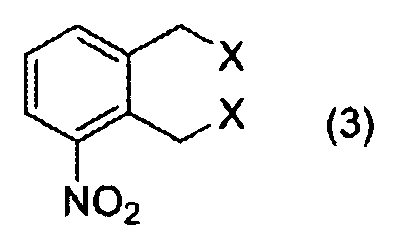
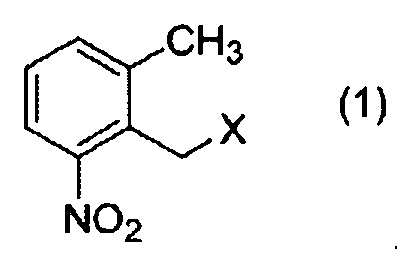
Ein Verfahren zur Herstellung einer Verbindung, dargestellt durch Formel (1), umfassend einen Schritt des Reagierenlassens einer Verbindung, dargestellt durch Formel (3):[wobei X ein Chloratom, ein Bromatom oder ein lodatom darstellt] mit Wasserstoff in Gegenwart eines heterogenen Übergangsmetallkatalysators, wobei die Verbindung, dargestellt durch Formel (1), erhalten wird:[wobei X ein Chloratom, ein Bromatom oder ein lodatom darstellt].A process for producing a compound represented by formula (1), comprising a step of reacting a compound represented by formula (3): [wherein X represents a chlorine atom, a bromine atom or an iodine atom] with hydrogen in the presence of a heterogeneous transition metal catalyst to obtain the compound represented by formula (1): [wherein X represents a chlorine atom, a bromine atom or an iodine atom].
Description
Technisches FachgebietTechnical field
Die vorliegende Erfindung betrifft ein Verfahren zur Herstellung von 2-(Halogenmethyl)-3-methylnitrobenzol.The present invention relates to a process for the preparation of 2-(halomethyl)-3-methylnitrobenzene.
Stand der TechnikState of the art
Wie in
Inzwischen ist die Tatsache, dass eine Nitroverbindung zu einer Aminverbindung in Gegenwart eines Palladiumkatalysators reduziert wird, allgemein bekannt, wie in „Jikken
Zusammenfassung der ErfindungSummary of the invention
Die vorliegende Erfindung stellt ein Verfahren zur Herstellung von 2-(Halogenmethyl)-3-methylnitrobenzol bereit.The present invention provides a process for producing 2-(halomethyl)-3-methylnitrobenzene.
Die vorliegende Erfindung betrifft ein Verfahren zur Herstellung einer Verbindung, dargestellt durch Formel (1), einschließlich:
- eines Schritts des Reagierenlassens einer Verbindung, dargestellt durch Formel (3):

- mit Wasserstoff in Gegenwart eines heterogenen Übergangsmetallkatalysators, wobei die Verbindung, dargestellt durch Formel (1), erhalten wird:

- a step of reacting a compound represented by formula (3):
- with hydrogen in the presence of a heterogeneous transition metal catalyst to give the compound represented by formula (1):
Zusätzlich betrifft die vorliegende Erfindung ein Verfahren zur Herstellung einer Verbindung, dargestellt durch Formel (1), umfassend:
- Schritt A des Reagierenlassens einer Verbindung, dargestellt durch Formel (2):

- mit einem oder mehreren Halogenierungsmitteln, ausgewählt aus der Gruppe, bestehend aus Chlor, Brom, N-Bromsuccinimid, Natriumbromisocyanurat, Dibromisocyanursäure, 1,3-Dibrom-5,5-dimethylhydantoin, Iod und N-Iodsuccinimid, wobei eine Verbindung, dargestellt durch Formel (3), erhalten wird:

- [wobei X ein Chloratom, ein Bromatom oder ein Iodatom darstellt]; und
- einen Schritt B des Reagierenlassens der Verbindung, dargestellt durch Formel (3), mit Wasserstoff in Gegenwart eines heterogenen Übergangsmetallkatalysators, wobei die Verbindung, dargestellt durch Formel (1), erhalten wird:

- [wobei das Symbol wie vorstehend definiert ist].
- Step A of reacting a compound represented by formula (2):
- with one or more halogenating agents selected from the group consisting of chlorine, bromine, N-bromosuccinimide, sodium bromoisocyanurate, dibromoisocyanuric acid, 1,3-dibromo-5,5-dimethylhydantoin, iodine and N-iodosuccinimide to obtain a compound represented by formula (3):
- [wherein X represents a chlorine atom, a bromine atom or an iodine atom]; and
- a step B of reacting the compound represented by formula (3) with what hydrogen in the presence of a heterogeneous transition metal catalyst to obtain the compound represented by formula (1):
- [where the symbol is as defined above].
Ausführungsweise der ErfindungImplementation of the invention
Nachstehend wird die vorliegende Erfindung im Einzelnen beschrieben.The present invention will be described in detail below.
Zuerst wird Schritt A beschrieben.First, step A is described.
Eine Verbindung, dargestellt durch Formel (3), kann durch Reagierenlassen einer Verbindung, dargestellt durch Formel (2), mit einem Halogenierungsmittel hergestellt werden.A compound represented by formula (3) can be prepared by reacting a compound represented by formula (2) with a halogenating agent.
Die Reaktion wird in einem Lösungsmittel oder in Abwesenheit eines Lösungsmittels durchgeführt. Beispiele des Lösungsmittels schließen aromatische Kohlenwasserstofflösungsmittel mit einem elektronenziehenden Rest an dem aromatischen Ring, wie Monochlorbenzol, Monobrombenzol, Nitrobenzol und o-Dichlorbenzol; halogenierte Kohlenwasserstofflösungsmittel, wie Dichlormethan, Chloroform, Dichlorethan und Tetrachlorkohlenstoff; Etherlösungsmittel, wie t-Butylmethylether, Tetrahydrofuran, Dioxan und Diethylether; Nitrillösungsmittel, wie Benzonitril, Acetonitril und Propionitril; Kohlenwasserstofflösungsmittel, wie Hexan, Heptan und Cyclohexan; Esterlösungsmittel, wie Methylacetat, Ethylacetat, Methylpropionat und Ethylpropionat; Wasser und gemischte Lösungsmittel davon ein.The reaction is carried out in a solvent or in the absence of a solvent. Examples of the solvent include aromatic hydrocarbon solvents having an electron-withdrawing group on the aromatic ring such as monochlorobenzene, monobromobenzene, nitrobenzene and o-dichlorobenzene; halogenated hydrocarbon solvents such as dichloromethane, chloroform, dichloroethane and carbon tetrachloride; ether solvents such as t-butyl methyl ether, tetrahydrofuran, dioxane and diethyl ether; nitrile solvents such as benzonitrile, acetonitrile and propionitrile; hydrocarbon solvents such as hexane, heptane and cyclohexane; ester solvents such as methyl acetate, ethyl acetate, methyl propionate and ethyl propionate; water and mixed solvents thereof.
Die zu verwendende Menge des Lösungsmittels ist üblicherweise das 0 bis 100fache, vorzugsweise 0,5 bis 70fache, bezogen auf das Gewicht der Verbindung, dargestellt durch Formel (3).The amount of the solvent to be used is usually 0 to 100 times, preferably 0.5 to 70 times, based on the weight of the compound represented by formula (3).
Beispiele des Halogenierungsmittels schließen Chlor, Brom, N-Bromsuccinimid, Natriumbromisocyanurat, Dibromisocyanursäure, 1,3-Dibrom-5,5-dimethylhydantoin, Iod und N-Iodsuccinimid ein. In Bezug auf die Effizienz der Umsetzung ist Brom bevorzugt.Examples of the halogenating agent include chlorine, bromine, N-bromosuccinimide, sodium bromoisocyanurate, dibromoisocyanuric acid, 1,3-dibromo-5,5-dimethylhydantoin, iodine and N-iodosuccinimide. In view of the efficiency of the reaction, bromine is preferred.
Die zu verwendende Menge des Halogenierungsmittels beträgt üblicherweise das 0,5 bis 10fache, vorzugsweise 1 bis 4fache der Mole, bezogen auf die Verbindung, dargestellt durch Formel (3).The amount of the halogenating agent to be used is usually 0.5 to 10 times, preferably 1 to 4 times, by moles based on the compound represented by formula (3).
Wenn Brom, N-Bromsuccinimid, Natriumbromisocyanurat, Dibromisocyanursäure oder 1,3-Dibrom-5,5-dimethylhydantoin als ein Halogenierungsmittel verwendet wird, ist bevorzugt, dass die Umsetzung in Gegenwart eines Radikalinitiators durchgeführt wird, und es ist bevorzugt, dass der Radikalinitiator und das Halogenierungsmittel gleichzeitig tropfenweise zu dem Reaktionssystem gegeben werden.When bromine, N-bromosuccinimide, sodium bromoisocyanurate, dibromoisocyanuric acid or 1,3-dibromo-5,5-dimethylhydantoin is used as a halogenating agent, it is preferable that the reaction is carried out in the presence of a radical initiator, and it is preferable that the radical initiator and the halogenating agent are simultaneously added dropwise to the reaction system.
Beispiele des Radikalinitiators schließen Azobisverbindungen, wie 2,2'-Azobis(4-methoxy-2,4-dimethylvaleronitril), 2,2'-Azobis(2,4-dimethylvaleronitril), 2,2'-Azobis(isobutyronitril) (nachstehend als AIBN bezeichnet), 2,2'-Azobis(2-methylbutyronitril) und 1,1'-Azobis(cyclohexan-1-carbonitril); sowie Peroxide, wie Benzoylperoxid und Di-t-butylperoxid, ein. AIBN, Benzoylperoxid, 2,2'-Azobis(2-methylbutyronitril) und 1,1'-Azobis(cyclohexan-1-carbonitril) sind bevorzugt und in Bezug auf die Verfügbarkeit sind AIBN und Benzoylperoxid noch stärker bevorzugt.Examples of the radical initiator include azobis compounds such as 2,2'-azobis(4-methoxy-2,4-dimethylvaleronitrile), 2,2'-azobis(2,4-dimethylvaleronitrile), 2,2'-azobis(isobutyronitrile) (hereinafter referred to as AIBN), 2,2'-azobis(2-methylbutyronitrile) and 1,1'-azobis(cyclohexane-1-carbonitrile); and peroxides such as benzoyl peroxide and di-t-butyl peroxide. AIBN, benzoyl peroxide, 2,2'-azobis(2-methylbutyronitrile) and 1,1'-azobis(cyclohexane-1-carbonitrile) are preferred, and in terms of availability, AIBN and benzoyl peroxide are more preferred.
Die zu verwendende Menge des Radikalinitiators beträgt üblicherweise 0,1 bis 10 mol-%, vorzugsweise 1 bis 6 mol-%, bezogen auf die Verbindung, dargestellt durch Formel (3).The amount of the radical initiator to be used is usually 0.1 to 10 mol%, preferably 1 to 6 mol%, based on the compound represented by formula (3).
Der Radikalinitiator kann auch vor Zugabe in dem vorstehenden Lösungsmittel gelöst werden.The radical initiator can also be dissolved in the above solvent before addition.
Wenn Chlor als ein Halogenierungsmittel verwendet wird, wird die Reaktion unter Bestrahlung mit UV-Licht durchgeführt. Die Lichtquelle des UV-Lichts muss nur Licht mit einer Wellenlänge von 180 nm bis 400 nm sein, und eine Lichtquelle mit 250 nm bis 350 nm ist bevorzugt. Als die Lichtquelle wird eine Hochdruck-Quecksilberlampe, eine Niederdruck-Quecksilberlampe oder dgl. verwendet.When chlorine is used as a halogenating agent, the reaction is carried out under irradiation with ultraviolet light. The light source of the ultraviolet light only needs to be light having a wavelength of 180 nm to 400 nm, and a light source of 250 nm to 350 nm is preferred. As the light source, a high-pressure mercury lamp, a low-pressure mercury lamp or the like is used.
Wenn Chlor, Brom oder Iod als ein Halogenierungsmittel verwendet wird, wird Halogenwasserstoff als ein Nebenprodukt der Umsetzung gebildet. Jedoch kann das Nebenprodukt Halogenwasserstoff in Chlor, Brom oder Iod durch ein Oxidationsmittel umgewandelt und als ein Halogenierungsmittel wiederverwendet werden.When chlorine, bromine or iodine is used as a halogenating agent, hydrogen halide is formed as a byproduct of the reaction. However, the byproduct hydrogen halide can be converted to chlorine, bromine or iodine by an oxidizing agent and reused as a halogenating agent.
Beispiele des Oxidationsmittels schließen Hypohalogenite, wie Natriumhypochlorit, Natriumhypobromit, Natriumhypoiodit, Kaliumhypochlorit, Kaliumhypobromit und Kaliumhypoiodit; Halite, wie Natriumchlorit, Natriumbromit, Natriumiodit, Kaliumbromit und Kaliumiodit; Halate, wie Natriumchlorat, Natriumbromat, Natriumiodat, Kaliumchlorat, Kaliumbromat und Kaliumiodat; Perhalate, wie Natriumperchlorat, Natriumperbromat, Natriumperiodat, Kaliumperchlorat, Kaliumperbromat und Kaliumperiodat; und Wasserstoffperoxid ein. Halite und Halate sind bevorzugt, und Natriumchlorit, Kaliumchlorit, Natriumchlorat, Kaliumchlorat, Natriumbromat und Kaliumbromat sind noch stärker bevorzugt.Examples of the oxidizing agent include hypohalites such as sodium hypochlorite, sodium hypobromite, sodium hypoiodite, potassium hypochlorite, potassium hypobromite and potassium hypoiodite; halites such as sodium chlorite, sodium bromite, sodium iodite, potassium bromite and potassium iodite; halates such as sodium chlorate, sodium bromate, sodium iodate, potassium chlorate, potassium bromate and potassium iodate; perhalates such as sodium perchlorate, sodium perbromate, sodium periodate, potassium perchlorate, potassium perbromate and potassium periodate; and hydrogen peroxide. Halites and halates are preferred, and sodium chlorite, potassium chlorite, sodium chlorate, potassium chlorate, sodium bromate and potassium bromate are more preferred.
Die zu verwendende Menge des Oxidationsmittels beträgt üblicherweise das 0,1 bis 5fache, vorzugsweise 0,2 bis 0,8fache der Mole, bezogen auf Chlor, Brom oder Iod, die als ein Halogenierungsmittel dienen.The amount of the oxidizing agent to be used is usually 0.1 to 5 times, preferably 0.2 to 0.8 times the moles based on chlorine, bromine or iodine serving as a halogenating agent.
Das Oxidationsmittel kann in der Form einer wässrigen Lösung verwendet werden.The oxidizing agent can be used in the form of an aqueous solution.
Die Reaktionstemperatur variiert abhängig von dem Halogenierungsmittel oder dem Radikalinitiator, beträgt aber üblicherweise 0 bis 120°C, vorzugsweise 25 bis 110°C.The reaction temperature varies depending on the halogenating agent or radical initiator, but is usually 0 to 120°C, preferably 25 to 110°C.
Die Umsetzungsdauer beträgt üblicherweise 2 bis 24 Stunden.The implementation time is usually 2 to 24 hours.
Nach vollständiger Umsetzung kann das verbliebene Halogenierungsmittel durch eine Reduktionsbehandlung entfernt werden. Die Reduktionsbehandlung kann unter Verwendung einer wässrigen Lösung von Natriumhydrogensulfit, Kaliumhydrogensulfit, Natriumsulfit, Kaliumsulfit oder dgl. durchgeführt werden.After completion of the reaction, the remaining halogenating agent can be removed by a reduction treatment. The reduction treatment can be carried out using an aqueous solution of sodium hydrogen sulfite, potassium hydrogen sulfite, sodium sulfite, potassium sulfite or the like.
Falls erforderlich kann die erhaltene Verbindung, dargestellt durch Formel (3), einem Waschen mit Wasser, Konzentrieren, einer Kristallisation, Filtration oder dgl. unterzogen werden, und man lässt sie dann mit Wasserstoff im Schritt B reagieren, oder sie kann weiter durch Umkristallisation, Destillation, Säulenchromatographie oder dgl. gereinigt werden, und man lässt sie dann mit Wasserstoff im Schritt B reagieren.If necessary, the obtained compound represented by formula (3) may be subjected to washing with water, concentration, crystallization, filtration or the like, and then allowed to react with hydrogen in step B, or it may be further purified by recrystallization, distillation, column chromatography or the like, and then allowed to react with hydrogen in step B.
Als Nächstes wird der Schritt B beschrieben.Next, step B is described.
Eine Verbindung, dargestellt durch Formel (1), kann durch Reagierenlassen einer Verbindung, dargestellt durch Formel (3) mit Wasserstoff in Gegenwart eines heterogenen Übergangsmetallkatalysators hergestellt werden.A compound represented by formula (1) can be prepared by reacting a compound represented by formula (3) with hydrogen in the presence of a heterogeneous transition metal catalyst.
Die Umsetzung wird in einem Lösungsmittel oder in Abwesenheit eines Lösungsmittels durchgeführt. Beispiele des Lösungsmittels schließen aromatische Kohlenwasserstofflösungsmittel, wie Toluol, Xylol und Ethylbenzol; Etherlösungsmittel, wie t-Butylmethylether, Tetrahydrofuran, Dioxan und Diethylether; Kohlenwasserstofflösungsmittel, wie Hexan, Heptan und Cyclohexan; Esterlösungsmittel, wie Methylacetat, Ethylacetat, Methylpropionat und Ethylpropionat; Alkohollösungsmittel, wie Methanol, Ethanol, Propanol, Isopropylalkohol und Butanol; Wasser und gemischte Lösungsmittel davon ein.The reaction is carried out in a solvent or in the absence of a solvent. Examples of the solvent include aromatic hydrocarbon solvents such as toluene, xylene and ethylbenzene; ether solvents such as t-butyl methyl ether, tetrahydrofuran, dioxane and diethyl ether; hydrocarbon solvents such as hexane, heptane and cyclohexane; ester solvents such as methyl acetate, ethyl acetate, methyl propionate and ethyl propionate; alcohol solvents such as methanol, ethanol, propanol, isopropyl alcohol and butanol; water and mixed solvents thereof.
Die zu verwendende Menge des Lösungsmittels beträgt üblicherweise das 0 bis 100fache, vorzugsweise 0,5 bis 20fache des Gewichts, bezogen auf die Verbindung, dargestellt durch Formel (3).The amount of the solvent to be used is usually 0 to 100 times, preferably 0.5 to 20 times the weight based on the compound represented by formula (3).
Beispiele des heterogenen Übergangsmetallkatalysators schließen heterogene Palladiumkatalysatoren, wie Palladium/Kohlenstoff, Palladium/Siliciumdioxid, Palladium/Aluminiumoxid, Palladium/Bariumsulfat; heterogene Platinkatalysatoren, wie Platin/Kohlenstoff, Platin/Siliciumdioxid und Platin/Aluminiumoxid; heterogene Rutheniumkatalysatoren, wie Ruthenium/Kohlenstoff, Ruthenium/Siliciumdioxid und Ruthenium/Aluminumoxid; heterogene Rhodiumkatalysatoren, wie Rhodium/Kohlenstoff, Rhodium/Siliciumdioxid und Rhodium/Aluminiumoxid; heterogene Iridiumkatalysatoren, wie Iridium/Kohlenstoff; heterogene Osmiumkatalysatoren, wie Osmium/Kohlenstoff; heterogene Nickelkatalysatoren, wie Nickel/Diatomeenerde-Katalysatoren und Raney-Nickel; und heterogene Kobaltkatalysatoren, wie Raney Kobaltkatalysatoren, ein. Heterogene Katalysatoren der Platingruppe, einschließlich Palladium, Platin, Ruthenium, Rhodium, Iridium und Osmium, die Elemente der Platingruppe sind, sind bevorzugt. Bezüglich eines industriellen Herstellungsverfahrens sind heterogene Palladiumkatalysatoren noch stärker bevorzugt, und Palladium/Kohlenstoff ist am stärksten bevorzugt. Der Metallgehalt des heterogenen Übergangsmetallkatalysators beträgt üblicherweise 1 bis 20 Gew.-%, vorzugsweise 5 bis 10 Gew.-%.Examples of the heterogeneous transition metal catalyst include heterogeneous palladium catalysts such as palladium/carbon, palladium/silica, palladium/alumina, palladium/barium sulfate; heterogeneous platinum catalysts such as platinum/carbon, platinum/silica and platinum/alumina; heterogeneous ruthenium catalysts such as ruthenium/carbon, ruthenium/silica and ruthenium/alumina; heterogeneous rhodium catalysts such as rhodium/carbon, rhodium/silica and rhodium/alumina; heterogeneous iridium catalysts such as iridium/carbon; heterogeneous osmium catalysts such as osmium/carbon; heterogeneous nickel catalysts such as nickel/diatomaceous earth catalysts and Raney nickel; and heterogeneous cobalt catalysts such as Raney cobalt catalysts. Heterogeneous platinum group catalysts including palladium, platinum, ruthenium, rhodium, iridium and osmium, which are platinum group elements, are preferred. In terms of an industrial production process, heterogeneous palladium catalysts are even more preferred, and palladium/carbon is most preferred. The metal content of the heterogeneous transition metal catalyst is usually 1 to 20 wt%, preferably 5 to 10 wt%.
Die zu verwendende Menge des heterogenen Übergangsmetallkatalysators beträgt als Metall, das in dem heterogenen Übergangsmetallkatalysator enthalten ist, üblicherweise 0,01 bis 2 mol-%, vorzugsweise 0,05 bis 1 mol-%, bezogen auf die durch Formel (3) dargestellte Verbindung.The amount of the heterogeneous transition metal catalyst to be used is usually 0.01 to 2 mol%, preferably 0.05 to 1 mol%, as the metal contained in the heterogeneous transition metal catalyst, based on the compound represented by formula (3).
Wenn man die durch Formel (3) dargestellte Verbindung mit Wasserstoff in einer Wasserstoffatmosphäre reagieren lässt, beträgt der Partialdruck von Wasserstoff üblicherweise 0,01 MPa bis 1 MPa, vorzugsweise 0,05 bis 0,5 MPa.When the compound represented by formula (3) is allowed to react with hydrogen in a hydrogen atmosphere, the partial pressure of hydrogen is usually 0.01 MPa to 1 MPa, preferably 0.05 to 0.5 MPa.
Ein Neutralisator kann ebenfalls zugegeben werden, um einen als ein Nebenprodukt der Reaktion gebildeten Halogenwasserstoff zu neutralisieren. Beispiele des Neutralisators schließen Erdalkalimetallhydroxide, wie Magnesiumhydroxid und Calciumhydroxid; Erdalkalimetallcarbonate, wie Magnesiumcarbonat und Calciumcarbonat; Erdalkalimetalloxide, wie Magnesiumoxid und Calciumoxid; Alkalimetallhydroxide, wie Lithiumhydroxid, Natriumhydroxid und Kaliumhydroxid; Alkalimetallcarbonate, wie Lithiumcarbonat, Natriumcarbonat und Kaliumcarbonat; und Alkalimetallhydrogencarbonate, wie Lithiumhydrogencarbonat, Natriumhydrogencarbonat und Kaliumhydrogencarbonat, ein.A neutralizer may also be added to neutralize a hydrogen halide formed as a byproduct of the reaction. Examples of the neutralizer include alkaline earth metal hydroxides such as magnesium hydroxide and calcium hydroxide; alkaline earth metal carbonates such as magnesium carbonate and calcium carbonate; alkaline earth metal oxides such as magnesium oxide and calcium oxide; alkali metal hydroxides such as lithium hydroxide, sodium hydroxide and potassium hydroxide; alkali metal carbonates such as lithium carbonate, sodium carbonate and potassium carbonate; and alkali metal hydrogencarbonates such as lithium hydrogencarbonate, sodium hydrogencarbonate and potassium hydrogencarbonate.
Die zu verwendende Menge des Neutralisators variiert abhängig von der Menge des als ein Nebenprodukt gebildeten Halogenwasserstoffs, beträgt aber üblicherweise das 0,1 bis 10fache, vorzugsweise 0,5 bis 3fache der Mole, bezogen auf die Verbindung, dargestellt durch Formel (3).The amount of neutralizer to be used varies depending on the amount of hydrogen halide formed as a by-product, but is usually 0.1 to 10 times, especially preferably 0.5 to 3 times the moles, based on the compound represented by formula (3).
Die Reaktionstemperatur beträgt üblicherweise 0°C oder mehr, vorzugsweise 0 bis 40°C und insbesondere bevorzugt 0 bis 25°C. Es ist bevorzugt, dass Palladium/Kohlenstoff als ein heterogener Palladiumkatalysator verwendet wird und die Umsetzung bei 0 bis 25°C durchgeführt wird.The reaction temperature is usually 0°C or more, preferably 0 to 40°C, and particularly preferably 0 to 25°C. It is preferred that palladium/carbon is used as a heterogeneous palladium catalyst and the reaction is carried out at 0 to 25°C.
Die Umsetzungsdauer beträgt üblicherweise 1 bis 48 Stunden.The implementation time is usually 1 to 48 hours.
Nach vollständiger Umsetzung wird zum Beispiel der Katalysator durch Filtration entfernt, und das Filtrat wird konzentriert, wobei eine Verbindung, dargestellt durch Formel (1), erhalten werden kann. Die Verbindung kann weiter durch Umkristallisation, Destillation, Chromatographie oder dgl. isoliert oder gereinigt werden.After completion of the reaction, for example, the catalyst is removed by filtration and the filtrate is concentrated, whereby a compound represented by formula (1) can be obtained. The compound can be further isolated or purified by recrystallization, distillation, chromatography or the like.
BEISPIELEEXAMPLES
Nachstehend wird die vorliegende Erfindung im Einzelnen in Bezug auf die Beispiele beschrieben. Jedoch ist die vorliegende Erfindung nicht nur auf diese Beispiele beschränkt.Hereinafter, the present invention will be described in detail with reference to Examples. However, the present invention is not limited to these Examples only.
Das in den Beispielen verwendete UV-Licht wurde unter Verwendung der folgenden Vorrichtung durchgeführt.
- Lichtquelle: Hochdruck UV-Lampe (100 W) UM-102 (Ushio Inc.)
- Beleuchtungsvorrichtung mit Hochdrucklampe: UM-103 B-B (Ushio Inc.)
- Light source: High pressure UV lamp (100 W) UM-102 (Ushio Inc.)
- High pressure lamp lighting device: UM-103 BB (Ushio Inc.)
Die in den Beispielen verwendeten GC Analysebedingungen sind wie folgt.
- Säule: DB-5, 30 m Länge, 0,53 mm Innendurchmesser, 1,50 µm Dicke (hergestellt von Agilent Technologies, Agilent J&W GC Säule)
- Nachweisverfahren: FID
- Lineare Geschwindigkeit: 60 cm/s (Helium)
- Säulentemperatur: 120°C (5 min), -200°C (2,5°C/min), -300°C (10 min)
- Injektionstemperatur: 250°C
- Detektortemperatur: 300°C
- Column: DB-5, 30 m length, 0.53 mm inner diameter, 1.50 µm thickness (manufactured by Agilent Technologies, Agilent J&W GC column)
- Verification method: FID
- Linear velocity: 60 cm/s (helium)
- Column temperature: 120°C (5 min), -200°C (2.5°C/min), -300°C (10 min)
- Injection temperature: 250°C
- Detector temperature: 300°C
Beispiel 1example 1
Ein Gemisch von 1,50 g (0,0099 mol) 2,3-Dimethylnitrobenzol, 15,0 g Monochlorbenzol, 0,14 g (0,0006 mol) Benzoylperoxid und 2,63 g (0,15 mol) N-Bromsuccinimid wurde 3 Stunden bei 100°C gerührt. Von dem Gemisch wurde eine Probe genommen und einer GC-Analyse unterzogen. Als Ergebnis waren die Flächenprozentsätze wie folgt.
- 2-(Brommethyl)-3-methylnitrobenzol: 20,2 %
- 3-(Brommethyl)-2-methylnitrobenzol: 34,7 %
- 2,3-Bis(brommethyl)nitrobenzol: 34,4 %
- 2-(Brommethyl)-3-(dibrommethyl)nitrobenzol: 1,7 %
- 2-(Bromomethyl)-3-methylnitrobenzene: 20.2%
- 3-(Bromomethyl)-2-methylnitrobenzene: 34.7%
- 2,3-Bis(bromomethyl)nitrobenzene: 34.4%
- 2-(Bromomethyl)-3-(dibromomethyl)nitrobenzene: 1.7%
Beispiel 2Example 2
Zu 10,0 g Monochlorbenzol wurden 5,0 g (0,033 mol) 2,3-Dimethylnitrobenzol und 10,4 g (0,0364 mol) 1,3-Dibrom-5,5-dimethylhydantoin gegeben und auf 75 bis 80°C erwärmt. Eine Lösung, hergestellt durch Lösen von 0,19 g (0,0012 mol) AIBN in 5,0 g Monochlorbenzol wurde bei 70 bis 80°C während 1 Stunde zugetropft und bei der gleichen Temperatur 2 Stunden gerührt. Das Gemisch wurde auf 25°C abgekühlt, dann wurden 20 g Wasser zugegeben, und die Schichten wurden getrennt. Die erhaltene organische Schicht wurde unter vermindertem Druck konzentriert, wobei 10,25 g eines Konzentrats erhalten wurden. Als Ergebnis der GC Analyse des Konzentrats waren die Flächenprozentsätze wie folgt.
- 2-(Brommethyl)-3-methylnitrobenzol: 5,5 %
- 3-(Brommethyl)-2-methylnitrobenzol: 11,1 %
- 2,3-Bis(brommethyl)nitrobenzol: 60,6 %
- 2-(Brommethyl)-3-(dibrommethyl)nitrobenzol: 10,4 %
- 2-(Bromomethyl)-3-methylnitrobenzene: 5.5%
- 3-(Bromomethyl)-2-methylnitrobenzene: 11.1%
- 2,3-Bis(bromomethyl)nitrobenzene: 60.6%
- 2-(Bromomethyl)-3-(dibromomethyl)nitrobenzene: 10.4%
Beispiel 3Example 3
Ein Gemisch von 1,00 g (0,0066 mol) 2,3-Dimethylnitrobenzol, 10,0 g Monochlorbenzol und 0,08 g (0,0003 mol) Benzoylperoxid wurde auf 85°C erwärmt, und 3,10 g (0,019 mol) Brom wurde während 2 Stunden zugetropft, gefolgt von 6 Stunden Rühren bei der gleichen Temperatur. Als Nächstes wurden 3,17 g (0,020 mol) Brom zugetropft und weiter 9 Stunden gerührt. Von dem Reaktionsgemisch wurde eine Probe genommen und einer GC Analyse unterzogen. Als Ergebnis waren die Flächenprozentsätze wie folgt.
- 2,3-Dimethylnitrobenzol: 28,1 %
- 2-(Brommethyl)-3-methylnitrobenzol: 23,1 %
- 3-(Brommethyl)-2-methylnitrobenzol: 35,5 %
- 2,3-Bis(brommethyl)nitrobenzol: 4,4 %
- 2,3-Dimethylnitrobenzene: 28.1%
- 2-(Bromomethyl)-3-methylnitrobenzene: 23.1%
- 3-(Bromomethyl)-2-methylnitrobenzene: 35.5%
- 2,3-Bis(bromomethyl)nitrobenzene: 4.4%
Beispiel 4Example 4
Ein Gemisch von 1,00 g (0,0066 mol) 2,3-Dimethylnitrobenzol, 10,1 g Nitrobenzol und 0,09 g (0,0004 mol) Benzoylperoxid wurde auf 85°C erwärmt, und 3,10 g (0,019 mol) Brom wurde während 2 Stunden zugetropft, gefolgt von 6 Stunden Rühren bei der gleichen Temperatur. Als Nächstes wurden 3,17 g (0,020 mol) Brom zugetropft und weiter 9 Stunden gerührt. Von dem Reaktionsgemisch wurde eine Probe genommen und einer GC Analyse unterzogen. Als Ergebnis waren die Flächenprozentsätze wie folgt.
- 2,3-Dimethylnitrobenzol: 32,3 %
- 2-(Brommethyl)-3-methylnitrobenzol: 24,1 %
- 3-(Brommethyl)-2-methylnitrobenzol: 36,1 %
- 2,3-Bis(brommethyl)nitrobenzol: 3,8 %
- 2,3-Dimethylnitrobenzene: 32.3%
- 2-(Bromomethyl)-3-methylnitrobenzene: 24.1%
- 3-(Bromomethyl)-2-methylnitrobenzene: 36.1%
- 2,3-Bis(bromomethyl)nitrobenzene: 3.8%
Beispiel 5Example 5
Zu einem Gemisch von 2,00 g (0,013 mol) 2,3-Dimethylnitrobenzol und 0,16 g (0,00066 mol) Benzoylperoxid wurden 3,17 g (0,020 mol) Brom während 20 Minuten getropft, gefolgt von 2 Stunden Rühren bei 60°C und dann 6 Stunden bei 110°C. Von dem Reaktionsgemisch wurde eine Probe genommen und einer GC Analyse unterzogen. Als Ergebnis waren die Flächenprozentsätze wie folgt.
- 2,3-Dimethylnitrobenzol: 26,7 %
- 2-(Brommethyl)-3-methylnitrobenzol: 22,9 %
- 3-(Brommethyl)-2-methylnitrobenzol: 33,7 %
- 2,3-Bis(brommethyl)nitrobenzol: 6,6 %
- 2,3-Dimethylnitrobenzene: 26.7%
- 2-(Bromomethyl)-3-methylnitrobenzene: 22.9%
- 3-(Bromomethyl)-2-methylnitrobenzene: 33.7%
- 2,3-Bis(bromomethyl)nitrobenzene: 6.6%
Als Nächstes wurden 0,16 g (0,0007 mol) Benzoylperoxid zugegeben, und dann wurden 1,50 g (0,009 mol) Brom während 1 Stunde zugetropft, gefolgt von 7 Stunden Rühren bei 1 10°C. Von dem Reaktionsgemisch wurde eine Probe genommen und einer GC Analyse unterzogen. Als Ergebnis waren die Flächenprozentsätze wie folgt.
- 2,3-Dimethylnitrobenzol: 1,0 %
- 2-(Brommethyl)-3-methylnitrobenzol: 21,5 %
- 3-(Brommethyl)-2-methylnitrobenzol: 33,1 %
- 2,3-Bis(brommethyl)nitrobenzol: 26,7 %
- 2-(Brommethyl)-3-(dibrommethyl)nitrobenzol: 0,8 %
- 2,3-Dimethylnitrobenzene: 1.0%
- 2-(Bromomethyl)-3-methylnitrobenzene: 21.5%
- 3-(Bromomethyl)-2-methylnitrobenzene: 33.1%
- 2,3-Bis(bromomethyl)nitrobenzene: 26.7%
- 2-(Bromomethyl)-3-(dibromomethyl)nitrobenzene: 0.8%
Beispiel 6Example 6
Zu 200,0 g Monochlorbenzol wurden 100,0 g (0,661 mol) 2,3-Dimethylnitrobenzol, 17,4 g Wasser und 14,97 g (0,099 mol) Natriumbromat gegeben und auf 75 bis 80°C erwärmt. Eine Lösung, hergestellt durch Lösen von 3,80 g (0,023 mol) AIBN in 100,0 g Monochlorbenzol und 58,1 g (0,363 mol) Brom wurden gleichzeitig bei 70 bis 80°C während 5 Stunden zugetropft und 1 Stunde bei der gleichen Temperatur gerührt. Das Gemisch wurde auf 25°C abgekühlt, dann wurden 200 g Wasser zugegeben, und die Schichten wurden getrennt. Die organische Schicht wurde unter vermindertem Druck konzentriert, wobei 153,20 g eines Konzentrats erhalten wurden. Als Ergebnis der GC Analyse des Konzentrats waren die Flächenprozentsätze wie folgt.
- 2,3-Dimethylnitrobenzol: 14,5 %
- 2-(Brommethyl)-3-methylnitrobenzol: 29,2 %
- 3-(Brommethyl)-2-methylnitrobenzol: 44,5 %
- 2,3-Bis(brommethyl)nitrobenzol: 9,7 %
- 2-(Brommethyl)-3-(dibrommethyl)nitrobenzol: Spuren
- 2,3-Dimethylnitrobenzene: 14.5%
- 2-(Bromomethyl)-3-methylnitrobenzene: 29.2%
- 3-(Bromomethyl)-2-methylnitrobenzene: 44.5%
- 2,3-Bis(bromomethyl)nitrobenzene: 9.7%
- 2-(Bromomethyl)-3-(dibromomethyl)nitrobenzene: traces
Beispiel 7Example 7
Zu 10,0 g Monochlorbenzol wurden 5,0 g (0,033 mol) 2,3-Dimethylnitrobenzol, 3,0 g Wasser und 1,50 g (0,0099 mol) Natriumbromat gegeben und auf 75 bis 80°C erwärmt. Eine Lösung, hergestellt durch Lösen von 0,19 g (0,0012 mol) AIBN in 5,0 g Monochlorbenzol, und 5,81 g (0,036 mol) Brom wurden gleichzeitig bei 70 bis 80°C während 1 Stunden zugetropft und 2 Stunden bei der gleichen Temperatur gerührt. Das Gemisch wurde auf 25°C abgekühlt, dann wurden 20 g Wasser zugegeben, und die Schichten wurden getrennt. Die organische Schicht wurde unter vermindertem Druck konzentriert, wobei 10,38 g eines Konzentrats erhalten wurden. Als Ergebnis der GC Analyse des Konzentrats waren die Flächenprozentsätze wie folgt.
- 2-(Brommethyl)-3-methylnitrobenzol: 9,7 %
- 3-(Brommethyl)-2-methylnitrobenzol: 17,7 %
- 2,3-Bis(brommethyl)nitrobenzol: 56,3 %
- 2-(Brommethyl)-3-(dibrommethyl)nitrobenzol: 5,2 %
- 2-(Bromomethyl)-3-methylnitrobenzene: 9.7%
- 3-(Bromomethyl)-2-methylnitrobenzene: 17.7%
- 2,3-Bis(bromomethyl)nitrobenzene: 56.3%
- 2-(Bromomethyl)-3-(dibromomethyl)nitrobenzene: 5.2%
Beispiel 8Example 8
Zu 10,0 g Monochlorbenzol wurden 5,0 g (0,033 mol) 2,3-Dimethylnitrobenzol, 3,0 g Wasser und 1,41 g (0,0132 mol) Natriumchlorat gegeben und auf 75 bis 80°C erwärmt. Eine Lösung, hergestellt durch Lösen von 0,19 g (0,0012 mol) AIBN in 5,0 g Monochlorbenzol und 6,34 g (0,040 mol) Brom wurden gleichzeitig bei 70 bis 80°C während 1 Stunde zugetropft und 2 Stunden bei der gleichen Temperatur gerührt. Das Gemisch wurde auf 25°C abgekühlt, dann wurden 20 g Wasser zugegeben, und die Schichten wurden getrennt. Die erhaltene organische Schicht wurde unter vermindertem Druck konzentriert, wobei 10,21 g eines Konzentrats erhalten wurden. Als Ergebnis der GC Analyse des Konzentrats waren die Flächenprozentsätze wie folgt.
- 2-(Brommethyl)-3-methylnitrobenzol: 14,3 %
- 3-(Brommethyl)-2-methylnitrobenzol: 24,1 %
- 2,3-Bis(brommethyl)nitrobenzol: 48,4 %
- 2-(Brommethyl)-3-(dibrommethyl)nitrobenzol: 3,7 %
- 2-(Bromomethyl)-3-methylnitrobenzene: 14.3%
- 3-(Bromomethyl)-2-methylnitrobenzene: 24.1%
- 2,3-Bis(bromomethyl)nitrobenzene: 48.4%
- 2-(Bromomethyl)-3-(dibromomethyl)nitrobenzene: 3.7%
Beispiel 9Example 9
In einen Reaktionsbehälter wurden 1,00 g (0,0066 mol) 2,3-Dimethylnitrobenzol und 50,0 g Monochlorbenzol gegeben und Spülen mit Stickstoff folgte. Anschließend wurde unter Durchblasen von Chlorgas bei 25°C der Reaktionsbehälter mit UV-Licht 10 Stunden unter Verwendung einer 100 W Hochdruck-UV-Lampe bestrahlt. Von dem Reaktionsgemisch wurde eine Probe genommen und einer GC Analyse unterzogen. Als Ergebnis waren die Flächenprozentsätze wie folgt.
- 2,3-Dimethylnitrobenzol: 27,6 %
- 2-(Chlormethyl)-3-methylnitrobenzol: 9,8 %
- 3-(Chlormethyl)-2-methylnitrobenzol: 21,2 %
- 2,3-Bis(brommethyl)nitrobenzol: 2,7 %
- 2-(Chlormethyl)-3-(dichlormethyl)nitrobenzol: Spuren
- 2,3-Dimethylnitrobenzene: 27.6%
- 2-(Chloromethyl)-3-methylnitrobenzene: 9.8%
- 3-(Chloromethyl)-2-methylnitrobenzene: 21.2%
- 2,3-Bis(bromomethyl)nitrobenzene: 2.7%
- 2-(Chloromethyl)-3-(dichloromethyl)nitrobenzene: traces
In der Analyse wurden 2,3-Bis(chlormethyl)nitrobenzol und 2-(Chlormethyl)-3-(dichlormethyl)nitrobenzol durch Nitrieren von 1,2-Bis(chlormethyl)benzol bzw. 1-(Chlormethyl)-2-(dichlormethyl)benzol synthetisiert, und die Übereinstimmung der Elutionsstellungen am GC-Chromatogramm wurde bestätigt.
1H-NMR (400 MHz, CDCl3) δ: 4,81 (2H, s), 4,96 (2H, s), 7,53 (1H, t, J = 7,93 Hz), 7,68 (1H, dd, J = 7,70 Hz, 1,36 Hz), 7,90 (1H, dd, J = 8,15 Hz, 1,36 Hz)
1H-NMR (400 MHz, CDCl3) δ: 4,89 (2H, s), 7,19 (1H, s), 7,64 (1H, t, J = 8,0 Hz), 7,92 (1H, dd, J = 8,0 Hz, 1,2 Hz), 8,22 (1H, dd, J = 7,9 Hz, 1,4 Hz) 1 H-NMR (400 MHz, CDCl 3 ) δ: 4.89 (2H, s), 7.19 (1H, s), 7.64 (1H, t, J = 8.0 Hz), 7.92 (1H, dd, J = 8.0 Hz, 1.2 Hz), 8.22 (1H, dd, J = 7.9 Hz, 1.4 Hz)
Beispiel 10Example 10
In einen Reaktionsbehälter wurden 1,00 g (0,0066 mol) 2,3-Dimethylnitrobenzol und 61,0 g Chloroform gegeben und Spülen mit Stickstoff folgte. Anschließend wurde unter Durchblasen von Chlorgas bei 25°C der Reaktionsbehälter mit UV-Licht 7,5 Stunden unter Verwendung einer 100 W Hochdruck-UV-Lampe bestrahlt. Von dem Reaktionsgemisch wurde eine Probe genommen und einer GC Analyse unterzogen. Als Ergebnis waren die Flächenprozentsätze wie folgt.
- 2,3-Dimethylnitrobenzol: 15,5 %
- 2-(Chlonnethyl)-3-methylnitrobenzol: 11,1 %
- 3-(Chlormethyl)-2-methylnitrobenzol: 15,0 %
- 2,3-Bis(chlormethyl)nitrobenzol: 4,5 %
- 2-(Chlormethyl)-3-(dichlormethyl)nitrobenzol: Spuren
- 2,3-Dimethylnitrobenzene: 15.5%
- 2-(chloromethyl)-3-methylnitrobenzene: 11.1%
- 3-(Chloromethyl)-2-methylnitrobenzene: 15.0%
- 2,3-Bis(chloromethyl)nitrobenzene: 4.5%
- 2-(Chloromethyl)-3-(dichloromethyl)nitrobenzene: traces
Beispiel 11Example 11
In einen Reaktionsbehälter wurden 1,00 g (0,0066 mol) 2,3-Dimethylnitrobenzol und 61,3 g Chloroform gegeben und Spülen mit Stickstoff folgte. Anschließend wurden 3,10 g (0,019 mol) Brom bei 25°C während 30 Minuten zugetropft, und der Reaktionsbehälter wurde mit UV-Licht für 9 Stunden unter Verwendung einer 100 W Hochdruck-UV-Lampe bestrahlt. Anschließend wurden 2,95 g (0,018 mol) Brom bei 35°C während 1 Stunde zugetropft, dann 4 Stunden gerührt und weiter mit UV-Licht bei 40°C 4 Stunden bestrahlt. Von dem Reaktionsgemisch wurde eine Probe genommen und einer GC Analyse unterzogen. Als Ergebnis waren die Flächenprozentsätze wie folgt.
- 2,3-Dimethylnitrobenzol: 71,7 %
- 2-(Brommethyl)-3-methylnitrobenzol: 13,7 %
- 3-(Brommethyl)-2-methylnitrobenzol: 8,1 %
- 2,3-Bis(brommethyl)nitrobenzol: 0,8 %
- 2-(Brommethyl)-3-(dibrommethyl)nitrobenzol: 0,2 %
- 2,3-Dimethylnitrobenzene: 71.7%
- 2-(Bromomethyl)-3-methylnitrobenzene: 13.7%
- 3-(Bromomethyl)-2-methylnitrobenzene: 8.1%
- 2,3-Bis(bromomethyl)nitrobenzene: 0.8%
- 2-(Bromomethyl)-3-(dibromomethyl)nitrobenzene: 0.2%
Beispiel 12Example 12
Zu 0,77 g eines Gemisches, das 2,3-Bis(brommethyl)nitrobenzol in einem GC-Flächenprozentsatz von 96,1 % enthält, wurden 28,8 mg 5 % Pd/C (53,5 % nasses Produkt), 68,8 mg Magnesiumoxid, 0,07 g Wasser und 9,7 g Methanol gegeben und durch Rühren in einer Wasserstoffgasatmosphäre bei 0 bis 10°C für 3,5 Stunden gefolgt. Von dem Reaktionsgemisch wurde eine Probe genommen und einer GC-Analyse unterzogen. Als Ergebnis betrug der Flächenprozentsatz von 2-(Brommethyl)-3-methylnitrobenzol 55,9 %.To 0.77 g of a mixture containing 2,3-bis(bromomethyl)nitrobenzene in a GC area percentage of 96.1%, 28.8 mg of 5% Pd/C (53.5% wet product), 68.8 mg of magnesium oxide, 0.07 g of water and 9.7 g of methanol were added, followed by stirring in a hydrogen gas atmosphere at 0 to 10°C for 3.5 hours. The reaction mixture was sampled and subjected to GC analysis. As a result, the area percentage of 2-(bromomethyl)-3-methylnitrobenzene was 55.9%.
Beispiel 13Example 13
Zu 0,75 g eines Gemisches, das 2,3-Bis(brommethyl)nitrobenzol in einem GC-Flächenprozentsatz von 96,1 % enthält, wurden 27,8 mg 5 % Pd/C (53,5 % nasses Produkt), 68,3 mg Magnesiumoxid, 45 mg Wasser und 9,4 g 2-Propanol gegeben und durch Rühren in einer Wasserstoffgasatmosphäre bei 0 bis 10°C für 6 Stunden und dann bei 20°C für 2 Stunden gefolgt. Von dem Reaktionsgemisch wurde eine Probe genommen und einer GC-Analyse unterzogen. Als Ergebnis betrug der Flächenprozentsatz von 2-(Brommethyl)-3-methylnitrobenzol 62,3 %.To 0.75 g of a mixture containing 2,3-bis(bromomethyl)nitrobenzene in a GC area percentage of 96.1%, 27.8 mg of 5% Pd/C (53.5% wet product), 68.3 mg of magnesium oxide, 45 mg of water and 9.4 g of 2-propanol were added, followed by stirring in a hydrogen gas atmosphere at 0 to 10°C for 6 hours and then at 20°C for 2 hours. The reaction mixture was sampled and subjected to GC analysis. As a result, the area percentage of 2-(bromomethyl)-3-methylnitrobenzene was 62.3%.
Beispiel 14Example 14
Zu 1,00 g eines Gemisches, das 2,3-Bis(brommethyl)nitrobenzol in einem GC-Flächenprozentsatz von 54,1 % enthält, wurden 41,6 mg 5 % Pd/C (58,2 % nasses Produkt), 64,8 mg Magnesiumoxid, 48 mg Wasser und 10,1 g Methanol gegeben und durch Rühren in einer Wasserstoffgasatmosphäre bei 0 bis 10°C für 16,5 Stunden gefolgt. Anschließend wurde nach Spülen mit Stickstoffgas das Reaktionsgemisch filtriert, und das erhaltene Filtrat wurde unter vermindertem Druck konzentriert. Toluol und Wasser wurden zum Rückstand gegeben, und die Schichten wurden getrennt. Die erhaltene Toluollösung wurde unter vermindertem Druck konzentriert, wobei 0,23 g eines Konzentrats erhalten wurden. Als Ergebnis der GC-Analyse des Konzentrats betrug der Flächenprozentsatz von 2-(Brommethyl)-3-methylnitrobenzol 52,4 %.To 1.00 g of a mixture containing 2,3-bis(bromomethyl)nitrobenzene in a GC area percentage of 54.1%, 41.6 mg of 5% Pd/C (58.2% wet product), 64.8 mg of magnesium oxide, 48 mg of water and 10.1 g of methanol were added, followed by stirring in a hydrogen gas atmosphere at 0 to 10°C for 16.5 hours. Then, after purging with nitrogen gas, the reaction mixture was filtered, and the obtained filtrate was concentrated under reduced pressure. Toluene and water were added to the residue, and the layers were separated. The obtained toluene solution was concentrated under reduced pressure to obtain 0.23 g of a concentrate. As a result of GC analysis of the concentrate, the area percentage of 2-(bromomethyl)-3-methylnitrobenzene was 52.4%.
Beispiel 15Example 15
Zu 5,05 g Monochlorbenzol wurden 10,05 g (0,0662 mol) 2,3-Dimethylnitrobenzol, 6,00 g Wasser und 2,99 g (0,0198 mol) Natriumbromat gegeben und auf 75 bis 80°C erwärmt. Eine Lösung, hergestellt durch Lösen von 0,08 g (0,00049 mol) AIBN in 1,0 g Monochlorbenzol wurde zugegeben und 30 Minuten gerührt und anschließend wurden eine Lösung, hergestellt durch Lösen von 0,62 g (0,0038 mol) AIBN in 4,0 g Monochlorbenzol, und 11,63 g (0,0728 mol) Brom gleichzeitig bei 70 bis 80°C zugetropft und bei der gleichen Temperatur 7 Stunden gerührt. Das Gemisch wurde auf 25°C abgekühlt, dann wurden eine wässrige Natriumsulfitlösung und Monochlorbenzol zugegeben, und die Schichten wurden getrennt. Die organische Schicht wurde mit einer gesättigten Natriumhydrogencarbonatlösung und gesättigter Salzlösung gewaschen und unter vermindertem Druck konzentriert, wobei 21,85 g eines Konzentrats erhalten wurden. Als ein Ergebnis der GC Analyse des Konzentrats betrug der Flächenprozentsatz von 2,3-Bis(brommethyl)nitrobenzol 62,3 %.To 5.05 g of monochlorobenzene were added 10.05 g (0.0662 mol) of 2,3-dimethylnitrobenzene, 6.00 g of water and 2.99 g (0.0198 mol) of sodium bromate and heated to 75 to 80°C. A solution prepared by dissolving 0.08 g (0.00049 mol) of AIBN in 1.0 g of monochlorobenzene was added and stirred for 30 minutes, and then a solution prepared by dissolving 0.62 g (0.0038 mol) of AIBN in 4.0 g of monochlorobenzene and 11.63 g (0.0728 mol) of bromine were simultaneously added dropwise at 70 to 80°C and stirred at the same temperature for 7 hours. The mixture was cooled to 25°C, then an aqueous sodium sulfite solution and monochlorobenzene were added, and the layers were separated. The organic layer was washed with a saturated sodium hydrogen carbonate solution and saturated saline, and concentrated under reduced pressure to obtain 21.85 g of a concentrate. As a result of GC analysis of the concentrate, the area percentage of 2,3-bis(bromomethyl)nitrobenzene was 62.3%.
Zu 10,04 g des im vorstehenden Schritt erhaltenen Reaktionsgemisches wurden 100,06 g Methanol gegeben und von Kühlen auf 5°C gefolgt. 0,40 g 5 % Pd/C (58,2 % nasses Produkt) wurden zugegeben und 9,5 Stunden in einer Wasserstoffgasatmosphäre bei 5°C gerührt. Nach Spülen mit Stickstoffgas wurde das Reaktionsgemisch filtriert, wobei 134,01 g einer Methanollösung erhalten wurden. Als Ergebnis der Analyse der erhaltenen Methanollösung durch ein GC Verfahren mit internem Standard betrug der Gehalt an 2-(Brommethyl)-3-methylnitrobenzol 1,34 g. (Gesamtausbeute aus 2,3-Dimethylnitrobenzol: 47,2 %).To 10.04 g of the reaction mixture obtained in the above step, 100.06 g of methanol was added, followed by cooling to 5°C. 0.40 g of 5% Pd/C (58.2% wet product) was added and stirred for 9.5 hours in a hydrogen gas atmosphere at 5°C. After purging with nitrogen gas, the reaction mixture was filtered to obtain 134.01 g of a methanol solution. As a result of analysis of the obtained methanol solution by an internal standard GC method, the content of 2-(bromomethyl)-3-methylnitrobenzene was 1.34 g. (Total yield from 2,3-dimethylnitrobenzene: 47.2%).
Beispiel 16Example 16
Zu 3,81 g Monochlorbenzol wurden 7,50 g (0,0496 mol) 2,3-Dimethylnitrobenzol, 4,55 g Wasser und 2,31 g (0,0149 mol) Natriumbromat gegeben und auf 75 bis 80°C erwärmt. Eine Lösung, hergestellt durch Lösen von 0,07 g (0,00043 mol) AIBN in 0,77 g Monochlorbenzol wurde zugegeben und 30 Minuten gerührt und anschließend wurden eine Lösung, hergestellt durch Lösen von 0,46 g (0,0028 mol) AIBN in 3,0 g Monochlorbenzol, und 8,72 g (0,0546 mol) Brom gleichzeitig bei 70 bis 80°C während 8 Stunden zugetropft und bei der gleichen Temperatur 13 Stunden gerührt. Weiter wurden 2,38 g (0,0149 mol) Brom und 0,19 g (0,0011 mol) AIBN zugegeben und 4 Stunden bei 80°C gerührt, gefolgt von Abkühlen auf 25°C, dann wurden Monochlorbenzol und Wasser zugegeben, und die Schichten wurden getrennt. Die organische Schicht wurde mit einer gesättigten Salzlösung gewaschen und unter vermindertem Druck konzentriert, wobei 15,94 g eines Konzentrats erhalten wurden. Als ein Ergebnis der GC Analyse des Konzentrats betrug der Flächenprozentsatz von 2,3-Bis(brommethyl)nitrobenzol 56,7 %.To 3.81 g of monochlorobenzene were added 7.50 g (0.0496 mol) of 2,3-dimethylnitrobenzene, 4.55 g of water and 2.31 g (0.0149 mol) of sodium bromate and heated to 75 to 80°C. A solution prepared by dissolving 0.07 g (0.00043 mol) of AIBN in 0.77 g of monochlorobenzene was added and stirred for 30 minutes, and then a solution prepared by dissolving 0.46 g (0.0028 mol) of AIBN in 3.0 g of monochlorobenzene and 8.72 g (0.0546 mol) of bromine were simultaneously added dropwise at 70 to 80°C over 8 hours and stirred at the same temperature for 13 hours. Further, 2.38 g (0.0149 mol) of bromine and 0.19 g (0.0011 mol) of AIBN were added and stirred at 80°C for 4 hours, followed by cooling to 25°C, then monochlorobenzene and water were added and the layers were separated. The organic layer was washed with a saturated saline solution and concentrated under reduced pressure to obtain 15.94 g of a concentrate. As a result of GC analysis of the concentrate, the area percentage of 2,3-bis(bromomethyl)nitrobenzene was 56.7%.
Zu 15,94 g des im vorstehenden Schritt erhaltenen Reaktionsgemisches wurden 159,6 g Methanol gegeben und von Kühlen auf 5°C gefolgt. 0,623 g 5 % Pd/C (58,2 % nasses Produkt) wurden zugegeben und 6 Stunden in einer Wasserstoffgasatmosphäre bei 5°C gerührt. Nach Spülen mit Stickstoffgas wurde das Reaktionsgemisch filtriert, wobei 220,26 g einer Methanollösung erhalten wurden. Als Ergebnis der Analyse der erhaltenen Methanollösung durch ein GC Verfahren mit internem Standard betrug der Gehalt an 2-(Brommethyl)-3-methylnitrobenzol 4,43 g. (Gesamtausbeute aus 2,3-Dimethylnitrobenzol: 38,8 %).To 15.94 g of the reaction mixture obtained in the above step, 159.6 g of methanol was added, followed by cooling to 5°C. 0.623 g of 5% Pd/C (58.2% wet product) was added and stirred for 6 hours in a hydrogen gas atmosphere at 5°C. After purging with nitrogen gas, the reaction mixture was filtered to obtain 220.26 g of a methanol solution. As a result of analysis of the obtained methanol solution by an internal standard GC method, the content of 2-(bromomethyl)-3-methylnitrobenzene was 4.43 g. (Total yield from 2,3-dimethylnitrobenzene: 38.8%).
Beispiel 17Example 17
Zu 3,02 g (0,0098 mol) 2,3-Bis(brommethyl)nitrobenzol wurden 30,05 g Methanol gegeben und durch Abkühlen auf 5°C gefolgt. 61,9 mg 5 % Pd/C (58,2 % nasses Produkt) wurden zugegeben und 4 Stunden in einer Wasserstoffgasatmosphäre bei 5°C gerührt. Nach Spülen mit Stickstoffgas wurde das Reaktionsgemisch filtriert, wobei 52,21 g einer Methanollösung erhalten wurden. Als Ergebnis der Analyse der erhaltenen Methanollösung durch ein GC Verfahren mit internem Standard betrugt der Gehalt an 2-(Brommethyl)-3-methylnitrobenzol 1,35 g. (Ausbeute: 59,9 %).To 3.02 g (0.0098 mol) of 2,3-bis(bromomethyl)nitrobenzene was added 30.05 g of methanol and followed by cooling to 5°C. 61.9 mg of 5% Pd/C (58.2% wet product) was added and 4 hours in a hydrogen gas atmosphere at 5°C. After purging with nitrogen gas, the reaction mixture was filtered to obtain 52.21 g of a methanol solution. As a result of analysis of the obtained methanol solution by an internal standard GC method, the content of 2-(bromomethyl)-3-methylnitrobenzene was 1.35 g. (Yield: 59.9%).
Gewerbliche AnwendbarkeitCommercial applicability
Gemäß der vorliegenden Erfindung kann 2-(Halogenmethyl)-1-methyl-3-nitrobenzol effizient im Industriemaßstab hergestellt werden.According to the present invention, 2-(halomethyl)-1-methyl-3-nitrobenzene can be efficiently produced on an industrial scale.
Claims (9)


Applications Claiming Priority (3)
| Application Number | Priority Date | Filing Date | Title |
|---|---|---|---|
| JP2014-038518 | 2014-02-28 | ||
| JP2014038518 | 2014-02-28 | ||
| PCT/JP2015/054900 WO2015129592A1 (en) | 2014-02-28 | 2015-02-16 | Method for producing 2-(halogenomethyl)-3-methylnitrobenzene |
Publications (2)
| Publication Number | Publication Date |
|---|---|
| DE112015001003T5 DE112015001003T5 (en) | 2016-11-10 |
| DE112015001003B4 true DE112015001003B4 (en) | 2024-05-29 |
Family
ID=54008912
Family Applications (1)
| Application Number | Title | Priority Date | Filing Date |
|---|---|---|---|
| DE112015001003.3T Active DE112015001003B4 (en) | 2014-02-28 | 2015-02-16 | Process for the preparation of 2-(halomethyl)-3-methylnitrobenzene |
Country Status (5)
| Country | Link |
|---|---|
| US (1) | US9815768B2 (en) |
| JP (1) | JP6380524B2 (en) |
| CN (1) | CN106061938B (en) |
| DE (1) | DE112015001003B4 (en) |
| WO (1) | WO2015129592A1 (en) |
Families Citing this family (1)
| Publication number | Priority date | Publication date | Assignee | Title |
|---|---|---|---|---|
| CN117487421B (en) * | 2023-11-30 | 2024-06-25 | 宜兴汉光高新石化有限公司 | Water-based ceramic particle heat-insulating paint and preparation method thereof |
Citations (5)
| Publication number | Priority date | Publication date | Assignee | Title |
|---|---|---|---|---|
| US5298622A (en) | 1993-05-12 | 1994-03-29 | Regents Of The University Of Minnesota | Spiroindane opiate analogs |
| US20060167301A1 (en) | 2005-01-25 | 2006-07-27 | Sumitomo Chemical Company, Limited | Process for producing an aralkyl compound, a dehalogenation method of an aralkyl halide compound and a method for recovering an aralkyl compound |
| US20070004719A1 (en) | 2005-05-27 | 2007-01-04 | Wyeth | Inhibitors of cytosolic phospholipase A2 |
| US20080004281A1 (en) | 2006-06-28 | 2008-01-03 | Kalypsys, Inc. | Methods for the modulation of crp by the selective modulation of ppar delta |
| WO2013162072A1 (en) | 2012-04-27 | 2013-10-31 | Sumitomo Chemical Company, Limited | Tetrazolinone compounds and its use as pesticides |
Family Cites Families (4)
| Publication number | Priority date | Publication date | Assignee | Title |
|---|---|---|---|---|
| JPH0262875A (en) * | 1988-05-23 | 1990-03-02 | Wakunaga Pharmaceut Co Ltd | Novel isoindoline derivative |
| CA2076948C (en) * | 1991-08-28 | 2002-04-16 | Frank Watjen | Isatineoxime derivatives, their preparation and use |
| US5436250A (en) | 1991-08-28 | 1995-07-25 | Neurosearch A/S | Isatineoxime derivatives, their preparation and use |
| SE9703379D0 (en) | 1997-09-18 | 1997-09-18 | Astra Ab | New compounds |
-
2015
- 2015-02-16 CN CN201580009230.7A patent/CN106061938B/en active Active
- 2015-02-16 DE DE112015001003.3T patent/DE112015001003B4/en active Active
- 2015-02-16 JP JP2016505186A patent/JP6380524B2/en active Active
- 2015-02-16 WO PCT/JP2015/054900 patent/WO2015129592A1/en not_active Ceased
- 2015-02-16 US US15/112,617 patent/US9815768B2/en active Active
Patent Citations (5)
| Publication number | Priority date | Publication date | Assignee | Title |
|---|---|---|---|---|
| US5298622A (en) | 1993-05-12 | 1994-03-29 | Regents Of The University Of Minnesota | Spiroindane opiate analogs |
| US20060167301A1 (en) | 2005-01-25 | 2006-07-27 | Sumitomo Chemical Company, Limited | Process for producing an aralkyl compound, a dehalogenation method of an aralkyl halide compound and a method for recovering an aralkyl compound |
| US20070004719A1 (en) | 2005-05-27 | 2007-01-04 | Wyeth | Inhibitors of cytosolic phospholipase A2 |
| US20080004281A1 (en) | 2006-06-28 | 2008-01-03 | Kalypsys, Inc. | Methods for the modulation of crp by the selective modulation of ppar delta |
| WO2013162072A1 (en) | 2012-04-27 | 2013-10-31 | Sumitomo Chemical Company, Limited | Tetrazolinone compounds and its use as pesticides |
Non-Patent Citations (3)
| Title |
|---|
| Kagaku Koza (Vorträge über experimentelle Wissenschaft), 5. Ausg., Band 14, Yuki-Kabobutsu no Gosei (Synthese von organischen Verbindungen) II, Alkohol/Amin, S. 357 |
| Yasui et al. (J. Org. Chem. 1985, 50, 3283-3287) |
| Yasui et al., Journal of Organic Chemistry, "NAD(P)+-NAD(P)H Models. 55. Transition Metal Catalyzed Reduction of Organic Halides: High Selectivity for Reductive Dehalogenation", 1985, 50, 3283-3287. |
Also Published As
| Publication number | Publication date |
|---|---|
| CN106061938A (en) | 2016-10-26 |
| DE112015001003T5 (en) | 2016-11-10 |
| US20160332956A1 (en) | 2016-11-17 |
| US9815768B2 (en) | 2017-11-14 |
| JP6380524B2 (en) | 2018-08-29 |
| CN106061938B (en) | 2019-04-12 |
| WO2015129592A1 (en) | 2015-09-03 |
| JPWO2015129592A1 (en) | 2017-03-30 |
Similar Documents
| Publication | Publication Date | Title |
|---|---|---|
| EP2700630B1 (en) | Method for producing substituted biphenyls | |
| DE60132771T2 (en) | PROCESS FOR THE PREPARATION OF CYCLOPROPYL CARBOXYLIC ACID ESTERS AND THEIR DERIVATIVES | |
| DE112015001003B4 (en) | Process for the preparation of 2-(halomethyl)-3-methylnitrobenzene | |
| US9758468B2 (en) | Halogenated aniline and method for producing same | |
| DE2857580A1 (en) | Para-tert.-butyl-benzaldehyde prepn. - by bromination of para-tert. butyl toluene and saponification of the resulting para-tert. butyl-benzal-bromide | |
| DE2707232A1 (en) | PROCESS FOR PRODUCING HALOGENOMETHYLATED DIPHENYL ETHERS | |
| DE2036313C3 (en) | Process for the preparation of halogen-substituted aromatic amines | |
| EP0011281B1 (en) | Process for the preparation of p-tert.-butyl benzaldehyde and the derivatives thereof substituted in the nucleus by halogen. | |
| DE102005023953A1 (en) | Production of isopulegol, for use especially in the production of optically active menthol for aroma applications, involves cyclisation of citronellal in presence of a tris-1,3-diaryl-2-naphthoxy-aluminum catalyst | |
| EP1499582B1 (en) | Method for chlorinating tertiary alcohols | |
| EP1902042B1 (en) | Process for preparing 3,4-dichloroisothiazolecarboxylic acid | |
| US7339073B2 (en) | Method for obtaining 5-halogenolaevulinic acid alkyl esters | |
| JP4598486B2 (en) | Method for producing 1,5-diaminonaphthalene | |
| EP1694630B1 (en) | Method for producing chiral or enantiomer-enriched beta-amino acids, -aldehydes, -ketones and gamma-amino alcohols | |
| RU2313516C9 (en) | Method for preparing didecyldimethyl ammonium bromide | |
| DE102004038577A1 (en) | Preparation of 1,5-naphthalene diamine, useful as intermediates to prepare e.g. dyes, comprises mononitrating naphthalene, halogenating 1-nitronaphthalene, reacting halo-nitronaphthalene with ammonia and hydrogenating nitronaphthalene | |
| DE2734207A1 (en) | Alpha-keto-carboxylic acid derivs. prodn. - by oxidising corresp. hydroxy cpds. with halogen, useful as photoinitiators and intermediates for plant-protection agents | |
| DE3043206A1 (en) | METHOD FOR PRODUCING 4-CHLORINE-2,6-DIALKYLANILINE | |
| DE102006007883A1 (en) | Preparation of menthylamide compound, useful e.g. as a cooling agent in food industry, comprises reacting menthylhalide compound with magnesium or lithium and optionally elementary iodine, and subsequently with e.g. isocyanate compound | |
| DE10328888A1 (en) | Preparation of 1,2-disubstituted hexahydropyridazine-3-carboxylic acid derivatives, useful as intermediates for pharmaceuticals e.g. cilazapril, by reacting protected hydrazine with disubstituted valerate | |
| DE19748775A1 (en) | Process for the production of pentafluoropentanol |
Legal Events
| Date | Code | Title | Description |
|---|---|---|---|
| R012 | Request for examination validly filed | ||
| R016 | Response to examination communication | ||
| R018 | Grant decision by examination section/examining division | ||
| R020 | Patent grant now final |