US20070202084A1 - Bioabsorbable implant of hyaluronic acid derivative for treatment of osteochondral and chondral defects - Google Patents
Bioabsorbable implant of hyaluronic acid derivative for treatment of osteochondral and chondral defects Download PDFInfo
- Publication number
- US20070202084A1 US20070202084A1 US11/638,103 US63810306A US2007202084A1 US 20070202084 A1 US20070202084 A1 US 20070202084A1 US 63810306 A US63810306 A US 63810306A US 2007202084 A1 US2007202084 A1 US 2007202084A1
- Authority
- US
- United States
- Prior art keywords
- poly
- composite
- osteochondral
- acid
- hyaluronic acid
- Prior art date
- Legal status (The legal status is an assumption and is not a legal conclusion. Google has not performed a legal analysis and makes no representation as to the accuracy of the status listed.)
- Abandoned
Links
- KIUKXJAPPMFGSW-DNGZLQJQSA-N (2S,3S,4S,5R,6R)-6-[(2S,3R,4R,5S,6R)-3-Acetamido-2-[(2S,3S,4R,5R,6R)-6-[(2R,3R,4R,5S,6R)-3-acetamido-2,5-dihydroxy-6-(hydroxymethyl)oxan-4-yl]oxy-2-carboxy-4,5-dihydroxyoxan-3-yl]oxy-5-hydroxy-6-(hydroxymethyl)oxan-4-yl]oxy-3,4,5-trihydroxyoxane-2-carboxylic acid Chemical class CC(=O)N[C@H]1[C@H](O)O[C@H](CO)[C@@H](O)[C@@H]1O[C@H]1[C@H](O)[C@@H](O)[C@H](O[C@H]2[C@@H]([C@@H](O[C@H]3[C@@H]([C@@H](O)[C@H](O)[C@H](O3)C(O)=O)O)[C@H](O)[C@@H](CO)O2)NC(C)=O)[C@@H](C(O)=O)O1 KIUKXJAPPMFGSW-DNGZLQJQSA-N 0.000 title claims abstract description 179
- 230000007547 defect Effects 0.000 title claims abstract description 41
- 239000007943 implant Substances 0.000 title 1
- 229920002674 hyaluronan Polymers 0.000 claims abstract description 112
- 229960003160 hyaluronic acid Drugs 0.000 claims abstract description 111
- 239000002131 composite material Substances 0.000 claims abstract description 70
- 238000000034 method Methods 0.000 claims abstract description 54
- 230000024245 cell differentiation Effects 0.000 claims abstract description 29
- 230000010261 cell growth Effects 0.000 claims abstract description 29
- 150000007930 O-acyl isoureas Chemical class 0.000 claims abstract description 27
- 125000003178 carboxy group Chemical group [H]OC(*)=O 0.000 claims abstract description 19
- 239000003102 growth factor Substances 0.000 claims abstract description 18
- 230000008929 regeneration Effects 0.000 claims abstract description 15
- 238000011069 regeneration method Methods 0.000 claims abstract description 15
- 201000009859 Osteochondrosis Diseases 0.000 claims abstract description 10
- 230000001172 regenerating effect Effects 0.000 claims abstract description 4
- -1 poly(bis(p-carboxyphenoxy)propane) Polymers 0.000 claims description 100
- 210000004027 cell Anatomy 0.000 claims description 39
- 102000008186 Collagen Human genes 0.000 claims description 22
- 108010035532 Collagen Proteins 0.000 claims description 22
- 229920001436 collagen Polymers 0.000 claims description 22
- 210000000845 cartilage Anatomy 0.000 claims description 20
- 210000000988 bone and bone Anatomy 0.000 claims description 18
- 125000005842 heteroatom Chemical group 0.000 claims description 13
- 229920000954 Polyglycolide Polymers 0.000 claims description 12
- 239000000203 mixture Substances 0.000 claims description 12
- 239000004633 polyglycolic acid Substances 0.000 claims description 12
- 229920000642 polymer Polymers 0.000 claims description 11
- 239000011148 porous material Substances 0.000 claims description 10
- 230000008439 repair process Effects 0.000 claims description 10
- 210000001519 tissue Anatomy 0.000 claims description 10
- 210000001612 chondrocyte Anatomy 0.000 claims description 9
- 229920001577 copolymer Polymers 0.000 claims description 9
- 239000000463 material Substances 0.000 claims description 9
- 108090000765 processed proteins & peptides Proteins 0.000 claims description 9
- DHMQDGOQFOQNFH-UHFFFAOYSA-N Glycine Chemical compound NCC(O)=O DHMQDGOQFOQNFH-UHFFFAOYSA-N 0.000 claims description 8
- 125000000743 hydrocarbylene group Chemical group 0.000 claims description 8
- 229920001661 Chitosan Chemical class 0.000 claims description 7
- 150000007945 N-acyl ureas Chemical class 0.000 claims description 7
- 210000002901 mesenchymal stem cell Anatomy 0.000 claims description 7
- 229920001223 polyethylene glycol Polymers 0.000 claims description 7
- 239000002202 Polyethylene glycol Substances 0.000 claims description 6
- 229920000331 Polyhydroxybutyrate Polymers 0.000 claims description 6
- 239000005015 poly(hydroxybutyrate) Substances 0.000 claims description 6
- 229920002643 polyglutamic acid Polymers 0.000 claims description 6
- 239000004626 polylactic acid Substances 0.000 claims description 6
- CXMXRPHRNRROMY-UHFFFAOYSA-N sebacic acid Chemical compound OC(=O)CCCCCCCCC(O)=O CXMXRPHRNRROMY-UHFFFAOYSA-N 0.000 claims description 6
- 102000009123 Fibrin Human genes 0.000 claims description 5
- 108010073385 Fibrin Proteins 0.000 claims description 5
- BWGVNKXGVNDBDI-UHFFFAOYSA-N Fibrin monomer Chemical compound CNC(=O)CNC(=O)CN BWGVNKXGVNDBDI-UHFFFAOYSA-N 0.000 claims description 5
- 229950003499 fibrin Drugs 0.000 claims description 5
- 108090000623 proteins and genes Proteins 0.000 claims description 5
- 239000004475 Arginine Substances 0.000 claims description 4
- 108010010803 Gelatin Proteins 0.000 claims description 4
- 239000004471 Glycine Substances 0.000 claims description 4
- CKLJMWTZIZZHCS-REOHCLBHSA-N L-aspartic acid Chemical compound OC(=O)[C@@H](N)CC(O)=O CKLJMWTZIZZHCS-REOHCLBHSA-N 0.000 claims description 4
- ODKSFYDXXFIFQN-UHFFFAOYSA-N arginine Natural products OC(=O)C(N)CCCNC(N)=N ODKSFYDXXFIFQN-UHFFFAOYSA-N 0.000 claims description 4
- 229960005261 aspartic acid Drugs 0.000 claims description 4
- 235000003704 aspartic acid Nutrition 0.000 claims description 4
- OQFSQFPPLPISGP-UHFFFAOYSA-N beta-carboxyaspartic acid Natural products OC(=O)C(N)C(C(O)=O)C(O)=O OQFSQFPPLPISGP-UHFFFAOYSA-N 0.000 claims description 4
- 229920002678 cellulose Polymers 0.000 claims description 4
- 239000001913 cellulose Substances 0.000 claims description 4
- 229920000159 gelatin Polymers 0.000 claims description 4
- 239000008273 gelatin Substances 0.000 claims description 4
- 235000019322 gelatine Nutrition 0.000 claims description 4
- 235000011852 gelatine desserts Nutrition 0.000 claims description 4
- 150000004676 glycans Chemical class 0.000 claims description 4
- 230000007246 mechanism Effects 0.000 claims description 4
- 229920001282 polysaccharide Polymers 0.000 claims description 4
- 239000005017 polysaccharide Substances 0.000 claims description 4
- 229920001710 Polyorthoester Polymers 0.000 claims description 3
- 239000004372 Polyvinyl alcohol Substances 0.000 claims description 3
- 229920002125 Sokalan® Polymers 0.000 claims description 3
- 102000004887 Transforming Growth Factor beta Human genes 0.000 claims description 3
- 108090001012 Transforming Growth Factor beta Proteins 0.000 claims description 3
- 229920000615 alginic acid Polymers 0.000 claims description 3
- 235000010443 alginic acid Nutrition 0.000 claims description 3
- 150000008064 anhydrides Chemical class 0.000 claims description 3
- 238000005859 coupling reaction Methods 0.000 claims description 3
- 230000005012 migration Effects 0.000 claims description 3
- 238000013508 migration Methods 0.000 claims description 3
- 229920001308 poly(aminoacid) Polymers 0.000 claims description 3
- 229920000747 poly(lactic acid) Polymers 0.000 claims description 3
- 239000002745 poly(ortho ester) Substances 0.000 claims description 3
- 229920002627 poly(phosphazenes) Polymers 0.000 claims description 3
- 239000004584 polyacrylic acid Substances 0.000 claims description 3
- 229920001610 polycaprolactone Polymers 0.000 claims description 3
- 239000004632 polycaprolactone Substances 0.000 claims description 3
- 229920000232 polyglycine polymer Polymers 0.000 claims description 3
- 229920001184 polypeptide Polymers 0.000 claims description 3
- 229920002451 polyvinyl alcohol Polymers 0.000 claims description 3
- 235000019422 polyvinyl alcohol Nutrition 0.000 claims description 3
- 229920000036 polyvinylpyrrolidone Polymers 0.000 claims description 3
- 239000001267 polyvinylpyrrolidone Substances 0.000 claims description 3
- 235000013855 polyvinylpyrrolidone Nutrition 0.000 claims description 3
- 102000004196 processed proteins & peptides Human genes 0.000 claims description 3
- 230000001737 promoting effect Effects 0.000 claims description 3
- 230000008467 tissue growth Effects 0.000 claims description 3
- 230000008878 coupling Effects 0.000 claims description 2
- 238000010168 coupling process Methods 0.000 claims description 2
- 239000000122 growth hormone Substances 0.000 claims description 2
- ODKSFYDXXFIFQN-BYPYZUCNSA-P L-argininium(2+) Chemical compound NC(=[NH2+])NCCC[C@H]([NH3+])C(O)=O ODKSFYDXXFIFQN-BYPYZUCNSA-P 0.000 claims 2
- 230000000087 stabilizing effect Effects 0.000 claims 2
- 238000009966 trimming Methods 0.000 claims 2
- 239000005556 hormone Substances 0.000 claims 1
- 229940088597 hormone Drugs 0.000 claims 1
- 239000006174 pH buffer Substances 0.000 abstract description 5
- 230000004936 stimulating effect Effects 0.000 abstract 1
- 239000000499 gel Substances 0.000 description 42
- 239000000243 solution Substances 0.000 description 29
- LFQSCWFLJHTTHZ-UHFFFAOYSA-N Ethanol Chemical compound CCO LFQSCWFLJHTTHZ-UHFFFAOYSA-N 0.000 description 24
- 238000006243 chemical reaction Methods 0.000 description 22
- CSCPPACGZOOCGX-UHFFFAOYSA-N Acetone Chemical compound CC(C)=O CSCPPACGZOOCGX-UHFFFAOYSA-N 0.000 description 21
- 238000004132 cross linking Methods 0.000 description 20
- 150000001718 carbodiimides Chemical class 0.000 description 18
- 125000003118 aryl group Chemical group 0.000 description 17
- FAPWRFPIFSIZLT-UHFFFAOYSA-M Sodium chloride Chemical compound [Na+].[Cl-] FAPWRFPIFSIZLT-UHFFFAOYSA-M 0.000 description 15
- 125000000217 alkyl group Chemical group 0.000 description 15
- 125000001931 aliphatic group Chemical group 0.000 description 14
- 239000002244 precipitate Substances 0.000 description 14
- 125000004432 carbon atom Chemical group C* 0.000 description 13
- 239000011541 reaction mixture Substances 0.000 description 12
- 125000001183 hydrocarbyl group Chemical group 0.000 description 10
- 239000000047 product Substances 0.000 description 10
- XLYOFNOQVPJJNP-UHFFFAOYSA-N water Substances O XLYOFNOQVPJJNP-UHFFFAOYSA-N 0.000 description 10
- HEMHJVSKTPXQMS-UHFFFAOYSA-M Sodium hydroxide Chemical compound [OH-].[Na+] HEMHJVSKTPXQMS-UHFFFAOYSA-M 0.000 description 9
- 210000001188 articular cartilage Anatomy 0.000 description 9
- 239000011159 matrix material Substances 0.000 description 9
- 239000011780 sodium chloride Substances 0.000 description 9
- 125000001424 substituent group Chemical group 0.000 description 9
- HEDRZPFGACZZDS-UHFFFAOYSA-N Chloroform Chemical compound ClC(Cl)Cl HEDRZPFGACZZDS-UHFFFAOYSA-N 0.000 description 8
- 229910017711 NHRa Inorganic materials 0.000 description 8
- 125000002015 acyclic group Chemical group 0.000 description 8
- 125000003342 alkenyl group Chemical group 0.000 description 8
- 125000002947 alkylene group Chemical group 0.000 description 8
- 125000004122 cyclic group Chemical group 0.000 description 8
- IWFRDAGXGUKKTN-UHFFFAOYSA-N n-ethyl-n'-[4-(ethyliminomethylideneamino)phenyl]methanediimine Chemical compound CCN=C=NC1=CC=C(N=C=NCC)C=C1 IWFRDAGXGUKKTN-UHFFFAOYSA-N 0.000 description 8
- IAYPIBMASNFSPL-UHFFFAOYSA-N Ethylene oxide Chemical compound C1CO1 IAYPIBMASNFSPL-UHFFFAOYSA-N 0.000 description 7
- 125000000732 arylene group Chemical group 0.000 description 7
- FEKRFYZGYUTGRY-UHFFFAOYSA-N n'-ethylmethanediimine Chemical compound CCN=C=N FEKRFYZGYUTGRY-UHFFFAOYSA-N 0.000 description 7
- 125000000304 alkynyl group Chemical group 0.000 description 6
- 125000001072 heteroaryl group Chemical group 0.000 description 6
- 241001465754 Metazoa Species 0.000 description 5
- 125000004450 alkenylene group Chemical group 0.000 description 5
- 125000003545 alkoxy group Chemical group 0.000 description 5
- 238000006065 biodegradation reaction Methods 0.000 description 5
- 239000000872 buffer Substances 0.000 description 5
- 239000007987 MES buffer Substances 0.000 description 4
- 0 [1*]N(C(C)=O)C(=O)N[2*]C.[1*]N/C(=N\[2*]C)OC(C)=O Chemical compound [1*]N(C(C)=O)C(=O)N[2*]C.[1*]N/C(=N\[2*]C)OC(C)=O 0.000 description 4
- 239000002253 acid Substances 0.000 description 4
- 125000004419 alkynylene group Chemical group 0.000 description 4
- 239000007864 aqueous solution Substances 0.000 description 4
- 125000006615 aromatic heterocyclic group Chemical group 0.000 description 4
- 125000003710 aryl alkyl group Chemical group 0.000 description 4
- 125000004104 aryloxy group Chemical group 0.000 description 4
- 239000003795 chemical substances by application Substances 0.000 description 4
- 125000001495 ethyl group Chemical group [H]C([H])([H])C([H])([H])* 0.000 description 4
- 125000004435 hydrogen atom Chemical group [H]* 0.000 description 4
- 238000011068 loading method Methods 0.000 description 4
- 125000004430 oxygen atom Chemical group O* 0.000 description 4
- 150000003839 salts Chemical class 0.000 description 4
- 239000002904 solvent Substances 0.000 description 4
- KDYFGRWQOYBRFD-UHFFFAOYSA-N succinic acid Chemical compound OC(=O)CCC(O)=O KDYFGRWQOYBRFD-UHFFFAOYSA-N 0.000 description 4
- LMDZBCPBFSXMTL-UHFFFAOYSA-N 1-Ethyl-3-(3-dimethylaminopropyl)carbodiimide Substances CCN=C=NCCCN(C)C LMDZBCPBFSXMTL-UHFFFAOYSA-N 0.000 description 3
- SXGZJKUKBWWHRA-UHFFFAOYSA-N 2-(N-morpholiniumyl)ethanesulfonate Chemical compound [O-]S(=O)(=O)CC[NH+]1CCOCC1 SXGZJKUKBWWHRA-UHFFFAOYSA-N 0.000 description 3
- ZWEHNKRNPOVVGH-UHFFFAOYSA-N 2-Butanone Chemical compound CCC(C)=O ZWEHNKRNPOVVGH-UHFFFAOYSA-N 0.000 description 3
- WEVYAHXRMPXWCK-UHFFFAOYSA-N Acetonitrile Chemical compound CC#N WEVYAHXRMPXWCK-UHFFFAOYSA-N 0.000 description 3
- 229920002799 BoPET Polymers 0.000 description 3
- KFZMGEQAYNKOFK-UHFFFAOYSA-N Isopropanol Chemical compound CC(C)O KFZMGEQAYNKOFK-UHFFFAOYSA-N 0.000 description 3
- OKKJLVBELUTLKV-UHFFFAOYSA-N Methanol Chemical compound OC OKKJLVBELUTLKV-UHFFFAOYSA-N 0.000 description 3
- 239000004775 Tyvek Substances 0.000 description 3
- 229920000690 Tyvek Polymers 0.000 description 3
- 125000002102 aryl alkyloxo group Chemical group 0.000 description 3
- 239000011324 bead Substances 0.000 description 3
- 230000015572 biosynthetic process Effects 0.000 description 3
- 239000000515 collagen sponge Substances 0.000 description 3
- 239000003431 cross linking reagent Substances 0.000 description 3
- 125000000600 disaccharide group Chemical group 0.000 description 3
- 230000006870 function Effects 0.000 description 3
- 125000005549 heteroarylene group Chemical group 0.000 description 3
- 238000002513 implantation Methods 0.000 description 3
- 238000002347 injection Methods 0.000 description 3
- 239000007924 injection Substances 0.000 description 3
- 239000004745 nonwoven fabric Substances 0.000 description 3
- 238000002360 preparation method Methods 0.000 description 3
- 235000018102 proteins Nutrition 0.000 description 3
- 102000004169 proteins and genes Human genes 0.000 description 3
- 238000001878 scanning electron micrograph Methods 0.000 description 3
- 239000000725 suspension Substances 0.000 description 3
- 210000001258 synovial membrane Anatomy 0.000 description 3
- UMTBGMXFTSIKBH-UHFFFAOYSA-N 1-amino-3-hydroxypropane-2-sulfonic acid Chemical compound NCC(CO)S(O)(=O)=O UMTBGMXFTSIKBH-UHFFFAOYSA-N 0.000 description 2
- QHQZEEGNGSZBOL-UHFFFAOYSA-N 2-(aminomethyl)-2-(hydroxymethyl)propane-1,3-diol Chemical compound NCC(CO)(CO)CO QHQZEEGNGSZBOL-UHFFFAOYSA-N 0.000 description 2
- QVOJXLYBAIBHOA-UHFFFAOYSA-N 2-(trihydroxymethylamino)acetic acid Chemical compound OC(=O)CNC(O)(O)O QVOJXLYBAIBHOA-UHFFFAOYSA-N 0.000 description 2
- 125000003903 2-propenyl group Chemical group [H]C([*])([H])C([H])=C([H])[H] 0.000 description 2
- FPQQSJJWHUJYPU-UHFFFAOYSA-N 3-(dimethylamino)propyliminomethylidene-ethylazanium;chloride Chemical compound Cl.CCN=C=NCCCN(C)C FPQQSJJWHUJYPU-UHFFFAOYSA-N 0.000 description 2
- IJGRMHOSHXDMSA-UHFFFAOYSA-N Atomic nitrogen Chemical compound N#N IJGRMHOSHXDMSA-UHFFFAOYSA-N 0.000 description 2
- QOSSAOTZNIDXMA-UHFFFAOYSA-N Dicylcohexylcarbodiimide Chemical compound C1CCCCC1N=C=NC1CCCCC1 QOSSAOTZNIDXMA-UHFFFAOYSA-N 0.000 description 2
- IAZDPXIOMUYVGZ-UHFFFAOYSA-N Dimethylsulphoxide Chemical compound CS(C)=O IAZDPXIOMUYVGZ-UHFFFAOYSA-N 0.000 description 2
- IAJILQKETJEXLJ-UHFFFAOYSA-N Galacturonsaeure Natural products O=CC(O)C(O)C(O)C(O)C(O)=O IAJILQKETJEXLJ-UHFFFAOYSA-N 0.000 description 2
- 239000007836 KH2PO4 Substances 0.000 description 2
- 241000124008 Mammalia Species 0.000 description 2
- FSVCELGFZIQNCK-UHFFFAOYSA-N N,N-bis(2-hydroxyethyl)glycine Chemical compound OCCN(CCO)CC(O)=O FSVCELGFZIQNCK-UHFFFAOYSA-N 0.000 description 2
- OVRNDRQMDRJTHS-UHFFFAOYSA-N N-acelyl-D-glucosamine Natural products CC(=O)NC1C(O)OC(CO)C(O)C1O OVRNDRQMDRJTHS-UHFFFAOYSA-N 0.000 description 2
- 229920002472 Starch Polymers 0.000 description 2
- WYURNTSHIVDZCO-UHFFFAOYSA-N Tetrahydrofuran Chemical compound C1CCOC1 WYURNTSHIVDZCO-UHFFFAOYSA-N 0.000 description 2
- GSEJCLTVZPLZKY-UHFFFAOYSA-N Triethanolamine Chemical compound OCCN(CCO)CCO GSEJCLTVZPLZKY-UHFFFAOYSA-N 0.000 description 2
- 239000007983 Tris buffer Substances 0.000 description 2
- AEMOLEFTQBMNLQ-WAXACMCWSA-N alpha-D-glucuronic acid Chemical group O[C@H]1O[C@H](C(O)=O)[C@@H](O)[C@H](O)[C@H]1O AEMOLEFTQBMNLQ-WAXACMCWSA-N 0.000 description 2
- 238000013459 approach Methods 0.000 description 2
- 239000012736 aqueous medium Substances 0.000 description 2
- 230000008901 benefit Effects 0.000 description 2
- 125000001797 benzyl group Chemical group [H]C1=C([H])C([H])=C(C([H])=C1[H])C([H])([H])* 0.000 description 2
- 125000000484 butyl group Chemical group [H]C([*])([H])C([H])([H])C([H])([H])C([H])([H])[H] 0.000 description 2
- 230000015556 catabolic process Effects 0.000 description 2
- 230000002648 chondrogenic effect Effects 0.000 description 2
- 239000000356 contaminant Substances 0.000 description 2
- 125000004093 cyano group Chemical group *C#N 0.000 description 2
- 125000000753 cycloalkyl group Chemical group 0.000 description 2
- 125000002993 cycloalkylene group Chemical group 0.000 description 2
- 238000006731 degradation reaction Methods 0.000 description 2
- 238000001035 drying Methods 0.000 description 2
- 230000000694 effects Effects 0.000 description 2
- 239000011521 glass Substances 0.000 description 2
- 229910052736 halogen Inorganic materials 0.000 description 2
- 150000002367 halogens Chemical class 0.000 description 2
- 125000000623 heterocyclic group Chemical group 0.000 description 2
- 229930195733 hydrocarbon Natural products 0.000 description 2
- 150000002430 hydrocarbons Chemical class 0.000 description 2
- 239000000017 hydrogel Substances 0.000 description 2
- 239000001257 hydrogen Substances 0.000 description 2
- 229910052739 hydrogen Inorganic materials 0.000 description 2
- 230000001965 increasing effect Effects 0.000 description 2
- INQOMBQAUSQDDS-UHFFFAOYSA-N iodomethane Chemical compound IC INQOMBQAUSQDDS-UHFFFAOYSA-N 0.000 description 2
- 125000005647 linker group Chemical group 0.000 description 2
- 125000002496 methyl group Chemical group [H]C([H])([H])* 0.000 description 2
- 238000002156 mixing Methods 0.000 description 2
- 229910000402 monopotassium phosphate Inorganic materials 0.000 description 2
- 125000000449 nitro group Chemical group [O-][N+](*)=O 0.000 description 2
- 229910052757 nitrogen Inorganic materials 0.000 description 2
- 239000003960 organic solvent Substances 0.000 description 2
- 230000002188 osteogenic effect Effects 0.000 description 2
- 125000000843 phenylene group Chemical group C1(=C(C=CC=C1)*)* 0.000 description 2
- GNSKLFRGEWLPPA-UHFFFAOYSA-M potassium dihydrogen phosphate Chemical compound [K+].OP(O)([O-])=O GNSKLFRGEWLPPA-UHFFFAOYSA-M 0.000 description 2
- 239000002243 precursor Substances 0.000 description 2
- 125000001436 propyl group Chemical group [H]C([*])([H])C([H])([H])C([H])([H])[H] 0.000 description 2
- 238000003892 spreading Methods 0.000 description 2
- 230000007480 spreading Effects 0.000 description 2
- 239000008107 starch Substances 0.000 description 2
- 235000019698 starch Nutrition 0.000 description 2
- 230000001954 sterilising effect Effects 0.000 description 2
- 238000004659 sterilization and disinfection Methods 0.000 description 2
- KDYFGRWQOYBRFD-UHFFFAOYSA-L succinate(2-) Chemical compound [O-]C(=O)CCC([O-])=O KDYFGRWQOYBRFD-UHFFFAOYSA-L 0.000 description 2
- 239000001384 succinic acid Substances 0.000 description 2
- 230000001225 therapeutic effect Effects 0.000 description 2
- 230000017423 tissue regeneration Effects 0.000 description 2
- 125000000391 vinyl group Chemical group [H]C([*])=C([H])[H] 0.000 description 2
- 229920002554 vinyl polymer Polymers 0.000 description 2
- 125000004169 (C1-C6) alkyl group Chemical group 0.000 description 1
- LDONSGHHLFQZQN-UHFFFAOYSA-N 3-(benzyliminomethylideneamino)-n,n-dimethylpropan-1-amine;hydrochloride Chemical compound Cl.CN(C)CCCN=C=NCC1=CC=CC=C1 LDONSGHHLFQZQN-UHFFFAOYSA-N 0.000 description 1
- 241000283690 Bos taurus Species 0.000 description 1
- OYPRJOBELJOOCE-UHFFFAOYSA-N Calcium Chemical compound [Ca] OYPRJOBELJOOCE-UHFFFAOYSA-N 0.000 description 1
- 241000282472 Canis lupus familiaris Species 0.000 description 1
- 239000004215 Carbon black (E152) Substances 0.000 description 1
- 229920002134 Carboxymethyl cellulose Polymers 0.000 description 1
- 241000700198 Cavia Species 0.000 description 1
- 206010061762 Chondropathy Diseases 0.000 description 1
- 239000004971 Cross linker Substances 0.000 description 1
- 229920002307 Dextran Polymers 0.000 description 1
- BWGNESOTFCXPMA-UHFFFAOYSA-N Dihydrogen disulfide Chemical compound SS BWGNESOTFCXPMA-UHFFFAOYSA-N 0.000 description 1
- SNRUBQQJIBEYMU-UHFFFAOYSA-N Dodecane Natural products CCCCCCCCCCCC SNRUBQQJIBEYMU-UHFFFAOYSA-N 0.000 description 1
- 241000283086 Equidae Species 0.000 description 1
- 241000282326 Felis catus Species 0.000 description 1
- 229920002683 Glycosaminoglycan Polymers 0.000 description 1
- 229920001612 Hydroxyethyl starch Polymers 0.000 description 1
- DGAQECJNVWCQMB-PUAWFVPOSA-M Ilexoside XXIX Chemical compound C[C@@H]1CC[C@@]2(CC[C@@]3(C(=CC[C@H]4[C@]3(CC[C@@H]5[C@@]4(CC[C@@H](C5(C)C)OS(=O)(=O)[O-])C)C)[C@@H]2[C@]1(C)O)C)C(=O)O[C@H]6[C@@H]([C@H]([C@@H]([C@H](O6)CO)O)O)O.[Na+] DGAQECJNVWCQMB-PUAWFVPOSA-M 0.000 description 1
- 108010076876 Keratins Proteins 0.000 description 1
- 102000011782 Keratins Human genes 0.000 description 1
- FYYHWMGAXLPEAU-UHFFFAOYSA-N Magnesium Chemical compound [Mg] FYYHWMGAXLPEAU-UHFFFAOYSA-N 0.000 description 1
- 241000699670 Mus sp. Species 0.000 description 1
- 239000005041 Mylar™ Substances 0.000 description 1
- 102000003505 Myosin Human genes 0.000 description 1
- 108060008487 Myosin Proteins 0.000 description 1
- ZMXDDKWLCZADIW-UHFFFAOYSA-N N,N-Dimethylformamide Chemical compound CN(C)C=O ZMXDDKWLCZADIW-UHFFFAOYSA-N 0.000 description 1
- SECXISVLQFMRJM-UHFFFAOYSA-N N-Methylpyrrolidone Chemical compound CN1CCCC1=O SECXISVLQFMRJM-UHFFFAOYSA-N 0.000 description 1
- OVRNDRQMDRJTHS-RTRLPJTCSA-N N-acetyl-D-glucosamine Chemical compound CC(=O)N[C@H]1C(O)O[C@H](CO)[C@@H](O)[C@@H]1O OVRNDRQMDRJTHS-RTRLPJTCSA-N 0.000 description 1
- OVRNDRQMDRJTHS-FMDGEEDCSA-N N-acetyl-beta-D-glucosamine Chemical compound CC(=O)N[C@H]1[C@H](O)O[C@H](CO)[C@@H](O)[C@@H]1O OVRNDRQMDRJTHS-FMDGEEDCSA-N 0.000 description 1
- XNPOFXIBHOVFFH-UHFFFAOYSA-N N-cyclohexyl-N'-(2-(4-morpholinyl)ethyl)carbodiimide Chemical compound C1CCCCC1N=C=NCCN1CCOCC1 XNPOFXIBHOVFFH-UHFFFAOYSA-N 0.000 description 1
- 229910003827 NRaRb Inorganic materials 0.000 description 1
- 229910019142 PO4 Inorganic materials 0.000 description 1
- 241001494479 Pecora Species 0.000 description 1
- 208000006735 Periostitis Diseases 0.000 description 1
- 206010057249 Phagocytosis Diseases 0.000 description 1
- ZLMJMSJWJFRBEC-UHFFFAOYSA-N Potassium Chemical compound [K] ZLMJMSJWJFRBEC-UHFFFAOYSA-N 0.000 description 1
- 241000700159 Rattus Species 0.000 description 1
- 229910006074 SO2NH2 Inorganic materials 0.000 description 1
- 229910006069 SO3H Inorganic materials 0.000 description 1
- 229920002385 Sodium hyaluronate Polymers 0.000 description 1
- 241000282887 Suidae Species 0.000 description 1
- QAOWNCQODCNURD-UHFFFAOYSA-L Sulfate Chemical compound [O-]S([O-])(=O)=O QAOWNCQODCNURD-UHFFFAOYSA-L 0.000 description 1
- NINIDFKCEFEMDL-UHFFFAOYSA-N Sulfur Chemical compound [S] NINIDFKCEFEMDL-UHFFFAOYSA-N 0.000 description 1
- 230000002378 acidificating effect Effects 0.000 description 1
- 125000002252 acyl group Chemical group 0.000 description 1
- 238000007605 air drying Methods 0.000 description 1
- 125000003282 alkyl amino group Chemical group 0.000 description 1
- 125000005248 alkyl aryloxy group Chemical group 0.000 description 1
- 150000001408 amides Chemical class 0.000 description 1
- 150000003863 ammonium salts Chemical class 0.000 description 1
- 238000010171 animal model Methods 0.000 description 1
- 150000001450 anions Chemical class 0.000 description 1
- 125000001204 arachidyl group Chemical group [H]C([*])([H])C([H])([H])C([H])([H])C([H])([H])C([H])([H])C([H])([H])C([H])([H])C([H])([H])C([H])([H])C([H])([H])C([H])([H])C([H])([H])C([H])([H])C([H])([H])C([H])([H])C([H])([H])C([H])([H])C([H])([H])C([H])([H])C([H])([H])[H] 0.000 description 1
- 239000012237 artificial material Substances 0.000 description 1
- QVGXLLKOCUKJST-UHFFFAOYSA-N atomic oxygen Chemical compound [O] QVGXLLKOCUKJST-UHFFFAOYSA-N 0.000 description 1
- 230000001580 bacterial effect Effects 0.000 description 1
- 125000002511 behenyl group Chemical group [H]C([*])([H])C([H])([H])C([H])([H])C([H])([H])C([H])([H])C([H])([H])C([H])([H])C([H])([H])C([H])([H])C([H])([H])C([H])([H])C([H])([H])C([H])([H])C([H])([H])C([H])([H])C([H])([H])C([H])([H])C([H])([H])C([H])([H])C([H])([H])C([H])([H])C([H])([H])[H] 0.000 description 1
- 230000009286 beneficial effect Effects 0.000 description 1
- 125000000051 benzyloxy group Chemical group [H]C1=C([H])C([H])=C(C([H])=C1[H])C([H])([H])O* 0.000 description 1
- 239000000560 biocompatible material Substances 0.000 description 1
- 239000013060 biological fluid Substances 0.000 description 1
- 230000008827 biological function Effects 0.000 description 1
- 230000031018 biological processes and functions Effects 0.000 description 1
- 210000001185 bone marrow Anatomy 0.000 description 1
- 229910021538 borax Inorganic materials 0.000 description 1
- 239000007853 buffer solution Substances 0.000 description 1
- 125000004369 butenyl group Chemical group C(=CCC)* 0.000 description 1
- 125000005569 butenylene group Chemical group 0.000 description 1
- 125000000480 butynyl group Chemical group [*]C#CC([H])([H])C([H])([H])[H] 0.000 description 1
- 125000005622 butynylene group Chemical group 0.000 description 1
- 239000011575 calcium Substances 0.000 description 1
- 229910052791 calcium Inorganic materials 0.000 description 1
- 229910052799 carbon Inorganic materials 0.000 description 1
- 125000002915 carbonyl group Chemical group [*:2]C([*:1])=O 0.000 description 1
- 125000005518 carboxamido group Chemical group 0.000 description 1
- 239000001768 carboxy methyl cellulose Substances 0.000 description 1
- 235000010948 carboxy methyl cellulose Nutrition 0.000 description 1
- 150000007942 carboxylates Chemical class 0.000 description 1
- 239000008112 carboxymethyl-cellulose Substances 0.000 description 1
- 210000003321 cartilage cell Anatomy 0.000 description 1
- 150000001768 cations Chemical class 0.000 description 1
- 229920002301 cellulose acetate Polymers 0.000 description 1
- 230000008859 change Effects 0.000 description 1
- 125000003636 chemical group Chemical group 0.000 description 1
- 238000007385 chemical modification Methods 0.000 description 1
- 239000007795 chemical reaction product Substances 0.000 description 1
- 239000003153 chemical reaction reagent Substances 0.000 description 1
- 150000001875 compounds Chemical class 0.000 description 1
- 238000007796 conventional method Methods 0.000 description 1
- NKLPQNGYXWVELD-UHFFFAOYSA-M coomassie brilliant blue Chemical compound [Na+].C1=CC(OCC)=CC=C1NC1=CC=C(C(=C2C=CC(C=C2)=[N+](CC)CC=2C=C(C=CC=2)S([O-])(=O)=O)C=2C=CC(=CC=2)N(CC)CC=2C=C(C=CC=2)S([O-])(=O)=O)C=C1 NKLPQNGYXWVELD-UHFFFAOYSA-M 0.000 description 1
- 125000000392 cycloalkenyl group Chemical group 0.000 description 1
- 125000005724 cycloalkenylene group Chemical group 0.000 description 1
- 125000003493 decenyl group Chemical group [H]C([*])=C([H])C([H])([H])C([H])([H])C([H])([H])C([H])([H])C([H])([H])C([H])([H])C([H])([H])C([H])([H])[H] 0.000 description 1
- 125000002704 decyl group Chemical group [H]C([H])([H])C([H])([H])C([H])([H])C([H])([H])C([H])([H])C([H])([H])C([H])([H])C([H])([H])C([H])([H])C([H])([H])* 0.000 description 1
- 125000005070 decynyl group Chemical group [H]C([H])([H])C([H])([H])C([H])([H])C([H])([H])C([H])([H])C([H])([H])C([H])([H])C([H])([H])C#C* 0.000 description 1
- 230000003412 degenerative effect Effects 0.000 description 1
- 230000001419 dependent effect Effects 0.000 description 1
- 238000007598 dipping method Methods 0.000 description 1
- 125000005066 dodecenyl group Chemical group C(=CCCCCCCCCCC)* 0.000 description 1
- 125000003438 dodecyl group Chemical group [H]C([H])([H])C([H])([H])C([H])([H])C([H])([H])C([H])([H])C([H])([H])C([H])([H])C([H])([H])C([H])([H])C([H])([H])C([H])([H])C([H])([H])* 0.000 description 1
- 210000004177 elastic tissue Anatomy 0.000 description 1
- 238000005516 engineering process Methods 0.000 description 1
- 230000002708 enhancing effect Effects 0.000 description 1
- 230000007071 enzymatic hydrolysis Effects 0.000 description 1
- 238000006047 enzymatic hydrolysis reaction Methods 0.000 description 1
- 125000005678 ethenylene group Chemical group [H]C([*:1])=C([H])[*:2] 0.000 description 1
- 230000002349 favourable effect Effects 0.000 description 1
- 238000000855 fermentation Methods 0.000 description 1
- 230000004151 fermentation Effects 0.000 description 1
- 239000012634 fragment Substances 0.000 description 1
- 238000004108 freeze drying Methods 0.000 description 1
- 125000002541 furyl group Chemical group 0.000 description 1
- 125000000262 haloalkenyl group Chemical group 0.000 description 1
- 125000004438 haloalkoxy group Chemical group 0.000 description 1
- 125000001188 haloalkyl group Chemical group 0.000 description 1
- 125000004992 haloalkylamino group Chemical group 0.000 description 1
- 125000000232 haloalkynyl group Chemical group 0.000 description 1
- 230000035876 healing Effects 0.000 description 1
- 125000000755 henicosyl group Chemical group [H]C([*])([H])C([H])([H])C([H])([H])C([H])([H])C([H])([H])C([H])([H])C([H])([H])C([H])([H])C([H])([H])C([H])([H])C([H])([H])C([H])([H])C([H])([H])C([H])([H])C([H])([H])C([H])([H])C([H])([H])C([H])([H])C([H])([H])C([H])([H])C([H])([H])[H] 0.000 description 1
- 125000003187 heptyl group Chemical group [H]C([*])([H])C([H])([H])C([H])([H])C([H])([H])C([H])([H])C([H])([H])C([H])([H])[H] 0.000 description 1
- 125000004475 heteroaralkyl group Chemical group 0.000 description 1
- 125000004415 heterocyclylalkyl group Chemical group 0.000 description 1
- 125000006038 hexenyl group Chemical group 0.000 description 1
- 125000004051 hexyl group Chemical group [H]C([H])([H])C([H])([H])C([H])([H])C([H])([H])C([H])([H])C([H])([H])* 0.000 description 1
- 125000005980 hexynyl group Chemical group 0.000 description 1
- KIUKXJAPPMFGSW-MNSSHETKSA-N hyaluronan Chemical compound CC(=O)N[C@H]1[C@H](O)O[C@H](CO)[C@@H](O)C1O[C@H]1[C@H](O)[C@@H](O)[C@H](O[C@H]2[C@@H](C(O[C@H]3[C@@H]([C@@H](O)[C@H](O)[C@H](O3)C(O)=O)O)[C@H](O)[C@@H](CO)O2)NC(C)=O)[C@@H](C(O)=O)O1 KIUKXJAPPMFGSW-MNSSHETKSA-N 0.000 description 1
- 229940099552 hyaluronan Drugs 0.000 description 1
- 230000036571 hydration Effects 0.000 description 1
- 238000006703 hydration reaction Methods 0.000 description 1
- 229940050526 hydroxyethylstarch Drugs 0.000 description 1
- 238000010348 incorporation Methods 0.000 description 1
- 230000008595 infiltration Effects 0.000 description 1
- 238000001764 infiltration Methods 0.000 description 1
- 230000000266 injurious effect Effects 0.000 description 1
- 238000003780 insertion Methods 0.000 description 1
- 230000037431 insertion Effects 0.000 description 1
- 125000001449 isopropyl group Chemical group [H]C([H])([H])C([H])(*)C([H])([H])[H] 0.000 description 1
- 125000001786 isothiazolyl group Chemical group 0.000 description 1
- 230000008407 joint function Effects 0.000 description 1
- 125000002463 lignoceryl group Chemical group [H]C([*])([H])C([H])([H])C([H])([H])C([H])([H])C([H])([H])C([H])([H])C([H])([H])C([H])([H])C([H])([H])C([H])([H])C([H])([H])C([H])([H])C([H])([H])C([H])([H])C([H])([H])C([H])([H])C([H])([H])C([H])([H])C([H])([H])C([H])([H])C([H])([H])C([H])([H])C([H])([H])C([H])([H])[H] 0.000 description 1
- 239000011777 magnesium Substances 0.000 description 1
- 229910052749 magnesium Inorganic materials 0.000 description 1
- 230000014759 maintenance of location Effects 0.000 description 1
- 238000004519 manufacturing process Methods 0.000 description 1
- 125000002960 margaryl group Chemical group [H]C([*])([H])C([H])([H])C([H])([H])C([H])([H])C([H])([H])C([H])([H])C([H])([H])C([H])([H])C([H])([H])C([H])([H])C([H])([H])C([H])([H])C([H])([H])C([H])([H])C([H])([H])C([H])([H])C([H])([H])[H] 0.000 description 1
- 238000012544 monitoring process Methods 0.000 description 1
- 125000002757 morpholinyl group Chemical group 0.000 description 1
- 125000001421 myristyl group Chemical group [H]C([*])([H])C([H])([H])C([H])([H])C([H])([H])C([H])([H])C([H])([H])C([H])([H])C([H])([H])C([H])([H])C([H])([H])C([H])([H])C([H])([H])C([H])([H])C([H])([H])[H] 0.000 description 1
- GBCAVSYHPPARHX-UHFFFAOYSA-M n'-cyclohexyl-n-[2-(4-methylmorpholin-4-ium-4-yl)ethyl]methanediimine;4-methylbenzenesulfonate Chemical compound CC1=CC=C(S([O-])(=O)=O)C=C1.C1CCCCC1N=C=NCC[N+]1(C)CCOCC1 GBCAVSYHPPARHX-UHFFFAOYSA-M 0.000 description 1
- SDNJNDFHCODQDQ-UHFFFAOYSA-N n-(2-ethylphenyl)-2-[[2-[(2-ethylphenyl)carbamoyl]phenyl]disulfanyl]benzamide Chemical compound CCC1=CC=CC=C1NC(=O)C1=CC=CC=C1SSC1=CC=CC=C1C(=O)NC1=CC=CC=C1CC SDNJNDFHCODQDQ-UHFFFAOYSA-N 0.000 description 1
- 229950006780 n-acetylglucosamine Drugs 0.000 description 1
- XFCDCTAQNWXTKT-UHFFFAOYSA-N n-ethyl-n'-[10-(ethyliminomethylideneamino)decyl]methanediimine Chemical compound CCN=C=NCCCCCCCCCCN=C=NCC XFCDCTAQNWXTKT-UHFFFAOYSA-N 0.000 description 1
- SIUPPTRKFWMXIE-UHFFFAOYSA-N n-ethyl-n'-propylmethanediimine Chemical compound CCCN=C=NCC SIUPPTRKFWMXIE-UHFFFAOYSA-N 0.000 description 1
- 125000001624 naphthyl group Chemical group 0.000 description 1
- 125000004433 nitrogen atom Chemical group N* 0.000 description 1
- 125000005187 nonenyl group Chemical group C(=CCCCCCCC)* 0.000 description 1
- 125000001400 nonyl group Chemical group [H]C([*])([H])C([H])([H])C([H])([H])C([H])([H])C([H])([H])C([H])([H])C([H])([H])C([H])([H])C([H])([H])[H] 0.000 description 1
- 125000005071 nonynyl group Chemical group C(#CCCCCCCC)* 0.000 description 1
- 238000010899 nucleation Methods 0.000 description 1
- 239000012038 nucleophile Substances 0.000 description 1
- 125000005064 octadecenyl group Chemical group C(=CCCCCCCCCCCCCCCCC)* 0.000 description 1
- 125000004365 octenyl group Chemical group C(=CCCCCCC)* 0.000 description 1
- 125000002347 octyl group Chemical group [H]C([*])([H])C([H])([H])C([H])([H])C([H])([H])C([H])([H])C([H])([H])C([H])([H])C([H])([H])[H] 0.000 description 1
- 125000005069 octynyl group Chemical group [H]C([H])([H])C([H])([H])C([H])([H])C([H])([H])C([H])([H])C([H])([H])C#C* 0.000 description 1
- 230000000399 orthopedic effect Effects 0.000 description 1
- 125000002971 oxazolyl group Chemical group 0.000 description 1
- 125000003566 oxetanyl group Chemical group 0.000 description 1
- 125000000466 oxiranyl group Chemical group 0.000 description 1
- 229910052760 oxygen Inorganic materials 0.000 description 1
- 239000001301 oxygen Substances 0.000 description 1
- 125000000913 palmityl group Chemical group [H]C([*])([H])C([H])([H])C([H])([H])C([H])([H])C([H])([H])C([H])([H])C([H])([H])C([H])([H])C([H])([H])C([H])([H])C([H])([H])C([H])([H])C([H])([H])C([H])([H])C([H])([H])C([H])([H])[H] 0.000 description 1
- 239000002245 particle Substances 0.000 description 1
- 125000002460 pentacosyl group Chemical group [H]C([*])([H])C([H])([H])C([H])([H])C([H])([H])C([H])([H])C([H])([H])C([H])([H])C([H])([H])C([H])([H])C([H])([H])C([H])([H])C([H])([H])C([H])([H])C([H])([H])C([H])([H])C([H])([H])C([H])([H])C([H])([H])C([H])([H])C([H])([H])C([H])([H])C([H])([H])C([H])([H])C([H])([H])C([H])([H])[H] 0.000 description 1
- 125000002958 pentadecyl group Chemical group [H]C([*])([H])C([H])([H])C([H])([H])C([H])([H])C([H])([H])C([H])([H])C([H])([H])C([H])([H])C([H])([H])C([H])([H])C([H])([H])C([H])([H])C([H])([H])C([H])([H])C([H])([H])[H] 0.000 description 1
- 125000002255 pentenyl group Chemical group C(=CCCC)* 0.000 description 1
- 125000001147 pentyl group Chemical group C(CCCC)* 0.000 description 1
- 125000005981 pentynyl group Chemical group 0.000 description 1
- 210000003460 periosteum Anatomy 0.000 description 1
- 230000008782 phagocytosis Effects 0.000 description 1
- 125000000951 phenoxy group Chemical group [H]C1=C([H])C([H])=C(O*)C([H])=C1[H] 0.000 description 1
- 125000001997 phenyl group Chemical group [H]C1=C([H])C([H])=C(*)C([H])=C1[H] 0.000 description 1
- XHTJLMYQJHCUPE-UHFFFAOYSA-N phosphanylphosphonic acid Chemical compound OP(O)(P)=O XHTJLMYQJHCUPE-UHFFFAOYSA-N 0.000 description 1
- NBIIXXVUZAFLBC-UHFFFAOYSA-K phosphate Chemical compound [O-]P([O-])([O-])=O NBIIXXVUZAFLBC-UHFFFAOYSA-K 0.000 description 1
- 239000010452 phosphate Substances 0.000 description 1
- 230000000704 physical effect Effects 0.000 description 1
- 125000005936 piperidyl group Chemical group 0.000 description 1
- 210000001778 pluripotent stem cell Anatomy 0.000 description 1
- 229920000728 polyester Polymers 0.000 description 1
- 239000011591 potassium Substances 0.000 description 1
- 229910052700 potassium Inorganic materials 0.000 description 1
- 239000000843 powder Substances 0.000 description 1
- 238000001556 precipitation Methods 0.000 description 1
- 125000002924 primary amino group Chemical group [H]N([H])* 0.000 description 1
- 230000008569 process Effects 0.000 description 1
- MWWATHDPGQKSAR-UHFFFAOYSA-N propyne Chemical group CC#C MWWATHDPGQKSAR-UHFFFAOYSA-N 0.000 description 1
- 238000000425 proton nuclear magnetic resonance spectrum Methods 0.000 description 1
- 230000005588 protonation Effects 0.000 description 1
- 125000004076 pyridyl group Chemical group 0.000 description 1
- 125000005551 pyridylene group Chemical group 0.000 description 1
- 125000000168 pyrrolyl group Chemical group 0.000 description 1
- 125000002943 quinolinyl group Chemical group N1=C(C=CC2=CC=CC=C12)* 0.000 description 1
- 238000001226 reprecipitation Methods 0.000 description 1
- 125000006413 ring segment Chemical group 0.000 description 1
- 229920006395 saturated elastomer Polymers 0.000 description 1
- 238000002791 soaking Methods 0.000 description 1
- 239000011734 sodium Substances 0.000 description 1
- 229910052708 sodium Inorganic materials 0.000 description 1
- 229940010747 sodium hyaluronate Drugs 0.000 description 1
- 239000004328 sodium tetraborate Substances 0.000 description 1
- 235000010339 sodium tetraborate Nutrition 0.000 description 1
- YWIVKILSMZOHHF-QJZPQSOGSA-N sodium;(2s,3s,4s,5r,6r)-6-[(2s,3r,4r,5s,6r)-3-acetamido-2-[(2s,3s,4r,5r,6r)-6-[(2r,3r,4r,5s,6r)-3-acetamido-2,5-dihydroxy-6-(hydroxymethyl)oxan-4-yl]oxy-2-carboxy-4,5-dihydroxyoxan-3-yl]oxy-5-hydroxy-6-(hydroxymethyl)oxan-4-yl]oxy-3,4,5-trihydroxyoxane-2- Chemical compound [Na+].CC(=O)N[C@H]1[C@H](O)O[C@H](CO)[C@@H](O)[C@@H]1O[C@H]1[C@H](O)[C@@H](O)[C@H](O[C@H]2[C@@H]([C@@H](O[C@H]3[C@@H]([C@@H](O)[C@H](O)[C@H](O3)C(O)=O)O)[C@H](O)[C@@H](CO)O2)NC(C)=O)[C@@H](C(O)=O)O1 YWIVKILSMZOHHF-QJZPQSOGSA-N 0.000 description 1
- 238000005507 spraying Methods 0.000 description 1
- 239000007858 starting material Substances 0.000 description 1
- 125000004079 stearyl group Chemical group [H]C([*])([H])C([H])([H])C([H])([H])C([H])([H])C([H])([H])C([H])([H])C([H])([H])C([H])([H])C([H])([H])C([H])([H])C([H])([H])C([H])([H])C([H])([H])C([H])([H])C([H])([H])C([H])([H])C([H])([H])C([H])([H])[H] 0.000 description 1
- 239000008223 sterile water Substances 0.000 description 1
- 210000005065 subchondral bone plate Anatomy 0.000 description 1
- 239000000126 substance Substances 0.000 description 1
- 125000003107 substituted aryl group Chemical group 0.000 description 1
- 125000005648 substituted hydrocarbylene group Chemical group 0.000 description 1
- BDHFUVZGWQCTTF-UHFFFAOYSA-M sulfonate Chemical compound [O-]S(=O)=O BDHFUVZGWQCTTF-UHFFFAOYSA-M 0.000 description 1
- 229910052717 sulfur Inorganic materials 0.000 description 1
- 239000011593 sulfur Substances 0.000 description 1
- XTQHKBHJIVJGKJ-UHFFFAOYSA-N sulfur monoxide Chemical compound S=O XTQHKBHJIVJGKJ-UHFFFAOYSA-N 0.000 description 1
- 238000001356 surgical procedure Methods 0.000 description 1
- 230000008961 swelling Effects 0.000 description 1
- 230000002194 synthesizing effect Effects 0.000 description 1
- 125000000999 tert-butyl group Chemical group [H]C([H])([H])C(*)(C([H])([H])[H])C([H])([H])[H] 0.000 description 1
- 125000005063 tetradecenyl group Chemical group C(=CCCCCCCCCCCCC)* 0.000 description 1
- YLQBMQCUIZJEEH-UHFFFAOYSA-N tetrahydrofuran Natural products C=1C=COC=1 YLQBMQCUIZJEEH-UHFFFAOYSA-N 0.000 description 1
- 125000003718 tetrahydrofuranyl group Chemical group 0.000 description 1
- 125000001412 tetrahydropyranyl group Chemical group 0.000 description 1
- 125000003507 tetrahydrothiofenyl group Chemical group 0.000 description 1
- 125000004632 tetrahydrothiopyranyl group Chemical group S1C(CCCC1)* 0.000 description 1
- 125000000335 thiazolyl group Chemical group 0.000 description 1
- 125000001544 thienyl group Chemical group 0.000 description 1
- 125000002053 thietanyl group Chemical group 0.000 description 1
- 125000001730 thiiranyl group Chemical group 0.000 description 1
- 150000003573 thiols Chemical class 0.000 description 1
- 125000003944 tolyl group Chemical group 0.000 description 1
- 231100000331 toxic Toxicity 0.000 description 1
- 230000002588 toxic effect Effects 0.000 description 1
- 125000002469 tricosyl group Chemical group [H]C([*])([H])C([H])([H])C([H])([H])C([H])([H])C([H])([H])C([H])([H])C([H])([H])C([H])([H])C([H])([H])C([H])([H])C([H])([H])C([H])([H])C([H])([H])C([H])([H])C([H])([H])C([H])([H])C([H])([H])C([H])([H])C([H])([H])C([H])([H])C([H])([H])C([H])([H])C([H])([H])[H] 0.000 description 1
- 125000005040 tridecenyl group Chemical group C(=CCCCCCCCCCCC)* 0.000 description 1
- 125000002889 tridecyl group Chemical group [H]C([*])([H])C([H])([H])C([H])([H])C([H])([H])C([H])([H])C([H])([H])C([H])([H])C([H])([H])C([H])([H])C([H])([H])C([H])([H])C([H])([H])C([H])([H])[H] 0.000 description 1
- 125000005065 undecenyl group Chemical group C(=CCCCCCCCCC)* 0.000 description 1
- 125000002948 undecyl group Chemical group [H]C([*])([H])C([H])([H])C([H])([H])C([H])([H])C([H])([H])C([H])([H])C([H])([H])C([H])([H])C([H])([H])C([H])([H])C([H])([H])[H] 0.000 description 1
- 238000005406 washing Methods 0.000 description 1
- 125000005023 xylyl group Chemical group 0.000 description 1
Images

Classifications
-
- A—HUMAN NECESSITIES
- A61—MEDICAL OR VETERINARY SCIENCE; HYGIENE
- A61K—PREPARATIONS FOR MEDICAL, DENTAL OR TOILETRY PURPOSES
- A61K31/00—Medicinal preparations containing organic active ingredients
- A61K31/70—Carbohydrates; Sugars; Derivatives thereof
- A61K31/715—Polysaccharides, i.e. having more than five saccharide radicals attached to each other by glycosidic linkages; Derivatives thereof, e.g. ethers, esters
- A61K31/726—Glycosaminoglycans, i.e. mucopolysaccharides
- A61K31/728—Hyaluronic acid
-
- A—HUMAN NECESSITIES
- A61—MEDICAL OR VETERINARY SCIENCE; HYGIENE
- A61K—PREPARATIONS FOR MEDICAL, DENTAL OR TOILETRY PURPOSES
- A61K31/00—Medicinal preparations containing organic active ingredients
- A61K31/56—Compounds containing cyclopenta[a]hydrophenanthrene ring systems; Derivatives thereof, e.g. steroids
- A61K31/57—Compounds containing cyclopenta[a]hydrophenanthrene ring systems; Derivatives thereof, e.g. steroids substituted in position 17 beta by a chain of two carbon atoms, e.g. pregnane or progesterone
- A61K31/573—Compounds containing cyclopenta[a]hydrophenanthrene ring systems; Derivatives thereof, e.g. steroids substituted in position 17 beta by a chain of two carbon atoms, e.g. pregnane or progesterone substituted in position 21, e.g. cortisone, dexamethasone, prednisone or aldosterone
-
- A—HUMAN NECESSITIES
- A61—MEDICAL OR VETERINARY SCIENCE; HYGIENE
- A61K—PREPARATIONS FOR MEDICAL, DENTAL OR TOILETRY PURPOSES
- A61K31/00—Medicinal preparations containing organic active ingredients
- A61K31/70—Carbohydrates; Sugars; Derivatives thereof
- A61K31/715—Polysaccharides, i.e. having more than five saccharide radicals attached to each other by glycosidic linkages; Derivatives thereof, e.g. ethers, esters
- A61K31/729—Agar; Agarose; Agaropectin
-
- A—HUMAN NECESSITIES
- A61—MEDICAL OR VETERINARY SCIENCE; HYGIENE
- A61K—PREPARATIONS FOR MEDICAL, DENTAL OR TOILETRY PURPOSES
- A61K35/00—Medicinal preparations containing materials or reaction products thereof with undetermined constitution
- A61K35/12—Materials from mammals; Compositions comprising non-specified tissues or cells; Compositions comprising non-embryonic stem cells; Genetically modified cells
- A61K35/28—Bone marrow; Haematopoietic stem cells; Mesenchymal stem cells of any origin, e.g. adipose-derived stem cells
-
- A—HUMAN NECESSITIES
- A61—MEDICAL OR VETERINARY SCIENCE; HYGIENE
- A61K—PREPARATIONS FOR MEDICAL, DENTAL OR TOILETRY PURPOSES
- A61K35/00—Medicinal preparations containing materials or reaction products thereof with undetermined constitution
- A61K35/12—Materials from mammals; Compositions comprising non-specified tissues or cells; Compositions comprising non-embryonic stem cells; Genetically modified cells
- A61K35/32—Bones; Osteocytes; Osteoblasts; Tendons; Tenocytes; Teeth; Odontoblasts; Cartilage; Chondrocytes; Synovial membrane
-
- A—HUMAN NECESSITIES
- A61—MEDICAL OR VETERINARY SCIENCE; HYGIENE
- A61K—PREPARATIONS FOR MEDICAL, DENTAL OR TOILETRY PURPOSES
- A61K38/00—Medicinal preparations containing peptides
- A61K38/16—Peptides having more than 20 amino acids; Gastrins; Somatostatins; Melanotropins; Derivatives thereof
- A61K38/17—Peptides having more than 20 amino acids; Gastrins; Somatostatins; Melanotropins; Derivatives thereof from animals; from humans
- A61K38/18—Growth factors; Growth regulators
- A61K38/1841—Transforming growth factor [TGF]
-
- A—HUMAN NECESSITIES
- A61—MEDICAL OR VETERINARY SCIENCE; HYGIENE
- A61K—PREPARATIONS FOR MEDICAL, DENTAL OR TOILETRY PURPOSES
- A61K45/00—Medicinal preparations containing active ingredients not provided for in groups A61K31/00 - A61K41/00
- A61K45/06—Mixtures of active ingredients without chemical characterisation, e.g. antiphlogistics and cardiaca
-
- A—HUMAN NECESSITIES
- A61—MEDICAL OR VETERINARY SCIENCE; HYGIENE
- A61K—PREPARATIONS FOR MEDICAL, DENTAL OR TOILETRY PURPOSES
- A61K47/00—Medicinal preparations characterised by the non-active ingredients used, e.g. carriers or inert additives; Targeting or modifying agents chemically bound to the active ingredient
- A61K47/30—Macromolecular organic or inorganic compounds, e.g. inorganic polyphosphates
- A61K47/36—Polysaccharides; Derivatives thereof, e.g. gums, starch, alginate, dextrin, hyaluronic acid, chitosan, inulin, agar or pectin
-
- A—HUMAN NECESSITIES
- A61—MEDICAL OR VETERINARY SCIENCE; HYGIENE
- A61K—PREPARATIONS FOR MEDICAL, DENTAL OR TOILETRY PURPOSES
- A61K9/00—Medicinal preparations characterised by special physical form
- A61K9/0012—Galenical forms characterised by the site of application
- A61K9/0019—Injectable compositions; Intramuscular, intravenous, arterial, subcutaneous administration; Compositions to be administered through the skin in an invasive manner
-
- A—HUMAN NECESSITIES
- A61—MEDICAL OR VETERINARY SCIENCE; HYGIENE
- A61K—PREPARATIONS FOR MEDICAL, DENTAL OR TOILETRY PURPOSES
- A61K9/00—Medicinal preparations characterised by special physical form
- A61K9/0012—Galenical forms characterised by the site of application
- A61K9/0019—Injectable compositions; Intramuscular, intravenous, arterial, subcutaneous administration; Compositions to be administered through the skin in an invasive manner
- A61K9/0024—Solid, semi-solid or solidifying implants, which are implanted or injected in body tissue
-
- A—HUMAN NECESSITIES
- A61—MEDICAL OR VETERINARY SCIENCE; HYGIENE
- A61K—PREPARATIONS FOR MEDICAL, DENTAL OR TOILETRY PURPOSES
- A61K9/00—Medicinal preparations characterised by special physical form
- A61K9/06—Ointments; Bases therefor; Other semi-solid forms, e.g. creams, sticks, gels
-
- A—HUMAN NECESSITIES
- A61—MEDICAL OR VETERINARY SCIENCE; HYGIENE
- A61L—METHODS OR APPARATUS FOR STERILISING MATERIALS OR OBJECTS IN GENERAL; DISINFECTION, STERILISATION OR DEODORISATION OF AIR; CHEMICAL ASPECTS OF BANDAGES, DRESSINGS, ABSORBENT PADS OR SURGICAL ARTICLES; MATERIALS FOR BANDAGES, DRESSINGS, ABSORBENT PADS OR SURGICAL ARTICLES
- A61L27/00—Materials for grafts or prostheses or for coating grafts or prostheses
- A61L27/14—Macromolecular materials
- A61L27/20—Polysaccharides
-
- A—HUMAN NECESSITIES
- A61—MEDICAL OR VETERINARY SCIENCE; HYGIENE
- A61L—METHODS OR APPARATUS FOR STERILISING MATERIALS OR OBJECTS IN GENERAL; DISINFECTION, STERILISATION OR DEODORISATION OF AIR; CHEMICAL ASPECTS OF BANDAGES, DRESSINGS, ABSORBENT PADS OR SURGICAL ARTICLES; MATERIALS FOR BANDAGES, DRESSINGS, ABSORBENT PADS OR SURGICAL ARTICLES
- A61L27/00—Materials for grafts or prostheses or for coating grafts or prostheses
- A61L27/14—Macromolecular materials
- A61L27/22—Polypeptides or derivatives thereof, e.g. degradation products
- A61L27/227—Other specific proteins or polypeptides not covered by A61L27/222, A61L27/225 or A61L27/24
-
- A—HUMAN NECESSITIES
- A61—MEDICAL OR VETERINARY SCIENCE; HYGIENE
- A61L—METHODS OR APPARATUS FOR STERILISING MATERIALS OR OBJECTS IN GENERAL; DISINFECTION, STERILISATION OR DEODORISATION OF AIR; CHEMICAL ASPECTS OF BANDAGES, DRESSINGS, ABSORBENT PADS OR SURGICAL ARTICLES; MATERIALS FOR BANDAGES, DRESSINGS, ABSORBENT PADS OR SURGICAL ARTICLES
- A61L27/00—Materials for grafts or prostheses or for coating grafts or prostheses
- A61L27/36—Materials for grafts or prostheses or for coating grafts or prostheses containing ingredients of undetermined constitution or reaction products thereof, e.g. transplant tissue, natural bone, extracellular matrix
- A61L27/38—Materials for grafts or prostheses or for coating grafts or prostheses containing ingredients of undetermined constitution or reaction products thereof, e.g. transplant tissue, natural bone, extracellular matrix containing added animal cells
- A61L27/3804—Materials for grafts or prostheses or for coating grafts or prostheses containing ingredients of undetermined constitution or reaction products thereof, e.g. transplant tissue, natural bone, extracellular matrix containing added animal cells characterised by specific cells or progenitors thereof, e.g. fibroblasts, connective tissue cells, kidney cells
- A61L27/3817—Cartilage-forming cells, e.g. pre-chondrocytes
-
- A—HUMAN NECESSITIES
- A61—MEDICAL OR VETERINARY SCIENCE; HYGIENE
- A61L—METHODS OR APPARATUS FOR STERILISING MATERIALS OR OBJECTS IN GENERAL; DISINFECTION, STERILISATION OR DEODORISATION OF AIR; CHEMICAL ASPECTS OF BANDAGES, DRESSINGS, ABSORBENT PADS OR SURGICAL ARTICLES; MATERIALS FOR BANDAGES, DRESSINGS, ABSORBENT PADS OR SURGICAL ARTICLES
- A61L27/00—Materials for grafts or prostheses or for coating grafts or prostheses
- A61L27/36—Materials for grafts or prostheses or for coating grafts or prostheses containing ingredients of undetermined constitution or reaction products thereof, e.g. transplant tissue, natural bone, extracellular matrix
- A61L27/38—Materials for grafts or prostheses or for coating grafts or prostheses containing ingredients of undetermined constitution or reaction products thereof, e.g. transplant tissue, natural bone, extracellular matrix containing added animal cells
- A61L27/3804—Materials for grafts or prostheses or for coating grafts or prostheses containing ingredients of undetermined constitution or reaction products thereof, e.g. transplant tissue, natural bone, extracellular matrix containing added animal cells characterised by specific cells or progenitors thereof, e.g. fibroblasts, connective tissue cells, kidney cells
- A61L27/3834—Cells able to produce different cell types, e.g. hematopoietic stem cells, mesenchymal stem cells, marrow stromal cells, embryonic stem cells
-
- A—HUMAN NECESSITIES
- A61—MEDICAL OR VETERINARY SCIENCE; HYGIENE
- A61L—METHODS OR APPARATUS FOR STERILISING MATERIALS OR OBJECTS IN GENERAL; DISINFECTION, STERILISATION OR DEODORISATION OF AIR; CHEMICAL ASPECTS OF BANDAGES, DRESSINGS, ABSORBENT PADS OR SURGICAL ARTICLES; MATERIALS FOR BANDAGES, DRESSINGS, ABSORBENT PADS OR SURGICAL ARTICLES
- A61L27/00—Materials for grafts or prostheses or for coating grafts or prostheses
- A61L27/36—Materials for grafts or prostheses or for coating grafts or prostheses containing ingredients of undetermined constitution or reaction products thereof, e.g. transplant tissue, natural bone, extracellular matrix
- A61L27/38—Materials for grafts or prostheses or for coating grafts or prostheses containing ingredients of undetermined constitution or reaction products thereof, e.g. transplant tissue, natural bone, extracellular matrix containing added animal cells
- A61L27/3839—Materials for grafts or prostheses or for coating grafts or prostheses containing ingredients of undetermined constitution or reaction products thereof, e.g. transplant tissue, natural bone, extracellular matrix containing added animal cells characterised by the site of application in the body
- A61L27/3843—Connective tissue
-
- A—HUMAN NECESSITIES
- A61—MEDICAL OR VETERINARY SCIENCE; HYGIENE
- A61L—METHODS OR APPARATUS FOR STERILISING MATERIALS OR OBJECTS IN GENERAL; DISINFECTION, STERILISATION OR DEODORISATION OF AIR; CHEMICAL ASPECTS OF BANDAGES, DRESSINGS, ABSORBENT PADS OR SURGICAL ARTICLES; MATERIALS FOR BANDAGES, DRESSINGS, ABSORBENT PADS OR SURGICAL ARTICLES
- A61L27/00—Materials for grafts or prostheses or for coating grafts or prostheses
- A61L27/40—Composite materials, i.e. containing one material dispersed in a matrix of the same or different material
- A61L27/44—Composite materials, i.e. containing one material dispersed in a matrix of the same or different material having a macromolecular matrix
- A61L27/48—Composite materials, i.e. containing one material dispersed in a matrix of the same or different material having a macromolecular matrix with macromolecular fillers
-
- A—HUMAN NECESSITIES
- A61—MEDICAL OR VETERINARY SCIENCE; HYGIENE
- A61L—METHODS OR APPARATUS FOR STERILISING MATERIALS OR OBJECTS IN GENERAL; DISINFECTION, STERILISATION OR DEODORISATION OF AIR; CHEMICAL ASPECTS OF BANDAGES, DRESSINGS, ABSORBENT PADS OR SURGICAL ARTICLES; MATERIALS FOR BANDAGES, DRESSINGS, ABSORBENT PADS OR SURGICAL ARTICLES
- A61L27/00—Materials for grafts or prostheses or for coating grafts or prostheses
- A61L27/50—Materials characterised by their function or physical properties, e.g. injectable or lubricating compositions, shape-memory materials, surface modified materials
- A61L27/52—Hydrogels or hydrocolloids
-
- A—HUMAN NECESSITIES
- A61—MEDICAL OR VETERINARY SCIENCE; HYGIENE
- A61L—METHODS OR APPARATUS FOR STERILISING MATERIALS OR OBJECTS IN GENERAL; DISINFECTION, STERILISATION OR DEODORISATION OF AIR; CHEMICAL ASPECTS OF BANDAGES, DRESSINGS, ABSORBENT PADS OR SURGICAL ARTICLES; MATERIALS FOR BANDAGES, DRESSINGS, ABSORBENT PADS OR SURGICAL ARTICLES
- A61L27/00—Materials for grafts or prostheses or for coating grafts or prostheses
- A61L27/50—Materials characterised by their function or physical properties, e.g. injectable or lubricating compositions, shape-memory materials, surface modified materials
- A61L27/56—Porous materials, e.g. foams or sponges
-
- A—HUMAN NECESSITIES
- A61—MEDICAL OR VETERINARY SCIENCE; HYGIENE
- A61M—DEVICES FOR INTRODUCING MEDIA INTO, OR ONTO, THE BODY; DEVICES FOR TRANSDUCING BODY MEDIA OR FOR TAKING MEDIA FROM THE BODY; DEVICES FOR PRODUCING OR ENDING SLEEP OR STUPOR
- A61M5/00—Devices for bringing media into the body in a subcutaneous, intra-vascular or intramuscular way; Accessories therefor, e.g. filling or cleaning devices, arm-rests
- A61M5/178—Syringes
-
- A—HUMAN NECESSITIES
- A61—MEDICAL OR VETERINARY SCIENCE; HYGIENE
- A61P—SPECIFIC THERAPEUTIC ACTIVITY OF CHEMICAL COMPOUNDS OR MEDICINAL PREPARATIONS
- A61P19/00—Drugs for skeletal disorders
- A61P19/02—Drugs for skeletal disorders for joint disorders, e.g. arthritis, arthrosis
-
- C—CHEMISTRY; METALLURGY
- C08—ORGANIC MACROMOLECULAR COMPOUNDS; THEIR PREPARATION OR CHEMICAL WORKING-UP; COMPOSITIONS BASED THEREON
- C08L—COMPOSITIONS OF MACROMOLECULAR COMPOUNDS
- C08L5/00—Compositions of polysaccharides or of their derivatives not provided for in groups C08L1/00 or C08L3/00
- C08L5/08—Chitin; Chondroitin sulfate; Hyaluronic acid; Derivatives thereof
-
- A—HUMAN NECESSITIES
- A61—MEDICAL OR VETERINARY SCIENCE; HYGIENE
- A61L—METHODS OR APPARATUS FOR STERILISING MATERIALS OR OBJECTS IN GENERAL; DISINFECTION, STERILISATION OR DEODORISATION OF AIR; CHEMICAL ASPECTS OF BANDAGES, DRESSINGS, ABSORBENT PADS OR SURGICAL ARTICLES; MATERIALS FOR BANDAGES, DRESSINGS, ABSORBENT PADS OR SURGICAL ARTICLES
- A61L2430/00—Materials or treatment for tissue regeneration
- A61L2430/06—Materials or treatment for tissue regeneration for cartilage reconstruction, e.g. meniscus
Definitions
- Articular cartilage is an elastic tissue that covers the ends of bones in joints and enables the bones to move smoothly.
- the repair of damaged articular cartilage represents one of the most challenging problems in orthopedics today. When articular cartilage is damaged, it does not heal as rapidly or effectively as other tissues in the body. Rather, the damage tends to spread and the bones may rub directly against each other, which results in pain, reduced mobility and loss of joint function.
- the present invention generally is directed to a method for treating an osteochondral defect or a chondral defect in a subject by the use of a composite that includes a hyaluronic acid derivative and at least one member of the group consisting of a cell, a cellular growth factor and a cellular differentiation factor.
- the invention is directed to a method for treating an osteochondral defect or a chondral defect in a subject.
- the method includes implanting a composite at a site of the osteochondral or chondral defect.
- the composite includes a hyaluronic acid derivative; and at least one member of the group consisting of a cell, a cellular growth factor and a cellular differentiation factor.
- the cell, cellular growth factor or cellular differentiation factor is impregnated in, or coupled to, the hyaluronic acid derivative.
- the hyaluronic acid derivative includes carboxyl functionalities that are each independently derivatized to include an N-acylurea or O-acyl isourea, or both N-acylurea and O-acyl isourea.
- the invention is directed to a method for regenerating or promoting regeneration of cartilage and/or bone in an osteochondral defect or a chondral defect in a subject.
- the method includes forming a scaffold that includes a hyaluronic acid derivative and a support, wherein a portion of carboxyl functionalities of the hyaluronic acid derivative is derivatized to include an N-acylurea or O-acyl isourea, or both N-acylurea and O-acyl isourea.
- the method also includes the steps of impregnating in, or coupling to, the scaffold at least one member of the group consisting of a cell, a cellular growth factor and a cellular differentiation factor; and implanting the scaffold impregnated or coupled with at least one member of the group consisting of a cell, a cellular growth factor and a cellular differentiation factor at a site of the osteochondral defect or chondral defect, thereby providing a mechanism for the delivery of the cell, cellular growth factor or cellular differentiation factor to the site of the osteochondral or chondral defect to regenerate or promote regeneration of cartilage and bone in the osteochondral defect or chondral defect.
- the natural repair of osteochondral or chondral defects can be enhanced with a proper matrix that provides structural support and molecular cuing to stimulate repair.
- subject's own cells such as healthy cartilage cells or mesenchymal stem cells
- the hyaluronic acid derivative optionally together with the biocompatible support can provide structural support and molecular cuing for the impregnated or coupled cells to migrate, multiply and stimulate regeneration of cartilage.
- the cellular growth and differentiation factors can be loaded into the matrix and provide additional molecular cuing for the cells to produce cartilage or bone tissue, or provide signals for the cells to differentiate down the chondrogenic or osteogenic lineage.
- the biocompatible, biodegradable support and/or hyaluronic acid derivative will be absorbed by the body while the cartilage tissue regeneration takes place. Thus, there is no need to remove the support and hyaluronic acid derivative from the subject after the regenerated articular cartilage restores its function, leaving no artificial materials at the treatment site.
- FIGS. 1A and 1B are scanning electron microscopy (SEM) images of a composite of the invention, including a freeze-dried crosslinked hyaluronic acid (HA) sponges, at two different magnifications.
- SEM scanning electron microscopy
- FIGS. 2A and 2B are scanning electron microscopy (SEM) images of a composite of the invention, including a freeze-dried crosslinked hyaluronic acid (HA) sponges, at two different magnifications.
- SEM scanning electron microscopy
- FIG. 3 is a cross sectional view of the composite of FIGS. 2A-2B , showing interconnected structural support that can provide cues for ingrowth of cells, cellular growth factors or cellular differentiation factors for treating an osteochondral or chondral defect.
- hyaluronic acid derivative means hyaluronic acid derivatized in that carboxyl functionalities of the hyaluronic acid (HA) (a portion or all) are each independently derivatized to include an N-acylurea or O-acyl isourea, or both N-acylurea and O-acyl isourea.
- hyaluronic acid and any of its salts which are often referred to as “hyaluronan” (e.g., sodium, potassium, magnesium, calcium or ammonium salts) are represented by the term “HA.”
- HA comprises disaccharide units of D-glucuronic acid (GlcUA) and N-acetyl-D-glucosamine (GlcNAc), which are alternately linked, forming a linear polymer.
- N-acylurea and O-acyl isourea derivatives for the invention are as shown in the bracketed fragments in the following structural formulas (I) and (II):
- each R 1 can be the same or different.
- Each R 1 is selected from the group consisting of hydrogen; substituted or unsubstituted hydrocarbyl groups (linear or branched, or cyclic or acyclic) optionally interrupted by one or more heteroatoms; substituted or unsubstituted alkoxy; substituted or unsubstituted aryloxy; and substituted or unsubstituted aralkyloxy.
- substituted or unsubstituted hydrocarbyl groups linear or branched, or cyclic or acyclic optionally interrupted by one or more heteroatoms
- optionally substituted aliphatic groups e.g., alkyl, alkenyl, alkynyl, cycloalkyl, cycloalkenyl, cycloalkynyl and cycloaliphaticalkyl
- optionally substituted aryl groups including heteroaryl groups
- optionally substituted aliphatic groups interrupted by one or more heteroatoms e.g., heterocyclyl, cycloaliphaticalkyl and heterocyclylalkyl
- optionally substituted, partially aromatic and partially aliphatic groups e.g., aralkyl and heteroaralkyl.
- Suitable optional substituents are those that do not substantially interfere with the properties of the resulting crosslinked HA composition.
- Suitable substituents for carbon atoms of hydrocarbyl groups include —OH, halogens (—Br, —Cl, —I, —F), —OR a , —O—COR a , —COR a , —CN, —NCS, —NO 2 , —COOH, —SO 3 H, —NH 2 , —NHR a , —N(R a R b ), —COOR a , —CHO, —CONH 2 , —CONHR a , —CON(R a R b ), —NHCOR a , —NR b COR a , —NHCONH 2 , —NHCONR a H, —NHCON(R a R b ), —NR b CONH 2 , —NR b CONR
- an alkyl, alkylene, alkenyl or alkenylene group can be substituted with substituted or unsubstituted aryl group to form, for example, an aralkyl group such as benzyl.
- aryl groups can be substituted with a substituted or unsubstituted alkyl or alkenyl group.
- R a -R d are each independently an alkyl group, aryl group, including heteroaryl group, non-aromatic heterocyclic group or —N(R a R b ), taken together, form a substituted or unsubstituted non-aromatic heterocyclic group.
- the alkyl, aromatic and non-aromatic heterocyclic group represented by R a -R d and the non-aromatic heterocyclic group represented by —N(R a R b ) can optionally be substituted.
- R 1 is an optionally substituted aliphatic group (cyclic or acyclic, or linear or branched). More preferably, R 1 is an alkyl group, such as C1-C6 alkyl (e.g., methyl, ethyl, propyl, butyl, 2-propyl, tert-butyl, and the like). Preferably, each R 1 is ethyl.
- Each R 2 is independently a substituted or unsubstituted linking group including one or more of hydrocarbylene groups (cyclic or acyclic, or linear or branched) optionally interrupted by one or more heteroatoms.
- hydrocarbylene groups cyclic or acyclic, or linear or branched
- examples include optionally substituted aliphatic groups (e.g., alkylene, alkenylene, alkynylene, cycloalkylene, cycloalkenylene, cycloalkynylene and cycloaliphaticalkylene); optionally substituted arylene (including heteroaryl groups); optionally substituted aliphatic groups interrupted by one or more heteroatoms (e.g., heterocyclylene, cycloaliphaticalkylene and heterocyclylalkylene); and optionally substituted, partially aromatic and partially aliphatic groups (e.g., aralkylene and heteroaralkylene).
- Suitable optional substituents are as those described above for R 1
- R 2 includes or is interrupted by other groups, e.g, carbonyl, amide, oxy, sulfide, disulfide, and the like. In other embodiments, R 2 is a cycloaliphatic, arylene, heteroarylene, or heterocyclylene group.
- R 2 is 1,6-hexamethylene, octamethylene, decamethylene, dodecamethylene, PEG, —CH 2 CH 2 —S—S—CH 2 CH 2 -, para-phenylene-S—S-para-phenylene, meta-phenylene-S—S-meta-phenylene, ortho-phenylene-S—S-ortho-phenylene, ortho-phenylene, meta-phenylene or para-phenylene. More preferably, R 2 is phenylene. Preferably, R 2 is para-phenylene.
- the wavy line connected to R 2 in structural formulas (I) and (II) represents hydrogen, substituted or unsubstituted hydrocarbyl groups (linear or branched, or cyclic or acyclic) optionally interrupted by one or more heteroatoms; alkoxy; aryloxy; or aralkyloxy, as described for R 1 .
- the wavy line connected to R 2 in structural formulas (I) and (II) represents optionally substituted N-acyl urea group or O-acyl isourea group, as shown below in structural formulas VI-VIII.
- the modified HA derivative is prepared by reacting hyaluronic acid, or a salt thereof, with a carbodiimide, preferably a multifunctional carbodiimide, such as a biscarbodiimide, in the absence of a nucleophile or a polyanionic polysaccharide other than HA, to form an N-acylurea or O-acyl isourea.
- a carbodiimide preferably a multifunctional carbodiimide, such as a biscarbodiimide, in the absence of a nucleophile or a polyanionic polysaccharide other than HA, to form an N-acylurea or O-acyl isourea.
- suitable carbodiimides in the invention include a monocarbodiimide and a multifunctional carbodiimide, such as a biscarbodiimide.
- the monocarbodiimide has the formula: R 3 —N ⁇ C ⁇ N—R 4 (III) wherein R 3 and R 4 are each independently as described above for R 1 (e.g., hydrocarbyl, substituted-hydrocarbyl, alkoxy, aryloxy or alkaryloxy).
- Suitable monocarbodiimides include: 1-ethyl-3-(3-dimethylaminopropyl)-carbodiimide hydrochloride (EDC); 1-cyclohexyl-3-(2-morpholinoethyl)carbodiimide metho-p-toluenesulfonate (CMC); 1-(3-(dimethylamino)propyl)-3-ethylcarbodiimide methiodide (EAC); 1,3-dicyclohexylcarbodiimide (DCC); and 1-benzyl-3-(3-dimethylaminopropyl) carbodiimide hydrochloride (BDC).
- EDC 1-ethyl-3-(3-dimethylaminopropyl)-carbodiimide hydrochloride
- CMC 1-cyclohexyl-3-(2-morpholinoethyl)carbodiimide metho-p-toluenesulfonate
- Suitable biscarbodiimides may be represented by those difunctional compounds having the formula: R 1 —N ⁇ C ⁇ N—R 2 —N ⁇ C ⁇ N—R 1 (IV). Each R 1 can be different or the same. R 1 and R 2 are each independently as described above.
- biscarbodiimides include 1,6-hexamethylene bis(ethylcarbodiimide), 1,8-octamethylene bis(ethylcarbodiimide), 1,10 decamethylene bis(ethylcarbodiimide), 1,12 dodecamethylene bis(ethylcarbodiimide), PEG-bis(propyl(ethylcarbodiimide)), 2,2′-dithio-bis(ethyl(ethylcarbodiimde)), 1,1′-dithio-ortho-phenylene-bis(ethylcarbodiimide), 1,1′-dithio-para-phenylene-bis(ethylcarbodiimide), and 1,1′-dithio-meta-phenylene bis(ethylcarbodiimide).
- the biscarbodiimide is para-phenylene-bis(ethylcarbodiimide).
- Methods of preparing biscarbodiimides are described, for example, in U.S. Pat. Nos. 6,013,679; 2,946,819; 3,231,610; 3,502,722; 3,644,456; 3,972,933; 4,014,935; 4,066,629; 4,085,140; 4,096,334; 4,137,386, 6,548,081, and 6,620,927 the teachings of which are incorporated herein by reference in their entireties.
- the HA derivative is crosslinked.
- the HA derivative is at least about 1% by mole crosslinked, and the HA derivative includes at least one crosslink, e.g., the linking group connecting through a group U at each end to a HA′ molecule, as shown in the following structural formula: HA′—U—R 2 —U—HA′ (V).
- Each HA′ in the preceding formula can be different or the same HA′ molecule, e.g., the crosslink can be an intermolecular or intramolecular crosslink.
- Each U can be the same or different and is an optionally substituted N-acyl urea or O-acyl isourea.
- the term “at least about 1% by mole crosslinked” means that HAs are crosslinked with each other via derivatized carboxyl functionalities of the HAs, such as O-acylisoureas or N-acylureas, wherein the derivatized carboxyl functionalities are at least about 1% by mole of the total carboxyl functionalities of the individual HA.
- the N-acylurea or O-acylisourea results from crosslinking with the multifunctional carbodiimide.
- a monocarbodiimide may be employed in combination with a multifunctional carbodiimide. Suitable examples of monocarbodiimides and multifunctional carbodiimides are as described above.
- Use of a multifunctional carbodiimide to prepare the modified HA derivative causes crosslinking of the hyaluronic acid.
- use of a biscarbodiimide results in a crosslinking between COOH groups present in the repeating disaccharide unit of hyaluronic acid, since the biscarbodiimide is difunctional.
- the COOH group may be present in the same polymer chain, resulting in an intramolecular crosslinked product, or present on two different polymer chains, resulting in an intermolecular crosslinked product.
- the reaction of HA with a biscarbodiimide rather than a monocarbodiimide does not change the mechanism of reaction, but can cause the product to be crosslinked.
- the reaction of HA with a biscarbodiimide crosslinking reagent, in the presence of an available proton, is believed to comprise protonation in the first step.
- the acid anion can then attach to the carbon atom of the cation formed, resulting in the formation of an O-acyl isourea intermediate.
- the acyl group in the intermediate can migrate from the oxygen atom to a nitrogen atom to produce a N-acyl isourea derivative of the HA. It is believed that the O-to-N migration can be incomplete, resulting in a product reaction mixture that can include both the N-acyl urea and the O-acyl isourea.
- a crosslink resulting from reaction of a biscarbodiimide with the uncrosslinked HA precursor typically can contain two O-acyl isoureas connected through R 2 , as represented in the following structural formula (VI): or an O-acyl isourea and an N-acyl urea connected through R 2 , as represented in the following structural formula (VII): or two N-acyl ureas connected through R 2 , as represented in the following structural formula (VIII):
- the mixed products can be used separately or together to prepare the compositions according to embodiments of the invention.
- hydrocarbyl means a monovalent moiety obtained upon removal of a hydrogen atom from a parent hydrocarbon.
- hydrocarbylene groups are divalent hydrocarbons. Typically, hydrocarbyl and hydrocarbylene groups contain 1-25 carbon atoms, 1-12 carbon atoms or 1-6 carbon atoms. Hydrocarbyl and hydrocarbylene groups can be independently substituted or unsubstituted, cyclic or acyclic, branched or unbranched, and saturated or unsaturated. Optionally, hydrocarbyl and hydrocarbylene groups independently can be interrupted by one or more hetero atoms (e.g., oxygen, sulfur and nitrogen). Examples of hydrocarbyl groups include aliphatic and aryl groups. Substituted hydrocarbyl and hydrocarbylene groups can independently have more than one substituent.
- substituted means a chemical group which replaces a hydrogen atom of a molecule.
- substituent means a chemical group which replaces a hydrogen atom of a molecule.
- groups are halogen (e.g., —F, —Cl, —Br, —I), amino, nitro, cyano, —OH, alkoxy, alkyl, alkenyl, alkynyl, aryl, haloalkoxy, haloalkyl, haloalkenyl, haloalkynyl, alkyl amino, haloalkyl amino, aryl amido, sulfamido, sulfate, sulfonate, phosphate, phosphino, phosphonate, carboxylate, carboxamido, and the like.
- alkyl group is a saturated aliphatic group.
- the alkyl group can be straight chained or branched, or cyclic or acyclic. Typically, an alkyl group has 1-25 carbon atoms.
- alkyl groups include methyl, ethyl, propyl, butyl, pentyl, hexyl, heptyl, octyl, nonyl, decyl, undecyl, dodecyl, tridecyl, tetradecyl, pentadecyl, hexadecyl, heptadecyl, octadecyl, nonodecyl, eicosyl, heneicosyl, docosyl, tricosyl, tetracosyl, pentacosyl, and the isomeric forms thereof.
- An alkyl group may be substituted with one or more substituents independently selected for each position.
- alkylene is a saturated aliphatic group that is bonded to two other groups each through a single covalent bond.
- the alkylene group can be straight chained or branched, or cyclic or acyclic. Typically, an alkylene group has 1-25 carbon atoms.
- alkylene groups include methylene, ethylene, propylene, butylene, pentylene, hexylene, heptylene, octylene, 1,6-hexamethylene, 1,8-octamethylene, 1,10-decamethylene, 1,12-dodecamethylene and the isomeric forms thereof.
- An alkylene group may be substituted with one or more substituents independently selected for each position.
- an “alkenyl” group is an aliphatic group that contains a double bond. Typically, an alkenyl group has 2 to 25 carbon atoms. Examples include vinyl, allyl, butenyl, pentenyl, hexenyl, octenyl, nonenyl, decenyl, undecenyl, dodecenyl, tridecenyl, tetradecenyl, pentadecenyl, hexadecenyl, heptadecenyl, octadecenyl, nonadecenyl, eicosenyl, heneicosenyl, docosenyl, tricosenyl, tetracosenyl, pentacosenyl, and isomeric forms thereof.
- an “alkenylene” group is an aliphatic group that contains a double bond. Typically, an alkenylene group has 2 to 25 carbon atoms. Examples include butenylene, pentenylene, hexenylene, octenylene, nonenylene and isomeric forms thereof.
- an “alkynyl” group is an aliphatic group that contains a triple bond. Typically, an alkynyl group has 2 to 25 carbon atoms. Examples include vinyl, allyl, butynyl, pentynyl, hexynyl, octynyl, nonynyl, decynyl, undecynyl, dodecynyl, tridecynyl, tetradecynyl, pentadecynyl, hexadecynyl, heptadecynyl, octadecynyl, nonadecynyl, eicosynyl, heneicosynyl, docosynyl, tricosynyl, tetracosynyl, pentacosynyl, and isomeric forms thereof.
- an “alkynylene” group is an aliphatic group that contains a triple bond. Typically, an alkynylene group has 2 to 25 carbon atoms. Examples include vinylene, allylene, butynylene, pentynylene, hexynylene, octynylene and isomeric forms thereof.
- aryl refers to an aromatic ring (including heteroaromatic ring). Particularly, an aryl group that includes one or more heteroatoms is herein referred to “heteroaryl.”
- aryl groups include phenyl, tolyl, xylyl, naphthyl, biphenylyl, triphenylyl, and heteroaryl, such as pyrrolyl, thienyl, furanyl, pyridinyl, oxazolyl, isooxazolyl, thiazolyl, isothiazolyl and quinolinyl.
- An aryl group may be substituted with one or more substituents independently selected for each position.
- arylene refers to an aryl ring in a molecule that are bonded to two other groups each through a single covalent bond from two of its ring atoms.
- an arylene group that includes one or more heteroatoms is herein referred to “heteroarylene.”
- arylene groups include phenylene [—(C 6 H 4 )—], such as meta-phenylene and para-phenylene; and heteroarylene groups, such as pyridylene [—(C 5 H 3 N)—]; and furanylene [—(C 4 H 2 O)—].
- An arylene group may be substituted with one or more substituents independently selected for each position.
- alkyl, alkylene, alkenyl, alkenylene group, alkynyl or alkynylene can be optionally substituted with substituted or unsubstituted aryl group to form, for example, an aralkyl group (e.g. benzyl), or aralylene (e.g. —CH 2 —(C 6 H 4 )— or —CH ⁇ CH 2 —(C 6 H 4 )—).
- aryl or arylene groups can be optionally substituted with a substituted or unsubstituted alkyl, alkenyl or alkynyl group.
- heterocyclyl refers to a cycloalkyl group wherein one or more ring carbon atoms are replaced with a heteroatom, e.g., aziridyl, azetidyl, pyrrolidyl, piperidyl, thiiranyl, thietanyl, tetrahydrothiophenyl, tetrahydrothiopyranyl, oxiranyl, oxetanyl, tetrahydrofuranyl, tetrahydropyranyl, morpholinyl, and the like.
- heterocyclylene refers to a cycloalkylene group wherein one or more ring carbon atoms are replaced with a heteroatom, e.g., 2,5-tetrahydrofuranylene.
- An alkoxy group is an alkyl group connected through an oxygen atom, e.g., methoxy, ethoxy, propoxy and the like.
- An aryloxy group is an aryl group connected through an oxygen atom, e.g., phenoxy and the like.
- An aralkyloxy group is an aralkyl group connected through an oxygen atom, e.g., benzyl oxy and the like.
- the modified HA derivative is at least about 1% by mole crosslinked.
- the crosslinked HA gel can be water-soluble or substantially water-insoluble.
- At least about 1% by mole such as at least about 2% by mole, at least about 5% by mole, or between about 1% by mole and about 20% by mole, of the carboxyl functionalities of the modified hyaluronic acid are derivatized.
- at least about 25% by mole such as between about 25% by mole and about 75% by mole, of the derivatized functionalities are O-acylisoureas and/or N-acylureas.
- the carboxyl functionalities of the modified hyaluronic acid are derivatized, and the derivatized carboxyl functionalities result from crosslinking of HAs with a multifunctional carbodiimide described above, preferably biscarbodiimide.
- a multifunctional carbodiimide described above preferably biscarbodiimide.
- Conditions for such crosslinkings are known in the art, for example, in U.S. Pat. No. 6,548,081, the entire teachings of which are incorporated herein by reference.
- the steps required to make a biocompatible HA derivative include providing a sample of HA or a salt thereof, such as sodium hyaluronate.
- HA from any of a variety of sources, including HA extracted from animal tissues or harvested as a product of bacterial fermentation, can be used as a starting material.
- the HA used to make the composites of this invention can be produced in commercial quantities by bioprocess technology, as described, for example, in Nimrod et al., PCT Publication No. WO 86/04355.
- the sample of HA or its salt is dissolved in water to make an aqueous solution.
- the concentration of HA in this first aqueous solution is in the range of between about 0.1% and 5% weight/weight (“w/w”), that is, 1 mg/ml solution to 50 mg/ml solution.
- the reactions are carried out with a range of about between about 0.4% and 0.6% weight/weight, or 4 to 6 mg of hyaluronic acid per milliliter.
- the precise concentration used will vary depending on the molecular weight of the HA. At significantly lower concentrations, the reactions are slower and less effective. At significantly higher HA concentrations, the end product may be difficult to handle due to the increase in viscosity.
- the pH of the HA solution is then adjusted by the addition of a suitable acid or a suitable pH buffer known in the art, so that the aqueous HA solution is acidic, preferably having a pH of about between 4.0 and 8.0, such as about between 4.0 and about 6.0 or between about pH 4.75 and about pH 5.5.
- the pH buffer can include any buffer agent known to one skilled in the art, e.g., 2-(N-morpholino)ethanesulfonic acid (MES); 2,2-bis(hydroxymethyl)-2,2′,2′′-nitrotriethanol; succinate/succinic acid; KH 2 PO 4 ; N-tris(hydroxymethyl-2-aminoethanesulfonic acid; triethanolamine; diethylbarbituate; tris(hydroxymethyl)aminoethane; N-tris(hydroxy)methylglycine; and N,N-bis(2-hydroxyethyl)glycine.
- MES 2-(N-morpholino)ethanesulfonic acid
- MES 2,2-bis(hydroxymethyl)-2,2′,2′′-nitrotriethanol
- succinate/succinic acid KH 2 PO 4
- N-tris(hydroxymethyl-2-aminoethanesulfonic acid triethanolamine
- diethylbarbituate tris(hydroxymethyl)amino
- the buffer agent can be employed with an additional acid or base, e.g., 2-(N-morpholino)ethanesulfonic acid with NaOH; 2,2-bis(hydroxymethyl)-2,2′,2′′-nitrotriethanol with HCl; succinate with succinic acid; KH 2 PO 4 with borax; N-tris(hydroxymethyl-2-aminoethanesulfonic acid with NaOH; triethanolamine with HCl; diethylbarbituate with HCl; tris(hydroxymethyl)aminoethane with HCl; N-tris(hydroxy)methylglycine with HCl; and N,N-bis(2-hydroxyethyl)glycine with HCl.
- the buffer includes 2-(N-morpholino)ethanesulfonic acid and NaOH.
- the carbodiimide can be added. Generally an excess of the stoichometric proportion of carbodiimide is advantageous to promote the desired reaction.
- the molar equivalent ratio of the carbodiimide to HA is equal to or greater than about 5%.
- the pH of the aqueous HA solution is adjusted by the addition of a suitable acid, such as an HCl solution.
- a suitable acid such as an HCl solution.
- the carbodiimide is dissolved in an appropriate water-mixable solvent and added drop-wise.
- the pH of the solution generally increases. Films and gels with various desired physical properties can be obtained by simply allowing the pH to rise as the reaction proceeds.
- the reaction is monitored by a pH meter, and HCl may be added to maintain the pH of the reaction mixture, for example, about between 4.0 and 8.0, such as about between 4.0 and about 6.0 or between about pH 4.75 and about pH 5.5.
- the reaction is then allowed to proceed at room temperature for about two hours.
- the reaction may be directed to favor the formation of the N-acylurea derivatives by increasing the pH with a suitable aqueous base.
- the progress of the reactions described above may be followed by monitoring the pH. When the pH is stabilized, the reactions are substantially complete.
- the carbodiimide such as biscarbodiimide
- a suitable pH buffer wherein the buffer is at a pH between about 4 and about 8.
- suitable pH buffer agents are as described above.
- the buffer agent is mixed in aqueous media, in a concentration between about 5 mM (millimolar) and about 250 mM (e.g., about 75 mM).
- the HA is mixed in aqueous media, e.g., the pH buffer solution, in a concentration between about 1 mM (millimolar) and about 100 mM (e.g., about 37 mM).
- the particular concentration employed can vary depending on the molecular weight of the HA.
- the carbodiimide can be combined with the HA solution alone, or more typically as a solution in a water-miscible organic solvent, e.g., acetone, methyl ethyl ketone, dimethyformamide, dimethyl sulfoxide, methanol, ethanol, 2-propanol, acetonitrile, tetrahydrofuran, N-methyl pyrrolidone, and the like.
- a biscarbodiimide typically, the solvent is acetone, and the biscarbodiimide is at a concentration of between about 0.1 mg/mL and about 100 mg/mL.
- the HA and the carbodiimide, such as carbodiimide can be combined in any molar equivalent ratio, e.g., between about 1% and about 200%, typically between about 2% and about 30%.
- the reaction can be carried out at a temperature range of between about 0° C. and about 60° C., typically between 25-30° C.
- Crosslinked HA can be formed by reacting uncrosslinked HA with a crosslinking agent, such as a biscarbodiimide as described above, under suitable reaction conditions by methods known in the art, for example, U.S. Patent Application Publication Nos. 10/743,557, 5,356,883, 5,502,081, 6,013,679, 6,537,979, and 6,548,081, the entire teachings of which are incorporated herein by reference.
- the uncrosslinked HA used as a precursor for the crosslinking typically has typically an average molecular weight range of from between about 6 ⁇ 10 4 to about 8 ⁇ 10 6 Daltons, or 150 to 20,000 disaccharide repeat units. Uncrosslinked HA having lower or higher molecular weights than these can also be used in the invention.
- the reaction conditions for HA crosslinking with a biscarbodiimide are similar to those used for HA-monocarbodiimide coupling reactions.
- the crosslinking reactions are carried out with (1) an increase of the HA concentration in the reaction mixture, and/or (2) a decrease of the biscarbodiimide concentration in the addition solution. This creates a condition favorable to intermolecular crosslinking versus intramolecular crosslinking.
- the desired HA derivative may be separated from the reaction mixtures by conventional methods of precipitation, washing and re-precipitation.
- the completeness of the reaction, the nature of the products and the extent of chemical modification can be determined by, for example, proton NMR, or by studying the resistance to enzymatic hydrolysis or studying other changes in the physical or chemical behavior of the product.
- a solution of a biocompatible dye or stain e.g., CoomassieTM Brilliant Blue R-250, can be admixed to the reaction mixtures described above.
- the resulting product will have a blue color which makes the gel, film or sponge easy to see when it is handled during surgery and when it is in place.
- sodium chloride is typically added to the reaction mixture to adjust the sodium chloride concentration to 1M.
- Ethanol is added to form a precipitate of chemically-modified, HA derivative.
- the precipitate is separated from the solution, washed, and dried by vacuum.
- the freeze dried material can be washed with appropriate solvents to remove contaminants of the reaction and dried and then sterilized by ethylene oxide (EtO) sterilization or sterilization by gamma irradiation before loading the cells and implanting them into mammals.
- EtO ethylene oxide
- the precipitate is re-suspended in water and stirred in a cold room.
- the gel of the HA derivative is a hydrogel.
- the term “hydrogel” is defined herein to mean a macromolecular network swollen in water or biological fluids. The degree of hydration is dependent on the degree of crosslinking.
- the precipitate is then re-suspended in water, poured into a mold having a desired shape, and, preferably, dried, such as by air-drying, freeze-drying or heat-drying.
- a film may be prepared by further drying the gel.
- a film can be formed by compressing a gel under conditions that permit water to escape, as, for example, by compressing the gel between two surfaces, at least one of which is porous. See, for example, Malson et al., U.S. Pat. No. 4,772,419, the teachings of which are incorporated herein by reference in their entirety.
- the composites of the invention can include the modified HA derivative described above without biocompatible, biodegradable supports (e.g., polymers) other than the modified HA derivative.
- the modified HA derivative is a highly-crosslinked HA, such as at least about 75% by mole crosslinked HA.
- the composites of the invention can include the modified HA derivative described above and one or more biocompatible, biodegradable supports (e.g., polymers) other than the modified HA derivative.
- the modified HA is at the support(s).
- the modified HA derivative is a crosslinked HA of low degree of crosslinking, such as less than about 20% by mole, such as about 5% by mole or about 18% by mole, or between about 1% by mole and about 10% by mole.
- a “biocompatible” support is one that has no medically unacceptable toxic or injurious effects on biological function.
- a “biodegradable” support is one that is capable of being decomposed by natural biological processes.
- a suitable support examples include: a biocompatible, biodegradable matrix, sponge, film, sheet, thread, tube, non-woven fabric and cord.
- the biodegradable support may be formed from a material which is porous, and the pore sizes may be large enough so that when a layer of the hyaluronic acid (HA) derivative is spread on the support, the molecules of the HA derivative can partially or fully penetrate into the pores of the support to make an anchor.
- HA hyaluronic acid
- compositions to be used as a suitable support include: crosslinked alginates, gelatin, collagen, crosslinked collagen, collagen derivatives, such as, succinylated collagen or methylated collagen, crosslinked hyaluronic acid, chitosan, chitosan derivatives, such as, methylpyrrolidone-chitosan, cellulose and cellulose derivatives such as cellulose acetate or carboxymethyl cellulose, dextran derivatives such carboxymethyl dextran, starch and derivatives of starch such as hydroxyethyl starch, other glycosaminoglycans and their derivatives, other polyanionic polysaccharides or their derivatives, polylactic acid (PLA), polyglycolic acid (PGA), a copolymer of a polylactic acid and a polyglycolic acid (PLGA), lactides, glycolides, and other polyesters, polyoxanones and polyoxalates, copolymer of poly(bis(p-carboxyphenoxy)propy
- a sample of highly crosslinked HA may form a support for a sample of modified HA which is not highly crosslinked.
- One example of the highly-crosslinked HA is a thiol-containing, highly crosslinked HA (see U.S. Pat. No. 6,620,927, the entire teachings of which are incorporated herein by reference).
- the HA support can be made by, for example, pouring a mixture of uncrosslinked HA and a crosslinking agent, such as a biscarbodiimide having an intramolecular disulfide bond, into a mold and freeze dried in a desired shape.
- the composite of the invention may be in a form of sponge, film, sheet, gel, thread, tube, non-woven fabrics, cords and meshes.
- the composite is in the form of a sponge.
- the composite is in the form of a sheet or film, preferably hydrophilic sheet or film.
- the hydrophilic sheet or film can be stacked together for stitching, for example, to correctly fit or fully fill a treatment site.
- the HA derivative When the HA derivative is employed in combination with one or more biocompatible, biodegradable supports as described above, there are several ways in which the HA derivative (e.g., gel, film or sponge) can be immobilized on the support to make the composite device of this invention (see, for example, U.S. Pat. No. 6,548,081).
- a layer of derivatized HA may be applied, either by soaking or dipping or spraying or spreading or by any other method of application, to at least one surface of a support to form a composite.
- a suitable support may be a matrix, sponge, film, sheet, gel, thread, tube, non-woven fabrics, cords and meshes, which may be porous.
- the HA derivative will soak into the pores at the support surface.
- porous beads may be soaked in the hyaluronic acid derivative for a sufficient period of time to allow the hyaluronic acid derivative to be absorbed and adsorbed by the pores of the beads.
- the composite is then dried under conditions that permit the escape of water from the composite.
- a composite sponge or film having hyaluronic acid derivative on both sides of the support is prepared by pouring the water-insoluble gel of derivatized HA prepared according to the procedure described above, into a first mold having the desired shape and depth, and spreading the gel in the first mold to form a first gel layer of even thickness.
- a suitable support may be a matrix, sponge, film, or particles such as beads made from another biocompatible material, for example collagen or gelatin. The support is spread on top of the evenly-spread first gel layer of derivatized HA.
- a second mold of the same size, shape and depth, is placed on the top of the support. Gel is poured into the second mold, and spread to form a second gel layer of even thickness in the second mold. In this manner, the polymer used as supporting matrix is sandwiched between the two layers of derivatized HA gel which are molded to the support.
- the composite is freeze-dried.
- the freeze-dried composite may be cut into specimens of the desired shape and size.
- the composite of the invention can optionally include a material that enhances adherence of the composite to tissue.
- Materials that are suitable for enhancing adherence of the composite to tissue include fibrin, collagen, crosslinked collagen, and collagen derivatives, and any other polymers that include a peptide sequence having arginine (R), glycine (G), and aspartic acid (D), such as a peptide sequence consisting of arginine (R), glycine (G), and aspartic acid (D).
- the composite of the invention is an implantable composite. More preferably, the implantable composite has interconnected pores of sizes that can provide molecular cuing for the impregnated or coupled cells, cellular growth factors or cellular differentiation factors to migrate (or move) through. The interconnected pores of sizes can also provide molecular cuing for cells of a subject that are surrounding the osteochondral or chondral defect of the subject (e.g., cartilage, bone or synovium) to migrate (or move) through.
- the implantable composite is freeze-dried and has interconnected pores of sizes that can provide molecular cuing as described above.
- composites can provide structural support and molecular cuing to stimulate regeneration of cartilage and/or bone, or repair of osteochondral or chondral defects by providing a mechanism for the delivery of, for example, cells to a site of osteochondral or chondral defects, or a site in need of regeneration of cartilage and/or bone.
- the composite of the invention can provide the cells, cellular growth factors or cellular differentiation factors that are impregnated in, or coupled to, the composite to regenerate articular cartilage and/or bone in the osteochondral or chondral defect, or repair the osteochondral or chondral defect.
- the biocompatible, biodegradable support and the hyaluronic acid derivative will be absorbed by the body (e.g., by the regenerated tissues), while the repair or regeneration takes place.
- the regenerated articular cartilage can have physical characteristics of natural articular cartilage and assume its normal function.
- the rate of biodegradation of derivatized HA can be controlled, in part, by the degree of crosslinking of HA, and the quantity of the crosslinked HA loaded on the support.
- the residence time of unmodified HA in the human body is generally less than a week. However, when HA is derivatized, the residence time can be appreciably increased. In general, an increase in the degree of crosslinking results in an increase in the time of residence.
- a crosslinked HA of desired residence time can be prepared.
- the derivatized HA selected for a particular use may have a biodegradation rate which is faster than the biodegradation rate of the support.
- the support in fact, can be itself made of a sample of crosslinked HA having a slower rate of biodegradation than that of the derivatized HA loaded on the support.
- the rate at which the gel, film or sponge of the HA derivative degrades and diffuses also depends on the insolubility, the density, and the degree of crosslinking of the modified HA in the composite. Just as gels, films and sponges which have a high degree of crosslinking are slow to degrade, modified HA which is more insoluble, or which has a higher degree of crosslinking, will degrade at a slower rate.
- the density of modified HA in the film or sponge will be in the range of from about 0.1 mg/cm 2 to about 100 mg/cm 2 .
- the rate at which the cellular growth or differentiation factor in the composites of the invention is released can also be controlled by varying the physical characteristics of the composite, such as porosity and interconnectivity, or varying the HA crosslink density.
- the retention of the cellular growth or differentiation factor will range from about 1 day to 6 months, and preferably in the 2-4 week range.
- a composite of the invention includes at least one member of the group consisting of a cell, a cellular growth factor and a cellular differentiation factor, which is impregnated in, or coupled to, the HA derivative, or the composite that includes the HA derivative, and biocompatible and biodegradable support.
- Suitable examples of the cell, cellular growth factor and cellular differentiation factor include mesenchymal stem cells from various tissue sources (e.g., cartilage, periosteum, synovium, bone marrow, fat, etc.), fibrochondrocytes, osteochondrocytes, chondrocytes, TGF ⁇ supergene family members, such as BMPs, IGF, PDGF, GDFs, CDMPs and GFG, and tissue growth hormones.
- the composite include at least one member selected from the group consisting of cartilage chondrocytes, osteochondrocytes and mesenchymal stem cells.
- the composite includes both a cell, and a cellular growth or differentiation factor. The cellular growth or differentiation factor can provide molecular cuing for the cell to produce cartilage or bone tissue, or provide signals for the cell to differentiate down the chondrogenic or osteogenic lineage.
- the cells, cellular growth factor and/or cellular differentiation factors are harvested from various sources and impregnated in, or coupled to, the HA derivative or the HA derivative and biocompatible support, by methods known in the art.
- autologous cells e.g., chondrocytes or marrow-derived pluripotent stem cells
- the cell-loaded composite may be further cultured prior to implantation.
- cells, cellular growth factors and cellular differentiation factors can be loaded prior to implantation by various means. These cells or factors can be loaded before (e.g., suspension, covalent linking, etc) or after (e.g., soak-loading, surface immobilization, etc.) manufacture of the composite.
- the invention provides a method for treating an osteochondral defect or a chondral defect in a subject employing the composite described above.
- the method includes implanting the composite in a site of the osteochondral or chondral defect.
- the implanting can be done by surgical insertion.
- the implanted composition is located at a treatment site for an extended period of time (e.g., a time period of at least days, a week, a month, two months, six months, a year or longer than two years).
- an extended period of time e.g., a time period of at least days, a week, a month, two months, six months, a year or longer than two years.
- the term “treating” refers to resulting in a beneficial clinical outcome of or exerting a positive influence on, the condition being treated with the composite of the invention compared with the absence of treatment.
- the term “treating” an osteochondral defect or a chondral defect includes repair the osteochondral or chondral defect, and regenerating or promoting regeneration of cartilage and/or bone in an articular defect.
- a “treatment site” is the site in a subject that is in need of treatment for an osteochondral defect or a chondral defect. The treatment site also includes the site in need of regeneration of cartilage and/or bone in a subject.
- a subject is a mammal, preferably a human, but can also be an animal in need of veterinary treatment, such as a companion animal (e.g., dogs, cats, and the like), a farm animal (e.g., cows, sheep, pigs, horses, and the like) or a laboratory animal (e.g., rats, mice, guinea pigs, and the like).
- a companion animal e.g., dogs, cats, and the like
- a farm animal e.g., cows, sheep, pigs, horses, and the like
- laboratory animal e.g., rats, mice, guinea pigs, and the like.
- the implantable composite of the invention can provide, for example, scaffolds that have tear strength and tear propagation resistance and can be surgically sutured or anchored to stabilize them within the osteochondral or chondral defect so that they do not move during the healing and tissue regeneration. Once sutured or anchored in place, these scaffolds will provide a matrix into which the impregnated or coupled cells, or surrounding cells, for example, from the cartilage, bone and synovium, can begin to migrate and/or multiply, or the impregnated or coupled cellular growth or differentiation factors can exert local activity.
- the HA derivative in the composite can influence on cell infiltration, the formation and degradation of a fibrin matrix, swelling of the matrix, phagocytosis and vascularisation.
- the composite will be absorbed by the body and the regenerated cartilage or bone will restore its function, reduce pain, and possibly retard or suspend the degenerative process caused with an osteochondral or chondral defect.
- This example illustrates an embodiment of the invention in which a biscarbodiimide, p-phenylene-bis(ethylcarbodiimide), and HA are reacted at a molar equivalent ratio of 16.0%.
- a solution of HA (5.4 mg/ml; 200-ml; 2.69 mequiv) was reacted with a solution of p-phenylene-bis(ethylcarbodiimide) (1 mg/ml in acetone; 46.1-ml; 0.215 mmol; 0.43 mequiv) according to a procedure described in U.S. Pat. Nos. 5,356,883, 5,502,081 and 6,013,679, the teachings of which are incorporated herein by reference in their entirety.
- the precipitate of the crosslinked HA was separated from the solution, washed, and resuspended in saline. The suspension was stirred for 2 days in a cold room to form a water-insoluble gel of about 4 mg/ml concentration.
- Chloroform equal to 1 ⁇ 2 of the volume of the aqueous solution was added to the solution and contents were vigorously stirred for seven days in the cold room. The reaction mixture was then centrifuged at 4° C. and 43 k rpm for one hour to remove chloroform. The aqueous/gel layer was aseptically collected and the concentration of sodium chloride in the collected aqueous/gel was adjusted to 1M. The mixture was stirred for 15 minutes under aseptic conditions. Ethanol equal to 3 volumes of the solution was added to precipitate the crosslinked HA and the precipitate was collected, squeezed to remove ethanol, and shredded into small pieces under aseptic conditions. The precipitate was re-dissolved in injection grade water to reconstitute a gel of desired concentration.
- This example illustrates an embodiment of the invention in which a biscarbodiimide, p-phenylene-bis(ethylcarbodiimide), and HA are reacted at a molar equivalent ratio of 8.0%.
- a solution of HA (5.4 mg/ml; 200-ml; 2.69 mequiv) was reacted with a solution of p-phenylene-bis(ethylcarbodiimide) (1 mg/ml in acetone; 23.0-ml; 0.108 mmol; 0.216 mequiv) according to a procedure described in U.S. Pat. Nos. 5,356,883, 5,502,081 and 6,013,679, the teachings of which are incorporated herein by reference in their entirety.
- the precipitate of the crosslinked HA was separated from the solution, washed, and resuspended in saline. The suspension was stirred for 2 days in a cold room to form a water-insoluble gel of about 4 mg/ml concentration.
- Chloroform equal to 1 ⁇ 2 of the volume of the aqueous solution was added to the solution and contents were vigorously stirred for seven days in the cold room. The reaction mixture was then centrifuged at 4° C. and 43 k rpm for one hour to remove chloroform. The aqueous/gel layer was aseptically collected and the concentration of sodium chloride in the collected aqueous/gel was adjusted to 1M. The mixture was stirred for 15 minutes under aseptic conditions. Ethanol equal to 3 volumes of the solution was added to precipitate the crosslinked HA and the precipitate was collected, squeezed to remove ethanol, and shredded into small pieces under aseptic conditions. The precipitate was re-dissolved in injection grade water to reconstitute a gel of desired concentration.
- This example illustrates an embodiment of the invention in which a biscarbodiimide, p-phenylene-bis(ethylcarbodiimide), and HA are reacted at a molar equivalent ratio of 8.0% in MES buffer.
- Sodium chloride (6.5 g, to make the mixture 5% by weight of sodium chloride) was mixed into the resulting gel, which was allowed to stand for 1 hour.
- the crosslinked HA gel was precipitated by addition into about 1.2 L of vigorously stirred ethanol.
- the precipitate was collected and dried under reduced pressure yielding the crosslinked hyaluronic acid.
- the dry crosslinked HA precipitate was milled.
- the powder was packed in a Tyvek®/Mylar® pouch, sealed and sterilized by ethylene oxide.
- the precipitate was re-dissolved in injection grade water to reconstitute a gel of desired concentration.
- Example 4 describes the preparation of Sponge 1 shown in FIGS. 1A and 1B , an embodiment of the invention which is a composite including crosslinked HA derivative only.
- a gel of crosslinked HA prepared according to the procedure described in Example 1, was poured into an 8 cm ⁇ 8 cm mold under aseptic conditions.
- the mold containing the crosslinked HA gel was frozen at ⁇ 45° C. and then freeze-dried under aseptic conditions for 24 hours under vacuum of less then 10 millimeters.
- the freeze-dried sponge was cut under aseptic conditions into 4 cm ⁇ 4 cm pieces. These sponges were put in sterile pouches and sealed to keep them sterile.
- Example 5 describes the preparation of Sponge 2 shown in FIGS. 2A and 2B , an embodiment of the invention which is a composite including crosslinked HA derivative only.
- a gel of crosslinked HA prepared according to the procedure described in Example 2 and 3 was poured into an 8 cm ⁇ 8 cm mold under aseptic conditions.
- the mold containing the crosslinked HA gel was frozen at ⁇ 45° C. and then freeze-dried under aseptic conditions for 24 hours under vacuum of less then 10 millimeters.
- the freeze-dried sponge was cut under aseptic conditions into 4 cm ⁇ 4 cm pieces. These sponges were put in sterile pouches and sealed to keep them sterile.
- This example describes the preparation of an embodiment of the invention, Sponge 3, a composite having HA derivative on both sides of a support made of collagen.
- the HA derivative has at least about 1% crosslinking, and was prepared according to the following procedure.
- a solution of hyaluronic acid (MWt. 2.35 ⁇ 10 6 Daltons, 1922 ml, 6 mg/ml, pH 4.75, 28.76 mmoles) in saline was crosslinked using a solution of cross-linker p-phenylene-bis(ethylcarbodiimide) in acetone (1 mg/ml, 246 ml, 1.15 mmoles).
- the crosslinked HA was precipitated, separated from the solution and washed with ethanol.
- a weighed portion of the precipitate was dissolved in sterile water to form crosslinked HA gel of about 7.7 mg/ml concentration.
- Non-sterile collagen sponge was cut in to square pieces of desired dimensions.
- Crosslinked HA gel (7.7 mg/ml, 24 ml) prepared according to the procedure described above was poured in to the lower chamber of a 12 cm ⁇ 8 cm mold and spread into a layer of even thickness.
- a 14 cm ⁇ 10 cm piece of collagen sponge was placed on the top of the spread gel and it was covered with another layer of crosslinked HA gel (7.7 mg/ml, 24 ml).
- the collagen sponge was allowed to soak in the gel for 1 hour under aseptic condition in a refrigerator.
- the mold containing the composite was frozen at ⁇ 46° C. and then freeze-dried for 24 hours under vacuum of less then 10 millimeters.
- reagents are used in the amounts indicated in Table 1.
- Uncrosslinked HA 2.0 g is dissolved in 133.4 mL of MES buffer at the pH 5.5 and combined with a 15 mg/mL acetone solution of p-phenylene-bis(ethylcarbodiimide) (PBCDI), resulting in the specified molar equivalent ratio (MER %) and mol % between PBCDI:HA.
- PBCDI p-phenylene-bis(ethylcarbodiimide)
- MER % mol % between PBCDI:HA.
- the reaction mixture is then thoroughly mixed (mixing with either a glass rod or an overhead mechanical stirrer, e.g., for about 1 minute, can result in a white paste from the clear reaction mixture), and the mixture is poured in to the molds designed in any desired shape, allowed to stand at room temperature for about 72 hours.
- the mold containing the crosslinked HA gel is frozen at ⁇ 45° C. and then freeze-dried for 24 hours under vacuum of less then 10 millimeters.
- the freeze dried material is soaked and washed with organic solvent to remove the undesired contaminants of the reaction.
- the solvent is removed and the scaffold was dried under vacuum.
- the dried scaffold is sealed in Tyvek/Mylar pouch and sterilized by EtO (ethylene oxide).
- Sponges 1 and 2 of Examples 4 and 5 the composite made by method of Example 6 and sponges that can be made by the methods described in Examples 7-9, respectively, can provide scaffolds adapted for the loading and ingrowth of cells, such as cartilage chondrocytes or osteochondrocytes, or loading of cellular growth or differentiation factors.
- FIG. 3 shows a cross sectional SEM image of Sponge 2, showing interconnected pores that can provide cues for the loaded cells to move or migrate, and multiply, or for the loaded cellular growth or differentiation factors to move or migrate, and exert local activity, to thereby treat osteochondral or chondral defects.
Landscapes
- Health & Medical Sciences (AREA)
- Life Sciences & Earth Sciences (AREA)
- Chemical & Material Sciences (AREA)
- Medicinal Chemistry (AREA)
- Public Health (AREA)
- Veterinary Medicine (AREA)
- Animal Behavior & Ethology (AREA)
- General Health & Medical Sciences (AREA)
- Epidemiology (AREA)
- Engineering & Computer Science (AREA)
- Biomedical Technology (AREA)
- Pharmacology & Pharmacy (AREA)
- Dermatology (AREA)
- Cell Biology (AREA)
- Transplantation (AREA)
- Oral & Maxillofacial Surgery (AREA)
- Zoology (AREA)
- Chemical Kinetics & Catalysis (AREA)
- Immunology (AREA)
- Developmental Biology & Embryology (AREA)
- Botany (AREA)
- Hematology (AREA)
- Rheumatology (AREA)
- Molecular Biology (AREA)
- Dispersion Chemistry (AREA)
- Virology (AREA)
- Biotechnology (AREA)
- Urology & Nephrology (AREA)
- Vascular Medicine (AREA)
- Bioinformatics & Cheminformatics (AREA)
- Organic Chemistry (AREA)
- Orthopedic Medicine & Surgery (AREA)
- Neurosurgery (AREA)
- Composite Materials (AREA)
- Polymers & Plastics (AREA)
- Proteomics, Peptides & Aminoacids (AREA)
- Inorganic Chemistry (AREA)
- Materials Engineering (AREA)
- Gastroenterology & Hepatology (AREA)
- Heart & Thoracic Surgery (AREA)
Abstract
A method for treating an osteochondral defect or a chondral defect in a subject includes implanting a composite in a site of the osteochondral or chondral defect. The composite includes a hyaluronic acid derivative; and at least one member of the group consisting of a cell, a cellular growth factor and a cellular differentiation factor, which is impregnated in, or coupled to, the hyaluronic acid derivative. In one embodiment, carboxyl functionalities of the hyaluronic acid derivative are each independently derivatized to include an N-acylurea or O-acyl isourea, or both N-acylurea and O-acyl isourea. In another embodiment, the hyaluronic acid derivative is prepared by reacting an uncrosslinked hyaluronic acid with a biscarbodimide in the presence of a pH buffer in a range of between about 4 and about 8. The composite can be used for regenerating or stimulating regeneration of meniscal tissues in a subject in need thereof.
Description
- This application claims the benefit of U.S. Provisional Application Nos. 60/751,237; 60/751,381; and 60/751,414, all of which were filed Dec. 14, 2005. The entire teachings of the above-mentioned applications are incorporated herein by reference.
- Articular cartilage is an elastic tissue that covers the ends of bones in joints and enables the bones to move smoothly. The repair of damaged articular cartilage represents one of the most challenging problems in orthopedics today. When articular cartilage is damaged, it does not heal as rapidly or effectively as other tissues in the body. Rather, the damage tends to spread and the bones may rub directly against each other, which results in pain, reduced mobility and loss of joint function.
- Various therapeutic approaches to stimulate regeneration of articular cartilage and subchondral bone have been developed with varying degrees of success. Examples of such therapeutic approaches include osteochondral grafting and autologous chondrocyte implantation. However, there is still a need to develop methods for treating articular cartilage defects, such as osteochondral and chondral defects.
- The present invention generally is directed to a method for treating an osteochondral defect or a chondral defect in a subject by the use of a composite that includes a hyaluronic acid derivative and at least one member of the group consisting of a cell, a cellular growth factor and a cellular differentiation factor.
- In one embodiment, the invention is directed to a method for treating an osteochondral defect or a chondral defect in a subject. The method includes implanting a composite at a site of the osteochondral or chondral defect. The composite includes a hyaluronic acid derivative; and at least one member of the group consisting of a cell, a cellular growth factor and a cellular differentiation factor. The cell, cellular growth factor or cellular differentiation factor is impregnated in, or coupled to, the hyaluronic acid derivative. The hyaluronic acid derivative includes carboxyl functionalities that are each independently derivatized to include an N-acylurea or O-acyl isourea, or both N-acylurea and O-acyl isourea.
- In another embodiment, the invention is directed to a method for regenerating or promoting regeneration of cartilage and/or bone in an osteochondral defect or a chondral defect in a subject. The method includes forming a scaffold that includes a hyaluronic acid derivative and a support, wherein a portion of carboxyl functionalities of the hyaluronic acid derivative is derivatized to include an N-acylurea or O-acyl isourea, or both N-acylurea and O-acyl isourea. The method also includes the steps of impregnating in, or coupling to, the scaffold at least one member of the group consisting of a cell, a cellular growth factor and a cellular differentiation factor; and implanting the scaffold impregnated or coupled with at least one member of the group consisting of a cell, a cellular growth factor and a cellular differentiation factor at a site of the osteochondral defect or chondral defect, thereby providing a mechanism for the delivery of the cell, cellular growth factor or cellular differentiation factor to the site of the osteochondral or chondral defect to regenerate or promote regeneration of cartilage and bone in the osteochondral defect or chondral defect.
- The natural repair of osteochondral or chondral defects can be enhanced with a proper matrix that provides structural support and molecular cuing to stimulate repair. For example, in the current invention, subject's own cells, such as healthy cartilage cells or mesenchymal stem cells, can be harvested and impregnated in, or coupled to, the hyaluronic acid derivative or the hyaluronic acid derivative and one or more biocompatible, biodegradable supports. The hyaluronic acid derivative optionally together with the biocompatible support can provide structural support and molecular cuing for the impregnated or coupled cells to migrate, multiply and stimulate regeneration of cartilage. Likewise, the cellular growth and differentiation factors can be loaded into the matrix and provide additional molecular cuing for the cells to produce cartilage or bone tissue, or provide signals for the cells to differentiate down the chondrogenic or osteogenic lineage. The biocompatible, biodegradable support and/or hyaluronic acid derivative will be absorbed by the body while the cartilage tissue regeneration takes place. Thus, there is no need to remove the support and hyaluronic acid derivative from the subject after the regenerated articular cartilage restores its function, leaving no artificial materials at the treatment site.
-
FIGS. 1A and 1B are scanning electron microscopy (SEM) images of a composite of the invention, including a freeze-dried crosslinked hyaluronic acid (HA) sponges, at two different magnifications. -
FIGS. 2A and 2B are scanning electron microscopy (SEM) images of a composite of the invention, including a freeze-dried crosslinked hyaluronic acid (HA) sponges, at two different magnifications. -
FIG. 3 is a cross sectional view of the composite ofFIGS. 2A-2B , showing interconnected structural support that can provide cues for ingrowth of cells, cellular growth factors or cellular differentiation factors for treating an osteochondral or chondral defect. - The foregoing and other objects, features and advantages of the invention will be apparent from the following more particular description of preferred embodiments of the invention, as illustrated in the accompanying drawings. The drawings are not necessarily to scale, emphasis instead being placed upon illustrating the principles of the invention.
- As used herein, the term “hyaluronic acid derivative” means hyaluronic acid derivatized in that carboxyl functionalities of the hyaluronic acid (HA) (a portion or all) are each independently derivatized to include an N-acylurea or O-acyl isourea, or both N-acylurea and O-acyl isourea. As used herein, hyaluronic acid, and any of its salts which are often referred to as “hyaluronan” (e.g., sodium, potassium, magnesium, calcium or ammonium salts) are represented by the term “HA.” Typically, HA comprises disaccharide units of D-glucuronic acid (GlcUA) and N-acetyl-D-glucosamine (GlcNAc), which are alternately linked, forming a linear polymer.
- N-acylurea and O-acyl isourea derivatives for the invention are as shown in the bracketed fragments in the following structural formulas (I) and (II):
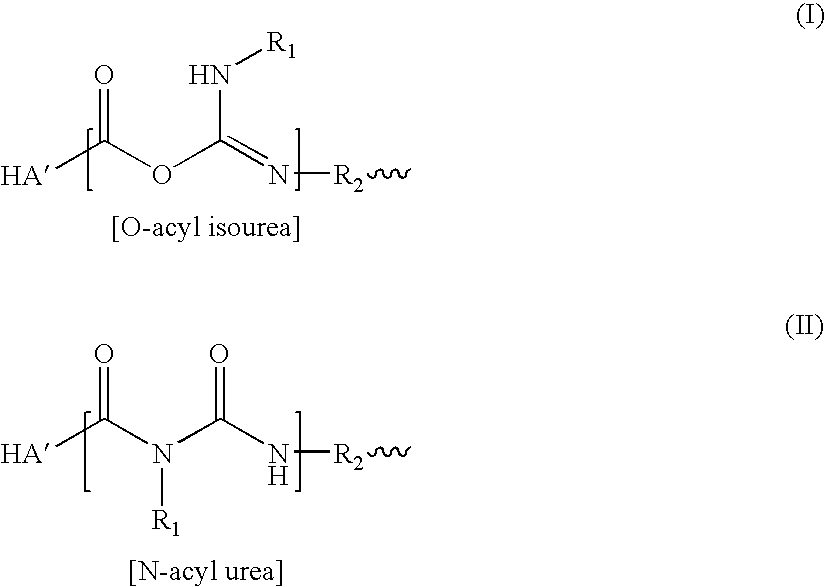
- In structural formulas (I) and (II), each R1 can be the same or different. Each R1 is selected from the group consisting of hydrogen; substituted or unsubstituted hydrocarbyl groups (linear or branched, or cyclic or acyclic) optionally interrupted by one or more heteroatoms; substituted or unsubstituted alkoxy; substituted or unsubstituted aryloxy; and substituted or unsubstituted aralkyloxy. Examples of substituted or unsubstituted hydrocarbyl groups (linear or branched, or cyclic or acyclic) optionally interrupted by one or more heteroatoms include optionally substituted aliphatic groups (e.g., alkyl, alkenyl, alkynyl, cycloalkyl, cycloalkenyl, cycloalkynyl and cycloaliphaticalkyl); optionally substituted aryl groups (including heteroaryl groups); optionally substituted aliphatic groups interrupted by one or more heteroatoms (e.g., heterocyclyl, cycloaliphaticalkyl and heterocyclylalkyl); and optionally substituted, partially aromatic and partially aliphatic groups (e.g., aralkyl and heteroaralkyl). Suitable optional substituents are those that do not substantially interfere with the properties of the resulting crosslinked HA composition. Suitable substituents for carbon atoms of hydrocarbyl groups include —OH, halogens (—Br, —Cl, —I, —F), —ORa, —O—CORa, —CORa, —CN, —NCS, —NO2, —COOH, —SO3H, —NH2, —NHRa, —N(RaRb), —COORa, —CHO, —CONH2, —CONHRa, —CON(RaRb), —NHCORa, —NRbCORa, —NHCONH2, —NHCONRaH, —NHCON(RaRb), —NRbCONH2, —NRbCONRaH, —NRcCON(RaRb), —C(═NH)—NH2, —C(═NH)—NHRa, —C(═NH)—N(RaRb), —C(═NRc)—NH2, —C(═NRc)—NHRa, —C(═NRc)—N(RaRb), —NH—C(═NH)—NH2, —NH—C(═NH)—NHRa, —NH—C(═NH)—N(RaRb), —NH—C(═NRc)—NH2, —NH—C(═NRc)—NHRa, —NH—C(═NRc)—N(RaRb), —NRdH—C(═NH)—NH2, —NRd—C(═NH)—N(RaRb), —NRd—C(═NRc)—NH2, —NRd—C(═NRc)—NHRa, —NRd—C(═NRc)—N(RaRb), —NHNH2, —NHNHRa, —NHRaRb, —SO2NH2, —SO2NHRa, —SO2NRaRb, —SH, —SRa, —S(O)Ra, and —S(O)2Ra. In addition, an alkyl, alkylene, alkenyl or alkenylene group can be substituted with substituted or unsubstituted aryl group to form, for example, an aralkyl group such as benzyl. Similarly, aryl groups can be substituted with a substituted or unsubstituted alkyl or alkenyl group.
- Ra-Rd are each independently an alkyl group, aryl group, including heteroaryl group, non-aromatic heterocyclic group or —N(RaRb), taken together, form a substituted or unsubstituted non-aromatic heterocyclic group. The alkyl, aromatic and non-aromatic heterocyclic group represented by Ra-Rd and the non-aromatic heterocyclic group represented by —N(RaRb) can optionally be substituted.
- In other embodiments, R1 is an optionally substituted aliphatic group (cyclic or acyclic, or linear or branched). More preferably, R1 is an alkyl group, such as C1-C6 alkyl (e.g., methyl, ethyl, propyl, butyl, 2-propyl, tert-butyl, and the like). Preferably, each R1 is ethyl.
- Each R2 is independently a substituted or unsubstituted linking group including one or more of hydrocarbylene groups (cyclic or acyclic, or linear or branched) optionally interrupted by one or more heteroatoms. Examples include optionally substituted aliphatic groups (e.g., alkylene, alkenylene, alkynylene, cycloalkylene, cycloalkenylene, cycloalkynylene and cycloaliphaticalkylene); optionally substituted arylene (including heteroaryl groups); optionally substituted aliphatic groups interrupted by one or more heteroatoms (e.g., heterocyclylene, cycloaliphaticalkylene and heterocyclylalkylene); and optionally substituted, partially aromatic and partially aliphatic groups (e.g., aralkylene and heteroaralkylene). Suitable optional substituents are as those described above for R1.
- In some embodiments, R2 includes or is interrupted by other groups, e.g, carbonyl, amide, oxy, sulfide, disulfide, and the like. In other embodiments, R2 is a cycloaliphatic, arylene, heteroarylene, or heterocyclylene group. In still other embodiments, R2 is 1,6-hexamethylene, octamethylene, decamethylene, dodecamethylene, PEG, —CH2CH2—S—S—CH2CH2-, para-phenylene-S—S-para-phenylene, meta-phenylene-S—S-meta-phenylene, ortho-phenylene-S—S-ortho-phenylene, ortho-phenylene, meta-phenylene or para-phenylene. More preferably, R2 is phenylene. Preferably, R2 is para-phenylene.
- In one embodiment, the wavy line connected to R2 in structural formulas (I) and (II) represents hydrogen, substituted or unsubstituted hydrocarbyl groups (linear or branched, or cyclic or acyclic) optionally interrupted by one or more heteroatoms; alkoxy; aryloxy; or aralkyloxy, as described for R1. In another embodiment, the wavy line connected to R2 in structural formulas (I) and (II) represents optionally substituted N-acyl urea group or O-acyl isourea group, as shown below in structural formulas VI-VIII.
- In general, the modified HA derivative is prepared by reacting hyaluronic acid, or a salt thereof, with a carbodiimide, preferably a multifunctional carbodiimide, such as a biscarbodiimide, in the absence of a nucleophile or a polyanionic polysaccharide other than HA, to form an N-acylurea or O-acyl isourea.
- Examples of suitable carbodiimides in the invention include a monocarbodiimide and a multifunctional carbodiimide, such as a biscarbodiimide. The monocarbodiimide has the formula:
R3—N═C═N—R4 (III)
wherein R3 and R4 are each independently as described above for R1 (e.g., hydrocarbyl, substituted-hydrocarbyl, alkoxy, aryloxy or alkaryloxy). Examples of suitable monocarbodiimides include: 1-ethyl-3-(3-dimethylaminopropyl)-carbodiimide hydrochloride (EDC); 1-cyclohexyl-3-(2-morpholinoethyl)carbodiimide metho-p-toluenesulfonate (CMC); 1-(3-(dimethylamino)propyl)-3-ethylcarbodiimide methiodide (EAC); 1,3-dicyclohexylcarbodiimide (DCC); and 1-benzyl-3-(3-dimethylaminopropyl) carbodiimide hydrochloride (BDC). - Examples of suitable biscarbodiimides may be represented by those difunctional compounds having the formula:
R1—N═C═N—R2—N═C═N—R1 (IV).
Each R1 can be different or the same. R1 and R2 are each independently as described above. Suitable specific examples of biscarbodiimides include 1,6-hexamethylene bis(ethylcarbodiimide), 1,8-octamethylene bis(ethylcarbodiimide), 1,10 decamethylene bis(ethylcarbodiimide), 1,12 dodecamethylene bis(ethylcarbodiimide), PEG-bis(propyl(ethylcarbodiimide)), 2,2′-dithio-bis(ethyl(ethylcarbodiimde)), 1,1′-dithio-ortho-phenylene-bis(ethylcarbodiimide), 1,1′-dithio-para-phenylene-bis(ethylcarbodiimide), and 1,1′-dithio-meta-phenylene bis(ethylcarbodiimide). In a preferred embodiment, the biscarbodiimide is para-phenylene-bis(ethylcarbodiimide). Methods of preparing biscarbodiimides are described, for example, in U.S. Pat. Nos. 6,013,679; 2,946,819; 3,231,610; 3,502,722; 3,644,456; 3,972,933; 4,014,935; 4,066,629; 4,085,140; 4,096,334; 4,137,386, 6,548,081, and 6,620,927 the teachings of which are incorporated herein by reference in their entireties. - In a preferred embodiment, the HA derivative is crosslinked. In a more preferred embodiment, the HA derivative is at least about 1% by mole crosslinked, and the HA derivative includes at least one crosslink, e.g., the linking group connecting through a group U at each end to a HA′ molecule, as shown in the following structural formula:
HA′—U—R2—U—HA′ (V).
Each HA′ in the preceding formula can be different or the same HA′ molecule, e.g., the crosslink can be an intermolecular or intramolecular crosslink. Each U can be the same or different and is an optionally substituted N-acyl urea or O-acyl isourea. As used herein, the term “at least about 1% by mole crosslinked” means that HAs are crosslinked with each other via derivatized carboxyl functionalities of the HAs, such as O-acylisoureas or N-acylureas, wherein the derivatized carboxyl functionalities are at least about 1% by mole of the total carboxyl functionalities of the individual HA. - In an even more preferred embodiment, the N-acylurea or O-acylisourea results from crosslinking with the multifunctional carbodiimide. Alternatively, a monocarbodiimide may be employed in combination with a multifunctional carbodiimide. Suitable examples of monocarbodiimides and multifunctional carbodiimides are as described above. Use of a multifunctional carbodiimide to prepare the modified HA derivative causes crosslinking of the hyaluronic acid. For example, use of a biscarbodiimide results in a crosslinking between COOH groups present in the repeating disaccharide unit of hyaluronic acid, since the biscarbodiimide is difunctional. The COOH group may be present in the same polymer chain, resulting in an intramolecular crosslinked product, or present on two different polymer chains, resulting in an intermolecular crosslinked product.
- The reaction of HA with a biscarbodiimide rather than a monocarbodiimide does not change the mechanism of reaction, but can cause the product to be crosslinked.
- The reaction of HA with a biscarbodiimide crosslinking reagent, in the presence of an available proton, is believed to comprise protonation in the first step. The acid anion can then attach to the carbon atom of the cation formed, resulting in the formation of an O-acyl isourea intermediate. The acyl group in the intermediate can migrate from the oxygen atom to a nitrogen atom to produce a N-acyl isourea derivative of the HA. It is believed that the O-to-N migration can be incomplete, resulting in a product reaction mixture that can include both the N-acyl urea and the O-acyl isourea. Thus, a crosslink resulting from reaction of a biscarbodiimide with the uncrosslinked HA precursor typically can contain two O-acyl isoureas connected through R2, as represented in the following structural formula (VI):
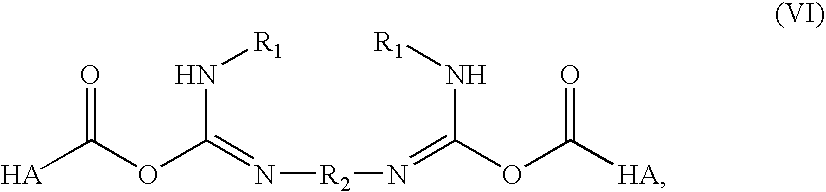
or an O-acyl isourea and an N-acyl urea connected through R2, as represented in the following structural formula (VII):
or two N-acyl ureas connected through R2, as represented in the following structural formula (VIII):
- The mixed products can be used separately or together to prepare the compositions according to embodiments of the invention.
- The term “hydrocarbyl,” as used herein, means a monovalent moiety obtained upon removal of a hydrogen atom from a parent hydrocarbon. As used herein, hydrocarbylene groups are divalent hydrocarbons. Typically, hydrocarbyl and hydrocarbylene groups contain 1-25 carbon atoms, 1-12 carbon atoms or 1-6 carbon atoms. Hydrocarbyl and hydrocarbylene groups can be independently substituted or unsubstituted, cyclic or acyclic, branched or unbranched, and saturated or unsaturated. Optionally, hydrocarbyl and hydrocarbylene groups independently can be interrupted by one or more hetero atoms (e.g., oxygen, sulfur and nitrogen). Examples of hydrocarbyl groups include aliphatic and aryl groups. Substituted hydrocarbyl and hydrocarbylene groups can independently have more than one substituent.
- The term “substituent,” as used herein, means a chemical group which replaces a hydrogen atom of a molecule. Representative of such groups are halogen (e.g., —F, —Cl, —Br, —I), amino, nitro, cyano, —OH, alkoxy, alkyl, alkenyl, alkynyl, aryl, haloalkoxy, haloalkyl, haloalkenyl, haloalkynyl, alkyl amino, haloalkyl amino, aryl amido, sulfamido, sulfate, sulfonate, phosphate, phosphino, phosphonate, carboxylate, carboxamido, and the like.
- An “alkyl” group, as used herein, is a saturated aliphatic group. The alkyl group can be straight chained or branched, or cyclic or acyclic. Typically, an alkyl group has 1-25 carbon atoms. Examples of alkyl groups include methyl, ethyl, propyl, butyl, pentyl, hexyl, heptyl, octyl, nonyl, decyl, undecyl, dodecyl, tridecyl, tetradecyl, pentadecyl, hexadecyl, heptadecyl, octadecyl, nonodecyl, eicosyl, heneicosyl, docosyl, tricosyl, tetracosyl, pentacosyl, and the isomeric forms thereof. An alkyl group may be substituted with one or more substituents independently selected for each position.
- An “alkylene” group, as used herein, is a saturated aliphatic group that is bonded to two other groups each through a single covalent bond. The alkylene group can be straight chained or branched, or cyclic or acyclic. Typically, an alkylene group has 1-25 carbon atoms. Examples of alkylene groups include methylene, ethylene, propylene, butylene, pentylene, hexylene, heptylene, octylene, 1,6-hexamethylene, 1,8-octamethylene, 1,10-decamethylene, 1,12-dodecamethylene and the isomeric forms thereof. An alkylene group may be substituted with one or more substituents independently selected for each position.
- As used herein, an “alkenyl” group is an aliphatic group that contains a double bond. Typically, an alkenyl group has 2 to 25 carbon atoms. Examples include vinyl, allyl, butenyl, pentenyl, hexenyl, octenyl, nonenyl, decenyl, undecenyl, dodecenyl, tridecenyl, tetradecenyl, pentadecenyl, hexadecenyl, heptadecenyl, octadecenyl, nonadecenyl, eicosenyl, heneicosenyl, docosenyl, tricosenyl, tetracosenyl, pentacosenyl, and isomeric forms thereof.
- As used herein, an “alkenylene” group is an aliphatic group that contains a double bond. Typically, an alkenylene group has 2 to 25 carbon atoms. Examples include butenylene, pentenylene, hexenylene, octenylene, nonenylene and isomeric forms thereof.
- As used herein, an “alkynyl” group is an aliphatic group that contains a triple bond. Typically, an alkynyl group has 2 to 25 carbon atoms. Examples include vinyl, allyl, butynyl, pentynyl, hexynyl, octynyl, nonynyl, decynyl, undecynyl, dodecynyl, tridecynyl, tetradecynyl, pentadecynyl, hexadecynyl, heptadecynyl, octadecynyl, nonadecynyl, eicosynyl, heneicosynyl, docosynyl, tricosynyl, tetracosynyl, pentacosynyl, and isomeric forms thereof.
- As used herein, an “alkynylene” group is an aliphatic group that contains a triple bond. Typically, an alkynylene group has 2 to 25 carbon atoms. Examples include vinylene, allylene, butynylene, pentynylene, hexynylene, octynylene and isomeric forms thereof.
- The term “aryl” as used herein refers to an aromatic ring (including heteroaromatic ring). Particularly, an aryl group that includes one or more heteroatoms is herein referred to “heteroaryl.” Examples of aryl groups include phenyl, tolyl, xylyl, naphthyl, biphenylyl, triphenylyl, and heteroaryl, such as pyrrolyl, thienyl, furanyl, pyridinyl, oxazolyl, isooxazolyl, thiazolyl, isothiazolyl and quinolinyl. An aryl group may be substituted with one or more substituents independently selected for each position.
- The term “arylene” as used herein refers to an aryl ring in a molecule that are bonded to two other groups each through a single covalent bond from two of its ring atoms. Particularly, an arylene group that includes one or more heteroatoms is herein referred to “heteroarylene.” Examples of arylene groups include phenylene [—(C6H4)—], such as meta-phenylene and para-phenylene; and heteroarylene groups, such as pyridylene [—(C5H3N)—]; and furanylene [—(C4H2O)—]. An arylene group may be substituted with one or more substituents independently selected for each position.
- An alkyl, alkylene, alkenyl, alkenylene group, alkynyl or alkynylene can be optionally substituted with substituted or unsubstituted aryl group to form, for example, an aralkyl group (e.g. benzyl), or aralylene (e.g. —CH2—(C6H4)— or —CH═CH2—(C6H4)—). Similarly, aryl or arylene groups can be optionally substituted with a substituted or unsubstituted alkyl, alkenyl or alkynyl group.
- The term “heterocyclyl” refers to a cycloalkyl group wherein one or more ring carbon atoms are replaced with a heteroatom, e.g., aziridyl, azetidyl, pyrrolidyl, piperidyl, thiiranyl, thietanyl, tetrahydrothiophenyl, tetrahydrothiopyranyl, oxiranyl, oxetanyl, tetrahydrofuranyl, tetrahydropyranyl, morpholinyl, and the like.
- The term “heterocyclylene” refers to a cycloalkylene group wherein one or more ring carbon atoms are replaced with a heteroatom, e.g., 2,5-tetrahydrofuranylene.
- An alkoxy group is an alkyl group connected through an oxygen atom, e.g., methoxy, ethoxy, propoxy and the like.
- An aryloxy group is an aryl group connected through an oxygen atom, e.g., phenoxy and the like.
- An aralkyloxy group is an aralkyl group connected through an oxygen atom, e.g., benzyl oxy and the like.
- In one embodiment, the modified HA derivative is at least about 1% by mole crosslinked. The crosslinked HA gel can be water-soluble or substantially water-insoluble.
- In another embodiment, at least about 1% by mole, such as at least about 2% by mole, at least about 5% by mole, or between about 1% by mole and about 20% by mole, of the carboxyl functionalities of the modified hyaluronic acid are derivatized. In yet another embodiment, at least about 25% by mole, such as between about 25% by mole and about 75% by mole, of the derivatized functionalities are O-acylisoureas and/or N-acylureas. In yet another embodiment, the carboxyl functionalities of the modified hyaluronic acid are derivatized, and the derivatized carboxyl functionalities result from crosslinking of HAs with a multifunctional carbodiimide described above, preferably biscarbodiimide. Conditions for such crosslinkings are known in the art, for example, in U.S. Pat. No. 6,548,081, the entire teachings of which are incorporated herein by reference.
- The steps required to make a biocompatible HA derivative include providing a sample of HA or a salt thereof, such as sodium hyaluronate. HA from any of a variety of sources, including HA extracted from animal tissues or harvested as a product of bacterial fermentation, can be used as a starting material. Alternatively, the HA used to make the composites of this invention can be produced in commercial quantities by bioprocess technology, as described, for example, in Nimrod et al., PCT Publication No. WO 86/04355.
- In one example, the sample of HA or its salt is dissolved in water to make an aqueous solution. In a particular example, the concentration of HA in this first aqueous solution is in the range of between about 0.1% and 5% weight/weight (“w/w”), that is, 1 mg/ml solution to 50 mg/ml solution. In another particular example, the reactions are carried out with a range of about between about 0.4% and 0.6% weight/weight, or 4 to 6 mg of hyaluronic acid per milliliter. The precise concentration used will vary depending on the molecular weight of the HA. At significantly lower concentrations, the reactions are slower and less effective. At significantly higher HA concentrations, the end product may be difficult to handle due to the increase in viscosity. One skilled in the art will be able to determine, with no more than routine experimentation, an acceptable concentration of HA to be used for a particular embodiment. Examples of various acceptable concentrations of HA are described in U.S. Pat. No. 5,356,883, to Kuo et al., the teachings of which are incorporated herein by reference in their entirety.
- The pH of the HA solution is then adjusted by the addition of a suitable acid or a suitable pH buffer known in the art, so that the aqueous HA solution is acidic, preferably having a pH of about between 4.0 and 8.0, such as about between 4.0 and about 6.0 or between about pH 4.75 and about pH 5.5. The pH buffer can include any buffer agent known to one skilled in the art, e.g., 2-(N-morpholino)ethanesulfonic acid (MES); 2,2-bis(hydroxymethyl)-2,2′,2″-nitrotriethanol; succinate/succinic acid; KH2PO4; N-tris(hydroxymethyl-2-aminoethanesulfonic acid; triethanolamine; diethylbarbituate; tris(hydroxymethyl)aminoethane; N-tris(hydroxy)methylglycine; and N,N-bis(2-hydroxyethyl)glycine. The buffer agent can be employed with an additional acid or base, e.g., 2-(N-morpholino)ethanesulfonic acid with NaOH; 2,2-bis(hydroxymethyl)-2,2′,2″-nitrotriethanol with HCl; succinate with succinic acid; KH2PO4 with borax; N-tris(hydroxymethyl-2-aminoethanesulfonic acid with NaOH; triethanolamine with HCl; diethylbarbituate with HCl; tris(hydroxymethyl)aminoethane with HCl; N-tris(hydroxy)methylglycine with HCl; and N,N-bis(2-hydroxyethyl)glycine with HCl. Preferably, the buffer includes 2-(N-morpholino)ethanesulfonic acid and NaOH.
- Once the pH of the aqueous HA solution has been adjusted, the carbodiimide can be added. Generally an excess of the stoichometric proportion of carbodiimide is advantageous to promote the desired reaction. Preferably the molar equivalent ratio of the carbodiimide to HA is equal to or greater than about 5%.
- In one example, the pH of the aqueous HA solution is adjusted by the addition of a suitable acid, such as an HCl solution. Preferably, the carbodiimide is dissolved in an appropriate water-mixable solvent and added drop-wise. In this example, as the carbodiimide and the HA are mixed, the pH of the solution generally increases. Films and gels with various desired physical properties can be obtained by simply allowing the pH to rise as the reaction proceeds. However, the reaction is monitored by a pH meter, and HCl may be added to maintain the pH of the reaction mixture, for example, about between 4.0 and 8.0, such as about between 4.0 and about 6.0 or between about pH 4.75 and about pH 5.5. The reaction is then allowed to proceed at room temperature for about two hours. The reaction may be directed to favor the formation of the N-acylurea derivatives by increasing the pH with a suitable aqueous base. The progress of the reactions described above may be followed by monitoring the pH. When the pH is stabilized, the reactions are substantially complete.
- In another example, the carbodiimide, such as biscarbodiimide, is reacted with the HA in the presence of a suitable pH buffer, wherein the buffer is at a pH between about 4 and about 8. Suitable examples of pH buffer agents are as described above. Typically, the buffer agent is mixed in aqueous media, in a concentration between about 5 mM (millimolar) and about 250 mM (e.g., about 75 mM). Typically, the HA is mixed in aqueous media, e.g., the pH buffer solution, in a concentration between about 1 mM (millimolar) and about 100 mM (e.g., about 37 mM). The particular concentration employed can vary depending on the molecular weight of the HA.
- The carbodiimide can be combined with the HA solution alone, or more typically as a solution in a water-miscible organic solvent, e.g., acetone, methyl ethyl ketone, dimethyformamide, dimethyl sulfoxide, methanol, ethanol, 2-propanol, acetonitrile, tetrahydrofuran, N-methyl pyrrolidone, and the like. When a biscarbodiimide is utilized, typically, the solvent is acetone, and the biscarbodiimide is at a concentration of between about 0.1 mg/mL and about 100 mg/mL. The HA and the carbodiimide, such as carbodiimide, can be combined in any molar equivalent ratio, e.g., between about 1% and about 200%, typically between about 2% and about 30%. The reaction can be carried out at a temperature range of between about 0° C. and about 60° C., typically between 25-30° C.
- Crosslinked HA can be formed by reacting uncrosslinked HA with a crosslinking agent, such as a biscarbodiimide as described above, under suitable reaction conditions by methods known in the art, for example, U.S. Patent Application Publication Nos. 10/743,557, 5,356,883, 5,502,081, 6,013,679, 6,537,979, and 6,548,081, the entire teachings of which are incorporated herein by reference. The uncrosslinked HA used as a precursor for the crosslinking typically has typically an average molecular weight range of from between about 6×10⁴ to about 8×10⁶ Daltons, or 150 to 20,000 disaccharide repeat units. Uncrosslinked HA having lower or higher molecular weights than these can also be used in the invention.
- The reaction conditions for HA crosslinking with a biscarbodiimide are similar to those used for HA-monocarbodiimide coupling reactions. Advantageously, the crosslinking reactions are carried out with (1) an increase of the HA concentration in the reaction mixture, and/or (2) a decrease of the biscarbodiimide concentration in the addition solution. This creates a condition favorable to intermolecular crosslinking versus intramolecular crosslinking.
- At the conclusion of the reactions described above, the desired HA derivative may be separated from the reaction mixtures by conventional methods of precipitation, washing and re-precipitation. The completeness of the reaction, the nature of the products and the extent of chemical modification can be determined by, for example, proton NMR, or by studying the resistance to enzymatic hydrolysis or studying other changes in the physical or chemical behavior of the product.
- If a colored product is desired, a solution of a biocompatible dye or stain, e.g., Coomassie™ Brilliant Blue R-250, can be admixed to the reaction mixtures described above. The resulting product will have a blue color which makes the gel, film or sponge easy to see when it is handled during surgery and when it is in place.
- When the reaction is complete, sodium chloride is typically added to the reaction mixture to adjust the sodium chloride concentration to 1M. Ethanol is added to form a precipitate of chemically-modified, HA derivative. The precipitate is separated from the solution, washed, and dried by vacuum. The freeze dried material can be washed with appropriate solvents to remove contaminants of the reaction and dried and then sterilized by ethylene oxide (EtO) sterilization or sterilization by gamma irradiation before loading the cells and implanting them into mammals.
- To make a gel of the HA derivative, the precipitate is re-suspended in water and stirred in a cold room. The gel of the HA derivative is a hydrogel. The term “hydrogel” is defined herein to mean a macromolecular network swollen in water or biological fluids. The degree of hydration is dependent on the degree of crosslinking.
- To make a sponge, the precipitate is then re-suspended in water, poured into a mold having a desired shape, and, preferably, dried, such as by air-drying, freeze-drying or heat-drying. A film may be prepared by further drying the gel. Alternatively, a film can be formed by compressing a gel under conditions that permit water to escape, as, for example, by compressing the gel between two surfaces, at least one of which is porous. See, for example, Malson et al., U.S. Pat. No. 4,772,419, the teachings of which are incorporated herein by reference in their entirety.
- The composites of the invention can include the modified HA derivative described above without biocompatible, biodegradable supports (e.g., polymers) other than the modified HA derivative. Preferably, in this embodiment, the modified HA derivative is a highly-crosslinked HA, such as at least about 75% by mole crosslinked HA.
- Alternatively, the composites of the invention can include the modified HA derivative described above and one or more biocompatible, biodegradable supports (e.g., polymers) other than the modified HA derivative. In this embodiment, the modified HA is at the support(s). Preferably, in this embodiment, the modified HA derivative is a crosslinked HA of low degree of crosslinking, such as less than about 20% by mole, such as about 5% by mole or about 18% by mole, or between about 1% by mole and about 10% by mole.
- As used herein, a “biocompatible” support is one that has no medically unacceptable toxic or injurious effects on biological function. As used herein, a “biodegradable” support is one that is capable of being decomposed by natural biological processes.
- Examples of the physical form of a suitable support include: a biocompatible, biodegradable matrix, sponge, film, sheet, thread, tube, non-woven fabric and cord. The biodegradable support may be formed from a material which is porous, and the pore sizes may be large enough so that when a layer of the hyaluronic acid (HA) derivative is spread on the support, the molecules of the HA derivative can partially or fully penetrate into the pores of the support to make an anchor. Examples of compositions to be used as a suitable support include: crosslinked alginates, gelatin, collagen, crosslinked collagen, collagen derivatives, such as, succinylated collagen or methylated collagen, crosslinked hyaluronic acid, chitosan, chitosan derivatives, such as, methylpyrrolidone-chitosan, cellulose and cellulose derivatives such as cellulose acetate or carboxymethyl cellulose, dextran derivatives such carboxymethyl dextran, starch and derivatives of starch such as hydroxyethyl starch, other glycosaminoglycans and their derivatives, other polyanionic polysaccharides or their derivatives, polylactic acid (PLA), polyglycolic acid (PGA), a copolymer of a polylactic acid and a polyglycolic acid (PLGA), lactides, glycolides, and other polyesters, polyoxanones and polyoxalates, copolymer of poly(bis(p-carboxyphenoxy)propane)anhydride (PCPP) and sebacic acid, poly(l-glutamic acid), poly(d-glutamic acid), polyacrylic acid, poly(dl-glutamic acid), poly(l-aspartic acid), poly(d-aspartic acid), poly(dl-aspartic acid), polyethylene glycol, copolymers of the above listed polyamino acids with polyethylene glycol, polypeptides, such as, collagen-like, silk-like, and silk-elastin-like proteins, polycaprolactone, poly(alkylene succinates), poly(hydroxy butyrate) (PHB), poly(butylene diglycolate), nylon-2/nylon-6-copolyamides, polydihydropyrans, polyphosphazenes, poly(ortho ester), poly(cyano acrylates), polyvinylpyrrolidone, polyvinylalcohol, polycasein, keratin, myosin, and fibrin.
- A sample of highly crosslinked HA, for example at least about 75% by mole, crosslinked HA, may form a support for a sample of modified HA which is not highly crosslinked. One example of the highly-crosslinked HA is a thiol-containing, highly crosslinked HA (see U.S. Pat. No. 6,620,927, the entire teachings of which are incorporated herein by reference). The HA support can be made by, for example, pouring a mixture of uncrosslinked HA and a crosslinking agent, such as a biscarbodiimide having an intramolecular disulfide bond, into a mold and freeze dried in a desired shape.
- The composite of the invention may be in a form of sponge, film, sheet, gel, thread, tube, non-woven fabrics, cords and meshes. In one embodiment, the composite is in the form of a sponge. In another embodiment, the composite is in the form of a sheet or film, preferably hydrophilic sheet or film. The hydrophilic sheet or film can be stacked together for stitching, for example, to correctly fit or fully fill a treatment site.
- When the HA derivative is employed in combination with one or more biocompatible, biodegradable supports as described above, there are several ways in which the HA derivative (e.g., gel, film or sponge) can be immobilized on the support to make the composite device of this invention (see, for example, U.S. Pat. No. 6,548,081). For example, a layer of derivatized HA may be applied, either by soaking or dipping or spraying or spreading or by any other method of application, to at least one surface of a support to form a composite. A suitable support may be a matrix, sponge, film, sheet, gel, thread, tube, non-woven fabrics, cords and meshes, which may be porous. If the surface of the support is porous, the HA derivative will soak into the pores at the support surface. For example, porous beads may be soaked in the hyaluronic acid derivative for a sufficient period of time to allow the hyaluronic acid derivative to be absorbed and adsorbed by the pores of the beads. The composite is then dried under conditions that permit the escape of water from the composite.
- In another embodiment, a composite sponge or film having hyaluronic acid derivative on both sides of the support is prepared by pouring the water-insoluble gel of derivatized HA prepared according to the procedure described above, into a first mold having the desired shape and depth, and spreading the gel in the first mold to form a first gel layer of even thickness. A suitable support may be a matrix, sponge, film, or particles such as beads made from another biocompatible material, for example collagen or gelatin. The support is spread on top of the evenly-spread first gel layer of derivatized HA. A second mold of the same size, shape and depth, is placed on the top of the support. Gel is poured into the second mold, and spread to form a second gel layer of even thickness in the second mold. In this manner, the polymer used as supporting matrix is sandwiched between the two layers of derivatized HA gel which are molded to the support. The composite is freeze-dried. The freeze-dried composite may be cut into specimens of the desired shape and size.
- The composite of the invention can optionally include a material that enhances adherence of the composite to tissue. Materials that are suitable for enhancing adherence of the composite to tissue include fibrin, collagen, crosslinked collagen, and collagen derivatives, and any other polymers that include a peptide sequence having arginine (R), glycine (G), and aspartic acid (D), such as a peptide sequence consisting of arginine (R), glycine (G), and aspartic acid (D).
- In a preferred embodiment, the composite of the invention is an implantable composite. More preferably, the implantable composite has interconnected pores of sizes that can provide molecular cuing for the impregnated or coupled cells, cellular growth factors or cellular differentiation factors to migrate (or move) through. The interconnected pores of sizes can also provide molecular cuing for cells of a subject that are surrounding the osteochondral or chondral defect of the subject (e.g., cartilage, bone or synovium) to migrate (or move) through. In a specific example, the implantable composite is freeze-dried and has interconnected pores of sizes that can provide molecular cuing as described above.
- These composites can provide structural support and molecular cuing to stimulate regeneration of cartilage and/or bone, or repair of osteochondral or chondral defects by providing a mechanism for the delivery of, for example, cells to a site of osteochondral or chondral defects, or a site in need of regeneration of cartilage and/or bone. For example, the composite of the invention can provide the cells, cellular growth factors or cellular differentiation factors that are impregnated in, or coupled to, the composite to regenerate articular cartilage and/or bone in the osteochondral or chondral defect, or repair the osteochondral or chondral defect. The biocompatible, biodegradable support and the hyaluronic acid derivative will be absorbed by the body (e.g., by the regenerated tissues), while the repair or regeneration takes place. After the biodegradation of the composite, for example, the regenerated articular cartilage can have physical characteristics of natural articular cartilage and assume its normal function.
- The rate of biodegradation of derivatized HA (e.g., the rate of release of derivatized HA) can be controlled, in part, by the degree of crosslinking of HA, and the quantity of the crosslinked HA loaded on the support. The residence time of unmodified HA in the human body is generally less than a week. However, when HA is derivatized, the residence time can be appreciably increased. In general, an increase in the degree of crosslinking results in an increase in the time of residence. By controlling the degree of crosslinking, a crosslinked HA of desired residence time can be prepared. In some embodiments, the derivatized HA selected for a particular use may have a biodegradation rate which is faster than the biodegradation rate of the support. The support, in fact, can be itself made of a sample of crosslinked HA having a slower rate of biodegradation than that of the derivatized HA loaded on the support.
- The rate at which the gel, film or sponge of the HA derivative degrades and diffuses also depends on the insolubility, the density, and the degree of crosslinking of the modified HA in the composite. Just as gels, films and sponges which have a high degree of crosslinking are slow to degrade, modified HA which is more insoluble, or which has a higher degree of crosslinking, will degrade at a slower rate. Preferably, the density of modified HA in the film or sponge will be in the range of from about 0.1 mg/cm2 to about 100 mg/cm2. Those skilled in the art will know, or will be able to ascertain with no more than routine experimentation, the appropriate combination of insolubility, density and crosslinking that will yield a gel, film or sponge having the desired rate of degradation for a given situation.
- The rate at which the cellular growth or differentiation factor in the composites of the invention is released can also be controlled by varying the physical characteristics of the composite, such as porosity and interconnectivity, or varying the HA crosslink density. Typically, the retention of the cellular growth or differentiation factor will range from about 1 day to 6 months, and preferably in the 2-4 week range.
- A composite of the invention includes at least one member of the group consisting of a cell, a cellular growth factor and a cellular differentiation factor, which is impregnated in, or coupled to, the HA derivative, or the composite that includes the HA derivative, and biocompatible and biodegradable support. Suitable examples of the cell, cellular growth factor and cellular differentiation factor include mesenchymal stem cells from various tissue sources (e.g., cartilage, periosteum, synovium, bone marrow, fat, etc.), fibrochondrocytes, osteochondrocytes, chondrocytes, TGFβ supergene family members, such as BMPs, IGF, PDGF, GDFs, CDMPs and GFG, and tissue growth hormones. In addition, genes encoding for these proteins, as well as synthetic peptide analogues of these proteins can be contemplated. In a preferred embodiment, the composite include at least one member selected from the group consisting of cartilage chondrocytes, osteochondrocytes and mesenchymal stem cells. In another preferred embodiment, the composite includes both a cell, and a cellular growth or differentiation factor. The cellular growth or differentiation factor can provide molecular cuing for the cell to produce cartilage or bone tissue, or provide signals for the cell to differentiate down the chondrogenic or osteogenic lineage.
- Typically, the cells, cellular growth factor and/or cellular differentiation factors are harvested from various sources and impregnated in, or coupled to, the HA derivative or the HA derivative and biocompatible support, by methods known in the art. For example, autologous cells (e.g., chondrocytes or marrow-derived pluripotent stem cells) can be harvested, optionally expanded in culture, and loaded onto a composite of the invention by conventional cell seeding methods. The cell-loaded composite may be further cultured prior to implantation. Additionally, cells, cellular growth factors and cellular differentiation factors can be loaded prior to implantation by various means. These cells or factors can be loaded before (e.g., suspension, covalent linking, etc) or after (e.g., soak-loading, surface immobilization, etc.) manufacture of the composite.
- In one embodiment, the invention provides a method for treating an osteochondral defect or a chondral defect in a subject employing the composite described above. The method includes implanting the composite in a site of the osteochondral or chondral defect. Typically, the implanting can be done by surgical insertion.
- The implanted composition is located at a treatment site for an extended period of time (e.g., a time period of at least days, a week, a month, two months, six months, a year or longer than two years).
- As used herein, the term “treating” refers to resulting in a beneficial clinical outcome of or exerting a positive influence on, the condition being treated with the composite of the invention compared with the absence of treatment. For example, the term “treating” an osteochondral defect or a chondral defect includes repair the osteochondral or chondral defect, and regenerating or promoting regeneration of cartilage and/or bone in an articular defect. As used herein, a “treatment site” is the site in a subject that is in need of treatment for an osteochondral defect or a chondral defect. The treatment site also includes the site in need of regeneration of cartilage and/or bone in a subject.
- As used herein a subject is a mammal, preferably a human, but can also be an animal in need of veterinary treatment, such as a companion animal (e.g., dogs, cats, and the like), a farm animal (e.g., cows, sheep, pigs, horses, and the like) or a laboratory animal (e.g., rats, mice, guinea pigs, and the like).
- The implantable composite of the invention can provide, for example, scaffolds that have tear strength and tear propagation resistance and can be surgically sutured or anchored to stabilize them within the osteochondral or chondral defect so that they do not move during the healing and tissue regeneration. Once sutured or anchored in place, these scaffolds will provide a matrix into which the impregnated or coupled cells, or surrounding cells, for example, from the cartilage, bone and synovium, can begin to migrate and/or multiply, or the impregnated or coupled cellular growth or differentiation factors can exert local activity. The HA derivative in the composite can influence on cell infiltration, the formation and degradation of a fibrin matrix, swelling of the matrix, phagocytosis and vascularisation. As the repair or regeneration of articular cartilage or bone takes place, the composite will be absorbed by the body and the regenerated cartilage or bone will restore its function, reduce pain, and possibly retard or suspend the degenerative process caused with an osteochondral or chondral defect.
- This example illustrates an embodiment of the invention in which a biscarbodiimide, p-phenylene-bis(ethylcarbodiimide), and HA are reacted at a molar equivalent ratio of 16.0%.
- A solution of HA (5.4 mg/ml; 200-ml; 2.69 mequiv) was reacted with a solution of p-phenylene-bis(ethylcarbodiimide) (1 mg/ml in acetone; 46.1-ml; 0.215 mmol; 0.43 mequiv) according to a procedure described in U.S. Pat. Nos. 5,356,883, 5,502,081 and 6,013,679, the teachings of which are incorporated herein by reference in their entirety. The precipitate of the crosslinked HA was separated from the solution, washed, and resuspended in saline. The suspension was stirred for 2 days in a cold room to form a water-insoluble gel of about 4 mg/ml concentration. Chloroform equal to ½ of the volume of the aqueous solution was added to the solution and contents were vigorously stirred for seven days in the cold room. The reaction mixture was then centrifuged at 4° C. and 43 k rpm for one hour to remove chloroform. The aqueous/gel layer was aseptically collected and the concentration of sodium chloride in the collected aqueous/gel was adjusted to 1M. The mixture was stirred for 15 minutes under aseptic conditions. Ethanol equal to 3 volumes of the solution was added to precipitate the crosslinked HA and the precipitate was collected, squeezed to remove ethanol, and shredded into small pieces under aseptic conditions. The precipitate was re-dissolved in injection grade water to reconstitute a gel of desired concentration.
- This example illustrates an embodiment of the invention in which a biscarbodiimide, p-phenylene-bis(ethylcarbodiimide), and HA are reacted at a molar equivalent ratio of 8.0%.
- A solution of HA (5.4 mg/ml; 200-ml; 2.69 mequiv) was reacted with a solution of p-phenylene-bis(ethylcarbodiimide) (1 mg/ml in acetone; 23.0-ml; 0.108 mmol; 0.216 mequiv) according to a procedure described in U.S. Pat. Nos. 5,356,883, 5,502,081 and 6,013,679, the teachings of which are incorporated herein by reference in their entirety. The precipitate of the crosslinked HA was separated from the solution, washed, and resuspended in saline. The suspension was stirred for 2 days in a cold room to form a water-insoluble gel of about 4 mg/ml concentration. Chloroform equal to ½ of the volume of the aqueous solution was added to the solution and contents were vigorously stirred for seven days in the cold room. The reaction mixture was then centrifuged at 4° C. and 43 k rpm for one hour to remove chloroform. The aqueous/gel layer was aseptically collected and the concentration of sodium chloride in the collected aqueous/gel was adjusted to 1M. The mixture was stirred for 15 minutes under aseptic conditions. Ethanol equal to 3 volumes of the solution was added to precipitate the crosslinked HA and the precipitate was collected, squeezed to remove ethanol, and shredded into small pieces under aseptic conditions. The precipitate was re-dissolved in injection grade water to reconstitute a gel of desired concentration.
- This example illustrates an embodiment of the invention in which a biscarbodiimide, p-phenylene-bis(ethylcarbodiimide), and HA are reacted at a molar equivalent ratio of 8.0% in MES buffer.
- A solution of HA (15.0 mg/ml; 133.3-ml; 4.99 mequiv) in MES buffer (pH 5.5) was reacted with a solution of p-phenylene-bis(ethylcarbodiimide) (15 mg/ml in acetone; 2.8-ml; 0.2 mmol; 0.4 mequiv) according to a procedure described in U.S. Patent Application 2005/0136122 A1. The reaction mixture was thoroughly mixed (mixing with either a glass rod or an overhead mechanical stirrer, e.g., for about 1 minute, results in a white paste from the clear reaction mixture), and the mixture was allowed to stand at room temperature for about 96 hours. Sodium chloride (6.5 g, to make the mixture 5% by weight of sodium chloride) was mixed into the resulting gel, which was allowed to stand for 1 hour. The crosslinked HA gel was precipitated by addition into about 1.2 L of vigorously stirred ethanol. The precipitate was collected and dried under reduced pressure yielding the crosslinked hyaluronic acid. The dry crosslinked HA precipitate was milled. The powder was packed in a Tyvek®/Mylar® pouch, sealed and sterilized by ethylene oxide. The precipitate was re-dissolved in injection grade water to reconstitute a gel of desired concentration.
- Example 4 describes the preparation of Sponge 1 shown in
FIGS. 1A and 1B , an embodiment of the invention which is a composite including crosslinked HA derivative only. To make Sponge 1, a gel of crosslinked HA prepared according to the procedure described in Example 1, was poured into an 8 cm×8 cm mold under aseptic conditions. The mold containing the crosslinked HA gel was frozen at −45° C. and then freeze-dried under aseptic conditions for 24 hours under vacuum of less then 10 millimeters. The freeze-dried sponge was cut under aseptic conditions into 4 cm×4 cm pieces. These sponges were put in sterile pouches and sealed to keep them sterile. - Example 5 describes the preparation of Sponge 2 shown in
FIGS. 2A and 2B , an embodiment of the invention which is a composite including crosslinked HA derivative only. To make Sponge 2, a gel of crosslinked HA prepared according to the procedure described in Example 2 and 3, was poured into an 8 cm×8 cm mold under aseptic conditions. The mold containing the crosslinked HA gel was frozen at −45° C. and then freeze-dried under aseptic conditions for 24 hours under vacuum of less then 10 millimeters. The freeze-dried sponge was cut under aseptic conditions into 4 cm×4 cm pieces. These sponges were put in sterile pouches and sealed to keep them sterile. - This example describes the preparation of an embodiment of the invention, Sponge 3, a composite having HA derivative on both sides of a support made of collagen. The HA derivative has at least about 1% crosslinking, and was prepared according to the following procedure.
- A solution of hyaluronic acid (MWt. 2.35×10⁶ Daltons, 1922 ml, 6 mg/ml, pH 4.75, 28.76 mmoles) in saline was crosslinked using a solution of cross-linker p-phenylene-bis(ethylcarbodiimide) in acetone (1 mg/ml, 246 ml, 1.15 mmoles). The crosslinked HA was precipitated, separated from the solution and washed with ethanol.
- A weighed portion of the precipitate was dissolved in sterile water to form crosslinked HA gel of about 7.7 mg/ml concentration.
- Non-sterile collagen sponge was cut in to square pieces of desired dimensions. Crosslinked HA gel (7.7 mg/ml, 24 ml), prepared according to the procedure described above was poured in to the lower chamber of a 12 cm×8 cm mold and spread into a layer of even thickness. A 14 cm×10 cm piece of collagen sponge was placed on the top of the spread gel and it was covered with another layer of crosslinked HA gel (7.7 mg/ml, 24 ml). The collagen sponge was allowed to soak in the gel for 1 hour under aseptic condition in a refrigerator. The mold containing the composite was frozen at −46° C. and then freeze-dried for 24 hours under vacuum of less then 10 millimeters. The sides of the freeze-dried composite were trimmed to make a sponge, 11.5 cm×7.5 cm. This larger piece of sponge was then cut in to four 5.5 cm×3.5 cm pieces. Each piece was individually packed in a Tyvek®/Mylar® pouch, sealed and sterilized by ethylene oxide (EtO).
- In each of these examples, reagents are used in the amounts indicated in Table 1. Uncrosslinked HA (2.0 g) is dissolved in 133.4 mL of MES buffer at the pH 5.5 and combined with a 15 mg/mL acetone solution of p-phenylene-bis(ethylcarbodiimide) (PBCDI), resulting in the specified molar equivalent ratio (MER %) and mol % between PBCDI:HA. The reaction mixture is then thoroughly mixed (mixing with either a glass rod or an overhead mechanical stirrer, e.g., for about 1 minute, can result in a white paste from the clear reaction mixture), and the mixture is poured in to the molds designed in any desired shape, allowed to stand at room temperature for about 72 hours. The mold containing the crosslinked HA gel is frozen at −45° C. and then freeze-dried for 24 hours under vacuum of less then 10 millimeters. The freeze dried material is soaked and washed with organic solvent to remove the undesired contaminants of the reaction. The solvent is removed and the scaffold was dried under vacuum. The dried scaffold is sealed in Tyvek/Mylar pouch and sterilized by EtO (ethylene oxide).
TABLE 1 Details for synthesizing crosslinked HA in Examples 7-9 PBCDI (15 mg/mL) Hyaluronic acid (15 mg/mL) MER Example mL mg mmol mequiv mL g mmol mequiv % Mol % 7 17.8 267 1.25 2.5 133.3 2.0 5.0 5.0 50 25 8 26.7 400 1.87 3.74 133.3 2.0 5.0 5.0 75 37.4 9 35.6 534 2.5 5.0 133.3 2.0 5.0 5.0 100 50 - Sponges 1 and 2 of Examples 4 and 5, the composite made by method of Example 6 and sponges that can be made by the methods described in Examples 7-9, respectively, can provide scaffolds adapted for the loading and ingrowth of cells, such as cartilage chondrocytes or osteochondrocytes, or loading of cellular growth or differentiation factors.
FIG. 3 shows a cross sectional SEM image of Sponge 2, showing interconnected pores that can provide cues for the loaded cells to move or migrate, and multiply, or for the loaded cellular growth or differentiation factors to move or migrate, and exert local activity, to thereby treat osteochondral or chondral defects. - While this invention has been particularly shown and described with references to preferred embodiments thereof, it will be understood by those skilled in the art that various changes in form and details may be made therein without departing from the scope of the invention encompassed by the appended claims.
Claims (28)
1. A method for treating an osteochondral defect or a chondral defect in a subject, comprising implanting a composite in a site of the osteochondral or chondral defect, the composite including:
a) a hyaluronic acid derivative, wherein carboxyl functionalities of the hyaluronic acid derivative are each independently derivatized to include an N-acylurea or O-acyl isourea, or both N-acylurea and O-acyl isourea; and
b) at least one member of the group consisting of a cell, a cellular growth factor and a cellular differentiation factor, which is impregnated in, or coupled to, the hyaluronic acid derivative.
2. The method of claim 1 , wherein the composition includes at least one member selected from mesenchymal stem cells, fibrochondrocytes, osteochondrocytes, chondrocytes, TGFβ supergene family members, tissue growth hormones, encoding genes thereof, and synthetic peptide analogues thereof.
3. The method of claim 2 , wherein the composite includes a cartilage chondrocyte, osteochondrocyte or mesenchymal stem cell.
4. The method of claim 1 , further including the step of stabilizing the composite within the site of the osteochondral or chondral defect so that the composite does not move during the regeneration or repair of the osteochondral or chondral defect.
5. The method of claim 1 , wherein at least about 1% by mole of the carboxyl functionalities have been derivatized.
6. The method of claim 5 , wherein at least about 25% by mole of the derivatized carboxyl functionalities are O-acyl isoureas and/or N-acylureas.
7. The method of claim 5 , wherein the hyaluronic acid derivative includes at least one crosslink represented by the following structural formula:
HA′—U—R2—U—HA′
wherein:
each HA′ is the same or a different hyaluronic acid molecule;
each U is independently an optionally substituted O-acyl isourea or N-acyl urea; and
each R2 is independently a substituted or unsubstituted hydrocarbylene group optionally interrupted by one or more heteroatoms.
8. The method of claim 1 , wherein the composite has interconnected pores of sizes that can provide molecular cuing for the impregnated or coupled cell to migrate through, or a path for migration of the impregnated or coupled cellular growth or differentiation factor.
9. The method of claim 1 , wherein the composite further includes a biocompatible, biodegradable support, wherein the hyaluronic acid derivative is at the support.
10. The method of claim 9 , wherein the support includes at least one member selected from the group consisting of crosslinked alginates, gelatin, collagen, crosslinked collagen, collagen derivatives, crosslinked hyaluronic acid, chitosan, chitosan derivatives, cellulose and derivatives thereof, dextran derivatives, polyanionic polysaccharides and derivatives thereof, polylactic acid (PLA), polyglycolic acid (PGA), a copolymer of a polylactic acid and a polyglycolic acid (PLGA), lactides, glycolides, polyoxanones, polyoxalates, copolymer of poly(bis(p-carboxyphenoxy)propane)anhydride (PCPP) and sebacic acid, poly(l-glutamic acid), poly(d-glutamic acid), polyacrylic acid, poly(dl-glutamic acid), poly(l-aspartic acid), poly(d-aspartic acid), poly(dl-aspartic acid), polyethylene glycol, copolymers of polyamino acids with polyethylene glycol, polypeptides, polycaprolactone, poly(alkylene succinates), poly(hydroxy butyrate) (PHB), poly(butylene diglycolate), nylon-2/nylon-6-copolyamides, polydihydropyrans, polyphosphazenes, poly(ortho ester), poly(cyano acrylates), polyvinylpyrrolidone and polyvinylalcohol.
11. The method of claim 1 , wherein the composition further includes a material that enhances adherence of the composite to tissue.
12. The method of claim 11 , wherein the material that enhances adherence of the composite to tissue is a polymer selected from the group consisting of fibrin, collagen, crosslinked collagen, collagen derivative and a polymer that includes a peptide sequence having arginine, glycine and aspartic acid.
13. The method of claim 1 , further including the step of fabricating the composite in the shape of the osteochondral or chondral defect.
14. The method of claim 1 , further including the steps of: forming the composite in a sheet or film; and cutting, trimming and contouring the sheet or film to fill the osteochondral or chondral defect.
15. A method for regenerating or promoting regeneration of cartilage and/or bone in an osteochondral or chondral defect in a subject, comprising:
a) forming a scaffold that includes a hyaluronic acid derivative and a support, wherein carboxyl functionalities of the hyaluronic acid derivative are each independently derivatized to include an N-acylurea or O-acyl isourea, or both N-acylurea and O-acyl isourea;
b) impregnating in, or coupling to, the scaffold at least one member of the group consisting of a cell, and a cellular growth and differentiation factor in the scaffold; and
c) implanting the scaffold that is impregnated or coupled with said at least one member of the group consisting of a cell, and a cellular growth and differentiation factor at a site of the osteochondral or chondral defect of the subject, thereby providing a mechanism for delivery of the cell, cellular growth factor or cellular differentiation factor to the site of the osteochondral or chondral defect to regenerate or promote regeneration of cartilage and bone in the osteochondral or chondral defect.
16. The method of claim 15 , wherein the cell, cellular growth factor and cellular differentiation factor include at least one member selected from the group consisting of mesenchymal stem cells, fibrochondrocytes, osteochondrocytes, chondrocytes, TGFβ supergene family members, and hormones that stimulate tissue growth.
17. The method of claim 16 , wherein the scaffold include a cartilage chondrocyte, osteochondrocyte or mesenchymal stem cell.
18. The method of claim 15 , further including the step of stabilizing the composite within the osteochondral or chondral defect so that the composite does not move during the regeneration or repair of the osteochondral or chondral defect.
19. The method of claim 15 , wherein at least 1% by mole of the carboxyl functionalities have been derivatized.
20. The method of claim 19 , wherein at least 25% by mole of the derivatized carboxyl functionalities are O-acyl isoureas and/or N-acylureas.
21. The method of claim 15 , wherein the hyaluronic acid derivative includes at least one crosslink represented by the following structural formula:
HA′—U—R2—U—HA′
wherein:
each HA′ is the same or a different hyaluronic acid molecule;
each U is independently an optionally substituted O-acyl isourea or N-acyl urea; and
each R2 is independently a substituted or unsubstituted hydrocarbylene group optionally interrupted by one or more heteroatoms.
22. The method of claim 15 , wherein the scaffold has interconnected pores of sizes that can provide molecular cuing for the impregnated or coupled cell to migrate through, or a path for migration of the impregnated or coupled cellular growth factor or cellular differentiation factor.
23. The method of claim 15 , wherein the support is a biocompatible and biodegradable support.
24. The method of claim 23 , wherein the support includes at least one member selected from the group consisting of crosslinked alginates, gelatin, collagen, crosslinked collagen, collagen derivatives, crosslinked hyaluronic acid, chitosan, chitosan derivatives, cellulose and derivatives thereof, dextran derivatives, polyanionic polysaccharides and derivatives thereof, polylactic acid (PLA), polyglycolic acid (PGA), a copolymer of a polylactic acid and a polyglycolic acid (PLGA), lactides, glycolides, polyoxanones, polyoxalates, copolymer of poly(bis(p-carboxyphenoxy)propane)anhydride (PCPP) and sebacic acid, poly(l-glutamic acid), poly(d-glutamic acid), polyacrylic acid, poly(dl-glutamic acid), poly(l-aspartic acid), poly(d-aspartic acid), poly(dl-aspartic acid), polyethylene glycol, copolymers of polyamino acids with polyethylene glycol, polypeptides, polycaprolactone, poly(alkylene succinates), poly(hydroxy butyrate) (PHB), poly(butylene diglycolate), nylon-2/nylon-6-copolyamides, polydihydropyrans, polyphosphazenes, poly(ortho ester), poly(cyano acrylates), polyvinylpyrrolidone and polyvinylalcohol.
25. The method of claim 15 , wherein the scaffold further includes a material that enhances adherence of the composite to tissue.
26. The method of claim 25 , wherein the material that enhances adherence of the composite to tissue is a polymer selected from the group consisting of fibrin, collagen, crosslinked collagen, collagen derivative and a polymer that includes a peptide sequence having arginine, glycine and aspartic acid.
27. The method of claim 15 , further including the step of fabricating the scaffold in the shape of the osteochondral or chondral defect.
28. The method of claim 15 , further including the steps of: forming the scaffold in a sheet or film; and cutting, trimming and contouring the sheet or film to fill the osteochondral or chondral defect.
Priority Applications (1)
| Application Number | Priority Date | Filing Date | Title |
|---|---|---|---|
| US11/638,103 US20070202084A1 (en) | 2005-12-14 | 2006-12-13 | Bioabsorbable implant of hyaluronic acid derivative for treatment of osteochondral and chondral defects |
Applications Claiming Priority (4)
| Application Number | Priority Date | Filing Date | Title |
|---|---|---|---|
| US75138105P | 2005-12-14 | 2005-12-14 | |
| US75141405P | 2005-12-14 | 2005-12-14 | |
| US75123705P | 2005-12-14 | 2005-12-14 | |
| US11/638,103 US20070202084A1 (en) | 2005-12-14 | 2006-12-13 | Bioabsorbable implant of hyaluronic acid derivative for treatment of osteochondral and chondral defects |
Publications (1)
| Publication Number | Publication Date |
|---|---|
| US20070202084A1 true US20070202084A1 (en) | 2007-08-30 |
Family
ID=37891972
Family Applications (4)
| Application Number | Title | Priority Date | Filing Date |
|---|---|---|---|
| US11/638,103 Abandoned US20070202084A1 (en) | 2005-12-14 | 2006-12-13 | Bioabsorbable implant of hyaluronic acid derivative for treatment of osteochondral and chondral defects |
| US14/807,958 Abandoned US20160082038A1 (en) | 2005-12-14 | 2015-07-24 | Treatment of arthritis and other musculoskeletal disorders with crosslinked hyaluronic acid |
| US16/040,705 Abandoned US20190183920A1 (en) | 2005-12-14 | 2018-07-20 | Treatment of Arthritis and Other Musculoskeletal Disorders With Crosslinked Hyaluronic Acid |
| US17/002,847 Active US11541075B2 (en) | 2005-12-14 | 2020-08-26 | Treatment of arthritis and other musculoskeletal disorders with crosslinked hyaluronic acid |
Family Applications After (3)
| Application Number | Title | Priority Date | Filing Date |
|---|---|---|---|
| US14/807,958 Abandoned US20160082038A1 (en) | 2005-12-14 | 2015-07-24 | Treatment of arthritis and other musculoskeletal disorders with crosslinked hyaluronic acid |
| US16/040,705 Abandoned US20190183920A1 (en) | 2005-12-14 | 2018-07-20 | Treatment of Arthritis and Other Musculoskeletal Disorders With Crosslinked Hyaluronic Acid |
| US17/002,847 Active US11541075B2 (en) | 2005-12-14 | 2020-08-26 | Treatment of arthritis and other musculoskeletal disorders with crosslinked hyaluronic acid |
Country Status (4)
| Country | Link |
|---|---|
| US (4) | US20070202084A1 (en) |
| EP (2) | EP3028677A1 (en) |
| CA (1) | CA2633978A1 (en) |
| WO (1) | WO2007070617A1 (en) |
Cited By (24)
| Publication number | Priority date | Publication date | Assignee | Title |
|---|---|---|---|---|
| US20090035250A1 (en) * | 2007-08-03 | 2009-02-05 | Warsaw Orthopedic, Inc. | Compositions and methods for treating cavity conditions |
| US20110008442A1 (en) * | 2008-02-26 | 2011-01-13 | Board Of Regents, The University Of Texas System | Dendritic Macroporous Hydrogels Prepared by Crystal Templating |
| US20130197661A1 (en) * | 2010-02-03 | 2013-08-01 | Allergan, Inc. | Mucosal tissue adhesion via textured surface |
| CZ304072B6 (en) * | 2011-04-26 | 2013-09-25 | Contipro Biotech S.R.O. | Amphoteric material based on crosslinked hyaluronic acid, process for its preparation, materials containing active agents enclosed in hyaluronate network, process for their preparation and their use |
| US8946194B2 (en) | 2010-10-08 | 2015-02-03 | Board Of Regents, University Of Texas System | One-step processing of hydrogels for mechanically robust and chemically desired features |
| US9095558B2 (en) | 2010-10-08 | 2015-08-04 | Board Of Regents, The University Of Texas System | Anti-adhesive barrier membrane using alginate and hyaluronic acid for biomedical applications |
| US9403918B2 (en) | 2009-12-11 | 2016-08-02 | Contipro Pharma A.S. | Oxidized derivative of hyaluronic acid, a method of preparation thereof and a method of modification thereof |
| US9434791B2 (en) | 2009-12-11 | 2016-09-06 | Contipro Pharma A.S. | Method of preparation of an oxidized derivative of hyaluronic acid and a method of modification thereof |
| CN106075574A (en) * | 2016-07-21 | 2016-11-09 | 王雅 | A kind of preparation method of the gel stent of repairing articular cartilage damage |
| US9492586B2 (en) | 2012-02-28 | 2016-11-15 | Contipro Biotech S.R.O. | Derivatives of hyaluronic acid capable of forming hydrogels |
| US9522966B2 (en) | 2012-08-08 | 2016-12-20 | Contipro Biotech S.R.O. | Hyaluronic acid derivative, method of preparation thereof, method of modification thereof and use thereof |
| US9999678B2 (en) | 2012-11-27 | 2018-06-19 | Contipro A.S. | C6-C18-acylated derivative of hyaluronic acid and method of preparation thereof |
| US10023658B2 (en) | 2014-03-11 | 2018-07-17 | Contipro A.S. | Conjugates of oligomer of hyaluronic acid or of a salt thereof, method of preparation thereof and use thereof |
| WO2019135216A1 (en) | 2018-01-02 | 2019-07-11 | Cartiheal (2009) Ltd. | Implantation tool and protocol for optimized solid substrates promoting cell and tissue growth |
| US10414832B2 (en) | 2015-06-26 | 2019-09-17 | Contipro A.S | Derivatives of sulfated polysaccharides, method of preparation, modification and use thereof |
| US10617711B2 (en) | 2014-06-30 | 2020-04-14 | Contipro A.S. | Antitumor composition based on hyaluronic acid and inorganic nanoparticles, method of preparation thereof and use thereof |
| US10618984B2 (en) | 2016-06-27 | 2020-04-14 | Contipro A.S. | Unsaturated derivatives of polysaccharides, method of preparation thereof and use thereof |
| US10689464B2 (en) | 2015-03-09 | 2020-06-23 | Contipro A.S. | Self-supporting, biodegradable film based on hydrophobized hyaluronic acid, method of preparation and use thereof |
| US10759878B2 (en) | 2015-06-15 | 2020-09-01 | Contipro A.S. | Method of crosslinking of polysaccharides using photoremovable protecting groups |
| US10850011B2 (en) | 2012-12-11 | 2020-12-01 | Board Of Regents, The University Of Texas | Hydrogel membrane for adhesion prevention |
| US20210275725A1 (en) * | 2016-09-09 | 2021-09-09 | University Of Pittsburgh-Of Th Commonwealth System Of Higher Education | Biocompatible polymer and magnesium for regeneration of articular surfaces in the temporomandibular joint |
| CN114848885A (en) * | 2021-01-20 | 2022-08-05 | 上海交通大学医学院附属瑞金医院 | Preparation method of medical fiber with functions of reducing scar hyperplasia and relieving pain |
| US11565027B2 (en) | 2012-12-11 | 2023-01-31 | Board Of Regents, The University Of Texas System | Hydrogel membrane for adhesion prevention |
| US11980700B2 (en) | 2017-03-08 | 2024-05-14 | Alafair Biosciences, Inc. | Hydrogel medium for the storage and preservation of tissue |
Families Citing this family (28)
| Publication number | Priority date | Publication date | Assignee | Title |
|---|---|---|---|---|
| FR2861734B1 (en) | 2003-04-10 | 2006-04-14 | Corneal Ind | CROSSLINKING OF LOW AND HIGH MOLECULAR MASS POLYSACCHARIDES; PREPARATION OF INJECTABLE SINGLE PHASE HYDROGELS; POLYSACCHARIDES AND HYDROGELS OBTAINED |
| US20070202084A1 (en) | 2005-12-14 | 2007-08-30 | Anika Therapeutics, Inc. | Bioabsorbable implant of hyaluronic acid derivative for treatment of osteochondral and chondral defects |
| US9592125B2 (en) | 2006-12-22 | 2017-03-14 | Laboratoire Medidom S.A. | In situ system for intra-articular chondral and osseous tissue repair |
| US8697044B2 (en) * | 2007-10-09 | 2014-04-15 | Allergan, Inc. | Crossed-linked hyaluronic acid and collagen and uses thereof |
| MX2010005331A (en) | 2007-11-16 | 2010-08-11 | Vicept Therapeutics Inc | Compositions and methods for treating purpura. |
| US8394782B2 (en) | 2007-11-30 | 2013-03-12 | Allergan, Inc. | Polysaccharide gel formulation having increased longevity |
| US8357795B2 (en) | 2008-08-04 | 2013-01-22 | Allergan, Inc. | Hyaluronic acid-based gels including lidocaine |
| WO2010028025A1 (en) | 2008-09-02 | 2010-03-11 | Gurtner Geoffrey C | Threads of hyaluronic acid and/or derivatives thereof, methods of making thereof and uses thereof |
| US9114188B2 (en) | 2010-01-13 | 2015-08-25 | Allergan, Industrie, S.A.S. | Stable hydrogel compositions including additives |
| US20110172180A1 (en) | 2010-01-13 | 2011-07-14 | Allergan Industrie. Sas | Heat stable hyaluronic acid compositions for dermatological use |
| AU2010348090B2 (en) | 2010-03-12 | 2015-09-03 | Allergan Industrie Sas | A fluid composition comprising a hyaluronan polymer and mannitol for improving skin condition |
| EP2550027B2 (en) | 2010-03-22 | 2019-03-20 | Allergan, Inc. | Polysaccharide and protein-polysaccharide cross-linked hydrogels for soft tissue augmentation |
| US8883139B2 (en) | 2010-08-19 | 2014-11-11 | Allergan Inc. | Compositions and soft tissue replacement methods |
| US8889123B2 (en) | 2010-08-19 | 2014-11-18 | Allergan, Inc. | Compositions and soft tissue replacement methods |
| US9005605B2 (en) | 2010-08-19 | 2015-04-14 | Allergan, Inc. | Compositions and soft tissue replacement methods |
| CA3038735C (en) | 2011-06-03 | 2021-11-23 | Allergan, Inc. | Dermal filler compositions including antioxidants |
| US20130096081A1 (en) | 2011-06-03 | 2013-04-18 | Allergan, Inc. | Dermal filler compositions |
| US9393263B2 (en) | 2011-06-03 | 2016-07-19 | Allergan, Inc. | Dermal filler compositions including antioxidants |
| US9408797B2 (en) | 2011-06-03 | 2016-08-09 | Allergan, Inc. | Dermal filler compositions for fine line treatment |
| US20130244943A1 (en) | 2011-09-06 | 2013-09-19 | Allergan, Inc. | Hyaluronic acid-collagen matrices for dermal filling and volumizing applications |
| US9662422B2 (en) | 2011-09-06 | 2017-05-30 | Allergan, Inc. | Crosslinked hyaluronic acid-collagen gels for improving tissue graft viability and soft tissue augmentation |
| GB2523593A (en) * | 2014-02-28 | 2015-09-02 | Adrian Robert Ford | Method, design and preparation of a biological implant with enhanced biological activity via modification of the plastic deformation characteristics |
| ES2761558T3 (en) | 2014-09-30 | 2020-05-20 | Allergan Ind Sas | Stable hydrogel compositions including additives |
| WO2016128783A1 (en) | 2015-02-09 | 2016-08-18 | Allergan Industrie Sas | Compositions and methods for improving skin appearance |
| KR20170118105A (en) | 2015-02-13 | 2017-10-24 | 알러간 인더스트리 에스에이에스 | Implants for sculpting, enlarging or correcting facial features such as jaws |
| WO2018081425A1 (en) * | 2016-10-26 | 2018-05-03 | Wake Forest University Health Sciences | Hydrogen-bonding compounds, compositions comprising the same, and methods of preparing and using the same |
| US11629329B2 (en) | 2017-10-11 | 2023-04-18 | Wake Forest University Health Sciences | Bioink compositions and methods of preparing and using the same |
| IT201800005455A1 (en) * | 2018-05-17 | 2019-11-17 | PROCESS FOR THE PREPARATION OF A BIOCOMPATIBLE MATERIAL FOR USE IN SURGERY |
Citations (6)
| Publication number | Priority date | Publication date | Assignee | Title |
|---|---|---|---|---|
| US6042610A (en) * | 1987-07-20 | 2000-03-28 | Regen Biologics, Inc. | Meniscal augmentation device |
| US20020071855A1 (en) * | 2000-07-28 | 2002-06-13 | Anika Therapeutics, Inc | Bioabsorbable composites of derivatized hyaluronic acid and other biodegradable, biocompatible polymers |
| US20040058858A1 (en) * | 2002-08-01 | 2004-03-25 | Min Hu | Configuration of glycosaminoglycans |
| US20040136970A1 (en) * | 2002-10-07 | 2004-07-15 | Ellsworth Jeff L. | Methods for administering FGF18 |
| US20050136122A1 (en) * | 2003-12-22 | 2005-06-23 | Anika Therapeutics, Inc. | Crosslinked hyaluronic acid compositions for tissue augmentation |
| US20060148755A1 (en) * | 2004-12-30 | 2006-07-06 | Genzyme Corporation | Regimens for intra-articular viscosupplementation |
Family Cites Families (51)
| Publication number | Priority date | Publication date | Assignee | Title |
|---|---|---|---|---|
| US2946819A (en) | 1958-04-14 | 1960-07-26 | Gen Aniline & Film Corp | Process of producing carbodimides |
| DE1156401B (en) | 1960-05-24 | 1963-10-31 | Bayer Ag | Process for the preparation of carbodiimides |
| DE1149712B (en) | 1961-11-14 | 1963-06-06 | Bayer Ag | Process for the preparation of carbodiimides |
| US3644456A (en) | 1964-08-12 | 1972-02-22 | Upjohn Co | Di((isocyanatobenzyl)-phenyl) carbodiimides and preparation of organic carbodiimides |
| US3972933A (en) | 1974-05-28 | 1976-08-03 | Monsanto Company | Preparation of carbodiimides from ureas by dehydration |
| GB1476088A (en) | 1975-04-03 | 1977-06-10 | Ici Ltd | Carbodiimides |
| US4141973A (en) | 1975-10-17 | 1979-02-27 | Biotrics, Inc. | Ultrapure hyaluronic acid and the use thereof |
| DE2556760A1 (en) | 1975-12-17 | 1977-06-30 | Hoechst Ag | METHOD FOR PRODUCING CARBODIIMIDES |
| GB1584153A (en) | 1976-09-22 | 1981-02-04 | Ici Ltd | Carbodimides |
| US4066629A (en) | 1976-10-28 | 1978-01-03 | Celanese Corporation | Process for preparing carbodiimides utilizing a phosphonium salt catalyst |
| US4098973A (en) | 1977-01-31 | 1978-07-04 | The Upjohn Company | Compounds and process |
| SE442820B (en) | 1984-06-08 | 1986-02-03 | Pharmacia Ab | GEL OF THE CROSS-BOND HYALURONIC ACID FOR USE AS A GLASS BODY SUBSTITUTE |
| US5128326A (en) | 1984-12-06 | 1992-07-07 | Biomatrix, Inc. | Drug delivery systems based on hyaluronans derivatives thereof and their salts and methods of producing same |
| US4636524A (en) | 1984-12-06 | 1987-01-13 | Biomatrix, Inc. | Cross-linked gels of hyaluronic acid and products containing such gels |
| US4605691A (en) | 1984-12-06 | 1986-08-12 | Biomatrix, Inc. | Cross-linked gels of hyaluronic acid and products containing such gels |
| US4582865A (en) | 1984-12-06 | 1986-04-15 | Biomatrix, Inc. | Cross-linked gels of hyaluronic acid and products containing such gels |
| US4780414A (en) | 1985-01-18 | 1988-10-25 | Bio-Technology General Corp. | Method of producing high molecular weight sodium hyallronate by fermentation of streptococcus |
| US4713448A (en) | 1985-03-12 | 1987-12-15 | Biomatrix, Inc. | Chemically modified hyaluronic acid preparation and method of recovery thereof from animal tissues |
| SE8501723L (en) | 1985-04-09 | 1986-10-10 | Pharmacia Ab | PREPARATION TO BE USED IN TREATMENT OF LED INFLAMMATION |
| JPS61253065A (en) | 1985-05-02 | 1986-11-10 | 片倉チツカリン株式会社 | Composite medical material of chitosan derivative and collagen and its manufacturing method |
| DE3684887D1 (en) | 1985-11-29 | 1992-05-21 | Biomatrix Inc | DRUG DELIVERY SYSTEMS BASED ON HYALURONANE, THEIR DERIVATIVES AND SALTS AND METHOD FOR THE PRODUCTION THEREOF. |
| US4808576A (en) | 1986-04-28 | 1989-02-28 | Mobay Corporation | Remote administration of hyaluronic acid to mammals |
| US4803075A (en) | 1986-06-25 | 1989-02-07 | Collagen Corporation | Injectable implant composition having improved intrudability |
| US4795741A (en) | 1987-05-06 | 1989-01-03 | Biomatrix, Inc. | Compositions for therapeutic percutaneous embolization and the use thereof |
| US5079236A (en) | 1987-05-27 | 1992-01-07 | Hyal Pharmaceutical Corporation | Pure, sterile, pyrogen-free hyaluronic acid formulations their methods of preparation and methods of use |
| EP0416250A3 (en) * | 1989-08-01 | 1991-08-28 | The Research Foundation Of State University Of New York | N-acylurea and o-acylisourea derivatives of hyaluronic acid |
| US5356883A (en) | 1989-08-01 | 1994-10-18 | Research Foundation Of State University Of N.Y. | Water-insoluble derivatives of hyaluronic acid and their methods of preparation and use |
| US5143724A (en) | 1990-07-09 | 1992-09-01 | Biomatrix, Inc. | Biocompatible viscoelastic gel slurries, their preparation and use |
| US5246698A (en) | 1990-07-09 | 1993-09-21 | Biomatrix, Inc. | Biocompatible viscoelastic gel slurries, their preparation and use |
| US5219360A (en) | 1991-05-10 | 1993-06-15 | Fortis Research Corporation | Mammary prosthesis fill and method of making same |
| US5143351A (en) | 1991-08-29 | 1992-09-01 | Pierce Daniel H | Self-locking valve spring retainer |
| US6096728A (en) | 1996-02-09 | 2000-08-01 | Amgen Inc. | Composition and method for treating inflammatory diseases |
| ATE261454T1 (en) | 1998-02-27 | 2004-03-15 | Stichting Hippomedics | METHOD FOR PRODUCING CROSS-LINKED HYALURONIC ACID |
| IT1302534B1 (en) | 1998-12-21 | 2000-09-05 | Fidia Advanced Biopolymers Srl | INJECTABLE, BIOCOMPATIBLE AND BIODEGRADABLE COMPOSITIONS INCLUDING AT LEAST A DERIVATIVE OF HYALURONIC ACID, CHONDROGENIC CELLS, FOR |
| US6288043B1 (en) | 1999-06-18 | 2001-09-11 | Orquest, Inc. | Injectable hyaluronate-sulfated polysaccharide conjugates |
| US6652872B2 (en) * | 1999-07-06 | 2003-11-25 | Ramat At Tel Aviv University Ltd. | Scaffold formed of tissue treated to eliminate cellular and cytosolic elements |
| US6677321B1 (en) | 1999-12-09 | 2004-01-13 | Bruce Levin | Methods and compositions for treatment of inflammatory disease |
| WO2001054735A2 (en) * | 2000-01-28 | 2001-08-02 | Orthogene, Inc. | Gel-infused sponges for tissue repair and augmentation |
| GB0011244D0 (en) * | 2000-05-11 | 2000-06-28 | Smith & Nephew Inc | Tissue regrafting |
| JP2001329002A (en) | 2000-05-25 | 2001-11-27 | Denki Kagaku Kogyo Kk | Modified hyaluronic acid gel, method for producing the same, and medical material containing the same |
| US6527760B1 (en) | 2000-09-25 | 2003-03-04 | Vijay B. Vad | Out-patient joint lavage kit and protocol |
| EP1368309B2 (en) * | 2001-02-22 | 2014-10-01 | Anika Therapeutics Inc. | Thiol-modified hyaluronan |
| WO2003007787A2 (en) * | 2001-07-16 | 2003-01-30 | Depuy Products, Inc. | Cartilage repair and regeneration device and method |
| KR100507545B1 (en) * | 2002-09-03 | 2005-08-09 | 주식회사 엘지생명과학 | Hyaluronic acid derivatives and processes for preparing them |
| US6979679B2 (en) | 2002-10-16 | 2005-12-27 | Marcum Frank D | Composition and method for treatment and prevention of traumatic synovitis and damage to articular cartilage |
| US10583220B2 (en) * | 2003-08-11 | 2020-03-10 | DePuy Synthes Products, Inc. | Method and apparatus for resurfacing an articular surface |
| AU2004277290B2 (en) | 2003-10-09 | 2010-05-13 | Robert John Petrella | Methods for treating acute and overuse sprain and strain using hyaluronic acid |
| US20080287369A1 (en) | 2004-07-23 | 2008-11-20 | Jay Gregory D | Compositions and Methods for Viscosupplementation |
| US20070203095A1 (en) | 2005-12-14 | 2007-08-30 | Anika Therapeutics, Inc. | Treatment of arthritis and other musculoskeletal disorders with crosslinked hyaluronic acid |
| US20070202084A1 (en) | 2005-12-14 | 2007-08-30 | Anika Therapeutics, Inc. | Bioabsorbable implant of hyaluronic acid derivative for treatment of osteochondral and chondral defects |
| US8273725B2 (en) | 2009-09-10 | 2012-09-25 | Genzyme Corporation | Stable hyaluronan/steroid formulation |
-
2006
- 2006-12-13 US US11/638,103 patent/US20070202084A1/en not_active Abandoned
- 2006-12-13 EP EP15192164.0A patent/EP3028677A1/en not_active Withdrawn
- 2006-12-13 CA CA002633978A patent/CA2633978A1/en not_active Abandoned
- 2006-12-13 EP EP06847637A patent/EP1968499A1/en not_active Withdrawn
- 2006-12-13 WO PCT/US2006/047658 patent/WO2007070617A1/en not_active Ceased
-
2015
- 2015-07-24 US US14/807,958 patent/US20160082038A1/en not_active Abandoned
-
2018
- 2018-07-20 US US16/040,705 patent/US20190183920A1/en not_active Abandoned
-
2020
- 2020-08-26 US US17/002,847 patent/US11541075B2/en active Active
Patent Citations (6)
| Publication number | Priority date | Publication date | Assignee | Title |
|---|---|---|---|---|
| US6042610A (en) * | 1987-07-20 | 2000-03-28 | Regen Biologics, Inc. | Meniscal augmentation device |
| US20020071855A1 (en) * | 2000-07-28 | 2002-06-13 | Anika Therapeutics, Inc | Bioabsorbable composites of derivatized hyaluronic acid and other biodegradable, biocompatible polymers |
| US20040058858A1 (en) * | 2002-08-01 | 2004-03-25 | Min Hu | Configuration of glycosaminoglycans |
| US20040136970A1 (en) * | 2002-10-07 | 2004-07-15 | Ellsworth Jeff L. | Methods for administering FGF18 |
| US20050136122A1 (en) * | 2003-12-22 | 2005-06-23 | Anika Therapeutics, Inc. | Crosslinked hyaluronic acid compositions for tissue augmentation |
| US20060148755A1 (en) * | 2004-12-30 | 2006-07-06 | Genzyme Corporation | Regimens for intra-articular viscosupplementation |
Cited By (44)
| Publication number | Priority date | Publication date | Assignee | Title |
|---|---|---|---|---|
| US20090035250A1 (en) * | 2007-08-03 | 2009-02-05 | Warsaw Orthopedic, Inc. | Compositions and methods for treating cavity conditions |
| US9896561B2 (en) | 2008-02-26 | 2018-02-20 | Board Of Regents, The University Of Texas System | Dendritic macroporous hydrogels prepared by crystal templating |
| US20110008442A1 (en) * | 2008-02-26 | 2011-01-13 | Board Of Regents, The University Of Texas System | Dendritic Macroporous Hydrogels Prepared by Crystal Templating |
| US11760858B2 (en) | 2008-02-26 | 2023-09-19 | Board Of Regents, The University Of Texas System | Dendritic macroporous hydrogels prepared by crystal templating |
| US10982068B2 (en) | 2008-02-26 | 2021-04-20 | Board Of Regents, The University Of Texas System | Dendritic macroporous hydrogels prepared by crystal templating |
| US8668863B2 (en) | 2008-02-26 | 2014-03-11 | Board Of Regents, The University Of Texas System | Dendritic macroporous hydrogels prepared by crystal templating |
| US8728499B2 (en) | 2008-02-26 | 2014-05-20 | Board Of Regents, The University Of Texas System | Dendritic macroporous hydrogels prepared by crystal templating |
| US10442911B2 (en) | 2008-02-26 | 2019-10-15 | Board Of Regents, The University Of Texas System | Dendritic macroporous hydrogels prepared by crystal templating |
| US12031008B2 (en) | 2008-02-26 | 2024-07-09 | Board Of Regents, The University Of Texas System | Dendritic macroporous hydrogels prepared by crystal templating |
| US9320827B2 (en) | 2008-02-26 | 2016-04-26 | Board Of Regents, The University Of Texas System | Dendritic macroporous hydrogels prepared by crystal templating |
| US9403918B2 (en) | 2009-12-11 | 2016-08-02 | Contipro Pharma A.S. | Oxidized derivative of hyaluronic acid, a method of preparation thereof and a method of modification thereof |
| US9434791B2 (en) | 2009-12-11 | 2016-09-06 | Contipro Pharma A.S. | Method of preparation of an oxidized derivative of hyaluronic acid and a method of modification thereof |
| US9138308B2 (en) * | 2010-02-03 | 2015-09-22 | Apollo Endosurgery, Inc. | Mucosal tissue adhesion via textured surface |
| US20130197661A1 (en) * | 2010-02-03 | 2013-08-01 | Allergan, Inc. | Mucosal tissue adhesion via textured surface |
| US10279042B2 (en) | 2010-10-08 | 2019-05-07 | Board Of Regents, The University Of Texas System | One-step processing of hydrogels for mechanically robust and chemically desired features |
| US11744926B2 (en) | 2010-10-08 | 2023-09-05 | Board Of Regents, The University Of Texas System | Anti-adhesive barrier membrane using alginate and hyaluronic acid for biomedical applications |
| US11058802B2 (en) | 2010-10-08 | 2021-07-13 | Board Of Regents, The University Of Texas System | Anti-adhesive barrier membrane using alginate and hyaluronic acid for biomedical applications |
| US11890344B2 (en) | 2010-10-08 | 2024-02-06 | Board Of Regents, The University Of Texas System | One-step processing of hydrogels for mechanically robust and chemically desired features |
| US11246937B2 (en) | 2010-10-08 | 2022-02-15 | Board Of Regents, The University Of Texas System | One-step processing of hydrogels for mechanically robust and chemically desired features |
| US11857701B2 (en) | 2010-10-08 | 2024-01-02 | Board Of Regents, The University Of Texas System | Anti-adhesive barrier membrane using alginate and hyaluronic acid for biomedical applications |
| US10314950B2 (en) | 2010-10-08 | 2019-06-11 | Board Of Regents, The University Of Texas System | Anti-adhesive barrier membrane using alginate and hyaluronic acid for biomedical applications |
| US9656001B2 (en) | 2010-10-08 | 2017-05-23 | Board Of Regents, The University Of Texas System | Anti-adhesive barrier membrane using alginate and hyaluronic acid for biomedical applications |
| US9095558B2 (en) | 2010-10-08 | 2015-08-04 | Board Of Regents, The University Of Texas System | Anti-adhesive barrier membrane using alginate and hyaluronic acid for biomedical applications |
| US8946194B2 (en) | 2010-10-08 | 2015-02-03 | Board Of Regents, University Of Texas System | One-step processing of hydrogels for mechanically robust and chemically desired features |
| CZ304072B6 (en) * | 2011-04-26 | 2013-09-25 | Contipro Biotech S.R.O. | Amphoteric material based on crosslinked hyaluronic acid, process for its preparation, materials containing active agents enclosed in hyaluronate network, process for their preparation and their use |
| US9492586B2 (en) | 2012-02-28 | 2016-11-15 | Contipro Biotech S.R.O. | Derivatives of hyaluronic acid capable of forming hydrogels |
| US9522966B2 (en) | 2012-08-08 | 2016-12-20 | Contipro Biotech S.R.O. | Hyaluronic acid derivative, method of preparation thereof, method of modification thereof and use thereof |
| US9999678B2 (en) | 2012-11-27 | 2018-06-19 | Contipro A.S. | C6-C18-acylated derivative of hyaluronic acid and method of preparation thereof |
| US10850011B2 (en) | 2012-12-11 | 2020-12-01 | Board Of Regents, The University Of Texas | Hydrogel membrane for adhesion prevention |
| US12453804B2 (en) | 2012-12-11 | 2025-10-28 | Board Of Regents, The University Of Texas System | Hydrogel membrane for adhesion prevention |
| US11565027B2 (en) | 2012-12-11 | 2023-01-31 | Board Of Regents, The University Of Texas System | Hydrogel membrane for adhesion prevention |
| US10023658B2 (en) | 2014-03-11 | 2018-07-17 | Contipro A.S. | Conjugates of oligomer of hyaluronic acid or of a salt thereof, method of preparation thereof and use thereof |
| US10617711B2 (en) | 2014-06-30 | 2020-04-14 | Contipro A.S. | Antitumor composition based on hyaluronic acid and inorganic nanoparticles, method of preparation thereof and use thereof |
| US10689464B2 (en) | 2015-03-09 | 2020-06-23 | Contipro A.S. | Self-supporting, biodegradable film based on hydrophobized hyaluronic acid, method of preparation and use thereof |
| US10759878B2 (en) | 2015-06-15 | 2020-09-01 | Contipro A.S. | Method of crosslinking of polysaccharides using photoremovable protecting groups |
| US10414832B2 (en) | 2015-06-26 | 2019-09-17 | Contipro A.S | Derivatives of sulfated polysaccharides, method of preparation, modification and use thereof |
| US10618984B2 (en) | 2016-06-27 | 2020-04-14 | Contipro A.S. | Unsaturated derivatives of polysaccharides, method of preparation thereof and use thereof |
| CN106075574A (en) * | 2016-07-21 | 2016-11-09 | 王雅 | A kind of preparation method of the gel stent of repairing articular cartilage damage |
| US20210275725A1 (en) * | 2016-09-09 | 2021-09-09 | University Of Pittsburgh-Of Th Commonwealth System Of Higher Education | Biocompatible polymer and magnesium for regeneration of articular surfaces in the temporomandibular joint |
| US12023418B2 (en) * | 2016-09-09 | 2024-07-02 | University of Pittsburgh—of the Commonwealth System of Higher Education | Biocompatible polymer and magnesium for regeneration of articular surfaces in the temporomandibular joint |
| US11980700B2 (en) | 2017-03-08 | 2024-05-14 | Alafair Biosciences, Inc. | Hydrogel medium for the storage and preservation of tissue |
| US12390559B2 (en) | 2017-03-08 | 2025-08-19 | Alafair Biosciences, Inc. | Hydrogel medium for the storage and preservation of tissue |
| WO2019135216A1 (en) | 2018-01-02 | 2019-07-11 | Cartiheal (2009) Ltd. | Implantation tool and protocol for optimized solid substrates promoting cell and tissue growth |
| CN114848885A (en) * | 2021-01-20 | 2022-08-05 | 上海交通大学医学院附属瑞金医院 | Preparation method of medical fiber with functions of reducing scar hyperplasia and relieving pain |
Also Published As
| Publication number | Publication date |
|---|---|
| US20210213043A1 (en) | 2021-07-15 |
| CA2633978A1 (en) | 2007-06-21 |
| WO2007070617A1 (en) | 2007-06-21 |
| US11541075B2 (en) | 2023-01-03 |
| US20160082038A1 (en) | 2016-03-24 |
| US20190183920A1 (en) | 2019-06-20 |
| EP1968499A1 (en) | 2008-09-17 |
| EP3028677A1 (en) | 2016-06-08 |
Similar Documents
| Publication | Publication Date | Title |
|---|---|---|
| US20070202084A1 (en) | Bioabsorbable implant of hyaluronic acid derivative for treatment of osteochondral and chondral defects | |
| US8323617B2 (en) | Treatment of arthritis and other musculoskeletal disorders with crosslinked hyaluronic acid | |
| US20070196342A1 (en) | Meniscal implant of hyaluronic acid derivatives for treatment of meniscal defects | |
| CA2416126C (en) | Bioabsorbable composites of derivatized hyaluronic acid | |
| Young et al. | Gelatin as a delivery vehicle for the controlled release of bioactive molecules | |
| EP2345435B1 (en) | Method for manufacturing a porous three-dimensional support using powder from animal tissue, and porous three-dimensional support manufactured by same | |
| JP3618411B2 (en) | Collagen-based matrix | |
| Gao et al. | Synergistic chondrogenesis promotion and arthroscopic articular cartilage restoration via injectable dual-drug-loaded sulfated hyaluronic acid hydrogel for stem cell therapy | |
| ES2870505T3 (en) | Cartilage gel for cartilage repair, comprising chitosan and chondrocytes | |
| US20090291114A1 (en) | Osteogenic composition comprising a growth factor/amphiphilic polymer complex, a soluble cation salt and an organic support | |
| US20090269387A1 (en) | Composite implants for promoting bone regeneration and augmentation and methods for their preparation and use | |
| JP2007525541A (en) | Cross-linked hyaluronic acid composition for tissue augmentation | |
| CN115475279A (en) | Photosensitive cartilage acellular matrix hydrogel material and preparation method and application thereof | |
| CN116549732A (en) | A kind of two-component osteoinductive collagen film and its preparation method | |
| KR102250064B1 (en) | Preparation of cartilage acellular matrix hydrogel with controllable biodegradation and properties | |
| JP2008527033A (en) | Growth factor composition | |
| CN116585531A (en) | Oral collagen matrix with controllable degradation speed and preparation method thereof | |
| CN1190240C (en) | Composite transplant containing concanavalin A, preparation method and application thereof | |
| FR2937863A1 (en) | Open implant having osteogenic composition comprising osteogenic growth factor, soluble divalent cation salt and organic support, useful e.g. to fill bone defects, to make spinal fusions, or to treat absence of fracture healing |
Legal Events
| Date | Code | Title | Description |
|---|---|---|---|
| AS | Assignment |
Owner name: ANIKA THERAPEUTICS, INC., MASSACHUSETTS Free format text: ASSIGNMENT OF ASSIGNORS INTEREST;ASSIGNORS:SADOZAI, KHALID K.;TOTH, CAROL A.;SHERWOOD, CHARLES H.;REEL/FRAME:019261/0457;SIGNING DATES FROM 20070320 TO 20070420 |
|
| STCB | Information on status: application discontinuation |
Free format text: ABANDONED -- FAILURE TO RESPOND TO AN OFFICE ACTION |