US20070154734A1 - Light-emitting diode of polymer nanocomposite with quantum dots - Google Patents
Light-emitting diode of polymer nanocomposite with quantum dots Download PDFInfo
- Publication number
- US20070154734A1 US20070154734A1 US11/377,176 US37717606A US2007154734A1 US 20070154734 A1 US20070154734 A1 US 20070154734A1 US 37717606 A US37717606 A US 37717606A US 2007154734 A1 US2007154734 A1 US 2007154734A1
- Authority
- US
- United States
- Prior art keywords
- copolyfluorene
- dendritic
- polymer nanocomposite
- quantum dots
- led
- Prior art date
- Legal status (The legal status is an assumption and is not a legal conclusion. Google has not performed a legal analysis and makes no representation as to the accuracy of the status listed.)
- Granted
Links
- 239000002096 quantum dot Substances 0.000 title claims abstract description 44
- 229920000642 polymer Polymers 0.000 title claims abstract description 41
- 239000002114 nanocomposite Substances 0.000 title claims abstract description 33
- WUPHOULIZUERAE-UHFFFAOYSA-N 3-(oxolan-2-yl)propanoic acid Chemical compound OC(=O)CCC1CCCO1 WUPHOULIZUERAE-UHFFFAOYSA-N 0.000 claims description 22
- RMVRSNDYEFQCLF-UHFFFAOYSA-N thiophenol Chemical compound SC1=CC=CC=C1 RMVRSNDYEFQCLF-UHFFFAOYSA-N 0.000 claims description 6
- 239000000178 monomer Substances 0.000 claims description 5
- 239000000126 substance Substances 0.000 claims description 5
- 229910052980 cadmium sulfide Inorganic materials 0.000 claims description 4
- -1 diboron compound Chemical class 0.000 claims description 3
- 238000006069 Suzuki reaction reaction Methods 0.000 claims description 2
- FRLJSGOEGLARCA-UHFFFAOYSA-N cadmium sulfide Chemical class [S-2].[Cd+2] FRLJSGOEGLARCA-UHFFFAOYSA-N 0.000 claims description 2
- 230000003993 interaction Effects 0.000 claims description 2
- 239000004094 surface-active agent Substances 0.000 claims description 2
- 239000002356 single layer Substances 0.000 claims 2
- 238000004020 luminiscence type Methods 0.000 abstract description 2
- 238000005401 electroluminescence Methods 0.000 description 22
- 238000005424 photoluminescence Methods 0.000 description 13
- 238000001228 spectrum Methods 0.000 description 13
- UHYPYGJEEGLRJD-UHFFFAOYSA-N cadmium(2+);selenium(2-) Chemical compound [Se-2].[Cd+2] UHYPYGJEEGLRJD-UHFFFAOYSA-N 0.000 description 4
- 238000006243 chemical reaction Methods 0.000 description 3
- 230000003287 optical effect Effects 0.000 description 3
- 229920003227 poly(N-vinyl carbazole) Polymers 0.000 description 3
- 239000000047 product Substances 0.000 description 3
- 239000007787 solid Substances 0.000 description 3
- 239000005062 Polybutadiene Substances 0.000 description 2
- 239000000463 material Substances 0.000 description 2
- 239000002105 nanoparticle Substances 0.000 description 2
- 229920000553 poly(phenylenevinylene) Polymers 0.000 description 2
- 229920002857 polybutadiene Polymers 0.000 description 2
- WWTBZEKOSBFBEM-SPWPXUSOSA-N (2s)-2-[[2-benzyl-3-[hydroxy-[(1r)-2-phenyl-1-(phenylmethoxycarbonylamino)ethyl]phosphoryl]propanoyl]amino]-3-(1h-indol-3-yl)propanoic acid Chemical compound N([C@@H](CC=1C2=CC=CC=C2NC=1)C(=O)O)C(=O)C(CP(O)(=O)[C@H](CC=1C=CC=CC=1)NC(=O)OCC=1C=CC=CC=1)CC1=CC=CC=C1 WWTBZEKOSBFBEM-SPWPXUSOSA-N 0.000 description 1
- 230000008033 biological extinction Effects 0.000 description 1
- 229940126208 compound 22 Drugs 0.000 description 1
- 229920000547 conjugated polymer Polymers 0.000 description 1
- ZOCHARZZJNPSEU-UHFFFAOYSA-N diboron Chemical compound B#B ZOCHARZZJNPSEU-UHFFFAOYSA-N 0.000 description 1
- 238000001194 electroluminescence spectrum Methods 0.000 description 1
- 239000012467 final product Substances 0.000 description 1
- 229910001385 heavy metal Inorganic materials 0.000 description 1
- 230000005525 hole transport Effects 0.000 description 1
- AMGQUBHHOARCQH-UHFFFAOYSA-N indium;oxotin Chemical compound [In].[Sn]=O AMGQUBHHOARCQH-UHFFFAOYSA-N 0.000 description 1
- 229910010272 inorganic material Inorganic materials 0.000 description 1
- 239000011147 inorganic material Substances 0.000 description 1
- 239000003446 ligand Substances 0.000 description 1
- 238000004519 manufacturing process Methods 0.000 description 1
- 239000012528 membrane Substances 0.000 description 1
- 229910044991 metal oxide Inorganic materials 0.000 description 1
- 150000004706 metal oxides Chemical class 0.000 description 1
- 238000000034 method Methods 0.000 description 1
- 239000000203 mixture Substances 0.000 description 1
- 238000012986 modification Methods 0.000 description 1
- 230000004048 modification Effects 0.000 description 1
- 239000011368 organic material Substances 0.000 description 1
- 239000004065 semiconductor Substances 0.000 description 1
- 238000007669 thermal treatment Methods 0.000 description 1
- RMZAYIKUYWXQPB-UHFFFAOYSA-N trioctylphosphane Chemical compound CCCCCCCCP(CCCCCCCC)CCCCCCCC RMZAYIKUYWXQPB-UHFFFAOYSA-N 0.000 description 1
- ZMBHCYHQLYEYDV-UHFFFAOYSA-N trioctylphosphine oxide Chemical compound CCCCCCCCP(=O)(CCCCCCCC)CCCCCCCC ZMBHCYHQLYEYDV-UHFFFAOYSA-N 0.000 description 1
Images


Classifications
-
- H—ELECTRICITY
- H10—SEMICONDUCTOR DEVICES; ELECTRIC SOLID-STATE DEVICES NOT OTHERWISE PROVIDED FOR
- H10K—ORGANIC ELECTRIC SOLID-STATE DEVICES
- H10K85/00—Organic materials used in the body or electrodes of devices covered by this subclass
- H10K85/10—Organic polymers or oligomers
- H10K85/111—Organic polymers or oligomers comprising aromatic, heteroaromatic, or aryl chains, e.g. polyaniline, polyphenylene or polyphenylene vinylene
- H10K85/115—Polyfluorene; Derivatives thereof
-
- H—ELECTRICITY
- H10—SEMICONDUCTOR DEVICES; ELECTRIC SOLID-STATE DEVICES NOT OTHERWISE PROVIDED FOR
- H10K—ORGANIC ELECTRIC SOLID-STATE DEVICES
- H10K85/00—Organic materials used in the body or electrodes of devices covered by this subclass
- H10K85/10—Organic polymers or oligomers
- H10K85/151—Copolymers
-
- Y—GENERAL TAGGING OF NEW TECHNOLOGICAL DEVELOPMENTS; GENERAL TAGGING OF CROSS-SECTIONAL TECHNOLOGIES SPANNING OVER SEVERAL SECTIONS OF THE IPC; TECHNICAL SUBJECTS COVERED BY FORMER USPC CROSS-REFERENCE ART COLLECTIONS [XRACs] AND DIGESTS
- Y10—TECHNICAL SUBJECTS COVERED BY FORMER USPC
- Y10S—TECHNICAL SUBJECTS COVERED BY FORMER USPC CROSS-REFERENCE ART COLLECTIONS [XRACs] AND DIGESTS
- Y10S248/00—Supports
- Y10S248/917—Video display screen support
-
- Y—GENERAL TAGGING OF NEW TECHNOLOGICAL DEVELOPMENTS; GENERAL TAGGING OF CROSS-SECTIONAL TECHNOLOGIES SPANNING OVER SEVERAL SECTIONS OF THE IPC; TECHNICAL SUBJECTS COVERED BY FORMER USPC CROSS-REFERENCE ART COLLECTIONS [XRACs] AND DIGESTS
- Y10—TECHNICAL SUBJECTS COVERED BY FORMER USPC
- Y10T—TECHNICAL SUBJECTS COVERED BY FORMER US CLASSIFICATION
- Y10T428/00—Stock material or miscellaneous articles
- Y10T428/25—Web or sheet containing structurally defined element or component and including a second component containing structurally defined particles
- Y10T428/256—Heavy metal or aluminum or compound thereof
Definitions
- the present invention relates to a light-emitting diode (LED); more particularly, relates to fabricating the LED using a polymer nanocomposite, which is a dendritic copolyfluorene doped with quantum dots of surface-modified CdS, to increase electroluminescence (EL) efficiency and photoluminescence (PL) efficiency to be a luminescence material for a monitor.
- a polymer nanocomposite which is a dendritic copolyfluorene doped with quantum dots of surface-modified CdS, to increase electroluminescence (EL) efficiency and photoluminescence (PL) efficiency to be a luminescence material for a monitor.
- an inorganic LED now requires a fabricating environment of high vacuum and high temperature. And, a polymer LED has characteristics of easy fabrication, size-enlargement and capability of being twisted, which is quite potential. But the PL efficiency of the polymer LED can reaches 25% only, which makes the LED banding of the organic material and the inorganic material catch eyes of the public. Although a phosphorescence polymer LED is developed recently, it requires heavy metal whose resource is not stable.
- the main purpose of the present invention is to provide a polymer nanocomposite doped with quantum dots to obtain high EL and PL efficiencies, where a polymer LED for fabricated to increase in EL efficiency and PL efficiency and to control quantum dot size for obtaining an adjusted luminant wavelength, so that the efficiency, the heat-resistance and the lifetime of the polymer LED is improved.
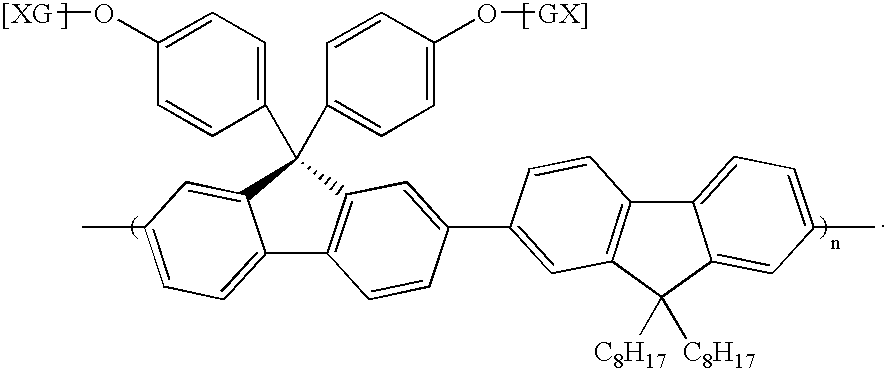
- the present invention is a LED of polymer nanocomposite with quantum dots, where the LED is made of a polymer nanocomposite; the polymer nanocomposite is a PF-GX of dendritic copolyfluorene doped with quantum dots of surface-modified CdS, where the X of PF-GX is 0, 1 or 2; the chemical structure of the polymer nanocomposite is as follows:
- FIG. 1 is a view showing steps for obtaining a polymer nanocomposite according to a preferred embodiment of the present invention
- FIG. 2A is a view showing a chemical reaction in step (a) for obtaining the polymer nanocomposite according to a preferred embodiment of the present invention
- FIG. 2B is a view showing a chemical reaction in step (b) for obtaining the polymer nanocomposite according to a preferred embodiment of the present invention
- FIG. 3 is a view showing characteristics of various polymer nanocomposites according to the preferred embodiment of the present invention, regarding optical density in solid state, PL efficiency and quantum efficiency;
- FIG. 4 is a view showing EL spectrum curves of LEDs of the various polymer nanocomposites according to the preferred embodiment of the present invention.
- FIG. 5A is a view showing relationships between current density and voltage for the LEDs of the various polymer nanocomposites according to the preferred embodiment of the present invention.
- FIG. 5B is a view showing relationships between for the LEDs of the various polymer nanocomposites according to the preferred embodiment of the present invention.
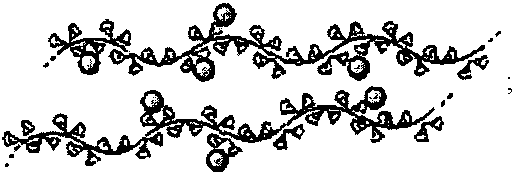
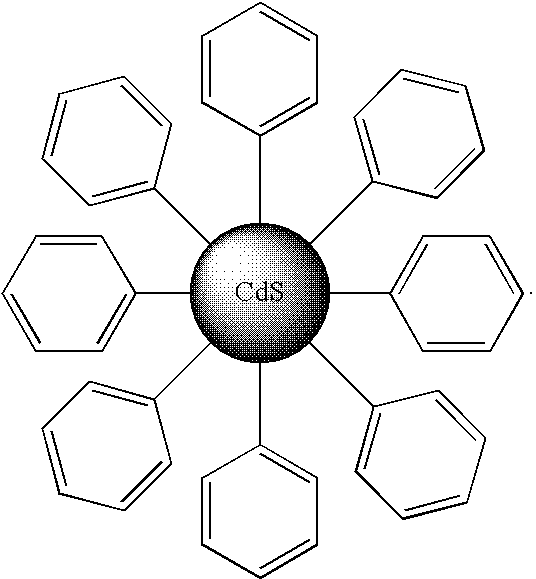
- the present invention is a light-emitting diode (LED) with quantum dots of polymer nanocomposite, where the LED is made of a polymer nanocomposite of PF-GX of a dendritic copolyfluorene doped with quantum dots of surface-modified cadmium sulfide (CdS); the X of PF-GX is a number of 0, 1 or 2; the polymer nanocomposite comprises a chemical structural of the is a quantum dot of the surface-modified CdS; and the is a side chain of the dendritic copolyfluorene.
- LED light-emitting diode
- CdS surface-modified cadmium sulfide
- the side chain has a structure of —CH 3 ; when X is 1 for PF-G1, the side chain has a structure of and, when X is 2 for PF-G2, the side chain has a structure of
- FIG. 1 though FIG. 2B are a view showing steps for obtaining a polymer nanocomposite and views showing chemical reactions in step (a) 1 and step (b) 2 for obtaining the polymer nanocomposite, according to a preferred embodiment of the present invention.
- the present invention is a LED with quantum dots of polymer nanocomposite, which has the following steps for obtaining the polymer nanocomposite:
- Step (a) 1 Modifying surface of CdS 11 (quantum dot) through a thiophenol surfactant 12 to obtain a surface-modified CdS 13 (as shown in FIG. 2A );
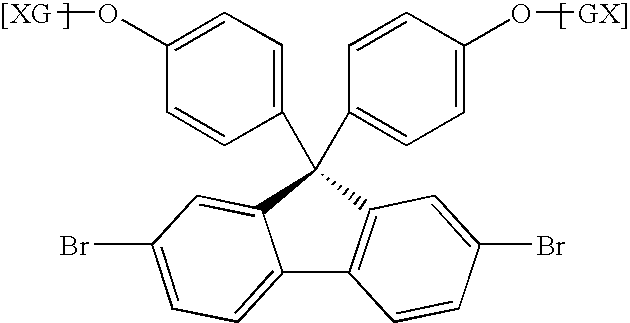
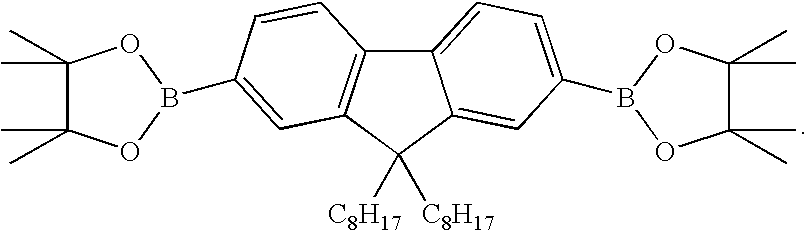
- Step (b) 2 Composing more than a monomer of dendritic structure 211 , 212 to be assembled with a monomer of diboron compound 22 through a Suzuki coupling to obtain a dendritic copolyfluorene 23 (as shown in FIG. 2B ); and
- Step (c) 3 Processing a banding of the product of step (a) 1 of the surface-modified CdS 13 and the product of step (b) 2 of the dendritic copolyfluorene 23 by a ⁇ - ⁇ interaction through a physical doping to obtain a product for a thermal treatment.
- the polymer LED according to the present invention is made of a polymer nanocomposite, where the surface-modified CdS 13 and the dendritic copolyfluorene 23 are banded to obtain high photoluminescence (PL) efficiency and the quantum dot size of the surface-modified CdS 13 can be modified to enhance PL efficiency, heat resistance and lifetime.
- PL photoluminescence
- FIG. 3 is a view showing characteristics of various polymer nanocomposites according to the preferred embodiment of the present invention, regarding optical density in solid state, PL efficiency and quantum efficiency.
- PF-GX of dendritic copolyfluorene according to the present invention is examined to obtain parameters of extinction coefficient ( ⁇ a ) 51 , optical density in solid state (O.D. b ) 52 , membrane thickness (L c ) 53 , concentration of chromophore (M d ) 54 and quantum efficiency ( ⁇ e ) 55 .
- PF-GX When X of PF-GX is 1, the following PF-G1s are examined, including a single-layered dendritic copolyfluorene having no quantum dot (of surface-modified CdS) 41 , a single-layered dendritic copolyfluorene having 3 wt % concentration of quantum dots 42 , a single-layered dendritic copolyfluorene having 4 wt % concentration of quantum dots 43 , and a single-layered dendritic copolyfluorene having 8 wt % concentration of quantum dots 44 .
- a single-layered dendritic copolyfluorene having no quantum dot (of surface-modified CdS) 41 the following PF-G1s are examined, including a single-layered dendritic copolyfluorene having no quantum dot (of surface-modified CdS) 41 , a single-layered dendritic copolyfluorene having 3 wt
- PF-GX When X of PF-GX is 2, the following PF-G2s are examined, including a double single-layered dendritic copolyfluorene having no quantum dot 45 , a double single-layered dendritic copolyfluorene having 3 wt % concentration of quantum dots 46 , and a double single-layered dendritic copolyfluorene having 4 wt % concentration of quantum dots 47 .
- PL efficiency is improved by doping with quantum dots.
- FIG. 4 is a view showing electroluminescence (EL) spectrum curves of LEDs of the various polymer nanocomposites according to the preferred embodiment of the present invention.
- a first 61 , a second 62 , a third 63 and a fourth 64 spectrum curves are included.
- the first spectrum curve 61 is a spectrum curve obtained from an EL of PF-G0 of a single-layered dendritic copolyfluorene having no quantum dot (of surface-modified CdS).
- the strongest EL has a wavelength between 426 and 465 nm (nanometer), appeared as a blue-green light.
- the second spectrum curve 62 is a spectrum curve obtained from an EL of PF-G1 of a single-layered dendritic copolyfluorene having 3 wt % concentration of quantum dot
- the third spectrum curve 63 is a spectrum curve obtained from an EL of PF-G1 of a single-layered dendritic copolyfluorene having 4 wt % concentration of quantum dot
- the fourth spectrum curve 64 is a spectrum curve obtained from an EL of PF-G1 of a single-layered dendritic copolyfluorene having 8 wt % concentration of quantum dot.
- FIG. 5A and FIG, 5 B are views showing relationships between current density and voltage and relationships between luminance and voltage for the LEDs of the various polymer nanocomposites according to the preferred embodiment of the present invention.
- the curves shown in FIG. 5A shows a first 71 , a second 72 , a third 73 and a fourth 74 relationships between current density and voltage; and, the curves shown in FIG. 5B shows a first 81 , a second 82 , a third 83 and a fourth 84 relationships between luminance and voltage.
- the curve showing the first relationship between current density and voltage 71 and the curve showing the first relationship between luminance and voltage 81 are obtained from an EL of a single-layered dendritic copolyfluorene having no quantum dot (of surface-modified CdS), showing changes to current density and luminance following changes in voltage.
- the curve showing the second relationship between current density and voltage 72 and the curve showing the second relationship between luminance and voltage 82 are obtained from an EL of PF-G0 having 3 wt % concentration of quantum dot, showing changes to current density and luminance following changes in voltage.
- the curve showing the third relationship between current density and voltage 73 and the curve showing the third relationship between luminance and voltage 83 are obtained from an EL of PF-G1 having 4 wt % concentration of quantum dot, showing changes to current density and luminance following changes in voltage.
- the fourth relationship between current density and voltage 74 and the fourth relationship between luminance and voltage 84 are obtained from an EL of PF-G2 having 8 wt % concentration of quantum dot, showing changes to current density and luminance following changes in voltage.
- the present invention is a LED with quantum dots of polymer nanocomposite, where the polymer nanocomposite for making the LED increases in EL efficiency and PL efficiency; and the LED thus made is increased in stability and electrical characteristics.
Landscapes
- Chemical & Material Sciences (AREA)
- Engineering & Computer Science (AREA)
- Materials Engineering (AREA)
- Luminescent Compositions (AREA)
- Electroluminescent Light Sources (AREA)
- Led Devices (AREA)
Abstract
Description
- The present invention relates to a light-emitting diode (LED); more particularly, relates to fabricating the LED using a polymer nanocomposite, which is a dendritic copolyfluorene doped with quantum dots of surface-modified CdS, to increase electroluminescence (EL) efficiency and photoluminescence (PL) efficiency to be a luminescence material for a monitor.
- The fabricating of an inorganic LED now requires a fabricating environment of high vacuum and high temperature. And, a polymer LED has characteristics of easy fabrication, size-enlargement and capability of being twisted, which is quite potential. But the PL efficiency of the polymer LED can reaches 25% only, which makes the LED banding of the organic material and the inorganic material catch eyes of the public. Although a phosphorescence polymer LED is developed recently, it requires heavy metal whose resource is not stable.
- In Journal of Applied Physics,
Volume 83, 1998, it is revealed that a layer of inorganic semiconductor CdSe and a layer of organic mixture of trioctyl phosphine and trioctyl phosphine oxide (TOP/TOPO) can be covered with a layer of protection of ZnS, where light emitting polymer (LEP) and quantum dots forms components of layers (AL/inorganic nanoparticles layer (CdSe)/organic hole transport layer (HTL)/metal oxide (indium tin oxide)). By measuring its EL, most EL (600 nm, nanometer) is generated from the inorganic CdSe under high voltage with a very weak contribution (500˜550 nm) from the organic HTL of polyphenylene vinylene (PPV). The performance ((P)v.s.(I) slope) is basically affected by the thickness of the quantum dot layer. And lifetime test reveals promising stability with a time of operating over 50 to 100 hours. External quantum efficiency is also as high as 0.1%. - In Applied Physics Letters, Volume 66, 1995, it is revealed that, with layers of various components as Al/CdSe/polyvinylcarbazole (PVK)/polybutadiene (PBD), by using different quantum dot sizes under room temperature, the EL and PL are tunable from ˜530 to ˜650 nm. Under low voltage of 77000, only the quantum dot produces EL; yet, under high voltage, both the quantum dot and the PVK produce EL; and, after the film is cooled down, EL increases.
- In Applied Physics Letters, Volume 66, 1995, it is revealed that, with a component made of PbS and conjugated polymer (such as poly(2-methoxy-5-(ethyl-hexyloxy)-1,4-phenylene vinylene) (MEHPPV) and poly(2-(6-cyano-68-methylheptyloxy)-1,4-phenylene) (CNPPV)), ELs between 1000 and 1600 nm are obtained according to various sizes of nanoparticles. Besides, a comparison is obtained by using capping ligands of different lengths.
- Although the above prior arts fabricate LEDs, they are each made with various components under a complex procedure. Hence, the prior arts do not fulfill users' requests on actual use.
- The main purpose of the present invention is to provide a polymer nanocomposite doped with quantum dots to obtain high EL and PL efficiencies, where a polymer LED for fabricated to increase in EL efficiency and PL efficiency and to control quantum dot size for obtaining an adjusted luminant wavelength, so that the efficiency, the heat-resistance and the lifetime of the polymer LED is improved.
- To achieve the above purpose, the present invention is a LED of polymer nanocomposite with quantum dots, where the LED is made of a polymer nanocomposite; the polymer nanocomposite is a PF-GX of dendritic copolyfluorene doped with quantum dots of surface-modified CdS, where the X of PF-GX is 0, 1 or 2; the chemical structure of the polymer nanocomposite is as follows:
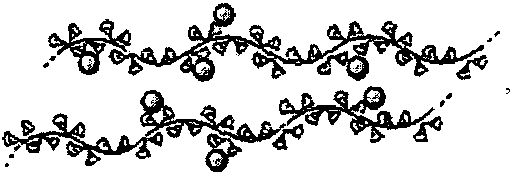
- where the

is a quantum dot of the surface-modified CdS and the
is a side chain of the dendritic copolyfluorene. Accordingly, a novel LED with quantum dots of polymer nanocomposite is obtained. - The present invention will be better understood from the following detailed description of the preferred embodiment according to the present invention, taken in conjunction with the accompanying drawings, in which
-
FIG. 1 is a view showing steps for obtaining a polymer nanocomposite according to a preferred embodiment of the present invention; -
FIG. 2A is a view showing a chemical reaction in step (a) for obtaining the polymer nanocomposite according to a preferred embodiment of the present invention; -
FIG. 2B is a view showing a chemical reaction in step (b) for obtaining the polymer nanocomposite according to a preferred embodiment of the present invention; -
FIG. 3 is a view showing characteristics of various polymer nanocomposites according to the preferred embodiment of the present invention, regarding optical density in solid state, PL efficiency and quantum efficiency; -
FIG. 4 is a view showing EL spectrum curves of LEDs of the various polymer nanocomposites according to the preferred embodiment of the present invention; -
FIG. 5A is a view showing relationships between current density and voltage for the LEDs of the various polymer nanocomposites according to the preferred embodiment of the present invention; and -
FIG. 5B is a view showing relationships between for the LEDs of the various polymer nanocomposites according to the preferred embodiment of the present invention. - The following description of the preferred embodiment is provided to understand the features and the structures of the present invention.
- The present invention is a light-emitting diode (LED) with quantum dots of polymer nanocomposite, where the LED is made of a polymer nanocomposite of PF-GX of a dendritic copolyfluorene doped with quantum dots of surface-modified cadmium sulfide (CdS); the X of PF-GX is a number of 0, 1 or 2; the polymer nanocomposite comprises a chemical structural of
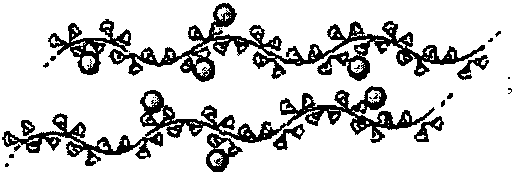
the
is a quantum dot of the surface-modified CdS; and the
is a side chain of the dendritic copolyfluorene. Therein, when X is 0 for PF-G0, the side chain has a structure of —CH3; when X is 1 for PF-G1, the side chain has a structure of
and, when X is 2 for PF-G2, the side chain has a structure of
- Please refer to
FIG. 1 thoughFIG. 2B , which are a view showing steps for obtaining a polymer nanocomposite and views showing chemical reactions in step (a) 1 and step (b) 2 for obtaining the polymer nanocomposite, according to a preferred embodiment of the present invention. As shown in the figures, the present invention is a LED with quantum dots of polymer nanocomposite, which has the following steps for obtaining the polymer nanocomposite: - Step (a) 1: Modifying surface of CdS 11 (quantum dot) through a
thiophenol surfactant 12 to obtain a surface-modified CdS 13 (as shown inFIG. 2A ); - Step (b) 2: Composing more than a monomer of
dendritic structure diboron compound 22 through a Suzuki coupling to obtain a dendritic copolyfluorene 23 (as shown inFIG. 2B ); and - Step (c) 3: Processing a banding of the product of step (a) 1 of the surface-modified
CdS 13 and the product of step (b) 2 of thedendritic copolyfluorene 23 by a π-π interaction through a physical doping to obtain a product for a thermal treatment. - Through the above steps, a final product of a stable polymer nanocomposite is obtained.
- The polymer LED according to the present invention is made of a polymer nanocomposite, where the surface-modified
CdS 13 and thedendritic copolyfluorene 23 are banded to obtain high photoluminescence (PL) efficiency and the quantum dot size of the surface-modifiedCdS 13 can be modified to enhance PL efficiency, heat resistance and lifetime. - Please refer to
FIG. 3 , which is a view showing characteristics of various polymer nanocomposites according to the preferred embodiment of the present invention, regarding optical density in solid state, PL efficiency and quantum efficiency. As shown in the figure, PF-GX of dendritic copolyfluorene according to the present invention is examined to obtain parameters of extinction coefficient (εa) 51, optical density in solid state (O.D.b) 52, membrane thickness (Lc) 53, concentration of chromophore (Md) 54 and quantum efficiency (ηe) 55. When X of PF-GX is 1, the following PF-G1s are examined, including a single-layered dendritic copolyfluorene having no quantum dot (of surface-modified CdS) 41, a single-layered dendritic copolyfluorene having 3 wt % concentration ofquantum dots 42, a single-layered dendritic copolyfluorene having 4 wt % concentration ofquantum dots 43, and a single-layered dendritic copolyfluorene having 8 wt % concentration ofquantum dots 44. When X of PF-GX is 2, the following PF-G2s are examined, including a double single-layered dendritic copolyfluorene having noquantum dot 45, a double single-layered dendritic copolyfluorene having 3 wt % concentration ofquantum dots 46, and a double single-layered dendritic copolyfluorene having 4 wt % concentration ofquantum dots 47. As a conclusion, no matter for a polymer light-emitting material of a single-layereddendritic copolyfluorene 41 or a double single-layereddendritic copolyfluorene 45, PL efficiency is improved by doping with quantum dots. - Please refer to
FIG. 4 , which is a view showing electroluminescence (EL) spectrum curves of LEDs of the various polymer nanocomposites according to the preferred embodiment of the present invention. As shown in the figure, a first 61, a second 62, a third 63 and a fourth 64 spectrum curves are included. Thefirst spectrum curve 61 is a spectrum curve obtained from an EL of PF-G0 of a single-layered dendritic copolyfluorene having no quantum dot (of surface-modified CdS). As is shown, the strongest EL has a wavelength between 426 and 465 nm (nanometer), appeared as a blue-green light. Furthermore, thesecond spectrum curve 62 is a spectrum curve obtained from an EL of PF-G1 of a single-layered dendritic copolyfluorene having 3 wt % concentration of quantum dot; thethird spectrum curve 63 is a spectrum curve obtained from an EL of PF-G1 of a single-layered dendritic copolyfluorene having 4 wt % concentration of quantum dot; and, thefourth spectrum curve 64 is a spectrum curve obtained from an EL of PF-G1 of a single-layered dendritic copolyfluorene having 8 wt % concentration of quantum dot. From the first 61, the second 62, the third 63 and the fourth 65 spectrum curves, it is shown that, by doping with certain densities of quantum dots in the PF-G1s, their full width half maximum (FWHM) are dropped from a point A of FWHM in thefirst spectrum curve 61 to a point B of FWHM in thefourth spectrum curve 64 which is a clear deduction; and, so, the happenings of excimers is restrained and the light color is purer than that of the PF-G1 having no quantum dot. - Please refer to
FIG. 5A and FIG, 5B, which are views showing relationships between current density and voltage and relationships between luminance and voltage for the LEDs of the various polymer nanocomposites according to the preferred embodiment of the present invention. As shown in the figures, the curves shown inFIG. 5A shows a first 71, a second 72, a third 73 and a fourth 74 relationships between current density and voltage; and, the curves shown inFIG. 5B shows a first 81, a second 82, a third 83 and a fourth 84 relationships between luminance and voltage. The curve showing the first relationship between current density andvoltage 71 and the curve showing the first relationship between luminance andvoltage 81 are obtained from an EL of a single-layered dendritic copolyfluorene having no quantum dot (of surface-modified CdS), showing changes to current density and luminance following changes in voltage. The curve showing the second relationship between current density and voltage 72 and the curve showing the second relationship between luminance andvoltage 82 are obtained from an EL of PF-G0 having 3 wt % concentration of quantum dot, showing changes to current density and luminance following changes in voltage. The curve showing the third relationship between current density andvoltage 73 and the curve showing the third relationship between luminance andvoltage 83 are obtained from an EL of PF-G1 having 4 wt % concentration of quantum dot, showing changes to current density and luminance following changes in voltage. And, the fourth relationship between current density andvoltage 74 and the fourth relationship between luminance andvoltage 84 are obtained from an EL of PF-G2 having 8 wt % concentration of quantum dot, showing changes to current density and luminance following changes in voltage. From the above curves, it is known that, by doping quantum dots into single-layered dendritic copolyfluorene, the current carried by the LED made of the PX-GX is increased; and, the greatest luminance for the PX-GX having no quantum dot is 298 cd/m2 and the greatest luminance for the PX-GX having 8 wt % concentration of quantum dot is 1196 cd/m2, which is four times greater. - To sum up, the present invention is a LED with quantum dots of polymer nanocomposite, where the polymer nanocomposite for making the LED increases in EL efficiency and PL efficiency; and the LED thus made is increased in stability and electrical characteristics.
- The preferred embodiment herein disclosed is not intended to unnecessarily limit the scope of the invention. Therefore, simple modifications or variations belonging to the equivalent of the scope of the claims and the instructions disclosed herein for a patent are all within the scope of the present invention.
Claims (8)


Applications Claiming Priority (3)
| Application Number | Priority Date | Filing Date | Title |
|---|---|---|---|
| TW095100137A TWI265192B (en) | 2006-01-03 | 2006-01-03 | Semi-conductor quantum dots enhanced fluorescence polymer light emitting diode |
| TW095100137 | 2006-01-03 | ||
| TW95100137A | 2006-01-03 |
Publications (2)
| Publication Number | Publication Date |
|---|---|
| US20070154734A1 true US20070154734A1 (en) | 2007-07-05 |
| US7846557B2 US7846557B2 (en) | 2010-12-07 |
Family
ID=38122115
Family Applications (1)
| Application Number | Title | Priority Date | Filing Date |
|---|---|---|---|
| US11/377,176 Expired - Fee Related US7846557B2 (en) | 2006-01-03 | 2006-03-17 | Light-emitting diode of polymer nanocomposite with quantum dots |
Country Status (3)
| Country | Link |
|---|---|
| US (1) | US7846557B2 (en) |
| JP (1) | JP4831744B2 (en) |
| TW (1) | TWI265192B (en) |
Cited By (3)
| Publication number | Priority date | Publication date | Assignee | Title |
|---|---|---|---|---|
| US20110173758A1 (en) * | 2008-06-20 | 2011-07-21 | Ricky Jay Fontaine | Inflatable mattress and method of operating same |
| US20130063023A1 (en) * | 2010-05-27 | 2013-03-14 | Merck Patent Gmbh | Compositions comprising quantum dots |
| CN106543103A (en) * | 2016-10-12 | 2017-03-29 | 中国科学院福建物质结构研究所 | A kind of organic inorganic hybridization semi-conducting material for emitting white light, crystal and its production and use |
Families Citing this family (2)
| Publication number | Priority date | Publication date | Assignee | Title |
|---|---|---|---|---|
| DE102007029915B4 (en) | 2006-12-20 | 2017-03-30 | Lg Display Co., Ltd. | Organic electroluminescent device and method of making the same |
| WO2011147521A1 (en) * | 2010-05-27 | 2011-12-01 | Merck Patent Gmbh | Down conversion |
Citations (2)
| Publication number | Priority date | Publication date | Assignee | Title |
|---|---|---|---|---|
| US5442254A (en) * | 1993-05-04 | 1995-08-15 | Motorola, Inc. | Fluorescent device with quantum contained particle screen |
| US20030222572A1 (en) * | 2002-05-28 | 2003-12-04 | National Taiwan University | Light emitting diode with nanoparticles |
Family Cites Families (12)
| Publication number | Priority date | Publication date | Assignee | Title |
|---|---|---|---|---|
| JPH0781936A (en) * | 1993-09-10 | 1995-03-28 | Nippon Mektron Ltd | Production of surface modified metallic sulfide superfine particles |
| JPH10195505A (en) * | 1997-01-09 | 1998-07-28 | Mitsui Chem Inc | Metallic superfine particle and production thereof |
| JPH1160581A (en) * | 1997-08-21 | 1999-03-02 | Mitsui Chem Inc | Reaction reagent of gold ultrafine particle |
| CN102516719B (en) * | 2000-06-12 | 2016-03-23 | 住友化学株式会社 | Polymer matrix electroluminescent material and device |
| JP4634670B2 (en) * | 2001-09-12 | 2011-02-16 | 三井化学株式会社 | Composite modified metal chalcogenide ultrafine particles |
| JP4493951B2 (en) * | 2002-08-09 | 2010-06-30 | 株式会社半導体エネルギー研究所 | Organic electroluminescent device |
| JP2004172102A (en) * | 2002-10-29 | 2004-06-17 | Mitsubishi Chemicals Corp | Electroluminescent device |
| KR100537966B1 (en) * | 2003-04-30 | 2005-12-21 | 한국과학기술연구원 | Polymer electroluminescent device using emitting layer of nanocomposites |
| JP5086517B2 (en) * | 2004-02-02 | 2012-11-28 | 株式会社日立ソリューションズ | Semiconductor nanoparticle manufacturing method |
| KR100621309B1 (en) * | 2004-04-20 | 2006-09-14 | 삼성전자주식회사 | Method for producing metal sulfide nanocrystal using thiol compound as sulfur precursor |
| KR100621308B1 (en) * | 2004-05-28 | 2006-09-14 | 삼성전자주식회사 | Method for preparing cadmium sulfide nanocrystals emitting light at multiple wavelengths and cadmium sulfide nanocrystals obtained thereby |
| US20080007157A1 (en) * | 2006-07-10 | 2008-01-10 | Yazaki Corporation | Compound of nanostructures and polymer for use in electroluminescent device |
-
2006
- 2006-01-03 TW TW095100137A patent/TWI265192B/en not_active IP Right Cessation
- 2006-03-17 US US11/377,176 patent/US7846557B2/en not_active Expired - Fee Related
- 2006-05-22 JP JP2006141531A patent/JP4831744B2/en not_active Expired - Fee Related
Patent Citations (2)
| Publication number | Priority date | Publication date | Assignee | Title |
|---|---|---|---|---|
| US5442254A (en) * | 1993-05-04 | 1995-08-15 | Motorola, Inc. | Fluorescent device with quantum contained particle screen |
| US20030222572A1 (en) * | 2002-05-28 | 2003-12-04 | National Taiwan University | Light emitting diode with nanoparticles |
Cited By (4)
| Publication number | Priority date | Publication date | Assignee | Title |
|---|---|---|---|---|
| US20110173758A1 (en) * | 2008-06-20 | 2011-07-21 | Ricky Jay Fontaine | Inflatable mattress and method of operating same |
| US20130063023A1 (en) * | 2010-05-27 | 2013-03-14 | Merck Patent Gmbh | Compositions comprising quantum dots |
| US10190043B2 (en) * | 2010-05-27 | 2019-01-29 | Merck Patent Gmbh | Compositions comprising quantum dots |
| CN106543103A (en) * | 2016-10-12 | 2017-03-29 | 中国科学院福建物质结构研究所 | A kind of organic inorganic hybridization semi-conducting material for emitting white light, crystal and its production and use |
Also Published As
| Publication number | Publication date |
|---|---|
| TW200726822A (en) | 2007-07-16 |
| JP2007184516A (en) | 2007-07-19 |
| US7846557B2 (en) | 2010-12-07 |
| JP4831744B2 (en) | 2011-12-07 |
| TWI265192B (en) | 2006-11-01 |
Similar Documents
| Publication | Publication Date | Title |
|---|---|---|
| US10096744B2 (en) | Quantum dot light enhancement substrate and lighting device including same | |
| Li et al. | Quantum‐dot light‐emitting diodes for outdoor displays with high stability at high brightness | |
| US12140836B2 (en) | Luminous body, and light emitting film, light emitting diode and light emitting device including the same | |
| US10962835B2 (en) | Inorganic composite luminescent material, light-emitting film, light-emitting diode package, light emitting diode and light-emitting device including the same | |
| US7564067B2 (en) | Device having spacers | |
| JP6878376B2 (en) | Light emitting device including light emitting body, light emitting film, light emitting diode and light emitting body | |
| Rhee et al. | Recent progress in high-luminance quantum dot light-emitting diodes | |
| EP3775098B1 (en) | Quantum dot led design based on resonant energy transfer | |
| Li et al. | Enhanced efficiency of InP-based red quantum dot light-emitting diodes | |
| KR101658691B1 (en) | Stable and all solution processable quantum dot light-emitting diodes | |
| EP3336914B1 (en) | Quantum light emitting diode and quantum light emitting device including the same | |
| TW202003792A (en) | Top-emitting printed display with quantum dots and thermally activated delayed fluorescence molecules | |
| CN112585770A (en) | Electroluminescent display device and manufacturing method thereof | |
| CN109671837B (en) | Light-emitting body and light-emitting film, light-emitting diode and light-emitting device including the same | |
| US20240172462A1 (en) | Organic electroluminescent devices | |
| US20070154734A1 (en) | Light-emitting diode of polymer nanocomposite with quantum dots | |
| CN113130794B (en) | A kind of quantum dot light-emitting diode and its preparation method | |
| US12089437B2 (en) | Flexible electroluminescent devices | |
| US12414433B2 (en) | Organic electroluminescent devices | |
| Sharma et al. | Control of Excitonic Energy Transfer in RGB Quantum Dot: Polymer Composites for Tunable White Emission | |
| KR20240010434A (en) | Organic electroluminescent devices | |
| CN118057949A (en) | Organic electroluminescent device | |
| CN115249697A (en) | Display panel |
Legal Events
| Date | Code | Title | Description |
|---|---|---|---|
| AS | Assignment |
Owner name: NATIONAL CHIAO TUNG UNIVERSITY, TAIWAN Free format text: ASSIGNMENT OF ASSIGNORS INTEREST;ASSIGNORS:WEI, KUNG-HWA;CHOU, CHIA-HUNG;REEL/FRAME:017692/0790 Effective date: 20060203 |
|
| FPAY | Fee payment |
Year of fee payment: 4 |
|
| FEPP | Fee payment procedure |
Free format text: MAINTENANCE FEE REMINDER MAILED (ORIGINAL EVENT CODE: REM.) |
|
| LAPS | Lapse for failure to pay maintenance fees |
Free format text: PATENT EXPIRED FOR FAILURE TO PAY MAINTENANCE FEES (ORIGINAL EVENT CODE: EXP.); ENTITY STATUS OF PATENT OWNER: SMALL ENTITY |
|
| STCH | Information on status: patent discontinuation |
Free format text: PATENT EXPIRED DUE TO NONPAYMENT OF MAINTENANCE FEES UNDER 37 CFR 1.362 |
|
| FP | Lapsed due to failure to pay maintenance fee |
Effective date: 20181207 |