US20060134440A1 - Silicone encapsulants for light emitting diodes - Google Patents
Silicone encapsulants for light emitting diodes Download PDFInfo
- Publication number
- US20060134440A1 US20060134440A1 US11/256,843 US25684305A US2006134440A1 US 20060134440 A1 US20060134440 A1 US 20060134440A1 US 25684305 A US25684305 A US 25684305A US 2006134440 A1 US2006134440 A1 US 2006134440A1
- Authority
- US
- United States
- Prior art keywords
- vinyl
- oligomer
- catalyst
- och
- integer
- Prior art date
- Legal status (The legal status is an assumption and is not a legal conclusion. Google has not performed a legal analysis and makes no representation as to the accuracy of the status listed.)
- Abandoned
Links
- 229920001296 polysiloxane Polymers 0.000 title abstract description 7
- 239000008393 encapsulating agent Substances 0.000 title description 12
- 239000000203 mixture Substances 0.000 claims abstract description 98
- 229920000642 polymer Polymers 0.000 claims abstract description 48
- 238000000034 method Methods 0.000 claims abstract description 24
- 229920002554 vinyl polymer Polymers 0.000 claims description 86
- -1 vinyl siloxane Chemical class 0.000 claims description 82
- 239000003054 catalyst Substances 0.000 claims description 51
- 229910000510 noble metal Inorganic materials 0.000 claims description 38
- 238000006459 hydrosilylation reaction Methods 0.000 claims description 36
- 125000000391 vinyl group Chemical group [H]C([*])=C([H])[H] 0.000 claims description 31
- 238000001723 curing Methods 0.000 claims description 26
- 239000000945 filler Substances 0.000 claims description 23
- 125000002496 methyl group Chemical group [H]C([H])([H])* 0.000 claims description 23
- BASFCYQUMIYNBI-UHFFFAOYSA-N platinum Substances [Pt] BASFCYQUMIYNBI-UHFFFAOYSA-N 0.000 claims description 22
- 125000000956 methoxy group Chemical group [H]C([H])([H])O* 0.000 claims description 21
- 125000003545 alkoxy group Chemical group 0.000 claims description 13
- 229910052751 metal Inorganic materials 0.000 claims description 13
- 239000002184 metal Substances 0.000 claims description 13
- KDLHZDBZIXYQEI-UHFFFAOYSA-N Palladium Chemical compound [Pd] KDLHZDBZIXYQEI-UHFFFAOYSA-N 0.000 claims description 10
- 125000000325 methylidene group Chemical group [H]C([H])=* 0.000 claims description 10
- JFDZBHWFFUWGJE-UHFFFAOYSA-N benzonitrile Chemical compound N#CC1=CC=CC=C1 JFDZBHWFFUWGJE-UHFFFAOYSA-N 0.000 claims description 9
- QBERHIJABFXGRZ-UHFFFAOYSA-M rhodium;triphenylphosphane;chloride Chemical compound [Cl-].[Rh].C1=CC=CC=C1P(C=1C=CC=CC=1)C1=CC=CC=C1.C1=CC=CC=C1P(C=1C=CC=CC=1)C1=CC=CC=C1.C1=CC=CC=C1P(C=1C=CC=CC=1)C1=CC=CC=C1 QBERHIJABFXGRZ-UHFFFAOYSA-M 0.000 claims description 9
- 239000000758 substrate Substances 0.000 claims description 9
- XUIMIQQOPSSXEZ-UHFFFAOYSA-N Silicon Chemical compound [Si] XUIMIQQOPSSXEZ-UHFFFAOYSA-N 0.000 claims description 8
- 125000000217 alkyl group Chemical group 0.000 claims description 7
- 125000001188 haloalkyl group Chemical group 0.000 claims description 7
- 229910052741 iridium Inorganic materials 0.000 claims description 7
- 238000004519 manufacturing process Methods 0.000 claims description 7
- 229910052697 platinum Inorganic materials 0.000 claims description 7
- 239000010948 rhodium Substances 0.000 claims description 7
- KBPLFHHGFOOTCA-UHFFFAOYSA-N 1-Octanol Chemical compound CCCCCCCCO KBPLFHHGFOOTCA-UHFFFAOYSA-N 0.000 claims description 6
- 239000002253 acid Substances 0.000 claims description 6
- 229910052782 aluminium Inorganic materials 0.000 claims description 6
- XAGFODPZIPBFFR-UHFFFAOYSA-N aluminium Chemical compound [Al] XAGFODPZIPBFFR-UHFFFAOYSA-N 0.000 claims description 6
- GKOZUEZYRPOHIO-UHFFFAOYSA-N iridium atom Chemical compound [Ir] GKOZUEZYRPOHIO-UHFFFAOYSA-N 0.000 claims description 6
- NFHFRUOZVGFOOS-UHFFFAOYSA-N palladium;triphenylphosphane Chemical compound [Pd].C1=CC=CC=C1P(C=1C=CC=CC=1)C1=CC=CC=C1.C1=CC=CC=C1P(C=1C=CC=CC=1)C1=CC=CC=C1.C1=CC=CC=C1P(C=1C=CC=CC=1)C1=CC=CC=C1.C1=CC=CC=C1P(C=1C=CC=CC=1)C1=CC=CC=C1 NFHFRUOZVGFOOS-UHFFFAOYSA-N 0.000 claims description 6
- 239000002245 particle Substances 0.000 claims description 6
- 229910052710 silicon Inorganic materials 0.000 claims description 6
- RIOQSEWOXXDEQQ-UHFFFAOYSA-N triphenylphosphine Chemical compound C1=CC=CC=C1P(C=1C=CC=CC=1)C1=CC=CC=C1 RIOQSEWOXXDEQQ-UHFFFAOYSA-N 0.000 claims description 6
- 239000011995 wilkinson's catalyst Substances 0.000 claims description 6
- 239000000463 material Substances 0.000 claims description 5
- 239000010703 silicon Substances 0.000 claims description 5
- ZOXJGFHDIHLPTG-UHFFFAOYSA-N Boron Chemical compound [B] ZOXJGFHDIHLPTG-UHFFFAOYSA-N 0.000 claims description 4
- ATJFFYVFTNAWJD-UHFFFAOYSA-N Tin Chemical compound [Sn] ATJFFYVFTNAWJD-UHFFFAOYSA-N 0.000 claims description 4
- RTAQQCXQSZGOHL-UHFFFAOYSA-N Titanium Chemical compound [Ti] RTAQQCXQSZGOHL-UHFFFAOYSA-N 0.000 claims description 4
- HCHKCACWOHOZIP-UHFFFAOYSA-N Zinc Chemical compound [Zn] HCHKCACWOHOZIP-UHFFFAOYSA-N 0.000 claims description 4
- 230000005540 biological transmission Effects 0.000 claims description 4
- 229910052796 boron Inorganic materials 0.000 claims description 4
- 229910052732 germanium Inorganic materials 0.000 claims description 4
- GNPVGFCGXDBREM-UHFFFAOYSA-N germanium atom Chemical compound [Ge] GNPVGFCGXDBREM-UHFFFAOYSA-N 0.000 claims description 4
- 238000011416 infrared curing Methods 0.000 claims description 4
- 229910052763 palladium Inorganic materials 0.000 claims description 4
- 229910052712 strontium Inorganic materials 0.000 claims description 4
- CIOAGBVUUVVLOB-UHFFFAOYSA-N strontium atom Chemical compound [Sr] CIOAGBVUUVVLOB-UHFFFAOYSA-N 0.000 claims description 4
- 229910052718 tin Inorganic materials 0.000 claims description 4
- 229910052719 titanium Inorganic materials 0.000 claims description 4
- 239000010936 titanium Substances 0.000 claims description 4
- 229910052725 zinc Inorganic materials 0.000 claims description 4
- 239000011701 zinc Substances 0.000 claims description 4
- VEXZGXHMUGYJMC-UHFFFAOYSA-M Chloride anion Chemical compound [Cl-] VEXZGXHMUGYJMC-UHFFFAOYSA-M 0.000 claims description 3
- 239000007983 Tris buffer Substances 0.000 claims description 3
- UFJSITOHZAUZBO-UHFFFAOYSA-K cycloocta-1,3-diene;trichloroiridium Chemical compound Cl[Ir](Cl)Cl.C1CCC=CC=CC1 UFJSITOHZAUZBO-UHFFFAOYSA-K 0.000 claims description 3
- WSNMPAVSZJSIMT-UHFFFAOYSA-N COc1c(C)c2COC(=O)c2c(O)c1CC(O)C1(C)CCC(=O)O1 Chemical compound COc1c(C)c2COC(=O)c2c(O)c1CC(O)C1(C)CCC(=O)O1 WSNMPAVSZJSIMT-UHFFFAOYSA-N 0.000 claims description 2
- 230000001747 exhibiting effect Effects 0.000 claims 1
- 238000002360 preparation method Methods 0.000 abstract description 2
- 0 *[Si]1(C)O[Si](*)(C)O[Si](*)(C)O[Si](*)(C)O[Si](*)(C)O1 Chemical compound *[Si]1(C)O[Si](*)(C)O[Si](*)(C)O[Si](*)(C)O[Si](*)(C)O1 0.000 description 33
- YXFVVABEGXRONW-UHFFFAOYSA-N Toluene Chemical compound CC1=CC=CC=C1 YXFVVABEGXRONW-UHFFFAOYSA-N 0.000 description 23
- 238000006243 chemical reaction Methods 0.000 description 16
- 238000006116 polymerization reaction Methods 0.000 description 10
- 238000012360 testing method Methods 0.000 description 9
- 229920005989 resin Polymers 0.000 description 8
- 239000011347 resin Substances 0.000 description 8
- 238000009833 condensation Methods 0.000 description 7
- 230000005494 condensation Effects 0.000 description 7
- 238000006482 condensation reaction Methods 0.000 description 6
- 239000000047 product Substances 0.000 description 6
- 125000004429 atom Chemical group 0.000 description 5
- 230000015556 catabolic process Effects 0.000 description 5
- 238000006731 degradation reaction Methods 0.000 description 5
- 230000001590 oxidative effect Effects 0.000 description 5
- 239000000376 reactant Substances 0.000 description 5
- 238000004383 yellowing Methods 0.000 description 5
- 238000005481 NMR spectroscopy Methods 0.000 description 4
- HEDRZPFGACZZDS-MICDWDOJSA-N Trichloro(2H)methane Chemical compound [2H]C(Cl)(Cl)Cl HEDRZPFGACZZDS-MICDWDOJSA-N 0.000 description 4
- 150000001875 compounds Chemical class 0.000 description 4
- 125000001424 substituent group Chemical group 0.000 description 4
- XLYOFNOQVPJJNP-UHFFFAOYSA-N water Substances O XLYOFNOQVPJJNP-UHFFFAOYSA-N 0.000 description 4
- QTBSBXVTEAMEQO-UHFFFAOYSA-N Acetic acid Chemical compound CC(O)=O QTBSBXVTEAMEQO-UHFFFAOYSA-N 0.000 description 3
- SOGAXMICEFXMKE-UHFFFAOYSA-N Butylmethacrylate Chemical compound CCCCOC(=O)C(C)=C SOGAXMICEFXMKE-UHFFFAOYSA-N 0.000 description 3
- VVQNEPGJFQJSBK-UHFFFAOYSA-N Methyl methacrylate Chemical compound COC(=O)C(C)=C VVQNEPGJFQJSBK-UHFFFAOYSA-N 0.000 description 3
- MUBZPKHOEPUJKR-UHFFFAOYSA-N Oxalic acid Chemical compound OC(=O)C(O)=O MUBZPKHOEPUJKR-UHFFFAOYSA-N 0.000 description 3
- 230000032683 aging Effects 0.000 description 3
- 239000003795 chemical substances by application Substances 0.000 description 3
- KPUWHANPEXNPJT-UHFFFAOYSA-N disiloxane Chemical class [SiH3]O[SiH3] KPUWHANPEXNPJT-UHFFFAOYSA-N 0.000 description 3
- 125000001301 ethoxy group Chemical group [H]C([H])([H])C([H])([H])O* 0.000 description 3
- 230000003287 optical effect Effects 0.000 description 3
- 229920002037 poly(vinyl butyral) polymer Polymers 0.000 description 3
- 238000012216 screening Methods 0.000 description 3
- VYPSYNLAJGMNEJ-UHFFFAOYSA-N silicon dioxide Inorganic materials O=[Si]=O VYPSYNLAJGMNEJ-UHFFFAOYSA-N 0.000 description 3
- 239000000243 solution Substances 0.000 description 3
- 239000000126 substance Substances 0.000 description 3
- CZDYPVPMEAXLPK-UHFFFAOYSA-N tetramethylsilane Chemical compound C[Si](C)(C)C CZDYPVPMEAXLPK-UHFFFAOYSA-N 0.000 description 3
- VHYFNPMBLIVWCW-UHFFFAOYSA-N 4-Dimethylaminopyridine Chemical compound CN(C)C1=CC=NC=C1 VHYFNPMBLIVWCW-UHFFFAOYSA-N 0.000 description 2
- ZRALSGWEFCBTJO-UHFFFAOYSA-N Guanidine Chemical compound NC(N)=N ZRALSGWEFCBTJO-UHFFFAOYSA-N 0.000 description 2
- VEXZGXHMUGYJMC-UHFFFAOYSA-N Hydrochloric acid Chemical compound Cl VEXZGXHMUGYJMC-UHFFFAOYSA-N 0.000 description 2
- AFVFQIVMOAPDHO-UHFFFAOYSA-N Methanesulfonic acid Chemical compound CS(O)(=O)=O AFVFQIVMOAPDHO-UHFFFAOYSA-N 0.000 description 2
- NBIIXXVUZAFLBC-UHFFFAOYSA-N Phosphoric acid Chemical compound OP(O)(O)=O NBIIXXVUZAFLBC-UHFFFAOYSA-N 0.000 description 2
- QAOWNCQODCNURD-UHFFFAOYSA-N Sulfuric acid Chemical compound OS(O)(=O)=O QAOWNCQODCNURD-UHFFFAOYSA-N 0.000 description 2
- 230000002378 acidificating effect Effects 0.000 description 2
- 239000000654 additive Substances 0.000 description 2
- 230000015572 biosynthetic process Effects 0.000 description 2
- 239000006227 byproduct Substances 0.000 description 2
- 229920001577 copolymer Polymers 0.000 description 2
- 235000013870 dimethyl polysiloxane Nutrition 0.000 description 2
- 239000003822 epoxy resin Substances 0.000 description 2
- 239000000835 fiber Substances 0.000 description 2
- 239000012530 fluid Substances 0.000 description 2
- 238000009472 formulation Methods 0.000 description 2
- LNEPOXFFQSENCJ-UHFFFAOYSA-N haloperidol Chemical compound C1CC(O)(C=2C=CC(Cl)=CC=2)CCN1CCCC(=O)C1=CC=C(F)C=C1 LNEPOXFFQSENCJ-UHFFFAOYSA-N 0.000 description 2
- 230000007774 longterm Effects 0.000 description 2
- BKIMMITUMNQMOS-UHFFFAOYSA-N nonane Chemical compound CCCCCCCCC BKIMMITUMNQMOS-UHFFFAOYSA-N 0.000 description 2
- VLTRZXGMWDSKGL-UHFFFAOYSA-N perchloric acid Chemical compound OCl(=O)(=O)=O VLTRZXGMWDSKGL-UHFFFAOYSA-N 0.000 description 2
- 229920000435 poly(dimethylsiloxane) Polymers 0.000 description 2
- 229920000647 polyepoxide Polymers 0.000 description 2
- 229910052703 rhodium Inorganic materials 0.000 description 2
- WGTYBPLFGIVFAS-UHFFFAOYSA-M tetramethylammonium hydroxide Chemical compound [OH-].C[N+](C)(C)C WGTYBPLFGIVFAS-UHFFFAOYSA-M 0.000 description 2
- 238000003878 thermal aging Methods 0.000 description 2
- JOXIMZWYDAKGHI-UHFFFAOYSA-N toluene-4-sulfonic acid Chemical compound CC1=CC=C(S(O)(=O)=O)C=C1 JOXIMZWYDAKGHI-UHFFFAOYSA-N 0.000 description 2
- 230000000007 visual effect Effects 0.000 description 2
- 239000000080 wetting agent Substances 0.000 description 2
- 238000005160 1H NMR spectroscopy Methods 0.000 description 1
- PUNGSQUVTIDKNU-UHFFFAOYSA-N 2,4,6,8,10-pentamethyl-1,3,5,7,9,2$l^{3},4$l^{3},6$l^{3},8$l^{3},10$l^{3}-pentaoxapentasilecane Chemical compound C[Si]1O[Si](C)O[Si](C)O[Si](C)O[Si](C)O1 PUNGSQUVTIDKNU-UHFFFAOYSA-N 0.000 description 1
- CPOSFLOVUINCKT-UHFFFAOYSA-H C.C.CC(C)(C1=CC=C(OCC2CO2)C=C1)C1=CC=C(OCC2CO2)C=C1.CCCCCCCCCCOC1=CC=C([SH](C2=CC=CC=C2)C2=CC=CC=C2)C=C1.CO[Si](C)(C)CCC1CCC2OC2C1.F[Sb](F)(F)(F)F.O=C(OCC1CCC2OC2C1)C1CCC2OC2C1.[F-] Chemical compound C.C.CC(C)(C1=CC=C(OCC2CO2)C=C1)C1=CC=C(OCC2CO2)C=C1.CCCCCCCCCCOC1=CC=C([SH](C2=CC=CC=C2)C2=CC=CC=C2)C=C1.CO[Si](C)(C)CCC1CCC2OC2C1.F[Sb](F)(F)(F)F.O=C(OCC1CCC2OC2C1)C1CCC2OC2C1.[F-] CPOSFLOVUINCKT-UHFFFAOYSA-H 0.000 description 1
- ZZVDBYBCNAXMSS-UHFFFAOYSA-N C=C[Si](OC)(OC)OC.C=C[Si](OC)(OC)O[Si](C)(C)O[Si](C=C)(OC)O[Si](C=C)(OC)OC.COC.CO[Si](C)(C)OC.O Chemical compound C=C[Si](OC)(OC)OC.C=C[Si](OC)(OC)O[Si](C)(C)O[Si](C=C)(OC)O[Si](C=C)(OC)OC.COC.CO[Si](C)(C)OC.O ZZVDBYBCNAXMSS-UHFFFAOYSA-N 0.000 description 1
- HZYVCFLYMNDYRF-UHFFFAOYSA-N CO[Si](C)(C)O[Si](C)(C)O[Si](C)(C)O[Si](C)(C)C Chemical compound CO[Si](C)(C)O[Si](C)(C)O[Si](C)(C)O[Si](C)(C)C HZYVCFLYMNDYRF-UHFFFAOYSA-N 0.000 description 1
- ZGOIOFLCHYDDKL-UHFFFAOYSA-N C[Si](C)(CCC1CCC2OC2C1)O[Si](C)(C)CCC1CCC2OC2C1.C[Si](C)(CCCCC1CO1)O[Si](C)(C)CCCCC1CO1 Chemical compound C[Si](C)(CCC1CCC2OC2C1)O[Si](C)(C)CCC1CCC2OC2C1.C[Si](C)(CCCCC1CO1)O[Si](C)(C)CCCCC1CO1 ZGOIOFLCHYDDKL-UHFFFAOYSA-N 0.000 description 1
- OKTJSMMVPCPJKN-UHFFFAOYSA-N Carbon Chemical compound [C] OKTJSMMVPCPJKN-UHFFFAOYSA-N 0.000 description 1
- 239000004593 Epoxy Substances 0.000 description 1
- LFQSCWFLJHTTHZ-UHFFFAOYSA-N Ethanol Chemical compound CCO LFQSCWFLJHTTHZ-UHFFFAOYSA-N 0.000 description 1
- CHJJGSNFBQVOTG-UHFFFAOYSA-N N-methyl-guanidine Natural products CNC(N)=N CHJJGSNFBQVOTG-UHFFFAOYSA-N 0.000 description 1
- BOTDANWDWHJENH-UHFFFAOYSA-N Tetraethyl orthosilicate Chemical compound CCO[Si](OCC)(OCC)OCC BOTDANWDWHJENH-UHFFFAOYSA-N 0.000 description 1
- 235000005811 Viola adunca Nutrition 0.000 description 1
- 240000009038 Viola odorata Species 0.000 description 1
- 235000013487 Viola odorata Nutrition 0.000 description 1
- 235000002254 Viola papilionacea Nutrition 0.000 description 1
- 239000002318 adhesion promoter Substances 0.000 description 1
- 239000000853 adhesive Substances 0.000 description 1
- 230000001070 adhesive effect Effects 0.000 description 1
- 229910000147 aluminium phosphate Inorganic materials 0.000 description 1
- 239000012455 biphasic mixture Substances 0.000 description 1
- ZPECUSGQPIKHLT-UHFFFAOYSA-N bis(ethenyl)-dimethoxysilane Chemical compound CO[Si](OC)(C=C)C=C ZPECUSGQPIKHLT-UHFFFAOYSA-N 0.000 description 1
- 238000010504 bond cleavage reaction Methods 0.000 description 1
- QXJJQWWVWRCVQT-UHFFFAOYSA-K calcium;sodium;phosphate Chemical compound [Na+].[Ca+2].[O-]P([O-])([O-])=O QXJJQWWVWRCVQT-UHFFFAOYSA-K 0.000 description 1
- 239000002041 carbon nanotube Substances 0.000 description 1
- 229910021393 carbon nanotube Inorganic materials 0.000 description 1
- 239000000919 ceramic Substances 0.000 description 1
- 239000007795 chemical reaction product Substances 0.000 description 1
- 125000004122 cyclic group Chemical group 0.000 description 1
- 230000003247 decreasing effect Effects 0.000 description 1
- 230000007812 deficiency Effects 0.000 description 1
- 230000003413 degradative effect Effects 0.000 description 1
- VGWJKDPTLUDSJT-UHFFFAOYSA-N diethyl dimethyl silicate Chemical compound CCO[Si](OC)(OC)OCC VGWJKDPTLUDSJT-UHFFFAOYSA-N 0.000 description 1
- JJQZDUKDJDQPMQ-UHFFFAOYSA-N dimethoxy(dimethyl)silane Chemical compound CO[Si](C)(C)OC JJQZDUKDJDQPMQ-UHFFFAOYSA-N 0.000 description 1
- 239000004205 dimethyl polysiloxane Substances 0.000 description 1
- SWSQBOPZIKWTGO-UHFFFAOYSA-N dimethylaminoamidine Natural products CN(C)C(N)=N SWSQBOPZIKWTGO-UHFFFAOYSA-N 0.000 description 1
- 238000002845 discoloration Methods 0.000 description 1
- 230000007613 environmental effect Effects 0.000 description 1
- 150000002118 epoxides Chemical class 0.000 description 1
- 230000003628 erosive effect Effects 0.000 description 1
- NKSJNEHGWDZZQF-UHFFFAOYSA-N ethenyl(trimethoxy)silane Chemical compound CO[Si](OC)(OC)C=C NKSJNEHGWDZZQF-UHFFFAOYSA-N 0.000 description 1
- SBRXLTRZCJVAPH-UHFFFAOYSA-N ethyl(trimethoxy)silane Chemical compound CC[Si](OC)(OC)OC SBRXLTRZCJVAPH-UHFFFAOYSA-N 0.000 description 1
- HTSRFYSEWIPFNI-UHFFFAOYSA-N ethyl-dimethoxy-methylsilane Chemical compound CC[Si](C)(OC)OC HTSRFYSEWIPFNI-UHFFFAOYSA-N 0.000 description 1
- 239000007789 gas Substances 0.000 description 1
- 239000001257 hydrogen Substances 0.000 description 1
- 229910052739 hydrogen Inorganic materials 0.000 description 1
- 125000004435 hydrogen atom Chemical class [H]* 0.000 description 1
- 238000011065 in-situ storage Methods 0.000 description 1
- 239000003112 inhibitor Substances 0.000 description 1
- 239000007788 liquid Substances 0.000 description 1
- QSHDDOUJBYECFT-UHFFFAOYSA-N mercury Chemical compound [Hg] QSHDDOUJBYECFT-UHFFFAOYSA-N 0.000 description 1
- 229910052753 mercury Inorganic materials 0.000 description 1
- 229940098779 methanesulfonic acid Drugs 0.000 description 1
- IKGXNCHYONXJSM-UHFFFAOYSA-N methanolate;zirconium(4+) Chemical compound [Zr+4].[O-]C.[O-]C.[O-]C.[O-]C IKGXNCHYONXJSM-UHFFFAOYSA-N 0.000 description 1
- BFXIKLCIZHOAAZ-UHFFFAOYSA-N methyltrimethoxysilane Chemical compound CO[Si](C)(OC)OC BFXIKLCIZHOAAZ-UHFFFAOYSA-N 0.000 description 1
- 239000010445 mica Substances 0.000 description 1
- 229910052618 mica group Inorganic materials 0.000 description 1
- 239000000178 monomer Substances 0.000 description 1
- SYSQUGFVNFXIIT-UHFFFAOYSA-N n-[4-(1,3-benzoxazol-2-yl)phenyl]-4-nitrobenzenesulfonamide Chemical class C1=CC([N+](=O)[O-])=CC=C1S(=O)(=O)NC1=CC=C(C=2OC3=CC=CC=C3N=2)C=C1 SYSQUGFVNFXIIT-UHFFFAOYSA-N 0.000 description 1
- 239000003921 oil Substances 0.000 description 1
- 235000006408 oxalic acid Nutrition 0.000 description 1
- 125000004430 oxygen atom Chemical group O* 0.000 description 1
- 238000005191 phase separation Methods 0.000 description 1
- 229920000058 polyacrylate Polymers 0.000 description 1
- 229920006254 polymer film Polymers 0.000 description 1
- 239000010453 quartz Substances 0.000 description 1
- 238000010992 reflux Methods 0.000 description 1
- MHOVAHRLVXNVSD-UHFFFAOYSA-N rhodium atom Chemical compound [Rh] MHOVAHRLVXNVSD-UHFFFAOYSA-N 0.000 description 1
- 239000004065 semiconductor Substances 0.000 description 1
- 239000000377 silicon dioxide Substances 0.000 description 1
- 229920002050 silicone resin Polymers 0.000 description 1
- 239000007787 solid Substances 0.000 description 1
- 238000004611 spectroscopical analysis Methods 0.000 description 1
- 239000007858 starting material Substances 0.000 description 1
- 238000010998 test method Methods 0.000 description 1
- GXMNGLIMQIPFEB-UHFFFAOYSA-N tetraethoxygermane Chemical compound CCO[Ge](OCC)(OCC)OCC GXMNGLIMQIPFEB-UHFFFAOYSA-N 0.000 description 1
- FPADWGFFPCNGDD-UHFFFAOYSA-N tetraethoxystannane Chemical compound [Sn+4].CC[O-].CC[O-].CC[O-].CC[O-] FPADWGFFPCNGDD-UHFFFAOYSA-N 0.000 description 1
- 229940073455 tetraethylammonium hydroxide Drugs 0.000 description 1
- LRGJRHZIDJQFCL-UHFFFAOYSA-M tetraethylazanium;hydroxide Chemical compound [OH-].CC[N+](CC)(CC)CC LRGJRHZIDJQFCL-UHFFFAOYSA-M 0.000 description 1
- ACOVYJCRYLWRLR-UHFFFAOYSA-N tetramethoxygermane Chemical compound CO[Ge](OC)(OC)OC ACOVYJCRYLWRLR-UHFFFAOYSA-N 0.000 description 1
- LFQCEHFDDXELDD-UHFFFAOYSA-N tetramethyl orthosilicate Chemical compound CO[Si](OC)(OC)OC LFQCEHFDDXELDD-UHFFFAOYSA-N 0.000 description 1
- 239000004634 thermosetting polymer Substances 0.000 description 1
- JMXKSZRRTHPKDL-UHFFFAOYSA-N titanium ethoxide Chemical compound [Ti+4].CC[O-].CC[O-].CC[O-].CC[O-] JMXKSZRRTHPKDL-UHFFFAOYSA-N 0.000 description 1
- IMNIMPAHZVJRPE-UHFFFAOYSA-N triethylenediamine Chemical compound C1CN2CCN1CC2 IMNIMPAHZVJRPE-UHFFFAOYSA-N 0.000 description 1
- ITMCEJHCFYSIIV-UHFFFAOYSA-N triflic acid Chemical compound OS(=O)(=O)C(F)(F)F ITMCEJHCFYSIIV-UHFFFAOYSA-N 0.000 description 1
- UAEJRRZPRZCUBE-UHFFFAOYSA-N trimethoxyalumane Chemical compound [Al+3].[O-]C.[O-]C.[O-]C UAEJRRZPRZCUBE-UHFFFAOYSA-N 0.000 description 1
- 238000011179 visual inspection Methods 0.000 description 1
Classifications
-
- C—CHEMISTRY; METALLURGY
- C08—ORGANIC MACROMOLECULAR COMPOUNDS; THEIR PREPARATION OR CHEMICAL WORKING-UP; COMPOSITIONS BASED THEREON
- C08G—MACROMOLECULAR COMPOUNDS OBTAINED OTHERWISE THAN BY REACTIONS ONLY INVOLVING UNSATURATED CARBON-TO-CARBON BONDS
- C08G77/00—Macromolecular compounds obtained by reactions forming a linkage containing silicon with or without sulfur, nitrogen, oxygen or carbon in the main chain of the macromolecule
- C08G77/04—Polysiloxanes
- C08G77/06—Preparatory processes
- C08G77/08—Preparatory processes characterised by the catalysts used
-
- C—CHEMISTRY; METALLURGY
- C08—ORGANIC MACROMOLECULAR COMPOUNDS; THEIR PREPARATION OR CHEMICAL WORKING-UP; COMPOSITIONS BASED THEREON
- C08G—MACROMOLECULAR COMPOUNDS OBTAINED OTHERWISE THAN BY REACTIONS ONLY INVOLVING UNSATURATED CARBON-TO-CARBON BONDS
- C08G77/00—Macromolecular compounds obtained by reactions forming a linkage containing silicon with or without sulfur, nitrogen, oxygen or carbon in the main chain of the macromolecule
- C08G77/48—Macromolecular compounds obtained by reactions forming a linkage containing silicon with or without sulfur, nitrogen, oxygen or carbon in the main chain of the macromolecule in which at least two but not all the silicon atoms are connected by linkages other than oxygen atoms
- C08G77/50—Macromolecular compounds obtained by reactions forming a linkage containing silicon with or without sulfur, nitrogen, oxygen or carbon in the main chain of the macromolecule in which at least two but not all the silicon atoms are connected by linkages other than oxygen atoms by carbon linkages
-
- C—CHEMISTRY; METALLURGY
- C08—ORGANIC MACROMOLECULAR COMPOUNDS; THEIR PREPARATION OR CHEMICAL WORKING-UP; COMPOSITIONS BASED THEREON
- C08G—MACROMOLECULAR COMPOUNDS OBTAINED OTHERWISE THAN BY REACTIONS ONLY INVOLVING UNSATURATED CARBON-TO-CARBON BONDS
- C08G77/00—Macromolecular compounds obtained by reactions forming a linkage containing silicon with or without sulfur, nitrogen, oxygen or carbon in the main chain of the macromolecule
- C08G77/04—Polysiloxanes
- C08G77/38—Polysiloxanes modified by chemical after-treatment
-
- C—CHEMISTRY; METALLURGY
- C08—ORGANIC MACROMOLECULAR COMPOUNDS; THEIR PREPARATION OR CHEMICAL WORKING-UP; COMPOSITIONS BASED THEREON
- C08L—COMPOSITIONS OF MACROMOLECULAR COMPOUNDS
- C08L83/00—Compositions of macromolecular compounds obtained by reactions forming in the main chain of the macromolecule a linkage containing silicon with or without sulfur, nitrogen, oxygen or carbon only; Compositions of derivatives of such polymers
- C08L83/04—Polysiloxanes
-
- H—ELECTRICITY
- H05—ELECTRIC TECHNIQUES NOT OTHERWISE PROVIDED FOR
- H05B—ELECTRIC HEATING; ELECTRIC LIGHT SOURCES NOT OTHERWISE PROVIDED FOR; CIRCUIT ARRANGEMENTS FOR ELECTRIC LIGHT SOURCES, IN GENERAL
- H05B33/00—Electroluminescent light sources
- H05B33/12—Light sources with substantially two-dimensional radiating surfaces
- H05B33/20—Light sources with substantially two-dimensional radiating surfaces characterised by the chemical or physical composition or the arrangement of the material in which the electroluminescent material is embedded
-
- C—CHEMISTRY; METALLURGY
- C08—ORGANIC MACROMOLECULAR COMPOUNDS; THEIR PREPARATION OR CHEMICAL WORKING-UP; COMPOSITIONS BASED THEREON
- C08G—MACROMOLECULAR COMPOUNDS OBTAINED OTHERWISE THAN BY REACTIONS ONLY INVOLVING UNSATURATED CARBON-TO-CARBON BONDS
- C08G77/00—Macromolecular compounds obtained by reactions forming a linkage containing silicon with or without sulfur, nitrogen, oxygen or carbon in the main chain of the macromolecule
- C08G77/04—Polysiloxanes
- C08G77/045—Polysiloxanes containing less than 25 silicon atoms
-
- C—CHEMISTRY; METALLURGY
- C08—ORGANIC MACROMOLECULAR COMPOUNDS; THEIR PREPARATION OR CHEMICAL WORKING-UP; COMPOSITIONS BASED THEREON
- C08G—MACROMOLECULAR COMPOUNDS OBTAINED OTHERWISE THAN BY REACTIONS ONLY INVOLVING UNSATURATED CARBON-TO-CARBON BONDS
- C08G77/00—Macromolecular compounds obtained by reactions forming a linkage containing silicon with or without sulfur, nitrogen, oxygen or carbon in the main chain of the macromolecule
- C08G77/04—Polysiloxanes
- C08G77/12—Polysiloxanes containing silicon bound to hydrogen
-
- C—CHEMISTRY; METALLURGY
- C08—ORGANIC MACROMOLECULAR COMPOUNDS; THEIR PREPARATION OR CHEMICAL WORKING-UP; COMPOSITIONS BASED THEREON
- C08G—MACROMOLECULAR COMPOUNDS OBTAINED OTHERWISE THAN BY REACTIONS ONLY INVOLVING UNSATURATED CARBON-TO-CARBON BONDS
- C08G77/00—Macromolecular compounds obtained by reactions forming a linkage containing silicon with or without sulfur, nitrogen, oxygen or carbon in the main chain of the macromolecule
- C08G77/04—Polysiloxanes
- C08G77/14—Polysiloxanes containing silicon bound to oxygen-containing groups
- C08G77/18—Polysiloxanes containing silicon bound to oxygen-containing groups to alkoxy or aryloxy groups
-
- C—CHEMISTRY; METALLURGY
- C08—ORGANIC MACROMOLECULAR COMPOUNDS; THEIR PREPARATION OR CHEMICAL WORKING-UP; COMPOSITIONS BASED THEREON
- C08G—MACROMOLECULAR COMPOUNDS OBTAINED OTHERWISE THAN BY REACTIONS ONLY INVOLVING UNSATURATED CARBON-TO-CARBON BONDS
- C08G77/00—Macromolecular compounds obtained by reactions forming a linkage containing silicon with or without sulfur, nitrogen, oxygen or carbon in the main chain of the macromolecule
- C08G77/04—Polysiloxanes
- C08G77/20—Polysiloxanes containing silicon bound to unsaturated aliphatic groups
-
- H—ELECTRICITY
- H10—SEMICONDUCTOR DEVICES; ELECTRIC SOLID-STATE DEVICES NOT OTHERWISE PROVIDED FOR
- H10H—INORGANIC LIGHT-EMITTING SEMICONDUCTOR DEVICES HAVING POTENTIAL BARRIERS
- H10H20/00—Individual inorganic light-emitting semiconductor devices having potential barriers, e.g. light-emitting diodes [LED]
- H10H20/80—Constructional details
- H10H20/85—Packages
- H10H20/852—Encapsulations
- H10H20/854—Encapsulations characterised by their material, e.g. epoxy or silicone resins
-
- Y—GENERAL TAGGING OF NEW TECHNOLOGICAL DEVELOPMENTS; GENERAL TAGGING OF CROSS-SECTIONAL TECHNOLOGIES SPANNING OVER SEVERAL SECTIONS OF THE IPC; TECHNICAL SUBJECTS COVERED BY FORMER USPC CROSS-REFERENCE ART COLLECTIONS [XRACs] AND DIGESTS
- Y10—TECHNICAL SUBJECTS COVERED BY FORMER USPC
- Y10T—TECHNICAL SUBJECTS COVERED BY FORMER US CLASSIFICATION
- Y10T428/00—Stock material or miscellaneous articles
- Y10T428/31504—Composite [nonstructural laminate]
- Y10T428/31652—Of asbestos
- Y10T428/31663—As siloxane, silicone or silane
Definitions
- the invention relates to silicone-based polymers and polymeric compositions, methods of preparation of the silicone-based polymers and polymeric compositions, and methods of use thereof with light emitting diodes (LED).
- LED light emitting diodes
- LED light emitting diodes
- An aspect of the present invention relates to a polymer produced by the process of reacting:
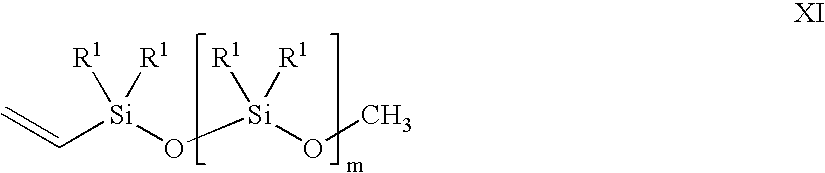
- a vinyl siloxane oligomer of formula XI in the presence of a noble metal hydrosilation catalyst In oligomer X, n is an integer from 0 to 6. R in each occurrence can be chosen independently from H, a methyl, an alkyl, and a haloalkyl, with the proviso that at least two of R must be H. In oligomer XI, m is an integer from 2 to 20. R 1 in each occurrence can be chosen independently for each siloxane unit from CH 3 , OCH 3 , OCH 2 CH 3 , vinyl, and a further unit of [—O—SiR 1 2 —]q-OCH 3 , wherein q is an integer from 2 to 20.
- At least one of R 1 must be a vinyl-containing unit.
- the vinyl siloxane oligomer must have a viscosity from 10 centipoise to 10,000 centipoise at 25° C. and a ratio of alkoxy groups to Si atoms in a range from 0.004:1 to 1.5:1.
- a second aspect of the present invention relates to a polymeric composition produced by the process of reacting:
- the polymeric composition has a refractive index from 1.3 to 2.5.
- a third aspect of the present invention relates to a prepolymer mixture comprising:
- a fourth aspect of the present invention relates to a light emitting device comprising:
- LED light emitting diode
- polymeric composition encapsulating said LED, said polymeric composition comprising a polymer produced by the process of reacting:
- a fifth aspect of the present invention relates to a method for producing a polymer encapsulated light emitting diode comprising: providing a vinyl siloxane oligomer with a viscosity of from 10 to 10,000 cp at 25° C.
- a noble metal hydrosilation catalyst having a plurality of vinyl functionalities; providing a noble metal hydrosilation catalyst; and providing a cyclosiloxane oligomer selected from structure I, structure II, structure III, structure IV, structure V, structure VI, and structure VII: ; combining said vinyl siloxane oligomer, said noble metal hydrosilation catalyst, and said cyclosiloxane oligomer to give a mixture; applying said mixture to a light emitting diode (LED); and curing said mixture to form a polymer encapsulated LED.
- LED light emitting diode
- a sixth aspect of the present invention relates to a method for producing a polymer encapsulated light emitting diode (LED) comprising: providing the prepolymer mixture as described above; applying said prepolymer mixture to a LED; and curing said prepolymer mixture to form a polymer encapsulated LED.
- LED light emitting diode
- a polymer produced by the process of reacting a cyclosiloxane oligomer and a vinyl siloxane oligomer in the presence of a noble metal hydrosilation catalyst is presented in accordance with the present invention.
- the cyclosiloxane oligomer is represented by the formula X.
- variable n is an integer from 0 to 6.
- the substituent R in each occurrence can be chosen independently from hydrogen, a methyl, alkyl, haloalkyl, with the proviso that at least two of R must be H.
- the variable n also may vary in ranges from a lower limit of 0, 1, 2, or 3 to an upper limit of 4, 5, or 6. All ranges of the variable n are inclusive and combinable.
- the cyclosiloxane oligomers that may be used in an embodiment of the present invention include, for example, but are not limited to the structures I, II, III, IV, V, VI, and VII: No stereochemistry or geometrical isomerism is implied in the structures shown above. A pure isomer or a mixture of isomers of the compounds I-VII can be employed.
- the vinyl siloxane oligomer is represented by formula XI.
- variable m is an integer from 2 to 20, and the substituent R 1 in each occurrence is chosen independently for each siloxane unit from the group consisting of CH 3 , OCH 3 , OCH 2 CH 3 , a vinyl group, and a further unit of [—O—SiR 1 2 —]q-OCH 3 , with the provisos: that at least one of R 1 must be a vinyl-containing unit; the vinyl siloxane oligomer having a viscosity from 10 centipoise (cp) to 10,000 cp at 25° C.; and a ratio of alkoxy groups to Si atoms in a range from 0.04:1 to 1.5:1.
- the subscript q is an integer from 2 to 20.
- the variable m and the subscript q also may vary in ranges from a lower limit of 2, 3, 4, or 5 to an upper limit of 10, 15, 17, 18, or 20. All of the aforementioned ranges for m and q are inclusive and combinable.
- the vinyl siloxane oligomer may further vary in viscosity from ranges of: 10-10,000 cp; 20-1,000 cp; 50-600 cp; and 150-500 cp. All of the viscosity ranges are inclusive and combinable.
- the ratio of alkoxy groups to Si atoms in the vinyl siloxane oligomer may further vary from ranges of: 0.004:1 to 1.5:1; 0.02:1 to 1.3:1; 0.1:1 to 1.2:1; and 0.5:1 to 0.7:1.
- the polymer is prepared by the polymerization of the vinyl siloxane oligomer with a Si—H containing cyclosiloxane oligomer in the presence of a noble metal hydrosilation catalyst, as sketched in Scheme 1.
- the vinyl siloxane oligomer reactant in Scheme 1 is intended to be illustrative rather than definitive of the structure of the vinyl siloxane oligomer.
- the polymer of the present invention has a refractive index in a range from 1.39 to 1.5.
- the artisan will generally attempt to match the R.I. of the cured polymer to the RI of the LED.
- Refractive indices from 1.3 to 1.5 are the normal range for the polymer, with indices from 1.39 to 1.45 and 1.39 to 1.41 being common. All of the aforementioned ranges are inclusive and combinable.
- the films also typically exhibit less than a 10% decrease in light transmission within the range of 450-470 nm when the films are exposed to a temperature of 140° C. for 1,000 hrs. The exposures were conducted in a forced air oven.
- the vinyl siloxane oligomer is assembled by the condensation of a vinyl trialkoxysilane with a dialkyldialkoxysilane in the presence of water, Scheme 2.
- the molar ratio of the vinyl trialkoxysilane to the dialkyldialkoxysilane ranges from 2.0:1 to 1:20; 1.5:1 to 1:10; and 1.1:1.0 to 1:5. All ranges are inclusive and combinable.
- the result of the condensation reaction is a colorless, transparent, low molecular weight siloxane oligomer having a plurality of vinyl functional groups, i.e. the vinyl siloxane oligomer.
- the amount of water present in the condensation reaction affects the degree of condensation that occurs. Thus the molecular weight of the vinyl siloxane oligomer is affected by amount of water present.
- the condensation reaction product depicted in Scheme 2 is intended to be illustrative rather than definitive of the structure of the vinyl siloxane oligomer. It is recognized that the vinyl siloxane oligomer prepared by the above described sol-gel reaction, in fact, may consist of linear repeating units, branched repeating units, cyclic repeating units, and combinations thereof.
- Condensation of the starting siloxane materials can be accomplished with or without the use of a condensation catalyst.
- Acidic or basic condensation catalysts may be employed to increase the rate of the condensation reaction.
- Acidic condensation catalysts that can be used include, for example, hydrochloric acid, acetic acid, oxalic acid, perchloric acid, p-toluenesulfonic acid, methanesulfonic acid, trifluoromethanesulfonic acid, phosphoric acid, and sulfuric acid.
- Basic condensation catalysts that can be used include, for example, tetramethylammonium hydroxide, tetraethylammonium hydroxide, guanidine, 4-dimethylaminopyridine, 1,7-diazbicyclo[4.3.0.]nonane, and 1,4-diazabicyclooctane.
- the condensation reaction can be further accelerated by removal of the alcohol byproduct under reduced pressure.
- the reactants in Scheme 2 also may incorporate other siloxane-containing components such as tetramethoxysilane, tetraethoxysilane, methyl trimethoxysilane, ethyltrimethoxysilane, dimethoxydivinylsilane, methylethyldimethoxysilane, diethoxydimethoxysilane, and the like.
- the vinyl siloxane oligomer also can be represented by a general compositional formula XII in an embodiment of the present invention.
- the formula XII is a ratio of R S to Si (silicon atoms) to O (oxygen atoms) wherein R S represents collectively all the alkoxy, methyl, and vinyl substituents R 1 , and terminal alkoxy groups of formula XI described supra plus 1 vinyl.
- R 1 include OCH 3 , OCH 2 CH 3 , methyl, and a vinyl.
- the variable n may vary in ranges from a lower limit of 1.4, 1.7, 2.0, or 2.1 to an upper limit of 2.3, 2.5, 2.6, or 2.7.
- the ratio of alkoxy substituents to Si atoms in the vinyl siloxane oligomer is determined using proton Nuclear Magnetic Resonance spectroscopy.
- the equivalent ratio (i.e., equivalents of vinyl to equivalents of Si—H) of the vinyl groups of the vinyl siloxane oligomer to Si—H groups of the cyclosiloxane oligomer range from: 0.5:1.0 to 2.0:1.0; 0.8:1.0 to 1.2:1.0; and 0.9:1.0 to 1.1:1.0. All of the ranges are inclusive and combinable.
- the reaction between the cyclosiloxane oligomer and the vinyl siloxane oligomer is conducted in the presence of a noble metal hydrosilation catalyst.
- noble metal hydrosilation catalyst is meant to encompass compounds and complexes that contain at least one noble metal in which the compound or complex functions a catalyst for hydrosilation of double bonds. The term also encompasses elemental noble metals.
- Rh compounds, complexes, and the elemental Rh will be referred to as a noble metal herein unless stated otherwise and considered to fall within the definition of the term noble metal, which includes Pd, Pt, Ir and Rh.
- a noble metal hydrosilation catalyst for use in the reaction of the cyclosiloxane oligomer with the vinyl siloxane oligomer may include but is not limited to chloroplatinic acid, Karstedt's catalyst (Pt 2 ⁇ [(CH 2 ⁇ CH)Me 2 Si] 2 O ⁇ 3 ), Ashby's catalyst ⁇ [(CH 2 ⁇ CH)MeSiO] 4 ⁇ 3 Pt, Wilkinson's catalyst [tris(triphenylphosphine)rhodium (I) chloride], polymer bound Wilkinson's catalyst, tris(triphenylphosphine)iridium (I) chloride, chloroplatinic acid/octanol complex, platinum cyclovinylmethylsiloxane complex (Ashby-Karstedt Catalyst), platinum carbonyl cyclovinylmethylsiloxane complex, bis(benzonitrile)dichlorpalla
- Karstedt's catalyst typically is used with the cyclosiloxane oligomer and the vinyl siloxane oligomer described supra under reaction conditions that can vary in temperature and time.
- the reaction can be carried out at a temperature range from 50° C. to 200° C.
- the reaction also can be carried out at temperature ranges varying from: 60° C. to 180° C.; 70° C. to 150° C.; and 90° to 120° C. All of the temperature ranges are inclusive and combinable.
- the noble metal hydrosilation catalysts are highly efficient and typically only require amounts in parts per million (ppm) for polymerization to occur.
- ppm parts per million
- from 1-100 ppm of noble metal hydrosilation catalyst may be present to promote the polymerization of the vinyl siloxane oligomer and the cyclosiloxane oligomer.
- the range of the amount of noble metal hydrosilation catalyst that may further be present can vary from: 5-80 ppm, 10-60 ppm, and 20-40 ppm. All ranges of the noble metal hydrosilation catalyst are inclusive and combinable.
- any amount of noble metal hydrosilation catalyst within the ranges described supra, inclusive and/or combined, can be used in which polymerization of the vinyl siloxane oligomer and the cyclosiloxane oligomer is promoted, and in which discoloration of the polymer product due to the residual catalyst does not occur.
- the temperature ranges are not meant to imply that the hydrosilation reactions must be carried out at a constant temperature.
- the reaction temperature may be ramped or staged within the temperature ranges described supra, inclusive and/or combined, in any manner that allows for the formation of the polymers in accordance with the present invention.
- a reaction may be carried out a temperature of 50° C. for a period of time, for sake of example, 5 hrs. After 5 hrs, the temperature may be increased (ramped up) to 100° C. and held constant for 2 hrs. The temperature could be continually ramped up until the reaction is complete.
- the temperature stages and time periods are at the discretion of the practitioner and would be recognized by one ordinarily skilled in the art of polymer chemistry.
- the reaction can be carried out over a period of varying times. Typically, the reaction is carried out at a time of 16-20 hrs. However, the artisan will recognize that as the temperature varies the time can be adjusted accordingly for polymerization to occur and polymers of the present invention to be formed. The formation of the product can be monitored via standard spectroscopic instruments and the reaction halted accordingly at a point when the reactants are converted to the polymer product.
- a polymeric composition is presented in accordance with the present invention.
- the polymeric composition comprises the polymer described supra and a filler dispersed therein, Scheme 3.
- the fillers that may be used in an embodiment of the present invention include but are not limited to colorless oxides of boron, zinc, strontium, silicon, titanium, aluminum, germanium, and tin.
- the mean particle sizes (i.e., mean diameter of particles) of the aforementioned fillers are in ranges from 0.1 to 10 microns; 0.2 to 5 microns; and 0.5 to 1.0 microns.
- Other fillers that may be used include carbon nanotubes, solid or hollow glass spheres or quartz fibers, and mica platelets.
- the filler is added to modify the polymeric composition with respect to its overall refractive index and mechanical properties such as shrinkage characteristics, the coefficient of thermal expansion (CTE), and hardness.
- the filler can comprise the polymeric composition in ranges from: 5 wt % to 60 wt %, 10 wt % to 50 wt %, and 20 wt % to 40 wt %. All of the aforementioned ranges are inclusive and combinable.
- the polymeric compositions of the present invention have a refractive index (R.I.) in a range from 1.3 to 2.5.
- R.I. refractive index
- the artisan will generally attempt to match the R.I. of the cured polymeric composition to the R.I. of the LED.
- Refractive indices from 1.3 to 2.5 are the normal range with indices from 1.3 to 2.5 and 1.5 to 2.0 being common.
- the films also typically exhibit less than a 10% decrease in light transmission within the range of 450-470 nm when the films are exposed to a temperature of 140° C. for 1,000 hrs. Samples for testing were placed in a forced air oven and removed periodically during two weeks for visual examination. Samples that displayed a perceptible yellow color when held against a white background were considered to have failed the test.
- the polymeric composition may further contain additives.
- additives include but are not limited to phosphors, flow control agents, flatting agents, wetting agents, and adhesion promoters.
- phosphors may be incorporated to generate specific wavelengths of the emitted light.
- Flow control, flatting agents, and wetting agents may be employed to facilitate the handling characteristics of the polymeric composition.
- Polymerization inhibitors and retarders may also be included to control the gel time and to enhance the handling characteristics of the polymeric composition.
- Viscosities of the resin components typically range from 60-500 cps. When compounded with fillers, the viscosities may range from 100-10,000 cps. The viscosity obtained depends on the type and amount of filler added and the particle size of the filler. Viscosity, as described herein, is measured according using a cone on plate viscometer.
- metal-containing coreactants in Scheme 2 such as aluminum trimethoxide, titanium tetraethoxide, tetramethoxygermanium, tetraethoxygermanium, zirconium tetramethoxide, tin tetraethoxide, tetraisopropoxy aluminum, and the like can be used to modify the refractive index of the polymeric composition.
- the polymer and polymeric compositions of the present invention may be used as encapsulants and in combination with substrates such as a LED, an optical circuit, a lasing element, an optical component such as an optical coupler, a repeater, a waveguide, and a fiber optic adhesive.
- substrates such as a LED, an optical circuit, a lasing element, an optical component such as an optical coupler, a repeater, a waveguide, and a fiber optic adhesive.
- a light emitting device comprising a substrate, a light emitting diode (LED), and a polymeric composition encapsulating the LED is presented in accordance with the present invention.
- the substrate may be, for example, a circuit board, a metallic cup, a ceramic cup, a metallic reflector, and like. Additionally the substrate may have reflective properties.
- the LED is integrated with the substrate via an electronic circuit to allow normal operation of the LED.
- the encapsulant may serve as an in-situ lens for the LED.
- the LED used in an embodiment of the present invention is a semiconductor device that emits visible light when an electric current pases through it.
- the light is typically emitted in a narrow wavelength band.
- the output range is from red (at a wavelength of approximately 700 nanometers) to blue-violet (about 400 nanometers).
- the LED may emit infrared energy (830 nanometers or longer) if chosen to do so and such a device is typically known as an infrared-emitting diode (IRED).
- IRED infrared-emitting diode
- LEDs operating in the UV (200-400 nm) are currently being developed.
- the polymeric composition (encapsulant) used to encapsulate the LED is as described supra.
- the light emitting device of the present invention operates under severe environmental conditions ranging from 1,000 hrs to about 100,000 hrs at a temperature in a range from 100° C. to 250° C.
- Typical operating conditions include a time period from 1,000 hrs to 40,000 hrs at a temperature in a range from 100° C. to 200° C.
- a test to ascertain the sufficiency of the polymeric composition for its intended purpose is to thermally age the cured polymeric composition at 150-200° C. in air depending on the specific application. Aging can also be conducted in the presence of light of a wavelength emitted by the LED.
- Polymeric compositions of the present invention exhibit high resistance to yellowing, erosion, and loss of mechanical properties under the above thermal oxidative conditions.
- a method for producing a polymer encapsulated LED comprises providing a vinyl siloxane oligomer; providing a noble metal hydrosilation catalyst; providing a cyclosiloxane oligomer; combining the vinyl siloxane oligomer, the noble metal hydrosilation catalyst, and the cyclosiloxane oligomer to give a mixture; applying the mixture to a light emitting diode (LED; and curing the mixture to form a polymer encapsulated LED.
- LED light emitting diode
- the vinyl siloxane oligomer used for producing a polymer encapsulated LED contains a plurality of vinyl functional groups and is as described supra, as is the noble metal hydrosilation catalyst, and the cyclosiloxane oligomer.
- the vinyl siloxane oligomer, the noble metal hydrosilation catalyst, and the cyclosiloxane oligomer are combined to form a mixture. All are well-known in the art.
- the mixture additionally may comprise a filler material.
- the aforementioned components can be combined in any order. Typically the vinyl siloxane oligomer, the filler material, and the noble metal hydrosilation catalyst are combined first. Then the cyclosiloxane oligomer is added. Heat may be added at any point during the combination step to provide a low viscosity mixture. The mixture is applied to a LED and subsequently cured. The LED may be an individual LED or an array of LEDs. Oven curing, infrared curing, hotplate curing, heated mold curing, and combinations thereof may be used to accomplish curing of the mixture.
- a prepolymer mixture comprising a cyclosiloxane oligomer and a vinyl siloxane oligomer is presented in accordance with the present invention.
- the cyclosiloxane oligomer is represented by the formula X:
- the vinyl siloxane oligomer is represented by the formula XI:
- the mixture may additionally comprise a noble metal hydrosilation catalyst and/or a filler as well as other additives.
- the prepolymer mixture may further comprise additional components that together constitute less than 10% by weight of the prepolymer mixture.
- An alternative method for producing a polymer encapsulated light emitting diode comprises: providing a prepolymer mixture; applying the prepolymer mixture to a LED, and curing the prepolymer mixture to form a polymer encapsulated LED.
- the prepolymer mixture provided is as described supra.
- the prepolymer mixture may be heated to a temperature such that the viscosity of the mixture allows for manipulation and application to an individual LED or an array of LEDs. However, the prepolymer mixture does not have to be heated.
- the prepolymer mixture can be applied as received if the mixture has a viscosity suitable for application to the LED array.
- the mixture is applied to a LED and subsequently cured. Oven curing, infrared curing, hotplate curing, heated mold curing, and combinations thereof may be used to accomplish curing of the mixture.
- the aforementioned curing techniques are not meant to limit the types or kinds of curing techniques that may be used to cure the prepolymer mixture in an embodiment of the present invention.
- the artisan will recognize that any curing technique, which causes hydrosilation-polymerization of the prepolymer mixture components, i.e., the cyclosiloxane oligomer and the vinyl siloxane oligomer, can be used as a curing technique in accordance with the present invention.
- the number of equivalents of methoxy groups of the vinyl siloxane oligomer relative to the number of equivalents of toluene methyl groups is then calculated.
- the number of equivalents of vinyl groups of the vinyl siloxane oligomer relative to the methyl groups of the toluene is already known because the vinyl groups are unchanged by the condensation reaction that forms the vinyl siloxane oligomer, and the weight ratios of the vinyl siloxane oligomer to toluene are known.
- the number of equivalents of silicon atoms in the vinyl siloxane oligomer relative to the methyl groups of the toluene is also known because the number of silicon atoms is also unchanged by the reaction, which produces the vinyl siloxane oligomer.
- the ratio of equivalents of methoxy groups to equivalents of vinyl groups, and of equivalents of methoxy groups to equivalents of silicon atoms is therefore calculated by this test method.
- the ethoxy groups can be similarly quantified by integrating the area under the peaks for the methylene protons, or the methyl protons of the ethoxy group.
- the vinyl oligomer of example 1 exhibited a ratio of alkoxy/Si of 0.004/1.
- Vinyltrimethoxysilane (20.7 g, 0.14 mol) and dimethyldimethoxysilane (33.6 g, 0.28 mol) were placed in a 250 ml round bottom flask. Water (17.6 ml) was added and the solution was brought to reflux for 24 hours at 60° C. The mixture was cooled to room temperature, and two layers were formed. The biphasic mixture was transferred to a separatory funnel. The lower layer was separated and transferred to a 100 ml round bottom flask then dried under vacuum in a rotary evaporator for 3 hours. The flask was removed and attached to an oil pump to remove any residual starting materials and volatile byproducts for 24 hours. A clear colorless liquid was obtained (96% conversion) being the vinyl siloxane oligomer.
- the polymerization of the vinyl siloxane oligomer was carried out as follows.
- the vinyl siloxane oligomer (0.5 g) was mixed with 0.3 microL of Karstedt's catalyst and 0.35 g of UVT Sunspheres (silica, size: 7 micrometers). This mixture then was heated in an oven for 45 min at 90° C. to de-gas the solution and to decrease the viscosity. While hot, 0.2 g of a cyclosiloxane oligomer, 1,3,5,7,9-pentamethylcyclopentasiloxane (D 5 H ), was added and the mixture was gently swirled to avoid entrapment of air.
- D 5 H 1,3,5,7,9-pentamethylcyclopentasiloxane
- the mixture was poured onto a LED array and the device placed in a forced air oven at 90° C. for 18 hr. The temperature was slowly ramped down to room temperature over the course of 3 hr.
- the encapsulated LED was translucent, hard, and crosslinked.
- thermoset resins A wide variety of epoxides and other types of thermoset resins were evaluated under simulated high intensity LED operating conditions. The most common failure was due to thermooxidative degradation that results in resins that have undergone pronounced color changes ranging from yellow to deep brown.
- the only polymeric materials that survived the aggressive screening test were the polymers and polymeric compositions of the present invention. They have excellent thermal oxidative resistance, and even when polymers and polymeric compositions undergo degradation, the products are generally colorless.
- the thermal oxidative stability of the corresponding UV cured resins were examined. Specifically, the epoxy resins containing SOC10 as the photoinitiator were placed in small aluminum cups and then polymerized by exposure to UV light using a medium pressure mercury arc lamp. Table 1 shows the results of visual inspections of the cured formulations after aging for 2 days at 140° C. Samples for testing were placed in a forced air oven and removed periodically during two weeks for visual examination. Samples that displayed a perceptible yellow color when held against a white background were considered to have failed the test.
- Polydimethylsiloxanes with the structure shown above have excellent inherent. thermal oxidative stability. However, on long term exposure to heat, even these resins do undergo slow degradative bond cleavage reactions. Hence, the key to the ability of these resins to survive the screening test is due to the fact that despite this degradation, the products that are produced are not colored.
Landscapes
- Chemical & Material Sciences (AREA)
- Health & Medical Sciences (AREA)
- Chemical Kinetics & Catalysis (AREA)
- Medicinal Chemistry (AREA)
- Polymers & Plastics (AREA)
- Organic Chemistry (AREA)
- General Chemical & Material Sciences (AREA)
- Silicon Polymers (AREA)
- Led Device Packages (AREA)
- Compositions Of Macromolecular Compounds (AREA)
Abstract
Silicone-based polymers and polymeric compositions, methods of preparation of the silicone-based polymers and polymeric compositions, and methods of use thereof with light emitting diodes (LED) are presented.
Description
- This application claims priority from U.S. Provisional Application Ser. No. 60/622,653, filed Oct. 27, 2004, the entire contents of which are incorporated herein by reference.
- The following invention was made with Government support under contract number DE-FC26-01NT41203 awarded by the United States Department of Energy. The Government has certain rights.
- The invention relates to silicone-based polymers and polymeric compositions, methods of preparation of the silicone-based polymers and polymeric compositions, and methods of use thereof with light emitting diodes (LED).
- The next generation of high intensity light emitting diodes (LED) that are being developed for industrial and residential lighting applications will require a new class of encapsulants. There are no viable encapsulant alternatives existing that can meet the long term (10,000 hrs-100,000 hrs) and high temperature (100° C.-200° C.) operating conditions.
- Currently available epoxy encapsulants as well as other polymeric encapsulants undergo unacceptable yellowing and degradation under the strenuous operating conditions employed for high intensity LEDs. Further, any new candidate encapsulant must be manufactured under conditions similar to and compatible with current encapsulant production methodologies. A need exists for polymers and polymer films, and methods of use thereof with LEDs that overcome at least one of the aforementioned deficiencies.
- An aspect of the present invention relates to a polymer produced by the process of reacting:
- 1. a cyclosiloxane oligomer of the formula X:

- 2. a vinyl siloxane oligomer of formula XI

in the presence of a noble metal hydrosilation catalyst. In oligomer X, n is an integer from 0 to 6. R in each occurrence can be chosen independently from H, a methyl, an alkyl, and a haloalkyl, with the proviso that at least two of R must be H. In oligomer XI, m is an integer from 2 to 20. R1 in each occurrence can be chosen independently for each siloxane unit from CH3, OCH3, OCH2CH3, vinyl, and a further unit of [—O—SiR1 2—]q-OCH3, wherein q is an integer from 2 to 20. At least one of R1 must be a vinyl-containing unit. The vinyl siloxane oligomer must have a viscosity from 10 centipoise to 10,000 centipoise at 25° C. and a ratio of alkoxy groups to Si atoms in a range from 0.004:1 to 1.5:1. - A second aspect of the present invention relates to a polymeric composition produced by the process of reacting:
- a. a cyclosiloxane oligomer of the formula X:

- b. a vinyl siloxane oligomer of formula XI
; and - c. a filler in the presence of a noble metal hydrosilation catalyst.
- The polymeric composition has a refractive index from 1.3 to 2.5.
- A third aspect of the present invention relates to a prepolymer mixture comprising:
- a) a cyclosiloxane oligomer of the formula X:

- b) a vinyl siloxane oligomer of the formula XI:

- A fourth aspect of the present invention relates to a light emitting device comprising:
- a substrate;
- a light emitting diode (LED), said LED operably integrated with said substrate; and
- a polymeric composition encapsulating said LED, said polymeric composition comprising a polymer produced by the process of reacting:
- a) a cyclosiloxane oligomer of the formula X:

- b. a vinyl siloxane oligomer of formula XI

- A fifth aspect of the present invention relates to a method for producing a polymer encapsulated light emitting diode comprising: providing a vinyl siloxane oligomer with a viscosity of from 10 to 10,000 cp at 25° C. having a plurality of vinyl functionalities; providing a noble metal hydrosilation catalyst; and providing a cyclosiloxane oligomer selected from structure I, structure II, structure III, structure IV, structure V, structure VI, and structure VII:


; combining said vinyl siloxane oligomer, said noble metal hydrosilation catalyst, and said cyclosiloxane oligomer to give a mixture; applying said mixture to a light emitting diode (LED); and curing said mixture to form a polymer encapsulated LED. - A sixth aspect of the present invention relates to a method for producing a polymer encapsulated light emitting diode (LED) comprising: providing the prepolymer mixture as described above; applying said prepolymer mixture to a LED; and curing said prepolymer mixture to form a polymer encapsulated LED.
- Throughout this specification the terms and substituents are defined when first introduced and retain their definitions.
- A polymer produced by the process of reacting a cyclosiloxane oligomer and a vinyl siloxane oligomer in the presence of a noble metal hydrosilation catalyst is presented in accordance with the present invention. The cyclosiloxane oligomer is represented by the formula X.

- The variable n is an integer from 0 to 6. The substituent R in each occurrence can be chosen independently from hydrogen, a methyl, alkyl, haloalkyl, with the proviso that at least two of R must be H. The variable n also may vary in ranges from a lower limit of 0, 1, 2, or 3 to an upper limit of 4, 5, or 6. All ranges of the variable n are inclusive and combinable. The cyclosiloxane oligomers that may be used in an embodiment of the present invention include, for example, but are not limited to the structures I, II, III, IV, V, VI, and VII:

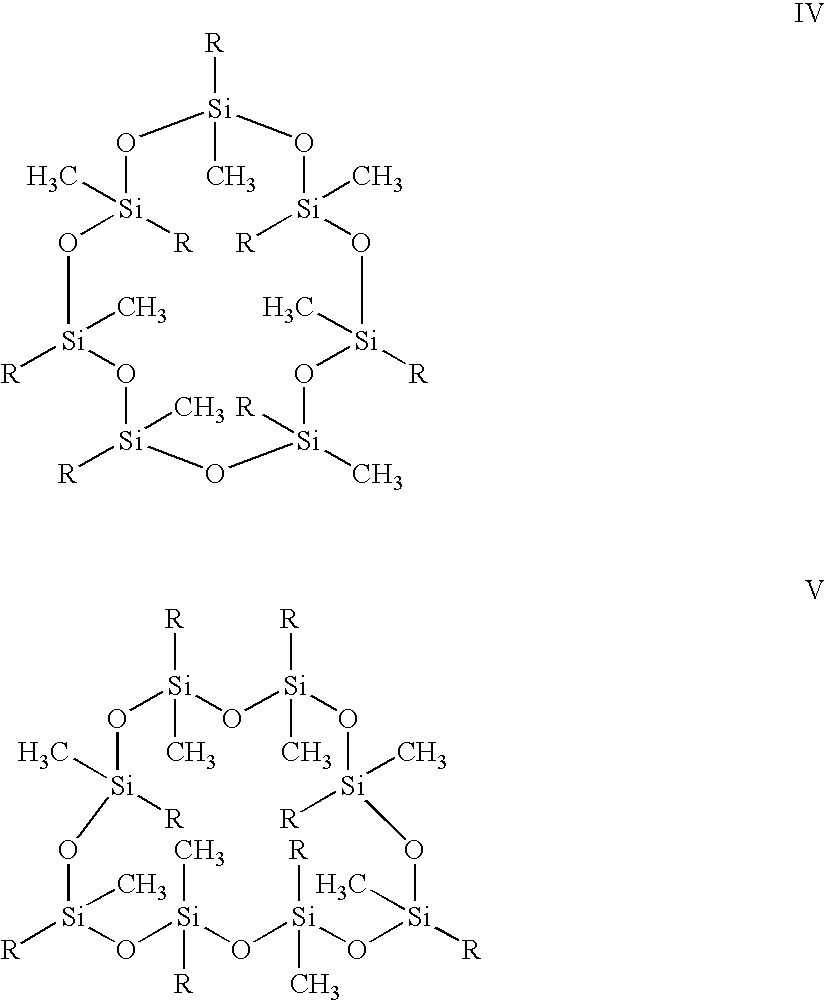
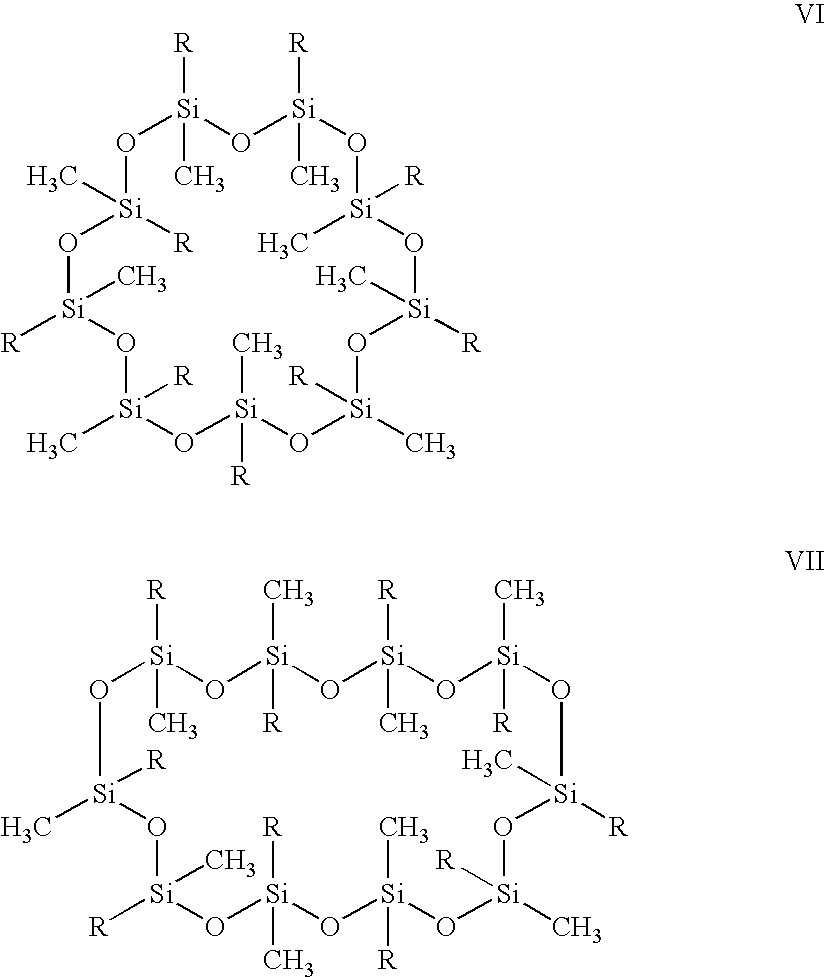
No stereochemistry or geometrical isomerism is implied in the structures shown above. A pure isomer or a mixture of isomers of the compounds I-VII can be employed. - The vinyl siloxane oligomer is represented by formula XI.

- The variable m is an integer from 2 to 20, and the substituent R1 in each occurrence is chosen independently for each siloxane unit from the group consisting of CH3, OCH3, OCH2CH3, a vinyl group, and a further unit of [—O—SiR1 2—]q-OCH3, with the provisos: that at least one of R1 must be a vinyl-containing unit; the vinyl siloxane oligomer having a viscosity from 10 centipoise (cp) to 10,000 cp at 25° C.; and a ratio of alkoxy groups to Si atoms in a range from 0.04:1 to 1.5:1.
- The subscript q is an integer from 2 to 20. The variable m and the subscript q also may vary in ranges from a lower limit of 2, 3, 4, or 5 to an upper limit of 10, 15, 17, 18, or 20. All of the aforementioned ranges for m and q are inclusive and combinable. The vinyl siloxane oligomer may further vary in viscosity from ranges of: 10-10,000 cp; 20-1,000 cp; 50-600 cp; and 150-500 cp. All of the viscosity ranges are inclusive and combinable. The ratio of alkoxy groups to Si atoms in the vinyl siloxane oligomer may further vary from ranges of: 0.004:1 to 1.5:1; 0.02:1 to 1.3:1; 0.1:1 to 1.2:1; and 0.5:1 to 0.7:1.
- The polymer is prepared by the polymerization of the vinyl siloxane oligomer with a Si—H containing cyclosiloxane oligomer in the presence of a noble metal hydrosilation catalyst, as sketched in Scheme 1. The vinyl siloxane oligomer reactant in Scheme 1 is intended to be illustrative rather than definitive of the structure of the vinyl siloxane oligomer.

- The polymer of the present invention has a refractive index in a range from 1.39 to 1.5. When the polymer is being used to encapsulate, for example, an LED, the artisan will generally attempt to match the R.I. of the cured polymer to the RI of the LED. Refractive indices from 1.3 to 1.5 are the normal range for the polymer, with indices from 1.39 to 1.45 and 1.39 to 1.41 being common. All of the aforementioned ranges are inclusive and combinable. The films also typically exhibit less than a 10% decrease in light transmission within the range of 450-470 nm when the films are exposed to a temperature of 140° C. for 1,000 hrs. The exposures were conducted in a forced air oven.
- The vinyl siloxane oligomer is assembled by the condensation of a vinyl trialkoxysilane with a dialkyldialkoxysilane in the presence of water, Scheme 2. The molar ratio of the vinyl trialkoxysilane to the dialkyldialkoxysilane ranges from 2.0:1 to 1:20; 1.5:1 to 1:10; and 1.1:1.0 to 1:5. All ranges are inclusive and combinable. The result of the condensation reaction is a colorless, transparent, low molecular weight siloxane oligomer having a plurality of vinyl functional groups, i.e. the vinyl siloxane oligomer. The amount of water present in the condensation reaction affects the degree of condensation that occurs. Thus the molecular weight of the vinyl siloxane oligomer is affected by amount of water present.

- The condensation reaction product depicted in Scheme 2 is intended to be illustrative rather than definitive of the structure of the vinyl siloxane oligomer. It is recognized that the vinyl siloxane oligomer prepared by the above described sol-gel reaction, in fact, may consist of linear repeating units, branched repeating units, cyclic repeating units, and combinations thereof.
- Condensation of the starting siloxane materials can be accomplished with or without the use of a condensation catalyst. Acidic or basic condensation catalysts may be employed to increase the rate of the condensation reaction. Acidic condensation catalysts that can be used include, for example, hydrochloric acid, acetic acid, oxalic acid, perchloric acid, p-toluenesulfonic acid, methanesulfonic acid, trifluoromethanesulfonic acid, phosphoric acid, and sulfuric acid. Basic condensation catalysts that can be used include, for example, tetramethylammonium hydroxide, tetraethylammonium hydroxide, guanidine, 4-dimethylaminopyridine, 1,7-diazbicyclo[4.3.0.]nonane, and 1,4-diazabicyclooctane. The condensation reaction can be further accelerated by removal of the alcohol byproduct under reduced pressure.
- The reactants in Scheme 2 also may incorporate other siloxane-containing components such as tetramethoxysilane, tetraethoxysilane, methyl trimethoxysilane, ethyltrimethoxysilane, dimethoxydivinylsilane, methylethyldimethoxysilane, diethoxydimethoxysilane, and the like.
- In addition to formula XI presented supra, the vinyl siloxane oligomer also can be represented by a general compositional formula XII in an embodiment of the present invention.
RS nSiO(4-n)/2 (XII) - The formula XII is a ratio of RS to Si (silicon atoms) to O (oxygen atoms) wherein RS represents collectively all the alkoxy, methyl, and vinyl substituents R1, and terminal alkoxy groups of formula XI described supra plus 1 vinyl. Examples of R1 include OCH3, OCH2CH3, methyl, and a vinyl. The variable n may vary in ranges from a lower limit of 1.4, 1.7, 2.0, or 2.1 to an upper limit of 2.3, 2.5, 2.6, or 2.7. The ratio of alkoxy substituents to Si atoms in the vinyl siloxane oligomer is determined using proton Nuclear Magnetic Resonance spectroscopy.
- In the hydrosilation-polymerization reaction of the present invention, the equivalent ratio (i.e., equivalents of vinyl to equivalents of Si—H) of the vinyl groups of the vinyl siloxane oligomer to Si—H groups of the cyclosiloxane oligomer range from: 0.5:1.0 to 2.0:1.0; 0.8:1.0 to 1.2:1.0; and 0.9:1.0 to 1.1:1.0. All of the ranges are inclusive and combinable. The description thus far, of a polymer produced by the process of reacting a cyclosiloxane oligomer and a vinyl siloxane oligomer in the presence of a noble metal hydrosilation catalyst, is not meant to imply that the functionalities of the vinyl siloxane oligomer and the cyclosiloxane oligomer react stoichiometrically.
- The reaction between the cyclosiloxane oligomer and the vinyl siloxane oligomer is conducted in the presence of a noble metal hydrosilation catalyst. The term noble metal hydrosilation catalyst is meant to encompass compounds and complexes that contain at least one noble metal in which the compound or complex functions a catalyst for hydrosilation of double bonds. The term also encompasses elemental noble metals.
- Although rhodium is not always included as a noble metal, in the context of the present invention, Rh compounds, complexes, and the elemental Rh will be referred to as a noble metal herein unless stated otherwise and considered to fall within the definition of the term noble metal, which includes Pd, Pt, Ir and Rh.
- In an embodiment of the present invention, a noble metal hydrosilation catalyst for use in the reaction of the cyclosiloxane oligomer with the vinyl siloxane oligomer may include but is not limited to chloroplatinic acid, Karstedt's catalyst (Pt2{[(CH2═CH)Me2Si]2O}3), Ashby's catalyst {[(CH2═CH)MeSiO]4}3Pt, Wilkinson's catalyst [tris(triphenylphosphine)rhodium (I) chloride], polymer bound Wilkinson's catalyst, tris(triphenylphosphine)iridium (I) chloride, chloroplatinic acid/octanol complex, platinum cyclovinylmethylsiloxane complex (Ashby-Karstedt Catalyst), platinum carbonyl cyclovinylmethylsiloxane complex, bis(benzonitrile)dichlorpalladium (II), tetrakis(triphenylphosphine)palladium (0), palladium 2,4-pentanedionate, iridium 2,4-pentanedionate, iridium cyclooctadiene chloride, Pt metal, Pd metal, Ir metal, and Rh metal.
- Karstedt's catalyst typically is used with the cyclosiloxane oligomer and the vinyl siloxane oligomer described supra under reaction conditions that can vary in temperature and time. The reaction can be carried out at a temperature range from 50° C. to 200° C. The reaction also can be carried out at temperature ranges varying from: 60° C. to 180° C.; 70° C. to 150° C.; and 90° to 120° C. All of the temperature ranges are inclusive and combinable.
- The noble metal hydrosilation catalysts are highly efficient and typically only require amounts in parts per million (ppm) for polymerization to occur. In an embodiment of the present of invention, from 1-100 ppm of noble metal hydrosilation catalyst may be present to promote the polymerization of the vinyl siloxane oligomer and the cyclosiloxane oligomer. The range of the amount of noble metal hydrosilation catalyst that may further be present can vary from: 5-80 ppm, 10-60 ppm, and 20-40 ppm. All ranges of the noble metal hydrosilation catalyst are inclusive and combinable.
- In choosing the amount of the noble metal hydrosilation catalyst, the artisan will recognize that any amount of noble metal hydrosilation catalyst within the ranges described supra, inclusive and/or combined, can be used in which polymerization of the vinyl siloxane oligomer and the cyclosiloxane oligomer is promoted, and in which discoloration of the polymer product due to the residual catalyst does not occur.
- The aforementioned temperature ranges are not meant to limit the temperature or temperature range in which the reaction can be carried. The artisan will recognize that any temperature can be used at which hydrosilation is promoted and can occur without degradation to the reactants as well as the polymer product in accordance with the present invention.
- Additionally, the temperature ranges are not meant to imply that the hydrosilation reactions must be carried out at a constant temperature. The reaction temperature may be ramped or staged within the temperature ranges described supra, inclusive and/or combined, in any manner that allows for the formation of the polymers in accordance with the present invention. For example, a reaction may be carried out a temperature of 50° C. for a period of time, for sake of example, 5 hrs. After 5 hrs, the temperature may be increased (ramped up) to 100° C. and held constant for 2 hrs. The temperature could be continually ramped up until the reaction is complete. The temperature stages and time periods are at the discretion of the practitioner and would be recognized by one ordinarily skilled in the art of polymer chemistry.
- The reaction can be carried out over a period of varying times. Typically, the reaction is carried out at a time of 16-20 hrs. However, the artisan will recognize that as the temperature varies the time can be adjusted accordingly for polymerization to occur and polymers of the present invention to be formed. The formation of the product can be monitored via standard spectroscopic instruments and the reaction halted accordingly at a point when the reactants are converted to the polymer product.
- A polymeric composition is presented in accordance with the present invention. The polymeric composition comprises the polymer described supra and a filler dispersed therein, Scheme 3.
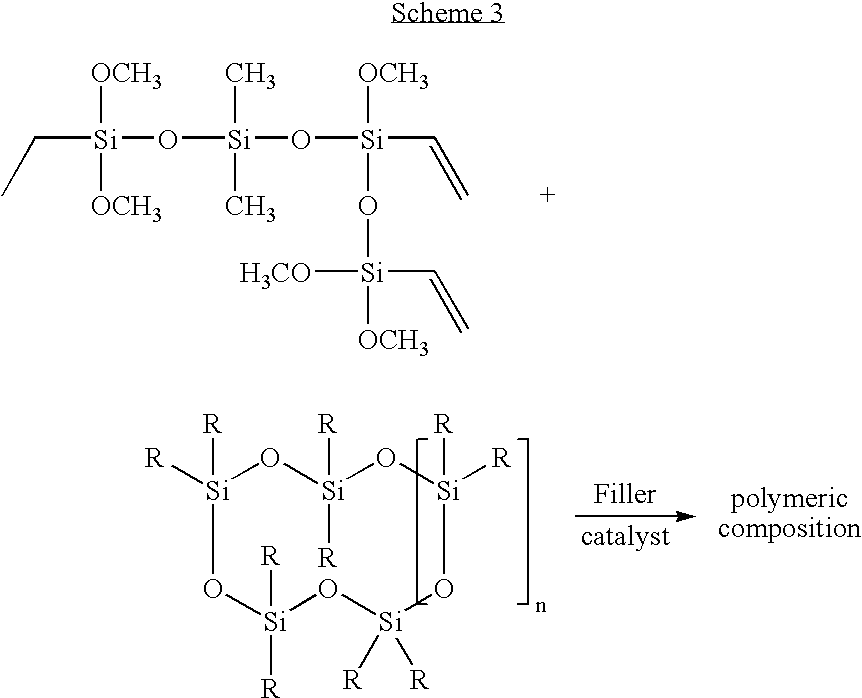
- The fillers that may be used in an embodiment of the present invention include but are not limited to colorless oxides of boron, zinc, strontium, silicon, titanium, aluminum, germanium, and tin. The mean particle sizes (i.e., mean diameter of particles) of the aforementioned fillers are in ranges from 0.1 to 10 microns; 0.2 to 5 microns; and 0.5 to 1.0 microns. Other fillers that may be used include carbon nanotubes, solid or hollow glass spheres or quartz fibers, and mica platelets.
- Typically, the filler is added to modify the polymeric composition with respect to its overall refractive index and mechanical properties such as shrinkage characteristics, the coefficient of thermal expansion (CTE), and hardness. The filler can comprise the polymeric composition in ranges from: 5 wt % to 60 wt %, 10 wt % to 50 wt %, and 20 wt % to 40 wt %. All of the aforementioned ranges are inclusive and combinable.
- The polymeric compositions of the present invention have a refractive index (R.I.) in a range from 1.3 to 2.5. When the compositions are being used to encapsulate, for example, an LED, the artisan will generally attempt to match the R.I. of the cured polymeric composition to the R.I. of the LED. Refractive indices from 1.3 to 2.5 are the normal range with indices from 1.3 to 2.5 and 1.5 to 2.0 being common. The films also typically exhibit less than a 10% decrease in light transmission within the range of 450-470 nm when the films are exposed to a temperature of 140° C. for 1,000 hrs. Samples for testing were placed in a forced air oven and removed periodically during two weeks for visual examination. Samples that displayed a perceptible yellow color when held against a white background were considered to have failed the test.
- In addition to the filler, the polymeric composition may further contain additives. Examples include but are not limited to phosphors, flow control agents, flatting agents, wetting agents, and adhesion promoters. For example, phosphors may be incorporated to generate specific wavelengths of the emitted light. Flow control, flatting agents, and wetting agents may be employed to facilitate the handling characteristics of the polymeric composition. Polymerization inhibitors and retarders may also be included to control the gel time and to enhance the handling characteristics of the polymeric composition.
- Noble metal hydrosilation catalysts that may be used to promote the polymerization of the vinyl oligomer and the cyclosiloxane oligomer have been described supra.
- Many variables can be manipulated in Scheme 2 to tailor the final mechanical characteristics of the polymeric composition described in Scheme 3 to desired characteristics. For example, the molar ratio of the two reactants in Scheme 2 can be varied resulting in the vinyl siloxane oligomer having a lower or a higher number of vinyl groups present as well as increased or decreased viscosity values. Viscosities of the resin components typically range from 60-500 cps. When compounded with fillers, the viscosities may range from 100-10,000 cps. The viscosity obtained depends on the type and amount of filler added and the particle size of the filler. Viscosity, as described herein, is measured according using a cone on plate viscometer.
- Further, metal-containing coreactants in Scheme 2 such as aluminum trimethoxide, titanium tetraethoxide, tetramethoxygermanium, tetraethoxygermanium, zirconium tetramethoxide, tin tetraethoxide, tetraisopropoxy aluminum, and the like can be used to modify the refractive index of the polymeric composition.
- The polymer and polymeric compositions of the present invention may be used as encapsulants and in combination with substrates such as a LED, an optical circuit, a lasing element, an optical component such as an optical coupler, a repeater, a waveguide, and a fiber optic adhesive.
- A light emitting device comprising a substrate, a light emitting diode (LED), and a polymeric composition encapsulating the LED is presented in accordance with the present invention. In one embodiment of the present invention, the substrate may be, for example, a circuit board, a metallic cup, a ceramic cup, a metallic reflector, and like. Additionally the substrate may have reflective properties. The LED is integrated with the substrate via an electronic circuit to allow normal operation of the LED. In addition, the encapsulant may serve as an in-situ lens for the LED.
- The LED used in an embodiment of the present invention is a semiconductor device that emits visible light when an electric current pases through it. The light is typically emitted in a narrow wavelength band. The output range is from red (at a wavelength of approximately 700 nanometers) to blue-violet (about 400 nanometers). The LED may emit infrared energy (830 nanometers or longer) if chosen to do so and such a device is typically known as an infrared-emitting diode (IRED). At the same time, LEDs operating in the UV (200-400 nm) are currently being developed. The polymeric composition (encapsulant) used to encapsulate the LED is as described supra.
- The light emitting device of the present invention operates under severe environmental conditions ranging from 1,000 hrs to about 100,000 hrs at a temperature in a range from 100° C. to 250° C. Typical operating conditions include a time period from 1,000 hrs to 40,000 hrs at a temperature in a range from 100° C. to 200° C. A test to ascertain the sufficiency of the polymeric composition for its intended purpose is to thermally age the cured polymeric composition at 150-200° C. in air depending on the specific application. Aging can also be conducted in the presence of light of a wavelength emitted by the LED. Polymeric compositions of the present invention exhibit high resistance to yellowing, erosion, and loss of mechanical properties under the above thermal oxidative conditions.
- A method for producing a polymer encapsulated LED is presented in accordance with the present invention. The method comprises providing a vinyl siloxane oligomer; providing a noble metal hydrosilation catalyst; providing a cyclosiloxane oligomer; combining the vinyl siloxane oligomer, the noble metal hydrosilation catalyst, and the cyclosiloxane oligomer to give a mixture; applying the mixture to a light emitting diode (LED; and curing the mixture to form a polymer encapsulated LED.
- The vinyl siloxane oligomer used for producing a polymer encapsulated LED contains a plurality of vinyl functional groups and is as described supra, as is the noble metal hydrosilation catalyst, and the cyclosiloxane oligomer. The vinyl siloxane oligomer, the noble metal hydrosilation catalyst, and the cyclosiloxane oligomer are combined to form a mixture. All are well-known in the art. The mixture additionally may comprise a filler material.
- The aforementioned components can be combined in any order. Typically the vinyl siloxane oligomer, the filler material, and the noble metal hydrosilation catalyst are combined first. Then the cyclosiloxane oligomer is added. Heat may be added at any point during the combination step to provide a low viscosity mixture. The mixture is applied to a LED and subsequently cured. The LED may be an individual LED or an array of LEDs. Oven curing, infrared curing, hotplate curing, heated mold curing, and combinations thereof may be used to accomplish curing of the mixture.
- A prepolymer mixture comprising a cyclosiloxane oligomer and a vinyl siloxane oligomer is presented in accordance with the present invention. The cyclosiloxane oligomer is represented by the formula X:

The vinyl siloxane oligomer is represented by the formula XI: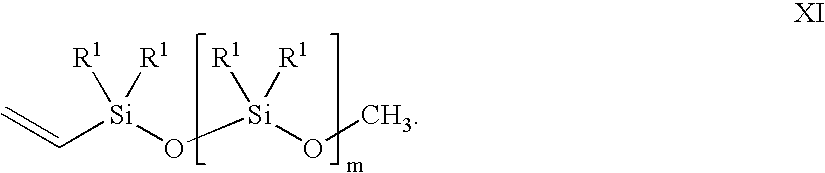
- The mixture may additionally comprise a noble metal hydrosilation catalyst and/or a filler as well as other additives. The prepolymer mixture may further comprise additional components that together constitute less than 10% by weight of the prepolymer mixture.
- An alternative method for producing a polymer encapsulated light emitting diode (LED) comprises: providing a prepolymer mixture; applying the prepolymer mixture to a LED, and curing the prepolymer mixture to form a polymer encapsulated LED. The prepolymer mixture provided is as described supra.
- The prepolymer mixture may be heated to a temperature such that the viscosity of the mixture allows for manipulation and application to an individual LED or an array of LEDs. However, the prepolymer mixture does not have to be heated. The prepolymer mixture can be applied as received if the mixture has a viscosity suitable for application to the LED array. The mixture is applied to a LED and subsequently cured. Oven curing, infrared curing, hotplate curing, heated mold curing, and combinations thereof may be used to accomplish curing of the mixture.
- The aforementioned curing techniques are not meant to limit the types or kinds of curing techniques that may be used to cure the prepolymer mixture in an embodiment of the present invention. The artisan will recognize that any curing technique, which causes hydrosilation-polymerization of the prepolymer mixture components, i.e., the cyclosiloxane oligomer and the vinyl siloxane oligomer, can be used as a curing technique in accordance with the present invention.
-
- 1. Viscosities of the unfilled encapsulant were measured using Ford Cup viscometer.
- 2. Cone on plate viscosities of both filled and unfilled encapsulant mixtures were measured using a Brookfield CP-52 cone and plate viscometer. Alternatively, a Brookfield Spindle-type viscometer was also used, especially in the case of more viscous mixtures.
- 3. Nuclear Magnetic Resonance (NMR) spectroscopic method to determine alkoxy functionality to Si atom ratio
- The ratios of alkoxy/Si discussed supra are determined as follows:
- Known weights (measured to four decimal places) of both the vinyl siloxane oligomer and dry toluene are dissolved in deuterated chloroform to give a deuterated chloroform solution. The integrated methoxy proton peak of the vinyl siloxane oligomer and the integrated methyl proton peak of toluene are measured by H1 NMR, using a Bruker AMX-500 MHz NMR spectrometer.
- The methoxy proton signal occurs at a chemical shift=−1.0 ppm relative to the methyl proton signal of toluene; although tetramethyl silane is not used as a standard due to interference with methyl protons directly bound to silicon atoms of the vinyl siloxane oligomer, it is well known that the chemical shift of the methyl signal of toluene occurs at 3.5 ppm relative to tetramethyl silane; therefore it is calculated that the chemical shift of the methoxy groups of the vinyl siloxane oligomer would be 2.5 ppm relative to tetramethyl silane.
- The number of equivalents of methoxy groups of the vinyl siloxane oligomer relative to the number of equivalents of toluene methyl groups is then calculated. The number of equivalents of vinyl groups of the vinyl siloxane oligomer relative to the methyl groups of the toluene is already known because the vinyl groups are unchanged by the condensation reaction that forms the vinyl siloxane oligomer, and the weight ratios of the vinyl siloxane oligomer to toluene are known.
- The number of equivalents of silicon atoms in the vinyl siloxane oligomer relative to the methyl groups of the toluene is also known because the number of silicon atoms is also unchanged by the reaction, which produces the vinyl siloxane oligomer. The ratio of equivalents of methoxy groups to equivalents of vinyl groups, and of equivalents of methoxy groups to equivalents of silicon atoms is therefore calculated by this test method.
- When ethoxy groups are present as substituents of the vinyl siloxane oligomer, the ethoxy groups can be similarly quantified by integrating the area under the peaks for the methylene protons, or the methyl protons of the ethoxy group.
- According to this method, the vinyl oligomer of example 1 exhibited a ratio of alkoxy/Si of 0.004/1.
- Vinyltrimethoxysilane (20.7 g, 0.14 mol) and dimethyldimethoxysilane (33.6 g, 0.28 mol) were placed in a 250 ml round bottom flask. Water (17.6 ml) was added and the solution was brought to reflux for 24 hours at 60° C. The mixture was cooled to room temperature, and two layers were formed. The biphasic mixture was transferred to a separatory funnel. The lower layer was separated and transferred to a 100 ml round bottom flask then dried under vacuum in a rotary evaporator for 3 hours. The flask was removed and attached to an oil pump to remove any residual starting materials and volatile byproducts for 24 hours. A clear colorless liquid was obtained (96% conversion) being the vinyl siloxane oligomer.
- The polymerization of the vinyl siloxane oligomer was carried out as follows. The vinyl siloxane oligomer (0.5 g) was mixed with 0.3 microL of Karstedt's catalyst and 0.35 g of UVT Sunspheres (silica, size: 7 micrometers). This mixture then was heated in an oven for 45 min at 90° C. to de-gas the solution and to decrease the viscosity. While hot, 0.2 g of a cyclosiloxane oligomer, 1,3,5,7,9-pentamethylcyclopentasiloxane (D5 H), was added and the mixture was gently swirled to avoid entrapment of air. The mixture was poured onto a LED array and the device placed in a forced air oven at 90° C. for 18 hr. The temperature was slowly ramped down to room temperature over the course of 3 hr. The encapsulated LED was translucent, hard, and crosslinked.
- A wide variety of epoxides and other types of thermoset resins were evaluated under simulated high intensity LED operating conditions. The most common failure was due to thermooxidative degradation that results in resins that have undergone pronounced color changes ranging from yellow to deep brown.
- The only polymeric materials that survived the aggressive screening test were the polymers and polymeric compositions of the present invention. They have excellent thermal oxidative resistance, and even when polymers and polymeric compositions undergo degradation, the products are generally colorless.
- The thermal oxidative stability of the corresponding UV cured resins were examined. Specifically, the epoxy resins containing SOC10 as the photoinitiator were placed in small aluminum cups and then polymerized by exposure to UV light using a medium pressure mercury arc lamp. Table 1 shows the results of visual inspections of the cured formulations after aging for 2 days at 140° C. Samples for testing were placed in a forced air oven and removed periodically during two weeks for visual examination. Samples that displayed a perceptible yellow color when held against a white background were considered to have failed the test.
- The structures of some of the resins prior to cure that were employed are depicted below.


TABLE 1 Results of Thermal Aging of UV Cured Epoxy Resins Monomer SOC10 (mol %) Results ERL-4221E 1.0 clear, no color change PC1000 1.0 clear, slightly yellow PC2003 0.5 clear, slightly yellow PC1000/Cop BMA/ 2.0 hazy, very slightly yellow MMA* PC1000/PVB# 1.0 yellow PC1000 1.5 clear, slightly yellow BPADGE 2.0 Very yellow SF-96 Silicone fluid — clear, colorless Polymeric compositions — clear, colorless of present invention (Exp #1)
*17% by weight of copolymer of butylmethacrylate and methyl methacrylate
#17% by weight of polyvinyl butyral.
- After 10 days of thermal oxidative aging at 140° C., all the samples were noticeably yellow. The resins that displayed the best performance to date were ERL-4221E and PC1000. Although ERL-4221E shows good initial resistance towards yellowing, after 4 days its degree of yellowing as approximately the same as the other resins. Formulations containing added linear acrylic polymers (copolymer BMA/MMA or polyvinyl butyral appear to undergo phase separation on thermal aging and to give hazy, phase-separated samples.
- Several polydimethylsiloxane (silicone) resins (e.g. SF-96 silicone fluid) were evaluated in the above-described screening tests. The results were dramatic. Even after 4 weeks (672 hours) at 140° C. in air, there was no observable yellowing.

- Polydimethylsiloxanes with the structure shown above have excellent inherent. thermal oxidative stability. However, on long term exposure to heat, even these resins do undergo slow degradative bond cleavage reactions. Apparently, the key to the ability of these resins to survive the screening test is due to the fact that despite this degradation, the products that are produced are not colored.
Claims (29)
1. A polymer produced by the process of reacting:
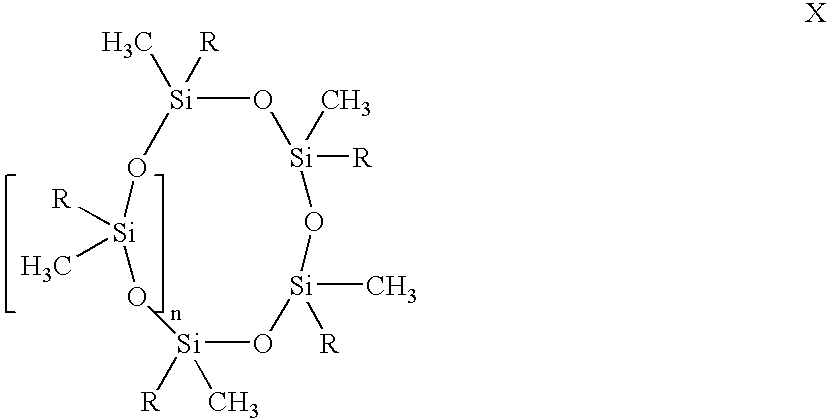
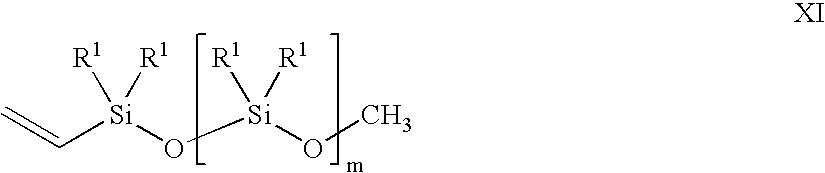
1. a cyclosiloxane oligomer of the formula X:
wherein n is an integer from 0 to 6;
R in each occurrence is chosen independently from H, a methyl, an alkyl, and a haloalkyl, with the proviso that at least two of R must be H, with
2. a vinyl siloxane oligomer of formula XI
wherein m is an integer from 2 to 20;
R1 in each occurrence is chosen independently for each siloxane unit from CH3, OCH3, OCH2CH3, vinyl, and a further unit of [—O—SiR1 2—]q-OCH3, wherein q is an integer from 2 to 20;
in the presence of a noble metal hydrosilation catalyst,
with the provisos that at least one of R1 must be a vinyl containing unit, said vinyl siloxane oligomer having a viscosity from 10 centipoise to 10,000 centipoise at 25° C., and a ratio of alkoxy groups to Si atoms in a range from 0.004:1 to 1.5:1.
2. A polymer of claim 1 , wherein said noble metal hydrosilation catalyst is selected from the group consisting of chloroplatinic acid, Karstedt's catalyst (Pt2{[(CH2═CH)Me2Si]2O}3), Ashby's catalyst {[(CH2═CH)MeSiO]4}3Pt, Wilkinson's catalyst [tris(triphenylphosphine)rhodium (I) chloride], polymer bound Wilkinson's catalyst, [tris(triphenylphosphine)iridium (I) chloride], chloroplatinic acid/octanol complex, platinum cyclovinylmethylsiloxane complex (Ashby-Karstedt Catalyst), platinum carbonyl cyclovinylmethylsiloxane complex, bis(benzonitrile)dichlorpalladium (II), tetrakis(triphenylphosphine)palladium (0), palladium 2,4-pentanedionate, iridium 2,4-pentanedionate, iridium cyclooctadiene chloride, Pt metal, Pd metal, Rh metal, Ir metal, and combinations thereof.
3. A polymer according to claim 1 , produced by a process wherein said cyclosiloxane oligomer reacts with said vinyl siloxane oligomer in the presence of Pt2{[(CH2═CH)Me2Si]2O}3 at a temperature from 50° C. to 200° C.
4. A polymer according to claim 1 , wherein n is 1.
5. A polymeric composition produced by the process of reacting:


a. a cyclosiloxane oligomer of the formula X:
wherein n is an integer from 0 to 6;
R in each occurrence is chosen independently from H, a methyl, an alkyl, and a haloalkyl, with the proviso that at least two of R must be H, with;
b. a vinyl siloxane oligomer of formula XI
wherein m is an integer from 2 to 20;
R1 in each occurrence is chosen independently for each siloxane unit from CH3, OCH3, OCH2CH3, vinyl, and a further unit of [—O—SiR1 2—]q-OCH3, wherein q is an integer from 2 to 20;
in the presence of a noble metal hydrosilation catalyst,
with the provisos that at least one of R1 must be a vinyl containing unit, said vinyl siloxane oligomer having a viscosity from 10 centipoise to 10,000 centipoise, and a ratio of alkoxy groups to Si atoms in a range from 0.004:1 to 1.5:1; and
c. a filler,
in the presence of a noble metal hydrosilation catalyst, said polymeric composition having a refractive index from 1.3 to 2.5
6. A polymeric composition according to claim 5 , wherein said filler is chosen from oxides of boron, silicon, titanium, aluminum, germanium, tin, strontium, and zinc having a mean particle sizes in a range from 0.1 to 10.0 microns.
7. A polymeric composition according to claim 5 , wherein said filler comprises from 5 wt % to 60 wt % of said polymeric composition.
8. A polymeric composition according to claim 5 , said polymer exhibiting less than 10% decrease in light transmission within the range of 450-470 nm when said polymer is exposed to a temperature of 140° C. for 1,000 hrs.
9. A polymeric composition according to claim 5 , produced by a process wherein said cyclosiloxane oligomer reacts with said vinyl siloxane oligomer in the presence of Pt2{[(CH2═CH)Me2Si]2O}3 at a temperature from 50° C. to 200° C.
10. A prepolymer mixture comprising:


a) a cyclosiloxane oligomer of the formula X:
wherein n is an integer from 0 to 6;
R in each occurrence is chosen independently from H, a methyl, an alkyl, and a haloalkyl, with the proviso that at least two of R must be H, with; and
b) a vinyl siloxane oligomer of the formula XI:
wherein m is an integer from 2 to 20;
R1 in each occurrence is chosen independently for each siloxane unit from CH3, OCH3, OCH2CH3, vinyl, and a further unit of [—O—SiR1 2—]q-OCH3, wherein q is an integer from 2 to 20;
with the provisos that at least one of R1 must be a vinyl containing unit, said vinyl siloxane oligomer having a viscosity from 10 centipoise to 10,000 centipoise, and a ratio of alkoxy groups to Si atoms in a range from 0.004:1 to 1.5:1.
11. A prepolymer mixture according to claim 10 additionally comprising a noble metal hydrosilation catalyst.
12. A prepolymer mixture according to claim 10 or 11 additionally comprising a filler.
13. A prepolymer mixture according to claim 12 , wherein said filler is chosen from oxides of boron, silicon, titanium, aluminum, germanium, tin, strontium, and zinc having mean particle sizes in a range from 0.1 to 10.0 microns.
14. A prepolymer mixture according to claim 13 further comprising additional components wherein said additional components together constitute less than 10% by weight of said prepolymer mixture.
15. A prepolymer mixture according to claim 11 , wherein said noble metal hydrosilation catalyst is selected from the group consisting of chloroplatinic acid, Karstedt's catalyst (Pt2{[(CH2═CH)Me2Si]2O}3), Ashby's catalyst {[(CH2═CH)MeSiO]4}3Pt, Wilkinson's catalyst [tris(triphenylphosphine)rhodium (I) chloride], polymer bound Wilkinson's catalyst, tris(triphenylphosphine)iridium (I) chloride, chloroplatinic acid/octanol complex, platinum cyclovinylmethylsiloxane complex (Ashby-Karstedt Catalyst), platinum carbonyl cyclovinylmethylsiloxane complex, bis(benzonitrile)dichlorpalladium (II), tetrakis(triphenylphosphine)palladium (0), palladium 2,4-pentanedionate, iridium 2,4-pentanedionate, iridium cyclooctadiene chloride, Pt metal, Pd metal, Rh metal, Ir metal, and combinations thereof.
16. A prepolymer mixture according to claim 11 , wherein said noble metal hydrosilation catalyst is Karstedt's catalyst Pt2{[(CH2═CH)Me2Si]2O}3.
17. A light emitting device comprising:

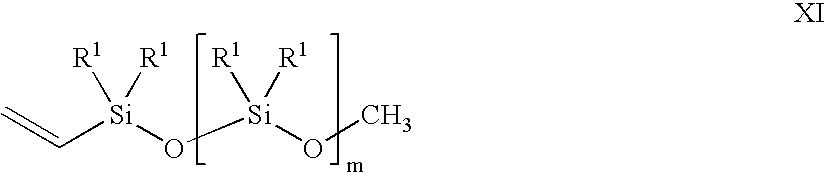
a substrate;
a light emitting diode (LED), said LED operably integrated with said substrate; and
a polymeric composition encapsulating said LED, said polymeric composition comprising a polymer produced by the process of reacting:
a) a cyclosiloxane oligomer of the formula X:
wherein n is an integer from 0 to 6;
R in each occurrence is chosen independently from H, a methyl, an alkyl, and a haloalkyl, with the proviso that at least two of R must be H, with
b) a vinyl siloxane oligomer of formula XI
wherein m is an integer from 2 to 20;
R1 in each occurrence is chosen independently for each siloxane unit from CH3, OCH3, OCH2CH3, vinyl, and a further unit of [—O—SiR1 2—]q-OCH3, wherein q is an integer from 2 to 20;
in the presence of a noble metal hydrosilation catalyst,
with the provisos that at least one of R1 must be a vinyl containing unit, said vinyl siloxane oligomer having a viscosity from 10 centipoise to 10,000 centipoise, and a ratio of alkoxy groups to Si atoms in a range from 0.004:1 to 1.5:1.
18. A light emitting device according to claim 17 , wherein n is 1.
19. A light emitting device according to claim 17 , wherein said polymeric composition exhibits less than 10% decrease in light transmission within the range of 450-470 nm when said polymeric composition is exposed to a temperature of 140° C. for 1,000 hrs.
20. A light emitting device according to claim 17 , wherein said polymeric composition additionally comprises a filler.
21. A light emitting device according to claim 17 , wherein said polymeric composition has a refractive index from 1.3 to 2.5.
22. A light emitting device according to claim 20 , wherein said filler is chosen from oxides of boron, silicon, titanium, aluminum, germanium, tin, strontium, and zinc having a mean particle size in a range from 0.1 to 10.0 microns.
23. A light emitting device according to claim 20 , wherein said filler comprises from 5 wt % to 60 wt % of said polymer.
24. A method for producing a polymer encapsulated light emitting diode (LED) comprising:


providing a vinyl siloxane oligomer having a plurality of vinyl functionalities and a viscosity from 10 centipoise to 10,000 centipoise at 25° C.;
providing a noble metal hydrosilation catalyst; and
providing a cyclosiloxane oligomer selected from structure I, structure II, structure III, structure IV, structure V, structure VI, and structure VII:
wherein R in each occurrence is chosen independently from H, a methyl, an alkyl, and a haloalkyl, with the proviso that at least two of R must be H;
combining said vinyl siloxane oligomer, said noble metal hydrosilation catalyst, and said cyclosiloxane oligomer to give a mixture;
applying said mixture to a LED; and
curing said mixture to form a polymer encapsulated LED.
25. The method of claim 24 , wherein said curing includes a method selected from the group consisting of oven curing, infrared curing, hotplate curing, heated mold curing, and combinations thereof.
26. The method of claim 24 , wherein said vinyl siloxane oligomer is of formula XI:

wherein m is an integer from 2 to 20;
R1 in each occurrence is chosen independently for each siloxane unit from CH3, OCH3, OCH2CH3, vinyl, and a further unit of [—O—SiR1 2—]q-OCH3, wherein q is an integer from 2 to 20;
with the provisos that at least one of R1 must be a vinyl containing unit and a ratio of alkoxy groups to Si atoms must be in a range from 0.004:1 to 1.5:1.
27. The method of claim 24 , wherein said mixture additionally comprises a filler material.
28. A method for producing a polymer encapsulated light emitting diode (LED) comprising:
providing the prepolymer mixture of claim 10
applying said prepolymer mixture to a LED; and
curing said prepolymer mixture to form a polymer encapsulated LED.
29. The method of claim 28 wherein said curing includes a method selected from the group consisting of oven curing, infrared curing, hotplate curing, heated mold curing, and combinations thereof.
Priority Applications (1)
| Application Number | Priority Date | Filing Date | Title |
|---|---|---|---|
| US11/256,843 US20060134440A1 (en) | 2004-10-27 | 2005-10-24 | Silicone encapsulants for light emitting diodes |
Applications Claiming Priority (2)
| Application Number | Priority Date | Filing Date | Title |
|---|---|---|---|
| US62265304P | 2004-10-27 | 2004-10-27 | |
| US11/256,843 US20060134440A1 (en) | 2004-10-27 | 2005-10-24 | Silicone encapsulants for light emitting diodes |
Publications (1)
| Publication Number | Publication Date |
|---|---|
| US20060134440A1 true US20060134440A1 (en) | 2006-06-22 |
Family
ID=35455923
Family Applications (1)
| Application Number | Title | Priority Date | Filing Date |
|---|---|---|---|
| US11/256,843 Abandoned US20060134440A1 (en) | 2004-10-27 | 2005-10-24 | Silicone encapsulants for light emitting diodes |
Country Status (6)
| Country | Link |
|---|---|
| US (1) | US20060134440A1 (en) |
| EP (1) | EP1652871A1 (en) |
| JP (1) | JP2006124710A (en) |
| KR (1) | KR100639014B1 (en) |
| CN (1) | CN100379794C (en) |
| TW (1) | TW200619321A (en) |
Cited By (13)
| Publication number | Priority date | Publication date | Assignee | Title |
|---|---|---|---|---|
| US20080090986A1 (en) * | 2006-10-16 | 2008-04-17 | Garo Khanarian | Heat stable aryl polysiloxane compositions |
| US20100032702A1 (en) * | 2008-08-11 | 2010-02-11 | E. I. Du Pont De Nemours And Company | Light-Emitting Diode Housing Comprising Fluoropolymer |
| US20100060150A1 (en) * | 2006-11-01 | 2010-03-11 | Takeshi Igarashi | Cyclic siloxane compound, organic electroluminescence device, and use of the same |
| US20100179283A1 (en) * | 2007-04-23 | 2010-07-15 | Adeka Corporation | Silicon-containing compound, curable composition and cured product |
| EP2412746A1 (en) * | 2010-07-29 | 2012-02-01 | Cheil Industries Inc. | Modified siloxane polymer composition, encapsulant obtained from the modified siloxane polymer composition and electronic device including the encapsulant |
| EP2587560A1 (en) * | 2011-10-26 | 2013-05-01 | Forschungsverbund Berlin e.V. | Light emitting diode |
| US9976710B2 (en) | 2013-10-30 | 2018-05-22 | Lilibrand Llc | Flexible strip lighting apparatus and methods |
| US10989372B2 (en) | 2017-03-09 | 2021-04-27 | Ecosense Lighting Inc. | Fixtures and lighting accessories for lighting devices |
| US11022279B2 (en) | 2016-03-08 | 2021-06-01 | Ecosense Lighting Inc. | Lighting system with lens assembly |
| US11041609B2 (en) | 2018-05-01 | 2021-06-22 | Ecosense Lighting Inc. | Lighting systems and devices with central silicone module |
| US11296057B2 (en) | 2017-01-27 | 2022-04-05 | EcoSense Lighting, Inc. | Lighting systems with high color rendering index and uniform planar illumination |
| US11353200B2 (en) | 2018-12-17 | 2022-06-07 | Korrus, Inc. | Strip lighting system for direct input of high voltage driving power |
| US12388056B1 (en) | 2017-01-27 | 2025-08-12 | Korrus, Inc. | Linear lighting systems and processes |
Families Citing this family (6)
| Publication number | Priority date | Publication date | Assignee | Title |
|---|---|---|---|---|
| CN101230197B (en) * | 2007-12-20 | 2011-01-19 | 宁波安迪光电科技有限公司 | Organosilicon composition for manufacturing packaging gluewater of light-emitting diode |
| KR101271584B1 (en) * | 2008-09-11 | 2013-06-11 | 주식회사 엘지화학 | Polysiloxane for sealing material or lens of Light-Emitting Diode and Polymer Composition Comprising The Same |
| DE102012104363A1 (en) * | 2012-05-21 | 2013-11-21 | Osram Opto Semiconductors Gmbh | Optoelectronic component and method for its production |
| WO2014149670A2 (en) * | 2013-03-15 | 2014-09-25 | Dow Corning Corporation | Aryl group-containing siloxane compositions including alkaline earth metal |
| CN104228027B (en) * | 2014-09-24 | 2017-03-29 | 无锡晶睿光电新材料有限公司 | A kind of manufacture method of the LED flexible light bar of silicone rubber cladding |
| CN106995530B (en) * | 2017-05-22 | 2020-06-19 | 弗洛里光电材料(苏州)有限公司 | Siloxane epoxides, curable silicone compositions and uses thereof |
Citations (30)
| Publication number | Priority date | Publication date | Assignee | Title |
|---|---|---|---|---|
| US3701795A (en) * | 1971-03-19 | 1972-10-31 | Gen Electric | Aliphatically unsaturated amic acid and silylated amic acid |
| US3723567A (en) * | 1971-08-25 | 1973-03-27 | Dow Corning | Stable organosilicon compositions |
| US3944519A (en) * | 1975-03-13 | 1976-03-16 | Dow Corning Corporation | Curable organopolysiloxane compositions |
| US3969310A (en) * | 1974-08-29 | 1976-07-13 | Shin-Etsu Chemical Co., Ltd. | Silicone rubber compositions |
| US3996195A (en) * | 1974-11-15 | 1976-12-07 | Shinetsu Chemical Company | Curable organosilicon compositions |
| US4239867A (en) * | 1979-06-04 | 1980-12-16 | Dow Corning Corporation | Inhibited curable solventless organopolysiloxane compositions |
| US4370358A (en) * | 1980-09-22 | 1983-01-25 | General Electric Company | Ultraviolet curable silicone adhesives |
| US4639501A (en) * | 1985-09-04 | 1987-01-27 | Massachusetts Institute Of Technology | Method for forming new preceramic polymers containing silicon |
| US5051465A (en) * | 1988-11-02 | 1991-09-24 | Shin-Etsu Chemical Co., Ltd. | Silicone rubber composition |
| US5384382A (en) * | 1992-07-31 | 1995-01-24 | Shin-Etsu Chemical Co., Ltd. | Crosslinkable polysilane compositions and cured products thereof |
| US5484950A (en) * | 1992-12-21 | 1996-01-16 | Polyset Company, Inc. | Process for selective monoaddition to silanes containing two silicon-hydrogen bonds and products thereof |
| US5599894A (en) * | 1994-06-07 | 1997-02-04 | Shin-Etsu Chemical Co., Ltd. | Silicone gel compositions |
| US5739199A (en) * | 1994-04-21 | 1998-04-14 | Dow Corning Asia, Ltd. | Optically transparent organosiloxane resin compositions |
| US5767193A (en) * | 1995-09-12 | 1998-06-16 | Shin-Etsu Chemical Co., Ltd. | Curable silicone elastomer composition and method of preparing the same |
| US5798430A (en) * | 1995-06-28 | 1998-08-25 | E. I. Du Pont De Nemours And Compnay | Molecular and oligomeric silane precursors to network materials |
| US6037092A (en) * | 1999-08-17 | 2000-03-14 | Xerox Corporation | Stabilized fluorosilicone fuser members |
| US6297302B1 (en) * | 1999-08-17 | 2001-10-02 | Xerox Corporation | Stabilized fluorosilicone materials |
| US6336026B1 (en) * | 1999-08-17 | 2002-01-01 | Xerox Corporation | Stabilized fluorosilicone transfer members |
| US20030049465A1 (en) * | 2001-07-02 | 2003-03-13 | General Electric Company | Curable silicone adhesive compositions |
| US20040028917A1 (en) * | 2002-08-08 | 2004-02-12 | Shin-Etsu Chemical Co., Ltd. | Addition reaction curable organopolysiloxane composition |
| US20040116640A1 (en) * | 2002-11-29 | 2004-06-17 | Kei Miyoshi | Silicone resin composition for LED devices |
| US6806509B2 (en) * | 2003-03-12 | 2004-10-19 | Shin-Etsu Chemical Co., Ltd. | Light-emitting semiconductor potting composition and light-emitting semiconductor device |
| US6828404B2 (en) * | 2000-10-20 | 2004-12-07 | Rensselaer Polytechnic Institute | Polymerizable siloxanes |
| US6838182B2 (en) * | 2001-01-03 | 2005-01-04 | Henkel Corporation | Low temperature, fast curing silicone compositions |
| US20050065309A1 (en) * | 2001-10-16 | 2005-03-24 | Kennedy Joseph P. | Poly(cyclosiloxane) composition and synthesis |
| US20050129957A1 (en) * | 2003-11-20 | 2005-06-16 | Shin-Etsu Chemical Co., Ltd. | Epoxy/silicone mixed resin composition and light-emitting semiconductor device |
| US20050256286A1 (en) * | 2002-05-01 | 2005-11-17 | Asch Karmen K | Organohydrogensilicon compounds |
| US20060106187A1 (en) * | 2002-08-16 | 2006-05-18 | Kennedy Joseph P | Poly (cyclosiloxane) composition and method of systhesis thereof |
| US20060116500A1 (en) * | 2002-12-20 | 2006-06-01 | Chapman Brian D | Branched polymers from organohydrogensilicon compounds |
| US20070148476A1 (en) * | 2005-12-22 | 2007-06-28 | Garo Khanarian | Siloxane encapsulants |
Family Cites Families (5)
| Publication number | Priority date | Publication date | Assignee | Title |
|---|---|---|---|---|
| US3197432A (en) * | 1962-07-02 | 1965-07-27 | Gen Electric | Transparent resinous organopolysiloxanes |
| US5629399A (en) * | 1996-03-05 | 1997-05-13 | Dow Corning Corporation | Fast curing organosiloxane compositions with long working times |
| CA2430866A1 (en) * | 2000-12-27 | 2002-07-11 | Kaneka Corporation | Curing agents, curable compositions, compositions for optical materials, optical materials, their production, and liquid crystal displays and led's made by using the materials |
| US6832036B2 (en) * | 2002-10-11 | 2004-12-14 | Polyset Company, Inc. | Siloxane optical waveguides |
| US6956087B2 (en) * | 2002-12-13 | 2005-10-18 | Bausch & Lomb Incorporated | High refractive index polysiloxane prepolymers |
-
2005
- 2005-10-24 US US11/256,843 patent/US20060134440A1/en not_active Abandoned
- 2005-10-25 TW TW094137271A patent/TW200619321A/en unknown
- 2005-10-27 JP JP2005312919A patent/JP2006124710A/en not_active Withdrawn
- 2005-10-27 EP EP20050256685 patent/EP1652871A1/en not_active Withdrawn
- 2005-10-27 CN CNB2005101160441A patent/CN100379794C/en not_active Expired - Fee Related
- 2005-10-27 KR KR1020050101682A patent/KR100639014B1/en not_active Expired - Fee Related
Patent Citations (30)
| Publication number | Priority date | Publication date | Assignee | Title |
|---|---|---|---|---|
| US3701795A (en) * | 1971-03-19 | 1972-10-31 | Gen Electric | Aliphatically unsaturated amic acid and silylated amic acid |
| US3723567A (en) * | 1971-08-25 | 1973-03-27 | Dow Corning | Stable organosilicon compositions |
| US3969310A (en) * | 1974-08-29 | 1976-07-13 | Shin-Etsu Chemical Co., Ltd. | Silicone rubber compositions |
| US3996195A (en) * | 1974-11-15 | 1976-12-07 | Shinetsu Chemical Company | Curable organosilicon compositions |
| US3944519A (en) * | 1975-03-13 | 1976-03-16 | Dow Corning Corporation | Curable organopolysiloxane compositions |
| US4239867A (en) * | 1979-06-04 | 1980-12-16 | Dow Corning Corporation | Inhibited curable solventless organopolysiloxane compositions |
| US4370358A (en) * | 1980-09-22 | 1983-01-25 | General Electric Company | Ultraviolet curable silicone adhesives |
| US4639501A (en) * | 1985-09-04 | 1987-01-27 | Massachusetts Institute Of Technology | Method for forming new preceramic polymers containing silicon |
| US5051465A (en) * | 1988-11-02 | 1991-09-24 | Shin-Etsu Chemical Co., Ltd. | Silicone rubber composition |
| US5384382A (en) * | 1992-07-31 | 1995-01-24 | Shin-Etsu Chemical Co., Ltd. | Crosslinkable polysilane compositions and cured products thereof |
| US5484950A (en) * | 1992-12-21 | 1996-01-16 | Polyset Company, Inc. | Process for selective monoaddition to silanes containing two silicon-hydrogen bonds and products thereof |
| US5739199A (en) * | 1994-04-21 | 1998-04-14 | Dow Corning Asia, Ltd. | Optically transparent organosiloxane resin compositions |
| US5599894A (en) * | 1994-06-07 | 1997-02-04 | Shin-Etsu Chemical Co., Ltd. | Silicone gel compositions |
| US5798430A (en) * | 1995-06-28 | 1998-08-25 | E. I. Du Pont De Nemours And Compnay | Molecular and oligomeric silane precursors to network materials |
| US5767193A (en) * | 1995-09-12 | 1998-06-16 | Shin-Etsu Chemical Co., Ltd. | Curable silicone elastomer composition and method of preparing the same |
| US6037092A (en) * | 1999-08-17 | 2000-03-14 | Xerox Corporation | Stabilized fluorosilicone fuser members |
| US6297302B1 (en) * | 1999-08-17 | 2001-10-02 | Xerox Corporation | Stabilized fluorosilicone materials |
| US6336026B1 (en) * | 1999-08-17 | 2002-01-01 | Xerox Corporation | Stabilized fluorosilicone transfer members |
| US6828404B2 (en) * | 2000-10-20 | 2004-12-07 | Rensselaer Polytechnic Institute | Polymerizable siloxanes |
| US6838182B2 (en) * | 2001-01-03 | 2005-01-04 | Henkel Corporation | Low temperature, fast curing silicone compositions |
| US20030049465A1 (en) * | 2001-07-02 | 2003-03-13 | General Electric Company | Curable silicone adhesive compositions |
| US20050065309A1 (en) * | 2001-10-16 | 2005-03-24 | Kennedy Joseph P. | Poly(cyclosiloxane) composition and synthesis |
| US20050256286A1 (en) * | 2002-05-01 | 2005-11-17 | Asch Karmen K | Organohydrogensilicon compounds |
| US20040028917A1 (en) * | 2002-08-08 | 2004-02-12 | Shin-Etsu Chemical Co., Ltd. | Addition reaction curable organopolysiloxane composition |
| US20060106187A1 (en) * | 2002-08-16 | 2006-05-18 | Kennedy Joseph P | Poly (cyclosiloxane) composition and method of systhesis thereof |
| US20040116640A1 (en) * | 2002-11-29 | 2004-06-17 | Kei Miyoshi | Silicone resin composition for LED devices |
| US20060116500A1 (en) * | 2002-12-20 | 2006-06-01 | Chapman Brian D | Branched polymers from organohydrogensilicon compounds |
| US6806509B2 (en) * | 2003-03-12 | 2004-10-19 | Shin-Etsu Chemical Co., Ltd. | Light-emitting semiconductor potting composition and light-emitting semiconductor device |
| US20050129957A1 (en) * | 2003-11-20 | 2005-06-16 | Shin-Etsu Chemical Co., Ltd. | Epoxy/silicone mixed resin composition and light-emitting semiconductor device |
| US20070148476A1 (en) * | 2005-12-22 | 2007-06-28 | Garo Khanarian | Siloxane encapsulants |
Cited By (28)
| Publication number | Priority date | Publication date | Assignee | Title |
|---|---|---|---|---|
| US8142895B2 (en) * | 2006-10-16 | 2012-03-27 | Rohm And Haas Company | Heat stable aryl polysiloxane compositions |
| US20080090986A1 (en) * | 2006-10-16 | 2008-04-17 | Garo Khanarian | Heat stable aryl polysiloxane compositions |
| US20100060150A1 (en) * | 2006-11-01 | 2010-03-11 | Takeshi Igarashi | Cyclic siloxane compound, organic electroluminescence device, and use of the same |
| US9657040B2 (en) | 2006-11-01 | 2017-05-23 | Samsung Electronics Co., Ltd | Cyclic siloxane compound, organic electroluminescence device, and use of the same |
| US20100179283A1 (en) * | 2007-04-23 | 2010-07-15 | Adeka Corporation | Silicon-containing compound, curable composition and cured product |
| US8003736B2 (en) * | 2007-04-23 | 2011-08-23 | Adeka Corporation | Silicon-containing compound, curable composition and cured product |
| US20100032702A1 (en) * | 2008-08-11 | 2010-02-11 | E. I. Du Pont De Nemours And Company | Light-Emitting Diode Housing Comprising Fluoropolymer |
| EP2412746A1 (en) * | 2010-07-29 | 2012-02-01 | Cheil Industries Inc. | Modified siloxane polymer composition, encapsulant obtained from the modified siloxane polymer composition and electronic device including the encapsulant |
| EP2587560A1 (en) * | 2011-10-26 | 2013-05-01 | Forschungsverbund Berlin e.V. | Light emitting diode |
| US11028980B2 (en) | 2013-10-30 | 2021-06-08 | Ecosense Lighting Inc. | Flexible strip lighting apparatus and methods |
| US9976710B2 (en) | 2013-10-30 | 2018-05-22 | Lilibrand Llc | Flexible strip lighting apparatus and methods |
| US10030828B2 (en) | 2013-10-30 | 2018-07-24 | Lilibrand Llc | Flexible strip lighting apparatus and methods |
| US11022279B2 (en) | 2016-03-08 | 2021-06-01 | Ecosense Lighting Inc. | Lighting system with lens assembly |
| US11867382B2 (en) | 2016-03-08 | 2024-01-09 | Korrus, Inc. | Lighting system with lens assembly |
| US11060702B2 (en) | 2016-03-08 | 2021-07-13 | Ecosense Lighting Inc. | Lighting system with lens assembly |
| US11359796B2 (en) | 2016-03-08 | 2022-06-14 | Korrus, Inc. | Lighting system with lens assembly |
| US11512838B2 (en) | 2016-03-08 | 2022-11-29 | Korrus, Inc. | Lighting system with lens assembly |
| US12129990B2 (en) | 2016-03-08 | 2024-10-29 | Korrus, Inc. | Lighting system with lens assembly |
| US11296057B2 (en) | 2017-01-27 | 2022-04-05 | EcoSense Lighting, Inc. | Lighting systems with high color rendering index and uniform planar illumination |
| US12388056B1 (en) | 2017-01-27 | 2025-08-12 | Korrus, Inc. | Linear lighting systems and processes |
| US11658163B2 (en) | 2017-01-27 | 2023-05-23 | Korrus, Inc. | Lighting systems with high color rendering index and uniform planar illumination |
| US12062645B2 (en) | 2017-01-27 | 2024-08-13 | Korrus, Inc. | Lighting systems with high color rendering index and uniform planar illumination |
| US10989372B2 (en) | 2017-03-09 | 2021-04-27 | Ecosense Lighting Inc. | Fixtures and lighting accessories for lighting devices |
| US11339932B2 (en) | 2017-03-09 | 2022-05-24 | Korrus, Inc. | Fixtures and lighting accessories for lighting devices |
| US11041609B2 (en) | 2018-05-01 | 2021-06-22 | Ecosense Lighting Inc. | Lighting systems and devices with central silicone module |
| US11578857B2 (en) | 2018-05-01 | 2023-02-14 | Korrus, Inc. | Lighting systems and devices with central silicone module |
| US11708966B2 (en) | 2018-12-17 | 2023-07-25 | Korrus, Inc. | Strip lighting system for direct input of high voltage driving power |
| US11353200B2 (en) | 2018-12-17 | 2022-06-07 | Korrus, Inc. | Strip lighting system for direct input of high voltage driving power |
Also Published As
| Publication number | Publication date |
|---|---|
| KR20060052249A (en) | 2006-05-19 |
| EP1652871A1 (en) | 2006-05-03 |
| JP2006124710A (en) | 2006-05-18 |
| KR100639014B1 (en) | 2006-10-25 |
| CN100379794C (en) | 2008-04-09 |
| TW200619321A (en) | 2006-06-16 |
| CN1772794A (en) | 2006-05-17 |
Similar Documents
| Publication | Publication Date | Title |
|---|---|---|
| US20060134440A1 (en) | Silicone encapsulants for light emitting diodes | |
| EP1801163B1 (en) | Siloxane Encapsulants | |
| JP4734832B2 (en) | Encapsulant for optical element | |
| TW588084B (en) | Curing agents, curable compositions, compositions for optical materials, optical materials, optical materials, their production, and liquid crystal displays and LEDs made by using the materials | |
| KR101867459B1 (en) | Compound comprising isocyanuric skeleton, epoxy groups, and organopolysiloxane or silsesquioxane skeleton having sih groups, thermosetting resin composition comprising compound as agent for imparting adhesion, cured product, and sealing member for optical semiconductor | |
| KR101836962B1 (en) | New organosilicon compound, thermosetting resin composition containing the organosilicon compound, hardening resin and encapsulation material for optical semiconductor | |
| US8952108B2 (en) | Organic silicon compound, thermosetting composition containing said organic silicon compound, and sealing material for optical semiconductor | |
| KR102795078B1 (en) | Condensation curable resin composition, cured product, molded article and semiconductor device | |
| KR101030019B1 (en) | Translucent resin for encapsulant and electronic device comprising same | |
| JPWO2007046399A1 (en) | Thermosetting resin composition and optical semiconductor sealing material | |
| US10221353B2 (en) | Wavelength converting compositions, wavelength converters and devices including the same | |
| JP2016529354A (en) | Encapsulation material for light emitting diode | |
| KR101472829B1 (en) | Curable composition, cured product, photo-semiconductor device, and polysiloxane | |
| JP5204393B2 (en) | Semiconductor optical device and transparent optical member | |
| EP2412746B1 (en) | Modified siloxane polymer composition, encapsulant obtained from the modified siloxane polymer composition and electronic device including the encapsulant | |
| Yang et al. | Cycloaliphatic epoxy oligosiloxane‐derived hybrid materials for a high‐refractive index LED encapsulant | |
| US8643200B2 (en) | Resin composition and transparent encapsulant formed using the same, and electronic device including the encapsulant | |
| KR102739541B1 (en) | Curable composition, cured product of said composition, and semiconductor device using said cured product | |
| KR100976461B1 (en) | Transparent resin for encapsulation material and electronic device including the same | |
| CN102790141B (en) | Method of making light emitting diodes | |
| HK1093518A (en) | Silicone encapsulants for light emitting diodes | |
| WO2014052937A1 (en) | Polycyclic polysiloxane composition and led containing same | |
| KR20180108405A (en) | Thermosetting resin compositions | |
| JP2023532443A (en) | Precursor for producing polysiloxane, polysiloxane, polysiloxane resin, method for producing polysiloxane, method for producing polysiloxane resin, and optoelectronic component | |
| HK1088914A (en) | Silicone encapsulants for light emitting diodes |
Legal Events
| Date | Code | Title | Description |
|---|---|---|---|
| AS | Assignment |
Owner name: RENSSELAER POLYTECHNIC INSTITUTE, NEW YORK Free format text: ASSIGNMENT OF ASSIGNORS INTEREST;ASSIGNOR:CRIVELLO, JAMES V.;REEL/FRAME:017257/0741 Effective date: 20060221 |
|
| AS | Assignment |
Owner name: ENERGY, UNITED STATES DEPARTMENT OF, DISTRICT OF C Free format text: CONFIRMATORY LICENSE;ASSIGNOR:RENSSELAER POLYTECHNIC INSTITUTE;REEL/FRAME:017864/0236 Effective date: 20051212 |
|
| STCB | Information on status: application discontinuation |
Free format text: ABANDONED -- FAILURE TO RESPOND TO AN OFFICE ACTION |