US20050171204A1 - Substituted phenylpropionic acid derivatives as agonists to human peroxisome proliferator-activated receptor alpha (ppar) - Google Patents
Substituted phenylpropionic acid derivatives as agonists to human peroxisome proliferator-activated receptor alpha (ppar) Download PDFInfo
- Publication number
- US20050171204A1 US20050171204A1 US10/499,261 US49926105A US2005171204A1 US 20050171204 A1 US20050171204 A1 US 20050171204A1 US 49926105 A US49926105 A US 49926105A US 2005171204 A1 US2005171204 A1 US 2005171204A1
- Authority
- US
- United States
- Prior art keywords
- phenyl
- carbamoyl
- methylthio
- tetrahydro
- dioxo
- Prior art date
- Legal status (The legal status is an assumption and is not a legal conclusion. Google has not performed a legal analysis and makes no representation as to the accuracy of the status listed.)
- Granted
Links
- 0 *C(=O)C(CC1=CC=C(OCC(=O)N(CCCCCC)CC2=CC=CC=C2)C=C1)OCC Chemical compound *C(=O)C(CC1=CC=C(OCC(=O)N(CCCCCC)CC2=CC=CC=C2)C=C1)OCC 0.000 description 6
- IWPXYUBPRFHKJQ-UHFFFAOYSA-N CCCCCCN(CC1=CC=CC=C1)C(=O)COC1=CC=C(CC(OCC)C(=O)O)C=C1 Chemical compound CCCCCCN(CC1=CC=CC=C1)C(=O)COC1=CC=C(CC(OCC)C(=O)O)C=C1 IWPXYUBPRFHKJQ-UHFFFAOYSA-N 0.000 description 3
- VFZWCTYGZWDQGK-UHFFFAOYSA-N CCCCCCNCC1=CC=CC=C1 Chemical compound CCCCCCNCC1=CC=CC=C1 VFZWCTYGZWDQGK-UHFFFAOYSA-N 0.000 description 1
- CXGTZJYQWSUFET-UHFFFAOYSA-N CCOC(CC1=CC=C(OCCC2=CC=C(OS(C)(=O)=O)C=C2)C=C1)C(=O)O Chemical compound CCOC(CC1=CC=C(OCCC2=CC=C(OS(C)(=O)=O)C=C2)C=C1)C(=O)O CXGTZJYQWSUFET-UHFFFAOYSA-N 0.000 description 1
Classifications
-
- A—HUMAN NECESSITIES
- A61—MEDICAL OR VETERINARY SCIENCE; HYGIENE
- A61K—PREPARATIONS FOR MEDICAL, DENTAL OR TOILETRY PURPOSES
- A61K31/00—Medicinal preparations containing organic active ingredients
- A61K31/16—Amides, e.g. hydroxamic acids
-
- A—HUMAN NECESSITIES
- A61—MEDICAL OR VETERINARY SCIENCE; HYGIENE
- A61K—PREPARATIONS FOR MEDICAL, DENTAL OR TOILETRY PURPOSES
- A61K31/00—Medicinal preparations containing organic active ingredients
- A61K31/185—Acids; Anhydrides, halides or salts thereof, e.g. sulfur acids, imidic, hydrazonic or hydroximic acids
- A61K31/19—Carboxylic acids, e.g. valproic acid
- A61K31/195—Carboxylic acids, e.g. valproic acid having an amino group
-
- A—HUMAN NECESSITIES
- A61—MEDICAL OR VETERINARY SCIENCE; HYGIENE
- A61K—PREPARATIONS FOR MEDICAL, DENTAL OR TOILETRY PURPOSES
- A61K45/00—Medicinal preparations containing active ingredients not provided for in groups A61K31/00 - A61K41/00
- A61K45/06—Mixtures of active ingredients without chemical characterisation, e.g. antiphlogistics and cardiaca
-
- A—HUMAN NECESSITIES
- A61—MEDICAL OR VETERINARY SCIENCE; HYGIENE
- A61P—SPECIFIC THERAPEUTIC ACTIVITY OF CHEMICAL COMPOUNDS OR MEDICINAL PREPARATIONS
- A61P13/00—Drugs for disorders of the urinary system
- A61P13/12—Drugs for disorders of the urinary system of the kidneys
-
- A—HUMAN NECESSITIES
- A61—MEDICAL OR VETERINARY SCIENCE; HYGIENE
- A61P—SPECIFIC THERAPEUTIC ACTIVITY OF CHEMICAL COMPOUNDS OR MEDICINAL PREPARATIONS
- A61P15/00—Drugs for genital or sexual disorders; Contraceptives
-
- A—HUMAN NECESSITIES
- A61—MEDICAL OR VETERINARY SCIENCE; HYGIENE
- A61P—SPECIFIC THERAPEUTIC ACTIVITY OF CHEMICAL COMPOUNDS OR MEDICINAL PREPARATIONS
- A61P15/00—Drugs for genital or sexual disorders; Contraceptives
- A61P15/08—Drugs for genital or sexual disorders; Contraceptives for gonadal disorders or for enhancing fertility, e.g. inducers of ovulation or of spermatogenesis
-
- A—HUMAN NECESSITIES
- A61—MEDICAL OR VETERINARY SCIENCE; HYGIENE
- A61P—SPECIFIC THERAPEUTIC ACTIVITY OF CHEMICAL COMPOUNDS OR MEDICINAL PREPARATIONS
- A61P25/00—Drugs for disorders of the nervous system
-
- A—HUMAN NECESSITIES
- A61—MEDICAL OR VETERINARY SCIENCE; HYGIENE
- A61P—SPECIFIC THERAPEUTIC ACTIVITY OF CHEMICAL COMPOUNDS OR MEDICINAL PREPARATIONS
- A61P25/00—Drugs for disorders of the nervous system
- A61P25/14—Drugs for disorders of the nervous system for treating abnormal movements, e.g. chorea, dyskinesia
- A61P25/16—Anti-Parkinson drugs
-
- A—HUMAN NECESSITIES
- A61—MEDICAL OR VETERINARY SCIENCE; HYGIENE
- A61P—SPECIFIC THERAPEUTIC ACTIVITY OF CHEMICAL COMPOUNDS OR MEDICINAL PREPARATIONS
- A61P25/00—Drugs for disorders of the nervous system
- A61P25/28—Drugs for disorders of the nervous system for treating neurodegenerative disorders of the central nervous system, e.g. nootropic agents, cognition enhancers, drugs for treating Alzheimer's disease or other forms of dementia
-
- A—HUMAN NECESSITIES
- A61—MEDICAL OR VETERINARY SCIENCE; HYGIENE
- A61P—SPECIFIC THERAPEUTIC ACTIVITY OF CHEMICAL COMPOUNDS OR MEDICINAL PREPARATIONS
- A61P27/00—Drugs for disorders of the senses
- A61P27/02—Ophthalmic agents
-
- A—HUMAN NECESSITIES
- A61—MEDICAL OR VETERINARY SCIENCE; HYGIENE
- A61P—SPECIFIC THERAPEUTIC ACTIVITY OF CHEMICAL COMPOUNDS OR MEDICINAL PREPARATIONS
- A61P3/00—Drugs for disorders of the metabolism
-
- A—HUMAN NECESSITIES
- A61—MEDICAL OR VETERINARY SCIENCE; HYGIENE
- A61P—SPECIFIC THERAPEUTIC ACTIVITY OF CHEMICAL COMPOUNDS OR MEDICINAL PREPARATIONS
- A61P3/00—Drugs for disorders of the metabolism
- A61P3/04—Anorexiants; Antiobesity agents
-
- A—HUMAN NECESSITIES
- A61—MEDICAL OR VETERINARY SCIENCE; HYGIENE
- A61P—SPECIFIC THERAPEUTIC ACTIVITY OF CHEMICAL COMPOUNDS OR MEDICINAL PREPARATIONS
- A61P3/00—Drugs for disorders of the metabolism
- A61P3/06—Antihyperlipidemics
-
- A—HUMAN NECESSITIES
- A61—MEDICAL OR VETERINARY SCIENCE; HYGIENE
- A61P—SPECIFIC THERAPEUTIC ACTIVITY OF CHEMICAL COMPOUNDS OR MEDICINAL PREPARATIONS
- A61P3/00—Drugs for disorders of the metabolism
- A61P3/08—Drugs for disorders of the metabolism for glucose homeostasis
- A61P3/10—Drugs for disorders of the metabolism for glucose homeostasis for hyperglycaemia, e.g. antidiabetics
-
- A—HUMAN NECESSITIES
- A61—MEDICAL OR VETERINARY SCIENCE; HYGIENE
- A61P—SPECIFIC THERAPEUTIC ACTIVITY OF CHEMICAL COMPOUNDS OR MEDICINAL PREPARATIONS
- A61P35/00—Antineoplastic agents
-
- A—HUMAN NECESSITIES
- A61—MEDICAL OR VETERINARY SCIENCE; HYGIENE
- A61P—SPECIFIC THERAPEUTIC ACTIVITY OF CHEMICAL COMPOUNDS OR MEDICINAL PREPARATIONS
- A61P43/00—Drugs for specific purposes, not provided for in groups A61P1/00-A61P41/00
-
- A—HUMAN NECESSITIES
- A61—MEDICAL OR VETERINARY SCIENCE; HYGIENE
- A61P—SPECIFIC THERAPEUTIC ACTIVITY OF CHEMICAL COMPOUNDS OR MEDICINAL PREPARATIONS
- A61P5/00—Drugs for disorders of the endocrine system
- A61P5/48—Drugs for disorders of the endocrine system of the pancreatic hormones
-
- A—HUMAN NECESSITIES
- A61—MEDICAL OR VETERINARY SCIENCE; HYGIENE
- A61P—SPECIFIC THERAPEUTIC ACTIVITY OF CHEMICAL COMPOUNDS OR MEDICINAL PREPARATIONS
- A61P5/00—Drugs for disorders of the endocrine system
- A61P5/48—Drugs for disorders of the endocrine system of the pancreatic hormones
- A61P5/50—Drugs for disorders of the endocrine system of the pancreatic hormones for increasing or potentiating the activity of insulin
-
- A—HUMAN NECESSITIES
- A61—MEDICAL OR VETERINARY SCIENCE; HYGIENE
- A61P—SPECIFIC THERAPEUTIC ACTIVITY OF CHEMICAL COMPOUNDS OR MEDICINAL PREPARATIONS
- A61P9/00—Drugs for disorders of the cardiovascular system
- A61P9/04—Inotropic agents, i.e. stimulants of cardiac contraction; Drugs for heart failure
-
- A—HUMAN NECESSITIES
- A61—MEDICAL OR VETERINARY SCIENCE; HYGIENE
- A61P—SPECIFIC THERAPEUTIC ACTIVITY OF CHEMICAL COMPOUNDS OR MEDICINAL PREPARATIONS
- A61P9/00—Drugs for disorders of the cardiovascular system
- A61P9/10—Drugs for disorders of the cardiovascular system for treating ischaemic or atherosclerotic diseases, e.g. antianginal drugs, coronary vasodilators, drugs for myocardial infarction, retinopathy, cerebrovascula insufficiency, renal arteriosclerosis
-
- A—HUMAN NECESSITIES
- A61—MEDICAL OR VETERINARY SCIENCE; HYGIENE
- A61P—SPECIFIC THERAPEUTIC ACTIVITY OF CHEMICAL COMPOUNDS OR MEDICINAL PREPARATIONS
- A61P9/00—Drugs for disorders of the cardiovascular system
- A61P9/12—Antihypertensives
-
- A—HUMAN NECESSITIES
- A61—MEDICAL OR VETERINARY SCIENCE; HYGIENE
- A61P—SPECIFIC THERAPEUTIC ACTIVITY OF CHEMICAL COMPOUNDS OR MEDICINAL PREPARATIONS
- A61P9/00—Drugs for disorders of the cardiovascular system
- A61P9/14—Vasoprotectives; Antihaemorrhoidals; Drugs for varicose therapy; Capillary stabilisers
-
- C—CHEMISTRY; METALLURGY
- C07—ORGANIC CHEMISTRY
- C07C—ACYCLIC OR CARBOCYCLIC COMPOUNDS
- C07C235/00—Carboxylic acid amides, the carbon skeleton of the acid part being further substituted by oxygen atoms
- C07C235/02—Carboxylic acid amides, the carbon skeleton of the acid part being further substituted by oxygen atoms having carbon atoms of carboxamide groups bound to acyclic carbon atoms and singly-bound oxygen atoms bound to the same carbon skeleton
- C07C235/04—Carboxylic acid amides, the carbon skeleton of the acid part being further substituted by oxygen atoms having carbon atoms of carboxamide groups bound to acyclic carbon atoms and singly-bound oxygen atoms bound to the same carbon skeleton the carbon skeleton being acyclic and saturated
- C07C235/18—Carboxylic acid amides, the carbon skeleton of the acid part being further substituted by oxygen atoms having carbon atoms of carboxamide groups bound to acyclic carbon atoms and singly-bound oxygen atoms bound to the same carbon skeleton the carbon skeleton being acyclic and saturated having at least one of the singly-bound oxygen atoms further bound to a carbon atom of a six-membered aromatic ring, e.g. phenoxyacetamides
- C07C235/20—Carboxylic acid amides, the carbon skeleton of the acid part being further substituted by oxygen atoms having carbon atoms of carboxamide groups bound to acyclic carbon atoms and singly-bound oxygen atoms bound to the same carbon skeleton the carbon skeleton being acyclic and saturated having at least one of the singly-bound oxygen atoms further bound to a carbon atom of a six-membered aromatic ring, e.g. phenoxyacetamides having the nitrogen atoms of the carboxamide groups bound to hydrogen atoms or to acyclic carbon atoms
-
- C—CHEMISTRY; METALLURGY
- C07—ORGANIC CHEMISTRY
- C07C—ACYCLIC OR CARBOCYCLIC COMPOUNDS
- C07C2601/00—Systems containing only non-condensed rings
- C07C2601/12—Systems containing only non-condensed rings with a six-membered ring
- C07C2601/14—The ring being saturated
-
- Y—GENERAL TAGGING OF NEW TECHNOLOGICAL DEVELOPMENTS; GENERAL TAGGING OF CROSS-SECTIONAL TECHNOLOGIES SPANNING OVER SEVERAL SECTIONS OF THE IPC; TECHNICAL SUBJECTS COVERED BY FORMER USPC CROSS-REFERENCE ART COLLECTIONS [XRACs] AND DIGESTS
- Y02—TECHNOLOGIES OR APPLICATIONS FOR MITIGATION OR ADAPTATION AGAINST CLIMATE CHANGE
- Y02P—CLIMATE CHANGE MITIGATION TECHNOLOGIES IN THE PRODUCTION OR PROCESSING OF GOODS
- Y02P20/00—Technologies relating to chemical industry
- Y02P20/50—Improvements relating to the production of bulk chemicals
- Y02P20/55—Design of synthesis routes, e.g. reducing the use of auxiliary or protecting groups
Definitions
- the present invention relates to certain novel (2S)-3-(4- ⁇ 2-[amino]-2-oxoethoxy ⁇ phenyl)-2-ethoxypropanoic acid derivatives, to processes for preparing such compounds, to their the utility in treating clinical conditions including lipid disorders (dyslipidemias) whether or not associated with insulin resistance and other manifestations of the metabolic syndrome, to methods for their therapeutic use and to pharmaceutical compositions containing them.
- lipid disorders dislipidemias
- the metabolic syndrome including type 2 diabetes mellitus refers to a cluster of manifestations including insulin resistance with accompanying hyperinsulinaemia, possibly type 2 diabetes mellitus, arterial hypertension, central (visceral) obesity, dyslipidaemia observed as deranged lipoprotein levels typically characterised by elevated VLDL (very low density lipoproteins), small dense LDL particles and reduced HDL (high density lipoprotein) concentrations and reduced fibrinolysis.
- hyperinsulinaemia possibly type 2 diabetes mellitus
- arterial hypertension possibly type 2 diabetes mellitus
- central (visceral) obesity dyslipidaemia observed as deranged lipoprotein levels typically characterised by elevated VLDL (very low density lipoproteins), small dense LDL particles and reduced HDL (high density lipoprotein) concentrations and reduced fibrinolysis.
- VLDL very low density lipoproteins
- HDL high density lipoprotein
- the present invention provides the S enantiomer of a compound of formula I wherein n is 1 or 2 and pharmaceutically acceptable salts, solvates, crystalline forms and prodrugs thereof.
- prodrug as used in this specification includes derivatives of the carboxylic acid group which are converted in a mammal, particularly a human, into the carboxylic acid group or a salt or conjugate thereof. It should be understood that, whilst not being bound by theory, it is believed that most of the activity associated with the prodrugs arises from the activity of the compound of formula I into which the prodrugs are converted. Prodrugs can be prepared by routine methodology well within the capabilities of someone skilled in the art. Various prodrugs of carboxy are known in the art. For examples of such prodrug derivatives, see:
- In vivo cleavable esters are just one type of prodrug of the parent molecule.
- An in vivo hydrolysable (or cleavable) ester of a compound of the formula (I) that contains a carboxy group is, for example, a pharmaceutically acceptable ester which is hydrolysed in the human or animal body to produce the parent acid.
- Suitable pharmaceutically acceptable esters for carboxy include C 1-6 alkoxymethyl esters, for example, methoxymethyl; C 1-6 alkanoyloxymethyl esters, for example, pivaloyloxymethyl; phthalidyl esters; C 3-8 cycloalkoxycarbonyloxyC 1-16 alkyl esters, for example, 1-cyclohexylcarbonyloxyethyl; 1,3-dioxolen-2-onylmethyl esters, for example, 5-methyl-1,3-dioxolen-2-onylmethyl; and C 1-6 alkoxycarbonyloxyethyl esters, for example, 1-methoxycarbonyloxyethyl; and may be formed at any carboxy group in the compounds of this invention.
- the compounds of formula I have activity as medicaments.
- the compounds of formula I are highly potent agonists of PPAR ⁇ .
- the compounds of formula I are also agonists of PPAR ⁇ .
- the term agonists as used herein, includes partial agonists.
- salts are intended to define but is not limited to base salts such as the alkali metal salts, alkaline earth metal salts, ammonium salts, salts with basic amino acids, and salts with organic amines.
- the compounds of the invention may be prepared as outlined below. However, the invention is not limited to these methods.
- the compounds may also be prepared as described for structurally related compounds in the prior art.
- the reactions can be carried out according to standard procedures or as described in the experimental section.
- Compounds of formula I may be prepared by reacting the S-enantiomer of a compound of formula II in which n is as previously defined and R represents a protecting group for a carboxylic hydroxy group as described in the standard text “Protective Groups in Organic Synthesis”, 2 nd Edition (1991) by Greene and Wuts, with a de-protecting agent.
- the protecting group may also be a resin, such as Wang resin or 2-chlorotrityl chloride resin.
- Protecting groups may be removed in accordance to techniques which are well known to those skilled in the art.
- One such protecting group is where R represents a C 1-6 alkoxy group or an arylalkoxy group eg benzyloxy, such that COR represents an ester.
- esters can be reacted with a de-protecting agent e.g. a hydrolysing agent, for example lithium hydroxide in a mixture of THF and water, at a temperature in the range of 0-100° C. to give compounds of formula I.
- a de-protecting agent e.g. a hydrolysing agent, for example lithium hydroxide in a mixture of THF and water, at a temperature in the range of 0-100° C.
- Compounds of formula II may be prepared by reacting the S-enantiomer of a compound of formula III in which R is as previously defined with a compound of formula IV in which n is as previously defined in an inert solvent, for example dichloromethane, in the presence of a coupling agent, for example a carbodimide, eg 1-(3-dimethylaminopropyl)-3-ethylcarbodiimide, and optionally in the presence of a catalyst, for example a basic catalyst, eg 4-dimethylaminopyridine, at a temperature in the range of ⁇ 25° C. to 150° C.
- a coupling agent for example a carbodimide, eg 1-(3-dimethylaminopropyl)-3-ethylcarbodiimide
- a catalyst for example a basic catalyst, eg 4-dimethylaminopyridine
- Compounds of formula II and III may be prepared by methods described in the Examples or by analogous methods known to those skilled in the art. Compounds of formula II and III are useful intermediates in the preparation of compounds of formula I and are believed to be novel. Compounds of formula II and III are herein claimed as a further aspect of the present invention. The S-enantiomers of compounds of formula II and III are preferred. The compounds of the invention may be isolated from their reaction mixtures using conventional techniques.
- inert solvent refers to a solvent that does not react with the starting materials, reagents, intermediates or products in a manner that adversely affects the yield of the desired product.
- the compounds of the invention will normally be administered via the oral, parenteral, intravenous, intramuscular, subcutaneous or in other injectable ways, buccal, rectal, vaginal, transdermal and/or nasal route and/or via inhalation, in the form of pharmaceutical preparations comprising the active ingredient either as a free acid, or a pharmaceutical acceptable organic or inorganic base addition salt, in a pharmaceutically acceptable dosage form.
- the compositions may be administered at varying doses.
- Suitable daily doses of the compounds of the invention in therapeutical treatment of humans are about 0.0001-100 mg/kg body weight, preferably 0.001-10 mg/kg body weight.
- Oral formulations are preferred particularly tablets or capsules which may be formulated by methods known to those skilled in the art to provide doses of the active compound in the range of 0.5 mg to 500 mg for example 1 mg, 3 mg, 5 mg, 10 mg, 25 mg, 50 mg, 100 mg and 250 mg.
- a pharmaceutical formulation including any of the compounds of the invention, or pharmaceutically acceptable derivatives thereof, in admixture with pharmaceutically acceptable adjuvants, diluents and/or carriers.
- the present compounds of formula (I) are useful for the prophylaxis and/or treatment of clinical conditions associated with inherent or induced reduced sensitivity to insulin (insulin resistance) and associated metabolic disorders (also known as metabolic syndrome). These clinical conditions will include, but will not be limited to, general is obesity, abdominal obesity, arterial hypertension, hyperinsulinaemia, hyperglycaemia, type 2 diabetes and the dyslipidaemia characteristically appearing with insulin resistance.
- This dyslipidaemia also known as the atherogenic lipoprotein profile, is characterised by moderately elevated non-esterified fatty acids, elevated very low density lipoprotein (VLDL) triglyceride rich particles, high Apo B levels, low high density lipoprotein (HDL) levels associated with low apoAI particle levels and high Apo B levels in the presence of small, dense, low density lipoproteins (LDL) particles, phenotype B.
- VLDL very low density lipoprotein
- HDL low high density lipoprotein
- LDL low density lipoprotein
- the compounds of the present invention are expected to be useful in treating patients with combined or mixed hyperlipidemias or various degrees of hypertriglyceridemias and postprandial dyslipidemia with or without other manifestations of the metabolic syndrome.
- Treatment with the present compounds is expected to lower the cardiovascular morbidity and mortality associated with atherosclerosis due to their antidyslipidaemic as well as antiinflammatory properties.
- the cardiovascular disease conditions include macro-angiopathies of various internal organs causing myocardial infarction, congestive heart failure, cerebrovascular disease and peripheral arterial insufficiency of the lower extremities. Because of their insulin sensitizing effect the compounds of formula I are also expected to prevent or delay the development of type 2 diabetes from the metabolic syndrome and diabetes of pregnancy. Therefore the development of long-term complications associated with chronic hyperglycaemia in diabetes mellitus such as the micro-angiopathies causing renal disease, retinal damage and peripheral vascular disease of the lower limbs are expected to be delayed.
- the compounds may be useful in treatment of various conditions outside the cardiovascular system whether or not associated with insulin resistance, like polycystic ovarian syndrome, obesity, cancer and states of inflammatory disease including neurodegenerative disorders such as mild cognitive impairment, Alzheimer's disease, Parkinson's disease and multiple sclerosis.
- the compounds of the present invention are expected to be useful in controlling glucose levels in patients suffering from type 2 diabetes.
- the present invention provides a method of treating or preventing dyslipidemias, the insulin resistance syndrome and/or metabolic disorders (as defined above) comprising the administration of a compound of formula I to a mammal (particularly a human) in need thereof.
- the present invention provides a method of treating or preventing type 2 diabetes comprising the administration of an effective amount of a compound of formula I to a mammal (particularly a human) in need thereof.
- the present invention provides the use of a compound of formula I as a medicament.
- the present invention provides the use of a compound of formula I in the manufacture of a medicament for the treatment of insulin resistance and/or metabolic disorders.
- the compounds of the invention may be combined with another therapeutic agent that is useful in the treatment of disorders associated with the development and progress of atherosclerosis such as hypertension, hyperlipidaemias, dyslipidaemias, diabetes and obesity.
- the compounds of the invention may be combined with another therapeutic agent that decreases the ratio of LDL:HDL or an agent that causes a decrease in circulating levels of LDL-cholesterol.
- the compounds of the invention may also be combined with therapeutic agents used to treat complications related to micro-angiopathies.
- the compounds of the invention may be used alongside other therapies for the treatment of metabolic syndrome or type 2 diabetes and its associated complications, these include biguanide drugs, for example metformin, phenformin and buformin, insulin (synthetic insulin analogues, amylin) and oral antihyperglycemics (these are divided into prandial glucose regulators and alpha-glucosidase inhibitors).
- biguanide drugs for example metformin, phenformin and buformin
- insulin synthetic insulin analogues, amylin
- oral antihyperglycemics these are divided into prandial glucose regulators and alpha-glucosidase inhibitors.
- An example of an alpha-glucosidase inhibitor is acarbose or voglibose or miglitol.
- An example of a prandial glucose regulator is repaglinide or nateglinide.
- the compound of formula I, or a pharmaceutically acceptable salt, solvate, solvate of such a salt or a prodrug thereof may be administered in association with another PPAR modulating agent.
- PPAR modulating agents include but are not limited to a PPAR alpha and/or gamma agonist, or pharmaceutically acceptable salts, solvates, solvates of such salts or prodrugs thereof. Suitable PPAR alpha and/or gamma agonists, pharmaceutically acceptable salts, solvates, solvates of such salts or prodrugs thereof are well known in the art.
- a PPAR alpha and/or gamma agonist refers to NN622/Ragaglitazar, BMS 298585, WY-14643, clofibrate, fenofibrate, bezafibrate, gemfibrozil and ciprofibrate; GW 9578, ciglitazone, troglitazone, pioglitazone, rosiglitazone, eglitazone, proglitazone, BRL-49634, KRP-297, JIT-501, SB 213068, GW 1929, GW 7845, GW 0207, L-796449, L-165041 and GW 2433.
- a PPAR alpha and/or gamma agonist refers to (S)-2-ethoxy-3-[4-(2- ⁇ 4-methanesulphonyloxyphenyl ⁇ ethoxy)-phenyl]propanoic acid and pharmaceutically acceptable salts thereof.
- a sulfonylurea for example: glimepiride, glibenclamide (glyburide), gliclazide, glipizide, gliquidone, chloropropamide, tolbutamide, acetohexamide, glycopyramide, carbutamide, glibonuride, glisoxepid, glybuthiazole, glibuzole, glyhexamide, glymidine, glypinamide, phenbutamide, tolcylamide and tolazamide.
- the sulfonylurea is glimepiride or glibenclamide (glyburide).
- the present invention includes administration of a compound of the present invention in conjunction with one, two or more existing therapies described in this paragraph.
- the doses of the other existing therapies for the treatment of type 2 diabetes and its associated complications will be those known in the art and approved for use by regulatory bodies for example the FDA and may be found in the Orange Book published by the FDA. Alternatively smaller doses may be used as a result of the benefits derived from the combination.
- the present invention also includes a compound of the present invention in combination with a cholesterol-lowering agent.
- the cholesterol-lowering agents referred to in this application include but are not limited to inhibitors of HMG-CoA reductase (3-hydroxy-3-methylglutaryl coenzyme A reductase).
- the HMG-CoA reductase inhibitor is a statin selected from the group consisting of atorvastatin, bervastatin, cerivastatin, dalvastatin, fluvastatin, itavastatin, lovastatin, mevastatin, nicostatin, nivastatin, pravastatin and simvastatin, or a pharmaceutically acceptable salt, especially sodium or calcium, or a solvate thereof, or a solvate of such a salt.
- a particular statin is atorvastatin, or a pharmaceutically acceptable salt, solvate, solvate of such a salt or a prodrug thereof.
- a more particular statin is atorvastatin calcium salt.
- a particularly preferred statin is, however, a compound with the chemical name (E)-7-[4-(4-fluorophenyl)-6-isopropyl-2-[methyl(methylsulfonyl)-amino]-pyrimidin-5-yl](3R,5S)-3,5-dihydroxyhept-6-enoic acid, [also known as (E)-7-[4-(4-fluorophenyl)-6-isopropyl-2-[N-methyl-N-(methylsulfonyl)-amino]pyrimidin-5-yl](3R,5S)-3,5-dihydroxyhept-6-enoic acid] or a pharmaceutically acceptable salt or solvate thereof, or a solvate of such a salt.
- cholesterol-lowering agent also includes chemical modifications of the HMG-CoA reductase inhibitors, such as esters, prodrugs and metabolites, whether active or inactive.
- the present invention also includes a compound of the present invention in combination with an inhibitor of the ileal bile acid transport system (IBAT inhibitor).
- IBAT inhibitor an inhibitor of the ileal bile acid transport system
- Suitable compounds possessing IBAT inhibitory activity have been described, see for instance the compounds described in WO 93/16055, WO 94/18183, WO 94/18184, WO 96/05188, WO 96/08484, WO 96/16051, WO 97/33882, WO 98/07449, WO 98/03818, WO 98/38182, WO 99/32478, WO 99/35135, WO 98/40375, WO 99/35153, WO 99/64409, WO 99/64410, WO 00/01687, WO 00/47568, WO 00/61568, WO 00/62810, WO 01/68906, DE 19825804, WO 00/38725, WO 00/38726, WO 00/38727, WO 00/38728, WO 00/38729, WO 01/68906, WO 01/66533, WO 02/32428, WO 02/
- IBAT inhibitors suitable for use in the present invention are benzothiepines, and the compounds described in the claims, particularly claim 1 , of WO 00/01687, WO 96/08484 and WO 97/33882 are incorporated herein by reference.
- Other suitable classes of IBAT inhibitors are the 1,2-benzothiazepines, 1,4-benzothiazepines and 1,5-benzothiazepines.
- a further suitable class of IBAT inhibitors is the 1,2,5-benzothiadiazepines.
- IBAT inhibitory activity is (3R,5R)-3-butyl-3-ethyl-1,1-dioxido-5-phenyl-2,3,4,5-tetrahydro-1,4-benzothiazepin-8-yl ⁇ -D-glucopyranosiduronic acid (EP 864 582).
- IBAT inhibitors include one of:
- a combination treatment comprising the administration of an effective amount of a compound of the formula I, or a pharmaceutically acceptable salt, solvate, solvate of such a salt or a prodrug thereof, optionally together with a pharmaceutically acceptable diluent or carrier, with the simultaneous, sequential or separate administration one or more of the following agents selected from:
- Particular ACE inhibitors or pharmaceutically acceptable salts, solvates, solvate of such salts or a prodrugs thereof, including active metabolites, which can be used in combination with a compound of formula I include but are not limited to, the following compounds: alacepril, alatriopril, altiopril calcium, ancovenin, benazepril, benazepril hydrochloride, benazeprilat, benzoylcaptopril, captopril, captopril-cysteine, captopril-glutathione, ceranapril, ceranopril, ceronapril, cilazapril, cilazaprilat, delapril, delapril-diacid, enalapril, enalaprilat, enapril, epicaptopril, foroxymithine, fosfenopril, fosenopril, fosenopril sodium, fosin
- Preferred ACE inhibitors for use in the present invention are ramipril, ramiprilat, lisinopril, enalapril and enalaprilat. More preferred ACE inhibitors for uses in the present invention are ramipril and ramiprilat.
- Preferred angiotensin II antagonists, pharmaceutically acceptable salts, solvates, solvate of such salts or a prodrugs thereof for use in combination with a compound of formula I include, but are not limited to, compounds: candesartan, candesartan cilexetil, losartan, valsartan, irbesartan, tasosartan, telmisartan and eprosartan.
- Particularly preferred angiotensin II antagonists or pharmaceutically acceptable derivatives thereof for use in the present invention are candesartan and candesartan cilexetil.
- a method for for the treatment of type 2 diabetes and its associated complications in a warm-blooded animal, such as man, in need of such treatment which comprises administering to said animal an effective amount of a compound of formula I, or a pharmaceutically acceptable salt, solvate, solvate of such a salt or a prodrug thereof in simultaneous, sequential or separate administration with an effective amount of one the other compounds described in this combination section, or a pharmaceutically acceptable salt, solvate, solvate of such a salt or a prodrug thereof.
- a method of treating hyperlipidemic conditions in a warm-blooded animal, such as man, in need of such treatment which comprises administering to said animal an effective amount of a compound of formula I, or a pharmaceutically acceptable salt, solvate, solvate of such a salt or a prodrug thereof in simultaneous, sequential or separate administration with an effective amount of one the other compounds described in this combination section or a pharmaceutically acceptable salt, solvate, solvate of such a salt or a prodrug thereof.
- a pharmaceutical composition which comprises a compound of formula I, or a pharmaceutically acceptable salt, solvate, solvate of such a salt or a prodrug thereof, and one of the other compounds described in this combination section or a pharmaceutically acceptable salt, solvate, solvate of such a salt or a prodrug thereof, in association with a pharmaceutically acceptable diluent or carrier.
- kits comprising a compound of formula 1, or a pharmaceutically acceptable salt, solvate, solvate of such a salt or a prodrug thereof, and one of the other compounds described in this combination section or a pharmaceutically acceptable salt, solvate, solvate of such a salt or a prodrug thereof.
- a kit comprising:
- a kit comprising:
- a compound of the formula I or a pharmaceutically acceptable salt, solvate, solvate of such a salt or a prodrug thereof, and one of the other compounds described in this combination section, or a pharmaceutically acceptable salt, solvate, solvate of such a salt or a prodrug thereof, in the manufacture of a medicament for use in the the treatment of metabolic syndrome or type 2 diabetes and its associated complications in a warm-blooded animal, such as man.
- a compound of the formula I or a pharmaceutically acceptable salt, solvate, solvate of such a salt or a prodrug thereof, and one of the other compounds described in this combination section, or a pharmaceutically acceptable salt, solvate, solvate of such a salt or a prodrug thereof; in the manufacture of a medicament for use in the treatment of hyperlipidaemic conditions in a warm-blooded animal, such as man.
- a combination treatment comprising the administration of an effective amount of a compound of the formula I, or a pharmaceutically acceptable salt, solvate, solvate of such a salt or a prodrug thereof, optionally together with a pharmaceutically acceptable diluent or carrier, with the simultaneous, sequential or separate administration of an effective amount of one of the other compounds described in this combination section, or a pharmaceutically acceptable salt, solvate, solvate of such a salt or a prodrug thereof, optionally together with a pharmaceutically acceptable diluent or carrier to a warm-blooded animal, such as man in need of such therapeutic treatment.
- 1 H NMR and 13 C NMR measurements were performed on a Varian Mercury 300 or Varian UNITY plus 400, 500 or 600 spectrometers, operating at 1 H frequencies of 300, 400, 500 and 600 MHz, respectively, and at 1 3 C frequencies of 75, 100, 125 and 150 MHz, respectively. Measurements were made on the delta scale ( ⁇ ).
- Luciferase assay reagent was purchased from Packard, USA. Restriction Enzymes were from Boehringer and Vent polymerase from New England Biolabs.
- U2-OS (Osteogenic sarcoma, Human) was purchased from ATCC, USA. Cells were expanded and refrozen in batches from passage number six. Cells were cultured in Dulbecco's modified Eagle medium (DMEM) with 25 mM glucose, 2 mM glutamine or 4 mM L-alanyl-L-glutamine, 10% fetal calf serum, at 5% CO 2 . Phosphate buffered saline (PBS) without addition of calcium or magnesium was used. All cell culture reagents were from Gibco (USA) and 96-well cell culture plates were purchased from Wallach.
- DMEM Dulbecco's modified Eagle medium
- PBS Phosphate buffered saline
- the Luciferase reporter vector, pGL5UAS (clone consists of five copies of the GAL4 DNA binding sequence, 5′-CGACGGAGTACTGTCCTCCGAGCT-3′, cloned into the SacI/XhoI sites of pGL3-Promoter (Promega).
- the SacI/XhoI fragment carrying the UAS sites was constructed using annealed overlapping oligonucleotides.
- Expression vectors used are based upon pSG5 (Stratagene).
- All vectors contain an EcoRI/NheI fragment encoding the DNA binding domain of GAL4 (encoding amino acid positions 1-145 of database accession number P04386) followed by an in-frame fusion to a fragment encoding the nuclear localisation sequence from T antigen of Polyoma Virus.
- the nuclear localisation sequence was constructed using annealed overlapping oligonucleotides creating NheI/KpnI sticky ends (5′-CTAGCGCTCCTAGAAGAAACGCAAGGTTGGTAC-3′).
- the ligand binding domains from human and mouse PPAR ⁇ and human and mouse PPAR ⁇ were PCR amplified as KpnI/BamHI fragments and cloned in frame to the GAL4 DNA binding domain and the nuclear localisation sequence.
- vector encoded PPAR subtype sequence reference 1 pSGGALhPPa human PPAR ⁇ S74349, nt 625-1530 pSGGALmPPa murine PPAR ⁇ X57638, nt 668-1573 pSGGALhPPg human PPAR ⁇ U63415, nt 613-1518 pSGGALmPPg murine PPAR ⁇ U09138, nt 652-1577 1 refers to nucleotide positions of data base entry used to express the ligand binding domain.
- Frozen stocks of cells from passage number six were thawed and expanded to passage number eight before transfections. Confluent cells were trypsinised, washed and pelleted by centrifugation at 270 ⁇ g for 2 minutes. The cell pellet was resuspended in cold PBS to a cell concentration of about 18 ⁇ 10 6 cells/ml. After addition of DNA, the cell suspension was incubated on ice for approximately 5 minutes before electroporation at 230 V, 960 ⁇ F in Biorad's Gene PulserTM in 0.5 ml batches. A total of 50 ⁇ g DNA was added to each batch of 0.5 ml cells, including 2.5 ⁇ g expression vector, 25 ⁇ g reporter vector and 22.5 ⁇ g unspecific DNA (pBluescript, Stratagene).
- FCS resin-charcoal stripped fetal calf serum
- the resin-charcoal stripped FCS was produced as follows; for 500 ml of heat-inactivated FCS, 10 g charcoal and 25 g Bio-Rad Analytical Grade Anion Exchange Resin 200-400 mesh were added, and the solution was kept on a magnetic stirrer at room temperature over night. The following day, the FCS was centrifuged and the stripping procedure was repeated for 4-6 hours. After the second treatment, the FCS was centrifuged and filter sterilised in order to remove remnants of charcoal and resin.
- test compound solution was added.
- Transiently transfected cells were exposed to compounds for about 24 hours before the luciferase detection assay was performed.
- 100 ⁇ l of assay reagent was added manually to each well and plates were left for approximately 20 minutes in order to allow lysis of the cells. After lysis, luciferase activity was measured in a 1420 Multiwell counter, Victor, from Wallach.
- the TZD pioglitazone was used as reference substance for activation of both human and murine PPAR ⁇ .
- 5,8,11,14-Eicosatetrayonic acid (ETYA) was used as reference substance for human PPAR ⁇ .
- EC 50 values For calculation of EC 50 values, a concentration-effect curve was established. Values used were derived from the average of two or three independent measurements (after subtraction of the background average value) and were expressed as the percentage of the maximal activation obtained by the reference compound. Values were plotted against the logarithm of the test compound concentration. EC 50 values were estimated by linear intercalation between the data points and calculating the concentration required to achieve 50% of the maximal activation obtained by the reference compound.
- the compounds of formula I have an EC 50 of less than 0.5 ⁇ mol/l for PPAR ⁇ and preferred compounds have an EC 50 of less than 0.05 ⁇ mol/l for PPAR ⁇ .
- the compounds of formula I are a select group of compounds in that they are more potent with respect to PPAR ⁇ than with respect to PPAR ⁇ . It is believed that this relationship is important with respect to the pharmacological activity of the compounds and to their therapeutic profile.
- the compounds of the present invention exhibit improved DMPK (Drug Metabolism and Pharmacokinetic) properties, for example they exhibit improved metabolic stability in vitro, and also exhibit favourable dose response curves in vivo.
- DMPK Drug Metabolism and Pharmacokinetic
- the compounds also have a promising toxicological profile.
Landscapes
- Health & Medical Sciences (AREA)
- Chemical & Material Sciences (AREA)
- Organic Chemistry (AREA)
- Life Sciences & Earth Sciences (AREA)
- Pharmacology & Pharmacy (AREA)
- Medicinal Chemistry (AREA)
- Animal Behavior & Ethology (AREA)
- General Health & Medical Sciences (AREA)
- Public Health (AREA)
- Veterinary Medicine (AREA)
- Bioinformatics & Cheminformatics (AREA)
- Engineering & Computer Science (AREA)
- Chemical Kinetics & Catalysis (AREA)
- General Chemical & Material Sciences (AREA)
- Nuclear Medicine, Radiotherapy & Molecular Imaging (AREA)
- Diabetes (AREA)
- Epidemiology (AREA)
- Cardiology (AREA)
- Endocrinology (AREA)
- Neurology (AREA)
- Neurosurgery (AREA)
- Biomedical Technology (AREA)
- Obesity (AREA)
- Hematology (AREA)
- Heart & Thoracic Surgery (AREA)
- Reproductive Health (AREA)
- Vascular Medicine (AREA)
- Hospice & Palliative Care (AREA)
- Urology & Nephrology (AREA)
- Child & Adolescent Psychology (AREA)
- Gynecology & Obstetrics (AREA)
- Pregnancy & Childbirth (AREA)
- Ophthalmology & Optometry (AREA)
- Psychiatry (AREA)
- Psychology (AREA)
- Emergency Medicine (AREA)
- Pharmaceuticals Containing Other Organic And Inorganic Compounds (AREA)
- Acyclic And Carbocyclic Compounds In Medicinal Compositions (AREA)
- Organic Low-Molecular-Weight Compounds And Preparation Thereof (AREA)
- Medicines That Contain Protein Lipid Enzymes And Other Medicines (AREA)
Abstract
The present invention provides the S enantiomer of a compound of formula (I) wherein n is 1 or 2 as well as pharmaceutically acceptable salts, solvates, crystalline forms and prodrugs thereof, to processes for preparing such compounds, to their the utility in treating clinical conditions including lipid disorders (dyslipidemias) whether or not associated with insulin resistance, to methods for their therapeutic use and to pharmaceutical compositions containing them.

Description
- The present invention relates to certain novel (2S)-3-(4-{2-[amino]-2-oxoethoxy}phenyl)-2-ethoxypropanoic acid derivatives, to processes for preparing such compounds, to their the utility in treating clinical conditions including lipid disorders (dyslipidemias) whether or not associated with insulin resistance and other manifestations of the metabolic syndrome, to methods for their therapeutic use and to pharmaceutical compositions containing them.
- The metabolic syndrome including type 2 diabetes mellitus, refers to a cluster of manifestations including insulin resistance with accompanying hyperinsulinaemia, possibly type 2 diabetes mellitus, arterial hypertension, central (visceral) obesity, dyslipidaemia observed as deranged lipoprotein levels typically characterised by elevated VLDL (very low density lipoproteins), small dense LDL particles and reduced HDL (high density lipoprotein) concentrations and reduced fibrinolysis.
- Recent epidemiological research has documented that individuals with insulin resistance run a greatly increased risk of cardiovascular morbidity and mortality, notably suffering from myocardial infarction and stroke. In type 2 diabetes mellitus atherosclerosis related conditions cause up to 80% of all deaths.
- In clinical medicine there is awareness of the need to increase the insulin sensitivity in patients with the metabolic syndrome and thus to correct the dyslipidaemia which is considered to cause the accelerated progress of atherosclerosis. However, currently this is not a universally accepted diagnosis with well-defined pharmacotherapeutic indications.
- The S-enantiomer of the compound of formula C below

2-ethoxy-3-[4-(2-{4-methanesulfonyloxyphenyl}ethoxy)phenyl]propanoic acid, is disclosed in PCT Publication Number WO99/62872. This compound is reported to be a modulator of peroxisome proliferator-activated receptors (PPAR, for a review of the PPARs see T. M. Willson et al, J Med Chem 2000, Vol 43, 527) and has combined PPARα/PPARγ agonist activity (Structure, 2001, Vol 9, 699, P. Cronet et al). This compound is effective in treating conditions associated with insulin resistance. - Surprisingly a series of compounds has now been found which are highly potent PPARα modulators.
- The present invention provides the S enantiomer of a compound of formula I

wherein n is 1 or 2 and pharmaceutically acceptable salts, solvates, crystalline forms and prodrugs thereof. - The term “prodrug” as used in this specification includes derivatives of the carboxylic acid group which are converted in a mammal, particularly a human, into the carboxylic acid group or a salt or conjugate thereof. It should be understood that, whilst not being bound by theory, it is believed that most of the activity associated with the prodrugs arises from the activity of the compound of formula I into which the prodrugs are converted. Prodrugs can be prepared by routine methodology well within the capabilities of someone skilled in the art. Various prodrugs of carboxy are known in the art. For examples of such prodrug derivatives, see:
- a) Design of Prodrugs, edited by H. Bundgaard, (Elsevier, 1985) and Methods in Enzymology, 42: 309-396, edited by K. Widder, et al. (Academic Press, 1985);
- b) A Textbook of Drug Design and Development, edited by Krogsgaard-Larsen and H. Bundgaard, Chapter 5 “Design and Application of Prodrugs”, by H. Bundgaard p. 113-191 (1991);
- c) H. Bundgaard, Advanced Drug Delivery Reviews, 8: 1-38 (1992);
- d) H. Bundgaard, et al., Journal of Pharmaceutical Sciences, 77: 285 (1988); and
- e) N. Kakeya, et al., Chem Pharm Bull, 32: 692 (1984).
- The above documents a to e are herein incorporated by reference.
- In vivo cleavable esters are just one type of prodrug of the parent molecule. An in vivo hydrolysable (or cleavable) ester of a compound of the formula (I) that contains a carboxy group is, for example, a pharmaceutically acceptable ester which is hydrolysed in the human or animal body to produce the parent acid. Suitable pharmaceutically acceptable esters for carboxy include C1-6alkoxymethyl esters, for example, methoxymethyl; C1-6alkanoyloxymethyl esters, for example, pivaloyloxymethyl; phthalidyl esters; C3-8cycloalkoxycarbonyloxyC1-16alkyl esters, for example, 1-cyclohexylcarbonyloxyethyl; 1,3-dioxolen-2-onylmethyl esters, for example, 5-methyl-1,3-dioxolen-2-onylmethyl; and C1-6alkoxycarbonyloxyethyl esters, for example, 1-methoxycarbonyloxyethyl; and may be formed at any carboxy group in the compounds of this invention.
- The compounds of formula I have activity as medicaments. In particular the compounds of formula I are highly potent agonists of PPARα. In addition the compounds of formula I are also agonists of PPARγ. The term agonists as used herein, includes partial agonists.
- Specific compounds of the invention are:
- (2S)-3-(4-{2-[Benzyl(hexyl)amino]-2-oxoethoxy}phenyl)-2-ethoxypropanoic acid; and
- (2S)-2-Ethoxy-3-(4-{2-[hexyl(2-phenylethyl)amino]-2-oxoethoxy}phenyl)propanoic acid;
and pharmaceutically acceptable salts, solvates and crystalline forms thereof. - In the present specification the expression “pharmaceutically acceptable salts” is intended to define but is not limited to base salts such as the alkali metal salts, alkaline earth metal salts, ammonium salts, salts with basic amino acids, and salts with organic amines.
- It will also be understood that certain compounds of the present invention may exist in solvated, for example hydrated, as well as unsolvated forms. It is to be understood that the present invention encompasses all such solvated forms. Certain compounds of the present invention may exist as tautomers. It is to be understood that the present invention encompasses all such tautomers.
- Methods of Preparation
- The compounds of the invention may be prepared as outlined below. However, the invention is not limited to these methods. The compounds may also be prepared as described for structurally related compounds in the prior art. The reactions can be carried out according to standard procedures or as described in the experimental section.
- Compounds of formula I may be prepared by reacting the S-enantiomer of a compound of formula II

in which n is as previously defined and R represents a protecting group for a carboxylic hydroxy group as described in the standard text “Protective Groups in Organic Synthesis”, 2nd Edition (1991) by Greene and Wuts, with a de-protecting agent. The protecting group may also be a resin, such as Wang resin or 2-chlorotrityl chloride resin. Protecting groups may be removed in accordance to techniques which are well known to those skilled in the art. One such protecting group is where R represents a C1-6alkoxy group or an arylalkoxy group eg benzyloxy, such that COR represents an ester. Such esters can be reacted with a de-protecting agent e.g. a hydrolysing agent, for example lithium hydroxide in a mixture of THF and water, at a temperature in the range of 0-100° C. to give compounds of formula I. - Compounds of formula II may be prepared by reacting the S-enantiomer of a compound of formula III

in which R is as previously defined with a compound of formula IV
in which n is as previously defined in an inert solvent, for example dichloromethane, in the presence of a coupling agent, for example a carbodimide, eg 1-(3-dimethylaminopropyl)-3-ethylcarbodiimide, and optionally in the presence of a catalyst, for example a basic catalyst, eg 4-dimethylaminopyridine, at a temperature in the range of −25° C. to 150° C. - Compounds of formula II and III may be prepared by methods described in the Examples or by analogous methods known to those skilled in the art. Compounds of formula II and III are useful intermediates in the preparation of compounds of formula I and are believed to be novel. Compounds of formula II and III are herein claimed as a further aspect of the present invention. The S-enantiomers of compounds of formula II and III are preferred. The compounds of the invention may be isolated from their reaction mixtures using conventional techniques.
- Persons skilled in the art will appreciate that, in order to obtain compounds of the invention in an alternative and in some occasions, more convenient manner, the individual process steps mentioned hereinbefore may be performed in different order, and/or the individual reactions may be performed at different stage in the overall route (i.e. chemical transformations may be performed upon different intermediates to those associated hereinbefore with a particular reaction).
- The expression “inert solvent” refers to a solvent that does not react with the starting materials, reagents, intermediates or products in a manner that adversely affects the yield of the desired product.
- Pharmaceutical Preparations
- The compounds of the invention will normally be administered via the oral, parenteral, intravenous, intramuscular, subcutaneous or in other injectable ways, buccal, rectal, vaginal, transdermal and/or nasal route and/or via inhalation, in the form of pharmaceutical preparations comprising the active ingredient either as a free acid, or a pharmaceutical acceptable organic or inorganic base addition salt, in a pharmaceutically acceptable dosage form. Depending upon the disorder and patient to be treated and the route of administration, the compositions may be administered at varying doses.
- Suitable daily doses of the compounds of the invention in therapeutical treatment of humans are about 0.0001-100 mg/kg body weight, preferably 0.001-10 mg/kg body weight.
- Oral formulations are preferred particularly tablets or capsules which may be formulated by methods known to those skilled in the art to provide doses of the active compound in the range of 0.5 mg to 500 mg for example 1 mg, 3 mg, 5 mg, 10 mg, 25 mg, 50 mg, 100 mg and 250 mg.
- According to a further aspect of the invention there is thus provided a pharmaceutical formulation including any of the compounds of the invention, or pharmaceutically acceptable derivatives thereof, in admixture with pharmaceutically acceptable adjuvants, diluents and/or carriers.
- Pharmacological Properties
- The present compounds of formula (I) are useful for the prophylaxis and/or treatment of clinical conditions associated with inherent or induced reduced sensitivity to insulin (insulin resistance) and associated metabolic disorders (also known as metabolic syndrome). These clinical conditions will include, but will not be limited to, general is obesity, abdominal obesity, arterial hypertension, hyperinsulinaemia, hyperglycaemia, type 2 diabetes and the dyslipidaemia characteristically appearing with insulin resistance. This dyslipidaemia, also known as the atherogenic lipoprotein profile, is characterised by moderately elevated non-esterified fatty acids, elevated very low density lipoprotein (VLDL) triglyceride rich particles, high Apo B levels, low high density lipoprotein (HDL) levels associated with low apoAI particle levels and high Apo B levels in the presence of small, dense, low density lipoproteins (LDL) particles, phenotype B.
- The compounds of the present invention are expected to be useful in treating patients with combined or mixed hyperlipidemias or various degrees of hypertriglyceridemias and postprandial dyslipidemia with or without other manifestations of the metabolic syndrome.
- Treatment with the present compounds is expected to lower the cardiovascular morbidity and mortality associated with atherosclerosis due to their antidyslipidaemic as well as antiinflammatory properties. The cardiovascular disease conditions include macro-angiopathies of various internal organs causing myocardial infarction, congestive heart failure, cerebrovascular disease and peripheral arterial insufficiency of the lower extremities. Because of their insulin sensitizing effect the compounds of formula I are also expected to prevent or delay the development of type 2 diabetes from the metabolic syndrome and diabetes of pregnancy. Therefore the development of long-term complications associated with chronic hyperglycaemia in diabetes mellitus such as the micro-angiopathies causing renal disease, retinal damage and peripheral vascular disease of the lower limbs are expected to be delayed. Furthermore the compounds may be useful in treatment of various conditions outside the cardiovascular system whether or not associated with insulin resistance, like polycystic ovarian syndrome, obesity, cancer and states of inflammatory disease including neurodegenerative disorders such as mild cognitive impairment, Alzheimer's disease, Parkinson's disease and multiple sclerosis.
- The compounds of the present invention are expected to be useful in controlling glucose levels in patients suffering from type 2 diabetes.
- The present invention provides a method of treating or preventing dyslipidemias, the insulin resistance syndrome and/or metabolic disorders (as defined above) comprising the administration of a compound of formula I to a mammal (particularly a human) in need thereof.
- The present invention provides a method of treating or preventing type 2 diabetes comprising the administration of an effective amount of a compound of formula I to a mammal (particularly a human) in need thereof.
- In a further aspect the present invention provides the use of a compound of formula I as a medicament.
- In a further aspect the present invention provides the use of a compound of formula I in the manufacture of a medicament for the treatment of insulin resistance and/or metabolic disorders.
- Combination Therapy
- The compounds of the invention may be combined with another therapeutic agent that is useful in the treatment of disorders associated with the development and progress of atherosclerosis such as hypertension, hyperlipidaemias, dyslipidaemias, diabetes and obesity. The compounds of the invention may be combined with another therapeutic agent that decreases the ratio of LDL:HDL or an agent that causes a decrease in circulating levels of LDL-cholesterol. In patients with diabetes mellitus the compounds of the invention may also be combined with therapeutic agents used to treat complications related to micro-angiopathies.
- The compounds of the invention may be used alongside other therapies for the treatment of metabolic syndrome or type 2 diabetes and its associated complications, these include biguanide drugs, for example metformin, phenformin and buformin, insulin (synthetic insulin analogues, amylin) and oral antihyperglycemics (these are divided into prandial glucose regulators and alpha-glucosidase inhibitors). An example of an alpha-glucosidase inhibitor is acarbose or voglibose or miglitol. An example of a prandial glucose regulator is repaglinide or nateglinide.
- In another aspect of the invention, the compound of formula I, or a pharmaceutically acceptable salt, solvate, solvate of such a salt or a prodrug thereof, may be administered in association with another PPAR modulating agent. PPAR modulating agents include but are not limited to a PPAR alpha and/or gamma agonist, or pharmaceutically acceptable salts, solvates, solvates of such salts or prodrugs thereof. Suitable PPAR alpha and/or gamma agonists, pharmaceutically acceptable salts, solvates, solvates of such salts or prodrugs thereof are well known in the art. These include the compounds described in WO 01/12187, WO 01/12612, WO 99/62870, WO 99/62872, WO 99/62871, WO 98/57941, WO 01/40170, J Med Chem, 1996, 39, 665, Expert Opinion on Therapeutic Patents, 10 (5), 623-634 (in particular the compounds described in the patent applications listed on page 634) and J Med Chem, 2000, 43, 527 which are all incorporated herein by reference. Particularly a PPAR alpha and/or gamma agonist refers to NN622/Ragaglitazar, BMS 298585, WY-14643, clofibrate, fenofibrate, bezafibrate, gemfibrozil and ciprofibrate; GW 9578, ciglitazone, troglitazone, pioglitazone, rosiglitazone, eglitazone, proglitazone, BRL-49634, KRP-297, JIT-501, SB 213068, GW 1929, GW 7845, GW 0207, L-796449, L-165041 and GW 2433. Particularly a PPAR alpha and/or gamma agonist refers to (S)-2-ethoxy-3-[4-(2-{4-methanesulphonyloxyphenyl}ethoxy)-phenyl]propanoic acid and pharmaceutically acceptable salts thereof.
- In addition the combination of the invention may be used in conjunction with a sulfonylurea for example: glimepiride, glibenclamide (glyburide), gliclazide, glipizide, gliquidone, chloropropamide, tolbutamide, acetohexamide, glycopyramide, carbutamide, glibonuride, glisoxepid, glybuthiazole, glibuzole, glyhexamide, glymidine, glypinamide, phenbutamide, tolcylamide and tolazamide. Preferably the sulfonylurea is glimepiride or glibenclamide (glyburide). More preferably the sulfonylurea is glimepiride. Therefore the present invention includes administration of a compound of the present invention in conjunction with one, two or more existing therapies described in this paragraph. The doses of the other existing therapies for the treatment of type 2 diabetes and its associated complications will be those known in the art and approved for use by regulatory bodies for example the FDA and may be found in the Orange Book published by the FDA. Alternatively smaller doses may be used as a result of the benefits derived from the combination. The present invention also includes a compound of the present invention in combination with a cholesterol-lowering agent. The cholesterol-lowering agents referred to in this application include but are not limited to inhibitors of HMG-CoA reductase (3-hydroxy-3-methylglutaryl coenzyme A reductase). Suitably the HMG-CoA reductase inhibitor is a statin selected from the group consisting of atorvastatin, bervastatin, cerivastatin, dalvastatin, fluvastatin, itavastatin, lovastatin, mevastatin, nicostatin, nivastatin, pravastatin and simvastatin, or a pharmaceutically acceptable salt, especially sodium or calcium, or a solvate thereof, or a solvate of such a salt. A particular statin is atorvastatin, or a pharmaceutically acceptable salt, solvate, solvate of such a salt or a prodrug thereof. A more particular statin is atorvastatin calcium salt. A particularly preferred statin is, however, a compound with the chemical name (E)-7-[4-(4-fluorophenyl)-6-isopropyl-2-[methyl(methylsulfonyl)-amino]-pyrimidin-5-yl](3R,5S)-3,5-dihydroxyhept-6-enoic acid, [also known as (E)-7-[4-(4-fluorophenyl)-6-isopropyl-2-[N-methyl-N-(methylsulfonyl)-amino]pyrimidin-5-yl](3R,5S)-3,5-dihydroxyhept-6-enoic acid] or a pharmaceutically acceptable salt or solvate thereof, or a solvate of such a salt. The compound (E)-7-[4-(4-fluorophenyl)-6-isopropyl-2-[methyl-(methylsulfonyl)-amino]-pyrimidin-5-yl](3R,5S)-3,5-dihydroxyhept-6-enoic acid, and its calcium and sodium salts are disclosed in European Patent Application, Publication No. EP-A-0521471, and in Bioorganic and Medicinal Chemistry, (1997), 5(2), 437-444. This latter statin is now known under its generic name rosuvastatin.
- In the present application, the term “cholesterol-lowering agent” also includes chemical modifications of the HMG-CoA reductase inhibitors, such as esters, prodrugs and metabolites, whether active or inactive.
- The present invention also includes a compound of the present invention in combination with an inhibitor of the ileal bile acid transport system (IBAT inhibitor).
- Suitable compounds possessing IBAT inhibitory activity have been described, see for instance the compounds described in WO 93/16055, WO 94/18183, WO 94/18184, WO 96/05188, WO 96/08484, WO 96/16051, WO 97/33882, WO 98/07449, WO 98/03818, WO 98/38182, WO 99/32478, WO 99/35135, WO 98/40375, WO 99/35153, WO 99/64409, WO 99/64410, WO 00/01687, WO 00/47568, WO 00/61568, WO 00/62810, WO 01/68906, DE 19825804, WO 00/38725, WO 00/38726, WO 00/38727, WO 00/38728, WO 00/38729, WO 01/68906, WO 01/66533, WO 02/32428, WO 02/50051, EP 864 582, EP489423, EP549967, EP573848, EP624593, EP624594, EP624595 and EP624596 and the contents of these patent applications are incorporated herein by reference.
- Particular classes of IBAT inhibitors suitable for use in the present invention are benzothiepines, and the compounds described in the claims, particularly claim 1, of WO 00/01687, WO 96/08484 and WO 97/33882 are incorporated herein by reference. Other suitable classes of IBAT inhibitors are the 1,2-benzothiazepines, 1,4-benzothiazepines and 1,5-benzothiazepines. A further suitable class of IBAT inhibitors is the 1,2,5-benzothiadiazepines.
- One particular suitable compound possessing IBAT inhibitory activity is (3R,5R)-3-butyl-3-ethyl-1,1-dioxido-5-phenyl-2,3,4,5-tetrahydro-1,4-benzothiazepin-8-yl β-D-glucopyranosiduronic acid (EP 864 582). Other suitable IBAT inhibitors include one of:
- 1,1-dioxo-3,3-dibutyl-5-phenyl-7-methylthio-8-(N-{(R)-1′-phenyl-1′-[N′-(carboxymethyl) carbamoyl]methyl}carbamoylmethoxy)-2,3,4,5-tetrahydro-1,5-benzothiazepine;
- 1,1-dioxo-3,3-dibutyl-5-phenyl-7-methylthio-8-(N-{(R)-α-[N′-(carboxymethyl)carbamoyl]4-hydroxybenzyl}carbamoylmethoxy)-2,3,4,5-tetrahydro-1,5-benzothiazepine;
- 1,1-dioxo-3,3-dibutyl-5-phenyl-7-methylthio-8-(N-{(R)-1′-phenyl-1′-[N′-(2-sulphoethyl)carbamoyl]methyl}carbamoylmethoxy)-2,3,4,5-tetrahydro-1,5-benzothiazepine;
- 1,1-dioxo-3-butyl-3-ethyl-5-phenyl-7-methylthio-8-(N-{(R)-1′-phenyl-1′-[N′-(2-sulphoethyl)carbamoyl]methyl}carbamoylmethoxy)-2,3,4,5-tetrahydro-1,5-benzothiazepine;
- 1,1-dioxo-3,3-dibutyl-5-phenyl-7-methylthio-8-(N-{(R)-α-[N′-(2-sulphoethyl)carbamoyl]-4-hydroxybenzyl}carbamoylmethoxy)-2,3,4,5-tetrahydro-1,5-benzothiazepine;
- 1,1-dioxo-3-butyl-3-ethyl-5-phenyl-7-methylthio-8-(N-{(R)-α-[N′-(2-sulphoethyl)carbamoyl]4-hydroxybenzyl}carbamoylmethoxy)-2,3,4,5-tetrahydro-1,5-benzothiazepine;
- 1,1-dioxo-3-butyl-3-ethyl-5-phenyl-7-methylthio-8-(N-{(R)-α-[N′-(2-carboxyethyl)carbamoyl]benzyl}carbamoylmethoxy)-2,3,4,5-tetrahydro-1,5-benzothiazepine;
- 1,1-dioxo-3,3-dibutyl-5-phenyl-7-methylthio-8-(N-{(R)-α-[N′-(2-carboxyethyl)carbamoyl]-4-hydroxybenzyl}carbamoylmethoxy)-2,3,4,5-tetrahydro-1,5-benzothiazepine;
- 1,1-dioxo-3-butyl-3-ethyl-5-phenyl-7-methylthio-8-(N-{(R)-α-[N′-(5-carboxypentyl)carbamoyl]benzyl}carbamoylmethoxy)-2,3,4,5-tetrahydro-1,5-benzothiazepine;
- 1,1-dioxo-3,3-dibutyl-5-phenyl-7-methylthio-8-(N-{(R)-α-[N′-(2-carboxyethyl)carbamoyl]benzyl}carbamoylmethoxy)-2,3,4,5-tetrahydro-1,5-benzothiazepine;
- 1,1-dioxo-3,3-dibutyl-5-phenyl-7-methylthio-8-(N-{α-[N′-(2-sulphoethyl)carbamoyl]-2-fluorobenzyl}carbarnoylmethoxy)-2,3,4,5-tetrahydro-1,5-benzothiazepine;
- 1,1-dioxo-3-butyl-3-ethyl-5-phenyl-7-methylthio-8-(N-{(R)-α-[N′-(R)-(2-hydroxy-1-carboxyethyl)carbamoyl]benzyl}carbamoylmethoxy)-2,3,4,5-tetrahydro-1,5-benzothiazepine;
- 1,1-dioxo-3,3-dibutyl-5-phenyl-7-methylthio-8-(N-{(R)-α-[N′-(R)-(2-hydroxy-1-carboxyethyl)carbamoyl]benzyl}carbamoylmethoxy)-2,3,4,5-tetrahydro-1,5-benzothiazepine;
- 1,1-dioxo-3,3-dibutyl-5-phenyl-7-methylthio-8-{N-[(R)-α-(N′-{(R)-1-[N″-(R)-(2-hydroxy-1-carboxyethyl)carbamoyl]-2-hydroxyethyl}carbamoyl)benzyl]carbamoylmethoxy}-2,3,4,5-tetrahydro-1,5-benzothiazepine;
- 1,1-dioxo-3-butyl-3-ethyl-5-phenyl-7-methylthio-8-(N-{α-[N′-(carboxymethyl)carbamoyl]benzyl}carbamoylmethoxy)-2,3,4,5-tetrahydro-1,5-benzothiazepine;
- 1,1-dioxo-3-butyl-3-ethyl-5-phenyl-7-methylthio-8-(N-{α-[N′-((ethoxy)(methyl)phosphoryl-methyl)carbamoyl]benzyl}carbamoylmethoxy)-2,3,4,5-tetrahydro-1,5-benzothiazepine;
- 1,1-dioxo-3-butyl-3-ethyl-5-phenyl-7-methylthio-8-{N-[(R)-α-(N′-{2-[(hydroxy)(methyl)phosphoryl]ethyl}carbamoyl)benzyl]carbamoylmethoxy}-2,3,4,5-tetrahydro-1,5-benzothiazepine;
- 1,1-dioxo-3,3-dibutyl-5-phenyl-7-methylthio-8-(N-{(R)-α-[N′-(2-methylthio-1-carboxyethyl)carbamoyl]benzyl}carbamoylmethoxy)-2,3,4,5-tetrahydro-1,5-benzothiazepine;
- 1,1-dioxo-3,3-dibutyl-5-phenyl-7-methylthio-8-{N-[(R)-α-(N′-{2-[(methyl)(ethyl) phosphoryl]ethyl}carbamoyl)-4-hydroxybenzyl]carbamoylmethoxy}-2,3,4,5-tetrahydro-1,5-benzothiazepine;
- 1,1-dioxo-3,3-dibutyl-5-phenyl-7-methylthio-8-{N-[(R)-α-(N′-{2-[(methyl)(hydroxy) phosphoryl]ethyl}carbamoyl)hydroxybenzyl]carbamoylmethoxy}-2,3,4,5-tetrahydro-1,5-benzothiazepine;
- 1,1-dioxo-3,3-dibutyl-5-phenyl-7-methylthio-8-(N-{(R)-α-[(R)-N′-(2-methylsulphinyl-1-carboxyethyl)carbamoyl]benzyl}carbamoylmethoxy)-2,3,4,5-tetrahydro-1,5-benzothiazepine;
- 1,1-dioxo-3,3-dibutyl-5-phenyl-7-methoxy-8-[N-{(R)-α-[N′-(2-sulphoethyl)carbamoyl]4-hydroxybenzyl}carbamoylmethoxy]-2,3,4,5-tetrahydro-1,5-benzothiazepine;
- 1,1-dioxo-3,3-dibutyl-5-phenyl-7-methylthio-8-(N-{(R)-α-[N-((R)-1-carboxy-2-methylthio-ethyl)carbamoyl]-4-hydroxybenzyl}carbamoylmethoxy)-2,3,4,5-tetrahydro-1,2,5-benzothiadiazepine;
- 1,1-dioxo-3,3-dibutyl-5-phenyl-7-methylthio-8-(N-{(R)-α-[N-((S)-1-carboxy-2-(R)-hydroxypropyl)carbamoyl]-4-hydroxybenzyl}carbamoylmethoxy)-2,3,4,5-tetrahydro-1,2,5-benzothiadiazepine;
- 1,1-dioxo-3,3-dibutyl-5-phenyl-7-methylthio-8-(N-{(R)-α-[N-((S)-1-carboxy-2-methylpropyl)carbamoyl]-4-hydroxybenzyl}carbamoylmethoxy)-2,3,4,5-tetrahydro-1,2,5-benzothiadiazepine;
- 1,1-dioxo-3,3-dibutyl-5-phenyl-7-methylthio-8-(N-{(R)-α-[N-((S)-1-carboxybutyl)carbamoyl]-4-hydroxybenzyl}carbamoylmethoxy)-2,3,4,5-tetrahydro-1,2,5-benzothiadiazepine;
- 1,1-dioxo-3,3-dibutyl-5-phenyl-7-methylthio-8-(N-{(R)-α-[N-((S)-1-carboxypropyl) carbamoyl]benzyl}carbamoylmethoxy)-2,3,4,5-tetrahydro-1,2,5-benzothiadiazepine;
- 1,1-dioxo-3,3-dibutyl-5-phenyl-7-methylthio-8-(N-{(R)-α-[N-((S)-1-carboxyethyl) carbamoyl]benzyl}carbamoylmethoxy)-2,3,4,5-tetrahydro-1,2,5-benzothiadiazepine;
- 1,1-dioxo-3,3-dibutyl-5-phenyl-7-methylthio-8-(N-{(R)-α-[N-((S)-1-carboxy-2-(R)-hydroxypropyl)carbamoyl]benzyl}carbamoylmethoxy)-2,3,4,5-tetrahydro-1,2,5-benzothiadiazepine;
- 1,1-dioxo-3,3-dibutyl-5-phenyl-7-methylthio-8-(N-{(R)-α-[N-(2-sulphoethyl)carbamoyl]-4-hydroxybenzyl}carbamoylmethoxy)-2,3,4,5-tetrahydro-1,2,5-benzothiadiazepine;
- 1,1-dioxo-3,3-dibutyl-5-phenyl-7-methylthio-8-(N-{(R)-α-[N-((S)-1-carboxyethyl)carbamoyl]4-hydroxybenzyl}carbamoylmethoxy)-2,3,4,5-tetrahydro-1,2,5-benzothiadiazepine;
- 1,1-dioxo-3,3-dibutyl-5-phenyl-7-methylthio-8-(N-{(R)-α-[N-((R)-1-carboxy-2-methylthioethyl)carbamoyl]benzyl}carbamoylmethoxy)-2,3,4,5-tetrahydro-1,2,5-benzothiadiazepine;
- 1,1-dioxo-3,3-dibutyl-5-phenyl-7-methylthio-8-(N-{(R)-α-[N-{(S)-1-[N-((S)-2-hydroxy-1-carboxyethyl)carbamoyl]propyl}carbamoyl]benzyl}carbamoylmethoxy)-2,3,4,5-tetrahydro-1,2,5-benzothiadiazepine;
- 1,1-dioxo-3,3-dibutyl-5-phenyl-7-methylthio-8-(N-{(R)-α-[N-((S)-1-carboxy-2-methylpropyl)carbamoyl]benzyl}carbamoylmethoxy)-2,3,4,5-tetrahydro-1,2,5-benzothiadiazepine;
- 1,1-Dioxo-3,3-dibutyl-5-phenyl-7-methylthio-8-(N-{(R)-α-[N-((S)-1-carboxypropyl)carbamoyl]-4-hydroxybenzyl}carbamoylmethoxy)-2,3,4,5-tetrahydro-1,2,5-benzothiadiazepine;
- 1,1-Dioxo-3,3-dibutyl-5-phenyl-7-methylthio-8-[N-((R/S)-α-{N-[1-(R)-2-(S)-1-hydroxy-1-(3,4-dihydroxyphenyl)prop-2-yl]carbamoyl}-4-hydroxybenzyl)carbamoylmethoxy]-2,3,4,5-tetrahydro-1,2,5-benzothiadiazepine; 1,1-Dioxo-3,3-dibutyl-5-phenyl-7-methylthio-8-(N-{(R)-α-[N-(2-(S)-3-(R)-4-(R)-5-(R)-2,3,4,5,6-pentahydroxyhexyl)carbamoyl]-4-hydroxybenzyl}carbamoylmethoxy)-2,3,4,5-tetrahydro-1,2,5-benzothiadiazepine; and
- 1,1-Dioxo-3,3-dibutyl-5-phenyl-7-methylthio-8-(N-{(R)-α-[N-(2-(S)-3-(R)-4-(R)-5-(R)-2,3,4,5,6-pentahydroxyhexyl)carbamoyl]benzyl}carbamoylmethoxy)-2,3,4,5-tetrahydro-1,2,5-benzothiadiazepine;
or a pharmaceutically acceptable salt, solvate, solvate of such a salt or a prodrug thereof. - According to an additional further aspect of the present invention there is provided a combination treatment comprising the administration of an effective amount of a compound of the formula I, or a pharmaceutically acceptable salt, solvate, solvate of such a salt or a prodrug thereof, optionally together with a pharmaceutically acceptable diluent or carrier, with the simultaneous, sequential or separate administration one or more of the following agents selected from:
- a CETP (cholesteryl ester transfer protein) inhibitor, for example those referenced and described in WO 00/38725 page 7 line 22-page 10, line 17 which are incorporated herein by reference;
- a cholesterol absorption antagonist for example azetidinones such as SCH 58235 and those described in U.S. Pat. No. 5,767,115 which are incorporated herein by reference;
- a MTP (microsomal transfer protein) inhibitor for example those described in Science, 282, 751-54, 1998 which are incorporated herein by reference;
- a nicotinic acid derivative, including slow release and combination products, for example, nicotinic acid (niacin), acipimox and niceritrol;
- a phytosterol compound for example stanols;
- probucol;
- an anti-obesity compound for example orlistat (EP 129,748) and sibutramine (GB 2,184,122 and U.S. Pat. No. 4,929,629);
- an antihypertensive compound for example an angiotensin converting enzyme (ACE) inhibitor, an angiotensin II receptor antagonist, an andrenergic blocker, an alpha andrenergic blocker, a beta andrenergic blocker, a mixed alpha/beta andrenergic blocker, an andrenergic stimulant, calcium channel blocker, an AT-1 blocker, a saluretic, a diuretic or a vasodilator;
- a CB1 antagonist or inverse agonist for example as described in WO01/70700 and EP 65635;
- a Melanin concentrating hormone (MCH) antagonist;
- a PDK inhibitor; or
- modulators of nuclear receptors for example LXR, FXR, RXR, and RORalpha;
or a pharmaceutically acceptable salt, solvate, solvate of such a salt or a prodrug thereof, optionally together with a pharmaceutically acceptable diluent or carrier to a warm-blooded animal, such as man in need of such therapeutic treatment. - Particular ACE inhibitors or pharmaceutically acceptable salts, solvates, solvate of such salts or a prodrugs thereof, including active metabolites, which can be used in combination with a compound of formula I include but are not limited to, the following compounds: alacepril, alatriopril, altiopril calcium, ancovenin, benazepril, benazepril hydrochloride, benazeprilat, benzoylcaptopril, captopril, captopril-cysteine, captopril-glutathione, ceranapril, ceranopril, ceronapril, cilazapril, cilazaprilat, delapril, delapril-diacid, enalapril, enalaprilat, enapril, epicaptopril, foroxymithine, fosfenopril, fosenopril, fosenopril sodium, fosinopril, fosinopril sodium, fosinoprilat, fosinoprilic acid, glycopril, hemorphin-4, idrapril, imidapril, indolapril, indolaprilat, libenzapril, lisinopril, lyciumin A, lyciumin B, mixanpril, moexipril, moexiprilat, moveltipril, muracein A, muracein B, muracein C, pentopril, perindopril, perindoprilat, pivalopril, pivopril, quinapril, quinapril hydrochloride, quinaprilat, ramipril, ramiprilat, spirapril, spirapril hydrochloride, spiraprilat, spiropril, spiropril hydrochloride, temocapril, temocapril hydrochloride, teprotide, trandolapril, trandolaprilat, utibapril, zabicipril, zabiciprilat, zofenopril and zofenoprilat. Preferred ACE inhibitors for use in the present invention are ramipril, ramiprilat, lisinopril, enalapril and enalaprilat. More preferred ACE inhibitors for uses in the present invention are ramipril and ramiprilat.
- Preferred angiotensin II antagonists, pharmaceutically acceptable salts, solvates, solvate of such salts or a prodrugs thereof for use in combination with a compound of formula I include, but are not limited to, compounds: candesartan, candesartan cilexetil, losartan, valsartan, irbesartan, tasosartan, telmisartan and eprosartan. Particularly preferred angiotensin II antagonists or pharmaceutically acceptable derivatives thereof for use in the present invention are candesartan and candesartan cilexetil.
- Therefore in an additional feature of the invention, there is provided a method for for the treatment of type 2 diabetes and its associated complications in a warm-blooded animal, such as man, in need of such treatment which comprises administering to said animal an effective amount of a compound of formula I, or a pharmaceutically acceptable salt, solvate, solvate of such a salt or a prodrug thereof in simultaneous, sequential or separate administration with an effective amount of one the other compounds described in this combination section, or a pharmaceutically acceptable salt, solvate, solvate of such a salt or a prodrug thereof.
- Therefore in an additional feature of the invention, there is provided a method of treating hyperlipidemic conditions in a warm-blooded animal, such as man, in need of such treatment which comprises administering to said animal an effective amount of a compound of formula I, or a pharmaceutically acceptable salt, solvate, solvate of such a salt or a prodrug thereof in simultaneous, sequential or separate administration with an effective amount of one the other compounds described in this combination section or a pharmaceutically acceptable salt, solvate, solvate of such a salt or a prodrug thereof.
- According to a further aspect of the invention there is provided a pharmaceutical composition which comprises a compound of formula I, or a pharmaceutically acceptable salt, solvate, solvate of such a salt or a prodrug thereof, and one of the other compounds described in this combination section or a pharmaceutically acceptable salt, solvate, solvate of such a salt or a prodrug thereof, in association with a pharmaceutically acceptable diluent or carrier.
- According to a further aspect of the present invention there is provided a kit comprising a compound of formula 1, or a pharmaceutically acceptable salt, solvate, solvate of such a salt or a prodrug thereof, and one of the other compounds described in this combination section or a pharmaceutically acceptable salt, solvate, solvate of such a salt or a prodrug thereof.
- According to a further aspect of the present invention there is provided a kit comprising:
- a) a compound of formula I, or a pharmaceutically acceptable salt, solvate, solvate of such a salt or a prodrug thereof, in a first unit dosage form;
- b) one of the other compounds described in this combination section or a pharmaceutically acceptable salt, solvate, solvate of such a salt or a prodrug thereof; in a second unit dosage form; and
- c) container means for containing said first and second dosage forms.
- According to a further aspect of the present invention there is provided a kit comprising:
- a) a compound of formula I, or a pharmaceutically acceptable salt, solvate, solvate of such a salt or a prodrug thereof, together with a pharmaceutically acceptable diluent or carrier, in a first unit dosage form;
- b) one of the other compounds described in this combination section or a pharmaceutically acceptable salt, solvate, solvate of such a salt or a prodrug thereof, in a second unit dosage form; and
- c) container means for containing said first and second dosage forms.
- According to another feature of the invention there is provided the use of a compound of the formula I, or a pharmaceutically acceptable salt, solvate, solvate of such a salt or a prodrug thereof, and one of the other compounds described in this combination section, or a pharmaceutically acceptable salt, solvate, solvate of such a salt or a prodrug thereof, in the manufacture of a medicament for use in the the treatment of metabolic syndrome or type 2 diabetes and its associated complications in a warm-blooded animal, such as man.
- According to another feature of the invention there is provided the use of a compound of the formula I, or a pharmaceutically acceptable salt, solvate, solvate of such a salt or a prodrug thereof, and one of the other compounds described in this combination section, or a pharmaceutically acceptable salt, solvate, solvate of such a salt or a prodrug thereof; in the manufacture of a medicament for use in the treatment of hyperlipidaemic conditions in a warm-blooded animal, such as man.
- According to a further aspect of the present invention there is provided a combination treatment comprising the administration of an effective amount of a compound of the formula I, or a pharmaceutically acceptable salt, solvate, solvate of such a salt or a prodrug thereof, optionally together with a pharmaceutically acceptable diluent or carrier, with the simultaneous, sequential or separate administration of an effective amount of one of the other compounds described in this combination section, or a pharmaceutically acceptable salt, solvate, solvate of such a salt or a prodrug thereof, optionally together with a pharmaceutically acceptable diluent or carrier to a warm-blooded animal, such as man in need of such therapeutic treatment.
- 1H NMR and 13C NMR measurements were performed on a Varian Mercury 300 or Varian UNITY plus 400, 500 or 600 spectrometers, operating at 1H frequencies of 300, 400, 500 and 600 MHz, respectively, and at 13C frequencies of 75, 100, 125 and 150 MHz, respectively. Measurements were made on the delta scale (δ).
- Unless otherwise stated, chemical shifts are given in ppm with the solvent as internal standard.
- Abbreviations
- DMSO dimethyl sulfoxide
- THF tetrahydrofuran
- Pd/C palladium on charcoal
- DMAP dimethylaminopyridine
- t triplet
- s singlet
- d doublet
- q quartet
- m multiplet
- bs broad singlet
- dm doublet of multiplet
- bt broad triplet
- dd doublet of doublet
- To a solution of ethyl(2S)-2-ethoxy-3-(4-hydroxyphenyl)propanoate (23.8 g, 100 mmol, prepared as described in WO99/62872) in acetonitrile (200 mL) was added anhydrous potassium carbonate (31.9 g, 231 mmol) followed by benzyl bromoacetate (17.4 mL, 110 mmol) and the reaction mixture was refluxed overnight. The reaction mixture was allowed to cool to room temperature, insoluble salts were filtered off and the solution was concentrated in vacuo. The residue was taken up in ethyl acetate (300 mL), and the organic phase was washed with aqueous NaHCO3 (3×100 mL) and brine (100 mL), dried over anhydrous MgSO4, and concentrated in vacuo. Purification on silica gel with methylene chloride as the eluent and collection of pure fractions yielded 22.4 g (58%) of a yellow oil.
- 1H NMR (400 MHz, CDCl3): δ 1.16 (t, 3H), 1.22 (t, 3H), 2.93-2.97 (m, 2H), 3.35 (m, 1H), 3.60 (m, 1H), 3.97 (m, 1H), 4.16 (q, 2H), 4.64 (s, 2H), 5.23 (s, 2H), 6.82 (d, 2H), 7.15 (d, 2H), 7.32-7.39 (m, 5H).
- 13C NMR (100 MHz, CDCl3): δ 14.3, 15.2, 38.6, 60.9, 65.6, 66.3, 67.0, 80.4, 114.6, 128.5, 128.6, 128.7, 130.6, 135.3, 156.7, 169.0, 172.6.
- To a solution of ethyl(2S)-3-{4-[2-(benzyloxy)-2-oxoethoxy]phenyl}-2-ethoxypropanoate (22.33 g, 57.8 mmol) in freshly distilled THF (290 mL) was added Pd/C (10%, 3.1 g) and the reaction mixture was hydrogenated under atmospheric pressure at room temperature overnight. The mixture was filtered through a plug of Celite and the filtrate was concentrated in vacuo to afford 16.6 g (97%) of a light yellow oil.
- 1H NMR (400 MHz, CDCl3): δ 1.15 (t, 3H), 1.21 (t, 3H), 2.93-2.98 (m, 2H), 3.35 (m, 1H), 3.60 (m, 1H), 3.97 (m, 1H), 4.16 (q, 2H), 4.65 (s, 2H), 6.84 (d, 2H), 7.17 (d, 2H), 8.48 (bs, 1H)
- 13C NMR (100 MHz, CDCl3): δ 14.3, 15.1, 38.5, 61.0, 65.1, 66.4, 80.3, 114.6, 130.7, 130.9, 156.4, 172.7, 173.7
- To a solution of {4-[(2S)-2,3-diethoxy-3-oxopropyl]phenoxy}acetic acid (0.110 g, 0.37 mmol) in methylene chloride (3.7 mL) were added N-hexyl-benzylamine (0.079 g, 0.41 mmol) and DMAP (0.045 g, 0.37 mmol) followed by 1-ethyl-3-(3dimethylaminopropyl)carbodiimide hydrochloride (0.071 g, 0.37 mmol) and the reaction mixture was stirred at room temperature overnight. The mixture was diluted with methylene chloride (25 mL), and the organic phase was washed with 5% HCl (3×25 mL), aqueous NaHCO3 (25 mL), and brine (25 mL), dried over Na2SO4, and concentrated in vacuo. Purification on a prepacked column of silica gel (Isolute® SPE Column, 5 g Si/25 mL) with methanol (0-1% gradient) in methylene chloride as the eluent yielded 0.139 g (80%) of a colourless oil.
- 1H NMR (400 MHz, CDCl3): δ 0.81-0.90 (m, 3H), 1.11-1.32 (m, 12H), 1.46-1.62 (m, 2H), 2.88-3.00 (m, 2H), 3.21-3.29 and 3.29-3.40 (2m, 3H, rotamers), 3.59 (m, 1H), 3.95 (m, 1H), 4.10-4.19 (m, 2H), 4.60 and 4.61 (2s, 2H, rotamers), 4.65 and 4.73 (2s, 2H, rotamers), 6.77 and 6.87 (2d, 2H, rotamers), 7.07-7.37 (m, 7H).
- 13C NMR (100 MHz, CDCl3): δ 13.9, 14.2, 15.1, 22.5, 26.5, 27.1, 28.4, 31.4, 31.5, 38.4, 46.3, 46.5, 48.2, 50.5, 60.7, 66.1, 67.5, 67.8, 80.3, 114.4, 114.5, 126.6, 127.3, 127.6, 128.0, 128.5, 128.8, 130.2, 130.2, 130.4, 130.5, 136.6, 137.2, 156.8, 156.9, 168.0, 168.1, 172.4. (The number of peaks is larger than the number of carbon atoms due to rotamers.)
- To a solution of ethyl(2S)-3-(4-(2-[benzyl(hexyl)amino]-2-oxoethoxy}phenyl)-2-ethoxypropanoate (0.080 g, 0.17 mmol) in THF (8.6 mL) was added 4.3 mL of a 0.10 M LiOH solution and the reaction mixture was stirred at room temperature overnight. The reaction mixture was acidified with 2M HCl and extracted with ethyl acetate (3×25mL). The combined organic phase was washed with brine (25 μL), dried over Na2SO4, and concentrated in vacuo to afford 0.068 g (90%) of a colourless oil.
- 1H NMR (400 MHz, CDCl3): δ 0.80-0.92 (m, 3H), 1.11-1.18 (m, 3H), 1.18-1.33 (m, 6H), 1.46-1.63 (m, 2H), 2.87-3.11 (m, 2H), 3.20-3.30 and 3.32-3.45 (2m, 3H, rotamers), 3.61 (m, 1H), 4.01 (m, 1H), 4.61 and 4.63 (2s, 2H, rotamers), 4.67 and 4.75 (2s, 2H, rotamers), 6.77 and 6.88 (2d, 2H, rotamers), 7.10-7.40 (m, 7H), 8.79 (bs, 1H).
- 13C NMR (100, CDCl3): δ 14.0, 15.1, 22.6, 26.6, 27.1, 28.4, 31.5, 31.5, 31.6, 38.1, 46.5, 46.6, 48.5, 50.7, 66.7, 67.4, 67.7, 79.9, 114.6, 114.7, 126.7, 127.5, 127.8, 128.2, 128.7, 129.0, 130.1, 130.1, 130.6, 130.7, 136.5, 137.0, 156.9, 157.0, 168.5, 168.6, 175.6. (The number of peaks is larger than the number of carbon atoms due to rotamers.)
- To a solution of {4-[(2S)-2,3-diethoxy-3-oxopropyl]phenoxy}acetic acid (0.110 g, 0.37 mmol) in methylene chloride (3.7 mL) were added N-hexyl-2-phenylethylamine (0.080 g, 0.39 mmol) and DMAP (0.045 g, 0.37 mmol) followed by 1-ethyl-3-(3-dimethylaminopropyl)carbodiimide hydrochloride (0.071 g, 0.37 mmol), and the reaction mixture was stirred at room temperature overnight. The mixture was diluted with methylene chloride (25 mL), and the organic phase was washed with 5% HCl (3×25 mL), aqueous NaHCO3 (25 mL) and brine (25 mL), dried over Na2SO4, and concentrated in vacuo. Purification on a prepacked column of silica gel (Isolute® SPE Column, 5 g Si/25 mL) with methanol (0-1% gradient) in methylene chloride as the eluent yielded 0.125 g (70%) of a colourless oil.
- 1H NMR (400 MHz, CDCl3): δ 0.82-0.92 (m, 3H), 1.16 (t, 3H), 1.19-1.33 (m, 9H), 1.45-1.65 (m, 2H), 2.82-2.90 (m, 2H), 2.91-2.98 (m, 2H), 3.12-3.21 and 3.29-3.42 (2m, 3H, rotamers) 3.50-3.65 (m, 3H), 3.95 (m, 1H), 4.16 (q, 2H), 4.39 and 4.65 (2s, 2H, rotamers), 6.75 and 6.86 (2d, 2H, rotamers), 7.10-7.34 (m, 7H).
- 13C NMR (100 MHz, CDCl3): δ 14.0, 14.1, 14.3, 15.1, 22.6, 26.5, 26.7, 27.4, 29.0, 31.5, 31.6, 33.9, 35.3, 3.8.5, 45.9, 48.1, 48.3, 48.9, 60.8, 66.2, 67.5, 80.4, 114.5, 126.4, 126.9, 128.5, 128.9, 130.1, 130.2, 130.5, 130.5, 138.3, 139.2, 156.9, 157.0, 167.6, 167.8, 172.5. (The number of peaks is larger than the number of carbon atoms due to rotamers.)
- To a solution of ethyl(2S)-2-ethoxy-3-(4-{2-[hexyl(2-phenylethyl)amino]-2-oxoethoxy}phenyl)propanoate (0.081 g, 0.17 mmol) in THF (8.6 mL) was added 4.3 mL of a 0.10 M LiOH solution and the reaction mixture was stirred at room temperature overnight. The reaction mixture was acidified with 2M HCl and extracted with ethyl acetate (3×25 mL). The combined organic phase was washed with brine (25 mL), dried over Na2SO4, and concentrated in vacuo to afford 0.073 g (96%) of a colourless oil.
- 1H NMR (400 MHz, CDCl3): δ 0.82-0.93 (m, 3H), 1.15 (t, 3H), 1.20-1.35 (m, 6H), 1.47-1.62 (m, 2H), 2.80-2.99 (m, 3H), 3.00-3.09 (m, 1H), 3.11-3.21 and 3.31-3.44 (2m, 3H, rotamers), 3.50-3.67 (m, 3H), 4.01 (m, 1H), 4.40 and 4.66 (2s, 2H, rotamers), 6.75 and 6.85 (2d, 2H, rotamers), 7.10-7.35 (m, 7H), 8.86 (bs, 1H).
- 13C NMR (100 MHz, CDCl3): δ 14.0, 14.1, 15.1, 22.6, 22.6, 26.6, 26.7, 27.3, 28.9, 31.5, 31.6, 33.8, 35.2, 38.1, 46.1, 48.3, 48.4, 49.0, 66.7, 67.4, 79.9, 114.6, 126.4, 127.0, 128.6, 128.9, 130.0, 130.1, 130.6, 130.7, 138.2, 139.1, 156.9, 157.0, 168.1, 168.2, 175.6. (The number of peaks is larger than the number of carbon atoms due to rotamers.)
- Biological Activity
- Formulations
- Compounds were dissolved in DMSO to obtain 16 mM stock solutions. Before assays, stock solutions were further diluted in DMSO and culture media.
- General Chemicals and Reagents
- Luciferase assay reagent was purchased from Packard, USA. Restriction Enzymes were from Boehringer and Vent polymerase from New England Biolabs.
- Cell Lines And Cell Culture Conditions
- U2-OS, (Osteogenic sarcoma, Human) was purchased from ATCC, USA. Cells were expanded and refrozen in batches from passage number six. Cells were cultured in Dulbecco's modified Eagle medium (DMEM) with 25 mM glucose, 2 mM glutamine or 4 mM L-alanyl-L-glutamine, 10% fetal calf serum, at 5% CO2. Phosphate buffered saline (PBS) without addition of calcium or magnesium was used. All cell culture reagents were from Gibco (USA) and 96-well cell culture plates were purchased from Wallach.
- Plasmid Constructs for Heterologous Expression
- Standard recombinant DNA techniques were carried out as described by Ausubel (7). The Luciferase reporter vector, pGL5UAS (clone consists of five copies of the GAL4 DNA binding sequence, 5′-CGACGGAGTACTGTCCTCCGAGCT-3′, cloned into the SacI/XhoI sites of pGL3-Promoter (Promega). The SacI/XhoI fragment carrying the UAS sites was constructed using annealed overlapping oligonucleotides. Expression vectors used are based upon pSG5 (Stratagene). All vectors contain an EcoRI/NheI fragment encoding the DNA binding domain of GAL4 (encoding amino acid positions 1-145 of database accession number P04386) followed by an in-frame fusion to a fragment encoding the nuclear localisation sequence from T antigen of Polyoma Virus. The nuclear localisation sequence was constructed using annealed overlapping oligonucleotides creating NheI/KpnI sticky ends (5′-CTAGCGCTCCTAGAAGAAACGCAAGGTTGGTAC-3′). The ligand binding domains from human and mouse PPARα and human and mouse PPARγ were PCR amplified as KpnI/BamHI fragments and cloned in frame to the GAL4 DNA binding domain and the nuclear localisation sequence. The sequence of all plasmid constructs used were confirmed by sequencing. The following expression vectors were used for transient transfections:
vector encoded PPAR subtype sequence reference1 pSGGALhPPa human PPARα S74349, nt 625-1530 pSGGALmPPa murine PPARα X57638, nt 668-1573 pSGGALhPPg human PPARγ U63415, nt 613-1518 pSGGALmPPg murine PPARγ U09138, nt 652-1577
1refers to nucleotide positions of data base entry used to express the ligand binding domain.
Transient Transfections - Frozen stocks of cells from passage number six were thawed and expanded to passage number eight before transfections. Confluent cells were trypsinised, washed and pelleted by centrifugation at 270×g for 2 minutes. The cell pellet was resuspended in cold PBS to a cell concentration of about 18×106 cells/ml. After addition of DNA, the cell suspension was incubated on ice for approximately 5 minutes before electroporation at 230 V, 960 μF in Biorad's Gene Pulser™ in 0.5 ml batches. A total of 50 μg DNA was added to each batch of 0.5 ml cells, including 2.5 μg expression vector, 25 μg reporter vector and 22.5 μg unspecific DNA (pBluescript, Stratagene).
- After electroporation, cells were diluted to a concentration of 320'000 cells/ml in DMEM without phenol red, and approximately 25,000 cells/well were seeded in 96-well plates. In order to allow cells to recover, seeded plates were incubated at 37° C. for 3-4 hours before addition of test compounds. In assays for PPARα, the cell medium was supplemented with resin-charcoal stripped fetal calf serum (FCS) in order to avoid background activation by fatty acid components of the FCS. The resin-charcoal stripped FCS was produced as follows; for 500 ml of heat-inactivated FCS, 10 g charcoal and 25 g Bio-Rad Analytical Grade Anion Exchange Resin 200-400 mesh were added, and the solution was kept on a magnetic stirrer at room temperature over night. The following day, the FCS was centrifuged and the stripping procedure was repeated for 4-6 hours. After the second treatment, the FCS was centrifuged and filter sterilised in order to remove remnants of charcoal and resin.
- Assay Procedure
- Stock solutions of compounds in DMSO were diluted in appropriate concentration ranges in master plates. From master plates, compounds were diluted in culture media to obtain test compound solutions for final doses.
- After adjustment of the amount of cell medium to 75 μl in each well, 50 μl test compound solution was added. Transiently transfected cells were exposed to compounds for about 24 hours before the luciferase detection assay was performed. For luciferase assays, 100 μl of assay reagent was added manually to each well and plates were left for approximately 20 minutes in order to allow lysis of the cells. After lysis, luciferase activity was measured in a 1420 Multiwell counter, Victor, from Wallach.
- Reference Compounds
- The TZD pioglitazone was used as reference substance for activation of both human and murine PPARγ. 5,8,11,14-Eicosatetrayonic acid (ETYA) was used as reference substance for human PPARα.
- Calculations and Analysis
- For calculation of EC50 values, a concentration-effect curve was established. Values used were derived from the average of two or three independent measurements (after subtraction of the background average value) and were expressed as the percentage of the maximal activation obtained by the reference compound. Values were plotted against the logarithm of the test compound concentration. EC50 values were estimated by linear intercalation between the data points and calculating the concentration required to achieve 50% of the maximal activation obtained by the reference compound.
- The compounds of formula I have an EC50 of less than 0.5 μmol/l for PPARα and preferred compounds have an EC50 of less than 0.05 μmol/l for PPARα. The compounds of formula I are a select group of compounds in that they are more potent with respect to PPARα than with respect to PPARγ. It is believed that this relationship is important with respect to the pharmacological activity of the compounds and to their therapeutic profile.
- In addition the compounds of the present invention exhibit improved DMPK (Drug Metabolism and Pharmacokinetic) properties, for example they exhibit improved metabolic stability in vitro, and also exhibit favourable dose response curves in vivo. The compounds also have a promising toxicological profile.
Claims (19)
1. The S enantiomer of a compound of formula I

wherein n is 1 or 2 and pharmaceutically acceptable salts, solvates, crystalline forms and prodrugs thereof.
2. A compound selected from:
(2S)-3-(4-{2-[Benzyl(hexyl)amino]-2-oxoethoxy}phenyl)-2-ethoxypropanoic acid;
(2S)-2-Ethoxy-3-(4-{2-[hexyl(2-phenylethyl)amino]-2-oxoethoxy}phenyl)propanoic acid; and pharmaceutically acceptable salts, solvates and crystalline forms thereof.
3. (2S)-3-(4-{2-[Benzyl(hexyl)amino]-2-oxoethoxy}phenyl)-2-ethoxypropanoic acid and pharmaceutically acceptable salts, solvates and crystalline forms thereof.
4. (2S)-2-Ethoxy-3-(4-{2-[hexyl(2-phenylethyl)amino]-2-oxoethoxy}phenyl)propanoic acid and pharmaceutically acceptable salts, solvates and crystalline forms thereof.
5. A pharmaceutical formulation comprising a compound according to claim 1 in admixture with pharmaceutically acceptable adjuvants, diluents and/or carriers.
6. A method of treating or preventing lipid disorders (dyslipidemia) whether or not associated with insulin resistance comprising the administration of a compound according to claim 1 to a mammal in need thereof.
7. (canceled)
8. A method of treating or preventing type 2 diabetes comprising the administration of an effective amount of a compound of formula I according to claim 1 to a mammal in need thereof.
9. A process for the preparation of a compound of formula I comprising reacting a compound of formula II
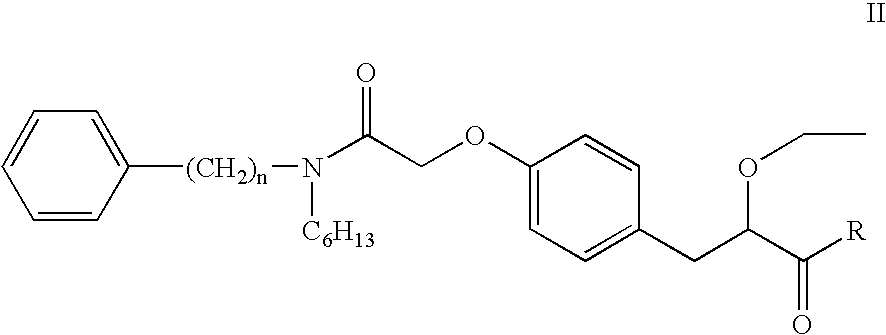
in which n is as previously defined and R represents a protecting group for carboxylic hydroxy group with a de-protecting agent.
10. A compound of formula II

in which n is as previously defined and R represents a protecting group for carboxylic hydroxy group with a de-protecting agent.
11. A compound of formula III

in which R represents a protecting group for carboxylic hydroxy group with a de-protecting agent.
12. A pharmaceutical composition comprising a compound as claimed in claim 1 combined with another therapeutic agent that is useful in the treatment of disorders associated with the development and progress of atherosclerosis such as hypertension, hyperlipidaemias, dyslipidaemias, diabetes and obesity.
13. A pharmaceutical composition comprising a compound as claimed in claim 1 combined with another PPAR modulating agent.
14. A pharmaceutical composition comprising a compound as claimed in claim 1 combined with a cholesterol-lowering agent.
15. A pharmaceutical composition comprising a compound as claimed in claim 1 combined with a HMG-CoA reductase inhibitor.
16. A pharmaceutical composition comprising a compound as claimed in claim 1 combined with atorvastatin or a pharmaceutically acceptable salt, solvate, crystalline form or prodrug thereof.
17. A pharmaceutical composition comprising a compound as claimed in claim 1 combined with rosuvastatin or a pharmaceutically acceptable salt thereof.
18. A pharmaceutical composition comprising a compound as claimed in claim 1 combined with an IBAT inhibitor.
19. A pharmaceutical composition according to claim 18 wherein the IBAT inhibitor is selected from one of:
1,1-dioxo-3,3-dibutyl-5-phenyl-7-methylthio-8-(N-{(R)-1′-phenyl-1′-[N′-(carboxymethyl)carbamoyl]methyl}carbamoylmethoxy)-2,3,4,5-tetrahydro-1,5-benzothiazepine;
1,1-dioxo-3,3-dibutyl-5-phenyl-7-methylthio-8-(N-{(R)-α-[N′-(carboxymethyl)carbamoyl]-4-hydroxybenzyl}carbamoylmethoxy)-2,3,4,5-tetrahydro-1,5-benzothiazepine;
1,1-dioxo-3,3-dibutyl-5-phenyl-7-methylthio-8-(N-{(R)-1′-phenyl-1′-[N′-(2-sulphoethyl)carbamoyl]methyl}carbamoylmethoxy)-2,3,4,5-tetrahydro-1,5-benzothiazepine;
1,1-dioxo-3-butyl-3-ethyl-5-phenyl-7-methylthio-8-(N-{(R)-1′-phenyl-1′-[N′-(2-sulphoethyl)carbamoyl]methyl}carbamoylmethoxy)-2,3,4,5-tetrahydro-1,5-benzothiazepine;
1,1-dioxo-3,3-dibutyl-5-phenyl-7-methylthio-8-(N-{(R)-α-[N′-(2-sulphoethyl)carbamoyl]-4-hydroxybenzyl}carbamoylmethoxy)-2,3,4,5-tetrahydro-1,5-benzothiazepine;
1,1-dioxo-3-butyl-3-ethyl-5-phenyl-7-methylthio-8-(N-{(R)-α-[N′-(2-sulphoethyl)carbamoyl]-4-hydroxybenzyl}carbamoylmethoxy)-2,3,4,5-tetrahydro-1,5-benzothiazepine;
1,1-dioxo-3-butyl-3-ethyl-5-phenyl-7-methylthio-8-(N-{(R)-α-[N′-(2-carboxyethyl)carbamoyl]benzyl}carbamoylmethoxy)-2,3,4,5-tetrahydro-1,5-benzothiazepine;
1,1-dioxo-3,3-dibutyl-5-phenyl-7-methylthio-8-(N-{(R)-α-[N′-(2-carboxyethyl)carbamoyl]-4-hydroxybenzyl}carbamoylmethoxy)-2,3,4,5-tetrahydro-1,5-benzothiazepine;
1,1-dioxo-3-butyl-3-ethyl-5-phenyl-7-methylthio-8-(N-{(R)-α-[N′-(5-carboxypentyl)carbamoyl]benzyl}carbamoylmethoxy)-2,3,4,5-tetrahydro-1,5-benzothiazepine;
1,1-dioxo-3,3-dibutyl-5-phenyl-7-methylthio-8-(N-{(R)-α-[N′-(2-carboxyethyl)carbamoyl]benzyl}carbamoylmethoxy)-2,3,4,5-tetrahydro-1,5-benzothiazepine;
1,1-dioxo-3,3-dibutyl-5-phenyl-7-methylthio-8-(N-{α-[N′-(2-sulphoethyl)carbamoyl]-2-fluorobenzyl}carbamoylmethoxy)-2,3,4,5-tetrahydro-1,5-benzothiazepine;
1,1-dioxo-3-butyl-3-ethyl-5-phenyl-7-methylthio-8-(N-{(R)-α-[N′-(R)-(2-hydroxy-1-carboxyethyl)carbamoyl]benzyl}carbamoylmethoxy)-2,3,4,5-tetrahydro-1,5-benzothiazepine;
1,1-dioxo-3,3-dibutyl-5-phenyl-7-methylthio-8-(N-{(R)-α-[N′-(R)-(2-hydroxy-1-carboxyethyl)carbamoyl]benzyl}carbarnoylmethoxy)-2,3,4,5-tetrahydro-1,5-benzothiazepine;
1,1-dioxo-3,3-dibutyl-5-phenyl-7-methylthio-8-{N-[(R)-α-(N′-{(R)-1-[N″-(R)-(2-hydroxy-1-carboxyethyl)carbamoyl]-2-hydroxyethyl}carbamoyl)benzyl]carbamoylmethoxy}-2,3,4,5-tetrahydro-1,5-benzothiazepine;
1,1-dioxo-3-butyl-3-ethyl-5-phenyl-7-methylthio-8-(N-{α-[N′-(carboxymethyl)carbamoyl]benzyl}carbamoylmethoxy)-2,3,4,5-tetrahydro-1,5-benzothiazepine;
1,1-dioxo-3-butyl-3-ethyl-5-phenyl-7-methylthio-8-(N-{α-[N-((ethoxy)(methyl)phosphoryl-methyl)carbamoyl]benzyl}carbamoylmethoxy)-2,3,4,5-tetrahydro-1,5-benzothiazepine;
1,1-dioxo-3-butyl-3-ethyl-5-phenyl-7-methylthio-8-{N-[(R)-α-(N′-{2-[(hydroxy)(methyl)phosphoryl]ethyl}carbamoyl)benzyl]carbamoylmethoxy}-2,3,4,5-tetrahydro-1,5-benzothiazepine;
1,1-dioxo-3,3-dibutyl-5-phenyl-7-methylthio-8-(N-{(R)-α-[N′-(2-methylthio-1-carboxyethyl)carbamoyl]benzyl}carbamoylmethoxy)-2,3,4,5-tetrahydro-1,5-benzothiazepine;
1,1-dioxo-3,3-dibutyl-5-phenyl-7-methylthio-8-{N-[(R)-α-(N′-{2-[(methyl)(ethyl)phosphoryl]ethyl}carbamoyl)-4-hydroxybenzyl]carbamoylmethoxy}-2,3,4,5-tetrahydro-1,5-benzothiazepine;
1,1-dioxo-3,3-dibutyl-5-phenyl-7-methylthio-8-{N-[(R)-α-(N′-{2-[(methyl)(hydroxy)phosphoryl]ethyl}carbamoyl)-4-hydroxybenzyl]carbamoylmethoxy}-2,3,4,5-tetrahydro-1,5-benzothiazepine;
1,1-dioxo-3,3-dibutyl-5-phenyl-7-methylthio-8-(N-{(R)-α-[(R)-N′-(2-methylsulphinyl-1-carboxyethyl)carbamoyl]benzyl}carbamoylmethoxy)-2,3,4,5-tetrahydro-1,5-benzothiazepine;
1,1-dioxo-3,3-dibutyl-5-phenyl-7-methoxy-8-[N-{(R)-α-[N′-(2-sulphoethyl)carbamoyl]-4-hydroxybenzyl}carbamoylmethoxy]-2,3,4,5-tetrahydro-1,5-benzothiazepine;
1,1-dioxo-3,3-dibutyl-5-phenyl-7-methylthio-8-(N-{(R)-α-[N-((R)-1-carboxy-2-methylthio-ethyl)carbamoyl]-4-hydroxybenzyl}carbamoylmethoxy)-2,3,4,5-tetrahydro-1,2,5-benzothiadiazepine;
1,1-dioxo-3,3-dibutyl-5-phenyl-7-methylthio-8-(N-{(R)-α-[N-((S)-1-carboxy-2-(R)-hydroxypropyl)carbamoyl]-4-hydroxybenzyl}carbamoylmethoxy)-2,3,4,5-tetrahydro-1,2,5-benzothiadiazepine;
1,1-dioxo-3,3-dibutyl-5-phenyl-7-methylthio-8-(N-{(R)-α-[N-((S)-1-carboxy-2-methylpropyl)carbamoyl]-4-hydroxybenzyl}carbamoylmethoxy)-2,3,4,5-tetrahydro-1,2,5-benzothiadiazepine;
1,1-dioxo-3,3-dibutyl-5-phenyl-7-methylthio-8-(N-{(R)-α-[N-((S)-1-carboxybutyl)carbamoyl]-4-hydroxybenzyl}carbamoylmethoxy)-2,3,4,5-tetrahydro-1,2,5-benzothiadiazepine;
1,1-dioxo-3,3-dibutyl-5-phenyl-7-methylthio-8-(N-{(R)-α-[N-((S)-1-carboxypropyl)carbamoyl]benzyl}carbamoylmethoxy)-2,3,4,5-tetrahydro-1,2,5-benzothiadiazepine;
1,1-dioxo-3,3-dibutyl-5-phenyl-7-methylthio-8-(N-{(R)-α-[N-((S)-1-carboxyethyl)carbamoyl]benzyl}carbamoylmethoxy)-2,3,4,5-tetrahydro-1,2,5-benzothiadiazepine;
1,1-dioxo-3,3-dibutyl-5-phenyl-7-methylthio-8-(N-{(R)-α-[N-((S)-1-carboxy-2-(R)-hydroxypropyl)carbamoyl]benzyl}carbamoylmethoxy)-2,3,4,5-tetrahydro-1,2,5-benzothiadiazepine;
1,1-dioxo-3,3-dibutyl-5-phenyl-7-methylthio-8-(N-{(R)-α-[N-(2-sulphoethyl)carbamoyl]-4-hydroxybenzyl}carbamoylmethoxy)-2,3,4,5-tetrahydro-1,2,5-benzothiadiazepine;
1,1-dioxo-3,3-dibutyl-5-phenyl-7-methylthio-8-(N-{(R)-α-[N-((S)-1-carboxyethyl)carbamoyl]-4-hydroxybenzyl}carbamoylmethoxy)-2,3,4,5-tetrahydro-1,2,5-benzothiadiazepine;
1,1-dioxo-3,3-dibutyl-5-phenyl-7-methylthio-8-(N-{(R)-α-[N-((R)-1-carboxy-2-methylthioethyl)carbamoyl]benzyl}carbamoylmethoxy)-2,3,4,5-tetrahydro-1,2,5-benzothiadiazepine;
1,1-dioxo-3,3-dibutyl-5-phenyl-7-methylthio-8-(N-{(R)-α-[N-{(S)-1-[N-((S)-2-hydroxy-1-carboxyethyl)carbamoyl]propyl}carbamoyl]benzyl}carbamoylmethoxy)-2,3,4,5-tetrahydro-1,2,5-benzothiadiazepine;
1,1-dioxo-3,3-dibutyl-5-phenyl-7-methylthio-8-(N-{(R)-α-[N-((S)-1-carboxy-2-methylpropyl)carbamoyl]benzyl}carbamoylmethoxy)-2,3,4,5-tetrahydro-1,2,5-benzothiadiazepine;
1,1-Dioxo-3,3-dibutyl-5-phenyl-7-methylthio-8-(N-{(R)-α-[N-((S)-1-carboxypropyl)carbamoyl]-4-hydroxybenzyl}carbamoylmethoxy)-2,3,4,5-tetrahydro-1,2,5-benzothiadiazepine;
1,1-Dioxo-3,3-dibutyl-5-phenyl-7-methylthio-8-[N-((R/S)-α-{N-[1-(R)-2-(S)-1-hydroxy-1-(3,4-dihydroxyphenyl)prop-2-yl]carbamoyl}-4-hydroxybenzyl)carbamoylmethoxy]-2,3,4,5-tetrahydro-1,2,5-benzothiadiazepine;
1,1-Dioxo-3,3-dibutyl-5-phenyl-7-methylthio-8-(N-{(R)-α-[N-(2-(S)-3-(R)-4-(R)-5-(R)-2,3,4,5,6-pentahydroxyhexyl)carbamoyl]-4-hydroxybenzyl}carbamoylmethoxy)-2,3,4,5-tetrahydro-1,2,5-benzothiadiazepine; and
1,1-Dioxo-3,3-dibutyl-5-phenyl-7-methylthio-8-(N-{(R)-α-[N-(2-(S)-3-(R)-4-(R)-5-(R)-2,3,4,5,6-pentahydroxyhexyl)carbamoyl]benzyl}carbamoylmethoxy)-2,3,4,5-tetrahydro-1,2,5-benzothiadiazepine;
or a pharmaceutically acceptable salt, solvate, solvate of such a salt or a prodrug thereof.
Priority Applications (1)
| Application Number | Priority Date | Filing Date | Title |
|---|---|---|---|
| US11/026,806 US7488844B2 (en) | 2001-12-19 | 2004-12-30 | Therapeutic agents |
Applications Claiming Priority (3)
| Application Number | Priority Date | Filing Date | Title |
|---|---|---|---|
| SE0104334A SE0104334D0 (en) | 2001-12-19 | 2001-12-19 | Therapeutic agents |
| SE0104..4-8 | 2001-12-19 | ||
| PCT/GB2002/005738 WO2003051821A1 (en) | 2001-12-19 | 2002-12-18 | Substituted phenylpropionic acid derivatives as agonists to human peroxisome proliferator-activated receptor alpha (ppar) |
Related Child Applications (1)
| Application Number | Title | Priority Date | Filing Date |
|---|---|---|---|
| US11/026,806 Continuation-In-Part US7488844B2 (en) | 2001-12-19 | 2004-12-30 | Therapeutic agents |
Publications (2)
| Publication Number | Publication Date |
|---|---|
| US20050171204A1 true US20050171204A1 (en) | 2005-08-04 |
| US7514471B2 US7514471B2 (en) | 2009-04-07 |
Family
ID=20286433
Family Applications (2)
| Application Number | Title | Priority Date | Filing Date |
|---|---|---|---|
| US10/499,378 Expired - Fee Related US7256307B2 (en) | 2001-12-19 | 2002-12-18 | Substituted phenypropionic acid derivatives as agonists to human peroxisome proliferator-activated receptor α(PPAR) |
| US10/499,261 Expired - Fee Related US7514471B2 (en) | 2001-12-19 | 2002-12-18 | Substituted phenylpropionic acid derivatives as agonists to human peroxisome proliferator-activated receptor α (PPAR) |
Family Applications Before (1)
| Application Number | Title | Priority Date | Filing Date |
|---|---|---|---|
| US10/499,378 Expired - Fee Related US7256307B2 (en) | 2001-12-19 | 2002-12-18 | Substituted phenypropionic acid derivatives as agonists to human peroxisome proliferator-activated receptor α(PPAR) |
Country Status (30)
| Country | Link |
|---|---|
| US (2) | US7256307B2 (en) |
| EP (2) | EP1458672B1 (en) |
| JP (4) | JP3820249B2 (en) |
| KR (2) | KR20040074092A (en) |
| CN (3) | CN1293044C (en) |
| AR (2) | AR038045A1 (en) |
| AT (2) | ATE338743T1 (en) |
| AU (2) | AU2002366315A1 (en) |
| BR (2) | BR0214986A (en) |
| CA (2) | CA2470491A1 (en) |
| CY (2) | CY1106276T1 (en) |
| DE (2) | DE60214594T2 (en) |
| DK (2) | DK1458672T3 (en) |
| ES (2) | ES2286310T3 (en) |
| HU (2) | HUP0402022A3 (en) |
| IL (3) | IL162331A0 (en) |
| IS (2) | IS7309A (en) |
| MX (2) | MXPA04006004A (en) |
| MY (1) | MY132565A (en) |
| NO (2) | NO20043023L (en) |
| NZ (2) | NZ533274A (en) |
| PL (2) | PL370672A1 (en) |
| PT (2) | PT1458673E (en) |
| RU (2) | RU2300517C2 (en) |
| SE (1) | SE0104334D0 (en) |
| SI (2) | SI1458673T1 (en) |
| TW (2) | TWI253444B (en) |
| UA (2) | UA77987C2 (en) |
| WO (2) | WO2003051821A1 (en) |
| ZA (2) | ZA200404657B (en) |
Cited By (35)
| Publication number | Priority date | Publication date | Assignee | Title |
|---|---|---|---|---|
| US20050143368A1 (en) * | 2002-04-25 | 2005-06-30 | Ingemar Starke | Chemical compounds |
| US20050282822A1 (en) * | 2001-12-19 | 2005-12-22 | Alstermark Eva-Lotte L | Therapeutic agents |
| US20060094884A1 (en) * | 2003-02-25 | 2006-05-04 | Ingemar Starke | Benzothiazepine and benzothiepine derivatives |
| US20060142389A1 (en) * | 2003-06-18 | 2006-06-29 | Astrazeneca Ab | Pharmaceutically useful salts of carboxylic acid derivatives |
| US20060194879A1 (en) * | 2003-06-18 | 2006-08-31 | Astrazeneca Ab | Pharmaceutically useful salts of carboxylic acid derivates |
| US20070066683A1 (en) * | 2003-12-15 | 2007-03-22 | Rafael Ferritto Crespo | Selective peroxisome proliferator activated receptor modulators |
| US7462644B2 (en) | 2002-12-21 | 2008-12-09 | Astrazeneca Ab | Therapeutic agents |
| US9409875B2 (en) | 2013-04-26 | 2016-08-09 | Elobix Ab | Crystal modifications of elobixibat |
| US9688720B2 (en) | 2010-11-04 | 2017-06-27 | Albireo Ab | IBAT inhibitors for the treatment of liver diseases |
| US10183920B2 (en) | 2014-10-24 | 2019-01-22 | Elobix Ab | Crystal modifications of elobixibat |
| US10441605B2 (en) | 2016-02-09 | 2019-10-15 | Albireo Ab | Oral cholestyramine formulation and use thereof |
| US10441604B2 (en) | 2016-02-09 | 2019-10-15 | Albireo Ab | Cholestyramine pellets and methods for preparation thereof |
| US10709755B2 (en) | 2014-06-25 | 2020-07-14 | Elobix Ab | Solid formulation and method for preventing or reducing coloration thereof |
| US10722457B2 (en) | 2018-08-09 | 2020-07-28 | Albireo Ab | Oral cholestyramine formulation and use thereof |
| US10786529B2 (en) | 2016-02-09 | 2020-09-29 | Albireo Ab | Oral cholestyramine formulation and use thereof |
| US10793534B2 (en) | 2018-06-05 | 2020-10-06 | Albireo Ab | Benzothia(di)azepine compounds and their use as bile acid modulators |
| US10881685B2 (en) | 2017-08-09 | 2021-01-05 | Albireo Ab | Cholestyramine granules, oral cholestyramine formulations and use thereof |
| US10941127B2 (en) | 2019-02-06 | 2021-03-09 | Albireo Ab | Benzothiadiazepine compounds and their use as bile acid modulators |
| US10975045B2 (en) | 2019-02-06 | 2021-04-13 | Aibireo AB | Benzothiazepine compounds and their use as bile acid modulators |
| US10975046B2 (en) | 2018-06-20 | 2021-04-13 | Albireo Ab | Crystal modifications of odevixibat |
| US11007142B2 (en) | 2018-08-09 | 2021-05-18 | Albireo Ab | Oral cholestyramine formulation and use thereof |
| US11014898B1 (en) | 2020-12-04 | 2021-05-25 | Albireo Ab | Benzothiazepine compounds and their use as bile acid modulators |
| US11111224B2 (en) | 2019-12-04 | 2021-09-07 | Albireo Ab | Benzothia(di)azepine compounds and their use as bile acid modulators |
| US11180465B2 (en) | 2019-12-04 | 2021-11-23 | Albireo Ab | Benzothia(di)azepine compounds and their use as bile acid modulators |
| US11225466B2 (en) | 2019-12-04 | 2022-01-18 | Albireo Ab | Benzothiadiazepine compounds and their use as bile acid modulators |
| US11267794B2 (en) | 2019-12-04 | 2022-03-08 | Albireo Ab | Benzothia(di)azepine compounds and their use as bile acid modulators |
| US11306064B2 (en) | 2018-06-05 | 2022-04-19 | Albireo Ab | Benzothia(di)azepine compounds and their use as bile acid modulators |
| US11377429B2 (en) | 2020-08-03 | 2022-07-05 | Albireo Ab | Benzothia(di)azepine compounds and their use as bile acid modulators |
| US11549878B2 (en) | 2018-08-09 | 2023-01-10 | Albireo Ab | In vitro method for determining the adsorbing capacity of an insoluble adsorbant |
| US11572350B1 (en) | 2020-12-04 | 2023-02-07 | Albireo Ab | Benzothia(di)azepine compounds and their use as bile acid modulators |
| US11583539B2 (en) | 2020-11-12 | 2023-02-21 | Albireo Ab | Treating progressive familial intrahepatic cholestasis (PFIC) with IBAT inhibitors |
| US11801226B2 (en) | 2018-06-20 | 2023-10-31 | Albireo Ab | Pharmaceutical formulation of odevixibat |
| US12187690B2 (en) | 2019-02-06 | 2025-01-07 | Albireo Ab | Benzothiadiazepine compounds and their use as bile acid modulators |
| US12365658B2 (en) | 2021-06-03 | 2025-07-22 | Albireo Ab | Benzothia(di)azepine compounds and their use as bile acid modulators |
| US12545705B2 (en) | 2010-11-08 | 2026-02-10 | Albireo Ab | IBAT inhibitors for the treatment of liver diseases |
Families Citing this family (28)
| Publication number | Priority date | Publication date | Assignee | Title |
|---|---|---|---|---|
| CN1350521A (en) | 1999-03-05 | 2002-05-22 | 宝洁公司 | C16 unsaturated FP-selective prostaglanding analogs |
| US20020172693A1 (en) | 2000-03-31 | 2002-11-21 | Delong Michell Anthony | Compositions and methods for treating hair loss using non-naturally occurring prostaglandins |
| US20020013294A1 (en) | 2000-03-31 | 2002-01-31 | Delong Mitchell Anthony | Cosmetic and pharmaceutical compositions and methods using 2-decarboxy-2-phosphinico derivatives |
| SE0104334D0 (en) * | 2001-12-19 | 2001-12-19 | Astrazeneca Ab | Therapeutic agents |
| SE0104333D0 (en) | 2001-12-19 | 2001-12-19 | Astrazeneca Ab | Therapeutic agents |
| BR0311834A (en) * | 2002-06-19 | 2005-04-12 | Lilly Co Eli | Compound, pharmaceutical composition, methods for modulating a peroxisome proliferator-activated receptor, for treating and preventing diabetes mellitus in a mammal, and for treating syndrome x in a mammal, and, using a compound or pharmaceutically acceptable salt thereof. |
| CN1319938C (en) | 2002-06-20 | 2007-06-06 | 阿斯特拉曾尼卡有限公司 | Ortho-substituted benzoic acid derivatives for the treatment of insulin resistance |
| FR2848452B1 (en) * | 2002-12-12 | 2007-04-06 | Aventis Pharma Sa | APPLICATION OF INTESTINAL BILIARY ACID RECAPTURE INHIBITORS FOR THE PREVENTION AND TREATMENT OF ALZHEIMER'S DISEASE |
| ES2295816T3 (en) | 2003-01-14 | 2008-04-16 | Arena Pharmaceuticals, Inc. | ARILO AND HETEROARILO 1,2,3-TRISUSTITUTED DERIVATIVES AS METABOLISM MODULATORS, AND PROFILAXIS AND TREATMENT OF DISORDERS RELATED TO THE SAME, SUCH AS DIABETES AND HYPERGLUCEMIA. |
| GB0314134D0 (en) * | 2003-06-18 | 2003-07-23 | Astrazeneca Ab | Therapeutic agents |
| US7132426B2 (en) | 2003-07-14 | 2006-11-07 | Arena Pharmaceuticals, Inc. | Fused-aryl and heteroaryl derivatives as modulators of metabolism and the prophylaxis and treatment of disorders related thereto |
| EP1722780A4 (en) * | 2003-11-26 | 2008-12-17 | Univ Duke | TECHNIQUE FOR PREVENTING OR TREATING GLAUCOMA |
| CN101014595A (en) | 2004-08-11 | 2007-08-08 | 杏林制药株式会社 | Novel cyclic aminobenzoic acid derivative |
| SE0403072D0 (en) * | 2004-12-16 | 2004-12-16 | Astrazeneca Ab | Pharmaceutically useful salts of carboxylic acid derivatives |
| CA2610354C (en) | 2005-05-31 | 2011-03-29 | Pfizer Inc. | Substituted aryloxy-n-bicyclomethyl acetamide compounds as vr1 antagonists |
| WO2007004957A1 (en) * | 2005-07-05 | 2007-01-11 | Astrazeneca Ab | Novel crystalline form |
| AR055073A1 (en) * | 2005-07-11 | 2007-08-01 | Astrazeneca Ab | THERAPEUTIC AGENTS |
| TWI331523B (en) * | 2005-12-08 | 2010-10-11 | Nat Health Research Institutes | Vinylsulfonate compounds |
| CN101054372B (en) * | 2006-04-11 | 2010-10-13 | 中国科学院上海药物研究所 | Pyrimidine substituted benzenepropanoic acid derivative, its preparation method and use in curing polycystic kidney disease |
| KR100847780B1 (en) * | 2006-10-26 | 2008-07-23 | 재단법인서울대학교산학협력재단 | 2-ethoxypropionic acid derivative or pharmaceutically acceptable salt thereof, preparation method thereof and agent for preventing and treating diabetes containing the same as an active ingredient |
| RU2361581C2 (en) | 2007-09-14 | 2009-07-20 | Закрытое Акционерное Общество "Мастерклон" | Pharmaceutical composition possessing antidiabetic, hypolipidemic, hypoglycemic and cholesterol lowering action, way of its reception and ways of treatment of specified diseases |
| US20110293549A1 (en) | 2009-02-03 | 2011-12-01 | Athena Cosmetics, Inc. | Composition, method and kit for enhancing hair |
| EP2619198A1 (en) | 2010-09-22 | 2013-07-31 | Arena Pharmaceuticals, Inc. | Modulators of the gpr119 receptor and the treatment of disorders related thereto |
| PL3242666T3 (en) | 2015-01-06 | 2025-02-17 | Arena Pharmaceuticals, Inc. | Compound for use in treating conditions related to the s1p1 receptor |
| JP6838744B2 (en) | 2015-06-22 | 2021-03-03 | アリーナ ファーマシューティカルズ, インコーポレイテッド | (R) -2- (7- (4-cyclopentyl-3- (trifluoromethyl) benzyloxy) -1,2,3,4-tetrahydrocyclopenta [b] indole-for use in S1P1 receptor-related disorders Crystalline L-arginine salt of 3-yl) acetic acid (Compound 1) |
| AU2018220521A1 (en) | 2017-02-16 | 2019-09-05 | Arena Pharmaceuticals, Inc. | Compounds and methods for treatment of primary biliary cholangitis |
| KR102859841B1 (en) | 2018-06-06 | 2025-09-12 | 아레나 파마슈티칼스, 인크. | Treatment of conditions associated with the S1P1 receptor |
| WO2023039276A1 (en) * | 2021-09-13 | 2023-03-16 | Curtails Llc | Use of ibat inhibitors and antimicrobials for the treatment of diseases |
Citations (17)
| Publication number | Priority date | Publication date | Assignee | Title |
|---|---|---|---|---|
| US2928840A (en) * | 1958-11-26 | 1960-03-15 | Us Vitamin Pharm Corp | 3-(o-substituted phenyl) oxazolidinediones and process therefor |
| US3244398A (en) * | 1963-10-28 | 1966-04-05 | Scaramucci Domer | Composite seat ball valve |
| US4735959A (en) * | 1981-01-10 | 1988-04-05 | Dr. Karl Thomae Gmbh | Carboxylic acid amides and pharmaceutical compositions containing them |
| US5210208A (en) * | 1990-09-24 | 1993-05-11 | Rhone-Poulenc Rorer Pharmaceuticals Inc. | Disubstituted aryl compounds exhibiting selective leukotriene b4 antagonist activity |
| US5216167A (en) * | 1983-12-30 | 1993-06-01 | Dr. Karl Thomae Gmbh | Phenylacetic acid benzylamides |
| US6143769A (en) * | 1983-12-30 | 2000-11-07 | Karl Thomae Gmbh | Phenylacetic acid benzylamides |
| US6258850B1 (en) * | 1998-06-04 | 2001-07-10 | Astrazeneca Ab | 3-aryl-2-hydroxypropionic acid derivative (I) |
| US6410585B1 (en) * | 1997-08-28 | 2002-06-25 | Scott D. Larsen | Inhibitors of protein tyrosine phosphatase |
| US6596751B2 (en) * | 1999-04-06 | 2003-07-22 | Sankyo Company Limited | α-substituted carboxylic acid derivatives |
| US6884821B1 (en) * | 1999-10-01 | 2005-04-26 | Eisai Co., Ltd. | Carboxylic acid derivatives and drugs containing the same |
| US20050131068A1 (en) * | 2002-12-21 | 2005-06-16 | Alstermark Eva-Lotte L. | Therapeutic agents |
| US20050148656A1 (en) * | 2003-06-18 | 2005-07-07 | Lanna Li | Carboxylic derivates |
| US20060111406A1 (en) * | 2002-06-19 | 2006-05-25 | Eli Lilly And Company | Amide linker peroxisome proliferator activated receptor modulators |
| US20060142392A1 (en) * | 2003-06-18 | 2006-06-29 | Astrazeneca Ab | Process for preparing (2s)-3-(4-{2-[amino]-2-oxoethoxy}phenyl)-2-ethoxypropanoic acid derivatives |
| US20060142389A1 (en) * | 2003-06-18 | 2006-06-29 | Astrazeneca Ab | Pharmaceutically useful salts of carboxylic acid derivatives |
| US20060194879A1 (en) * | 2003-06-18 | 2006-08-31 | Astrazeneca Ab | Pharmaceutically useful salts of carboxylic acid derivates |
| US7256307B2 (en) * | 2001-12-19 | 2007-08-14 | Astrazeneca Ab | Substituted phenypropionic acid derivatives as agonists to human peroxisome proliferator-activated receptor α(PPAR) |
Family Cites Families (20)
| Publication number | Priority date | Publication date | Assignee | Title |
|---|---|---|---|---|
| DE266121C (en) | ||||
| BE489216A (en) | 1948-06-05 | 1900-01-01 | ||
| GB1081471A (en) | 1963-09-13 | 1967-08-31 | Stauffer Chemical Co | Glycol amide derivatives and use thereof in controlling weed growth |
| AT307640B (en) | 1970-06-18 | 1973-05-25 | Richter Gedeon Vegyeszet | Process for the production of new 17-aza-steroids and their salts |
| BE792364A (en) | 1971-12-06 | 1973-06-06 | Basf Ag | SUBSTITUTION DERIVATIVES OF SULFONYLGLYCOLANILIDE |
| DE2349256C2 (en) | 1973-10-01 | 1985-08-01 | Basf Ag, 6700 Ludwigshafen | O-alkylsulfonyl-glycolic acid anilides and herbicides containing them |
| DE2828222A1 (en) | 1978-06-28 | 1980-01-10 | Bayer Ag | COUNTERPROTECTOR FOR THE PROTECTION OF CULTURAL PLANTS FROM HERBICIDE DAMAGE |
| US5958792A (en) | 1995-06-07 | 1999-09-28 | Chiron Corporation | Combinatorial libraries of substrate-bound cyclic organic compounds |
| DE69824433D1 (en) | 1997-08-28 | 2004-07-15 | Biovitrum Ab | Proteintyrosinphosphatase inhibitoren |
| CA2309792A1 (en) | 1997-11-12 | 1999-05-20 | William C. Shakespeare | Novel signal transduction inhibitors, compositions containing them |
| WO2000061582A1 (en) * | 1999-04-08 | 2000-10-19 | Sankyo Company, Limited | Substituted fused imidazole derivatives |
| WO2000061585A2 (en) | 1999-04-14 | 2000-10-19 | The University Of British Columbia (Ubc) | 1,3-dipolar cycloadditions to polypyrrolic macrocycles |
| AU3958200A (en) | 1999-04-20 | 2000-11-02 | Novo Nordisk A/S | New compounds, their preparation and use |
| CN1331862C (en) | 1999-04-28 | 2007-08-15 | 萨诺费-阿文蒂斯德国有限公司 | Diarylic Acid Derivatives as PPAR Receptor Ligands |
| JP4618845B2 (en) * | 1999-06-09 | 2011-01-26 | 杏林製薬株式会社 | Substituted phenylpropionic acid derivatives as human peroxisome proliferator-activated receptor (PPAR) alpha agonists |
| JP2001261612A (en) * | 2000-03-22 | 2001-09-26 | Mitsui Chemicals Inc | Catecholpropionic acid derivative and nuclear receptor agonist containing the same as active ingredient |
| JPWO2002044130A1 (en) | 2000-11-29 | 2004-04-02 | 杏林製薬株式会社 | Substituted carboxylic acid derivatives |
| WO2002044127A1 (en) * | 2000-11-29 | 2002-06-06 | Kyorin Pharmaceutical Co., Ltd. | Substituted carboxylic acid derivatives |
| WO2002064549A1 (en) | 2001-02-15 | 2002-08-22 | Pfizer Products Inc. | Ppar agonists |
| WO2002083616A1 (en) * | 2001-04-10 | 2002-10-24 | Sankyo Company, Limited | α-SUBSTITUTED φ-ARYLFATTY ACID DERIVATIVE |
-
2001
- 2001-12-19 SE SE0104334A patent/SE0104334D0/en unknown
-
2002
- 2002-12-18 EP EP02788145A patent/EP1458672B1/en not_active Expired - Lifetime
- 2002-12-18 AT AT02804964T patent/ATE338743T1/en not_active IP Right Cessation
- 2002-12-18 IL IL16233102A patent/IL162331A0/en unknown
- 2002-12-18 HU HU0402022A patent/HUP0402022A3/en unknown
- 2002-12-18 ES ES02788145T patent/ES2286310T3/en not_active Expired - Lifetime
- 2002-12-18 TW TW091136518A patent/TWI253444B/en not_active IP Right Cessation
- 2002-12-18 EP EP02804964A patent/EP1458673B1/en not_active Expired - Lifetime
- 2002-12-18 PT PT02804964T patent/PT1458673E/en unknown
- 2002-12-18 MX MXPA04006004A patent/MXPA04006004A/en active IP Right Grant
- 2002-12-18 KR KR10-2004-7009501A patent/KR20040074092A/en not_active Withdrawn
- 2002-12-18 CA CA002470491A patent/CA2470491A1/en not_active Abandoned
- 2002-12-18 US US10/499,378 patent/US7256307B2/en not_active Expired - Fee Related
- 2002-12-18 DK DK02788145T patent/DK1458672T3/en active
- 2002-12-18 RU RU2004116918/04A patent/RU2300517C2/en not_active IP Right Cessation
- 2002-12-18 PT PT02788145T patent/PT1458672E/en unknown
- 2002-12-18 AU AU2002366315A patent/AU2002366315A1/en not_active Abandoned
- 2002-12-18 PL PL02370672A patent/PL370672A1/en not_active Application Discontinuation
- 2002-12-18 DK DK02804964T patent/DK1458673T3/en active
- 2002-12-18 US US10/499,261 patent/US7514471B2/en not_active Expired - Fee Related
- 2002-12-18 HU HU0402133A patent/HUP0402133A3/en unknown
- 2002-12-18 CN CNB028281233A patent/CN1293044C/en not_active Expired - Fee Related
- 2002-12-18 BR BR0214986-9A patent/BR0214986A/en not_active IP Right Cessation
- 2002-12-18 BR BR0214988-5A patent/BR0214988A/en not_active IP Right Cessation
- 2002-12-18 JP JP2003552710A patent/JP3820249B2/en not_active Expired - Lifetime
- 2002-12-18 IL IL16233002A patent/IL162330A0/en unknown
- 2002-12-18 NZ NZ533274A patent/NZ533274A/en unknown
- 2002-12-18 CN CNB2006100071731A patent/CN100406427C/en not_active Expired - Fee Related
- 2002-12-18 AT AT02788145T patent/ATE363466T1/en not_active IP Right Cessation
- 2002-12-18 DE DE60214594T patent/DE60214594T2/en not_active Expired - Lifetime
- 2002-12-18 MY MYPI20024740A patent/MY132565A/en unknown
- 2002-12-18 JP JP2003552709A patent/JP3784804B2/en not_active Expired - Fee Related
- 2002-12-18 WO PCT/GB2002/005738 patent/WO2003051821A1/en not_active Ceased
- 2002-12-18 NZ NZ533276A patent/NZ533276A/en unknown
- 2002-12-18 SI SI200230424T patent/SI1458673T1/en unknown
- 2002-12-18 AU AU2002352427A patent/AU2002352427A1/en not_active Abandoned
- 2002-12-18 RU RU2004116917/04A patent/RU2303031C2/en not_active IP Right Cessation
- 2002-12-18 CA CA002469302A patent/CA2469302A1/en not_active Abandoned
- 2002-12-18 UA UA20040604245A patent/UA77987C2/en unknown
- 2002-12-18 UA UA20040604246A patent/UA77460C2/en unknown
- 2002-12-18 CN CNA028281551A patent/CN1620423A/en active Pending
- 2002-12-18 SI SI200230570T patent/SI1458672T1/en unknown
- 2002-12-18 KR KR10-2004-7009517A patent/KR20040074094A/en not_active Ceased
- 2002-12-18 DE DE60220441T patent/DE60220441T2/en not_active Expired - Fee Related
- 2002-12-18 ES ES02804964T patent/ES2271381T3/en not_active Expired - Lifetime
- 2002-12-18 PL PL02370673A patent/PL370673A1/en not_active Application Discontinuation
- 2002-12-18 WO PCT/GB2002/005744 patent/WO2003051822A1/en not_active Ceased
- 2002-12-18 TW TW091136519A patent/TWI255807B/en not_active IP Right Cessation
- 2002-12-18 MX MXPA04006003A patent/MXPA04006003A/en active IP Right Grant
- 2002-12-19 AR ARP020105002A patent/AR038045A1/en unknown
- 2002-12-19 AR ARP020105004A patent/AR038047A1/en not_active Application Discontinuation
-
2004
- 2004-06-03 IL IL162330A patent/IL162330A/en not_active IP Right Cessation
- 2004-06-11 ZA ZA200404657A patent/ZA200404657B/en unknown
- 2004-06-11 ZA ZA200404658A patent/ZA200404658B/en unknown
- 2004-06-14 IS IS7309A patent/IS7309A/en unknown
- 2004-06-15 IS IS7313A patent/IS7313A/en unknown
- 2004-07-15 NO NO20043023A patent/NO20043023L/en not_active Application Discontinuation
- 2004-07-16 NO NO20043164A patent/NO20043164L/en not_active Application Discontinuation
-
2005
- 2005-08-16 JP JP2005235794A patent/JP2005336209A/en active Pending
-
2006
- 2006-04-27 JP JP2006123399A patent/JP2006298924A/en active Pending
- 2006-12-05 CY CY20061101743T patent/CY1106276T1/en unknown
-
2007
- 2007-08-01 CY CY20071101028T patent/CY1106784T1/en unknown
Patent Citations (19)
| Publication number | Priority date | Publication date | Assignee | Title |
|---|---|---|---|---|
| US2928840A (en) * | 1958-11-26 | 1960-03-15 | Us Vitamin Pharm Corp | 3-(o-substituted phenyl) oxazolidinediones and process therefor |
| US3244398A (en) * | 1963-10-28 | 1966-04-05 | Scaramucci Domer | Composite seat ball valve |
| US4735959A (en) * | 1981-01-10 | 1988-04-05 | Dr. Karl Thomae Gmbh | Carboxylic acid amides and pharmaceutical compositions containing them |
| US5216167A (en) * | 1983-12-30 | 1993-06-01 | Dr. Karl Thomae Gmbh | Phenylacetic acid benzylamides |
| US6143769A (en) * | 1983-12-30 | 2000-11-07 | Karl Thomae Gmbh | Phenylacetic acid benzylamides |
| US5210208A (en) * | 1990-09-24 | 1993-05-11 | Rhone-Poulenc Rorer Pharmaceuticals Inc. | Disubstituted aryl compounds exhibiting selective leukotriene b4 antagonist activity |
| US6410585B1 (en) * | 1997-08-28 | 2002-06-25 | Scott D. Larsen | Inhibitors of protein tyrosine phosphatase |
| US6258850B1 (en) * | 1998-06-04 | 2001-07-10 | Astrazeneca Ab | 3-aryl-2-hydroxypropionic acid derivative (I) |
| US6596751B2 (en) * | 1999-04-06 | 2003-07-22 | Sankyo Company Limited | α-substituted carboxylic acid derivatives |
| US6884821B1 (en) * | 1999-10-01 | 2005-04-26 | Eisai Co., Ltd. | Carboxylic acid derivatives and drugs containing the same |
| US20050282822A1 (en) * | 2001-12-19 | 2005-12-22 | Alstermark Eva-Lotte L | Therapeutic agents |
| US7256307B2 (en) * | 2001-12-19 | 2007-08-14 | Astrazeneca Ab | Substituted phenypropionic acid derivatives as agonists to human peroxisome proliferator-activated receptor α(PPAR) |
| US20060111406A1 (en) * | 2002-06-19 | 2006-05-25 | Eli Lilly And Company | Amide linker peroxisome proliferator activated receptor modulators |
| US20050131068A1 (en) * | 2002-12-21 | 2005-06-16 | Alstermark Eva-Lotte L. | Therapeutic agents |
| US20050148656A1 (en) * | 2003-06-18 | 2005-07-07 | Lanna Li | Carboxylic derivates |
| US20060142392A1 (en) * | 2003-06-18 | 2006-06-29 | Astrazeneca Ab | Process for preparing (2s)-3-(4-{2-[amino]-2-oxoethoxy}phenyl)-2-ethoxypropanoic acid derivatives |
| US20060142389A1 (en) * | 2003-06-18 | 2006-06-29 | Astrazeneca Ab | Pharmaceutically useful salts of carboxylic acid derivatives |
| US20060194879A1 (en) * | 2003-06-18 | 2006-08-31 | Astrazeneca Ab | Pharmaceutically useful salts of carboxylic acid derivates |
| US20060258866A1 (en) * | 2003-06-18 | 2006-11-16 | Astrazeneca Ab, A Sweden Corporation | Carboxylic derivates |
Cited By (72)
| Publication number | Priority date | Publication date | Assignee | Title |
|---|---|---|---|---|
| US7488844B2 (en) | 2001-12-19 | 2009-02-10 | Astrazeneca Ab | Therapeutic agents |
| US20050282822A1 (en) * | 2001-12-19 | 2005-12-22 | Alstermark Eva-Lotte L | Therapeutic agents |
| US20050143368A1 (en) * | 2002-04-25 | 2005-06-30 | Ingemar Starke | Chemical compounds |
| US7238684B2 (en) | 2002-04-25 | 2007-07-03 | Astrazeneca Ab | Benzothiadiazepine derivatives, processes for their preparation and pharmaceutical compositions containing them |
| US7462644B2 (en) | 2002-12-21 | 2008-12-09 | Astrazeneca Ab | Therapeutic agents |
| US20060094884A1 (en) * | 2003-02-25 | 2006-05-04 | Ingemar Starke | Benzothiazepine and benzothiepine derivatives |
| US8067584B2 (en) | 2003-02-25 | 2011-11-29 | Albireo Ab | Benzothiazepine derivatives |
| US20060142389A1 (en) * | 2003-06-18 | 2006-06-29 | Astrazeneca Ab | Pharmaceutically useful salts of carboxylic acid derivatives |
| US20060194879A1 (en) * | 2003-06-18 | 2006-08-31 | Astrazeneca Ab | Pharmaceutically useful salts of carboxylic acid derivates |
| US20070244198A1 (en) * | 2003-06-18 | 2007-10-18 | Lanna Li | Carboxylic Derivatives |
| US20070066683A1 (en) * | 2003-12-15 | 2007-03-22 | Rafael Ferritto Crespo | Selective peroxisome proliferator activated receptor modulators |
| US7321056B2 (en) * | 2003-12-15 | 2008-01-22 | Eli Lilly And Company | Selective peroxisome proliferator activated receptor modulators |
| US11261212B2 (en) | 2010-11-04 | 2022-03-01 | Albireo Ab | IBAT inhibitors for the treatment of liver diseases |
| US9688720B2 (en) | 2010-11-04 | 2017-06-27 | Albireo Ab | IBAT inhibitors for the treatment of liver diseases |
| US9694018B1 (en) | 2010-11-04 | 2017-07-04 | Albireo Ab | IBAT inhibitors for the treatment of liver disease |
| US12187812B2 (en) | 2010-11-04 | 2025-01-07 | Albireo Ab | IBAT inhibitors for the treatment of liver diseases |
| US10981952B2 (en) | 2010-11-04 | 2021-04-20 | Albireo Ab | IBAT inhibitors for the treatment of liver diseases |
| US10000528B2 (en) | 2010-11-04 | 2018-06-19 | Albireo Ab | IBAT inhibitors for the treatment of liver diseases |
| US10011633B2 (en) | 2010-11-04 | 2018-07-03 | Albireo Ab | IBAT inhibitors for the treatment of liver diseases |
| US10093697B2 (en) | 2010-11-04 | 2018-10-09 | Albireo Ab | IBAT inhibitors for the treatment of liver diseases |
| US11732006B2 (en) | 2010-11-04 | 2023-08-22 | Albireo Ab | IBAT inhibitors for the treatment of liver diseases |
| US10221212B2 (en) | 2010-11-04 | 2019-03-05 | Albireo Ab | IBAT inhibitors for the treatment of liver diseases |
| US10487111B2 (en) | 2010-11-04 | 2019-11-26 | Albireo Ab | IBAT inhibitors for the treatment of liver diseases |
| US12545705B2 (en) | 2010-11-08 | 2026-02-10 | Albireo Ab | IBAT inhibitors for the treatment of liver diseases |
| US9409875B2 (en) | 2013-04-26 | 2016-08-09 | Elobix Ab | Crystal modifications of elobixibat |
| US9701649B2 (en) | 2013-04-26 | 2017-07-11 | Elobix Ab | Crystal modifications of elobixibat |
| US9745276B2 (en) | 2013-04-26 | 2017-08-29 | Elobix Ab | Crystal modifications of elobixibat |
| US11844822B2 (en) | 2014-06-25 | 2023-12-19 | Elobix Ab | Solid formulation and method for preventing or reducing coloration thereof |
| US10709755B2 (en) | 2014-06-25 | 2020-07-14 | Elobix Ab | Solid formulation and method for preventing or reducing coloration thereof |
| US10183920B2 (en) | 2014-10-24 | 2019-01-22 | Elobix Ab | Crystal modifications of elobixibat |
| US10519120B2 (en) | 2014-10-24 | 2019-12-31 | Elobix Ab | Crystal modifications of elobixibat |
| US10758563B2 (en) | 2016-02-09 | 2020-09-01 | Albireo Ab | Oral cholestyramine formulation and use thereof |
| US10610543B2 (en) | 2016-02-09 | 2020-04-07 | Albireo Ab | Cholestyramine pellets and methods for preparation thereof |
| US10799527B2 (en) | 2016-02-09 | 2020-10-13 | Albireo Ab | Oral cholestyramine formulation and use thereof |
| US10864228B2 (en) | 2016-02-09 | 2020-12-15 | Albireo Ab | Oral cholestyramine formulation and use thereof |
| US10493096B2 (en) | 2016-02-09 | 2019-12-03 | Albireo Ab | Oral cholestyramine formulation and use thereof |
| US10441605B2 (en) | 2016-02-09 | 2019-10-15 | Albireo Ab | Oral cholestyramine formulation and use thereof |
| US10786529B2 (en) | 2016-02-09 | 2020-09-29 | Albireo Ab | Oral cholestyramine formulation and use thereof |
| US10441604B2 (en) | 2016-02-09 | 2019-10-15 | Albireo Ab | Cholestyramine pellets and methods for preparation thereof |
| US10881685B2 (en) | 2017-08-09 | 2021-01-05 | Albireo Ab | Cholestyramine granules, oral cholestyramine formulations and use thereof |
| US10793534B2 (en) | 2018-06-05 | 2020-10-06 | Albireo Ab | Benzothia(di)azepine compounds and their use as bile acid modulators |
| US11306064B2 (en) | 2018-06-05 | 2022-04-19 | Albireo Ab | Benzothia(di)azepine compounds and their use as bile acid modulators |
| US10975046B2 (en) | 2018-06-20 | 2021-04-13 | Albireo Ab | Crystal modifications of odevixibat |
| US12508234B2 (en) | 2018-06-20 | 2025-12-30 | Albireo Ab | Pharmaceutical formulation of odevixibat |
| US12091394B2 (en) | 2018-06-20 | 2024-09-17 | Albireo Ab | Crystal modifications of odevixibat |
| US11801226B2 (en) | 2018-06-20 | 2023-10-31 | Albireo Ab | Pharmaceutical formulation of odevixibat |
| US11365182B2 (en) | 2018-06-20 | 2022-06-21 | Albireo Ab | Crystal modifications of odevixibat |
| US11802115B2 (en) | 2018-06-20 | 2023-10-31 | Albireo Ab | Pharmaceutical formulation of odevixibat |
| US11007142B2 (en) | 2018-08-09 | 2021-05-18 | Albireo Ab | Oral cholestyramine formulation and use thereof |
| US10722457B2 (en) | 2018-08-09 | 2020-07-28 | Albireo Ab | Oral cholestyramine formulation and use thereof |
| US11549878B2 (en) | 2018-08-09 | 2023-01-10 | Albireo Ab | In vitro method for determining the adsorbing capacity of an insoluble adsorbant |
| US10941127B2 (en) | 2019-02-06 | 2021-03-09 | Albireo Ab | Benzothiadiazepine compounds and their use as bile acid modulators |
| US11773071B2 (en) | 2019-02-06 | 2023-10-03 | Albireo Ab | Benzothiazepine compounds and their use as bile acid modulators |
| US11603359B2 (en) | 2019-02-06 | 2023-03-14 | Albireo Ab | Benzothiadiazepine compounds and their use as bile acid modulators |
| US10975045B2 (en) | 2019-02-06 | 2021-04-13 | Aibireo AB | Benzothiazepine compounds and their use as bile acid modulators |
| US12187690B2 (en) | 2019-02-06 | 2025-01-07 | Albireo Ab | Benzothiadiazepine compounds and their use as bile acid modulators |
| US12202809B2 (en) | 2019-12-04 | 2025-01-21 | Albireo Ab | Benzothia(di)azepine compounds and their use as bile acid modulators |
| US11180465B2 (en) | 2019-12-04 | 2021-11-23 | Albireo Ab | Benzothia(di)azepine compounds and their use as bile acid modulators |
| US11267794B2 (en) | 2019-12-04 | 2022-03-08 | Albireo Ab | Benzothia(di)azepine compounds and their use as bile acid modulators |
| US11225466B2 (en) | 2019-12-04 | 2022-01-18 | Albireo Ab | Benzothiadiazepine compounds and their use as bile acid modulators |
| US11891368B2 (en) | 2019-12-04 | 2024-02-06 | Albireo Ab | Benzothia(di)azepine compounds and their use as bile acid modulators |
| US12024495B2 (en) | 2019-12-04 | 2024-07-02 | Albireo Ab | Benzothiazepine compounds and their use as bile acid modulators |
| US12060338B2 (en) | 2019-12-04 | 2024-08-13 | Albireo Ab | Benzothia(di)azepine compounds and their use as bile acid modulators |
| US11708340B2 (en) | 2019-12-04 | 2023-07-25 | Albireo Ab | Benzothia(di)azepine compounds and their use as bile acid modulators |
| US11111224B2 (en) | 2019-12-04 | 2021-09-07 | Albireo Ab | Benzothia(di)azepine compounds and their use as bile acid modulators |
| US11377429B2 (en) | 2020-08-03 | 2022-07-05 | Albireo Ab | Benzothia(di)azepine compounds and their use as bile acid modulators |
| US11583539B2 (en) | 2020-11-12 | 2023-02-21 | Albireo Ab | Treating progressive familial intrahepatic cholestasis (PFIC) with IBAT inhibitors |
| US12447156B2 (en) | 2020-11-12 | 2025-10-21 | Albireo Ab | Treating progressive familial intrahepatic cholestasis (PFIC) with IBAT inhibitors |
| US11572350B1 (en) | 2020-12-04 | 2023-02-07 | Albireo Ab | Benzothia(di)azepine compounds and their use as bile acid modulators |
| US12134606B2 (en) | 2020-12-04 | 2024-11-05 | Albireo Ab | Benzothia(di)azepine compounds and their use as bile acid modulators |
| US11014898B1 (en) | 2020-12-04 | 2021-05-25 | Albireo Ab | Benzothiazepine compounds and their use as bile acid modulators |
| US12365658B2 (en) | 2021-06-03 | 2025-07-22 | Albireo Ab | Benzothia(di)azepine compounds and their use as bile acid modulators |
Also Published As
Similar Documents
| Publication | Publication Date | Title |
|---|---|---|
| US7514471B2 (en) | Substituted phenylpropionic acid derivatives as agonists to human peroxisome proliferator-activated receptor α (PPAR) | |
| US7462644B2 (en) | Therapeutic agents | |
| US7488844B2 (en) | Therapeutic agents | |
| US7276539B2 (en) | 3-Phenyl-2-arylalkylthiopropionic acid derivatives as selective agonists of ppar-alpha | |
| EP1517679B1 (en) | Ortho-substituted benzoic acid derivatives for the treatment of insulin resistance | |
| US7351858B2 (en) | Ortho-substituted benzoic acid derivatives for the treatment of insulin resistance | |
| HK1068604B (en) | Substituted phenylpropionic acid derivatives as agonists to human peroxisome proliferator-activated receptor alpha (ppar) | |
| HK1068870B (en) | Substituted phenylpropionic acid derivatives as agonists to human peroxisome proliferator-activated receptor alpha (ppar) | |
| HK1068866B (en) | 3-phenyl-2-arylalkylthiopropionic acid derivatives as selective agonists of ppar-alpha |
Legal Events
| Date | Code | Title | Description |
|---|---|---|---|
| AS | Assignment |
Owner name: ASTRAZENECA AB, SWEDEN Free format text: ASSIGNMENT OF ASSIGNORS INTEREST;ASSIGNORS:LINDSTEDT ALSTERMARK, EVA-LOTTE;OLSSON, ANNA CHRISTINA;LI, LANNA;REEL/FRAME:015838/0288;SIGNING DATES FROM 20040608 TO 20040609 |
|
| CC | Certificate of correction | ||
| FPAY | Fee payment |
Year of fee payment: 4 |
|
| REMI | Maintenance fee reminder mailed | ||
| LAPS | Lapse for failure to pay maintenance fees | ||
| STCH | Information on status: patent discontinuation |
Free format text: PATENT EXPIRED DUE TO NONPAYMENT OF MAINTENANCE FEES UNDER 37 CFR 1.362 |
|
| STCH | Information on status: patent discontinuation |
Free format text: PATENT EXPIRED DUE TO NONPAYMENT OF MAINTENANCE FEES UNDER 37 CFR 1.362 |
|
| FP | Lapsed due to failure to pay maintenance fee |
Effective date: 20170407 |