US20050085500A1 - Method of preparing 4-amino-1H- imidazo(4,5-c)quinolines and acid addition salts thereof - Google Patents
Method of preparing 4-amino-1H- imidazo(4,5-c)quinolines and acid addition salts thereof Download PDFInfo
- Publication number
- US20050085500A1 US20050085500A1 US10/956,465 US95646504A US2005085500A1 US 20050085500 A1 US20050085500 A1 US 20050085500A1 US 95646504 A US95646504 A US 95646504A US 2005085500 A1 US2005085500 A1 US 2005085500A1
- Authority
- US
- United States
- Prior art keywords
- formula
- imidazo
- quinoline
- amino
- hydrogen
- Prior art date
- Legal status (The legal status is an assumption and is not a legal conclusion. Google has not performed a legal analysis and makes no representation as to the accuracy of the status listed.)
- Granted
Links
- 239000002253 acid Substances 0.000 title claims abstract description 82
- 238000000034 method Methods 0.000 title claims abstract description 81
- 150000003839 salts Chemical class 0.000 title claims abstract description 50
- HQBUPOAKJGJGCD-UHFFFAOYSA-N 3h-imidazo[4,5-c]quinolin-4-amine Chemical class NC1=NC2=CC=CC=C2C2=C1N=CN2 HQBUPOAKJGJGCD-UHFFFAOYSA-N 0.000 title claims abstract description 24
- SHKUAAUCZDOPDI-UHFFFAOYSA-N 4-chloro-3h-imidazo[4,5-c]quinoline Chemical compound ClC1=NC2=CC=CC=C2C2=C1N=CN2 SHKUAAUCZDOPDI-UHFFFAOYSA-N 0.000 claims abstract description 13
- 230000003301 hydrolyzing effect Effects 0.000 claims abstract description 11
- 229910052739 hydrogen Inorganic materials 0.000 claims description 56
- 239000001257 hydrogen Substances 0.000 claims description 56
- DOUYETYNHWVLEO-UHFFFAOYSA-N imiquimod Chemical compound C1=CC=CC2=C3N(CC(C)C)C=NC3=C(N)N=C21 DOUYETYNHWVLEO-UHFFFAOYSA-N 0.000 claims description 44
- 150000002431 hydrogen Chemical class 0.000 claims description 35
- 125000000008 (C1-C10) alkyl group Chemical group 0.000 claims description 34
- HEMHJVSKTPXQMS-UHFFFAOYSA-M Sodium hydroxide Chemical compound [OH-].[Na+] HEMHJVSKTPXQMS-UHFFFAOYSA-M 0.000 claims description 30
- 239000000203 mixture Substances 0.000 claims description 26
- 238000006243 chemical reaction Methods 0.000 claims description 24
- UFHFLCQGNIYNRP-UHFFFAOYSA-N Hydrogen Chemical compound [H][H] UFHFLCQGNIYNRP-UHFFFAOYSA-N 0.000 claims description 21
- 125000006736 (C6-C20) aryl group Chemical group 0.000 claims description 20
- WGQKYBSKWIADBV-UHFFFAOYSA-N benzylamine Chemical compound NCC1=CC=CC=C1 WGQKYBSKWIADBV-UHFFFAOYSA-N 0.000 claims description 20
- QAOWNCQODCNURD-UHFFFAOYSA-N Sulfuric acid Chemical compound OS(O)(=O)=O QAOWNCQODCNURD-UHFFFAOYSA-N 0.000 claims description 15
- 125000003118 aryl group Chemical group 0.000 claims description 15
- KWYUFKZDYYNOTN-UHFFFAOYSA-M Potassium hydroxide Chemical compound [OH-].[K+] KWYUFKZDYYNOTN-UHFFFAOYSA-M 0.000 claims description 12
- 125000000959 isobutyl group Chemical group [H]C([H])([H])C([H])(C([H])([H])[H])C([H])([H])* 0.000 claims description 12
- 125000006374 C2-C10 alkenyl group Chemical group 0.000 claims description 11
- 125000000392 cycloalkenyl group Chemical group 0.000 claims description 11
- 125000000753 cycloalkyl group Chemical group 0.000 claims description 10
- 125000005865 C2-C10alkynyl group Chemical group 0.000 claims description 7
- AFVFQIVMOAPDHO-UHFFFAOYSA-N Methanesulfonic acid Chemical compound CS(O)(=O)=O AFVFQIVMOAPDHO-UHFFFAOYSA-N 0.000 claims description 6
- NVSYANRBXPURRQ-UHFFFAOYSA-N naphthalen-1-ylmethanamine Chemical compound C1=CC=C2C(CN)=CC=CC2=C1 NVSYANRBXPURRQ-UHFFFAOYSA-N 0.000 claims description 5
- QOWBXWFYRXSBAS-UHFFFAOYSA-N (2,4-dimethoxyphenyl)methanamine Chemical compound COC1=CC=C(CN)C(OC)=C1 QOWBXWFYRXSBAS-UHFFFAOYSA-N 0.000 claims description 4
- DYFFAVRFJWYYQO-UHFFFAOYSA-N n-methyl-n-phenylaniline Chemical compound C=1C=CC=CC=1N(C)C1=CC=CC=C1 DYFFAVRFJWYYQO-UHFFFAOYSA-N 0.000 claims description 4
- 229940098779 methanesulfonic acid Drugs 0.000 claims description 3
- ITMCEJHCFYSIIV-UHFFFAOYSA-N triflic acid Chemical compound OS(=O)(=O)C(F)(F)F ITMCEJHCFYSIIV-UHFFFAOYSA-N 0.000 claims description 3
- 150000001875 compounds Chemical class 0.000 description 45
- 238000006460 hydrolysis reaction Methods 0.000 description 31
- -1 2,3-dihydroxypropyl Chemical group 0.000 description 26
- 238000007327 hydrogenolysis reaction Methods 0.000 description 26
- 0 [1*]N1C([2*])=NC2=C1C1=CC=CC=C1N=C2N Chemical compound [1*]N1C([2*])=NC2=C1C1=CC=CC=C1N=C2N 0.000 description 24
- YABFIEMPOAYVRV-UHFFFAOYSA-N n-benzyl-1-(2-methylpropyl)imidazo[4,5-c]quinolin-4-amine Chemical compound N1=C2C=CC=CC2=C2N(CC(C)C)C=NC2=C1NCC1=CC=CC=C1 YABFIEMPOAYVRV-UHFFFAOYSA-N 0.000 description 23
- 238000002360 preparation method Methods 0.000 description 23
- XLYOFNOQVPJJNP-UHFFFAOYSA-N water Substances O XLYOFNOQVPJJNP-UHFFFAOYSA-N 0.000 description 21
- BDAGIHXWWSANSR-UHFFFAOYSA-N methanoic acid Natural products OC=O BDAGIHXWWSANSR-UHFFFAOYSA-N 0.000 description 20
- 229960002751 imiquimod Drugs 0.000 description 18
- NXJCBFBQEVOTOW-UHFFFAOYSA-L palladium(2+);dihydroxide Chemical compound O[Pd]O NXJCBFBQEVOTOW-UHFFFAOYSA-L 0.000 description 18
- 238000003379 elimination reaction Methods 0.000 description 14
- 239000002904 solvent Substances 0.000 description 14
- 230000035484 reaction time Effects 0.000 description 13
- 239000011541 reaction mixture Substances 0.000 description 12
- QGZKDVFQNNGYKY-UHFFFAOYSA-N Ammonia Chemical compound N QGZKDVFQNNGYKY-UHFFFAOYSA-N 0.000 description 11
- 125000006239 protecting group Chemical group 0.000 description 11
- OSWFIVFLDKOXQC-UHFFFAOYSA-N 4-(3-methoxyphenyl)aniline Chemical compound COC1=CC=CC(C=2C=CC(N)=CC=2)=C1 OSWFIVFLDKOXQC-UHFFFAOYSA-N 0.000 description 10
- 238000007259 addition reaction Methods 0.000 description 10
- 238000005915 ammonolysis reaction Methods 0.000 description 10
- 235000019253 formic acid Nutrition 0.000 description 10
- 239000007787 solid Substances 0.000 description 10
- ZMANZCXQSJIPKH-UHFFFAOYSA-N Triethylamine Chemical compound CCN(CC)CC ZMANZCXQSJIPKH-UHFFFAOYSA-N 0.000 description 9
- 239000003054 catalyst Substances 0.000 description 9
- 230000008901 benefit Effects 0.000 description 8
- 125000000440 benzylamino group Chemical group [H]N(*)C([H])([H])C1=C([H])C([H])=C([H])C([H])=C1[H] 0.000 description 8
- 238000007429 general method Methods 0.000 description 8
- 238000003786 synthesis reaction Methods 0.000 description 8
- ZMXDDKWLCZADIW-UHFFFAOYSA-N N,N-Dimethylformamide Chemical compound CN(C)C=O ZMXDDKWLCZADIW-UHFFFAOYSA-N 0.000 description 7
- 230000015572 biosynthetic process Effects 0.000 description 7
- 230000007062 hydrolysis Effects 0.000 description 7
- 239000000126 substance Substances 0.000 description 7
- RRCWSLBKLVBFQD-UHFFFAOYSA-N 4-chloro-1-(2-methylpropyl)imidazo[4,5-c]quinoline Chemical compound C1=CC=CC2=C3N(CC(C)C)C=NC3=C(Cl)N=C21 RRCWSLBKLVBFQD-UHFFFAOYSA-N 0.000 description 6
- XEKOWRVHYACXOJ-UHFFFAOYSA-N Ethyl acetate Chemical compound CCOC(C)=O XEKOWRVHYACXOJ-UHFFFAOYSA-N 0.000 description 6
- YXFVVABEGXRONW-UHFFFAOYSA-N Toluene Chemical compound CC1=CC=CC=C1 YXFVVABEGXRONW-UHFFFAOYSA-N 0.000 description 6
- 238000004809 thin layer chromatography Methods 0.000 description 6
- KDLHZDBZIXYQEI-UHFFFAOYSA-N Palladium Chemical compound [Pd] KDLHZDBZIXYQEI-UHFFFAOYSA-N 0.000 description 5
- QVGXLLKOCUKJST-UHFFFAOYSA-N atomic oxygen Chemical compound [O] QVGXLLKOCUKJST-UHFFFAOYSA-N 0.000 description 5
- 125000001797 benzyl group Chemical group [H]C1=C([H])C([H])=C(C([H])=C1[H])C([H])([H])* 0.000 description 5
- 239000000706 filtrate Substances 0.000 description 5
- 238000010438 heat treatment Methods 0.000 description 5
- 229910052760 oxygen Inorganic materials 0.000 description 5
- 239000001301 oxygen Substances 0.000 description 5
- 125000004169 (C1-C6) alkyl group Chemical group 0.000 description 4
- VYPSYNLAJGMNEJ-UHFFFAOYSA-N Silicium dioxide Chemical compound O=[Si]=O VYPSYNLAJGMNEJ-UHFFFAOYSA-N 0.000 description 4
- DTQVDTLACAAQTR-UHFFFAOYSA-N Trifluoroacetic acid Chemical compound OC(=O)C(F)(F)F DTQVDTLACAAQTR-UHFFFAOYSA-N 0.000 description 4
- 229910021529 ammonia Inorganic materials 0.000 description 4
- 125000004429 atom Chemical group 0.000 description 4
- 230000008030 elimination Effects 0.000 description 4
- 238000001914 filtration Methods 0.000 description 4
- 238000002955 isolation Methods 0.000 description 4
- 230000000269 nucleophilic effect Effects 0.000 description 4
- 125000002924 primary amino group Chemical group [H]N([H])* 0.000 description 4
- 238000000746 purification Methods 0.000 description 4
- QTBSBXVTEAMEQO-UHFFFAOYSA-N Acetic acid Chemical compound CC(O)=O QTBSBXVTEAMEQO-UHFFFAOYSA-N 0.000 description 3
- WEVYAHXRMPXWCK-UHFFFAOYSA-N Acetonitrile Chemical compound CC#N WEVYAHXRMPXWCK-UHFFFAOYSA-N 0.000 description 3
- LFQSCWFLJHTTHZ-UHFFFAOYSA-N Ethanol Chemical compound CCO LFQSCWFLJHTTHZ-UHFFFAOYSA-N 0.000 description 3
- KFZMGEQAYNKOFK-UHFFFAOYSA-N Isopropanol Chemical compound CC(C)O KFZMGEQAYNKOFK-UHFFFAOYSA-N 0.000 description 3
- OKKJLVBELUTLKV-UHFFFAOYSA-N Methanol Chemical compound OC OKKJLVBELUTLKV-UHFFFAOYSA-N 0.000 description 3
- 125000000217 alkyl group Chemical group 0.000 description 3
- 239000012043 crude product Substances 0.000 description 3
- QJGQUHMNIGDVPM-UHFFFAOYSA-N nitrogen group Chemical group [N] QJGQUHMNIGDVPM-UHFFFAOYSA-N 0.000 description 3
- 125000001997 phenyl group Chemical group [H]C1=C([H])C([H])=C(*)C([H])=C1[H] 0.000 description 3
- 238000010898 silica gel chromatography Methods 0.000 description 3
- 239000000243 solution Substances 0.000 description 3
- 125000001424 substituent group Chemical group 0.000 description 3
- 150000003573 thiols Chemical group 0.000 description 3
- 229910052723 transition metal Inorganic materials 0.000 description 3
- 150000003624 transition metals Chemical class 0.000 description 3
- XNWFRZJHXBZDAG-UHFFFAOYSA-N 2-METHOXYETHANOL Chemical compound COCCO XNWFRZJHXBZDAG-UHFFFAOYSA-N 0.000 description 2
- VHUUQVKOLVNVRT-UHFFFAOYSA-N Ammonium hydroxide Chemical compound [NH4+].[OH-] VHUUQVKOLVNVRT-UHFFFAOYSA-N 0.000 description 2
- IJGRMHOSHXDMSA-UHFFFAOYSA-N Atomic nitrogen Chemical compound N#N IJGRMHOSHXDMSA-UHFFFAOYSA-N 0.000 description 2
- HEDRZPFGACZZDS-UHFFFAOYSA-N Chloroform Chemical compound ClC(Cl)Cl HEDRZPFGACZZDS-UHFFFAOYSA-N 0.000 description 2
- FXHOOIRPVKKKFG-UHFFFAOYSA-N N,N-Dimethylacetamide Chemical compound CN(C)C(C)=O FXHOOIRPVKKKFG-UHFFFAOYSA-N 0.000 description 2
- 239000003377 acid catalyst Substances 0.000 description 2
- 230000002378 acidificating effect Effects 0.000 description 2
- 150000007513 acids Chemical class 0.000 description 2
- 230000001476 alcoholic effect Effects 0.000 description 2
- 125000003342 alkenyl group Chemical group 0.000 description 2
- 125000000304 alkynyl group Chemical group 0.000 description 2
- 229940111121 antirheumatic drug quinolines Drugs 0.000 description 2
- 239000007864 aqueous solution Substances 0.000 description 2
- HUMNYLRZRPPJDN-UHFFFAOYSA-N benzaldehyde Chemical compound O=CC1=CC=CC=C1 HUMNYLRZRPPJDN-UHFFFAOYSA-N 0.000 description 2
- 239000003153 chemical reaction reagent Substances 0.000 description 2
- 239000007810 chemical reaction solvent Substances 0.000 description 2
- 238000004587 chromatography analysis Methods 0.000 description 2
- 239000013078 crystal Substances 0.000 description 2
- 238000004821 distillation Methods 0.000 description 2
- 239000003814 drug Substances 0.000 description 2
- 125000005745 ethoxymethyl group Chemical group [H]C([H])([H])C([H])([H])OC([H])([H])* 0.000 description 2
- 125000002887 hydroxy group Chemical group [H]O* 0.000 description 2
- 239000010410 layer Substances 0.000 description 2
- 125000002496 methyl group Chemical group [H]C([H])([H])* 0.000 description 2
- 229910000069 nitrogen hydride Inorganic materials 0.000 description 2
- BWHMMNNQKKPAPP-UHFFFAOYSA-L potassium carbonate Chemical compound [K+].[K+].[O-]C([O-])=O BWHMMNNQKKPAPP-UHFFFAOYSA-L 0.000 description 2
- 150000003248 quinolines Chemical class 0.000 description 2
- 238000010992 reflux Methods 0.000 description 2
- 239000002002 slurry Substances 0.000 description 2
- 238000003756 stirring Methods 0.000 description 2
- 239000000725 suspension Substances 0.000 description 2
- 230000001131 transforming effect Effects 0.000 description 2
- 125000002221 trityl group Chemical group [H]C1=C([H])C([H])=C([H])C([H])=C1C([*])(C1=C(C(=C(C(=C1[H])[H])[H])[H])[H])C1=C([H])C([H])=C([H])C([H])=C1[H] 0.000 description 2
- 125000006376 (C3-C10) cycloalkyl group Chemical group 0.000 description 1
- 125000000069 2-butynyl group Chemical group [H]C([H])([H])C#CC([H])([H])* 0.000 description 1
- 125000006029 2-methyl-2-butenyl group Chemical group 0.000 description 1
- 125000003903 2-propenyl group Chemical group [H]C([*])([H])C([H])=C([H])[H] 0.000 description 1
- QCQCHGYLTSGIGX-GHXANHINSA-N 4-[[(3ar,5ar,5br,7ar,9s,11ar,11br,13as)-5a,5b,8,8,11a-pentamethyl-3a-[(5-methylpyridine-3-carbonyl)amino]-2-oxo-1-propan-2-yl-4,5,6,7,7a,9,10,11,11b,12,13,13a-dodecahydro-3h-cyclopenta[a]chrysen-9-yl]oxy]-2,2-dimethyl-4-oxobutanoic acid Chemical compound N([C@@]12CC[C@@]3(C)[C@]4(C)CC[C@H]5C(C)(C)[C@@H](OC(=O)CC(C)(C)C(O)=O)CC[C@]5(C)[C@H]4CC[C@@H]3C1=C(C(C2)=O)C(C)C)C(=O)C1=CN=CC(C)=C1 QCQCHGYLTSGIGX-GHXANHINSA-N 0.000 description 1
- 125000004042 4-aminobutyl group Chemical group [H]C([*])([H])C([H])([H])C([H])([H])C([H])([H])N([H])[H] 0.000 description 1
- 125000001255 4-fluorophenyl group Chemical group [H]C1=C([H])C(*)=C([H])C([H])=C1F 0.000 description 1
- 125000004172 4-methoxyphenyl group Chemical group [H]C1=C([H])C(OC([H])([H])[H])=C([H])C([H])=C1* 0.000 description 1
- 206010059313 Anogenital warts Diseases 0.000 description 1
- OKTJSMMVPCPJKN-UHFFFAOYSA-N Carbon Chemical compound [C] OKTJSMMVPCPJKN-UHFFFAOYSA-N 0.000 description 1
- 208000000907 Condylomata Acuminata Diseases 0.000 description 1
- RYGMFSIKBFXOCR-UHFFFAOYSA-N Copper Chemical compound [Cu] RYGMFSIKBFXOCR-UHFFFAOYSA-N 0.000 description 1
- 102000004127 Cytokines Human genes 0.000 description 1
- 108090000695 Cytokines Proteins 0.000 description 1
- 102000006992 Interferon-alpha Human genes 0.000 description 1
- 108010047761 Interferon-alpha Proteins 0.000 description 1
- KJTLSVCANCCWHF-UHFFFAOYSA-N Ruthenium Chemical compound [Ru] KJTLSVCANCCWHF-UHFFFAOYSA-N 0.000 description 1
- NINIDFKCEFEMDL-UHFFFAOYSA-N Sulfur Chemical compound [S] NINIDFKCEFEMDL-UHFFFAOYSA-N 0.000 description 1
- RTAQQCXQSZGOHL-UHFFFAOYSA-N Titanium Chemical compound [Ti] RTAQQCXQSZGOHL-UHFFFAOYSA-N 0.000 description 1
- 229940060265 aldara Drugs 0.000 description 1
- 125000003368 amide group Chemical group 0.000 description 1
- 125000003277 amino group Chemical group 0.000 description 1
- 239000000908 ammonium hydroxide Substances 0.000 description 1
- 208000025009 anogenital human papillomavirus infection Diseases 0.000 description 1
- 201000004201 anogenital venereal wart Diseases 0.000 description 1
- RWCCWEUUXYIKHB-UHFFFAOYSA-N benzophenone Chemical compound C=1C=CC=CC=1C(=O)C1=CC=CC=C1 RWCCWEUUXYIKHB-UHFFFAOYSA-N 0.000 description 1
- 239000012965 benzophenone Substances 0.000 description 1
- 229910052799 carbon Inorganic materials 0.000 description 1
- 125000003178 carboxy group Chemical group [H]OC(*)=O 0.000 description 1
- 239000007795 chemical reaction product Substances 0.000 description 1
- 229910052802 copper Inorganic materials 0.000 description 1
- 239000010949 copper Substances 0.000 description 1
- 239000006071 cream Substances 0.000 description 1
- 125000004093 cyano group Chemical group *C#N 0.000 description 1
- 125000000113 cyclohexyl group Chemical group [H]C1([H])C([H])([H])C([H])([H])C([H])(*)C([H])([H])C1([H])[H] 0.000 description 1
- 125000002433 cyclopentenyl group Chemical group C1(=CCCC1)* 0.000 description 1
- 125000001511 cyclopentyl group Chemical group [H]C1([H])C([H])([H])C([H])([H])C([H])(*)C1([H])[H] 0.000 description 1
- 230000009849 deactivation Effects 0.000 description 1
- 230000008034 disappearance Effects 0.000 description 1
- 229940079593 drug Drugs 0.000 description 1
- 238000000605 extraction Methods 0.000 description 1
- 125000000524 functional group Chemical group 0.000 description 1
- 229910052736 halogen Inorganic materials 0.000 description 1
- 150000002367 halogens Chemical class 0.000 description 1
- 238000005984 hydrogenation reaction Methods 0.000 description 1
- 125000004029 hydroxymethyl group Chemical group [H]OC([H])([H])* 0.000 description 1
- 230000028993 immune response Effects 0.000 description 1
- 230000001939 inductive effect Effects 0.000 description 1
- 125000004184 methoxymethyl group Chemical group [H]C([H])([H])OC([H])([H])* 0.000 description 1
- 239000003607 modifier Substances 0.000 description 1
- 229910052757 nitrogen Inorganic materials 0.000 description 1
- 125000004433 nitrogen atom Chemical group N* 0.000 description 1
- 239000012044 organic layer Substances 0.000 description 1
- 229910052763 palladium Inorganic materials 0.000 description 1
- QNGNSVIICDLXHT-UHFFFAOYSA-N para-ethylbenzaldehyde Natural products CCC1=CC=C(C=O)C=C1 QNGNSVIICDLXHT-UHFFFAOYSA-N 0.000 description 1
- 231100000572 poisoning Toxicity 0.000 description 1
- 230000000607 poisoning effect Effects 0.000 description 1
- 229910000027 potassium carbonate Inorganic materials 0.000 description 1
- 239000000047 product Substances 0.000 description 1
- 125000001436 propyl group Chemical group [H]C([*])([H])C([H])([H])C([H])([H])[H] 0.000 description 1
- WGYKZJWCGVVSQN-UHFFFAOYSA-N propylamine Chemical group CCCN WGYKZJWCGVVSQN-UHFFFAOYSA-N 0.000 description 1
- 238000006268 reductive amination reaction Methods 0.000 description 1
- 229910052707 ruthenium Inorganic materials 0.000 description 1
- 125000000472 sulfonyl group Chemical group *S(*)(=O)=O 0.000 description 1
- 229910052717 sulfur Inorganic materials 0.000 description 1
- 239000011593 sulfur Substances 0.000 description 1
- 125000004434 sulfur atom Chemical group 0.000 description 1
- ILMRJRBKQSSXGY-UHFFFAOYSA-N tert-butyl(dimethyl)silicon Chemical group C[Si](C)C(C)(C)C ILMRJRBKQSSXGY-UHFFFAOYSA-N 0.000 description 1
- 125000001981 tert-butyldimethylsilyl group Chemical group [H]C([H])([H])[Si]([H])(C([H])([H])[H])[*]C(C([H])([H])[H])(C([H])([H])[H])C([H])([H])[H] 0.000 description 1
- 229910052719 titanium Inorganic materials 0.000 description 1
- 239000010936 titanium Substances 0.000 description 1
- 125000003944 tolyl group Chemical group 0.000 description 1
- 229910052720 vanadium Inorganic materials 0.000 description 1
- GPPXJZIENCGNKB-UHFFFAOYSA-N vanadium Chemical compound [V]#[V] GPPXJZIENCGNKB-UHFFFAOYSA-N 0.000 description 1
Classifications
-
- C—CHEMISTRY; METALLURGY
- C07—ORGANIC CHEMISTRY
- C07D—HETEROCYCLIC COMPOUNDS
- C07D401/00—Heterocyclic compounds containing two or more hetero rings, having nitrogen atoms as the only ring hetero atoms, at least one ring being a six-membered ring with only one nitrogen atom
- C07D401/02—Heterocyclic compounds containing two or more hetero rings, having nitrogen atoms as the only ring hetero atoms, at least one ring being a six-membered ring with only one nitrogen atom containing two hetero rings
- C07D401/04—Heterocyclic compounds containing two or more hetero rings, having nitrogen atoms as the only ring hetero atoms, at least one ring being a six-membered ring with only one nitrogen atom containing two hetero rings directly linked by a ring-member-to-ring-member bond
Definitions
- R 1 , R 2 , R 3 , and R 4 are independently selected from the group consisting of hydrogen, C 1 -C 10 alkyl, and C 6 -C 20 aryl, and each of R 5 , R 6 , R 7 , R 8 , and R 9 for each of the n aryl rings is independently selected from the group consisting of hydrogen, C 1 -C 10 alkyl, C 6 -C 20 aryl, —OR 10 , and —NR 11 R 12 .
- the arylmethylamine of formula (3) is selected from the group consisting of benzylamine, 2,4-dimethoxybenzylamine, diphenylmethylamine, and 1-(aminomethyl)naphthalene.
- the 4-(arylmethyl)amino-1H-imidazo(4,5-c)quinoline of formula (4) is prepared in a neat reaction.
- a suitable protecting group is removable. If the protecting group is removed during the hydrolysis reaction, then R 1 (or R 2 ) will be different from R 3 (or R 4 ).
- R 1 or R 2
- R 3 or R 4
- suitable protecting groups include, but are not limited to, benzyl and triphenylmethyl for an amino moiety, methoxymethyl and t-butyldimethylsilyl for a hydroxyl moiety, and p-methoxybenzyl and triphenylmethyl for a thiol moiety.
- examples of C 2 -C 10 alkenyl groups include, but are not limited to, allyl (C 3 ), 2-methyl-2-butenyl (C 5 ), and 3-hexen-2-yl (C 6 ).
- the hydrolysis reaction proceeds in high yield after a short reaction time.
- the hydrolysis reaction provides the acid addition salt of formula (5) at a yield of at least about 50%. More preferably, the hydrolysis reaction provides the acid addition salt of formula (5) at a yield of at least about 60%. More preferably, the hydrolysis reaction provides the acid addition salt of formula (5) at a yield of at least about 70%. More preferably, the hydrolysis reaction provides the acid addition salt of formula (5) at a yield of at least about 80%.
- the arylmethylamine of formula (3) and the 4-chloro-1H-imidazo(4,5-c)quinoline of formula (2) may be present in the reaction mixture in any suitable amount. Preferably, an excess of the arylmethylamine of formula (3) is used. More preferably, the arylmethylamine of formula (3) and the 4-chloro-1H-imidazo(4,5-c)quinoline of formula (2) are present at a mole/mole ratio of at least about 2:1. More preferably, the arylmethylamine of formula (3) and the 4-chloro-1H-imidazo(4,5-c)quinoline of formula (2) are present at a mole/mole ratio of at least about 5:1.
- the addition/elimination reaction between the arylmethylamine of formula (3) and the 4-chloro-1H-imidazo(4,5-c)quinoline of formula (2) may be performed either neat or in the presence of a suitable solvent.
- suitable solvents include, but are not limited to, N,N-dimethylformamide (DMF), N,N-dimethylacetamide (DMA) and mixtures thereof.
- DMF N,N-dimethylformamide
- DMA N,N-dimethylacetamide
- the addition/elimination reaction is performed neat.
- Suitable acids, HX, for use in the hydrogenolysis reaction include, but are not limited to, formic acid, acetic acid, and trifluoroacetic acid.
- the conjugate bases, X ⁇ , of those acids are HCOO ⁇ , CH 3 COO ⁇ , and CF 3 COO ⁇ , respectively.
- Formic acid may function as an internal source of hydrogen (H 2 ). Consequently, when formic acid is used, an external source of hydrogen (H 2 ) is not necessary.
- the hydrogenolysis reaction is conducted in a hydrogen (H 2 ) atmosphere.
Landscapes
- Chemical & Material Sciences (AREA)
- Organic Chemistry (AREA)
- Pharmaceuticals Containing Other Organic And Inorganic Compounds (AREA)
- Low-Molecular Organic Synthesis Reactions Using Catalysts (AREA)
Abstract
Description
- This application claims the benefit under 35 U.S.C. § 119(e) of U.S. Provisional Application No. 60/507,557, filed Oct. 1, 2003, the disclosure of which is incorporated by reference in its entirety herein.
- 1. Technical Field
- This invention provides a method of preparing drugs comprising tricyclic ring structures that possess 3 nitrogen atoms. More specifically, the invention provides a method of preparing 4-amino-1H-imidazo(4,5-c)quinolines and acid addition salts thereof.
- 2. Background Art
- 4-amino-1-isobutyl-1H-imidazo(4,5-c)quinoline (imiquimod; compound of formula (1), wherein R1=isobutyl, R2=H) is an immune-response modifier that induces various cytokines, including interferon-α. It is marketed as a 5% cream under the tradename ALDARA® (3M Pharmaceuticals, St. Paul, Minn.), and has been widely used to treat genital warts in humans.

- Two procedures for preparing a compound of formula (1) from the corresponding 4-chloro analog of formula (2) have been reported. The first procedure is a one-step ammonolysis procedure (Scheme 1).

- U.S. Pat. No. 4,689,338 ('338 patent) and Shen et al., Chem. Res. & Appln., 2001, 13, 249-252 (the Shen article), specifically disclose Scheme 1 procedures. The '338 patent discloses the reaction of the compound of formula (2) (R3=methyl, isobutyl, 2,3-dihydroxypropyl, phenyl, 4-methoxyphenyl, or 4-fluorophenyl; R4=hydrogen or methyl) with ammonia or ammonium hydroxide in a sealed vessel for 16-18 hours at 150° C.-155° C. The '338 patent does not disclose the obtained yield. The Shen article discloses the reaction of the compound of formula (2) (R3=isobutyl; R4=hydrogen) with aqueous ammonia in methoxy ethanol solvent in a sealed vessel for 4 hours at 100° C. The obtained yield of the compound of formula (1) (R1=isobutyl, R2=H) is reported to be 61%.
- One disadvantage of the ammonolysis procedure (Scheme 1) is that the ammonolysis reaction must be conducted at elevated temperature in a sealed reaction vessel. This poses an undesirable safety risk.
- The second procedure is a two-step procedure (Scheme 2). In the first step of the second procedure, a 4-chloro compound of formula (2) is subjected to an addition/elimination reaction with benzylamine to provide a benzylamino intermediate. In the second step of the second procedure, the benzylamino intermediate is hydrogenolyzed to provide a compound of formula (1).

- U.S. Pat. No. 6,069,149 ('149 patent) and the Shen article specifically disclose Scheme 2 procedures. The '149 patent discloses that the first step is performed by heating a compound of formula (2) (R3=3-(tert-butoxycarbonylamino)propyl, 4-(tert-butoxycarbonylamino)butyl; R4=hydrogen) in neat benzylamine for three hours. The benzylamino intermediate is isolated by distilling away excess benzylamine, and purified using silica gel column chromatography. The Shen article discloses that the first step is performed by heating a compound of formula (2) with benzylamine and potassium carbonate in methoxy ethanol solvent for eight hours. The benzylamino intermediate is isolated by distilling away the solvent.
- The '149 patent discloses that the second step is performed by refluxing the benzylamino intermediate with Pd(OH)2/C (Pearlman's catalyst) in a weak acid (i.e., formic acid) for 1-2 days. However, the yield of the compound of formula (1) (R1=3-aminopropyl, 4-aminobutyl; R2=H) is reported only to be 37-42%. The Shen article discloses an attempt to perform the second step by heating the benzylamino intermediate with hydrogen and Pd/C at 80° C. under acidic conditions. The Shen article states that the attempt failed.
- One disadvantage of the first step in the second procedure (Scheme 2) is that the reaction solvent must be removed by distillation to isolate the benzylamino intermediate. In addition, purification using silica gel chromatography is required when the addition/elimination reaction is performed neat in benzylamine. Such distillation and chromatography procedures are costly and undesirable on an industrial scale. One disadvantage of the second step in the second procedure (Scheme 2) is that the hydrogenolysis reaction is proven to be difficult, and proceeds at a low yield even after a long reaction time. Presently, there are no suitable alternatives for the hydrogenolysis reaction.
- There is a continuing need for an improved method of preparing 4-amino-1H-imidazo(4,5-c)quinolines.
- The present invention provides a method of preparing an acid addition salt of

comprising the step of hydrolyzing a 4-(arylmethyl)amino-1H-imidazo(4,5-c)quinoline of formula (4) with a strong acid, HX,
wherein -
- n is 1 or 2,
- R1, R2, R3 and R4 are independently selected from the group consisting of hydrogen, C1-C10 alkyl, C3-C10 cycloalkyl, C2-C10 alkenyl, C5-C10 cycloalkenyl, C2-C10 alkynyl, and C6-C20 aryl,
- each of R5, R6, R7, R8, and R9 for each of the n aryl rings is independently selected from the group consisting of hydrogen, C1-C10 alkyl, C3-C10 cycloalkyl, C2-C10 alkenyl, C5-C10 cycloalkenyl, C2-C10 alkynyl, C6-C20 aryl, —OR10, and —NR11R12,
wherein R10, R11, and R12 are independently selected from the group consisting of hydrogen and C1-C10 alkyl, and - X− is a conjugate base of a strong acid,
thereby forming an acid addition salt of formula (5).
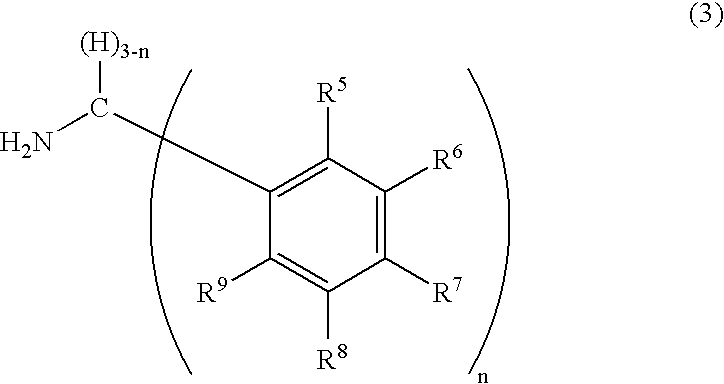
- Preferably, the 4-(arylmethyl)amino-1H-imidazo(4,5-c)quinoline of formula (4) is prepared by reacting an arylmethylamine of formula (3)

with a 4-chloro-1H-imidazo(4,5-c)quinoline of formula (2)
- Preferably, the method further comprises the step of treating the acid addition salt of formula (5) with a base to provide a 4-amino-1H-imidazo(4,5-c)quinoline of formula (1)

- Preferably, the strong acid is selected from the group consisting of sulfuric acid, methanesulfonic acid, trifluoromethanesulfonic acid, and mixtures thereof.
- Preferably, the base is selected from the group consisting of sodium hydroxide, potassium hydroxide, and mixtures thereof.
- Preferably, R1, R2, R3, and R4 are independently selected from the group consisting of hydrogen, C1-C10 alkyl, and C6-C20 aryl, and each of R5, R6, R7, R8, and R9 for each of the n aryl rings is independently selected from the group consisting of hydrogen, C1-C10 alkyl, C6-C20 aryl, —OR10, and —NR11R12. More preferably, n is 1, R1 and R3 are independently C1-C10 alkyl, R2 and R4 are hydrogen, R5, R6, R7, R8, and R9 are independently selected from the group consisting of hydrogen, C1-C10 alkyl, and —O(C1-C10 alkyl), and X− is selected from the group consisting of HSO4, CH3SO3 −, and CF3SO3 −. More preferably, R1 and R3 are isobutyl. More preferably, R5, R6, R7, R8, and R9 are hydrogen.
- Preferably, the 4-amino-1H-imidazo(4,5-c)quinoline of formula (1) is 4-amino-1-isobutyl-1H-imidazo(4,5-c)quinoline (imiquimod).
- Preferably, the hydrolyzing step is performed for a reaction time of less than about four hours. More preferably, the hydrolyzing step is performed for a reaction time of less than about two hours.
- Preferably, the acid addition salt of formula (5) is obtained in a yield of at least about 70%. More preferably, the acid addition salt of formula (5) is obtained in a yield of at least about 80%.
- Preferably, the arylmethylamine of formula (3) is selected from the group consisting of benzylamine, 2,4-dimethoxybenzylamine, diphenylmethylamine, and 1-(aminomethyl)naphthalene.
- Preferably, the 4-(arylmethyl)amino-1H-imidazo(4,5-c)quinoline of formula (4) is prepared in a neat reaction.
- Preferably, the 4-(arylmethyl)amino-1H-imidazo(4,5-c)quinoline of formula (4) is prepared at a temperature of about 100° C. to about 140° C.
- Definitions
- “Hydrolyzing” refers to performing a hydrolysis reaction; “hydrolysis” refers to a chemical reaction that uses water (i.e., H2O) to cleave a chemical bond; “hydrogenolyzing” refers to performing a hydrogenolysis reaction; “hydrogenolysis” refers to a chemical reaction that uses hydrogen (i.e., H2) to cleave a chemical bond; “ammonolysis” refers to a chemical reaction that uses ammonia (i.e., NH3) to cleave a chemical bond; “chemical bond” refers to the force that holds atoms together in molecules or crystals; “strong acid” refers to an acid having a Ka (25° C.) of at least about 1; “acid addition salt” refers to a compound of formula RH+X−, wherein R is a molecule that contains at least one atom that can accept a proton from an acid, and X− is the conjugate base of an acid, HX; “neat reaction” refers to a reaction in which one or more of the reagents functions as a solvent; “solvent” refers to the most abundant component of a solution; “conjugate base” refers to a molecule that can be described as an acid that has lost one proton; “isolating” refers to separating a crude product from a reaction mixture; “crude product” refers to a reaction product that has been separated from the reaction, but not further purified; according the present invention, a “crude product” typically has a purity of at least about 80%; “purity” refers to the percentage by weight of the major component of a mixture; “purifying” refers to increasing the purity of a compound; “crystallizing” refers to inducing crystals to form in a solution; “heating” refers to adding thermal energy to a reaction mixture to raise the temperature of the reaction mixture above the ambient temperature of its surrounding environment (typically, the ambient temperature is about 22° C.).
- The present invention provides an improved method of preparing 4-amino-1H-imidazo(4,5-c) quinolines. One unique feature of the present invention is that it involves employing a hydrolysis reaction. A strong acid may be used as a catalyst to drive the hydrolysis reaction. The hydrolysis reaction effectively provides an acid addition salt. A simple treatment of the acid addition salt with a base provides a 4-amino-1H-imidazo(4,5-c) quinoline. The present hydrolysis reaction provides a much better yield and a much shorter reaction time. Specifically, the present invention provides a method of preparing an acid addition salt of formula (5)

comprising the step of hydrolyzing a 4-(arylmethyl)amino-1H-imidazo(4,5-c)quinoline of formula (4) with a strong acid, HX,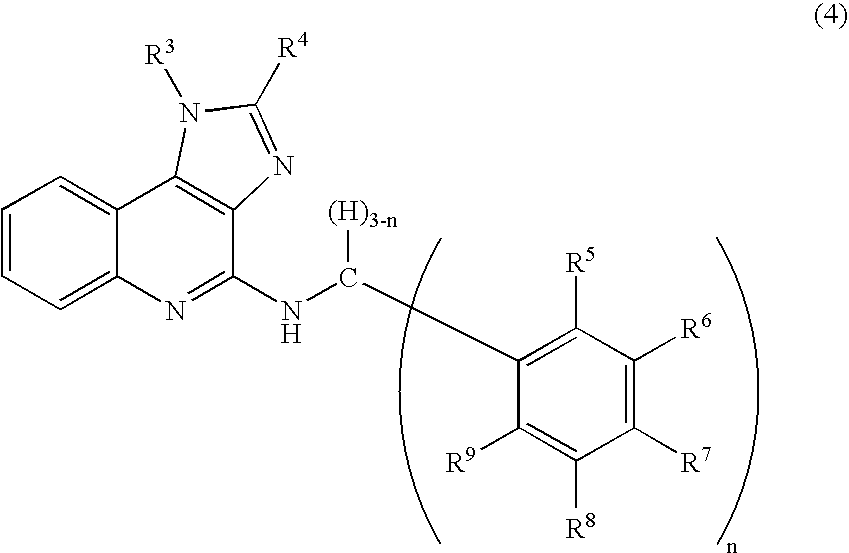
wherein -
- n is 1 or 2,
- R1, R2, R3 and R4 are independently selected from the group consisting of hydrogen, C1-C10 alkyl, C3-C10 cycloalkyl, C2-C10 alkenyl, C5-C10 cycloalkenyl, C2-C10 alkynyl, and C6-C20 aryl,
- each of R5, R6, R7, R8, and R9 for each of the n aryl rings is independently selected from the group consisting of hydrogen, C1-C10 alkyl, C3-C10 cycloalkyl, C2-C10 alkenyl, C5-C10 cycloalkenyl, C2-C10 alkynyl, C6-C20 aryl, —OR10, and —NR11R12,
wherein R10, R11, and R12 are independently selected from the group consisting of hydrogen and C1-C10 alkyl, and - X− is a conjugate base of a strong acid,
thereby forming an acid addition salt of formula (5).
- Any suitable strong acid, HX, may be used in the hydrolysis reaction. A strong acid as used herein encompasses an acid having a Ka (25° C.) of at least about 1. Preferably, the strong acid has a Ka (25° C.) of at least about 10. More preferably, the strong acid has a Ka (25° C.) of at least about 100. Tables of Ka (25° C.) values are readily available (See, e.g., CRC Handbook of Chemistry and Physics (63d ed. 1982-83)). Ka (25° C.) values also may be measured (See, e.g., Cookson, Chem. Rev. 1974, 74, 5-28).
- Preferably, the strong acid includes, but is not limited to sulfuric acid, methanesulfonic acid, trifluoromethanesulfonic acid, and mixtures thereof. More preferably, the strong acid is sulfuric acid.
- Preferably, the conjugate base of a strong acid (i.e., X−) includes, but is not limited to HSO4 −, CH3SO3 −, and CF3SO3 −. More preferably, X− is HSO4 −.
- n may be 1 or 2. Preferably, n is 1.
- R1, R2, R3, and R4 may be identical or different. R1, R2, R3, and R4 may independently include, but are not limited to, hydrogen, C1-C10 alkyl, C3-C10 cycloalkyl, C2-C10 alkenyl, C5-C10 cycloalkenyl, C6-C20 aryl, and the like. Preferably, R1, R2, R3, and R4 may independently include, but are not limited to, hydrogen, C1-C10 alkyl, C2-C10 alkenyl, C6-C20 aryl, and the like. Preferably, R1, R2, R3, and R4 may independently include, but are not limited to, hydrogen, C1-C10 alkyl, C6-C20 aryl, and the like.
- More preferably, R1, R2, R3, and R4 are independently C1-C10 alkyl. More preferably, R1, R2, R3, and R4 are independently C1-C6 alkyl. Optionally, R1 and R2 or R3 and R4 may together form a ring.
- Preferably, R1 includes, but is not limited to, isobutyl, (2-hydroxy-2-methyl)propyl, hydroxymethyl, (3-amino)propyl, (4-amino)butyl, and the like. More preferably, R1 is isobutyl.
- Preferably, R3 includes, but is not limited to, isobutyl, (tert-butyldimethylsilyloxy)methyl, (2-benzyloxy-2-methyl)propyl, 3-(benzylamino)propyl, 4-(benzylamino)butyl, and the like. More preferably, R3 is isobutyl.
- Preferably, R2 and R4 independently include, but are not limited to, hydrogen, ethoxymethyl, benzyl, (2-methoxy)ethyl, and the like. More preferably, R2 and R4 are hydrogen.
- R3 may be identical to or different from R1. R4 may be identical to or different from R2. An example of when R3 may be different from R1 is when R1 contains a nucleophilic moiety, such as an amino, hydroxyl, or thiol moiety. Preferably, when R1 contains a nucleophilic moiety, R3 is a suitably protected derivative of R1. Preferably, when R2 contains a nucleophilic moiety, R4 is a suitably protected derivative of R2.
- A suitable protecting group is removable. If the protecting group is removed during the hydrolysis reaction, then R1 (or R2) will be different from R3 (or R4). A compilation of suitable protecting groups is found in Theodora W. Greene & Peter G. M. Wuts, Protective Groups in Organic Synthesis (3d ed. 1999). Examples of suitable protecting groups include, but are not limited to, benzyl and triphenylmethyl for an amino moiety, methoxymethyl and t-butyldimethylsilyl for a hydroxyl moiety, and p-methoxybenzyl and triphenylmethyl for a thiol moiety.
- When R1, R2, R3, and/or R4 comprise an alkyl, cycloalkyl, alkenyl, cycloalkenyl, alkynyl, or aryl group that possesses a moiety, including a non-nucleophilic moiety, that is protected with a protecting group, the atoms of the protecting group do not affect the atom limitations expressed above. By way of example, the term “C1-C6 alkyl” includes, but is not limited to, 3-(t-butyloxycarbonylamino)propyl, because the t-butyloxycarbonyl (BOC) group is a protecting group. In other words, the 3-(BOC-amino)propyl group is a C3 alkyl group possessing an amino moiety.
- R5, R6, R7, R8, and R9 are not critical. The R5, R6, R7, R8, and R9 groups are part of an arylmethylamino side chain that is cleaved during the hydrolysis reaction. As such, the R5, R6, R7, R8, and R9 groups are not present in the prepared acid addition salt of formula (5).
- R5, R6, R7, R8, and R9 may be identical or different. Preferably, each R5, R6, R7, R8, and R9 for each of the n aryl rings independently includes, but is not limited to, hydrogen, C1-C10 alkyl, and C6-C20 aryl, C3-C10 cycloalkyl, C2-C10 alkenyl, C5-C10 cycloalkenyl, C6-C20 aryl, —OR10, —NR11R12, and the like. Preferably, each R5, R6, R7, R8, and R9 for each of the n aryl rings independently includes, but is not limited to, hydrogen, C1-C10 alkyl, C2-C10 alkenyl, C6-C20 aryl, —OR10, —NR11R12, and the like. Preferably, each R5, R6, R7, R8, and R9 for each of the n aryl rings independently includes, but is not limited to, hydrogen, C1-C10 alkyl, C6-C20 aryl, —OR10, —NR11R12, and the like. Preferably, each R5, R6, R7, R8, and R9 for each of the n aryl rings independently includes, but is not limited to hydrogen, C1-C10 alkyl, —OR10, and the like, wherein R10 is C1-C10 alkyl. Preferably, each R5, R6, R7, R8, and R9 for each of the n aryl rings independently includes, but is not limited to, hydrogen, C1-C6 alkyl, —OR10, and the like, wherein R10 is C1-C6 alkyl.
- More preferably, each R5, R6, R7, R8, and R9 for each of the n aryl rings is hydrogen. Optionally, R groups (i.e., R5, R6, R7, R8, and R9) that are adjacent to one another may together form a ring (e.g., a phenyl ring).
- Within R1 to R9, each alkyl, cycloalkyl, alkenyl, cycloalkenyl, alkynyl, and aryl group may contain up to four moieties, which include, but not limited to, nitrogen-containing moieties (e.g., amino, amido, etc.), oxygen-containing moieties (e.g., hydroxyl, carboxyl, etc.), halogens, sulfur-containing moieties (e.g., thiol, sulfonyl, etc.), and the like.
- Within R1 to R9, examples of C1-C10 alkyl groups include, but are not limited to, (tert-butyldimethylsilyloxy)methyl (C, having one oxygen-containing moiety—hydroxyl—protected by a tert-butyldimethylsilyl protecting group), isobutyl (C4), ethoxymethyl (C3 having one oxygen-containing moiety), (2-methoxy)ethyl (C3 having one oxygen-containing moiety), and (2-benzyloxy-2-methyl)propyl (C4 having one oxygen-containing moiety—hydroxyl—protected by a benzyl protecting group).
- Within R1 to R9, examples of C2-C10 alkenyl groups include, but are not limited to, allyl (C3), 2-methyl-2-butenyl (C5), and 3-hexen-2-yl (C6).
- Within R1 to R9, examples of C2-C10 alkynyl groups include, but are not limited to, 2-butynyl (C4), 4-phenyl-2-butynyl (C10), and 4-methyl-2-pentynyl (C6).
- Within R1 to R9, examples of C3-C10 cycloalkyl groups include, but are not limited to, cyclopentyl (C5), 2-(methyl)cyclohexyl (C7), and 2-(N,N-(dibenzyl)amino)cyclohexyl (C6 with a nitrogen-containing moiety—amino—protected by two benzyl protecting groups).
- Within R1 to R9, examples of C5-C10 cycloalkenyl groups include, but are not limited to, cyclopentenyl (C5), 4-(isopropyl)cyclohexenyl (C6), and 4-(methyl)cyclohexenyl (C7).
- Within R1 to R9, examples of C6-C20 aryl groups include, but are not limited to, benzyl (C7), tolyl (C7), 2-(methyl)naphthyl (C11), and 3-(cyano)isoquinolynyl (C10 with two nitrogen-containing moieties (cyano and the ring nitrogen)).
- The hydrolysis reaction may be performed at any suitable temperature. Preferably, the temperature is from room temperature (i.e., about 20° C.) to about 100° C.
- The present hydrolysis method has unexpected advantages over the ammonolysis method of Scheme 1. The ammonolysis method requires heating at a high temperature (e.g., up to 155° C.) for a long time (e.g., up to 18 hours) in a sealed vessel. This sealed vessel reaction presents an undesirable safety risk. Surprisingly, the present hydrolysis method provides an acid addition salt of formula (5), and a 4-amino-1H-imidazo(4,5-c) quinoline therefrom, in high yield after a short reaction time without the use of a potentially dangerous sealed vessel reaction.
- Furthermore, the present hydrolysis method has unexpected advantages over the hydrogenolysis method of Scheme 2. The hydrogenolysis reaction proceeds in low yield (e.g., 37%-42%) or not at all after a long reaction time (e.g., up to 2 days). Surprisingly, the present hydrolysis method provides acid addition salts of formula (5), and 4-amino-1H-imidazo(4,5-c) quinolines therefrom, in high yield after a short reaction time.
- Ammonolysis, hydrogenolysis, and the present hydrolysis reactions represent distinct chemical reactions. These chemical reactions are used for different purposes, employ different reagents, and are conducted under different reaction conditions. Accordingly, these chemical reactions are not interchangeable. For example, an ammonolysis reaction cleaves a chemical bond with ammonia (i.e., NH3), while a hydrogenolysis reaction cleaves a chemical bond with hydrogen (i.e., H2). In contrast, a hydrolysis reaction cleaves a chemical bond with water (i.e., H2O). Furthermore, while an ammonolysis reaction and a hydrogenolysis reaction often require the presence of a transition metal catalyst (e.g., copper, vanadium, titanium, palladium or ruthenium), the present hydrolysis reaction does not require a transition metal catalyst, and is instead performed in the presence of a strong acid catalyst. Finally, an ammonolysis reaction and a hydrogenolysis reaction often are performed in sealed vessels. In contrast, the present hydrolysis reaction is performed in open air.
- One advantage of the present invention is that the hydrolysis reaction proceeds in high yield after a short reaction time. Preferably, the hydrolysis reaction provides the acid addition salt of formula (5) at a yield of at least about 50%. More preferably, the hydrolysis reaction provides the acid addition salt of formula (5) at a yield of at least about 60%. More preferably, the hydrolysis reaction provides the acid addition salt of formula (5) at a yield of at least about 70%. More preferably, the hydrolysis reaction provides the acid addition salt of formula (5) at a yield of at least about 80%.
- Preferably, the hydrolysis reaction is conducted for a reaction time of less than about four hours. More preferably, the hydrolysis reaction is conducted for a reaction time of less than about three hours. More preferably, the hydrolysis reaction is conducted for a reaction time of less than about two hours. More preferably, the hydrolysis reaction is conducted for a reaction time of less than about one hour.
- A further advantage of the present hydrolysis reaction is that it is generally applicable to many 4-(arylmethyl)amino-1H-imidazo(4,5-c)quinolines of formula (4). Without wishing to be bound by theory, it is believed that the compound of formula (4) may include many substituents at the R3 and R4 positions, as exemplified and disclosed herein, because these substituents are distant from the hydrolysis site (i.e., the C—N bond of the 4-(arylmethyl)amino group of the compound of formula (4)). It is further believed that the compound of formula (4) may include many substituents at the R5 to R9 positions, as exemplified and disclosed herein, because the strong acid used in the hydrolysis reaction is a powerful catalyst. It is further believed that in contrast to transition metal catalysts, the strong acid catalyst is much less susceptible to poisoning and deactivation by functional groups present in R3 to R9 (e.g., sulfur atoms). Accordingly, the strong acid is much more effective in catalyzing the hydrolysis of compounds of formula (4).
- In accordance with the present invention, the 4-(arylmethyl)amino-1H-imidazo(4,5-c)quinoline of formula (4) may be prepared in any suitable manner. Suitable preparation methods include, but are not limited to, those disclosed in the '149 patent and the Shen article. Preferably, the 4-(arylmethyl)amino-1H-imidazo(4,5-c)quinoline of formula (4) is prepared by reacting an arylmethylamine of formula (3)

with a 4-chloro-1H-imidazo(4,5-c)quinoline of formula (2)
wherein n, R3, R4, R5, R6, R7, R8, and R9 are defined as set forth above. - The arylmethylamine of formula (3) may be synthesized using methods well known to those of ordinary skill in the art. For example, benzaldehyde, benzophenone, or a suitable aryl ring-substituted derivative thereof, may be transformed into an arylmethylamine of formula (3) by reductive amination with ammonia and hydrogen (H2) in the presence of a hydrogenation catalyst (see generally Jerry March, Advanced Organic Chemistry § 6-15 (3d ed. 1985)). In addition, many arylmethylamines of formula (3) are commercially available. For example, benzylamine, 2,4-dimethoxybenzylamine, diphenylmethylamine, and 1-(aminomethyl)naphthalene can be obtained from Sigma-Aldrich Corp. (St. Louis, Mo.). 1-(aminomethyl)naphthalene is an example of an arylmethylamine of formula (3), wherein adjacent R groups (R5 and R6) together form a ring (a phenyl ring).
- Preferably, the arylmethylamine of formula (3) includes, but is not limited to, benzylamine, 2,4-dimethoxybenzylamine, diphenylmethylamine, 1-(aminomethyl)naphthalene, and the like.
- The 4-chloro-1H-imidazo(4,5-c)quinoline of formula (2) may be synthesized according to known methods, such as the method disclosed in U.S. Pat. No. 4,689,338. 4-chloro-1-isobutyl-1H-imidazo(4,5-c)quinoline is commercially available from Auspure Biotechnology Co., Ltd. (Shanghai, China).
- Any suitable temperature may be used to promote the addition/elimination reaction between the arylmethylamine of formula (3) and the 4-chloro-1H-imidazo(4,5-c)quinoline of formula (2). Preferably, the addition/elimination reaction is performed at a temperature of about 100° C. to about 140° C.
- The arylmethylamine of formula (3) and the 4-chloro-1H-imidazo(4,5-c)quinoline of formula (2) may be present in the reaction mixture in any suitable amount. Preferably, an excess of the arylmethylamine of formula (3) is used. More preferably, the arylmethylamine of formula (3) and the 4-chloro-1H-imidazo(4,5-c)quinoline of formula (2) are present at a mole/mole ratio of at least about 2:1. More preferably, the arylmethylamine of formula (3) and the 4-chloro-1H-imidazo(4,5-c)quinoline of formula (2) are present at a mole/mole ratio of at least about 5:1.
- The addition/elimination reaction between the arylmethylamine of formula (3) and the 4-chloro-1H-imidazo(4,5-c)quinoline of formula (2) may be performed either neat or in the presence of a suitable solvent. Suitable solvents include, but are not limited to, N,N-dimethylformamide (DMF), N,N-dimethylacetamide (DMA) and mixtures thereof. Preferably, the addition/elimination reaction is performed neat.
- The present addition/elimination method has unexpected advantages over the addition/elimination method of Scheme 2. The addition/elimination method in Scheme 2 requires that the benzylamino intermediate is isolated by distilling away the reaction solvent, and optionally purified using silica gel column chromatography. These isolation and purification methods are costly and time consuming. Surprisingly, the present addition/elimination method provides a 4-(arylmethyl)amino-1H-imidazo(4,5-c)quinoline of formula (4) that does not require the product to be isolated or purified using these costly and inefficient procedures.
- A further advantage of the present invention is that the addition/elimination reaction between the arylmethylamine of formula (3) and the 4-chloro-1H-imidazo(4,5-c)quinoline of formula (2) may be performed without a sealed reaction vessel at atmospheric pressure. Another further advantage of the present invention is that the addition/elimination reaction proceeds in high yield after a short reaction time.
- In accordance with the present invention, the method further comprises the step of treating the acid addition salt of formula (5) with a base to provide a 4-amino-1H-imidazo(4,5-c)quinoline of formula (1)

wherein R1 and R2 are defined as set forth above. - The acid addition salt of formula (5) may be treated with any suitable base. Preferably, an aqueous base is used. More preferably, the base is sodium hydroxide, potassium hydroxide or a mixture thereof. More preferably, the base is sodium hydroxide.
- Preferably, the base is used in a quantity sufficient to raise the pH of the reaction mixture to at least about 8. More preferably, the base is used in a quantity sufficient to raise the pH of the reaction mixture to at least about 10.
- Any suitable method may be used to isolate the 4-amino-1H-imidazo(4,5-c)quinoline of formula (1). Suitable isolation methods include, but are not limited to, filtration and extraction.
- Any suitable method may be used to purify the 4-amino-1H-imidazo(4,5-c)quinoline of formula (1). Suitable purification methods include, but are not limited to, slurrying, crystallizing, and chromatography. Suitable slurrying and crystallizing solvents include, but are not limited to, DMF. Additional methods of isolation and purification are well known to those of ordinary skill in the art.
- In accordance with the present invention, two additional embodiments are provided, which involve modified hydrogenolysis methods for the preparation of 4-amino-1H-imidazo(4,5-c)quinolines (Scheme 3).

- The first modified hydrogenolysis method (i.e., the first additional embodiment) involves transforming a 4-(arylmethyl)amino-1H-imidazo(4,5-c)quinoline of formula (4) into a 4-amino-1H-imidazo(4,5-c)quinoline of formula (1). The second modified hydrogenolysis method (i.e., the second additional embodiment) involves transforming a 4-(arylmethyl)amino-1H-imidazo(4,5-c)quinoline of formula (4) into an acid addition salt of formula (5), which in turn is converted into a 4-amino-1H-imidazo(4,5-c)quinoline of formula (1).
- In the first additional embodiment, the present invention provides a method of preparing a 4-amino-1H-imidazo(4,5-c)quinoline of formula (1)

comprising the step of hydrogenolyzing a 4-(arylmethyl)amino-1H-imidazo(4,5-c)quinoline of formula (4) with Pearlman's catalyst and hydrogen (H2) in the absence of an acid
wherein n, R1, R2, R3, R4, R5, R6, R7, R8, and R9 are defined as set forth above. - Pearlman's catalyst (Pd(OH)2 on carbon) is commercially available from Sigma-Aldrich Corp. (St. Louis, Mo.). Preferably, the hydrogenolysis reaction is performed in the presence of a second catalyst in addition to Pearlman's catalyst. Suitable second catalysts include, but are not limited to, triethylamine.
- The hydrogenolysis reaction may be performed at any suitable pressure. Preferably, the hydrogenolysis reaction is performed at a hydrogen (H2) pressure of about 1 atmosphere.
- Any suitable solvent may be used for hydrogenolysis reaction. Suitable solvents include, but are not limited to, alcoholic solvents and ethyl acetate.
- Preferably, the 4-(arylmethyl)amino-1H-imidazo(4,5-c)quinoline of formula (4) is prepared by the addition/elimination reaction of an arylmethylamine of formula (3) with a 4-chloro-1H-imidazo(4,5-c)quinoline of formula (2), as set forth above.
- The 4-amino-1H-imidazo(4,5-c)quinoline of formula (1) prepared in the hydrogenolysis reaction may be isolated using any suitable method. Suitable isolation methods include, but are not limited to, adding water to the reaction mixture, and filtering or decanting. The isolated 4-amino-1H-imidazo(4,5-c)quinoline of formula (1) may be purified as set forth above.
- In the second additional embodiment, the present invention provides a method of preparing an acid addition salt of formula (5)
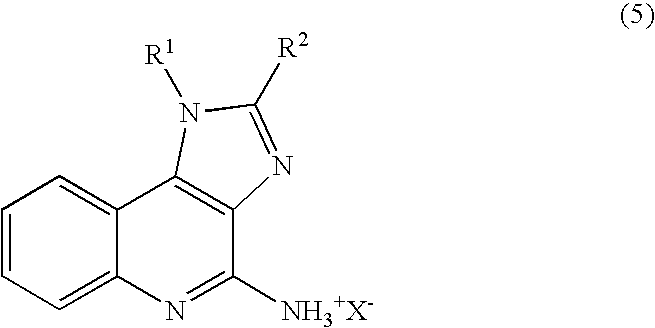
comprising the step of hydrogenolyzing a 4-(arylmethyl)amino-1H-imidazo(4,5-c)quinoline of formula (4) with Pearlman's catalyst and hydrogen (H2) in the presence of an acid, HX
wherein n, R1, R2, R3, R4, R5, R6, R7, R8, and R9 are defined as set forth above. - Suitable acids, HX, for use in the hydrogenolysis reaction include, but are not limited to, formic acid, acetic acid, and trifluoroacetic acid. The conjugate bases, X−, of those acids are HCOO−, CH3COO−, and CF3COO−, respectively. Formic acid may function as an internal source of hydrogen (H2). Consequently, when formic acid is used, an external source of hydrogen (H2) is not necessary. Preferably, the hydrogenolysis reaction is conducted in a hydrogen (H2) atmosphere.
- Preferably, the hydrogenolysis reaction is performed using at least about one molar equivalent of an acid, HX, based on the molar quantity of the 4-(arylmethyl)amino-1H-imidazo(4,5-c)quinoline of formula (4) present in the reaction. More preferably, when the acid is formic acid, a large molar excess of formic acid is used. More preferably, the hydrogenolysis reaction is performed using formic acid as the solvent.
- The hydrogenolysis reaction may be performed at a hydrogen (H2) pressure of greater than 1 atmosphere. Preferably, the hydrogenolysis reaction is performed at a hydrogen pressure of about 1 atmosphere.
- Suitable solvents for the hydrogenolysis reaction include, but are not limited to, alcoholic solvents and ethyl acetate.
- Preferably, the 4-(arylmethyl)amino-1H-imidazo(4,5-c)quinoline of formula (4) is prepared by the addition/elimination reaction of an arylmethylamine of formula (3) with a 4-chloro-1H-imidazo(4,5-c)quinoline of formula (2), as set forth above.
- The acid addition salt of formula (5) prepared in the hydrogenolysis reaction may be treated with any suitable base to provide a 4-amino-1H-imidazo(4,5-c)quinoline of formula (1), as set forth above.
- The prepared 4-amino-1H-imidazo(4,5-c)quinoline of formula (1) may be isolated and purified as set forth above.
- Accordingly, the present invention provides a method of preparing 4-amino-1H-imidazo(4,5-c)quinolines of formula (1) and acid addition salts of formula (5) in high yield and purity from the corresponding 4-(arylmethyl)amino-1H-imidazo(4,5-c)quinolines of formula (4). The present method is safe, simple, rapid, economical, and suitable for industrial preparations. The present invention is illustrated, but not limited by the following examples.
- In this study, imiquimod was prepared in three steps, starting from 4-chloro-1-isobutyl-1H-imidazo(4,5-c)quinoline (compound of formula (2)).
- Step 1: Preparation of 4-(N-benzylamino)-1-isobutyl-1H-imidazo(4,5-c)quinoline (Compound of Formula (4))
- In a three-necked 100-mL flask, equipped with a thermometer, 20 grams of benzylamine and 10 grams of 4-chloro-1-isobutyl-1H-imidazo(4,5-c)quinoline were added with stirring. The resulting slurry was heated to 120° C.-130° C., and the reaction monitored by Thin Layer Chromatography (TLC; RP-18; mobile phase=80% acetonitrile:20% water).
- When the TLC indicated the disappearance of 4-chloro-1-isobutyl-1H-imidazo(4,5-c)quinoline, the reaction mixture was cooled to room temperature resulting in a solid mass. 60 mL of water was added and the reaction mixture was stirred for 30 min. The solids were then separated by filtration and the solids were washed with 20 mL of water. The solids were then dried in an oven at 85° C. resulting in 11.3 grams (90% yield) of 4-(N-benzylamino)-1-isobutyl-1H-imidazo(4,5-c)quinoline.
- Step 2: Preparation of Acid Addition Salt (Compound of Formula (5))
- 1 gram of 4-(N-benzylamino)-1-isobutyl-1H-imidazo(4,5-c)quinoline was added to 5 mL of aqueous 96%-98% sulfuric acid with stirring in a 100-mL flask at 22° C.-25° C. After about 5-10 minutes the reaction mixture became clear. After about 30 minutes, TLC (normal phase, mobile phase=5% methanol: 95% chloroform) indicated the reaction was complete, and 10 mL water was slowly added.
- Step 3: Preparation of 4-amino-1-isobutyl-1H-imidazo(4,5-c)quinoline (Compound of Formula (1))
- The flask was cooled in an ice bath, and an aqueous solution of about 10% sodium hydroxide was slowly added to the mixture from step (b) until a pH of about 12 was achieved. The suspension was stirred for 15 minutes. The mixture was filtered, and the collected solids were washed with water. The solid was dried at 85° C., providing 0.63 gram of 4-amino-1-isobutyl-1H-imidazo(4,5-c)quinoline (85% yield from 4-(N-benzylamino)-1-isobutyl-1H-imidazo(4,5-c)quinoline).
- In this study, imiquimod was prepared using the general three-step method exemplified in Example 1. However, different concentrations of sulfuric acid and sodium hydroxide were used in the second and third steps, respectively.
- Step 1: Preparation of 4-(N-benylamino)-1-isobutyl-1H-imidazo(4,5-c)quinoline (Compound of Formula (4))
- 4-(N-benzylamino)-1-isobutyl-1H-imidazo(4,5-c)quinoline was prepared using the general method exemplified in Example 1.
- Step 2: Preparation of Acid Addition Salt (Compound of Formula (5))
- In a three-necked 500-mL flask, equipped with mechanical stirrer and thermometer, 60 mL of aqueous 30%-70% sulfuric acid was introduced. 20 grams of 4-(N-benzylamino)-1-isobutyl-1H-imidazo(4,5-c)quinoline were added, causing the temperature to increase to 75° C. The mixture was heated between 70° C. and 100° C. until TLC indicated the reaction was complete (about 1 hour).
- The reaction mixture was cooled to 70° C., and 60 mL of toluene was added. Then, 240 mL of water was added dropwise, keeping the temperature less than 60° C. When all the water was added, the reaction was cooled to about room temperature, then to 10° C., and then stirred at 10° C. for 30 minutes. The acid addition salt (compound of formula (5)) was filtered and the cake was washed with water.
- Step 3: Preparation of 4-amino-1-isobutyl-1H-imidazo(4,5-c)quinoline (Compound of Formula (1))
- The acid addition salt (compound of formula (5)) was slurried in 30 mL of water at room temperature for 15 minutes, and then 20 mL of an aqueous solution of 20% NaOH was added. The slurry was stirred for 1 hour, while ensuring that the pH was at least about 8. The mixture was filtered, and the collected solids were washed with water. The solid was dried, providing 11.9 grams of 4-amino-1-isobutyl-1H-imidazo(4,5-c)quinoline (82% yield from 4-(N-benzylamino)-1-isobutyl-1H-imidazo(4,5-c)quinoline).
- In this study, imiquimod was prepared using the general three-step method exemplified in Examples 1 and 2. However, a different procedure was used to isolate the acid addition salt.
- Step 1: Preparation of 4-(N-benzylamino)-1-isobutyl-1H-imidazo(4,5-c)quinoline (Compound of Formula (4))
- 4-(N-benzylamino)-1-isobutyl-1H-imidazo(4,5-c)quinoline was prepared using the general method exemplified in Example 1.
- Step 2: Preparation of Acid Addition Salt (Compound of Formula (5)
- In a three-necked 500-mL flask, equipped with mechanical stirrer and thermometer, 60 mL of aqueous 70% H2SO4 was introduced. 20 grams of 4-(N-benzylamino)-1-isobutyl-1H-imidazo(4,5-c)quinoline was added, causing the temperature to increase to about 75° C. The mixture was heated to about 100° C. until TLC indicated the reaction was complete (about 1 hour). The reaction mixture was cooled to about 80° C., 80 mL of toluene was added, and the mixture was stirred for 15 min. 180 mL of 10% HCl was then added, which caused the temperature to increase to about 85° C.-90° C. The resulting clear mixture was cooled to 70° C. and hot filtered. The two layers of the filtrate were separated, and the upper organic layer discarded. 180 mL of water was added to the acidic aqueous layer, and the mixture was cooled to room temperature. The hydrochloride salt precipitated and was isolated by filtration and washed with water.
- Step 3: Preparation of 4-amino-1-isobutyl-1H-imidazo(4,5-c)quinoline (Compound of Formula (1))
- The isolated acid addition salt was suspended in ˜22% NaOH solution (100 mL) at room temperature for 30 minutes. The mixture was filtered and the collected solids were washed with water and dried, providing 10.9 grams of 4-amino-1-isobutyl-1H-imidazo(4,5-c)quinoline (85% yield from 4-(N-benzylamino)-1-isobutyl-1H-imidazo(4,5-c)quinoline).
- In this study, imiquimod is prepared in three steps, starting from 4-chloro-1-isobutyl-1H-imidazo(4,5-c)quinoline (compound of formula (2)). However, the intermediate acid addition salt is prepared using Pearlman's catalyst and hydrogen.
- Step 1: Preparation of 4-(N-benzylamino)-1-isobutyl-1H-imidazo(4,5-c)quinoline (Compound of Formula (4))
- 4-(N-benzylamino)-1-isobutyl-1H-imidazo(4,5-c)quinoline is prepared using the general method exemplified in Example 1.
- Step 2: Preparation of Acid Addition Salt (Compound of Formula (5)
- 1.0 gram of 4-(N-benzylamino)-1-isobutyl-1H-imidazo(4,5-c)quinoline is added to 10 mL of isopropyl alcohol followed by the addition of 1.1 equiv. of trifluoroacetic acid and 0.2 gram of Pearlman's catalyst (20% Pd(OH)2/C). The mixture is stirred at 50° C. under 1 atm hydrogen until completion. The mixture is filtered through Celite® (available from Sigma-Aldrich Corp. (St. Louis, Mo.)) and the filtrate, containing acid addition salt (compound of formula (5)), is concentrated in vacuo.
- Step 3: Preparation of 4-amino-1-isobutyl-1H-imidazo(4,5-c)quinoline (Compound of Formula (1))
- Acid addition salt (compound of formula (5)) is suspended in 10 mL of water followed by the slow addition of 10% sodium hydroxide until a pH of about 12 is achieved. The suspension is filtered, and the collected solids are washed with water and dried, providing 4-amino-1-isobutyl-1H-imidazo(4,5-c)quinoline (imiquimod).
- In this study, imiquimod is prepared using the general three-step method exemplified in Example 4. However, the acid addition salt is prepared using Pearlman's catalyst without hydrogen.
- Step 1: Preparation of 4-(N-benzylamino)-1-isobutyl-1H-imidazo(4,5-c)quinoline (Compound of Formula (4))
- 4-(N-benzylamino)-1-isobutyl-1H-imidazo(4,5-c)quinoline is prepared using the general method exemplified in Example 1.
- Step 2: Preparation of Acid Addition Salt (Compound of Formula (5)
- 1.0 gram of 4-(N-benzylamino)-1-isobutyl-1H-imidazo(4,5-c)quinoline is added to 20 mL formic acid. 0.2 gram of Pearlman's catalyst (20% Pd(OH)2/C) is added. The mixture is heated at reflux until completion. The mixture is filtered through Celite® and the filtrate, containing acid addition salt (compound of formula (5)), is concentrated in vacuo.
- Step 3: Preparation of 4-amino-1-isobutyl-1H-imidazo(4,5-c)quinoline (Compound of Formula (1))
- 4-amino-1-isobutyl-1H-imidazo(4,5-c)quinoline (compound of formula (1)) is prepared using the general method exemplified in Example 4.
- In this study, imiquimod is prepared using the general three-step method exemplified in Examples 4 and 5. However, the acid addition salt is prepared using Pearlman's catalyst, formic acid, and hydrogen.
- Step 1: Preparation of 4-(N-benzylamino)-1-isobutyl-1H-imidazo(4,5-c)quinoline (Compound of Formula (4))
- 4-(N-benzylamino)-1-isobutyl-1H-imidazo(4,5-c)quinoline is prepared using the general method exemplified in Example 1.
- Step 2: Preparation of Acid Addition Salt (Compound of Formula (5)
- 1.0 gram of 4-(N-benzylamino)-1-isobutyl-1H-imidazo(4,5-c)quinoline is added to 20 mL formic acid. 0.2 gram of Pearlman's catalyst (20% Pd(OH)2/C) is added. The mixture is stirred at 50° C. under 1 atm hydrogen until completion. The mixture is filtered through Celite® and the filtrate, containing acid addition salt (compound of formula (5)), is concentrated in vacuo.
- Step 3: Preparation of 4-amino-1-isobutyl-1H-imidazo(4,5-c)quinoline (Compound of Formula (1))
- 4-amino-1-isobutyl-1H-imidazo(4,5-c)quinoline (compound of formula (1)) is prepared using the general method exemplified in Example 4.
- In this study, imiquimod is prepared in two steps starting from 4-chloro-1-isobutyl-1H-imidazo(4,5-c)quinoline (compound of formula (2)). The second step is performed using Pearlman's catalyst and triethylamine as an additional catalyst.
- Step 1: Preparation of 4-(N-benzylamino)-1-isobutyl-1H-imidazo(4,5-c)quinoline (Compound of Formula (4))
- 4-(N-benzylamino)-1-isobutyl-1H-imidazo(4,5-c)quinoline is prepared using the general method exemplified in Example 1.
- Step 2: Preparation of 4-amino-1-isobutyl-1H-imidazo(4,5-c)quinoline
- 1.0 gram of 4-(N-benzylamino)-1-isobutyl-1H-imidazo(4,5-c)quinoline is added to 10 mL of ethanol, followed by the addition of 0.03 gram triethylamine and 0.2 gram of Pearlman's catalyst (20% Pd(OH)2/C). The mixture is stirred at 40° C. under 1 atm hydrogen until completion. The mixture is then filtered through Celite® and the filtrate, containing 4-amino-1-isobutyl-1H-imidazo(4,5-c)quinoline (imiquimod), is concentrated in vacuo.
- The citation and discussion of references in this specification is provided merely to clarify the description of the present invention and is not an admission that any such reference is “prior art” to the invention described herein. All references cited and discussed in this specification are incorporated herein by reference in their entirety.
Claims (23)




Priority Applications (2)
| Application Number | Priority Date | Filing Date | Title |
|---|---|---|---|
| US10/956,465 US7687628B2 (en) | 2003-10-01 | 2004-09-30 | Method of preparing 4-amino-1H-imidazo(4,5-c)quinolines and acid addition salts thereof |
| US12/749,138 US8080662B2 (en) | 2003-10-01 | 2010-03-29 | Method of preparing 4-amino-1H-imidazo (4,5-c) quinolines and acid addition salts thereof |
Applications Claiming Priority (2)
| Application Number | Priority Date | Filing Date | Title |
|---|---|---|---|
| US50755703P | 2003-10-01 | 2003-10-01 | |
| US10/956,465 US7687628B2 (en) | 2003-10-01 | 2004-09-30 | Method of preparing 4-amino-1H-imidazo(4,5-c)quinolines and acid addition salts thereof |
Related Child Applications (1)
| Application Number | Title | Priority Date | Filing Date |
|---|---|---|---|
| US12/749,138 Continuation US8080662B2 (en) | 2003-10-01 | 2010-03-29 | Method of preparing 4-amino-1H-imidazo (4,5-c) quinolines and acid addition salts thereof |
Publications (2)
| Publication Number | Publication Date |
|---|---|
| US20050085500A1 true US20050085500A1 (en) | 2005-04-21 |
| US7687628B2 US7687628B2 (en) | 2010-03-30 |
Family
ID=34421631
Family Applications (2)
| Application Number | Title | Priority Date | Filing Date |
|---|---|---|---|
| US10/956,465 Active 2027-05-06 US7687628B2 (en) | 2003-10-01 | 2004-09-30 | Method of preparing 4-amino-1H-imidazo(4,5-c)quinolines and acid addition salts thereof |
| US12/749,138 Expired - Fee Related US8080662B2 (en) | 2003-10-01 | 2010-03-29 | Method of preparing 4-amino-1H-imidazo (4,5-c) quinolines and acid addition salts thereof |
Family Applications After (1)
| Application Number | Title | Priority Date | Filing Date |
|---|---|---|---|
| US12/749,138 Expired - Fee Related US8080662B2 (en) | 2003-10-01 | 2010-03-29 | Method of preparing 4-amino-1H-imidazo (4,5-c) quinolines and acid addition salts thereof |
Country Status (5)
| Country | Link |
|---|---|
| US (2) | US7687628B2 (en) |
| EP (1) | EP1668010A2 (en) |
| CA (1) | CA2536530A1 (en) |
| IL (1) | IL174527A0 (en) |
| WO (1) | WO2005033049A2 (en) |
Cited By (41)
| Publication number | Priority date | Publication date | Assignee | Title |
|---|---|---|---|---|
| US20060189644A1 (en) * | 2003-08-14 | 2006-08-24 | Wightman Paul D | Lipid-modified immune response modifiers |
| US20070099901A1 (en) * | 2003-11-25 | 2007-05-03 | 3M Innovative Properties Company | Hydroxylamine and oxime substituted imidazoquinolines, imidazopyridines, and imidazonaphthyridines |
| US7220758B2 (en) | 2002-06-07 | 2007-05-22 | 3M Innovative Properties Company | Ether substituted imidazopyridines |
| US20070135640A1 (en) * | 2005-12-12 | 2007-06-14 | Chemagis Ltd. | Process for preparing Imiquimod |
| US20070155767A1 (en) * | 2003-12-04 | 2007-07-05 | Radmer Matthew R | Sulfone substituted imidazo ring ethers |
| US20070167476A1 (en) * | 2003-12-29 | 2007-07-19 | Kshirsagar Tushar A | Piperazine, [1,4]Diazepane, [1,4]Diazocane, and [1,5]Diazocane fused imidazo ring compounds |
| US20070243215A1 (en) * | 2004-10-08 | 2007-10-18 | Miller Richard L | Adjuvant for Dna Vaccines |
| US20070287724A1 (en) * | 2004-06-18 | 2007-12-13 | 3M Innovative Properties Company | Substituted Imidazoquinolines, Imidazopyridines, and Imidazonaphthyridines |
| US20080015184A1 (en) * | 2004-06-14 | 2008-01-17 | 3M Innovative Properties Company | Urea Substituted Imidazopyridines, Imidazoquinolines, and Imidazonaphthyridines |
| US20080114019A1 (en) * | 2003-08-12 | 2008-05-15 | Coley Pharmaceutical Group, Inc. | Hydroxylamine Substituted Imidazoquinolines |
| US20080177074A1 (en) * | 2007-01-24 | 2008-07-24 | Chemagis Ltd. | Imiquimod Production Process |
| US20080188513A1 (en) * | 2004-12-30 | 2008-08-07 | Taked Pharmaceutical Company Limited | 1-(2-Methylpropyl)-1H-Imidazo[4,5-C](1,5]Naphthyridin-4-Amine Ethanesulfonate and 1-(2-Methylpropyl)-1H-Imidazo[4,5-C](1,5]Naphthyridin-4-Amine Methanesulfonate |
| US20080193474A1 (en) * | 2005-04-25 | 2008-08-14 | Griesgraber George W | Immunostimulatory Compositions |
| US20090005376A1 (en) * | 2004-09-02 | 2009-01-01 | 3M Innovative Properties Company | 1-Alkoxy 1H-Imidazo Ring Systems and Methods |
| US20090017076A1 (en) * | 2003-09-05 | 2009-01-15 | Coley Pharmaceutical Group, Inc. | Treatment for cd5+ b cell lymphoma |
| US20090042925A1 (en) * | 2003-11-14 | 2009-02-12 | Coley Pharmaceutical Group, Inc. | Oxime substituted imidazoquinolines |
| US20090124652A1 (en) * | 2004-12-30 | 2009-05-14 | Takeda Pharmaceutical Company Limited | Polymorphs of 1-(2-Methylpropyl)-1H-Imidazo[4,5-C][1,5]Naphthyridin-4-Amine Ethane-Sulfonate |
| US7659398B2 (en) | 2007-02-14 | 2010-02-09 | Chemagis Ltd. | Imiquimod production process |
| US20100056557A1 (en) * | 2004-12-30 | 2010-03-04 | Bernd Benninghoff | Treatment for cutaneous metastases |
| US20100158928A1 (en) * | 2006-12-22 | 2010-06-24 | Doris Stoermer | Immune response modifier compositions and methods |
| US7879849B2 (en) | 2003-10-03 | 2011-02-01 | 3M Innovative Properties Company | Pyrazolopyridines and analogs thereof |
| US7897609B2 (en) | 2004-06-18 | 2011-03-01 | 3M Innovative Properties Company | Aryl substituted imidazonaphthyridines |
| US7897597B2 (en) | 2003-08-27 | 2011-03-01 | 3M Innovative Properties Company | Aryloxy and arylalkyleneoxy substituted imidazoquinolines |
| US7906506B2 (en) | 2006-07-12 | 2011-03-15 | 3M Innovative Properties Company | Substituted chiral fused [1,2] imidazo [4,5-c] ring compounds and methods |
| US7915281B2 (en) | 2004-06-18 | 2011-03-29 | 3M Innovative Properties Company | Isoxazole, dihydroisoxazole, and oxadiazole substituted imidazo ring compounds and method |
| US7943609B2 (en) | 2004-12-30 | 2011-05-17 | 3M Innovative Proprerties Company | Chiral fused [1,2]imidazo[4,5-C] ring compounds |
| US7943610B2 (en) | 2005-04-01 | 2011-05-17 | 3M Innovative Properties Company | Pyrazolopyridine-1,4-diamines and analogs thereof |
| US7943636B2 (en) | 2005-04-01 | 2011-05-17 | 3M Innovative Properties Company | 1-substituted pyrazolo (3,4-C) ring compounds as modulators of cytokine biosynthesis for the treatment of viral infections and neoplastic diseases |
| US7968563B2 (en) | 2005-02-11 | 2011-06-28 | 3M Innovative Properties Company | Oxime and hydroxylamine substituted imidazo[4,5-c] ring compounds and methods |
| US8017779B2 (en) | 2004-06-15 | 2011-09-13 | 3M Innovative Properties Company | Nitrogen containing heterocyclyl substituted imidazoquinolines and imidazonaphthyridines |
| US8026366B2 (en) | 2004-06-18 | 2011-09-27 | 3M Innovative Properties Company | Aryloxy and arylalkyleneoxy substituted thiazoloquinolines and thiazolonaphthyridines |
| US8034938B2 (en) | 2004-12-30 | 2011-10-11 | 3M Innovative Properties Company | Substituted chiral fused [1,2]imidazo[4,5-c] ring compounds |
| US8143270B2 (en) | 2004-09-02 | 2012-03-27 | 3M Innovative Properties Company | 2-amino 1H-in-imidazo ring systems and methods |
| US8598192B2 (en) | 2003-11-14 | 2013-12-03 | 3M Innovative Properties Company | Hydroxylamine substituted imidazoquinolines |
| US8691837B2 (en) | 2003-11-25 | 2014-04-08 | 3M Innovative Properties Company | Substituted imidazo ring systems and methods |
| US8697873B2 (en) | 2004-03-24 | 2014-04-15 | 3M Innovative Properties Company | Amide substituted imidazopyridines, imidazoquinolines, and imidazonaphthyridines |
| US8735421B2 (en) | 2003-12-30 | 2014-05-27 | 3M Innovative Properties Company | Imidazoquinolinyl sulfonamides |
| US8802853B2 (en) | 2003-12-29 | 2014-08-12 | 3M Innovative Properties Company | Arylalkenyl and arylalkynyl substituted imidazoquinolines |
| US8871782B2 (en) | 2003-10-03 | 2014-10-28 | 3M Innovative Properties Company | Alkoxy substituted imidazoquinolines |
| US9248127B2 (en) | 2005-02-04 | 2016-02-02 | 3M Innovative Properties Company | Aqueous gel formulations containing immune response modifiers |
| US10973826B2 (en) | 2015-10-29 | 2021-04-13 | Novartis Ag | Antibody conjugates comprising toll-like receptor agonist |
Families Citing this family (23)
| Publication number | Priority date | Publication date | Assignee | Title |
|---|---|---|---|---|
| US20040265351A1 (en) | 2003-04-10 | 2004-12-30 | Miller Richard L. | Methods and compositions for enhancing immune response |
| MY146124A (en) | 2003-10-03 | 2012-06-29 | 3M Innovative Properties Co | Pyrazolopyridines and analogs thereof |
| US8541438B2 (en) | 2004-06-18 | 2013-09-24 | 3M Innovative Properties Company | Substituted imidazoquinolines, imidazopyridines, and imidazonaphthyridines |
| WO2006070379A1 (en) * | 2004-12-27 | 2006-07-06 | Usv Limited | A process for preparation of 4-amino-1-isobutyl-1h-imidazo[4,5-c]-quinoline (imiquimod) |
| JP2008530252A (en) | 2005-02-09 | 2008-08-07 | コーリー ファーマシューティカル グループ,インコーポレイテッド | Thiazolo [4,5-c] ring compounds and methods substituted with oximes and hydroxylamines |
| JP5122980B2 (en) | 2005-02-09 | 2013-01-16 | スリーエム イノベイティブ プロパティズ カンパニー | Alkyloxy-substituted thiazoloquinolines and alkyloxy-substituted thiazolonaphthylidenes |
| WO2006091394A2 (en) * | 2005-02-11 | 2006-08-31 | Coley Pharmaceutical Group, Inc. | Substituted imidazoquinolines and imidazonaphthyridines |
| WO2006098852A2 (en) * | 2005-02-23 | 2006-09-21 | Coley Pharmaceutical Group, Inc. | Hydroxyalkyl substituted imidazoquinolines |
| AU2006216799A1 (en) | 2005-02-23 | 2006-08-31 | Coley Pharmaceutical Group, Inc. | Hydroxyalkyl substituted imidazonaphthyridines |
| AU2006216686A1 (en) * | 2005-02-23 | 2006-08-31 | Coley Pharmaceutical Group, Inc. | Method of preferentially inducing the biosynthesis of interferon |
| US8158794B2 (en) * | 2005-02-23 | 2012-04-17 | 3M Innovative Properties Company | Hydroxyalkyl substituted imidazoquinoline compounds and methods |
| ITMI20051292A1 (en) * | 2005-07-08 | 2007-01-09 | Dipharma Spa | PROCEDURE FOR PURIFICATION OF IMIQUIMOD |
| ZA200803029B (en) * | 2005-09-09 | 2009-02-25 | Coley Pharm Group Inc | Amide and carbamate derivatives of alkyl substituted /V-[4-(4-amino-1H-imidazo[4,5-c] quinolin-1-yl)butyl] methane-sulfonamides and methods |
| EP1922317A4 (en) * | 2005-09-09 | 2009-04-15 | Coley Pharm Group Inc | Amide and carbamate derivatives of n-{2-ý4-amino-2- (ethoxymethyl)-1h-imidazoý4,5-c¨quinolin-1-yl¨-1,1-dimethylethyl}methanesulfonamide and methods |
| US8088790B2 (en) | 2005-11-04 | 2012-01-03 | 3M Innovative Properties Company | Hydroxy and alkoxy substituted 1H-imidazoquinolines and methods |
| WO2007100634A2 (en) | 2006-02-22 | 2007-09-07 | 3M Innovative Properties Company | Immune response modifier conjugates |
| US8329721B2 (en) * | 2006-03-15 | 2012-12-11 | 3M Innovative Properties Company | Hydroxy and alkoxy substituted 1H-imidazonaphthyridines and methods |
| WO2008030511A2 (en) * | 2006-09-06 | 2008-03-13 | Coley Pharmaceuticial Group, Inc. | Substituted 3,4,6,7-tetrahydro-5h, 1,2a,4a,8-tetraazacyclopenta[cd]phenalenes |
| PT2606047T (en) | 2010-08-17 | 2017-04-07 | 3M Innovative Properties Co | Lipidated immune response modifier compound compositions, formulations, and methods |
| WO2012167088A1 (en) | 2011-06-03 | 2012-12-06 | 3M Innovative Properties Company | Heterobifunctional linkers with polyethylene glycol segments and immune response modifier conjugates made therefrom |
| CN103582640B (en) | 2011-06-03 | 2015-11-25 | 3M创新有限公司 | Diazanyl 1H-imidazoquinoline-4-amine and the conjugate be made up of it |
| EP3703696A1 (en) * | 2017-10-30 | 2020-09-09 | Theracaine LLC | Hydrophobic acid addition salts |
| CA3086439A1 (en) | 2017-12-20 | 2019-06-27 | 3M Innovative Properties Company | Amide substitued imidazo[4,5-c]quinoline compounds with a branched chain linking group for use as an immune response modifier |
Citations (20)
| Publication number | Priority date | Publication date | Assignee | Title |
|---|---|---|---|---|
| US4689338A (en) * | 1983-11-18 | 1987-08-25 | Riker Laboratories, Inc. | 1H-Imidazo[4,5-c]quinolin-4-amines and antiviral use |
| US4698348A (en) * | 1983-11-18 | 1987-10-06 | Riker Laboratories, Inc. | 1H-imidazo[4,5-c]quinolines and their use as bronchodilating agents |
| US4929624A (en) * | 1989-03-23 | 1990-05-29 | Minnesota Mining And Manufacturing Company | Olefinic 1H-imidazo(4,5-c)quinolin-4-amines |
| US5037986A (en) * | 1989-03-23 | 1991-08-06 | Minnesota Mining And Manufacturing Company | Olefinic 1H-imidazo[4,5-c]quinolin-4-amines |
| US5175296A (en) * | 1991-03-01 | 1992-12-29 | Minnesota Mining And Manufacturing Company | Imidazo[4,5-c]quinolin-4-amines and processes for their preparation |
| US5346905A (en) * | 1991-09-04 | 1994-09-13 | Minnesota Mining And Manufacturing Company | 1-substituted 1H-imidazo-[4,5-C]quinolin-4-amines |
| US5352784A (en) * | 1993-07-15 | 1994-10-04 | Minnesota Mining And Manufacturing Company | Fused cycloalkylimidazopyridines |
| US5367076A (en) * | 1990-10-05 | 1994-11-22 | Minnesota Mining And Manufacturing Company | Process for imidazo[4,5-C]quinolin-4-amines |
| US5389640A (en) * | 1991-03-01 | 1995-02-14 | Minnesota Mining And Manufacturing Company | 1-substituted, 2-substituted 1H-imidazo[4,5-c]quinolin-4-amines |
| US5395937A (en) * | 1993-01-29 | 1995-03-07 | Minnesota Mining And Manufacturing Company | Process for preparing quinoline amines |
| US5494916A (en) * | 1993-07-15 | 1996-02-27 | Minnesota Mining And Manufacturing Company | Imidazo[4,5-C]pyridin-4-amines |
| US5578727A (en) * | 1989-10-26 | 1996-11-26 | Riker Laboratories, Inc. | Process for 1H-imidazo[4,5-c]quinolines |
| US5741908A (en) * | 1996-06-21 | 1998-04-21 | Minnesota Mining And Manufacturing Company | Process for reparing imidazoquinolinamines |
| US6069149A (en) * | 1997-01-09 | 2000-05-30 | Terumo Kabushiki Kaisha | Amide derivatives and intermediates for the synthesis thereof |
| US6194425B1 (en) * | 1997-12-11 | 2001-02-27 | 3M Innovative Properties Company | Imidazonaphthyridines |
| US6255502B1 (en) * | 1996-07-11 | 2001-07-03 | Farmarc Nederland B.V. | Pharmaceutical composition containing acid addition salt of basic drug |
| US6376669B1 (en) * | 1999-11-05 | 2002-04-23 | 3M Innovative Properties Company | Dye labeled imidazoquinoline compounds |
| US6583317B1 (en) * | 2000-10-18 | 2003-06-24 | Midwest Research Institute | Synthesis of acid addition salt of delta-aminolevulinic acid from 5-bromo levulinic acid esters |
| US6608201B2 (en) * | 1992-08-28 | 2003-08-19 | 3M Innovative Properties Company | Process for preparing 1-substituted, 2-substituted 1H-imidazo[4,5-c]quinolin-4-amines |
| US20040138459A1 (en) * | 2002-07-23 | 2004-07-15 | Valeriano Merli | Preparation of 1H-imidazo [4,5-C] quinolin-4-amines via 1H-imidazo [4,5-C] quinolin-4-phthalimide intermediates |
Family Cites Families (2)
| Publication number | Priority date | Publication date | Assignee | Title |
|---|---|---|---|---|
| CA1271477A (en) | 1983-11-18 | 1990-07-10 | John F. Gerster | 1h-imidazo[4,5-c]quinolin-4-amines |
| US6379669B1 (en) * | 1995-08-04 | 2002-04-30 | Akhouri A. Sinha | Targeting of organs by immunoconjugates |
-
2004
- 2004-09-30 CA CA002536530A patent/CA2536530A1/en not_active Abandoned
- 2004-09-30 US US10/956,465 patent/US7687628B2/en active Active
- 2004-09-30 WO PCT/US2004/032243 patent/WO2005033049A2/en not_active Ceased
- 2004-09-30 EP EP04789394A patent/EP1668010A2/en not_active Withdrawn
-
2006
- 2006-03-23 IL IL174527A patent/IL174527A0/en unknown
-
2010
- 2010-03-29 US US12/749,138 patent/US8080662B2/en not_active Expired - Fee Related
Patent Citations (21)
| Publication number | Priority date | Publication date | Assignee | Title |
|---|---|---|---|---|
| US4698348A (en) * | 1983-11-18 | 1987-10-06 | Riker Laboratories, Inc. | 1H-imidazo[4,5-c]quinolines and their use as bronchodilating agents |
| US4689338A (en) * | 1983-11-18 | 1987-08-25 | Riker Laboratories, Inc. | 1H-Imidazo[4,5-c]quinolin-4-amines and antiviral use |
| US4929624A (en) * | 1989-03-23 | 1990-05-29 | Minnesota Mining And Manufacturing Company | Olefinic 1H-imidazo(4,5-c)quinolin-4-amines |
| US5037986A (en) * | 1989-03-23 | 1991-08-06 | Minnesota Mining And Manufacturing Company | Olefinic 1H-imidazo[4,5-c]quinolin-4-amines |
| US5578727A (en) * | 1989-10-26 | 1996-11-26 | Riker Laboratories, Inc. | Process for 1H-imidazo[4,5-c]quinolines |
| US5367076A (en) * | 1990-10-05 | 1994-11-22 | Minnesota Mining And Manufacturing Company | Process for imidazo[4,5-C]quinolin-4-amines |
| US5175296A (en) * | 1991-03-01 | 1992-12-29 | Minnesota Mining And Manufacturing Company | Imidazo[4,5-c]quinolin-4-amines and processes for their preparation |
| US5389640A (en) * | 1991-03-01 | 1995-02-14 | Minnesota Mining And Manufacturing Company | 1-substituted, 2-substituted 1H-imidazo[4,5-c]quinolin-4-amines |
| US5346905A (en) * | 1991-09-04 | 1994-09-13 | Minnesota Mining And Manufacturing Company | 1-substituted 1H-imidazo-[4,5-C]quinolin-4-amines |
| US6608201B2 (en) * | 1992-08-28 | 2003-08-19 | 3M Innovative Properties Company | Process for preparing 1-substituted, 2-substituted 1H-imidazo[4,5-c]quinolin-4-amines |
| US5395937A (en) * | 1993-01-29 | 1995-03-07 | Minnesota Mining And Manufacturing Company | Process for preparing quinoline amines |
| US5494916A (en) * | 1993-07-15 | 1996-02-27 | Minnesota Mining And Manufacturing Company | Imidazo[4,5-C]pyridin-4-amines |
| US5352784A (en) * | 1993-07-15 | 1994-10-04 | Minnesota Mining And Manufacturing Company | Fused cycloalkylimidazopyridines |
| US5741908A (en) * | 1996-06-21 | 1998-04-21 | Minnesota Mining And Manufacturing Company | Process for reparing imidazoquinolinamines |
| US6624305B2 (en) * | 1996-06-21 | 2003-09-23 | 3M Innovative Properties Company | Process for preparing imidazoquinolinamines |
| US6255502B1 (en) * | 1996-07-11 | 2001-07-03 | Farmarc Nederland B.V. | Pharmaceutical composition containing acid addition salt of basic drug |
| US6069149A (en) * | 1997-01-09 | 2000-05-30 | Terumo Kabushiki Kaisha | Amide derivatives and intermediates for the synthesis thereof |
| US6194425B1 (en) * | 1997-12-11 | 2001-02-27 | 3M Innovative Properties Company | Imidazonaphthyridines |
| US6376669B1 (en) * | 1999-11-05 | 2002-04-23 | 3M Innovative Properties Company | Dye labeled imidazoquinoline compounds |
| US6583317B1 (en) * | 2000-10-18 | 2003-06-24 | Midwest Research Institute | Synthesis of acid addition salt of delta-aminolevulinic acid from 5-bromo levulinic acid esters |
| US20040138459A1 (en) * | 2002-07-23 | 2004-07-15 | Valeriano Merli | Preparation of 1H-imidazo [4,5-C] quinolin-4-amines via 1H-imidazo [4,5-C] quinolin-4-phthalimide intermediates |
Cited By (57)
| Publication number | Priority date | Publication date | Assignee | Title |
|---|---|---|---|---|
| US7220758B2 (en) | 2002-06-07 | 2007-05-22 | 3M Innovative Properties Company | Ether substituted imidazopyridines |
| US8673932B2 (en) | 2003-08-12 | 2014-03-18 | 3M Innovative Properties Company | Oxime substituted imidazo-containing compounds |
| US7648997B2 (en) | 2003-08-12 | 2010-01-19 | Coley Pharmaceutical Group, Inc. | Hydroxylamine substituted imidazoquinolines |
| US20080114019A1 (en) * | 2003-08-12 | 2008-05-15 | Coley Pharmaceutical Group, Inc. | Hydroxylamine Substituted Imidazoquinolines |
| US7799800B2 (en) | 2003-08-14 | 2010-09-21 | 3M Innovative Properties Company | Lipid-modified immune response modifiers |
| US20060189644A1 (en) * | 2003-08-14 | 2006-08-24 | Wightman Paul D | Lipid-modified immune response modifiers |
| US7897597B2 (en) | 2003-08-27 | 2011-03-01 | 3M Innovative Properties Company | Aryloxy and arylalkyleneoxy substituted imidazoquinolines |
| US7923429B2 (en) | 2003-09-05 | 2011-04-12 | 3M Innovative Properties Company | Treatment for CD5+ B cell lymphoma |
| US20090017076A1 (en) * | 2003-09-05 | 2009-01-15 | Coley Pharmaceutical Group, Inc. | Treatment for cd5+ b cell lymphoma |
| US7879849B2 (en) | 2003-10-03 | 2011-02-01 | 3M Innovative Properties Company | Pyrazolopyridines and analogs thereof |
| US8871782B2 (en) | 2003-10-03 | 2014-10-28 | 3M Innovative Properties Company | Alkoxy substituted imidazoquinolines |
| US8598192B2 (en) | 2003-11-14 | 2013-12-03 | 3M Innovative Properties Company | Hydroxylamine substituted imidazoquinolines |
| US7897767B2 (en) | 2003-11-14 | 2011-03-01 | 3M Innovative Properties Company | Oxime substituted imidazoquinolines |
| US20090042925A1 (en) * | 2003-11-14 | 2009-02-12 | Coley Pharmaceutical Group, Inc. | Oxime substituted imidazoquinolines |
| US8778963B2 (en) | 2003-11-25 | 2014-07-15 | 3M Innovative Properties Company | Hydroxylamine and oxime substituted imidazoquinolines, imidazopyridines, and imidazonaphthyridines |
| US8691837B2 (en) | 2003-11-25 | 2014-04-08 | 3M Innovative Properties Company | Substituted imidazo ring systems and methods |
| US20070099901A1 (en) * | 2003-11-25 | 2007-05-03 | 3M Innovative Properties Company | Hydroxylamine and oxime substituted imidazoquinolines, imidazopyridines, and imidazonaphthyridines |
| US20070155767A1 (en) * | 2003-12-04 | 2007-07-05 | Radmer Matthew R | Sulfone substituted imidazo ring ethers |
| US7939526B2 (en) | 2003-12-04 | 2011-05-10 | 3M Innovative Properties Company | Sulfone substituted imidazo ring ethers |
| US8802853B2 (en) | 2003-12-29 | 2014-08-12 | 3M Innovative Properties Company | Arylalkenyl and arylalkynyl substituted imidazoquinolines |
| US7888349B2 (en) | 2003-12-29 | 2011-02-15 | 3M Innovative Properties Company | Piperazine, [1,4]Diazepane, [1,4]Diazocane, and [1,5]Diazocane fused imidazo ring compounds |
| US20070167476A1 (en) * | 2003-12-29 | 2007-07-19 | Kshirsagar Tushar A | Piperazine, [1,4]Diazepane, [1,4]Diazocane, and [1,5]Diazocane fused imidazo ring compounds |
| US8735421B2 (en) | 2003-12-30 | 2014-05-27 | 3M Innovative Properties Company | Imidazoquinolinyl sulfonamides |
| US8697873B2 (en) | 2004-03-24 | 2014-04-15 | 3M Innovative Properties Company | Amide substituted imidazopyridines, imidazoquinolines, and imidazonaphthyridines |
| US20080015184A1 (en) * | 2004-06-14 | 2008-01-17 | 3M Innovative Properties Company | Urea Substituted Imidazopyridines, Imidazoquinolines, and Imidazonaphthyridines |
| US8017779B2 (en) | 2004-06-15 | 2011-09-13 | 3M Innovative Properties Company | Nitrogen containing heterocyclyl substituted imidazoquinolines and imidazonaphthyridines |
| US7884207B2 (en) | 2004-06-18 | 2011-02-08 | 3M Innovative Properties Company | Substituted imidazoquinolines, imidazopyridines, and imidazonaphthyridines |
| US7897609B2 (en) | 2004-06-18 | 2011-03-01 | 3M Innovative Properties Company | Aryl substituted imidazonaphthyridines |
| US7915281B2 (en) | 2004-06-18 | 2011-03-29 | 3M Innovative Properties Company | Isoxazole, dihydroisoxazole, and oxadiazole substituted imidazo ring compounds and method |
| US8026366B2 (en) | 2004-06-18 | 2011-09-27 | 3M Innovative Properties Company | Aryloxy and arylalkyleneoxy substituted thiazoloquinolines and thiazolonaphthyridines |
| US20070287724A1 (en) * | 2004-06-18 | 2007-12-13 | 3M Innovative Properties Company | Substituted Imidazoquinolines, Imidazopyridines, and Imidazonaphthyridines |
| US20090005376A1 (en) * | 2004-09-02 | 2009-01-01 | 3M Innovative Properties Company | 1-Alkoxy 1H-Imidazo Ring Systems and Methods |
| US8143270B2 (en) | 2004-09-02 | 2012-03-27 | 3M Innovative Properties Company | 2-amino 1H-in-imidazo ring systems and methods |
| US7579359B2 (en) | 2004-09-02 | 2009-08-25 | 3M Innovative Properties Company | 1-alkoxy 1H-imidazo ring systems and methods |
| US20070243215A1 (en) * | 2004-10-08 | 2007-10-18 | Miller Richard L | Adjuvant for Dna Vaccines |
| US8461174B2 (en) | 2004-12-30 | 2013-06-11 | 3M Innovative Properties Company | Treatment for cutaneous metastases |
| US20090124652A1 (en) * | 2004-12-30 | 2009-05-14 | Takeda Pharmaceutical Company Limited | Polymorphs of 1-(2-Methylpropyl)-1H-Imidazo[4,5-C][1,5]Naphthyridin-4-Amine Ethane-Sulfonate |
| US20080188513A1 (en) * | 2004-12-30 | 2008-08-07 | Taked Pharmaceutical Company Limited | 1-(2-Methylpropyl)-1H-Imidazo[4,5-C](1,5]Naphthyridin-4-Amine Ethanesulfonate and 1-(2-Methylpropyl)-1H-Imidazo[4,5-C](1,5]Naphthyridin-4-Amine Methanesulfonate |
| US8034938B2 (en) | 2004-12-30 | 2011-10-11 | 3M Innovative Properties Company | Substituted chiral fused [1,2]imidazo[4,5-c] ring compounds |
| US20100056557A1 (en) * | 2004-12-30 | 2010-03-04 | Bernd Benninghoff | Treatment for cutaneous metastases |
| US7943609B2 (en) | 2004-12-30 | 2011-05-17 | 3M Innovative Proprerties Company | Chiral fused [1,2]imidazo[4,5-C] ring compounds |
| US9248127B2 (en) | 2005-02-04 | 2016-02-02 | 3M Innovative Properties Company | Aqueous gel formulations containing immune response modifiers |
| US10071156B2 (en) | 2005-02-04 | 2018-09-11 | 3M Innovative Properties Company | Aqueous gel formulations containing immune response modifiers |
| US7968563B2 (en) | 2005-02-11 | 2011-06-28 | 3M Innovative Properties Company | Oxime and hydroxylamine substituted imidazo[4,5-c] ring compounds and methods |
| US7943610B2 (en) | 2005-04-01 | 2011-05-17 | 3M Innovative Properties Company | Pyrazolopyridine-1,4-diamines and analogs thereof |
| US7943636B2 (en) | 2005-04-01 | 2011-05-17 | 3M Innovative Properties Company | 1-substituted pyrazolo (3,4-C) ring compounds as modulators of cytokine biosynthesis for the treatment of viral infections and neoplastic diseases |
| US20080193474A1 (en) * | 2005-04-25 | 2008-08-14 | Griesgraber George W | Immunostimulatory Compositions |
| US20070135640A1 (en) * | 2005-12-12 | 2007-06-14 | Chemagis Ltd. | Process for preparing Imiquimod |
| US7323568B2 (en) | 2005-12-12 | 2008-01-29 | Chemagis Ltd. | Process for preparing Imiquimod |
| US7906506B2 (en) | 2006-07-12 | 2011-03-15 | 3M Innovative Properties Company | Substituted chiral fused [1,2] imidazo [4,5-c] ring compounds and methods |
| US10144735B2 (en) | 2006-12-22 | 2018-12-04 | 3M Innovative Properties Company | Immune response modifier compositions and methods |
| US20100158928A1 (en) * | 2006-12-22 | 2010-06-24 | Doris Stoermer | Immune response modifier compositions and methods |
| US10005772B2 (en) | 2006-12-22 | 2018-06-26 | 3M Innovative Properties Company | Immune response modifier compositions and methods |
| US7943771B2 (en) | 2007-01-24 | 2011-05-17 | Chemagis Ltd. | Imiquimod production process |
| US20080177074A1 (en) * | 2007-01-24 | 2008-07-24 | Chemagis Ltd. | Imiquimod Production Process |
| US7659398B2 (en) | 2007-02-14 | 2010-02-09 | Chemagis Ltd. | Imiquimod production process |
| US10973826B2 (en) | 2015-10-29 | 2021-04-13 | Novartis Ag | Antibody conjugates comprising toll-like receptor agonist |
Also Published As
| Publication number | Publication date |
|---|---|
| US7687628B2 (en) | 2010-03-30 |
| IL174527A0 (en) | 2006-08-01 |
| US8080662B2 (en) | 2011-12-20 |
| EP1668010A2 (en) | 2006-06-14 |
| WO2005033049A3 (en) | 2005-06-30 |
| WO2005033049A2 (en) | 2005-04-14 |
| US20100184984A1 (en) | 2010-07-22 |
| CA2536530A1 (en) | 2005-04-14 |
Similar Documents
| Publication | Publication Date | Title |
|---|---|---|
| US7687628B2 (en) | Method of preparing 4-amino-1H-imidazo(4,5-c)quinolines and acid addition salts thereof | |
| US8487134B2 (en) | Process for the synthesis of amphetamine derivatives | |
| AU780636B2 (en) | Substituted glutarimides and use thereof IL-12 production inhibitors | |
| KR20050028047A (en) | Preparation of 1h-imidazo[4,5-c]quinolin-4-amines via 1h-imidazo [4,5-c]quinolin-4-phthalimide intermediates | |
| EP0342675A2 (en) | Novel quinolonecarboxylic acid derivatives | |
| JP6269508B2 (en) | Process for producing purified amine compound | |
| US8324381B2 (en) | Preparation of ester of purine derivatives | |
| US7456279B2 (en) | Coupling process for preparing quinolone intermediates | |
| EP2376451A1 (en) | Synthesis of methylphenidate and analogs thereof | |
| AU761721B2 (en) | Method for producing enantiomer-free N-methyl-N- ((1S)-1-phenyl- 2-((3S)- 3-hydroxypyrrolidine- 1-yl)ethyl)- 2,2-diphenyl acetamide | |
| US20070100146A1 (en) | Process for the preparation of imidazo[4,5-c]-quinolin-4-amines | |
| US7659398B2 (en) | Imiquimod production process | |
| EP0342649B1 (en) | Improved process for the preparation of 5-amino-7-(substituted amino)-quinoline-3-carboxylic acids | |
| US7323568B2 (en) | Process for preparing Imiquimod | |
| JP4553338B2 (en) | Aminoacrylic acid derivative and method for producing the same | |
| CN101045724A (en) | Coupling method for preparing quinolone intermediate | |
| KR102184129B1 (en) | Production method of intermediate compound for synthesizing medicament | |
| US20080103310A1 (en) | Preparation of 1H-imidazo[4,5-c]quinolin-4-amines via 1H-imidazo[4, 5-c]quinolin-4-phtalimide intermediates | |
| WO2006035452A1 (en) | Novel pseudomorph of valaciclovir hydrochloride | |
| CN117185995A (en) | 3,5-difluoropyridine-2,6-diamine derivatives, preparation methods and preparation methods of 3,5-difluoropyridine-2,6-diamine | |
| CN113045484A (en) | Preparation method of 2-amino-2- (1-methyl-4-piperidyl) propane-1-alcohol | |
| JPS60158174A (en) | Manufacture of aminonitropyridines | |
| IE900133L (en) | Process for the manufacture of anilinofumarate via¹chloromaleate or chlorofumarate or mixtures thereof | |
| HK1025332A (en) | Process for preparing quinolone and naphthyridone carboxylic acids | |
| NZ335870A (en) | Process for the preparation of NMDA antagonists |
Legal Events
| Date | Code | Title | Description |
|---|---|---|---|
| AS | Assignment |
Owner name: TARO PHARMACEUTICALS U.S.A., INC., NEW YORK Free format text: ASSIGNMENT OF ASSIGNORS INTEREST;ASSIGNORS:GUTMAN, DANIELLA;BAIDOSSI, WAEL;CHERNYAK, SHIMON;REEL/FRAME:016114/0081 Effective date: 20041130 Owner name: TARO PHARMACEUTICALS U.S.A., INC.,NEW YORK Free format text: ASSIGNMENT OF ASSIGNORS INTEREST;ASSIGNORS:GUTMAN, DANIELLA;BAIDOSSI, WAEL;CHERNYAK, SHIMON;REEL/FRAME:016114/0081 Effective date: 20041130 |
|
| FEPP | Fee payment procedure |
Free format text: PAYOR NUMBER ASSIGNED (ORIGINAL EVENT CODE: ASPN); ENTITY STATUS OF PATENT OWNER: LARGE ENTITY |
|
| STCF | Information on status: patent grant |
Free format text: PATENTED CASE |
|
| FPAY | Fee payment |
Year of fee payment: 4 |
|
| FEPP | Fee payment procedure |
Free format text: 7.5 YR SURCHARGE - LATE PMT W/IN 6 MO, LARGE ENTITY (ORIGINAL EVENT CODE: M1555) |
|
| MAFP | Maintenance fee payment |
Free format text: PAYMENT OF MAINTENANCE FEE, 8TH YEAR, LARGE ENTITY (ORIGINAL EVENT CODE: M1552) Year of fee payment: 8 |
|
| MAFP | Maintenance fee payment |
Free format text: PAYMENT OF MAINTENANCE FEE, 12TH YEAR, LARGE ENTITY (ORIGINAL EVENT CODE: M1553); ENTITY STATUS OF PATENT OWNER: LARGE ENTITY Year of fee payment: 12 |