US20050009830A1 - Heterocyclic cytotoxic agents - Google Patents
Heterocyclic cytotoxic agents Download PDFInfo
- Publication number
- US20050009830A1 US20050009830A1 US10/853,017 US85301704A US2005009830A1 US 20050009830 A1 US20050009830 A1 US 20050009830A1 US 85301704 A US85301704 A US 85301704A US 2005009830 A1 US2005009830 A1 US 2005009830A1
- Authority
- US
- United States
- Prior art keywords
- compound
- alkyl
- hydrogen
- alkoxy
- hydroxy
- Prior art date
- Legal status (The legal status is an assumption and is not a legal conclusion. Google has not performed a legal analysis and makes no representation as to the accuracy of the status listed.)
- Abandoned
Links
- 229940127089 cytotoxic agent Drugs 0.000 title description 4
- 239000002254 cytotoxic agent Substances 0.000 title description 3
- 231100000599 cytotoxic agent Toxicity 0.000 title description 3
- 125000000623 heterocyclic group Chemical group 0.000 title 1
- 150000001875 compounds Chemical class 0.000 claims abstract description 154
- 150000003839 salts Chemical class 0.000 claims abstract description 33
- 206010028980 Neoplasm Diseases 0.000 claims abstract description 29
- 201000011510 cancer Diseases 0.000 claims abstract description 23
- 238000000034 method Methods 0.000 claims abstract description 20
- 239000008194 pharmaceutical composition Substances 0.000 claims abstract description 5
- -1 nitro, hydroxy Chemical group 0.000 claims description 97
- 239000001257 hydrogen Substances 0.000 claims description 80
- 229910052739 hydrogen Inorganic materials 0.000 claims description 80
- 125000004169 (C1-C6) alkyl group Chemical group 0.000 claims description 76
- 125000004191 (C1-C6) alkoxy group Chemical group 0.000 claims description 60
- 125000005913 (C3-C6) cycloalkyl group Chemical group 0.000 claims description 44
- 125000005843 halogen group Chemical group 0.000 claims description 43
- IJGRMHOSHXDMSA-UHFFFAOYSA-N nitrogen Substances N#N IJGRMHOSHXDMSA-UHFFFAOYSA-N 0.000 claims description 36
- 125000004435 hydrogen atom Chemical group [H]* 0.000 claims description 33
- UFHFLCQGNIYNRP-UHFFFAOYSA-N Hydrogen Chemical compound [H][H] UFHFLCQGNIYNRP-UHFFFAOYSA-N 0.000 claims description 32
- 125000003118 aryl group Chemical group 0.000 claims description 27
- 229910052757 nitrogen Inorganic materials 0.000 claims description 23
- 150000002431 hydrogen Chemical class 0.000 claims description 15
- 125000005862 (C1-C6)alkanoyl group Chemical group 0.000 claims description 13
- 125000002496 methyl group Chemical group [H]C([H])([H])* 0.000 claims description 13
- OKTJSMMVPCPJKN-UHFFFAOYSA-N Carbon Chemical compound [C] OKTJSMMVPCPJKN-UHFFFAOYSA-N 0.000 claims description 11
- 229910052703 rhodium Inorganic materials 0.000 claims description 11
- 125000001424 substituent group Chemical group 0.000 claims description 11
- 241000124008 Mammalia Species 0.000 claims description 8
- 230000000844 anti-bacterial effect Effects 0.000 claims description 8
- 125000002887 hydroxy group Chemical group [H]O* 0.000 claims description 8
- QJGQUHMNIGDVPM-UHFFFAOYSA-N nitrogen group Chemical group [N] QJGQUHMNIGDVPM-UHFFFAOYSA-N 0.000 claims description 8
- 125000005505 thiomorpholino group Chemical group 0.000 claims description 8
- BNKLNOIJZZDUHZ-UHFFFAOYSA-N 2,3-dimethoxy-8,9-methylenedioxy-dibenzo[c,h]cinnoline Chemical compound C1=C2N=NC3=C(C=C(C(OC)=C4)OC)C4=CC=C3C2=CC2=C1OCO2 BNKLNOIJZZDUHZ-UHFFFAOYSA-N 0.000 claims description 7
- YFFVOLMHDPWYHI-UHFFFAOYSA-N 3-methoxy-8,9-methylenedioxydibenzo[c,h]cinnoline Chemical compound C1=C2OCOC2=CC2=NN=C(C=3C(=CC=C(C=3)OC)C=C3)C3=C21 YFFVOLMHDPWYHI-UHFFFAOYSA-N 0.000 claims description 6
- 230000000843 anti-fungal effect Effects 0.000 claims description 6
- 125000001309 chloro group Chemical group Cl* 0.000 claims description 6
- 125000001153 fluoro group Chemical group F* 0.000 claims description 6
- 125000000449 nitro group Chemical group [O-][N+](*)=O 0.000 claims description 6
- OMUIGKAGIWPDCY-UHFFFAOYSA-N 2,3,8,9-tetramethoxynaphtho[1,2-c]cinnoline Chemical compound COC1=C(OC)C=C2N=NC3=C(C=C(C(OC)=C4)OC)C4=CC=C3C2=C1 OMUIGKAGIWPDCY-UHFFFAOYSA-N 0.000 claims description 5
- DZPAHDGQIJWIKC-UHFFFAOYSA-N 2,3,8-trimethoxynaphtho[1,2-c]cinnolin-9-ol Chemical compound COC1=C(OC)C=C2C=CC3=C(C=C(C(OC)=C4)O)C4=NN=C3C2=C1 DZPAHDGQIJWIKC-UHFFFAOYSA-N 0.000 claims description 5
- 229910052799 carbon Inorganic materials 0.000 claims description 5
- 230000012010 growth Effects 0.000 claims description 5
- 230000002401 inhibitory effect Effects 0.000 claims description 5
- 125000002023 trifluoromethyl group Chemical group FC(F)(F)* 0.000 claims description 5
- YPLVCEDAZWQZQO-UHFFFAOYSA-N 2,3,8-trimethoxynaphtho[1,2-c]cinnoline Chemical compound C1=C(OC)C(OC)=CC2=CC=C3C4=CC=C(OC)C=C4N=NC3=C21 YPLVCEDAZWQZQO-UHFFFAOYSA-N 0.000 claims description 4
- IMPABAXTBFQROU-UHFFFAOYSA-N 2-methoxy-8,9-methylenedioxydibenzo[c,h]cinnoline Chemical compound C1=C2OCOC2=CC2=NN=C3C4=CC=C(OC)C=C4C=CC3=C21 IMPABAXTBFQROU-UHFFFAOYSA-N 0.000 claims description 4
- 125000004104 aryloxy group Chemical group 0.000 claims description 4
- 230000010261 cell growth Effects 0.000 claims description 4
- 238000001727 in vivo Methods 0.000 claims description 4
- 229910052705 radium Inorganic materials 0.000 claims description 4
- 229910052701 rubidium Inorganic materials 0.000 claims description 4
- 239000003085 diluting agent Substances 0.000 claims description 3
- 238000000338 in vitro Methods 0.000 claims description 3
- WCZVZNOTHYJIEI-UHFFFAOYSA-N cinnoline Chemical compound N1=NC=CC2=CC=CC=C21 WCZVZNOTHYJIEI-UHFFFAOYSA-N 0.000 claims 7
- 125000000753 cycloalkyl group Chemical group 0.000 claims 1
- 239000000543 intermediate Substances 0.000 abstract description 22
- 230000008569 process Effects 0.000 abstract description 2
- 238000002560 therapeutic procedure Methods 0.000 abstract 1
- XEKOWRVHYACXOJ-UHFFFAOYSA-N Ethyl acetate Chemical compound CCOC(C)=O XEKOWRVHYACXOJ-UHFFFAOYSA-N 0.000 description 252
- HEDRZPFGACZZDS-MICDWDOJSA-N Trichloro(2H)methane Chemical compound [2H]C(Cl)(Cl)Cl HEDRZPFGACZZDS-MICDWDOJSA-N 0.000 description 92
- 239000000243 solution Substances 0.000 description 90
- VLKZOEOYAKHREP-UHFFFAOYSA-N n-Hexane Chemical class CCCCCC VLKZOEOYAKHREP-UHFFFAOYSA-N 0.000 description 80
- 239000000203 mixture Substances 0.000 description 75
- XLYOFNOQVPJJNP-UHFFFAOYSA-N water Substances O XLYOFNOQVPJJNP-UHFFFAOYSA-N 0.000 description 56
- VYPSYNLAJGMNEJ-UHFFFAOYSA-N Silicium dioxide Chemical compound O=[Si]=O VYPSYNLAJGMNEJ-UHFFFAOYSA-N 0.000 description 49
- 238000005160 1H NMR spectroscopy Methods 0.000 description 43
- 238000001644 13C nuclear magnetic resonance spectroscopy Methods 0.000 description 41
- YMWUJEATGCHHMB-UHFFFAOYSA-N Dichloromethane Chemical compound ClCCl YMWUJEATGCHHMB-UHFFFAOYSA-N 0.000 description 38
- QTBSBXVTEAMEQO-UHFFFAOYSA-N Acetic acid Chemical compound CC(O)=O QTBSBXVTEAMEQO-UHFFFAOYSA-N 0.000 description 36
- HEMHJVSKTPXQMS-UHFFFAOYSA-M Sodium hydroxide Chemical compound [OH-].[Na+] HEMHJVSKTPXQMS-UHFFFAOYSA-M 0.000 description 33
- OKKJLVBELUTLKV-UHFFFAOYSA-N Methanol Chemical compound OC OKKJLVBELUTLKV-UHFFFAOYSA-N 0.000 description 31
- PMZURENOXWZQFD-UHFFFAOYSA-L Sodium Sulfate Chemical compound [Na+].[Na+].[O-]S([O-])(=O)=O PMZURENOXWZQFD-UHFFFAOYSA-L 0.000 description 27
- 239000012044 organic layer Substances 0.000 description 27
- 239000012043 crude product Substances 0.000 description 23
- 239000012267 brine Substances 0.000 description 22
- NFHFRUOZVGFOOS-UHFFFAOYSA-N palladium;triphenylphosphane Chemical compound [Pd].C1=CC=CC=C1P(C=1C=CC=CC=1)C1=CC=CC=C1.C1=CC=CC=C1P(C=1C=CC=CC=1)C1=CC=CC=C1.C1=CC=CC=C1P(C=1C=CC=CC=1)C1=CC=CC=C1.C1=CC=CC=C1P(C=1C=CC=CC=1)C1=CC=CC=C1 NFHFRUOZVGFOOS-UHFFFAOYSA-N 0.000 description 22
- HPALAKNZSZLMCH-UHFFFAOYSA-M sodium;chloride;hydrate Chemical compound O.[Na+].[Cl-] HPALAKNZSZLMCH-UHFFFAOYSA-M 0.000 description 22
- ITMCEJHCFYSIIV-UHFFFAOYSA-M triflate Chemical compound [O-]S(=O)(=O)C(F)(F)F ITMCEJHCFYSIIV-UHFFFAOYSA-M 0.000 description 21
- 0 COc1c(*)cc(CCCC2O)c2c1 Chemical compound COc1c(*)cc(CCCC2O)c2c1 0.000 description 20
- 239000007832 Na2SO4 Substances 0.000 description 19
- KDLHZDBZIXYQEI-UHFFFAOYSA-N palladium Substances [Pd] KDLHZDBZIXYQEI-UHFFFAOYSA-N 0.000 description 19
- 229910052938 sodium sulfate Inorganic materials 0.000 description 19
- 239000000741 silica gel Substances 0.000 description 18
- 229910002027 silica gel Inorganic materials 0.000 description 18
- LPXPTNMVRIOKMN-UHFFFAOYSA-M sodium nitrite Chemical compound [Na+].[O-]N=O LPXPTNMVRIOKMN-UHFFFAOYSA-M 0.000 description 16
- VEXZGXHMUGYJMC-UHFFFAOYSA-N Hydrochloric acid Chemical compound Cl VEXZGXHMUGYJMC-UHFFFAOYSA-N 0.000 description 15
- 238000001816 cooling Methods 0.000 description 15
- 102000003915 DNA Topoisomerases Human genes 0.000 description 14
- 108090000323 DNA Topoisomerases Proteins 0.000 description 14
- 239000003054 catalyst Substances 0.000 description 14
- 210000004027 cell Anatomy 0.000 description 14
- 231100000614 poison Toxicity 0.000 description 12
- 239000002574 poison Substances 0.000 description 12
- NROKBHXJSPEDAR-UHFFFAOYSA-M potassium fluoride Chemical compound [F-].[K+] NROKBHXJSPEDAR-UHFFFAOYSA-M 0.000 description 12
- KXCAEQNNTZANTK-UHFFFAOYSA-N stannane Chemical compound [SnH4] KXCAEQNNTZANTK-UHFFFAOYSA-N 0.000 description 12
- 239000003814 drug Substances 0.000 description 11
- 239000007788 liquid Substances 0.000 description 11
- 239000002904 solvent Substances 0.000 description 11
- 238000003756 stirring Methods 0.000 description 11
- HEDRZPFGACZZDS-UHFFFAOYSA-N Chloroform Chemical compound ClC(Cl)Cl HEDRZPFGACZZDS-UHFFFAOYSA-N 0.000 description 10
- 238000004440 column chromatography Methods 0.000 description 10
- 239000003795 chemical substances by application Substances 0.000 description 9
- 238000004587 chromatography analysis Methods 0.000 description 9
- 229940079593 drug Drugs 0.000 description 9
- 239000000706 filtrate Substances 0.000 description 9
- 239000002245 particle Substances 0.000 description 9
- 239000002244 precipitate Substances 0.000 description 9
- 239000011541 reaction mixture Substances 0.000 description 9
- 229910021589 Copper(I) bromide Inorganic materials 0.000 description 8
- 102000007537 Type II DNA Topoisomerases Human genes 0.000 description 8
- 108010046308 Type II DNA Topoisomerases Proteins 0.000 description 8
- 230000015572 biosynthetic process Effects 0.000 description 8
- 238000006243 chemical reaction Methods 0.000 description 8
- NKNDPYCGAZPOFS-UHFFFAOYSA-M copper(i) bromide Chemical compound Br[Cu] NKNDPYCGAZPOFS-UHFFFAOYSA-M 0.000 description 8
- 239000002552 dosage form Substances 0.000 description 8
- HQKMJHAJHXVSDF-UHFFFAOYSA-L magnesium stearate Chemical compound [Mg+2].CCCCCCCCCCCCCCCCCC([O-])=O.CCCCCCCCCCCCCCCCCC([O-])=O HQKMJHAJHXVSDF-UHFFFAOYSA-L 0.000 description 8
- 238000010992 reflux Methods 0.000 description 8
- 235000010288 sodium nitrite Nutrition 0.000 description 8
- 239000003826 tablet Substances 0.000 description 8
- RPRQHHJLRLEIOK-UHFFFAOYSA-N 2-(6,7-dimethoxynaphthalen-2-yl)aniline Chemical compound C1=C2C=C(OC)C(OC)=CC2=CC=C1C1=CC=CC=C1N RPRQHHJLRLEIOK-UHFFFAOYSA-N 0.000 description 7
- 239000004480 active ingredient Substances 0.000 description 7
- 239000010410 layer Substances 0.000 description 7
- 238000002360 preparation method Methods 0.000 description 7
- 239000007787 solid Substances 0.000 description 7
- 239000007858 starting material Substances 0.000 description 7
- CSCPPACGZOOCGX-UHFFFAOYSA-N Acetone Chemical compound CC(C)=O CSCPPACGZOOCGX-UHFFFAOYSA-N 0.000 description 6
- PEDCQBHIVMGVHV-UHFFFAOYSA-N Glycerine Chemical compound OCC(O)CO PEDCQBHIVMGVHV-UHFFFAOYSA-N 0.000 description 6
- 229910002651 NO3 Inorganic materials 0.000 description 6
- KKMPSGJPCCJYRV-UHFFFAOYSA-N Nitidine Chemical compound C1=C2C3=[N+](C)C=C4C=C(OC)C(OC)=CC4=C3C=CC2=CC2=C1OCO2 KKMPSGJPCCJYRV-UHFFFAOYSA-N 0.000 description 6
- YXFVVABEGXRONW-UHFFFAOYSA-N Toluene Chemical compound CC1=CC=CC=C1 YXFVVABEGXRONW-UHFFFAOYSA-N 0.000 description 6
- 101710183280 Topoisomerase Proteins 0.000 description 6
- 238000003556 assay Methods 0.000 description 6
- 239000002775 capsule Substances 0.000 description 6
- 239000012954 diazonium Substances 0.000 description 6
- IJGRMHOSHXDMSA-UHFFFAOYSA-O diazynium Chemical compound [NH+]#N IJGRMHOSHXDMSA-UHFFFAOYSA-O 0.000 description 6
- 239000011698 potassium fluoride Substances 0.000 description 6
- 235000003270 potassium fluoride Nutrition 0.000 description 6
- KCOBIBRGPCFIGF-UHFFFAOYSA-N 1-bromo-4-methoxy-2-nitrobenzene Chemical compound COC1=CC=C(Br)C([N+]([O-])=O)=C1 KCOBIBRGPCFIGF-UHFFFAOYSA-N 0.000 description 5
- MVXFWIJIPARTPT-UHFFFAOYSA-N 2-(6,7-dimethoxynaphthalen-2-yl)-4,5-dimethoxyaniline Chemical compound C1=C(OC)C(OC)=CC(N)=C1C1=CC=C(C=C(OC)C(OC)=C2)C2=C1 MVXFWIJIPARTPT-UHFFFAOYSA-N 0.000 description 5
- RTZKZFJDLAIYFH-UHFFFAOYSA-N Diethyl ether Chemical compound CCOCC RTZKZFJDLAIYFH-UHFFFAOYSA-N 0.000 description 5
- FAPWRFPIFSIZLT-UHFFFAOYSA-M Sodium chloride Chemical compound [Na+].[Cl-] FAPWRFPIFSIZLT-UHFFFAOYSA-M 0.000 description 5
- 239000002253 acid Substances 0.000 description 5
- 230000000842 anti-protozoal effect Effects 0.000 description 5
- 229940121375 antifungal agent Drugs 0.000 description 5
- 239000003904 antiprotozoal agent Substances 0.000 description 5
- 229940127093 camptothecin Drugs 0.000 description 5
- 230000000694 effects Effects 0.000 description 5
- 238000001704 evaporation Methods 0.000 description 5
- 230000008020 evaporation Effects 0.000 description 5
- 239000000463 material Substances 0.000 description 5
- 231100000252 nontoxic Toxicity 0.000 description 5
- 230000003000 nontoxic effect Effects 0.000 description 5
- 229910000080 stannane Inorganic materials 0.000 description 5
- 239000000725 suspension Substances 0.000 description 5
- 238000012360 testing method Methods 0.000 description 5
- DUHXKKFPSASCAQ-UHFFFAOYSA-N 2-(6,7-dimethoxynaphthalen-2-yl)-4-methoxyaniline Chemical compound COC1=CC=C(N)C(C=2C=C3C=C(OC)C(OC)=CC3=CC=2)=C1 DUHXKKFPSASCAQ-UHFFFAOYSA-N 0.000 description 4
- PXMNNSNFKYHGSG-UHFFFAOYSA-N 2-(6,7-dimethoxynaphthalen-2-yl)-5-methoxyaniline Chemical compound NC1=CC(OC)=CC=C1C1=CC=C(C=C(OC)C(OC)=C2)C2=C1 PXMNNSNFKYHGSG-UHFFFAOYSA-N 0.000 description 4
- KBTMGSMZIKLAHN-UHFFFAOYSA-N 4-bromo-1,2-dimethoxybenzene Chemical compound COC1=CC=C(Br)C=C1OC KBTMGSMZIKLAHN-UHFFFAOYSA-N 0.000 description 4
- OIAMIMPHJVFABE-UHFFFAOYSA-N 6-(6,7-dimethoxynaphthalen-2-yl)-1,3-benzodioxol-5-amine Chemical compound C1=C2C=C(OC)C(OC)=CC2=CC=C1C(C(=C1)N)=CC2=C1OCO2 OIAMIMPHJVFABE-UHFFFAOYSA-N 0.000 description 4
- KLWPJMFMVPTNCC-UHFFFAOYSA-N Camptothecin Natural products CCC1(O)C(=O)OCC2=C1C=C3C4Nc5ccccc5C=C4CN3C2=O KLWPJMFMVPTNCC-UHFFFAOYSA-N 0.000 description 4
- 230000007018 DNA scission Effects 0.000 description 4
- LFQSCWFLJHTTHZ-UHFFFAOYSA-N Ethanol Chemical compound CCO LFQSCWFLJHTTHZ-UHFFFAOYSA-N 0.000 description 4
- 238000005481 NMR spectroscopy Methods 0.000 description 4
- ISWSIDIOOBJBQZ-UHFFFAOYSA-N Phenol Chemical compound OC1=CC=CC=C1 ISWSIDIOOBJBQZ-UHFFFAOYSA-N 0.000 description 4
- VSJKWCGYPAHWDS-FQEVSTJZSA-N camptothecin Chemical compound C1=CC=C2C=C(CN3C4=CC5=C(C3=O)COC(=O)[C@]5(O)CC)C4=NC2=C1 VSJKWCGYPAHWDS-FQEVSTJZSA-N 0.000 description 4
- 230000008878 coupling Effects 0.000 description 4
- 238000010168 coupling process Methods 0.000 description 4
- 238000005859 coupling reaction Methods 0.000 description 4
- 239000006185 dispersion Substances 0.000 description 4
- VSJKWCGYPAHWDS-UHFFFAOYSA-N dl-camptothecin Natural products C1=CC=C2C=C(CN3C4=CC5=C(C3=O)COC(=O)C5(O)CC)C4=NC2=C1 VSJKWCGYPAHWDS-UHFFFAOYSA-N 0.000 description 4
- 238000001802 infusion Methods 0.000 description 4
- 238000002347 injection Methods 0.000 description 4
- 239000007924 injection Substances 0.000 description 4
- 235000019359 magnesium stearate Nutrition 0.000 description 4
- 230000001404 mediated effect Effects 0.000 description 4
- IWDCLRJOBJJRNH-UHFFFAOYSA-N p-cresol Chemical compound CC1=CC=C(O)C=C1 IWDCLRJOBJJRNH-UHFFFAOYSA-N 0.000 description 4
- 239000000843 powder Substances 0.000 description 4
- 150000003254 radicals Chemical class 0.000 description 4
- 210000003491 skin Anatomy 0.000 description 4
- NRUKOCRGYNPUPR-QBPJDGROSA-N teniposide Chemical compound COC1=C(O)C(OC)=CC([C@@H]2C3=CC=4OCOC=4C=C3[C@@H](O[C@H]3[C@@H]([C@@H](O)[C@@H]4O[C@@H](OC[C@H]4O3)C=3SC=CC=3)O)[C@@H]3[C@@H]2C(OC3)=O)=C1 NRUKOCRGYNPUPR-QBPJDGROSA-N 0.000 description 4
- 238000004809 thin layer chromatography Methods 0.000 description 4
- DJLDZTLFZFWEPH-UHFFFAOYSA-N trimethyl-(6-nitro-1,3-benzodioxol-5-yl)stannane Chemical compound C1=C([N+]([O-])=O)C([Sn](C)(C)C)=CC2=C1OCO2 DJLDZTLFZFWEPH-UHFFFAOYSA-N 0.000 description 4
- CCRMAATUKBYMPA-UHFFFAOYSA-N trimethyltin Chemical compound C[Sn](C)C.C[Sn](C)C CCRMAATUKBYMPA-UHFFFAOYSA-N 0.000 description 4
- KXEYGIQKHJDBAL-UHFFFAOYSA-N (6,7-dimethoxynaphthalen-2-yl) trifluoromethanesulfonate Chemical compound C1=C(OS(=O)(=O)C(F)(F)F)C=C2C=C(OC)C(OC)=CC2=C1 KXEYGIQKHJDBAL-UHFFFAOYSA-N 0.000 description 3
- DIOHEXPTUTVCNX-UHFFFAOYSA-N 1,1,1-trifluoro-n-phenyl-n-(trifluoromethylsulfonyl)methanesulfonamide Chemical compound FC(F)(F)S(=O)(=O)N(S(=O)(=O)C(F)(F)F)C1=CC=CC=C1 DIOHEXPTUTVCNX-UHFFFAOYSA-N 0.000 description 3
- BGRZWRFPTGUZCV-UHFFFAOYSA-N 1-bromo-4-methoxy-2-nitro-5-phenylmethoxybenzene Chemical compound COC1=CC([N+]([O-])=O)=C(Br)C=C1OCC1=CC=CC=C1 BGRZWRFPTGUZCV-UHFFFAOYSA-N 0.000 description 3
- PDYBUYVOPAJLKP-UHFFFAOYSA-M 2,3,10,11-tetramethoxy-8-methylisoquinolino[2,1-b]isoquinolin-7-ium;chloride Chemical compound [Cl-].C1=C(OC)C(OC)=CC2=CC3=C(C=C(C(OC)=C4)OC)C4=CC=[N+]3C(C)=C21 PDYBUYVOPAJLKP-UHFFFAOYSA-M 0.000 description 3
- DZVDICCNYQNJJC-UHFFFAOYSA-N 2,3,8-trimethoxy-9-phenylmethoxynaphtho[1,2-c]cinnoline Chemical compound COC=1C=C2N=NC3=C4C=C(OC)C(OC)=CC4=CC=C3C2=CC=1OCC1=CC=CC=C1 DZVDICCNYQNJJC-UHFFFAOYSA-N 0.000 description 3
- CTZYGJFBHJAZBE-UHFFFAOYSA-N 2,3-dimethoxynaphtho[1,2-c]cinnoline Chemical compound C1=CC=C2N=NC3=C(C=C(C(OC)=C4)OC)C4=CC=C3C2=C1 CTZYGJFBHJAZBE-UHFFFAOYSA-N 0.000 description 3
- PYRKKGOKRMZEIT-UHFFFAOYSA-N 2-[6-(2-cyclopropylethoxy)-9-(2-hydroxy-2-methylpropyl)-1h-phenanthro[9,10-d]imidazol-2-yl]-5-fluorobenzene-1,3-dicarbonitrile Chemical compound C1=C2C3=CC(CC(C)(O)C)=CC=C3C=3NC(C=4C(=CC(F)=CC=4C#N)C#N)=NC=3C2=CC=C1OCCC1CC1 PYRKKGOKRMZEIT-UHFFFAOYSA-N 0.000 description 3
- GUBGYTABKSRVRQ-XLOQQCSPSA-N Alpha-Lactose Chemical compound O[C@@H]1[C@@H](O)[C@@H](O)[C@@H](CO)O[C@H]1O[C@@H]1[C@@H](CO)O[C@H](O)[C@H](O)[C@H]1O GUBGYTABKSRVRQ-XLOQQCSPSA-N 0.000 description 3
- UHOVQNZJYSORNB-UHFFFAOYSA-N Benzene Chemical compound C1=CC=CC=C1 UHOVQNZJYSORNB-UHFFFAOYSA-N 0.000 description 3
- 102000004190 Enzymes Human genes 0.000 description 3
- 108090000790 Enzymes Proteins 0.000 description 3
- 108010010803 Gelatin Proteins 0.000 description 3
- 241000282412 Homo Species 0.000 description 3
- GUBGYTABKSRVRQ-QKKXKWKRSA-N Lactose Natural products OC[C@H]1O[C@@H](O[C@H]2[C@H](O)[C@@H](O)C(O)O[C@@H]2CO)[C@H](O)[C@@H](O)[C@H]1O GUBGYTABKSRVRQ-QKKXKWKRSA-N 0.000 description 3
- 229920000168 Microcrystalline cellulose Polymers 0.000 description 3
- GRYLNZFGIOXLOG-UHFFFAOYSA-N Nitric acid Chemical compound O[N+]([O-])=O GRYLNZFGIOXLOG-UHFFFAOYSA-N 0.000 description 3
- DNIAPMSPPWPWGF-UHFFFAOYSA-N Propylene glycol Chemical compound CC(O)CO DNIAPMSPPWPWGF-UHFFFAOYSA-N 0.000 description 3
- 239000006146 Roswell Park Memorial Institute medium Substances 0.000 description 3
- KEAYESYHFKHZAL-UHFFFAOYSA-N Sodium Chemical compound [Na] KEAYESYHFKHZAL-UHFFFAOYSA-N 0.000 description 3
- UIIMBOGNXHQVGW-UHFFFAOYSA-M Sodium bicarbonate Chemical class [Na+].OC([O-])=O UIIMBOGNXHQVGW-UHFFFAOYSA-M 0.000 description 3
- 239000003443 antiviral agent Substances 0.000 description 3
- 239000000969 carrier Substances 0.000 description 3
- 238000006555 catalytic reaction Methods 0.000 description 3
- 238000003776 cleavage reaction Methods 0.000 description 3
- 238000002784 cytotoxicity assay Methods 0.000 description 3
- 231100000263 cytotoxicity test Toxicity 0.000 description 3
- 239000000499 gel Substances 0.000 description 3
- 229920000159 gelatin Polymers 0.000 description 3
- 239000008273 gelatin Substances 0.000 description 3
- 235000019322 gelatine Nutrition 0.000 description 3
- 235000011852 gelatine desserts Nutrition 0.000 description 3
- 239000008101 lactose Substances 0.000 description 3
- 238000004519 manufacturing process Methods 0.000 description 3
- 239000008108 microcrystalline cellulose Substances 0.000 description 3
- 229940016286 microcrystalline cellulose Drugs 0.000 description 3
- 235000019813 microcrystalline cellulose Nutrition 0.000 description 3
- 238000006396 nitration reaction Methods 0.000 description 3
- 229910017604 nitric acid Inorganic materials 0.000 description 3
- 150000002828 nitro derivatives Chemical class 0.000 description 3
- 229910052763 palladium Inorganic materials 0.000 description 3
- 239000013612 plasmid Substances 0.000 description 3
- 229920001223 polyethylene glycol Polymers 0.000 description 3
- 230000009467 reduction Effects 0.000 description 3
- 230000007017 scission Effects 0.000 description 3
- 239000011780 sodium chloride Substances 0.000 description 3
- 239000012312 sodium hydride Substances 0.000 description 3
- 229910000104 sodium hydride Inorganic materials 0.000 description 3
- 239000004094 surface-active agent Substances 0.000 description 3
- BWXYRHFCXWLRCH-UHFFFAOYSA-N (7-methoxy-1-nitronaphthalen-2-yl) trifluoromethanesulfonate Chemical compound C1=CC(OS(=O)(=O)C(F)(F)F)=C([N+]([O-])=O)C2=CC(OC)=CC=C21 BWXYRHFCXWLRCH-UHFFFAOYSA-N 0.000 description 2
- JCYLGNNXACDGDA-UHFFFAOYSA-N (7-methoxynaphthalen-2-yl) trifluoromethanesulfonate Chemical compound C1=CC(OS(=O)(=O)C(F)(F)F)=CC2=CC(OC)=CC=C21 JCYLGNNXACDGDA-UHFFFAOYSA-N 0.000 description 2
- TTZDOBVWBQXGDC-KPKJPENVSA-N (e)-2-(3,4-dihydroxybenzoyl)-3-(1h-indol-3-yl)prop-2-enenitrile Chemical compound C1=C(O)C(O)=CC=C1C(=O)C(\C#N)=C\C1=CNC2=CC=CC=C12 TTZDOBVWBQXGDC-KPKJPENVSA-N 0.000 description 2
- JXMZUNPWVXQADG-UHFFFAOYSA-N 1-iodo-2-nitrobenzene Chemical compound [O-][N+](=O)C1=CC=CC=C1I JXMZUNPWVXQADG-UHFFFAOYSA-N 0.000 description 2
- YUYRZQOQHINLNO-UHFFFAOYSA-N 2,3,9-trimethoxynaphtho[1,2-c]cinnoline Chemical compound C1=C(OC)C(OC)=CC2=CC=C(C=3C(=CC=C(C=3)OC)N=N3)C3=C21 YUYRZQOQHINLNO-UHFFFAOYSA-N 0.000 description 2
- GGQADZNOQJRXKW-UHFFFAOYSA-N 2,3-dimethoxy-6-(2-nitrophenyl)naphthalene Chemical compound C1=C2C=C(OC)C(OC)=CC2=CC=C1C1=CC=CC=C1[N+]([O-])=O GGQADZNOQJRXKW-UHFFFAOYSA-N 0.000 description 2
- YNAQJHMTGQUEJG-UHFFFAOYSA-N 2,3-dimethoxy-6-(4-methoxy-2-nitrophenyl)naphthalene Chemical compound [O-][N+](=O)C1=CC(OC)=CC=C1C1=CC=C(C=C(OC)C(OC)=C2)C2=C1 YNAQJHMTGQUEJG-UHFFFAOYSA-N 0.000 description 2
- IVJKEYMZPAVKFY-UHFFFAOYSA-N 2-(6,7-dimethoxynaphthalen-2-yl)-5-methoxy-4-phenylmethoxyaniline Chemical compound COC1=CC(N)=C(C=2C=C3C=C(OC)C(OC)=CC3=CC=2)C=C1OCC1=CC=CC=C1 IVJKEYMZPAVKFY-UHFFFAOYSA-N 0.000 description 2
- RYKPDLZQIABTMY-UHFFFAOYSA-N 2-bromo-4-methoxy-1-nitrobenzene Chemical compound COC1=CC=C([N+]([O-])=O)C(Br)=C1 RYKPDLZQIABTMY-UHFFFAOYSA-N 0.000 description 2
- LFOIDLOIBZFWDO-UHFFFAOYSA-N 2-methoxy-6-[6-methoxy-4-[(3-phenylmethoxyphenyl)methoxy]-1-benzofuran-2-yl]imidazo[2,1-b][1,3,4]thiadiazole Chemical compound N1=C2SC(OC)=NN2C=C1C(OC1=CC(OC)=C2)=CC1=C2OCC(C=1)=CC=CC=1OCC1=CC=CC=C1 LFOIDLOIBZFWDO-UHFFFAOYSA-N 0.000 description 2
- NHQDETIJWKXCTC-UHFFFAOYSA-N 3-chloroperbenzoic acid Chemical compound OOC(=O)C1=CC=CC(Cl)=C1 NHQDETIJWKXCTC-UHFFFAOYSA-N 0.000 description 2
- SHJVIOYNLGTICT-UHFFFAOYSA-N 4-amino-5-(6,7-dimethoxynaphthalen-2-yl)-2-methoxyphenol Chemical compound C1=C(O)C(OC)=CC(N)=C1C1=CC=C(C=C(OC)C(OC)=C2)C2=C1 SHJVIOYNLGTICT-UHFFFAOYSA-N 0.000 description 2
- DYUFRSQLQALXCK-UHFFFAOYSA-N 5-(6,7-dimethoxynaphthalen-2-yl)-6-nitro-1,3-benzodioxole Chemical compound C1=C2C=C(OC)C(OC)=CC2=CC=C1C(C(=C1)[N+]([O-])=O)=CC2=C1OCO2 DYUFRSQLQALXCK-UHFFFAOYSA-N 0.000 description 2
- MHTZPBKXVHARAH-UHFFFAOYSA-N 5-(6-methoxynaphthalen-2-yl)-6-nitro-1,3-benzodioxole Chemical compound C1=CC2=CC(OC)=CC=C2C=C1C(C(=C1)[N+]([O-])=O)=CC2=C1OCO2 MHTZPBKXVHARAH-UHFFFAOYSA-N 0.000 description 2
- NCSSBMDDLQXQJE-UHFFFAOYSA-N 5-(7-methoxynaphthalen-2-yl)-6-nitro-1,3-benzodioxole Chemical compound C=1C2=CC(OC)=CC=C2C=CC=1C(C(=C1)[N+]([O-])=O)=CC2=C1OCO2 NCSSBMDDLQXQJE-UHFFFAOYSA-N 0.000 description 2
- FBOYMIDCHINJKC-UHFFFAOYSA-N 5-bromo-1,3-benzodioxole Chemical compound BrC1=CC=C2OCOC2=C1 FBOYMIDCHINJKC-UHFFFAOYSA-N 0.000 description 2
- OLSJHVZRUFFIPL-UHFFFAOYSA-N 5-bromo-2-methoxyphenol Chemical compound COC1=CC=C(Br)C=C1O OLSJHVZRUFFIPL-UHFFFAOYSA-N 0.000 description 2
- YZSSUCIPIBBMKJ-UHFFFAOYSA-N 6,7-dimethoxy-1,2-dihydronaphthalene Chemical compound C1CC=CC2=C1C=C(OC)C(OC)=C2 YZSSUCIPIBBMKJ-UHFFFAOYSA-N 0.000 description 2
- FVNUHGHPXJYIMC-UHFFFAOYSA-N 6,7-dimethoxy-3-(2-nitrophenyl)-1,2-dihydronaphthalene Chemical compound C=1C=2C=C(OC)C(OC)=CC=2CCC=1C1=CC=CC=C1[N+]([O-])=O FVNUHGHPXJYIMC-UHFFFAOYSA-N 0.000 description 2
- SYLQSWNATUSNHZ-UHFFFAOYSA-N 6-(4,5-dimethoxy-2-nitrophenyl)-2,3-dimethoxynaphthalene Chemical compound C1=C(OC)C(OC)=CC(C=2C=C3C=C(OC)C(OC)=CC3=CC=2)=C1[N+]([O-])=O SYLQSWNATUSNHZ-UHFFFAOYSA-N 0.000 description 2
- YDRIXJZUTRUNMM-UHFFFAOYSA-N 6-(6-methoxynaphthalen-2-yl)-1,3-benzodioxol-5-amine Chemical compound C1=CC2=CC(OC)=CC=C2C=C1C(C(=C1)N)=CC2=C1OCO2 YDRIXJZUTRUNMM-UHFFFAOYSA-N 0.000 description 2
- RQMRUOBACFZPED-UHFFFAOYSA-N 6-(7-methoxynaphthalen-2-yl)-1,3-benzodioxol-5-amine Chemical compound C=1C2=CC(OC)=CC=C2C=CC=1C(C(=C1)N)=CC2=C1OCO2 RQMRUOBACFZPED-UHFFFAOYSA-N 0.000 description 2
- MSLYUFAHRVRLKU-UHFFFAOYSA-N 7,10,15-trihydroxypentacyclo[10.7.1.02,11.03,8.016,20]icosa-1,3(8),4,6,10,12(20),13,15,18-nonaene-9,17-dione Chemical compound Oc1ccc2c3c(O)c(=O)c4c(O)cccc4c3c3ccc(=O)c1c23 MSLYUFAHRVRLKU-UHFFFAOYSA-N 0.000 description 2
- UNFNRIIETORURP-UHFFFAOYSA-N 7-methoxynaphthalen-2-ol Chemical compound C1=CC(O)=CC2=CC(OC)=CC=C21 UNFNRIIETORURP-UHFFFAOYSA-N 0.000 description 2
- CIWBSHSKHKDKBQ-JLAZNSOCSA-N Ascorbic acid Chemical compound OC[C@H](O)[C@H]1OC(=O)C(O)=C1O CIWBSHSKHKDKBQ-JLAZNSOCSA-N 0.000 description 2
- 241000167854 Bourreria succulenta Species 0.000 description 2
- 229940126657 Compound 17 Drugs 0.000 description 2
- 229920002261 Corn starch Polymers 0.000 description 2
- IAZDPXIOMUYVGZ-WFGJKAKNSA-N Dimethyl sulfoxide Chemical compound [2H]C([2H])([2H])S(=O)C([2H])([2H])[2H] IAZDPXIOMUYVGZ-WFGJKAKNSA-N 0.000 description 2
- AOJJSUZBOXZQNB-TZSSRYMLSA-N Doxorubicin Chemical compound O([C@H]1C[C@@](O)(CC=2C(O)=C3C(=O)C=4C=CC=C(C=4C(=O)C3=C(O)C=21)OC)C(=O)CO)[C@H]1C[C@H](N)[C@H](O)[C@H](C)O1 AOJJSUZBOXZQNB-TZSSRYMLSA-N 0.000 description 2
- LYCAIKOWRPUZTN-UHFFFAOYSA-N Ethylene glycol Chemical compound OCCO LYCAIKOWRPUZTN-UHFFFAOYSA-N 0.000 description 2
- 229930091371 Fructose Natural products 0.000 description 2
- RFSUNEUAIZKAJO-ARQDHWQXSA-N Fructose Chemical compound OC[C@H]1O[C@](O)(CO)[C@@H](O)[C@@H]1O RFSUNEUAIZKAJO-ARQDHWQXSA-N 0.000 description 2
- 239000005715 Fructose Substances 0.000 description 2
- 101000830681 Homo sapiens DNA topoisomerase 1 Proteins 0.000 description 2
- 241001465754 Metazoa Species 0.000 description 2
- IMNFDUFMRHMDMM-UHFFFAOYSA-N N-Heptane Chemical compound CCCCCCC IMNFDUFMRHMDMM-UHFFFAOYSA-N 0.000 description 2
- JJEDWBQZCRESJL-UHFFFAOYSA-N N-[(5-methyl-2-furanyl)methylideneamino]-2-phenoxybenzamide Chemical compound O1C(C)=CC=C1C=NNC(=O)C1=CC=CC=C1OC1=CC=CC=C1 JJEDWBQZCRESJL-UHFFFAOYSA-N 0.000 description 2
- CZMRCDWAGMRECN-UGDNZRGBSA-N Sucrose Chemical compound O[C@H]1[C@H](O)[C@@H](CO)O[C@@]1(CO)O[C@@H]1[C@H](O)[C@@H](O)[C@H](O)[C@@H](CO)O1 CZMRCDWAGMRECN-UGDNZRGBSA-N 0.000 description 2
- 229930006000 Sucrose Natural products 0.000 description 2
- 238000010521 absorption reaction Methods 0.000 description 2
- RJURFGZVJUQBHK-UHFFFAOYSA-N actinomycin D Natural products CC1OC(=O)C(C(C)C)N(C)C(=O)CN(C)C(=O)C2CCCN2C(=O)C(C(C)C)NC(=O)C1NC(=O)C1=C(N)C(=O)C(C)=C2OC(C(C)=CC=C3C(=O)NC4C(=O)NC(C(N5CCCC5C(=O)N(C)CC(=O)N(C)C(C(C)C)C(=O)OC4C)=O)C(C)C)=C3N=C21 RJURFGZVJUQBHK-UHFFFAOYSA-N 0.000 description 2
- 230000009471 action Effects 0.000 description 2
- 239000000443 aerosol Substances 0.000 description 2
- 150000001412 amines Chemical class 0.000 description 2
- 150000001450 anions Chemical class 0.000 description 2
- 230000000259 anti-tumor effect Effects 0.000 description 2
- 230000000840 anti-viral effect Effects 0.000 description 2
- 239000002246 antineoplastic agent Substances 0.000 description 2
- 230000037396 body weight Effects 0.000 description 2
- 210000000481 breast Anatomy 0.000 description 2
- AIYUHDOJVYHVIT-UHFFFAOYSA-M caesium chloride Chemical compound [Cl-].[Cs+] AIYUHDOJVYHVIT-UHFFFAOYSA-M 0.000 description 2
- IVQJJWTYXXUJQG-UHFFFAOYSA-N chembl598535 Chemical compound C12=C3C4=CC(OC)=CC(OC)=C4C=C2NC(=O)C1=CC1=C3OCO1 IVQJJWTYXXUJQG-UHFFFAOYSA-N 0.000 description 2
- 235000019693 cherries Nutrition 0.000 description 2
- OSASVXMJTNOKOY-UHFFFAOYSA-N chlorobutanol Chemical compound CC(C)(O)C(Cl)(Cl)Cl OSASVXMJTNOKOY-UHFFFAOYSA-N 0.000 description 2
- 210000001072 colon Anatomy 0.000 description 2
- 229940126540 compound 41 Drugs 0.000 description 2
- 239000008120 corn starch Substances 0.000 description 2
- 125000004122 cyclic group Chemical group 0.000 description 2
- 230000001472 cytotoxic effect Effects 0.000 description 2
- 229940061607 dibasic sodium phosphate Drugs 0.000 description 2
- 235000014113 dietary fatty acids Nutrition 0.000 description 2
- BNIILDVGGAEEIG-UHFFFAOYSA-L disodium hydrogen phosphate Chemical compound [Na+].[Na+].OP([O-])([O-])=O BNIILDVGGAEEIG-UHFFFAOYSA-L 0.000 description 2
- 239000003534 dna topoisomerase inhibitor Substances 0.000 description 2
- 239000000194 fatty acid Substances 0.000 description 2
- 229930195729 fatty acid Natural products 0.000 description 2
- 235000003599 food sweetener Nutrition 0.000 description 2
- 238000009472 formulation Methods 0.000 description 2
- 238000013467 fragmentation Methods 0.000 description 2
- 238000006062 fragmentation reaction Methods 0.000 description 2
- 102000056859 human TOP1 Human genes 0.000 description 2
- 239000004615 ingredient Substances 0.000 description 2
- 125000001449 isopropyl group Chemical group [H]C([H])([H])C([H])(*)C([H])([H])[H] 0.000 description 2
- 239000002502 liposome Substances 0.000 description 2
- RENRQMCACQEWFC-UGKGYDQZSA-N lnp023 Chemical compound C1([C@H]2N(CC=3C=4C=CNC=4C(C)=CC=3OC)CC[C@@H](C2)OCC)=CC=C(C(O)=O)C=C1 RENRQMCACQEWFC-UGKGYDQZSA-N 0.000 description 2
- 238000002844 melting Methods 0.000 description 2
- 230000008018 melting Effects 0.000 description 2
- 244000005700 microbiome Species 0.000 description 2
- 238000010369 molecular cloning Methods 0.000 description 2
- 229940045641 monobasic sodium phosphate Drugs 0.000 description 2
- 229910000403 monosodium phosphate Inorganic materials 0.000 description 2
- 235000019799 monosodium phosphate Nutrition 0.000 description 2
- 238000010979 pH adjustment Methods 0.000 description 2
- 239000000546 pharmaceutical excipient Substances 0.000 description 2
- 230000000144 pharmacologic effect Effects 0.000 description 2
- 239000006187 pill Substances 0.000 description 2
- BWHMMNNQKKPAPP-UHFFFAOYSA-L potassium carbonate Chemical compound [K+].[K+].[O-]C([O-])=O BWHMMNNQKKPAPP-UHFFFAOYSA-L 0.000 description 2
- 239000003755 preservative agent Substances 0.000 description 2
- 125000001436 propyl group Chemical group [H]C([*])([H])C([H])([H])C([H])([H])[H] 0.000 description 2
- 125000001453 quaternary ammonium group Chemical group 0.000 description 2
- 238000011160 research Methods 0.000 description 2
- CGFVUVWMYIHGHS-UHFFFAOYSA-N saintopin Chemical compound C1=C(O)C=C2C=C(C(=O)C=3C(=C(O)C=C(C=3)O)C3=O)C3=C(O)C2=C1O CGFVUVWMYIHGHS-UHFFFAOYSA-N 0.000 description 2
- AJPJDKMHJJGVTQ-UHFFFAOYSA-M sodium dihydrogen phosphate Chemical compound [Na+].OP(O)([O-])=O AJPJDKMHJJGVTQ-UHFFFAOYSA-M 0.000 description 2
- 238000010561 standard procedure Methods 0.000 description 2
- 238000003860 storage Methods 0.000 description 2
- UCSJYZPVAKXKNQ-HZYVHMACSA-N streptomycin Chemical compound CN[C@H]1[C@H](O)[C@@H](O)[C@H](CO)O[C@H]1O[C@@H]1[C@](C=O)(O)[C@H](C)O[C@H]1O[C@@H]1[C@@H](NC(N)=N)[C@H](O)[C@@H](NC(N)=N)[C@H](O)[C@H]1O UCSJYZPVAKXKNQ-HZYVHMACSA-N 0.000 description 2
- 239000000126 substance Substances 0.000 description 2
- 239000005720 sucrose Substances 0.000 description 2
- 235000000346 sugar Nutrition 0.000 description 2
- 239000003765 sweetening agent Substances 0.000 description 2
- 238000003786 synthesis reaction Methods 0.000 description 2
- 239000006188 syrup Substances 0.000 description 2
- 235000020357 syrup Nutrition 0.000 description 2
- 230000001225 therapeutic effect Effects 0.000 description 2
- 229940044693 topoisomerase inhibitor Drugs 0.000 description 2
- 230000001052 transient effect Effects 0.000 description 2
- URAYPUMNDPQOKB-UHFFFAOYSA-N triacetin Chemical compound CC(=O)OCC(OC(C)=O)COC(C)=O URAYPUMNDPQOKB-UHFFFAOYSA-N 0.000 description 2
- RIOQSEWOXXDEQQ-UHFFFAOYSA-N triphenylphosphine Chemical compound C1=CC=CC=C1P(C=1C=CC=CC=1)C1=CC=CC=C1 RIOQSEWOXXDEQQ-UHFFFAOYSA-N 0.000 description 2
- 210000004881 tumor cell Anatomy 0.000 description 2
- 235000015112 vegetable and seed oil Nutrition 0.000 description 2
- 239000008158 vegetable oil Substances 0.000 description 2
- 239000003981 vehicle Substances 0.000 description 2
- 239000008215 water for injection Substances 0.000 description 2
- 239000002023 wood Substances 0.000 description 2
- ASGMFNBUXDJWJJ-JLCFBVMHSA-N (1R,3R)-3-[[3-bromo-1-[4-(5-methyl-1,3,4-thiadiazol-2-yl)phenyl]pyrazolo[3,4-d]pyrimidin-6-yl]amino]-N,1-dimethylcyclopentane-1-carboxamide Chemical compound BrC1=NN(C2=NC(=NC=C21)N[C@H]1C[C@@](CC1)(C(=O)NC)C)C1=CC=C(C=C1)C=1SC(=NN=1)C ASGMFNBUXDJWJJ-JLCFBVMHSA-N 0.000 description 1
- AOSZTAHDEDLTLQ-AZKQZHLXSA-N (1S,2S,4R,8S,9S,11S,12R,13S,19S)-6-[(3-chlorophenyl)methyl]-12,19-difluoro-11-hydroxy-8-(2-hydroxyacetyl)-9,13-dimethyl-6-azapentacyclo[10.8.0.02,9.04,8.013,18]icosa-14,17-dien-16-one Chemical compound C([C@@H]1C[C@H]2[C@H]3[C@]([C@]4(C=CC(=O)C=C4[C@@H](F)C3)C)(F)[C@@H](O)C[C@@]2([C@@]1(C1)C(=O)CO)C)N1CC1=CC=CC(Cl)=C1 AOSZTAHDEDLTLQ-AZKQZHLXSA-N 0.000 description 1
- ABJSOROVZZKJGI-OCYUSGCXSA-N (1r,2r,4r)-2-(4-bromophenyl)-n-[(4-chlorophenyl)-(2-fluoropyridin-4-yl)methyl]-4-morpholin-4-ylcyclohexane-1-carboxamide Chemical compound C1=NC(F)=CC(C(NC(=O)[C@H]2[C@@H](C[C@@H](CC2)N2CCOCC2)C=2C=CC(Br)=CC=2)C=2C=CC(Cl)=CC=2)=C1 ABJSOROVZZKJGI-OCYUSGCXSA-N 0.000 description 1
- STBLNCCBQMHSRC-BATDWUPUSA-N (2s)-n-[(3s,4s)-5-acetyl-7-cyano-4-methyl-1-[(2-methylnaphthalen-1-yl)methyl]-2-oxo-3,4-dihydro-1,5-benzodiazepin-3-yl]-2-(methylamino)propanamide Chemical compound O=C1[C@@H](NC(=O)[C@H](C)NC)[C@H](C)N(C(C)=O)C2=CC(C#N)=CC=C2N1CC1=C(C)C=CC2=CC=CC=C12 STBLNCCBQMHSRC-BATDWUPUSA-N 0.000 description 1
- WZSCYPXXOQYXSW-UHFFFAOYSA-N (3,4-dimethoxy-2-nitrophenyl)-trimethylstannane Chemical compound COC1=CC=C([Sn](C)(C)C)C([N+]([O-])=O)=C1OC WZSCYPXXOQYXSW-UHFFFAOYSA-N 0.000 description 1
- MPDDTAJMJCESGV-CTUHWIOQSA-M (3r,5r)-7-[2-(4-fluorophenyl)-5-[methyl-[(1r)-1-phenylethyl]carbamoyl]-4-propan-2-ylpyrazol-3-yl]-3,5-dihydroxyheptanoate Chemical compound C1([C@@H](C)N(C)C(=O)C2=NN(C(CC[C@@H](O)C[C@@H](O)CC([O-])=O)=C2C(C)C)C=2C=CC(F)=CC=2)=CC=CC=C1 MPDDTAJMJCESGV-CTUHWIOQSA-M 0.000 description 1
- JLJNGSXEPMNFFR-UHFFFAOYSA-N (4,5-dimethoxy-2-nitrophenyl)-trimethylstannane Chemical compound COC1=CC([N+]([O-])=O)=C([Sn](C)(C)C)C=C1OC JLJNGSXEPMNFFR-UHFFFAOYSA-N 0.000 description 1
- JYOAGOCUPKNWLP-UHFFFAOYSA-N (4-methoxy-2-nitro-5-phenylmethoxyphenyl)-trimethylstannane Chemical compound COC1=CC([N+]([O-])=O)=C([Sn](C)(C)C)C=C1OCC1=CC=CC=C1 JYOAGOCUPKNWLP-UHFFFAOYSA-N 0.000 description 1
- SBHXXTKGQFHBPF-UHFFFAOYSA-N (4-methoxy-2-nitrophenyl)-trimethylstannane Chemical compound COC1=CC=C([Sn](C)(C)C)C([N+]([O-])=O)=C1 SBHXXTKGQFHBPF-UHFFFAOYSA-N 0.000 description 1
- YQOLEILXOBUDMU-KRWDZBQOSA-N (4R)-5-[(6-bromo-3-methyl-2-pyrrolidin-1-ylquinoline-4-carbonyl)amino]-4-(2-chlorophenyl)pentanoic acid Chemical compound CC1=C(C2=C(C=CC(=C2)Br)N=C1N3CCCC3)C(=O)NC[C@H](CCC(=O)O)C4=CC=CC=C4Cl YQOLEILXOBUDMU-KRWDZBQOSA-N 0.000 description 1
- AWZZWSRGYDWQBP-UHFFFAOYSA-N (5-methoxy-2-nitrophenyl)-trimethylstannane Chemical compound COC1=CC=C([N+]([O-])=O)C([Sn](C)(C)C)=C1 AWZZWSRGYDWQBP-UHFFFAOYSA-N 0.000 description 1
- YJGVMLPVUAXIQN-LGWHJFRWSA-N (5s,5ar,8ar,9r)-5-hydroxy-9-(3,4,5-trimethoxyphenyl)-5a,6,8a,9-tetrahydro-5h-[2]benzofuro[5,6-f][1,3]benzodioxol-8-one Chemical compound COC1=C(OC)C(OC)=CC([C@@H]2C3=CC=4OCOC=4C=C3[C@@H](O)[C@@H]3[C@@H]2C(OC3)=O)=C1 YJGVMLPVUAXIQN-LGWHJFRWSA-N 0.000 description 1
- WRIDQFICGBMAFQ-UHFFFAOYSA-N (E)-8-Octadecenoic acid Natural products CCCCCCCCCC=CCCCCCCC(O)=O WRIDQFICGBMAFQ-UHFFFAOYSA-N 0.000 description 1
- OXDSKEQSEGDAFN-UHFFFAOYSA-N 1,1,1-trifluoro-n-phenylmethanesulfonamide Chemical compound FC(F)(F)S(=O)(=O)NC1=CC=CC=C1 OXDSKEQSEGDAFN-UHFFFAOYSA-N 0.000 description 1
- DDMOUSALMHHKOS-UHFFFAOYSA-N 1,2-dichloro-1,1,2,2-tetrafluoroethane Chemical compound FC(F)(Cl)C(F)(F)Cl DDMOUSALMHHKOS-UHFFFAOYSA-N 0.000 description 1
- KKHFRAFPESRGGD-UHFFFAOYSA-N 1,3-dimethyl-7-[3-(n-methylanilino)propyl]purine-2,6-dione Chemical compound C1=NC=2N(C)C(=O)N(C)C(=O)C=2N1CCCN(C)C1=CC=CC=C1 KKHFRAFPESRGGD-UHFFFAOYSA-N 0.000 description 1
- YTYCTNFBQBOYDK-UHFFFAOYSA-N 1-(bromomethoxy)-3-phenylmethoxybenzene Chemical compound BrCOC1=CC=CC(OCC=2C=CC=CC=2)=C1 YTYCTNFBQBOYDK-UHFFFAOYSA-N 0.000 description 1
- ONBQEOIKXPHGMB-VBSBHUPXSA-N 1-[2-[(2s,3r,4s,5r)-3,4-dihydroxy-5-(hydroxymethyl)oxolan-2-yl]oxy-4,6-dihydroxyphenyl]-3-(4-hydroxyphenyl)propan-1-one Chemical compound O[C@@H]1[C@H](O)[C@@H](CO)O[C@H]1OC1=CC(O)=CC(O)=C1C(=O)CCC1=CC=C(O)C=C1 ONBQEOIKXPHGMB-VBSBHUPXSA-N 0.000 description 1
- UNILWMWFPHPYOR-KXEYIPSPSA-M 1-[6-[2-[3-[3-[3-[2-[2-[3-[[2-[2-[[(2r)-1-[[2-[[(2r)-1-[3-[2-[2-[3-[[2-(2-amino-2-oxoethoxy)acetyl]amino]propoxy]ethoxy]ethoxy]propylamino]-3-hydroxy-1-oxopropan-2-yl]amino]-2-oxoethyl]amino]-3-[(2r)-2,3-di(hexadecanoyloxy)propyl]sulfanyl-1-oxopropan-2-yl Chemical compound O=C1C(SCCC(=O)NCCCOCCOCCOCCCNC(=O)COCC(=O)N[C@@H](CSC[C@@H](COC(=O)CCCCCCCCCCCCCCC)OC(=O)CCCCCCCCCCCCCCC)C(=O)NCC(=O)N[C@H](CO)C(=O)NCCCOCCOCCOCCCNC(=O)COCC(N)=O)CC(=O)N1CCNC(=O)CCCCCN\1C2=CC=C(S([O-])(=O)=O)C=C2CC/1=C/C=C/C=C/C1=[N+](CC)C2=CC=C(S([O-])(=O)=O)C=C2C1 UNILWMWFPHPYOR-KXEYIPSPSA-M 0.000 description 1
- PLDWAJLZAAHOGG-UHFFFAOYSA-N 1-bromo-3-methoxybenzene Chemical compound COC1=CC=CC(Br)=C1 PLDWAJLZAAHOGG-UHFFFAOYSA-N 0.000 description 1
- YBYIRNPNPLQARY-UHFFFAOYSA-N 1H-indene Natural products C1=CC=C2CC=CC2=C1 YBYIRNPNPLQARY-UHFFFAOYSA-N 0.000 description 1
- MFQHGFJCUYGJLM-UHFFFAOYSA-N 2,3,4,5-tetrabromo-4-methylcyclohexa-1,5-dien-1-ol Chemical compound CC1(Br)C(Br)C(Br)=C(O)C=C1Br MFQHGFJCUYGJLM-UHFFFAOYSA-N 0.000 description 1
- KKWDBDVGMIDKLP-UHFFFAOYSA-N 2,3,5,6-tetrabromo-4-methyl-4-nitrocyclohexa-2,5-dien-1-one Chemical compound [O-][N+](=O)C1(C)C(Br)=C(Br)C(=O)C(Br)=C1Br KKWDBDVGMIDKLP-UHFFFAOYSA-N 0.000 description 1
- JHJJWJYEXHDKKU-UHFFFAOYSA-N 2,3-dimethoxy-6-(4-methoxy-2-nitro-5-phenylmethoxyphenyl)naphthalene Chemical compound COC1=CC([N+]([O-])=O)=C(C=2C=C3C=C(OC)C(OC)=CC3=CC=2)C=C1OCC1=CC=CC=C1 JHJJWJYEXHDKKU-UHFFFAOYSA-N 0.000 description 1
- DZUAJFSQZCOQNE-UHFFFAOYSA-N 2,3-dimethoxy-6-(5-methoxy-2-nitrophenyl)naphthalene Chemical compound COC1=CC=C([N+]([O-])=O)C(C=2C=C3C=C(OC)C(OC)=CC3=CC=2)=C1 DZUAJFSQZCOQNE-UHFFFAOYSA-N 0.000 description 1
- XOCJXGBFZIXDLS-UHFFFAOYSA-N 2,3-dimethoxy-8,9-methylenedioxybenzo[i]phenanthridine Chemical compound C1=C2C3=CC=C4C=C(OC)C(OC)=CC4=C3C=NC2=CC2=C1OCO2 XOCJXGBFZIXDLS-UHFFFAOYSA-N 0.000 description 1
- YSUIQYOGTINQIN-UZFYAQMZSA-N 2-amino-9-[(1S,6R,8R,9S,10R,15R,17R,18R)-8-(6-aminopurin-9-yl)-9,18-difluoro-3,12-dihydroxy-3,12-bis(sulfanylidene)-2,4,7,11,13,16-hexaoxa-3lambda5,12lambda5-diphosphatricyclo[13.2.1.06,10]octadecan-17-yl]-1H-purin-6-one Chemical compound NC1=NC2=C(N=CN2[C@@H]2O[C@@H]3COP(S)(=O)O[C@@H]4[C@@H](COP(S)(=O)O[C@@H]2[C@@H]3F)O[C@H]([C@H]4F)N2C=NC3=C2N=CN=C3N)C(=O)N1 YSUIQYOGTINQIN-UZFYAQMZSA-N 0.000 description 1
- TVTJUIAKQFIXCE-HUKYDQBMSA-N 2-amino-9-[(2R,3S,4S,5R)-4-fluoro-3-hydroxy-5-(hydroxymethyl)oxolan-2-yl]-7-prop-2-ynyl-1H-purine-6,8-dione Chemical compound NC=1NC(C=2N(C(N(C=2N=1)[C@@H]1O[C@@H]([C@H]([C@H]1O)F)CO)=O)CC#C)=O TVTJUIAKQFIXCE-HUKYDQBMSA-N 0.000 description 1
- NPRYCHLHHVWLQZ-TURQNECASA-N 2-amino-9-[(2R,3S,4S,5R)-4-fluoro-3-hydroxy-5-(hydroxymethyl)oxolan-2-yl]-7-prop-2-ynylpurin-8-one Chemical compound NC1=NC=C2N(C(N(C2=N1)[C@@H]1O[C@@H]([C@H]([C@H]1O)F)CO)=O)CC#C NPRYCHLHHVWLQZ-TURQNECASA-N 0.000 description 1
- AYFJBMBVXWNYLT-UHFFFAOYSA-N 2-bromo-6-methoxynaphthalene Chemical compound C1=C(Br)C=CC2=CC(OC)=CC=C21 AYFJBMBVXWNYLT-UHFFFAOYSA-N 0.000 description 1
- 125000000954 2-hydroxyethyl group Chemical group [H]C([*])([H])C([H])([H])O[H] 0.000 description 1
- KPGXRSRHYNQIFN-UHFFFAOYSA-N 2-oxoglutaric acid Chemical compound OC(=O)CCC(=O)C(O)=O KPGXRSRHYNQIFN-UHFFFAOYSA-N 0.000 description 1
- 125000003903 2-propenyl group Chemical group [H]C([*])([H])C([H])=C([H])[H] 0.000 description 1
- LQJBNNIYVWPHFW-UHFFFAOYSA-N 20:1omega9c fatty acid Natural products CCCCCCCCCCC=CCCCCCCCC(O)=O LQJBNNIYVWPHFW-UHFFFAOYSA-N 0.000 description 1
- BMYNFMYTOJXKLE-UHFFFAOYSA-N 3-azaniumyl-2-hydroxypropanoate Chemical compound NCC(O)C(O)=O BMYNFMYTOJXKLE-UHFFFAOYSA-N 0.000 description 1
- RBJOTRVJJWIIER-UHFFFAOYSA-N 3-phenylisoquinoline Chemical group C1=CC=CC=C1C1=CC2=CC=CC=C2C=N1 RBJOTRVJJWIIER-UHFFFAOYSA-N 0.000 description 1
- OFFXGGNLPNBCBO-UHFFFAOYSA-N 4-bromo-1-methoxy-2-phenylmethoxybenzene Chemical compound COC1=CC=C(Br)C=C1OCC1=CC=CC=C1 OFFXGGNLPNBCBO-UHFFFAOYSA-N 0.000 description 1
- DJKPQYBFSAJUBS-UHFFFAOYSA-N 4-bromo-2-methoxy-1-nitrobenzene Chemical compound COC1=CC(Br)=CC=C1[N+]([O-])=O DJKPQYBFSAJUBS-UHFFFAOYSA-N 0.000 description 1
- UICBHOXXGLYZJH-UHFFFAOYSA-N 5,6-dihydroisoquinolino[2,1-b]isoquinolin-7-ium Chemical class C1=CC=C2CC[N+]3=CC4=CC=CC=C4C=C3C2=C1 UICBHOXXGLYZJH-UHFFFAOYSA-N 0.000 description 1
- DJGMTAZCKLNFDR-UHFFFAOYSA-N 5-(6,7-dimethoxy-1-nitronaphthalen-2-yl)-6-nitro-1,3-benzodioxole Chemical compound [O-][N+](=O)C1=C2C=C(OC)C(OC)=CC2=CC=C1C(C(=C1)[N+]([O-])=O)=CC2=C1OCO2 DJGMTAZCKLNFDR-UHFFFAOYSA-N 0.000 description 1
- IJIBRSFAXRFPPN-UHFFFAOYSA-N 5-bromo-2-methoxybenzaldehyde Chemical compound COC1=CC=C(Br)C=C1C=O IJIBRSFAXRFPPN-UHFFFAOYSA-N 0.000 description 1
- KJPMWVKPVCVZNK-UHFFFAOYSA-N 6,7-dimethoxy-3,4-dihydro-1h-naphthalen-2-one Chemical compound C1CC(=O)CC2=C1C=C(OC)C(OC)=C2 KJPMWVKPVCVZNK-UHFFFAOYSA-N 0.000 description 1
- STQGQHZAVUOBTE-UHFFFAOYSA-N 7-Cyan-hept-2t-en-4,6-diinsaeure Natural products C1=2C(O)=C3C(=O)C=4C(OC)=CC=CC=4C(=O)C3=C(O)C=2CC(O)(C(C)=O)CC1OC1CC(N)C(O)C(C)O1 STQGQHZAVUOBTE-UHFFFAOYSA-N 0.000 description 1
- JXHZXINYPUKTED-UHFFFAOYSA-N 7-methoxy-1-nitronaphthalen-2-ol Chemical compound C1=CC(O)=C([N+]([O-])=O)C2=CC(OC)=CC=C21 JXHZXINYPUKTED-UHFFFAOYSA-N 0.000 description 1
- QSBYPNXLFMSGKH-UHFFFAOYSA-N 9-Heptadecensaeure Natural products CCCCCCCC=CCCCCCCCC(O)=O QSBYPNXLFMSGKH-UHFFFAOYSA-N 0.000 description 1
- 208000030507 AIDS Diseases 0.000 description 1
- QTBSBXVTEAMEQO-UHFFFAOYSA-M Acetate Chemical compound CC([O-])=O QTBSBXVTEAMEQO-UHFFFAOYSA-M 0.000 description 1
- WEVYAHXRMPXWCK-UHFFFAOYSA-N Acetonitrile Chemical compound CC#N WEVYAHXRMPXWCK-UHFFFAOYSA-N 0.000 description 1
- 206010000830 Acute leukaemia Diseases 0.000 description 1
- 108010011485 Aspartame Proteins 0.000 description 1
- 241000416162 Astragalus gummifer Species 0.000 description 1
- BVKZGUZCCUSVTD-UHFFFAOYSA-M Bicarbonate Chemical compound OC([O-])=O BVKZGUZCCUSVTD-UHFFFAOYSA-M 0.000 description 1
- 108091003079 Bovine Serum Albumin Proteins 0.000 description 1
- WKBOTKDWSSQWDR-UHFFFAOYSA-N Bromine atom Chemical compound [Br] WKBOTKDWSSQWDR-UHFFFAOYSA-N 0.000 description 1
- MSINQTFRDSBMCV-UHFFFAOYSA-N COc(cc(CCC(C1C#CC=CC=C1[N+]([O-])=O)=C1)c1c1)c1OC Chemical compound COc(cc(CCC(C1C#CC=CC=C1[N+]([O-])=O)=C1)c1c1)c1OC MSINQTFRDSBMCV-UHFFFAOYSA-N 0.000 description 1
- KRKNYBCHXYNGOX-UHFFFAOYSA-K Citrate Chemical compound [O-]C(=O)CC(O)(CC([O-])=O)C([O-])=O KRKNYBCHXYNGOX-UHFFFAOYSA-K 0.000 description 1
- 229940126639 Compound 33 Drugs 0.000 description 1
- 229940127007 Compound 39 Drugs 0.000 description 1
- RYGMFSIKBFXOCR-UHFFFAOYSA-N Copper Chemical compound [Cu] RYGMFSIKBFXOCR-UHFFFAOYSA-N 0.000 description 1
- 229920002785 Croscarmellose sodium Polymers 0.000 description 1
- 108010092160 Dactinomycin Proteins 0.000 description 1
- WEAHRLBPCANXCN-UHFFFAOYSA-N Daunomycin Natural products CCC1(O)CC(OC2CC(N)C(O)C(C)O2)c3cc4C(=O)c5c(OC)cccc5C(=O)c4c(O)c3C1 WEAHRLBPCANXCN-UHFFFAOYSA-N 0.000 description 1
- FEWJPZIEWOKRBE-JCYAYHJZSA-N Dextrotartaric acid Chemical compound OC(=O)[C@H](O)[C@@H](O)C(O)=O FEWJPZIEWOKRBE-JCYAYHJZSA-N 0.000 description 1
- 235000019739 Dicalciumphosphate Nutrition 0.000 description 1
- 239000004338 Dichlorodifluoromethane Substances 0.000 description 1
- 206010059866 Drug resistance Diseases 0.000 description 1
- 241000588724 Escherichia coli Species 0.000 description 1
- QTANTQQOYSUMLC-UHFFFAOYSA-O Ethidium cation Chemical compound C12=CC(N)=CC=C2C2=CC=C(N)C=C2[N+](CC)=C1C1=CC=CC=C1 QTANTQQOYSUMLC-UHFFFAOYSA-O 0.000 description 1
- 208000002250 Hematologic Neoplasms Diseases 0.000 description 1
- 208000017604 Hodgkin disease Diseases 0.000 description 1
- 208000010747 Hodgkins lymphoma Diseases 0.000 description 1
- CPELXLSAUQHCOX-UHFFFAOYSA-N Hydrogen bromide Chemical compound Br CPELXLSAUQHCOX-UHFFFAOYSA-N 0.000 description 1
- DGAQECJNVWCQMB-PUAWFVPOSA-M Ilexoside XXIX Chemical compound C[C@@H]1CC[C@@]2(CC[C@@]3(C(=CC[C@H]4[C@]3(CC[C@@H]5[C@@]4(CC[C@@H](C5(C)C)OS(=O)(=O)[O-])C)C)[C@@H]2[C@]1(C)O)C)C(=O)O[C@H]6[C@@H]([C@H]([C@@H]([C@H](O6)CO)O)O)O.[Na+] DGAQECJNVWCQMB-PUAWFVPOSA-M 0.000 description 1
- 235000010643 Leucaena leucocephala Nutrition 0.000 description 1
- 240000007472 Leucaena leucocephala Species 0.000 description 1
- WHXSMMKQMYFTQS-UHFFFAOYSA-N Lithium Chemical compound [Li] WHXSMMKQMYFTQS-UHFFFAOYSA-N 0.000 description 1
- 206010025323 Lymphomas Diseases 0.000 description 1
- 231100000002 MTT assay Toxicity 0.000 description 1
- 238000000134 MTT assay Methods 0.000 description 1
- OFOBLEOULBTSOW-UHFFFAOYSA-L Malonate Chemical compound [O-]C(=O)CC([O-])=O OFOBLEOULBTSOW-UHFFFAOYSA-L 0.000 description 1
- 244000246386 Mentha pulegium Species 0.000 description 1
- 235000016257 Mentha pulegium Nutrition 0.000 description 1
- 235000004357 Mentha x piperita Nutrition 0.000 description 1
- 206010027406 Mesothelioma Diseases 0.000 description 1
- AFVFQIVMOAPDHO-UHFFFAOYSA-N Methanesulfonic acid Chemical compound CS(O)(=O)=O AFVFQIVMOAPDHO-UHFFFAOYSA-N 0.000 description 1
- 229920000881 Modified starch Polymers 0.000 description 1
- 241000699670 Mus sp. Species 0.000 description 1
- 241000238367 Mya arenaria Species 0.000 description 1
- FXHOOIRPVKKKFG-UHFFFAOYSA-N N,N-Dimethylacetamide Chemical compound CN(C)C(C)=O FXHOOIRPVKKKFG-UHFFFAOYSA-N 0.000 description 1
- WHNWPMSKXPGLAX-UHFFFAOYSA-N N-Vinyl-2-pyrrolidone Chemical compound C=CN1CCCC1=O WHNWPMSKXPGLAX-UHFFFAOYSA-N 0.000 description 1
- NHNBFGGVMKEFGY-UHFFFAOYSA-N Nitrate Chemical compound [O-][N+]([O-])=O NHNBFGGVMKEFGY-UHFFFAOYSA-N 0.000 description 1
- 239000005642 Oleic acid Substances 0.000 description 1
- ZQPPMHVWECSIRJ-UHFFFAOYSA-N Oleic acid Natural products CCCCCCCCC=CCCCCCCCC(O)=O ZQPPMHVWECSIRJ-UHFFFAOYSA-N 0.000 description 1
- 229930182555 Penicillin Natural products 0.000 description 1
- JGSARLDLIJGVTE-MBNYWOFBSA-N Penicillin G Chemical compound N([C@H]1[C@H]2SC([C@@H](N2C1=O)C(O)=O)(C)C)C(=O)CC1=CC=CC=C1 JGSARLDLIJGVTE-MBNYWOFBSA-N 0.000 description 1
- 239000002202 Polyethylene glycol Substances 0.000 description 1
- ZLMJMSJWJFRBEC-UHFFFAOYSA-N Potassium Chemical compound [K] ZLMJMSJWJFRBEC-UHFFFAOYSA-N 0.000 description 1
- 239000012979 RPMI medium Substances 0.000 description 1
- 102000007056 Recombinant Fusion Proteins Human genes 0.000 description 1
- 108010008281 Recombinant Fusion Proteins Proteins 0.000 description 1
- 206010039491 Sarcoma Diseases 0.000 description 1
- 229920001800 Shellac Polymers 0.000 description 1
- PNUZDKCDAWUEGK-CYZMBNFOSA-N Sitafloxacin Chemical compound C([C@H]1N)N(C=2C(=C3C(C(C(C(O)=O)=CN3[C@H]3[C@H](C3)F)=O)=CC=2F)Cl)CC11CC1 PNUZDKCDAWUEGK-CYZMBNFOSA-N 0.000 description 1
- VMHLLURERBWHNL-UHFFFAOYSA-M Sodium acetate Chemical compound [Na+].CC([O-])=O VMHLLURERBWHNL-UHFFFAOYSA-M 0.000 description 1
- 229920002472 Starch Polymers 0.000 description 1
- QAOWNCQODCNURD-UHFFFAOYSA-L Sulfate Chemical compound [O-]S([O-])(=O)=O QAOWNCQODCNURD-UHFFFAOYSA-L 0.000 description 1
- QAOWNCQODCNURD-UHFFFAOYSA-N Sulfuric acid Chemical compound OS(O)(=O)=O QAOWNCQODCNURD-UHFFFAOYSA-N 0.000 description 1
- 229920001615 Tragacanth Polymers 0.000 description 1
- DTQVDTLACAAQTR-UHFFFAOYSA-N Trifluoroacetic acid Chemical compound OC(=O)C(F)(F)F DTQVDTLACAAQTR-UHFFFAOYSA-N 0.000 description 1
- JXLYSJRDGCGARV-WWYNWVTFSA-N Vinblastine Natural products O=C(O[C@H]1[C@](O)(C(=O)OC)[C@@H]2N(C)c3c(cc(c(OC)c3)[C@]3(C(=O)OC)c4[nH]c5c(c4CCN4C[C@](O)(CC)C[C@H](C3)C4)cccc5)[C@@]32[C@H]2[C@@]1(CC)C=CCN2CC3)C JXLYSJRDGCGARV-WWYNWVTFSA-N 0.000 description 1
- SPXSEZMVRJLHQG-XMMPIXPASA-N [(2R)-1-[[4-[(3-phenylmethoxyphenoxy)methyl]phenyl]methyl]pyrrolidin-2-yl]methanol Chemical compound C(C1=CC=CC=C1)OC=1C=C(OCC2=CC=C(CN3[C@H](CCC3)CO)C=C2)C=CC=1 SPXSEZMVRJLHQG-XMMPIXPASA-N 0.000 description 1
- LNUFLCYMSVYYNW-ZPJMAFJPSA-N [(2r,3r,4s,5r,6r)-2-[(2r,3r,4s,5r,6r)-6-[(2r,3r,4s,5r,6r)-6-[(2r,3r,4s,5r,6r)-6-[[(3s,5s,8r,9s,10s,13r,14s,17r)-10,13-dimethyl-17-[(2r)-6-methylheptan-2-yl]-2,3,4,5,6,7,8,9,11,12,14,15,16,17-tetradecahydro-1h-cyclopenta[a]phenanthren-3-yl]oxy]-4,5-disulfo Chemical compound O([C@@H]1[C@@H](COS(O)(=O)=O)O[C@@H]([C@@H]([C@H]1OS(O)(=O)=O)OS(O)(=O)=O)O[C@@H]1[C@@H](COS(O)(=O)=O)O[C@@H]([C@@H]([C@H]1OS(O)(=O)=O)OS(O)(=O)=O)O[C@@H]1[C@@H](COS(O)(=O)=O)O[C@H]([C@@H]([C@H]1OS(O)(=O)=O)OS(O)(=O)=O)O[C@@H]1C[C@@H]2CC[C@H]3[C@@H]4CC[C@@H]([C@]4(CC[C@@H]3[C@@]2(C)CC1)C)[C@H](C)CCCC(C)C)[C@H]1O[C@H](COS(O)(=O)=O)[C@@H](OS(O)(=O)=O)[C@H](OS(O)(=O)=O)[C@H]1OS(O)(=O)=O LNUFLCYMSVYYNW-ZPJMAFJPSA-N 0.000 description 1
- CIUQDSCDWFSTQR-UHFFFAOYSA-N [C]1=CC=CC=C1 Chemical compound [C]1=CC=CC=C1 CIUQDSCDWFSTQR-UHFFFAOYSA-N 0.000 description 1
- SMNRFWMNPDABKZ-WVALLCKVSA-N [[(2R,3S,4R,5S)-5-(2,6-dioxo-3H-pyridin-3-yl)-3,4-dihydroxyoxolan-2-yl]methoxy-hydroxyphosphoryl] [[[(2R,3S,4S,5R,6R)-4-fluoro-3,5-dihydroxy-6-(hydroxymethyl)oxan-2-yl]oxy-hydroxyphosphoryl]oxy-hydroxyphosphoryl] hydrogen phosphate Chemical compound OC[C@H]1O[C@H](OP(O)(=O)OP(O)(=O)OP(O)(=O)OP(O)(=O)OC[C@H]2O[C@H]([C@H](O)[C@@H]2O)C2C=CC(=O)NC2=O)[C@H](O)[C@@H](F)[C@@H]1O SMNRFWMNPDABKZ-WVALLCKVSA-N 0.000 description 1
- 239000002250 absorbent Substances 0.000 description 1
- 230000002745 absorbent Effects 0.000 description 1
- DPXJVFZANSGRMM-UHFFFAOYSA-N acetic acid;2,3,4,5,6-pentahydroxyhexanal;sodium Chemical compound [Na].CC(O)=O.OCC(O)C(O)C(O)C(O)C=O DPXJVFZANSGRMM-UHFFFAOYSA-N 0.000 description 1
- CSCPPACGZOOCGX-WFGJKAKNSA-N acetone d6 Chemical compound [2H]C([2H])([2H])C(=O)C([2H])([2H])[2H] CSCPPACGZOOCGX-WFGJKAKNSA-N 0.000 description 1
- 125000002777 acetyl group Chemical group [H]C([H])([H])C(*)=O 0.000 description 1
- 230000002378 acidificating effect Effects 0.000 description 1
- 150000007513 acids Chemical class 0.000 description 1
- RJURFGZVJUQBHK-IIXSONLDSA-N actinomycin D Chemical compound C[C@H]1OC(=O)[C@H](C(C)C)N(C)C(=O)CN(C)C(=O)[C@@H]2CCCN2C(=O)[C@@H](C(C)C)NC(=O)[C@H]1NC(=O)C1=C(N)C(=O)C(C)=C2OC(C(C)=CC=C3C(=O)N[C@@H]4C(=O)N[C@@H](C(N5CCC[C@H]5C(=O)N(C)CC(=O)N(C)[C@@H](C(C)C)C(=O)O[C@@H]4C)=O)C(C)C)=C3N=C21 RJURFGZVJUQBHK-IIXSONLDSA-N 0.000 description 1
- 230000001154 acute effect Effects 0.000 description 1
- 239000002671 adjuvant Substances 0.000 description 1
- 229940009456 adriamycin Drugs 0.000 description 1
- 150000001298 alcohols Chemical class 0.000 description 1
- 239000000783 alginic acid Substances 0.000 description 1
- 235000010443 alginic acid Nutrition 0.000 description 1
- 229920000615 alginic acid Polymers 0.000 description 1
- 229960001126 alginic acid Drugs 0.000 description 1
- 150000004781 alginic acids Chemical class 0.000 description 1
- 239000003513 alkali Substances 0.000 description 1
- 229910052783 alkali metal Inorganic materials 0.000 description 1
- 150000001340 alkali metals Chemical class 0.000 description 1
- 229910052784 alkaline earth metal Inorganic materials 0.000 description 1
- 150000001342 alkaline earth metals Chemical class 0.000 description 1
- 125000003342 alkenyl group Chemical group 0.000 description 1
- 125000003545 alkoxy group Chemical group 0.000 description 1
- 125000000217 alkyl group Chemical group 0.000 description 1
- AWUCVROLDVIAJX-UHFFFAOYSA-N alpha-glycerophosphate Natural products OCC(O)COP(O)(O)=O AWUCVROLDVIAJX-UHFFFAOYSA-N 0.000 description 1
- PNEYBMLMFCGWSK-UHFFFAOYSA-N aluminium oxide Inorganic materials [O-2].[O-2].[O-2].[Al+3].[Al+3] PNEYBMLMFCGWSK-UHFFFAOYSA-N 0.000 description 1
- 125000004202 aminomethyl group Chemical group [H]N([H])C([H])([H])* 0.000 description 1
- 238000004458 analytical method Methods 0.000 description 1
- 238000010171 animal model Methods 0.000 description 1
- 239000003242 anti bacterial agent Substances 0.000 description 1
- 239000003429 antifungal agent Substances 0.000 description 1
- 239000004599 antimicrobial Substances 0.000 description 1
- 210000000436 anus Anatomy 0.000 description 1
- 239000007864 aqueous solution Substances 0.000 description 1
- 229940072107 ascorbate Drugs 0.000 description 1
- 235000010323 ascorbic acid Nutrition 0.000 description 1
- 239000011668 ascorbic acid Substances 0.000 description 1
- IAOZJIPTCAWIRG-QWRGUYRKSA-N aspartame Chemical compound OC(=O)C[C@H](N)C(=O)N[C@H](C(=O)OC)CC1=CC=CC=C1 IAOZJIPTCAWIRG-QWRGUYRKSA-N 0.000 description 1
- 239000000605 aspartame Substances 0.000 description 1
- 229960003438 aspartame Drugs 0.000 description 1
- 235000010357 aspartame Nutrition 0.000 description 1
- 238000000211 autoradiogram Methods 0.000 description 1
- 239000002585 base Substances 0.000 description 1
- 150000007514 bases Chemical class 0.000 description 1
- XPDJLGHACUMTKU-UHFFFAOYSA-N benzo[c]phenanthridine Chemical compound C1=CC=CC2=CN=C3C4=CC=CC=C4C=CC3=C21 XPDJLGHACUMTKU-UHFFFAOYSA-N 0.000 description 1
- WPYMKLBDIGXBTP-UHFFFAOYSA-N benzoic acid Chemical compound OC(=O)C1=CC=CC=C1 WPYMKLBDIGXBTP-UHFFFAOYSA-N 0.000 description 1
- AGEZXYOZHKGVCM-UHFFFAOYSA-N benzyl bromide Chemical compound BrCC1=CC=CC=C1 AGEZXYOZHKGVCM-UHFFFAOYSA-N 0.000 description 1
- 239000011230 binding agent Substances 0.000 description 1
- 230000036765 blood level Effects 0.000 description 1
- 210000000988 bone and bone Anatomy 0.000 description 1
- GDTBXPJZTBHREO-UHFFFAOYSA-N bromine Substances BrBr GDTBXPJZTBHREO-UHFFFAOYSA-N 0.000 description 1
- 229910052794 bromium Inorganic materials 0.000 description 1
- 125000001246 bromo group Chemical group Br* 0.000 description 1
- 239000006189 buccal tablet Substances 0.000 description 1
- 239000000872 buffer Substances 0.000 description 1
- 125000000484 butyl group Chemical group [H]C([*])([H])C([H])([H])C([H])([H])C([H])([H])[H] 0.000 description 1
- 125000004063 butyryl group Chemical group O=C([*])C([H])([H])C([H])([H])C([H])([H])[H] 0.000 description 1
- 150000001669 calcium Chemical class 0.000 description 1
- 239000001506 calcium phosphate Substances 0.000 description 1
- 244000309466 calf Species 0.000 description 1
- 125000003917 carbamoyl group Chemical group [H]N([H])C(*)=O 0.000 description 1
- 125000004432 carbon atom Chemical group C* 0.000 description 1
- 238000001460 carbon-13 nuclear magnetic resonance spectrum Methods 0.000 description 1
- 150000005323 carbonate salts Chemical class 0.000 description 1
- 150000001735 carboxylic acids Chemical class 0.000 description 1
- 230000001413 cellular effect Effects 0.000 description 1
- 230000004700 cellular uptake Effects 0.000 description 1
- 235000010980 cellulose Nutrition 0.000 description 1
- 229920002678 cellulose Polymers 0.000 description 1
- 210000003169 central nervous system Anatomy 0.000 description 1
- 239000007958 cherry flavor Substances 0.000 description 1
- 201000002797 childhood leukemia Diseases 0.000 description 1
- 229960004926 chlorobutanol Drugs 0.000 description 1
- 208000024207 chronic leukemia Diseases 0.000 description 1
- 239000004927 clay Substances 0.000 description 1
- 229940121657 clinical drug Drugs 0.000 description 1
- 238000000576 coating method Methods 0.000 description 1
- 229940075614 colloidal silicon dioxide Drugs 0.000 description 1
- 238000002485 combustion reaction Methods 0.000 description 1
- 229940125773 compound 10 Drugs 0.000 description 1
- 229940126142 compound 16 Drugs 0.000 description 1
- 229940125782 compound 2 Drugs 0.000 description 1
- 229940125851 compound 27 Drugs 0.000 description 1
- 229940126214 compound 3 Drugs 0.000 description 1
- 229940125878 compound 36 Drugs 0.000 description 1
- 229940125844 compound 46 Drugs 0.000 description 1
- 229940127271 compound 49 Drugs 0.000 description 1
- 229940125898 compound 5 Drugs 0.000 description 1
- 229910052802 copper Inorganic materials 0.000 description 1
- 239000010949 copper Substances 0.000 description 1
- 229960001681 croscarmellose sodium Drugs 0.000 description 1
- 235000010947 crosslinked sodium carboxy methyl cellulose Nutrition 0.000 description 1
- 125000001995 cyclobutyl group Chemical group [H]C1([H])C([H])([H])C([H])(*)C1([H])[H] 0.000 description 1
- 238000006210 cyclodehydration reaction Methods 0.000 description 1
- 125000000113 cyclohexyl group Chemical group [H]C1([H])C([H])([H])C([H])([H])C([H])(*)C([H])([H])C1([H])[H] 0.000 description 1
- 125000001511 cyclopentyl group Chemical group [H]C1([H])C([H])([H])C([H])([H])C([H])(*)C1([H])[H] 0.000 description 1
- 125000001559 cyclopropyl group Chemical group [H]C1([H])C([H])([H])C1([H])* 0.000 description 1
- 230000009089 cytolysis Effects 0.000 description 1
- 231100000433 cytotoxic Toxicity 0.000 description 1
- 231100000135 cytotoxicity Toxicity 0.000 description 1
- 230000003013 cytotoxicity Effects 0.000 description 1
- 229960000640 dactinomycin Drugs 0.000 description 1
- STQGQHZAVUOBTE-VGBVRHCVSA-N daunorubicin Chemical compound O([C@H]1C[C@@](O)(CC=2C(O)=C3C(=O)C=4C=CC=C(C=4C(=O)C3=C(O)C=21)OC)C(C)=O)[C@H]1C[C@H](N)[C@H](O)[C@H](C)O1 STQGQHZAVUOBTE-VGBVRHCVSA-N 0.000 description 1
- 230000018044 dehydration Effects 0.000 description 1
- 238000006297 dehydration reaction Methods 0.000 description 1
- 239000003405 delayed action preparation Substances 0.000 description 1
- 239000011903 deuterated solvents Substances 0.000 description 1
- 238000011161 development Methods 0.000 description 1
- NEFBYIFKOOEVPA-UHFFFAOYSA-K dicalcium phosphate Chemical compound [Ca+2].[Ca+2].[O-]P([O-])([O-])=O NEFBYIFKOOEVPA-UHFFFAOYSA-K 0.000 description 1
- 229940038472 dicalcium phosphate Drugs 0.000 description 1
- 229910000390 dicalcium phosphate Inorganic materials 0.000 description 1
- PXBRQCKWGAHEHS-UHFFFAOYSA-N dichlorodifluoromethane Chemical compound FC(F)(Cl)Cl PXBRQCKWGAHEHS-UHFFFAOYSA-N 0.000 description 1
- 235000019404 dichlorodifluoromethane Nutrition 0.000 description 1
- 229940087091 dichlorotetrafluoroethane Drugs 0.000 description 1
- 235000005911 diet Nutrition 0.000 description 1
- 230000037213 diet Effects 0.000 description 1
- 230000029087 digestion Effects 0.000 description 1
- UGMCXQCYOVCMTB-UHFFFAOYSA-K dihydroxy(stearato)aluminium Chemical compound CCCCCCCCCCCCCCCCCC(=O)O[Al](O)O UGMCXQCYOVCMTB-UHFFFAOYSA-K 0.000 description 1
- 239000002612 dispersion medium Substances 0.000 description 1
- 239000012153 distilled water Substances 0.000 description 1
- 229940000406 drug candidate Drugs 0.000 description 1
- 238000003255 drug test Methods 0.000 description 1
- 210000000750 endocrine system Anatomy 0.000 description 1
- YJGVMLPVUAXIQN-UHFFFAOYSA-N epipodophyllotoxin Natural products COC1=C(OC)C(OC)=CC(C2C3=CC=4OCOC=4C=C3C(O)C3C2C(OC3)=O)=C1 YJGVMLPVUAXIQN-UHFFFAOYSA-N 0.000 description 1
- 210000003238 esophagus Anatomy 0.000 description 1
- 150000002148 esters Chemical class 0.000 description 1
- BEFDCLMNVWHSGT-UHFFFAOYSA-N ethenylcyclopentane Chemical compound C=CC1CCCC1 BEFDCLMNVWHSGT-UHFFFAOYSA-N 0.000 description 1
- 239000002024 ethyl acetate extract Substances 0.000 description 1
- 125000001495 ethyl group Chemical group [H]C([H])([H])C([H])([H])* 0.000 description 1
- VJJPUSNTGOMMGY-MRVIYFEKSA-N etoposide Chemical compound COC1=C(O)C(OC)=CC([C@@H]2C3=CC=4OCOC=4C=C3[C@@H](O[C@H]3[C@@H]([C@@H](O)[C@@H]4O[C@H](C)OC[C@H]4O3)O)[C@@H]3[C@@H]2C(OC3)=O)=C1 VJJPUSNTGOMMGY-MRVIYFEKSA-N 0.000 description 1
- 239000003777 experimental drug Substances 0.000 description 1
- 239000000284 extract Substances 0.000 description 1
- 238000013213 extrapolation Methods 0.000 description 1
- 150000004665 fatty acids Chemical class 0.000 description 1
- 150000002191 fatty alcohols Chemical class 0.000 description 1
- 239000012091 fetal bovine serum Substances 0.000 description 1
- 238000011049 filling Methods 0.000 description 1
- 238000003818 flash chromatography Methods 0.000 description 1
- 239000000796 flavoring agent Substances 0.000 description 1
- 239000012530 fluid Substances 0.000 description 1
- 235000013305 food Nutrition 0.000 description 1
- 235000013355 food flavoring agent Nutrition 0.000 description 1
- 239000003205 fragrance Substances 0.000 description 1
- 238000004108 freeze drying Methods 0.000 description 1
- 230000002538 fungal effect Effects 0.000 description 1
- 239000007903 gelatin capsule Substances 0.000 description 1
- 125000005908 glyceryl ester group Chemical group 0.000 description 1
- 239000001087 glyceryl triacetate Substances 0.000 description 1
- 235000013773 glyceryl triacetate Nutrition 0.000 description 1
- 150000002334 glycols Chemical class 0.000 description 1
- 239000001963 growth medium Substances 0.000 description 1
- 125000003104 hexanoyl group Chemical group O=C([*])C([H])([H])C([H])([H])C([H])([H])C([H])([H])C([H])([H])[H] 0.000 description 1
- 125000004051 hexyl group Chemical group [H]C([H])([H])C([H])([H])C([H])([H])C([H])([H])C([H])([H])C([H])([H])* 0.000 description 1
- 125000003707 hexyloxy group Chemical group [H]C([H])([H])C([H])([H])C([H])([H])C([H])([H])C([H])([H])C([H])([H])O* 0.000 description 1
- 235000001050 hortel pimenta Nutrition 0.000 description 1
- 150000004678 hydrides Chemical class 0.000 description 1
- 238000005984 hydrogenation reaction Methods 0.000 description 1
- 230000007062 hydrolysis Effects 0.000 description 1
- 238000006460 hydrolysis reaction Methods 0.000 description 1
- WGCNASOHLSPBMP-UHFFFAOYSA-N hydroxyacetaldehyde Natural products OCC=O WGCNASOHLSPBMP-UHFFFAOYSA-N 0.000 description 1
- 125000003454 indenyl group Chemical group C1(C=CC2=CC=CC=C12)* 0.000 description 1
- VVVPGLRKXQSQSZ-UHFFFAOYSA-N indolo[3,2-c]carbazole Chemical class C1=CC=CC2=NC3=C4C5=CC=CC=C5N=C4C=CC3=C21 VVVPGLRKXQSQSZ-UHFFFAOYSA-N 0.000 description 1
- 229960005544 indolocarbazole Drugs 0.000 description 1
- 239000003701 inert diluent Substances 0.000 description 1
- 239000007972 injectable composition Substances 0.000 description 1
- 229910052500 inorganic mineral Inorganic materials 0.000 description 1
- 238000007918 intramuscular administration Methods 0.000 description 1
- 238000001990 intravenous administration Methods 0.000 description 1
- 238000010253 intravenous injection Methods 0.000 description 1
- 125000002346 iodo group Chemical group I* 0.000 description 1
- 125000000959 isobutyl group Chemical group [H]C([H])([H])C([H])(C([H])([H])[H])C([H])([H])* 0.000 description 1
- QXJSBBXBKPUZAA-UHFFFAOYSA-N isooleic acid Natural products CCCCCCCC=CCCCCCCCCC(O)=O QXJSBBXBKPUZAA-UHFFFAOYSA-N 0.000 description 1
- 238000001738 isopycnic centrifugation Methods 0.000 description 1
- 239000007951 isotonicity adjuster Substances 0.000 description 1
- ZLVXBBHTMQJRSX-VMGNSXQWSA-N jdtic Chemical compound C1([C@]2(C)CCN(C[C@@H]2C)C[C@H](C(C)C)NC(=O)[C@@H]2NCC3=CC(O)=CC=C3C2)=CC=CC(O)=C1 ZLVXBBHTMQJRSX-VMGNSXQWSA-N 0.000 description 1
- 210000003734 kidney Anatomy 0.000 description 1
- 238000002372 labelling Methods 0.000 description 1
- 230000000670 limiting effect Effects 0.000 description 1
- XMGQYMWWDOXHJM-UHFFFAOYSA-N limonene Chemical compound CC(=C)C1CCC(C)=CC1 XMGQYMWWDOXHJM-UHFFFAOYSA-N 0.000 description 1
- 229910052744 lithium Inorganic materials 0.000 description 1
- 239000012280 lithium aluminium hydride Substances 0.000 description 1
- 239000006210 lotion Substances 0.000 description 1
- 239000000314 lubricant Substances 0.000 description 1
- 210000004072 lung Anatomy 0.000 description 1
- 230000000527 lymphocytic effect Effects 0.000 description 1
- 238000012423 maintenance Methods 0.000 description 1
- 238000004949 mass spectrometry Methods 0.000 description 1
- 238000001819 mass spectrum Methods 0.000 description 1
- 210000001370 mediastinum Anatomy 0.000 description 1
- 238000013160 medical therapy Methods 0.000 description 1
- 201000001441 melanoma Diseases 0.000 description 1
- 239000002207 metabolite Substances 0.000 description 1
- 125000001160 methoxycarbonyl group Chemical group [H]C([H])([H])OC(*)=O 0.000 description 1
- 235000010270 methyl p-hydroxybenzoate Nutrition 0.000 description 1
- OSWPMRLSEDHDFF-UHFFFAOYSA-N methyl salicylate Chemical compound COC(=O)C1=CC=CC=C1O OSWPMRLSEDHDFF-UHFFFAOYSA-N 0.000 description 1
- 235000010755 mineral Nutrition 0.000 description 1
- 239000011707 mineral Substances 0.000 description 1
- 239000002480 mineral oil Substances 0.000 description 1
- 235000010446 mineral oil Nutrition 0.000 description 1
- 238000012986 modification Methods 0.000 description 1
- 230000004048 modification Effects 0.000 description 1
- 230000009456 molecular mechanism Effects 0.000 description 1
- 208000025113 myeloid leukemia Diseases 0.000 description 1
- 125000001624 naphthyl group Chemical group 0.000 description 1
- 230000017095 negative regulation of cell growth Effects 0.000 description 1
- 238000000655 nuclear magnetic resonance spectrum Methods 0.000 description 1
- 239000003921 oil Substances 0.000 description 1
- 235000019198 oils Nutrition 0.000 description 1
- 239000002674 ointment Substances 0.000 description 1
- ZQPPMHVWECSIRJ-KTKRTIGZSA-N oleic acid Chemical compound CCCCCCCC\C=C/CCCCCCCC(O)=O ZQPPMHVWECSIRJ-KTKRTIGZSA-N 0.000 description 1
- 239000007968 orange flavor Substances 0.000 description 1
- 210000000056 organ Anatomy 0.000 description 1
- 150000007524 organic acids Chemical class 0.000 description 1
- 230000002611 ovarian Effects 0.000 description 1
- 230000003647 oxidation Effects 0.000 description 1
- 238000007254 oxidation reaction Methods 0.000 description 1
- UQPUONNXJVWHRM-UHFFFAOYSA-N palladium;triphenylphosphane Chemical compound [Pd].C1=CC=CC=C1P(C=1C=CC=CC=1)C1=CC=CC=C1 UQPUONNXJVWHRM-UHFFFAOYSA-N 0.000 description 1
- 210000000496 pancreas Anatomy 0.000 description 1
- 239000006072 paste Substances 0.000 description 1
- 201000009612 pediatric lymphoma Diseases 0.000 description 1
- 229940049954 penicillin Drugs 0.000 description 1
- 210000003899 penis Anatomy 0.000 description 1
- 125000003538 pentan-3-yl group Chemical group [H]C([H])([H])C([H])([H])C([H])(*)C([H])([H])C([H])([H])[H] 0.000 description 1
- 125000001147 pentyl group Chemical group C(CCCC)* 0.000 description 1
- 229960003742 phenol Drugs 0.000 description 1
- 125000001997 phenyl group Chemical group [H]C1=C([H])C([H])=C(*)C([H])=C1[H] 0.000 description 1
- 208000010626 plasma cell neoplasm Diseases 0.000 description 1
- 230000036470 plasma concentration Effects 0.000 description 1
- 231100000572 poisoning Toxicity 0.000 description 1
- 230000000607 poisoning effect Effects 0.000 description 1
- 229940068918 polyethylene glycol 400 Drugs 0.000 description 1
- 229920005862 polyol Polymers 0.000 description 1
- 150000003077 polyols Chemical class 0.000 description 1
- 229920000036 polyvinylpyrrolidone Polymers 0.000 description 1
- 235000013855 polyvinylpyrrolidone Nutrition 0.000 description 1
- 229910052700 potassium Inorganic materials 0.000 description 1
- 239000011591 potassium Substances 0.000 description 1
- 229910000027 potassium carbonate Inorganic materials 0.000 description 1
- 229920001592 potato starch Polymers 0.000 description 1
- 230000003389 potentiating effect Effects 0.000 description 1
- 229940069328 povidone Drugs 0.000 description 1
- 230000002335 preservative effect Effects 0.000 description 1
- 230000002265 prevention Effects 0.000 description 1
- 239000000047 product Substances 0.000 description 1
- 230000002035 prolonged effect Effects 0.000 description 1
- 125000001325 propanoyl group Chemical group O=C([*])C([H])([H])C([H])([H])[H] 0.000 description 1
- 230000000069 prophylactic effect Effects 0.000 description 1
- 235000010232 propyl p-hydroxybenzoate Nutrition 0.000 description 1
- 210000002307 prostate Anatomy 0.000 description 1
- 229930001510 protoberberine alkaloid Natural products 0.000 description 1
- 238000000746 purification Methods 0.000 description 1
- 210000000664 rectum Anatomy 0.000 description 1
- 230000002829 reductive effect Effects 0.000 description 1
- 208000016691 refractory malignant neoplasm Diseases 0.000 description 1
- 230000001105 regulatory effect Effects 0.000 description 1
- 230000008261 resistance mechanism Effects 0.000 description 1
- 108091008146 restriction endonucleases Proteins 0.000 description 1
- 125000006413 ring segment Chemical group 0.000 description 1
- 125000002914 sec-butyl group Chemical group [H]C([H])([H])C([H])([H])C([H])(*)C([H])([H])[H] 0.000 description 1
- 239000004208 shellac Substances 0.000 description 1
- ZLGIYFNHBLSMPS-ATJNOEHPSA-N shellac Chemical compound OCCCCCC(O)C(O)CCCCCCCC(O)=O.C1C23[C@H](C(O)=O)CCC2[C@](C)(CO)[C@@H]1C(C(O)=O)=C[C@@H]3O ZLGIYFNHBLSMPS-ATJNOEHPSA-N 0.000 description 1
- 229940113147 shellac Drugs 0.000 description 1
- 235000013874 shellac Nutrition 0.000 description 1
- 239000000377 silicon dioxide Substances 0.000 description 1
- 210000000813 small intestine Anatomy 0.000 description 1
- AWUCVROLDVIAJX-GSVOUGTGSA-N sn-glycerol 3-phosphate Chemical compound OC[C@@H](O)COP(O)(O)=O AWUCVROLDVIAJX-GSVOUGTGSA-N 0.000 description 1
- 239000000344 soap Substances 0.000 description 1
- 239000011734 sodium Substances 0.000 description 1
- 229910052708 sodium Inorganic materials 0.000 description 1
- 239000001632 sodium acetate Substances 0.000 description 1
- 235000017281 sodium acetate Nutrition 0.000 description 1
- 229910000030 sodium bicarbonate Inorganic materials 0.000 description 1
- 229920003109 sodium starch glycolate Polymers 0.000 description 1
- 229940079832 sodium starch glycolate Drugs 0.000 description 1
- 239000008109 sodium starch glycolate Substances 0.000 description 1
- AKHNMLFCWUSKQB-UHFFFAOYSA-L sodium thiosulfate Chemical compound [Na+].[Na+].[O-]S([O-])(=O)=S AKHNMLFCWUSKQB-UHFFFAOYSA-L 0.000 description 1
- 210000004872 soft tissue Anatomy 0.000 description 1
- 239000008247 solid mixture Substances 0.000 description 1
- 239000007892 solid unit dosage form Substances 0.000 description 1
- 235000010199 sorbic acid Nutrition 0.000 description 1
- 239000004334 sorbic acid Substances 0.000 description 1
- 229940075582 sorbic acid Drugs 0.000 description 1
- 241000894007 species Species 0.000 description 1
- 230000003595 spectral effect Effects 0.000 description 1
- 230000006641 stabilisation Effects 0.000 description 1
- 238000011105 stabilization Methods 0.000 description 1
- 229940032147 starch Drugs 0.000 description 1
- 239000008107 starch Substances 0.000 description 1
- 235000019698 starch Nutrition 0.000 description 1
- 230000001954 sterilising effect Effects 0.000 description 1
- 238000004659 sterilization and disinfection Methods 0.000 description 1
- 210000002784 stomach Anatomy 0.000 description 1
- 229960005322 streptomycin Drugs 0.000 description 1
- 238000007920 subcutaneous administration Methods 0.000 description 1
- KDYFGRWQOYBRFD-UHFFFAOYSA-L succinate(2-) Chemical compound [O-]C(=O)CCC([O-])=O KDYFGRWQOYBRFD-UHFFFAOYSA-L 0.000 description 1
- 150000008163 sugars Chemical class 0.000 description 1
- 239000001117 sulphuric acid Substances 0.000 description 1
- 235000011149 sulphuric acid Nutrition 0.000 description 1
- 229920001059 synthetic polymer Polymers 0.000 description 1
- 230000009885 systemic effect Effects 0.000 description 1
- 239000000454 talc Substances 0.000 description 1
- 229910052623 talc Inorganic materials 0.000 description 1
- LMBFAGIMSUYTBN-MPZNNTNKSA-N teixobactin Chemical compound C([C@H](C(=O)N[C@@H]([C@@H](C)CC)C(=O)N[C@@H](CO)C(=O)N[C@H](CCC(N)=O)C(=O)N[C@H]([C@@H](C)CC)C(=O)N[C@@H]([C@@H](C)CC)C(=O)N[C@@H](CO)C(=O)N[C@H]1C(N[C@@H](C)C(=O)N[C@@H](C[C@@H]2NC(=N)NC2)C(=O)N[C@H](C(=O)O[C@H]1C)[C@@H](C)CC)=O)NC)C1=CC=CC=C1 LMBFAGIMSUYTBN-MPZNNTNKSA-N 0.000 description 1
- 229960001278 teniposide Drugs 0.000 description 1
- 210000001550 testis Anatomy 0.000 description 1
- CZDYPVPMEAXLPK-UHFFFAOYSA-N tetramethylsilane Chemical compound C[Si](C)(C)C CZDYPVPMEAXLPK-UHFFFAOYSA-N 0.000 description 1
- 239000002562 thickening agent Substances 0.000 description 1
- RTKIYNMVFMVABJ-UHFFFAOYSA-L thimerosal Chemical compound [Na+].CC[Hg]SC1=CC=CC=C1C([O-])=O RTKIYNMVFMVABJ-UHFFFAOYSA-L 0.000 description 1
- 229940033663 thimerosal Drugs 0.000 description 1
- 210000001541 thymus gland Anatomy 0.000 description 1
- JOXIMZWYDAKGHI-UHFFFAOYSA-N toluene-4-sulfonic acid Chemical compound CC1=CC=C(S(O)(=O)=O)C=C1 JOXIMZWYDAKGHI-UHFFFAOYSA-N 0.000 description 1
- 238000011200 topical administration Methods 0.000 description 1
- 230000000699 topical effect Effects 0.000 description 1
- 238000013518 transcription Methods 0.000 description 1
- 230000035897 transcription Effects 0.000 description 1
- 229960002622 triacetin Drugs 0.000 description 1
- CYRMSUTZVYGINF-UHFFFAOYSA-N trichlorofluoromethane Chemical compound FC(Cl)(Cl)Cl CYRMSUTZVYGINF-UHFFFAOYSA-N 0.000 description 1
- 229940029284 trichlorofluoromethane Drugs 0.000 description 1
- VUSXTHPVZPEWTO-UHFFFAOYSA-N trimethyl-(4-nitro-1,3-benzodioxol-5-yl)stannane Chemical compound C[Sn](C)(C)C1=CC=C2OCOC2=C1[N+]([O-])=O VUSXTHPVZPEWTO-UHFFFAOYSA-N 0.000 description 1
- 210000000626 ureter Anatomy 0.000 description 1
- 210000003708 urethra Anatomy 0.000 description 1
- 210000003932 urinary bladder Anatomy 0.000 description 1
- 238000001291 vacuum drying Methods 0.000 description 1
- 125000003774 valeryl group Chemical group O=C([*])C([H])([H])C([H])([H])C([H])([H])C([H])([H])[H] 0.000 description 1
- 229960003048 vinblastine Drugs 0.000 description 1
- JXLYSJRDGCGARV-XQKSVPLYSA-N vincaleukoblastine Chemical compound C([C@@H](C[C@]1(C(=O)OC)C=2C(=CC3=C([C@]45[C@H]([C@@]([C@H](OC(C)=O)[C@]6(CC)C=CCN([C@H]56)CC4)(O)C(=O)OC)N3C)C=2)OC)C[C@@](C2)(O)CC)N2CCC2=C1NC1=CC=CC=C21 JXLYSJRDGCGARV-XQKSVPLYSA-N 0.000 description 1
- 235000012431 wafers Nutrition 0.000 description 1
- 239000001993 wax Substances 0.000 description 1
- 239000009637 wintergreen oil Substances 0.000 description 1
Images


Classifications
-
- C—CHEMISTRY; METALLURGY
- C07—ORGANIC CHEMISTRY
- C07D—HETEROCYCLIC COMPOUNDS
- C07D471/00—Heterocyclic compounds containing nitrogen atoms as the only ring hetero atoms in the condensed system, at least one ring being a six-membered ring with one nitrogen atom, not provided for by groups C07D451/00 - C07D463/00
- C07D471/02—Heterocyclic compounds containing nitrogen atoms as the only ring hetero atoms in the condensed system, at least one ring being a six-membered ring with one nitrogen atom, not provided for by groups C07D451/00 - C07D463/00 in which the condensed system contains two hetero rings
- C07D471/04—Ortho-condensed systems
-
- C—CHEMISTRY; METALLURGY
- C07—ORGANIC CHEMISTRY
- C07D—HETEROCYCLIC COMPOUNDS
- C07D237/00—Heterocyclic compounds containing 1,2-diazine or hydrogenated 1,2-diazine rings
- C07D237/26—Heterocyclic compounds containing 1,2-diazine or hydrogenated 1,2-diazine rings condensed with carbocyclic rings or ring systems
-
- C—CHEMISTRY; METALLURGY
- C07—ORGANIC CHEMISTRY
- C07D—HETEROCYCLIC COMPOUNDS
- C07D491/00—Heterocyclic compounds containing in the condensed ring system both one or more rings having oxygen atoms as the only ring hetero atoms and one or more rings having nitrogen atoms as the only ring hetero atoms, not provided for by groups C07D451/00 - C07D459/00, C07D463/00, C07D477/00 or C07D489/00
- C07D491/02—Heterocyclic compounds containing in the condensed ring system both one or more rings having oxygen atoms as the only ring hetero atoms and one or more rings having nitrogen atoms as the only ring hetero atoms, not provided for by groups C07D451/00 - C07D459/00, C07D463/00, C07D477/00 or C07D489/00 in which the condensed system contains two hetero rings
- C07D491/04—Ortho-condensed systems
Definitions
- DNA-topoisomerases are enzymes which are present in the nuclei of cells where they catalyze the breaking and rejoining of DNA strands, which control the topological state of DNA. Recent studies also suggest that topoisomerases are also involved in regulating template supercoiling during RNA transcription. There are two major classes of mammalian topoisomerases. DNA-topoisomerase-I catalyzes changes in the topological state of duplex DNA by performing transient single-strand breakage-union cycles. In contrast, mammalian topoisomerase II alters the topology of DNA by causing a transient enzyme bridged double-stand break, followed by strand passing and resealing.
- Mammalian topoisomerase II has been further classified as Type II a and Type II P.
- the antitumor activity associated with agents which are topoisomerase poisons is associated with their ability to stabilize the enzyme-DNA cleavable complex. This drug-induced stabilization of the enzyme-DNA cleavable complex effectively converts the enzyme into a cellular poison.
- topoisomerase II poisons include adriamycin, actinomycin D. daunomycin, VP-16, and VM-26 (teniposide or epipodophyllotoxin).
- adriamycin actinomycin D. daunomycin
- VP-16 teniposide or epipodophyllotoxin
- VM-26 teniposide or epipodophyllotoxin
- Camptothecin and its structurally-related analogs are among the most extensively studied topoisomerase I poisons.
- bi- and terbenzimidazoles Choen et al., Cancer Res. 1993, 53, 1332-1335; Sun et al., J. Med.
- topoisomerase poisoning observed with coralyne, nitidine, 5,6-dihydro-8-desmethylcoralyne and related analogs prompted several recent studies on those structural features which are associated with their ability to act specifically as poisons of topoisomerase I or topoisomerase II (Gatto et al., Cancer Res. 1996, 56, 2795-2800; Wang et al., Chem. Res. Toxicol. 1996, 9, 75-83; Wang et al., Chem. Res. Toxicol., 1993, 6, 813-818).
- a common feature associated with all three of these agents is the presence of a 3-phenylisoquinolinium moiety within their structure.
- the invention provides a compound of the invention which is a compound of formula I: wherein:
- the invention also provides a pharmaceutical composition
- a pharmaceutical composition comprising a effective amount of a compound of formula L or a pharmaceutically acceptable salt thereof, in combination with a pharmaceutically acceptable diluent or carrier.
- the invention also provides a method of inhibiting cancer cell growth, comprising administering to a mammal afflicted with cancer, an amount of a compound of formula (1), effective to inhibit the growth of said cancer cells.
- the invention also provides a method comprising inhibiting cancer cell growth by contacting said cancer cell in vitro or in vivo with an amount of a compound of claim 1 , effective to inhibit the growth of said cancer cell.
- the invention also provides a compound of formula I for use in medical therapy (preferably for use in treating cancer, e.g. solid tumors), as well as the use of a compound of formula I for the manufacture of a medicament useful for the treatment of cancer, e.g. solid tumors.
- the invention also provides processes and novel intermediates disclosed herein which are useful for preparing compounds of the invention. Some of the compounds of formula I are useful to prepare other compounds of formula I.
- the compounds of the invention may also preferably exclude compounds of formula (I) wherein D is NR; when A CR 3 ; B is Cs; E is CR c R d ; F is CR t ; and G is CR 6 .
- the compounds of the invention may also preferably exclude compounds wherein R 1 -R 3 and R 6 -R 8 are each hydrogen.
- the compounds of the invention may also preferably exclude 9-hydroxy-2,3,8-trimethoxydibenzo[c,h]cinnoline.
- one of R 2 and R 8 is hydrogen, methyl, nitro, hydroxy, amino, fluoro or chloro; or at least one of R 2 and R 8 forms part of a methylenedioxy.
- FIGS. 1 - 5 illustrate the synthesis of compounds of the invention.
- FIG. 6 illustrates specific compounds of Formula I.
- FIGS. 7 - 10 illustrate the synthesis of compounds of the invention.
- FIG. 11 shows the structure of reference compounds tested hereinbelow.
- halo is fluoro, chloro, bromo, or iodo.
- Alkyl, alkoxy, alkenyl, alknyl, etc. denote both straight and branched groups; but reference to an individual radical such as “propyl” embraces only the straight chain radical, a branched chain isomer such as “isopropyl” being specifically referred to.
- Aryl denotes a phenyl radical or an ortho-fused bicyclic carbocyclic radical having about nine to ten ring atoms in which at least one ring is aromatic.
- (C 1 -C 6 )alkyl can be methyl, ethyl, propyl, isopropyl, butyl, iso-butyl, sec-butyl, pentyl, 3-pentyl, or hexyl;
- (C 3 -C 6 )cycloalkyl can be cyclopropyl, cyclobutyl, cyclopentyl, or cyclohexyl;
- (C 1 -C 6 )alkoxy can be methoxy, ethoxy, propoxy, isopropoxy, butoxy, iso-butoxy, sec-butoxy, pentoxy, 3-pentoxy, or hexyloxy;
- (C 1 -C 6 )alkanoyl can be acetyl, propanoyl, butanoyl, pentanoyl, or hexanoyl; and aryl can be phenyl, indenyl, or naphthyl
- R 2 or R 7 can be hydroxy, methoxy, benzyloxy, amino, hydroxymethyl, aminomethyl, aminocarbonyl, methoxycarbonyl, trifluoromethyl, 3-aminopropoxycarbonyl, or 2-hydroxyethyl.
- R 3 can be hydrogen.
- R s and R t are each hydrogen.
- a specific group of compounds are compounds of formula I wherein R 1 , R 2 and R 3 are each individually hydrogen, or (C 1 -C 6 )alkoxy, or R 1 and R 2 taken together are methylenedioxy (—OCH 2 O—) and R 3 is hydrogen or (C 1 -C 6 )alkoxy, or a pharmaceutically acceptable salt thereof.
- R 7 or R is (C 1 -C 6 )alkoxy; or R 7 and R 8 taken together are methylenedioxy; or a pharmaceutically acceptable salt thereof.
- Another specific group of compounds are compounds of formula I wherein R 7 and R 8 taken together are methylenedioxy, or a pharmaceutically acceptable salt thereof.
- Another specific group of compounds are compounds of formula I wherein the bonds represented by ----- are both present; or a pharmaceutically acceptable salt thereof.
- Another specific group of compounds are compounds of formula I wherein the bond between the 5- and the 6-positions that is represented by ----- is absent; or a pharmaceutically acceptable salt thereof.
- Another specific group of compounds are compounds of formula I wherein the bond between the 11- and the 12-positions that is represented by ----- is absent; or a pharmaceutically acceptable salt thereof.
- Another specific group of compounds are compounds of formula I wherein the bonds represented by ----- are both absent; or a pharmaceutically acceptable salt thereof.
- a specific compound of formula I is a compound of formula II, III, IV, V, VI, VI, VII, VIII, IX or X ( FIG. 6 ) wherein R 1 -R 8 , R a -R t have any of the values, specific values or preferred values described herein for a compound of formula I.
- Compounds of formulae II-X can be prepared from available starting materials using procedures known in the art, or using procedures analogous to those described herein.
- a compound of formula I can be prepared by subjecting an intermediate of formula XX (wherein R 1 -R 8 and A-G have any of the values, specific values, or preferred values described herein for a corresponding substituent in a compound of formula I):
- nitration of 4-bromoveratrole under standard conditions provides nitro compound 7 , which can be converted to stannane 8 under standard conditions.
- Coupling of stannane 8 with triflate 9 provides 11 , which can be oxidized to provide 12 .
- stannane 8 can be coupled with triflate 10 to provide 12 .
- Reduction of the nitro group in 12 under standard conditions provides an intermediate of formula XX.
- triflate 9 can be prepared from 6,7-dimethoxy-2-oxo-1,2,3,4-tetrahydronaphthlene by formation of the eneoltriflate, under standard conditions.
- Triflate 10 can be prepared from 9 by oxidation under standard conditions.
- an intermediate 16 can be prepared by nitration of readily available 3,4-dimethoxybromobenzene under standard conditions, followed by formation of the corresponding stannane 16 . Coupling of triflate 10 and stannane 16 under standard conditions, provides nitro compound 17 which can be reduced to provide an intermediate of formula XX.
- salts are organic acid addition salts formed with acids which form a physiological acceptable anion, for example, tosylate, methanesulfonate, acetate, citrate, malonate, tartarate, succinate, benzoate, ascorbate, ⁇ -ketoglutarate, and ⁇ -glycerophosphate.
- Suitable inorganic salts may also be formed, including hydrochloride, sulfate, nitrate, bicarbonate, and carbonate salts.
- salts may be obtained using standard procedures well known in the art, for example by reacting a sufficiently basic compound such as an amine with a suitable acid affording a physiologically acceptable anion.
- a sufficiently basic compound such as an amine
- a suitable acid affording a physiologically acceptable anion.
- Alkali metal (for example, sodium, potassium or lithium) or alkaline earth metal (for example calcium) salts of carboxylic acids can also be made.
- the compounds of formula I can be formulated as pharmaceutical compositions and administered to a mammalian host, such as a human patient in a variety of forms adapted to the chosen route of administration, i.e., orally or parenterally, by intravenous, intramuscular, topical or subcutaneous routes.
- the present compounds may be systemically administered, e.g., orally, in combination with a pharmaceutically acceptable vehicle such as an inert diluent or an assimilable edible carrier. They may be enclosed in hard or soft shell gelatin capsules, may be compressed into tablets, or may be incorporated directly with the food of the patient's diet.
- a pharmaceutically acceptable vehicle such as an inert diluent or an assimilable edible carrier.
- the active compound may be combined with one or more excipients and used in the form of ingestible tablets, buccal tablets, troches, capsules, elixirs, suspensions, syrups, wafers, and the like.
- Such compositions and preparations should contain at least 0.1% of active compound.
- the percentage of the compositions and preparations may, of course, be varied and may conveniently be between about 2 to about 60% of the weight of a given unit dosage form.
- the amount of active compound in such therapeutically useful compositions is such that an effective dosage level will be obtained.
- the tablets, troches, pills, capsules, and the like may also contain the following: binders such as gum tragacanth, acacia, corn starch or gelatin; excipients such as dicalcium phosphate; a disintegrating agent such as corn starch, potato starch, alginic acid and the like; a lubricant such as magnesium stearate; and a sweetening agent such as sucrose, fructose, lactose or aspartame or a flavoring agent such as peppermint, oil of wintergreen, or cherry flavoring may be added.
- a liquid carrier such as a vegetable oil or a polyethylene glycol.
- any material used in preparing any unit dosage form should be pharmaceutically acceptable and substantially non-toxic in the amounts employed.
- the active compound may be incorporated into sustained-release preparations and devices.
- the active compound may also be administered intravenously or intraperitoneally by infusion or injection.
- Solutions of the active compound or its salts can be prepared in water, optionally mixed with a nontoxic surfactant.
- Dispersions can also be prepared in glycerol, liquid polyethylene glycols, triacetin, and mixtures thereof and in oils. Under ordinary conditions of storage and use, these preparations contain a preservative to prevent the growth of microorganisms.
- the pharmaceutical dosage forms suitable for injection or infusion can include sterile aqueous solutions or dispersions or sterile powders comprising the active ingredient which are adapted for the extemporaneous preparation of sterile injectable or infusible solutions or dispersions, optionally encapsulated in liposomes.
- the liquid carrier or vehicle can be a solvent or liquid dispersion medium comprising, for example, water, ethanol, a polyol (for example, glycerol, propylene glycol, liquid polyethylene glycols, and the like), vegetable oils, nontoxic glyceryl esters, and suitable mixtures thereof.
- the proper fluidity can be maintained, for example, by the formation of liposomes, by the maintenance of the required particle size in the case of dispersions or by the use of surfactants.
- the prevention of the action of microorganisms can be brought about by various antibacterial and antifungal agents, for example, parabens, chlorobutanol, phenol, sorbic acid, thimerosal, and the like. In many cases, it will be preferable to include isotonic agents, for example, sugars, buffers or sodium chloride. Prolonged absorption of the injectable compositions can be brought about by the use in the compositions of agents delaying absorption, for example, aluminum monostearate and gelatin.
- Sterile injectable solutions are prepared by incorporating the active compound in the required amount in the appropriate solvent with various of the other ingredients enumerated above, as required, followed by filter sterilization.
- the preferred methods of preparation are vacuum drying and the freeze drying techniques, which yield a powder of the active ingredient plus any additional desired ingredient present in the previously sterile-filtered solutions.
- the present compounds may be applied in pure form, i.e., when they are liquids. However, it will generally be desirable to administer them to the skin as compositions or formulations, in combination with a dermatologically acceptable carrier, which may be a solid or a liquid.
- Useful solid carriers include finely divided solids such as talc, clay, microcrystalline cellulose, silica, alumina and the like.
- Useful liquid carriers include water, alcohols or glycols or water-alcohol/glycol blends, in which the present compounds can be dissolved or dispersed at effective levels, optionally with the aid of non-toxic surfactants.
- Adjuvants such as fragrances and additional antimicrobial agents can be added to optimize the properties for a given use.
- the resultant liquid compositions can be applied from absorbent pads, used to impregnate bandages and other dressings, or sprayed onto the affected area using pump-type or aerosol sprayers.
- Thickeners such as synthetic polymers, fatty acids, fatty acid salts and esters, fatty alcohols, modified celluloses or modified mineral materials can also be employed with liquid carriers to form spreadable pastes, gels, ointments, soaps, and the like, for application directly to the skin of the user.
- Examples of useful dermatological compositions which can be used to deliver the compounds of formula I to the skin are known to the art; for example, see Jacquet et al. (U.S. Pat. No. 4,608,392), Geria (U.S. Pat. No. 4,992,478), Smith et al. (U.S. Pat. No. 4,559,157) and Wortzman (U.S. Pat. No. 4,820,508).
- Useful dosages of the compounds of formula I can be determined by comparing their in vitro activity, and in vivo activity in animal models. Methods for the extrapolation of effective dosages in mice, and other animals, to humans are known to the art; for example, see U.S. Pat. No. 4,938,949.
- the concentration of the compound(s) of formula I in a liquid composition will be from about 0.1-25 wt-%, preferably from about 0.5-10 wt-%.
- concentration in a semi-solid or solid composition such as a gel or a powder will be about 0.1-5 wt-%, preferably about 0.5-2.5 wt-%.
- the amount of the compound, or an active salt or derivative thereof, required for use in treatment will vary not only with the particular salt selected but also with the route of administration, the nature of the condition being treated and the age and condition of the patient and will be ultimately at the discretion of the attendant physician or clinician.
- a suitable dose will be in the range of from about 0.5 to about 100 mg/kg, e.g., from about 10 to about 75 mg/kg of body weight per day, such as 3 to about 50 mg per kilogram body weight of the recipient per day, preferably in the range of 6 to 90 mg/kg/day, most preferably in the range of 15 to 60 mg/kg/day.
- the compound may conveniently be administered in unit dosage form; for example, containing 5 to 1000 mg, conveniently 10 to 750 mg, most conveniently, 50 to 500 mg of active ingredient per unit dosage form.
- the active ingredient should be administered to achieve peak plasma concentrations of the active compound of from about 0.5 to about 75 ⁇ M, preferably, about 1 to 50 ⁇ M, most preferably, about 2 to about 30 ⁇ M. This may be achieved, for example, by the intravenous injection of a 0.05 to 5% solution of the active ingredient, optionally in saline, or orally administered as a bolus containing about 1-100 mg of the active ingredient. Desirable blood levels may be maintained by continuous infusion to provide about 0.01-5.0 mg/kg/hr or by intermittent infusions containing about 0.4-15 mg/kg of the active ingredient(s).
- the desired dose may conveniently be presented in a single dose or as divided doses administered at appropriate intervals, for example, as two, three, four or more sub-doses per day.
- the sub-dose itself may be further divided, e.g., into a number of discrete loosely spaced administrations; such as multiple inhalations from an insufflator or by application of a plurality of drops into the eye.
- a compound of the invention to effect topoisomerase I or II mediated DNA cleavage can be determined using pharmacological models that are well known to the art, for example, using a model like Test A described below.
- Human topoisomerase I was expressed in E. Coli and isolated as a recombinant fusion protein using a T7 expression system as described previously (Makhey, D. et al., Bioorg. Med. Chem., 2000, 8, 1-11). DNA topoisomerase I was purified from calf thymus gland as reported previously (Maniatis, T., et al., J. Molecular Cloning, a Laboratory Manual, Cold Spring Harbor Laboratory, Cold Spring Harbor, N.Y., 149-185).
- Plasmid YepG was also purified by the alkali lysis method followed by phenol deproteination and CsCl/ethidium isopycnic centrifugation method as described (Maniatis, T.; Fritsch, E. F.; Sambrook, J. Molecular Cloning, a Laboratory Manual ; Cold Spring Harbor Laboratory: Cold Spring Harbor, N.Y. 1982; pp 149-185).
- the end-labeling of the plasmid was accomplished by digestion with a restriction enzyme followed by end-filling with Klenow polymerase as previously described (Liu, L. F.; Rowe, T. C.; Yang, L.; Tewey, K. M.; Chen, G. L.
- cytotoxic effects of a compound of the invention can be determined using pharmacological models that are well known to the art, for example, using a model like Test B described below.
- Test B Inhibition of Cell Growth: MIT-Microtiter Plate Tetrazolinium Cytotoxicity Assay (RPMI 8402, CPT-K5, U937, U937/CR Cells)
- the cytotoxicity was determined using the MTT-microtiter plate tetrazolinium cytotoxicity assay (MTA) (See Chen A. Y. et al. Cancer Res. 1993, 53, 1332; Mosmann, T. J., J. Immunol Methods 1983, 65, 55; and Carmichael, J. et al. Cancer Res. 1987, 47, 936).
- MTA MTT-microtiter plate tetrazolinium cytotoxicity assay
- the human lymphoblast RPMI 8402 and its camptothecin-resistant variant cell line, CPT-K5 were provided by Dr. Toshiwo Andoh (Anchi Cancer Research Institute, Nagoya, Japan) (see Andoh, T.; Okada, K. “Drug resistance mechanisms of topoisomerase I drugs,” Adv.
- IC 50 For determination of IC 50 , cells were exposed continuously for 3-4 days to varying concentrations of drug, and MTT assays were performed at the end of the fourth day. Each assay was performed with a control that did not contain any drug. All assays were performed at least twice in 6 replicate wells. All assays were performed under the direction of Dr. L. F. Liu, Department of Pharmacology, The University of Medicine and Dentistry of New Jersey, Robert Wood Johnson Medical School, Piscataway, N.J. Representative data is shown in Tables 2 and 3.
- Tables 2 and 3 demonstrates that representative compounds of the invention function as cytotoxic agents against tumor cell lines, including multidrug resistant tumor cell lines.
- the compounds are useful to treat cancer and can be used to treat tumors that are resistant to other specific chemotherapeutic agents.
- Topoisomerase inhibitors are also known to possess antibacterial, antifungal, antiprotozoal, antihelmetic, and antiviral activity. Accordingly, the topoisomerase inhibitors of the invention may also be useful as antibacterial, antifungal, antiprotozoal, antihelmetic, or antiviral agents.
- compounds of the invention that demonstrate little or no activity as mammalian topoisomerase I poisons, because of the possibility of similar molecular mechanism of action could be highly active and selective antibacterial, antifungal, antiprotozoal, antihelmetic, or antiviral agents.
- certain compounds of the invention may be particularly useful as systemic antibacterial, antifingal, antiprotozoal, antihelmetic, or antiviral agents in mammals.
- the invention also provides the use of a compound of the invention for the manufacture of a medicament useful for producing an antibacterial, antifungal, antiprotozoal, antihelmetic, or antiviral effect in a mammal.
- solid mammalian tumors include cancers of the head and neck, lung, mesothelioma, mediastinum, esophagus, stomach, pancreas, hepatobiliary system, small intestine, colon, rectum, anus, kidney, ureter, bladder, prostate, urethra, penis, testis, gynecological organs, ovarian, breast, endocrine system, skin central nervous system; sarcomas of the soft tissue and bone; and melanoma of cutaneous and intraocular origin.
- hematological malignancies includes childhood leukemia and lymphomas, Hodgkin's disease, lymphomas of lymphocytic and cutaneous origin, acute and chronic leukemia, plasma cell neoplasm and cancers associated with AIDS.
- the preferred mammalian species for treatment are humans and domesticated animals.
- melting points were determined with a Thomas-Hoover Unimelt capillary melting point apparatus; column chromatography refers to flash chromatography conducted on SiliTech 32-63 m, (ICN Biomedicals, Eschwegge, Ger.) using the solvent systems indicated; radial chromatography refers to the use of a Model 8924 chromatotron (Harrison Research, CA); infrared spectral data (IR) were obtained on a Perkin-Elmer 1600 Fourier transform spectrophotometer and are reported in cm ⁇ 1 ; proton ( 1 H NMR) and carbon ( 13 C NMR) nuclear magnetic resonance were recorded on a Varian Gemini-200 Fourier Transform spectrometer; NMR spectra (200 MHz 1 H and 50 MHz 13 C) were recorded in the deuterated solvent indicated with chemical shifts reported in units downfield from tetramethylsilane (TMS); coupling constants are reported in hertz (Hz
- 6-(2-Aminophenyl)-2,3-dimethoxynaphthalene was dissolved in 48% hydrobromic acid (4.25 mL), cooled in ice-salt bath, and treated dropwise with stirring with sodium nitrite (0.13 g) in water (2.2 mL). Stirring was continued for 0.5 h., and to the cold solution was then added with stirring freshly precipitated copper (0.5 g). The mixture was allowed to rise slowly to room temperature and left overnight. The solid was filtered off and washed with hot chloroform.
- 6-(2-Nitrophenyl)2,3-dimethoxynaphthalene (4). 6-(2-Nitrophenyl)-2,3-dimethoxy-7,8-dihydronaphthalene (100 mg, 0.32 mmol) was refluxed overnight in toluene (20 mL) with DDQ (109 mg, 0.48 mmol). Cooled down to room temperature and filtered through celite bed. The filtrate was rotaevaporated to dryness to give the crude product.
- 6-(2-Aminophenyo)-2,3-dimethoxynaphthalene (5). 6-(2-Nitrophenyl)-2,3-dimethoxynaphthalene (70 mg, 0.23 mmol) was hydrogenated overnight in ethyl acetate (45 mL) at 40-45 Ibsq. in. under catalysis of palladium (10 wt % on activated carbon, 20 mg). The solution was passeded through a celite bed and the catalyst was washed with ethyl acetate (3 ⁇ 110 mL).
- Compound 2 was prepared as illustrated in FIG. 1 , from readily available starting materials, using standard procedures.
- 6-(2-Amino-4,5-methylenedioxyphenyl)-2,3-dimethoxy-naphthalene 13, 40 mg, 0.13 mmol
- acetic acid 2 mL
- concentrated hydrochloric acid 0.3 mL
- diazotised with a solution of sodium nitrite (0.09 g in 1.5 mL water).
- the diazonium solution was allowed to rise slowly to room temperature and left overnight. Water (50 mL) was added to the red solution with some precipitate.
- Trimethyl (3,4-methylenedioxy-6-nitrophenyl)stannane (8) Trimethyl (3,4-methylenedioxy-6-nitrophenyl)stannane (8).
- 6-(2-Amino-4,5-dimethoxyphenyl)-2,3-dimethoxynaphthalene (18) (11 mg, 0.033 mmol) in acetic acid (0.6 mL) and concentrated hydrochloric acid (0.06 mL) was cooled to 0° C. and diazotised with a solution of sodium nitrite (0.026 g in 0.5 mL water). The diazonium solution was allowed to rise slowly to room temperature and left overnight. Water (30 mL) was added to the red solution with some precipitate.
- Trimethyl(3,4-dimethoxynitrophenyl)stannane (16).
- aqueous potassium fluoride (7.0M, 2 mL) was added dropwise with vigorous stirring.
- the mixture was passed through a celite bed and the filtrate was washed with brine.
- the methylene chloride layer was dried (anhyd. Na 2 SO 4 ), filtered and evaporated in vacuo.
- Tetrakis(triphenylphosphine)palladium(0) (80 mg) and cuprous bromide (16. mg) were added to a solution of 6,7-dimethoxy-2-naphthalenetriflate (10, 220 mg, 0.655 mmol) and trimethyl(3,4-dimethoxy-6-nitrophenyl)stannane (16, 220 mg, 0.64 mmol) in THF (25 mL). The mixture was stirred at room temperature for 0.5 h., and then refluxed under nitrogen for 32 hr.
- 6-(2-Amino-4,5-dimethoxyphenyl)-2,3-dimethoxynaphthalene (18). 6-(4,5-Dimethoxy-2-nitrophenyl)-2,3-dimethoxynaphthalene (12 mg, 0.03 mmol) was hydrogenated overnight in ethyl acetate (20 mL) at 4045 lb./sq. in. under catalysis of palladium (10 wt % on activated carbon, 10 mg). The solution was passed through celite bed and the catalyst was washed with ethyl acetate (3 ⁇ 10 mL). Concentration in vacuo gave the crude product.
- 6-(2-Amino-4-methoxyphenyl)-2,3-dimethoxynaphthalene (32) (12 mg, 0.039 mmol) was dissolved in acetic acid (0.6 mL) and concentrated hydrochloric acid (0.06 mL). The solution was cooled in an ice bath and diazotized by the dropwise addition of a solution of sodium nitrite (0.026 g in 0.5 mL water). The resulting diazonium solution was allowed to rise to room temperature slowly and left overnight. To the resulting red solution which contained some precipitate was added 30 mL water and the mixture was extracted with ethyl acetate (30 mL ⁇ 3).
- the intermediate compound 32 was prepared as follows.
- 6-(4-Methoxy-2-nitrophenyl)-2,3-dimethoxynaphthalene 29. Tetrakis(triphenylphosphinepalladium (0) (60 mg) and cuprous bromide (10 mg) were added to a solution of 6,7-dimethoxy-2-trifluoromethanesulfonyloxy-naphthalene 10 (150 mg, 0.45 mmol) and trimethylnitroarylstannane 26 (140 mg, 0.45 mmol) in THF (20 mL) at room temperature and stirred for 0.5 h. The mixture was then refluxed under N 2 for 36 h.
- 6-(4-Methoxy-2-nitrophenyl)-2,3-dimethoxynaphthalene 29 (18 mg, 0.053 mmol) was hydrogenated overnight in ethyl acetate (20 mL) at 40 ⁇ 45 lb./sq. in. using 10% palladium on carbon (10 mg) as catalyst.
- the reaction solution was passed through a Celite bed and the catalyst was washed with ethyl acetate (10 mL ⁇ 3). Concentration in vacuo gave the crude product.
- the intermediate compound 26 used in sub-part a above was prepared as follows.
- Trimethyl(4-methoxy-2-nitrophenyl)stannane 26.
- a mixture of hexamethylditin (1.0 g, 3.1 mmol), 4-methoxy-2-nitrobromobenzene 23 (0.5 g, 2.16 mmol) and Pd(PPh 3 ) 4 (60 mg) in anhydrous THF (20 mL) was heated to reflux under nitrogen until thin layer chromatography no longer showed the presence of starting material. After cooling to room temperature, THF was evaporated and methylene chloride was added to the residue. To this mixture, aqueous potassium fluoride (7.0 M, 1.0 mL) was added dropwise with vigorous stirring. The mixture was passed through a Celite bed and the filtrate washed with brine.
- the starting 4-Bromo-3-nitroanisole (23) was purchased from Aldrich Chemical Company (Milwaukee, Wis.) [5344-78-5].
- 6-(2-Amino-5-methoxyphenyl)-2,3-dimethoxynaphthalene (33) (60 mg, 0.20 mmol) was dissolved in acetic acid (1.5 mL) and concentrated hydrochloric acid (0.3 mL). The solution was cooled in an ice bath and diazotized by dropwise addition of a solution of sodium nitrite (0.12 g in 1.2 mL water). The resulting diazonium solution was allowed to rise to room temperature slowly and left overnight. To the resulting red solution with some precipitate, 50 mL water was added and then extracted with ethyl acetate (40 mL ⁇ 3).
- the intermediate compound 33 was prepared as follows.
- the intermediate compound 27 was perpared as follows.
- Trimethyl(3-methoxy-6-nitrophenyl)stannane (27).
- a mixture of hexamethylditin (2 g, 6.13 mmol), 3-methoxy-6-nitrobromobenzene 24 (0.70 g, 3.0 mmol) and Pd(PPh 3 ) 4 (100 mg) in anhydrous THF (20 mL) was heated to reflux under nitrogen until thin layer chromatography no longer showed the presence of starting material. After cooling to room temperature, THF was evaporated and methylene chloride was added to the residue. To this mixture, aqueous potassium fluoride (7.0 M, 1.5 mL) was added dropwise with vigorous stirring. The mixture was passed through a Celite bed and the filtrate washed with brine.
- 6-(2-Amino-5-benzyloxy-4-methoxyphenyl)2,3-dimethoxy-naphthalene 41 (35 mg, 0.084 mmol) was dissolved in acetic acid (0.65 mL) and concentrated hydrochloric acid (0.13 mL). The solution was cooled in an ice bath and diazotized by the dropwise addition of a solution of sodium nitrite (0.052 g in 0.52 mL water). The reaction mixture was allowed to warm slowly to room temperature and left for 1 day. To the resulting red solution containing some precipitate was added 50 mL water and the mixture was extracted with ethyl acetate (30 mL ⁇ 3).
- the intermediate compound 41 was prepared as follows.
- 3-Benzyloxy-4-methoxy-6-nitrobromobenzene (37). 3-Benzyloxy-1-bromo-4-methoxybenzene, 36, (1 g, 3.4 mmol) was dissolved in 50 mL acetic acid in a 100 mL round-bottomed flask and cooled to 0° C. using an ice bath. 2.5 mL nitric acid (70%) in 6 mL acetic acid was added dropwise. The reaction mixture was allowed to slowly rise to room temperature. After 3 h no starting material was detected by thin layer chromatography.
- Trimethyl(3-benzyloxy-4-methoxy-6-nitrophenyl)stannane 38.
- a mixture of hexamethylditin (2 g, 6.13 mmol), 3-benzyloxy-4-methoxy-6-nitro-bromobenzene 37 (1.4 g, 4.14 mmol) and Pd(PPh 3 ) 4 (200 mg) in anhydrous THF (40 mL) was heated to reflux under nitrogen for 2 days. After cooling to room temperature, THF was evaporated and methylene chloride was added to the residue. To this mixture, aqueous potassium fluoride (7.0 M, 1.5 mL) was added dropwise with vigorous stirring.
- 6-(2-Amino-4,5-methylenedioxyphenyl)-2-methoxynaphthalene 46 (170 mg, 0.58 mmol) was dissolved in acetic acid (4.5 mL) and concentrated hydrochloric acid (0.9 mL). The solution was cooled in an ice bath and diazotized by the dropwise addition of a solution of sodium nitrite (0.36 g in 3.6 mL water). The resulting diazonium solution was allowed to warm slowly to room temperature and left for 1 day. To the resulting red solution containing some precipitate was added 50 mL water and the mixture was extracted with ethyl acetate (30 mL ⁇ 3).
- the intermediate compound 46 was prepared as follows.
- 6-(4,5-Methylenedioxy-2-nitrophenyl)-2-methoxynaphthalene 45. Tetrakis(triphenylphosphine)palladium (0) (120 mg) and cuprous bromide (20 mg) were added to a solution of 2-bromo-6-methoxynaphthalene (0.3 g, 1.27 mmol) and trimethyl(3,4-methylenedioxy-6-nitrophenyl)stannane, 62, (0.45 g, 1.37 mmol) in THF (30 mL) at room temperature and stirred for 0.5 h. The mixture was then refluxed under N 2 for 16 h.
- 6-(4,5-Methylenedioxy-2-nitrophenyl)-2-methoxynaphthalene 45 (260 mg, 0.81 nmol) was hydrogenated overnight in ethyl acetate (35 mL) at 40 ⁇ 45 lb./sq. in. using 10% palladium on carbon (70 mg) as catalyst.
- the reaction solution was passed through a Celite bed and the catalyst was washed with ethyl acetate (10 mL ⁇ 3). Concentration of the ethyl acetate solution in vacuo gave the crude product.
- the intermediate compound 62 was prepared as follows.
- Trimethyl(3,4-methylenedioxy-6-nitrophenyl)stannane (62).
- a mixture of hexamethylditin (1 g, 3.1 mmol), compound 16 (0.7 g, 2.9 mmol) and tetrakis(triphenylphosphine)palladium (100 mg) in anhydrous THF (20 ml) was heated to reflux under nitrogen for 10 h. After cooling to room temperature, THF was evaporated and methylene chloride (30 mL) was added to the residue. To this mixture, aqueous potassium fluoride (7.0M, 1 mL) was added dropwise with vigorous stirring. The mixture was passed through a Celite bed and the filtrate was washed with brine.
- the intermediate compound 49 was prepared as follows.
- the compound of Example 9 was also prepare as follows. Lithium aluminum hydride (46 mg, 1.2 mmol) was added to a stirred solution of compound 54 (74 mg, 0.2 mmol) in diethyl ether (10 mL) and benzene (10 mL). The mixture was stirred under reflux for 1 h. After cooling to room temperature, the excess hydride was decomposed with 0.05 mL water, 0.05 mL 15% NaOH and 0.15 mL water, and the reaction mixture filtered through a Celite bed. Evaporation of solvent in vacuo gave the crude product, which was purified by column chromatography using 50:50 hexanes:ethyl acetate mixture as eluting solvent to provide compound 44 (46 mg, 75%).
- the intermediate compound 54 was prepared as follows.
- Aerosol mg/can ‘Compound X’ 20.0 Oleic acid 10.0 Trichloromonofluoromethane 5,000.0 Dichlorodifluoromethane 10,000.0 Dichlorotetrafluoroethane 5,000.0
Landscapes
- Chemical & Material Sciences (AREA)
- Organic Chemistry (AREA)
- Pharmaceuticals Containing Other Organic And Inorganic Compounds (AREA)
Abstract
The invention provides compounds of formula I:
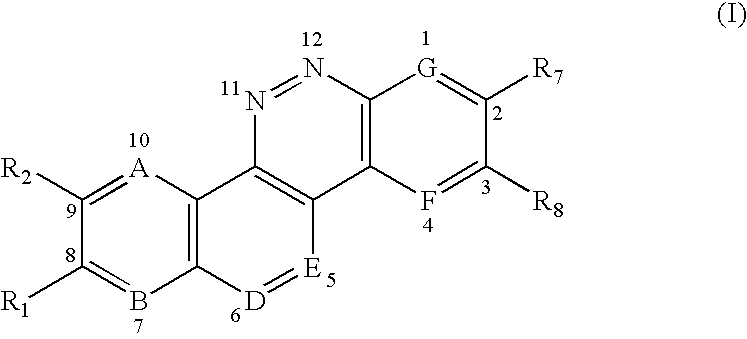
wherein
-
- R1-R8 and A-G have any of the meanings defined in the specification and their pharmaceutically acceptable salts. The invention also provides pharmaceutical compositions comprising a compound of formula I, processes for preparing compounds of formula I, intermediates useful for preparing compounds of formula I, and therapeutic methods for treating cancer using compounds of formula I.
Description
- This application is a continuation under 35 USC 111(a) of PCT/US00/29583 filed Oct. 26, 2000 (WO 01/32631 A3), which claimed priority from U.S. Provisional Patent Application Ser. No. 60/162,540, filed Oct. 29, 1999, which applications are incorporated by reference.
- The invention described herein was made with U.S. Government support under grant number CA39662 awarded by the National Cancer Institute. The United States Government has certain rights in the invention.
- DNA-topoisomerases are enzymes which are present in the nuclei of cells where they catalyze the breaking and rejoining of DNA strands, which control the topological state of DNA. Recent studies also suggest that topoisomerases are also involved in regulating template supercoiling during RNA transcription. There are two major classes of mammalian topoisomerases. DNA-topoisomerase-I catalyzes changes in the topological state of duplex DNA by performing transient single-strand breakage-union cycles. In contrast, mammalian topoisomerase II alters the topology of DNA by causing a transient enzyme bridged double-stand break, followed by strand passing and resealing. Mammalian topoisomerase II has been further classified as Type II a and Type II P. The antitumor activity associated with agents which are topoisomerase poisons is associated with their ability to stabilize the enzyme-DNA cleavable complex. This drug-induced stabilization of the enzyme-DNA cleavable complex effectively converts the enzyme into a cellular poison.
- Several antitumor agents in clinical use have potent activity as mammalian topoisomerase II poisons. These include adriamycin, actinomycin D. daunomycin, VP-16, and VM-26 (teniposide or epipodophyllotoxin). In contrast to the number of clinical and experimental drugs which act as topoisomerase II poisons, there are currently only a limited number of agents which have been identified as topoisomerase I poisons. Camptothecin and its structurally-related analogs are among the most extensively studied topoisomerase I poisons. Recently, bi- and terbenzimidazoles (Chen et al., Cancer Res. 1993, 53, 1332-1335; Sun et al., J. Med. Chem. 1995, 38, 3638-3644; Kim et al., J. Med. Chem. 1996, 39, 992-998), certain benzo[c]phenanthridine and protoberberine alkaloids and their synthetic analogs (Makhey et al., Med. Chem. Res. 1995, 5, 1-12; Janin et al., J. Med. Chem 1975, 18, 708-713; Makhey et al., Bioorg. & Med. Chem. 1996, 4, 781-791), as well as the fungal metabolites, bulgarein (Fujii et al., J. Biol. Chem. 1993, 268, 13160-13165) and saintopin (Yamashita et al., Biochemistry 1991, 30, 5838-5845) and indolocarbazoles (Yamashita et al., Biochemistry 1992, 31, 12069-12075) have been identified as topoisomerase I poisons.
- The exceptional topoisomerase poisoning observed with coralyne, nitidine, 5,6-dihydro-8-desmethylcoralyne and related analogs prompted several recent studies on those structural features which are associated with their ability to act specifically as poisons of topoisomerase I or topoisomerase II (Gatto et al., Cancer Res. 1996, 56, 2795-2800; Wang et al., Chem. Res. Toxicol. 1996, 9, 75-83; Wang et al., Chem. Res. Toxicol., 1993, 6, 813-818). A common feature associated with all three of these agents is the presence of a 3-phenylisoquinolinium moiety within their structure.
- Despite the observation that several of these compounds had similar potency to camptothecin as a topoisomerase I poison or similar potency to VM-26 as a topoisomerase II poison, they possessed only modest cytotoxic activity. The absence of a more direct correlation with their potency as topoisomerase poisons was attributed, in part, to the likelihood that these agents are not likely to be absorbed as effectively into cells as either camptothecin or VM-26. The presence of the quaternary ammonium group most likely impedes cellular uptake. It has been speculated that agents such as coralyne and nitidine may need to undergo hydrolysis to permit effective transport, with subsequent dehydration or cyclodehydration to reform the quaternary ammonium parent compound. This may explain the relatively poor antitumor activity observed in vivo with agents such as coralyne or nitidine.
- Presently, a need exists for additional agents that are useful for treating cancer.
- Applicant has discovered compounds that show inhibitory activity against topoisomerase I and/or topoisomerase II, and compounds that are effective cytotoxic agents against cancer cells, including drug-resistant cancer cells. Accordingly, the invention provides a compound of the invention which is a compound of formula I:

wherein: -
- A is N or CR3;
- B is N or CRs;
- D is NRe or CRaRb;
- E is NRf or CRcRd;
- F is N or CRf;
- G is N or CR6;
- R1, R2 and R3 are each individually hydrogen, (C1-C6)alkyl, (C3-C6)cycloalkyl, (C1-C6alkoxy, nitro, hydroxy, COORk, ORm, or halo; or R1 and R2 taken together are methylenedioxy and R3 is hydrogen, (C1-C6)alkyl, (C3-C6)cycloalkyl, (C1-C6)alkoxy, nitro, hydroxy, NRgRh, COORk, ORm, or halo; or R2 and R3 taken together are methylenedioxy and R1 is hydrogen, (C1-C6)alkyl, (C3-C6)cycloalkyl, (C1-C6)alkoxy, nitro, hydroxy, NRgRh, COORk, ORm, or halo;
- R6, R7 and R8 are each individually hydrogen, (C1-C6)alkyl, (C3-C6)cycloalkyl, (C1-C6)alkoxy, nitro, hydroxy, NRgRh, COORk, ORm, or halo; or R6 and R7 taken together are methylenedioxy and Rg is hydrogen, (C1-C6)alkyl, (C3-C6)cycloalkyl, (C1-C6)alkoxy, nitro, hydroxy, NRgRh, COORk, ORm, or halo; or R7 and R5 taken together are methylenedioxy and R6 is hydrogen, (C1-C6)alkyl, (C3-C6)cycloalkyl, (C1-C6)alkoxy, nitro, hydroxy, NRgRh, C(═O)Rk, COORk, ORm, or halo;
- each bond represented by ----- is individually present or absent;
- Ra and Rb are each independently hydrogen or (C1-C6)alkyl if the bond between the 11- and 12-positions represented by ----- is absent; or Ra is hydrogen or (C1-C6)alkyl and Rb is absent if the bond between the 11- and 12-positions represented by ----- is present;
- Rc and Rd are each independently hydrogen or (C1-C6)alkyl if the bond between the 11- and 12-positions represented by ----- is absent; or Ra is hydrogen or (C1-C6)alkyl and Rd is absent if the bond between the 11- and 12-positions represented by ----- is present;
- Re is hydrogen or (C1-C6)allyl if the bond between the 5- and 6-positions represented by ----- is absent; or Ra is absent if the bond between the 5- and 6-positions represented by ----- is present;
- Rf is hydrogen or (C1-C6)alkyl if the bond between the 5- and 6-positions represented by ----- is absent; or Rf is absent if the bond between the 5- and 6-positions represented by ----- is present;
- each Rg and Rh is independently hydrogen, (C1-C6alkyl, (C3-C6)cycloalkyl, (C1-C6)alkoxy, (C1-C6)alkanoyl, aryl, aryl(C1-C6)alkyl, aryloxy, or aryl(C1-C6)alkoxy; or Rg and Rh together with the nitrogen to which they are attached are pyrrolidino, piperidino, morpholino, or thiomorpholino;
- each Rk is independently hydrogen, or (C1-C6)alkyl; and
- each Rm is independently (C1-C6)alkanoyl, aryl, or aryl(C1-C6)alkyl;
- each Rs and Rt is independently hydrogen, methyl, nitro, hydroxy, amino, or halo;
- wherein any (C1-C6)alkyl, (C3-C6)cycloalkyl, or (C1-C6)alkoxy of R1, R2, R3, R6, R7, R8, or Rk is optionally substituted on carbon with 1, 2, or substituents independently selected from hydroxy, halo, NRnRp, (C3-C6)cycloalkyl, or (C1-C6)alkoxy, wherein each Rn and Rp is independently hydrogen, (C1-C6)alkyl, (C3-C6)cycloalkyl, (C1-C6)alkoxy, or (C1-C6)alkanoyl; or Rn and Rp together with the nitrogen to which they are attached are pyrrolidino, piperidino, morpholino, or thiomorpholino;
- wherein any aryl is optionally be substituted with 1, 2, or 3 substituents independently selected from hydroxy, halo, nitro, trifluoromethyl, trifluoromethoxy, carboxy, amino, (C1-C6)alkyl, (C3-C6)cycloalkyl, and (C1-C6)alkoxy;
- provided no more than two of A-G comprise nitrogen;
- or a pharmaceutically acceptable salt thereof.
- The invention also provides a pharmaceutical composition comprising a effective amount of a compound of formula L or a pharmaceutically acceptable salt thereof, in combination with a pharmaceutically acceptable diluent or carrier.
- The invention also provides a method of inhibiting cancer cell growth, comprising administering to a mammal afflicted with cancer, an amount of a compound of formula (1), effective to inhibit the growth of said cancer cells.
- The invention also provides a method comprising inhibiting cancer cell growth by contacting said cancer cell in vitro or in vivo with an amount of a compound of
claim 1, effective to inhibit the growth of said cancer cell. - The invention also provides a compound of formula I for use in medical therapy (preferably for use in treating cancer, e.g. solid tumors), as well as the use of a compound of formula I for the manufacture of a medicament useful for the treatment of cancer, e.g. solid tumors.
- The invention also provides processes and novel intermediates disclosed herein which are useful for preparing compounds of the invention. Some of the compounds of formula I are useful to prepare other compounds of formula I.
- K. W. Gopinath et al., Indian J. Chem., 1958, 504-509, disclose the preparation of 2,3,8,9-tetramethoxy-5,6-diazachrysene and 2,3-8,9-bismethylenedioxy-5,6-diazacrysene. Accordingly, the compounds of the invention may preferably exclude the
compounds - The compounds of the invention may also preferably exclude compounds of formula (I) wherein D is NR; when A CR3; B is Cs; E is CRcRd; F is CRt; and G is CR6.
- The compounds of the invention may also preferably exclude compounds wherein R1-R3 and R6-R8 are each hydrogen.
- The compounds of the invention may also preferably exclude 9-hydroxy-2,3,8-trimethoxydibenzo[c,h]cinnoline.
- Preferably, for a compound of formula I one of R2 and R8 is hydrogen, methyl, nitro, hydroxy, amino, fluoro or chloro; or at least one of R2 and R8 forms part of a methylenedioxy.
- FIGS. 1-5: illustrate the synthesis of compounds of the invention.
-
FIG. 6 : illustrates specific compounds of Formula I. - FIGS. 7-10: illustrate the synthesis of compounds of the invention.
-
FIG. 11 : shows the structure of reference compounds tested hereinbelow. - The following definitions are used, unless otherwise described: halo is fluoro, chloro, bromo, or iodo. Alkyl, alkoxy, alkenyl, alknyl, etc. denote both straight and branched groups; but reference to an individual radical such as “propyl” embraces only the straight chain radical, a branched chain isomer such as “isopropyl” being specifically referred to. Aryl denotes a phenyl radical or an ortho-fused bicyclic carbocyclic radical having about nine to ten ring atoms in which at least one ring is aromatic.
- Specific values listed below for radicals, substituents, and ranges, are for illustration only, they do not exclude other defined values or other values within defined ranges for the radicals and substituents
- Specifically, (C1-C6)alkyl can be methyl, ethyl, propyl, isopropyl, butyl, iso-butyl, sec-butyl, pentyl, 3-pentyl, or hexyl; (C3-C6)cycloalkyl can be cyclopropyl, cyclobutyl, cyclopentyl, or cyclohexyl; (C1-C6)alkoxy can be methoxy, ethoxy, propoxy, isopropoxy, butoxy, iso-butoxy, sec-butoxy, pentoxy, 3-pentoxy, or hexyloxy; (C1-C6)alkanoyl can be acetyl, propanoyl, butanoyl, pentanoyl, or hexanoyl; and aryl can be phenyl, indenyl, or naphthyl;.
- Specifically, R2 or R7 can be hydroxy, methoxy, benzyloxy, amino, hydroxymethyl, aminomethyl, aminocarbonyl, methoxycarbonyl, trifluoromethyl, 3-aminopropoxycarbonyl, or 2-hydroxyethyl.
- Specifically, R3 can be hydrogen.
- Specifically, Rs and Rt are each hydrogen.
- A specific group of compounds are compounds of formula I:
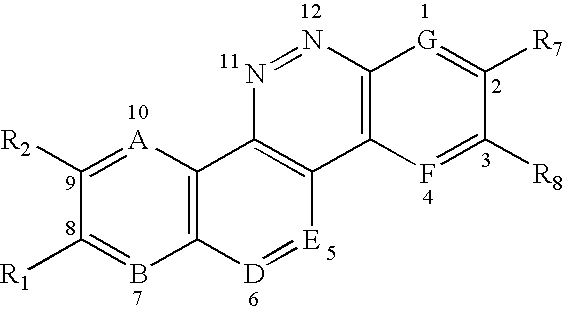
wherein: -
- A is N or CR3;
- B is N or CR;
- D is NRe or CRaRb;
- E is NRf or CRcRd;
- F is N or CRt;
- G is N or CR6;
- R1, R2 and R3 are each individually hydrogen, (C1-C6)alkyl, (C3-C6)cycloalkyl, (C1-C6)alkoxy, nitro, hydroxy, NRgRh, COORk, ORm, or halo; or R1 and R2 taken together are methylenedioxy and R3 is hydrogen, (C1-C6)alkyl, (C3-C6)cycloalkyl, (C1-C6)alkoxy, nitro, hydroxy, NRgRh, COORk, ORm, or halo; or R2 and R3 taken together are methylenedioxy and R1 is hydrogen, (C1-C6)alkyl, (C3-C6)cycloalkyl, (C1-C6)alkoxy, nitro, hydroxy, NRgRh, COORk, ORm, or halo;
- R6, R7 and R8 are each individually hydrogen, (C1-C6)alkyl, (C3-C6)cycloalkyl, (C1-C6)alkoxy, nitro, hydroxy, NRgRh, COORk, Ok, or halo; or R6 and R7 taken together are methylenedioxy and R8 is hydrogen, (C1-C6)alkyl, (C3-C6)cycloalkyl, (C1-C6)alkoxy, nitro, hydroxy, NRgRh, COORk, ORm, or halo; or R7 and R8 taken together are methylenedioxy and R6 is hydrogen, (C1-C6)alkyl, (C3-C6)cycloalkyl, (C1-C6)alkoxy, nitro, hydroxy, NRgRh, C(═O)Rk, COORk, ORm, or halo;
- each bond represented by ----- is individually present or absent;
- Ra and Rb are each independently hydrogen or (C1-C6)alkyl if the bond between the 11- and 12-positions represented by ----- is absent; or Ra is hydrogen or (C1-C6)alkyl and Ra is absent if the bond between the 11- and 12-positions represented by ----- is present;
- Rc and Rd are each independently hydrogen or (C1-C6)alkyl if the bond between the 11- and 12-positions represented by ----- is absent; or Ra is hydrogen or (C1-C6)alkyl and Rd is absent if the bond between the 11- and 12-positions represented by ----- is present;
- Re is hydrogen or (C1-C6)alkyl if the bond between the 5- and 6-positions represented by ----- is absent; or Re is absent if the bond between the 5- and 6-positions represented by ----- is present;
- Rf is hydrogen or (C1-C6)alkyl if the bond between the 5- and 6-positions represented by ----- is absent; or Rf is absent if the bond between the 5- and 6-positions represented by ----- is present;
- each Rg and Rh is independently hydrogen, (C1-C6)alkyl, (C3-C6)cycloalkyl, (C1-C6)alkoxy, (C1-C6)alkanoyl, aryl, aryl(C1-C6)alkyl, aryloxy, or aryl(C1-C6)alkoxy; or N and R together with the nitrogen to which they are attached are pyrrolidino, piperidino, morpholino, or thiomorpholino;
- each Rk is independently hydrogen, or (C1-C6)alkyl; and
- each Rm is independently (C1-C6)alkanoyl, aryl, or aryl(C1-C6)alkyl;
- each Rs and Rt is independently hydrogen, methyl, nitro, hydroxy, amino, or halo;
- wherein any (C1-C6)alkyl, (C3-C6)cycloalkyl, or (C1-C6)alkoxy of R1, R2, R3, R6, R7, R8, or Rk is optionally substituted on carbon with 1, 2, or 3 substituents independently selected from hydroxy, halo, NRnRp, (C3-C6)cycloalkyl, or (C1-C6)alkoxy, wherein each Rn and Rp is independently hydrogen, (C1-C6)alkyl, (C3-C6)cycloalkyl, (C1-C6)alkoxy, or (C1-C6)alkanoyl; or Rn and Rp together with the nitrogen to which they are attached are pyrrolidino, piperidino, morpholino, or thiomorpholino;
- wherein any aryl is optionally be substituted with 1, 2, or 3 substituents independently selected from hydroxy, halo, nitro, trifluoromethyl, trifluoromethoxy, carboxy, amino, (C1-C6)alkyl, (C3-C6)cycloalkyl, and (C1-C6)alkoxy,
- provided no more than two of A-G comprise nitrogen; and
- provided at least one of R2 and R8 is hydrogen, methyl, nitro, hydroxy, amino, fluoro or chloro; or at least one of R2 and R8 forms part of a methylenedioxy,
or a pharmaceutically acceptable salt thereof. Preferably, within this specific group of compounds the compound of formula I is not 2,3-8,9-bismethylenedioxy-5,6-diazacrysene; and R, —R3 and R6-R are not each hydrogen.
- A specific group of compounds are compounds of formula I wherein R1, R2 and R3 are each individually hydrogen, or (C1-C6)alkoxy, or R1 and R2 taken together are methylenedioxy (—OCH2O—) and R3 is hydrogen or (C1-C6)alkoxy, or a pharmaceutically acceptable salt thereof.
- Another specific group of compounds are compounds of formula I wherein R7 or R is (C1-C6)alkoxy; or R7 and R8 taken together are methylenedioxy; or a pharmaceutically acceptable salt thereof.
- Another specific group of compounds are compounds of formula I wherein R7 and R8 taken together are methylenedioxy, or a pharmaceutically acceptable salt thereof.
- Another specific group of compounds are compounds of formula I wherein the bonds represented by ----- are both present; or a pharmaceutically acceptable salt thereof.
- Another specific group of compounds are compounds of formula I wherein the bond between the 5- and the 6-positions that is represented by ----- is absent; or a pharmaceutically acceptable salt thereof.
- Another specific group of compounds are compounds of formula I wherein the bond between the 11- and the 12-positions that is represented by ----- is absent; or a pharmaceutically acceptable salt thereof.
- Another specific group of compounds are compounds of formula I wherein the bonds represented by ----- are both absent; or a pharmaceutically acceptable salt thereof.
- A specific compound of formula I is a compound of formula II, III, IV, V, VI, VI, VII, VIII, IX or X (
FIG. 6 ) wherein R1-R8, Ra-Rt have any of the values, specific values or preferred values described herein for a compound of formula I. Compounds of formulae II-X can be prepared from available starting materials using procedures known in the art, or using procedures analogous to those described herein. - A compound of formula I can be prepared by subjecting an intermediate of formula XX (wherein R1-R8 and A-G have any of the values, specific values, or preferred values described herein for a corresponding substituent in a compound of formula I):
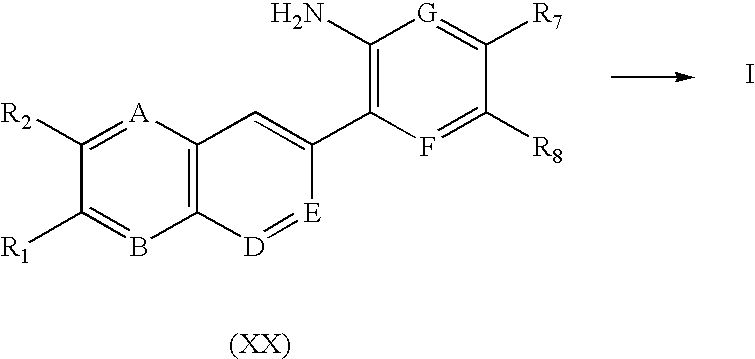
-
- to conditions suitable for formation of the tetracyclic ring system. Conditions suitable for formation of the tetracyclic ring system are well known to the art. For example, see Example 1 hereinbelow.
- An intermediate of formula XX can be prepared from readily available starting materials using procedures that are known in the art, or can be prepared using the procedures described hereinbelow, which are illustrated in the figures.
- As illustrated in
FIG. 1 and as shown in Example 1, reduction of 6,7-dimethoxy-1-oxo-1,2,3,4-etrahydronaphthlene, provides analcohol 1, which can be dehydrated to providedihydronaphthlene 2. Coupling with an 2-iodo-nitrobenzene provides 3 which can be oxidized to provide 4. Reduction of the nitro group provides amine 5, which is a compound of formula XX. - As illustrated in
FIGS. 2, 3 , and 4, and as shown in Example 2, nitration of 4-bromoveratrole under standard conditions providesnitro compound 7, which can be converted tostannane 8 under standard conditions. Coupling ofstannane 8 withtriflate 9 provides 11, which can be oxidized to provide 12. Alternatively,stannane 8 can be coupled withtriflate 10 to provide 12. Reduction of the nitro group in 12 under standard conditions, provides an intermediate of formula XX. As illustrated inFIG. 4 ,triflate 9 can be prepared from 6,7-dimethoxy-2-oxo-1,2,3,4-tetrahydronaphthlene by formation of the eneoltriflate, under standard conditions.Triflate 10 can be prepared from 9 by oxidation under standard conditions. - As illustrated in
FIGS. 4 and 5 , and as shown in Example 3, an intermediate 16 can be prepared by nitration of readily available 3,4-dimethoxybromobenzene under standard conditions, followed by formation of the correspondingstannane 16. Coupling oftriflate 10 andstannane 16 under standard conditions, providesnitro compound 17 which can be reduced to provide an intermediate of formula XX. - Other intermediates of formula XX can be prepared using procedures similar to those described herein by selecting appropriate starting materials to provide the desired intermediate of formula XX.
- In cases where compounds are sufficiently basic or acidic to form stable nontoxic acid or base salts, administration of the compounds as salts may be appropriate. Examples of pharmaceutically acceptable salts are organic acid addition salts formed with acids which form a physiological acceptable anion, for example, tosylate, methanesulfonate, acetate, citrate, malonate, tartarate, succinate, benzoate, ascorbate, α-ketoglutarate, and α-glycerophosphate. Suitable inorganic salts may also be formed, including hydrochloride, sulfate, nitrate, bicarbonate, and carbonate salts.
- Pharmaceutically acceptable salts may be obtained using standard procedures well known in the art, for example by reacting a sufficiently basic compound such as an amine with a suitable acid affording a physiologically acceptable anion. Alkali metal (for example, sodium, potassium or lithium) or alkaline earth metal (for example calcium) salts of carboxylic acids can also be made.
- The compounds of formula I can be formulated as pharmaceutical compositions and administered to a mammalian host, such as a human patient in a variety of forms adapted to the chosen route of administration, i.e., orally or parenterally, by intravenous, intramuscular, topical or subcutaneous routes.
- Thus, the present compounds may be systemically administered, e.g., orally, in combination with a pharmaceutically acceptable vehicle such as an inert diluent or an assimilable edible carrier. They may be enclosed in hard or soft shell gelatin capsules, may be compressed into tablets, or may be incorporated directly with the food of the patient's diet. For oral therapeutic administration, the active compound may be combined with one or more excipients and used in the form of ingestible tablets, buccal tablets, troches, capsules, elixirs, suspensions, syrups, wafers, and the like. Such compositions and preparations should contain at least 0.1% of active compound. The percentage of the compositions and preparations may, of course, be varied and may conveniently be between about 2 to about 60% of the weight of a given unit dosage form. The amount of active compound in such therapeutically useful compositions is such that an effective dosage level will be obtained.
- The tablets, troches, pills, capsules, and the like may also contain the following: binders such as gum tragacanth, acacia, corn starch or gelatin; excipients such as dicalcium phosphate; a disintegrating agent such as corn starch, potato starch, alginic acid and the like; a lubricant such as magnesium stearate; and a sweetening agent such as sucrose, fructose, lactose or aspartame or a flavoring agent such as peppermint, oil of wintergreen, or cherry flavoring may be added. When the unit dosage form is a capsule, it may contain, in addition to materials of the above type, a liquid carrier, such as a vegetable oil or a polyethylene glycol. Various other materials may be present as coatings or to otherwise modify the physical form of the solid unit dosage form. For instance, tablets, pills, or capsules may be coated with gelatin, wax, shellac or sugar and the like. A syrup or elixir may contain the active compound, sucrose or fructose as a sweetening agent, methyl and propylparabens as preservatives, a dye and flavoring such as cherry or orange flavor. Of course, any material used in preparing any unit dosage form should be pharmaceutically acceptable and substantially non-toxic in the amounts employed. In addition, the active compound may be incorporated into sustained-release preparations and devices.
- The active compound may also be administered intravenously or intraperitoneally by infusion or injection. Solutions of the active compound or its salts can be prepared in water, optionally mixed with a nontoxic surfactant. Dispersions can also be prepared in glycerol, liquid polyethylene glycols, triacetin, and mixtures thereof and in oils. Under ordinary conditions of storage and use, these preparations contain a preservative to prevent the growth of microorganisms.
- The pharmaceutical dosage forms suitable for injection or infusion can include sterile aqueous solutions or dispersions or sterile powders comprising the active ingredient which are adapted for the extemporaneous preparation of sterile injectable or infusible solutions or dispersions, optionally encapsulated in liposomes. In all cases, the ultimate dosage form must be sterile, fluid and stable under the conditions of manufacture and storage. The liquid carrier or vehicle can be a solvent or liquid dispersion medium comprising, for example, water, ethanol, a polyol (for example, glycerol, propylene glycol, liquid polyethylene glycols, and the like), vegetable oils, nontoxic glyceryl esters, and suitable mixtures thereof. The proper fluidity can be maintained, for example, by the formation of liposomes, by the maintenance of the required particle size in the case of dispersions or by the use of surfactants. The prevention of the action of microorganisms can be brought about by various antibacterial and antifungal agents, for example, parabens, chlorobutanol, phenol, sorbic acid, thimerosal, and the like. In many cases, it will be preferable to include isotonic agents, for example, sugars, buffers or sodium chloride. Prolonged absorption of the injectable compositions can be brought about by the use in the compositions of agents delaying absorption, for example, aluminum monostearate and gelatin.
- Sterile injectable solutions are prepared by incorporating the active compound in the required amount in the appropriate solvent with various of the other ingredients enumerated above, as required, followed by filter sterilization. In the case of sterile powders for the preparation of sterile injectable solutions, the preferred methods of preparation are vacuum drying and the freeze drying techniques, which yield a powder of the active ingredient plus any additional desired ingredient present in the previously sterile-filtered solutions.
- For topical administration, the present compounds may be applied in pure form, i.e., when they are liquids. However, it will generally be desirable to administer them to the skin as compositions or formulations, in combination with a dermatologically acceptable carrier, which may be a solid or a liquid.
- Useful solid carriers include finely divided solids such as talc, clay, microcrystalline cellulose, silica, alumina and the like. Useful liquid carriers include water, alcohols or glycols or water-alcohol/glycol blends, in which the present compounds can be dissolved or dispersed at effective levels, optionally with the aid of non-toxic surfactants. Adjuvants such as fragrances and additional antimicrobial agents can be added to optimize the properties for a given use. The resultant liquid compositions can be applied from absorbent pads, used to impregnate bandages and other dressings, or sprayed onto the affected area using pump-type or aerosol sprayers.
- Thickeners such as synthetic polymers, fatty acids, fatty acid salts and esters, fatty alcohols, modified celluloses or modified mineral materials can also be employed with liquid carriers to form spreadable pastes, gels, ointments, soaps, and the like, for application directly to the skin of the user.
- Examples of useful dermatological compositions which can be used to deliver the compounds of formula I to the skin are known to the art; for example, see Jacquet et al. (U.S. Pat. No. 4,608,392), Geria (U.S. Pat. No. 4,992,478), Smith et al. (U.S. Pat. No. 4,559,157) and Wortzman (U.S. Pat. No. 4,820,508).
- Useful dosages of the compounds of formula I can be determined by comparing their in vitro activity, and in vivo activity in animal models. Methods for the extrapolation of effective dosages in mice, and other animals, to humans are known to the art; for example, see U.S. Pat. No. 4,938,949.
- Generally, the concentration of the compound(s) of formula I in a liquid composition, such as a lotion, will be from about 0.1-25 wt-%, preferably from about 0.5-10 wt-%. The concentration in a semi-solid or solid composition such as a gel or a powder will be about 0.1-5 wt-%, preferably about 0.5-2.5 wt-%.
- The amount of the compound, or an active salt or derivative thereof, required for use in treatment will vary not only with the particular salt selected but also with the route of administration, the nature of the condition being treated and the age and condition of the patient and will be ultimately at the discretion of the attendant physician or clinician.
- In general, however, a suitable dose will be in the range of from about 0.5 to about 100 mg/kg, e.g., from about 10 to about 75 mg/kg of body weight per day, such as 3 to about 50 mg per kilogram body weight of the recipient per day, preferably in the range of 6 to 90 mg/kg/day, most preferably in the range of 15 to 60 mg/kg/day.
- The compound may conveniently be administered in unit dosage form; for example, containing 5 to 1000 mg, conveniently 10 to 750 mg, most conveniently, 50 to 500 mg of active ingredient per unit dosage form.
- Ideally, the active ingredient should be administered to achieve peak plasma concentrations of the active compound of from about 0.5 to about 75 μM, preferably, about 1 to 50 μM, most preferably, about 2 to about 30 μM. This may be achieved, for example, by the intravenous injection of a 0.05 to 5% solution of the active ingredient, optionally in saline, or orally administered as a bolus containing about 1-100 mg of the active ingredient. Desirable blood levels may be maintained by continuous infusion to provide about 0.01-5.0 mg/kg/hr or by intermittent infusions containing about 0.4-15 mg/kg of the active ingredient(s).
- The desired dose may conveniently be presented in a single dose or as divided doses administered at appropriate intervals, for example, as two, three, four or more sub-doses per day. The sub-dose itself may be further divided, e.g., into a number of discrete loosely spaced administrations; such as multiple inhalations from an insufflator or by application of a plurality of drops into the eye.
- The ability of a compound of the invention to effect topoisomerase I or II mediated DNA cleavage can be determined using pharmacological models that are well known to the art, for example, using a model like Test A described below.
- Test A.Topoisomerase I-Mediated DNA Cleavage Assay
- Human topoisomerase I was expressed in E. Coli and isolated as a recombinant fusion protein using a T7 expression system as described previously (Makhey, D. et al., Bioorg. Med. Chem., 2000, 8, 1-11). DNA topoisomerase I was purified from calf thymus gland as reported previously (Maniatis, T., et al., J. Molecular Cloning, a Laboratory Manual, Cold Spring Harbor Laboratory, Cold Spring Harbor, N.Y., 149-185). Plasmid YepG was also purified by the alkali lysis method followed by phenol deproteination and CsCl/ethidium isopycnic centrifugation method as described (Maniatis, T.; Fritsch, E. F.; Sambrook, J. Molecular Cloning, a Laboratory Manual; Cold Spring Harbor Laboratory: Cold Spring Harbor, N.Y. 1982; pp 149-185).102 The end-labeling of the plasmid was accomplished by digestion with a restriction enzyme followed by end-filling with Klenow polymerase as previously described (Liu, L. F.; Rowe, T. C.; Yang, L.; Tewey, K. M.; Chen, G. L. “Cleavage of DNA by mammalian topdisomerase II,” J. Biol. Chem. 1983, 258, 15365).103 Cleavage assays were performed as previously reported (B. Gatto et al. Cancer Res., 1996, 56, 2795-2800).13 The drug and the DNA in presence of topoisomerase I was incubated for 30 minutes at 37° C. After development of the gels, typically 24-hour exposure was used to obtain autoradiograms outlining the extent of DNA fragmentation. Topoisormerase I-mediated DNA cleavage values are reported as REC, Relative Effective Concentration, i.e. concentrations relative to 2,3-dimethoxy-8,9-methylenedioxybenzo[i]phenanthridine, whose value is arbitrarily assumed as 1.0, that are able to produce the same cleavage on the plasmid DNA in the presence of human topoisomerase I. Relative potency was based upon the relative amount of drug needed to induce approximately 10% DNA fragmentation. Assays were performed under the direction of Dr. L. F. Liu, Department of Pharmacology, The University of Medicine and Dentistry of New Jersey, Robert Wood Johnson Medical School, Piscataway, N.J.
- Data from Test A for representative compounds of the invention is shown in Table 1.
TABLE 1 Topoisomerase Compound I-mediated DNA cleavage 6 5 14 0.01 19 >100 60 2 61 10 - The cytotoxic effects of a compound of the invention can be determined using pharmacological models that are well known to the art, for example, using a model like Test B described below.
- Test B. Inhibition of Cell Growth: MIT-Microtiter Plate Tetrazolinium Cytotoxicity Assay (RPMI 8402, CPT-K5, U937, U937/CR Cells)
- The cytotoxicity was determined using the MTT-microtiter plate tetrazolinium cytotoxicity assay (MTA) (See Chen A. Y. et al. Cancer Res. 1993, 53, 1332; Mosmann, T. J., J. Immunol Methods 1983, 65, 55; and Carmichael, J. et al. Cancer Res. 1987, 47, 936). The human lymphoblast RPMI 8402 and its camptothecin-resistant variant cell line, CPT-K5 were provided by Dr. Toshiwo Andoh (Anchi Cancer Research Institute, Nagoya, Japan) (see Andoh, T.; Okada, K. “Drug resistance mechanisms of topoisomerase I drugs,” Adv. in Pharmacology 1994, 29B, 93). Human U-937 myeloid leukemia cells and U-937/CR cells were described by Rubin et al., J. Biol. Chem., 269, 2433-2439 (1994). The cytotoxicity assay was performed by using 96-well microtiter plates using 2000 cells/well, in 200 mL of growth medium. Cells were grown in suspension at 37° C. in 5% CO2 and maintained by regular passage in RPMI medium supplemented with 10% heat-inactivated fetal bovine serum, 1-glutamine (2 mM), penicillin (100 U/mL), and streptomycin (0.1 mg/mL). For determination of IC50, cells were exposed continuously for 3-4 days to varying concentrations of drug, and MTT assays were performed at the end of the fourth day. Each assay was performed with a control that did not contain any drug. All assays were performed at least twice in 6 replicate wells. All assays were performed under the direction of Dr. L. F. Liu, Department of Pharmacology, The University of Medicine and Dentistry of New Jersey, Robert Wood Johnson Medical School, Piscataway, N.J. Representative data is shown in Tables 2 and 3.
TABLE 2 [ ] μM KB3-1 KBH1.0 + V HELA HCT116 ZR-75-1 KBV-1 (oral) (mdr-1) (H033342r.) (cervical) (colon) (breast) CPT* 0.006 0.006 0.007 0.004 0.003 0.004 VBS+ 0.003 0.4 0.0022 0.002 0.003 0.003 HO33342* 0.25 3 >10 0.6 0.22 0.06 BZ-III-26* 0.3 0.2 0.15 0.15 0.25 0.2 DL-II-91* 0.2 0.18 0.12 0.12 0.2 0.2 6 6 4 5 6 3.2 4 14 0.07 0.08 0.06 0.05 0.035 0.04 -
TABLE 3 [] μM RPMI 8402 CPT-K5 U937 U937/CR Bz-III-26* 0.5 0.3 0.09 0.06 DL-II-91* 0.3 0.13 0.03 0.025 6 3 10 3 3 14 0.06 6 0.06 3 19 10 >10 10 20 60 2 4 1.9 2.5 61 4 31 3 6 34 >100 >100 >100 >100 42 38 61 >100 40 43 >100 52 38 30 44 0.5 1.3 43 0.9
*SeeFIG. 11
+VBS = Vinblastine
- The data in Tables 2 and 3 demonstrates that representative compounds of the invention function as cytotoxic agents against tumor cell lines, including multidrug resistant tumor cell lines. Thus, the compounds are useful to treat cancer and can be used to treat tumors that are resistant to other specific chemotherapeutic agents.
- Topoisomerase inhibitors are also known to possess antibacterial, antifungal, antiprotozoal, antihelmetic, and antiviral activity. Accordingly, the topoisomerase inhibitors of the invention may also be useful as antibacterial, antifungal, antiprotozoal, antihelmetic, or antiviral agents. In particular, compounds of the invention that demonstrate little or no activity as mammalian topoisomerase I poisons, because of the possibility of similar molecular mechanism of action, could be highly active and selective antibacterial, antifungal, antiprotozoal, antihelmetic, or antiviral agents. Thus, certain compounds of the invention may be particularly useful as systemic antibacterial, antifingal, antiprotozoal, antihelmetic, or antiviral agents in mammals. The invention also provides the use of a compound of the invention for the manufacture of a medicament useful for producing an antibacterial, antifungal, antiprotozoal, antihelmetic, or antiviral effect in a mammal.
- As used herein, the term “solid mammalian tumors” include cancers of the head and neck, lung, mesothelioma, mediastinum, esophagus, stomach, pancreas, hepatobiliary system, small intestine, colon, rectum, anus, kidney, ureter, bladder, prostate, urethra, penis, testis, gynecological organs, ovarian, breast, endocrine system, skin central nervous system; sarcomas of the soft tissue and bone; and melanoma of cutaneous and intraocular origin. The term “hematological malignancies” includes childhood leukemia and lymphomas, Hodgkin's disease, lymphomas of lymphocytic and cutaneous origin, acute and chronic leukemia, plasma cell neoplasm and cancers associated with AIDS. The preferred mammalian species for treatment are humans and domesticated animals.
- The invention will now be illustrated by the following non-limiting Examples, wherein unless otherwise stated: melting points were determined with a Thomas-Hoover Unimelt capillary melting point apparatus; column chromatography refers to flash chromatography conducted on SiliTech 32-63 m, (ICN Biomedicals, Eschwegge, Ger.) using the solvent systems indicated; radial chromatography refers to the use of a Model 8924 chromatotron (Harrison Research, CA); infrared spectral data (IR) were obtained on a Perkin-Elmer 1600 Fourier transform spectrophotometer and are reported in cm−1; proton (1H NMR) and carbon (13C NMR) nuclear magnetic resonance were recorded on a Varian Gemini-200 Fourier Transform spectrometer; NMR spectra (200 MHz 1H and 50 MHz 13C) were recorded in the deuterated solvent indicated with chemical shifts reported in units downfield from tetramethylsilane (TMS); coupling constants are reported in hertz (Hz), a few drops of CF3COOH improved 13C NMR spectra by allowing for increased solubility and formation of the protonated form of the terbenzimidazoles, thereby eliminating tautomeric differences among carbon atoms; mass spectra were obtained from Washington University Resource for Biomedical and Bio-organic Mass Spectrometry within the Department of Chemistry at Washington University, St. Louis, Mo.; combustion analyses were performed by Atlantic Microlabs, Inc., Norcross, Ga., and were within 0.4% of the theoretical value;
compounds - 6-(2-Aminophenyl)-2,3-dimethoxynaphthalene (5, 70 mg, 0.25 mmol) was dissolved in 48% hydrobromic acid (4.25 mL), cooled in ice-salt bath, and treated dropwise with stirring with sodium nitrite (0.13 g) in water (2.2 mL). Stirring was continued for 0.5 h., and to the cold solution was then added with stirring freshly precipitated copper (0.5 g). The mixture was allowed to rise slowly to room temperature and left overnight. The solid was filtered off and washed with hot chloroform. The chloroform solution was washed with diluted sodium hydroxide solution, then with water, dried (anhydrous Na2SO4) and rotaevaporated to give the crude product. Chromatography on silica gel using 50:50 hexanes:ethyl acetate afforded the title compound (13 mg) in 18% yield; 1H NMR (CDCl3) d 4.11(3H, s), 4.24(3H, s), 7.37(1H, s), 7.89˜7.94 (2H, m), 8.14(1H, d, J=8.9), 8.41(1H, d, J=8.8), 8.61˜8.66(1H, m), 8.758.80(1H, m), 9.24(1H, s); 13C NMR d 56.1, 56.4, 104.0, 107.3, 112.3, 116.5, 118.5, 121.7, 126.7, 128.6, 128.8, 131.1, 131.2, 131.9, 141.5, 146.3, 150.9, 151.0.
- The intermediate 6-(2-aminophenyl)-2,3-dimethoxynaphthalene (5) was prepared as follows.
- a. 6(2-Nitrophenyl)-2,3 dimethoxy-7,8-dihydronaphthalene (3). Pd(PPh3)2Cl2 (840 mg, 1.2 mmol) and sodium acetate (200 mg, 2.4 mmol) were added to a solution of 6,7-dimethoxy-3,4-dihydronaphthalene (2, 700 mg, 3.7 mmol) and 1-iodo-2-nitrobenzene (925 mg, 3.7 mmol) in dimethylacetamide (50 mL). The mixture was stirred under nitrogen at 140° C. overnight, and then concentrated in vacuo. Ethyl acetate (60 mL) was added to the residue and washed with distilled water (50 mL). The organic layer was separated and passed through a celite bed. The organic layer was then washed with brine, dried (anhydrous Na2SO4) and concentrated in vacuo. The residue was chromatographed to give compound 3 (330 mg) in 29% yield; 1H NMR (CDCl3) d 2.51(2H, t, J=8.1), 2.92(2H, t, J=8.1), 3.87(3H, s), 3.90(3H, s), 6.45(1H, s), 6.67(1H, s), 6.73(1H, s), 7.38˜7.45(2H, m), 7.54˜7.62(1H, m), 7.887.93(1H, m); 13C NMR d 28.5, 28.5, 56.6, 111.0, 111.7, 124.9, 127.0, 127.1, 128.1, 128.3, 131.3, 133.3, 135.7, 138.7, 147.9, 148.9.
- b. 6(2-Nitrophenyl)2,3-dimethoxynaphthalene (4). 6-(2-Nitrophenyl)-2,3-dimethoxy-7,8-dihydronaphthalene (100 mg, 0.32 mmol) was refluxed overnight in toluene (20 mL) with DDQ (109 mg, 0.48 mmol). Cooled down to room temperature and filtered through celite bed. The filtrate was rotaevaporated to dryness to give the crude product. Chromatography on silica gel using 80:20 hexanes:ethyl acetate afforded compound 4 (90 mg) in 91% yield; 1H NMR (CDCl3) d 4.00(3H, s), 4.01(3H, s), 7.12(1H, s), 7.14(1H, s), 7.27(1H, dd, J=8.4, J=1.7), 7.46˜7.62(3H, m), 7.66(1H, s), 7.72(1H, d, J=8.4), 7.86(1H, d, 8.1); 13C NMR d 56.4, 106.6, 107.1, 124.5, 124.6, 125.9, 127.3, 128.4, 129.3, 129.6, 132.7, 132.7, 133.6, 137.0, 149.9, 150.5, 150.6.
- c. 6-(2-Aminophenyo)-2,3-dimethoxynaphthalene (5). 6-(2-Nitrophenyl)-2,3-dimethoxynaphthalene (70 mg, 0.23 mmol) was hydrogenated overnight in ethyl acetate (45 mL) at 40-45 Ibsq. in. under catalysis of palladium (10 wt % on activated carbon, 20 mg). The solution was passeded through a celite bed and the catalyst was washed with ethyl acetate (3×110 mL). Concentration in vacuo gave compound 5 (60 mg) in 99% yield; 1H NMR (CDCl3) d 4.02(3H, s), 4.04(3H, s), 6.82(1H, d, J=8.0), 6.85˜6.93 (1H, m), 7.16(1H, s), 7.18(1H, s), 7.20˜7.26(2H, m), 7.47(1H, dd, J=8.3, J-1.6), 7.78(1H, d, J-8.8), 7.80(1H, s); 13C NMR d 56.4, 106.6, 106.9, 116.1, 119.2, 126.1, 126.8, 127.3, 128.3, 128.7, 128.9, 129.9, 131.2, 135.8, 144.3, 150.2, 150.3.
-
Compound 2 was prepared as illustrated inFIG. 1 , from readily available starting materials, using standard procedures. - 6-(2-Amino-4,5-methylenedioxyphenyl)-2,3-dimethoxy-naphthalene (13, 40 mg, 0.13 mmol) in acetic acid (2 mL) and concentrated hydrochloric acid (0.3 mL) was cooled to 0° C. and diazotised with a solution of sodium nitrite (0.09 g in 1.5 mL water). The diazonium solution was allowed to rise slowly to room temperature and left overnight. Water (50 mL) was added to the red solution with some precipitate. The resulting mixture was extracted with ethyl acetate, washed with diluted sodium hydroxide solution, then with water, dried (anhydrous Na2SO4) and rotaevaporated to give the crude product. Chromatography on silica gel using 40:60 hexanes:ethyl acetate afforded the title compound (20 mg) in 50% yield; 11H NMR (CDCl3) d 4.09(3H, s), 4.22(3H, s), 6.24(2H, s), 7.31(1H, s), 7.80(1H, s), 7.95(1H, s), 8.00(1H, d, J=9.2), 8.13(1H, d, J=8.9), 9.14(1H, s); 13C NMR d 56.5, 56.9, 98.1, 102.9, 104.6, 107.5, 107.9, 117.1, 119.6, 120.6, 126.8, 128.5, 131.7, 141.9, 145.6, 150.2, 151.2, 152.1.
- The intermediate 6-(2-Amino-4,5-methylenedioxyphenyl)-2,3-dimethoxynaphthalene (13) was prepared as follows.
-
- a. 6,7-Dimethoxy-3,4-dihydro-2-naphthalenetriflate (9). A solution of 6,7-dimethoxy-2-tetralone (250 mg, 1.2 mmol) in THF (5 mL) was added to a suspension of sodium hydride (60 wt %, 75 mg, 1.9 mmol) in THF (10 mL) cooled by ice bath and stirred 0.5 h. A solution of N-phenyltrifluoromethane-sulfonimide (500 mg, 1.4 mmol) in TBF (5 mL) was then added, and the reaction was stirred at 0° C. for 9 hours. After concentration in vacuo, the residue was chromatographed using 80:20 hexanes:ethyl acetate to give compound 9 (300 mg) in 73% yield; 1H NMR (CDCl3) d 2.66(2H, t, J=8.5), 3.00(2H, t, J=8.4), 3.86(3H, s), 3.88(3H, s), 6.40(1H, s), 6.62(1H, s), 6.68(1H, s); 13C NMR d 27.1, 28.9, 56.5, 111.3, 111.7, 115.9, 118.7, 122.3, 124.0, 126.0, 148.2, 148.9, 149.3.
b. 6,7-Dimethoxy-2-naphthalenetriflate (10). 6,7-Dimethoxy-3,4-dihydro-2-naphthalenetriflate (200 mg, 0.59 mmol) was refluxed overnight in toluene (30 mL) with DDQ (166 mg, 0.73 mmol), cooled to room temperature, and filtered through celite bed. The filtrate was concentrated in vacuo to give the crude product. Chromatography on silica gel using a 80:20 hexanes:ethyl acetate afforded compound 10 (190 mg) in 95% yield; 1H NMR (CDCl3) d 4.00(6H, s), 7.10(1H, s), 7.12(1H, s), 7.21(1H, dd, J=8.9, J=2.5), 7.58(1H, d, J=2.5), 7.71(1H, d, J=8.9); 13C NMR d 56.4, 106.6, 106.6, 109.7, 116.1, 117.9, 118.2, 122.5, 128.9, 129.0, 129.8, 146.6, 150.9, 151.3.
c. 6(4,5-Methylenedioxy-2-nitrophenyl)-2,3-dimethoxy-naphthalene (12). Tetrakis(triphenylphosphine)palladium(0) (40 mg) and cuprous bromide (8 mg) were added to a solution of 6,7-dimethoxy-2-naphthalenetriflate (160 mg, 0.48 mmol) and trimethyl(3,4-methylenedioxy-6-nitrophenyl)stannane (8, 187 mg, 0.57 mmol) in THF (20 mL). The mixture was stirred at room temperature for 0.5 h., and then refluxed under nitrogen for 18 h. After Cooling, THF was rotaevaporated and ethyl acetate (50 ml) was added to the residue. the solution was washed with water (30 mL). The organic layer was separated and passed through a celite bed to remove suspended particles. The organic layer was then washed with brine, dried (anhydrous Na2SO4) and concentrated in vacuo. The residue was chromatographed on silica gel using 70:30 hexanes:ethyl acetate to give a mixture of two compounds with same Rf value. The mixture can be separated after the hydrogenation step.
d. 6-(2-Amino-4,5-methylenedioxyphenyl)-2,3-dimethoxy-naphthalene (13). 6-(4,5-Methylenedioxy-2-nitrophenyl)-2,3-dimethoxynaphthalene (25 mg, 0.071 mmol) was hydrogenated overnight in ethyl acetate (40 mL) at 4045 lb./sq. in. under catalysis of palladium (10 wt % on activated carbon, 20 mg). The solution was passed through celite bed and the catalyst was washed with ethyl acetate (3×10 ml). Concentration in vacuo gave the crude product. Chromatography using 60:40 hexanes:ethyl acetate gave compound 13 (15 mg) in 66% yield; 1H NMR (CDCl3) d 4.01(3H, s), 4.02(3H, s), 5.91(2H, s), 6.40(1H, s), 6.73(1H, s), 7.13(1H, s), 7.15(1H, s), 7.39(1H, dd, J=8.2, J=1.8), 7.72(1H, s), 7.74(1H, d, J=8.5); 13C NMR d 56.4, 98.3, 101.2, 106.6, 106.8, 110.7, 120.5, 126.3, 127.0, 127.3, 128.5, 129.9, 135.7, 138.9, 141.1, 148.0, 150.1, 150.3.
- a. 6,7-Dimethoxy-3,4-dihydro-2-naphthalenetriflate (9). A solution of 6,7-dimethoxy-2-tetralone (250 mg, 1.2 mmol) in THF (5 mL) was added to a suspension of sodium hydride (60 wt %, 75 mg, 1.9 mmol) in THF (10 mL) cooled by ice bath and stirred 0.5 h. A solution of N-phenyltrifluoromethane-sulfonimide (500 mg, 1.4 mmol) in TBF (5 mL) was then added, and the reaction was stirred at 0° C. for 9 hours. After concentration in vacuo, the residue was chromatographed using 80:20 hexanes:ethyl acetate to give compound 9 (300 mg) in 73% yield; 1H NMR (CDCl3) d 2.66(2H, t, J=8.5), 3.00(2H, t, J=8.4), 3.86(3H, s), 3.88(3H, s), 6.40(1H, s), 6.62(1H, s), 6.68(1H, s); 13C NMR d 27.1, 28.9, 56.5, 111.3, 111.7, 115.9, 118.7, 122.3, 124.0, 126.0, 148.2, 148.9, 149.3.
- The intermediate trimethyl(3,4-methylenedioxynitrophenyl)-stannane (8) in sub-part c above was prepared as follows.
- e. Trimethyl (3,4-methylenedioxy-6-nitrophenyl)stannane (8). A mixture of hexmethylditin (3 g, 9.2 mmol), 4-bromoveratrole 7 (Pettit, G. R.; Piatak, D. M. J. Org. Chem., 25, 1960, 1.6 g, 6.1 mmol) and Pd(PPh3)4 (200 mg) in anhydrous THF (30 ml) was heated to reflux under nitrogen for 10 h. After cooling to room temperature, THF was evaporated and methylene chloride (30 mL) was added to the residue. To this mixture, aqueous potassium fluoride (7.0M, 2 mL) was added dropwise with vigorous stirring. The mixture was passed through a celite bed and the filtrate was washed with brine. The methylene chloride layer was dried (anhyd. Na2SO4), filtered and evaporated in vacuo. The residue was chromatographed over 100 g of silica gel using 1:6 ethyl acetate:hexanes to give 8 in 65% yield; 1H NMR (CDCl3) d 0.32 (9H, s), 6.12 (2H, s), 7.04 (1H, s), 7.82 (1H, s); N3C NMR (CDCl3) d −6.8, 103.3, 105.8, 114.5, 137.2, 147.9, 149.4, 153.4; HRMS calcd for C10H3NO4SnCH3: 315.9632; found: 315.9638.
- 6-(2-Amino-4,5-dimethoxyphenyl)-2,3-dimethoxynaphthalene (18) (11 mg, 0.033 mmol) in acetic acid (0.6 mL) and concentrated hydrochloric acid (0.06 mL) was cooled to 0° C. and diazotised with a solution of sodium nitrite (0.026 g in 0.5 mL water). The diazonium solution was allowed to rise slowly to room temperature and left overnight. Water (30 mL) was added to the red solution with some precipitate. The resulting mixture was extracted with ethyl acetate, washed with diluted sodium hydroxide solution, then with water, dried (anhydrous Na2SO4) and rotaevaporated to give the crude product. Chromatography on silica gel using 40:60 chloroform:ethyl acetate afforded the title compound (5 mg) in 44% yield; 1H NMR (CDCl3) d 4.09(3H, s), 4.18(6H, s), 4.23(3H, s), 7.31(1H, s), 7.74(1H, s), 8.00(1H, s), 8.01(1H, d, J=8.5), 8.20(1H, d, J=8.9), 9.15(1H, s); 13C NMR d 56.5, 56.9, 99.9, 104.5, 107.9, 109.5, 116.9, 118.5, 118.9, 127.0, 128.4, 131.6, 141.8, 144.6, 151.1, 151.2, 152.0, 153.9.
- The intermediate 6-(2-amino-4,5-dimethoxyphenyl)-2,3-dimethoxynaphthalene (18) was prepared as follows.
- a. Trimethyl(3,4-dimethoxynitrophenyl)stannane (16). A mixture of hexmethylditin (3 g, 9.2 mmol), 4-bromo-1,2-(methylenedioxy)benzene 15 (Dallacker, F.; Wagner, A. Z. Naturforsch., 1984, 39b, 936, 1.6 g, 6.1 mmol) and Pd(PPh3)4 (200 mg) in anhydrous THF (30 ml) was heated to reflux under nitrogen for 10 h. After cooling to room temperature, THF was evaporated and methylene chloride (30 mL) was added to the residue. To this mixture, aqueous potassium fluoride (7.0M, 2 mL) was added dropwise with vigorous stirring. The mixture was passed through a celite bed and the filtrate was washed with brine. The methylene chloride layer was dried (anhyd. Na2SO4), filtered and evaporated in vacuo. The residue was chromatographed over 100 g of silica gel using 1:6 ethyl acetate:hexanes to give 16 in 70% yield; mp 115-117° C.; 1H NMR (CDCl3) d 0.32 (9H, s), 3.94 (3H, s), 3.99 (3H, s), 7.03 (1H, s), 7.88 (1H, s); 13C NMR (CDCl3) d -7.2, 56.7, 107.7, 117.3, 134.0, 146.8, 149.8, 154.1; HRMS calcd for C11H17NO4SCH3: 329.9937; found: 329.9939.
- b. 6-(4,5-Dimethoxy-2-nitrophenyl)-2,3-dimethoxynaphthalene (17). Tetrakis(triphenylphosphine)palladium(0) (80 mg) and cuprous bromide (16. mg) were added to a solution of 6,7-dimethoxy-2-naphthalenetriflate (10, 220 mg, 0.655 mmol) and trimethyl(3,4-dimethoxy-6-nitrophenyl)stannane (16, 220 mg, 0.64 mmol) in THF (25 mL). The mixture was stirred at room temperature for 0.5 h., and then refluxed under nitrogen for 32 hr. After Cooling, TBF was rotaevaporated and ethyl acetate (50 ml) was added to the residue. the solution was washed with water (30 mL). The organic layer was separated and passed through a celite bed to remove suspended particles. The organic layer was then washed with brine, dried (anhydrous Na2SO4) and concentrated in vacuo. The residue was chromatographed on silica gel using 60:40 hexanes:ethyl acetate to give
compound 17; 1H NMR (CDCl3) d 3.95(3H, s), 3.99(6H, s), 4.01(3H, s), 6.86(1H, s), 7.12(1H, s), 7.14(1H, s), 7.23(1H, dd, J=8.4, J=1.8), 7.56(1H, s), 7.61(1H, d, J=1.7), 7.70(1H, d, J=8.4); 13C NMR d 56.4, 56.9, 106.7, 107.0, 108.3, 114.4, 124.9, 125.7, 127.0, 129.0, 129.5, 132.2, 134.6, 141.6, 148.4, 150.4, 152.7. - c. 6-(2-Amino-4,5-dimethoxyphenyl)-2,3-dimethoxynaphthalene (18). 6-(4,5-Dimethoxy-2-nitrophenyl)-2,3-dimethoxynaphthalene (12 mg, 0.03 mmol) was hydrogenated overnight in ethyl acetate (20 mL) at 4045 lb./sq. in. under catalysis of palladium (10 wt % on activated carbon, 10 mg). The solution was passed through celite bed and the catalyst was washed with ethyl acetate (3×10 mL). Concentration in vacuo gave the crude product. Chromatography using 65:35 hexanes:ethyl acetate gave compound 18 (11 mg) in nearly 100% yield; 1H NMR (CDCl3) d 3.84(3H, s), 3.89(3H, s), 4.01(3H, s), 4.02(3H, s), 6.41(1H, s), 6.80(1H, s), 7.14(1H, s), 7.15(1H, s), 7.43(1H, dd, J=8.4, J=1.6), 7.75(1H, d, J=1.5), 7.75(1H, d, J=8.4); 13C NMR d 56.4, 57.2, 101.3, 106.6, 106.8, 115.2, 119.9, 126.2, 126.8, 127.3, 128.5, 129.9, 135.7, 138.0, 142.7, 149.8, 150.1, 150.3.
- 6-(2-Amino-4-methoxyphenyl)-2,3-dimethoxynaphthalene (32) (12 mg, 0.039 mmol) was dissolved in acetic acid (0.6 mL) and concentrated hydrochloric acid (0.06 mL). The solution was cooled in an ice bath and diazotized by the dropwise addition of a solution of sodium nitrite (0.026 g in 0.5 mL water). The resulting diazonium solution was allowed to rise to room temperature slowly and left overnight. To the resulting red solution which contained some precipitate was added 30 mL water and the mixture was extracted with ethyl acetate (30 mL×3). The organic layers were combined and washed with diluted sodium hydroxide solution first, then with water and brine. The ethyl acetate extracts were dried with anhydrous sodium sulfate and evaporated in vacuo. The crude product was purified by column chromatography on silica gel using 40:60 hexanes:ethyl acetate to give the pure 4 (5 mg) in 40% yield; mp 244-246° C.; IR (KBr) 2919, 1619, 1507, 1388, 1292, 1277, 1204 cm−1; UV (MeOH) 292, 266, 216 nm; 1H NMR (CDCl3) δ 4.10 (6H, s), 4.22 (3H, s), 7.32 (1H, s), 7.54 (1H, dd, J1=9.1, J2=2.6), 8.04-8.08 (2H, m), 8.28 (1H, d, J=8.9), 8.49 (1H, d, J=9.1), 9.16 (1H, s); 13C NMR δ 56.33, 56.52, 56.92, 104.36, 107.93, 108.92, 116.88, 117.08, 119.48, 123.51, 124.54, 127.14, 128.42, 132.46, 141.77, 148.52, 151.12, 151.40, 160.45; HRMS (EI) calcd for C19H16N2O3 m/z: 320.1161; found: 320.0384.
- The intermediate compound 32 was prepared as follows.
- a. 6-(4-Methoxy-2-nitrophenyl)-2,3-dimethoxynaphthalene (29). Tetrakis(triphenylphosphinepalladium (0) (60 mg) and cuprous bromide (10 mg) were added to a solution of 6,7-dimethoxy-2-trifluoromethanesulfonyloxy-naphthalene 10 (150 mg, 0.45 mmol) and trimethylnitroarylstannane 26 (140 mg, 0.45 mmol) in THF (20 mL) at room temperature and stirred for 0.5 h. The mixture was then refluxed under N2 for 36 h. After cooling, THF was evaporated and ethyl acetate (30 mL) was added to the residue. The solution was washed with water. The organic layer was separated and passed through a Celite bed to remove suspended particles. The organic layer was then washed with brine, dried (anhydrous Na2SO4), and evaporated in vacuo. The residue was chromatographed using a 70:30 mixture of hexanes:ethyl acetate to give 29 (60 mg) in 43% yield; 1H NMR (CDCl3) δ 3.92 (3H, s), 4.01 (3H, s), 4.02 (3H, s), 7.12-7.26 (4H, m), 7.39-7.46 (2H, m), 7.61 (1H, d, J=1.7), 7.71 (1H, d, J=8.4); 13C NMR (CDCl3) δ 56.42, 106.64, 106.98, 109.50, 119.23, 124.83, 125.89, 127.20, 129.02, 129.38, 129.60, 133.53, 150.25, 150.42, 159.46; HRMS (EI) calcd for C19H17NO5 m/z: 339.1107; found: 339.1108.
- b. 6-(2-Amino-4-methoxyphenyl)-2,3-dimethoxynaphthalene (32). 6-(4-Methoxy-2-nitrophenyl)-2,3-dimethoxynaphthalene 29 (18 mg, 0.053 mmol) was hydrogenated overnight in ethyl acetate (20 mL) at 40˜45 lb./sq. in. using 10% palladium on carbon (10 mg) as catalyst. The reaction solution was passed through a Celite bed and the catalyst was washed with ethyl acetate (10 mL×3). Concentration in vacuo gave the crude product. The residue was chromatographed using a 60:40 mixture of hexanes:ethyl acetate to give 32 (14 mg) in 85% yield; 1H NMR (CDCl3) δ 3.83 (3H, s), 4.01 (3H, s), 4.03 (3H, s), 6.37 (1H, d, J=2.5), 6.45 (1H, dd, J1=8.3, J2=2.4), 7.12-7.16 (3H, m), 7.42 (1H, dd, J1=8.4, J2=1.7), 7.72-7.77 (2H, m); 13C NMR δ 55.72, 56.40, 101.56, 104.79, 106.59, 106.78, 121.49, 126.36, 126.81, 127.24, 128.47, 129.89, 131.98, 135.55, 145.28, 150.01, 150.25, 160.49; HRMS (EI) calcd for C19H19NO3 m/z: 309.1365; found: 309.1355.
- The
intermediate compound 26 used in sub-part a above was prepared as follows. - c. Trimethyl(4-methoxy-2-nitrophenyl)stannane (26). A mixture of hexamethylditin (1.0 g, 3.1 mmol), 4-methoxy-2-nitrobromobenzene 23 (0.5 g, 2.16 mmol) and Pd(PPh3)4 (60 mg) in anhydrous THF (20 mL) was heated to reflux under nitrogen until thin layer chromatography no longer showed the presence of starting material. After cooling to room temperature, THF was evaporated and methylene chloride was added to the residue. To this mixture, aqueous potassium fluoride (7.0 M, 1.0 mL) was added dropwise with vigorous stirring. The mixture was passed through a Celite bed and the filtrate washed with brine. The methylene chloride layer was dried (anhydrous Na2SO4), filtered and the solution concentrated in vacuo. The residue was chromatographed using a 95:5 mixture of hexanes:ethyl acetate to give 26 (260 mg) in 38% yield; mp 93-5° C.; 1H NMR (CDCl3) δ 0.32 (9H, s), 3.89 (3H, s), 7.21 (1H, dd, J1=8.0, J2=2.6), 7.57 (1H, d, J=8.0), 7.86 (1H, d, J=2.6); 13C NMR (CDCl3) 6-7.1, 56.7, 107.7, 117.3, 133.9, 146.8, 149.6, 154.1; HRMS (EI) calcd for C10H15NO3Sn—CH3 m/z: 301.9839; found: 301.9832.
- The starting 4-Bromo-3-nitroanisole (23) was purchased from Aldrich Chemical Company (Milwaukee, Wis.) [5344-78-5].
- 6-(2-Amino-5-methoxyphenyl)-2,3-dimethoxynaphthalene (33) (60 mg, 0.20 mmol) was dissolved in acetic acid (1.5 mL) and concentrated hydrochloric acid (0.3 mL). The solution was cooled in an ice bath and diazotized by dropwise addition of a solution of sodium nitrite (0.12 g in 1.2 mL water). The resulting diazonium solution was allowed to rise to room temperature slowly and left overnight. To the resulting red solution with some precipitate, 50 mL water was added and then extracted with ethyl acetate (40 mL×3). The organic layers were combined and washed with diluted sodium hydroxide solution first, then with water and brine. Dried with anhydrous sodium sulfate and evaporated in vacuo. The crude product was purified by column chromatography on silica gel using 35:65 hexanes:ethyl acetate to give the pure 5 (16 mg) in 26% yield; mp 215-217° C.; IR (KBr) 2987, 1617, 1504, 1486, 1394, 1277, 1231, 1167 cm−1; UV (MeOH) 288, 262, 232 nm (log ε=4.71, 4.66, 4.58); 1H NMR (CDCl3) δ 4.07 (3H, s), 4.09 (3H, s), 4.22 (1H, s), 7.29 (1H, s), 7.46 (1H, dd, J1=9.1, J2=2.6), 7.72 (1H, d, J=2.5), 7.99 (1H, d, J=8.9), 8.20 (1H, d, J=9.0), 8.60 (1H, d, J=9.1), 9.17 (1H, s); 13C NMR δ 56.31, 56.51, 56.90, 100.27, 104.61, 107.73, 117.00, 118.66, 121.31, 124.25, 126.98, 129.09, 131.40, 133.34, 141.76, 143.70, 151.23, 151.31, 161.95; HRMS (EI) calcd for C19H16N2O3 m/z: 320.1161; found: 320.1144.
- The intermediate compound 33 was prepared as follows.
- a 6(Methoxy-2-nitrophenyl)-2,3-methoxynaphthalene (30). Tetrakis(triphenylphosphine)palladium (0) (80 mg) and cuprous bromide (6 mg) were added to a solution of 6,7-dimethoxy-2-trifluoromethanesulfonyloxy-naphthalene 10 (200 mg, 0.60 mmol) and trimethylnitroarylstannane 27 (200 mg, 0.64 mmol) in THF (25 mL) at room temperature and stirred for 0.5 h. The mixture was then refluxed under N2 overnight. After cooling, THF was evaporated and ethyl acetate (30 mL) was added to the residue. The solution was washed with water. The organic layer was separated and passed through a Celite bed to remove suspended particles. The organic layer was then washed with brine, dried (anhydrous Na2SO4), and evaporated in vacuo. The residue was chromatographed using a 75:25 mixture of hexanes:ethyl acetate to give a mixture of two compounds with similar Rf values. This mixture was used for next step without further purification.
- b. 6(2-Amino-5-methoxyphenyl)-2,3-dimethoxynaphthalene (33). Crude 6-(5-methoxy-2-nitrophenyl)-2,3-dimethoxynaphthalene 30 (100 mg, approximately 90% pure) was hydrogenated overnight in ethyl acetate (40 mL) at 40˜45 lb./sq. in. using 10% palladium on carbon (30 mg) as catalyst. The reaction solution was passed through a Celite bed and the catalyst was washed with ethyl acetate (10 mL×3). Concentration in vacuo gave the crude product. The residue was chromatographed using a 50:50 mixture of hexanes:ethyl acetate to give 33 (66 mg); mp 158-160° C.; IR (KBr) 3408, 3354, 2936, 1633, 1499, 1249, 1166 cm−1; 1H NMR (CDCl3) δ 3.57 (2H, s), 3.79 (3H, s), 4.01 (3H, s), 4.03 (3H, s), 6.77-6.84 (3H, m), 7.15 (1H, s), 7.16 (1H, s), 7.45 (1H, dd, J1=8.3, J2=1.8), 7.75-7.79 (2H, m); 13C NMR δ 56.34, 56.42, 106.59, 106.85, 114.80, 116.35, 117.41, 125.99, 126.81, 127.32, 128.73, 129.42, 129.82, 135.75, 137.89, 150.19, 150.32, 153.25; HRMS (EI) calcd for C19H19NO3 m/z: 309.1365; found: 309.1375.
- The
intermediate compound 27 was perpared as follows. - c. 3-Methoxy-6-nitrobromobenzene (24). Nitric acid (70%, 5 mL) was placed in a 25 mL round-bottomed flask. Concentrated sulphuric acid (4 mL) was then added dropwise with stirring. The mixture was kept cool during the addition by immersing the flask in an ice bath. 3-Methoxybromobenzene (4 g, 21.5 mmol) was then introduced dropwise. The reaction mixture was then heated to 50° C. and stirred for 5 h. After cooling, the mixture was poured into 100 mL of cold water and extracted with ethyl acetate (30 mL×3). The organic layers were combined and washed with water (50 mL×4) and brine. The ethyl acetate layer was dried with anhydrous sodium sulfate and concentrated in vacuo. The crude product was purified by column chromatography on silica gel using 95:5 hexanes:ethyl acetate. The first compound that eluted from the column was 3-methoxy-4-nitrobromobenzene (1.2 g) in 24% yield; 1H NMR (CDCl3) δ 3.96(3H, s), 7.17 (1H, dd, J1=8.6, J2=1.9), 7.24 (1H, d, J=1.9), 7.75 (1H, d, f-8.6); 13C NMR δ 57.34, 117.58, 124.00, 127.41, 129.05, 142.26, 154.02. The second compound eluting from the column was 24 (1.5 g, 30% yield); 43-45° C.; 1H NMR (CDCl3) δ 3.89 (3H, s), 6.91 (1H, dd, J1=9.1, J2=2.7), 7.21 (1H, d, J=2.7), 7.98 (1H, d, J=9.1); 13C NMR δ 56.68, 114.02, 117.29, 120.61, 128.46, 163.23.
- d. Trimethyl(3-methoxy-6-nitrophenyl)stannane (27). A mixture of hexamethylditin (2 g, 6.13 mmol), 3-methoxy-6-nitrobromobenzene 24 (0.70 g, 3.0 mmol) and Pd(PPh3)4 (100 mg) in anhydrous THF (20 mL) was heated to reflux under nitrogen until thin layer chromatography no longer showed the presence of starting material. After cooling to room temperature, THF was evaporated and methylene chloride was added to the residue. To this mixture, aqueous potassium fluoride (7.0 M, 1.5 mL) was added dropwise with vigorous stirring. The mixture was passed through a Celite bed and the filtrate washed with brine. The methylene chloride layer was dried (anhydrous Na2SO4), filtered and the solution concentrated in vacuo. The residue was chromatographed using a 500:8 mixture of hexanes:ethyl acetate to give 27 (200 mg) in 21% yield; 1H NMR (CDCl3) δ 0.34 (9H, s), 3.91 (3H, s), 6.92 (1H, dd, J1=9.1, J2=2.7), 7.13 (1H, d, J=2.8), 8.33 (1H, d, J=9.1); 13C NMR δ −7.09, 56.23, 114.22, 122.38, 127.03, 143.62, 146.84, 164.05.
- 9-Benzyloxy-2,3,8-trimethoxydibenzo[c,h]cinnoline, 42, (5 mg, 0.012 mmol) was hydrogenated overnight in ethyl acetate (25 mL) at 26 lb./sq. in. using 10% palladium on carbon (1.5 mg). The solution was passed through a Celite bed and the catalyst was washed with ethyl acetate (10 mL×3). Concentration of the ethyl acetate solution in vacuo gave the crude product. Chromatography using a 50:45:5 mixture of hexanes:ethyl acetate:methanol as eluting solvent gave compound 34 (3 mg) in 76% yield; 1H NMR (DMSO-d6) δ 4.00 (3H, s), 4.10 (3H, s), 4.12 (3H, s), 7.66 (1H, s), 8.02 (2H, s), 8.21 (1H, d, J=8.4), 8.38 (1H, d, J=8.9), 8.96 (1H, s); 3C NMR δ 55.9, 56.4, 103.1, 103.8, 108.5, 109.1, 117.4, 117.8, 118.0, 125.7, 128.1, 131.3, 140.4, 143.8, 150.5, 150.7, 151.3, 152.4; HRMS (EI) calcd for C19H16N2O4 m/z: 336.111; found: 336.1109.
- 9-Benzyloxy-2,3,8-trimethoxydibenzo[c,h]cinnoline (42)
- 6-(2-Amino-5-benzyloxy-4-methoxyphenyl)2,3-dimethoxy-naphthalene 41 (35 mg, 0.084 mmol) was dissolved in acetic acid (0.65 mL) and concentrated hydrochloric acid (0.13 mL). The solution was cooled in an ice bath and diazotized by the dropwise addition of a solution of sodium nitrite (0.052 g in 0.52 mL water). The reaction mixture was allowed to warm slowly to room temperature and left for 1 day. To the resulting red solution containing some precipitate was added 50 mL water and the mixture was extracted with ethyl acetate (30 mL×3). The organic layers were combined and washed with diluted sodium hydroxide solution first, then with water and brine. The organic layer was dried using anhydrous sodium sulfate and evaporated in vacuo. The crude product was purified by column chromatography on silica gel using 20:80 hexanes:ethyl acetate to give the pure 42 (24 mg) in 67% yield; mp 244-246° C.; IR (KBr) 2935, 1621, 1507, 1466, 1307, 1269, 1234, 1206, 1168 cm−1; 1H NMR (CDCl3) δ 4.07 (3H, s), 4.14 (3H, s), 4.21 (3H, s), 5.40 (2H, s), 7.25 (1H, s), 7.37-7.60 (5H, m), 7.91 (1H, d, J=9.0), 7.97 (1H, s), 8.01 (1H, d, J=9.0), 9.11 (1H, s); 13C NMR δ 56.48, 56.86, 56.91, 71.64, 101.69, 104.43, 107.82, 109.58, 116.84, 118.19, 118.81, 126.95, 127.97, 128.34, 128.90, 129.34, 131.51, 136.31, 141.61, 144.52, 151.00, 151.14, 152.31, 152.93; HRMS (EI) calcd for C26H22N2O4 m/z: 426.1580; found: 426.1577.
- The
intermediate compound 41 was prepared as follows. - a. 5-Bromo-2-methoxyphenol (35). To a solution of 5-bromo-2-methoxybenzaldehyde (2.4 g, 11.2 mmol) in 50 mL CH2Cl2, m-chloroperbenzoic acid (70-75%, 7 g, 28.4 mmol pure m-CPBA,) was added and the mixture was stirred at ambient temperature for 2 days. The reaction was quenched with aqueous saturated NaHCO3 solution and extracted with ethyl acetate (50 mL×3). The organic extract was dried with anhydrous sodium sulfate and filtered through a silica gel bed. Evaporation of the solvent gave compound 35 (2.1 g) in 92% yield; mp 62-64° C.; 1H NMR (CDCl3) δ 3.87 (3H, s), 6.71 (1H, d, J=8.6), 6.97 (1H, dd, J1=8.6, J2=2.4), 7.07(1H, d, J=2.4);. 13C NMR δ 56.59, 112.36, 113.75, 118.33, 123.29, 146.37, 146.98.
- b. 3-Benzyloxy-1-bromomethoxybenzene (36). A solution of 5-bromo-2-methoxyphenol, 35, (2.0 g, 10 mmol) and α-bromotoluene (2.6 g, 15.3 mmol) in CH3CN (30 mL) and acetone (25 mL) was treated with potassium carbonate (2.1 g, 15.2 mmol). The resulting mixture was heated to reflux under nitrogen for 18 h. After cooling to room temperature, the reaction mixture was filtered through a Celite bed. The acetone was removed in vacuo and 50 mL ethyl acetate was added to the residue. The ethyl acetate solution was washed with water, brine, dried with anhydrous Na2SO4 and then evaporated in vacuo. The residue was chromatographed using a 90:10 mixture of hexanes:ethyl acetate to give compound 36 (2.77 g) in 96% yield; mp 70-71° C.; 1H NMR (CDCl3) δ 3.86 (3H, s), 5.12 (2H, s), 7.77 (1H, J=9.2), 7.04-7.08 (2H, m), 7.33-7.48 (5H, m); 13C NMR δ56.66, 71.68, 113.04, 113.54, 117.71, 124.47, 127.91, 128.58, 129.13, 136.91, 149.45, 149.50; HRMS (EI) calcd for C14H13O2Br m/z: 292.0099; found: 292.0085.
- c. 3-Benzyloxy-4-methoxy-6-nitrobromobenzene (37). 3-Benzyloxy-1-bromo-4-methoxybenzene, 36, (1 g, 3.4 mmol) was dissolved in 50 mL acetic acid in a 100 mL round-bottomed flask and cooled to 0° C. using an ice bath. 2.5 mL nitric acid (70%) in 6 mL acetic acid was added dropwise. The reaction mixture was allowed to slowly rise to room temperature. After 3 h no starting material was detected by thin layer chromatography. Evaporation of acetic acid gave the crude product, which was filtered through a short silica gel column using a 80:20 mixture of hexanes:ethyl acetate to give 3-benzyloxy-4-methoxy-6-nitrobromobenzene (1.15 g) in quantitative yield; mp 134-135° C.; IR(KBr) 2946, 1577, 1518, 1468, 1382, 1329, 1266, 1211 cm−1; UV (MeOH) 246, 212 nm(log ε=3.91, 4.13); 1H NMR (CDCl3) δ 3.93 (3H, s), 5.19 (2H, s), 7.17 (1H, s), 7.38-7.45 (5H, m), 7.57 (1H, s); 13C NMR δ 56.99, 71.98, 107.69, 109.74, 118.73, 127.98, 129.11, 129.36, 135.50, 142.42, 149.18, 152.44; HRMS (EI) calcd for C14H12NO4Br m/z: 336.9950; found: 336.9941.
- d. Trimethyl(3-benzyloxy-4-methoxy-6-nitrophenyl)stannane (38). A mixture of hexamethylditin (2 g, 6.13 mmol), 3-benzyloxy-4-methoxy-6-nitro-bromobenzene 37 (1.4 g, 4.14 mmol) and Pd(PPh3)4 (200 mg) in anhydrous THF (40 mL) was heated to reflux under nitrogen for 2 days. After cooling to room temperature, THF was evaporated and methylene chloride was added to the residue. To this mixture, aqueous potassium fluoride (7.0 M, 1.5 mL) was added dropwise with vigorous stirring. The mixture was passed through a Celite bed and the filtrate washed with brine. The methylene chloride layer was dried (anhydrous Na2SO4), filtered and evaporated in vacuo. The residue was chromatographed using a 90:10 mixture of hexanes:ethyl acetate to give 38 (1.16 g) in 66% yield; mp 81-83° C.; IR (KBr) 2908, 1569, 1518, 1454, 1318, 1275, 1215 cm−1; UV (MeOH) 248, 214 nm (log ε=4.08, 4.21); 1H NMR (CDCl3) δ 0.27 (9H, s), 3.97 (3H, s), 5.29 (2H, s), 7.04 (1H, J=9.2), 7.36-7.44 (5H, m), 7.91 (1H, s); 13C NMR 6-7.17, 56.75, 71.59, 108.01, 119.55, 127.80, 128.85, 129.31, 123.64, 136.42, 146.89, 150.18, 153.25; HRMS (EI) calcd for C17H21NO4Sn m/z: 408.0258; found: 408.0243.
- e. 6(5-Benzyloxy-4-methoxy-2-nitrophenyl)2,3-dimethoxy-naphthalene (39). Tetrakis(triphenylphosphine)palladium (0) (200 mg) and cuprous bromide (20 mg) were added to a solution of 6,7-dimethoxy-2-trifluoromethanesulfonyloxy-naphthalene 10 (500 mg, 1.49 mmol) and trimethylnitroarylstannane 38 (950 mg, 2.25 mmol) in THF (40 mL) at room temperature and stirred for 0.5 h. The mixture was then refluxed under N2 for 2 days. After cooling, ThF was evaporated and ethyl acetate (30 mL) was added to the residue. The solution was washed with water. The organic layer was separated and passed through a Celite bed to remove suspended particles. The organic layer was then washed with brine, dried (anhydrous Na2SO4), and evaporated in vacuo. The residue was chromatographed using a 70:30 mixture of hexanes:ethyl acetate to give 39 (230 mg) in 35% yield; mp 151-153° C.; IR (KBr) 2962, 1608, 1573, 1508, 1416, 1330, 1275, 1254 cm−1; 1H NMR (CDCl3) δ 3.98 (3H, s), 3.99 (3H, s), 4.01 (3H, s), 5.20 (2H, s), 6.94 (1H, s), 7.10 (1H, s), 7.14 (1H, s), 7.18 (1H, dd, J1=8.4, J2=1.8), 7.36-7.43 (5H, m), 7.54 (1H, d, 1.5), 7.56 (1H, s), 7.68 (1H, d, 8.3);
- 13C NMR δ 56.37, 56.95, 71.69, 106.69, 106.99, 108.67, 116.35, 124.91, 125.78, 127.00, 128.00, 128.87, 129.00, 129.23, 129.53, 131.81, 134.49, 136.15, 141.89, 148.95, 150.41, 151.85; HRMS (E) calcd for C26H23NO6 m/z: 445.1525; found: 445.1355.
- f. 6-(2-Amino-5-benzyloxy-4-methoxyphenyl)-2,3-dimethoxy-naphthalene (41). Compound 39 (50 mg, 0.112 mmol) was hydrogenated in ethyl acetate (40 mL) at 30 lb./sq. in. using 10% palladium on carbon (15 mg) as catalyst for 16 hours. The solution was passed through a Celite bed and the catalyst was washed with ethyl acetate (10 mL×3). Concentration of the ethyl acetate solution in vacuo gave a crude product. Column chromatography was performed using a 35:65 mixture of hexanes:ethyl acetate as eluting solvent to give two compounds. The compound having the higher Rf material on thin layer chromatography was isolated as compound 41 (34 mg, 73%); IR (KBr) 3446, 2932, 1610, 1509, 1461, 1421, 1254 cm−1; 1H NMR (CDCl3) δ 3.90 (3H, s), 4.01 (3H, s), 4.02 (3H, s), 5.08 (2H, s), 6.42 (1H, s), 6.87 (1H, s), 7.12 (1H, s), 7.15 (1H, s), 7.33-7.48 (6H, m), 7.71-7.75 (2H, m); 13C NMR δ 56.40, 56.42, 56.48, 73.07, 101.48, 106.59, 106.78, 119.09, 119.96, 126.24, 126.78, 127.29, 128.16, 128.20, 128.45, 128.90, 129.86, 135.56, 138.19, 138.88, 141.70, 150.07, 150.30, 150.92; HRMS (EI) calcd for C26H25NO4 m/z: 415.1784; found: 415.1775.
- The compound having the lower Rf was isolated as 6-(2-Amino-5 hydroxy-4-methoxyphenyl)-2,3-dimethoxynaphthalene (40) (6 mg, 16%); IR (KBr) 3432, 2937, 2364, 1625, 1508, 1459, 1252, 1232 cm−1; UV MeOH) 238, 208 nm; 1H NMR (CDCl3) δ 3.88 (3H, s), 4.01 (3H, s), 4.02 (3H, s), 6.40 (1H, s), 6.85 (1H, s), 7.12 (1H, s), 7.15 (1H, s), 7.41 (1H, dd, J1=8.4, J2=1.7); 7.73 (1H, d, J=1.5), 7.74 (1H, d, J=8.3); 13C NMR δ 56.40, 100.47, 106.59, 106.82, 116.90, 121;07, 126.29, 126.83, 127.25, 128.47, 129.85, 135.50, 137.17, 139.05, 147.11, 150.06, 150.27.
- 2-Methoxy-8,9-methylenedioxydibenzo[c,h]cinnoline (43)
- 6-(2-Amino-4,5-methylenedioxyphenyl)-2-methoxynaphthalene 46 (170 mg, 0.58 mmol) was dissolved in acetic acid (4.5 mL) and concentrated hydrochloric acid (0.9 mL). The solution was cooled in an ice bath and diazotized by the dropwise addition of a solution of sodium nitrite (0.36 g in 3.6 mL water). The resulting diazonium solution was allowed to warm slowly to room temperature and left for 1 day. To the resulting red solution containing some precipitate was added 50 mL water and the mixture was extracted with ethyl acetate (30 mL×3). The organic layers were combined and washed with diluted sodium hydroxide solution first, then with water and brine. The organic layer was dried over anhydrous sodium sulfate and evaporated in vacuo. The crude product was purified by column chromatography on silica gel using 50:50 hexanes:ethyl acetate to give the pure 43 (20 mg) in 11% yield; mp 258-260° C.; IR (KBr) 2922, 1611, 1497, 1465, 1414, 1370, 1272, 1201 cm−1; UV(MeOH) 286, 228 nm (log ε=4.72, 4.41); 1H NMR (CDCl3) δ 4.01 (3H, s), 6.23 (2H, s), 7.30 (1H, J=2.6), 7.48 (1H, dd, J1=9.1, J2=2.6), 7.75 (1H, s), 7.95 (1H, s), 8.00 (1H, d, J=9.2), 8.19 (1H, d, J=9.1), 9.62 (1H, d, J=9.2); 13C NMR δ 56.01, 97.95, 102.88, 107.48, 108.31, 119.09, 119.61, 119.71, 120.57, 125.89, 126.56, 132.26, 134.59, 142.52, 145.88, 150.21, 152.14, 160.16; HRMS (EI) calcd for C18H12N2O3 m/z: 304.0848; found: 304.0843.
- The
intermediate compound 46 was prepared as follows. - a. 6-(4,5-Methylenedioxy-2-nitrophenyl)-2-methoxynaphthalene (45). Tetrakis(triphenylphosphine)palladium (0) (120 mg) and cuprous bromide (20 mg) were added to a solution of 2-bromo-6-methoxynaphthalene (0.3 g, 1.27 mmol) and trimethyl(3,4-methylenedioxy-6-nitrophenyl)stannane, 62, (0.45 g, 1.37 mmol) in THF (30 mL) at room temperature and stirred for 0.5 h. The mixture was then refluxed under N2 for 16 h. After cooling, THF was evaporated and 50 mL ethyl acetate was added to the residue. The solution was washed with water. The organic layer was separated and passed through a Celite bed to remove suspended particles. The organic layer was then washed with brine, dried (anhydrous Na2SO4), and evaporated in vacuo. The residue was chromatographed using a 80:20 mixture of hexanes:ethyl acetate to give the desired product 45 (0.29 g) in 71% yield; mp 165-167° C.; IR (KBr) 2911, 1609, 1520, 1482, 1429, 1393, 1344, 1257, 1199 cm4′; 1H NMR (CDCl3) δ 3.94 (3H, s), 6.14 (2H, s), 6.88 (1H, s), 7.16-7.21 (2H, m), 7.31 (1H, dd, J1=8.5, J2=1.9), 7.47 (1H, s), 7.67-7.77 (3H, m); 13C NMR δ 55.89, 103.45, 105.92, 106.19, 111.69, 119.86, 126.90, 127.02, 127.55, 129.23, 130.09, 133.76, 133.85, 134.48, 143.38, 147.52, 151.47, 158.62; HRMS (EI) calcd for C18H13NO5 m/z: 323.0794; found: 323.0788.
- b. 6(2-Amino-4,5-methylenedioxyphenyl)-2-methoxynaphthalene (46). 6-(4,5-Methylenedioxy-2-nitrophenyl)-2-methoxynaphthalene 45 (260 mg, 0.81 nmol) was hydrogenated overnight in ethyl acetate (35 mL) at 40˜45 lb./sq. in. using 10% palladium on carbon (70 mg) as catalyst. The reaction solution was passed through a Celite bed and the catalyst was washed with ethyl acetate (10 mL×3). Concentration of the ethyl acetate solution in vacuo gave the crude product. The residue was chromatographed using a 75:25 mixture of hexanes:ethyl acetate to give 46 (180 mg) in 76% yield; mp 130-132° C.; IR (KBr) 3463, 3372, 2874, 1631, 1494, 1441, 1389, 1260, 1187 cm−1; UV(MEOH)234 nm(log ε=4.73), 1H NMR (CDCl3) δ 3.56 (2H, s), 3.95 (3H, s), 5.92 (2H, s), 6.40 (1H, s), 6.75 (1H, s), 7.17-7.22 (2H, m), 7.51 (1H, dd, J1=8.5, J=2=1.6), 7.73-7.82 (3H, m); 13C NMR δ 55.84, 98.33, 101.25, 106.11, 110.71, 119.66, 120.30, 127.79, 128.27, 128.61, 129.60, 129.91, 133.95, 135.11, 138.95, 141.17, 148.05, 158.29; HRMS (EI) calcd for C18H15NO3 m/z: 293.1052; found: 293.1051.
- The
intermediate compound 62 was prepared as follows. - c. Trimethyl(3,4-methylenedioxy-6-nitrophenyl)stannane (62). A mixture of hexamethylditin (1 g, 3.1 mmol), compound 16 (0.7 g, 2.9 mmol) and tetrakis(triphenylphosphine)palladium (100 mg) in anhydrous THF (20 ml) was heated to reflux under nitrogen for 10 h. After cooling to room temperature, THF was evaporated and methylene chloride (30 mL) was added to the residue. To this mixture, aqueous potassium fluoride (7.0M, 1 mL) was added dropwise with vigorous stirring. The mixture was passed through a Celite bed and the filtrate was washed with brine. The methylene chloride layer was dried (anhydrous Na2SO4), filtered and evaporated in vacuo. The residue was chromatographed using 95:5 hexanes:ethyl acetate to give 62 (0.5 g) in 54% yield; 1H NMR (CDCl3) δ 0.32 (9H, s), 6.12 (2H, s), 7.04 (1H, s), 7.82 (1H, s); 13C NMR (CDCl3) δ −6.94, 103.27, 105.82, 114.76, 137.19, 147.90, 149.36, 153.36; HRMS (EI) calcd for C10H13NO4Sn—CH3 m/z: 315.9632; found: 315.9638.
- 7-(2-Amino-4,5-methylenedioxyphenyl)-2-methoxynaphthalene 49 (70 mg, 0.24 mmol) was dissolved in acetic acid (2.0 mL) and concentrated hydrochloric acid (0.4 mL). The solution was cooled in an ice bath and diazotized by the dropwise addition of a solution of sodium nitrite (0.16 g in 1.6 mL water). The resulting diazonium solution was allowed to warm slowly to room temperature and left overnight. To the resulting red solution containing some precipitate was added 50 mL water and the reaction mixture was extracted with ethyl acetate (30 mL×3). The organic layers were combined and washed with diluted sodium hydroxide solution first, then with water and brine. The organic layer was dried over anhydrous sodium sulfate and evaporated in vacuo. The crude product was purified by column chromatography on silica gel using 55:45 hexanes:ethyl acetate to give compound 44 (60 mg 83%); mp 259-261° C.; IR (KBr) 2923, 1612, 1498, 1468, 1234, 1199 cm−1; UV (MeOH) 270, 250, 228 nm (log ε=4.68, 4.37, 4.44); 1H NMR (CDCl3) δ 4.12 (3H, s), 6.24 (2H, s), 7.37 (1H, dd, J1=8.8, J2=2.7), 7.80 (1H, s), 7.88 (1H, d, J=8.8), 7.96 (1H, s), 8.03 (1H, d, J=9.1), 8.09 (1H, d, J=9.0), 9.15 (1H, d, J=2.7); 13C NMR δ 56.32, 98.31, 102.93, 104.03, 107.49, 116.36, 120.40, 120.50, 121.09, 127.96, 130.00, 132.54, 133.34, 141.99, 146.10, 150.53, 152.09, 160.28; HRMS (EI) calcd for C18H12N2O3 m/z: 304.0848; found: 304.0852.
- The
intermediate compound 49 was prepared as follows. - a. 7-Methoxy-2-trifluoromethanesulfonyloxynaphthalene (47). A solution of 7-methoxy-2-naphthol (0.75 g, 4.3 mmol) in TBF (10 mL) was added to a suspension of sodium hydride (60 wt %, 205 mg, 5.1 mmol) in THF (10 mL) cooled by ice bath and stirred for 1.5 h. A solution of N-phenyltrifluoromethanesulfonimide (1.55 g, 4.34 mmol) in TBF (10 mL) was then added, and the reaction mixture was stirred for 9 h. After evaporation of the solvent in vacuo, the residue was mixed with silica gel (4 g) and then chromatographed using 500:18 hexanes:ethyl acetate to give pure 47 (1.19 g) in 90% yield;
mp 34° C. (lit100 34° C.); 1H NMR (CDCl3) 3.93 (3H, s), 7.13-7.25 (3H, m), 7.65 (1H, d, J=2.5), 7.77 (1H, d, J=9.1), 7.83 (1H, d, J=8.8); 13C NMR δ 55.88, 106.25, 116.13, 117.49, 118.52, 120.75, 122.51, 128.34, 129.87, 130.72, 135.41, 148.29, 159.39; HRMS (EI) calcd for C12H9SO4F3 m/z: 306.0174; found: 306.0176. - b. 7-(4,5-Methylenedioxy-2-nitrophenyl)-2-methoxynaphthalene (48). Tetrakis(triphenylphosphine)palladium (0) (120 mg) and cuprous bromide (20 mg) were added to a solution of 7-Methoxy-2-trifluoromethanesulfonyloxynaphthalene 47 (336 mg, 1.1 mmol) and trimethylnitroarylstannane 62 (300 mg, 0.92 mmol) in THF (30 mL) at room temperature and stirred for 0.5 h. The mixture was then refluxed under N2 overnight. After cooling, THF was evaporated in vacuo and ethyl acetate (30 mL) was added to the residue. The solution was washed with water. The organic layer was separated and passed through a Celite bed to remove suspended particles. The organic layer was then washed with brine, dried (anhydrous Na2SO4), and evaporated in vacuo. The residue was chromatographed using a 80:20 mixture of hexanes:ethyl acetate to give 48(100 mg) in 34% yield; IR (KBr) 2915, 1627, 1509, 1481, 1425, 1333, 1262, 1218 cm−1; 1H NMR (CDCl3) δ 3.92 (3H, s), 6.15 (2H, s), 6.88 (1H, s), 7.13-7.23 (3H, m), 7.48 (1H, s), 7.64 (1H, s), 7.74-7.81 (2H, m); 13C NMR δ 55.81, 103.47, 105.90, 106.46, 111.60, 119.84, 124.13, 126.07, 128.50, 128.72, 129.75, 133.89, 134.97, 136.60, 143.42, 147.63, 151.45, 158.61; HRMS (EI) calcd for C18H13NO5 m/z: 323.0794; found: 323.0787.
- c. 7-(2-Amino-4,5-methylenedioxyphenyl)-2-methoxynaphthalene (49). 7-(4,5-Methylenedioxy-2-nitrophenyl)-2-methoxynaphthalene 48 (100 mg, 0.31 mmol) was hydrogenated overnight in ethyl acetate (35 mL) at 4045 lb./sq. in. using 10% palladium on carbon (30 mg) as catalyst. The reaction solution was passed through a Celite bed and the catalyst was washed with ethyl acetate (10 mL×3). The ethyl acetate solution was concentrated in vacuo gave the crude product. The residue was chromatographed using a 75:25 mixture of hexanes:ethyl acetate to give 49 (75 mg) in 83% yield; IR (KBr) 3426, 3366, 2364, 2339, 1629, 1503, 1487, 1467, 1233, 1215, 1187 cm−1; 1H NMR (CDCl3) δ 3.64 (2H, s), 3.94 (3H, s), 5.92 (2H, s), 6.40 (1H, s), 6.76 (1H, s), 7.15-7.20 (2H, m), 7.40 (1H, dd, J1=8.3, J2=1.7), 7.75-7.85 (3H, m); 13C NMR δ 55.83, 98.35, 101.27, 106.25, 110.65, 119.35, 120.29, 125.82, 127.35, 128.31, 128.72, 129.67, 135.34, 137.99, 138.99, 141.17, 148.16, 158.49; HRMS (EI) calcd for C18H15NO3 m/z: 293.1052; found: 293.1052.
- 3-Methoxy-8,9-methylenedioxydibenzo[c,h]cinnoline (44)
- The compound of Example 9 (compound 44) was also prepare as follows. Lithium aluminum hydride (46 mg, 1.2 mmol) was added to a stirred solution of compound 54 (74 mg, 0.2 mmol) in diethyl ether (10 mL) and benzene (10 mL). The mixture was stirred under reflux for 1 h. After cooling to room temperature, the excess hydride was decomposed with 0.05 mL water, 0.05
mL 15% NaOH and 0.15 mL water, and the reaction mixture filtered through a Celite bed. Evaporation of solvent in vacuo gave the crude product, which was purified by column chromatography using 50:50 hexanes:ethyl acetate mixture as eluting solvent to provide compound 44 (46 mg, 75%). - The
intermediate compound 54 was prepared as follows. - a. 4-Methyl-2,3,4,5-tetrabromophenol (50). p-Cresol (5 g, 46 mmol) was added dropwise to 15 mL (0.29 mol) of bromine containing 0.25 g Fe filings at room temperature. During the addition of p-cresol, small portions of chloroform were added from time to time to facilitate stirring. After 6 h, HBr evolution subsided. The residue was dissolved in hot chloroform, washed with aqueous Na2S2O3, NaHCO3. dried with anhydrous sodium sulfate and evaporated in vacuo. The crude product was purified by column chromatography using a 95:5 mixture of hexanes and ethyl acetate to give 3.57 g of 50 (92% yield); mp 195-196° C. (lit93 196° C.); 1HNMR(acetone-d6) δ 2.71 (3H, s); 13C NMR δ 28.10, 115.20, 127.66, 133.24, 152.19.
- b. 4-Methyl-4-nitro-2,3,5,6-tetrabromo-2,5-cyclohexadien-1-one (51). A solution containing 1.6 mL of nitric acid (d=1.52, 70%) in 10 mL of acetic acid was added over a 10 minute period to a solution of compound 50 (3.2 g, 7.6 mmol) in 25 mL of pure acetic acid at about 10° C. The reaction mixture was stirred for 4 h and 30 mL of water was then added. The precipitates were filtered and washed with water and heptane and dried in vacuum to give 2.9 g of pure 51 (82% yield); 1H NMR (CDCl3) δ 2.26 (3H, s); IR (KBr) 1680 (C═O) (lit93).
- c. 2-Hydroxy-7-methoxy-1-nitronaphthalene (52). 7-Methoxy-2-naphthol (871 mg, 5 mmol) was dissolved in 40 mL of dry ether. To this solution was added 51 (2.33 g, 5 mmol) as a solid. The color of the solution slowly became red, and eventually dark red with some dark precipitate adhering to the inside surface of the flask. The reaction continued for 2.5 h at room temperature. Evaporation of the solvent gave the crude product. To the residue was added 20 mL of methanol/water (80/20). The reaction mixture was filtered and washed with methanol/water (80/20). The filtrate was then evaporated under vacuum and purified using column. A 90:10 mixture of hexanes and ethyl acetate was used as the eluting solvent. The yield was of 380 mg 52 (35%); mp 130-131° C. (lit93 130° C.); 1H NMR (CDCl3) δ 3.96 (3H, s), 7.04 (1H, d, J=9.0), 7.10 (1H, dd, J=9.0, J=2.6), 7.67 (1H, d, J=8.9), 7.87 (1H, d, J=8.9), 8.37 (1H, d, J=2.5); 13C NMR δ 56.03, 104.30, 116.80, 117.28, 124.22, 129.35, 131.52, 139.59, 160.41, 162.75.
- d. 7-Methoxy-1-nitro-2-trifluoromethanesulfonyloxynaphthalene (53). A solution of compound 52 (380 mg, 2.24 mmol) in TBF (15 mL) was added to a suspension of sodium hydride (60 wt % in mineral oil, 90 mg, 2.25 mmol) in THF (10 mL) cooled in an ice bath and stirred for 0.5 h. A solution of N-phenyltrifluoromethanesulfonimide (800 mg, 2.24 mmol) in THF (10 mL) was then added, and the reaction stirred at 0° C. for 8 h. After concentration in vacuo, the residue was chromatographed using 85:15 hexanes:ethyl acetate to give triflate 53 (526 mg) containing approximately 10% N-phenyltrifluoromethanesulfonamide.
- e. 6-(4,5-Methylenedioxy-2-nitrophenyl)-2,3-dimethoxy-5-nitronaphthalene (54). Tetrakis(triphenylphosphine)palladium (0) (100 mg) and cuprous bromide (20 mg) was added to a solution of 7-Methoxy-1-nitro-2-trifluoromethanesulfonyloxy-naphthalene 53 (366 mg, 1.04 mmol) and trimethylnitroarylstannane 62 (500 mg, 1.52 mmol) in TBF (30 mL) at room temperature and stirred for 0.5 h. The mixture was then refluxed under N2 overnight. After cooling, THF was evaporated and ethyl acetate (30 mL) was added to the residue. The solution was washed with water. The organic layer was separated and passed through a Celite bed to remove suspended particles. The organic layer was then washed with brine, dried (anhydrous Na2SO4), and evaporated in vacuo. The residue was chromatographed using a 70:30 mixture of hexanes:ethyl acetate to give 54 (160 mg) in 42% yield; mp 187-189° C.; IR (KBr) 2925, 1628, 1526, 1487, 1364, 1332, 1265, 1230 cm1; 1H NMR (CDCl3) δ 3.92 (3H, s), 6.19 (2H, d), 6.76 (1H, s), 7.12 (1H, d, J=2.5), 7.18 (1H, d, J=8.3), 7.28 (1H, dd, J1=9.0, J2=2.3), 7.70 (1H, s), 7.85 (1H, d, J=9.2), 7.93 (1H, d, J=8.4); 13C NMR δ 56.08, 100.59, 103.93, 106.31, 110.70, 121.54, 124.07, 126.47, 128.71, 129.55, 130.33, 130.99, 131.23, 142.83, 148.92, 152.07, 160.68.
- The following illustrate representative pharmaceutical dosage forms, containing a compound of formula I (‘Compound X’), for therapeutic or prophylactic use in humans.
(i) Tablet 1mg/tablet ‘Compound X’ 100.0 Lactose 77.5 Povidone 15.0 Croscarmellose sodium 12.0 Microcrystalline cellulose 92.5 Magnesium stearate 3.0 300.0 -
(ii) Tablet 2mg/tablet ‘Compound X’ 20.0 Microcrystalline cellulose 410.0 Starch 50.0 Sodium starch glycolate 15.0 Magnesium stearate 5.0 500.0 -
(iii) Capsule mg/capsule ‘Compound X’ 10.0 Colloidal silicon dioxide 1.5 Lactose 465.5 Pregelatinized starch 120.0 Magnesium stearate 3.0 600.0 -
(iv) Injection 1 (1 mg/ml) mg/ml ‘Compound X’ (free acid form) 1.0 Dibasic sodium phosphate 12.0 Monobasic sodium phosphate 0.7 Sodium chloride 4.5 1.0 N Sodium hydroxide solution q.s. (pH adjustment to 7.0-7.5) Water for injection q.s. ad 1 mL -
(v) Injection 2 (10 mg/ml) mg/ml ‘Compound X’ (free acid form) 10.0 Monobasic sodium phosphate 0.3 Dibasic sodium phosphate 1.1 Polyethylene glycol 400 200.0 01 N Sodium hydroxide solution q.s. (pH adjustment to 7.0-7.5) Water forinjection q.s. ad 1 mL -
(vi) Aerosol mg/can ‘Compound X’ 20.0 Oleic acid 10.0 Trichloromonofluoromethane 5,000.0 Dichlorodifluoromethane 10,000.0 Dichlorotetrafluoroethane 5,000.0 - The above formulations may be obtained by conventional procedures well known in the pharmaceutical art.
- All publications, patents, and patent documents are incorporated by reference herein, as though individually incorporated by reference. The invention has been described with reference to various specific and preferred embodiments and techniques. However, it should be understood that many variations and modifications may be made while remaining within the spirit and scope of the invention.
Claims (33)
1. A compound of formula I:
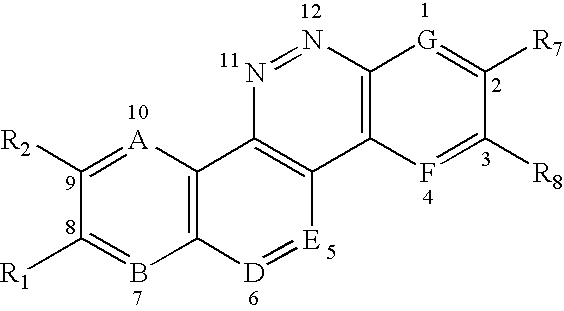
wherein:
A is N or CR3;
B is N or CRs;
D is NRe or CRaRb;
E is NRf or CRcRd;
F is N or CRt;
G is N or CR6;
R1, R2 and R3 are each individually hydrogen, (C1-C6)alkyl, (C3-C6)cycloalkyl, (C1-C6)alkoxy, nitro, hydroxy, COORk, ORm, or halo; or R1 and R2 taken together are methylenedioxy and R3 is hydrogen, (C1-C6)alkyl, (C3-C6)cycloalkyl, (C1-C6)alkoxy, nitro, hydroxy, NRgRh, COORk, ORm, or halo; or R2 and R3 taken together are methylenedioxy and R1 is hydrogen, (C1-C6)alkyl, (C3-C6)cycloalkyl, (C1-C6)alkoxy, nitro, hydroxy, NRgRh, COORk, ORm, or halo;
R6, R7 and R8 are each individually hydrogen, (C1-C6)alkyl, (C3-C6)cycloalkyl, (C1-C6)alkoxy, nitro, hydroxy, NRgRh, COORk, ORm, or halo; or R6 and R7 taken together are methylenedioxy and R8 is hydrogen, (C1-C6)alkyl, (C3-Cd)cycloalkyl, (C1-C6)alkoxy, nitro, hydroxy, NRgRh, COORk, ORm, or halo; or R7 and R5 taken together are methylenedioxy and R6 is hydrogen, (C1-C6)alkyl, (C3-C6)cycloalkyl, (C1-C6)alkoxy, nitro, hydroxy, NRgRh, C(═O)Rk, COORk, ORm, or halo;
each bond represented by ----- is individually present or absent;
Ra and Rb are each independently hydrogen or (C1-C6)alkyl if the bond between the 11- and 12-positions represented by ----- is absent; or Ra is hydrogen or (C1-C6)alkyl and Rb is absent if the bond between the 11- and 12-positions represented by ----- is present;
Rc and Rd are each independently hydrogen or (C1-C6)alkyl if the bond between the 11- and 12-positions represented by ----- is absent; or Ra is hydrogen or (C1-C6)alkyl and Rd is absent if the bond between the 11- and 12-positions represented by ----- is present;
Re is hydrogen or (C1-C6)alkyl if the bond between the 5- and 6-positions represented by ----- is absent; or Rb is absent if the bond between the 5- and 6-positions represented by ----- is present;
Rf is hydrogen or (C1-C6)alkyl if the bond between the 5- and 6-positions represented by ----- is absent; or Rf is absent if the bond between the 5- and 6-positions represented by ----- is present;
each Rg and Rh is independently hydrogen, (C1-C6)alkyl, (C3-C6)cycloalkyl, (C1-C6)alkoxy, (C1-C6)alkanoyl, aryl, aryl(C1-C6)alkyl, aryloxy, or aryl(C1-C6)alkoxy; or Rg and Rh together with the nitrogen to which they are attached are pyrrolidino, piperidino, morpholino, or thiomorpholino;
each Rk is independently hydrogen, or (C1-C6)alkyl; and
each Rm is independently (C1-C6)alkanoyl, aryl, or aryl(C1-C6)alkyl;
each Rs and Rt is independently hydrogen, methyl, nitro, hydroxy, amino, or halo;
wherein any (C1-C6)alkyl, (C3-C6)cycloalkyl, or (C1-C6)alkoxy of R1, R2, R3, R6, R7, R8, or Rk is optionally substituted on carbon with 1, 2, or 3 substituents independently selected from hydroxy, halo, NRnRp, (C3-C6)cycloalkyl, or (C1-C6)alkoxy; wherein each Rn and Rp is independently hydrogen, (C1-C6)alkyl, (C3-C6)cycloalkyl, (C1-C6)alkoxy, or (C1-C6)alkanoyl; or Rn and Rp together with the nitrogen to which they are attached are pyrrolidino, piperidino, morpholino, or thiomorpholino;
wherein any aryl is optionally be substituted with 1, 2, or 3 substituents independently selected from hydroxy, halo, nitro, trifluoromethyl, trifluoromethoxy, carboxy, amino, (C1-C6)alkyl, (C3-C6)cycloalkyl, and (C1-C6)alkoxy;
provided no more than two of A-G comprise nitrogen; and
provided the compound of formula (I) is not 2,3,8,9-tetramethoxy-5,6-diazachrysene or 2,3-8,9-bismethylenedioxy-5,6-diazacrysene; and
provided the compound of formula (I) is not a compound of formula (I) wherein D is NRe, when A CR3; B is Cs; E is CRcRd; F is CRt; and G is CR6;
or a pharmaceutically acceptable salt thereof.
2. The compound of claim 1 wherein R3 is hydrogen.
3. The compound of claim 1 wherein R1, R2 and R3 are each individually hydrogen, or (C1-C6)alkoxy; or R1 and R2 taken together are methylenedioxy and R3 is hydrogen or (C1-C6)alkoxy.
4. The compound of claim 1 wherein R7 or R is (C1-C6)alkoxy; or R7 and R8 taken together are methylenedioxy.
5. The compound of claim 1 wherein R7 and R8 taken together are methylenedioxy.
6. The compound of claim 1 wherein R2 is hydrogen, methyl, nitro, hydroxy, amino, fluoro or chloro.
7. The compound of claim 1 wherein R8 is hydrogen, methyl, nitro, hydroxy, amino, fluoro or chloro.
8. The compound of claim 1 wherein the bonds represented by ----- are both present.
9. The compound of claim 1 wherein wherein R1 is (C1-C6)alkoxy, nitro, hydroxy, or halo; or R1 and R2 taken together are methylenedioxy.
10. The compound of claim 1 wherein R2 is (C1-C6)alkoxy, nitro, hydroxy, or halo; or a pharmaceutically acceptable salt thereof.
11. The compound of claim 1 wherein R3 is (C1-C6)alkoxy, nitro, hydroxy, or halo; or R2 and R3 taken together are methylenedioxy.
12. The compound of claim 1 wherein R8 is (C1-C6)alkoxy, nitro, hydroxy or halo; or R7 and R, taken together are methylenedioxy.
13. The compound of claim 1 wherein R7 is (C1-C6)alkoxy, nitro, hydroxy, or halo.
14. The compound of claim 1 wherein R6 is (C1-C6)alkoxy, nitro, hydroxy, or halo; or R6 and R7 taken together are methylenedioxy.
15. The compound of claim 1 which is a compound of formulae II:

or a pharmaceutically acceptable salt thereof.
16. The compound of claim 1 which is a compound of formulae III:

or a pharmaceutically acceptable salt thereof.
17. The compound of claim 1 which is a compound of formulae V:

or a pharmaceutically acceptable salt thereof.
18. The compound of claim 1 which is a compound of formulae VI:
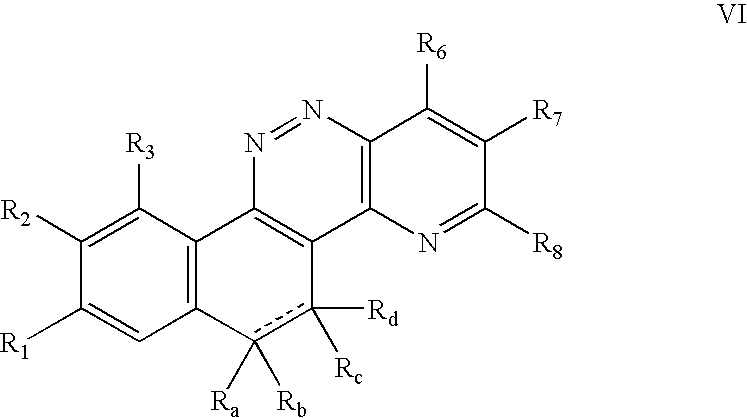
or a pharmaceutically acceptable salt thereof.
19. The compound of claim 1 which is a compound of formulae VII:
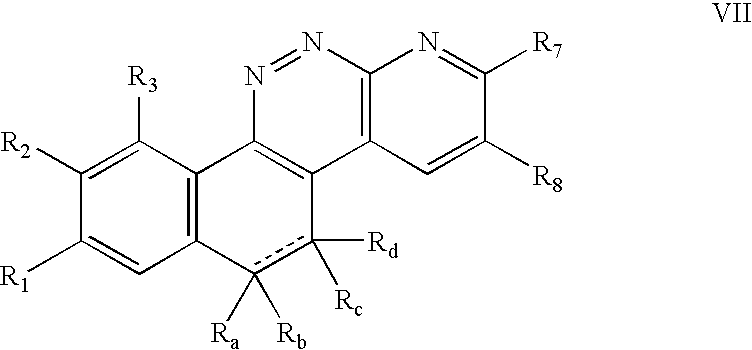
or a pharmaceutically acceptable salt thereof.
20. The compound of claim 1 which is a compound of formulae VIII:

or a pharmaceutically acceptable salt thereof.
21. The compound of claim 1 which is a compound of formulae DC:

or a pharmaceutically acceptable salt thereof.
22. The compound of claim 1 which is a compound of formulae X:
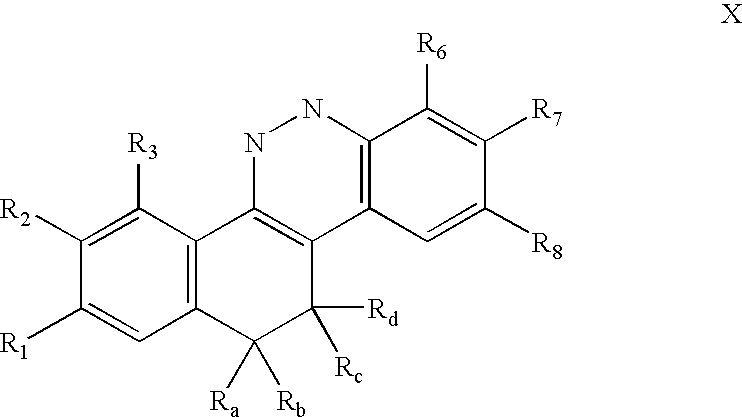
or a pharmaceutically acceptable salt thereof.
23. The compound 2,3-Dimethoxyibenzo[ch]cinnoline (6); 2,3-Dimethoxy-8,9-methylenedioxy-dibenzo[c,h]cinnoline (14); 2,3,8-Trimethoxydibenzo[c,h]cinnoline (60); 2,3,9-Trimethoxydibenzo[ch]cinnoline (61); 9-Benzyloxy-2,3,8-trimethoxydibenzo[ch]cinnoline (42); 2-Methoxy-8,9-methylenedioxydibenzo[c,h]cinnoline (43); or 3-Methoxy-8,9-methylenedioxydibenzo[c,h]cinnoline (44); or a pharmaceutically acceptable salt thereof.
24. The compound 2,3-Dimethoxy-8,9-methylenedioxy-dibenzo[c,h]cinnoline (14); or a pharmaceutically acceptable salt thereof.
25. The compound of claim 1 wherein R1-R3 and R6-R8 are not each hydrogen.
26. The compound of claim 1 wherein one of R2 and R8 is hydrogen, methyl, nitro, hydroxy, amino, fluoro or chloro; or at least one of R2 and R8 forms part of a methylenedioxy;
27. The compound of claim 1 which is not 9-hydroxy-2,3,8-trimethoxydibenzo[c,h]cinnoline.
28. A pharmaceutical composition comprising a effective amount of a compound of formula I:
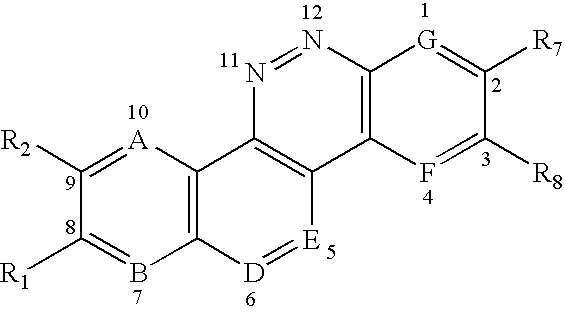
wherein:
A is N or CR3;
B is N or CRg;
D is NRe or CRaRb;
E is NRf or CRcRd;
F is N or CRt;
G is N or CR6;
R1, R2 and R3 are each individually hydrogen, (C1-C6)alkyl, (C3-C6)cycloalkyl, (C1-C6)alkoxy, nitro, hydroxy, NRgRh, COORk, ORm, or halo; or R1 and R2 taken together are methylenedioxy and R3 is hydrogen, (C1-C6)alkyl, (C3-C6)cycloalkyl, (C1-C6)alkoxy, nitro, hydroxy, NRgRh, COORk, ORm, or halo; or R2 and R3 taken together are methylenedioxy and R1 is hydrogen, (C1-C6)alkyl, (C3-C6)cycloalkyl, (C1-C6)alkoxy, nitro, hydroxy, NRgRh, COORk, ORm, or halo;
R6, R7 and R8 are each individually hydrogen, (C1-C6)alkyl, (C3-C6)cycloalkyl, (C1-C6)alkoxy, nitro, hydroxy, NRgRh, COORk, ORm, or halo; or R6 and R7 taken together are methylenedioxy and Rg is hydrogen, (C1-C6)alkyl, (C3-C6)cycloalkyl, (C1-C6)alkoxy, nitro, hydroxy, NRgRh, COORk, ORm, or halo; or R7 and R8 taken together are methylenedioxy and R6 is hydrogen, (C1-C6)alkyl, (C3-C6)cycloalkyl, (C1-C6)alkoxy, nitro, hydroxy, NRgRh, C(═O)Rk, COORk, ORm, or halo;
each bond represented by ----- is individually present or absent;
Ra and Rb are each independently hydrogen or (C1-C6)alkyl if the bond between the 11- and 12-positions represented by ----- is absent; or Ra is hydrogen or (C1-C6)alkyl and Rb is absent if the bond between the 11- and 12-positions represented by ----- is present;
Rc and Rd are each independently hydrogen or (C1-C6)alkyl if the bond between the 11- and 12-positions represented by ----- is absent; or Ra is hydrogen or (C1-C6)alkyl and Rd is absent if the bond between the 11- and 12-positions represented by ----- is present;
Re is hydrogen or (C1-C6)alkyl if the bond between the 5- and 6-positions represented by ----- is absent; or Ra is absent if the bond between the 5- and 6-positions represented by ----- is present;
Rf is hydrogen or (C1-C6)alkyl if the bond between the 5- and 6-positions represented by ----- is absent; or Rf is absent if the bond between the 5- and 6-positions represented by ----- is present;
each Rg and Rh is independently hydrogen, (C1-C6)alkyl, (C3-C6)cycloalkyl, (C1-C6)alkoxy, (C1-C6)alkanoyl, aryl, aryl(C1-C6)alkyl, aryloxy, or aryl(C1-C6)alkoxy; or Rg and Rh together with the nitrogen to which they are attached are pyrrolidino, piperidino, morpholino, or thiomorpholino;
each Rk is independently hydrogen, or (C1-C6)alkyl;
each Rm is independently (C1-C6)alkanoyl, aryl, or aryl(C1-C6)alkyl; and
each Rs and Rt is independently hydrogen, methyl, nitro, hydroxy, amino, or halo;
wherein any (C1-C6)alkyl, (C3-C6)cycloalkyl, or (C1-C6)alkoxy of R1, R2, R3, R6, R7, R8, or Rk is optionally substituted on carbon with 1, 2, or 3 substituents independently selected from hydroxy, halo, NRnRp, (C3-C6)cycloalkyl, or (C1-C6)alkoxy; wherein each Rn and Rp is independently hydrogen, (C1-C6)alkyl, (C3-C6)cycloalkyl, (C1-C6)alkoxy, or (C1-C6)alkanoyl; or Rn and Rp together with the nitrogen to which they are attached are pyrrolidino, piperidino, morpholino, or thiomorpholino;
wherein any aryl is optionally be substituted with 1, 2, or 3 substituents independently selected from hydroxy, halo, nitro, trifluoromethyl, trifluoromethoxy, carboxy, amino, (C1-C6)alkyl, (C3-C6)cycloalkyl, and (C1-C6)alkoxy;
provided no more than two of A-G comprise nitrogen;
provided R1-R3 and R6-R8 are not each hydrogen;
provided the compound is not 9-hydroxy-2,3,8-trimethoxy-dibenzo[c,h]cinnoline; and
provided the compound of formula (I) is not a compound of formula (1) wherein D is NRe; when A CR3; B is CRs; E is CRcRd; F is CRt; and G is CR6;
or a pharmaceutically acceptable salt thereof; in combination with a pharmaceutically acceptable diluent or carrier.
29. A pharmaceutical composition comprising a compound as described in claim 1 in combination with a pharmaceutically acceptable diluent or carrier.
30. A method of inhibiting cancer cell growth, comprising administering to a mammal afflicted with cancer, an amount of a compound as described in claim 1 , effective to inhibit the growth of said cancer cells.
31. A method comprising inhibiting cancer cell growth by contacting said cancer cell in vitro or in vivo with an amount of a compound as described in claim 1 , effective to inhibit the growth of said cancer cell.
32. A method of producing an antibacterial effect in a mammal in need of such treatment comprising administering to the mammal, an amount of a compound as described in claim 1 , effective to provide an antibacterial effect.
33. A method of producing an antifungal effect in a mammal in need of such treatment comprising administering to the mammal, an amount of a compound as described in claim 1 , effective to provide an antifungal effect.
Priority Applications (1)
| Application Number | Priority Date | Filing Date | Title |
|---|---|---|---|
| US10/853,017 US20050009830A1 (en) | 1999-10-29 | 2004-05-25 | Heterocyclic cytotoxic agents |
Applications Claiming Priority (4)
| Application Number | Priority Date | Filing Date | Title |
|---|---|---|---|
| US16254099P | 1999-10-29 | 1999-10-29 | |
| PCT/US2000/029583 WO2001032631A2 (en) | 1999-10-29 | 2000-10-26 | Heterocyclic cytotoxic agents |
| US10/134,983 US6740650B2 (en) | 1999-10-29 | 2002-04-29 | Heterocyclic cytotoxic agents |
| US10/853,017 US20050009830A1 (en) | 1999-10-29 | 2004-05-25 | Heterocyclic cytotoxic agents |
Related Parent Applications (1)
| Application Number | Title | Priority Date | Filing Date |
|---|---|---|---|
| US10/134,983 Division US6740650B2 (en) | 1999-10-29 | 2002-04-29 | Heterocyclic cytotoxic agents |
Publications (1)
| Publication Number | Publication Date |
|---|---|
| US20050009830A1 true US20050009830A1 (en) | 2005-01-13 |
Family
ID=26832868
Family Applications (2)
| Application Number | Title | Priority Date | Filing Date |
|---|---|---|---|
| US10/134,983 Expired - Lifetime US6740650B2 (en) | 1999-10-29 | 2002-04-29 | Heterocyclic cytotoxic agents |
| US10/853,017 Abandoned US20050009830A1 (en) | 1999-10-29 | 2004-05-25 | Heterocyclic cytotoxic agents |
Family Applications Before (1)
| Application Number | Title | Priority Date | Filing Date |
|---|---|---|---|
| US10/134,983 Expired - Lifetime US6740650B2 (en) | 1999-10-29 | 2002-04-29 | Heterocyclic cytotoxic agents |
Country Status (1)
| Country | Link |
|---|---|
| US (2) | US6740650B2 (en) |
Cited By (1)
| Publication number | Priority date | Publication date | Assignee | Title |
|---|---|---|---|---|
| US11091498B2 (en) | 2016-04-04 | 2021-08-17 | Rutgers, The State University Of New Jersey | Topoisomerase poisons |
Families Citing this family (19)
| Publication number | Priority date | Publication date | Assignee | Title |
|---|---|---|---|---|
| US6772456B2 (en) * | 1995-09-13 | 2004-08-10 | Hill-Rom Services, Inc. | Portable device for patient pullup, rollover, and transfer and methods thereof |
| US6740650B2 (en) * | 1999-10-29 | 2004-05-25 | Rutgers, The State University Of New Jersey | Heterocyclic cytotoxic agents |
| JP4789414B2 (en) * | 2001-11-14 | 2011-10-12 | ラトガーズ,ザ ステイト ユニバーシティ | Solubilized topoisomerase toxic agent |
| MXPA04004606A (en) * | 2001-11-14 | 2004-09-10 | Univ Rutgers | Solubilized topoisomerase poisons. |
| ATE405568T1 (en) * | 2001-11-14 | 2008-09-15 | Univ Rutgers | CYTOTOXIC AGENTS |
| DE60225943T2 (en) * | 2001-11-14 | 2009-01-29 | Rutgers, The State University | Topoisomerase GIFT FUNDS |
| AU2003276053A1 (en) | 2002-06-17 | 2003-12-31 | Hill-Rom Services, Inc. | Apparatus for pulling patient up in bed |
| US6992088B2 (en) * | 2002-08-09 | 2006-01-31 | Rutgers, The State University Of New Jersey | Nitro and amino substituted heterocycles as topoisomerase I targeting agents |
| WO2004014906A2 (en) * | 2002-08-09 | 2004-02-19 | Rutgers, The State University | Nitro and amino substituted dibenzonaphthyridines as topoisomerase agents |
| WO2004014918A1 (en) * | 2002-08-09 | 2004-02-19 | Rutgers, The State University | Nitro and amino substituted topoisomerase agents |
| JP4774212B2 (en) * | 2002-11-12 | 2011-09-14 | ラトガーズ、ザ・ステイト・ユニバーシテイ・オブ・ニユー・ジヤージー | Topoisomerase-targeting agent |
| US7065811B2 (en) | 2003-03-18 | 2006-06-27 | Hill-Rom Services, Inc. | Radial arm system for patient care equipment |
| US7290299B2 (en) | 2004-01-09 | 2007-11-06 | Votel Thomas W | Device and method for positioning patients |
| US7725964B2 (en) | 2004-08-27 | 2010-06-01 | Hill-Rom Services, Inc. | Apparatus with patient adjustment device coupled to architectural system |
| DK2403856T3 (en) | 2009-03-06 | 2013-04-08 | Univ Rutgers | METHYLENDIOXYBENZO [I] PHENANTHRIDINE DERIVATIVES USED FOR CANCER TREATMENT |
| WO2010127363A1 (en) | 2009-05-01 | 2010-11-04 | Rutgers, The State University Of New Jersey | Toposiomerase inhibitors |
| JP7481115B2 (en) | 2017-01-05 | 2024-05-10 | ラジウス ファーマシューティカルズ,インコーポレイテッド | Polymorphic forms of RAD1901-2HCL |
| IL279853B2 (en) | 2018-07-04 | 2025-01-01 | Radius Pharmaceuticals Inc | Polymorphic forms of rad 1901-2hcl |
| CN119390714A (en) | 2019-02-12 | 2025-02-07 | 雷迪厄斯制药公司 | Methods and compounds |
Citations (1)
| Publication number | Priority date | Publication date | Assignee | Title |
|---|---|---|---|---|
| US6740650B2 (en) * | 1999-10-29 | 2004-05-25 | Rutgers, The State University Of New Jersey | Heterocyclic cytotoxic agents |
Family Cites Families (37)
| Publication number | Priority date | Publication date | Assignee | Title |
|---|---|---|---|---|
| US2981731A (en) | 1961-04-25 | Acridine derivatives | ||
| USRE26065E (en) | 1966-07-19 | Folybenzimidazoles and their preparation | ||
| US2985661A (en) | 1956-02-06 | 1961-05-23 | American Cyanamid Co | Preparation of 2(omicron-aminophenyl)-benzimidazole |
| US2915523A (en) | 1956-12-03 | 1959-12-01 | Parke Davis & Co | Benzacridine compounds |
| US3272707A (en) | 1964-07-17 | 1966-09-13 | Smith Kline French Lab | Pharmaceutical compositions and methods for their use |
| CH420045A (en) | 1964-09-01 | 1967-03-15 | Ciba Geigy | Use of new polyazoles as optical brightening agents for textile organic materials |
| US3267107A (en) | 1964-09-17 | 1966-08-16 | American Home Prod | 3-(4'-5'-methylenedioxy-phenyl)-7, 8-dimethoxy-1, 2, 3, 4,-tetrahydroisoquinolines |
| US3849561A (en) | 1964-10-20 | 1974-11-19 | S Naruto | Anti-peptic ulcer substance from corydalis tubers |
| DE1670684A1 (en) | 1966-04-01 | 1970-12-03 | Hoechst Ag | Process for the preparation of basic substituted bis-benzimidazole derivatives |
| US3542782A (en) | 1967-03-15 | 1970-11-24 | Sandoz Ag | 5,6-dihydro-8h-isoquino(1,2-b)quinazolines |
| JPS4942700A (en) | 1972-08-25 | 1974-04-22 | ||
| US3912740A (en) | 1974-02-28 | 1975-10-14 | Us Health | Method for the preparation of oxygenated benzo{8 c{9 phenanthridine compounds |
| PT73763B (en) | 1981-10-01 | 1983-10-26 | Quatrum Empresa Nacional De Qu | PROCESS FOR THE PREPARATION OF NOVEL EPOXIDES OF BENZOFENANTRIDINE ALKALOIDS AND PHARMACEUTICAL COMPOSITIONS CONTAINING THEM |
| US4980344A (en) | 1982-05-14 | 1990-12-25 | Maroko Peter R | Compositions for improving circulatory performance |
| US4559157A (en) | 1983-04-21 | 1985-12-17 | Creative Products Resource Associates, Ltd. | Cosmetic applicator useful for skin moisturizing |
| LU84979A1 (en) | 1983-08-30 | 1985-04-24 | Oreal | COSMETIC OR PHARMACEUTICAL COMPOSITION IN AQUEOUS OR ANHYDROUS FORM WHOSE FATTY PHASE CONTAINS OLIGOMER POLYETHER AND NEW OLIGOMER POLYETHERS |
| JPS61130289A (en) | 1984-11-29 | 1986-06-18 | Ss Pharmaceut Co Ltd | 13-propylberberine salt |
| FR2595356B1 (en) | 1986-03-05 | 1991-05-24 | Pasteur Strasbourg Universite | DERIVATIVES OF NITRO OR AMINOBENZYLTETRAHYDROISOQUINOLEINS, PROCESSES FOR OBTAINING SAME, PHARMACEUTICAL COMPOSITIONS CONTAINING SAME, PHARMACOLOGICAL PROPERTIES AND APPLICATIONS |
| US5244903A (en) | 1987-03-31 | 1993-09-14 | Research Triangle Institute | Camptothecin analogs as potent inhibitors of topoisomerase I |
| US4820508A (en) | 1987-06-23 | 1989-04-11 | Neutrogena Corporation | Skin protective composition |
| US4992478A (en) | 1988-04-04 | 1991-02-12 | Warner-Lambert Company | Antiinflammatory skin moisturizing composition and method of preparing same |
| JP2700475B2 (en) | 1988-07-30 | 1998-01-21 | コニカ株式会社 | Nonlinear optical materials and elements |
| US4938949A (en) | 1988-09-12 | 1990-07-03 | University Of New York | Treatment of damaged bone marrow and dosage units therefor |
| US5106863A (en) | 1990-03-26 | 1992-04-21 | Ortho Pharmaceutical Corporation | Substituted imidazole and pyridine derivatives |
| US5135934A (en) | 1990-07-06 | 1992-08-04 | Du Pont Merck Pharmaceutical Company | 3-phenyl-5,6-dihydrobenz(c) acridine-7-carboxylic acids and related compounds as immunosuppressive agents |
| US5126351A (en) | 1991-01-24 | 1992-06-30 | Glaxo Inc. | Antitumor compounds |
| US5223506A (en) | 1991-06-04 | 1993-06-29 | Glaxo Inc. | Cyclic antitumor compounds |
| US5428040A (en) | 1993-08-31 | 1995-06-27 | The Du Pont Merck Pharmaceutical Company | Carbocyclic fused-ring quinolinecarboxylic acids useful as immunosuppressive agents |
| CA2150235A1 (en) | 1993-09-28 | 1995-04-06 | Fumio Suzuki | A novel tetracyclic compound |
| US5807874A (en) | 1995-05-17 | 1998-09-15 | Rutgers, The State University Of New Jersey | Trisbenzimidazoles useful as topoisomerase I inhibitors |
| US5767142A (en) | 1996-03-20 | 1998-06-16 | Rutgers, The State University Of New Jersey | Trisbenzimidazoles useful as topoisomerase I inhibitors |
| HUP9900071A3 (en) | 1995-05-17 | 2002-01-28 | Univ Rutgers | Tribenzimidazoles useful as topoisomerase i inhibitors, pharmaceutical compositions containing them and their use |
| JP2000504687A (en) | 1996-02-12 | 2000-04-18 | ルトガーズ,ザ ステイト ユニバーシティ オブ ニュージャージー | Caraline analogs as topoisomerase inhibitors |
| US5770617A (en) | 1996-03-20 | 1998-06-23 | Rutgers, The State University Of New Jersey | Terbenzimidazoles useful as antifungal agents |
| EP0950054A1 (en) | 1996-09-23 | 1999-10-20 | Rutgers, The State University Of New Jersey | Substituted heterocycles as anti-tumor agents |
| WO1998045272A1 (en) | 1997-04-07 | 1998-10-15 | Latrobe University | Topoisomerase inhibitors |
| US6140328A (en) * | 1997-12-12 | 2000-10-31 | Rutgers, The State University Of New Jersey | Heterocyclic cytotoxic agents |
-
2002
- 2002-04-29 US US10/134,983 patent/US6740650B2/en not_active Expired - Lifetime
-
2004
- 2004-05-25 US US10/853,017 patent/US20050009830A1/en not_active Abandoned
Patent Citations (1)
| Publication number | Priority date | Publication date | Assignee | Title |
|---|---|---|---|---|
| US6740650B2 (en) * | 1999-10-29 | 2004-05-25 | Rutgers, The State University Of New Jersey | Heterocyclic cytotoxic agents |
Cited By (1)
| Publication number | Priority date | Publication date | Assignee | Title |
|---|---|---|---|---|
| US11091498B2 (en) | 2016-04-04 | 2021-08-17 | Rutgers, The State University Of New Jersey | Topoisomerase poisons |
Also Published As
| Publication number | Publication date |
|---|---|
| US20030100560A1 (en) | 2003-05-29 |
| US6740650B2 (en) | 2004-05-25 |
Similar Documents
| Publication | Publication Date | Title |
|---|---|---|
| US6740650B2 (en) | Heterocyclic cytotoxic agents | |
| US6992088B2 (en) | Nitro and amino substituted heterocycles as topoisomerase I targeting agents | |
| US7468366B2 (en) | Cytotoxic agents | |
| US5981541A (en) | Substituted heterocycles as anti-tumor agents | |
| US7858627B2 (en) | Topoisomerase-targeting agents | |
| WO2001032631A2 (en) | Heterocyclic cytotoxic agents | |
| US6486167B1 (en) | Heterocyclic cytotoxic agents | |
| US6989387B2 (en) | Nitro and amino substituted topoisomerase agents | |
| US6667302B2 (en) | Heterocyclic topoisomerase poisons | |
| US6063801A (en) | Heterocyclic topoisomerase poisons | |
| US20050009826A1 (en) | Solubilized topoisomerase poison agents | |
| US6992089B2 (en) | Nitro and amino substituted topoisomerase agents |
Legal Events
| Date | Code | Title | Description |
|---|---|---|---|
| STCB | Information on status: application discontinuation |
Free format text: ABANDONED -- FAILURE TO RESPOND TO AN OFFICE ACTION |