US20040209895A1 - Macrocyclic pyrimidines, their production and use as pharmaceutical agents - Google Patents
Macrocyclic pyrimidines, their production and use as pharmaceutical agents Download PDFInfo
- Publication number
- US20040209895A1 US20040209895A1 US10/644,076 US64407603A US2004209895A1 US 20040209895 A1 US20040209895 A1 US 20040209895A1 US 64407603 A US64407603 A US 64407603A US 2004209895 A1 US2004209895 A1 US 2004209895A1
- Authority
- US
- United States
- Prior art keywords
- alkyl
- stands
- heteroaryl
- aryl
- cycloalkyl
- Prior art date
- Legal status (The legal status is an assumption and is not a legal conclusion. Google has not performed a legal analysis and makes no representation as to the accuracy of the status listed.)
- Granted
Links
- 238000004519 manufacturing process Methods 0.000 title claims abstract description 115
- 239000008177 pharmaceutical agent Substances 0.000 title claims description 15
- 150000003230 pyrimidines Chemical class 0.000 title abstract description 7
- 238000000034 method Methods 0.000 claims abstract description 44
- 230000008569 process Effects 0.000 claims abstract description 33
- 208000037265 diseases, disorders, signs and symptoms Diseases 0.000 claims abstract description 32
- 201000010099 disease Diseases 0.000 claims abstract description 30
- 102000003903 Cyclin-dependent kinases Human genes 0.000 claims abstract description 28
- 108090000266 Cyclin-dependent kinases Proteins 0.000 claims abstract description 28
- 239000003112 inhibitor Substances 0.000 claims abstract description 17
- 125000004169 (C1-C6) alkyl group Chemical group 0.000 claims description 135
- 229910052736 halogen Inorganic materials 0.000 claims description 77
- 150000002367 halogens Chemical class 0.000 claims description 77
- 239000001257 hydrogen Substances 0.000 claims description 72
- 229910052739 hydrogen Inorganic materials 0.000 claims description 72
- 125000002887 hydroxy group Chemical group [H]O* 0.000 claims description 62
- 150000001875 compounds Chemical class 0.000 claims description 58
- 125000000008 (C1-C10) alkyl group Chemical group 0.000 claims description 56
- 150000002431 hydrogen Chemical class 0.000 claims description 42
- IJGRMHOSHXDMSA-UHFFFAOYSA-N Atomic nitrogen Chemical compound N#N IJGRMHOSHXDMSA-UHFFFAOYSA-N 0.000 claims description 40
- 125000004093 cyano group Chemical group *C#N 0.000 claims description 38
- 125000004191 (C1-C6) alkoxy group Chemical group 0.000 claims description 36
- QVGXLLKOCUKJST-UHFFFAOYSA-N atomic oxygen Chemical compound [O] QVGXLLKOCUKJST-UHFFFAOYSA-N 0.000 claims description 36
- 229910052760 oxygen Inorganic materials 0.000 claims description 36
- 239000001301 oxygen Substances 0.000 claims description 36
- -1 stent-induced restenoses Diseases 0.000 claims description 36
- 108091007914 CDKs Proteins 0.000 claims description 33
- 125000003178 carboxy group Chemical group [H]OC(*)=O 0.000 claims description 33
- 238000010992 reflux Methods 0.000 claims description 33
- 125000006577 C1-C6 hydroxyalkyl group Chemical group 0.000 claims description 32
- 206010028980 Neoplasm Diseases 0.000 claims description 31
- UFHFLCQGNIYNRP-UHFFFAOYSA-N Hydrogen Chemical compound [H][H] UFHFLCQGNIYNRP-UHFFFAOYSA-N 0.000 claims description 30
- 150000003839 salts Chemical class 0.000 claims description 29
- 125000000449 nitro group Chemical group [O-][N+](*)=O 0.000 claims description 28
- 125000001997 phenyl group Chemical group [H]C1=C([H])C([H])=C(*)C([H])=C1[H] 0.000 claims description 25
- 125000006374 C2-C10 alkenyl group Chemical group 0.000 claims description 24
- HBAQYPYDRFILMT-UHFFFAOYSA-N 8-[3-(1-cyclopropylpyrazol-4-yl)-1H-pyrazolo[4,3-d]pyrimidin-5-yl]-3-methyl-3,8-diazabicyclo[3.2.1]octan-2-one Chemical class C1(CC1)N1N=CC(=C1)C1=NNC2=C1N=C(N=C2)N1C2C(N(CC1CC2)C)=O HBAQYPYDRFILMT-UHFFFAOYSA-N 0.000 claims description 22
- 125000002924 primary amino group Chemical group [H]N([H])* 0.000 claims description 22
- 229910052757 nitrogen Inorganic materials 0.000 claims description 21
- 108010024986 Cyclin-Dependent Kinase 2 Proteins 0.000 claims description 20
- 102100036239 Cyclin-dependent kinase 2 Human genes 0.000 claims description 20
- 102000009484 Vascular Endothelial Growth Factor Receptors Human genes 0.000 claims description 19
- 125000006700 (C1-C6) alkylthio group Chemical group 0.000 claims description 18
- 125000000882 C2-C6 alkenyl group Chemical group 0.000 claims description 18
- 125000004434 sulfur atom Chemical group 0.000 claims description 18
- 125000000876 trifluoromethoxy group Chemical group FC(F)(F)O* 0.000 claims description 18
- 201000011510 cancer Diseases 0.000 claims description 15
- 239000000203 mixture Substances 0.000 claims description 14
- 230000004770 neurodegeneration Effects 0.000 claims description 14
- 208000015122 neurodegenerative disease Diseases 0.000 claims description 14
- 125000000843 phenylene group Chemical group C1(=C(C=CC=C1)*)* 0.000 claims description 14
- 102100032857 Cyclin-dependent kinase 1 Human genes 0.000 claims description 13
- 101710106279 Cyclin-dependent kinase 1 Proteins 0.000 claims description 13
- NINIDFKCEFEMDL-UHFFFAOYSA-N Sulfur Chemical compound [S] NINIDFKCEFEMDL-UHFFFAOYSA-N 0.000 claims description 12
- 229910052717 sulfur Inorganic materials 0.000 claims description 12
- 239000011593 sulfur Substances 0.000 claims description 12
- 125000005730 thiophenylene group Chemical group 0.000 claims description 10
- 229910006095 SO2F Inorganic materials 0.000 claims description 9
- 229910006069 SO3H Inorganic materials 0.000 claims description 9
- 239000002904 solvent Substances 0.000 claims description 9
- 239000000126 substance Substances 0.000 claims description 9
- 201000004384 Alopecia Diseases 0.000 claims description 8
- 206010003210 Arteriosclerosis Diseases 0.000 claims description 8
- 208000023275 Autoimmune disease Diseases 0.000 claims description 8
- 125000004406 C3-C8 cycloalkylene group Chemical group 0.000 claims description 8
- 208000024172 Cardiovascular disease Diseases 0.000 claims description 8
- 208000035473 Communicable disease Diseases 0.000 claims description 8
- 229910005948 SO2Cl Inorganic materials 0.000 claims description 8
- 208000036142 Viral infection Diseases 0.000 claims description 8
- 230000001154 acute effect Effects 0.000 claims description 8
- 231100000360 alopecia Toxicity 0.000 claims description 8
- 206010003246 arthritis Diseases 0.000 claims description 8
- 230000001684 chronic effect Effects 0.000 claims description 8
- 208000030533 eye disease Diseases 0.000 claims description 8
- 230000003176 fibrotic effect Effects 0.000 claims description 8
- 230000009385 viral infection Effects 0.000 claims description 8
- 230000002401 inhibitory effect Effects 0.000 claims description 7
- 125000004178 (C1-C4) alkyl group Chemical group 0.000 claims description 6
- 125000006727 (C1-C6) alkenyl group Chemical group 0.000 claims description 6
- 108010025464 Cyclin-Dependent Kinase 4 Proteins 0.000 claims description 6
- 102100036252 Cyclin-dependent kinase 4 Human genes 0.000 claims description 6
- 230000006378 damage Effects 0.000 claims description 6
- 230000012010 growth Effects 0.000 claims description 6
- 125000004642 (C1-C12) alkoxy group Chemical group 0.000 claims description 5
- 239000002253 acid Substances 0.000 claims description 5
- 125000002015 acyclic group Chemical group 0.000 claims description 5
- 210000004556 brain Anatomy 0.000 claims description 5
- 239000002243 precursor Substances 0.000 claims description 5
- 230000002062 proliferating effect Effects 0.000 claims description 5
- 230000002829 reductive effect Effects 0.000 claims description 5
- 208000030507 AIDS Diseases 0.000 claims description 4
- 208000024827 Alzheimer disease Diseases 0.000 claims description 4
- 208000003120 Angiofibroma Diseases 0.000 claims description 4
- 206010063209 Chronic allograft nephropathy Diseases 0.000 claims description 4
- 208000011231 Crohn disease Diseases 0.000 claims description 4
- 108010025454 Cyclin-Dependent Kinase 5 Proteins 0.000 claims description 4
- 108010025468 Cyclin-Dependent Kinase 6 Proteins 0.000 claims description 4
- 102100026804 Cyclin-dependent kinase 6 Human genes 0.000 claims description 4
- 102100026805 Cyclin-dependent-like kinase 5 Human genes 0.000 claims description 4
- 206010012289 Dementia Diseases 0.000 claims description 4
- 206010012442 Dermatitis contact Diseases 0.000 claims description 4
- 208000007342 Diabetic Nephropathies Diseases 0.000 claims description 4
- 206010012689 Diabetic retinopathy Diseases 0.000 claims description 4
- 201000009273 Endometriosis Diseases 0.000 claims description 4
- 206010016654 Fibrosis Diseases 0.000 claims description 4
- 108091007911 GSKs Proteins 0.000 claims description 4
- 208000010412 Glaucoma Diseases 0.000 claims description 4
- 206010018364 Glomerulonephritis Diseases 0.000 claims description 4
- 102000004103 Glycogen Synthase Kinases Human genes 0.000 claims description 4
- 208000031886 HIV Infections Diseases 0.000 claims description 4
- 208000005176 Hepatitis C Diseases 0.000 claims description 4
- 208000017604 Hodgkin disease Diseases 0.000 claims description 4
- 208000010747 Hodgkins lymphoma Diseases 0.000 claims description 4
- 208000023105 Huntington disease Diseases 0.000 claims description 4
- 206010020649 Hyperkeratosis Diseases 0.000 claims description 4
- XQFRJNBWHJMXHO-RRKCRQDMSA-N IDUR Chemical compound C1[C@H](O)[C@@H](CO)O[C@H]1N1C(=O)NC(=O)C(I)=C1 XQFRJNBWHJMXHO-RRKCRQDMSA-N 0.000 claims description 4
- 208000007766 Kaposi sarcoma Diseases 0.000 claims description 4
- 208000001126 Keratosis Diseases 0.000 claims description 4
- 206010027476 Metastases Diseases 0.000 claims description 4
- 206010028116 Mucosal inflammation Diseases 0.000 claims description 4
- 201000010927 Mucositis Diseases 0.000 claims description 4
- 208000018737 Parkinson disease Diseases 0.000 claims description 4
- 208000031481 Pathologic Constriction Diseases 0.000 claims description 4
- 108091000080 Phosphotransferase Proteins 0.000 claims description 4
- 201000004681 Psoriasis Diseases 0.000 claims description 4
- 206010038563 Reocclusion Diseases 0.000 claims description 4
- 206010052779 Transplant rejections Diseases 0.000 claims description 4
- 150000001412 amines Chemical class 0.000 claims description 4
- 206010002026 amyotrophic lateral sclerosis Diseases 0.000 claims description 4
- 208000011775 arteriosclerosis disease Diseases 0.000 claims description 4
- 239000012829 chemotherapy agent Substances 0.000 claims description 4
- 230000007882 cirrhosis Effects 0.000 claims description 4
- 208000019425 cirrhosis of liver Diseases 0.000 claims description 4
- 208000010247 contact dermatitis Diseases 0.000 claims description 4
- 208000033679 diabetic kidney disease Diseases 0.000 claims description 4
- 230000035876 healing Effects 0.000 claims description 4
- 201000011066 hemangioma Diseases 0.000 claims description 4
- 208000002672 hepatitis B Diseases 0.000 claims description 4
- 229940125721 immunosuppressive agent Drugs 0.000 claims description 4
- 239000003018 immunosuppressive agent Substances 0.000 claims description 4
- 208000015181 infectious disease Diseases 0.000 claims description 4
- 208000028867 ischemia Diseases 0.000 claims description 4
- 208000032839 leukemia Diseases 0.000 claims description 4
- 210000004185 liver Anatomy 0.000 claims description 4
- 230000003211 malignant effect Effects 0.000 claims description 4
- 210000003584 mesangial cell Anatomy 0.000 claims description 4
- 230000009401 metastasis Effects 0.000 claims description 4
- 201000006417 multiple sclerosis Diseases 0.000 claims description 4
- 201000003142 neovascular glaucoma Diseases 0.000 claims description 4
- 201000009925 nephrosclerosis Diseases 0.000 claims description 4
- 210000000944 nerve tissue Anatomy 0.000 claims description 4
- 244000045947 parasite Species 0.000 claims description 4
- 239000000825 pharmaceutical preparation Substances 0.000 claims description 4
- 102000020233 phosphotransferase Human genes 0.000 claims description 4
- 206010039073 rheumatoid arthritis Diseases 0.000 claims description 4
- 208000011580 syndromic disease Diseases 0.000 claims description 4
- 230000002792 vascular Effects 0.000 claims description 4
- 102100036329 Cyclin-dependent kinase 3 Human genes 0.000 claims description 3
- 102100026810 Cyclin-dependent kinase 7 Human genes 0.000 claims description 3
- 102100024456 Cyclin-dependent kinase 8 Human genes 0.000 claims description 3
- 102100024457 Cyclin-dependent kinase 9 Human genes 0.000 claims description 3
- 101000715946 Homo sapiens Cyclin-dependent kinase 3 Proteins 0.000 claims description 3
- 101000911952 Homo sapiens Cyclin-dependent kinase 7 Proteins 0.000 claims description 3
- 101000980937 Homo sapiens Cyclin-dependent kinase 8 Proteins 0.000 claims description 3
- 101000980930 Homo sapiens Cyclin-dependent kinase 9 Proteins 0.000 claims description 3
- 239000003638 chemical reducing agent Substances 0.000 claims description 3
- 125000000959 isobutyl group Chemical group [H]C([H])([H])C([H])(C([H])([H])[H])C([H])([H])* 0.000 claims description 3
- 125000002496 methyl group Chemical group [H]C([H])([H])* 0.000 claims description 3
- 239000003981 vehicle Substances 0.000 claims description 3
- 125000004956 cyclohexylene group Chemical group 0.000 claims description 2
- 238000009472 formulation Methods 0.000 claims description 2
- 239000003814 drug Substances 0.000 abstract description 4
- 229940083082 pyrimidine derivative acting on arteriolar smooth muscle Drugs 0.000 abstract description 4
- 229940079593 drug Drugs 0.000 abstract description 3
- 238000002483 medication Methods 0.000 abstract 1
- XEKOWRVHYACXOJ-UHFFFAOYSA-N Ethyl acetate Chemical compound CCOC(C)=O XEKOWRVHYACXOJ-UHFFFAOYSA-N 0.000 description 264
- IAZDPXIOMUYVGZ-UHFFFAOYSA-N Dimethylsulphoxide Chemical compound CS(C)=O IAZDPXIOMUYVGZ-UHFFFAOYSA-N 0.000 description 233
- 239000000243 solution Substances 0.000 description 211
- WEVYAHXRMPXWCK-UHFFFAOYSA-N Acetonitrile Chemical compound CC#N WEVYAHXRMPXWCK-UHFFFAOYSA-N 0.000 description 166
- OKKJLVBELUTLKV-UHFFFAOYSA-N Methanol Chemical compound OC OKKJLVBELUTLKV-UHFFFAOYSA-N 0.000 description 90
- 238000001704 evaporation Methods 0.000 description 89
- 230000008020 evaporation Effects 0.000 description 89
- 239000000047 product Substances 0.000 description 86
- VEXZGXHMUGYJMC-UHFFFAOYSA-N Hydrochloric acid Chemical compound Cl VEXZGXHMUGYJMC-UHFFFAOYSA-N 0.000 description 84
- 238000005160 1H NMR spectroscopy Methods 0.000 description 74
- HEMHJVSKTPXQMS-UHFFFAOYSA-M Sodium hydroxide Chemical compound [OH-].[Na+] HEMHJVSKTPXQMS-UHFFFAOYSA-M 0.000 description 69
- YMWUJEATGCHHMB-UHFFFAOYSA-N Dichloromethane Chemical compound ClCCl YMWUJEATGCHHMB-UHFFFAOYSA-N 0.000 description 64
- XLYOFNOQVPJJNP-UHFFFAOYSA-N water Substances O XLYOFNOQVPJJNP-UHFFFAOYSA-N 0.000 description 60
- ZMANZCXQSJIPKH-UHFFFAOYSA-N Triethylamine Chemical compound CCN(CC)CC ZMANZCXQSJIPKH-UHFFFAOYSA-N 0.000 description 57
- WYURNTSHIVDZCO-UHFFFAOYSA-N Tetrahydrofuran Chemical compound C1CCOC1 WYURNTSHIVDZCO-UHFFFAOYSA-N 0.000 description 54
- VLKZOEOYAKHREP-UHFFFAOYSA-N n-Hexane Chemical compound CCCCCC VLKZOEOYAKHREP-UHFFFAOYSA-N 0.000 description 54
- 239000012074 organic phase Substances 0.000 description 50
- LFQSCWFLJHTTHZ-UHFFFAOYSA-N Ethanol Chemical compound CCO LFQSCWFLJHTTHZ-UHFFFAOYSA-N 0.000 description 49
- 238000004587 chromatography analysis Methods 0.000 description 36
- 210000004027 cell Anatomy 0.000 description 35
- 239000000460 chlorine Substances 0.000 description 35
- CSCPPACGZOOCGX-UHFFFAOYSA-N Acetone Chemical compound CC(C)=O CSCPPACGZOOCGX-UHFFFAOYSA-N 0.000 description 33
- 239000011541 reaction mixture Substances 0.000 description 31
- 0 B.CC.CC.[2*]NC1=NC(C)=C([3*])C([4*])=N1 Chemical compound B.CC.CC.[2*]NC1=NC(C)=C([3*])C([4*])=N1 0.000 description 30
- FAPWRFPIFSIZLT-UHFFFAOYSA-M Sodium chloride Chemical class [Na+].[Cl-] FAPWRFPIFSIZLT-UHFFFAOYSA-M 0.000 description 27
- KRKNYBCHXYNGOX-UHFFFAOYSA-N citric acid Chemical compound OC(=O)CC(O)(C(O)=O)CC(O)=O KRKNYBCHXYNGOX-UHFFFAOYSA-N 0.000 description 24
- 238000006243 chemical reaction Methods 0.000 description 22
- 239000013067 intermediate product Substances 0.000 description 22
- ZMXDDKWLCZADIW-UHFFFAOYSA-N N,N-Dimethylformamide Chemical compound CN(C)C=O ZMXDDKWLCZADIW-UHFFFAOYSA-N 0.000 description 20
- RYHBNJHYFVUHQT-UHFFFAOYSA-N 1,4-Dioxane Chemical compound C1COCCO1 RYHBNJHYFVUHQT-UHFFFAOYSA-N 0.000 description 19
- UIIMBOGNXHQVGW-UHFFFAOYSA-M Sodium bicarbonate Chemical compound [Na+].OC([O-])=O UIIMBOGNXHQVGW-UHFFFAOYSA-M 0.000 description 19
- 239000000706 filtrate Substances 0.000 description 19
- XKRFYHLGVUSROY-UHFFFAOYSA-N Argon Chemical compound [Ar] XKRFYHLGVUSROY-UHFFFAOYSA-N 0.000 description 18
- 239000002244 precipitate Substances 0.000 description 18
- 230000022131 cell cycle Effects 0.000 description 17
- CSNNHWWHGAXBCP-UHFFFAOYSA-L Magnesium sulfate Chemical compound [Mg+2].[O-][S+2]([O-])([O-])[O-] CSNNHWWHGAXBCP-UHFFFAOYSA-L 0.000 description 16
- 238000001816 cooling Methods 0.000 description 15
- 239000007921 spray Substances 0.000 description 15
- 238000006366 phosphorylation reaction Methods 0.000 description 14
- 230000026731 phosphorylation Effects 0.000 description 13
- 238000003786 synthesis reaction Methods 0.000 description 13
- 230000015572 biosynthetic process Effects 0.000 description 12
- 108090000623 proteins and genes Proteins 0.000 description 12
- SIKXIUWKPGWBBF-UHFFFAOYSA-N 5-bromo-2,4-dichloropyrimidine Chemical compound ClC1=NC=C(Br)C(Cl)=N1 SIKXIUWKPGWBBF-UHFFFAOYSA-N 0.000 description 11
- DTQVDTLACAAQTR-UHFFFAOYSA-N Trifluoroacetic acid Chemical compound OC(=O)C(F)(F)F DTQVDTLACAAQTR-UHFFFAOYSA-N 0.000 description 11
- 239000012065 filter cake Substances 0.000 description 11
- 230000000694 effects Effects 0.000 description 10
- QTBSBXVTEAMEQO-UHFFFAOYSA-N Acetic acid Chemical compound CC(O)=O QTBSBXVTEAMEQO-UHFFFAOYSA-N 0.000 description 9
- ZAFNJMIOTHYJRJ-UHFFFAOYSA-N Diisopropyl ether Chemical compound CC(C)OC(C)C ZAFNJMIOTHYJRJ-UHFFFAOYSA-N 0.000 description 9
- 108091008605 VEGF receptors Proteins 0.000 description 9
- 229910052786 argon Inorganic materials 0.000 description 9
- BTANRVKWQNVYAZ-UHFFFAOYSA-N butan-2-ol Chemical compound CCC(C)O BTANRVKWQNVYAZ-UHFFFAOYSA-N 0.000 description 9
- ZKHQWZAMYRWXGA-UHFFFAOYSA-N Adenosine triphosphate Natural products C1=NC=2C(N)=NC=NC=2N1C1OC(COP(O)(=O)OP(O)(=O)OP(O)(O)=O)C(O)C1O ZKHQWZAMYRWXGA-UHFFFAOYSA-N 0.000 description 8
- 101100327242 Drosophila melanogaster CycE gene Proteins 0.000 description 8
- NBIIXXVUZAFLBC-UHFFFAOYSA-N Phosphoric acid Chemical compound OP(O)(O)=O NBIIXXVUZAFLBC-UHFFFAOYSA-N 0.000 description 8
- HEDRZPFGACZZDS-MICDWDOJSA-N Trichloro(2H)methane Chemical compound [2H]C(Cl)(Cl)Cl HEDRZPFGACZZDS-MICDWDOJSA-N 0.000 description 8
- 102000005789 Vascular Endothelial Growth Factors Human genes 0.000 description 8
- 108010019530 Vascular Endothelial Growth Factors Proteins 0.000 description 8
- 239000012043 crude product Substances 0.000 description 8
- 230000006870 function Effects 0.000 description 8
- 230000014509 gene expression Effects 0.000 description 8
- 229910052943 magnesium sulfate Inorganic materials 0.000 description 8
- 239000011780 sodium chloride Substances 0.000 description 8
- 239000007787 solid Substances 0.000 description 8
- 239000000758 substrate Substances 0.000 description 8
- RIOQSEWOXXDEQQ-UHFFFAOYSA-N triphenylphosphine Chemical compound C1=CC=CC=C1P(C=1C=CC=CC=1)C1=CC=CC=C1 RIOQSEWOXXDEQQ-UHFFFAOYSA-N 0.000 description 8
- 102000016736 Cyclin Human genes 0.000 description 7
- 108050006400 Cyclin Proteins 0.000 description 7
- 101100273648 Mus musculus Ccna2 gene Proteins 0.000 description 7
- 229940043378 cyclin-dependent kinase inhibitor Drugs 0.000 description 7
- IXCSERBJSXMMFS-UHFFFAOYSA-N hydrogen chloride Substances Cl.Cl IXCSERBJSXMMFS-UHFFFAOYSA-N 0.000 description 7
- 229910000041 hydrogen chloride Inorganic materials 0.000 description 7
- 150000002678 macrocyclic compounds Chemical class 0.000 description 7
- 230000035772 mutation Effects 0.000 description 7
- 239000012071 phase Substances 0.000 description 7
- 210000004881 tumor cell Anatomy 0.000 description 7
- ZKHQWZAMYRWXGA-KQYNXXCUSA-J ATP(4-) Chemical compound C1=NC=2C(N)=NC=NC=2N1[C@@H]1O[C@H](COP([O-])(=O)OP([O-])(=O)OP([O-])([O-])=O)[C@@H](O)[C@H]1O ZKHQWZAMYRWXGA-KQYNXXCUSA-J 0.000 description 6
- 108020004414 DNA Proteins 0.000 description 6
- TWRXJAOTZQYOKJ-UHFFFAOYSA-L Magnesium chloride Chemical compound [Mg+2].[Cl-].[Cl-] TWRXJAOTZQYOKJ-UHFFFAOYSA-L 0.000 description 6
- SJRJJKPEHAURKC-UHFFFAOYSA-N N-Methylmorpholine Chemical compound CN1CCOCC1 SJRJJKPEHAURKC-UHFFFAOYSA-N 0.000 description 6
- YXFVVABEGXRONW-UHFFFAOYSA-N Toluene Chemical compound CC1=CC=CC=C1 YXFVVABEGXRONW-UHFFFAOYSA-N 0.000 description 6
- ILAHWRKJUDSMFH-UHFFFAOYSA-N boron tribromide Chemical compound BrB(Br)Br ILAHWRKJUDSMFH-UHFFFAOYSA-N 0.000 description 6
- 239000003921 oil Substances 0.000 description 6
- 235000019198 oils Nutrition 0.000 description 6
- 102000004169 proteins and genes Human genes 0.000 description 6
- 230000001105 regulatory effect Effects 0.000 description 6
- 101100059444 Mus musculus Ccnb1 gene Proteins 0.000 description 5
- 230000018199 S phase Effects 0.000 description 5
- 238000007792 addition Methods 0.000 description 5
- 230000033228 biological regulation Effects 0.000 description 5
- 239000005457 ice water Substances 0.000 description 5
- 230000000415 inactivating effect Effects 0.000 description 5
- 238000006798 ring closing metathesis reaction Methods 0.000 description 5
- 229910000030 sodium bicarbonate Inorganic materials 0.000 description 5
- 229940124530 sulfonamide Drugs 0.000 description 5
- 239000000725 suspension Substances 0.000 description 5
- 238000012360 testing method Methods 0.000 description 5
- 238000005406 washing Methods 0.000 description 5
- WKQRTOVQNNSUNU-UHFFFAOYSA-N 5-bromo-2-chloro-n-[3-(2-nitrophenoxy)propyl]pyrimidin-4-amine Chemical compound [O-][N+](=O)C1=CC=CC=C1OCCCNC1=NC(Cl)=NC=C1Br WKQRTOVQNNSUNU-UHFFFAOYSA-N 0.000 description 4
- IQWBAZUSAHPKII-UHFFFAOYSA-N 5-bromo-2-chloro-n-[4-(3-nitrophenoxy)butyl]pyrimidin-4-amine Chemical compound [O-][N+](=O)C1=CC=CC(OCCCCNC=2C(=CN=C(Cl)N=2)Br)=C1 IQWBAZUSAHPKII-UHFFFAOYSA-N 0.000 description 4
- QGZKDVFQNNGYKY-UHFFFAOYSA-N Ammonia Chemical compound N QGZKDVFQNNGYKY-UHFFFAOYSA-N 0.000 description 4
- NTUMHZHMIWZOCT-UHFFFAOYSA-N CC.CNC(=O)OCC1=CC=CC=C1 Chemical compound CC.CNC(=O)OCC1=CC=CC=C1 NTUMHZHMIWZOCT-UHFFFAOYSA-N 0.000 description 4
- 102100024458 Cyclin-dependent kinase inhibitor 2A Human genes 0.000 description 4
- RTZKZFJDLAIYFH-UHFFFAOYSA-N Diethyl ether Chemical compound CCOCC RTZKZFJDLAIYFH-UHFFFAOYSA-N 0.000 description 4
- 108010033040 Histones Proteins 0.000 description 4
- 101000891649 Homo sapiens Transcription elongation factor A protein-like 1 Proteins 0.000 description 4
- 101100112680 Ostreococcus tauri CycD gene Proteins 0.000 description 4
- QAOWNCQODCNURD-UHFFFAOYSA-N Sulfuric acid Chemical compound OS(O)(=O)=O QAOWNCQODCNURD-UHFFFAOYSA-N 0.000 description 4
- 241000700605 Viruses Species 0.000 description 4
- 229910000147 aluminium phosphate Inorganic materials 0.000 description 4
- FFBHFFJDDLITSX-UHFFFAOYSA-N benzyl N-[2-hydroxy-4-(3-oxomorpholin-4-yl)phenyl]carbamate Chemical compound OC1=C(NC(=O)OCC2=CC=CC=C2)C=CC(=C1)N1CCOCC1=O FFBHFFJDDLITSX-UHFFFAOYSA-N 0.000 description 4
- 230000006369 cell cycle progression Effects 0.000 description 4
- 229910052801 chlorine Inorganic materials 0.000 description 4
- 239000002875 cyclin dependent kinase inhibitor Substances 0.000 description 4
- 210000002889 endothelial cell Anatomy 0.000 description 4
- 230000007246 mechanism Effects 0.000 description 4
- WOOMCWDOJICDSQ-UHFFFAOYSA-N n-[3-[(5-bromo-2-chloropyrimidin-4-yl)amino]propyl]-3-nitrobenzenesulfonamide Chemical compound [O-][N+](=O)C1=CC=CC(S(=O)(=O)NCCCNC=2C(=CN=C(Cl)N=2)Br)=C1 WOOMCWDOJICDSQ-UHFFFAOYSA-N 0.000 description 4
- LBQYVTLTAYDYLR-UHFFFAOYSA-N n-tert-butyl-2-chloro-4-[3-[(3-nitrophenyl)sulfonylamino]propylamino]pyrimidine-5-carboxamide Chemical compound CC(C)(C)NC(=O)C1=CN=C(Cl)N=C1NCCCNS(=O)(=O)C1=CC=CC([N+]([O-])=O)=C1 LBQYVTLTAYDYLR-UHFFFAOYSA-N 0.000 description 4
- 230000017854 proteolysis Effects 0.000 description 4
- KEQGZUUPPQEDPF-UHFFFAOYSA-N 1,3-dichloro-5,5-dimethylimidazolidine-2,4-dione Chemical compound CC1(C)N(Cl)C(=O)N(Cl)C1=O KEQGZUUPPQEDPF-UHFFFAOYSA-N 0.000 description 3
- HVRHNJLPOUDACT-UHFFFAOYSA-N 1-(3-aminophenyl)-3-[3-[(5-bromo-2-chloropyrimidin-4-yl)amino]propyl]urea Chemical compound NC1=CC=CC(NC(=O)NCCCNC=2C(=CN=C(Cl)N=2)Br)=C1 HVRHNJLPOUDACT-UHFFFAOYSA-N 0.000 description 3
- XPFZXQHTEDZBOU-UHFFFAOYSA-N 1-(3-aminopropyl)-3-(3-nitrophenyl)urea Chemical compound NCCCNC(=O)NC1=CC=CC([N+]([O-])=O)=C1 XPFZXQHTEDZBOU-UHFFFAOYSA-N 0.000 description 3
- ROSFTGYRNKOMDC-UHFFFAOYSA-N 1-[3-[(5-bromo-2-chloropyrimidin-4-yl)amino]propyl]-3-(3-nitrophenyl)urea Chemical compound [O-][N+](=O)C1=CC=CC(NC(=O)NCCCNC=2C(=CN=C(Cl)N=2)Br)=C1 ROSFTGYRNKOMDC-UHFFFAOYSA-N 0.000 description 3
- DZTIFMWYYHCREC-UHFFFAOYSA-N 2,4-dichloropyrimidine-5-carbonyl chloride Chemical compound ClC(=O)C1=CN=C(Cl)N=C1Cl DZTIFMWYYHCREC-UHFFFAOYSA-N 0.000 description 3
- SEZUXJFDTAVKST-UHFFFAOYSA-N 2-[4-(3-nitrophenoxy)butyl]isoindole-1,3-dione Chemical compound [O-][N+](=O)C1=CC=CC(OCCCCN2C(C3=CC=CC=C3C2=O)=O)=C1 SEZUXJFDTAVKST-UHFFFAOYSA-N 0.000 description 3
- IDPBJHBJQTTZKI-UHFFFAOYSA-N 2-methoxy-4-nitrobenzenesulfonamide Chemical compound COC1=CC([N+]([O-])=O)=CC=C1S(N)(=O)=O IDPBJHBJQTTZKI-UHFFFAOYSA-N 0.000 description 3
- DUJZPZHWBDRLFG-UHFFFAOYSA-N 3-[[5-bromo-4-(4-hydroxybutylamino)pyrimidin-2-yl]amino]phenol Chemical compound C1=C(Br)C(NCCCCO)=NC(NC=2C=C(O)C=CC=2)=N1 DUJZPZHWBDRLFG-UHFFFAOYSA-N 0.000 description 3
- FVRNCKOJYLXSKU-UHFFFAOYSA-N 3-[[5-bromo-4-[5-(phenylmethoxycarbonylamino)pentylamino]pyrimidin-2-yl]amino]benzoic acid Chemical compound OC(=O)C1=CC=CC(NC=2N=C(NCCCCCNC(=O)OCC=3C=CC=CC=3)C(Br)=CN=2)=C1 FVRNCKOJYLXSKU-UHFFFAOYSA-N 0.000 description 3
- PMPLARRGZRYVEF-UHFFFAOYSA-N 3-amino-n-[3-(5-bromo-2-chloropyrimidin-4-yl)oxypropyl]benzenesulfonamide Chemical compound NC1=CC=CC(S(=O)(=O)NCCCOC=2C(=CN=C(Cl)N=2)Br)=C1 PMPLARRGZRYVEF-UHFFFAOYSA-N 0.000 description 3
- FZZAXAMYDJEFAW-UHFFFAOYSA-N 3-amino-n-[3-[(5-bromo-2-chloropyrimidin-4-yl)amino]-2-hydroxypropyl]benzenesulfonamide Chemical compound NC1=CC=CC(S(=O)(=O)NCC(O)CNC=2C(=CN=C(Cl)N=2)Br)=C1 FZZAXAMYDJEFAW-UHFFFAOYSA-N 0.000 description 3
- QQCMCXTYVGSODU-UHFFFAOYSA-N 3-amino-n-[3-[(5-bromo-2-chloropyrimidin-4-yl)amino]propyl]-5-nitrobenzenesulfonamide Chemical compound NC1=CC([N+]([O-])=O)=CC(S(=O)(=O)NCCCNC=2C(=CN=C(Cl)N=2)Br)=C1 QQCMCXTYVGSODU-UHFFFAOYSA-N 0.000 description 3
- ZFQPNDKBIOCAQD-UHFFFAOYSA-N 3-amino-n-[3-[(5-bromo-2-chloropyrimidin-4-yl)amino]propyl]benzenesulfonamide Chemical compound NC1=CC=CC(S(=O)(=O)NCCCNC=2C(=CN=C(Cl)N=2)Br)=C1 ZFQPNDKBIOCAQD-UHFFFAOYSA-N 0.000 description 3
- JCODCOTXESCZAS-UHFFFAOYSA-N 3-amino-n-[4-[(5-bromo-2-chloropyrimidin-4-yl)amino]butyl]benzamide Chemical compound NC1=CC=CC(C(=O)NCCCCNC=2C(=CN=C(Cl)N=2)Br)=C1 JCODCOTXESCZAS-UHFFFAOYSA-N 0.000 description 3
- PAQLSKMGXZRIHG-UHFFFAOYSA-N 3-amino-n-[5-[(5-bromo-2-chloropyrimidin-4-yl)amino]pentyl]benzenesulfonamide Chemical compound NC1=CC=CC(S(=O)(=O)NCCCCCNC=2C(=CN=C(Cl)N=2)Br)=C1 PAQLSKMGXZRIHG-UHFFFAOYSA-N 0.000 description 3
- KTNSYQGMIBXUPA-UHFFFAOYSA-N 4-(3-nitrophenoxy)butan-1-amine Chemical compound NCCCCOC1=CC=CC([N+]([O-])=O)=C1 KTNSYQGMIBXUPA-UHFFFAOYSA-N 0.000 description 3
- POLJBEJZQRHITN-UHFFFAOYSA-N 4-[(5-bromo-2-chloropyrimidin-4-yl)amino]butan-1-ol Chemical compound OCCCCNC1=NC(Cl)=NC=C1Br POLJBEJZQRHITN-UHFFFAOYSA-N 0.000 description 3
- USEKSLOIPLREBN-UHFFFAOYSA-N 4-[3-[(5-bromo-2-chloropyrimidin-4-yl)amino]propoxy]-3-nitrobenzenesulfonamide Chemical compound [O-][N+](=O)C1=CC(S(=O)(=O)N)=CC=C1OCCCNC1=NC(Cl)=NC=C1Br USEKSLOIPLREBN-UHFFFAOYSA-N 0.000 description 3
- GUVFPRLEHDCCKA-UHFFFAOYSA-N 4-amino-2-[4-[(5-bromo-2-chloropyrimidin-4-yl)amino]butoxy]benzenesulfonamide Chemical compound NC1=CC=C(S(N)(=O)=O)C(OCCCCNC=2C(=CN=C(Cl)N=2)Br)=C1 GUVFPRLEHDCCKA-UHFFFAOYSA-N 0.000 description 3
- WUMGHGGPZKZYNN-UHFFFAOYSA-N 4-nitrothiophene-2-sulfonyl chloride Chemical compound [O-][N+](=O)C1=CSC(S(Cl)(=O)=O)=C1 WUMGHGGPZKZYNN-UHFFFAOYSA-N 0.000 description 3
- QEEBODDKEOIYLQ-UHFFFAOYSA-N 5-nitrothiophene-2-sulfonyl chloride Chemical compound [O-][N+](=O)C1=CC=C(S(Cl)(=O)=O)S1 QEEBODDKEOIYLQ-UHFFFAOYSA-N 0.000 description 3
- ZKHQWZAMYRWXGA-KQYNXXCUSA-N Adenosine triphosphate Chemical compound C1=NC=2C(N)=NC=NC=2N1[C@@H]1O[C@H](COP(O)(=O)OP(O)(=O)OP(O)(O)=O)[C@@H](O)[C@H]1O ZKHQWZAMYRWXGA-KQYNXXCUSA-N 0.000 description 3
- UHOVQNZJYSORNB-UHFFFAOYSA-N Benzene Chemical compound C1=CC=CC=C1 UHOVQNZJYSORNB-UHFFFAOYSA-N 0.000 description 3
- KCXVZYZYPLLWCC-UHFFFAOYSA-N EDTA Chemical compound OC(=O)CN(CC(O)=O)CCN(CC(O)=O)CC(O)=O KCXVZYZYPLLWCC-UHFFFAOYSA-N 0.000 description 3
- 230000010190 G1 phase Effects 0.000 description 3
- 241000238631 Hexapoda Species 0.000 description 3
- VYPSYNLAJGMNEJ-UHFFFAOYSA-N Silicium dioxide Chemical compound O=[Si]=O VYPSYNLAJGMNEJ-UHFFFAOYSA-N 0.000 description 3
- KEAYESYHFKHZAL-UHFFFAOYSA-N Sodium Chemical compound [Na] KEAYESYHFKHZAL-UHFFFAOYSA-N 0.000 description 3
- 108091023040 Transcription factor Proteins 0.000 description 3
- 102000040945 Transcription factor Human genes 0.000 description 3
- 239000007983 Tris buffer Substances 0.000 description 3
- 239000004480 active ingredient Substances 0.000 description 3
- 229960001456 adenosine triphosphate Drugs 0.000 description 3
- 239000012131 assay buffer Substances 0.000 description 3
- 125000005605 benzo group Chemical group 0.000 description 3
- JXWLKWZTZCNKNR-UHFFFAOYSA-N benzyl n-[5-[(5-bromo-2-chloropyrimidin-4-yl)amino]pentyl]carbamate Chemical compound ClC1=NC=C(Br)C(NCCCCCNC(=O)OCC=2C=CC=CC=2)=N1 JXWLKWZTZCNKNR-UHFFFAOYSA-N 0.000 description 3
- 230000008033 biological extinction Effects 0.000 description 3
- 244000309464 bull Species 0.000 description 3
- KTUQUZJOVNIKNZ-UHFFFAOYSA-N butan-1-ol;hydrate Chemical compound O.CCCCO KTUQUZJOVNIKNZ-UHFFFAOYSA-N 0.000 description 3
- 102000007588 cdc25 Phosphatases Human genes 0.000 description 3
- 108010046616 cdc25 Phosphatases Proteins 0.000 description 3
- XTHPWXDJESJLNJ-UHFFFAOYSA-N chlorosulfonic acid Substances OS(Cl)(=O)=O XTHPWXDJESJLNJ-UHFFFAOYSA-N 0.000 description 3
- 239000013078 crystal Substances 0.000 description 3
- 239000006185 dispersion Substances 0.000 description 3
- VHJLVAABSRFDPM-QWWZWVQMSA-N dithiothreitol Chemical compound SC[C@@H](O)[C@H](O)CS VHJLVAABSRFDPM-QWWZWVQMSA-N 0.000 description 3
- 238000001035 drying Methods 0.000 description 3
- 239000003102 growth factor Substances 0.000 description 3
- 239000005556 hormone Substances 0.000 description 3
- 229940088597 hormone Drugs 0.000 description 3
- 238000000021 kinase assay Methods 0.000 description 3
- 239000003446 ligand Substances 0.000 description 3
- 229910001629 magnesium chloride Inorganic materials 0.000 description 3
- 238000005259 measurement Methods 0.000 description 3
- 239000002480 mineral oil Substances 0.000 description 3
- 235000010446 mineral oil Nutrition 0.000 description 3
- KZMXMKTZNCEFJK-UHFFFAOYSA-N n'-(5-bromo-2-chloropyrimidin-4-yl)propane-1,3-diamine;hydrochloride Chemical compound Cl.NCCCNC1=NC(Cl)=NC=C1Br KZMXMKTZNCEFJK-UHFFFAOYSA-N 0.000 description 3
- AARJAIKSNZNXST-UHFFFAOYSA-N n-(4-aminobutyl)-3-nitrobenzamide Chemical compound NCCCCNC(=O)C1=CC=CC([N+]([O-])=O)=C1 AARJAIKSNZNXST-UHFFFAOYSA-N 0.000 description 3
- NYOGXJBHQWCDIZ-UHFFFAOYSA-N n-(5-aminopentyl)-3-nitrobenzenesulfonamide Chemical compound NCCCCCNS(=O)(=O)C1=CC=CC([N+]([O-])=O)=C1 NYOGXJBHQWCDIZ-UHFFFAOYSA-N 0.000 description 3
- GVOZPTZHCYEAEK-UHFFFAOYSA-N n-[3-(2-aminophenoxy)propyl]-5-bromo-2-chloropyrimidin-4-amine Chemical compound NC1=CC=CC=C1OCCCNC1=NC(Cl)=NC=C1Br GVOZPTZHCYEAEK-UHFFFAOYSA-N 0.000 description 3
- GJWCCPYWJMOSLW-UHFFFAOYSA-N n-[3-(5-bromo-2-chloropyrimidin-4-yl)oxypropyl]-3-nitrobenzenesulfonamide Chemical compound [O-][N+](=O)C1=CC=CC(S(=O)(=O)NCCCOC=2C(=CN=C(Cl)N=2)Br)=C1 GJWCCPYWJMOSLW-UHFFFAOYSA-N 0.000 description 3
- QGTYBELQBMTGNO-UHFFFAOYSA-N n-[3-[3-cyanopropyl(methylsulfonyl)amino]phenyl]acetamide Chemical compound CC(=O)NC1=CC=CC(N(CCCC#N)S(C)(=O)=O)=C1 QGTYBELQBMTGNO-UHFFFAOYSA-N 0.000 description 3
- FDBXFRJETOAIGB-UHFFFAOYSA-N n-[3-[4-[(5-bromo-2-chloropyrimidin-4-yl)amino]butyl-methylsulfonylamino]phenyl]acetamide Chemical compound CC(=O)NC1=CC=CC(N(CCCCNC=2C(=CN=C(Cl)N=2)Br)S(C)(=O)=O)=C1 FDBXFRJETOAIGB-UHFFFAOYSA-N 0.000 description 3
- QQRMNMSTIFSIEY-UHFFFAOYSA-N n-[4-[(5-bromo-2-chloropyrimidin-4-yl)amino]butyl]-3-nitrobenzamide Chemical compound [O-][N+](=O)C1=CC=CC(C(=O)NCCCCNC=2C(=CN=C(Cl)N=2)Br)=C1 QQRMNMSTIFSIEY-UHFFFAOYSA-N 0.000 description 3
- RUJZKWREFPSKBX-UHFFFAOYSA-N n-[5-[(5-bromo-2-chloropyrimidin-4-yl)amino]pentyl]-3-nitrobenzenesulfonamide Chemical compound [O-][N+](=O)C1=CC=CC(S(=O)(=O)NCCCCCNC=2C(=CN=C(Cl)N=2)Br)=C1 RUJZKWREFPSKBX-UHFFFAOYSA-N 0.000 description 3
- YSKVWBUITNKPDL-UHFFFAOYSA-N n-tert-butyl-2,4-dichloropyrimidine-5-carboxamide Chemical compound CC(C)(C)NC(=O)C1=CN=C(Cl)N=C1Cl YSKVWBUITNKPDL-UHFFFAOYSA-N 0.000 description 3
- OZJTWBANIABXCS-UHFFFAOYSA-N n-tert-butyl-2-methoxy-4-nitrobenzenesulfonamide Chemical compound COC1=CC([N+]([O-])=O)=CC=C1S(=O)(=O)NC(C)(C)C OZJTWBANIABXCS-UHFFFAOYSA-N 0.000 description 3
- 239000003960 organic solvent Substances 0.000 description 3
- 230000003647 oxidation Effects 0.000 description 3
- 238000007254 oxidation reaction Methods 0.000 description 3
- 108091008598 receptor tyrosine kinases Proteins 0.000 description 3
- 102000027426 receptor tyrosine kinases Human genes 0.000 description 3
- 102000005962 receptors Human genes 0.000 description 3
- 108020003175 receptors Proteins 0.000 description 3
- 230000022983 regulation of cell cycle Effects 0.000 description 3
- 239000011734 sodium Substances 0.000 description 3
- 239000012312 sodium hydride Substances 0.000 description 3
- 229910000104 sodium hydride Inorganic materials 0.000 description 3
- KRQDRRKQNXROMM-UHFFFAOYSA-N tert-butyl n-[3-[(3-nitrophenyl)carbamoylamino]propyl]carbamate Chemical compound CC(C)(C)OC(=O)NCCCNC(=O)NC1=CC=CC([N+]([O-])=O)=C1 KRQDRRKQNXROMM-UHFFFAOYSA-N 0.000 description 3
- FQFILJKFZCVHNH-UHFFFAOYSA-N tert-butyl n-[3-[(5-bromo-2-chloropyrimidin-4-yl)amino]propyl]carbamate Chemical compound CC(C)(C)OC(=O)NCCCNC1=NC(Cl)=NC=C1Br FQFILJKFZCVHNH-UHFFFAOYSA-N 0.000 description 3
- YBMVRPLYAVTUMR-UHFFFAOYSA-N tert-butyl n-[5-[(3-nitrophenyl)sulfonylamino]pentyl]carbamate Chemical compound CC(C)(C)OC(=O)NCCCCCNS(=O)(=O)C1=CC=CC([N+]([O-])=O)=C1 YBMVRPLYAVTUMR-UHFFFAOYSA-N 0.000 description 3
- LSGOVYNHVSXFFJ-UHFFFAOYSA-N vanadate(3-) Chemical compound [O-][V]([O-])([O-])=O LSGOVYNHVSXFFJ-UHFFFAOYSA-N 0.000 description 3
- 238000001644 13C nuclear magnetic resonance spectroscopy Methods 0.000 description 2
- HZAXFHJVJLSVMW-UHFFFAOYSA-N 2-Aminoethan-1-ol Chemical compound NCCO HZAXFHJVJLSVMW-UHFFFAOYSA-N 0.000 description 2
- FZMQODJFFJHLHU-UHFFFAOYSA-N 2-[4-[(5-bromo-2-chloropyrimidin-4-yl)amino]butoxy]-4-nitrobenzenesulfonamide Chemical compound NS(=O)(=O)C1=CC=C([N+]([O-])=O)C=C1OCCCCNC1=NC(Cl)=NC=C1Br FZMQODJFFJHLHU-UHFFFAOYSA-N 0.000 description 2
- MWWNNNAOGWPTQY-UHFFFAOYSA-N 3-nitrobenzenesulfonyl chloride Chemical compound [O-][N+](=O)C1=CC=CC(S(Cl)(=O)=O)=C1 MWWNNNAOGWPTQY-UHFFFAOYSA-N 0.000 description 2
- SGRZUDIHYMZABB-UHFFFAOYSA-N 4-[4-[(5-bromo-2-chloropyrimidin-4-yl)amino]butoxy]-2-nitrobenzenesulfonamide Chemical compound C1=C([N+]([O-])=O)C(S(=O)(=O)N)=CC=C1OCCCCNC1=NC(Cl)=NC=C1Br SGRZUDIHYMZABB-UHFFFAOYSA-N 0.000 description 2
- PQMMQCRUSIFTTR-UHFFFAOYSA-N 4-amino-n-[2-[(5-bromo-2-chloropyrimidin-4-yl)amino]ethyl]thiophene-2-sulfonamide Chemical compound NC1=CSC(S(=O)(=O)NCCNC=2C(=CN=C(Cl)N=2)Br)=C1 PQMMQCRUSIFTTR-UHFFFAOYSA-N 0.000 description 2
- ORQCPHVKDKPFLK-UHFFFAOYSA-N BrC1=C2N=C(N=C1)NC1=CC(=CC=C1)OCCCCN2 Chemical compound BrC1=C2N=C(N=C1)NC1=CC(=CC=C1)OCCCCN2 ORQCPHVKDKPFLK-UHFFFAOYSA-N 0.000 description 2
- 206010006187 Breast cancer Diseases 0.000 description 2
- 208000026310 Breast neoplasm Diseases 0.000 description 2
- WKBOTKDWSSQWDR-UHFFFAOYSA-N Bromine atom Chemical compound [Br] WKBOTKDWSSQWDR-UHFFFAOYSA-N 0.000 description 2
- PMVXNNRSZVSENU-UHFFFAOYSA-N CC(=O)NS(=O)(=O)C1=C2C=C(C=C1)NC1=NC(=C(Br)C=N1)NCCCCO2 Chemical compound CC(=O)NS(=O)(=O)C1=C2C=C(C=C1)NC1=NC(=C(Br)C=N1)NCCCCO2 PMVXNNRSZVSENU-UHFFFAOYSA-N 0.000 description 2
- DYFISWZOEYPQNQ-UHFFFAOYSA-N CC(CO)NS(=O)(=O)C1=C2C=C(C=C1)NC1=NC(=C(Br)C=N1)NCCCCO2 Chemical compound CC(CO)NS(=O)(=O)C1=C2C=C(C=C1)NC1=NC(=C(Br)C=N1)NCCCCO2 DYFISWZOEYPQNQ-UHFFFAOYSA-N 0.000 description 2
- XVZXKIAEFHRXKG-UHFFFAOYSA-N CC(N)C(=O)N1CCCCNC2=C(Br)C=NC(=N2)NC2=CC1=CC=C2 Chemical compound CC(N)C(=O)N1CCCCNC2=C(Br)C=NC(=N2)NC2=CC1=CC=C2 XVZXKIAEFHRXKG-UHFFFAOYSA-N 0.000 description 2
- YJJKNXAMMDMCAU-UHFFFAOYSA-N CC(O)C1CCNC2=C(Br)C=NC(=N2)NC2=CC(=CC=C2)S(=O)(=O)NC1 Chemical compound CC(O)C1CCNC2=C(Br)C=NC(=N2)NC2=CC(=CC=C2)S(=O)(=O)NC1 YJJKNXAMMDMCAU-UHFFFAOYSA-N 0.000 description 2
- MTHXPCLOWDFVRK-UHFFFAOYSA-N CC1=C2C=CC=C1S(=O)(=O)NCCCNC1=C(Br)C=NC(=N1)N2 Chemical compound CC1=C2C=CC=C1S(=O)(=O)NCCCNC1=C(Br)C=NC(=N1)N2 MTHXPCLOWDFVRK-UHFFFAOYSA-N 0.000 description 2
- KBTYGDMLSDBNPT-DOQYOOLYSA-N CN(C)/C=N\S(=O)(=O)C1=CC=C(N)C=C1OCCC[C@@H](CO)NC1=NC(Cl)=NC=C1Br Chemical compound CN(C)/C=N\S(=O)(=O)C1=CC=C(N)C=C1OCCC[C@@H](CO)NC1=NC(Cl)=NC=C1Br KBTYGDMLSDBNPT-DOQYOOLYSA-N 0.000 description 2
- PDTUBEXXLJTIRI-DABDWFRDSA-N CN(C)/C=N\S(=O)(=O)C1=CC=C([N+](=O)[O-])C=C1OCCC[C@@H](CO)NC(=O)OC(C)(C)C Chemical compound CN(C)/C=N\S(=O)(=O)C1=CC=C([N+](=O)[O-])C=C1OCCC[C@@H](CO)NC(=O)OC(C)(C)C PDTUBEXXLJTIRI-DABDWFRDSA-N 0.000 description 2
- RRZVUQHWNRNMRQ-UHFFFAOYSA-N CN(C)C1=C2C=C(C=C1)NC1=NC(=C(Br)C=N1)NCCCNS2(=O)=O Chemical compound CN(C)C1=C2C=C(C=C1)NC1=NC(=C(Br)C=N1)NCCCNS2(=O)=O RRZVUQHWNRNMRQ-UHFFFAOYSA-N 0.000 description 2
- GHLDVYBOEDBOER-UHFFFAOYSA-N CN(C)C1=CC2=CC(=C1)S(=O)(=O)NCCCNC1=C(Br)C=NC(=N1)N2 Chemical compound CN(C)C1=CC2=CC(=C1)S(=O)(=O)NCCCNC1=C(Br)C=NC(=N1)N2 GHLDVYBOEDBOER-UHFFFAOYSA-N 0.000 description 2
- CRFFBERMOQBISX-UHFFFAOYSA-N CNC(=O)N1CCCCNC2=C(Br)C=NC(=N2)NC2=CC1=CC=C2 Chemical compound CNC(=O)N1CCCCNC2=C(Br)C=NC(=N2)NC2=CC1=CC=C2 CRFFBERMOQBISX-UHFFFAOYSA-N 0.000 description 2
- FHCXLBHMLRMGEC-UHFFFAOYSA-N CNS(=O)(=O)C1=C2C=C(C=C1)NC1=NC(=C(Br)C=N1)NCCCCN2 Chemical compound CNS(=O)(=O)C1=C2C=C(C=C1)NC1=NC(=C(Br)C=N1)NCCCCN2 FHCXLBHMLRMGEC-UHFFFAOYSA-N 0.000 description 2
- SOGDWTJHAPDGCG-UHFFFAOYSA-N COC(=O)C1=C2C=C(C=C1)NC1=NC(=C(Br)C=N1)NCCCNS2(=O)=O Chemical compound COC(=O)C1=C2C=C(C=C1)NC1=NC(=C(Br)C=N1)NCCCNS2(=O)=O SOGDWTJHAPDGCG-UHFFFAOYSA-N 0.000 description 2
- OKTJSMMVPCPJKN-UHFFFAOYSA-N Carbon Chemical compound [C] OKTJSMMVPCPJKN-UHFFFAOYSA-N 0.000 description 2
- ZAMOUSCENKQFHK-UHFFFAOYSA-N Chlorine atom Chemical compound [Cl] ZAMOUSCENKQFHK-UHFFFAOYSA-N 0.000 description 2
- 230000005778 DNA damage Effects 0.000 description 2
- 231100000277 DNA damage Toxicity 0.000 description 2
- 230000004543 DNA replication Effects 0.000 description 2
- 230000006820 DNA synthesis Effects 0.000 description 2
- 102000004190 Enzymes Human genes 0.000 description 2
- 108090000790 Enzymes Proteins 0.000 description 2
- PXGOKWXKJXAPGV-UHFFFAOYSA-N Fluorine Chemical compound FF PXGOKWXKJXAPGV-UHFFFAOYSA-N 0.000 description 2
- 102000003964 Histone deacetylase Human genes 0.000 description 2
- 108090000353 Histone deacetylase Proteins 0.000 description 2
- 101001110286 Homo sapiens Ras-related C3 botulinum toxin substrate 1 Proteins 0.000 description 2
- OAKJQQAXSVQMHS-UHFFFAOYSA-N Hydrazine Chemical compound NN OAKJQQAXSVQMHS-UHFFFAOYSA-N 0.000 description 2
- CPELXLSAUQHCOX-UHFFFAOYSA-N Hydrogen bromide Chemical compound Br CPELXLSAUQHCOX-UHFFFAOYSA-N 0.000 description 2
- GUBGYTABKSRVRQ-QKKXKWKRSA-N Lactose Natural products OC[C@H]1O[C@@H](O[C@H]2[C@H](O)[C@@H](O)C(O)O[C@@H]2CO)[C@H](O)[C@@H](O)[C@H]1O GUBGYTABKSRVRQ-QKKXKWKRSA-N 0.000 description 2
- 238000005684 Liebig rearrangement reaction Methods 0.000 description 2
- 239000012359 Methanesulfonyl chloride Substances 0.000 description 2
- BZLVMXJERCGZMT-UHFFFAOYSA-N Methyl tert-butyl ether Chemical compound COC(C)(C)C BZLVMXJERCGZMT-UHFFFAOYSA-N 0.000 description 2
- BAVYZALUXZFZLV-UHFFFAOYSA-N Methylamine Chemical compound NC BAVYZALUXZFZLV-UHFFFAOYSA-N 0.000 description 2
- 238000006751 Mitsunobu reaction Methods 0.000 description 2
- ZSXGLVDWWRXATF-UHFFFAOYSA-N N,N-dimethylformamide dimethyl acetal Chemical compound COC(OC)N(C)C ZSXGLVDWWRXATF-UHFFFAOYSA-N 0.000 description 2
- LRHPLDYGYMQRHN-UHFFFAOYSA-N N-Butanol Chemical compound CCCCO LRHPLDYGYMQRHN-UHFFFAOYSA-N 0.000 description 2
- 206010029113 Neovascularisation Diseases 0.000 description 2
- RBTHHQDAGBXAHQ-UHFFFAOYSA-N O=S1(=O)NC2=C(O)C=CC(=C2)NC2=C(Br)C=NC(=N2)NC2=CC1=CC=C2 Chemical compound O=S1(=O)NC2=C(O)C=CC(=C2)NC2=C(Br)C=NC(=N2)NC2=CC1=CC=C2 RBTHHQDAGBXAHQ-UHFFFAOYSA-N 0.000 description 2
- QMQSBRROSRDXKF-UHFFFAOYSA-N O=S1(=O)NC2=CC=CC(=C2)NC2=C(Br)C=NC(=N2)NC2=CC1=CC=C2 Chemical compound O=S1(=O)NC2=CC=CC(=C2)NC2=C(Br)C=NC(=N2)NC2=CC1=CC=C2 QMQSBRROSRDXKF-UHFFFAOYSA-N 0.000 description 2
- JJCJGSBAKSRUKN-UHFFFAOYSA-N O=S1(=O)NCCC(CO)CNC2=C(Br)C=NC(=N2)NC2=CC1=CC=C2 Chemical compound O=S1(=O)NCCC(CO)CNC2=C(Br)C=NC(=N2)NC2=CC1=CC=C2 JJCJGSBAKSRUKN-UHFFFAOYSA-N 0.000 description 2
- FLZPGFZRZIXLST-UHFFFAOYSA-N O=S1(=O)NCCC(CO)CNC2=C(Br)C=NC(=N2)NC2=CSC1=C2 Chemical compound O=S1(=O)NCCC(CO)CNC2=C(Br)C=NC(=N2)NC2=CSC1=C2 FLZPGFZRZIXLST-UHFFFAOYSA-N 0.000 description 2
- CXNRFYOBKDSTKE-UHFFFAOYSA-N O=S1(=O)NCCCCCNC2=C(Br)C=NC(=N2)NC2=CC1=CC=C2 Chemical compound O=S1(=O)NCCCCCNC2=C(Br)C=NC(=N2)NC2=CC1=CC=C2 CXNRFYOBKDSTKE-UHFFFAOYSA-N 0.000 description 2
- OBCAJOBPOXSPBR-UHFFFAOYSA-N O=S1(=O)NCCCNC2=C(Br)C=NC(=N2)NC2=CC1=C1OCCOC1=C2 Chemical compound O=S1(=O)NCCCNC2=C(Br)C=NC(=N2)NC2=CC1=C1OCCOC1=C2 OBCAJOBPOXSPBR-UHFFFAOYSA-N 0.000 description 2
- VBBYUGYSMYTKSG-UHFFFAOYSA-N O=S1(=O)NCCNC2=C(Br)C=NC(=N2)NC2=CSC1=C2 Chemical compound O=S1(=O)NCCNC2=C(Br)C=NC(=N2)NC2=CSC1=C2 VBBYUGYSMYTKSG-UHFFFAOYSA-N 0.000 description 2
- KDLHZDBZIXYQEI-UHFFFAOYSA-N Palladium Chemical compound [Pd] KDLHZDBZIXYQEI-UHFFFAOYSA-N 0.000 description 2
- JUJWROOIHBZHMG-UHFFFAOYSA-N Pyridine Chemical compound C1=CC=NC=C1 JUJWROOIHBZHMG-UHFFFAOYSA-N 0.000 description 2
- 102100022122 Ras-related C3 botulinum toxin substrate 1 Human genes 0.000 description 2
- 229910021626 Tin(II) chloride Inorganic materials 0.000 description 2
- 230000009471 action Effects 0.000 description 2
- 230000004913 activation Effects 0.000 description 2
- 239000002671 adjuvant Substances 0.000 description 2
- 125000000217 alkyl group Chemical group 0.000 description 2
- 229910021529 ammonia Inorganic materials 0.000 description 2
- 230000002491 angiogenic effect Effects 0.000 description 2
- 230000006907 apoptotic process Effects 0.000 description 2
- 239000008346 aqueous phase Substances 0.000 description 2
- 239000002585 base Substances 0.000 description 2
- 125000002619 bicyclic group Chemical group 0.000 description 2
- 230000001588 bifunctional effect Effects 0.000 description 2
- GDTBXPJZTBHREO-UHFFFAOYSA-N bromine Substances BrBr GDTBXPJZTBHREO-UHFFFAOYSA-N 0.000 description 2
- 229910052794 bromium Inorganic materials 0.000 description 2
- 239000002775 capsule Substances 0.000 description 2
- 229910052799 carbon Inorganic materials 0.000 description 2
- 125000004432 carbon atom Chemical group C* 0.000 description 2
- 230000032823 cell division Effects 0.000 description 2
- 230000004663 cell proliferation Effects 0.000 description 2
- 108010072268 cyclin-dependent kinase-activating kinase Proteins 0.000 description 2
- 238000011161 development Methods 0.000 description 2
- ZUOUZKKEUPVFJK-UHFFFAOYSA-N diphenyl Chemical compound C1=CC=CC=C1C1=CC=CC=C1 ZUOUZKKEUPVFJK-UHFFFAOYSA-N 0.000 description 2
- 208000035475 disorder Diseases 0.000 description 2
- DQYBDCGIPTYXML-UHFFFAOYSA-N ethoxyethane;hydrate Chemical compound O.CCOCC DQYBDCGIPTYXML-UHFFFAOYSA-N 0.000 description 2
- 239000011737 fluorine Substances 0.000 description 2
- 229910052731 fluorine Inorganic materials 0.000 description 2
- 239000001963 growth medium Substances 0.000 description 2
- 125000005842 heteroatom Chemical group 0.000 description 2
- 125000000592 heterocycloalkyl group Chemical group 0.000 description 2
- 230000002779 inactivation Effects 0.000 description 2
- 238000010348 incorporation Methods 0.000 description 2
- 108091006086 inhibitor proteins Proteins 0.000 description 2
- 230000005764 inhibitory process Effects 0.000 description 2
- 229910052740 iodine Inorganic materials 0.000 description 2
- INQOMBQAUSQDDS-UHFFFAOYSA-N iodomethane Chemical compound IC INQOMBQAUSQDDS-UHFFFAOYSA-N 0.000 description 2
- 239000008101 lactose Substances 0.000 description 2
- 239000007788 liquid Substances 0.000 description 2
- HQKMJHAJHXVSDF-UHFFFAOYSA-L magnesium stearate Chemical compound [Mg+2].CCCCCCCCCCCCCCCCCC([O-])=O.CCCCCCCCCCCCCCCCCC([O-])=O HQKMJHAJHXVSDF-UHFFFAOYSA-L 0.000 description 2
- 239000002609 medium Substances 0.000 description 2
- QARBMVPHQWIHKH-UHFFFAOYSA-N methanesulfonyl chloride Chemical compound CS(Cl)(=O)=O QARBMVPHQWIHKH-UHFFFAOYSA-N 0.000 description 2
- BDAGIHXWWSANSR-UHFFFAOYSA-N methanoic acid Natural products OC=O BDAGIHXWWSANSR-UHFFFAOYSA-N 0.000 description 2
- 150000007522 mineralic acids Chemical class 0.000 description 2
- 230000011278 mitosis Effects 0.000 description 2
- 238000012544 monitoring process Methods 0.000 description 2
- JXAVXBLTZXLWSV-UHFFFAOYSA-N n'-(2-hydroxy-4-nitrophenyl)sulfonyl-n,n-dimethylmethanimidamide Chemical compound CN(C)C=NS(=O)(=O)C1=CC=C([N+]([O-])=O)C=C1O JXAVXBLTZXLWSV-UHFFFAOYSA-N 0.000 description 2
- FPKSRALLKMUBMX-UHFFFAOYSA-N n'-(2-methoxy-4-nitrophenyl)sulfonyl-n,n-dimethylmethanimidamide Chemical compound COC1=CC([N+]([O-])=O)=CC=C1S(=O)(=O)N=CN(C)C FPKSRALLKMUBMX-UHFFFAOYSA-N 0.000 description 2
- YUJVIXKXMKAOGY-UHFFFAOYSA-N n'-[2-[4-[(5-bromo-2-chloropyrimidin-4-yl)amino]-5-hydroxypentoxy]-4-nitrophenyl]sulfonyl-n,n-dimethylmethanimidamide Chemical compound CN(C)C=NS(=O)(=O)C1=CC=C([N+]([O-])=O)C=C1OCCCC(CO)NC1=NC(Cl)=NC=C1Br YUJVIXKXMKAOGY-UHFFFAOYSA-N 0.000 description 2
- KBTYGDMLSDBNPT-ZDUSSCGKSA-N n'-[4-amino-2-[(4s)-4-[(5-bromo-2-chloropyrimidin-4-yl)amino]-5-hydroxypentoxy]phenyl]sulfonyl-n,n-dimethylmethanimidamide Chemical compound CN(C)C=NS(=O)(=O)C1=CC=C(N)C=C1OCCC[C@@H](CO)NC1=NC(Cl)=NC=C1Br KBTYGDMLSDBNPT-ZDUSSCGKSA-N 0.000 description 2
- DXVRZFQCEMUWSZ-UHFFFAOYSA-N n-[2-[(5-bromo-2-chloropyrimidin-4-yl)amino]ethyl]-4-nitrothiophene-2-sulfonamide Chemical compound [O-][N+](=O)C1=CSC(S(=O)(=O)NCCNC=2C(=CN=C(Cl)N=2)Br)=C1 DXVRZFQCEMUWSZ-UHFFFAOYSA-N 0.000 description 2
- DLYBCCNLLHKMDM-UHFFFAOYSA-N n-[2-[(5-bromo-2-chloropyrimidin-4-yl)amino]ethyl]-5-nitrothiophene-2-sulfonamide Chemical compound S1C([N+](=O)[O-])=CC=C1S(=O)(=O)NCCNC1=NC(Cl)=NC=C1Br DLYBCCNLLHKMDM-UHFFFAOYSA-N 0.000 description 2
- DEZNPVFUIFRKLQ-UHFFFAOYSA-N n-[3-[(2-chloro-5-cyanopyrimidin-4-yl)amino]propyl]-3-nitrobenzenesulfonamide Chemical compound [O-][N+](=O)C1=CC=CC(S(=O)(=O)NCCCNC=2C(=CN=C(Cl)N=2)C#N)=C1 DEZNPVFUIFRKLQ-UHFFFAOYSA-N 0.000 description 2
- KMSNYJXJUWSRIM-UHFFFAOYSA-N n-[4-(3-aminophenoxy)butyl]-5-bromo-2-chloropyrimidin-4-amine Chemical compound NC1=CC=CC(OCCCCNC=2C(=CN=C(Cl)N=2)Br)=C1 KMSNYJXJUWSRIM-UHFFFAOYSA-N 0.000 description 2
- 150000007524 organic acids Chemical class 0.000 description 2
- 230000002018 overexpression Effects 0.000 description 2
- 238000007911 parenteral administration Methods 0.000 description 2
- 230000001717 pathogenic effect Effects 0.000 description 2
- 230000001575 pathological effect Effects 0.000 description 2
- UHZYTMXLRWXGPK-UHFFFAOYSA-N phosphorus pentachloride Chemical compound ClP(Cl)(Cl)(Cl)Cl UHZYTMXLRWXGPK-UHFFFAOYSA-N 0.000 description 2
- 230000029279 positive regulation of transcription, DNA-dependent Effects 0.000 description 2
- BWHMMNNQKKPAPP-UHFFFAOYSA-L potassium carbonate Chemical compound [K+].[K+].[O-]C([O-])=O BWHMMNNQKKPAPP-UHFFFAOYSA-L 0.000 description 2
- 230000035755 proliferation Effects 0.000 description 2
- 125000006239 protecting group Chemical group 0.000 description 2
- 125000000561 purinyl group Chemical class N1=C(N=C2N=CNC2=C1)* 0.000 description 2
- 125000000714 pyrimidinyl group Chemical group 0.000 description 2
- 230000010076 replication Effects 0.000 description 2
- 238000012552 review Methods 0.000 description 2
- 238000007363 ring formation reaction Methods 0.000 description 2
- FSYKKLYZXJSNPZ-UHFFFAOYSA-N sarcosine Chemical compound C[NH2+]CC([O-])=O FSYKKLYZXJSNPZ-UHFFFAOYSA-N 0.000 description 2
- 235000011150 stannous chloride Nutrition 0.000 description 2
- 239000000454 talc Substances 0.000 description 2
- 229910052623 talc Inorganic materials 0.000 description 2
- POHWAQLZBIMPRN-UHFFFAOYSA-N tert-butyl n-(3-aminopropyl)carbamate Chemical compound CC(C)(C)OC(=O)NCCCN POHWAQLZBIMPRN-UHFFFAOYSA-N 0.000 description 2
- PDTUBEXXLJTIRI-AWEZNQCLSA-N tert-butyl n-[(2s)-5-[2-(dimethylaminomethylideneamino)sulfonyl-5-nitrophenoxy]-1-hydroxypentan-2-yl]carbamate Chemical compound CN(C)C=NS(=O)(=O)C1=CC=C([N+]([O-])=O)C=C1OCCC[C@@H](CO)NC(=O)OC(C)(C)C PDTUBEXXLJTIRI-AWEZNQCLSA-N 0.000 description 2
- DKCFHMSRSBCDHP-UHFFFAOYSA-N tert-butyl n-[2-[(4-nitrothiophen-2-yl)sulfonylamino]ethyl]carbamate Chemical compound CC(C)(C)OC(=O)NCCNS(=O)(=O)C1=CC([N+]([O-])=O)=CS1 DKCFHMSRSBCDHP-UHFFFAOYSA-N 0.000 description 2
- AQLSBJCPNVGCFS-UHFFFAOYSA-N tert-butyl n-[2-[(5-nitrothiophen-2-yl)sulfonylamino]ethyl]carbamate Chemical compound CC(C)(C)OC(=O)NCCNS(=O)(=O)C1=CC=C([N+]([O-])=O)S1 AQLSBJCPNVGCFS-UHFFFAOYSA-N 0.000 description 2
- YBRBMKDOPFTVDT-UHFFFAOYSA-N tert-butylamine Chemical compound CC(C)(C)N YBRBMKDOPFTVDT-UHFFFAOYSA-N 0.000 description 2
- YLQBMQCUIZJEEH-UHFFFAOYSA-N tetrahydrofuran Natural products C=1C=COC=1 YLQBMQCUIZJEEH-UHFFFAOYSA-N 0.000 description 2
- FYSNRJHAOHDILO-UHFFFAOYSA-N thionyl chloride Chemical compound ClS(Cl)=O FYSNRJHAOHDILO-UHFFFAOYSA-N 0.000 description 2
- 229910052718 tin Inorganic materials 0.000 description 2
- AXZWODMDQAVCJE-UHFFFAOYSA-L tin(II) chloride (anhydrous) Chemical compound [Cl-].[Cl-].[Sn+2] AXZWODMDQAVCJE-UHFFFAOYSA-L 0.000 description 2
- 230000001131 transforming effect Effects 0.000 description 2
- LENZDBCJOHFCAS-UHFFFAOYSA-N tris Chemical compound OCC(N)(CO)CO LENZDBCJOHFCAS-UHFFFAOYSA-N 0.000 description 2
- 230000004614 tumor growth Effects 0.000 description 2
- IKXCHOUDIPZROZ-LXGUWJNJSA-N (2r,3r,4r,5s)-6-(ethylamino)hexane-1,2,3,4,5-pentol Chemical compound CCNC[C@H](O)[C@@H](O)[C@H](O)[C@H](O)CO IKXCHOUDIPZROZ-LXGUWJNJSA-N 0.000 description 1
- ZKVZSBSZTMPBQR-OWOJBTEDSA-N (Z)-9-Cycloheptadecen-1-one Chemical compound O=C1CCCCCCC\C=C\CCCCCCC1 ZKVZSBSZTMPBQR-OWOJBTEDSA-N 0.000 description 1
- CRPTXKKKIGGDBX-UHFFFAOYSA-N (z)-but-2-ene Chemical group [CH2]C=CC CRPTXKKKIGGDBX-UHFFFAOYSA-N 0.000 description 1
- SPIWTTJEIQYNPK-UHFFFAOYSA-N 1-[[1,3-bis(methylamino)-2,4-dihydropyrimidin-2-yl]oxy]propan-2-ol Chemical class CNN1CC=CN(NC)C1OCC(C)O SPIWTTJEIQYNPK-UHFFFAOYSA-N 0.000 description 1
- ZGCHLAJIRWDGFE-UHFFFAOYSA-N 1-aminopropane-1,1-diol Chemical compound CCC(N)(O)O ZGCHLAJIRWDGFE-UHFFFAOYSA-N 0.000 description 1
- 125000004973 1-butenyl group Chemical group C(=CCC)* 0.000 description 1
- GFFGYTMCNVMFAJ-UHFFFAOYSA-N 1-isocyanato-3-nitrobenzene Chemical compound [O-][N+](=O)C1=CC=CC(N=C=O)=C1 GFFGYTMCNVMFAJ-UHFFFAOYSA-N 0.000 description 1
- AVFZOVWCLRSYKC-UHFFFAOYSA-N 1-methylpyrrolidine Chemical class CN1CCCC1 AVFZOVWCLRSYKC-UHFFFAOYSA-N 0.000 description 1
- VMJNTFXCTXAXTC-UHFFFAOYSA-N 2,2-difluoro-1,3-benzodioxole-5-carbonitrile Chemical group C1=C(C#N)C=C2OC(F)(F)OC2=C1 VMJNTFXCTXAXTC-UHFFFAOYSA-N 0.000 description 1
- UXFWTIGUWHJKDD-UHFFFAOYSA-N 2-(4-bromobutyl)isoindole-1,3-dione Chemical compound C1=CC=C2C(=O)N(CCCCBr)C(=O)C2=C1 UXFWTIGUWHJKDD-UHFFFAOYSA-N 0.000 description 1
- MSWZFWKMSRAUBD-IVMDWMLBSA-N 2-amino-2-deoxy-D-glucopyranose Chemical compound N[C@H]1C(O)O[C@H](CO)[C@@H](O)[C@@H]1O MSWZFWKMSRAUBD-IVMDWMLBSA-N 0.000 description 1
- KJJPLEZQSCZCKE-UHFFFAOYSA-N 2-aminopropane-1,3-diol Chemical compound OCC(N)CO KJJPLEZQSCZCKE-UHFFFAOYSA-N 0.000 description 1
- 125000004974 2-butenyl group Chemical group C(C=CC)* 0.000 description 1
- QECYXMKYZQXEHM-UHFFFAOYSA-N 2-methoxy-4-nitrobenzenesulfonyl chloride Chemical compound COC1=CC([N+]([O-])=O)=CC=C1S(Cl)(=O)=O QECYXMKYZQXEHM-UHFFFAOYSA-N 0.000 description 1
- IQUPABOKLQSFBK-UHFFFAOYSA-N 2-nitrophenol Chemical compound OC1=CC=CC=C1[N+]([O-])=O IQUPABOKLQSFBK-UHFFFAOYSA-N 0.000 description 1
- 125000003903 2-propenyl group Chemical group [H]C([*])([H])C([H])=C([H])[H] 0.000 description 1
- AJHPGXZOIAYYDW-UHFFFAOYSA-N 3-(2-cyanophenyl)-2-[(2-methylpropan-2-yl)oxycarbonylamino]propanoic acid Chemical compound CC(C)(C)OC(=O)NC(C(O)=O)CC1=CC=CC=C1C#N AJHPGXZOIAYYDW-UHFFFAOYSA-N 0.000 description 1
- DTXZRVKTRAYCHA-UHFFFAOYSA-N 3-[(5-bromo-2-chloropyrimidin-4-yl)amino]propan-1-ol Chemical compound OCCCNC1=NC(Cl)=NC=C1Br DTXZRVKTRAYCHA-UHFFFAOYSA-N 0.000 description 1
- XWNUYTZNNNDGMM-UHFFFAOYSA-N 3-amino-n-[3-[(5-bromo-2-chloropyrimidin-4-yl)amino]-4-hydroxybutyl]benzenesulfonamide Chemical compound NC1=CC=CC(S(=O)(=O)NCCC(CO)NC=2C(=CN=C(Cl)N=2)Br)=C1 XWNUYTZNNNDGMM-UHFFFAOYSA-N 0.000 description 1
- CWLKGDAVCFYWJK-UHFFFAOYSA-N 3-aminophenol Chemical compound NC1=CC=CC(O)=C1 CWLKGDAVCFYWJK-UHFFFAOYSA-N 0.000 description 1
- 229940018563 3-aminophenol Drugs 0.000 description 1
- RTZZCYNQPHTPPL-UHFFFAOYSA-N 3-nitrophenol Chemical compound OC1=CC=CC([N+]([O-])=O)=C1 RTZZCYNQPHTPPL-UHFFFAOYSA-N 0.000 description 1
- OSWFIVFLDKOXQC-UHFFFAOYSA-N 4-(3-methoxyphenyl)aniline Chemical compound COC1=CC=CC(C=2C=CC(N)=CC=2)=C1 OSWFIVFLDKOXQC-UHFFFAOYSA-N 0.000 description 1
- BLFRQYKZFKYQLO-UHFFFAOYSA-N 4-aminobutan-1-ol Chemical compound NCCCCO BLFRQYKZFKYQLO-UHFFFAOYSA-N 0.000 description 1
- WIFPJDJJFUSIFP-UHFFFAOYSA-N 4-aminobutane-1,2,3-triol Chemical compound NCC(O)C(O)CO WIFPJDJJFUSIFP-UHFFFAOYSA-N 0.000 description 1
- FGDGJJNJEUYMFK-UHFFFAOYSA-N 4-n,6-n-diphenylpyrimidine-4,6-diamine Chemical class C=1C(NC=2C=CC=CC=2)=NC=NC=1NC1=CC=CC=C1 FGDGJJNJEUYMFK-UHFFFAOYSA-N 0.000 description 1
- ZCYVEMRRCGMTRW-UHFFFAOYSA-N 7553-56-2 Chemical compound [I] ZCYVEMRRCGMTRW-UHFFFAOYSA-N 0.000 description 1
- 244000215068 Acacia senegal Species 0.000 description 1
- 102100036464 Activated RNA polymerase II transcriptional coactivator p15 Human genes 0.000 description 1
- 108020000948 Antisense Oligonucleotides Proteins 0.000 description 1
- BXSNAVWYTGFVAU-UHFFFAOYSA-N B.B.B.B.B.CC.CC.CC.CC.CC.CC.CC.CC.CC.CC.CC.CC.CN.CNC(=O)OC(C)(C)C.CNC1=C(Br)C=NC(Cl)=N1.CNC1=C(Br)C=NC(Cl)=N1.CNC1=C(Br)C=NC(NC2=CC(S(=O)(=O)NC)=CC=C2)=N1.CNS(=O)(=O)C1=CC=CC(N)=C1.CNS(=O)(=O)C1=CC=CC([N+](=O)[O-])=C1.CNS(=O)(=O)C1=CC=CC([N+](=O)[O-])=C1.CNS(=O)(=O)C1=CC=CC([N+](=O)[O-])=C1.O=[N+]([O-])C1=CC(S(=O)(=O)Cl)=CC=C1 Chemical compound B.B.B.B.B.CC.CC.CC.CC.CC.CC.CC.CC.CC.CC.CC.CC.CN.CNC(=O)OC(C)(C)C.CNC1=C(Br)C=NC(Cl)=N1.CNC1=C(Br)C=NC(Cl)=N1.CNC1=C(Br)C=NC(NC2=CC(S(=O)(=O)NC)=CC=C2)=N1.CNS(=O)(=O)C1=CC=CC(N)=C1.CNS(=O)(=O)C1=CC=CC([N+](=O)[O-])=C1.CNS(=O)(=O)C1=CC=CC([N+](=O)[O-])=C1.CNS(=O)(=O)C1=CC=CC([N+](=O)[O-])=C1.O=[N+]([O-])C1=CC(S(=O)(=O)Cl)=CC=C1 BXSNAVWYTGFVAU-UHFFFAOYSA-N 0.000 description 1
- UCMADJZPZXLEHA-UHFFFAOYSA-N B.B.B.B.B.CN.CNC(=O)OC(C)(C)C.CNC1=C(Br)C=NC(Cl)=N1.CNC1=C(Br)C=NC(Cl)=N1.CNC1=C(C#N)C=NC(NC2=CSC(S(=O)(=O)NC)=C2)=N1.CNS(=O)(=O)C1=CC(N)=CS1.CNS(=O)(=O)C1=CC=CS1.CNS(=O)(=O)C1=CC=CS1.CNS(=O)(=O)C1=CC=CS1.C[N+](=O)[O-].C[N+](=O)[O-].C[N+](=O)[O-].C[N+](=O)[O-].O=S(=O)(Cl)C1=CC=CS1 Chemical compound B.B.B.B.B.CN.CNC(=O)OC(C)(C)C.CNC1=C(Br)C=NC(Cl)=N1.CNC1=C(Br)C=NC(Cl)=N1.CNC1=C(C#N)C=NC(NC2=CSC(S(=O)(=O)NC)=C2)=N1.CNS(=O)(=O)C1=CC(N)=CS1.CNS(=O)(=O)C1=CC=CS1.CNS(=O)(=O)C1=CC=CS1.CNS(=O)(=O)C1=CC=CS1.C[N+](=O)[O-].C[N+](=O)[O-].C[N+](=O)[O-].C[N+](=O)[O-].O=S(=O)(Cl)C1=CC=CS1 UCMADJZPZXLEHA-UHFFFAOYSA-N 0.000 description 1
- PHQYPCDYFLSAQP-UHFFFAOYSA-N B.B.B.B.CC.CC.CC.CC.CC.CC.CC.CC.CN.CNC1=C(C(=O)NC(C)(C)C)C=NC(Cl)=N1.CNC1=C(C(=O)NC(C)(C)C)C=NC(Cl)=N1.CNC1=C(C(=O)NC(C)(C)C)C=NC(NC2=CC(S(=O)(=O)NC)=CC=C2)=N1.CNS(=O)(=O)C1=CC=CC(N)=C1.CNS(=O)(=O)C1=CC=CC([N+](=O)[O-])=C1.CNS(=O)(=O)C1=CC=CC([N+](=O)[O-])=C1 Chemical compound B.B.B.B.CC.CC.CC.CC.CC.CC.CC.CC.CN.CNC1=C(C(=O)NC(C)(C)C)C=NC(Cl)=N1.CNC1=C(C(=O)NC(C)(C)C)C=NC(Cl)=N1.CNC1=C(C(=O)NC(C)(C)C)C=NC(NC2=CC(S(=O)(=O)NC)=CC=C2)=N1.CNS(=O)(=O)C1=CC=CC(N)=C1.CNS(=O)(=O)C1=CC=CC([N+](=O)[O-])=C1.CNS(=O)(=O)C1=CC=CC([N+](=O)[O-])=C1 PHQYPCDYFLSAQP-UHFFFAOYSA-N 0.000 description 1
- SSEFUMSYZLFLJK-UHFFFAOYSA-N B.B.B.B.CC.CC.CC.CC.CC.CC.CC.CC.CNC1=C(C#N)C=NC(Cl)=N1.CNC1=C(C#N)C=NC(Cl)=N1.CNC1=C(C#N)C=NC(NC2=CC(S(=O)(=O)NC)=CC=C2)=N1.CNC1=C(C(=O)NC(C)(C)C)C=NC(Cl)=N1.CNS(=O)(=O)C1=CC=CC(N)=C1.CNS(=O)(=O)C1=CC=CC([N+](=O)[O-])=C1.CNS(=O)(=O)C1=CC=CC([N+](=O)[O-])=C1 Chemical compound B.B.B.B.CC.CC.CC.CC.CC.CC.CC.CC.CNC1=C(C#N)C=NC(Cl)=N1.CNC1=C(C#N)C=NC(Cl)=N1.CNC1=C(C#N)C=NC(NC2=CC(S(=O)(=O)NC)=CC=C2)=N1.CNC1=C(C(=O)NC(C)(C)C)C=NC(Cl)=N1.CNS(=O)(=O)C1=CC=CC(N)=C1.CNS(=O)(=O)C1=CC=CC([N+](=O)[O-])=C1.CNS(=O)(=O)C1=CC=CC([N+](=O)[O-])=C1 SSEFUMSYZLFLJK-UHFFFAOYSA-N 0.000 description 1
- CSKGEJVUBBSGPI-UHFFFAOYSA-N B.B.B.CC.CC.CN.CNC(=O)OC(C)(C)C.CNC1=C(Br)C=NC(Cl)=N1.CNC1=C(Br)C=NC(Cl)=N1.CNC1=C(Br)C=NC(Cl)=N1.CNS(=O)(=O)C1=CC=CC([N+](=O)[O-])=C1.ClC1=NC(Cl)=C(Br)C=N1 Chemical compound B.B.B.CC.CC.CN.CNC(=O)OC(C)(C)C.CNC1=C(Br)C=NC(Cl)=N1.CNC1=C(Br)C=NC(Cl)=N1.CNC1=C(Br)C=NC(Cl)=N1.CNS(=O)(=O)C1=CC=CC([N+](=O)[O-])=C1.ClC1=NC(Cl)=C(Br)C=N1 CSKGEJVUBBSGPI-UHFFFAOYSA-N 0.000 description 1
- 229910015845 BBr3 Inorganic materials 0.000 description 1
- KNNACWUXGSAOFG-UHFFFAOYSA-N BrC1=C2N=C(N=C1)NC1=C(C=CC=C1)OCCCN2 Chemical compound BrC1=C2N=C(N=C1)NC1=C(C=CC=C1)OCCCN2 KNNACWUXGSAOFG-UHFFFAOYSA-N 0.000 description 1
- HQLRECLXEHIPHF-UHFFFAOYSA-N BrC1=C2N=C(N=C1)NC1=CC(=CC=C1)NCCCCCN2 Chemical compound BrC1=C2N=C(N=C1)NC1=CC(=CC=C1)NCCCCCN2 HQLRECLXEHIPHF-UHFFFAOYSA-N 0.000 description 1
- WEIOXKQQQBECFD-UHFFFAOYSA-N BrC1=C2N=C(N=C1)NC1=CC(=CC=C1)NCCCCN2 Chemical compound BrC1=C2N=C(N=C1)NC1=CC(=CC=C1)NCCCCN2 WEIOXKQQQBECFD-UHFFFAOYSA-N 0.000 description 1
- KTEAUBSXOKUNSX-UHFFFAOYSA-N CC(=O)N1CCCCCNC2=C(Br)C=NC(=N2)NC2=CC1=CC=C2 Chemical compound CC(=O)N1CCCCCNC2=C(Br)C=NC(=N2)NC2=CC1=CC=C2 KTEAUBSXOKUNSX-UHFFFAOYSA-N 0.000 description 1
- VYTJMEYMVNZKML-UHFFFAOYSA-N CC(=O)N1CCCCNC2=C(Br)C=NC(=N2)NC2=CC1=CC=C2 Chemical compound CC(=O)N1CCCCNC2=C(Br)C=NC(=N2)NC2=CC1=CC=C2 VYTJMEYMVNZKML-UHFFFAOYSA-N 0.000 description 1
- NPNSDKQJPWPBLV-UHFFFAOYSA-N CC(=O)N1CCCNC2=C(Br)C=NC(=N2)NC2=CC(=CC(N)=C2)S1(=O)=O Chemical compound CC(=O)N1CCCNC2=C(Br)C=NC(=N2)NC2=CC(=CC(N)=C2)S1(=O)=O NPNSDKQJPWPBLV-UHFFFAOYSA-N 0.000 description 1
- UJLGNRQZPGTWQW-UHFFFAOYSA-N CC(=O)NC1=CC2=CC(=C1)S(=O)(=O)N(C(C)=O)CCCNC1=C(Br)C=NC(=N1)N2 Chemical compound CC(=O)NC1=CC2=CC(=C1)S(=O)(=O)N(C(C)=O)CCCNC1=C(Br)C=NC(=N1)N2 UJLGNRQZPGTWQW-UHFFFAOYSA-N 0.000 description 1
- NMLMDYPAXUWUBU-UHFFFAOYSA-N CC(=O)NC1=CC=CC(NCCCC#N)=C1 Chemical compound CC(=O)NC1=CC=CC(NCCCC#N)=C1 NMLMDYPAXUWUBU-UHFFFAOYSA-N 0.000 description 1
- ATBKXSFJLLSMJF-UHFFFAOYSA-N CC(C)(C)NC(=O)C1=C2N=C(N=C1)NC1=CC(=CC=C1)S(=O)(=O)NCCCN2 Chemical compound CC(C)(C)NC(=O)C1=C2N=C(N=C1)NC1=CC(=CC=C1)S(=O)(=O)NCCCN2 ATBKXSFJLLSMJF-UHFFFAOYSA-N 0.000 description 1
- CRPWVWSONXRWFH-UHFFFAOYSA-N CC(C)(C)OC(=O)NCCNS(=O)(=O)C1=CC([N+](=O)[O-])=CS1.CC(C)(C)OC(=O)NCCNS(=O)(=O)C1=CC=C([N+](=O)[O-])S1 Chemical compound CC(C)(C)OC(=O)NCCNS(=O)(=O)C1=CC([N+](=O)[O-])=CS1.CC(C)(C)OC(=O)NCCNS(=O)(=O)C1=CC=C([N+](=O)[O-])S1 CRPWVWSONXRWFH-UHFFFAOYSA-N 0.000 description 1
- XNOOQNIEXVDHFH-UHFFFAOYSA-N CC(C)(O)C1CCCNC2=C(Br)C=NC(=N2)NC2=CC(=C(S(N)(=O)=O)C=C2)O1 Chemical compound CC(C)(O)C1CCCNC2=C(Br)C=NC(=N2)NC2=CC(=C(S(N)(=O)=O)C=C2)O1 XNOOQNIEXVDHFH-UHFFFAOYSA-N 0.000 description 1
- NGXBSHSQAHTVSY-UHFFFAOYSA-N CC(C)(O)C1CCCNC2=C(Br)C=NC(=N2)NC2=CC(=CC=C2)S(=O)(=O)N1 Chemical compound CC(C)(O)C1CCCNC2=C(Br)C=NC(=N2)NC2=CC(=CC=C2)S(=O)(=O)N1 NGXBSHSQAHTVSY-UHFFFAOYSA-N 0.000 description 1
- MLWBLXLWTJBRFI-UHFFFAOYSA-N CC(C)(O)C1CCCNC2=C(Br)C=NC(=N2)NC2=CSC(=C2)S(=O)(=O)N1 Chemical compound CC(C)(O)C1CCCNC2=C(Br)C=NC(=N2)NC2=CSC(=C2)S(=O)(=O)N1 MLWBLXLWTJBRFI-UHFFFAOYSA-N 0.000 description 1
- DEBAIFHRNKXMIO-UHFFFAOYSA-N CC(C)(O)C1CCCNS(=O)(=O)C2=CC(=CS2)NC2=NC(=C(Br)C=N2)N1 Chemical compound CC(C)(O)C1CCCNS(=O)(=O)C2=CC(=CS2)NC2=NC(=C(Br)C=N2)N1 DEBAIFHRNKXMIO-UHFFFAOYSA-N 0.000 description 1
- SUPQIXARKFWMLA-UHFFFAOYSA-N CC(C)(O)C1CCCNS(=O)(=O)C2=CC=CC(=C2)NC2=NC(=C(Br)C=N2)N1 Chemical compound CC(C)(O)C1CCCNS(=O)(=O)C2=CC=CC(=C2)NC2=NC(=C(Br)C=N2)N1 SUPQIXARKFWMLA-UHFFFAOYSA-N 0.000 description 1
- PKSNBOIKOHTHJB-UHFFFAOYSA-N CC(C)(O)C1CCCOC2=C(S(N)(=O)=O)C=CC(=C2)NC2=NC(=C(Br)C=N2)N1 Chemical compound CC(C)(O)C1CCCOC2=C(S(N)(=O)=O)C=CC(=C2)NC2=NC(=C(Br)C=N2)N1 PKSNBOIKOHTHJB-UHFFFAOYSA-N 0.000 description 1
- PFMSJKMUOWEXDB-UHFFFAOYSA-N CC(C)(O)C1CCNC2=C(Br)C=NC(=N2)NC2=CC(=C(S(N)(=O)=O)C=C2)OC1 Chemical compound CC(C)(O)C1CCNC2=C(Br)C=NC(=N2)NC2=CC(=C(S(N)(=O)=O)C=C2)OC1 PFMSJKMUOWEXDB-UHFFFAOYSA-N 0.000 description 1
- KJMVQVSMPXIXPT-UHFFFAOYSA-N CC(C)(O)C1CCNC2=C(Br)C=NC(=N2)NC2=CC(=CC=C2)S(=O)(=O)N1 Chemical compound CC(C)(O)C1CCNC2=C(Br)C=NC(=N2)NC2=CC(=CC=C2)S(=O)(=O)N1 KJMVQVSMPXIXPT-UHFFFAOYSA-N 0.000 description 1
- CIIVCVNTXGZHFN-UHFFFAOYSA-N CC(C)(O)C1CCNC2=C(Br)C=NC(=N2)NC2=CC(=CC=C2)S(=O)(=O)NC1 Chemical compound CC(C)(O)C1CCNC2=C(Br)C=NC(=N2)NC2=CC(=CC=C2)S(=O)(=O)NC1 CIIVCVNTXGZHFN-UHFFFAOYSA-N 0.000 description 1
- WALKARVXGULEKD-UHFFFAOYSA-N CC(C)(O)C1CCNC2=C(Br)C=NC(=N2)NC2=CSC(=C2)S(=O)(=O)NC1 Chemical compound CC(C)(O)C1CCNC2=C(Br)C=NC(=N2)NC2=CSC(=C2)S(=O)(=O)NC1 WALKARVXGULEKD-UHFFFAOYSA-N 0.000 description 1
- IVRZQLSKESHVMU-UHFFFAOYSA-N CC(C)(O)C1CCNS(=O)(=O)C2=CC(=CS2)NC2=NC(=C(Br)C=N2)NC1 Chemical compound CC(C)(O)C1CCNS(=O)(=O)C2=CC(=CS2)NC2=NC(=C(Br)C=N2)NC1 IVRZQLSKESHVMU-UHFFFAOYSA-N 0.000 description 1
- KITVKFKWSXLJEJ-UHFFFAOYSA-N CC(C)(O)C1CCNS(=O)(=O)C2=CC=CC(=C2)NC2=NC(=C(Br)C=N2)N1 Chemical compound CC(C)(O)C1CCNS(=O)(=O)C2=CC=CC(=C2)NC2=NC(=C(Br)C=N2)N1 KITVKFKWSXLJEJ-UHFFFAOYSA-N 0.000 description 1
- COOMZTDMYHIQTG-UHFFFAOYSA-N CC(C)(O)C1CCNS(=O)(=O)C2=CC=CC(=C2)NC2=NC(=C(Br)C=N2)NC1 Chemical compound CC(C)(O)C1CCNS(=O)(=O)C2=CC=CC(=C2)NC2=NC(=C(Br)C=N2)NC1 COOMZTDMYHIQTG-UHFFFAOYSA-N 0.000 description 1
- PBBWQFYXILEUOH-UHFFFAOYSA-N CC(C)(O)C1CCOC2=C(S(N)(=O)=O)C=CC(=C2)NC2=NC(=C(Br)C=N2)NC1 Chemical compound CC(C)(O)C1CCOC2=C(S(N)(=O)=O)C=CC(=C2)NC2=NC(=C(Br)C=N2)NC1 PBBWQFYXILEUOH-UHFFFAOYSA-N 0.000 description 1
- YTNPAVHQLVEZFC-UHFFFAOYSA-N CC(C)(O)C1CNC2=C(Br)C=NC(=N2)NC2=CC(=CC=C2)S(=O)(=O)NC1 Chemical compound CC(C)(O)C1CNC2=C(Br)C=NC(=N2)NC2=CC(=CC=C2)S(=O)(=O)NC1 YTNPAVHQLVEZFC-UHFFFAOYSA-N 0.000 description 1
- ZDFRERDPDJJCCD-UHFFFAOYSA-N CC(N)C(=O)N1CCCCCNC2=C(Br)C=NC(=N2)NC2=CC1=CC=C2 Chemical compound CC(N)C(=O)N1CCCCCNC2=C(Br)C=NC(=N2)NC2=CC1=CC=C2 ZDFRERDPDJJCCD-UHFFFAOYSA-N 0.000 description 1
- FLIXUCNQSYZGCL-UHFFFAOYSA-N CC(O)C1CCCNC2=C(Br)C=NC(=N2)NC2=CC(=C(S(N)(=O)=O)C=C2)O1 Chemical compound CC(O)C1CCCNC2=C(Br)C=NC(=N2)NC2=CC(=C(S(N)(=O)=O)C=C2)O1 FLIXUCNQSYZGCL-UHFFFAOYSA-N 0.000 description 1
- OFXQDHJEUNLWTC-UHFFFAOYSA-N CC(O)C1CCCNC2=C(Br)C=NC(=N2)NC2=CC(=CC=C2)S(=O)(=O)N1 Chemical compound CC(O)C1CCCNC2=C(Br)C=NC(=N2)NC2=CC(=CC=C2)S(=O)(=O)N1 OFXQDHJEUNLWTC-UHFFFAOYSA-N 0.000 description 1
- XEUIQPFBQLBEQG-UHFFFAOYSA-N CC(O)C1CCCNC2=C(Br)C=NC(=N2)NC2=CSC(=C2)S(=O)(=O)N1 Chemical compound CC(O)C1CCCNC2=C(Br)C=NC(=N2)NC2=CSC(=C2)S(=O)(=O)N1 XEUIQPFBQLBEQG-UHFFFAOYSA-N 0.000 description 1
- DLQPMNZUSNOBMU-UHFFFAOYSA-N CC(O)C1CCCNS(=O)(=O)C2=CC(=CS2)NC2=NC(=C(Br)C=N2)N1 Chemical compound CC(O)C1CCCNS(=O)(=O)C2=CC(=CS2)NC2=NC(=C(Br)C=N2)N1 DLQPMNZUSNOBMU-UHFFFAOYSA-N 0.000 description 1
- FDJMZOBFQFOJKW-UHFFFAOYSA-N CC(O)C1CCCNS(=O)(=O)C2=CC=CC(=C2)NC2=NC(=C(Br)C=N2)N1 Chemical compound CC(O)C1CCCNS(=O)(=O)C2=CC=CC(=C2)NC2=NC(=C(Br)C=N2)N1 FDJMZOBFQFOJKW-UHFFFAOYSA-N 0.000 description 1
- SCZSITJVOMVGMH-UHFFFAOYSA-N CC(O)C1CCCOC2=C(S(N)(=O)=O)C=CC(=C2)NC2=NC(=C(Br)C=N2)N1 Chemical compound CC(O)C1CCCOC2=C(S(N)(=O)=O)C=CC(=C2)NC2=NC(=C(Br)C=N2)N1 SCZSITJVOMVGMH-UHFFFAOYSA-N 0.000 description 1
- PXODZTLTMUHSMB-UHFFFAOYSA-N CC(O)C1CCNC2=C(Br)C=NC(=N2)NC2=CC(=C(S(N)(=O)=O)C=C2)OC1 Chemical compound CC(O)C1CCNC2=C(Br)C=NC(=N2)NC2=CC(=C(S(N)(=O)=O)C=C2)OC1 PXODZTLTMUHSMB-UHFFFAOYSA-N 0.000 description 1
- SFTSBHFECPQJRO-UHFFFAOYSA-N CC(O)C1CCNC2=C(Br)C=NC(=N2)NC2=CC(=CC=C2)S(=O)(=O)N1 Chemical compound CC(O)C1CCNC2=C(Br)C=NC(=N2)NC2=CC(=CC=C2)S(=O)(=O)N1 SFTSBHFECPQJRO-UHFFFAOYSA-N 0.000 description 1
- MLZDWEBSQWMAFQ-UHFFFAOYSA-N CC(O)C1CCNC2=C(Br)C=NC(=N2)NC2=CSC(=C2)S(=O)(=O)NC1 Chemical compound CC(O)C1CCNC2=C(Br)C=NC(=N2)NC2=CSC(=C2)S(=O)(=O)NC1 MLZDWEBSQWMAFQ-UHFFFAOYSA-N 0.000 description 1
- XUKZCADRJXKZOD-UHFFFAOYSA-N CC(O)C1CCNS(=O)(=O)C2=CC(=CS2)NC2=NC(=C(Br)C=N2)NC1 Chemical compound CC(O)C1CCNS(=O)(=O)C2=CC(=CS2)NC2=NC(=C(Br)C=N2)NC1 XUKZCADRJXKZOD-UHFFFAOYSA-N 0.000 description 1
- MRONQZLTCQMKPO-UHFFFAOYSA-N CC(O)C1CCNS(=O)(=O)C2=CC=CC(=C2)NC2=NC(=C(Br)C=N2)N1 Chemical compound CC(O)C1CCNS(=O)(=O)C2=CC=CC(=C2)NC2=NC(=C(Br)C=N2)N1 MRONQZLTCQMKPO-UHFFFAOYSA-N 0.000 description 1
- VWQOGSLICSPNEC-UHFFFAOYSA-N CC(O)C1CCNS(=O)(=O)C2=CC=CC(=C2)NC2=NC(=C(Br)C=N2)NC1 Chemical compound CC(O)C1CCNS(=O)(=O)C2=CC=CC(=C2)NC2=NC(=C(Br)C=N2)NC1 VWQOGSLICSPNEC-UHFFFAOYSA-N 0.000 description 1
- WWAJGLVZKIFOQE-UHFFFAOYSA-N CC(O)C1CCOC2=C(S(N)(=O)=O)C=CC(=C2)NC2=NC(=C(Br)C=N2)NC1 Chemical compound CC(O)C1CCOC2=C(S(N)(=O)=O)C=CC(=C2)NC2=NC(=C(Br)C=N2)NC1 WWAJGLVZKIFOQE-UHFFFAOYSA-N 0.000 description 1
- JFXZXBLDAUKKRB-UHFFFAOYSA-N CC(O)C1CNC2=C(Br)C=NC(=N2)NC2=CC(=CC=C2)S(=O)(=O)NC1 Chemical compound CC(O)C1CNC2=C(Br)C=NC(=N2)NC2=CC(=CC=C2)S(=O)(=O)NC1 JFXZXBLDAUKKRB-UHFFFAOYSA-N 0.000 description 1
- KBTZIOAUEDYORH-UHFFFAOYSA-N CC1(C)CNC2=C(Br)C=NC(=N2)NC2=CC(=CC=C2)S(=O)(=O)NC1 Chemical compound CC1(C)CNC2=C(Br)C=NC(=N2)NC2=CC(=CC=C2)S(=O)(=O)NC1 KBTZIOAUEDYORH-UHFFFAOYSA-N 0.000 description 1
- JSDVXHLTRRGHKY-UHFFFAOYSA-N CC1=C2C=C(C=C1)NC1=NC(=C(Br)C=N1)NCCCNS2(=O)=O Chemical compound CC1=C2C=C(C=C1)NC1=NC(=C(Br)C=N1)NCCCNS2(=O)=O JSDVXHLTRRGHKY-UHFFFAOYSA-N 0.000 description 1
- BXWWILNNISQFPR-UHFFFAOYSA-N CC1=CC2=C(C)C(=C1)S(=O)(=O)NCCCNC1=C(Br)C=NC(=N1)N2 Chemical compound CC1=CC2=C(C)C(=C1)S(=O)(=O)NCCCNC1=C(Br)C=NC(=N1)N2 BXWWILNNISQFPR-UHFFFAOYSA-N 0.000 description 1
- OAKSBFNFIZSIGZ-UHFFFAOYSA-N CCC1=C2N=C(N=C1)NC1=CC(=CC=C1)S(=O)(=O)NCCCCCN2 Chemical compound CCC1=C2N=C(N=C1)NC1=CC(=CC=C1)S(=O)(=O)NCCCCCN2 OAKSBFNFIZSIGZ-UHFFFAOYSA-N 0.000 description 1
- YVYXRRLMDVKMHY-SRZZPIQSSA-N CN(C)/C=N/S(=O)(=O)C1=C2C=C(C=C1)NC1=NC(=C(Br)C=N1)NCCCCO2 Chemical compound CN(C)/C=N/S(=O)(=O)C1=C2C=C(C=C1)NC1=NC(=C(Br)C=N1)NCCCCO2 YVYXRRLMDVKMHY-SRZZPIQSSA-N 0.000 description 1
- JXAVXBLTZXLWSV-POHAHGRESA-N CN(C)/C=N\S(=O)(=O)C1=CC=C([N+](=O)[O-])C=C1O Chemical compound CN(C)/C=N\S(=O)(=O)C1=CC=C([N+](=O)[O-])C=C1O JXAVXBLTZXLWSV-POHAHGRESA-N 0.000 description 1
- YUJVIXKXMKAOGY-KBBBKPDDSA-N CN(C)/C=N\S(=O)(=O)C1=CC=C([N+](=O)[O-])C=C1OCCC[C@@H](CO)NC1=NC(Cl)=NC=C1Br Chemical compound CN(C)/C=N\S(=O)(=O)C1=CC=C([N+](=O)[O-])C=C1OCCC[C@@H](CO)NC1=NC(Cl)=NC=C1Br YUJVIXKXMKAOGY-KBBBKPDDSA-N 0.000 description 1
- XQXBRSVVTMZDSG-UHFFFAOYSA-N CN(C)C(=O)N1CCCCCNC2=C(Br)C=NC(=N2)NC2=CC1=CC=C2 Chemical compound CN(C)C(=O)N1CCCCCNC2=C(Br)C=NC(=N2)NC2=CC1=CC=C2 XQXBRSVVTMZDSG-UHFFFAOYSA-N 0.000 description 1
- DYHROUPFEWYMEZ-UHFFFAOYSA-N CN(C)C(=O)N1CCCCNC2=C(Br)C=NC(=N2)NC2=CC1=CC=C2 Chemical compound CN(C)C(=O)N1CCCCNC2=C(Br)C=NC(=N2)NC2=CC1=CC=C2 DYHROUPFEWYMEZ-UHFFFAOYSA-N 0.000 description 1
- MJOZSYAPRLACBP-UHFFFAOYSA-N CN(C)C1=CC=C2C=C1NC1=NC(=C(Br)C=N1)NCCCNS2(=O)=O Chemical compound CN(C)C1=CC=C2C=C1NC1=NC(=C(Br)C=N1)NCCCNS2(=O)=O MJOZSYAPRLACBP-UHFFFAOYSA-N 0.000 description 1
- NOPSKLZAGYYUFW-UHFFFAOYSA-N CN(C)CC(O)CNS(=O)(=O)C1=C2C=C(C=C1)NC1=NC(=C(Br)C=N1)NCCCCO2 Chemical compound CN(C)CC(O)CNS(=O)(=O)C1=C2C=C(C=C1)NC1=NC(=C(Br)C=N1)NCCCCO2 NOPSKLZAGYYUFW-UHFFFAOYSA-N 0.000 description 1
- HJWSACQMNVUJDC-UHFFFAOYSA-N CN(C)S(=O)(=O)C1=C2C=C(C=C1)NC1=NC(=C(Br)C=N1)NCCCCN2 Chemical compound CN(C)S(=O)(=O)C1=C2C=C(C=C1)NC1=NC(=C(Br)C=N1)NCCCCN2 HJWSACQMNVUJDC-UHFFFAOYSA-N 0.000 description 1
- CRRGSIKNZUJDDY-UHFFFAOYSA-N CN(C)S(=O)(=O)C1=C2C=C(C=C1)NC1=NC(=C(Br)C=N1)NCCCCO2 Chemical compound CN(C)S(=O)(=O)C1=C2C=C(C=C1)NC1=NC(=C(Br)C=N1)NCCCCO2 CRRGSIKNZUJDDY-UHFFFAOYSA-N 0.000 description 1
- ZJXIBUQBRQKTAN-UHFFFAOYSA-N CN(C)S(=O)(=O)C1=CC2=CC(=C1)S(=O)(=O)NCCCNC1=C(Br)C=NC(=N1)N2 Chemical compound CN(C)S(=O)(=O)C1=CC2=CC(=C1)S(=O)(=O)NCCCNC1=C(Br)C=NC(=N1)N2 ZJXIBUQBRQKTAN-UHFFFAOYSA-N 0.000 description 1
- DFAZLWAIROBGKV-UHFFFAOYSA-N CN1CCCCCNC2=C(Br)C=NC(=N2)NC2=CC1=CC=C2 Chemical compound CN1CCCCCNC2=C(Br)C=NC(=N2)NC2=CC1=CC=C2 DFAZLWAIROBGKV-UHFFFAOYSA-N 0.000 description 1
- HWUFKPQGHYRLCU-UHFFFAOYSA-N CN1CCCCNC2=C(Br)C=NC(=N2)NC2=CC(=CC=C2)S1(=O)=O Chemical compound CN1CCCCNC2=C(Br)C=NC(=N2)NC2=CC(=CC=C2)S1(=O)=O HWUFKPQGHYRLCU-UHFFFAOYSA-N 0.000 description 1
- ICJRDHXGYYNQMF-UHFFFAOYSA-N CN1CCCCNC2=C(Br)C=NC(=N2)NC2=CC1=CC=C2 Chemical compound CN1CCCCNC2=C(Br)C=NC(=N2)NC2=CC1=CC=C2 ICJRDHXGYYNQMF-UHFFFAOYSA-N 0.000 description 1
- HNJPXZKNVMIJLU-UHFFFAOYSA-N CN1CCCNC2=C(Br)C=NC(=N2)NC2=CC(=CC=C2)S1(=O)=O Chemical compound CN1CCCNC2=C(Br)C=NC(=N2)NC2=CC(=CC=C2)S1(=O)=O HNJPXZKNVMIJLU-UHFFFAOYSA-N 0.000 description 1
- SCWIMRLBXOZQTM-UHFFFAOYSA-N CNC(=O)N1CCCCCNC2=C(Br)C=NC(=N2)NC2=CC1=CC=C2 Chemical compound CNC(=O)N1CCCCCNC2=C(Br)C=NC(=N2)NC2=CC1=CC=C2 SCWIMRLBXOZQTM-UHFFFAOYSA-N 0.000 description 1
- XRUFXUZYYOCWCL-UHFFFAOYSA-N CNC(=O)NC1=CC2=CC(=C1)S(=O)(=O)NCCCNC1=C(Br)C=NC(=N1)N2 Chemical compound CNC(=O)NC1=CC2=CC(=C1)S(=O)(=O)NCCCNC1=C(Br)C=NC(=N1)N2 XRUFXUZYYOCWCL-UHFFFAOYSA-N 0.000 description 1
- QMDPEBMTDBSGAE-UHFFFAOYSA-N CNC(=O)OCC1=CC=CC=C1 Chemical compound CNC(=O)OCC1=CC=CC=C1 QMDPEBMTDBSGAE-UHFFFAOYSA-N 0.000 description 1
- NRVGYFQYTLRBAZ-UHFFFAOYSA-N CNS(=O)(=O)C1=C2C=C(C=C1)NC1=NC(=C(Br)C=N1)NCCCCO2 Chemical compound CNS(=O)(=O)C1=C2C=C(C=C1)NC1=NC(=C(Br)C=N1)NCCCCO2 NRVGYFQYTLRBAZ-UHFFFAOYSA-N 0.000 description 1
- ZVHJYXUDXSSIGY-UHFFFAOYSA-N CNS(=O)(=O)C1=CC(S(=O)(=O)NC)=C2C=C1NC1=NC(=C(Br)C=N1)NCCCCO2 Chemical compound CNS(=O)(=O)C1=CC(S(=O)(=O)NC)=C2C=C1NC1=NC(=C(Br)C=N1)NCCCCO2 ZVHJYXUDXSSIGY-UHFFFAOYSA-N 0.000 description 1
- NGGVQHIHJWUBHD-UHFFFAOYSA-N CNS(=O)(=O)C1=CC2=CC(=C1)S(=O)(=O)NCCCNC1=C(Br)C=NC(=N1)N2 Chemical compound CNS(=O)(=O)C1=CC2=CC(=C1)S(=O)(=O)NCCCNC1=C(Br)C=NC(=N1)N2 NGGVQHIHJWUBHD-UHFFFAOYSA-N 0.000 description 1
- XADNZYJMJFIGPQ-UHFFFAOYSA-N COC(=O)C1=CC2=CC(=C1)S(=O)(=O)NCCCNC1=C(Br)C=NC(=N1)N2 Chemical compound COC(=O)C1=CC2=CC(=C1)S(=O)(=O)NCCCNC1=C(Br)C=NC(=N1)N2 XADNZYJMJFIGPQ-UHFFFAOYSA-N 0.000 description 1
- QMEBGHUGMPOODB-UHFFFAOYSA-N COC(=O)N1CCCCCNC2=C(Br)C=NC(=N2)NC2=CC1=CC=C2 Chemical compound COC(=O)N1CCCCCNC2=C(Br)C=NC(=N2)NC2=CC1=CC=C2 QMEBGHUGMPOODB-UHFFFAOYSA-N 0.000 description 1
- XEBDMZKDIAVPCY-UHFFFAOYSA-N COC(=O)N1CCCCNC2=C(Br)C=NC(=N2)NC2=CC1=CC=C2 Chemical compound COC(=O)N1CCCCNC2=C(Br)C=NC(=N2)NC2=CC1=CC=C2 XEBDMZKDIAVPCY-UHFFFAOYSA-N 0.000 description 1
- BVHBFMDSNGTRAN-UHFFFAOYSA-N COC1=C2C=C(C=C1)NC1=NC(=C(Br)C=N1)NCCCNS2(=O)=O Chemical compound COC1=C2C=C(C=C1)NC1=NC(=C(Br)C=N1)NCCCNS2(=O)=O BVHBFMDSNGTRAN-UHFFFAOYSA-N 0.000 description 1
- FPKSRALLKMUBMX-XFFZJAGNSA-N COC1=CC([N+](=O)[O-])=CC=C1S(=O)(=O)/N=C\N(C)C Chemical compound COC1=CC([N+](=O)[O-])=CC=C1S(=O)(=O)/N=C\N(C)C FPKSRALLKMUBMX-XFFZJAGNSA-N 0.000 description 1
- CTBVQXRZHLDVEF-UHFFFAOYSA-N COC1=CC2=CC(=C1)S(=O)(=O)NCCCNC1=C(Br)C=NC(=N1)N2 Chemical compound COC1=CC2=CC(=C1)S(=O)(=O)NCCCNC1=C(Br)C=NC(=N1)N2 CTBVQXRZHLDVEF-UHFFFAOYSA-N 0.000 description 1
- DPAOJBOHDNPZRC-UHFFFAOYSA-N COC1=CC=C2C=C1NC1=NC(=C(Br)C=N1)NCCCNS2(=O)=O Chemical compound COC1=CC=C2C=C1NC1=NC(=C(Br)C=N1)NCCCNS2(=O)=O DPAOJBOHDNPZRC-UHFFFAOYSA-N 0.000 description 1
- FDVUWRJBYMUOII-UHFFFAOYSA-N COCCN1CCCCCNC2=C(Br)C=NC(=N2)NC2=CC1=CC=C2 Chemical compound COCCN1CCCCCNC2=C(Br)C=NC(=N2)NC2=CC1=CC=C2 FDVUWRJBYMUOII-UHFFFAOYSA-N 0.000 description 1
- RCEVUSXDKWQOMW-UHFFFAOYSA-N COCCN1CCCCNC2=C(Br)C=NC(=N2)NC2=CC1=CC=C2 Chemical compound COCCN1CCCCNC2=C(Br)C=NC(=N2)NC2=CC1=CC=C2 RCEVUSXDKWQOMW-UHFFFAOYSA-N 0.000 description 1
- KKNGLIIWBNAMKZ-UHFFFAOYSA-N COCCNS(=O)(=O)C1=C2C=C(C=C1)NC1=NC(=C(Br)C=N1)NCCCCO2 Chemical compound COCCNS(=O)(=O)C1=C2C=C(C=C1)NC1=NC(=C(Br)C=N1)NCCCCO2 KKNGLIIWBNAMKZ-UHFFFAOYSA-N 0.000 description 1
- JYXHILNMGJKAHD-UHFFFAOYSA-N COCCOC1=C2C=C(C=C1)NC1=NC(=C(Br)C=N1)NCCCNS2(=O)=O Chemical compound COCCOC1=C2C=C(C=C1)NC1=NC(=C(Br)C=N1)NCCCNS2(=O)=O JYXHILNMGJKAHD-UHFFFAOYSA-N 0.000 description 1
- RKUKDLQQNRQZFZ-UHFFFAOYSA-N CS(=N)(=O)C1=C2C=C(C=C1)NC1=NC(=C(Br)C=N1)NCCCCCCO2 Chemical compound CS(=N)(=O)C1=C2C=C(C=C1)NC1=NC(=C(Br)C=N1)NCCCCCCO2 RKUKDLQQNRQZFZ-UHFFFAOYSA-N 0.000 description 1
- SYEPFFZLELZIBK-UHFFFAOYSA-N CS(=N)(=O)C1=C2C=C(C=C1)NC1=NC(=C(Br)C=N1)NCCCCCO2 Chemical compound CS(=N)(=O)C1=C2C=C(C=C1)NC1=NC(=C(Br)C=N1)NCCCCCO2 SYEPFFZLELZIBK-UHFFFAOYSA-N 0.000 description 1
- ZEYDRUQQDACKGI-UHFFFAOYSA-N CS(=N)(=O)C1=C2C=C(C=C1)NC1=NC(=C(Br)C=N1)NCCCCO2 Chemical compound CS(=N)(=O)C1=C2C=C(C=C1)NC1=NC(=C(Br)C=N1)NCCCCO2 ZEYDRUQQDACKGI-UHFFFAOYSA-N 0.000 description 1
- WPWWSTVLEMKICQ-UHFFFAOYSA-N CS(=O)(=O)N1CCCCNC2=C(Br)C=NC(=N2)NC2=CC1=CC=C2 Chemical compound CS(=O)(=O)N1CCCCNC2=C(Br)C=NC(=N2)NC2=CC1=CC=C2 WPWWSTVLEMKICQ-UHFFFAOYSA-N 0.000 description 1
- MVCLGSUQLYNOCZ-UHFFFAOYSA-N CS(=O)(=O)NC1=CC2=CC(=C1)S(=O)(=O)NCCCNC1=C(Br)C=NC(=N1)N2 Chemical compound CS(=O)(=O)NC1=CC2=CC(=C1)S(=O)(=O)NCCCNC1=C(Br)C=NC(=N1)N2 MVCLGSUQLYNOCZ-UHFFFAOYSA-N 0.000 description 1
- 239000004215 Carbon black (E152) Substances 0.000 description 1
- 102000006459 Checkpoint Kinase 1 Human genes 0.000 description 1
- 108010019244 Checkpoint Kinase 1 Proteins 0.000 description 1
- VEXZGXHMUGYJMC-UHFFFAOYSA-M Chloride anion Chemical compound [Cl-] VEXZGXHMUGYJMC-UHFFFAOYSA-M 0.000 description 1
- ZKVZSBSZTMPBQR-UHFFFAOYSA-N Civetone Natural products O=C1CCCCCCCC=CCCCCCCC1 ZKVZSBSZTMPBQR-UHFFFAOYSA-N 0.000 description 1
- CKQHRZKCHXXYSK-UHFFFAOYSA-N Cl.NCCCNC1=C(Br)C=NC(Cl)=N1 Chemical compound Cl.NCCCNC1=C(Br)C=NC(Cl)=N1 CKQHRZKCHXXYSK-UHFFFAOYSA-N 0.000 description 1
- GVWGTFCNFQPDGC-UHFFFAOYSA-N Cl.O=S1(=O)NCCC(CO)NC2=C(Br)C=NC(=N2)NC2=CC1=CC=C2 Chemical compound Cl.O=S1(=O)NCCC(CO)NC2=C(Br)C=NC(=N2)NC2=CC1=CC=C2 GVWGTFCNFQPDGC-UHFFFAOYSA-N 0.000 description 1
- QHOISQWCBKPIJQ-UHFFFAOYSA-N Cl.O=S1(=O)NCCCNC2=C(Br)C=NC(=N2)NC2=CSC1=C2 Chemical compound Cl.O=S1(=O)NCCCNC2=C(Br)C=NC(=N2)NC2=CSC1=C2 QHOISQWCBKPIJQ-UHFFFAOYSA-N 0.000 description 1
- XGJSMRAAGQOURA-UHFFFAOYSA-N Cl.O=[N+]([O-])C1=CC2=CC(=C1)S(=O)(=O)NCCCNC1=C(Br)C=NC(=N1)N2 Chemical compound Cl.O=[N+]([O-])C1=CC2=CC(=C1)S(=O)(=O)NCCCNC1=C(Br)C=NC(=N1)N2 XGJSMRAAGQOURA-UHFFFAOYSA-N 0.000 description 1
- 102000008169 Co-Repressor Proteins Human genes 0.000 description 1
- 108010060434 Co-Repressor Proteins Proteins 0.000 description 1
- 206010009944 Colon cancer Diseases 0.000 description 1
- 229920002261 Corn starch Polymers 0.000 description 1
- GSNUFIFRDBKVIE-UHFFFAOYSA-N DMF Natural products CC1=CC=C(C)O1 GSNUFIFRDBKVIE-UHFFFAOYSA-N 0.000 description 1
- 230000004544 DNA amplification Effects 0.000 description 1
- FEWJPZIEWOKRBE-JCYAYHJZSA-N Dextrotartaric acid Chemical compound OC(=O)[C@H](O)[C@@H](O)C(O)=O FEWJPZIEWOKRBE-JCYAYHJZSA-N 0.000 description 1
- 108010093502 E2F Transcription Factors Proteins 0.000 description 1
- 102000001388 E2F Transcription Factors Human genes 0.000 description 1
- 241000196324 Embryophyta Species 0.000 description 1
- 230000010337 G2 phase Effects 0.000 description 1
- 108010010803 Gelatin Proteins 0.000 description 1
- 208000034951 Genetic Translocation Diseases 0.000 description 1
- SXRSQZLOMIGNAQ-UHFFFAOYSA-N Glutaraldehyde Chemical compound O=CCCCC=O SXRSQZLOMIGNAQ-UHFFFAOYSA-N 0.000 description 1
- 102000019058 Glycogen Synthase Kinase 3 beta Human genes 0.000 description 1
- 108010051975 Glycogen Synthase Kinase 3 beta Proteins 0.000 description 1
- 238000003747 Grignard reaction Methods 0.000 description 1
- 229920000084 Gum arabic Polymers 0.000 description 1
- 101001059454 Homo sapiens Serine/threonine-protein kinase MARK2 Proteins 0.000 description 1
- AYFVYJQAPQTCCC-GBXIJSLDSA-N L-threonine Chemical compound C[C@@H](O)[C@H](N)C(O)=O AYFVYJQAPQTCCC-GBXIJSLDSA-N 0.000 description 1
- 239000002841 Lewis acid Substances 0.000 description 1
- 239000004472 Lysine Substances 0.000 description 1
- KDXKERNSBIXSRK-UHFFFAOYSA-N Lysine Natural products NCCCCC(N)C(O)=O KDXKERNSBIXSRK-UHFFFAOYSA-N 0.000 description 1
- 229910021380 Manganese Chloride Inorganic materials 0.000 description 1
- GLFNIEUTAYBVOC-UHFFFAOYSA-L Manganese chloride Chemical compound Cl[Mn]Cl GLFNIEUTAYBVOC-UHFFFAOYSA-L 0.000 description 1
- 102100025169 Max-binding protein MNT Human genes 0.000 description 1
- 241001465754 Metazoa Species 0.000 description 1
- 101100189356 Mus musculus Papolb gene Proteins 0.000 description 1
- 241000699670 Mus sp. Species 0.000 description 1
- 101150092630 Myt1 gene Proteins 0.000 description 1
- YVYZBOXPZOKZHT-UHFFFAOYSA-N N#CC1=C2N=C(N=C1)NC1=CC(=CC=C1)S(=O)(=O)NCCCN2 Chemical compound N#CC1=C2N=C(N=C1)NC1=CC(=CC=C1)S(=O)(=O)NCCCN2 YVYZBOXPZOKZHT-UHFFFAOYSA-N 0.000 description 1
- MBBZMMPHUWSWHV-BDVNFPICSA-N N-methylglucamine Chemical compound CNC[C@H](O)[C@@H](O)[C@H](O)[C@H](O)CO MBBZMMPHUWSWHV-BDVNFPICSA-N 0.000 description 1
- OZGGCWYRYVDVJC-UHFFFAOYSA-N NC(=O)C1=C2C=C(C=C1)NC1=NC(=C(Br)C=N1)NCCCNS2(=O)=O Chemical compound NC(=O)C1=C2C=C(C=C1)NC1=NC(=C(Br)C=N1)NCCCNS2(=O)=O OZGGCWYRYVDVJC-UHFFFAOYSA-N 0.000 description 1
- NAMLWWZAXWRZCN-UHFFFAOYSA-N NC(=O)C1=CC2=CC(=C1)S(=O)(=O)NCCCNC1=C(Br)C=NC(=N1)N2 Chemical compound NC(=O)C1=CC2=CC(=C1)S(=O)(=O)NCCCNC1=C(Br)C=NC(=N1)N2 NAMLWWZAXWRZCN-UHFFFAOYSA-N 0.000 description 1
- VXJXYUWWJGWPBA-UHFFFAOYSA-N NC1=C(NCCCNS(=O)(=O)C2=CC([N+](=O)[O-])=CC=C2)N=C(Cl)N=C1 Chemical compound NC1=C(NCCCNS(=O)(=O)C2=CC([N+](=O)[O-])=CC=C2)N=C(Cl)N=C1 VXJXYUWWJGWPBA-UHFFFAOYSA-N 0.000 description 1
- HLULEZFTMQKALI-UHFFFAOYSA-N NC1=CC2=CC(=C1)S(=O)(=O)NCCCNC1=C(Br)C=NC(=N1)N2 Chemical compound NC1=CC2=CC(=C1)S(=O)(=O)NCCCNC1=C(Br)C=NC(=N1)N2 HLULEZFTMQKALI-UHFFFAOYSA-N 0.000 description 1
- FYFBOELPPOXRJO-UHFFFAOYSA-N NOOSC1=CC=C(OCCCCNC2=C(Br)C=NC(Cl)=N2)C=C1[N+](=O)[O-].NS(=O)(=O)C1=C(OCCCCNC2=C(Br)C=NC(Cl)=N2)C=C([N+](=O)[O-])C=C1 Chemical compound NOOSC1=CC=C(OCCCCNC2=C(Br)C=NC(Cl)=N2)C=C1[N+](=O)[O-].NS(=O)(=O)C1=C(OCCCCNC2=C(Br)C=NC(Cl)=N2)C=C([N+](=O)[O-])C=C1 FYFBOELPPOXRJO-UHFFFAOYSA-N 0.000 description 1
- BTJKYXWTOATXRY-UHFFFAOYSA-N NS(=O)(=O)C1=C2C=C(C=C1)NC1=NC(=C(Br)C=N1)NCC(CO)CCO2 Chemical compound NS(=O)(=O)C1=C2C=C(C=C1)NC1=NC(=C(Br)C=N1)NCC(CO)CCO2 BTJKYXWTOATXRY-UHFFFAOYSA-N 0.000 description 1
- NJSTWCQAJQXGEI-UHFFFAOYSA-N NS(=O)(=O)C1=C2C=C(C=C1)NC1=NC(=C(Br)C=N1)NCCC(CO)CO2 Chemical compound NS(=O)(=O)C1=C2C=C(C=C1)NC1=NC(=C(Br)C=N1)NCCC(CO)CO2 NJSTWCQAJQXGEI-UHFFFAOYSA-N 0.000 description 1
- PSTJZCZAMFMSDM-UHFFFAOYSA-N NS(=O)(=O)C1=C2C=C(C=C1)NC1=NC(=C(Br)C=N1)NCCCC(CO)O2 Chemical compound NS(=O)(=O)C1=C2C=C(C=C1)NC1=NC(=C(Br)C=N1)NCCCC(CO)O2 PSTJZCZAMFMSDM-UHFFFAOYSA-N 0.000 description 1
- MSNOEOOQGKFETJ-UHFFFAOYSA-N NS(=O)(=O)C1=C2C=C(C=C1)NC1=NC(=C(Br)C=N1)NCCCCCO2 Chemical compound NS(=O)(=O)C1=C2C=C(C=C1)NC1=NC(=C(Br)C=N1)NCCCCCO2 MSNOEOOQGKFETJ-UHFFFAOYSA-N 0.000 description 1
- CELCTBGTPIDVES-UHFFFAOYSA-N NS(=O)(=O)C1=C2C=C(C=C1)NC1=NC(=C(Br)C=N1)NCCCCN2 Chemical compound NS(=O)(=O)C1=C2C=C(C=C1)NC1=NC(=C(Br)C=N1)NCCCCN2 CELCTBGTPIDVES-UHFFFAOYSA-N 0.000 description 1
- FIHPUVXJPLZEJE-UHFFFAOYSA-N NS(=O)(=O)C1=C2C=C(C=C1)NC1=NC(=C(Br)C=N1)NCCCCO2 Chemical compound NS(=O)(=O)C1=C2C=C(C=C1)NC1=NC(=C(Br)C=N1)NCCCCO2 FIHPUVXJPLZEJE-UHFFFAOYSA-N 0.000 description 1
- IGJXLSZCDMZAJA-UHFFFAOYSA-N NS(=O)(=O)C1=C2C=C(C=C1)NC1=NC(=C(Br)C=N1)NCCCO2 Chemical compound NS(=O)(=O)C1=C2C=C(C=C1)NC1=NC(=C(Br)C=N1)NCCCO2 IGJXLSZCDMZAJA-UHFFFAOYSA-N 0.000 description 1
- BQQQPFXWWWFWST-JTQLQIEISA-N NS(=O)(=O)C1=C2C=C(C=C1)NC1=NC(=C(Br)C=N1)N[C@H](CO)CCCO2 Chemical compound NS(=O)(=O)C1=C2C=C(C=C1)NC1=NC(=C(Br)C=N1)N[C@H](CO)CCCO2 BQQQPFXWWWFWST-JTQLQIEISA-N 0.000 description 1
- FZWPCLGRQDUNDY-UHFFFAOYSA-N NS(=O)(=O)C1=CC2=C(C=C1)OCCCNC1=C(Br)C=NC(=N1)N2 Chemical compound NS(=O)(=O)C1=CC2=C(C=C1)OCCCNC1=C(Br)C=NC(=N1)N2 FZWPCLGRQDUNDY-UHFFFAOYSA-N 0.000 description 1
- WFGSGFPRZCKZFA-UHFFFAOYSA-N NS(=O)(=O)C1=CC2=CC(=C1)S(=O)(=O)NCCCNC1=C(Br)C=NC(=N1)N2 Chemical compound NS(=O)(=O)C1=CC2=CC(=C1)S(=O)(=O)NCCCNC1=C(Br)C=NC(=N1)N2 WFGSGFPRZCKZFA-UHFFFAOYSA-N 0.000 description 1
- BQQQPFXWWWFWST-UHFFFAOYSA-N NS(c(c(OCCCC(CO)Nc1n2)c3)ccc3Nc2ncc1Br)(=O)=O Chemical compound NS(c(c(OCCCC(CO)Nc1n2)c3)ccc3Nc2ncc1Br)(=O)=O BQQQPFXWWWFWST-UHFFFAOYSA-N 0.000 description 1
- 208000012902 Nervous system disease Diseases 0.000 description 1
- 208000025966 Neurological disease Diseases 0.000 description 1
- GRYLNZFGIOXLOG-UHFFFAOYSA-N Nitric acid Chemical compound O[N+]([O-])=O GRYLNZFGIOXLOG-UHFFFAOYSA-N 0.000 description 1
- HRHLZLKXVGUVRF-UHFFFAOYSA-N O=C(O)C1=C2C=C(C=C1)NC1=NC(=C(Br)C=N1)NCCCNS2(=O)=O Chemical compound O=C(O)C1=C2C=C(C=C1)NC1=NC(=C(Br)C=N1)NCCCNS2(=O)=O HRHLZLKXVGUVRF-UHFFFAOYSA-N 0.000 description 1
- LEGVCMROOHJBHY-UHFFFAOYSA-N O=C(O)C1=CC2=CC(=C1)S(=O)(=O)NCCCNC1=C(Br)C=NC(=N1)N2 Chemical compound O=C(O)C1=CC2=CC(=C1)S(=O)(=O)NCCCNC1=C(Br)C=NC(=N1)N2 LEGVCMROOHJBHY-UHFFFAOYSA-N 0.000 description 1
- ZPGLVZWAJBJEKJ-UHFFFAOYSA-N O=C1NCCCCCNC2=C(Br)C=NC(=N2)NC2=CC1=CC=C2.O=C1NCCCCCNC2=CC=NC(=N2)NC2=CC1=CC=C2 Chemical compound O=C1NCCCCCNC2=C(Br)C=NC(=N2)NC2=CC1=CC=C2.O=C1NCCCCCNC2=CC=NC(=N2)NC2=CC1=CC=C2 ZPGLVZWAJBJEKJ-UHFFFAOYSA-N 0.000 description 1
- BDURTZVCHYZUGK-UHFFFAOYSA-N O=C1NCCCCNC2=C(Br)C=NC(=N2)NC2=CC1=CC=C2 Chemical compound O=C1NCCCCNC2=C(Br)C=NC(=N2)NC2=CC1=CC=C2 BDURTZVCHYZUGK-UHFFFAOYSA-N 0.000 description 1
- PQDOQFGRTMCVCO-UHFFFAOYSA-N O=C1NCCCCNC2=CC=NC(=N2)NC2=CC1=CC=C2 Chemical compound O=C1NCCCCNC2=CC=NC(=N2)NC2=CC1=CC=C2 PQDOQFGRTMCVCO-UHFFFAOYSA-N 0.000 description 1
- UBWMWWPMNJRLQZ-UHFFFAOYSA-N O=C1NCCCNC2=C(Br)C=NC(=N2)NC2=CC(=CC=C2)N1 Chemical compound O=C1NCCCNC2=C(Br)C=NC(=N2)NC2=CC(=CC=C2)N1 UBWMWWPMNJRLQZ-UHFFFAOYSA-N 0.000 description 1
- IHAKEXNOKPCHPP-UHFFFAOYSA-N O=S(=O)(NCC1CO1)C1=C2C=C(C=C1)NC1=NC(=C(Br)C=N1)NCCCCO2 Chemical compound O=S(=O)(NCC1CO1)C1=C2C=C(C=C1)NC1=NC(=C(Br)C=N1)NCCCCO2 IHAKEXNOKPCHPP-UHFFFAOYSA-N 0.000 description 1
- XIBGSVBKOFTSAN-UHFFFAOYSA-N O=S(=O)(NCCO)C1=C2C=C(C=C1)NC1=NC(=C(Br)C=N1)NCCCCO2 Chemical compound O=S(=O)(NCCO)C1=C2C=C(C=C1)NC1=NC(=C(Br)C=N1)NCCCCO2 XIBGSVBKOFTSAN-UHFFFAOYSA-N 0.000 description 1
- WYBOVPCZRRDQKZ-UHFFFAOYSA-N O=S(=O)(O)OCC1CCCOC2=CC=CC(=C2)NC2=NC(=C(Br)C=N2)N1 Chemical compound O=S(=O)(O)OCC1CCCOC2=CC=CC(=C2)NC2=NC(=C(Br)C=N2)N1 WYBOVPCZRRDQKZ-UHFFFAOYSA-N 0.000 description 1
- DFCCOOWKYPDFDI-UHFFFAOYSA-N O=S1(=O)CCC(CO)NC2=C(Br)C=NC(=N2)NC2=CC(=CC=C2)N1 Chemical compound O=S1(=O)CCC(CO)NC2=C(Br)C=NC(=N2)NC2=CC(=CC=C2)N1 DFCCOOWKYPDFDI-UHFFFAOYSA-N 0.000 description 1
- DXNZXUFBVBPDOC-UHFFFAOYSA-N O=S1(=O)CCCNC2=C(Br)C=NC(=N2)NC2=CC(=CC=C2)N1 Chemical compound O=S1(=O)CCCNC2=C(Br)C=NC(=N2)NC2=CC(=CC=C2)N1 DXNZXUFBVBPDOC-UHFFFAOYSA-N 0.000 description 1
- FGYXTXRSMQKETF-UHFFFAOYSA-N O=S1(=O)NC(CO)CCCNC2=C(Br)C=NC(=N2)NC2=CC1=CC=C2 Chemical compound O=S1(=O)NC(CO)CCCNC2=C(Br)C=NC(=N2)NC2=CC1=CC=C2 FGYXTXRSMQKETF-UHFFFAOYSA-N 0.000 description 1
- YJCZXXMDKCPEQR-UHFFFAOYSA-N O=S1(=O)NC(CO)CCCNC2=C(Br)C=NC(=N2)NC2=CSC1=C2 Chemical compound O=S1(=O)NC(CO)CCCNC2=C(Br)C=NC(=N2)NC2=CSC1=C2 YJCZXXMDKCPEQR-UHFFFAOYSA-N 0.000 description 1
- FBAIHAIZZFJKRL-UHFFFAOYSA-N O=S1(=O)NC(CO)CCNC2=C(Br)C=NC(=N2)NC2=CC1=CC=C2 Chemical compound O=S1(=O)NC(CO)CCNC2=C(Br)C=NC(=N2)NC2=CC1=CC=C2 FBAIHAIZZFJKRL-UHFFFAOYSA-N 0.000 description 1
- SQDLYWIHZAQVKW-UHFFFAOYSA-N O=S1(=O)NC2=CC(O)=CC(=C2)NC2=C(Br)C=NC(=N2)NC2=CC1=CC=C2 Chemical compound O=S1(=O)NC2=CC(O)=CC(=C2)NC2=C(Br)C=NC(=N2)NC2=CC1=CC=C2 SQDLYWIHZAQVKW-UHFFFAOYSA-N 0.000 description 1
- TYIIDYDLMGWIMX-UHFFFAOYSA-N O=S1(=O)NC2=CC=C(O)C(=C2)NC2=C(Br)C=NC(=N2)NC2=CC1=CC=C2 Chemical compound O=S1(=O)NC2=CC=C(O)C(=C2)NC2=C(Br)C=NC(=N2)NC2=CC1=CC=C2 TYIIDYDLMGWIMX-UHFFFAOYSA-N 0.000 description 1
- WGRAPVXJJLDVDC-UHFFFAOYSA-N O=S1(=O)NCC(CO)CCNC2=C(Br)C=NC(=N2)NC2=CC1=CC=C2 Chemical compound O=S1(=O)NCC(CO)CCNC2=C(Br)C=NC(=N2)NC2=CC1=CC=C2 WGRAPVXJJLDVDC-UHFFFAOYSA-N 0.000 description 1
- GUZNOOYNZIPHHC-UHFFFAOYSA-N O=S1(=O)NCC(CO)CCNC2=C(Br)C=NC(=N2)NC2=CSC1=C2 Chemical compound O=S1(=O)NCC(CO)CCNC2=C(Br)C=NC(=N2)NC2=CSC1=C2 GUZNOOYNZIPHHC-UHFFFAOYSA-N 0.000 description 1
- JKQWZISUCOCPGI-UHFFFAOYSA-N O=S1(=O)NCC(CO)CNC2=C(Br)C=NC(=N2)NC2=CC1=CC=C2 Chemical compound O=S1(=O)NCC(CO)CNC2=C(Br)C=NC(=N2)NC2=CC1=CC=C2 JKQWZISUCOCPGI-UHFFFAOYSA-N 0.000 description 1
- WMZUTLXBWZRQMI-UHFFFAOYSA-N O=S1(=O)NCC(O)C(O)CNC2=C(Br)C=NC(=N2)NC2=CC1=CC=C2 Chemical compound O=S1(=O)NCC(O)C(O)CNC2=C(Br)C=NC(=N2)NC2=CC1=CC=C2 WMZUTLXBWZRQMI-UHFFFAOYSA-N 0.000 description 1
- CHULGQANQLLIDB-UHFFFAOYSA-N O=S1(=O)NCC(O)CNC2=C(Br)C=NC(=N2)NC2=CC1=CC=C2 Chemical compound O=S1(=O)NCC(O)CNC2=C(Br)C=NC(=N2)NC2=CC1=CC=C2 CHULGQANQLLIDB-UHFFFAOYSA-N 0.000 description 1
- MIGLMWVCMYVSJS-UHFFFAOYSA-N O=S1(=O)NCCC(O)CNC2=C(Br)C=NC(=N2)NC2=CC1=CC=C2 Chemical compound O=S1(=O)NCCC(O)CNC2=C(Br)C=NC(=N2)NC2=CC1=CC=C2 MIGLMWVCMYVSJS-UHFFFAOYSA-N 0.000 description 1
- JCRHKHKAPTZZBE-UHFFFAOYSA-N O=S1(=O)NCCCC(CO)NC2=C(Br)C=NC(=N2)NC2=CC1=CC=C2 Chemical compound O=S1(=O)NCCCC(CO)NC2=C(Br)C=NC(=N2)NC2=CC1=CC=C2 JCRHKHKAPTZZBE-UHFFFAOYSA-N 0.000 description 1
- BXSCGROQAWCNHV-UHFFFAOYSA-N O=S1(=O)NCCCC(CO)NC2=C(Br)C=NC(=N2)NC2=CSC1=C2 Chemical compound O=S1(=O)NCCCC(CO)NC2=C(Br)C=NC(=N2)NC2=CSC1=C2 BXSCGROQAWCNHV-UHFFFAOYSA-N 0.000 description 1
- USNIGXZPRBECPO-UHFFFAOYSA-N O=S1(=O)NCCCCCCNC2=C(Br)C=NC(=N2)NC2=CC1=CC=C2 Chemical compound O=S1(=O)NCCCCCCNC2=C(Br)C=NC(=N2)NC2=CC1=CC=C2 USNIGXZPRBECPO-UHFFFAOYSA-N 0.000 description 1
- WSQVHWDWAGRZAW-UHFFFAOYSA-N O=S1(=O)NCCCCNC2=C(Br)C=NC(=N2)NC2=CC1=CC=C2 Chemical compound O=S1(=O)NCCCCNC2=C(Br)C=NC(=N2)NC2=CC1=CC=C2 WSQVHWDWAGRZAW-UHFFFAOYSA-N 0.000 description 1
- UJCLHXCIFLPFGZ-UHFFFAOYSA-N O=S1(=O)NCCCCNC2=C(Br)C=NC(=N2)NC2=CSC1=C2 Chemical compound O=S1(=O)NCCCCNC2=C(Br)C=NC(=N2)NC2=CSC1=C2 UJCLHXCIFLPFGZ-UHFFFAOYSA-N 0.000 description 1
- DJLCIKLCYNLTOT-UHFFFAOYSA-N O=S1(=O)NCCCCSC2=C(Br)C=NC(=N2)NC2=CC1=CC=C2 Chemical compound O=S1(=O)NCCCCSC2=C(Br)C=NC(=N2)NC2=CC1=CC=C2 DJLCIKLCYNLTOT-UHFFFAOYSA-N 0.000 description 1
- HZTUMYAHWRBFPF-LBPRGKRZSA-N O=S1(=O)NCCCC[C@@H](CO)NC2=C(Br)C=NC(=N2)NC2=CC1=CC=C2 Chemical compound O=S1(=O)NCCCC[C@@H](CO)NC2=C(Br)C=NC(=N2)NC2=CC1=CC=C2 HZTUMYAHWRBFPF-LBPRGKRZSA-N 0.000 description 1
- DIORGBIZRVCWIQ-UHFFFAOYSA-N O=S1(=O)NCCCNC2=C(Br)C=NC(=N2)NC2=C(F)C1=CC=C2 Chemical compound O=S1(=O)NCCCNC2=C(Br)C=NC(=N2)NC2=C(F)C1=CC=C2 DIORGBIZRVCWIQ-UHFFFAOYSA-N 0.000 description 1
- WGSYVPFGCWNFGH-UHFFFAOYSA-N O=S1(=O)NCCCNC2=C(Br)C=NC(=N2)NC2=C(O)C1=CC=C2 Chemical compound O=S1(=O)NCCCNC2=C(Br)C=NC(=N2)NC2=C(O)C1=CC=C2 WGSYVPFGCWNFGH-UHFFFAOYSA-N 0.000 description 1
- RLZBUNVSVUJZSF-UHFFFAOYSA-N O=S1(=O)NCCCNC2=C(Br)C=NC(=N2)NC2=CC1=C(Br)C=C2 Chemical compound O=S1(=O)NCCCNC2=C(Br)C=NC(=N2)NC2=CC1=C(Br)C=C2 RLZBUNVSVUJZSF-UHFFFAOYSA-N 0.000 description 1
- NRJRVDXVSUQIEN-UHFFFAOYSA-N O=S1(=O)NCCCNC2=C(Br)C=NC(=N2)NC2=CC1=C(Cl)C=C2 Chemical compound O=S1(=O)NCCCNC2=C(Br)C=NC(=N2)NC2=CC1=C(Cl)C=C2 NRJRVDXVSUQIEN-UHFFFAOYSA-N 0.000 description 1
- WJAXSLGCNXBUEA-UHFFFAOYSA-N O=S1(=O)NCCCNC2=C(Br)C=NC(=N2)NC2=CC1=C(F)C=C2 Chemical compound O=S1(=O)NCCCNC2=C(Br)C=NC(=N2)NC2=CC1=C(F)C=C2 WJAXSLGCNXBUEA-UHFFFAOYSA-N 0.000 description 1
- OYIPSNSDIGDWGR-UHFFFAOYSA-N O=S1(=O)NCCCNC2=C(Br)C=NC(=N2)NC2=CC1=C(O)C=C2 Chemical compound O=S1(=O)NCCCNC2=C(Br)C=NC(=N2)NC2=CC1=C(O)C=C2 OYIPSNSDIGDWGR-UHFFFAOYSA-N 0.000 description 1
- PNJIONRECWVION-UHFFFAOYSA-N O=S1(=O)NCCCNC2=C(Br)C=NC(=N2)NC2=CC1=CC(O)=C2 Chemical compound O=S1(=O)NCCCNC2=C(Br)C=NC(=N2)NC2=CC1=CC(O)=C2 PNJIONRECWVION-UHFFFAOYSA-N 0.000 description 1
- AWSQADBSXFTFKL-UHFFFAOYSA-N O=S1(=O)NCCCNC2=C(Br)C=NC(=N2)NC2=CC1=CC=C2 Chemical compound O=S1(=O)NCCCNC2=C(Br)C=NC(=N2)NC2=CC1=CC=C2 AWSQADBSXFTFKL-UHFFFAOYSA-N 0.000 description 1
- GZVZTNFZQDXPME-UHFFFAOYSA-N O=S1(=O)NCCCNC2=C(Br)C=NC(=N2)NC2=CC1=CC=C2F Chemical compound O=S1(=O)NCCCNC2=C(Br)C=NC(=N2)NC2=CC1=CC=C2F GZVZTNFZQDXPME-UHFFFAOYSA-N 0.000 description 1
- POELWAANAJZRIB-UHFFFAOYSA-N O=S1(=O)NCCCNC2=C(Br)C=NC(=N2)NC2=CC1=CC=C2O Chemical compound O=S1(=O)NCCCNC2=C(Br)C=NC(=N2)NC2=CC1=CC=C2O POELWAANAJZRIB-UHFFFAOYSA-N 0.000 description 1
- HTTBTRWTFPKGHR-UHFFFAOYSA-N O=S1(=O)NCCCOC2=C(Br)C=NC(=N2)NC2=CC1=CC=C2 Chemical compound O=S1(=O)NCCCOC2=C(Br)C=NC(=N2)NC2=CC1=CC=C2 HTTBTRWTFPKGHR-UHFFFAOYSA-N 0.000 description 1
- NVUGDPNIWNTWDI-UHFFFAOYSA-N O=S1(=O)NCCCSC2=C(Br)C=NC(=N2)NC2=CC1=CC=C2 Chemical compound O=S1(=O)NCCCSC2=C(Br)C=NC(=N2)NC2=CC1=CC=C2 NVUGDPNIWNTWDI-UHFFFAOYSA-N 0.000 description 1
- JCRHKHKAPTZZBE-NSHDSACASA-N O=S1(=O)NCCC[C@@H](CO)NC2=C(Br)C=NC(=N2)NC2=CC1=CC=C2 Chemical compound O=S1(=O)NCCC[C@@H](CO)NC2=C(Br)C=NC(=N2)NC2=CC1=CC=C2 JCRHKHKAPTZZBE-NSHDSACASA-N 0.000 description 1
- JCRHKHKAPTZZBE-LLVKDONJSA-N O=S1(=O)NCCC[C@H](CO)NC2=C(Br)C=NC(=N2)NC2=CC1=CC=C2 Chemical compound O=S1(=O)NCCC[C@H](CO)NC2=C(Br)C=NC(=N2)NC2=CC1=CC=C2 JCRHKHKAPTZZBE-LLVKDONJSA-N 0.000 description 1
- QTJDPIJWFTZTOX-UHFFFAOYSA-N O=S1(=O)NCCNC2=C(Br)C=NC(=N2)NC2=CC1=CC=C2 Chemical compound O=S1(=O)NCCNC2=C(Br)C=NC(=N2)NC2=CC1=CC=C2 QTJDPIJWFTZTOX-UHFFFAOYSA-N 0.000 description 1
- XCMONHJWYFUKAM-XYPYZODXSA-N O=S1(=O)N[C@H]2CC[C@@H](CC2)NC2=C(Br)C=NC(=N2)NC2=CC1=CC=C2 Chemical compound O=S1(=O)N[C@H]2CC[C@@H](CC2)NC2=C(Br)C=NC(=N2)NC2=CC1=CC=C2 XCMONHJWYFUKAM-XYPYZODXSA-N 0.000 description 1
- IUOFKEWTUVXCFU-UHFFFAOYSA-N O=[N+]([O-])C1=CC=C(S(=O)(=O)Cl)S1.O=[N+]([O-])C1=CSC(S(=O)(=O)Cl)=C1 Chemical compound O=[N+]([O-])C1=CC=C(S(=O)(=O)Cl)S1.O=[N+]([O-])C1=CSC(S(=O)(=O)Cl)=C1 IUOFKEWTUVXCFU-UHFFFAOYSA-N 0.000 description 1
- ZDDILAPPEQHHAE-UHFFFAOYSA-N O=[N+]([O-])C1=CC=C(S(=O)(=O)NCCCNC2=C(Br)C=NC(Cl)=N2)S1.O=[N+]([O-])C1=CSC(S(=O)(=O)NCCCNC2=C(Br)C=NC(Cl)=N2)=C1 Chemical compound O=[N+]([O-])C1=CC=C(S(=O)(=O)NCCCNC2=C(Br)C=NC(Cl)=N2)S1.O=[N+]([O-])C1=CSC(S(=O)(=O)NCCCNC2=C(Br)C=NC(Cl)=N2)=C1 ZDDILAPPEQHHAE-UHFFFAOYSA-N 0.000 description 1
- QUUDTDOHSQLPEX-UHFFFAOYSA-N O=[N+]([O-])C1=CC=C(S(=O)(=O)NCCNC2=C(Br)C=NC(Cl)=N2)S1.O=[N+]([O-])C1=CSC(S(=O)(=O)NCCNC2=C(Br)C=NC(Cl)=N2)=C1 Chemical compound O=[N+]([O-])C1=CC=C(S(=O)(=O)NCCNC2=C(Br)C=NC(Cl)=N2)S1.O=[N+]([O-])C1=CSC(S(=O)(=O)NCCNC2=C(Br)C=NC(Cl)=N2)=C1 QUUDTDOHSQLPEX-UHFFFAOYSA-N 0.000 description 1
- BFMOETCNDNJRIQ-UHFFFAOYSA-N OCC1CCCOC2=CC=CC(=C2)NC2=NC(=C(Br)C=N2)N1 Chemical compound OCC1CCCOC2=CC=CC(=C2)NC2=NC(=C(Br)C=N2)N1 BFMOETCNDNJRIQ-UHFFFAOYSA-N 0.000 description 1
- XTFLMKYLGQQMKS-UHFFFAOYSA-N OCCN1CCCCCNC2=C(Br)C=NC(=N2)NC2=CC1=CC=C2 Chemical compound OCCN1CCCCCNC2=C(Br)C=NC(=N2)NC2=CC1=CC=C2 XTFLMKYLGQQMKS-UHFFFAOYSA-N 0.000 description 1
- SMKATNZJGKDYQZ-UHFFFAOYSA-N OCCN1CCCCNC2=C(Br)C=NC(=N2)NC2=CC1=CC=C2 Chemical compound OCCN1CCCCNC2=C(Br)C=NC(=N2)NC2=CC1=CC=C2 SMKATNZJGKDYQZ-UHFFFAOYSA-N 0.000 description 1
- 229910019142 PO4 Inorganic materials 0.000 description 1
- OAICVXFJPJFONN-UHFFFAOYSA-N Phosphorus Chemical compound [P] OAICVXFJPJFONN-UHFFFAOYSA-N 0.000 description 1
- OAICVXFJPJFONN-NJFSPNSNSA-N Phosphorus-33 Chemical compound [33P] OAICVXFJPJFONN-NJFSPNSNSA-N 0.000 description 1
- 206010060862 Prostate cancer Diseases 0.000 description 1
- 208000000236 Prostatic Neoplasms Diseases 0.000 description 1
- 102100022151 Ragulator complex protein LAMTOR1 Human genes 0.000 description 1
- 201000000582 Retinoblastoma Diseases 0.000 description 1
- 108050002653 Retinoblastoma protein Proteins 0.000 description 1
- 108010077895 Sarcosine Proteins 0.000 description 1
- 229940124639 Selective inhibitor Drugs 0.000 description 1
- 102100028904 Serine/threonine-protein kinase MARK2 Human genes 0.000 description 1
- 229920002472 Starch Polymers 0.000 description 1
- 102000015774 TYK2 Kinase Human genes 0.000 description 1
- 108010010057 TYK2 Kinase Proteins 0.000 description 1
- FEWJPZIEWOKRBE-UHFFFAOYSA-N Tartaric acid Natural products [H+].[H+].[O-]C(=O)C(O)C(O)C([O-])=O FEWJPZIEWOKRBE-UHFFFAOYSA-N 0.000 description 1
- AYFVYJQAPQTCCC-UHFFFAOYSA-N Threonine Natural products CC(O)C(N)C(O)=O AYFVYJQAPQTCCC-UHFFFAOYSA-N 0.000 description 1
- 239000004473 Threonine Substances 0.000 description 1
- 108700025716 Tumor Suppressor Genes Proteins 0.000 description 1
- 102000044209 Tumor Suppressor Genes Human genes 0.000 description 1
- 108010078814 Tumor Suppressor Protein p53 Proteins 0.000 description 1
- 108090000848 Ubiquitin Proteins 0.000 description 1
- 102000044159 Ubiquitin Human genes 0.000 description 1
- 229940124674 VEGF-R inhibitor Drugs 0.000 description 1
- 101150040313 Wee1 gene Proteins 0.000 description 1
- 240000008042 Zea mays Species 0.000 description 1
- 235000005824 Zea mays ssp. parviglumis Nutrition 0.000 description 1
- 235000002017 Zea mays subsp mays Nutrition 0.000 description 1
- 239000000205 acacia gum Substances 0.000 description 1
- 235000010489 acacia gum Nutrition 0.000 description 1
- 150000007513 acids Chemical class 0.000 description 1
- 125000000641 acridinyl group Chemical group C1(=CC=CC2=NC3=CC=CC=C3C=C12)* 0.000 description 1
- 230000003213 activating effect Effects 0.000 description 1
- YKIOKAURTKXMSB-UHFFFAOYSA-N adams's catalyst Chemical compound O=[Pt]=O YKIOKAURTKXMSB-UHFFFAOYSA-N 0.000 description 1
- 150000001298 alcohols Chemical class 0.000 description 1
- 239000003513 alkali Substances 0.000 description 1
- 125000003545 alkoxy group Chemical group 0.000 description 1
- 125000004414 alkyl thio group Chemical group 0.000 description 1
- 150000001408 amides Chemical class 0.000 description 1
- 125000004397 aminosulfonyl group Chemical group NS(=O)(=O)* 0.000 description 1
- 230000033115 angiogenesis Effects 0.000 description 1
- 150000008059 anilinopyrimidines Chemical class 0.000 description 1
- 239000005557 antagonist Substances 0.000 description 1
- 229940053202 antiepileptics carboxamide derivative Drugs 0.000 description 1
- 239000000074 antisense oligonucleotide Substances 0.000 description 1
- 238000012230 antisense oligonucleotides Methods 0.000 description 1
- 238000013459 approach Methods 0.000 description 1
- 239000007864 aqueous solution Substances 0.000 description 1
- 239000003849 aromatic solvent Substances 0.000 description 1
- 150000005840 aryl radicals Chemical class 0.000 description 1
- 125000002393 azetidinyl group Chemical group 0.000 description 1
- 125000004069 aziridinyl group Chemical group 0.000 description 1
- 125000004931 azocinyl group Chemical group N1=C(C=CC=CC=C1)* 0.000 description 1
- 125000003785 benzimidazolyl group Chemical group N1=C(NC2=C1C=CC=C2)* 0.000 description 1
- BNBQRQQYDMDJAH-UHFFFAOYSA-N benzodioxan Chemical compound C1=CC=C2OCCOC2=C1 BNBQRQQYDMDJAH-UHFFFAOYSA-N 0.000 description 1
- 125000000499 benzofuranyl group Chemical group O1C(=CC2=C1C=CC=C2)* 0.000 description 1
- 125000004196 benzothienyl group Chemical group S1C(=CC2=C1C=CC=C2)* 0.000 description 1
- 125000004541 benzoxazolyl group Chemical group O1C(=NC2=C1C=CC=C2)* 0.000 description 1
- ZZRXQSABHQZWCC-UHFFFAOYSA-N benzyl n-(5-aminopentyl)carbamate Chemical compound NCCCCCNC(=O)OCC1=CC=CC=C1 ZZRXQSABHQZWCC-UHFFFAOYSA-N 0.000 description 1
- MSWZFWKMSRAUBD-UHFFFAOYSA-N beta-D-galactosamine Natural products NC1C(O)OC(CO)C(O)C1O MSWZFWKMSRAUBD-UHFFFAOYSA-N 0.000 description 1
- 239000003613 bile acid Substances 0.000 description 1
- 239000011230 binding agent Substances 0.000 description 1
- 230000031018 biological processes and functions Effects 0.000 description 1
- 239000004305 biphenyl Substances 0.000 description 1
- 235000010290 biphenyl Nutrition 0.000 description 1
- 210000004204 blood vessel Anatomy 0.000 description 1
- 239000000872 buffer Substances 0.000 description 1
- 125000005510 but-1-en-2-yl group Chemical group 0.000 description 1
- 125000000484 butyl group Chemical group [H]C([*])([H])C([H])([H])C([H])([H])C([H])([H])[H] 0.000 description 1
- 125000000609 carbazolyl group Chemical group C1(=CC=CC=2C3=CC=CC=C3NC12)* 0.000 description 1
- 239000004359 castor oil Substances 0.000 description 1
- 235000019438 castor oil Nutrition 0.000 description 1
- 230000015556 catabolic process Effects 0.000 description 1
- 230000023359 cell cycle switching, meiotic to mitotic cell cycle Effects 0.000 description 1
- 230000010261 cell growth Effects 0.000 description 1
- 238000001516 cell proliferation assay Methods 0.000 description 1
- 230000001413 cellular effect Effects 0.000 description 1
- 230000008859 change Effects 0.000 description 1
- 239000013000 chemical inhibitor Substances 0.000 description 1
- 239000003153 chemical reaction reagent Substances 0.000 description 1
- 238000004296 chiral HPLC Methods 0.000 description 1
- 125000000259 cinnolinyl group Chemical group N1=NC(=CC2=CC=CC=C12)* 0.000 description 1
- 208000029742 colonic neoplasm Diseases 0.000 description 1
- 238000004040 coloring Methods 0.000 description 1
- 230000000536 complexating effect Effects 0.000 description 1
- 235000005822 corn Nutrition 0.000 description 1
- 238000002425 crystallisation Methods 0.000 description 1
- 230000008025 crystallization Effects 0.000 description 1
- 125000004122 cyclic group Chemical group 0.000 description 1
- 230000026374 cyclin catabolic process Effects 0.000 description 1
- 125000000392 cycloalkenyl group Chemical group 0.000 description 1
- 125000000753 cycloalkyl group Chemical group 0.000 description 1
- 125000001047 cyclobutenyl group Chemical group C1(=CCC1)* 0.000 description 1
- 125000001995 cyclobutyl group Chemical group [H]C1([H])C([H])([H])C([H])(*)C1([H])[H] 0.000 description 1
- 125000001162 cycloheptenyl group Chemical group C1(=CCCCCC1)* 0.000 description 1
- 125000000582 cycloheptyl group Chemical group [H]C1([H])C([H])([H])C([H])([H])C([H])([H])C([H])(*)C([H])([H])C1([H])[H] 0.000 description 1
- 125000000596 cyclohexenyl group Chemical group C1(=CCCCC1)* 0.000 description 1
- 125000000113 cyclohexyl group Chemical group [H]C1([H])C([H])([H])C([H])([H])C([H])(*)C([H])([H])C1([H])[H] 0.000 description 1
- 125000006547 cyclononyl group Chemical group [H]C1([H])C([H])([H])C([H])([H])C([H])([H])C([H])([H])C([H])(*)C([H])([H])C([H])([H])C1([H])[H] 0.000 description 1
- 125000000640 cyclooctyl group Chemical group [H]C1([H])C([H])([H])C([H])([H])C([H])([H])C([H])(*)C([H])([H])C([H])([H])C1([H])[H] 0.000 description 1
- 125000002433 cyclopentenyl group Chemical group C1(=CCCC1)* 0.000 description 1
- 125000001511 cyclopentyl group Chemical group [H]C1([H])C([H])([H])C([H])([H])C([H])(*)C1([H])[H] 0.000 description 1
- 125000000298 cyclopropenyl group Chemical group [H]C1=C([H])C1([H])* 0.000 description 1
- 125000001559 cyclopropyl group Chemical group [H]C1([H])C([H])([H])C1([H])* 0.000 description 1
- 125000002704 decyl group Chemical group [H]C([H])([H])C([H])([H])C([H])([H])C([H])([H])C([H])([H])C([H])([H])C([H])([H])C([H])([H])C([H])([H])C([H])([H])* 0.000 description 1
- 238000012217 deletion Methods 0.000 description 1
- 230000037430 deletion Effects 0.000 description 1
- 230000030609 dephosphorylation Effects 0.000 description 1
- 238000006209 dephosphorylation reaction Methods 0.000 description 1
- 238000001514 detection method Methods 0.000 description 1
- 125000000118 dimethyl group Chemical group [H]C([H])([H])* 0.000 description 1
- 125000000532 dioxanyl group Chemical group 0.000 description 1
- 125000005879 dioxolanyl group Chemical group 0.000 description 1
- 238000009826 distribution Methods 0.000 description 1
- 125000005883 dithianyl group Chemical group 0.000 description 1
- 239000003995 emulsifying agent Substances 0.000 description 1
- 239000000839 emulsion Substances 0.000 description 1
- 150000002148 esters Chemical class 0.000 description 1
- 229940031098 ethanolamine Drugs 0.000 description 1
- 125000001495 ethyl group Chemical group [H]C([H])([H])C([H])([H])* 0.000 description 1
- 125000002534 ethynyl group Chemical group [H]C#C* 0.000 description 1
- 210000003527 eukaryotic cell Anatomy 0.000 description 1
- 235000003599 food sweetener Nutrition 0.000 description 1
- 235000019253 formic acid Nutrition 0.000 description 1
- 239000003205 fragrance Substances 0.000 description 1
- 235000011389 fruit/vegetable juice Nutrition 0.000 description 1
- 239000000417 fungicide Substances 0.000 description 1
- 125000002541 furyl group Chemical group 0.000 description 1
- 108020001507 fusion proteins Proteins 0.000 description 1
- 102000037865 fusion proteins Human genes 0.000 description 1
- 239000008273 gelatin Substances 0.000 description 1
- 229920000159 gelatin Polymers 0.000 description 1
- 235000019322 gelatine Nutrition 0.000 description 1
- 235000011852 gelatine desserts Nutrition 0.000 description 1
- 230000008570 general process Effects 0.000 description 1
- 229960002442 glucosamine Drugs 0.000 description 1
- ZEMPKEQAKRGZGQ-XOQCFJPHSA-N glycerol triricinoleate Natural products CCCCCC[C@@H](O)CC=CCCCCCCCC(=O)OC[C@@H](COC(=O)CCCCCCCC=CC[C@@H](O)CCCCCC)OC(=O)CCCCCCCC=CC[C@H](O)CCCCCC ZEMPKEQAKRGZGQ-XOQCFJPHSA-N 0.000 description 1
- 125000003187 heptyl group Chemical group [H]C([*])([H])C([H])([H])C([H])([H])C([H])([H])C([H])([H])C([H])([H])C([H])([H])[H] 0.000 description 1
- 125000004051 hexyl group Chemical group [H]C([H])([H])C([H])([H])C([H])([H])C([H])([H])C([H])([H])C([H])([H])* 0.000 description 1
- BHEPBYXIRTUNPN-UHFFFAOYSA-N hydridophosphorus(.) (triplet) Chemical compound [PH] BHEPBYXIRTUNPN-UHFFFAOYSA-N 0.000 description 1
- 229930195733 hydrocarbon Natural products 0.000 description 1
- 150000002430 hydrocarbons Chemical class 0.000 description 1
- 229910000042 hydrogen bromide Inorganic materials 0.000 description 1
- NPZTUJOABDZTLV-UHFFFAOYSA-N hydroxybenzotriazole Substances O=C1C=CC=C2NNN=C12 NPZTUJOABDZTLV-UHFFFAOYSA-N 0.000 description 1
- 230000003463 hyperproliferative effect Effects 0.000 description 1
- 125000002632 imidazolidinyl group Chemical group 0.000 description 1
- 125000002883 imidazolyl group Chemical group 0.000 description 1
- 125000003453 indazolyl group Chemical group N1N=C(C2=C1C=CC=C2)* 0.000 description 1
- 125000003406 indolizinyl group Chemical group C=1(C=CN2C=CC=CC12)* 0.000 description 1
- 125000001041 indolyl group Chemical group 0.000 description 1
- 238000002347 injection Methods 0.000 description 1
- 239000007924 injection Substances 0.000 description 1
- 150000007529 inorganic bases Chemical class 0.000 description 1
- PNDPGZBMCMUPRI-UHFFFAOYSA-N iodine Chemical compound II PNDPGZBMCMUPRI-UHFFFAOYSA-N 0.000 description 1
- 239000011630 iodine Substances 0.000 description 1
- 230000005865 ionizing radiation Effects 0.000 description 1
- 125000000904 isoindolyl group Chemical group C=1(NC=C2C=CC=CC12)* 0.000 description 1
- 125000001972 isopentyl group Chemical group [H]C([H])([H])C([H])(C([H])([H])[H])C([H])([H])C([H])([H])* 0.000 description 1
- 125000001449 isopropyl group Chemical group [H]C([H])([H])C([H])(*)C([H])([H])[H] 0.000 description 1
- 125000005956 isoquinolyl group Chemical group 0.000 description 1
- 125000001786 isothiazolyl group Chemical group 0.000 description 1
- 125000000842 isoxazolyl group Chemical group 0.000 description 1
- 150000002576 ketones Chemical class 0.000 description 1
- 230000002147 killing effect Effects 0.000 description 1
- 231100000518 lethal Toxicity 0.000 description 1
- 230000001665 lethal effect Effects 0.000 description 1
- 150000007517 lewis acids Chemical class 0.000 description 1
- 230000000670 limiting effect Effects 0.000 description 1
- 239000002502 liposome Substances 0.000 description 1
- 235000019359 magnesium stearate Nutrition 0.000 description 1
- 230000014759 maintenance of location Effects 0.000 description 1
- 239000011565 manganese chloride Substances 0.000 description 1
- 235000002867 manganese chloride Nutrition 0.000 description 1
- 230000001404 mediated effect Effects 0.000 description 1
- 230000004060 metabolic process Effects 0.000 description 1
- 229910052751 metal Inorganic materials 0.000 description 1
- 239000002184 metal Substances 0.000 description 1
- 230000000394 mitotic effect Effects 0.000 description 1
- 230000004048 modification Effects 0.000 description 1
- 238000012986 modification Methods 0.000 description 1
- 125000002950 monocyclic group Chemical group 0.000 description 1
- 125000002757 morpholinyl group Chemical group 0.000 description 1
- PXVHXGXDIVTYRZ-UHFFFAOYSA-N n'-[2-(4-amino-5-hydroxypentoxy)-4-nitrophenyl]sulfonyl-n,n-dimethylmethanimidamide Chemical compound CN(C)C=NS(=O)(=O)C1=CC=C([N+]([O-])=O)C=C1OCCCC(N)CO PXVHXGXDIVTYRZ-UHFFFAOYSA-N 0.000 description 1
- KBTYGDMLSDBNPT-CYBMUJFWSA-N n'-[4-amino-2-[(4r)-4-[(5-bromo-2-chloropyrimidin-4-yl)amino]-5-hydroxypentoxy]phenyl]sulfonyl-n,n-dimethylmethanimidamide Chemical compound CN(C)C=NS(=O)(=O)C1=CC=C(N)C=C1OCCC[C@H](CO)NC1=NC(Cl)=NC=C1Br KBTYGDMLSDBNPT-CYBMUJFWSA-N 0.000 description 1
- PEMGGJDINLGTON-UHFFFAOYSA-N n-(3-aminophenyl)acetamide Chemical compound CC(=O)NC1=CC=CC(N)=C1 PEMGGJDINLGTON-UHFFFAOYSA-N 0.000 description 1
- HAQDRXPKHOYXRC-UHFFFAOYSA-N n-(3-aminopropyl)-3-nitrobenzenesulfonamide Chemical compound NCCCNS(=O)(=O)C1=CC=CC([N+]([O-])=O)=C1 HAQDRXPKHOYXRC-UHFFFAOYSA-N 0.000 description 1
- XCMVWVBQNIJUPX-UHFFFAOYSA-N n-(3-hydroxypropyl)-3-nitrobenzenesulfonamide Chemical compound OCCCNS(=O)(=O)C1=CC=CC([N+]([O-])=O)=C1 XCMVWVBQNIJUPX-UHFFFAOYSA-N 0.000 description 1
- RPYGAEACZBOITI-UHFFFAOYSA-N n-[3-[(5-bromo-2-chloropyrimidin-4-yl)amino]-2-hydroxypropyl]-3-nitrobenzenesulfonamide Chemical compound C=1C=CC([N+]([O-])=O)=CC=1S(=O)(=O)NCC(O)CNC1=NC(Cl)=NC=C1Br RPYGAEACZBOITI-UHFFFAOYSA-N 0.000 description 1
- HLVVHZYKHRDIDA-UHFFFAOYSA-N n-[3-[(5-bromo-2-chloropyrimidin-4-yl)amino]propyl]-3,5-dinitrobenzenesulfonamide Chemical compound [O-][N+](=O)C1=CC([N+]([O-])=O)=CC(S(=O)(=O)NCCCNC=2C(=CN=C(Cl)N=2)Br)=C1 HLVVHZYKHRDIDA-UHFFFAOYSA-N 0.000 description 1
- OVDZUWCOXOZUPQ-UHFFFAOYSA-N n-[3-[(5-bromo-2-chloropyrimidin-4-yl)amino]propyl]-4-nitrothiophene-2-sulfonamide Chemical compound [O-][N+](=O)C1=CSC(S(=O)(=O)NCCCNC=2C(=CN=C(Cl)N=2)Br)=C1 OVDZUWCOXOZUPQ-UHFFFAOYSA-N 0.000 description 1
- QTOOWXYNJPZJHQ-UHFFFAOYSA-N n-[3-[(5-bromo-2-chloropyrimidin-4-yl)amino]propyl]-5-nitrothiophene-2-sulfonamide Chemical compound S1C([N+](=O)[O-])=CC=C1S(=O)(=O)NCCCNC1=NC(Cl)=NC=C1Br QTOOWXYNJPZJHQ-UHFFFAOYSA-N 0.000 description 1
- XGXNTJHZPBRBHJ-UHFFFAOYSA-N n-phenylpyrimidin-2-amine Chemical class N=1C=CC=NC=1NC1=CC=CC=C1 XGXNTJHZPBRBHJ-UHFFFAOYSA-N 0.000 description 1
- 125000001624 naphthyl group Chemical group 0.000 description 1
- 125000004593 naphthyridinyl group Chemical group N1=C(C=CC2=CC=CN=C12)* 0.000 description 1
- 230000000926 neurological effect Effects 0.000 description 1
- 229910017604 nitric acid Inorganic materials 0.000 description 1
- 208000002154 non-small cell lung carcinoma Diseases 0.000 description 1
- 125000001400 nonyl group Chemical group [H]C([*])([H])C([H])([H])C([H])([H])C([H])([H])C([H])([H])C([H])([H])C([H])([H])C([H])([H])C([H])([H])[H] 0.000 description 1
- 235000015097 nutrients Nutrition 0.000 description 1
- 235000016709 nutrition Nutrition 0.000 description 1
- 230000035764 nutrition Effects 0.000 description 1
- 125000002347 octyl group Chemical group [H]C([*])([H])C([H])([H])C([H])([H])C([H])([H])C([H])([H])C([H])([H])C([H])([H])C([H])([H])[H] 0.000 description 1
- GTVPOLSIJWJJNY-UHFFFAOYSA-N olomoucine Chemical compound N1=C(NCCO)N=C2N(C)C=NC2=C1NCC1=CC=CC=C1 GTVPOLSIJWJJNY-UHFFFAOYSA-N 0.000 description 1
- 238000011017 operating method Methods 0.000 description 1
- 235000005985 organic acids Nutrition 0.000 description 1
- 150000007530 organic bases Chemical class 0.000 description 1
- 230000003204 osmotic effect Effects 0.000 description 1
- 125000001715 oxadiazolyl group Chemical group 0.000 description 1
- 125000002971 oxazolyl group Chemical group 0.000 description 1
- 125000003585 oxepinyl group Chemical group 0.000 description 1
- 125000000466 oxiranyl group Chemical group 0.000 description 1
- 108700042657 p16 Genes Proteins 0.000 description 1
- 125000001147 pentyl group Chemical group C(CCCC)* 0.000 description 1
- 125000001791 phenazinyl group Chemical group C1(=CC=CC2=NC3=CC=CC=C3N=C12)* 0.000 description 1
- 125000001484 phenothiazinyl group Chemical group C1(=CC=CC=2SC3=CC=CC=C3NC12)* 0.000 description 1
- 125000001644 phenoxazinyl group Chemical group C1(=CC=CC=2OC3=CC=CC=C3NC12)* 0.000 description 1
- NBIIXXVUZAFLBC-UHFFFAOYSA-K phosphate Chemical compound [O-]P([O-])([O-])=O NBIIXXVUZAFLBC-UHFFFAOYSA-K 0.000 description 1
- 239000010452 phosphate Substances 0.000 description 1
- 150000003904 phospholipids Chemical class 0.000 description 1
- 229910052698 phosphorus Inorganic materials 0.000 description 1
- 239000011574 phosphorus Substances 0.000 description 1
- 238000005375 photometry Methods 0.000 description 1
- 125000004592 phthalazinyl group Chemical group C1(=NN=CC2=CC=CC=C12)* 0.000 description 1
- 125000004193 piperazinyl group Chemical group 0.000 description 1
- 125000003386 piperidinyl group Chemical group 0.000 description 1
- 239000003880 polar aprotic solvent Substances 0.000 description 1
- 229920001515 polyalkylene glycol Polymers 0.000 description 1
- CHKVPAROMQMJNQ-UHFFFAOYSA-M potassium bisulfate Chemical compound [K+].OS([O-])(=O)=O CHKVPAROMQMJNQ-UHFFFAOYSA-M 0.000 description 1
- 229910000343 potassium bisulfate Inorganic materials 0.000 description 1
- 229910000027 potassium carbonate Inorganic materials 0.000 description 1
- 229920001592 potato starch Polymers 0.000 description 1
- 238000002360 preparation method Methods 0.000 description 1
- 239000003755 preservative agent Substances 0.000 description 1
- 150000003138 primary alcohols Chemical class 0.000 description 1
- 102000004196 processed proteins & peptides Human genes 0.000 description 1
- 108090000765 processed proteins & peptides Proteins 0.000 description 1
- 125000001436 propyl group Chemical group [H]C([*])([H])C([H])([H])C([H])([H])[H] 0.000 description 1
- 125000001042 pteridinyl group Chemical group N1=C(N=CC2=NC=CN=C12)* 0.000 description 1
- 125000003373 pyrazinyl group Chemical group 0.000 description 1
- 125000003072 pyrazolidinyl group Chemical group 0.000 description 1
- 125000003226 pyrazolyl group Chemical group 0.000 description 1
- 125000002098 pyridazinyl group Chemical group 0.000 description 1
- UMJSCPRVCHMLSP-UHFFFAOYSA-N pyridine Natural products COC1=CC=CN=C1 UMJSCPRVCHMLSP-UHFFFAOYSA-N 0.000 description 1
- 125000004076 pyridyl group Chemical group 0.000 description 1
- XVIAPHVAGFEFFN-UHFFFAOYSA-N pyrimidine-5-carbonitrile Chemical class N#CC1=CN=CN=C1 XVIAPHVAGFEFFN-UHFFFAOYSA-N 0.000 description 1
- 125000000719 pyrrolidinyl group Chemical group 0.000 description 1
- 125000000168 pyrrolyl group Chemical group 0.000 description 1
- 125000002294 quinazolinyl group Chemical group N1=C(N=CC2=CC=CC=C12)* 0.000 description 1
- 125000005493 quinolyl group Chemical group 0.000 description 1
- 125000001567 quinoxalinyl group Chemical group N1=C(C=NC2=CC=CC=C12)* 0.000 description 1
- 125000004621 quinuclidinyl group Chemical group N12C(CC(CC1)CC2)* 0.000 description 1
- 150000003254 radicals Chemical class 0.000 description 1
- 239000000376 reactant Substances 0.000 description 1
- 230000009711 regulatory function Effects 0.000 description 1
- 230000028617 response to DNA damage stimulus Effects 0.000 description 1
- 230000001177 retroviral effect Effects 0.000 description 1
- 238000007157 ring contraction reaction Methods 0.000 description 1
- 125000006413 ring segment Chemical group 0.000 description 1
- 229940043230 sarcosine Drugs 0.000 description 1
- 125000002914 sec-butyl group Chemical group [H]C([H])([H])C([H])([H])C([H])(*)C([H])([H])[H] 0.000 description 1
- 150000003333 secondary alcohols Chemical class 0.000 description 1
- BTIHMVBBUGXLCJ-OAHLLOKOSA-N seliciclib Chemical compound C=12N=CN(C(C)C)C2=NC(N[C@@H](CO)CC)=NC=1NCC1=CC=CC=C1 BTIHMVBBUGXLCJ-OAHLLOKOSA-N 0.000 description 1
- 239000003381 stabilizer Substances 0.000 description 1
- 239000008107 starch Substances 0.000 description 1
- 235000019698 starch Nutrition 0.000 description 1
- 239000007858 starting material Substances 0.000 description 1
- 125000005555 sulfoximide group Chemical group 0.000 description 1
- 239000000829 suppository Substances 0.000 description 1
- 239000003765 sweetening agent Substances 0.000 description 1
- 238000001308 synthesis method Methods 0.000 description 1
- 239000003826 tablet Substances 0.000 description 1
- 235000012222 talc Nutrition 0.000 description 1
- 230000008685 targeting Effects 0.000 description 1
- 239000011975 tartaric acid Substances 0.000 description 1
- 235000002906 tartaric acid Nutrition 0.000 description 1
- DIZPIEVFSULHEY-SSDOTTSWSA-N tert-butyl (2s)-2-[amino(dihydroxy)methyl]pentanoate Chemical compound CCC[C@@H](C(N)(O)O)C(=O)OC(C)(C)C DIZPIEVFSULHEY-SSDOTTSWSA-N 0.000 description 1
- 125000000999 tert-butyl group Chemical group [H]C([H])([H])C(*)(C([H])([H])[H])C([H])([H])[H] 0.000 description 1
- AOCSUUGBCMTKJH-UHFFFAOYSA-N tert-butyl n-(2-aminoethyl)carbamate Chemical compound CC(C)(C)OC(=O)NCCN AOCSUUGBCMTKJH-UHFFFAOYSA-N 0.000 description 1
- DPLOGSUBQDREOU-UHFFFAOYSA-N tert-butyl n-(5-aminopentyl)carbamate Chemical compound CC(C)(C)OC(=O)NCCCCCN DPLOGSUBQDREOU-UHFFFAOYSA-N 0.000 description 1
- CMKPCFHIKUDUIU-UHFFFAOYSA-N tert-butyl n-[4-[(3-nitrobenzoyl)amino]butyl]carbamate Chemical compound CC(C)(C)OC(=O)NCCCCNC(=O)C1=CC=CC([N+]([O-])=O)=C1 CMKPCFHIKUDUIU-UHFFFAOYSA-N 0.000 description 1
- 150000003509 tertiary alcohols Chemical class 0.000 description 1
- 125000003718 tetrahydrofuranyl group Chemical group 0.000 description 1
- 229940124597 therapeutic agent Drugs 0.000 description 1
- 125000001113 thiadiazolyl group Chemical group 0.000 description 1
- 125000000335 thiazolyl group Chemical group 0.000 description 1
- 125000001544 thienyl group Chemical group 0.000 description 1
- 125000004568 thiomorpholinyl group Chemical group 0.000 description 1
- VNNLHYZDXIBHKZ-UHFFFAOYSA-N thiophene-2-sulfonyl chloride Chemical compound ClS(=O)(=O)C1=CC=CS1 VNNLHYZDXIBHKZ-UHFFFAOYSA-N 0.000 description 1
- 150000003577 thiophenes Chemical class 0.000 description 1
- 230000002103 transcriptional effect Effects 0.000 description 1
- 230000037426 transcriptional repression Effects 0.000 description 1
- 108091006107 transcriptional repressors Proteins 0.000 description 1
- 230000009466 transformation Effects 0.000 description 1
- 238000000844 transformation Methods 0.000 description 1
- 230000007704 transition Effects 0.000 description 1
- 125000004306 triazinyl group Chemical group 0.000 description 1
- 125000001425 triazolyl group Chemical group 0.000 description 1
- WTVXIBRMWGUIMI-UHFFFAOYSA-N trifluoro($l^{1}-oxidanylsulfonyl)methane Chemical group [O]S(=O)(=O)C(F)(F)F WTVXIBRMWGUIMI-UHFFFAOYSA-N 0.000 description 1
- 125000005455 trithianyl group Chemical group 0.000 description 1
- 230000005747 tumor angiogenesis Effects 0.000 description 1
- 208000029729 tumor suppressor gene on chromosome 11 Diseases 0.000 description 1
- OUYCCCASQSFEME-UHFFFAOYSA-N tyrosine Natural products OC(=O)C(N)CC1=CC=C(O)C=C1 OUYCCCASQSFEME-UHFFFAOYSA-N 0.000 description 1
- 150000003672 ureas Chemical class 0.000 description 1
- 238000005292 vacuum distillation Methods 0.000 description 1
- 235000015112 vegetable and seed oil Nutrition 0.000 description 1
- 239000008158 vegetable oil Substances 0.000 description 1
- 125000000391 vinyl group Chemical group [H]C([*])=C([H])[H] 0.000 description 1
- 229920002554 vinyl polymer Polymers 0.000 description 1
- 239000000080 wetting agent Substances 0.000 description 1
- 125000001834 xanthenyl group Chemical group C1=CC=CC=2OC3=CC=CC=C3C(C12)* 0.000 description 1
Images

Classifications
-
- C—CHEMISTRY; METALLURGY
- C07—ORGANIC CHEMISTRY
- C07D—HETEROCYCLIC COMPOUNDS
- C07D239/00—Heterocyclic compounds containing 1,3-diazine or hydrogenated 1,3-diazine rings
- C07D239/02—Heterocyclic compounds containing 1,3-diazine or hydrogenated 1,3-diazine rings not condensed with other rings
- C07D239/24—Heterocyclic compounds containing 1,3-diazine or hydrogenated 1,3-diazine rings not condensed with other rings having three or more double bonds between ring members or between ring members and non-ring members
- C07D239/28—Heterocyclic compounds containing 1,3-diazine or hydrogenated 1,3-diazine rings not condensed with other rings having three or more double bonds between ring members or between ring members and non-ring members with hetero atoms or with carbon atoms having three bonds to hetero atoms with at the most one bond to halogen, directly attached to ring carbon atoms
- C07D239/32—One oxygen, sulfur or nitrogen atom
- C07D239/42—One nitrogen atom
-
- A—HUMAN NECESSITIES
- A61—MEDICAL OR VETERINARY SCIENCE; HYGIENE
- A61P—SPECIFIC THERAPEUTIC ACTIVITY OF CHEMICAL COMPOUNDS OR MEDICINAL PREPARATIONS
- A61P1/00—Drugs for disorders of the alimentary tract or the digestive system
- A61P1/04—Drugs for disorders of the alimentary tract or the digestive system for ulcers, gastritis or reflux esophagitis, e.g. antacids, inhibitors of acid secretion, mucosal protectants
-
- A—HUMAN NECESSITIES
- A61—MEDICAL OR VETERINARY SCIENCE; HYGIENE
- A61P—SPECIFIC THERAPEUTIC ACTIVITY OF CHEMICAL COMPOUNDS OR MEDICINAL PREPARATIONS
- A61P13/00—Drugs for disorders of the urinary system
- A61P13/12—Drugs for disorders of the urinary system of the kidneys
-
- A—HUMAN NECESSITIES
- A61—MEDICAL OR VETERINARY SCIENCE; HYGIENE
- A61P—SPECIFIC THERAPEUTIC ACTIVITY OF CHEMICAL COMPOUNDS OR MEDICINAL PREPARATIONS
- A61P15/00—Drugs for genital or sexual disorders; Contraceptives
-
- A—HUMAN NECESSITIES
- A61—MEDICAL OR VETERINARY SCIENCE; HYGIENE
- A61P—SPECIFIC THERAPEUTIC ACTIVITY OF CHEMICAL COMPOUNDS OR MEDICINAL PREPARATIONS
- A61P17/00—Drugs for dermatological disorders
- A61P17/02—Drugs for dermatological disorders for treating wounds, ulcers, burns, scars, keloids, or the like
-
- A—HUMAN NECESSITIES
- A61—MEDICAL OR VETERINARY SCIENCE; HYGIENE
- A61P—SPECIFIC THERAPEUTIC ACTIVITY OF CHEMICAL COMPOUNDS OR MEDICINAL PREPARATIONS
- A61P17/00—Drugs for dermatological disorders
- A61P17/12—Keratolytics, e.g. wart or anti-corn preparations
-
- A—HUMAN NECESSITIES
- A61—MEDICAL OR VETERINARY SCIENCE; HYGIENE
- A61P—SPECIFIC THERAPEUTIC ACTIVITY OF CHEMICAL COMPOUNDS OR MEDICINAL PREPARATIONS
- A61P17/00—Drugs for dermatological disorders
- A61P17/14—Drugs for dermatological disorders for baldness or alopecia
-
- A—HUMAN NECESSITIES
- A61—MEDICAL OR VETERINARY SCIENCE; HYGIENE
- A61P—SPECIFIC THERAPEUTIC ACTIVITY OF CHEMICAL COMPOUNDS OR MEDICINAL PREPARATIONS
- A61P19/00—Drugs for skeletal disorders
- A61P19/02—Drugs for skeletal disorders for joint disorders, e.g. arthritis, arthrosis
-
- A—HUMAN NECESSITIES
- A61—MEDICAL OR VETERINARY SCIENCE; HYGIENE
- A61P—SPECIFIC THERAPEUTIC ACTIVITY OF CHEMICAL COMPOUNDS OR MEDICINAL PREPARATIONS
- A61P21/00—Drugs for disorders of the muscular or neuromuscular system
- A61P21/02—Muscle relaxants, e.g. for tetanus or cramps
-
- A—HUMAN NECESSITIES
- A61—MEDICAL OR VETERINARY SCIENCE; HYGIENE
- A61P—SPECIFIC THERAPEUTIC ACTIVITY OF CHEMICAL COMPOUNDS OR MEDICINAL PREPARATIONS
- A61P25/00—Drugs for disorders of the nervous system
-
- A—HUMAN NECESSITIES
- A61—MEDICAL OR VETERINARY SCIENCE; HYGIENE
- A61P—SPECIFIC THERAPEUTIC ACTIVITY OF CHEMICAL COMPOUNDS OR MEDICINAL PREPARATIONS
- A61P25/00—Drugs for disorders of the nervous system
- A61P25/14—Drugs for disorders of the nervous system for treating abnormal movements, e.g. chorea, dyskinesia
- A61P25/16—Anti-Parkinson drugs
-
- A—HUMAN NECESSITIES
- A61—MEDICAL OR VETERINARY SCIENCE; HYGIENE
- A61P—SPECIFIC THERAPEUTIC ACTIVITY OF CHEMICAL COMPOUNDS OR MEDICINAL PREPARATIONS
- A61P25/00—Drugs for disorders of the nervous system
- A61P25/28—Drugs for disorders of the nervous system for treating neurodegenerative disorders of the central nervous system, e.g. nootropic agents, cognition enhancers, drugs for treating Alzheimer's disease or other forms of dementia
-
- A—HUMAN NECESSITIES
- A61—MEDICAL OR VETERINARY SCIENCE; HYGIENE
- A61P—SPECIFIC THERAPEUTIC ACTIVITY OF CHEMICAL COMPOUNDS OR MEDICINAL PREPARATIONS
- A61P27/00—Drugs for disorders of the senses
- A61P27/02—Ophthalmic agents
-
- A—HUMAN NECESSITIES
- A61—MEDICAL OR VETERINARY SCIENCE; HYGIENE
- A61P—SPECIFIC THERAPEUTIC ACTIVITY OF CHEMICAL COMPOUNDS OR MEDICINAL PREPARATIONS
- A61P27/00—Drugs for disorders of the senses
- A61P27/02—Ophthalmic agents
- A61P27/06—Antiglaucoma agents or miotics
-
- A—HUMAN NECESSITIES
- A61—MEDICAL OR VETERINARY SCIENCE; HYGIENE
- A61P—SPECIFIC THERAPEUTIC ACTIVITY OF CHEMICAL COMPOUNDS OR MEDICINAL PREPARATIONS
- A61P31/00—Antiinfectives, i.e. antibiotics, antiseptics, chemotherapeutics
-
- A—HUMAN NECESSITIES
- A61—MEDICAL OR VETERINARY SCIENCE; HYGIENE
- A61P—SPECIFIC THERAPEUTIC ACTIVITY OF CHEMICAL COMPOUNDS OR MEDICINAL PREPARATIONS
- A61P31/00—Antiinfectives, i.e. antibiotics, antiseptics, chemotherapeutics
- A61P31/12—Antivirals
-
- A—HUMAN NECESSITIES
- A61—MEDICAL OR VETERINARY SCIENCE; HYGIENE
- A61P—SPECIFIC THERAPEUTIC ACTIVITY OF CHEMICAL COMPOUNDS OR MEDICINAL PREPARATIONS
- A61P35/00—Antineoplastic agents
-
- A—HUMAN NECESSITIES
- A61—MEDICAL OR VETERINARY SCIENCE; HYGIENE
- A61P—SPECIFIC THERAPEUTIC ACTIVITY OF CHEMICAL COMPOUNDS OR MEDICINAL PREPARATIONS
- A61P37/00—Drugs for immunological or allergic disorders
- A61P37/02—Immunomodulators
-
- A—HUMAN NECESSITIES
- A61—MEDICAL OR VETERINARY SCIENCE; HYGIENE
- A61P—SPECIFIC THERAPEUTIC ACTIVITY OF CHEMICAL COMPOUNDS OR MEDICINAL PREPARATIONS
- A61P37/00—Drugs for immunological or allergic disorders
- A61P37/02—Immunomodulators
- A61P37/06—Immunosuppressants, e.g. drugs for graft rejection
-
- A—HUMAN NECESSITIES
- A61—MEDICAL OR VETERINARY SCIENCE; HYGIENE
- A61P—SPECIFIC THERAPEUTIC ACTIVITY OF CHEMICAL COMPOUNDS OR MEDICINAL PREPARATIONS
- A61P43/00—Drugs for specific purposes, not provided for in groups A61P1/00-A61P41/00
-
- A—HUMAN NECESSITIES
- A61—MEDICAL OR VETERINARY SCIENCE; HYGIENE
- A61P—SPECIFIC THERAPEUTIC ACTIVITY OF CHEMICAL COMPOUNDS OR MEDICINAL PREPARATIONS
- A61P9/00—Drugs for disorders of the cardiovascular system
- A61P9/10—Drugs for disorders of the cardiovascular system for treating ischaemic or atherosclerotic diseases, e.g. antianginal drugs, coronary vasodilators, drugs for myocardial infarction, retinopathy, cerebrovascula insufficiency, renal arteriosclerosis
-
- C—CHEMISTRY; METALLURGY
- C07—ORGANIC CHEMISTRY
- C07D—HETEROCYCLIC COMPOUNDS
- C07D239/00—Heterocyclic compounds containing 1,3-diazine or hydrogenated 1,3-diazine rings
- C07D239/02—Heterocyclic compounds containing 1,3-diazine or hydrogenated 1,3-diazine rings not condensed with other rings
- C07D239/24—Heterocyclic compounds containing 1,3-diazine or hydrogenated 1,3-diazine rings not condensed with other rings having three or more double bonds between ring members or between ring members and non-ring members
- C07D239/28—Heterocyclic compounds containing 1,3-diazine or hydrogenated 1,3-diazine rings not condensed with other rings having three or more double bonds between ring members or between ring members and non-ring members with hetero atoms or with carbon atoms having three bonds to hetero atoms with at the most one bond to halogen, directly attached to ring carbon atoms
- C07D239/46—Two or more oxygen, sulphur or nitrogen atoms
- C07D239/48—Two nitrogen atoms
-
- C—CHEMISTRY; METALLURGY
- C07—ORGANIC CHEMISTRY
- C07D—HETEROCYCLIC COMPOUNDS
- C07D409/00—Heterocyclic compounds containing two or more hetero rings, at least one ring having sulfur atoms as the only ring hetero atoms
- C07D409/02—Heterocyclic compounds containing two or more hetero rings, at least one ring having sulfur atoms as the only ring hetero atoms containing two hetero rings
- C07D409/12—Heterocyclic compounds containing two or more hetero rings, at least one ring having sulfur atoms as the only ring hetero atoms containing two hetero rings linked by a chain containing hetero atoms as chain links
-
- C—CHEMISTRY; METALLURGY
- C07—ORGANIC CHEMISTRY
- C07D—HETEROCYCLIC COMPOUNDS
- C07D487/00—Heterocyclic compounds containing nitrogen atoms as the only ring hetero atoms in the condensed system, not provided for by groups C07D451/00 - C07D477/00
- C07D487/02—Heterocyclic compounds containing nitrogen atoms as the only ring hetero atoms in the condensed system, not provided for by groups C07D451/00 - C07D477/00 in which the condensed system contains two hetero rings
- C07D487/08—Bridged systems
-
- C—CHEMISTRY; METALLURGY
- C07—ORGANIC CHEMISTRY
- C07D—HETEROCYCLIC COMPOUNDS
- C07D498/00—Heterocyclic compounds containing in the condensed system at least one hetero ring having nitrogen and oxygen atoms as the only ring hetero atoms
- C07D498/02—Heterocyclic compounds containing in the condensed system at least one hetero ring having nitrogen and oxygen atoms as the only ring hetero atoms in which the condensed system contains two hetero rings
- C07D498/08—Bridged systems
-
- C—CHEMISTRY; METALLURGY
- C07—ORGANIC CHEMISTRY
- C07D—HETEROCYCLIC COMPOUNDS
- C07D513/00—Heterocyclic compounds containing in the condensed system at least one hetero ring having nitrogen and sulfur atoms as the only ring hetero atoms, not provided for in groups C07D463/00, C07D477/00 or C07D499/00 - C07D507/00
- C07D513/02—Heterocyclic compounds containing in the condensed system at least one hetero ring having nitrogen and sulfur atoms as the only ring hetero atoms, not provided for in groups C07D463/00, C07D477/00 or C07D499/00 - C07D507/00 in which the condensed system contains two hetero rings
- C07D513/08—Bridged systems
Definitions
- This invention relates to macrocyclic pyrimidine derivatives, their processes for production as well as their use as medication for treating various diseases.
- cyclin-dependent kinases cyclin-dependent kinase, CDK
- CDK cyclin-dependent kinase
- VEGF Vascular Endothelial Growth Factors
- VEGF receptor system vascular Endothelial Growth Factors
- Inhibitors of the VEGF/VEGF-receptor system can inhibit the formation of a blood vessel system in the tumor, so that the tumors are separated from the oxygen and nutrient supply and thus inhibit the tumor growth.
- Pyrimidines and analogs are already described as active ingredients, such as, for example, the 2-anilino-pyrimidines as fungicides (DE 4029650) or substituted pyrimidine derivatives for treating neurological or neurodegenerative diseases (WO 99/19305).
- pyrimidine derivatives for example bis(anilino)pyrimidine derivatives (WO 00/12486), 2-amino-4-substituted pyrimidines (WO 01/14375), purines (WO 99/02162), 5-cyano-pyrimidines (WO 02/04429), anilinopyrimidines (WO 00/12486) and 2-hydroxy-3-N,N-dimethylaminopropoxy-pyrimidines (WO 00/39101).
- bis(anilino)pyrimidine derivatives WO 00/12486
- 2-amino-4-substituted pyrimidines WO 01/14375
- purines WO 99/02162
- 5-cyano-pyrimidines WO 02/04429
- anilinopyrimidines WO 00/12486
- 2-hydroxy-3-N,N-dimethylaminopropoxy-pyrimidines WO 00/39101
- the object of this invention is to provide compounds that have better properties than the already known compounds. It has now been found, surprisingly enough, that the substances according to the invention inhibit either cyclin-dependent kinases and VEGF-receptor tyrosine kinases or cyclin-dependent kinases or VEGF-receptor tyrosine kinases already in the nanomolar range and thus can inhibit the proliferation of tumor cells and/or tumor angiogenesis. They are thus clearly distinguishable from other already known CDK- or VEGF-R inhibitors, such as, e.g., olomoucine and roscovitin.
- A stands for C 3 -C 12 -arylene or C 3 -C 18 -heteroarylene
- B stands for a bond or for C 1 -C 12 -alkylene, C 2 -C 12 -alkenylene, C 2 -C 12 -alkinylene, C 3 -C 8 -cycloalkylene, C 3 -C 12 -heterocycloalkylene, C 3 -C 12 -arylene or C 3 -C 18 -heteroarylene that is optionally substituted in one or more places in the same way or differently with hydroxy, halogen, cyano, nitro, C 1 -C 6 -alkyl, C 2 -C 6 -alkenyl, C 2 -C 6 -alkinyl, C 3 -C 10 -cycloalkyl, C 1 -C 6 -hydroxyalkyl, C 3 -C 12 -aryl, C 3 -C 18 -heteroaryl, —(CH 2 ) p —C 3 -C 12 -aryl, —(CH 2 ) p
- X and Y in each case independently of one another, stand for oxygen, sulfur or for the group ⁇ NR 11 , —NR 11 (CH 2 )—, —NR 11 O—, —ONR 11 —, ⁇ CR 6 R 7 , ⁇ C ⁇ O, ⁇ C ⁇ S, ⁇ SO, ⁇ SO 2 , —C(O)O—, —OC(O)—, —S(O)O—, —OS(O)—, —S(O) 2 O—, —OS(O) 2 —, —CONR 8 —, —N(COR 8 )—, —N(COOR 8 ), —N(CONR 8 R 9 )—, —NR 8 CO—, —OCONR 8 —, _NR 8 C(O)O—, —CSNR 8 -, —NR 8 CS—, —OCSNR 8 -, —NR 8 CSO—, —SONR 8 —, —NR 11 (CH 2
- R 1 and R 5 in each case independently of one another, stand for hydrogen, hydroxy, halogen, nitro, cyano, C 1 -C 6 -alkyl, C 1 -C 6 -alkenyl, C 1 -C 6 -alkinyl, C 3 -C 10 -cycloalkyl, C 3 -C 12 -aryl, C 3 -C 18 -heteroaryl or for the group —C 1 -C 6 -alkyloxy-C 1 -C 6 -alkyloxy, —(CH 2 ) p —C 3 -C 12 -aryl, —(CH 2 ) p —C 3 -C 18 -heteroaryl, phenyl-(CH 2 ) p —R 10 , —(CH 2 ) p PO 3 (R 10 ) 2 , —NR 8 R 9 , —NR 8 COR 9 , —NR 8 CSR 9 ,
- R 2 stands for hydrogen or C 1 -C 10 -alkyl
- R 3 stands for hydrogen, halogen, nitro, cyano, C 1 -C 10 -alkyl, halo-C 1 -C 10 -alkyl, C 2 -C 10 -alkenyl, C 2 -C 10 -alkinyl, C 3 -C 10 -cycloalkyl, hydroxy, C 1 -C 6 -alkoxy, C 1 -C 6 -alkylthio, amino, —NH—(CH 2 ) p —C 3 -C 10 -cycloalkyl, C 1 -C 6 -hydroxyalkyl, C 1 -C 6 -alkoxy-C 1 -C 6 -alkyl, C 1 -C 6 -alkoxy-C 1 -C 6 -alkoxy-C 1 -C 6 -alkyl, —NHC 1 -C 6 -alkyl, —N(C 1 -C 6 -alkyl) 2 ,
- R 4 stands for hydrogen, halogen or C 1 -C 4 -alkyl
- R 11 in each case independently of one another, stand for hydrogen or for C 1 -C 10 -alkyl, C 2 -C 10 -alkenyl, C 2 -C 10 -alkinyl, C 3 -C 10 -cycloalkyl, C 3 -C 12 -aryl or C 3 -C 18 -heteroaryl that is optionally substituted in one or more places in the same way or differently with hydroxy, halogen, C 1 -C 12 -alkoxy, C 1 -C 6 -alkylthio, amino, cyano, C 1 -C 6 -alkyl, —NH—(CH 2 ) p —C 3 -C 10 -cycloalkyl, C 3 -C 10 -cycloalkyl, C 1 -C 6 -hydroxyalkyl, C 2 -C 6 -alkenyl, C 2 -C 6 -alkinyl, C 1 -C 6 -
- m stands for 0 to 8
- n and p stand for 0 to 6, as well as isomers, diastereomers, enantiomers and salts thereof, overcome the known drawbacks.
- Alkyl is defined in each case as a straight-chain or branched alkyl radical, such as, for example, methyl, ethyl, propyl, isopropyl, butyl, isobutyl, sec-butyl, tert-butyl, pentyl, isopentyl, hexyl, heptyl, octyl, nonyl and decyl.
- alkyl radical such as, for example, methyl, ethyl, propyl, isopropyl, butyl, isobutyl, sec-butyl, tert-butyl, pentyl, isopentyl, hexyl, heptyl, octyl, nonyl and decyl.
- Alkoxy is defined in each case as a straight-chain or branched alkoxy radical, such as, for example, methyloxy, ethyloxy, propyloxy, isopropyloxy, butyloxy, isobutyloxy, sec-butyloxy, pentyloxy, isopentyloxy, hexyloxy, heptyloxy, octyloxy, nonyloxy, decyloxy, undecyloxy or dodecyloxy.
- alkoxy radical such as, for example, methyloxy, ethyloxy, propyloxy, isopropyloxy, butyloxy, isobutyloxy, sec-butyloxy, pentyloxy, isopentyloxy, hexyloxy, heptyloxy, octyloxy, nonyloxy, decyloxy, undecyloxy or dodecyloxy.
- Alkylthio is defined in each case as a straight-chain or branched alkylthio radical, such as, for example, methylthio, ethylthio, propylthio, isopropylthio, butylthio, isobutylthio, sec-butylthio, tert-butylthio, pentylthio, isopentylthio or hexylthio.
- Cycloalkyls are defined as monocyclic alkyl rings, such as cyclopropyl, cyclobutyl, cyclopentyl, cyclohexyl or cycloheptyl, cyclooctyl, cyclononyl or cyclodecyl, but also bicyclic rings or tricyclic rings, such as, for example, adamantanyl.
- Heterocycloalkyl stands for an alkyl ring that comprises 3-12 carbon atoms and that instead of the carbon contains one or more heteroatoms that are the same or different, such as, e.g., oxygen, sulfur or nitrogen.
- heterocycloalkyls there can be mentioned, e.g.: oxiranyl, oxethanyl, aziridinyl, azetidinyl, tetrahydrofuranyl, pyrrolidinyl, dioxolanyl, imidazolidinyl, pyrazolidinyl, dioxanyl, piperidinyl, morpholinyl, dithianyl, thiomorpholinyl, piperazinyl, trithianyl, quinuclidinyl, etc.
- the ring systems in which optionally one or more possible double bonds can be contained in the ring, are defined as, for example, cycloalkenyls, such as cyclopropenyl, cyclobutenyl, cyclopentenyl, cyclohexenyl, and cycloheptenyl, whereby the linkage can be carried out both to the double bond and to the single bonds.
- cycloalkenyls such as cyclopropenyl, cyclobutenyl, cyclopentenyl, cyclohexenyl, and cycloheptenyl
- Halogen is defined in each case as fluorine, chlorine, bromine or iodine.
- alkenyl- and alkinyl substituents are straight-chain or branched, whereby, for example, the following radicals are meant: vinyl, propen-1-yl, propen-2-yl, but-1-en-1-yl, but-1-en-2-yl, but-2-en-1-yl, but-2-en-2-yl, 2-methyl-prop-2-en-1-yl, 2-methyl-prop-1-en-1-yl, but-1-en-3-yl, ethinyl, prop-1-in-1-yl, but-1-in-1-yl, but-2-in-1-yl, but-3-en-1-yl, and allyl.
- the aryl radical has 6-12 carbon atoms, such as, for example, naphthyl, biphenyl and, in particular, phenyl.
- the heteroaryl radical comprises 3-18 ring atoms and instead of carbon can contain in the ring one or more heteroatoms that are the same or different, such as oxygen, nitrogen or sulfur, and can be monocyclic, bicyclic or tricyclic and in addition can be benzocondensed in each case.
- thienyl furanyl, pyrrolyl, oxazolyl, thiazolyl, imidazolyl, pyrazolyl, isoxazolyl, isothiazolyl, oxadiazolyl, triazolyl, thiadiazolyl, etc.
- benzo derivatives thereof such as, e.g., quinolyl, isoquinolyl, etc.; or azocinyl, indolizinyl, purinyl, etc., and benzo derivatives thereof; or cinnolinyl, phthalazinyl, quinazolinyl, quinoxalinyl, naphthyridinyl, pteridinyl, carbazolyl, acridinyl, phenazinyl, phenothiazinyl, phenoxazinyl, xanthenyl, oxepinyl, 1,4-benzodioxane, etc.
- the physiologically compatible salts of organic and inorganic bases are suitable as salts, such as, for example, the readily soluble alkali and alkaline-earth salts, as well as N-methyl-glucamine, dimethyl glucamine, ethyl glucamine, lysine, 1,6-hexadiamine, ethanolamine, glucosamine, sarcosine, serinol, tris-hydroxy-methyl-amino-methane, aminopropanediol, Sovak base, and 1-amino-2,3,4-butanetriol.
- the readily soluble alkali and alkaline-earth salts such as, for example, the readily soluble alkali and alkaline-earth salts, as well as N-methyl-glucamine, dimethyl glucamine, ethyl glucamine, lysine, 1,6-hexadiamine, ethanolamine, glucosamine, sarcosine, serinol
- the physiologically compatible salts of organic and inorganic acids are suitable, such as hydrochloric acid, sulfuric acid, phosphoric acid, citric acid, and tartaric acid, i.a.
- A stands for phenylene or thiophenylene
- B stands for a bond or for C 1 -C 12 -alkylene, C 2 -C 12 -alkenylene, C 2 -C 12 -alkinylene, C 3 -C 8 -cycloalkylene, C 3 -C 12 -heterocycloalkylene, C 3 -C 12 -arylene or C 3 -C 18 -heteroarylene that is optionally substituted in one or more places in the same way or differently with hydroxy, halogen, cyano, nitro, C 1 -C 6 -alkyl, C 2 -C 6 -alkenyl, C 2 -C 6 -alkinyl, C 3 -C 10 -cycloalkyl, C 1 -C 6 -hydroxyalkyl, C 3 -C 12 -aryl, C 3 -C 18 -heteroaryl, —(CH 2 ) p —C 3 -C 12 -aryl, —(CH 2 ) p
- R 4 stands for hydrogen, halogen or C 1 -C 4 -alkyl
- R 11 in each case independently of one another, stand for hydrogen or for C 1 -C 10 -alkyl, C 2 -C 10 -alkenyl, C 2 -C 10 -alkinyl, C 3 -C 10 -cycloalkyl, C 3 -C 12 -aryl or C 3 -C 18 -heteroaryl that is optionally substituted in one or more places in the same way or differently with hydroxy, halogen, C 1 -C 1-2 -alkoxy, C 1 -C 6 -alkylthio, amino, cyano, C 1 -C 6 -alkyl, —NH—(CH 2 ) p —C 3 -C 10 -cycloalkyl, C 3 -C 10 -cycloalkyl, C 1 -C 6 -hydroxyalkyl, C 2 -C 6 -alkenyl, C 2 -C 6 -alkinyl, C 1 -C 6 -al
- m stands for 0 to 8
- n and p stand for 0 to 6
- A stands for phenylene or thiophenylene
- B stands for a bond or for C 1 -C 12 -alkylene, C 3 -C 8 -cycloalkylene or C 3 -C 12 -arylene that is optionally substituted in one or more places in the same way or differently with hydroxy, C 1 -C 6 -alkyl, C 1 -C 6 -hydroxyalkyl or —(CH 2 ) p SO 3 R 8 ,
- X and Y in each case independently of one another, stand for oxygen or for the group —NR 11 —, —NR 11 (CH 2 )—, —CONR 8 —, —SO 2 NR 8 - or —NR 8 CONR 9 —,
- R 1 and R 5 in each case independently of one another, stand for hydrogen, halogen, nitro, C 1 -C 6 -alkyl, or for —NR 8 R 9 , —C 1 -C 6 -alkyloxy-C 1 -C 6 -alkyloxy or —S(O) 2 NR 8 R 9 ,
- R 2 stands for hydrogen
- R 3 stands for hydrogen, halogen, cyano, C 1 -C 10 -alkyl or —CONR 8 R 9 ,
- R 4 stands for hydrogen
- R 11 in each case independently of one another, stand for hydrogen or for C 1 -C 10 -alkyl
- m stands for 0 to 4
- A stands for phenylene
- B stands for a bond or for C 1 -C 12 -alkylene, cyclohexylene or phenylene that is optionally substituted in one or more places in the same way or differently With hydroxy, C 1 -C 6 -alkyl, C 1 -C 6 -hydroxyalkyl or —(CH 2 )SO 3 R 8 ,
- X stands for oxygen or for the group —CONR 8 —, —SO 2 NR 8 — or —NR 8 CONR 9 —,
- Y stands for oxygen or for the group —NR 11 ,
- R 1 and R 5 in each case independently of one another, stand for hydrogen, amino, halogen, nitro, C 1 -C 6 -alkyl, or for the group —NR 8 R 9 , —C 1 -C 6 -alkyloxy-C 1 -C 6 -alkyloxy or —S(O) 2 NR 8 R 9 ,
- R 2 stands for hydrogen
- R 3 stands for hydrogen, halogen, cyano, C 1 -C 10 -alkyl, or —CONR 8 R 9 ,
- R 4 stands for hydrogen
- R 8 , R 9 and R 11 in each case independently of one another, stand for hydrogen or for methyl or isobutyl,
- m stands for 0 to 4
- A stands for phenylene
- B stands for a bond or for C 1 -C 12 -alkylene that is optionally substituted in one or more places in the same way or differently with hydroxy, C 1 -C 6 -hydroxyalkyl or —(CH 2 )SO 3 R 8 ,
- X stands for oxygen or for the group —SO 2 NR 8 — or —NR 8 CONR 9 —,
- Y stands for the group —NR 11 —
- R 1 and R 5 in each case independently of one another, stand for hydrogen, amino, halogen, nitro or for the group —S(O) 2 NR 8 R 9 ,
- R 2 stands for hydrogen
- R 3 stands for halogen or cyano
- R 4 stands for hydrogen
- R 8 , R 9 and R 11 in each case stand for hydrogen, and
- m stands for 0 to 4
- A stands for thiophenylene
- B stands for a bond or for C 1 -C 12 -alkylene
- X stands for the group —SO 2 NR 8 —
- Y stands for the group —NR 11 —
- R 3 stands for halogen
- R 8 , R 9 and R 11 in each case stand for hydrogen
- m stands for 0 to 2
- A stands for C 3 -C 12 -arylene or C 3 -C 18 -heteroarylene
- B stands for a bond or for C 1 -C 12 -alkylene, C 2 -C 12 -alkenylene, C 2 -C 12 -alkinylene, C 3 -C 8 -cycloalkylene, C 3 -C 12 -heterocycloalkylene, C 3 -C 12 -arylene or C 3 -C 18 -heteroarylene that is optionally substituted in one or more places in the same way or differently with hydroxy, halogen, cyano, nitro, C 1 -C 6 -alkyl, C 2 -C 6 -alkenyl, C 2 -C 6 -alkinyl, C 3 -C 10 -cycloalkyl, C 1 -C 6 -hydroxyalkyl, C 3 -C 12 -aryl, C 3 -C 18 -heteroaryl, —(CH 2 ) p —C 3 -C 12 -aryl, —(CH 2 ) p
- X and Y in each case independently of one another, stand for oxygen, sulfur or for the group ⁇ NR 11 , —NR 11 O—, —ONR 11 —, ⁇ CR 6 R 7 , ⁇ C ⁇ O, ⁇ C ⁇ S, ⁇ SO, ⁇ SO 2 , —C(O)O—, —OC(O)—, —S(O)O—, —OS(O)—, —S(O) 2 O—, —OS(O) 2 —, —CONR 8 —, —NR 8 CO—, —OCONR 8 —, —NR 8 C(O)O—, —CSNR 8 —, —NR 8 CS—, —OCSNR 8 —, —NR 8 CSO—, —SONR 8 —, —NR 8 SO—, —SO 2 NR 8 —, —NR 8 SO 2 —, —NR 8 CONR 9 —, —NR 8 CSNR 9 —,
- R 1 and R 5 in each case independently of one another, stand for hydrogen, hydroxy, halogen, nitro, cyano, C 1 -C 6 -alkyl, C 1 -C 6 -alkenyl, C 1 -C 6 -alkinyl, C 3 -C 10 -cycloalkyl, C 3 -C 12 -aryl, C 3 -C 18 -heteroaryl or for the group —(CH 2 ) p -C 3 -C 12 -aryl, —(CH 2 ) p —C 3 -C 18 -heteroaryl, phenyl-(CH 2 ) p —R 10 , —(CH 2 ) p PO 3 (R 10 ) 2 , —NR 8 R 9 , —NR 8 COR 9 , —NR 8 CSR 9 , NR 8 SOR 9 , —NR 8 SO 2 R 9 , —NR 8 CONR 9 R 10 , —NR 8
- R 2 stands for hydrogen or C 1 -C 10 -alkyl
- R 3 stands for hydrogen, halogen, nitro, cyano, C 1 -C 10 -alkyl, halo-C 1 -C 10 -alkyl, C 2 -C 10 -alkenyl, C 2 -C 10 -alkinyl, C 3 -C 10 -cycloalkyl, hydroxy, C 1 -C 6 -alkoxy, C 1 -C 6 -alkylthio, amino, —NH—(CH 2 ) p —C 3 -C 10 -cycloalkyl, C 1 -C 6 -hydroxyalkyl, C 1 -C 6 -alkoxy-C 1 -C 6 -alkyl, C 1 -C 6 -alkoxy-C 1 -C 6 -alkoxy-C 1 -C 6 -alkyl, —NHC 1 -C 6 -alkyl, —N(C 1 -C 6 -alkyl) 2 ,
- R 4 stands for hydrogen, halogen or C 1 -C 4 -alkyl
- R 11 in each case independently of one another, stand for hydrogen or for C 1 -C 10 -alkyl, C 2 -C 10 -alkenyl, C 2 -C 10 -alkinyl, C 3 -C 10 -cycloalkyl, C 3 -C 12 -aryl or C 3 -C 18 -heteroaryl that is optionally substituted in one or more places in the same way or differently with hydroxy, halogen, C 1 -C 12 -alkoxy, C 1 -C 6 -alkylthio, amino, cyano, C 1 -C 6 -alkyl, —NH—(CH 2 ) p —C 3 -C 10 -cycloalkyl, C 3 -C 10 -cycloalkyl, C 1 -C 6 -hydroxyalkyl, C 2 -C 6 -alkenyl, C 2 -C 6 -alkinyl, C 1 -C 6 -
- m stands for 0 to 8
- n and p stand for 0 to 6
- A stands for phenylene or thiophenylene
- B stands for C 1 -C 12 -alkylene that is optionally substituted in one or more places in the same way or differently with hydroxy, C 1 -C 6 -alkyl or C 1 -C 6 -hydroxyalkyl,
- X and Y in each case independently of one another, stand for oxygen or for the group ⁇ NR 11 , —NR 8 CO—, —CONR 8 —, —SO 2 NR 8 — or —NR 8 SO 2 —,
- R 1 and R 5 in each case independently of one another, stand for hydrogen or for the group —SO 2 NR 8 R 9 ,
- R 2 stands for hydrogen
- R 3 stands for hydrogen, halogen, cyano, C 1 -C 10 -alkyl or for the group —CONR 8 R 9 ;
- R 4 stands for hydrogen
- R 8 and R 11 stand for hydrogen
- R 9 stands for hydrogen or C 1 -C 6 -alkyl
- m stands for 0 to 8
- n stands for 0 to 6
- macrocyclic compounds medium (8- to 11-membered) and large ( ⁇ 12-membered) rings are referred to as macrocyclic compounds.
- the established processes for synthesis of macrocyclic compounds are partially based on ring enlargement reactions (Hesse, M. Ring Enlargement in Organic Chemistry, VCH, Weinheim, 1991), and more rarely on ring contractions (Hayashi, T. J. Org. Chem. 1984, 49, 2326).
- R 1 , R 2 , R 3 , R 4 , R 5 , X, Y, A, B, m and n have the meanings that are indicated in general formula I, and L stands for a leaving group, being cyclized with a suitable acid to compounds of general formula I, or
- R 1 , R 3 , R 4 , R 5 , X, Y, A, B, m and n have the meanings that are indicated in general formula I, and L stands for a leaving group, first being reduced to amine form in a suitable solvent and a suitable reducing agent at 0° C. until reflux takes place and then the intermediately formed amine being cyclized to the compounds of general formula I.
- Suitable solvents are, for example, simple ketones, such as acetone; alcohols, such as, e.g., ethanol or butanol; esters, such as, for example, ethyl acetate; aromatic solvents, such as, for example, toluene or benzene, as well as polar aprotic solvents, such as acetonitrile, DMSO, DMF or N-methylpyrrolidines or mixtures of these solvents, also with the addition of water.
- simple ketones such as acetone
- alcohols such as, e.g., ethanol or butanol
- esters such as, for example, ethyl acetate
- aromatic solvents such as, for example, toluene or benzene
- polar aprotic solvents such as acetonitrile, DMSO, DMF or N-methylpyrrolidines or mixtures of these solvents, also with the addition of water.
- Suitable reducing agents are, for example, Ti(III)Cl or Sn(II)Cl.
- Leaving groups in the meaning of L are defined as, for example, a halo- or sulfonyloxy group, such as fluorine, chlorine, bromine, iodine, methanosulfonyloxy, toluene-4-sulfonyloxy, trifluoromethylsulfonyloxy, etc.
- acids that are used are, for example, suitable Lewis acids, such as inorganic acids such as hydrogen chloride, hydrogen bromide, sulfuric acid; organic acids such as acetic acid, formic acid, BBr 3 ; metal salts such as Ti(III)Cl, Sn(II)Cl, Ln(III)Otf, etc.
- suitable Lewis acids such as inorganic acids such as hydrogen chloride, hydrogen bromide, sulfuric acid; organic acids such as acetic acid, formic acid, BBr 3 ; metal salts such as Ti(III)Cl, Sn(II)Cl, Ln(III)Otf, etc.
- R 1 , R 2 , R 3 , R 4 , R 5 , R 8 , R 11 , A, B and m have the meanings that are indicated in general formula I and D stands for —NH 2 , NAc or —NO 2 , q stands for 1 to 12, U stands for group —OH, —CO 2 H, —CO 2 —C 1 -C 6 -alkyl, —SO 2 Cl, —SO 2 F, —SO 3 H or
- W stands for the group —OH —OH, —CO 2 H, —CO 2 —C 1 -C 6 -alkyl, —SO 2 Cl, —SO 2 F or —SO 3 H,
- A stands for phenylene or thiophenylene
- R 1 , R 2 , R 3 , R 4 , R 5 , R 8 , R 11 and m have the meanings that are indicated in general formula I, and D stands for —NH 2 , —NAc or —NO 2 , q stands for 1 to 12,
- U stands for the group —OH, —CO 2 H, —CO 2 —C 1 -C 6 -alkyl, —SO 2 Cl, —SO 2 F, —SO 3 H or
- W stands for the group —OH —OH, —CO 2 H, —CO 2 —C 1 -C 6 -alkyl, —SO 2 Cl, —SO 2 F or —SO 3 H,
- the compounds according to the invention can inhibit, on the one hand, cyclin-dependent kinases.
- the eukaryotic cell division cycle ensures the duplication of the genome and its distribution to the daughter cells by passing through a coordinated and regulated sequence of events.
- the cell cycle is divided into four successive phases: the G1 phase represents the time before the DNA replication in which the cell grows and is sensitive to outside stimuli.
- the S phase the cell replicates its DNA
- the G2 phase preparations are made for entry into mitosis.
- mitosis (M phase) the replicated DNA separates, and cell division is complete.
- CDKs The cyclin-dependent kinases
- CDKs a family of serine/threonine kinases, whose members require the binding of a cyclin (Cyc) as a regulatory subunit in order for them to activate, drive the cell through the cell cycle.
- CDK/Cyc pairs are active in the various phases of the cell cycle.
- CDK/Cyc pairs that are important to the basic function of the cell cycle are, for example, CDK4(6)/CycD, CDK2/CycE, CDK2/CycA, CDK1/CycA and CDK1/CycB.
- CDK5 Some members of the CDK enzyme family have a regulatory function by influencing the activity of the above-mentioned cell cycle CDKs, while no specific function could be associated with other members of the CDK enzyme family.
- CDK5 is distinguished in that it has an a typical regulatory subunit (p35) that deviates from the cyclins, and its activity is highest in the brain.
- the entry into the cell cycle and the passage through the “restriction points,” which marks the independence of a cell from further growth signals for the completion of the cell division that has begun, are controlled by the activity of the CDK4(6)/CycD and CDK2/CycE complexes.
- the essential substrate of these CDK complexes is the retinoblastoma protein (Rb), the product of the retinoblastoma tumor suppressor gene.
- Rb is a transcriptional co-repressor protein.
- Rb binds and inactivates Rb transcription factors of the E2F type and forms transcriptional repressor complexes with histone-deacetylases (HDAC) (Zhang, H.
- the phosphorylation of Rb by CDK's is to be treated as equivalent to exceeding the “restriction points.”
- the activity of the CDK2/CycE and CDK2/CycA complexes is necessary, e.g., the activity of the transcription factors of the E2F type is turned off by means of phosphorylation by CDK2/CycA as soon as the cells are entered into the S-phase.
- the CDK1 in the complex with CycA or CycB controls the entry into and the passage through phases G2 and M (FIG. 1).
- the activity of the CDKs is controlled directly by various mechanisms, such as synthesis and degradation of cyclins, complexing of the CDKs with the corresponding cyclins, phosphorylation and dephosphorylation of regulatory threonine and tyrosine radicals, and the binding of natural inhibitory proteins. While the amount of protein of the CDKs in a proliferating cell is relatively constant, the amount of the individual cyclins oscillates with the passage through the cycle. Thus, for example, the expression of CycD during the early G1 phase is stimulated by growth factors, and the expression of CycE is induced after the “restriction points” are exceeded by the activation of the transcription factors of the E2F type.
- Activating and inactivating phosphorylations regulate the activities of the CDKs, for example phosphorylate CDK-activating kinases (CAKs) Thr160/161 of the CDK1, while, by contrast, the families of Wee1/Myt1 inactivate kinases CDK1 by phosphorylation of Thr14 and Tyr15. These inactivating phosphorylations can be destroyed in turn by cdc25 phosphatases.
- CAKs CDK-activating kinases
- CDK inhibitor proteins CKIs
- the protein products of the p21 gene family p21, p27, p57
- the p16 gene family p15, p16, p18, p19
- Members of the p21 family bind to cyclin complexes of CDKs 1,2,4,6, but inhibit only the complexes that contain CDK1 or CDK2.
- Members of the p16 family are specific inhibitors of the CDK4 and CDK6 complexes.
- control point regulation lies above this complex direct regulation of the activity of the CDKs.
- Control points allow the cell to track the orderly sequence of the individual phases during the cell cycle. The most important control points lie at the transition from G1 to S and from G2 to M.
- the G1 control point ensures that the cell does not initiate any DNA synthesis unless it has proper nutrition, interacts correctly with other cells or the substrate, and its DNA is intact.
- the G2/M control point ensures the complete replication of DNA and the creation of the mitotic spindle before the cell enters into mitosis.
- the G1 control point is activated by the gene product of the p53 tumor suppressor gene.
- a second branch of the G1 control point comprises the activation of the ATM and Chk1 kinases after DNA damage by UV light or ionizing radiation and finally the phosphorylation and the subsequent proteolytic degradation of the cdc25A phosphatase (Mailand, N. et al. (2000). Rapid Destruction of Human cdc25A in Response to DNA Damage. Science 288, 1425-1429).
- a shutdown of the cell cycle results from this, since the inhibitory phosphorylation of the CDKs is not removed.
- the G2/M control point is activated by damage of the DNA, both mechanisms are involved in a similar way in stopping the progression through the cell cycle.
- the loss of the regulation of the cell cycle and the loss of function of the control points are characteristics of tumor cells.
- the CDK-Rb signal path is affected by mutations in over 90% of human tumor cells. These mutations, which finally result in inactivating phosphorylation of the RB, include the over-expression of D- and E-cyclins by gene amplification or chromosomal translocations, inactivating mutations or deletions of CDK inhibitors of the p16 type, as well as increased (p27) or reduced (CycD) protein degradation.
- the second group of genes, which are affected by mutations in tumor cells codes for components of the control points.
- p53 which is essential for the G1 and G2/M control points, is the most frequently mutated gene in human tumors (about 50%). In tumor cells that express p53 without mutation, it is often inactivated because of a greatly increased protein degradation. In a similar way, the genes of other proteins that are necessary for the function of the control points are affected by mutations, for example ATM (inactivating mutations) or cdc25 phosphatases (over-expression).
- CDK2/Cyc complexes occupy a decisive position during the cell cycle progression: (1) Both dominant-negative forms of CDK2, such as the transcriptional repression of the CDK2 expression by anti-sense oligonucleotides, produce a stopping of the cell cycle progression. (2) The inactivation of the CycA gene in mice is lethal. (3) The disruption of the function of the CDK2/CycA complex in cells by means of cell-permeable peptides resulted in tumor cell-selective apoptosis (Chen, Y. N. P. et al. (1999). Selective Killing of Transformed Cells by Cyclin/Cyclin-Dependent Kinase 2 Antagonists. Proc. Natl. Acad. Sci. USA 96, 4325-4329).
- the cell cycle is activated by a number of viruses, both by transforming viruses as well as by non-transforming viruses, to make possible the reproduction of viruses in the host cell.
- the false entry into the cell cycle of normally post-mitotic cells is associated with various neurodegenerative diseases.
- Compounds of general formula I according to the invention can also inhibit, i.a., receptor tyrosine kinases and their ligands, which specifically regulate the function of endothelial cells.
- Receptor tyrosine kinases and their ligands that specifically regulate the function of endothelial cells are involved in a decisive way in the physiological as well as the pathogenic angiogeneses.
- the VEGF/VEGF receptor system Of special importance here is the VEGF/VEGF receptor system. In pathological situations that accompany enhanced neovascularization, an increased expression of angiogenic growth factors and their receptors was found.
- VEGF receptors are preferably significantly increased in the endothelial cells, which are close to the tumors or pass through the latter (Plate et al., Cancer Res. 53, 5822-5827, 1993).
- VEGF-neutralizing antibodies Kim et al., Nature 362, 841-844, 1993
- retroviral expression of dominant-negative VEGF-receptor variants Millauer et al., Nature 367, 576-579, 1994
- recombinant VEGF-neutralizing receptor variants Goldman et al., Proc. Natl. Acad. Sci.
- VEGF-receptor tyrosine kinase (Fong et al., Cancer Res. 59, 99-106, 1999; Wedge et al., Cancer Res. 60, 970-975, 2000; Wood et al., Cancer Res. 60, 2178-2189, 2000) resulted in a reduced tumor growth and a reduced tumor vascularization.
- the inhibition of the angiogenesis is thus a possible treatment method for tumor diseases.
- Compounds according to the invention can consequently inhibit either cyclin-dependent kinases, such as CDK1, CDK2, CDK3, CDK4, CDK5, CDK6, CDK7, CDK8 and CDK9, as well as the glycogen-synthase-kinase (GSK-3 ⁇ ) and VEGF-receptor tyrosine kinases or cyclin-dependent kinases or VEGF-receptor tyrosine kinases.
- cyclin-dependent kinases such as CDK1, CDK2, CDK3, CDK4, CDK5, CDK6, CDK7, CDK8 and CDK9
- GSK-3 ⁇ glycogen-synthase-kinase
- VEGF-receptor tyrosine kinases or cyclin-dependent kinases or VEGF-receptor tyrosine kinases.
- the compounds according to the invention can be used in the treatment of cancer, angiofibroma, arthritis, eye diseases, autoimmune diseases, chemotherapy agent-induced alopecia and mucositis, Crohn's disease, endometriosis, fibrotic diseases, hemangioma, cardiovascular diseases, infectious diseases, nephrological diseases, chronic and acute neurodegenerative diseases, as well as injuries to nerve tissue, viral infections, for inhibiting reocclusion of vessels after balloon catheter treatment, in vascular prosthetics or after mechanical devices are used to keep vessels open, such as, e.g., stents, as immunosuppressive agents, for supporting scar-free healing, in the case of senile keratosis and contact dermatitis, whereby
- cancer is defined as solid tumors, tumor or metastasis growth, Kaposi's sarcoma, Hodgkin's disease, and leukemia;
- arthritis is defined as rheumatoid arthritis
- eye diseases are defined as diabetic retinopathy, and neovascular glaucoma;
- auto-immune diseases are defined as psoriasis, alopecia and multiple sclerosis;
- fibrotic diseases are defined as cirrhosis of the liver, mesangial cell proliferative diseases, and arteriosclerosis;
- infectious diseases are defined as diseases that are caused by unicellular parasites
- cardiovascular diseases are defined as stenoses, such as, e.g., stent-induced restenoses, arterioscleroses, and restenoses;
- nephrological diseases are defined as glomerulonephritis, diabetic nephropathy, malignant nephrosclerosis, thrombic microangiopathic syndrome, transplant rejections and glomerulopathy;
- chronic neurodegenerative diseases are defined as Huntington's disease, amyotrophic lateral sclerosis, Parkinson's disease, AIDS dementia and Alzheimer's disease;
- acute neurodegenerative diseases are defined as ischemias of the brain and neurotraumas
- viral infections are defined as cytomegalic infections, herpes, hepatitis B or C, and HIV diseases.
- a pharmaceutical preparation which in addition to the active ingredient for enteral or parenteral administration contains suitable pharmaceutical, organic or inorganic inert support media, such as, for example, water, gelatin, gum arabic, lactose, starch, magnesium stearate, talc, vegetable oils, polyalkylene glycols, etc.
- suitable pharmaceutical, organic or inorganic inert support media such as, for example, water, gelatin, gum arabic, lactose, starch, magnesium stearate, talc, vegetable oils, polyalkylene glycols, etc.
- the pharmaceutical preparations can be present in solid form, for example as tablets, coated tablets, suppositories, capsules, or in liquid form, for example as solutions, suspensions, or emulsions.
- adjuvants such as preservatives, stabilizers, wetting agents or emulsifiers; salts for changing the osmotic pressure or buffers.
- injection solutions or suspensions especially aqueous solutions of active compounds in polyhydroxyethoxylated castor oil, are suitable.
- surface-active adjuvants such as salts of bile acids or animal or plant phospholipids, but also mixtures thereof as well as liposomes or their components, can also be used.
- tablets, coated tablets or capsules with talc and/or hydrocarbon vehicles or binders such as, for example, lactose, corn or potato starch
- talc and/or hydrocarbon vehicles or binders such as, for example, lactose, corn or potato starch
- the administration can also be carried out in liquid form, such as, for example, as a juice, to which optionally a sweetener is added.
- the dosage of the active ingredients can vary depending on the method of administration, age and weight of the patient, type and severity of the disease to be treated and similar factors.
- the daily dose is 0.5-1000 mg, preferably 50-200 mg, whereby the dose can be given as a single dose to be administered once or divided into two or more daily doses.
- Subjects of this invention are also the use of compounds of general formula I for the production of a pharmaceutical agent for treating cancer, eye diseases, auto-immune diseases, arthritis, endometriosis, fibrotic diseases, cardiovascular diseases, chemotherapy agent-induced alopecia and mucositis, infectious diseases, nephrological diseases, chronic and acute neurodegenerative diseases, as well as injuries to nerve tissue, viral infections, hemangioma, angiofibroma, Crohn's disease, for inhibiting the reocclusion of vessels after balloon catheter treatment, e.g., in the case of vascular prosthetics or after mechanical devices are used to keep vessels open, such as, e.g., stents, as immunosuppressive agents, for supporting scar-free healing, in the case of senile keratosis and contact dermatitis, whereby
- cancer is defined as solid tumors, tumor or metastasis growth, Kaposi's sarcoma, Hodgkin's disease, and leukemia;
- auto-immune diseases are defined as psoriasis, alopecia and multiple sclerosis;
- cardiovascular diseases are defined as stenoses, such as, e.g., stent-induced restenoses, arterioscleroses and restenoses;
- infectious diseases are defined as diseases that are caused by unicellular parasites
- nephrological diseases are defined as glomerulonephritis, diabetic nephropathy, malignant nephrosclerosis, thrombic microangiopathic syndrome, transplant rejections and glomerulopathy;
- chronic neurodegenerative diseases are defined as Huntington's disease, amyotrophic lateral sclerosis, Parkinson's disease, AIDS dementia and Alzheimer's disease;
- acute neurodegenerative diseases are defined as ischemias of the brain and neurotraumas
- arthritis is defined as rheumatoid arthritis
- eye diseases are defined as diabetic retinopathy, and neovascular glaucoma;
- fibrotic diseases are defined as cirrhosis of the liver, mesangial cell proliferative diseases, and art eriosclerosis;
- viral infections are defined as cytomegalic infections, herpes, hepatitis B or C, and HIV diseases.
- Subjects of this invention also include pharmaceutical agents for treating the above-cited diseases, which contain at least one compound according to general formula I, as well as pharmaceutical agents with suitable formulation substances and vehicles.
- the compounds of general formula I according to the invention are either excellent inhibitors of the cyclin-dependent kinases, such as CDK1, CDK2, CDK3, CDK4, CDK5, CDK6, CDK7, CDK8 and CDK9, as well as the glycogen-synthase-kinase (GSK-3p), and the VEGF-receptor tyrosine kinases or inhibitors of cyclin-dependent kinases or good inhibitors of VEGF-receptor tyrosine kinases.
- the cyclin-dependent kinases such as CDK1, CDK2, CDK3, CDK4, CDK5, CDK6, CDK7, CDK8 and CDK9
- GSK-3p glycogen-synthase-kinase
- the production of the starting compounds is not described, the latter are known or can be produced analogously to known compounds or to processes that are described here. It is also possible to perform all reactions that are described here in parallel reactors or by means of combinatory operating procedures.
- the isomer mixtures can be separated into the enantiomers or E/Z isomers according to commonly used methods, such as, for example, crystallization, chromatography or salt formation.
- R 1 , R 5 , B and m have the meaning that is indicated under general formula I.
- the precipitate that is formed is filtered off, washed with water and then dried in a vacuum. 112 mg (0.31 mmol) of the product is obtained. The filtrate is concentrated by evaporation in a rotary evaporator. The precipitate that is formed is washed with water and filtered off. After drying, another 45 mg (0.12 mmol) of the product is obtained. The total yield of product is thus 157 mg (0.41 mmol, corresponding to 85% of theory).
- the filter cake is rewashed 2 ⁇ with 100 ml of ethyl acetate/MeOH (30 ml/20 ml) in each case.
- the filtrate is concentrated by evaporation in a rotary evaporator and then extracted with ethyl acetate (2 ⁇ ).
- the combined organic phases are washed with NaCl solution, dried (Na 2 SO 4 ), filtered and concentrated by evaporation.
- the remaining residue is purified by chromatography (dichloromethane/MeOH 95:5, Flashmaster II). 624 mg (1.48 mmol, corresponding to 49% of theory) of the product is obtained.
- a solution of 150 mg (0.34 mmol) of 3-amino-N-[3-(5-bromo-2-chloro-pyrimidin-4-ylamino)-2-hydroxy-propyl]-benzenesulfonamide in acetonitrile/water (9.0 ml/1.0 ml) is added via a spray pump within 2.5 hours to a refluxing solution of acetonitrile/water/4 molar solution of hydrochloric acid in dioxane (45 ml/5 ml/0.6 ml). After another 4 hours under reflux, the oil bath is turned off, and the reaction solution is stirred overnight at room temperature. The precipitate that is formed is filtered off, washed with MeCN, and then dried in a vacuum. 125 mg (0.31 mmol, corresponding to 91% of theory) of the product is obtained.
- the filter cake is rewashed 2 ⁇ with 50 ml of ethyl acetate/MeOH (30 ml/20 ml) in each case.
- the filtrate is concentrated by evaporation in a rotary evaporator and then extracted with ethyl acetate (2 ⁇ ).
- the combined organic phases are washed with NaCl solution, dried (Na 2 SO 4 ), filtered and concentrated by evaporation.
- the remaining residue is purified by chromatography (dichloromethane/MeOH 95:5, Flashmaster II). 155 mg (0.36 mmol, corresponding to 64% of theory) of the product is obtained.
- R 1 , R 5 , B and m have the meaning that is indicated under general formula I.
- a solution of 6.1 g (26.6 mmol) of 5-bromo-2,4-dichloro-pyrimidine in 100 ml of acetonitrile is mixed successively with 5.0 g (28.7 mmol) of N-boc-1,3-diaminopropane and 4.5 ml (32.4 mmol) of triethylamine and stirred for 3.5 hours at room temperature.
- the batch is diluted with 200 ml of ethyl acetate. It is washed with saturated NaCl solution, citric acid (10%), saturated NaHCO 3 solution as well as saturated NaCl solution.
- the combined organic phases are dried (Na 2 SO 4 ), filtered and concentrated by evaporation. 9.7 g (26.6 mmol, corresponding to 100% of theory) of the product is obtained.
- a solution of 46 mg (0.11 mmol) of 1 5 -bromo-3 5 -nitro-4-thia-2,5,9-triaza-1 (2,4)-pyrimidina-3(1,3)-benzenacyclononaphane-4,4-dioxide hydrochloride in 1 ml of THF is mixed at room temperature with 0.4 ml of a 15% solution of Ti(III)Cl in approximately 10% hydrochloric acid. After 67 hours, it is mixed again with 0.2 ml of a 15% solution of Ti(III)Cl in approximately 10% hydrochloric acid, and it is stirred for another 21 hours.
- the batch is made basic with 2N NaOH solution and extracted from ethyl acetate.
- a solution of 602 mg (1.28 mmol) of N-[3-(5-bromo-2-chloro-pyrimidin-4-ylamino)-propyl]-3,5-dinitro-benzenesulfonamide in 10 ml of THF is mixed at room temperature with 4.2 ml of a 15% solution of Ti(III)Cl in approximately 10% hydrochloric acid. After 2 hours, it is mixed again with 3.0 ml of a 15% solution of Ti(III)Cl in approximately 10% hydrochloric acid, and it is stirred for another 16 hours. The batch is made basic with 2N NaOH solution and filtered. The filter cake is rewashed with THF and water.
- the THF of the filtrate is drawn off on a rotary evaporator, and the residue is extracted from ethyl acetate.
- the combined organic phases are filtered through a Whatman filter and concentrated by evaporation. 440 mg (0.95 mmol, corresponding to 74% of theory) of the product is obtained.
- R 1 , R 3 , R 5 , R 8 , B and m have the meaning that is indicated under general formula I.
- a solution of 35 mg (0.09 mmol) of 1 5 -bromo-4-thia-2,5,9-triaza-1(2,4)-pyrimidina-3(1,3)-benzenacyclononaphane-4,4-dioxide in 4 ml DMSO is mixed at room temperature with 6 mg (0.15 mmol) of a 60% dispersion of sodium hydride in mineral oil, and it is stirred for 10 minutes. Then, 7 ⁇ l of methyl iodide is added. After 4 hours, it is mixed again with 6 mg of a 60% dispersion of sodium hydride in mineral oil as well as 7 ⁇ l of methyl iodide, and it is stirred overnight.
- the batch is diluted with ethyl acetate and washed with saturated NaCl solution.
- the combined organic phases are dried (Na 2 SO 4 ), filtered and concentrated by evaporation.
- the remaining residue is digested with MTB ether. 10 mg (0.03 mmol, corresponding to 27% of theory) of the product is obtained.
- R 1 , R 3 , R 5 , B and m have the meaning that is indicated under general formula I.
- a solution of 30 mg (0.07 mmol) of 3-amino-N-[3-(5-bromo-2-chloro-pyrimidin-4-yloxy)-propyl]-benzenesulfonamide in acetonitrile/DMSO (9.5 ml/0.5 ml) is added via a spray pump within 2 hours to a refluxing solution of acetonitrile/water/4 molar solution of hydrochloric acid in dioxane (22.5 ml/2.5 ml/0.3 ml). After another 16 hours, the acetonitrile is drawn off in a rotary evaporator, and the residue is mixed with 1 M NaHCO 3 solution.
- a solution of 272 mg (1.05 mmol) of N-(3-hydroxy-propyl)-3-nitro-benzenesulfonamid in 5 ml DMF is mixed with 49 mg of a 60% dispersion of sodium hydride in mineral oil (1.22 mmol) and stirred for 5 minutes at room temperature. It is mixed with a solution of 220 mg (0.97 mmol) of 5-bromo-2,4-dichloro-pyrimidine in 5 ml of DMF and stirred for another 2 hours. The batch is mixed with saturated NaCl solution and then extracted with ethyl acetate (2 ⁇ ).
- a solution of 70 mg (0.16 mmol) of N-[3-(5-bromo-2-chloro-pyrimidin-4-yloxy)-propyl]-3-nitro-benzenesulfonamide in 5 ml of THF is mixed at 0° C. with 1.0 ml of a 15% solution of Ti(III)Cl in approximately 10% hydrochloric acid. After 2 hours, the reaction solution is mixed again with 0.2 ml of Ti(III)Cl solution and stirred for another hour. The batch is made basic with 1N NaOH solution and then filtered. The filter cake is rewashed 2 ⁇ in each case with 50 ml of ethyl acetate/MeOH (30 ml/20 ml).
- R 1 , R 5 , B and m have the meaning that is indicated under general formula I.
- a solution of 150 mg (0.32 mmol) of 2-chloro-4-[3-(3-nitro-benzenesulfonylamino)-propylamino]-pyrimidine-5-carboxylic acid-tert-butylamide in 10 ml of THF is mixed under argon at room temperature with 1.6 ml of a 15% solution of Ti(III)Cl in approximately 10% hydrochloric acid. After 17 hours, the reaction solution is mixed again with 0.3 ml of Ti(III)Cl solution and stirred for another 4 hours. The batch is made basic with 1 M NaOH solution and then filtered.
- the filter cake is rewashed 2 ⁇ with 50 ml of ethyl acetate/MeOH (30 ml/20 ml) in each case.
- the filtrate is concentrated by evaporation in a rotary evaporator and then extracted with ethyl acetate (2 ⁇ ).
- the combined organic phases are dried (Na 2 SO 4 ), filtered and concentrated by evaporation. During concentration by evaporation, a colorless solid precipitates, which is filtered off and dried. 25 mg (0.06 mmol, corresponding to 18% of theory) of the product is obtained.
- a solution of 24.85 g (117.5 mmol) of 2,4-dichloro-pyrimidine-5-carbonyl chloride in 125 ml of THF is cooled to ⁇ 15° C. It is slowly mixed with a solution of 13.2 ml (124.5 mmol) of tert-buylamine and 17.4 ml (125.7 mmol) of triethylamine in 50 ml of THF, so that the temperature of the reaction mixture remains less than ⁇ 10° C. It is stirred for another 2 hours at ⁇ 10° C., then the cooling bath is removed, and the reaction mixture is heated to room temperature while being stirred.
- R 1 , R 5 , B and m have the meaning that is indicated under general formula I.
- the filter cake is rewashed with 50 ml of ethyl acetate/MeOH (30 ml/20 ml) and 70 ml of ethyl acetate/MeOH/1N NaOH (40 ml/20 ml/10 ml).
- the filtrate is concentrated by evaporation in a rotary evaporator and then extracted with ethyl acetate (2 ⁇ ).
- the combined organic phases are dried (Na 2 SO 4 ), filtered and concentrated by evaporation. During concentration by evaporation, the product precipitates as a colorless solid, which is filtered off. 30 mg (0.09 mmol, corresponding to 36% of theory) of the product is obtained.
- R 3 and B have the meaning that is indicated under general formula I.
- reaction solution is mixed again with 2.0 ml of Ti(III)Cl solution and stirred for another 7 hours.
- the batch is made basic with 2N NaOH solution and then filtered.
- the filter cake is rewashed 2 ⁇ with 50 ml of ethyl acetate/MeOH (30 ml/20 ml) in each case.
- the filtrate is concentrated by evaporation in a rotary evaporator and then extracted with ethyl acetate (2 ⁇ ).
- the combined organic phases are filtered through a Whatman filter and concentrated by evaporation.
- the residue is purified by chromatography (hexane/ethyl acetate 1:4). 178 mg (0.43 mmol, corresponding to 32% of theory) of the product is obtained.
- R 3 and B have the meaning that is indicated under general formula I.
- R 3 , R 8 , R 9 and B have the meaning that is indicated under general formula I.
- a solution of 401 mg (1.00 mmol) of (5-bromo-2-chloro-pyrimidin-4-yl)-[4-(3-nitro-phenoxy)-butyl]-amine in 30 ml of THF is mixed under argon at room temperature with 4.5 ml of a 15% solution of Ti(III)Cl in approximately 10% hydrochloric acid. After 3.5 hours, the reaction solution is again mixed with 0.2 ml of Ti(III)Cl solution and stirred for another 12 hours. The batch is made basic with 2N NaOH solution and then filtered. The filter cake is rewashed 2 ⁇ with 50 ml of ethyl acetate/MeOH (30 ml/20 ml) in each case.
- R 1 , R 3 , R 8 , R 9 , B and m have the meaning that is indicated under general formula I.
- the batch is made basic with 1N NaOH (pH 13) and extracted with ethyl acetate (2 ⁇ ). The combined organic phases are dried (MgSO 4 ), filtered and concentrated by evaporation. The remaining residue is digested with hexane and tert-butyl methyl ether. 55 mg (0.13 mmol, corresponding to 87% of theory) of the product is obtained.
- a solution of 160 mg (0.33 mmol) of 2-[4-(5-bromo-2-chloro-pyrimidin-4-ylamino)-butoxy]-4-nitro-benzenesulfonamide in 10 ml of THF is mixed under argon at room temperature with 1.4 ml of a 15% solution of Ti(III)Cl in approximately 10% hydrochloric acid. After 4 hours, the reaction solution is again mixed with 0.2 ml of the Ti(III)Cl solution and stirred for another 14 hours. The batch is made basic with 2N NaOH solution and then filtered.
- the filter cake is rewashed 2 ⁇ with 50 ml of ethyl acetate/MeOH (30 ml/20 ml) in each case.
- the filtrate is concentrated by evaporation in a rotary evaporator and then extracted with ethyl acetate (2 ⁇ ).
- the combined organic phases are washed with NaCl solution, dried (MgSO 4 ), filtered and concentrated by evaporation.
- the remaining residue is purified by chromatography (dichloromethane/methanol 9:1; Flashmaster II). 70 mg (0.81 mmol, corresponding to 47% of theory) of the product is obtained.
- R 1 , R 3 , B and m have the meaning that is indicated under general formula I.
- the batch is made basic with saturated NaHCO 3 solution and extracted with ethyl acetate (2 ⁇ ).
- the combined organic phases are dried (Na 2 SO 4 ), filtered and concentrated by evaporation.
- the remaining residue is digested with tert-butyl methyl ether. 62 mg (0.14 mmol, corresponding to 83% of theory) of the S-enantiomer product is obtained.
- R-enantiomer can be produced analogously to the instructions above, whereby (R)-4-amino-2-[4-(5-bromo-2-chloro-pyrimidin-4-ylamino)-5-hydroxy-pentyloxy]-N-dimethylaminomethylene-benzenesulfonamide should be used as a starting product.
- a solution of 145 mg (0.30 mmol) of 2-[4-(5-bromo-2-chloro-pyrimidin-4-ylamino)-5-hydroxy-pentyloxy]-N-dimethylaminomethylene-4-nitro-benzenesulfonamide in 20 ml of THF is mixed under argon at room temperature with 2.0 ml of an approximately 10% solution of Ti(III)Cl in 20-30% hydrochloric acid. After 2 hours, the reaction solution is mixed again with 0.3 ml of Ti(III)Cl solution, and it is stirred for another 18 hours. The batch is diluted with ethyl acetate and made basic with 1N NaOH solution.
- R 1 , R 3 , R 5 , B and m have the meaning that is indicated under general formula I.
- a solution of 500 mg (1.29 mmol) of (5-bromo-2-chloro-pyrimidin-4-yl)-[3-(2-nitro-phenoxy)-propyl]-amine in 20 ml of THF is mixed at room temperature with 6.0 ml of an approximately 10% solution of Ti(III)Cl in 20-30% hydrochloric acid. After 21 hours, another 2.0 ml of the Ti(III)Cl solution is added. Renewed additions of the Ti(III)Cl solution are carried out after 4 hours (3.0 ml) or 16 hours (4.0 ml). After another 6 hours, the batch is diluted with ethyl acetate and made basic with 1N NaOH solution.
- R 1 , R 3 , R 5 , B and m have the meaning that is indicated under general formula I.
- R 1 , R 3 , R 5 , B and m have the meaning that is indicated under general formula I.
- A, B, R 1 , R 2 , R 3 , R 4 , R 5 , X, Y, m and n have the meanings that are indicated under general formula I.
- U and V stand for groups such as —OH, —CO 2 H, —CO 2 —C1-C 6 -alkyl, —SO 2 Cl, —SO 2 F, —SO 3 H, etc.
- R 1 , R 3 , R 5 , B and m have the meaning that is indicated under general formula I.
- a reaction mixture of 327 mg (3.0 mmol) of 3-aminophenol and 864 mg (3.1 mmol) of 4-(5-bromo-2-chloro-pyrimidin-4-ylamino)-butan-1-ol in 9 ml of acetonitrile is mixed with 0.75 ml of a 4 M solution of hydrochloric acid in dioxane, and it is stirred under reflux overnight. After the cooling, the reaction mixture is filtered, and the filtrate is completely concentrated by evaporation. The oil that is obtained is recrystallized from ethyl acetate/ethanol. The solid is filtered off and then dissolved in water.
- R 1 , R 3 , R 5 , B and m have the meaning that is indicated under general formula I and NHZ stands for the group
- R 1 , R 5 , R 11 , B and m have the meaning that is indicated under general formula I.
- Secondary or tertiary alcohol derivatives can be produced from primary alcohols via oxidation/Grignard Concept, e.g., analogously to the methods of WO 02/096888, pages 186-191.
- oxidation i.a., the TPAP oxidation is suitable (see S. V. Ley, Synthesis, 1994, 639).
- CDK1- and CycB-GST fusion proteins purified from baculovirus-infected insect cells (Sf9), were purchased from ProQinase GmbH, Freiburg. Histone IIIS, which was used as a kinase substrate, is commercially available from the Sigma Company.
- CDK1/CycB 200 ng/mlasuring point was incubated for 15 minutes at 22° C. in the presence of various concentrations of test substances (0 ⁇ m, as well as within the range of 0.0°-100 ⁇ m) in assay buffer [50 mmol of tris/HCl, pH 8.0, 10 mmol of MgCl 2 , 0.1 mmol of Na ortho-vanadate, 1.0 mmol of dithiothreitol, 0.5 ⁇ m of adenosine triphosphate (ATP), 10 ⁇ g/mlasuring point of histone IIIS, 0.2 ⁇ Ci/measuring point of 33P-gamma ATP, 0.05% NP40, 12.5% dimethyl sulfoxide]. The reaction was stopped by adding EDTA solution (250 mmol, pH 8.0, 14 ⁇ l/measuring point).
- CDK2- and CycE-GST-fusion proteins purified from baculovirus-infected insect cells (Sf9), were purchased from ProQinase GmbH, Freiburg. Histone IIIS, which was used as a kinase substrate, was purchased from the Sigma Company.
- CDK2/CycE 50 ng/mlasuring point was incubated for 15 minutes at 22° C. in the presence of various concentrations of test substances (0 ⁇ m, as well as within the range of 0.01-100 ⁇ m) in assay buffer [50 mmol of tris/HCl, pH 8.0, 10 mmol of MgCl 2 , 0.1 mmol of Na ortho-vanadate, 1.0 mmol of dithiothreitol, 0.5 ⁇ m of adenosine triphosphate (ATP), 10 ⁇ g/mlasuring point of histone 111S, 0.2 ⁇ Ci/measuring point of 33 P-gamma ATP, 0.05% NP40, 12.5% dimethyl sulfoxide]. The reaction was stopped by adding EDTA solution (250 mmol, pH 8.0, 14 ⁇ l/measuring point).
- Recombinant VEGF Receptor tyrosine kinase-2 was purified as GST-fusion protein from baculovirus-infected insect cells (Sf9).
- Poly-(Glu4Tyr) which was used as a kinase substrate, was purchased from the Sigma Company.
- VEGF Receptor tyrosine kinase (90 ng/mlasuring point) was incubated for 10 minutes at 22° C. in the presence of various concentrations of test substances (0 ⁇ mol, as well as within the range of 0.001-30 ⁇ M) in 30 ⁇ l of assay buffer [40 mmol of Tris/HCl pH 5.5, 10 mmol of MgCl2, 1 mmol of MnCl2, 3 ⁇ mol of Na orthovanadate, 1.0 mmol of dithiothreitol, 8 ⁇ mol of adenosine trisphosphate (ATP), 27 ⁇ g/measuring point of poly-(Glu4Tyr), 0.2 ⁇ Ci/measuring point of 33 P-gamma ATP, 1% dimethyl sulfoxide]. The reaction was stopped by adding EDTA solution (250 mmol, pH 7.0, 10 ⁇ l/measuring point).
- Cultivated human tumor cells (MCF7, hormone-independent human breast cancer cells, relative to ATCC HTB22; NCI-H460, human non-small-cell lung cancer cells, ATCC HTB-177, HCT 116, human colon cancer cells, ATCC CCL-247; DU 145, hormone-independent human prostate cancer cells, ATCC HTB-81; MaTu-MDR, hormone-independent, multiple pharmaceutical agent-resistant human breast cancer cells, EPO-GmbH, Berlin) were flattened out at a density of about 5000 cells/measuring point, depending on growth rates of the respective cells in a 96-well multititer plate in 200 ⁇ l of the corresponding growth medium.
- the cells of one plate were colored with crystal violet (see below), while the medium of the other plates was replaced by fresh culture medium (200 ⁇ l), to which the test substances were added at various concentrations (0 ⁇ mol, as well as in the range of 0.01-30 ⁇ mol; the final concentration of the solvent dimethyl sulfoxide was 0.5%).
- the cells were incubated for 4 days in the presence of test substances.
- the cell proliferation was determined by coloring the cells with crystal violet: the cells were fixed by adding 20 ⁇ l/measuring point of an 11% glutaric aldehyde solution for 15 minutes at room temperature. After three washing cycles of the fixed cells with water, the plates were dried at room temperature.
- the macrocyclic pyrimidines according to the invention are distinguished as CDK- and VEGF-receptor inhibitors or CDK1- or CDK2-inhibitors or as VEGF-receptor inhibitors.
- the activity compared to CDK1 and/or CDK2 and/or VEGF explains, i.a., the cellular action of the substances.
- the macrocyclic compounds are clearly superior to the previously known compounds.
Landscapes
- Health & Medical Sciences (AREA)
- Chemical & Material Sciences (AREA)
- Organic Chemistry (AREA)
- Engineering & Computer Science (AREA)
- Bioinformatics & Cheminformatics (AREA)
- Life Sciences & Earth Sciences (AREA)
- Veterinary Medicine (AREA)
- Animal Behavior & Ethology (AREA)
- Chemical Kinetics & Catalysis (AREA)
- General Chemical & Material Sciences (AREA)
- Medicinal Chemistry (AREA)
- Nuclear Medicine, Radiotherapy & Molecular Imaging (AREA)
- Public Health (AREA)
- Pharmacology & Pharmacy (AREA)
- General Health & Medical Sciences (AREA)
- Immunology (AREA)
- Neurology (AREA)
- Neurosurgery (AREA)
- Biomedical Technology (AREA)
- Dermatology (AREA)
- Ophthalmology & Optometry (AREA)
- Orthopedic Medicine & Surgery (AREA)
- Physical Education & Sports Medicine (AREA)
- Urology & Nephrology (AREA)
- Communicable Diseases (AREA)
- Oncology (AREA)
- Transplantation (AREA)
- Psychology (AREA)
- Virology (AREA)
- Hospice & Palliative Care (AREA)
- Psychiatry (AREA)
- Pain & Pain Management (AREA)
- Heart & Thoracic Surgery (AREA)
- Cardiology (AREA)
- Vascular Medicine (AREA)
- Rheumatology (AREA)
- Endocrinology (AREA)
- Reproductive Health (AREA)
- Pharmaceuticals Containing Other Organic And Inorganic Compounds (AREA)
- Nitrogen Condensed Heterocyclic Rings (AREA)
Abstract
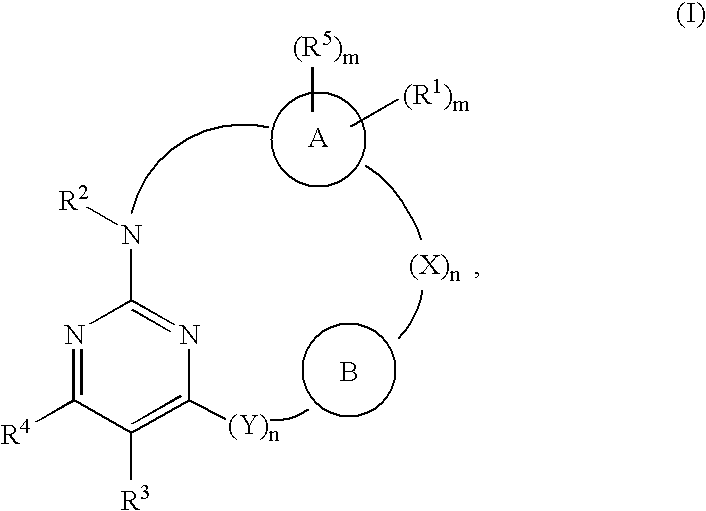
Description
- This invention relates to macrocyclic pyrimidine derivatives, their processes for production as well as their use as medication for treating various diseases.
- The cyclin-dependent kinases (cyclin-dependent kinase, CDK) are an enzyme family that plays an important role in the regulation of the cell cycle and thus presents an especially advantageous purpose for the development of small inhibitory molecules. Selective inhibitors of the CDKs can be used for treating cancer or other diseases that are caused by disorders of cell proliferation.
- Receptor tyrosine kinases and their ligands that specifically regulate the function of endothelial cells are involved in a decisive way in the physiological as well as the pathogenic angiogeneses. Of special importance here is the Vascular Endothelial Growth Factors (VEGF)/VEGF receptor system. In pathological situations that accompany enhanced neovascularization, such as, e.g., tumor diseases, an increased expression of angiogenic growth factors and their receptors was found. Inhibitors of the VEGF/VEGF-receptor system can inhibit the formation of a blood vessel system in the tumor, so that the tumors are separated from the oxygen and nutrient supply and thus inhibit the tumor growth.
- Pyrimidines and analogs are already described as active ingredients, such as, for example, the 2-anilino-pyrimidines as fungicides (DE 4029650) or substituted pyrimidine derivatives for treating neurological or neurodegenerative diseases (WO 99/19305). As CDK inhibitors, the most varied pyrimidine derivatives are described, for example bis(anilino)pyrimidine derivatives (WO 00/12486), 2-amino-4-substituted pyrimidines (WO 01/14375), purines (WO 99/02162), 5-cyano-pyrimidines (WO 02/04429), anilinopyrimidines (WO 00/12486) and 2-hydroxy-3-N,N-dimethylaminopropoxy-pyrimidines (WO 00/39101).
- The object of this invention is to provide compounds that have better properties than the already known compounds. It has now been found, surprisingly enough, that the substances according to the invention inhibit either cyclin-dependent kinases and VEGF-receptor tyrosine kinases or cyclin-dependent kinases or VEGF-receptor tyrosine kinases already in the nanomolar range and thus can inhibit the proliferation of tumor cells and/or tumor angiogenesis. They are thus clearly distinguishable from other already known CDK- or VEGF-R inhibitors, such as, e.g., olomoucine and roscovitin.
- It has now been found that compounds of general formula I

- in which
- A stands for C 3-C12-arylene or C3-C18-heteroarylene,
- B stands for a bond or for C 1-C12-alkylene, C2-C12-alkenylene, C2-C12-alkinylene, C3-C8-cycloalkylene, C3-C12-heterocycloalkylene, C3-C12-arylene or C3-C18-heteroarylene that is optionally substituted in one or more places in the same way or differently with hydroxy, halogen, cyano, nitro, C1-C6-alkyl, C2-C6-alkenyl, C2-C6-alkinyl, C3-C10-cycloalkyl, C1-C6-hydroxyalkyl, C3-C12-aryl, C3-C18-heteroaryl, —(CH2)p—C3-C12-aryl, —(CH2)p—C3-C18-heteroaryl, phenyl-(CH2)p—R10, —(CH2)pPO3(R10)2, —(CH2)pSO3R8 or with the group —NR8R9, —NR8COR9, —NR8CSR9, —NR8SOR9, —NR8SO2R9, —NR8CONR8R9, —NR8COOR9, —NR8C(NH)NR9R10, —NR8CSNR9R10, —NR8SONR9R10, —NR8SO2NR9R10, —COR8, —CSR8, —S(O)R8, —S(O)2R8, —S(O)2NR8R9, —SO3R8, —CO2R8, —CONR8R9, —CSNR8R9, —SR8 or —CR8(OH)—R9,
- X and Y, in each case independently of one another, stand for oxygen, sulfur or for the group ═NR 11, —NR11(CH2)—, —NR11O—, —ONR11—, ═CR6R7, ═C═O, ═C═S, ═SO, ═SO2, —C(O)O—, —OC(O)—, —S(O)O—, —OS(O)—, —S(O)2O—, —OS(O)2—, —CONR8—, —N(COR8)—, —N(COOR8), —N(CONR8R9)—, —NR8CO—, —OCONR8—, _NR8C(O)O—, —CSNR8-, —NR8CS—, —OCSNR8-, —NR8CSO—, —SONR8—, —NR8SO—, —SO2NR8—, —S(O)2N(COR8)—, —NR8SO2—, —NR8CONR9—, —NR8CSNR9—, —NR8SONR9—, —NR8SO2NR9—, —NR8C(O)NR9— or —NR8C(S)NR9—,
- R 1 and R5, in each case independently of one another, stand for hydrogen, hydroxy, halogen, nitro, cyano, C1-C6-alkyl, C1-C6-alkenyl, C1-C6-alkinyl, C3-C10-cycloalkyl, C3-C12-aryl, C3-C18-heteroaryl or for the group —C1-C6-alkyloxy-C1-C6-alkyloxy, —(CH2)p—C3-C12-aryl, —(CH2)p—C3-C18-heteroaryl, phenyl-(CH2)p—R10, —(CH2)pPO3(R10)2, —NR8R9, —NR8COR9, —NR8CSR9, —NR8SOR9, —NR8SO2R9, —NR8CONR9R10, —NR8COOR9, —NR8C(NH)NR9R10, —NR8CSNR9R10, —NR8SONR9R10, —NR8SO2NR9R10, —COR8, —CSR8, —S(O)R8, —S(O)(NH)R8, —S(O)2R8, —S(O)2NR8R9, —S(O)2N═CH—NR8R9, —S3R8, —CO2H, —CO2R8, —CONR8R9, —CSNR8R9, —SR8 or —CR8(OH)—R9, or for C1-C10-alkyl, C2-C10-alkenyl, C2-C10-alkinyl, C3-C10-cycloalkyl, C3-C12-aryl or C3-C18-heteroaryl that is substituted in one or more places in the same way or differently with hydroxy, C1-C6-alkoxy, halogen, phenyl or with the group —NR3R4, and the phenyl, C3-C10-cycloalkyl, C3-C12-aryl, C3-C18-heteroaryl, —(CH2)p—C3-C12-aryl and —(CH2)p—C3-C18-heteroaryl itself optionally can be substituted in one or more places in the same way or differently with halogen, hydroxy, C1-C6-alkyl, C1-C6-alkoxy, or with the group —CF3 or —OCF3, and the ring of the C3-C10-cycloalkyl and the C1-C10-alkyl optionally can be interrupted by one or more nitrogen, oxygen and/or sulfur atoms and/or can be interrupted by one or more ═C═O groups in the ring and/or optionally one or more possible double bonds can be contained in the ring,
- R 2 stands for hydrogen or C1-C10-alkyl,
- R 3 stands for hydrogen, halogen, nitro, cyano, C1-C10-alkyl, halo-C1-C10-alkyl, C2-C10-alkenyl, C2-C10-alkinyl, C3-C10-cycloalkyl, hydroxy, C1-C6-alkoxy, C1-C6-alkylthio, amino, —NH—(CH2)p—C3-C10-cycloalkyl, C1-C6-hydroxyalkyl, C1-C6-alkoxy-C1-C6-alkyl, C1-C6-alkoxy-C1-C6-alkoxy-C1-C6-alkyl, —NHC1-C6-alkyl, —N(C1-C6-alkyl)2, —SO(C1-C6-alkyl), —SO2(C1-C6-alkyl), C1-C6-alkanoyl, —CONR8R9, —COR10, C1-C6-alkylOAc, carboxy, C3-C12-aryl, C3-C18-heteroaryl, —(CH2)p—C3-C2-aryl, —(CH2)p—C3-C18-heteroaryl, phenyl-(CH2)p—R10, —(CH2)pPO3(R10)2 or for the group —NR8R9, or for C1-C10-alkyl, C2-C10-alkenyl, C2-C10-alkinyl, C3-C10-cycloalkyl, C3-C12-aryl or C3-C18-heteroaryl that is substituted in one or more places in the same way or differently with hydroxy, halogen, C1-C6-alkoxy, C1-C6-alkylthio, amino, cyano, C1-C6-alkyl, —NH—(CH2)p—C3-C10-cycloalkyl, C3-C10-cycloalkyl, C1-C6-hydroxyalkyl, C2-C6-alkenyl, C2-C6-alkinyl, C1-C6-alkoxy-C1-C6-alkyl, C1-C6-alkoxy-C1-C6-alkoxy-C1-C6-alkyl, —NHC1-C6-alkyl, —N(C1-C6-alkyl)2, —SO(C1-C6-alkyl), —SO2(C1-C6-alkyl), C1-C6-alkanoyl, —CONR8R9, —COR10, C1-C6-alkylOAc, carboxy, C3-C12-aryl, C3-C18-heteroaryl, —(CH2)p—C3-C12-aryl, —(CH2)p—C3-C18-heteroaryl, phenyl-(CH2)p—R10, —(CH2)pPO3(R10)2 or with the group —NR8R9, and the phenyl, C3-C10-cycloalkyl, C3-C12-aryl, C3-C18-heteroaryl, —(CH2)p—C3-C12-aryl and —(CH2)p—C3-C18-heteroaryl itself optionally can be substituted in one or more places in the same way or differently with halogen, hydroxy, C1-C6-alkyl, C1-C6-alkoxy, or with the group —CF3 or —OCF3, and the ring of the C3-C10-cycloalkyl and the C1-C10-alkyl optionally can be interrupted by one or more nitrogen, oxygen and/or sulfur atoms and/or can be interrupted by one or more ═C═O groups in the ring and/or optionally one or more possible double bonds can be contained in the ring,
- R 4 stands for hydrogen, halogen or C1-C4-alkyl,
- R 6, R7, R8
- R 9, R10
- and R 11, in each case independently of one another, stand for hydrogen or for C1-C10-alkyl, C2-C10-alkenyl, C2-C10-alkinyl, C3-C10-cycloalkyl, C3-C12-aryl or C3-C18-heteroaryl that is optionally substituted in one or more places in the same way or differently with hydroxy, halogen, C1-C12-alkoxy, C1-C6-alkylthio, amino, cyano, C1-C6-alkyl, —NH—(CH2)p—C3-C10-cycloalkyl, C3-C10-cycloalkyl, C1-C6-hydroxyalkyl, C2-C6-alkenyl, C2-C6-alkinyl, C1-C6-alkoxy-C1-C6-alkyl, C1-C6-alkoxy-C1-C6-alkoxy-C1-C6-alkyl, —NHC1-C6-alkyl, —N(C1-C6-alkyl)2, —SO(C1-C6-alkyl), —SO2(C1-C6-alkyl), C1-C6-alkanoyl, —CONR8R9, —COR10, C1-C6-alkylOAc, carboxy, C3-C12-aryl, C3-C8-heteroaryl, —(CH2)p—C3-C12-aryl, —(CH2)p—C3-C18-heteroaryl, phenyl-(CH2)p—R10, —(CH2)pPO3(R10)2 or with the group —NR8R9, and the phenyl, C3-C10-cycloalkyl, C3-C12-aryl, C3-C18-heteroaryl, —(CH2)p—C3-C12-aryl and —(CH2)p—C3-C18-heteroaryl itself optionally can be substituted in one or more places in the same way or differently with halogen, hydroxy, C1-C6-alkyl, C1-C6-alkoxy, or with the group —CF3 or —OCF3, and the ring of the C3-C10-cycloalkyl and the C1-C10-alkyl optionally can be interrupted by one or more nitrogen, oxygen and/or sulfur atoms and/or can be interrupted by one or more ═C═O groups in the ring and/or optionally one or more possible double bonds can be contained in the ring,
- m stands for 0 to 8, and
- n and p stand for 0 to 6, as well as isomers, diastereomers, enantiomers and salts thereof, overcome the known drawbacks.
- Alkyl is defined in each case as a straight-chain or branched alkyl radical, such as, for example, methyl, ethyl, propyl, isopropyl, butyl, isobutyl, sec-butyl, tert-butyl, pentyl, isopentyl, hexyl, heptyl, octyl, nonyl and decyl.
- Alkoxy is defined in each case as a straight-chain or branched alkoxy radical, such as, for example, methyloxy, ethyloxy, propyloxy, isopropyloxy, butyloxy, isobutyloxy, sec-butyloxy, pentyloxy, isopentyloxy, hexyloxy, heptyloxy, octyloxy, nonyloxy, decyloxy, undecyloxy or dodecyloxy.
- Alkylthio is defined in each case as a straight-chain or branched alkylthio radical, such as, for example, methylthio, ethylthio, propylthio, isopropylthio, butylthio, isobutylthio, sec-butylthio, tert-butylthio, pentylthio, isopentylthio or hexylthio.
- Cycloalkyls are defined as monocyclic alkyl rings, such as cyclopropyl, cyclobutyl, cyclopentyl, cyclohexyl or cycloheptyl, cyclooctyl, cyclononyl or cyclodecyl, but also bicyclic rings or tricyclic rings, such as, for example, adamantanyl.
- Heterocycloalkyl stands for an alkyl ring that comprises 3-12 carbon atoms and that instead of the carbon contains one or more heteroatoms that are the same or different, such as, e.g., oxygen, sulfur or nitrogen.
- As heterocycloalkyls, there can be mentioned, e.g.: oxiranyl, oxethanyl, aziridinyl, azetidinyl, tetrahydrofuranyl, pyrrolidinyl, dioxolanyl, imidazolidinyl, pyrazolidinyl, dioxanyl, piperidinyl, morpholinyl, dithianyl, thiomorpholinyl, piperazinyl, trithianyl, quinuclidinyl, etc.
- The ring systems, in which optionally one or more possible double bonds can be contained in the ring, are defined as, for example, cycloalkenyls, such as cyclopropenyl, cyclobutenyl, cyclopentenyl, cyclohexenyl, and cycloheptenyl, whereby the linkage can be carried out both to the double bond and to the single bonds.
- Halogen is defined in each case as fluorine, chlorine, bromine or iodine.
- In each case, the alkenyl- and alkinyl substituents are straight-chain or branched, whereby, for example, the following radicals are meant: vinyl, propen-1-yl, propen-2-yl, but-1-en-1-yl, but-1-en-2-yl, but-2-en-1-yl, but-2-en-2-yl, 2-methyl-prop-2-en-1-yl, 2-methyl-prop-1-en-1-yl, but-1-en-3-yl, ethinyl, prop-1-in-1-yl, but-1-in-1-yl, but-2-in-1-yl, but-3-en-1-yl, and allyl.
- In each case, the aryl radical has 6-12 carbon atoms, such as, for example, naphthyl, biphenyl and, in particular, phenyl.
- In each case, the heteroaryl radical comprises 3-18 ring atoms and instead of carbon can contain in the ring one or more heteroatoms that are the same or different, such as oxygen, nitrogen or sulfur, and can be monocyclic, bicyclic or tricyclic and in addition can be benzocondensed in each case.
- For example, there can be mentioned: thienyl, furanyl, pyrrolyl, oxazolyl, thiazolyl, imidazolyl, pyrazolyl, isoxazolyl, isothiazolyl, oxadiazolyl, triazolyl, thiadiazolyl, etc. and benzo derivatives thereof, such as, e.g., benzofuranyl, benzothienyl, benzoxazolyl, benzimidazolyl, indazolyl, indolyl, isoindolyl, etc.; or pyridyl, pyridazinyl, pyrimidinyl, pyrazinyl, triazinyl, etc. and benzo derivatives thereof, such as, e.g., quinolyl, isoquinolyl, etc.; or azocinyl, indolizinyl, purinyl, etc., and benzo derivatives thereof; or cinnolinyl, phthalazinyl, quinazolinyl, quinoxalinyl, naphthyridinyl, pteridinyl, carbazolyl, acridinyl, phenazinyl, phenothiazinyl, phenoxazinyl, xanthenyl, oxepinyl, 1,4-benzodioxane, etc.
- If an acid group is included, the physiologically compatible salts of organic and inorganic bases are suitable as salts, such as, for example, the readily soluble alkali and alkaline-earth salts, as well as N-methyl-glucamine, dimethyl glucamine, ethyl glucamine, lysine, 1,6-hexadiamine, ethanolamine, glucosamine, sarcosine, serinol, tris-hydroxy-methyl-amino-methane, aminopropanediol, Sovak base, and 1-amino-2,3,4-butanetriol.
- If a basic group is included, the physiologically compatible salts of organic and inorganic acids are suitable, such as hydrochloric acid, sulfuric acid, phosphoric acid, citric acid, and tartaric acid, i.a.
- Those compounds of general formula (I), in which
- A stands for phenylene or thiophenylene,
- B stands for a bond or for C 1-C12-alkylene, C2-C12-alkenylene, C2-C12-alkinylene, C3-C8-cycloalkylene, C3-C12-heterocycloalkylene, C3-C12-arylene or C3-C18-heteroarylene that is optionally substituted in one or more places in the same way or differently with hydroxy, halogen, cyano, nitro, C1-C6-alkyl, C2-C6-alkenyl, C2-C6-alkinyl, C3-C10-cycloalkyl, C1-C6-hydroxyalkyl, C3-C12-aryl, C3-C18-heteroaryl, —(CH2)p—C3-C12-aryl, —(CH2)p—C3-C18-heteroaryl, phenyl-(CH2)p—R10, —(CH2)pPO3(R10)2, —(CH2)pSO3R8 or with the group-NR8R9, —NR8COR9, —NR8CSR9, —NR8SOR9, —NR8SO2R9, —NR8CONR8R9, —NR8COOR9, —NR8C(NH)NR9R10, —NR8CSNR9R10, —NR8SONR9R10, —NR8SO2NR9R10, —COR8, —CSR8, —S(O)R8, —S(O)2R8, —S(O)2NR8R9, —SO3R8, —CO2R8, —CONR8R9, —CSNR8R9, —SR8 or —CR8(OH)—R9,
- X and Y, in each case independently of one another, stand for oxygen, sulfur or for the group —NR 11—, —NR11(CH2)—, —NR11O—, —ONR11—, =CR6R7, =C═O, ═C═S, ═SO, ═SO2, —C(O)O—, —OC(O)—, —S(O)O—, —OS(O)—, —S(O)2O—, —OS(O)2—, —CONR8—, —N(COR8)—, —N(COOR8)—, —N(CONR8R9)—, —NR8CO—, —OCONR8—, —NR8C(O)O—, —CSNR8—, —NR8CS—, —OCSNR8—, —NR8CSO—, —SONR8—, —NR8SO—, —SO2NR8—, —S(O)2N(COR8)—, —NR8SO2—, —NR8CONR9—, —NR8CSNR9—, —NR8SONR9—, —NR8SO2NR9—, —NR8C(O)NR9— or —NR8C(S)NR9—, R1 and R5, in each case independently of one another, stand for hydrogen, hydroxy, halogen, nitro, cyano, C1-C6-alkyl, C1-C6-alkenyl, C1-C6-alkinyl, C3-C10-cyploalkyl, C3-C12-aryl, C3-C18-heteroaryl or for the group —C1-C6-alkyloxy-C1-C6-alkyloxy, —(CH2)p—C3-C12-aryl, —(CH2)p—C3-C18-heteroaryl, phenyl-(CH2)p—R10, —(CH2)pPO3(R10)2, —NR8R9, —NR8COR9, —NR8CSR9, —NR8SOR9, —NR8SO2R9, —NR8CONR9R10, —NR8COOR9, —NR8C(NH)NR9R10, —NR8CSNR9R10, —NR8SONR9R10, —NR8SO2NR9R10, —COR8, —CSR8, —S(O)R8, —S(O)(NH)R8, —S(O)2R8, —S(O)2NR8R9, —S(O)2N═CH—NR8R9, —SO3R8, —CO2H, —CO2R8, CONR8R9, —CSNR8R9, —SR8 or —CR8(OH)—R9, or for C1-C10-alkyl, C2-C10-alkenyl, C2-C10-alkinyl, C3-C10-cycloalkyl, C3-C12-aryl or C3-C18-heteroaryl that is substituted in one or more places in the same way or differently with hydroxy, C1-C6-alkoxy, halogen, phenyl or with the group —NR3R4, and the phenyl, C3-C10-cycloalkyl, C3-C12-aryl, C3-C18-heteroaryl, —(CH2)p—C3-C12-aryl and —(CH2)p—C3-C18-heteroaryl itself optionally can be substituted in one or more places in the same way or differently with halogen, hydroxy, C1-C6-alkyl, C1-C6-alkoxy, or with the group —CF3 or —OCF3, and the ring of C3-C10-cycloalkyl and the C1-C10-alkyl optionally can be interrupted by one or more nitrogen, oxygen and/or sulfur atoms and/or can be interrupted by one or more ═C═O groups in the ring and/or optionally one or more double bonds can be contained in the ring, R2 stands for hydrogen or C1-C10-alkyl, R3 stands for hydrogen, halogen, nitro, cyano, C1-C10-alkyl, halo-C1-C10-alkyl, C2-C10-alkenyl, C2-C10-alkinyl, C3-C10-cycloalkyl, hydroxy, C1-C6-alkoxy, C1-C6-alkylthio, amino, —NH—(CH2)p—C3-C10-cycloalkyl, C1-C6-hydroxyalkyl, C1-C6-alkoxy-C1-C6-alkyl, C1-C6-alkoxy-C1-C6-alkoxy-C1-C6-alkyl, —NHCl1-C6-alkyl, —N(C1-C6-alkyl)2, —SO(C1-C6-alkyl), —SO2(C1-C6-alkyl), C1-C6-alkanoyl, —CONR8R9, —COR10, C1-C6-alkylOAc, carboxy, C3-C12-aryl, C3-C18-heteroaryl, —(CH2)p—C3-C12-aryl, —(CH2)p—C3-C18-heteroaryl, phenyl-(CH2)p—R10, —(CH2)pPO3(R10)2 or for the group —NR8R9, or for C1-C10-alkyl, C2-C10-alkenyl, C2-C10-alkinyl, C3-C10-cycloalkyl, C3-C12-aryl or C3-C18-heteroaryl that is substituted in one or more places in the same way or differently with hydroxy, halogen, C1-C6-alkoxy, C1-C6-alkylthio, amino, cyano, C1-C6-alkyl, —NH—(CH2)p—C3-C10-cycloalkyl, C3-C10-cycloalkyl, C1-C6-hydroxyalkyl, C2-C6-alkenyl, C2-C6-alkinyl, C1-C6-alkoxy-C1-C6-alkyl, C1-C6-alkoxy-C1-C6-alkoxy-C1-C6-alkyl, —NHC1-C6-alkyl, —N(C1-C6-alkyl)2, —SO(C1-C6-alkyl), —SO2(C1-C6-alkyl), C1-C6-alkanoyl, —CONR8R9, —COR10, C1-C6-alkylOAc, carboxy, C3-C12-aryl, C3-C18-heteroaryl, —(CH2)p—C3-C12-aryl, —(CH2)p—C3-C18-heteroaryl, phenyl-(CH2)p—R10, —(CH2)pPO3(R10)2 or with the group —NR8R9; and the phenyl, C3-C10-cycloalkyl, C3-C12-arY1, C3-C18-heteroaryl, —(CH2)p—C3-C12-aryl and —(CH2)p—C3-C18-heteroaryl itself optionally can be substituted in one or more places in the same way or differently with halogen, hydroxy, C1-C6-alkyl, C1-C6-alkoxy, or with the group —CF3 or —OCF3, and the ring of the C3-C10-cycloalkyl and the C1-C10-alkyl optionally can be interrupted by one or more nitrogen, oxygen, and/or sulfur atoms and/or can be interrupted by one or more ═C═O groups in the ring and/or optionally one or more possible double bonds can be contained in the ring,
- R 4 stands for hydrogen, halogen or C1-C4-alkyl,
- R 6 R7 R8
- R 9, R10
- and R 11, in each case independently of one another, stand for hydrogen or for C1-C10-alkyl, C2-C10-alkenyl, C2-C10-alkinyl, C3-C10-cycloalkyl, C3-C12-aryl or C3-C18-heteroaryl that is optionally substituted in one or more places in the same way or differently with hydroxy, halogen, C1-C1-2-alkoxy, C1-C6-alkylthio, amino, cyano, C1-C6-alkyl, —NH—(CH2)p—C3-C10-cycloalkyl, C3-C10-cycloalkyl, C1-C6-hydroxyalkyl, C2-C6-alkenyl, C2-C6-alkinyl, C1-C6-alkoxy-C1-C6-alkyl, C1-C6-alkoxy-C1-C6-alkoxy-C1-C6-alkyl, —NHC1-C6-alkyl, —N(C1-C6-alkyl)2, —SO(C1-C6-alkyl), —SO2(C1-C6-alkyl), C1-C6-alkanoyl, —CONR8R9, —COR10, C1-C6-alkylOAc, carboxy, C3-C12-aryl, C3-C8-heteroaryl, —(CH2)p—C3-C12-aryl, —(CH2)p—C3-C18-heteroaryl, phenyl-(CH2)p—R10, —(CH2)pPO3(R10)2 or with the group —NR8R9, and the phenyl, C3-C10-cycloalkyl, C3-C12-aryl, C3-C18-heteroaryl, —(CH2)p—C3-C12-aryl and —(CH2)p—C3-C18-heteroaryl itself optionally can be substituted in one or more places in the same way or differently with halogen, hydroxy, C1-C6-alkyl, C1-C6-alkoxy, or with the group —CF3 or —OCF3, and the ring of C3-C10-cycloalkyl and the C1-C10-alkyl optionally can be interrupted by one or more nitrogen, oxgyen and/or sulfur atoms, and/or can be interrupted by one or more ═C═O groups in the ring and/or optionally one or more possible double bonds can be contained in the ring,
- m stands for 0 to 8, and
- n and p stand for 0 to 6,
- as well as isomers, diastereomers, enantiomers and salts thereof, are especially effective.
- Those compounds of general formula (I) in which
- A stands for phenylene or thiophenylene,
- B stands for a bond or for C 1-C12-alkylene, C3-C8-cycloalkylene or C3-C12-arylene that is optionally substituted in one or more places in the same way or differently with hydroxy, C1-C6-alkyl, C1-C6-hydroxyalkyl or —(CH2)pSO3R8,
- X and Y, in each case independently of one another, stand for oxygen or for the group —NR 11—, —NR11(CH2)—, —CONR8—, —SO2NR8- or —NR8CONR9—,
- R 1 and R5, in each case independently of one another, stand for hydrogen, halogen, nitro, C1-C6-alkyl, or for —NR8R9, —C1-C6-alkyloxy-C1-C6-alkyloxy or —S(O)2NR8R9,
- R 2 stands for hydrogen,
- R 3 stands for hydrogen, halogen, cyano, C1-C10-alkyl or —CONR8R9,
- R 4 stands for hydrogen,
- R 8,
- R 9
- and R 11, in each case independently of one another, stand for hydrogen or for C1-C10-alkyl,
- m stands for 0 to 4, and
- p stands for 0 to 6,
- as well as isomers, diastereomers, enantiomers and salts thereof, are especially effective.
- Those compounds of general formula (I), in which
- A stands for phenylene,
- B stands for a bond or for C 1-C12-alkylene, cyclohexylene or phenylene that is optionally substituted in one or more places in the same way or differently With hydroxy, C1-C6-alkyl, C1-C6-hydroxyalkyl or —(CH2)SO3R8,
- X stands for oxygen or for the group —CONR 8—, —SO2NR8— or —NR8CONR9—,
- Y stands for oxygen or for the group —NR 11,
- R 1 and R5, in each case independently of one another, stand for hydrogen, amino, halogen, nitro, C1-C6-alkyl, or for the group —NR8R9, —C1-C6-alkyloxy-C1-C6-alkyloxy or —S(O)2NR8R9,
- R 2 stands for hydrogen,
- R 3 stands for hydrogen, halogen, cyano, C1-C10-alkyl, or —CONR8R9,
- R 4 stands for hydrogen,
- R 8, R9 and R11, in each case independently of one another, stand for hydrogen or for methyl or isobutyl,
- m stands for 0 to 4, and
- p stands for 0 to 6,
- as well as isomers, diastereomers, enantiomers, and salts thereof, are selected.
- In addition, those compounds of general formula (I), in which
- A stands for phenylene,
- B stands for a bond or for C 1-C12-alkylene that is optionally substituted in one or more places in the same way or differently with hydroxy, C1-C6-hydroxyalkyl or —(CH2)SO3R8,
- X stands for oxygen or for the group —SO 2NR8— or —NR8CONR9—,
- Y stands for the group —NR 11—,
- R 1 and R5, in each case independently of one another, stand for hydrogen, amino, halogen, nitro or for the group —S(O)2NR8R9,
- R 2 stands for hydrogen,
- R 3 stands for halogen or cyano,
- R 4 stands for hydrogen,
- R 8, R9 and R11 in each case stand for hydrogen, and
- m stands for 0 to 4,
- as well as isomers, diastereomers, enantiomers and salts thereof, are selected.
- In particular, those compounds of general formula (I), in which
- A stands for thiophenylene,
- B stands for a bond or for C 1-C12-alkylene,
- X stands for the group —SO 2NR8—,
- Y stands for the group —NR 11—,
- R 3 stands for halogen,
- R 1, R2, R4, R5,
- R 8, R9 and R11 in each case stand for hydrogen,
- m stands for 0 to 2,
- as well as isomers, diastereomers, enantiomers and salts thereof, are selected.
- It was also found that compounds of general formula I

- in which
- A stands for C 3-C12-arylene or C3-C18-heteroarylene,
- B stands for a bond or for C 1-C12-alkylene, C2-C12-alkenylene, C2-C12-alkinylene, C3-C8-cycloalkylene, C3-C12-heterocycloalkylene, C3-C12-arylene or C3-C18-heteroarylene that is optionally substituted in one or more places in the same way or differently with hydroxy, halogen, cyano, nitro, C1-C6-alkyl, C2-C6-alkenyl, C2-C6-alkinyl, C3-C10-cycloalkyl, C1-C6-hydroxyalkyl, C3-C12-aryl, C3-C18-heteroaryl, —(CH2)p—C3-C12-aryl, —(CH2)p—C3-C18-heteroaryl, phenyl-(CH2)p—R10, —(CH2)pPO3(R10)2 or with the group-NR8R9, —NR8COR9, —NR8CSR9, —NR8SOR9, —NR8SO2R9, —NR8CONR8R9, —NR8COOR9, —NR8C(NH)NR9R10, —NR8CSNR9R10, —NR8SONR9R10, —NR8SO2NR9R10, —COR8, —CSR8, —S(O)R8, —S(O)2R8, —S(O)2NR8R9, —SO3R8, —CO2R8, CONR8R9, —CSNR8R9, —SR8 or —CR8(OH)—R9,
- X and Y, in each case independently of one another, stand for oxygen, sulfur or for the group ═NR 11, —NR11O—, —ONR11—, ═CR6R7, ═C═O, ═C═S, ═SO, ═SO2, —C(O)O—, —OC(O)—, —S(O)O—, —OS(O)—, —S(O)2O—, —OS(O)2—, —CONR8—, —NR8CO—, —OCONR8—, —NR8C(O)O—, —CSNR8—, —NR8CS—, —OCSNR8—, —NR8CSO—, —SONR8—, —NR8SO—, —SO2NR8—, —NR8SO2—, —NR8CONR9—, —NR8CSNR9—, —NR8SONR9—, —NR8SO2NR9—, —NR8C(O)NR9— or —NR8C(S)NR9—,
- R 1 and R5, in each case independently of one another, stand for hydrogen, hydroxy, halogen, nitro, cyano, C1-C6-alkyl, C1-C6-alkenyl, C1-C6-alkinyl, C3-C10-cycloalkyl, C3-C12-aryl, C3-C18-heteroaryl or for the group —(CH2)p-C3-C12-aryl, —(CH2)p—C3-C18-heteroaryl, phenyl-(CH2)p—R10, —(CH2)pPO3(R10)2, —NR8R9, —NR8COR9, —NR8CSR9, NR8SOR9, —NR8SO2R9, —NR8CONR9R10, —NR8COOR9, —NR8C(NH)NR9R10, —NR8CSNR9R10, —NR8SONR9R10, —NR8SO2NR9R10, —COR8, —CSR8, —S(O)R8, —S(O)2R8, —S(O)2NR8R9, —SO3R8, —CO2H, —CO2R8, —CONR8R9, —CSNR8R9, —SR8 or —CR8(OH)—R9, or for C1-C10-alkyl, C2-C10-alkenyl, C2-C10-alkinyl, C3-C10-cycloalkyl, C3-C12-aryl or C3-C18-heteroaryl that is substituted in one or more places in the same way or differently with hydroxy, C1-C6-alkoxy, halogen, phenyl or with the group —NR3R4, and the phenyl, C3-C10-cycloalkyl, C3-C12-aryl, C3-C18-heteroaryl, —(CH2)p—C3-C12-aryl and —(CH2)p—C3-C18-heteroaryl itself optionally can be substituted in one or more places in the same way or differently with halogen, hydroxy, C1-C6-alkyl, C1-C6-alkoxy, or with the group —CF3 or —OCF3, and the ring of the C3-C10-cycloalkyl and the C1-C10-alkyl optionally can be interrupted by one or more nitrogen, oxygen and/or sulfur atoms and/or can be interrupted by one or more ═C═O groups in the ring and/or optionally one or more possible double bonds can be contained in the ring,
- R 2 stands for hydrogen or C1-C10-alkyl,
- R 3 stands for hydrogen, halogen, nitro, cyano, C1-C10-alkyl, halo-C1-C10-alkyl, C2-C10-alkenyl, C2-C10-alkinyl, C3-C10-cycloalkyl, hydroxy, C1-C6-alkoxy, C1-C6-alkylthio, amino, —NH—(CH2)p—C3-C10-cycloalkyl, C1-C6-hydroxyalkyl, C1-C6-alkoxy-C1-C6-alkyl, C1-C6-alkoxy-C1-C6-alkoxy-C1-C6-alkyl, —NHC1-C6-alkyl, —N(C1-C6-alkyl)2, —SO(C1-C6-alkyl), —SO2(C1-C6-alkyl), C1-C6-alkanoyl, —CONR8R9, —COR10, C1-C6-alkylOAc, carboxy, C3-C12-aryl, C3-C18-heteroaryl, —(CH2)p—C3-C12-aryl, —(CH2)p—C3-C18-heteroaryl, phenyl-(CH2)p—R10, —(CH2)pPO3(R10)2 or for the group —NR8R9, or for C1-C10-alkyl, C2-C10-alkenyl, C2-C10-alkinyl, C3-C10-cycloalkyl, C3-C12-aryl or C3-C18-heteroaryl that is substituted in one or more places in the same way or differently with hydroxy, halogen, C1-C6-alkoxy, C1-C6-alkylthio, amino, cyano, C1-C6-alkyl, —NH—(CH2)p—C3-C10-cycloalkyl, C3-C10-cycloalkyl, C1-C6-hydroxyalkyl, C2-C6-alkenyl, C2-C6-alkinyl, C1-C6-alkoxy-C1-C6-alkyl, C1-C6-alkoxy-C1-C6-alkoxy-C1-C6-alkyl, —NHC1-C6-alkyl, —N(C1-C6-alkyl)2, —SO(C1-C6-alkyl), —SO2(C1-C6-alkyl), C1-C6-alkanoyl, —CONR8R9, —COR10, C1-C6-alkylOAc, carboxy, C3-C12-aryl, C3-C18-heteroaryl, —(CH2)p—C3-C12-aryl, —(CH2)p—C3-C18-heteroaryl, phenyl-(CH2)p—R10, —(CH2)pPO3(R10)2 or with the group —NR8R9, and the phenyl, C3-C10-cycloalkyl, C3-C12-aryl, C3-C18-heteroaryl, —(CH2)p—C3-C12-aryl and —(CH2)p—C3-C18-heteroaryl itself optionally can be substituted in one or more places in the same way or differently with halogen, hydroxy, C1-C6-alkyl, C1-C6-alkoxy, or with the group —CF3 or —OCF3, and the ring of the C3-C10-cycloalkyl and the C1-C10-alkyl optionally can be interrupted by one or more nitrogen, oxygen and/or sulfur atoms and/or can be interrupted by one or more ═C═O groups in the ring and/or optionally one or more possible double bonds can be contained in the ring,
- R 4 stands for hydrogen, halogen or C1-C4-alkyl,
- R 6, R7, R8,
- R 9, R10
- and R 11, in each case independently of one another, stand for hydrogen or for C1-C10-alkyl, C2-C10-alkenyl, C2-C10-alkinyl, C3-C10-cycloalkyl, C3-C12-aryl or C3-C18-heteroaryl that is optionally substituted in one or more places in the same way or differently with hydroxy, halogen, C1-C12-alkoxy, C1-C6-alkylthio, amino, cyano, C1-C6-alkyl, —NH—(CH2)p—C3-C10-cycloalkyl, C3-C10-cycloalkyl, C1-C6-hydroxyalkyl, C2-C6-alkenyl, C2-C6-alkinyl, C1-C6-alkoxy-C1-C6-alkyl, C1-C6-alkoxy-C1-C6-alkoxy-C1-C6-alkyl, —NHC1-C6-alkyl, —N(C1-C6-alkyl)2, —SO(C1-C6-alkyl), —SO2(C1-C6-alkyl), C1-C6-alkanoyl, —CONR8R9, —COR10, C1-C6-alkylOAc, carboxy, C3-C12-aryl, C3-C8-heteroaryl, —(CH2)p—C3-C12-aryl, —(CH2)p—C3-C18-heteroaryl, phenyl-(CH2)p—R10, —(CH2)pPO3(R10)2 or with the group —NR8R9, and the phenyl, C3-C10-cycloalkyl, C3-C12-aryl, C3-C18-heteroaryl, —(CH2)p—C3-C12-aryl and —(CH2)p—C3-C18-heteroaryl itself optionally can be substituted in one or more places in the same way or differently with halogen, hydroxy, C1-C6-alkyl, C1-C6-alkoxy, or with the group —CF3 or —OCF3, and the ring of the C3-C10-cycloalkyl and the C1-C10-alkyl optionally can be interrupted by one or more nitrogen, oxygen and/or sulfur atoms, and/or can be interrupted by one or more ═C═O groups in the ring and/or optionally one or more possible double bonds can be contained in the ring,
- m stands for 0 to 8, and
- n and p stand for 0 to 6,
- as well as isomers, diastereomers, enantiomers and salts thereof, overcome the known drawbacks.
- In particular selected therefrom are compounds of general formula (I), in which
- A stands for phenylene or thiophenylene,
- B stands for C 1-C12-alkylene that is optionally substituted in one or more places in the same way or differently with hydroxy, C1-C6-alkyl or C1-C6-hydroxyalkyl,
- X and Y, in each case independently of one another, stand for oxygen or for the group ═NR 11, —NR8CO—, —CONR8—, —SO2NR8— or —NR8SO2—,
- R 1 and R5, in each case independently of one another, stand for hydrogen or for the group —SO2NR8R9,
- R 2 stands for hydrogen,
- R 3 stands for hydrogen, halogen, cyano, C1-C10-alkyl or for the group —CONR8R9;
- R 4 stands for hydrogen,
- R 8 and R11 stand for hydrogen,
- R 9 stands for hydrogen or C1-C6-alkyl,
- m stands for 0 to 8, and
- n stands for 0 to 6,
- as well as isomers, diastereomers, enantiomers and salts thereof.
- If the production of the compounds of general formula I according to the invention is not described, the latter is carried out analogously to known methods.
- The structural determination of the macrocyclic fragrances Muskon and Zibeton by Ruzicka ((a) Ruzicka, L. Helv. Chim. Acta 1926, 9, 715. (b) Ruzicka, L. Helv. Chim. Acta 1926, 9, 249) in 1926 marks the beginning of the chemistry of macrocyclic compounds.
- In general, medium (8- to 11-membered) and large (≧12-membered) rings are referred to as macrocyclic compounds. The established processes for synthesis of macrocyclic compounds are partially based on ring enlargement reactions (Hesse, M. Ring Enlargement in Organic Chemistry, VCH, Weinheim, 1991), and more rarely on ring contractions (Hayashi, T. J. Org. Chem. 1984, 49, 2326).
- The most frequently used method is the cyclization of bifunctional acyclic precursors (Reviews zur Synthese von Macrocyclen [Reviews on the Synthesis of Macrocyclic Compounds]: (a) Roxburgh, C. J. Tetrahedron 1995, 51, 9767. (b) Meng, Q. Top. Curr. Chem. 1991, 161, 107. (c) Paterson, I. Tetrahedron 1985, 41, 3569. (d) Masamune, S. Angew. Chem. [Applied Chemistry] 1977, 89, 602. (e) Nicolaou, K. C. Tetrahedron 1977, 33, 683; (f) Ruggli, P. Liebigs Ann. Chem. 1912, 92).
- The production of the compounds of general formula I according to the invention can be carried out quickly and with very good yields by the ring closure via the 2-position of the pyrimidine of acyclic precursors of Formula (VIII) or (IX), by
- a) compounds of general formula VIII

- in which R 1, R2, R3, R4, R5, X, Y, A, B, m and n have the meanings that are indicated in general formula I, and L stands for a leaving group, being cyclized with a suitable acid to compounds of general formula I, or
- b) the acyclic precursors of general formula (IX)

- in which R 1, R3, R4, R5, X, Y, A, B, m and n have the meanings that are indicated in general formula I, and L stands for a leaving group, first being reduced to amine form in a suitable solvent and a suitable reducing agent at 0° C. until reflux takes place and then the intermediately formed amine being cyclized to the compounds of general formula I.
- The production of the compounds of general formula I according to the invention is also the subject of this invention.
- Suitable solvents are, for example, simple ketones, such as acetone; alcohols, such as, e.g., ethanol or butanol; esters, such as, for example, ethyl acetate; aromatic solvents, such as, for example, toluene or benzene, as well as polar aprotic solvents, such as acetonitrile, DMSO, DMF or N-methylpyrrolidines or mixtures of these solvents, also with the addition of water.
- Suitable reducing agents are, for example, Ti(III)Cl or Sn(II)Cl.
- Leaving groups in the meaning of L are defined as, for example, a halo- or sulfonyloxy group, such as fluorine, chlorine, bromine, iodine, methanosulfonyloxy, toluene-4-sulfonyloxy, trifluoromethylsulfonyloxy, etc.
- For cyclization, acids that are used are, for example, suitable Lewis acids, such as inorganic acids such as hydrogen chloride, hydrogen bromide, sulfuric acid; organic acids such as acetic acid, formic acid, BBr 3; metal salts such as Ti(III)Cl, Sn(II)Cl, Ln(III)Otf, etc.
- The intermediate products of general formulas II, III, IV, V, VI and VII, preferably used for the production of the compounds of general formula I according to the invention

- [or]
- in which R 1, R2, R3, R4, R5, R8, R11, A, B and m have the meanings that are indicated in general formula I and D stands for —NH2, NAc or —NO2, q stands for 1 to 12, U stands for group —OH, —CO2H, —CO2—C1-C6-alkyl, —SO2Cl, —SO2F, —SO3H or

- and W stands for the group —OH —OH, —CO 2H, —CO2—C1-C6-alkyl, —SO2Cl, —SO2F or —SO3H,
- as well as isomers, diastereomers, enantiomers and salts thereof, are also subjects of this invention.
- In particular, preferably those intermediate products of general formulas II, III, IV, V, VI and VII are used, in which
- A stands for phenylene or thiophenylene, and
- R 1, R2, R3, R4, R5, R8, R11 and m have the meanings that are indicated in general formula I, and D stands for —NH2, —NAc or —NO2, q stands for 1 to 12,
- U stands for the group —OH, —CO 2H, —CO2—C1-C6-alkyl, —SO2Cl, —SO2F, —SO3H or
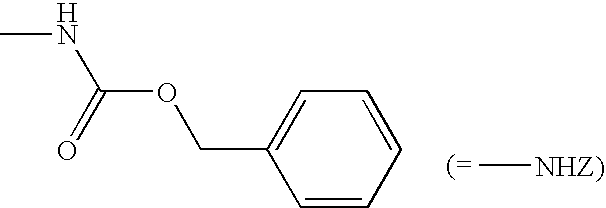
- and
- W stands for the group —OH —OH, —CO 2H, —CO2—C1-C6-alkyl, —SO2Cl, —SO2F or —SO3H,
- as well as isomers, diastereomers, enantiomers and salts thereof.
- The compounds according to the invention can inhibit, on the one hand, cyclin-dependent kinases. The eukaryotic cell division cycle ensures the duplication of the genome and its distribution to the daughter cells by passing through a coordinated and regulated sequence of events. The cell cycle is divided into four successive phases: the G1 phase represents the time before the DNA replication in which the cell grows and is sensitive to outside stimuli. In the S phase, the cell replicates its DNA, and in the G2 phase, preparations are made for entry into mitosis. In mitosis (M phase), the replicated DNA separates, and cell division is complete.
- The cyclin-dependent kinases (CDKs), a family of serine/threonine kinases, whose members require the binding of a cyclin (Cyc) as a regulatory subunit in order for them to activate, drive the cell through the cell cycle. Different CDK/Cyc pairs are active in the various phases of the cell cycle. CDK/Cyc pairs that are important to the basic function of the cell cycle are, for example, CDK4(6)/CycD, CDK2/CycE, CDK2/CycA, CDK1/CycA and CDK1/CycB. Some members of the CDK enzyme family have a regulatory function by influencing the activity of the above-mentioned cell cycle CDKs, while no specific function could be associated with other members of the CDK enzyme family. One of the latter, CDK5, is distinguished in that it has an a typical regulatory subunit (p35) that deviates from the cyclins, and its activity is highest in the brain.
- The entry into the cell cycle and the passage through the “restriction points,” which marks the independence of a cell from further growth signals for the completion of the cell division that has begun, are controlled by the activity of the CDK4(6)/CycD and CDK2/CycE complexes. The essential substrate of these CDK complexes is the retinoblastoma protein (Rb), the product of the retinoblastoma tumor suppressor gene. Rb is a transcriptional co-repressor protein. In addition to other, still largely little understood mechanisms, Rb binds and inactivates Rb transcription factors of the E2F type and forms transcriptional repressor complexes with histone-deacetylases (HDAC) (Zhang, H. S. et al. (2000). Exit from G1 and S phase of the cell cycle is regulated by repressor complexes containing HDAC-Rb-hSWI/SNF and Rb-hSWI/SNF. Cell 101, 79-89). By the phosphorylation of Rb by CDKs, bonded E2F transcription factors are released and result in transcriptional activation of genes, whose products are required for the DNA synthesis and the progression through the S-phase. In addition, the Rb-phosphorylation brings about the breakdown of the Rb-HDAC complexes, by which additional genes are activated. The phosphorylation of Rb by CDK's is to be treated as equivalent to exceeding the “restriction points.” For the progression through the S-phase and its completion, the activity of the CDK2/CycE and CDK2/CycA complexes is necessary, e.g., the activity of the transcription factors of the E2F type is turned off by means of phosphorylation by CDK2/CycA as soon as the cells are entered into the S-phase. After replication of DNA is complete, the CDK1 in the complex with CycA or CycB controls the entry into and the passage through phases G2 and M (FIG. 1).
- According to the extraordinary importance of the cell-division cycle, the passage through the cycle is strictly regulated and controlled. The enzymes that are necessary for the progression through the cycle must be activated at the correct time and are also turned off again as soon as the corresponding phase is passed. Corresponding control points (“checkpoints”) stop the progression through the cell cycle if DNA damage is detected, or the DNA replication or the creation of the spindle device is not yet completed.
- The activity of the CDKs is controlled directly by various mechanisms, such as synthesis and degradation of cyclins, complexing of the CDKs with the corresponding cyclins, phosphorylation and dephosphorylation of regulatory threonine and tyrosine radicals, and the binding of natural inhibitory proteins. While the amount of protein of the CDKs in a proliferating cell is relatively constant, the amount of the individual cyclins oscillates with the passage through the cycle. Thus, for example, the expression of CycD during the early G1 phase is stimulated by growth factors, and the expression of CycE is induced after the “restriction points” are exceeded by the activation of the transcription factors of the E2F type. The cyclins themselves are degraded by the ubiquitin-mediated proteolysis. Activating and inactivating phosphorylations regulate the activities of the CDKs, for example phosphorylate CDK-activating kinases (CAKs) Thr160/161 of the CDK1, while, by contrast, the families of Wee1/Myt1 inactivate kinases CDK1 by phosphorylation of Thr14 and Tyr15. These inactivating phosphorylations can be destroyed in turn by cdc25 phosphatases. The regulation of the activity of the CDK/Cyc complexes by two families of natural CDK inhibitor proteins (CKIs), the protein products of the p21 gene family (p21, p27, p57) and the p16 gene family (p15, p16, p18, p19) is very significant. Members of the p21 family bind to cyclin complexes of
CDKs 1,2,4,6, but inhibit only the complexes that contain CDK1 or CDK2. Members of the p16 family are specific inhibitors of the CDK4 and CDK6 complexes. - The plane of control point regulation lies above this complex direct regulation of the activity of the CDKs. Control points allow the cell to track the orderly sequence of the individual phases during the cell cycle. The most important control points lie at the transition from G1 to S and from G2 to M. The G1 control point ensures that the cell does not initiate any DNA synthesis unless it has proper nutrition, interacts correctly with other cells or the substrate, and its DNA is intact. The G2/M control point ensures the complete replication of DNA and the creation of the mitotic spindle before the cell enters into mitosis. The G1 control point is activated by the gene product of the p53 tumor suppressor gene. p53 is activated after detection of changes in metabolism or the genomic integrity of the cell and can trigger either a stopping of the cell cycle progression or apoptosis. In this case, the transcriptional activation of the expression of the CDK inhibitor protein p21 by p53 plays a decisive role. A second branch of the G1 control point comprises the activation of the ATM and Chk1 kinases after DNA damage by UV light or ionizing radiation and finally the phosphorylation and the subsequent proteolytic degradation of the cdc25A phosphatase (Mailand, N. et al. (2000). Rapid Destruction of Human cdc25A in Response to DNA Damage. Science 288, 1425-1429). A shutdown of the cell cycle results from this, since the inhibitory phosphorylation of the CDKs is not removed. After the G2/M control point is activated by damage of the DNA, both mechanisms are involved in a similar way in stopping the progression through the cell cycle.
- The loss of the regulation of the cell cycle and the loss of function of the control points are characteristics of tumor cells. The CDK-Rb signal path is affected by mutations in over 90% of human tumor cells. These mutations, which finally result in inactivating phosphorylation of the RB, include the over-expression of D- and E-cyclins by gene amplification or chromosomal translocations, inactivating mutations or deletions of CDK inhibitors of the p16 type, as well as increased (p27) or reduced (CycD) protein degradation. The second group of genes, which are affected by mutations in tumor cells, codes for components of the control points. Thus p53, which is essential for the G1 and G2/M control points, is the most frequently mutated gene in human tumors (about 50%). In tumor cells that express p53 without mutation, it is often inactivated because of a greatly increased protein degradation. In a similar way, the genes of other proteins that are necessary for the function of the control points are affected by mutations, for example ATM (inactivating mutations) or cdc25 phosphatases (over-expression).
- Convincing experimental data indicate that CDK2/Cyc complexes occupy a decisive position during the cell cycle progression: (1) Both dominant-negative forms of CDK2, such as the transcriptional repression of the CDK2 expression by anti-sense oligonucleotides, produce a stopping of the cell cycle progression. (2) The inactivation of the CycA gene in mice is lethal. (3) The disruption of the function of the CDK2/CycA complex in cells by means of cell-permeable peptides resulted in tumor cell-selective apoptosis (Chen, Y. N. P. et al. (1999). Selective Killing of Transformed Cells by Cyclin/Cyclin-Dependent Kinase 2 Antagonists. Proc. Natl. Acad. Sci. USA 96, 4325-4329).
- Changes of the cell cycle control play a role not only in carcinoses. The cell cycle is activated by a number of viruses, both by transforming viruses as well as by non-transforming viruses, to make possible the reproduction of viruses in the host cell. The false entry into the cell cycle of normally post-mitotic cells is associated with various neurodegenerative diseases.
- The mechanisms of the cell cycle regulation, their changes in diseases and a number of approaches to develop inhibitors of the cell cycle progression and especially the CDKs were already described in a detailed summary in several publications (Sielecki, T. M. et al. (2000). Cyclin-Dependent Kinase Inhibitors: Useful Targets in Cell Cycle Regulation. J. Med. Chem. 43, 1-18; Fry, D. W. & Garrett, M. D. (2000). Inhibitors of Cyclin-Dependent Kinases as Therapeutic Agents for the Treatment of Cancer. Curr. Opin. Oncol. Endo. Metab. Invest. Drugs 2, 40-59; Rosiania, G. R. & Chang, Y. T. (2000). Targeting Hyperproliferative Disorders with Cyclin-Dependent Kinase Inhibitors. Exp. Opin. Ther. Patents 10, 215-230; Meijer, L. et al. (1999). Properties and Potential Applications of Chemical Inhibitors of Cyclin-Dependent Kinases. Pharmacol. Ther. 82, 279-284; Senderowicz, A. M. & Sausville, E. A. (2000). Preclinical and Clinical Development of Cyclin-Dependent Kinase Modulators. J. Natl. Cancer Inst. 92, 376-387).
- Compounds of general formula I according to the invention can also inhibit, i.a., receptor tyrosine kinases and their ligands, which specifically regulate the function of endothelial cells. Receptor tyrosine kinases and their ligands that specifically regulate the function of endothelial cells are involved in a decisive way in the physiological as well as the pathogenic angiogeneses. Of special importance here is the VEGF/VEGF receptor system. In pathological situations that accompany enhanced neovascularization, an increased expression of angiogenic growth factors and their receptors was found. Most solid tumors thus express large amounts of VEGF, and the expression of the VEGF receptors is preferably significantly increased in the endothelial cells, which are close to the tumors or pass through the latter (Plate et al., Cancer Res. 53, 5822-5827, 1993). The inactivation of the VEGF/VEGF receptor system by VEGF-neutralizing antibodies (Kim et al., Nature 362, 841-844, 1993), retroviral expression of dominant-negative VEGF-receptor variants (Millauer et al., Nature 367, 576-579, 1994), recombinant VEGF-neutralizing receptor variants (Goldman et al., Proc. Natl. Acad. Sci. USA 95, 8795-8800, 1998), or low-molecular inhibitors of the VEGF-receptor tyrosine kinase (Fong et al., Cancer Res. 59, 99-106, 1999; Wedge et al., Cancer Res. 60, 970-975, 2000; Wood et al., Cancer Res. 60, 2178-2189, 2000) resulted in a reduced tumor growth and a reduced tumor vascularization. The inhibition of the angiogenesis is thus a possible treatment method for tumor diseases.
- Compounds according to the invention can consequently inhibit either cyclin-dependent kinases, such as CDK1, CDK2, CDK3, CDK4, CDK5, CDK6, CDK7, CDK8 and CDK9, as well as the glycogen-synthase-kinase (GSK-3β) and VEGF-receptor tyrosine kinases or cyclin-dependent kinases or VEGF-receptor tyrosine kinases. These actions contribute to the fact that the compounds according to the invention can be used in the treatment of cancer, angiofibroma, arthritis, eye diseases, autoimmune diseases, chemotherapy agent-induced alopecia and mucositis, Crohn's disease, endometriosis, fibrotic diseases, hemangioma, cardiovascular diseases, infectious diseases, nephrological diseases, chronic and acute neurodegenerative diseases, as well as injuries to nerve tissue, viral infections, for inhibiting reocclusion of vessels after balloon catheter treatment, in vascular prosthetics or after mechanical devices are used to keep vessels open, such as, e.g., stents, as immunosuppressive agents, for supporting scar-free healing, in the case of senile keratosis and contact dermatitis, whereby
- cancer is defined as solid tumors, tumor or metastasis growth, Kaposi's sarcoma, Hodgkin's disease, and leukemia;
- arthritis is defined as rheumatoid arthritis;
- eye diseases are defined as diabetic retinopathy, and neovascular glaucoma;
- auto-immune diseases are defined as psoriasis, alopecia and multiple sclerosis;
- fibrotic diseases are defined as cirrhosis of the liver, mesangial cell proliferative diseases, and arteriosclerosis;
- infectious diseases are defined as diseases that are caused by unicellular parasites;
- cardiovascular diseases are defined as stenoses, such as, e.g., stent-induced restenoses, arterioscleroses, and restenoses;
- nephrological diseases are defined as glomerulonephritis, diabetic nephropathy, malignant nephrosclerosis, thrombic microangiopathic syndrome, transplant rejections and glomerulopathy;
- chronic neurodegenerative diseases are defined as Huntington's disease, amyotrophic lateral sclerosis, Parkinson's disease, AIDS dementia and Alzheimer's disease;
- acute neurodegenerative diseases are defined as ischemias of the brain and neurotraumas;
- and viral infections are defined as cytomegalic infections, herpes, hepatitis B or C, and HIV diseases.
- To use the compounds according to the invention as pharmaceutical agents, the latter are brought into the form of a pharmaceutical preparation, which in addition to the active ingredient for enteral or parenteral administration contains suitable pharmaceutical, organic or inorganic inert support media, such as, for example, water, gelatin, gum arabic, lactose, starch, magnesium stearate, talc, vegetable oils, polyalkylene glycols, etc. The pharmaceutical preparations can be present in solid form, for example as tablets, coated tablets, suppositories, capsules, or in liquid form, for example as solutions, suspensions, or emulsions. Moreover, they optionally contain adjuvants, such as preservatives, stabilizers, wetting agents or emulsifiers; salts for changing the osmotic pressure or buffers.
- These pharmaceutical preparations are also subjects of this invention.
- For parenteral administration, especially injection solutions or suspensions, especially aqueous solutions of active compounds in polyhydroxyethoxylated castor oil, are suitable.
- As carrier systems, surface-active adjuvants such as salts of bile acids or animal or plant phospholipids, but also mixtures thereof as well as liposomes or their components, can also be used.
- For oral administration, especially tablets, coated tablets or capsules with talc and/or hydrocarbon vehicles or binders, such as, for example, lactose, corn or potato starch, are suitable. The administration can also be carried out in liquid form, such as, for example, as a juice, to which optionally a sweetener is added.
- Enteral, parenteral and oral administrations are also subjects of this invention.
- The dosage of the active ingredients can vary depending on the method of administration, age and weight of the patient, type and severity of the disease to be treated and similar factors. The daily dose is 0.5-1000 mg, preferably 50-200 mg, whereby the dose can be given as a single dose to be administered once or divided into two or more daily doses.
- Subjects of this invention are also the use of compounds of general formula I for the production of a pharmaceutical agent for treating cancer, eye diseases, auto-immune diseases, arthritis, endometriosis, fibrotic diseases, cardiovascular diseases, chemotherapy agent-induced alopecia and mucositis, infectious diseases, nephrological diseases, chronic and acute neurodegenerative diseases, as well as injuries to nerve tissue, viral infections, hemangioma, angiofibroma, Crohn's disease, for inhibiting the reocclusion of vessels after balloon catheter treatment, e.g., in the case of vascular prosthetics or after mechanical devices are used to keep vessels open, such as, e.g., stents, as immunosuppressive agents, for supporting scar-free healing, in the case of senile keratosis and contact dermatitis, whereby
- cancer is defined as solid tumors, tumor or metastasis growth, Kaposi's sarcoma, Hodgkin's disease, and leukemia;
- auto-immune diseases are defined as psoriasis, alopecia and multiple sclerosis;
- cardiovascular diseases are defined as stenoses, such as, e.g., stent-induced restenoses, arterioscleroses and restenoses;
- infectious diseases are defined as diseases that are caused by unicellular parasites;
- nephrological diseases are defined as glomerulonephritis, diabetic nephropathy, malignant nephrosclerosis, thrombic microangiopathic syndrome, transplant rejections and glomerulopathy;
- chronic neurodegenerative diseases are defined as Huntington's disease, amyotrophic lateral sclerosis, Parkinson's disease, AIDS dementia and Alzheimer's disease;
- acute neurodegenerative diseases are defined as ischemias of the brain and neurotraumas;
- arthritis is defined as rheumatoid arthritis,
- eye diseases are defined as diabetic retinopathy, and neovascular glaucoma;
- fibrotic diseases are defined as cirrhosis of the liver, mesangial cell proliferative diseases, and art eriosclerosis;
- and viral infections are defined as cytomegalic infections, herpes, hepatitis B or C, and HIV diseases.
- Subjects of this invention also include pharmaceutical agents for treating the above-cited diseases, which contain at least one compound according to general formula I, as well as pharmaceutical agents with suitable formulation substances and vehicles.
- The compounds of general formula I according to the invention are either excellent inhibitors of the cyclin-dependent kinases, such as CDK1, CDK2, CDK3, CDK4, CDK5, CDK6, CDK7, CDK8 and CDK9, as well as the glycogen-synthase-kinase (GSK-3p), and the VEGF-receptor tyrosine kinases or inhibitors of cyclin-dependent kinases or good inhibitors of VEGF-receptor tyrosine kinases.
- If the production of the starting compounds is not described, the latter are known or can be produced analogously to known compounds or to processes that are described here. It is also possible to perform all reactions that are described here in parallel reactors or by means of combinatory operating procedures. The isomer mixtures can be separated into the enantiomers or E/Z isomers according to commonly used methods, such as, for example, crystallization, chromatography or salt formation.
- The production of the salts is carried out in the usual way by a solution of the compound of formula I being mixed with the equivalent amount of or excess base or acid, which optionally is in solution, and the precipitate being separated or the solution being worked up in the usual way.
- Production of the Compounds According to the Invention
- The following examples explain the production of the compounds according to the invention, without the scope of the claimed compounds being limited to these examples.
- In addition to the single-pot process already described above according to the invention, the compounds of general formula I according to the invention can also be produced according to the following general process variants:
- Production of 5-Bromine Derivatives

- In the general formulas, R 1, R5, B and m have the meaning that is indicated under general formula I.
- Production of 1 5-Bromo-4-thia-2,5,11-triaza-1(2,4)-pyrimidina-3(1,3)-benzenacycloundecaphane 4,4-dioxides

- A solution of 100 mg (0.22 mmol) of 3-amino-N-[5-(5-bromo-2-chloro-pyrimidin-4-ylamino)-pentyl]-benzenesulfonamide in acetonitrile/water/2-butanol (8.5 ml/1.5 ml/0.5 ml) is added via a spray pump within 2 hours to a refluxing solution of acetonitrile/water/4 molar solution of hydrochloric acid in dioxane (45 ml/5 ml/0.6 ml). After another 60 minutes, the acetonitrile is drawn off in a rotary evaporator, and the residue is mixed with water (30 ml). It is extracted with ethyl acetate (3×). The combined organic phases are washed with 1 M NaHCO 3 solution, 10% citric acid, and 1 M NaHCO3 solution, dried (Na2SO4), filtered and concentrated by evaporation. 83 mg (0.20 mmol, corresponding to 90% of theory) of the product is obtained.
- 1H-NMR (DMSO): 9.65 (s, 1H), 8.78 (s, 1H), 8.03 (s, 1H), 7.43 (m, 2H), 7.30 (m, 2H), 7.22 (t, 1H), 3.42 (m, 2H), 2.75 (m, 2H), 1.65 (m, 2H), 1.42 (m, 4H).
- 13C-NMR (DMSO): 158.5s, 158.3s, 156.1d, 140.9s, 139.7s, 130.0d, 122.7d, 118.8d, 117.9d, 93.1s, 66.7t, 41.0t, 27.0t, 26.1t, 22.8t.
- MS: 412 (ES).
- Production of Intermediate Products According to Process Variant 1a
- 1a) Production of [5-(3-Nitro-benzenesulfonylamino)-pentyl]-carbamic acid-tert-butyl ester
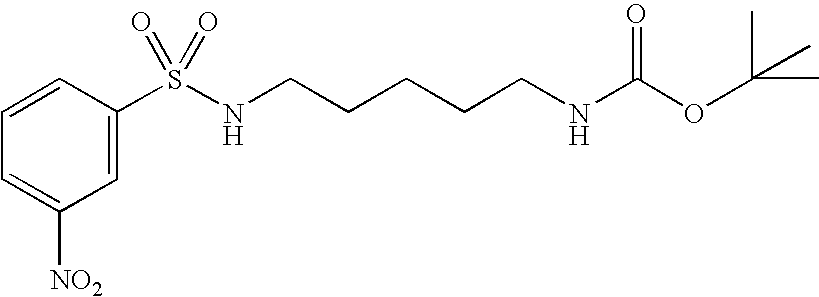
- 4.2 ml (30.1 mmol) of triethylamine is added to a solution of 3.21 g (14.5 mmol) of 3-nitrobenzenesulfonyl chloride and 3.0 ml (14.4 mmol) of N-Boc-1,5-diaminopentane in 50 ml of acetone and 15 ml of water. The reaction mixture is stirred for one hour at room temperature. Then, the acetone is drawn off in a rotary evaporator. After water (20 ml) is added, it is extracted with ethyl acetate (2×). The combined organic phases are dried (Na 2SO4), filtered and concentrated by evaporation. 5.00 g (12.9 mmol, corresponding to 90% of theory) of the product is obtained as a light yellow oil.
- 1H-NMR (DMSO): 8.49 (m, 2H), 8.19 (dd, 1H), 7.88 (m, 2H), 6.72 (t, 1H), 2.82 (m, 4H), 1.32 (m, 15H).
- 1b) Production of N-(5-Amino-pentyl)-3-nitro-benzenesulfonamide

- 5.00 g (12.9 mmol) of [5-(3-nitro-benzenesulfonylamino)-pentyl]-carbamic acid-tert-butyl ester is mixed with 15 ml of trifluoroacetic acid and stirred for 90 minutes at room temperature. The reaction mixture is concentrated by evaporation, and the residue is made basic with saturated NaHCO 3 solution. Then, it is extracted with ethyl acetate (2×). The combined organic phases are washed with saturated NaCl solution, dried (Na2SO4), filtered and concentrated by evaporation. 3.4 g (11.8 mmol, corresponding to 91% of theory) of the product is obtained.
- 1H-NMR (DMSO): 8.49 (m, 2H), 8.19 (dd, 1H), 7.90 (t, 1H), 7.60 (br, 3H), 2.73 (m, 4H), 1.35 (m, 6H).
- 1c) Production of N-[5-(5-Bromo-2-chloro-pyrimidin-4-ylamino)-pentyl]-3-nitro-benzenesulfonamide

- A solution of 1.2 g (5.3 mmol) of 5-bromo-2,4-dichloro-pyrimidine in 30 ml of acetonitrile is added to a solution of 1.5 g (5.2 mmol) of N-(5-amino-pentyl)-3-nitro-benzenesulfonamide in 50 ml of acetonitrile. The reaction mixture is mixed with 1.0 ml (7.2 mmol) of triethylamine and stirred for 17 hours at room temperature. After water (50 ml) is added, it is extracted (2×) with ethyl acetate. The combined organic phases are dried (Na 2SO4), filtered and concentrated by evaporation. The remaining residue is purified by chromatography (hexane/ethyl acetate 2:1, Flashmaster II). 1.5 g (3.1 mmol, corresponding to 60% of theory) of the product is obtained.
- 1H-NMR (DMSO): 8.49 (m, 2H), 8.19 (m, 2H), 7.88 (m, 2H), 7.68 (t, 1H), 3.30 (m, 2H), 2.79 (m, 2H), 1.45 (m, 4H), 1.21 (m, 2H).
- MS: 478 (ES).
- 1d) Production of 3-Amino-N-[5-(5-bromo-2-chloro-pyrimidin-4-ylamino)-pentyl]-benzenesulfonamide

- A solution of 300 mg (0.63 mmol) of N-[5-(5-bromo-2-chloro-pyrimidin-4-ylamino)-pentyl]-3-nitro-benzenesulfonamide in 6 ml of ethanol is mixed with 600 mg of tin(II) chloride and stirred for 30 minutes at 70° C. After cooling, the reaction mixture is carefully added to ice water and made basic with saturated NaHCO 3 solution. It is extracted with ethyl acetate (3×). The combined organic phases are dried (Na2SO4), filtered, and concentrated by evaporation. The remaining residue is purified by chromatography (ethyl acetate/hexane 4:1). 112 mg (0.25 mmol, corresponding to 40% of theory) of the product is obtained.
- 1H-NMR (DMSO): 8.20 (s, 1H), 7.70 (br, 1H), 7.31 (br, 1H), 7.15 (t, 1H), 6.94 (m, 1H), 6.85 (m, 1H), 6.71 (m, 1H), 5.52 (s, 2H), 3.30 (m, 2H), 2.71 (m, 2H), 1.45 (m, 4H), 1.21 (m, 2H).
- MS: 448 (ES).
- Production of 1 5-Bromo-4-thia-2,5,9-triaza-1(2,4)-pyrimidina-3(1,3)-benzenacyclononaphane-4,4-dioxide
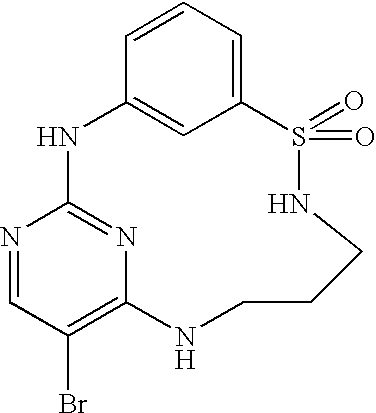
- Method A
- A solution of 200 mg (0.48 mmol) of 3-amino-N-[3-(5-bromo-2-chloro-pyrimidin-4-ylamino)-propyl]-benzenesulfonamide in acetonitrile/water/2-butanol (9.0 ml/1.0 ml/0.3 ml) is added via a spray pump within 2.5 hours to a refluxing solution of acetonitrile/water/4 molar solution of hydrochloric acid in dioxane (45 ml/5 ml/0.6 ml). After another 3 hours under reflux, the oil bath is turned off, and the reaction solution is stirred overnight at room temperature. The precipitate that is formed is filtered off, washed with water and then dried in a vacuum. 112 mg (0.31 mmol) of the product is obtained. The filtrate is concentrated by evaporation in a rotary evaporator. The precipitate that is formed is washed with water and filtered off. After drying, another 45 mg (0.12 mmol) of the product is obtained. The total yield of product is thus 157 mg (0.41 mmol, corresponding to 85% of theory).
- Method B
- A solution of 450 mg (1.00 mmol) of N-[3-(5-bromo-2-chloro-pyrimidin-4-ylamino)-propyl]-3-nitro-benzenesulfonamide in 9.5 ml of ethanol is mixed with 960 mg of tin(II) chloride and stirred for 30 minutes at 70° C. After cooling, the reaction mixture is carefully added to ice water and made basic with 1N NaOH solution. It is extracted with ethyl acetate (3×). The combined organic phases are dried (Na 2SO4), filtered and concentrated by evaporation. The remaining residue is purified by chromatography (ethyl acetate/hexane 4:1). 72 mg of the crude product is obtained. It is mixed with 1N HCl and extracted with ethyl acetate. A colorless solid precipitates from the aqueous phase. The solid is filtered off and dried. 20 mg (0.05 mmol, corresponding to 5% of theory) of the product is obtained.
- 1H-NMR (DMSO): 10.45 (s, 1H), 9.07 (s, 1H), 8.35 (br, 1H), 8.18 (s, 1H), 7.78 (t, 1H), 7.45 (m, 2H), 7.32 (m, 1H), 3.44 (m, 2H), 3.28 (m, 2H), 1.82 (m, 2H).
- MS: 384 (ES).
- Production of the Intermediate Product According to Process Variant 1a
- 1e) Production of 3-Amino-N-[3-(5-bromo-2-chloro-pyrimidin-4-ylamino)-propyl]-benzenesulfonamide
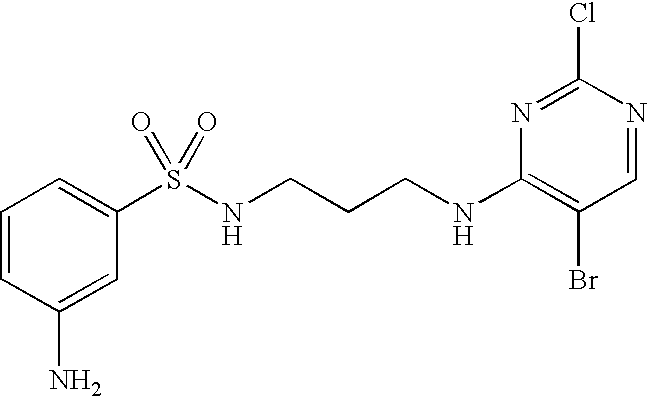
- A solution of 1.35 g (2.99 mmol) of N-[3-(5-bromo-2-chloro-pyrimidin-4-ylamino)-propyl]-3-nitro-benzenesulfonamide in 100 ml of tetrahydrofuran is mixed under argon at room temperature with 15 ml of a 15% solution of Ti(III)Cl in about 10% hydrochloric acid. After 17 hours, the reaction solution is mixed again with 1 ml of the Ti(III)Cl solution and stirred for another 3 hours. The batch is made basic with 1N NaOH solution and then filtered. The filter cake is rewashed 2× with 100 ml of ethyl acetate/MeOH (30 ml/20 ml) in each case. The filtrate is concentrated by evaporation in a rotary evaporator and then extracted with ethyl acetate (2×). The combined organic phases are washed with NaCl solution, dried (Na 2SO4), filtered and concentrated by evaporation. The remaining residue is purified by chromatography (dichloromethane/MeOH 95:5, Flashmaster II). 624 mg (1.48 mmol, corresponding to 49% of theory) of the product is obtained.
- 1H-NMR (DMSO): 8.21 (s, 1H), 7.63 (t, 1H), 7.38 (t, 1H), 7.13 (t, 1H), 6.97 (m, 1H), 6.83 (m, 1H), 6.71 (m, 1H), 5.53 (s, 2H), 3.30 (m, 2H), 2.75 (m, 2H), 1.65 (m, 2H).
- Production of rac-1 5-Bromo-4-thia-2,5,9-triaza-1(2,4)-pyrimidina-3(1,3)-benzenacyclononaphan-7-ol-4,4-dioxide

- A solution of 150 mg (0.34 mmol) of 3-amino-N-[3-(5-bromo-2-chloro-pyrimidin-4-ylamino)-2-hydroxy-propyl]-benzenesulfonamide in acetonitrile/water (9.0 ml/1.0 ml) is added via a spray pump within 2.5 hours to a refluxing solution of acetonitrile/water/4 molar solution of hydrochloric acid in dioxane (45 ml/5 ml/0.6 ml). After another 4 hours under reflux, the oil bath is turned off, and the reaction solution is stirred overnight at room temperature. The precipitate that is formed is filtered off, washed with MeCN, and then dried in a vacuum. 125 mg (0.31 mmol, corresponding to 91% of theory) of the product is obtained.
- 1H-NMR (DMSO): 10.65 (br, 1H), 9.03 (s, 1H), 8.41 (br, 1H), 8.22 (s, 1H), 7.93 (m, 1H), 7.46 (m, 2H), 7.34 (m, 1H), 4.14 (m, 1H), 3.94 (dd, 1H), 3.49 (m, 1H), 2.88 (m, 2H).
- MS: 402 (ES).
- Production of Intermediate Products According to Process Variant 1a
- 1f) 3-Amino-N-[3-(5-bromo-2-chloro-pyrimidin-4-ylamino)-2-hydroxy-propyl]-benzenesulfonamide
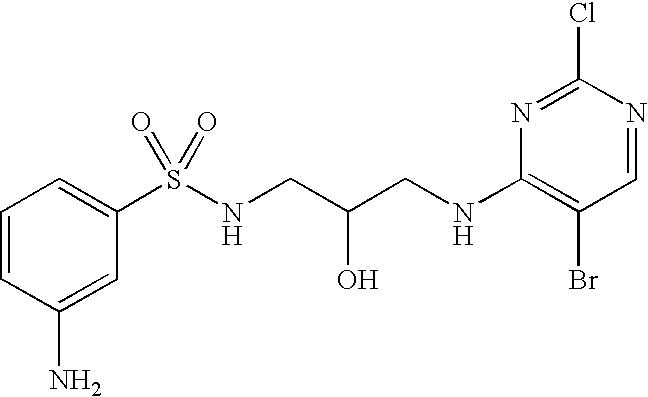
- A solution of 258 mg (0.553 mmol) of N-[3-(5-bromo-2-chloro-pyrimidin-4-ylamino)-2-hydroxy-propyl]-3-nitro-benzenesulfonamide in 20 ml of tetrahydrofuran is mixed under argon at room temperature with 2.6 ml of a 15% solution of Ti(III)Cl in approximately 10% hydrochloric acid. After 2 hours, the reaction solution is mixed again with 0.2 ml of Ti(III)Cl solution and stirred for another 60 minutes. The batch is made basic with 1 M NaOH solution and then filtered. The filter cake is rewashed 2× with 50 ml of ethyl acetate/MeOH (30 ml/20 ml) in each case. The filtrate is concentrated by evaporation in a rotary evaporator and then extracted with ethyl acetate (2×). The combined organic phases are washed with NaCl solution, dried (Na 2SO4), filtered and concentrated by evaporation. The remaining residue is purified by chromatography (dichloromethane/MeOH 95:5, Flashmaster II). 155 mg (0.36 mmol, corresponding to 64% of theory) of the product is obtained.
- 1H-NMR (DMSO): 8.25 (s, 1H), 7.43 (t, 1H), 7.36 (t, 1H), 7.13 (t, 1H), 6.96 (m, 1H), 6.86 (m, 1H), 6.71 (m, 1H), 5.53 (s, 2H), 5.14 (d, 1H), 3.70 (m, 1H), 3.30 (m, 2H), 2.72 (m, 2H).
- Production of Intermediate Products According to Process Variant 1b

- In the general formulas, R 1, R5, B and m have the meaning that is indicated under general formula I.
- 1g) Production of [3-(5-Bromo-2-chloro-pyrimidin-4-ylamino)-propyl]-carbamic acid-tert-butyl-ester

- A solution of 6.1 g (26.6 mmol) of 5-bromo-2,4-dichloro-pyrimidine in 100 ml of acetonitrile is mixed successively with 5.0 g (28.7 mmol) of N-boc-1,3-diaminopropane and 4.5 ml (32.4 mmol) of triethylamine and stirred for 3.5 hours at room temperature. The batch is diluted with 200 ml of ethyl acetate. It is washed with saturated NaCl solution, citric acid (10%), saturated NaHCO 3 solution as well as saturated NaCl solution. The combined organic phases are dried (Na2SO4), filtered and concentrated by evaporation. 9.7 g (26.6 mmol, corresponding to 100% of theory) of the product is obtained.
- 1H-NMR (DMSO): 8.22 (s, 1H), 7.63 (t, 1H), 6.79 (t, 1H), 3.30 (m, 2H), 2.94 (m, 2H), 1.63 (m, 2H), 1.35 (s, 9H).
- 1h) Production of N-(5-Bromo-2-chloro-pyrimidin-4-yl)-propane-1,3-diamine Hydrochloride
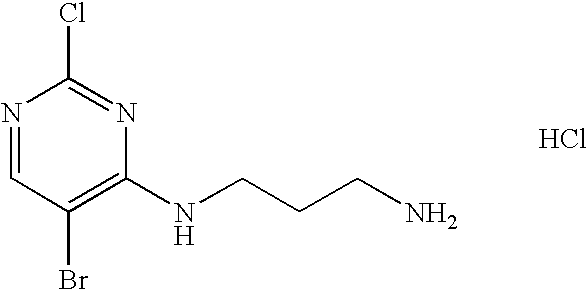
- A solution of 5.0 g (13.7 mmol) of [3-(5-bromo-2-chloro-pyrimidin-4-ylamino)-propyl]-carbamic acid-tert-butyl-ester in 150 ml of acetonitrile is mixed with 25 ml of a 4 molar solution of hydrochloric acid in dioxane and stirred at room temperature. After 4 hours, the solvent is drawn off in a rotary evaporator, and the residue is dried in a drying oven. 4.1 g (13.7 mmol, corresponding to 100% of theory) of the product is obtained.
- 1H-NMR (DMSO): 8.26 (s, 1H), 7.95 (m, 5H), 3.42 (m, 2H), 2.79 (m, 2H), 1.96 (m, 2H).
- MS: 265 (ES).
- 1i) Production of N-[3-(5-Bromo-2-chloro-pyrimidin-4-ylamino)-propyl]-3-nitro-benzenesulfonamide

- A solution of 530 mg (1.76 mmol) of N-(5-bromo-2-chloro-pyrimidin-4-yl)-propane-1,3-diamine hydrochloride and 352 mg (1.60 mmol) of 3-nitrobenzenesulfonyl chloride in 20 ml of acetone/6 ml of water is mixed at room temperature with 1 ml of triethylamine. After 2.5 hours, the organic solvent is drawn off in a rotary evaporator. After water (20 ml) is added, it is extracted with ethyl acetate. The combined organic phases are washed with citric acid (10%), saturated NaHCO 3 solution as well as saturated NaCl solution, dried (Na2SO4), filtered and concentrated by evaporation. 633 mg (1.41 mmol, corresponding to 87% of theory) of the product is obtained.
- 1H-NMR (DMSO): 8.48 (m, 2H), 8.19 (m, 2H), 8.00 (t, 1H), 7.88 (t, 1H), 7.63 (t, 1H), 3.30 (m, 2H), 2.88 (t, 2H), 1.67 (m, 2H).
- Production of rac-1 5-Bromo-4-thia-2,5,9-triaza-1(2,4)-pyrimidina-3(1,3)-benzenacyclonaphane-8-methanol-4,4-dioxide Hydrochloride
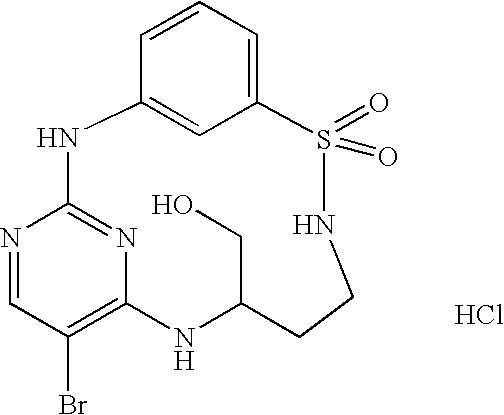
- A solution of 145 mg (0.33 mmol) of 3-amino-N-[3-(5-bromo-2-chloro-pyrimidin-4-ylamino)-4-hydroxy-butyl]-benzenesulfonamide in acetonitrile/methanol/water (9.0 ml/2.0 ml/1.0 ml) is added via a spray pump within 3 hours to a refluxing solution of acetonitrile/water/4 molar solution of hydrochloric acid in dioxane (45 ml/5 ml/0.8 ml). After another 14 hours under reflux, about 20 ml of acetonitrile is drawn off in a rotary evaporator. After cooling, the precipitate that is formed is suctioned off, rewashed with water and diisopropyl ether, and dried. 97 mg (0.22 mmol, corresponding to 67% of theory) of the product is obtained in the form of hydrochloride.
- 1H-NMR (DMSO): 10.22 (s, 1H), 8.99 (m, 1H), 8.19 (s, 1H), 7.69 (t, 1H), 7.40 (m, 3H), 6.95 (br, 1H), 4.04 (m, 1H), 3.70 (m, 2H), 3.40 (m, 2H), 2.19 (m, 1H), 1.61 (m, 1H).
- MS: 414 (ES).
- The racemate is separated preoperatively into the enantiomers by means of chiral HPLC:
- Column: Chiralpak AD (20 μm); 250×60 mm
- Eluants: Hexane/ethanol 80/20+0.1% DEA
- Flow: 100 ml/min
- Detector: UV 280 nm
- Temperature: Room temperature
- Retention: Enantiomer (+): 38.5 min, 1.3 (+)-Enantiomer
- Enantiomer (−): 59.1 min, 1.3 (−)-Enantiomer
- Production of 1 5-Bromo-4-thia-2,5,9-triaza-1(2,4)-pyrimidina-3(1,3)-benzenacyclononaphan-35-amine-4,4-dioxides

- A solution of 46 mg (0.11 mmol) of 1 5-bromo-35-nitro-4-thia-2,5,9-triaza-1 (2,4)-pyrimidina-3(1,3)-benzenacyclononaphane-4,4-dioxide hydrochloride in 1 ml of THF is mixed at room temperature with 0.4 ml of a 15% solution of Ti(III)Cl in approximately 10% hydrochloric acid. After 67 hours, it is mixed again with 0.2 ml of a 15% solution of Ti(III)Cl in approximately 10% hydrochloric acid, and it is stirred for another 21 hours. The batch is made basic with 2N NaOH solution and extracted from ethyl acetate. The combined organic phases are washed with NaCl solution and then filtered through a Whatman filter and concentrated by evaporation. The residue that is formed is recrystallized from methanol/diisopropyl ether. 24 mg (0.06 mmol, corresponding to 55% of theory) of the product is obtained.
- 1H-NMR (DMSO): 9.45 (br, 1H), 8.51 (br, 1H), 8.02 (br, 1H), 7.53 (br, 1H), 7.31 (br, 1H), 6.60 (br, 1H), 6.48 (br, 1H), 5.42 (s, 2H), 3.30 (m, 4H), 1.78 (m, 2H).
- MS: 399 (ES).
- Production of 1 5-Bromo-35-nitro-4-thia-2,5,9-triaza-1(2,4)-pyrimidina-3(1,3)-benzenacyclononaphane-4,4-dioxide hydrochloride

- A solution of 420 mg (0.90 mmol) of 3-amino-N-[3-(5-bromo-2-chloro-pyrimidin-4-ylamino)-propyl]-5-nitro-benzenesulfonamide in acetonitrile/DMF (7.0 ml/3.0 ml) is added via a spray pump within 2 hours to a refluxing solution of acetonitrile/4 molar solution of hydrochloric acid in dioxane (150.0 ml/2.5 ml). After cooling, the precipitate that is formed is suctioned off. The filtrate is concentrated by evaporation, and the residue is digested with methanol. 151 mg (0.36 mmol, corresponding to 40% of theory) of the product is obtained in the form of hydrochloride.
- 1H-NMR (DMSO): 10.68 (s, 1H), 9.51 (s, 1H), 8.15 (m, 4H), 8.02 (m, 1H), 3.41 (m, 4H), 1.83 (m, 2H).
- MS: 429 (ES).
- Production of Intermediate Products According to Process Variant 1a
- 1j) Production of 3-Amino-N-[3-(5-bromo-2-chloro-pyrimidin-4-ylamino)-propyl]-5-nitro-benzenesulfonamide
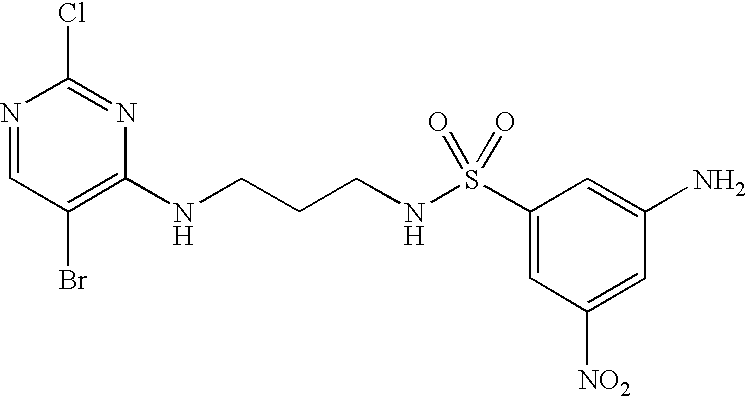
- A solution of 602 mg (1.28 mmol) of N-[3-(5-bromo-2-chloro-pyrimidin-4-ylamino)-propyl]-3,5-dinitro-benzenesulfonamide in 10 ml of THF is mixed at room temperature with 4.2 ml of a 15% solution of Ti(III)Cl in approximately 10% hydrochloric acid. After 2 hours, it is mixed again with 3.0 ml of a 15% solution of Ti(III)Cl in approximately 10% hydrochloric acid, and it is stirred for another 16 hours. The batch is made basic with 2N NaOH solution and filtered. The filter cake is rewashed with THF and water. The THF of the filtrate is drawn off on a rotary evaporator, and the residue is extracted from ethyl acetate. The combined organic phases are filtered through a Whatman filter and concentrated by evaporation. 440 mg (0.95 mmol, corresponding to 74% of theory) of the product is obtained.
- MS: 465 (ES).
- Production of N-Alkyl Derivatives
- Process Variant 2
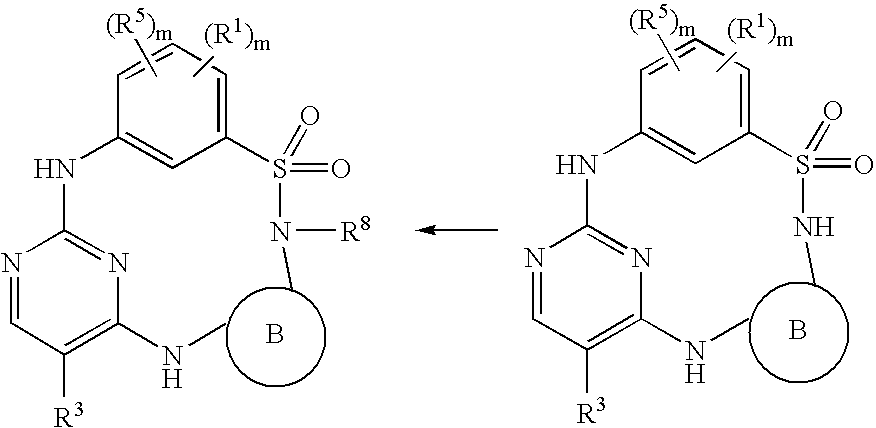
- In the general formulas, R 1, R3, R5, R8, B and m have the meaning that is indicated under general formula I.
- Production of 1 5-Bromo-5-methyl-4-thia-2,5,9-triaza-1(2,4)-pyrimidina-3(1,3)-benzenacyclononaphane-4,4-dioxide

- A solution of 35 mg (0.09 mmol) of 1 5-bromo-4-thia-2,5,9-triaza-1(2,4)-pyrimidina-3(1,3)-benzenacyclononaphane-4,4-dioxide in 4 ml DMSO is mixed at room temperature with 6 mg (0.15 mmol) of a 60% dispersion of sodium hydride in mineral oil, and it is stirred for 10 minutes. Then, 7 μl of methyl iodide is added. After 4 hours, it is mixed again with 6 mg of a 60% dispersion of sodium hydride in mineral oil as well as 7 μl of methyl iodide, and it is stirred overnight. The batch is diluted with ethyl acetate and washed with saturated NaCl solution. The combined organic phases are dried (Na2SO4), filtered and concentrated by evaporation. The remaining residue is digested with MTB ether. 10 mg (0.03 mmol, corresponding to 27% of theory) of the product is obtained.
- 1H-NMR (DMSO): 9.78 (s, 1H), 9.08 (m, 1H), 8.02 (s, 1H), 7.40 (m, 4H), 3.44 (m, 4H), 2.68 (s, 3H), 1.95 (m, 2H).
- MS: 398 (ES).
- Production of 4-Oxo Derivatives
- Process Variant 3a

- In the general formulas, R 1, R3, R5, B and m have the meaning that is indicated under general formula I.
- Production of 1 5-Bromo-9-oxa-4-thia-2,5-diaza-1(2,4)-pyrimidina-3(1,3)-benzenacyclononaphane-4,4-dioxide

- A solution of 30 mg (0.07 mmol) of 3-amino-N-[3-(5-bromo-2-chloro-pyrimidin-4-yloxy)-propyl]-benzenesulfonamide in acetonitrile/DMSO (9.5 ml/0.5 ml) is added via a spray pump within 2 hours to a refluxing solution of acetonitrile/water/4 molar solution of hydrochloric acid in dioxane (22.5 ml/2.5 ml/0.3 ml). After another 16 hours, the acetonitrile is drawn off in a rotary evaporator, and the residue is mixed with 1 M NaHCO 3 solution. It is extracted with ethyl acetate (2×). The combined organic phases are dried (Na2SO4), filtered and concentrated by evaporation. The residue that is obtained is purified by chromatography (DCM/EtOH 9:1). 8 mg (0.02 mmol, corresponding to 30% of theory) of the product is obtained.
- 1H-NMR (DMSO): 10.23 (s, 1H), 9.08 (m, 1H), 8.41 (s, 1H), 7.88 (br, 1H), 7.36 (m, 3H), 4.58 (m, 2H), 3.30 (m, 2H), 2.07 (m, 2H).
- MS: 385 (ES).
- Production of Intermediate Products According to Process Variant 3a
- 3a) Production of N-[3-(5-Bromo-2-chloro-pyrimidin-4-yloxy)-propyl]-3-nitro-benzenesulfonamide
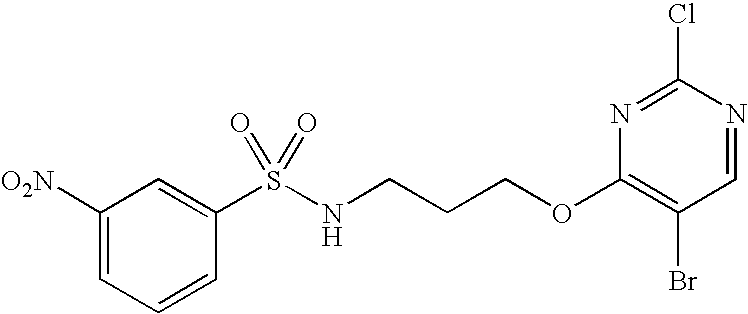
- A solution of 272 mg (1.05 mmol) of N-(3-hydroxy-propyl)-3-nitro-benzenesulfonamid in 5 ml DMF is mixed with 49 mg of a 60% dispersion of sodium hydride in mineral oil (1.22 mmol) and stirred for 5 minutes at room temperature. It is mixed with a solution of 220 mg (0.97 mmol) of 5-bromo-2,4-dichloro-pyrimidine in 5 ml of DMF and stirred for another 2 hours. The batch is mixed with saturated NaCl solution and then extracted with ethyl acetate (2×). The combined organic phases are washed with NaCl solution, dried (Na 2SO4), filtered and concentrated by evaporation. The remaining residue is purified by chromatography (hexane/ethyl acetate 1:1, Flashmaster II). 75 mg (0.16 mmol, corresponding to 16% of theory) of the product is obtained.
- 1H-NMR (DMSO): 8.66 (s, 1H), 8.47 (m, 2H), 8.16 (m, 1H), 8.06 (m, 1H), 7.88 (t, 1H), 4.37 (t, 2H), 3.00 (m, 2H), 1.96 (m, 2H).
- MS: 451 (ES).
- 3b) Production of 3-Amino-N-[3-(5-bromo-2-chloro-pyrimidin-4-yloxy)-propyl]-benzenesulfonamide

- A solution of 70 mg (0.16 mmol) of N-[3-(5-bromo-2-chloro-pyrimidin-4-yloxy)-propyl]-3-nitro-benzenesulfonamide in 5 ml of THF is mixed at 0° C. with 1.0 ml of a 15% solution of Ti(III)Cl in approximately 10% hydrochloric acid. After 2 hours, the reaction solution is mixed again with 0.2 ml of Ti(III)Cl solution and stirred for another hour. The batch is made basic with 1N NaOH solution and then filtered. The filter cake is rewashed 2× in each case with 50 ml of ethyl acetate/MeOH (30 ml/20 ml). The filtrate is concentrated by evaporation in a rotary evaporator and then extracted with ethyl acetate (2×). The combined organic phases are washed with NaCl solution, dried (Na 2SO4), filtered and concentrated by evaporation. The remaining residue is purified by chromatography (hexane/ethyl acetate 1:1, Flashmaster II). 32 mg (0.08 mmol, corresponding to 49% of theory) of the product is obtained.
- 1H-NMR (DMSO): 8.67 (s, 1H), 7.49 (t, 1H), 7.12 (t, 1H), 6.96 (m, 1H), 6.81 (m, 1H), 6.68 (m, 1H), 5.54 (s, 1H), 4.39 (m, 2H), 2.96 (m, 2H), 1.87 (m, 2H).
- MS: 421 (ES).
- Production of 5-Carboxamide Derivatives
- Process Variant 4

- In the general formulas, R 1, R5, B and m have the meaning that is indicated under general formula I.
- Production of N-tert-Butyl-4-thia-2,5,9-triaza-1(2,4)-pyrimidina-3(1,3)-benzenacyclononaphane-1 5-carboxamide-4,4-dioxide

- A solution of 150 mg (0.32 mmol) of 2-chloro-4-[3-(3-nitro-benzenesulfonylamino)-propylamino]-pyrimidine-5-carboxylic acid-tert-butylamide in 10 ml of THF is mixed under argon at room temperature with 1.6 ml of a 15% solution of Ti(III)Cl in approximately 10% hydrochloric acid. After 17 hours, the reaction solution is mixed again with 0.3 ml of Ti(III)Cl solution and stirred for another 4 hours. The batch is made basic with 1 M NaOH solution and then filtered. The filter cake is rewashed 2× with 50 ml of ethyl acetate/MeOH (30 ml/20 ml) in each case. The filtrate is concentrated by evaporation in a rotary evaporator and then extracted with ethyl acetate (2×). The combined organic phases are dried (Na 2SO4), filtered and concentrated by evaporation. During concentration by evaporation, a colorless solid precipitates, which is filtered off and dried. 25 mg (0.06 mmol, corresponding to 18% of theory) of the product is obtained.
- 1H-NMR (DMSO): 9.95 (s, 1H), 9.45 (s, 1H), 8.82 (t, 1H), 8.49 (s, 1H), 7.78 (t, 1H), 7.58 (s, 1H), 7.38 (m, 3H), 3.50 (m, 2H), 3.30 (m, 2H), 1.86 (m, 2H)
- MS: 405 (ES)
- Production of the Intermediate Products According to Process Variant 4
- 4a) Production of 2,4-Dichloro-pyrimidine-5-carbonyl Chloride
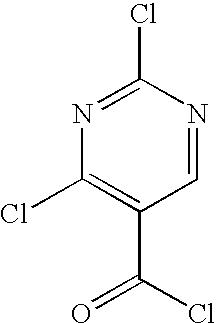
- A suspension of 21.7 g (139 mmol) of 2,4-dihydroxy-5-carboxylic acid-pyrimidine, 96.7 g (463 mmol) of phosphorus pentachloride and 33 ml (348 mmol) of phosphoroxyde chloride is stirred for 5 hours at 115° C. After cooling, the reaction mixture is concentrated by evaporation in a rotary evaporator. The residue that is formed is purified by vacuum distillation (K p 0.1 mbar: 68° C.). 24.9 g (117 mmol, corresponding to 84% of theory) of the product is obtained.
- 1H-NMR (DMSO): 9.11 (s, 1H)
- 4b) Production of 2,4-Dichloro-pyrimidine-5-carboxylic acid-tert-butylamide

- A solution of 24.85 g (117.5 mmol) of 2,4-dichloro-pyrimidine-5-carbonyl chloride in 125 ml of THF is cooled to −15° C. It is slowly mixed with a solution of 13.2 ml (124.5 mmol) of tert-buylamine and 17.4 ml (125.7 mmol) of triethylamine in 50 ml of THF, so that the temperature of the reaction mixture remains less than −10° C. It is stirred for another 2 hours at −10° C., then the cooling bath is removed, and the reaction mixture is heated to room temperature while being stirred. After 1 hour, the precipitate that is formed is filtered off, and the filtrate is completely concentrated by evaporation. The residue that is obtained is purified by chromatography (hexane/ethyl acetate 4:1). 14.01 g (56.6 mmol, corresponding to 50% of theory) of the product is obtained.
- 1H-NMR (DMSO): 8.81 (s, 1H), 8.34 (s, 1H), 1.36 (s, 9H)
- 4c) 2-Chloro-4-[3-(3-nitro-benzenesulfonylamino)-propylamino]-pyrimidine-5-carboxylic acid-tert-butylamide

- A solution of 0.95 g (3.83 mmol) of 2,4-dichloro-pyrimidine-5-carboxylic acid-tert-butylamide in 6 ml of THF is mixed at room temperature while being stirred with a suspension that consists of 1.00 g (3.86 mmol) of N-(3-amino-propyl)-3-nitro-benzenesulfonamide in 9 ml of THF/0.55 ml of triethylamine. After 19 hours, the precipitate that is formed is suctioned off and washed with ethyl acetate. The filtrate is spun in, and the residue that is formed is purified by chromatography (hexane/ethyl acetate 2:1, Flashmaster II). 0.79 g (1.67 mmol, corresponding to 44% of theory) of the product is obtained.
- 1H-NMR (DMSO): 8.74 (t, 1H), 8.47 (m, 3H), 8.18 (dd, 1H), 8.04 (t, 1H), 7.98 (s, 1H), 7.85 (t, 1H), 3.30 (m, 2H), 2.87 (m, 2H), 1.68 (m, 2H), 1.36 (s, 9H)
- Production of 5-Cyano Derivatives
- Process Variant 5
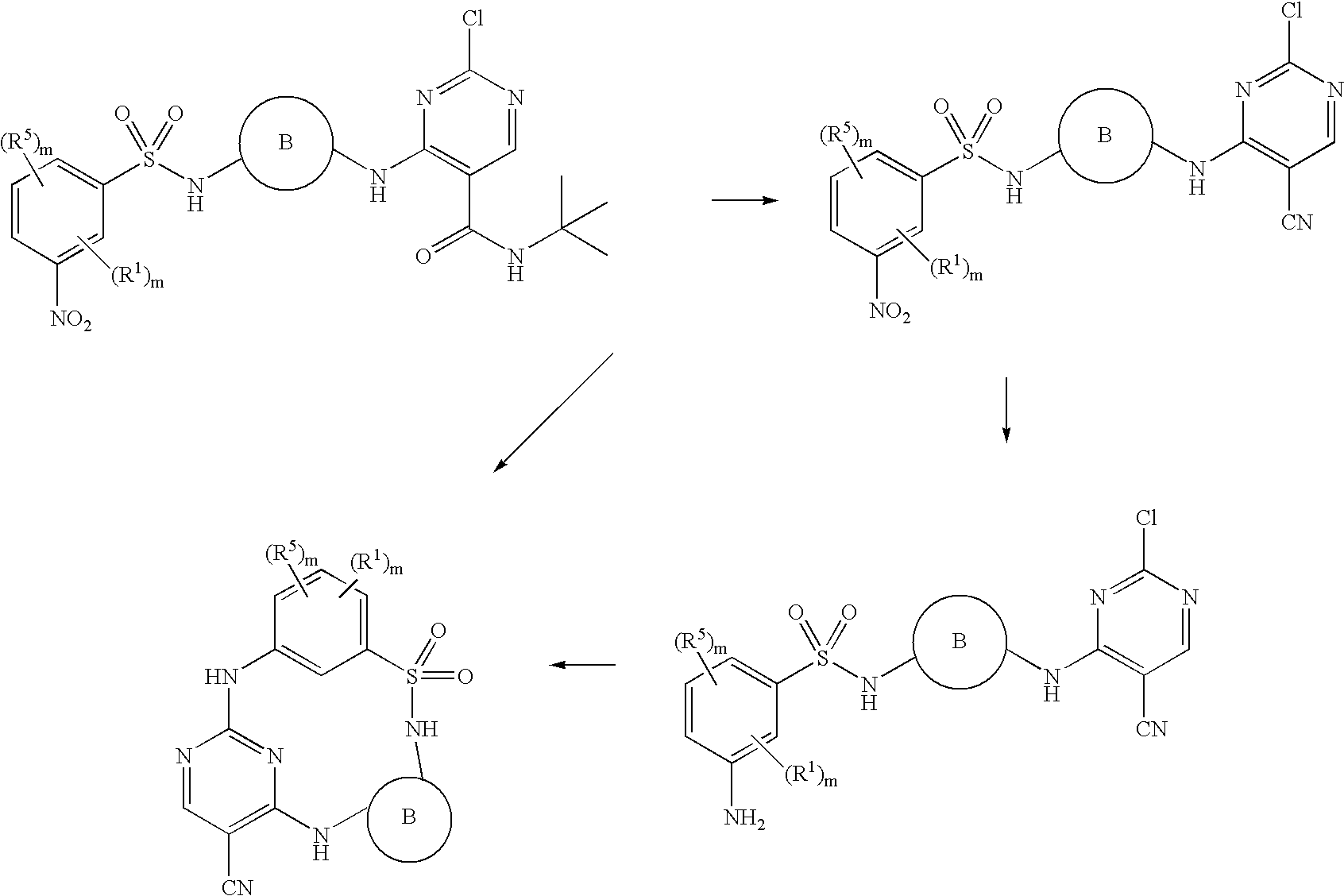
- In the general formulas, R 1, R5, B and m have the meaning that is indicated under general formula I.
- Production of 1 5-Cyano-4-thia-2,5,9-triaza-1(2,4)-pyrimidina-3(1,3)-benzenacyclononaphane 4,4-dioxide
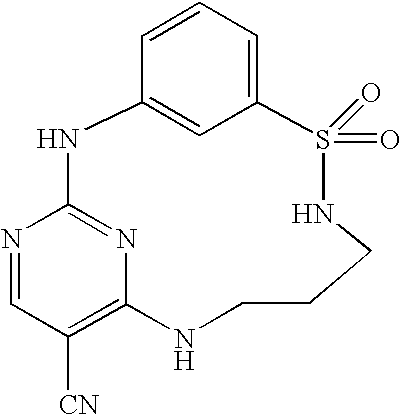
- A solution of 100 mg (0.25 mmol) of N-[3-(2-chloro-5-cyano-pyrimidin-4-ylamino)-propyl]-3-nitro-benzenesulfonamide in 10 ml of THF is mixed under argon at room temperature with 1.2 ml of a 15% solution of Ti(III)Cl in approximately 10% hydrochloric acid. After 3.5 hours, the batch is diluted with ethyl acetate, made basic with 1 M NaOH solution (pH 13) and then filtered. The filter cake is rewashed with 50 ml of ethyl acetate/MeOH (30 ml/20 ml) and 70 ml of ethyl acetate/MeOH/1N NaOH (40 ml/20 ml/10 ml). The filtrate is concentrated by evaporation in a rotary evaporator and then extracted with ethyl acetate (2×). The combined organic phases are dried (Na 2SO4), filtered and concentrated by evaporation. During concentration by evaporation, the product precipitates as a colorless solid, which is filtered off. 30 mg (0.09 mmol, corresponding to 36% of theory) of the product is obtained.
- 1H-NMR (DMSO): 10.29 (s, 1H), 9.29 (s, 1H), 8.39 (s, 1H), 8.15 (br, 1H), 7.78 (br, 1H), 7.38 (m, 3H), 3.30 (m, 4H), 1.85 (m, 2H)
- MS: 331 (ES)
- Production of Intermediate Products According to Process Variant 5
- 5a) Production of N-[3-(2-Chloro-5-cyano-pyrimidin-4-ylamino)-propyl]-3-nitro benzenesulfonamide

- 125 mg (0.27 mmol) of 2-chloro-4-[3-(3-nitro-benzenesulfonylamino)-propylamino]-pyrimidine-5-carboxylic acid-tert-butylamide is mixed with 4 ml of thionyl chloride and stirred under reflux for 19 hours. The reaction mixture is concentrated by evaporation. It is mixed with water and toluene and evaporated to the dry state in a rotary evaporator. 110 mg (0.27 mmol, corresponding to 100% of theory) of the product is obtained.
- 1H-NMR (DMSO): 8.50 (m, 4H), 8.19 (d, 1H), 8.01 (t, 1H), 7.88 (t, 1H), 3.30 (m, 2H), 2.87 (m, 2H), 1.71 (m, 2H).
- Production of Thiophene Derivatives

- In the general formulas, R 3 and B have the meaning that is indicated under general formula I.
- Production of 1 5-Bromo-4-thia-2,5,8-triaza-1(2,4)-pyrimidina-3(4,2)-thiophenacyclooctaphane-4,4-dioxides

- A solution of 170 mg (0.41 mmol) of 4-amino-thiophenylene-2-sulfonic acid-[2-(5-bromo-2-chloro-pyrimidin-4-ylamino)-ethyl]-amide in acetonitrile/water (12.0 ml/1.5 ml) is added via a spray pump within 2 hours to a refluxing solution of acetonitrile/water/4 molar solution of hydrochloric acid in dioxane (64 ml/7 ml/0.8 ml). After the addition is completed, the reaction mixture is stirred under reflux for another 6 hours. After cooling, the solvent is drawn off in a rotary evaporator. The residue is mixed with 2N NaOH and extracted with ethyl acetate (2×). The combined organic phases are filtered through a Whatman filter and concentrated by evaporation. The remaining residue is crystallized from MeOH/diisopropyl ether. 41 mg (0.11 mmol, corresponding to 27% of theory) of the product is obtained.
- 1H-NMR (DMSO): 9.03 (s, 1H), 7.92 (s, 1H), 7.68 (d, 1H), 7.48 (br, 1H), 7.38 (d, 1H), 7.08 (t, 1H), 2.91 (m, 4H)
- MS: 376 (ES)
- Production of Intermediate Products According to Process Variant 6a
- 6a) Production of 4-Nitro-thiophene-2-sulfonyl Chloride (A) and 5-Nitro-thiophene-2-sulfonyl Chloride (B)

- A solution of 25 g (137 mmol) of thiophene-2-sulfonyl chloride in 20 ml of dichloromethane is slowly added in drops to 98 ml of concentrated nitric acid while being stirred. The reaction mixture is stirred for 2 hours at 40° C. and then added to ice. It is extracted with dichloromethane (2×). The combined organic phases are dried on MgSO 4, filtered, and concentrated by evaporation. 24 g (105 mmol, corresponding to 77% of theory) of a mixture of products A and B in a ratio of 2/1 is obtained.
- 1H-NMR (DMSO): 8.63 (d, 1H, A), 7.93 (d, 1H, B), 7.54 (d, 1H, A), 7.18 (d, 1H, B)
- 6b) Production of [2-(4-Nitro-thiophene-2-sulfonylamino)-ethyl]-carbamic acid-tert-butylester (A) and [2-(5-Nitro-thiophene-2-sulfonylamino)-ethyl]-carbamic acid-tert-butyl-ester (B)

- 2.8 ml (20 mmol) of triethylamine is added to a solution of 2.27 g (10 mmol) of a mixture of 4-nitro-thiophene-2-sulfonyl chloride and 5-nitro-thiophene-2-sulfonyl chloride in a ratio of 2/1 as well as 1.64 g (10 mmol) of (2-amino-ethyl)-carbamic acid-tert-butyl ester in 40 ml of acetone and 10 ml of water. The reaction mixture is stirred for 3 hours at room temperature, and then the acetone is drawn off in a rotary evaporator. After water (20 ml) is added, it is extracted with ethyl acetate (2×). The combined organic phases are filtered through a Whatman filter and concentrated by evaporation. 2.65 g (7.5 mmol, corresponding to 75% of theory) of a mixture of compounds A and B in a ratio of 1/1 is obtained.
- 1H-NMR (DMSO): 9.02 (d, 1H, A), 8.85 (t, 1H), 8.15 (m, 2H), 8.02 (d, 1H, A), 7.63 (d, 1H, B), 6.78 (m, 2H), 2.92 (m, 8H), 1.40 (s, 18H).
- 6c) Production of 4-Nitro-thiophene-2-sulfonic Acid-[2-(5-bromo-2-chloro-pyrimidin-4-ylamino)-ethyl]-amide (A) and 5-Nitro-thiophene-2-sulfonic Acid-[2-(5-bromo-2-chloro-pyrimidin-4-ylamino)-ethyl]-amide (B)
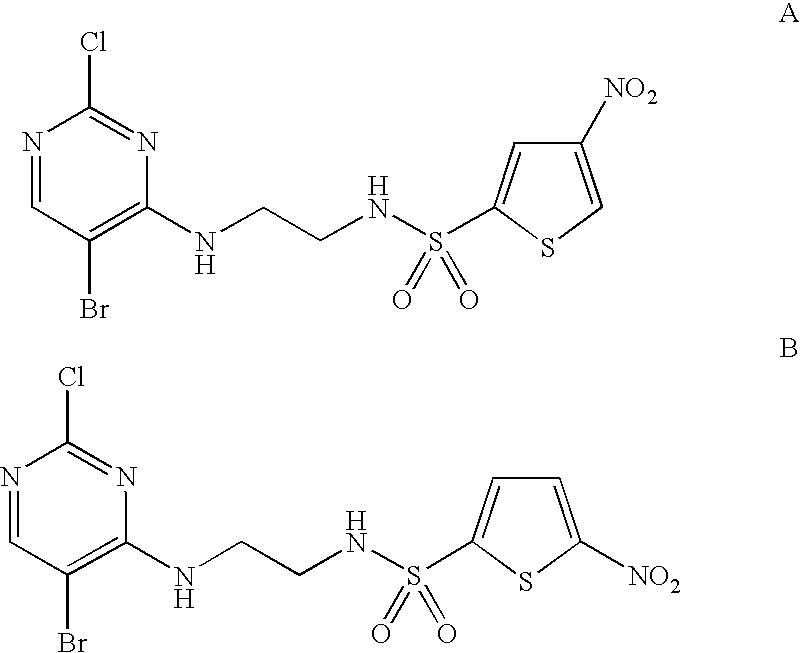
- 2.65 g (7.54 mmol) of a mixture of [2-(4-nitro-thiophene-2-sulfonylamino)-ethyl]-carbamic acid-tert-butyl ester and [2-(5-nitro-thiophene-2-sulfonylamino)-ethyl]-carbamic acid-tert-butyl ester at a ratio of 1/1 is mixed with 9 ml of TFA and stirred for 2.5 hours at room temperature. The reaction mixture is concentrated by evaporation in a rotary evaporator and mixed with water and 1N NaOH (pH 13). It is extracted with ethyl acetate (2×). The combined organic phases are filtered through a Whatman filter and concentrated by evaporation. The remaining residue is purified by chromatography (dichloromethane/MeOH 1:1). The crude product that is obtained is taken up in 3 ml of acetonitrile and mixed with a solution of 1.37 g (3 mmol) of 5-bromo-2,4-dichloro-pyrimidine/1 ml of triethylamine (7 mmol) in 3 ml of acetonitrile. After 16 hours, the reaction mixture is concentrated by evaporation in a rotary evaporator, and the remaining residue is purified by chromatography (hexane/ethyl acetate 2:1, Flashmaster II). 0.87 g (1.97 mmol, corresponding to 26% of theory) of a mixture of regioisomers A and B in a ratio of 10/6 is obtained.
- 1H-NMR (DMSO): 8.98 (d, 1H, A), 8.50 (t, 1H, B), 8.32 (t, 2H, A), 8.20 (s, 2H, A+B), 8.05 (d, 1H, B), 7.98 (d, 1H, A), 7.63 (m, 3H, A+B), 3.47 (m, 4H, A+B), 3.20 (m, 4H, A+B)
- MS: 4.42 (ES)
- 6d) 4-Amino-thiophene-2-sulfonic acid-[2-(5-bromo-2-chloro-pyrimidin-4-ylamino)-ethyl]-amide
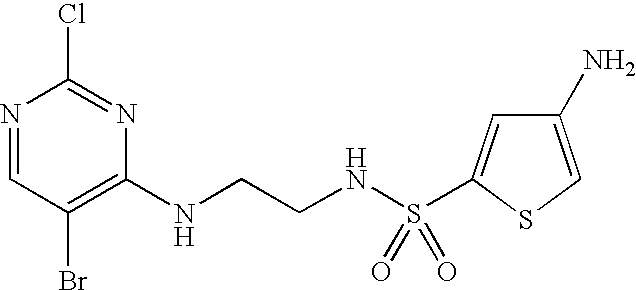
- A solution of 600 mg (1.35 mmol) of a mixture of 4-nitro-thiophene-2-sulfonic acid [2-(5-bromo-2-chloro-pyrimidin-4-ylamino)-ethyl]-amide and 5-nitro-thiophene-2-sulfonic acid-[2-(5-bromo-2-chloro-pyrimidin-4-ylamino)-ethyl]-amide (ratio 10/6) in 40 ml of THF is mixed under argon at room temperature with 6.4 ml of a 15% solution of Ti(III)Cl in approximately 10% hydrochloric acid. After 46 hours, the reaction solution is mixed again with 2.0 ml of Ti(III)Cl solution and stirred for another 7 hours. The batch is made basic with 2N NaOH solution and then filtered. The filter cake is rewashed 2× with 50 ml of ethyl acetate/MeOH (30 ml/20 ml) in each case. The filtrate is concentrated by evaporation in a rotary evaporator and then extracted with ethyl acetate (2×). The combined organic phases are filtered through a Whatman filter and concentrated by evaporation. The residue is purified by chromatography (hexane/ethyl acetate 1:4). 178 mg (0.43 mmol, corresponding to 32% of theory) of the product is obtained.
- 1H-NMR (DMSO): 8.21 (s, 1H), 7.82 (t, 1H), 7.65 (t, 1H), 7.03 (d, 1H), 6.31 (d, 1H), 5.21 (br, 2H), 3.44 (m, 2H), 3.02 (m, 2H).
- MS: 412 (ES)
- Production of Intermediate Products According to Process Variant 6b
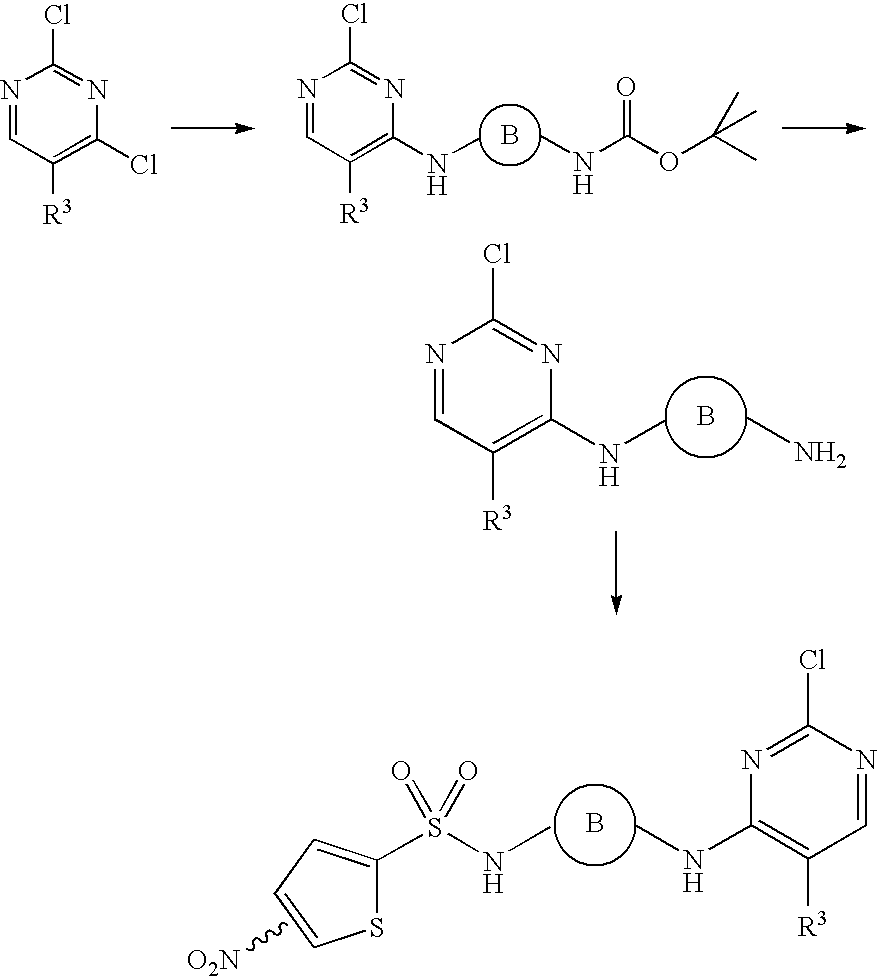
- In the general formulas, R 3 and B have the meaning that is indicated under general formula I.
- 6e) Production of 4-Nitro-thiophene-2-sulfonic Acid-[3-(5-bromo-2-chloro-pyrimidin-4-ylamino)-propyl]-amide (A) and 5-Nitro-thiophene-2-sulfonic Acid-[3-(5-bromo-2-chloro-pyrimidin-4-ylamino)-propyl]-amide

- A solution of 995 mg (3.3 mmol) of N-(5-bromo-2-chloro-pyrimidin-4-yl)-propane-1,3-diamine hydrochloride and 700 mg (3.1 mmol) of a mixture of 4-nitro-thiophene-2-sulfonyl chloride and 5-nitro-thiophene-2-sulfonyl chloride at a ratio of 1/1 in 40 ml of acetone/10 ml of water is mixed at room temperature with 2 ml (14.4 mmol) of triethylamine. After 15 minutes, the organic solvent is drawn off on a rotary evaporator. It is mixed with 150 ml of ethyl acetate and washed with citric acid (10%), saturated NaHCO 3 solution, as well as saturated NaCl solution. The organic phase is dried (Na2SO4), filtered and concentrated by evaporation. 860 mg (1.9 mmol, corresponding to 62% of theory) of a mixture of products A and B at a ratio of 1/1 is obtained.
- 1H-NMR (DMSO): 9.00 (d, 1H, A), 8.39 (t, 1H), 8.20 (m, 4H), 8.12 (d, 1H, B), 8.02 (d, 1H, A), 7.68 (t, 1H), 7.61 (d, 1H, B), 3.30 (m, 4H), 2.90 (m, 4H), 1.75 (m, 4H).
- Production of Oxa-phanes and Introduction of Sulfamoyl Groupings

- In the general formulas, R 3, R8, R9 and B have the meaning that is indicated under general formula I.
- Production of 1 5-Bromo-N,N′-dimethyl-4-oxa-2,9-diaza-1(2,4)-pyrimidina-3(1,3)-benzenacyclononaphane-34,36-disulfonamide

- 10 ml of chlorosulfonic acid is mixed carefully with 75 mg of phosphorus pentachloride while being cooled (4° C.). 60 mg (0.18 mmol) of 1 5-brom-4-oxa-2,9-diaza-1(2,4)-pyrimidina-3(1,3)-benzenacyclononaphane is added, and it is stirred for 3 hours at room temperature. The reaction mixture is added carefully to ice water and stirred for 1 hour. The solid that is formed is suctioned off and taken up in 1 ml of THF. It is mixed with 2 ml of a solution of methylamine in ethanol, and it is stirred for 12 hours at room temperature. The reaction mixture is concentrated by evaporation, and the remaining residue is purified by chromatography (dichloromethane/methanol 1:1). 8 mg (0.02 mmol, corresponding to 10% of theory) of the product is obtained.
- 1H-NMR (DMSO): 9.43 (s, 1H), 9.17 (s, 1H), 8.15 (s, 1H), 8.03 (s, 1H), 7.95 (q, 1H), 7.72 (t, 1H), 7.15 (q, 1H), 4.55 (br, 2H), 3.42 (br, 2H), 2.45 (m, 6H), 1.91 (m, 4H).
- MS: 521 (ES).
- Production of 1 5-Bromo-4-oxa-2,9-diaza-[(2,4)-pyrimidina-3(1,3)-benzenacyclononaphane

- A solution of 295 mg (0.79 mmol) of [4-(3-amino-phenoxy)-butyl]-(5-bromo-2-chloro-pyrimidin-4-yl)-amine in acetonitrile/water (18 ml/2 ml) is added via a spray pump within 4.5 hours to a refluxing solution of acetonitrile/water/4 molar solution of hydrochloric acid in dioxane (105 ml/12 ml/1.4 ml). After another 60 minutes under reflux, the oil bath is turned off, and the reaction solution is stirred overnight at room temperature. The reaction mixture is made basic with 2N NaOH and extracted with ethyl acetate (3×). The combined organic phases are washed with NaCl solution, dried (MgSO 4), filtered and concentrated by evaporation. The remaining residue is digested with methanol. 65 mg (0.19 mmol, corresponding to 24% of theory) of the product is obtained.
- 1H-NMR (DMSO): 9.31 (s, 1H), 8.82 (s, 1H), 8.01 (s, 1H), 7.37 (br, 1H), 7.02 (t, 1H), 6.63 (d, 1H), 6.36 (dd, 1H), 4.34 (br, 2H), 3.30 (m, 2H), 1.85 (m, 4H).
- MS: 335 (ES).
- Production of Intermediate Products According to Process Variant 7
- 7a) Production of 2-[4-(3-Nitro-phenoxy)-butyl]-isoindole-1,3-dione

- 9.67 g (70 mmol) of potassium carbonate is added to a solution of 6.96 g (50 mmol) of 3-nitrophenol in 500 ml DMF, and then it is stirred for 10 minutes at room temperature. It is mixed with 14.1 g (50 mmol) of 2-(4-bromo-butyl)-isoindole-1,3-dione and stirred for 4 hours at 60° C. After cooling, it is mixed with water and extracted with ethyl acetate. The combined organic phases are dried (MgSO 4), filtered and concentrated by evaporation. 17.2 g (50 mmol, corresponding to 100% of theory) of the product is obtained.
- 1H-NMR (CDCl3): 7.85 (m, 3H), 7.70 (m, 3H), 7.40 (t, 1H), 7.18 (dd, 1H), 4.06 (m, 2H), 3.80 (m, 2H), 1.95 (m, 4H).
- 7b) Production of 4-(3-Nitro-phenoxy)-butylamine

- A solution of 17.0 g (50 mmol) of 2-[4-(3-nitro-phenoxy)-butyl]-isoindole-1,3-dione in 1000 ml of ethanol is mixed with 25 ml of hydrazine and stirred for 2 hours at 70° C. After cooling, the precipitate that is formed is suctioned off, and the filtrate is spun in. The residue is taken up in dichloromethane. It is filtered again, and the filtrate is fully concentrated by evaporation. 5.8 g (28 mmol, corresponding to 56% of theory) of the product is obtained.
- 1H-NMR (CDCl3): 7.79 (dd, 1H), 7.71 (t, 1H), 7.39 (t, 1H), 7.20 (dd, 1H), 4.03 (m, 2H), 2.79 (m, 2H), 1.85 (m, 2H), 1.70 (m, 2H).
- 7c) Production of (5-Bromo-2-chloro-pyrimidin-4-yl)-[4-(3-nitro-phenoxy)-butyl]-amine

- A solution of 2.28 g (10 mmol) of 5-bromo-2,4-dichloro-pyrimidine and 1.4 ml of triethylamine (10 mmol) in 32 ml of acetonitrile is mixed at 4° C. while being stirred with a solution of 2.1 g (10 mmol) of 4-(3-nitro-phenoxy)-butylamine in 5 ml of acetonitrile. After 12 hours, it is diluted with ethyl acetate and filtered. The filtrate is concentrated by evaporation in a rotary evaporator, and the remaining residue is purified by chromatography (hexane/ethyl acetate 1:1, Flashmaster II). 2.7 g (7 mmol, corresponding to 70% of theory) of the product is obtained.
- 1H-NMR (CDCl3): 8.11 (s, 1H), 7.81 (dd, 1H), 7.71 (t, 1H), 7.44 (t, 1H), 7.20 (dd, 1H), 5.62 (br, 1H), 4.11 (m, 2H), 3.62 (m, 2H), 1.92 (m, 4H)
- 7d) Production of 4-(3-Amino-phenoxy)-butyl]-(5-bromo-2-chloro-pyrimidin-4-yl)-amine
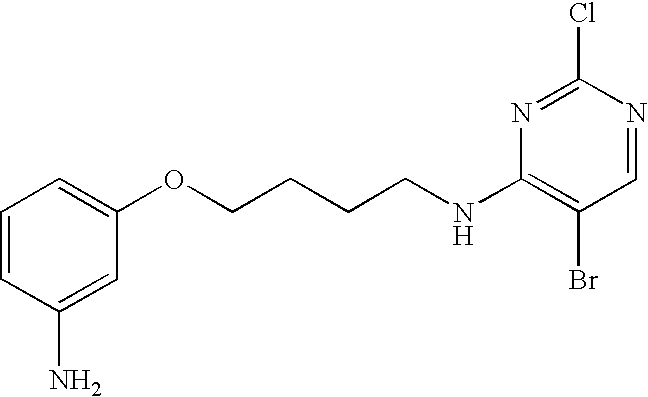
- A solution of 401 mg (1.00 mmol) of (5-bromo-2-chloro-pyrimidin-4-yl)-[4-(3-nitro-phenoxy)-butyl]-amine in 30 ml of THF is mixed under argon at room temperature with 4.5 ml of a 15% solution of Ti(III)Cl in approximately 10% hydrochloric acid. After 3.5 hours, the reaction solution is again mixed with 0.2 ml of Ti(III)Cl solution and stirred for another 12 hours. The batch is made basic with 2N NaOH solution and then filtered. The filter cake is rewashed 2× with 50 ml of ethyl acetate/MeOH (30 ml/20 ml) in each case. The filtrate is concentrated by evaporation in a rotary evaporator and then extracted with ethyl acetate (2×). The combined organic phases are washed with NaCl solution, dried (MgSO 4), filtered and concentrated by evaporation. The remaining residue is purified by chromatography (hexane/ethyl acetate 1:1, Flashmaster II). 300 mg (0.81 mmol, corresponding to 81% of theory) of the product is obtained.
- 1H-NMR (CDCl3): 8.10 (s, 1H), 7.03 (t, 1H), 6.36 (m, 3H), 5.66 (br, 1H), 3.97 (m, 2H), 3.60 (m, 2H), 1.86 (m, 2H).
- MS: 371 (ES)
- Production of the Sulfonamide-Oxa-Cyclophanes

- In the general formulas, R 1, R3, R8, R9, B and m have the meaning that is indicated under general formula I.
- Production of 1 5-Bromo-4-oxa-2,9-diaza-1(2,4)-pyrimidina-3(1,3)-benzenacyclononaphane-34-sulfonamide

- A solution of 66 mg (0.15 mmol) of 4-amino-2-[4-(5-bromo-2-chloro-pyrimidin-4-ylamino)-butoxy]-benzenesulfonamide in acetonitrile/water/2-butanol (8 ml/1 ml/1 ml) is added via a spray pump within 3.5 hours to a refluxing solution of acetonitrile/water/4 molar solution of hydrochloric acid in dioxane (45 ml/5 ml/0.6 ml). After another 16 hours under reflux, the reaction mixture is concentrated by evaporation in a rotary evaporator. The batch is made basic with 1N NaOH (pH 13) and extracted with ethyl acetate (2×). The combined organic phases are dried (MgSO 4), filtered and concentrated by evaporation. The remaining residue is digested with hexane and tert-butyl methyl ether. 55 mg (0.13 mmol, corresponding to 87% of theory) of the product is obtained.
- 1H-NMR (DMSO): 9.70 (s, 1H), 9.10 (d, 1H), 8.06 (s, 1H), 7.49 (m, 2H), 6.82 (s, 2H), 6.67 (dd, 1H), 4.45 (br, 2H), 3.40 (m, 2H), 1.85 (m, 4H)
- MS: 414 (ES).
- Production of the Intermediate Products According to Process Variant 8a
- 8a) Production of 2-[4-(5-Bromo-2-chloro-pyrimidin-4-ylamino)-butoxy]-4-nitro-benzenesulfonamide (A) and 4-[4-(5-Bromo-2-chloro-pyrimidin-4-ylamino)-butoxy]-2-nitro-benzenesulfonamide (B)

- 402 mg (1.01 mmol) of (5-bromo-2-chloro-pyrimidin-4-yl)-[4-(3-nitro-phenoxy)-butyl]-amine is introduced in portions in 4 ml of ice-cold chlorosulfonic acid (cooling: ice/methanol), and then it is stirred for 3 hours at room temperature. The batch is carefully added to ice water while being stirred. The precipitate that is formed is suctioned off, taken up in acetone and mixed with concentrated ammonia. It is stirred for 2 hours at room temperature, and the batch is concentrated by evaporation in a rotary evaporator. It is mixed with water and extracted with ethyl acetate (2×). The combined organic phases are dried (MgSO 4), filtered and concentrated by evaporation. The remaining residue is purified by chromatography (hexane/ethyl acetate 1:1). 190 mg (0.40 mmol, corresponding to 40% of theory) of product A and 110 mg (0.23 mmol, corresponding to about 23% of theory) of product B are obtained.
- 2-[4-(5-Bromo-2-chloro-pyrimidin-4-ylamino)-butoxy]-4-nitro-benzenesulfonaride (A):
- 1H-NMR (DMSO): 8.25 (s, 1H), 7.99 (d, 1H), 7.91 (m, 2H), 7.72 (br, 1H), 7.35 (br, 2H), 4.34 (m, 2H), 3.42 (m, 2H), 1.82 (m, 4H).
- MS: 480 (ES)
- 4-[4-(5-Bromo-2-chloro-pyrimidin-4-ylamino)-butoxy]-2-nitro-benzenesulfonamide (B):
- 1H-NMR (DMSO): 8.22 (s, 1H), 7.93 (d, 1H), 7.78 (t, 1H), 7.67 (s, 2H), 7.51 (d, 1H), 7.34 (dd, 1H), 4.16 (m, 2H), 3.45 (m, 2H), 1.73 (m, 4H).
- MS: 480 (ES)
- 8b) Production of 4-Amino-2-[4-(5-bromo-2-chloro-pyrimidin-4-ylamino)-butoxy]-benzenesulfonamide
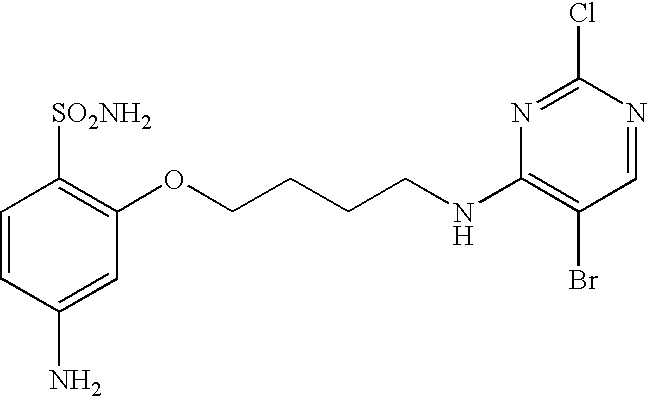
- A solution of 160 mg (0.33 mmol) of 2-[4-(5-bromo-2-chloro-pyrimidin-4-ylamino)-butoxy]-4-nitro-benzenesulfonamide in 10 ml of THF is mixed under argon at room temperature with 1.4 ml of a 15% solution of Ti(III)Cl in approximately 10% hydrochloric acid. After 4 hours, the reaction solution is again mixed with 0.2 ml of the Ti(III)Cl solution and stirred for another 14 hours. The batch is made basic with 2N NaOH solution and then filtered. The filter cake is rewashed 2× with 50 ml of ethyl acetate/MeOH (30 ml/20 ml) in each case. The filtrate is concentrated by evaporation in a rotary evaporator and then extracted with ethyl acetate (2×). The combined organic phases are washed with NaCl solution, dried (MgSO 4), filtered and concentrated by evaporation. The remaining residue is purified by chromatography (dichloromethane/methanol 9:1; Flashmaster II). 70 mg (0.81 mmol, corresponding to 47% of theory) of the product is obtained.
- 1H-NMR (DMSO): 8.22 (s, 1H), 7.73 (t, 1H), 7.36 (d, 1H), 6.44 (s, 2H), 6.27 (d, 1H), 6.13 (dd, 1H), 5.78 (s, 2H), 4.04 (m, 2H), 3.45 (m, 2H), 1.76 (m, 4H)
- MS: 450 (ES)
- Production of 1 5-Bromo-N-(dimethylaminomethylene)-4-oxa-2,9-diaza-1(2,4)-pyrimidina-3(1,3)-benzenacyclononaphane-34-sulfonamide

- A suspension of 40 mg (0.096 mmol) of 1 5-bromo-4-oxa-2,9-diaza-1(2,4)-pyrimidina-3(1,3)-benzenacyclononaphane-34-sulfonamide in 1 ml DMF is mixed at room temperature with 0.02 ml of N,N-dimethylformamide dimethyl acetal and stirred overnight. The solvent is drawn off, and the remaining residue is digested with MTB ether. 40 mg (0.085, corresponding to 88% of theory) of the product is obtained.
- 1H-NMR (DMSO): 9.70 (s, 1H), 8.98 (m, 1H), 8.17 (s, 1H), 8.04 (s, 1H), 7.53 (m, 1H), 7.45 (t, 1H), 6.69 (m, 1H), 4.35 (m, 2H), 3.35 (m, 2H), 3.18 (s, 3H), 2.88 (s, 3H), 1.80 (m, 4H).
- MS: 469 (ES).
- Production of Sulfonamide-Oxa-Cyclophanes According to Process Variant 8b)

- In the general formulas, R 1, R3, B and m have the meaning that is indicated under general formula I.
- Production of (S)-1 5-Bromo-8-(hydroxymethyl)-4-oxa-2,9-diaza-1(2,4)-pyrimidina-3(1,3)-benzenacyclononaphane-3(4)-sulfonamide
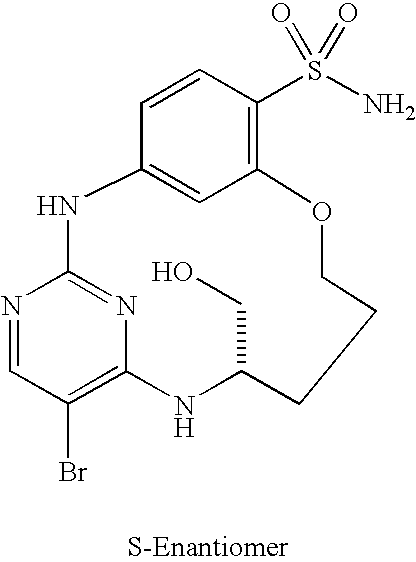
- A solution of 90 mg (0.17 mmol) of (S)-4-amino-2-[4-(5-bromo-2-chloro-pyrimidin-4-ylamino)-5-hydroxy-pentyloxy]-N-dimethylaminomethylene-benzenesulfonamide in acetonitrile/MeOH/water (8 ml/2 ml/1 ml) is added via a spray pump within 2.5 hours to a refluxing solution of acetonitrile/water/4 molar solution of hydrochloric acid in dioxane (45 ml/5 mr/0.6 ml). After another 16 hours under reflux, the reaction mixture is concentrated by evaporation in a rotary evaporator. The batch is made basic with saturated NaHCO 3 solution and extracted with ethyl acetate (2×). The combined organic phases are dried (Na2SO4), filtered and concentrated by evaporation. The remaining residue is digested with tert-butyl methyl ether. 62 mg (0.14 mmol, corresponding to 83% of theory) of the S-enantiomer product is obtained.
- 1H-NMR (DMSO): 9.79 (s, 1H), 8.53 (br, 1H), 8.11 (s, 1H), 7.52 (m, 1H), 6.83 (s, 2H), 6.68 (m, 1H), 6.43 (d, 1H), 4.98 (t, 1H), 4.60 (m, 1H), 4.12 (m, 1H), 3.81 (m, 1H), 3.62 (m, 2H), 2.18 (m, 1H), 2.02 (m, 1H), 1.64 (m, 2H).
- MS: 444 (ES).
- The R-enantiomer can be produced analogously to the instructions above, whereby (R)-4-amino-2-[4-(5-bromo-2-chloro-pyrimidin-4-ylamino)-5-hydroxy-pentyloxy]-N-dimethylaminomethylene-benzenesulfonamide should be used as a starting product.
- Production of the Intermediate Products According to Process Variant 8b)
- 8c) Production of N-tert-Butyl-2-methoxy-4-nitro-benzenesulfonamide
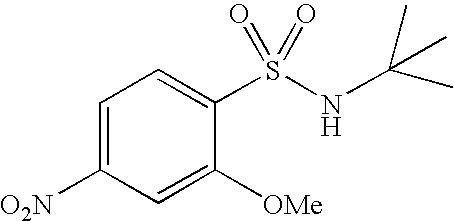
- A solution of 5.0 g (19.9 mmol) of 2-methoxy-4-nitro-benzenesulfonyl chloride in acetone/water (60 ml/15 ml) is mixed at room temperature with 2.9 ml of triethylamine and 2.2 ml of tert.-butylamine. After 5 hours, the acetone is drawn off, and the residue is extracted from ethyl acetate. The combined organic phases are washed with dilute HCl solution and saturated NaCl solution and then filtered through a Whatman filter and concentrated by evaporation. The crude product that is obtained is recrystallized from ethyl acetate. 4.2 g (14.6 mmol, corresponding to 73% of theory) of the product is obtained.
- 1H-NMR (DMSO): 8.03 (m, 1H), 7.95 (m, 2H), 7.48 (s, 1H), 4.05 (s, 3H), 1.08 (s, 9H).
- 8d) Production of 2-Methoxy-4-nitro-benzenesulfonamide
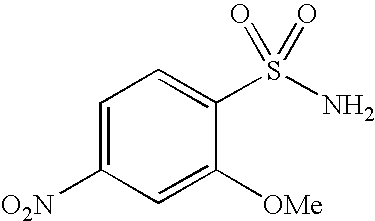
- 8.1 g (28.1 mmol) of N-tert-butyl-2-methoxy-4-nitro-benzenesulfonamide is mixed with 350 ml of trifluoroacetic acid and stirred for 20 hours at room temperature. The trifluoroacetic acid is drawn off, and the remaining residue is then digested with ethyl acetate. 5.0 g (21.6 mmol, corresponding to 77% of theory) of the product is obtained. The ethyl acetate phase is concentrated by evaporation, and the residue that is obtained is purified by chromatography (DCMtEtOH 95:5, Flashmaster II). Another 0.84 g (3.6 mmol, corresponding to 13% of theory) of the product is obtained.
- 1H-NMR (DMSO): 7.95 (m, 3H), 7.45 (s, 2H), 4.03 (s, 3H).
- MS: 233 (ES).
- 8e) Production of N-Dimethylaminomethylene-2-methoxy-4-nitro-benzenesulfonamide

- A solution of 5.0 g (21.5 mmol) of 2-methoxy-4-nitro-benzenesulfonamide in 15 ml of DMF is mixed at room temperature with 3.5 ml of N,N-dimethylformamide dimethyl acetal and stirred for 2.5 hours. The batch is added to a 5% KHSO 4 solution in ice water and then extracted from ethyl acetate. The combined organic phases are dried (MgSO4), filtered and concentrated by evaporation. The crude product that is obtained is digested with ethyl acetate. 5.6 g (19.4 mmol, corresponding to 90% of theory) of the product is obtained.
- 1H-NMR (DMSO): 8.29 (s, 1H), 8.04 (m, 1H), 7.90 (m, 2H), 3.99 (s, 3H), 3.24 (s, 3H), 2.93 (s, 3H).
- MS: 288 (ES).
- 8f) Production of N-Dimethylaminomethylene-2-hydroxy-4-nitro-benzenesulfonamide

- A solution of 2.82 g (9.8 mmol) of N-dimethylaminomethylene-2-methoxy-4-nitro-benzenesulfonamide in 70 ml of DCM is mixed slowly at room temperature with 13 ml of a 1 molar solution of boron tribromide in DCM. After 5 hours, 3 ml of the 1 molar solution of boron tribromide in DCM is added again, and it is stirred for another 16 hours. The batch is mixed with MeOH and diisopropyl ether. The precipitate that is formed is suctioned off, washed with EtOH and diisopropyl ether and dried. 1.94 g (7.1 mmol, corresponding to 72% of theory) of the product is obtained.
- 1H-NMR (DMSO): 11.55 (s, 1H), 8.21 (s, 1H), 7.95 (m, 1H), 7.70 (m, 2H), 3.19 (s, 3H), 2.91 (s, 3H).
- MS: 274 (ES).
- 8g) Production of (S)-{4-[2-(Dimethylaminomethylene-sulfamoyl)-5-nitro-phenoxy]-1-hydroxymethyl-butyl}-carbamic acid-tert-butyl ester

- A solution of 1.20 g (6.9 mmol) of DEAD in 10 ml of THF is added in drops to a reaction mixture of 1.57 g (5.75 mmol) of N-dimethylaminomethylene-2-hydroxy-4-nitro-benzenesulfonamide, 1.26 g (5.75 mmol) of (S)-2-boc-amino-pentane-diol and 1.80 g (6.9 mmol) of triphenylphosphine in 30 ml of THF at 0° C. After 24 hours, first another 0.20 g (1.1 mmol) of DEAD is added. After 5 hours, it is also mixed again with 0.28 g (1.1 mmol) of triphenylphosphine and stirred for 68 hours. Finally, 0.2 g (1.1 mmol) of DEAD is added, and it is stirred for another 22 hours. The batch is concentrated by evaporation, and the residue is purified by chromatography (DCM/EtOH 95:5, Flashmaster II). 0.71 g (1.50 mmol, corresponding to 26% of theory) of the product is obtained.
- 1H-NMR (DMSO): 8.21 (s, 1H), 8.03 (m, 1H), 7.88 (m, 2H), 6.60 (d, 1H), 4.65 (t, 1H), 4.19 (m, 2H), 3.42 (m, 3H), 3.22 (s, 3H), 2.93 (s, 3H), 1.73 (m, 4H), 1.39 (s, 9H).
- MS: 475 (ES).
- 8h) Production of 2-[4-(5-Bromo-2-chloro-pyrimidin-4-ylamino)-5-hydroxy-pentyloxy]-N-dimethylaminomethylene-4-nitro-benzenesulfonamide

- A solution of 212 mg (0.45 mmol) of (S)-{4-[2-(dimethylaminomethylene-sulfamoyl)-5-nitro-phenoxy]-1-hydroxymethyl-butyl}-carbamic acid-tert-butyl ester in 5 ml of acetonitrile is mixed at room temperature with 0.75 ml of a 4 molar solution of hydrochloric acid in dioxane. After 4 hours, the batch is concentrated by evaporation, and 2-(4-amino-5-hydroxy-pentyloxy)-N-dimethylaminomethylene-4-nitro-benzenesulfonamide is obtained in the form of hydrochloride.
- A solution of the product that is obtained in 4 ml of acetonitrile is then mixed at room temperature with 110 mg (0.48 mmol) of 5-bromo-2,4-dichloro-pyrimidine in 4 ml of acetonitrile. 0.13 ml of triethylamine is added, and it is stirred overnight. The batch is concentrated by evaporation, and the residue is purified by chromatography (DCM/EtOH 95:5, Flashmaster II). 152 mg (0.27 mmol, corresponding to 60% of theory) of the product is obtained.
- 1H-NMR (DMSO): 8.28 (s, 1H), 8.19 (s, 1H), 8.04 (m, 1H), 7.89 (m, 2H), 7.18 (d, 1H), 4.89 (t, 1H), 4.21 (m, 3H), 3.51 (m, 2H), 3.19 (s, 3H), 2.89 (s, 3H), 1.78 (m, 4H).
- MS: 565 (ES).
- 8i) Production of (S)-4-Amino-2-[4-(5-bromo-2-chloro-pyrimidin-4-ylamino)-5 hydroxy-pentyloxy]-N-dimethylaminomethylene-benzenesulfonamide

- A solution of 145 mg (0.30 mmol) of 2-[4-(5-bromo-2-chloro-pyrimidin-4-ylamino)-5-hydroxy-pentyloxy]-N-dimethylaminomethylene-4-nitro-benzenesulfonamide in 20 ml of THF is mixed under argon at room temperature with 2.0 ml of an approximately 10% solution of Ti(III)Cl in 20-30% hydrochloric acid. After 2 hours, the reaction solution is mixed again with 0.3 ml of Ti(III)Cl solution, and it is stirred for another 18 hours. The batch is diluted with ethyl acetate and made basic with 1N NaOH solution. The phases are separated, and the aqueous phase is extracted again from ethyl acetate. The combined organic phases are dried (Na 2SO4), filtered and concentrated by evaporation. The remaining residue is purified by chromatography (DCM/methanol 9: 1; Flashmaster II). 90 mg (0.17 mmol, corresponding to 56% of theory) of the product is obtained.
- 1H-NMR (DMSO): 8.28 (s, 1H), 8.06 (s, 1H), 7.39 (m, 1H), 7.17 (d, 1H), 6.11 (m 2H), 5.79 (s, 2H), 4.89 (t, 1H), 4.20 (m, 1H), 3.88 (m, 2H), 3.51 (m, 2H), 3.11 (s, 3H), 2.85 (s, 3H), 1.75 (m, 4H).
- MS: 535 (ES).

- In the general formulas, R 1, R3, R5, B and m have the meaning that is indicated under general formula I.
- Production of 1 5-Bromo-4-oxa-2,8-diaza-1(2,4)-pyrimidina-3(1,2)-benzenacyclooctaphane
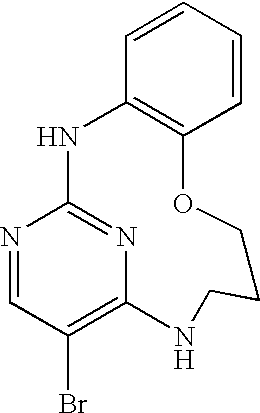
- A solution of 145 mg (0.41 mmol) of [3-(2-amino-phenoxy)-propyl]-(5-bromo-2-chloro-pyrimidin-4-yl)-amine in acetonitrile (10 ml) is added via a spray pump within 3 hours to a refluxing solution of acetonitrile/water/4 molar solution of hydrochloric acid in dioxane (45 ml/5 ml/0.6 ml). After the addition is completed, the reaction solution is stirred under reflux for another 16 hours. The batch is concentrated by evaporation, and the residue is purified by chromatography (DCM/EtOH 95:5; Flashmaster II). 81 mg (0.25 mmol, corresponding to 61% of theory) of the product is obtained.
- 1H-NMR (DMSO): 9.21 (s, 1H), 8.02 (s, 1H), 7.78 (br, 1H), 7.07 (m, 3H), 6.86 (m, 1H), 4.22 (m, 2H), 3.30 (m, 2H), 1.79 (m, 2H).
- MS: 321 (ES).
- Production of the Intermediate Products According to Process Variant 8c
- 8j) Production of (5-Bromo-2-chloro-pyrimidin-4-yl)-[3-(2-nitro-phenoxy)-propyl]-amine

- A solution of 1.06 g (4.0 mmol) of 3-(5-bromo-2-chloro-pyrimidin-4-ylamino)-propan-1-ol, 0.65 g (4.8 mmol) of 2-nitro-phenol and 1.25 g (4.8 mmol) of triphenylphosphine in 30 ml of THF is mixed under argon at 0° C. with 0.8 ml of DEAD. The reaction mixture is heated to room temperature while being stirred. After 20 hours, the batch is spun in, and the residue is purified by chromatography (hexane/ethyl acetate 3:1, Flashmaster II). 1.15 g (3.0 mmol, corresponding to 74% of theory) of the product is obtained.
- 1H-NMR (DMSO): 8.22 (s, 1H), 7.88 (m, 2H), 7.63 (m, 1H), 7.33 (m, 1H), 7.09 (m, 1H), 4.21 (m, 2H), 3.54 (m, 2H), 2.03 (m, 2H).
- MS: 387 (ES).
- 8k) Production of [3-(2-Amino-phenoxy)-propyl]-(5-bromo-2-chloro-pyrimidin-4-yl)-amine
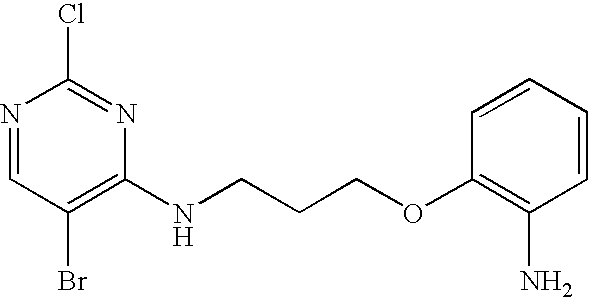
- A solution of 500 mg (1.29 mmol) of (5-bromo-2-chloro-pyrimidin-4-yl)-[3-(2-nitro-phenoxy)-propyl]-amine in 20 ml of THF is mixed at room temperature with 6.0 ml of an approximately 10% solution of Ti(III)Cl in 20-30% hydrochloric acid. After 21 hours, another 2.0 ml of the Ti(III)Cl solution is added. Renewed additions of the Ti(III)Cl solution are carried out after 4 hours (3.0 ml) or 16 hours (4.0 ml). After another 6 hours, the batch is diluted with ethyl acetate and made basic with 1N NaOH solution. It is filtered on Celite, and the filter cake is washed with ethyl acetate. The organic phase is separated, dried (Na 2SO4), filtered and concentrated by evaporation. The residue that is obtained is purified by chromatography (hexane/ethyl acetate 7:3). 290 mg (0.81 mmol, corresponding to 62% of theory) of the product is obtained.
- 1H-NMR (DMSO): 8.25 (s, 1H), 7.83 (t, 1H), 6.78 (m, 1H), 6.63 (m, 2H), 6.49 (m, 1H), 4.69 (s, 2H), 3.96 (m, 2H), 3.58 (m, 2H), 2.03 (m, 2H).
- MS: 357 (ES).
- Production of 1 5-Bromo-4-oxa-2,8-diaza-1(2,4)-pyrimidina-3(1,2)-benzenacyclooctaphane-34-sulfonamide

- A solution of 200 mg (0.42 mmol) of 4-[3-(5-bromo-2-chloro-pyrimidin-4-ylamino)-propoxy]-3-nitro-benzenesulfonamide in 14 ml of THF is mixed with 3 ml of an approximately 10% solution of Ti(III)Cl in 20-30% hydrochloric acid, and it is stirred for 19 hours at room temperature. According to TLC monitoring, during the course of 184 hours, altogether another 9 ml of the Ti(III)Cl solution is added in portions. The batch is made basic with 2N NaOH solution and extracted from ethyl acetate. The combined organic phases are dried (Na 2SO4), filtered and concentrated by evaporation. The residue that is obtained is purified by chromatography (DCM/EtOH 95:5). 62 mg (0.14 mmol, corresponding to 33% of theory) of the product is obtained.
- The product that is obtained is dissolved in 5 ml of acetonitrile and added via a spray pump within 2 hours to a refluxing solution of acetonitrile/water/4 molar solution of hydrochloric acid in dioxane (30 ml/3 ml/0.4 ml). Then, the batch is stirred under reflux for another 16 hours. After cooling, the precipitate that is formed is suctioned off and washed with acetonitrile and water. 13 mg (0.03 mmol, corresponding to 8% of theory) of the product is obtained.
- 1H-NMR (DMSO): 10.53 (s, 1H), 8.97 (m, 1H), 8.25 (s, 1H), 7.67 (m, 2H), 7.30 (m, 3H), 4.31 (m, 2H), 3.35 (m, 2H), 1.88 (m, 2H).
- MS: 400 (ES).
- Production of Intermediate Products
- 8l) 4-[3-(5-Bromo-2-chloro-pyrimidin-4-ylamino)-propoxy]-3-nitro-benzenesulfonamide
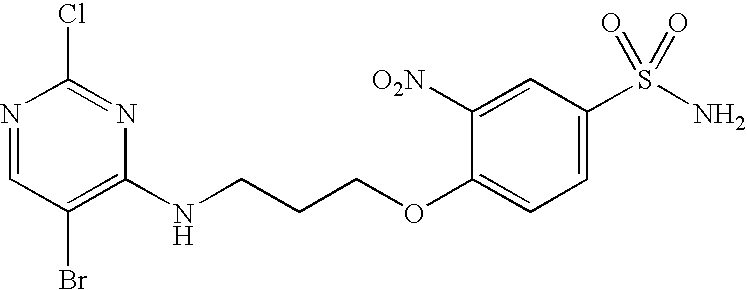
- 398 mg (1.02 mmol) of (5-bromo-2-chloro-pyrimidin-4-yl)-[3-(2-nitro-phenoxy)-propyl]-amine is added in portions to 4 ml of ice-cooled chlorosulfonic acid. The batch is stirred for 2.5 hours, and the reaction mixture is then carefully added in drops to ice. The solid that is formed is suctioned off, washed with water and dried. The crude product that is obtained is dissolved in 20 ml of acetone, mixed with 3 ml of ammonia (33%) and stirred for one hour at room temperature. The batch is concentrated by evaporation, mixed with ethyl acetate and washed with water. The combined organic phases are filtered through a Whatman filter and concentrated by evaporation. 223 mg (0.48 mmol, corresponding to 47% of theory) of the product is obtained.
- 1H-NMR (DMSO): 8.29 (m, 1H), 8.24 (s, 1H), 8.02 (m, 1H), 7.85 (t, 1H), 7.47 (m, 3H), 4.29 (t, 2H), 3.55 (m, 2H), 2.04 (m, 2H).
- MS: 466 (ES).
- Production of the Amide Derivatives

- In general formulas, R 1, R3, R5, B and m have the meaning that is indicated under general formula I.
- Production of 1 5-Bromo-2,5,10-triaza-1(2,4)-pyrimidina-3(1,3)-benzenacyclodecaphan-4-one

- A solution of 440 mg (1.1 mmol) of 3-amino-N-[4-(5-bromo-2-chloro-pyrimidin-4-ylamino)-butyl]-benzamide in acetonitrile/DMF/water (25 ml/5 ml/5 ml) is added via a dropping funnel within 2 hours to a refluxing solution of acetonitrile/water/4 molar solution of hydrochloric acid in dioxane (150 ml/10 ml/2 ml). After another 3 hours under reflux, the batch is taken from the oil bath. The precipitate that is formed after cooling is suctioned off and washed with water and diisopropyl ether. 38 mg (0.10 mmol, corresponding to 9% of theory) of the product is obtained.
- 1H-NMR (DMSO): 10.45 (s, 1H), 8.40 (m, 3H), 8.25 (s, 1H), 7.40 (m, 3H), 3.35 (m, 2H), 3.10 (m, 2H), 1.48 (m, 4H).
- MS: 363 (ES).
- Production of the Intermediate Products According to Process Variant 9
- 9a) Production of N-(4-Amino-butyl)-3-nitro-benzamide

- 2.27 g (6.72 mmol) of [4-(3-nitro-benzoylamino)-butyl]-carbamic acid-tert-butyl ester is mixed with 9 ml of trifluoroacetic acid and stirred for 3 hours at room temperature. The batch is carefully added to 2N NaOH solution and then extracted from ethyl acetate. The combined organic phases are filtered through a Whatman filter and concentrated by evaporation. The crude product that is obtained is recrystallized from ethanol/diisopropyl ether. 519 mg (2.19 mmol, corresponding to 33% of theory) of the product is obtained.
- 1H-NMR (DMSO): 8.95 (m, 1H), 8.65 (s, 1H), 8.86 (m, 1H), 8.78 (m, 1H), 7.72 (m, 1H), 3.30 (m, 2H), 3.04 (m, 2H), 1.55 (m, 2H), 1.40 (m, 2H).
- MS: 238 (ES).
- 9b) Production of N-[4-(5-Bromo-2-chloro-pyrimidin-4-ylamino)-butyl]-3-nitro-benzamide

- A solution of 502 mg (2.2 mmol) of 5-bromo-2,4-dichloro-pyrimidine and 0.4 ml of triethylamine (2.3 mmol) in 2.5 ml of acetonitrile is mixed at 0° C. while being stirred with 547 mg (2.3 mmol) of N-(4-amino-butyl)-3-nitro-benzamide. The batch is stirred overnight at room temperature. The precipitate that is formed is suctioned off, washed with water and dried. 574 mg (1.3 mmol, corresponding to 61% of theory) of the product is obtained.
- 1H-NMR (DMSO): 8.87 (t, 0.1H), 8.65 (m, 1H), 8.38 (m, 1H), 8.28 (m, 1H), 8.18 (s, 1H), 7.76 (m, 2H), 3.35 (m, 4H), 1.55 (m, 4H).
- MS: 427 (EI).
- 9c) Production of 3-Amino-N-[4-(5-bromo-2-chloro-pyrimidin-4-ylamino)-butyl]-benzamide

- A solution of 568 mg (1.32 mmol) of N-[4-(5-bromo-2-chloro-pyrimidin-4-ylamino)-butyl]-3-nitro-benzamide in 15 ml of THF is mixed at room temperature with 9 ml of a 15% solution of Ti(III)Cl in approximately 10% hydrochloric acid. After 21 hours, the batch is made basic with 2N NaOH solution, mixed with ethyl acetate and filtered on Celite. The filter cake is rewashed with ethyl acetate. The organic phase of the filtrate is filtered through a Whatman filter and concentrated by evaporation. 447 mg (1.12 mmol, corresponding to 85% of theory) of the product is obtained.
- MS: 398 (ES).
- Production of Urea Derivatives
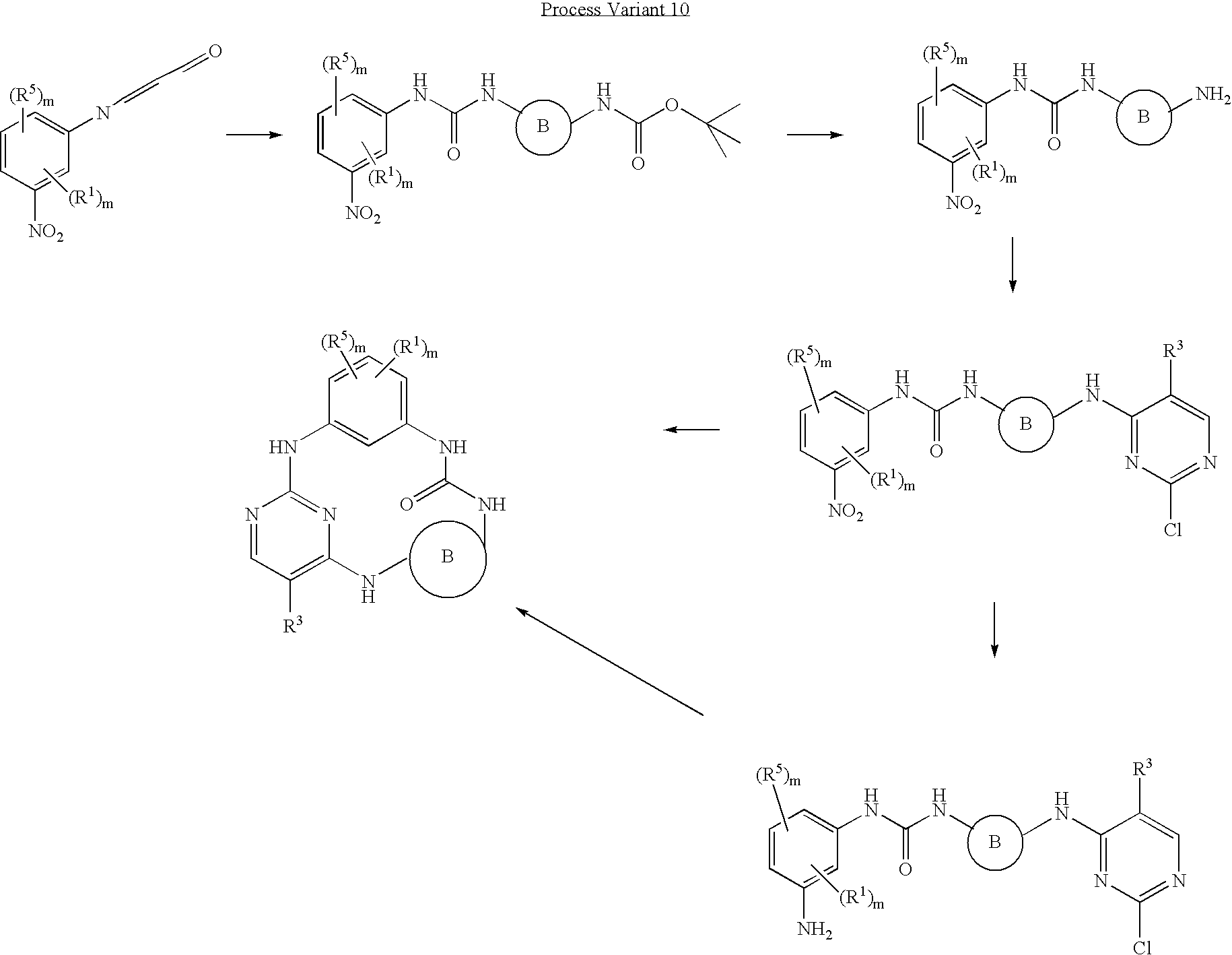
- In the general formulas, R 1, R3, R5, B and m have the meaning that is indicated under general formula I.
- Production of 1 5-Bromo-2,4,6,10-tetraaza-1(2,4)-pyrimidina-3(1,3)-benzenacyclodecaphan-5-one
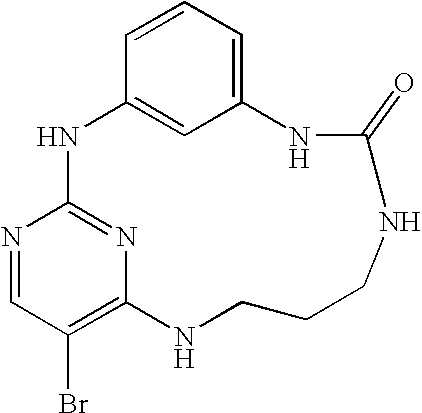
- A solution of 265 mg (0.66 mmol) of 1-(3-amino-phenyl)-3-[3-(5-bromo-2-chloro-pyrimidin-4-ylamino)-propyl]-urea in acetonitrile/dioxane/water (8 ml/1 ml/1 ml) is added via a spray pump within 2 hours to a refluxing solution of acetonitrile/water/4 molar solution of hydrochloric acid in dioxane (70 ml/5 ml/1 ml). After another 18 hours under reflux, the batch is made basic with 2N NaOH after cooling and extracted from ethyl acetate. The combined organic phases are filtered through a Whatman filter and concentrated by evaporation. The residue that is obtained is purified by chromatography (DCM/EtOH 9:1). The crude product that is obtained is then recrystallized from MeOH. 7 mg (0.02 mmol, corresponding to 3% of theory) of the product is obtained.
- 1H-NMR (DMSO): 9.31 (s, 1H), 8.79 (m, 1H), 8.17 (s, 1H), 7.98 (s, 1H), 7.27 (t, 1H), 7.05 (t, 1H), 6.72 (m, 1H), 651 (m, 1H), 6.43 (m, 1H), 3.48 (m, 2H), 3.14/m, 2H), 1.65 (m, 2H).
- 13C-NMR (DMSO): 158.6s, 157.8d, 156.1 s, 155.5s, 141.6s, 140.9s, 129.0d, 112.7d, 112.2d, 110.3d, 92.1s, 38.3t, 36.3t, 30.3t.
- MS: 363 (ES).
- Production of Intermediate Products According to Process Variant 10
- 10a) Production of {3-[3-(3-Nitro-phenyl)-ureido]-propyl}-carbamic Acid-tert-butyl ester

- A solution of 3.35 g (19.2 mmol) of N-boc-1,3-diaminopropane in 50 ml of EtOH is mixed at 0° C. in portions with 3.15 g (19.2 mmol) of 3-nitrophenyl isocyanate. The batch is stirred overnight at room temperature and then concentrated by evaporation in a rotary evaporator. It is mixed with DCM and washed with water. The organic phase is filtered through a Whatman filter and concentrated by evaporation. 6.4 g (18.9 mmol, corresponding to 98% of theory) of the product is obtained.
- 1H-NMR (DMSO): 9.11 (s, 1H), 8.48 (m, 1H), 7.71 (m, 1H), 7.65 (m, 1H), 7.48 (t, 1H), 6.82 (t, 1H), 6.32 (t, 1H), 3.12 (m, 2H), 2.95 (m, 2H), 1.55 (m, 2H), 1.38 (s, 9H).
- MS: 339 (CI).
- 10b) Production of 1-(3-Amino-propyl)-3-(3-nitro-phenyl)-urea
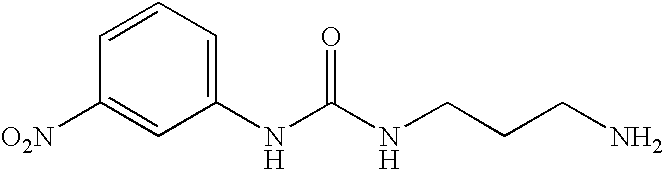
- 6.4 g (18.9 mmol) of {3-[3-(3-nitro-phenyl)-ureido]-propyl}-carbamic acid-tert-butyl ester is mixed with 22 ml of trifluoroacetic acid and stirred for 2 hours at room temperature. The solvent is drawn off, the batch is mixed with NaHCO 3 solution and extracted from ethyl acetate. The combined organic phases are filtered through a Whatman filter and concentrated by evaporation. 4.4 g (18.5 mmol, corresponding to 97% of theory) of the product is obtained.
- 1H-NMR (DMSO): 9.46 (s, 1H), 8.55 (m, 1H), 7.75 (m, 1H), 7.65 (m, 1H), 7.48 (m, 1H), 6.88 (t, 1H), 3.30 (m, 2H), 2.75 (m, 2H), 1.72 (m, 2H).
- MS: 239 (ES).
- 10c) Production of 1-[3-(5-Bromo-2-chloro-pyrimidin-4-ylamino)-propyl]-3-(3-nitro-phenyl)-urea
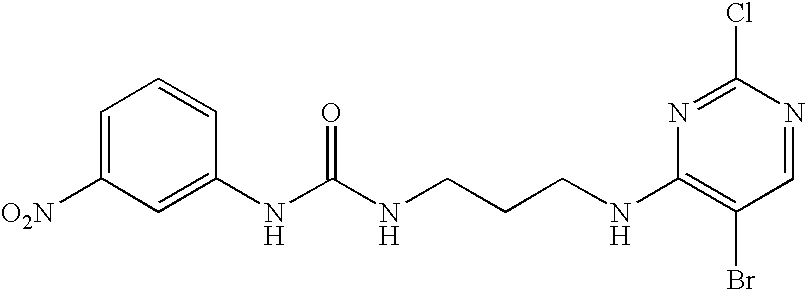
- A solution of 1.6 g (6.7 mmol) of 1-(3-amino-propyl)-3-(3-nitro-phenyl)-urea in 30 ml of acetonitrile is mixed with a solution of 1.6 g (7.0 mmol) of 5-bromo-2,4-dichloro-pyrimidine in 10 ml of acetonitrile. 2.0 ml of triethylamine is added, and it is stirred for 90 minutes at room temperature. It is diluted with ethyl acetate (150 ml) and washed with citric acid (10%), saturated NaHCO 3 solution as well as saturated NaCl solution, dried (Na2SO4), filtered and concentrated by evaporation. The remaining residue is purified by chromatography (hexane/ethyl acetate 1:1). 1.7 g (4.0 mmol, corresponding to 60% of theory) of the product is obtained.
- 1H-NMR (DMSO): 9.08 (s, 1H), 8.52 (m, 1H), 8.21 (s, 1H), 7.70 (m, 3H), 7.46 (t, 1H), 6.38 (t, 1H), 3.45 (m, 2H), 3.15 (m, 2H), 1.72 (m, 2H).
- 10d) Production of 1-(3-Amino-phenyl)-3-[3-(5-bromo-2-chloro-pyrimidin-4-ylamino)-propyl]-urea

- A solution of 1.71 g (3.98 mmol) of 1-[3-(5-bromo-2-chloro-pyrimidin-4-ylamino)-propyl]-3-(3-nitro-phenyl)-urea in 50 ml of THF is mixed at room temperature with 30 ml of a 15% solution of Ti(III)Cl in approximately 10% hydrochloric acid. After 24 hours, another 5 ml of the 15% solution of Ti(III)Cl in approximately 10% hydrochloric acid is added. After another 6 hours, the batch is made basic with 2N NaOH solution and extracted from ethyl acetate. The combined organic phases are filtered through a Whatman filter and concentrated by evaporation. The residue that is obtained is purified by chromatography (DCM/EtOH 9:1). 850 mg (2.13 mmol, corresponding to 54% of theory) of the product is obtained.
- 1H-NMR (DMSO): 8.25 (s, 1H), 8.14 (s, 1H), 7.78 (t, 1H), 6.82 (t, 1H), 6.68 (m, 1H), 6.50 (m, 1H), 6.06 (m, 2H), 4.94 (s, 1H), 3.30 (m, 2H), 3.31 (m, 2H), 1.67 (m, 2H).
- MS: 399 (ES).
- Ring Closure of Bifunctional Acyclic Precursors

- A, B, R 1, R2, R3, R4, R5, X, Y, m and n have the meanings that are indicated under general formula I. U and V stand for groups such as —OH, —CO2H, —CO2—C1-C6-alkyl, —SO2Cl, —SO2F, —SO3H, etc.
- The ring closure or the synthesis of the macrocyclic compounds can also be performed analogously to known methods ((a) Roxburgh, C. J. Tetrahedron 1995, 51, 9767. (b) Meng, Q. Top. Curr. Chem. 1991, 161, 107. (c) Paterson, I. Tetrahedron 1985, 41, 3569. (d) Masamune, S. Angew. Chem. 1977, 89, 602. (e) Nicolaou, K. C. Tetrahedron 1977, 33, 683. (f) Ruggli, P. Liebigs Ann. Chem. 1912, 92.)
- Ring Closure by Mitsunobu Reaction
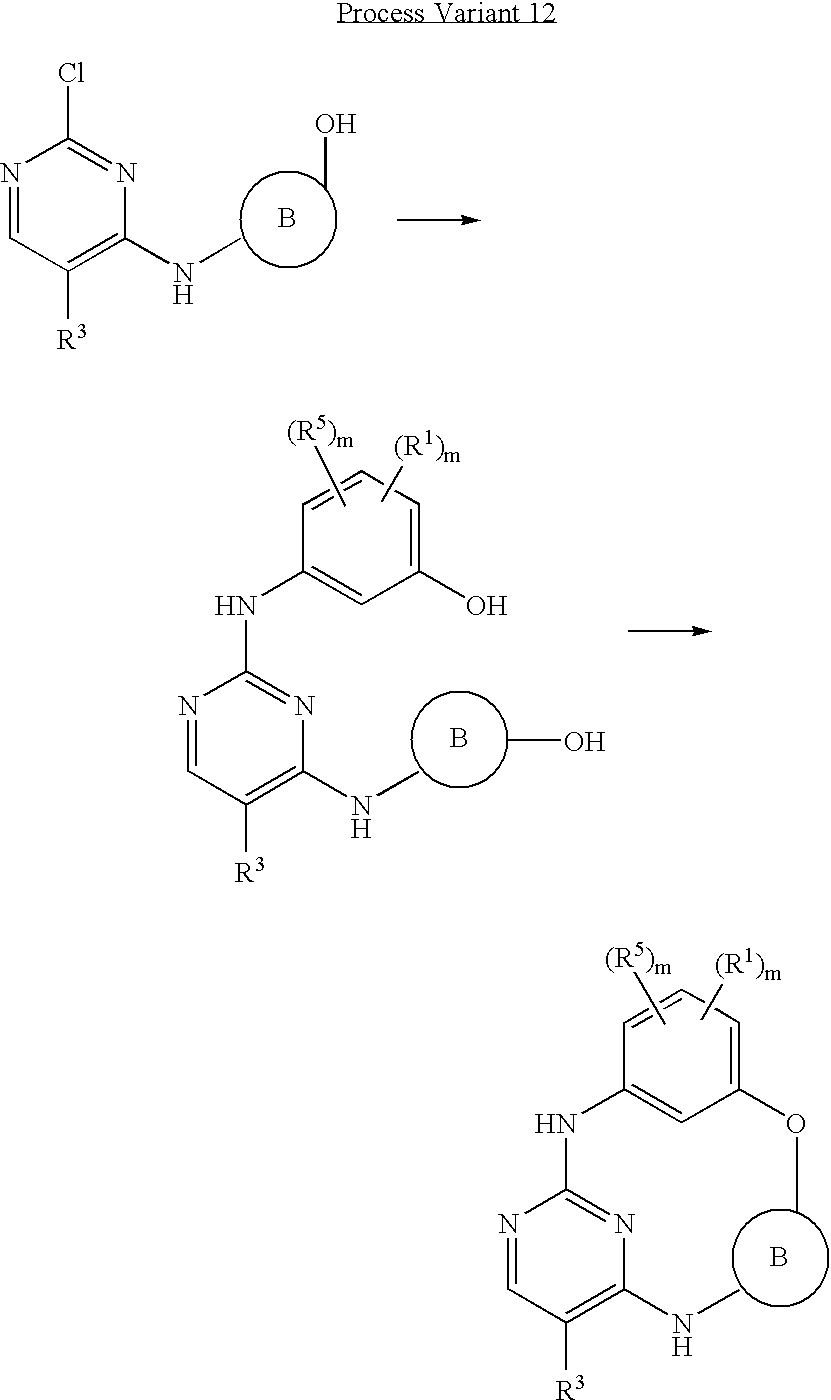
- In the general formulas, R 1, R3, R5, B and m have the meaning that is indicated under general formula I.
- Synthesis of macrocyclic compounds with use of the Mitsunobu reaction is generally known and can be looked up in (a) Xue, C. -B. J. Med. Chem. 2001, 44, 2636. (b) Steggich, W. Tet. Lett. 1991, 32, 5781. (c) Mitsunobu, O. Synthesis 1981, 1.
- Production of 1 5-Bromo-4-oxa-2,9-diaza-1(2,4)-pyrimidina-3(1,3)-benzen-acyclononaphane

- A solution of 108 mg (0.31 mmol) of 3-[5-bromo-4-(4-hydroxy-butylamino)-pyrimidin-2-ylamino]-phenol in THF/N-methylmorpholine (9 ml/1 ml) is added while being stirred within 3 hours to a mixture of 710 mg (2.7 mmol) of triphenylphosphine and 481 mg (2.8 mmol) of DEAD in 100 ml of THF at 40° C. After another 30 minutes, the reaction mixture is concentrated by evaporation in a rotary evaporator. After water is added, it is extracted with ethyl acetate (2×). The combined organic phases are dried (Na 2SO4), filtered and concentrated by evaporation. The residue that is formed is purified by chromatography (dichloromethane/methanol 9:1), and the crude product that is obtained is then digested with isopropyl ether. 17 mg (0.05 mmol, corresponding to 17% of theory) of the product is obtained.
- 1H-NMR (DMSO): 9.18 (s, 1H), 9.08 (s, 1H), 8.04 (s, 1H), 7.20 (s, 1H), 7.09 (dd, 1H), 6.96 (t, 1H), 6.31 (dd, 1H), 3.30 (m, 4H), 1.90 (m, 4H).
- MS: 334 (EI).
- Production of the Intermediate Products According to Process Variant 12
- 12a) Production of 4-(5-Bromo-2-chloro-pyrimidin-4-ylamino)-butan-1-ol

- A solution of 2.28 g (10.0 mmol) of 5-bromo-2,4-dichloro-pyrimidine and 1.7 ml (12.0 mmol) of triethylamine in 10 ml of acetonitrile is mixed at 0° C. with 1.1 ml (12.0 mmol) of 4-amino-butanol. The reaction mixture is slowly heated to room temperature while being stirred by removal of the ice bath. After 16 hours, the precipitate that is formed is filtered off. The filtrate is completely concentrated by evaporation and digested with diisopropyl ether. 2.74 g (9.8 mmol, corresponding to 98% of theory) of the product is obtained.
- 1H-NMR (DMSO): 8.19 (s, 1H), 7.72 (t, 1H), 4.45 (br, 1H), 3.38 (m, 4H), 1.56 (m, 2H), 1.45 (m, 2H).
- MS: 279 (EI).
- 12b) 3-[5-Bromo-4-(4-hydroxy-butylamino)-pyrimidin-2-ylamino]-phenol

- A reaction mixture of 327 mg (3.0 mmol) of 3-aminophenol and 864 mg (3.1 mmol) of 4-(5-bromo-2-chloro-pyrimidin-4-ylamino)-butan-1-ol in 9 ml of acetonitrile is mixed with 0.75 ml of a 4 M solution of hydrochloric acid in dioxane, and it is stirred under reflux overnight. After the cooling, the reaction mixture is filtered, and the filtrate is completely concentrated by evaporation. The oil that is obtained is recrystallized from ethyl acetate/ethanol. The solid is filtered off and then dissolved in water. By adding triethylamine, the solution is made basic and extracted with ethyl acetate (2×). The combined organic phases are dried (Na 2SO4), filtered and concentrated by evaporation. 444 mg (1.2 mmol, corresponding to 40% of theory) of the product is obtained.
- 1H-NMR (DMSO): 9.18 (s, 1H), 9.06 (s, 1H), 7.97 (s, 1H), 7.19 (m, 2H), 6.99 (m, 2H), 6.32 (m, 1H), 4.45 (t, 1H), 3.40 (m, 4H), 1.60 (m, 2H), 1.47 (m, 2H).
- MS: 352 (ES).
- Ring Closure by Macrolactamization

- In the general formulas, R 1, R3, R5, B and m have the meaning that is indicated under general formula I and NHZ stands for the group
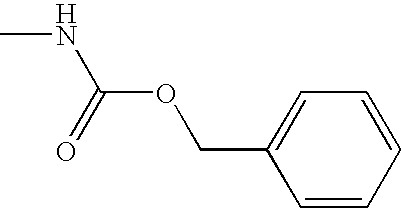
- Synthesis of macrolactams is carried out according to standard processes ((a) Xue, C. -B. J. Med. Chem. 2001, 44, 2636. (b) Jackson, F. W. J. Org. Chem. 2002, 67, 4882).
- Production of 1 5-Bromo-2,5,11-triaza-1(2,4)-pyrimidina-3(1,3)-benzenacycloundecaphane-4-one (A) and 2,5,11-Triaza-1(2,4)-pyrimidina-3(1,3)-benzenacycloundecaphane-4-one (B)

- A solution of 300 mg (0.57 mmol) of 3-[4-(5-benzyloxycarbonylamino-pentylamino)-5-bromo-pyrimidin-2-ylamino]-benzoic acid in methanol/dichloromethane (40 ml/5 ml) is mixed with 350 mg of Pd/C (10%) and hydrogenated for 150 minutes in a low-pressure apparatus. The reaction mixture is filtered on Celite and completely concentrated by evaporation. The remaining residue is dissolved in DMF/methanol/water (10.0 m/1.0 ml/0.2 ml) and added via a spray pump over 2 hours to a solution of 410 mg (2.2 mmol) of EDC, 330 mg (2.2 mmol) of HOBt and 0.25 ml of N-methylmorpholine in 200 ml of DMF. After 72 hours, the reaction mixture is concentrated by evaporation, mixed with water, and then extracted with ethyl acetate (2×). The combined organic phases are washed with water, dried (Na 2SO4), filtered and concentrated by evaporation. The residue that is formed is purified by chromatography (dichloromethane/methanol 1:1). 35 mg (0.09 mmol, corresponding to 16% of theory) of 15-bromo-2,5,11-triaza-1(2,4)-pyrimidina-3(1,3)-benzenacycloundecaphane-4-one (A) and 13 mg (0.04 mmol, corresponding to 7% of theory) of 2,5,11-triaza-1 (2,4)-pyrimidina-3 (1,3)-benzenacycloundecaphane-4-one (B) are obtained.
- 1 5-Bromo-2,5,11-triaza-1 (2,4)-pyrimidina-3(1,3)-benzenacycloundecaphane-4-one (A):
- 1H-NMR (DMSO): 9.45 (s, 1H), 8.81 (s, 1H), 8.12 (t, 1H), 7.98 (s, 1H), 7.20 (m, 4H), 3.30 (m, 4H), 1.78 (m, 2H), 1.60 (m, 2H), 1.30 (m, 2H).
- MS: 376 (ES).
- 2,5,11-Triaza-1 (2,4)-pyrimidina-3 (1,3)-benzenacycloundecaphane-4-one (B):
- 1H-NMR (DMSO): 9.21 (s, 1H), 8.97 (s, 1H), 8.10 (t, 1H), 7.72 (d, 1H), 7.38 (t, 1H), 7.25 (t, 1H), 7.18 (dd, 1H), 7.08 (dd, 1H), 5.84 (d, 1H), 3.30 (m, 2H), 3.17 (m, 2H), 1.75 (m, 2H), 1.53 (m, 2H), 1.30 (m, 2H).
- MS: 298 (ES).
- Production of Intermediate Products According to Process Variant 13
- 13a) Production of [5-(5-Bromo-2-chloro-pyrimidin-4-ylamino)-pentyl]-carbamic acid-benzyl ester

- A solution of 860 mg (3.8 mmol) of 5-bromo-2,4-dichloro-pyrimidine and 1.2 ml (8.5 mmol) of triethylamine in 6 ml of acetonitrile is mixed at 0° C. with 1.0 g (3.7 mmol) of (5-amino-pentyl)-carbamic acid-benzyl ester. The reaction mixture is slowly heated to room temperature while being stirred by removal of the ice bath. After 60 hours, it is mixed with water and then extracted with ethyl acetate (2×). The combined organic phases are dried (Na 2SO4), filtered and concentrated by evaporation. The residue that is formed is purified by chromatography (hexane/ethyl acetate 1:1). 1.2 g (2.8 mmol, corresponding to 77% of theory) of the product is obtained.
- 1H-NMR (DMSO): 8.21 (s, 1H), 7.72 (t, 1H), 7.35 (m, 5H), 7.23 (t, 1H), 4.99 (s, 2H), 3.30 (m, 2H), 2.97 (m, 2H), 1.47 (m, 4H), 1.27 (m, 2H).
- MS: 427 (ES).
- 13b) Production of 3-[4-(5-Benzyloxycarbonylamino-pentylamino)-5-bromo-pyrimidin-2-ylamino]-benzoic Acid

- A reaction mixture of 1.20 g (2.8 mmol) of [5-(5-bromo-2-chloro-pynmidin-4-ylamino)-pentyl]-carbamic acid-benzyl ester and 0.37 g (2.7 mmol) of 3-aminobenzoic acid in acetonitrile/water (8 ml/1.5 ml) is stirred under reflux for 20 hours. The reaction mixture is spun in, and the remaining residue is purified by chromatography (dichloromethane/methanol 9:1, Flashmaster II). 1.27 g (2.4 mmol, corresponding to 86% of theory) of the product is obtained.
- 1H-NMR (DMSO): 10.03 (s, 1H), 8.38 (s, 1H), 8.15 (s, 1H), 7.81 (m, 2H), 7.56 (d, 1H), 7.30 (m, 7H), 4.98 (s, 2H), 3.35 (m, 2H), 2.98 (m, 2H), 1.54 (m, 2H), 1.32 (m, 4H).
- MS: 528 (CI).
- Production of Aza-phane Derivatives

- In the general formulas, R 1, R5, R11, B and m have the meaning that is indicated under general formula I.
- Production of 15-Bromo-4-mesyl-2,4,9-triaza-1(2,4)-pyrimidina-3(1,3)-benzenacyclononaphane
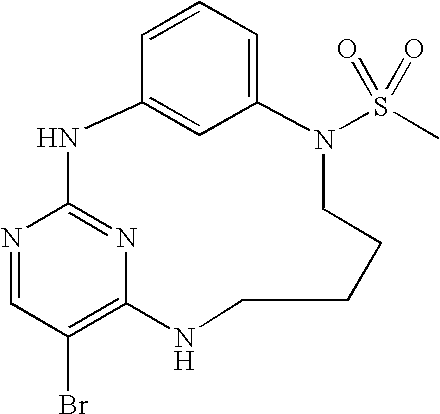
- A solution of 160 mg (0.33 mmol) of N-(3-{[4-(5-bromo-2-chloro-pyrimidin-4-ylamino)-butyl]-methanesulfonyl-amino}-phenyl)-acetamide in 10 ml of acetonitrile is added via a spray pump within 3 hours to a refluxing solution of acetonitrile/water/4 molar solution of hydrochloric acid in dioxane (40 ml/10 ml/1 ml). After the addition is completed, the batch is stirred under reflux for another 16 hours, and then the organic solvent is drawn off. It is mixed with ethyl acetate and washed with dilute NaHCO 3 solution. The combined organic phases are concentrated by evaporation, and the residue that is obtained is washed with ethyl acetate, MeOH and water. After the drying, 81 mg (0.20 mmol, corresponding to 63% of theory) of the product is obtained.
- 1H-NMR (DMSO): 9.38 (s, 1H), 8.16 (m, 1H), 7.97 (s, 1H), 7.23 (m, 2H), 6.99 (m, 1H), 6.92 (m, 1H), 3.64 (m, 2H), 3.16 (m, 2H), 3.06 (s, 3H), 1.77 (m, 2H), 1.60 (m, 2H).
- MS: 412 (ES).
- Production of Intermediate Products
- 14a) N-(3-{[4-(5-Bromo-2-chloro-pyrimidin-4-ylamino)-butyl]-methanesulfonyl-amino}-phenyl)-acetamide

- 460 mg (1.56 mmol) of N-{3-[(3-cyano-propyl)-methanesulfonyl-amino]-phenyl}-acetamide in 25 ml of ethanol and 0.5 ml of concentrated HCl are hydrogenated with use of 60 mg (0.26 mmol) of platinum(IV)oxide for 5 hours at room temperature under normal pressure. The batch is filtered and concentrated by evaporation. The residue that is obtained is mixed with a solution of 355 mg (1.56 mmol) of 5-bromo-2,4-dichloro-pyrimidine in 15 ml of acetonitrile. 0.45 ml of triethylamine is added drop by drop, and it is stirred for 16 hours at room temperature. The batch is concentrated by evaporation, and the residue that is obtained is purified by chromatography (DCM/EtOH 95:5). 330 mg (0.67 mmol, corresponding to 43% of theory) of the product is obtained.
- 1H-NMR (DMSO): 10.03 (s, 1H), 8.21 (s, 1H), 7.69 (t, 1H), 7.55 (m, 2H), 7.29 (m, 1H), 7.03 (m, 1H), 3.60 (t, 2H), 3.30 (m, 2H), 2.97 (s, 3H), 2.03 (s, 3H), 1.57 (m, 2H), 1.36 (m, 2H).
- MS: 490 (ES).
- 14b) N-{3-[(3-Cyano-propyl)-methanesulfonyl-amino]-phenyl}-acetamide

- A solution of 510 mg (2.35 mmol) of N-[3-(3-cyano-propylamine)-phenyl]-acetamide in 10 ml of pyridine is mixed at 0° C. drop by drop with 0.21 ml of methanesulfonyl chloride and then stirred for 24 hours at room temperature. After TLC monitoring, it is mixed again with 0.1 ml of methanesulfonyl chloride and stirred for another 3 days. The batch is diluted with ethyl acetate and washed with citric acid (10%), saturated NaHCO 3 solution as well as saturated NaCl solution. The organic phase is dried (Na2SO4), filtered and concentrated by evaporation. 469 mg (1.60 mmol, corresponding to 68% of theory) of the product is obtained.
- 1H-NMR (DMSO): 10.11 (s, 1H), 7.59 (m, 2H), 7.37 (m, 1H), 7.11 (m, 1H), 3.68 (t, 2H), 3.02 (s, 3H), 2.51 (m, 2H), 2.04 (s, 3H), 1.67 (p, 2H).
- MS: 321 (ES).
- 14c) N-[3-(3-Cyano-propylamine)-phenyl]-acetamide
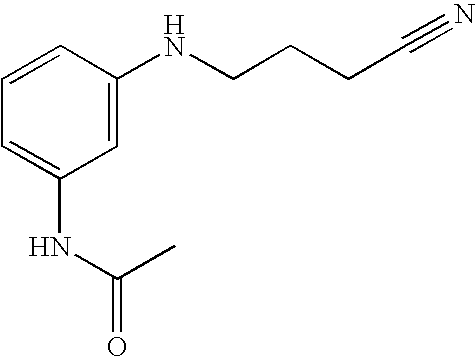
- A solution of 3.18 g (21.2 mmol) of N-(3-amino-phenyl)-acetamide in 100 ml of acetonitrile is mixed at room temperature with 1.9 ml (19.0 mmol) of 4-bromobutyric acid nitrile and 2.6 ml of triethylamine and then stirred under reflux overnight. After cooling, it is diluted with ethyl acetate and washed with citric acid (10%), saturated NaHCO 3 solution as well as saturated NaCl solution. The organic phase is dried (Na2SO4), filtered and concentrated by evaporation. The residue that is obtained is purified by chromatography (DCM/EtOH 95:5). 0.56 g (2.35 mmol, corresponding to 12% of theory) of the product is obtained.
- 1H-NMR (DMSO): 9.66 (s, 1H), 6.98 (m, 2H), 6.72 (m, 1H), 6.26 (m, 1H), 5.69 (t, 1H), 3.04 (m, 2H), 2.62 (t, 2H), 2.02 (s, 3H), 1.82 (p, 2H).
- MS: 218 (ES).
- The following compounds are also produced in a way similar to the process variants described above in each case:


Example No. 14.1 14.2 14.3 Mass 370 (ES) 362 (ES) 426 (ES) Process 1 1 1 Variant 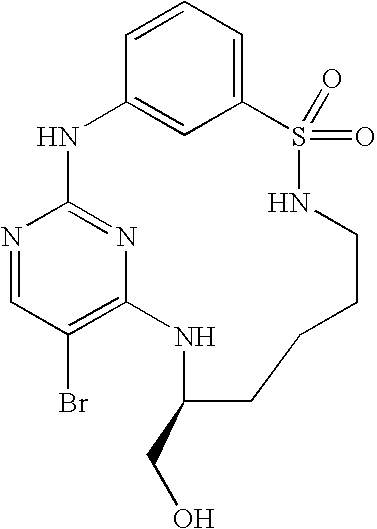
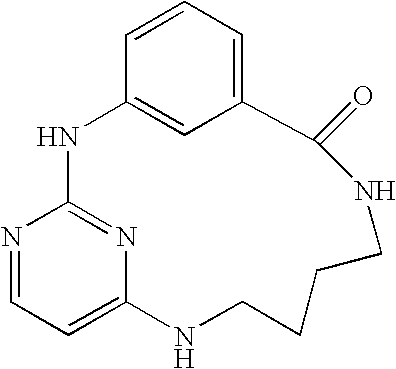
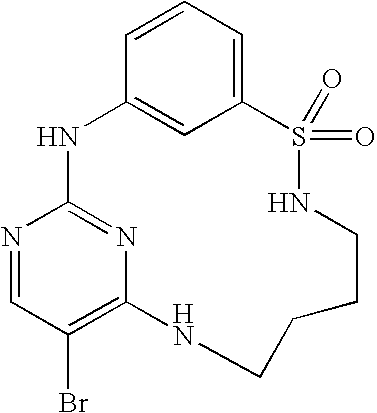
Example No. 14.4 14.5 14.6 Mass 442 (ES) 284 (CI) 398 (ES) Process 1 13 1 Variant 
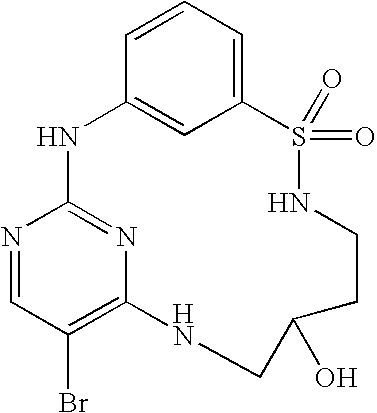
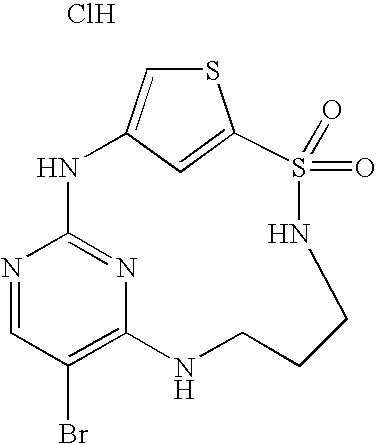
Example No. 14.7 14.8 14.9 Mass 412 (ES) 414 (ES) 390 (ES) Process 1 1 6 Variant 
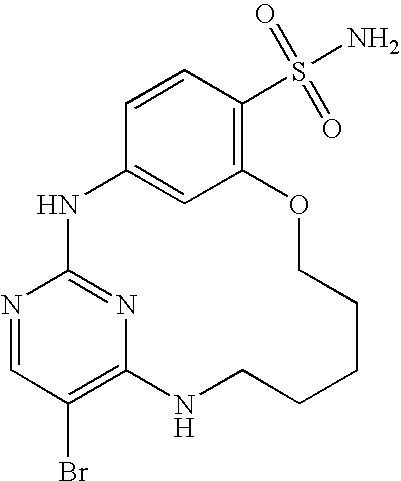

ExampleNo. 14.10 14.11 14.12 Mass 404 (ES) 428 (ES) 400 (ES) Proc. Var. 6 8 8 


Example No. 14.13 14.14 14.15 Mass 418 (ES) 458 (ES) 424 (ES) Process 1 1 1 Variant 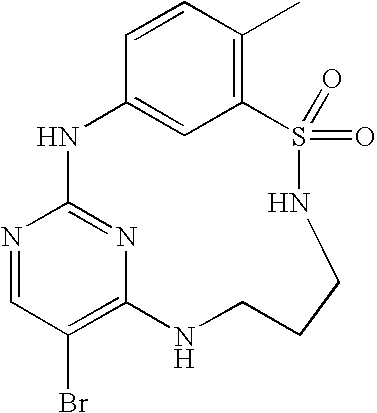

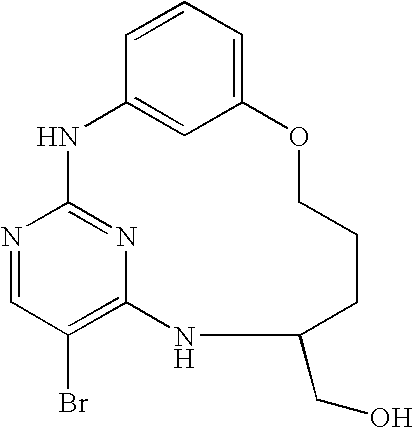
Example No. 14.16 14.17 14.18 Mass 398 (ES) 412 (ES) 365 (ES) Proc. Var. 1 2 1 


Example No. 14.19 14.20 14.21 Mass 402 (ES) 442 (ES) 445 (ES) Proc. Var. 1 1 1 


Example No. 14.22 14.23 14.24 Mass 428 (ES) 428 (ES) 428 (ES) Proc. Var. 1 1 1 


Example No. 14.25 14.26 14.27 Mass 441 (ES) 483 (ES) 430 (ES) Proc. Var. 1 1 8 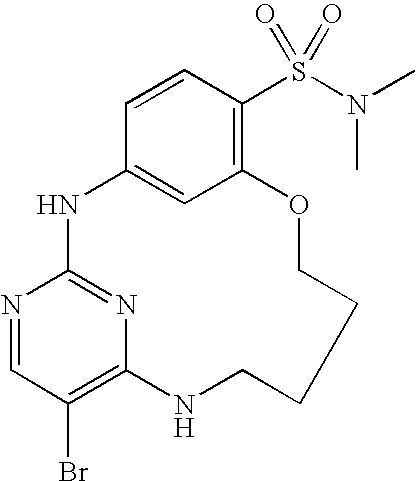
Example No. 14.28 Mass 442 (ES) Proc. Var. 8 - As can be assumed by one skilled in the art, the above-described processes do not describe all possible production methods of the products according to the invention. Related methods are to be obvious to one skilled in the art based on his technical knowledge. In addition, the production processes are not limited to being carried out in this sequence. The chemical transformations and protective groups that are described in this application and that are necessary for the synthesis method are described in the prior art and especially in R. Larock, Comprehensive Organic Transformations, VCH Publishers (1989), T. W. Greene und P. G. M. Wurtz, Protective Groups in Organic Synthesis, John Wiley and Sons (1994) and L. Paquette, ed., Encyclopedia of Reagents for Organic Synthesis, John Wiley and Sons (1995).
- The following examples can be obtained analogously to the previously described process variants or the variants that are obvious to one skilled in the art:


Example 15.0 15.1 15.2 - Additional synthesis requirements relative to the sulfoximine derivatives are described in a) M. Regglin, C. Zur, Synthesis, 2000, 1, 1-64. b) S. L. Huang, D. Swem, Phosphorous and Sulfur, 1976, 1, 309-314. c) S. Oae, K. Harada, K. Tsujihara, N. Furukawa, Int. J. Sulfur Chem., Part A, 2, 1, 49-61. d) S. G. Pyne, Sulfur Reports, 12, 1, 57-93.
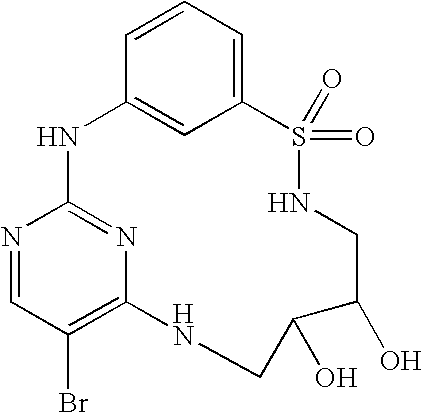
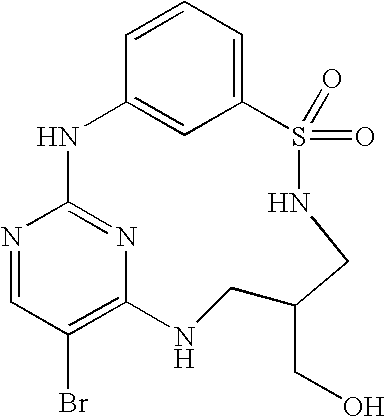
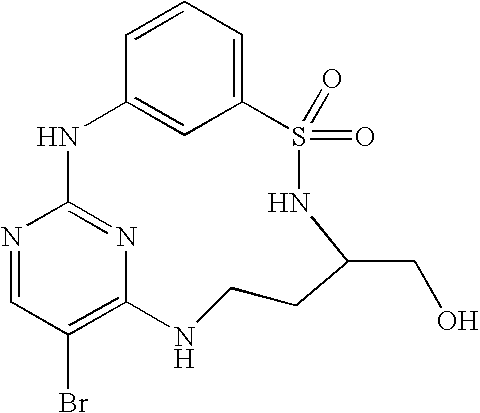
Example No. 15.4 15.5 15.6 
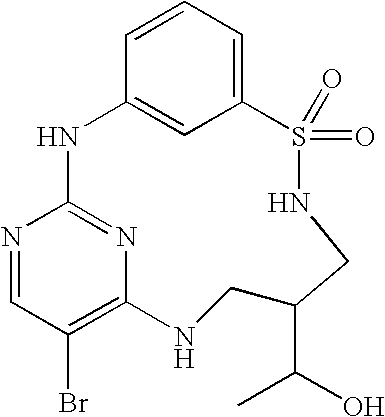
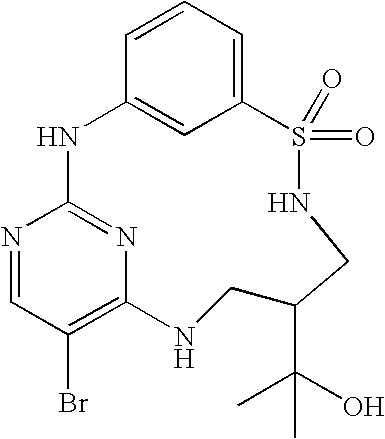
Example No. 15.7 15.8 15.9 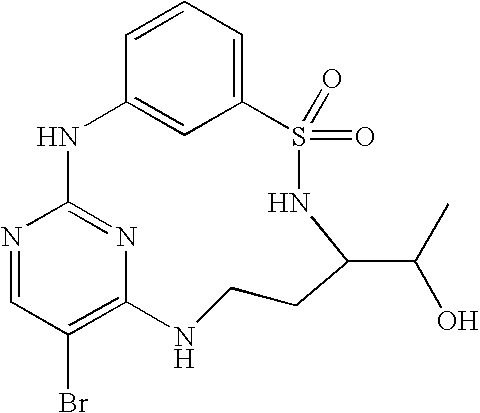


Example No. 15.10 15.11 15.12 


Example No. 15.13 15.14 15.15 
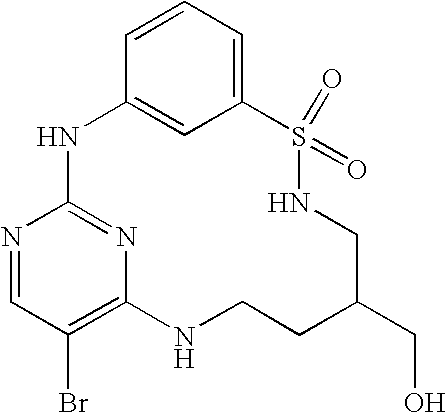

Example No. 15.16 15.17 15.18 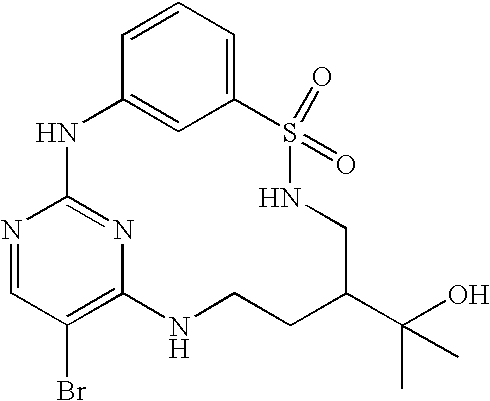


Example No. 15.19 15.20 15.21 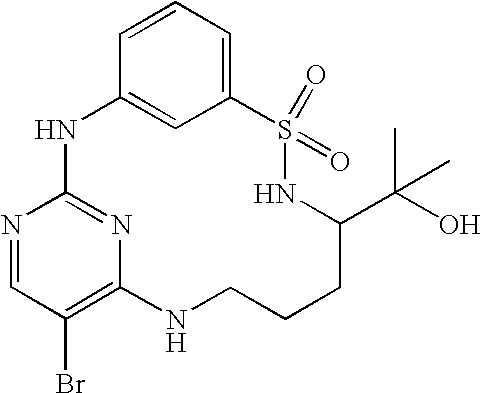
Example No. 15.22 


Example No. 15.23 15.24 15.25 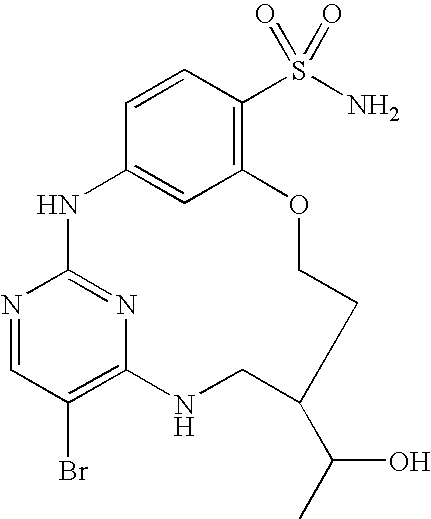
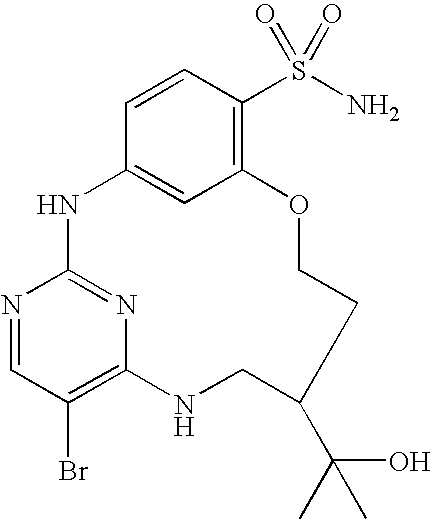

Example No. 15.26 15.27 15.28 

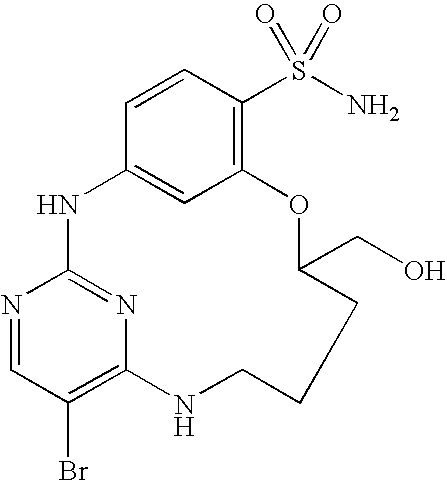
Example No. 15.29 15.30 15.31 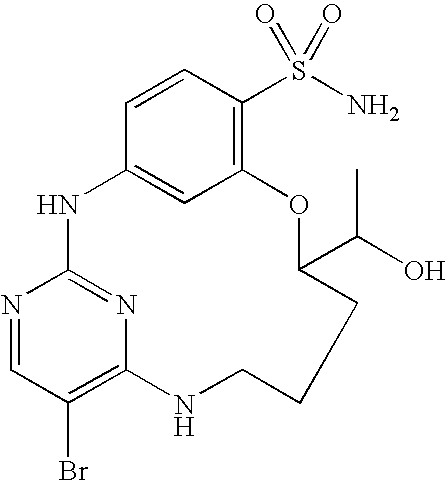
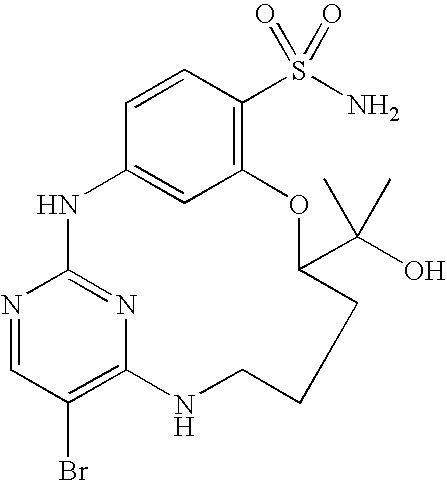
Example No. 15.32 15.33 


Example No. 15.34 15.35 15.36 


Example No. 15.37 15.38 15.39 


Example No. 15.40 15.41 15.42 


Example No. 15.43 15.44 15.45 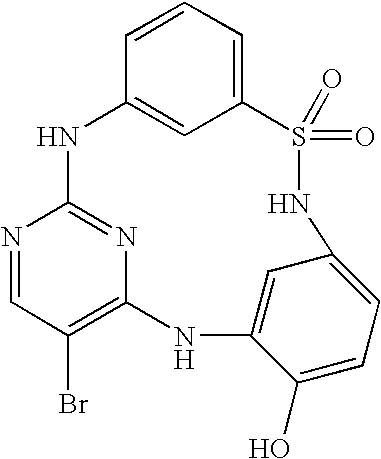


Example No. 15.46 15.47 15.48 
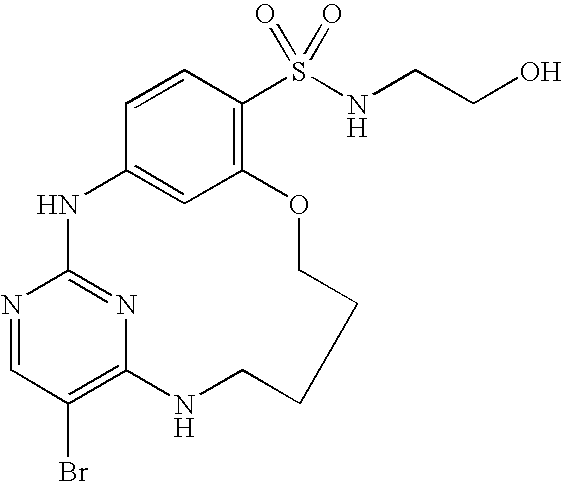

Example No. 15.49 15.50 15.51 


Example No. 15.52 15.53 15.54 
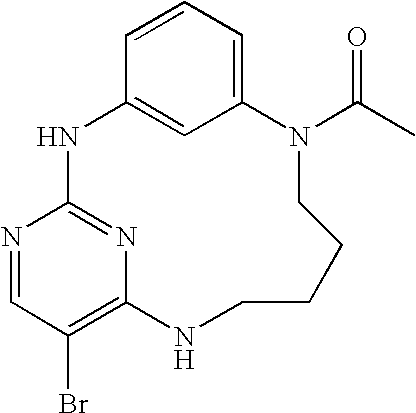

Example No. 15.55 15.56 15.57 


Example No. 15.58 15.59 15.60 


Example No. 15.61 15.62 15.63 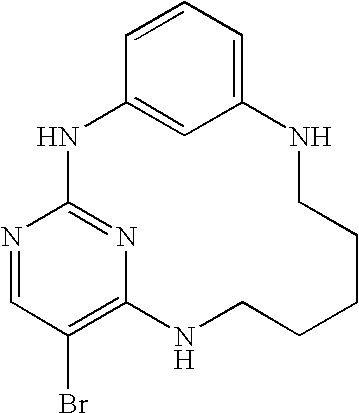


Example No. 15.64 15.65 15.66 
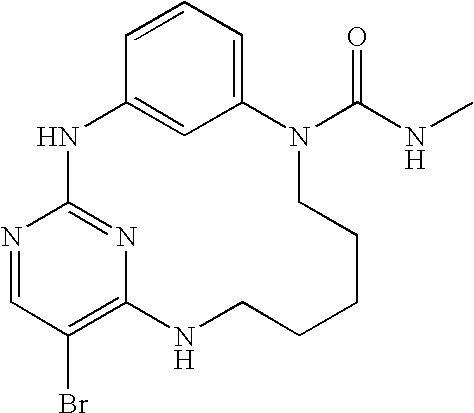
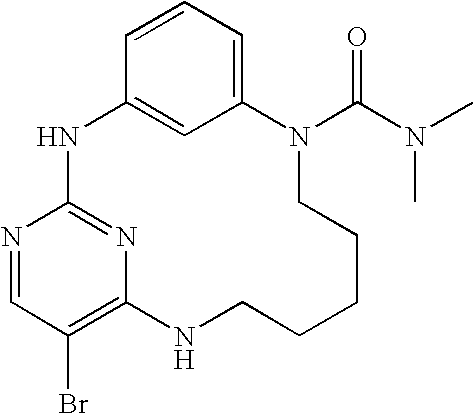
Example No. 15.67 15.68 15.69 


Example No. 15.70 15.71 15.72 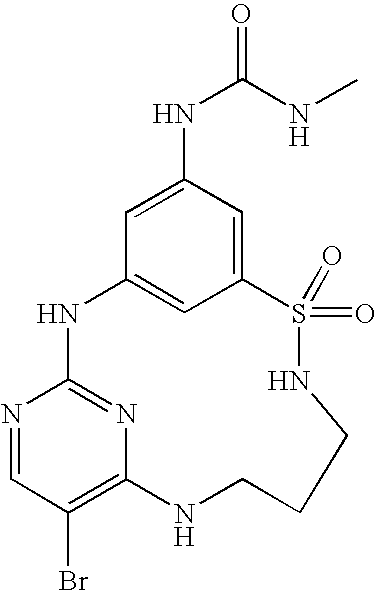

Example No. 15.73 15.74 


Example No. 15.75 15.76 15.77 Other Related W. G. Watson, Yoshida, Bull. Soc. R. Cremlyn, Literature Pestic. Sci., 1996, Sci. Photogr. Jpn., Phosphorus 46, 131-138 1969, 19,41 Sulfur, 1981, 12, 197- 204. 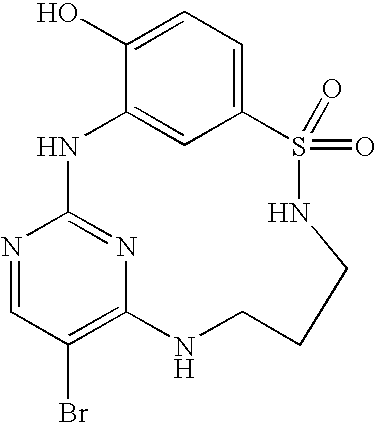
Example No. 15.78 Other Related Katrizky, Synth. Literature Synth. Commun., 1993, 23, 3, 405-417 


Example No. 15.79 15.80 15.81 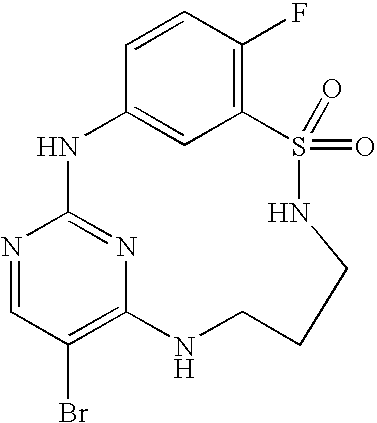

Example No. 15.82 15.83 Other Related A. Courtin, Helv. A. Courtin, Helv. Literature Chim. Acta, 1982, Chim. Acta, 1983, 66, 65, 2, 546-550. 1, 68-75 
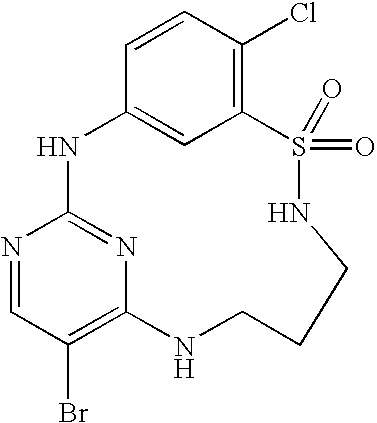
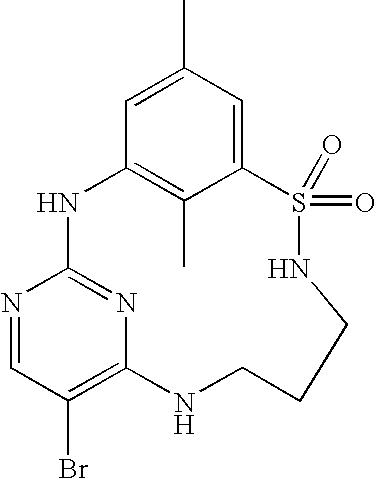
Example No. 15.84 15.85 15.86 Other Related Heertjes, Recl. Fischer, Chem. Ber., Karslake, J. Am. Chem. Literature Trav. Chim. Pays- 1891, 3188 Soc., 1914, 36, 1247 Bas, 1950, 69, 262 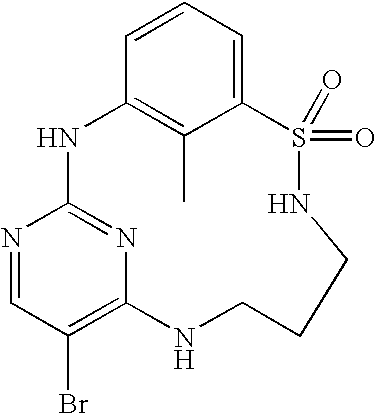

Example No. 15.87 15.88 Other Related Courtin, Chimica, Petrov, J. Pharm. Literature 1975, 29, 168 Pharmacol., 1960, 12 


Example No. 15.89 15.90 15.91 Other Related G. Remsen, Am. G. Remsen, Am. G. Remsen, Am. Chem. Literature Chem. J., 1897, Chem. J., 1897, 1897, J., 1897, 1897, 19, 496. 1897, 19, 496. 19, 496. 

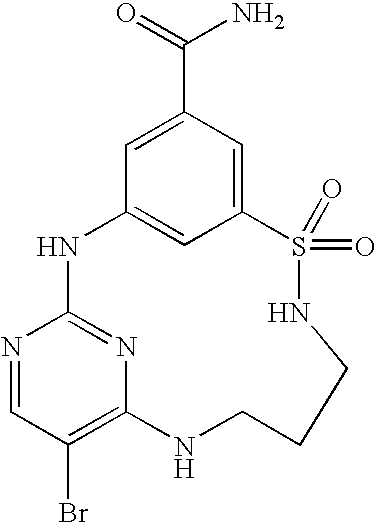
Example No. 15.92 15.93 15.94 Other Related Shah, J. Chem. Shah, J. Chem. Soc.; Shah, J. Chem. Soc.; Literature Soc.; 1933, 1373 1933, 1373 1933, 1373 

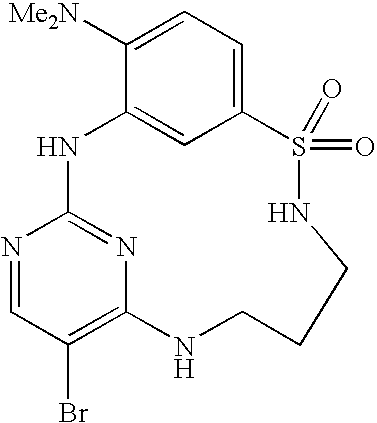
Example No. 15.95 15.96 15.97 Other Related Abramovitch, J. Wilson, J. Am. Chem. Literature Org. Chem. 1977, Soc., 1944, 66, 835 42, 2920 


Example No. 15.98 15.99 16.0 Other Related Bennett, J. Chem. Bennett, J. Chem. Soc., Bennett, J. Chem. Soc., Literature Soc., 1929, 267 1929, 267 1929, 267 


Example No. 16.1 16.2 16.3 Other Related Williams, Williams, Biochem. J., Williams, Biochem. J., Literature Biochem. J., 1941, 35, 61 1941, 35, 61 1941, 35, 61 
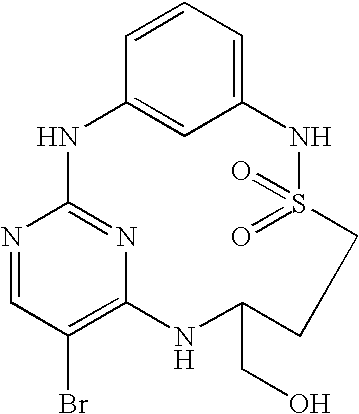
Example No. 16.4 16.5 Other Related Orus, Pharmazie Orus, Pharmazie, 2002, Literature [Pharmaceutics], 57, 8, 515 2002, 57, 8, 515 

Example No. 16.6 16.7 Other Related Strekowski, Bull. Strekowski, Bull. Acad. Literature Acad. Pol. Sci. Ser. Pol. Sci. Ser. Sci. Chim, Sci. Chim, 1976, 24, 1976, 24, 29 29 - Secondary or tertiary alcohol derivatives can be produced from primary alcohols via oxidation/Grignard Reaktion, e.g., analogously to the methods of WO 02/096888, pages 186-191. For oxidation, i.a., the TPAP oxidation is suitable (see S. V. Ley, Synthesis, 1994, 639). In Methoden der Org. Chem. [Methods of Organic Chemistry] (Houben-Weyl), 1973, Vol. 13/2a, p. 49, e.g., B. H. Gilman provides an overview on the Grignard reaction.
- Additional literature, which provides further information on the production of the respective derivatives, is listed as other literature related to the specific examples
- The following examples describe the biological action of the compounds according to the invention without limiting the invention to these examples.
- CDK1/CycB Kinase Assay
- Recombinant CDK1- and CycB-GST fusion proteins, purified from baculovirus-infected insect cells (Sf9), were purchased from ProQinase GmbH, Freiburg. Histone IIIS, which was used as a kinase substrate, is commercially available from the Sigma Company.
- CDK1/CycB (200 ng/mlasuring point) was incubated for 15 minutes at 22° C. in the presence of various concentrations of test substances (0 μm, as well as within the range of 0.0°-100 μm) in assay buffer [50 mmol of tris/HCl, pH 8.0, 10 mmol of MgCl 2, 0.1 mmol of Na ortho-vanadate, 1.0 mmol of dithiothreitol, 0.5 μm of adenosine triphosphate (ATP), 10 μg/mlasuring point of histone IIIS, 0.2 μCi/measuring point of 33P-gamma ATP, 0.05% NP40, 12.5% dimethyl sulfoxide]. The reaction was stopped by adding EDTA solution (250 mmol, pH 8.0, 14 μl/measuring point).
- From each reaction batch, 10 μl was applied to P30 filter strips (Wallac Company), and non-incorporated 33P-ATP was removed by three washing cycles of the filter strips for 10 minutes each in 0.5% phosphoric acid. After the filter strips were dried for 1 hour at 70° C., the filter strips were covered with scintillator strips (MeltiLex™ A, Wallac Company) and baked for one hour at 90° C. The amount of incorporated 33P (substrate phosphorylation) was determined by scintillation measurement in a gamma-radiation measuring device (Wallac).
- CDK2/CycE Kinase Assay
- Recombinant CDK2- and CycE-GST-fusion proteins, purified from baculovirus-infected insect cells (Sf9), were purchased from ProQinase GmbH, Freiburg. Histone IIIS, which was used as a kinase substrate, was purchased from the Sigma Company.
- CDK2/CycE (50 ng/mlasuring point) was incubated for 15 minutes at 22° C. in the presence of various concentrations of test substances (0 μm, as well as within the range of 0.01-100 μm) in assay buffer [50 mmol of tris/HCl, pH 8.0, 10 mmol of MgCl 2, 0.1 mmol of Na ortho-vanadate, 1.0 mmol of dithiothreitol, 0.5 μm of adenosine triphosphate (ATP), 10 μg/mlasuring point of histone 111S, 0.2 μCi/measuring point of 33P-gamma ATP, 0.05% NP40, 12.5% dimethyl sulfoxide]. The reaction was stopped by adding EDTA solution (250 mmol, pH 8.0, 14 μl/measuring point).
- From each reaction batch, 10 μl was applied to P30 filter strips (Wallac Company), and non-incorporated 33P-ATP was removed by subjecting the filter strips to three washing cycles for 10 minutes each in 0.5% phosphoric acid. After the filter strips were dried for one hour at 70° C., the filter strips were covered with scintillator strips (MeltiLex™ A, Wallac Company) and baked for one hour at 90° C. The amount of incorporated 33P (substrate phosphorylation) was determined by scintillation measurement in a gamma-radiation measuring device (Wallac).
- VEGF Rezeptor-2 Kinase Assay
- Recombinant VEGF Receptor tyrosine kinase-2 was purified as GST-fusion protein from baculovirus-infected insect cells (Sf9). Poly-(Glu4Tyr), which was used as a kinase substrate, was purchased from the Sigma Company.
- VEGF Receptor tyrosine kinase (90 ng/mlasuring point) was incubated for 10 minutes at 22° C. in the presence of various concentrations of test substances (0 μmol, as well as within the range of 0.001-30 μM) in 30 μl of assay buffer [40 mmol of Tris/HCl pH 5.5, 10 mmol of MgCl2, 1 mmol of MnCl2, 3 μmol of Na orthovanadate, 1.0 mmol of dithiothreitol, 8 μmol of adenosine trisphosphate (ATP), 27 μg/measuring point of poly-(Glu4Tyr), 0.2 μCi/measuring point of 33P-gamma ATP, 1% dimethyl sulfoxide]. The reaction was stopped by adding EDTA solution (250 mmol, pH 7.0, 10 μl/measuring point).
- From each reaction batch, 10 μl was applied to P30 filter strips (Wallac Company), and non-incorporated 33P-ATP was removed by subjecting the filter strips to three washing cycles for 10 minutes each in 0.5% phosphoric acid. After the filter strips were dried for 1 hour at 70° C., the filter strips were covered with scintillator strips (MeltiLex™ A, Wallac Company) and baked on for 1 hour at 90° C. The amount of incorporated 33P (substrate phosphorylation) was determined by scintillation measurement in a gamma-radiation measuring device (Wallac). The IC50 values are determined from the inhibitor concentration, which is necessary to inhibit the phosphate incorporation to 50% of the uninhibited incorporation after removal of the blank reading (EDTA-stopped reaction).
- Proliferation Assay
- Cultivated human tumor cells (MCF7, hormone-independent human breast cancer cells, relative to ATCC HTB22; NCI-H460, human non-small-cell lung cancer cells, ATCC HTB-177, HCT 116, human colon cancer cells, ATCC CCL-247; DU 145, hormone-independent human prostate cancer cells, ATCC HTB-81; MaTu-MDR, hormone-independent, multiple pharmaceutical agent-resistant human breast cancer cells, EPO-GmbH, Berlin) were flattened out at a density of about 5000 cells/measuring point, depending on growth rates of the respective cells in a 96-well multititer plate in 200 μl of the corresponding growth medium. After 24 hours, the cells of one plate (zero-point plate) were colored with crystal violet (see below), while the medium of the other plates was replaced by fresh culture medium (200 μl), to which the test substances were added at various concentrations (0 μmol, as well as in the range of 0.01-30 μmol; the final concentration of the solvent dimethyl sulfoxide was 0.5%). The cells were incubated for 4 days in the presence of test substances. The cell proliferation was determined by coloring the cells with crystal violet: the cells were fixed by adding 20 μl/measuring point of an 11% glutaric aldehyde solution for 15 minutes at room temperature. After three washing cycles of the fixed cells with water, the plates were dried at room temperature. The cells were colored by adding 100 μl/measuring point of a 0.1% crystal violet solution (pH was set at 3 by adding acetic acid). After three washing cycles of the colored cells with water, the plates were dried at room temperature. The dye was dissolved by adding 100 μl/measuring point of a 10% acetic acid solution. The extinction was determined by photometry at a wavelength of 595 nm. The change of cell growth, in percent, was calculated by standardization of the measured values to the extinction values of the zero-point plate (=0%) and the extinction of the untreated (0 μm) cells (=100%).
- The results from the examples are indicated in the following tables.
TABLE I CDK2/CycE CDK1/CycB VEGF-R2 MCF7 Example No. IC50 [nM] IC50 [nM] IC50 [nM] IC50 [μM] 1.0 420 200 1.1 1.1 140 20 40 0.2 1.2 510 40 2.6 1.3 23 28 <10 1.0 1.3 (+) Enantiomer 23 69 0.9 1.4 11 0.4 1.5 28 69 0.9 3.0 160 50 89 1.6 5.0 300 8.0 130 80 140 1.3 10.0 120 360 6 14.4 250 1700 4.0 14.15 130 1500 1.3 14.6 320 90 0.7 14.8 200 14.10 65 190 1.9 14.11 2400 200 0.75 14.16 4400 300 >10 14.18 30 80 370 2.1 - From the results of the table, it is clearly evident that the macrocyclic pyrimidines according to the invention are distinguished as CDK- and VEGF-receptor inhibitors or CDK1- or CDK2-inhibitors or as VEGF-receptor inhibitors. The activity compared to CDK1 and/or CDK2 and/or VEGF explains, i.a., the cellular action of the substances. Thus, the macrocyclic compounds are clearly superior to the previously known compounds.
TABLE II Inhibition IC50 [nM] Proliferation IC50 [μM] Example No. CDK2/CycE MCF7 H460 HCT116 DU145 MaTu-ADR 1.0 420 1.1 1.8 1.3 2.0 0.7 1.1 140 0.2 0.3 0.2 2.2 0.12 1.3 23 1.0 1.7 0.9 2.9 2.8 1.4 0.4 0.2 <0.1 0.7 0.1 1.5 0.9 0.6 0.4 1.3 0.6 7.1 2400 4 8.0 130 1.3 0.5 0.4 0.5 0.4 13.0 A 7000 30 13.0 B >10000 14.2 5000 14.4 2000 14.6 320 0.7 0.7 0.5 1.7 0.3 14.10 0.3 0.1 0.1 0.4 14.11 2400 0.75 0.9 0.7 0.9 1.3 14.15 1500 1.3 1.2 1.0 1.2 1.3 1.3 (+)Enantiomer 23 0.9 2.1 1.4 4 4 - Without further elaboration, it is believed that one skilled in the art can, using the preceding description, utilize the present invention to its fullest extent. The preceding preferred specific embodiments are, therefore, to be construed as merely illustrative, and not limitative of the remainder of the disclosure in any way whatsoever.
- In the foregoing and in the examples, all temperatures are set forth uncorrected in degrees Celsius, and all parts and percentages are by weight, unless otherwise indicated.
- The entire disclosure[s] of all applications, patents, and publications, cited herein and of corresponding German Application No. 10239042.8, filed Aug. 21, 2002, and U.S. Provisional Application Serial No. 60/413,444, filed Sep. 26, 2003, are incorporated by reference herein.
- The preceding examples can be repeated with similar success by substituting the generically or specifically described reactants and/or operating conditions of this invention for those used in the preceding examples.
- From the foregoing description, one skilled in the art can easily ascertain the essential characteristics of this invention, and without departing from the spirit and scope thereof, can make various changes and modifications of the invention to adapt it to various usages and conditions.
Claims (23)
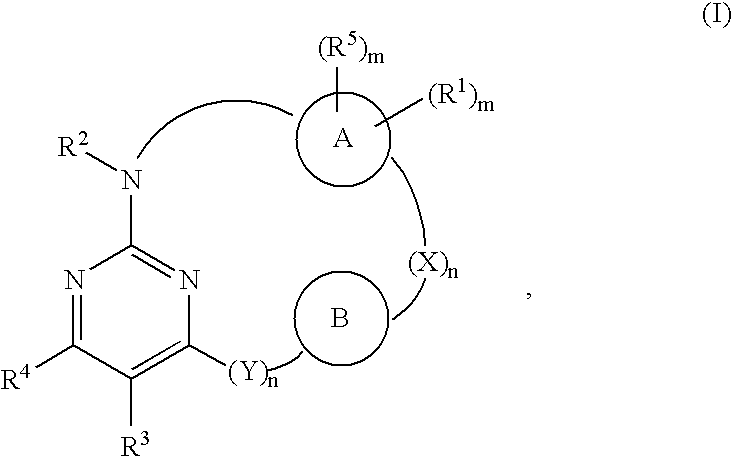
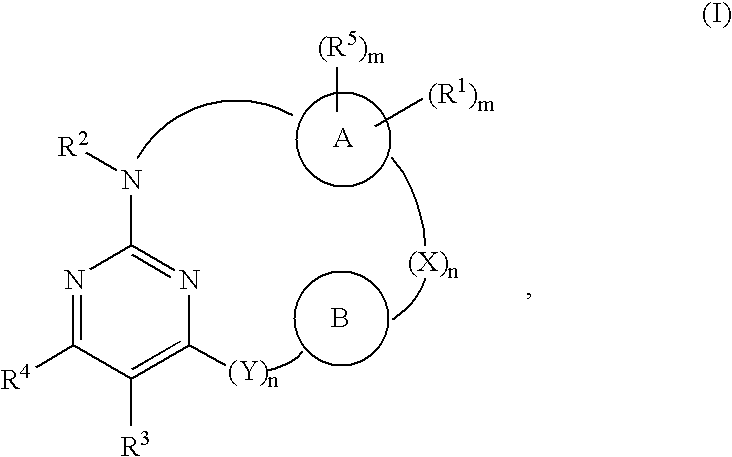
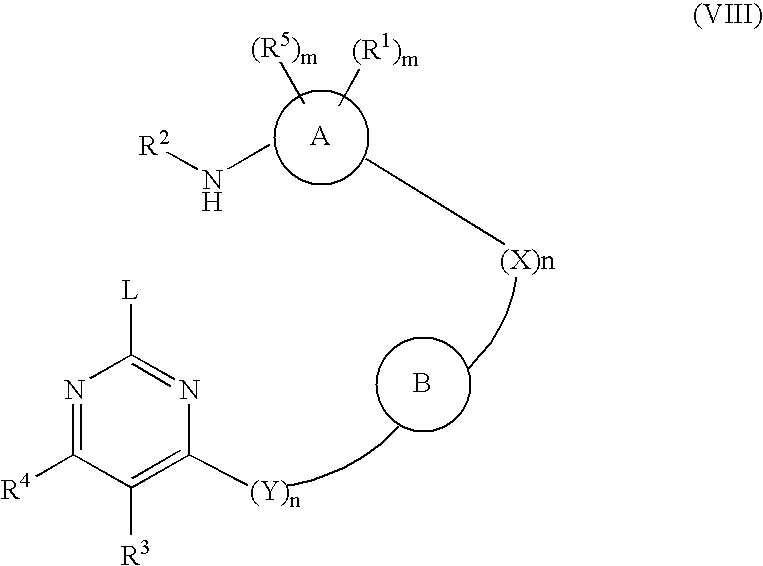
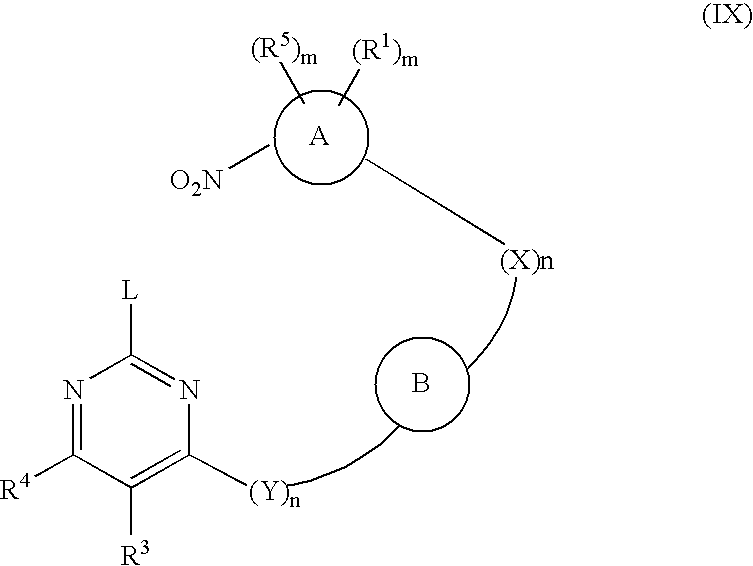


Priority Applications (1)
| Application Number | Priority Date | Filing Date | Title |
|---|---|---|---|
| US10/644,076 US7312225B2 (en) | 2002-08-21 | 2003-08-20 | Macrocyclic pyrimidines, their production and use as pharmaceutical agents |
Applications Claiming Priority (4)
| Application Number | Priority Date | Filing Date | Title |
|---|---|---|---|
| DE10239042.8 | 2002-08-21 | ||
| DE10239042A DE10239042A1 (en) | 2002-08-21 | 2002-08-21 | New fused macrocyclic pyrimidine derivatives, useful as e.g. cyclin-dependent kinase inhibitors for treating e.g. cancer, autoimmune, cardiovascular or neurodegenerative diseases or viral infections |
| US41344402P | 2002-09-26 | 2002-09-26 | |
| US10/644,076 US7312225B2 (en) | 2002-08-21 | 2003-08-20 | Macrocyclic pyrimidines, their production and use as pharmaceutical agents |
Publications (2)
| Publication Number | Publication Date |
|---|---|
| US20040209895A1 true US20040209895A1 (en) | 2004-10-21 |
| US7312225B2 US7312225B2 (en) | 2007-12-25 |
Family
ID=31197382
Family Applications (1)
| Application Number | Title | Priority Date | Filing Date |
|---|---|---|---|
| US10/644,076 Expired - Fee Related US7312225B2 (en) | 2002-08-21 | 2003-08-20 | Macrocyclic pyrimidines, their production and use as pharmaceutical agents |
Country Status (24)
| Country | Link |
|---|---|
| US (1) | US7312225B2 (en) |
| EP (1) | EP1530574B1 (en) |
| JP (1) | JP2006501271A (en) |
| KR (1) | KR20050058360A (en) |
| CN (1) | CN100357295C (en) |
| AT (1) | ATE346073T1 (en) |
| AU (1) | AU2003250212A1 (en) |
| BR (1) | BR0312874A (en) |
| CA (1) | CA2492319A1 (en) |
| DE (2) | DE10239042A1 (en) |
| DK (1) | DK1530574T3 (en) |
| EA (1) | EA200500303A1 (en) |
| EC (1) | ECSP055690A (en) |
| ES (1) | ES2278222T3 (en) |
| HR (1) | HRP20050240A2 (en) |
| IL (1) | IL165913A0 (en) |
| IS (1) | IS7762A (en) |
| MX (1) | MXPA05001526A (en) |
| NO (1) | NO20051448D0 (en) |
| PL (1) | PL374686A1 (en) |
| PT (1) | PT1530574E (en) |
| RS (1) | RS20050162A (en) |
| WO (1) | WO2004026881A1 (en) |
| ZA (1) | ZA200502269B (en) |
Cited By (44)
| Publication number | Priority date | Publication date | Assignee | Title |
|---|---|---|---|---|
| US20060194823A1 (en) * | 2004-12-22 | 2006-08-31 | Georg Kettschau | Sulfonamido-macrocycles as Tie2 inhibitors and the salts thereof, a pharmaceutical composition comprising these compounds, the method of preparing and the use thereof |
| US20060252782A1 (en) * | 2005-04-08 | 2006-11-09 | Ulrich Luecking | Sulfoximine-macrocycle compounds and salts thereof, pharmaceutical compositions comprising said compounds, methods of preparing same and uses of same |
| US20070191393A1 (en) * | 2006-01-03 | 2007-08-16 | Ulrich Lucking | Macrocyclic anilinopyrimidines with substituted sulphoximine as selective inhibitors of cell cycle kinases |
| US20080039482A1 (en) * | 2006-06-21 | 2008-02-14 | Ingo Hartung | Sulfonamido-macrocycles as tie2 inhibitors and salts thereof, pharmaceutical compositions comprising same, methods of preparing same and uses of same |
| US20090005373A1 (en) * | 2006-06-21 | 2009-01-01 | Ingo Hartung | Substituted sulfonamido-macrocycles as tie2 inhibitors and salts thereof, pharmaceutical compositions comprising same, methods of preparing same and uses of same |
| US20090075999A1 (en) * | 2005-11-16 | 2009-03-19 | S*Bio Pte Ltd. | Oxygen linked pyrimidine derivatives |
| US20090286778A1 (en) * | 2008-04-24 | 2009-11-19 | Incyte Corporation | Macrocyclic compounds and their use as kinase inhibitors |
| US20100222574A1 (en) * | 2005-06-30 | 2010-09-02 | Frederik Jan Rita Rombouts | Cyclic anilino - pyridinotriazines |
| US20100256138A1 (en) * | 2003-09-22 | 2010-10-07 | S*Bio Pte Ltd. | Benzimidazole derivatives: preparation and pharmaceutical applications |
| WO2012061408A3 (en) * | 2010-11-02 | 2012-06-21 | Rigel Pharmaceuticals. Inc. | Method for making macrocycles |
| WO2015155197A1 (en) * | 2014-04-11 | 2015-10-15 | Bayer Pharma Aktiengesellschaft | Novel macrocyclic compounds |
| EP2925752A4 (en) * | 2012-11-27 | 2016-06-01 | Univ North Carolina | PYRIMIDINE-BASED COMPOUNDS FOR USE IN THE TREATMENT OF CANCER |
| WO2016149031A1 (en) * | 2015-03-18 | 2016-09-22 | Newave Pharmaceutical Llc | Covalent inhibitors of cdk-7 |
| US9555030B2 (en) | 2014-04-11 | 2017-01-31 | The University Of North Carolina At Chapel Hill | Therapeutic uses of selected pyrazolopyrimidine compounds with anti-Mer tyrosine kinase activity |
| US9562047B2 (en) | 2012-10-17 | 2017-02-07 | The University Of North Carolina At Chapel Hill | Pyrazolopyrimidine compounds for the treatment of cancer |
| WO2017060167A1 (en) * | 2015-10-08 | 2017-04-13 | Bayer Pharma Aktiengesellschaft | Novel modified macrocyclic compounds |
| US9650340B2 (en) | 2012-11-15 | 2017-05-16 | Bayer Pharma Aktiengesellschaft | 5-fluoro-N-(pyridin-2-yl)pyridin-2-amine derivatives containing a sulfoximine group |
| US9650361B2 (en) | 2012-11-15 | 2017-05-16 | Bayer Pharam Aktiengesellschaft | N-(pyridin-2-yl)pyrimidin-4-amine derivatives containing a sulfoximine group |
| WO2017060322A3 (en) * | 2015-10-10 | 2017-05-18 | Bayer Pharma Aktiengesellschaft | Ptefb-inhibitor-adc |
| US9670161B2 (en) | 2012-10-18 | 2017-06-06 | Bayer Pharma Aktiengesellschaft | 5-fluoro-N-(pyridin-2-yl)pyridin-2-amine derivatives containing a sulfone group |
| US9669034B2 (en) | 2011-05-24 | 2017-06-06 | Bayer Intellectual Property Gmbh | 4-aryl-N-phenyl-1,3,5-triazin-2-amines containing a sulfoximine group |
| US9708293B2 (en) | 2012-10-18 | 2017-07-18 | Bayer Pharma Aktiengesellschaft | N-(pyridin-2-yl)pyrimidin-4-amine derivatives containing a sulfone group |
| US9744172B2 (en) | 2010-05-19 | 2017-08-29 | The University Of North Carolina At Chapel Hill | Pyrazolopyrimidine compounds for the treatment of cancer |
| US9770445B2 (en) | 2013-07-04 | 2017-09-26 | Bayer Pharma Aktiengesellschaft | Sulfoximine substituted 5-fluoro-N-(pyridin-2-yl)pyridin-2-amine derivatives and their use as CDK9 kinase inhibitors |
| US9790189B2 (en) | 2014-04-01 | 2017-10-17 | Bayer Pharma Aktiengesellschaft | Disubstituted 5-fluoro pyrimidine derivatives containing a sulfondiimine group |
| US9795606B2 (en) | 2011-10-03 | 2017-10-24 | The University Of North Carolina At Chapel Hill | Pyrrolopyrimidine compounds for the treatment of cancer |
| US9856242B2 (en) | 2014-03-13 | 2018-01-02 | Bayer Pharma Aktiengesellscaft | 5-fluoro-N-(pyridin-2-yl)pyridin-2-amine derivatives containing a sulfone group |
| US9884849B2 (en) | 2014-10-16 | 2018-02-06 | Bayer Pharma Aktiengesellschaft | Fluorinated benzofuranyl-pyrimidine derivatives containing a sulfoximine group |
| US9902716B2 (en) | 2014-10-16 | 2018-02-27 | Bayer Pharma Aktiengesellschaft | Fluorinated benzofuranyl-pyrimidine derivatives containing a sulfone group |
| WO2018177889A1 (en) * | 2017-03-28 | 2018-10-04 | Bayer Aktiengesellschaft | Novel ptefb inhibiting macrocyclic compounds |
| USRE47334E1 (en) | 2012-06-08 | 2019-04-02 | Gilead Sciences, Inc. | Macrocyclic inhibitors of flaviviridae viruses |
| US10246486B2 (en) | 2012-06-08 | 2019-04-02 | Gilead Sciences, Inc. | Macrocyclic inhibitors of flaviviridae viruses |
| WO2019079357A1 (en) * | 2017-10-17 | 2019-04-25 | Silverback Therapeutics, Inc. | TNIK MODULATORS, CONJUGATES AND USES THEREOF |
| US10472392B2 (en) | 2012-06-08 | 2019-11-12 | Gilead Sciences, Inc. | Macrocyclic inhibitors of flaviviridae viruses |
| US10517876B2 (en) | 2005-11-16 | 2019-12-31 | Cti Biopharma Corp. | Oxygen linked pyrimidine derivatives |
| US10626092B2 (en) | 2016-05-02 | 2020-04-21 | Mei Pharma, Inc. | Polymorphic forms of 3-[(2-butyl-1-(2-diethylamino-ethyl)-1H-benzoimidazol-5-yl]-N-hydroxy-acrylamide and uses thereof |
| US10709708B2 (en) | 2016-03-17 | 2020-07-14 | The University Of North Carolina At Chapel Hill | Method of treating cancer with a combination of MER tyrosine kinase inhibitor and an epidermal growth factor receptor (EGFR) inhibitor |
| US11254690B2 (en) | 2017-03-28 | 2022-02-22 | Bayer Pharma Aktiengesellschaft | PTEFb inhibiting macrocyclic compounds |
| KR20230019833A (en) * | 2020-05-05 | 2023-02-09 | 뉴베일런트, 아이엔씨. | Heteroaromatic macrocyclic ether chemotherapeutic agent |
| US11701347B2 (en) | 2018-02-13 | 2023-07-18 | Bayer Aktiengesellschaft | Use of 5-fluoro-4-(4-fluoro-2-methoxyphenyl)-N-{4-[(S-methylsulfonimidoyl)methyl]pyridin-2-yl}pyridin-2-amine for treating diffuse large B-cell lymphoma |
| WO2023196714A3 (en) * | 2022-02-23 | 2024-04-11 | President And Fellows Of Harvard College | Inhibitors of ddr1 and ddr2 for the treatment of arthritis |
| US12084458B2 (en) | 2021-02-19 | 2024-09-10 | Sudo Biosciences Limited | Substituted pyridines, pyridazines, and pyrimidines as TYK2 inhibitors |
| US12122785B2 (en) | 2021-02-19 | 2024-10-22 | Sudo Biosciences Limited | Substituted pyridines, pyridazines, pyrimidines, and 1,2,4-triazines as TYK2 inhibitors |
| US12202893B2 (en) | 2019-10-04 | 2025-01-21 | Tae Life Sciences, Llc | Antibody compositions comprising Fc mutations and site-specific conjugation properties for use in treating cancer, immunological disorders, and methods thereof |
Families Citing this family (87)
| Publication number | Priority date | Publication date | Assignee | Title |
|---|---|---|---|---|
| ES2338789T3 (en) | 2003-06-18 | 2010-05-12 | Tranzyme Pharma Inc. | MACROCICLIC ANTAGONISTS OF THE MOTILINA RECEPTOR. |
| US7163939B2 (en) | 2003-11-05 | 2007-01-16 | Abbott Laboratories | Macrocyclic kinase inhibitors |
| US20050096324A1 (en) * | 2003-11-05 | 2005-05-05 | Zhi-Fu Tao | Macrocyclic kinase inhibitors |
| NZ547794A (en) | 2003-12-18 | 2009-11-27 | Janssen Pharmaceutica Nv | Pyrido- and pyrimidopyrimidine derivatives as anti-proliferative agents |
| JO3088B1 (en) * | 2004-12-08 | 2017-03-15 | Janssen Pharmaceutica Nv | Macrocyclic Quinazoline derivatives and their use as MTKI |
| NI200700147A (en) | 2004-12-08 | 2019-05-10 | Janssen Pharmaceutica Nv | QUINAZOLINE DERIVATIVES KINE INHIBITORS TARGETING MULTIP |
| MY169441A (en) | 2004-12-08 | 2019-04-11 | Janssen Pharmaceutica Nv | 2,4, (4,6) pyrimidine derivatives |
| EP1674469A1 (en) * | 2004-12-22 | 2006-06-28 | Schering Aktiengesellschaft | Sulfonamido-macrocycles as Tie2 inhibitors |
| EP1674470A1 (en) * | 2004-12-22 | 2006-06-28 | Schering Aktiengesellschaft | Sulfonamido-macrocycles as Tie2 inhibitors |
| EP1928437A2 (en) | 2005-08-26 | 2008-06-11 | Braincells, Inc. | Neurogenesis by muscarinic receptor modulation |
| EP2258359A3 (en) | 2005-08-26 | 2011-04-06 | Braincells, Inc. | Neurogenesis by muscarinic receptor modulation with sabcomelin |
| JP2009512711A (en) | 2005-10-21 | 2009-03-26 | ブレインセルス,インコーポレイティド | Regulation of neurogenesis by PDE inhibition |
| WO2007053596A1 (en) | 2005-10-31 | 2007-05-10 | Braincells, Inc. | Gaba receptor mediated modulation of neurogenesis |
| US20100216734A1 (en) | 2006-03-08 | 2010-08-26 | Braincells, Inc. | Modulation of neurogenesis by nootropic agents |
| WO2007134136A2 (en) | 2006-05-09 | 2007-11-22 | Braincells, Inc. | Neurogenesis by modulating angiotensin |
| CA2654583C (en) | 2006-07-13 | 2015-11-24 | Janssen Pharmaceutica N.V. | Mtki quinazoline derivatives |
| US20100184806A1 (en) | 2006-09-19 | 2010-07-22 | Braincells, Inc. | Modulation of neurogenesis by ppar agents |
| JP5536647B2 (en) | 2007-07-27 | 2014-07-02 | ジヤンセン・フアーマシユーチカ・ナームローゼ・フエンノートシヤツプ | Pyrrolopyrimidine |
| US20090048282A1 (en) * | 2007-08-14 | 2009-02-19 | Wyeth | Pyrimidine sulfonamide analogs and their use as agonists of the wnt-beta-catenin cellular messaging system |
| DK2283024T3 (en) * | 2008-03-10 | 2013-08-05 | Janssen Pharmaceutica Nv | 4-aryl-2-aniline pyrimidines as PLK kinase inhibitors |
| EA201100450A1 (en) * | 2008-09-08 | 2011-10-31 | Мерк Патент Гмбх | MACROCYCLIC PYRAMIDINES AS PROTEINKINASE INHIBITORS |
| WO2010085597A1 (en) | 2009-01-23 | 2010-07-29 | Incyte Corporation | Macrocyclic compounds and their use as kinase inhibitors |
| WO2010099217A1 (en) | 2009-02-25 | 2010-09-02 | Braincells, Inc. | Modulation of neurogenesis using d-cycloserine combinations |
| US8445490B2 (en) | 2009-10-14 | 2013-05-21 | Bristol-Myers Squibb Company | Compounds for the treatment of hepatitis C |
| MX2012004032A (en) | 2009-10-14 | 2012-05-08 | Bristol Myers Squibb Co | Compounds for the treatment of hepatitis c. |
| EP2519517B1 (en) | 2009-12-29 | 2015-03-25 | Dana-Farber Cancer Institute, Inc. | Type ii raf kinase inhibitors |
| PH12012501361A1 (en) | 2009-12-31 | 2012-10-22 | Centro Nac De Investigaciones Oncologicas Cnio | Tricyclic compounds for use as kinase inhibitors |
| US8741884B2 (en) | 2010-05-04 | 2014-06-03 | Bristol-Myers Squibb Company | Compounds for the treatment of hepatitis C |
| US8765944B2 (en) | 2010-08-19 | 2014-07-01 | Bristol-Myers Squibb Company | Compounds for the treatment of hepatitis C |
| PT2646448T (en) * | 2010-11-29 | 2017-10-04 | Osi Pharmaceuticals Llc | Macrocyclic kinase inhibitors |
| WO2012141704A1 (en) * | 2011-04-14 | 2012-10-18 | Bristol-Myers Squibb Company | Compounds for the treatment of hepatitis c |
| US8933066B2 (en) * | 2011-04-14 | 2015-01-13 | Bristol-Myers Squibb Company | Compounds for the treatment of hepatitis C |
| AU2012257513B2 (en) * | 2011-05-19 | 2017-05-11 | Fundación Del Sector Público Estatal Centro Nacional De Investigaciones Oncológicas Carlos III (F.S.P. CNIO) | Macrocyclic compounds as protein kinase inhibitors |
| WO2013001310A1 (en) * | 2011-06-30 | 2013-01-03 | Centro Nacional De Investigaciones Oncológicas (Cnio) | Macrocyclic compounds and their use as cdk8 inhibitors |
| US8629150B2 (en) | 2011-09-28 | 2014-01-14 | Bristol-Myers Squibb Company | Compounds for the treatment of hepatitis C |
| CN104023728B (en) * | 2011-09-30 | 2016-11-02 | 益普生制药股份有限公司 | Macrocyclic LRRK2 Kinase Inhibitors |
| US8697706B2 (en) | 2011-10-14 | 2014-04-15 | Bristol-Myers Squibb Company | Compounds for the treatment of hepatitis C |
| US9382239B2 (en) | 2011-11-17 | 2016-07-05 | Dana-Farber Cancer Institute, Inc. | Inhibitors of c-Jun-N-terminal kinase (JNK) |
| US8916702B2 (en) | 2012-02-06 | 2014-12-23 | Bristol-Myers Squibb Company | Compounds for the treatment of hepatitis C |
| CA2863892C (en) | 2012-03-06 | 2016-08-30 | Pfizer Inc. | Macrocyclic derivatives for the treatment of proliferative diseases |
| GB201204384D0 (en) | 2012-03-13 | 2012-04-25 | Univ Dundee | Anti-flammatory agents |
| WO2013177168A1 (en) | 2012-05-22 | 2013-11-28 | The University Of North Carolina At Chapel Hill | Pyrimidine compounds for the treatment of cancer |
| EP2909194A1 (en) | 2012-10-18 | 2015-08-26 | Dana-Farber Cancer Institute, Inc. | Inhibitors of cyclin-dependent kinase 7 (cdk7) |
| EP2917222A1 (en) | 2012-10-18 | 2015-09-16 | Bristol-Myers Squibb Company | Compounds for the treatment of hepatitis c |
| WO2014063061A1 (en) | 2012-10-19 | 2014-04-24 | Dana-Farber Cancer Institute, Inc. | Hydrophobically tagged small molecules as inducers of protein degradation |
| US10000483B2 (en) | 2012-10-19 | 2018-06-19 | Dana-Farber Cancer Institute, Inc. | Bone marrow on X chromosome kinase (BMX) inhibitors and uses thereof |
| WO2014123894A1 (en) | 2013-02-07 | 2014-08-14 | Bristol-Myers Squibb Company | Macrocyclic compounds as hcv entry inhibitors |
| EP2953953B1 (en) | 2013-02-07 | 2017-11-15 | Bristol-Myers Squibb Company | Macrocyclic molecules as hcv entry inhibitors |
| EP2964655B1 (en) | 2013-03-07 | 2018-04-25 | Bristol-Myers Squibb Company | Macrocyclic compounds for the treatment of hepatitis c |
| RU2534903C1 (en) * | 2013-07-15 | 2014-12-10 | Федеральное государственное бюджетное учреждение науки Институт органической и физической химии им. А.Е. Арбузова Казанского научного центра Российской академии наук | Macrocyclic alkylammonium derivatives of 6-methyluracil having anticholinesterase activity |
| AU2014337044A1 (en) | 2013-10-18 | 2016-05-05 | Dana-Farber Cancer Institute, Inc. | Polycyclic inhibitors of cyclin-dependent kinase 7 (CDK7) |
| WO2015058126A1 (en) | 2013-10-18 | 2015-04-23 | Syros Pharmaceuticals, Inc. | Heteroaromatic compounds useful for the treatment of prolferative diseases |
| US10017477B2 (en) | 2014-04-23 | 2018-07-10 | Dana-Farber Cancer Institute, Inc. | Janus kinase inhibitors and uses thereof |
| WO2015164604A1 (en) | 2014-04-23 | 2015-10-29 | Dana-Farber Cancer Institute, Inc. | Hydrophobically tagged janus kinase inhibitors and uses thereof |
| US10457691B2 (en) | 2014-07-21 | 2019-10-29 | Dana-Farber Cancer Institute, Inc. | Macrocyclic kinase inhibitors and uses thereof |
| US10287268B2 (en) | 2014-07-21 | 2019-05-14 | Dana-Farber Cancer Institute, Inc. | Imidazolyl kinase inhibitors and uses thereof |
| EP3177295A4 (en) * | 2014-08-08 | 2018-06-13 | Dana Farber Cancer Institute, Inc. | Uses of salt-inducible kinase (sik) inhibitors |
| WO2016105528A2 (en) | 2014-12-23 | 2016-06-30 | Dana-Farber Cancer Institute, Inc. | Inhibitors of cyclin-dependent kinase 7 (cdk7) |
| HK1246645A1 (en) | 2015-03-27 | 2018-09-14 | 达纳-法伯癌症研究所股份有限公司 | Inhibitors of cyclin-dependent kinases |
| US10702527B2 (en) | 2015-06-12 | 2020-07-07 | Dana-Farber Cancer Institute, Inc. | Combination therapy of transcription inhibitors and kinase inhibitors |
| JP7028766B2 (en) | 2015-09-09 | 2022-03-02 | ダナ-ファーバー キャンサー インスティテュート, インコーポレイテッド | Inhibitor of cyclin-dependent kinase |
| US10717749B2 (en) * | 2015-09-29 | 2020-07-21 | Bayer Pharma Aktiengesellschaft | Macrocyclic sulfondiimine compounds |
| CN110225914A (en) | 2016-07-05 | 2019-09-10 | 布罗德研究所股份有限公司 | Bicyclic urea kinase inhibitor and application thereof |
| WO2018053373A1 (en) | 2016-09-16 | 2018-03-22 | The General Hospital Corporation | Uses of satl-inducible kinase (sik) inhibitors for treating osteoporosis |
| BR112019017741A2 (en) | 2017-02-28 | 2020-04-07 | Dana Farber Cancer Inst Inc | uses of pyrimidopyrimidinones as sik inhibitors |
| UY37808A (en) * | 2017-07-14 | 2019-02-28 | Glaxosmithkline Ip Dev Ltd | NEW COMPOUNDS THAT INHIBIT THE KINASE ACTIVITY OF THE LRRK2 |
| US12187701B2 (en) | 2018-06-25 | 2025-01-07 | Dana-Farber Cancer Institute, Inc. | Taire family kinase inhibitors and uses thereof |
| CA3124422A1 (en) | 2018-12-28 | 2020-07-02 | Dana-Farber Cancer Institute, Inc. | Inhibitors of cyclin-dependent kinase 7 and uses thereof |
| CN109970765B (en) * | 2019-02-21 | 2020-08-11 | 中国科学院化学研究所 | Antitumor compound |
| CN110396065A (en) * | 2019-06-25 | 2019-11-01 | 南京普锐达医药科技有限公司 | A kind of synthetic method of the chloro- 5- pyrimidine formyl chloride of 2,4- bis- |
| IL295662A (en) * | 2020-02-18 | 2022-10-01 | Theseus Pharmaceuticals Inc | Macrocyclic compounds and their uses |
| KR102698413B1 (en) | 2020-05-05 | 2024-08-26 | 뉴베일런트, 아이엔씨. | Heteroaromatic macrocyclic ether chemotherapeutic agent |
| CN113698408B (en) * | 2020-05-22 | 2025-07-25 | 武汉朗来科技发展有限公司 | JNK inhibitors, pharmaceutical compositions and uses thereof |
| CN113735879B (en) * | 2020-05-27 | 2022-05-17 | 百极弘烨(广东)医药科技有限公司 | Macrocyclic JAK inhibitor and application thereof |
| CN113735856A (en) * | 2020-05-29 | 2021-12-03 | 百极弘烨(南通)医药科技有限公司 | Macrocyclic JAK inhibitors and their applications |
| CN118139846A (en) * | 2021-09-23 | 2024-06-04 | 河南晟翔医药科技有限公司 | An EGFR small molecule inhibitor, a pharmaceutical composition containing the same and its use |
| TW202320768A (en) | 2021-10-01 | 2023-06-01 | 美商努法倫特公司 | Solid forms, pharmaceutical compositions and preparation of heteroaromatic macrocyclic ether compounds |
| KR102613509B1 (en) * | 2021-12-15 | 2023-12-13 | 환인제약 주식회사 | Macrocyclic pyrimidine derivatives, preparation method thereof, and pharmaceutical composition for the prevention or treatment of neurodegenerative disease containing the same as an active ingredient |
| EP4450505A4 (en) * | 2021-12-15 | 2025-07-02 | Whan In Pharmaceutical Co Ltd | MACROCYCLIC PYRIMIDINE DERIVATIVE, METHOD FOR THE PRODUCTION THEREOF AND PHARMACEUTICAL COMPOSITION FOR THE PREVENTION OR TREATMENT OF NEURODEGENERATIVE DISEASES USING IT AS AN ACTIVE INGREDIENT |
| WO2023163527A1 (en) * | 2022-02-23 | 2023-08-31 | 주식회사 카나프테라퓨틱스 | Novel compound having inhibitory activity against epidermal growth factor receptor tyrosine kinase, and uses thereof |
| KR102524856B1 (en) * | 2022-06-23 | 2023-04-24 | 주식회사 카나프테라퓨틱스 | Novel compound for inhibiting epidermal growth factor receptor tyrosine kinase and uses thereof |
| WO2024078263A1 (en) * | 2022-10-09 | 2024-04-18 | 药雅科技(上海)有限公司 | Preparation and use of macrocyclic heterocyclic compound as egfr inhibitor |
| CN117964628A (en) * | 2022-10-24 | 2024-05-03 | 科辉智药生物科技(深圳)有限公司 | Macrocyclic compounds as CDK9 inhibitors and application thereof |
| WO2024094171A1 (en) * | 2022-11-04 | 2024-05-10 | 江苏恒瑞医药股份有限公司 | Substituted aminopyrimidine compound, preparation method therefor, and medical use thereof |
| EP4655304A1 (en) * | 2023-02-22 | 2025-12-03 | Yuhan Corporation | Macrocyclic aminopyridine compounds as egfr inhibitors |
| TW202448895A (en) * | 2023-02-22 | 2024-12-16 | 南韓商柳韓洋行 | Macrocyclic aminopyridine compounds as egfr inhibitors |
| EP4658662A1 (en) * | 2023-02-22 | 2025-12-10 | Yuhan Corporation | Macrocyclic aminopyridine compounds as egfr inhibitors |
Citations (2)
| Publication number | Priority date | Publication date | Assignee | Title |
|---|---|---|---|---|
| US4138558A (en) * | 1976-05-27 | 1979-02-06 | Nippon Kayaku Kabushiki Kaisha | Anthraquinone compounds |
| US6235746B1 (en) * | 1995-11-20 | 2001-05-22 | Celltech Therapeutics, Limited | Substituted 2-anilinopyrimidines useful as protein kinase inhibitors |
Family Cites Families (4)
| Publication number | Priority date | Publication date | Assignee | Title |
|---|---|---|---|---|
| GB9828511D0 (en) * | 1998-12-24 | 1999-02-17 | Zeneca Ltd | Chemical compounds |
| GB0004888D0 (en) | 2000-03-01 | 2000-04-19 | Astrazeneca Uk Ltd | Chemical compounds |
| GB0016877D0 (en) * | 2000-07-11 | 2000-08-30 | Astrazeneca Ab | Chemical compounds |
| GB0021726D0 (en) * | 2000-09-05 | 2000-10-18 | Astrazeneca Ab | Chemical compounds |
-
2002
- 2002-08-21 DE DE10239042A patent/DE10239042A1/en not_active Ceased
-
2003
- 2003-08-05 PT PT03797225T patent/PT1530574E/en unknown
- 2003-08-05 WO PCT/EP2003/008664 patent/WO2004026881A1/en not_active Ceased
- 2003-08-05 ES ES03797225T patent/ES2278222T3/en not_active Expired - Lifetime
- 2003-08-05 KR KR1020057002784A patent/KR20050058360A/en not_active Withdrawn
- 2003-08-05 DK DK03797225T patent/DK1530574T3/en active
- 2003-08-05 EP EP03797225A patent/EP1530574B1/en not_active Expired - Lifetime
- 2003-08-05 JP JP2004536924A patent/JP2006501271A/en active Pending
- 2003-08-05 MX MXPA05001526A patent/MXPA05001526A/en unknown
- 2003-08-05 BR BR0312874-1A patent/BR0312874A/en not_active IP Right Cessation
- 2003-08-05 RS YUP-2005/0162A patent/RS20050162A/en unknown
- 2003-08-05 PL PL03374686A patent/PL374686A1/en not_active Application Discontinuation
- 2003-08-05 HR HR20050240A patent/HRP20050240A2/en not_active Application Discontinuation
- 2003-08-05 CN CNB038197901A patent/CN100357295C/en not_active Expired - Fee Related
- 2003-08-05 DE DE50305774T patent/DE50305774D1/en not_active Expired - Fee Related
- 2003-08-05 AT AT03797225T patent/ATE346073T1/en not_active IP Right Cessation
- 2003-08-05 AU AU2003250212A patent/AU2003250212A1/en not_active Abandoned
- 2003-08-05 EA EA200500303A patent/EA200500303A1/en unknown
- 2003-08-05 CA CA002492319A patent/CA2492319A1/en not_active Abandoned
- 2003-08-20 US US10/644,076 patent/US7312225B2/en not_active Expired - Fee Related
-
2004
- 2004-12-22 IL IL16591304A patent/IL165913A0/en unknown
-
2005
- 2005-03-17 ZA ZA200502269A patent/ZA200502269B/en unknown
- 2005-03-18 NO NO20051448A patent/NO20051448D0/en not_active Application Discontinuation
- 2005-03-18 EC EC2005005690A patent/ECSP055690A/en unknown
- 2005-03-21 IS IS7762A patent/IS7762A/en unknown
Patent Citations (2)
| Publication number | Priority date | Publication date | Assignee | Title |
|---|---|---|---|---|
| US4138558A (en) * | 1976-05-27 | 1979-02-06 | Nippon Kayaku Kabushiki Kaisha | Anthraquinone compounds |
| US6235746B1 (en) * | 1995-11-20 | 2001-05-22 | Celltech Therapeutics, Limited | Substituted 2-anilinopyrimidines useful as protein kinase inhibitors |
Cited By (83)
| Publication number | Priority date | Publication date | Assignee | Title |
|---|---|---|---|---|
| US9717713B2 (en) | 2003-09-22 | 2017-08-01 | Mei Pharma, Inc. | Benzimidazole derivatives: preparation and pharmaceutical applications |
| US10736881B2 (en) | 2003-09-22 | 2020-08-11 | Mei Pharma, Inc. | Benzimidazole derivatives: preparation and pharmaceutical applications |
| US9024029B2 (en) | 2003-09-22 | 2015-05-05 | Mei Pharma, Inc. | Benzimidazole derivatives: preparation and pharmaceutical applications |
| US10201527B2 (en) | 2003-09-22 | 2019-02-12 | Mei Pharma, Inc. | Benzimidazole derivatives: preparation and pharmaceutical applications |
| US9402829B2 (en) | 2003-09-22 | 2016-08-02 | Mei Pharma, Inc. | Benzimidazole derivatives: preparation and pharmaceutical applications |
| US20100256138A1 (en) * | 2003-09-22 | 2010-10-07 | S*Bio Pte Ltd. | Benzimidazole derivatives: preparation and pharmaceutical applications |
| US8551988B2 (en) | 2003-09-22 | 2013-10-08 | Mei Pharma, Inc. | Benzimidazole derivatives: preparation and pharmaceutical applications |
| US20060194823A1 (en) * | 2004-12-22 | 2006-08-31 | Georg Kettschau | Sulfonamido-macrocycles as Tie2 inhibitors and the salts thereof, a pharmaceutical composition comprising these compounds, the method of preparing and the use thereof |
| US20060252782A1 (en) * | 2005-04-08 | 2006-11-09 | Ulrich Luecking | Sulfoximine-macrocycle compounds and salts thereof, pharmaceutical compositions comprising said compounds, methods of preparing same and uses of same |
| TWI457340B (en) * | 2005-06-30 | 2014-10-21 | Janssen Pharmaceutica Nv | Cyclic anilino - pyridinotriaznes |
| US8778919B2 (en) | 2005-06-30 | 2014-07-15 | Janssen Pharmaceutica Nv | Cyclic anilino—pyridinotriazines |
| US20100222574A1 (en) * | 2005-06-30 | 2010-09-02 | Frederik Jan Rita Rombouts | Cyclic anilino - pyridinotriazines |
| US20090258886A1 (en) * | 2005-11-16 | 2009-10-15 | S*Bio Pte Ltd. | Heteroalkyl linked pyrimidine derivatives |
| US8153632B2 (en) | 2005-11-16 | 2012-04-10 | S*Bio Pte Ltd. | Oxygen linked pyrimidine derivatives |
| US8415338B2 (en) | 2005-11-16 | 2013-04-09 | Cell Therapeutics, Inc. | Oxygen linked pyrimidine derivatives |
| TWI407961B (en) * | 2005-11-16 | 2013-09-11 | S Bio Pte Ltd | Heteroalkyl-linked pyrimidine derivative |
| US8143255B2 (en) | 2005-11-16 | 2012-03-27 | S*Bio Pte Ltd. | Heteroalkyl linked pyrimidine derivatives |
| US9573964B2 (en) | 2005-11-16 | 2017-02-21 | Cti Biopharma Corp. | Oxygen linked pyrimidine derivatives |
| US20090075999A1 (en) * | 2005-11-16 | 2009-03-19 | S*Bio Pte Ltd. | Oxygen linked pyrimidine derivatives |
| US10517876B2 (en) | 2005-11-16 | 2019-12-31 | Cti Biopharma Corp. | Oxygen linked pyrimidine derivatives |
| US9133214B2 (en) | 2005-11-16 | 2015-09-15 | S*Bio Pte Ltd | Heteroalkyl linked pyrimidine derivatives |
| US11135227B2 (en) | 2005-11-16 | 2021-10-05 | Cti Biopharma Corp. | Oxygen linked pyrimidine derivatives |
| US20070191393A1 (en) * | 2006-01-03 | 2007-08-16 | Ulrich Lucking | Macrocyclic anilinopyrimidines with substituted sulphoximine as selective inhibitors of cell cycle kinases |
| US20090005373A1 (en) * | 2006-06-21 | 2009-01-01 | Ingo Hartung | Substituted sulfonamido-macrocycles as tie2 inhibitors and salts thereof, pharmaceutical compositions comprising same, methods of preparing same and uses of same |
| US20080039482A1 (en) * | 2006-06-21 | 2008-02-14 | Ingo Hartung | Sulfonamido-macrocycles as tie2 inhibitors and salts thereof, pharmaceutical compositions comprising same, methods of preparing same and uses of same |
| US20090286778A1 (en) * | 2008-04-24 | 2009-11-19 | Incyte Corporation | Macrocyclic compounds and their use as kinase inhibitors |
| US8871753B2 (en) | 2008-04-24 | 2014-10-28 | Incyte Corporation | Macrocyclic compounds and their use as kinase inhibitors |
| WO2009132202A3 (en) * | 2008-04-24 | 2010-11-25 | Incyte Corporation | Macrocyclic compounds and their use as kinase inhibitors |
| US9744172B2 (en) | 2010-05-19 | 2017-08-29 | The University Of North Carolina At Chapel Hill | Pyrazolopyrimidine compounds for the treatment of cancer |
| US9029501B2 (en) | 2010-11-02 | 2015-05-12 | Rigel Pharmaceuticals, Inc. | Method for making macrocycles |
| WO2012061408A3 (en) * | 2010-11-02 | 2012-06-21 | Rigel Pharmaceuticals. Inc. | Method for making macrocycles |
| US9669034B2 (en) | 2011-05-24 | 2017-06-06 | Bayer Intellectual Property Gmbh | 4-aryl-N-phenyl-1,3,5-triazin-2-amines containing a sulfoximine group |
| US9962389B2 (en) | 2011-05-24 | 2018-05-08 | Bayer Intellectual Property Gmbh | 4-aryl-N-phenyl-1,3,5-triazin-2-amines containing a sulfoximine group |
| US10179133B2 (en) | 2011-10-03 | 2019-01-15 | The University Of North Carolina At Chapel Hill | Pyrrolopyrimidine compounds for the treatment of cancer |
| US9795606B2 (en) | 2011-10-03 | 2017-10-24 | The University Of North Carolina At Chapel Hill | Pyrrolopyrimidine compounds for the treatment of cancer |
| US10246486B2 (en) | 2012-06-08 | 2019-04-02 | Gilead Sciences, Inc. | Macrocyclic inhibitors of flaviviridae viruses |
| USRE47334E1 (en) | 2012-06-08 | 2019-04-02 | Gilead Sciences, Inc. | Macrocyclic inhibitors of flaviviridae viruses |
| US10472392B2 (en) | 2012-06-08 | 2019-11-12 | Gilead Sciences, Inc. | Macrocyclic inhibitors of flaviviridae viruses |
| US9562047B2 (en) | 2012-10-17 | 2017-02-07 | The University Of North Carolina At Chapel Hill | Pyrazolopyrimidine compounds for the treatment of cancer |
| US9708293B2 (en) | 2012-10-18 | 2017-07-18 | Bayer Pharma Aktiengesellschaft | N-(pyridin-2-yl)pyrimidin-4-amine derivatives containing a sulfone group |
| US9670161B2 (en) | 2012-10-18 | 2017-06-06 | Bayer Pharma Aktiengesellschaft | 5-fluoro-N-(pyridin-2-yl)pyridin-2-amine derivatives containing a sulfone group |
| US9877954B2 (en) | 2012-11-15 | 2018-01-30 | Bayer Pharma Aktiengesellschaft | 5-fluoro-N-(pyridin-2-yl)pyridin-2-amine derivatives containing a sulfoximine group |
| US9650340B2 (en) | 2012-11-15 | 2017-05-16 | Bayer Pharma Aktiengesellschaft | 5-fluoro-N-(pyridin-2-yl)pyridin-2-amine derivatives containing a sulfoximine group |
| US9650361B2 (en) | 2012-11-15 | 2017-05-16 | Bayer Pharam Aktiengesellschaft | N-(pyridin-2-yl)pyrimidin-4-amine derivatives containing a sulfoximine group |
| EP2925752A4 (en) * | 2012-11-27 | 2016-06-01 | Univ North Carolina | PYRIMIDINE-BASED COMPOUNDS FOR USE IN THE TREATMENT OF CANCER |
| US9771330B2 (en) | 2012-11-27 | 2017-09-26 | The University Of North Carolina At Chapel Hill | Pyrimidine compounds for the treatment of cancer |
| US9770445B2 (en) | 2013-07-04 | 2017-09-26 | Bayer Pharma Aktiengesellschaft | Sulfoximine substituted 5-fluoro-N-(pyridin-2-yl)pyridin-2-amine derivatives and their use as CDK9 kinase inhibitors |
| US9856242B2 (en) | 2014-03-13 | 2018-01-02 | Bayer Pharma Aktiengesellscaft | 5-fluoro-N-(pyridin-2-yl)pyridin-2-amine derivatives containing a sulfone group |
| US9790189B2 (en) | 2014-04-01 | 2017-10-17 | Bayer Pharma Aktiengesellschaft | Disubstituted 5-fluoro pyrimidine derivatives containing a sulfondiimine group |
| US9603850B2 (en) | 2014-04-11 | 2017-03-28 | The University Of North Carolina At Chapel Hill | MerTK-specific pyrazolopyrimidine compounds |
| US9963464B2 (en) | 2014-04-11 | 2018-05-08 | Bayer Pharma Aktiengesellschaft | Macrocyclic compounds |
| US10004755B2 (en) | 2014-04-11 | 2018-06-26 | The University Of North Carolina At Chapel Hill | Therapeutic uses of selected pyrrolopyrimidine compounds with anti-mer tyrosine kinase activity |
| US9555030B2 (en) | 2014-04-11 | 2017-01-31 | The University Of North Carolina At Chapel Hill | Therapeutic uses of selected pyrazolopyrimidine compounds with anti-Mer tyrosine kinase activity |
| US9649309B2 (en) | 2014-04-11 | 2017-05-16 | The University Of North Carolina At Chapel Hill | Therapeutic uses of selected pyrimidine compounds with anti-Mer tyrosine kinase activity |
| US9555031B2 (en) | 2014-04-11 | 2017-01-31 | The University Of North Carolina At Chapel Hill | Therapeutic uses of selected pyrrolopyrimidine compounds with anti-mer tyrosine kinase activity |
| WO2015155197A1 (en) * | 2014-04-11 | 2015-10-15 | Bayer Pharma Aktiengesellschaft | Novel macrocyclic compounds |
| KR20160136449A (en) * | 2014-04-11 | 2016-11-29 | 바이엘 파마 악티엔게젤샤프트 | Novel macrocyclic compounds |
| EA032541B1 (en) * | 2014-04-11 | 2019-06-28 | Байер Фарма Акциенгезельшафт | Macrocyclic compounds |
| KR102383938B1 (en) | 2014-04-11 | 2022-04-08 | 바이엘 파마 악티엔게젤샤프트 | Novel macrocyclic compounds |
| US9902716B2 (en) | 2014-10-16 | 2018-02-27 | Bayer Pharma Aktiengesellschaft | Fluorinated benzofuranyl-pyrimidine derivatives containing a sulfone group |
| US9884849B2 (en) | 2014-10-16 | 2018-02-06 | Bayer Pharma Aktiengesellschaft | Fluorinated benzofuranyl-pyrimidine derivatives containing a sulfoximine group |
| US10195200B2 (en) | 2015-03-18 | 2019-02-05 | Newave Pharmaceutical Inc. | Covalent inhibitors of CDK-7 |
| US10456397B2 (en) | 2015-03-18 | 2019-10-29 | Newave Pharmaceutical Inc. | Covalent inhibitors of CDK-7 |
| WO2016149031A1 (en) * | 2015-03-18 | 2016-09-22 | Newave Pharmaceutical Llc | Covalent inhibitors of cdk-7 |
| US10214542B2 (en) | 2015-10-08 | 2019-02-26 | Bayer Pharma Aktiengesellschaft | Modified macrocyclic compounds |
| WO2017060167A1 (en) * | 2015-10-08 | 2017-04-13 | Bayer Pharma Aktiengesellschaft | Novel modified macrocyclic compounds |
| CN108368129A (en) * | 2015-10-08 | 2018-08-03 | 拜耳医药股份有限公司 | New modification macrocyclic compound |
| WO2017060322A3 (en) * | 2015-10-10 | 2017-05-18 | Bayer Pharma Aktiengesellschaft | Ptefb-inhibitor-adc |
| US10709708B2 (en) | 2016-03-17 | 2020-07-14 | The University Of North Carolina At Chapel Hill | Method of treating cancer with a combination of MER tyrosine kinase inhibitor and an epidermal growth factor receptor (EGFR) inhibitor |
| US10626092B2 (en) | 2016-05-02 | 2020-04-21 | Mei Pharma, Inc. | Polymorphic forms of 3-[(2-butyl-1-(2-diethylamino-ethyl)-1H-benzoimidazol-5-yl]-N-hydroxy-acrylamide and uses thereof |
| US11254690B2 (en) | 2017-03-28 | 2022-02-22 | Bayer Pharma Aktiengesellschaft | PTEFb inhibiting macrocyclic compounds |
| US11242356B2 (en) | 2017-03-28 | 2022-02-08 | Bayer Aktiengesellschaft | PTEFb inhibiting macrocyclic compounds |
| WO2018177889A1 (en) * | 2017-03-28 | 2018-10-04 | Bayer Aktiengesellschaft | Novel ptefb inhibiting macrocyclic compounds |
| US11691986B2 (en) | 2017-03-28 | 2023-07-04 | Bayer Aktiengesellschaft | PTEFB inhibiting macrocyclic compounds |
| WO2019079357A1 (en) * | 2017-10-17 | 2019-04-25 | Silverback Therapeutics, Inc. | TNIK MODULATORS, CONJUGATES AND USES THEREOF |
| US11701347B2 (en) | 2018-02-13 | 2023-07-18 | Bayer Aktiengesellschaft | Use of 5-fluoro-4-(4-fluoro-2-methoxyphenyl)-N-{4-[(S-methylsulfonimidoyl)methyl]pyridin-2-yl}pyridin-2-amine for treating diffuse large B-cell lymphoma |
| US12202893B2 (en) | 2019-10-04 | 2025-01-21 | Tae Life Sciences, Llc | Antibody compositions comprising Fc mutations and site-specific conjugation properties for use in treating cancer, immunological disorders, and methods thereof |
| KR20230019833A (en) * | 2020-05-05 | 2023-02-09 | 뉴베일런트, 아이엔씨. | Heteroaromatic macrocyclic ether chemotherapeutic agent |
| KR102699528B1 (en) | 2020-05-05 | 2024-08-30 | 뉴베일런트, 아이엔씨. | Heteroaromatic macrocyclic ether chemotherapeutic agent |
| US12084458B2 (en) | 2021-02-19 | 2024-09-10 | Sudo Biosciences Limited | Substituted pyridines, pyridazines, and pyrimidines as TYK2 inhibitors |
| US12103937B2 (en) | 2021-02-19 | 2024-10-01 | Sudo Biosciences Limited | Substituted pyridines and pyridazines as TYK2 inhibitors |
| US12122785B2 (en) | 2021-02-19 | 2024-10-22 | Sudo Biosciences Limited | Substituted pyridines, pyridazines, pyrimidines, and 1,2,4-triazines as TYK2 inhibitors |
| WO2023196714A3 (en) * | 2022-02-23 | 2024-04-11 | President And Fellows Of Harvard College | Inhibitors of ddr1 and ddr2 for the treatment of arthritis |
Also Published As
| Publication number | Publication date |
|---|---|
| ECSP055690A (en) | 2005-05-30 |
| IL165913A0 (en) | 2006-01-15 |
| RS20050162A (en) | 2007-06-04 |
| CN100357295C (en) | 2007-12-26 |
| PT1530574E (en) | 2007-02-28 |
| NO20051448L (en) | 2005-03-18 |
| ATE346073T1 (en) | 2006-12-15 |
| EA200500303A1 (en) | 2005-08-25 |
| AU2003250212A1 (en) | 2004-04-08 |
| DK1530574T3 (en) | 2007-03-26 |
| DE50305774D1 (en) | 2007-01-04 |
| MXPA05001526A (en) | 2005-04-19 |
| HRP20050240A2 (en) | 2005-06-30 |
| US7312225B2 (en) | 2007-12-25 |
| PL374686A1 (en) | 2005-10-31 |
| DE10239042A1 (en) | 2004-03-04 |
| KR20050058360A (en) | 2005-06-16 |
| ZA200502269B (en) | 2006-05-31 |
| EP1530574B1 (en) | 2006-11-22 |
| CA2492319A1 (en) | 2004-04-01 |
| IS7762A (en) | 2005-03-21 |
| WO2004026881A1 (en) | 2004-04-01 |
| CN1675225A (en) | 2005-09-28 |
| EP1530574A1 (en) | 2005-05-18 |
| NO20051448D0 (en) | 2005-03-18 |
| ES2278222T3 (en) | 2007-08-01 |
| BR0312874A (en) | 2005-06-28 |
| JP2006501271A (en) | 2006-01-12 |
Similar Documents
| Publication | Publication Date | Title |
|---|---|---|
| US7312225B2 (en) | Macrocyclic pyrimidines, their production and use as pharmaceutical agents | |
| US7338958B2 (en) | Sulfoximine-substituted pyrimidines as CDK-and/or VEGF inhibitors, their production and use as pharmaceutical agents | |
| US7235561B2 (en) | Compound and a composition including such a compound | |
| US20060111378A1 (en) | Substituted 2-anilinopyrimidines as cell-cycle-kinase or receptor-tyrosine-kinase inhibitors, their production and use as pharmaceutical agents | |
| US20040063737A1 (en) | CDK-inhibitory 2-heteroaryl-pyrimidines, their production and use as pharmaceutical agents | |
| US20020132792A1 (en) | Aryl-substituted indirubin derivatives, their production and use | |
| US7456191B2 (en) | N-Aryl-sulfoximine-substituted pyrimidines as CDK-and/or VEGF inhibitors, their production and use as pharmaceutical agents | |
| NZ537974A (en) | Macrocyclic pyrimidines, the production thereof and the use of the same as medicaments | |
| HK1093731B (en) | Sulfoximine-substituted pyrimidines for use as cdk and/or vegf inhibitors, the production thereof and their use as drugs |
Legal Events
| Date | Code | Title | Description |
|---|---|---|---|
| AS | Assignment |
Owner name: SCHERING AKTIENGESELLSCHAFT, GERMANY Free format text: ASSIGNMENT OF ASSIGNORS INTEREST;ASSIGNORS:LUECKING, ULRICH;SIEMEISTER, GERHARD;SCHAEFER, MARTINA;AND OTHERS;REEL/FRAME:015492/0857 Effective date: 20040608 |
|
| AS | Assignment |
Owner name: BAYER SCHERING PHARMA AKTIENGESELLSCHAFT, GERMANY Free format text: CHANGE OF NAME;ASSIGNOR:SCHERING AKTIENGESELLSCHAFT;REEL/FRAME:020110/0334 Effective date: 20061229 Owner name: BAYER SCHERING PHARMA AKTIENGESELLSCHAFT,GERMANY Free format text: CHANGE OF NAME;ASSIGNOR:SCHERING AKTIENGESELLSCHAFT;REEL/FRAME:020110/0334 Effective date: 20061229 |
|
| FEPP | Fee payment procedure |
Free format text: PAYOR NUMBER ASSIGNED (ORIGINAL EVENT CODE: ASPN); ENTITY STATUS OF PATENT OWNER: LARGE ENTITY |
|
| REMI | Maintenance fee reminder mailed | ||
| LAPS | Lapse for failure to pay maintenance fees | ||
| STCH | Information on status: patent discontinuation |
Free format text: PATENT EXPIRED DUE TO NONPAYMENT OF MAINTENANCE FEES UNDER 37 CFR 1.362 |
|
| FP | Lapsed due to failure to pay maintenance fee |
Effective date: 20111225 |