US20040034004A1 - Bicyclic heterocycles for the treatment of diabetes and other diseases - Google Patents
Bicyclic heterocycles for the treatment of diabetes and other diseases Download PDFInfo
- Publication number
- US20040034004A1 US20040034004A1 US10/384,391 US38439103A US2004034004A1 US 20040034004 A1 US20040034004 A1 US 20040034004A1 US 38439103 A US38439103 A US 38439103A US 2004034004 A1 US2004034004 A1 US 2004034004A1
- Authority
- US
- United States
- Prior art keywords
- substituted
- amino
- compound
- alkyl
- dihydro
- Prior art date
- Legal status (The legal status is an assumption and is not a legal conclusion. Google has not performed a legal analysis and makes no representation as to the accuracy of the status listed.)
- Granted
Links
- 238000011282 treatment Methods 0.000 title claims abstract description 41
- 125000002618 bicyclic heterocycle group Chemical group 0.000 title claims abstract description 4
- 206010012601 diabetes mellitus Diseases 0.000 title claims description 16
- 208000037265 diseases, disorders, signs and symptoms Diseases 0.000 title abstract description 26
- 201000010099 disease Diseases 0.000 title abstract description 19
- 230000037356 lipid metabolism Effects 0.000 claims abstract description 29
- 230000023852 carbohydrate metabolic process Effects 0.000 claims abstract description 27
- 235000021256 carbohydrate metabolism Nutrition 0.000 claims abstract description 24
- 150000002632 lipids Chemical class 0.000 claims abstract description 22
- 208000001072 type 2 diabetes mellitus Diseases 0.000 claims abstract description 20
- -1 nitro, hydroxyl Chemical group 0.000 claims description 245
- 150000001875 compounds Chemical class 0.000 claims description 223
- 125000004432 carbon atom Chemical group C* 0.000 claims description 111
- 125000000217 alkyl group Chemical group 0.000 claims description 80
- 125000001072 heteroaryl group Chemical group 0.000 claims description 79
- 229910052739 hydrogen Inorganic materials 0.000 claims description 76
- 239000001257 hydrogen Substances 0.000 claims description 76
- 238000000034 method Methods 0.000 claims description 70
- 125000005432 dialkylcarboxamide group Chemical group 0.000 claims description 62
- 229910052736 halogen Inorganic materials 0.000 claims description 62
- 150000002367 halogens Chemical class 0.000 claims description 62
- 125000005431 alkyl carboxamide group Chemical group 0.000 claims description 61
- 125000003118 aryl group Chemical group 0.000 claims description 50
- 125000003545 alkoxy group Chemical group 0.000 claims description 47
- UFHFLCQGNIYNRP-UHFFFAOYSA-N Hydrogen Chemical compound [H][H] UFHFLCQGNIYNRP-UHFFFAOYSA-N 0.000 claims description 42
- 125000002252 acyl group Chemical group 0.000 claims description 40
- 125000004438 haloalkoxy group Chemical group 0.000 claims description 39
- 125000004423 acyloxy group Chemical group 0.000 claims description 36
- 125000004422 alkyl sulphonamide group Chemical group 0.000 claims description 36
- 125000004001 thioalkyl group Chemical group 0.000 claims description 36
- 125000004390 alkyl sulfonyl group Chemical group 0.000 claims description 35
- 125000001188 haloalkyl group Chemical group 0.000 claims description 32
- 125000002887 hydroxy group Chemical group [H]O* 0.000 claims description 32
- 125000001424 substituent group Chemical group 0.000 claims description 32
- 125000003178 carboxy group Chemical group [H]OC(*)=O 0.000 claims description 31
- 150000003839 salts Chemical class 0.000 claims description 30
- 210000002966 serum Anatomy 0.000 claims description 30
- 125000000547 substituted alkyl group Chemical group 0.000 claims description 29
- 125000005360 alkyl sulfoxide group Chemical group 0.000 claims description 28
- 125000002924 primary amino group Chemical group [H]N([H])* 0.000 claims description 28
- 125000004421 aryl sulphonamide group Chemical group 0.000 claims description 25
- HVYWMOMLDIMFJA-DPAQBDIFSA-N cholesterol Chemical compound C1C=C2C[C@@H](O)CC[C@]2(C)[C@@H]2[C@@H]1[C@@H]1CC[C@H]([C@H](C)CCCC(C)C)[C@@]1(C)CC2 HVYWMOMLDIMFJA-DPAQBDIFSA-N 0.000 claims description 24
- 125000004093 cyano group Chemical group *C#N 0.000 claims description 24
- 125000005415 substituted alkoxy group Chemical group 0.000 claims description 24
- 241000124008 Mammalia Species 0.000 claims description 23
- 125000000623 heterocyclic group Chemical group 0.000 claims description 23
- 239000002243 precursor Substances 0.000 claims description 23
- 125000003107 substituted aryl group Chemical group 0.000 claims description 22
- 230000004069 differentiation Effects 0.000 claims description 21
- 238000005859 coupling reaction Methods 0.000 claims description 20
- 125000005842 heteroatom Chemical group 0.000 claims description 20
- 210000004027 cell Anatomy 0.000 claims description 19
- WQZGKKKJIJFFOK-GASJEMHNSA-N Glucose Natural products OC[C@H]1OC(O)[C@H](O)[C@@H](O)[C@@H]1O WQZGKKKJIJFFOK-GASJEMHNSA-N 0.000 claims description 18
- 239000008103 glucose Substances 0.000 claims description 18
- 229910052760 oxygen Inorganic materials 0.000 claims description 18
- ZOBPZXTWZATXDG-UHFFFAOYSA-N 1,3-thiazolidine-2,4-dione Chemical compound O=C1CSC(=O)N1 ZOBPZXTWZATXDG-UHFFFAOYSA-N 0.000 claims description 17
- 230000007423 decrease Effects 0.000 claims description 17
- WJRBRSLFGCUECM-UHFFFAOYSA-N hydantoin Chemical compound O=C1CNC(=O)N1 WJRBRSLFGCUECM-UHFFFAOYSA-N 0.000 claims description 16
- 229910052717 sulfur Inorganic materials 0.000 claims description 16
- 241000282414 Homo sapiens Species 0.000 claims description 15
- 125000002915 carbonyl group Chemical group [*:2]C([*:1])=O 0.000 claims description 15
- 125000003342 alkenyl group Chemical group 0.000 claims description 14
- 238000010168 coupling process Methods 0.000 claims description 14
- 239000008194 pharmaceutical composition Substances 0.000 claims description 14
- 125000004183 alkoxy alkyl group Chemical group 0.000 claims description 13
- 125000000304 alkynyl group Chemical group 0.000 claims description 13
- 230000008878 coupling Effects 0.000 claims description 13
- 125000004663 dialkyl amino group Chemical group 0.000 claims description 13
- UFTFJSFQGQCHQW-UHFFFAOYSA-N triformin Chemical compound O=COCC(OC=O)COC=O UFTFJSFQGQCHQW-UHFFFAOYSA-N 0.000 claims description 13
- JUJWROOIHBZHMG-UHFFFAOYSA-N Pyridine Chemical group C1=CC=NC=C1 JUJWROOIHBZHMG-UHFFFAOYSA-N 0.000 claims description 12
- 150000001408 amides Chemical group 0.000 claims description 12
- 125000002768 hydroxyalkyl group Chemical group 0.000 claims description 12
- 125000005017 substituted alkenyl group Chemical group 0.000 claims description 12
- 125000004426 substituted alkynyl group Chemical group 0.000 claims description 12
- 210000000229 preadipocyte Anatomy 0.000 claims description 11
- 241000699670 Mus sp. Species 0.000 claims description 10
- 241000699666 Mus <mouse, genus> Species 0.000 claims description 9
- KIWUVOGUEXMXSV-UHFFFAOYSA-N rhodanine Chemical compound O=C1CSC(=S)N1 KIWUVOGUEXMXSV-UHFFFAOYSA-N 0.000 claims description 8
- UGWULZWUXSCWPX-UHFFFAOYSA-N 2-sulfanylideneimidazolidin-4-one Chemical group O=C1CNC(=S)N1 UGWULZWUXSCWPX-UHFFFAOYSA-N 0.000 claims description 6
- UHOVQNZJYSORNB-UHFFFAOYSA-N Benzene Chemical compound C1=CC=CC=C1 UHOVQNZJYSORNB-UHFFFAOYSA-N 0.000 claims description 6
- ZCFXFIHRHWRKAY-UHFFFAOYSA-N 5-[[3-(3,5,5,8,8-pentamethyl-6,7-dihydronaphthalen-2-yl)-4-(trifluoromethoxy)phenyl]methylidene]-1,3-thiazolidine-2,4-dione Chemical compound CC1=CC(C(CCC2(C)C)(C)C)=C2C=C1C(C(=CC=1)OC(F)(F)F)=CC=1C=C1SC(=O)NC1=O ZCFXFIHRHWRKAY-UHFFFAOYSA-N 0.000 claims description 5
- 150000004820 halides Chemical class 0.000 claims description 5
- YADFKPDEPXAXIN-UHFFFAOYSA-N O=C1CNC(=O)N1.O=C1CNC(=S)N1.O=C1CSC(=O)N1.O=C1CSC(=S)N1 Chemical compound O=C1CNC(=O)N1.O=C1CNC(=S)N1.O=C1CSC(=O)N1.O=C1CSC(=S)N1 YADFKPDEPXAXIN-UHFFFAOYSA-N 0.000 claims description 4
- HPZMJNWGVDLITO-UHFFFAOYSA-N 5-[[3-[3,3-dimethyl-5-(2-methylpropyl)-2h-1-benzofuran-7-yl]-4-(trifluoromethoxy)phenyl]methylidene]-1,3-thiazolidine-2,4-dione Chemical compound C=1C(CC(C)C)=CC(C(CO2)(C)C)=C2C=1C(C(=CC=1)OC(F)(F)F)=CC=1C=C1SC(=O)NC1=O HPZMJNWGVDLITO-UHFFFAOYSA-N 0.000 claims description 3
- 239000003937 drug carrier Substances 0.000 claims description 3
- 230000006372 lipid accumulation Effects 0.000 claims description 3
- QJGQUHMNIGDVPM-UHFFFAOYSA-N nitrogen group Chemical group [N] QJGQUHMNIGDVPM-UHFFFAOYSA-N 0.000 claims description 3
- GXJFKJQSRGQZGR-UHFFFAOYSA-N 2-[[7-[5-ethenyl-2-(trifluoromethoxy)phenyl]-3,3-dimethyl-2h-1-benzofuran-5-yl]methoxy]ethanol Chemical compound CC1(C)COC2=C1C=C(COCCO)C=C2C1=CC(C=C)=CC=C1OC(F)(F)F GXJFKJQSRGQZGR-UHFFFAOYSA-N 0.000 claims description 2
- WYPANKNORPQJBO-UHFFFAOYSA-N 5-[[3-(3,3-dimethyl-5-methylsulfonyl-2h-1-benzofuran-7-yl)-4-(trifluoromethoxy)phenyl]methylidene]-1,3-thiazolidine-2,4-dione Chemical compound CC1(C)COC2=C1C=C(S(C)(=O)=O)C=C2C(C(=CC=1)OC(F)(F)F)=CC=1C=C1SC(=O)NC1=O WYPANKNORPQJBO-UHFFFAOYSA-N 0.000 claims description 2
- BXZOTDCKVMQIBY-UHFFFAOYSA-N 5-[[3-(3,3-dimethyl-5-propanoyl-2h-1-benzofuran-7-yl)-4-(trifluoromethoxy)phenyl]methylidene]-1,3-thiazolidine-2,4-dione Chemical compound C=1C(C(=O)CC)=CC(C(CO2)(C)C)=C2C=1C(C(=CC=1)OC(F)(F)F)=CC=1C=C1SC(=O)NC1=O BXZOTDCKVMQIBY-UHFFFAOYSA-N 0.000 claims description 2
- GOYKDWCTWAKXSY-UHFFFAOYSA-N 5-[[3-(5-acetyl-3,3-dimethyl-2h-1-benzofuran-7-yl)-4-(trifluoromethoxy)phenyl]methylidene]-1,3-thiazolidine-2,4-dione Chemical compound C=1C(C(=O)C)=CC(C(CO2)(C)C)=C2C=1C(C(=CC=1)OC(F)(F)F)=CC=1C=C1SC(=O)NC1=O GOYKDWCTWAKXSY-UHFFFAOYSA-N 0.000 claims description 2
- ZJCNMAXBWOCKCH-UHFFFAOYSA-N 5-[[3-[3,3-dimethyl-5-(1,2-oxazol-5-yl)-2h-1-benzofuran-7-yl]-4-(trifluoromethoxy)phenyl]methylidene]-1,3-thiazolidine-2,4-dione Chemical compound CC1(C)COC2=C1C=C(C=1ON=CC=1)C=C2C(C(=CC=1)OC(F)(F)F)=CC=1C=C1SC(=O)NC1=O ZJCNMAXBWOCKCH-UHFFFAOYSA-N 0.000 claims description 2
- IIABODSWSJVMPL-UHFFFAOYSA-N 5-[[3-[3,3-dimethyl-5-(1,3-oxazol-2-yl)-2h-1-benzofuran-7-yl]-4-(trifluoromethoxy)phenyl]methylidene]-1,3-thiazolidine-2,4-dione Chemical compound CC1(C)COC2=C1C=C(C=1OC=CN=1)C=C2C(C(=CC=1)OC(F)(F)F)=CC=1C=C1SC(=O)NC1=O IIABODSWSJVMPL-UHFFFAOYSA-N 0.000 claims description 2
- GRVMJAUSVNPYTJ-UHFFFAOYSA-N 5-[[3-[3,3-dimethyl-5-(2-methylpropanoyl)-2h-1-benzofuran-7-yl]-4-(trifluoromethoxy)phenyl]methylidene]-1,3-thiazolidine-2,4-dione Chemical compound C=1C(C(=O)C(C)C)=CC(C(CO2)(C)C)=C2C=1C(C(=CC=1)OC(F)(F)F)=CC=1C=C1SC(=O)NC1=O GRVMJAUSVNPYTJ-UHFFFAOYSA-N 0.000 claims description 2
- RHAXOVIBEIBLCS-UHFFFAOYSA-N 5-[[3-[3,3-dimethyl-5-(2-methylpropyl)-2h-1-benzofuran-7-yl]-2,5-difluoro-4-methoxyphenyl]methylidene]-1,3-thiazolidine-2,4-dione Chemical compound FC1=C(C=2C3=C(C(CO3)(C)C)C=C(CC(C)C)C=2)C(OC)=C(F)C=C1C=C1SC(=O)NC1=O RHAXOVIBEIBLCS-UHFFFAOYSA-N 0.000 claims description 2
- JDCHZNVEEADSFN-UHFFFAOYSA-N 5-[[3-[5-(furan-3-yl)-3,3-dimethyl-2h-1-benzofuran-7-yl]-4-(trifluoromethoxy)phenyl]methylidene]-1,3-thiazolidine-2,4-dione Chemical compound CC1(C)COC2=C1C=C(C1=COC=C1)C=C2C(C(=CC=1)OC(F)(F)F)=CC=1C=C1SC(=O)NC1=O JDCHZNVEEADSFN-UHFFFAOYSA-N 0.000 claims description 2
- BUCSWOOTHTYFNE-UHFFFAOYSA-N 5-[[3-[5-(methoxymethyl)-3,3-dimethyl-2h-1-benzofuran-7-yl]-4-(trifluoromethoxy)phenyl]methylidene]-1,3-thiazolidine-2,4-dione Chemical compound C=1C(COC)=CC(C(CO2)(C)C)=C2C=1C(C(=CC=1)OC(F)(F)F)=CC=1C=C1SC(=O)NC1=O BUCSWOOTHTYFNE-UHFFFAOYSA-N 0.000 claims description 2
- NODFWJQQHRFEKI-UHFFFAOYSA-N 5-[[3-[5-[(dimethylamino)methyl]-3,3-dimethyl-2h-1-benzofuran-7-yl]-4-(trifluoromethoxy)phenyl]methylidene]-1,3-thiazolidine-2,4-dione Chemical compound C=1C(CN(C)C)=CC(C(CO2)(C)C)=C2C=1C(C(=CC=1)OC(F)(F)F)=CC=1C=C1SC(=O)NC1=O NODFWJQQHRFEKI-UHFFFAOYSA-N 0.000 claims description 2
- KMVZOYWRGKZLGB-UHFFFAOYSA-N 5-[[3-[6-(2-methylpropyl)-1,3-benzodioxol-4-yl]-4-(trifluoromethoxy)phenyl]methylidene]-1,3-thiazolidine-2,4-dione Chemical compound C=1C(CC(C)C)=CC=2OCOC=2C=1C(C(=CC=1)OC(F)(F)F)=CC=1C=C1SC(=O)NC1=O KMVZOYWRGKZLGB-UHFFFAOYSA-N 0.000 claims description 2
- LSTPKNZNEQFOFQ-UHFFFAOYSA-N 5-[[4-(dimethylamino)-3-[3,3-dimethyl-5-(2-methylpropyl)-2h-1-benzofuran-7-yl]phenyl]methylidene]-1,3-thiazolidine-2,4-dione Chemical compound C=1C(CC(C)C)=CC(C(CO2)(C)C)=C2C=1C(C(=CC=1)N(C)C)=CC=1C=C1SC(=O)NC1=O LSTPKNZNEQFOFQ-UHFFFAOYSA-N 0.000 claims description 2
- GZGJZTKREUNCGV-UHFFFAOYSA-N 7-[5-[(2,4-dioxo-1,3-thiazolidin-5-ylidene)methyl]-2-(trifluoromethoxy)phenyl]-3,3-dimethyl-2h-1-benzofuran-5-carboxylic acid Chemical compound CC1(C)COC2=C1C=C(C(O)=O)C=C2C(C(=CC=1)OC(F)(F)F)=CC=1C=C1SC(=O)NC1=O GZGJZTKREUNCGV-UHFFFAOYSA-N 0.000 claims description 2
- UTAGEPVUNHXEAG-UHFFFAOYSA-N 7-[5-[(2,4-dioxo-1,3-thiazolidin-5-ylidene)methyl]-2-(trifluoromethoxy)phenyl]-n,3,3-trimethyl-2h-1-benzofuran-5-carboxamide Chemical compound C=1C(C(=O)NC)=CC(C(CO2)(C)C)=C2C=1C(C(=CC=1)OC(F)(F)F)=CC=1C=C1SC(=O)NC1=O UTAGEPVUNHXEAG-UHFFFAOYSA-N 0.000 claims description 2
- BEMFENZSTXJOCT-UHFFFAOYSA-N 7-[5-[(2,4-dioxo-1,3-thiazolidin-5-ylidene)methyl]-2-(trifluoromethoxy)phenyl]-n,3,3-trimethyl-2h-1-benzofuran-5-sulfonamide Chemical compound C=1C(S(=O)(=O)NC)=CC(C(CO2)(C)C)=C2C=1C(C(=CC=1)OC(F)(F)F)=CC=1C=C1SC(=O)NC1=O BEMFENZSTXJOCT-UHFFFAOYSA-N 0.000 claims description 2
- BOLNQUPXEJLMMP-UHFFFAOYSA-N 7-[5-[(2,4-dioxo-1,3-thiazolidin-5-ylidene)methyl]-2-(trifluoromethoxy)phenyl]-n,n,3,3-tetramethyl-2h-1-benzofuran-5-carboxamide Chemical compound C=1C(C(=O)N(C)C)=CC(C(CO2)(C)C)=C2C=1C(C(=CC=1)OC(F)(F)F)=CC=1C=C1SC(=O)NC1=O BOLNQUPXEJLMMP-UHFFFAOYSA-N 0.000 claims description 2
- 208000032928 Dyslipidaemia Diseases 0.000 claims description 2
- 208000017170 Lipid metabolism disease Diseases 0.000 claims description 2
- UCFNUNDTGDWNKC-UHFFFAOYSA-N methyl 7-[5-[(2,4-dioxo-1,3-thiazolidin-5-ylidene)methyl]-2-(trifluoromethoxy)phenyl]-3,3-dimethyl-2h-1-benzofuran-5-carboxylate Chemical compound C=1C(C(=O)OC)=CC(C(CO2)(C)C)=C2C=1C(C(=CC=1)OC(F)(F)F)=CC=1C=C1SC(=O)NC1=O UCFNUNDTGDWNKC-UHFFFAOYSA-N 0.000 claims description 2
- 150000002431 hydrogen Chemical class 0.000 claims 10
- 208000008589 Obesity Diseases 0.000 claims 1
- 238000004519 manufacturing process Methods 0.000 claims 1
- 235000020824 obesity Nutrition 0.000 claims 1
- 201000001320 Atherosclerosis Diseases 0.000 abstract description 5
- XEKOWRVHYACXOJ-UHFFFAOYSA-N Ethyl acetate Chemical compound CCOC(C)=O XEKOWRVHYACXOJ-UHFFFAOYSA-N 0.000 description 208
- VLKZOEOYAKHREP-UHFFFAOYSA-N n-Hexane Chemical compound CCCCCC VLKZOEOYAKHREP-UHFFFAOYSA-N 0.000 description 122
- HEDRZPFGACZZDS-MICDWDOJSA-N Trichloro(2H)methane Chemical compound [2H]C(Cl)(Cl)Cl HEDRZPFGACZZDS-MICDWDOJSA-N 0.000 description 112
- YMWUJEATGCHHMB-UHFFFAOYSA-N Dichloromethane Chemical compound ClCCl YMWUJEATGCHHMB-UHFFFAOYSA-N 0.000 description 92
- 0 O=N(O)C1=CC=CC=C1.[1*:0]C.[1*:0]c([Ar]C1=C2*CNC[3H]C2=CC([20*:0])=C1)c1C[Y]C[W]1.[2*:0]C.[Ar].[Ar].[Ar].[Ar].[Ar].[Ar].[Ar].[Ar].[Ar] Chemical compound O=N(O)C1=CC=CC=C1.[1*:0]C.[1*:0]c([Ar]C1=C2*CNC[3H]C2=CC([20*:0])=C1)c1C[Y]C[W]1.[2*:0]C.[Ar].[Ar].[Ar].[Ar].[Ar].[Ar].[Ar].[Ar].[Ar] 0.000 description 90
- 239000000203 mixture Substances 0.000 description 88
- CSNNHWWHGAXBCP-UHFFFAOYSA-L Magnesium sulfate Chemical compound [Mg+2].[O-][S+2]([O-])([O-])[O-] CSNNHWWHGAXBCP-UHFFFAOYSA-L 0.000 description 84
- 238000005160 1H NMR spectroscopy Methods 0.000 description 75
- XLYOFNOQVPJJNP-UHFFFAOYSA-N water Substances O XLYOFNOQVPJJNP-UHFFFAOYSA-N 0.000 description 74
- 235000019439 ethyl acetate Nutrition 0.000 description 73
- XKRFYHLGVUSROY-UHFFFAOYSA-N Argon Chemical compound [Ar] XKRFYHLGVUSROY-UHFFFAOYSA-N 0.000 description 72
- 239000000243 solution Substances 0.000 description 69
- 150000003254 radicals Chemical class 0.000 description 65
- 229940093499 ethyl acetate Drugs 0.000 description 62
- 239000012267 brine Substances 0.000 description 45
- HPALAKNZSZLMCH-UHFFFAOYSA-M sodium;chloride;hydrate Chemical compound O.[Na+].[Cl-] HPALAKNZSZLMCH-UHFFFAOYSA-M 0.000 description 45
- VYPSYNLAJGMNEJ-UHFFFAOYSA-N Silicium dioxide Chemical compound O=[Si]=O VYPSYNLAJGMNEJ-UHFFFAOYSA-N 0.000 description 40
- YXFVVABEGXRONW-UHFFFAOYSA-N Toluene Chemical compound CC1=CC=CC=C1 YXFVVABEGXRONW-UHFFFAOYSA-N 0.000 description 39
- 229910052786 argon Inorganic materials 0.000 description 36
- 239000010410 layer Substances 0.000 description 35
- 239000000741 silica gel Substances 0.000 description 35
- 229910002027 silica gel Inorganic materials 0.000 description 35
- 229960001866 silicon dioxide Drugs 0.000 description 35
- 229910052943 magnesium sulfate Inorganic materials 0.000 description 34
- LFQSCWFLJHTTHZ-UHFFFAOYSA-N Ethanol Chemical compound CCO LFQSCWFLJHTTHZ-UHFFFAOYSA-N 0.000 description 33
- WYURNTSHIVDZCO-UHFFFAOYSA-N Tetrahydrofuran Chemical compound C1CCOC1 WYURNTSHIVDZCO-UHFFFAOYSA-N 0.000 description 30
- 125000004435 hydrogen atom Chemical class [H]* 0.000 description 30
- 239000000543 intermediate Substances 0.000 description 27
- 241001465754 Metazoa Species 0.000 description 26
- 150000005347 biaryls Chemical group 0.000 description 23
- NOESYZHRGYRDHS-UHFFFAOYSA-N insulin Chemical compound N1C(=O)C(NC(=O)C(CCC(N)=O)NC(=O)C(CCC(O)=O)NC(=O)C(C(C)C)NC(=O)C(NC(=O)CN)C(C)CC)CSSCC(C(NC(CO)C(=O)NC(CC(C)C)C(=O)NC(CC=2C=CC(O)=CC=2)C(=O)NC(CCC(N)=O)C(=O)NC(CC(C)C)C(=O)NC(CCC(O)=O)C(=O)NC(CC(N)=O)C(=O)NC(CC=2C=CC(O)=CC=2)C(=O)NC(CSSCC(NC(=O)C(C(C)C)NC(=O)C(CC(C)C)NC(=O)C(CC=2C=CC(O)=CC=2)NC(=O)C(CC(C)C)NC(=O)C(C)NC(=O)C(CCC(O)=O)NC(=O)C(C(C)C)NC(=O)C(CC(C)C)NC(=O)C(CC=2NC=NC=2)NC(=O)C(CO)NC(=O)CNC2=O)C(=O)NCC(=O)NC(CCC(O)=O)C(=O)NC(CCCNC(N)=N)C(=O)NCC(=O)NC(CC=3C=CC=CC=3)C(=O)NC(CC=3C=CC=CC=3)C(=O)NC(CC=3C=CC(O)=CC=3)C(=O)NC(C(C)O)C(=O)N3C(CCC3)C(=O)NC(CCCCN)C(=O)NC(C)C(O)=O)C(=O)NC(CC(N)=O)C(O)=O)=O)NC(=O)C(C(C)CC)NC(=O)C(CO)NC(=O)C(C(C)O)NC(=O)C1CSSCC2NC(=O)C(CC(C)C)NC(=O)C(NC(=O)C(CCC(N)=O)NC(=O)C(CC(N)=O)NC(=O)C(NC(=O)C(N)CC=1C=CC=CC=1)C(C)C)CC1=CN=CN1 NOESYZHRGYRDHS-UHFFFAOYSA-N 0.000 description 22
- BWHMMNNQKKPAPP-UHFFFAOYSA-L potassium carbonate Chemical compound [K+].[K+].[O-]C([O-])=O BWHMMNNQKKPAPP-UHFFFAOYSA-L 0.000 description 22
- 125000000753 cycloalkyl group Chemical group 0.000 description 21
- 239000012044 organic layer Substances 0.000 description 21
- 238000010992 reflux Methods 0.000 description 20
- IJGRMHOSHXDMSA-UHFFFAOYSA-N Atomic nitrogen Chemical compound N#N IJGRMHOSHXDMSA-UHFFFAOYSA-N 0.000 description 19
- ZMXDDKWLCZADIW-UHFFFAOYSA-N N,N-Dimethylformamide Chemical compound CN(C)C=O ZMXDDKWLCZADIW-UHFFFAOYSA-N 0.000 description 19
- 239000011541 reaction mixture Substances 0.000 description 19
- 125000002619 bicyclic group Chemical group 0.000 description 18
- 230000002829 reductive effect Effects 0.000 description 17
- VEXZGXHMUGYJMC-UHFFFAOYSA-N Hydrochloric acid Chemical compound Cl VEXZGXHMUGYJMC-UHFFFAOYSA-N 0.000 description 16
- 210000001789 adipocyte Anatomy 0.000 description 16
- 239000002585 base Substances 0.000 description 16
- 238000006243 chemical reaction Methods 0.000 description 16
- OKKJLVBELUTLKV-UHFFFAOYSA-N Methanol Chemical compound OC OKKJLVBELUTLKV-UHFFFAOYSA-N 0.000 description 15
- 239000004480 active ingredient Substances 0.000 description 15
- 230000000694 effects Effects 0.000 description 15
- NFHFRUOZVGFOOS-UHFFFAOYSA-N palladium;triphenylphosphane Chemical compound [Pd].C1=CC=CC=C1P(C=1C=CC=CC=1)C1=CC=CC=C1.C1=CC=CC=C1P(C=1C=CC=CC=1)C1=CC=CC=C1.C1=CC=CC=C1P(C=1C=CC=CC=1)C1=CC=CC=C1.C1=CC=CC=C1P(C=1C=CC=CC=1)C1=CC=CC=C1 NFHFRUOZVGFOOS-UHFFFAOYSA-N 0.000 description 14
- GHLAFQZIMFGGDC-UHFFFAOYSA-N 5-bromo-3,3-dimethyl-2h-1-benzofuran Chemical compound C1=C(Br)C=C2C(C)(C)COC2=C1 GHLAFQZIMFGGDC-UHFFFAOYSA-N 0.000 description 13
- RTZKZFJDLAIYFH-UHFFFAOYSA-N Diethyl ether Chemical compound CCOCC RTZKZFJDLAIYFH-UHFFFAOYSA-N 0.000 description 13
- LYCAIKOWRPUZTN-UHFFFAOYSA-N Ethylene glycol Chemical group OCCO LYCAIKOWRPUZTN-UHFFFAOYSA-N 0.000 description 13
- UIIMBOGNXHQVGW-UHFFFAOYSA-M Sodium bicarbonate Chemical compound [Na+].OC([O-])=O UIIMBOGNXHQVGW-UHFFFAOYSA-M 0.000 description 13
- 229910052757 nitrogen Inorganic materials 0.000 description 13
- OCIAOFZMQWTYNX-UHFFFAOYSA-N 3-bromo-4-(trifluoromethoxy)benzaldehyde Chemical compound FC(F)(F)OC1=CC=C(C=O)C=C1Br OCIAOFZMQWTYNX-UHFFFAOYSA-N 0.000 description 12
- 239000000284 extract Substances 0.000 description 12
- 239000002904 solvent Substances 0.000 description 12
- QTBSBXVTEAMEQO-UHFFFAOYSA-N Acetic acid Chemical compound CC(O)=O QTBSBXVTEAMEQO-UHFFFAOYSA-N 0.000 description 11
- 102000004877 Insulin Human genes 0.000 description 11
- 108090001061 Insulin Proteins 0.000 description 11
- 150000001768 cations Chemical class 0.000 description 11
- 235000012000 cholesterol Nutrition 0.000 description 11
- 229940125396 insulin Drugs 0.000 description 11
- 229910000027 potassium carbonate Inorganic materials 0.000 description 11
- VSCWAEJMTAWNJL-UHFFFAOYSA-K aluminium trichloride Chemical compound Cl[Al](Cl)Cl VSCWAEJMTAWNJL-UHFFFAOYSA-K 0.000 description 10
- PAYRUJLWNCNPSJ-UHFFFAOYSA-N Aniline Chemical compound NC1=CC=CC=C1 PAYRUJLWNCNPSJ-UHFFFAOYSA-N 0.000 description 9
- ZMANZCXQSJIPKH-UHFFFAOYSA-N Triethylamine Chemical compound CCN(CC)CC ZMANZCXQSJIPKH-UHFFFAOYSA-N 0.000 description 9
- 150000001299 aldehydes Chemical class 0.000 description 9
- 229910052794 bromium Inorganic materials 0.000 description 9
- LPAGFVYQRIESJQ-UHFFFAOYSA-N indoline Chemical compound C1=CC=C2NCCC2=C1 LPAGFVYQRIESJQ-UHFFFAOYSA-N 0.000 description 9
- ITMCEJHCFYSIIV-UHFFFAOYSA-M triflate Chemical compound [O-]S(=O)(=O)C(F)(F)F ITMCEJHCFYSIIV-UHFFFAOYSA-M 0.000 description 9
- QAOWNCQODCNURD-UHFFFAOYSA-N Sulfuric acid Chemical compound OS(O)(=O)=O QAOWNCQODCNURD-UHFFFAOYSA-N 0.000 description 8
- RDOXTESZEPMUJZ-UHFFFAOYSA-N anisole Chemical compound COC1=CC=CC=C1 RDOXTESZEPMUJZ-UHFFFAOYSA-N 0.000 description 8
- 230000004071 biological effect Effects 0.000 description 8
- 230000015572 biosynthetic process Effects 0.000 description 8
- 229910052799 carbon Inorganic materials 0.000 description 8
- 239000003814 drug Substances 0.000 description 8
- 229910052751 metal Inorganic materials 0.000 description 8
- MZRVEZGGRBJDDB-UHFFFAOYSA-N n-Butyllithium Substances [Li]CCCC MZRVEZGGRBJDDB-UHFFFAOYSA-N 0.000 description 8
- DTQVDTLACAAQTR-UHFFFAOYSA-N trifluoroacetic acid Substances OC(=O)C(F)(F)F DTQVDTLACAAQTR-UHFFFAOYSA-N 0.000 description 8
- VGGWKOFEJICRNQ-UHFFFAOYSA-N 3-[5-(hydroxymethyl)-3,3-dimethyl-2h-1-benzofuran-7-yl]-4-(trifluoromethoxy)benzaldehyde Chemical compound CC1(C)COC2=C1C=C(CO)C=C2C1=CC(C=O)=CC=C1OC(F)(F)F VGGWKOFEJICRNQ-UHFFFAOYSA-N 0.000 description 7
- DZABJEQOYSAVFB-UHFFFAOYSA-N 7-bromo-3,3-dimethyl-2h-1-benzofuran-5-carboxylic acid Chemical compound C1=C(C(O)=O)C=C(Br)C2=C1C(C)(C)CO2 DZABJEQOYSAVFB-UHFFFAOYSA-N 0.000 description 7
- 125000004644 alkyl sulfinyl group Chemical group 0.000 description 7
- 150000001499 aryl bromides Chemical class 0.000 description 7
- QVGXLLKOCUKJST-UHFFFAOYSA-N atomic oxygen Chemical compound [O] QVGXLLKOCUKJST-UHFFFAOYSA-N 0.000 description 7
- 208000035475 disorder Diseases 0.000 description 7
- 229940079593 drug Drugs 0.000 description 7
- 239000002184 metal Substances 0.000 description 7
- 125000000449 nitro group Chemical group [O-][N+](*)=O 0.000 description 7
- 239000001301 oxygen Substances 0.000 description 7
- 239000000047 product Substances 0.000 description 7
- 239000007787 solid Substances 0.000 description 7
- HBEDSQVIWPRPAY-UHFFFAOYSA-N 2,3-dihydrobenzofuran Chemical class C1=CC=C2OCCC2=C1 HBEDSQVIWPRPAY-UHFFFAOYSA-N 0.000 description 6
- WVDDGKGOMKODPV-UHFFFAOYSA-N Benzyl alcohol Chemical compound OCC1=CC=CC=C1 WVDDGKGOMKODPV-UHFFFAOYSA-N 0.000 description 6
- SMWDFEZZVXVKRB-UHFFFAOYSA-N Quinoline Chemical compound N1=CC=CC2=CC=CC=C21 SMWDFEZZVXVKRB-UHFFFAOYSA-N 0.000 description 6
- 125000003710 aryl alkyl group Chemical group 0.000 description 6
- 125000004429 atom Chemical group 0.000 description 6
- WQZGKKKJIJFFOK-VFUOTHLCSA-N beta-D-glucose Chemical compound OC[C@H]1O[C@@H](O)[C@H](O)[C@@H](O)[C@@H]1O WQZGKKKJIJFFOK-VFUOTHLCSA-N 0.000 description 6
- ZADPBFCGQRWHPN-UHFFFAOYSA-N boronic acid Chemical compound OBO ZADPBFCGQRWHPN-UHFFFAOYSA-N 0.000 description 6
- 150000001721 carbon Chemical group 0.000 description 6
- 238000004440 column chromatography Methods 0.000 description 6
- 229940125810 compound 20 Drugs 0.000 description 6
- 239000002552 dosage form Substances 0.000 description 6
- 150000002148 esters Chemical class 0.000 description 6
- 238000002474 experimental method Methods 0.000 description 6
- JAXFJECJQZDFJS-XHEPKHHKSA-N gtpl8555 Chemical compound OC(=O)C[C@H](N)C(=O)N[C@@H](CCC(O)=O)C(=O)N[C@@H](C(C)C)C(=O)N[C@@H](C(C)C)C(=O)N1CCC[C@@H]1C(=O)N[C@H](B1O[C@@]2(C)[C@H]3C[C@H](C3(C)C)C[C@H]2O1)CCC1=CC=C(F)C=C1 JAXFJECJQZDFJS-XHEPKHHKSA-N 0.000 description 6
- 229910052744 lithium Inorganic materials 0.000 description 6
- DLEDOFVPSDKWEF-UHFFFAOYSA-N lithium butane Chemical compound [Li+].CCC[CH2-] DLEDOFVPSDKWEF-UHFFFAOYSA-N 0.000 description 6
- KJIFKLIQANRMOU-UHFFFAOYSA-N oxidanium;4-methylbenzenesulfonate Chemical compound O.CC1=CC=C(S(O)(=O)=O)C=C1 KJIFKLIQANRMOU-UHFFFAOYSA-N 0.000 description 6
- IVDFJHOHABJVEH-UHFFFAOYSA-N pinacol Chemical class CC(C)(O)C(C)(C)O IVDFJHOHABJVEH-UHFFFAOYSA-N 0.000 description 6
- UMJSCPRVCHMLSP-UHFFFAOYSA-N pyridine Natural products COC1=CC=CN=C1 UMJSCPRVCHMLSP-UHFFFAOYSA-N 0.000 description 6
- LEHBURLTIWGHEM-UHFFFAOYSA-N pyridinium chlorochromate Chemical compound [O-][Cr](Cl)(=O)=O.C1=CC=[NH+]C=C1 LEHBURLTIWGHEM-UHFFFAOYSA-N 0.000 description 6
- 229910000030 sodium bicarbonate Inorganic materials 0.000 description 6
- 239000000725 suspension Substances 0.000 description 6
- 238000003786 synthesis reaction Methods 0.000 description 6
- YLQBMQCUIZJEEH-UHFFFAOYSA-N tetrahydrofuran Natural products C=1C=COC=1 YLQBMQCUIZJEEH-UHFFFAOYSA-N 0.000 description 6
- AQRLNPVMDITEJU-UHFFFAOYSA-N triethylsilane Chemical compound CC[SiH](CC)CC AQRLNPVMDITEJU-UHFFFAOYSA-N 0.000 description 6
- RYHBNJHYFVUHQT-UHFFFAOYSA-N 1,4-Dioxane Chemical compound C1COCCO1 RYHBNJHYFVUHQT-UHFFFAOYSA-N 0.000 description 5
- ZSJCEZFHTDTKEU-UHFFFAOYSA-N 1-(3,3-dimethyl-2h-1-benzofuran-5-yl)-2-methylpropan-1-ol Chemical compound CC(C)C(O)C1=CC=C2OCC(C)(C)C2=C1 ZSJCEZFHTDTKEU-UHFFFAOYSA-N 0.000 description 5
- UTVPIKDZGNLDDN-UHFFFAOYSA-N 1-(7-bromo-3,3-dimethyl-2h-1-benzofuran-5-yl)-2-methylpropan-1-one Chemical compound BrC1=CC(C(=O)C(C)C)=CC2=C1OCC2(C)C UTVPIKDZGNLDDN-UHFFFAOYSA-N 0.000 description 5
- BEIGEFOVGRASOO-UHFFFAOYSA-N 3,3-dimethyl-2h-1-benzofuran Chemical compound C1=CC=C2C(C)(C)COC2=C1 BEIGEFOVGRASOO-UHFFFAOYSA-N 0.000 description 5
- NLXLAEXVIDQMFP-UHFFFAOYSA-N Ammonia chloride Chemical compound [NH4+].[Cl-] NLXLAEXVIDQMFP-UHFFFAOYSA-N 0.000 description 5
- WKBOTKDWSSQWDR-UHFFFAOYSA-N Bromine atom Chemical compound [Br] WKBOTKDWSSQWDR-UHFFFAOYSA-N 0.000 description 5
- 241000282412 Homo Species 0.000 description 5
- 208000035150 Hypercholesterolemia Diseases 0.000 description 5
- CLSNTRSKXRSJJY-UHFFFAOYSA-N [3,3-dimethyl-5-(2-methylpropyl)-2h-1-benzofuran-7-yl]boronic acid Chemical compound OB(O)C1=CC(CC(C)C)=CC2=C1OCC2(C)C CLSNTRSKXRSJJY-UHFFFAOYSA-N 0.000 description 5
- 150000001412 amines Chemical class 0.000 description 5
- 125000003277 amino group Chemical group 0.000 description 5
- 239000012298 atmosphere Substances 0.000 description 5
- GDTBXPJZTBHREO-UHFFFAOYSA-N bromine Substances BrBr GDTBXPJZTBHREO-UHFFFAOYSA-N 0.000 description 5
- 239000011203 carbon fibre reinforced carbon Substances 0.000 description 5
- 150000001732 carboxylic acid derivatives Chemical class 0.000 description 5
- 239000003054 catalyst Substances 0.000 description 5
- 239000000460 chlorine Substances 0.000 description 5
- 229910052801 chlorine Inorganic materials 0.000 description 5
- 238000009833 condensation Methods 0.000 description 5
- 230000005494 condensation Effects 0.000 description 5
- 239000007788 liquid Substances 0.000 description 5
- 229920006395 saturated elastomer Polymers 0.000 description 5
- 239000008159 sesame oil Substances 0.000 description 5
- 235000011803 sesame oil Nutrition 0.000 description 5
- 238000012360 testing method Methods 0.000 description 5
- FYSNRJHAOHDILO-UHFFFAOYSA-N thionyl chloride Chemical compound ClS(Cl)=O FYSNRJHAOHDILO-UHFFFAOYSA-N 0.000 description 5
- 150000003626 triacylglycerols Chemical class 0.000 description 5
- YBDVHPPKJLYRJO-UHFFFAOYSA-N 3-(3,3-dimethyl-5-propanoyl-2h-1-benzofuran-7-yl)-4-(trifluoromethoxy)benzaldehyde Chemical compound C=1C(C(=O)CC)=CC(C(CO2)(C)C)=C2C=1C1=CC(C=O)=CC=C1OC(F)(F)F YBDVHPPKJLYRJO-UHFFFAOYSA-N 0.000 description 4
- RVVPDRRUDDNRSF-UHFFFAOYSA-N 3-(5-acetyl-3,3-dimethyl-2h-1-benzofuran-7-yl)-4-(trifluoromethoxy)benzaldehyde Chemical compound C=1C(C(=O)C)=CC(C(CO2)(C)C)=C2C=1C1=CC(C=O)=CC=C1OC(F)(F)F RVVPDRRUDDNRSF-UHFFFAOYSA-N 0.000 description 4
- GCFXIKXVGANLJB-UHFFFAOYSA-N 3-[3,3-dimethyl-5-(1,2-oxazol-5-yl)-2h-1-benzofuran-7-yl]-4-(trifluoromethoxy)benzaldehyde Chemical compound CC1(C)COC2=C1C=C(C=1ON=CC=1)C=C2C1=CC(C=O)=CC=C1OC(F)(F)F GCFXIKXVGANLJB-UHFFFAOYSA-N 0.000 description 4
- WYECIUFNZIFPFR-UHFFFAOYSA-N 3-[3,3-dimethyl-5-(1,3-oxazol-2-yl)-2h-1-benzofuran-7-yl]-4-(trifluoromethoxy)benzaldehyde Chemical compound CC1(C)COC2=C1C=C(C=1OC=CN=1)C=C2C1=CC(C=O)=CC=C1OC(F)(F)F WYECIUFNZIFPFR-UHFFFAOYSA-N 0.000 description 4
- NTDMCOZDYHTXQS-UHFFFAOYSA-N 3-[3,3-dimethyl-5-(2-methylpropanoyl)-2h-1-benzofuran-7-yl]-4-(trifluoromethoxy)benzaldehyde Chemical compound C=1C(C(=O)C(C)C)=CC(C(CO2)(C)C)=C2C=1C1=CC(C=O)=CC=C1OC(F)(F)F NTDMCOZDYHTXQS-UHFFFAOYSA-N 0.000 description 4
- NYEGBSACFAFJCP-UHFFFAOYSA-N 3-[3,3-dimethyl-5-(2-methylpropyl)-2h-1-benzofuran-7-yl]-4-(trifluoromethoxy)benzaldehyde Chemical compound C=1C(CC(C)C)=CC(C(CO2)(C)C)=C2C=1C1=CC(C=O)=CC=C1OC(F)(F)F NYEGBSACFAFJCP-UHFFFAOYSA-N 0.000 description 4
- KCYYPIGVRLVYOG-UHFFFAOYSA-N 3-[5-(furan-3-yl)-3,3-dimethyl-2h-1-benzofuran-7-yl]-4-(trifluoromethoxy)benzaldehyde Chemical compound CC1(C)COC2=C1C=C(C1=COC=C1)C=C2C1=CC(C=O)=CC=C1OC(F)(F)F KCYYPIGVRLVYOG-UHFFFAOYSA-N 0.000 description 4
- ZIMNLVJXQZAILO-UHFFFAOYSA-N 3-[5-(methoxymethyl)-3,3-dimethyl-2h-1-benzofuran-7-yl]-4-(trifluoromethoxy)benzaldehyde Chemical compound C=1C(COC)=CC(C(CO2)(C)C)=C2C=1C1=CC(C=O)=CC=C1OC(F)(F)F ZIMNLVJXQZAILO-UHFFFAOYSA-N 0.000 description 4
- CRIOCHQIPYWQRJ-UHFFFAOYSA-N 3-[5-[(dimethylamino)methyl]-3,3-dimethyl-2h-1-benzofuran-7-yl]-4-(trifluoromethoxy)benzaldehyde Chemical compound C=1C(CN(C)C)=CC(C(CO2)(C)C)=C2C=1C1=CC(C=O)=CC=C1OC(F)(F)F CRIOCHQIPYWQRJ-UHFFFAOYSA-N 0.000 description 4
- ICSQEWHIDWBTDU-UHFFFAOYSA-N 3-[6-(2-methylpropyl)-1,3-benzodioxol-4-yl]-4-(trifluoromethoxy)benzaldehyde Chemical compound C=1C(CC(C)C)=CC=2OCOC=2C=1C1=CC(C=O)=CC=C1OC(F)(F)F ICSQEWHIDWBTDU-UHFFFAOYSA-N 0.000 description 4
- GVSGSHGXUXLQNS-UHFFFAOYSA-N 3-bromo-4,5-dihydroxybenzaldehyde Chemical compound OC1=CC(C=O)=CC(Br)=C1O GVSGSHGXUXLQNS-UHFFFAOYSA-N 0.000 description 4
- VHOJPGXAYPZIOX-UHFFFAOYSA-N 7-[5-formyl-2-(trifluoromethoxy)phenyl]-3,3-dimethyl-2h-1-benzofuran-5-carboxylic acid Chemical compound CC1(C)COC2=C1C=C(C(O)=O)C=C2C1=CC(C=O)=CC=C1OC(F)(F)F VHOJPGXAYPZIOX-UHFFFAOYSA-N 0.000 description 4
- PWWRVUAWRPZTSD-UHFFFAOYSA-N 7-[5-formyl-2-(trifluoromethoxy)phenyl]-n,n,3,3-tetramethyl-2h-1-benzofuran-5-carboxamide Chemical compound C=1C(C(=O)N(C)C)=CC(C(CO2)(C)C)=C2C=1C1=CC(C=O)=CC=C1OC(F)(F)F PWWRVUAWRPZTSD-UHFFFAOYSA-N 0.000 description 4
- NRRDZOMTZWCKBV-UHFFFAOYSA-N 7-bromo-3,3-dimethyl-2h-1-benzofuran-5-carbaldehyde Chemical compound C1=C(C=O)C=C(Br)C2=C1C(C)(C)CO2 NRRDZOMTZWCKBV-UHFFFAOYSA-N 0.000 description 4
- IAZDPXIOMUYVGZ-WFGJKAKNSA-N Dimethyl sulfoxide Chemical compound [2H]C([2H])([2H])S(=O)C([2H])([2H])[2H] IAZDPXIOMUYVGZ-WFGJKAKNSA-N 0.000 description 4
- AMIMRNSIRUDHCM-UHFFFAOYSA-N Isopropylaldehyde Chemical compound CC(C)C=O AMIMRNSIRUDHCM-UHFFFAOYSA-N 0.000 description 4
- PCLIMKBDDGJMGD-UHFFFAOYSA-N N-bromosuccinimide Chemical compound BrN1C(=O)CCC1=O PCLIMKBDDGJMGD-UHFFFAOYSA-N 0.000 description 4
- 206010028980 Neoplasm Diseases 0.000 description 4
- NQRYJNQNLNOLGT-UHFFFAOYSA-N Piperidine Chemical compound C1CCNCC1 NQRYJNQNLNOLGT-UHFFFAOYSA-N 0.000 description 4
- NINIDFKCEFEMDL-UHFFFAOYSA-N Sulfur Chemical compound [S] NINIDFKCEFEMDL-UHFFFAOYSA-N 0.000 description 4
- 229960000583 acetic acid Drugs 0.000 description 4
- 230000002378 acidificating effect Effects 0.000 description 4
- 229910052782 aluminium Inorganic materials 0.000 description 4
- XAGFODPZIPBFFR-UHFFFAOYSA-N aluminium Chemical compound [Al] XAGFODPZIPBFFR-UHFFFAOYSA-N 0.000 description 4
- 230000003178 anti-diabetic effect Effects 0.000 description 4
- 239000007864 aqueous solution Substances 0.000 description 4
- 150000001491 aromatic compounds Chemical class 0.000 description 4
- 125000001246 bromo group Chemical group Br* 0.000 description 4
- 239000000969 carrier Substances 0.000 description 4
- 230000000052 comparative effect Effects 0.000 description 4
- 230000003247 decreasing effect Effects 0.000 description 4
- LCSNDSFWVKMJCT-UHFFFAOYSA-N dicyclohexyl-(2-phenylphenyl)phosphane Chemical group C1CCCCC1P(C=1C(=CC=CC=1)C=1C=CC=CC=1)C1CCCCC1 LCSNDSFWVKMJCT-UHFFFAOYSA-N 0.000 description 4
- 150000002430 hydrocarbons Chemical group 0.000 description 4
- 239000005457 ice water Substances 0.000 description 4
- 208000027866 inflammatory disease Diseases 0.000 description 4
- 238000001802 infusion Methods 0.000 description 4
- 229910052740 iodine Inorganic materials 0.000 description 4
- 230000003902 lesion Effects 0.000 description 4
- 239000002609 medium Substances 0.000 description 4
- 230000004060 metabolic process Effects 0.000 description 4
- 238000010172 mouse model Methods 0.000 description 4
- 125000004433 nitrogen atom Chemical group N* 0.000 description 4
- YJVFFLUZDVXJQI-UHFFFAOYSA-L palladium(ii) acetate Chemical compound [Pd+2].CC([O-])=O.CC([O-])=O YJVFFLUZDVXJQI-UHFFFAOYSA-L 0.000 description 4
- 238000002360 preparation method Methods 0.000 description 4
- AOJFQRQNPXYVLM-UHFFFAOYSA-N pyridin-1-ium;chloride Chemical compound [Cl-].C1=CC=[NH+]C=C1 AOJFQRQNPXYVLM-UHFFFAOYSA-N 0.000 description 4
- UCSJYZPVAKXKNQ-HZYVHMACSA-N streptomycin Chemical compound CN[C@H]1[C@H](O)[C@@H](O)[C@H](CO)O[C@H]1O[C@@H]1[C@](C=O)(O)[C@H](C)O[C@H]1O[C@@H]1[C@@H](NC(N)=N)[C@H](O)[C@@H](NC(N)=N)[C@H](O)[C@H]1O UCSJYZPVAKXKNQ-HZYVHMACSA-N 0.000 description 4
- 238000006467 substitution reaction Methods 0.000 description 4
- 239000011593 sulfur Substances 0.000 description 4
- HLLNJGQSZQHGTF-UHFFFAOYSA-N 1-(3,3-dimethyl-2h-1-benzofuran-5-yl)-2-methylpropan-1-one Chemical compound CC(C)C(=O)C1=CC=C2OCC(C)(C)C2=C1 HLLNJGQSZQHGTF-UHFFFAOYSA-N 0.000 description 3
- WNHBIMBVWYTQOM-UHFFFAOYSA-N 1-(3,3-dimethyl-2h-1-benzofuran-5-yl)ethanone Chemical compound CC(=O)C1=CC=C2OCC(C)(C)C2=C1 WNHBIMBVWYTQOM-UHFFFAOYSA-N 0.000 description 3
- CDHZACOXVKCBRH-UHFFFAOYSA-N 1-(3,3-dimethyl-2h-1-benzofuran-5-yl)propan-1-one Chemical compound CCC(=O)C1=CC=C2OCC(C)(C)C2=C1 CDHZACOXVKCBRH-UHFFFAOYSA-N 0.000 description 3
- OOPCTPAXBIXRRQ-UHFFFAOYSA-N 1-(7-bromo-3,3-dimethyl-2h-1-benzofuran-5-yl)ethanone Chemical compound BrC1=CC(C(=O)C)=CC2=C1OCC2(C)C OOPCTPAXBIXRRQ-UHFFFAOYSA-N 0.000 description 3
- BNUDSEAHNUOQCO-UHFFFAOYSA-N 1-[3,3-dimethyl-7-(4,4,5,5-tetramethyl-1,3,2-dioxaborolan-2-yl)-2h-1-benzofuran-5-yl]propan-1-one Chemical compound C=1C(C(=O)CC)=CC(C(CO2)(C)C)=C2C=1B1OC(C)(C)C(C)(C)O1 BNUDSEAHNUOQCO-UHFFFAOYSA-N 0.000 description 3
- YJUFGFXVASPYFQ-UHFFFAOYSA-N 2,3-dihydro-1-benzothiophene Chemical compound C1=CC=C2SCCC2=C1 YJUFGFXVASPYFQ-UHFFFAOYSA-N 0.000 description 3
- KNZQZJZCBOWGSW-UHFFFAOYSA-N 2-(7-bromo-3,3-dimethyl-2h-1-benzofuran-5-yl)-1,3-oxazole Chemical compound CC1(C)COC(C(=C2)Br)=C1C=C2C1=NC=CO1 KNZQZJZCBOWGSW-UHFFFAOYSA-N 0.000 description 3
- NHPCYQDEGIUFTL-UHFFFAOYSA-N 2-[[7-[5-(1,3-dioxolan-2-yl)-2-(trifluoromethoxy)phenyl]-3,3-dimethyl-2h-1-benzofuran-5-yl]methoxy]ethanol Chemical compound CC1(C)COC2=C1C=C(COCCO)C=C2C(C(=CC=1)OC(F)(F)F)=CC=1C1OCCO1 NHPCYQDEGIUFTL-UHFFFAOYSA-N 0.000 description 3
- TZLRRLCYJFZGDY-UHFFFAOYSA-N 3,3-dimethyl-2h-1-benzofuran-5-carbaldehyde Chemical compound C1=C(C=O)C=C2C(C)(C)COC2=C1 TZLRRLCYJFZGDY-UHFFFAOYSA-N 0.000 description 3
- QOXZXLLMPMFNIA-UHFFFAOYSA-N 3,3-dimethyl-5-(2-methylpropyl)-2h-1-benzofuran Chemical compound CC(C)CC1=CC=C2OCC(C)(C)C2=C1 QOXZXLLMPMFNIA-UHFFFAOYSA-N 0.000 description 3
- FRWRFPPRPOBVHB-UHFFFAOYSA-N 3,3-dimethyl-5-methylsulfonyl-2h-1-benzofuran Chemical compound C1=C(S(C)(=O)=O)C=C2C(C)(C)COC2=C1 FRWRFPPRPOBVHB-UHFFFAOYSA-N 0.000 description 3
- GKUZHNYZQBMDEY-UHFFFAOYSA-N 3-(5-bromo-3,3-dimethyl-2h-1-benzofuran-7-yl)-4-(trifluoromethoxy)benzaldehyde Chemical compound CC1(C)COC2=C1C=C(Br)C=C2C1=CC(C=O)=CC=C1OC(F)(F)F GKUZHNYZQBMDEY-UHFFFAOYSA-N 0.000 description 3
- NNJMBHZAXCXABU-UHFFFAOYSA-N 3-[5-(2-hydroxyethoxymethyl)-3,3-dimethyl-2h-1-benzofuran-7-yl]-4-(trifluoromethoxy)benzaldehyde Chemical compound CC1(C)COC2=C1C=C(COCCO)C=C2C1=CC(C=O)=CC=C1OC(F)(F)F NNJMBHZAXCXABU-UHFFFAOYSA-N 0.000 description 3
- KFOOXLHRNQVOAX-UHFFFAOYSA-N 4-bromo-2-(1-chloro-2-methylpropan-2-yl)-1-methoxybenzene Chemical compound COC1=CC=C(Br)C=C1C(C)(C)CCl KFOOXLHRNQVOAX-UHFFFAOYSA-N 0.000 description 3
- NLURFNIREJTBBV-UHFFFAOYSA-N 4-bromo-6-(2-methylpropyl)-1,3-benzodioxole Chemical compound BrC1=CC(CC(C)C)=CC2=C1OCO2 NLURFNIREJTBBV-UHFFFAOYSA-N 0.000 description 3
- VPUUZBJBEJHXIB-UHFFFAOYSA-N 5-bromo-7-iodo-3,3-dimethyl-2h-1-benzofuran Chemical compound C1=C(Br)C=C(I)C2=C1C(C)(C)CO2 VPUUZBJBEJHXIB-UHFFFAOYSA-N 0.000 description 3
- LFWAGNRBILVLBC-UHFFFAOYSA-N 7-bromo-1,3-benzodioxole-5-carbaldehyde Chemical compound BrC1=CC(C=O)=CC2=C1OCO2 LFWAGNRBILVLBC-UHFFFAOYSA-N 0.000 description 3
- VJFMXYYMAIXXJJ-UHFFFAOYSA-N 7-bromo-3,3-dimethyl-5-(2-methylpropyl)-2h-1-benzofuran Chemical compound BrC1=CC(CC(C)C)=CC2=C1OCC2(C)C VJFMXYYMAIXXJJ-UHFFFAOYSA-N 0.000 description 3
- CCVWPIKWWBNLDJ-UHFFFAOYSA-N 7-bromo-n,3,3-trimethyl-2h-1-benzofuran-5-carboxamide Chemical compound BrC1=CC(C(=O)NC)=CC2=C1OCC2(C)C CCVWPIKWWBNLDJ-UHFFFAOYSA-N 0.000 description 3
- CBUKGRIKBDMSTH-UHFFFAOYSA-N 7-bromo-n,3,3-trimethyl-2h-1-benzofuran-5-sulfonamide Chemical compound BrC1=CC(S(=O)(=O)NC)=CC2=C1OCC2(C)C CBUKGRIKBDMSTH-UHFFFAOYSA-N 0.000 description 3
- CSCPPACGZOOCGX-UHFFFAOYSA-N Acetone Chemical compound CC(C)=O CSCPPACGZOOCGX-UHFFFAOYSA-N 0.000 description 3
- OKTJSMMVPCPJKN-UHFFFAOYSA-N Carbon Chemical compound [C] OKTJSMMVPCPJKN-UHFFFAOYSA-N 0.000 description 3
- 102000015779 HDL Lipoproteins Human genes 0.000 description 3
- 108010010234 HDL Lipoproteins Proteins 0.000 description 3
- 208000031226 Hyperlipidaemia Diseases 0.000 description 3
- OAICVXFJPJFONN-UHFFFAOYSA-N Phosphorus Chemical compound [P] OAICVXFJPJFONN-UHFFFAOYSA-N 0.000 description 3
- KWYUFKZDYYNOTN-UHFFFAOYSA-M Potassium hydroxide Chemical compound [OH-].[K+] KWYUFKZDYYNOTN-UHFFFAOYSA-M 0.000 description 3
- RWRDLPDLKQPQOW-UHFFFAOYSA-N Pyrrolidine Chemical compound C1CCNC1 RWRDLPDLKQPQOW-UHFFFAOYSA-N 0.000 description 3
- UIIMBOGNXHQVGW-DEQYMQKBSA-M Sodium bicarbonate-14C Chemical compound [Na+].O[14C]([O-])=O UIIMBOGNXHQVGW-DEQYMQKBSA-M 0.000 description 3
- HEMHJVSKTPXQMS-UHFFFAOYSA-M Sodium hydroxide Chemical compound [OH-].[Na+] HEMHJVSKTPXQMS-UHFFFAOYSA-M 0.000 description 3
- PXUSBXPJQCMCSR-UHFFFAOYSA-N [3,3-dimethyl-7-(4,4,5,5-tetramethyl-1,3,2-dioxaborolan-2-yl)-2h-1-benzofuran-5-yl]methanol Chemical compound CC1(C)COC2=C1C=C(CO)C=C2B1OC(C)(C)C(C)(C)O1 PXUSBXPJQCMCSR-UHFFFAOYSA-N 0.000 description 3
- QTDZZEMLJXPFBU-UHFFFAOYSA-N [6-(2-methylpropyl)-1,3-benzodioxol-4-yl]boronic acid Chemical compound OB(O)C1=CC(CC(C)C)=CC2=C1OCO2 QTDZZEMLJXPFBU-UHFFFAOYSA-N 0.000 description 3
- 238000010171 animal model Methods 0.000 description 3
- 150000001450 anions Chemical class 0.000 description 3
- 150000001502 aryl halides Chemical class 0.000 description 3
- 230000003143 atherosclerotic effect Effects 0.000 description 3
- JFDZBHWFFUWGJE-UHFFFAOYSA-N benzonitrile Chemical compound N#CC1=CC=CC=C1 JFDZBHWFFUWGJE-UHFFFAOYSA-N 0.000 description 3
- 125000001797 benzyl group Chemical group [H]C1=C([H])C([H])=C(C([H])=C1[H])C([H])([H])* 0.000 description 3
- 210000004369 blood Anatomy 0.000 description 3
- 239000008280 blood Substances 0.000 description 3
- 230000037396 body weight Effects 0.000 description 3
- 229910052796 boron Inorganic materials 0.000 description 3
- 150000001720 carbohydrates Chemical class 0.000 description 3
- 230000004663 cell proliferation Effects 0.000 description 3
- 239000003153 chemical reaction reagent Substances 0.000 description 3
- 239000013626 chemical specie Substances 0.000 description 3
- 239000003795 chemical substances by application Substances 0.000 description 3
- 125000001309 chloro group Chemical group Cl* 0.000 description 3
- 125000000392 cycloalkenyl group Chemical group 0.000 description 3
- 125000001995 cyclobutyl group Chemical group [H]C1([H])C([H])([H])C([H])(*)C1([H])[H] 0.000 description 3
- 125000001511 cyclopentyl group Chemical group [H]C1([H])C([H])([H])C([H])([H])C([H])(*)C1([H])[H] 0.000 description 3
- 125000001559 cyclopropyl group Chemical group [H]C1([H])C([H])([H])C1([H])* 0.000 description 3
- 235000005911 diet Nutrition 0.000 description 3
- 230000037213 diet Effects 0.000 description 3
- 239000000839 emulsion Substances 0.000 description 3
- 239000012634 fragment Substances 0.000 description 3
- 239000000499 gel Substances 0.000 description 3
- 238000000338 in vitro Methods 0.000 description 3
- 238000001727 in vivo Methods 0.000 description 3
- 125000002346 iodo group Chemical group I* 0.000 description 3
- 150000002576 ketones Chemical class 0.000 description 3
- 210000002540 macrophage Anatomy 0.000 description 3
- UZKWTJUDCOPSNM-UHFFFAOYSA-N methoxybenzene Substances CCCCOC=C UZKWTJUDCOPSNM-UHFFFAOYSA-N 0.000 description 3
- NFIAEONTGYUXBD-UHFFFAOYSA-N methyl 7-[5-formyl-2-(trifluoromethoxy)phenyl]-3,3-dimethyl-2h-1-benzofuran-5-carboxylate Chemical compound C=1C(C(=O)OC)=CC(C(CO2)(C)C)=C2C=1C1=CC(C=O)=CC=C1OC(F)(F)F NFIAEONTGYUXBD-UHFFFAOYSA-N 0.000 description 3
- 125000002496 methyl group Chemical group [H]C([H])([H])* 0.000 description 3
- WHXAHMHWAOFQMS-UHFFFAOYSA-N n,3,3-trimethyl-2h-1-benzofuran-5-sulfonamide Chemical compound CNS(=O)(=O)C1=CC=C2OCC(C)(C)C2=C1 WHXAHMHWAOFQMS-UHFFFAOYSA-N 0.000 description 3
- 229910052698 phosphorus Inorganic materials 0.000 description 3
- 239000011574 phosphorus Substances 0.000 description 3
- 229920000728 polyester Polymers 0.000 description 3
- 239000003755 preservative agent Substances 0.000 description 3
- 125000004076 pyridyl group Chemical group 0.000 description 3
- 230000009467 reduction Effects 0.000 description 3
- 238000006722 reduction reaction Methods 0.000 description 3
- 230000001105 regulatory effect Effects 0.000 description 3
- 239000000126 substance Substances 0.000 description 3
- 125000005346 substituted cycloalkyl group Chemical group 0.000 description 3
- 239000000375 suspending agent Substances 0.000 description 3
- 230000002194 synthesizing effect Effects 0.000 description 3
- 238000010189 synthetic method Methods 0.000 description 3
- 239000003826 tablet Substances 0.000 description 3
- 150000003568 thioethers Chemical class 0.000 description 3
- RMVRSNDYEFQCLF-UHFFFAOYSA-N thiophenol Chemical compound SC1=CC=CC=C1 RMVRSNDYEFQCLF-UHFFFAOYSA-N 0.000 description 3
- NHDIQVFFNDKAQU-UHFFFAOYSA-N tripropan-2-yl borate Chemical compound CC(C)OB(OC(C)C)OC(C)C NHDIQVFFNDKAQU-UHFFFAOYSA-N 0.000 description 3
- LENZDBCJOHFCAS-UHFFFAOYSA-N tris Chemical compound OCC(N)(CO)CO LENZDBCJOHFCAS-UHFFFAOYSA-N 0.000 description 3
- BWKAYBPLDRWMCJ-UHFFFAOYSA-N 1,1-diethoxy-n,n-dimethylmethanamine Chemical compound CCOC(N(C)C)OCC BWKAYBPLDRWMCJ-UHFFFAOYSA-N 0.000 description 2
- DCXPCZKYKXATFX-UHFFFAOYSA-N 1-(3,3-dimethyl-2h-1-benzofuran-5-yl)ethanol Chemical compound CC(O)C1=CC=C2OCC(C)(C)C2=C1 DCXPCZKYKXATFX-UHFFFAOYSA-N 0.000 description 2
- CDRHOYMQGJOROV-UHFFFAOYSA-N 1-(3,3-dimethyl-2h-1-benzofuran-5-yl)propan-1-ol Chemical compound CCC(O)C1=CC=C2OCC(C)(C)C2=C1 CDRHOYMQGJOROV-UHFFFAOYSA-N 0.000 description 2
- PHKOWTNHUGKMNE-UHFFFAOYSA-N 1-(7-bromo-1,3-benzodioxol-5-yl)-2-methylpropan-1-ol Chemical compound BrC1=CC(C(O)C(C)C)=CC2=C1OCO2 PHKOWTNHUGKMNE-UHFFFAOYSA-N 0.000 description 2
- ZEKWZGAUYIABKT-UHFFFAOYSA-N 1-(7-bromo-3,3-dimethyl-2h-1-benzofuran-5-yl)propan-1-one Chemical compound BrC1=CC(C(=O)CC)=CC2=C1OCC2(C)C ZEKWZGAUYIABKT-UHFFFAOYSA-N 0.000 description 2
- MRMZOYGFTIAKQV-UHFFFAOYSA-N 1-[7-[5-(1,3-dioxolan-2-yl)-2-(trifluoromethoxy)phenyl]-3,3-dimethyl-2h-1-benzofuran-5-yl]ethanone Chemical compound C=1C(C(=O)C)=CC(C(CO2)(C)C)=C2C=1C(C(=CC=1)OC(F)(F)F)=CC=1C1OCCO1 MRMZOYGFTIAKQV-UHFFFAOYSA-N 0.000 description 2
- HOQLRIZVWNAXFA-UHFFFAOYSA-N 2-sulfanylidene-1,3-thiazolidin-4-one;1,3-thiazolidine-2,4-dione Chemical compound O=C1CSC(=O)N1.O=C1CSC(=S)N1 HOQLRIZVWNAXFA-UHFFFAOYSA-N 0.000 description 2
- AQZDKIXXXOVACA-UHFFFAOYSA-N 3-(3,3-dimethyl-5-methylsulfonyl-2h-1-benzofuran-7-yl)-4-(trifluoromethoxy)benzaldehyde Chemical compound CC1(C)COC2=C1C=C(S(C)(=O)=O)C=C2C1=CC(C=O)=CC=C1OC(F)(F)F AQZDKIXXXOVACA-UHFFFAOYSA-N 0.000 description 2
- OHXAOPZTJOUYKM-UHFFFAOYSA-N 3-Chloro-2-methylpropene Chemical compound CC(=C)CCl OHXAOPZTJOUYKM-UHFFFAOYSA-N 0.000 description 2
- ZUDTVGGMZGBLBS-UHFFFAOYSA-N 3-[3,3-dimethyl-5-(2-methylpropyl)-2h-1-benzofuran-7-yl]-2,5-difluoro-4-methoxybenzaldehyde Chemical compound COC1=C(F)C=C(C=O)C(F)=C1C1=CC(CC(C)C)=CC2=C1OCC2(C)C ZUDTVGGMZGBLBS-UHFFFAOYSA-N 0.000 description 2
- XUMZJGFRKABSNY-UHFFFAOYSA-N 3-bromo-5-hydroxy-4-methoxybenzaldehyde Chemical compound COC1=C(O)C=C(C=O)C=C1Br XUMZJGFRKABSNY-UHFFFAOYSA-N 0.000 description 2
- NHQDETIJWKXCTC-UHFFFAOYSA-N 3-chloroperbenzoic acid Chemical compound OOC(=O)C1=CC=CC(Cl)=C1 NHQDETIJWKXCTC-UHFFFAOYSA-N 0.000 description 2
- LZPWAYBEOJRFAX-UHFFFAOYSA-N 4,4,5,5-tetramethyl-1,3,2$l^{2}-dioxaborolane Chemical compound CC1(C)O[B]OC1(C)C LZPWAYBEOJRFAX-UHFFFAOYSA-N 0.000 description 2
- VELJBJJJGSNBMK-UHFFFAOYSA-N 4-(dimethylamino)-3-[3,3-dimethyl-5-(2-methylpropyl)-2h-1-benzofuran-7-yl]benzaldehyde Chemical compound C=1C(CC(C)C)=CC(C(CO2)(C)C)=C2C=1C1=CC(C=O)=CC=C1N(C)C VELJBJJJGSNBMK-UHFFFAOYSA-N 0.000 description 2
- GSUDIQJKIBFMJP-UHFFFAOYSA-N 7-[5-formyl-2-(trifluoromethoxy)phenyl]-n,3,3-trimethyl-2h-1-benzofuran-5-carboxamide Chemical compound C=1C(C(=O)NC)=CC(C(CO2)(C)C)=C2C=1C1=CC(C=O)=CC=C1OC(F)(F)F GSUDIQJKIBFMJP-UHFFFAOYSA-N 0.000 description 2
- QKCQWLNVGVHSOS-UHFFFAOYSA-N 7-[5-formyl-2-(trifluoromethoxy)phenyl]-n,3,3-trimethyl-2h-1-benzofuran-5-sulfonamide Chemical compound C=1C(S(=O)(=O)NC)=CC(C(CO2)(C)C)=C2C=1C1=CC(C=O)=CC=C1OC(F)(F)F QKCQWLNVGVHSOS-UHFFFAOYSA-N 0.000 description 2
- IEWCXXUBOMQPFB-UHFFFAOYSA-N 7-bromo-3,3-dimethyl-5-methylsulfonyl-2h-1-benzofuran Chemical compound C1=C(S(C)(=O)=O)C=C(Br)C2=C1C(C)(C)CO2 IEWCXXUBOMQPFB-UHFFFAOYSA-N 0.000 description 2
- SMPLTENVPVQULQ-UHFFFAOYSA-N 7-bromo-n,n,3,3-tetramethyl-2h-1-benzofuran-5-carboxamide Chemical compound BrC1=CC(C(=O)N(C)C)=CC2=C1OCC2(C)C SMPLTENVPVQULQ-UHFFFAOYSA-N 0.000 description 2
- IKHGUXGNUITLKF-UHFFFAOYSA-N Acetaldehyde Chemical compound CC=O IKHGUXGNUITLKF-UHFFFAOYSA-N 0.000 description 2
- QGZKDVFQNNGYKY-UHFFFAOYSA-N Ammonia Chemical compound N QGZKDVFQNNGYKY-UHFFFAOYSA-N 0.000 description 2
- ZOXJGFHDIHLPTG-UHFFFAOYSA-N Boron Chemical compound [B] ZOXJGFHDIHLPTG-UHFFFAOYSA-N 0.000 description 2
- 108091003079 Bovine Serum Albumin Proteins 0.000 description 2
- QOWVABKYNPDNIM-UHFFFAOYSA-M CC(C)=C1SC(=O)[N-]C1=O Chemical compound CC(C)=C1SC(=O)[N-]C1=O QOWVABKYNPDNIM-UHFFFAOYSA-M 0.000 description 2
- LCVJIFBXRXMKRE-ZETCQYMHSA-N CC(C)[C@@](C)(C(N1)=O)SC1=S Chemical compound CC(C)[C@@](C)(C(N1)=O)SC1=S LCVJIFBXRXMKRE-ZETCQYMHSA-N 0.000 description 2
- GZGJZTKREUNCGV-SOFYXZRVSA-N CC1(C)COC2=C(C3=CC(/C=C4\SC(=O)NC4=O)=CC=C3OC(F)(F)F)C=C(C(=O)O)C=C21 Chemical compound CC1(C)COC2=C(C3=CC(/C=C4\SC(=O)NC4=O)=CC=C3OC(F)(F)F)C=C(C(=O)O)C=C21 GZGJZTKREUNCGV-SOFYXZRVSA-N 0.000 description 2
- OYPRJOBELJOOCE-UHFFFAOYSA-N Calcium Chemical compound [Ca] OYPRJOBELJOOCE-UHFFFAOYSA-N 0.000 description 2
- 201000009030 Carcinoma Diseases 0.000 description 2
- XYWDPYKBIRQXQS-UHFFFAOYSA-N Diisopropyl sulfide Chemical compound CC(C)SC(C)C XYWDPYKBIRQXQS-UHFFFAOYSA-N 0.000 description 2
- ROSDSFDQCJNGOL-UHFFFAOYSA-N Dimethylamine Chemical compound CNC ROSDSFDQCJNGOL-UHFFFAOYSA-N 0.000 description 2
- 239000006144 Dulbecco’s modified Eagle's medium Substances 0.000 description 2
- PXGOKWXKJXAPGV-UHFFFAOYSA-N Fluorine Chemical compound FF PXGOKWXKJXAPGV-UHFFFAOYSA-N 0.000 description 2
- PEDCQBHIVMGVHV-UHFFFAOYSA-N Glycerine Chemical compound OCC(O)CO PEDCQBHIVMGVHV-UHFFFAOYSA-N 0.000 description 2
- MHAJPDPJQMAIIY-UHFFFAOYSA-N Hydrogen peroxide Chemical compound OO MHAJPDPJQMAIIY-UHFFFAOYSA-N 0.000 description 2
- WTDHULULXKLSOZ-UHFFFAOYSA-N Hydroxylamine hydrochloride Chemical compound Cl.ON WTDHULULXKLSOZ-UHFFFAOYSA-N 0.000 description 2
- DGAQECJNVWCQMB-PUAWFVPOSA-M Ilexoside XXIX Chemical compound C[C@@H]1CC[C@@]2(CC[C@@]3(C(=CC[C@H]4[C@]3(CC[C@@H]5[C@@]4(CC[C@@H](C5(C)C)OS(=O)(=O)[O-])C)C)[C@@H]2[C@]1(C)O)C)C(=O)O[C@H]6[C@@H]([C@H]([C@@H]([C@H](O6)CO)O)O)O.[Na+] DGAQECJNVWCQMB-PUAWFVPOSA-M 0.000 description 2
- 208000008839 Kidney Neoplasms Diseases 0.000 description 2
- ZDXPYRJPNDTMRX-VKHMYHEASA-N L-glutamine Chemical compound OC(=O)[C@@H](N)CCC(N)=O ZDXPYRJPNDTMRX-VKHMYHEASA-N 0.000 description 2
- 229930182816 L-glutamine Natural products 0.000 description 2
- 240000007472 Leucaena leucocephala Species 0.000 description 2
- 235000010643 Leucaena leucocephala Nutrition 0.000 description 2
- WHXSMMKQMYFTQS-UHFFFAOYSA-N Lithium Chemical compound [Li] WHXSMMKQMYFTQS-UHFFFAOYSA-N 0.000 description 2
- 206010025323 Lymphomas Diseases 0.000 description 2
- BAVYZALUXZFZLV-UHFFFAOYSA-N Methylamine Chemical compound NC BAVYZALUXZFZLV-UHFFFAOYSA-N 0.000 description 2
- ATHHXGZTWNVVOU-UHFFFAOYSA-N N-methylformamide Chemical compound CNC=O ATHHXGZTWNVVOU-UHFFFAOYSA-N 0.000 description 2
- 229910019142 PO4 Inorganic materials 0.000 description 2
- KDLHZDBZIXYQEI-UHFFFAOYSA-N Palladium Chemical compound [Pd] KDLHZDBZIXYQEI-UHFFFAOYSA-N 0.000 description 2
- JGSARLDLIJGVTE-MBNYWOFBSA-N Penicillin G Chemical compound N([C@H]1[C@H]2SC([C@@H](N2C1=O)C(O)=O)(C)C)C(=O)CC1=CC=CC=C1 JGSARLDLIJGVTE-MBNYWOFBSA-N 0.000 description 2
- ISWSIDIOOBJBQZ-UHFFFAOYSA-N Phenol Chemical compound OC1=CC=CC=C1 ISWSIDIOOBJBQZ-UHFFFAOYSA-N 0.000 description 2
- ZLMJMSJWJFRBEC-UHFFFAOYSA-N Potassium Chemical compound [K] ZLMJMSJWJFRBEC-UHFFFAOYSA-N 0.000 description 2
- NBBJYMSMWIIQGU-UHFFFAOYSA-N Propionic aldehyde Chemical compound CCC=O NBBJYMSMWIIQGU-UHFFFAOYSA-N 0.000 description 2
- 241000283984 Rodentia Species 0.000 description 2
- YASAKCUCGLMORW-UHFFFAOYSA-N Rosiglitazone Chemical compound C=1C=CC=NC=1N(C)CCOC(C=C1)=CC=C1CC1SC(=O)NC1=O YASAKCUCGLMORW-UHFFFAOYSA-N 0.000 description 2
- CDBYLPFSWZWCQE-UHFFFAOYSA-L Sodium Carbonate Chemical compound [Na+].[Na+].[O-]C([O-])=O CDBYLPFSWZWCQE-UHFFFAOYSA-L 0.000 description 2
- 229930006000 Sucrose Natural products 0.000 description 2
- CZMRCDWAGMRECN-UGDNZRGBSA-N Sucrose Chemical compound O[C@H]1[C@H](O)[C@@H](CO)O[C@@]1(CO)O[C@@H]1[C@H](O)[C@@H](O)[C@H](O)[C@@H](CO)O1 CZMRCDWAGMRECN-UGDNZRGBSA-N 0.000 description 2
- QAOWNCQODCNURD-UHFFFAOYSA-L Sulfate Chemical compound [O-]S([O-])(=O)=O QAOWNCQODCNURD-UHFFFAOYSA-L 0.000 description 2
- 239000007983 Tris buffer Substances 0.000 description 2
- XLOMVQKBTHCTTD-UHFFFAOYSA-N Zinc monoxide Chemical compound [Zn]=O XLOMVQKBTHCTTD-UHFFFAOYSA-N 0.000 description 2
- UTAGEPVUNHXEAG-IDUWFGFVSA-N [H]N(C)C(=O)C1=CC(C2=CC(/C=C3\SC(=O)N([H])C3=O)=CC=C2OC(F)(F)F)=C2OCC(C)(C)C2=C1 Chemical compound [H]N(C)C(=O)C1=CC(C2=CC(/C=C3\SC(=O)N([H])C3=O)=CC=C2OC(F)(F)F)=C2OCC(C)(C)C2=C1 UTAGEPVUNHXEAG-IDUWFGFVSA-N 0.000 description 2
- OQOUMUQYZQHPHI-UHFFFAOYSA-N [H]N1C(=O)C(=C(C)C)SC1=S.[H]N1C(=O)SC(=C(C)C)C1=O Chemical compound [H]N1C(=O)C(=C(C)C)SC1=S.[H]N1C(=O)SC(=C(C)C)C1=O OQOUMUQYZQHPHI-UHFFFAOYSA-N 0.000 description 2
- RHAXOVIBEIBLCS-ZDLGFXPLSA-N [H]N1C(=O)S/C(=C\C2=CC(F)=C(OC)C(C3=C4OCC(C)(C)C4=CC(CC(C)C)=C3)=C2F)C1=O Chemical compound [H]N1C(=O)S/C(=C\C2=CC(F)=C(OC)C(C3=C4OCC(C)(C)C4=CC(CC(C)C)=C3)=C2F)C1=O RHAXOVIBEIBLCS-ZDLGFXPLSA-N 0.000 description 2
- LSTPKNZNEQFOFQ-XKZIYDEJSA-N [H]N1C(=O)S/C(=C\C2=CC=C(N(C)C)C(C3=C4OCC(C)(C)C4=CC(CC(C)C)=C3)=C2)C1=O Chemical compound [H]N1C(=O)S/C(=C\C2=CC=C(N(C)C)C(C3=C4OCC(C)(C)C4=CC(CC(C)C)=C3)=C2)C1=O LSTPKNZNEQFOFQ-XKZIYDEJSA-N 0.000 description 2
- BOLNQUPXEJLMMP-LSCVHKIXSA-N [H]N1C(=O)S/C(=C\C2=CC=C(OC(F)(F)F)C(C3=C4OCC(C)(C)C4=CC(C(=O)N(C)C)=C3)=C2)C1=O Chemical compound [H]N1C(=O)S/C(=C\C2=CC=C(OC(F)(F)F)C(C3=C4OCC(C)(C)C4=CC(C(=O)N(C)C)=C3)=C2)C1=O BOLNQUPXEJLMMP-LSCVHKIXSA-N 0.000 description 2
- 239000002253 acid Substances 0.000 description 2
- 229910052783 alkali metal Inorganic materials 0.000 description 2
- 150000001340 alkali metals Chemical class 0.000 description 2
- 229910052784 alkaline earth metal Inorganic materials 0.000 description 2
- 150000001342 alkaline earth metals Chemical class 0.000 description 2
- 235000019270 ammonium chloride Nutrition 0.000 description 2
- 150000003863 ammonium salts Chemical class 0.000 description 2
- 125000000129 anionic group Chemical group 0.000 description 2
- 239000003472 antidiabetic agent Substances 0.000 description 2
- 238000013459 approach Methods 0.000 description 2
- 150000001504 aryl thiols Chemical class 0.000 description 2
- 238000003556 assay Methods 0.000 description 2
- 235000019445 benzyl alcohol Nutrition 0.000 description 2
- AGEZXYOZHKGVCM-UHFFFAOYSA-N benzyl bromide Chemical compound BrCC1=CC=CC=C1 AGEZXYOZHKGVCM-UHFFFAOYSA-N 0.000 description 2
- 125000000649 benzylidene group Chemical group [H]C(=[*])C1=C([H])C([H])=C([H])C([H])=C1[H] 0.000 description 2
- ILAHWRKJUDSMFH-UHFFFAOYSA-N boron tribromide Chemical compound BrB(Br)Br ILAHWRKJUDSMFH-UHFFFAOYSA-N 0.000 description 2
- 239000011575 calcium Substances 0.000 description 2
- 229910052791 calcium Inorganic materials 0.000 description 2
- 239000006071 cream Substances 0.000 description 2
- 238000002425 crystallisation Methods 0.000 description 2
- 150000001924 cycloalkanes Chemical class 0.000 description 2
- 125000000582 cycloheptyl group Chemical group [H]C1([H])C([H])([H])C([H])([H])C([H])([H])C([H])(*)C([H])([H])C1([H])[H] 0.000 description 2
- 125000000113 cyclohexyl group Chemical group [H]C1([H])C([H])([H])C([H])([H])C([H])(*)C([H])([H])C1([H])[H] 0.000 description 2
- 230000007812 deficiency Effects 0.000 description 2
- 230000002939 deleterious effect Effects 0.000 description 2
- 239000012954 diazonium Substances 0.000 description 2
- IJGRMHOSHXDMSA-UHFFFAOYSA-O diazynium Chemical compound [NH+]#N IJGRMHOSHXDMSA-UHFFFAOYSA-O 0.000 description 2
- XHFGWHUWQXTGAT-UHFFFAOYSA-N dimethylamine hydrochloride Natural products CNC(C)C XHFGWHUWQXTGAT-UHFFFAOYSA-N 0.000 description 2
- IQDGSYLLQPDQDV-UHFFFAOYSA-N dimethylazanium;chloride Chemical compound Cl.CNC IQDGSYLLQPDQDV-UHFFFAOYSA-N 0.000 description 2
- 239000002270 dispersing agent Substances 0.000 description 2
- 239000003995 emulsifying agent Substances 0.000 description 2
- 125000001495 ethyl group Chemical group [H]C([H])([H])C([H])([H])* 0.000 description 2
- 238000001704 evaporation Methods 0.000 description 2
- 230000008020 evaporation Effects 0.000 description 2
- 239000012894 fetal calf serum Substances 0.000 description 2
- 239000011737 fluorine Substances 0.000 description 2
- 229910052731 fluorine Inorganic materials 0.000 description 2
- 238000009472 formulation Methods 0.000 description 2
- 125000002485 formyl group Chemical group [H]C(*)=O 0.000 description 2
- 125000000524 functional group Chemical group 0.000 description 2
- 238000005984 hydrogenation reaction Methods 0.000 description 2
- SPKRXUGNLPDKCR-UHFFFAOYSA-N imidazolidine-2,4-dione;2-sulfanylideneimidazolidin-4-one Chemical compound O=C1CNC(=O)N1.O=C1CNC(=S)N1 SPKRXUGNLPDKCR-UHFFFAOYSA-N 0.000 description 2
- 239000004615 ingredient Substances 0.000 description 2
- 230000000977 initiatory effect Effects 0.000 description 2
- 238000002347 injection Methods 0.000 description 2
- 239000007924 injection Substances 0.000 description 2
- 125000000959 isobutyl group Chemical group [H]C([H])([H])C([H])(C([H])([H])[H])C([H])([H])* 0.000 description 2
- 238000002955 isolation Methods 0.000 description 2
- 125000001449 isopropyl group Chemical group [H]C([H])([H])C([H])(*)C([H])([H])[H] 0.000 description 2
- 239000006210 lotion Substances 0.000 description 2
- 239000011777 magnesium Substances 0.000 description 2
- 229910052749 magnesium Inorganic materials 0.000 description 2
- IUYHWZFSGMZEOG-UHFFFAOYSA-M magnesium;propane;chloride Chemical compound [Mg+2].[Cl-].C[CH-]C IUYHWZFSGMZEOG-UHFFFAOYSA-M 0.000 description 2
- 239000000463 material Substances 0.000 description 2
- 230000004048 modification Effects 0.000 description 2
- 238000012986 modification Methods 0.000 description 2
- 125000004108 n-butyl group Chemical group [H]C([H])([H])C([H])([H])C([H])([H])C([H])([H])* 0.000 description 2
- 125000000740 n-pentyl group Chemical group [H]C([H])([H])C([H])([H])C([H])([H])C([H])([H])C([H])([H])* 0.000 description 2
- 125000004123 n-propyl group Chemical group [H]C([H])([H])C([H])([H])C([H])([H])* 0.000 description 2
- 239000002547 new drug Substances 0.000 description 2
- 239000002674 ointment Substances 0.000 description 2
- 125000000962 organic group Chemical group 0.000 description 2
- LXNAVEXFUKBNMK-UHFFFAOYSA-N palladium(II) acetate Substances [Pd].CC(O)=O.CC(O)=O LXNAVEXFUKBNMK-UHFFFAOYSA-N 0.000 description 2
- 230000037361 pathway Effects 0.000 description 2
- 230000002093 peripheral effect Effects 0.000 description 2
- 239000000546 pharmaceutical excipient Substances 0.000 description 2
- 125000001997 phenyl group Chemical group [H]C1=C([H])C([H])=C(*)C([H])=C1[H] 0.000 description 2
- NBIIXXVUZAFLBC-UHFFFAOYSA-K phosphate Chemical compound [O-]P([O-])([O-])=O NBIIXXVUZAFLBC-UHFFFAOYSA-K 0.000 description 2
- 239000010452 phosphate Substances 0.000 description 2
- 239000011591 potassium Substances 0.000 description 2
- 229910052700 potassium Inorganic materials 0.000 description 2
- 239000012286 potassium permanganate Substances 0.000 description 2
- 239000000843 powder Substances 0.000 description 2
- 230000002335 preservative effect Effects 0.000 description 2
- 150000003141 primary amines Chemical class 0.000 description 2
- 230000008569 process Effects 0.000 description 2
- 230000035755 proliferation Effects 0.000 description 2
- 230000028327 secretion Effects 0.000 description 2
- 150000003384 small molecules Chemical class 0.000 description 2
- 239000011734 sodium Substances 0.000 description 2
- 229910052708 sodium Inorganic materials 0.000 description 2
- 239000003381 stabilizer Substances 0.000 description 2
- 229960005322 streptomycin Drugs 0.000 description 2
- 239000005720 sucrose Substances 0.000 description 2
- 150000003462 sulfoxides Chemical class 0.000 description 2
- 125000004434 sulfur atom Chemical group 0.000 description 2
- 125000000999 tert-butyl group Chemical group [H]C([H])([H])C(*)(C([H])([H])[H])C([H])([H])[H] 0.000 description 2
- 238000002560 therapeutic procedure Methods 0.000 description 2
- 239000002562 thickening agent Substances 0.000 description 2
- 238000011200 topical administration Methods 0.000 description 2
- 230000001988 toxicity Effects 0.000 description 2
- 231100000419 toxicity Toxicity 0.000 description 2
- 230000009466 transformation Effects 0.000 description 2
- 238000000844 transformation Methods 0.000 description 2
- 150000003852 triazoles Chemical class 0.000 description 2
- RIOQSEWOXXDEQQ-UHFFFAOYSA-N triphenylphosphine Chemical compound C1=CC=CC=C1P(C=1C=CC=CC=1)C1=CC=CC=C1 RIOQSEWOXXDEQQ-UHFFFAOYSA-N 0.000 description 2
- GXPHKUHSUJUWKP-UHFFFAOYSA-N troglitazone Chemical compound C1CC=2C(C)=C(O)C(C)=C(C)C=2OC1(C)COC(C=C1)=CC=C1CC1SC(=O)NC1=O GXPHKUHSUJUWKP-UHFFFAOYSA-N 0.000 description 2
- 229960001641 troglitazone Drugs 0.000 description 2
- GXPHKUHSUJUWKP-NTKDMRAZSA-N troglitazone Natural products C([C@@]1(OC=2C(C)=C(C(=C(C)C=2CC1)O)C)C)OC(C=C1)=CC=C1C[C@H]1SC(=O)NC1=O GXPHKUHSUJUWKP-NTKDMRAZSA-N 0.000 description 2
- 239000003981 vehicle Substances 0.000 description 2
- 210000003462 vein Anatomy 0.000 description 2
- QYYZXEPEVBXNNA-QGZVFWFLSA-N (1R)-2-acetyl-N-[4-(1,1,1,3,3,3-hexafluoro-2-hydroxypropan-2-yl)phenyl]-5-methylsulfonyl-1,3-dihydroisoindole-1-carboxamide Chemical compound C(C)(=O)N1[C@H](C2=CC=C(C=C2C1)S(=O)(=O)C)C(=O)NC1=CC=C(C=C1)C(C(F)(F)F)(C(F)(F)F)O QYYZXEPEVBXNNA-QGZVFWFLSA-N 0.000 description 1
- AOSZTAHDEDLTLQ-AZKQZHLXSA-N (1S,2S,4R,8S,9S,11S,12R,13S,19S)-6-[(3-chlorophenyl)methyl]-12,19-difluoro-11-hydroxy-8-(2-hydroxyacetyl)-9,13-dimethyl-6-azapentacyclo[10.8.0.02,9.04,8.013,18]icosa-14,17-dien-16-one Chemical compound C([C@@H]1C[C@H]2[C@H]3[C@]([C@]4(C=CC(=O)C=C4[C@@H](F)C3)C)(F)[C@@H](O)C[C@@]2([C@@]1(C1)C(=O)CO)C)N1CC1=CC=CC(Cl)=C1 AOSZTAHDEDLTLQ-AZKQZHLXSA-N 0.000 description 1
- GLGNXYJARSMNGJ-VKTIVEEGSA-N (1s,2s,3r,4r)-3-[[5-chloro-2-[(1-ethyl-6-methoxy-2-oxo-4,5-dihydro-3h-1-benzazepin-7-yl)amino]pyrimidin-4-yl]amino]bicyclo[2.2.1]hept-5-ene-2-carboxamide Chemical compound CCN1C(=O)CCCC2=C(OC)C(NC=3N=C(C(=CN=3)Cl)N[C@H]3[C@H]([C@@]4([H])C[C@@]3(C=C4)[H])C(N)=O)=CC=C21 GLGNXYJARSMNGJ-VKTIVEEGSA-N 0.000 description 1
- SZUVGFMDDVSKSI-WIFOCOSTSA-N (1s,2s,3s,5r)-1-(carboxymethyl)-3,5-bis[(4-phenoxyphenyl)methyl-propylcarbamoyl]cyclopentane-1,2-dicarboxylic acid Chemical compound O=C([C@@H]1[C@@H]([C@](CC(O)=O)([C@H](C(=O)N(CCC)CC=2C=CC(OC=3C=CC=CC=3)=CC=2)C1)C(O)=O)C(O)=O)N(CCC)CC(C=C1)=CC=C1OC1=CC=CC=C1 SZUVGFMDDVSKSI-WIFOCOSTSA-N 0.000 description 1
- GHYOCDFICYLMRF-UTIIJYGPSA-N (2S,3R)-N-[(2S)-3-(cyclopenten-1-yl)-1-[(2R)-2-methyloxiran-2-yl]-1-oxopropan-2-yl]-3-hydroxy-3-(4-methoxyphenyl)-2-[[(2S)-2-[(2-morpholin-4-ylacetyl)amino]propanoyl]amino]propanamide Chemical compound C1(=CCCC1)C[C@@H](C(=O)[C@@]1(OC1)C)NC([C@H]([C@@H](C1=CC=C(C=C1)OC)O)NC([C@H](C)NC(CN1CCOCC1)=O)=O)=O GHYOCDFICYLMRF-UTIIJYGPSA-N 0.000 description 1
- QFLWZFQWSBQYPS-AWRAUJHKSA-N (3S)-3-[[(2S)-2-[[(2S)-2-[5-[(3aS,6aR)-2-oxo-1,3,3a,4,6,6a-hexahydrothieno[3,4-d]imidazol-4-yl]pentanoylamino]-3-methylbutanoyl]amino]-3-(4-hydroxyphenyl)propanoyl]amino]-4-[1-bis(4-chlorophenoxy)phosphorylbutylamino]-4-oxobutanoic acid Chemical compound CCCC(NC(=O)[C@H](CC(O)=O)NC(=O)[C@H](Cc1ccc(O)cc1)NC(=O)[C@@H](NC(=O)CCCCC1SC[C@@H]2NC(=O)N[C@H]12)C(C)C)P(=O)(Oc1ccc(Cl)cc1)Oc1ccc(Cl)cc1 QFLWZFQWSBQYPS-AWRAUJHKSA-N 0.000 description 1
- IWZSHWBGHQBIML-ZGGLMWTQSA-N (3S,8S,10R,13S,14S,17S)-17-isoquinolin-7-yl-N,N,10,13-tetramethyl-2,3,4,7,8,9,11,12,14,15,16,17-dodecahydro-1H-cyclopenta[a]phenanthren-3-amine Chemical compound CN(C)[C@H]1CC[C@]2(C)C3CC[C@@]4(C)[C@@H](CC[C@@H]4c4ccc5ccncc5c4)[C@@H]3CC=C2C1 IWZSHWBGHQBIML-ZGGLMWTQSA-N 0.000 description 1
- 125000004178 (C1-C4) alkyl group Chemical group 0.000 description 1
- OWXJKYNZGFSVRC-NSCUHMNNSA-N (e)-1-chloroprop-1-ene Chemical compound C\C=C\Cl OWXJKYNZGFSVRC-NSCUHMNNSA-N 0.000 description 1
- FIARMZDBEGVMLV-UHFFFAOYSA-N 1,1,2,2,2-pentafluoroethanolate Chemical group [O-]C(F)(F)C(F)(F)F FIARMZDBEGVMLV-UHFFFAOYSA-N 0.000 description 1
- KEQGZUUPPQEDPF-UHFFFAOYSA-N 1,3-dichloro-5,5-dimethylimidazolidine-2,4-dione Chemical compound CC1(C)N(Cl)C(=O)N(Cl)C1=O KEQGZUUPPQEDPF-UHFFFAOYSA-N 0.000 description 1
- ONBQEOIKXPHGMB-VBSBHUPXSA-N 1-[2-[(2s,3r,4s,5r)-3,4-dihydroxy-5-(hydroxymethyl)oxolan-2-yl]oxy-4,6-dihydroxyphenyl]-3-(4-hydroxyphenyl)propan-1-one Chemical compound O[C@@H]1[C@H](O)[C@@H](CO)O[C@H]1OC1=CC(O)=CC(O)=C1C(=O)CCC1=CC=C(O)C=C1 ONBQEOIKXPHGMB-VBSBHUPXSA-N 0.000 description 1
- UNILWMWFPHPYOR-KXEYIPSPSA-M 1-[6-[2-[3-[3-[3-[2-[2-[3-[[2-[2-[[(2r)-1-[[2-[[(2r)-1-[3-[2-[2-[3-[[2-(2-amino-2-oxoethoxy)acetyl]amino]propoxy]ethoxy]ethoxy]propylamino]-3-hydroxy-1-oxopropan-2-yl]amino]-2-oxoethyl]amino]-3-[(2r)-2,3-di(hexadecanoyloxy)propyl]sulfanyl-1-oxopropan-2-yl Chemical compound O=C1C(SCCC(=O)NCCCOCCOCCOCCCNC(=O)COCC(=O)N[C@@H](CSC[C@@H](COC(=O)CCCCCCCCCCCCCCC)OC(=O)CCCCCCCCCCCCCCC)C(=O)NCC(=O)N[C@H](CO)C(=O)NCCCOCCOCCOCCCNC(=O)COCC(N)=O)CC(=O)N1CCNC(=O)CCCCCN\1C2=CC=C(S([O-])(=O)=O)C=C2CC/1=C/C=C/C=C/C1=[N+](CC)C2=CC=C(S([O-])(=O)=O)C=C2C1 UNILWMWFPHPYOR-KXEYIPSPSA-M 0.000 description 1
- AWNXKZVIZARMME-UHFFFAOYSA-N 1-[[5-[2-[(2-chloropyridin-4-yl)amino]pyrimidin-4-yl]-4-(cyclopropylmethyl)pyrimidin-2-yl]amino]-2-methylpropan-2-ol Chemical compound N=1C(NCC(C)(O)C)=NC=C(C=2N=C(NC=3C=C(Cl)N=CC=3)N=CC=2)C=1CC1CC1 AWNXKZVIZARMME-UHFFFAOYSA-N 0.000 description 1
- FCEHBMOGCRZNNI-UHFFFAOYSA-N 1-benzothiophene Chemical group C1=CC=C2SC=CC2=C1 FCEHBMOGCRZNNI-UHFFFAOYSA-N 0.000 description 1
- 125000004972 1-butynyl group Chemical group [H]C([H])([H])C([H])([H])C#C* 0.000 description 1
- 125000004066 1-hydroxyethyl group Chemical group [H]OC([H])([*])C([H])([H])[H] 0.000 description 1
- 125000000530 1-propynyl group Chemical group [H]C([H])([H])C#C* 0.000 description 1
- QWENRTYMTSOGBR-UHFFFAOYSA-N 1H-1,2,3-Triazole Chemical compound C=1C=NNN=1 QWENRTYMTSOGBR-UHFFFAOYSA-N 0.000 description 1
- HQTXXSIHNGEEND-UHFFFAOYSA-N 2,5-difluoro-3-iodo-4-methoxybenzaldehyde Chemical compound COC1=C(F)C=C(C=O)C(F)=C1I HQTXXSIHNGEEND-UHFFFAOYSA-N 0.000 description 1
- NGNBDVOYPDDBFK-UHFFFAOYSA-N 2-[2,4-di(pentan-2-yl)phenoxy]acetyl chloride Chemical compound CCCC(C)C1=CC=C(OCC(Cl)=O)C(C(C)CCC)=C1 NGNBDVOYPDDBFK-UHFFFAOYSA-N 0.000 description 1
- 125000004974 2-butenyl group Chemical group C(C=CC)* 0.000 description 1
- 125000000069 2-butynyl group Chemical group [H]C([H])([H])C#CC([H])([H])* 0.000 description 1
- 125000006040 2-hexenyl group Chemical group 0.000 description 1
- 125000006024 2-pentenyl group Chemical group 0.000 description 1
- 125000003903 2-propenyl group Chemical group [H]C([*])([H])C([H])=C([H])[H] 0.000 description 1
- 125000001494 2-propynyl group Chemical group [H]C#CC([H])([H])* 0.000 description 1
- RDMVHSAOKQOXJH-UHFFFAOYSA-N 3,3-dimethyl-2h-1-benzofuran-5-sulfonic acid Chemical compound C1=C(S(O)(=O)=O)C=C2C(C)(C)COC2=C1 RDMVHSAOKQOXJH-UHFFFAOYSA-N 0.000 description 1
- YHAMGSLQVPEDTQ-UHFFFAOYSA-N 3,3-dimethyl-2h-1-benzofuran-5-sulfonyl chloride Chemical compound C1=C(S(Cl)(=O)=O)C=C2C(C)(C)COC2=C1 YHAMGSLQVPEDTQ-UHFFFAOYSA-N 0.000 description 1
- 125000004975 3-butenyl group Chemical group C(CC=C)* 0.000 description 1
- 125000000474 3-butynyl group Chemical group [H]C#CC([H])([H])C([H])([H])* 0.000 description 1
- 125000006041 3-hexenyl group Chemical group 0.000 description 1
- UCFSYHMCKWNKAH-UHFFFAOYSA-N 4,4,5,5-tetramethyl-1,3,2-dioxaborolane Chemical compound CC1(C)OBOC1(C)C UCFSYHMCKWNKAH-UHFFFAOYSA-N 0.000 description 1
- XQNVDQZWOBPLQZ-UHFFFAOYSA-N 4-(trifluoromethoxy)benzaldehyde Chemical compound FC(F)(F)OC1=CC=C(C=O)C=C1 XQNVDQZWOBPLQZ-UHFFFAOYSA-N 0.000 description 1
- QJPJQTDYNZXKQF-UHFFFAOYSA-N 4-bromoanisole Chemical compound COC1=CC=C(Br)C=C1 QJPJQTDYNZXKQF-UHFFFAOYSA-N 0.000 description 1
- 125000006042 4-hexenyl group Chemical group 0.000 description 1
- 125000002373 5 membered heterocyclic group Chemical group 0.000 description 1
- QTBSBXVTEAMEQO-UHFFFAOYSA-M Acetate Chemical compound CC([O-])=O QTBSBXVTEAMEQO-UHFFFAOYSA-M 0.000 description 1
- 241001249193 Artemisia campestris Species 0.000 description 1
- 241000416162 Astragalus gummifer Species 0.000 description 1
- KYNSBQPICQTCGU-UHFFFAOYSA-N Benzopyrane Chemical group C1=CC=C2C=CCOC2=C1 KYNSBQPICQTCGU-UHFFFAOYSA-N 0.000 description 1
- ROFVEXUMMXZLPA-UHFFFAOYSA-N Bipyridyl Chemical group N1=CC=CC=C1C1=CC=CC=N1 ROFVEXUMMXZLPA-UHFFFAOYSA-N 0.000 description 1
- 206010005003 Bladder cancer Diseases 0.000 description 1
- BTBUEUYNUDRHOZ-UHFFFAOYSA-N Borate Chemical compound [O-]B([O-])[O-] BTBUEUYNUDRHOZ-UHFFFAOYSA-N 0.000 description 1
- 208000003174 Brain Neoplasms Diseases 0.000 description 1
- 206010006187 Breast cancer Diseases 0.000 description 1
- 208000026310 Breast neoplasm Diseases 0.000 description 1
- QBBRHCGHMJKLIR-UHFFFAOYSA-N CC(C)C(=O)N(C(C)C)C(C)C Chemical compound CC(C)C(=O)N(C(C)C)C(C)C QBBRHCGHMJKLIR-UHFFFAOYSA-N 0.000 description 1
- GURMTLNBOLCYOV-UHFFFAOYSA-N CC(C)C(C(N1)=O)NC1=S Chemical compound CC(C)C(C(N1)=O)NC1=S GURMTLNBOLCYOV-UHFFFAOYSA-N 0.000 description 1
- HPZMJNWGVDLITO-JAIQZWGSSA-N CC(C)CC1=CC(C2=CC(/C=C3\SC(=O)NC3=O)=CC=C2OC(F)(F)F)=C2OCC(C)(C)C2=C1 Chemical compound CC(C)CC1=CC(C2=CC(/C=C3\SC(=O)NC3=O)=CC=C2OC(F)(F)F)=C2OCC(C)(C)C2=C1 HPZMJNWGVDLITO-JAIQZWGSSA-N 0.000 description 1
- BAKQVZVFJQFLPG-ZETCQYMHSA-N CC(C)[C@@](C)(C(N1)=O)NC1=O Chemical compound CC(C)[C@@](C)(C(N1)=O)NC1=O BAKQVZVFJQFLPG-ZETCQYMHSA-N 0.000 description 1
- RJWSALXEJWCRIC-UHFFFAOYSA-N CC(C1C)C1(C(N1)=O)NC1=S Chemical compound CC(C1C)C1(C(N1)=O)NC1=S RJWSALXEJWCRIC-UHFFFAOYSA-N 0.000 description 1
- HALNEDDTDLVQAO-GRSHGNNSSA-N CC1(C)COC2=C(C3=CC(/C=C4\SC(=O)NC4=O)=CC=C3OC(F)(F)F)C=C(COCCO)C=C21 Chemical compound CC1(C)COC2=C(C3=CC(/C=C4\SC(=O)NC4=O)=CC=C3OC(F)(F)F)C=C(COCCO)C=C21 HALNEDDTDLVQAO-GRSHGNNSSA-N 0.000 description 1
- WYPANKNORPQJBO-IDUWFGFVSA-N CC1(C)COC2=C(C3=CC(/C=C4\SC(=O)NC4=O)=CC=C3OC(F)(F)F)C=C(S(C)(=O)=O)C=C21 Chemical compound CC1(C)COC2=C(C3=CC(/C=C4\SC(=O)NC4=O)=CC=C3OC(F)(F)F)C=C(S(C)(=O)=O)C=C21 WYPANKNORPQJBO-IDUWFGFVSA-N 0.000 description 1
- ZCFXFIHRHWRKAY-MTJSOVHGSA-N CC1=CC2=C(C=C1C1=CC(/C=C3\SC(=O)NC3=O)=CC=C1OC(F)(F)F)C(C)(C)CCC2(C)C Chemical compound CC1=CC2=C(C=C1C1=CC(/C=C3\SC(=O)NC3=O)=CC=C1OC(F)(F)F)C(C)(C)CCC2(C)C ZCFXFIHRHWRKAY-MTJSOVHGSA-N 0.000 description 1
- BXZOTDCKVMQIBY-UWVJOHFNSA-N CCC(=O)C1=CC(C2=CC(/C=C3\SC(=O)NC3=O)=CC=C2OC(F)(F)F)=C2OCC(C)(C)C2=C1 Chemical compound CCC(=O)C1=CC(C2=CC(/C=C3\SC(=O)NC3=O)=CC=C2OC(F)(F)F)=C2OCC(C)(C)C2=C1 BXZOTDCKVMQIBY-UWVJOHFNSA-N 0.000 description 1
- NODFWJQQHRFEKI-GRSHGNNSSA-N CN(C)CC1=CC(C2=CC(/C=C3\SC(=O)NC3=O)=CC=C2OC(F)(F)F)=C2OCC(C)(C)C2=C1 Chemical compound CN(C)CC1=CC(C2=CC(/C=C3\SC(=O)NC3=O)=CC=C2OC(F)(F)F)=C2OCC(C)(C)C2=C1 NODFWJQQHRFEKI-GRSHGNNSSA-N 0.000 description 1
- BEMFENZSTXJOCT-IDUWFGFVSA-N CNS(=O)(=O)C1=CC(C2=CC(/C=C3\SC(=O)NC3=O)=CC=C2OC(F)(F)F)=C2OCC(C)(C)C2=C1 Chemical compound CNS(=O)(=O)C1=CC(C2=CC(/C=C3\SC(=O)NC3=O)=CC=C2OC(F)(F)F)=C2OCC(C)(C)C2=C1 BEMFENZSTXJOCT-IDUWFGFVSA-N 0.000 description 1
- BUCSWOOTHTYFNE-NVMNQCDNSA-N COCC1=CC(C2=CC(/C=C3\SC(=O)NC3=O)=CC=C2OC(F)(F)F)=C2OCC(C)(C)C2=C1 Chemical compound COCC1=CC(C2=CC(/C=C3\SC(=O)NC3=O)=CC=C2OC(F)(F)F)=C2OCC(C)(C)C2=C1 BUCSWOOTHTYFNE-NVMNQCDNSA-N 0.000 description 1
- VEXZGXHMUGYJMC-UHFFFAOYSA-M Chloride anion Chemical compound [Cl-] VEXZGXHMUGYJMC-UHFFFAOYSA-M 0.000 description 1
- ZAMOUSCENKQFHK-UHFFFAOYSA-N Chlorine atom Chemical compound [Cl] ZAMOUSCENKQFHK-UHFFFAOYSA-N 0.000 description 1
- 208000017667 Chronic Disease Diseases 0.000 description 1
- 206010009944 Colon cancer Diseases 0.000 description 1
- 229940126657 Compound 17 Drugs 0.000 description 1
- 208000011231 Crohn disease Diseases 0.000 description 1
- 238000006969 Curtius rearrangement reaction Methods 0.000 description 1
- 206010012689 Diabetic retinopathy Diseases 0.000 description 1
- QMMFVYPAHWMCMS-UHFFFAOYSA-N Dimethyl sulfide Chemical compound CSC QMMFVYPAHWMCMS-UHFFFAOYSA-N 0.000 description 1
- 238000006364 Duff aldehyde synthesis reaction Methods 0.000 description 1
- PIICEJLVQHRZGT-UHFFFAOYSA-N Ethylenediamine Chemical compound NCCN PIICEJLVQHRZGT-UHFFFAOYSA-N 0.000 description 1
- 238000005863 Friedel-Crafts acylation reaction Methods 0.000 description 1
- GYHNNYVSQQEPJS-UHFFFAOYSA-N Gallium Chemical compound [Ga] GYHNNYVSQQEPJS-UHFFFAOYSA-N 0.000 description 1
- 238000007107 Gatterman reaction Methods 0.000 description 1
- 108010010803 Gelatin Proteins 0.000 description 1
- 239000007818 Grignard reagent Substances 0.000 description 1
- 208000017604 Hodgkin disease Diseases 0.000 description 1
- 208000010747 Hodgkins lymphoma Diseases 0.000 description 1
- SIKJAQJRHWYJAI-UHFFFAOYSA-N Indole Chemical group C1=CC=C2NC=CC2=C1 SIKJAQJRHWYJAI-UHFFFAOYSA-N 0.000 description 1
- 208000022559 Inflammatory bowel disease Diseases 0.000 description 1
- 229940122355 Insulin sensitizer Drugs 0.000 description 1
- QZRGKCOWNLSUDK-UHFFFAOYSA-N Iodochlorine Chemical compound ICl QZRGKCOWNLSUDK-UHFFFAOYSA-N 0.000 description 1
- 208000031942 Late Onset disease Diseases 0.000 description 1
- 239000002841 Lewis acid Substances 0.000 description 1
- 239000012448 Lithium borohydride Substances 0.000 description 1
- 206010054805 Macroangiopathy Diseases 0.000 description 1
- FYYHWMGAXLPEAU-UHFFFAOYSA-N Magnesium Chemical compound [Mg] FYYHWMGAXLPEAU-UHFFFAOYSA-N 0.000 description 1
- AFVFQIVMOAPDHO-UHFFFAOYSA-N Methanesulfonic acid Chemical compound CS(O)(=O)=O AFVFQIVMOAPDHO-UHFFFAOYSA-N 0.000 description 1
- MBBZMMPHUWSWHV-BDVNFPICSA-N N-methylglucamine Chemical compound CNC[C@H](O)[C@@H](O)[C@H](O)[C@H](O)CO MBBZMMPHUWSWHV-BDVNFPICSA-N 0.000 description 1
- 206010029260 Neuroblastoma Diseases 0.000 description 1
- 206010033128 Ovarian cancer Diseases 0.000 description 1
- 206010061535 Ovarian neoplasm Diseases 0.000 description 1
- 206010061902 Pancreatic neoplasm Diseases 0.000 description 1
- 206010035226 Plasma cell myeloma Diseases 0.000 description 1
- 206010060862 Prostate cancer Diseases 0.000 description 1
- 208000000236 Prostatic Neoplasms Diseases 0.000 description 1
- 241000700159 Rattus Species 0.000 description 1
- 241000700157 Rattus norvegicus Species 0.000 description 1
- 238000007013 Reimer-Tiemann formylation reaction Methods 0.000 description 1
- 206010038389 Renal cancer Diseases 0.000 description 1
- 206010039491 Sarcoma Diseases 0.000 description 1
- BUGBHKTXTAQXES-UHFFFAOYSA-N Selenium Chemical compound [Se] BUGBHKTXTAQXES-UHFFFAOYSA-N 0.000 description 1
- XUIMIQQOPSSXEZ-UHFFFAOYSA-N Silicon Chemical compound [Si] XUIMIQQOPSSXEZ-UHFFFAOYSA-N 0.000 description 1
- 208000000453 Skin Neoplasms Diseases 0.000 description 1
- 206010041067 Small cell lung cancer Diseases 0.000 description 1
- KEAYESYHFKHZAL-UHFFFAOYSA-N Sodium Chemical compound [Na] KEAYESYHFKHZAL-UHFFFAOYSA-N 0.000 description 1
- FAPWRFPIFSIZLT-UHFFFAOYSA-M Sodium chloride Chemical compound [Na+].[Cl-] FAPWRFPIFSIZLT-UHFFFAOYSA-M 0.000 description 1
- PPBRXRYQALVLMV-UHFFFAOYSA-N Styrene Chemical group C=CC1=CC=CC=C1 PPBRXRYQALVLMV-UHFFFAOYSA-N 0.000 description 1
- 238000006069 Suzuki reaction reaction Methods 0.000 description 1
- 229940123464 Thiazolidinedione Drugs 0.000 description 1
- ATJFFYVFTNAWJD-UHFFFAOYSA-N Tin Chemical compound [Sn] ATJFFYVFTNAWJD-UHFFFAOYSA-N 0.000 description 1
- 229920001615 Tragacanth Polymers 0.000 description 1
- 208000007097 Urinary Bladder Neoplasms Diseases 0.000 description 1
- 238000005874 Vilsmeier-Haack formylation reaction Methods 0.000 description 1
- LNUFLCYMSVYYNW-ZPJMAFJPSA-N [(2r,3r,4s,5r,6r)-2-[(2r,3r,4s,5r,6r)-6-[(2r,3r,4s,5r,6r)-6-[(2r,3r,4s,5r,6r)-6-[[(3s,5s,8r,9s,10s,13r,14s,17r)-10,13-dimethyl-17-[(2r)-6-methylheptan-2-yl]-2,3,4,5,6,7,8,9,11,12,14,15,16,17-tetradecahydro-1h-cyclopenta[a]phenanthren-3-yl]oxy]-4,5-disulfo Chemical compound O([C@@H]1[C@@H](COS(O)(=O)=O)O[C@@H]([C@@H]([C@H]1OS(O)(=O)=O)OS(O)(=O)=O)O[C@@H]1[C@@H](COS(O)(=O)=O)O[C@@H]([C@@H]([C@H]1OS(O)(=O)=O)OS(O)(=O)=O)O[C@@H]1[C@@H](COS(O)(=O)=O)O[C@H]([C@@H]([C@H]1OS(O)(=O)=O)OS(O)(=O)=O)O[C@@H]1C[C@@H]2CC[C@H]3[C@@H]4CC[C@@H]([C@]4(CC[C@@H]3[C@@]2(C)CC1)C)[C@H](C)CCCC(C)C)[C@H]1O[C@H](COS(O)(=O)=O)[C@@H](OS(O)(=O)=O)[C@H](OS(O)(=O)=O)[C@H]1OS(O)(=O)=O LNUFLCYMSVYYNW-ZPJMAFJPSA-N 0.000 description 1
- XPIVOYOQXKNYHA-RGDJUOJXSA-N [(2r,3s,4s,5r,6s)-3,4,5-trihydroxy-6-methoxyoxan-2-yl]methyl n-heptylcarbamate Chemical compound CCCCCCCNC(=O)OC[C@H]1O[C@H](OC)[C@H](O)[C@@H](O)[C@@H]1O XPIVOYOQXKNYHA-RGDJUOJXSA-N 0.000 description 1
- GWMCMWHTUJGLKX-UHFFFAOYSA-N [H]N1C(=C)SC(=C(C)C)C1=O Chemical compound [H]N1C(=C)SC(=C(C)C)C1=O GWMCMWHTUJGLKX-UHFFFAOYSA-N 0.000 description 1
- GRVMJAUSVNPYTJ-UWVJOHFNSA-N [H]N1C(=O)S/C(=C\C2=CC=C(OC(F)(F)F)C(C3=C4OCC(C)(C)C4=CC(C(=O)C(C)C)=C3)=C2)C1=O Chemical compound [H]N1C(=O)S/C(=C\C2=CC=C(OC(F)(F)F)C(C3=C4OCC(C)(C)C4=CC(C(=O)C(C)C)=C3)=C2)C1=O GRVMJAUSVNPYTJ-UWVJOHFNSA-N 0.000 description 1
- UCFNUNDTGDWNKC-IDUWFGFVSA-N [H]N1C(=O)S/C(=C\C2=CC=C(OC(F)(F)F)C(C3=C4OCC(C)(C)C4=CC(C(=O)OC)=C3)=C2)C1=O Chemical compound [H]N1C(=O)S/C(=C\C2=CC=C(OC(F)(F)F)C(C3=C4OCC(C)(C)C4=CC(C(=O)OC)=C3)=C2)C1=O UCFNUNDTGDWNKC-IDUWFGFVSA-N 0.000 description 1
- GOYKDWCTWAKXSY-WSVATBPTSA-N [H]N1C(=O)S/C(=C\C2=CC=C(OC(F)(F)F)C(C3=C4OCC(C)(C)C4=CC(C(C)=O)=C3)=C2)C1=O Chemical compound [H]N1C(=O)S/C(=C\C2=CC=C(OC(F)(F)F)C(C3=C4OCC(C)(C)C4=CC(C(C)=O)=C3)=C2)C1=O GOYKDWCTWAKXSY-WSVATBPTSA-N 0.000 description 1
- ZJCNMAXBWOCKCH-UWVJOHFNSA-N [H]N1C(=O)S/C(=C\C2=CC=C(OC(F)(F)F)C(C3=C4OCC(C)(C)C4=CC(C4=CC=NO4)=C3)=C2)C1=O Chemical compound [H]N1C(=O)S/C(=C\C2=CC=C(OC(F)(F)F)C(C3=C4OCC(C)(C)C4=CC(C4=CC=NO4)=C3)=C2)C1=O ZJCNMAXBWOCKCH-UWVJOHFNSA-N 0.000 description 1
- JDCHZNVEEADSFN-ZBKNUEDVSA-N [H]N1C(=O)S/C(=C\C2=CC=C(OC(F)(F)F)C(C3=C4OCC(C)(C)C4=CC(C4=COC=C4)=C3)=C2)C1=O Chemical compound [H]N1C(=O)S/C(=C\C2=CC=C(OC(F)(F)F)C(C3=C4OCC(C)(C)C4=CC(C4=COC=C4)=C3)=C2)C1=O JDCHZNVEEADSFN-ZBKNUEDVSA-N 0.000 description 1
- IIABODSWSJVMPL-LSCVHKIXSA-N [H]N1C(=O)S/C(=C\C2=CC=C(OC(F)(F)F)C(C3=C4OCC(C)(C)C4=CC(C4=NC=CO4)=C3)=C2)C1=O Chemical compound [H]N1C(=O)S/C(=C\C2=CC=C(OC(F)(F)F)C(C3=C4OCC(C)(C)C4=CC(C4=NC=CO4)=C3)=C2)C1=O IIABODSWSJVMPL-LSCVHKIXSA-N 0.000 description 1
- KMVZOYWRGKZLGB-NVMNQCDNSA-N [H]N1C(=O)S/C(=C\C2=CC=C(OC(F)(F)F)C(C3=C4OCOC4=CC(CC(C)C)=C3)=C2)C1=O Chemical compound [H]N1C(=O)S/C(=C\C2=CC=C(OC(F)(F)F)C(C3=C4OCOC4=CC(CC(C)C)=C3)=C2)C1=O KMVZOYWRGKZLGB-NVMNQCDNSA-N 0.000 description 1
- 159000000021 acetate salts Chemical class 0.000 description 1
- WETWJCDKMRHUPV-UHFFFAOYSA-N acetyl chloride Chemical compound CC(Cl)=O WETWJCDKMRHUPV-UHFFFAOYSA-N 0.000 description 1
- 125000002777 acetyl group Chemical group [H]C([H])([H])C(*)=O 0.000 description 1
- 150000007513 acids Chemical class 0.000 description 1
- 229910052768 actinide Inorganic materials 0.000 description 1
- 125000005073 adamantyl group Chemical group C12(CC3CC(CC(C1)C3)C2)* 0.000 description 1
- 230000006978 adaptation Effects 0.000 description 1
- 239000000654 additive Substances 0.000 description 1
- 239000002671 adjuvant Substances 0.000 description 1
- 150000008044 alkali metal hydroxides Chemical class 0.000 description 1
- 150000001447 alkali salts Chemical class 0.000 description 1
- 229910001860 alkaline earth metal hydroxide Inorganic materials 0.000 description 1
- 125000005907 alkyl ester group Chemical group 0.000 description 1
- 125000002947 alkylene group Chemical group 0.000 description 1
- HSFWRNGVRCDJHI-UHFFFAOYSA-N alpha-acetylene Natural products C#C HSFWRNGVRCDJHI-UHFFFAOYSA-N 0.000 description 1
- 229910021529 ammonia Inorganic materials 0.000 description 1
- 239000003708 ampul Substances 0.000 description 1
- 150000001448 anilines Chemical class 0.000 description 1
- 230000001093 anti-cancer Effects 0.000 description 1
- 239000004599 antimicrobial Substances 0.000 description 1
- 239000008135 aqueous vehicle Substances 0.000 description 1
- 229910052785 arsenic Inorganic materials 0.000 description 1
- RQNWIZPPADIBDY-UHFFFAOYSA-N arsenic atom Chemical compound [As] RQNWIZPPADIBDY-UHFFFAOYSA-N 0.000 description 1
- 150000001543 aryl boronic acids Chemical class 0.000 description 1
- 150000005840 aryl radicals Chemical class 0.000 description 1
- XRWSZZJLZRKHHD-WVWIJVSJSA-N asunaprevir Chemical compound O=C([C@@H]1C[C@H](CN1C(=O)[C@@H](NC(=O)OC(C)(C)C)C(C)(C)C)OC1=NC=C(C2=CC=C(Cl)C=C21)OC)N[C@]1(C(=O)NS(=O)(=O)C2CC2)C[C@H]1C=C XRWSZZJLZRKHHD-WVWIJVSJSA-N 0.000 description 1
- 150000007514 bases Chemical class 0.000 description 1
- 230000008901 benefit Effects 0.000 description 1
- JUHORIMYRDESRB-UHFFFAOYSA-N benzathine Chemical compound C=1C=CC=CC=1CNCCNCC1=CC=CC=C1 JUHORIMYRDESRB-UHFFFAOYSA-N 0.000 description 1
- 150000008359 benzonitriles Chemical class 0.000 description 1
- 125000003236 benzoyl group Chemical group [H]C1=C([H])C([H])=C(C([H])=C1[H])C(*)=O 0.000 description 1
- 125000001743 benzylic group Chemical group 0.000 description 1
- 239000003833 bile salt Substances 0.000 description 1
- 239000011230 binding agent Substances 0.000 description 1
- 238000004166 bioassay Methods 0.000 description 1
- 230000033228 biological regulation Effects 0.000 description 1
- SIPUZPBQZHNSDW-UHFFFAOYSA-N bis(2-methylpropyl)aluminum Chemical compound CC(C)C[Al]CC(C)C SIPUZPBQZHNSDW-UHFFFAOYSA-N 0.000 description 1
- 230000036765 blood level Effects 0.000 description 1
- 150000001638 boron Chemical class 0.000 description 1
- 230000031709 bromination Effects 0.000 description 1
- 238000005893 bromination reaction Methods 0.000 description 1
- 244000309464 bull Species 0.000 description 1
- ZTQSAGDEMFDKMZ-UHFFFAOYSA-N butyric aldehyde Natural products CCCC=O ZTQSAGDEMFDKMZ-UHFFFAOYSA-N 0.000 description 1
- 125000004063 butyryl group Chemical group O=C([*])C([H])([H])C([H])([H])C([H])([H])[H] 0.000 description 1
- 244000309466 calf Species 0.000 description 1
- 201000011510 cancer Diseases 0.000 description 1
- 239000002775 capsule Substances 0.000 description 1
- CREMABGTGYGIQB-UHFFFAOYSA-N carbon carbon Chemical compound C.C CREMABGTGYGIQB-UHFFFAOYSA-N 0.000 description 1
- UOCJDOLVGGIYIQ-PBFPGSCMSA-N cefatrizine Chemical group S([C@@H]1[C@@H](C(N1C=1C(O)=O)=O)NC(=O)[C@H](N)C=2C=CC(O)=CC=2)CC=1CSC=1C=NNN=1 UOCJDOLVGGIYIQ-PBFPGSCMSA-N 0.000 description 1
- 230000024245 cell differentiation Effects 0.000 description 1
- 230000010261 cell growth Effects 0.000 description 1
- 230000001413 cellular effect Effects 0.000 description 1
- 230000019522 cellular metabolic process Effects 0.000 description 1
- 230000004700 cellular uptake Effects 0.000 description 1
- 208000019065 cervical carcinoma Diseases 0.000 description 1
- 230000008859 change Effects 0.000 description 1
- VDANGULDQQJODZ-UHFFFAOYSA-N chloroprocaine Chemical compound CCN(CC)CCOC(=O)C1=CC=C(N)C=C1Cl VDANGULDQQJODZ-UHFFFAOYSA-N 0.000 description 1
- 229960002023 chloroprocaine Drugs 0.000 description 1
- XTHPWXDJESJLNJ-UHFFFAOYSA-N chlorosulfonic acid Substances OS(Cl)(=O)=O XTHPWXDJESJLNJ-UHFFFAOYSA-N 0.000 description 1
- 230000031154 cholesterol homeostasis Effects 0.000 description 1
- OEYIOHPDSNJKLS-UHFFFAOYSA-N choline Chemical compound C[N+](C)(C)CCO OEYIOHPDSNJKLS-UHFFFAOYSA-N 0.000 description 1
- 229960001231 choline Drugs 0.000 description 1
- 230000015271 coagulation Effects 0.000 description 1
- 238000005345 coagulation Methods 0.000 description 1
- 208000029742 colonic neoplasm Diseases 0.000 description 1
- 239000003086 colorant Substances 0.000 description 1
- 238000004040 coloring Methods 0.000 description 1
- 229940125904 compound 1 Drugs 0.000 description 1
- 229940125773 compound 10 Drugs 0.000 description 1
- 229940125797 compound 12 Drugs 0.000 description 1
- 229940126543 compound 14 Drugs 0.000 description 1
- 229940125758 compound 15 Drugs 0.000 description 1
- 229940126142 compound 16 Drugs 0.000 description 1
- 229940125782 compound 2 Drugs 0.000 description 1
- 229940125961 compound 24 Drugs 0.000 description 1
- 229940126214 compound 3 Drugs 0.000 description 1
- 229940125898 compound 5 Drugs 0.000 description 1
- 238000006482 condensation reaction Methods 0.000 description 1
- 238000001816 cooling Methods 0.000 description 1
- DOBRDRYODQBAMW-UHFFFAOYSA-N copper(i) cyanide Chemical compound [Cu+].N#[C-] DOBRDRYODQBAMW-UHFFFAOYSA-N 0.000 description 1
- 208000029078 coronary artery disease Diseases 0.000 description 1
- 230000008025 crystallization Effects 0.000 description 1
- 125000000298 cyclopropenyl group Chemical group [H]C1=C([H])C1([H])* 0.000 description 1
- 230000006378 damage Effects 0.000 description 1
- 230000002498 deadly effect Effects 0.000 description 1
- 230000001419 dependent effect Effects 0.000 description 1
- 239000003599 detergent Substances 0.000 description 1
- UREBDLICKHMUKA-CXSFZGCWSA-N dexamethasone Chemical compound C1CC2=CC(=O)C=C[C@]2(C)[C@]2(F)[C@@H]1[C@@H]1C[C@@H](C)[C@@](C(=O)CO)(O)[C@@]1(C)C[C@@H]2O UREBDLICKHMUKA-CXSFZGCWSA-N 0.000 description 1
- 229960003957 dexamethasone Drugs 0.000 description 1
- FJBFPHVGVWTDIP-UHFFFAOYSA-N dibromomethane Chemical compound BrCBr FJBFPHVGVWTDIP-UHFFFAOYSA-N 0.000 description 1
- 150000001993 dienes Chemical class 0.000 description 1
- ZBCBWPMODOFKDW-UHFFFAOYSA-N diethanolamine Chemical compound OCCNCCO ZBCBWPMODOFKDW-UHFFFAOYSA-N 0.000 description 1
- 229940043237 diethanolamine Drugs 0.000 description 1
- LJSQFQKUNVCTIA-UHFFFAOYSA-N diethyl sulfide Chemical compound CCSCC LJSQFQKUNVCTIA-UHFFFAOYSA-N 0.000 description 1
- HPNMFZURTQLUMO-UHFFFAOYSA-N diethylamine Chemical compound CCNCC HPNMFZURTQLUMO-UHFFFAOYSA-N 0.000 description 1
- MKRTXPORKIRPDG-UHFFFAOYSA-N diphenylphosphoryl azide Chemical compound C=1C=CC=CC=1P(=O)(N=[N+]=[N-])C1=CC=CC=C1 MKRTXPORKIRPDG-UHFFFAOYSA-N 0.000 description 1
- 239000007884 disintegrant Substances 0.000 description 1
- 230000003828 downregulation Effects 0.000 description 1
- 239000008157 edible vegetable oil Substances 0.000 description 1
- 239000012039 electrophile Substances 0.000 description 1
- 239000002702 enteric coating Substances 0.000 description 1
- 238000009505 enteric coating Methods 0.000 description 1
- 210000002615 epidermis Anatomy 0.000 description 1
- 125000001033 ether group Chemical group 0.000 description 1
- 229940012017 ethylenediamine Drugs 0.000 description 1
- 125000002534 ethynyl group Chemical group [H]C#C* 0.000 description 1
- 238000013213 extrapolation Methods 0.000 description 1
- 210000003608 fece Anatomy 0.000 description 1
- 239000000945 filler Substances 0.000 description 1
- 239000000706 filtrate Substances 0.000 description 1
- 239000012467 final product Substances 0.000 description 1
- 125000001153 fluoro group Chemical group F* 0.000 description 1
- 210000000497 foam cell Anatomy 0.000 description 1
- 239000012458 free base Substances 0.000 description 1
- 235000021588 free fatty acids Nutrition 0.000 description 1
- 238000004108 freeze drying Methods 0.000 description 1
- CYEFKCRAAGLNHW-UHFFFAOYSA-N furan-3-ylboronic acid Chemical compound OB(O)C=1C=COC=1 CYEFKCRAAGLNHW-UHFFFAOYSA-N 0.000 description 1
- 125000002541 furyl group Chemical group 0.000 description 1
- 229910052733 gallium Inorganic materials 0.000 description 1
- 229940083124 ganglion-blocking antiadrenergic secondary and tertiary amines Drugs 0.000 description 1
- 239000008273 gelatin Substances 0.000 description 1
- 229920000159 gelatin Polymers 0.000 description 1
- 239000007903 gelatin capsule Substances 0.000 description 1
- 235000019322 gelatine Nutrition 0.000 description 1
- 235000011852 gelatine desserts Nutrition 0.000 description 1
- 239000003349 gelling agent Substances 0.000 description 1
- 230000014509 gene expression Effects 0.000 description 1
- 229910052732 germanium Inorganic materials 0.000 description 1
- GNPVGFCGXDBREM-UHFFFAOYSA-N germanium atom Chemical compound [Ge] GNPVGFCGXDBREM-UHFFFAOYSA-N 0.000 description 1
- 239000012362 glacial acetic acid Substances 0.000 description 1
- 208000005017 glioblastoma Diseases 0.000 description 1
- 230000010030 glucose lowering effect Effects 0.000 description 1
- 235000011187 glycerol Nutrition 0.000 description 1
- 239000008187 granular material Substances 0.000 description 1
- 150000004795 grignard reagents Chemical class 0.000 description 1
- 125000001475 halogen functional group Chemical group 0.000 description 1
- 125000005843 halogen group Chemical group 0.000 description 1
- 230000026030 halogenation Effects 0.000 description 1
- 238000005658 halogenation reaction Methods 0.000 description 1
- 201000010536 head and neck cancer Diseases 0.000 description 1
- 208000014829 head and neck neoplasm Diseases 0.000 description 1
- 230000002440 hepatic effect Effects 0.000 description 1
- 231100000304 hepatotoxicity Toxicity 0.000 description 1
- 125000000268 heptanoyl group Chemical group O=C([*])C([H])([H])C([H])([H])C([H])([H])C([H])([H])C([H])([H])C([H])([H])[H] 0.000 description 1
- 125000003104 hexanoyl group Chemical group O=C([*])C([H])([H])C([H])([H])C([H])([H])C([H])([H])C([H])([H])[H] 0.000 description 1
- XMBWDFGMSWQBCA-UHFFFAOYSA-N hydrogen iodide Chemical compound I XMBWDFGMSWQBCA-UHFFFAOYSA-N 0.000 description 1
- 229920001477 hydrophilic polymer Polymers 0.000 description 1
- 150000004679 hydroxides Chemical class 0.000 description 1
- 230000000260 hypercholesteremic effect Effects 0.000 description 1
- 238000000099 in vitro assay Methods 0.000 description 1
- 238000012750 in vivo screening Methods 0.000 description 1
- 238000011065 in-situ storage Methods 0.000 description 1
- 230000001939 inductive effect Effects 0.000 description 1
- 239000012442 inert solvent Substances 0.000 description 1
- 125000001905 inorganic group Chemical group 0.000 description 1
- 230000003834 intracellular effect Effects 0.000 description 1
- 238000007918 intramuscular administration Methods 0.000 description 1
- 238000001990 intravenous administration Methods 0.000 description 1
- 238000010253 intravenous injection Methods 0.000 description 1
- PNDPGZBMCMUPRI-UHFFFAOYSA-N iodine Chemical compound II PNDPGZBMCMUPRI-UHFFFAOYSA-N 0.000 description 1
- INQOMBQAUSQDDS-UHFFFAOYSA-N iodomethane Chemical compound IC INQOMBQAUSQDDS-UHFFFAOYSA-N 0.000 description 1
- ZLVXBBHTMQJRSX-VMGNSXQWSA-N jdtic Chemical compound C1([C@]2(C)CCN(C[C@@H]2C)C[C@H](C(C)C)NC(=O)[C@@H]2NCC3=CC(O)=CC=C3C2)=CC=CC(O)=C1 ZLVXBBHTMQJRSX-VMGNSXQWSA-N 0.000 description 1
- 201000010982 kidney cancer Diseases 0.000 description 1
- 229910052747 lanthanoid Inorganic materials 0.000 description 1
- 208000032839 leukemia Diseases 0.000 description 1
- 150000007517 lewis acids Chemical class 0.000 description 1
- 210000004185 liver Anatomy 0.000 description 1
- 201000007270 liver cancer Diseases 0.000 description 1
- 208000014018 liver neoplasm Diseases 0.000 description 1
- 230000007056 liver toxicity Effects 0.000 description 1
- 239000007937 lozenge Substances 0.000 description 1
- 239000000314 lubricant Substances 0.000 description 1
- 208000020816 lung neoplasm Diseases 0.000 description 1
- 239000006166 lysate Substances 0.000 description 1
- 239000000395 magnesium oxide Substances 0.000 description 1
- CPLXHLVBOLITMK-UHFFFAOYSA-N magnesium oxide Inorganic materials [Mg]=O CPLXHLVBOLITMK-UHFFFAOYSA-N 0.000 description 1
- AXZKOIWUVFPNLO-UHFFFAOYSA-N magnesium;oxygen(2-) Chemical compound [O-2].[Mg+2] AXZKOIWUVFPNLO-UHFFFAOYSA-N 0.000 description 1
- 238000012423 maintenance Methods 0.000 description 1
- 208000015486 malignant pancreatic neoplasm Diseases 0.000 description 1
- 229960003194 meglumine Drugs 0.000 description 1
- 201000001441 melanoma Diseases 0.000 description 1
- 229910052987 metal hydride Inorganic materials 0.000 description 1
- 150000004681 metal hydrides Chemical class 0.000 description 1
- 229910021645 metal ion Inorganic materials 0.000 description 1
- 229910052752 metalloid Inorganic materials 0.000 description 1
- 150000002738 metalloids Chemical class 0.000 description 1
- 150000002739 metals Chemical class 0.000 description 1
- IZDROVVXIHRYMH-UHFFFAOYSA-N methanesulfonic anhydride Chemical compound CS(=O)(=O)OS(C)(=O)=O IZDROVVXIHRYMH-UHFFFAOYSA-N 0.000 description 1
- PAJRTJVELRALTG-UHFFFAOYSA-N methyl 7-bromo-3,3-dimethyl-2h-1-benzofuran-5-carboxylate Chemical compound BrC1=CC(C(=O)OC)=CC2=C1OCC2(C)C PAJRTJVELRALTG-UHFFFAOYSA-N 0.000 description 1
- NQMRYBIKMRVZLB-UHFFFAOYSA-N methylamine hydrochloride Chemical compound [Cl-].[NH3+]C NQMRYBIKMRVZLB-UHFFFAOYSA-N 0.000 description 1
- 239000012452 mother liquor Substances 0.000 description 1
- 239000002324 mouth wash Substances 0.000 description 1
- 208000025113 myeloid leukemia Diseases 0.000 description 1
- 201000000050 myeloid neoplasm Diseases 0.000 description 1
- 208000010125 myocardial infarction Diseases 0.000 description 1
- RXNQXOGSLIJTGH-UHFFFAOYSA-N n,n,3,3-tetramethyl-2h-1-benzofuran-5-carboxamide Chemical compound CN(C)C(=O)C1=CC=C2OCC(C)(C)C2=C1 RXNQXOGSLIJTGH-UHFFFAOYSA-N 0.000 description 1
- OTHBCWKTCXJYAW-UHFFFAOYSA-N n,n-dibenzylformamide Chemical compound C=1C=CC=CC=1CN(C=O)CC1=CC=CC=C1 OTHBCWKTCXJYAW-UHFFFAOYSA-N 0.000 description 1
- ACVHDOLKAPAIGB-UHFFFAOYSA-N n-benzyl-n-methylformamide Chemical compound O=CN(C)CC1=CC=CC=C1 ACVHDOLKAPAIGB-UHFFFAOYSA-N 0.000 description 1
- FJLHLDBEZKTSOK-UHFFFAOYSA-N n-ethyl-n-methylformamide Chemical compound CCN(C)C=O FJLHLDBEZKTSOK-UHFFFAOYSA-N 0.000 description 1
- KERBAAIBDHEFDD-UHFFFAOYSA-N n-ethylformamide Chemical compound CCNC=O KERBAAIBDHEFDD-UHFFFAOYSA-N 0.000 description 1
- KVTGAKFJRLBHLU-UHFFFAOYSA-N n-propan-2-ylformamide Chemical compound CC(C)NC=O KVTGAKFJRLBHLU-UHFFFAOYSA-N 0.000 description 1
- 125000001624 naphthyl group Chemical group 0.000 description 1
- 201000001119 neuropathy Diseases 0.000 description 1
- 230000007823 neuropathy Effects 0.000 description 1
- 229910052756 noble gas Inorganic materials 0.000 description 1
- 125000006574 non-aromatic ring group Chemical group 0.000 description 1
- 208000002154 non-small cell lung carcinoma Diseases 0.000 description 1
- 239000002687 nonaqueous vehicle Substances 0.000 description 1
- 239000003921 oil Substances 0.000 description 1
- 235000019198 oils Nutrition 0.000 description 1
- 238000003305 oral gavage Methods 0.000 description 1
- 210000000056 organ Anatomy 0.000 description 1
- 150000007524 organic acids Chemical class 0.000 description 1
- 150000007530 organic bases Chemical class 0.000 description 1
- 201000008482 osteoarthritis Diseases 0.000 description 1
- AICOOMRHRUFYCM-ZRRPKQBOSA-N oxazine, 1 Chemical compound C([C@@H]1[C@H](C(C[C@]2(C)[C@@H]([C@H](C)N(C)C)[C@H](O)C[C@]21C)=O)CC1=CC2)C[C@H]1[C@@]1(C)[C@H]2N=C(C(C)C)OC1 AICOOMRHRUFYCM-ZRRPKQBOSA-N 0.000 description 1
- 239000007800 oxidant agent Substances 0.000 description 1
- 230000003647 oxidation Effects 0.000 description 1
- 238000007254 oxidation reaction Methods 0.000 description 1
- 230000001590 oxidative effect Effects 0.000 description 1
- 201000002528 pancreatic cancer Diseases 0.000 description 1
- 208000008443 pancreatic carcinoma Diseases 0.000 description 1
- 238000007911 parenteral administration Methods 0.000 description 1
- 235000010603 pastilles Nutrition 0.000 description 1
- 235000019371 penicillin G benzathine Nutrition 0.000 description 1
- 125000006340 pentafluoro ethyl group Chemical group FC(F)(F)C(F)(F)* 0.000 description 1
- 230000000737 periodic effect Effects 0.000 description 1
- 208000033808 peripheral neuropathy Diseases 0.000 description 1
- 230000000144 pharmacologic effect Effects 0.000 description 1
- 239000008363 phosphate buffer Substances 0.000 description 1
- 230000036470 plasma concentration Effects 0.000 description 1
- 208000030761 polycystic kidney disease Diseases 0.000 description 1
- 201000010065 polycystic ovary syndrome Diseases 0.000 description 1
- 230000002265 prevention Effects 0.000 description 1
- MFDFERRIHVXMIY-UHFFFAOYSA-N procaine Chemical compound CCN(CC)CCOC(=O)C1=CC=C(N)C=C1 MFDFERRIHVXMIY-UHFFFAOYSA-N 0.000 description 1
- 229960004919 procaine Drugs 0.000 description 1
- 230000000069 prophylactic effect Effects 0.000 description 1
- 125000001501 propionyl group Chemical group O=C([*])C([H])([H])C([H])([H])[H] 0.000 description 1
- 230000004853 protein function Effects 0.000 description 1
- 108090000623 proteins and genes Proteins 0.000 description 1
- 208000005069 pulmonary fibrosis Diseases 0.000 description 1
- 125000003373 pyrazinyl group Chemical group 0.000 description 1
- JQRYUMGHOUYJFW-UHFFFAOYSA-N pyridine;trihydrobromide Chemical compound [Br-].[Br-].[Br-].C1=CC=[NH+]C=C1.C1=CC=[NH+]C=C1.C1=CC=[NH+]C=C1 JQRYUMGHOUYJFW-UHFFFAOYSA-N 0.000 description 1
- 125000000714 pyrimidinyl group Chemical group 0.000 description 1
- 125000000719 pyrrolidinyl group Chemical group 0.000 description 1
- 230000008707 rearrangement Effects 0.000 description 1
- 238000006268 reductive amination reaction Methods 0.000 description 1
- 206010039073 rheumatoid arthritis Diseases 0.000 description 1
- 229960004586 rosiglitazone Drugs 0.000 description 1
- 238000012216 screening Methods 0.000 description 1
- 125000002914 sec-butyl group Chemical group [H]C([H])([H])C([H])([H])C([H])(*)C([H])([H])[H] 0.000 description 1
- 150000003335 secondary amines Chemical class 0.000 description 1
- 229910052711 selenium Inorganic materials 0.000 description 1
- 239000011669 selenium Substances 0.000 description 1
- 238000007493 shaping process Methods 0.000 description 1
- 229910052710 silicon Inorganic materials 0.000 description 1
- 239000010703 silicon Substances 0.000 description 1
- 201000000849 skin cancer Diseases 0.000 description 1
- 208000000587 small cell lung carcinoma Diseases 0.000 description 1
- 235000017557 sodium bicarbonate Nutrition 0.000 description 1
- 239000012279 sodium borohydride Substances 0.000 description 1
- 229910000033 sodium borohydride Inorganic materials 0.000 description 1
- 229910000029 sodium carbonate Inorganic materials 0.000 description 1
- 239000011780 sodium chloride Substances 0.000 description 1
- BEOOHQFXGBMRKU-UHFFFAOYSA-N sodium cyanoborohydride Chemical compound [Na+].[B-]C#N BEOOHQFXGBMRKU-UHFFFAOYSA-N 0.000 description 1
- 239000012312 sodium hydride Substances 0.000 description 1
- 229910000104 sodium hydride Inorganic materials 0.000 description 1
- 241000894007 species Species 0.000 description 1
- 238000012453 sprague-dawley rat model Methods 0.000 description 1
- 230000000087 stabilizing effect Effects 0.000 description 1
- 238000007920 subcutaneous administration Methods 0.000 description 1
- HXJUTPCZVOIRIF-UHFFFAOYSA-N sulfolane Chemical compound O=S1(=O)CCCC1 HXJUTPCZVOIRIF-UHFFFAOYSA-N 0.000 description 1
- 150000003457 sulfones Chemical class 0.000 description 1
- 238000013268 sustained release Methods 0.000 description 1
- 239000012730 sustained-release form Substances 0.000 description 1
- 208000011580 syndromic disease Diseases 0.000 description 1
- 229920001059 synthetic polymer Polymers 0.000 description 1
- 239000006188 syrup Substances 0.000 description 1
- 235000020357 syrup Nutrition 0.000 description 1
- 229910052714 tellurium Inorganic materials 0.000 description 1
- PORWMNRCUJJQNO-UHFFFAOYSA-N tellurium atom Chemical compound [Te] PORWMNRCUJJQNO-UHFFFAOYSA-N 0.000 description 1
- YBRBMKDOPFTVDT-UHFFFAOYSA-N tert-butylamine Chemical compound CC(C)(C)N YBRBMKDOPFTVDT-UHFFFAOYSA-N 0.000 description 1
- 150000003512 tertiary amines Chemical class 0.000 description 1
- HJUGFYREWKUQJT-UHFFFAOYSA-N tetrabromomethane Chemical compound BrC(Br)(Br)Br HJUGFYREWKUQJT-UHFFFAOYSA-N 0.000 description 1
- 125000003718 tetrahydrofuranyl group Chemical group 0.000 description 1
- 229940124597 therapeutic agent Drugs 0.000 description 1
- 230000001225 therapeutic effect Effects 0.000 description 1
- 230000008719 thickening Effects 0.000 description 1
- 125000005032 thiofuranyl group Chemical group S1C(=CC=C1)* 0.000 description 1
- 150000003573 thiols Chemical class 0.000 description 1
- 229910052718 tin Inorganic materials 0.000 description 1
- 210000001519 tissue Anatomy 0.000 description 1
- XJDNKRIXUMDJCW-UHFFFAOYSA-J titanium tetrachloride Chemical compound Cl[Ti](Cl)(Cl)Cl XJDNKRIXUMDJCW-UHFFFAOYSA-J 0.000 description 1
- 230000000699 topical effect Effects 0.000 description 1
- 239000000196 tragacanth Substances 0.000 description 1
- 235000010487 tragacanth Nutrition 0.000 description 1
- 229940116362 tragacanth Drugs 0.000 description 1
- 230000037317 transdermal delivery Effects 0.000 description 1
- 229910052723 transition metal Inorganic materials 0.000 description 1
- 150000003624 transition metals Chemical class 0.000 description 1
- 230000032258 transport Effects 0.000 description 1
- 125000004306 triazinyl group Chemical group 0.000 description 1
- 150000005671 trienes Chemical class 0.000 description 1
- ITMCEJHCFYSIIV-UHFFFAOYSA-N triflic acid Chemical compound OS(=O)(=O)C(F)(F)F ITMCEJHCFYSIIV-UHFFFAOYSA-N 0.000 description 1
- 125000000876 trifluoromethoxy group Chemical group FC(F)(F)O* 0.000 description 1
- 125000002023 trifluoromethyl group Chemical group FC(F)(F)* 0.000 description 1
- 208000029729 tumor suppressor gene on chromosome 11 Diseases 0.000 description 1
- 229910052721 tungsten Inorganic materials 0.000 description 1
- 230000003827 upregulation Effects 0.000 description 1
- 201000005112 urinary bladder cancer Diseases 0.000 description 1
- 125000003774 valeryl group Chemical group O=C([*])C([H])([H])C([H])([H])C([H])([H])C([H])([H])[H] 0.000 description 1
- 125000000391 vinyl group Chemical group [H]C([*])=C([H])[H] 0.000 description 1
- 229920002554 vinyl polymer Polymers 0.000 description 1
- 239000000080 wetting agent Substances 0.000 description 1
- 229910052725 zinc Inorganic materials 0.000 description 1
- 239000011701 zinc Substances 0.000 description 1
- 239000011787 zinc oxide Substances 0.000 description 1
Images


Classifications
-
- C—CHEMISTRY; METALLURGY
- C07—ORGANIC CHEMISTRY
- C07D—HETEROCYCLIC COMPOUNDS
- C07D277/00—Heterocyclic compounds containing 1,3-thiazole or hydrogenated 1,3-thiazole rings
- C07D277/02—Heterocyclic compounds containing 1,3-thiazole or hydrogenated 1,3-thiazole rings not condensed with other rings
- C07D277/20—Heterocyclic compounds containing 1,3-thiazole or hydrogenated 1,3-thiazole rings not condensed with other rings having two or three double bonds between ring members or between ring members and non-ring members
-
- A—HUMAN NECESSITIES
- A61—MEDICAL OR VETERINARY SCIENCE; HYGIENE
- A61P—SPECIFIC THERAPEUTIC ACTIVITY OF CHEMICAL COMPOUNDS OR MEDICINAL PREPARATIONS
- A61P3/00—Drugs for disorders of the metabolism
-
- A—HUMAN NECESSITIES
- A61—MEDICAL OR VETERINARY SCIENCE; HYGIENE
- A61P—SPECIFIC THERAPEUTIC ACTIVITY OF CHEMICAL COMPOUNDS OR MEDICINAL PREPARATIONS
- A61P3/00—Drugs for disorders of the metabolism
- A61P3/06—Antihyperlipidemics
-
- A—HUMAN NECESSITIES
- A61—MEDICAL OR VETERINARY SCIENCE; HYGIENE
- A61P—SPECIFIC THERAPEUTIC ACTIVITY OF CHEMICAL COMPOUNDS OR MEDICINAL PREPARATIONS
- A61P3/00—Drugs for disorders of the metabolism
- A61P3/08—Drugs for disorders of the metabolism for glucose homeostasis
- A61P3/10—Drugs for disorders of the metabolism for glucose homeostasis for hyperglycaemia, e.g. antidiabetics
-
- A—HUMAN NECESSITIES
- A61—MEDICAL OR VETERINARY SCIENCE; HYGIENE
- A61P—SPECIFIC THERAPEUTIC ACTIVITY OF CHEMICAL COMPOUNDS OR MEDICINAL PREPARATIONS
- A61P35/00—Antineoplastic agents
-
- C—CHEMISTRY; METALLURGY
- C07—ORGANIC CHEMISTRY
- C07D—HETEROCYCLIC COMPOUNDS
- C07D417/00—Heterocyclic compounds containing two or more hetero rings, at least one ring having nitrogen and sulfur atoms as the only ring hetero atoms, not provided for by group C07D415/00
- C07D417/02—Heterocyclic compounds containing two or more hetero rings, at least one ring having nitrogen and sulfur atoms as the only ring hetero atoms, not provided for by group C07D415/00 containing two hetero rings
- C07D417/06—Heterocyclic compounds containing two or more hetero rings, at least one ring having nitrogen and sulfur atoms as the only ring hetero atoms, not provided for by group C07D415/00 containing two hetero rings linked by a carbon chain containing only aliphatic carbon atoms
-
- C—CHEMISTRY; METALLURGY
- C07—ORGANIC CHEMISTRY
- C07D—HETEROCYCLIC COMPOUNDS
- C07D417/00—Heterocyclic compounds containing two or more hetero rings, at least one ring having nitrogen and sulfur atoms as the only ring hetero atoms, not provided for by group C07D415/00
- C07D417/02—Heterocyclic compounds containing two or more hetero rings, at least one ring having nitrogen and sulfur atoms as the only ring hetero atoms, not provided for by group C07D415/00 containing two hetero rings
- C07D417/10—Heterocyclic compounds containing two or more hetero rings, at least one ring having nitrogen and sulfur atoms as the only ring hetero atoms, not provided for by group C07D415/00 containing two hetero rings linked by a carbon chain containing aromatic rings
-
- C—CHEMISTRY; METALLURGY
- C07—ORGANIC CHEMISTRY
- C07D—HETEROCYCLIC COMPOUNDS
- C07D417/00—Heterocyclic compounds containing two or more hetero rings, at least one ring having nitrogen and sulfur atoms as the only ring hetero atoms, not provided for by group C07D415/00
- C07D417/14—Heterocyclic compounds containing two or more hetero rings, at least one ring having nitrogen and sulfur atoms as the only ring hetero atoms, not provided for by group C07D415/00 containing three or more hetero rings
Definitions
- Type 2 diabetes also referred to as non-insulin dependent diabetes mellitus (NIDDM)
- NIDDM non-insulin dependent diabetes mellitus
- a promising new class of drugs has been recently introduced that resensitizes patients to their own insulin (insulin sensitizers), thereby reducing the requirement for exogenous insulin.
- Troglitazone (ResulinTM) and rosiglitazone (AvandiaTM) are among the first representatives of a class of drugs approved for the treatment of type 2 diabetes in the United States and several other countries. These drugs, however, have side effects including rare but severe liver toxicities (i.e., troglitazone) and they can increase body weight in humans. Such side effects are of major concern for patients who might require treatment for diabetes for a decade or longer. Therefore, new and better drugs for the treatment of type 2 diabetes and related disorders are needed.
- One property of the compounds of this invention is that in many cases they can convert preadipocyte cells to adipocytes i.e. induce adipocyte differentiation.
- the ability of a molecule to induce differentiation of a particular cell type or cell types is also known to often correlate to anticancer activities.
- the present invention relates to substituted heterocycles which are useful in the treatment of type 2 diabetes and related diseases related to carbohydrate metabolism.
- the drugs can simultaneously treat disorders related to lipid metabolism, such as hyperlipidemia and/or hypercholesterolemia, which can be associated with atherosclerosis.
- the compounds of the invention can also be useful in treating diseases of uncontrolled proliferation, such as cancers.
- Some embodiments of the invention relate to a first genus of compounds of Formula (300):
- R 200 , R 201 and R 202 are independently selected from hydrogen, hydroxyl, a halogen, amino, or an organic residue comprising 1 to 12 carbon atoms;
- N p are the number of heteroaryl ring nitrogens selected from 0, 1 or 2;
- L, M, N, Q and T residues are independently selected from —C(O)—, —C(S)—, —O—, —S—, —N(R 203 )—, —N(R 204 )—, —C(R 205 )(R 206 )—, —C(R 207 )(R 208 )—, or —C(R 209 )(R 210 )— residues, and from zero to two of the L, M, N, Q or T residues can be absent;
- R 200 , R 201 , R 202 , R 203 , R 204 , R 205 , R 206 , R 207 , R 208 , R 209 , and R 210 are independently selected from hydrogen, hydroxyl, a halogen, amino, or an organic residue comprising 1 to 12 carbon atoms; or two of the R 203 , R 204 , R 205 , R 206 , R 207 , R 208 , R 209 and R 210 residues can be connected together to form an exocyclic substituent residue comprising 1 to 6 ring carbon atoms and from 0 to 3 optional ring heteroatoms selected from O, S, or N; and
- Ar 10 is an aryl, substituted aryl, heteroaryl, or substituted heteroaryl residue comprising from 3 to 6 ring carbon atoms and from 0 to 3 optional ring heteroatoms selected from O, S, or N;
- R 211 is hydrogen, hydroxy, or an organic residue comprising 1 to 10 carbon atoms;
- W, X, Y and Z are independently or together —C(O)—, —C(S)—, —S—, —O— or —NH—, to form a 2,4-thiazolidinedione, 2-thioxo-thiazolidine-4-one, 2,4-imidazolidinedione or 2-thioxo-imidazolidine-4-one residue; or a pharmaceutically acceptable salt thereof.
- the invention relates to a second genus of compounds having the structure
- L, M, N, Q and T residues are independently selected from, —O—, —S—, —S(O)—, —S(O) 2 —, —N(R 203 )—, —N(R 204 )—, —C(R 205 )(R 206 )—, —C(R 207 )(R 208 )—, or —C(R 209 )(R 210 )— residues, with the proviso that one or two of the L, M, N, Q or T radicals can be absent;
- R 200 , R 201 , R 202 , R 203 , R 204 , R 205 , R 206 , R 207 , R 208 , R 209 , and R 210 are independently selected from hydrogen, hydroxyl, a halogen, amino, or an organic radical;
- Ar 10 is an aryl, substituted aryl, heteroaryl, or substituted heteroaryl radical
- [0027] comprises from 6 to 20 carbon atoms
- R 211 is hydrogen, hydroxy, or an organic radical
- this invention relates to the use of the compounds of the inventions disclosed above for modulating lipid metabolism, carbohydrate metabolism, or lipid and carbohydrate metabolism.
- the compounds are also useful for treating diseases of uncontrolled cellular proliferation such as cancer; and the treatment of inflammatory diseases.
- This invention also relates to a method for the treatment of type 2 diabetes and related diseases, by modulating lipid metabolism, carbohydrate metabolism, or lipid and carbohydrate metabolism.
- the methods comprise administering to a mammal, preferably a human, diagnosed as needing such treatment or modulation, one or more of the compounds of the invention or a pharmaceutical composition thereof.
- the invention also provides for a method of treatment of a disease of uncontrolled cellular proliferation comprising administering to a mammal diagnosed as having a disease of uncontrolled cellular proliferation and a method of treating an inflammatory disease comprising administering one or more of the compounds of the invention to a mammal diagnosed as having an inflammatory disease such as atherosclerosis.
- this invention relates to a pharmaceutical composition
- a pharmaceutical composition comprising one or more compounds disclosed herein in admixture with one or more pharmaceutically acceptable excipients.
- FIG. 1 shows the activity of the compounds of the invention for inducing the differentiation of 3T3-L1 preadipocytes into adipocytes.
- FIG. 2 shows the serum glucose lowering activity of the compounds of the present invention in the KKA y Mouse Model.
- FIG. 3 shows the serum triglyceride lowering activity of the compounds of the present invention in the KKA y Mouse Model.
- FIG. 4 shows examples of methods for synthesizing certain synthetic precursors of the dihydrobenzofuran compounds disclosed herein.
- FIG. 5 shows examples of methods for synthesizing certain synthetic precursors of the dihydrobenzothiofuran compounds disclosed herein.
- FIG. 6 shows examples of methods for synthesizing certain synthetic precursors of the dihydrobenzopyrrole compounds disclosed herein.
- FIG. 7 shows examples of methods for introducing various types of R 200 substituents into synthetic precursors used to synthesize the compounds disclosed herein.
- FIG. 8 shows examples of methods for coupling various synthetic precursors so as to synthesize the final product heterocycles disclosed herein.
- “Optional” or “optionally” means that the subsequently described event or circumstance may or may not occur, and that the description includes instances where said event or circumstance occurs and instances where it does not.
- the phrase “optionally substituted lower alkyl” means that the lower alkyl group may or may not be substituted and that the description includes both unsubstituted lower alkyl and lower alkyls where there is substitution.
- ranges are expressed herein as from “about” one particular value, and/or to “about” another particular value. When such a range is expressed, another embodiment includes from the one particular value and/or to the other particular value. Similarly, when values are expressed as approximations, by use of the antecedent “about,” it will be understood that the particular value forms another embodiment. It will be further understood that the endpoints of each of the ranges are significant both in relation to the other endpoint, and independently of the other endpoint.
- pharmaceutically acceptable is meant a material that is not biologically or otherwise undesirable, i.e., the material can be administered to an individual along with the relevant active compound without causing clinically unacceptable biological effects or interacting in a deleterious manner with any of the other components of the pharmaceutical composition in which it is contained.
- an effective amount of a compound as provided herein is meant a sufficient amount of the compound to provide the desired regulation of a desired function, such as gene expression, protein function, or a disease condition.
- a desired function such as gene expression, protein function, or a disease condition.
- the exact amount required will vary from subject to subject, depending on the species, age, and general condition of the subject, the severity of the disease that is being treated, the particular compound used, its mode of administration, and the like. Thus, it is not possible to specify an exact “effective amount.” However, an appropriate effective amount can be determined by one of ordinary skill in the art using only routine experimentation.
- alkyl denotes a hydrocarbon group or residue which is structurally similar to a non-cyclic alkane compound modified by the removal of one hydrogen from the non-cyclic alkane and the substitution therefore of a non-hydrogen group or residue.
- Alkyls comprise a noncyclic, saturated, straight or branched chain hydrocarbon residue having from 1 to 12 carbons, or 1 to 8 carbons, or 1 to 6 carbons. Examples of such alkyl radicals include methyl, ethyl, n-propyl, iso-propyl, n-butyl, sec-butyl, t-butyl, amyl, t-amyl, n-pentyl and the like.
- Lower alkyls comprise a noncyclic, saturated, straight or branched chain hydrocarbon residue having from 1 to 4 carbon atoms.
- substituted alkyl denotes an alkyl radical analogous to the above definition that is further substituted with one, two, or more additional organic or inorganic substituent groups.
- Suitable substituent groups include but are not limited to hydroxyl, cycloalkyl, amino, mono-substituted amino, di-substituted amino, acyloxy, nitro, cyano, carboxy, carboalkoxy, alkylcarboxamide, substituted alkylcarboxamide, dialkylcarboxamide, substituted dialkylcarboxamide, alkylsulfonyl, alkylsulfinyl, thioalkyl, thiohaloalkyl, alkoxy, substituted alkoxy, haloalkoxy, heteroaryl, substituted heteroaryl, aryl or substituted aryl.
- the organic substituent groups can comprise from 1 to 12 carbon atoms, or from 1 to 6 carbon atoms, or from 1 to 4 carbon atoms.
- substituted alkyl denotes a radical containing 1 to 12 carbons of the above definitions that are substituted with one or more groups, but preferably one, two or three groups, selected from hydroxyl, cycloalkyl, amino, mono-substituted amino, di-substituted amino, acyloxy, nitro, cyano, carboxy, carboalkoxy, alkylcarboxamide, substituted alkylcarboxamide, dialkylcarboxamide, substituted dialkylcarboxamide, alkylsulfonyl, alkylsulfinyl, thioalkyl, thiohaloalkyl, alkoxy, substituted alkoxy or haloalkoxy.
- the organic substituent groups can comprise from 1 to 12 carbon atoms, or from 1 to 6 carbon atoms, or from 1 to 4 carbon
- hydroxyalkyl denotes an alkyl radical substituted with one or more hydroxy radicals.
- Lower hydroxyalkyl radicals comprise from 1 to 4 carbon atoms.
- Examples of hydroxyalkyl groups include hydroxymethyl radicals (—CH 2 OH), 1-hydroxyethyl (—CH(OH)CH 3 ), 2-hydroxyethyl radicals (—CH 2 CH 2 OH), and like higher homologs.
- alkoxyalkyl denotes an alkyl radical substituted with an alkoxy or a hydroxyalkyl radical.
- Lower alkoxyalkyl groups comprise from 1 to 6 carbon atoms.
- alkoxyalkyl groups include alkoxymethyl radicals (—CH 2 —O—R, where R is an alkyl radical), alkoxy-ethyl radicals (—CH 2 CH 2 —O—R, wherein R is an alkyl radical).
- alkenyl denotes an alkyl residue as defined above that comprises at least one carbon-carbon double bond. Examples include but are not limited to vinyl, allyl, 2-butenyl, 3-butenyl, 2-pentenyl, 3-pentenyl, 4-pentenyl, 2-hexenyl, 3-hexenyl, 4-hexenyl, 5-hexanyl, 2-heptenyl, 3-heptenyl, 4-heptenyl, 5-heptenyl, 6-heptenyl and the like.
- alkenyl includes dienes and trienes of straight and branch chains.
- substituted alkenyl denotes an alkenyl residue as defined above definitions that is substituted with one or more groups, but preferably one, two or three groups, selected from halogen, hydroxyl, cycloalkyl, amino, mono-substituted amino, di-substituted amino, acyloxy, nitro, cyano, carboxy, carboalkoxy, alkylcarboxamide, substituted alkylcarboxamide, dialkylcarboxamide, substituted dialkylcarboxamide, alkylsulfonyl, alkylsulfinyl, thioalkyl, thiohaloalkyl, alkoxy, substituted alkoxy or haloalkoxy. When more than one group is present then they can be the same or different.
- the organic substituent groups can comprise from 1 to 12 carbon atoms, or from 1 to 6 carbon atoms, or from 1 to 4 carbon atoms.
- alkynyl denotes a residue as defined above that comprises at least one carbon-carbon double bond. Examples include but are not limited ethynyl, 1-propynyl, 2-propynyl, 1-butynyl, 2-butynyl, 3-butynyl, 1-pentynyl, 2-pentynyl, 3-pentynyl, 4-pentynyl, 1-hexynyl, 2-hexynyl, 3-hexynyl, 4-hexynyl, 5-hexynyl and the like.
- alkynyl includes di- and tri-ynes.
- substituted alkynyl denotes an alkylnyl residue of the above definition that is substituted with one or more groups, but preferably one or two groups, selected from halogen, hydroxyl, cycloalkyl, amino, mono-substituted amino, di-substituted amino, acyloxy, nitro, cyano, carboxy, carboalkoxy, alkylcarboxamide, substituted alkylcarboxamide, dialkylcarboxamide, substituted dialkylcarboxamide, alkylsulfonyl, alkylsulfinyl, thioalkyl, thiohaloalkyl, alkoxy, substituted alkoxy or haloalkoxy. When more than one group is present then they can be the same or different.
- the organic substituent groups can comprise from 1 to 12 carbon atoms, or from 1 to 6 carbon atoms, or from 1 to 4 carbon atoms.
- cycloalkyl denotes a hydrocarbon group or residue which is structurally similar to a cyclic alkane compound modified by the removal of one hydrogen from the cyclic alkane and substitution therefore of a non-hydrogen group or residue.
- Cycloalkyl groups, or residues radical contain 3 to 18 carbons, or preferably 4 to 12 carbons, or 5 to 8 carbons. Examples include as cyclopropyl, cyclobutyl, cyclopentyl, cyclohexyl, cycloheptyl, decahydronapthyl, adamantyl, and like residues.
- cycloalkyl denotes a radical containing 3 to 8 carbons, such as cyclopropyl, cyclobutyl, cyclopentyl, cyclohexyl, cycloheptyl and the like.
- substituted cycloalkyl denotes a cycloalkyl as defined above that is further substituted with one or more groups selected from halogen, alkyl, hydroxyl, alkoxy, substituted alkoxy, carboxy, carboalkoxy, alkylcarboxamide, substituted alkylcarboxamide, dialkylcarboxamide, substituted dialkylcarboxamide, amino, mono-substituted amino or di-substituted amino.
- the cycloalkyl is substituted with more than one group, they can be the same or different.
- substituted cycloalkyl denotes a cycloalkyl residue as defined above that is further substituted with one, two, or more additional organic or inorganic groups that can include but are not limited to halogen, alkyl, substituted alkyl, hydroxyl, alkoxy, substituted alkoxy, carboxy, carboalkoxy, alkylcarboxamide, substituted alkylcarboxamide, dialkylcarboxamide, substituted dialkylcarboxamide, amino, mono-substituted amino or di-substituted amino.
- the organic substituent groups can comprise from 1 to 12 carbon atoms, or from 1 to 6 carbon atoms, or from 1 to 4 carbon atoms.
- cycloalkenyl denotes a cycloalkyl radical as defined above that comprises at least one carbon-carbon double bond. Examples include but are not limited to cyclopropenyl, 1-cyclobutenyl, 2-cyclobutenyl, 1-cyclopentenyl, 2-cyclopentenyl, 3-cyclopentenyl, 1-cyclohexyl, 2-cyclohexyl, 3-cyclohexyl and the like.
- substituted cycloalkenyl denotes a cycloalkyl as defined above further substituted with one or more groups selected from halogen, alkyl, hydroxyl, alkoxy, substituted alkoxy, haloalkoxy, carboxy, carboalkoxy, alkylcarboxamide, substituted alkylcarboxamide, dialkylcarboxamide, substituted dialkylcarboxamide, amino, mono-substituted amino or di-substituted amino.
- the organic substituent groups can comprise from 1 to 12 carbon atoms, or from 1 to 6 carbon atoms, or from 1 to 4 carbon atoms.
- alkoxy denotes an alkyl residue, defined above, attached directly to a oxygen to form an ether residue. Examples include methoxy, ethoxy, n-propoxy, iso-propoxy, n-butoxy, t-butoxy, iso-butoxy and the like.
- substituted alkoxy denotes an alkoxy residue of the above definition that is substituted with one or more substituent groups, but preferably one or two groups, which include but are not limited to hydroxyl, cycloalkyl, amino, mono-substituted amino, di-substituted amino, acyloxy, nitro, cyano, carboxy, carboalkoxy, alkylcarboxamide, substituted alkylcarboxamide, dialkylcarboxamide, substituted dialkylcarboxamide, alkylsulfonyl, alkylsulfinyl, thioalkyl, thiohaloalkyl, alkoxy, substituted alkoxy or haloalkoxy. When more than one group is present then they can be the same or different.
- the organic substituent groups can comprise from 1 to 12 carbon atoms, or from 1 to 6 carbon atoms, or from 1 to 4 carbon atoms.
- mono-substituted amino denotes an amino substituted with one organic substituent groups, which include but are not limited to alkyl, substituted alkyl or arylalkyl wherein the terms have the same definitions found hereinabove.
- di-substituted amino denotes an amino residue substituted with two radicals that can be same or different selected from aryl, substituted aryl, alkyl, substituted alkyl or arylalkyl wherein the terms have the same definitions found throughout. Some examples include dimethylamino, methylethylamino, diethylamino and the like.
- haloalkyl denotes a alkyl residue as defined above, substituted with one or more halogens, preferably fluorine, such as a trifluoromethyl, pentafluoroethyl and the like.
- haloalkoxy denotes a haloalkyl residue as defined above, that is directly attached to an oxygen to form trifluoromethoxy, pentafluoroethoxy and the like.
- acyl denotes a R—C(O)— residue containing 1 to 8 carbons. Examples include but are not limited to formyl, acetyl, propionyl, butanoyl, iso-butanoyl, pentanoyl, hexanoyl, heptanoyl, benzoyl and the like.
- acyloxy denotes a an acyl radical as defined above directly attached to an oxygen to form an R—C(O)O— residue. Examples include but are not limited to acetyloxy, propionyloxy, butanoyloxy, iso-butanoyloxy, benzoyloxy and the like.
- aryl denotes an ring radical containing 6 to 18 carbons, or preferably 6 to 12 carbons, having at least one six-membered aromatic “benzene” residue therein.
- aryl radicals include phenyl and naphthyl.
- substituted aryl denotes an aryl ring radical as defined above that is substituted with one or more, or preferably 1, 2, or 3 organic or inorganic substituent groups, which include but are not limited to a halogen, alkyl, substituted alkyl, hydroxyl, cycloalkyl, amino, mono-substituted amino, di-substituted amino, acyloxy, nitro, cyano, carboxy, carboalkoxy, alkylcarboxamide, substituted alkylcarboxamide, dialkylcarboxamide, substituted dialkylcarboxamide, alkylsulfonyl, alkylsulfinyl, thioalkyl, thiohaloalkyl, alkoxy, substituted alkoxy or haloalkoxy, aryl, substituted aryl, heteroaryl, heterocyclic ring, substituted heterocyclic ring wherein the terms are defined herein.
- the organic substituent groups can comprise from 1
- heteroaryl denotes an aryl ring radical as defined above, wherein at least one of the carbons, or preferably 1, 2, or 3 carbons of the aryl aromatic ring has been replaced with a heteroatom, which include but are not limited to nitrogen, oxygen, and sulfur atoms.
- heteroaryl residues include pyridyl, bipyridyl, furanyl, and thiofuranyl residues.
- Substituted “heteroaryl” residues can have one or more organic or inorganic substituent groups, or preferably 1, 2, or 3 such groups, as referred to herein-above for aryl groups, bound to the carbon atoms of the heteroaromatic rings.
- the organic substituent groups can comprise from 1 to 12 carbon atoms, or from 1 to 6 carbon atoms, or from 1 to 4 carbon atoms.
- halo or halogen refers to a fluoro, chloro, bromo or iodo group.
- thioalkyl denotes a sulfide radical containing 1 to 8 carbons, linear or branched. Examples include methylsulfide, ethyl sulfide, isopropylsulfide and the like.
- thiohaloalkyl denotes a thioalkyl radical substituted with one or more halogens. Examples include trifluoromethylthio, 1,1-difluoroethylthio, 2,2,2-trifluoroethylthio and the like.
- carboalkoxy refers to an alkyl ester of a carboxylic acid, wherein alkyl has the same definition as found above. Examples include carbomethoxy, carboethoxy, carboisopropoxy and the like.
- alkylcarboxamide denotes a single alkyl group attached to the amine of an amide, wherein alkyl has the same definition as found above. Examples include N-methylcarboxamide, N-ethylcarboxamide, N-(iso-propyl)carboxamide and the like.
- substituted alkylcarboxamide denotes a single “substituted alkyl” group, as defined above, attached to the amine of an amide.
- dialkylcarboxamide denotes two alkyl or arylalkyl groups that are the same or different attached to the amine of an amide, wherein alkyl has the same definition as found above.
- Examples of a dialkylcarboxamide include N,N-dimethylcarboxamide, N-methyl-N-ethylcarboxamide and the like.
- substituted dialkylcarboxamide denotes two alkyl groups attached to the amine of an amide, where one or both groups is a “substituted alkyl”, as defined above. It is understood that these groups can be the same or different. Examples include N,N-dibenzylcarboxamide, N-benzyl-N-methylcarboxamide and the like.
- arylalkyl defines an alkylene, such as —CH 2 — for example, which is substituted with an aryl group that can be substituted or unsubstituted as defined above.
- alkylene such as —CH 2 — for example, which is substituted with an aryl group that can be substituted or unsubstituted as defined above.
- Examples of an “arylalkyl” include benzyl, phenethylene and the like.
- organic residue defines a carbon containing residue, i.e. a residue comprising at least one carbon atom, and includes but is not limited to the carbon-containing groups, residues, or radicals defined hereinabove.
- Organic residues can contain various heteroatoms, or be bonded to another molecule through a heteroatom, including oxygen, nitrogen, sulfur, phosphorus, or the like. Examples of organic residues include but are not limited alkyl or substituted alkyls, alkoxy or substituted alkoxy, mono- or di-substituted amino, amide groups, etch.
- Organic resides-can preferably comprise 1 to 18 carbon atoms, 1 to 15, carbon atoms, 1 to 12 carbon atoms, 1 to 8 carbon atoms, or 1 to 4 carbon atoms.
- amide as defined hereby and used in the instant specification refers to a functional group or residue that contains a carbonyl (CO) group bound to a nitrogen atom, i.e. a residue having the formula:
- a residue of a chemical species refers to the a structural fragment, or a moiety that is the resulting product of the chemical species in a particular reaction scheme or subsequent formulation or chemical product, regardless of whether the structural fragment or moiety is actually obtained from the chemical species.
- an ethylene glycol residue in a polyester refers to one or more —OCH 2 CH 2 O— repeat units in the polyester, regardless of whether ethylene glycol is used to prepare the polyester.
- a 2,4-thiazolidinedione residue in a chemical compound refers to one or more 2,4-thiazolidinedione moieties of the compound, regardless of whether the residue was obtained by reacting 2,4-thiazolidinedione to obtain the compound.
- a very close synonym of the term “residue” is the term “radical,” which as used in the specification and concluding claims, refers to a fragment, group, or substructure of a molecule described herein, regardless of how the molecule is prepared.
- radical refers to a fragment, group, or substructure of a molecule described herein, regardless of how the molecule is prepared.
- a 2,4-thiazolidinedione radical in a particular compound has the structure
- radical for example an alkyl
- substituted alkyl can be further modified (i.e., substituted alkyl) by having bonded thereto one or more “substituent radicals.”
- the number of atoms in a given radical is not critical to the present invention unless it is indicated to the contrary elsewhere herein.
- Inorganic radicals contain no carbon atoms and therefore comprise only atoms other than carbon. Inorganic radicals comprise bonded combinations of atoms selected from hydrogen, nitrogen, oxygen, silicon, phosphorus, sulfur, selenium, and halogens such as fluorine, chlorine, bromine, and iodine, which can be present individually or bonded together in their chemically stable combinations. Inorganic radicals have 10 or fewer, or preferably one to six or one to four inorganic atoms as listed above bonded together.
- inorganic radicals include, but not limited to, amino, hydroxy, halogens, nitro, thiol, sulfate, phosphate, and like commonly known inorganic radicals.
- the inorganic radicals do not have bonded therein the metallic elements of the periodic table (such as the alkali metals, alkaline earth metals, transition metals, lanthanide metals, or actinide metals), although such metal ions can sometimes serve as a pharmaceutically acceptable cation for anionic inorganic radicals such as a sulfate, phosphate, or like anionic inorganic radical.
- Inorganic radicals do not comprise metalloids elements such as boron, aluminum, gallium, germanium, arsenic, tin, lead, or tellurium, or the noble gas elements, unless otherwise specifically indicated elsewhere herein.
- Organic radicals as the term is defined and used herein contain one or more carbon atoms.
- An organic radical can have, for example, 1-26 carbon atoms, 1-18 carbon atoms, 1-12 carbon atoms, 1-6 carbon atoms, or 1-4 carbon atoms.
- Organic radicals often have hydrogen bound to at least some of the carbon atoms of the organic radical.
- An organic radical that comprises no inorganic atoms is a 5, 6, 7, 8-tetrahydro-2-naphthyl radical.
- an organic radical can contain 1-10 inorganic heteroatoms bound thereto or therein, including halogens, oxygen, sulfur, nitrogen, phosphorus, and the like.
- organic radicals include but are not limited to an alkyl, substituted alkyl, cycloalkyl, substituted cycloalkyl, mono-substituted amino, di-substituted amino, acyloxy, cyano, carboxy, carboalkoxy, alkylcarboxamide, substituted alkylcarboxamide, dialkylcarboxamide, substituted dialkylcarboxamide, alkylsulfonyl, alkylsulfinyl, thioalkyl, thiohaloalkyl, alkoxy, substituted alkoxy, haloalkyl, haloalkoxy, aryl, substituted aryl, heteroaryl, heterocyclic, or substituted heterocyclic radicals, wherein the terms are defined elsewhere herein.
- organic radicals that include heteroatoms include alkoxy radicals, trifluoromethoxy radicals, acetoxy radicals, dimethylamino radicals and the like.
- Some embodiments of the invention relate to a first genus of bicyclic compounds of Formula (300):
- R 200 , R 201 and R 202 are independently selected from hydrogen, hydroxyl, a halogen, amino, or an organic residue comprising 1 to 12 carbon atoms;
- N p are the number of heteroaryl ring nitrogens selected from 0, 1 or 2;
- L, M, N, Q and T residues are independently selected from —C(O)—, —C(S)—, —O—, —S—, —N(R 203 )—, —N(R 204 )—, —C(R 205 )(R 206 )—, —C(R 207 )(R 208 )—, or —C(R 209 )(R 210 )— residues, and from zero to two of the L, M, N, Q or T residues can be absent;
- R 203 , R 204 , R 205 , R 206 , R 207 , R 208 , R 209 , and R 210 are independently selected from hydrogen, hydroxyl, a halogen, amino, or an organic residue comprising 1 to 12 carbon atoms; or two of the R 203 , R 204 , R 205 , R 206 , R 207 , R 208 , R 209 and R 210 residues can be connected together to form an exocyclic substituent residue comprising 1 to 6 ring carbon atoms and from 0 to 3 optional ring heteroatoms selected from O, S, or N; and
- Ar 10 is an aryl, substituted aryl, heteroaryl, or substituted heteroaryl residue comprising from 3 to 6 ring carbon atoms and from 0 to 3 optional ring heteroatoms selected from O, S, or N;
- R 211 is hydrogen, hydroxy, or an organic residue comprising 1 to 10 carbon atoms;
- W, X, Y and Z are independently or together —C(O)—, —C(S)—, —S—, —O— or —NH—, to form a 2,4-thiazolidinedione, 2-thioxo-thiazolidine-4-one, 2,4-imidazolidinedione or 2-thioxo-imidazolidine-4-one residue;
- the genus of compounds described above shall be termed herein the “first” genus of bicyclic compounds.
- the invention relates to another “second” genus of bicyclic compounds having the structure
- L, M, N, Q and T residues are independently selected from, —O—, —S—, —S(O)—, —S(O) 2 —, —N(R 203 )—, —N(R 204 )—, —C(R 205 )(R 206 )—, —C(R 207 )(R 208 )—, or —C(R 209 )(R 210 )— radicals, with the proviso that one or two of the L, M, N, Q or T radicals can be absent;
- R 200 , R 201 , R 202 , R 203 , R 204 , R 205 , R 206 , R 207 , R 208 , R 209 , and R 210 are independently selected from hydrogen, hydroxyl, a halogen, amino, or an organic radical comprising 1 to 12 carbon atoms;
- Ar 10 is an aryl, substituted aryl, heteroaryl, or substituted heteroaryl radical comprising 2 to 18 carbon atoms;
- [0111] comprises from 6 to 20 carbon atoms
- R 211 is hydrogen, hydroxy, or an organic residue comprising 1 to 10 carbon atoms;
- the W, X, Y and Z radicals, together with a carbon atom form one of four separate five membered heterocycles, selected from a 2,4-thiazolidinedione, 2-thioxo-thiazolidine-4-one, 2,4-imidazolidinedione or 2-thioxo-imidazolidine-4-one residue or radical, the structures of which are shown in the drawings below:
- the 2,4-thiazolidinedione, 2-thioxo-thiazolidine-4-one, 2,4-imidazolidinedione or 2-thioxo-imidazolidine-4-one heterocyclic residues can be generically termed “HAr” heterocyclic residues or radicals.
- the second genus of compounds above employs the “HAr” terminology, but intends the same set of four heterocyclic residues or radicals, namely 2,4-thiazolidinedione, 2-thioxo-thiazolidine-4-one, 2,4-imidazolidinedione or 2-thioxo-imidazolidine-4-one radicals or residues.
- the compounds of the invention comprise at least one “bicyclic” residue or radical of the following formula:
- the L, M, N, Q and T radicals or residues are independently selected from —C(O)—, —C(S)—, —O—, —S—, —N(R 203 )—, —N(R 204 )—, —C(R 205 )(R 206 )—, —C(R 207 )(R 208 )—, or —C(R 209 )(R 210 )— residues, with the proviso that L, M, N, Q and T do not form an amide residue.
- the L, M, N, Q and T radicals or residues are independently selected from —O—, —S—, —S(O)—, —S(O) 2 —, —N(R 203 )—, —N(R 204 )—, —C(R 205 )(R 206 )—, —C(R 207 )(R 208 )—, or —C(R 209 )(R 210 )— radicals.
- the ring comprising the L, M, N, Q and T radicals or residues is not an aromatic ring.
- N in the “LMNQT” ring can represent a nitrogen atom or one of the two listed —N(R 203 )—, or —N(R 204 )— radicals, but the N could also represent any of the listed residues.
- the R 200 , R 201 , R 202 , R 203 , R 204 , R 205 , R 206 , R 207 , R 208 , R 209 , and R 210 residues or radicals can be independently selected from residues or radicals that can include but are not limited to hydrogen, hydroxyl, a halogen, amino, or an organic residue.
- suitable organic residues or radicals include but are not be limited to an alkyl, substituted alkyl, haloalkyl, alkenyl, substituted alkenyl, alkynyl, substituted alkynyl, acyloxy, mono-substituted amino, di-substituted amino, alkylsulfonamide, substituted alkylsulfonamide, arylsulfonamide, heteroarylsulfonamide, alkylurea, alkylthiourea, arylurea, acyl, substituted acyl, alkylcarbamate, arylcarbarnate, alkylthiocarbamate, substituted alkylthiocarbamate, arylthiocarbamate, heteroaryl, substituted heteroaryl, alkoxy, substituted alkoxy, haloalkoxy, thioalkyl, alkylsulfoxide, alkylsulfonyl, thiohaloalkyl,
- the bicyclic residues can comprise a “LMNQT” ring that has from five to seven atoms in the non-aromatic ring.
- Examples of such bicyclic residues include:
- the compounds of the invention including the bicyclic radical and its various substituents are selected so as to have a geometry, size, and polarity that is suitable to allow the compounds of the invention to interact with and substantially fill, yet fit within, the binding regions of the target biological molecules, so as to contribute to the effective binding of the compounds to the binding sites in the biological target molecules.
- the bicyclic radical or residue, together with the L, M, N, Q and T and all the associated R 200 , R 201 , R 202 , R 203 , R 204 , R 205 , R 206 , R 207 , R 208 , R 209 , and R 210 substituent radicals a comprise from 6 to 20 carbon atoms, or from 7 to 18 carbon atoms, or from 8 to 16 carbon atoms, or from 9 to 14 carbon atoms.
- the bicyclic residues comprise at least one ring heteroatom or heteroatomic group, which can be present at any one of the L, M, N, Q, or T positions.
- L, M, N, Q and T together with a substituted or unsubstituted aryl can form a bicyclic ring residue or radical with one heteroatom or heteroatomic group having the Formulas (305a-f):
- L, M, N, Q and T together with a substituted or unsubstituted aryl can form a bicyclic ring residue or radical with two heteroatoms or heteroatomic groups, as exemplified by the radicals having the Formulas (305 g-k):
- bicyclic pyridine radicals include but are not limited to Formulas (305l-m):
- p p
- An example of such a bicyclic “pyrimidene” residue or radical is shown below.
- R 200 , R 201 , R 202 , R 203 , R 204 , R 205 , R 206 , R 207 , R 208 , R 209 , and R 210 substituents for the bicyclic residues or radicals of the invention can be independently selected from inorganic or organic residues or radicals, Suitable substituents include but are not limited to hydrogen, an alkyl, substituted alkyl, haloalkyl, alkenyl, substituted alkenyl, alkynyl, substituted alkynyl, halogen, cyano, nitro, hydroxyl, acyloxy, amino, mono-substituted amino, di-substituted amino, alkylsulfonamide, substituted alkylsulfonamide, arylsulfonamide, heteroarylsulfonamide, alkylurea, alkylthiourea, arylurea, acyl, substituted acyl,
- Some embodiments of the invention relate to compounds wherein L, M, N, Q and T together form a partially reduced benzopyran ring of Formula (306):
- R 200 is hydrogen, alkyl, substituted alkyl, haloalkyl, alkenyl, substituted alkenyl, alkynyl, substituted alkynyl, halogen, cyano, nitro, hydroxyl, acyloxy, amino, mono-substituted amino, di-substituted amino, alkylsulfonamide, substituted alkylsulfonamide, arylsulfonamide, heteroarylsulfonamide, alkylurea, alkylthiourea, arylurea, acyl, substituted acyl, alkylcarbamate, arylcarbamate, alkylthiocarbamate, substituted alkylthiocarbamate, arylthiocarbamate, heteroaryl, substituted heteroaryl, alkoxy, substituted alkoxy, haloalkoxy, thioalkyl, alkylsulfoxide, alkylsulfonyl,
- R 201 and R 202 are hydrogen or halogen
- R 207 and R 208 are independently or together alkyl or substituted alkyl.
- Some embodiments of the invention relate to where L, M, N, Q and T together form a partially reduced benzothiofuran ring of Formula (307):
- R 200 is hydrogen, alkyl, substituted alkyl, haloalkyl, alkenyl, substituted alkenyl, alkynyl, substituted alkynyl, halogen, cyano, nitro, hydroxyl, acyloxy, amino, mono-substituted amino, di-substituted amino, alkylsulfonamide, substituted alkylsulfonamide, arylsulfonamide, heteroarylsulfonamide, alkylurea, alkylthiourea, arylurea, acyl, substituted acyl, alkylcarbamate, arylcarbamate, alkylthiocarbamate, substituted alkylthiocarbamate, arylthiocarbamate, heteroaryl, substituted heteroaryl, alkoxy, substituted alkoxy, haloalkoxy, thioalkyl, alkylsulfoxide, alkylsulfonyl,
- R 201 and R 202 are hydrogen or halogen
- R 207 and R 208 are independently or together alkyl or substituted alkyl.
- Some embodiments of the invention relate to where L, M, N, Q and T together form a partially reduced benzopyrrole ring of Formula (308):
- R 200 is hydrogen, alkyl, substituted alkyl, haloalkyl, alkenyl, substituted alkenyl, alkynyl, substituted alkynyl, halogen, cyano, nitro, hydroxyl, acyloxy, amino, mono-substituted amino, di-substituted amino, alkylsulfonamide, substituted alkylsulfonamide, arylsulfonamide, heteroarylsulfonamide, alkylurea, alkylthiourea, arylurea, acyl, substituted acyl, alkylcarbamate, arylcarbamate, alkylthiocarbamate, substituted alkylthiocarbamate, arylthiocarbamate, heteroaryl, substituted heteroaryl, alkoxy, substituted alkoxy, haloalkoxy, thioalkyl, alkylsulfoxide, alkylsulfonyl,
- R 201 and R 202 are hydrogen or halogen
- R 203 , R 207 and R 208 are independently or together hydrogen, alkyl or substituted alkyl.
- R 200 is not hydrogen.
- R 200 is selected from an alkyl, substituted alkyl, haloalkyl, alkenyl, substituted alkenyl, alkynyl, substituted alkynyl, halogen, cyano, nitro, hydroxyl, acyloxy, amino, mono-substituted amino, di-substituted amino, alkylsulfonamide, substituted alkylsulfonamide, arylsulfonamide, heteroarylsulfonamide, alkylurea, alkylthiourea, arylurea, acyl, substituted acyl, alkylcarbamate, arylcarbamate, alkylthiocarbamate, substituted alkylthiocarbamate, arylthiocarbamate, heteroaryl, substituted heteroaryl, alkoxy, substituted alkoxy, haloalkoxy, thi
- the R 200 residue or radical is selected from an alkyl, substituted alkyl, aryl, substituted aryl, heteroaryl, or substituted heteroaryl having 1 to 10 carbon atoms or 2-8 carbon atoms or 3-6 carbon atoms. Hydroxyalkyls or alkoxyalkyls are sometimes favored substituted alkyls.
- R 200 is an alkyl. Some examples R 200 is a straight or branched alkyl of C 1 -C 8 . In other examples R 200 is a straight or branched alkyl of C 1 -C 6 . In still other examples R 200 is a straight or branched alkyl of C 1 -C 4 , such as methyl, ethyl, i-propyl, n-propyl, i-butyl, n-butyl, and t-butyl.
- R 200 is an alkyl of C 1 -C 4 that is branched. In some embodiments, isobutyl groups are preferred R 200 groups.
- R 200 is an alkoxy of C 1 -C 8 that is either straight chain or branched. In other examples R 200 is an alkoxy of C 1 -C 6 that is either straight chain or branched. In still other examples R 200 is an alkoxy of C 1 -C 4 that is either straight chain or branched.
- R 200 is an aryl or substituted aryl. In other embodiments R 200 is a heteroaryl or substituted heteroaryl. Some representative examples of substituted aryls and substituted heteroaryl shown in Formulae (310a and 310b):
- R 222 , R 223 and R 223 are organic or inorganic radicals.
- Suitable radicals include but are not limited to hydrogen, alkyl, substituted alkyl, haloalkyl, alkenyl, substituted alkenyl, alkynyl, substituted alkynyl, halogen, cyano, nitro, hydroxyl, acyloxy, amino, mono-substituted amino, di-substituted amino, alkylsulfonamide, substituted alkylsulfonamide, arylsulfonamide, heteroarylsulfonamide, alkylurea, alkylthiourea, arylurea, acyl, substituted acyl, alkylcarbamate, arylcarbamate, alkylthiocarbamate, substituted alkylthiocarbamate, arylthiocarbamate, heteroaryl, substituted heteroaryl, alkoxy, substituted alkoxy, hal
- R 222 , R 223 and R 224 are independently or together hydrogen, alkyl, substituted alkyl, haloalkyl, alkenyl, substituted alkenyl, alkynyl, substituted alkynyl, halogen, cyano, nitro, hydroxyl, acyloxy, amino, mono-substituted amino, di-substituted amino, alkylsulfonamide, substituted alkylsulfonamide, arylsulfonamide, heteroarylsulfonamide, alkylurea, alkylthiourea, arylurea, acyl, substituted acyl, alkylcarbamate, arylcarbamate, alkylthiocarbamate, substituted alkylthiocarbamate, arylthiocarbamate, heteroaryl, substituted heteroaryl, alkoxy, substituted alkoxy, haloalkoxy, thioalkyl, alkyl
- Some embodiments of the invention relate to compounds of the first or second genuses wherein —C(R 205 )(R 206 )—, —C(R 207 )(R 208 )— and —C(R 209 )(R 210 )— independently form a cycloalkyl optionally substituted with O, S or N-alkyl.
- the R 207 and R 208 radicals can optionally be bonded together to form an additional exocyclic cycloalkyl radical, which can optionally comprise 1 or 2 heteroatoms selected from —O—, —S—, —NH—, or —N(alkyl)-.
- exocyclic cycloalkyls with optional heteroatoms include but are not limited to exocyclic cyclopropyl, cyclobutyl, cyclopentyl, tetrahydrofuranyl, pyrrolidinyl and like radicals.
- Some embodiments of the invention relate to compounds of the invention wherein —C(R 209 )(R 210 )— form a cycloalkyl optionally substituted with —O—, —S—, —NH—, or —N(alkyl)-.
- Representative examples of bicyclic radicals of Formula (305d) wherein —C(R 209 )(R 210 )— together form a cycloalkyl are of the Formulae (309d-f).
- any two of the R 203 , R 204 , R 205 , R 206 , R 207 , R 208 , R 209 and R 210 residues can also be connected together to form an exocyclic substituent residue comprising 1 to 6 ring carbon atoms and from 0 to 3 optional ring heteroatoms selected from O, S, or N.
- the Ar 10 residue is an aryl, substituted aryl, heteroaryl, or substituted heteroaryl residue.
- the compounds of the invention, including the Ar 10 radical and/or its various substituents are selected so as to have a geometry, size, and polarity that is suitable to allow the compounds of the invention to interact with and substantially fill, yet fit within, the binding regions of the target biological molecules, so as to contribute to the effective binding of the compounds to the binding sites in the biological target molecules. Therefore, in some embodiments, the Ar 10 radical or residue, together with all its associated substituent radicals together comprise from 2 to 18 carbon atoms, or from 3 to 16 carbon atoms, or from 4 to 12 carbon atoms, or from 5 to 10 carbon atoms.
- Ar 10 comprises from 3 to 6 ring carbon atoms and from 0 to 3 optional ring heteroatoms selected from O, S, or N.
- the aryl and heteroaryl rings include benzene, pyridine, pyrimidene, and pyrazine rings.
- the Ar 10 residue is at least disubstituted in the sense that it is bonded to both the bicyclic residue and the carbon atom connecting to the heterocyclic ring comprising W, X, Y and Z.
- the Ar 10 residue can have any ring substitution geometry (i.e. the bicyclic reside and the carbon atom substituents can be any of ortho, meta, and para with respect to each other.
- R 230 , R 231 , R 232 and R 233 substituents for Ar 10 are independently selected from hydrogen, alkyl, substituted alkyl, haloalkyl, alkenyl, substituted alkenyl, alkynyl, substituted alkynyl, halogen, cyano, nitro, hydroxyl, acyloxy, amino, mono-substituted amino, di-substituted amino, alkylsulfonamide, substituted alkylsulfonamide, arylsulfonamide, heteroarylsulfonamide, alkylurea, alkylthiourea, arylurea, acyl, substituted acyl, alkylcarbamate, arylcarbamate, alkylthiocarbamate, substituted alkylthiocarbamate, arylthiocarbamate, heteroaryl, substituted heteroaryl, alkoxy, substituted alkoxy, haloalkoxy,
- R 230 is not hydrogen. Although not wishing to be bound by theory, it is believed that such substituents can unexpectedly improve the activity of the compounds as agents for modulating lipid or carbohydrate metabolism, adipocyte differentiation, and/or producing anti-diabetic and/or anti-cholesteremic activity.
- preferred R 125 , residues are an alkyl, substituted alkyl, haloalkyl, alkoxy, substituted alkoxy, haloalkoxy, halogen, amino, mono-substituted amino, or disubstituted amino residue, particularly those comprising from 1 to 6 carbons, or 1 to four carbons.
- Ar 10 is Formula (317a), (317b), (317c) or (317d):
- R 231 , R 232 and R 233 are independently or together hydrogen or halogen.
- - - - - represents a bond present, and therefore there is a carbon-carbon double bond between the carbon atom bonded to the R 211 substituent and the heterocycle comprising the W, X, Y, and Z radicals, and the compound is a “benzylidene” compound having Formula (320):
- - - - - represents a bond absent, and therefore there is a carbon-carbon single bond between the carbon atom bonded to the R 211 substituent and the heterocycle comprising the W, X, Y, and Z radicals, and the compound is a “benzyl” compound having Formula (322):
- R 211 is hydrogen, alkyl, substituted alkyl, hydroxy, alkoxy or haloalkoxy. In some embodiments R 211 is hydrogen or alkyl. In many embodiments, R 211 is hydrogen.
- the compounds of the invention can also be described more narrowly than the first and second genuses of embodiments described above. Two examples of such narrower descriptions are set forth below, but the meanings of the various relevant terms and symbols are intended the same as those same terms and symbols as described in the more detailed descriptions set forth above.
- the invention relates to a compound having the structure
- R 200 comprises 1 to 10 carbon atoms and is selected from the group consisting of an alkyl, haloalkyl, halogen, cyano, nitro, hydroxyl, acyloxy, amino, mono-alkyl-amino, dialkyl-amino, alkylsulfonamide, arylsulfonamide, heteroarylsulfonamide, acyl, alkylcarbamate, arylcarbamate, alkylthiocarbamate, aryl, heteroaryl, alkoxy, haloalkoxy, thioalkyl, alkylsulfoxide, alkylsulfonyl, thiohaloalkyl, carboxy, carboalkoxy, alkylcarboxamide, or dialkylcarboxamide;
- R 201 and R 202 are independently selected from hydrogen or a halogen
- R 203 , R 207 and R 208 are independently selected from hydrogen or an alkyl comprising 1 to 4 carbon atoms.
- Ar 10 has the structure
- R 230 , R 231 , R 232 and R 233 are independently selected from hydrogen, alkyl, haloalkyl, halogen, hydroxyl, acyloxy, amino, mono-substituted amino, di-substituted amino, acyl, alkoxy, haloalkoxy, thioalkyl, alkylsulfoxide, alkylsulfonyl, carboxy, carboalkoxy, alkylcarboxamide, or dialkylcarboxamide, with the proviso that R 230 is not hydrogen; and
- R 211 is hydrogen or an alkyl having from 1 to 4 carbon atoms
- the invention relates to a compound having the structure
- R 200 comprises 1 to 10 carbon atoms and is selected from the group consisting of an alkyl, haloalkyl, halogen, cyano, nitro, hydroxyl, acyloxy, amino, mono-alkyl-amino, dialkyl-amino, alkylsulfonamide, arylsulfonamide, heteroarylsulfonamide, acyl, alkylcarbamate, arylcarbamate, alkylthiocarbamate, aryl, heteroaryl, alkoxy, haloalkoxy, thioalkyl, alkylsulfoxide, alkylsulfonyl, thiohaloalkyl, carboxy, carboalkoxy, alkylcarboxamide, or dialkylcarboxamide;
- R 231 , R 232 and R 233 are independently selected from hydrogen or a halogen.
- the compounds disclosed herein can exist in various tautomeric forms.
- 2,4-thiazolidinedione-containing compounds disclosed herein can exist in the form of tautomers (324a), (324b) and (324c).
- tautomers can also exist with compounds of the invention that contain the heterocycle 2-thioxo-thiazolidine-4-one, 2,4-imidazolidinedione or 2-thioxo-imidazolidine-4-one.
- compounds of the invention that contain the heterocycle 2-thioxo-thiazolidine-4-one, 2,4-imidazolidinedione or 2-thioxo-imidazolidine-4-one.
- all of the tautomers can be presented herein by a single formula, but it is understood that all tautomers are within the scope of the invention.
- the compounds disclosed herein can also include salts of the compounds, such as salts with cations.
- Cations with which the compounds of the invention can form pharmaceutically acceptable salts include alkali metals, such as sodium or potassium; alkaline earth metals, such as calcium; and trivalent metals, such as aluminum. The only constraint with respect to the selection of the cation is that it should not unacceptably increase the toxicity.
- the 5 membered heterocyclic ring radical comprising the W, X, Y, and Z groups form one of four heterocycles, selected from a 2,4-thiazolidinedione, 2-thioxo-thiazolidine-4-one, 2,4-imidazolidinedione or 2-thioxo-imidazolidine-4-one residue, which can be collectively termed “HAr” heterocycles.
- the four possible HAr heterocylic residues are shown in the drawing below:
- All four of the HAr heterocycles shown above comprise at least one ring nitrogen atom bonded to a hydrogen atom.
- the nitrogen-bound hydrogen atoms of all four of the HAr heterocyles are sufficiently acidic so as to react with common laboratory bases such as organic amine compounds, hydroxide salts, and the like.
- the acidity of the four HAr heterocycles provides a ready method for preparing salts of the compounds of the invention, by reaction with an appropriate base, so as to generate an anion from the compound of the invention and a cation derived from the base employed.
- the salts formed by such reactions have the structure
- a wide variety of bases can be employed to produce such salts, including monovalent alkali metal hydroxides, divalent alkaline earth metal hydroxides, or bases comprising trivalent metal salts such as aluminum.
- organic bases such as primary, secondary, or tertiary amines can react with the acidic hydrogens of the compounds of the invention to form ammonium salts.
- the base and/or its associated cation can be chosen so as to provide desirable solubility, toxicity, and/or bioavailability characteristics in the salt after formation of the desired salts.
- one or more compounds disclosed herein can include zwitterionic salts formed by reaction of a nitrogen contained internally within the compound, such as an amine, aniline, substituted aniline, pyridyl and like residues with the acidic hydrogen of the HAr group.
- a nitrogen contained internally within the compound can be reacted with an external acid, such as HCl, sulfuric acid, a carboxylic acid or the like.
- the present invention provides, but is not limited to, the specific compounds set forth in the Examples.
- FIGS. 4 - 7 A representative set of synthetic pathways is shown in FIGS. 4 - 7 for the making of the aryl group that can be used in the coupling with Ar 10 and subsequently to the compounds of Formula (300).
- One method for example as shown in FIG. 4, includes the use of anisole (330) that can be alkylated with, for example, 3-chloro-2-methyl-propene, to give anisole (331).
- anisole (330) By selecting the desired chloro-propene the groups R 207 R 208 can be introduced into compounds of the invention.
- Anisole (331) is subsequently cyclized in the presence of pyridine hydrochloride and quinoline with heat to give the dihydro-benzofuran (332).
- biaryl The dihydro-benzofuran (332) can be iodinated to compound (333) and subsequently coupled using methods described below herein to give biaryl (334).
- Different groups can be introduced at this stage in the synthesis.
- biaryl (334) can undergo another coupling reaction, such as a Suzuki coupling reaction and other methods described herein below, to give biaryl (335) wherein different heteroaryls or aryl groups can be introduced as shown in FIG. 4.
- Another method for example shown in FIG. 5, includes the use of aryl thiol (336) that can be alkylated with an alpha-halo acetate to give ester (337).
- the ester can be converted to a 3° alcohol (338) by methods known in the art, such as through a Grignard reagent.
- the groups R 207 R 208 can be introduced into compounds of the invention by the selection of the appropriate Grignard.
- Alcohol (338) is cyclized using, for example, a Lewis acid, such as AlCl 3 , to give dihydro-benzothiophene (339).
- dihydro-benzothiophene (339) can be iodinated to compound (340).
- Compound (340) can be converted to biaryl (341) and subsequently modified to biaryl (342). Coupling reactions to biaryls wherein a sulfur is present in the molecule can provide difficulties with certain catalyses. However, there are various procedures in the art that allow such couplings in the presence of a sulfur atom, such as, Cram, et al., J. Org. Chem. 55:4622-4634 (1990) and Savarin, et al., Org. Letters 3:2149-2152 (2001).
- Another method for example shown in FIG. 6, includes the use of aniline (343) that can be cyclized in a similar manner as described by Kraus, et al. Tetrahedron Letters 40:2039-2040 (1999) to give dihydro-indole (344).
- R 203 can be introduced by allowing R 203 -LG to react with the nitrogen anion of dihydro-indole (344), wherein LG is a leaving group, such as, for example, Cl, Br, I, OTf, and the like to give dihydro-indole (345).
- Dihydro-indole (345) can be iodinated to give dihydro-indole (346) and using methods described herein above dihydro-indole (346) is converted to biaryl (347) and subsequently into aryl or heteroaryl modified biaryl (348). It will be appreciated that biaryls (334), (341) and (347) can be converted into a boron derivative, such as a boron ester or boronic acid, and subsequently coupled with an aryl or heteroaryl halide to give the corresponding coupled biaryl (335), (342) and (348) respectively.
- a boron derivative such as a boron ester or boronic acid
- aryl bromide (349) uses aryl bromide (349) to prepare a variety of R 200 groups.
- aryl bromide (349) can be converted to aldehyde (350) through an aryl lithium intermediate and DMF or equivalent thereof.
- Aldehyde (350) can be oxidized using methods in the art, such as, KMnO 4 or similar oxidant, to give carboxylic acid (351).
- Carboxylic acid (351) can either be coupled with a variety of amines, such as, for example, dimethyl amine, to give amide (352) or allowed to undergo a Curtius Rearrangement to give aniline (356).
- Such rearrangements can be accomplished using, for example, diphenylphosphorylazide.
- Aniline (356) can be allowed to react with a variety of electrophiles such as, for example, acetyl choride to give amide (357).
- Aldehyde (350) can also under reductive amination with amines in the presence of reducing reagents, such as, for example, sodium cyanoborohydride, to give amine (359).
- Aldehyde (350) can also be reduced to give benzyl alcohol (360) and subsequently converted to ether (361) using a base and an alkyl-LG, wherein LG is a leaving group such as those described above herein.
- Aryl bromide (349) can also be converted into an aryl lithium intermediate, in a manner described above, and allow to react with an aldehyde or ketone, for example isobutyraldehyde, to give alcohol (353).
- Alcohol (353) can either be oxidized to ketone (354) or deoxygenated using, for example, triethylsilane in TFA, to give arylalkyl (355).
- Aryl bromide (349) can also be converted into benzonitrile (358) using methods known in the art, such as CuCN in quinoline with heat. Benzonitriles can be converted into a variety of heterocycles using methods known in the art.
- FIG. 8 A representative set of synthetic pathways is shown in FIG. 8.
- boronic acid (362) can be coupled with aryl (368), such as when R 250 ⁇ Br, I, Cl, triflate or the like, to give biaryl (370) that is subsequently formylated using techniques known in the art, such as the Vilsmeier or the Vilsmeier-Haack reaction, the Gatterman reaction, the Duff reaction, the Reimer-Tiemann reaction or a like reaction. Coupling reactions such as that described for the formation of Biaryl (366) and (370) can also be conducted using boronic esters, such as where R 240 together with the boron from a pinacol borate ester (formation of pinacol esters: Ishiyama, T., et al., J. Org.
- Biaryl (370) can also be acylated, for example by the Friedel-Crafts Acylation reaction (using an acid chloride) or the like to give biaryl (366) where R 211 is not hydrogen.
- biaryl (370) is formylated by first performing a halogenation step to give biaryl (372), such as a bromination, followed by a halogen-metal exchange reaction using an alkyl lithium or lithium tributylmagnesate complex as described by Iida, et. al. in Tetrahedron Letters 2001, 42, 4841-4844 and reaction with DMF or equivalent known in the art to give biaryl (366) where R 211 is H.
- the coupling can take place between aryl (382), such as where R 250 ⁇ Br, I, Cl, triflate or the like, and boronic acid (384, R 240 ⁇ H or alkyl) to give the above mention biaryl (366).
- aryl (382) can be coupled with boronic acid (386) to give biaryl (370).
- biaryl (370) can be converted to biaryl (366).
- Coupling of two aryl rings can be conducted using an aryl boronic acid or esters with an aryl halide (such as, iodo, bromo, or chloro), triflate or diazonium tetrafluoroborate; as described respectively in Suzuki, Pure & Applied Chem., 66:213-222 (1994), Miyaura and Suzuki, Chem. Rev. 95:2457-2483 (1995), Watanabe, Miyaura and Suzuki, Synlett. 207-210 (1992), Littke and Fu, Angew. Chem. Int.
- an aryl halide such as, iodo, bromo, or chloro
- triflate or diazonium tetrafluoroborate as described respectively in Suzuki, Pure & Applied Chem., 66:213-222 (1994), Miyaura and Suzuki, Chem. Rev. 95:2457-2483 (1995), Watanabe, Miyaura and Suzuki, Syn
- R 240 is either alkyl, cycloalkyl (i.e., pinacol) or hydrogen and R 250 is a halide (such as, iodo, bromo, or chloro), triflate or diazonium tetrafluoroborate.
- R 250 is a halide (such as, iodo, bromo, or chloro), triflate or diazonium tetrafluoroborate.
- the coupling groups can be reversed, such as the use of (382) and (384), to achieve the same coupling product:
- R 240 and R 250 have the same meaning as described above.
- the preparation of the above mentioned precursors can be prepared by methods readily available to those skilled in the art.
- the boronic ester can be prepared from aryl (382, where R 250 ⁇ halide, such as bromo) by conversion of the halide to the corresponding aryl lithium, followed by treatment with a trialkyl borate.
- Methods are know in the art to prepare pinacol boronic esters from trfilates, such as aryl (382, where R 250 ⁇ triflate).
- the coupling reaction can also be conducted between an arylzinc halide and an aryl halide or triflate.
- the coupling reaction can also be executed using an aryl trialkyltin derivative and an aryl halide or triflate.
- These coupling methods are reviewed by Stanforth, Tetrahedron 54:263-303 (1998) and incorporated herein by reference.
- the utilization of a specific coupling procedure is selected with respect to available precursors, chemoselectivity, regioselectivity and steric considerations.
- biaryl carbonyl containing derivatives e.g., FIG. 8, compound (366)
- a suitable active methylene compound such as, 2,4-thiazolidinedione
- the biaryl carbonyl product from the coupling reaction can be condensed with an active methylene compound to give a benzylidene compound of Formula (300) (i.e., - - - - - is a bond) as described by Tietze and Beifuss, Comprehensive Organic Synthesis (Pergamon Press), 2:341-394, (1991), incorporated herein by reference.
- intermediates having hydroxyl groups bonded thereto can be formed during condensation of a biaryl carbonyl containing derivative and an active methylene compound, as shown below.
- hydroxyl groups of benzylic intermediates such as (367) are often eliminated (as water) during the condensation reaction, to form the desired benzylidene compound. Nevertheless, the conditions of the reaction can be modified for the isolation or further use of hydroxyl containing intermediates, and such embodiments are within the scope of the invention.
- Effective catalysts for the condensation can be selected from ammonia, primary, secondary and tertiary amines, either as the free base or the amine salt with an organic acid, such as acetic acid. Examples of catalysts include pyrrolidine, piperidine, pyridine, diethylamine and the acetate salts thereof. Inorganic catalysts can also be used for the condensation.
- Inorganic catalysts include, but are not limited to, titanium tetrachloride and a tertiary base, such as pyridine; and magnesium oxide or zinc oxide in an inert solvent system. This type of condensation can be strongly solvent-dependent and it is understood that routine experimentation may be necessary to identify the optimal solvent with a particular catalyst, preferable solvents include ethanol, tetrahydrofuran, dioxane or toluene; or mixtures thereof.
- the carbonyl group of biaryl (366) can be reduced, such as with sodium borohydride, diisobutyl aluminum hydride, or the like, to give benzyl alcohol (376, R 260 ⁇ OH) and converted to benzyl bromide (378, R 260 ⁇ Br) with HBr or some other method known in the art, such as PPh 3 /CBr 4 or converted to another leaving group, such as, for example, mesylate or iodide.
- reduced benzylic biaryls of formula (380) can be prepared by a reduction of the benzylidene compound (374), using methods known in the art such as hydrogenation in the presence of Pd/C, Mg/MeOH, LiBH 4 in THF/pyridine and the like.
- methods known in the art such as hydrogenation in the presence of Pd/C, Mg/MeOH, LiBH 4 in THF/pyridine and the like.
- a number of methods suitable for reducing benzylidene compounds to benzyl compounds are known to those of skill in the art, and those methods can be applied in the methods of the instant invention.
- L, M, N, Q and T radicals or residues can be selected from —S—, —S(O)—, or —S(O) 2 —.
- Compounds of formulas (305b) or (305e) are examples of such compounds comprising an —S— group.
- Such thioether compounds can be prepared from benzenethiol precursors, as will be apparent to those of ordinary skill in the art.
- the corresponding sulfoxides and sulfones can be readily prepared by selective oxidation of the thioether compounds.
- appropriate thioether synthetic precursors can be oxidized in a selective manner with m-chloroperbenzoic acid to provide the sulfoxide compound.
- the sulfoxide can be further oxidized with additional m-chloroperbenzoic acid, or with hydrogen peroxide in acetic acid, as described by Zask et al., J. Med. Chem. 33:1418-1423 (1990), to provide the sulfone compounds, as is suggested below.
- the invention relates to methods for preparing the compounds of the invention, wherein the method comprises
- the methods of making the compounds of the invention can also comprise one or more additional steps, including a step wherein the further reacting comprises condensing the carbonyl containing precursor compound with a compound having the formula
- compositions described herein can be administered as pure chemicals, it is often preferable to present the active ingredient as a pharmaceutical composition.
- additional embodiments of the invention relate to the use of a pharmaceutical composition comprising one or more compounds and/or one or more pharmaceutically acceptable salts thereof, together with one or more pharmaceutically acceptable carriers thereof and, optionally, other therapeutic and/or prophylactic ingredients.
- the carrier(s) must be ‘acceptable’ in the sense of being compatible with the other ingredients of the composition and not overly deleterious to the recipient thereof.
- compositions include those suitable for oral, enteral, parental (including intramuscular, subcutaneous and intravenous), topical, nasal, vaginal, ophthalinical, sublingually or by inhalation administration.
- the compositions can, where appropriate, be conveniently presented in discrete unit dosage forms and can be prepared by any of the methods well known in the art of pharmacy. Such methods include the step of bringing into association the active compound with liquid carriers, solid matrices, semi-solid carriers, finely divided solid carriers or combination thereof, and then, if necessary, shaping the product into the desired delivery system.
- compositions suitable for oral administration can be presented as discrete unit dosage forms such as hard or soft gelatin capsules, cachets or tablets each containing a predetermined amount of the active ingredient; as a powder or as granules; as a solution, a suspension or as an emulsion.
- the active ingredient can also be presented as a bolus, electuary or paste.
- Tablets and capsules for oral administration can contain conventional excipients such as binding agents, fillers, lubricants, disintegrants, or wetting agents.
- the tablets can be coated according to methods well known in the art., e.g., with enteric coatings.
- Oral liquid preparations can be, in the form of, for example, aqueous or oily suspensions, solutions, emulsions, syrups or elixirs, or can be presented as a dry product for constitution with water or other suitable vehicle before use.
- Such liquid preparations can contain conventional additives such as suspending agents, emulsifying agents, non-aqueous vehicles (which can include edible oils), or one or more preservative.
- the compounds can also be formulated for parenteral administration (e.g., by injection, for example, bolus injection or continuous infusion) and can be presented in unit dose form in ampules, pre-filled syringes, small bolus infusion containers or in multi-does containers with an added preservative.
- the compositions can take such forms as suspensions, solutions, or emulsions in oily or aqueous vehicles, and can contain formulatory agents such as suspending, stabilizing and/or dispersing agents.
- the active ingredient can be in powder form, obtained by aseptic isolation of sterile solid or by lyophilization from solution, for constitution with a suitable vehicle, e.g., sterile, pyrogen-free water, before use.
- the compounds can be formulated as ointments, creams or lotions, or as the active ingredient of a transdermal patch.
- Suitable transdermal delivery systems are disclosed, for example, in Fisher et al. (U.S. Patent (U.S. Pat. No. 4,788,603, incorporated herein by reference) or Bawas et al. (U.S. Pat. Nos. 4,931,279, 4,668,504 and 4,713,224; all incorported herein by reference).
- Ointments and creams can, for example, be formulated with an aqueous or oily base with the addition of suitable thickening and/or gelling agents.
- Lotions can be formulated with an aqueous or oily base and will in general also contain one or more emulsifying agents, stabilizing agents, dispersing agents, suspending agents, thickening agents, or coloring agents.
- the active ingredient can also be delivered via iontophoresis, e.g., as disclosed in U.S. Pat. Nos. 4,140,122, 4383,529, or 4,051,842; incorporated herein by reference.
- compositions suitable for topical administration in the mouth include unit dosage forms such as lozenges comprising active ingredient in a flavored base, usually sucrose and acacia or tragacanth; pastilles comprising the active ingredient in an inert base such as gelatin and glycerin or sucrose and acacia; mucoadherent gels, and mouthwashes comprising the active ingredient in a suitable liquid carrier.
- unit dosage forms such as lozenges comprising active ingredient in a flavored base, usually sucrose and acacia or tragacanth; pastilles comprising the active ingredient in an inert base such as gelatin and glycerin or sucrose and acacia; mucoadherent gels, and mouthwashes comprising the active ingredient in a suitable liquid carrier.
- compositions can be adapted to provide sustained release of the active ingredient employed, e.g., by combination thereof with certain hydrophilic polymer matrices, e.g., comprising natural gels, synthetic polymer gels or mixtures thereof.
- compositions according to the invention can also contain other adjuvants such as flavorings, coloring, antimicrobial agents, or preservatives.
- the compounds of the present invention have been found to be active in a number of biological assays, both in vitro and in vivo, that correlate to, or are representative of, human diseases.
- the compounds of the invention can induce the differentiation of preadipocytes into adipocytes. Once preadipocytes become differentiated, they tend to accumulate lipids, and the increasing lipid content of the differentiated cells can be readily detected. This activity (Harris and Kletzien, Mol. Pharmacol., 45:439-445 (1994); Willson et al., J. Med. Chem. 39:665-668 (1996)) has been observed for certain compounds that have antidiabetic activity in humans (Teboul et al., J. Biol. Chem. 270:28183-28187 (1995)), and assays for adipocyte diffentiation activity have been employed by those in the art to screen new compounds for anti-diabetic activity.
- FIG. 1 shows the comparative adipocyte differentiation activity of compound 20 (5-[3-(3,5,5,8,8-Pentamethyl-5,6,7,8-tetrahydro-naphthalen-2-yl)-4-trifluoromethoxy-benzylidene]-thiazolidine-2,4-dione, which was disclosed as active for both adipocyte differentiation and for the treatment of diabetes in U.S. Pat. No. 6,515,003).
- a number of the bicyclic compounds of the invention have adipocyte differentiation activity that is at least comparable to that of comparative compound 20.
- one method for assaying the biological activity of the compounds of the invention is conduct an assay as described in Example 21, and any compound that induces adipocyte differentiation at a concentration of less than or equal to about 1 ⁇ 10 ⁇ 6 M, can be considered to have biological activity that is related to potential treatment of diabetes and/or related disorders of carbohydrate and/or lipid metabolism.
- the compound can be applied at a concentration of about 1 ⁇ 10 ⁇ 6 M for a period of about 7 days, to mouse preadipocyte 3T3-L1 cells, and measure the increase the lipid content of the cells.
- the compounds can be considered active for adipocyte differentiation if the lipid accumulation induced is at least about 20%, or at least about 40%, of the lipid accumulation induced by 5-[3-(3,5,5,8,8-Pentamethyl-5,6,7,8-tetrahydro-naphthalen-2-yl)-4-trifluoromethoxy-benzylidene]-thiazolidine-2,4-dione when it is applied to control cultures of mouse preadipocyte 3T3-L1 cells at a concentration of about 1 ⁇ 10 ⁇ 7 M.
- the animals were treated with a single daily oral dose of 15 mg/kg of the test compound suspended in sesame oil (dose volume of 3-5 ml/kg). At the end of one and two weeks of treatment the animals were bled from the tail vein and their serum glucose and triglycerides and/or cholesterol was measured in duplicate.
- FIGS. 2 and 3 The results of the testing of compounds 1, 6, and 9 of the invention are shown in FIGS. 2 and 3. As can be seen in FIG. 2, all three compounds significantly lowered the serum glucose level of the treated rats, as compared to a control. Unexpectedly, as can be seen in FIG. 3, all three compounds simultaneously lowered the serum triglyceride levels of the treated animals as compared to a control. The simultaneous decrease of both serum glucose and serum triglycerides in the animals was particularly unexpected and surprising in view of the known tendency of certain already approved drugs for the treatment of diabetes to aggravate problems related to lipid metabolism.
- Oral bioavailability allows for oral dosing for use in chronic diseases such as diabetes, with the advantage of self-administration and decreased cost over other means of administration.
- Compounds showing efficacy in lowering serum glucose and which do not increase serum triglycerides, or preferably, compounds that simultaneously lower glucose and triglyceride levels in the KKA y mouse model can be further tested in additional in vivo model animals known in the art, such as those involving, db/db, ob/ob, and Sprague Dawley rats.
- additional in vivo model animals known in the art such as those involving, db/db, ob/ob, and Sprague Dawley rats.
- the ability of a compound to reduce certain lipids such as cholesterol or to change the ratio of good versus bad cholesterol, i.e. HDL versus LDL can be measured in animal models.
- One model commonly used is the diet-induced hypercholesterolemic Sprague Dawley rat.
- type 2 diabetes is related to deficiencies in carbohydrate metabolism. Patients suffering from type 2 diabetes usually still produce insulin, which is directly involved in carbohydrate metabolism, but become increasingly resistant to their own insulin and to insulin therapy. The deficiencies in carbohydrate metabolism cause damaging increases in serum glucose concentration, causing potentially deadly side effects and/or damage general metabolism and/or vital organs.
- Methods of treatment comprising the administration of the compounds of the invention to an animal such a diabetic patient beneficially modulate carbohydrate metabolism.
- Carbohydrate metabolism can be up-regulated or down-regulated to either approach the level of carbohydrate metabolism in the animal or as compared to a control animal, or to deviate from the level of carbohydrate metabolism in an animal or as compared to a control animal.
- the invention relates to methods for treating type 2 Diabetes comprising administering to an animal, a mammal, or a human diagnosed as needing such treatment one or more compounds of the invention in an amount effective to decrease the serum glucose levels of the animal, mammal, or human.
- the compound is applied in an amount effective to decrease the serum glucose levels in the animal, mammal, or human by at least about 5%, or about 10%.
- the present invention also relates to methods for modulating lipid metabolism that relate to administration of a compound of the invention to an animal, mammal, or human so as to induce an increase of lipid content intracellular or extracellularly.
- compounds of the invention can induce macrophages to increase secretion of cholesterol into the extracellar medium.
- Cholesterol-loaded macrophage foam cells are a hallmark of atherosclerotic lesions [Gown et al. (1986) Am. J. Phathol. 125, 191-207].
- advanced human atherosclerotic lesions contain other cell types, it has been suggested that the lipid-rich portion of the lesion is most prone to rupture and cause myocardial infarction (Ross, 1999).
- Modulation of lipid metabolism by the compounds of the invention can also induce a decrease of lipid content intracellularly or extracellularly. Modulation of metabolism can occur directly for example, through binding of the compound of the invention with its cognate receptor, which directly affects an increase or decrease in serum lipid content by up-regulation or down-regulation of a gene involved in lipid metabolism. Modulation of metabolism can also occur indirectly, for example, through binding of the compound of the invention with its cognate receptor, which up-regulates or down-regulates cellular differentiation or growth of cells that produce lipids, thereby indirectly causing lipid metabolism to be modulated. Modulation, also includes, for example, an increase in lipid metabolism, such that the lipid metabolism approaches that of a control. Likewise, modulation of lipid metabolism could be a decrease in the rate of lipid metabolism, such that the rate of lipid metabolism is less than or decreasing towards a control.
- the invention relates to methods for treating dyslipidemia comprising administering to an animal, a mammal, or a human diagnosed as needing such treatment one or more compounds of the invention in an amount effective to decrease serum triglyceride levels in the animal, mammal, or human, or as compared to serum triglyceride levels in control animals, mammals, or humans.
- the compounds of the invention are administered in an amount effective to decrease serum triglyceride levels by at least about 5%, or at least about 10%.
- the invention can also modulate multiple classes of lipid molecules, including cholesterol. Therefore, in some embodiments the invention relates to a method of treating hypercholesterolemia comprising administering to an animal, mammal, or human diagnosed as needing such treatment one or more compounds of the invention in an amount effective to treat the hypercholesterolemia. In some embodiments, the one or more compounds is applied in an amount effective to decrease serum cholesterol levels in the animal, mammal, or human, or as compared to a control animal, mammal, or human by at least about 5%, or at least about 10%.
- the compounds disclosed herein can be either used singularly or plurally, and pharmaceutical compositions thereof for the treatment of mammalian diseases, particularly those related to humans.
- Compounds disclosed herein and compositions thereof can be administered by various methods including, for example, orally, enterally, parentally, topically, nasally, vaginally, ophthalinically, sublingually or by inhalation for the treatment of diseases related to lipid metabolism, carbohydrate metabolism, lipid and carbohydrate metabolism such as polycystic ovary syndrome, syndrome X, type 2 diabetes, including disorders related to type 2 diabetes such as, diabetic retinopathy, neuropathy, macrovascular disease or differentiation of adipocytes.
- Routes of administration and doseages known in the art can be found in Comprehensive Medicinal Chemistry, Volume 5, Hansch, C. Pergamon Press, 1990; incorporated herein by reference.
- compositions can also be used as regulators in diseases of uncontrolled proliferation.
- the composition can be useful in the treatment of polycystic kidney disease and cancers such as, carcinomas, lymphomas, leukemias, and sarcomas.
- a representative but non-limiting list of cancers is lymphoma, Hodgkin's Disease, myeloid leukemia, bladder cancer, brain cancer, head and neck cancer, kidney cancer, lung cancers such as small cell lung cancer and non-small cell lung cancer, myeloma, neuroblastoma/glioblastoma, ovarian cancer, pancreatic cancer, prostate cancer, skin cancer, liver cancer, melanoma, colon cancer, cervical carcinoma, breast cancer, and epithelial cancer.
- Compounds disclosed herein can be used for the treatment of inflammatory diseases such as osteoarthritis, rheumatoid arthritis, Crohn's Disease, pulmonary fibrosis, and Inflammatory Bowel Disease.
- the amount of the compound, or an active salt or derivative thereof, required for use in treatment will vary not only with the particular salt selected but also with the route of administration, the nature of the condition being treated and the age and condition of the patient and will be ultimately at the discretion of the attendant physician or clinician.
- a suitable dose will, in alternative embodiments, typically be in the range of from about 0.5 to about 100 mg/kg/day, or from about 1 to about 75 mg/kg of body weight per day, or from about 3 to about 50 mg per kilogram body weight of the recipient per day.
- the compound is conveniently administered in unit dosage form; for example, in alternative embodiments, containing 0.5 to 1000 mg, 5 to 750 mg, most conveniently, or 10 to 500 mg of active ingredient per unit dosage form.
- the active ingredient can be administered to achieve peak plasma concentrations of the active compound of from about 0.5 to about 75 ⁇ M, about 1 to 50 ⁇ M, or about 2 to about 30 ⁇ M. This can be achieved, for example, by the intravenous injection of a 0.05 to 5% solution of the active ingredient, optionally in saline, or orally administered as a bolus containing about 0.5-500 mg of the active ingredient. Desirable blood levels can be maintained by continuous infusion to provide about 0.01-5.0 mg/kg/hr or by intermittent infusions containing about 0.4-15 mg/kg of the active ingredients.
- the desired dose can conveniently be presented in a single dose or as divided doses administered at appropriate intervals, for example, as two, three, four or more sub-doses per day.
- the sub-dose itself can be further divided, e.g., into a number of discrete loosely spaced administrations; such as multiple inhalations from an insufflator or by application of a plurality of drops into the eye.
- Tetrakis(triphenylphosphine)palladium(0) (0.728 g, 0.63 mmol) was added and the mixture heated at reflux under argon for 20 hrs. The solution was cooled to room temperature, diluted with ethyl acetate and washed successively with water and brine, dried over anhydrous magnesium sulfate, filtered and evaporated. The residue was purified on silica gel (0 to 5% ethyl acetate in hexane) to give 5.76 g of 3-(5-isobutyl-3,3-dimethyl-2,3-dihydro-benzofuran-7-yl)-4-trifluoromethoxy-benzaldehyde (93%).
- Tetrakis(triphenylphosphine)palladium(0) (234 mg, 0.20 mmol) was added and the mixture heated at reflux under argon for 19 hrs. The solution was cooled to room temperature, diluted with ethyl acetate and washed successively with water and brine, dried over anhydrous magnesium sulfate, filtered and evaporated. The residue was purified on silica gel (10% ethyl acetate in hexane) to give 1.17 g of 3-(3,3-dimethyl-5-propionyl-2,3-dihydro-benzofuran-7-yl)-4-trifluoromethoxy-benzaldehyde (50%).
- Tetrakis(triphenylphosphine)palladium(0) (81 mg, 0.07 mmol) was added and the mixture heated at reflux under argon for 20 hrs. The solution was cooled to room temperature, diluted with ethyl acetate and washed successively with water and brine, dried over anhydrous magnesium sulfate, filtered and evaporated. The residue was purified on silica gel (10% ethyl acetate in hexane) to give 148 mg of 3-(5-Furan-3-yl-3,3-dimethyl-2,3-dihydro-benzofuran-7-yl)-4-trifluoromethoxy-benzaldehyde (26%).
- Tetrakis(triphenylphosphine)palladium(0) 29 mg, 0.02 mmol was added and the mixture heated at reflux under argon for 18 hrs. The solution was cooled to room temperature, diluted with ethyl acetate and washed successively with water and brine, dried over anhydrous magnesium sulfate, filtered and evaporated. The residue was purified on silica gel (5% ethyl acetate in hexane) to give 69 mg of 3-(6-isobutyl-benzo[1,3]dioxol-4-yl)-4-trifluoromethoxy-benzaldehyde.
- the mixture was heated to 80° C. under argon for 2 hours and cooled to room temperature.
- Water (1 mL) was added followed by Ba(OH) 2 .8H 2 O (1.77 g, 5.05 mmol.), 3-bromo-4-trifluomethoxybenzaldehyde (600 mg, 2.23 mmol), palladium(II) acetate(10 mg, 0.05 mmol) and 2-(dicyclohexylphosphino)biphenyl (65 mg, 0.18 mmol).
- the mixture was heated to reflux for 12 hours and cooled to room temperature.
- the solution was extracted with EtOAc, washed with brine, dried over MgSO 4 , filtered and evaporated under reduced pressure.
- Compound 20 was disclosed in U.S. Pat. No. 6,515,003, issued Feb. 4, 2003, which is hereby incorporated by reference in it's entirety for its disclosures of the synthesis and biological activity of the Compound 20, which is employed herein for comparative purposes only.
- Mouse pre-adipocyte 3T3-L1 cells obtained from ATCC (American Tissue Culture Collection, MD) were initially grown in DME Dulbecco's modified Eagle's medium containing 4500 mg/L glucose; 4 mM L-glutamine; 10 U/ml Pen-G; 10 mcg/ml Streptomycin and 10% Bovine Calf Serum (CS) at 37° C. and 10% CO 2 .
- Cells were plated in 96 well plates at a density of approximately 3,000 cells/well and grown to confluence (when cells use 100% of the available space on the well) in the same medium.
- DM differentiation medium
- FCS Fetal Calf Serum
- Compound 24 was used as a standard for differention activity, and its ability to differentiate 3T3-L1 cells at 0.1 ⁇ M was taken as reference for 100% differentiation.
- the treated cells were washed once with PBS (Phosphate Buffer Saline, Irvine Scientific, Irvine, Calif.) and lysed in situ with 50 ⁇ L 10% Hecameg (Detergent, Calbiochem, San Diego). The cellular lysates were analyzed for their lipid content using the Triglyceride-GPO Trinder reagent from Sigma.
- the compounds are compared against an internal standard known as 5-[3-(3,5,5,8,8-Pentamethyl-5,6,7,8-tetrahydro-naphthalen-2-yl)-4-trifluoromethoxy-benzylidene]-thiazolidine-2,4-dione (referred to as Compound 20 herein).
- Compound 20 an internal standard known as 5-[3-(3,5,5,8,8-Pentamethyl-5,6,7,8-tetrahydro-naphthalen-2-yl)-4-trifluoromethoxy-benzylidene]-thiazolidine-2,4-dione
Landscapes
- Chemical & Material Sciences (AREA)
- Organic Chemistry (AREA)
- Health & Medical Sciences (AREA)
- Diabetes (AREA)
- Life Sciences & Earth Sciences (AREA)
- General Health & Medical Sciences (AREA)
- Veterinary Medicine (AREA)
- Public Health (AREA)
- Animal Behavior & Ethology (AREA)
- Chemical Kinetics & Catalysis (AREA)
- General Chemical & Material Sciences (AREA)
- Medicinal Chemistry (AREA)
- Nuclear Medicine, Radiotherapy & Molecular Imaging (AREA)
- Pharmacology & Pharmacy (AREA)
- Engineering & Computer Science (AREA)
- Bioinformatics & Cheminformatics (AREA)
- Obesity (AREA)
- Hematology (AREA)
- Endocrinology (AREA)
- Emergency Medicine (AREA)
- Pharmaceuticals Containing Other Organic And Inorganic Compounds (AREA)
- Plural Heterocyclic Compounds (AREA)
Abstract
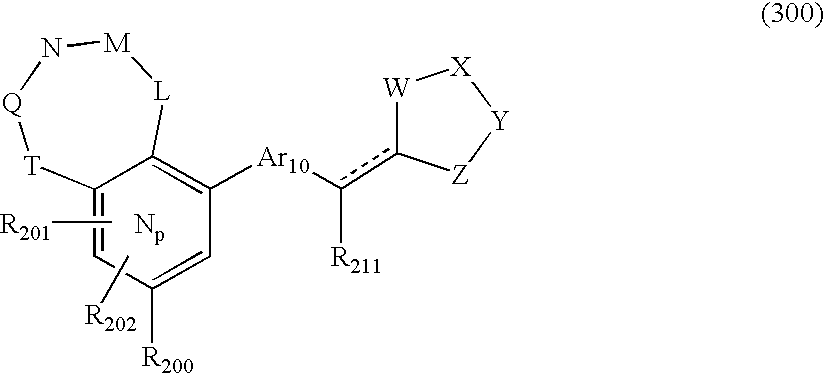
Description
- This application claims priority to the U.S. Provisional Application Serial No. 60/362,732, filed Mar. 8, 2002, the disclosure of which application is hereby incorporated in its entirety by this reference.
-
Type 2 diabetes, also referred to as non-insulin dependent diabetes mellitus (NIDDM), afflicts between 80 and 90% of all diabetic patients in developed countries. In the United States alone, approximately 15 million people, and more than 100 million worldwide, are affected. Because this disorder is a late onset disease and occurs often in overweight persons it can be expected that the number of patients suffering from this disease will increase further. Patients suffering fromtype 2 diabetes usually still produce insulin but become increasingly resistant to their own insulin and to insulin therapy. A promising new class of drugs has been recently introduced that resensitizes patients to their own insulin (insulin sensitizers), thereby reducing the requirement for exogenous insulin. Troglitazone (Resulin™) and rosiglitazone (Avandia™) are among the first representatives of a class of drugs approved for the treatment oftype 2 diabetes in the United States and several other countries. These drugs, however, have side effects including rare but severe liver toxicities (i.e., troglitazone) and they can increase body weight in humans. Such side effects are of major concern for patients who might require treatment for diabetes for a decade or longer. Therefore, new and better drugs for the treatment oftype 2 diabetes and related disorders are needed. - One property of the compounds of this invention is that in many cases they can convert preadipocyte cells to adipocytes i.e. induce adipocyte differentiation. The ability of a molecule to induce differentiation of a particular cell type or cell types is also known to often correlate to anticancer activities.
- Small molecules that can be effective for the treatment of diabetes and/or disorders of carbohydrate metabolism were disclosed in U.S. Pat. No. 6,515,003, issued Feb. 4, 2003, based on U.S. patent application Ser. No. 09/652,810, filed Aug. 31, 2000, which claimed priority to U.S. Provisional Patent Application No. 60/151,670, filed Aug. 31, 1999. Related small molecules that can be useful in the treatment of certain cancers were disclosed in PCT Patent Application WO 01/16122, published Mar. 8, 2001, which claimed priority to the same U.S. Provisional Patent Application No. 60/151,670 cited above. The disclosures of all the above-described patent documents are hereby incorporated herein by this reference, for both their chemical structural disclosures, their teachings of the biological activities of those compounds, and methods for their use as pharmaceutical compositions.
- There is however a continuing need for new drugs for the treatment of
type 2 diabetes and associated disorders of carbohydrate and/or lipid metabolism, including hyperlipidemia and hypercholesterolemia. In particular, new drugs that can control the blood sugar levels of diabetics, and simultaneously control hyperlipidemia and/or hypercholesteremia so as to lessen or prevent atherosclerosis would be of high value for the treatment of diabetes. - The present invention relates to substituted heterocycles which are useful in the treatment of
type 2 diabetes and related diseases related to carbohydrate metabolism. Unexpectedly, it has been discovered that the drugs can simultaneously treat disorders related to lipid metabolism, such as hyperlipidemia and/or hypercholesterolemia, which can be associated with atherosclerosis. - The compounds of the invention can also be useful in treating diseases of uncontrolled proliferation, such as cancers.
- Some embodiments of the invention relate to a first genus of compounds of Formula (300):
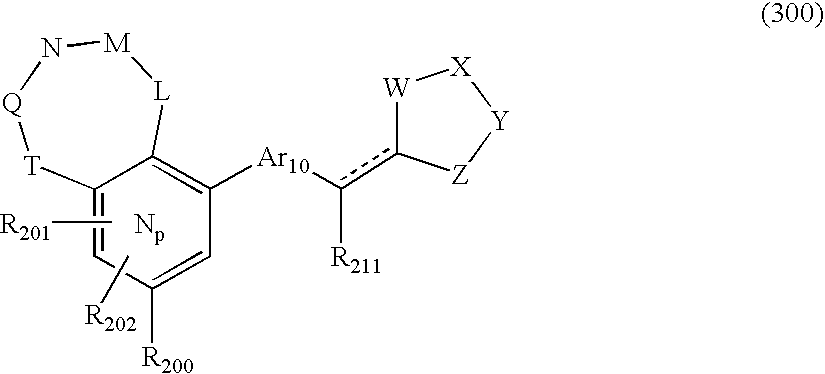
- wherein:
- a) R 200, R201 and R202 are independently selected from hydrogen, hydroxyl, a halogen, amino, or an organic residue comprising 1 to 12 carbon atoms;
- b) N p are the number of heteroaryl ring nitrogens selected from 0, 1 or 2;
- c) L, M, N, Q and T residues are independently selected from —C(O)—, —C(S)—, —O—, —S—, —N(R 203)—, —N(R204)—, —C(R205)(R206)—, —C(R207)(R208)—, or —C(R209)(R210)— residues, and from zero to two of the L, M, N, Q or T residues can be absent;
- wherein:
- i) R 200, R201, R202, R203, R204, R205, R206, R207, R208, R209, and R210 are independently selected from hydrogen, hydroxyl, a halogen, amino, or an organic residue comprising 1 to 12 carbon atoms; or two of the R203, R204, R205, R206, R207, R208, R209 and R210 residues can be connected together to form an exocyclic substituent residue comprising 1 to 6 ring carbon atoms and from 0 to 3 optional ring heteroatoms selected from O, S, or N; and
- ii) L, M, N, Q and T do not form an amide residue;
- d) Ar 10 is an aryl, substituted aryl, heteroaryl, or substituted heteroaryl residue comprising from 3 to 6 ring carbon atoms and from 0 to 3 optional ring heteroatoms selected from O, S, or N;
- e) R 211 is hydrogen, hydroxy, or an organic residue comprising 1 to 10 carbon atoms;
- f) ----- is either present or absent;
- g) W, X, Y and Z are independently or together —C(O)—, —C(S)—, —S—, —O— or —NH—, to form a 2,4-thiazolidinedione, 2-thioxo-thiazolidine-4-one, 2,4-imidazolidinedione or 2-thioxo-imidazolidine-4-one residue; or a pharmaceutically acceptable salt thereof.
- In related embodiments, the invention relates to a second genus of compounds having the structure
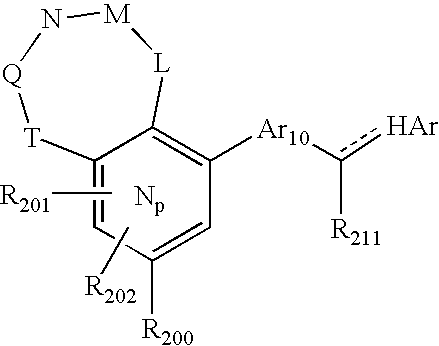
- wherein:
- a) p is 0, 1 or 2;
- b) L, M, N, Q and T residues are independently selected from, —O—, —S—, —S(O)—, —S(O) 2—, —N(R203)—, —N(R204)—, —C(R205)(R206)—, —C(R207)(R208)—, or —C(R209)(R210)— residues, with the proviso that one or two of the L, M, N, Q or T radicals can be absent;
- c) R 200, R201, R202, R203, R204, R205, R206, R207, R208, R209, and R210 are independently selected from hydrogen, hydroxyl, a halogen, amino, or an organic radical;
- d) Ar 10 is an aryl, substituted aryl, heteroaryl, or substituted heteroaryl radical;
- e) the bicyclic radical

- comprises from 6 to 20 carbon atoms;
- f) R 211 is hydrogen, hydroxy, or an organic radical;
- g) ----- is either present or absent; and
- h) HAr has the structure
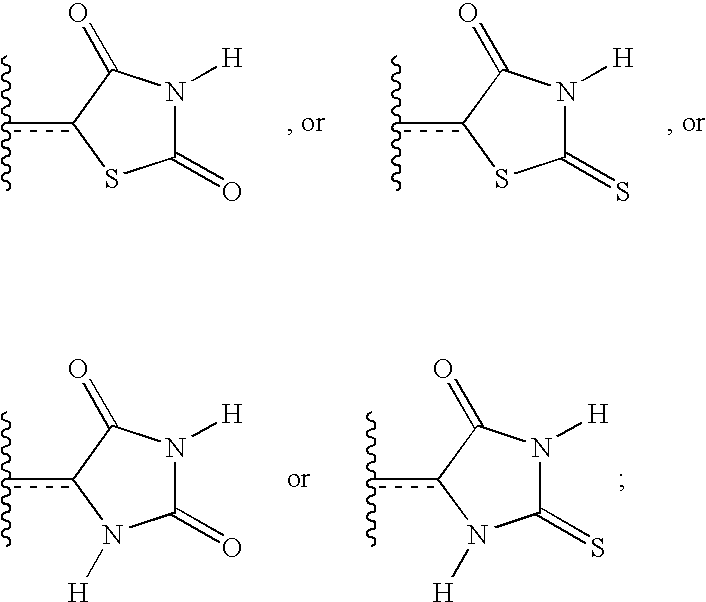
- or a pharmaceutically acceptable salt thereof.
- In another aspect, this invention relates to the use of the compounds of the inventions disclosed above for modulating lipid metabolism, carbohydrate metabolism, or lipid and carbohydrate metabolism. The compounds are also useful for treating diseases of uncontrolled cellular proliferation such as cancer; and the treatment of inflammatory diseases.
- This invention also relates to a method for the treatment of
type 2 diabetes and related diseases, by modulating lipid metabolism, carbohydrate metabolism, or lipid and carbohydrate metabolism. The methods comprise administering to a mammal, preferably a human, diagnosed as needing such treatment or modulation, one or more of the compounds of the invention or a pharmaceutical composition thereof. The invention also provides for a method of treatment of a disease of uncontrolled cellular proliferation comprising administering to a mammal diagnosed as having a disease of uncontrolled cellular proliferation and a method of treating an inflammatory disease comprising administering one or more of the compounds of the invention to a mammal diagnosed as having an inflammatory disease such as atherosclerosis. - In another aspect, this invention relates to a pharmaceutical composition comprising one or more compounds disclosed herein in admixture with one or more pharmaceutically acceptable excipients.
- FIG. 1 shows the activity of the compounds of the invention for inducing the differentiation of 3T3-L1 preadipocytes into adipocytes.
- FIG. 2 shows the serum glucose lowering activity of the compounds of the present invention in the KKA y Mouse Model.
- FIG. 3 shows the serum triglyceride lowering activity of the compounds of the present invention in the KKA y Mouse Model.
- FIG. 4 shows examples of methods for synthesizing certain synthetic precursors of the dihydrobenzofuran compounds disclosed herein.
- FIG. 5 shows examples of methods for synthesizing certain synthetic precursors of the dihydrobenzothiofuran compounds disclosed herein.
- FIG. 6 shows examples of methods for synthesizing certain synthetic precursors of the dihydrobenzopyrrole compounds disclosed herein.
- FIG. 7 shows examples of methods for introducing various types of R 200 substituents into synthetic precursors used to synthesize the compounds disclosed herein.
- FIG. 8 shows examples of methods for coupling various synthetic precursors so as to synthesize the final product heterocycles disclosed herein.
- The present invention can be understood more readily by reference to the following detailed description of various embodiments of the invention and the Examples included therein and to the Figures and their previous and following description. Before the present compounds, compositions, and/or methods are disclosed and described, it is to be understood that this invention is not limited to specific synthetic methods, specific pharmaceutical carriers or formulations, or to particular modes of administering the compounds of the invention, as such can, of course, vary. It is also to be understood that the terminology used herein is for the purpose of describing particular embodiments only and is not intended to be limiting.
- Definitions
- In the specification and Formulae described herein the following terms are hereby defined.
- “Optional” or “optionally” means that the subsequently described event or circumstance may or may not occur, and that the description includes instances where said event or circumstance occurs and instances where it does not. For example, the phrase “optionally substituted lower alkyl” means that the lower alkyl group may or may not be substituted and that the description includes both unsubstituted lower alkyl and lower alkyls where there is substitution.
- It must be noted that, as used in the specification and the appended claims, the singular forms “a,” “an” and “the” include plural referents unless the context clearly dictates otherwise. Thus, for example, reference to “an aromatic compound” includes mixtures of aromatic compounds.
- Often, ranges are expressed herein as from “about” one particular value, and/or to “about” another particular value. When such a range is expressed, another embodiment includes from the one particular value and/or to the other particular value. Similarly, when values are expressed as approximations, by use of the antecedent “about,” it will be understood that the particular value forms another embodiment. It will be further understood that the endpoints of each of the ranges are significant both in relation to the other endpoint, and independently of the other endpoint.
- By “pharmaceutically acceptable” is meant a material that is not biologically or otherwise undesirable, i.e., the material can be administered to an individual along with the relevant active compound without causing clinically unacceptable biological effects or interacting in a deleterious manner with any of the other components of the pharmaceutical composition in which it is contained.
- By the term “effective amount” of a compound as provided herein is meant a sufficient amount of the compound to provide the desired regulation of a desired function, such as gene expression, protein function, or a disease condition. As will be pointed out below, the exact amount required will vary from subject to subject, depending on the species, age, and general condition of the subject, the severity of the disease that is being treated, the particular compound used, its mode of administration, and the like. Thus, it is not possible to specify an exact “effective amount.” However, an appropriate effective amount can be determined by one of ordinary skill in the art using only routine experimentation.
- The term “alkyl” denotes a hydrocarbon group or residue which is structurally similar to a non-cyclic alkane compound modified by the removal of one hydrogen from the non-cyclic alkane and the substitution therefore of a non-hydrogen group or residue. Alkyls comprise a noncyclic, saturated, straight or branched chain hydrocarbon residue having from 1 to 12 carbons, or 1 to 8 carbons, or 1 to 6 carbons. Examples of such alkyl radicals include methyl, ethyl, n-propyl, iso-propyl, n-butyl, sec-butyl, t-butyl, amyl, t-amyl, n-pentyl and the like. Lower alkyls comprise a noncyclic, saturated, straight or branched chain hydrocarbon residue having from 1 to 4 carbon atoms.
- The term “substituted alkyl” denotes an alkyl radical analogous to the above definition that is further substituted with one, two, or more additional organic or inorganic substituent groups. Suitable substituent groups include but are not limited to hydroxyl, cycloalkyl, amino, mono-substituted amino, di-substituted amino, acyloxy, nitro, cyano, carboxy, carboalkoxy, alkylcarboxamide, substituted alkylcarboxamide, dialkylcarboxamide, substituted dialkylcarboxamide, alkylsulfonyl, alkylsulfinyl, thioalkyl, thiohaloalkyl, alkoxy, substituted alkoxy, haloalkoxy, heteroaryl, substituted heteroaryl, aryl or substituted aryl. When more than one substituent group is present then they can be the same or different. The organic substituent groups can comprise from 1 to 12 carbon atoms, or from 1 to 6 carbon atoms, or from 1 to 4 carbon atoms. The term “substituted alkyl” denotes a radical containing 1 to 12 carbons of the above definitions that are substituted with one or more groups, but preferably one, two or three groups, selected from hydroxyl, cycloalkyl, amino, mono-substituted amino, di-substituted amino, acyloxy, nitro, cyano, carboxy, carboalkoxy, alkylcarboxamide, substituted alkylcarboxamide, dialkylcarboxamide, substituted dialkylcarboxamide, alkylsulfonyl, alkylsulfinyl, thioalkyl, thiohaloalkyl, alkoxy, substituted alkoxy or haloalkoxy. When more than one group is present then they can be the same or different.
- The term “hydroxyalkyl” denotes an alkyl radical substituted with one or more hydroxy radicals. Lower hydroxyalkyl radicals comprise from 1 to 4 carbon atoms. Examples of hydroxyalkyl groups include hydroxymethyl radicals (—CH 2OH), 1-hydroxyethyl (—CH(OH)CH3), 2-hydroxyethyl radicals (—CH2CH2OH), and like higher homologs.
- The term “alkoxyalkyl” denotes an alkyl radical substituted with an alkoxy or a hydroxyalkyl radical. Lower alkoxyalkyl groups comprise from 1 to 6 carbon atoms. Examples of alkoxyalkyl groups include alkoxymethyl radicals (—CH 2—O—R, where R is an alkyl radical), alkoxy-ethyl radicals (—CH2CH2—O—R, wherein R is an alkyl radical).
- The term “alkenyl” denotes an alkyl residue as defined above that comprises at least one carbon-carbon double bond. Examples include but are not limited to vinyl, allyl, 2-butenyl, 3-butenyl, 2-pentenyl, 3-pentenyl, 4-pentenyl, 2-hexenyl, 3-hexenyl, 4-hexenyl, 5-hexanyl, 2-heptenyl, 3-heptenyl, 4-heptenyl, 5-heptenyl, 6-heptenyl and the like. The term “alkenyl” includes dienes and trienes of straight and branch chains.
- The term “substituted alkenyl” denotes an alkenyl residue as defined above definitions that is substituted with one or more groups, but preferably one, two or three groups, selected from halogen, hydroxyl, cycloalkyl, amino, mono-substituted amino, di-substituted amino, acyloxy, nitro, cyano, carboxy, carboalkoxy, alkylcarboxamide, substituted alkylcarboxamide, dialkylcarboxamide, substituted dialkylcarboxamide, alkylsulfonyl, alkylsulfinyl, thioalkyl, thiohaloalkyl, alkoxy, substituted alkoxy or haloalkoxy. When more than one group is present then they can be the same or different. The organic substituent groups can comprise from 1 to 12 carbon atoms, or from 1 to 6 carbon atoms, or from 1 to 4 carbon atoms.
- The term “alkynyl” denotes a residue as defined above that comprises at least one carbon-carbon double bond. Examples include but are not limited ethynyl, 1-propynyl, 2-propynyl, 1-butynyl, 2-butynyl, 3-butynyl, 1-pentynyl, 2-pentynyl, 3-pentynyl, 4-pentynyl, 1-hexynyl, 2-hexynyl, 3-hexynyl, 4-hexynyl, 5-hexynyl and the like. The term “alkynyl” includes di- and tri-ynes.
- The term “substituted alkynyl” denotes an alkylnyl residue of the above definition that is substituted with one or more groups, but preferably one or two groups, selected from halogen, hydroxyl, cycloalkyl, amino, mono-substituted amino, di-substituted amino, acyloxy, nitro, cyano, carboxy, carboalkoxy, alkylcarboxamide, substituted alkylcarboxamide, dialkylcarboxamide, substituted dialkylcarboxamide, alkylsulfonyl, alkylsulfinyl, thioalkyl, thiohaloalkyl, alkoxy, substituted alkoxy or haloalkoxy. When more than one group is present then they can be the same or different. The organic substituent groups can comprise from 1 to 12 carbon atoms, or from 1 to 6 carbon atoms, or from 1 to 4 carbon atoms.
- The term “cycloalkyl” denotes a hydrocarbon group or residue which is structurally similar to a cyclic alkane compound modified by the removal of one hydrogen from the cyclic alkane and substitution therefore of a non-hydrogen group or residue. Cycloalkyl groups, or residues radical contain 3 to 18 carbons, or preferably 4 to 12 carbons, or 5 to 8 carbons. Examples include as cyclopropyl, cyclobutyl, cyclopentyl, cyclohexyl, cycloheptyl, decahydronapthyl, adamantyl, and like residues. The term “cycloalkyl” denotes a radical containing 3 to 8 carbons, such as cyclopropyl, cyclobutyl, cyclopentyl, cyclohexyl, cycloheptyl and the like. The term “substituted cycloalkyl” denotes a cycloalkyl as defined above that is further substituted with one or more groups selected from halogen, alkyl, hydroxyl, alkoxy, substituted alkoxy, carboxy, carboalkoxy, alkylcarboxamide, substituted alkylcarboxamide, dialkylcarboxamide, substituted dialkylcarboxamide, amino, mono-substituted amino or di-substituted amino. When the cycloalkyl is substituted with more than one group, they can be the same or different.
- The term “substituted cycloalkyl” denotes a cycloalkyl residue as defined above that is further substituted with one, two, or more additional organic or inorganic groups that can include but are not limited to halogen, alkyl, substituted alkyl, hydroxyl, alkoxy, substituted alkoxy, carboxy, carboalkoxy, alkylcarboxamide, substituted alkylcarboxamide, dialkylcarboxamide, substituted dialkylcarboxamide, amino, mono-substituted amino or di-substituted amino. When the cycloalkyl is substituted with more than one substituent group, they can be the same or different. The organic substituent groups can comprise from 1 to 12 carbon atoms, or from 1 to 6 carbon atoms, or from 1 to 4 carbon atoms.
- The term “cycloalkenyl” denotes a cycloalkyl radical as defined above that comprises at least one carbon-carbon double bond. Examples include but are not limited to cyclopropenyl, 1-cyclobutenyl, 2-cyclobutenyl, 1-cyclopentenyl, 2-cyclopentenyl, 3-cyclopentenyl, 1-cyclohexyl, 2-cyclohexyl, 3-cyclohexyl and the like. The term “substituted cycloalkenyl” denotes a cycloalkyl as defined above further substituted with one or more groups selected from halogen, alkyl, hydroxyl, alkoxy, substituted alkoxy, haloalkoxy, carboxy, carboalkoxy, alkylcarboxamide, substituted alkylcarboxamide, dialkylcarboxamide, substituted dialkylcarboxamide, amino, mono-substituted amino or di-substituted amino. When the cycloalkenyl is substituted with more than one group, they can be the same or different. The organic substituent groups can comprise from 1 to 12 carbon atoms, or from 1 to 6 carbon atoms, or from 1 to 4 carbon atoms.
- The term “alkoxy” as used herein denotes an alkyl residue, defined above, attached directly to a oxygen to form an ether residue. Examples include methoxy, ethoxy, n-propoxy, iso-propoxy, n-butoxy, t-butoxy, iso-butoxy and the like.
- The term “substituted alkoxy” denotes an alkoxy residue of the above definition that is substituted with one or more substituent groups, but preferably one or two groups, which include but are not limited to hydroxyl, cycloalkyl, amino, mono-substituted amino, di-substituted amino, acyloxy, nitro, cyano, carboxy, carboalkoxy, alkylcarboxamide, substituted alkylcarboxamide, dialkylcarboxamide, substituted dialkylcarboxamide, alkylsulfonyl, alkylsulfinyl, thioalkyl, thiohaloalkyl, alkoxy, substituted alkoxy or haloalkoxy. When more than one group is present then they can be the same or different. The organic substituent groups can comprise from 1 to 12 carbon atoms, or from 1 to 6 carbon atoms, or from 1 to 4 carbon atoms.
- The term “mono-substituted amino” denotes an amino substituted with one organic substituent groups, which include but are not limited to alkyl, substituted alkyl or arylalkyl wherein the terms have the same definitions found hereinabove.
- The term “di-substituted amino” denotes an amino residue substituted with two radicals that can be same or different selected from aryl, substituted aryl, alkyl, substituted alkyl or arylalkyl wherein the terms have the same definitions found throughout. Some examples include dimethylamino, methylethylamino, diethylamino and the like.
- The term “haloalkyl” denotes a alkyl residue as defined above, substituted with one or more halogens, preferably fluorine, such as a trifluoromethyl, pentafluoroethyl and the like.
- The term “haloalkoxy” denotes a haloalkyl residue as defined above, that is directly attached to an oxygen to form trifluoromethoxy, pentafluoroethoxy and the like.
- The term “acyl” denotes a R—C(O)— residue containing 1 to 8 carbons. Examples include but are not limited to formyl, acetyl, propionyl, butanoyl, iso-butanoyl, pentanoyl, hexanoyl, heptanoyl, benzoyl and the like.
- The term “acyloxy” denotes a an acyl radical as defined above directly attached to an oxygen to form an R—C(O)O— residue. Examples include but are not limited to acetyloxy, propionyloxy, butanoyloxy, iso-butanoyloxy, benzoyloxy and the like.
- The term “aryl” denotes an ring radical containing 6 to 18 carbons, or preferably 6 to 12 carbons, having at least one six-membered aromatic “benzene” residue therein. Examples of such aryl radicals include phenyl and naphthyl. The term “substituted aryl” denotes an aryl ring radical as defined above that is substituted with one or more, or preferably 1, 2, or 3 organic or inorganic substituent groups, which include but are not limited to a halogen, alkyl, substituted alkyl, hydroxyl, cycloalkyl, amino, mono-substituted amino, di-substituted amino, acyloxy, nitro, cyano, carboxy, carboalkoxy, alkylcarboxamide, substituted alkylcarboxamide, dialkylcarboxamide, substituted dialkylcarboxamide, alkylsulfonyl, alkylsulfinyl, thioalkyl, thiohaloalkyl, alkoxy, substituted alkoxy or haloalkoxy, aryl, substituted aryl, heteroaryl, heterocyclic ring, substituted heterocyclic ring wherein the terms are defined herein. The organic substituent groups can comprise from 1 to 12 carbon atoms, or from 1 to 6 carbon atoms, or from 1 to 4 carbon atoms.
- The term “heteroaryl” denotes an aryl ring radical as defined above, wherein at least one of the carbons, or preferably 1, 2, or 3 carbons of the aryl aromatic ring has been replaced with a heteroatom, which include but are not limited to nitrogen, oxygen, and sulfur atoms. Examples of heteroaryl residues include pyridyl, bipyridyl, furanyl, and thiofuranyl residues. Substituted “heteroaryl” residues can have one or more organic or inorganic substituent groups, or preferably 1, 2, or 3 such groups, as referred to herein-above for aryl groups, bound to the carbon atoms of the heteroaromatic rings. The organic substituent groups can comprise from 1 to 12 carbon atoms, or from 1 to 6 carbon atoms, or from 1 to 4 carbon atoms.
- The term “halo” or “halogen” refers to a fluoro, chloro, bromo or iodo group.
- The term “thioalkyl” denotes a sulfide radical containing 1 to 8 carbons, linear or branched. Examples include methylsulfide, ethyl sulfide, isopropylsulfide and the like.
- The term “thiohaloalkyl” denotes a thioalkyl radical substituted with one or more halogens. Examples include trifluoromethylthio, 1,1-difluoroethylthio, 2,2,2-trifluoroethylthio and the like.
- The term “carboalkoxy” refers to an alkyl ester of a carboxylic acid, wherein alkyl has the same definition as found above. Examples include carbomethoxy, carboethoxy, carboisopropoxy and the like.
- The term “alkylcarboxamide” denotes a single alkyl group attached to the amine of an amide, wherein alkyl has the same definition as found above. Examples include N-methylcarboxamide, N-ethylcarboxamide, N-(iso-propyl)carboxamide and the like. The term “substituted alkylcarboxamide” denotes a single “substituted alkyl” group, as defined above, attached to the amine of an amide.
- The term “dialkylcarboxamide” denotes two alkyl or arylalkyl groups that are the same or different attached to the amine of an amide, wherein alkyl has the same definition as found above. Examples of a dialkylcarboxamide include N,N-dimethylcarboxamide, N-methyl-N-ethylcarboxamide and the like. The term “substituted dialkylcarboxamide” denotes two alkyl groups attached to the amine of an amide, where one or both groups is a “substituted alkyl”, as defined above. It is understood that these groups can be the same or different. Examples include N,N-dibenzylcarboxamide, N-benzyl-N-methylcarboxamide and the like.
- The term “arylalkyl” defines an alkylene, such as —CH 2— for example, which is substituted with an aryl group that can be substituted or unsubstituted as defined above. Examples of an “arylalkyl” include benzyl, phenethylene and the like.
- The term “organic residue” defines a carbon containing residue, i.e. a residue comprising at least one carbon atom, and includes but is not limited to the carbon-containing groups, residues, or radicals defined hereinabove. Organic residues can contain various heteroatoms, or be bonded to another molecule through a heteroatom, including oxygen, nitrogen, sulfur, phosphorus, or the like. Examples of organic residues include but are not limited alkyl or substituted alkyls, alkoxy or substituted alkoxy, mono- or di-substituted amino, amide groups, etch. Organic resides-can preferably comprise 1 to 18 carbon atoms, 1 to 15, carbon atoms, 1 to 12 carbon atoms, 1 to 8 carbon atoms, or 1 to 4 carbon atoms.
- The term “amide” as defined hereby and used in the instant specification refers to a functional group or residue that contains a carbonyl (CO) group bound to a nitrogen atom, i.e. a residue having the formula:
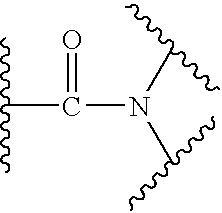
- A residue of a chemical species, as used in the specification and concluding claims, refers to the a structural fragment, or a moiety that is the resulting product of the chemical species in a particular reaction scheme or subsequent formulation or chemical product, regardless of whether the structural fragment or moiety is actually obtained from the chemical species. Thus, an ethylene glycol residue in a polyester refers to one or more —OCH 2CH2O— repeat units in the polyester, regardless of whether ethylene glycol is used to prepare the polyester. Similarly, a 2,4-thiazolidinedione residue in a chemical compound refers to one or more 2,4-thiazolidinedione moieties of the compound, regardless of whether the residue was obtained by reacting 2,4-thiazolidinedione to obtain the compound.
- A very close synonym of the term “residue” is the term “radical,” which as used in the specification and concluding claims, refers to a fragment, group, or substructure of a molecule described herein, regardless of how the molecule is prepared. For example, a 2,4-thiazolidinedione radical in a particular compound has the structure
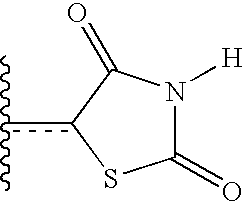
- regardless of whether thiazolidinedione is used to prepare the compound. In some embodiments the radical (for example an alkyl) can be further modified (i.e., substituted alkyl) by having bonded thereto one or more “substituent radicals.” The number of atoms in a given radical is not critical to the present invention unless it is indicated to the contrary elsewhere herein.
- “Inorganic radicals,” as the term is defined and used herein contain no carbon atoms and therefore comprise only atoms other than carbon. Inorganic radicals comprise bonded combinations of atoms selected from hydrogen, nitrogen, oxygen, silicon, phosphorus, sulfur, selenium, and halogens such as fluorine, chlorine, bromine, and iodine, which can be present individually or bonded together in their chemically stable combinations. Inorganic radicals have 10 or fewer, or preferably one to six or one to four inorganic atoms as listed above bonded together. Examples of inorganic radicals include, but not limited to, amino, hydroxy, halogens, nitro, thiol, sulfate, phosphate, and like commonly known inorganic radicals. The inorganic radicals do not have bonded therein the metallic elements of the periodic table (such as the alkali metals, alkaline earth metals, transition metals, lanthanide metals, or actinide metals), although such metal ions can sometimes serve as a pharmaceutically acceptable cation for anionic inorganic radicals such as a sulfate, phosphate, or like anionic inorganic radical. Inorganic radicals do not comprise metalloids elements such as boron, aluminum, gallium, germanium, arsenic, tin, lead, or tellurium, or the noble gas elements, unless otherwise specifically indicated elsewhere herein.
- “Organic radicals” as the term is defined and used herein contain one or more carbon atoms. An organic radical can have, for example, 1-26 carbon atoms, 1-18 carbon atoms, 1-12 carbon atoms, 1-6 carbon atoms, or 1-4 carbon atoms. Organic radicals often have hydrogen bound to at least some of the carbon atoms of the organic radical. One example, of an organic radical that comprises no inorganic atoms is a 5, 6, 7, 8-tetrahydro-2-naphthyl radical. In some embodiments, an organic radical can contain 1-10 inorganic heteroatoms bound thereto or therein, including halogens, oxygen, sulfur, nitrogen, phosphorus, and the like. Examples of organic radicals include but are not limited to an alkyl, substituted alkyl, cycloalkyl, substituted cycloalkyl, mono-substituted amino, di-substituted amino, acyloxy, cyano, carboxy, carboalkoxy, alkylcarboxamide, substituted alkylcarboxamide, dialkylcarboxamide, substituted dialkylcarboxamide, alkylsulfonyl, alkylsulfinyl, thioalkyl, thiohaloalkyl, alkoxy, substituted alkoxy, haloalkyl, haloalkoxy, aryl, substituted aryl, heteroaryl, heterocyclic, or substituted heterocyclic radicals, wherein the terms are defined elsewhere herein. A few non-limiting examples of organic radicals that include heteroatoms include alkoxy radicals, trifluoromethoxy radicals, acetoxy radicals, dimethylamino radicals and the like.
- It must be noted that, as used in the specification and the appended claims, the singular forms “a,” “an” and “the” include plural referents unless the context clearly dictates otherwise. Thus, for example, reference to “an aromatic compound” includes mixtures of aromatic compounds.
- Compounds of the Invention
- Some embodiments of the invention relate to a first genus of bicyclic compounds of Formula (300):

- wherein:
- a) R 200, R201 and R202 are independently selected from hydrogen, hydroxyl, a halogen, amino, or an organic residue comprising 1 to 12 carbon atoms;
- b) N p are the number of heteroaryl ring nitrogens selected from 0, 1 or 2;
- c) L, M, N, Q and T residues are independently selected from —C(O)—, —C(S)—, —O—, —S—, —N(R 203)—, —N(R204)—, —C(R205)(R206)—, —C(R207)(R208)—, or —C(R209)(R210)— residues, and from zero to two of the L, M, N, Q or T residues can be absent;
- wherein:
- i) R 203, R204, R205, R206, R207, R208, R209, and R210 are independently selected from hydrogen, hydroxyl, a halogen, amino, or an organic residue comprising 1 to 12 carbon atoms; or two of the R203, R204, R205, R206, R207, R208, R209 and R210 residues can be connected together to form an exocyclic substituent residue comprising 1 to 6 ring carbon atoms and from 0 to 3 optional ring heteroatoms selected from O, S, or N; and
- ii) L, M, N, Q and T do not form an amide residue;
- d) Ar 10 is an aryl, substituted aryl, heteroaryl, or substituted heteroaryl residue comprising from 3 to 6 ring carbon atoms and from 0 to 3 optional ring heteroatoms selected from O, S, or N;
- e) R 211 is hydrogen, hydroxy, or an organic residue comprising 1 to 10 carbon atoms;
- f) ----- is either present or absent;
- g) W, X, Y and Z are independently or together —C(O)—, —C(S)—, —S—, —O— or —NH—, to form a 2,4-thiazolidinedione, 2-thioxo-thiazolidine-4-one, 2,4-imidazolidinedione or 2-thioxo-imidazolidine-4-one residue;
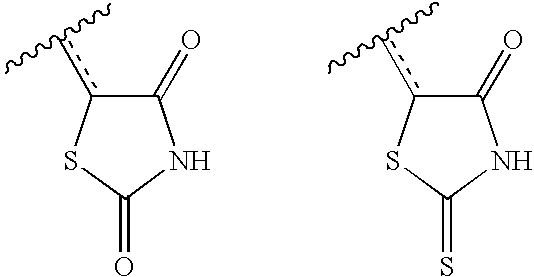
- 2,4-thiazolidinedione 2-thioxo-thiazolidine-4-one

- 2,4-imidazolidinedione 2-thioxo-imidazolidine-4-one
- or
- a pharmaceutically acceptable salt thereof.
- The genus of compounds described above shall be termed herein the “first” genus of bicyclic compounds. In a related but alternative embodiment, the invention relates to another “second” genus of bicyclic compounds having the structure
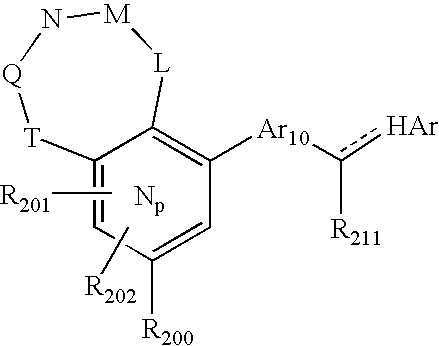
- wherein:
- a) p is 0, 1 or 2;
- b) L, M, N, Q and T residues are independently selected from, —O—, —S—, —S(O)—, —S(O) 2—, —N(R203)—, —N(R204)—, —C(R205)(R206)—, —C(R207)(R208)—, or —C(R209)(R210)— radicals, with the proviso that one or two of the L, M, N, Q or T radicals can be absent;
- c) R 200, R201, R202, R203, R204, R205, R206, R207, R208, R209, and R210 are independently selected from hydrogen, hydroxyl, a halogen, amino, or an organic radical comprising 1 to 12 carbon atoms;
- d) Ar 10 is an aryl, substituted aryl, heteroaryl, or substituted heteroaryl radical comprising 2 to 18 carbon atoms;
- e) the radical
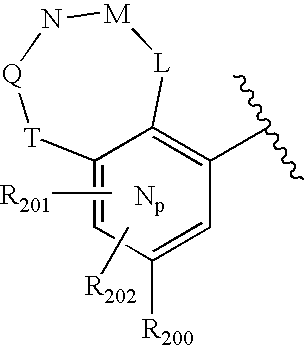
- comprises from 6 to 20 carbon atoms;
- f) R 211 is hydrogen, hydroxy, or an organic residue comprising 1 to 10 carbon atoms;
- g) ----- is either present or absent; and
- h) HAr has the structure
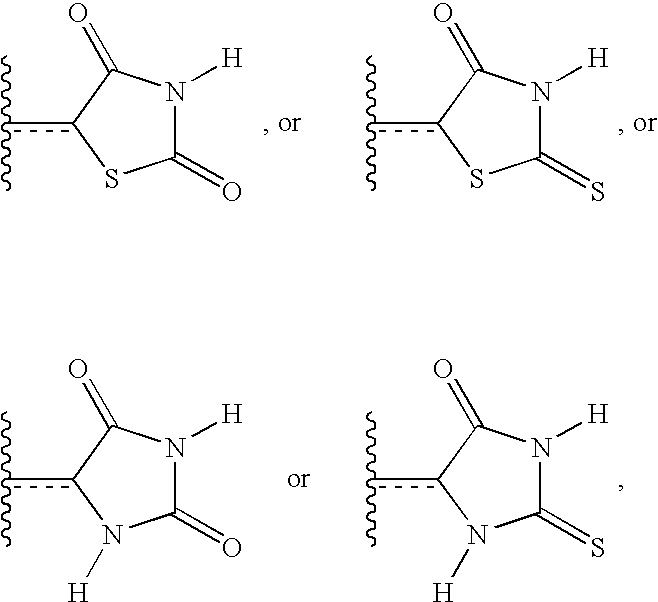
- or a pharmaceutically acceptable salt thereof.
- The two genuses of compounds disclosed immediately above share a number of common features, but differ in some aspects. The description of further and more detailed embodiments to follow below is intended to be applicable, to the extent possible and reasonable, to both the “first” and “second” genuses of compounds described above. Some differences between the first and second genuses will be noted.
- In the embodiments relating to the first genus of compounds, the W, X, Y and Z radicals, together with a carbon atom, form one of four separate five membered heterocycles, selected from a 2,4-thiazolidinedione, 2-thioxo-thiazolidine-4-one, 2,4-imidazolidinedione or 2-thioxo-imidazolidine-4-one residue or radical, the structures of which are shown in the drawings below:
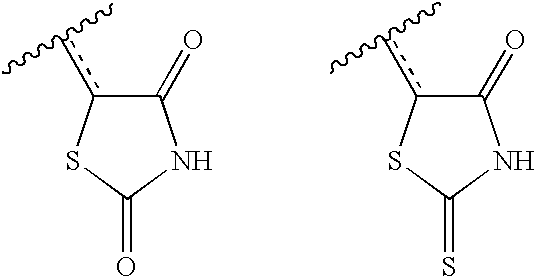
- 2,4-thiazolidinedione 2-thioxo-thiazolidine-4-one
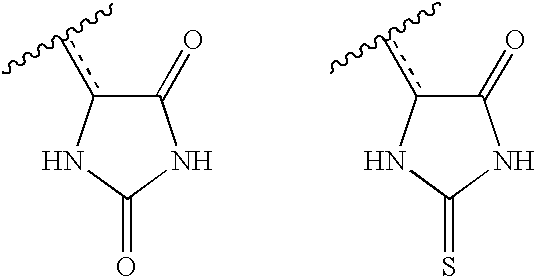
- 2,4-imidazolidinedione 2-thioxo-imidazolidine-4-one
- For purposes of ease of reference and brevity, the 2,4-thiazolidinedione, 2-thioxo-thiazolidine-4-one, 2,4-imidazolidinedione or 2-thioxo-imidazolidine-4-one heterocyclic residues can be generically termed “HAr” heterocyclic residues or radicals. The second genus of compounds above employs the “HAr” terminology, but intends the same set of four heterocyclic residues or radicals, namely 2,4-thiazolidinedione, 2-thioxo-thiazolidine-4-one, 2,4-imidazolidinedione or 2-thioxo-imidazolidine-4-one radicals or residues.
- The compounds of the invention, including both the first and second genuses, comprise at least one “bicyclic” residue or radical of the following formula:
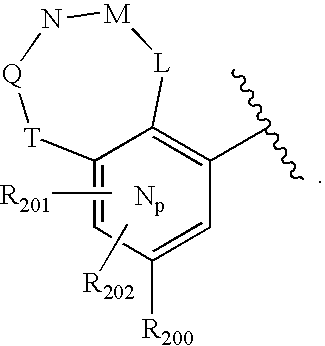
- In the first genus of compounds, the L, M, N, Q and T radicals or residues are independently selected from —C(O)—, —C(S)—, —O—, —S—, —N(R 203)—, —N(R204)—, —C(R205)(R206)—, —C(R207)(R208)—, or —C(R209)(R210)— residues, with the proviso that L, M, N, Q and T do not form an amide residue. In the second genus of compounds, the L, M, N, Q and T radicals or residues are independently selected from —O—, —S—, —S(O)—, —S(O)2—, —N(R203)—, —N(R204)—, —C(R205)(R206)—, —C(R207)(R208)—, or —C(R209)(R210)— radicals. It should be noted that the ring comprising the L, M, N, Q and T radicals or residues is not an aromatic ring.
- It should be understood that, with respect to the descriptions, formulas and drawings above, the “N” in the “LMNQT” ring can represent a nitrogen atom or one of the two listed —N(R 203)—, or —N(R204)— radicals, but the N could also represent any of the listed residues.
- In both genuses of compounds, the R 200, R201, R202, R203, R204, R205, R206, R207, R208, R209, and R210 residues or radicals can be independently selected from residues or radicals that can include but are not limited to hydrogen, hydroxyl, a halogen, amino, or an organic residue. Examples of suitable organic residues or radicals include but are not be limited to an alkyl, substituted alkyl, haloalkyl, alkenyl, substituted alkenyl, alkynyl, substituted alkynyl, acyloxy, mono-substituted amino, di-substituted amino, alkylsulfonamide, substituted alkylsulfonamide, arylsulfonamide, heteroarylsulfonamide, alkylurea, alkylthiourea, arylurea, acyl, substituted acyl, alkylcarbamate, arylcarbarnate, alkylthiocarbamate, substituted alkylthiocarbamate, arylthiocarbamate, heteroaryl, substituted heteroaryl, alkoxy, substituted alkoxy, haloalkoxy, thioalkyl, alkylsulfoxide, alkylsulfonyl, thiohaloalkyl, carboxy, carboalkoxy, alkylcarboxamide, substituted alkylcarboxamide, dialkylcarboxamide or substituted dialkylcarboxamide residue. In certain embodiments, the organic residues or radicals comprise from 1 to 12 carbon atoms, or 1 to 8 carbon atoms, or 1 to 6 carbon atoms, or 1 to 4 carbon atoms.
- It is also to be understood that one or two of the L, M, N, Q or T residues can be absent. For example, the bicyclic residues can comprise a “LMNQT” ring that has from five to seven atoms in the non-aromatic ring. Examples of such bicyclic residues include:

- Although not wishing to be bound by theory, the compounds of the invention, including the bicyclic radical and its various substituents are selected so as to have a geometry, size, and polarity that is suitable to allow the compounds of the invention to interact with and substantially fill, yet fit within, the binding regions of the target biological molecules, so as to contribute to the effective binding of the compounds to the binding sites in the biological target molecules. Therefore, in some embodiments, the bicyclic radical or residue, together with the L, M, N, Q and T and all the associated R 200, R201, R202, R203, R204, R205, R206, R207, R208, R209, and R210 substituent radicals a comprise from 6 to 20 carbon atoms, or from 7 to 18 carbon atoms, or from 8 to 16 carbon atoms, or from 9 to 14 carbon atoms.
- In certain embodiments, the bicyclic residues comprise at least one ring heteroatom or heteroatomic group, which can be present at any one of the L, M, N, Q, or T positions. For example, L, M, N, Q and T together with a substituted or unsubstituted aryl can form a bicyclic ring residue or radical with one heteroatom or heteroatomic group having the Formulas (305a-f):
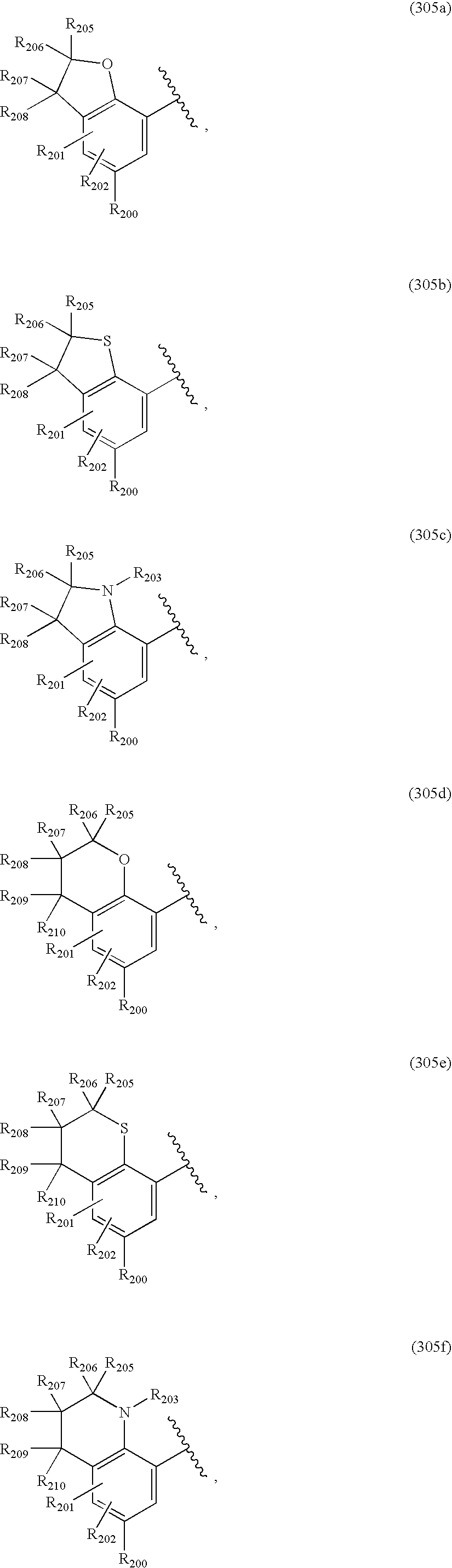
- In other embodiments, L, M, N, Q and T together with a substituted or unsubstituted aryl can form a bicyclic ring residue or radical with two heteroatoms or heteroatomic groups, as exemplified by the radicals having the Formulas (305 g-k):

- In some embodiments of the bicyclic residues or radicals, nitrogen is present in the aryl ring of the bicyclic residue, i.e. p=1, so that L, M, N, Q and T together with a substituted or unsubstituted heteroaryl form a bicyclic pyridine residue or radical. Examples of such bicyclic pyridine radicals include but are not limited to Formulas (305l-m):
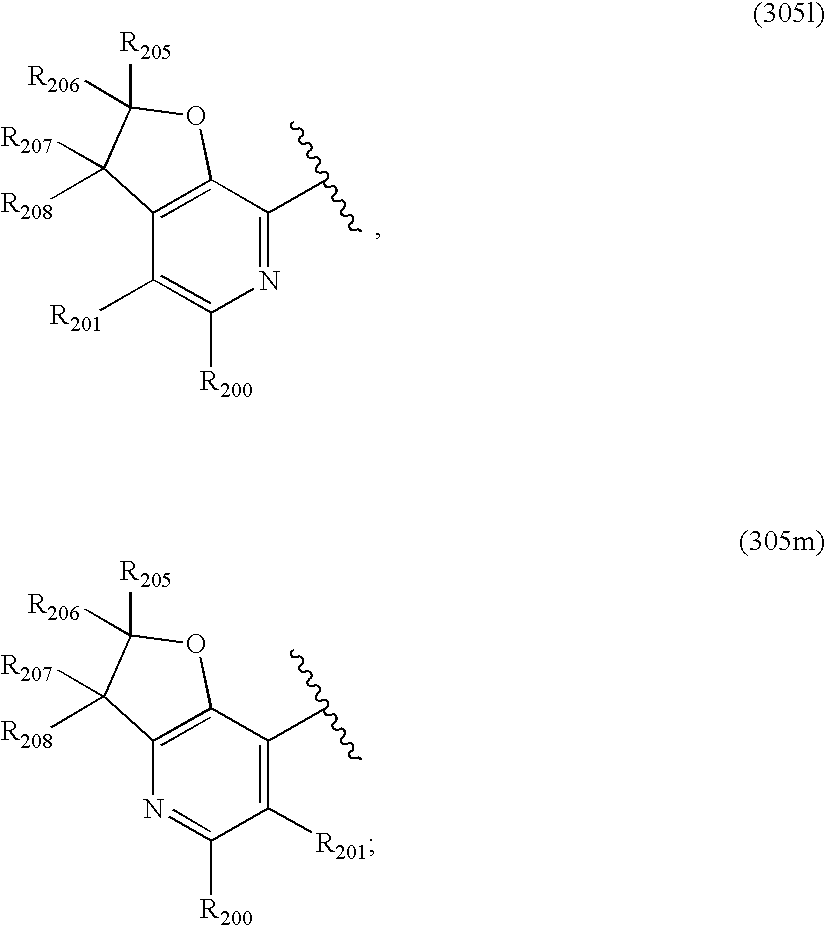
- Alternatively, the heteroaryl ring can comprise heteroaromatic residues having two nitrogen atoms, i.e. p=2. An example of such a bicyclic “pyrimidene” residue or radical is shown below.

- The R 200, R201, R202, R203, R204, R205, R206, R207, R208, R209, and R210 substituents for the bicyclic residues or radicals of the invention can be independently selected from inorganic or organic residues or radicals, Suitable substituents include but are not limited to hydrogen, an alkyl, substituted alkyl, haloalkyl, alkenyl, substituted alkenyl, alkynyl, substituted alkynyl, halogen, cyano, nitro, hydroxyl, acyloxy, amino, mono-substituted amino, di-substituted amino, alkylsulfonamide, substituted alkylsulfonamide, arylsulfonamide, heteroarylsulfonamide, alkylurea, alkylthiourea, arylurea, acyl, substituted acyl, alkylcarbamate, arylcarbamate, alkylthiocarbamate, substituted alkylthiocarbamate, arylthiocarbamate, heteroaryl, substituted heteroaryl, alkoxy, substituted alkoxy, haloalkoxy, thioalkyl, alkylsulfoxide, alkylsulfonyl, thiohaloalkyl, carboxy, carboalkoxy, alkylcarboxamide, substituted alkylcarboxamide, dialkylcarboxamide or substituted dialkylcarboxamide.
- Some embodiments of the invention relate to compounds wherein L, M, N, Q and T together form a partially reduced benzopyran ring of Formula (306):
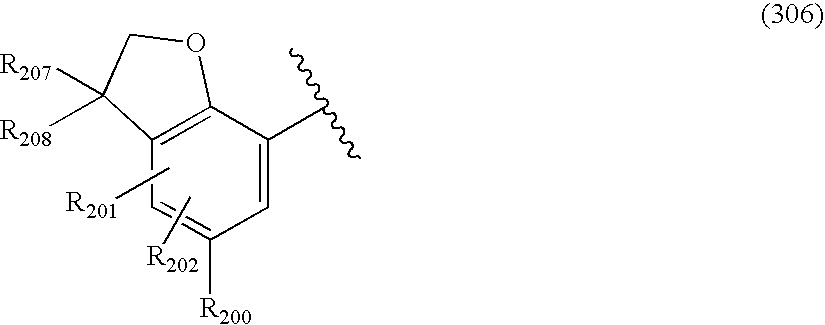
- wherein:
- R 200 is hydrogen, alkyl, substituted alkyl, haloalkyl, alkenyl, substituted alkenyl, alkynyl, substituted alkynyl, halogen, cyano, nitro, hydroxyl, acyloxy, amino, mono-substituted amino, di-substituted amino, alkylsulfonamide, substituted alkylsulfonamide, arylsulfonamide, heteroarylsulfonamide, alkylurea, alkylthiourea, arylurea, acyl, substituted acyl, alkylcarbamate, arylcarbamate, alkylthiocarbamate, substituted alkylthiocarbamate, arylthiocarbamate, heteroaryl, substituted heteroaryl, alkoxy, substituted alkoxy, haloalkoxy, thioalkyl, alkylsulfoxide, alkylsulfonyl, thiohaloalkyl, carboxy, carboalkoxy, alkylcarboxamide, substituted alkylcarboxamide, dialkylcarboxamide or substituted dialkylcarboxamide;
- R 201 and R202 are hydrogen or halogen; and
- R 207 and R208 are independently or together alkyl or substituted alkyl.
- Some embodiments of the invention relate to where L, M, N, Q and T together form a partially reduced benzothiofuran ring of Formula (307):
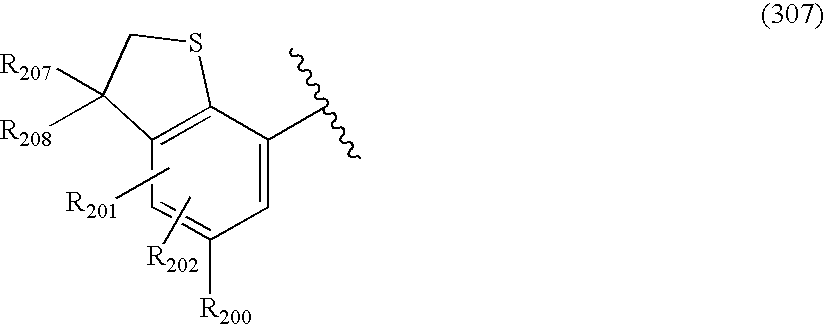
- wherein:
- R 200 is hydrogen, alkyl, substituted alkyl, haloalkyl, alkenyl, substituted alkenyl, alkynyl, substituted alkynyl, halogen, cyano, nitro, hydroxyl, acyloxy, amino, mono-substituted amino, di-substituted amino, alkylsulfonamide, substituted alkylsulfonamide, arylsulfonamide, heteroarylsulfonamide, alkylurea, alkylthiourea, arylurea, acyl, substituted acyl, alkylcarbamate, arylcarbamate, alkylthiocarbamate, substituted alkylthiocarbamate, arylthiocarbamate, heteroaryl, substituted heteroaryl, alkoxy, substituted alkoxy, haloalkoxy, thioalkyl, alkylsulfoxide, alkylsulfonyl, thiohaloalkyl, carboxy, carboalkoxy, alkylcarboxamide, substituted alkylcarboxamide, dialkylcarboxamide or substituted dialkylcarboxamide;
- R 201 and R202 are hydrogen or halogen; and
- R 207 and R208 are independently or together alkyl or substituted alkyl.
- Some embodiments of the invention relate to where L, M, N, Q and T together form a partially reduced benzopyrrole ring of Formula (308):
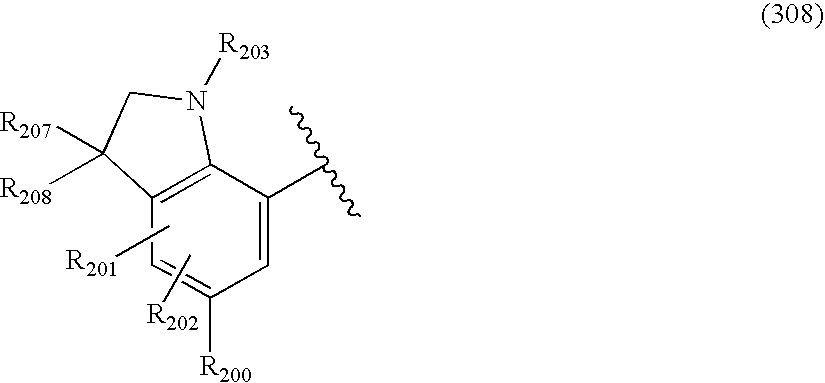
- wherein:
- R 200 is hydrogen, alkyl, substituted alkyl, haloalkyl, alkenyl, substituted alkenyl, alkynyl, substituted alkynyl, halogen, cyano, nitro, hydroxyl, acyloxy, amino, mono-substituted amino, di-substituted amino, alkylsulfonamide, substituted alkylsulfonamide, arylsulfonamide, heteroarylsulfonamide, alkylurea, alkylthiourea, arylurea, acyl, substituted acyl, alkylcarbamate, arylcarbamate, alkylthiocarbamate, substituted alkylthiocarbamate, arylthiocarbamate, heteroaryl, substituted heteroaryl, alkoxy, substituted alkoxy, haloalkoxy, thioalkyl, alkylsulfoxide, alkylsulfonyl, thiohaloalkyl, carboxy, carboalkoxy, alkylcarboxamide, substituted alkylcarboxamide, dialkylcarboxamide or substituted dialkylcarboxamide;
- R 201 and R202 are hydrogen or halogen; and
- R 203, R207 and R208 are independently or together hydrogen, alkyl or substituted alkyl.
- In many embodiments of the compounds of the invention, R 200 is not hydrogen. In some embodiments, R200 is selected from an alkyl, substituted alkyl, haloalkyl, alkenyl, substituted alkenyl, alkynyl, substituted alkynyl, halogen, cyano, nitro, hydroxyl, acyloxy, amino, mono-substituted amino, di-substituted amino, alkylsulfonamide, substituted alkylsulfonamide, arylsulfonamide, heteroarylsulfonamide, alkylurea, alkylthiourea, arylurea, acyl, substituted acyl, alkylcarbamate, arylcarbamate, alkylthiocarbamate, substituted alkylthiocarbamate, arylthiocarbamate, heteroaryl, substituted heteroaryl, alkoxy, substituted alkoxy, haloalkoxy, thioalkyl, alkylsulfoxide, alkylsulfonyl, thiohaloalkyl, carboxy, carboalkoxy, alkylcarboxamide, substituted alkylcarboxamide, dialkylcarboxamide or substituted dialkylcarboxamide.
- In some embodiments, the R 200 residue or radical is selected from an alkyl, substituted alkyl, aryl, substituted aryl, heteroaryl, or substituted heteroaryl having 1 to 10 carbon atoms or 2-8 carbon atoms or 3-6 carbon atoms. Hydroxyalkyls or alkoxyalkyls are sometimes favored substituted alkyls.
- In some embodiments R 200 is an alkyl. Some examples R200 is a straight or branched alkyl of C1-C8. In other examples R200 is a straight or branched alkyl of C1-C6. In still other examples R200 is a straight or branched alkyl of C1-C4, such as methyl, ethyl, i-propyl, n-propyl, i-butyl, n-butyl, and t-butyl.
- In some embodiments R 200 is an alkyl of C1-C4 that is branched. In some embodiments, isobutyl groups are preferred R200 groups.
- In some embodiments R 200 is an alkoxy of C1-C8 that is either straight chain or branched. In other examples R200 is an alkoxy of C1-C6 that is either straight chain or branched. In still other examples R200 is an alkoxy of C1-C4 that is either straight chain or branched.
- In some embodiments R 200 is an aryl or substituted aryl. In other embodiments R200 is a heteroaryl or substituted heteroaryl. Some representative examples of substituted aryls and substituted heteroaryl shown in Formulae (310a and 310b):
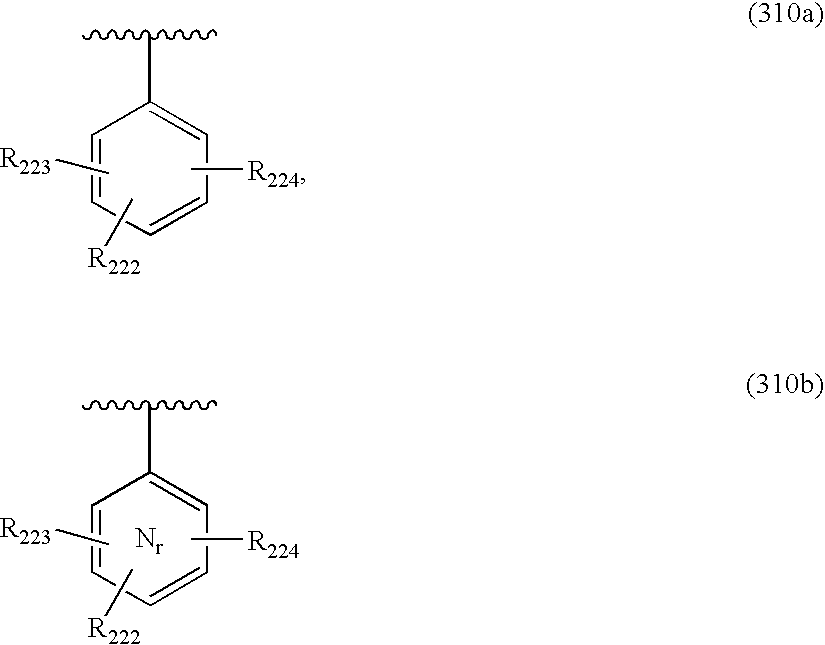
- wherein R 222, R223 and R223 are organic or inorganic radicals. Suitable radicals include but are not limited to hydrogen, alkyl, substituted alkyl, haloalkyl, alkenyl, substituted alkenyl, alkynyl, substituted alkynyl, halogen, cyano, nitro, hydroxyl, acyloxy, amino, mono-substituted amino, di-substituted amino, alkylsulfonamide, substituted alkylsulfonamide, arylsulfonamide, heteroarylsulfonamide, alkylurea, alkylthiourea, arylurea, acyl, substituted acyl, alkylcarbamate, arylcarbamate, alkylthiocarbamate, substituted alkylthiocarbamate, arylthiocarbamate, heteroaryl, substituted heteroaryl, alkoxy, substituted alkoxy, haloalkoxy, thioalkyl, alkylsulfoxide, alkylsulfonyl, thiohaloalkyl, carboxy, carboalkoxy, alkylcarboxamide, substituted alkylcarboxamide, dialkylcarboxamide or substituted dialkylcarboxamide; and Nr represent the number of nitrogen in the ring wherein “r” is 1, 2 or 3 thus forming a substituted or unsubstituted pyridyl, pyrimidinyl or triazinyl respectively. Some other embodiments where R200 is a heteroaryl or substituted heteroaryl include five-membered rings. Some interesting heteroaryl and substituted heteroaryl residues are five membered rings, where some representative examples are of the Formulae (312a-x):
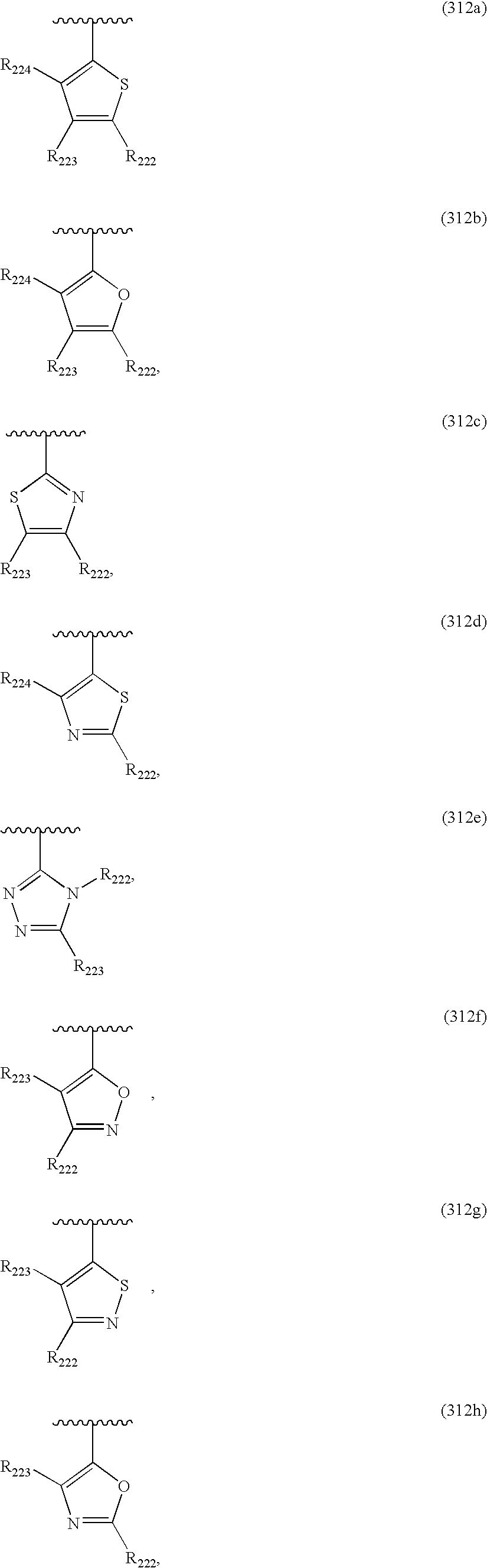
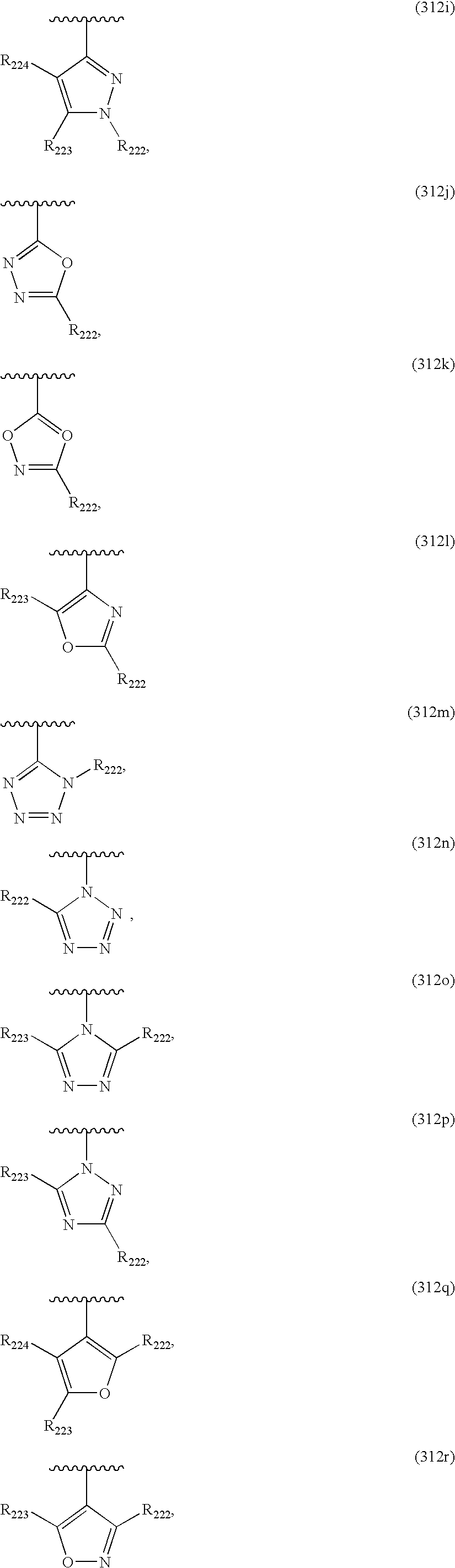

- wherein R 222, R223 and R224 are independently or together hydrogen, alkyl, substituted alkyl, haloalkyl, alkenyl, substituted alkenyl, alkynyl, substituted alkynyl, halogen, cyano, nitro, hydroxyl, acyloxy, amino, mono-substituted amino, di-substituted amino, alkylsulfonamide, substituted alkylsulfonamide, arylsulfonamide, heteroarylsulfonamide, alkylurea, alkylthiourea, arylurea, acyl, substituted acyl, alkylcarbamate, arylcarbamate, alkylthiocarbamate, substituted alkylthiocarbamate, arylthiocarbamate, heteroaryl, substituted heteroaryl, alkoxy, substituted alkoxy, haloalkoxy, thioalkyl, alkylsulfoxide, alkylsulfonyl, thiohaloalkyl, carboxy, carboalkoxy, alkylcarboxamide, substituted alkylcarboxamide, dialkylcarboxamide or substituted dialkylcarboxamide. In some embodiments, R222, R223 and R224 are hydrogen, a halogen, or a C1-C4 alkyl.
- It is to be understood that compounds of Formula (312a-x) possessing heteroaryl residues wherein N—R 222 is a hydrogen, tautomers are possible and are within the scope of the invention. For example, triazole (312e) can exist in several tautomeric forms when R222 is hydrogen. These forms can be represented as shown:
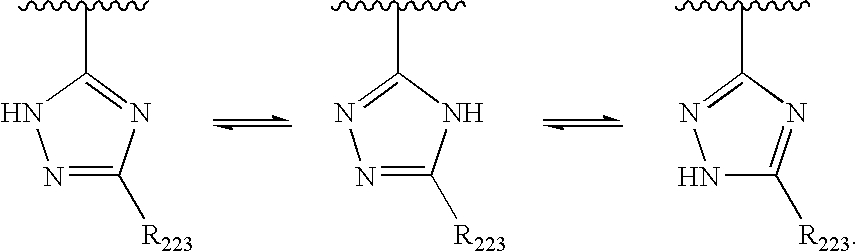
- Other represented structures that can exist as various tautomeric forms include, for example, (312i), (312m), (312t) and (312u).
- Some embodiments of the invention relate to compounds of the first or second genuses wherein —C(R 205)(R206)—, —C(R207)(R208)— and —C(R209)(R210)— independently form a cycloalkyl optionally substituted with O, S or N-alkyl. For example, in some embodiments of bicyclic residues (305a-n) and (306)-(308), the R207 and R208 radicals can optionally be bonded together to form an additional exocyclic cycloalkyl radical, which can optionally comprise 1 or 2 heteroatoms selected from —O—, —S—, —NH—, or —N(alkyl)-. Representative examples of such exocyclic cycloalkyls with optional heteroatoms include but are not limited to exocyclic cyclopropyl, cyclobutyl, cyclopentyl, tetrahydrofuranyl, pyrrolidinyl and like radicals. For example, for residues of formula (305a), the (R207) and (R208) substituents of the —C(R207)(R208)— radical can be bonded together form a cycloalkyl having the Formulae (309a-c).
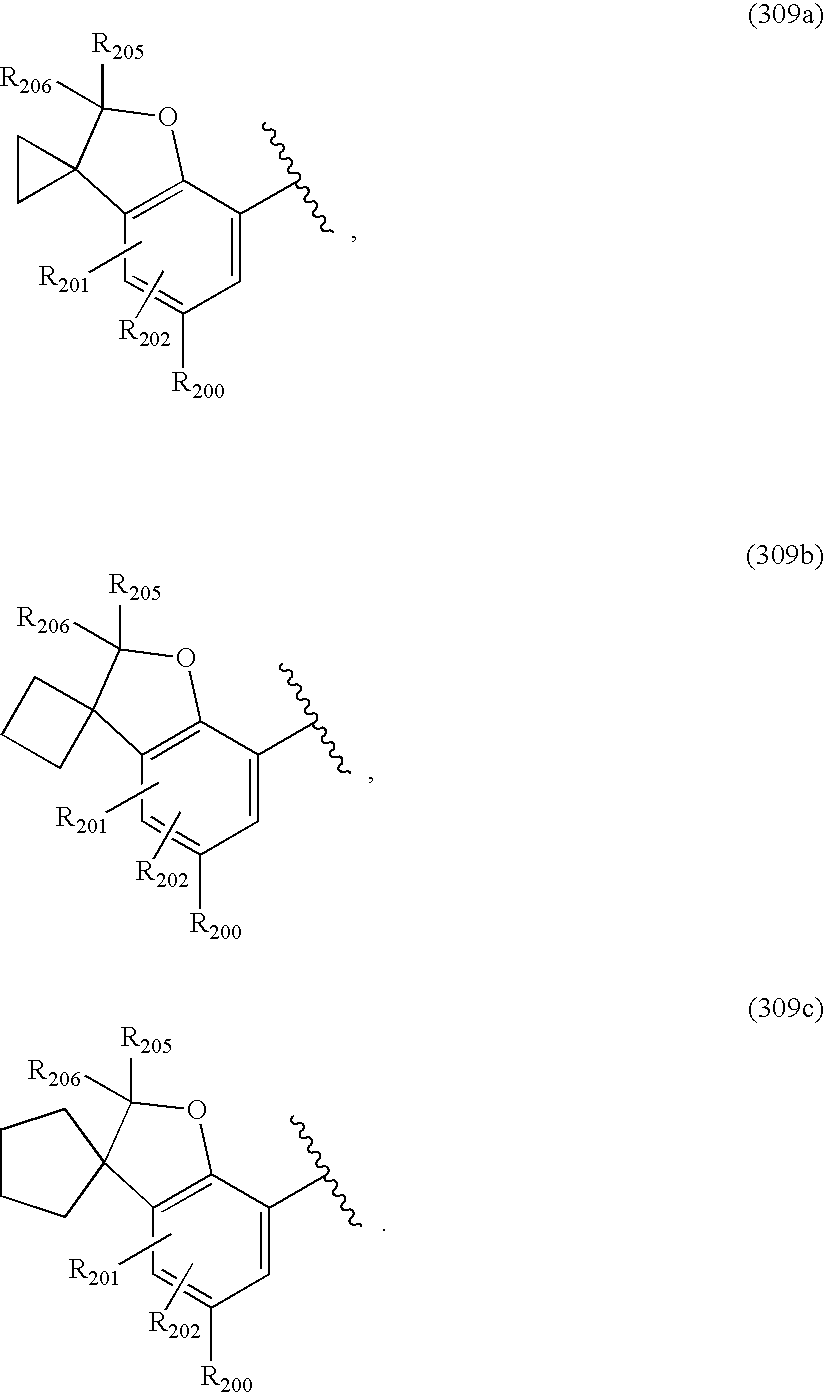
- Some embodiments of the invention relate to compounds of the invention wherein —C(R 209)(R210)— form a cycloalkyl optionally substituted with —O—, —S—, —NH—, or —N(alkyl)-. Representative examples of bicyclic radicals of Formula (305d) wherein —C(R209)(R210)— together form a cycloalkyl are of the Formulae (309d-f).

- Any two of the R 203, R204, R205, R206, R207, R208, R209 and R210 residues can also be connected together to form an exocyclic substituent residue comprising 1 to 6 ring carbon atoms and from 0 to 3 optional ring heteroatoms selected from O, S, or N.
- The Ar 10 residue is an aryl, substituted aryl, heteroaryl, or substituted heteroaryl residue. Although not wishing to be bound by theory, the compounds of the invention, including the Ar10 radical and/or its various substituents are selected so as to have a geometry, size, and polarity that is suitable to allow the compounds of the invention to interact with and substantially fill, yet fit within, the binding regions of the target biological molecules, so as to contribute to the effective binding of the compounds to the binding sites in the biological target molecules. Therefore, in some embodiments, the Ar10 radical or residue, together with all its associated substituent radicals together comprise from 2 to 18 carbon atoms, or from 3 to 16 carbon atoms, or from 4 to 12 carbon atoms, or from 5 to 10 carbon atoms.
- In many embodiments, Ar 10 comprises from 3 to 6 ring carbon atoms and from 0 to 3 optional ring heteroatoms selected from O, S, or N. The aryl and heteroaryl rings (whether substituted or unsubstituted) include benzene, pyridine, pyrimidene, and pyrazine rings. The Ar10 residue is at least disubstituted in the sense that it is bonded to both the bicyclic residue and the carbon atom connecting to the heterocyclic ring comprising W, X, Y and Z. The Ar10 residue can have any ring substitution geometry (i.e. the bicyclic reside and the carbon atom substituents can be any of ortho, meta, and para with respect to each other.
- Nevertheless, it has been found that in certain embodiments, especially those relating to the use of the compounds as agents for the treatment of diabetes, lipid or carbohydrate metabolism, or adipocyte differentiation, compounds having an Ar 10 residue with a “meta” ring geometry can be unexpectedly advantageous. Examples of such meta substituted Ar10 residues include compounds of the Formulas (315a), (315b), (315c) or (315d):
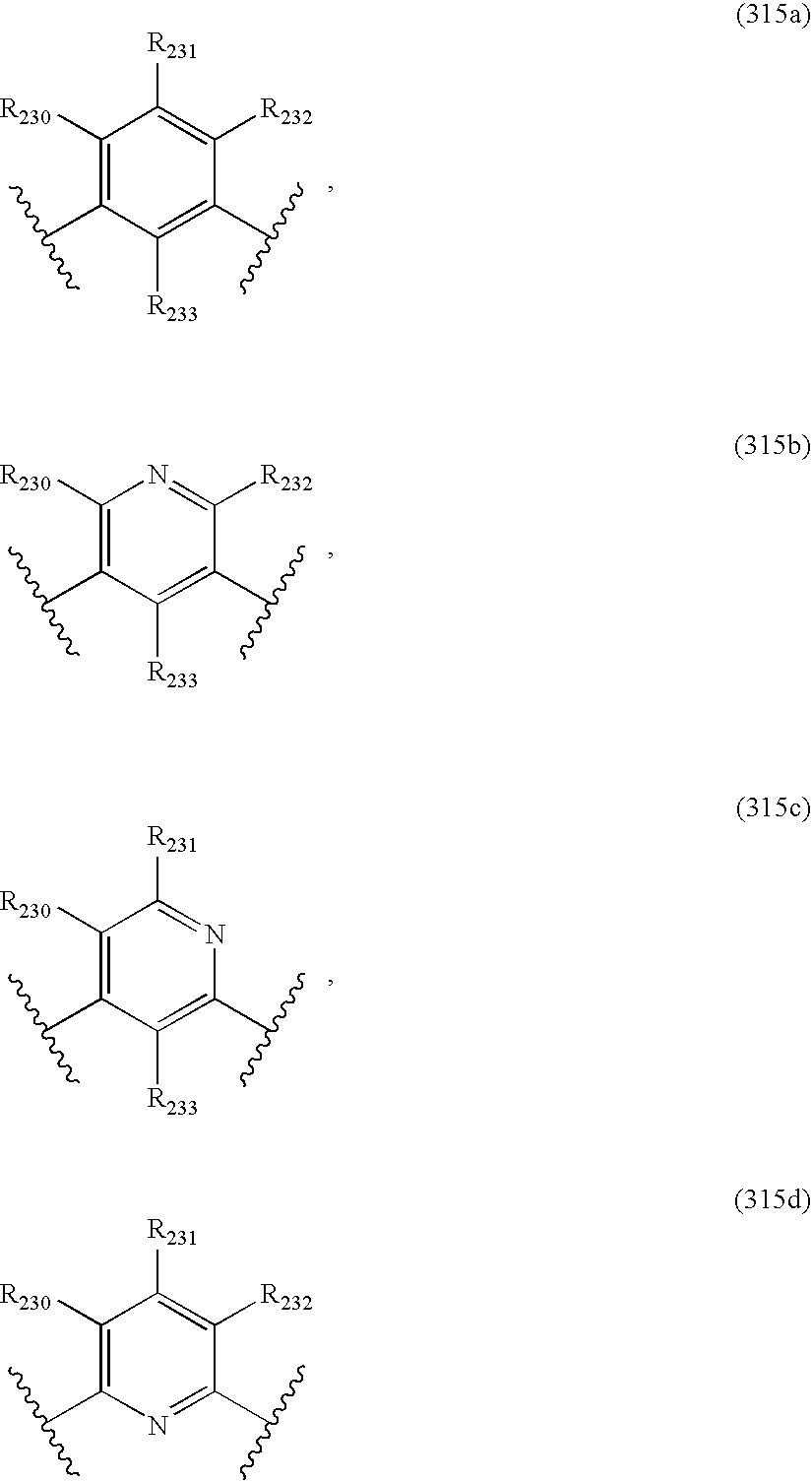
- The R 230, R231, R232 and R233 substituents for Ar10 are independently selected from hydrogen, alkyl, substituted alkyl, haloalkyl, alkenyl, substituted alkenyl, alkynyl, substituted alkynyl, halogen, cyano, nitro, hydroxyl, acyloxy, amino, mono-substituted amino, di-substituted amino, alkylsulfonamide, substituted alkylsulfonamide, arylsulfonamide, heteroarylsulfonamide, alkylurea, alkylthiourea, arylurea, acyl, substituted acyl, alkylcarbamate, arylcarbamate, alkylthiocarbamate, substituted alkylthiocarbamate, arylthiocarbamate, heteroaryl, substituted heteroaryl, alkoxy, substituted alkoxy, haloalkoxy, thioalkyl, alkylsulfoxide, alkylsulfonyl, thiohaloalkyl, carboxy, carboalkoxy, alkylcarboxamide, substituted alkylcarboxamide, dialkylcarboxamide or substituted dialkylcarboxamide. In many embodiments, each of the R230, R231, R232 and R233 substituents, if they are an organic residue or radical, will comprise between 1 to 8 carbons, or 1 to 6 carbons, or 1 to four carbons.
- In some embodiments R 230 is not hydrogen. Although not wishing to be bound by theory, it is believed that such substituents can unexpectedly improve the activity of the compounds as agents for modulating lipid or carbohydrate metabolism, adipocyte differentiation, and/or producing anti-diabetic and/or anti-cholesteremic activity. In some embodiments, preferred R125, residues are an alkyl, substituted alkyl, haloalkyl, alkoxy, substituted alkoxy, haloalkoxy, halogen, amino, mono-substituted amino, or disubstituted amino residue, particularly those comprising from 1 to 6 carbons, or 1 to four carbons.
- In some embodiments Ar 10 is Formula (317a), (317b), (317c) or (317d):
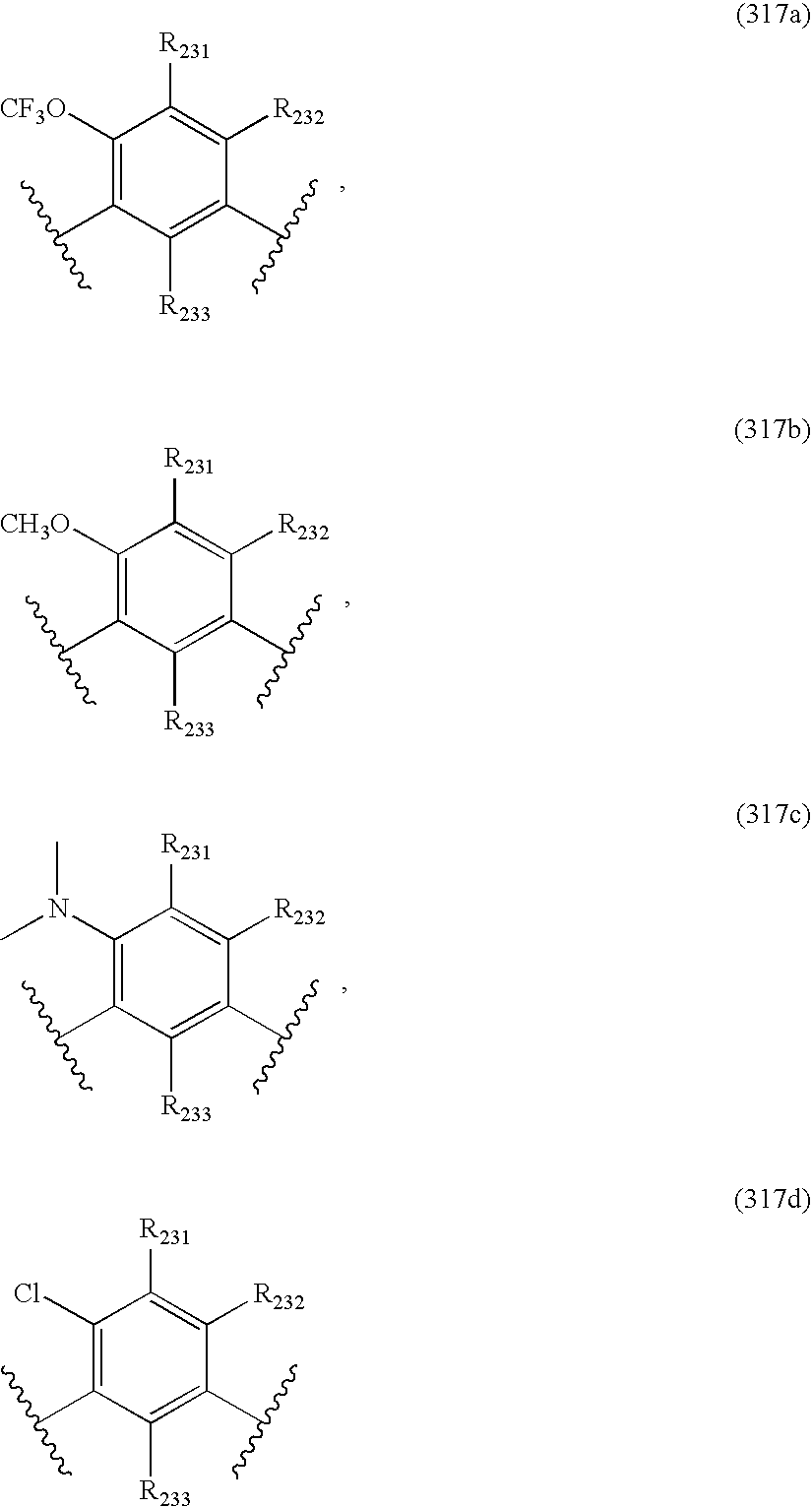
- wherein R 231, R232 and R233 are independently or together hydrogen or halogen.
- In some embodiments - - - - represents a bond present, and therefore there is a carbon-carbon double bond between the carbon atom bonded to the R 211 substituent and the heterocycle comprising the W, X, Y, and Z radicals, and the compound is a “benzylidene” compound having Formula (320):
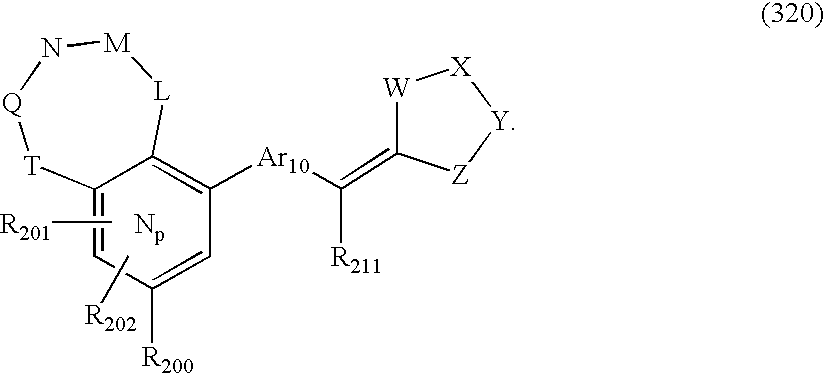
- In some embodiments - - - - represents a bond absent, and therefore there is a carbon-carbon single bond between the carbon atom bonded to the R 211 substituent and the heterocycle comprising the W, X, Y, and Z radicals, and the compound is a “benzyl” compound having Formula (322):
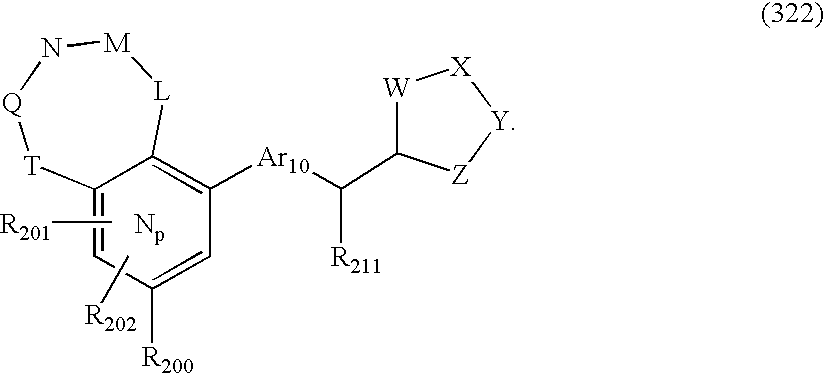
- In some embodiments R 211 is hydrogen, alkyl, substituted alkyl, hydroxy, alkoxy or haloalkoxy. In some embodiments R211 is hydrogen or alkyl. In many embodiments, R211 is hydrogen. The compounds of the invention can also be described more narrowly than the first and second genuses of embodiments described above. Two examples of such narrower descriptions are set forth below, but the meanings of the various relevant terms and symbols are intended the same as those same terms and symbols as described in the more detailed descriptions set forth above.
- In one narrower description of the invention, the invention relates to a compound having the structure

- wherein:
- a) the bicyclic radical
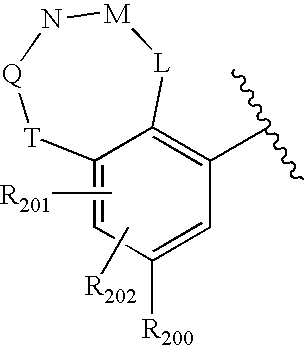
- has the structure
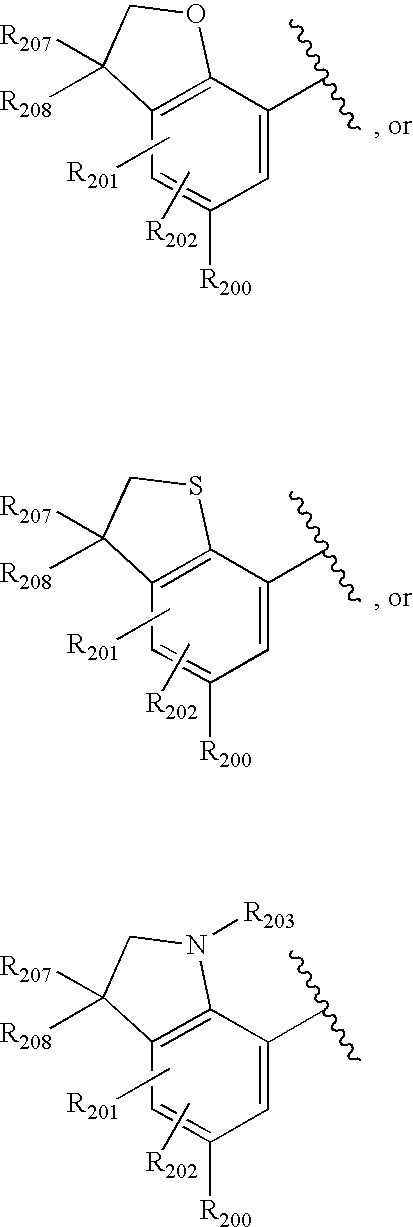
- wherein R 200 comprises 1 to 10 carbon atoms and is selected from the group consisting of an alkyl, haloalkyl, halogen, cyano, nitro, hydroxyl, acyloxy, amino, mono-alkyl-amino, dialkyl-amino, alkylsulfonamide, arylsulfonamide, heteroarylsulfonamide, acyl, alkylcarbamate, arylcarbamate, alkylthiocarbamate, aryl, heteroaryl, alkoxy, haloalkoxy, thioalkyl, alkylsulfoxide, alkylsulfonyl, thiohaloalkyl, carboxy, carboalkoxy, alkylcarboxamide, or dialkylcarboxamide;
- R 201 and R202 are independently selected from hydrogen or a halogen; and
- R 203, R207 and R208 are independently selected from hydrogen or an alkyl comprising 1 to 4 carbon atoms.
- b) W, X, Y and Z form a heterocycle having the structure
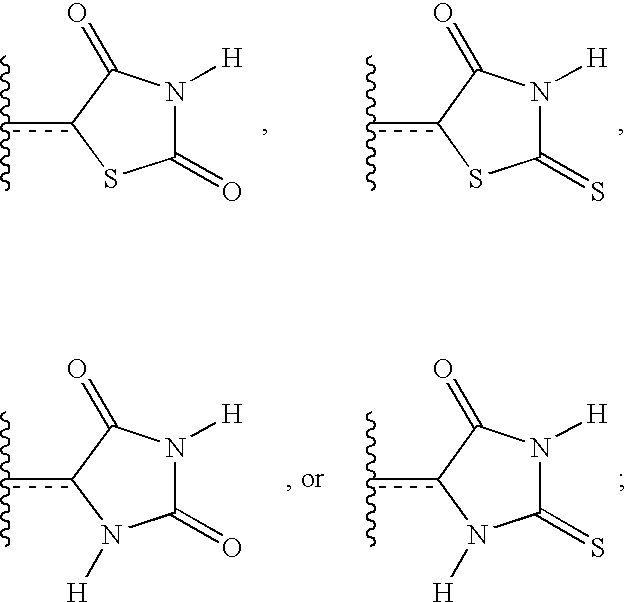
- c) ----- is either present or absent;
- d) Ar 10 has the structure
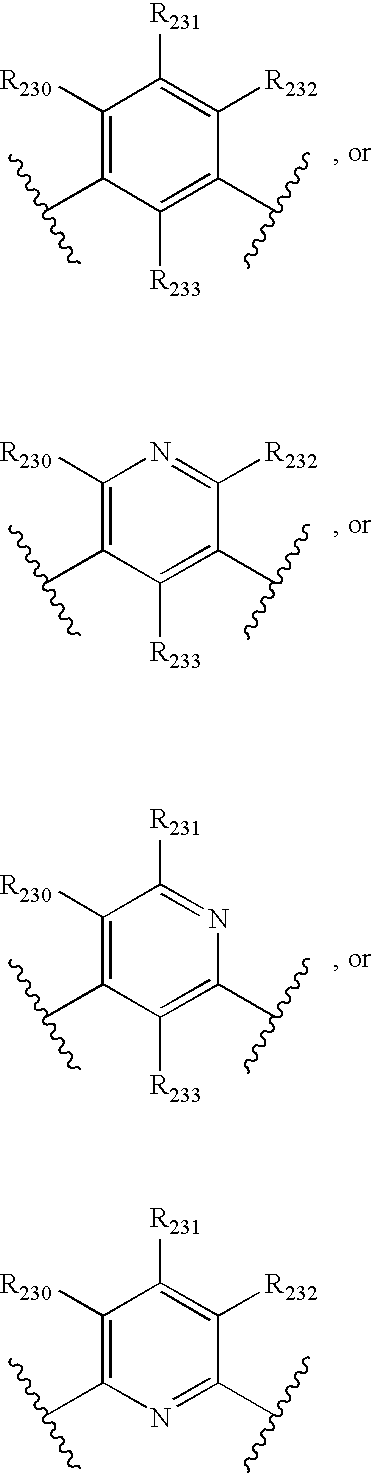
- wherein R 230, R231, R232 and R233 are independently selected from hydrogen, alkyl, haloalkyl, halogen, hydroxyl, acyloxy, amino, mono-substituted amino, di-substituted amino, acyl, alkoxy, haloalkoxy, thioalkyl, alkylsulfoxide, alkylsulfonyl, carboxy, carboalkoxy, alkylcarboxamide, or dialkylcarboxamide, with the proviso that R230 is not hydrogen; and
- e) R 211 is hydrogen or an alkyl having from 1 to 4 carbon atoms;
- or a pharmaceutically acceptable salt thereof.
- In yet another embodiment, the invention relates to a compound having the structure
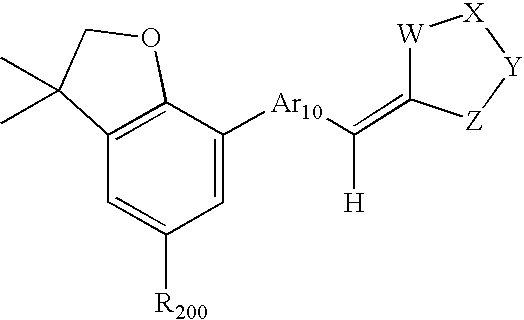
- wherein:
- a) R 200 comprises 1 to 10 carbon atoms and is selected from the group consisting of an alkyl, haloalkyl, halogen, cyano, nitro, hydroxyl, acyloxy, amino, mono-alkyl-amino, dialkyl-amino, alkylsulfonamide, arylsulfonamide, heteroarylsulfonamide, acyl, alkylcarbamate, arylcarbamate, alkylthiocarbamate, aryl, heteroaryl, alkoxy, haloalkoxy, thioalkyl, alkylsulfoxide, alkylsulfonyl, thiohaloalkyl, carboxy, carboalkoxy, alkylcarboxamide, or dialkylcarboxamide;
- b) W, X, Y and Z form a heterocycle having the structure

- c) Ar 10 has the structure
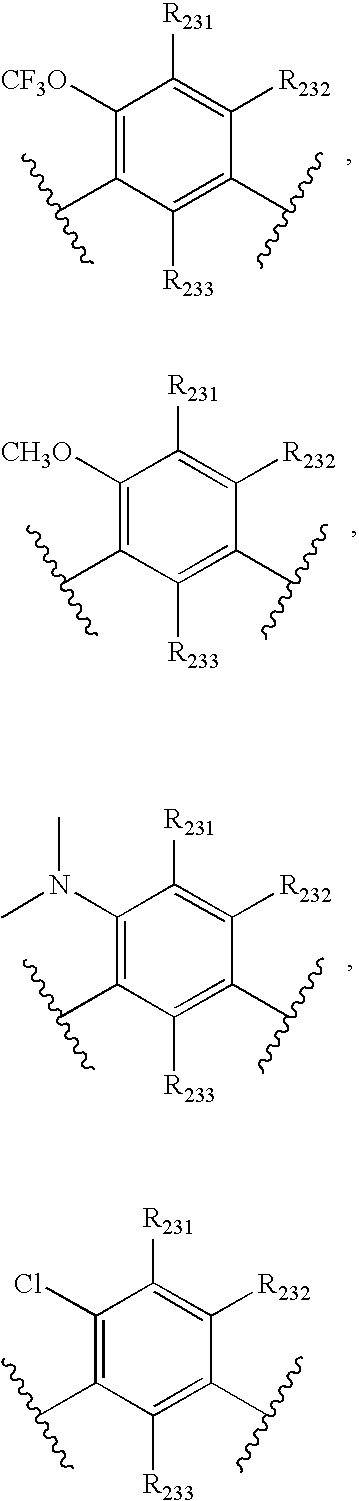
- wherein R 231, R232 and R233 are independently selected from hydrogen or a halogen.
- The compounds disclosed herein can exist in various tautomeric forms. For example, 2,4-thiazolidinedione-containing compounds disclosed herein can exist in the form of tautomers (324a), (324b) and (324c).
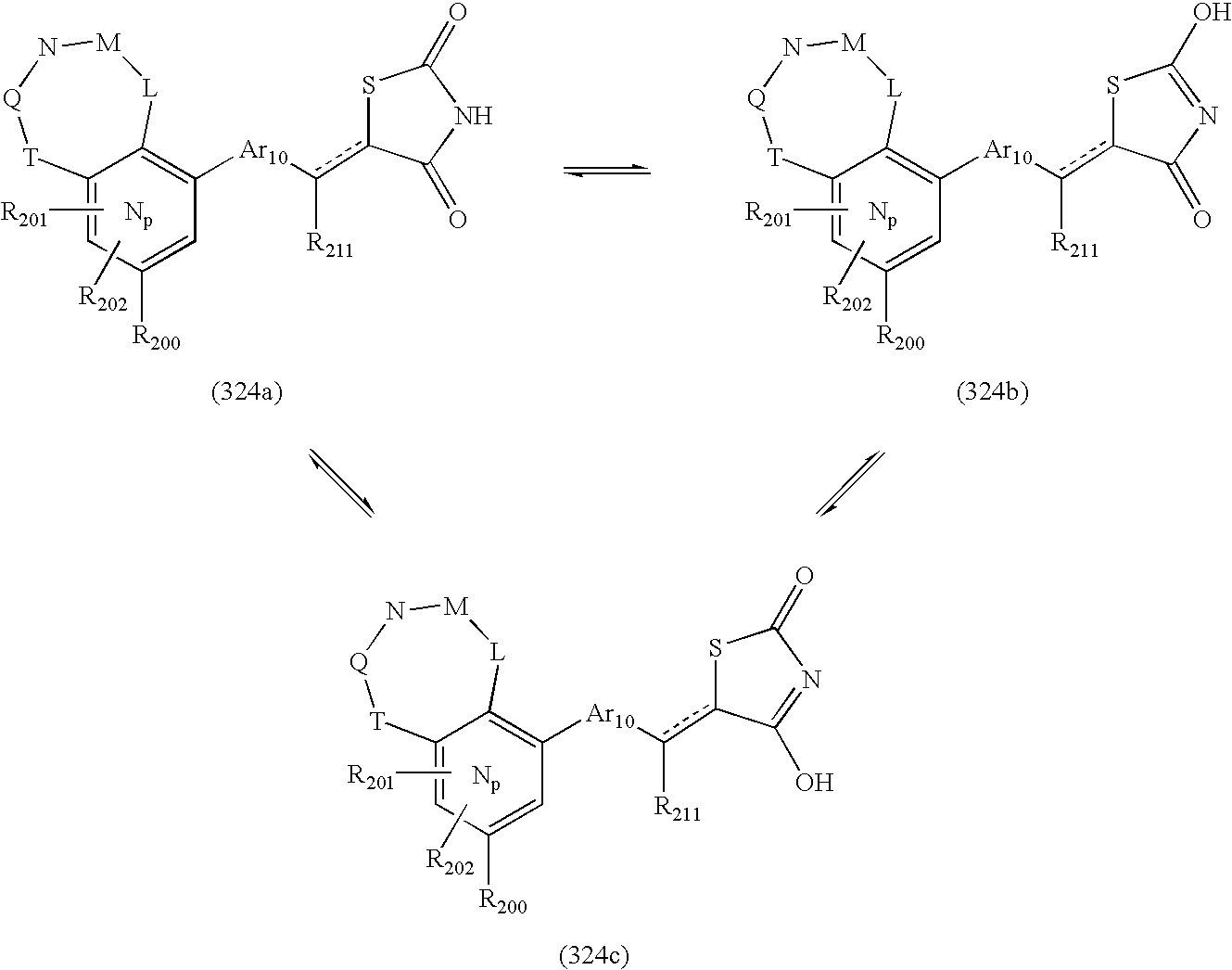
- It is understood by those skilled in the art that tautomers can also exist with compounds of the invention that contain the heterocycle 2-thioxo-thiazolidine-4-one, 2,4-imidazolidinedione or 2-thioxo-imidazolidine-4-one. For convenience, all of the tautomers can be presented herein by a single formula, but it is understood that all tautomers are within the scope of the invention.
- When - - - - - is present both E and Z configurations are within the scope of the invention. For example, 2,4-thiazolidinedione and 2-thioxo-4-thiazolidinedione compounds of the invention can have the following structures respectively:
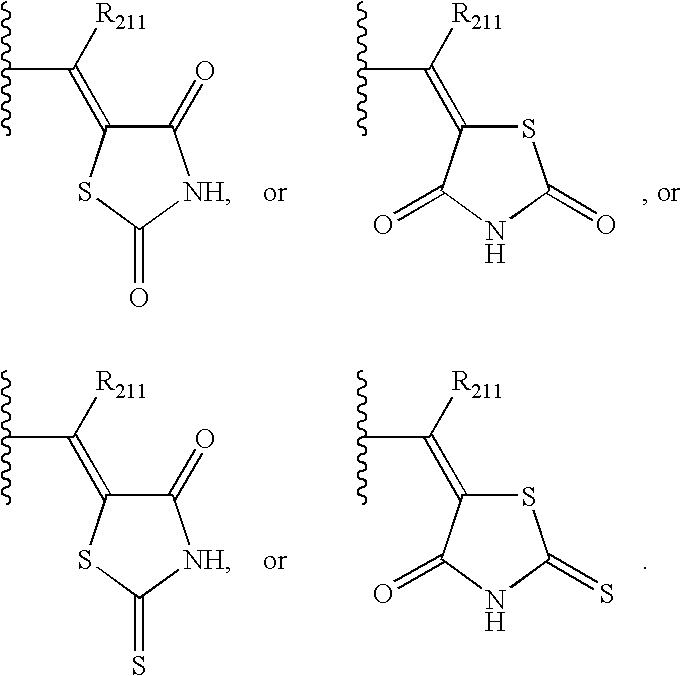
- When only one of the two isomers is shown in this specification or in the claims, it should be presumed that both isomers and mixtures thereof are intended unless the context makes it plain that only a single isomer is intended.
- The compounds disclosed herein can also include salts of the compounds, such as salts with cations. Cations with which the compounds of the invention can form pharmaceutically acceptable salts include alkali metals, such as sodium or potassium; alkaline earth metals, such as calcium; and trivalent metals, such as aluminum. The only constraint with respect to the selection of the cation is that it should not unacceptably increase the toxicity.
- As already noted above, the 5 membered heterocyclic ring radical comprising the W, X, Y, and Z groups form one of four heterocycles, selected from a 2,4-thiazolidinedione, 2-thioxo-thiazolidine-4-one, 2,4-imidazolidinedione or 2-thioxo-imidazolidine-4-one residue, which can be collectively termed “HAr” heterocycles. The four possible HAr heterocylic residues are shown in the drawing below:

- 2,4-thiazolidinedione 2-thioxo-thiazolidine-4-
one 2,4-imidazolidinedione 2-thioxo-imidazolidine-4-one - All four of the HAr heterocycles shown above comprise at least one ring nitrogen atom bonded to a hydrogen atom. The nitrogen-bound hydrogen atoms of all four of the HAr heterocyles are sufficiently acidic so as to react with common laboratory bases such as organic amine compounds, hydroxide salts, and the like.
- The acidity of the four HAr heterocycles provides a ready method for preparing salts of the compounds of the invention, by reaction with an appropriate base, so as to generate an anion from the compound of the invention and a cation derived from the base employed. The salts formed by such reactions have the structure
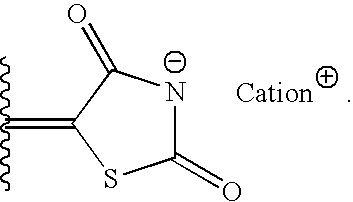
- A wide variety of bases can be employed to produce such salts, including monovalent alkali metal hydroxides, divalent alkaline earth metal hydroxides, or bases comprising trivalent metal salts such as aluminum. Alternatively, organic bases such as primary, secondary, or tertiary amines can react with the acidic hydrogens of the compounds of the invention to form ammonium salts. The base and/or its associated cation can be chosen so as to provide desirable solubility, toxicity, and/or bioavailability characteristics in the salt after formation of the desired salts. The identity of the base and/or the resulting cation will of course vary somewhat with the identity of the compound of the invention, and the nature of the pharmaceutical composition to be employed and its physical form as a solid or liquid, and the nature of any solvents and/or carriers to be employed.
- The United States Food and Drug Administration has published a list of pharmaceutically acceptable cations for pharmaceutically acceptable salts that includes aluminum, calcium, lithium, magnesium, potassium, sodium, and zinc cations, ammonium cations formed by the reactions of acidic compounds with benzathine, chloroprocaine, choline, diethanolamine, ethylenediamine, meglumine, procaine, t-butylamine, and tris(hydroxymethyl)aminomethane (“Tris”). Such “pharmaceutically acceptable” salts are often employed and/or evaluated for use in the invention simply because of the likelihood of decreased FDA regulatory scrutiny of Example 25 provides an example of the synthesis of a particularly useful “Tris” ammonium salt of one of the compounds of the invention.
- Also, one or more compounds disclosed herein can include zwitterionic salts formed by reaction of a nitrogen contained internally within the compound, such as an amine, aniline, substituted aniline, pyridyl and like residues with the acidic hydrogen of the HAr group. Alternatively, a basic nitrogen contained internally within the compound can be reacted with an external acid, such as HCl, sulfuric acid, a carboxylic acid or the like.
- The present invention provides, but is not limited to, the specific compounds set forth in the Examples.
- Various synthetic methods can be employed in the making of the compounds disclosed herein. A representative set of synthetic pathways is shown in FIGS. 4-7 for the making of the aryl group that can be used in the coupling with Ar10 and subsequently to the compounds of Formula (300). One method, for example as shown in FIG. 4, includes the use of anisole (330) that can be alkylated with, for example, 3-chloro-2-methyl-propene, to give anisole (331). By selecting the desired chloro-propene the groups R207R208 can be introduced into compounds of the invention. Anisole (331) is subsequently cyclized in the presence of pyridine hydrochloride and quinoline with heat to give the dihydro-benzofuran (332). The dihydro-benzofuran (332) can be iodinated to compound (333) and subsequently coupled using methods described below herein to give biaryl (334). Different groups can be introduced at this stage in the synthesis. For example, biaryl (334) can undergo another coupling reaction, such as a Suzuki coupling reaction and other methods described herein below, to give biaryl (335) wherein different heteroaryls or aryl groups can be introduced as shown in FIG. 4.
- Another method, for example shown in FIG. 5, includes the use of aryl thiol (336) that can be alkylated with an alpha-halo acetate to give ester (337). The ester can be converted to a 3° alcohol (338) by methods known in the art, such as through a Grignard reagent. The groups R 207R208 can be introduced into compounds of the invention by the selection of the appropriate Grignard. Alcohol (338) is cyclized using, for example, a Lewis acid, such as AlCl3, to give dihydro-benzothiophene (339). In a similar manner as described above herein, dihydro-benzothiophene (339) can be iodinated to compound (340). Compound (340) can be converted to biaryl (341) and subsequently modified to biaryl (342). Coupling reactions to biaryls wherein a sulfur is present in the molecule can provide difficulties with certain catalyses. However, there are various procedures in the art that allow such couplings in the presence of a sulfur atom, such as, Cram, et al., J. Org. Chem. 55:4622-4634 (1990) and Savarin, et al., Org. Letters 3:2149-2152 (2001).
- Another method, for example shown in FIG. 6, includes the use of aniline (343) that can be cyclized in a similar manner as described by Kraus, et al. Tetrahedron Letters 40:2039-2040 (1999) to give dihydro-indole (344). At this stage, R203 can be introduced by allowing R203-LG to react with the nitrogen anion of dihydro-indole (344), wherein LG is a leaving group, such as, for example, Cl, Br, I, OTf, and the like to give dihydro-indole (345). Dihydro-indole (345) can be iodinated to give dihydro-indole (346) and using methods described herein above dihydro-indole (346) is converted to biaryl (347) and subsequently into aryl or heteroaryl modified biaryl (348). It will be appreciated that biaryls (334), (341) and (347) can be converted into a boron derivative, such as a boron ester or boronic acid, and subsequently coupled with an aryl or heteroaryl halide to give the corresponding coupled biaryl (335), (342) and (348) respectively.
- Another method, for example shown in FIG. 7, uses aryl bromide (349) to prepare a variety of R 200 groups. For example, aryl bromide (349) can be converted to aldehyde (350) through an aryl lithium intermediate and DMF or equivalent thereof. Aldehyde (350) can be oxidized using methods in the art, such as, KMnO4 or similar oxidant, to give carboxylic acid (351). Carboxylic acid (351) can either be coupled with a variety of amines, such as, for example, dimethyl amine, to give amide (352) or allowed to undergo a Curtius Rearrangement to give aniline (356). Such rearrangements can be accomplished using, for example, diphenylphosphorylazide. Aniline (356) can be allowed to react with a variety of electrophiles such as, for example, acetyl choride to give amide (357). Aldehyde (350) can also under reductive amination with amines in the presence of reducing reagents, such as, for example, sodium cyanoborohydride, to give amine (359). Aldehyde (350) can also be reduced to give benzyl alcohol (360) and subsequently converted to ether (361) using a base and an alkyl-LG, wherein LG is a leaving group such as those described above herein. Aryl bromide (349) can also be converted into an aryl lithium intermediate, in a manner described above, and allow to react with an aldehyde or ketone, for example isobutyraldehyde, to give alcohol (353). Alcohol (353) can either be oxidized to ketone (354) or deoxygenated using, for example, triethylsilane in TFA, to give arylalkyl (355). Aryl bromide (349) can also be converted into benzonitrile (358) using methods known in the art, such as CuCN in quinoline with heat. Benzonitriles can be converted into a variety of heterocycles using methods known in the art.
- Various synthetic methods can be employed in coupling the aryl or heteroaryl together with Ar 10 of Formula (300). A representative set of synthetic pathways is shown in FIG. 8. One method, for example, includes coupling a boronic acid of Formula (362), R240=H, with a suitable carbonyl-containing aryl of Formula (364), such as R250═Br, I, Cl, triflate or the like, to give biaryl (366) that is substituted with a carbonyl group, such as a formyl group (i.e., R211═H). Alternatively, boronic acid (362) can be coupled with aryl (368), such as when R250═Br, I, Cl, triflate or the like, to give biaryl (370) that is subsequently formylated using techniques known in the art, such as the Vilsmeier or the Vilsmeier-Haack reaction, the Gatterman reaction, the Duff reaction, the Reimer-Tiemann reaction or a like reaction. Coupling reactions such as that described for the formation of Biaryl (366) and (370) can also be conducted using boronic esters, such as where R240 together with the boron from a pinacol borate ester (formation of pinacol esters: Ishiyama, T., et al., J. Org. Chem. 1995, 60, 7508-7510, Ishiyama, T., et al., Tetrahedron Letters 1997, 38, 3447-3450; coupling pinacol esters: Firooznia, F. et al.,
Tetrahedron Letters 1999, 40, 213-216, Manickam, G. et al., Synthesis 2000, 442-446; all four citations incorporated herein by reference). In the example for aryl (368) when R250 is a triflate, it can easily be obtained by known methods from the corresponding phenol. - Biaryl (370) can also be acylated, for example by the Friedel-Crafts Acylation reaction (using an acid chloride) or the like to give biaryl (366) where R 211 is not hydrogen. Alternatively, in a two step manner, biaryl (370) is formylated by first performing a halogenation step to give biaryl (372), such as a bromination, followed by a halogen-metal exchange reaction using an alkyl lithium or lithium tributylmagnesate complex as described by Iida, et. al. in Tetrahedron Letters 2001, 42, 4841-4844 and reaction with DMF or equivalent known in the art to give biaryl (366) where R211 is H.
- In an alternative manner, the coupling can take place between aryl (382), such as where R 250═Br, I, Cl, triflate or the like, and boronic acid (384, R240═H or alkyl) to give the above mention biaryl (366). Also aryl (382) can be coupled with boronic acid (386) to give biaryl (370). Employing the same strategy as described above biaryl (370) can be converted to biaryl (366).
- Coupling of two aryl rings can be conducted using an aryl boronic acid or esters with an aryl halide (such as, iodo, bromo, or chloro), triflate or diazonium tetrafluoroborate; as described respectively in Suzuki, Pure & Applied Chem., 66:213-222 (1994), Miyaura and Suzuki, Chem. Rev. 95:2457-2483 (1995), Watanabe, Miyaura and Suzuki, Synlett. 207-210 (1992), Littke and Fu, Angew. Chem. Int. Ed., 37:3387-3388 (1998), Indolese, Tetrahedron Letters, 38:3513-3516 (1997), Firooznia, et. al., Tetrahedron Letters 40:213-216 (1999), and Darses, et. al., Bull. Soc. Chim. Fr. 133:1095-1102 (1996); all incorporated herein by reference. According to this coupling reaction, precursors such as (362) and (364) can be employed:
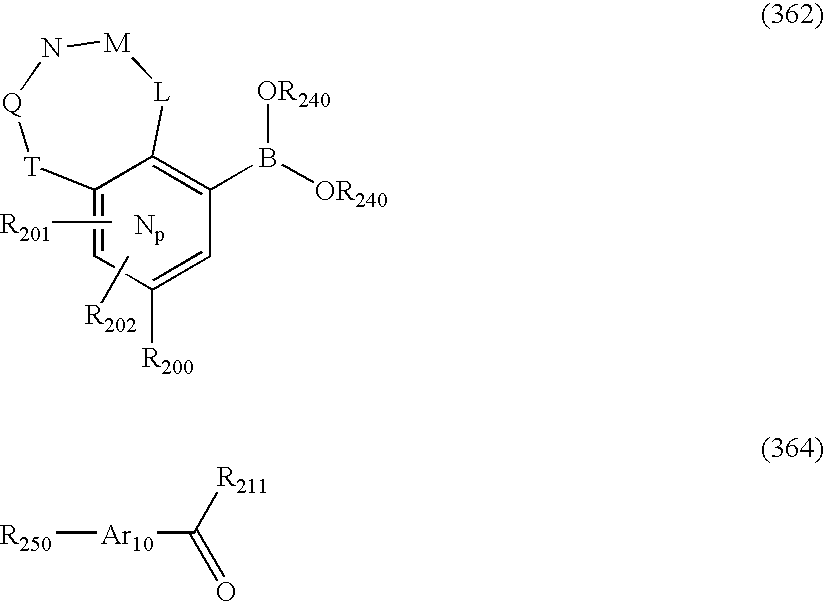
- where R 240 is either alkyl, cycloalkyl (i.e., pinacol) or hydrogen and R250 is a halide (such as, iodo, bromo, or chloro), triflate or diazonium tetrafluoroborate. Alternatively, it is understood that the coupling groups can be reversed, such as the use of (382) and (384), to achieve the same coupling product:

- where R 240 and R250 have the same meaning as described above. The preparation of the above mentioned precursors can be prepared by methods readily available to those skilled in the art. For example, the boronic ester can be prepared from aryl (382, where R250═halide, such as bromo) by conversion of the halide to the corresponding aryl lithium, followed by treatment with a trialkyl borate. Methods are know in the art to prepare pinacol boronic esters from trfilates, such as aryl (382, where R250═triflate). The coupling reaction can also be conducted between an arylzinc halide and an aryl halide or triflate. Alternately, the coupling reaction can also be executed using an aryl trialkyltin derivative and an aryl halide or triflate. These coupling methods are reviewed by Stanforth, Tetrahedron 54:263-303 (1998) and incorporated herein by reference. In general, the utilization of a specific coupling procedure is selected with respect to available precursors, chemoselectivity, regioselectivity and steric considerations.
- Condensation of the biaryl carbonyl containing derivatives (e.g., FIG. 8, compound (366)) with a suitable active methylene compound, such as, 2,4-thiazolidinedione, can be accomplished by the use of methods known in the art. For example, the biaryl carbonyl product from the coupling reaction can be condensed with an active methylene compound to give a benzylidene compound of Formula (300) (i.e., - - - - - is a bond) as described by Tietze and Beifuss, Comprehensive Organic Synthesis (Pergamon Press), 2:341-394, (1991), incorporated herein by reference. It is understood by those skilled in the art that intermediates having hydroxyl groups bonded thereto can be formed during condensation of a biaryl carbonyl containing derivative and an active methylene compound, as shown below.
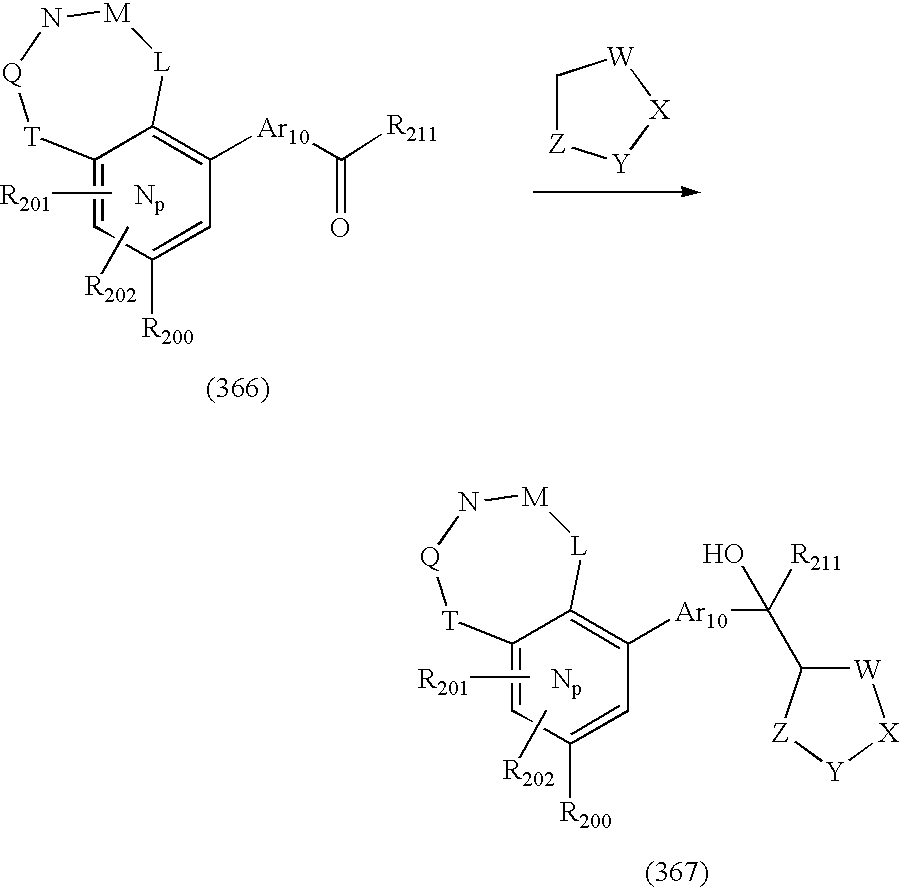
- The hydroxyl groups of benzylic intermediates such as (367) are often eliminated (as water) during the condensation reaction, to form the desired benzylidene compound. Nevertheless, the conditions of the reaction can be modified for the isolation or further use of hydroxyl containing intermediates, and such embodiments are within the scope of the invention. Effective catalysts for the condensation can be selected from ammonia, primary, secondary and tertiary amines, either as the free base or the amine salt with an organic acid, such as acetic acid. Examples of catalysts include pyrrolidine, piperidine, pyridine, diethylamine and the acetate salts thereof. Inorganic catalysts can also be used for the condensation. Inorganic catalysts include, but are not limited to, titanium tetrachloride and a tertiary base, such as pyridine; and magnesium oxide or zinc oxide in an inert solvent system. This type of condensation can be strongly solvent-dependent and it is understood that routine experimentation may be necessary to identify the optimal solvent with a particular catalyst, preferable solvents include ethanol, tetrahydrofuran, dioxane or toluene; or mixtures thereof.
- In order to prepare the reduced benzylic heterocycles such as compound (380), the carbonyl group of biaryl (366) can be reduced, such as with sodium borohydride, diisobutyl aluminum hydride, or the like, to give benzyl alcohol (376, R 260═OH) and converted to benzyl bromide (378, R260═Br) with HBr or some other method known in the art, such as PPh3/CBr4 or converted to another leaving group, such as, for example, mesylate or iodide. Benzyl bromide (378, R260=Br) or like compound is allowed to react with the anion(s) of precursors of HAr(1), HAr(2), HAr(3), or HAr(4), such as a deprotonated anion of 2,4-thiazolidinedione, to give a heterocyclic biaryl (380).
- Alternatively, reduced benzylic biaryls of formula (380), can be prepared by a reduction of the benzylidene compound (374), using methods known in the art such as hydrogenation in the presence of Pd/C, Mg/MeOH, LiBH 4 in THF/pyridine and the like. A number of methods suitable for reducing benzylidene compounds to benzyl compounds (including hydrogenation, reaction with metal hydride reagents, or dissolving metal reductions) are known to those of skill in the art, and those methods can be applied in the methods of the instant invention.
- Some of the compounds of the invention, comprise a “bicyclic” residue or radical of the following formula:
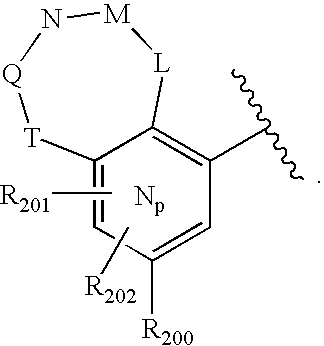
- wherein the L, M, N, Q and T radicals or residues can be selected from —S—, —S(O)—, or —S(O) 2—. Compounds of formulas (305b) or (305e) are examples of such compounds comprising an —S— group. Such thioether compounds can be prepared from benzenethiol precursors, as will be apparent to those of ordinary skill in the art. The corresponding sulfoxides and sulfones can be readily prepared by selective oxidation of the thioether compounds. For example, appropriate thioether synthetic precursors can be oxidized in a selective manner with m-chloroperbenzoic acid to provide the sulfoxide compound. The sulfoxide can be further oxidized with additional m-chloroperbenzoic acid, or with hydrogen peroxide in acetic acid, as described by Zask et al., J. Med. Chem. 33:1418-1423 (1990), to provide the sulfone compounds, as is suggested below.
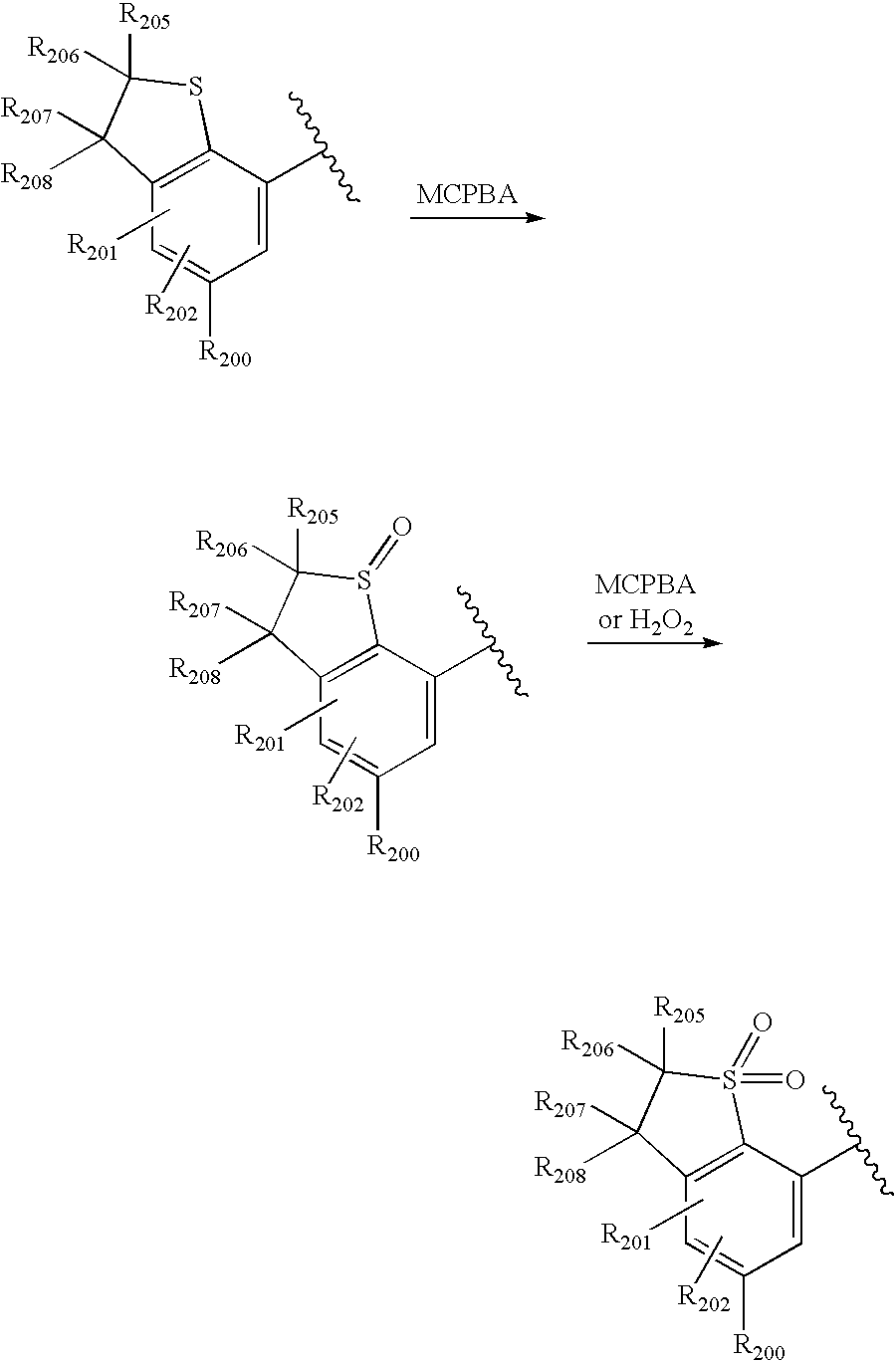
- In view of the teachings and disclosures above, in some aspects, the invention relates to methods for preparing the compounds of the invention, wherein the method comprises
- a) coupling
- i) a bicyclic heterocycle precursor compound having the structure
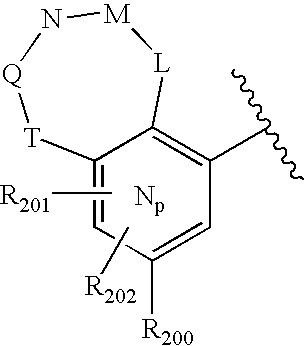
- ii) with an Ar 10 precursor compound having the structure
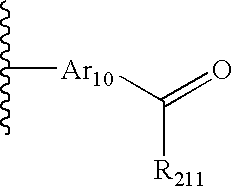
- iii) to form a carbonyl containing precursor compound having the formula
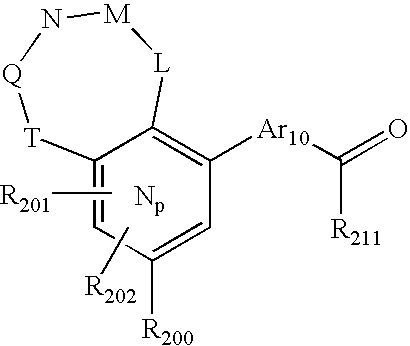
- b) further reacting the carbonyl containing precursor compound so as to connect to the carbonyl of the carbonyl containing precursor the HAr heterocycle.
- The methods of making the compounds of the invention can also comprise one or more additional steps, including a step wherein the further reacting comprises condensing the carbonyl containing precursor compound with a compound having the formula
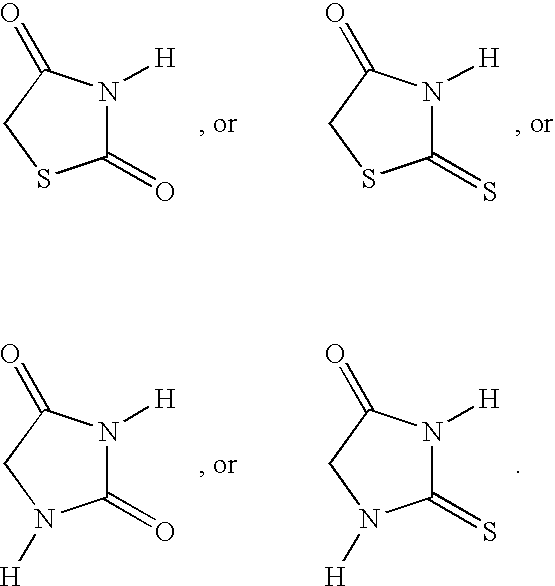
- After the compounds of the invention have been prepared, it would be desirable for many applications of the compounds to prepare a pharmaceutically acceptable salt. Many methods for preparing pharmaceutically acceptable salts are well known to those of ordinary skill in the art. One method that can readily be employed to prepare such salts would be to react the compounds of the invention with a basic compound, such as a basic salt of a monovalent, divalent, or trivalent metal cation, or an organic amine, so as to remove an acidic hydrogen atom of the HAr group, so as to prepare a salt having the structure

- The cation obtained by such acid/base reactions would of course depend upon the nature of the base used to prepare the pharmaceutically acceptable salt. Suitable cations and/or bases have already been disclosed hereinabove in the disclosures related to the various embodiments of the active compounds themselves.
- The various synthetic strategies and/or organic group transformations described hereinabove can be performed by a number of modified strategies and/or procedures other than those described above, as will be appreciated by those of ordinary skill in the art. References disclosing other synthetic procedures that can be utilized for the synthetic steps leading to the compounds disclosed herein can be found in, for example, March, J., Advanced Organic Chemistry, 4th Edition, Weiley-Interscience (1992); or Larock, R. C., Comprehensive Organic Transformations, A Guide to Functional Group Preparations, VCH Publishers, Inc. (1989), both incorporated herein in their entireties by this reference.
- Pharmaceutical Compositions
- Although the compounds described herein can be administered as pure chemicals, it is often preferable to present the active ingredient as a pharmaceutical composition. Thus additional embodiments of the invention relate to the use of a pharmaceutical composition comprising one or more compounds and/or one or more pharmaceutically acceptable salts thereof, together with one or more pharmaceutically acceptable carriers thereof and, optionally, other therapeutic and/or prophylactic ingredients. The carrier(s) must be ‘acceptable’ in the sense of being compatible with the other ingredients of the composition and not overly deleterious to the recipient thereof.
- Pharmaceutical compositions include those suitable for oral, enteral, parental (including intramuscular, subcutaneous and intravenous), topical, nasal, vaginal, ophthalinical, sublingually or by inhalation administration. The compositions can, where appropriate, be conveniently presented in discrete unit dosage forms and can be prepared by any of the methods well known in the art of pharmacy. Such methods include the step of bringing into association the active compound with liquid carriers, solid matrices, semi-solid carriers, finely divided solid carriers or combination thereof, and then, if necessary, shaping the product into the desired delivery system.
- Pharmaceutical compositions suitable for oral administration can be presented as discrete unit dosage forms such as hard or soft gelatin capsules, cachets or tablets each containing a predetermined amount of the active ingredient; as a powder or as granules; as a solution, a suspension or as an emulsion. The active ingredient can also be presented as a bolus, electuary or paste. Tablets and capsules for oral administration can contain conventional excipients such as binding agents, fillers, lubricants, disintegrants, or wetting agents. The tablets can be coated according to methods well known in the art., e.g., with enteric coatings.
- Oral liquid preparations can be, in the form of, for example, aqueous or oily suspensions, solutions, emulsions, syrups or elixirs, or can be presented as a dry product for constitution with water or other suitable vehicle before use. Such liquid preparations can contain conventional additives such as suspending agents, emulsifying agents, non-aqueous vehicles (which can include edible oils), or one or more preservative.
- The compounds can also be formulated for parenteral administration (e.g., by injection, for example, bolus injection or continuous infusion) and can be presented in unit dose form in ampules, pre-filled syringes, small bolus infusion containers or in multi-does containers with an added preservative. The compositions can take such forms as suspensions, solutions, or emulsions in oily or aqueous vehicles, and can contain formulatory agents such as suspending, stabilizing and/or dispersing agents. Alternatively, the active ingredient can be in powder form, obtained by aseptic isolation of sterile solid or by lyophilization from solution, for constitution with a suitable vehicle, e.g., sterile, pyrogen-free water, before use.
- For topical administration to the epidermis, the compounds can be formulated as ointments, creams or lotions, or as the active ingredient of a transdermal patch. Suitable transdermal delivery systems are disclosed, for example, in Fisher et al. (U.S. Patent (U.S. Pat. No. 4,788,603, incorporated herein by reference) or Bawas et al. (U.S. Pat. Nos. 4,931,279, 4,668,504 and 4,713,224; all incorported herein by reference). Ointments and creams can, for example, be formulated with an aqueous or oily base with the addition of suitable thickening and/or gelling agents. Lotions can be formulated with an aqueous or oily base and will in general also contain one or more emulsifying agents, stabilizing agents, dispersing agents, suspending agents, thickening agents, or coloring agents. The active ingredient can also be delivered via iontophoresis, e.g., as disclosed in U.S. Pat. Nos. 4,140,122, 4383,529, or 4,051,842; incorporated herein by reference.
- Compositions suitable for topical administration in the mouth include unit dosage forms such as lozenges comprising active ingredient in a flavored base, usually sucrose and acacia or tragacanth; pastilles comprising the active ingredient in an inert base such as gelatin and glycerin or sucrose and acacia; mucoadherent gels, and mouthwashes comprising the active ingredient in a suitable liquid carrier.
- When desired, the above-described compositions can be adapted to provide sustained release of the active ingredient employed, e.g., by combination thereof with certain hydrophilic polymer matrices, e.g., comprising natural gels, synthetic polymer gels or mixtures thereof.
- The pharmaceutical compositions according to the invention can also contain other adjuvants such as flavorings, coloring, antimicrobial agents, or preservatives.
- Biological Activity of the Compounds
- The compounds of the present invention have been found to be active in a number of biological assays, both in vitro and in vivo, that correlate to, or are representative of, human diseases.
- In-Vitro Screening for Adipocyte Differentiation. The compounds of the invention can induce the differentiation of preadipocytes into adipocytes. Once preadipocytes become differentiated, they tend to accumulate lipids, and the increasing lipid content of the differentiated cells can be readily detected. This activity (Harris and Kletzien, Mol. Pharmacol., 45:439-445 (1994); Willson et al., J. Med. Chem. 39:665-668 (1996)) has been observed for certain compounds that have antidiabetic activity in humans (Teboul et al., J. Biol. Chem. 270:28183-28187 (1995)), and assays for adipocyte diffentiation activity have been employed by those in the art to screen new compounds for anti-diabetic activity.
- As illustrated in Example 21 and FIG. 1, a number of the compounds whose synthesis is detailed in Examples 1-19 were found to induce the differentiation of 3T3-L1 pre-adipocytes in in-vitro tests, when applied at concentrations of 1×10 −6 Molar and lower. For comparative purposes only, FIG. 1 shows the comparative adipocyte differentiation activity of compound 20 (5-[3-(3,5,5,8,8-Pentamethyl-5,6,7,8-tetrahydro-naphthalen-2-yl)-4-trifluoromethoxy-benzylidene]-thiazolidine-2,4-dione, which was disclosed as active for both adipocyte differentiation and for the treatment of diabetes in U.S. Pat. No. 6,515,003). As can be seen in FIG. 1, a number of the bicyclic compounds of the invention have adipocyte differentiation activity that is at least comparable to that of
comparative compound 20. - Therefore, one method for assaying the biological activity of the compounds of the invention is conduct an assay as described in Example 21, and any compound that induces adipocyte differentiation at a concentration of less than or equal to about 1×10 −6 M, can be considered to have biological activity that is related to potential treatment of diabetes and/or related disorders of carbohydrate and/or lipid metabolism. In order to demonstrate the activity of the various compounds of the invention for effectiveness and/or activity for adipocyte differentiation, the compound can be applied at a concentration of about 1×10⁻⁶ M for a period of about 7 days, to mouse preadipocyte 3T3-L1 cells, and measure the increase the lipid content of the cells. The compounds can be considered active for adipocyte differentiation if the lipid accumulation induced is at least about 20%, or at least about 40%, of the lipid accumulation induced by 5-[3-(3,5,5,8,8-Pentamethyl-5,6,7,8-tetrahydro-naphthalen-2-yl)-4-trifluoromethoxy-benzylidene]-thiazolidine-2,4-dione when it is applied to control cultures of mouse preadipocyte 3T3-L1 cells at a concentration of about 1×10⁻⁷ M.
- In-Vivo Screening for Biological Activity Using Mouse Models of Human Diseases The ability of the compounds to function as antidiabetic molecules and/or modulators of carbohydrate and/or lipid metabolism can be demonstrated in animal models. These models include among others, db/db mice, ob/ob mouse, and KKA y mice. Accordingly, the biological activity of the compounds of the invention has been demonstrated in experiments employing the KKAy mouse. A procedure for such experiments was described in detail in Iwatsuka, et al., 1970 General Survey of Diabetic Features of Yellow KK Mice. Endocrinol. Japon. 17: 23-35, incorporated herein by reference. The testing of the compounds of the invention was conducted as described in Example 22. The animals were treated with a single daily oral dose of 15 mg/kg of the test compound suspended in sesame oil (dose volume of 3-5 ml/kg). At the end of one and two weeks of treatment the animals were bled from the tail vein and their serum glucose and triglycerides and/or cholesterol was measured in duplicate.
- The results of the testing of
compounds - In view of these experiments in the KKA y mice, the compounds of the invention have demonstrated oral bioavailability. Oral bioavailability allows for oral dosing for use in chronic diseases such as diabetes, with the advantage of self-administration and decreased cost over other means of administration.
- Compounds showing efficacy in lowering serum glucose and which do not increase serum triglycerides, or preferably, compounds that simultaneously lower glucose and triglyceride levels in the KKA y mouse model, can be further tested in additional in vivo model animals known in the art, such as those involving, db/db, ob/ob, and Sprague Dawley rats. The ability of a compound to reduce certain lipids such as cholesterol or to change the ratio of good versus bad cholesterol, i.e. HDL versus LDL, can be measured in animal models. One model commonly used is the diet-induced hypercholesterolemic Sprague Dawley rat.
- Methods for Treating Diseases
- The compounds described herein can be used effectively to prevent, alleviate or otherwise treat
type 2 diabetes and/or related disease states in mammals, including humans. As is well known,type 2 diabetes is related to deficiencies in carbohydrate metabolism. Patients suffering fromtype 2 diabetes usually still produce insulin, which is directly involved in carbohydrate metabolism, but become increasingly resistant to their own insulin and to insulin therapy. The deficiencies in carbohydrate metabolism cause damaging increases in serum glucose concentration, causing potentially deadly side effects and/or damage general metabolism and/or vital organs. - Methods of treatment comprising the administration of the compounds of the invention to an animal such a diabetic patient beneficially modulate carbohydrate metabolism. Carbohydrate metabolism can be up-regulated or down-regulated to either approach the level of carbohydrate metabolism in the animal or as compared to a control animal, or to deviate from the level of carbohydrate metabolism in an animal or as compared to a control animal.
- Therefore, in some embodiments, the invention relates to methods for treating
type 2 Diabetes comprising administering to an animal, a mammal, or a human diagnosed as needing such treatment one or more compounds of the invention in an amount effective to decrease the serum glucose levels of the animal, mammal, or human. In some embodiments of the methods the compound is applied in an amount effective to decrease the serum glucose levels in the animal, mammal, or human by at least about 5%, or about 10%. - Changes in carbohydrate metabolism can directly or indirectly also result in changes of lipid metabolism and, similarly, changes in lipid metabolism can lead to changes in carbohydrate metabolism. For example, in
type 2 diabetes an increase in free fatty acids in the patients leads to decreased cellular uptake and metabolism of glucose. - Accordingly, the present invention also relates to methods for modulating lipid metabolism that relate to administration of a compound of the invention to an animal, mammal, or human so as to induce an increase of lipid content intracellular or extracellularly. For example, compounds of the invention can induce macrophages to increase secretion of cholesterol into the extracellar medium. Cholesterol-loaded macrophage foam cells are a hallmark of atherosclerotic lesions [Gown et al. (1986) Am. J. Phathol. 125, 191-207]. Although advanced human atherosclerotic lesions contain other cell types, it has been suggested that the lipid-rich portion of the lesion is most prone to rupture and cause myocardial infarction (Ross, 1999). Removal of cholesterol from peripheral cells including macrophages, is a key process in the maintenance of whole body cholesterol homeostasis and prevention of atherosclerosis [Oram, J. F. (2002) Trends Mol.Med. 8, 168-173]. This process involves efflux of excess cholesterol from peripheral cells towards nascent high density lipoprotein (HDL), followed by transport of the cholesterol to the liver, followed by hepatic uptake and secretion in the form of cholesterol or bile salt, and finally disposal into feces. Therefore, novel therapeutic agents that increase cholesterol efflux from macrophages in atherosclerotic lesions can be employed to treat patients with coronary artery disease, which is a disease that is often associated with diabetes.
- Modulation of lipid metabolism by the compounds of the invention can also induce a decrease of lipid content intracellularly or extracellularly. Modulation of metabolism can occur directly for example, through binding of the compound of the invention with its cognate receptor, which directly affects an increase or decrease in serum lipid content by up-regulation or down-regulation of a gene involved in lipid metabolism. Modulation of metabolism can also occur indirectly, for example, through binding of the compound of the invention with its cognate receptor, which up-regulates or down-regulates cellular differentiation or growth of cells that produce lipids, thereby indirectly causing lipid metabolism to be modulated. Modulation, also includes, for example, an increase in lipid metabolism, such that the lipid metabolism approaches that of a control. Likewise, modulation of lipid metabolism could be a decrease in the rate of lipid metabolism, such that the rate of lipid metabolism is less than or decreasing towards a control.
- It is also to be understood that a variety of lipid molecules can be modulated. The compounds disclosed herein can modulate a single class of lipid molecules, such as triglycerides. Therefore, in some embodiments, the invention relates to methods for treating dyslipidemia comprising administering to an animal, a mammal, or a human diagnosed as needing such treatment one or more compounds of the invention in an amount effective to decrease serum triglyceride levels in the animal, mammal, or human, or as compared to serum triglyceride levels in control animals, mammals, or humans. In some embodiments, the compounds of the invention are administered in an amount effective to decrease serum triglyceride levels by at least about 5%, or at least about 10%.
- The compounds disclosed herein can also modulate multiple classes of lipid molecules, including cholesterol. Therefore, in some embodiments the invention relates to a method of treating hypercholesterolemia comprising administering to an animal, mammal, or human diagnosed as needing such treatment one or more compounds of the invention in an amount effective to treat the hypercholesterolemia. In some embodiments, the one or more compounds is applied in an amount effective to decrease serum cholesterol levels in the animal, mammal, or human, or as compared to a control animal, mammal, or human by at least about 5%, or at least about 10%.
- Surprisingly and quite unexpectedly, the methods of treatment that employ compounds of the invention for the treatment of diabetes have been shown to simulultaneously decrease both serum glucose and serum triglyceride levels in animal models for diabetes.
- The compounds disclosed herein can be either used singularly or plurally, and pharmaceutical compositions thereof for the treatment of mammalian diseases, particularly those related to humans. Compounds disclosed herein and compositions thereof can be administered by various methods including, for example, orally, enterally, parentally, topically, nasally, vaginally, ophthalinically, sublingually or by inhalation for the treatment of diseases related to lipid metabolism, carbohydrate metabolism, lipid and carbohydrate metabolism such as polycystic ovary syndrome, syndrome X,
type 2 diabetes, including disorders related totype 2 diabetes such as, diabetic retinopathy, neuropathy, macrovascular disease or differentiation of adipocytes. Routes of administration and doseages known in the art can be found in Comprehensive Medicinal Chemistry,Volume 5, Hansch, C. Pergamon Press, 1990; incorporated herein by reference. - The compositions can also be used as regulators in diseases of uncontrolled proliferation. The composition can be useful in the treatment of polycystic kidney disease and cancers such as, carcinomas, lymphomas, leukemias, and sarcomas. A representative but non-limiting list of cancers is lymphoma, Hodgkin's Disease, myeloid leukemia, bladder cancer, brain cancer, head and neck cancer, kidney cancer, lung cancers such as small cell lung cancer and non-small cell lung cancer, myeloma, neuroblastoma/glioblastoma, ovarian cancer, pancreatic cancer, prostate cancer, skin cancer, liver cancer, melanoma, colon cancer, cervical carcinoma, breast cancer, and epithelial cancer. Compounds disclosed herein can be used for the treatment of inflammatory diseases such as osteoarthritis, rheumatoid arthritis, Crohn's Disease, pulmonary fibrosis, and Inflammatory Bowel Disease.
- It will be further appreciated that the amount of the compound, or an active salt or derivative thereof, required for use in treatment will vary not only with the particular salt selected but also with the route of administration, the nature of the condition being treated and the age and condition of the patient and will be ultimately at the discretion of the attendant physician or clinician.
- In general, one of skill in the art understands how to extrapolate in vivo data obtained in a model organism, such as a KKA y mouse, an ob/ob or db/db mouse, to another mammal, such as a human. These extrapolations are not simply based on the weights of the two organisms, but rather incorporate differences in metabolism, differences in pharmacological delivery, and administrative routes. Based on these types of considerations, a suitable dose will, in alternative embodiments, typically be in the range of from about 0.5 to about 100 mg/kg/day, or from about 1 to about 75 mg/kg of body weight per day, or from about 3 to about 50 mg per kilogram body weight of the recipient per day.
- The compound is conveniently administered in unit dosage form; for example, in alternative embodiments, containing 0.5 to 1000 mg, 5 to 750 mg, most conveniently, or 10 to 500 mg of active ingredient per unit dosage form.
- One skilled in the art will recognize that dosage and dosage forms outside these typical ranges can be tested and, where appropriate, be used in the methods of this invention.
- In separate embodiments, the active ingredient can be administered to achieve peak plasma concentrations of the active compound of from about 0.5 to about 75 μM, about 1 to 50 μM, or about 2 to about 30 μM. This can be achieved, for example, by the intravenous injection of a 0.05 to 5% solution of the active ingredient, optionally in saline, or orally administered as a bolus containing about 0.5-500 mg of the active ingredient. Desirable blood levels can be maintained by continuous infusion to provide about 0.01-5.0 mg/kg/hr or by intermittent infusions containing about 0.4-15 mg/kg of the active ingredients.
- The desired dose can conveniently be presented in a single dose or as divided doses administered at appropriate intervals, for example, as two, three, four or more sub-doses per day. The sub-dose itself can be further divided, e.g., into a number of discrete loosely spaced administrations; such as multiple inhalations from an insufflator or by application of a plurality of drops into the eye.
- While the invention has been described in connection with specific embodiments thereof, it will be understood that it is capable of further modifications and this application is intended to cover any variations, uses, or adaptations of the invention following, in general, the principles of the invention and including such departures from the present disclosure as come within known or customary practice within the art to which the invention pertains and as can be applied to the essential features hereinbefore set forth, and as follows in the scope of the appended claims.
- The following examples are given to illustrate the invention and are not intended to be inclusive in any manner.
-

- A mixture of toluene (35 mL), piperidine (145 μL), acetic acid (145 μL), 3-(5-isobutyl-3,3-dimethyl-2,3-dihydro-benzofuran-7-yl)-4-trifluoromethoxy-benzaldehyde (5.7 g, 14.53 mmol) and 2,4-thiazolidinedione (1.7 g, 14.53 mmol) was heated at reflux for 20 hrs. The reaction mixture was cooled to room temperature, diluted with ethyl acetate, washed with water and brine, dried over MgSO 4, filtered and evaporated. The residue was chromatographed on silica gel (0 to 20% ethylacetate in hexane) and further recrystallised from ethanol/water to afford 5.15 g (72%) of 5-[3-(5-Isobutyl-3,3-dimethyl-2,3-dihydro-benzofuran-7-yl)-4-trifluoromethoxy-benzylidene]-thiazolidine-2,4-dione. mp 142-146° C. 1H-NMR (300 MHz, DMSO-d-6): 0.87 (d, J=6.9 Hz, 6H), 1.31 (s, 6H), 1.81 (m, 1H), 2.44 (d, J=6.9 Hz, 2H), 4.19 (s, 2H), 6.91 (d, J=1.5 Hz, 1H), 7.07 (d, J=1.5 Hz, 1H), 7.58 (d, J=8.4 Hz, 1H), 7.70 (dd, J1=8.4 Hz, J2=2.4 Hz, 1H), 7.75 (d, J=2.1 Hz, 1H), 7.86 (s, 1H), 12.70 (br s, 1H). The intermediate 3-(5-isobutyl-3,3-dimethyl-2,3-dihydro-benzofuran-7-yl)-4-trifluoromethoxy-benzaldehyde was prepared as follows:
- a. 3-(5-isobutyl-3,3-dimethyl-2,3-dihydro-benzofuran-7-yl)-4-trifluoromethoxy-benzaldehyde.
- A mixture of 3-bromo-4-trifluoromethoxy benzaldehyde (example 1h) (4.24 g, 15.75 mmol), 5-isobutyl-3,3-dimethyl-2,3-dihydro-benzofuran-7-boronic acid (4.3 g, 17.33 mmol) and potassium carbonate (4.35 g, 31.5 mmol) in toluene (39 mL), ethanol (7.5 mL) and water (2.5 mL) was degassed with argon for 15 minutes.
- Tetrakis(triphenylphosphine)palladium(0) (0.728 g, 0.63 mmol) was added and the mixture heated at reflux under argon for 20 hrs. The solution was cooled to room temperature, diluted with ethyl acetate and washed successively with water and brine, dried over anhydrous magnesium sulfate, filtered and evaporated. The residue was purified on silica gel (0 to 5% ethyl acetate in hexane) to give 5.76 g of 3-(5-isobutyl-3,3-dimethyl-2,3-dihydro-benzofuran-7-yl)-4-trifluoromethoxy-benzaldehyde (93%).
- 1H NMR (300 MHz; CDCl3): 0.92 (d, J=6.9 Hz, 6H), 1.36 (s, 6H), 1.84 (m, 1H), 2.47 (d, J=7.5 Hz, 2H), 4.22 (s, 2H), 6.92 (d, J=4.8 Hz, 2H), 7.46 (dd, J=1.5 Hz and 8.7 Hz, 1H), 7.90 (dd, J=2.1 Hz and 8.7 Hz, 1H), 8.03 (d, J=2.1 Hz, 1H), 10.03 (s, 1H).
- b. 5-isobutyl-3,3-dimethyl-2,3-dihydro-benzofuran-7-boronic Acid.
- To a mixture of 7-bromo-5-isobutyl-3,3-dimethyl-2,3-dihydro-benzofuran (9.9 g, 34.96 mmol) in THF (50 mL) cooled to −78° C. under an atmosphere of argon was added n-BuLi (25.17 mL, 2.5 M, 62.93 mmol) dropwise. The reaction mixture was stirred for 5 minutes and triisopropylborate (24.2 mL, 104.87 mmol) was added dropwise. The mixture was stirred at −50° C. for 2 hours then warmed up to room temperature and stirred overnight at room temperature. 1.0 N HCl (100 mL) was slowly added to the reaction mixture. After 1 hour the mixture was diluted with ethyl acetate and the layers separated. The organic layer was further washed with water, brine, dried (MgSO 4), filtered and evaporated. The residue was chromatographed on silica gel (0 to 20% ethyl acetate in hexane) to give 4.3 g of 5-isobutyl-3,3-dimethyl-2,3-dihydro-benzofuran-7-boronic acid (46%). 1H NMR (300 MHz; CDCL3): 0.90 (d, J=6.6 Hz, 6H), 1.33 (s, 6H), 1.81 (m, 1H), 2.43 (d, J=7.5 Hz, 2H), 4.28 (s, 2H), 5.86 (br s, 2H), 6.98 (d, J=2.1 Hz, 1H), 7.33 (d, J=2.1 Hz, 1H).
- c. 7-bromo-5-isobutyl-3,3-dimethyl-2,3-dihydro-benzofuran.
- To a solution of 5-isobutyl-3,3-dimethyl-2,3-dihydro-benzofuran (1.59 g, 7.78 mmol) in dichloromethane (40 mL) was added pyridinium tribromide (2.49 g, 7.78 mmol) and the reaction mixture stirred at room temperature overnight. The solution was washed with water and brine, dried (MgSO 4), filtered and evaporated. The residue was purified on silica gel (0% to 2% ethyl acetate in hexane) to give 1.51 g of 7-bromo-5-isobutyl-3,3-dimethyl-2,3-dihydro-benzofuran (68%). 1H NMR (300 MHz; CDCl3): δ 0.90 (d, J=6.3 Hz, 6H), 1.33 (s, 6H), 1.77 (m, 1H), 2.39 (d, J=7.5 Hz, 2H), 4.30 (s, 2H), 6.80 (d, J=1.5 Hz, 1H), 7.05 (d, J=1.5 Hz, 1H).
- d. 5-isobutyl-3,3-dimethyl-2,3-dihydro-benzofuran.
- To a cold solution (0° C.) of 1-(3,3-dimethyl-2,3-dihydro-benzofuran-5-yl)-2-methyl-propan-1-ol (1.97 g, 8.93 mmol) in dry dichloromethane (40 mL) was added triethylsilane (2.85 mL, 17.86 mmol). After 10 minutes, trifluoroacetic acid was added and the reaction mixture stirred at 0° C. for 30 minutes. Water was poured into the reaction mixture and the layers separated. The organic layer was further washed with water, aqueous NaHCO 3 and brine, dried (MgSO4), filtered and evaporated. The residue was purified on silica gel (0% to 5% ethyl acetate in hexane) to give 1.6 g of 5-isobutyl-3,3-dimethyl-2,3-dihydro-benzofuran (87%). 1H NMR (300 MHz; CDCl3): δ 0.90 (d, J=6.3 Hz, 6H), 1.32 (s, 6H), 1.79 (m, 1H), 2.40 (d, J=6.9 Hz, 2H), 4.20 (s, 2H), 6.68 (dd, J=1.2 Hz and 7.5 Hz, 1H), 6.87 (m, 2H).
- e. 1-(3,3-dimethyl-2,3-dihydro-benzofuran-5-yl)-2-methyl-propan-1-ol.
- To a solution of 5-bromo-3,3-dimethyl-2,3-dihydro-benzofuran (2.03 g, 8.93 mmol) in dry THF (10 mL) at −78° C., under argon, was added dropwise n-BuLi (1.6 M in hexane, 13.4 mmol, 8.38 mL). The mixture was stirred for 5 minutes then isobutyraldehyde (1.22 mL, 8.38 mmol) was added and the mixture was slowly warmed up to room temperature and stirred overnight at room temperature. Aqueous ammonium chloride was added and the solution extracted with ethylacetate and the organic extract was dried (MgSO 4), filtered and evaporated. The residue was purified on silica gel (0% to 20% ethyl acetate in hexane) to give 1.97 g of 1-(3,3-dimethyl-2,3-dihydro-benzofuran-5-yl)-2-methyl-propan-1-ol (100%). 1H NMR (300 MHz; CDCl3): δ 0.77 (d, J=6.6 Hz, 3H), 0.90 (d, J=6.6 Hz, 3H), 1.33 (s, 6H), 1.95 (m, 1H), 4.23 (s, 2H), 4.28 (d,J=7.2 Hz, 2H), 6.72 (d, J=8.4 Hz, 1H), 7.03 (dd, J=8.1 Hz and 1.8 Hz, 1H), 7.06 (d, J=1.5 Hz, 1H).
- f. 5-bromo-3,3-dimethyl-2,3-dihydro-benzofuran.
- A mixture of 4-bromo-2-(2-chloro-1,1-dimethyl-ethyl)-1-methoxy-benzene (65 g, 0.234 mol), pyridine hydrochloride (121.8 g, 1.054 mol) and quinoline (110.67 mL, 0.936 mol) was refluxed at 164° C.-167° C. under argon for 5 hrs. After cooling to room temperature the reaction mixture was treated with ice-cold 6N HCl and extracted twice with ether. The organic layers were combined, dried (MgSO 4), filtered and evaporated. The residue was purified on silica gel (10% ethyl acetate in hexane) to give 52 g of 5-bromo-3,3-dimethyl-2,3-dihydro-benzofuran (98%). 1H NMR (300 MHz; CDCl3): δ 1.32 (s, 6H), 4.23 (s, 2H), 6.67 (d,J=8.1 Hz, 1H), 7.19 (m, 2H).
- g. 4-bromo-2-(2-chloro-1,1-dimethyl-ethyl)-1-methoxy-benzene.
- Sulfuric acid (2 mL, 0.033 mol) was added dropwise under argon to 4-bromoanisole (14.6 mL, 0.117 mol). The mixture was warmed to 40-43° C. (warm water bath) and 3-chloro-2-methyl propene was added dropwise in 4 equal portions over 2 hrs. After 2 hrs at 40-43° C. the solution was diluted with dichloromethane and washed successively with water, saturated aqueous NaHCO 3, water and brine, dried (MgSO4), filtered and evaporated. The residue was crystallized from hexanes to give 14.1 g of 4-bromo-2-(2-chloro-1,1-dimethyl-ethyl)-1-methoxy-benzene. The mother liquor was further purified on silica gel (10% ethyl acetate in hexane) to afford additional 4.8 g of product. 58% yield. 1H NMR (300 MHz; CDCl3): δ 1.43 (s, 6H), 3.82 (s, 3H), 3.93 (s, 2H), 6.75 (dd, J=2.4 Hz and 7.2 Hz, 1H), 7.32 (m, 2H).
- h. 3-bromo-4-trifluoromethoxy benzaldehyde.
- To a solution of 4-trifluoromethoxybenzaldehyde (150 g, 0.79 mol) in a mixture of TFA (400 mL) and H 2SO4 (80 mL) was added at 40-45° C. N-bromosuccinimide (281 g, 1.579 mol) in equal portion over 2 hours. The reaction mixture was stirred at 40-45° C. overnight, poured into ice-water and extracted with CH2Cl2. The organic layer was washed with water then treated with saturated NaHCO3 (800 mL) for 30 minutes. The layers were separated and the organic layer further washed with water and brine, dried over MgSO4, filtered-and evaporated. The residue was triturated with hexane and filtered. After evaporation of the solvent, the residue was distilled to give 3-bromo-4-trifluoromethoxybenzaldehyde (150.2 g, 60° C., 0.3 mm/Hg, 70%). 1H NMR (300 MHz; CDCl3): δ 7.49 (dd, J1=1.8 Hz and J2=8.7 Hz, 1H), 7.88 (dd, J1=2.1 Hz and J2=8.4 Hz, 1H), 8.17 (d, J=1.8 Hz, 1H), 9.97 (s, 1H).
-
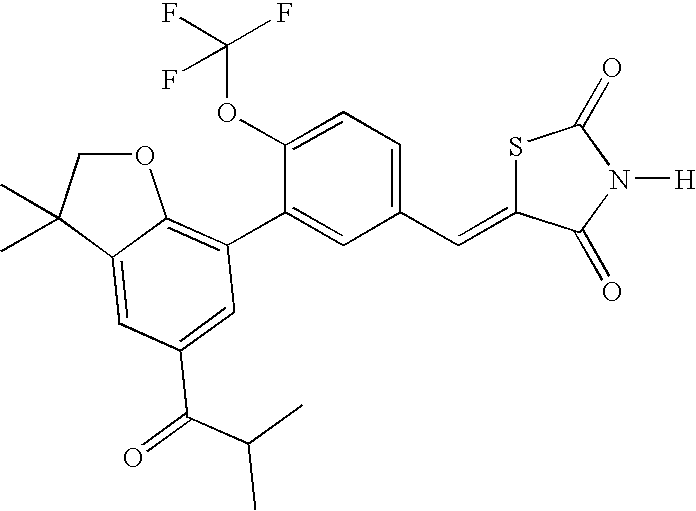
- Prepared in a similar manner to example 1 using 3-(5-Isobutyryl-3,3-dimethyl-2,3-dihydro-benzofuran-7-yl)-4-trifluoromethoxy-benzaldehyde. 55% yield after crystallization from ethanol. mp 92-96° C. 1H-NMR (300 MHz, DMSO-d-6): 1.11 (d, J=6.4 Hz, 6H), 1.37 (s, 6H), 3.69 (m, 1H), 4.34 (s, 2H), 7.63 (d, J=8.5 Hz, 1H), 7.75 (d, J=8.5 Hz, 1H), 7.84 (s, 1H), 7.87 (s, 2H), 7.93 (s, 1H), 12.72 (br s, 1H).
- The intermediate 3-(5-Isobutyryl-3,3-dimethyl-2,3-dihydro-benzofuran-7-yl)-4-trifluoromethoxy-benzaldehyde was prepared as follows:
- a. 3-(5-Isobutyryl-3,3-dimethyl-2,3-dihydro-benzofuran-7-yl)-4-trifluoromethoxy-benzaldehyde.
- A mixture of 3-formyl-6-trifluoromethoxy-1-phenyl boronic acid (1.27 g, 5.43 mmol), 1-(7-bromo-3,3-dimethyl-2,3-dihydro-benzofuran-5-yl)-2-methyl-propan-1-one (1.35 g, 4.53 mmol) and potassium carbonate (1.25 g, 9.06 mmol) in toluene (15 mL), ethanol (3 mL) and water (1.8 mL) was degassed with argon for 30 minutes. Tetrakis(triphenylphosphine)palladium(0) (105 mg, 0.09 mmol) was added and the mixture heated at reflux under argon for 16 hrs. The solution was cooled to room temperature, diluted with ethyl acetate and washed successively with water and brine, dried over anhydrous magnesium sulfate, filtered and evaporated. The residue was purified on silica-gel (10% ethyl acetate inhexane) to give 405 mg of 3-(5-Isobutyryl-3,3-dimethyl-2,3-dihydro-benzofuran-7-yl)-4-trifluoromethoxy-benzaldehyde (22%).
- 1H NMR (300 MHz; CDCl3): 1.22 (d, J=7.5 Hz, 6H), 1.42 (s, 6H), 3.54 (m, 1H), 4.35 (s, 2H), 7.51 (d, J=8.7 Hz, 1H), 7.85 (d, J=8.4 Hz, 1H), 7.96 (d, J=7.5 Hz, 1H), 8.03 (d, J=1.8 Hz, 1H), 10.05 (s, 1H).
- b. 3-formyl-6-trifluoromethoxy-1-phenyl Boronic Acid.
- To a mixture of 2-(3-bromo-4-trifluoromethoxy-1-phenyl)-1,3-dioxolane (7.20 g, 22.9 mmol) in THF (70 mL) cooled to −78° C. under an atmosphere of argon was added n-BuLi (13.8 mL, 2.5 M, 34.4 mmol) dropwise. The resulting suspension was stirred for 5 minutes and triisopropylborate (15.9 mL, 68.7 mmol) was added dropwise via syringe. The mixture was stirred at −50° C. for 2 hours then warmed up to room temperature and stirred overnight at room temperature. 1.0 N HCl (50 mL) was slowly added to the reaction mixture. After 3 hours the mixture was diluted with ethyl acetate and the layers separated, the aqueous layer was extracted once with ethyl acetate and the two organic layers combined. The resulting organic layer was washed with water, brine and dried (MgSO 4). The mixture was filtered, evaporated and the residue stirred in hexane. The resulting white suspension was filtered and the white solid dried under high vacuum to afford 3.00 g of 3-formyl-6-trifluoromethoxy-1-phenyl boronic acid (56%). 1H NMR (300 MHz; CDCL3): δ 7.42 (d, J=7.0 Hz, 1H), 8.07 (dd, J1=2.1 Hz, J2=8.7 Hz, 1H), 8.47 (d, J=1.8 Hz, 1H), 10.05 (s, 1H).
- c. 2-(3-bromo-4-trifluoromethoxy-1-phenyl)-1,3-dioxolane.
- To a solution of 3-bromo-4-trifluoromethoxybenzaldehyde (20 g, 74.0 mmol) in toluene (200 mL) was added ethylene glycol (82.6 mL, 1.48 mol) and p-toluenesulfonic acid monohydrate (0.84 g, 4.44 mmol). The reaction mixture was heated at reflux overnight and the water was removed using a Dean Stark apparatus. The solution was cooled to room temperature, poured into aqueous potassium carbonate (10%) and extracted with ethyl acetate. The organic layer was washed with water, brine and dried (MgSO 4). The residue was purified on silica gel (10% ethyl acetate in hexane) to give 15.4 g of 2-(3-bromo-4-trifluoromethoxy-1-phenyl)-1,3-dioxolane (66%). 1H NMR (300 MHz; CDCl3): δ 4.05 (m, 2H), 4.11 (m, 2H), 5.79 (s, 1H), 7.32 (dd, J=1.5 Hz, J2=8.1 Hz, 1H),7.43 (dd, J1=1.8 Hz, J2=8.4 Hz, 1H),7.77 (d, J=2.1 Hz, 1H).
- d. 1-(7-bromo-3,3-dimethyl-2,3-dihydro-benzofuran-5-yl)-2-methyl-propan-1-one.
- To a solution of AlCl 3 (1.5 g, 11.32 mmol) in dry dichloromethane (30 mL) was added dropwise at room temperature 1-(3,3-dimethyl-2,3-dihydro-benzofuran-5-yl)-2-methyl-propan-1-one (989 mg, 4.52 mmol) in dichloromethane (15 mL) followed by bromine (0.28 mL, 5.43 mmol) and the reaction stirred for 6 hours. 1N HCl was added slowly and the layers separated. The aqueous layer was extracted twice with dichloromethane. The combined organic layers were washed successively with aq. K2CO3, water and brine, dried over anhydrous magnesium sulfate, filtered and evaporated to give 1.44 g of 1-(7-bromo-3,3-dimethyl-2,3-dihydro-benzofuran-5-yl)-2-methyl-propan-1-one (91%). 1H NMR (300 MHz; CDCl3): δ 1.21 (d, J=6.9 Hz, 6H), 1.39 (s, 6H), 3.47 (m, 1H), 4.43 (s, 2H), 7.70 (s, 1H), 7.95 (s, 1H). e. 1-(3,3-dimethyl-2,3-dihydro-benzofuran-5-yl)-2-methyl-propan-1-one.
- To a solution of 1-(3,3-dimethyl-2,3-dihydro-benzofuran-5-yl)-2-methyl-propan-1-ol (example 1e) (1.13 g, 5.15 mmol) in dry dichloromethane (20 mL) was added at room temperature pyridinium chlorochromate (1.33 g, 6.18 mmol). The reaction mixture was stirred for 2 hours at room temperature then filtered over celite. Water was added and the layers separated. The aqueous layer was extracted twice with dichloromethane. The combined organic layers were washed successively with water and brine, dried over anhydrous magnesium sulfate, filtered and evaporated. The residue was chromatographed on silica gel (5% ethyl acetate in hexane) to give 530 mg of 1-(3,3-dimethyl-2,3-dihydro-benzofuran-5-yl)-2-methyl-propan-1-one (47%). 1H NMR (300 MHz; CDCl3): δ 1.21 (d, J=7.2 Hz, 6H), 1.38 (s, 6H), 3.52 (m, 1H), 4.32 (s, 2H), 6.80 (d, J=7.5 Hz, 1H), 7.80 (m, 2H).
-

- Prepared in a similar manner to example 1 using 7-[5-formyl-2-trifluoromethoxy-phenyl]-3,3-dimethyl-2,3-dihydro-benzofuran-5-carboxylic acid methylamide. 45% yield. mp 227-229° C. 1H-NMR (300 MHz, DMSO-d-6): 1.35 (s, 6H), 2.77 (d, J=4.4 Hz, 3H), 4.30 (s, 2H), 7.63 (dd, J1=8.8 Hz, J2=1.8 Hz, 1H), 7.71 (d, J=1.8 Hz, 1H), 7.74 (dd, J1=8.8 Hz, J2=2.3 Hz, 1H), 7.79 (d, J=2.3 Hz, 1H), 7.80 (d, J=2.3 Hz, 1H), 7.87 (s, 1H), 8.32 (q, J=4.7 Hz, 1H), 12.71 (br s, 1H).
- The intermediate 7-[5-formyl-2-trifluoromethoxy-phenyl]-3,3-dimethyl-2,3-dihydro-benzofuran-5-carboxylic acid methylamide was prepared in a similar manner to example 2a using 7-bromo-3,3-dimethyl-2,3-dihydro-benzofuran-5-carboxylic acid methylamide and 3-formyl-6-trifluoromethoxy-1-phenyl boronic acid (example 2b).
- 1H-NMR (300 MHz, (300 MHz; CDCl3): 1.28 (s, 6H), 3.00 (d, J=5.4 Hz, 3H), 4.31 (s, 2H), 6.09 (br s, 1H), 7.51 (m, 2H), 7.55 (s, 1H), 7.66 (s, 1H), 7.95 (d, J1=8.7 Hz, J2=2.1 Hz, 1H), 8.01 (d, J=2.1 Hz, 1H), 10.03 (s, 1H).
- a. 7-bromo-3,3-dimethyl-2,3-dihydro-benzofuran-5-carboxylic Acid Methylamide.
- To a solution of 7-bromo-3,3-dimethyl-2,3-dihydro-benzofuran-5-carboxylic acid (4.99 g, 18.41 mmol) in dry THF (40 mL) was added at room temperature thionychloride (2 mL, 27.61 mmol) and DMF (0.14 mL, 1.84 mmol). The reaction mixture was stirred 1 hr then methylamine hydrochloride (2.48 g, 36.82 mmol) was added followed by slow addition of pyridine (4.5 mL, 55.23 mmol). The reaction mixture was stirred overnight then water and ethyl acetate were added. The layers were separated. The aqueous layer was extracted twice with ethyl acetate. The combined extracts were washed successively with water and brine, dried over anhydrous magnesium sulfate, filtered and evaporated. The residue was chromatographed on silica gel (50% to 100% ethyl acetate in hexane, then 40% MeOH in Ethyl acetate) to give 1.17 g of 7-bromo-3,3-dimethyl-2,3-dihydro-benzofuran-5-carboxylic acid methylamide (22%). 1H NMR (300 MHz; CDCl3): 1.36 (s, 6H), 2.99 (d, J=4.5 Hz, 3H), 4.39 (s, 2H), 6.25 (br s, 1H), 7.54 (d, J=1.5 Hz, 1H), 7.70 (d, J=1.5 Hz, 1H).
- b. 7-bromo-3,3-dimethyl-2,3-dihydro-benzofuran-5-carboxylic Acid.
- A solution of 7-bromo-3,3-dimethyl-2,3-dihydro-benzofuran-5-carbaldehyde (14.61 g, 57.29 mmol) in acetone (80 mL) was added at room temperature to KMnO 4 (9.05 g, 57.29 mmol) dissolved in water (200 mL). The reaction mixture was stirred at room temperature overnight filtered over celite then H2SO4 in water was added and the solution extracted with ethyl acetate. The organic layer was further washed with water and brine, dried over anhydrous magnesium sulfate, filtered and evaporated to give 9.9 g of 7-bromo-3,3-dimethyl-2,3-dihydro-benzofuran-5-carboxylic acid (64%). 1H NMR (300 MHz; CDCl3): 1.40 (s, 6H), 4.44 (s, 2H), 7.79 (s, 1H), 8.13 (s, 1H). c. 7-bromo-3,3-dimethyl-2,3-dihydro-benzofuran-5-carbaldehyde.
- To a solution of AlCl 3 (1.22 g, 9.18 mmol) in dry dichloromethane (15 mL) was added dropwise at room temperature 3,3-dimethyl-2,3-dihydro-benzofuran-5-carbaldehyde (647 mg, 3.67 mmol) in dichloromethane (15 mL) followed by bromine (0.23 mL, 4.41 mmol) and the reaction stirred for 3 hours. 1N HCl was added slowly and the layers separated. The aqueous layer was extracted twice with dichloromethane. The combined organic layers were washed successively with water and brine, dried over anhydrous magnesium sulfate, filtered and evaporated. The residue was chromatographed on silica gel (20% ethyl acetate in hexane) to give 856 mg of 7-bromo-3,3-dimethyl-2,3-dihydro-benzofuran-5-carbaldehyde (91%). 1H NMR (300 MHz; CDCl3): 1.40 (s, 6H), 4.46 (s, 2H), 7.61 (s, 1H), 7.83 (s, 1H), 9.80 (s, 1H).
- d. 3,3-dimethyl-2,3-dihydro-benzofuran-5-carbaldehyde.
- To a solution of 5-bromo-3,3-dimethyl-2,3-dihydro-benzofuran (example 1f) (15.90 g, 70.01 mmol) in dry THF (100 mL) at −78° C., under argon, was added dropwise n-BuLi (1.6 M in hexane, 105 mmol, 42 mL). The mixture was stirred for 5 minutes then DMF (16.3 mL, 210 mmol) was added and the mixture was quickly warmed up to −50° C. and then to 0° C. for 3 hrs. Water was added slowly and the solution extracted with ethyl acetate. The organic layer was further washed with water, brine, dried (MgSO 4), filtered and evaporated to give 13.15 g of 3,3-dimethyl-2,3-dihydro-benzofuran-5-carbaldehyde use as this in the next step. 1H NMR (300 MHz; CDCl3): 1.38 (s, 6H), 4.36 (s, 2H), 6.89 (d, J=7.8 Hz, 1H), 7.68 (m, 2H), 9.85 (s, 1H).
-
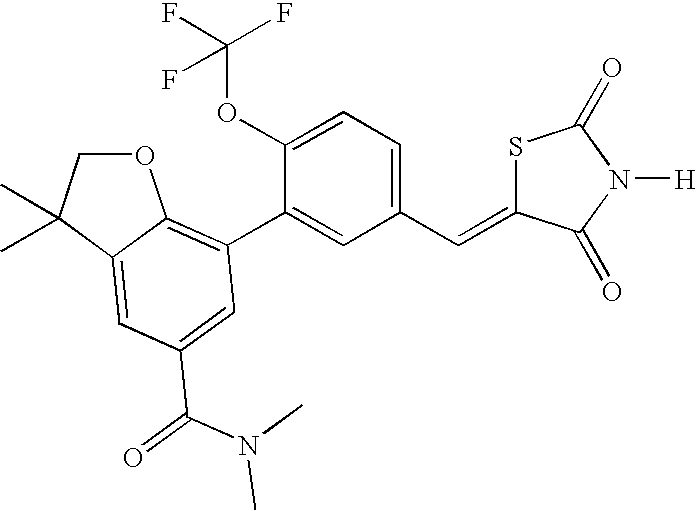
- Prepared in a similar manner to example 1 using 7-[5-formyl-2-trifluoromethoxy-phenyl]-3,3-dimethyl-2,3-dihydro-benzofuran-5-carboxylic acid dimethylamide. 25% yield. mp 268-272° C. 1H-NMR (300 MHz, DMSO-d-6): 1.35 (s, 6H), 2.98 (s, 6H), 4.28 (s, 2H), 7.23 (d, J=1.8 Hz, 1H), 7.40 (d, J=1.8 Hz, 1H), 7.62 (dd, J=8.5 Hz and J=1.5 Hz, 1H), 7.73 (dd, J=8.8 Hz and J=2.3 Hz, 1H), 7.79 (d, J=2.3 Hz, 1H), 7.87 (s, 1H), 12.71 (br s, 1H).
- The intermediate 7-[5-formyl-2-trifluoromethoxy-phenyl]-3,3-dimethyl-2,3-dihydro-benzofuran-5-carboxylic acid dimethylamide was prepared as followed:
- a. 7-[5-formyl-2-trifluoromethoxy-phenyl]-3,3-dimethyl-2,3-dihydro-benzofuran-5-carboxylic Acid Dimethylamide.
- To a solution of 7-bromo-3,3-dimethyl-2,3-dihydro-benzofuran-5-carboxylic acid dimethylamide (437 mg, 1.46 mmol) in dioxane (4 mL), were added under argon, triethylamine (0.82 mL, 5.86 mmol), Pd(OAc) 2 (16 mg, 0.07 mmol), 2-(dicyclohexylphosphino)biphenyl (103 mg, 0.29 mmol) and pinacolborane (0.64 mL, 4.40 mmol) dropwise. The mixture was heated at 80° C. under argon for 2 hrs then cooled to room temperature. Water (0.5 mL) was added dropwise, then Ba(OH)2.8H2O (1.38 g, 4.40 mmol) followed by 3-bromo-4-trifluoromethoxy benzaldehyde (example 1h) (473 mg, 1.76 mmol) dissolved in dioxane (1.2 mL). The mixture was refluxed for 4 hours then cooled to room temperature, diluted with ethyl acetate and filtered over celite. The solution was further washed with water and brine, dried over anhydrous magnesium sulfate, filtered and evaporated. The residue was purified on silica gel (5% methanol in dichloromethane) to give 264 mg of 7-[5-formyl-2-trifluoromethoxy-phenyl]-3,3-dimethyl-2,3-dihydro-benzofuran-5-carboxylic acid dimethylamide (containing 50% of 3,3-dimethyl-2,3-dihydro-benzofuran-5-carboxylic acid dimethylamide as determined by 1H NMR) use as this in the next step.
- b. 7-bromo-3,3-dimethyl-2,3-dihydro-benzofuran-5-carboxylic Acid Dimethylamide.
- Prepared in a similar manner to example 3a using 7-bromo-3,3-dimethyl-2,3-dihydro-benzofuran-5-carboxylic acid (example 3b) and dimethylamine hydrochloride. 45% yield. 1H NMR (300 MHz; CDCl3): 1.36 (s, 6H), 3.05 (br s, 6H), 4.37 (s, 2H), 7.16 (d, J=1.5 Hz, 1H), 7.38 (d, J=1.5 Hz, 1H).
-
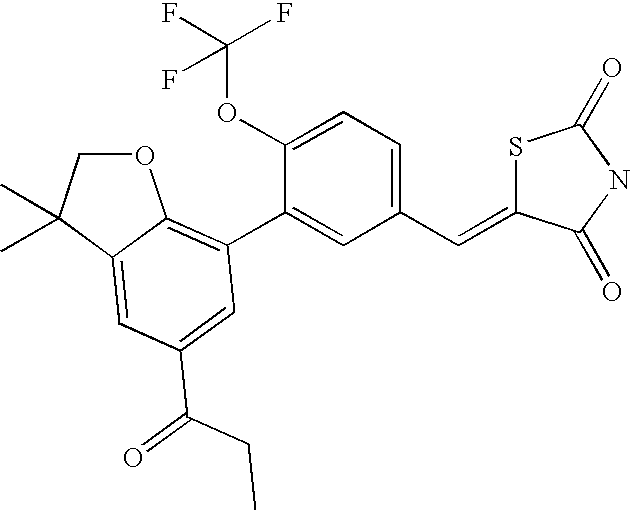
- Prepared in a similar manner to example 1 using 3-(3,3-dimethyl-5-propionyl-2,3-dihydro-benzofuran-7-yl)-4-trifluoromethoxy-benzaldehyde. 74% yield, mp 105-108° C. 1H-NMR (300 MHz, DMSO-d-6): 1.09 (t, J=7.3 Hz, 3H), 1.37 (s, 6H), 3.03 (q, J=7.3 Hz, 2H), 4.34 (s, 2H), 7.63 (dd, J=8.8 Hz, J2=1.8 Hz, 1H), 7.74 (dd, J1=8.8 Hz, J2=2.3 Hz, 1H), 7.83 (d, J=2.3 Hz, 1H), 7.86 (d, J=1.8 Hz, 1H), 7.88 (s, 1H), 7.92 (d, J=1.8 Hz, 1H), 12.72 (br s, 1H).
- The intermediate 3-(3,3-dimethyl-5-propionyl-2,3-dihydro-benzofuran-7-yl)-4-trifluoromethoxy-benzaldehyde was prepared as followed:
- a. 3-(3,3-dimethyl-5-propionyl-2,3-dihydro-benzofuran-7-yl)-4-trifluoromethoxy-benzaldehyde.
- A mixture of 1-[3,3-dimethyl-7-(4,4,5,5-tetramethyl-[1,3,2]dioxaborolan-2-yl)-2,3-dihydro-benzofuran-5-yl]-propan-1-one (1.33 g, 4.05 mmol), 3-bromo-4-trifluoromethoxybenzaldehyde (example 1h) (1.09 g, 4.05 mmol) and potassium carbonate (1.12 g, 8.10 mmol) in toluene (12 mL), ethanol (2.4 mL) and water (1.5 mL) was degassed with argon for 30 minutes. Tetrakis(triphenylphosphine)palladium(0) (234 mg, 0.20 mmol) was added and the mixture heated at reflux under argon for 19 hrs. The solution was cooled to room temperature, diluted with ethyl acetate and washed successively with water and brine, dried over anhydrous magnesium sulfate, filtered and evaporated. The residue was purified on silica gel (10% ethyl acetate in hexane) to give 1.17 g of 3-(3,3-dimethyl-5-propionyl-2,3-dihydro-benzofuran-7-yl)-4-trifluoromethoxy-benzaldehyde (50%). 1H NMR (300 MHz; CDCl3): 1.23 (t, J=7.2 Hz, 3H), 1.42 (s, 6H), 2.99 (q, J=7.2 Hz, 2H), 4.34 (s, 2H), 7.52 (dd, J=7.2 Hz, J2=1.8 Hz, 1H), 7.84 (d, J=2.1 Hz, 1H), 7.85 (d, J=2.13 Hz, 1H), 7.96 (dd, J1=8.4 Hz, J2=2.1 Hz, 1H), 8.03 (d, J=2.1 Hz, 1H), 10.05 (s, 1H).
- b. 1-[3,3-dimethyl-7-(4,4,5,5-tetramethyl-[1,3,2]dioxaborolan-2-yl)-2,3-dihydro-benzofuran-5-yl]-propan-1-one.
- To a solution of 1-(7-bromo-3,3-dimethyl-2,3-dihydro-benzofuran-5-yl)-propan-1-one (1.69 g, 5.99 mmol) in dioxane (16 mL), were added under argon, triethylamine (3.34 mL, 23.96 mmol), Pd(OAc) 2 (67 mg, 0.30 mmol), 2-(dicyclohexylphosphino)biphenyl (420 mg, 1.20 mmol) and pinacolborane (2.61 mL, 17.97 mmol) dropwise. The mixture was heated at 85° C. under argon for 1.5 hrs then cooled to room temperature. Water (0.5 mL) was added dropwise followed by saturated aqueous NH4Cl solution. The solution was extracted with ethyl acetate then washed successively with water and brine, dried over anhydrous magnesium sulfate, filtered and evaporated. The residue was purified on silica gel (10% to 20% ethyl acetate in hexane) to give 1.34 g of 1-[3,3-dimethyl-7-(4,4,5,5-tetramethyl-[1,3,2]dioxaborolan-2-yl)-2,3-dihydro-benzofuran-5-yl]-propan-1-one.
- c. 1-(7-bromo-3,3-dimethyl-2,3-dihydro-benzofuran-5-yl)-propan-1-one.
- To a solution of AlCl 3 (2.42 g, 18.18 mmol) in dry dichloromethane (30 mL) was added dropwise at room temperature 1-(3,3-dimethyl-2,3-dihydro-benzofuran-5-yl)-propan-1-one (1.48 g, 7.27 mmol) in dichloromethane (30 mL) followed by bromine (0.45 mL, 8.72 mmol) and the reaction stirred for 12 hours at room temperature. 1N HCl was added slowly and the layers separated. The aqueous layer was extracted twice with dichloromethane. The combined organic layers were washed successively with water, aq. NaHCO3, water and brine, dried over anhydrous magnesium sulfate, filtered and evaporated to give 1.7 g of 1-(7-bromo-3,3-dimethyl-2,3-dihydro-benzofuran-5-yl)-1-propan-1-one (83%). 1H NMR (300 MHz; CDCl3): δ 1.21 (t, J=7.2 Hz, 3H), 1.39 (s, 6H), 2.92 (q, J=7.2 Hz, 2H), 4.42 (s, 2H), 7.70 (s, 1H), 7.96 (s, 1H).
- d. 1-(3,3-dimethyl-2,3-dihydro-benzofuran-5-yl)-propan-1-one.
- To a solution of 1-(3,3-dimethyl-2,3-dihydro-benzofuran-5-yl)-propan-1-ol (2.6 g, 12.60 mmol) in dry dichloromethane (40 mL) was added at room temperature pyridinium chlorochromate (3 g, 13.86 mmol). The reaction mixture was stirred for 1 hour at room temperature then filtered over celite. Water was added and the layers separated. The aqueous layer was extracted twice with dichloromethane. The combined organic layers were washed successively with water and brine, dried over anhydrous magnesium sulfate, filtered and evaporated. The residue was chromatographed on silica gel (5% ethyl acetate in hexane) to give 530 mg of 1-(3,3-dimethyl-2,3-dihydro-benzofuran-5-yl)-propan-1-one (58%). 1H NMR (300 MHz; CDCl3): δ 1.21 (t, J=7.2 Hz, 3H), 1.37 (s, 6H), 2.94 (q, J=7.2 Hz, 2H), 4.32 (s, 2H), 6.80 (d, J=8.4 Hz, 1H), 7.79 (s, 1H), 7.81 (d, J=8.4 Hz, 1H).
- e. 1-(3,3-dimethyl-2,3-dihydro-benzofuran-5-yl)-propan-1-ol.
- Prepared in a similar manner to example 1 e using 5-bromo-3,3-dimethyl-2,3-dihydro-benzofuran (example 1f) and propionaldehyde. (92%). 1H NMR (300 MHz; CDCl3): δ 0.91 (t, J=7.5 Hz, 3H), 1.33 (s, 3H), 1.34 (s, 3H), 1.77 (m, 4H), 4.23 (s, 2H), 4.54 (t, J=6.9 Hz, 1H), 6.73 (d, J=8.1 Hz, 1H), 7.07 (dd, J=7.8 Hz and 1.8 Hz, 1H), 7.10 (d, J=1.5 Hz, 1H).
-
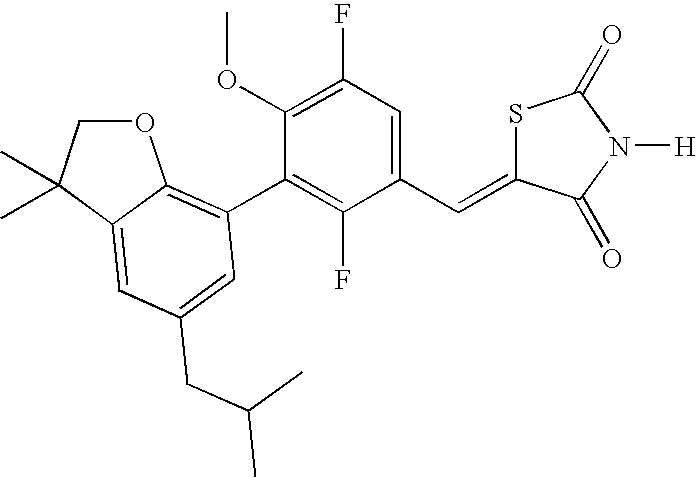
- Prepared in a similar manner to example 1 using 2,5-Difluoro-3-(5-isobutyl-3,3-dimethyl-2,3-dihydro-benzofuran-7-yl)-4-methoxy-benzaldehyde. mp 165-168° C. 1H-NMR (300 MHz, CDCl3): 0.91 (d, J=6.6 Hz, 6H), 1.36 (s, 3H), 1.37 (s, 3H), 1.82 (m, 1H), 2.44 (d, J=6.9 Hz, 2H), 3.90 (2 s, 3H), 4.22 (2 s, 2H), 6.83 (s, 1H), 6.94 (d, J=6.9 and 12 Hz, 1H), 8.01 (s, 1H), 8.29 (br s, 1H).
- The intermediate 2,5-Difluoro-3-(5-isobutyl-3,3-dimethyl-2,3-dihydro-benzofuran-7-yl)-4-methoxy-benzaldehyde was prepared in a similar manner as in example 1 a using 5-isobutyl-3,3-dimethyl-2,3-dihydro-benzofuran-7-boronic acid (example 1b) and 2,5-difluoro-3-iodo-4-methoxy-benzaldehyde
-

- Prepared in a similar manner to example 1 using 4-Dimethylamino-3-(5-isobutyl-3,3-dimethyl-2,3-dihydro-benzofuran-7-yl)-benzaldehyde. mp 205-207° C.
- 1H-NMR (300 MHz, DMSO-d-6): 0.88 (d, J=6.6 Hz, 6H), 1.31 (s, 6H), 1.79 (m, 1H), 2.42 (d, J=6.9 Hz, 2H), 2.62 (s, 6H), 4.18 (s, 2H), 6.91 (d, J=1.8 Hz, 1H), 6.95 (d, J=1.5 Hz, 1H), 7.02 (d, J=8.57 Hz, 1H), 7.37 (d, J=2.4 Hz, 1H), 7.44 (dd, J1=2.4 Hz, J2=8.7 Hz, 1H), 7.70 (s, 1H), 12.41 (br s, 1H).
- The intermediate 4-Dimethylamino-3-(5-isobutyl-3,3-dimethyl-2,3-dihydro-benzofuran-7-yl)-benzaldehyde was prepared in a similar manner as in example 2a using 1-(7-bromo-3,3-dimethyl-2,3-dihydro-benzofuran-5-yl)-2-methyl-propan-1-one (example 2d) and 2-dimethylamino-5-formyl-1-phenylboronic acid.
-
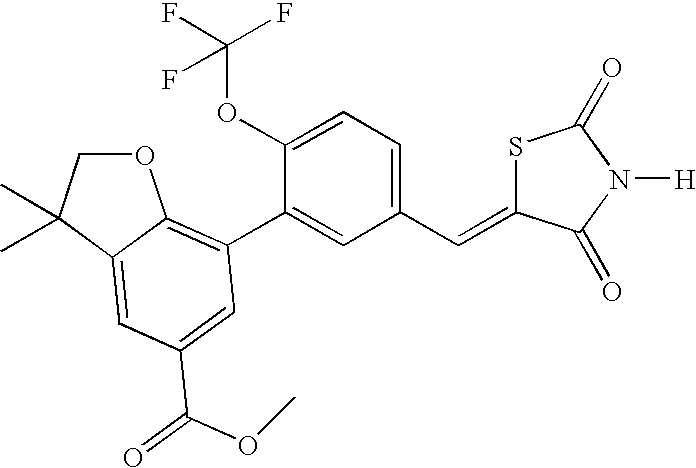
- Prepared in a similar manner to example 1 using 7-(5-formyl-2-trifluoromethoxy-phenyl)-3,3-dimethyl-2,3-dihydro-benzofuran-5-carboxylic acid methyl ester. mp 307-310° C. 1H-NMR (300 MHz, DMSO-d-6): 1.36 (s, 6H), 3.83 (s, 3H), 4.35 (s, 2H), 7.63 (dd, J1=8.5 Hz, J2=1.5 Hz, 1H), 7.75 (dd, J1=8.8 Hz, J2=2.3 Hz, 1H), 7.81 (d, J=1.8 Hz, 1H), 7.82 (d, J=2.3 Hz, 1H), 7.87 (s, 1H), 7.88 (d, J=1.8 Hz, 1H), 12.72 (br s, 1H).
- The intermediate 7-(5-formyl-2-trifluoromethoxy-phenyl)-3,3-dimethyl-2,3-dihydro-benzofuran-5-carboxylic acid methyl ester was prepared in a similar manner to example 2a using 7-bromo-3,3-dimethyl-2,3-dihydro-benzofuran-5-carboxylic acid methyl ester and 3-formyl-6-trifluoromethoxy-1-phenyl boronic acid (example 2b). 72% yield. 1H-NMR (300 MHz, CDCl3): 1.41 (s, 3H), 3.90 (s, 3H), 4.33 (s, 2H), 7.48 (d, J=8.7 Hz, 1H), 7.87-8.01 (m, 4H), 10.04 (s, 1H).
-

- Prepared in a similar manner to example 1 using 3-(5-Furan-3-yl-3,3-dimethyl-2,3-dihydro-benzofuran-7-yl)-4-trifluoromethoxy-benzaldehyde. 68% yield. 1H-NMR (300 MHz, DMSO-d-6): 1.34 (s, 6H), 4.21 (s, 2H), 6.94 (m, 1H), 7.38 (d, J=1.8 Hz, 1H), 7.54 (d, J=1.8 Hz, 1H), 7.59 (m, 2H), 7.79 (d, J=2.4 Hz, 1H), 7.85 (s, 1H), 12.68 (br s, 1H).
- The intermediate 3-(5-Furan-3-yl-3,3-dimethyl-2,3-dihydro-benzofuran-7-yl)-4-trifluoromethoxy-benzaldehyde was prepared as followed:
- a. 3-(5-Furan-3-yl-3,3-dimethyl-2,3-dihydro-benzofuran-7-yl)-4-trifluoromethoxy-benzaldehyde.
- A mixture of 3-(5-bromo-3,3-dimethyl-2,3-dihydro-benzofuran-7-yl)-4-trifluoromethoxy-benzaldehyde (580 mg, 1.40 mmol), 3-furanboronic acid (316 mg, 2.8 mmol) and potassium carbonate (387 mg, 2.8 mmol) in DME (10 mL) and water (1 mL) was degassed with argon for 15 minutes.
- Tetrakis(triphenylphosphine)palladium(0) (81 mg, 0.07 mmol) was added and the mixture heated at reflux under argon for 20 hrs. The solution was cooled to room temperature, diluted with ethyl acetate and washed successively with water and brine, dried over anhydrous magnesium sulfate, filtered and evaporated. The residue was purified on silica gel (10% ethyl acetate in hexane) to give 148 mg of 3-(5-Furan-3-yl-3,3-dimethyl-2,3-dihydro-benzofuran-7-yl)-4-trifluoromethoxy-benzaldehyde (26%).
- 1H NMR (300 MHz; CDCl3): 1.41 (s, 6H), 4.28 (s, 2H), 6.67 (m,1H), 7.26 (m, 2H), 7.50 (m, 2H), 7.68 (m, 2H), 7.93 (dd, J1=2.4 Hz, J2=8.5 Hz, 1H), 8.05 (d, J=2 Hz, 1H), 10.05 (s, 1H).
- b. 3-(5-bromo-3,3-dimethyl-2,3-dihydro-benzofuran-7-yl)-4-trifluoromethoxy-benzaldehyde.
- A mixture of 5-bromo-7-iodo-3,3-dimethyl-2,3-dihydro-benzofuran (2.85 g, 8.07 mmol), 3-formyl-6-trifluoromethoxy-1-phenyl boronic acid (1.72 g, 7.34 mmol) and potassium carbonate (2.03 g, 14.7 mmol) in toluene (25 mL), ethanol (5 mL) and water (3 mL) was degassed with argon for 20 minutes. Tetrakis(triphenylphosphine)palladium(0) (844 mg, 0.73 mmol) was added and the mixture heated at reflux under argon for 21 hrs. The solution was cooled to room temperature, diluted with ethyl acetate and washed successively with water and brine, dried over anhydrous magnesium sulfate, filtered and evaporated. The residue was purified on silica gel (10% ethyl acetate in hexane) to give 585 mg of 3-(5-bromo-3,3-dimethyl-2,3-dihydro-benzofuran-7-yl)-4-trifluoromethoxy-benzaldehyde (19%). 1H NMR (300 MHz; CDCl3): 1.39 (s, 6H), 4.26 (s, 2H), 7.28 (m, 2H), 7.51 (m, 2H), 7.92-7.98 (m, 2H), 10.04 (s, 1H).
- c. 5-bromo-7-iodo-3,3-dimethyl-2,3-dihydro-benzofuran.
- 5-Bromo-3,3-dimethyl-2,3-dihydro-benzofuran (example 1f) (10 g, 44 mmol) was dissolved in glacial acetic acid (40 mL), iodine monochloride (10.86 g, 66.9 mmol) was added and the reaction mixture was heated at reflux for 72 hours then cooled to 0° C., and 1N NaOH was slowly added until pH=8 followed by Na 2CO3 until the solution become colorless. The solution was extracted with ethyl acetate and the organic layer further washed with water and brine, dried over anhydrous magnesium sulfate, filtered and evaporated. The residue was purified on silica gel (10% ethyl acetate in hexane) to give 8.7 g of 5-bromo-7-iodo-3,3-dimethyl-2,3-dihydro-benzofuran (56%). 1H NMR (300 MHz; CDCl3): 1.34 (s, 6H), 4.32 (s, 2H), 7.13 (d, J=2 Hz, 1H), 7.58 (d, J=2 Hz, 1H).
-

- Prepared in a similar manner to example 1 using 3-[5-(2-Hydroxy-ethoxymethyl)-3,3-dimethyl-2,3-dihydro-benzofuran-7-yl]-4-trifluoromethoxy-benzaldehyde. 75% yield, mp 166-169° C. 1H-NMR (300 MHz, DMSO-d-6): 1.33 (s, 6H), 3.50 (m, 4H), 4.22 (s, 2H), 4.46 (s, 2H), 4.64 (m, 1H), 7.12 (s, 1H), 7.27 (s, 1H), 7.60 (d, J=8.8 Hz, 1H), 7.72 (d, J=8.8 Hz, 1H), 7.75 (s, 1H), 7.86 (s, 1H), 12.70 (br s, 1H).
- The intermediate 3-[5-(2-Hydroxy-ethoxymethyl)-3,3-dimethyl-2,3-dihydro-benzofuran-7-yl]-4-trifluoromethoxy-benzaldehyde was prepared as follows:
- a. 3-[5-(2-Hydroxy-ethoxymethyl)-3,3-dimethyl-2,3-dihydro-benzofuran-7-yl]-4-trifluoromethoxy-benzaldehyde.
- A mixture of 2-[7-(5-[1,3]dioxolan-2-yl-2-trifluoromethoxy-phenyl)-3,3-dimethyl-2,3-dihydro-benzofuran-5-ylmethoxy]-ethanol (393 mg, 0.89 mmol) and 1N HCl (9 mL) in tetrahydrofuran (4 mL) was stirred for 1 hour at room temperature. The mixture was diluted with ethyl acetate and the layers were separated. The aqueous layer was neutralized with an aqueous solution of sodium bicarbonate and the mixture was extracted with ethyl acetate. The organic combined extract was further washed with water, brine, dried (MgSO 4), filtered and evaporated. The residue was used as this in the next step. 1H-NMR (300 MHz, CDCl3): 1.39 (s, 6H), 1.97 (t, J=6.2 Hz, 1H), 3.63 (t, J=4.4 Hz, 2H), 3.79 (m, 2H), 4.26 (s, 2H), 4.54 (s, 2H), 7.15 (d, J=8.5 Hz, 2H), 7.49 (d, J=8.8 Hz, 1H), 7.91 (dd, J1=8.8 Hz, J2=2.1 Hz, 1H), 8.02 (d, J=2.1 Hz, 1H), 10.03 (s, 1H).
- b. 2-[7-(5-[1,3]Dioxolan-2-yl-2-trifluoromethoxy-phenyl)-3,3-dimethyl-2,3-dihydro-benzofuran-5-ylmethoxy]-ethanol.
- A mixture of 3-(5-hydroxymethyl-3,3-dimethyl-2,3-dihydro-benzofuran-7-yl)-4-trifluoromethoxy-benzaldehyde (1.76 g, 4.82 mmol) and 12N HCl (12 mL) in toluene (45 mL) was heated at reflux for 1 hour. The solution was cooled to room temperature and the layers were separated. The aqueous layer was extracted twice with ethyl acetate. The organic combined extract was washed with water, brine, dried (MgSO 4), filtered and evaporated. To the residue obtained (3-[5-chloromethyl-3,3-dimethyl-2,3-dihydro-benzofuran-7-yl)-4-trifluoromethoxy-benzaldehyde), diluted in toluene (20 mL), were added ethylene glycol (2.5 mL, 44.34 mmol) and p-toluenesulfonic acid monohydrate (0.44 mmol, 84 mg). The mixture was heated at reflux overnight using a Dean Stark apparatus. The solution was cooled to room temperature, poured into an aqueous solution of sodium bicarbonate, and extracted with ethyl acetate. The organic combined extract was washed with water, brine, dried (MgSO4), filtered and evaporated. The residue was chromatographed on silica gel (50% ethyl acetate in hexane) to afford 830 mg of 2-[7-(5-[1,3]dioxolan-2-yl-2-trifluoromethoxy-phenyl)-3,3-dimethyl-2,3-dihydro-benzofuran-5-ylmethoxy]-ethanol. 38% yield. 1H-NMR (300 MHz, CDCl3): 1.37 (s, 6H), 1.99 (t, J=6.2 Hz, 1H), 3.62 (t, J=4.5 Hz, 2H), 3.78 (m, 2H), 4.02-4.15 (m, 4H), 4.24 (s, 2H), 4.53 (s, 2H), 5.86 (s, 1H), 7.11 (d, J=8.5 Hz, 2H), 7.34 (d, J=8.5 Hz, 1H), 7.49 (d, J=8.5 Hz, 1H), 7.58 (s, 1H).
- c. 3-(5-Hydroxymethyl-3,3-dimethyl-2,3-dihydro-benzofuran-7-yl)-4-trifluoromethoxy-benzaldehyde.
- The intermediate 3-(5-hydroxymethyl-3,3-dimethyl-2,3-dihydro-benzofuran-7-yl)-4-trifluoromethoxy-benzaldehyde was prepared in a similar manner to example 1 a using [3,3-dimethyl-7-(4,4,5,5-tetramethyl-[1,3,2]dioxaborolan-2-yl)-2,3-dihydro-benzofuran-5-yl]-methanol and 3-bromo-4-trifluoromethoxy benzaldehyde. 59% yield.
- 1H-NMR (300 MHz, CDCl3): 1.39 (s, 6H), 1.71 (m, 1H), 4.26 (s, 2H), 4.68 (s, 2H), 7.14 (d, J=2.3 Hz, 1H), 7.21 (d, J=1.5 Hz, 1H), 7.49 (dd, J1=8.5 Hz, J2=1.5 Hz, 1H), 7.91 (dd, J1=8.5 Hz, J2=2.1 Hz, 1H), 8.01 (d, J=2.3 Hz, 1H), 10.03 (s, 1H).
- d. [3,3-Dimethyl-7-(4,4,5,5-tetramethyl-[1,3,2]dioxaborolan-2-yl)-2,3-dihydro-benzofuran-5-yl]-methanol.
- The intermediate [3,3-dimethyl-7-(4,4,5,5-tetramethyl-[1,3,2]dioxaborolan-2-yl)-2,3-dihydro-benzofuran-5-yl]-methanol was prepared in a similar manner to example 5b using 7-bromo-3,3-dimethyl-2,3-dihydro-benzofuran-5-carbaldehyde (example 3c). 55% yield. 1H-NMR (300 MHz, CDCl3): 1.33 (s, 6H), 1.36 (s, 12H), 1.55 (m, 1H), 4.33 (s, 2H), 4.61 (br s, 2H), 7.23 (d, J=2.1 Hz, 1H), 7.52 (d, J=8.5 Hz, 1H).
- e. 3-[5-Chloromethyl-3,3-dimethyl-2,3-dihydro-benzofuran-7-yl)-4-trifluoromethoxy-benzaldehyde.
- 1H-NMR (300 MHz, CDCl3): 1.40 (s, 6H), 4.28 (s, 2H), 4.63 (s, 2H), 7.20 (m, 2H), 7.50 (d, J=8.5 Hz, 1H), 7.93 (dd, J1=8.5 Hz, J2=2.1 Hz, 1H), 8.02 (d, J=2.1 Hz, 1H), 10.04 (s, 1H).
-
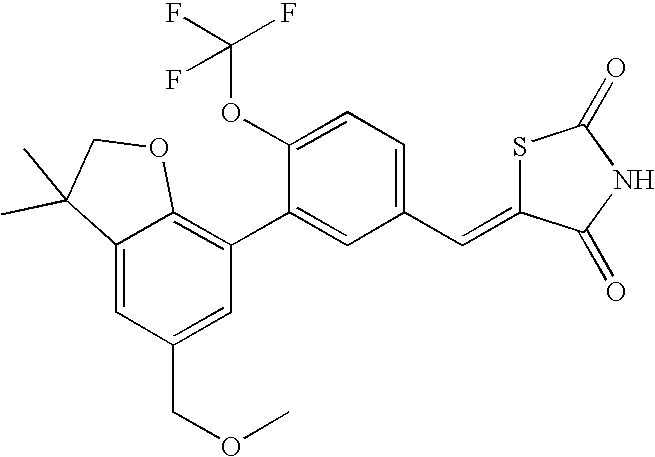
- Prepared in a similar manner to example 1 using 3-(5-Methoxymethyl-3,3-dimethyl-2,3-dihydro-benzofuran-7-yl)-4-trifluoromethoxy-benzaldehyde. 78% yield, mp 148-151° C. 1H-NMR (300 MHz, CDCl3): 1.40 (s, 6H), 2.11 (s, 3H), 4.28 (s, 2H), 5.09 (s, 2H), 7.17 (s, 2H), 7.44 (d, J=8.8 Hz, 1H), 7.51 (dd, J1=8.8 Hz, J2=2.1 Hz, 1H), 7.65 (d, J=2.1 Hz, 1H), 7.86 (s, 1H), 8.44 (br s, 1H).
- The intermediate 3-(5-Methoxymethyl-3,3-dimethyl-2,3-dihydro-benzofuran-7-yl)-4-trifluoromethoxy-benzaldehyde was prepared as follows:
- a. 3-(5-Methoxymethyl-3,3-dimethyl-2,3-dihydro-benzofuran-7-yl)-4-trifluoromethoxy-benzaldehyde.
- To a cold solution (0° C.) of sodium hydride in tetrahydrofuran (4 mL), under an atmosphere of argon, was added 3-(5-hydroxymethyl-3,3-dimethyl-2,3-dihydro-benzofuran-7-yl)-4-trifluoromethoxy-benzaldehyde (example 10c) (246 mg, 0.67 mmol) in tetrahydrofuran (6 mL). The mixture was stirred at 0° C. for 15 minutes, then the argon flow was stopped and methyl iodide was added. After 3 hours at room temperature, the mixture was diluted with ethyl acetate. Water was slowly added and the layers separated. The organic layer was further washed with water, brine, dried (MgSO 4), filtered and evaporated. The residue was chromatographed on silica gel (20% ethyl acetate in hexane) to afford 99 mg of 3-(5-Methoxymethyl-3,3-dimethyl-2,3-dihydro-benzofuran-7-yl)-4-trifluoromethoxy-benzaldehyde. 39% yield. 1H-NMR (300 MHz, CDCl3): 1.39 (s, 6H), 2.11 (s, 3H), 4.27 (s, 2H), 5.09 (s, 2H), 7.17 (s, 2H), 7.49 (d, J=8.5 Hz, 1H), 7.93 (dd, J1=8.5 Hz, J2=2.1 Hz, 1H), 8.02 (d, J=2.1 Hz, 1H), 10.03 (s, 1H).
-

- Prepared in a similar manner to example 1 using 7-(5-formyl-2-trifluoromethoxy-phenyl)-3,3-dimethyl-2,3-dihydro-benzofuran-5-carboxylic acid. 35% yield, mp 223-226° C. 1H-NMR (300 MHz, DMSO-d-6): 1.36 (s, 6H), 4.33 (s, 2H), 7.62 (d, J=8.5 Hz, 1H), 7.74 (d, J=8.5 Hz, 1H), 7.80 (d, J=5.3 Hz, 2H), 7.86 (s, 2H), 12.71 (br s, 1 H), 12.77 (br s, 1H).
- The intermediate 7-(5-formyl-2-trifluoromethoxy-phenyl)-3,3-dimethyl-2,3-dihydro-benzofuran-5-carboxylic acid was prepared as follows:
- a. 7-(5-Formyl-2-trifluoromethoxy-phenyl)-3,3-dimethyl-2,3-dihydro-benzofuran-5-carboxylic Acid.
- A mixture of 7-(5-Formyl-2-trifluoromethoxy-phenyl)-3,3-dimethyl-2,3-dihydro-benzofuran-5-carboxylic acid methyl ester (1.76 g, 4.82 mmol) (example 8) and 5N potassium hydroxide (2 mL) in methanol (20 mL) was heated at reflux for 1 hour. The solvent was then evaporated. The mixture was diluted with water and washed twice with diethyl ether. The aqueous layers were acidified with 1N HCl and extracted twice with ethyl acetate. The organic combined extract was further washed with water, brine, dried (MgSO 4), filtered and evaporated. The residue was chromatographed on silica gel (30% ethyl acetate in hexane) to afford 112 mg of 7-(5-formyl-2-trifluoromethoxy-phenyl)-3,3-dimethyl-2,3-dihydro-benzofuran-5-carboxylic acid. 10% yield. 1H-NMR (300 MHz, CDCl3): 1.43 (s, 6H), 4.36 (s, 2H), 7.51 (d, J=8.2 Hz, 1H), 7.92-8.04 (m, 4H), 10.05 (s, 1H).
-
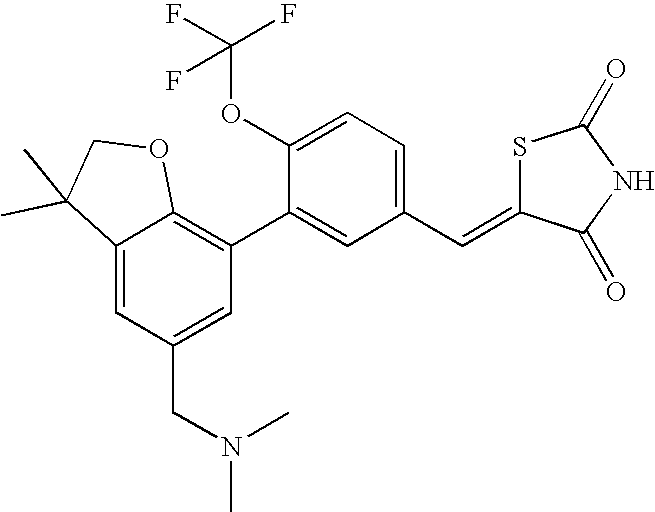
- Prepared in a similar manner to example 1 using 3-(5-Dimethylaminomethyl-3,3-dimethyl-2,3-dihydro-benzofuran-7-yl)-4-trifluoromethoxy-benzaldehyde. 65% yield, mp 233-235° C. 1H-NMR (300 MHz, DMSO-d-6): 1.34 (s, 6H), 2.57 (s, 6H), 4.00 (s, 2H), 4.26 (s, 2H), 7.22 (d, J=1.8 Hz, 1H), 7.33 (d, J=1.7 Hz, 1H), 7.49 (s, 1H), 7.53 (d, J=7.9 Hz, 1H), 7.67 (dd, J1=7.9 Hz, J2=2.3 Hz, 1H), 7.69 (s, 1H).
- The intermediate 3-(5-dimethylaminomethyl-3,3-dimethyl-2,3-dihydro-benzofuran-7-yl)-4-trifluoromethoxy-benzaldehyde was prepared as follows:
- a. 3-(5-Dimethylaminomethyl-3,3-dimethyl-2,3-dihydro-benzofuran-7-yl)-4-trifluoromethoxy-benzaldehyde.
- A mixture of 3-(5-hydroxymethyl-3,3-dimethyl-2,3-dihydro-benzofuran-7-yl)-4-trifluoromethoxy-benzaldehyde (1.25 g, 3.41 mmol) (example 10c) and 12N HCl (8.5 mL) in toluene (35 mL) was heated at reflux for 1 hour. The solution was cooled to room temperature and the layers were separated. The aqueous layer was extracted twice with ethyl acetate. The organic combined extract was washed with water, brine, dried (MgSO 4), filtered and evaporated. To the residue obtained (3-[5-chloromethyl-3,3-dimethyl-2,3-dihydro-benzofuran-7-yl)-4-trifluoromethoxy-benzaldehyde) (example 10e), diluted in dimethylformamide (35 mL), were added potassium carbonate (3.49 g, 25.25 mmol) then dimethylamine hydrochloride (1.47 g, 18.04 mmol). The mixture was stirred at room temperature for 3 hours. Water was added and the layers separated. The mixture was extracted with ethyl acetate and the organic combined extract was washed with water, brine, dried (MgSO4), filtered and evaporated. The residue was chromatographed on silica gel (10% methanol in dichloromethane) to afford 742 mg of 3-(5-Dimethylaminomethyl-3,3-dimethyl-2,3-dihydro-benzofuran-7-yl)-4-trifluoromethoxy-benzaldehyde. 56% yield. 1H-NMR (300 MHz, CDCl3): 1.38 (s, 6H), 2.30 (s, 6H), 3.47 (s, 2H), 4.25 (s, 2H), 7.06 (s, 1H), 7.16 (s, 1H), 7.48 (d, J=8.5 Hz, 1H), 7.90 (dd, J1=8.5 Hz, J2=2.1 Hz, 1H), 8.03 (d, J=2.1 Hz, 1H), 10.03 (s, 1H).
-

- Prepared in a similar manner to example 1 using 7-(5-formyl-2-trifluoromethoxy-phenyl)-3,3-dimethyl-2,3-dihydro-benzofuran-5-sulfonic acid methylamide. 45% yield. 1H-NMR (300 MHz, DMSO-d-6): 1.38 (s, 6H), 2.43 (d, J=5.0 Hz, 3H), 4.37 (s, 2H), 7.32 (q, J=5.0 Hz, 1H), 7.59 (d, J=1.8 Hz, 1H), 7.65 (dd, J1=8.8 Hz, J2=1.5 Hz, 1H), 7.69 (d, J=1.8 Hz, 1H), 7.76 (dd, J1=8.8 Hz, J2=2.3 Hz, 1H), 7.83 (d, J=2.1 Hz, 1H), 7.88 (s, 1H), 12.72 (br s, 1H).
- The intermediate 7-(5-formyl-2-trifluoromethoxy-phenyl)-3,3-dimethyl-2,3-dihydro-benzofuran-5-sulfonic acid methylamide was prepared in a similar manner to example 2a using 7-bromo-3,3-dimethyl-2,3-dihydro-benzofuran-5-sulfonic acid methylamide and 3-formyl-6-trifluoromethoxy-1-phenyl boronic acid (example 2b). 90% yield. 1H-NMR (300 MHz, CDCl3): 1.43 (s, 6H), 2.70 (d, J=5.6 Hz, 3H), 4.31 (m, 1H), 4.37 (s, 2H), 7.52 (dd, J1=8.5 Hz, J2=1.8 Hz, 1H), 7.66 (d, J=2.1 Hz, 1H), 7.71 (d, J=2.1 Hz, 1H), 7.97 (dd, J1=8.5 Hz, J2=2.1 Hz, 1H), 8.03 (d, J=2.1 Hz, 1H), 10.05 (s, 1H).
- a. 7-Bromo-3,3-dimethyl-2,3-dihydro-benzofuran-5-sulfonic Acid Methyl Amide.
- To a solution of 3,3-dimethyl-2,3-dihydro-benzofuran-5-sulfonic acid methylamide (215 mg, 0.89 mmol) in trifluoroacetic acid (5 mL) and sulfuric acid (1 mL) was added portionwise N-bromosuccinimide (317 mg, 1.78 mmol). The mixture was stirred at room temperature overnight, poured into a solution of ice-water and rinsed with dichloromethane. The layers were separated. The aqueous layer was extracted twice with dichloromethane and the organic combined extract was washed with water, an aqueous solution of sodium bicarbonate, brine, dried (MgSO 4), filtered and evaporated. The residue was chromatographed on silica gel (30% ethyl acetate in hexane) to afford 91 mg of 7-bromo-3,3-dimethyl-2,3-dihydro-benzofuran-5-sulfonic acid methylamide. 32% yield. 1H-NMR (300 MHz, CDCl3): 1.40 (s, 6H), 2.68 (d, J=5.3 Hz, 3H), 4.21 (m, 1H), 4.45 (s, 2H), 7.52 (d, J=1.8 Hz, 1H), 7.83 (d, J=1.8 Hz, 1H).
- b. 3,3-Dimethyl-2,3-dihydro-benzofuran-5-sulfonic Acid Methylamide.
- To a solution of 3,3-dimethyl-2,3-dihydro-benzofuran (160 mg, 1.08 mmol) in dichloromethane (2 mL) at −10° C. was added chlorosulfonic acid (72 μL, 1.08 mmol). The mixture was stirred at −110° C. for 15 minutes, then the solvent was evaporated to give 3,3-dimethyl-2,3-dihydro-benzofuran-5-sulfonic acid [ 1H-NMR (300 MHz, CDCl3): 1.37 (s, 6H), 4.35 (s, 2H), 6.85 (d, J=8.2 Hz, 1H), 7.67 (d, J=2.1 Hz, 1H), 7.73 (dd, J1=8.5 Hz, J2=2.1 Hz, 1H), 10.12 (br s, 1H)]. The residue was diluted with thionyl chloride (1 mL, 13.71 mmol) and one drop of dimethylformamide was added. After 45 minutes reflux and evaporation of the solvent, the solid compound was washed in a mixture of dichloromethane/hexane to give 3,3-dimethyl-2,3-dihydro-benzofuran-5-sulfonyl chloride [1H-NMR (300 MHz, CDCl3): 1.41 (s, 6H), 4.41 (s, 2H), 6.92 (d, J=8.8 Hz, 1H), 7.74 (d, J=2.3 Hz, 1H), 7.87 (dd, J1=8.5 Hz, J2=2.1 Hz, 1H)]. A solution of methylamine 2.0 M in tetrahydrofuran (0.81 mL, 1.62 mmol) was then slowly added and the mixture was stirred at room temperature for 15 minutes. The solvent was evaporated to afford 215 mg of 3,3-dimethyl-2,3-dihydro-benzofuran-5-sulfonic acid methylamide. 83% yield. 1H-NMR (300 MHz, CDCl3): 1.38 (s, 6H), 2.66 (d, J=5.3 Hz, 3H), 4.21 (m, 1H), 4.34 (s, 2H), 6.86 (d, J=8.5 Hz, 1H), 7.60 (d, J=2.1 Hz, 1H), 7.66 (dd, J1=8.5 Hz, J2=1.8 Hz, 1H).
- c. 3,3-Dimethyl-2,3-dihydro-benzofuran.
- To a solution of 5-bromo-3,3-dimethyl-2,3-dihydro-benzofuran (example 1f) (3.3 g, 14.53 mmol) in tetrahydrofuran (30 mL) was added dropwise, at −78° C., under an atmosphere of argon, a solution of n-butyllithium in hexane (8.8 mL, 22 mmol). The mixture was stirred at −78° C. for 5 minutes, then water was added and the mixture was warmed up to room temperature and stirred for 30 minutes. The layers were separated. The aqueous layer was extracted twice with ethyl acetate and the organic combined extract was washed with water, brine, dried (MgSO 4), and filtered. The solvent was evaporated to afford 2.13 g of 3,3-dimethyl-2,3-dihydro-benzofuran. 99% yield. 1H-NMR (300 MHz, CDCl3): 1.35 (s, 6H), 4.23 (s, 2H), 6.79 (d, J=7.6 Hz, 1H), 6.88 (t, J=7.3 Hz, 1H), 7.11 (d, J=7.6 Hz, 2H).
-
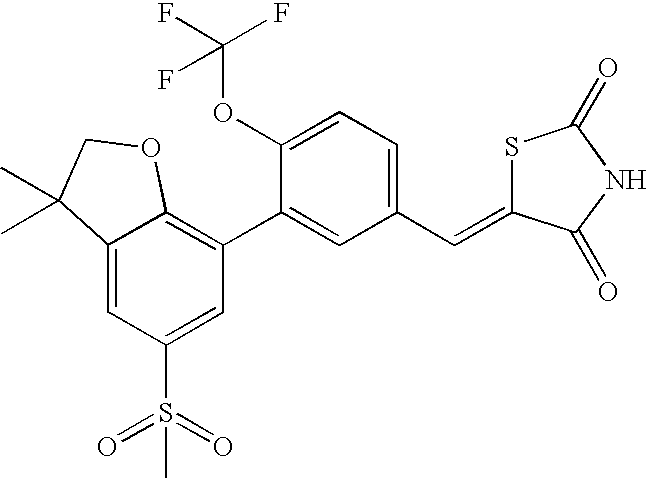
- Prepared in a similar manner to example 1 using 3-(5-methanesulfonyl-3,3-dimethyl-2,3-dihydro-benzofuran-7-yl)-4-trifluoromethoxy-benzaldehyde. 22% yield, mp 215-227° C. 1H-NMR (300 MHz, DMSO-d-6): 1.39 (s, 6H), 3.23 (s, 3H), 4.38 (s, 2H), 7.62-7.68 (m, 1H), 7.74-7.79 (m, 2H), 7.86-7.89 (m, 3H), 12.72 (br s, 1H).
- The intermediate 3-(5-methanesulfonyl-3,3-dimethyl-2,3-dihydro-benzofuran-7-yl)-4-trifluoromethoxy-benzaldehyde was prepared in a similar manner to example 2a using 7-bromo-5-methanesulfonyl-3,3-dimethyl-2,3-dihydro-benzofuran and 3-formyl-6-trifluoromethoxy-1-phenyl boronic acid (example 2b). 30% yield. 1H-NMR (300 MHz, CDCl3): 1.44 (s, 6H), 3.10 (s, 3H), 4.38 (s, 2H), 7.52 (d, J=8.8 Hz, 1H), 7.73 (d, J=2.1 Hz, 1H), 7.79 (d, J=2.1 Hz, 1H), 7.98 (dd, J1=8.5 Hz, J2=2.1 Hz, 1H), 8.02 (d, J=2.1 Hz, 1H), 10.06 (s, 1H).
- The intermediate 7-bromo-5-methanesulfonyl-3,3-dimethyl-2,3-dihydro-benzofuran was prepared in a similar manner to example 14a using 5-methanesulfonyl-3,3-dimethyl-2,3-dihydro-benzofuran. 27% yield. 1H-NMR (300 MHz, CDCl3): 1.41 (s, 6H), 3.06 (s, 3H), 4.46 (s, 2H), 7.60 (d, J=1.8 Hz, 1H), 7.92 (d, J=1.8 Hz, 1H).
- a. 5-Methanesulfonyl-3,3-dimethyl-2,3-dihydro-benzofuran.
- A mixture of 3,3-dimethyl-2,3-dihydro-benzofuran (example 14c) (870 mg, 5.87 mmol), trifluoromethanesulfonic acid (0.1 mL, 1.17 mmol) and methanesulfonic anhydride (2.04 g, 11.74 mmol) was heated to 135° C. After reaching this temperature, the heater was removed and the mixture was cooled down to room temperature. The mixture was poured into a solution of ice-water. The aqueous layer was extracted twice with ethyl acetate and the organic combined extract was washed with water, an aqueous solution of sodium bicarbonate, brine, dried (MgSO 4), filtered, and evaporated. The residue was chromatographed on silica gel (30% to 50% ethyl acetate in hexane) to afford 317 mg of 5-Methanesulfonyl-3,3-dimethyl-2,3-dihydro-benzofuran. 24% yield.
- 1H-NMR (300 MHz, CDCl3): 1.39 (s, 6H), 3.04 (s, 3H), 4.36 (s, 2H), 6.90 (d, J=8.2 Hz, 1H), 7.67 (d, J=2.1 Hz, 1H), 7.74 (dd, J1=8.5 Hz, J2=2.1 Hz, 1H).
-

- Prepared in a similar manner to example 1 using 3-(5-acetyl-3,3-dimethyl-2,3-dihydro-benzofuran-7-yl)-4-trifluoromethoxy-benzaldehyde. (yield: 66%). 1H-NMR (300 MHz, DMSO-d-6): 1H NMR(DMSO-d6, ppm) 1.37 (s, 6H), 2.57 (s, 3H), 4.34 (s, 2H), 7.62-7.65 (m, 1H), 7.73-7.77 (m, 1H), 7.83-7.85 (m, 2H), 7.87 (s, 1H), 7.92 (m, 1H), 12.71 (bs, 1H).
- The intermediate 3-(5-acetyl-3,3-dimethyl-2,3-dihydro-benzofuran-7-yl)-4-trifluoromethoxy-benzaldehyde was prepared as follows:
- a. 3-(5-acetyl-3,3-dimethyl-2,3-dihydro-benzofuran-7-yl)-4-trifluoromethoxy-benzaldehyde.
- 1-(7-Bromo-3,3-dimethyl-2,3-dihydro-benzofuran5-yl)-ethanone (925 mg, 3.44 mmol) and 3-formyl-6-trifluoromethoxy-1-phenyl boronic acid (example 2b) (1207 mg, 5.16 mmol) were mixed with toluene (30 mL), EtOH (6 mL) and water (4 mL). Argon was bubbled through the mixture for 20 minutes before adding tetrakis(triphenylphosphine)palladium(0) (398 mg, 0.34 mmol) and potassium carbonate (951 mg, 6.88 mmol). The mixture was heated to reflux under argon for 15 hours then cooled to room temperature and water (20 mL) was added. The mixture was extracted with EtOAc, washed with brine, dried over MgSO 4, filtered and evaporated under reduced pressure. The residue was purified by column chromatography on silica gel (hexane: EtOAc/6:1) to give 1.08 g of 3-(5-acetyl-3,3-dimethyl-2,3-dihydro-benzofuran-7-yl)-4-trifluoromethoxy-benzaldehyde (83%). 1H NMR (300 MHz, CDCl3, ppm): δ: 1.42 (s, 6H), 2.59 (s, 3H), 4.35 (s, 2H), 7.50-7.54 (m, 1H), 7.82 (d, J=1.76 Hz, 1H), 7.84 (d, J=1.76 Hz, 1H), 7.95 (dd, J=2.05 Hz, J2=5.57 Hz, 1H), 8.03 (d, J=2.05 Hz), 10.05 (s, 1H).
- b. 1-(7-Bromo-3,3-dimethyl-2,3-dihydro-benzofuran5-yl)-ethanone.
- To a solution of 1-(3,3-dimethyl-2,3-dihydro-benzofuran5-yl)-ethanone (1.69 g, 8.88 mmol) in dichloromethane (25 mL) was slowly added a suspension of AlCl 3 (2.96 g, 22.2 mmol) in dichloromethane (30 mL). Bromine (1.61 g, 10.7 mmol) was added dropwise and the mixture was stirred at room temperature for 6 hours then cooled to 0° C. and aqueous HCl (1N) was added and the mixture extracted with dichloromethane, washed with brine, dried over MgSO4, filtered and evaporated under reduced pressure. The residue was purified by column chromatography on silica gel (hexane: EtOAc/10:1 to 2:1) to give 1.94 g 1-(7-Bromo-3,3-dimethyl-2,3-dihydro-benzofuran5-yl)-ethanone (81%). 1H NMR (300 MHz, CDCl3, ppm): δ: 1.39 (s, 6H), 2.56 (s, 3H), 4.37 (s, 2H), 7.69 (d, J=1.76 Hz, 1H), 7.95 (d, J=1.76 Hz, 1H).
- c. 1-(3,3-dimethyl-2,3-dihydro-benzofuran5-yl)-ethanone.
- To a solution of i-(3,3-dimethyl-2,3-dihydro-benzofuran5-yl)-ethanol (3.39 g, 15.4 mmol) in dichloromethane (100 mL), was added at 0° C. pyridinium chlorochromate (4.32 g, 20 mmol) and the mixture was stirred at room temperature for 4 hours then filtered through Celite. The filtrate was washed with brine, dried over MgSO 4, filtered and evaporated under reduced pressure. The residue was purified by column chromatography on silica gel (hexane: EtOAc/5:1 to 3:1) to give 1.69 g of 1-(3,3-dimethyl-2,3-dihydro-benzofuran5-yl)-ethanone (58%). 1H NMR (300 MHz, CDCl3, ppm): δ: 1.37 (s, 6H), 2.56 (s, 3H), 4.32 (s, 2H), 6.80 (m, 1H), 7.78-7.82 (m, 2H).
- d. 1-(3,3-dimethyl-2,3-dihydro-benzofuran5-yl)-ethanol.
- To a solution of 5-bromo-3,3-dimethyl-2,3-dihydro-benzofuran (example 1 f) (3.50 g, 15.4 mmol) in dry THF (20 mL) at −78° C., under argon, was added dropwise n-BuLi (1.6 M in hexane, 23.1 mmol, 14.4 mL). The mixture was stirred for 2 hours then acetaldehyde (0.95 mL) was added and the mixture was slowly warmed up to room temperature and stirred overnight at room temperature. 1N HCl was added and the solution extracted with ethyl acetate and the organic extract was dried (MgSO 4), filtered and evaporated to give 3.3 g of 1-(3,3-dimethyl-2,3-dihydro-benzofuran5-yl)-ethanol. 1H NMR (300 MHz; CDCl3): δ 1.35 (s, 6H), 1.49 (d, J=6.5 Hz, 3H), 4.24 (s, 2H), 4.86 (q, J=6.5 Hz, 1H), 6.75 (d, J=8.2 Hz, 3H), 7.10-7.15 (m, 2H).
-
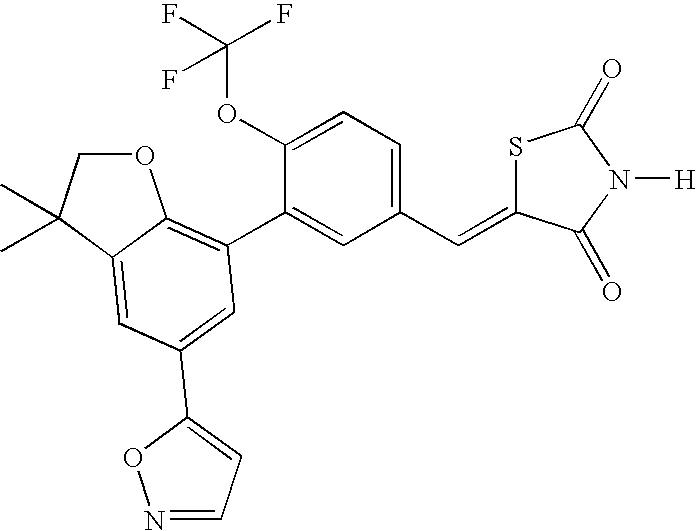
- Prepared in a similar manner to example 1 using 3-(5-Isoxazol-5-yl-3,3-dimethyl-2,3-dihydro-benzofuran-7-yl)-4-trifluoromethoxy-benzaldehyde. (yield: 51%). 1H NMR(DMSO-d6, ppm) 1.37 (s, 6H), 4.23 (s, 2H), 6.92 (s, 1H), 7.61-7.70 (m, 3H), 7.84 (m, 3H), 8.59 (s, 1H), 12.69 (bs, 1H).
- The intermediate 3-(5-Isoxazol-5-yl-3,3-dimethyl-2,3-dihydro-benzofuran-7-yl)-4-trifluoromethoxy-benzaldehyde was prepared as follows:
- a. 3-(5-Isoxazol-5-yl-3,3-dimethyl-2,3-dihydro-benzofuran-7-yl)-4-trifluoromethoxy-benzaldehyde.
- 3-(5-acetyl-3,3-dimethyl-2,3-dihydro-benzofuran-7-yl)-4-trifluoromethoxy-benzaldehyde(example 16a) (780 mg, 2.06 mmol), ethylene glycol (2.56 g, 41.2 mmol) and p-toluenesulfonic acid monohydrate (24 mg, 0.12 mmol) were mixed with toluene (10 mL) in a flask equipped with a Dean-Stark trap. The mixture was heated to reflux for 3 hours then cooled to room temperature and water was added. The solution was extracted with EtOAc, washed with 1N HCl, brine, dried over MgSO 4, filtered and evaporated under reduced pressure to give 850 mg of 1-[7-(5-[1,3]dioxolan-2-yl-2-trifluoromethoxy-phenyl)-3,3-dimethyl-2,3-dihydro-benzofuran-5-yl]-ethanone used as this in the next step.
- 1-[7-(5-[1,3]dioxolan-2-yl-2-trifluoromethoxy-phenyl)-3,3-dimethyl-2,3-dihydro-benzofuran-5-yl]-ethanone (850 mg) was mixed with N,N-dimethylformamide diethyl acetal (5 mL) in a dry flask under argon and heated to reflux for 24 hours. The solution was cooled to room temperature and excess of N,N-dimethylformamide diethyl acetal was removed under reduced pressure to afford 3-Dimethylamino-1-[7-(5-[1,3]dioxolan-2-yl-2-trifluoromethoxy-phenyl)-3,3-dimethyl-2,3-dihydro-benzofuran-5-yl]-propenone as a brown oil (1.1 g) use as this in the next step.
- To a solution of 3-Dimethylamino-1-[7-(5-[1,3]dioxolan-2-yl-2-trifluoromethoxy-phenyl)-3,3-dimethyl-2,3-dihydro-benzofuran-5-yl]-propenone (1.1 g) in EtOH (10 mL) was added hydroxylamine hydrochloride (147 mg, 2.11 mmol). The mixture was heated to reflux for 14 hours then cooled to room temperature and the solvent removed under reduced pressure. 15 mL of THF and 15 mL of 1N aqueous HCl were added and the solution was heated to reflux for 4 hours. The solution was then cooled to room temperature, extracted with EtOAc, washed with brine, dried over MgSO 4, filtered and evaporated under reduced pressure. The residue was purified by column chromatography on silica gel (hexane: EtOAc/10:1 to 5:1) to give 220 mg of 3-(5-Isoxazol-5-yl-3,3-dimethyl-2,3-dihydro-benzofuran-7-yl)-4-trifluoromethoxy-benzaldehyde (27% for the three steps). 1H NMR (300 MHz, CDCl3, ppm): δ: 1.44 (s, 6H), 4.33(s, 2H), 6.42 (d, J=2.05 Hz, 1H), 7.49-7.54 (m, 1H), 7.60-7.62 (m, 2H), 7.96 (dd, J1=2.05 Hz, J2=8.50 Hz, 1H), 8.04 (d, J=2.05 Hz, 1H), 8.27 (d, J=2.05 Hz, 1H), 10.05 (s, 1H).
-

- Prepared in a similar manner to example 1 using 3-(6-isobutyl-benzo[1,3]dioxol-4-yl)-4-trifluoromethoxy-benzaldehyde. 1H-NMR (300 MHz, CDCl3): 0.94 (d, J=6.7 Hz, 6H), 1.86 (in, 1H), 2.46 (d, J=7.0 Hz, 2H), 5.99 (s, 2H), 6.68 (s, 1H), 7.72 (s, 1H), 7.46 (d, J=8.8 Hz, 1H), 7.53 (dd, J1=8.8 Hz, J2=2.3 Hz, 1H), 7.67 (d, J=2.1 Hz, 1H), 7.87 (s, 1H), 8.61 (s, 1H).
- The intermediate 3-(6-isobutyl-benzo[1,3]dioxol-4-yl)-4-trifluoromethoxy-benzaldehyde was prepared as follows:
- a. 3-(6-isobutyl-benzo[1,3]dioxol-4-yl)-4-trifluoromethoxy-benzaldehyde.
- A mixture of 6-isobutyl-benzo[1,3]dioxole-4-boronic acid (110 mg, 0.50 mmol), 3-bromo-4-trifluoromethoxy benzaldehyde (example 1h) (133 mg, 0.50 mmol), and potassium carbonate (137 mg, 0.99 mmol) in toluene (1.5 mL), ethanol (0.4 mL) and water (0.2 mL) was degassed with argon for 15 minutes.
- Tetrakis(triphenylphosphine)palladium(0) (29 mg, 0.02 mmol) was added and the mixture heated at reflux under argon for 18 hrs. The solution was cooled to room temperature, diluted with ethyl acetate and washed successively with water and brine, dried over anhydrous magnesium sulfate, filtered and evaporated. The residue was purified on silica gel (5% ethyl acetate in hexane) to give 69 mg of 3-(6-isobutyl-benzo[1,3]dioxol-4-yl)-4-trifluoromethoxy-benzaldehyde. 1H NMR (300 MHz; CDCl3): 0.92 (d, J=6.9 Hz, 6H), 1.84 (m, 1H), 2.45 (d, J=7.2 Hz, 2H), 5.96 (s, 2H), 6.65 (s, 1H), 6.70 (s, 1H), 7.50 (d, J=6.9 Hz, 1H), 7.92 (dd, J=2.1 Hz and 8.4 Hz, 1H), 8.18 (d, J=2.1 Hz, 1H), 10.04 (s, 1H).
- b. 6-isobutyl-benzo[1,3]dioxole-4-boronic Acid.
- To a mixture of 4-bromo-6-isobutyl-benzo[1,3]dioxole (232 mg, 0.90 mmol) in THF (3 mL) cooled to −78° C. under an atmosphere of argon was added n-BuLi (0.72 mL, 2.5 M, 1.80 mmol) dropwise. The reaction mixture was stirred for 5 minutes and triisopropylborate (0.62 mL, 2.71 mmol) was added dropwise. The mixture was stirred at −50° C. for 2 hours then warmed up to room temperature and stirred overnight at room temperature. 2.0 N HCl was slowly added to the reaction mixture. After 30 minutes the mixture was diluted with ethyl acetate and the layers separated. The organic layer was further washed with water, brine, dried (MgSO 4), filtered and evaporated. The residue was chromatographed on silica gel (30% ethyl acetate in hexane) to give 110 mg of 6-isobutyl-benzo[1,3]dioxole-4-boronic acid (55%).
- c. 4-bromo-6-isobutyl-benzo[1,3]dioxole.
- To a solution of 7-bromo-benzo[1,3]dioxole-5-carbaldehyde (437 mg, 1.91 mmol) in dry ether (6 mL) was added slowly under argon at −30° C. isopropylmagnesium chloride (1.15 mL, 2.0 M in ether, 2.29 mmol) and the solution stirred for 30 minute. A solution of aqueous ammonium chloride was added and the layers separated. The aqueous layer was extrated with ethyl acetate and the organic combined and washed with water, brine, dried (MgSO 4), filtered and evaporated to give 503 mg of 1-(7-bromo-benzo[1,3]dioxol-5-yl)-2-methyl-propan-1-ol.
- To a cold solution (0° C.) of 1-(7-bromo-benzo[1,3]dioxol-5-yl)-2-methyl-propan-1-ol (498 mg, 1.82 mmol) in dry dichloromethane (10 mL) was added triethylsilane (0.6 mL, 3.65 mmol). After 15 minutes, trifluoroacetic acid was added to the reaction and the mixture stirred at 0° C. for 45 minutes. Water was poured into the reaction mixture and the layers separated. The organic layer was further washed with water, aqueous NaHCO 3 and brine, dried (MgSO4), filtered and evaporated. The residue was purified on silica gel (5% ethyl acetate in hexane) to give 242 mg of 4-bromo-6-isobutyl-benzo[1,3]dioxole (52%). 1H NMR (300 MHz; CDCl3): δ 0.90 (d, J=6.3 Hz, 6H), 1.81 (m, 1H), 2.39 (d, J=7.5 Hz, 2H), 6.01 (s, 2H), 6.58 (s, 1H), 6.76 (s, 1H).
- d. 7-bromo-benzo[1,3]dioxole-5-carbaldehyde.
- To a solution of 3-bromo-5-hydroxy-4-methoxy-benzaldehyde (5.98 g, 25.89 mmol) in dichloromethane (200 mL) at −78° C., under argon, was added dropwise boron tribromide (4.9 mL, 51.79 mmol). The mixture was slowly warmed up to room temperature over 2 hours then poured into ice-water and extracted with ethyl acetate. The organic layer was further washed with water, dried (MgSO 4), filtered and evaporated. Crystallisation from ethyl acetate and hexane affored 4.4 g of 3-bromo-4,5-dihydroxy-benzaldehyde (78%).
- To a solution of 3-bromo-4,5-dihydroxy-benzaldehyde (1.52 g, 7.02 mmol) in DMF (20 mL), were added KF (4.077 g, 70.18 mmol) followed by dibromomethane (1 mL, 14.04 mmol) and the mixture heated at 140° C. for 4 hours. The solution was cooled to room temperature, water was added and the mixture extracted with ether. The organic layer was further washed with saturated aqueous NaHCO 3, dried (MgSO4), filtered and evaporated to give 973 mg of 7-bromo-benzo[1,3]dioxole-5-carbaldehyde.
- 1H NMR (300 MHz; CDCl3): δ 6.16 (s, 2H), 7.26 (s, 1H), 7.54 (s, 1H), 9.76 (s, 1H).
-
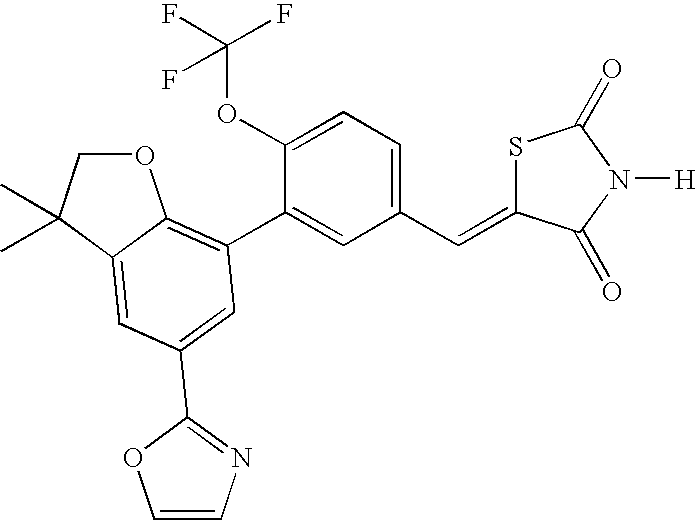
- Prepared in a similar manner to example 1 using 3-(3,3-Dimethyl-5-oxazol-2-yl-2,3-dihydro-benzofuran-7-yl)-4-trifluoromethoxy-benzaldehyde. 1H-NMR (300 MHz, CDCl3): 1.39 (s, 6H), 4.33 (s, 2H), 7.34 (m, 1H), 7.63-7.66 (m, 1H), 7.34-7.77 (m, 1H), 7.79 (d, J=1.76 Hz, 1H), 7.85 (d, J=2.1 Hz, 1H), 7.87 (s, 1H), 7.90 (d, J=1.5 Hz, 1H), 8.17 (m, 1H), 12.7 (bs, 1H).
- The intermediate 3-(3,3-Dimethyl-5-oxazol-2-yl-2,3-dihydro-benzofuran-7-yl)-4-trifluoromethoxy-benzaldehyde was prepared as follows:
- a. 3-(3,3-Dimethyl-5-oxazol-2-yl-2,3-dihydro-benzofuran-7-yl)-4-trifluoromethoxy-benzaldehyde.
- To a solution of 2-(7-Bromo-3,3-dimethyl-2,3-dihydro-benzofuran-5-yl)-oxazole (550 mg, 1.87 mmol) in 1,4-dioxane (10 mL) flushed with Argon was added triethylamine (754 mg, 1.94 ml, 7.48 mmol), 2-(dicyclohexylphosphino)biphenyl (131 mg, 0.37 mmol), palladium(II) acetate(21 mg, 0.09 mmol) and 4,4,5,5-tetramethyl-1,3,2-dioxaborolane (718 mg, 0.82 mL, 5.61 mmol). The mixture was heated to 80° C. under argon for 2 hours and cooled to room temperature. Water (1 mL) was added followed by Ba(OH) 2.8H2O (1.77 g, 5.05 mmol.), 3-bromo-4-trifluomethoxybenzaldehyde (600 mg, 2.23 mmol), palladium(II) acetate(10 mg, 0.05 mmol) and 2-(dicyclohexylphosphino)biphenyl (65 mg, 0.18 mmol). The mixture was heated to reflux for 12 hours and cooled to room temperature. The solution was extracted with EtOAc, washed with brine, dried over MgSO4, filtered and evaporated under reduced pressure. The residue was purified by column chromatography on silica gel (hexane: EtOAc/10:1 to 5: 1) to give 340 mg 3-(3,3-Dimethyl-5-oxazol-2-yl-2,3-dihydro-benzofuran-7-yl)-4-trifluoromethoxy-benzaldehyde (45%). 1H NMR (300 MHz, CDCl3, ppm): δ: 1.44 (s, 6H), 4.33 (s, 2H), 7.21 (s, 1H), 7.50-7.53 (m, 1H), 7.68 (s, 1H), 7.88 (d, J=1.76 Hz, 1H), 7.89 (d, J=1.76 Hz, 1H), 7.96 (dd, J1=2.05 Hz, J2=8.50 Hz, 1H), 8.05 (d, J=2.34 Hz, 1H), 10.05 (s, 1H).
- b. 2-(7-Bromo-3,3-dimethyl-2,3-dihydro-benzofuran-5-yl)-oxazole.
- To a solution of 7-bromo-3,3-dimethyl-2,3-dihydrobenzofuran-5-carboxylic acid (example 3b) (1.8 g, 6.64 mmol) in dichloromethane (40 mL) was added several drops of DMF followed by a solution of thionyl chloride in dichloromethane (2.0M, 6.64 mL, 13.3 mmol) at 0° C. under argon. After the addition, the mixture was stirred at room temperature for 5 hours. The solvent and excess of thinoyl chloride were removed under reduced pressure. The residue was dissolved in tetramethylene sulfone (10 mL) and potassium carbonate (1.84 g, 13.3 mmol) and 1H-1,2,3-triazole (504 mg, 7.3 mmol) were added under argon and the mixture was heated to 140° C. for 16 hours. The solution was cooled to room temperature, water was added and the mixture was extracted with EtOAc, washed with brine, dried over MgSO 4, filtered and evaporated under reduced pressure. The residue was purified by column chromatography on silica gel (hexane: EtOAc/5:1) to give 900 mg of 2-(7-Bromo-3,3-dimethyl-2,3-dihydro-benzofuran-5-yl)-oxazole (46%). 1H NMR (300 MHz, CDCl3, ppm): δ: 1.40 (s, 6H), 4.41 (s, 2H), 7.19 (s, 1H), 7.67 (s, 1H), 7.75 (d, J=0.88 Hz, 1H), 8.01 (d, J=0.88 Hz).
-

-
Compound 20 was disclosed in U.S. Pat. No. 6,515,003, issued Feb. 4, 2003, which is hereby incorporated by reference in it's entirety for its disclosures of the synthesis and biological activity of theCompound 20, which is employed herein for comparative purposes only. - Mouse pre-adipocyte 3T3-L1 cells obtained from ATCC (American Tissue Culture Collection, MD) were initially grown in DME Dulbecco's modified Eagle's medium containing 4500 mg/L glucose; 4 mM L-glutamine; 10 U/ml Pen-G; 10 mcg/ml Streptomycin and 10% Bovine Calf Serum (CS) at 37° C. and 10% CO 2. Cells were plated in 96 well plates at a density of approximately 3,000 cells/well and grown to confluence (when cells use 100% of the available space on the well) in the same medium. Differentiation experiments were conducted two days after confluence in a differentiation medium (DM) consisting of DME Dulbecco's modified Eagle's medium containing 4500 mg/L glucose; 4 mM L-glutamine; 10 U/ml Pen-G; 10 mcg/ml Streptomycin and 10% Fetal Calf Serum (FCS) and 1 μg/mL of insulin. Cells were then treated with the test compound at a concentration of 10−10 to 10−6 M, or with a control for fully-differentiated adipocytes, such as Dexamethasone/Insulin (2.5 μM; 10 μg/ml, respectively). Differentiation medium containing the compounds, with no further addition of insulin, was replaced every 2-3 days for a total of 7 days. Compound 24 was used as a standard for differention activity, and its ability to differentiate 3T3-L1 cells at 0.1 μM was taken as reference for 100% differentiation. Upon termination of the experiments the treated cells were washed once with PBS (Phosphate Buffer Saline, Irvine Scientific, Irvine, Calif.) and lysed in situ with 50 μL 10% Hecameg (Detergent, Calbiochem, San Diego). The cellular lysates were analyzed for their lipid content using the Triglyceride-GPO Trinder reagent from Sigma. The compounds are compared against an internal standard known as 5-[3-(3,5,5,8,8-Pentamethyl-5,6,7,8-tetrahydro-naphthalen-2-yl)-4-trifluoromethoxy-benzylidene]-thiazolidine-2,4-dione (referred to as
Compound 20 herein). As shown in FIG. 1, compounds of the invention induce differenciation of 3T3-L1 cells. - Experimental Procedure: Six to eight week-old male KKA y mice (available from Jackson Labs of Bar Harbour, Me.) were housed in a fixed 12-12-hr artificial light-dark cycle, and maintained on a standard rodent diet provided ad libitum. Animals were allowed two days to acclimate in this experimental environment prior to the initiation of the study. Prior to initiation of treatment, the animals were bled from the tail vein (100-200 μL of whole blood) and serum levels of glucose and triglycerides were measured in duplicate (Trinder kits; Sigma, St.Louis, Mo.). Based on these initial measures, animals were sorted into groups with approximately the same average serum triglyceride levels. Once sorted, the animals were housed one per cage and provided rodent diet ad libitum.
- Treatment group A (n=6/group):
- 1) KKA y control (sesame oil)
- 2) Compound 1 (15 mg/kg)
- Treatment group B (n=6/group):
- 1) KKA y control (sesame oil)
- 2) Compound 6 (15 mg/kg)
- Treatment group C (n=6/group):
- 1) KKA y control (sesame oil)
- 2) Compound 9 (15 mg/kg)
- All compounds were suspended in sesame oil, and administered to animals in a volume of 3 ml/kg/dose. All treatments were administered by oral gavage once daily.
- To monitor the effect of the tested Compounds, animals were bled at the end of the dark cycle on
days 7 and/or 14 of the treatment period. Serum glucose and triglyceride levels were measured in duplicate. The blood was kept at room temperature to allow coagulation, after which the serum was separated and assayed for glucose and triglyceride levels. As shown in FIGS. 2 and 3,Compounds - It will be apparent to those skilled in the art that various modifications and variations can be made in the present invention without departing from the scope or spirit of the invention. Other embodiments of the invention will be apparent to those skilled in the art from consideration of the specification and practice of the invention disclosed herein. It is intended that the specification and examples be considered as exemplary only, with a true scope and spirit of the invention being indicated by the following claims.
Claims (53)
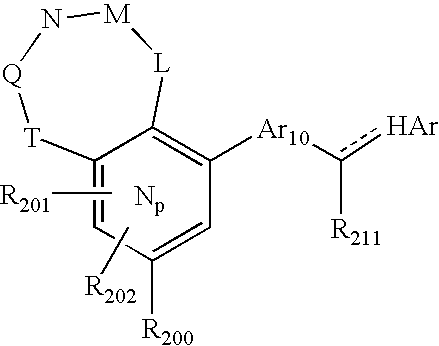


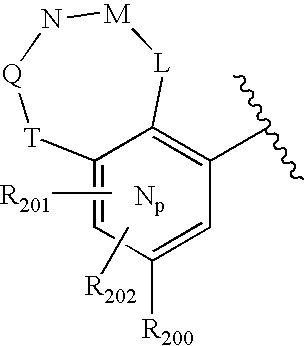
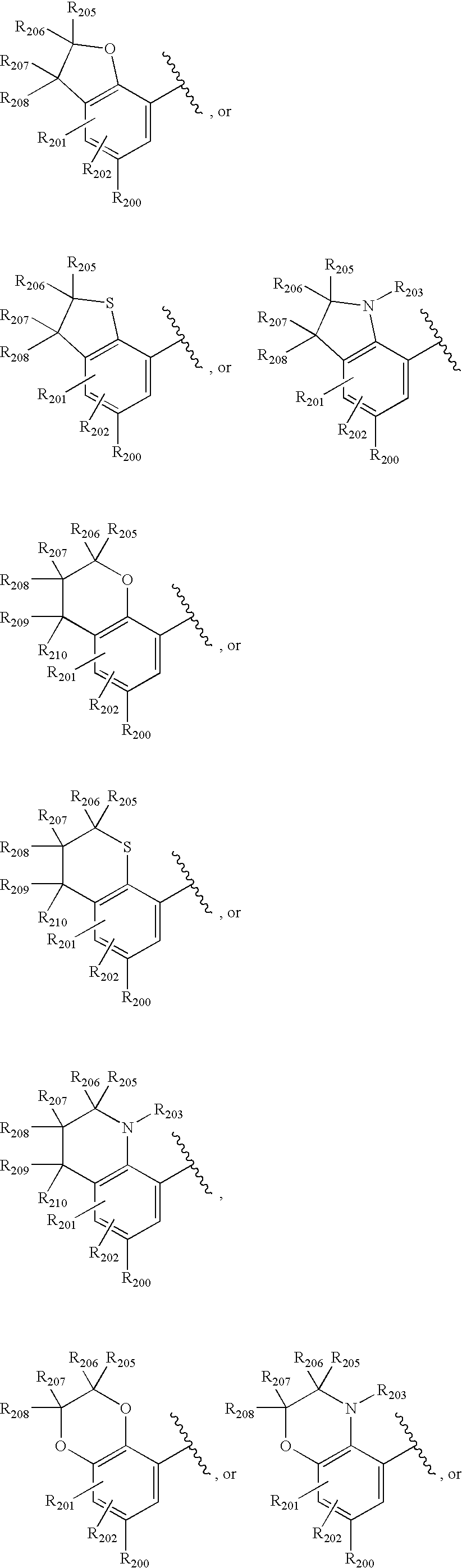
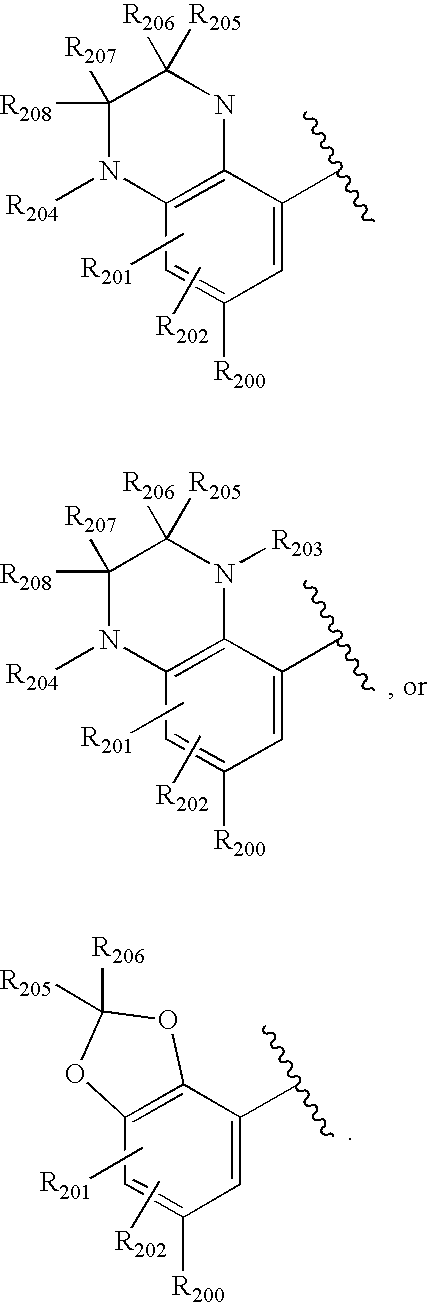

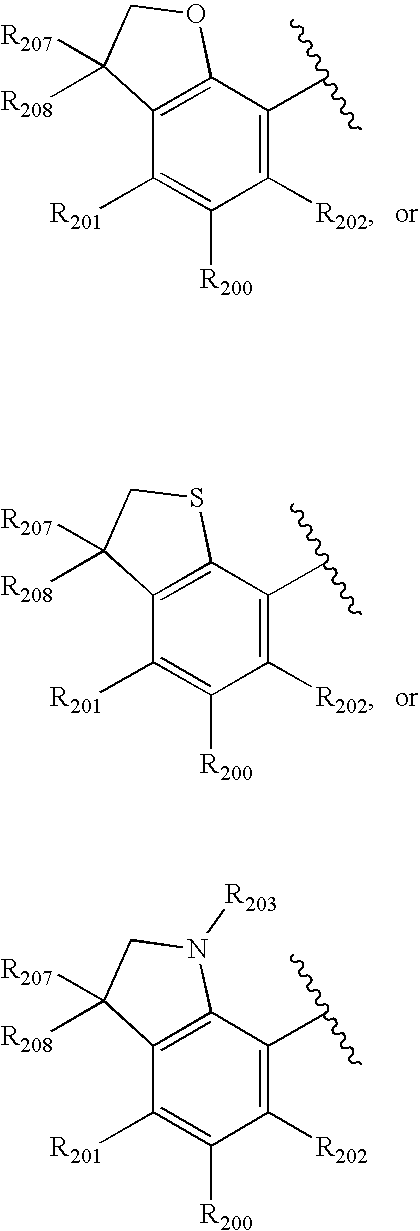
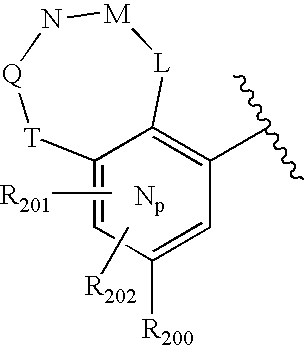

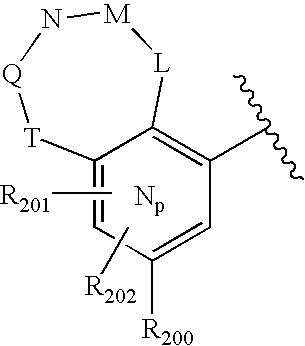
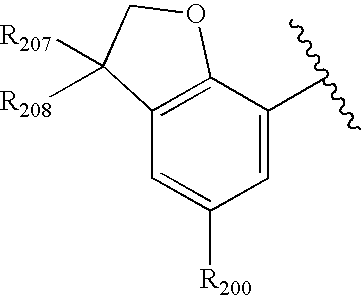
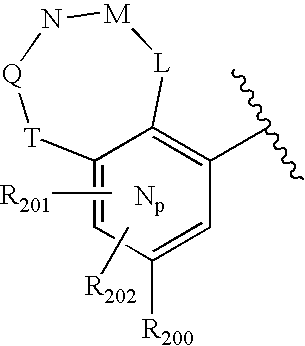

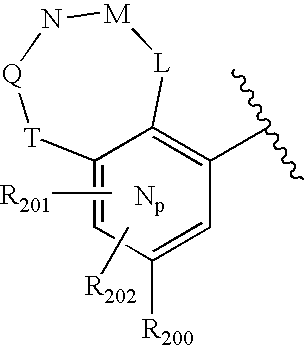

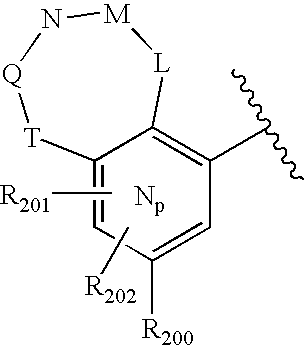

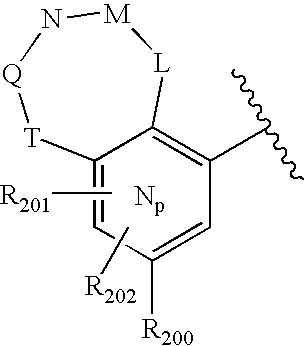
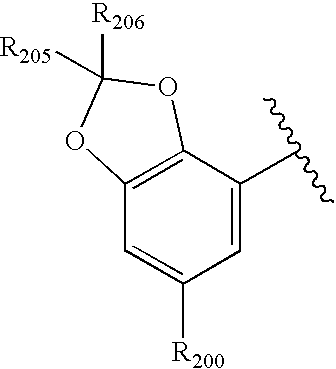

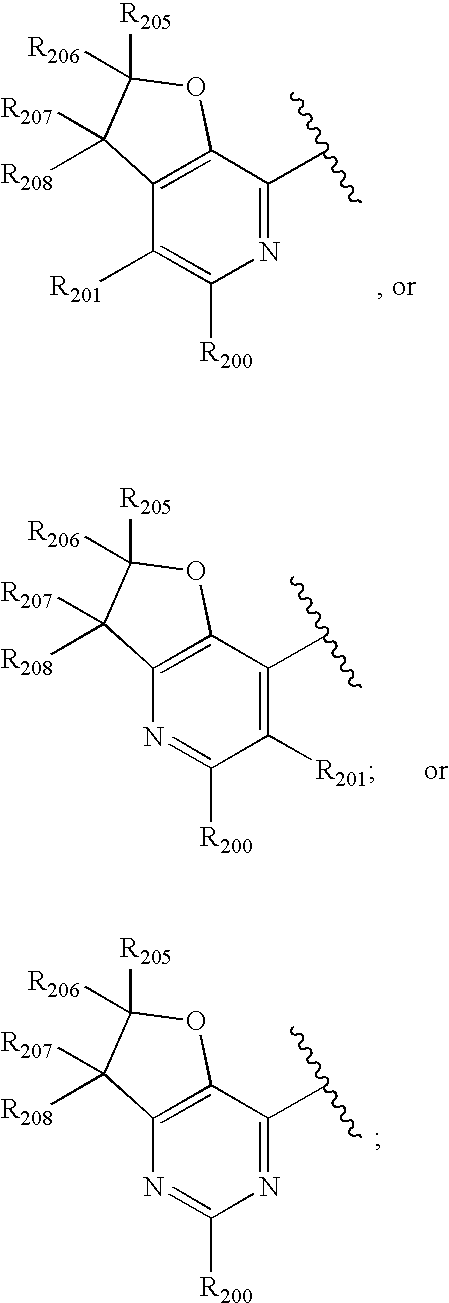
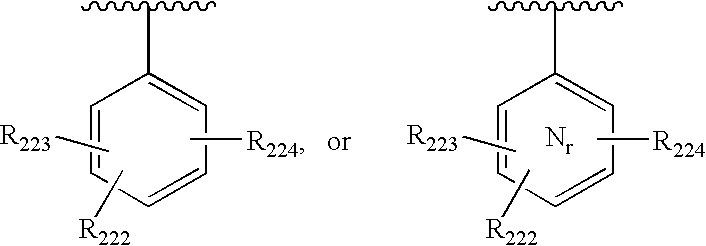

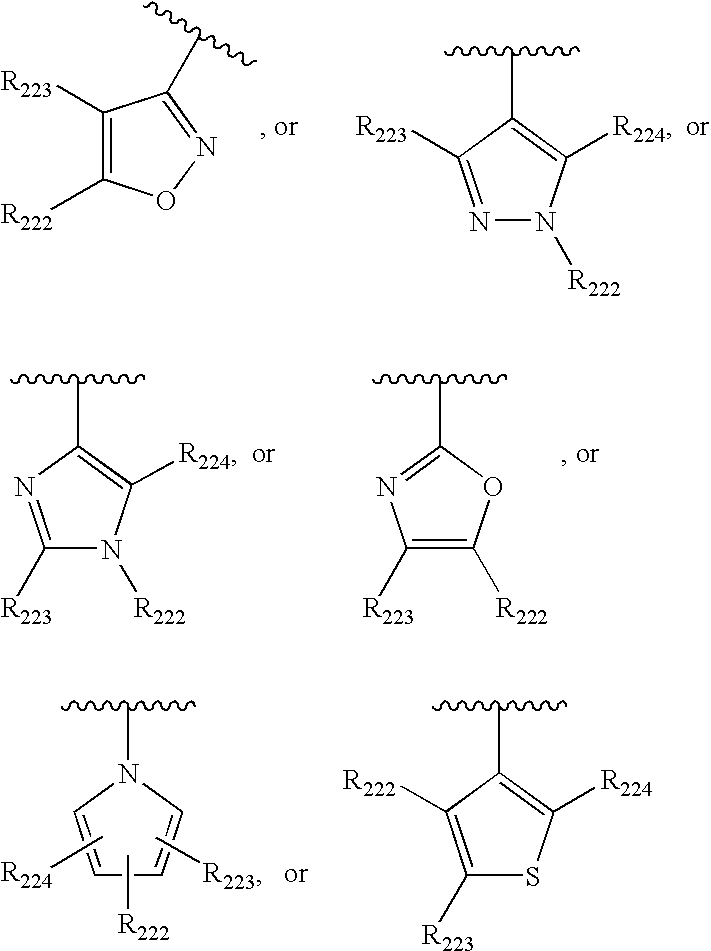
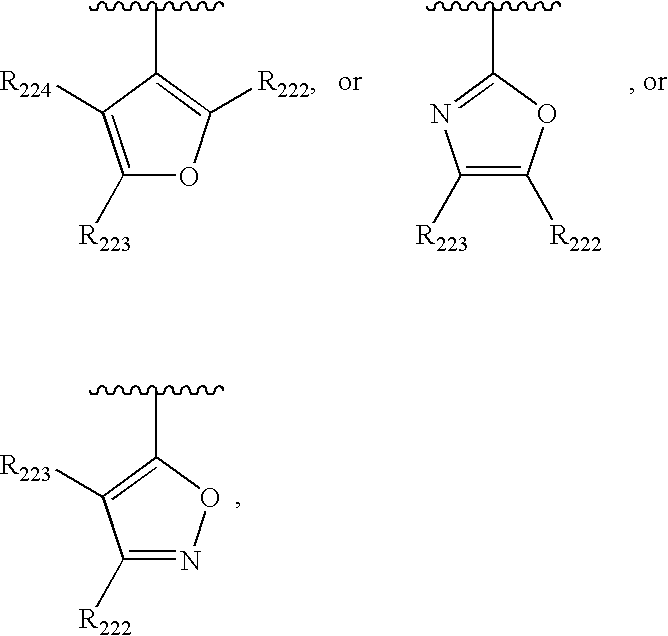

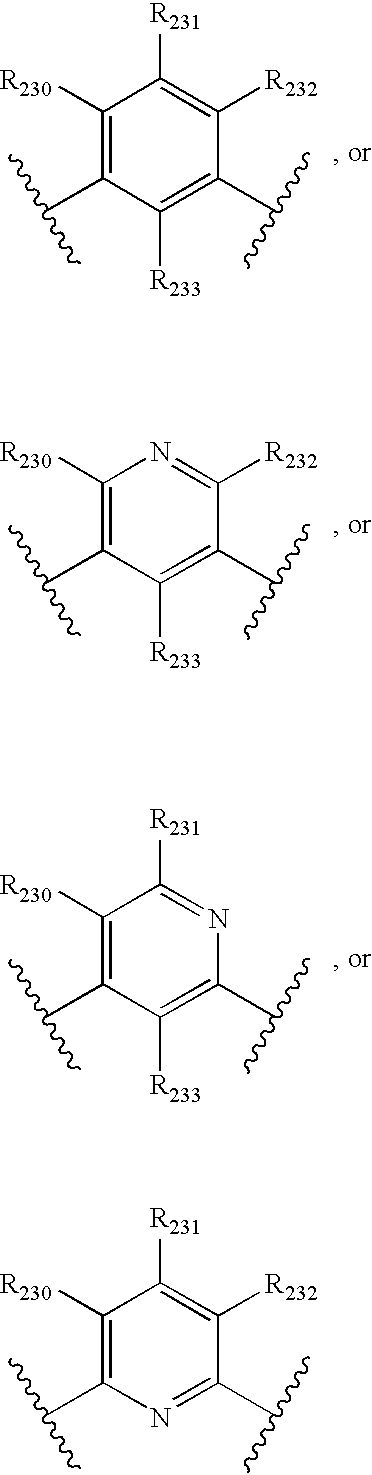
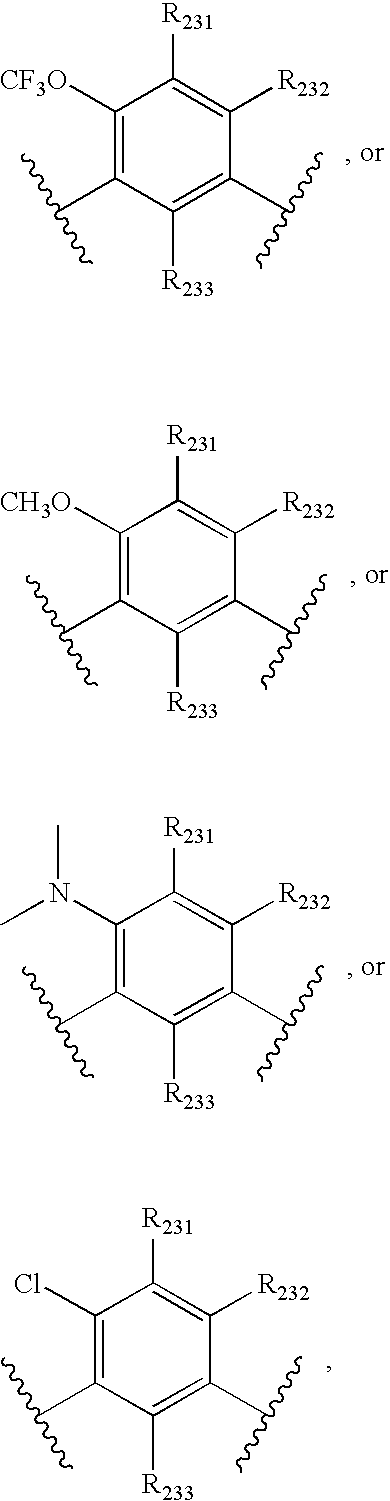
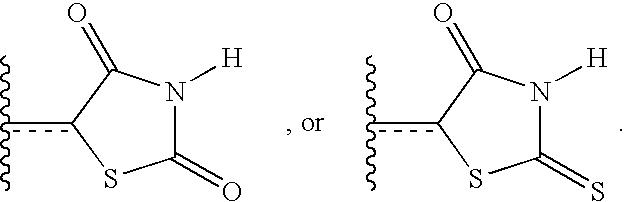

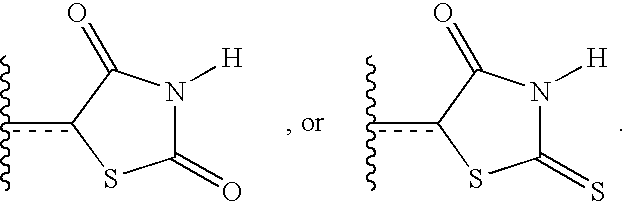
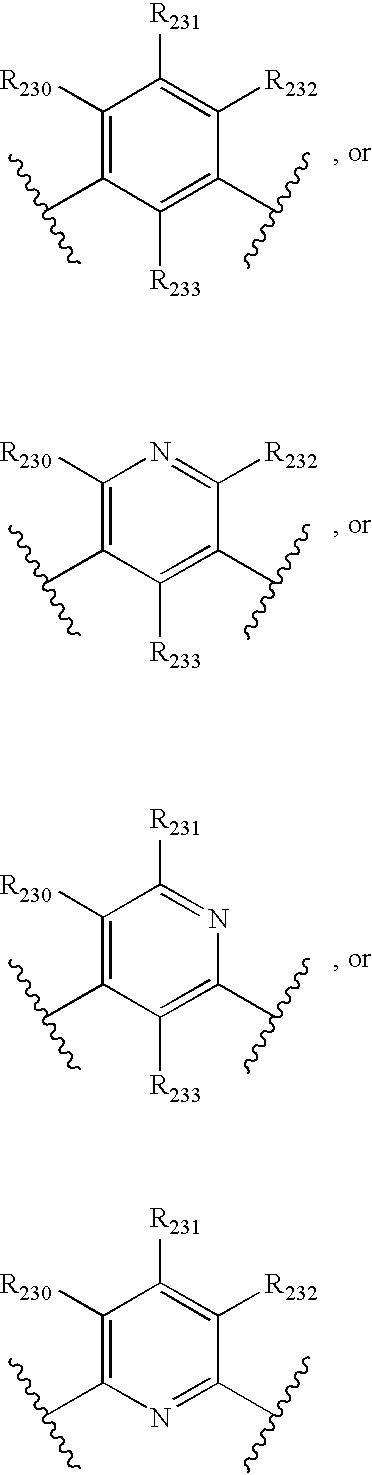
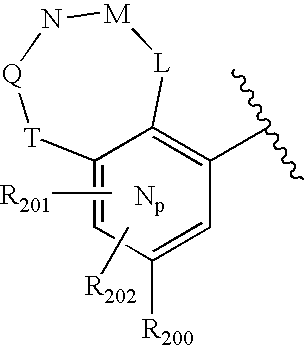

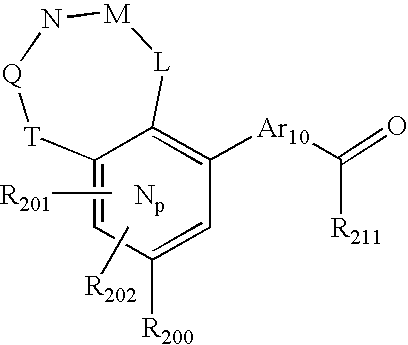
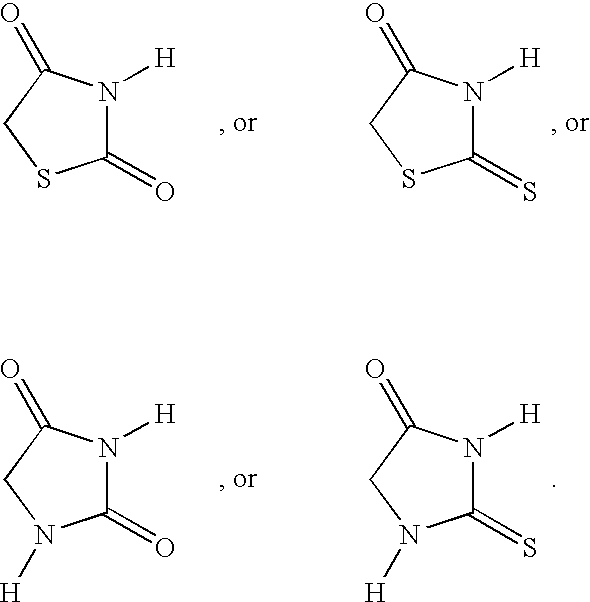

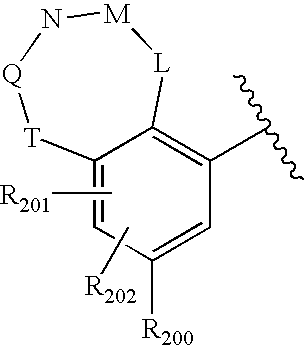
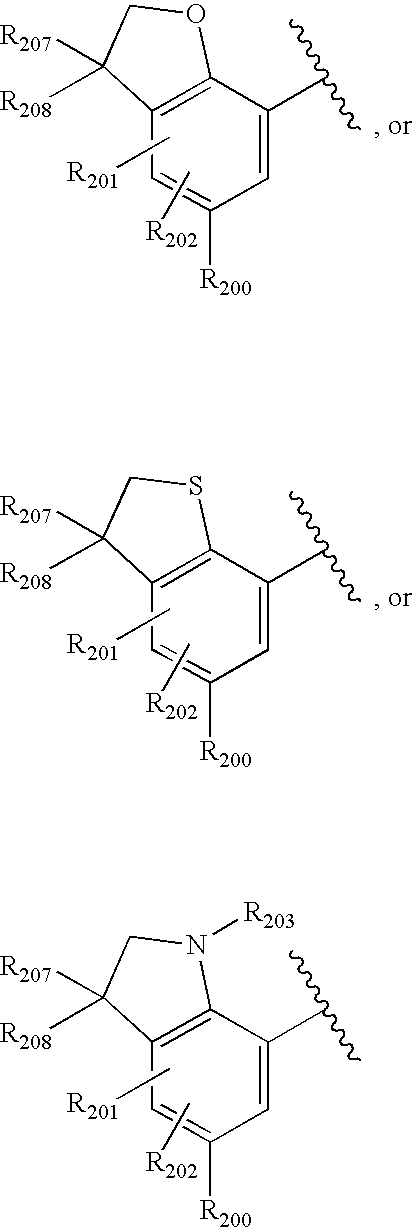
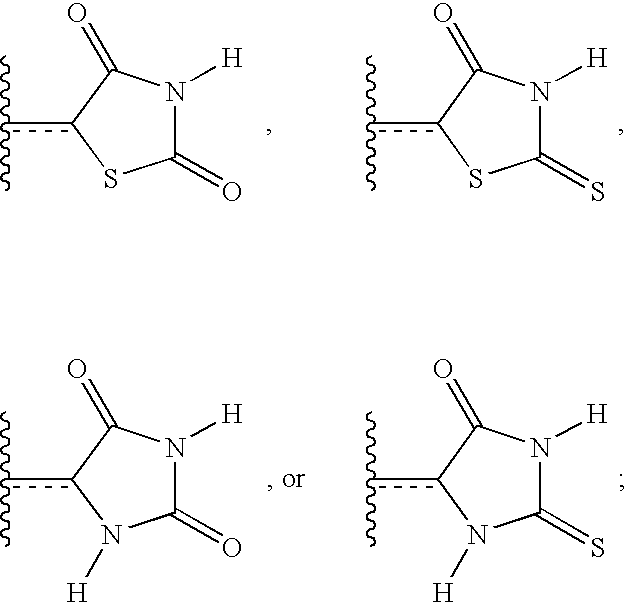
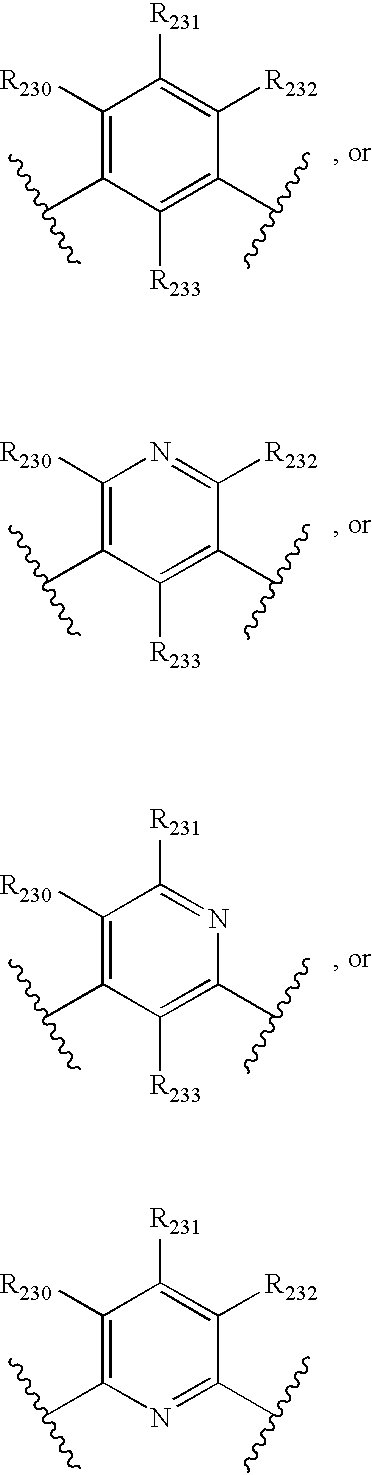


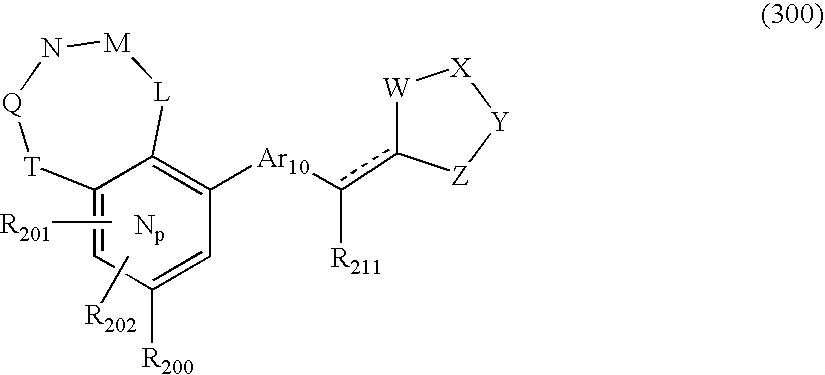
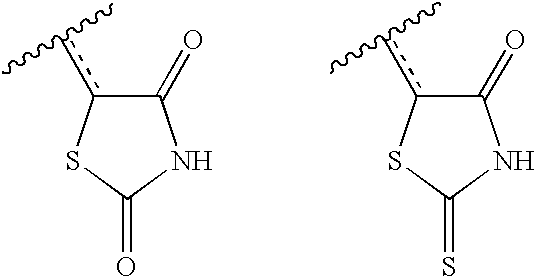

Priority Applications (1)
| Application Number | Priority Date | Filing Date | Title |
|---|---|---|---|
| US10/384,391 US7196108B2 (en) | 2002-03-08 | 2003-03-06 | Bicyclic heterocycles for the treatment of diabetes and other diseases |
Applications Claiming Priority (2)
| Application Number | Priority Date | Filing Date | Title |
|---|---|---|---|
| US36273202P | 2002-03-08 | 2002-03-08 | |
| US10/384,391 US7196108B2 (en) | 2002-03-08 | 2003-03-06 | Bicyclic heterocycles for the treatment of diabetes and other diseases |
Publications (2)
| Publication Number | Publication Date |
|---|---|
| US20040034004A1 true US20040034004A1 (en) | 2004-02-19 |
| US7196108B2 US7196108B2 (en) | 2007-03-27 |
Family
ID=27805219
Family Applications (1)
| Application Number | Title | Priority Date | Filing Date |
|---|---|---|---|
| US10/384,391 Expired - Fee Related US7196108B2 (en) | 2002-03-08 | 2003-03-06 | Bicyclic heterocycles for the treatment of diabetes and other diseases |
Country Status (9)
| Country | Link |
|---|---|
| US (1) | US7196108B2 (en) |
| EP (1) | EP1487446A4 (en) |
| JP (1) | JP2005525371A (en) |
| AU (1) | AU2003223233A1 (en) |
| BR (1) | BR0308278A (en) |
| CA (1) | CA2478765A1 (en) |
| IL (1) | IL163953A0 (en) |
| TW (1) | TWI277415B (en) |
| WO (1) | WO2003075858A2 (en) |
Cited By (11)
| Publication number | Priority date | Publication date | Assignee | Title |
|---|---|---|---|---|
| US20020143182A1 (en) * | 2001-03-07 | 2002-10-03 | Magnus Pfahl | Heterocyclic derivatives for the treatment of cancer and other proliferative diseases |
| US20030083357A1 (en) * | 2001-08-17 | 2003-05-01 | Magnus Pfahl | Oxime derivatives for the treatment of dyslipidemia and hypercholesteremia |
| US20030105333A1 (en) * | 2001-03-08 | 2003-06-05 | Magnus Pfahl | RXR activating molecules |
| US20030216432A1 (en) * | 2002-03-08 | 2003-11-20 | Magnus Pfahl | Heterocyclic amide derivatives for the treatment of diabetes and other diseases |
| US20050038098A1 (en) * | 2003-04-18 | 2005-02-17 | Catherine Tachdjian | Substituted dihydronaphthalene and isochroman compounds for the treatment of metabolic disorders, cancer and other diseases |
| US20050070581A1 (en) * | 1999-08-31 | 2005-03-31 | Incyte San Diego, Inc. | Imidazolidinedione derivatives for the treatment of diabetes and other diseases |
| US20060030717A1 (en) * | 2004-08-09 | 2006-02-09 | Wyeth | Progesterone receptor modulators comprising pyrrole-oxindole derivatives and uses thereof |
| US7122700B2 (en) | 2004-07-30 | 2006-10-17 | Xerox Corporation | Arylamine processes |
| US20060258714A1 (en) * | 2005-04-22 | 2006-11-16 | Wyeth | Chromane and chromene derivatives and uses thereof |
| US7196108B2 (en) | 2002-03-08 | 2007-03-27 | Incyte San Diego Inc. | Bicyclic heterocycles for the treatment of diabetes and other diseases |
| US9056862B2 (en) | 2011-05-10 | 2015-06-16 | National University Corporation Kobe University | Thioxothiazolidine derivative having Ras function inhibitory effect |
Families Citing this family (16)
| Publication number | Priority date | Publication date | Assignee | Title |
|---|---|---|---|---|
| AU2003243788B9 (en) * | 2002-06-25 | 2008-05-08 | Helicon Therapeutics, Inc. | Altering memory by affecting STAUFEN function |
| KR100897642B1 (en) | 2002-12-20 | 2009-05-14 | 글락소 그룹 리미티드 | Benzazepine Derivatives for the Treatment of Neurological Disorders |
| JP2009512637A (en) * | 2005-09-30 | 2009-03-26 | ジヤンセン・フアーマシユーチカ・ナームローゼ・フエンノートシヤツプ | Dihydro- [1H] -quinolin-2-one derivatives as RXR agonists for the treatment of dyslipidemia, hypercholesterolemia and diabetes |
| US8648066B2 (en) | 2009-05-22 | 2014-02-11 | Exelixis, Inc. | Benzoxazepines as inhibitors of PI3K/mTOR and methods of their use and manufacture |
| US8637499B2 (en) | 2009-05-26 | 2014-01-28 | Exelixis, Inc. | Benzoxazepines as inhibitors of PI3K/mTOR and methods of their use and manufacture |
| LT2464645T (en) | 2009-07-27 | 2017-10-25 | Gilead Sciences, Inc. | Fused heterocyclic compounds as ion channel modulators |
| US8703759B2 (en) | 2010-07-02 | 2014-04-22 | Gilead Sciences, Inc. | Fused heterocyclic compounds as ion channel modulators |
| KR20130137164A (en) * | 2010-09-01 | 2013-12-16 | 더 리전트 오브 더 유니버시티 오브 캘리포니아 | Cell culture screen for agents that control adipogenesis and myofibroblast differentiation |
| KR20140033377A (en) | 2011-05-10 | 2014-03-18 | 길리애드 사이언시즈, 인코포레이티드 | Fused heterocyclic compounds as sodium channel modulators |
| UY34171A (en) | 2011-07-01 | 2013-01-31 | Gilead Sciences Inc | FUSIONED HETEROCYCLIC COMPOUNDS AS IONIC CHANNEL MODULATORS |
| NO3175985T3 (en) | 2011-07-01 | 2018-04-28 | ||
| CA2930117A1 (en) | 2012-11-25 | 2014-05-30 | The Regents Of The University Of California | Peptides that stimulate subcutaneous adipogenesis |
| US10844102B2 (en) | 2014-05-28 | 2020-11-24 | The Regents Of The University Of California | Peptides, compositions, and methods for stimulating subcutaneous adipogenesis |
| AU2019255310B2 (en) | 2018-04-18 | 2022-11-24 | Constellation Pharmaceuticals, Inc. | Modulators of methyl modifying enzymes, compositions and uses thereof |
| EP3797108B1 (en) | 2018-05-21 | 2022-07-20 | Constellation Pharmaceuticals, Inc. | Modulators of methyl modifying enzymes, compositions and uses thereof |
| EP4003532B1 (en) | 2019-07-24 | 2024-09-04 | Constellation Pharmaceuticals, Inc. | Crystalline forms of 7-chloro-2-(4-(3-methoxyazetidin-1-yl)cyclohexyl)-2,4-dimethyl-n-((6-methyl-4-(methylthio)-2-oxo-1,2-dihydropyridin-3-yl)methyl)benzo[d][1,3]dioxole-5-carboxamide |
Citations (29)
| Publication number | Priority date | Publication date | Assignee | Title |
|---|---|---|---|---|
| US4051842A (en) * | 1975-09-15 | 1977-10-04 | International Medical Corporation | Electrode and interfacing pad for electrical physiological systems |
| US4140122A (en) * | 1976-06-11 | 1979-02-20 | Siemens Aktiengesellschaft | Implantable dosing device |
| US4383529A (en) * | 1980-11-03 | 1983-05-17 | Wescor, Inc. | Iontophoretic electrode device, method and gel insert |
| US4668506A (en) * | 1985-08-16 | 1987-05-26 | Bausch & Lomb Incorporated | Sustained-release formulation containing and amino acid polymer |
| US4713244A (en) * | 1985-08-16 | 1987-12-15 | Bausch & Lomb Incorporated | Sustained-release formulation containing an amino acid polymer with a lower alkyl (C1 -C4) polar solvent |
| US4788063A (en) * | 1984-08-14 | 1988-11-29 | State Of Israel, Represented By Prime Minister's Office Israel Institute For Biological Research | Drug delivery system |
| US4931279A (en) * | 1985-08-16 | 1990-06-05 | Bausch & Lomb Incorporated | Sustained release formulation containing an ion-exchange resin |
| US4971996A (en) * | 1987-03-11 | 1990-11-20 | Kanegafuchi Kagaku Kogyo Kabushiki Kaisha | Hydroxystyrene compounds which are useful as tyrosine kinase inhibitors |
| US5223522A (en) * | 1988-03-08 | 1993-06-29 | Pfizer Inc. | Thiazolidinedione hypoglycemic agents |
| US5330998A (en) * | 1988-03-08 | 1994-07-19 | Pfizer Inc. | Thiazolidinedione derivatives as hypoglycemic agents |
| US5512689A (en) * | 1991-07-22 | 1996-04-30 | Pfizer Inc. | Process for the preparation of intermediates in the synthesis of chiral thiazolidine-2,4-dione derivatives |
| US5520752A (en) * | 1994-06-20 | 1996-05-28 | The United States Of America As Represented By The Secretary Of The Army | Composite solders |
| US5523314A (en) * | 1992-09-10 | 1996-06-04 | Eli Lilly And Company | Compounds useful as hypoglycemic agents and for treating Alzheimer's disease |
| US5650444A (en) * | 1994-02-17 | 1997-07-22 | American Home Products Corporation | Substituted biphenyl derivatives |
| US5691376A (en) * | 1994-02-17 | 1997-11-25 | American Home Products Corporation | Substituted biphenyl derivatives |
| US5780676A (en) * | 1992-04-22 | 1998-07-14 | Ligand Pharmaceuticals Incorporated | Compounds having selective activity for Retinoid X Receptors, and means for modulation of processes mediated by Retinoid X Receptors |
| US6127415A (en) * | 1996-07-08 | 2000-10-03 | Galderma Research & Development, S.N.C. | Apoptosis inducing adamantyl derivatives and their usage as anti-cancer agents |
| US6235996B1 (en) * | 1998-01-28 | 2001-05-22 | International Business Machines Corporation | Interconnection structure and process module assembly and rework |
| US6262044B1 (en) * | 1998-03-12 | 2001-07-17 | Novo Nordisk A/S | Modulators of protein tyrosine phosphatases (PTPASES) |
| US20020143182A1 (en) * | 2001-03-07 | 2002-10-03 | Magnus Pfahl | Heterocyclic derivatives for the treatment of cancer and other proliferative diseases |
| US6515003B1 (en) * | 1999-08-31 | 2003-02-04 | Maxia Pharmaceuticals, Inc. | Heterocyclic derivatives for the treatment of diabetes and other diseases |
| US20030083357A1 (en) * | 2001-08-17 | 2003-05-01 | Magnus Pfahl | Oxime derivatives for the treatment of dyslipidemia and hypercholesteremia |
| US20030105333A1 (en) * | 2001-03-08 | 2003-06-05 | Magnus Pfahl | RXR activating molecules |
| US20030144329A1 (en) * | 2001-11-15 | 2003-07-31 | Magnus Pfahl | N-substituted heterocycles for the treatment of hypercholesteremia, dyslipidemia and other metabolic disorders; cancer, and other diseases |
| US20030216432A1 (en) * | 2002-03-08 | 2003-11-20 | Magnus Pfahl | Heterocyclic amide derivatives for the treatment of diabetes and other diseases |
| US20040097566A1 (en) * | 2001-12-06 | 2004-05-20 | Magnus Pfahl | 2-Substituted thiazolidinone and oxazolidinone derivatives for the inhibition of phosphatases and the treatment of cancer |
| US20050014767A1 (en) * | 2003-01-29 | 2005-01-20 | Magnus Pfahl | Benzoxazole, benzothiazole, and benzimidazole derivatives for the treatment of cancer and other diseases |
| US20050038098A1 (en) * | 2003-04-18 | 2005-02-17 | Catherine Tachdjian | Substituted dihydronaphthalene and isochroman compounds for the treatment of metabolic disorders, cancer and other diseases |
| US6927228B2 (en) * | 2000-08-08 | 2005-08-09 | Galderma Research & Development, S.N.C. | Biaromatic compound activators of PPARγ-type receptors |
Family Cites Families (20)
| Publication number | Priority date | Publication date | Assignee | Title |
|---|---|---|---|---|
| JPS5538359A (en) | 1978-09-12 | 1980-03-17 | Hamari Yakuhin Kogyo Kk | Preparation of 2-(3-benzoylphenyl)-propionic acid |
| CA1325222C (en) | 1985-08-23 | 1993-12-14 | Lederle (Japan), Ltd. | Process for producing 4-biphenylylacetic acid |
| IE940525L (en) | 1988-05-25 | 1989-11-25 | Warner Lambert Co | Known and selected novel arylmethylenyl derivatives of¹thiazolidinones, imidazolidinones and oxazolidinones useful¹as antiallergy agents and antiinflammatory agents |
| PT637297E (en) | 1992-04-22 | 2001-01-31 | Ligand Pharm Inc | SELECTIVELY COMPOUNDS FOR RETINOID X RECEPTORS |
| EP0671005A1 (en) | 1992-11-25 | 1995-09-13 | La Jolla Cancer Research Foundation | Rxr homodimer formation and bridged bicyclic aromatic compounds and their use in modulating gene expression |
| JPH09136877A (en) | 1995-06-16 | 1997-05-27 | Takeda Chem Ind Ltd | Heterocyclic compound, its production and use thereof |
| AU701790B2 (en) | 1995-07-17 | 1999-02-04 | Centre International De Recherches Dermatologiques Galderma (C.I.R.D. Galderma) | Method for treating cancers using 6-{3-{1-adamantyl}- 4-hydroxyphenyl} |
| JP2000511875A (en) | 1996-06-19 | 2000-09-12 | ドクター・レディーズ・リサーチ・ファウンデーション | Novel polymorphic forms of troglitazone with enhanced antidiabetic activity and methods for their production |
| EP1007038A2 (en) | 1997-08-21 | 2000-06-14 | Takeda Chemical Industries, Ltd. | Anti-inflammatory agent |
| JP4398585B2 (en) | 1997-11-12 | 2010-01-13 | 有限会社ケムフィズ | Retinoid receptor agonist |
| US6331633B1 (en) | 1998-05-08 | 2001-12-18 | Calyx Therapeutics Inc. | Heterocyclic analogs of diphenylethylene compounds |
| KR20010099623A (en) | 1998-08-21 | 2001-11-09 | 비로파마 인코포레이티드 | Compounds, compositions and methods for treating or preventing viral infections and associated diseases |
| AU6330999A (en) | 1998-09-30 | 2000-04-17 | Roche Diagnostics Gmbh | Rhodanine derivatives for the treatment and prevention of metabolic bone disorders |
| AU3111700A (en) | 1998-12-04 | 2000-06-19 | Structural Bioinformatics Inc. | Methods and compositions for treating inflammatory diseases utilizing inhibitorsof tumor necrosis factor activity |
| AU3958200A (en) | 1999-04-20 | 2000-11-02 | Novo Nordisk A/S | New compounds, their preparation and use |
| US6462032B1 (en) | 1999-05-04 | 2002-10-08 | Wyeth | Cyclic regimens utilizing indoline derivatives |
| CA2355243C (en) | 1999-11-12 | 2009-01-27 | Fujimoto Brothers Co., Ltd. | Novel 2-(n-cyanoimino)thiazolidin-4-one derivatives |
| MXPA03007779A (en) | 2001-03-14 | 2004-11-12 | Lilly Co Eli | Retinoid x receptor modulators. |
| DE60233655D1 (en) | 2001-04-04 | 2009-10-22 | Ortho Mcneil Janssen Pharm | R AND RETINOID X RECEPTOR MODULATORS |
| US7196108B2 (en) | 2002-03-08 | 2007-03-27 | Incyte San Diego Inc. | Bicyclic heterocycles for the treatment of diabetes and other diseases |
-
2003
- 2003-03-06 US US10/384,391 patent/US7196108B2/en not_active Expired - Fee Related
- 2003-03-07 BR BR0308278-4A patent/BR0308278A/en not_active IP Right Cessation
- 2003-03-07 TW TW092105026A patent/TWI277415B/en not_active IP Right Cessation
- 2003-03-07 WO PCT/US2003/007240 patent/WO2003075858A2/en not_active Ceased
- 2003-03-07 IL IL16395303A patent/IL163953A0/en unknown
- 2003-03-07 AU AU2003223233A patent/AU2003223233A1/en not_active Abandoned
- 2003-03-07 CA CA002478765A patent/CA2478765A1/en not_active Abandoned
- 2003-03-07 JP JP2003574134A patent/JP2005525371A/en active Pending
- 2003-03-07 EP EP03719363A patent/EP1487446A4/en not_active Withdrawn
Patent Citations (32)
| Publication number | Priority date | Publication date | Assignee | Title |
|---|---|---|---|---|
| US4051842A (en) * | 1975-09-15 | 1977-10-04 | International Medical Corporation | Electrode and interfacing pad for electrical physiological systems |
| US4140122A (en) * | 1976-06-11 | 1979-02-20 | Siemens Aktiengesellschaft | Implantable dosing device |
| US4383529A (en) * | 1980-11-03 | 1983-05-17 | Wescor, Inc. | Iontophoretic electrode device, method and gel insert |
| US4788063A (en) * | 1984-08-14 | 1988-11-29 | State Of Israel, Represented By Prime Minister's Office Israel Institute For Biological Research | Drug delivery system |
| US4668506A (en) * | 1985-08-16 | 1987-05-26 | Bausch & Lomb Incorporated | Sustained-release formulation containing and amino acid polymer |
| US4713244A (en) * | 1985-08-16 | 1987-12-15 | Bausch & Lomb Incorporated | Sustained-release formulation containing an amino acid polymer with a lower alkyl (C1 -C4) polar solvent |
| US4931279A (en) * | 1985-08-16 | 1990-06-05 | Bausch & Lomb Incorporated | Sustained release formulation containing an ion-exchange resin |
| US4971996A (en) * | 1987-03-11 | 1990-11-20 | Kanegafuchi Kagaku Kogyo Kabushiki Kaisha | Hydroxystyrene compounds which are useful as tyrosine kinase inhibitors |
| US5223522A (en) * | 1988-03-08 | 1993-06-29 | Pfizer Inc. | Thiazolidinedione hypoglycemic agents |
| US5330998A (en) * | 1988-03-08 | 1994-07-19 | Pfizer Inc. | Thiazolidinedione derivatives as hypoglycemic agents |
| US5512689A (en) * | 1991-07-22 | 1996-04-30 | Pfizer Inc. | Process for the preparation of intermediates in the synthesis of chiral thiazolidine-2,4-dione derivatives |
| US5780676A (en) * | 1992-04-22 | 1998-07-14 | Ligand Pharmaceuticals Incorporated | Compounds having selective activity for Retinoid X Receptors, and means for modulation of processes mediated by Retinoid X Receptors |
| US5523314A (en) * | 1992-09-10 | 1996-06-04 | Eli Lilly And Company | Compounds useful as hypoglycemic agents and for treating Alzheimer's disease |
| US5650444A (en) * | 1994-02-17 | 1997-07-22 | American Home Products Corporation | Substituted biphenyl derivatives |
| US5691376A (en) * | 1994-02-17 | 1997-11-25 | American Home Products Corporation | Substituted biphenyl derivatives |
| US5520752A (en) * | 1994-06-20 | 1996-05-28 | The United States Of America As Represented By The Secretary Of The Army | Composite solders |
| US6127415A (en) * | 1996-07-08 | 2000-10-03 | Galderma Research & Development, S.N.C. | Apoptosis inducing adamantyl derivatives and their usage as anti-cancer agents |
| US6235996B1 (en) * | 1998-01-28 | 2001-05-22 | International Business Machines Corporation | Interconnection structure and process module assembly and rework |
| US6262044B1 (en) * | 1998-03-12 | 2001-07-17 | Novo Nordisk A/S | Modulators of protein tyrosine phosphatases (PTPASES) |
| US6765013B2 (en) * | 1999-08-31 | 2004-07-20 | Incyte San Diego | Thiazolidinedione derivatives for the treatment of diabetes and other diseases |
| US6515003B1 (en) * | 1999-08-31 | 2003-02-04 | Maxia Pharmaceuticals, Inc. | Heterocyclic derivatives for the treatment of diabetes and other diseases |
| US20030153606A1 (en) * | 1999-08-31 | 2003-08-14 | Maxia Pharmaceuticals, Inc. | Thiazolidinedione derivatives for the treatment of diabetes and other diseases |
| US20050070581A1 (en) * | 1999-08-31 | 2005-03-31 | Incyte San Diego, Inc. | Imidazolidinedione derivatives for the treatment of diabetes and other diseases |
| US6927228B2 (en) * | 2000-08-08 | 2005-08-09 | Galderma Research & Development, S.N.C. | Biaromatic compound activators of PPARγ-type receptors |
| US20020143182A1 (en) * | 2001-03-07 | 2002-10-03 | Magnus Pfahl | Heterocyclic derivatives for the treatment of cancer and other proliferative diseases |
| US20030105333A1 (en) * | 2001-03-08 | 2003-06-05 | Magnus Pfahl | RXR activating molecules |
| US20030083357A1 (en) * | 2001-08-17 | 2003-05-01 | Magnus Pfahl | Oxime derivatives for the treatment of dyslipidemia and hypercholesteremia |
| US20030144329A1 (en) * | 2001-11-15 | 2003-07-31 | Magnus Pfahl | N-substituted heterocycles for the treatment of hypercholesteremia, dyslipidemia and other metabolic disorders; cancer, and other diseases |
| US20040097566A1 (en) * | 2001-12-06 | 2004-05-20 | Magnus Pfahl | 2-Substituted thiazolidinone and oxazolidinone derivatives for the inhibition of phosphatases and the treatment of cancer |
| US20030216432A1 (en) * | 2002-03-08 | 2003-11-20 | Magnus Pfahl | Heterocyclic amide derivatives for the treatment of diabetes and other diseases |
| US20050014767A1 (en) * | 2003-01-29 | 2005-01-20 | Magnus Pfahl | Benzoxazole, benzothiazole, and benzimidazole derivatives for the treatment of cancer and other diseases |
| US20050038098A1 (en) * | 2003-04-18 | 2005-02-17 | Catherine Tachdjian | Substituted dihydronaphthalene and isochroman compounds for the treatment of metabolic disorders, cancer and other diseases |
Cited By (21)
| Publication number | Priority date | Publication date | Assignee | Title |
|---|---|---|---|---|
| US7226940B2 (en) | 1999-08-31 | 2007-06-05 | Incyte San Diego, Inc. | Substituted heterocycles for the treatment of diabetes and other diseases |
| US20050070581A1 (en) * | 1999-08-31 | 2005-03-31 | Incyte San Diego, Inc. | Imidazolidinedione derivatives for the treatment of diabetes and other diseases |
| US6974826B2 (en) | 1999-08-31 | 2005-12-13 | Incyte San Diego Inc. | Imidazolidinedione derivatives for the treatment of diabetes and other diseases |
| US20020143182A1 (en) * | 2001-03-07 | 2002-10-03 | Magnus Pfahl | Heterocyclic derivatives for the treatment of cancer and other proliferative diseases |
| US7153875B2 (en) | 2001-03-07 | 2006-12-26 | Incyte San Diego | Heterocyclic derivatives for the treatment of cancer and other proliferative diseases |
| US7265139B2 (en) | 2001-03-08 | 2007-09-04 | Incyte San Diego Inc. | RXR activating molecules |
| US20050209286A1 (en) * | 2001-03-08 | 2005-09-22 | Magnus Pfahl | RXR activating molecules |
| US20030105333A1 (en) * | 2001-03-08 | 2003-06-05 | Magnus Pfahl | RXR activating molecules |
| US20030083357A1 (en) * | 2001-08-17 | 2003-05-01 | Magnus Pfahl | Oxime derivatives for the treatment of dyslipidemia and hypercholesteremia |
| US7102000B2 (en) | 2002-03-08 | 2006-09-05 | Incyte San Diego Inc. | Heterocyclic amide derivatives for the treatment of diabetes and other diseases |
| US20060241138A1 (en) * | 2002-03-08 | 2006-10-26 | Magnus Pfahl | Heterocyclic amide derivatives for the treatment of diabetes and other diseases |
| US20030216432A1 (en) * | 2002-03-08 | 2003-11-20 | Magnus Pfahl | Heterocyclic amide derivatives for the treatment of diabetes and other diseases |
| US7196108B2 (en) | 2002-03-08 | 2007-03-27 | Incyte San Diego Inc. | Bicyclic heterocycles for the treatment of diabetes and other diseases |
| US20050038098A1 (en) * | 2003-04-18 | 2005-02-17 | Catherine Tachdjian | Substituted dihydronaphthalene and isochroman compounds for the treatment of metabolic disorders, cancer and other diseases |
| US7122700B2 (en) | 2004-07-30 | 2006-10-17 | Xerox Corporation | Arylamine processes |
| US20060030717A1 (en) * | 2004-08-09 | 2006-02-09 | Wyeth | Progesterone receptor modulators comprising pyrrole-oxindole derivatives and uses thereof |
| US7317037B2 (en) | 2004-08-09 | 2008-01-08 | Wyeth | Progesterone receptor modulators comprising pyrrole-oxindole derivatives and uses thereof |
| US20060258714A1 (en) * | 2005-04-22 | 2006-11-16 | Wyeth | Chromane and chromene derivatives and uses thereof |
| US7365095B2 (en) | 2005-04-22 | 2008-04-29 | Wyeth | Chromane and chromene derivatives and uses thereof |
| US20080182891A1 (en) * | 2005-04-22 | 2008-07-31 | Wyeth | Chromane and chromene derivatives and uses thereof |
| US9056862B2 (en) | 2011-05-10 | 2015-06-16 | National University Corporation Kobe University | Thioxothiazolidine derivative having Ras function inhibitory effect |
Also Published As
| Publication number | Publication date |
|---|---|
| US7196108B2 (en) | 2007-03-27 |
| EP1487446A4 (en) | 2006-04-19 |
| TW200304814A (en) | 2003-10-16 |
| EP1487446A2 (en) | 2004-12-22 |
| WO2003075858A2 (en) | 2003-09-18 |
| WO2003075858A3 (en) | 2004-03-18 |
| BR0308278A (en) | 2005-02-09 |
| JP2005525371A (en) | 2005-08-25 |
| IL163953A0 (en) | 2005-12-18 |
| AU2003223233A1 (en) | 2003-09-22 |
| CA2478765A1 (en) | 2003-09-18 |
| AU2003223233A2 (en) | 2003-09-22 |
| TWI277415B (en) | 2007-04-01 |
Similar Documents
| Publication | Publication Date | Title |
|---|---|---|
| US20040034004A1 (en) | Bicyclic heterocycles for the treatment of diabetes and other diseases | |
| US6765013B2 (en) | Thiazolidinedione derivatives for the treatment of diabetes and other diseases | |
| US7102000B2 (en) | Heterocyclic amide derivatives for the treatment of diabetes and other diseases | |
| US7153875B2 (en) | Heterocyclic derivatives for the treatment of cancer and other proliferative diseases | |
| US20050038098A1 (en) | Substituted dihydronaphthalene and isochroman compounds for the treatment of metabolic disorders, cancer and other diseases | |
| EP1593677A2 (en) | Benzylidene-thiazolidinediones and analogues and their use in the treatment of diabetes | |
| HK1047591B (en) | Benzylidene-thiazolidinediones and analogues and their use in the treatment of diabetes |
Legal Events
| Date | Code | Title | Description |
|---|---|---|---|
| AS | Assignment |
Owner name: INCYTE SAN DIEGO INCORPORATED, CALIFORNIA Free format text: ASSIGNMENT OF ASSIGNORS INTEREST;ASSIGNORS:PFAHL, MAGNUS;TACHDJIAN, CATHERINE;AL-SHAMMA, HUSSIEN A.;AND OTHERS;REEL/FRAME:014004/0076;SIGNING DATES FROM 20030409 TO 20030416 |
|
| AS | Assignment |
Owner name: ORTHO MCNEIL PHARMACEUTICAL INC., NEW JERSEY Free format text: ASSIGNMENT OF ASSIGNORS INTEREST;ASSIGNOR:INCYTE SAN DIEGO INC.;REEL/FRAME:016191/0136 Effective date: 20050420 |
|
| REMI | Maintenance fee reminder mailed | ||
| LAPS | Lapse for failure to pay maintenance fees | ||
| STCH | Information on status: patent discontinuation |
Free format text: PATENT EXPIRED DUE TO NONPAYMENT OF MAINTENANCE FEES UNDER 37 CFR 1.362 |
|
| FP | Lapsed due to failure to pay maintenance fee |
Effective date: 20110327 |