US12348761B2 - Merge with motion vector differencing in affine mode - Google Patents
Merge with motion vector differencing in affine mode Download PDFInfo
- Publication number
- US12348761B2 US12348761B2 US17/831,074 US202217831074A US12348761B2 US 12348761 B2 US12348761 B2 US 12348761B2 US 202217831074 A US202217831074 A US 202217831074A US 12348761 B2 US12348761 B2 US 12348761B2
- Authority
- US
- United States
- Prior art keywords
- affine
- control point
- block
- motion vectors
- flag
- Prior art date
- Legal status (The legal status is an assumption and is not a legal conclusion. Google has not performed a legal analysis and makes no representation as to the accuracy of the status listed.)
- Active, expires
Links
Images




Classifications
-
- H—ELECTRICITY
- H04—ELECTRIC COMMUNICATION TECHNIQUE
- H04N—PICTORIAL COMMUNICATION, e.g. TELEVISION
- H04N19/00—Methods or arrangements for coding, decoding, compressing or decompressing digital video signals
- H04N19/50—Methods or arrangements for coding, decoding, compressing or decompressing digital video signals using predictive coding
- H04N19/503—Methods or arrangements for coding, decoding, compressing or decompressing digital video signals using predictive coding involving temporal prediction
- H04N19/51—Motion estimation or motion compensation
- H04N19/513—Processing of motion vectors
- H04N19/517—Processing of motion vectors by encoding
-
- H—ELECTRICITY
- H04—ELECTRIC COMMUNICATION TECHNIQUE
- H04N—PICTORIAL COMMUNICATION, e.g. TELEVISION
- H04N19/00—Methods or arrangements for coding, decoding, compressing or decompressing digital video signals
- H04N19/10—Methods or arrangements for coding, decoding, compressing or decompressing digital video signals using adaptive coding
- H04N19/169—Methods or arrangements for coding, decoding, compressing or decompressing digital video signals using adaptive coding characterised by the coding unit, i.e. the structural portion or semantic portion of the video signal being the object or the subject of the adaptive coding
- H04N19/17—Methods or arrangements for coding, decoding, compressing or decompressing digital video signals using adaptive coding characterised by the coding unit, i.e. the structural portion or semantic portion of the video signal being the object or the subject of the adaptive coding the unit being an image region, e.g. an object
- H04N19/176—Methods or arrangements for coding, decoding, compressing or decompressing digital video signals using adaptive coding characterised by the coding unit, i.e. the structural portion or semantic portion of the video signal being the object or the subject of the adaptive coding the unit being an image region, e.g. an object the region being a block, e.g. a macroblock
-
- H—ELECTRICITY
- H04—ELECTRIC COMMUNICATION TECHNIQUE
- H04N—PICTORIAL COMMUNICATION, e.g. TELEVISION
- H04N19/00—Methods or arrangements for coding, decoding, compressing or decompressing digital video signals
- H04N19/50—Methods or arrangements for coding, decoding, compressing or decompressing digital video signals using predictive coding
- H04N19/503—Methods or arrangements for coding, decoding, compressing or decompressing digital video signals using predictive coding involving temporal prediction
- H04N19/51—Motion estimation or motion compensation
- H04N19/537—Motion estimation other than block-based
- H04N19/54—Motion estimation other than block-based using feature points or meshes
-
- H—ELECTRICITY
- H04—ELECTRIC COMMUNICATION TECHNIQUE
- H04N—PICTORIAL COMMUNICATION, e.g. TELEVISION
- H04N19/00—Methods or arrangements for coding, decoding, compressing or decompressing digital video signals
- H04N19/70—Methods or arrangements for coding, decoding, compressing or decompressing digital video signals characterised by syntax aspects related to video coding, e.g. related to compression standards
Definitions
- This patent document relates to video and image coding/decoding techniques, devices and systems.
- the present document describes various embodiments and techniques in which video coding or decoding is performed using sub-block based motion vector refinement.
- a method of visual media processing includes performing a conversion between a current video block of a visual media data and a bitstream representation of the visual media data according to a modification rule, wherein the current video block is coded using affine motion information; wherein the modification rule specifies to modify an affine motion information coded in the bitstream representation using motion vector differences and/or reference picture indices during decoding.
- another method of visual media processing includes determining, fora conversion between a current video block of a visual media data and a bitstream representation of the visual media data, that affine merge candidates for the current video block is subject to a modification based on a modification rule; and performing the conversion based on the determining; wherein the modification rule specifies to modify one or more control point motion vectors associated with the current video block, and wherein an integer number of control point motion vectors are used.
- another method of visual media processing includes determining, for a conversion between a current video block of a visual media data and a bitstream representation of the visual media data, that a subset of allowed affine merge candidates for the current video block is subject to a modification based on a modification rule; and performing the conversion based on the determining wherein a syntax element included in the bitstream representation is indicative of the modification rule.
- a video encoding and/or decoding apparatus comprising a processor configured to implement an above described method is disclosed.
- a computer readable medium stores processor executable code embodying one of the above described method.
- FIG. 1 depicts an example derivation process for merge candidates list construction.
- FIG. 2 shows examples of positions of spatial merge candidates.
- FIG. 3 shows examples of candidate pairs considered for redundancy check of spatial merge candidates.
- FIG. 4 A- 4 B show example positions for the second PU of N ⁇ 2N and 2N ⁇ N partitions.
- FIG. 5 is an illustration of motion vector scaling for temporal merge candidate.
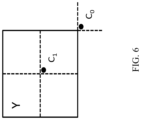
- FIG. 6 shows examples of candidate positions for temporal merge candidate, C0 and C1.
- FIG. 7 shows an example of combined bi-predictive merge candidate.
- FIG. 8 summarizes derivation process for motion vector prediction candidate.
- FIG. 9 shows an illustration of motion vector scaling for spatial motion vector candidate.
- FIG. 10 shows an example of ATMVP motion prediction for a CU.
- FIG. 11 shows an example of one CU with four sub-blocks (A-D) and its neighbouring blocks (a-d).
- FIG. 12 is an example flowchart of encoding with different MV precision
- FIG. 13 shows: (a) 135 degree partition type (splitting from top-left corner to bottom-right corner) (b) 45 degree splitting patterns
- FIG. 14 shows example position of the neighboring blocks.
- FIG. 15 shows neighboring blocks (A and L) used for context selection in TPM flag coding.
- FIG. 16 shows (a) 4-parameter affine and (b) 6-parameter affine models.
- FIG. 17 shows an example of Affine MVF per sub-block.
- FIG. 18 shows: (a) 4-parameter affine model (b) and 6-parameter affine model.
- FIG. 19 shows MVP for AF_INTER for inherited affine candidates.
- FIG. 20 shows MVP for AF_INTER for constructed affine candidates.
- FIG. 21 shows examples of: (a) Five neighboring blocks, (b) control point motion vector (CPMV) predictor derivation.
- CPMV control point motion vector
- FIG. 22 shows example candidates position for affine merge mode
- FIG. 23 shows an example of spatial neighboring blocks used by ATMVP.
- FIG. 24 shows example of deriving sub-CU motion field by applying a motion shift from spatial neighbor and scaling the motion information from the corresponding collocated sub-CUs
- FIG. 25 shows Candidates position for affine merge mode.
- FIG. 26 shows modified merge list construction process.
- FIG. 27 shows sub-block MV VSB and pixel ⁇ v(i,j) (red arrow).
- FIG. 28 is a block diagram of an example of a hardware platform used for implementing methods described in the present document.
- FIG. 29 is a flowchart for an example method of video processing.
- FIG. 30 shows an example of a ultimate motion vector expression (UMVE) process.
- UMVE ultimate motion vector expression
- FIG. 31 is an example of UMVE search point.
- FIG. 32 is a block diagram of an example video processing system in which disclosed techniques may be implemented.
- FIG. 33 is a block diagram that illustrates an example video coding system.
- FIG. 34 is a block diagram that illustrates an encoder in accordance with some embodiments of the present disclosure.
- FIG. 35 is a block diagram that illustrates a decoder in accordance with some embodiments of the present disclosure.
- FIG. 36 is a flowchart for an example method of visual media processing.
- FIG. 37 is a flowchart for an example method of visual media processing.
- FIG. 38 is a flowchart for an example method of visual media processing.
- Section headings are used in the present document to facilitate ease of understanding and do not limit the embodiments disclosed in a section to only that section.
- certain embodiments are described with reference to Versatile Video Coding or other specific video codecs, the disclosed techniques are applicable to other video coding technologies also.
- video processing encompasses video coding or compression, video decoding or decompression and video transcoding in which video pixels are represented from one compressed format into another compressed format or at a different compressed bitrate.
- This document is related to video coding technologies. Specifically, it is related to motion vector coding in video coding. It may be applied to the existing video coding standard like HEVC, or the standard (Versatile Video Coding) to be finalized. It may be also applicable to future video coding standards or video codec.
- Video coding standards have evolved primarily through the development of the well-known ITU-T and ISO/IEC standards.
- the ITU-T produced H.261 and H.263, ISO/IEC produced MPEG-1 and MPEG-4 Visual, and the two organizations jointly produced the H.262/MPEG-2 Video and H.264/MPEG-4 Advanced Video Coding (AVC) and H.265/HEVC standards.
- AVC H.264/MPEG-4 Advanced Video Coding
- H.265/HEVC High Efficiency Video Coding
- the video coding standards are based on the hybrid video coding structure wherein temporal prediction plus transform coding are utilized.
- Joint Video Exploration Team JVET was founded by VCEG and MPEG jointly in 2015.
- JVET Joint Exploration Model
- VVC draft i.e., Versatile Video Coding (Draft 5)
- Draft 5 The latest version of VVC draft, i.e., Versatile Video Coding (Draft 5) could be found at: phenix.it-sudparis.eu/jvet/doc_end_user/documents/14_Geneva/wg11/JVET-N1001-v5.zip
- VTM The latest reference software of VVC, named VTM, could be found at: vcgit.hhi.fraunhofer.de/jvet/VVCSoftware_VTM/tags/VTM-5.0
- Each inter-predicted PU has motion parameters for one or two reference picture lists.
- Motion parameters include a motion vector and a reference picture index. Usage of one of the two reference picture lists may also be signalled using inter_pred_idc. Motion vectors may be explicitly coded as deltas relative to predictors.
- a merge mode is specified whereby the motion parameters for the current PU are obtained from neighbouring PUs, including spatial and temporal candidates.
- the merge mode can be applied to any inter-predicted PU, not only for skip mode.
- the alternative to merge mode is the explicit transmission of motion parameters, where motion vector (to be more precise, motion vector differences (MVD) compared to a motion vector predictor), corresponding reference picture index for each reference picture list and reference picture list usage are signalled explicitly per each PU.
- Such a mode is named Advanced motion vector prediction (AMVP) in this disclosure.
- the PU When signalling indicates that one of the two reference picture lists is to be used, the PU is produced from one block of samples. This is referred to as ‘uni-prediction’. Uni-prediction is available both for P-slices and B-slices.
- Bi-prediction When signalling indicates that both of the reference picture lists are to be used, the PU is produced from two blocks of samples. This is referred to as ‘bi-prediction’. Bi-prediction is available for B-slices only.
- Step 2 Additional candidates insertion
- steps are also schematically depicted in FIG. 1 .
- For spatial merge candidate derivation a maximum of four merge candidates are selected among candidates that are located in five different positions.
- temporal merge candidate derivation a maximum of one merge candidate is selected among two candidates. Since constant number of candidates for each PU is assumed at decoder, additional candidates are generated when the number of candidates obtained from step 1 does not reach the maximum number of merge candidate (MaxNumMergeCand) which is signalled in slice header. Since the number of candidates is constant, index of best merge candidate is encoded using truncated unary binarization (TU). If the size of CU is equal to 8, all the PUs of the current CU share a single merge candidate list, which is identical to the merge candidate list of the 2N ⁇ 2N prediction unit.
- TU truncated unary binarization
- FIG. 1 shows an example derivation process for merge candidates list construction.
- a maximum of four merge candidates are selected among candidates located in the positions depicted in FIG. 2 .
- the order of derivation is A 1 , B 1 , B 0 , A 0 and B 2 .
- Position B 2 is considered only when any PU of position A 1 , B 1 , B 0 , A 0 is not available (e.g. because it belongs to another slice or tile) or is intra coded.
- candidate at position A 1 is added, the addition of the remaining candidates is subject to a redundancy check which ensures that candidates with same motion information are excluded from the list so that coding efficiency is improved.
- a redundancy check which ensures that candidates with same motion information are excluded from the list so that coding efficiency is improved.
- not all possible candidate pairs are considered in the mentioned redundancy check. Instead only the pairs linked with an arrow in FIG.
- FIG. 4 A- 4 B depict the second PU for the case of N ⁇ 2N and 2N ⁇ N, respectively.
- candidate at position A 1 is not considered for list construction. In fact, by adding this candidate will lead to two prediction units having the same motion information, which is redundant to just have one PU in a coding unit.
- position B 1 is not considered when the current PU is partitioned as 2N ⁇ N.
- a scaled motion vector is derived based on co-located PU belonging to the picture which has the smallest POC difference with current picture within the given reference picture list.
- the reference picture list to be used for derivation of the co-located PU is explicitly signalled in the slice header.
- the scaled motion vector for temporal merge candidate is obtained as illustrated by the dotted line in FIG.
- tb is defined to be the POC difference between the reference picture of the current picture and the current picture
- td is defined to be the POC difference between the reference picture of the co-located picture and the co-located picture.
- the reference picture index of temporal merge candidate is set equal to zero.
- FIG. 5 is an illustration of motion vector scaling for temporal merge candidate.
- the position for the temporal candidate is selected between candidates C 0 and C 1 , as depicted in FIG. 6 . If PU at position C 0 is not available, is intra coded, or is outside of the current coding tree unit (CTU aka. LCU, largest coding unit) row, position C1 is used. Otherwise, position C0 is used in the derivation of the temporal merge candidate.
- CTU current coding tree unit
- LCU largest coding unit
- FIG. 6 shows examples of candidate positions for temporal merge candidate, C0 and C1.
- Zero merge candidate Combined bi-predictive merge candidates are generated by utilizing spatial and temporal merge candidates. Combined bi-predictive merge candidate is used for B-Slice only. The combined bi-predictive candidates are generated by combining the first reference picture list motion parameters of an initial candidate with the second reference picture list motion parameters of another. If these two tuples provide different motion hypotheses, they will form a new bi-predictive candidate. As an example, FIG.
- Zero motion candidates are inserted to fill the remaining entries in the merge candidates list and therefore hit the MaxNumMergeCand capacity. These candidates have zero spatial displacement and a reference picture index which starts from zero and increases every time a new zero motion candidate is added to the list.
- AMVP exploits spatio-temporal correlation of motion vector with neighbouring PUs, which is used for explicit transmission of motion parameters.
- a motion vector candidate list is constructed by firstly checking availability of left, above temporally neighbouring PU positions, removing redundant candidates and adding zero vector to make the candidate list to be constant length. Then, the encoder can select the best predictor from the candidate list and transmit the corresponding index indicating the chosen candidate. Similarly, with merge index signalling, the index of the best motion vector candidate is encoded using truncated unary. The maximum value to be encoded in this case is 2 (see FIG. 8 ). In the following sections, details about derivation process of motion vector prediction candidate are provided.
- FIG. 8 summarizes derivation process for motion vector prediction candidate.
- motion vector candidate two types are considered: spatial motion vector candidate and temporal motion vector candidate.
- spatial motion vector candidate derivation two motion vector candidates are eventually derived based on motion vectors of each PU located in five different positions as depicted in FIG. 2 .
- one motion vector candidate is selected from two candidates, which are derived based on two different co-located positions. After the first list of spatio-temporal candidates is made, duplicated motion vector candidates in the list are removed. If the number of potential candidates is larger than two, motion vector candidates whose reference picture index within the associated reference picture list is larger than 1 are removed from the list. If the number of spatio-temporal motion vector candidates is smaller than two, additional zero motion vector candidates is added to the list.
- a maximum of two candidates are considered among five potential candidates, which are derived from PUs located in positions as depicted in FIG. 2 those positions being the same as those of motion merge.
- the order of derivation for the left side of the current PU is defined as A 0 , A 1 , and scaled A 0 , scaled A 1 .
- the order of derivation for the above side of the current PU is defined as B 0 , B 1 , B 2 , scaled B 0 , scaled B 1 , scaled B 2 .
- the no-spatial-scaling cases are checked first followed by the spatial scaling Spatial scaling is considered when the POC is different between the reference picture of the neighbouring PU and that of the current PU regardless of reference picture list. If all PUs of left candidates are not available or are intra coded, scaling for the above motion vector is allowed to help parallel derivation of left and above MV candidates. Otherwise, spatial scaling is not allowed for the above motion vector.
- FIG. 9 is an illustration of motion vector scaling for spatial motion vector candidate.
- the motion vector of the neighbouring PU is scaled in a similar manner as for temporal scaling, as depicted as FIG. 9 .
- the main difference is that the reference picture list and index of current PU is given as input; the actual scaling process is the same as that of temporal scaling.
- each CU can have at most one set of motion parameters for each prediction direction.
- Two sub-CU level motion vector prediction methods are considered in the encoder by splitting a large CU into sub-CUs and deriving motion information for all the sub-CUs of the large CU.
- Alternative temporal motion vector prediction (ATMVP) method allows each CU to fetch multiple sets of motion information from multiple blocks smaller than the current CU in the collocated reference picture.
- STMVP spatial-temporal motion vector prediction
- the motion compression for the reference frames is currently disabled.
- FIG. 10 shows an example of ATMVP motion prediction for a CU.
- the motion vectors temporal motion vector prediction is modified by fetching multiple sets of motion information (including motion vectors and reference indices) from blocks smaller than the current CU.
- the sub-CUs are square N ⁇ N blocks (N is set to 4 by default).
- ATMVP predicts the motion vectors of the sub-CUs within a CU in two steps.
- the first step is to identify the corresponding block in a reference picture with a so-called temporal vector.
- the reference picture is called the motion source picture.
- the second step is to split the current CU into sub-CUs and obtain the motion vectors as well as the reference indices of each sub-CU from the block corresponding to each sub-CU.
- a reference picture and the corresponding block is determined by the motion information of the spatial neighbouring blocks of the current CU.
- the first merge candidate in the merge candidate list of the current CU is used.
- the first available motion vector as well as its associated reference index are set to be the temporal vector and the index to the motion source picture. This way, in ATMVP, the corresponding block may be more accurately identified, compared with TMVP, wherein the corresponding block (sometimes called collocated block) is always in a bottom-right or center position relative to the current CU.
- a corresponding block of the sub-CU is identified by the temporal vector in the motion source picture, by adding to the coordinate of the current CU the temporal vector.
- the motion information of its corresponding block (the smallest motion grid that covers the center sample) is used to derive the motion information for the sub-CU.
- the motion information of a corresponding N ⁇ N block is identified, it is converted to the motion vectors and reference indices of the current sub-CU, in the same way as TMVP of HEVC, wherein motion scaling and other procedures apply.
- the decoder checks whether the low-delay condition (i.e.
- motion vector MV x the motion vector corresponding to reference picture list X
- motion vector MV y the motion vector corresponding to reference picture list X
- FIG. 11 illustrates this concept. Let us consider an 8 ⁇ 8 CU which contains four 4 ⁇ 4 sub-CUs A, B, C, and D. The neighbouring 4 ⁇ 4 blocks in the current frame are labelled as a, b, c, and d.
- the motion derivation for sub-CU A starts by identifying its two spatial neighbours.
- the first neighbour is the N ⁇ N block above sub-CU A (block c). If this block c is not available or is intra coded the other N ⁇ N blocks above sub-CU A are checked (from left to right, starting at block c).
- the second neighbour is a block to the left of the sub-CU A (block b). If block b is not available or is intra coded other blocks to the left of sub-CU A are checked (from top to bottom, staring at block b).
- the motion information obtained from the neighbouring blocks for each list is scaled to the first reference frame for a given list.
- temporal motion vector predictor (TMVP) of sub-block A is derived by following the same procedure of TMVP derivation as specified in HEVC.
- the motion information of the collocated block at location D is fetched and scaled accordingly.
- all available motion vectors (up to 3) are averaged separately for each reference list. The averaged motion vector is assigned as the motion vector of the current sub-CU.
- the sub-CU modes are enabled as additional merge candidates and there is no additional syntax element required to signal the modes.
- Two additional merge candidates are added to merge candidates list of each CU to represent the ATMVP mode and STMVP mode. Up to seven merge candidates are used, if the sequence parameter set indicates that ATMVP and STMVP are enabled.
- the encoding logic of the additional merge candidates is the same as for the merge candidates in the HM, which means, for each CU in P or B slice, two more RD checks is needed for the two additional merge candidates.
- AMVR Adaptive motion vector difference resolution
- TPM Triangular prediction mode
- GPI Generalized Bi-Prediction
- BIO Bi-directional Optical flow
- MVDs motion vector differences
- LAMVR locally adaptive motion vector resolution
- MVD can be coded in units of quarter luma samples, integer luma samples or four luma samples (i.e., 1 ⁇ 4-pel, 1-pel, 4-pel).
- the MVD resolution is controlled at the coding unit (CU) level, and MVD resolution flags are conditionally signalled for each CU that has at least one non-zero MVD components.
- a first flag is signalled to indicate whether quarter luma sample MV precision is used in the CU.
- the first flag (equal to 1) indicates that quarter luma sample MV precision is not used, another flag is signalled to indicate whether integer luma sample MV precision or four luma sample MV precision is used.
- the quarter luma sample MV resolution is used for the CU.
- the MVPs in the AMVP candidate list for the CU are rounded to the corresponding precision.
- CU-level RD checks are used to determine which MVD resolution is to be used for a CU. That is, the CU-level RD check is performed three times for each MVD resolution.
- the following encoding schemes are applied in the JEM.
- the encoding process is shown in FIG. 12 .
- 1 ⁇ 4 pel MV is tested and the RD cost is calculated and denoted as RDCost0, then integer MV is tested and the RD cost is denoted as RDCost1. If RDCost1 ⁇ th*RDCost0 (wherein th is a positive value), then 4-pel MV is tested; otherwise, 4-pel MV is skipped.
- RDCost1 ⁇ th*RDCost0 wherein th is a positive value
- 4-pel MV is tested; otherwise, 4-pel MV is skipped.
- motion information and RD cost etc. are already known for 1/4 pel MV when checking integer or 4-pel MV, which can be reused to speed up the encoding process of integer or 4-pel MV.
- AMVR can also be applied to affine prediction mode, where the resolutions can be chosen from 1/16-pel, 14-pel and 1-pel.
- FIG. 12 is a flowchart of encoding with different MV precision.
- TPM triangular prediction mode
- a CU into two triangular prediction units, in either diagonal or inverse diagonal direction.
- Each triangular prediction unit in the CU is inter-predicted using its own uni-prediction motion vector and reference frame index which are derived from a single uni-prediction candidate list.
- An adaptive weighting process is performed to the diagonal edge after predicting the triangular prediction units.
- the transform and quantization process are applied to the whole CU. It is noted that this mode is only applied to merge mode (note: skip mode is treated as a special merge mode).
- the uni-prediction candidate list consists of five uni-prediction motion vector candidates. It is derived from seven neighboring blocks including five spatial neighboring blocks (1 to 5) and two temporal co-located blocks (6 to 7), as shown in FIG. 14 .
- the motion vectors of the seven neighboring blocks are collected and put into the uni-prediction candidate list according in the order of uni-prediction motion vectors, L0 motion vector of bi-prediction motion vectors, L1 motion vector of bi-prediction motion vectors, and averaged motion vector of the L0 and L1 motion vectors of bi-prediction motion vectors. If the number of candidates is less than five, zero motion vector is added to the list.
- Motion candidates added in this list for TPM are called TPM candidates, motion information derived from spatial/temporal blocks are called regular motion candidates.
- FIG. 14 shows example position of the neighboring blocks.
- full pruning When inserting a candidate to the list, if it has to be compared to all previously added candidates to see whether it is identical to one of them, such a process is called full pruning.
- Two weighting factor groups are defined as follows:
- Weighting factor group is selected based on the comparison of the motion vectors of two triangular prediction units.
- the 2 nd weighting factor group is used when the reference pictures of the two triangular prediction units are different from each other or their motion vector difference is larger than 16 pixels. Otherwise, the 1st weighting factor group is used. An example is shown in FIG. 15 .
- TPM Triangular Prediction Mode
- One bit flag to indicate whether TPM is used may be firstly signaled. Afterwards, the indications of two splitting patterns (as depicted in FIG. 13 ), and selected merge indices for each of the two partitions are further signaled.
- triangular prediction mode is also disabled.
- one bitflag may be signaled to indicate whether the triangular prediction mode is enabled or disabled for the block.
- Ctx index ((left block L available && L is coded with TPM ?)1:0)+((Above block A available && A is coded with TPM ?)1:0);
- FIG. 15 shows neighboring blocks (A and L) used for context selection in TPM flag coding.
- splitting patterns merge indices of two partitions are jointly coded.
- N maximum number of merge candidates
- the two partitions' (PU1 and PU2) motion information could be set either from A or B. Whether PU1 uses the motion information of merge candidate A or B is dependent on the prediction directions of the two motion candidates. Table 1 shows the relationship between two derived motion candidates A and B, with the two partitions.
- merge_triangle_idx is within the range [0, 39], inclusively.
- K-th order Exponential Golomb (EG) code is used for binarization of merge_triangle_idx wherein K is set to 1.
- HEVC high definition motion model
- MCP motion compensation prediction
- a simplified affine transform motion compensation prediction is applied with 4-parameter affine model and 6-parameter affine model.
- FIG. 16 the affine motion field of the block is described by two control point motion vectors (CPMVs) for the 4-parameter affine model and 3 CPMVs for the 6-parameter affine model.
- CPMVs control point motion vectors
- FIG. 16 shows examples of Simplified affine motion models.
- the motion vector field (MVF) of a block is described by the following equations with the 4-parameter affine model (wherein the 4-parameter are defined as the variables a, b, e and f) in equation (1) and 6-parameter affine model (wherein the 4-parameter are defined as the variables a, b, c, d, e and f) in equation (2) respectively:
- the CP motion vectors may be signaled (like in the affine AMVP mode) or derived on-the-fly (like in the affine merge mode).
- w and h are the width and height of the current block.
- the division is implemented by right-shift with a rounding operation.
- the representative point is defined to be the center position of a sub-block, e.g., when the coordinate of the left-top corner of a sub-block relative to the top-left sample within current block is (xs, ys), the coordinate of the representative point is defined to be (xs+2, ys+2).
- the representative point is utilized to derive the motion vector for the whole sub-block.
- sub-block based affine transform prediction is applied.
- the motion vector of the center sample of each sub-block is calculated according to Equation (1) and (2), and rounded to 1/16 fraction accuracy.
- the motion compensation interpolation filters for 1/16-pel are applied to generate the prediction of each sub-block with derived motion vector.
- the interpolation filters for 1/16-pel are introduced by the affine mode.
- the high accuracy motion vector of each sub-block is rounded and saved as the same accuracy as the normal motion vector.
- AFFINE_INTER Similar to the translational motion model, there are also two modes for signaling the side information due affine prediction. They are AFFINE_INTER and AFFINE_MERGE modes.
- AF_INTER mode can be applied.
- An affine flag in CU level is signalled in the bitstream to indicate whether AF_INTER mode is used.
- an affine AMVP candidate list is constructed with three types of affine motion predictors in the following order, wherein each candidate includes the estimated CPMVs of the current block.
- the differences of the best CPMVs found at the encoder side (such as mv 0 mv 1 mv 2 in FIG. 20 ) and the estimated CPMVs are signalled.
- the index of affine AMVP candidate from which the estimated CPMVs are derived is further signalled.
- the checking order is similar to that of spatial MVPs in HEVC AMVP list construction.
- a left inherited affine motion predictor is derived from the first block in ⁇ A1, A0 ⁇ that is affine coded and has the same reference picture as in current block.
- an above inherited affine motion predictor is derived from the first block in ⁇ B1, B0, B2 ⁇ that is affine coded and has the same reference picture as in current block.
- the five blocks A1, A0, B1, B0, B2 are depicted in FIG. 19 .
- the CPMVs of the coding unit covering the neighboring block are used to derive predictors of CPMVs of current block. For example, if A1 is coded with non-affine mode and A0 is coded with 4-parameter affine mode, the left inherited affine MV predictor will be derived from A0. In this case, the CPMVs of a CU covering A0, as denoted by MV 0 N for the top-left CPMV and MV 1 N for the top-right CPMV in FIG.
- MV 0 C MV 1 C
- MV 2 C top-left (with coordinate (x0, y0)), top-right (with coordinate (x1, y1)) and bottom-right positions (with coordinate (x2, y2)) of current block.
- a constructed affine motion predictor consists of control-point motion vectors (CPMVs) that are derived from neighboring inter coded blocks, as shown in FIG. 20 , that have the same reference picture. If the current affine motion model is 4-parameter affine, the number of CPMVs is 2, otherwise if the current affine motion model is 6-parameter affine, the number of CPMVs is 3.
- the top-left CPMV mv 0 is derived by the MV at the first block in the group ⁇ A, B, C ⁇ that is inter coded and has the same reference picture as in current block.
- the top-right CPMV mv 1 is derived by the MV at the first block in the group ⁇ D, E ⁇ that is inter coded and has the same reference picture as in current block.
- the bottom-left CPMV mv 2 is derived by the MV at the first block in the group ⁇ F, G ⁇ that is inter coded and has the same reference picture as in current block.
- MVD In AF_INTER mode, when 4/6-parameter affine mode is used, 2 ⁇ 3 control points are required, and therefore 2 ⁇ 3 MVD needs to be coded for these control points, as shown in FIG. 18 .
- JVET-K0337 it is proposed to derive the MV as follows, i.e., mvd 1 and mvd 2 are predicted from mvd 0 .
- mv 0 mv 0 +mvd 0
- mv 1 mv 1 +mvd 1 +mvd 0
- mv 2 mv 2 +mvd 2 +mvd 0
- a CU When a CU is applied in AF_MERGE mode, it gets the first block coded with affine mode from the valid neighbour reconstructed blocks. And the selection order for the candidate block is from left, above, above right, left bottom to above left as shown in FIG. 21 ( a ) (denoted by A, B, C, D, E in order). For example, if the neighbour left bottom block is coded in affine mode as denoted by A0 in FIG. 21 ( b ) , the Control Point (CP) motion vectors mv 0 N , mv 1 N and mv 2 N of the top left corner, above right corner and left bottom corner of the neighbouring CU/PU which contains the block A are fetched.
- CP Control Point
- the motion vector mv 0 C , mv 1 C and mv 2 C (which is only used for the 6-parameter affine model) of the top left corner/top right/bottom left on the current CU/PU is calculated based on mv 0 N , mv 1 N and mv 2 N .
- sub-block e.g. 4 ⁇ 4 block in VTM located at the top-left corner stores mv0
- the sub-block located at the top-right corner stores mv1 if the current block is affine coded.
- the sub-block located at the bottom-left corner stores mv2; otherwise (with the 4-parameter affine model), LB stores mv2′.
- Other sub-blocks stores the MVs used for MC.
- the MVF of the current CU is generated.
- an affine flag is signalled in the bitstream when there is at least one neighbour block is coded in affine mode.
- an affine merge candidate list is constructed with following steps:
- sub-block merge candidate list The sub-block related motion candidates are put in a separate merge list is named as ‘sub-block merge candidate list’.
- the sub-block merge candidate list includes affine merge candidates, and ATMVP candidate, and/or sub-block based STMVP candidate.
- the ATMVP merge candidate in the normal merge list is moved to the first position of the affine merge list.
- all the merge candidates in the new list i.e., sub-block based merge candidate list
- ATMVP is also known as Subblock-based temporal motion vector prediction (SbTMVP).
- sub-block merge candidate list (a.k.a. affine merge candidate list) is added besides the regular merge candidate list.
- the sub-block merge candidate list is filled with candidates in the following order:
- VTM supports the subblock-based temporal motion vector prediction (SbTMVP) method. Similar to the temporal motion vector prediction (TMVP) in HEVC, SbTMVP uses the motion field in the collocated picture to improve motion vector prediction and merge mode for CUs in the current picture. The same collocated picture used by TMVP is used for SbTMVP. SbTMVP differs from TMVP in the following two main aspects:
- the SbTMVP process is illustrated in FIG. 23 and FIG. 24 .
- SbTMVP predicts the motion vectors of the sub-CUs within the current CU in two steps.
- the spatial neighbor A1 in FIG. 23 is examined. If A1 has a motion vector that uses the collocated picture as its reference picture, this motion vector is selected to be the motion shift to be applied. If no such motion is identified, then the motion shift is set to (0, 0).
- the motion shift identified in Step 1 is applied (i.e. added to the current block's coordinates) to obtain sub-CU-level motion information (motion vectors and reference indices) from the collocated picture as shown in FIG. 24 .
- the example in FIG. 24 assumes the motion shift is set to block A1's motion.
- the motion information of its corresponding block (the smallest motion grid that covers the center sample) in the collocated picture is used to derive the motion information for the sub-CU.
- the motion information of the collocated sub-CU is identified, it is converted to the motion vectors and reference indices of the current sub-CU in a similar way as the TMVP process of HEVC, where temporal motion scaling is applied to align the reference pictures of the temporal motion vectors to those of the current CU.
- VTM a combined sub-block based merge list which contains both SbTMVP candidate and affine merge candidates is used for the signalling of sub-block based merge mode.
- the SbTMVP mode is enabled/disabled by a sequence parameter set (SPS) flag. If the SbTMVP mode is enabled, the SbTMVP predictor is added as the first entry of the list of sub-block based merge candidates, and followed by the affine merge candidates.
- SPS sequence parameter set
- SbTMVP mode is only applicable to the CU with both width and height are larger than or equal to 8.
- the encoding logic of the additional SbTMVP merge candidate is the same as for the other merge candidates, that is, for each CU in P or B slice, an additional RD check is performed to decide whether to use the SbTMVP candidate.
- FIGS. 23 - 24 show examples of the SbTMVP process in VVC.
- MaxNumSubblockMergeCand The maximum number of candidates in the sub-block merge candidate list is denoted as MaxNumSubblockMergeCand.
- MaxNumSubblockMergeCand 5-five_minus_max_num_subblock_merge_cand
- MaxNumSubblockMergeCand shall be in the range of 0 to 5, inclusive.
- variables numSbX, numSbY and the subblock merging candidate list, subblockMergeCandList are derived by the following ordered steps:
- the first (top-left) control point motion vector cpMvLXCorner[0], reference index refIdxLXCorner[0], prediction list utilization flag predFlagLXCorner[0], bi-prediction weight index bcwIdxCorner[0] and the availability flag availableFlagCorner[0] with X being 0 and 1 are derived as follows:
- the second (top-right) control point motion vector cpMvLXCorner[1], reference index refIdxLXCorner[1], prediction list utilization flag predFlagLXCorner[1], bi-prediction weight index bcwIdxCorner[1] and the availability flag availableFlagCorner[1] with X being 0 and 1 are derived as follows
- the third (bottom-left) control point motion vector cpMvLXCorner[2], reference index refIdxLXCorner[2], prediction list utilization flag predFlagLXCorner[2], bi-prediction weight index bcwIdxCorner[2] and the availability flag availableFlagCorner[2] with X being 0 and 1 are derived as follows:
- the fourth (collocated bottom-right) control point motion vector cpMvLXCorner[3], reference index refIdxLXCorner[3], prediction list utilization flag predFlagLXCorner[3], bi-prediction weight index bcwIdxCorner[3] and the availability flag availableFlagCorner[3] with X being 0 and 1 are derived as follows:
- HMVP history-based motion vector prediction
- HMVP the previously coded motion information is stored.
- the motion information of a previously coded block is defined as an HMVP candidate.
- Multiple HMVP candidates are stored in a table, named as the HMVP table, and this table is maintained during the encoding/decoding process on-the-fly.
- the HMVP table is emptied when starting coding/decoding a new slice. Whenever there is an inter-coded block, the associated motion information is added to the last entry of the table as a new HMVP candidate.
- the overall coding flow is depicted in FIG. 25 .
- HMVP candidates could be used in both AMVP and merge candidate list construction processes.
- FIG. 26 depicts the modified merge candidate list construction process (shown using dotted boxes).
- HMVP candidates stored in the HMVP table could be utilized to fill in the merge candidate list.
- the HMVP candidates in the table are inserted in a descending order of indices. The last entry in the table is firstly added to the list, while the first entry is added in the end. Similarly, redundancy removal is applied on the HMVP candidates. Once the total number of available merge candidates reaches the maximal number of merge candidates allowed to be signaled, the merge candidate list construction process is terminated.
- FIG. 25 shows Candidates position for affine merge mode.
- FIG. 26 shows modified merge list construction process.
- This contribution proposes a method to refine the sub-block based affine motion compensated prediction with optical flow.
- prediction sample is refined by adding a difference derived by the optical flow equation, which is referred as prediction refinement with optical flow (PROF).
- PROF prediction refinement with optical flow
- this contribution proposes a method to refine the sub-block based affine motion compensated prediction with optical flow. After the sub-block based affine motion compensation is performed, luma prediction sample is refined by adding a difference derived by the optical flow equation.
- the proposed PROF prediction refinement with optical flow
- Step 1) The sub-block-based affine motion compensation is performed to generate sub-block prediction I(i,j).
- Step 2 The spatial gradients g x (i,j) and g y (i,j) of the sub-block prediction are calculated at each sample location using a 3-tap filter [ ⁇ 1, 0, 1].
- g x ( i,j ) I ( i+ 1, j ) ⁇ I ( i ⁇ 1, j )
- g y ( i,j ) I ( i,j+ 1) ⁇ I ( i,j ⁇ 1)
- the sub-block prediction is extended by one pixel on each side for the gradient calculation. To reduce the memory bandwidth and complexity, the pixels on the extended borders are copied from the nearest integer pixel position in the reference picture. Therefore, additional interpolation for padding region is avoided.
- Step 3 The luma prediction refinement is calculated by the optical flow equation.
- ⁇ I ( i,j ) g x ( i,j )* ⁇ v x ( i,j )+ g y ( i,j )* ⁇ v y ( i,j )
- the ⁇ v(i,j) is the difference between pixel MV computed for sample location (i,j), denoted by v(i,j), and the sub-block MV of the sub-block to which pixel (i,j) belongs, as shown in FIG. 27 .
- ⁇ v(i,j) can be calculated for the first sub-block, and reused for other sub-blocks in the same CU.
- x and y be the horizontal and vertical offset from the pixel location to the center of the sub-block, ⁇ v(x, y) can be derived by the following equation,
- (v 0x , v 0y ), (v 1x , v 1y ), (v 2x , v 2y ) are the top-left, top-right and bottom-left control point motion vectors
- w and h are the width and height of the CU.
- Step 4) Finally, the luma prediction refinement is added to the sub-block prediction I(i,j).
- the final prediction I′ is generated as the following equation.
- I ′( i,j ) I ( i,j )+ ⁇ I ( i,j ) 2.3.6.
- UMVE Ultimate motion vector expression
- VVC VVC and Audio Video Standard
- MMVD Merge with MVD
- UMVE is used for either skip or merge modes with a proposed motion vector expression method.
- UMVE re-uses merge candidate as same as those included in the regular merge candidate list in VVC.
- a base candidate can be selected, and is further expanded by the proposed motion vector expression method. See FIGS. 30 and 31 for UME process.
- UMVE provides a new motion vector difference (MVD) representation method, in which a starting point, a motion magnitude and a motion direction are used to represent a MVD.
- MVD motion vector difference
- This proposed technique uses a merge candidate list as it is. But only candidates which are default merge type (MRG_TYPE_DEFAULT_N) are considered for UMVE's expansion.
- Base candidate index defines the starting point.
- Base candidate index indicates the best candidate among candidates in the list as follows.
- Base candidate IDX Base candidate IDX 0 1 2 3 N th MVP 1 st MVP 2 nd MVP 3 rd MVP 4 th MVP
- Base candidate IDX is not signaled. In VVC, there are two base candidates.
- Distance index is motion magnitude information.
- Distance index indicates the pre-defined distance from the starting point information. Pre-defined distance is as follows:
- the distance IDX is binarized in bins with the truncated unary code in the entropy coding procedure as:
- the first bin is coded with a probability context, and the following bins are coded with the equal-probability model, a.k.a. by-pass coding.
- Direction index represents the direction of the MVD relative to the starting point.
- the direction index can represent of the four directions as shown below.
- UMVE flag is signaled right after sending a skip flag or merge flag. If skip or merge flag is true, UMVE flag is parsed. If UVE flag is equal to 1, UMVE syntaxes are parsed. But, if not 1, AFFINE flag is parsed. If AFFINE flag is equal to 1, that is AFFINE mode, But, if not 1, skip/merge index is parsed for VTM's skip/merge mode.
- a parameter i.e. a, b, e, f for 4-parameter affine model, a, b, c, d, e, f for 6-parameter affine model
- an offset denoted as Offa for a, Offb for b, Offc for c, Offd for d, Offe for e and Offf for f
- the signaled modification index or one or more sign flag and one or more distance index.
- sub-block-based prediction mode has following problems:
- the methods described below may be also applicable to other kinds of motion candidate lists (such as AMVP candidate list).
- syntax elements may be signalled in different level, such as in SPS/PPS/Slice header/picture header/tile group header/tile or other video units.
- five_minus_max_num_subblock_merge_cand specifies the maximum number of subblock-based merging motion vector prediction (MVP) candidates supported in the slice subtracted from 5.
- MVP motion vector prediction
- five_minus_max_num_subblock_merge_cand is not present, it is inferred to be equal to 5 ⁇ (sps_sbtmvp_enabled_flag && slice_temporal_mvp_enabled_flag).
- MaxNumSubblockMergeCand shall be in the range of 0 to 5, inclusive.
- MaxNumSubblockMergeCand When ATMVP is enabled, and affine is disabled, the value of MaxNumSubblockMergeCand shall be in the range of 0 to 1, inclusive. When affine is enabled, the value of MaxNumSubblockMergeCand shall be in the range of 0 to 5, inclusive.
- sub_block_tmvp_merge_candidate_enalbed_flag u(1) sub_block_tmvp_merge_candidate_enabled_flag specifies whether subblock-based temporal merging candidates can be used or not. If not present, sub_block_tmvp_merge_candidate_enabled flag is inferred to be 0. 8.5.5.6 Derivation Process for Constructed Affine Control Point Motion Vector Merging Candidates
- the fourth (collocated bottom-right) control point motion vector cpMvLXCorner[3], reference index refIdxLXCorner[3], prediction list utilization flag predFlagLXCorner[3], bi-prediction weight index bcwIdxCorner[3] and the availability flag availableFlagCorner[3] with X being 0 and 1 are derived as follows:
- sps_affine_enabled_flag u(1) if( sps_affine_enabled_flag ) sps_prof_flag u(1) sps_prof_flag specifies whether PROF can be used for inter prediction. If sps_prof_flag is equal to 0, PROF is not applied. Otherwise (sps_prof_flag is equal to 1), PROF is applied. When not present, the value of sps_prof_flag is inferred to be equal to 0.
- FIG. 28 is a block diagram of a video processing apparatus 1400 .
- the apparatus 1400 may be used to implement one or more of the methods described herein.
- the apparatus 1400 may be embodied in a smartphone, tablet, computer, Internet of Things (IoT) receiver, and so on.
- the apparatus 1400 may include one or more processors 1402 , one or more memories 1404 and video processing hardware 1406 .
- the processor(s) 1402 may be configured to implement one or more methods described in the present document.
- the memory (memories) 1404 may be used for storing data and code used for implementing the methods and techniques described herein.
- the video processing hardware 1406 may be used to implement, in hardware circuitry, some techniques described in the present document. In some embodiments, the video processing hardware 1406 may be partially or entirely within the processors 1402 , e.g., a graphics processor.
- FIG. 29 is a flowchart for an example method 2900 of video processing.
- the method 2900 includes performing ( 2902 ) a conversion between a current video block of a video and a bitstream representation of the video using an affine adaptive motion vector resolution technique such that the bitstream representation selectively includes a control information related to the affine adaptive motion vector resolution technique based on a rule.
- a method of video processing comprising: performing a conversion between a current video block of a video and a bitstream representation of the video using an affine adaptive motion vector resolution technique such that the bitstream representation selectively includes a control information related to the affine adaptive motion vector resolution technique based on a rule.
- control information includes a same field indicative of use of multiple adaptive motion vector resolution techniques during the conversion.
- a method of video processing comprising: determining, during a conversion between a current video block and a bitstream representation, a sub-block merge candidate list for the conversion, wherein a maximum number of candidates in the sub-block merge candidate list depends on whether or not alternative temporal motion vector prediction (ATMVP) is applied to the conversion; and performing the conversion using the sub-block merge candidate list.
- ATMVP alternative temporal motion vector prediction
- a method of video processing comprising: appending, during a conversion between a current video block and a bitstream representation, one or more default merge candidates to a sub-block merge candidate list for the conversion; and performing the conversion using the sub-block merge candidate list with appended one or more default merge candidates.
- sub-block prediction type includes a prediction based on a translational motion model or an affine motion model.
- a method of video processing comprising: determining, during a conversion between a current video block of a video and a bitstream representation, applicability of alternative temporal motion vector prediction (ATMVP) to the conversion wherein one or more bits in the bitstream representation correspond to the determining; and performing the conversion based on the determining.
- ATMVP alternative temporal motion vector prediction
- a method of video processing comprising: building a sub-block merge candidate list selectively based on a condition associated with a temporal motion vector prediction (TMVP) step or an alternative temporal motion vector prediction (ATMVP); and performing a conversion between a current video block and a bitstream representation of the current video block based on the sub-block merge candidate list.
- TMVP temporal motion vector prediction
- ATMVP alternative temporal motion vector prediction
- sub-block merge candidate list is built using sub-block based temporal merging candidates only when ATMVP is enabled and TMVP step is disabled for a picture or a tile or a tile group to which the current video block belongs.
- a method of video processing comprising: performing a conversion between a current video block of a video and a bitstream representation of the video selectively using a predictive refinement using optical flow (PROF) based on a rule, wherein the rule comprises (1) inclusion or omission of a field in the bitstream representation or (2) whether or not affine prediction is applied to the conversion.
- PROF optical flow
- a method of video processing comprising modifying, during a conversion between a current video block of a video and a bitstream representation of the video, a decoded affine motion information of the current video block according to a modification rule; and performing the conversion by modifying the decoded affine motion information according to the modification rule.
- modification rule specifies to modify the decoded affine motion information with motion vector differences and/or reference picture indices, and wherein a syntax element in the bitstream representation corresponds to the modification rule.
- a video processing apparatus comprising a processor configured to implement one or more of examples 1 to 37.
- a computer-readable medium having code stored thereon, the code, when executed by a processor, causing the processor to implement a method recited in any one or more of examples 1 to 37.
- the term conversion may refer to the generation of the bitstream representation for the current video block or generating the current video block from the bitstream representation.
- the bitstream representation need not represent a contiguous group of bits and may be divided into bits that are included in header fields or in codewords representing coded pixel value information.
- the rule may be pre-defined and known to encoders and decoders.
- FIG. 32 is a block diagram showing an example video processing system 1900 in which various techniques disclosed herein may be implemented.
- the system 1900 may include input 1902 for receiving video content.
- the video content may be received in a mw or uncompressed format, e.g., 8 or 10 bit multi-component pixel values, or may be in a compressed or encoded format.
- the input 1902 may represent a network interface, a peripheral bus interface, or a storage interface. Examples of network interface include wired interfaces such as Ethernet, passive optical network (PON), etc. and wireless interfaces such as Wi-Fi or cellular interfaces.
- the system 1900 may include a coding component 1904 that may implement the various coding or encoding methods described in the present document.
- the coding component 1904 may reduce the average bitrate of video from the input 1902 to the output of the coding component 1904 to produce a coded representation of the video.
- the coding techniques are therefore sometimes called video compression or video transcoding techniques.
- the output of the coding component 1904 may be either stored, or transmitted via a communication connected, as represented by the component 1906 .
- the stored or communicated bitstream (or coded) representation of the video received at the input 1902 may be used by the component 1908 for generating pixel values or displayable video that is sent to a display interface 1910 .
- the process of generating user-viewable video from the bitstream representation is sometimes called video decompression.
- certain video processing operations are referred to as “coding” operations or tools, it will be appreciated that the coding tools or operations are used at an encoder and corresponding decoding tools or operations that reverse the results of the coding will be performed
- peripheral bus interface or a display interface may include universal serial bus (USB) or high definition multimedia interface (HDMI) or Displayport, and so on.
- storage interfaces include SATA (serial advanced technology attachment), PCI, IDE interface, and the like.
- FIG. 33 is a block diagram that illustrates an example video coding system 100 that may utilize the techniques of this disclosure.
- video coding system 100 may include a source device 110 and a destination device 120 .
- Source device 110 generates encoded video data which may be referred to as a video encoding device.
- Destination device 120 may decode the encoded video data generated by source device 110 which may be referred to as a video decoding device.
- Source device 110 may include a video source 112 , a video encoder 114 , and an input/output (I/O) interface 116 .
- Video source 112 may include a source such as a video capture device, an interface to receive video data from a video content provider, and/or a computer graphics system for generating video data, or a combination of such sources.
- the video data may comprise one or more pictures.
- Video encoder 114 encodes the video data from video source 112 to generate a bitstream.
- the bitstream may include a sequence of bits that form a coded representation of the video data.
- the bitstream may include coded pictures and associated data.
- the coded picture is a coded representation of a picture.
- the associated data may include sequence parameter sets, picture parameter sets, and other syntax structures.
- I/O interface 116 may include a modulator/demodulator (modem) and/or a transmitter.
- the encoded video data may be transmitted directly to destination device 120 via I/O interface 116 through network 130 a .
- the encoded video data may also be stored onto a storage medium/server 130 b for access by destination device 120 .
- Destination device 120 may include an I/O interface 126 , a video decoder 124 , and a display device 122 .
- I/O interface 126 may include a receiver and/or a modem. I/O interface 126 may acquire encoded video data from the source device 110 or the storage medium/server 130 b . Video decoder 124 may decode the encoded video data. Display device 122 may display the decoded video data to a user. Display device 122 may be integrated with the destination device 120 , or may be external to destination device 120 which be configured to interface with an external display device.
- Video encoder 114 and video decoder 124 may operate according to a video compression standard, such as the High Efficiency Video Coding (HEVC) standard, Versatile Video Coding (VVC) standard and other current and/or further standards.
- HEVC High Efficiency Video Coding
- VVC Versatile Video Coding
- FIG. 34 is a block diagram illustrating an example of video encoder 200 , which may be video encoder 114 in the system 100 illustrated in FIG. 33 .
- Video encoder 200 may be configured to perform any or all of the techniques of this disclosure.
- video encoder 200 includes a plurality of functional components. The techniques described in this disclosure may be shared among the various components of video encoder 200 .
- a processor may be configured to perform any or all of the techniques described in this disclosure.
- the functional components of video encoder 200 may include a partition unit 201 , a predication unit 202 which may include a mode select unit 203 , a motion estimation unit 204 , a motion compensation unit 205 and an intra prediction unit 206 , a residual generation unit 207 , a transform unit 208 , a quantization unit 209 , an inverse quantization unit 210 , an inverse transform unit 211 , a reconstruction unit 212 , a buffer 213 , and an entropy encoding unit 214 .
- a partition unit 201 may include a mode select unit 203 , a motion estimation unit 204 , a motion compensation unit 205 and an intra prediction unit 206 , a residual generation unit 207 , a transform unit 208 , a quantization unit 209 , an inverse quantization unit 210 , an inverse transform unit 211 , a reconstruction unit 212 , a buffer 213 , and an entropy encoding unit 214 .
- video encoder 200 may include more, fewer, or different functional components.
- predication unit 202 may include an intra block copy (IBC) unit.
- the IBC unit may perform predication in an IBC mode in which at least one reference picture is a picture where the current video block is located.
- IBC intra block copy
- motion estimation unit 204 and motion compensation unit 205 may be highly integrated, but are represented in the example of FIG. 5 separately for purposes of explanation.
- Partition unit 201 may partition a picture into one or more video blocks.
- Video encoder 200 and video decoder 300 may support various video block sizes.
- Mode select unit 203 may select one of the coding modes, intra or inter, e.g., based on error results, and provide the resulting intra- or inter-coded block to a residual generation unit 207 to generate residual block data and to a reconstruction unit 212 to reconstruct the encoded block for use as a reference picture.
- Mode select unit 203 may select a combination of intra and inter predication (CIIP) mode in which the predication is based on an inter predication signal and an intra predication signal.
- CIIP intra and inter predication
- Mode select unit 203 may also select a resolution for a motion vector (e.g., a sub-pixel or integer pixel precision) for the block in the case of inter-predication.
- motion estimation unit 204 may generate motion information for the current video block by comparing one or more reference frames from buffer 213 to the current video block.
- Motion compensation unit 205 may determine a predicted video block for the current video block based on the motion information and decoded samples of pictures from buffer 213 other than the picture associated with the current video block.
- Motion estimation unit 204 and motion compensation unit 205 may perform different operations for a current video block, for example, depending on whether the current video block is in an I slice, a P slice, or a B slice.
- motion estimation unit 204 may perform uni-directional prediction for the current video block, and motion estimation unit 204 may search reference pictures of list 0 or list 1 for a reference video block for the current video block. Motion estimation unit 204 may then generate a reference index that indicates the reference picture in list 0 or list 1 that contains the reference video block and a motion vector that indicates a spatial displacement between the current video block and the reference video block. Motion estimation unit 204 may output the reference index, a prediction direction indicator, and the motion vector as the motion information of the current video block. Motion compensation unit 205 may generate the predicted video block of the current block based on the reference video block indicated by the motion information of the current video block.
- motion estimation unit 204 may perform bi-directional prediction for the current video block, motion estimation unit 204 may search the reference pictures in list 0 for a reference video block for the current video block and may also search the reference pictures in list 1 for another reference video block for the current video block. Motion estimation unit 204 may then generate reference indexes that indicate the reference pictures in list 0 and list 1 containing the reference video blocks and motion vectors that indicate spatial displacements between the reference video blocks and the current video block. Motion estimation unit 204 may output the reference indexes and the motion vectors of the current video block as the motion information of the current video block. Motion compensation unit 205 may generate the predicted video block of the current video block based on the reference video blocks indicated by the motion information of the current video block.
- motion estimation unit 204 may output a full set of motion information for decoding processing of a decoder.
- motion estimation unit 204 may do not output a full set of motion information for the current video. Rather, motion estimation unit 204 may signal the motion information of the current video block with reference to the motion information of another video block. For example, motion estimation unit 204 may determine that the motion information of the current video block is sufficiently similar to the motion information of a neighboring video block.
- motion estimation unit 204 may indicate, in a syntax structure associated with the current video block, a value that indicates to the video decoder 300 that the current video block has the same motion information as the another video block.
- motion estimation unit 204 may identify, in a syntax structure associated with the current video block, another video block and a motion vector difference (MVD).
- the motion vector difference indicates a difference between the motion vector of the current video block and the motion vector of the indicated video block.
- the video decoder 300 may use the motion vector of the indicated video block and the motion vector difference to determine the motion vector of the current video block.
- video encoder 200 may predictively signal the motion vector.
- Two examples of predictive signaling techniques that may be implemented by video encoder 200 include advanced motion vector predication (AMVP) and merge mode signaling.
- AMVP advanced motion vector predication
- merge mode signaling merge mode signaling
- Intra prediction unit 206 may perform intra prediction on the current video block. When intra prediction unit 206 performs intra prediction on the current video block, intra prediction unit 206 may generate prediction data for the current video block based on decoded samples of other video blocks in the same picture.
- the prediction data for the current video block may include a predicted video block and various syntax elements.
- Residual generation unit 207 may generate residual data for the current video block by subtracting (e.g., indicated by the minus sign) the predicted video block(s) of the current video block from the current video block.
- the residual data of the current video block may include residual video blocks that correspond to different sample components of the samples in the current video block.
- residual generation unit 207 may not perform the subtracting operation.
- Transform processing unit 208 may generate one or more transform coefficient video blocks for the current video block by applying one or more transforms to a residual video block associated with the current video block.
- quantization unit 209 may quantize the transform coefficient video block associated with the current video block based on one or more quantization parameter (QP) values associated with the current video block.
- QP quantization parameter
- Inverse quantization unit 210 and inverse transform unit 211 may apply inverse quantization and inverse transforms to the transform coefficient video block, respectively, to reconstruct a residual video block from the transform coefficient video block.
- Reconstruction unit 212 may add the reconstructed residual video block to corresponding samples from one or more predicted video blocks generated by the predication unit 202 to produce a reconstructed video block associated with the current block for storage in the buffer 213 .
- loop filtering operation may be performed reduce video blocking artifacts in the video block.
- Entropy encoding unit 214 may receive data from other functional components of the video encoder 200 . When entropy encoding unit 214 receives the data, entropy encoding unit 214 may perform one or more entropy encoding operations to generate entropy encoded data and output a bitstream that includes the entropy encoded data.
- FIG. 35 is a block diagram illustrating an example of video decoder 300 which may be video decoder 114 in the system 100 illustrated in FIG. 33 .
- the video decoder 300 may be configured to perform any or all of the techniques of this disclosure.
- the video decoder 300 includes a plurality of functional components.
- the techniques described in this disclosure may be shared among the various components of the video decoder 300 .
- a processor may be configured to perform any or all of the techniques described in this disclosure.
- video decoder 300 includes an entropy decoding unit 301 , a motion compensation unit 302 , an intra prediction unit 303 , an inverse quantization unit 304 , an inverse transformation unit 305 , and a reconstruction unit 306 and a buffer 307 .
- Video decoder 300 may, in some examples, perform a decoding pass generally reciprocal to the encoding pass described with respect to video encoder 200 (e.g., FIG. 34 ).
- Entropy decoding unit 301 may retrieve an encoded bitstream.
- the encoded bitstream may include entropy coded video data (e.g., encoded blocks of video data).
- Entropy decoding unit 301 may decode the entropy coded video data, and from the entropy decoded video data, motion compensation unit 302 may determine motion information including motion vectors, motion vector precision, reference picture list indexes, and other motion information. Motion compensation unit 302 may, for example, determine such information by performing the AMVP and merge mode.
- Motion compensation unit 302 may produce motion compensated blocks, possibly performing interpolation based on interpolation filters. Identifiers for interpolation filters to be used with sub-pixel precision may be included in the syntax elements.
- Motion compensation unit 302 may use interpolation filters as used by video encoder 20 during encoding of the video block to calculate interpolated values for sub-integer pixels of a reference block. Motion compensation unit 302 may determine the interpolation filters used by video encoder 200 according to received syntax information and use the interpolation filters to produce predictive blocks.
- Motion compensation unit 302 may uses some of the syntax information to determine sizes of blocks used to encode frame(s) and/or slice(s) of the encoded video sequence, partition information that describes how each macroblock of a picture of the encoded video sequence is partitioned, modes indicating how each partition is encoded, one or more reference frames (and reference frame lists) for each inter-encoded block, and other information to decode the encoded video sequence.
- Intra prediction unit 303 may use intra prediction modes for example received in the bitstream to form a prediction block from spatially adjacent blocks.
- Inverse quantization unit 303 inverse quantizes, i.e., de-quantizes, the quantized videoblock coefficients provided in the bitstream and decoded by entropy decoding unit 301 .
- Inverse transform unit 303 applies an inverse transform.
- Reconstruction unit 306 may sum the residual blocks with the corresponding prediction blocks generated by motion compensation unit 202 or intra-pre diction unit 303 to form decoded blocks. If desired, a deblocking filter may also be applied to filter the decoded blocks in order to remove blockiness artifacts. The decoded video blocks are then stored in buffer 307 , which provides reference blocks for subsequent motion compensation.
- a method (e.g., method 3600 depicted in FIG. 36 discussed in connection with example embodiment 12 in Section 4 of this document) of visual media processing comprising:
- step 3602 performing (step 3602 ) a conversion between a current video block of a visual media data and a bitstream representation of the visual media data according to a modification rule, wherein the current video block is coded using affine motion information; wherein the modification rule specifies to modify an affine motion information coded in the bitstream representation using motion vector differences and/or reference picture indices during decoding.
- a method e.g., method 3700 depicted in FIG. 37 discussed in connection with example embodiment 13 in Section 4 of this document) of visual media processing comprising:
- step 3702 determining (step 3702 ), for a conversion between a current video block of a visual media data and a bitstream representation of the visual media data, that affine merge candidates for the current video block is subject to a modification based on a modification rule;
- step 3704 performing (step 3704 ) the conversion based on the determining; wherein the modification rule specifies to modify one or more control point motion vectors associated with the current video block, and wherein an integer number of control point motion vectors are used.
- modification rule specifies to modify all of the one or more control point motion vectors (CPMVs) associated with the current video block, and wherein a syntax element is included in the bitstream representation corresponding to the modification rule.
- CPMVs control point motion vectors
- control point motion vectors include a first control point motion vector and a second control point motion vector
- modification rule specifies to modify a first control point motion vector differently from a second control point motion vector
- modification rule specifies to selectively modify or exclude modification of the one or more control point motion vectors of an affine merge candidate included in the affine merge candidates, and wherein a syntax element corresponding to the modification rule is included in the bitstream representation.
- the syntax element is a first syntax element indicating whether at least one of the one or more control point motion vectors is modified or not, and wherein, in a case that the first syntax element indicates that at least one of control point motion vectors is modified, a second syntax element indicates whether a specific control point motion vector is modified, and wherein the second syntax element is included in the bitstream representation.
- modifying the one or more control point motion vectors (CPMVs) of the affine merge candidates for the current video block includes adding an offset value to the one or more control point motion vectors, and wherein a number of the one or more control point motion vectors used depends on an affine model.
- the initial offset value for the first control point motion vector solely depends on a first modification index and/or a first direction index and/or a first distance index associated with the first control point motion vector and independent of modification indices and/or direction indices and/or distance indices of other control point vectors;
- the initial offset value for the second control point motion vector solely depends on a second modification index and/or a second direction index and/or a second distance index associated with the second control point motion vector and independent of modification indices and/or direction indices and/or distance indices of other control point vectors;
- the affine merge candidate upon modification, is inserted into a list, wherein an index is used to indicate whether a member included in the list has been modified and/or identify the member included in the list.
- a method (e.g., method 3800 depicted in FIG. 38 discussed in connection with example embodiment 17 in Section 4 of this document) of visual media processing comprising:
- step 3802 determining (step 3802 ), for a conversion between a current video block of a visual media data and a bitstream representation of the visual media data, that a subset of allowed affine merge candidates for the current video block is subject to a modification based on a modification rule;
- step 3804 performing (step 3804 ) the conversion based on the determining; wherein a syntax element included in the bitstream representation is indicative of the modification rule.
- a video processing apparatus comprising a processor configured to implement one or more of clauses 1 to 69.
- a computer-readable medium having code stored thereon, the code, when executed by a processor, causing the processor to implement a method recited in any one or more of clauses 1 to 69.
- a computer-readable medium having a bitstream representation of a video stored thereon, the bitstream representation being generated by a method recited in any one or more of clauses 1 to 69.
- video processing or “visual media processing” may refer to video encoding, video decoding, video compression or video decompression.
- video compression algorithms may be applied during conversion from pixel representation of a video to a corresponding bitstream representation or vice versa.
- the bitstream representation of a current video block may, for example, correspond to bits that are either co-located or spread in different places within the bitstream, as is defined by the syntax.
- a macroblock may be encoded in terms of transformed and coded error residual values and also using bits in headers and other fields in the bitstream.
- a decoder may parse a bitstream with the knowledge that some fields may be present, or absent, based on the determination, as is described in the above solutions.
- an encoder may determine that certain syntax fields are or are not to be included and generate the coded representation accordingly by including or excluding the syntax fields from the coded representation. It will be appreciated that the disclosed techniques may be embodied in video encoders or decoders to improve compression efficiency using techniques that include the use of sub-block based motion vector refinement.
- the disclosed techniques may be embodied in video encoders or decoders to improve compression efficiency using techniques that include the use of sub-block based motion vector refinement.
- the disclosed and other solutions, examples, embodiments, modules and the functional operations described in this document can be implemented in digital electronic circuitry, or in computer software, firmware, or hardware, including the structures disclosed in this document and their structural equivalents, or in combinations of one or more of them.
- the disclosed and other embodiments can be implemented as one or more computer program products, i.e., one or more modules of computer program instructions encoded on a computer readable medium for execution by, or to control the operation of, data processing apparatus.
- the computer readable medium can be a machine-readable storage device, a machine-readable storage substrate, a memory device, a composition of matter effecting a machine-readable propagated signal, or a combination of one or more them.
- data processing apparatus encompasses all apparatus, devices, and machines for processing data, including by way of example a programmable processor, a computer, or multiple processors or computers.
- the apparatus can include, in addition to hardware, code that creates an execution environment for the computer program in question, e.g., code that constitutes processor firmware, a protocol stack, a database management system, an operating system, or a combination of one or more of them.
- a propagated signal is an artificially generated signal, e.g., a machine-generated electrical, optical, or electromagnetic signal, that is generated to encode information for transmission to suitable receiver apparatus.
- a computer program (also known as a program, software, software application, script, or code) can be written in any form of programming language, including compiled or interpreted languages, and it can be deployed in any form, including as a stand-alone program or as a module, component, subroutine, or other unit suitable for use in a computing environment.
- a computer program does not necessarily correspond to a file in a file system.
- a program can be stored in a portion of a file that holds other programs or data (e.g., one or more scripts stored in a markup language document), in a single file dedicated to the program in question, or in multiple coordinated files (e.g., files that store one or more modules, sub programs, or portions of code).
- a computer program can be deployed to be executed on one computer or on multiple computers that are located at one site or distributed across multiple sites and interconnected by a communication network.
- the processes and logic flows described in this document can be performed by one or more programmable processors executing one or more computer programs to perform functions by operating on input data and generating output.
- the processes and logic flows can also be performed by, and apparatus can also be implemented as, special purpose logic circuitry, e.g., an FPGA (field programmable gate array) or an ASIC (application specific integrated circuit).
- processors suitable for the execution of a computer program include, by way of example, both general and special purpose microprocessors, and any one or more processors of any kind of digital computer.
- a processor will receive instructions and data from a read only memory or a random-access memory or both.
- the essential elements of a computer are a processor for performing instructions and one or more memory devices for storing instructions and data.
- a computer will also include, or be operatively coupled to receive data from or transfer data to, or both, one or more mass storage devices for storing data, e.g., magnetic, magneto optical disks, or optical disks.
- mass storage devices for storing data, e.g., magnetic, magneto optical disks, or optical disks.
- a computer need not have such devices.
- Computer readable media suitable for storing computer program instructions and data include all forms of non-volatile memory, media and memory devices, including by way of example semiconductor memory devices, e.g., EPROM, EEPROM, and flash memory devices; magnetic disks, e.g., internal hard disks or removable disks; magneto optical disks; and CD ROM and DVD-ROM disks.
- semiconductor memory devices e.g., EPROM, EEPROM, and flash memory devices
- magnetic disks e.g., internal hard disks or removable disks
- magneto optical disks e.g., CD ROM and DVD-ROM disks.
- the processor and the memory can be supplemented by, or incorporated in, special purpose logic circuitry.
Landscapes
- Engineering & Computer Science (AREA)
- Multimedia (AREA)
- Signal Processing (AREA)
- Compression Or Coding Systems Of Tv Signals (AREA)
Abstract
Description
-
- Step 1.1: Spatial candidates derivation
- Step 1.2: Redundancy check for spatial candidates
- Step 1.3: Temporal candidates derivation
-
- Step 2.1: Creation of bi-predictive candidates
- Step 2.2: Insertion of zero motion candidates
-
- 1. Set variable numRef to either number of reference picture associated with
list 0 for P slice, or the minimum number of reference pictures in two lists for B slice; - 2. Add non-repeated zero motion candidates:
- For variable i being 0 . . . numRef−1, add a default motion candidate with MV set to (0, 0) and reference picture index set to i for list 0 (if P slice), or for both lists (if B slice).
- 3. Add repeated zero motion candidates with MV set to (0, 0), reference picture index of
list 0 set to 0 (if P slice) and reference picture indices of both lists set to 0 (if B slice).
- 1. Set variable numRef to either number of reference picture associated with
-
- No spatial scaling
- (1) Same reference picture list, and same reference picture index (same POC)
- (2) Different reference picture list, but same reference picture (same POC)
- Spatial scaling
- (3) Same reference picture list, but different reference picture (different POC)
- (4) Different reference picture list, and different reference picture (different POC)
- No spatial scaling
-
- During RD check of a CU with normal quarter luma sample MVD resolution, the motion information of the current CU (integer luma sample accuracy) is stored. The stored motion information (after rounding) is used as the starting point for further small range motion vector refinement during the RD check for the same CU with integer luma sample and 4 luma sample MVD resolution so that the time-consuming motion estimation process is not duplicated three times.
- RD check of a CU with 4 luma sample MVD resolution is conditionally invoked. For a CU, when RD cost integer luma sample MVD resolution is much larger than that of quarter luma sample MVD resolution, the RD check of 4 luma sample MVD resolution for the CU is skipped.
-
- 1) Obtain regular motion candidates from A1, B1, B0, A0, B2, Col and Col2 (corresponding to block 1-7 in
FIG. 14 ) with full pruning operations when adding a regular motion candidate from spatial neighboring blocks. - 2) Set variable numCurrMergeCand=0
- 3) For each regular motion candidates derived from A1, B1, B0, A0, B2, Col and Col2, if not pruned and numCurrMergeCand is less than 5, if the regular motion candidate is uni-prediction (either from
List 0 or List 1), it is directly added to the merge list as an TPM candidate with numCurrMergeCand increased by 1. Such a TPM candidate is named ‘originally uni-predicted candidate’.- Full pruning is applied.
- 4) For each motion candidates derived from A1, B1, B0, A0, B2, Col and Col2, if not pruned, and numCurrMergeCand is less than 5, if the regular motion candidate is bi-prediction, the motion information from
List 0 is added to the TPM merge list (that is, modified to be uni-prediction from List 0) as a new TPM candidate and numCurrMergeCand increased by 1. Such a TPM candidate is named ‘Truncated List0-predicted candidate’.- Full pruning is applied.
- 5) For each motion candidates derived from A1, B1, B0, A0, B2, Col and Col2, if not pruned, and numCurrMergeCand is less than 5, if the regular motion candidate is bi-prediction, the motion information from
List 1 is added to the TPM merge list (that is, modified to be uni-prediction from List 1) and numCurrMergeCand increased by 1. Such a TPM candidate is named ‘Truncated List1-predicted candidate’.- Full pruning is applied.
- 6) For each motion candidates derived from A1, B1, B0, A0, B2, Col and Col2, if not pruned, and numCurrMergeCand is less than 5, if the regular motion candidate is bi-prediction,
- If
List 0 reference picture's slice QP is smaller thanList 1 reference picture's slice QP, the motion information ofList 1 is firstly scaled toList 0 reference picture, and the average of the two Vs (one is fromoriginal List 0, and the other is the scaled MV from List 1) is added to the TPM merge list, such a candidate is called averaged uni-prediction fromList 0 motion candidate and numCurrMergeCand increased by 1. - Otherwise, the motion information of
List 0 is firstly scaled toList 1 reference picture, and the average of the two Vs (one is fromoriginal List 1, and the other is the scaled MV from List 0) is added to the TPM merge list, such a TPM candidate is called averaged uni-prediction fromList 1 motion candidate and numCurrMergeCand increased by 1.
- If
- Full pruning is applied.
- 7) If numCurrMergeCand is less than 5, zero motion vector candidates are added.
- 1) Obtain regular motion candidates from A1, B1, B0, A0, B2, Col and Col2 (corresponding to block 1-7 in
-
- 1st weighting factor group: {7/8, 6/8, 4/8, 2/8, 1/8} and {7/8, 4/8, 1/8} are used for the luminance and the chrominance samples, respectively;
- 2nd weighting factor group: {7/8, 6/8, 5/8, 4/8, 3/8, 2/8, 1/8} and {6/8, 4/8, 2/8} are used for the luminance and the chrominance samples, respectively.
Ctx index=((left block L available && L is coded with TPM?)1:0)+((Above block A available && A is coded with TPM?)1:0);
-
- const uint8_t g_TriangleCombination[TRIANGLE_MAX_NUM_CANDS][3]={{0, 1, 0}, {1, 0, 1}, {1, 0, 2}, {0, 0, 1}, {0, 2, 0}, {1, 0, 3}, {1, 0, 4}, {1, 1, 0}, {0, 3, 0}, {0, 4, 0}, {0, 0, 2}, {0, 1, 2}, {1, 1, 2}, {0, 0, 4}, {0, 0, 3}, {0, 1, 3}, {0, 1, 4}, {1, 1, 4}, {1, 1, 3}, {1, 2, 1}, {1, 2, 0}, {0, 2, 1}, {0, 4, 3}, {1, 3, 0}, {1, 3, 2}, {1, 3, 4}, {1, 4, 0}, {1, 3, 1}, {1, 2, 3}, {1, 4, 1}, {0, 4, 1}, {0, 2, 3}, {1, 4, 2}, {0, 3, 2}, {1, 4, 3}, {0, 3, 1}, {0, 2, 4}, {1, 2, 4}, {0, 4, 2}, {0, 3, 4}};
- splitting patterns (45 degree or 135 degree)=g_TriangleCombination[signaled indication][0];
- Merge index of candidate A=g_TriangleCombination[signaled indication][1];
- Merge index of candidate B=g_TriangleCombination[signaled indication][2];
| TABLE 1 |
| Derivation of partitions' motion information from derived |
| two merge candidates (A, B) |
| Prediction | Prediction | PU1's motion | PU2's motion | ||
| direction of A | direction of B | information | information | ||
| L0 | L0 | A (L0) | B (L0) | ||
| L1 | L1 | B (L1) | A (L1) | ||
| L0 | L1 | A (L0) | B (L1) | ||
| L1 | L0 | B (L0) | A (L1) | ||
2.3.2.3.3. Entropy coding of the indication (denoted by merge_triangle_idx)
-
- 1. Encode └x/2k┘ using order-0 exp-Golomb code described above, then
- 2. Encode x
mod 2k in binary
| TABLE 2 |
| Exp-Golomb-k coding examples |
| x | k = 0 | k = 1 | k = 2 | ||
| 0 | 1 | 10 | 100 | ||
| 1 | 010 | 11 | 101 | ||
| 2 | 011 | 0100 | 110 | ||
| 3 | 00100 | 0101 | 111 | ||
| 4 | 00101 | 0110 | 01000 | ||
| 5 | 00110 | 0111 | 01001 | ||
| 6 | 00111 | 001000 | 01010 | ||
| 7 | 0001000 | 001001 | 01011 | ||
| 8 | 0001001 | 001010 | 01100 | ||
| 9 | 0001010 | 001011 | 01101 | ||
| 10 | 0001011 | 001100 | 01110 | ||
| 11 | 0001100 | 001101 | 01111 | ||
| 12 | 0001101 | 001110 | 0010000 | ||
| 13 | 0001110 | 001111 | 0010001 | ||
| 14 | 0001111 | 00010000 | 0010010 | ||
| 15 | 000010000 | 00010001 | 0010011 | ||
| 16 | 000010001 | 00010010 | 0010100 | ||
| 17 | 000010010 | 00010011 | 0010101 | ||
| 18 | 000010011 | 00010100 | 0010110 | ||
| 19 | 000010100 | 00010101 | 0010111 | ||
2.3.3. Affine Motion Compensation Prediction
where (mvh 0, mvh 0) is motion vector of the top-left corner control point, and (mvh 1, mvh 1) is motion vector of the top-right corner control point and (mvh 2, mvh 2) is motion vector of the bottom-left corner control point, all of the three motion vectors are called control point motion vectors (CPMV), (x, y) represents the coordinate of a representative point relative to the top-left sample within current block and (mvh(x,y), mvv(x,y)) is the motion vector derived for a sample located at (x, y). The CP motion vectors may be signaled (like in the affine AMVP mode) or derived on-the-fly (like in the affine merge mode). w and h are the width and height of the current block. In practice, the division is implemented by right-shift with a rounding operation. In VTM, the representative point is defined to be the center position of a sub-block, e.g., when the coordinate of the left-top corner of a sub-block relative to the top-left sample within current block is (xs, ys), the coordinate of the representative point is defined to be (xs+2, ys+2). For each sub-block (i.e., 4×4 in VTM), the representative point is utilized to derive the motion vector for the whole sub-block.
-
- If the current affine motion model is 4-parameter affine, then a constructed affine motion predictor is inserted into the candidate list only if both
mv 0 andmv 1 are founded, that is,mv 0 andmv 1 are used as the estimated CPMVs for top-left (with coordinate (x0, y0)), top-right (with coordinate (x1, y1)) positions of current block. - If the current affine motion model is 6-parameter affine, then a constructed affine motion predictor is inserted into the candidate list only if
mv 0,mv 1 andmv 2 are all founded, that is,mv 0,mv 1 andmv 2 are used as the estimated CPMVs for top-left (with coordinate (x0, y0)), top-right (with coordinate (x1, y1)) and bottom-right (with coordinate (x2, y2)) positions of current block.
- If the current affine motion model is 4-parameter affine, then a constructed affine motion predictor is inserted into the candidate list only if both
-
- 1) Derive an affine motion predictor by setting all CPMVs equal to
mv 2 if available. - 2) Derive an affine motion predictor by setting all CPMVs equal to
mv 1 if available. - 3) Derive an affine motion predictor by setting all CPMVs equal to
mv 0 if available. - 4) Derive an affine motion predictor by setting all CPMVs equal to HEVC TMVP if available.
- 5) Derive an affine motion predictor by setting all CPMVs to zero MV.
- 1) Derive an affine motion predictor by setting all CPMVs equal to
mv 0 =
mv 1 =
mv 2 =
Wherein
2.3.3.3. AF_MERGE Mode
-
- Inherited affine candidate means that the candidate is derived from the affine motion model of its valid neighbor affine coded block. The maximum two inherited affine candidates are derived from affine motion model of the neighboring blocks and inserted into the candidate list. For the left predictor, the scan order is {A0, A1}; for the above predictor, the scan order is {B0, B1, B2}.
2) Insert Constructed Affine Candidates - If the number of candidates in affine merge candidate list is less than MaxNumAffineCand (e.g., 5), constructed affine candidates are inserted into the candidate list. Constructed affine candidate means the candidate is constructed by combining the neighbor motion information of each control point.
- a) The motion information for the control points is derived firstly from the specified spatial neighbors and temporal neighbor shown in
FIG. 22 . CPk (k=1, 2, 3, 4) represents the k-th control point. A0, A1, A2, B0, B1, B2 and B3 are spatial positions for predicting CPk (k=1, 2, 3); T is temporal position for predicting CP4.- The coordinates of CP1, CP2, CP3 and CP4 is (0, 0), (W, 0), (H, 0) and (W, H), respectively, where W and H are the width and height of current block.
- The motion information of each control point is obtained according to the following priority order:
- For CP1, the checking priority is B2→B3→A2. B2 is used if it is available. Otherwise, if B2 is available, B3 is used. If both B2 and B3 are unavailable, A2 is used. If all the three candidates are unavailable, the motion information of CP1 cannot be obtained.
- For CP2, the checking priority is B1→B0.
- For CP3, the checking priority is A1→A0.
- For CP4, T is used.
- b) Secondly, the combinations of controls points are used to construct an affine merge candidate.
- I. Motion information of three control points are needed to construct a 6-parameter affine candidate. The three control points can be selected from one of the following four combinations ({CP1, CP2, CP4}, {CP1, CP2, CP3}, {CP2, CP3, CP4}, {CP1, CP3, CP4}). Combinations {CP1, CP2, CP3}, {CP2, CP3, CP4}, {CP1, CP3, CP4} will be converted to a 6-parameter motion model represented by top-left, top-right and bottom-left control points.
- II. Motion information of two control points are needed to construct a 4-parameter affine candidate. The two control points can be selected from one of the two combinations ({CP1, CP2}, {CP1, CP3}). The two combinations will be converted to a 4-parameter motion model represented by top-left and top-right control points.
- III. The combinations of constructed affine candidates are inserted into to candidate list as following order:
- {CP1, CP2, CP3}, {CP1, CP2, CP4}, {CP1, CP3, CP4}, {CP2, CP3, CP4}, {CP1, CP2}, {CP1, CP3}
- i. For each combination, the reference indices of list X for each CP are checked, if they are all the same, then this combination has valid CPMVs for list X. If the combination does not have valid CPMVs for both
list 0 andlist 1, then this combination is marked as invalid. Otherwise, it is valid, and the CPMVs are put into the sub-block merge list.
3) Padding with Zero Affine Motion Vector Candidates
- Inherited affine candidate means that the candidate is derived from the affine motion model of its valid neighbor affine coded block. The maximum two inherited affine candidates are derived from affine motion model of the neighboring blocks and inserted into the candidate list. For the left predictor, the scan order is {A0, A1}; for the above predictor, the scan order is {B0, B1, B2}.
-
- 1) Sub-block merge candidate list: it includes ATMVP and affine merge candidates. One merge list construction process is shared for both affine modes and ATMVP mode. Here, the ATMVP and affine merge candidates may be added in order. Sub-block merge list size is signaled in slice header, and maximum value is 5.
- 2) Uni-Prediction TPM merge list: For triangular prediction mode, one merge list construction process for the two partitions is shared even two partitions could select their own merge candidate index. When constructing this merge list, the spatial neighbouring blocks and two temporal blocks of the block are checked. The motion information derived from spatial neighbours and temporal blocks are called regular motion candidates in our IDF. These regular motion candidates are further utilized to derive multiple TPM candidates. Please note the transform is performed in the whole block level, even two partitions may use different motion vectors for generating their own prediction blocks. Uni-Prediction TPM merge list size is fixed to be 5.
- 3) Regular merge list: For remaining coding blocks, one merge list construction process is shared. Here, the spatial/temporal/HMVP, pairwise combined bi-prediction merge candidates and zero motion candidates may be inserted in order. Regular merge list size is signaled in slice header, and maximum value is 6.
2.3.4.1. Sub-Block Merge Candidate List
-
- a. ATMVP candidate (maybe available or unavailable);
- b. Inherited Affine candidates;
- c. Constructed Affine candidates, including TMVP-based constructed affine candidates which use MVs in the collocated reference picture;
- d. Padding as zero MV 4-parameter affine model
-
- 1. TMVP predicts motion at CU level but SbTMVP predicts motion at sub-CU level;
- 2. Whereas TMVP fetches the temporal motion vectors from the collocated block in the collocated picture (the collocated block is the bottom-right or center block relative to the current CU), SbTMVP applies a motion shift before fetching the temporal motion information from the collocated picture, where the motion shift is obtained from the motion vector from one of the spatial neighboring blocks of the current CU.
| De- | |
| scriptor | |
| seq_parameter_set_rbsp( ) { | |
| sps_decoding_parameter_set_id | u(4) |
| sps_video_parameter_set_id | u(4) |
| sps_max_sub_layers_minus1 | u(3) |
| sps_reserved_zero_5bits | u(5) |
| profile_tier_level( sps_max_sub_layers_minus1 ) | |
| gra_enabled_flag | u(1) |
| sps_seq_parameter_set_id | ue(v) |
| chroma_format_idc | ue(v) |
| if( chroma_format_idc = = 3 ) | |
| separate_colour_plane_flag | u(1) |
| pic_width_in_luma_samples | ue(v) |
| pic_height_in_luma_samples | ue(v) |
| conformance_window_flag | u(1) |
| if( conformance_window_flag ) { | |
| conf_win_left_offset | ue(v) |
| conf_win_right_offset | ue(v) |
| conf_win_top_offset | ue(v) |
| conf_win_bottom_offset | ue(v) |
| } | |
| bit_depth_luma_minus8 | ue(v) |
| bit_depth_chroma_minus8 | ue(v) |
| log2_max_pic_order_cnt_lsb_minus4 | ue(v) |
| sps_sub_layer_ordering_info_present_flag | u(1) |
| for( i = ( sps_sub_layer_ordering_info_present_flag? 0 : | |
| sps_max_sub_layers_minus1 ); | |
| i <= sps_max_sub_layers_minus1; i++ ) { | |
| sps_max_dec_pic_buffering_minus1[ i ] | ue(v) |
| sps_max_num_reorder_pics[ i ] | ue(v) |
| sps_max_latency_increase_plus1[ i ] | ue(v) |
| } | |
| long_term_ref_pics_flag | u(1) |
| sps_idr_rpl_present_flag | u(1) |
| rpl1_same_as_rpl0_flag | u(1) |
| for( i = 0; i < !rpl1_same_as_rpl0_flag ? 2 : 1; i++ ) { | |
| num_ref_pic_lists_in_sps[ i ] | ue(v) |
| for(j = 0; j < num_ref_pic_lists_in_sps[ i ];j++) | |
| ref_pic_list_struct( i, j ) | |
| } | |
| qtbtt_dual_tree_intra_flag | u(1) |
| log2_ctu_size_minus2 | ue(v) |
| log2_min_luma_coding_block_size_minus2 | ue(v) |
| partition_constraints_override_enabled_flag | u(1) |
| sps_log2_diff_min_qt_min_cb_intra_slice_luma | ue(v) |
| sps_log2_diff_min_qt_min_cb_inter_slice | ue(v) |
| sps_max_mtt_hierarchy_depth_inter_slice | ue(v) |
| sps_max_mtt_hierarchy_depth_intra_slice_luma | ue(v) |
| if( sps_max_mtt_hierarchy_depth_intra_slice_luma != 0 ) { | |
| sps_log2_diff_max_bt_min_qt_intra_slice_luma | ue(v) |
| sps_log2_diff_max_tt_min_qt_intra_slice_luma | ue(v) |
| } | |
| if( sps_max_mtt_hierarchy_depth_inter_slices != 0 ) { | |
| sps_log2_diff_max_bt_min_qt_inter_slice | ue(v) |
| sps_log2_diff_max_tt_min_qt_inter_slice | ue(v) |
| } | |
| if( qtbtt_dual_tree_intra_flag ) { | |
| sps_log2_diff_min_qt_min_cb_intra_slice_chroma | ue(v) |
| sps_max_mtt_hierarchy_depth_intra_slice_chroma | ue(v) |
| if ( sps_max_mtt_hierarchy_depth_intra_slice_chroma != | |
| 0 ) { | |
| sps_log2_diff_max_bt_min_qt_intra_slice_chroma | ue(v) |
| sps_log2_diff_max_tt_min_qt_intra_slice_chroma | ue(v) |
| } | |
| } | |
| sps_sao_enabled_flag | u(1) |
| sps_alf_enabled_flag | u(1) |
| sps_pcm_enabled_flag | u(1) |
| if( sps_pcm_enabled_flag ) { | |
| pcm_sample_bit_depth_luma_minus1 | u(4) |
| pcm_sample_bit_depth_chroma_minus1 | u(4) |
| log2_min_pcm_luma_coding_block_size_minus3 | ue(v) |
| log2_diff_max_min_pcm_luma_coding_block_size | ue(v) |
| pcm_loop_filter_disabled_flag | u(1) |
| } | |
| if( ( CtbSizeY / MinCbSizeY + 1 ) <= ( pic_width_in_ | |
| luma_samples / MinCbSizeY − 1 ) ) { | |
| sps_ref_wraparound_enabled_flag | u(1) |
| if( sps_ref_wraparound_enabled_flag ) | |
| sps_ref_wraparound_offset_minus1 | ue(v) |
| } | |
| sps_temporal_mvp_enabled_flag | u(1) |
| if( sps_temporal_mvp_enabled_flag ) | |
| sps_sbtmvp_enabled_flag | u(1) |
| sps_amvr_enabled_flag | u(1) |
| sps_bdof_enabled_flag | u(1) |
| sps_smvd_enabled_flag | u(1) |
| sps_affine_amvr_enabled_flag | u(1) |
| sps_dmvr_enabled_flag | u(1) |
| sps_mmvd_enabled_flag | u(1) |
| sps_cclm_enabled_flag | u(1) |
| if( sps_cclm_enabled_flag && chroma_format_idc = = 1 ) | |
| sps_cclm_colocated_chroma_flag | u(1) |
| sps_mts_enabled_flag | u(1) |
| if( sps_mts_enabled_flag ) { | |
| sps_explicit_mts_intra_enabled_flag | u(1) |
| sps_explicit_mts_inter_enabled_flag | u(1) |
| } | |
| sps_sbt_enabled_flag | u(1) |
| if( sps_sbt_enabled_flag ) | |
| sps_sbt_max_size_64_flag | u(1) |
| sps_affine_enabled_flag | u(1) |
| if( sps_affine_enabled_flag) | |
| sps_affine_type_flag | u(1) |
| sps_bcw_enabled_flag | u(1) |
| sps_ibc_enabled_flag | u(1) |
| sps_ciip_enabled_flag | u(1) |
| if( sps_mmvd_enabled_flag ) | |
| sps_fpel_mmvd_enabled_flag | u(1) |
| sps_triangle_enabled_flag | u(1) |
| sps_lmcs_enabled_flag | u(1) |
| sps_ladf_enabled_flag | u(1) |
| if ( sps_ladf_enabled_flag ) { | |
| sps_num_ladf_intervals_minus2 | u(2) |
| sps_ladf_lowest_interval_qp_offset | se(v) |
| for( i = 0; i < sps_num_ladf_intervals_minus2 + 1; i++ ) { | |
| sps_ladf_qp_offset[ i ] | se(v) |
| sps_ladf_delta_threshold_minus1[ i ] | ue(v) |
| } | |
| } | |
| timing_info_present_flag | u(1) |
| if( timing_info_present_flag ) { | |
| num_units_in_tick | u(32) |
| time_scale | u(32) |
| hrd_parameters_present_flag | u(1) |
| if( hrd_parameters_ present_flag ) | |
| hrd_parameters( sps_max_sub_layers_minus1 ) | |
| } | |
| vui_parameters_present_flag | u(1) |
| if( vui_parameters_present_flag ) | |
| vui_parameters( ) | |
| sps_extension_flag | u(1) |
| if( sps_extension_flag ) | |
| while( more_rbsp_data( ) ) | |
| sps_extension_data_flag | u(1) |
| rbsp_trailing_bits( ) | |
| } | |
7.3.5.1 General Slice Header Syntax
| De- | |
| scriptor | |
| slice_header( ) { | |
| slice_pic_parameter_set_id | ue(v) |
| if( rect_slice_flag ∥ NumBricksInPic > 1 ) | |
| slice_address | u(v) |
| if( !rect_slice_flag && !single_brick_per_slice_flag ) | |
| num_bricks_in_slice_minus1 | ue(v) |
| slice_type | ue(v) |
| if( NalUnitType = = GRA_NUT ) | |
| recovery_poc_cnt | se(v) |
| slice_pic_order_cnt_lsb | u(v) |
| if( NalUnitType = = IDR_W_RADL || NalUnitType = = | |
| IDR_N_LP ∥ NalUnitType = = CRA_NUT ) | |
| no_output_of_prior_pics_flag | u(1) |
| if( output_flag_present_flag ) | |
| pic_output_flag | u(1) |
| if( ( NalUnitType != IDR_W_RADL && NalUnitType != | |
| IDR_N_LP ) ∥ | |
| sps_idr_rpl_present_flag ) { | |
| for( i = 0; i < 2; i++ ) { | |
| if( num_ref_pic_lists_in_sps[ i ] > 0 && | |
| (i = = 0 ∥ ( i = = 1 && rpl1_idx_present_ | |
| flag ) ) ) | |
| ref_pic_list_sps_flag[ i ] | u(1) |
| if( ref_pic_list_sps_flag[ i ] ) { | |
| if( num_ref_pic_lists_in_sps[ i ] > 1 && | |
| ( i = = 0 ∥ ( i = = 1 && rpl1_idx_present_ | |
| flag ) ) ) | |
| ref_pic_list_idx[ i ] | u(v) |
| } else | |
| ref_pic_list_struct(i, num_ref_pic_lists_in_sps[ i ] ) | |
| for( j = 0; j < NumLtrpEntries[ i ][ RplsIdx[ i ] ];j++ ) { | |
| if( ltrp_in_slice_header_flag[ i ][ RplsIdx[ i ] ] ) | |
| slice_poc_lsb_lt[ i ][ j ] | u(v) |
| delta_poc_msb_present_flag[ i ][ j ] | u(1) |
| if( delta_poc_msb_present_flag[ i ][ j ] ) | |
| delta_poc_msb_cycle_lt[ i ][ j ] | ue(v) |
| } | |
| } | |
| if( ( slice_type != I && num_ref_entries[ 0 ][ RplsIdx | |
| [ 0 ] ] > 1 ) ∥ | |
| ( slice type = = B && num_ref_entries[ 1 ][RplsIdx | |
| [ 1 ] ] > 1 ) ) { | |
| num_ref_idx_active_override_flag | u(1) |
| if( num_ref_idx_active_override_flag ) | |
| for( i = 0; i < ( slice_type = = B ? 2: 1 ); i++ ) | |
| if( num_ref_entries[ i ][ RplsIdx[ i ] ] > 1 ) | |
| num_ref_idx_active_minus1[ i ] | ue(v) |
| } | |
| } | |
| if( partition_constraints_override_enabled_flag ) { | |
| partition_constraints_override_flag | ue(v) |
| if( partition_constraints_override_flag ) { | |
| slice_log2_diff_min_qt_min_cb_luma | ue(v) |
| slice_max_mtt_hierarchy_depth_luma | ue(v) |
| if( slice_max_mtt_hierarchy_depth_luma != 0 ) | |
| slice_log2_diff_max_bt_min_qt_luma | ue(v) |
| slice_log2_diff_max_tt_min_qt_luma | ue(v) |
| } | |
| if( slice type = = I && qtbtt_dual_tree_intra_flag ) { | |
| slice_log2_diff_min_qt_min_cb_chroma | ue(v) |
| slice_max_mtt_hierarchy_depth_chroma | ue(v) |
| if( slice_max_mtt_hierarchy_depth_chroma != 0 ) | |
| slice_log2_diff_max_bt_min_qt_chroma | ue(v) |
| slice_log2_diff_max_tt_min_qt_chroma | ue(v) |
| } | |
| } | |
| } | |
| } | |
| if ( slice_type != I ) { | |
| if ( sps_temporal_mvp_enabled_flag ) | |
| slice_temporal_mvp_enabled_flag | u(1) |
| if( slice_type = = B ) | |
| mvd_l1_zero_flag | u(1) |
| if( cabac_init_present_flag ) | |
| cabac_init_flag | u(1) |
| if( slice_temporal_mvp_enabled_flag ) { | |
| if( slice_type = = B ) | |
| collocated_from_l0_flag | u(1) |
| } | |
| if( ( weighted_pred_flag && slice_type = = P ) ∥ | |
| (weighted_bipred_flag && slice_type = = B ) ) | |
| pred_weight_table( ) | |
| six_minus_max_num_merge_cand | ue(v) |
| if( sps_affine_enabled_flag ) | |
| five_minus_max_num_subblock_merge_cand | ue(v) |
| if( sps_fpel_mmvd_enabled_flag ) | |
| slice_fpel_mmvd_enabled_flag | u(1) |
| if ( sps_triangle_enabled_flag && MaxNumMergeCand >= | |
| 2 ) | |
| max_num_merge_cand_minus_max_num_triangle_cand | ue(v) |
| } else if ( sps_ibc_enabled_flag ) | |
| six_minus_max_num_merge_cand | ue(v) |
| slice_qp_delta | se(v) |
| if( pps_slice_chroma_qp_offsets_present_flag ) { | |
| slice_cb_qp_offset | se(v) |
| slice_cr_qp_offset | se(v) |
| } | |
| if( sps_sao_enabled_flag ) { | |
| slice_sao_luma_flag | u(1) |
| if( ChromaArrayType != 0 ) | |
| slice_sao_chroma_flag | u(1) |
| } | |
| if( sps_alf_enabled_flag ) { | |
| slice_alf_enabled_flag | u(1) |
| if( slice_alf_enabled_flag ) { | |
| num_alf_aps_ids | tb(v) |
| for( i = 0; i < num_alf_aps_ids; i++ ) | |
| slice_alf_aps_id_luma[ i ] | u(5) |
| slice_alf_chroma_idc | tu(v) |
| if( slice_alf_chroma_idc && ( slice_type != I ∥ num_ | |
| alf_aps_ids != 1) ) | |
| slice_alf_aps_id_chroma | u(5) |
| } | |
| } | |
| dep_quant_enabled_flag | u(1) |
| if( !dep_quant_enabled_flag ) | |
| sign_data_hiding_enabled_flag | u(1) |
| if( deblocking_filter_override_enabled_flag ) | |
| deblocking_filter_override_flag | u(1) |
| if( deblocking_filter_override_flag ) { | |
| slice_deblocking_filter_disabled_flag | u(1) |
| if( !slice_deblocking_filter_disabled_flag ) { | |
| slice_beta_offset_div2 | se(v) |
| slice_tc_offset_div2 | se(v) |
| } | |
| } | |
| if( sps_lmcs_enabled_flag ) { | |
| slice_lmcs_enabled_flag | u(1) |
| if( slice_lmcs_enabled_flag ) { | |
| slice_lmcs_aps_id | u(5) |
| if( !( qtbtt_dual_tree_intra_flag && slice_type = = I ) ) | |
| slice_chroma_residual_scale_flag | u(1) |
| } | |
| if ( entropy_coding_sync_enabled_flag ) | |
| num_entry_point_offsets | ue(v) |
| if ( NumEntryPoints > 0 ) { | |
| offset_len_minus1 | ue(v) |
| for( i = 0; i < NumEntryPoints; i++ ) | |
| entry_point_offset_minus1[ i ] | u(v) |
| } | |
| byte_alignment( ) | |
| } | |
7.3.7.7 Merge Data Syntax
| De- | |
| scriptor | |
| merge_data( x0, y0, cbWidth, cbHeight ) { | |
| if ( CuPredMode[ x0 ][ y0 ] = = MODE_IBC ) { | |
| if( MaxNumMergeCand > 1 ) | |
| merge_idx[ x0 ][ y0 ] | ae(v) |
| } else { | |
| if( sps_mmvd_enabled_flag ∥ cbWidth * cbHeight != 32 ) | |
| regular_merge_flag[ x0 ][ y0 ] | ae(v) |
| if ( regular_merge_flag[ x0 ][ y0 ] = = 1 ){ | |
| if( MaxNumMergeCand > 1 ) | |
| merge_idx[ x0 ][ y0 ] | ae(v) |
| } else { | |
| if( sps_mmvd_enabled_flag && cbWidth * cbHeight | |
| != 32 ) | |
| mmvd_merge_flag[ x0 ][ y0 ] | ae(v) |
| if( mmvd_merge_flag[ x0 ][ y0 ] = = 1 ) { | |
| if( MaxNumMergeCand > 1 ) | |
| mmvd_cand_flag[ x0 ][ y0 ] | ae(v) |
| mmvd_distance_idx[ x0 ][ y0 ] | ae(v) |
| mmvd_direction_idx[ x0 ][ y0 ] | ae(v) |
| } else { | |
| if( MaxNumSubblockMergeCand > 0 && cbWidth >= | |
| 8 && cbHeight >= 8 ) | |
| merge subblock flag[ x0 ][ y0 ] | ae(v) |
| if( merge_subblock_flag[ x0 ][ y0 ] = = 1 ) { | |
| if( MaxNumSubblockMergeCand > 1 ) | |
| merge_subblock_idx[ x0 ][ y0 ] | ae(v) |
| } else { | |
| if( sps_ciip_enabled_flag && cu_skip_flag[ x0 ] | |
| [ y0 ] = = 0 && | |
| ( cbWidth * cbHeight ) >= 64 && cbWidth < 128 | |
| && cbHeight < 128 ) { | |
| ciip_flag[ x0 ][y0 ] | ae(v) |
| if( ciip_flag[ x0 ][ y0 ] && MaxNumMergeCand > | |
| 1 ) | |
| merge_idx[ x0 ][ y0 ] | ae(v) |
| } | |
| if(MergeTriangleFlag[ x0 ][ y0 ] ) { | |
| merge_triangle_split_dir[ x0 ][ y0 ] | ae(v) |
| merge_triangle_idx0[ x0 ][ y0 ] | ae(v) |
| merge_triangle_idx1[ x0 ][ y0 ] | ae(v) |
| } | |
| } | |
| } | |
| } | |
| } | |
| } | |
five_minus_max_num_subblock_merge_cand specifies the maximum number of subblock-based merging motion vector prediction (VP) candidates supported in the slice subtracted from 5. When five_minus_max_num_subblock_merge_cand is not present, it is inferred to be equal to 5-sps_sbtmvp_enabled_flag. The maximum number of subblock-based merging MVP candidates, MaxNumSubblockMergeCand is derived as follows:
MaxNumSubblockMergeCand=5-five_minus_max_num_subblock_merge_cand
-
- a luma location (xCb, yCb) of the top-left sample of the current luma coding block relative to the top-left luma sample of the current picture,
- two variables cbWidth and cbHeight specifying the width and the height of the luma coding block.
-
- the number of luma coding subblocks in horizontal direction numSbX and in vertical direction numSbY,
- the reference indices refIdxL0 and refIdxL1,
- the prediction list utilization flag arrays predFlagL0[xSbIdx][ySbIdx] and predFlagL1[xSbIdx][ySbIdx],
- the luma subblock motion vector arrays in 1/16 fractional-sample accuracy mvL0[xSbIdx][ySbIdx] and mvL1[xSbIdx][ySbIdx] with xSbIdx=0 . . . numSbX−1, ySbIdx=0 . . . numSbY−1,
- the chroma subblock motion vector arrays in 1/32 fractional-sample accuracy mvCL0[xSbIdx][ySbIdx] and mvCL1[xSbIdx][ySbIdx] with xSbIdx=0 . . . numSbX−1, ySbIdx=0 . . . numSbY−1,
- the bi-prediction weight index bcwIdx.
-
- 1. When sps_sbtmvp_enabled_flag is equal to 1, the following applies:
- For the derivation of availableFlagA1, refIdxLXA1, predFlagLXA1 and mvLXA1 the following applies:
- The luma location (xNbA1, yNbA1) inside the neighbouring luma coding block is set equal to (xCb−1, yCb+cbHeight−1).
- The availability derivation process for a block as specified in clause 6.4.X [Ed. (BB): Neighbouring blocks availability checking process tbd] is invoked with the current luma location (xCurr, yCurr) set equal to (xCb, yCb) and the neighbouring luma location (xNbA1, yNbA1) as inputs, and the output is assigned to the block availability flag availableA1.
- The variables availableFlagA1, refIdxLXA1, predFlagLXAI and mvLXA1 are derived as follows:
- If availableA1 is equal to FALSE, availableFlagA1 is set equal to 0, both components of mvLXA1 are set equal to 0, refIdxLXA1 is set equal to −1 and predFlagLXA1 is set equal to 0, with X being 0 or 1, and bcwIdxA1 is set equal to 0.
- Otherwise, availableFlagA1 is set equal to 1 and the following assignments are made:
mvLXA 1 =MvLX[xNbA 1 ][yNbA 1] (8-485)
refIdxLXA 1=RefIdxLX[xNbA 1 ][yNbA 1] (8-486)
predFlagLXA 1=PredFlagLX[xNbA 1 ][yNbA 1] (8-487)
- The derivation process for subblock-based temporal merging candidates as specified in clause 8.5.5.3 is invoked with the luma location (xCb, yCb), the luma coding block width cbWidth, the luma coding block height cbHeight, the availability flag availableFlagA1, the reference index refIdxLXA1, the prediction list utilization flag predFlagLXA1, and the motion vector mvLXA1 as inputs and the output being the availability flag availableFlagSbCol, the number of luma coding subblocks in horizontal direction numSbX and in vertical direction numSbY, the reference indices refIdxLXSbCol, the luma motion vectors mvLXSbCol[xSbIdx][ySbIdx] and the prediction list utilization flags predFlagLXSbCol[xSbIdx][ySbIdx] with xSbIdx=0 . . . numSbX−1, ySbIdx=0 . . . numSbY−1 and X being 0 or 1.
- For the derivation of availableFlagA1, refIdxLXA1, predFlagLXA1 and mvLXA1 the following applies:
- 2. When sps_affine_enabled_flag is equal to 1, the sample locations (xNbA0, yNbA0), (xNbA1, yNbA1), (xNbA2, yNbA2), (xNbB0, yNbB0), (xNbB1, yNbB1), (xNbB2, yNbB2), (xNbB3, yNbB3), and the variables numSbX and numSbY are derived as follows:
(xA 0 ,yA 0)=(xCb−1,yCb+cbHeight) (8-488)
(xA 1 ,yA 1)=(xCb−1,yCb+cbHeight−1) (8-489)
(xA 2 ,yA 2)=(xCb−1,yCb) (8-490)
(xB 0 ,yB 0)=(xCb+cbWidth,yCb−1) (8-491)
(xB 1 ,yB 1)=(xCb+cbWidth−1,yCb−1) (8-492)
(xB 2 ,yB 2)=(xCb−1,yCb−1) (8-493)
(xB 3 ,yB 3)=(xCb,yCb−1) (8-494)
numSbX=cbWidth>>2 (8-495)
numSbY=cbHeight>>2 (8-496) - 3. When sps_affine_enabled_flag is equal to 1, the variable availableFlagA is set equal to FALSE and the following applies for (xNbAk, yNbAk) from (xNbA0, yNbA0) to (xNbA1, yNbA1):
- The availability derivation process for a block as specified in clause 6.4.X [Ed. (BB): Neighbouring blocks availability checking process tbd] is invoked with the current luma location (xCurr, yCurr) set equal to (xCb, yCb) and the neighbouring luma location (xNbAk, yNbAk) as inputs, and the output is assigned to the block availability flag availableAk.
- When availableAk is equal to TRUE and MotionModelIdc[xNbAk][yNbAk] is greater than 0 and availableFlagA is equal to FALSE, the following applies:
- The variable availableFlagA is set equal to TRUE, motionModelIdcA is set equal to MotionModelIdc[xNbAk][yNbAk], (xNb, yNb) is set equal to (CbPosX[xNbAk][yNbAk], CbPosY[xNbAk][yNbAk]), nbW is set equal to CbWidth[xNbAk][yNbAk], nbH is set equal to CbHeight[xNbAk][yNbAk], numCpMv is set equal to MotionModelIdc[xNbAk][yNbAk]+1, and bcwIdxA is set equal to BcwIdx[xNbAk][yNbAk].
- For X being replaced by either 0 or 1, the following applies:
- When PredFlagLX[xNbAk][yNbAk] is equal to 1, the derivation process for luma affine control point motion vectors from a neighbouring block as specified in clause 8.5.5.5 is invoked with the luma coding block location (xCb, yCb), the luma coding block width and height (cbWidth, cbHeight), the neighbouring luma coding block location (xNb, yNb), the neighbouring luma coding block width and height (nbW, nbH), and the number of control point motion vectors numCpMv as input, the control point motion vector predictor candidates cpMvLXA[cpIdx] with cpIdx=0 . . . numCpMv−1 as output.
- The following assignments are made:
predFlagLXA=PredFlagLX[xNbA k ][yNbA k] (8-497)
refIdxLXA=RefIdxLX[xNbAk][yNbAk] (8-498)
- 4. When sps_affine_enabled_flag is equal to 1, the variable availableFlagB is set equal to FALSE and the following applies for (xNbBk, yNbBk) from (xNbB0, yNbB0) to (xNbB2, yNbB2):
- The availability derivation process for a block as specified in clause 6.4.X [Ed. (BB): Neighbouring blocks availability checking process tbd] is invoked with the current luma location (xCurr, yCurr) set equal to (xCb, yCb) and the neighbouring luma location (xNbBk, yNbBk) as inputs, and the output is assigned to the block availability flag availableBk.
- When availableBk is equal to TRUE and MotionModelIdc[xNbBk][yNbB] is greater than 0 and availableFlagB is equal to FALSE, the following applies:
- The variable availableFlagB is set equal to TRUE, motionModelIdcB is set equal to MotionModelIdc[xNbBk][yNbB], (xNb, yNb) is set equal to (CbPosX[xNbAB][yNbBk], CbPosY[xNbBk][yNbBk]), nbW is set equal to CbWidth[xNbBk][yNbBk], nbH is set equal to CbHeight[xNbBk][yNbBk], numCpMv is set equal to MotionModelIdc[xNbBk][yNbBk ]+1, and bcwIdxB is set equal to BcwIdx[xNbBk][yNbBk].
- For X being replaced by either 0 or 1, the following applies:
- When PredFlagLX[xNbBk][yNbB] is equal to TRUE, the derivation process for luma affine control point motion vectors from a neighbouring block as specified in clause 8.5.5.5 is invoked with the luma coding block location (xCb, yCb), the luma coding block width and height (cbWidth, cbHeight), the neighbouring luma coding block location (xNb, yNb), the neighbouring luma coding block width and height (nbW, nbH), and the number of control point motion vectors numCpMv as input, the control point motion vector predictor candidates cpMvLXB[cpIdx] with cpIdx=0 . . . numCpMv−1 as output.
- The following assignments are made:
predFlagLXB=PredFlagLX[xNbB k ][yNbB k] (8-499)
refIdxLXB=RefIdxLX[xNbB k ][yNbB k] (8-500)
- 5. When sps_affine_enabled_flag is equal to 1, the derivation process for constructed affine control point motion vector merging candidates as specified in clause 8.5.5.6 is invoked with the luma coding block location (xCb, yCb), the luma coding block width and height (cbWidth, cbHeight), the availability flags availableA0, availableA1, availableA2, availableB0, availableB1, availableB2, availableB3 as inputs, and the availability flags availableFlagConstK, the reference indices refIdxLXConstK, prediction list utilization flags predFlagLXConstK, motion model indices motionModelIdcConstK, bi-prediction weight indices bcwIdxConstK and cpMvpLXConstK[cpIdx] with X being 0 or 1, K=1 . . . 6, cpIdx=0 . . . 2 as outputs.
- 6. The initial subblock merging candidate list, subblockMergeCandList, is constructed as follows:
i=0
if(availableFlagSbCol)subblockMergeCandList[i++]=SbCol
if(availableFlagA && i<MaxNumSubblockMergeCand)subblockMergeCandList[i++]=A
if(availableFlagB && i<MaxNumSubblockMergeCand)subblockMergeCandList[i++]=B
if(availableFlagConst1 && i<MaxNumSubblockMergeCand)subblockMergeCandList[i++]=Const1
if(availableFlagConst2 && i<MaxNumSubblockMergeCand)subblockMergeCandList[i++]=Const2
if(availableFlagConst3 && i<MaxNumSubblockMergeCand)subblockMergeCandList[i++]=Const3
if(availableFlagConst4 && i<MaxNumSubblockMergeCand)subblockMergeCandList[i++]=Const4
if(availableFlagConst5 && i<MaxNumSubblockMergeCand)subblockMergeCandList[i++]=Const5
if(availableFlagConst6 && i<MaxNumSubblockMergeCand)subblockMergeCandList[i++]=Const6 (8-501) - 7. The variable numCurrMergeCand and numOrigMergeCand are set equal to the number of merging candidates in the subblockMergeCandList.
- 8. When numCurrMergeCand is less than MaxNumSubblockMergeCand, the following is repeated until numCurrMrgeCand is equal to MaxNumSubblockMergeCand, with mvZero[0] and mvZero[1] both being equal to 0:
- The reference indices, the prediction list utilization flags and the motion vectors of zeroCandm with m equal to (numCurrMergeCand−numOrigMergeCand) are derived as follows:
refIdxL0ZeroCandm=0 (8-502)
predFlagL0ZeroCandm=1 (8-503)
cpMvL0ZeroCandm[0]=mvZero (8-504)
cpMvL0ZeroCandm[1]=mvZero (8-505)
cpMvL0ZeroCandm[2]=mvZero (8-506)
refIdxL1ZeroCandm=(slice_type==B)?0:−1 (8-507)
predFlagL1ZeroCandm=(slice_type==B)?1:0 (8-508)
cpMvL1ZeroCandm[0]=mvZero (8-509)
cpMvL1ZeroCandm[1]=mvZero (8-510)
cpMvL1ZeroCandm[2]=mvZero (8-511)
motionModelIdcZeroCandm=1 (8-512)
bcwIdxZeroCandm=0 (8-513) - The candidate zeroCandm with m equal to (numCurrMergeCand−numOrigMergeCand) is added at the end of subblockMergeCandList and numCurrMergeCand is incremented by 1 as follows:
subblockMergeCandList[numCurrMergeCand++]=zeroCandm (8-514)
- The reference indices, the prediction list utilization flags and the motion vectors of zeroCandm with m equal to (numCurrMergeCand−numOrigMergeCand) are derived as follows:
- 1. When sps_sbtmvp_enabled_flag is equal to 1, the following applies:
-
- If subblockMergeCandList[merge_subblock_idx[xCb][yCb]] is equal to SbCol, the bi-prediction weight index bcwIdx is set equal to 0 and the following applies with X being 0 or 1:
refIdxLX=refIdxLXSbCol (8-515)- For xSbIdx=0 . . . numSbX−1, ySbIdx=0 . . . numSbY−1, the following applies:
predFlagLX[xSbIdx][ySbIdx]=predFlagLXSbCol[xSbIdx][ySbIdx] (8-516)
mvLX[xSbIdx][ySbIdx][0]=mvLXSbCol[xSbIdx][ySbIdx][0] (8-517)
mvLX[xSbIdx][ySbIdx][1]=mvLXSbCol[xSbIdx][ySbIdx][1] (8-518)- When predFlagLX[xSbIdx][ySbIdx], is equal to 1, the derivation process for chroma motion vectors in clause 8.5.2.13 is invoked with mvLX[xSbIdx][ySbIdx] and refIdxLX as inputs, and the output being mvCLX[xSbIdx][ySbIdx].
- The following assignment is made for x=xCb . . . xCb+cbWidth−1 and y=yCb . . . yCb+cbHeight−1:
MotionModelIdc[x][y]=0 (8-519)
- For xSbIdx=0 . . . numSbX−1, ySbIdx=0 . . . numSbY−1, the following applies:
- Otherwise (subblockMergeCandList[merge_subblock_idx[xCb][yCb]] is not equal to SbCol), the following applies with X being 0 or 1:
- The following assignments are made with N being the candidate at position merge_subblock_idx[xCb][yCb] in the subblock merging candidate list subblockMergeCandList
- (N=subblockMergeCandList[merge_subblock_idx[xCb][yCb]]):
refIdxLX=refIdxLXN (8-520)
predFlagLX[0][0]=predFlagLXN (8-521)
cpMvLX[0]=cpMvLXN[0] (8-522)
cpMvLX[1]=cpMvLXN[1] (8-523)
cpMvLX[2]=cpMvLXN[2] (8-524)
numCpMv=motionModelIdxN+1 (8-525)
bcwIdx=bcwIdxN (8-526) - For xSbIdx=0 . . . numSbX−1, ySbIdx=0 . . . numSbY−1, the following applies:
predFlagLX[xSbIdx][ySbIdx]=predFlagLX[0][0] (8-527) - When predFlagLX[0][0] is equal to 1, the derivation process for motion vector arrays from affine control point motion vectors as specified in subclause 8.5.5.9 is invoked with the luma coding block location (xCb, yCb), the luma coding block width cbWidth, the luma prediction block height cbHeight, the number of control point motion vectors numCpMv, the control point motion vectors cpMvLX[cpIdx] with cpIdx being 0 . . . 2, and the number of luma coding subblocks in horizontal direction numSbX and in vertical direction numSbY as inputs, the luma subblock motion vector array mvLX[xSbIdx][ySbIdx] and the chroma subblock motion vector array mvCLX[xSbIdx][ySbIdx] with xSbIdx=0 . . . numSbX−1, ySbIdx=0 . . . numSbY−1 as outputs.
- The following assignment is made for x=xCb . . . xCb+cbWidth−1 and y=yCb . . . yCb+cbHeight−1:
MotionModelIdc[x][y]=numCpMv−1 (8-528)
8.5.5.6 Derivation Process for Constructed Affine Control Point Motion Vector Merging Candidates
- If subblockMergeCandList[merge_subblock_idx[xCb][yCb]] is equal to SbCol, the bi-prediction weight index bcwIdx is set equal to 0 and the following applies with X being 0 or 1:
-
- a luma location (xCb, yCb) specifying the top-left sample of the current luma coding block relative to the top-left luma sample of the current picture,
- two variables cbWidth and cbHeight specifying the width and the height of the current luma coding block,
- the availability flags availableA0, availableA1, availableA2, availableB0, availableB1, availableB2, availableB3,
- the sample locations (xNbA0, yNbA0), (xNbA1, yNbA1), (xNbA2, yNbA2), (xNbB0, yNbB0), (xNbB1, yNbB1), (xNbB2, yNbB2) and (xNbB3, yNbB3).
-
- the availability flag of the constructed affine control point motion vector merging candidates availableFlagConstK, with K=1 . . . 6,
- the reference indices refIdxLXConstK, with K=1 . . . 6, X being 0 or 1,
- the prediction list utilization flags predFlagLXConstK, with K=1 . . . 6, X being 0 or 1,
- the affine motion model indices motionModelIdcConstK, with K=1 . . . 6,
- the bi-prediction weight indices bcwIdxConstK, with K=1 . . . 6,
- the constructed affine control point motion vectors cpMvLXConstK[cpIdx] with cpIdx=0 . . . 2, K=1 . . . 6 and X being 0 or 1.
-
- The availability flag availableFlagCorner[0] is set equal to FALSE.
- The following applies for (xNbTL, yNbTL) with TL being replaced by B2, B3, and A2:
- When availableTL is equal to TRUE and availableFlagCorner[0] is equal to FALSE, the following applies with X being 0 and 1:
refIdxLXCorner[0]=RefIdxLX[xNbTL][yNbTL] (8-572)
predFlagLXCorner[0]=PredFlagLX[xNbTL][yNbTL] (8-573)
cpMvLXCorner[0]=MvLX[xNbTL][yNbTL] (8-574)
bcwIdxCorner[0]=BcwIdx[xNbTL][yNbTL] (8-575)
availableFlagCorner[0]=TRUE (8-576)
- When availableTL is equal to TRUE and availableFlagCorner[0] is equal to FALSE, the following applies with X being 0 and 1:
-
- The availability flag availableFlagCorner[1] is set equal to FALSE.
- The following applies for (xNbTR, yNbTR) with TR being replaced by B1 and B0:
- When availableTR is equal to TRUE and availableFlagCorner[1] is equal to FALSE, the following applies with X being 0 and 1:
refIdxLXCorner[1]=RefIdxLX[xNbTR][yNbTR] (8-577)
predFlagLXCorner[1]=PredFlagLX[xNbTR][yNbTR] (8-578)
cpMvLXCorner[1]=MvLX[xNbTR][yNbTR] (8-579)
bcwIdxCorner[1]=BcwIdx[xNbTR][yNbTR] (8-580)
availableFlagCorner[1]=TRUE (8-581)
- When availableTR is equal to TRUE and availableFlagCorner[1] is equal to FALSE, the following applies with X being 0 and 1:
-
- The availability flag availableFlagCorner[2] is set equal to FALSE.
- The following applies for (xNbBL, yNbBL) with BL being replaced by A1 and A0:
- When availableBL is equal to TRUE and availableFlagCorner[2] is equal to FALSE, the following applies with X being 0 and 1:
refIdxLXCorner[2]=RefIdxLX[xNbBL][yNbBL] (8-582)
predFlagLXCorner[2]=PredFlagLX[xNbBL][yNbBL] (8-583)
cpMvLXCorner[2]=MvLX[xNbBL][yNbBL] (8-584)
bcwIdxCorner[2]=BcwIdx[xNbBL][yNbBL] (8-585)
availableFlagCorner[2]=TRUE (8-586)
- When availableBL is equal to TRUE and availableFlagCorner[2] is equal to FALSE, the following applies with X being 0 and 1:
-
- The reference indices for the temporal merging candidate, refIdxLXCorner[3], with X being 0 or 1, are set equal to 0.
- The variables mvLXCol and availableFlagLXCol, with X being 0 or 1, are derived as follows:
- If slice_temporal_mvp_enabled_flag is equal to 0, both components of mvLXCol are set equal to 0 and availableFlagLXCol is set equal to 0.
- Otherwise (slice_temporal_mvp_enabled_flag is equal to 1), the following applies:
xColBr=xCb+cbWidth (8-587)
yColBr=yCb+cbHeight (8-588)- If yCb>>CtbLog2SizeY is equal to yColBr>>CtbLog2SizeY, yColBr is less than pic_height_in_luma_samples and xColBr is less than pic_width_in_luma_samples, the following applies:
- The variable colCb specifies the luma coding block covering the modified location given by ((xColBr>>3)<<3, (yColBr>>3)<<3) inside the collocated picture specified by ColPic.
- The luma location (xColCb, yColCb) is set equal to the top-left sample of the collocated luma coding block specified by colCb relative to the top-left luma sample of the collocated picture specified by ColPic.
- The derivation process for collocated motion vectors as specified in clause 8.5.2.12 is invoked with currCb, colCb, (xColCb, yColCb), refIdxLXCorner[3] and sbFlag set equal to 0 as inputs, and the output is assigned to mvLXCol and availableFlagLXCol.
- Otherwise, both components of mvLXCol are set equal to 0 and availableFlagLXCol is set equal to 0.
- The variables availableFlagCorner[3], predFlagL0Corner[3], cpMvL0Corner[3] and predFlagL1Corner[3] are derived as follows:
availableFlagCorner[3]=availableFlagL0Col (8-589)
predFlagL0Corner[3]=availableFlagL0Col (8-590)
cpMvL0Corner[3]=mvL0Col (8-591)
predFlagL1Corner[3]=0 (8-592)
- The variables availableFlagCorner[3], predFlagL0Corner[3], cpMvL0Corner[3] and predFlagL1Corner[3] are derived as follows:
- If yCb>>CtbLog2SizeY is equal to yColBr>>CtbLog2SizeY, yColBr is less than pic_height_in_luma_samples and xColBr is less than pic_width_in_luma_samples, the following applies:
- When slice_type is equal to B, the variables availableFlagCorner[3], predFlagL1Corner[3] and cpMvL1Corner[3] are derived as follows:
availableFlagCorner[3]=availableFlagL0Col∥availableFlagL1Col (8-593)
predFlagL1Corner[3]=availableFlagL1Col (8-594)
cpMvL1Corner[3]=mvL1Col (8-595)
bcwIdxCorner[3]=0 (8-596)
-
- 1. When availableFlagCorner[0] is equal to TRUE and availableFlagCorner[1] is equal to TRUE and availableFlagCorner[2] is equal to TRUE, the following applies:
- For X being replaced by 0 or 1, the following applies:
- The variable availableFlagLX is derived as follows:
- If all of following conditions are TRUE, availableFlagLX is set equal to TRUE:
- predFlagLXCorner[0] is equal to 1
- predFlagLXCorner[1] is equal to 1
- predFlagLXCorner[2] is equal to 1
- refIdxLXCorner[0] is equal to refIdxLXCorner[1]
- refIdxLXCorner[0] is equal to refIdxLXCorner[2]
- Otherwise, availableFlagLX is set equal to FALSE.
- When availableFlagLX is equal to TRUE, the following assignments are made:
predFlagLXConst1=1 (8-597)
refIdxLXConst1=refIdxLXCorner[0] (8-598)
cpMvLXConst1[0]=cpMvLXCorner[0] (8-599)
cpMvLXConst1[1]=cpMvLXCorner[1] (8-600)
cpMvLXConst1[2]=cpMvLXCorner[2] (8-601)
- The variable availableFlagLX is derived as follows:
- The bi-prediction weight index bcwIdxConst1 is derived as follows:
- If availableFlagL0 is equal 1 and availableFlagL1 is equal to 1, the derivation process for bi-prediction weight index for constructed affine control point motion vector merging candidates as specified in clause 8.5.5.10 is invoked with the bi-prediction weight indices bcwIdxCorner[0], bcwIdxCorner[1] and bcwIdxCorner[2] as inputs, and the output is assigned to the bi-prediction weight index bcwIdxConst1.
- Otherwise, the bi-prediction weight index bcwIdxConst1 is set equal to 0.
- The variables availableFlagConst1 and motionModelIdcConst1 are derived as follows:
- If availableFlagL0 or availableFlagL1 is equal to 1, availableFlagConst1 is set equal to TRUE and motionModelIdcConst1 is set equal to 2.
- Otherwise, availableFlagConst1 is set equal to FALSE and motionModelIdcConst1 is set equal to 0.
- For X being replaced by 0 or 1, the following applies:
- 2. When availableFlagCorner[0] is equal to TRUE and availableFlagCorner[1] is equal to TRUE and availableFlagCorner[3] is equal to TRUE, the following applies:
- For X being replaced by 0 or 1, the following applies:
- The variable availableFlagLX is derived as follows:
- If all of following conditions are TRUE, availableFlagLX is set equal to TRUE:
- predFlagLXCorner[0] is equal to 1
- predFlagLXCorner[1] is equal to 1
- predFlagLXCorner[3] is equal to 1
- refIdxLXCorner[0] is equal to refIdxLXCorner[1]
- refIdxLXCorner[0] is equal to refIdxLXCorner[3]
- Otherwise, availableFlagLX is set equal to FALSE.
- When availableFlagLX is equal to TRUE, the following assignments are made:
predFlagLXConst2=1 (8-602)
refIdxLXConst2=refIdxLXCorner[0] (8-603)
cpMvLXConst2[0]=cpMvLXCorner[0] (8-604)
cpMvLXConst2[1]=cpMvLXCorner[1] (8-605)
cpMvLXConst2[2]=cpMvLXCorner[3]+cpMvLXCorner[0]−cpMvLXCorner[1] (8-606)
cpMvLXConst2[2][0]=Clip3(−217,217−1,cpMvLXConst2[2][0]) (8-607)
cpMvLXConst2[2][1]=Clip3(−217,217−1,cpMvLXConst2[2][1]) (8-608)
- The variable availableFlagLX is derived as follows:
- The bi-prediction weight index bcwIdxConst2 is derived as follows:
- If availableFlagL0 is equal to 1 and availableFlagL1 is equal to 1, the derivation process for bi-prediction weight index for constructed affine control point motion vector merging candidates as specified in clause 8.5.5.10 is invoked with the bi-prediction weight indices bcwIdxCorner[0], bcwIdxCorner[1] and bcwIdxCorner[3] as inputs, and the output is assigned to the bi-prediction weight index bcwIdxConst2.
- Otherwise, the bi-prediction weight index bcwIdxConst2 is set equal to 0.
- The variables availableFlagConst2 and motionModelIdcConst2 are derived as follows:
- If availableFlagL0 or availableFlagL1 is equal to 1, availableFlagConst2 is set equal to TRUE and motionModelIdcConst2 is set equal to 2.
- Otherwise, availableFlagConst2 is set equal to FALSE and motionModelIdcConst2 is set equal to 0.
- For X being replaced by 0 or 1, the following applies:
- 3. When availableFlagCorner[0] is equal to TRUE and availableFlagCorner[2] is equal to TRUE and availableFlagCorner[3] is equal to TRUE, the following applies:
- For X being replaced by 0 or 1, the following applies:
- The variable availableFlagLX is derived as follows:
- If all of following conditions are TRUE, availableFlagLX is set equal to TRUE:
- predFlagLXCorner[0] is equal to 1
- predFlagLXCorner[2] is equal to 1
- predFlagLXCorner[3] is equal to 1
- refIdxLXCorner[0] is equal to refIdxLXCorner[2]
- refIdxLXCorner[0] is equal to refIdxLXCorner[3]
- Otherwise, availableFlagLX is set equal to FALSE.
- When availableFlagLX is equal to TRUE, the following assignments are made:
predFlagLXConst3=1 (8-609)
refIdxLXConst3=refIdxLXCorner[0] (8-610)
cpMvLXConst3[0]=cpMvLXCorner[0] (8-611)
cpMvLXConst3[1]=cpMvLXCorner[3]+cpMvLXCorner[0]−cpMvLXCorner[2] (8-612)
cpMvLXConst3[1][0]=Clip3(−217,217−1,cpMvLXConst3[1][0]) (8-613)
cpMvLXConst3[1][1]=Clip3(−217,217−1,cpMvLXConst3[1][1]) (8-614)
cpMvLXConst3[2]=cpMvLXCorner[2] (8-615)
- The variable availableFlagLX is derived as follows:
- The bi-prediction weight index bcwIdxConst3 is derived as follows:
- If availableFlagL0 is equal to 1 and availableFlagL1 is equal to 1, the derivation process for bi-prediction weight index for constructed affine control point motion vector merging candidates as specified in clause 8.5.5.10 is invoked with the bi-prediction weight indices bcwIdxCorner[0], bcwIdxCorner[2] and bcwIdxCorner[3] as inputs, and the output is assigned to the bi-prediction weight index bcwIdxConst3.
- Otherwise, the bi-prediction weight index bcwIdxConst3 is set equal to 0.
- The variables availableFlagConst3 and motionModelIdcConst3 are derived as follows:
- If availableFlagL0 or availableFlagL1 is equal to 1, availableFlagConst3 is set equal to TRUE and motionModelIdcConst3 is set equal to 2.
- Otherwise, availableFlagConst3 is set equal to FALSE and motionModelIdcConst3 is set equal to 0.
- For X being replaced by 0 or 1, the following applies:
- 4. When availableFlagCorner[1] is equal to TRUE and availableFlagCorner[2] is equal to TRUE and availableFlagCorner[3] is equal to TRUE, the following applies:
- For X being replaced by 0 or 1, the following applies:
- The variable availableFlagLX is derived as follows:
- If all of following conditions are TRUE, availableFlagLX is set equal to TRUE:
- predFlagLXCorner[1] is equal to 1
- predFlagLXCorner[2] is equal to 1
- predFlagLXCorner[3] is equal to 1
- refIdxLXCorner[1] is equal to refIdxLXCorner[2]
- refIdxLXCorner[1] is equal to refIdxLXCorner[3]
- Otherwise, availableFlagLX is set equal to FALSE.
- When availableFlagLX is equal to TRUE, the following assignments are made:
predFlagLXConst4=1 (8-616)
refIdxLXConst4=refIdxLXCorner[1] (8-617)
cpMvLXConst4[0]=cpMvLXCorner[1]+cpMvLXCorner[2]−cpMvLXCorner[3] (8-618)
cpMvLXConst4[0][0]=Clip3(−217,217−1,cpMvLXConst4[0][0]) (8-619)
cpMvLXConst4[0][1]=Clip3(−217,217−1,cpMvLXConst4[0][1]) (8-620)
cpMvLXConst4[1]=cpMvLXCorner[1] (8-621)
cpMvLXConst4[2]=cpMvLXCorner[2] (8-622)
- The variable availableFlagLX is derived as follows:
- The bi-prediction weight index bcwIdxConst4 is derived as follows:
- If availableFlagL0 is equal to 1 and availableFlagL1 is equal to 1, the derivation process for bi-prediction weight index for constructed affine control point motion vector merging candidates as specified in clause 8.5.5.10 is invoked with the bi-prediction weight indices bcwIdxCorner[1], bcwIdxCorner[2] and bcwIdxCorner[3] as inputs, and the output is assigned to the bi-prediction weight index bcwIdxConst4.
- Otherwise, the bi-prediction weight index bcwIdxConst4 is set equal to 0.
- The variables availableFlagConst4 and motionModelIdcConst4 are derived as follows:
- If availableFlagL0 or availableFlagL1 is equal to 1, availableFlagConst4 is set equal to TRUE and motionModelIdcConst4 is set equal to 2.
- Otherwise, availableFlagConst4 is set equal to FALSE and motionModelIdcConst4 is set equal to 0.
- For X being replaced by 0 or 1, the following applies:
- 1. When availableFlagCorner[0] is equal to TRUE and availableFlagCorner[1] is equal to TRUE and availableFlagCorner[2] is equal to TRUE, the following applies:
-
- 5. When availableFlagCorner[0] is equal to TRUE and availableFlagCorner[1] is equal to TRUE, the following applies:
- For X being replaced by 0 or 1, the following applies:
- The variable availableFlagLX is derived as follows:
- If all of following conditions are TRUE, availableFlagLX is set equal to TRUE:
- predFlagLXCorner[0] is equal to 1
- predFlagLXCorner[1] is equal to 1
- refIdxLXCorner[0] is equal to refIdxLXCorner[1]
- Otherwise, availableFlagLX is set equal to FALSE.
- When availableFlagLX is equal to TRUE, the following assignments are made:
predFlagLXConst5=1 (8-623)
refIdxLXConst5=refIdxLXCorner[0] (8-624)
cpMvLXConst5[0]=cpMvLXCorner[0] (8-625)
cpMvLXConst5[1]=cpMvLXCorner[1] (8-626)
- The variable availableFlagLX is derived as follows:
- The bi-prediction weight index bcwIdxConst5 is derived as follows:
- If availableFlagL0 is equal to 1, and availableFlagL1 is equal to 1, and bcwIdxCorner[0] is equal to bcwIdxCorner[1], bcwIdxConst5 is set equal to bcwIdxCorner[0]
- Otherwise, the bi-prediction weight index bcwIdxConst5 is set equal to 0.
- The variables availableFlagConst5 and motionModelIdcConst5 are derived as follows:
- If availableFlagL0 or availableFlagL1 is equal to 1, availableFlagConst5 is set equal to TRUE and motionModelIdcConst5 is set equal to 1.
- Otherwise, availableFlagConst5 is set equal to FALSE and motionModelIdcConst5 is set equal to 0.
- For X being replaced by 0 or 1, the following applies:
- 6. When availableFlagCorner[0] is equal to TRUE and availableFlagCorner[2] is equal to TRUE, the following applies:
- For X being replaced by 0 or 1, the following applies:
- The variable availableFlagLX is derived as follows:
- If all of following conditions are TRUE, availableFlagLX is set equal to TRUE:
- predFlagLXCorner[0] is equal to 1
- predFlagLXCorner[2] is equal to 1
- refIdxLXCorner[0] is equal to refIdxLXCorner[2]
- Otherwise, availableFlagLX is set equal to FALSE.
- When availableFlagLX is equal to TRUE, the following applies:
- The second control point motion vector cpMvLXCorner[1] is derived as follows:
cpMvLXCorner[1][0]=(cpMvLXCorner[0][0]<<7)+((cpMvLXCorner[2][1]−cpMvLXCorner[0][1])<<(7+Log 2(cbHeight/cbWidth))) (8-627)
cpMvLXCorner[1][1]=(cpMvLXCorner[0][1]<<7)+((cpMvLXCorner[2][0]−cpMvLXCorner[0][0])<<(7+Log 2(cbHeight/cbWidth))) (8-628) - The rounding process for motion vectors as specified in clause 8.5.2.14 is invoked with mvX set equal to cpMvLXCorner[1], rightShift set equal to 7, and leftShift set equal to 0 as inputs and the rounded cpMvLXCorner[1] as output.
- The following assignments are made:
predFlagLXConst6=1 (8-629)
refIdxLXConst6=refIdxLXCorner[0] (8-630)
cpMvLXConst6[0]=cpMvLXCorner[0] (8-631)
cpMvLXConst6[1]=cpMvLXCorner[1] (8-632)
cpMvLXConst6[0][0]=Clip3(−217,217−1,cpMvLXConst6[0][0]) (8-633)
cpMvLXConst6[0][1]=Clip3(−217,217−1,cpMvLXConst6[0][1]) (8-634)
cpMvLXConst6[1][0]=Clip3(−217,217−1,cpMvLXConst6[1][0]) (8-635)
cpMvLXConst6[1][1]=Clip3(−217,217−1,cpMvLXConst6[1][1]) (8-636)
- The second control point motion vector cpMvLXCorner[1] is derived as follows:
- The variable availableFlagLX is derived as follows:
- The bi-prediction weight index bcwIdxConst6 is derived as follows:
- If availableFlagL0 is equal to 1 and availableFlagL1 is equal to 1 and bcwIdxCorner[0] is equal to bcwIdxCorner[2], bcwIdxConst6 is set equal to bcwIdxCorner[0]
- Otherwise, the bi-prediction weight index bcwIdxConst6 is set equal to 0.
- The variables availableFlagConst6 and motionModelIdcConst6 are derived as follows:
- If availableFlagL0 or availableFlagL1 is equal to 1, availableFlagConst6 is set equal to TRUE and motionModelIdcConst6 is set equal to 1.
- Otherwise, availableFlagConst6 is set equal to FALSE and motionModelIdcConst6 is set equal to 0.
2.3.4.2. Regular Merge List
- For X being replaced by 0 or 1, the following applies:
- 5. When availableFlagCorner[0] is equal to TRUE and availableFlagCorner[1] is equal to TRUE, the following applies:
g x(i,j)=I(i+1,j)−I(i−1,j)
g y(i,j)=I(i,j+1)−I(i,j−1)
ΔI(i,j)=g x(i,j)*Δv x(i,j)+g y(i,j)*Δv y(i,j)
where the Δv(i,j) is the difference between pixel MV computed for sample location (i,j), denoted by v(i,j), and the sub-block MV of the sub-block to which pixel (i,j) belongs, as shown in
where (v0x, v0y), (v1x, v1y), (v2x, v2y) are the top-left, top-right and bottom-left control point motion vectors, w and h are the width and height of the CU.
I′(i,j)=I(i,j)+ΔI(i,j)
2.3.6. PCT/CN2018/125420 and PCT/CN2018/116889 on Improvements of ATMVP
| TABLE 1 |
| Base candidate IDX |
| | ||||||
| IDX | ||||||
| 0 | 1 | 2 | 3 | |||
| Nth MVP | 1st |
2nd |
3rd |
4th MVP | ||
| TABLE 2a |
| Distance |
| Distance | ||||||||
| IDX |
| 0 | 1 | 2 | 3 | 4 | 5 | 6 | 7 | |
| Pixel | ¼-pel | ½-pel | 1-pel | 2-pel | 4-pel | 8-pel | 16-pel | 32-pel |
| distance | ||||||||
| TABLE 2b |
| Distance IDX |
| Distance | ||||||||
| IDX |
| 0 | 1 | 2 | 3 | 4 | 5 | 6 | 7 | |
| |
0 | 10 | 110 | 1110 | 11110 | 111110 | 1111110 | 1111111 |
| TABLE 3 |
| Direction IDX |
| Direction IDX | 00 | 01 | 10 | 11 | ||
| x-axis | + | − | N/A | N/A | ||
| y-axis | N/A | N/A | + | − | ||
-
- 1 A flag is signaled for an affine merge coded block to indicate if the merged affine model should be further modified. The affine model may be defined by CPMVs or by affine parameters.
- 2 If the merged affine model is indicted to be modified for an affine merge coded block, one or more modification index is signaled.
- 3 If the merged affine model is indicted to be modified for an affine merge coded block, then a CPMV (i.e. MV0, MV1 for 4-parameter affine model, MV0, MV1, MV2 for 6-parameter affine model) may be added with an offset (denoted as Off0=(Off0x, Off0y) for MV0, Off1=(Off1x, Off1y) for MV1 and Off2=(Off2x, Off2y) for MV2), derived from the signaled modification index, or the one or more direction index and one or more distance index.
-
- 1) Affine AMVR flag in SPS may be turned on when regular AMVR is turned off,
- 2) Affine AMVR flag in SPS may be turned on when affine mode is turned off,
- 3) MaxNumSubblockMergeCand is not set appropriately when ATMVP is not applied.
- 4) When TMVP is disabled for a slice, and ATMVP is enabled for a sequence, collocated pictures for B slices were not identified, however, a collocated picture is required in the ATMVP process.
- 5) Both TMVP and ATMVP require to fetch motion information from reference pictures, in current design, it is assumed to be the same which may be sub-optimal.
- 6) PROF should have a flag to control its on/off,
-
- 1. Whether the controlling information for affine AMVR is signaled may depend on whether affine prediction is applied or not.
- a) In one example, the controlling information for affine AMVR is not signaled if the affine prediction is not applied.
- b) In one example, affine AMVR shall be disabled (e.g., usage of affine AMVR shall be signaled to be false) if affine prediction is not applied in a conformance bit-stream.
- c) In one example, the signaled controlling information for affine AMVR may be ignored and inferred to be not applied if affine prediction is not applied.
- 2. Whether the controlling information for affine AMVR is signaled may depend on whether regular AMVR is applied or not.
- a) In one example, the controlling information for affine AMVR is not signaled if the regular AMVR is not applied.
- b) In one example, affineAMVR shall be disabled (e.g., usage of affine AMVR flag is signaled to be false) if the regular AMVR is not applied in a conformance bit-stream.
- c) In one example, the signaled controlling information for affine AMVR may be ignored and inferred to be not applied if the regular AMVR is not applied.
- d) In one example, an indication of adaptive motion vector resolution (e.g., one flag) may be signaled in sequence/picture/slice/tile group/tile/brick/other video units to control the usage of AMVR for multiple coding methods, such as regular AMVR (i.e., AMVR applied to translational motion) and affine AMVR (i.e., AMVR applied to affine motion).
- i. In one example, such an indication may be signaled in SPS/DPS/VPS/PPS/picture header/slice header/tile group header.
- ii. Alternatively, furthermore, whether to signal the indication of usage of regular AMVR and/or affine AMVR may depend on the indication.
- 1) In one example, when such an indication indicates that adaptive motion vector resolution is disabled, signaling of the indication of usage of regular AMVR may be skipped.
- 2) In one example, when such an indication indicates that adaptive motion vector resolution is disabled, signaling of the indication of usage of affine AMVR may be skipped.
- iii. Alternatively, furthermore, whether to signal the indication of usage of affine AMVR may depend on the indication and the usage of affine prediction mode.
- 1) For example, such indication may be skipped if affine prediction mode is disabled.
- iv. In one example, such an indication may not be signaled if current slice/tile group/picture can only be predicted from preceding pictures and may be derived to be false.
- v. In one example, such an indication may not be signaled if current slice/tile group/picture can only be predicted from following pictures and may be derived to be false.
- vi. In one example, such an indication may be signaled when current slice/tile group/picture can be predicted from both preceding pictures and following pictures.
- 3. Whether the controlling information for affine AMVR is signaled may depend on whether regular AMVR is applied or not, and whether affine prediction is applied or not.
- a) In one example, the controlling information for affine AMVR is not signaled if the affine prediction is not applied or regular AMVR is not applied.
- i. In one example, affine AMVR shall be disabled (e.g., usage of affine AMVR shall be signaled to be false) if affine prediction is not applied or regular AMVR is not applied in a conformance bit-stream.
- ii. In one example, the signaled controlling information for affine AMVR may be ignored and inferred to be not applied if affine prediction is not applied or regular AMVR is not applied.
- b) In one example, the controlling information for affine AMVR is not signaled if the affine prediction is not applied and regular AMVR is not applied.
- i. In one example, affine AMVR shall be disabled (e.g., usage of affine AMVR shall be signaled to be false) if affine prediction is not applied and regular AMVR is not applied in a conformance bit-stream.
- ii. In one example, the signaled controlling information for affine AMVR may be ignored and inferred to be not applied if affine prediction is not applied and regular AMVR is not applied.
- a) In one example, the controlling information for affine AMVR is not signaled if the affine prediction is not applied or regular AMVR is not applied.
- 4. The maximum number of candidates in the sub-block merge candidate list (denoted as MaxNumSubblockMergeCand) may depend on whether ATMVP is enabled or not. Whether ATMVP is enabled or not may not be indicated only by sps_sbtmvp_enabled_flag in SPS.
- a) For example, whether ATMVP is enabled or not may not only depend on a flag signaled in sequence level (such as sps_sbtmvp_enabled_flag in SPS). It may also depend on one or multiple syntax elements signaled in any other video units at sequence/picture/slice/tile group/tile level such as VPS, DPS, APS, PPS, slice header, tile group header, picture header, etc.
- i. Alternatively, whether ATMVP is enabled may be implicitly derived without signaling.
- ii. For example, ATMVP is not enabled for a picture or slice or tile group if TMVP is not enabled for the picture or slice or tile group.
- b) For example, whether to and/or how to signal the syntax element(s) related to MaxNumSubblockMergeCand (such as five_minus_max_num_subblock_merge_cand) may depend on whether ATMVP is enabled or not.
- i. For example, five_minus_max_num_subblock_merge_cand may be constrained in a conformance bitstream if ATMVP is not enabled.
- 1) For example, five_minus_max_num_subblock_merge_cand is not allowed to be equal to a fixed number if ATMVP is not enabled. In two examples, the fixed number may be 0 or 5.
- 2) For example, five_minus_max_num_subblock_merge_cand is not allowed to be larger than a fixed number if ATMVP is not enabled. In one example, the fixed number may be 4.
- 3) For example, five_minus_max_num_subblock_merge_cand is not allowed to be smaller than a fixed number if ATMVP is not enabled. In one example, the fixed number may be 1.
- ii. For example, five_minus_max_num_subblock_merge_cand may be set to as five_minus_max_num_subblock_merge_cand-(ATMVP is enabled?0:1) when it is not present, where whether ATMVP is enabled does not only depend on a flag in SPS (such as sps_sbtmvp_enabled_flag)
- i. For example, five_minus_max_num_subblock_merge_cand may be constrained in a conformance bitstream if ATMVP is not enabled.
- c) For example, MaxNumSubblockMergeCand may be derived depending on one or multiple syntax elements (e.g. five_minus_max_num_subblock_merge_cand) and whether ATMVP is enabled or not.
- i. For example, MaxNumSubblockMergeCand may be derived as MaxNumSubblockMergeCand=5-five_minus_max_num_subblock_merge_cand-(ATMVP is enabled?0:1).
- d) MaxNumSubblockMergeCand may be set to 1 when ATMVP is enabled, and affine motion prediction is disabled.
- a) For example, whether ATMVP is enabled or not may not only depend on a flag signaled in sequence level (such as sps_sbtmvp_enabled_flag in SPS). It may also depend on one or multiple syntax elements signaled in any other video units at sequence/picture/slice/tile group/tile level such as VPS, DPS, APS, PPS, slice header, tile group header, picture header, etc.
- 5. Default candidates (with translational and/or affine motion) may be appended in the sub-block merge candidate list. A default candidate may be with a prediction type, such as sub-block prediction, or it may be with whole-block prediction.
- a) In one example, the whole-block prediction for a default candidate may be follow the translational motion model (such as the whole-block prediction for a regular merge candidate).
- b) In one example, the sub-block prediction for a default candidate may be follow the translational motion model (such as the sub-block prediction for an ATMVP candidate).
- c) In one example, the sub-block prediction for a default candidate may be follow the affine motion model (such as the sub-block prediction for an affine merge candidate).
- d) In one example, the default candidate may be with the affine flag equal to 0.
- i. Alternatively, the default candidate may be with the affine flag equal to 1.
- e) In one example, the succeeding procedures on a block may depend on whether the block is coded with the default candidate.
- i. In one example, the block is treated as coded with whole-block prediction (e.g., the selected default candidate is with the whole-block prediction), and
- 1) For example, PROF may not be applied on the block.
- 2) For example, DMVR (Decode-side Motion Vector Refinement) may be applied on the block.
- 3) For example, BDOF (Bi-Directional Optical Flow) may be applied on the block.
- 4) For example, deblocking filtering may not be applied on boundaries between sub-blocks in the block.
- ii. In one example, the block is treated as coded with sub-block prediction (e.g., the selected default candidate is with the sub-block prediction), and
- 1) For example, PROF may be applied on the block.
- 2) For example, DMVR (Decode-side Motion Vector Refinement) may not be applied on the block.
- 3) For example, BDOF (Bi-Directional Optical Flow) may not be applied on the block.
- 4) For example, deblocking filtering may be applied on boundaries between sub-blocks in the block.
- iii. In one example, the block is treated as coded with translational prediction, and
- 1) For example, PROF may not be applied on the block.
- 2) For example, DMVR (Decode-side Motion Vector Refinement) may be applied on the block.
- 3) For example, BDOF (Bi-Directional Optical Flow) may be applied on the block.
- 4) For example, deblocking filtering may not be applied on boundaries between sub-blocks in the block.
- iv. In one example, the block is treated as coded with affine prediction, and
- 1) For example, PROF may be applied on the block.
- 2) For example, DMVR (Decode-side Motion Vector Refinement) may not be applied on the block.
- 3) For example, BDOF (Bi-Directional Optical Flow) may not be applied on the block.
- 4) For example, deblocking filtering may be applied on boundaries between sub-blocks in the block.
- i. In one example, the block is treated as coded with whole-block prediction (e.g., the selected default candidate is with the whole-block prediction), and
- f) In one example, one or multiple kinds of default candidates may be put into the sub-block merge candidate list.
- i. For example, a first kind of default candidates with whole-block prediction and a second kind of default candidates with sub-block prediction may be both put into the sub-block merge candidate list.
- ii. For example, a first kind of default candidates with translational prediction and a second kind of default candidates with affine prediction may be both put into the sub-block merge candidate list.
- iii. The maximum number of default candidates from each kind may depend on whether ATMVP is enabled and/or whether affine prediction is enabled.
- g) In one example, for B slices, the default candidates may be with zero motion vectors for all sub-blocks, bi-prediction is applied, and both reference picture indices are set to 0.
- h) In one example, for P slices, the default candidates may be with zero motion vectors for all sub-blocks, uni-prediction is applied, and reference picture index is set to 0.
- i) Which kind of default candidates is put into the sub-block merge candidate list may depend on the usage of ATMVP and/or affine prediction mode.
- i. In one example, when affine prediction mode is enabled, default candidates with the affine motion model (e.g. all CPMVs equal to 0) with affine flag equal to 1 may be added.
- ii. In one example, when both affine prediction mode and ATMVP are enabled, default candidates with the translational motion model (e.g. zero MVs) with affine flag equal to 0 and/or default candidates with the affine motion model (e.g. all CPMVs equal to 0) with affine flag equal to 1 may be added.
- 1) In one example, default candidates with the translational motion model may be added before default candidates with the affine motion model.
- iii. In one example, when affine prediction is disabled and ATMVP is enabled, default candidates with the translational motion model with affine flag equal to 0 may be added, and default candidates with the affine motion model are not.
- j) The above methods may be applied when the sub-block merge candidate is not fulfilled after checking ATMVP candidate and/or spatial/temporal/constructed affine merge candidates,
- 6. The information about ATMVP such as whether ATMVP is enabled for a slice or tile group or picture may be signaled in the slice header or tile group header or slice header.
- a) In one example, the collocated picture for ATMVP may be different from the collocated picture used for TMVP.
- b) In one example, the information about ATMVP may not be signaled for I-slice or I-tile group or I-picture.
- c) In one example, the information about ATMVP may only be signaled if ATMVP is signaled to be enabled in sequence level. (e.g. sps_sbtmvp_enabled_flag is equal to 1.)
- d) In one example, the information about ATMVP may not be signaled for a slice or tile group or picture if TMVP is disabled for that slice or tile group or picture. i. For example, ATMVP may be inferred to be disabled in this case.
- e) ATMVP may be inferred to be disabled for a slice (or tile group or picture) if TMVP is disabled for that slice (or tile group or picture) regardless the signaled information of usage of ATMVP.
- 7. Whether to add subblock-based temporal merging candidates (e.g., the temporal affine motion candidate) may depend on the usage of TMVP.
- a) Alternatively, it may depend on the value of sps_temporal_mvp_enabled_flag.
- b) Alternatively, it may depend on the value of slice_temporal_mvp_enabled_flag.
- c) When sps_temporal_mvp_enabled_flag or slice_temporal_mvp_enabled_flag is true, subblock-based temporal merging candidates may be added to the sub-block merge candidate.
- i. Alternatively, when sps_temporal_mvp_enabled_flag and slice_temporal_mvp_enabled_flag are both true, subblock-based temporal merging candidates may be added to the sub-block merge candidate.
- ii. Alternatively, when sps_temporal_mvp_enabled_flag or slice_temporal_mvp_enabled_flag is false, subblock-based temporal merging candidates shall not be added to the sub-block merge candidate.
- d) Alternatively, the indication of adding subblock-based temporal merging candidates may be signaled in sequence/picture/slice/tile group/tile/brick/other video units.
- i. Alternatively, furthermore, it may be conditionally signaled according to the usage of temporal motion vector prediction (e.g., sps_temporal_mvp_enabled_flag and/or slice_temporal_mvp_enabled_flag)
- 8. The indication of the collocated reference picture, such as which reference picture list that the collocated reference picture is derived from (e.g., collocated_from_10_flag) and/or the reference index of the collocated reference picture may be conditionally signaled according to the usage of multiple coding methods that require to access temporal motion information.
- a) In one example, the conditions are one of ATMVP or TMVP is enabled.
- b) In one example, the conditions are one of ATMVP or TMVP or affine motion information prediction is enabled.
- 9. In one example, subblock-based temporal merging candidates may only be put into the sub-block merge candidate list when both ATMVP and TMVP are enabled for the current picture/slice/tile group.
- a) Alternatively, subblock-based temporal merging candidates may only be put into the sub-block merge candidate list when ATMVP is enabled for the current picture/slice/tile group.
- 10. MaxNumSubblockMergeCand may depend on whether subblock-based temporal merging candidates can be used.
- a) Alternatively, MaxNumSubblockMergeCand may depend on whether TMVP can be used.
- b) For example, MaxNumSubblockMergeCand shall be no larger than 4 if subblock-based temporal merging candidates (or TMVP) cannot be used.
- i. For example, MaxNumSubblockMergeCand shall be no larger than 4 if subblock-based temporal merging candidates (or TMVP) cannot be used and ATMVP can be used.
- ii. For example, MaxNumSubblockMergeCand shall be no larger than 4 if subblock-based temporal merging candidates (or TMVP) cannot be used and ATMVP cannot be used.
- iii. For example, MaxNumSubblockMergeCand shall be no larger than 3 if subblock-based temporal merging candidates (or TMVP) cannot be used and ATMVP cannot be used.
- 11. One or multiple syntax elements to indicate whether to and/or how to conduct PROF may be signaled in any video units in at sequence/picture/slice/tile group/tile/CTU row/CTU/CU/PU/TU level such as VPS, DPS, APS, PPS, slice header, tile group header, picture header, CTU, CU, PU etc.
- a) In one example, the one or multiple syntax elements (such as a flag to indicate whether PROF is enabled) may be signaled conditionally depending on other syntax elements, such as the syntax element(s) to indicate whether affine prediction is enabled.
- i. For example, the syntax element(s) to indicate whether PROF is enabled may not be signaled and PROF is inferred to be disabled when affine prediction is disabled.
- b) In one example, the syntax element(s) to indicate whether PROF is enabled must be set to PROF is disabled when affine prediction is disabled in a conformance bit-stream.
- c) In one example, the signaled syntax element(s) to indicate whether PROF is enabled is ignored and PROF is inferred to be disabled when affine prediction is disabled in a conformance bit-stream.
- d) In one example, one syntax element may be signaled to indicate whether PROF is only applied to uni-prediction or not.
Methods for Affine with MMVD
- a) In one example, the one or multiple syntax elements (such as a flag to indicate whether PROF is enabled) may be signaled conditionally depending on other syntax elements, such as the syntax element(s) to indicate whether affine prediction is enabled.
- 12. The decoded affine motion information (e.g., due to AMVP affine/Merge affine mode) may be further modified with motion vector differences and/or reference picture indices which are further signaled in the bitstream.
- a) Alternatively, the motion vector differences and/or reference picture indices may be derived on-the-fly.
- b) Alternatively, furthermore, the above methods may be only invoked when current block is coded with affine merge mode excluding AMVP affine mode.
- c) Alternatively, furthermore, the above methods may be only invoked when the decoded merge index is corresponding to a sub-block merge candidate, e.g., affine merge candidate.
- 13. If an affine merge candidate is indicated to be modified for an affine merge coded block, N CPMVs are modified wherein N is an integer value.
- a) In one example, N is equal to two.
- b) In one example, N is equal to three.
- c) In one example, N depends on the affine model. For example, N is equal to two if a 4-parameter model is used. N is equal to three if a 6-parameter model is used.
- d) Alternatively, furthermore, one syntax may be signaled to indicate whether all CPMVs associated with the block needs to be modified.
- i. Alternatively, furthermore, the syntax may be conditionally signalled, such as according to whether current block is coded with affine mode or affine AMVP mode or affine Merge mode.
- e) Alternatively, furthermore, the syntaxes may be context coded or bypass coded.
- 14. In one example, whether a first CPMV of an affine merge candidate is modified may be controlled separately from a second CPMV.
- a) In one example, a first flag may be signaled to indicate whether a first CPMV of an affine merge candidate is modified and a second flag may be signaled to indicate whether a second CPMV of an affine merge candidate is modified.
- i. In one example, the two flags may be signaled independently.
- b) In one example, a syntax element may be signaled to indicate whether each CPMV of an affine merge candidate is modified or not.
- i. For example, a first value of the syntax element may indicate no CPMV is modified. A second value of the syntax element may indicate a first CPMV is modified but a second CPMV is not modified. A third value of the syntax element may indicate a first CPMV is not modified but a second CPMV is modified. A forth value of the syntax element may indicate a first CPMV is modified and a second CPMV is modified.
- c) In one example, a syntax element may be signaled to indicate whether at least one of the multiple CPMVs associated with current block is modified or not.
- i. If the syntax element represents there is at least one to be modified, then for each of the CPMVs, another syntax element may be further signaled.
- d) Alternatively, furthermore, the syntaxes/flags may be context coded or bypass coded.
- a) In one example, a first flag may be signaled to indicate whether a first CPMV of an affine merge candidate is modified and a second flag may be signaled to indicate whether a second CPMV of an affine merge candidate is modified.
- 15. In one example, whether an affine merge candidate is modified may be signaled first, and then the candidate index may be signaled.
- 16. In one example, the affine merge candidate index may be signaled first, and then whether an affine merge candidate is modified may be signaled.
- 17. Only the first K affine merge candidates can be indicated to be modified, wherein K is an integer larger than 0 and no greater than the number of allowed affine merge candidates.
- a) In one example, whether an affine merge candidate is modified may be signaled first, and then the candidate index may be signaled with a maximum value K−1.
- b) In one example, the affine merge candidate index may be signaled first, and then whether an affine merge candidate is modified may be signaled only when the affine merge candidate index is no greater than K−1.
- c) Alternatively, only the last K affine merge candidates may be indicated to be modified.
- i. In one example, the affine merge candidate index may be signaled first, and then whether an affine merge candidate is modified may be signaled only when the selected affine merge candidate is from one of the last K affine merge candidates.
- 18. If the merged affine model is indicated to be modified for an affine merge coded block, then a CPMV (i.e. MV0, MV1 for 4-parameter affine model, MV0, MV1, MV2 for 6-parameter affine model) may be added with an offset (denoted as Off0=(Off0x, Off0y) for MV0, Off1=(Off1x, Off1y) for MV1 and Off2=(Off2x, Off2y) for MV2), derived from the signaled modification index, or the one or more direction index and one or more distance index.
- a) In one example, the one or more direction index and one or more distance index are first used to derive Off0′=(Off0x′, Off0y′) for MV0, and/or Off1′=(Off1x′, Off1y′) for MV1, and/or Off2′=(Off2x′, Off2y′) for MV2, wherein OffQ′ is derived depending on the direction index and/or the distance index associated with MVQ, independent of direction index and/or the distance index associated with CPMVs other than MVQ, wherein Q is equal to 0, or 1, or 2, and then Off0 and/or Off1 and/or Off2 are derived based on Off0′ and/or Off1′ and/or Off2′. In other words, OffQ may be derived based on OffQ′ and OffP′, wherein P and Q belongs to {0, 1, 2} and Q may be not equal to P.
- i. In one example, OffQ′ is derived from the direction index and/or the distance index associated with MVQ in the same way as deriving a MVD in the MMVD method.
- ii. In one example, OffQ=OffQ′, wherein Q is an integer such as 0, or 1, or 2.
- iii. In one example, OffQ=Off0′+OffQ′, wherein Q is an integer such as 1, or 2.
- a) In one example, the one or more direction index and one or more distance index are first used to derive Off0′=(Off0x′, Off0y′) for MV0, and/or Off1′=(Off1x′, Off1y′) for MV1, and/or Off2′=(Off2x′, Off2y′) for MV2, wherein OffQ′ is derived depending on the direction index and/or the distance index associated with MVQ, independent of direction index and/or the distance index associated with CPMVs other than MVQ, wherein Q is equal to 0, or 1, or 2, and then Off0 and/or Off1 and/or Off2 are derived based on Off0′ and/or Off1′ and/or Off2′. In other words, OffQ may be derived based on OffQ′ and OffP′, wherein P and Q belongs to {0, 1, 2} and Q may be not equal to P.
- 19. The modified CPMVs may be stored and utilized for processing subsequent blocks.
- a) In one example, the subsequent blocks are located in a same picture as current block.
- b) In one example, the subsequent blocks are located in a different picture as current block.
- c) Alternatively, the modified CPMVs are not stored, instead, the decoded CPMVs are stored and utilized for processing subsequent blocks.
- 20. The indication of whether CPMVs need to be modified (e.g., denoted by MMVD_AFFINE_flag) for a current block may be utilized for processing subsequent blocks.
- a) In one example, MMVD_AFFINE_flag may be inherited by subsequent blocks.
- b) In one example, MMVD_AFFINE_flag may be used for context modeling of coding the indication of subsequent blocks.
- 21. The modified affine merge candidates may be inserted into the affine merge list (or sub-block merge list) and an affine merge index (or sub-block merge index) may be used to indicate whether or/and which modified affine merge candidate is used.
- 22. New affine merge candidates may be generated from N (N>1) existing affine merge candidates and may be further inserted into the affine merge list or sub-block merge list
- a) In one example, CPMVs of N (N>1) affine merge candidates may be averaged or weighted averaged to generate a new affine merge candidate. For example, N=2 or 3 or 4.
- 23. In one example, the distance of a modification for a CPMV may be signaled to be zero.
- a) In one example, the direction of the modification is not signaled if the distance of the modification is signaled to be zero.
- 24. In one example, a flag is signaled to indicate whether no CPMV of an affine merge candidate is modified.
- a) In one example, if it is indicated that no CPMV of an affine merge candidate is modified, no modification information is signaled for the affine merge candidate.
- b) In one example, if it is indicated that at least one CPMV of an affine merge candidate is modified, and all CPMVs before the last CPMV are indicated to be not modified, then the last CPMV is inferred to be modified with distance larger than zero without signaling.
- 1. Whether the controlling information for affine AMVR is signaled may depend on whether affine prediction is applied or not.
| sps_amvr_enabled_flag | u(1) | ||
| ... | |||
| if(sps_amvr_enabled_flag) | |||
| sps_affine_amvr_enabled_flag | u(1) | ||
Alternatively,
| sps_affine_enabled_flag | u(1) | ||
| ... | |||
| if(sps_affine_enabled_flag) | |||
| sps_affine_amvr_enabled_flag | u(1) | ||
Alternatively,
| sps_affine_enabled_flag | u(1) |
| ... | |
| sps_amvr_enabled_flag | u(1) |
| ... | |
| if(sps_affine_enabled_flag && sps_amvr_enabled_flag ) | |
| sps_affine_amvr_enabled_flag | u(1) |
Alternatively,
| sps_ amvr _enabled_flag | u(1) |
| ... | |
| sps_affine_enabled_flag | u(1) |
| ... | |
| if(sps_affine_enabled_flag && sps_amvr_enabled_flag ) | |
| sps_affine_amvr_enabled_flag | u(1) |
MaxNumSubblockMergeCand=5−five_minus_max_num_subblock_merge_cand
| if ( slice_type != I ) { | |||
| if ( sps_temporal_mvp_enabled_flag ) | |||
| slice_temporal_mvp_enabled_flag | u(1) | ||
| if( slice_type = = B ) | |||
| mvd_l1_zero_flag | u(1) | ||
| if( cabac_init_present_flag ) | |||
| cabac_init_flag | u(1) | ||
| if( slice_temporal_mvp_enabled_flag ) { | |||
| if( slice_type = = B ) | |||
| collocated_from_l0_flag | u(1) | ||
| } | |||
| if(sps_sbtmvp_enabled_flag && slice_temporal_ | |||
| mvp_enabled_flag) | |||
| slice_sbtmvp_enabled_flag | u(1) | ||
Alternatively,
| if ( slice_type != I ) { | |||
| if ( sps_temporal_mvp_enabled_flag ) | |||
| slice_temporal_mvp_enabled_flag | u(1) | ||
| if (sps_sbtmvp_enabled_flag) | |||
| slice_sbt_mvp_enabled_flag | u(1) | ||
| if( slice_type = = B ) | |||
| mvd_l1_zero_flag | u(1) | ||
| if( cabac_init_present_flag ) | |||
| cabac_init_flag | u(1) | ||
| if( slice_temporal_mvp_enabled_flag ∥ slice_ | |||
| sbtmvp_enabled_flag) { | |||
| if( slicetype = = B ) | |||
| collocated_from_l0_flag | u(1) | ||
| } | |||
| if (slice_temporal_mvp_enabled_flag && | |||
| MaxNumSubblockMergeCand > 0) | |||
| sub_block_tmvp_merge_candidate_enalbed_flag | u(1) | ||
sub_block_tmvp_merge_candidate_enabled_flag specifies whether subblock-based temporal merging candidates can be used or not.
If not present, sub_block_tmvp_merge_candidate_enabled flag is inferred to be 0.
8.5.5.6 Derivation Process for Constructed Affine Control Point Motion Vector Merging Candidates
-
- The reference indices for the temporal merging candidate, refIdxLXCorner[3], with X being 0 or 1, are set equal to 0.
- The variables mvLXCol and availableFlagLXCol, with X being 0 or 1, are derived as follows:
- If sub_block_tmvp_merge_candidate_enabled_flag is equal to 0 or both components of mvLXCol are set equal to 0 and availableFlagLXCol is set equal to 0.
- Otherwise (sub_block_tmvp_merge_candidate_enabled_flag is equal to 1), the following applies:
| sps_affine_enabled_flag | u(1) | ||
| if( sps_affine_enabled_flag ) | |||
| sps_prof_flag | u(1) | ||
sps_prof_flag specifies whether PROF can be used for inter prediction. If sps_prof_flag is equal to 0, PROF is not applied. Otherwise (sps_prof_flag is equal to 1), PROF is applied. When not present, the value of sps_prof_flag is inferred to be equal to 0.
Claims (14)
Applications Claiming Priority (4)
| Application Number | Priority Date | Filing Date | Title |
|---|---|---|---|
| CN2019122347 | 2019-12-02 | ||
| WOPCT/CN2019/122347 | 2019-12-02 | ||
| CNPCT/CN2019/122347 | 2019-12-02 | ||
| PCT/CN2020/133271 WO2021110017A1 (en) | 2019-12-02 | 2020-12-02 | Merge with motion vector differencing in affine mode |
Related Parent Applications (1)
| Application Number | Title | Priority Date | Filing Date |
|---|---|---|---|
| PCT/CN2020/133271 Continuation WO2021110017A1 (en) | 2019-12-02 | 2020-12-02 | Merge with motion vector differencing in affine mode |
Publications (2)
| Publication Number | Publication Date |
|---|---|
| US20220303571A1 US20220303571A1 (en) | 2022-09-22 |
| US12348761B2 true US12348761B2 (en) | 2025-07-01 |
Family
ID=76221454
Family Applications (1)
| Application Number | Title | Priority Date | Filing Date |
|---|---|---|---|
| US17/831,074 Active 2040-12-02 US12348761B2 (en) | 2019-12-02 | 2022-06-02 | Merge with motion vector differencing in affine mode |
Country Status (3)
| Country | Link |
|---|---|
| US (1) | US12348761B2 (en) |
| CN (1) | CN115280774B (en) |
| WO (1) | WO2021110017A1 (en) |
Cited By (1)
| Publication number | Priority date | Publication date | Assignee | Title |
|---|---|---|---|---|
| US12513291B2 (en) | 2020-03-23 | 2025-12-30 | Beijing Bytedance Network Technology Co., Ltd. | Prediction refinement for affine merge and affine motion vector prediction mode |
Families Citing this family (8)
| Publication number | Priority date | Publication date | Assignee | Title |
|---|---|---|---|---|
| CN113170187A (en) * | 2018-12-13 | 2021-07-23 | 北京达佳互联信息技术有限公司 | Method for deriving structured affine merging candidates |
| JP7377894B2 (en) | 2019-05-21 | 2023-11-10 | 北京字節跳動網絡技術有限公司 | Syntax signaling in subblock merge mode |
| EP3975565A4 (en) * | 2019-07-07 | 2022-07-27 | Guangdong Oppo Mobile Telecommunications Corp., Ltd. | Image prediction method, coder, decoder, and storage medium |
| EP4307665A3 (en) | 2019-08-10 | 2024-07-10 | Beijing Bytedance Network Technology Co., Ltd. | Buffer management in subpicture decoding |
| CN117676135A (en) | 2019-10-18 | 2024-03-08 | 北京字节跳动网络技术有限公司 | Interaction between sub-pictures and loop filtering |
| CN120151519A (en) * | 2020-01-12 | 2025-06-13 | Lg电子株式会社 | Image encoding/decoding method and method for sending bit stream |
| CN120226350A (en) * | 2022-11-18 | 2025-06-27 | 抖音视界有限公司 | Method, apparatus and medium for video processing |
| US20250113050A1 (en) * | 2023-10-03 | 2025-04-03 | Alibaba (China) Co., Ltd. | Subblock-based temporal motion vector prediction |
Citations (254)
| Publication number | Priority date | Publication date | Assignee | Title |
|---|---|---|---|---|
| US6047112A (en) | 1992-06-30 | 2000-04-04 | Discovision Associates | Technique for initiating processing of a data stream of encoded video information |
| US20040008766A1 (en) | 2002-04-29 | 2004-01-15 | Nokia Corporation | Random access points in video encoding |
| US20040177383A1 (en) | 2003-01-24 | 2004-09-09 | Chyron Corporation | Embedded graphics metadata |
| US20050019006A1 (en) | 2003-07-21 | 2005-01-27 | Jong Yeul Suh | Method of displaying sub-picture in DVD player |
| CN1593065A (en) | 2001-11-27 | 2005-03-09 | 诺基亚有限公司 | Video encoding and decoding of foreground and background wherein picture is divided into slice |
| CN1609957A (en) | 2003-03-31 | 2005-04-27 | 株式会社东芝 | Information recording medium, information reproducing apparatus, and information recording and reproducing apparatus |
| CN1750659A (en) | 2004-09-14 | 2006-03-22 | 华为技术有限公司 | Method for forming interpolation image memory organization and fractional pixel and predicating error index calculation |
| US20070086521A1 (en) | 2005-10-11 | 2007-04-19 | Nokia Corporation | Efficient decoded picture buffer management for scalable video coding |
| US20080204472A1 (en) | 2007-02-28 | 2008-08-28 | Lsi Logic Corporation | Method and/or apparatus for color space reduction for transcoding subpicture elements |
| US20080267297A1 (en) | 2007-04-26 | 2008-10-30 | Polycom, Inc. | De-blocking filter arrangements |
| US20080273597A1 (en) | 2007-05-02 | 2008-11-06 | Samsung Electronics Co., Ltd. | Method for searching for motion vector |
| CN101668219A (en) | 2008-09-02 | 2010-03-10 | 深圳华为通信技术有限公司 | Communication method, transmitting equipment and system for 3D video |
| US20100086052A1 (en) | 2008-10-06 | 2010-04-08 | Lg Electronics Inc. | Method and an apparatus for processing a video signal |
| CN101990103A (en) | 2010-11-10 | 2011-03-23 | 香港应用科技研究院有限公司 | Method and device for multi-view video coding |
| US20120294353A1 (en) | 2011-05-16 | 2012-11-22 | Mediatek Inc. | Apparatus and Method of Sample Adaptive Offset for Luma and Chroma Components |
| US20130089145A1 (en) | 2011-10-11 | 2013-04-11 | Qualcomm Incorporated | Most probable transform for intra prediction coding |
| US20130101018A1 (en) | 2011-10-21 | 2013-04-25 | Qualcomm Incorporated | Adaptive loop filtering for chroma components |
| US20130101035A1 (en) | 2011-10-24 | 2013-04-25 | Qualcomm Incorporated | Grouping of tiles for video coding |
| CN103202016A (en) | 2010-10-13 | 2013-07-10 | 高通股份有限公司 | Adaptive motion vector resolution signaling for video coding |
| US20130182755A1 (en) | 2012-01-14 | 2013-07-18 | Qualcomm Incorporated | Coding parameter sets and nal unit headers for video coding |
| US20130182774A1 (en) | 2012-01-18 | 2013-07-18 | Qualcomm Incorporated | Indication of use of wavefront parallel processing in video coding |
| US20130202051A1 (en) | 2012-02-02 | 2013-08-08 | Texas Instruments Incorporated | Sub-Pictures for Pixel Rate Balancing on Multi-Core Platforms |
| US20130266075A1 (en) | 2012-04-04 | 2013-10-10 | Qualcomm Incorporated | Low-delay video buffering in video coding |
| US20130294524A1 (en) | 2012-05-04 | 2013-11-07 | Qualcomm Incorporated | Transform skipping and lossless coding unification |
| US20130322531A1 (en) | 2012-06-01 | 2013-12-05 | Qualcomm Incorporated | External pictures in video coding |
| US20130336406A1 (en) | 2012-06-14 | 2013-12-19 | Qualcomm Incorporated | Redundancy removal for merge/skip mode motion information candidate list construction |
| US20140003504A1 (en) | 2012-07-02 | 2014-01-02 | Nokia Corporation | Apparatus, a Method and a Computer Program for Video Coding and Decoding |
| US20140003535A1 (en) | 2012-07-02 | 2014-01-02 | Sony Corporation | Video coding system with low delay and method of operation thereof |
| US20140003492A1 (en) | 2012-07-02 | 2014-01-02 | Qualcomm Incorporated | Video parameter set for hevc and extensions |
| WO2014049980A1 (en) | 2012-09-26 | 2014-04-03 | パナソニック株式会社 | Image decoding method, image encoding method, image decoding device, image encoding device, and image encoding/decoding device |
| KR20140056342A (en) | 2011-08-18 | 2014-05-09 | 퀄컴 인코포레이티드 | Method and device for video coding applying parition-based filters, and storage medium |
| US20140146869A1 (en) | 2012-11-27 | 2014-05-29 | Broadcom Corporation | Sub picture parallel transcoding |
| CN103891292A (en) | 2011-10-24 | 2014-06-25 | 联发科技股份有限公司 | Non-cross-block loop filtering method and device |
| US20140185682A1 (en) | 2013-01-02 | 2014-07-03 | Qualcomm Incorporated | Motion vector prediction for video coding |
| WO2014106692A1 (en) | 2013-01-07 | 2014-07-10 | Nokia Corporation | Method and apparatus for video coding and decoding |
| US20140192892A1 (en) | 2013-01-09 | 2014-07-10 | Qualcomm Incorporated | Blockiness metric for large hevc block artifacts |
| US20140218473A1 (en) | 2013-01-07 | 2014-08-07 | Nokia Corporation | Method and apparatus for video coding and decoding |
| CN104041033A (en) | 2012-01-13 | 2014-09-10 | 高通股份有限公司 | Determining contexts for coding transform coefficient data in video coding |
| US20140301476A1 (en) | 2013-04-07 | 2014-10-09 | Sharp Laboratories Of America, Inc. | Signaling change in output layer sets |
| US20140301441A1 (en) | 2013-04-08 | 2014-10-09 | Qualcomm Incorporated | Non-entropy encoded set of profile, tier, and level syntax structures |
| US20150010050A1 (en) | 2013-07-02 | 2015-01-08 | Qualcomm Incorporated | Optimizations on inter-layer prediction signalling for multi-layer video coding |
| US20150010091A1 (en) | 2012-02-03 | 2015-01-08 | Mediatek Inc. | Method and apparatus for loop filtering cross tile or slice boundaries |
| WO2015008479A1 (en) | 2013-07-14 | 2015-01-22 | Sharp Kabushiki Kaisha | Signaling indications and constraints |
| WO2015008477A1 (en) | 2013-07-14 | 2015-01-22 | Sharp Kabushiki Kaisha | Tile alignment signaling and conformance constraints |
| JP2015015575A (en) | 2013-07-04 | 2015-01-22 | シャープ株式会社 | Image decoder, image encoder, image decoding method, image encoding method, image decoding program, and image encoding program |
| WO2015011339A1 (en) | 2013-07-23 | 2015-01-29 | Nokia Corporation | An apparatus, a method and a computer program for video coding and decoding |
| WO2015038877A1 (en) | 2013-09-13 | 2015-03-19 | Qualcomm Incorporated | Representation format signaling in multi-layer video coding |
| US8988531B2 (en) | 2010-07-08 | 2015-03-24 | Texas Instruments Incorporated | Method and apparatus for sub-picture based raster scanning coding order |
| US20150103924A1 (en) | 2013-10-13 | 2015-04-16 | Sharp Laboratories Of America, Inc. | On operation of decoded picture buffer for interlayer pictures |
| WO2015056941A1 (en) | 2013-10-14 | 2015-04-23 | 한국전자통신연구원 | Multilayer-based image encoding/decoding method and apparatus |
| CN104641648A (en) | 2012-09-24 | 2015-05-20 | 高通股份有限公司 | Hypothetical reference decoder parameters in video coding |
| KR20150057591A (en) | 2013-11-20 | 2015-05-28 | 주식회사 디오텍 | Method and apparatus for controlling playing video |
| CN104702963A (en) | 2015-02-13 | 2015-06-10 | 北京大学 | Boundary treatment method and device for adaptive loop filter |
| CN104756495A (en) | 2012-09-28 | 2015-07-01 | 夏普株式会社 | Electronic device for signaling sprite buffer parameters |
| US20150195577A1 (en) | 2014-01-03 | 2015-07-09 | Nokia Corp | Parameter set coding |
| US20150215631A1 (en) | 2014-01-23 | 2015-07-30 | Broadcom Corporation | Parallel Coding with Overlapped Tiles |
| CN104823449A (en) | 2012-09-28 | 2015-08-05 | 高通股份有限公司 | Signaling of regions of interest and gradual decoding refresh in video coding |
| CN104885464A (en) | 2012-12-26 | 2015-09-02 | 索尼公司 | Image processing device and method |
| WO2015142556A2 (en) | 2014-03-16 | 2015-09-24 | Vid Scale, Inc. | Method and apparatus for the signaling of lossless video coding |
| US20150271515A1 (en) | 2014-01-10 | 2015-09-24 | Qualcomm Incorporated | Block vector coding for intra block copy in video coding |
| CN105009587A (en) | 2013-03-05 | 2015-10-28 | 高通股份有限公司 | Parallel processing for video coding |
| EP2941891A1 (en) | 2013-01-04 | 2015-11-11 | GE Video Compression, LLC | Efficient scalable coding concept |
| CN105074819A (en) | 2013-02-20 | 2015-11-18 | 弗劳恩霍夫应用研究促进协会” | Apparatus and method for generating an encoded signal or decoding an encoded audio signal using multiple overlapping portions |
| US20150341664A1 (en) | 2013-01-09 | 2015-11-26 | Yi-Wen Chen | Method and apparatus of disparity vector derivation in three-dimensional video coding |
| US20150341655A1 (en) | 2014-05-22 | 2015-11-26 | Qualcomm Incorporated | Maximum palette parameters in palette-based video coding |
| CN105393536A (en) | 2013-06-21 | 2016-03-09 | 高通股份有限公司 | Intra prediction from a predictive block using displacement vectors |
| US20160100189A1 (en) | 2014-10-07 | 2016-04-07 | Qualcomm Incorporated | Intra bc and inter unification |
| US20160100196A1 (en) | 2014-10-06 | 2016-04-07 | Microsoft Technology Licensing, Llc | Syntax structures indicating completion of coded regions |
| US20160105690A1 (en) | 2014-10-14 | 2016-04-14 | Canon Kabushiki Kaisha | Description of image composition with hevc still image file format |
| CN105531999A (en) | 2013-07-09 | 2016-04-27 | 诺基亚技术有限公司 | Method and apparatus for video coding involving syntax for signalling motion information |
| CN105556975A (en) | 2013-10-11 | 2016-05-04 | 夏普株式会社 | Signaling information for coding |
| CN105684448A (en) | 2012-06-15 | 2016-06-15 | 谷歌技术控股有限责任公司 | Method and apparatus for efficient slice header processing |
| US20160173887A1 (en) | 2013-07-10 | 2016-06-16 | Sharp Kabushiki Kaisha | Scaling list signaling and parameter sets activation |
| WO2016100424A1 (en) | 2014-12-19 | 2016-06-23 | Mediatek Inc. | Methods of palette based prediction for non-444 color format in video and image coding |
| US20160219278A1 (en) | 2015-01-26 | 2016-07-28 | Qualcomm Incorporated | Sub-prediction unit based advanced temporal motion vector prediction |
| WO2016120468A1 (en) | 2015-01-29 | 2016-08-04 | Canon Kabushiki Kaisha | Palette predictor initializer when encoding or decoding self-contained coding structures |
| US20160234522A1 (en) | 2015-02-05 | 2016-08-11 | Microsoft Technology Licensing, Llc | Video Decoding |
| WO2016127889A1 (en) | 2015-02-13 | 2016-08-18 | Mediatek Inc. | Method and apparatus for palette index coding in video and image compression |
| US20160316215A1 (en) | 2015-04-21 | 2016-10-27 | Arris Enterprises Llc | Scalable video coding system with parameter signaling |
| US20160337661A1 (en) | 2015-05-11 | 2016-11-17 | Qualcomm Incorporated | Search region determination for inter coding within a particular picture of video data |
| CN106165419A (en) | 2014-01-09 | 2016-11-23 | 高通股份有限公司 | Adaptive Motion Vector Resolution Signaling for Video Coding |
| US9525861B2 (en) | 2012-03-14 | 2016-12-20 | Qualcomm Incorporated | Disparity vector prediction in video coding |
| WO2016208241A1 (en) | 2015-06-24 | 2016-12-29 | ソニー株式会社 | Encoding device, decoding device and transmission control method |
| US20160381385A1 (en) | 2013-07-15 | 2016-12-29 | Nokia Technologies Oy | A method, an apparatus and a computer program product for video coding and decoding |
| CN106303543A (en) | 2015-05-15 | 2017-01-04 | 华为技术有限公司 | Video image encoding and decoding method, encoding device and decoding device |
| US20170006304A1 (en) | 2015-07-03 | 2017-01-05 | Fujitsu Limited | Moving image encoder and moving image encoding method |
| US20170006302A1 (en) | 2014-03-19 | 2017-01-05 | Kt Corporation | Method and apparatus for processing multiview video signals |
| US9554133B2 (en) | 2012-09-18 | 2017-01-24 | Vid Scale, Inc. | Method and apparatus for region of interest video coding using tiles and tile groups |
| KR20170018819A (en) | 2014-05-01 | 2017-02-20 | 퀄컴 인코포레이티드 | Method and device for testing conformance of hypothetical reference decoder parameters for partitioning schemes in video coding |
| CN106464893A (en) | 2014-03-17 | 2017-02-22 | 诺基亚技术有限公司 | An apparatus, a method and a computer program for video coding and decoding |
| US20170064339A1 (en) | 2012-01-19 | 2017-03-02 | Qualcomm Incorporated | Signaling of deblocking filter parameters in video coding |
| CN106537915A (en) | 2014-07-18 | 2017-03-22 | 联发科技(新加坡)私人有限公司 | Method of motion vector derivation for video coding |
| WO2017083784A1 (en) | 2015-11-11 | 2017-05-18 | Apple Inc. | Adaptive chroma downsampling and color space conversion techniques |
| CN106797229A (en) | 2014-11-20 | 2017-05-31 | 寰发股份有限公司 | Motion vector and block vector resolution control method |
| JP2017522839A (en) | 2014-06-20 | 2017-08-10 | シャープ株式会社 | Alignment palette encoding |
| US20170237999A1 (en) | 2016-02-17 | 2017-08-17 | Qualcomm Incorporated | Handling of end of bitstream nal units in l-hevc file format and improvements to hevc and l-hevc tile tracks |
| WO2017137444A1 (en) | 2016-02-09 | 2017-08-17 | Fraunhofer-Gesellschaft zur Förderung der angewandten Forschung e.V. | Concept for picture/video data streams allowing efficient reducibility or efficient random access |
| US9743066B2 (en) | 2013-07-18 | 2017-08-22 | Hfi Innovation Inc. | Method of fast encoder decision in 3D video coding |
| US20170272758A1 (en) | 2016-03-16 | 2017-09-21 | Mediatek Inc. | Video encoding method and apparatus using independent partition coding and associated video decoding method and apparatus |
| WO2017157259A1 (en) | 2016-03-15 | 2017-09-21 | Mediatek Inc. | Method and apparatus of video coding with affine motion compensation |
| US20170289566A1 (en) | 2014-09-26 | 2017-10-05 | Vid Scale, Inc. | Intra block copy coding with temporal block vector prediction |
| US20170295369A1 (en) | 2014-10-06 | 2017-10-12 | Sony Corporation | Image processing device and method |
| US20170302951A1 (en) | 2016-04-13 | 2017-10-19 | Qualcomm Incorporated | Conformance constraint for collocated reference index in video coding |
| US20170332095A1 (en) | 2016-05-16 | 2017-11-16 | Qualcomm Incorporated | Affine motion prediction for video coding |
| WO2018001208A1 (en) | 2016-06-27 | 2018-01-04 | 华为技术有限公司 | Encoding and decoding method and device |
| JP6280679B2 (en) | 2014-02-24 | 2018-02-14 | 日本放送協会 | Frame thinning device, frame interpolation device, video encoding device, video decoding device, and programs thereof |
| US20180048909A1 (en) | 2015-03-02 | 2018-02-15 | Hfi Innovation Inc. | Method and apparatus for intrabc mode with fractional-pel block vector resolution in video coding |
| CN107801039A (en) | 2016-08-30 | 2018-03-13 | 华为技术有限公司 | Motion prediction compensation method and equipment |
| US9924168B2 (en) | 2012-10-05 | 2018-03-20 | Hfi Innovation Inc. | Method and apparatus of motion vector derivation 3D video coding |
| CN107852490A (en) | 2015-07-27 | 2018-03-27 | 联发科技股份有限公司 | Video coding and decoding method and system using intra block copy mode |
| US20180098090A1 (en) | 2016-10-04 | 2018-04-05 | Mediatek Inc. | Method and Apparatus for Rearranging VR Video Format and Constrained Encoding Parameters |
| US20180098063A1 (en) | 2016-10-05 | 2018-04-05 | Qualcomm Incorporated | Motion vector prediction for affine motion models in video coding |
| CN108028929A (en) | 2015-09-28 | 2018-05-11 | 高通股份有限公司 | The two-way light stream of improvement for video coding |
| WO2018099269A1 (en) | 2016-11-29 | 2018-06-07 | Mediatek Inc. | Method and apparatus of merge mode derivation for video coding |
| US9998757B2 (en) | 2011-09-23 | 2018-06-12 | Velos Media, Llc | Reference picture signaling and decoded picture buffer management |
| WO2018113658A1 (en) | 2016-12-22 | 2018-06-28 | Mediatek Inc. | Method and apparatus of motion refinement for video coding |
| US20180184083A1 (en) | 2016-12-28 | 2018-06-28 | Arris Enterprises Llc | Adaptive unequal weight planar prediction |
| US20180192072A1 (en) | 2017-01-04 | 2018-07-05 | Qualcomm Incorporated | Motion vector reconstructions for bi-directional optical flow (bio) |
| AU2016273973A1 (en) | 2016-12-16 | 2018-07-05 | Canon Kabushiki Kaisha | Transcode PCL delta-row compressed image to edges |
| US20180199057A1 (en) | 2017-01-12 | 2018-07-12 | Mediatek Inc. | Method and Apparatus of Candidate Skipping for Predictor Refinement in Video Coding |
| CN108432250A (en) | 2016-01-07 | 2018-08-21 | 联发科技股份有限公司 | Affine inter-frame prediction method and device for video coding and decoding |
| US10057594B2 (en) | 2013-04-02 | 2018-08-21 | Vid Scale, Inc. | Enhanced temporal motion vector prediction for scalable video coding |
| EP2870761B1 (en) | 2012-07-09 | 2018-09-05 | Orange | Method of video coding by prediction of the partitioning of a current block, method of decoding, coding and decoding devices and computer programs corresponding thereto |
| US20180270500A1 (en) | 2017-03-14 | 2018-09-20 | Qualcomm Incorporated | Affine motion information derivation |
| US20180310017A1 (en) | 2017-04-21 | 2018-10-25 | Mediatek Inc. | Sub-prediction unit temporal motion vector prediction (sub-pu tmvp) for video coding |
| GB201815444D0 (en) | 2018-09-21 | 2018-11-07 | Canon Kk | Video coding and decoding |
| CN108781294A (en) | 2016-02-05 | 2018-11-09 | 联发科技股份有限公司 | Motion compensation method and device based on bidirectional prediction optical flow technology for video coding and decoding |
| KR20180128955A (en) | 2016-03-28 | 2018-12-04 | 엘지전자 주식회사 | Image processing method based on inter prediction mode and apparatus therefor |
| KR20180129584A (en) | 2017-05-26 | 2018-12-05 | 에스케이텔레콤 주식회사 | Apparatus and Method for Video Encoding or Decoding |
| CN108965871A (en) | 2015-09-29 | 2018-12-07 | 华为技术有限公司 | The method and device of image prediction |
| CN109076236A (en) | 2016-05-13 | 2018-12-21 | 高通股份有限公司 | Merging candidates for motion vector prediction for video coding |
| CN109076218A (en) | 2016-05-16 | 2018-12-21 | 高通股份有限公司 | Multiple filters in video coding in adaptive loop filter are obscured |
| CN109076214A (en) | 2016-05-28 | 2018-12-21 | 联发科技股份有限公司 | Method and apparatus for current image reference for video coding using affine motion compensation |
| CN109076216A (en) | 2016-03-30 | 2018-12-21 | 韩国电子通信研究院 | Method and device for encoding and decoding video using picture division information |
| US10165252B2 (en) | 2013-07-12 | 2018-12-25 | Hfi Innovation Inc. | Method of sub-prediction unit inter-view motion prediction in 3D video coding |
| US20180376126A1 (en) | 2017-06-26 | 2018-12-27 | Nokia Technologies Oy | Apparatus, a method and a computer program for omnidirectional video |
| WO2019004283A1 (en) | 2017-06-28 | 2019-01-03 | シャープ株式会社 | Video encoding device and video decoding device |
| WO2019008174A1 (en) | 2017-07-06 | 2019-01-10 | Fraunhofer-Gesellschaft zur Förderung der angewandten Forschung e.V. | Portioned video streaming concepts |
| WO2019010156A1 (en) | 2017-07-03 | 2019-01-10 | Vid Scale, Inc. | Motion-compensation prediction based on bi-directional optical flow |
| US10200709B2 (en) | 2012-03-16 | 2019-02-05 | Qualcomm Incorporated | High-level syntax extensions for high efficiency video coding |
| US20190058896A1 (en) | 2016-03-01 | 2019-02-21 | Mediatek Inc. | Method and apparatus of video coding with affine motion compensation |
| US20190104319A1 (en) | 2017-10-03 | 2019-04-04 | Qualcomm Incorporated | Coding affine prediction motion information for video coding |
| CN109600611A (en) | 2018-11-09 | 2019-04-09 | 北京达佳互联信息技术有限公司 | Loop circuit filtering method, loop filter, electronic equipment and readable medium |
| EP3468190A1 (en) | 2016-06-30 | 2019-04-10 | Huawei Technologies Co., Ltd. | Coding and decoding method and apparatus |
| US20190110064A1 (en) | 2017-10-10 | 2019-04-11 | Qualcomm Incorporated | Affine prediction in video coding |
| GB201902829D0 (en) | 2019-03-01 | 2019-04-17 | Canon Kk | Method and apparatus for encoding and decoding a video bitsream for merging regions of interest |
| WO2019073112A1 (en) | 2017-10-09 | 2019-04-18 | Nokia Technologies Oy | An apparatus, a method and a computer program for video coding and decoding |
| US20190116376A1 (en) | 2017-10-12 | 2019-04-18 | Qualcomm Incorporated | Motion vector predictors using affine motion model in video coding |
| WO2019078169A1 (en) | 2017-10-20 | 2019-04-25 | シャープ株式会社 | Video coding device and video decoding device |
| CN109691102A (en) | 2016-08-31 | 2019-04-26 | 高通股份有限公司 | Across component filters |
| US20190141320A1 (en) | 2017-11-07 | 2019-05-09 | Qualcomm Incorporated | Enhanced reference picture management in video coding |
| US20190138889A1 (en) | 2017-11-06 | 2019-05-09 | Nvidia Corporation | Multi-frame video interpolation using optical flow |
| US20190149838A1 (en) | 2017-11-14 | 2019-05-16 | Qualcomm Incorporated | Affine motion vector prediction in video coding |
| CN109792531A (en) | 2016-09-29 | 2019-05-21 | 高通股份有限公司 | Motion vector for video coding decodes |
| US20190158865A1 (en) | 2008-10-06 | 2019-05-23 | Lg Electronics Inc. | Method and an apparatus for processing a video signal |
| WO2019132577A1 (en) | 2017-12-28 | 2019-07-04 | 한국전자통신연구원 | Method and device for image encoding and decoding, and recording medium having bit stream stored therein |
| US20190208234A1 (en) | 2015-08-20 | 2019-07-04 | Koninklijke Kpn N.V. | Forming One Or More Tile Streams On The Basis Of One Or More Video Streams |
| CN109996072A (en) | 2018-01-03 | 2019-07-09 | 华为技术有限公司 | The processing method and processing device of video image |
| GB201908535D0 (en) | 2019-06-13 | 2019-07-31 | Canon Kk | Method, device, and computer program for coding and decoding a picture |
| WO2019145262A1 (en) | 2018-01-25 | 2019-08-01 | Fraunhofer-Gesellschaft zur Förderung der angewandten Forschung e.V. | Efficient sub-picture extraction |
| US20190246143A1 (en) | 2018-02-08 | 2019-08-08 | Qualcomm Incorporated | Intra block copy for video coding |
| CN110140355A (en) | 2016-12-27 | 2019-08-16 | 联发科技股份有限公司 | The method and device that two-way template motion vector for coding and decoding video is finely tuned |
| US20190273937A1 (en) | 2018-03-01 | 2019-09-05 | Arris Enterprises Llc | System and Method of Motion Information Storage for Video Coding and Signaling |
| GB201911952D0 (en) | 2019-08-20 | 2019-10-02 | Canon Kk | A filter |
| WO2019194507A1 (en) | 2018-04-01 | 2019-10-10 | 엘지전자 주식회사 | Image coding method based on affine motion prediction, and device for same |
| WO2019194568A1 (en) | 2018-04-03 | 2019-10-10 | 인텔렉추얼디스커버리 주식회사 | Affine model-based image encoding/decoding method and device |
| US10455231B2 (en) | 2014-09-30 | 2019-10-22 | Hfi Innovation Inc. | Method of adaptive motion vector resolution for video coding |
| US10483493B2 (en) | 2017-08-01 | 2019-11-19 | Apple Inc. | Electronic device having display with thin-film encapsulation |
| WO2019222060A1 (en) | 2018-05-12 | 2019-11-21 | Qualcomm Incorporated | Storage of high precision motion vectors in video coding |
| CN110572658A (en) | 2018-06-05 | 2019-12-13 | 北京字节跳动网络技术有限公司 | Interaction of Intra Block Copy and Affine |
| US10523967B2 (en) | 2011-09-09 | 2019-12-31 | Kt Corporation | Method for deriving a temporal predictive motion vector, and apparatus using the method |
| US10523964B2 (en) | 2017-03-13 | 2019-12-31 | Qualcomm Incorporated | Inter prediction refinement based on bi-directional optical flow (BIO) |
| WO2020003273A1 (en) | 2018-06-29 | 2020-01-02 | Beijing Bytedance Network Technology Co., Ltd. | Extended merge mode |
| CN110662036A (en) | 2018-06-29 | 2020-01-07 | 北京字节跳动网络技术有限公司 | Limitation of motion information sharing |
| CN110677678A (en) | 2018-07-01 | 2020-01-10 | 北京字节跳动网络技术有限公司 | shape-dependent intracoding |
| JP2020017970A (en) | 2010-04-09 | 2020-01-30 | 三菱電機株式会社 | Video encoded data |
| US10567804B2 (en) | 2014-01-08 | 2020-02-18 | Qualcomm Incorporated | Carriage of HEVC extension bitstreams and buffer model with MPEG-2 systems |
| US20200112733A1 (en) * | 2018-10-04 | 2020-04-09 | Tencent America LLC | Method and apparatus for video coding |
| US20200221117A1 (en) | 2018-08-04 | 2020-07-09 | Beijing Bytedance Network Technology Co., Ltd. | Mvd precision for affine |
| WO2020146582A1 (en) | 2019-01-09 | 2020-07-16 | Futurewei Technologies, Inc. | Sub-picture layout signaling in video coding |
| US20200252619A1 (en) | 2018-11-06 | 2020-08-06 | Beijing Bytedance Network Technology Co., Ltd. | Position based intra prediction |
| US10757417B2 (en) | 2018-01-20 | 2020-08-25 | Qualcomm Incorporated | Affine motion compensation in video coding |
| US20200296405A1 (en) | 2019-03-14 | 2020-09-17 | Qualcomm Incorporated | Affine motion compensation refinement using optical flow |
| US20200304805A1 (en) | 2019-03-18 | 2020-09-24 | Tencent America LLC | Method and apparatus for video coding |
| US10798385B2 (en) | 2016-04-25 | 2020-10-06 | Lg Electronics Inc. | Inter-prediction method and apparatus in image coding system |
| US20200329246A1 (en) | 2018-04-12 | 2020-10-15 | Arris Enterprises Llc | Motion Information Storage for Video Coding and Signaling |
| US10819891B2 (en) | 2017-06-12 | 2020-10-27 | Chengdu Boe Optoelectronics Technology Co., Ltd | Camera module having transparent cover plate configured to be target optical lens and target optical lens used as external optical lens and method for manufacturing camera module, and display device having camera module and method for manufacturing display device |
| WO2020222588A1 (en) | 2019-04-30 | 2020-11-05 | 주식회사 윌러스표준기술연구소 | Video signal processing method and apparatus using adaptive motion vector resolution |
| US10841609B1 (en) | 2018-09-23 | 2020-11-17 | Beijing Bytedance Network Technology Co., Ltd. | Modification of motion vector with adaptive motion vector resolution |
| US20200382795A1 (en) | 2018-11-05 | 2020-12-03 | Beijing Bytedance Network Technology Co., Ltd. | Inter prediction with refinement in video processing |
| US10904565B2 (en) | 2017-06-23 | 2021-01-26 | Qualcomm Incorporated | Memory-bandwidth-efficient design for bi-directional optical flow (BIO) |
| US20210029362A1 (en) | 2018-10-22 | 2021-01-28 | Beijing Bytedance Network Technology Co., Ltd. | Restrictions on decoder side motion vector derivation based on coding information |
| US20210029378A1 (en) | 2018-04-06 | 2021-01-28 | Vid Scale, Inc. | A bi-directional optical flow method with simplified gradient derivation |
| US20210029351A1 (en) | 2018-07-02 | 2021-01-28 | Beijing Bytedance Network Technology Co., Ltd. | Usage of luts |
| US20210044838A1 (en) | 2019-08-08 | 2021-02-11 | Mediatek Singapore Pte. Ltd. | Video coding with subpictures |
| US20210044818A1 (en) | 2019-08-06 | 2021-02-11 | Op Solutions, Llc | Adaptive resolution management signaling |
| US20210058637A1 (en) | 2018-07-01 | 2021-02-25 | Beijing Bytedance Network Technology Co., Ltd. | Efficient affine merge motion vector derivation |
| US20210076029A1 (en) | 2018-01-11 | 2021-03-11 | Qualcomm Incorporated | Video coding using local illumination compensation |
| US20210076050A1 (en) | 2018-06-21 | 2021-03-11 | Beijing Bytedance Network Technology Co., Ltd. | Unified constrains for the merge affine mode and the non-merge affine mode |
| WO2021049586A1 (en) | 2019-09-13 | 2021-03-18 | パナソニック インテレクチュアル プロパティ コーポレーション オブ アメリカ | Encoding device, decoding device, encoding method, and decoding method |
| US20210084295A1 (en) | 2019-09-16 | 2021-03-18 | Mediatek Inc. | Method and Apparatus of Constrained Cross-Component Adaptive Loop Filtering for Video Coding |
| US20210084340A1 (en) | 2019-09-16 | 2021-03-18 | Tencent America LLC | Method and apparatus for cross-component filtering |
| WO2021052794A1 (en) | 2019-09-17 | 2021-03-25 | Canon Kabushiki Kaisha | Method and apparatus for encoding and decoding a video stream with subpictures |
| US20210092393A1 (en) | 2019-09-24 | 2021-03-25 | Qualcomm Incorporated | Simplified palette predictor update for video coding |
| US20210136363A1 (en) | 2018-07-16 | 2021-05-06 | Lg Electronics Inc. | Inter-prediction method for temporal motion information prediction in sub-block unit, and device therefor |
| US20210136422A1 (en) | 2019-11-01 | 2021-05-06 | Qualcomm Incorporated | Merge estimation region for multi-type-tree block structure |
| US20210195177A1 (en) | 2018-09-23 | 2021-06-24 | Beijing Bytedance Network Technology Co., Ltd. | Multiple-hypothesis affine mode |
| US20210211707A1 (en) | 2018-09-19 | 2021-07-08 | Beijing Bytedance Network Technology Co., Ltd. | Fast algorithms for adaptive motion vector resolution in affine mode |
| US20210211713A1 (en) | 2018-09-23 | 2021-07-08 | Beijing Bytedance Network Technology Co., Ltd. | Motion vector derivation for sub-block in affine mode |
| US20210219001A1 (en) | 2018-10-08 | 2021-07-15 | Lg Electronics Inc. | Syntax design method and apparatus for performing coding by using syntax |
| US20210227250A1 (en) | 2018-10-22 | 2021-07-22 | Beijing Bytedance Network Technology Co., Ltd. | Gradient computation in bi-directional optical flow |
| US20210235109A1 (en) | 2018-10-23 | 2021-07-29 | Beijing Bytedance Network Technology Co., Ltd. | Video processing using local illumination compensation |
| US20210243467A1 (en) | 2018-10-22 | 2021-08-05 | Beijing Bytedance Network Technology Co., Ltd. | Storage of motion information for affine mode |
| US11095917B2 (en) | 2018-11-29 | 2021-08-17 | Beijing Bytedance Network Technology Co., Ltd. | Affine inheritance method in intra block copy mode |
| US20210266560A1 (en) | 2018-07-17 | 2021-08-26 | Lg Electronics Inc. | Method for predicting subblock-based temporal motion vector and apparatus therefor |
| US20210266585A1 (en) | 2018-11-20 | 2021-08-26 | Beijing Bytedance Network Technology Co., Ltd. | Prediction refinement for combined inter intra prediction mode |
| US20210266584A1 (en) | 2018-11-16 | 2021-08-26 | Beijing Bytedance Network Technology Co., Ltd. | Usage for history-based affine parameters |
| US20210274209A1 (en) | 2018-06-29 | 2021-09-02 | Vid Scale, Inc. | Adaptive control point selection for affine motion model based video coding |
| US20210274213A1 (en) | 2018-06-27 | 2021-09-02 | Vid Scale, Inc. | Methods and apparatus for reducing the coding latency of decoder-side motion refinement |
| US20210274208A1 (en) | 2018-11-15 | 2021-09-02 | Beijing Bytedance Network Technology Co., Ltd. | Merge with mvd for affine |
| US20210281875A1 (en) | 2018-11-17 | 2021-09-09 | Beijing Bytedance Network Technology Co., Ltd. | Construction of affine candidates in video processing |
| US20210289209A1 (en) * | 2018-09-20 | 2021-09-16 | Electronics And Telecommunications Research Institute | Image encoding/decoding method and device, and recording medium storing bitstream |
| US11146810B2 (en) | 2018-11-27 | 2021-10-12 | Qualcomm Incorporated | Decoder-side motion vector refinement |
| US20210337184A1 (en) | 2019-01-02 | 2021-10-28 | SZ DJI Technology Co., Ltd. | Candidate motion vector list construction method and device thereof |
| US20210352315A1 (en) | 2019-02-02 | 2021-11-11 | Beijing Bytedance Network Technology Co., Ltd. | Multi-hmvp for affine |
| US20210368198A1 (en) | 2019-04-19 | 2021-11-25 | Beijing Bytedance Network Technology Co., Ltd. | Delta motion vector in prediction refinement with optical flow process |
| US20210368199A1 (en) | 2019-04-19 | 2021-11-25 | Beijing Bytedance Network Technology Co., Ltd. | Applicability of prediction refinement with optical flow process |
| US20210368203A1 (en) | 2019-04-19 | 2021-11-25 | Beijing Bytedance Network Technology Co., Ltd. | Gradient calculation in different motion vector refinements |
| US20210385481A1 (en) | 2019-04-02 | 2021-12-09 | Beijing Bytedance Network Technology Co., Ltd. | Decoder side motion vector derivation |
| US20210385482A1 (en) | 2019-04-02 | 2021-12-09 | Beijing Bytedance Network Technology Co., Ltd. | Bidirectional optical flow based video coding and decoding |
| US20210392367A1 (en) | 2019-03-17 | 2021-12-16 | Beijing Bytedance Network Technology Co., Ltd. | Calculation of predication refinement based on optical flow |
| US11212523B2 (en) | 2020-01-12 | 2021-12-28 | Mediatek Inc. | Video processing methods and apparatuses of merge number signaling in video coding systems |
| US20210409730A1 (en) | 2019-03-11 | 2021-12-30 | Huawei Technologies Co., Ltd. | Sub-Picture Based Slice Addresses In Video Coding |
| US20220007048A1 (en) | 2018-09-26 | 2022-01-06 | Vid Scale, Inc. | Bl-PREDICTION FOR VIDEO CODING |
| US20220014735A1 (en) | 2019-05-15 | 2022-01-13 | Huawei Technologies Co., Ltd. | Handling of Bi-Directional Optical Flow (BIO) Coding Tool for Reference Picture Resampling in Video Coding |
| US20220053207A1 (en) | 2018-09-20 | 2022-02-17 | Sharp Kabushiki Kaisha | Systems and methods for signaling parameters in video coding |
| US20220060695A1 (en) | 2019-05-21 | 2022-02-24 | Beijing Bytedance Network Technology Co., Ltd. | Syntax signaling in sub-block merge mode |
| US20220070442A1 (en) | 2019-01-02 | 2022-03-03 | Lg Electronics Inc. | Affine motion prediction-based video decoding method and device using subblock-based temporal merge candidate in video coding system |
| US20220094909A1 (en) | 2019-01-02 | 2022-03-24 | Nokia Technologies Oy | Apparatus, a method and a computer program for video coding and decoding |
| US20220132148A1 (en) | 2019-07-08 | 2022-04-28 | Huawei Technologies Co., Ltd. | Mixed NAL Unit Picture Constraints In Video Coding |
| US20220159246A1 (en) | 2019-08-10 | 2022-05-19 | Beijing Bytedance Network Technology Co., Ltd. | Buffer management in subpicture decoding |
| US11343533B2 (en) | 2018-09-03 | 2022-05-24 | Huawei Technologies Co., Ltd. | Coding method, device, system with merge mode |
| US20220217342A1 (en) | 2019-06-03 | 2022-07-07 | Nokia Technologies Oy | An apparatus, a method and a computer program for video coding and decoding |
| US20220239926A1 (en) | 2019-10-10 | 2022-07-28 | Beijing Dajia Internet Information Technology Co., Ltd. | Methods and apparatus of video coding using palette mode |
| US20220239912A1 (en) | 2019-10-02 | 2022-07-28 | Beijing Bytedance Network Technology Co., Ltd. | Slice level signaling in video bitstreams that include subpictures |
| US20220248007A1 (en) | 2019-06-24 | 2022-08-04 | Sharp Kabushiki Kaisha | Systems and methods for reducing a reconstruction error in video coding based on a cross-component correlation |
| US20220256148A1 (en) | 2019-10-18 | 2022-08-11 | Beijing Bytedance Network Technology Co., Ltd. | Syntax constraints in parameter set signaling of subpictures |
| US20220272378A1 (en) | 2019-06-23 | 2022-08-25 | Sharp Kabushiki Kaisha | Systems and methods for performing an adaptive resolution change in video coding |
| US20220272332A1 (en) | 2019-07-25 | 2022-08-25 | Hfi Innovation Inc. | Method and Apparatus of Cross-Component Adaptive Loop Filtering with Virtual Boundary for Video Coding |
| US11523109B2 (en) | 2019-05-02 | 2022-12-06 | Tencent America LLC | Method and apparatus for improvements of affine prof |
| US20220394301A1 (en) | 2019-10-25 | 2022-12-08 | Sharp Kabushiki Kaisha | Systems and methods for signaling picture information in video coding |
| JP7454681B2 (en) | 2020-01-12 | 2024-03-22 | 北京字節跳動網絡技術有限公司 | Video coding and decoding constraints |
| RU2820844C2 (en) | 2019-08-10 | 2024-06-11 | Бейджин Байтдэнс Нетворк Текнолоджи Ко., Лтд. | Sub-image dependent signalling in video bit streams |
| JP7575475B2 (en) | 2020-03-23 | 2024-10-29 | 北京字節跳動網絡技術有限公司 | Prediction fine-tuning for affine merge and affine motion vector prediction modes |
Family Cites Families (1)
| Publication number | Priority date | Publication date | Assignee | Title |
|---|---|---|---|---|
| WO2019199141A1 (en) * | 2018-04-13 | 2019-10-17 | 엘지전자 주식회사 | Inter prediction method and device in video coding system |
-
2020
- 2020-12-02 WO PCT/CN2020/133271 patent/WO2021110017A1/en not_active Ceased
- 2020-12-02 CN CN202080081213.5A patent/CN115280774B/en active Active
-
2022
- 2022-06-02 US US17/831,074 patent/US12348761B2/en active Active
Patent Citations (334)
| Publication number | Priority date | Publication date | Assignee | Title |
|---|---|---|---|---|
| US6047112A (en) | 1992-06-30 | 2000-04-04 | Discovision Associates | Technique for initiating processing of a data stream of encoded video information |
| CN1593065A (en) | 2001-11-27 | 2005-03-09 | 诺基亚有限公司 | Video encoding and decoding of foreground and background wherein picture is divided into slice |
| EP1672930A2 (en) | 2002-04-29 | 2006-06-21 | Nokia Corporation | Indicating regions within a picture |
| US20040008766A1 (en) | 2002-04-29 | 2004-01-15 | Nokia Corporation | Random access points in video encoding |
| EP1672930A3 (en) | 2002-04-29 | 2010-11-03 | Nokia Corporation | Indicating regions within a picture |
| US20040177383A1 (en) | 2003-01-24 | 2004-09-09 | Chyron Corporation | Embedded graphics metadata |
| CN1609957A (en) | 2003-03-31 | 2005-04-27 | 株式会社东芝 | Information recording medium, information reproducing apparatus, and information recording and reproducing apparatus |
| US20050019006A1 (en) | 2003-07-21 | 2005-01-27 | Jong Yeul Suh | Method of displaying sub-picture in DVD player |
| CN1750659A (en) | 2004-09-14 | 2006-03-22 | 华为技术有限公司 | Method for forming interpolation image memory organization and fractional pixel and predicating error index calculation |
| US20070086521A1 (en) | 2005-10-11 | 2007-04-19 | Nokia Corporation | Efficient decoded picture buffer management for scalable video coding |
| US20080204472A1 (en) | 2007-02-28 | 2008-08-28 | Lsi Logic Corporation | Method and/or apparatus for color space reduction for transcoding subpicture elements |
| US20080267297A1 (en) | 2007-04-26 | 2008-10-30 | Polycom, Inc. | De-blocking filter arrangements |
| US20080273597A1 (en) | 2007-05-02 | 2008-11-06 | Samsung Electronics Co., Ltd. | Method for searching for motion vector |
| CN101668219A (en) | 2008-09-02 | 2010-03-10 | 深圳华为通信技术有限公司 | Communication method, transmitting equipment and system for 3D video |
| US20190158865A1 (en) | 2008-10-06 | 2019-05-23 | Lg Electronics Inc. | Method and an apparatus for processing a video signal |
| US20100086052A1 (en) | 2008-10-06 | 2010-04-08 | Lg Electronics Inc. | Method and an apparatus for processing a video signal |
| JP2020017970A (en) | 2010-04-09 | 2020-01-30 | 三菱電機株式会社 | Video encoded data |
| US8988531B2 (en) | 2010-07-08 | 2015-03-24 | Texas Instruments Incorporated | Method and apparatus for sub-picture based raster scanning coding order |
| US20190058884A1 (en) | 2010-07-08 | 2019-02-21 | Texas Instruments Incorporated | Method and apparatus for sub-picture based raster scanning coding order |
| CN103202016A (en) | 2010-10-13 | 2013-07-10 | 高通股份有限公司 | Adaptive motion vector resolution signaling for video coding |
| CN101990103A (en) | 2010-11-10 | 2011-03-23 | 香港应用科技研究院有限公司 | Method and device for multi-view video coding |
| US20120294353A1 (en) | 2011-05-16 | 2012-11-22 | Mediatek Inc. | Apparatus and Method of Sample Adaptive Offset for Luma and Chroma Components |
| KR20140056342A (en) | 2011-08-18 | 2014-05-09 | 퀄컴 인코포레이티드 | Method and device for video coding applying parition-based filters, and storage medium |
| US10805639B2 (en) | 2011-09-09 | 2020-10-13 | Kt Corporation | Method for deriving a temporal predictive motion vector, and apparatus using the method |
| US10523967B2 (en) | 2011-09-09 | 2019-12-31 | Kt Corporation | Method for deriving a temporal predictive motion vector, and apparatus using the method |
| US9998757B2 (en) | 2011-09-23 | 2018-06-12 | Velos Media, Llc | Reference picture signaling and decoded picture buffer management |
| US20130089145A1 (en) | 2011-10-11 | 2013-04-11 | Qualcomm Incorporated | Most probable transform for intra prediction coding |
| US20130101018A1 (en) | 2011-10-21 | 2013-04-25 | Qualcomm Incorporated | Adaptive loop filtering for chroma components |
| CN103891293A (en) | 2011-10-21 | 2014-06-25 | 高通股份有限公司 | Adaptive loop filtering for chroma components |
| CN103975596A (en) | 2011-10-24 | 2014-08-06 | 高通股份有限公司 | Grouping of tiles for video coding |
| CN103891292A (en) | 2011-10-24 | 2014-06-25 | 联发科技股份有限公司 | Non-cross-block loop filtering method and device |
| US20130101035A1 (en) | 2011-10-24 | 2013-04-25 | Qualcomm Incorporated | Grouping of tiles for video coding |
| US20140198844A1 (en) | 2011-10-24 | 2014-07-17 | Mediatek Inc. | Method and apparatus for non-cross-tile loop filtering |
| US9584819B2 (en) | 2011-10-24 | 2017-02-28 | Qualcomm Incorporated | Grouping of tiles for video coding |
| CN104041033A (en) | 2012-01-13 | 2014-09-10 | 高通股份有限公司 | Determining contexts for coding transform coefficient data in video coding |
| US20130182755A1 (en) | 2012-01-14 | 2013-07-18 | Qualcomm Incorporated | Coding parameter sets and nal unit headers for video coding |
| CN104054347A (en) | 2012-01-18 | 2014-09-17 | 高通股份有限公司 | Indication of use of wavefront parallel processing in video coding |
| US20130182774A1 (en) | 2012-01-18 | 2013-07-18 | Qualcomm Incorporated | Indication of use of wavefront parallel processing in video coding |
| US20170064339A1 (en) | 2012-01-19 | 2017-03-02 | Qualcomm Incorporated | Signaling of deblocking filter parameters in video coding |
| US20130202051A1 (en) | 2012-02-02 | 2013-08-08 | Texas Instruments Incorporated | Sub-Pictures for Pixel Rate Balancing on Multi-Core Platforms |
| US20150010091A1 (en) | 2012-02-03 | 2015-01-08 | Mediatek Inc. | Method and apparatus for loop filtering cross tile or slice boundaries |
| US9525861B2 (en) | 2012-03-14 | 2016-12-20 | Qualcomm Incorporated | Disparity vector prediction in video coding |
| US10200709B2 (en) | 2012-03-16 | 2019-02-05 | Qualcomm Incorporated | High-level syntax extensions for high efficiency video coding |
| US20130266075A1 (en) | 2012-04-04 | 2013-10-10 | Qualcomm Incorporated | Low-delay video buffering in video coding |
| US20130294524A1 (en) | 2012-05-04 | 2013-11-07 | Qualcomm Incorporated | Transform skipping and lossless coding unification |
| US20130322531A1 (en) | 2012-06-01 | 2013-12-05 | Qualcomm Incorporated | External pictures in video coding |
| US20130336406A1 (en) | 2012-06-14 | 2013-12-19 | Qualcomm Incorporated | Redundancy removal for merge/skip mode motion information candidate list construction |
| CN105684448A (en) | 2012-06-15 | 2016-06-15 | 谷歌技术控股有限责任公司 | Method and apparatus for efficient slice header processing |
| US20140003535A1 (en) | 2012-07-02 | 2014-01-02 | Sony Corporation | Video coding system with low delay and method of operation thereof |
| US20140003504A1 (en) | 2012-07-02 | 2014-01-02 | Nokia Corporation | Apparatus, a Method and a Computer Program for Video Coding and Decoding |
| CN107105295A (en) | 2012-07-02 | 2017-08-29 | 高通股份有限公司 | For high efficient video coding (HEVC) and the video parameter collection of extension |
| US20140003492A1 (en) | 2012-07-02 | 2014-01-02 | Qualcomm Incorporated | Video parameter set for hevc and extensions |
| EP2870761B1 (en) | 2012-07-09 | 2018-09-05 | Orange | Method of video coding by prediction of the partitioning of a current block, method of decoding, coding and decoding devices and computer programs corresponding thereto |
| US9554133B2 (en) | 2012-09-18 | 2017-01-24 | Vid Scale, Inc. | Method and apparatus for region of interest video coding using tiles and tile groups |
| CN104662914A (en) | 2012-09-24 | 2015-05-27 | 高通股份有限公司 | Bitstream Conformance Testing in Video Decoding |
| CN104641648A (en) | 2012-09-24 | 2015-05-20 | 高通股份有限公司 | Hypothetical reference decoder parameters in video coding |
| WO2014049980A1 (en) | 2012-09-26 | 2014-04-03 | パナソニック株式会社 | Image decoding method, image encoding method, image decoding device, image encoding device, and image encoding/decoding device |
| CN104823449A (en) | 2012-09-28 | 2015-08-05 | 高通股份有限公司 | Signaling of regions of interest and gradual decoding refresh in video coding |
| CN104756495A (en) | 2012-09-28 | 2015-07-01 | 夏普株式会社 | Electronic device for signaling sprite buffer parameters |
| US9924168B2 (en) | 2012-10-05 | 2018-03-20 | Hfi Innovation Inc. | Method and apparatus of motion vector derivation 3D video coding |
| US20140146869A1 (en) | 2012-11-27 | 2014-05-29 | Broadcom Corporation | Sub picture parallel transcoding |
| CN104885464A (en) | 2012-12-26 | 2015-09-02 | 索尼公司 | Image processing device and method |
| US20140185682A1 (en) | 2013-01-02 | 2014-07-03 | Qualcomm Incorporated | Motion vector prediction for video coding |
| CN105144720A (en) | 2013-01-04 | 2015-12-09 | Ge视频压缩有限责任公司 | Efficient scalable coding concept |
| EP2941891A1 (en) | 2013-01-04 | 2015-11-11 | GE Video Compression, LLC | Efficient scalable coding concept |
| WO2014106692A1 (en) | 2013-01-07 | 2014-07-10 | Nokia Corporation | Method and apparatus for video coding and decoding |
| US20140218473A1 (en) | 2013-01-07 | 2014-08-07 | Nokia Corporation | Method and apparatus for video coding and decoding |
| CN105027567A (en) | 2013-01-07 | 2015-11-04 | 诺基亚技术有限公司 | Method and apparatus for video coding and decoding |
| US20140192892A1 (en) | 2013-01-09 | 2014-07-10 | Qualcomm Incorporated | Blockiness metric for large hevc block artifacts |
| US20150341664A1 (en) | 2013-01-09 | 2015-11-26 | Yi-Wen Chen | Method and apparatus of disparity vector derivation in three-dimensional video coding |
| CN110097889A (en) | 2013-02-20 | 2019-08-06 | 弗劳恩霍夫应用研究促进协会 | Generate encoded signal or to the decoded device and method of encoded signal |
| CN105074819A (en) | 2013-02-20 | 2015-11-18 | 弗劳恩霍夫应用研究促进协会” | Apparatus and method for generating an encoded signal or decoding an encoded audio signal using multiple overlapping portions |
| CN105009587A (en) | 2013-03-05 | 2015-10-28 | 高通股份有限公司 | Parallel processing for video coding |
| US10057594B2 (en) | 2013-04-02 | 2018-08-21 | Vid Scale, Inc. | Enhanced temporal motion vector prediction for scalable video coding |
| US20180343463A1 (en) | 2013-04-02 | 2018-11-29 | Vid Scale, Inc. | Enhanced temporal motion vector prediction for scalable video coding |
| US20140301476A1 (en) | 2013-04-07 | 2014-10-09 | Sharp Laboratories Of America, Inc. | Signaling change in output layer sets |
| US10097846B2 (en) | 2013-04-07 | 2018-10-09 | Dolby International Ab | Signaling change in output layer sets |
| US20140301441A1 (en) | 2013-04-08 | 2014-10-09 | Qualcomm Incorporated | Non-entropy encoded set of profile, tier, and level syntax structures |
| CN105393536A (en) | 2013-06-21 | 2016-03-09 | 高通股份有限公司 | Intra prediction from a predictive block using displacement vectors |
| US20150010050A1 (en) | 2013-07-02 | 2015-01-08 | Qualcomm Incorporated | Optimizations on inter-layer prediction signalling for multi-layer video coding |
| JP2015015575A (en) | 2013-07-04 | 2015-01-22 | シャープ株式会社 | Image decoder, image encoder, image decoding method, image encoding method, image decoding program, and image encoding program |
| CN105531999A (en) | 2013-07-09 | 2016-04-27 | 诺基亚技术有限公司 | Method and apparatus for video coding involving syntax for signalling motion information |
| US20200228827A1 (en) | 2013-07-09 | 2020-07-16 | Nokia Technologies Oy | Method and apparatus for video coding |
| US20160173887A1 (en) | 2013-07-10 | 2016-06-16 | Sharp Kabushiki Kaisha | Scaling list signaling and parameter sets activation |
| US10587859B2 (en) | 2013-07-12 | 2020-03-10 | Hfi Innovation Inc. | Method of sub-predication unit inter-view motion prediction in 3D video coding |
| US10165252B2 (en) | 2013-07-12 | 2018-12-25 | Hfi Innovation Inc. | Method of sub-prediction unit inter-view motion prediction in 3D video coding |
| WO2015008479A1 (en) | 2013-07-14 | 2015-01-22 | Sharp Kabushiki Kaisha | Signaling indications and constraints |
| WO2015008477A1 (en) | 2013-07-14 | 2015-01-22 | Sharp Kabushiki Kaisha | Tile alignment signaling and conformance constraints |
| US20160381385A1 (en) | 2013-07-15 | 2016-12-29 | Nokia Technologies Oy | A method, an apparatus and a computer program product for video coding and decoding |
| US9743066B2 (en) | 2013-07-18 | 2017-08-22 | Hfi Innovation Inc. | Method of fast encoder decision in 3D video coding |
| US20160165248A1 (en) | 2013-07-23 | 2016-06-09 | Nokia Technologies Oy | An apparatus, a method and a computer program for video coding and decoding |
| WO2015011339A1 (en) | 2013-07-23 | 2015-01-29 | Nokia Corporation | An apparatus, a method and a computer program for video coding and decoding |
| WO2015038877A1 (en) | 2013-09-13 | 2015-03-19 | Qualcomm Incorporated | Representation format signaling in multi-layer video coding |
| CN105556975A (en) | 2013-10-11 | 2016-05-04 | 夏普株式会社 | Signaling information for coding |
| US20150103924A1 (en) | 2013-10-13 | 2015-04-16 | Sharp Laboratories Of America, Inc. | On operation of decoded picture buffer for interlayer pictures |
| WO2015056941A1 (en) | 2013-10-14 | 2015-04-23 | 한국전자통신연구원 | Multilayer-based image encoding/decoding method and apparatus |
| KR20150057591A (en) | 2013-11-20 | 2015-05-28 | 주식회사 디오텍 | Method and apparatus for controlling playing video |
| CN106664424A (en) | 2014-01-03 | 2017-05-10 | 诺基亚技术有限公司 | parameter set encoding |
| US9912966B2 (en) | 2014-01-03 | 2018-03-06 | Nokia Technologies Oy | Parameter set coding |
| US20150195577A1 (en) | 2014-01-03 | 2015-07-09 | Nokia Corp | Parameter set coding |
| US10567804B2 (en) | 2014-01-08 | 2020-02-18 | Qualcomm Incorporated | Carriage of HEVC extension bitstreams and buffer model with MPEG-2 systems |
| CN106165419A (en) | 2014-01-09 | 2016-11-23 | 高通股份有限公司 | Adaptive Motion Vector Resolution Signaling for Video Coding |
| US20150271515A1 (en) | 2014-01-10 | 2015-09-24 | Qualcomm Incorporated | Block vector coding for intra block copy in video coding |
| US20150215631A1 (en) | 2014-01-23 | 2015-07-30 | Broadcom Corporation | Parallel Coding with Overlapped Tiles |
| JP6280679B2 (en) | 2014-02-24 | 2018-02-14 | 日本放送協会 | Frame thinning device, frame interpolation device, video encoding device, video decoding device, and programs thereof |
| WO2015142556A2 (en) | 2014-03-16 | 2015-09-24 | Vid Scale, Inc. | Method and apparatus for the signaling of lossless video coding |
| CN106464893A (en) | 2014-03-17 | 2017-02-22 | 诺基亚技术有限公司 | An apparatus, a method and a computer program for video coding and decoding |
| US20170006302A1 (en) | 2014-03-19 | 2017-01-05 | Kt Corporation | Method and apparatus for processing multiview video signals |
| KR20170018819A (en) | 2014-05-01 | 2017-02-20 | 퀄컴 인코포레이티드 | Method and device for testing conformance of hypothetical reference decoder parameters for partitioning schemes in video coding |
| JP2017520162A (en) | 2014-05-22 | 2017-07-20 | クゥアルコム・インコーポレイテッドQualcomm Incorporated | Maximum palette parameters in palette-based video coding |
| US20150341655A1 (en) | 2014-05-22 | 2015-11-26 | Qualcomm Incorporated | Maximum palette parameters in palette-based video coding |
| JP2017522839A (en) | 2014-06-20 | 2017-08-10 | シャープ株式会社 | Alignment palette encoding |
| CN106537915A (en) | 2014-07-18 | 2017-03-22 | 联发科技(新加坡)私人有限公司 | Method of motion vector derivation for video coding |
| US20170289566A1 (en) | 2014-09-26 | 2017-10-05 | Vid Scale, Inc. | Intra block copy coding with temporal block vector prediction |
| US10455231B2 (en) | 2014-09-30 | 2019-10-22 | Hfi Innovation Inc. | Method of adaptive motion vector resolution for video coding |
| US10880547B2 (en) | 2014-09-30 | 2020-12-29 | Hfi Innovation Inc. | Method of adaptive motion vector resolution for video coding |
| US20160100196A1 (en) | 2014-10-06 | 2016-04-07 | Microsoft Technology Licensing, Llc | Syntax structures indicating completion of coded regions |
| US20170295369A1 (en) | 2014-10-06 | 2017-10-12 | Sony Corporation | Image processing device and method |
| US20160100189A1 (en) | 2014-10-07 | 2016-04-07 | Qualcomm Incorporated | Intra bc and inter unification |
| CN106797476A (en) | 2014-10-07 | 2017-05-31 | 高通股份有限公司 | Frame in BC and interframe are unified |
| US20160105690A1 (en) | 2014-10-14 | 2016-04-14 | Canon Kabushiki Kaisha | Description of image composition with hevc still image file format |
| CN106797229A (en) | 2014-11-20 | 2017-05-31 | 寰发股份有限公司 | Motion vector and block vector resolution control method |
| WO2016100424A1 (en) | 2014-12-19 | 2016-06-23 | Mediatek Inc. | Methods of palette based prediction for non-444 color format in video and image coding |
| US20160219278A1 (en) | 2015-01-26 | 2016-07-28 | Qualcomm Incorporated | Sub-prediction unit based advanced temporal motion vector prediction |
| CN107211156A (en) | 2015-01-26 | 2017-09-26 | 高通股份有限公司 | Advanced Temporal Motion Vector Prediction Based on Sub-prediction Units |
| RU2686559C2 (en) | 2015-01-29 | 2019-04-29 | Кэнон Кабусики Кайся | Performing indicator for paletraising during encoding or decoding of independent codorated structures |
| WO2016120468A1 (en) | 2015-01-29 | 2016-08-04 | Canon Kabushiki Kaisha | Palette predictor initializer when encoding or decoding self-contained coding structures |
| US20160234522A1 (en) | 2015-02-05 | 2016-08-11 | Microsoft Technology Licensing, Llc | Video Decoding |
| US10205968B2 (en) | 2015-02-13 | 2019-02-12 | Mediatek Inc. | Method and apparatus for palette index coding in video and image compression |
| CN104702963A (en) | 2015-02-13 | 2015-06-10 | 北京大学 | Boundary treatment method and device for adaptive loop filter |
| WO2016127889A1 (en) | 2015-02-13 | 2016-08-18 | Mediatek Inc. | Method and apparatus for palette index coding in video and image compression |
| US20180091829A1 (en) | 2015-02-13 | 2018-03-29 | Mediatek Inc. | Method and Apparatus for Palette Index Coding in Video and Image Compression |
| US20180048909A1 (en) | 2015-03-02 | 2018-02-15 | Hfi Innovation Inc. | Method and apparatus for intrabc mode with fractional-pel block vector resolution in video coding |
| US20160316215A1 (en) | 2015-04-21 | 2016-10-27 | Arris Enterprises Llc | Scalable video coding system with parameter signaling |
| US20160337661A1 (en) | 2015-05-11 | 2016-11-17 | Qualcomm Incorporated | Search region determination for inter coding within a particular picture of video data |
| CN106303543A (en) | 2015-05-15 | 2017-01-04 | 华为技术有限公司 | Video image encoding and decoding method, encoding device and decoding device |
| WO2016208241A1 (en) | 2015-06-24 | 2016-12-29 | ソニー株式会社 | Encoding device, decoding device and transmission control method |
| US20170006304A1 (en) | 2015-07-03 | 2017-01-05 | Fujitsu Limited | Moving image encoder and moving image encoding method |
| CN107852490A (en) | 2015-07-27 | 2018-03-27 | 联发科技股份有限公司 | Video coding and decoding method and system using intra block copy mode |
| US20190208234A1 (en) | 2015-08-20 | 2019-07-04 | Koninklijke Kpn N.V. | Forming One Or More Tile Streams On The Basis Of One Or More Video Streams |
| CN108028929A (en) | 2015-09-28 | 2018-05-11 | 高通股份有限公司 | The two-way light stream of improvement for video coding |
| CN108965871A (en) | 2015-09-29 | 2018-12-07 | 华为技术有限公司 | The method and device of image prediction |
| WO2017083784A1 (en) | 2015-11-11 | 2017-05-18 | Apple Inc. | Adaptive chroma downsampling and color space conversion techniques |
| CN108432250A (en) | 2016-01-07 | 2018-08-21 | 联发科技股份有限公司 | Affine inter-frame prediction method and device for video coding and decoding |
| US11109061B2 (en) | 2016-02-05 | 2021-08-31 | Mediatek Inc. | Method and apparatus of motion compensation based on bi-directional optical flow techniques for video coding |
| CN108781294A (en) | 2016-02-05 | 2018-11-09 | 联发科技股份有限公司 | Motion compensation method and device based on bidirectional prediction optical flow technology for video coding and decoding |
| WO2017137444A1 (en) | 2016-02-09 | 2017-08-17 | Fraunhofer-Gesellschaft zur Förderung der angewandten Forschung e.V. | Concept for picture/video data streams allowing efficient reducibility or efficient random access |
| US20170237999A1 (en) | 2016-02-17 | 2017-08-17 | Qualcomm Incorporated | Handling of end of bitstream nal units in l-hevc file format and improvements to hevc and l-hevc tile tracks |
| US20190058896A1 (en) | 2016-03-01 | 2019-02-21 | Mediatek Inc. | Method and apparatus of video coding with affine motion compensation |
| US20190082191A1 (en) | 2016-03-15 | 2019-03-14 | Mediatek Inc. | Method and apparatus of video coding with affine motion compensation |
| CN108781284A (en) | 2016-03-15 | 2018-11-09 | 联发科技股份有限公司 | Method and device for video encoding and decoding with affine motion compensation |
| WO2017157259A1 (en) | 2016-03-15 | 2017-09-21 | Mediatek Inc. | Method and apparatus of video coding with affine motion compensation |
| US20170272758A1 (en) | 2016-03-16 | 2017-09-21 | Mediatek Inc. | Video encoding method and apparatus using independent partition coding and associated video decoding method and apparatus |
| KR20180128955A (en) | 2016-03-28 | 2018-12-04 | 엘지전자 주식회사 | Image processing method based on inter prediction mode and apparatus therefor |
| US11095898B2 (en) | 2016-03-28 | 2021-08-17 | Lg Electronics Inc. | Inter-prediction mode based image processing method, and apparatus therefor |
| CN109076216A (en) | 2016-03-30 | 2018-12-21 | 韩国电子通信研究院 | Method and device for encoding and decoding video using picture division information |
| US20170302951A1 (en) | 2016-04-13 | 2017-10-19 | Qualcomm Incorporated | Conformance constraint for collocated reference index in video coding |
| US10798385B2 (en) | 2016-04-25 | 2020-10-06 | Lg Electronics Inc. | Inter-prediction method and apparatus in image coding system |
| CN109076236A (en) | 2016-05-13 | 2018-12-21 | 高通股份有限公司 | Merging candidates for motion vector prediction for video coding |
| CN109076218A (en) | 2016-05-16 | 2018-12-21 | 高通股份有限公司 | Multiple filters in video coding in adaptive loop filter are obscured |
| CN109155855A (en) | 2016-05-16 | 2019-01-04 | 高通股份有限公司 | Affine Motion Prediction for Video Coding |
| US20170332095A1 (en) | 2016-05-16 | 2017-11-16 | Qualcomm Incorporated | Affine motion prediction for video coding |
| CN109076214A (en) | 2016-05-28 | 2018-12-21 | 联发科技股份有限公司 | Method and apparatus for current image reference for video coding using affine motion compensation |
| WO2018001208A1 (en) | 2016-06-27 | 2018-01-04 | 华为技术有限公司 | Encoding and decoding method and device |
| EP3468190A1 (en) | 2016-06-30 | 2019-04-10 | Huawei Technologies Co., Ltd. | Coding and decoding method and apparatus |
| CN107801039A (en) | 2016-08-30 | 2018-03-13 | 华为技术有限公司 | Motion prediction compensation method and equipment |
| CN109691102A (en) | 2016-08-31 | 2019-04-26 | 高通股份有限公司 | Across component filters |
| CN109792531A (en) | 2016-09-29 | 2019-05-21 | 高通股份有限公司 | Motion vector for video coding decodes |
| US20180098090A1 (en) | 2016-10-04 | 2018-04-05 | Mediatek Inc. | Method and Apparatus for Rearranging VR Video Format and Constrained Encoding Parameters |
| CN109792533A (en) | 2016-10-05 | 2019-05-21 | 高通股份有限公司 | The motion vector prediction of affine motion model is used in video coding |
| US20180098063A1 (en) | 2016-10-05 | 2018-04-05 | Qualcomm Incorporated | Motion vector prediction for affine motion models in video coding |
| WO2018099269A1 (en) | 2016-11-29 | 2018-06-07 | Mediatek Inc. | Method and apparatus of merge mode derivation for video coding |
| AU2016273973A1 (en) | 2016-12-16 | 2018-07-05 | Canon Kabushiki Kaisha | Transcode PCL delta-row compressed image to edges |
| WO2018113658A1 (en) | 2016-12-22 | 2018-06-28 | Mediatek Inc. | Method and apparatus of motion refinement for video coding |
| CN110140355A (en) | 2016-12-27 | 2019-08-16 | 联发科技股份有限公司 | The method and device that two-way template motion vector for coding and decoding video is finely tuned |
| US20180184083A1 (en) | 2016-12-28 | 2018-06-28 | Arris Enterprises Llc | Adaptive unequal weight planar prediction |
| US20180192072A1 (en) | 2017-01-04 | 2018-07-05 | Qualcomm Incorporated | Motion vector reconstructions for bi-directional optical flow (bio) |
| US20180199057A1 (en) | 2017-01-12 | 2018-07-12 | Mediatek Inc. | Method and Apparatus of Candidate Skipping for Predictor Refinement in Video Coding |
| US10523964B2 (en) | 2017-03-13 | 2019-12-31 | Qualcomm Incorporated | Inter prediction refinement based on bi-directional optical flow (BIO) |
| US20180270500A1 (en) | 2017-03-14 | 2018-09-20 | Qualcomm Incorporated | Affine motion information derivation |
| US20180310017A1 (en) | 2017-04-21 | 2018-10-25 | Mediatek Inc. | Sub-prediction unit temporal motion vector prediction (sub-pu tmvp) for video coding |
| KR20180129584A (en) | 2017-05-26 | 2018-12-05 | 에스케이텔레콤 주식회사 | Apparatus and Method for Video Encoding or Decoding |
| US10819891B2 (en) | 2017-06-12 | 2020-10-27 | Chengdu Boe Optoelectronics Technology Co., Ltd | Camera module having transparent cover plate configured to be target optical lens and target optical lens used as external optical lens and method for manufacturing camera module, and display device having camera module and method for manufacturing display device |
| US10904565B2 (en) | 2017-06-23 | 2021-01-26 | Qualcomm Incorporated | Memory-bandwidth-efficient design for bi-directional optical flow (BIO) |
| US20180376126A1 (en) | 2017-06-26 | 2018-12-27 | Nokia Technologies Oy | Apparatus, a method and a computer program for omnidirectional video |
| WO2019004283A1 (en) | 2017-06-28 | 2019-01-03 | シャープ株式会社 | Video encoding device and video decoding device |
| WO2019010156A1 (en) | 2017-07-03 | 2019-01-10 | Vid Scale, Inc. | Motion-compensation prediction based on bi-directional optical flow |
| US20200221122A1 (en) | 2017-07-03 | 2020-07-09 | Vid Scale, Inc. | Motion-compensation prediction based on bi-directional optical flow |
| WO2019008174A1 (en) | 2017-07-06 | 2019-01-10 | Fraunhofer-Gesellschaft zur Förderung der angewandten Forschung e.V. | Portioned video streaming concepts |
| US10483493B2 (en) | 2017-08-01 | 2019-11-19 | Apple Inc. | Electronic device having display with thin-film encapsulation |
| US20190104319A1 (en) | 2017-10-03 | 2019-04-04 | Qualcomm Incorporated | Coding affine prediction motion information for video coding |
| WO2019073112A1 (en) | 2017-10-09 | 2019-04-18 | Nokia Technologies Oy | An apparatus, a method and a computer program for video coding and decoding |
| US20190110064A1 (en) | 2017-10-10 | 2019-04-11 | Qualcomm Incorporated | Affine prediction in video coding |
| US20190116376A1 (en) | 2017-10-12 | 2019-04-18 | Qualcomm Incorporated | Motion vector predictors using affine motion model in video coding |
| WO2019078169A1 (en) | 2017-10-20 | 2019-04-25 | シャープ株式会社 | Video coding device and video decoding device |
| US20210136407A1 (en) | 2017-10-20 | 2021-05-06 | Sharp Kabushiki Kaisha | Video coding apparatus and video decoding apparatus |
| US20190138889A1 (en) | 2017-11-06 | 2019-05-09 | Nvidia Corporation | Multi-frame video interpolation using optical flow |
| US20190141320A1 (en) | 2017-11-07 | 2019-05-09 | Qualcomm Incorporated | Enhanced reference picture management in video coding |
| US20190149838A1 (en) | 2017-11-14 | 2019-05-16 | Qualcomm Incorporated | Affine motion vector prediction in video coding |
| WO2019132577A1 (en) | 2017-12-28 | 2019-07-04 | 한국전자통신연구원 | Method and device for image encoding and decoding, and recording medium having bit stream stored therein |
| CN109996072A (en) | 2018-01-03 | 2019-07-09 | 华为技术有限公司 | The processing method and processing device of video image |
| US20210076029A1 (en) | 2018-01-11 | 2021-03-11 | Qualcomm Incorporated | Video coding using local illumination compensation |
| US10757417B2 (en) | 2018-01-20 | 2020-08-25 | Qualcomm Incorporated | Affine motion compensation in video coding |
| WO2019145262A1 (en) | 2018-01-25 | 2019-08-01 | Fraunhofer-Gesellschaft zur Förderung der angewandten Forschung e.V. | Efficient sub-picture extraction |
| US20190246143A1 (en) | 2018-02-08 | 2019-08-08 | Qualcomm Incorporated | Intra block copy for video coding |
| US20190273937A1 (en) | 2018-03-01 | 2019-09-05 | Arris Enterprises Llc | System and Method of Motion Information Storage for Video Coding and Signaling |
| WO2019194507A1 (en) | 2018-04-01 | 2019-10-10 | 엘지전자 주식회사 | Image coding method based on affine motion prediction, and device for same |
| WO2019194568A1 (en) | 2018-04-03 | 2019-10-10 | 인텔렉추얼디스커버리 주식회사 | Affine model-based image encoding/decoding method and device |
| US20210029378A1 (en) | 2018-04-06 | 2021-01-28 | Vid Scale, Inc. | A bi-directional optical flow method with simplified gradient derivation |
| US20200329246A1 (en) | 2018-04-12 | 2020-10-15 | Arris Enterprises Llc | Motion Information Storage for Video Coding and Signaling |
| WO2019222060A1 (en) | 2018-05-12 | 2019-11-21 | Qualcomm Incorporated | Storage of high precision motion vectors in video coding |
| CN110572658A (en) | 2018-06-05 | 2019-12-13 | 北京字节跳动网络技术有限公司 | Interaction of Intra Block Copy and Affine |
| US20210076050A1 (en) | 2018-06-21 | 2021-03-11 | Beijing Bytedance Network Technology Co., Ltd. | Unified constrains for the merge affine mode and the non-merge affine mode |
| US20210352302A1 (en) | 2018-06-21 | 2021-11-11 | Beijing Bytedance Network Technology Co., Ltd. | Unified constrains for the merge affine mode and the non-merge affine mode |
| US20210274213A1 (en) | 2018-06-27 | 2021-09-02 | Vid Scale, Inc. | Methods and apparatus for reducing the coding latency of decoder-side motion refinement |
| US20210274209A1 (en) | 2018-06-29 | 2021-09-02 | Vid Scale, Inc. | Adaptive control point selection for affine motion model based video coding |
| WO2020003273A1 (en) | 2018-06-29 | 2020-01-02 | Beijing Bytedance Network Technology Co., Ltd. | Extended merge mode |
| CN110662036A (en) | 2018-06-29 | 2020-01-07 | 北京字节跳动网络技术有限公司 | Limitation of motion information sharing |
| CN110677678A (en) | 2018-07-01 | 2020-01-10 | 北京字节跳动网络技术有限公司 | shape-dependent intracoding |
| US20210058637A1 (en) | 2018-07-01 | 2021-02-25 | Beijing Bytedance Network Technology Co., Ltd. | Efficient affine merge motion vector derivation |
| US20210029351A1 (en) | 2018-07-02 | 2021-01-28 | Beijing Bytedance Network Technology Co., Ltd. | Usage of luts |
| US20210136363A1 (en) | 2018-07-16 | 2021-05-06 | Lg Electronics Inc. | Inter-prediction method for temporal motion information prediction in sub-block unit, and device therefor |
| US20210266560A1 (en) | 2018-07-17 | 2021-08-26 | Lg Electronics Inc. | Method for predicting subblock-based temporal motion vector and apparatus therefor |
| US20200221117A1 (en) | 2018-08-04 | 2020-07-09 | Beijing Bytedance Network Technology Co., Ltd. | Mvd precision for affine |
| US20210185347A1 (en) | 2018-08-04 | 2021-06-17 | Beijing Bytedance Network Technology Co., Ltd. | Constraints for usage of updated motion information |
| US11343533B2 (en) | 2018-09-03 | 2022-05-24 | Huawei Technologies Co., Ltd. | Coding method, device, system with merge mode |
| US20210211707A1 (en) | 2018-09-19 | 2021-07-08 | Beijing Bytedance Network Technology Co., Ltd. | Fast algorithms for adaptive motion vector resolution in affine mode |
| US20220053207A1 (en) | 2018-09-20 | 2022-02-17 | Sharp Kabushiki Kaisha | Systems and methods for signaling parameters in video coding |
| US20210289209A1 (en) * | 2018-09-20 | 2021-09-16 | Electronics And Telecommunications Research Institute | Image encoding/decoding method and device, and recording medium storing bitstream |
| GB201815444D0 (en) | 2018-09-21 | 2018-11-07 | Canon Kk | Video coding and decoding |
| US20210211713A1 (en) | 2018-09-23 | 2021-07-08 | Beijing Bytedance Network Technology Co., Ltd. | Motion vector derivation for sub-block in affine mode |
| US10841609B1 (en) | 2018-09-23 | 2020-11-17 | Beijing Bytedance Network Technology Co., Ltd. | Modification of motion vector with adaptive motion vector resolution |
| US20210211714A1 (en) | 2018-09-23 | 2021-07-08 | Beijing Bytedance Network Technology Co., Ltd. | Representation of affine model |
| US20210195177A1 (en) | 2018-09-23 | 2021-06-24 | Beijing Bytedance Network Technology Co., Ltd. | Multiple-hypothesis affine mode |
| US20220007048A1 (en) | 2018-09-26 | 2022-01-06 | Vid Scale, Inc. | Bl-PREDICTION FOR VIDEO CODING |
| US20200112733A1 (en) * | 2018-10-04 | 2020-04-09 | Tencent America LLC | Method and apparatus for video coding |
| US20210219001A1 (en) | 2018-10-08 | 2021-07-15 | Lg Electronics Inc. | Syntax design method and apparatus for performing coding by using syntax |
| US20210243467A1 (en) | 2018-10-22 | 2021-08-05 | Beijing Bytedance Network Technology Co., Ltd. | Storage of motion information for affine mode |
| US20210029362A1 (en) | 2018-10-22 | 2021-01-28 | Beijing Bytedance Network Technology Co., Ltd. | Restrictions on decoder side motion vector derivation based on coding information |
| US20210243468A1 (en) | 2018-10-22 | 2021-08-05 | Beijing Bytedance Network Technology Co., Ltd. | Utilization of motion information in affine mode |
| US20210227250A1 (en) | 2018-10-22 | 2021-07-22 | Beijing Bytedance Network Technology Co., Ltd. | Gradient computation in bi-directional optical flow |
| US20210235109A1 (en) | 2018-10-23 | 2021-07-29 | Beijing Bytedance Network Technology Co., Ltd. | Video processing using local illumination compensation |
| US20200382795A1 (en) | 2018-11-05 | 2020-12-03 | Beijing Bytedance Network Technology Co., Ltd. | Inter prediction with refinement in video processing |
| US20200396453A1 (en) | 2018-11-05 | 2020-12-17 | Beijing Bytedance Network Technology Co., Ltd. | Interpolation for inter prediction with refinement |
| US20200252619A1 (en) | 2018-11-06 | 2020-08-06 | Beijing Bytedance Network Technology Co., Ltd. | Position based intra prediction |
| CN109600611A (en) | 2018-11-09 | 2019-04-09 | 北京达佳互联信息技术有限公司 | Loop circuit filtering method, loop filter, electronic equipment and readable medium |
| US20210274208A1 (en) | 2018-11-15 | 2021-09-02 | Beijing Bytedance Network Technology Co., Ltd. | Merge with mvd for affine |
| US20210266591A1 (en) | 2018-11-16 | 2021-08-26 | Beijing Bytedance Network Technology Co., Ltd. | Pruning method for history-based affine parameters |
| US20210266577A1 (en) | 2018-11-16 | 2021-08-26 | Beijing Bytedance Network Technology Co., Ltd. | History-based affine parameters inheritance |
| US20210266584A1 (en) | 2018-11-16 | 2021-08-26 | Beijing Bytedance Network Technology Co., Ltd. | Usage for history-based affine parameters |
| US11128884B2 (en) | 2018-11-17 | 2021-09-21 | Beijing Bytedance Network Technology Co., Ltd. | Construction of merge with motion vector difference candidates |
| US20210281875A1 (en) | 2018-11-17 | 2021-09-09 | Beijing Bytedance Network Technology Co., Ltd. | Construction of affine candidates in video processing |
| US20210281865A1 (en) | 2018-11-20 | 2021-09-09 | Beijing Bytedance Network Technology Co., Ltd. | Coding and decoding of video coding modes |
| US20210266585A1 (en) | 2018-11-20 | 2021-08-26 | Beijing Bytedance Network Technology Co., Ltd. | Prediction refinement for combined inter intra prediction mode |
| US20210266530A1 (en) | 2018-11-20 | 2021-08-26 | Beijing Bytedance Network Technology Co., Ltd. | Inter prediction with refinement in video processing |
| US11146810B2 (en) | 2018-11-27 | 2021-10-12 | Qualcomm Incorporated | Decoder-side motion vector refinement |
| US11095917B2 (en) | 2018-11-29 | 2021-08-17 | Beijing Bytedance Network Technology Co., Ltd. | Affine inheritance method in intra block copy mode |
| US20220070442A1 (en) | 2019-01-02 | 2022-03-03 | Lg Electronics Inc. | Affine motion prediction-based video decoding method and device using subblock-based temporal merge candidate in video coding system |
| US20220094909A1 (en) | 2019-01-02 | 2022-03-24 | Nokia Technologies Oy | Apparatus, a method and a computer program for video coding and decoding |
| US20210337184A1 (en) | 2019-01-02 | 2021-10-28 | SZ DJI Technology Co., Ltd. | Candidate motion vector list construction method and device thereof |
| WO2020146582A1 (en) | 2019-01-09 | 2020-07-16 | Futurewei Technologies, Inc. | Sub-picture layout signaling in video coding |
| US20210337228A1 (en) | 2019-01-09 | 2021-10-28 | Huawei Technologies Co., Ltd. | Sub-picture Sizing In Video Coding |
| US20210352315A1 (en) | 2019-02-02 | 2021-11-11 | Beijing Bytedance Network Technology Co., Ltd. | Multi-hmvp for affine |
| GB201902829D0 (en) | 2019-03-01 | 2019-04-17 | Canon Kk | Method and apparatus for encoding and decoding a video bitsream for merging regions of interest |
| US20210409730A1 (en) | 2019-03-11 | 2021-12-30 | Huawei Technologies Co., Ltd. | Sub-Picture Based Slice Addresses In Video Coding |
| US20200296405A1 (en) | 2019-03-14 | 2020-09-17 | Qualcomm Incorporated | Affine motion compensation refinement using optical flow |
| US20210392367A1 (en) | 2019-03-17 | 2021-12-16 | Beijing Bytedance Network Technology Co., Ltd. | Calculation of predication refinement based on optical flow |
| US11343529B2 (en) | 2019-03-17 | 2022-05-24 | Beijing Bytedance Network Technology Co., Ltd. | Calculation of predication refinement based on optical flow |
| EP3942823A1 (en) | 2019-03-18 | 2022-01-26 | Tencent America LLC | Method and apparatus for video coding |
| US20200304805A1 (en) | 2019-03-18 | 2020-09-24 | Tencent America LLC | Method and apparatus for video coding |
| US20210385482A1 (en) | 2019-04-02 | 2021-12-09 | Beijing Bytedance Network Technology Co., Ltd. | Bidirectional optical flow based video coding and decoding |
| US20210385481A1 (en) | 2019-04-02 | 2021-12-09 | Beijing Bytedance Network Technology Co., Ltd. | Decoder side motion vector derivation |
| US20210368198A1 (en) | 2019-04-19 | 2021-11-25 | Beijing Bytedance Network Technology Co., Ltd. | Delta motion vector in prediction refinement with optical flow process |
| US20210368199A1 (en) | 2019-04-19 | 2021-11-25 | Beijing Bytedance Network Technology Co., Ltd. | Applicability of prediction refinement with optical flow process |
| US20210368203A1 (en) | 2019-04-19 | 2021-11-25 | Beijing Bytedance Network Technology Co., Ltd. | Gradient calculation in different motion vector refinements |
| WO2020222588A1 (en) | 2019-04-30 | 2020-11-05 | 주식회사 윌러스표준기술연구소 | Video signal processing method and apparatus using adaptive motion vector resolution |
| US11523109B2 (en) | 2019-05-02 | 2022-12-06 | Tencent America LLC | Method and apparatus for improvements of affine prof |
| US20220014735A1 (en) | 2019-05-15 | 2022-01-13 | Huawei Technologies Co., Ltd. | Handling of Bi-Directional Optical Flow (BIO) Coding Tool for Reference Picture Resampling in Video Coding |
| JP7571218B2 (en) | 2019-05-21 | 2024-10-22 | 北京字節跳動網絡技術有限公司 | Adaptive motion vector differential decomposition for affine modes. |
| US20220060718A1 (en) | 2019-05-21 | 2022-02-24 | Beijing Bytedance Network Technology Co., Ltd. | Syntax signaling for optical-flow based inter coding |
| US20220060696A1 (en) | 2019-05-21 | 2022-02-24 | Beijing Bytedance Network Technology Co., Ltd. | Adaptive motion vector difference resolution for affine mode |
| KR102701594B1 (en) | 2019-05-21 | 2024-08-30 | 베이징 바이트댄스 네트워크 테크놀로지 컴퍼니, 리미티드 | Syntax signaling in subblock merge mode |
| US11496733B2 (en) | 2019-05-21 | 2022-11-08 | Beijing Bytedance Network Technology Co., Ltd. | Syntax signaling for optical-flow based inter coding |
| US11470309B2 (en) | 2019-05-21 | 2022-10-11 | Beijing Bytedance Network Technology Co., Ltd. | Adaptive motion vector difference resolution for affine mode |
| US20220060695A1 (en) | 2019-05-21 | 2022-02-24 | Beijing Bytedance Network Technology Co., Ltd. | Syntax signaling in sub-block merge mode |
| US11627313B2 (en) | 2019-05-21 | 2023-04-11 | Beijing Bytedance Network Technology Co., Ltd. | Syntax signaling in sub-block merge mode |
| US20220217342A1 (en) | 2019-06-03 | 2022-07-07 | Nokia Technologies Oy | An apparatus, a method and a computer program for video coding and decoding |
| GB201908535D0 (en) | 2019-06-13 | 2019-07-31 | Canon Kk | Method, device, and computer program for coding and decoding a picture |
| US20220272378A1 (en) | 2019-06-23 | 2022-08-25 | Sharp Kabushiki Kaisha | Systems and methods for performing an adaptive resolution change in video coding |
| US20220248007A1 (en) | 2019-06-24 | 2022-08-04 | Sharp Kabushiki Kaisha | Systems and methods for reducing a reconstruction error in video coding based on a cross-component correlation |
| US20220132148A1 (en) | 2019-07-08 | 2022-04-28 | Huawei Technologies Co., Ltd. | Mixed NAL Unit Picture Constraints In Video Coding |
| US20220272332A1 (en) | 2019-07-25 | 2022-08-25 | Hfi Innovation Inc. | Method and Apparatus of Cross-Component Adaptive Loop Filtering with Virtual Boundary for Video Coding |
| US20210044818A1 (en) | 2019-08-06 | 2021-02-11 | Op Solutions, Llc | Adaptive resolution management signaling |
| US20210044838A1 (en) | 2019-08-08 | 2021-02-11 | Mediatek Singapore Pte. Ltd. | Video coding with subpictures |
| JP7372443B2 (en) | 2019-08-10 | 2023-10-31 | 北京字節跳動網絡技術有限公司 | Signaling within the video bitstream that depends on subpictures |
| US11523108B2 (en) | 2019-08-10 | 2022-12-06 | Beijing Bytedance Network Technology Co., Ltd. | Position restriction for inter coding mode |
| US20220166971A1 (en) | 2019-08-10 | 2022-05-26 | Beijing Bytedance Network Technology Co., Ltd. | Position restriction for inter coding mode |
| US11553177B2 (en) | 2019-08-10 | 2023-01-10 | Beijing Bytedance Network Technology Co., Ltd. | Buffer management in subpicture decoding |
| US12075030B2 (en) | 2019-08-10 | 2024-08-27 | Beijing Bytedance Network Technology Co., Ltd. | Subpicture dependent signaling in video bitstreams |
| US20220166985A1 (en) | 2019-08-10 | 2022-05-26 | Beijing Bytedance Network Technology Co., Ltd. | Subpicture dependent signaling in video bitstreams |
| CN114270831B (en) | 2019-08-10 | 2024-07-30 | 北京字节跳动网络技术有限公司 | Sub-picture size definition in video processing |
| US12047558B2 (en) | 2019-08-10 | 2024-07-23 | Beijing Bytedance Network Technology Co., Ltd. | Subpicture dependent signaling in video bitstreams |
| RU2820844C2 (en) | 2019-08-10 | 2024-06-11 | Бейджин Байтдэнс Нетворк Текнолоджи Ко., Лтд. | Sub-image dependent signalling in video bit streams |
| US11533513B2 (en) | 2019-08-10 | 2022-12-20 | Beijing Bytedance Network Technology Co., Ltd. | Subpicture size definition in video processing |
| US20220159246A1 (en) | 2019-08-10 | 2022-05-19 | Beijing Bytedance Network Technology Co., Ltd. | Buffer management in subpicture decoding |
| CN114208166B (en) | 2019-08-10 | 2024-04-09 | 北京字节跳动网络技术有限公司 | Sub-picture related signaling in video bitstream |
| US20220174322A1 (en) | 2019-08-10 | 2022-06-02 | Beijing Bytedance Network Technology Co., Ltd. | Subpicture size definition in video processing |
| GB201911952D0 (en) | 2019-08-20 | 2019-10-02 | Canon Kk | A filter |
| WO2021049586A1 (en) | 2019-09-13 | 2021-03-18 | パナソニック インテレクチュアル プロパティ コーポレーション オブ アメリカ | Encoding device, decoding device, encoding method, and decoding method |
| US20210084295A1 (en) | 2019-09-16 | 2021-03-18 | Mediatek Inc. | Method and Apparatus of Constrained Cross-Component Adaptive Loop Filtering for Video Coding |
| US20210084340A1 (en) | 2019-09-16 | 2021-03-18 | Tencent America LLC | Method and apparatus for cross-component filtering |
| WO2021052794A1 (en) | 2019-09-17 | 2021-03-25 | Canon Kabushiki Kaisha | Method and apparatus for encoding and decoding a video stream with subpictures |
| US20210092393A1 (en) | 2019-09-24 | 2021-03-25 | Qualcomm Incorporated | Simplified palette predictor update for video coding |
| US11546593B2 (en) | 2019-10-02 | 2023-01-03 | Beijing Bytedance Network Technology Co., Ltd. | Syntax for subpicture signaling in a video bitstream |
| CN114503577B (en) | 2019-10-02 | 2024-07-05 | 北京字节跳动网络技术有限公司 | Syntax for sub-picture signaling in video bitstream |
| US20220239912A1 (en) | 2019-10-02 | 2022-07-28 | Beijing Bytedance Network Technology Co., Ltd. | Slice level signaling in video bitstreams that include subpictures |
| US20220256195A1 (en) | 2019-10-02 | 2022-08-11 | Beijing Bytedance Network Technology Co., Ltd. | Syntax for subpicture signaling in a video bitstream |
| JP7583126B2 (en) | 2019-10-02 | 2024-11-13 | 北京字節跳動網絡技術有限公司 | Syntax for Subpicture Signaling in Video Bitstreams |
| US11539950B2 (en) | 2019-10-02 | 2022-12-27 | Beijing Bytedance Network Technology Co., Ltd. | Slice level signaling in video bitstreams that include subpictures |
| CN114556952B (en) | 2019-10-02 | 2024-11-05 | 北京字节跳动网络技术有限公司 | Slice-level signaling in video bitstreams including sub-pictures |
| US20220239926A1 (en) | 2019-10-10 | 2022-07-28 | Beijing Dajia Internet Information Technology Co., Ltd. | Methods and apparatus of video coding using palette mode |
| US11956432B2 (en) | 2019-10-18 | 2024-04-09 | Beijing Bytedance Network Technology Co., Ltd | Interplay between subpictures and in-loop filtering |
| US11962771B2 (en) | 2019-10-18 | 2024-04-16 | Beijing Bytedance Network Technology Co., Ltd | Syntax constraints in parameter set signaling of subpictures |
| US20220256146A1 (en) | 2019-10-18 | 2022-08-11 | Beijing Bytedance Network Technology Co., Ltd. | Interplay between subpictures and in-loop filtering |
| CN114631321B (en) | 2019-10-18 | 2024-04-12 | 北京字节跳动网络技术有限公司 | Interaction between sub-pictures and loop filtering |
| US20220256148A1 (en) | 2019-10-18 | 2022-08-11 | Beijing Bytedance Network Technology Co., Ltd. | Syntax constraints in parameter set signaling of subpictures |
| CN114631317B (en) | 2019-10-18 | 2024-03-15 | 北京字节跳动网络技术有限公司 | Syntax constraints in parameter set signaling for subpictures |
| US12192459B2 (en) | 2019-10-18 | 2025-01-07 | Beijing Bytedance Network Technology Co., Ltd. | Interplay between subpictures and in-loop filtering |
| JP2022552537A (en) | 2019-10-18 | 2022-12-16 | 北京字節跳動網絡技術有限公司 | Syntax Constraints in Subpicture Parameter Set Signaling |
| US20220394301A1 (en) | 2019-10-25 | 2022-12-08 | Sharp Kabushiki Kaisha | Systems and methods for signaling picture information in video coding |
| US20210136422A1 (en) | 2019-11-01 | 2021-05-06 | Qualcomm Incorporated | Merge estimation region for multi-type-tree block structure |
| JP7454681B2 (en) | 2020-01-12 | 2024-03-22 | 北京字節跳動網絡技術有限公司 | Video coding and decoding constraints |
| US11212523B2 (en) | 2020-01-12 | 2021-12-28 | Mediatek Inc. | Video processing methods and apparatuses of merge number signaling in video coding systems |
| JP7575475B2 (en) | 2020-03-23 | 2024-10-29 | 北京字節跳動網絡技術有限公司 | Prediction fine-tuning for affine merge and affine motion vector prediction modes |
Non-Patent Citations (184)
| Title |
|---|
| "High Efficiency Video Coding," Series H: Audiovisual and Multimedia Systems: Infrastructure of Audiovisual Services—Coding of Moving Video, ITU-T Telecommunication Standardization Sector of ITU, H.265, Feb. 2018. |
| "Information Technology—High Efficiency Coding and Media Delivery in Heterogeneous Environments—Part 2: High Efficiency Video Coding" Apr. 20, 2018, ISO/DIS 23008, 4th Edition. |
| "Test Model 6 of Versatile Video Coding (VTM 6) " 127. MPEG Meeting; Jul. 8, 2019-Jul. 12, 2019; Gothenburg; (Motion Picture Expert Group or ISO/IEC JTC1/SC29/WG11) , No. n18693 (Oct. 7, 2019), Retrieved from the Internet: URL: http://phenix.int-evry.fr/mpeg/doc_end _user/documents/127_Gothenburg/wg11/w18693.zip w18693.docx paragraph [ 0 3 . 7 ]. |
| "Text of DIS ISO/IEC 23008-2:201x: High Efficiency Coding and Media Delivery in Heterogeneous Environment—Part 2: High Efficiency Video Coding," (4th Edition). 122 MPEG Meeting Apr. 16-20, 2018, San Diego, Motion Picture Expert Group or ISO/IEC JTC1/SC 29/WG 11, No., n17661, May 11, 2018, XP030024288, retrieved from the internet May 11, 2018. |
| Alshin et al. "Bi-Directional Optical Flow for Improving Motion Compensation," Dec. 8-10, 2010, 28th Picture Coding Symposium, PCS2010, Nagoya, Japan, pp. 422-425. |
| Boyce et al. "Sub-Pictures and Sub-Picture Sets with Level Derivation," Joint Video Experts Team (JVET) of ITU-T SG 16 WP 3 and ISO/IEC JTC 1/SC 29/WG 11 15th Meeting: Gothenburg, SE, Jul. 3-12, 2019, document JVET-O0555, 2019. |
| Boyce, Jill, "AHG15: On Interoperability Point Signalling," Joint Video Experts Team (JVET) of ITU-T SG 16 WP 3 and ISO/IEC JTC 1/SC 29/WG 11 14th Meeting: Geneva, CH, Mar. 19-27, 2019, document JVET-N0276, 2019. |
| Brazilian Notice of Allowance from Brazilian Patent Application No. 112022006387-3 dated Oct. 29, 2024, 7 pages. |
| Bross B., et al., "Versatile Video Coding (Draft 6)," Joint Video Experts Team (JVET) of ITU-T SG 16 WP 3 and ISO/IEC JTC 1/SC 29/WG 11, 15th Meeting: Gothenburg, SE, Jul. 3-12, 2019, Document: JVET-O2001, 456 Page, Retrieved from URL: http://phenix.it-sudparis.eu/jvet/doc_end_user/documents/15_Gothenburg/wg11/JVET-O2001-v14.zip. |
| Bross et al. "Versatile Video Coding (Draft 3)," oint Video Experts Team (JVET) of ITU-T SG 16 WP 3 and ISO/IEC ITC 1/SC 29/WG 11 12th Meeting: Macao, CN, Oct. 3-12, 2018, document JVET-L1001, 2018. |
| Bross et al. "Versatile Video Coding (Draft 4)," Joint Video Experts Team (JVET) of ITU-T SG 16 WP 3 and ISO/IEC JTC 1/SC 29/WG 11 13th Meeting: Marrakech, MA, Jan. 9-18, 2019, document JVET-M1001, 2019. |
| Bross et al. "Versatile Video Coding (Draft 5)," Joint Video Experts Team (JVET) of ITU-T SG 16 WP 3 and ISO/IEC JTC 1/SC 29/WG 11 14th Meeting: Geneva, CH, Mar. 19-27, 2019, document JVET-N1001, 2019. |
| Bross et al. "Versatile Video Coding (Draft 6)," Joint Video Experts Team (JVET) of ITU-T SG 16 WP 3 and ISO/IEC JTC 1/SC 29/WG 11 15th Meeting: Gothenburg, SE, Jul. 3-12, 2019, document JVET-O2001, 2019. |
| Bross et al. "Versatile Video Coding (Draft 7)," Joint Video Experts Team (JVET) of ITU-T SG 16 WP 3 and ISO/IEC JTC 1/SC 29/WG 11 16th Meeting: Geneva, CH, Oct. 1-11, 2019, document JVET-P2001, 2019. |
| Bross et al. "Versatile Video Coding (Draft 8)," Joint Video Experts Team (JVET) of ITU-T SG 16 WP 3 and ISO/IEC JTC 1/SC 29/WG 11 17th Meeting: Brussels, BE, Jan. 7-17, 2020, document JVET-Q2001 vD vE, 2020. |
| Chen et al. "AHG17/AHG12: On Associating Slices with a Subpicture," Joint Video Experts Team (JVET) of ITU-T SG 16 WP 3 and ISO/IEC JTC 1/SC 29/WG 11 16th Meeting: Geneva, CH, Oct. 1-11, 2019, document JVET-P0144, 2019. |
| Chen et al. "AHG17/AHG12: On Signalling of Subpicture Structure in the SPS," Joint Video Experts Team (JVET) of ITU-T SG 16 WP 3 and ISO/IEC JTC 1/SC 29/WG 11 16th Meeting: Geneva, CH, Oct. 1-11, 2019, document JVET-P0143, 2019. |
| Chen et al. "AHG17/AHG12: On Signalling the Subpicture IDs," Joint Video Experts Team (JVET) of ITU-T SG 16 WP 3 and ISO/IEC JTC 1/SC 29/WG 11 16th Meeting: Geneva, CH, Oct. 1-11, 2019, document JVET-P0141, 2019. |
| Chen et al. "AHG17: [SYS-VVC] Signalling Subpicture Coded Video Sequence," Joint Video Experts Team (JVET) of ITU-T SG 16 WP 3 and ISO/IEC JTC 1/SC 29/WG 11 14th Meeting: Geneva, Switzerland, Mar. 19-27, 2019, document JVET-N0073, 2019. |
| Chen et al. "AHG8: Adaptive Resolution Change," Joint Video Experts Team (JVET) of ITU-T SG 16 WP 3 and ISO/IEC JTC 1/SC 29/WG 11 15th Meeting: Gothenburg, SE, Jul. 3-12, 2019, document JVET-O0303, 2019. |
| Chen et al. "AHG8: Integrated Specification Text for Reference Picture Resampling," Joint Video Experts Team (JVET) of ITU-T SG 16 WP 3 and ISO/IEC JTC 1/SC 29/WG 11 15th Meeting: Gothenburg, SE, Jul. 3-12, 2019, document JVET-O1164, 2019. |
| Chen et al. "Algorithm Description for Versatile Video Coding and Test Model 0 (VTM 9)," Joint Video Experts Team (JVET) of ITU-T SG 16 WP 3 and ISO/IEC JTC 1/SC 29/WG 11, 18th Meeting, by teleconference, Apr. 15-24, 2020, document JVET-R2002, 2020. |
| Chen et al. "Algorithm Description for Versatile Video Coding and Test Model 6 (VTM 6)," Joint Video Experts Team (JVET) of ITU-T SG 16 WP 3 and ISO/IEC JTC 1/SC 29/WG 11 15th Meeting: Gothenburg, SE, Jul. 3-12, 2019, document JVET-O2002, 2019. |
| Chen et al. "Algorithm description for Versatile Video Coding and Test Model 8 (VTM 8)," Joint Video Experts Team (JVET) of ITU-T SG 16 WP 3 and ISO/IEC JTC 1/SC 29/WG 11 17th Meeting: Brussels, BE, Jan. 7-17, 2020, document JVET-Q2002, 2020. |
| Chen et al. "Algorithm Description of Joint Exploration Test Model 7 (JEM 7)," Joint Video Exploration Team (JVET) of TU-T SG 16 WP 3 and ISO/IEC JTC 1/SC 29/WG 11, 7th Meeting: Torino, IT, Jul. 13-21, 2017, document JVET-G1001, 2017. |
| Chen et al. "CE4: Affine Merge Enhancement with Simplification (Test 4.2.2)," Joint Video Experts Team (JVET) of ITU-T SG 16 WP 3 and ISO/IEC JTC 1/SC 29/WG 11 12th Meeting: Macao, CN, Oct. 3-12, 2018, document JVET-L0368, 2018. |
| Chen et al. "Crosscheck of JVET-L0142 (CE4: Simplification of the Common Base for Affine Merge (Test 4.2.6)." Joint Video Experts Team (JVET) of ITU-T SG 16 WP 3 and ISO/IEC JTC 1/SC 29/WG 11 12th Meeting: Macao, CN, Oct. 3-12, 2018, document JVET-L0632, 2018. |
| Chinese Notice of Allowance from Chinese Patent Application No. 202180023979.2 dated Dec. 11, 2024, 9 pages. |
| Choi et al. "AHG12: on Sub-Picture Partitioning," Joint Video Experts Teams (JVET) of ITU-T SG 16 WP 3 and iSO/IEC JTC 1/SC 29/WG 11 14th Meeting, Geneva, CH, Mar. 19-27, 2019, document JVET-N0055, 2019. |
| Choi et al. "AHG17: On Decoded Picture Buffer Management for VVC," Joint Video Experts Team (JVET) of ITU-T SG 16 WP 3 and ISO/IEC JTC 1/SC 29/WG 11 13th Meeting: Marrakech, MA, Jan. 9-18, 2019, document JVET-M0154, 2019. |
| Choi et al. "AHG8/AHG12: On Sub-Picture Partitioning Support with Layers," Joint Video Experts Team (JVET) of ITU-T SG 16 WP 3 and ISO/IEC JTC 1/SC 29/WG 11 15th Meeting: Gothenburg, SE, Jul. 3-12, 2019, document JVET-O0334, 2019. |
| Choi et al. "AHG8: Region-Wise Scalability Support with Reference Picture Resampling," Joint Video Experts Team (JVET)of ITU-T SG 16 WP 3 and ISO/IEC JTC 1/SC 29/WG 1115th Meeting: Gothenburg, SE, Jul. 3-12, 2019, document JVET-O0336, 2019. |
| Choi et al. AHG8/AHG17: On Signaling Reference Picture Resampling, Joint Video Experts Team (JVET) of ITU-T SG 16 WP 3 and ISO/IEC JTC 1/SC 29/WG 11 16th Meeting: Geneva, CH, Oct. 1-11, 2019, document JVET-P0219, 2019. |
| Communication pursuant to Article 94(3) EPC for European Application No. 20871705.8, mailed Oct. 30, 2024, 12 pages. |
| Communication pursuant to Article 94(3) EPC for European Application No. 21738561.6, mailed on Nov. 5, 2024, 5 pages. |
| Decision to Grant a Patent for Japanese Patent Application No. 2023-121558, mailed on Oct. 1, 2024, 5 pages. |
| Document: JVET-K0247-v1, Lai, C., et al., "CE4.3.4: Removal of AMVR flag constraint," Joint Video Experts Team (JVET) of ITU-T SG 16 WP 3 and ISO/IEC JTC 1/SC 29/WG 11 11th Meeting: Ljubljana, SI, Jul. 10-18, 2018, 3 pages. |
| Document: JVET-N0236-r4, Luo, J., et al., "CE2-related: Prediction refinement with optical flow for affine mode," Joint Video Experts Team (JVET) of ITU-T SG 16 WP 3 and ISO/IEC JTC 1/SC 29/WG 11 14th Meeting: Geneva, CH, Mar. 19-27, 2019, 23 pages. |
| Document: JVET-O0553_r1, Li, X., et al., "Non-CE4: On prediction refinement with optical flow," Joint Video Experts Team (JVET) of ITU-T SG 16 WP 3 and ISO/IEC JTC 1/SC 29/WG 11 15th Meeting: Gothenburg, SE, Jul. 3-12, 2019, 22 pages. |
| Document: JVET-P0545-v1, Fan, K., et al., "CE6-2.3-related: Reduced 8×8 matrices for LFNST," Joint Video Experts Team (JVET) of ITU-T SG 16 WP 3 and ISO/IEC JTC 1/SC 29/WG 11 16th Meeting: Geneva, CH, Oct. 1-11, 2019, 3 pages. |
| Document: JVET-Q0297, Huang, H., et al., "AHG16: Merge estimation region with constrain in HMVP update," Joint Video Experts Team (JVET) of ITU-T SG 16 WP 3 and ISO/IEC JTC 1/SC 29/WG 11 17th Meeting: Brussels, Jan. 6-17, 2020, 10 pages. |
| European Office Action from European Patent Application No. 21738561.6 dated May 11, 2024, 5 pages. |
| Examination Report from Indian Patent Application No. 202247007118 dated Jul. 6, 2022 (7 pages). |
| Examination Report from Indian Patent Application No. 202247022804 dated Sep. 8, 2022 (6 pages). |
| Examination Report from Indian Patent Application No. 202247023112 dated Aug. 18, 2022 (6 pages). |
| Examination Report from Indian Patent Application No. 202247039697 dated Oct. 12, 2022 (7 pages). |
| Examination Report from Indian Patent Application No. 202247055012 dated Jan. 25, 2023 (7 pages). |
| Extended European Search Report from European Patent Application No. 20809576.0 dated May 19, 2022 (7 pages). |
| Extended European Search Report from European Patent Application No. 20810559.3 dated May 19, 2022 (7 pages). |
| Extended European Search Report from European Patent Application No. 20852734.1 dated Jan. 20, 2023 (8 pages). |
| Extended European Search Report from European Patent Application No. 20852929.7 dated Sep. 26, 2022 (15 pages). |
| Extended European Search Report from European Patent Application No. 20871705.8 dated Oct. 31, 2022 (10 bages). |
| Extended European Search Report from European Patent Application No. 20876854.9 dated Oct. 31, 2022 (13 pages). |
| Extended European Search Report from European Patent Application No. 21738561.6 dated Dec. 22, 2022 (12 pages). |
| Extended European Search Report from European Patent Application No. 21774361.6 dated Mar. 22, 2023 (8 pages). |
| Extended European Search Report from European Patent Application No. 23214088.9 dated Jun. 7, 2024 (12 pages). |
| Extended European Search Report from European Patent Application No. 23214125.9 dated Feb. 6, 2024 (17 pages). |
| Fan et al. "CE6-2.3-Related: Reduced 8×8 Matrices for LFNST," Joint Video Experts Team (JVET) of ITU-T SG 16 WP 3 and ISO/IEC JTC 1/SC 29/WG 11 16th Meeting: Geneva, CH, Oct. 1-11, 2019, document JVET-P0545, 2019. |
| Final Office Action for U.S. Appl. No. 17/861,728, mailed Oct. 17, 2024, 23 pages. |
| Final Office Action for U.S. Appl. No. 18/508,721, mailed Nov. 1, 2024, 18 pages. |
| Final Office Action from U.S. Appl. No. 17/521,012 dated May 6, 2022. |
| Final Office Action from U.S. Appl. No. 17/861,728 dated Nov. 21, 2023. |
| First Office Action from Chinese Patent Application No. 202080056646.5 mailed Apr. 3, 2024. |
| Fu et al. "CE4-Related: Quadtree-Based Merge Estimation Region for VVC," Joint Video Experts Team (JVET) of ITU-T SG 16 WP 3 and ISO/IEC JTC 1/SC 29/WG 11 13th Meeting: Marrakech, MA, Jan. 9-18, 2019, document JVET-M0350, 2019. |
| Gao et al. "Simplified GEO without Multiplication and Minimum Blending Mask Storage (Harmonization of JVET-P0107, JVET-P0264 and JVET-P0304)," Joint Video Experts Team (JVET) of ITU-T SG 16 WP 3 and ISO/IEC JTC 1/ SC 29/WG 11 16th Meeting: Geneva, CH, Oct. 1-11, 2019, document JVET-P0884, 2019. |
| Han et al. "CE4.1.3: Affine Motion Compensation Prediction," Joint Video Exploration Team (JVET) of ITU-T SG 16 WP 3 and ISO/IEC JTC 1/SC 29/WG 11 11th Meeting: Ljubljana, SI, Jul. 10-18, 2018, document JVET-K0337, 2018. |
| Hannuksela et al. "AHG12: On Grouping of Tiles," Joint Video Experts Team (JVET) of ITU-T SG 16 WP 3 and ISO/IEC JTC 1/SC 29/WG 11 13th Meeting: Marrakech, MA, Jan. 9-18, 2019, document JVET-M0261, 2019. |
| Hannuksela et al. "AHG12: Signalling of Subpicture IDs and Layout," Joint Video Experts Team (JVET) of ITU-T SG 16 WP 3 and ISO/IEC JTC 1/SC 29/WG 1116th Meeting: Geneva, CH, Oct. 1-11, 2019, document JVET-P1026, 2019. |
| Hannuksela et al. "AHG12: Summary of HLS Proposals on Subpictures," Joint Video Experts Team (JVET) of ITU-T SG 16 WP 3 and ISO/IEC JTC 1/SC 29/WG 11 16th Meeting: Geneva, CH, Oct. 1-11, 2019, document JVET-P0693, 2019. |
| He et al. "AHG12: On Picture and Sub-Picture Signaling," Joint Video Experts Team (JVET) of ITU-T SG 16 WP 3 and ISO/IEC JTC 1/SC 29/WG 11 15th Meeting: Gothenburg, SE, Jul. 3-12, 2019, document JVET-O0182, 2019. |
| He et al. "AHG12: On Subpicture Grid Syntax," Joint Video Experts Team (JVET) of ITU-T SG 16 WP 3 and ISO/IEC JTC 1/SC 29/WG 11 16th Meeting: Geneva, CH, Oct. 1-11, 2019, document JVET-P0129, 2019. |
| Hearing Notice for Indian Patent Application No. 202247007137, mailed Dec. 2, 2024, 2 pages. |
| Hendry et al. "HG8: Support for Reference Picture Resampling—Handling of Picture Size Signalling, Conformance Windows, and DPB Management," Joint Video Experts Team (JVET) of ITU-T SG 16 WP 3 and ISO/IEC JTC 1/SC 29/WG 11 15th Meeting: Gothernburg, SE, Jul. 3-12, 2019, document JVET-O0133, 2019. |
| Hsiang et al. "AHG9/AHG12: Modifications Related to Subpicture Signalling and RPR," Joint Video Experts Team (JVET) of ITU-T SG 16 WP3 and ISO/IEC JTC 1/SC 29/WG 11 17th Meeting Brussels, BE, Jan. 7-17, 2020, document JVET-Q0290, 2020. |
| Huang et al. "AHG16: Merge Estimation Region with Constrain in HMVP Update," Joint Video Experts Team (JVET) of ITU-T SG 16 WP 3 and ISO/IEC JTC 1/SC 29/WG 11 17th Meeting, Brussels, Jan. 6-17, 2020, document JVET-Q0297, 2020. |
| Huang et al. "CE4.2.5: Simplification of Affine Merge List Construction and Move ATMVP to Affine Merge List," Joint Video Experts Team (JVET) of ITU-T SG 16 WP 3 and ISO/IEC JTC 1/SC 29/WG 11 12th Meeting: Macao, CN, Oct. 3-12, 2018, document JVET-L0278, 2018. |
| Indian Hearing Notice from Indian Patent Application No. 202247019983 dated Oct. 4, 2024, 3 pages. |
| International Search Report and Written Opinion from International Patent Application No. PCT/CN2020/091537 dated Jul. 29, 2020 (8 pages). |
| International Search Report and Written Opinion from International Patent Application No. PCT/CN2020/091538 dated Aug. 19, 2020 (10 pages). |
| International Search Report and Written Opinion from International Patent Application No. PCT/CN2020/091539 dated Aug. 21, 2020 (9 pages). |
| International Search Report and Written Opinion from International Patent Application No. PCT/CN2020/091540 dated Jul. 30, 2020 (10 pages). |
| International Search Report and Written Opinion from International Patent Application No. PCT/CN2020/108142 dated Oct. 28, 2020 (9 pages). |
| International Search Report and Written Opinion from International Patent Application No. PCT/CN2020/108159 dated Nov. 12, 2020 (9 pages). |
| International Search Report and Written Opinion from International Patent Application No. PCT/CN2020/108175 dated Nov. 18, 2020 (10 pages). |
| International Search Report and Written Opinion from International Patent Application No. PCT/CN2020/108182 dated Nov. 16, 2020 (11 pages). |
| International Search Report and Written Opinion from International Patent Application No. PCT/CN2020/119931 dated Jan. 12, 2021 (10 pages). |
| International Search Report and Written Opinion from International Patent Application No. PCT/CN2020/119932 dated Dec. 30, 2020 (9 pages). |
| International Search Report and Written Opinion from International Patent Application No. PCT/CN2020/121767 dated Jan. 27, 2021 (12 pages). |
| International Search Report and Written Opinion from International Patent Application No. PCT/CN2020/121768 dated Jan. 8, 2021 (13 pages). |
| International Search Report and Written Opinion from International Patent Application No. PCT/CN2020/133271 dated Mar. 8, 2021 (10 pages). |
| International Search Report and Written Opinion from International Patent Application No. PCT/CN2020/139389 dated Mar. 24, 2021 (9 pages). |
| International Search Report and Written Opinion from International Patent Application No. PCT/CN2021/071008 dated Apr. 12, 2021 (13 pages). |
| International Search Report and Written Opinion from International Patent Application No. PCT/CN2021/071360 dated Apr. 18, 2021 (10 pages). |
| International Search Report and Written Opinion from International Patent Application No. PCT/CN2021/082242 dated Jun. 22, 2021 (11 pages). |
| International Search Report and Written Opinion from International Patent Application No. PCT/CN2021/082243 dated Jun. 21, 2021 (13 pages). |
| Japanese Notice of Allowance from Japanese Application No. 2023-122288 dated Sep. 10, 2024, 5 pages. |
| Japanese Office Action from Japanese Patent Application No. 2023-189118 dated Oct. 22, 2024, 24 pages. |
| Joshi et al. "Screen Content Coding Test Model 2 (SCM 2)," Joint Collaborative Team on Video Coding (JCT-VC) of ITU-T SG 16 WP 3 and ISO/IEC JTC 1/SC 29/WG 11 17th Meeting: Valencia, ES, Mar. 27-Apr. 4, 2014, document JCTVC-R1014, 2014. |
| Lai et al. "CE4.3.4: Removal of AMVR Flag Constraint," Joint Video Experts Team (JVET) of ITU-T SG 16 WP 3 and ISO/IEC JTC 1/SC 29/WG 11 11th Meeting: Ljubljana, SI, Jul. 10-18, 2018, document JVET-K0247, 2018. |
| Laroche et al. "CE2: On Subblock Merge Index Coding (Test CE2.2.2)," Joint Video Experts Team (JVET) of ITU-T SG 16 WP 3 and ISO/IEC JTC 1/SC 29/WG 11 13th Meeting: Marrakech, MA, Jan. 9-18, 2019, document JVET-M0381, 2019. |
| Lee et al. "CE2-related: Simplification of Subblock-Based Temporal Merging Candidates," Joint Video Experts Team (JVET) of ITU-T SG 16 WP 3 and ISO/IEC JTC 1/SC 29/WG 11 13th Meeting: Marrakech, MA, Jan. 9-18, 2019, document JVET-M0240, 2019. |
| Lee et al. "CE4: Simplification of the Common Base for Affine Merge (Test 4.2.6)," Joint Video Experts Team (JVET) of ITU-T SG 16 WP 3 and ISO/IEC JTC 1/SC 29/WG 11 12th Meeting: Macau, CN, Oct. 8-12, 2018, document JVET-L0142, 2018. |
| Lee et al. "Cross-check of JCTVC-L0279 on Motion Data Compression," Joint Collaborative Team on Video Coding JCT-VC) of ITU-T SG 16 WP 3 and ISO/IEC JTC 1/SC 29/WG 11 12th Meeting: Geneva, CH, Jan. 14-23, 2013, document JCTVC-L0368, 2013. |
| Li et al. "AHG12: Modification for Subpicture," Joint Video Experts Team (JVET) of ITU-T SG 16 WP 3 and ISO/IEC JTC 1/SC 29/WG 11 16th Meeting: Geneva, CH, Oct. 1-11, 2019, document JVET-P0171, 2019. |
| Li et al. "CE2: Memory Bandwidth Reduction for the Affine Mode (Test 2.4.3)," Joint Video Experts Team (JVET) of ITU-T SG 16 WP 3 and ISO/IEC JTC 1/SC 29/WG 11 14th Meeting: Geneva, CH, Mar. 19-27, 2019, docuent JVET-N0195, 2019. |
| Li et al. "Non-CE4: Adaptive Subblock Size for Affine Motion Compensation," Joint Video Experts Team (JVET) of ITU-T SG 16 WP 3 and ISO/IEC JTC 1/SC 29/WG 11 15th Meeting: Gothenburg, SE, Jul. 3-12, 2019, document JVET-O0530, 2019. |
| Li et al. "Non-CE4: On Prediction Refinement with Optical Flow," Joint Video Experts Team (JVET) of ITU-T SG 16 WP 3 and ISO/IEC JTC 1/SC 29/WG 11 15th Meeting: Gothenburg, SE, Jul. 3-12, 2019, document JVET-O0553, 2019. |
| Li, Guichun. "Crosscheck of JVET-N0236 (CE2-Related: Prediction Refinement with Optical Flow for Affine Mode)," Joint Video Experts Team (JVET) of ITU-T SG 16 WP 3 and ISO/IEC JTC 1/SC 29/WG 11 14th Meeting: Geneva, CH, Mar. 19-27, 2019, document JVET-M0651, 2019. |
| Liao et al. "CE10.3.1.b: Triangular Prediction Unit Mode," Joint Video Exploration Team (JVET) of ITU-T SG 16 WP 3 and ISO/IEC JTC 1/SC 29/WG 11 12th Meeting: Macao, CN, Oct. 3-12, 2018, document JVET-L0124, 2018. |
| Liu et al. "CE2: Adaptive Motion Vector Resolution for Affine Inter Mode (Test 2.1.2)," Joint Video Experts Team (JVET)of ITU-T SG 16 WP 3 and ISO/IEC JTC 1/SC 29/WG 1113th Meeting: Marrakech, MA, Jan. 9-18, 2019. document JVET-M0246, 2019. |
| Liu et al. "CE2-related: Joint Test of AMVR for Affine Inter Mode (Test 2.1.1 and Test 2.1.2)," Joint Video Experts Team (JVET) of ITU-T SG 16 WP 3 and ISO/IEC JTC 1/SC 29/WG 11 13th Meeting: Marrakech, MA, Jan. 9-18, 2019, document JVET-M0247, 2019. |
| Liu et al. "CE4-related: Adaptive Motion Vector Resolution for Affine Inter Mode," Joint Video Experts Team (JVET) of ITU-T SG 16 WP 3 and ISO/IEC JTC 1/SC 29/WG 11 12th Meeting: Macao, CN, Oct. 3-12, 2018, document JVET-L0332, 2018. |
| Liu et al. "Overview of HEVC Extensions on Screen Content Coding," APSIPA Transactions on Signal and Information Processing, [online] , Cambridge University Press, Sep. 22, 2015 vol. 4 URL: https://www. cambridge.org/core/journals/apsipa-transactions-on-signal-and-information-processing/article/overview-of-hevc-extensions-on-screen-content-coding/E12DCF69B0A59DD269EFE14CD1AFBFBE>, <DOI: https://doi.org/10.1017/ATSIP.2015.11>. |
| Luo et al. "CE2-Related: Prediction Refinement with Optical Flow for Affine Mode," Joint Video Experts Team (JVET) of ITU-T SG 16 WP 3 and ISO/IEC JTC 1/SC 29/WG 11 14th Meeting: Geneva, CH, Mar. 19-27, 2019, document JVET-N0236, 2019. |
| Luo et al. "CE4: Prediction Refinement with Optical Flow for Affine Mode (Test 2.1)," Joint Video Experts Team (JVET) of ITU-T SG 16 WP 3 and ISO/IEC JTC 1/SC 29/WG 11 15th Meeting: Gothenburg, SE, Jul. 3-12, 2019, document JVET-O0070, 2019. |
| Misra et al. "CE5-2.1, CE5-2.2: Cross Component Adaptive Loop Filter," Joint Video Experts Team (JVET) of ITU-T SG 16 WP 3 and ISO/IEC JTC 1/SC 29/WG 11 16th Meeting: Geneva, CH, Oct. 1-11, 2019, document JVET-P0080, 2019. |
| Misra et al. "CE5-related: On the Design of CC-ALF," Joint Video Experts Team (JVET) of ITU-T SG 16 WP 3 and ISO/IEC JTC 1/SC 29/WG 11 16th Meeting: Geneva, CH, Oct. 1-11, 2019, document JVET-P1008, 2019. |
| Misra et al. "Cross-Component Adaptive Loop Filter for Chroma," Joint Video Experts Team (JVET) of ITU-T SG 16 WP 3 and ISO/IEC JTC 1/SC 29/WG 1115th Meeting: Gothenburg, SE, Jul. 3-12, 2019, document JVET-O0636, 2019. |
| Nishi et al. "AHG9: Constraint About Usage of Reference Picture Resampling and Subpictures," Joint Video Experts Team (JVET) of ITU-T SG 16 WP3 and ISO/IEC JTC 1/SC 29/WG 11 17th Meeting Brussels, BE, Jan. 7-17, 2020, document JVET-Q0043, 2020. |
| Non Final Office Action from U.S. Appl. No. 17/520,975 dated Mar. 3, 2022. |
| Non Final Office Action from U.S. Appl. No. 17/521,012 dated Jan. 24, 2022. |
| Non Final Office Action from U.S. Appl. No. 17/521,043 dated Feb. 4, 2022. |
| Non Final Office Action from U.S. Appl. No. 17/665,220 dated May 24, 2022. |
| Non Final Office Action from U.S. Appl. No. 17/665,242 dated Apr. 15, 2022.I. |
| Non Final Office Action from U.S. Appl. No. 17/665,275 dated May 25, 2022. |
| Non Final Office Action from U.S. Appl. No. 17/711,294 dated Jun. 7, 2022. |
| Non Final Office Action from U.S. Appl. No. 17/711,319 dated Jun. 8, 2022. |
| Non Final Office Action from U.S. Appl. No. 17/723,089 dated Aug. 1, 2022. |
| Non Final Office Action from U.S. Appl. No. 17/723,175 dated Oct. 12, 2022. |
| Non Final Office Action from U.S. Appl. No. 17/861,728 dated Apr. 20, 2023. |
| Non Final Office Action from U.S. Appl. No. 17/861,728 dated Sep. 26, 2022. |
| Non Final Office Action from U.S. Appl. No. 17/950,411 dated Mar. 13, 2023. |
| Non Final Office Action from U.S. Appl. No. 17/950,411 dated Nov. 27, 2023. |
| Non Final Office Action from U.S. Appl. No. 17/950,443 dated Feb. 16, 2023. |
| Non Final Office Action from U.S. Appl. No. 18/182,803 dated Apr. 12, 2024. |
| Norkin et al. "BoG Report on CE5 Loop Filtering Related Contributions," Joint Video Experts Team (JVET) of ITU-T SG 16 WP 3 and ISO/IEC JTC 1/SC 29/WG 11 16th Meeting: Geneva, CH, Oct. 1-11, 2019, document JVET-P1033, 2019. |
| Notice of Allowance for Brazilian Application No. 112022006387-3, mailed Nov. 5, 2024, 12 pages. |
| Notice of Allowance for Chinese Patent Application No. 202180023979.2 dated Dec. 11, 2024, 8 pages. |
| Notice of Allowance for U.S. Appl. No. 17/994,085, mailed Nov. 14, 2024, 14 pages. |
| Notice of Allowance from Japanse Patent Application No. 2022-508461 mailed Mar. 26, 2024. |
| Notice of Allowance from U.S. Appl. No. 17/665,220 dated Sep. 29, 2022. |
| Notice of Reasons for Refusal for Japanese Application No. 2023-189118, mailed Oct. 22, 2024, 24 pages. |
| Notice of Reasons for Refusal from Japanese Patent Application No. 2023-180083 dated Aug. 13, 2024. |
| Notification to Grant Patent Right for Invention from Chinese Patent Application No. 202080069924.0 dated Aug. 15, 2024. |
| Office Action for Mexican Application No. MX/a/2022/001465, mailed on Nov. 27, 2024, 12 pages. |
| Patent of Chinese Patent Application No. 202080056677.0 issued Mar. 15, 2024. |
| Patent of Chinese Patent Application No. 202080073104.9 issued Apr. 12, 2024. |
| Patent of Chinese Patent Application No. 202080073106.8 issued Mar. 15, 2024. |
| Petersson et al. "AHG9: On Picture Header Modifications," Joint Video Experts Team (JVET of ITU-T SG 16 WP 3 and ISO/IEC JTC 1/SC 29/WG 1117th Meeting: Brussels, BE, Jan. 7-17, 2020, document JVET-Q0270, 2020. |
| Pu et al. "Palette Mode Coding in HEVC Screen Content Coding Extension," Dec. 2016, 6(4):420-432. |
| Rosewarne et al. "High Efficiency Video Coding (HEVC) Test Model 16 (HM 16) Improved Encoder Description Update 7," Joint Collaborative Team on Video Coding (JCT-VC) of ITU-T SG16 WP3 and ISO/IEC JTC1/SC29/WG11 25th Meeting: Chengdu, CN, Oct. 14-21, 2016, document JCTVC-Y1002, 2016. |
| Samuelsson et al. "AHG 8: Adaptive Resolution Change (ARC) High-Level Syntax (HLS)," Joint Video Experts Team (JVET) of ITU-T SG 16 WP 3 and ISO/IEC JTC 1/SC 29/WG 11 15th Meeting, Gothenburg, SE Jul. 3-12, 2019, document JVET-O0204, 2019. |
| Segall et al. "BoG Report on CE5 Related Contributions," Joint Video Experts Team (JVET) of ITU-T SG 16 WP3 and ISO/IEC JTC 1/SC 29/WG 11 17th Meeting, Brussels, BE, Jan. 7-17, 2020, document JVET-Q0780, 2020. |
| Senanayake et al. "High Performance Hardware Architectures for Intra Block Copy and Palette Coding for HEVC Screen Content Coding Extension," 2017 IEEE, 978-1-5090-4825-0/17/$31.00. |
| Suehring et al. "AHG9: Subpicture Location Signalling Bugfix," Joint Experts Team (JVET) of ITU-T SG 16 WP 3 and ISO/IEC JTC 1/SC 29/WG 11 17th Meeting, Brussels, BE, Jan. 7-17, 2020, document JVET-Q0787, 2020. |
| Sullivan et al. "Meeting Report of the 15th Meeting of the Joint Video Experts Team (JVET), Gothenburg, SE, Jul. 3-12, 2019," Joint Video Experts Team (JVET) of ITU-T SG 16 WP 3 and ISO/IEC JTC 1/SC 29/WG 11 15th Meeting: Gothenburg, SE, Jul. 3-12, 2019, document JVET-O2000, 2019. |
| Sullivan et al. "Meeting Report of the 17th Meeting of the Joint Video Experts Team (JVET), Brussels, BE, Jan. 7-17, 2020," Joint Video Experts Team (JVET) of ITU-T SG 16 WP 3 and ISO/IEC JTC 1/SC 29/WG 11 17th Meeting, Brussels, BE Jan. 7-17, 2020, document JVET-Q2000, 2020. |
| Sun et al. "Improvements of HEVC SCC Palette Mode and Intra Block Copy," IEEE Journal on Emerging and Selected Topics in Circuits and Systems, Dec. 2016, 6(4):433-445. |
| Vietnamese Office Action from Vietnamese Application No. 1-2022-00834 dated Aug. 30, 2024, 4 pages. |
| Vietnamese Office Action from Vietnamese Application No. 1-2022-02118 dated Sep. 9, 2024, 4 pages. |
| Vietnamese Office Action from Vietnamese Application No. 1-2022-02495 dated Sep. 9, 2024, 3 pages. |
| Vietnamese Office Action from Vietnamese Application No. 1-2022-04334 dated Aug. 30, 2024, 4 pages. |
| Wang et al. "AHG12: A Summary of Proposals on Subpicture ID Signalling," Joint Video Experts Team (JVET) of ITU-T SG 16 WP 3 and iSO/IEC JTC 1/SC 29/WG 11 17th Meeting, Brussels, BE Jan. 7-17, 2020, document JVET-Q0590, 2020. |
| Wang et al. "AHG12: Harmonized Proposal for Sub-Picture-based Coding for VVC," Joint Video Experts Team (JVET) of ITU-T SG 16 WP 3 and ISO/IEC JTC 1/SC 29/WG 11 14th Meeting: Geneva, CH, Mar. 19-27, 2019, document JVET-N0826, 2019. |
| Wang et al. "AHG12: Sub-Picture Based Motion-Constrained Independent Regions," Joint Video Experts Team (JVET) of ITU-T SG 16 WP 3 and ISO/IEC JTC 1/SC 29/WG 11 15th Meeting: Gothemburg, SE, Jul. 3-12, 2019, document JVET-O0141, 2019. |
| Wang et al. "AHG12: Sub-Picture-Based Coding for VVC," Joint Video Experts Team (JVET) of ITU-T SG 16 WP 3 and ISO/IEC JTC 1/SC 29/WG 11 14th Meeting: Geneva, CH, Mar. 19-27, 2019, document JVET-N0107, 2019.. |
| Wang et al. "AHG12: Sub-Picture-Based Coding for VVC," Joint Video Experts Team (JVET) of ITU-T SG 16 WP 3 and ISO/IEC JTC 1/SC 29/WG 11 14th Meeting: Geneva, CH, Mar. 19-27, 2019, document JVET-N0107, 2019.\. |
| Wang et al. "Non-CE5: On CC-ALF Paddling for ALF Virtual Boundaries," Joint Video Experts Team (JVET) of ITU-T SG 16 WP 3 and iSO/IEC JTC 1/SC 29/WG 11 17th Meeting, Brussels, BE, Jan. 7-17, 2020, document JVET-Q0311, 2020. |
| Wang et al. "Non-CE5: Suggested Text for CC-ALF Padding Process with Raster Scan Slices," Joint Video Experts Team (JVET) of ITU-T SG 16 WP 3 and ISO/IEC JTC 1/SC 29/WG 11 17th Meeting, Brussels, BE, Jan. 7-17, 2020, document JVET-Q0310, 2020. |
| Wang Y-K., et al., "AHG12: Sub-Picture Based Motion-Constrained Independent Regions," Joint Video Experts Team JVET) of ITU-T SG 16 WP 3 and ISO/IEC JTC 1/SC 29/WG 11, 15th Meeting: Gothernburg, SE, Jul. 3-12, 2019, Document: JVET-O0141-v2, 3 Pages. |
| Wenger et al. "[AHG19] On Signaling of Adaptive Resolution Change," Joint Video Experts Team (JVET) of ITU-T SG 16 WP 3 and ISO/IEC JTC 1/SC 29/WG 11 14th Meeting: Geneva, CH, Mar. 19-27, 2019, document JVET-N0052, 2019. |
| Wennersten et al. "Encoder-Only GOP-Based Temporal Filter," Joint Collaborative Team on Video Coding (JCT-VC) of ITU-T SG 16 WP 3 and ISO/IEC JTC 1/SC 29/WG 11 35th Meeting: Geneva, CH, Mar. 22-27, 2019, document JCTVC-AI0023, 2019. |
| Xu et al. "Bitstream Conformance with a Virtual IBC Buffer Concept," Joint Video Experts Team (JVET) of ITU-T SG 16 WP 3 and ISO/IEC JTC 1/SC 29/WG 11 15th Meeting, Gothenburg, SE Jul. 3-12, 2019, document JVET-O1170, 2019. |
| Xu et al. "Intra Block Copy in HEVC Screen Content Coding Extensions," IEEE Journal on Emerging and Selected Topics in Circuits and Systems, 2016, 6(4):409-419. |
| Xu et al. "Non-CE8: On IBC Reference Buffer Design," Joint Video Experts Team (JVET) of ITU-T SG 16 WP 3 and ISO/IEC JTC 1/SC 29/WG 11 14th Meeting: Geneva, CH, Mar. 19-27, 2019, document JVET-N0472, 2019. |
| Xu et al., "Overview of the Emerging HEVC Screen Content Coding Extension", IEEE Transactions on Circuits and Systems for Video Technology, Jan. 2016, 26(1):50-62. |
| Ye et al. "CE8: Palette Predictor List Enhancement (Test 8.2.6)," Joint Video Experts Team (JVET) of ITU-T SG WP 3 and ISO/IEC JTC 1/SC 29/WG 11 13th Meeting, Marrakech, MA, 9-18 Januarty 2019, document JVET-M0457, 2019. |
| Zhang et al. "AHG12: Cleanups on Syntax Design of Sub-Pictures," Joint Video Experts Team (JVET) of ITU-T SG 16 WP 3 and ISO/IEC JTC 1/SC 29/WG 11 16th Meeting: Geneva, CH, Oct. 1-11, 2019, document JVET-P0377, 2019. |
| Zhang et al. "AHG12: Removal of Dependency Between Sub-Pictures," Joint Video Experts Team (JVET) of ITU-T SG 16 WP 3 and ISO/IEC JTC 1/SC 29/WG 11 16th Meeting: Geneva, CH, Oct. 1-11, 2019, document JVET-P0378, 2019. |
| Zhang et al. "CE2-Related: Early Awareness of Accessing Temporal Blocks in Sub-Block Merge List Construction," Joint Video Experts Team (JVET) of ITU-T SG 16 WP 3 and ISO/IEC JTC 1/SC 29/WG 11 13th Meeting: Marrakech, MA, Jan. 9-18, 2019, document JVET-M0273, 2019. |
| Zhang et al. "CE4-Related: Restrictions on History-Based Motion Vector Prediction," Joint Video Experts Team (JVET) of ITU-T SG 16 WP 3 and ISO/IEC JTC 1/SC 29/WG 11 13th Meeting: Marrakech, MA, Jan. 9-18, 2019, document JVET-M0272, 2019. |
| Zhang et al.a "CE4: History-Based Motion Vector Prediction (Test 4.4.7)," Joint Video Experts Team (JVET) of ITU-T SG 16 WP 3 and ISO/IEC JTC 1/SC 29/WG 11 12th Meeting: Macao, CN, Oct. 3-12, 2018, document JVET- L0266, 2018. |
| Zhou et al. "JVET-AHG Report: Implementation Studies (AHG16)," Joint Video Experts Team (JVET) of ITU-T SG 16 WP 3 and ISO/IEC JTC 1/SC 29/WG 11 16th Meeting: Geneva, CH, Oct. 1-11, 2019, document JVET-P0016, 2019. |
| Zhu et al. "CE8-related: Palette Mode Coding," Joint Video Experts Team (JVET) of ITU-T SG 16 WP 3 and ISO/IEC JTC 1/SC 29/WG 11 14th Meeting: Geneva, CH, Mar. 19-27, 2019, document JVET-N0258, 2019. |
Cited By (1)
| Publication number | Priority date | Publication date | Assignee | Title |
|---|---|---|---|---|
| US12513291B2 (en) | 2020-03-23 | 2025-12-30 | Beijing Bytedance Network Technology Co., Ltd. | Prediction refinement for affine merge and affine motion vector prediction mode |
Also Published As
| Publication number | Publication date |
|---|---|
| CN115280774B (en) | 2025-08-19 |
| WO2021110017A1 (en) | 2021-06-10 |
| CN115280774A (en) | 2022-11-01 |
| US20220303571A1 (en) | 2022-09-22 |
Similar Documents
| Publication | Publication Date | Title |
|---|---|---|
| US11627313B2 (en) | Syntax signaling in sub-block merge mode | |
| US12537938B2 (en) | Sub-block based motion candidate selection and signaling | |
| US11924421B2 (en) | Blending method for inter prediction with geometry partition | |
| US12348761B2 (en) | Merge with motion vector differencing in affine mode | |
| US11616973B2 (en) | Coding of block vectors for intra block copy-coded blocks | |
| US11095917B2 (en) | Affine inheritance method in intra block copy mode | |
| US11671586B2 (en) | Modified history based motion prediction | |
| US11563972B2 (en) | Construction method for a spatial motion candidate list | |
| US11695946B2 (en) | Reference picture resampling in video processing |
Legal Events
| Date | Code | Title | Description |
|---|---|---|---|
| AS | Assignment |
Owner name: BEIJING BYTEDANCE NETWORK TECHNOLOGY CO., LTD., CHINA Free format text: ASSIGNMENT OF ASSIGNORS INTEREST;ASSIGNOR:BEIJING ZITIAO NETWORK TECHNOLOGY CO., LTD.;REEL/FRAME:060090/0972 Effective date: 20200916 Owner name: BEIJING ZITIAO NETWORK TECHNOLOGY CO., LTD., CHINA Free format text: ASSIGNMENT OF ASSIGNORS INTEREST;ASSIGNOR:LIU, HONGBIN;REEL/FRAME:060090/0915 Effective date: 20200506 Owner name: BEIJING BYTEDANCE NETWORK TECHNOLOGY CO., LTD., CHINA Free format text: ASSIGNMENT OF ASSIGNORS INTEREST;ASSIGNOR:WANG, YUE;REEL/FRAME:060090/0785 Effective date: 20200506 Owner name: BYTEDANCE INC., CALIFORNIA Free format text: ASSIGNMENT OF ASSIGNORS INTEREST;ASSIGNORS:ZHANG, KAI;ZHANG, LI;REEL/FRAME:060090/0706 Effective date: 20200506 |
|
| FEPP | Fee payment procedure |
Free format text: ENTITY STATUS SET TO UNDISCOUNTED (ORIGINAL EVENT CODE: BIG.); ENTITY STATUS OF PATENT OWNER: LARGE ENTITY |
|
| STPP | Information on status: patent application and granting procedure in general |
Free format text: DOCKETED NEW CASE - READY FOR EXAMINATION |
|
| STPP | Information on status: patent application and granting procedure in general |
Free format text: NON FINAL ACTION MAILED |
|
| STPP | Information on status: patent application and granting procedure in general |
Free format text: RESPONSE TO NON-FINAL OFFICE ACTION ENTERED AND FORWARDED TO EXAMINER |
|
| STPP | Information on status: patent application and granting procedure in general |
Free format text: FINAL REJECTION MAILED |
|
| STPP | Information on status: patent application and granting procedure in general |
Free format text: RESPONSE AFTER FINAL ACTION FORWARDED TO EXAMINER |
|
| STPP | Information on status: patent application and granting procedure in general |
Free format text: DOCKETED NEW CASE - READY FOR EXAMINATION |
|
| STPP | Information on status: patent application and granting procedure in general |
Free format text: NOTICE OF ALLOWANCE MAILED -- APPLICATION RECEIVED IN OFFICE OF PUBLICATIONS |
|
| STPP | Information on status: patent application and granting procedure in general |
Free format text: AWAITING TC RESP., ISSUE FEE NOT PAID |
|
| STPP | Information on status: patent application and granting procedure in general |
Free format text: NOTICE OF ALLOWANCE MAILED -- APPLICATION RECEIVED IN OFFICE OF PUBLICATIONS |
|
| STCF | Information on status: patent grant |
Free format text: PATENTED CASE |