US12343390B2 - Recombinant biologically contained filovirus vaccine - Google Patents
Recombinant biologically contained filovirus vaccine Download PDFInfo
- Publication number
- US12343390B2 US12343390B2 US17/266,049 US201917266049A US12343390B2 US 12343390 B2 US12343390 B2 US 12343390B2 US 201917266049 A US201917266049 A US 201917266049A US 12343390 B2 US12343390 B2 US 12343390B2
- Authority
- US
- United States
- Prior art keywords
- virus
- filovirus
- genome
- vaccine
- sequences
- Prior art date
- Legal status (The legal status is an assumption and is not a legal conclusion. Google has not performed a legal analysis and makes no representation as to the accuracy of the status listed.)
- Active, expires
Links
Images


Classifications
-
- A—HUMAN NECESSITIES
- A61—MEDICAL OR VETERINARY SCIENCE; HYGIENE
- A61K—PREPARATIONS FOR MEDICAL, DENTAL OR TOILETRY PURPOSES
- A61K39/00—Medicinal preparations containing antigens or antibodies
- A61K39/12—Viral antigens
-
- A—HUMAN NECESSITIES
- A61—MEDICAL OR VETERINARY SCIENCE; HYGIENE
- A61P—SPECIFIC THERAPEUTIC ACTIVITY OF CHEMICAL COMPOUNDS OR MEDICINAL PREPARATIONS
- A61P31/00—Antiinfectives, i.e. antibiotics, antiseptics, chemotherapeutics
- A61P31/12—Antivirals
- A61P31/14—Antivirals for RNA viruses
-
- C—CHEMISTRY; METALLURGY
- C07—ORGANIC CHEMISTRY
- C07K—PEPTIDES
- C07K14/00—Peptides having more than 20 amino acids; Gastrins; Somatostatins; Melanotropins; Derivatives thereof
- C07K14/005—Peptides having more than 20 amino acids; Gastrins; Somatostatins; Melanotropins; Derivatives thereof from viruses
-
- C—CHEMISTRY; METALLURGY
- C07—ORGANIC CHEMISTRY
- C07K—PEPTIDES
- C07K16/00—Immunoglobulins [IGs], e.g. monoclonal or polyclonal antibodies
- C07K16/005—Immunoglobulins [IGs], e.g. monoclonal or polyclonal antibodies constructed by phage libraries
-
- C—CHEMISTRY; METALLURGY
- C12—BIOCHEMISTRY; BEER; SPIRITS; WINE; VINEGAR; MICROBIOLOGY; ENZYMOLOGY; MUTATION OR GENETIC ENGINEERING
- C12N—MICROORGANISMS OR ENZYMES; COMPOSITIONS THEREOF; PROPAGATING, PRESERVING, OR MAINTAINING MICROORGANISMS; MUTATION OR GENETIC ENGINEERING; CULTURE MEDIA
- C12N7/00—Viruses; Bacteriophages; Compositions thereof; Preparation or purification thereof
-
- A—HUMAN NECESSITIES
- A61—MEDICAL OR VETERINARY SCIENCE; HYGIENE
- A61K—PREPARATIONS FOR MEDICAL, DENTAL OR TOILETRY PURPOSES
- A61K39/00—Medicinal preparations containing antigens or antibodies
- A61K2039/51—Medicinal preparations containing antigens or antibodies comprising whole cells, viruses or DNA/RNA
- A61K2039/525—Virus
- A61K2039/5252—Virus inactivated (killed)
-
- A—HUMAN NECESSITIES
- A61—MEDICAL OR VETERINARY SCIENCE; HYGIENE
- A61K—PREPARATIONS FOR MEDICAL, DENTAL OR TOILETRY PURPOSES
- A61K39/00—Medicinal preparations containing antigens or antibodies
- A61K2039/51—Medicinal preparations containing antigens or antibodies comprising whole cells, viruses or DNA/RNA
- A61K2039/525—Virus
- A61K2039/5254—Virus avirulent or attenuated
-
- A—HUMAN NECESSITIES
- A61—MEDICAL OR VETERINARY SCIENCE; HYGIENE
- A61K—PREPARATIONS FOR MEDICAL, DENTAL OR TOILETRY PURPOSES
- A61K39/00—Medicinal preparations containing antigens or antibodies
- A61K2039/555—Medicinal preparations containing antigens or antibodies characterised by a specific combination antigen/adjuvant
- A61K2039/55511—Organic adjuvants
- A61K2039/55572—Lipopolysaccharides; Lipid A; Monophosphoryl lipid A
-
- A—HUMAN NECESSITIES
- A61—MEDICAL OR VETERINARY SCIENCE; HYGIENE
- A61K—PREPARATIONS FOR MEDICAL, DENTAL OR TOILETRY PURPOSES
- A61K39/00—Medicinal preparations containing antigens or antibodies
- A61K2039/555—Medicinal preparations containing antigens or antibodies characterised by a specific combination antigen/adjuvant
- A61K2039/55511—Organic adjuvants
- A61K2039/55577—Saponins; Quil A; QS21; ISCOMS
-
- A—HUMAN NECESSITIES
- A61—MEDICAL OR VETERINARY SCIENCE; HYGIENE
- A61K—PREPARATIONS FOR MEDICAL, DENTAL OR TOILETRY PURPOSES
- A61K39/00—Medicinal preparations containing antigens or antibodies
- A61K2039/60—Medicinal preparations containing antigens or antibodies characteristics by the carrier linked to the antigen
- A61K2039/6031—Proteins
- A61K2039/6075—Viral proteins
-
- A—HUMAN NECESSITIES
- A61—MEDICAL OR VETERINARY SCIENCE; HYGIENE
- A61K—PREPARATIONS FOR MEDICAL, DENTAL OR TOILETRY PURPOSES
- A61K39/00—Medicinal preparations containing antigens or antibodies
- A61K2039/70—Multivalent vaccine
-
- C—CHEMISTRY; METALLURGY
- C12—BIOCHEMISTRY; BEER; SPIRITS; WINE; VINEGAR; MICROBIOLOGY; ENZYMOLOGY; MUTATION OR GENETIC ENGINEERING
- C12N—MICROORGANISMS OR ENZYMES; COMPOSITIONS THEREOF; PROPAGATING, PRESERVING, OR MAINTAINING MICROORGANISMS; MUTATION OR GENETIC ENGINEERING; CULTURE MEDIA
- C12N2760/00—MICROORGANISMS OR ENZYMES; COMPOSITIONS THEREOF; PROPAGATING, PRESERVING, OR MAINTAINING MICROORGANISMS; MUTATION OR GENETIC ENGINEERING; CULTURE MEDIA ssRNA viruses negative-sense
- C12N2760/00011—Details
- C12N2760/14011—Filoviridae
- C12N2760/14111—Ebolavirus, e.g. Zaire ebolavirus
- C12N2760/14122—New viral proteins or individual genes, new structural or functional aspects of known viral proteins or genes
-
- C—CHEMISTRY; METALLURGY
- C12—BIOCHEMISTRY; BEER; SPIRITS; WINE; VINEGAR; MICROBIOLOGY; ENZYMOLOGY; MUTATION OR GENETIC ENGINEERING
- C12N—MICROORGANISMS OR ENZYMES; COMPOSITIONS THEREOF; PROPAGATING, PRESERVING, OR MAINTAINING MICROORGANISMS; MUTATION OR GENETIC ENGINEERING; CULTURE MEDIA
- C12N2760/00—MICROORGANISMS OR ENZYMES; COMPOSITIONS THEREOF; PROPAGATING, PRESERVING, OR MAINTAINING MICROORGANISMS; MUTATION OR GENETIC ENGINEERING; CULTURE MEDIA ssRNA viruses negative-sense
- C12N2760/00011—Details
- C12N2760/14011—Filoviridae
- C12N2760/14111—Ebolavirus, e.g. Zaire ebolavirus
- C12N2760/14123—Virus like particles [VLP]
-
- C—CHEMISTRY; METALLURGY
- C12—BIOCHEMISTRY; BEER; SPIRITS; WINE; VINEGAR; MICROBIOLOGY; ENZYMOLOGY; MUTATION OR GENETIC ENGINEERING
- C12N—MICROORGANISMS OR ENZYMES; COMPOSITIONS THEREOF; PROPAGATING, PRESERVING, OR MAINTAINING MICROORGANISMS; MUTATION OR GENETIC ENGINEERING; CULTURE MEDIA
- C12N2760/00—MICROORGANISMS OR ENZYMES; COMPOSITIONS THEREOF; PROPAGATING, PRESERVING, OR MAINTAINING MICROORGANISMS; MUTATION OR GENETIC ENGINEERING; CULTURE MEDIA ssRNA viruses negative-sense
- C12N2760/00011—Details
- C12N2760/14011—Filoviridae
- C12N2760/14111—Ebolavirus, e.g. Zaire ebolavirus
- C12N2760/14134—Use of virus or viral component as vaccine, e.g. live-attenuated or inactivated virus, VLP, viral protein
-
- C—CHEMISTRY; METALLURGY
- C12—BIOCHEMISTRY; BEER; SPIRITS; WINE; VINEGAR; MICROBIOLOGY; ENZYMOLOGY; MUTATION OR GENETIC ENGINEERING
- C12N—MICROORGANISMS OR ENZYMES; COMPOSITIONS THEREOF; PROPAGATING, PRESERVING, OR MAINTAINING MICROORGANISMS; MUTATION OR GENETIC ENGINEERING; CULTURE MEDIA
- C12N2760/00—MICROORGANISMS OR ENZYMES; COMPOSITIONS THEREOF; PROPAGATING, PRESERVING, OR MAINTAINING MICROORGANISMS; MUTATION OR GENETIC ENGINEERING; CULTURE MEDIA ssRNA viruses negative-sense
- C12N2760/00011—Details
- C12N2760/14011—Filoviridae
- C12N2760/14111—Ebolavirus, e.g. Zaire ebolavirus
- C12N2760/14151—Methods of production or purification of viral material
- C12N2760/14152—Methods of production or purification of viral material relating to complementing cells and packaging systems for producing virus or viral particles
-
- Y—GENERAL TAGGING OF NEW TECHNOLOGICAL DEVELOPMENTS; GENERAL TAGGING OF CROSS-SECTIONAL TECHNOLOGIES SPANNING OVER SEVERAL SECTIONS OF THE IPC; TECHNICAL SUBJECTS COVERED BY FORMER USPC CROSS-REFERENCE ART COLLECTIONS [XRACs] AND DIGESTS
- Y02—TECHNOLOGIES OR APPLICATIONS FOR MITIGATION OR ADAPTATION AGAINST CLIMATE CHANGE
- Y02A—TECHNOLOGIES FOR ADAPTATION TO CLIMATE CHANGE
- Y02A50/00—TECHNOLOGIES FOR ADAPTATION TO CLIMATE CHANGE in human health protection, e.g. against extreme weather
- Y02A50/30—Against vector-borne diseases, e.g. mosquito-borne, fly-borne, tick-borne or waterborne diseases whose impact is exacerbated by climate change
Definitions
- Ebolaviruses cause hemorrhagic fevers in humans and nonhuman primates, with case fatality rates of 90% in some outbreaks (Sanchez et al., 2007). Ebolaviruses and the closely related Marburgviruses belong to the Filoviridae family (Feldman et al., 2004).
- BSL-4 biosafety level-4
- the invention provides a vaccine comprising an effective amount of a recombinant negative-sense, single stranded RNA virus, the genome of which contains a deletion of viral sequences corresponding to those for a nonstructural or nonglycosylated viral protein that is essential in trans for viral replication, and in one embodiment, one or more adjuvants, or in one embodiment, one or more insertions of a nucleotide sequence encoding one or more heterologous gene products, or in one embodiment, one or more adjuvants and one or more insertions of a nucleotide sequence encoding one or more heterologous gene products, wherein the insertions may be in coding or non-coding sequences.
- the heterologous gene product is from a Za ⁇ re, Sudan, Côte d'lrium, Bundibugyo, Reston, or Marburg filovirus, a glycoprotein of one or more of those filoviruses.
- the insertions may replace coding sequences, e.g., glycoprotein coding sequences, or a portion thereof, or may replace non-coding sequences.
- the deletion is effective to inhibit or prevent viral replication upon infection of a cell with the recombinant negative-sense, single stranded RNA virus.
- the deletion of viral sequences corresponding to those for a nonstructural or nonglycosylated viral protein that is essential in trans for viral replication may be effective to prevent expression of a functional nonstructural or nonglycosylated protein upon infection of a cell with the recombinant negative-sense, single stranded RNA virus.
- the deletion of viral sequences corresponding to those for a nonstructural or nonglycosylated viral protein that is essential in trans for viral replication may be in filovirus sequences for a viral protein corresponding to Ebola virus VP30 protein.
- the genome of the recombinant, biologically contained filovirus comprises heterologous sequences, for instance, positioned within the deletion in VP30 related sequences.
- any of the deletions in viral sequences of a negative-sense, single stranded RNA virus may include a deletion of 1 or more nucleotides, e.g., a deletion of at least 0.1%, 1%, 5%, 10%, 50%, 60%, 70%, 80%, 90%, or any integer in between, and up to 100% of the viral sequences corresponding to those for a nonstructural, glycosylated or nonglycosylated viral protein.
- the deletion of viral sequences corresponding to those for a nonstructural or nonglycosylated viral protein that is essential in trans for viral replication is one that is stable over multiple passages and is readily detectable, e.g., by RT-PCR.
- the genome of the recombinant virus has a deletion in viral sequences for two or more nonstructural or nonglycosylated proteins, for example, a deletion in sequences for viral proteins that are not contiguous with each other, such as sequences for a viral protein corresponding to Ebola virus VP30 protein and for a viral protein corresponding to Ebola virus GP protein.
- the genome of the recombinant virus has a deletion in viral sequences for two or more proteins that are nonstructural, glycosylated or nonglycosylated proteins
- at least a portion of one of the deleted viral sequences may be replaced with a nucleotide sequence encoding an antigen that is expressed in the recombinant filovirus which, when administered to a mammal, is prophylactic or therapeutic.
- the vaccine of the invention may provide for subtype cross protection, for filovirus cross protection and optionally as a bi- or multi-valent vaccine for pathogens other than filovirus.
- a monovalent recombinant filovirus vaccine comprises one or more adjuvants and a recombinant filovirus, the expression of the genome results in a virus having a homologous glycoprotein, e.g., a Zaire genome expresses a Zaire glycoprotein.
- a monovalent recombinant filovirus vaccine comprises one or more adjuvants and a recombinant filovirus, the expression of the genome results in a virus having a heterologous glycoprotein, e.g., a Zaire genome expresses a Marburg virus, Sudan ebolavirus, or Bundibugyo ebolavirus glycoprotein, e.g., inserted into ORF 4 (to replace the parent glycoprotein).
- a heterologous glycoprotein e.g., a Zaire genome expresses a Marburg virus, Sudan ebolavirus, or Bundibugyo ebolavirus glycoprotein, e.g., inserted into ORF 4 (to replace the parent glycoprotein).
- a monovalent recombinant filovirus vaccine comprises one or more adjuvants and a recombinant filovirus, the expression of the genome results in a virus having a heterologous glycoprotein, e.g., a Zaire genome expresses a Marburg virus, Sudan ebolavirus, or Bundibugyo ebolavirus glycoprotein, e.g., inserted into sequences corresponding to Ebola virus VP30 (ORF5) or the resulting deletion of ORF5 or a portion thereof, e.g., two different glycoproteins are expressed.
- a heterologous glycoprotein e.g., a Zaire genome expresses a Marburg virus, Sudan ebolavirus, or Bundibugyo ebolavirus glycoprotein, e.g., inserted into sequences corresponding to Ebola virus VP30 (ORF5) or the resulting deletion of ORF5 or a portion thereof, e.g., two different glycoproteins are expressed.
- a vaccine comprising an effective amount of a recombinant filovirus and one or more adjuvants.
- the genome of the recombinant filovirus contains a deletion of one or more nucleotides in a polynucleotide sequence for a viral protein corresponding to Ebola virus VP30, and the deletion is effective to prevent expression of a functional viral protein corresponding to Ebola virus VP30 upon infection of a cell with the recombinant filovirus.
- at least 90% of sequences corresponding to VP30 sequences in the viral genome of the virus are deleted.
- the genome further comprises a nucleotide sequence encoding a prophylactic or therapeutic heterologous gene product.
- the nucleotide sequence is inserted within 500 nucleotides of the deletion site or at the site of the deletion. In one embodiment, the nucleotide sequence is inserted into the filovirus genome at a site other than the site of the deletion in the polynucleotide. In one embodiment, the nucleotide sequence is inserted between NP coding sequences and VP35 coding sequences in the filovirus genome. In one embodiment, the nucleotide sequence replaces GP/sGP sequences or a portion thereof. In one embodiment, the nucleotide sequence is inserted into GP/sGP coding sequences. In one embodiment, the heterologous gene product comprises a heterologous filovirus glycoprotein.
- the filovirus glycoprotein comprises a Marburg virus, Ebola virus, Sudan virus, Tal Forest virus, Reston virus, or Bundibugyo virus glycoprotein.
- the recombinant filovirus genome is a recombinant Ebola virus genome.
- the vaccine of further comprises a pharmaceutically acceptable carrier.
- the adjuvant comprises lipopolysaccharide. In one embodiment, the lipopolysaccharide comprises monophosphoryl lipid A. In one embodiment, the adjuvant comprises squalene. In one embodiment, the adjuvant comprises an extract of Quillaja saponaria . In one embodiment, the adjuvant comprises saponin. In one embodiment, the recombinant filovirus in the vaccine is inactivated. A method to immunize a mammal using a composition having the recombinant filovirus is also provided. In one embodiment, the mammal is a human. In one embodiment, two doses of the composition are administered. In one embodiment, a single dose is administered. In one embodiment, three doses of the composition are administered.
- the recombinant filovirus is inactivated, e.g., using heat, one or more chemicals, e.g., formaldehyde, formalin, beta-propiolactone, diethylpyrocarbonate, an oxidizing agent such as hydrogen peroxide, 2,2′-dithiodipyridine, binary ethylene imine, glutaraldehyde or radiation, e.g., gamma or UV.
- one or more chemicals e.g., formaldehyde, formalin, beta-propiolactone, diethylpyrocarbonate
- an oxidizing agent such as hydrogen peroxide, 2,2′-dithiodipyridine, binary ethylene imine, glutaraldehyde or radiation, e.g., gamma or UV.
- Multivalent vaccines may be based on the addition of exogenous sequences into any of several positions in the filovirus genome including but not limited to: 1) an artificial transcriptional unit between open reading frame (ORF) 1 (e.g., NP) and ORF 2 (e.g., VP35), 2) ORF 4 (e.g., Zaire glycoprotein gene), and 3) ORF 5 (e.g., VP30 gene).
- ORF open reading frame
- ORF 2 e.g., VP35
- ORF 4 e.g., Zaire glycoprotein gene
- ORF 5 e.g., VP30 gene
- a bivalent vaccine virus may express a one or more nonglycosylated proteins, one or more glycosylated proteins, or at least one nonglycosylated protein and at least one glycosylated protein from, for example, Zaire ebolavirus and Marburg virus, Ebola and Marburg viruses, a filovirus and Lassa virus, or a filovirus and Plasmodium (malaria).
- the mutation in the GP/sGP coding sequences comprises an insertion of a nucleotide sequence encoding a prophylactic or therapeutic heterologous gene product and optionally also a deletion of one or more nucleotides in the GP/sGP coding sequences.
- the insertion that is within 500 nucleotides of or at the first deletion site encodes a prophylactic or therapeutic heterologous gene product.
- the recombinant filovirus is inactivated, e.g., using heat, one or more chemicals, e.g., formaldehyde, formalin, beta-propiolactone, diethylpyrocarbonate, an oxidizing agent such as hydrogen peroxide, 2,2′-dithiodipyridine, binary ethylene imine, glutaraldehyde or radiation, e.g., gamma or UV.
- one or more chemicals e.g., formaldehyde, formalin, beta-propiolactone, diethylpyrocarbonate
- an oxidizing agent such as hydrogen peroxide, 2,2′-dithiodipyridine, binary ethylene imine, glutaraldehyde or radiation, e.g., gamma or UV.
- the mutation in the GP/sGP coding sequences comprises an insertion of a nucleotide sequence encoding a prophylactic or therapeutic heterologous gene product and optionally also a deletion of one or more nucleotides in the GP/sGP coding sequences.
- the insertion that is within 500 nucleotides, e.g., within at least 1000 nucleotides, of or at the first deletion site encodes a prophylactic or therapeutic heterologous gene product.
- one of the filovirus glycoproteins encoded by the genome comprises a homologous filovirus glycoprotein.
- one of the filovirus glycoproteins encoded by the genome comprises a heterologous filovirus glycoprotein.
- the prophylactic or therapeutic heterologous gene product is not a glycoprotein. In one embodiment, the prophylactic or therapeutic heterologous gene In one embodiment, product comprises a glycoprotein. In one embodiment, the vaccine further comprises an adjuvant. In one embodiment, the adjuvant comprises lipopolysaccharide. In one embodiment, the adjuvant comprises squalene. In one embodiment, the adjuvant comprises an extract of Quillaja saponaria . In one embodiment, the adjuvant comprises saponin. In one embodiment, the vaccine further comprises a pharmaceutically acceptable carrier. In one embodiment, the recombinant filovirus in the vaccine is inactivated.
- a method to immunize a mammal by administering to the mammal an effective amount of the vaccine.
- a mammal e.g., a human
- a human in contact with filovirus infected individuals or inadvertently exposed to filovirus e.g., in a laboratory, may be administered the recombinant infectious, biologically contained virus of the invention in an amount effective to inhibit or substantially eliminate filovirus replication in the human.
- Ebola ⁇ VP30 virus Ebola ⁇ VP30 virus
- Ebola ⁇ VP30 virus Ebola ⁇ VP30 virus
- L gene which encodes an essential transcription factor
- Ebola ⁇ VP30 virus Ebola ⁇ VP30 viruses
- Ebola ⁇ VP30 virus Ebola ⁇ VP30 viruses
- the Ebola ⁇ VP30 virus fulfills several criteria of a vaccine virus: it can be grown to reasonably high titers in helper cells, is genetically stable (as determined by sequence analysis after seven serial passages in VP30-expressing Vero cells), and is safe.
- the resultant viruses resemble wild-type virus in their life cycle, their morphology, and their growth properties, but could be handled in a non-BSL-4 laboratory, opening new opportunities for study of the Ebolavirus life cycle and for the identification of effective antiviral compounds.
- RNA viruses may likewise be manipulated, e.g., the genome of Nipah virus, Hendravirus, Henipavirus, and the like, may be manipulated to mutate or delete sequences corresponding to those for a nonstructural or nonglycoslyated viral protein that is required for viral replication.
- genomes of viruses in the following families may be manipulated to provide for an infectious, biologically contained virus that resembles wild-type virus in its life cycle, morphology, and growth properties, can be grown to reasonably high titers in helper cells, is genetically stable, and is safe: Bornaviridae, Rhabdoviridae, Filoviridae (genera Marburgvirus and Ebolavirus), Paramyxoviridae, Avulavirus, Henipavirus, Morbillivirus, Respirovirus, or Rubulavirus.
- the disclosure also provides a method to prepare an infectious, biologically contained negative-sense, single stranded RNA virus, e.g., filovirus.
- the method includes providing a host cell, e.g., a Vero cell, having a plurality of viral vectors which when expressed (stably or transiently) are effective to yield infectious, biologically contained negative-sense, single stranded RNA virus.
- the plurality of vectors includes a vector for vRNA production comprising a promoter operably linked to a virus DNA which contains a deletion of sequences for a viral gene corresponding to Ebola virus VP30 which deletion is effective to prevent expression of a functional viral protein corresponding to Ebola virus VP30, linked to a transcription termination sequence, and an insertion of heterologous sequences as discussed above.
- the host cell also includes a vector for mRNA production comprising a promoter operably linked to a DNA segment encoding a viral polymerase, a vector for mRNA production comprising a promoter operably linked to a DNA segment encoding viral nucleoprotein, a vector for mRNA production comprising a promoter operably linked to a DNA segment encoding one or more other viral proteins which along with the viral polymerase and nucleoprotein, are viral proteins needed for viral replication, and a vector comprising a promoter operably linked to a DNA encoding a RNA polymerase that is heterologous to the host cell.
- the heterologous RNA polymerase is selected to promote transcription of the viral DNA which contains the deletion.
- a method to prepare a multivalent infectious, biologically contained filovirus includes providing a host cell comprising a plurality of filovirus vectors which, when expressed in the host cell, are effective to yield infectious, biologically contained filovirus, wherein the plurality of vectors includes a vector for vRNA production comprising a promoter operably linked to a filovirus DNA which contains a deletion in sequences for a functional viral protein corresponding to Ebola virus VP30, which deletion is effective to prevent expression of the functional viral protein linked to a transcription termination sequence, and other sequences as disclosed herein above, a vector for mRNA production comprising a promoter operably linked to a DNA segment encoding a filovirus polymerase, a vector for mRNA production comprising a promoter operably linked to a DNA segment encoding a filovirus nucleoprotein, a vector for mRNA production comprising a promoter operably linked to a DNA segment encoding a filovirus protein
- the cells are mammalian cells. In one embodiment, the cells are primate cells. In one embodiment, the cells are Vero cells. In one embodiment, the heterologous RNA polymerase is a T3, T7, or SP6 polymerase. In one embodiment, the gene product sequences for an immunogenic polypeptide or peptide of a pathogen, a tumor antigen, or a therapeutic protein. In one embodiment, each vector encoding a filovirus protein is on a separate plasmid.
- a method of manufacturing e.g., large scale manufacturing, recombinant filovirus, e.g., for vaccine production.
- the method includes culturing mammalian cells expressing a recombinant filovirus genome in serum free medium in a cell culture system so as to result in progeny recombinant biologically contained filovirus.
- the genome of the recombinant filovirus contains a deletion of one or more nucleotides in a polynucleotide sequence for a viral protein corresponding to Ebola virus VP30, and wherein the deletion is effective to prevent expression of a functional viral protein corresponding to Ebola virus VP30 upon infection of a cell with the recombinant filovirus.
- the mammalian cells express a viral protein corresponding to Ebola virus VP30.
- the serum free media comprises non-animal proteins or peptides, e.g., plant proteins or peptides, an iron chelator, e.g., EDTA, ferric nitrate, ferrous sulfate, or transferrin, or a combination thereof.
- the supernatant from the mammalian cells having the progeny is collected and contacted with a DNase and a virus inactivating agent, e.g., beta-propriolactone, heat, formaldehyde, gamma radiation, or hydroxylamine, thereby providing an inactivated viral preparation.
- a virus inactivating agent e.g., beta-propriolactone, heat, formaldehyde, gamma radiation, or hydroxylamine
- the inactivated viral preparation is then purified, concentrated, desalted and/or fractionated from other molecules, e.g., via filtration, optionally under conditions that do not result in precipitation, e.g., precipitation visible to the naked eye, of the inactivated viral particles.
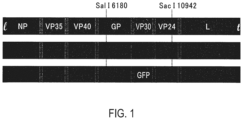
- FIG. 1 Schematic diagram of Ebola ⁇ VP30 constructs.
- (Top row) Schematic diagram of the Ebolavirus genome flanked by the leader sequence (I) and the trailer sequence (t) in positive-sense orientation.
- Two unique restriction sites for SalI and SacI positions 6180 and 10942 of the viral antigenome, respectively) allowed the subcloning of a fragment that spans the VP30 gene. The subgenomic fragment was then used to replace the VP30 gene with genes encoding neomycin (neo) or enhanced green fluorescence protein (eGFP), respectively.
- neo neomycin
- eGFP enhanced green fluorescence protein
- FIG. 2 Representative filovirus sequences (Accession numbers NC006432, NC004161, AY769362, AY142960, AF522874, AF499101, L11365, NC001608, DQ447652, DQ447649, AB050936, NC002549, NC001608, AF086833 and AF272001, the disclosures of which are incorporated by reference herein; SEQ ID Nos. 1-15 and 18-40).
- Vectors include, for example, viral vectors (such as filoviruses, adenoviruses, adeno-associated viruses (AAV), lentiviruses, herpesvirus and retroviruses), liposomes and other lipid-containing complexes, and other macromolecular complexes capable of mediating delivery of a polynucleotide to a host cell.
- viral vectors such as filoviruses, adenoviruses, adeno-associated viruses (AAV), lentiviruses, herpesvirus and retroviruses
- liposomes and other lipid-containing complexes such as liposomes and other lipid-containing complexes
- other macromolecular complexes capable of mediating delivery of a polynucleotide to a host cell.
- Vectors can also comprise other components or functionalities that further modulate gene delivery and/or gene expression, or that otherwise provide beneficial properties to the targeted cells.
- Such other components include, for example, components that influence binding or targeting to cells (including components that mediate cell-type or tissue-specific binding); components that influence uptake of the vector nucleic acid by the cell; components that influence localization of the polynucleotide within the cell after uptake (such as agents mediating nuclear localization); and components that influence expression of the polynucleotide.
- Such components also might include markers, such as detectable and/or selectable markers that can be used to detect or select for cells that have taken up and are expressing the nucleic acid delivered by the vector.
- Such components can be provided as a natural feature of the vector (such as the use of certain viral vectors which have components or functionalities mediating binding and uptake), or vectors can be modified to provide such functionalities.
- vectors are known in the art and are generally available.
- the vector can either be stably replicated by the cells during mitosis as an autonomous structure, incorporated within the genome of the host cell, or maintained in the host cell's nucleus or cytoplasm.
- a “recombinant viral vector” refers to a viral vector comprising one or more modifications, including deletions, insertions and/or heterologous genes or sequences. Since many viral vectors exhibit size constraints associated with packaging, the heterologous genes or sequences are typically introduced by replacing one or more portions of the viral genome. Such viruses may become replication-defective (biologically contained), requiring the deleted function(s) to be provided in trans during viral replication and encapsidation (by using, e.g., a helper virus or a packaging cell line carrying genes necessary for replication and/or encapsidation). Modified viral vectors in which a polynucleotide to be delivered is carried on the outside of the viral particle have also been described.
- Gene delivery are terms referring to the introduction of an exogenous polynucleotide (sometimes referred to as a “transgene”) into a host cell, irrespective of the method used for the introduction.
- exogenous polynucleotide sometimes referred to as a “transgene”
- Such methods include a variety of well-known techniques such as vector-mediated gene transfer (by, e.g., viral infection/transfection, or various other protein-based or lipid-based gene delivery complexes) as well as techniques facilitating the delivery of “naked” polynucleotides (such as electroporation, “gene gun” delivery and various other techniques used for the introduction of polynucleotides).
- the introduced polynucleotide may be stably or transiently maintained in the host cell.
- transgene any piece of a nucleic acid molecule (for example, DNA) which is inserted by artifice into a cell either transiently or permanently, and becomes part of the organism if integrated into the genome or maintained extrachromosomally.
- a transgene may include at least a portion of an open reading frame of a gene which is partly or entirely heterologous (i.e., foreign) to the transgenic organism, or may represent at least a portion of an open reading frame of a gene homologous to an endogenous gene of the organism, which portion optionally encodes a polypeptide with substantially the same activity as the corresponding full-length polypeptide or at least one activity of the corresponding full-length polypeptide.
- transgenic cell is meant a cell containing a transgene.
- a cell stably or transiently transformed with a vector containing an expression cassette is a transgenic cell that can be used to produce a population of cells having altered phenotypic characteristics.
- a “recombinant cell” is one which has been genetically modified, e.g., by insertion, deletion or replacement of sequences in a nonrecombinant cell by genetic engineering.
- wild-type refers to a gene or gene product that has the characteristics of that gene or gene product when isolated from a naturally occurring source.
- a wild-type gene is that which is most frequently observed in a population and is thus arbitrarily designated the “normal” or “wild-type” form of the gene.
- modified refers to a gene or gene product that displays modifications in sequence and or functional properties (i.e., altered characteristics) when compared to the wild-type gene or gene product. It is noted that naturally-occurring mutants can be isolated; these are identified by the fact that they have altered characteristics when compared to the wild-type gene or gene product.
- transduction denotes the delivery of a polynucleotide to a recipient cell either in vivo or in vitro, via a viral vector and preferably via a replication-defective viral vector.
- heterologous as it relates to nucleic acid sequences such as gene sequences encoding a protein and control sequences, denotes sequences that are not normally joined together, and/or are not normally associated with a particular cell, e.g., are from different sources (for instance, sequences from a virus are heterologous to sequences in the genome of an uninfected cell).
- a “heterologous” region of a nucleic acid construct or a vector is a segment of nucleic acid within or attached to another nucleic acid molecule that is not found in association with the other molecule in nature.
- a heterologous region of a nucleic acid construct could include a coding sequence flanked by sequences not found in association with the coding sequence in nature, i.e., a heterologous promoter.
- a heterologous coding sequence is a construct where the coding sequence itself is not found in nature (e.g., synthetic sequences having codons different from the native gene).
- a cell transformed with a construct which is not normally present in the cell would be considered heterologous for purposes of this invention.
- DNA is meant a polymeric form of deoxyribonucleotides (adenine, guanine, thymine, or cytosine) in double-stranded or single-stranded form found, inter alia, in linear DNA molecules (e.g., restriction fragments), viruses, plasmids, and chromosomes.
- sequences may be described herein according to the normal convention of giving only the sequence in the 5′ to 3′ direction along the nontranscribed strand of DNA (i.e., the strand having the sequence complementary to the mRNA).
- the term captures molecules that include the four bases adenine, guanine, thymine, or cytosine, as well as molecules that include base analogues which are known in the art.
- the terms “complementary” or “complementarity” are used in reference to polynucleotides (i.e., a sequence of nucleotides) related by the base-pairing rules.
- sequence “A-G-T” is complementary to the sequence “T-C-A.”
- Complementarity may be “partial,” in which only some of the nucleic acids' bases are matched according to the base pairing rules. Or, there may be “complete” or “total” complementarity between the nucleic acids.
- the degree of complementarity between nucleic acid strands has significant effects on the efficiency and strength of hybridization between nucleic acid strands. This is of particular importance in amplification reactions, as well as detection methods that depend upon binding between nucleic acids.
- DNA molecules are said to have “5′ ends” and “3′ ends” because mononucleotides are reacted to make oligonucleotides or polynucleotides in a manner such that the 5′ phosphate of one mononucleotide pentose ring is attached to the 3′ oxygen of its neighbor in one direction via a phosphodiester linkage.
- enhancer is meant a nucleic acid sequence that, when positioned proximate to a promoter, confers increased transcription activity relative to the transcription activity resulting from the promoter in the absence of the enhancer domain.
- “Homology” refers to the percent of identity between two polynucleotides or two polypeptides. The correspondence between one sequence and to another can be determined by techniques known in the art. For example, homology can be determined by a direct comparison of the sequence information between two polypeptide molecules by aligning the sequence information and using readily available computer programs. Alternatively, homology can be determined by hybridization of polynucleotides under conditions which form stable duplexes between homologous regions, followed by digestion with single strand-specific nuclease(s), and size determination of the digested fragments.
- nucleic acid molecule was either made or designed from a parent nucleic acid molecule, the derivative retaining substantially the same functional features of the parent nucleic acid molecule, e.g., encoding a gene product with substantially the same activity as the gene product encoded by the parent nucleic acid molecule from which it was made or designed.
- a given DNA sequence e.g., a gene
- RNA sequences such as a specific mRNA sequence encoding a specific protein, are found in the cell as a mixture with numerous other mRNAs that encode a multitude of proteins.
- the isolated nucleic acid molecule may be present in single-stranded or double-stranded form.
- the molecule will contain at a minimum the sense or coding strand (i.e., the molecule may single-stranded), but may contain both the sense and anti-sense strands (i.e., the molecule may be double-stranded).
- the term “recombinant nucleic acid” or “recombinant DNA sequence, molecule or segment” refers to a nucleic acid, e.g., to DNA, that has been derived or isolated from a source, that may be subsequently chemically altered in vitro, and includes, but is not limited to, a sequence that is naturally occurring, is not naturally occurring, or corresponds to naturally occurring sequences that are not positioned as they would be positioned in the native genome.
- An example of DNA “derived” from a source would be a DNA sequence that is identified as a useful fragment, and which is then chemically synthesized in essentially pure form.
- recombinant protein or “recombinant polypeptide” as used herein refers to a protein molecule that is expressed from a recombinant DNA molecule.
- peptide “polypeptide” and protein” are used interchangeably herein unless otherwise distinguished.
- sequence homology means the proportion of base matches between two nucleic acid sequences or the proportion amino acid matches between two amino acid sequences. When sequence homology is expressed as a percentage, e.g., 50%, the percentage denotes the proportion of matches over the length of a selected sequence that is compared to some other sequence. Gaps (in either of the two sequences) are permitted to maximize matching; gap lengths of 15 bases or less are usually used, 6 bases or less are preferred with 2 bases or less more preferred.
- the sequence homology between the target nucleic acid and the oligonucleotide sequence is generally not less than 17 target base matches out of 20 possible oligonucleotide base pair matches (85%); preferably not less than 9 matches out of 10 possible base pair matches (90%), and more preferably not less than 19 matches out of 20 possible base pair matches (95%).
- polynucleotides, oligonucleotides and fragments of the invention selectively hybridize to nucleic acid strands under hybridization and wash conditions that minimize appreciable amounts of detectable binding to nonspecific nucleic acids.
- High stringency conditions can be used to achieve selective hybridization conditions as known in the art and discussed herein.
- the nucleic acid sequence homology between the polynucleotides, oligonucleotides, and fragments of the invention and a nucleic acid sequence of interest is at least 65%, and more typically with preferably increasing homologies of at least about 70%, about 90%, about 95%, about 98%, and 100%.
- Two amino acid sequences are homologous if there is a partial or complete identity between their sequences. For example, 85% homology means that 85% of the amino acids are identical when the two sequences are aligned for maximum matching. Gaps (in either of the two sequences being matched) are allowed in maximizing matching; gap lengths of 5 or less are preferred with 2 or less being more preferred.
- two protein sequences or polypeptide sequences derived from them of at least 30 amino acids in length
- the two sequences or parts thereof are more preferably homologous if their amino acids are greater than or equal to 50% identical when optimally aligned using the ALIGN program.
- a polynucleotide sequence is homologous (e.g., is identical, not strictly evolutionarily related) to all or a portion of a reference polynucleotide sequence that encodes a polypeptide or its complement, or that a polypeptide sequence is identical in sequence or function to a reference polypeptide sequence.
- the nucleotide sequence “TATAC” corresponds to a reference sequence “TATAC” and is complementary to a reference sequence “GTATA”.
- reference sequence is a defined sequence used as a basis for a sequence comparison; a reference sequence may be a subset of a larger sequence, for example, as a segment of a full-length cDNA or gene sequence given in a sequence listing, or may comprise a complete cDNA or gene sequence. Generally, a reference sequence is at least 20 nucleotides in length, frequently at least 25 nucleotides in length, and often at least 50 nucleotides in length.
- two polynucleotides may each (1) comprise a sequence (i.e., a portion of the complete polynucleotide sequence) that is similar between the two polynucleotides, and (2) may further comprise a sequence that is divergent between the two polynucleotides
- sequence comparisons between two (or more) polynucleotides are typically performed by comparing sequences of the two polynucleotides over a “comparison window” to identify and compare local regions of sequence similarity.
- a “comparison window”, as used herein, refers to a conceptual segment of at least 20 contiguous nucleotides and wherein the portion of the polynucleotide sequence in the comparison window may comprise additions or deletions (i.e., gaps) of 20 percent or less as compared to the reference sequence (which does not comprise additions or deletions) for optimal alignment of the two sequences.
- Optimal alignment of sequences for aligning a comparison window may be conducted by using local homology algorithms or by a search for similarity method, by computerized implementations of these algorithms (GAP, BESTFIT, FASTA, and TFASTA Genetics Software Package or by inspection, and the best alignment (i.e., resulting in the highest percentage of homology over the comparison window) generated by the various methods is selected.
- a “protective immune response” and “prophylactic immune response” are used interchangeably to refer to an immune response which targets an immunogen to which the individual has not yet been exposed or targets a protein associated with a disease in an individual who does not have the disease, such as a tumor associated protein in a patient who does not have a tumor.
- a “therapeutic immune response” refers to an immune response which targets an immunogen to which the individual has been exposed or a protein associated with a disease in an individual who has the disease.
- prophylactically effective amount is meant to refer to the amount necessary to, in the case of infectious agents, prevent an individual from developing an infection, and in the case of diseases, prevent an individual from developing a disease.
- terapéuticaally effective amount is meant to refer to the amount necessary to, in the case of infectious agents, reduce the level of infection in an infected individual in order to reduce symptoms or eliminate the infection, and in the case of diseases, to reduce symptoms or cure the individual.
- “Inducing an immune response against an immunogen” is meant to refer to induction of an immune response in a na ⁇ ve individual and induction of an immune response in an individual previously exposed to an immunogen wherein the immune response against the immunogen is enhanced.
- substantially pure means an object species is the predominant species present (i.e., on a molar basis it is more abundant than any other individual species in the composition), and preferably a substantially purified fraction is a composition wherein the object species comprises at least about 50 percent (on a molar basis) of all macromolecular species present. Generally, a substantially pure composition will comprise more than about 80 percent of all macromolecular species present in the composition, more preferably more than about 85%, about 90%, about 95%, and about 99%. Most preferably, the object species is purified to essential homogeneity (contaminant species cannot be detected in the composition by conventional detection methods) wherein the composition consists essentially of a single macromolecular species.
- Transfected is used herein to include any host cell or cell line, which has been altered or augmented by the presence of at least one recombinant DNA sequence.
- the host cells of the present invention are typically produced by transfection with a DNA sequence in a plasmid expression vector, as an isolated linear DNA sequence, or infection with a recombinant viral vector.
- the invention provides isolated vectors, e.g., plasmids, which encode proteins of negative-sense, single stranded RNA viruses and/or express vRNA from recombinant nucleic acid corresponding to sequences for mutant negative-sense, single stranded RNA viruses.
- plasmids which encode proteins of negative-sense, single stranded RNA viruses and/or express vRNA from recombinant nucleic acid corresponding to sequences for mutant negative-sense, single stranded RNA viruses.
- a combination of these vectors is capable of yielding recombinant infectious, biologically contained virus.
- the invention includes host cells that produce recombinant infectious, biologically contained virus of the invention.
- the invention provides isolated vectors, e.g., plasmids, which encode filovirus proteins and/or express mutant filovirus vRNA which, when introduced into a cell, are capable of yielding recombinant infectious, biologically contained filovirus.
- the invention includes host cells that transiently or stably produce recombinant infectious, biologically contained filovirus, including helper cells, and isolated recombinant filovirus prepared by the methods disclosed herein.
- the vectors of the invention include those for mRNA production and vRNA production.
- the vectors include filovirus DNA, for example, vectors for mRNA production with sequences corresponding to one or more open reading frames encoding filovirus proteins, or vectors for vRNA production that include a deletion of the full-length genomic sequence, which deletion includes internal filovirus sequences corresponding to at least a portion of one open reading frame.
- RNA produced from the vRNA vector is capable of being packaged into virions in the presence of filovirus proteins but as part of the resulting virion, is not capable of being replicated and so does not result in virus production when that virion is introduced to a cell that otherwise supports filovirus replication and which cell does not express at least one filovirus protein in trans, e.g., a cell that is not a filovirus helper cell.
- Ebolaviruses possess a negative-sense, nonsegmented RNA genome, approximately 19 kilobases in length that encodes seven structural proteins and at least one non-structural protein (Sanchez et al., 2007).
- NP viral protein
- VP30 VP30
- L the RNA-dependent RNA polymerase
- VP40 is the matrix protein and is involved in viral budding (Harty et al., 2000; Panchal et al., 2003).
- VP24 is involved in the formation of nucleocapsids composed of NP, VP35 and viral RNA (Huang et al., 2002).
- the only viral surface glycoprotein, GP plays a role in viral attachment and entry (Chan et al., 2001; Manicassamy et al., 2005; Shimojima et al., 2006; Chandran et al., 2005).
- compositions may be systemically administered, e.g., orally or intramuscularly, in combination with a pharmaceutically acceptable vehicle such as an inert diluent.
- a pharmaceutically acceptable vehicle such as an inert diluent.
- the virus may be combined with one or more excipients and used in the form of ingestible capsules, elixirs, suspensions, syrups, wafers, and the like.
- Such compositions should contain at least 0.1% of active compound.
- the percentage of the compositions and preparations may, of course, be varied and may conveniently be between about 2 to about 60% of the weight of a given unit dosage form. The amount of active compound in such useful compositions is such that an effective dosage level will be obtained.
- the administration of the composition may be for either a “prophylactic” or “therapeutic” purpose.
- the compositions of the invention which are vaccines are provided before any symptom or clinical sign of a pathogen infection becomes manifest.
- the prophylactic administration of the composition serves to prevent or attenuate any subsequent infection.
- the gene therapy compositions of the invention are provided before any symptom or clinical sign of a disease becomes manifest.
- the prophylactic administration of the composition serves to prevent or attenuate one or more symptoms or clinical signs associated with the disease.
- the “protection” provided need not be absolute, i.e., the influenza infection need not be totally prevented or eradicated, if there is a statistically significant improvement compared with a control population or set of mammals. Protection may be limited to mitigating the severity or rapidity of onset of symptoms or clinical signs of the virus infection.
- a composition of the present invention may confer resistance to one or more pathogens, e.g., one or more virus, bacterium or parasite strains, by either passive immunization or active immunization.
- active immunization a live vaccine composition is administered prophylactically to a host (e.g., a mammal), and the host's immune response to the administration protects against infection and/or disease.
- a host e.g., a mammal
- the elicited antisera can be recovered and administered to a recipient suspected of having an infection caused by at least one virus strain.
- At least one virus isolate of the present invention may be administered by any means that achieve the intended purposes.
- administration of such a composition may be by various parenteral routes such as subcutaneous, intravenous, intradermal, intramuscular, intraperitoneal, intranasal, oral or transdermal routes.
- Parenteral administration can be accomplished by bolus injection or by gradual perfusion over time.
- a typical regimen for preventing, suppressing, or treating a viral related pathology comprises administration of an effective amount of a vaccine composition as described herein, administered as a single treatment, or repeated as enhancing or booster dosages, for instance, over a period up to and including between one week and about 24 months, or any range or value therein.
- an “effective amount” of a composition is one that is sufficient to achieve a desired effect. It is understood that the effective dosage may be dependent upon the species, age, sex, health, and weight of the recipient, kind of concurrent treatment, if any, frequency of treatment, and the nature of the effect wanted.
- the ranges of effective doses provided below are not intended to limit the invention and represent dose ranges.
- Exemplary doses include but are not limited to from about 10 4 to 10 8 FFU or PFU, 10 6 to 10 8 FFU or PFU, 10 6 to 10 10 FFU or PFU, or 10 8 to 10 12 FFU or PFU, or more, or from about 10 6 to 10 8 particles, 10 8 to 10 10 particles, or 10 10 to 10 12 particles.
- a dose is from about 10 4 to 10 8 FFU or PFU, 10 6 to 10 8 FFU or PFU, 10 6 to 10 10 FFU or PFU, or 10 8 to 10 10 FFU or PFU.
- Exemplary classes of adjuvants include but are not limited to agonists of TLR3, e.g., poly (I:C), agonists of TLR4, e.g., one or more components of bacterial lipopolysaccharide, e.g., monophosphoryl lipid A (MPLA), MPL®, and synthetic derivatives, e.g., E6020, agonists of TLR5, e.g., bacterial flagellin), agonists of TLR7, 8, e.g., single stranded RNA or imidazoquinolines (e.g., imiquimod, gardiquimod and R848), agonists of TLR9, e.g., CpG oligonucleotides and ISS immunostimulatory sequences, as well as Imidazoquinolines, agonists of the NLRP3 inflammasome, e.g., chitosan, and dual TLR1/2 agonists, e.g., Pam3CSK4,
- the adjuvant comprises saponin, a natural product derived from tree bark, which may be combined with cholesterol or a cholesterol like molecule, e.g., squalene.
- the adjuvant comprises an oil-in-water (O/W) emulsion comprising, for example, MF59 or AS03 and optionally 2% squalene.
- the adjuvant comprises two different adjuvants, e.g., MPL and a saponin such as QS21, for example, in liposome.
- the adjuvant comprises aluminum salts, saponin, muramyl di- and/or tripeptides, Bordetella pertussis , and/or cytokines.
- the adjuvant is not alum or an aluminum salt.
- Exemplary viral glycoproteins include but are not limited to those from ebolaviruses, e.g., Zaire, Sudan, Bundibugyo, Tai Forest (formerly known as Côte d'irium), or Reston, marburgviruses, arenaviruses such as Lassa virus; or bunyaviruses such a Crimean-Congo Hemorrhagic Fever virus or hantaviruses; or flaviruses such as Dengue virus, Zika virus, or Yellow Fever virus.
- ebolaviruses e.g., Zaire, Sudan, Bundibugyo, Tai Forest (formerly known as Côte d'irium), or Reston, marburgviruses, arenaviruses such as Lassa virus; or bunyaviruses such a Crimean-Congo Hemorrhagic Fever virus or hantaviruses; or flaviruses such as Dengue virus, Zika virus, or Yellow Fever virus.
- Exemplary parasite antigens include but are not limited to those from Plasmodium, Leishmania, Giardia, Cryptosporidium or Cyclospora;
- Exemplary bacterial antigens include but are not limited to those from Vibrio , e.g. V. cholera or Mycobacterium.
- Vero cells green monkey kidney cells
- MCM Eagle's minimal essential medium
- FCS fetal calf serum
- FCS fetal calf serum
- the VeroVP30 cell line is established by cotransfecting Vero cells with pCAG-VP30 (for the expression of VP30) and pPur, a protein expression plasmid for the puromycin resistance gene (Clontech, Mountain View, CA), using the transfection reagent TransIT LT-1 (Mirus, Madison, WI). Two days after transfection, puromycin-resistant cells are selected with 5 g/ml puromycin (Sigma, St. Louis, MO). Individual cell clones are screened for VP30 expression by flow cytometry with a polyclonal peptide antibody to VP30.
- Human embryonic kidney 293T cells are grown in high-glucose Dulbecco's modified Eagle medium containing 10% FCS, L-glutamine, and antibiotics. All cells are maintained at 37° C. and 5% CO 2 .
- Ebola ⁇ VP30 viruses The plasmid pTM-T7G-Ebo-Rib, containing the full-length Ebolavirus cDNA flanked by T7 RNA polymerase promoter and ribozyme sequences, is described in Newmann et al. (2002). First, a fragment encompassing nucleotides 6180 to 10942 (numbers refers to the positive-sense antigenome) is subcloned into a kanamycin-resistant cloning vector. Next, the VP30 ORF is replaced with those encoding neo or eGFP, respectively, by a series of overlapping PCR amplification steps using Pfu Turbo (Stratagene, La Jolla, CA).
- the altered subgenomic fragments are transferred back into the full-length Ebolavirus cDNA plasmid using two unique restriction sites, SalI and SacI ( FIG. 1 ).
- the resultant plasmids designated pTM-Ebola ⁇ VP30-neo or -eGFP, are sequenced to verify the replacement of the VP30 ORF and the lack of any unwanted mutations.
- 5 ⁇ 10 5 293T cells are transfected with 1.0 ⁇ g pTM-Ebola ⁇ VP30, 2.0 ⁇ g pCAG-L, 1.0 ⁇ g pCAG-NP, 0.5 ⁇ g pCAG-VP35, 0.5 ⁇ g pCAG-VP30, and 1.0 ⁇ g pCAG-T7 pol, using TransIT LT1 (Mirus, Madison, WI) in BSL-4 containment (Neumann et al., 2002). Five days after transfection, the supernatant is harvested, cellular debris removed by low speed centrifugation, and the virus amplified in VeroVP30 cells at 37° C. and 5% CO 2 with propagation medium containing 2% FCS in MEM supplemented with L-glutamine, vitamins, nonessential amino acid solution and antibiotics without puromycin.
- Plaque assay and immunostaining assay To determine the titers of wild-type Ebolavirus or Ebola ⁇ VP30 viruses, tenfold dilutions of the viruses are absorbed to confluent VeroVP30 or wild-type Vero cells for 1 hour at 37° C., after which any unbound virus was removed by washing cells with propagation medium. The cells are then overlaid with propagation medium containing 1.5% methyl cellulose (Sigma). Seven days after infection, cells are fixed with 10% buffered formaldehyde, taken out of BSL-4, permeabilized with 0.25% Triton X-100 in PBS for 10 minutes, and blocked with 4% goat serum and 1% bovine serum albumin (BSA) in PBS for 60 minutes.
- BSA bovine serum albumin
- Cells are then incubated for 60 minutes with a 1:1000 dilution of a mouse anti-VP40 monoclonal antibody, washed with PBS, and incubated for 60 minutes with a 1:1000 dilution of an antimouse IgG-peroxidase-conjugated secondary antibody (Kirkegaard & Perry Laboratories Inc., Gaithersburg, MD). After washing with PBS, cells are incubated with 3,3′-diaminobenzidine tetrahydrochloride (DAB, Sigma) in PBS. The reaction is stopped by rinsing cells with water.
- DAB 3,3′-diaminobenzidine tetrahydrochloride
- Blots are incubated with primary antibodies (a mouse anti-NP antibody, a rabbit anti-VP35 antibody, a rabbit anti-VP40 antibody, a mouse anti-GP antibody, a rabbit anti-VP30 antibody, or a mouse anti-VP24 antibody) for 60 minutes at room temperature, washed three times with PBST, incubated with the appropriate secondary antibody conjugated to horseradish peroxidase (Zymed) for 60 minutes, and finally washed three times with PBST. Blots were then incubated in Lumi-Light Western blotting substrate (Roche, Indianapolis, IN) and exposed to X-ray film (Kodak, Rochester, NY).
- primary antibodies a mouse anti-NP antibody, a rabbit anti-VP35 antibody, a rabbit anti-VP40 antibody, a mouse anti-GP antibody, a rabbit anti-VP30 antibody, or a mouse anti-VP24 antibody
- RNA isolation and RT-PCR Cell culture supernatant from virus-infected VeroVP30 cells is inactivated with guanidinium isothiocyanate buffer and taken out of BSL-4. Viral RNA is isolated with the RNeasy Mini kit (Qiagen, Valencia, CA). RT-PCR is carried out with the RobusT One-Step RT-PCR kit (Finnzyme, Espoo, Finland), using 1 ⁇ g of isolated RNA and Ebolavirus-specific primers. The resultant PCR products are cloned into pT7Blue (Novagen, San Diego, CA) and sequenced.
- Ebola ⁇ VP30-eGFP is diluted tenfold (10-1 to 10-6) and incubated with the indicated mAbs at a concentration of 250 to 500 ⁇ g of mAb/mL at 37° C. for 60 minutes.
- the virus/mAb mixtures are inoculated onto VeroVP30 cells for 60 minutes.
- Viruses are amplified for 5 days in the presence of antibodies.
- viruses that grow in the presence of mAbs (as determined by GFP expression) are harvested at the highest virus-positive dilution and passaged for a total of 3-6 times in the presence of antibodies.
- Viral RNA is isolated, RT-PCR amplified, and the GP sequence determined by sequence analysis.
- mice Four-week-old female BALB/c mice (The Jackson Laboratory, Bar Harbor, ME) are anesthetized with isoflurane and intraperitoneally (IP) inoculated twice at three-week intervals with 10 6 focus forming units (FFU) of sucrose-purified Ebola ⁇ VP30 virus; control mice were simultaneously inoculated with PBS. A second group of mice receives three immunizations (at three-week intervals) with 10 7 FFU of virus harvested from cell culture supernatant, or, as a control, 2% FCS-MEM. Vaccinations are conducted at the University of Wisconsin-Madison.
- VLPs have been shown to protect mice and guinea pigs from a lethal challenge of these viruses (Warfield et al., 2004; Warfield et al., 2005). While VLPs are safe and, due to the rarity of Ebola virus infection, preexisting immunity to Ebola or Marburg viruses is not a concern for VLP vaccines, it is difficult to produce large quantities of VLPs from cell culture.
- Nonhuman primates were vaccinated with one or two (prime and boost) doses of vaccine virus (IM or aerosol) and then challenged (heterologous challenge or homologous challenge) 4 weeks after the last dose.
- Some vaccinations included one of three different adjuvants.
- Study #2 which employed 10-fold more vaccine virus than Study #1, only those animals vaccinated with virus and an adjuvant survived heterologous challenge.
- Study #3 in addition to protocols that used a vaccine of the invention (3A and 3D), two other anti-ebola virus vaccines currently undergoing testing (Vaccine A, intranasal administration of a vaccine having a replication competent virus; Vaccine B, intramuscular administration of a vaccine having a replication incompetent virus) were also tested.
- immunization only included Vaccine A (3G).
- Vaccine A 3G
- a combination of a vaccine of the invention and Vaccine A (3B and 3C) and a combination of Vaccine A and Vaccine B (3E and 3F) were tested.
- each 10-layer Cell Factory is washed three times with DPBS and then infected with the MVS at a MOI of 0.1 in VP-SFM plus 1% Glutamax.
- Each infected 10-layer Cell Factory was incubated for 7 days at 37 ⁇ 2° C., 5 ⁇ 2% CO 2 .
- each 10-layer Cell Factory was inspected for contamination and the contents were harvested into a sterile 20 L bioprocess bag. Samples of pooled and the bulk harvest were pumped through a depth filter (1.2 ⁇ M filtration by Sartorius 2 XLG MidiCap) into a new sterile bioprocess bag.
- Host genomic DNA was removed by benzonase treatment.
- MgCl 2 was added to the filtered viral harvest up to a final concentration of 2 mM MgCl 2 .
- Benzonase (Millipore Sigma) was then added to a final concentration of 10 U/mL of filtered harvest and incubated at 37 ⁇ 2° C. for 4-6 hours.
- ⁇ -Propiolactone (BPL) was added to a final concentration of 0.1% v/v and incubated at 2-8° C. for 16-18 hours.
- Degraded host DNA, benzonase, BPL and other host impurities were subsequently removed by tangential flow filtration (TFF).
- TFF tangential flow filtration
- the benzonase/BPL treated viral harvest was concentrated approximately 10 ⁇ (e.g., concentrated so as not to result in precipitation), diafiltered, e.g., using 0.1 um pore size, into Dulbecco's Phosphate-Buffered Saline (DPBS) with Ca 2+ /Mg 2+ , then further concentrated using a sterile/closed TFF system (the TFF filter has a 0.1 um pore size, 30 cm path length, e.g., GE RTPCFP-1E-8S hollow fiber cartridge from GE Health) to ⁇ 2 ⁇ the desired product concentration (e.g., 6 ⁇ 10 7 FFU/ml).
- DPBS Dulbecco's Phosphate-Buffered Saline
- DPBS Dulbecco's
- samples of the TFF retentate and wash pools were analyzed to determine titer by ELISA and host protein.
- Retentate and wash samples meeting host protein specifications e.g., ⁇ 500 ng/ml
- host protein specifications e.g., ⁇ 500 ng/ml
- OPTIVero medium resulted in virus titers that were about 1 log unit greater than VP-SFM (e.g., 6.84 log 10 FFU/ml [OPTIVero] vs. 5.75 log 10 FFU/ml [VP-SFM).
- VP-SFM medium resulted in virus titers that were about 1 log unit greater than OPTIVero medium (e.g., 6.52 log 10 FFU/ml [VP-SFM] vs. 5.52 log 10 FFU/ml [OPTIVero).
- VP-SFM medium When VP-SFM medium was used to culture and infect cell in a 10-tray system, that system produce about 1 log unit greater titers than VP-SFM medium was used to culture and infect cells in a hyperstack (e.g., 6.69 log 10 FFU/ml [10-tray system] vs. 5.58 log 10 FFU/ml [hyperstack]).
- VP-SFM medium includes a plant hydrosylate (e.g., comprising di- and tri-plant peptides) and an iron chelator while OPTIVero medium includes recombinant human albumin, recombinant human transferrin (i.e., no plant hydrosylate or iron chelator).
Landscapes
- Health & Medical Sciences (AREA)
- Life Sciences & Earth Sciences (AREA)
- Chemical & Material Sciences (AREA)
- Organic Chemistry (AREA)
- Virology (AREA)
- General Health & Medical Sciences (AREA)
- Medicinal Chemistry (AREA)
- Immunology (AREA)
- Genetics & Genomics (AREA)
- Biochemistry (AREA)
- Microbiology (AREA)
- Animal Behavior & Ethology (AREA)
- Public Health (AREA)
- Veterinary Medicine (AREA)
- Pharmacology & Pharmacy (AREA)
- Molecular Biology (AREA)
- Wood Science & Technology (AREA)
- Bioinformatics & Cheminformatics (AREA)
- Zoology (AREA)
- Engineering & Computer Science (AREA)
- Biophysics (AREA)
- Mycology (AREA)
- Epidemiology (AREA)
- Proteomics, Peptides & Aminoacids (AREA)
- Biomedical Technology (AREA)
- General Engineering & Computer Science (AREA)
- Biotechnology (AREA)
- General Chemical & Material Sciences (AREA)
- Gastroenterology & Hepatology (AREA)
- Nuclear Medicine, Radiotherapy & Molecular Imaging (AREA)
- Communicable Diseases (AREA)
- Chemical Kinetics & Catalysis (AREA)
- Oncology (AREA)
- Micro-Organisms Or Cultivation Processes Thereof (AREA)
- Medicines Containing Antibodies Or Antigens For Use As Internal Diagnostic Agents (AREA)
Abstract
Description
| Time | |||||||||
| between | |||||||||
| Time | Challenge | immunization | |||||||
| Number | Prim | Boost | between | virus and | and | ||||
| of | dose | dose | doses | dose | challenge | ||||
| NHPs | (route) | (route) | (weeks) | (route) | (weeks) | Adjuvant | Survival | | |
| Study | |||||||||
| # | |||||||||
| 1 | |||||||||
| 4 | 107 | — | 4 | |
4 | — | 100% | Viremia | |
| FFU | FFU (IM) | in 1 | |||||||
| (IM) | |
||||||||
| 4 | 107 | 107 | 4 | |
4 | — | 100% | — | |
| FFU | FFU | FFU (IM) | |||||||
| (IM) | (IM) | ||||||||
| 2 | 107 | 107 | 4 | |
4 | — | 100% | — | |
| FFU | FFU | FFU (IM) | |||||||
| (IM) | (IM) | ||||||||
| Study | |||||||||
| #2 | |||||||||
| 4 | 108 | 108 | 4 | |
4 | MF-59 | 100% | | |
| FFU | FFU | ||||||||
| 104 FFU | in 4 | ||||||||
| (IM) | (IM) | (IM) | |
||||||
| 4 | 108 | 108 | 4 | |
4 | MPLA | 50% | | |
| FFU | FFU | ||||||||
| 104 FFU | in 4 | ||||||||
| (IM) | (IM) | (IM) | |
||||||
| 4 | 108 | 108 | 4 | |
4 | — | 0% | | |
| FFU | FFU | ||||||||
| 104 FFU | in 4 | ||||||||
| (IM) | (IM) | (IM) | animals | ||||||
| Vaccine virus is Zaire Ebola, strain Mayinga. |
|||||||||
| FFU = focus-forming units; | |||||||||
| IM = intramuscular | |||||||||
| Time | ||||||||||
| between | ||||||||||
| Time | Challenge | immunization | Adjuvant | |||||||
| Number | Prime | Boost | between | virus and | and | (used with | ||||
| of | dose | dose | doses | dose | challenge | deltaVP30 | ||||
| NHPs | (route) | (route) | (weeks) | (route) | (weeks) | only) | Survival | Notes | ||
| Study | ||||||||||
| #3 | ||||||||||
| A | 2 | 108 |
108 |
8 | |
7 | QS-21 | 50% | — | |
| (IM) | (IM) | 102 FFU | ||||||||
| (aerosol) | ||||||||||
| B | 2 | |
108 |
8 | |
7 | QS-21 | 100% | — | |
| A 4 × 10⁸ | (IM) | 102 FFU | ||||||||
| FFU | (aerosol) | |||||||||
| C | 2 | 108 | Vaccine | 8 | |
7 | QS-21 | 50% | — | |
| (IM) | A 4 × 10⁸ | 102 FFU | ||||||||
| FFU | (aerosol) | |||||||||
| D | 2 | 108 |
108 |
8 | |
7 | QS-21 | 100% | — | |
| (IM) | (IM) | 104 FFU | ||||||||
| (IM) | ||||||||||
| E | 2 | | Vaccine | 8 | |
7 | — | 0% | — | |
| B 5 × 10¹⁰ | A 2 × 10⁸ | 102 FFU | ||||||||
| particles | particles | (aerosol) | ||||||||
| F | 2 | | Vaccine | 8 | |
7 | — | 50% | — | |
| A 2 × 10⁸ | B 5 × 10¹⁰ | 102 FFU | ||||||||
| particles | particles | (aerosol) | ||||||||
| G | 2 | | Vaccine | 8 | |
7 | — | 50% | — | |
| A 4 × 10⁸ | A 4 × 10⁸ | 102 FFU | ||||||||
| particles | particles | (aerosol) | ||||||||
| Vaccine A - completed phase I clinical trial. | ||||||||||
| Vaccine B - completed phase I, II, and III clinical trials. | ||||||||||
| 0.1 mg of QS-21 (quil-A) was employed in 3A-3D. | ||||||||||
-
- Boehmann et al., Virology, 332:406 (2005).w
- Bray et al., J. Infect. Dis., 178:651 (1998).
- Bukreyev et al., J. Virol., 80:2267 (2006).
- Chan et al., Cell, 106:117 (2001).
- Chandran et al., Science, 308:1643 (2005).
- Ebihara et al., PloS Pathogens, 2:0705 (2006).
- Ebihara et al., PLOS. Pathog., 2: e73 (2006).
- Feldmann et al., in Virus Taxonomy: Eighth Report of the International Committee of Taxonomy of Viruses, eds. Fauquet, C., Mayo, M. A., Desselberger, U., & Ball, L. A. (Elsevier, London), pp. 645 (2004).
- Groseth et al., J. Virol., 79:4425 (2005).
- Gupta et al., J. Virol . . . 75:4649 (2001).
- Halfmann et al., In submission (2007).
- Hartman et al., J. Virol. 80:6430 (2006).
- Harty et al., Proc. Natl. Acad. Sci. USA, 97:13871 (2000).
- Huang et al., Mol. Cell, 10:307 (2002).
- Ignatyeve et al., J. Biotechnol., 44:111 (1996).
- Jasenosky et al., J. Virol., 75:5205 (2001).
- Johnson et al., Lancet, 1:569 (1977).
- Johnson et al., Virol. J. 3:31 (2006).
- Jones et al., Nat. Med., 11:786 (2005).
- Licata et al., J. Virol., 78:7344 (2004).
- Lupton et al., Lancet, 2:1294 (1980).
- Manicassamy et al., J. Virol., 79:4793 (2005).
- Marzi et al., Virology, 352:345 (2006).
- McCarthy et al., J. Virol. Methods, 137:115 (2006).
- Mellquist-Riemenschneider et al., Virus Res., 92:187 (2003).
- Modrof et al., J. Biol. Chem., 277:33099 (2002).
- Modrof et al., J. Virol., 77:3334 (2003).
- Muhlberger et al., J. Virol., 73:2333 (1999).
- Murali-Krishna et al., Immunity, 8:177 (1998).
- Neumann et al., J. Virol., 76:406 (2002).
- Neumann et al., J. Virol., 79:10300 (2005).
- Noda et al., J. Virol., 76:4855 (2002).
- Olinger et al., J. Virol., 79:14189 (2005).
- Panchal et al., Proc. Natl. Acad. Sci. USA, 100:15936 (2003).
- Reed et al., Vaccine, 25:1923 (2007).
- Sanchez et al., in Fields Virology, eds. Knipe, D. M., Howley, P. M., Griffin, D. E., Martin, M. A., Lamb, R. A., Roizman, B., & Straus, S. E. (Lippincott, Williams & Wilkins, Philadelphia), pp. 1409 (2007).
- Sanchez et al., Virus Res. 29:215 (1993).
- Shimojima et al., J. Virol., 80:10109 (2006).
- Simmons et al., Virology, 318:224 (2004).
- Sullivan et al., Nature, 408:681 (2000).
- Takada et al., J. Virol., 75:2324 (2001).
- Takada et al., Proc. Natl. Acad. Sci. U.S.A., 94:14764 (1997).
- Takada et al., Vaccine, 25:993 (2007).
- Takada, J. Virol., 77:1069 (2003).
- Theriault et al., Arch. Virol. Suppl., 19:157 (2005).
- Volchkov et al., Science, 291:1965 (2001).
- Warfield et al., J. Immunol. 175:1184 (2005).
- Warfield et al., Pro. Natl. Acad. Sci. USA, 100:15889 (2003).
- Warfield et al., Vaccine, 22:3495 (2004).
- Wool-Lewis et al., J. Virol., 72:155 1998).
- Yonezawa et al., J. Virol., 79:918 (2005).
Claims (18)
Priority Applications (1)
| Application Number | Priority Date | Filing Date | Title |
|---|---|---|---|
| US17/266,049 US12343390B2 (en) | 2018-08-07 | 2019-08-07 | Recombinant biologically contained filovirus vaccine |
Applications Claiming Priority (3)
| Application Number | Priority Date | Filing Date | Title |
|---|---|---|---|
| US201862715673P | 2018-08-07 | 2018-08-07 | |
| US17/266,049 US12343390B2 (en) | 2018-08-07 | 2019-08-07 | Recombinant biologically contained filovirus vaccine |
| PCT/US2019/045476 WO2020033527A2 (en) | 2018-08-07 | 2019-08-07 | Recombinant biologically contained filovirus vaccine |
Publications (2)
| Publication Number | Publication Date |
|---|---|
| US20210290754A1 US20210290754A1 (en) | 2021-09-23 |
| US12343390B2 true US12343390B2 (en) | 2025-07-01 |
Family
ID=67811006
Family Applications (1)
| Application Number | Title | Priority Date | Filing Date |
|---|---|---|---|
| US17/266,049 Active 2040-06-16 US12343390B2 (en) | 2018-08-07 | 2019-08-07 | Recombinant biologically contained filovirus vaccine |
Country Status (3)
| Country | Link |
|---|---|
| US (1) | US12343390B2 (en) |
| JP (2) | JP7783047B2 (en) |
| WO (1) | WO2020033527A2 (en) |
Families Citing this family (12)
| Publication number | Priority date | Publication date | Assignee | Title |
|---|---|---|---|---|
| US10130697B2 (en) | 2010-03-23 | 2018-11-20 | Wisconsin Alumni Research Foundation (Warf) | Vaccines comprising mutant attenuated influenza viruses |
| WO2013032942A1 (en) | 2011-08-26 | 2013-03-07 | Yoshihiro Kawaoka | Influenza viruses with mutant pb2 gene segment as live attenuated vaccines |
| WO2015196150A2 (en) | 2014-06-20 | 2015-12-23 | Wisconsin Alumni Research Foundation (Warf) | Mutations that confer genetic stability to additional genes in influenza viruses |
| CA3014435C (en) | 2016-02-19 | 2023-04-18 | Wisconsin Alumni Research Foundation (Warf) | Improved influenza b virus replication for vaccine development |
| US11197926B2 (en) | 2017-10-25 | 2021-12-14 | Wisconsin Alumni Research Foundation (Warf) | Recombinant influenza viruses with stabilized HA for replication in eggs |
| JP7783047B2 (en) | 2018-08-07 | 2025-12-09 | ウィスコンシン アルムニ リサーチ ファンデイション | Recombinant biologically contained filovirus vaccines |
| WO2020041311A1 (en) | 2018-08-20 | 2020-02-27 | Wisconsin Alumni Research Foundation | Vectors for eliciting immune responses to non-dominant epitopes in the hemagglutinin (ha) protein |
| US11851648B2 (en) | 2019-02-08 | 2023-12-26 | Wisconsin Alumni Research Foundation (Warf) | Humanized cell line |
| WO2020223699A1 (en) | 2019-05-01 | 2020-11-05 | Wisconsin Alumni Research Foundation (Warf) | Improved influenza virus replication for vaccine development |
| JP7627911B2 (en) | 2019-08-27 | 2025-02-07 | ウィスコンシン アルムニ リサーチ ファンデイション | Recombinant influenza viruses with stabilized HA for replication in egg |
| US11739303B2 (en) | 2020-01-24 | 2023-08-29 | Wisconsin Alumni Research Foundation (Warf) | Recombinant influenza viruses with stabilized NA |
| US12290562B2 (en) | 2020-03-25 | 2025-05-06 | Wisconsin Alumni Research Foundation (Warf) | Recombinant multivalent influenza viruses |
Citations (183)
| Publication number | Priority date | Publication date | Assignee | Title |
|---|---|---|---|---|
| US4071618A (en) | 1974-09-03 | 1978-01-31 | Research Foundation For Microbial Diseases Of Osaka University | Process for preparing virus disease live vaccines |
| US4659569A (en) | 1981-02-09 | 1987-04-21 | Kabushiki Kaisha Hayashibara Seibutsu Kagaku Kenkyujo | Process for the production of virus vaccine |
| US5166057A (en) | 1989-08-28 | 1992-11-24 | The Mount Sinai School Of Medicine Of The City University Of New York | Recombinant negative strand rna virus expression-systems |
| JPH07203958A (en) | 1994-01-27 | 1995-08-08 | Kao Corp | Chinese hamster ovary cell mutant |
| EP0702085A1 (en) | 1994-07-18 | 1996-03-20 | Akzo Nobel N.V. | Recombinant infectious non-segmented negative strand RNA virus |
| EP0704533A1 (en) | 1994-09-30 | 1996-04-03 | Bayer Ag | An attenuated vaccination virus, a method to make the virus and a pharmaceutical compositions comprising the virus |
| WO1996010631A1 (en) | 1994-09-30 | 1996-04-11 | St. Jude Children's Research Hospital | Nucleic acid encoding mutant matrix proteins useful for attenuation or enhancement of influenza a virus |
| WO1996010632A1 (en) | 1994-09-30 | 1996-04-11 | Aviron | Recombinant negative strand rna virus expression systems and vaccines |
| JPH08510749A (en) | 1993-05-25 | 1996-11-12 | アメリカン・サイアナミド・カンパニー | Adjuvant for vaccine against respiratory syncytial virus |
| WO1996040955A1 (en) | 1995-06-07 | 1996-12-19 | Graham Frank L | Adenovirus vectors for gene therapy |
| WO1997037000A1 (en) | 1996-04-01 | 1997-10-09 | Chiron Behring Gmbh & Co. | Animal cells and processes for the replication of influenza viruses |
| JPH10500113A (en) | 1994-05-10 | 1998-01-06 | アメリカン・ホーム・プロダクツ・コーポレイション | Improved modified live BRSV vaccine |
| WO1998002530A1 (en) | 1996-07-15 | 1998-01-22 | The Government Of The United States Of America, As Represented By The Department Of Health And Human Services | Production of attenuated respiratory syncytial virus vaccines from cloned nucleotide sequences |
| US5716821A (en) | 1994-09-30 | 1998-02-10 | Uab Research Foundation | Prevention and treatment of respiratory tract disease |
| US5750394A (en) | 1994-05-20 | 1998-05-12 | The Mount Sinai Medical Center | Identification and use of antiviral compounds that inhibit interaction of host cell proteins and viral proteins required for viral replication |
| US5786199A (en) | 1989-08-28 | 1998-07-28 | The Mount Sinai School Of Medicine Of The City University Of New York | Recombinant negative strand RNA virus expression systems and vaccines |
| US5789229A (en) | 1994-09-30 | 1998-08-04 | Uab Research Foundation | Stranded RNA virus particles |
| US5820871A (en) | 1989-08-28 | 1998-10-13 | The Mount Sinai School Of Medicine Of The City University Of New York | Recombinant negative strand RNA virus expression systems and vaccines |
| WO1998048834A1 (en) | 1997-04-30 | 1998-11-05 | The Mount Sinai School Of Medicine Of The City University Of New York | Recombinant influenza viruses expressing tumor-associated antigens as antitumor agents |
| WO1998053078A1 (en) | 1997-05-23 | 1998-11-26 | The Government Of The United States Of America, As Represented By The Department Of Health And Humanservices | Production of attenuated parainfluenza virus vaccines from cloned nucleotide sequences |
| WO1999028445A1 (en) | 1997-11-29 | 1999-06-10 | Cheil Jedang Corporation | Live attenuated influenza vaccine |
| US5948410A (en) | 1997-04-09 | 1999-09-07 | Duphar International Research B.V. | Influenza vaccine |
| US5994526A (en) | 1996-06-21 | 1999-11-30 | Plant Genetic Systems | Gene expression in plants |
| US6001634A (en) | 1989-08-28 | 1999-12-14 | Palese; Peter | Recombinant negative strand RNA viruses |
| US6037348A (en) | 1996-02-09 | 2000-03-14 | Eli Lilly And Company | Inhibition of viral replication |
| WO2000053786A1 (en) | 1999-03-06 | 2000-09-14 | Artemis Pharmaceuticals Gmbh | Stable recombinant influenza viruses free of helper viruses |
| WO2000060050A2 (en) | 1999-04-06 | 2000-10-12 | Wisconsin Alumni Research Foundation | Recombinant influenza viruses for vaccines and gene therapy |
| US6146642A (en) | 1998-09-14 | 2000-11-14 | Mount Sinai School Of Medicine, Of The City University Of New York | Recombinant new castle disease virus RNA expression systems and vaccines |
| US6169175B1 (en) | 1997-08-06 | 2001-01-02 | Centers For Disease Control And Prevention | Preparation and use of recombinant influenza A virus M2 construct vaccines |
| CA2379012A1 (en) | 1999-07-14 | 2001-01-18 | George Gow Brownlee | In vitro reconstitution of segmented negative-strand rna viruses |
| US6194546B1 (en) | 1987-02-10 | 2001-02-27 | Glaxo Wellcome Inc. | Fusion proteins |
| WO2001025462A1 (en) | 1999-10-01 | 2001-04-12 | Genovo, Incorporated | Production of recombinant aav using adenovirus comprising aav rep/cap genes |
| US6271011B1 (en) | 1996-10-15 | 2001-08-07 | The University Of Georgia Research Foundation, Inc. | Pasteurella neuraminidase coding sequences and diagnostic methods |
| US6270958B1 (en) | 1998-10-29 | 2001-08-07 | Washington University | Detection of negative-strand RNA viruses |
| WO2001079273A2 (en) | 2000-04-14 | 2001-10-25 | Wisconsin Alumni Research Foundation | Viruses comprising mutated ion channel protein |
| WO2001083794A2 (en) | 2000-04-28 | 2001-11-08 | St. Jude Children's Research Hospital | Dna transfection system for the generation of infectious influenza virus |
| US20020010143A1 (en) | 1997-09-26 | 2002-01-24 | Miguel S. Barbosa | Compositions and methods for the treatment of human cytomegalovirus infection |
| WO2002010143A1 (en) | 2000-07-28 | 2002-02-07 | Schering Aktiengesellschaft | Non-steroidal inflammation inhibitors |
| US6358733B1 (en) | 2000-05-19 | 2002-03-19 | Apolife, Inc. | Expression of heterologous multi-domain proteins in yeast |
| EP1201760A1 (en) | 2000-10-30 | 2002-05-02 | ARTEMIS Pharmaceuticals GmbH | Influenza virus vector for human dendritic cells |
| WO2002064757A2 (en) | 2001-02-09 | 2002-08-22 | Artemis Pharmaceuticals Gmbh | Influenza viruses with enhanced transcriptional and replicational capacities |
| WO2002074795A2 (en) | 2001-01-18 | 2002-09-26 | Vlaams Interuniversitair Instituut Voor Biotechnologie Vzw | Oligomeric complexes of chimeric proteins with enhanced immunogenic potential |
| JP2002536992A (en) | 1999-02-22 | 2002-11-05 | トランスジェン・ソシエテ・アノニム | Method for obtaining purified virus preparation |
| US20020197705A1 (en) | 2001-02-23 | 2002-12-26 | Yoshihiro Kawaoka | Methods to identify mutant cells with altered sialic acid |
| US20030035814A1 (en) | 1999-04-06 | 2003-02-20 | Yoshihiro Kawaoka | Recombinant influenza viruses for vaccines and gene therapy |
| US20030044962A1 (en) | 2000-03-03 | 2003-03-06 | Keiichi Makizumi | Cell usable in serum-free culture and suspension culture and process for producing virus for vaccine by using the cell |
| US6544785B1 (en) | 1998-09-14 | 2003-04-08 | Mount Sinai School Of Medicine Of New York University | Helper-free rescue of recombinant negative strand RNA viruses |
| US20030119183A1 (en) | 1996-04-01 | 2003-06-26 | Albrecht Groner | Processes for the replication of influenza viruses in cell culture, and the influenza viruses obtainable by the process |
| WO2003068923A2 (en) | 2002-02-13 | 2003-08-21 | Wisconsin Alumni Research Foundation | Signal for packaging of influenza virus vectors |
| WO2003076462A1 (en) | 2002-03-08 | 2003-09-18 | Crucell Holland B.V. | Use of recombinant trypsin for vaccine production |
| WO2003080846A1 (en) | 2002-03-22 | 2003-10-02 | Universite De Nantes | Method of producing high-titre lentiviral vectors |
| WO2003091401A2 (en) | 2002-04-26 | 2003-11-06 | Medimmune Vaccines, Inc. | Multi plasmid system for the production of influenza virus |
| US20030215794A1 (en) | 2002-01-31 | 2003-11-20 | Yoshihiro Kawaoka | Filovirus vectors and noninfectious Filovirus-based particles |
| US20040057967A1 (en) | 2001-11-07 | 2004-03-25 | Sina Bavari | Generation of virus-like particles and demonstration of lipid rafts as sites of filovirus entry and budding |
| US20040063141A1 (en) | 1999-11-04 | 2004-04-01 | Zymogenetics, Inc. | Cell surface display of proteins by recombinant host cells |
| US20040077086A1 (en) | 2002-07-09 | 2004-04-22 | Manfred Reiter | Animal protein free media for cultivation of cells |
| US20040132164A1 (en) | 1999-12-30 | 2004-07-08 | Doyle Ron J. | Methods and compositions for inhibiting adhesion by microorganisms |
| US20040142322A1 (en) | 2002-10-07 | 2004-07-22 | Schering Corporation | Continuous non-radioactive polymerase assay |
| WO2004094466A2 (en) | 2003-04-23 | 2004-11-04 | Wisconsin Alumni Research Foundation | Recombinant influenza viruses holding a mutation in a transmembrane protein gene |
| US20040241139A1 (en) | 2000-07-20 | 2004-12-02 | Gerd Hobom | Recombinant influenza viruses with bicistronic vRNAs coding for two genes in tandem arrangement |
| US20040242518A1 (en) | 2002-09-28 | 2004-12-02 | Massachusetts Institute Of Technology | Influenza therapeutic |
| WO2004112831A2 (en) | 2003-05-28 | 2004-12-29 | Wisconsin Alumni Research Foundation | High titer recombinant influenza viruses for vaccines and gene therapy |
| US6843996B1 (en) | 1995-06-05 | 2005-01-18 | Medimmune Vaccines, Inc. | Immunogenic composition comprising an influenza virus with a temperature sensitive PB2 mutation |
| US20050037487A1 (en) | 2003-05-28 | 2005-02-17 | Yoshihiro Kawaoka | Recombinant influenza vectors with a PolII promoter and ribozymes for vaccines and gene therapy |
| US20050095583A1 (en) | 2003-11-03 | 2005-05-05 | Pekosz Andrew S. | Methods and compositions for detection of segmented negative strand RNA viruses |
| US20050118140A1 (en) | 2001-09-12 | 2005-06-02 | Chiron Behring Gmbh & Co. | Methods for producing an active constituent of a pharmaceutical or a diagnostic agent in an mdck cell suspension culture |
| WO2005062820A2 (en) | 2003-12-23 | 2005-07-14 | Medimmune Vaccines, Inc | Multi plasmid system for the production of influenza virus |
| JP2005245302A (en) | 2004-03-04 | 2005-09-15 | Kanazawa Univ Tlo Inc | Recombinant influenza virus and vaccine using the same |
| US6951752B2 (en) | 2001-12-10 | 2005-10-04 | Bexter Healthcare S.A. | Method for large scale production of virus antigen |
| US20050266023A1 (en) | 2001-11-07 | 2005-12-01 | Sina Bavari | Generation of virus-like particles and use as panfilovirus vaccine |
| US20050266026A1 (en) | 2002-04-26 | 2005-12-01 | Erich Hoffmann | Multi plasmid system for the production of influenza virus |
| US6974695B2 (en) | 2000-11-15 | 2005-12-13 | Crucell Holland B.V. | Complementing cell lines |
| US20060088909A1 (en) | 2002-05-17 | 2006-04-27 | Compans Richard W | Virus-like particles, methods of preparation, and immunogenic compositions |
| US7037707B2 (en) | 2003-09-04 | 2006-05-02 | St. Jude Children's Research Hospital | Method for generating influenza viruses and vaccines |
| US20060099609A1 (en) | 2004-04-13 | 2006-05-11 | Sina Bavari | Activation of natural killer (NK) cells and methods of use |
| WO2006051069A2 (en) | 2004-11-11 | 2006-05-18 | Solvay Pharmaceuticals B.V. | Defective influenza virus particles |
| US20060166321A1 (en) | 2004-11-19 | 2006-07-27 | Yoshihiro Kawaoka | Recombinant influenza vectors with tandem transcription units |
| US20060188977A1 (en) | 2004-12-23 | 2006-08-24 | Medimmune Vaccines, Inc. | Non-tumorigenic MDCK cell line for propagating viruses |
| US20060216702A1 (en) | 2002-05-17 | 2006-09-28 | Compans Richard W | Virus-like particles, methods of preparation, and immunogenic compositions |
| US20060240515A1 (en) | 2003-07-21 | 2006-10-26 | Dimitrov Dimiter S | Soluble fragments of the SARS-CoV spike glycoprotein |
| US20060246092A1 (en) | 1997-08-05 | 2006-11-02 | Vlaams Interuniversitair Instituut Voor Biotechnologie | Immunoprotective influenza antigen and its use in vaccination |
| JP2007203958A (en) | 2006-02-03 | 2007-08-16 | Toyoda Gosei Co Ltd | Vehicle lighting system |
| US20070231348A1 (en) | 2006-03-31 | 2007-10-04 | Wisconsin Alumni Research Foundation | High titer recombinant influenza viruses for vaccines |
| JP2007529997A (en) | 2003-07-11 | 2007-11-01 | ノババックス インコーポレイテッド | Functional influenza virus-like particles (VLP) |
| WO2007146057A2 (en) | 2006-06-09 | 2007-12-21 | Wisconsin Alumni Research Foundation | Screening method for modulators of viral transcription or replication |
| US7335356B2 (en) | 2002-08-23 | 2008-02-26 | United States Of America As Represented By The Secretary Of The Army | Monoclonal antibodies and complementarity-determining regions binding to Ebola glycoprotein |
| US20080187557A1 (en) | 2005-04-11 | 2008-08-07 | Suryaprakash Sambhara | Vaccine Against Pandemic Strains Of Influenza Viruses |
| US20080254067A1 (en) | 2004-05-20 | 2008-10-16 | Id Biomedical Corporation | Process for the Production of an Influenza Vaccine |
| US20080293040A1 (en) | 2007-03-28 | 2008-11-27 | Wisconsin Alumni Research Foundation | Influenza b viruses with reduced sensitivity to neuraminidase inhibitors |
| WO2008147496A2 (en) | 2007-05-04 | 2008-12-04 | Warf - Wisconsin Alumni Research Foundation | Neuraminidase-deficient live influenza vaccines |
| WO2008156778A2 (en) | 2007-06-18 | 2008-12-24 | Tokiko Watanabe | Influenza m2 protein mutant viruses as live influenza attenuated vaccines |
| WO2008157583A1 (en) | 2007-06-18 | 2008-12-24 | Medimmune, Llc | Influenza b viruses having alterations in the hemaglutinin polypeptide |
| WO2008156681A2 (en) | 2007-06-14 | 2008-12-24 | Yoshihiro Kawaoka | Adenoviral vectors for influenza virus production |
| WO2009007244A2 (en) | 2007-06-27 | 2009-01-15 | Avir Green Hills Biotechnology Research Development Trade Ag | Replication deficient influenza virus for the expression of heterologous sequences |
| WO2009014919A2 (en) | 2007-07-13 | 2009-01-29 | Iowa State University Research Foundation, Inc. | H2n3 influenza a viruses and methods of use |
| JP2009511084A (en) | 2005-10-18 | 2009-03-19 | ノババックス, インコーポレイテッド | Functional influenza virus-like particles (VLP) |
| US7507411B2 (en) | 2006-06-23 | 2009-03-24 | University Of Saskatchewan | Attenuated influenza NS1 variants |
| US20090081252A1 (en) | 2004-09-09 | 2009-03-26 | Chiron Behring Gmbh & Co. | Decreasing potential iatrogenic risks associated with influenza vaccines |
| JP2009514850A (en) | 2005-11-04 | 2009-04-09 | ノバルティス ヴァクシンズ アンド ダイアグノスティクス エスアールエル | Influenza vaccine with reduced amount of oil-in-water emulsion as adjuvant |
| JP2009523252A (en) | 2007-04-16 | 2009-06-18 | ビ−エイイ− システムズ パブリック リミテッド カンパニ− | Corrosion sensor |
| US20090181446A1 (en) | 2006-05-11 | 2009-07-16 | Juridical Foundation The Chemo-Sero-Therapeutic Research Institute | Method for propagating influenza virus |
| US7566458B2 (en) | 2003-06-16 | 2009-07-28 | Medimmune, Llc | Influenza hemagglutinin and neuraminidase variants |
| US7601356B2 (en) | 2006-07-21 | 2009-10-13 | Medimmune, Llc | Methods and compositions for increasing replication capacity of an influenza virus |
| WO2009128867A2 (en) | 2008-01-07 | 2009-10-22 | Warf - Wisconsin Alumni Research Foundation | Recombinant biologically contained filovirus |
| JP2009539965A (en) | 2006-06-15 | 2009-11-19 | ノバルティス アーゲー | Multi-dose vaccination regimen without adjuvant |
| WO2009152181A1 (en) | 2008-06-11 | 2009-12-17 | Flugen, Inc. | Cell-based systems for producing influenza vaccines |
| WO2010053573A2 (en) | 2008-11-07 | 2010-05-14 | Yoshihiro Kawaoka | Screen for inhibitors of filovirus and uses therefor |
| US20100183671A1 (en) | 2007-06-27 | 2010-07-22 | Novartis Vaccines & Diagnostics GmbH & Co., KG | Low-additive influenza vaccines |
| US7833788B2 (en) | 1999-11-26 | 2010-11-16 | Crucell Holland B.V. | Production of vaccines |
| US20110020374A1 (en) | 2007-10-15 | 2011-01-27 | The University Of Queensland | Expression system for modulating an immune response |
| WO2011014645A1 (en) | 2009-07-30 | 2011-02-03 | Mount Sinai School Of Medicine Of New York University | Influenza viruses and uses thereof |
| US20110027314A1 (en) | 2006-01-27 | 2011-02-03 | Novartis Vaccines And Diagnostics Gmbh & Co. Kg | Influenza Vaccines Containing Hemagglutinin and Matrix Proteins |
| US20110045022A1 (en) | 2006-12-06 | 2011-02-24 | Theodore Tsai | Vaccines including antigen from four strains of influenza virus |
| US20110081373A1 (en) | 2009-08-11 | 2011-04-07 | Warf - Wisconsin Alumni Research Foundation | Attenuating mutations in the influenza a virus nep(=ns2) protein |
| CN101113432B (en) | 2007-06-25 | 2011-04-27 | 南华大学 | A serum-free or low serum concentration cell culture method |
| US20110110978A1 (en) | 2009-10-26 | 2011-05-12 | WARF- Wisconsin Alumni Research Foundation | High titer recombinant influenza viruses with enhanced replication in vero cells |
| US7959930B2 (en) | 2004-12-24 | 2011-06-14 | Abbott Biologicals B.V. | Rescue of influenza virus |
| US20110159031A1 (en) | 2009-12-22 | 2011-06-30 | Baxter International Inc. | Vaccine to Influenza A Virus |
| US7993924B2 (en) | 1995-08-09 | 2011-08-09 | Crucell Switzerland Ag | cDNA corresponding to the antigenome of nonsegmented negative stranded RNA viruses and process for the production of such viruses |
| US20110236417A1 (en) | 2010-03-23 | 2011-09-29 | Warf - Wisconsin Alumni Research Foundation | Vaccines comprising mutant attenuated influenza viruses |
| WO2011126370A1 (en) | 2010-04-09 | 2011-10-13 | Universiteit Utrecht Holding B.V. | Recombinant multimeric influenza proteins |
| WO2011130627A2 (en) * | 2010-04-16 | 2011-10-20 | The Government Of The United States Of America As Represented By The Secretary Of The Department Of Health And Human Services | Chimpanzee adenoviral vector-based filovirus vaccines |
| JP2011530295A (en) | 2008-08-08 | 2011-12-22 | リゴサイト ファーマスーティカルズ,インコーポレイテッド | Virus-like particles containing complex capsid amino acid sequences for enhanced cross-reactivity |
| US20120058124A1 (en) | 2010-09-03 | 2012-03-08 | The Research Foundation For Microbial Diseases Of Osaka University | Influenza virus-neutralizing antibody and screening method therefor |
| WO2012045882A2 (en) | 2010-10-07 | 2012-04-12 | Ac Immune S.A. | Pharmaceutical composition |
| US20120207785A1 (en) | 2009-10-30 | 2012-08-16 | Luc Gilbert Fabry | Process for preparing an influenza seed virus for vaccine manufacture |
| US20120251568A1 (en) | 2009-07-27 | 2012-10-04 | Adolfo Garcia-Sastre | Recombinant influenza viruses and uses thereof |
| WO2012177924A2 (en) | 2011-06-24 | 2012-12-27 | Flugen, Inc. | Influenza virus mutants and uses therefor |
| US8354114B2 (en) | 2005-10-17 | 2013-01-15 | Medimmune, Llc | Multi plasmid system for the production of influenza virus |
| US8357376B2 (en) | 2006-09-15 | 2013-01-22 | Memimmune, LLC | Method of purifying influenza virus and removing MDCK cell DNA contaminants |
| WO2013032942A1 (en) | 2011-08-26 | 2013-03-07 | Yoshihiro Kawaoka | Influenza viruses with mutant pb2 gene segment as live attenuated vaccines |
| WO2013034069A1 (en) | 2011-09-08 | 2013-03-14 | 中国农业科学院上海兽医研究所 | Recombinant influenza virus highly expressing ha protein and preparation method and use thereof |
| JP2013511280A (en) | 2009-11-20 | 2013-04-04 | ダニスコ・ユーエス・インク | β-Glucosidase I variants with improved properties |
| US20130095135A1 (en) | 2010-07-08 | 2013-04-18 | Glaxosmithkline Biologicals S.A. | Process for removing adventitious agents during the production of a virus in cell culture |
| WO2013087945A2 (en) | 2012-03-02 | 2013-06-20 | Novartis Ag | Influenza virus reassortment |
| US20130183741A1 (en) | 2010-09-06 | 2013-07-18 | Sk Chemicals Co., Ltd. | Mdck-derived cell lines adapted to serum-free culture and suspension culture and method for preparing vaccine virus using the cells |
| US20130243744A1 (en) | 2011-01-06 | 2013-09-19 | Michael J. Betenbaugh | Method of production of recombinant glycoproteins with increased circulatory half-life in mammalian cells |
| US8546123B2 (en) | 2009-07-16 | 2013-10-01 | Crucell Holland B.V. | Production of poliovirus at high titers for vaccine production |
| WO2013148302A1 (en) | 2012-03-26 | 2013-10-03 | THE UNITED STATES OF AMERICA, as represented by THE SECRETARY, DEPARTMENT OF HEALTH AND HUMAN SERVICES, OFFICE OF TECHNOLOGY TRANSFER, NATIONAL INSTITUTES OF HEALTH | Delivery of packaged rna to mammalian cells |
| US8574593B2 (en) | 2005-03-08 | 2013-11-05 | Medimmune, Llc | Influenza hemagglutinin and neuraminidase variants |
| US8580277B2 (en) | 2006-08-09 | 2013-11-12 | Medimmune, Llc | Influenza hemagglutinin and neuraminidase variants |
| US8591914B2 (en) | 2008-07-11 | 2013-11-26 | Medimmune, Llc | Influenza hemagglutinin and neuraminidase variants |
| AU2012204138B2 (en) | 2006-03-31 | 2014-02-06 | Wisconsin Alumni Research Foundation | High titer recombinant influenza viruses for vaccines |
| AU2014202470A1 (en) | 2006-03-31 | 2014-05-29 | Wisconsin Alumni Research Foundation | High titer recombinant influenza viruses for vaccines |
| WO2014195920A2 (en) | 2013-06-06 | 2014-12-11 | Novartis Ag | Influenza virus reassortment |
| US20150017205A1 (en) | 2013-07-15 | 2015-01-15 | Wisconsin Alumni Research Foundation (Warf) | High titer recombinant influenza viruses with enhanced replication in mdck or vero cells or eggs |
| WO2015134488A1 (en) | 2014-03-04 | 2015-09-11 | Sigma-Aldrich Co. Llc | Viral resistant cells and uses thereof |
| WO2015142671A2 (en) | 2014-03-17 | 2015-09-24 | Flugen, Inc. | Influenza virus vectors and uses therefor |
| WO2015196150A2 (en) | 2014-06-20 | 2015-12-23 | Wisconsin Alumni Research Foundation (Warf) | Mutations that confer genetic stability to additional genes in influenza viruses |
| JP2016500007A (en) | 2012-11-16 | 2016-01-07 | メディミューン,エルエルシー | Swine influenza hemagglutinin and neuraminidase variants |
| US20160024193A1 (en) | 2013-03-15 | 2016-01-28 | Ac Immune S.A. | Anti-tau antibodies and methods of use |
| US20160215040A1 (en) | 2015-01-26 | 2016-07-28 | Regeneron Pharmaceuticals, Inc. | Human Antibodies to Ebola Virus Glycoprotein |
| US20160355790A1 (en) | 2015-06-01 | 2016-12-08 | Wisconsin Alumni Research Foundation | Influenza virus replication by inhibiting microrna lec7c binding to influenza viral crna and mrna |
| WO2016207853A2 (en) | 2015-06-26 | 2016-12-29 | Seqirus UK Limited | Antigenically matched influenza vaccines |
| WO2017007839A1 (en) | 2015-07-06 | 2017-01-12 | Wisconsin Alumni Research Foundation (Warf) | Improved influenza virus replication for vaccine development |
| US20170058265A1 (en) | 2015-08-28 | 2017-03-02 | Yoshihiro Kawaoka | Generation of infectious influenza viruses from virus-like particles |
| US20170121391A1 (en) | 2015-07-07 | 2017-05-04 | Wisconsin Alumni Research Foundation (Warf) | Potent glycoprotein antibody as a therapeutic against ebola virus |
| WO2017136575A1 (en) | 2016-02-03 | 2017-08-10 | Cg Discovery, Inc. | Compositions of influenza hemagglutinin with heterologous epitopes and/or altered maturation cleavage sites |
| WO2017143236A1 (en) | 2016-02-19 | 2017-08-24 | Yoshihiro Kawaoka | Improved influenza b virus replication for vaccine development |
| JP2017527557A (en) | 2014-09-03 | 2017-09-21 | バヴァリアン・ノルディック・アクティーゼルスカブ | Recombinant modified vaccinia virus Ankara (MVA) filovirus vaccine |
| US20170298120A1 (en) | 2014-10-03 | 2017-10-19 | Massachusetts Institute Of Technology | Antibodies that bind ebola glycoprotein and uses thereof |
| JP2018064493A (en) | 2016-10-19 | 2018-04-26 | 京都府公立大学法人 | Proliferation method of influenza virus using mdck cells |
| CA2816242C (en) | 2002-02-13 | 2019-01-08 | Wisconsin Alumni Research Foundation | Signal for packaging of influenza virus vectors |
| WO2019084310A1 (en) | 2017-10-25 | 2019-05-02 | Yoshihiro Kawaoka | Recombinant influenza viruses with stabilized ha for replication in eggs |
| WO2020033527A2 (en) | 2018-08-07 | 2020-02-13 | Wisconsin Alumni Research Foundation (Warf) | Recombinant biologically contained filovirus vaccine |
| WO2020041311A1 (en) | 2018-08-20 | 2020-02-27 | Wisconsin Alumni Research Foundation | Vectors for eliciting immune responses to non-dominant epitopes in the hemagglutinin (ha) protein |
| WO2020061443A2 (en) | 2018-09-21 | 2020-03-26 | Board Of Regents Of The University Of Nebraska | Methods of making and using universal centralized influenza vaccine genes |
| US20200237899A1 (en) | 2019-01-23 | 2020-07-30 | Yoshihiro Kawaoka | Mutations that confer genetic stability to additional genes in influenza viruses |
| WO2020163804A1 (en) | 2019-02-08 | 2020-08-13 | Wisconsin Alumni Research Foundation (Warf) | Humanized cell line |
| WO2020223699A1 (en) | 2019-05-01 | 2020-11-05 | Wisconsin Alumni Research Foundation (Warf) | Improved influenza virus replication for vaccine development |
| WO2020264141A1 (en) | 2019-06-26 | 2020-12-30 | Icahn School Of Medicine At Mount Sinai | Influenza virus neuraminidase and uses thereof |
| WO2021041624A2 (en) | 2019-08-27 | 2021-03-04 | Yoshihiro Kawaoka | Recombinant influenza viruses with stabilized ha for replication in eggs |
| US20210228708A1 (en) | 2020-01-27 | 2021-07-29 | Novavax, Inc. | Coronavirus vaccine formulations |
| WO2021150874A1 (en) | 2020-01-24 | 2021-07-29 | Wisconsin Alumni Research Foundation (Warf) | Recombinant influenza viruses with stabilized na |
| WO2021195410A1 (en) | 2020-03-25 | 2021-09-30 | Wisconsin Alumni Research Foundation (Warf) | Recombinant multivalent influenza viruses |
| WO2021242597A1 (en) | 2020-05-23 | 2021-12-02 | Wisconsin Alumni Research Foundation ("Warf") | Ace2 expressing influenza virus |
| WO2022245888A1 (en) | 2021-05-19 | 2022-11-24 | Modernatx, Inc. | Seasonal flu rna vaccines and methods of use |
| WO2023125889A1 (en) | 2021-12-31 | 2023-07-06 | Suzhou Abogen Biosciences Co., Ltd. | Quadrivalent mrna vaccines for influenza viruses |
| WO2023164556A2 (en) | 2022-02-23 | 2023-08-31 | Wisconsin Alumni Research Foundation | Broadly protective influenza b virus vaccines |
| US20230321217A1 (en) | 2021-09-28 | 2023-10-12 | Yoshihiro Kawaoka | Compositions comprising complexes displaying antigens and methods of using the compositions |
| WO2024015510A1 (en) | 2022-07-13 | 2024-01-18 | Wisconsin Alumni Research Foundation ("Warf") | Sars-cov-2 lacking the envelope protein as an attenuated vaccine virus against covid-19 |
| US20240238403A1 (en) | 2022-11-16 | 2024-07-18 | Wisconsin Alumni Research Foundation | Influenza virus replication for vaccine development |
| WO2024197167A1 (en) | 2023-03-21 | 2024-09-26 | Wisconsin Alumni Research Foundation | A cold-adapted, live attenuated sars-cov-2 vaccine |
Family Cites Families (3)
| Publication number | Priority date | Publication date | Assignee | Title |
|---|---|---|---|---|
| US5848956A (en) | 1997-03-18 | 1998-12-15 | Grettner; Norman L. | Multi-purpose lat sling |
| US6855535B2 (en) | 2001-12-10 | 2005-02-15 | Baxter Healthcare S.A. | Method of large scale production of Hepatitis A virus |
| EP2076603A4 (en) | 2006-10-23 | 2011-05-11 | Medimmune Llc | A serum-free virus propagation platform for a virus vaccine candidate |
-
2019
- 2019-08-07 JP JP2021506434A patent/JP7783047B2/en active Active
- 2019-08-07 US US17/266,049 patent/US12343390B2/en active Active
- 2019-08-07 WO PCT/US2019/045476 patent/WO2020033527A2/en not_active Ceased
-
2023
- 2023-05-10 JP JP2023078052A patent/JP2023109845A/en active Pending
Patent Citations (417)
| Publication number | Priority date | Publication date | Assignee | Title |
|---|---|---|---|---|
| US4071618A (en) | 1974-09-03 | 1978-01-31 | Research Foundation For Microbial Diseases Of Osaka University | Process for preparing virus disease live vaccines |
| US4659569A (en) | 1981-02-09 | 1987-04-21 | Kabushiki Kaisha Hayashibara Seibutsu Kagaku Kenkyujo | Process for the production of virus vaccine |
| US6194546B1 (en) | 1987-02-10 | 2001-02-27 | Glaxo Wellcome Inc. | Fusion proteins |
| US5786199A (en) | 1989-08-28 | 1998-07-28 | The Mount Sinai School Of Medicine Of The City University Of New York | Recombinant negative strand RNA virus expression systems and vaccines |
| US5166057A (en) | 1989-08-28 | 1992-11-24 | The Mount Sinai School Of Medicine Of The City University Of New York | Recombinant negative strand rna virus expression-systems |
| US6001634A (en) | 1989-08-28 | 1999-12-14 | Palese; Peter | Recombinant negative strand RNA viruses |
| US5854037A (en) | 1989-08-28 | 1998-12-29 | The Mount Sinai School Of Medicine Of The City University Of New York | Recombinant negative strand RNA virus expression systems and vaccines |
| US5578473A (en) | 1989-08-28 | 1996-11-26 | Aviron, Inc. | Recombinant negative strand RNA virus |
| US5840520A (en) | 1989-08-28 | 1998-11-24 | Aviron | Recombinant negative strand RNA virus expression systems |
| US5820871A (en) | 1989-08-28 | 1998-10-13 | The Mount Sinai School Of Medicine Of The City University Of New York | Recombinant negative strand RNA virus expression systems and vaccines |
| JPH08510749A (en) | 1993-05-25 | 1996-11-12 | アメリカン・サイアナミド・カンパニー | Adjuvant for vaccine against respiratory syncytial virus |
| JPH07203958A (en) | 1994-01-27 | 1995-08-08 | Kao Corp | Chinese hamster ovary cell mutant |
| JPH10500113A (en) | 1994-05-10 | 1998-01-06 | アメリカン・ホーム・プロダクツ・コーポレイション | Improved modified live BRSV vaccine |
| US6890710B1 (en) | 1994-05-20 | 2005-05-10 | Mount Sinai School Of Medicine Of New York University | Identification and use of antiviral compounds that inhibit interaction of host cell proteins and viral proteins required for viral replication |
| US5750394A (en) | 1994-05-20 | 1998-05-12 | The Mount Sinai Medical Center | Identification and use of antiviral compounds that inhibit interaction of host cell proteins and viral proteins required for viral replication |
| US6033886A (en) | 1994-07-18 | 2000-03-07 | Conzelmann; Karl Klaus | Recombinant infectious non-segmented negative strand RNA virus |
| EP0702085A1 (en) | 1994-07-18 | 1996-03-20 | Akzo Nobel N.V. | Recombinant infectious non-segmented negative strand RNA virus |
| US5716821A (en) | 1994-09-30 | 1998-02-10 | Uab Research Foundation | Prevention and treatment of respiratory tract disease |
| US5789229A (en) | 1994-09-30 | 1998-08-04 | Uab Research Foundation | Stranded RNA virus particles |
| WO1996010631A1 (en) | 1994-09-30 | 1996-04-11 | St. Jude Children's Research Hospital | Nucleic acid encoding mutant matrix proteins useful for attenuation or enhancement of influenza a virus |
| WO1996010632A1 (en) | 1994-09-30 | 1996-04-11 | Aviron | Recombinant negative strand rna virus expression systems and vaccines |
| EP0704533A1 (en) | 1994-09-30 | 1996-04-03 | Bayer Ag | An attenuated vaccination virus, a method to make the virus and a pharmaceutical compositions comprising the virus |
| US6843996B1 (en) | 1995-06-05 | 2005-01-18 | Medimmune Vaccines, Inc. | Immunogenic composition comprising an influenza virus with a temperature sensitive PB2 mutation |
| WO1996040955A1 (en) | 1995-06-07 | 1996-12-19 | Graham Frank L | Adenovirus vectors for gene therapy |
| US7993924B2 (en) | 1995-08-09 | 2011-08-09 | Crucell Switzerland Ag | cDNA corresponding to the antigenome of nonsegmented negative stranded RNA viruses and process for the production of such viruses |
| US6037348A (en) | 1996-02-09 | 2000-03-14 | Eli Lilly And Company | Inhibition of viral replication |
| US20030119183A1 (en) | 1996-04-01 | 2003-06-26 | Albrecht Groner | Processes for the replication of influenza viruses in cell culture, and the influenza viruses obtainable by the process |
| WO1997037000A1 (en) | 1996-04-01 | 1997-10-09 | Chiron Behring Gmbh & Co. | Animal cells and processes for the replication of influenza viruses |
| US6656720B2 (en) | 1996-04-01 | 2003-12-02 | Chiron Behring Gmbh & Co. | Animal cells and processes for the replication of influenza viruses |
| US20050202553A1 (en) | 1996-04-01 | 2005-09-15 | Chiron Behring Gmbh & Co | Animal cells and processes for the replication of influenza viruses |
| US6455298B1 (en) | 1996-04-01 | 2002-09-24 | Chiron Behring Gmbh & Co. | Animal cells and processes for the replication of influenza viruses |
| US20080274141A1 (en) | 1996-04-01 | 2008-11-06 | Novartis Vaccines And Diagnostics Gmbh & Co Kg | Animal cells and processes for the replication of influenza viruses |
| US20030073223A1 (en) | 1996-04-01 | 2003-04-17 | Albrecht Groner | Animal cells and processes for the replication of influenza viruses |
| US5994526A (en) | 1996-06-21 | 1999-11-30 | Plant Genetic Systems | Gene expression in plants |
| WO1998002530A1 (en) | 1996-07-15 | 1998-01-22 | The Government Of The United States Of America, As Represented By The Department Of Health And Human Services | Production of attenuated respiratory syncytial virus vaccines from cloned nucleotide sequences |
| US6271011B1 (en) | 1996-10-15 | 2001-08-07 | The University Of Georgia Research Foundation, Inc. | Pasteurella neuraminidase coding sequences and diagnostic methods |
| US5948410A (en) | 1997-04-09 | 1999-09-07 | Duphar International Research B.V. | Influenza vaccine |
| WO1998048834A1 (en) | 1997-04-30 | 1998-11-05 | The Mount Sinai School Of Medicine Of The City University Of New York | Recombinant influenza viruses expressing tumor-associated antigens as antitumor agents |
| WO1998053078A1 (en) | 1997-05-23 | 1998-11-26 | The Government Of The United States Of America, As Represented By The Department Of Health And Humanservices | Production of attenuated parainfluenza virus vaccines from cloned nucleotide sequences |
| US20060246092A1 (en) | 1997-08-05 | 2006-11-02 | Vlaams Interuniversitair Instituut Voor Biotechnologie | Immunoprotective influenza antigen and its use in vaccination |
| US6169175B1 (en) | 1997-08-06 | 2001-01-02 | Centers For Disease Control And Prevention | Preparation and use of recombinant influenza A virus M2 construct vaccines |
| US20020010143A1 (en) | 1997-09-26 | 2002-01-24 | Miguel S. Barbosa | Compositions and methods for the treatment of human cytomegalovirus infection |
| WO1999028445A1 (en) | 1997-11-29 | 1999-06-10 | Cheil Jedang Corporation | Live attenuated influenza vaccine |
| US6146642A (en) | 1998-09-14 | 2000-11-14 | Mount Sinai School Of Medicine, Of The City University Of New York | Recombinant new castle disease virus RNA expression systems and vaccines |
| US6544785B1 (en) | 1998-09-14 | 2003-04-08 | Mount Sinai School Of Medicine Of New York University | Helper-free rescue of recombinant negative strand RNA viruses |
| US6270958B1 (en) | 1998-10-29 | 2001-08-07 | Washington University | Detection of negative-strand RNA viruses |
| JP2002536992A (en) | 1999-02-22 | 2002-11-05 | トランスジェン・ソシエテ・アノニム | Method for obtaining purified virus preparation |
| WO2000053786A1 (en) | 1999-03-06 | 2000-09-14 | Artemis Pharmaceuticals Gmbh | Stable recombinant influenza viruses free of helper viruses |
| US20030035814A1 (en) | 1999-04-06 | 2003-02-20 | Yoshihiro Kawaoka | Recombinant influenza viruses for vaccines and gene therapy |
| WO2000060050A3 (en) | 1999-04-06 | 2001-01-18 | Wisconsin Alumni Res Found | Recombinant influenza viruses for vaccines and gene therapy |
| US20060134138A1 (en) | 1999-04-06 | 2006-06-22 | Yoshihiro Kawaoka | Recombinant influenza viruses for vaccines and gene therapy |
| US20060057116A1 (en) | 1999-04-06 | 2006-03-16 | Yoshihiro Kawaoka | Recombinant influenza viruses for vaccines and gene therapy |
| WO2000060050A2 (en) | 1999-04-06 | 2000-10-12 | Wisconsin Alumni Research Foundation | Recombinant influenza viruses for vaccines and gene therapy |
| JP2003528570A (en) | 1999-04-06 | 2003-09-30 | ウイスコンシン・アルムニ・リサーチ・フアンデーシヨン | Recombinant influenza virus for vaccines and gene therapy |
| WO2001004333A1 (en) | 1999-07-14 | 2001-01-18 | Mount Sinai School Of Medicine Of New York University | In vitro reconstitution of segmented negative-strand rna viruses |
| CA2379012A1 (en) | 1999-07-14 | 2001-01-18 | George Gow Brownlee | In vitro reconstitution of segmented negative-strand rna viruses |
| WO2001025462A1 (en) | 1999-10-01 | 2001-04-12 | Genovo, Incorporated | Production of recombinant aav using adenovirus comprising aav rep/cap genes |
| US20040063141A1 (en) | 1999-11-04 | 2004-04-01 | Zymogenetics, Inc. | Cell surface display of proteins by recombinant host cells |
| US7833788B2 (en) | 1999-11-26 | 2010-11-16 | Crucell Holland B.V. | Production of vaccines |
| US20040132164A1 (en) | 1999-12-30 | 2004-07-08 | Doyle Ron J. | Methods and compositions for inhibiting adhesion by microorganisms |
| US20030044962A1 (en) | 2000-03-03 | 2003-03-06 | Keiichi Makizumi | Cell usable in serum-free culture and suspension culture and process for producing virus for vaccine by using the cell |
| US6825036B2 (en) | 2000-03-03 | 2004-11-30 | Juridical Foundation The Chemo-Sero-Therapeutic Research Institute | Cell usable in serum-free culture and suspension culture and process for producing virus for vaccine by using the cell |
| US20030194694A1 (en) | 2000-04-14 | 2003-10-16 | Yoshihiro Kawaoka | Viruses comprising mutant ion channel protein |
| JP4927290B2 (en) | 2000-04-14 | 2012-05-09 | ウィスコンシン アルムニ リサーチ ファンデイション | Virus comprising a mutant ion channel protein |
| US6872395B2 (en) | 2000-04-14 | 2005-03-29 | Wisconsin Alumni Research Foundation | Viruses comprising mutant ion channel protein |
| US8057806B2 (en) | 2000-04-14 | 2011-11-15 | Wisconsin Alumni Research Foundation | Viruses comprising mutant ion channel protein |
| WO2001079273A2 (en) | 2000-04-14 | 2001-10-25 | Wisconsin Alumni Research Foundation | Viruses comprising mutated ion channel protein |
| US20050232950A1 (en) | 2000-04-14 | 2005-10-20 | Wisconsin Alumni Research Foundation | Viruses comprising mutant ion channel protein |
| US20050186563A1 (en) | 2000-04-28 | 2005-08-25 | St. Jude Children's Research Hospital | DNA transfection system for the generation of infectious influenza virus |
| US6951754B2 (en) | 2000-04-28 | 2005-10-04 | St. Jude Children's Research Hospital | DNA transfection system for the generation of infectious influenza virus |
| US7312064B2 (en) | 2000-04-28 | 2007-12-25 | St. Jude Children's Research Hosptal | DNA transfection system for the generation of infectious influenza virus |
| US20080233560A1 (en) | 2000-04-28 | 2008-09-25 | St. Jude Children's Research Hospital | DNA-transfection system for the generation of infectious influenza virus |
| WO2001083794A2 (en) | 2000-04-28 | 2001-11-08 | St. Jude Children's Research Hospital | Dna transfection system for the generation of infectious influenza virus |
| US20020164770A1 (en) | 2000-04-28 | 2002-11-07 | St. Jude Children's Research Hospital | DNA transfection system for the generation of infectious influenza virus |
| US20080311149A1 (en) | 2000-04-28 | 2008-12-18 | St. Jude Children's Research Hospital | DNA-transfection system for the generation of infectious influenza virus |
| US20080311148A1 (en) | 2000-04-28 | 2008-12-18 | St. Jude Children's Research Hospital | DNA-transfection system for the generation of infectious influenza virus |
| JP2004500842A (en) | 2000-04-28 | 2004-01-15 | セント・ジュード・チルドレンズ・リサーチ・ホスピタル | Transfection system for the generation of infectious influenza virus |
| US7972843B2 (en) | 2000-04-28 | 2011-07-05 | St. Jude Children's Research Hospital | DNA-transfection system for the generation of infectious influenza virus |
| US8309099B2 (en) | 2000-04-28 | 2012-11-13 | St. Jude Children's Research Hospital | DNA transfection system for the generation of negative strand RNA virus |
| US6358733B1 (en) | 2000-05-19 | 2002-03-19 | Apolife, Inc. | Expression of heterologous multi-domain proteins in yeast |
| US20040241139A1 (en) | 2000-07-20 | 2004-12-02 | Gerd Hobom | Recombinant influenza viruses with bicistronic vRNAs coding for two genes in tandem arrangement |
| WO2002010143A1 (en) | 2000-07-28 | 2002-02-07 | Schering Aktiengesellschaft | Non-steroidal inflammation inhibitors |
| EP1201760A1 (en) | 2000-10-30 | 2002-05-02 | ARTEMIS Pharmaceuticals GmbH | Influenza virus vector for human dendritic cells |
| US6974695B2 (en) | 2000-11-15 | 2005-12-13 | Crucell Holland B.V. | Complementing cell lines |
| WO2002074795A2 (en) | 2001-01-18 | 2002-09-26 | Vlaams Interuniversitair Instituut Voor Biotechnologie Vzw | Oligomeric complexes of chimeric proteins with enhanced immunogenic potential |
| WO2002064757A2 (en) | 2001-02-09 | 2002-08-22 | Artemis Pharmaceuticals Gmbh | Influenza viruses with enhanced transcriptional and replicational capacities |
| JP2004531232A (en) | 2001-02-09 | 2004-10-14 | アルテミス・フアルマセウテイカルズ・ゲゼルシヤフト・ミツト・ベシユレンクテル・ハフツング | Influenza virus with enhanced transcription and replication capabilities |
| US7176021B2 (en) | 2001-02-23 | 2007-02-13 | Wisconsin Alumni Research Foundation | Mutant cells with altered sialic acid |
| US8679819B2 (en) | 2001-02-23 | 2014-03-25 | Wisconsin Alumni Research Foundation | Mutant cells with altered sialic acid |
| US20080009031A1 (en) | 2001-02-23 | 2008-01-10 | Wisconsin Alumni Research Foundation | Mutant cells with altered sialic acid |
| US20020197705A1 (en) | 2001-02-23 | 2002-12-26 | Yoshihiro Kawaoka | Methods to identify mutant cells with altered sialic acid |
| US20050118140A1 (en) | 2001-09-12 | 2005-06-02 | Chiron Behring Gmbh & Co. | Methods for producing an active constituent of a pharmaceutical or a diagnostic agent in an mdck cell suspension culture |
| US20040057967A1 (en) | 2001-11-07 | 2004-03-25 | Sina Bavari | Generation of virus-like particles and demonstration of lipid rafts as sites of filovirus entry and budding |
| US7682618B2 (en) | 2001-11-07 | 2010-03-23 | The United States Of America As Represented By The Secretary Of The Army | Generation of virus-like particles and use as panfilovirus vaccine |
| US20050266023A1 (en) | 2001-11-07 | 2005-12-01 | Sina Bavari | Generation of virus-like particles and use as panfilovirus vaccine |
| US6951752B2 (en) | 2001-12-10 | 2005-10-04 | Bexter Healthcare S.A. | Method for large scale production of virus antigen |
| US20030215794A1 (en) | 2002-01-31 | 2003-11-20 | Yoshihiro Kawaoka | Filovirus vectors and noninfectious Filovirus-based particles |
| US7211378B2 (en) | 2002-01-31 | 2007-05-01 | Wisconsin Alumni Research Foundation | Filovirus vectors and noninfectious filovirus-based particles |
| US8900595B2 (en) | 2002-01-31 | 2014-12-02 | Wisconsin Alumni Research Foundation | Filovirus vectors and noninfectious filovirus-based particles |
| US20180273588A1 (en) | 2002-01-31 | 2018-09-27 | Wisconsin Alumni Research Foundation (Warf) | Filovirus vectors and particles produced therefrom |
| US20100080825A1 (en) | 2002-01-31 | 2010-04-01 | Wisconsin Alumni Research Foundation | Filovirus vectors and noninfectious filovirus-based particles |
| US20100267116A1 (en) | 2002-01-31 | 2010-10-21 | Wisconsin Alumni Research Foundation | Filovirus vectors and noninfectious filovirus-based particles |
| CA2816242C (en) | 2002-02-13 | 2019-01-08 | Wisconsin Alumni Research Foundation | Signal for packaging of influenza virus vectors |
| US8298805B2 (en) | 2002-02-13 | 2012-10-30 | Wisconsin Alumni Research Foundation | Signal for packaging of influenza virus vectors |
| EP1572910B1 (en) | 2002-02-13 | 2015-12-02 | Wisconsin Alumni Research Foundation | Signal for packaging of influenza virus vectors |
| CN103540614B (en) | 2002-02-13 | 2018-02-02 | 威斯康星旧生研究基金会 | The signal of packaging of influenza virus vectors |
| JP2005535288A (en) | 2002-02-13 | 2005-11-24 | ウィスコンシン・アルムナイ・リサーチ・ファウンデーション | Signals for packaging of influenza virus vectors |
| US20070141699A1 (en) | 2002-02-13 | 2007-06-21 | Wisconsin Alumni Research Foundation | Signal for packaging of influenza virus vectors |
| US20040002061A1 (en) | 2002-02-13 | 2004-01-01 | Yoshihiro Kawaoka | Signal for packaging of influenza virus vectors |
| EP3009507B1 (en) | 2002-02-13 | 2020-06-24 | Wisconsin Alumini Research Foundation | Signal for packaging of influenza virus vectors |
| US7226774B2 (en) | 2002-02-13 | 2007-06-05 | Wisconsin Alumni Research Foundation | Signal for packaging of influenza virus vectors |
| US7585657B2 (en) | 2002-02-13 | 2009-09-08 | Wisconsin Alumni Research Foundation | Signal for packaging of influenza virus vector |
| US20090311669A1 (en) | 2002-02-13 | 2009-12-17 | Wisconsin Alumni Research Foundation | Signal for packaging of influenza virus vectors |
| WO2003068923A2 (en) | 2002-02-13 | 2003-08-21 | Wisconsin Alumni Research Foundation | Signal for packaging of influenza virus vectors |
| WO2003076462A1 (en) | 2002-03-08 | 2003-09-18 | Crucell Holland B.V. | Use of recombinant trypsin for vaccine production |
| WO2003080846A1 (en) | 2002-03-22 | 2003-10-02 | Universite De Nantes | Method of producing high-titre lentiviral vectors |
| US8114415B2 (en) | 2002-04-26 | 2012-02-14 | Medimmune, Llc | Method for producing temperature sensitive influenza A viruses |
| US8574591B2 (en) | 2002-04-26 | 2013-11-05 | Medimmune, Llc | Multi plasmid system for the production of influenza virus |
| US20120020997A1 (en) | 2002-04-26 | 2012-01-26 | Erich Hoffman | Multi plasmid system for the production of influenza virus |
| US20050266026A1 (en) | 2002-04-26 | 2005-12-01 | Erich Hoffmann | Multi plasmid system for the production of influenza virus |
| WO2003091401A2 (en) | 2002-04-26 | 2003-11-06 | Medimmune Vaccines, Inc. | Multi plasmid system for the production of influenza virus |
| JP2005523698A (en) | 2002-04-26 | 2005-08-11 | メディミューン・ヴァクシンズ・インコーポレーテッド | Multiple plasmid system for the production of influenza virus |
| US8012736B2 (en) | 2002-04-26 | 2011-09-06 | Medimmune, Llc | Multi plasmid system for the production of influenza virus |
| US20040029251A1 (en) | 2002-04-26 | 2004-02-12 | Medlmmune Vaccines, Inc. | Multi plasmid system for the production of influenza virus |
| US20060216702A1 (en) | 2002-05-17 | 2006-09-28 | Compans Richard W | Virus-like particles, methods of preparation, and immunogenic compositions |
| US20060088909A1 (en) | 2002-05-17 | 2006-04-27 | Compans Richard W | Virus-like particles, methods of preparation, and immunogenic compositions |
| US20040077086A1 (en) | 2002-07-09 | 2004-04-22 | Manfred Reiter | Animal protein free media for cultivation of cells |
| US20130316434A1 (en) | 2002-07-09 | 2013-11-28 | Baxter Healthcare S.A. | Animal Protein Free Media for Cultivation of Cells |
| US7955833B2 (en) | 2002-07-09 | 2011-06-07 | Baxter International Inc. | Animal protein free media for cultivation of cells |
| US8524497B2 (en) | 2002-07-09 | 2013-09-03 | Baxter International Inc. | Animal protein free media for cultivation of cells |
| US7335356B2 (en) | 2002-08-23 | 2008-02-26 | United States Of America As Represented By The Secretary Of The Army | Monoclonal antibodies and complementarity-determining regions binding to Ebola glycoprotein |
| US20040242518A1 (en) | 2002-09-28 | 2004-12-02 | Massachusetts Institute Of Technology | Influenza therapeutic |
| US20040142322A1 (en) | 2002-10-07 | 2004-07-22 | Schering Corporation | Continuous non-radioactive polymerase assay |
| US7588769B2 (en) | 2003-04-23 | 2009-09-15 | Wisconsin Alumni Research Foundation | Viruses encoding mutant membrane protein |
| US20100247572A1 (en) | 2003-04-23 | 2010-09-30 | Wisconsin Alumni Research Foundation | Viruses encoding mutant membrane protein |
| WO2004094466A2 (en) | 2003-04-23 | 2004-11-04 | Wisconsin Alumni Research Foundation | Recombinant influenza viruses holding a mutation in a transmembrane protein gene |
| JP2007525175A (en) | 2003-04-23 | 2007-09-06 | ウィスコンシン アルムニ リサーチ ファウンデイション | Mutated membrane protein with its functional partial virus |
| US20040219170A1 (en) | 2003-04-23 | 2004-11-04 | Yoshihiro Kawaoka | Viruses encoding mutant membrane protein |
| JP2014039551A (en) | 2003-04-23 | 2014-03-06 | Wisconsin Alumni Research Foundation | Virus coding for mutant membrane protein |
| US8475806B2 (en) | 2003-05-28 | 2013-07-02 | Wisconsin Alumni Research Foundation | High titer recombinant influenza viruses for vaccines and gene therapy |
| WO2004112831A2 (en) | 2003-05-28 | 2004-12-29 | Wisconsin Alumni Research Foundation | High titer recombinant influenza viruses for vaccines and gene therapy |
| CN1826407B (en) | 2003-05-28 | 2013-09-11 | 威斯康星旧生研究基金会 | High titer recombinant influenza viruses for vaccines and gene therapy |
| IL171831A (en) | 2003-05-28 | 2015-05-31 | Wisconsin Alumni Res Found | Composition for recombinant influenza virus production, a method for preparing influenza virus and a method of preparing a gene delivery vehicle |
| JP2007518395A (en) | 2003-05-28 | 2007-07-12 | ウィスコンシン・アラムナイ・リサーチ・ファウンデイション | High-titer recombinant influenza virus for vaccines and gene therapy |
| US20050003349A1 (en) | 2003-05-28 | 2005-01-06 | Yoshihiro Kawaoka | High titer recombinant influenza viruses for vaccines and gene therapy |
| US7723094B2 (en) | 2003-05-28 | 2010-05-25 | Wisconsin Alumni Research Foundation | Recombinant influenza vectors with a polII promoter and ribozymes for vaccines and gene therapy |
| CN1826407A (en) | 2003-05-28 | 2006-08-30 | 威斯康星旧生研究基金会 | High-titer recombinant influenza viruses for vaccines and gene therapy |
| US20050037487A1 (en) | 2003-05-28 | 2005-02-17 | Yoshihiro Kawaoka | Recombinant influenza vectors with a PolII promoter and ribozymes for vaccines and gene therapy |
| WO2004112831A3 (en) | 2003-05-28 | 2005-03-24 | Wisconsin Alumni Res Found | High titer recombinant influenza viruses for vaccines and gene therapy |
| WO2005028658A2 (en) | 2003-05-28 | 2005-03-31 | Wisconsin Alumni Research Foundation | Recombinant influenza vectors with a polii promoter and ribozymes |
| NO341506B1 (en) | 2003-05-28 | 2017-11-27 | Wisconsin Alumni Res Found | High titers of recombinant influenza viruses for vaccines and gene therapy |
| WO2005028658A3 (en) | 2003-05-28 | 2005-06-09 | Wisconsin Alumni Res Found | Recombinant influenza vectors with a polii promoter and ribozymes |
| EP1631663B1 (en) | 2003-05-28 | 2016-08-24 | Wisconsin Alumni Research Foundation | High titer recombinant influenza viruses for vaccines and gene therapy |
| JP2006525815A (en) | 2003-05-28 | 2006-11-16 | ウィスコンシン・アラムナイ・リサーチ・ファウンデイション | Recombinant influenza vector with POLII promoter and ribozyme |
| BRPI0410702B1 (en) | 2003-05-28 | 2022-04-12 | Wisconsin Alumni Research Foundation | Composition, methods for preparing an influenza virus and gene delivery vehicle, and viruses |
| US8048430B2 (en) | 2003-06-16 | 2011-11-01 | Medimmune, Llc | Influenza hemagglutinin and neuraminidase variants |
| US7566458B2 (en) | 2003-06-16 | 2009-07-28 | Medimmune, Llc | Influenza hemagglutinin and neuraminidase variants |
| JP2007529997A (en) | 2003-07-11 | 2007-11-01 | ノババックス インコーポレイテッド | Functional influenza virus-like particles (VLP) |
| US20060240515A1 (en) | 2003-07-21 | 2006-10-26 | Dimitrov Dimiter S | Soluble fragments of the SARS-CoV spike glycoprotein |
| US7037707B2 (en) | 2003-09-04 | 2006-05-02 | St. Jude Children's Research Hospital | Method for generating influenza viruses and vaccines |
| US20050095583A1 (en) | 2003-11-03 | 2005-05-05 | Pekosz Andrew S. | Methods and compositions for detection of segmented negative strand RNA viruses |
| US8409843B2 (en) | 2003-12-23 | 2013-04-02 | Medimmune, Llc | Multi plasmids system for the production of influenza virus |
| US20050158342A1 (en) | 2003-12-23 | 2005-07-21 | Medimmune, Inc. | Multi plasmid system for the production of influenza virus |
| US8093033B2 (en) | 2003-12-23 | 2012-01-10 | Medimmune, Llc | Multi plasmid system for the production of influenza virus |
| WO2005062820A2 (en) | 2003-12-23 | 2005-07-14 | Medimmune Vaccines, Inc | Multi plasmid system for the production of influenza virus |
| JP2005245302A (en) | 2004-03-04 | 2005-09-15 | Kanazawa Univ Tlo Inc | Recombinant influenza virus and vaccine using the same |
| US20060099609A1 (en) | 2004-04-13 | 2006-05-11 | Sina Bavari | Activation of natural killer (NK) cells and methods of use |
| US20080254067A1 (en) | 2004-05-20 | 2008-10-16 | Id Biomedical Corporation | Process for the Production of an Influenza Vaccine |
| US8460914B2 (en) | 2004-09-09 | 2013-06-11 | Novartis Ag | Decreasing potential iatrogenic risks associated with vaccines and vaccine antigens |
| US20090081252A1 (en) | 2004-09-09 | 2009-03-26 | Chiron Behring Gmbh & Co. | Decreasing potential iatrogenic risks associated with influenza vaccines |
| US20120034600A1 (en) | 2004-09-09 | 2012-02-09 | Jens-Peter Gregersen | Decreasing potential iatrogenic risks associated with influenza vaccines |
| US8119337B2 (en) | 2004-09-09 | 2012-02-21 | Jens-Peter Gregersen | Decreasing potential iatrogenic risks associated with influenza vaccines |
| WO2006051069A2 (en) | 2004-11-11 | 2006-05-18 | Solvay Pharmaceuticals B.V. | Defective influenza virus particles |
| US20080292658A1 (en) | 2004-11-11 | 2008-11-27 | Emmie De Wit | Defective Influenza Virus Particles |
| US20150166967A1 (en) | 2004-11-19 | 2015-06-18 | Wisconsin Alumni Research Foundation (Warf) | Recombinant influenza vectors with tandem transcription units |
| US10358630B2 (en) | 2004-11-19 | 2019-07-23 | Wisconsin Alumni Research Foundation (Warf) | Recombinant influenza vectors with tandem transcription units |
| US8877209B2 (en) | 2004-11-19 | 2014-11-04 | Wisconsin Alumni Research Foundation | Recombinant influenza vectors with tandem transcription units |
| JP2008520248A (en) | 2004-11-19 | 2008-06-19 | ウィスコンシン・アラムナイ・リサーチ・ファウンデイション | Recombinant influenza vector with tandem transcription unit |
| US20060166321A1 (en) | 2004-11-19 | 2006-07-27 | Yoshihiro Kawaoka | Recombinant influenza vectors with tandem transcription units |
| US7968101B2 (en) | 2004-11-19 | 2011-06-28 | Wisconsin Alumni Research Foundation | Recombinant influenza vectors with tandem transcription units |
| US20110300604A1 (en) | 2004-11-19 | 2011-12-08 | Wisconsin Alumni Research Foundation | Recombinant influenza vectors with tandem transcription units |
| WO2007044024A3 (en) | 2004-11-19 | 2007-08-02 | Wisconsin Alumni Res Found | Recombinant influenza vectors with tandem transcription units |
| WO2007044024A2 (en) | 2004-11-19 | 2007-04-19 | Wisconsin Alumni Research Foundation | Recombinant influenza vectors with tandem transcription units |
| US20120115206A1 (en) | 2004-12-23 | 2012-05-10 | Medlmmune Way | Non-tumorigenic mdck cell line for propagating viruses |
| US8119388B2 (en) | 2004-12-23 | 2012-02-21 | Medimmune, Llc | Non-tumorigenic MDCK cell line for propagating viruses |
| US20100112000A1 (en) | 2004-12-23 | 2010-05-06 | Medimmune, Llc | Non-tumorigenic mdck cell line for propagating viruses |
| US20060188977A1 (en) | 2004-12-23 | 2006-08-24 | Medimmune Vaccines, Inc. | Non-tumorigenic MDCK cell line for propagating viruses |
| US7670837B2 (en) | 2004-12-23 | 2010-03-02 | Medimmune, Llc | Non-tumorigenic MDCK cell line for propagating viruses |
| US20120156241A1 (en) | 2004-12-24 | 2012-06-21 | Erasmus University Medical Center, Rotterdam | Rescue of influenza virus |
| US7959930B2 (en) | 2004-12-24 | 2011-06-14 | Abbott Biologicals B.V. | Rescue of influenza virus |
| US8574593B2 (en) | 2005-03-08 | 2013-11-05 | Medimmune, Llc | Influenza hemagglutinin and neuraminidase variants |
| US20080187557A1 (en) | 2005-04-11 | 2008-08-07 | Suryaprakash Sambhara | Vaccine Against Pandemic Strains Of Influenza Viruses |
| US8354114B2 (en) | 2005-10-17 | 2013-01-15 | Medimmune, Llc | Multi plasmid system for the production of influenza virus |
| JP2009511084A (en) | 2005-10-18 | 2009-03-19 | ノババックス, インコーポレイテッド | Functional influenza virus-like particles (VLP) |
| JP2009514850A (en) | 2005-11-04 | 2009-04-09 | ノバルティス ヴァクシンズ アンド ダイアグノスティクス エスアールエル | Influenza vaccine with reduced amount of oil-in-water emulsion as adjuvant |
| US20110027314A1 (en) | 2006-01-27 | 2011-02-03 | Novartis Vaccines And Diagnostics Gmbh & Co. Kg | Influenza Vaccines Containing Hemagglutinin and Matrix Proteins |
| JP2007203958A (en) | 2006-02-03 | 2007-08-16 | Toyoda Gosei Co Ltd | Vehicle lighting system |
| JP2014131516A (en) | 2006-03-31 | 2014-07-17 | Warf - Wisconsin Alumni Research Foundation | High titer recombinant influenza viruses for vaccines |
| WO2007126810A3 (en) | 2006-03-31 | 2008-03-13 | Warf Wisconsin Alumni Res Foun | High titer recombinant influenza viruses for vaccines |
| US20190048324A1 (en) | 2006-03-31 | 2019-02-14 | Wisconsin Alumni Research Foundation (Warf) | High titer recombinant influenza viruses for vaccines |
| CN101472941A (en) | 2006-03-31 | 2009-07-01 | 沃弗-威斯康星校友研究基金会 | High titer recombinant influenza viruses for vaccines |
| JP2009532352A (en) | 2006-03-31 | 2009-09-10 | ダブリュエーアールエフ−ウィスコンシン アラムナイ リサーチ ファウンデーション | High titer recombinant influenza virus for vaccine |
| US9254318B2 (en) | 2006-03-31 | 2016-02-09 | Wisconsin Alumni Research Foundation | High titer recombinant influenza viruses for vaccines |
| EP2010557B1 (en) | 2006-03-31 | 2014-02-26 | Wisconsin Alumni Research Foundation | High titer recombinant influenza viruses for vaccines |
| US20160208223A1 (en) | 2006-03-31 | 2016-07-21 | Wisconsin Alumni Research Foundation (Warf) | High titer recombinant influenza viruses for vaccines |
| AU2012204138B2 (en) | 2006-03-31 | 2014-02-06 | Wisconsin Alumni Research Foundation | High titer recombinant influenza viruses for vaccines |
| JP6352974B2 (en) | 2006-03-31 | 2018-07-04 | ダブリュエーアールエフ−ウィスコンシン アラムナイ リサーチ ファウンデーション | High titer recombinant influenza virus for vaccine |
| WO2007126810A2 (en) | 2006-03-31 | 2007-11-08 | Warf - Wisconsin Alumni Research Foundation | High titer recombinant influenza viruses for vaccines |
| AU2014202470A1 (en) | 2006-03-31 | 2014-05-29 | Wisconsin Alumni Research Foundation | High titer recombinant influenza viruses for vaccines |
| US9926535B2 (en) | 2006-03-31 | 2018-03-27 | Wisconsin Alumni Research Foundation (Warf) | High titer recombinant influenza viruses for vaccines |
| JP2016169225A (en) | 2006-03-31 | 2016-09-23 | ダブリュエーアールエフ−ウィスコンシン アラムナイ リサーチ ファウンデーション | High titer recombinant influenza viruses for vaccines |
| US20070231348A1 (en) | 2006-03-31 | 2007-10-04 | Wisconsin Alumni Research Foundation | High titer recombinant influenza viruses for vaccines |
| US7883844B2 (en) | 2006-05-11 | 2011-02-08 | Juridical Foundation The Chemosero-Therapeutic Research Institute | Method for propagating influenza virus |
| US20090181446A1 (en) | 2006-05-11 | 2009-07-16 | Juridical Foundation The Chemo-Sero-Therapeutic Research Institute | Method for propagating influenza virus |
| WO2007146057A3 (en) | 2006-06-09 | 2008-12-11 | Wisconsin Alumni Res Found | Screening method for modulators of viral transcription or replication |
| US20090017444A1 (en) | 2006-06-09 | 2009-01-15 | Wisconsin Alumni Research Foundation | Screening method for modulators of viral transcription or replication |
| WO2007146057A2 (en) | 2006-06-09 | 2007-12-21 | Wisconsin Alumni Research Foundation | Screening method for modulators of viral transcription or replication |
| JP2009539965A (en) | 2006-06-15 | 2009-11-19 | ノバルティス アーゲー | Multi-dose vaccination regimen without adjuvant |
| US7507411B2 (en) | 2006-06-23 | 2009-03-24 | University Of Saskatchewan | Attenuated influenza NS1 variants |
| US7601356B2 (en) | 2006-07-21 | 2009-10-13 | Medimmune, Llc | Methods and compositions for increasing replication capacity of an influenza virus |
| US8580277B2 (en) | 2006-08-09 | 2013-11-12 | Medimmune, Llc | Influenza hemagglutinin and neuraminidase variants |
| US8357376B2 (en) | 2006-09-15 | 2013-01-22 | Memimmune, LLC | Method of purifying influenza virus and removing MDCK cell DNA contaminants |
| US20110045022A1 (en) | 2006-12-06 | 2011-02-24 | Theodore Tsai | Vaccines including antigen from four strains of influenza virus |
| WO2009008921A2 (en) | 2007-03-28 | 2009-01-15 | Yoshihiro Kawaoka | Influenza b viruses with reduced sensitivity to neuraminidase inhibitors |
| US8465960B2 (en) | 2007-03-28 | 2013-06-18 | Wisconsin Alumni Research Foundation | Influenza B viruses with reduced sensitivity to neuraminidase inhibitors |
| WO2009008921A3 (en) | 2007-03-28 | 2009-04-09 | Yoshihiro Kawaoka | Influenza b viruses with reduced sensitivity to neuraminidase inhibitors |
| WO2009008921A9 (en) | 2007-03-28 | 2009-07-09 | Yoshihiro Kawaoka | Influenza b viruses with reduced sensitivity to neuraminidase inhibitors |
| US20080293040A1 (en) | 2007-03-28 | 2008-11-27 | Wisconsin Alumni Research Foundation | Influenza b viruses with reduced sensitivity to neuraminidase inhibitors |
| JP2009523252A (en) | 2007-04-16 | 2009-06-18 | ビ−エイイ− システムズ パブリック リミテッド カンパニ− | Corrosion sensor |
| US8597661B2 (en) | 2007-05-04 | 2013-12-03 | Wisconsin Alumni Research Foundation | Neuraminidase-deficient live influenza vaccines |
| WO2008147496A2 (en) | 2007-05-04 | 2008-12-04 | Warf - Wisconsin Alumni Research Foundation | Neuraminidase-deficient live influenza vaccines |
| WO2008147496A3 (en) | 2007-05-04 | 2009-03-26 | Yoshihiro Kawaoka | Neuraminidase-deficient live influenza vaccines |
| US20090324640A1 (en) | 2007-05-04 | 2009-12-31 | Wisconsin Alumni Research Foundation | Neuraminidase-deficient live influenza vaccines |
| US8043856B2 (en) | 2007-06-14 | 2011-10-25 | Wisconsin Alumni Research Foundation | Adenoviral vectors for influenza virus production |
| WO2008156681A3 (en) | 2007-06-14 | 2009-03-19 | Yoshihiro Kawaoka | Adenoviral vectors for influenza virus production |
| US20090047728A1 (en) | 2007-06-14 | 2009-02-19 | National Institutes Of Health (Nih) Nih Division Of Extramural Inventions And Technology Resources | Adenoviral vectors for influenza virus production |
| WO2008156681A2 (en) | 2007-06-14 | 2008-12-24 | Yoshihiro Kawaoka | Adenoviral vectors for influenza virus production |
| JP2010530248A (en) | 2007-06-18 | 2010-09-09 | メディミューン,エルエルシー | Influenza B virus having alterations in hemagglutinin polypeptide |
| US20090074812A1 (en) | 2007-06-18 | 2009-03-19 | Wisconsin Alumni Research Foundation | Influenza M2 protein mutant viruses as live influenza attenuated vaccines |
| US20170096645A1 (en) | 2007-06-18 | 2017-04-06 | Wisconsin Alumni Research Foundation (Warf) | Influenza m2 protein mutant viruses as live influenza attenuated vaccines |
| US10119124B2 (en) | 2007-06-18 | 2018-11-06 | Wisconsin Alumni Research Foundation (Warf) | Influenza M2 protein mutant viruses as live influenza attenuated vaccines |
| WO2008156778A3 (en) | 2007-06-18 | 2009-04-09 | Tokiko Watanabe | Influenza m2 protein mutant viruses as live influenza attenuated vaccines |
| WO2008156778A9 (en) | 2007-06-18 | 2009-02-12 | Tokiko Watanabe | Influenza m2 protein mutant viruses as live influenza attenuated vaccines |
| WO2008157583A1 (en) | 2007-06-18 | 2008-12-24 | Medimmune, Llc | Influenza b viruses having alterations in the hemaglutinin polypeptide |
| WO2008156778A2 (en) | 2007-06-18 | 2008-12-24 | Tokiko Watanabe | Influenza m2 protein mutant viruses as live influenza attenuated vaccines |
| US9474798B2 (en) | 2007-06-18 | 2016-10-25 | Wisconsin Alumni Research Foundation | Influenza M2 protein mutant viruses as live influenza attenuated vaccines |
| CN101113432B (en) | 2007-06-25 | 2011-04-27 | 南华大学 | A serum-free or low serum concentration cell culture method |
| US20100183671A1 (en) | 2007-06-27 | 2010-07-22 | Novartis Vaccines & Diagnostics GmbH & Co., KG | Low-additive influenza vaccines |
| WO2009007244A2 (en) | 2007-06-27 | 2009-01-15 | Avir Green Hills Biotechnology Research Development Trade Ag | Replication deficient influenza virus for the expression of heterologous sequences |
| WO2009014919A2 (en) | 2007-07-13 | 2009-01-29 | Iowa State University Research Foundation, Inc. | H2n3 influenza a viruses and methods of use |
| US20110020374A1 (en) | 2007-10-15 | 2011-01-27 | The University Of Queensland | Expression system for modulating an immune response |
| WO2009128867A3 (en) | 2008-01-07 | 2010-03-25 | Warf - Wisconsin Alumni Research Foundation | Recombinant biologically contained filovirus |
| WO2009128867A2 (en) | 2008-01-07 | 2009-10-22 | Warf - Wisconsin Alumni Research Foundation | Recombinant biologically contained filovirus |
| WO2009152181A1 (en) | 2008-06-11 | 2009-12-17 | Flugen, Inc. | Cell-based systems for producing influenza vaccines |
| US8591914B2 (en) | 2008-07-11 | 2013-11-26 | Medimmune, Llc | Influenza hemagglutinin and neuraminidase variants |
| JP2011530295A (en) | 2008-08-08 | 2011-12-22 | リゴサイト ファーマスーティカルズ,インコーポレイテッド | Virus-like particles containing complex capsid amino acid sequences for enhanced cross-reactivity |
| US20170097334A1 (en) | 2008-11-07 | 2017-04-06 | Wisconsin Alumni Research Foundation (Warf) | Screen for inhibitors of filovirus and uses therefor |
| US20160115518A1 (en) | 2008-11-07 | 2016-04-28 | Wisconsin Alumni Research Foundation (Warf) | Screen for inhibitors of filovirus and uses therefor |
| US20110263554A1 (en) | 2008-11-07 | 2011-10-27 | Warf - Wisconsin Alumni Research Foundation | Screen for inhibitors of filovirus and uses therefor |
| US9222118B2 (en) | 2008-11-07 | 2015-12-29 | Wisconsin Alumni Research Foundation | Screen for inhibitors of filovirus and uses therefor |
| WO2010053573A2 (en) | 2008-11-07 | 2010-05-14 | Yoshihiro Kawaoka | Screen for inhibitors of filovirus and uses therefor |
| WO2010053573A3 (en) | 2008-11-07 | 2010-07-29 | Yoshihiro Kawaoka | Screen for inhibitors of filovirus and uses therefor |
| US8546123B2 (en) | 2009-07-16 | 2013-10-01 | Crucell Holland B.V. | Production of poliovirus at high titers for vaccine production |
| US20120251568A1 (en) | 2009-07-27 | 2012-10-04 | Adolfo Garcia-Sastre | Recombinant influenza viruses and uses thereof |
| WO2011014645A1 (en) | 2009-07-30 | 2011-02-03 | Mount Sinai School Of Medicine Of New York University | Influenza viruses and uses thereof |
| US20110081373A1 (en) | 2009-08-11 | 2011-04-07 | Warf - Wisconsin Alumni Research Foundation | Attenuating mutations in the influenza a virus nep(=ns2) protein |
| US8507247B2 (en) | 2009-08-11 | 2013-08-13 | Wisconsin Alumni Research Foundation | Influenza A virus with attenuating mutations in NS2 protein |
| JP2013507990A (en) | 2009-10-26 | 2013-03-07 | ダブリュエーアールエフ−ウィスコンシン アラムナイ リサーチ ファウンデーション | High-titer recombinant influenza virus with enhanced replication in Vero cells |
| JP6375329B2 (en) | 2009-10-26 | 2018-08-15 | ダブリュエーアールエフ−ウィスコンシン アラムナイ リサーチ ファウンデーション | High-titer recombinant influenza virus with enhanced replication in Vero cells |
| US10059925B2 (en) | 2009-10-26 | 2018-08-28 | Wisconsin Alumni Research Foundation (Warf) | High titer recombinant influenza viruses with enhanced replication in vero cells |
| EP2493912B1 (en) | 2009-10-26 | 2020-07-29 | Wisconsin Alumni Research Foundation | High titer recombinant influenza viruses with enhanced replication in vero cells |
| WO2011056591A1 (en) | 2009-10-26 | 2011-05-12 | Warf - Wisconsin Alumni Research Foundation | High titer recombinant influenza viruses with enhanced replication in vero cells |
| US9109013B2 (en) | 2009-10-26 | 2015-08-18 | Wisconsin Alumni Research Foundation | High titer recombinant influenza viruses with enhanced replication in vero cells |
| US10808229B2 (en) | 2009-10-26 | 2020-10-20 | Wisconsin Alumni Research Foundation (“WARF”) | High titer recombinant influenza viruses with enhanced replication in vero cells |
| JP2016144463A (en) | 2009-10-26 | 2016-08-12 | ダブリュエーアールエフ−ウィスコンシン アラムナイ リサーチ ファウンデーション | High-titer recombinant influenza virus with enhanced replication in Vero cells |
| US20180340152A1 (en) | 2009-10-26 | 2018-11-29 | Wisconsin Alumni Research Foundation (Warf) | High titer recombinant influenza viruses with enhanced replication in vero cells |
| US20160024479A1 (en) | 2009-10-26 | 2016-01-28 | Wisconsin Alumni Research Foundation (Warf) | High titer recombinant influenza viruses with enhanced replication in vero cells |
| US20110110978A1 (en) | 2009-10-26 | 2011-05-12 | WARF- Wisconsin Alumni Research Foundation | High titer recombinant influenza viruses with enhanced replication in vero cells |
| US20120207785A1 (en) | 2009-10-30 | 2012-08-16 | Luc Gilbert Fabry | Process for preparing an influenza seed virus for vaccine manufacture |
| JP2013511280A (en) | 2009-11-20 | 2013-04-04 | ダニスコ・ユーエス・インク | β-Glucosidase I variants with improved properties |
| WO2011087839A1 (en) | 2009-12-22 | 2011-07-21 | Baxter International Inc. | Vaccine to influenza a virus |
| US20110159031A1 (en) | 2009-12-22 | 2011-06-30 | Baxter International Inc. | Vaccine to Influenza A Virus |
| US10130697B2 (en) | 2010-03-23 | 2018-11-20 | Wisconsin Alumni Research Foundation (Warf) | Vaccines comprising mutant attenuated influenza viruses |
| US20110236417A1 (en) | 2010-03-23 | 2011-09-29 | Warf - Wisconsin Alumni Research Foundation | Vaccines comprising mutant attenuated influenza viruses |
| US20210252130A1 (en) | 2010-03-23 | 2021-08-19 | Wisconsin Alumni Research Foundation (Warf) | Vaccines comprising mutant attenuated influenza viruses |
| US11007262B2 (en) | 2010-03-23 | 2021-05-18 | Wisconsin Alumni Research Foundation (Warf) | Vaccines comprising mutant attenuated influenza viruses |
| US20190117759A1 (en) | 2010-03-23 | 2019-04-25 | Wisconsin Alumni Research Foundation (Warf) | Vaccines comprising mutant attenuated influenza viruses |
| WO2011126370A1 (en) | 2010-04-09 | 2011-10-13 | Universiteit Utrecht Holding B.V. | Recombinant multimeric influenza proteins |
| WO2011130627A2 (en) * | 2010-04-16 | 2011-10-20 | The Government Of The United States Of America As Represented By The Secretary Of The Department Of Health And Human Services | Chimpanzee adenoviral vector-based filovirus vaccines |
| US20130095135A1 (en) | 2010-07-08 | 2013-04-18 | Glaxosmithkline Biologicals S.A. | Process for removing adventitious agents during the production of a virus in cell culture |
| US20120058124A1 (en) | 2010-09-03 | 2012-03-08 | The Research Foundation For Microbial Diseases Of Osaka University | Influenza virus-neutralizing antibody and screening method therefor |
| US20130183741A1 (en) | 2010-09-06 | 2013-07-18 | Sk Chemicals Co., Ltd. | Mdck-derived cell lines adapted to serum-free culture and suspension culture and method for preparing vaccine virus using the cells |
| WO2012045882A2 (en) | 2010-10-07 | 2012-04-12 | Ac Immune S.A. | Pharmaceutical composition |
| US20130243744A1 (en) | 2011-01-06 | 2013-09-19 | Michael J. Betenbaugh | Method of production of recombinant glycoproteins with increased circulatory half-life in mammalian cells |
| US9284533B2 (en) | 2011-06-24 | 2016-03-15 | Flugen, Inc. | Influenza virus mutants and uses therefor |
| WO2012177924A2 (en) | 2011-06-24 | 2012-12-27 | Flugen, Inc. | Influenza virus mutants and uses therefor |
| US10513692B2 (en) | 2011-08-26 | 2019-12-24 | Wisconsin Alumni Research Foundation (“WARF”) | Influenza viruses with mutant PB2 segment as live attenuated vaccines |
| US11384339B2 (en) | 2011-08-26 | 2022-07-12 | Wisconsin Alumni Research Foundation (Warf) | Influenza viruses with mutant PB2 gene segment as live attenuated vaccines |
| WO2013032942A1 (en) | 2011-08-26 | 2013-03-07 | Yoshihiro Kawaoka | Influenza viruses with mutant pb2 gene segment as live attenuated vaccines |
| US9101653B2 (en) | 2011-08-26 | 2015-08-11 | Wisconsin Alumni Research Foundation | Influenza viruses with mutant PB2 gene segment as live attenuated vaccines |
| US20200263143A1 (en) | 2011-08-26 | 2020-08-20 | Wisconsin Alumni Research Foundation (Warf) | Influenza viruses with mutant pb2 gene segment as live attenuated vaccines |
| WO2013032942A9 (en) | 2011-08-26 | 2013-06-06 | Yoshihiro Kawaoka | Influenza viruses with mutant pb2 gene segment as live attenuated vaccines |
| US20150307851A1 (en) | 2011-08-26 | 2015-10-29 | Wisconsin Alumni Research Foundation (Warf) | Influenza viruses with mutant pb2 gene segment as live attenuated vaccines |
| EP2747778B1 (en) | 2011-08-26 | 2017-12-06 | Wisconsin Alumni Research Foundation | Influenza viruses with mutant pb2 gene segment as live attenuated vaccines |
| JP2017197555A (en) | 2011-08-26 | 2017-11-02 | ダブリュエーアールエフ−ウィスコンシン アラムナイ リサーチ ファウンデーション | Influenza viruses with mutant pb2 gene segment as attenuated live vaccines |
| US20130230552A1 (en) | 2011-08-26 | 2013-09-05 | Warf - Wisconsin Alumni Research Foundation | Influenza viruses with mutant pb2 gene segment as live attenuated vaccines |
| WO2013034069A1 (en) | 2011-09-08 | 2013-03-14 | 中国农业科学院上海兽医研究所 | Recombinant influenza virus highly expressing ha protein and preparation method and use thereof |
| US20140227310A1 (en) | 2011-09-08 | 2014-08-14 | Shanghai Veterinary Research Institute, Caas | Recombinant influenza virus highly expressing ha protein and preparation method and use thereof |
| WO2013087945A2 (en) | 2012-03-02 | 2013-06-20 | Novartis Ag | Influenza virus reassortment |
| WO2013148302A1 (en) | 2012-03-26 | 2013-10-03 | THE UNITED STATES OF AMERICA, as represented by THE SECRETARY, DEPARTMENT OF HEALTH AND HUMAN SERVICES, OFFICE OF TECHNOLOGY TRANSFER, NATIONAL INSTITUTES OF HEALTH | Delivery of packaged rna to mammalian cells |
| JP2016500007A (en) | 2012-11-16 | 2016-01-07 | メディミューン,エルエルシー | Swine influenza hemagglutinin and neuraminidase variants |
| US20160024193A1 (en) | 2013-03-15 | 2016-01-28 | Ac Immune S.A. | Anti-tau antibodies and methods of use |
| JP2016521553A (en) | 2013-06-06 | 2016-07-25 | ノバルティス アーゲー | Influenza virus reassembly |
| WO2014195920A2 (en) | 2013-06-06 | 2014-12-11 | Novartis Ag | Influenza virus reassortment |
| US10172934B2 (en) | 2013-07-15 | 2019-01-08 | Wisconsin Alumni Research Foundation (Warf) | High titer recombinant influenza viruses with enhanced replication in MDCK or vero cells or eggs |
| EP3022296B1 (en) | 2013-07-15 | 2022-12-28 | Wisconsin Alumni Research Foundation | High titer recombinant influenza viruses with enhanced replication in mdck or vero cells or eggs |
| US20170354730A1 (en) | 2013-07-15 | 2017-12-14 | Wisconsin Alumni Research Foundation (Warf) | High titer recombinant influenza viruses with enhanced replication in mdck or vero cells or eggs |
| US9950057B2 (en) | 2013-07-15 | 2018-04-24 | Wisconsin Alumni Research Foundation (Warf) | High titer recombinant influenza viruses with enhanced replication in MDCK or vero cells or eggs |
| JP2022066209A (en) | 2013-07-15 | 2022-04-28 | ウィスコンシン アルムニ リサーチ ファンデイション | High titer recombinant influenza viruses with enhanced replication in mdck or vero cells or eggs |
| WO2015009743A1 (en) | 2013-07-15 | 2015-01-22 | Wisconsin Alumni Research Foundation | High titer recombinant influenza viruses with enhanced replication in mdck or vero cells or eggs |
| US20150017205A1 (en) | 2013-07-15 | 2015-01-15 | Wisconsin Alumni Research Foundation (Warf) | High titer recombinant influenza viruses with enhanced replication in mdck or vero cells or eggs |
| JP2016524915A (en) | 2013-07-15 | 2016-08-22 | ウィスコンシン アルムニ リサーチ ファンデイション | High titer recombinant influenza virus with enhanced replication in MDCK, Vero cells or eggs |
| JP2020010711A (en) | 2013-07-15 | 2020-01-23 | ウィスコンシン アルムニ リサーチ ファンデイション | High titer recombinant influenza viruses with enhanced replication in mdck or vero cells or eggs |
| AU2014290203B2 (en) | 2013-07-15 | 2020-12-24 | Wisconsin Alumni Research Foundation | High titer recombinant influenza viruses with enhanced replication in MDCK or vero cells or eggs |
| WO2015134488A1 (en) | 2014-03-04 | 2015-09-11 | Sigma-Aldrich Co. Llc | Viral resistant cells and uses thereof |
| US9757446B2 (en) | 2014-03-17 | 2017-09-12 | Flugen, Inc. | Influenza virus vectors and uses therefor |
| WO2015142671A2 (en) | 2014-03-17 | 2015-09-24 | Flugen, Inc. | Influenza virus vectors and uses therefor |
| US20180245054A1 (en) | 2014-06-20 | 2018-08-30 | Wisconsin Alumni Research Foundation (Warf) | Mutations that confer genetic stability to additional genes in influenza viruses |
| US10053671B2 (en) | 2014-06-20 | 2018-08-21 | Wisconsin Alumni Research Foundation (Warf) | Mutations that confer genetic stability to additional genes in influenza viruses |
| US11046934B2 (en) | 2014-06-20 | 2021-06-29 | Wisconsin Alumni Research Foundation (Warf) | Mutations that confer genetic stability to additional genes in influenza viruses |
| WO2015196150A3 (en) | 2014-06-20 | 2016-02-11 | Wisconsin Alumni Research Foundation (Warf) | Mutations that confer genetic stability to additional genes in influenza viruses |
| WO2015196150A2 (en) | 2014-06-20 | 2015-12-23 | Wisconsin Alumni Research Foundation (Warf) | Mutations that confer genetic stability to additional genes in influenza viruses |
| US20220025339A1 (en) | 2014-06-20 | 2022-01-27 | Wisconsin Alumni Research Foundation (Warf) | Mutations that confer genetic stability to additional genes in influenza viruses |
| US20150368621A1 (en) | 2014-06-20 | 2015-12-24 | Wisconsin Alumni Research Foundation (Warf) | Mutations that confer genetic stability to additional genes in influenza viruses |
| JP2017527557A (en) | 2014-09-03 | 2017-09-21 | バヴァリアン・ノルディック・アクティーゼルスカブ | Recombinant modified vaccinia virus Ankara (MVA) filovirus vaccine |
| US20170298120A1 (en) | 2014-10-03 | 2017-10-19 | Massachusetts Institute Of Technology | Antibodies that bind ebola glycoprotein and uses thereof |
| US20160215040A1 (en) | 2015-01-26 | 2016-07-28 | Regeneron Pharmaceuticals, Inc. | Human Antibodies to Ebola Virus Glycoprotein |
| US20160355790A1 (en) | 2015-06-01 | 2016-12-08 | Wisconsin Alumni Research Foundation | Influenza virus replication by inhibiting microrna lec7c binding to influenza viral crna and mrna |
| US10633422B2 (en) | 2015-06-01 | 2020-04-28 | Wisconsin Alumni Research Foundation (Warf) | Influenza virus replication by inhibiting microRNA lec7C binding to influenza viral cRNA and mRNA |
| WO2016207853A2 (en) | 2015-06-26 | 2016-12-29 | Seqirus UK Limited | Antigenically matched influenza vaccines |
| US9890363B2 (en) | 2015-07-06 | 2018-02-13 | Wisconsin Alumni Research Foundation (Warf) | Influenza virus replication for vaccine development |
| US20170067029A1 (en) | 2015-07-06 | 2017-03-09 | Wisconsin Alumni Research Foundation (Warf) | Influenza virus replication for vaccine development |
| US10246686B2 (en) | 2015-07-06 | 2019-04-02 | Wisconsin Alumni Research Foundation (Warf) | Influenza virus replication for vaccine development |
| US20190032023A1 (en) | 2015-07-06 | 2019-01-31 | Wisconsin Alumni Research Foundation (Warf) | Influenza virus replication for vaccine development |
| WO2017007839A1 (en) | 2015-07-06 | 2017-01-12 | Wisconsin Alumni Research Foundation (Warf) | Improved influenza virus replication for vaccine development |
| US20170121391A1 (en) | 2015-07-07 | 2017-05-04 | Wisconsin Alumni Research Foundation (Warf) | Potent glycoprotein antibody as a therapeutic against ebola virus |
| US20200263142A1 (en) | 2015-08-28 | 2020-08-20 | Wisconsin Alumni Research Foundation (WARF} | Generation of infectious influenza viruses from virus-like particles |
| US10494613B2 (en) | 2015-08-28 | 2019-12-03 | Wisconsin Alumni Research Foundation (Warf) | Generation of infectious influenza viruses from virus-like particles |
| WO2017040203A1 (en) | 2015-08-28 | 2017-03-09 | Yoshihiro Kawaoka | Generation of infectious influenza viruses from virus-like particles |
| JP2021184761A (en) | 2015-08-28 | 2021-12-09 | ウィスコンシン アルムニ リサーチ ファンデイション | Generation of infectious influenza viruses from virus-like particles |
| US20170058265A1 (en) | 2015-08-28 | 2017-03-02 | Yoshihiro Kawaoka | Generation of infectious influenza viruses from virus-like particles |
| US11180737B2 (en) | 2015-08-28 | 2021-11-23 | Wisconsin Alumni Research Foundation (Warf) | Generation of infectious influenza viruses from virus-like particles |
| JP2020114250A (en) | 2015-08-28 | 2020-07-30 | ウィスコンシン アルムニ リサーチ ファンデイション | Generation of infectious influenza virus from virus-like particles |
| WO2017136575A1 (en) | 2016-02-03 | 2017-08-10 | Cg Discovery, Inc. | Compositions of influenza hemagglutinin with heterologous epitopes and/or altered maturation cleavage sites |
| JP2021036878A (en) | 2016-02-19 | 2021-03-11 | ウィスコンシン アルムニ リサーチ ファンデイション | Improved influenza B virus replication for vaccine development |
| CN109477074A (en) | 2016-02-19 | 2019-03-15 | 威斯康星旧生研究基金会 | Improved influenza B virus replication for vaccine development |
| AU2017221444B2 (en) | 2016-02-19 | 2021-07-29 | Wisconsin Alumni Research Foundation (Warf) | Improved influenza B virus replication for vaccine development |
| US20170258888A1 (en) | 2016-02-19 | 2017-09-14 | Yoshihiro Kawaoka | Influenza b virus replication for vaccine development |
| WO2017143236A1 (en) | 2016-02-19 | 2017-08-24 | Yoshihiro Kawaoka | Improved influenza b virus replication for vaccine development |
| JP2019510481A (en) | 2016-02-19 | 2019-04-18 | ウィスコンシン アルムニ リサーチ ファンデイション | Improved influenza B virus replication for vaccine development |
| US20220202926A1 (en) | 2016-02-19 | 2022-06-30 | Wisconsin Alumni Research Foundation (Warf) | Influenza b virus replication for vaccine development |
| US11197925B2 (en) | 2016-02-19 | 2021-12-14 | Wisconsin Alumni Research Foundation (Warf) | Influenza B virus replication for vaccine development |
| JP2018064493A (en) | 2016-10-19 | 2018-04-26 | 京都府公立大学法人 | Proliferation method of influenza virus using mdck cells |
| JP2022172369A (en) | 2017-10-25 | 2022-11-15 | ウィスコンシン アルムニ リサーチ ファンデイション | Recombinant influenza viruses with stabilized ha for replication in eggs |
| WO2019084310A1 (en) | 2017-10-25 | 2019-05-02 | Yoshihiro Kawaoka | Recombinant influenza viruses with stabilized ha for replication in eggs |
| JP2021500891A (en) | 2017-10-25 | 2021-01-14 | ウィスコンシン アルムニ リサーチ ファンデイション | Recombinant influenza virus with stabilized HA for replication in eggs |
| US11197926B2 (en) | 2017-10-25 | 2021-12-14 | Wisconsin Alumni Research Foundation (Warf) | Recombinant influenza viruses with stabilized HA for replication in eggs |
| US20190167781A1 (en) | 2017-10-25 | 2019-06-06 | Yoshihiro Kawaoka | Recombinant influenza viruses with stabilized ha for replication in eggs |
| US20220202927A1 (en) | 2017-10-25 | 2022-06-30 | Wisconsin Alumni Research Foundation (Warf) | Recombinant influenza viruses with stabilized ha for replication in eggs |
| WO2020033527A2 (en) | 2018-08-07 | 2020-02-13 | Wisconsin Alumni Research Foundation (Warf) | Recombinant biologically contained filovirus vaccine |
| JP2023109845A (en) | 2018-08-07 | 2023-08-08 | ウィスコンシン アルムニ リサーチ ファンデイション | Recombinant Biologically Contained Filovirus Vaccine |
| WO2020033527A3 (en) | 2018-08-07 | 2020-03-19 | Wisconsin Alumni Research Foundation (Warf) | Recombinant biologically contained filovirus vaccine |
| JP2021536228A (en) | 2018-08-20 | 2021-12-27 | ウィスコンシン アルムニ リサーチ ファンデイション | Vector for eliciting an immune response to non-dominant epitopes within the hemagglutinin (HA) protein |
| US11389523B2 (en) | 2018-08-20 | 2022-07-19 | Wisconsin Alumni Research Foundation (Warf) | Vectors for eliciting immune responses to non-dominant epitopes in the hemagglutinin (HA) protein |
| US20200188506A1 (en) | 2018-08-20 | 2020-06-18 | Wisconsin Alumni Research Foundation (Warf) | Vectors for eliciting immune responses to non-dominant epitopes in the hemagglutinin (ha) protein |
| WO2020041311A1 (en) | 2018-08-20 | 2020-02-27 | Wisconsin Alumni Research Foundation | Vectors for eliciting immune responses to non-dominant epitopes in the hemagglutinin (ha) protein |
| WO2020061443A2 (en) | 2018-09-21 | 2020-03-26 | Board Of Regents Of The University Of Nebraska | Methods of making and using universal centralized influenza vaccine genes |
| US20200237899A1 (en) | 2019-01-23 | 2020-07-30 | Yoshihiro Kawaoka | Mutations that confer genetic stability to additional genes in influenza viruses |
| US20220241396A1 (en) | 2019-01-23 | 2022-08-04 | Wisconsin Alumni Research Foundation (Warf) | Mutations that confer genetic stability to genes in influenza viruses |
| WO2020167432A2 (en) | 2019-01-23 | 2020-08-20 | Yoshihiro Kawaoka | Mutations that confer genetic stability to additional genes in influenza viruses |
| WO2020167432A3 (en) | 2019-01-23 | 2020-12-10 | Yoshihiro Kawaoka | Mutations that confer genetic stability to additional genes in influenza viruses |
| US11241492B2 (en) | 2019-01-23 | 2022-02-08 | Wisconsin Alumni Research Foundation (Warf) | Mutations that confer genetic stability to genes in influenza viruses |
| JP2022527235A (en) | 2019-01-23 | 2022-06-01 | 義裕 河岡 | Mutations that impart genetic stability to additional genes in influenza virus |
| US11851648B2 (en) | 2019-02-08 | 2023-12-26 | Wisconsin Alumni Research Foundation (Warf) | Humanized cell line |
| US20240318167A1 (en) | 2019-02-08 | 2024-09-26 | The University Of Tokyo | Humanized cell line |
| US20200291384A1 (en) | 2019-02-08 | 2020-09-17 | Wisconsin Alumin Research Foundation (WARF) | Humanized cell line |
| WO2020163804A1 (en) | 2019-02-08 | 2020-08-13 | Wisconsin Alumni Research Foundation (Warf) | Humanized cell line |
| CN113874496A (en) | 2019-02-08 | 2021-12-31 | 威斯康星校友研究基金会(Warf) | Humanized cell lines |
| JP2022522112A (en) | 2019-02-08 | 2022-04-14 | ウィスコンシン アルムニ リサーチ ファンデイション | Humanized cell line |
| US11390649B2 (en) | 2019-05-01 | 2022-07-19 | Wisconsin Alumni Research Foundation (Warf) | Influenza virus replication for vaccine development |
| US20210061862A1 (en) | 2019-05-01 | 2021-03-04 | Wisconsin Alumni Research Foundation (Warf) | Influenza virus replication for vaccine development |
| CN114929269A (en) | 2019-05-01 | 2022-08-19 | 威斯康星校友研究基金会(Warf) | Improved influenza virus replication for vaccine development |
| WO2020223699A1 (en) | 2019-05-01 | 2020-11-05 | Wisconsin Alumni Research Foundation (Warf) | Improved influenza virus replication for vaccine development |
| WO2020264141A1 (en) | 2019-06-26 | 2020-12-30 | Icahn School Of Medicine At Mount Sinai | Influenza virus neuraminidase and uses thereof |
| JP2022551805A (en) | 2019-08-27 | 2022-12-14 | ウィスコンシン アルムニ リサーチ ファンデイション | Recombinant Influenza Virus with Stabilized HA for Intraovo Replication |
| WO2021041624A2 (en) | 2019-08-27 | 2021-03-04 | Yoshihiro Kawaoka | Recombinant influenza viruses with stabilized ha for replication in eggs |
| US20210102178A1 (en) | 2019-08-27 | 2021-04-08 | Yoshihiro Kawaoka | Recombinant influenza viruses with stabilized ha for replication in eggs |
| US11807872B2 (en) | 2019-08-27 | 2023-11-07 | Wisconsin Alumni Research Foundation (Warf) | Recombinant influenza viruses with stabilized HA for replication in eggs |
| US20240076632A1 (en) | 2019-08-27 | 2024-03-07 | The University Of Tokyo | Recombinant influenza viruses with stabilized ha for replication in eggs |
| WO2021041624A3 (en) | 2019-08-27 | 2021-05-14 | Yoshihiro Kawaoka | Recombinant influenza viruses with stabilized ha for replication in eggs |
| WO2021150874A1 (en) | 2020-01-24 | 2021-07-29 | Wisconsin Alumni Research Foundation (Warf) | Recombinant influenza viruses with stabilized na |
| US11739303B2 (en) | 2020-01-24 | 2023-08-29 | Wisconsin Alumni Research Foundation (Warf) | Recombinant influenza viruses with stabilized NA |
| US20210246432A1 (en) | 2020-01-24 | 2021-08-12 | Wisconsin Alumni Research Foundation (Warf) | Recombinant influenza viruses with stabilized na |
| US20240010995A1 (en) | 2020-01-24 | 2024-01-11 | The University Of Tokyo | Recombinant influenza viruses with stabilized na |
| US20210228708A1 (en) | 2020-01-27 | 2021-07-29 | Novavax, Inc. | Coronavirus vaccine formulations |
| US20210299249A1 (en) | 2020-03-25 | 2021-09-30 | Wisconsin Alumni Research Foundation (Warf) | Recombinant multivalent influenza viruses |
| WO2021195410A1 (en) | 2020-03-25 | 2021-09-30 | Wisconsin Alumni Research Foundation (Warf) | Recombinant multivalent influenza viruses |
| WO2021242597A1 (en) | 2020-05-23 | 2021-12-02 | Wisconsin Alumni Research Foundation ("Warf") | Ace2 expressing influenza virus |
| WO2022245888A1 (en) | 2021-05-19 | 2022-11-24 | Modernatx, Inc. | Seasonal flu rna vaccines and methods of use |
| US20230321217A1 (en) | 2021-09-28 | 2023-10-12 | Yoshihiro Kawaoka | Compositions comprising complexes displaying antigens and methods of using the compositions |
| WO2023125889A1 (en) | 2021-12-31 | 2023-07-06 | Suzhou Abogen Biosciences Co., Ltd. | Quadrivalent mrna vaccines for influenza viruses |
| US20230346911A1 (en) | 2022-02-23 | 2023-11-02 | Wisconsin Alumni Research Foundation | Broadly protective influenza b virus vaccines |
| WO2023164556A3 (en) | 2022-02-23 | 2023-10-05 | Wisconsin Alumni Research Foundation | Broadly protective influenza b virus vaccines |
| WO2023164556A2 (en) | 2022-02-23 | 2023-08-31 | Wisconsin Alumni Research Foundation | Broadly protective influenza b virus vaccines |
| WO2024015510A1 (en) | 2022-07-13 | 2024-01-18 | Wisconsin Alumni Research Foundation ("Warf") | Sars-cov-2 lacking the envelope protein as an attenuated vaccine virus against covid-19 |
| US20240238403A1 (en) | 2022-11-16 | 2024-07-18 | Wisconsin Alumni Research Foundation | Influenza virus replication for vaccine development |
| WO2024197167A1 (en) | 2023-03-21 | 2024-09-26 | Wisconsin Alumni Research Foundation | A cold-adapted, live attenuated sars-cov-2 vaccine |
Non-Patent Citations (1923)
Also Published As
| Publication number | Publication date |
|---|---|
| US20210290754A1 (en) | 2021-09-23 |
| WO2020033527A3 (en) | 2020-03-19 |
| JP2023109845A (en) | 2023-08-08 |
| JP7783047B2 (en) | 2025-12-09 |
| WO2020033527A2 (en) | 2020-02-13 |
| JP2021533157A (en) | 2021-12-02 |
Similar Documents
| Publication | Publication Date | Title |
|---|---|---|
| US12343390B2 (en) | Recombinant biologically contained filovirus vaccine | |
| US11338030B2 (en) | Multivalent recombinant modified vaccinia virus ankara (MVA) vector encoding filovirus immunogens | |
| WO2009128867A2 (en) | Recombinant biologically contained filovirus | |
| DK1756287T3 (en) | A synergistic attenuation of vesicular stomatitis virus, vectors, and immunogenic compositions thereof thereof | |
| MXPA04007914A (en) | Signal for packaging of influenza virus vectors. | |
| US20090041725A1 (en) | Replication-Deficient RNA Viruses as Vaccines | |
| US8012489B2 (en) | Recombinant vesicular stomatitis virus vaccines for viral hemorrhagic fevers | |
| WO2012053646A1 (en) | Virus vector for prime/boost vaccines, which comprises vaccinia virus vector and sendai virus vector | |
| US20240392257A1 (en) | Utilization of Micro-RNA for Downregulation of Cytotoxic Transgene Expression by Modified Vaccinia Virus Ankara (MVA) | |
| Wang et al. | Parainfluenza virus 5 is a next‐generation vaccine vector for human infectious pathogens | |
| US9750798B2 (en) | Bunyaviruses with segmented glycoprotein precursor genes and methods for generating these viruses | |
| WO2012038832A2 (en) | Generation of replicating chimeric measles virus - retrovirus particles | |
| EP1654370B1 (en) | Accelerated ebola vaccination | |
| Roberts et al. | Redesign and genetic dissection of the rhabdoviruses | |
| CN115820572A (en) | Recombinant virus strain for expressing double-copy Lassa fever virus GP gene and construction method and application thereof | |
| CN101087886A (en) | Synergistic attenuation of herpetic stomatitis virus, its vectors and immunogenic compositions thereof | |
| Schlehuber | Human immunodeficiency virus epitope display on vesicular stomatitis virus | |
| Valley-Omar | RNA transmission and expression from inert HIV candidate vaccine virus-like-particles |
Legal Events
| Date | Code | Title | Description |
|---|---|---|---|
| FEPP | Fee payment procedure |
Free format text: ENTITY STATUS SET TO UNDISCOUNTED (ORIGINAL EVENT CODE: BIG.); ENTITY STATUS OF PATENT OWNER: SMALL ENTITY |
|
| FEPP | Fee payment procedure |
Free format text: ENTITY STATUS SET TO SMALL (ORIGINAL EVENT CODE: SMAL); ENTITY STATUS OF PATENT OWNER: SMALL ENTITY |
|
| AS | Assignment |
Owner name: WISCONSIN ALUMNI RESEARCH FOUNDATION, WISCONSIN Free format text: ASSIGNMENT OF ASSIGNORS INTEREST;ASSIGNORS:HALFMANN, PETER;KAWAOKA, YOSHIHIRO;SIGNING DATES FROM 20190103 TO 20190110;REEL/FRAME:055349/0582 |
|
| STPP | Information on status: patent application and granting procedure in general |
Free format text: DOCKETED NEW CASE - READY FOR EXAMINATION |
|
| STPP | Information on status: patent application and granting procedure in general |
Free format text: RESPONSE TO NON-FINAL OFFICE ACTION ENTERED AND FORWARDED TO EXAMINER |
|
| STPP | Information on status: patent application and granting procedure in general |
Free format text: FINAL REJECTION MAILED |
|
| STPP | Information on status: patent application and granting procedure in general |
Free format text: DOCKETED NEW CASE - READY FOR EXAMINATION |
|
| STPP | Information on status: patent application and granting procedure in general |
Free format text: NON FINAL ACTION MAILED |
|
| STPP | Information on status: patent application and granting procedure in general |
Free format text: RESPONSE TO NON-FINAL OFFICE ACTION ENTERED AND FORWARDED TO EXAMINER |
|
| STPP | Information on status: patent application and granting procedure in general |
Free format text: FINAL REJECTION MAILED |
|
| STPP | Information on status: patent application and granting procedure in general |
Free format text: RESPONSE AFTER FINAL ACTION FORWARDED TO EXAMINER |
|
| STPP | Information on status: patent application and granting procedure in general |
Free format text: NOTICE OF ALLOWANCE MAILED -- APPLICATION RECEIVED IN OFFICE OF PUBLICATIONS |
|
| STPP | Information on status: patent application and granting procedure in general |
Free format text: NOTICE OF ALLOWANCE MAILED -- APPLICATION RECEIVED IN OFFICE OF PUBLICATIONS |
|
| STCF | Information on status: patent grant |
Free format text: PATENTED CASE |