EP0704533A1 - An attenuated vaccination virus, a method to make the virus and a pharmaceutical compositions comprising the virus - Google Patents
An attenuated vaccination virus, a method to make the virus and a pharmaceutical compositions comprising the virus Download PDFInfo
- Publication number
- EP0704533A1 EP0704533A1 EP94115505A EP94115505A EP0704533A1 EP 0704533 A1 EP0704533 A1 EP 0704533A1 EP 94115505 A EP94115505 A EP 94115505A EP 94115505 A EP94115505 A EP 94115505A EP 0704533 A1 EP0704533 A1 EP 0704533A1
- Authority
- EP
- European Patent Office
- Prior art keywords
- virus
- vrna
- viral
- sequence
- rna
- Prior art date
- Legal status (The legal status is an assumption and is not a legal conclusion. Google has not performed a legal analysis and makes no representation as to the accuracy of the status listed.)
- Withdrawn
Links
- 241000700605 Viruses Species 0.000 title claims abstract description 42
- 230000002238 attenuated effect Effects 0.000 title description 4
- 238000000034 method Methods 0.000 title description 3
- 238000002255 vaccination Methods 0.000 title description 2
- 239000008194 pharmaceutical composition Substances 0.000 title 1
- 239000002773 nucleotide Substances 0.000 claims abstract description 25
- 125000003729 nucleotide group Chemical group 0.000 claims abstract description 25
- 108090000623 proteins and genes Proteins 0.000 claims abstract description 8
- 102000004169 proteins and genes Human genes 0.000 claims abstract description 8
- 238000013518 transcription Methods 0.000 claims abstract description 6
- 230000035897 transcription Effects 0.000 claims abstract description 6
- 239000000427 antigen Substances 0.000 claims description 6
- 108091007433 antigens Proteins 0.000 claims description 6
- 102000036639 antigens Human genes 0.000 claims description 6
- 230000010076 replication Effects 0.000 claims description 6
- 108091026890 Coding region Proteins 0.000 claims description 5
- 108090000765 processed proteins & peptides Proteins 0.000 claims description 5
- 241001493065 dsRNA viruses Species 0.000 claims description 4
- 238000002360 preparation method Methods 0.000 claims description 4
- 238000012986 modification Methods 0.000 claims description 3
- 230000004048 modification Effects 0.000 claims description 3
- 241000709661 Enterovirus Species 0.000 claims description 2
- 108091092724 Noncoding DNA Proteins 0.000 claims description 2
- 241000580858 Simian-Human immunodeficiency virus Species 0.000 claims description 2
- 210000001744 T-lymphocyte Anatomy 0.000 claims description 2
- 239000003814 drug Substances 0.000 claims description 2
- 241001529453 unidentified herpesvirus Species 0.000 claims description 2
- 239000000825 pharmaceutical preparation Substances 0.000 claims 1
- 229960005486 vaccine Drugs 0.000 claims 1
- 108020000999 Viral RNA Proteins 0.000 abstract description 79
- 108010035563 Chloramphenicol O-acetyltransferase Proteins 0.000 abstract description 39
- 230000003612 virological effect Effects 0.000 abstract description 38
- 102000004163 DNA-directed RNA polymerases Human genes 0.000 abstract description 26
- 230000000694 effects Effects 0.000 abstract description 21
- 108020004999 messenger RNA Proteins 0.000 abstract description 18
- 238000009739 binding Methods 0.000 abstract description 16
- 230000027455 binding Effects 0.000 abstract description 15
- 230000000977 initiatory effect Effects 0.000 abstract description 13
- 206010022000 influenza Diseases 0.000 abstract description 12
- 230000035772 mutation Effects 0.000 abstract description 11
- 238000004458 analytical method Methods 0.000 abstract description 9
- 241000712461 unidentified influenza virus Species 0.000 abstract description 8
- 230000006819 RNA synthesis Effects 0.000 abstract description 7
- 108091034135 Vault RNA Proteins 0.000 abstract description 7
- 238000001727 in vivo Methods 0.000 abstract description 5
- 230000000692 anti-sense effect Effects 0.000 abstract description 3
- 102000017143 RNA Polymerase I Human genes 0.000 abstract description 2
- 238000006243 chemical reaction Methods 0.000 abstract description 2
- 108010013845 RNA Polymerase I Proteins 0.000 abstract 1
- 206010042566 Superinfection Diseases 0.000 abstract 1
- 230000037430 deletion Effects 0.000 abstract 1
- 238000012217 deletion Methods 0.000 abstract 1
- 238000003780 insertion Methods 0.000 abstract 1
- 230000037431 insertion Effects 0.000 abstract 1
- 230000002103 transcriptional effect Effects 0.000 abstract 1
- 210000004027 cell Anatomy 0.000 description 34
- 108091032973 (ribonucleotides)n+m Proteins 0.000 description 18
- 230000015572 biosynthetic process Effects 0.000 description 17
- 238000003786 synthesis reaction Methods 0.000 description 17
- 108090000626 DNA-directed RNA polymerases Proteins 0.000 description 14
- 208000015181 infectious disease Diseases 0.000 description 13
- 239000006228 supernatant Substances 0.000 description 13
- OIRDTQYFTABQOQ-KQYNXXCUSA-N adenosine group Chemical group [C@@H]1([C@H](O)[C@H](O)[C@@H](CO)O1)N1C=NC=2C(N)=NC=NC12 OIRDTQYFTABQOQ-KQYNXXCUSA-N 0.000 description 12
- NYHBQMYGNKIUIF-UUOKFMHZSA-N Guanosine Chemical compound C1=NC=2C(=O)NC(N)=NC=2N1[C@@H]1O[C@H](CO)[C@@H](O)[C@H]1O NYHBQMYGNKIUIF-UUOKFMHZSA-N 0.000 description 10
- 238000002474 experimental method Methods 0.000 description 9
- 108020004414 DNA Proteins 0.000 description 8
- 230000003993 interaction Effects 0.000 description 8
- 230000000869 mutational effect Effects 0.000 description 7
- 238000004806 packaging method and process Methods 0.000 description 7
- 238000001890 transfection Methods 0.000 description 7
- 238000003556 assay Methods 0.000 description 6
- 238000000338 in vitro Methods 0.000 description 6
- 239000013612 plasmid Substances 0.000 description 6
- 239000002126 C01EB10 - Adenosine Substances 0.000 description 5
- 229960005305 adenosine Drugs 0.000 description 5
- 230000002829 reductive effect Effects 0.000 description 5
- 239000000758 substrate Substances 0.000 description 5
- 238000012546 transfer Methods 0.000 description 5
- 210000002845 virion Anatomy 0.000 description 5
- 102000040650 (ribonucleotides)n+m Human genes 0.000 description 4
- 108020004394 Complementary RNA Proteins 0.000 description 4
- MIKUYHXYGGJMLM-GIMIYPNGSA-N Crotonoside Natural products C1=NC2=C(N)NC(=O)N=C2N1[C@H]1O[C@@H](CO)[C@H](O)[C@@H]1O MIKUYHXYGGJMLM-GIMIYPNGSA-N 0.000 description 4
- NYHBQMYGNKIUIF-UHFFFAOYSA-N D-guanosine Natural products C1=2NC(N)=NC(=O)C=2N=CN1C1OC(CO)C(O)C1O NYHBQMYGNKIUIF-UHFFFAOYSA-N 0.000 description 4
- 102000011931 Nucleoproteins Human genes 0.000 description 4
- 108010061100 Nucleoproteins Proteins 0.000 description 4
- ZSLZBFCDCINBPY-ZSJPKINUSA-N acetyl-CoA Chemical compound O[C@@H]1[C@H](OP(O)(O)=O)[C@@H](COP(O)(=O)OP(O)(=O)OCC(C)(C)[C@@H](O)C(=O)NCCC(=O)NCCSC(=O)C)O[C@H]1N1C2=NC=NC(N)=C2N=C1 ZSLZBFCDCINBPY-ZSJPKINUSA-N 0.000 description 4
- WIIZWVCIJKGZOK-RKDXNWHRSA-N chloramphenicol Chemical compound ClC(Cl)C(=O)N[C@H](CO)[C@H](O)C1=CC=C([N+]([O-])=O)C=C1 WIIZWVCIJKGZOK-RKDXNWHRSA-N 0.000 description 4
- 229960005091 chloramphenicol Drugs 0.000 description 4
- 230000000295 complement effect Effects 0.000 description 4
- 230000000875 corresponding effect Effects 0.000 description 4
- 229940029575 guanosine Drugs 0.000 description 4
- 238000011534 incubation Methods 0.000 description 4
- 208000037797 influenza A Diseases 0.000 description 4
- 108091028043 Nucleic acid sequence Proteins 0.000 description 3
- 230000004570 RNA-binding Effects 0.000 description 3
- 238000009825 accumulation Methods 0.000 description 3
- 239000013592 cell lysate Substances 0.000 description 3
- 230000008859 change Effects 0.000 description 3
- 239000000203 mixture Substances 0.000 description 3
- 230000036961 partial effect Effects 0.000 description 3
- 239000002245 particle Substances 0.000 description 3
- 238000000926 separation method Methods 0.000 description 3
- 230000009870 specific binding Effects 0.000 description 3
- QKNYBSVHEMOAJP-UHFFFAOYSA-N 2-amino-2-(hydroxymethyl)propane-1,3-diol;hydron;chloride Chemical compound Cl.OCC(N)(CO)CO QKNYBSVHEMOAJP-UHFFFAOYSA-N 0.000 description 2
- 208000003322 Coinfection Diseases 0.000 description 2
- 101100364969 Dictyostelium discoideum scai gene Proteins 0.000 description 2
- 239000006144 Dulbecco’s modified Eagle's medium Substances 0.000 description 2
- 108700007698 Genetic Terminator Regions Proteins 0.000 description 2
- 101100364971 Mus musculus Scai gene Proteins 0.000 description 2
- 108091034117 Oligonucleotide Proteins 0.000 description 2
- DRTQHJPVMGBUCF-XVFCMESISA-N Uridine Chemical group O[C@@H]1[C@H](O)[C@@H](CO)O[C@H]1N1C(=O)NC(=O)C=C1 DRTQHJPVMGBUCF-XVFCMESISA-N 0.000 description 2
- 230000003321 amplification Effects 0.000 description 2
- 239000007795 chemical reaction product Substances 0.000 description 2
- 239000002299 complementary DNA Substances 0.000 description 2
- 230000002153 concerted effect Effects 0.000 description 2
- 239000000284 extract Substances 0.000 description 2
- 231100000518 lethal Toxicity 0.000 description 2
- 230000001665 lethal effect Effects 0.000 description 2
- 238000005259 measurement Methods 0.000 description 2
- 230000007246 mechanism Effects 0.000 description 2
- 239000002609 medium Substances 0.000 description 2
- 238000003199 nucleic acid amplification method Methods 0.000 description 2
- 239000000047 product Substances 0.000 description 2
- 108091008146 restriction endonucleases Proteins 0.000 description 2
- 239000012679 serum free medium Substances 0.000 description 2
- 238000006467 substitution reaction Methods 0.000 description 2
- 230000009385 viral infection Effects 0.000 description 2
- 108020005544 Antisense RNA Proteins 0.000 description 1
- 241000712892 Arenaviridae Species 0.000 description 1
- 206010003445 Ascites Diseases 0.000 description 1
- 238000001712 DNA sequencing Methods 0.000 description 1
- 101710154606 Hemagglutinin Proteins 0.000 description 1
- 241000712431 Influenza A virus Species 0.000 description 1
- 108090001074 Nucleocapsid Proteins Proteins 0.000 description 1
- 241000702259 Orbivirus Species 0.000 description 1
- 241000712464 Orthomyxoviridae Species 0.000 description 1
- 101710093908 Outer capsid protein VP4 Proteins 0.000 description 1
- 101710135467 Outer capsid protein sigma-1 Proteins 0.000 description 1
- 241000150350 Peribunyaviridae Species 0.000 description 1
- 101710176177 Protein A56 Proteins 0.000 description 1
- 108020004511 Recombinant DNA Proteins 0.000 description 1
- 241000702263 Reovirus sp. Species 0.000 description 1
- 108700008625 Reporter Genes Proteins 0.000 description 1
- 241000702670 Rotavirus Species 0.000 description 1
- 108010067390 Viral Proteins Proteins 0.000 description 1
- JLCPHMBAVCMARE-UHFFFAOYSA-N [3-[[3-[[3-[[3-[[3-[[3-[[3-[[3-[[3-[[3-[[3-[[5-(2-amino-6-oxo-1H-purin-9-yl)-3-[[3-[[3-[[3-[[3-[[3-[[5-(2-amino-6-oxo-1H-purin-9-yl)-3-[[5-(2-amino-6-oxo-1H-purin-9-yl)-3-hydroxyoxolan-2-yl]methoxy-hydroxyphosphoryl]oxyoxolan-2-yl]methoxy-hydroxyphosphoryl]oxy-5-(5-methyl-2,4-dioxopyrimidin-1-yl)oxolan-2-yl]methoxy-hydroxyphosphoryl]oxy-5-(6-aminopurin-9-yl)oxolan-2-yl]methoxy-hydroxyphosphoryl]oxy-5-(6-aminopurin-9-yl)oxolan-2-yl]methoxy-hydroxyphosphoryl]oxy-5-(6-aminopurin-9-yl)oxolan-2-yl]methoxy-hydroxyphosphoryl]oxy-5-(6-aminopurin-9-yl)oxolan-2-yl]methoxy-hydroxyphosphoryl]oxyoxolan-2-yl]methoxy-hydroxyphosphoryl]oxy-5-(5-methyl-2,4-dioxopyrimidin-1-yl)oxolan-2-yl]methoxy-hydroxyphosphoryl]oxy-5-(4-amino-2-oxopyrimidin-1-yl)oxolan-2-yl]methoxy-hydroxyphosphoryl]oxy-5-(5-methyl-2,4-dioxopyrimidin-1-yl)oxolan-2-yl]methoxy-hydroxyphosphoryl]oxy-5-(5-methyl-2,4-dioxopyrimidin-1-yl)oxolan-2-yl]methoxy-hydroxyphosphoryl]oxy-5-(6-aminopurin-9-yl)oxolan-2-yl]methoxy-hydroxyphosphoryl]oxy-5-(6-aminopurin-9-yl)oxolan-2-yl]methoxy-hydroxyphosphoryl]oxy-5-(4-amino-2-oxopyrimidin-1-yl)oxolan-2-yl]methoxy-hydroxyphosphoryl]oxy-5-(4-amino-2-oxopyrimidin-1-yl)oxolan-2-yl]methoxy-hydroxyphosphoryl]oxy-5-(4-amino-2-oxopyrimidin-1-yl)oxolan-2-yl]methoxy-hydroxyphosphoryl]oxy-5-(6-aminopurin-9-yl)oxolan-2-yl]methoxy-hydroxyphosphoryl]oxy-5-(4-amino-2-oxopyrimidin-1-yl)oxolan-2-yl]methyl [5-(6-aminopurin-9-yl)-2-(hydroxymethyl)oxolan-3-yl] hydrogen phosphate Polymers Cc1cn(C2CC(OP(O)(=O)OCC3OC(CC3OP(O)(=O)OCC3OC(CC3O)n3cnc4c3nc(N)[nH]c4=O)n3cnc4c3nc(N)[nH]c4=O)C(COP(O)(=O)OC3CC(OC3COP(O)(=O)OC3CC(OC3COP(O)(=O)OC3CC(OC3COP(O)(=O)OC3CC(OC3COP(O)(=O)OC3CC(OC3COP(O)(=O)OC3CC(OC3COP(O)(=O)OC3CC(OC3COP(O)(=O)OC3CC(OC3COP(O)(=O)OC3CC(OC3COP(O)(=O)OC3CC(OC3COP(O)(=O)OC3CC(OC3COP(O)(=O)OC3CC(OC3COP(O)(=O)OC3CC(OC3COP(O)(=O)OC3CC(OC3COP(O)(=O)OC3CC(OC3COP(O)(=O)OC3CC(OC3COP(O)(=O)OC3CC(OC3CO)n3cnc4c(N)ncnc34)n3ccc(N)nc3=O)n3cnc4c(N)ncnc34)n3ccc(N)nc3=O)n3ccc(N)nc3=O)n3ccc(N)nc3=O)n3cnc4c(N)ncnc34)n3cnc4c(N)ncnc34)n3cc(C)c(=O)[nH]c3=O)n3cc(C)c(=O)[nH]c3=O)n3ccc(N)nc3=O)n3cc(C)c(=O)[nH]c3=O)n3cnc4c3nc(N)[nH]c4=O)n3cnc4c(N)ncnc34)n3cnc4c(N)ncnc34)n3cnc4c(N)ncnc34)n3cnc4c(N)ncnc34)O2)c(=O)[nH]c1=O JLCPHMBAVCMARE-UHFFFAOYSA-N 0.000 description 1
- 230000004075 alteration Effects 0.000 description 1
- 238000005452 bending Methods 0.000 description 1
- DRTQHJPVMGBUCF-PSQAKQOGSA-N beta-L-uridine Natural products O[C@H]1[C@@H](O)[C@H](CO)O[C@@H]1N1C(=O)NC(=O)C=C1 DRTQHJPVMGBUCF-PSQAKQOGSA-N 0.000 description 1
- 101150055766 cat gene Proteins 0.000 description 1
- 108091092328 cellular RNA Proteins 0.000 description 1
- 230000001413 cellular effect Effects 0.000 description 1
- 238000004587 chromatography analysis Methods 0.000 description 1
- 238000003776 cleavage reaction Methods 0.000 description 1
- 238000010276 construction Methods 0.000 description 1
- 230000009146 cooperative binding Effects 0.000 description 1
- 230000002596 correlated effect Effects 0.000 description 1
- 230000002950 deficient Effects 0.000 description 1
- 230000003111 delayed effect Effects 0.000 description 1
- 230000002939 deleterious effect Effects 0.000 description 1
- 230000001419 dependent effect Effects 0.000 description 1
- 238000001514 detection method Methods 0.000 description 1
- 230000029087 digestion Effects 0.000 description 1
- 229940079919 digestives enzyme preparation Drugs 0.000 description 1
- 230000002616 endonucleolytic effect Effects 0.000 description 1
- 239000012634 fragment Substances 0.000 description 1
- 238000003306 harvesting Methods 0.000 description 1
- 239000000185 hemagglutinin Substances 0.000 description 1
- 238000009396 hybridization Methods 0.000 description 1
- 238000005286 illumination Methods 0.000 description 1
- 230000002458 infectious effect Effects 0.000 description 1
- 230000001524 infective effect Effects 0.000 description 1
- 239000000543 intermediate Substances 0.000 description 1
- 230000000670 limiting effect Effects 0.000 description 1
- 239000000463 material Substances 0.000 description 1
- 230000007935 neutral effect Effects 0.000 description 1
- 238000003752 polymerase chain reaction Methods 0.000 description 1
- 239000002244 precipitate Substances 0.000 description 1
- 230000003362 replicative effect Effects 0.000 description 1
- 230000000717 retained effect Effects 0.000 description 1
- 238000007480 sanger sequencing Methods 0.000 description 1
- 230000007017 scission Effects 0.000 description 1
- 238000004062 sedimentation Methods 0.000 description 1
- 238000012360 testing method Methods 0.000 description 1
- 230000036964 tight binding Effects 0.000 description 1
- DRTQHJPVMGBUCF-UHFFFAOYSA-N uracil arabinoside Natural products OC1C(O)C(CO)OC1N1C(=O)NC(=O)C=C1 DRTQHJPVMGBUCF-UHFFFAOYSA-N 0.000 description 1
- 229940045145 uridine Drugs 0.000 description 1
- 230000007444 viral RNA synthesis Effects 0.000 description 1
- 230000017613 viral reproduction Effects 0.000 description 1
Images


Classifications
-
- C—CHEMISTRY; METALLURGY
- C12—BIOCHEMISTRY; BEER; SPIRITS; WINE; VINEGAR; MICROBIOLOGY; ENZYMOLOGY; MUTATION OR GENETIC ENGINEERING
- C12N—MICROORGANISMS OR ENZYMES; COMPOSITIONS THEREOF; PROPAGATING, PRESERVING, OR MAINTAINING MICROORGANISMS; MUTATION OR GENETIC ENGINEERING; CULTURE MEDIA
- C12N15/00—Mutation or genetic engineering; DNA or RNA concerning genetic engineering, vectors, e.g. plasmids, or their isolation, preparation or purification; Use of hosts therefor
- C12N15/09—Recombinant DNA-technology
- C12N15/63—Introduction of foreign genetic material using vectors; Vectors; Use of hosts therefor; Regulation of expression
- C12N15/79—Vectors or expression systems specially adapted for eukaryotic hosts
- C12N15/85—Vectors or expression systems specially adapted for eukaryotic hosts for animal cells
- C12N15/86—Viral vectors
-
- C—CHEMISTRY; METALLURGY
- C12—BIOCHEMISTRY; BEER; SPIRITS; WINE; VINEGAR; MICROBIOLOGY; ENZYMOLOGY; MUTATION OR GENETIC ENGINEERING
- C12N—MICROORGANISMS OR ENZYMES; COMPOSITIONS THEREOF; PROPAGATING, PRESERVING, OR MAINTAINING MICROORGANISMS; MUTATION OR GENETIC ENGINEERING; CULTURE MEDIA
- C12N7/00—Viruses; Bacteriophages; Compositions thereof; Preparation or purification thereof
-
- A—HUMAN NECESSITIES
- A61—MEDICAL OR VETERINARY SCIENCE; HYGIENE
- A61K—PREPARATIONS FOR MEDICAL, DENTAL OR TOILETRY PURPOSES
- A61K39/00—Medicinal preparations containing antigens or antibodies
- A61K2039/51—Medicinal preparations containing antigens or antibodies comprising whole cells, viruses or DNA/RNA
- A61K2039/525—Virus
- A61K2039/5256—Virus expressing foreign proteins
-
- C—CHEMISTRY; METALLURGY
- C12—BIOCHEMISTRY; BEER; SPIRITS; WINE; VINEGAR; MICROBIOLOGY; ENZYMOLOGY; MUTATION OR GENETIC ENGINEERING
- C12N—MICROORGANISMS OR ENZYMES; COMPOSITIONS THEREOF; PROPAGATING, PRESERVING, OR MAINTAINING MICROORGANISMS; MUTATION OR GENETIC ENGINEERING; CULTURE MEDIA
- C12N2760/00—MICROORGANISMS OR ENZYMES; COMPOSITIONS THEREOF; PROPAGATING, PRESERVING, OR MAINTAINING MICROORGANISMS; MUTATION OR GENETIC ENGINEERING; CULTURE MEDIA ssRNA viruses negative-sense
- C12N2760/00011—Details
- C12N2760/16011—Orthomyxoviridae
- C12N2760/16111—Influenzavirus A, i.e. influenza A virus
- C12N2760/16141—Use of virus, viral particle or viral elements as a vector
- C12N2760/16143—Use of virus, viral particle or viral elements as a vector viral genome or elements thereof as genetic vector
-
- C—CHEMISTRY; METALLURGY
- C12—BIOCHEMISTRY; BEER; SPIRITS; WINE; VINEGAR; MICROBIOLOGY; ENZYMOLOGY; MUTATION OR GENETIC ENGINEERING
- C12N—MICROORGANISMS OR ENZYMES; COMPOSITIONS THEREOF; PROPAGATING, PRESERVING, OR MAINTAINING MICROORGANISMS; MUTATION OR GENETIC ENGINEERING; CULTURE MEDIA
- C12N2760/00—MICROORGANISMS OR ENZYMES; COMPOSITIONS THEREOF; PROPAGATING, PRESERVING, OR MAINTAINING MICROORGANISMS; MUTATION OR GENETIC ENGINEERING; CULTURE MEDIA ssRNA viruses negative-sense
- C12N2760/00011—Details
- C12N2760/16011—Orthomyxoviridae
- C12N2760/16111—Influenzavirus A, i.e. influenza A virus
- C12N2760/16161—Methods of inactivation or attenuation
Definitions
- the object of the present invention was to make a vaccination virus. This objective has been fulfilled with the segmented virus described herein.
- influenza A viruses consists of 8 different single-stranded viral RNA (vRNA) molecules of negative polarity, which have in common 5' and 3' terminal sequences largely complementary to each other. These conserved segments 13 and 12 nucleotides in length are known to form double-stranded RNA panhandle structures (Hsu et al., 1987; Fodor et al., 1993) which have been analysed in more detail recently in vitro using internally deleted model RNAs (Baudin et al., 1994; Tiley et al., 1994).
- vRNA viral RNA
- RNA polymerase complexes In the virion the panhandle ends of all RNA segments are found in specific binding to viral RNA polymerase complexes, while the remaining internal segments stay single-stranded with viral nucleoprotein (NP) in cooperative binding (Compans et al., 1972; Honda et al., 1988; Martin et al., 1992).
- NP nucleoprotein
- the plus-strand cRNAs are then used as templates for progeny vRNA synthesis.
- the viral RNA polymerase complex consisting of proteins PB1, PB2, and PA is involved in all three different modes of RNA synthesis during the viral replication cycle, following its specific binding to the terminal panhandle segments of both vRNAs and cRNAs. Sequence comparison reveals that the vRNA and cRNA termini have similar, but not identical sequences. For that reason vRNA and cRNA recognition may be distinguished because of these structural alterations allowing for asymmetries in initiation of plus and minus strand RNA synthesis, and possibly in viral RNP packaging, which has also been suggested to be controlled by the panhandle RNA sequence (Hsu et al., 1987).
- viral cDNA has been inserted in antisense orientation between mouse rDNA promoter and terminator sequences. This has been derived from in vitro transcription experiments based on nuclear extracts from Ehrlich ascites cells, which resulted in transcripts exactly resembling influenza vRNA.
- the viral coding sequence was replaced by the coding sequence for chloramphenicol-acetyltransferase (CAT), however, with both influenza terminal non-coding sequences being retained exactly on the resulting vRNA transcripts. After transfection of this recombinant DNA template into mouse cells followed by influenza virus infection, CAT activity was detectable.
- CAT chloramphenicol-acetyltransferase
- CAT-vRNAs transcribed in vivo by cellular RNA polymerase I were not only transcribed by viral RNA polymerase into plus-strand mRNA and translated into CAT protein, but also were replicated and packaged into infectious progeny virus particles (Zobel et al., 1993; Neumann et al., 1994).
- the present invention relates to a segmented RNA virus which comprises one or more segments which have been genetically modified to show improved transcription, replication and/or expression rates.
- the virus can be one where one or more modifications have been introduced in the noncoding region(s) and/or one or more modifications have been introduced in the coding region(s).
- a possibility is that at least one modified segment is derived from an original one by sequence variation(s). It is also possible that at least one modified segment is an artificial addition to the set of original or modified original segments.
- the virus can be one wherein the modified segment comprises a nucleotide sequence which codes for a protein or peptide which is foreign to the original virus. Preferred is that the foreign protein or peptide constitutes an antigen or antigen-like sequence, a T-cell epitope or related sequence. In such a case it is possible that the segment comprises repetitions of an antigen or epitope or other.
- Such an antigen or epitope can be derived from HIV, Herpes-Virus, Rhinovirus or CMV.
- the virus of the present invention may be a single stranded negative-strand RNA virus as for example one of the Orthomyxoviridae family, the Bunyaviridae family or of the Arenaviridae family. The most preferred virus is an influenza virus.
- the virus of the present invention can also be a double-stranded RNA virus, as for example a reovirus, a rotavirus or an orbivirus.
- the present invention also relates to the virus and use of the virus for the preparation of pharmaceuticals.
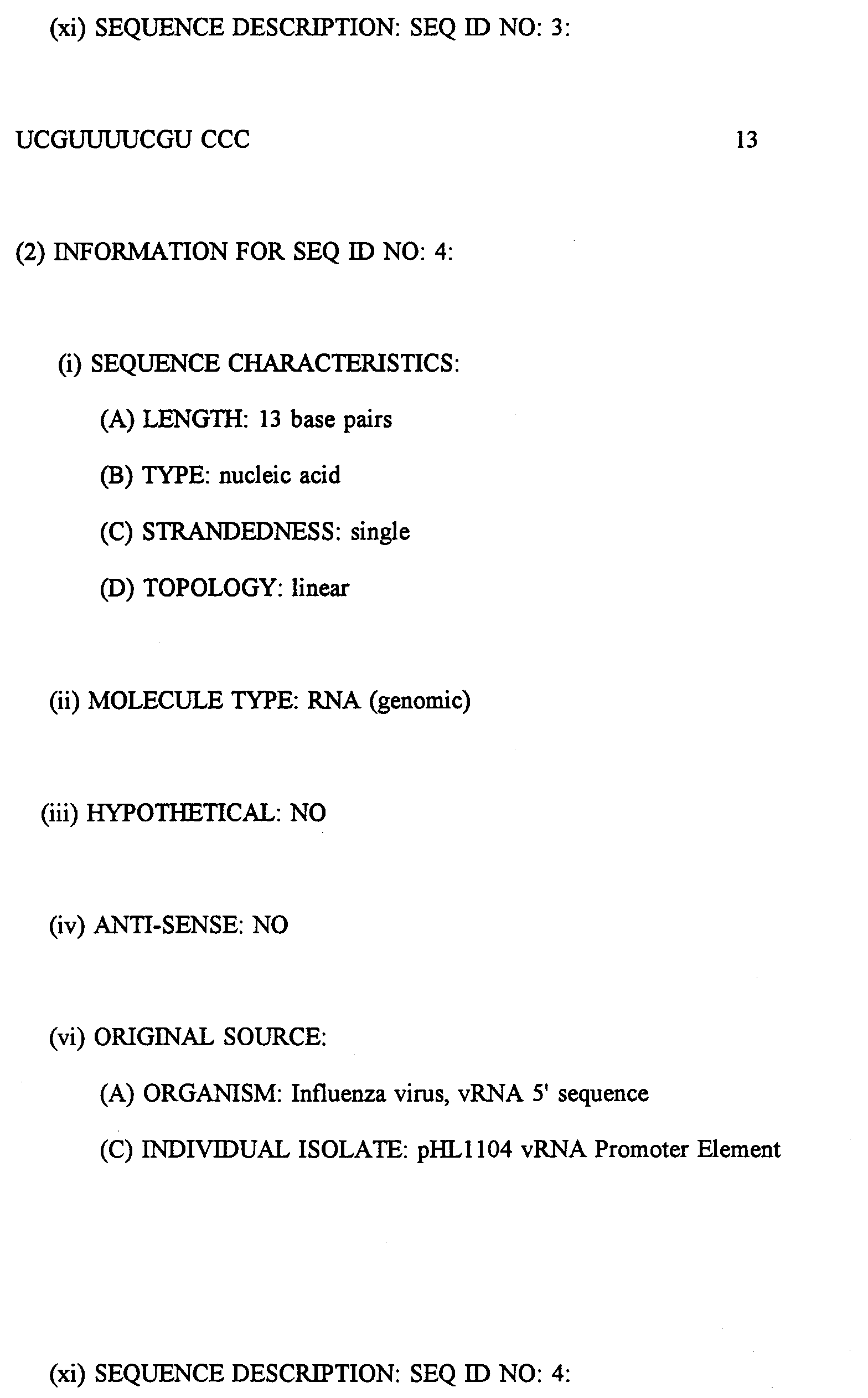
- Influenza A viral RNA 5' and 3' ends have similar, but not identical sequences with nucleotide mismatches at positions 3, 5 and 8, and an additional unpaired nucleotide is located at position 10 in the 5' region. Nevertheless, both vRNA termini hybridize into a double stranded panhandle structure made up of twelve and thirteen nucleotides in common for all eight RNA segments, plus in average three additional basepairs specific for each of the vRNA molecules. Due to the deviations mentioned the cRNA or plus strand panhandle structures have to be different from the vRNA structures; however, both are recognized by viral RNA polymerase and are used for initiation of RNA synthesis, i.e. they are constituting a promoter structure.
- RNA panhandle structure Even if in initial recognition and binding of RNA polymerase the double stranded RNA panhandle structure is known to be the substrate, and is also observed in virion RNPs (Hsu et al., 1987), for the initiation step of transcription at the 3' ultimate template position this terminal region has to be separated into a partially single stranded, i.e. 'forked' structure (Fodor et al., 1994).
- RNA polymerase may be predicted to continue its binding interaction with both, the remaining double stranded segment: nucleotides 10 to 15 versus 11 to 161, and to the single stranded 3' template segment: nucleotides 1 up to 9 , as well as the 5' single stranded end (Tiley et al., 1994).
- Introduction of mutations at specific positions in either strand may hence alterate simultaneously both of these consecutive vRNA promoter structures: panhandle and fork in different ways, and will in addition also result in corresponding variations of the cRNA promoter structure.
- 1Notations concerning nucleotides 1 to 15 refer to positions in the vRNA 3' end, e.g. position 2 designates the penultimate nucleotide; 5' end positions are given in ordinary numbers.
- the notation G3A describes a mutational change of guanosine to adenosine at position 3.
- pHL1124 three complementary point mutations introduced at the 5' end of the vRNA sequence again in positions 3, 5 and 8 (U3C, G5A, A8G). Together wild-type vRNA 3' end of these variations again result in a panhandle structure free of mismatches and, therefore, pHL 1124 is equivalent in this regard to pHL1104, but different in the sequence of its template and non-template single strands. No significant CAT expression was detected for pHL1124.
- An extra, unpaired residue in position 10 at the 5' end is a specific feature of the influenza viral RNA panhandle structure. It is causing or at least enforcing a major bulge of the structure, together with unpaired residues at position 9, and might be part of a specific recognition element of that structure by viral RNA polymerase.
- a further series of plasmid constructs has been initiated, again based on pHL1104 and its 3' terminal sequence as a reference.
- a perfectly matched RNA double-strand without any bulge has been achieved either by inserting an additional U residue in the 3' end sequence opposite A10 (pHL1140) or by deleting the A10 residue from the 5' sequence (pHL1152).
- mutant viral RNAs of this character become accumulated and effectively selected in further passaging, while packaging may be a neutral event in this regard, at least for the variants analysed here.
- RNA panhandle structure - viral RNA polymerase - viral NP protein - viral M1 protein will reflect the pools of the various vRNA segments in infected cells, and therefore may be biased towards an RNA segment superior in replication and overrepresented in that pool.
- Biased replication and packaging will, however, lead to accumulation of lethal viral particles due to an imbalance between the eight (or nine) viral RNA segments.
- This prediction is borne out in continuing the viral passage of pHL1104 derived influenza supernatants beyond step three as exemplified in Fig. 2.
- CAT expression based on transcription of the pHL1104 derived pseudoviral RNA segments is increased further up to the fifth passage the number of viable viruses reaches a maximum already after the second step of viral passaging, thus demonstrating the continuous accumulation of an over-replicated foreign segment, based on a superior panhandle sequence.
- a virus preparation obtained in this way can be regarded as the equivalent of an attenuated viral strain. While the concentration of attenuated virus particles that can be achieved in this way may appear to be limited a stage equivalent to passage 4 in Fig. 2 may be delayed upon coinfection with wildtype helper virus during first or second steps of transfer, and considerably increased concentrations of attenuated virus preparations might be achievable in this way.
- vRNA In influenza viral RNA synthesis parental negative-strand vRNA is copied into plus-strand cRNA, which again is copied into progeny vRNA, from the first to the last nucleotide. This amplification of viral RNAs, however, proceeds in an inherently asymmetric way, since vRNA molecules are synthesized in excess over cRNA molecules. This result is consistent with the idea that cRNA carries a promoter structure more active in binding viral RNA polymerase and in initiation of RNA synthesis, i.e. 'stronger' than does vRNA.
- panhandle structures involving both ends of the vRNA sequence in virions suggest more complicated substrates for RNA polymerase binding and initation of daughter-strand synthesis.
- panhandle structure has also been observed with model vRNA molecules in the absence of viral proteins in vitro (Baudin et al., 1994), possibly calling for a structural change upon viral RNA polymerase binding, i.e. a bulge may be shifted from position 4 to position 10 in that reaction (see Fig. 1).
- RNA polymerase / vRNA binding experiments in vitro appeared to show recognition only of 3' end oligonucleotides, this has since been shown to be an artifact after pure, recombinant viral polymerase free of residual RNA became available, instead of enzyme preparations from virions.
- RNA polymerase binding to viral RNA as well as endonucleolytic cleavage of cellular mRNAs by subunit PB2 was observed to depend on vRNA 5' plus 3' terminal sequence binding, with even higher affinity for the 5' non-template segment (Hagen et al., 1994; Tiley et al., 1994).
- vRNA promoters will also serve in initiation of viral mRNA synthesis according to the cap-snatching mechanism (Plotch et al., 1979; Braam et al., 1983). While it has been claimed that cRNA promoters would not have the capacity to act according to this scheme (Tiley et al., 1994), the failure to observe viral antisense mRNA molecules may simply reflect the inavailability of cRNA molecules early in infection, i.e. in the absence of surplus viral NP protein, and small amounts of such molecules might even have gone undetected.
- RNA polymerase in this structure may predominantly be oriented towards sequence elements in the non-template strand, since the growing point of RNA synthesis will have to move along the entire template strand following its initiation. It is, therefore, possible that such a binding interaction survives most or all of an individual round of mRNA synthesis as has been proposed (Tiley et al., 1994).
- vRNA molecules derived from pHL1104 templates will create three additional basepairs able to stabilize the panhandle structure in general, but more specifically they will favor a bulged adenosine 10 over the bulged adenosine 4 conformation as observed for the wild-type sequence in vitro (Baudin et al., 1994). Since the changes introduced here lead to a considerable enhancement of promoter activity we propose that a bulged 10 conformation may be the structure underlying the vRNA / polymerase binding reaction, which otherwise would have to be achieved only as a result of that interaction.
- a bulged 10 adenosine residue may constitute a kind of flexible joint or angular kink which in turn suggests two major, structurally stable binding sites to the left and right of this element.
- One of these sites has to be the double-stranded sequence element of (in average) six basepairs extending from positions 11 to 16 and 10 ⁇ to 15 ⁇ , respectively. While the distal three basepairs are known to be variable for the various RNA segments, basepair 13/ 12 ⁇ has been shown to be exchangeable experimentally, and also the number of basepairs has been reduced to four without complete loss of function (Luo et al., 1991).
- RNA double-strand of certain stability while it remains possible that residue 12 guanosine and potentially others are also recognized individually within that structure.
- a major second binding element for RNA polymerase on the other side relative to position 10 is less evident, but may be located in a distance of nearly one helical turn in the de-bulged region around position 4, since direct contacts are suggested by that initial conformational interaction, and also by the specific requirement of a guanosine residue in position 5, which is likely to interact not only during, but also before partial strand separation in that region, i.e. in the panhandle as well as the forked structure.
- Plasmids with mutated vRNA and/or mutated cRNA promoter sequences are derivatives of pHL926 (Zobel et al., 1993; Neumann et al., 1994).
- pHL926 a hybrid CAT cDNA with flanking non-coding sequences derived from influenza vRNA segments has been precisely inserted in antisense orientation between mouse rDNA promoter and terminator sequences.
- the CAT reporter gene in this way has been introduced by exactly replacing the coding sequence for hemagglutinin, retaining the untranslated viral 5' and 3' sequences of segment 4.
- vRNA 5' end mutations were created by PCR, using a general primer hybridizing to a position in the flanking rDNA promoter sequence, and a specific primer carrying the desired nucleotide substitution to be introduced in the viral terminal sequence.
- the polymerase chain reaction products were first digested by the restriction enzymes Bgl II and Spe I, inserted into the left boundary position by exchanging the segment between these appropriate restricton sites in pHL926, and finally confirmed in their constitution by DNA Sanger sequencing.
- PCR products were obtained by using a general primer complementary to a CAT gene internal sequence position, and a specific primer with appropriate nucleotide exchanges inserted into its sequence. Following digestion with restriction enzymes Nco I and Sca I, the PCR products were cloned into Nco I- and Sca I(partially)-digested plasmid pHL926. Any PCR derived sequences were investigated by DNA sequencing.
- 5' variation containing fragments were obtained by Bgl II and Spe I restriction and inserted into the appropriate 3' terminal variation plasmids.
- Influenza A/FPV/Bratislava viruses were grown in NIH3T3 cells.
- B82 cells a mouse L cell line
- MDCK cells were used for transfection and passaging experiments.
- B82 cells were used. 5 ⁇ g of plasmid DNA were mixed with 60 ⁇ g of Lipofectamin (LipofectaminTM, GIBCO/BRL) in serum-free medium and incubated at room temperature for 10-15 min. This mixture was added to the cells washed twice with serum-free medium, and the incubation with Lipofectamin/DNA was continued for 1 hr. After further incubation with DMEM medium for 1 hr the transfected B82 cells were infected with influenza A/FPV/Bratislava at a multiplicity of infection of 0.01 to 1 for another 30-60 min. Further incubation was performed with DMEM medium.
- Lipofectamin LipofectaminTM, GIBCO/BRL
- the assay mixture contained: 0.1 ⁇ Ci [14C]chloramphenicol, 20 ⁇ l 4 mM Acetyl-CoA, 25 ⁇ l 1 M Tris-HCl (pH 7.5) and 50 ⁇ l of cell lysate in a total volume of 150 ⁇ l.
- the assay mixture for the fluorescent-labeled substrate contained (in a final volume of 80 ⁇ l): 10 ⁇ l 0.25 M Tris-HCl (pH 7.5), 10 ⁇ l 4 M Acetyl-CoA, 10 ⁇ l fluorescent-labeled chloramphenicol, and 50 ⁇ l of cell lysate. After an incubation time of 16 hr the reaction products were separated by chromatography and either autoradiographed or visualized by UV illumination and photography.
- Fig. 1 Proposed scheme of consecutive conformational steps occurring prior to initiation of viral mRNA synthesis in influenza vRNA, in wildtype and pHL1104 derived mutant sequences. Positions of triple mutation in pHL1104 vRNA are indicated in bold and larger size letters.
- A Free RNA panhandle structure, bulged at position 4 (wildtype vRNA; Baudin et al, 1994) or at position 10 (mutant vRNA).
- B Bulged 10 panhandle structures after binding of viral RNA polymerase; proposed protein binding positions marked by underlignments.
- C Forked structures of partial strand separation.
- D Initiation of viral mRNA synthesis via hybridization of capped primer oligonucleotide.
- Fig. 2 Serial passaging of pHL 1104-derived progeny viruses.
- 107 B82 cells were transfected with 5 ⁇ of pHL 1104 DNA (in 60 ⁇ g Lipofectamin) and infected two hours later with influenza A/FPV/Bratislava (m.o.i:1). 8 hr post-infection the cells were assayed for plaque forming units (dark column) and for CAT activity (hatched column) After sedimentation an other aliquot of the supernatant was adsorbed to 107 MDCK cells. Further rounds of passaging were done equivalently by harvesting the cells 8 hr after infection for assaying CAT activities, whereas an aliquot of the supernatant was always adsorbed to fresh MDCK cells. Numbers of serial passages are indicated at the bottom. Plaque forming units per ml refer to the left ordinate, CAT expression rates (relative to primary imfection levels) to the ordinate on the right.
Landscapes
- Health & Medical Sciences (AREA)
- Life Sciences & Earth Sciences (AREA)
- Genetics & Genomics (AREA)
- Engineering & Computer Science (AREA)
- Chemical & Material Sciences (AREA)
- Bioinformatics & Cheminformatics (AREA)
- Organic Chemistry (AREA)
- Wood Science & Technology (AREA)
- Zoology (AREA)
- Biomedical Technology (AREA)
- Biotechnology (AREA)
- General Engineering & Computer Science (AREA)
- General Health & Medical Sciences (AREA)
- Biochemistry (AREA)
- Virology (AREA)
- Microbiology (AREA)
- Biophysics (AREA)
- Plant Pathology (AREA)
- Molecular Biology (AREA)
- Physics & Mathematics (AREA)
- Immunology (AREA)
- Medicinal Chemistry (AREA)
- Micro-Organisms Or Cultivation Processes Thereof (AREA)
- Medicines Containing Antibodies Or Antigens For Use As Internal Diagnostic Agents (AREA)
- Medicines That Contain Protein Lipid Enzymes And Other Medicines (AREA)
- Enzymes And Modification Thereof (AREA)
- Medicines Containing Material From Animals Or Micro-Organisms (AREA)
- Measuring Or Testing Involving Enzymes Or Micro-Organisms (AREA)
- Preparation Of Compounds By Using Micro-Organisms (AREA)
Abstract
RNA polymerase I transcription in vivo in transiently DNA-transfected cells has been used for expression of influenza vRNA molecules coding for chloramphenicol acetyltransferase (CAT) in anti-sense orientation. Influenza virus superinfection served to provide viral RNA polymerase and other proteins for transcriptional conversion of minus-strand vRNA into plus-strand viral mRNA molecules expressing CAT activity. This system has been used for an analysis via nucleotide exchanges as well as deletions and insertions of both terminal segments of the vRNA sequence which cooperatively constitute the vRNA promoter structure. Several mutants with greatly enhanced expression rates over wild-type levels have been constructed, which also can be packaged and serially passaged into progeny virus. The data obtained for the mutations in various promoter elements support a model of consecutive, doublestrand vRNA promoter structures in binding of viral polymerase and initiation of RNA synthesis.
Description
- The object of the present invention was to make a vaccination virus. This objective has been fulfilled with the segmented virus described herein.
- The genome of influenza A viruses consists of 8 different single-stranded viral RNA (vRNA) molecules of negative polarity, which have in common 5' and 3' terminal sequences largely complementary to each other. These conserved segments 13 and 12 nucleotides in length are known to form double-stranded RNA panhandle structures (Hsu et al., 1987; Fodor et al., 1993) which have been analysed in more detail recently in vitro using internally deleted model RNAs (Baudin et al., 1994; Tiley et al., 1994). In the virion the panhandle ends of all RNA segments are found in specific binding to viral RNA polymerase complexes, while the remaining internal segments stay single-stranded with viral nucleoprotein (NP) in cooperative binding (Compans et al., 1972; Honda et al., 1988; Martin et al., 1992). Upon infection these viral RNPs initially serve as templates for the synthesis of viral mRNAs by a specific cap-snatching mechanism (Plotch et al., 1979; Braam et al., 1983), and later on will direct synthesis of full-length complementary RNAs (cRNAs), probably dependent on the absence or presence of newly synthesized NP protein (Shapiro and Krug, 1988). The plus-strand cRNAs are then used as templates for progeny vRNA synthesis.
- The viral RNA polymerase complex consisting of proteins PB1, PB2, and PA is involved in all three different modes of RNA synthesis during the viral replication cycle, following its specific binding to the terminal panhandle segments of both vRNAs and cRNAs. Sequence comparison reveals that the vRNA and cRNA termini have similar, but not identical sequences. For that reason vRNA and cRNA recognition may be distinguished because of these structural alterations allowing for asymmetries in initiation of plus and minus strand RNA synthesis, and possibly in viral RNP packaging, which has also been suggested to be controlled by the panhandle RNA sequence (Hsu et al., 1987).
- Recently, we reported on an in vivo system for the introduction of specific mutations into the genome of influenza viruses: viral cDNA has been inserted in antisense orientation between mouse rDNA promoter and terminator sequences. This has been derived from in vitro transcription experiments based on nuclear extracts from Ehrlich ascites cells, which resulted in transcripts exactly resembling influenza vRNA. For a series of in vivo studies, the viral coding sequence was replaced by the coding sequence for chloramphenicol-acetyltransferase (CAT), however, with both influenza terminal non-coding sequences being retained exactly on the resulting vRNA transcripts. After transfection of this recombinant DNA template into mouse cells followed by influenza virus infection, CAT activity was detectable. Transfer of supernatants to different cells demonstrated that CAT-vRNAs transcribed in vivo by cellular RNA polymerase I were not only transcribed by viral RNA polymerase into plus-strand mRNA and translated into CAT protein, but also were replicated and packaged into infectious progeny virus particles (Zobel et al., 1993; Neumann et al., 1994).
- We have used this system for a stepwise introduction of single and multiple mutations into the conserved panhandle RNA sequence, thereby effectively converting the HA-vRNA promoter sequence into an HA-cRNA promoter sequence and vice versa. For these series of constructs CAT activities have been measured both in primarily transfected and infected B82 cells and, after passaging of B82 supernatants, in secondarily infected MDCK cells. From the results obtained we propose a model for the terminal RNA sequence as being recognized RNA polymerase in consecutive steps of different structure when used as a template for initiation of viral mRNA synthesis.
- The present invention relates to a segmented RNA virus which comprises one or more segments which have been genetically modified to show improved transcription, replication and/or expression rates.
- The virus can be one where one or more modifications have been introduced in the noncoding region(s) and/or one or more modifications have been introduced in the coding region(s). A possibility is that at least one modified segment is derived from an original one by sequence variation(s). It is also possible that at least one modified segment is an artificial addition to the set of original or modified original segments. The virus can be one wherein the modified segment comprises a nucleotide sequence which codes for a protein or peptide which is foreign to the original virus. Preferred is that the foreign protein or peptide constitutes an antigen or antigen-like sequence, a T-cell epitope or related sequence. In such a case it is possible that the segment comprises repetitions of an antigen or epitope or other. Such an antigen or epitope can be derived from HIV, Herpes-Virus, Rhinovirus or CMV. The virus of the present invention may be a single stranded negative-strand RNA virus as for example one of the Orthomyxoviridae family, the Bunyaviridae family or of the Arenaviridae family. The most preferred virus is an influenza virus. The virus of the present invention can also be a double-stranded RNA virus, as for example a reovirus, a rotavirus or an orbivirus.
- The present invention also relates to the virus and use of the virus for the preparation of pharmaceuticals.
- Influenza A viral RNA 5' and 3' ends have similar, but not identical sequences with nucleotide mismatches at
positions position 10 in the 5' region. Nevertheless, both vRNA termini hybridize into a double stranded panhandle structure made up of twelve and thirteen nucleotides in common for all eight RNA segments, plus in average three additional basepairs specific for each of the vRNA molecules. Due to the deviations mentioned the cRNA or plus strand panhandle structures have to be different from the vRNA structures; however, both are recognized by viral RNA polymerase and are used for initiation of RNA synthesis, i.e. they are constituting a promoter structure. Even if in initial recognition and binding of RNA polymerase the double stranded RNA panhandle structure is known to be the substrate, and is also observed in virion RNPs (Hsu et al., 1987), for the initiation step of transcription at the 3' ultimate template position this terminal region has to be separated into a partially single stranded, i.e. 'forked' structure (Fodor et al., 1994). RNA polymerase may be predicted to continue its binding interaction with both, the remaining double stranded segment:nucleotides 10 to 15 versus 11 to 16¹, and to the single stranded 3' template segment:nucleotides 1 up to 9 , as well as the 5' single stranded end (Tiley et al., 1994). Introduction of mutations at specific positions in either strand may hence alterate simultaneously both of these consecutive vRNA promoter structures: panhandle and fork in different ways, and will in addition also result in corresponding variations of the cRNA promoter structure.
¹Notations concerning nucleotides 1 to 15 refer to positions in the vRNA 3' end,e.g. position 2 designates the penultimate nucleotide; 5' end positions are given in ordinary numbers. The notation G3A describes a mutational change of guanosine to adenosine atposition 3. - To investigate the importance of the three mismatch positions, specific single, double or triple nucleotide exchanges were first introduced into the vRNA 3' end sequence at
positions position 10. Single nucleotide exchanges according to this scheme (pHL1098, pHL1099, pHL1100) abolished the promoter activity, and no CAT activity was observed, as has been reported before with a different method (Luo et al., 1993). Two of the double mutation constructs (pHL1101, pHL1103) also gave negative results. - In contrast, for pHL1102 (G3A, U8C)¹ a significant CAT activity was detected, distinctly higher than for the corresponding wild-type construct (pHL926;) which in the conditions applied (8 hr after infection) resulted in rather low levels of CAT expression. This activity increase is further enhanced for the final construct of this series carrying the triple exchange G3A, C5U and U8C (pHL1104), i. e. transfection of pHL1104 DNA followed by influenza virus infection resulted in a very high level of CAT expression, also considerably above the pHL1102 results.
¹Notations concerning nucleotides 1 to 15 refer to positions in the vRNA 3' end,e.g. position 2 designates the penultimate nucleotide; 5' end positions are given in ordinary numbers. The notation G3A describes a mutational change of guanosine to adenosine atposition 3. - These results have been repeated using various conditions of transfection and infection as well as determining kinetic data during the course of infection. While the pHL1104 variant is always observed far superior over any wild-type construct that expression ratio may be variable and difficult to quantitate (between around 20 fold and nearly 100 fold). Rather short infective cycles of eight hours as used prevalently appear to put more slowly replicating, i.e. wild-type molecules at a disadvantage, in particular in passaging of packaged pseudo-vRNA molecules via virus progeny, both is found increased for wildtype and related constructs after DNA transfection plus twelve hours of infection (see Neumann et al., 1994). Remaining deviations in CAT expression ratios may be attributed to variations in growth conditions in individual experiments.
- We also addressed the question whether the unexpectedly high viral mRNA expression rate of pHL1104 is the consequence of a stabilized panhandle double-strand structure or may be directly attributed to the point mutations introduced into the vRNA 3' sequence, and active when being used as a single-stranded template segment, e.g. in the 'forked' structure.
- For this purpose we constructed pHL1124, three complementary point mutations introduced at the 5' end of the vRNA sequence again in
positions positions 


- In order to determine in detail the influence of single, double and triple exchanges at the vRNA 5' end upon CAT expression rates we also used the improved vRNA 3' end sequences of pHL1104 and pHL1102 as starting points rather than the corresponding wild-type sequence. From the series of experiments related to pHL1104 and from the equivalent series related to pHL 1102 it can be concluded that retaining a G residue in
postion 5 is the most important single feature in these 5' end variations. A single exchange into an A residue atposition 5 as in pHL1185 will render the promoter entirely inactive, while single exchanges inpositions 3 or 8, as well as a 3 plus 8 double exchange will retain promoter activity even if reduced from the level observed for pHL1104, but still above wild-type expression rates. While the G5A nucleotide substitution opposite nucleotide C5 in the 3' terminus results in losing one basepair (in the panhandle context) within the pHL1104 series, a basepair is indeed gained by exactly the same G5A exchange within the pHL1102 series, i.e. opposite the U5 residue as present in the pHL1102 vRNA 3' end. Since again the G5A exchange results in loss of promoter function inspite of gaining one basepair we conclude that the guanosine atposition 5 may be important for RNA polymerase binding within the 5' non-template single strand rather than being part of the panhandle double-stranded structure in this region. The importance of a G residue at this position has been shown earlier in a single-step mutational analysis (Li and Palese, 1992), while non-template strand binding of RNA polymerase has been studied recently in vitro (Tiley et al., 1994). Different from the deleterious effect of an exchange atposition 5 exchanges atpositions 3 and in particular 8 are of minor importance. The series of 5' nucleotide exchanges has also been repeated for the pHL1102 version of the vRNA 3' end yielding exactly the same pattern of results, albeit at the somewhat reduced levels characteristic for pHL1102. The only result in both series not quite in agreement with a uniquely important role for a G-residue inposition 5 is the triple exchange of pHL1126 which retains low promoter activity inspite of an A residue in that position. Due to altogether six concerted exchanges inpositions 


position 10 of pHL1126 while an unpaired uridine atposition 
position 5, even if at a clearly reduced level of activity. - In the parallel pHL1102 series the corresponding triple exchange clone pHL1125 does not show any promoter activity; however, because of its deviation atposition 5 it does not completely resemble the cRNA panhandle structure. - An extra, unpaired residue in
position 10 at the 5' end is a specific feature of the influenza viral RNA panhandle structure. It is causing or at least enforcing a major bulge of the structure, together with unpaired residues at position 9, and might be part of a specific recognition element of that structure by viral RNA polymerase. In order to investigate the importance of that particular structural feature, a further series of plasmid constructs has been initiated, again based on pHL1104 and its 3' terminal sequence as a reference. A perfectly matched RNA double-strand without any bulge has been achieved either by inserting an additional U residue in the 3' end sequence opposite A10 (pHL1140) or by deleting the A10 residue from the 5' sequence (pHL1152). Finally, a bulge of opposite direction was created in the panhandle structure of pHL1164 with an extra U residue inposition 
position 10 deleted from the 5' end sequence. While the latter two constructs proved inactive in the CAT assay, pHL1140 did show some promoter activity, albeit at a reduced level. We conclude from this result that a bulge in this region may not be recognized directly by viral RNA polymerase but may serve as a flexible joint between two more rigid structural elements that are involved in immediate contact with viral polymerase. The necessary RNA bending may also, but less efficiently be achieved in an A·U-basepaired structure like pHL1140, while the other two structures would not permit such type of interaction with RNA polymerase. This interpretation has also been substantiated in a further series of variations in this region . - All previous experiments consisted of a first measurement of viral mRNA synthesis in DNA-transfected and infected B82 cells, followed by a second measurement of viral mRNA synthesis in infected MDCK cells, after passaging of progeny virus containing supernatants. CAT expression in infected cells upon viral passaging requires packaging of pseudo-viral vRNAs, in addition to new rounds of viral mRNA synthesis in those cells leading to CAT expression again. All viral promoter mutants analysed and found active in transfected and helper-infected B82 cells also resulted in CAT expression after transfer, and consistently in equivalent ratios of activity. Packaging, therefore, cannot be correlated with any specific element in the vRNA promoter structure so far, and does not appear to be a limiting factor in constructing influenza virus mutants in this system. While CAT expression after passaging in general appeared to be increased over the levels before passaging this might have been simply the result of different cells being used for the first and second step of CAT analysis, with MDCK being superior to B82 cells in influenza mRNA synthesis and also in progeny yields. Therefore, several experiments of serial passage have been performed using pHL1104 derived influenza supernatants and others, in MDCK cells. In these serial passages, always done using aliquots of supernatants harvested eight hours after infection for further transfer, a stepwise increase of CAT expression is observed (Fig. 2). Apparently the superior performance of viral RNA promoters carrying sequence deviations according to pHL1104 is not only true for viral mRNA synthesis, but also for viral RNA replication, even if not to the same extent.
- Therefore, mutant viral RNAs of this character become accumulated and effectively selected in further passaging, while packaging may be a neutral event in this regard, at least for the variants analysed here.
- During further passaging of supernatants the CAT containing influenza segment carrying the mutationally altered viral promotor sequences became accumulated in a stepwise manner in the population of progeny viruses. In order to demonstrate this effect on the level of individual viruses being transferred we isolated in three indepentent experiments 50 to 85 plaques each after a third round of passage on MDCK cells. Each cell lysate obtained for the individual plaques was assayed for CAT activity according to the standard protocoll. While in two of the experiments the fraction of CAT positive plaques was in the range of 4 to 8% (1 out of 50, 4 out of 40 plaques) in one of these series this fraction amounted to 47% (19 of 40 plaques). Both of these results demonstrate a substantial increase over the initial fraction of CAT-segment containing virus, which may be calculated to be in the range of 10⁻⁵ or at most 10⁻⁴, and slight variations in the conditions of growth during three steps of transfer may precipitate to result in the observed differences of CAT positive plaques. While every CAT positive plaque demonstrates the amplification of nine (not eight) viral RNA segments present in the initially infected cell, this may have resulted from a single virus carrying nine or more RNA segments from coinfection by two defective viruses able to complement each other.
- Necessarily, accumulation of a pseudo-viral segment not contributiong to viral growth will, in further steps, become lethal to viral growth, even if a majority of virions may contain an average of eleven rather than eight RNA segments (Hsu et. al. 1987). Packaging of viral RNA-segments based on a general packaging signal identical for all eight segments and realized via a specific interaction chain: vRNA panhandle structure - viral RNA polymerase - viral NP protein - viral M1 protein will reflect the pools of the various vRNA segments in infected cells, and therefore may be biased towards an RNA segment superior in replication and overrepresented in that pool. Biased replication and packaging will, however, lead to accumulation of lethal viral particles due to an imbalance between the eight (or nine) viral RNA segments. This prediction is borne out in continuing the viral passage of pHL1104 derived influenza supernatants beyond step three as exemplified in Fig. 2. While CAT expression based on transcription of the pHL1104 derived pseudoviral RNA segments is increased further up to the fifth passage the number of viable viruses reaches a maximum already after the second step of viral passaging, thus demonstrating the continuous accumulation of an over-replicated foreign segment, based on a superior panhandle sequence.
- At a stage representing the third or fourth passage as displayed in Fig. 2 a virus preparation obtained in this way can be regarded as the equivalent of an attenuated viral strain. While the concentration of attenuated virus particles that can be achieved in this way may appear to be limited a stage equivalent to
passage 4 in Fig. 2 may be delayed upon coinfection with wildtype helper virus during first or second steps of transfer, and considerably increased concentrations of attenuated virus preparations might be achievable in this way. - In influenza viral RNA synthesis parental negative-strand vRNA is copied into plus-strand cRNA, which again is copied into progeny vRNA, from the first to the last nucleotide. This amplification of viral RNAs, however, proceeds in an inherently asymmetric way, since vRNA molecules are synthesized in excess over cRNA molecules. This result is consistent with the idea that cRNA carries a promoter structure more active in binding viral RNA polymerase and in initiation of RNA synthesis, i.e. 'stronger' than does vRNA. While at first simply the two 3' ends of single-stranded vRNA and cRNA templates have been implicated as promoter sequences, the detection of double-stranded panhandle structures involving both ends of the vRNA sequence in virions (Hsu et al., 1987) suggested more complicated substrates for RNA polymerase binding and initation of daughter-strand synthesis. A slightly different panhandle structure has also been observed with model vRNA molecules in the absence of viral proteins in vitro (Baudin et al., 1994), possibly calling for a structural change upon viral RNA polymerase binding, i.e. a bulge may be shifted from
position 4 to position 10 in that reaction (see Fig. 1). While originally several of the RNA polymerase / vRNA binding experiments in vitro appeared to show recognition only of 3' end oligonucleotides, this has since been shown to be an artifact after pure, recombinant viral polymerase free of residual RNA became available, instead of enzyme preparations from virions. Under these conditions RNA polymerase binding to viral RNA as well as endonucleolytic cleavage of cellular mRNAs by subunit PB2 was observed to depend on vRNA 5' plus 3' terminal sequence binding, with even higher affinity for the 5' non-template segment (Hagen et al., 1994; Tiley et al., 1994). - Different from the employment of both vRNA and cRNA promoter structures in replication physiologically only vRNA promoters will also serve in initiation of viral mRNA synthesis according to the cap-snatching mechanism (Plotch et al., 1979; Braam et al., 1983). While it has been claimed that cRNA promoters would not have the capacity to act according to this scheme (Tiley et al., 1994), the failure to observe viral antisense mRNA molecules may simply reflect the inavailability of cRNA molecules early in infection, i.e. in the absence of surplus viral NP protein, and small amounts of such molecules might even have gone undetected. In this invention we describe a mutagenizational analysis of the vRNA promoter structure in vivo which in approaching the structure of the cRNA promoter via three nucleotide exchanges shows considerably improved activity in viral mRNA synthesis over vRNA promoter wild-type levels. Continuing increase of viral CAT mRNA expression during consecutive steps of viral passaging suggests that the same vRNA promoter mutants also show increased activity in cRNA synthesis, both in accordance with the idea that the cRNA promoter structure might be 'stronger' than the vRNA promoter, also in initiation of viral mRNA synthesis.
- Additional variations of the 5' terminal sequence clearly indicate the major importance of a G residue in
position 5, irrespective of complementarity or not to position
data guanosine residue 5 may be involved in single-strand binding of RNA polymerase as has indeed been observed for the non-template strand terminal segment (Tiley et al., 1994). While panhandle double-strand structures are likely to constitute the initial RNA polymerase binding substrate a partial separation of template and non-template strands is expected to take place consecutively resulting in a 'forked structure' such as proposed by Fodor et al. (1994). Specific and tight binding of RNA polymerase in this structure may predominantly be oriented towards sequence elements in the non-template strand, since the growing point of RNA synthesis will have to move along the entire template strand following its initiation. It is, therefore, possible that such a binding interaction survives most or all of an individual round of mRNA synthesis as has been proposed (Tiley et al., 1994). - The triple nucleotide exchanges as introduced in vRNA molecules derived from pHL1104 templates will create three additional basepairs able to stabilize the panhandle structure in general, but more specifically they will favor a bulged
adenosine 10 over the bulgedadenosine 4 conformation as observed for the wild-type sequence in vitro (Baudin et al., 1994). Since the changes introduced here lead to a considerable enhancement of promoter activity we propose that a bulged 10 conformation may be the structure underlying the vRNA / polymerase binding reaction, which otherwise would have to be achieved only as a result of that interaction. A bulged 10 adenosine residue may constitute a kind of flexible joint or angular kink which in turn suggests two major, structurally stable binding sites to the left and right of this element. One of these sites has to be the double-stranded sequence element of (in average) six basepairs extending frompositions 11 to 16 and


position 4, since direct contacts are suggested by that initial conformational interaction, and also by the specific requirement of a guanosine residue inposition 5, which is likely to interact not only during, but also before partial strand separation in that region, i.e. in the panhandle as well as the forked structure. While an extra adenosine residue inposition 10 may be optimal for creating a correctly shaped bulge in this region of RNA, structural variants are possible in this regard (see pHL 1140) which excludes direct interactions between RNA polymerase and residues constituting that bulge. - In summary we are proposing a model (see Fig. 1) of consecutive steps of interaction between a vRNA or cRNA promoter structure and viral RNA polymerase:
bulged 4 panhandle → bulged 10 panhandle / polymerase → forked RNA / polymerase (bound to 5G and ds element 11-16) → initiation of RNA synthesis (recognition of 3' end of template). - Plasmids with mutated vRNA and/or mutated cRNA promoter sequences are derivatives of pHL926 (Zobel et al., 1993; Neumann et al., 1994). In pHL926 a hybrid CAT cDNA with flanking non-coding sequences derived from influenza vRNA segments has been precisely inserted in antisense orientation between mouse rDNA promoter and terminator sequences. The CAT reporter gene in this way has been introduced by exactly replacing the coding sequence for hemagglutinin, retaining the untranslated viral 5' and 3' sequences of
segment 4. - vRNA 5' end mutations were created by PCR, using a general primer hybridizing to a position in the flanking rDNA promoter sequence, and a specific primer carrying the desired nucleotide substitution to be introduced in the viral terminal sequence. The polymerase chain reaction products were first digested by the restriction enzymes BglII and SpeI, inserted into the left boundary position by exchanging the segment between these appropriate restricton sites in pHL926, and finally confirmed in their constitution by DNA Sanger sequencing.
- Generation of vRNA 3' end mutations followed the same general scheme at the right boundary. PCR products were obtained by using a general primer complementary to a CAT gene internal sequence position, and a specific primer with appropriate nucleotide exchanges inserted into its sequence. Following digestion with restriction enzymes NcoI and ScaI, the PCR products were cloned into NcoI- and ScaI(partially)-digested plasmid pHL926. Any PCR derived sequences were investigated by DNA sequencing.
- For constructs with both 5' end and 3' end mutations in combination, 5' variation containing fragments were obtained by BglII and SpeI restriction and inserted into the appropriate 3' terminal variation plasmids.
- Influenza A/FPV/Bratislava viruses were grown in NIH3T3 cells. For transfection and passaging experiments B82 cells (a mouse L cell line) and MDCK cells were used.
- For DNA transfection 10⁷ B82 cells were used. 5 µg of plasmid DNA were mixed with 60 µg of Lipofectamin (Lipofectamin™, GIBCO/BRL) in serum-free medium and incubated at room temperature for 10-15 min. This mixture was added to the cells washed twice with serum-free medium, and the incubation with Lipofectamin/DNA was continued for 1 hr. After further incubation with DMEM medium for 1 hr the transfected B82 cells were infected with influenza A/FPV/Bratislava at a multiplicity of infection of 0.01 to 1 for another 30-60 min. Further incubation was performed with DMEM medium.
- Under standard conditions 8 hr after influenza infection (at moi 0.1 to 1) cells were harvested for CAT assays, and supernatants were collected and spun down at 1200 rpm for 5 min for removal of cell debris.
- Aliquots of virus containing cleared supernatants were used for plaque tests, and another aliquot was adsorbed to 10⁷ MDCK cells for 30-60 min for further passaging. Again 8 hr after infection the CPE was verified, and cells and supernatants were collected and treated as before.
- Cell extracts were prepared as desribed by Gorman et al. (1982). CAT assays were done with [¹⁴Cjchloramphenicol or fluorescent-labeled chloramphenicol (borondipyrromethane difluoride fluorophore; FLASH CAT Kit, Stratagene) as substrates.
- For [¹⁴C]chloramphenicol the assay mixture contained: 0.1 µCi [¹⁴C]chloramphenicol, 20
µl 4 mM Acetyl-CoA, 25 µl 1 M Tris-HCl (pH 7.5) and 50 µl of cell lysate in a total volume of 150 µl. The assay mixture for the fluorescent-labeled substrate contained (in a final volume of 80 µl): 10 µl 0.25 M Tris-HCl (pH 7.5), 10 µl 4 M Acetyl-CoA, 10 µl fluorescent-labeled chloramphenicol, and 50 µl of cell lysate. After an incubation time of 16 hr the reaction products were separated by chromatography and either autoradiographed or visualized by UV illumination and photography. - Baudin,F., Bach,C., Cusack,S. and Ruigrok,R.W.H. (1994) The EMBO J., 13, 3158-3165.
Braam,J., Uhmanen,I. and Krug,R. (1983) Cell, 34, 609-618.
Compans,R.W., Content,J. and Duesberg,P.H. (1972) J. Virol., 10, 795-800.
Fodor,E., Seong,B.L. and Brownlee,G.G. (1993) J. Gen. Virol., 74, 1327-1333.
Fodor,E., Pritlove,D.C. and Brownlee,G.G. (1994) J. Virol., 68, 4092-4096.
Gorman,M., Moffat,L. and Howard,B. (1982) Mol. Cell Biol., 2, 1044-1057.
Hagen,M., Chung,T.D.Y., Butcher,J.A. and Krystal,M. (1994) J. Virol., 68, 1509-1515.
Honda,A., Ueda,K., Nagata,K. and Ishihama,A. (1987) J. Biochem., 102, 1241-1249.
Hsu,M., Parvin,J.D., Gupta,S., Krystal,M. and Palese,P. (1987) Proc. Natl. Acad. Sci. USA, 84, 8140-8144.
Li,X. and Palese,P. (1992) J. Virol., 66, 4331-4338.
Luo,G., Luytjes,W., Enami,M. and Palese,P. (1991) J. Virol., 65, 2861-2867.
Martin,J., Albo,C., Ortin,J., Melero,J.A. and Portela,A. (1992) J. Gen. Virol., 73, 1855-1859.
Neumann,G., Zobel,A. and Hobom,G. (1994) Virology, 202, 477-479.
Plotch,S., Bouloy,M. and Krug,R.M. (1979) Proc. Natl. Acad. Sci. USA, 76, 1618-1622.
Seong,B.L. and Brownlee,G.G. (1992) J. Virol., 73, 3115-3124.
Shapiro,G. and Krug,R. (1988) J. Virol., 62, 2285-2290.
Tiley,L.S., Hagen,M., Matthews,J.T. and Krystal,M. (1994) J. Virol., 68, 5108-5116.
Yamanaka,K., Ogasawara,N., Yoshikawa,H., Ishihama,A. and Nagata,K. (1991) Proc. Natl. Acad. Sci. USA, 88: 5369-5373.
Zobel,A., Neumann,G. and Hobom,G. (1993) Nucl. Acids Res., 21, 3607-3614. - Fig. 1. Proposed scheme of consecutive conformational steps occurring prior to initiation of viral mRNA synthesis in influenza vRNA, in wildtype and pHL1104 derived mutant sequences. Positions of triple mutation in pHL1104 vRNA are indicated in bold and larger size letters.
- (A) Free RNA panhandle structure, bulged at position 4 (wildtype vRNA; Baudin et al, 1994) or at position 10 (mutant vRNA). (B)
Bulged 10 panhandle structures after binding of viral RNA polymerase; proposed protein binding positions marked by underlignments. (C) Forked structures of partial strand separation. (D) Initiation of viral mRNA synthesis via hybridization of capped primer oligonucleotide. - Fig. 2. Serial passaging of pHL 1104-derived progeny viruses.
- 10⁷ B82 cells were transfected with 5µ of
pHL 1104 DNA (in 60 µg Lipofectamin) and infected two hours later with influenza A/FPV/Bratislava (m.o.i:1). 8 hr post-infection the cells were assayed for plaque forming units (dark column) and for CAT activity (hatched column) After sedimentation an other aliquot of the supernatant was adsorbed to 10⁷ MDCK cells. Further rounds of passaging were done equivalently by harvesting the cells 8 hr after infection for assaying CAT activities, whereas an aliquot of the supernatant was always adsorbed to fresh MDCK cells. Numbers of serial passages are indicated at the bottom. Plaque forming units per ml refer to the left ordinate, CAT expression rates (relative to primary imfection levels) to the ordinate on the right.



Claims (10)
- A segmented RNA virus characterized in that it comprises one or more segments which have been genetically modified to show improved transcription, replication and/or expression rates.
- The virus of claim 1, wherein one or more modifications have been introduced in the noncoding region(s) and/or in the coding region(s).
- The virus of any of claims 1 or 2, wherein at least one modified segment is derived from an original one by sequence variation(s).
- The virus of any of claims 1 or 2, wherein at least one modified segment is an artificial addition to the set of original segments.
- The virus of claim 4, wherein the modified segment comprises a nucleotide sequence which codes for a protein or peptide which is foreign to the original virus.
- The virus of claim 5, wherein the foreign protein or peptide constitutes an antigen or antigen-like sequence, a T-cell epitope or related sequence.
- The virus of any of claims 5 or 6, wherein the segment comprises repetitions of an antigen or epitope or other peptide or protein..
- The virus of any of claims 7 to 9, wherein the antigen or epitope is derived from HIV, Herpes-Virus, Rhinovirus or CMV.
- A pharmaceutical preparation of a vaccine comprising the virus of any of claims 1 to 8.
- Use of the virus of any of claims 1 to 8 for the preparation of pharmaceuticals.
Priority Applications (13)
| Application Number | Priority Date | Filing Date | Title |
|---|---|---|---|
| EP94115505A EP0704533A1 (en) | 1994-09-30 | 1994-09-30 | An attenuated vaccination virus, a method to make the virus and a pharmaceutical compositions comprising the virus |
| EP95933386A EP0783586B1 (en) | 1994-09-30 | 1995-09-18 | An attenuated vaccination and gene-transfer virus, a method to make the virus and a pharmaceutical composition comprising the virus |
| DE69524618T DE69524618T2 (en) | 1994-09-30 | 1995-09-18 | WEAKENED VACCINE AND GENTRANSFERASE VIRUS, METHOD FOR THE PRODUCTION THEREOF, AND MEDICINAL PRODUCT THAT CONTAINS |
| AT95933386T ATE210727T1 (en) | 1994-09-30 | 1995-09-18 | ATTENUATED VACCINE AND GENETIC TRANSFERASE VIRUS, METHOD FOR PRODUCING THEREOF AND MEDICINAL PRODUCT CONTAINING IT |
| EP00124417A EP1091000A1 (en) | 1994-09-30 | 1995-09-18 | An attenuated vaccination and gene-transfer virus, a method to make the virus and a pharmaceutical composition comprising the virus |
| CA 2201302 CA2201302A1 (en) | 1994-09-30 | 1995-09-18 | An attenuated vaccination and gene-transfer virus, a method to make the virus and a pharmaceutical composition comprising the virus |
| AU36076/95A AU3607695A (en) | 1994-09-30 | 1995-09-18 | An attenuated vaccination and gene-transfer virus, a method to make the virus and a pharmaceutical composition comprisingthe virus |
| NZ293600A NZ293600A (en) | 1994-09-30 | 1995-09-18 | Segmented rna virus with genetic modifications |
| PCT/EP1995/003663 WO1996010641A1 (en) | 1994-09-30 | 1995-09-18 | An attenuated vaccination and gene-transfer virus, a method to make the virus and a pharmaceutical composition comprising the virus |
| ES95933386T ES2165434T3 (en) | 1994-09-30 | 1995-09-18 | ATTENTIONED VACCINATION AND TRANSFER VIRUS OF GENES, VIRUS PREPARATION PROCEDURE AND PHARMACEUTICAL COMPOSITIONS CONTAINING THE SAME. |
| JP08511323A JP2000509962A (en) | 1994-09-30 | 1995-09-18 | Attenuated vaccination and gene transfer virus, methods for producing the virus, and pharmaceutical compositions containing the virus |
| US08/809,513 US6524588B1 (en) | 1994-09-30 | 1997-03-24 | Attenuated vaccination and gene-transfer virus, a method to make the virus and a pharmaceutical composition comprising the virus |
| FI971272A FI971272A7 (en) | 1994-09-30 | 1997-03-26 | Attenuated vaccine and gene transfer virus, method for preparing the virus and pharmaceutical composition containing the virus |
Applications Claiming Priority (1)
| Application Number | Priority Date | Filing Date | Title |
|---|---|---|---|
| EP94115505A EP0704533A1 (en) | 1994-09-30 | 1994-09-30 | An attenuated vaccination virus, a method to make the virus and a pharmaceutical compositions comprising the virus |
Publications (1)
| Publication Number | Publication Date |
|---|---|
| EP0704533A1 true EP0704533A1 (en) | 1996-04-03 |
Family
ID=8216345
Family Applications (3)
| Application Number | Title | Priority Date | Filing Date |
|---|---|---|---|
| EP94115505A Withdrawn EP0704533A1 (en) | 1994-09-30 | 1994-09-30 | An attenuated vaccination virus, a method to make the virus and a pharmaceutical compositions comprising the virus |
| EP00124417A Withdrawn EP1091000A1 (en) | 1994-09-30 | 1995-09-18 | An attenuated vaccination and gene-transfer virus, a method to make the virus and a pharmaceutical composition comprising the virus |
| EP95933386A Expired - Lifetime EP0783586B1 (en) | 1994-09-30 | 1995-09-18 | An attenuated vaccination and gene-transfer virus, a method to make the virus and a pharmaceutical composition comprising the virus |
Family Applications After (2)
| Application Number | Title | Priority Date | Filing Date |
|---|---|---|---|
| EP00124417A Withdrawn EP1091000A1 (en) | 1994-09-30 | 1995-09-18 | An attenuated vaccination and gene-transfer virus, a method to make the virus and a pharmaceutical composition comprising the virus |
| EP95933386A Expired - Lifetime EP0783586B1 (en) | 1994-09-30 | 1995-09-18 | An attenuated vaccination and gene-transfer virus, a method to make the virus and a pharmaceutical composition comprising the virus |
Country Status (10)
| Country | Link |
|---|---|
| US (1) | US6524588B1 (en) |
| EP (3) | EP0704533A1 (en) |
| JP (1) | JP2000509962A (en) |
| AT (1) | ATE210727T1 (en) |
| AU (1) | AU3607695A (en) |
| DE (1) | DE69524618T2 (en) |
| ES (1) | ES2165434T3 (en) |
| FI (1) | FI971272A7 (en) |
| NZ (1) | NZ293600A (en) |
| WO (1) | WO1996010641A1 (en) |
Cited By (15)
| Publication number | Priority date | Publication date | Assignee | Title |
|---|---|---|---|---|
| WO1999057284A3 (en) * | 1998-05-06 | 1999-12-29 | Isis Innovation | Attenuated influenza viruses |
| EP1201760A1 (en) * | 2000-10-30 | 2002-05-02 | ARTEMIS Pharmaceuticals GmbH | Influenza virus vector for human dendritic cells |
| US7968101B2 (en) | 2004-11-19 | 2011-06-28 | Wisconsin Alumni Research Foundation | Recombinant influenza vectors with tandem transcription units |
| US11802273B2 (en) | 2014-06-20 | 2023-10-31 | Wisconsin Alumni Research Foundation (Warf) | Mutations that confer genetic stability to additional genes in influenza viruses |
| US11807872B2 (en) | 2019-08-27 | 2023-11-07 | Wisconsin Alumni Research Foundation (Warf) | Recombinant influenza viruses with stabilized HA for replication in eggs |
| US11851648B2 (en) | 2019-02-08 | 2023-12-26 | Wisconsin Alumni Research Foundation (Warf) | Humanized cell line |
| US12076387B2 (en) | 2010-03-23 | 2024-09-03 | Wisconsin Alumni Research Foundation (Warf) | Vaccines comprising mutant attenuated influenza viruses |
| US12122807B2 (en) | 2019-05-01 | 2024-10-22 | Wisconsin Alumni Research Foundation (Warf) | Influenza virus replication for vaccine development |
| US12144857B2 (en) | 2018-08-20 | 2024-11-19 | Wisconsin Alumni Research Foundation (Warf) | Vectors for eliciting immune responses to non-dominant epitopes in the hemagglutinin (HA) protein |
| US12251436B2 (en) | 2017-10-25 | 2025-03-18 | Wisconsin Alumni Research Foundation (Warf) | Recombinant influenza viruses with stabilized HA for replication in eggs |
| US12290562B2 (en) | 2020-03-25 | 2025-05-06 | Wisconsin Alumni Research Foundation (Warf) | Recombinant multivalent influenza viruses |
| US12343390B2 (en) | 2018-08-07 | 2025-07-01 | Wisconsin Alumni Research Foundation (Warf) | Recombinant biologically contained filovirus vaccine |
| US12364748B2 (en) | 2016-02-19 | 2025-07-22 | Wisconsin Alumni Research Foundation (Warf) | Influenza B virus replication for vaccine development |
| US12365880B2 (en) | 2020-01-24 | 2025-07-22 | The University Of Tokyo | Recombinant influenza viruses with stabilized NA |
| US12410409B2 (en) | 2011-08-26 | 2025-09-09 | Wisconsin Alumni Research Foundation (Warf) | Influenza viruses with mutant PB2 gene segment as live attenuated vaccines |
Families Citing this family (18)
| Publication number | Priority date | Publication date | Assignee | Title |
|---|---|---|---|---|
| EP1035209A1 (en) * | 1999-03-06 | 2000-09-13 | ARTEMIS Pharmaceuticals GmbH | Stable recombinant influenza viruses free of helper viruses |
| US8715940B2 (en) | 1999-04-06 | 2014-05-06 | Wisconsin Alumni Research Foundation | Method of making recombinant influenza virus |
| DE60035778T2 (en) * | 1999-04-06 | 2008-04-30 | Wisconsin Alumni Research Foundation, Madison | RECOMBINANT INFLUENZA VIRUSES FOR VACCINATION AND GENE THERAPY |
| US20030099670A1 (en) * | 2001-02-09 | 2003-05-29 | Gert Hobom | Influenza viruses with enhanced transcriptional and replicational capacities |
| EP2016199A4 (en) * | 2006-05-11 | 2009-12-30 | Geneohm Sciences Inc | 100% sequence identity detection methods for variable genomes |
| AR070355A1 (en) * | 2008-02-08 | 2010-03-31 | Colgate Palmolive Co | COMPOSITIONS, METHODS FOR THE TREATMENT OF XEROSTOMY AND USE |
| WO2009100260A2 (en) * | 2008-02-08 | 2009-08-13 | Colgate-Palmolive Company | Compositions and methods comprising basic amino acid peptides and proteases |
| TWI451878B (en) * | 2008-02-08 | 2014-09-11 | Colgate Palmolive Co | Use of l-arginine, in free or salt form,and a fluoride,for the manufacture of a dentifrice composition and dentifrice composition |
| BRPI0906452A2 (en) * | 2008-02-08 | 2015-07-14 | Colgate Palmolive Co | Composition, device, method for producing or inhibiting the formation of dental caries, reducing, repairing or inhibiting pre-carious enamel lions, reducing or inhibiting demineralization and promoting tooth remineralization, reducing tooth hypersensitivity, reducing or inhibiting tooth decay. gingivitis, promote healing of wounds or cuts in the mouth, reduce levels of acid-producing bacteria, increase relative levels of arginolytic bacteria, inhibit composition formation, device, method to reduce or inhibit formation of dental caries, reduce , repair or inhibit pre-caries enamel lions, reduce or inhibit demineralization and promote tooth remineralization, reduce tooth hypersensitivity, reduce or inhibit gingivitis, promote wound healing or cuts in the mouth, reduce levels of acid-producing bacteria, increase relative levels of arginolytic bacteria, inhibit microbial biofilm formation o In the oral cavity, raise and / or maintain plaque ph to at least 5.5 ph levels, reduce plaque buildup, treat, relieve or reduce dry mouth, clean teeth and oral cavity, reduce erosion, teeth whitening, immunizing teeth against cariogenic bacteria, and / or promoting systemic health, including cardiovascular health, and use of a basic amino acid |
| US10391038B2 (en) * | 2008-02-08 | 2019-08-27 | Colgate-Palmolive Company | Tooth sealant |
| AU2009212335B2 (en) * | 2008-02-08 | 2011-12-01 | Colgate-Palmolive Company | Compositions comprising basic amino acid and soluble carbonate salt |
| RU2505282C2 (en) | 2008-02-08 | 2014-01-27 | Колгейт-Палмолив Компани | Compositions and devices |
| CN101932266A (en) * | 2008-02-08 | 2010-12-29 | 高露洁-棕榄公司 | Oral Care Toothbrush |
| WO2009100281A2 (en) * | 2008-02-08 | 2009-08-13 | Colgate-Palmolive Company | Cleaning compositions and methods |
| RU2460510C2 (en) * | 2008-02-08 | 2012-09-10 | Колгейт-Палмолив Компани | Sparkling compositions |
| AU2009212332B2 (en) | 2008-02-08 | 2012-08-09 | Colgate-Palmolive Company | Dental floss |
| US9315464B1 (en) | 2013-01-31 | 2016-04-19 | Nant Holdings Ip, Llc | Small molecule inhibitors of influenza A RNA-dependent RNA polymerase |
| CN104593330A (en) * | 2015-01-19 | 2015-05-06 | 中国科学院微生物研究所 | Recombinant 293T cell containing type A influenza specific promoter and application thereof |
Family Cites Families (2)
| Publication number | Priority date | Publication date | Assignee | Title |
|---|---|---|---|---|
| US5166057A (en) * | 1989-08-28 | 1992-11-24 | The Mount Sinai School Of Medicine Of The City University Of New York | Recombinant negative strand rna virus expression-systems |
| US5690937A (en) * | 1995-06-05 | 1997-11-25 | Aviron | Temperature sensitive clustered changed-to-alanine mutants of influenza virus PB2 gene |
-
1994
- 1994-09-30 EP EP94115505A patent/EP0704533A1/en not_active Withdrawn
-
1995
- 1995-09-18 JP JP08511323A patent/JP2000509962A/en active Pending
- 1995-09-18 WO PCT/EP1995/003663 patent/WO1996010641A1/en not_active Ceased
- 1995-09-18 NZ NZ293600A patent/NZ293600A/en unknown
- 1995-09-18 EP EP00124417A patent/EP1091000A1/en not_active Withdrawn
- 1995-09-18 EP EP95933386A patent/EP0783586B1/en not_active Expired - Lifetime
- 1995-09-18 DE DE69524618T patent/DE69524618T2/en not_active Expired - Fee Related
- 1995-09-18 AT AT95933386T patent/ATE210727T1/en not_active IP Right Cessation
- 1995-09-18 ES ES95933386T patent/ES2165434T3/en not_active Expired - Lifetime
- 1995-09-18 AU AU36076/95A patent/AU3607695A/en not_active Abandoned
-
1997
- 1997-03-24 US US08/809,513 patent/US6524588B1/en not_active Expired - Fee Related
- 1997-03-26 FI FI971272A patent/FI971272A7/en not_active IP Right Cessation
Non-Patent Citations (7)
| Title |
|---|
| CARRASCO, L. et al. 'Regulation of gene expression in animal viruses'; 1993, PLENUM PRESS, NEW YORK pages 107-114, * |
| FODOR, E. ET AL.: "The influenza virus panhandle is involved in the initiation of transcription", JOURNAL OF VIROLOGY, vol. 68, no. 6, pages 4092 - 4096, XP000608116 * |
| LI, S. ET AL.: "Chimeric influenza virus induces neutralizing antibodies and cytotoxic T cells against human immunodeficiency virus type 1", JOURNAL OF VIROLOGY, vol. 67, no. 11, pages 6659 - 6666, XP000619016 * |
| LI, X. ET AL.: "MUTATIONAL ANALYSIS OF THE PROMOTER REQUIRED FOR FLUENZA VIRUS VIRION RNA SYNTHESIS.", J VIROL 66 (7). 1992. 4331-4338 * |
| LUYTJES, W. ET AL.: "Amplification, expression, and packaging of a foreign gene by influenza virus", CELL, vol. 59, no. 6, 22 December 1989 (1989-12-22), CAMBRIDGE, NA US, pages 1107 - 1113, XP027461606, DOI: doi:10.1016/0092-8674(89)90766-6 * |
| PICCONE, M. ET AL.: "MUTATIONAL ANALYSIS OF THE INFLUENZA VIRUS VRNA PROMOTER.", VIRUS RES 28 (2). 1993. 99-112 * |
| SEONG, B. ET AL.: "NUCLEOTIDES 9 TO 11 OF THE INFLUENZA A VIRION RNA PROMOTER ARE CRUCIAL FOR ACTIVITY IN-VITRO.", J GEN VIROL 73 (12). 3115-3124 * |
Cited By (19)
| Publication number | Priority date | Publication date | Assignee | Title |
|---|---|---|---|---|
| WO1999057284A3 (en) * | 1998-05-06 | 1999-12-29 | Isis Innovation | Attenuated influenza viruses |
| EP1201760A1 (en) * | 2000-10-30 | 2002-05-02 | ARTEMIS Pharmaceuticals GmbH | Influenza virus vector for human dendritic cells |
| WO2002036790A3 (en) * | 2000-10-30 | 2003-01-23 | Artemis Pharmaceuticals Gmbh | Influenza virus vector for infection of dendritic cells |
| US7968101B2 (en) | 2004-11-19 | 2011-06-28 | Wisconsin Alumni Research Foundation | Recombinant influenza vectors with tandem transcription units |
| US8877209B2 (en) | 2004-11-19 | 2014-11-04 | Wisconsin Alumni Research Foundation | Recombinant influenza vectors with tandem transcription units |
| US10358630B2 (en) | 2004-11-19 | 2019-07-23 | Wisconsin Alumni Research Foundation (Warf) | Recombinant influenza vectors with tandem transcription units |
| US12076387B2 (en) | 2010-03-23 | 2024-09-03 | Wisconsin Alumni Research Foundation (Warf) | Vaccines comprising mutant attenuated influenza viruses |
| US12410409B2 (en) | 2011-08-26 | 2025-09-09 | Wisconsin Alumni Research Foundation (Warf) | Influenza viruses with mutant PB2 gene segment as live attenuated vaccines |
| US11802273B2 (en) | 2014-06-20 | 2023-10-31 | Wisconsin Alumni Research Foundation (Warf) | Mutations that confer genetic stability to additional genes in influenza viruses |
| US12364748B2 (en) | 2016-02-19 | 2025-07-22 | Wisconsin Alumni Research Foundation (Warf) | Influenza B virus replication for vaccine development |
| US12251436B2 (en) | 2017-10-25 | 2025-03-18 | Wisconsin Alumni Research Foundation (Warf) | Recombinant influenza viruses with stabilized HA for replication in eggs |
| US12343390B2 (en) | 2018-08-07 | 2025-07-01 | Wisconsin Alumni Research Foundation (Warf) | Recombinant biologically contained filovirus vaccine |
| US12144857B2 (en) | 2018-08-20 | 2024-11-19 | Wisconsin Alumni Research Foundation (Warf) | Vectors for eliciting immune responses to non-dominant epitopes in the hemagglutinin (HA) protein |
| US12258557B2 (en) | 2019-02-08 | 2025-03-25 | Wisconsin Alumni Research Foundation (Warf) | Humanized cell line |
| US11851648B2 (en) | 2019-02-08 | 2023-12-26 | Wisconsin Alumni Research Foundation (Warf) | Humanized cell line |
| US12122807B2 (en) | 2019-05-01 | 2024-10-22 | Wisconsin Alumni Research Foundation (Warf) | Influenza virus replication for vaccine development |
| US11807872B2 (en) | 2019-08-27 | 2023-11-07 | Wisconsin Alumni Research Foundation (Warf) | Recombinant influenza viruses with stabilized HA for replication in eggs |
| US12365880B2 (en) | 2020-01-24 | 2025-07-22 | The University Of Tokyo | Recombinant influenza viruses with stabilized NA |
| US12290562B2 (en) | 2020-03-25 | 2025-05-06 | Wisconsin Alumni Research Foundation (Warf) | Recombinant multivalent influenza viruses |
Also Published As
| Publication number | Publication date |
|---|---|
| FI971272A7 (en) | 1997-05-26 |
| EP1091000A1 (en) | 2001-04-11 |
| EP0783586B1 (en) | 2001-12-12 |
| FI971272A0 (en) | 1997-03-26 |
| WO1996010641A1 (en) | 1996-04-11 |
| EP0783586A1 (en) | 1997-07-16 |
| ATE210727T1 (en) | 2001-12-15 |
| DE69524618D1 (en) | 2002-01-24 |
| JP2000509962A (en) | 2000-08-08 |
| US6524588B1 (en) | 2003-02-25 |
| AU3607695A (en) | 1996-04-26 |
| ES2165434T3 (en) | 2002-03-16 |
| DE69524618T2 (en) | 2002-08-14 |
| NZ293600A (en) | 1999-01-28 |
Similar Documents
| Publication | Publication Date | Title |
|---|---|---|
| EP0704533A1 (en) | An attenuated vaccination virus, a method to make the virus and a pharmaceutical compositions comprising the virus | |
| Biswas et al. | Mutational analysis of the conserved motifs of influenza A virus polymerase basic protein 1 | |
| ES2533622T3 (en) | Recombinant influenza viruses for vaccines and gene therapy | |
| US8722059B2 (en) | Multi plasmid system for the production of influenza virus | |
| US9157096B2 (en) | Reassortant influenza viruses for vaccines | |
| US9238825B2 (en) | Multi plasmid system for the production of influenza virus | |
| EP1035209A1 (en) | Stable recombinant influenza viruses free of helper viruses | |
| US20090017444A1 (en) | Screening method for modulators of viral transcription or replication | |
| EP2045323A1 (en) | Linear expression constructs for production of influenza virus particles | |
| Azzeh et al. | Functional analysis of the influenza A virus cRNA promoter and construction of an ambisense transcription system | |
| Bergmann et al. | Mutations in the nonconserved noncoding sequences of the influenza A virus segments affect viral vRNA formation | |
| EP1748790B1 (en) | Multi plasmid system for the production of influenza virus | |
| Neumann et al. | Synthesis of influenza virus: new impetus from an old enzyme, RNA polymerase I | |
| Machado et al. | Expression of a foreign gene by stable recombinant influenza viruses harboring a dicistronic genomic segment with an internal promoter | |
| Machado et al. | Recombinant influenza A viruses harboring optimized dicistronic NA segment with an extended native 5′ terminal sequence: induction of heterospecific B and T cell responses in mice | |
| Crescenzo-Chaigne et al. | Non coding extremities of the seven influenza virus type C vRNA segments: effect on transcription and replication by the type C and type A polymerase complexes | |
| EP1200563B1 (en) | Attenuated influenza virus useful as vaccine | |
| CA2201302A1 (en) | An attenuated vaccination and gene-transfer virus, a method to make the virus and a pharmaceutical composition comprising the virus | |
| Lee et al. | Identification and characterization of mutations in the high growth vaccine strain of influenza virus | |
| Tchatalbachev et al. | Influenza virus RNA encapsidation: discrimination for vRNA versus cRNA molecules | |
| Mahy et al. | Biosynthesis of Influenza Virus RNA | |
| Kawaoka et al. | Recombinant influenza vectors with a polII promoter and ribozymes for vaccines and gene therapy | |
| HK1174947A (en) | Method of producing a temperature sensitive (ts) influenza virus |
Legal Events
| Date | Code | Title | Description |
|---|---|---|---|
| PUAI | Public reference made under article 153(3) epc to a published international application that has entered the european phase |
Free format text: ORIGINAL CODE: 0009012 |
|
| AK | Designated contracting states |
Kind code of ref document: A1 Designated state(s): DE |
|
| RTI1 | Title (correction) | ||
| STAA | Information on the status of an ep patent application or granted ep patent |
Free format text: STATUS: THE APPLICATION IS DEEMED TO BE WITHDRAWN |
|
| 18D | Application deemed to be withdrawn |
Effective date: 19970106 |