US11970494B2 - 6-heteroaryloxy benzimidazoles and azabenzimidazoles as JAK2 inhibitors - Google Patents
6-heteroaryloxy benzimidazoles and azabenzimidazoles as JAK2 inhibitors Download PDFInfo
- Publication number
- US11970494B2 US11970494B2 US17/982,663 US202217982663A US11970494B2 US 11970494 B2 US11970494 B2 US 11970494B2 US 202217982663 A US202217982663 A US 202217982663A US 11970494 B2 US11970494 B2 US 11970494B2
- Authority
- US
- United States
- Prior art keywords
- optionally substituted
- int
- compound
- nitrogen
- sulfur
- Prior art date
- Legal status (The legal status is an assumption and is not a legal conclusion. Google has not performed a legal analysis and makes no representation as to the accuracy of the status listed.)
- Active
Links
Classifications
-
- C—CHEMISTRY; METALLURGY
- C07—ORGANIC CHEMISTRY
- C07D—HETEROCYCLIC COMPOUNDS
- C07D471/00—Heterocyclic compounds containing nitrogen atoms as the only ring hetero atoms in the condensed system, at least one ring being a six-membered ring with one nitrogen atom, not provided for by groups C07D451/00 - C07D463/00
- C07D471/02—Heterocyclic compounds containing nitrogen atoms as the only ring hetero atoms in the condensed system, at least one ring being a six-membered ring with one nitrogen atom, not provided for by groups C07D451/00 - C07D463/00 in which the condensed system contains two hetero rings
- C07D471/04—Ortho-condensed systems
-
- A—HUMAN NECESSITIES
- A61—MEDICAL OR VETERINARY SCIENCE; HYGIENE
- A61P—SPECIFIC THERAPEUTIC ACTIVITY OF CHEMICAL COMPOUNDS OR MEDICINAL PREPARATIONS
- A61P35/00—Antineoplastic agents
-
- C—CHEMISTRY; METALLURGY
- C07—ORGANIC CHEMISTRY
- C07D—HETEROCYCLIC COMPOUNDS
- C07D401/00—Heterocyclic compounds containing two or more hetero rings, having nitrogen atoms as the only ring hetero atoms, at least one ring being a six-membered ring with only one nitrogen atom
- C07D401/14—Heterocyclic compounds containing two or more hetero rings, having nitrogen atoms as the only ring hetero atoms, at least one ring being a six-membered ring with only one nitrogen atom containing three or more hetero rings
-
- C—CHEMISTRY; METALLURGY
- C07—ORGANIC CHEMISTRY
- C07D—HETEROCYCLIC COMPOUNDS
- C07D487/00—Heterocyclic compounds containing nitrogen atoms as the only ring hetero atoms in the condensed system, not provided for by groups C07D451/00 - C07D477/00
- C07D487/02—Heterocyclic compounds containing nitrogen atoms as the only ring hetero atoms in the condensed system, not provided for by groups C07D451/00 - C07D477/00 in which the condensed system contains two hetero rings
- C07D487/04—Ortho-condensed systems
-
- C—CHEMISTRY; METALLURGY
- C07—ORGANIC CHEMISTRY
- C07D—HETEROCYCLIC COMPOUNDS
- C07D487/00—Heterocyclic compounds containing nitrogen atoms as the only ring hetero atoms in the condensed system, not provided for by groups C07D451/00 - C07D477/00
- C07D487/02—Heterocyclic compounds containing nitrogen atoms as the only ring hetero atoms in the condensed system, not provided for by groups C07D451/00 - C07D477/00 in which the condensed system contains two hetero rings
- C07D487/10—Spiro-condensed systems
-
- C—CHEMISTRY; METALLURGY
- C07—ORGANIC CHEMISTRY
- C07D—HETEROCYCLIC COMPOUNDS
- C07D519/00—Heterocyclic compounds containing more than one system of two or more relevant hetero rings condensed among themselves or condensed with a common carbocyclic ring system not provided for in groups C07D453/00 or C07D455/00
Definitions
- Janus kinase 2 is a non-receptor tyrosine kinase involved in the JAK-STAT signaling pathway, which plays a role in cell processes such as immunity, cell division, and cell death.
- Dysfunction of the JAK-STAT pathway is implicated in various diseases, including cancer and other proliferative diseases, as well as diseases of the immune system.
- essentially all BCR-ABL1-negative myeloproliferative neoplasms are associated with mutations that activate JAK2.
- JAK2V617F is the most prevalent mutation in myeloproliferative neoplasms, occurring in approx. 70% of all patients, and in up to 95% of patients with polycythemia vera.
- JAK2 JAK2
- Type I inhibitors are those that bind the ATP-binding site in the active conformation of the kinase domain, thereby blocking catalysis (Vainchenker, W. et al.).
- Type I inhibitors increased phosphorylation of the JAK2 activation loop is observed with Type I inhibitors and may lead to acquired resistance in certain patients (Meyer S. C., Levine, R. L. Clin. Cancer Res. 2014, 20(8):2051-9).
- Type II inhibitors bind the ATP-binding site of the kinase domain in the inactive conformation and, therefore, may avoid hyperphosphorylation observed with Type I inhibitors (Wu, S. C. et al. Cancer Cell 2015 Jul. 13, 28(1):29-41).
- the present disclosure provides compounds useful for inhibiting JAK2.
- provided compounds are useful for, among other things, treating and/or preventing diseases, disorders, or conditions associated with JAK2.
- the present disclosure provides a compound of Formula I
- Ring A, n, L, W, X, Y, Z, R 1 , R 2 , R a , and R c are as defined herein.
- the present disclosure provides a compound of Formula II
- Ring A, n, W, X, Y, Z, R 1 , R 2 , and R c are as defined herein.
- the present disclosure provides a compound of Formula III
- Ring A, L, Z, R 2 , R 4 , R a , and R x are as defined herein.
- the present disclosure provides a compound of Formula IV
- Ring A, L, Z, R′, R 2 , R a , and R x are as defined herein.
- structures depicted herein are meant to include all stereoisomeric (e.g., enantiomeric or diastereomeric) forms of the structure, as well as all geometric or conformational isomeric forms of the structure.
- R and S configurations of each stereocenter are contemplated as part of the disclosure. Therefore, single stereochemical isomers, as well as enantiomeric, diastereomic, and geometric (or conformational) mixtures of provided compounds are within the scope of the disclosure.
- Table 1 shows one or more stereoisomers of a compound, and unless otherwise indicated, represents each stereoisomer alone and/or as a mixture. Unless otherwise stated, all tautomeric forms of provided compounds are within the scope of the disclosure.
- structures depicted herein are meant to include compounds that differ only in the presence of one or more isotopically enriched atoms.
- compounds having the present structures including replacement of hydrogen by deuterium or tritium, or replacement of a carbon by 13 C- or 14 C-enriched carbon are within the scope of this disclosure.
- Aliphatic refers to a straight-chain (i.e., unbranched) or branched, optionally substituted hydrocarbon chain that is completely saturated or that contains one or more units of unsaturation, or a monocyclic or bicyclic hydrocarbon that is completely saturated or that contains one or more units of unsaturation but which is not aromatic (also referred to herein as “carbocyclic” or “cycloaliphatic”), that has a single point of attachment to the rest of the molecule.
- aliphatic groups contain 1-12 aliphatic carbon atoms. In some embodiments, aliphatic groups contain 1-6 aliphatic carbon atoms (e.g., C 1-6 ).
- aliphatic groups contain 1-5 aliphatic carbon atoms (e.g., C 1-5 ). In other embodiments, aliphatic groups contain 1-4 aliphatic carbon atoms (e.g., C 1-4 ). In still other embodiments, aliphatic groups contain 1-3 aliphatic carbon atoms (e.g., C 1-3 ), and in yet other embodiments, aliphatic groups contain 1-2 aliphatic carbon atoms (e.g., C 1-2 ). Suitable aliphatic groups include, but are not limited to, linear or branched, substituted or unsubstituted alkyl, alkenyl, alkynyl groups and hybrids thereof.
- aliphatic refers to a straight-chain (i.e., unbranched) or branched, optionally substituted hydrocarbon chain that is completely saturated or that contains one or more units of unsaturation that has a single point of attachment to the rest of the molecule.
- Alkyl refers to a saturated, optionally substituted straight or branched hydrocarbon group having (unless otherwise specified) 1-12, 1-10, 1-8, 1-6, 1-4, 1-3, or 1-2 carbon atoms (e.g., C 1-12 , C 1-10 , C 1-8 , C 1-6 , C 1-4 , C 1-3 , or C 1-2 ).
- exemplary alkyl groups include methyl, ethyl, propyl, butyl, pentyl, hexyl, and heptyl.
- Carbocyclyl refers to saturated or partially unsaturated cyclic aliphatic monocyclic, bicyclic, or polycyclic ring systems, as described herein, having from 3 to 14 members, wherein the aliphatic ring system is optionally substituted as described herein.
- Carbocyclic groups include, without limitation, cyclopropyl, cyclobutyl, cyclopentyl, cyclopentenyl, cyclohexyl, cyclohexenyl, cycloheptyl, cycloheptenyl, cyclooctyl, cyclooctenyl, norbornyl, adamantyl, and cyclooctadienyl.
- “carbocyclyl” refers to an optionally substituted monocyclic C 3 -C 8 hydrocarbon, or an optionally substituted C 7 -C 10 bicyclic hydrocarbon that is completely saturated or that contains one or more units of unsaturation, but which is not aromatic, that has a single point of attachment to the rest of the molecule.
- the term “cycloalkyl” refers to an optionally substituted saturated ring system of about 3 to about 10 ring carbon atoms. In some embodiments, cycloalkyl groups have 3-6 carbons.
- Exemplary monocyclic cycloalkyl rings include cyclopropyl, cyclobutyl, cyclopentyl, cyclohexyl, and cycloheptyl.
- cycloalkenyl refers to an optionally substituted non-aromatic monocyclic or multicyclic ring system containing at least one carbon-carbon double bond and having about 3 to about 10 carbon atoms.
- Exemplary monocyclic cycloalkenyl rings include cyclopentenyl, cyclohexenyl, and cycloheptenyl.
- Alkenyl refers to an optionally substituted straight or branched hydrocarbon chain having at least one double bond and having (unless otherwise specified) 2-12, 2-10, 2-8, 2-6, 2-4, or 2-3 carbon atoms (e.g., C 2-12 , C 2-10 , C 2-8 , C 2-6 , C 2-4 , or C 2-3 ).
- alkenyl groups include ethenyl, propenyl, butenyl, pentenyl, hexenyl, and heptenyl.
- Alkynyl refers to an optionally substituted straight or branched chain hydrocarbon group having at least one triple bond and having (unless otherwise specified) 2-12, 2-10, 2-8, 2-6, 2-4, or 2-3 carbon atoms (e.g., C 2-12 , C 2-10 , C 2-8 , C 2-6 , C 2-4 , or C 2-3 ).
- exemplary alkynyl groups include ethynyl, propynyl, butynyl, pentynyl, hexynyl, and heptynyl.
- Aryl refers to monocyclic and bicyclic ring systems having a total of six to fourteen ring members (e.g., C 6-14 ), wherein at least one ring in the system is aromatic and wherein each ring in the system contains three to seven ring members.
- the term “aryl” may be used interchangeably with the term “aryl ring”.
- “aryl” refers to an aromatic ring system which includes, but not limited to, phenyl, naphthyl, anthracyl and the like, which may bear one or more substituents. Unless otherwise specified, “aryl” groups are hydrocarbons.
- Heteroaryl and “heteroar-”, used alone or as part of a larger moiety, e.g., “heteroaralkyl”, or “heteroaralkoxy”, refer to monocyclic or bicyclic ring groups having 5 to 10 ring atoms (e.g., 5- to 6-membered monocyclic heteroaryl or 9- to 10-membered bicyclic heteroaryl); having 6, 10, or 14 ⁇ electrons shared in a cyclic array; and having, in addition to carbon atoms, from one to five heteroatoms.
- heteroaryl and “heteroar-”, used alone or as part of a larger moiety, e.g., “heteroaralkyl”, or “heteroaralkoxy”, refer to monocyclic or bicyclic ring groups having 5 to 10 ring atoms (e.g., 5- to 6-membered monocyclic heteroaryl or 9- to 10-membered bicyclic heteroaryl); having 6, 10, or 14 ⁇ electrons shared in a
- heteroaryl groups include, without limitation, thienyl, furanyl, pyrrolyl, imidazolyl, pyrazolyl, triazolyl, tetrazolyl, oxazolyl, isoxazolyl, oxadiazolyl, thiazolyl, isothiazolyl, thiadiazolyl, pyridyl, pyridonyl, pyridazinyl, pyrimidinyl, pyrazinyl, indolizinyl, purinyl, naphthyridinyl, pteridinyl, imidazo[1,2-a]pyrimidinyl, imidazo[1,2-a]pyridinyl, thienopyrimidinyl, triazolopyridinyl, and benzoisoxazolyl.
- heteroaryl and “heteroar-”, as used herein, also include groups in which a heteroaromatic ring is fused to one or more aryl, cycloaliphatic, or heterocyclyl rings, where the radical or point of attachment is on the heteroaromatic ring (i.e., a bicyclic heteroaryl ring having 1 to 3 heteroatoms).
- Nonlimiting examples include indolyl, isoindolyl, benzothienyl, benzofuranyl, dibenzofuranyl, indazolyl, benzimidazolyl, benzothiazolyl, benzothiadiazolyl, benzoxazolyl, quinolyl, isoquinolyl, cinnolinyl, phthalazinyl, quinazolinyl, quinoxalinyl, 4H-quinolizinyl, carbazolyl, acridinyl, phenazinyl, phenothiazinyl, phenoxazinyl, tetrahydroquinolinyl, tetrahydroisoquinolinyl, pyrido[2,3-b]-1,4-oxazin-3(4H)-one, and benzoisoxazolyl.
- heteroaryl may be used interchangeably with the terms “heteroaryl ring”, “heteroaryl ring
- Heteroatom refers to nitrogen, oxygen, or sulfur, and includes any oxidized form of nitrogen or sulfur, and any quaternized form of a basic nitrogen.
- heterocycle As used herein, the terms “heterocycle”, “heterocyclyl”, and “heterocyclic ring” are used interchangeably and refer to a stable 3- to 8-membered monocyclic or 7- to 10-membered bicyclic heterocyclic moiety that is either saturated or partially unsaturated, and having, in addition to carbon atoms, one or more, such as one to four, heteroatoms, as defined above.
- nitrogen When used in reference to a ring atom of a heterocycle, the term “nitrogen” includes a substituted nitrogen.
- the nitrogen may be N (as in 3,4-dihydro-2H-pyrrolyl), NH (as in pyrrolidinyl), or NR + (as in N-substituted pyrrolidinyl).
- a heterocyclic ring can be attached to its pendant group at any heteroatom or carbon atom that results in a stable structure and any of the ring atoms can be optionally substituted.
- saturated or partially unsaturated heterocyclic radicals include, without limitation, tetrahydrofuranyl, tetrahydrothienyl, piperidinyl, decahydroquinolinyl, oxazolidinyl, piperazinyl, dioxanyl, dioxolanyl, diazepinyl, oxazepinyl, thiazepinyl, morpholinyl, and thiamorpholinyl.
- a heterocyclyl group may be mono-, bi-, tri-, or polycyclic, preferably mono-, bi-, or tricyclic, more preferably mono- or bicyclic.
- a bicyclic heterocyclic ring also includes groups in which the heterocyclic ring is fused to one or more aryl, heteroaryl, or cycloaliphatic rings.
- Exemplary bicyclic heterocyclic groups include indolinyl, isoindolinyl, benzodioxolyl, 1,3-dihydroisobenzofuranyl, 2,3-dihydrobenzofuranyl, and tetrahydroquinolinyl.
- a bicyclic heterocyclic ring can also be a spirocyclic ring system (e.g., 7- to 11-membered spirocyclic fused heterocyclic ring having, in addition to carbon atoms, one or more heteroatoms as defined above (e.g., one, two, three or four heteroatoms)).
- a spirocyclic ring system e.g., 7- to 11-membered spirocyclic fused heterocyclic ring having, in addition to carbon atoms, one or more heteroatoms as defined above (e.g., one, two, three or four heteroatoms)).
- Partially unsaturated when referring to a ring moiety, means a ring moiety that includes at least one double or triple bond between ring atoms.
- the term “partially unsaturated” is intended to encompass rings having multiple sites of unsaturation, but is not intended to include aromatic (e.g., aryl or heteroaryl) moieties, as herein defined.
- a patient refers to any organism to which a provided composition is or may be administered, e.g., for experimental, diagnostic, prophylactic, cosmetic, and/or therapeutic purposes. Typical patients or subjects include animals (e.g., mammals such as mice, rats, rabbits, non-human primates, and/or humans). In some embodiments, a patient is a human. In some embodiments, a patient or a subject is suffering from or susceptible to one or more disorders or conditions. In some embodiments, a patient or subject displays one or more symptoms of a disorder or condition. In some embodiments, a patient or subject has been diagnosed with one or more disorders or conditions. In some embodiments, a patient or a subject is receiving or has received certain therapy to diagnose and/or to treat a disease, disorder, or condition.
- animals e.g., mammals such as mice, rats, rabbits, non-human primates, and/or humans.
- a patient is a human.
- a patient or a subject is suffering from or susceptible to one or more disorders or conditions
- Substituted or optionally substituted As described herein, compounds of this disclosure may contain “optionally substituted” moieties.
- the term “substituted,” whether preceded by the term “optionally” or not, means that one or more hydrogens of the designated moiety are replaced with a suitable substituent (i.e., as described below for optionally substituted groups). “Substituted” applies to one or more hydrogens that are either explicit or implicit from the structure
- an “optionally substituted” group may have a suitable substituent at each substitutable position of the group, and when more than one position in any given structure may be substituted with more than one substituent selected from a specified group, the substituent may be either the same or different at every position.
- Combinations of substituents envisioned by this invention are preferably those that result in the formation of stable or chemically feasible compounds.
- stable refers to compounds that are not substantially altered when subjected to conditions to allow for their production, detection, and, in certain embodiments, their recovery, purification, and use for one or more of the purposes provided herein.
- Groups described as being “substituted” preferably have between 1 and 4 substituents, more preferably 1 or 2 substituents.
- Groups described as being “optionally substituted” may be unsubstituted or be “substituted” as described above.
- Suitable monovalent substituents on a substitutable carbon atom of an “optionally substituted” group are independently halogen; —(CH 2 ) 0-4 R ⁇ ; —(CH 2 ) 0-4 OR ⁇ ; —O(CH 2 ) 0-4 R ⁇ , —O—(CH 2 ) 0-4 C(O)OR ⁇ ; —(CH 2 ) 0-4 CH(OR ⁇ ) 2 ; —(CH 2 ) 0-4 SR ⁇ ; —(CH 2 ) 0-4 Ph, which may be substituted with R ⁇ ; —(CH 2 ) 0-4 O(CH 2 ) 0-1 Ph which may be substituted with R ⁇ ; —CH ⁇ CHPh, which may be substituted with R ⁇ ; —(CH 2 ) 0-4 O(CH 2 ) 0-1 -pyridyl which may be substituted with R ⁇ ; —NO 2 ; —CN;
- Suitable monovalent substituents on R ⁇ are independently halogen, —(CH 2 ) 0-2 R ⁇ , -(haloR ⁇ ), —(CH 2 ) 0-2 OH, —(CH 2 ) 0-2 OR ⁇ , —(CH 2 ) 0-2 CH(OR ⁇ ) 2 , —O(haloR ⁇ ), —CN, —N 3 , —(CH 2 ) 0-2 C(O)R ⁇ , —(CH 2 ) 0-2 C(O)OH, —(CH 2 ) 0-2 C(O)OR ⁇ , —(CH 2 ) 0-2 SR ⁇ , —(CH 2 ) 0-2 SH, —(CH 2 ) 0-2 NH 2 , —(CH 2 ) 0-2 NHR ⁇ , —(CH 2
- Suitable divalent substituents on a saturated carbon atom of an “optionally substituted” group include the following: ⁇ O (“oxo”), ⁇ S, ⁇ NNR* 2 , ⁇ NNHC(O)R*, ⁇ NNHC(O)OR*, ⁇ NNHS(O) 2 R*, ⁇ NR*, ⁇ NOR*, —O(C(R* 2 )) 2-3 O—, or —S(C(R* 2 )) 2-3 S—, wherein each independent occurrence of R* is selected from hydrogen, C 1-6 aliphatic which may be substituted as defined below, or an unsubstituted 3- to 6-membered saturated, partially unsaturated, or aryl ring having 0-4 heteroatoms independently selected from nitrogen, oxygen, or sulfur.
- Suitable divalent substituents that are bound to vicinal substitutable carbons of an “optionally substituted” group include: —O(CR* 2 ) 2-3 O—, wherein each independent occurrence of R* is selected from hydrogen, C 1-6 aliphatic which may be substituted as defined below, or an unsubstituted 5-6-membered saturated, partially unsaturated, or aryl ring having 0-4 heteroatoms independently selected from nitrogen, oxygen, or sulfur.
- Suitable substituents on the aliphatic group of R* include halogen, —R ⁇ , -(haloR ⁇ ), —OH, —OR ⁇ , —O(haloR ⁇ ), —CN, —C(O)OH, —C(O)OR ⁇ , —NH 2 , —NHR ⁇ , —NR ⁇ 2 , or —NO 2 , wherein each R ⁇ is unsubstituted or where preceded by “halo” is substituted only with one or more halogens, and is independently C 1-4 aliphatic, —CH 2 Ph, —O(CH 2 ) 0-1 Ph, or a 3- to 6-membered saturated, partially unsaturated, or aryl ring having 0-4 heteroatoms independently selected from nitrogen, oxygen, or sulfur.
- Suitable substituents on a substitutable nitrogen of an “optionally substituted” group include —R ⁇ , —NR ⁇ 2 , —C(O)R ⁇ , —C(O)OR ⁇ , —C(O)C(O)R ⁇ , C(O)CH 2 C(O)R ⁇ , —S(O) 2 R ⁇ , —S(O) 2 NR ⁇ 2 , —C(S)NR ⁇ 2 , —C(NH)NR ⁇ 2 , or —N(R ⁇ )S(O) 2 R ⁇ ; wherein each R ⁇ is independently hydrogen, C 1-6 aliphatic which may be substituted as defined below, or an unsubstituted 3- to 6-membered saturated, partially unsaturated, or aryl ring having 0-4 heteroatoms independently selected from nitrogen, oxygen, or sulfur, or, notwithstanding the definition above, two independent occurrences of Rt, taken together with their intervening atom
- Suitable substituents on the aliphatic group of Rt are independently halogen, —R ⁇ , -(haloR ⁇ ), —OH, —OR ⁇ , —O(haloR ⁇ ), —CN, —C(O)OH, —C(O)OR ⁇ , —NH 2 , —NHR ⁇ , —NR ⁇ 2 , or —NO 2 , wherein each R ⁇ is unsubstituted or where preceded by “halo” is substituted only with one or more halogens, and is independently C 1-4 aliphatic, —CH 2 Ph, —O(CH 2 ) 0-1 Ph, or a 3- to 6-membered saturated, partially unsaturated, or aryl ring having 0-4 heteroatoms independently selected from nitrogen, oxygen, or sulfur.
- treat refers to any administration of a therapy that partially or completely alleviates, ameliorates, relives, inhibits, delays onset of, reduces severity of, and/or reduces incidence of one or more symptoms, features, and/or causes of a particular disease, disorder, and/or condition.
- treatment may be of a subject who does not exhibit signs of the relevant disease, disorder and/or condition and/or of a subject who exhibits only early signs of the disease, disorder, and/or condition.
- such treatment may be of a subject who exhibits one or more established signs of the relevant disease, disorder and/or condition.
- treatment may be of a subject who has been diagnosed as suffering from the relevant disease, disorder, and/or condition.
- the present disclosure provides a compound of Formula I:
- the present disclosure provides a compound of Formula I-A:
- Ring A, n, L, Z, R 1 , R 2 , R a , R c , R x , and R y are as defined above for Formula I and described in classes and subclasses herein, both singly and in combination.
- the present disclosure provides a compound of Formula I-B:
- Ring A, n, L, Z, R 1 , R 2 , R a , R c , and R y are as defined above for Formula I and described in classes and subclasses herein, both singly and in combination.
- the present disclosure provides a compound of Formula I-C:
- Ring A, n, L, Z, R 1 , R 2 , R a , R c , and R x are as defined above for Formula I and described in classes and subclasses herein, both singly and in combination.
- the present disclosure provides a compound of Formula I-D:
- Ring A, n, L, W, X, Y, Z, R 1 , R 2 , R a , and R c are as defined above for Formula I and described in classes and subclasses herein, both singly and in combination; and
- the present disclosure provides a compound of Formula I-E:
- Ring A, L, W, X, Y, Z, R 1 , R 2 , and R a are as defined above for Formula I and described in classes and subclasses herein, both singly and in combination.
- the present disclosure provides a compound of Formula II:
- the present disclosure provides a compound of Formula II-A:
- Ring A, n, Z, R 1 , R 2 , R c , R x , and R y are as defined above for Formula II and described in classes and subclasses herein, both singly and in combination.
- the present disclosure provides a compound of Formula II-B:
- Ring A, n, Z, R 1 , R 2 , R c , and R y are as defined above for Formula II and described in classes and subclasses herein, both singly and in combination.
- the present disclosure provides a compound of Formula II-C:
- Ring A, n, Z, R 1 , R 2 , R c , and R c are as defined above for Formula II and described in classes and subclasses herein, both singly and in combination.
- the present disclosure provides a compound of Formula II-D:
- Ring A, W, X, Y, Z, R 1 , and R 2 are as defined above for Formula II and described in classes and subclasses herein, both singly and in combination.
- the present disclosure provides a compound of Formula II-E:
- n, W, X, Y, Z, R 1 , R 2 , and R c are as defined above for Formula II and described in classes and subclasses herein, both singly and in combination;
- the present disclosure provides a compound of Formula II-F:
- Ring A2, n, W, X, Y, Z, R 1 , R 2 , and R c are as defined above for Formula II and described in classes and subclasses herein, both singly and in combination.
- the present disclosure provides a compound of Formula III:
- the present disclosure provides a compound of Formula IV:
- Ring A is further substituted at least once, and at least one substituent on Ring A is C 1-6 haloalkyl;
- W is CR w . In some embodiments, W is N.
- X is CR x . In some embodiments, X is N.
- Y is CR y . In some embodiments, Y is N.
- W is CR w or N
- X is CR x or N
- Y is CR y or N, and no more than one of W, X, and Y is N.
- W is CR w or N
- X is CR x or N
- Y is CR y or N, and no more than two of W, X, and Y is N.
- Z is —O—. In some embodiments, Z is —NR z —. In some embodiments, Z is —NH—.
- R w is hydrogen, halogen, or optionally substituted C 1-6 aliphatic.
- R w is hydrogen.
- R w is halogen.
- R w is fluoro.
- R w is chloro.
- R w is —OR 2 .
- R w is —OR 2 , wherein R 2 is optionally substituted C 1-6 aliphatic.
- Y is N, W is CR w , and R w is —OR 2 wherein R 2 is optionally substituted C 1-6 aliphatic.
- R w is —N(R 2 ) 2 .
- R w is —SR 2 .
- R w is —SR 2 , wherein R 2 is optionally substituted C 1-6 aliphatic.
- Y is N, W is CR w , and R w is —SR 2 wherein R 2 is optionally substituted C 1-6 aliphatic.
- R w is optionally substituted C 1-6 aliphatic.
- R w is optionally substituted straight-chain or branched C 1-6 aliphatic (i.e., optionally substituted acyclic C 1-6 aliphatic). In some embodiments, R w is optionally substituted C 1-6 alkyl. In some embodiments, R w is optionally substituted C 1-4 alkyl. In some embodiments, R w is optionally substituted C 1-2 alkyl. In some embodiments, R w is optionally substituted methyl (e.g., methyl optionally substituted with one or more fluoro). In some embodiments, R w is —CN.
- R x is hydrogen, halogen, —CN, —OR 2 , or optionally substituted C 1-6 aliphatic.
- R x is hydrogen, halogen, —CN, —O(C 1-4 alkyl), or C 1-4 alkyl optionally substituted with one or more halogen.
- R x is hydrogen, halogen, —OR 2 , or optionally substituted C 1-6 aliphatic.
- R x is hydrogen, halogen, —O(C 1-4 alkyl), or C 1-4 alkyl optionally substituted with one or more halogen. In some embodiments, R x is hydrogen, halogen, or optionally substituted C 1-6 aliphatic. In some embodiments, R x is hydrogen, halogen, —CN, or OR 2 . In some embodiments, R x is hydrogen, halogen, —CN, or O(C 1-4 alkyl). In some embodiments, R x is halogen or —CN. In some embodiments, R x is hydrogen. In some embodiments, R x is halogen. In some embodiments, R x is fluoro. In some embodiments, R x is chloro.
- R x is —OR 2 . In some embodiments, R x is —OR 2 , wherein R 2 is optionally substituted C 1-6 aliphatic (e.g., optionally substituted C 1-6 alkyl). In some embodiments, R x is —O(C 1-4 alkyl). In some embodiments, R x is —OCH 3 . In some embodiments, R x is —N(R 2 ) 2 . In some embodiments, R x is —SR 2 . In some embodiments, R x is —SR 2 , wherein R 2 is optionally substituted C 1-6 aliphatic. In some embodiments, R x is optionally substituted C 1-6 aliphatic.
- R x is optionally substituted straight-chain or branched C 1-6 aliphatic (i.e., optionally substituted acyclic C 1-6 aliphatic). In some embodiments, R x is optionally substituted C 1-6 alkyl (e.g., C 1-6 alkyl optionally substituted with one or more fluoro). In some embodiments, W is optionally substituted C 1-4 alkyl (e.g., C 1-4 alkyl optionally substituted with one or more fluoro). In some embodiments, R x is optionally substituted C 1-2 alkyl (e.g., C 1-2 alkyl optionally substituted with one or more fluoro). In some embodiments, R x is optionally substituted methyl (e.g., methyl optionally substituted with one or more fluoro, e.g., —CHF 2 ). In some embodiments, R x is —CN.
- R y is hydrogen, halogen, or optionally substituted C 1-6 aliphatic.
- R y is hydrogen.
- R y is halogen.
- R y is fluoro.
- R y is chloro.
- R y is —OR 2 .
- R y is —OR 2 , wherein R 2 is optionally substituted C 1-6 aliphatic.
- W is N, Y is CR y , and R y is —OR 2 wherein R 2 is optionally substituted C 1-6 aliphatic.
- R y is —N(R 2 ) 2 .
- R y is —SR 2 .
- R y is —SR 2 , wherein R 2 is optionally substituted C 1-6 aliphatic.
- W is N, Y is CR y , and R y is —SR 2 wherein R 2 is optionally substituted C 1-6 aliphatic. In some embodiments, R y is optionally substituted C 1-6 aliphatic.
- R y is optionally substituted straight-chain or branched C 1-6 aliphatic (i.e., optionally substituted acyclic C 1-6 aliphatic). In some embodiments, R y is optionally substituted C 1-6 alkyl. In some embodiments, R y is optionally substituted C 1-4 alkyl. In some embodiments, R y is optionally substituted C 1-2 alkyl. In some embodiments, R y is optionally substituted methyl (e.g., methyl optionally substituted with one or more fluoro). In some embodiments, R y is —CN.
- R z is hydrogen. In some embodiments, R z is optionally substituted C 1-6 aliphatic. In some embodiments, R z is optionally substituted straight-chain or branched C 1-6 aliphatic (i.e., optionally substituted acyclic C 1-6 aliphatic). In some embodiments, R z is optionally substituted C 1-6 alkyl. In some embodiments, R z is optionally substituted C 1-4 alkyl.
- R z is unsubstituted C 1-4 alkyl. In some embodiments, R z is optionally substituted C 1-2 alkyl. In some embodiments, R z is unsubstituted C 1-2 alkyl.
- R 1 is —N(R)C(O)N(R) 2 or —N(R)C(O)OR. In some embodiments, R 1 is —N(R) 2 , —N(R)C(O)R′, or —C(O)N(R) 2 . In some embodiments, R′ is —N(R)C(O)R′ or —C(O)N(R) 2 .
- R 1 is —N(R)C(O)R′, —C(O)N(R) 2 , —N(R)C(O)N(R) 2 , or —N(R)C(O)OR.
- R 1 when R 1 is —N(R) 2 , —N(R)C(O)R′, or —C(O)N(R) 2 , then n is 1, 2, or 3. In some embodiments, when n is 0, then R 1 is —N(R)C(O)N(R) 2 or —N(R)C(O)OR.
- R 1 is —N(R) 2 . In some embodiments, R 1 is —N(H)(R). In some embodiments, R 1 is —NH 2 . In some embodiments, when R 1 is —N(R) 2 , then n is 1, 2, or 3.
- R 1 is —N(R)C(O)R′. In some embodiments, R 1 is —N(H)C(O)R′. In some embodiments, R 1 is —N(R)C(O)(optionally substituted C 1-6 aliphatic). In some embodiments, R 1 is —N(H)C(O)(optionally substituted C 1-6 aliphatic). In some embodiments, R 1 is —N(R)C(O)(C 1-6 aliphatic). In some embodiments, R 1 is —N(H)C(O)(C 1-6 aliphatic).
- R 1 is —N(R)C(O)(straight-chain or branched C 1-6 aliphatic). In some embodiments, R 1 is —N(H)C(O)(straight-chain or branched C 1-6 aliphatic). In some embodiments, R 1 is —N(R)C(O)(optionally substituted C 1-6 alkyl). In some embodiments, R 1 is —N(H)C(O)(optionally substituted C 1-6 alkyl).
- R 1 is —N(R)C(O)R′, wherein R′ of R 1 is C 1-6 alkyl optionally substituted with halogen, —OH, —O(C 1-6 alkyl), —NH(CH 2 ) 2 O(C 1-6 alkyl), —NH(C 1-4 haloalkyl), or an optionally substituted 3- to 7-membered saturated monocyclic heterocyclyl having 1-2 heteroatoms independently selected from nitrogen, oxygen, and sulfur.
- R 1 is —N(H)C(O)R′, wherein R′ of R 1 is C 1-6 alkyl optionally substituted with halogen, —OH, —O(C 1-6 alkyl), —NH(CH 2 ) 2 O(C 1-6 alkyl), —NH(C 1-4 haloalkyl), or an optionally substituted 3- to 7-membered saturated monocyclic heterocyclyl having 1-2 heteroatoms independently selected from nitrogen, oxygen, and sulfur.
- R 1 is —N(R)C(O)(C 1-6 alkyl).
- R 1 is —N(H)C(O)(C 1-6 alkyl).
- R 1 is —N(R)C(O)(optionally substituted C 1-4 alkyl). In some embodiments, R 1 is —N(H)C(O)(optionally substituted C 1-4 alkyl). In some embodiments, R 1 is —N(R)C(O)R′, wherein R′ of R 1 is C 1-4 alkyl optionally substituted with halogen, —OH, —O(C 1-6 alkyl), —NH(CH 2 ) 2 O(C 1-6 alkyl), —NH(C 1-4 haloalkyl), or an optionally substituted 3- to 7-membered saturated monocyclic heterocyclyl having 1-2 heteroatoms independently selected from nitrogen, oxygen, and sulfur.
- R 1 is —N(H)C(O)R′, wherein R′ of R 1 is C 1-4 alkyl optionally substituted with halogen, —OH, —O(C 1-6 alkyl), —NH(CH 2 ) 2 O(C 1-6 alkyl), —NH(C 1-4 haloalkyl), or an optionally substituted 3- to 7-membered saturated monocyclic heterocyclyl having 1-2 heteroatoms independently selected from nitrogen, oxygen, and sulfur.
- R 1 is —N(R)C(O)(C 1-4 alkyl).
- R 1 is —N(H)C(O)(C 1-4 alkyl).
- R 1 is —N(R)C(O)(C 1-2 alkyl). In some embodiments, R 1 is —N(H)C(O)(C 1-2 alkyl). In some embodiments, R 1 is —N(R)C(O)CH 3 . In some embodiments, R 1 is —N(H)C(O)CH 3 . In some embodiments, R 1 is —N(R)C(O)(optionally substituted C 3-7 cycloalkyl). In some embodiments, R 1 is —N(H)C(O)(optionally substituted C 3-7 cycloalkyl). In some embodiments, R 1 is —N(R)C(O)(optionally substituted cyclopropyl). In some embodiments, R 1 is —N(H)C(O)(optionally substituted cyclopropyl). In some embodiments, R 1 is —N(H)C(O)(optionally substituted cyclopropyl). In some embodiments, R 1
- R 1 is —C(O)N(R) 2 . In some embodiments, R 1 is —C(O)N(R)(C 1-6 aliphatic). In some embodiments, R 1 is —C(O)N(H)(C 1-6 aliphatic). In some embodiments, R 1 is —C(O)N(R)(straight-chain or branched C 1-6 aliphatic). In some embodiments, R 1 is —C(O)N(H)(straight-chain or branched C 1-6 aliphatic). In some embodiments, R 1 is —C(O)N(R)(C 1-6 alkyl).
- R 1 is —C(O)N(H)(C 1-6 alkyl). In some embodiments, R 1 is —C(O)N(R)(C 1-4 alkyl). In some embodiments, R 1 is —C(O)N(H)(C 1-4 alkyl). In some embodiments, R 1 is —C(O)N(R)(C 1-2 alkyl). In some embodiments, R 1 is —C(O)N(H)(C 1-2 alkyl). In some embodiments, R 1 is —C(O)N(R)CH 3 . In some embodiments, R 1 is —C(O)N(H)(R). In some embodiments, when R 1 is —C(O)N(R) 2 , then n is 1, 2, or 3.
- R 1 is —N(R)C(O)N(R) 2 . In some embodiments, R 1 is —N(H)C(O)N(R) 2 . In some embodiments, R 1 is —N(H)C(O)N(optionally substituted C 1-6 aliphatic) 2 . In some embodiments, R 1 is —N(H)C(O)N(optionally substituted C 1-6 alkyl) 2 . In some embodiments, R 1 is —N(H)C(O)N(optionally substituted C 1-4 alkyl) 2 . In some embodiments, R 1 is —N(H)C(O)N(optionally substituted C 1-2 alkyl) 2 .
- R 1 is —N(R)C(O)NH(R). In some embodiments, R 1 is —N(H)C(O)NH(R). In some embodiments, R 1 is —N(H)C(O)NH(optionally substituted C 1-6 aliphatic). In some embodiments, R 1 is —N(H)C(O)NH(optionally substituted C 1-6 alkyl). In some embodiments, R 1 is —N(H)C(O)NH(optionally substituted C 1-4 alkyl). In some embodiments, R 1 is —N(H)C(O)NH(optionally substituted C 1-2 alkyl).
- R 1 is —N(H)C(O)NH(optionally substituted C 3-7 cycloaliphatic). In some embodiments, R 1 is —N(H)C(O)NH(optionally substituted C 3-7 cycloalkyl). In some embodiments, R 1 is —N(H)C(O)NH(optionally substituted cyclopropyl). In some embodiments, R 1 is —N(H)C(O)NH(optionally substituted 3- to 7-membered saturated or partially unsaturated monocyclic heterocyclyl having 1-3 heteroatoms independently selected from nitrogen, oxygen, and sulfur).
- R 1 is —N(H)C(O)NH(optionally substituted 4- to 6-membered saturated monocyclic heterocyclyl having 1-2 heteroatoms independently selected from nitrogen, oxygen, and sulfur). In some embodiments, R 1 is —N(H)C(O)NH(optionally substituted oxetanyl). In some embodiments, R 1 is —N(R)C(O)N(R) 2 , wherein the two R groups attached to the same nitrogen are taken together to form an optionally substituted 3- to 7-membered saturated or partially unsaturated monocyclic heterocyclyl having 0-2 additional heteroatoms independently selected from nitrogen, oxygen, and sulfur.
- R 1 is —N(H)C(O)N(R) 2 , wherein the two R groups attached to the same nitrogen are taken together to form an optionally substituted 3- to 7-membered saturated or partially unsaturated monocyclic heterocyclyl having 0-2 additional heteroatoms independently selected from nitrogen, oxygen, and sulfur.
- R 1 is —N(H)C(O)N(R) 2 , wherein the two R groups attached to the same nitrogen are taken together to form a 3- to 7-membered saturated or partially unsaturated monocyclic heterocyclyl having 0-2 additional heteroatoms independently selected from nitrogen, oxygen, and sulfur optionally substituted with one or more halogen, C 1-6 alkyl, —OH, and —O(C 1-6 alkyl).
- R 1 is —N(H)C(O)N(R) 2 , wherein the two R groups attached to the same nitrogen are taken together to form an optionally substituted 4- to 6-membered saturated monocyclic heterocyclyl having 0-1 additional heteroatoms independently selected from nitrogen, oxygen, and sulfur.
- R 1 is —N(H)C(O)N(R) 2 , wherein the two R groups attached to the same nitrogen are taken together to form a 4- to 6-membered saturated monocyclic heterocyclyl having 0-1 additional heteroatoms independently selected from nitrogen, oxygen, and sulfur optionally substituted with one or more halogen, C 1-6 alkyl, —OH, and —O(C 1-6 alkyl).
- R 1 is selected from:
- R 1 is not
- R 1 when X is CH, then R 1 is not
- R 1 is —N(R)C(O)OR. In some embodiments, R 1 is —N(H)C(O)OR. In some embodiments, R 1 is —N(H)C(O)OR, wherein R of R 1 is optionally substituted C 1-6 aliphatic or optionally substituted 3- to 7-membered saturated or partially unsaturated monocyclic heterocyclyl having 1-2 heteroatoms independently selected from nitrogen, oxygen, and sulfur. In some embodiments, R 1 is —N(H)C(O)OR, wherein R of R 1 is optionally substituted C 1-6 alkyl or optionally substituted 4- to 6-membered saturated monocyclic heterocyclyl having 1-2 heteroatoms independently selected from nitrogen, oxygen, and sulfur.
- R 1 is —N(H)C(O)OR, wherein R of R 1 is C 1-6 alkyl optionally substituted with one or more —OH, —O(C 1-6 alkyl), —N(C 1-6 alkyl) 2 , or 4- to 6-membered saturated monocyclic heterocyclyl having 1-2 heteroatoms independently selected from nitrogen, oxygen, and sulfur.
- R 1 is —N(H)C(O)OR, wherein R of R 1 is 4- to 6-membered saturated monocyclic heterocyclyl having 1-2 heteroatoms independently selected from nitrogen, oxygen, and sulfur optionally substituted with one or more C 1-6 alkyl.
- R 1 is selected from:
- R 2 is optionally substituted straight-chain or branched C 1-6 aliphatic (i.e., optionally substituted acyclic C 1-6 aliphatic). In some embodiments, R 2 is optionally substituted C 1-6 alkyl. In some embodiments, R 2 is optionally substituted C 1-4 alkyl. In some embodiments, R 2 is unsubstituted C 1-4 alkyl. In some embodiments, R 2 is optionally substituted C 1-2 alkyl. In some embodiments, R 2 is unsubstituted C 1-2 alkyl. In some embodiments, R 2 is methyl.
- each R 3 is independently hydrogen or optionally substituted C 1-4 aliphatic. In some embodiments, each R 3 is independently hydrogen or optionally substituted C 1-2 aliphatic. In some embodiments, each R 3 is hydrogen. In some embodiments, each R 3 is independently optionally substituted C 1-6 aliphatic. In some embodiments, each R 3 is independently optionally substituted straight-chain or branched C 1-6 aliphatic (i.e., optionally substituted acyclic C 1-6 aliphatic).
- each R 3 is independently optionally substituted C 1-4 aliphatic. In some embodiments, each R 3 is independently optionally substituted straight-chain or branched C 1-4 aliphatic (i.e., optionally substituted acyclic C 1-4 aliphatic). In some embodiments, each R 3 is independently optionally substituted C 1-2 aliphatic. In some embodiments, each R 3 is independently hydrogen or C 1-6 alkyl. In some embodiments, each R 3 is independently hydrogen or C 1-4 alkyl. In some embodiments, each R 3 is independently hydrogen or C 1-2 alkyl.
- R 4 is halogen. In some embodiments, R 4 is fluoro. In some embodiments, R 4 is chloro. In some embodiments, R 4 is —OR. In some embodiments, R 4 is —OH or —O(optionally substituted C 1-6 alkyl). In some embodiments, R 4 is —OH or —O(C 1-6 alkyl). In some embodiments, R 4 is —OH or —OCH 3 . In some embodiments, R 4 is —N(R) 2 . In some embodiments, R 4 is —NH(R). In some embodiments, R 4 is —NH(optionally substituted C 1-6 alkyl).
- R 4 is —NH(R wherein R of R 4 is C 1-6 alkyl optionally substituted with one or more halogen or —O(C 1-6 alkyl). In some embodiments, R 4 is —NH(CH 2 ) 2 F or —NH(CH 2 ) 2 OCH 3 . In some embodiments, R 4 is optionally substituted 3- to 7-membered saturated or partially unsaturated monocyclic heterocyclyl having 1-3 heteroatoms independently selected from nitrogen, oxygen, and sulfur. In some embodiments, R 4 is optionally substituted 4- to 6-membered saturated monocyclic heterocyclyl having 1-3 heteroatoms independently selected from nitrogen, oxygen, and sulfur.
- R 4 is 4- to 6-membered saturated monocyclic heterocyclyl having 1-3 heteroatoms independently selected from nitrogen, oxygen, and sulfur optionally substituted with one or more C 1-6 alkyl. In some embodiments, R 4 is tetrahydropyranyl or morpholinyl optionally substituted with one or more C 1-6 alkyl.
- each R c is independently selected from halogen, —CN, —CO 2 R, —C(O)N(R) 2 , —NO 2 , —N(R) 2 , —OR, —SR, or optionally substituted C 1-6 alkyl, wherein each R of R c is independently hydrogen or C 1-6 alkyl.
- R c is halogen (e.g., fluoro).
- R c is —CN, —CO 2 R, —C(O)N(R) 2 , or —NO 2 . In some embodiments, R c is —N(R) 2 , —OR, or —SR. In some embodiments, R c is optionally substituted C 1-6 aliphatic (e.g., C 1-6 alkyl).
- n is 0 or 1. In some embodiments, n is 0. In some embodiments, n is 1. In some embodiments, n is 2. In some embodiments, n is 3.
- Ring A is optionally substituted 5- to 6-membered monocyclic heteroaryl having 1-4 heteroatoms independently selected from nitrogen, oxygen, and sulfur, optionally substituted 8- to 10-membered bicyclic heteroaryl having 1-4 heteroatoms independently selected from nitrogen, oxygen, and sulfur, optionally substituted 3- to 7-membered saturated or partially unsaturated monocyclic carbocyclyl, optionally substituted 3- to 7-membered saturated or partially unsaturated monocyclic heterocyclyl having 1-3 heteroatoms independently selected from nitrogen, oxygen, and sulfur, or optionally substituted 7- to 10-membered saturated or partially unsaturated bicyclic heterocyclyl having 1-4 heteroatoms independently selected from nitrogen, oxygen, and sulfur.
- Ring A is optionally substituted 5- to 6-membered monocyclic heteroaryl having 1-4 heteroatoms independently selected from nitrogen, oxygen, and sulfur, optionally substituted 8- to 10-membered bicyclic heteroaryl having 1-4 heteroatoms independently selected from nitrogen, oxygen, and sulfur, optionally substituted 3- to 7-membered saturated or partially unsaturated monocyclic heterocyclyl having 1-3 heteroatoms independently selected from nitrogen, oxygen, and sulfur, or optionally substituted 7- to 10-membered saturated or partially unsaturated bicyclic heterocyclyl having 1-4 heteroatoms independently selected from nitrogen, oxygen, and sulfur.
- Ring A is optionally substituted 5- to 6-membered monocyclic heteroaryl having 1-4 heteroatoms independently selected from nitrogen, oxygen, and sulfur or optionally substituted 8- to 10-membered bicyclic heteroaryl having 1-4 heteroatoms independently selected from nitrogen, oxygen, and sulfur.
- Ring A is optionally substituted phenyl. In some embodiments, Ring A is not optionally substituted phenyl.
- Ring A is optionally substituted 5- to 6-membered monocyclic heteroaryl having 1-4 heteroatoms independently selected from nitrogen, oxygen, and sulfur. In some embodiments, Ring A is optionally substituted 5- to 6-membered monocyclic heteroaryl having 1-2 heteroatoms independently selected from nitrogen, oxygen, and sulfur. In some embodiments, Ring A is optionally substituted 5-membered monocyclic heteroaryl having 1-4 heteroatoms independently selected from nitrogen, oxygen, and sulfur. In some embodiments, Ring A is optionally substituted pyrazolyl. In some embodiments, Ring A is optionally substituted 6-membered monocyclic heteroaryl having 1-4 heteroatoms independently selected from nitrogen, oxygen, and sulfur. In some embodiments, Ring A is optionally substituted pyridonyl.
- Ring A is optionally substituted 8- to 10-membered bicyclic heteroaryl having 1-4 heteroatoms independently selected from nitrogen, oxygen, and sulfur. In some embodiments, Ring A is optionally substituted 8-membered bicyclic heteroaryl having 1-4 heteroatoms independently selected from nitrogen, oxygen, and sulfur. In some embodiments, Ring A is optionally substituted 9-membered bicyclic heteroaryl having 1-4 heteroatoms independently selected from nitrogen, oxygen, and sulfur. In some embodiments, Ring A is optionally substituted tetrahydropyrazolo[1,5-a]pyridyl or dihydro-4H-pyrazolo[5,1-c][1,4]oxazinyl. In some embodiments, Ring A is optionally substituted 10-membered bicyclic heteroaryl having 1-4 heteroatoms independently selected from nitrogen, oxygen, and sulfur.
- Ring A is optionally substituted 3- to 7-membered saturated or partially unsaturated monocyclic carbocyclyl. In some embodiments, Ring A is optionally substituted 3-membered saturated or partially unsaturated monocyclic carbocyclyl. In some embodiments, Ring A is optionally substituted 4-membered saturated or partially unsaturated monocyclic carbocyclyl. In some embodiments, Ring A is optionally substituted 5-membered saturated or partially unsaturated monocyclic carbocyclyl. In some embodiments, Ring A is optionally substituted 6-membered saturated or partially unsaturated monocyclic carbocyclyl. In some embodiments, Ring A is not optionally substituted 6-membered saturated or partially unsaturated monocyclic carbocyclyl. In some embodiments, Ring A is optionally substituted 7-membered saturated or partially unsaturated monocyclic carbocyclyl.
- Ring A is optionally substituted 3- to 7-membered saturated or partially unsaturated monocyclic heterocyclyl having 1-3 heteroatoms independently selected from nitrogen, oxygen, and sulfur. In some embodiments, Ring A is optionally substituted 3-membered saturated or partially unsaturated monocyclic heterocyclyl having 1-2 heteroatoms independently selected from nitrogen, oxygen, and sulfur. In some embodiments, Ring A is optionally substituted 4-membered saturated or partially unsaturated monocyclic heterocyclyl having 1-3 heteroatoms independently selected from nitrogen, oxygen, and sulfur. In some embodiments, Ring A is optionally substituted 5-membered saturated or partially unsaturated monocyclic heterocyclyl having 1-3 heteroatoms independently selected from nitrogen, oxygen, and sulfur.
- Ring A is optionally substituted 6-membered saturated or partially unsaturated monocyclic heterocyclyl having 1-3 heteroatoms independently selected from nitrogen, oxygen, and sulfur. In some embodiments, Ring A is optionally substituted 7-membered saturated or partially unsaturated monocyclic heterocyclyl having 1-3 heteroatoms independently selected from nitrogen, oxygen, and sulfur.
- Ring A is optionally substituted 7- to 10-membered saturated or partially unsaturated bicyclic heterocyclyl having 1-4 heteroatoms independently selected from nitrogen, oxygen, and sulfur. In some embodiments, Ring A is optionally substituted 7-membered saturated or partially unsaturated bicyclic heterocyclyl having 1-4 heteroatoms independently selected from nitrogen, oxygen, and sulfur. In some embodiments, Ring A is optionally substituted 8-membered saturated or partially unsaturated bicyclic heterocyclyl having 1-4 heteroatoms independently selected from nitrogen, oxygen, and sulfur. In some embodiments, Ring A is optionally substituted 9-membered saturated or partially unsaturated bicyclic heterocyclyl having 1-4 heteroatoms independently selected from nitrogen, oxygen, and sulfur. In some embodiments, Ring A is optionally substituted 10-membered saturated or partially unsaturated bicyclic heterocyclyl having 1-4 heteroatoms independently selected from nitrogen, oxygen, and sulfur.
- Ring A is N-(2-aminoethyl)-2-aminoethyl-N-(2-aminoethyl)-2-aminoethyl-N-(2-aminoethyl)-2-aminoethyl-N-(2-aminoethyl)-2-aminoethyl-N-(2-aminoethyl)-2-aminoethyl
- Ring A is optionally substituted 8- to 10-membered bicyclic heteroaryl having 1-4 heteroatoms independently selected from nitrogen, oxygen, and sulfur, optionally substituted 10- to 16-membered polycyclic heteroaryl having 1-5 heteroatoms independently selected from nitrogen, oxygen, and sulfur, optionally substituted 7- to 10-membered bicyclic heterocyclyl having 1-4 heteroatoms independently selected from nitrogen, oxygen, and sulfur, or optionally substituted 10- to 16-membered polycyclic heterocyclyl having 1-5 heteroatoms independently selected from nitrogen, oxygen, and sulfur.
- Ring A is optionally substituted 8- to 10-membered bicyclic heteroaryl having 1-4 heteroatoms independently selected from nitrogen, oxygen, and sulfur or optionally substituted 10- to 16-membered polycyclic heteroaryl having 1-5 heteroatoms independently selected from nitrogen, oxygen, and sulfur.
- Ring A is optionally substituted 7- to 10-membered bicyclic heterocyclyl having 1-4 heteroatoms independently selected from nitrogen, oxygen, and sulfur or optionally substituted 10- to 16-membered polycyclic heterocyclyl having 1-5 heteroatoms independently selected from nitrogen, oxygen, and sulfur.
- each ring in a bicyclic or polycyclic ring system of Ring A contains at least one heteroatom. In some embodiments, one and only one ring of a bicyclic or polycyclic ring system of Ring A contains no heteroatoms.
- each ring in a bicyclic or polycyclic ring system of Ring A is aromatic. In some embodiments, one and only one ring of a bicyclic or polycyclic ring system of Ring A is aromatic. In some embodiments, no ring in a bicyclic or polycyclic ring system of Ring A is aromatic.
- Ring A is optionally substituted 9- to 16-membered bicyclic or tricyclic aryl. In some embodiments, Ring A is optionally substituted 9- to 10-membered bicyclic aryl. In some embodiments, Ring A is optionally substituted 9-membered bicyclic aryl (e.g., a 5-membered carbocycle fused to a phenyl ring). In some embodiments, Ring A is not substituted indanyl (e.g., indanyl substituted with one or more halogens). In some embodiments, Ring A is optionally substituted 10-membered bicyclic aryl (e.g., naphthyl or a 6-membered carbocycle fused to a phenyl ring).
- Ring A is optionally substituted 8- to 10-membered bicyclic heteroaryl having 1-4 heteroatoms independently selected from nitrogen, oxygen, and sulfur. In some embodiments, Ring A is 8- to 10-membered bicyclic heteroaryl having 1-4 heteroatoms independently selected from nitrogen, oxygen, and sulfur optionally substituted with one or more oxo, halogen, or C 1-6 alkyl. In some embodiments, Ring A is optionally substituted 8-membered bicyclic heteroaryl having 1-4 heteroatoms independently selected from nitrogen, oxygen, and sulfur.
- Ring A is optionally substituted dihydro-1H-imidazo[1,2-b]pyrazolyl, In some embodiments, Ring A is optionally substituted 9-membered bicyclic heteroaryl having 1-4 heteroatoms independently selected from nitrogen, oxygen, and sulfur. In some embodiments, Ring A is 9-membered bicyclic heteroaryl having 1-4 heteroatoms independently selected from nitrogen, oxygen, and sulfur optionally substituted with one or more oxo, halogen, or C 1-6 alkyl.
- Ring A is optionally substituted tetrahydropyrazolo[1,5-a]pyridyl, dihydropyrazolo[1,5-a]pyrazin-4(5H)-onyl, tetrahydropyrazolo[1,5-a]pyrimidinyl, or dihydro-4H-pyrazolo[5,1-c][1,4]oxazinyl.
- Ring A is optionally substituted 10-membered bicyclic heteroaryl having 1-4 heteroatoms independently selected from nitrogen, oxygen, and sulfur.
- Ring A is 10-membered bicyclic heteroaryl having 1-4 heteroatoms independently selected from nitrogen, oxygen, and sulfur optionally substituted with one or more C 1-6 alkyl.
- Ring A is optionally substituted tetrahydro-4H-pyrazolo[1,5-a][1,4]diazepinyl, tetrahydro-4H-pyrazolo[1,5-d][1,4]diazepinyl, tetrahydropyrazolo[1,5-d][1,4]oxazepinyl, or tetrahydro-4H-pyrazolo[1,5-a]azepinyl.
- Ring A is optionally substituted 10- to 16-membered polycyclic heteroaryl having 1-5 heteroatoms independently selected from nitrogen, oxygen, and sulfur. In some embodiments, Ring A is optionally substituted 11-membered polycyclic heteroaryl having 1-5 heteroatoms independently selected from nitrogen, oxygen, and sulfur.
- Ring A is optionally substituted dihydrospiro[cyclobutane-1,4′-pyrrolo[1,2-b]pyrazolyl], dihydro-5′H-spiro[cyclopropane-1,4′-pyrazolo[1,5-a]pyridyl], dihydro-5′H-spiro[cyclopropane-1,4′-pyrazolo[1,5-a]pyrazine], or dihydro-4′H-spiro[cyclopropane-1,5′-pyrazolo[1,5-a]pyrimidinyl].
- Ring A is optionally substituted 7- to 10-membered bicyclic heterocyclyl having 1-4 heteroatoms independently selected from nitrogen, oxygen, and sulfur. In some embodiments, Ring A is optionally substituted 7- to 10-membered fused bicyclic heterocyclyl having 1-4 heteroatoms independently selected from nitrogen, oxygen, and sulfur. In some embodiments, Ring A is optionally substituted 7-membered bicyclic heterocyclyl having 1-3 heteroatoms independently selected from nitrogen, oxygen, and sulfur. In some embodiments, Ring A is optionally substituted 8-membered bicyclic heterocyclyl having 1-3 heteroatoms independently selected from nitrogen, oxygen, and sulfur.
- Ring A is optionally substituted 9-membered bicyclic heterocyclyl having 1-3 heteroatoms independently selected from nitrogen, oxygen, and sulfur. In some embodiments, Ring A is optionally substituted 10-membered bicyclic heterocyclyl having 1-3 heteroatoms independently selected from nitrogen, oxygen, and sulfur.
- Ring A is optionally substituted 10- to 16-membered polycyclic heterocyclyl having 1-5 heteroatoms independently selected from nitrogen, oxygen, and sulfur.
- Ring A is selected from:
- Ring A is N-(2-aminoethyl)-2-aminoethyl-N-(2-aminoethyl)-2-aminoethyl-N-(2-aminoethyl)-2-aminoethyl-N-(2-aminoethyl)-2-aminoethyl-N-(2-aminoethyl)-2-aminoethyl
- Ring A1 and Ring A2 are defined as in Formula II-E and described in classes and subclasses herein, both singly and in combination; and Ring A1 is fused to Ring A2; and Ring A2 is optionally (i) further fused to Ring A3 or (ii) Ring A2 and Ring A3 combine to form a spirocycle.
- Ring A1 is an optionally substituted ring selected from 5- to 6-membered monocyclic heteroaryl having 1-3 heteroatoms independently selected from nitrogen, oxygen, and sulfur and 5- to 7-membered saturated or partially unsaturated monocyclic heterocyclyl having 1-3 heteroatoms independently selected from nitrogen, oxygen, and sulfur.
- Ring A1 is optionally substituted phenyl. In some embodiments, when Ring A1 is phenyl, Ring A2 contains at least one heteroatom.
- Ring A1 is optionally substituted 5- to 6-membered monocyclic heteroaryl having 1-3 heteroatoms independently selected from nitrogen, oxygen, and sulfur. In some embodiments, Ring A1 is unsubstituted 5- to 6-membered monocyclic heteroaryl having 1-3 heteroatoms independently selected from nitrogen, oxygen, and sulfur. In some embodiments, Ring A1 is optionally substituted 5-membered monocyclic heteroaryl having 1-3 heteroatoms independently selected from nitrogen, oxygen, and sulfur. In some embodiments, Ring A1 is optionally substituted pyrazole. In some embodiments, Ring A1 is optionally substituted 6-membered monocyclic heteroaryl having 1-3 heteroatoms independently selected from nitrogen, oxygen, and sulfur.
- Ring A1 is optionally substituted 5- to 7-membered saturated or partially unsaturated monocyclic carbocyclyl. In some embodiments, when Ring A1 is optionally substituted 5- to 7-membered saturated or partially unsaturated monocyclic carbocyclyl, Ring A2 contains at least one heteroatom. In some embodiments, when Ring A2 is not aromatic, Ring A1 is optionally substituted 5- to 7-membered saturated monocyclic carbocyclyl. In some embodiments, Ring A1 is optionally substituted 5- to 7-membered partially saturated monocyclic carbocyclyl.
- Ring A1 is optionally substituted 5- to 7-membered saturated or partially unsaturated monocyclic heterocyclyl having 1-3 heteroatoms independently selected from nitrogen, oxygen, and sulfur. In some embodiments, when Ring A2 is not aromatic, Ring A1 is optionally substituted 5- to 7-membered saturated monocyclic heterocyclyl having 1-3 heteroatoms independently selected from nitrogen, oxygen, and sulfur. In some embodiments, Ring A1 is optionally substituted 5- to 7-membered partially saturated monocyclic heterocyclyl having 1-3 heteroatoms independently selected from nitrogen, oxygen, and sulfur.
- optionally substituted Ring A1 fused to Ring A2 is
- Ring A2 is an optionally substituted ring selected from 5- to 6-membered monocyclic heteroaryl having 1-3 heteroatoms independently selected from nitrogen, oxygen, and sulfur and 5- to 7-membered saturated or partially unsaturated monocyclic heterocyclyl having 1-3 heteroatoms independently selected from nitrogen, oxygen, and sulfur.
- Ring A2 is optionally substituted phenyl. In some embodiments, when Ring A2 is phenyl, Ring A1 contains at least one heteroatom.
- Ring A2 is optionally substituted 5- to 6-membered monocyclic heteroaryl having 1-3 heteroatoms independently selected from nitrogen, oxygen, and sulfur. In some embodiments, Ring A2 is optionally substituted 5-membered monocyclic heteroaryl having 1-3 heteroatoms independently selected from nitrogen, oxygen, and sulfur. In some embodiments, Ring A2 is optionally substituted 6-membered monocyclic heteroaryl having 1-3 heteroatoms independently selected from nitrogen, oxygen, and sulfur.
- Ring A2 is optionally substituted 5- to 7-membered saturated or partially unsaturated monocyclic carbocyclyl. In some embodiments, when Ring A2 is optionally substituted 5- to 7-membered saturated or partially unsaturated monocyclic carbocyclyl, Ring A1 contains at least one heteroatom. In some embodiments, when Ring A1 is not aromatic, Ring A2 is optionally substituted 5- to 7-membered saturated monocyclic carbocyclyl. In some embodiments, Ring A2 is optionally substituted 5- to 7-membered partially saturated monocyclic carbocyclyl.
- Ring A2 is optionally substituted 5- to 7-membered saturated or partially unsaturated monocyclic heterocyclyl having 1-3 heteroatoms independently selected from nitrogen, oxygen, and sulfur.
- Ring A1 when Ring A1 (and Ring A3, if present) is not aromatic, Ring A2 is optionally substituted 5- to 7-membered saturated monocyclic heterocyclyl having 1-3 heteroatoms independently selected from nitrogen, oxygen, and sulfur.
- Ring A2 is optionally substituted 5- to 7-membered partially saturated monocyclic heterocyclyl having 1-3 heteroatoms independently selected from nitrogen, oxygen, and sulfur.
- Ring A2 is optionally substituted 5-membered saturated or partially unsaturated monocyclic heterocyclyl having 1-2 heteroatoms independently selected from nitrogen, oxygen, and sulfur. In some embodiments, Ring A2 is 5-membered saturated or partially unsaturated monocyclic heterocyclyl having 1-2 heteroatoms independently selected from nitrogen, oxygen, and sulfur optionally substituted with one or more C 1-6 alkyl. In some embodiments, Ring A2 is optionally substituted pyrrolidine or imidazolidine. In some embodiments, Ring A2 is optionally substituted 6-membered saturated or partially unsaturated monocyclic heterocyclyl having 1-2 heteroatoms independently selected from nitrogen, oxygen, and sulfur.
- Ring A2 is 6-membered saturated or partially unsaturated monocyclic heterocyclyl having 1-2 heteroatoms independently selected from nitrogen, oxygen, and sulfur optionally substituted with one or more oxo, halogen, and C 1-6 alkyl.
- Ring A2 is optionally substituted piperidine, hexahydropyrimidine, morpholine, or piperazinone.
- Ring A2 is optionally substituted 7-membered saturated or partially unsaturated monocyclic heterocyclyl having 1-3 heteroatoms independently selected from nitrogen, oxygen, and sulfur.
- Ring A2 is 7-membered saturated or partially unsaturated monocyclic heterocyclyl having 1-3 heteroatoms independently selected from nitrogen, oxygen, and sulfur optionally substituted with one or more C 1-6 alkyl. In some embodiments, Ring A2 is azepane, diazepane, or oxazepane.
- optionally substituted Ring A2 fused to Ring A1 is selected from the group consisting of:
- Ring A1 is an optionally substituted 5- to 6-membered monocyclic heteroaryl having 1-3 heteroatoms independently selected from nitrogen, oxygen, and sulfur
- Ring A2 is an optionally substituted 5- to 7-membered saturated or partially unsaturated monocyclic heterocyclyl having 1-3 heteroatoms independently selected from nitrogen, oxygen, and sulfur
- Ring A1 is an optionally substituted 5-membered monocyclic heteroaryl having 1-3 heteroatoms independently selected from nitrogen, oxygen, and sulfur
- Ring A2 is an optionally substituted 5- to 7-membered saturated or partially unsaturated monocyclic heterocyclyl having 1-3 heteroatoms independently selected from nitrogen, oxygen, and sulfur.
- Ring A1 is an optionally substituted 5-membered monocyclic heteroaryl having 1-2 heteroatoms independently selected from nitrogen, oxygen, and sulfur
- Ring A2 is an optionally substituted 5-membered saturated or partially unsaturated monocyclic heterocyclyl having 1-2 heteroatoms independently selected from nitrogen, oxygen, and sulfur
- Ring A1 is an optionally substituted 5-membered monocyclic heteroaryl having 1-2 heteroatoms independently selected from nitrogen, oxygen, and sulfur
- Ring A2 is an optionally substituted 6-membered saturated or partially unsaturated monocyclic heterocyclyl having 1-2 heteroatoms independently selected from nitrogen, oxygen, and sulfur.
- Ring A1 is an optionally substituted 5-membered monocyclic heteroaryl having 1-2 heteroatoms independently selected from nitrogen, oxygen, and sulfur
- Ring A2 is an optionally substituted 7-membered saturated or partially unsaturated monocyclic heterocyclyl having 1-2 heteroatoms independently selected from nitrogen, oxygen, and sulfur.
- Ring A2 is further fused to Ring A3.
- Ring A2 and Ring A3 combine to form a spirocycle.
- Ring A3 is optionally substituted 3- to 7-membered saturated or partially unsaturated monocyclic carbocyclyl or optionally substituted 3- to 7-membered saturated or partially unsaturated monocyclic heterocyclyl having 1-3 heteroatoms independently selected from nitrogen, oxygen, and sulfur.
- Ring A3, when present, is optionally substituted phenyl. In some embodiments, Ring A3, when present, is optionally substituted 5- to 6-membered monocyclic heteroaryl having 1-3 heteroatoms independently selected from nitrogen, oxygen, and sulfur. In some embodiments, Ring A3, when present, is optionally substituted 3- to 7-membered saturated or partially unsaturated monocyclic carbocyclyl. In some embodiments, Ring A3, when not fused to an aromatic Ring A2, is 3- to 7-membered saturated monocyclic carbocyclyl. In some embodiments, Ring A3 is 3- to 7-membered partially saturated monocyclic carbocyclyl.
- Ring A3 is optionally substituted C 3 -C 7 cycloalkyl (e.g., cyclopropyl or cyclobutyl). In some embodiments, Ring A3 is 3- to 7-membered saturated or partially unsaturated monocyclic heterocyclyl having 1-3 heteroatoms independently selected from nitrogen, oxygen, and sulfur. In some embodiments, Ring A3, when not fused to an aromatic Ring A2, is 3- to 7-membered saturated monocyclic heterocyclyl having 1-3 heteroatoms independently selected from nitrogen, oxygen, and sulfur. In some embodiments, Ring A3 is 3- to 7-membered partially saturated monocyclic heterocyclyl having 1-3 heteroatoms independently selected from nitrogen, oxygen, and sulfur.
- optionally substituted Ring A2 fused to Ring A1 and combined to form a spirocycle with Ring A3 is selected from:
- Ring A is optionally substituted on a substitutable carbon atom with one or more groups independently selected from oxo, halogen, R ⁇ , —CN, —OR ⁇ , —O(CH 2 ) 1-4 R ⁇ , —SR ⁇ , —N(R ⁇ ) 2 , —NO 2 , —C(O)R ⁇ , —C(O)OR ⁇ , —C(O)NR ⁇ 2 , —OC(O)R ⁇ , —OC(O)NR ⁇ 2 , —OC(O)OR ⁇ , —OS(O) 2 R ⁇ , —OS(O) 2 NR ⁇ 2 , —N(R ⁇ )C(
- Ring A is (i) optionally substituted on a substitutable carbon atom with one or more groups independently selected from oxo, halogen, R ⁇ , —OR ⁇ , and —O(CH 2 ) 1-4 R ⁇ , and (ii) optionally substituted on a substitutable nitrogen atom with one or more groups selected from —R ⁇ .
- Ring A is (i) optionally substituted on a substitutable carbon atom with one or more groups independently selected from oxo, halogen, and R ⁇ , and (ii) optionally substituted on a substitutable nitrogen atom with one or more groups selected from —R ⁇ .
- Ring A is optionally substituted with one or more R b (e.g., in addition to being substituted with -L-R a , when present), wherein R b is as defined in Formula I-D above and described in classes and subclasses herein. In some embodiments, Ring A is substituted with zero, one, two, three, four, or five R b , as valency allows.
- L is a covalent bond.
- L is a bivalent C 1-3 straight or branched hydrocarbon chain.
- L is a bivalent C 1-2 straight or branched hydrocarbon chain.
- L is methylene (i.e., —CH 2 —).
- L is —CH 2 CH 2 —.
- L is —CH 2 CH 2 CH 2 —.
- L is —C(CH 3 ) 2 —.
- L is a covalent bond or —CH 2 —.
- R a is halogen, optionally substituted C 1-6 aliphatic, optionally substituted phenyl, optionally substituted 5- to 6-membered monocyclic heteroaryl having 1-4 heteroatoms independently selected from nitrogen, oxygen, and sulfur, optionally substituted 3- to 7-membered saturated or partially unsaturated monocyclic carbocyclyl, optionally substituted 3- to 7-membered saturated or partially unsaturated monocyclic heterocyclyl having 1-3 heteroatoms independently selected from nitrogen, oxygen, and sulfur, or optionally substituted 7- to 10-membered saturated or partially unsaturated bicyclic heterocyclyl having 1-4 heteroatoms independently selected from nitrogen, oxygen, and sulfur.
- R a is optionally substituted C 1-6 aliphatic, optionally substituted 3- to 7-membered saturated or partially unsaturated monocyclic heterocyclyl having 1-3 heteroatoms independently selected from nitrogen, oxygen, and sulfur, or optionally substituted 7- to 10-membered saturated or partially unsaturated bicyclic heterocyclyl having 1-4 heteroatoms independently selected from nitrogen, oxygen, and sulfur.
- R a is hydrogen, halogen, optionally substituted C 1-6 aliphatic, optionally substituted 3- to 7-membered saturated or partially unsaturated monocyclic heterocyclyl having 1-3 heteroatoms independently selected from nitrogen, oxygen, and sulfur, or optionally substituted 7- to 10-membered saturated or partially unsaturated bicyclic heterocyclyl having 1-4 heteroatoms independently selected from nitrogen, oxygen, and sulfur.
- R a is hydrogen. In some embodiments, R a is not hydrogen.
- R a is halogen. In some embodiments, C 1-6 is fluoro, chloro, bromo, or iodo. In some embodiments, R a is fluoro. In some embodiments, R a is chloro.
- R a is optionally substituted C 1-6 aliphatic. In some embodiments, R a is optionally substituted straight-chain or branched C 1-6 aliphatic (i.e., optionally substituted acyclic C 1-6 aliphatic). In some embodiments, R a is C 1-6 aliphatic optionally substituted with one or more halogen, —N(C 1-6 alkyl) 2 , —OH, or —O(optionally substituted 3- to 7-membered saturated or partially unsaturated monocyclic heterocyclyl). In some embodiments, R a is optionally substituted C 1-6 alkyl.
- R a is C 1-6 alkyl optionally substituted with one or more halogen, —N(C 1-6 alkyl) 2 , —OH, or —O(optionally substituted 3- to 7-membered saturated or partially unsaturated monocyclic heterocyclyl). In some embodiments, R a is optionally substituted C 1-4 alkyl. In some embodiments, R a is C 1-4 alkyl optionally substituted with one or more halogen, —N(C 1-6 alkyl) 2 , —OH, or —O(optionally substituted 3- to 7-membered saturated or partially unsaturated monocyclic heterocyclyl). In some embodiments, R a is —CH 3 , —CD 3 , —CF 3 , —CH 2 N(CH 3 ) 2 , —CH 2 CH 2 OH, or
- R a is optionally substituted phenyl.
- R a is optionally substituted 5- to 6-membered monocyclic heteroaryl having 1-4 heteroatoms independently selected from nitrogen, oxygen, and sulfur. In some embodiments, R a is optionally substituted 5- to 6-membered monocyclic heteroaryl having 1-2 heteroatoms independently selected from nitrogen, oxygen, and sulfur. In some embodiments, R a is optionally substituted 5-membered monocyclic heteroaryl having 1-4 heteroatoms independently selected from nitrogen, oxygen, and sulfur. In some embodiments, R a is optionally substituted 6-membered monocyclic heteroaryl having 1-4 heteroatoms independently selected from nitrogen, oxygen, and sulfur.
- R a is optionally substituted 3- to 7-membered saturated or partially unsaturated monocyclic carbocyclyl. In some embodiments, R a is optionally substituted 3- to 6-membered saturated monocyclic carbocyclyl. In some embodiments, R a is optionally substituted 3-membered saturated monocyclic carbocyclyl. In some embodiments, R a is optionally substituted 4-membered saturated monocyclic carbocyclyl. In some embodiments, R a is optionally substituted 5-membered saturated monocyclic carbocyclyl. In some embodiments, R a is optionally substituted 6-membered saturated monocyclic carbocyclyl. In some embodiments, R a is optionally substituted 7-membered saturated monocyclic carbocyclyl.
- R a is optionally substituted 3- to 7-membered saturated or partially unsaturated monocyclic heterocyclyl having 1-3 heteroatoms independently selected from nitrogen, oxygen, and sulfur. In some embodiments, R a is optionally substituted 4- to 7-membered saturated monocyclic heterocyclyl having 1-2 heteroatoms independently selected from nitrogen, oxygen, and sulfur. In some embodiments, R a is optionally substituted 3-membered saturated monocyclic heterocyclyl having 1 heteroatom independently selected from nitrogen, oxygen, and sulfur. In some embodiments, R a is optionally substituted 4-membered saturated monocyclic heterocyclyl having 1-2 heteroatoms independently selected from nitrogen, oxygen, and sulfur.
- R a is optionally substituted 5-membered saturated monocyclic heterocyclyl having 1-3 heteroatoms independently selected from nitrogen, oxygen, and sulfur. In some embodiments, R a is optionally substituted pyrrolidinyl or tetrahydrofuranyl. In some embodiments, R a is optionally substituted 6-membered saturated monocyclic heterocyclyl having 1-3 heteroatoms independently selected from nitrogen, oxygen, and sulfur. In some embodiments, R a is optionally substituted 7-membered saturated monocyclic heterocyclyl having 1-3 heteroatoms independently selected from nitrogen, oxygen, and sulfur.
- R a is optionally substituted 7- to 10-membered saturated or partially unsaturated bicyclic heterocyclyl having 1-4 heteroatoms independently selected from nitrogen, oxygen, and sulfur. In some embodiments, R a is optionally substituted 7- to 10-membered saturated, spirocyclic, bicyclic heterocyclyl having 1-4 heteroatoms independently selected from nitrogen, oxygen, and sulfur. In some embodiments, R a is optionally substituted 7- to 9-membered saturated, spirocyclic, bicyclic heterocyclyl having 1-2 heteroatoms independently selected from nitrogen, oxygen, and sulfur.
- R a is optionally substituted 7-membered saturated, spirocyclic, bicyclic heterocyclyl having 1-4 heteroatoms independently selected from nitrogen, oxygen, and sulfur. In some embodiments, R a is optionally substituted 2-oxaspiro[3.3]heptanyl. In some embodiments, R a is optionally substituted 8-membered saturated, spirocyclic, bicyclic heterocyclyl having 1-4 heteroatoms independently selected from nitrogen, oxygen, and sulfur. In some embodiments, R a is optionally substituted 9-membered saturated, spirocyclic, bicyclic heterocyclyl having 1-4 heteroatoms independently selected from nitrogen, oxygen, and sulfur.
- R a is optionally substituted 7-oxaspiro[3.5]nonanyl. In some embodiments, R a is optionally substituted 10-membered saturated, spirocyclic, bicyclic heterocyclyl having 1-4 heteroatoms independently selected from nitrogen, oxygen, and sulfur.
- R a is —R a (i.e., L is a covalent bond).
- L is a C 1-3 straight or branched hydrocarbon chain
- L is a C 1-2 straight or branched hydrocarbon chain
- L is a C 1 hydrocarbon chain
- L is a C 2 straight hydrocarbon chain
- L is a C 3 straight hydrocarbon chain. In some embodiments, is —
- L is a C 3 branched hydrocarbon chain
- R b up to five occurrences of R b may be present, as allowed by valency rules, and is each independently halogen, —CN, —OR, —O(CH 2 ) m R, —SR, —N(R) 2 , —NO 2 , —C(O)R′, —C(O)OR, —C(O)N(R) 2 , —OC(O)R′, —OC(O)N(R) 2 , —OC(O)OR, —OSO 2 R, —OSO 2 N(R) 2 , —N(R)C(O)R′, —N(R)SO 2 R′, —SO 2 R′, —SO 2 R′, —SO 2 N(R) 2 , —SO 2 R′, —SO 2 N(R) 2 , —SO
- each occurrence of R b is independently halogen, optionally substituted C 1-6 aliphatic, —OR, or —O(CH 2 ) m R.
- each occurrence of R b is independently halogen, optionally substituted C 1-6 alkyl, —OR, or —OCH 2 R, wherein R of R b is optionally substituted 3- to 6-membered saturated or partially unsaturated monocyclic heterocyclyl having 1-3 heteroatoms independently selected from nitrogen, oxygen, and sulfur.
- each occurrence of R b is halogen or C 1-6 alkyl optionally substituted with one or more halogen.
- one occurrence of R b is present. In some embodiments, two occurrences of R b are present. In some embodiments, three occurrences of R b are present. In some embodiments, four occurrences of R b are present. In some embodiments, five occurrences of R b are present. In some embodiments, R b is not present. In some embodiments, 1-4 occurrences of R b are present. In some embodiments, one or two occurrences of R b are present.
- R b is hydrogen
- R b is halogen. In some embodiments, R b is fluoro, chloro, bromo, or iodo. In some embodiments, R b is fluoro. In some embodiments, R b is chloro.
- R b is —CN, —OR, —O(CH 2 ) m R, —SR, —N(R) 2 , —NO 2 , —C(O)R′, —C(O)OR, —C(O)N(R) 2 , —OC(O)R′, —OC(O)N(R) 2 , —OC(O)OR, —OSO 2 R, —OSO 2 N(R) 2 , —N(R)C(O)R′, —N(R)SO 2 R′, —SO 2 R, —SO 2 N(R) 2 , or —SO 3 R′.
- R b is —CN.
- R b is —N(R) 2 .
- R b is —C(O)N(R) 2 .
- R b is —OR. In some embodiments, R b is —OR, wherein R is optionally substituted 3- to 7-membered saturated or partially unsaturated monocyclic heterocyclyl having 1-3 heteroatoms independently selected from nitrogen, oxygen, and sulfur. In some embodiments, R b is —OR, wherein R is optionally substituted 4- to 6-membered saturated monocyclic heterocyclyl having 1-2 heteroatoms independently selected from nitrogen, oxygen, and sulfur. In some embodiments, R b is —OR, wherein R is 4- to 6-membered saturated monocyclic heterocyclyl having 1-2 heteroatoms independently selected from nitrogen, oxygen, and sulfur and optionally substituted with one or more C 1-6 alkyl (e.g., methyl).
- C 1-6 alkyl e.g., methyl
- R b is —OR, wherein R is optionally substituted azetidinyl or pyrrolidinyl. In some embodiments, R b is —OR, wherein R is azetidinyl or pyrrolidinyl optionally substituted with one or more C 1-6 alkyl (e.g., methyl). In some embodiments, R b is
- R b is —O(CH 2 ) m R. In some embodiments, R b is —OCH 2 R. In some embodiments, R b is —O(CH 2 ) m R, wherein R is optionally substituted 3- to 7-membered saturated or partially unsaturated monocyclic heterocyclyl having 1-3 heteroatoms independently selected from nitrogen, oxygen, and sulfur. In some embodiments, R b is —O(CH 2 ) m R, wherein R is optionally substituted 4- to 6-membered saturated monocyclic heterocyclyl having 1-2 heteroatoms independently selected from nitrogen, oxygen, and sulfur.
- R b is —O(CH 2 ) m R, wherein R is 4- to 6-membered saturated monocyclic heterocyclyl having 1-2 heteroatoms independently selected from nitrogen, oxygen, and sulfur and optionally substituted with one or more C 1-6 alkyl (e.g., methyl).
- R b is —O(CH 2 ) m R, wherein R is optionally substituted pyrrolidinyl.
- R b is —O(CH 2 ) m R, wherein R is pyrrolidinyl optionally substituted with one or more C 1-6 alkyl (e.g., methyl).
- R b is
- R b is optionally substituted C 1-6 aliphatic. In some embodiments, R b is optionally substituted straight-chain or branched C 1-6 aliphatic (i.e., optionally substituted acyclic C 1-6 aliphatic). In some embodiments, R b is optionally substituted C 1-6 alkyl. In some embodiments, R b is optionally substituted C 1-4 alkyl. In some embodiments, R b is C 1-4 alkyl optionally substituted with one or more of halogen. In some embodiments, R b is —CH 3 , —CF 3 , or —C(CH 3 ) 3 .
- R b is optionally substituted 3- to 6-membered saturated or partially unsaturated monocyclic carbocyclyl. In some embodiments, R b is optionally substituted C 3 -C 6 cycloalkyl.
- R b is optionally substituted 3- to 6-membered saturated or partially unsaturated monocyclic heterocyclyl having 1-3 heteroatoms independently selected from nitrogen, oxygen, and sulfur. In some embodiments, R b is optionally substituted 3- to 6-membered saturated monocyclic heterocyclyl having 1-2 heteroatoms independently selected from nitrogen, oxygen, and sulfur.
- R b is optionally substituted 5- to 6-membered monocyclic heteroaryl having 1-4 heteroatoms independently selected from nitrogen, oxygen, and sulfur.
- m is 1 or 2. In some embodiments, m is 1. In some embodiments, m is 2. In some embodiments, m is 3.
- -L-R a is C 1-6 haloalkyl.
- Ring A is further substituted at least once, and at least one substituent on Ring A is C 1-6 haloalkyl (e.g., —CF 3 ).
- C 1-6 haloalkyl e.g., —CF 3
- Ring A is further substituted with R b as defined and described in classes and subclasses herein, and at least one substituent on Ring A (i.e., either R b or -L-R a ) is C 1-6 haloalkyl (e.g., —CF 3 ).
- R b as defined and described in classes and subclasses herein, and at least one substituent on Ring A (i.e., either R b or -L-R a ) is C 1-6 haloalkyl (e.g., —CF 3 ).
- each R is independently hydrogen, optionally substituted C 1-6 aliphatic, or optionally substituted 3- to 7-membered saturated or partially unsaturated monocyclic heterocyclyl having 1-2 heteroatoms independently selected from nitrogen, oxygen, and sulfur, or two R when attached to the same nitrogen atom are taken together form an optionally substituted 3- to 7-membered saturated or partially unsaturated monocyclic heterocyclyl having 0-2 additional heteroatoms independently selected from nitrogen, oxygen, and sulfur.
- each R is independently hydrogen or optionally substituted C 1-6 aliphatic. In some embodiments, each R is independently hydrogen, optionally substituted C 1-6 aliphatic, or optionally substituted 3- to 7-membered saturated or partially unsaturated monocyclic heterocyclyl having 1-2 heteroatoms independently selected from nitrogen, oxygen, and sulfur. In some embodiments, each R is independently optionally substituted C 1-6 aliphatic or optionally substituted 3- to 7-membered saturated or partially unsaturated monocyclic heterocyclyl having 1-2 heteroatoms independently selected from nitrogen, oxygen, and sulfur. In some embodiments, each R is independently is hydrogen, optionally substituted C 1-6 alkyl or optionally substituted 4- to 6-membered saturated monocyclic heterocyclyl having 1-2 heteroatoms independently selected from nitrogen, oxygen, and sulfur.
- R is hydrogen
- R is optionally substituted C 1-6 aliphatic. In some embodiments, R is optionally substituted straight-chain or branched C 1-6 aliphatic (i.e., optionally substituted acyclic C 1-6 aliphatic). In some embodiments, R is optionally substituted C 1-6 alkyl. In some embodiments, R is C 1-6 alkyl optionally substituted with one or more —OH, —O(C 1-6 alkyl), —N(C 1-6 alkyl) 2 , or 4- to 6-membered saturated monocyclic heterocyclyl having 1-2 heteroatoms independently selected from nitrogen, oxygen, and sulfur. In some embodiments, R is optionally substituted C 1-4 alkyl. In some embodiments, R is optionally substituted C 1-2 alkyl.
- R is optionally substituted 3- to 7-membered saturated or partially unsaturated carbocyclyl. In some embodiments, R is optionally substituted C 3-7 cycloalkyl.
- R is optionally substituted 3- to 7-membered saturated or partially unsaturated monocyclic heterocyclyl having 1-3 heteroatoms independently selected from nitrogen, oxygen, and sulfur. In some embodiments, R is optionally substituted 4- to 6-membered saturated monocyclic heterocyclyl having 1-2 heteroatoms independently selected from nitrogen, oxygen, and sulfur. In some embodiments, R is 4- to 6-membered saturated monocyclic heterocyclyl having 1-2 heteroatoms independently selected from nitrogen, oxygen, and sulfur optionally substituted with one or more C 1-6 alkyl. In some embodiments, R is optionally substituted oxetanyl.
- two R when attached to the same nitrogen atom are taken together form an optionally substituted 3- to 7-membered saturated or partially unsaturated monocyclic heterocyclyl having 0-2 additional heteroatoms independently selected from nitrogen, oxygen, and sulfur.
- two R groups attached to the same nitrogen are taken together to form a 3- to 7-membered saturated or partially unsaturated monocyclic heterocyclyl having 0-2 additional heteroatoms independently selected from nitrogen, oxygen, and sulfur and optionally substituted with one or more halogen, C 1-6 alkyl, —OH, or —O(C 1-6 alkyl).
- two R groups attached to the same nitrogen are taken together to form an optionally substituted 4- to 6-membered saturated monocyclic heterocyclyl having 0-1 additional heteroatoms independently selected from nitrogen, oxygen, and sulfur.
- two R groups attached to the same nitrogen are taken together to form a 4- to 6-membered saturated monocyclic heterocyclyl having 0-1 additional heteroatoms independently selected from nitrogen, oxygen, and sulfur optionally substituted with one or more halogen, C 1-6 alkyl, —OH, and —O(C 1-6 alkyl).
- each R′ is independently optionally substituted C 1-6 alkyl or optionally substituted C 3-7 cycloalkyl.
- R′ is optionally substituted C 1-6 aliphatic.
- R′ is optionally substituted straight-chain or branched C 1-6 aliphatic (i.e., optionally substituted acyclic C 1-6 aliphatic).
- R′ is optionally substituted C 1-6 alkyl.
- R′ is C 1-6 alkyl optionally substituted with halogen, —OH, —O(C 1-6 alkyl), —NH(CH 2 ) 2 O(C 1-6 alkyl), —NH(C 1-4 haloalkyl), or an optionally substituted 3- to 7-membered saturated monocyclic heterocyclyl having 1-2 heteroatoms independently selected from nitrogen, oxygen, and sulfur.
- R′ is optionally substituted C 1-4 alkyl.
- R′ is optionally substituted C 1-2 alkyl.
- R′ is methyl.
- R′ is optionally substituted 3- to 7-membered saturated or partially unsaturated carbocyclyl.
- R′ is optionally substituted C 3-7 cycloalkyl.
- R′ is optionally substituted cyclopropyl.
- R′ is cyclopropyl.
- the compound is not:
- the compound is not:
- the compound is not:
- the compound is not:
- R x is not hydrogen. In some embodiments, when R 1 is
- Ring A is not pyrazolyl.
- R 1 is not —N(R)C(O)N(R) 2 .
- R x is not hydrogen.
- Ring A is not
- R 1 is not —N(H)C(O)CH 3 .
- Ring A is
- R 4 is not tetrahydropyranyl. In some embodiments, when R 4 is tetrahydropyranyl and Y is N, then R x is not chloro.
- the present disclosure provides compounds selected from Table 1:
- the present disclosure encompasses the recognition that provided compounds display certain desirable characteristics, e.g., as compared to other known compounds.
- provided compounds are more potent in one or more biochemical or cellular assays (e.g., the JAK2 Binding Assay, SET2-pSTAT5 Cellular Assay, hPBMC-GMCSF-STAT5 Assay, hPBMC-IL12-STAT4 Assay, or hPBMC-IL2-STAT5 Assay described herein) and/or have one or more other characteristics that make them more suitable for drug development, such as better selectivity over other kinases and/or better ADME (absorption, distribution, metabolism, and excretion) properties including but not limited to better permeability, cytotoxicity, hepatocyte stability, solubility, and/or plasma protein binding profiles (e.g., based on assays described in the ensuing examples), than other known compounds.
- biochemical or cellular assays e.g., the JAK2 Binding As
- provided compounds display certain desirable characteristics in one or more assays described herein, e.g., compared to other known compounds.
- the present disclosure encompasses the recognition that 6-heteroaryloxy benzimidazoles and azabenzimidazoles (e.g., compounds described herein) display certain more desirable characteristics (such as better properties in one or more assays described herein) than corresponding 5-heteroaryloxy benzimidazoles and azabenzimidazoles.
- provided compounds are provided and/or utilized in a salt form (e.g., a pharmaceutically acceptable salt form).
- a salt form e.g., a pharmaceutically acceptable salt form.
- Reference to a compound provided herein is understood to include reference to salts thereof, unless otherwise indicated.
- Pharmaceutically acceptable salt forms are known in the art. For example, S. M. Berge, et al. describes pharmaceutically acceptable salts in detail in J. Pharmaceutical Sciences, 66:1-19(1977).
- Provided compounds may generally be made by the processes described in the ensuing schemes and examples.
- provided compounds are prepared according to the following Scheme:
- intermediate A.3 is prepared by a process comprising contacting intermediate A.1 with intermediate A.2 in the presence of a suitable coupling agent and/or a suitable base (e.g., potassium tert-butoxide).
- a suitable coupling agent e.g., potassium tert-butoxide
- a process for preparing intermediate A.3 further comprises a deprotection step and/or a functionalization step (e.g., cyanation) under suitable conditions.
- intermediate A.4 is prepared by a process comprising contacting intermediate A.3 with phenyl chloroformate in the presence of a suitable base (e.g., triethylamine).
- compound A-1 is prepared by a process comprising contacting intermediate A.4 with RO—H, optionally in the presence of a suitable base (e.g., triethylamine).
- compound A-1 is prepared by a process comprising contacting intermediate A.3 with RO—C(O)—Cl in the presence of a suitable base (e.g., triethylamine).
- compound A-2 is prepared by a process comprising contacting intermediate A.4 with R 2 N—H, optionally in the presence of a suitable base (e.g., triethylamine).
- compound A-2 is prepared by a process comprising contacting intermediate A.3 with R 2 N—C(O)—Cl in the presence of a suitable base (e.g., triethylamine).
- provided compounds are prepared according to the following Scheme:
- intermediate A.6 is prepared by a process comprising contacting intermediate A.5 with intermediate A.2 in the presence of a suitable coupling agent and/or a suitable base (e.g., potassium tert-butoxide).
- a suitable coupling agent e.g., potassium tert-butoxide
- a process for preparing intermediate A.6 further comprises a deprotection step and/or a functionalization step (e.g., cyanation) under suitable conditions.
- intermediate A.7 is prepared by a process comprising contacting intermediate A.6 with phenyl chloroformate in the presence of a suitable base (e.g., triethylamine).
- compound A-3 is prepared by a process comprising contacting intermediate A.7 with RO—H, optionally in the presence of a suitable base (e.g., triethylamine).
- compound A-3 is prepared by a process comprising contacting intermediate A.6 with RO—C(O)—Cl in the presence of a suitable base (e.g., triethylamine).
- compound A-4 is prepared by a process comprising contacting intermediate A.7 with R 2 N—H, optionally in the presence of a suitable base (e.g., triethylamine).
- compound A-4 is prepared by a process comprising contacting intermediate A.6 with R 2 N—C(O)—Cl in the presence of a suitable base (e.g., triethylamine).
- provided compounds are prepared according to the following Scheme:
- LG is a suitable leaving group (e.g., halogen, e.g., chloro or bromo), and Ring A, n, L, W, X, Y, Z, R 1 , R 2 , R a , and R c are as defined above for Formulae I and/or II and described in classes and subclasses herein, both singly and in combination.
- halogen e.g., chloro or bromo
- compound B-1 is prepared by a process comprising contacting intermediate B.1 with intermediate B.2 in the presence of a suitable base (e.g., K 3 PO 4 , K 2 CO 3 , or Cs 2 CO 3 ), and optionally in the presence of a suitable metal complex (e.g., a palladium complex such as tris(dibenzylideneacetone)dipalladium(0)) and/or a suitable ligand (e.g., 4,5-bis(diphenylphosphino)-9,9-dimethylxanthene).
- a suitable base e.g., K 3 PO 4 , K 2 CO 3 , or Cs 2 CO 3
- a suitable metal complex e.g., a palladium complex such as tris(dibenzylideneacetone)dipalladium(0)
- a suitable ligand e.g., 4,5-bis(diphenylphosphino)-9,9-dimethylxanthene
- compound B-2 is prepared by a process comprising contacting intermediate B.1 with intermediate B.3 in the presence of a suitable base (e.g., K 3 PO 4 , K 2 CO 3 , or Cs 2 CO 3 ), and optionally in the presence of a suitable metal complex (e.g., a palladium complex such as tris(dibenzylideneacetone)dipalladium(0)) and/or a suitable ligand (e.g., 4,5-bis(diphenylphosphino)-9,9-dimethylxanthene).
- a process for preparing compound B-1 or B-2 further comprises a deprotection step under suitable conditions.
- a process for preparing compound B-1 or B-2 further comprises a funtionalization step (e.g., cyanation) under suitable conditions.
- provided compounds are prepared according to the following Scheme:
- compound C-1 is prepared by a process comprising contacting intermediate C.1 with intermediate C.2 in the presence of a suitable coupling agent and/or a suitable base (e.g., potassium tert-butoxide).
- a process for preparing compound C-1 further comprises a deprotection and/or functionalization (e.g., cyanation) step under suitable conditions.
- provided compounds are prepared according to the following Scheme:
- compound C-2 is prepared by a process comprising contacting intermediate C.3 with intermediate C.2 in the presence of a suitable coupling agent and/or a suitable base (e.g., potassium tert-butoxide).
- a process for preparing compound C-2 further comprises a deprotection and/or functionalization (e.g., cyanation) step under suitable conditions.
- compositions comprising a compound provided herein with one or more other components.
- provided compositions comprise and/or deliver a compound described herein (e.g., compounds of Formulae I, I-A, I-B, I-C, I-D, I-E, II, II-A, II-B, II-C, II-D, II-E, II-F, III, and IV).
- a provided composition is a pharmaceutical composition that comprises and/or delivers a compound provided herein (e.g., compounds of Formulae I, I-A, I-B, I-C, I-D, I-E, II, II-A, II-B, II-C, II-D, II-E, II-F, III, and IV) and further comprises a pharmaceutically acceptable carrier.
- a compound provided herein e.g., compounds of Formulae I, I-A, I-B, I-C, I-D, I-E, II, II-A, II-B, II-C, II-D, II-E, II-F, III, and IV
- Pharmaceutical compositions typically contain an active agent (e.g., a compound described herein) in an amount effective to achieve a desired therapeutic effect while avoiding or minimizing adverse side effects.
- provided pharmaceutical compositions comprise a compound described herein and one or more fillers, disintegrants, lubricants, glidants, anti-adherents, and/or anti-statics, etc.
- Provided pharmaceutical compositions can be in a variety of forms including oral dosage forms, topical creams, topical patches, iontophoresis forms, suppository, nasal spray and/or inhaler, eye drops, intraocular injection forms, depot forms, as well as injectable and infusible solutions. Methods of preparing pharmaceutical compositions are well known in the art.
- provided compounds are formulated in a unit dosage form for ease of administration and uniformity of dosage.
- unit dosage form refers to a physically discrete unit of an active agent (e.g., a compound described herein) for administration to a subject. Typically, each such unit contains a predetermined quantity of active agent.
- a unit dosage form contains an entire single dose of the agent. In some embodiments, more than one unit dosage form is administered to achieve a total single dose. In some embodiments, administration of multiple unit dosage forms is required, or expected to be required, in order to achieve an intended effect.
- a unit dosage form may be, for example, a liquid pharmaceutical composition containing a predetermined quantity of one or more active agents, a solid pharmaceutical composition (e.g., a tablet, a capsule, or the like) containing a predetermined amount of one or more active agents, a sustained release formulation containing a predetermined quantity of one or more active agents, or a drug delivery device containing a predetermined amount of one or more active agents, etc.
- a liquid pharmaceutical composition containing a predetermined quantity of one or more active agents
- a solid pharmaceutical composition e.g., a tablet, a capsule, or the like
- sustained release formulation containing a predetermined quantity of one or more active agents
- a drug delivery device containing a predetermined amount of one or more active agents
- compositions may be administered using any amount and any route of administration effective for treating or lessening the severity of any disease or disorder described herein.
- provided compounds and compositions are useful in medicine (e.g., as therapy).
- provided compounds and compositions are useful in research as, for example, analytical tools and/or control compounds in biological assays.
- the present disclosure provides methods of administering provided compounds or compositions to a subject in need thereof. In some embodiments, the present disclosure provides methods of administering provided compounds or compositions to a subject suffering from or susceptible to a disease, disorder, or condition associated with JAK2.
- provided compounds are useful as JAK2 inhibitors. In some embodiments, provided compounds are useful as Type II JAK2 inhibitors. In some embodiments, the present disclosure provides methods of inhibiting JAK2 in a subject comprising administering a provided compound or composition. In some embodiments, the present disclosure provides methods of inhibiting JAK2 in a biological sample comprising contacting the sample with a provided compound or composition.
- JAK e.g., JAK2
- JAK2 has been implicated in various diseases, disorders, and conditions, such as myeloproliferative neoplasms (Vainchenker, W. et al., F1000Research 2018, 7(F1000 Faculty Rev):82), atopic dermatitis (Rodrigues, M. A. and Torres, T. J. Derm. Treat. 2019, 31(1), 33-40) and acute respiratory syndrome, hyperinflammation, and/or cytokine storm syndrome ( The Lancet . doi:10.1016/S0140-6736(20)30628-0).
- the present disclosure provides methods of treating a disease, disorder or condition associated with JAK2 in a subject in need thereof comprising administering to the subject a provided compound or composition.
- a disease, disorder or condition is associated with overexpression of JAK2.
- the present disclosure provides methods of treating cancer, comprising administering a provided compound or composition to a subject in need thereof. In some embodiments, the present disclosure provides methods of treating proliferative diseases, comprising administering a provided compound or composition to a subject in need thereof.
- a hematological malignancy is leukemia (e.g., chronic lymphocytic leukemia, acute lymphoblastic leukemia, T-cell acute lymphoblastic leukemia, chronic myelogenous leukemia, acute myelogenous leukemia, or acute monocytic leukemia).
- a hematological malignancy is lymphoma (e.g., Burkitt's lymphoma, Hodgkin's lymphoma, or non-Hodgkin's lymphoma).
- a non-Hodgkin's lymphoma is a B-cell lymphoma. In some embodiments, a non-Hodgkin's lymphoma is a NK/T-cell lymphoma (e.g., cutaneous T-cell lymphoma). In some embodiments, a hematological malignancy is myeloma (e.g., multiple myeloma). In some embodiments, a hematological malignancy is myeloproliferative neoplasm (e.g., polycythemia vera, essential thrombocytopenia, or myelofibrosis). In some embodiments, a hematological malignancy is myelodysplastic syndrome.
- myeloma e.g., multiple myeloma
- myeloproliferative neoplasm e.g., polycythemia vera, essential thrombocytopenia, or myelofibrosis
- the present disclosure provides methods of treating an inflammatory disease, disorder, or condition (e.g., acute respiratory syndrome, hyperinflammation, and/or cytokine storm syndrome (including those associated with COVID-19) or atopic dermatitis), comprising administering a provided compound or composition to a subject in need thereof.
- an inflammatory disease, disorder, or condition e.g., acute respiratory syndrome, hyperinflammation, and/or cytokine storm syndrome (including those associated with COVID-19) or atopic dermatitis
- a provided compound or composition is administered as part of a combination therapy.
- combination therapy refers to those situations in which a subject is simultaneously exposed to two or more therapeutic or prophylactic regimens (e.g., two or more therapeutic or prophylactic agents).
- the two or more regimens may be administered simultaneously; in some embodiments, such regimens may be administered sequentially (e.g., all “doses” of a first regimen are administered prior to administration of any doses of a second regimen); in some embodiments, such agents are administered in overlapping dosing regimens.
- “administration” of combination therapy may involve administration of one or more agent(s) or modality(ies) to a subject receiving the other agent(s) or modality(ies) in the combination.
- combination therapy does not require that individual agents be administered together in a single composition (or even necessarily at the same time), although in some embodiments, two or more agents, or active moieties thereof, may be administered together in a combination composition.
- a provided compound or composition is administered to a subject who is receiving or has received one or more additional therapies (e.g., an anti-cancer therapy and/or therapy to address one or more side effects of such anti-cancer therapy, or otherwise to provide palliative care).
- additional therapies include BCL2 inhibitors (e.g., venetoclax), HDAC inhibitors (e.g., vorinostat), BET inhibitors (e.g., mivebresib), proteasome inhibitors (e.g., bortezomib), LSD1 inhibitors (e.g., IMG-7289), and CXCR2 inhibitors.
- JAK2 inhibitors Useful combinations of a JAK2 inhibitor with BCL2, HDAC, BET, and proteasome inhibitors have been demonstrated in cells derived from cutaneous T-cell lymphoma patients (Yumeen, S., et al., Blood Adv. 2020, 4(10), 2213-2226).
- CXCR2 activity has been shown to modulate signaling pathways involved in tumor growth, angiogenesis, and/or metastasis, including the JAK-STAT3 pathway (Jaffer, T., Ma, D. Transl. Cancer Res. 2016, 5(Suppl. 4), S616-S628).
- Ring A is optionally substituted 5- to 6-membered monocyclic heteroaryl having 1-4 heteroatoms independently selected from nitrogen, oxygen, and sulfur, optionally substituted 8- to 10-membered bicyclic heteroaryl having 1-4 heteroatoms independently selected from nitrogen, oxygen, and sulfur, optionally substituted 3- to 7-membered saturated or partially unsaturated monocyclic carbocyclyl, optionally substituted 3- to 7-membered saturated or partially unsaturated monocyclic heterocyclyl having 1-3 heteroatoms independently selected from nitrogen, oxygen, and sulfur, or optionally substituted 7- to 10-membered saturated or partially unsaturated bicyclic heterocyclyl having 1-4 heteroatoms independently selected from nitrogen, oxygen, and sulfur. 4.
- Ring A is optionally substituted 5- to 6-membered monocyclic heteroaryl having 1-4 heteroatoms independently selected from nitrogen, oxygen, and sulfur or optionally substituted 8- to 10-membered bicyclic heteroaryl having 1-4 heteroatoms independently selected from nitrogen, oxygen, and sulfur. 5.
- Ring A is optionally substituted 5- to 6-membered monocyclic heteroaryl having 1-4 heteroatoms independently selected from nitrogen, oxygen, and sulfur. 6.
- R a is halogen, optionally substituted C 1-6 aliphatic, optionally substituted phenyl, optionally substituted 5- to 6-membered monocyclic heteroaryl having 1-4 heteroatoms independently selected from nitrogen, oxygen, and sulfur, optionally substituted 3- to 7-membered saturated or partially unsaturated monocyclic carbocyclyl, optionally substituted 3- to 7-membered saturated or partially unsaturated monocyclic heterocyclyl having 1-3 heteroatoms independently selected from nitrogen, oxygen, and sulfur, or optionally substituted 7- to 10-membered saturated or partially unsaturated bicyclic heterocyclyl having 1-4 heteroatoms independently selected from nitrogen, oxygen, and sulfur. 7.
- R a is optionally substituted C 1-6 aliphatic, optionally substituted 3- to 7-membered saturated or partially unsaturated monocyclic heterocyclyl having 1-3 heteroatoms independently selected from nitrogen, oxygen, and sulfur, or optionally substituted 7- to 10-membered saturated or partially unsaturated bicyclic heterocyclyl having 1-4 heteroatoms independently selected from nitrogen, oxygen, and sulfur.
- R a is optionally substituted C 1-6 aliphatic or optionally substituted 7- to 10-membered saturated or partially unsaturated bicyclic heterocyclyl having 1-4 heteroatoms independently selected from nitrogen, oxygen, and sulfur.
- Ring A is optionally substituted 8- to 10-membered bicyclic heteroaryl having 1-4 heteroatoms independently selected from nitrogen, oxygen, and sulfur, optionally substituted 10- to 16-membered polycyclic heteroaryl having 1-5 heteroatoms independently selected from nitrogen, oxygen, and sulfur, optionally substituted 7- to 10-membered bicyclic heterocyclyl having 1-4 heteroatoms independently selected from nitrogen, oxygen, and sulfur, or optionally substituted 10- to 16-membered polycyclic heterocyclyl having 1-5 heteroatoms independently selected from nitrogen, oxygen, and sulfur. 21.
- Ring A is optionally substituted 8- to 10-membered bicyclic heteroaryl having 1-4 heteroatoms independently selected from nitrogen, oxygen, and sulfur or optionally substituted 10- to 16-membered polycyclic heteroaryl having 1-5 heteroatoms independently selected from nitrogen, oxygen, and sulfur. 22.
- Ring A is 8- to 10-membered bicyclic heteroaryl having 1-4 heteroatoms independently selected from nitrogen, oxygen, and sulfur optionally substituted with one or more oxo, halogen, or C 1-6 alkyl.
- Ring A is optionally substituted 10- to 16-membered polycyclic heteroaryl having 1-5 heteroatoms independently selected from nitrogen, oxygen, and sulfur.
- Ring A is optionally substituted 10- to 16-membered polycyclic heteroaryl having 1-5 heteroatoms independently selected from nitrogen, oxygen, and sulfur.
- Ring A2 is optionally substituted 5- to 7-membered partially saturated monocyclic heterocyclyl having 1-3 heteroatoms independently selected from nitrogen, oxygen, and sulfur.
- optionally substituted Ring A is selected from the group consisting of:
- Ring A is optionally substituted 5- to 6-membered monocyclic heteroaryl having 1-4 heteroatoms independently selected from nitrogen, oxygen, and sulfur, optionally substituted 8- to 10-membered bicyclic heteroaryl having 1-4 heteroatoms independently selected from nitrogen, oxygen, and sulfur, optionally substituted 3- to 7-membered saturated or partially unsaturated monocyclic carbocyclyl, optionally substituted 3- to 7-membered saturated or partially unsaturated monocyclic heterocyclyl having 1-3 heteroatoms independently selected from nitrogen, oxygen, and sulfur, or optionally substituted 7- to 10-membered saturated or partially unsaturated bicyclic heterocyclyl having 1-4 heteroatoms independently selected from nitrogen, oxygen, and sulfur. 60.
- Ring A is optionally substituted 5- to 6-membered monocyclic heteroaryl having 1-4 heteroatoms independently selected from nitrogen, oxygen, and sulfur or optionally substituted 8- to 10-membered bicyclic heteroaryl having 1-4 heteroatoms independently selected from nitrogen, oxygen, and sulfur.
- Ring A is optionally substituted 5- to 6-membered monocyclic heteroaryl having 1-4 heteroatoms independently selected from nitrogen, oxygen, and sulfur.
- R a is halogen, optionally substituted C 1-6 aliphatic, optionally substituted phenyl, optionally substituted 5- to 6-membered monocyclic heteroaryl having 1-4 heteroatoms independently selected from nitrogen, oxygen, and sulfur, optionally substituted 3- to 7-membered saturated or partially unsaturated monocyclic carbocyclyl, optionally substituted 3- to 7-membered saturated or partially unsaturated monocyclic heterocyclyl having 1-3 heteroatoms independently selected from nitrogen, oxygen, and sulfur, or optionally substituted 7- to 10-membered saturated or partially unsaturated bicyclic heterocyclyl having 1-4 heteroatoms independently selected from nitrogen, oxygen, and sulfur.
- R a is optionally substituted C 1-6 aliphatic.
- each R is independently hydrogen, optionally substituted C 1-6 aliphatic, or optionally substituted 3- to 7-membered saturated or partially unsaturated monocyclic heterocyclyl having 1-2 heteroatoms independently selected from nitrogen, oxygen, and sulfur, or two R when attached to the same nitrogen atom are taken together form an optionally substituted 3- to 7-membered saturated or partially unsaturated monocyclic heterocyclyl having 0-2 additional heteroatoms independently selected from nitrogen, oxygen, and sulfur. 71.
- each R is independently hydrogen or optionally substituted C 1-6 aliphatic.
- each R′ is independently optionally substituted C 1-6 alkyl or optionally substituted C 3-7 cycloalkyl.
- each R′ is independently optionally substituted C 1-6 aliphatic.
- Ring A is further substituted at least once, and at least one substituent on Ring A is C 1-6 haloalkyl;
- R a is halogen, optionally substituted C 1-6 aliphatic, optionally substituted phenyl, optionally substituted 5- to 6-membered monocyclic heteroaryl having 1-4 heteroatoms independently selected from nitrogen, oxygen, and sulfur, optionally substituted 3- to 7-membered saturated or partially unsaturated monocyclic carbocyclyl, optionally substituted 3- to 7-membered saturated or partially unsaturated monocyclic heterocyclyl having 1-3 heteroatoms independently selected from nitrogen, oxygen, and sulfur, or optionally substituted 7- to 10-membered saturated or partially unsaturated bicyclic heterocyclyl having 1-4 heteroatoms independently selected from nitrogen, oxygen, and sulfur.
- R a is halogen, optionally substituted C 1-6 aliphatic, optionally substituted phenyl, optionally substituted 5- to 6-membered monocyclic heteroaryl having 1-4 heteroatoms independently selected from nitrogen, oxygen, and sulfur, optionally substituted 3- to 7-membered saturated or partially unsaturated monocyclic carbocycl
- R a is optionally substituted C 1-6 aliphatic, optionally substituted 3- to 7-membered saturated or partially unsaturated monocyclic heterocyclyl having 1-3 heteroatoms independently selected from nitrogen, oxygen, and sulfur, or optionally substituted 7- to 10-membered saturated or partially unsaturated bicyclic heterocyclyl having 1-4 heteroatoms independently selected from nitrogen, oxygen, and sulfur.
- L is a covalent bond.
- a method of treating cancer comprising administering to a subject in need thereof the compound of any one of embodiments 1-88 or the composition of embodiment 89.
- a method of treating a hematological malignancy comprising administering to a subject in need thereof the compound of any one of embodiments 1-88 or the composition of embodiment 89.
- the method of embodiment 93, wherein the hematological malignancy is leukemia or lymphoma. 95.
- a method of treating a myeloproliferative neoplasm comprising administering to a subject in need thereof the compound of any one of embodiments 1-88 or the composition of embodiment 89.
- the myeloproliferative neoplasm is polycythemia vera, essential thrombocytopenia or myelofibrosis.
- Tris(dibenzylideneacetone)dipalladium(0) (0.131 g, 0.143 mmol, 0.15 equiv) and 1,1′-bis(diphenylphosphino)ferrocene (0.158 g, 0.286 mmol, 0.3 equiv) were added, and degassed for 5 min.
- the reaction mixture was stirred at 190° C. in a microwave reactor for 2 h. It was cooled to room temperature, transferred into water, and extracted with ethyl acetate. The combined organic layers were washed with brine, dried over anhydrous sodium sulfate, filtered, and concentrated under reduced pressure to afford material.
- Tris(dibenzylideneacetone)dipalladium(0) (0.030 g, 0.032 mmol, 0.07 equiv) and 1,1′-bis(diphenylphosphino)ferrocene (0.039 g, 0.070 mmol, 0.15 equiv) were added, and degassed for 5 min.
- the reaction mixture was stirred at 210° C. in a microwave reactor for 1 h. It was cooled to room temperature, transferred into water, and extracted with ethyl acetate. The combined organic layers were washed with brine, dried over anhydrous sodium sulfate, filtered, and concentrated under reduced pressure.
- Example 36 (S)-tetrahydrofuran-3-yl(4-((7-cyano-2-((4,4-difluoro-4,5,6,7-tetrahydropyrazolo[1,5-a]pyridin-2-yl)amino)-1-methyl-1H-imidazo[4,5-b]pyridin yl)oxy)pyridin-2-yl)carbamate
- Example 40 Methyl(4-((7-chloro-1-methyl-2-((5-methyl-4-oxo-4,5,6,7-tetrahydropyrazolo[1,5-a]pyrazin-2-yl)amino)-1H-imidazo[4,5-b]pyridin-6-yl)oxy)pyridin-2-yl)carbamate
- Example 52 3-(4-((7-cyano-1-methyl-2-((1-methyl-2-oxo-5-(trifluoromethyl)-1,2-dihydropyridin-3-yl)amino)-1H-imidazo[4,5-b]pyridin-6-yl)oxy)pyridin-2-yl)-1,1-bis(methyl-d 3 )urea
- Example 54 oxetan-3-yl(4-((7-chloro-1-methyl-2-((5-methyl-4-oxo-4,5,6,7-tetrahydropyrazolo[1,5-a]pyrazin-2-yl)amino)-1H-imidazo[4,5-b]pyridin-6-yl)oxy)pyridin-2-yl)carbamate
- Example 56 3-(4-((7-cyano-2-((5′,6′-dihydrospiro[cyclobutane-1,4′-pyrrolo[1,2-b]pyrazol]-2′-yl)amino)-1-methyl-1H-imidazo[4,5-b]pyridin-6-yl)oxy)pyridin-2-yl)-1,1-dimethylurea
- Example 57 methyl(4-((7-cyano-2-((5′,6′-dihydrospiro[cyclobutane-1,4′-pyrrolo[1,2-b]pyrazol]-2′-yl)amino)-1-methyl-1H-imidazo[4,5-b]pyridin-6-yl)oxy)pyridin-2-yl)carbamate
- Example 58 1-(4-((7-cyano-2-((5′,6′-dihydrospiro[cyclobutane-1,4′-pyrrolo[1,2-b]pyrazol]-2′-yl)amino)-1-methyl-1H-imidazo[4,5-b]pyridin-6-yl)oxy)pyridin-2-yl)-3-methylurea
- Example 61 N-(4-((7-cyano-2-((5′,6′-dihydrospiro[cyclobutane-1,4′-pyrrolo[1,2-b]pyrazol]-2′-yl)amino)-1-methyl-1H-imidazo[4,5-b]pyridin-6-yl)oxy)pyridin-2-yl)-3-methoxyazetidine carboxamide
- Example 62 2-methoxyethyl(4-((7-cyano-2-((5′,6′-dihydrospiro[cyclobutane-1,4′-pyrrolo[1,2-b]pyrazol]-2′-yl)amino)-1-methyl-1H-imidazo[4,5-b]pyridin-6-yl)oxy)pyridin-2-yl)carbamate
- Example 63 methyl (4-((7-cyano-2-((6′,7′-dihydro-5′H-spiro[cyclopropane-1,4′-pyrazolo[1,5-a]pyridin]-2′-yl)amino)-1-methyl-1H-imidazo[4,5-b]pyridin-6-yl)oxy)pyridin-2-yl)carbamate
- Example 64 1-(4-((7-cyano-2-((6′,7′-dihydro-5′H-spiro[cyclopropane-1,4′-pyrazolo[1,5-a]pyridin]-2′-yl)amino)-1-methyl-1H-imidazo[4,5-b]pyridin-6-yl)oxy)pyridin-2-yl)-3-methylurea
- Example 65 3-(4-((7-cyano-2-((6′,7′-dihydro-5′H-spiro[cyclopropane-1,4′-pyrazolo[1,5-a]pyridin]-2′-yl)amino)-1-methyl-1H-imidazo[4,5-b]pyridin-6-yl)oxy)pyridin-2-yl)-1,1-dimethylurea
- Example 66 oxetan-3-yl (4-((7-cyano-2-((5′,6′-dihydrospiro[cyclobutane-1,4′-pyrrolo[1,2-b]pyrazol]-2′-yl)amino)-1-methyl-1H-imidazo[4,5-b]pyridin-6-yl)oxy)pyridin-2-yl)carbamate
- Example 68 methyl(4-((7-cyano-2-((4,4-dimethyl-4,5,7,8-tetrahydropyrazolo[1,5-d][1,4]oxazepin-2-yl)amino)-1-methyl-1H-imidazo[4,5-b]pyridin-6-yl)oxy)pyridin-2-yl)carbamate
- Example 69 1-(4-((7-cyano-2-((4,4-dimethyl-4,5,7,8-tetrahydropyrazolo[1,5-d][1,4]oxazepin-2-yl)amino)-1-methyl-1H-imidazo[4,5-b]pyridin-6-yl)oxy)pyridin-2-yl)-3-methylurea
- Example 70 3-(4-((2-((1-(tert-butyl)-2,3-dihydro-1H-imidazo[1,2-b]pyrazol-6-yl)amino)-7-cyano-1-methyl-1H-imidazo[4,5-b]pyridin-6-yl)oxy)pyridin-2-yl)-1,1-dimethylurea
- Example 71 methyl(4-((2-((1-(tert-butyl)-2,3-dihydro-1H-imidazo[1,2-b]pyrazol-6-yl)amino)-7-cyano-1-methyl-1H-imidazo[4,5-b]pyridin-6-yl)oxy)pyridin-2-yl)carbamate
- Example 72 1-(4-((2-((1-(tert-butyl)-2,3-dihydro-1H-imidazo[1,2-b]pyrazol-6-yl)amino)-7-cyano-1-methyl-1H-imidazo[4,5-b]pyridin-6-yl)oxy)pyridin-2-yl)-3-methylurea
- Example 73 3-(4-((7-cyano-2-((6,6-dimethyl-6,7-dihydro-4H-pyrazolo[5,1-c][1,4]oxazin-2-yl)amino)-1-methyl-1H-imidazo[4,5-b]pyridin-6-yl)oxy)pyridin-2-yl)-1,1-dimethylurea
- Example 74 (S)-N-(4-((7-cyano-1-methyl-2-((1-methyl-2-oxo-5-(trifluoromethyl)-1,2-dihydropyridin-3-yl)amino)-1H-imidazo[4,5-b]pyridin-6-yl)oxy)pyridin-2-yl)-2-(tetrahydro-2H-pyran-2-yl)acetamide and (R)-N-(4-((7-cyano-1-methyl-2-((1-methyl-2-oxo-5-(trifluoromethyl)-1,2-dihydropyridin-3-yl)amino)-1H-imidazo[4,5-b]pyridin-6-yl)oxy)pyridin-2-yl)-2-(tetrahydro-2H-yl)pyran-2-yl)acetamide
- Tris(dibenzylideneacetone)dipalladium(0) (0.030 g, 0.032 mmol, 0.15 equiv) and 1,1′-bis(diphenylphosphino)ferrocene (0.035 g, 0.065 mmol, 0.3 equiv) were added and degassed for 5 min.
- the reaction mixture was stirred at 170° C. in a microwave reactor for 2 h. It was cooled to room temperature, transferred into water, and extracted with ethyl acetate. The combined organic layers were washed with brine, dried over anhydrous sodium sulfate, filtered, and concentrated under reduced pressure.
- Example 78 (R)-N-(4-((7-chloro-1-methyl-2-((1-methyl-2-oxo-5-(trifluoromethyl)-1,2-dihydropyridin-3-yl)amino)-1H-imidazo[4,5-b]pyridin-6-yl)oxy)pyridin-2-yl)-2-(4-methylmorpholin-2-yl)acetamide and (S)-N-(4-((7-chloro-1-methyl-2-((1-methyl-2-oxo-5-(trifluoromethyl)-1,2-dihydropyridin-3-yl)amino)-1H-imidazo[4,5-b]pyridin-6-yl)oxy)pyridin-2-yl)-2-(4-methylmorpholin-2-yl)acetamide
- Tris(dibenzylideneacetone)dipalladium(0) (0.031 g, 0.034 mmol, 0.15 equiv) and 1,1′-bis(diphenylphosphino)ferrocene (0.038 g, 0.069 mmol, 0.3 equiv) were added and degassed for 5 min.
- the reaction mixture was stirred at 180° C. for 1 h in a microwave reactor.
- the reaction mixture was cooled to room temperature, transferred into water and extracted with ethyl acetate.
- the combined organic layers were washed with brine, dried over anhydrous sodium sulfate, filtered, and concentrated under reduced pressure.
- the residue was purified by flash column chromatography on silica gel (CombiFlash®, 2.6% methanol in DCM) to afford 79.1.
Landscapes
- Chemical & Material Sciences (AREA)
- Organic Chemistry (AREA)
- Health & Medical Sciences (AREA)
- Nuclear Medicine, Radiotherapy & Molecular Imaging (AREA)
- General Chemical & Material Sciences (AREA)
- Medicinal Chemistry (AREA)
- Chemical Kinetics & Catalysis (AREA)
- Pharmacology & Pharmacy (AREA)
- Life Sciences & Earth Sciences (AREA)
- Animal Behavior & Ethology (AREA)
- General Health & Medical Sciences (AREA)
- Public Health (AREA)
- Veterinary Medicine (AREA)
- Pharmaceuticals Containing Other Organic And Inorganic Compounds (AREA)
- Nitrogen Condensed Heterocyclic Rings (AREA)
Abstract
Description

or a pharmaceutically acceptable salt thereof, wherein Ring A, n, L, W, X, Y, Z, R1, R2, Ra, and Rc are as defined herein.

or a pharmaceutically acceptable salt thereof, wherein Ring A, n, W, X, Y, Z, R1, R2, and Rc are as defined herein.

or a pharmaceutically acceptable salt thereof, wherein Ring A, L, Z, R2, R4, Ra, and Rx are as defined herein.

or a pharmaceutically acceptable salt thereof, wherein Ring A, L, Z, R′, R2, Ra, and Rx are as defined herein.

refers to at least

refers to at least

Unless otherwise indicated, an “optionally substituted” group may have a suitable substituent at each substitutable position of the group, and when more than one position in any given structure may be substituted with more than one substituent selected from a specified group, the substituent may be either the same or different at every position. Combinations of substituents envisioned by this invention are preferably those that result in the formation of stable or chemically feasible compounds. The term “stable,” as used herein, refers to compounds that are not substantially altered when subjected to conditions to allow for their production, detection, and, in certain embodiments, their recovery, purification, and use for one or more of the purposes provided herein. Groups described as being “substituted” preferably have between 1 and 4 substituents, more preferably 1 or 2 substituents. Groups described as being “optionally substituted” may be unsubstituted or be “substituted” as described above.

or a pharmaceutically acceptable salt thereof, wherein:
-
- W is CRw or N;
- X is CRx or N;
- Y is CRy or N;
- Z is —O— or —NRz—;
- Rw, Rx, and Ry are each independently hydrogen, halogen, —OR3, —N(R3)2, —SR3, optionally substituted C1-6 aliphatic, or —CN;
- Rz is hydrogen or optionally substituted C1-6 aliphatic;
- R1 is —N(R)2, —N(R)C(O)R′, —C(O)N(R)2, —N(R)C(O)N(R)2, or —N(R)C(O)OR;
- each Rc is independently selected from halogen, —CN, —CO2R, —C(O)N(R)2, —NO2, —N(R)2, —OR, —SR, or optionally substituted C1-6 aliphatic;
- n is 0, 1, 2, or 3, provided that when R1 is —N(R)2, —N(R)C(O)R′ or —C(O)N(R)2, then n is 1, 2, or 3;
- R2 is optionally substituted C1-6 aliphatic;
- R3 is hydrogen or optionally substituted C1-6 aliphatic;
- Ring A is optionally substituted phenyl, optionally substituted 5- to 6-membered monocyclic heteroaryl having 1-4 heteroatoms independently selected from nitrogen, oxygen, and sulfur, optionally substituted 8- to 10-membered bicyclic heteroaryl having 1-4 heteroatoms independently selected from nitrogen, oxygen, and sulfur, optionally substituted 3- to 7-membered saturated or partially unsaturated monocyclic carbocyclyl, optionally substituted 3- to 7-membered saturated or partially unsaturated monocyclic heterocyclyl having 1-3 heteroatoms independently selected from nitrogen, oxygen, and sulfur, or optionally substituted 7- to 10-membered saturated or partially unsaturated bicyclic heterocyclyl having 1-4 heteroatoms independently selected from nitrogen, oxygen, and sulfur;
- L is a covalent bond or a bivalent C1-3 straight or branched hydrocarbon chain;
- Ra is hydrogen, halogen, optionally substituted C1-6 aliphatic, optionally substituted phenyl, optionally substituted 5- to 6-membered monocyclic heteroaryl having 1-4 heteroatoms independently selected from nitrogen, oxygen, and sulfur, optionally substituted 3- to 7-membered saturated or partially unsaturated monocyclic carbocyclyl, optionally substituted 3- to 7-membered saturated or partially unsaturated monocyclic heterocyclyl having 1-3 heteroatoms independently selected from nitrogen, oxygen, and sulfur, or optionally substituted 7- to 10-membered saturated or partially unsaturated bicyclic heterocyclyl having 1-4 heteroatoms independently selected from nitrogen, oxygen, and sulfur;
- each R is independently hydrogen, optionally substituted C1-6 aliphatic, optionally substituted 3- to 7-membered saturated or partially unsaturated carbocyclyl, or optionally substituted 3- to 7-membered saturated or partially unsaturated monocyclic heterocyclyl having 1-3 heteroatoms independently selected from nitrogen, oxygen, and sulfur, or two R when attached to the same nitrogen atom are taken together form an optionally substituted 3- to 7-membered saturated or partially unsaturated monocyclic heterocyclyl having 0-2 additional heteroatoms independently selected from nitrogen, oxygen, and sulfur; and
- each R′ is independently optionally substituted C1-6 aliphatic or optionally substituted 3- to 7-membered saturated or partially unsaturated carbocyclyl.

or a pharmaceutically acceptable salt thereof, wherein Ring A, n, L, Z, R1, R2, Ra, Rc, Rx, and Ry are as defined above for Formula I and described in classes and subclasses herein, both singly and in combination.

or a pharmaceutically acceptable salt thereof, wherein Ring A, n, L, Z, R1, R2, Ra, Rc, and Ry are as defined above for Formula I and described in classes and subclasses herein, both singly and in combination.

or a pharmaceutically acceptable salt thereof, wherein Ring A, n, L, Z, R1, R2, Ra, Rc, and Rx are as defined above for Formula I and described in classes and subclasses herein, both singly and in combination.

or a pharmaceutically acceptable salt thereof, wherein Ring A, n, L, W, X, Y, Z, R1, R2, Ra, and Rc are as defined above for Formula I and described in classes and subclasses herein, both singly and in combination; and
-
- Rb is hydrogen, halogen, —CN, —OR, —O(CH2)mR, —SR, —N(R)2, —NO2, —C(O)R′, —C(O)OR, —C(O)N(R)2, —OC(O)R′, —OC(O)N(R)2, —OC(O)OR, —OSO2R, —OSO2N(R)2, —N(R)C(O)R′, —N(R)SO2R′, —SO2R′, —SO2N(R)2, —SO3R′, optionally substituted C1-6 aliphatic, optionally substituted 3- to 6-membered saturated or partially unsaturated carbocyclyl, optionally substituted 3- to 6-membered saturated or partially unsaturated monocyclic heterocyclyl having 1-3 heteroatoms independently selected from nitrogen, oxygen, and sulfur, or optionally substituted 5- to 6-membered monocyclic heteroaryl having 1-4 heteroatoms independently selected from nitrogen, oxygen, and sulfur; and
- m is 1, 2, or 3.

or a pharmaceutically acceptable salt thereof, wherein Ring A, L, W, X, Y, Z, R1, R2, and Ra are as defined above for Formula I and described in classes and subclasses herein, both singly and in combination.

or a pharmaceutically acceptable salt thereof, wherein:
-
- W is CRw or N;
- X is CRx or N;
- Y is CRy or N;
- Z is —O— or —NRz—;
- Rw, Rx, and Ry are each independently hydrogen, halogen, —OR3, —N(R3)2, —SR3, optionally substituted C1-6 aliphatic, or —CN;
- Rz is hydrogen or optionally substituted C1-6 aliphatic;
- R1 is —N(R)2, —N(R)C(O)R′, —C(O)N(R)2, —N(R)C(O)N(R)2, or —N(R)C(O)OR;
- each Rc is independently selected from halogen, —CN, —CO2R, —C(O)N(R)2, —NO2, —N(R)2, —OR, —SR, or optionally substituted C1-6 aliphatic;
- n is 0, 1, 2, or 3;
- R2 is optionally substituted C1-6 aliphatic;
- R3 is hydrogen or optionally substituted C1-6 aliphatic;
- Ring A is optionally substituted 9- to 16-membered bicyclic or tricyclic aryl, optionally substituted 8- to 10-membered bicyclic heteroaryl having 1-4 heteroatoms independently selected from nitrogen, oxygen, and sulfur, optionally substituted 10- to 16-membered polycyclic heteroaryl having 1-5 heteroatoms independently selected from nitrogen, oxygen, and sulfur, optionally substituted 7- to 10-membered bicyclic heterocyclyl having 1-4 heteroatoms independently selected from nitrogen, oxygen, and sulfur, or optionally substituted 10- to 16-membered polycyclic heterocyclyl having 1-5 heteroatoms independently selected from nitrogen, oxygen, and sulfur;
- each R is independently hydrogen, optionally substituted C1-6 aliphatic, optionally substituted 3- to 7-membered saturated or partially unsaturated carbocyclyl, or optionally substituted 3- to 7-membered saturated or partially unsaturated monocyclic heterocyclyl having 1-3 heteroatoms independently selected from nitrogen, oxygen, and sulfur, or two R when attached to the same nitrogen atom are taken together form an optionally substituted 3- to 7-membered saturated or partially unsaturated monocyclic heterocyclyl having 0-2 additional heteroatoms independently selected from nitrogen, oxygen, and sulfur; and
- each R′ is independently optionally substituted C1-6 aliphatic or optionally substituted 3- to 7-membered saturated or partially unsaturated carbocyclyl.

or a pharmaceutically acceptable salt thereof, wherein Ring A, n, Z, R1, R2, Rc, Rx, and Ry are as defined above for Formula II and described in classes and subclasses herein, both singly and in combination.

or a pharmaceutically acceptable salt thereof, wherein Ring A, n, Z, R1, R2, Rc, and Ry are as defined above for Formula II and described in classes and subclasses herein, both singly and in combination.

or a pharmaceutically acceptable salt thereof, wherein Ring A, n, Z, R1, R2, Rc, and Rc are as defined above for Formula II and described in classes and subclasses herein, both singly and in combination.
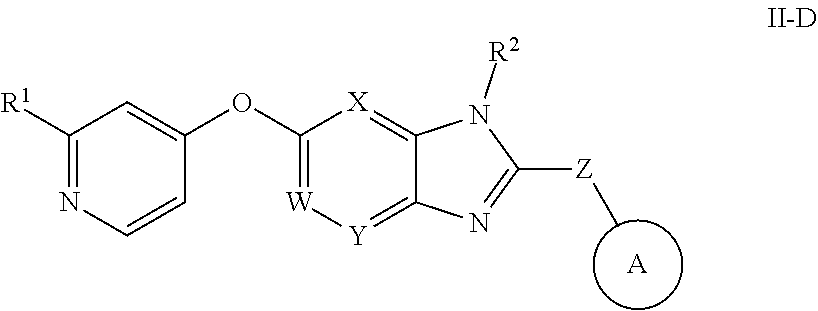
or a pharmaceutically acceptable salt thereof, wherein Ring A, W, X, Y, Z, R1, and R2 are as defined above for Formula II and described in classes and subclasses herein, both singly and in combination.

or a pharmaceutically acceptable salt thereof, wherein n, W, X, Y, Z, R1, R2, and Rc are as defined above for Formula II and described in classes and subclasses herein, both singly and in combination; and
-
- Ring A1 is an optionally substituted ring selected from phenyl, 5- to 6-membered monocyclic heteroaryl having 1-3 heteroatoms independently selected from nitrogen, oxygen, and sulfur, 5- to 7-membered saturated or partially unsaturated monocyclic carbocyclyl, and 5- to 7-membered saturated or partially unsaturated monocyclic heterocyclyl having 1-3 heteroatoms independently selected from nitrogen, oxygen, and sulfur; wherein Ring A1 is fused to Ring A2;
- Ring A2 is an optionally substituted ring selected from phenyl, 5- to 6-membered monocyclic heteroaryl having 1-3 heteroatoms independently selected from nitrogen, oxygen, and sulfur, 5- to 7-membered saturated or partially unsaturated monocyclic carbocyclyl, and 5- to 7-membered saturated or partially unsaturated monocyclic heterocyclyl having 1-3 heteroatoms independently selected from nitrogen, oxygen, and sulfur;
- wherein Ring A2 is optionally (i) further fused to Ring A3,
- or (ii) Ring A2 and Ring A3 combine to form a spirocycle; and
- Ring A3, when present, is an optionally substituted ring selected from phenyl, 5- to 6-membered monocyclic heteroaryl having 1-3 heteroatoms independently selected from nitrogen, oxygen, and sulfur, 3- to 7-membered saturated or partially unsaturated monocyclic carbocyclyl, and 3- to 7-membered saturated or partially unsaturated monocyclic heterocyclyl having 1-3 heteroatoms independently selected from nitrogen, oxygen, and sulfur.

or a pharmaceutically acceptable salt thereof, wherein Ring A2, n, W, X, Y, Z, R1, R2, and Rc are as defined above for Formula II and described in classes and subclasses herein, both singly and in combination.

or a pharmaceutically acceptable salt thereof, wherein:
-
- Z is —O— or —NRz—;
- Rx is hydrogen, halogen, —OR3, —N(R3)2, —SR3, optionally substituted C1-6 aliphatic, or —CN;
- Rz is hydrogen or optionally substituted C1-6 aliphatic;
- R2 is optionally substituted C1-6 aliphatic;
- R3 is hydrogen or optionally substituted C1-6 aliphatic;
- R4 is halogen, —OR, —N(R)2, or optionally substituted 3- to 7-membered saturated or partially unsaturated monocyclic heterocyclyl having 1-3 heteroatoms independently selected from nitrogen, oxygen, and sulfur;
- Ring A is optionally substituted phenyl, optionally substituted 5- to 6-membered monocyclic heteroaryl having 1-4 heteroatoms independently selected from nitrogen, oxygen, and sulfur, optionally substituted 8- to 10-membered bicyclic heteroaryl having 1-4 heteroatoms independently selected from nitrogen, oxygen, and sulfur, optionally substituted 3- to 7-membered saturated or partially unsaturated monocyclic carbocyclyl, optionally substituted 3- to 7-membered saturated or partially unsaturated monocyclic heterocyclyl having 1-3 heteroatoms independently selected from nitrogen, oxygen, and sulfur, or optionally substituted 7- to 10-membered saturated or partially unsaturated bicyclic heterocyclyl having 1-4 heteroatoms independently selected from nitrogen, oxygen, and sulfur;
- L is a covalent bond or a bivalent C1-3 straight or branched hydrocarbon chain;
- Ra is hydrogen, halogen, optionally substituted C1-6 aliphatic, optionally substituted phenyl, optionally substituted 5- to 6-membered monocyclic heteroaryl having 1-4 heteroatoms independently selected from nitrogen, oxygen, and sulfur, optionally substituted 3- to 7-membered saturated or partially unsaturated monocyclic carbocyclyl, optionally substituted 3- to 7-membered saturated or partially unsaturated monocyclic heterocyclyl having 1-3 heteroatoms independently selected from nitrogen, oxygen, and sulfur, or optionally substituted 7- to 10-membered saturated or partially unsaturated bicyclic heterocyclyl having 1-4 heteroatoms independently selected from nitrogen, oxygen, and sulfur; and
- each R is independently hydrogen, optionally substituted C1-6 aliphatic, optionally substituted 3- to 7-membered saturated or partially unsaturated carbocyclyl, or optionally substituted 3- to 7-membered saturated or partially unsaturated monocyclic heterocyclyl having 1-3 heteroatoms independently selected from nitrogen, oxygen, and sulfur, or two R when attached to the same nitrogen atom are taken together form an optionally substituted 3- to 7-membered saturated or partially unsaturated monocyclic heterocyclyl having 0-2 additional heteroatoms independently selected from nitrogen, oxygen, and sulfur.

or a pharmaceutically acceptable salt thereof, wherein:
-
- Z is —O— or —NRz—;
- Rx is hydrogen, halogen, —OR3, or —CN;
- Rz is hydrogen or optionally substituted C1-6 aliphatic;
- R2 is optionally substituted C1-6 aliphatic;
- R3 is hydrogen or optionally substituted C1-6 aliphatic;

is selected from (i) or (ii):

wherein Ring A is further substituted at least once, and at least one substituent on Ring A is C1-6 haloalkyl;
-
- L is a covalent bond or a bivalent C1-3 straight or branched hydrocarbon chain;
- Ra is hydrogen, halogen, optionally substituted C1-6 aliphatic, optionally substituted phenyl, optionally substituted 5- to 6-membered monocyclic heteroaryl having 1-4 heteroatoms independently selected from nitrogen, oxygen, and sulfur, optionally substituted 3- to 7-membered saturated or partially unsaturated monocyclic carbocyclyl, optionally substituted 3- to 7-membered saturated or partially unsaturated monocyclic heterocyclyl having 1-3 heteroatoms independently selected from nitrogen, oxygen, and sulfur, or optionally substituted 7- to 10-membered saturated or partially unsaturated bicyclic heterocyclyl having 1-4 heteroatoms independently selected from nitrogen, oxygen, and sulfur; and
- R′ is C1-6 aliphatic or 3- to 7-membered saturated or partially unsaturated carbocyclyl.

In some embodiments, R1 is not

In some embodiments, when X is CH, then R1 is not


wherein Ring A1 and Ring A2 are defined as in Formula II-E and described in classes and subclasses herein, both singly and in combination; and Ring A1 is fused to Ring A2; and Ring A2 is optionally (i) further fused to Ring A3 or (ii) Ring A2 and Ring A3 combine to form a spirocycle.


is —Ra (i.e., L is a covalent bond). In some embodiments,

is —(C1-3 alkylene)-Ra (i.e., L is a C1-3 straight or branched hydrocarbon chain). In some embodiments,

is —(C1-2 alkylene)-Ra (i.e., L is a C1-2 straight or branched hydrocarbon chain). In some embodiments,

is —CH2—Ra (i.e., L is a C1 hydrocarbon chain). In some embodiments,

is —CH2CH2—Ra (i.e., L is a C2 straight hydrocarbon chain). In some embodiments,

is —CH2CH2CH2—Ra (i.e., L is a C3 straight hydrocarbon chain). In some embodiments, is —

is —C(CH3)2—Ra (i.e., L is a C3 branched hydrocarbon chain).


In some embodiments, optionally substituted

is optionally substituted


is selected from the group consisting of:


is selected from the group consisting of:

In some embodiments,

is selected from the group consisting of:

In some embodiments, when

then -L-Ra is C1-6 haloalkyl. In some embodiments,

wherein Ring A is further substituted at least once, and at least one substituent on Ring A is C1-6 haloalkyl (e.g., —CF3). In some embodiments, when

then Ring A is further substituted with Rb as defined and described in classes and subclasses herein, and at least one substituent on Ring A (i.e., either Rb or -L-Ra) is C1-6 haloalkyl (e.g., —CF3). In some embodiments,

is selected from the group consisting of:


is selected from the group consisting of:


and Y is N, then Rx is not hydrogen. In some embodiments, when R1 is

then Ring A is not pyrazolyl. In some embodiments, when Ring A is pyrazolyl, then R1 is not —N(R)C(O)N(R)2. In some embodiments, when Ring A is pyrazolyl and Y is N, then Rx is not hydrogen.

In some embodiments, when Ring A is

then R1 is not —N(H)C(O)CH3. In some embodiments, when Ring A is

then X is not N and Rx is not —CN.


or a pharmaceutically acceptable salt thereof.

wherein PG is a suitable protecting group (e.g., p-methoxybenzyl, acetyl, methyl carbamate, etc.), and Ring A, n, L, W, X, Y, R, R2, Ra, and Rc are as defined above for Formula I and described in classes and subclasses herein, both singly and in combination. Accordingly, in some embodiments, intermediate A.3 is prepared by a process comprising contacting intermediate A.1 with intermediate A.2 in the presence of a suitable coupling agent and/or a suitable base (e.g., potassium tert-butoxide). In some embodiments, a process for preparing intermediate A.3 further comprises a deprotection step and/or a functionalization step (e.g., cyanation) under suitable conditions. In some embodiments, intermediate A.4 is prepared by a process comprising contacting intermediate A.3 with phenyl chloroformate in the presence of a suitable base (e.g., triethylamine). In some embodiments, compound A-1 is prepared by a process comprising contacting intermediate A.4 with RO—H, optionally in the presence of a suitable base (e.g., triethylamine). In some embodiments, compound A-1 is prepared by a process comprising contacting intermediate A.3 with RO—C(O)—Cl in the presence of a suitable base (e.g., triethylamine). In some embodiments, compound A-2 is prepared by a process comprising contacting intermediate A.4 with R2N—H, optionally in the presence of a suitable base (e.g., triethylamine). In some embodiments, compound A-2 is prepared by a process comprising contacting intermediate A.3 with R2N—C(O)—Cl in the presence of a suitable base (e.g., triethylamine).

wherein PG is a suitable protecting group (e.g., p-methoxybenzyl, acetyl, methyl carbamate, etc.), and Ring A, n, W, X, Y, R, R2, and Rc are as defined above for Formula II and described in classes and subclasses herein, both singly and in combination. Accordingly, in some embodiments, intermediate A.6 is prepared by a process comprising contacting intermediate A.5 with intermediate A.2 in the presence of a suitable coupling agent and/or a suitable base (e.g., potassium tert-butoxide). In some embodiments, a process for preparing intermediate A.6 further comprises a deprotection step and/or a functionalization step (e.g., cyanation) under suitable conditions. In some embodiments, intermediate A.7 is prepared by a process comprising contacting intermediate A.6 with phenyl chloroformate in the presence of a suitable base (e.g., triethylamine). In some embodiments, compound A-3 is prepared by a process comprising contacting intermediate A.7 with RO—H, optionally in the presence of a suitable base (e.g., triethylamine). In some embodiments, compound A-3 is prepared by a process comprising contacting intermediate A.6 with RO—C(O)—Cl in the presence of a suitable base (e.g., triethylamine). In some embodiments, compound A-4 is prepared by a process comprising contacting intermediate A.7 with R2N—H, optionally in the presence of a suitable base (e.g., triethylamine). In some embodiments, compound A-4 is prepared by a process comprising contacting intermediate A.6 with R2N—C(O)—Cl in the presence of a suitable base (e.g., triethylamine).

wherein LG is a suitable leaving group (e.g., halogen, e.g., chloro or bromo), and Ring A, n, L, W, X, Y, Z, R1, R2, Ra, and Rc are as defined above for Formulae I and/or II and described in classes and subclasses herein, both singly and in combination. Accordingly, in some embodiments, compound B-1 is prepared by a process comprising contacting intermediate B.1 with intermediate B.2 in the presence of a suitable base (e.g., K3PO4, K2CO3, or Cs2CO3), and optionally in the presence of a suitable metal complex (e.g., a palladium complex such as tris(dibenzylideneacetone)dipalladium(0)) and/or a suitable ligand (e.g., 4,5-bis(diphenylphosphino)-9,9-dimethylxanthene). In some embodiments, compound B-2 is prepared by a process comprising contacting intermediate B.1 with intermediate B.3 in the presence of a suitable base (e.g., K3PO4, K2CO3, or Cs2CO3), and optionally in the presence of a suitable metal complex (e.g., a palladium complex such as tris(dibenzylideneacetone)dipalladium(0)) and/or a suitable ligand (e.g., 4,5-bis(diphenylphosphino)-9,9-dimethylxanthene). In some embodiments, a process for preparing compound B-1 or B-2 further comprises a deprotection step under suitable conditions. In some embodiments, a process for preparing compound B-1 or B-2 further comprises a funtionalization step (e.g., cyanation) under suitable conditions.

wherein Ring A, n, L, W, X, Y, R1, R2, Ra, and Rc are as defined above for Formula I and described in classes and subclasses herein, both singly and in combination. Accordingly, in some embodiments, compound C-1 is prepared by a process comprising contacting intermediate C.1 with intermediate C.2 in the presence of a suitable coupling agent and/or a suitable base (e.g., potassium tert-butoxide). In some embodiments, a process for preparing compound C-1 further comprises a deprotection and/or functionalization (e.g., cyanation) step under suitable conditions.

wherein Ring A, n, W, X, Y, R1, R2, and Rc are as defined above for Formula II and described in classes and subclasses herein, both singly and in combination. Accordingly, in some embodiments, compound C-2 is prepared by a process comprising contacting intermediate C.3 with intermediate C.2 in the presence of a suitable coupling agent and/or a suitable base (e.g., potassium tert-butoxide). In some embodiments, a process for preparing compound C-2 further comprises a deprotection and/or functionalization (e.g., cyanation) step under suitable conditions.
Compositions

or a pharmaceutically acceptable salt thereof, wherein:
-
- W is CRw or N;
- X is CRx or N;
- Y is CRy or N;
- Z is —O— or —NRz—;
- Rw, Rx, and Ry are each independently hydrogen, halogen, —OR3, —N(R3)2, —SR3, optionally substituted C1-6 aliphatic, or —CN;
- Rz is hydrogen or optionally substituted C1-6 aliphatic;
- R1 is —N(R)2, —N(R)C(O)R′, —C(O)N(R)2, —N(R)C(O)N(R)2, or —N(R)C(O)OR;
- each Rc is independently selected from halogen, —CN, —CO2R, —C(O)N(R)2, —NO2, —N(R)2, —OR, —SR, or optionally substituted C1-6 aliphatic;
- n is 0, 1, 2, or 3, provided that when R1 is —N(R)2, —N(R)C(O)R′ or —C(O)N(R)2, then n is 1, 2, or 3;
- R2 is optionally substituted C1-6 aliphatic;
- R3 is hydrogen or optionally substituted C1-6 aliphatic;
- Ring A is optionally substituted phenyl, optionally substituted 5- to 6-membered monocyclic heteroaryl having 1-4 heteroatoms independently selected from nitrogen, oxygen, and sulfur, optionally substituted 8- to 10-membered bicyclic heteroaryl having 1-4 heteroatoms independently selected from nitrogen, oxygen, and sulfur, optionally substituted 3- to 7-membered saturated or partially unsaturated monocyclic carbocyclyl, optionally substituted 3- to 7-membered saturated or partially unsaturated monocyclic heterocyclyl having 1-3 heteroatoms independently selected from nitrogen, oxygen, and sulfur, or optionally substituted 7- to 10-membered saturated or partially unsaturated bicyclic heterocyclyl having 1-4 heteroatoms independently selected from nitrogen, oxygen, and sulfur;
- L is a covalent bond or a bivalent C1-3 straight or branched hydrocarbon chain;
- Ra is hydrogen, halogen, optionally substituted C1-6 aliphatic, optionally substituted phenyl, optionally substituted 5- to 6-membered monocyclic heteroaryl having 1-4 heteroatoms independently selected from nitrogen, oxygen, and sulfur, optionally substituted 3- to 7-membered saturated or partially unsaturated monocyclic carbocyclyl, optionally substituted 3- to 7-membered saturated or partially unsaturated monocyclic heterocyclyl having 1-3 heteroatoms independently selected from nitrogen, oxygen, and sulfur, or optionally substituted 7- to 10-membered saturated or partially unsaturated bicyclic heterocyclyl having 1-4 heteroatoms independently selected from nitrogen, oxygen, and sulfur;
- each R is independently hydrogen, optionally substituted C1-6 aliphatic, optionally substituted 3- to 7-membered saturated or partially unsaturated carbocyclyl, or optionally substituted 3- to 7-membered saturated or partially unsaturated monocyclic heterocyclyl having 1-3 heteroatoms independently selected from nitrogen, oxygen, and sulfur, or two R when attached to the same nitrogen atom are taken together form an optionally substituted 3- to 7-membered saturated or partially unsaturated monocyclic heterocyclyl having 0-2 additional heteroatoms independently selected from nitrogen, oxygen, and sulfur; and
- each R′ is independently optionally substituted C1-6 aliphatic or optionally substituted 3- to 7-membered saturated or partially unsaturated carbocyclyl.
2. The compound of embodiment 1, wherein the compound is not:

3. The compound of embodiment 1 or embodiment 2, wherein Ring A is optionally substituted 5- to 6-membered monocyclic heteroaryl having 1-4 heteroatoms independently selected from nitrogen, oxygen, and sulfur, optionally substituted 8- to 10-membered bicyclic heteroaryl having 1-4 heteroatoms independently selected from nitrogen, oxygen, and sulfur, optionally substituted 3- to 7-membered saturated or partially unsaturated monocyclic carbocyclyl, optionally substituted 3- to 7-membered saturated or partially unsaturated monocyclic heterocyclyl having 1-3 heteroatoms independently selected from nitrogen, oxygen, and sulfur, or optionally substituted 7- to 10-membered saturated or partially unsaturated bicyclic heterocyclyl having 1-4 heteroatoms independently selected from nitrogen, oxygen, and sulfur.
4. The compound of any one of the preceding embodiments, wherein Ring A is optionally substituted 5- to 6-membered monocyclic heteroaryl having 1-4 heteroatoms independently selected from nitrogen, oxygen, and sulfur or optionally substituted 8- to 10-membered bicyclic heteroaryl having 1-4 heteroatoms independently selected from nitrogen, oxygen, and sulfur.
5. The compound of any one of the preceding embodiments, wherein Ring A is optionally substituted 5- to 6-membered monocyclic heteroaryl having 1-4 heteroatoms independently selected from nitrogen, oxygen, and sulfur.
6. The compound of any one of the preceding embodiments, wherein Ra is halogen, optionally substituted C1-6 aliphatic, optionally substituted phenyl, optionally substituted 5- to 6-membered monocyclic heteroaryl having 1-4 heteroatoms independently selected from nitrogen, oxygen, and sulfur, optionally substituted 3- to 7-membered saturated or partially unsaturated monocyclic carbocyclyl, optionally substituted 3- to 7-membered saturated or partially unsaturated monocyclic heterocyclyl having 1-3 heteroatoms independently selected from nitrogen, oxygen, and sulfur, or optionally substituted 7- to 10-membered saturated or partially unsaturated bicyclic heterocyclyl having 1-4 heteroatoms independently selected from nitrogen, oxygen, and sulfur.
7. The compound of any one of the preceding embodiments, wherein Ra is optionally substituted C1-6 aliphatic, optionally substituted 3- to 7-membered saturated or partially unsaturated monocyclic heterocyclyl having 1-3 heteroatoms independently selected from nitrogen, oxygen, and sulfur, or optionally substituted 7- to 10-membered saturated or partially unsaturated bicyclic heterocyclyl having 1-4 heteroatoms independently selected from nitrogen, oxygen, and sulfur.
8. The compound of any one of the preceding embodiments, wherein Ra is optionally substituted C1-6 aliphatic or optionally substituted 7- to 10-membered saturated or partially unsaturated bicyclic heterocyclyl having 1-4 heteroatoms independently selected from nitrogen, oxygen, and sulfur.
9. The compound of any one of the preceding embodiments, wherein:

is substituted with 1-5 Rb, as valency allows; and
-
- each Rb is independently hydrogen, halogen, —CN, —OR, —O(CH2)mR, —SR, —N(R)2, —NO2, —C(O)R′, —C(O)OR, —C(O)N(R)2, —OC(O)R′, —OC(O)N(R)2, —OC(O)OR, —OSO2R, —OSO2N(R)2, —N(R)C(O)R′, —N(R)SO2R′, —SO2R′, —SO2N(R)2, —SO3R′, optionally substituted C1-6 aliphatic, optionally substituted 3- to 6-membered saturated or partially unsaturated carbocyclyl, optionally substituted 3- to 6-membered saturated or partially unsaturated monocyclic heterocyclyl having 1-3 heteroatoms independently selected from nitrogen, oxygen, and sulfur, optionally substituted 5- to 6-membered monocyclic heteroaryl having 1-4 heteroatoms independently selected from nitrogen, oxygen, and sulfur; and
- m is 1, 2, or 3.
10. The compound of embodiment 9, wherein each Rb is independently halogen, —CN, —OR, —O(CH2)mR, —SR, —N(R)2, —NO2, —C(O)R′, —C(O)OR, —C(O)N(R)2, —OC(O)R′, —OC(O)N(R)2, —OC(O)OR, —OSO2R, —OSO2N(R)2, —N(R)C(O)R′, —N(R)SO2R′, —SO2R′, —SO2N(R)2, —SO3R′, optionally substituted C1-6 aliphatic, optionally substituted 3- to 6-membered saturated or partially unsaturated carbocyclyl, optionally substituted 3- to 6-membered saturated or partially unsaturated monocyclic heterocyclyl having 1-3 heteroatoms independently selected from nitrogen, oxygen, and sulfur, optionally substituted 5- to 6-membered monocyclic heteroaryl having 1-4 heteroatoms independently selected from nitrogen, oxygen, and sulfur.
11. The compound of embodiment 9 or 10, wherein each Rb is independently halogen or optionally substituted C1-6 aliphatic.
12. The compound of any one of embodiments 9-11, wherein

13. The compound of any one of the preceding embodiments, wherein L is a covalent bond.
14. The compound of any one of embodiments 1-12, wherein L is —CH2—.
15. The compound of any one of the preceding embodiments, wherein the compound is of Formula I-C:

or a pharmaceutically acceptable salt thereof.
16. The compound of any one of the preceding embodiments, wherein the compound is of Formula I-D:

or a pharmaceutically acceptable salt thereof, wherein:
-
- Rb is hydrogen, halogen, —CN, —OR, —O(CH2)mR, —SR, —N(R)2, —NO2, —C(O)R′, —C(O)OR, —C(O)N(R)2, —OC(O)R′, —OC(O)N(R)2, —OC(O)OR, —OSO2R, —OSO2N(R)2, —N(R)C(O)R′, —N(R)SO2R′, —SO2R′, —SO2N(R)2, —SO3R′, optionally substituted C1-6 aliphatic, optionally substituted 3- to 6-membered saturated or partially unsaturated carbocyclyl, optionally substituted 3- to 6-membered saturated or partially unsaturated monocyclic heterocyclyl having 1-3 heteroatoms independently selected from nitrogen, oxygen, and sulfur, optionally substituted 5- to 6-membered monocyclic heteroaryl having 1-4 heteroatoms independently selected from nitrogen, oxygen, and sulfur; and
- m is 1, 2, or 3.
17. The compound of any one of the preceding embodiments, wherein the compound is of Formula I-E:

or a pharmaceutically acceptable salt thereof.
18. A compound of Formula II:
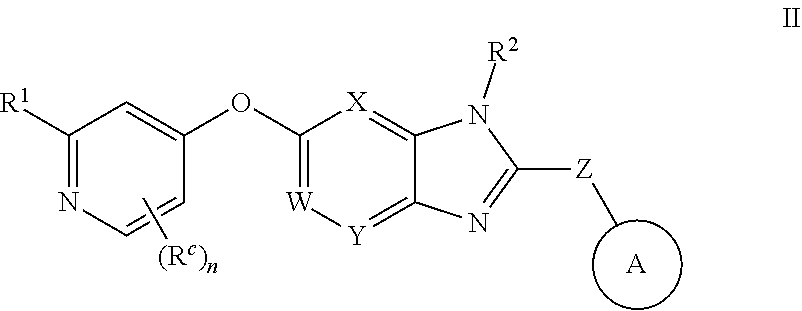
or a pharmaceutically acceptable salt thereof, wherein:
-
- W is CRw or N;
- X is CRx or N;
- Y is CRy or N;
- Z is —O— or —NRz—;
- Rw, Rx, and Ry are each independently hydrogen, halogen, —OR3, —N(R3)2, —SR3, optionally substituted C1-6 aliphatic, or —CN;
- Rz is hydrogen or optionally substituted C1-6 aliphatic;
- R1 is —N(R)2, —N(R)C(O)R′, —C(O)N(R)2, —N(R)C(O)N(R)2, or —N(R)C(O)OR;
- each Rc is independently selected from halogen, —CN, —CO2R, —C(O)N(R)2, —NO2, —N(R)2, —OR, —SR, or optionally substituted C1-6 aliphatic;
- n is 0, 1, 2, or 3;
- R2 is optionally substituted C1-6 aliphatic;
- R3 is hydrogen or optionally substituted C1-6 aliphatic;
- Ring A is optionally substituted 9- to 16-membered bicyclic or tricyclic aryl, optionally substituted 8- to 10-membered bicyclic heteroaryl having 1-4 heteroatoms independently selected from nitrogen, oxygen, and sulfur, optionally substituted 10- to 16-membered polycyclic heteroaryl having 1-5 heteroatoms independently selected from nitrogen, oxygen, and sulfur, optionally substituted 7- to 10-membered bicyclic heterocyclyl having 1-4 heteroatoms independently selected from nitrogen, oxygen, and sulfur, or optionally substituted 10- to 16-membered polycyclic heterocyclyl having 1-5 heteroatoms independently selected from nitrogen, oxygen, and sulfur;
- each R is independently hydrogen, optionally substituted C1-6 aliphatic, optionally substituted 3- to 7-membered saturated or partially unsaturated carbocyclyl, or optionally substituted 3- to 7-membered saturated or partially unsaturated monocyclic heterocyclyl having 1-3 heteroatoms independently selected from nitrogen, oxygen, and sulfur, or two R when attached to the same nitrogen atom are taken together form an optionally substituted 3- to 7-membered saturated or partially unsaturated monocyclic heterocyclyl having 0-2 additional heteroatoms independently selected from nitrogen, oxygen, and sulfur; and
- each R′ is independently optionally substituted C1-6 aliphatic or optionally substituted 3- to 7-membered saturated or partially unsaturated carbocyclyl.
19. The compound of embodiment 18, wherein the compound is not:


20. The compound of embodiment 18 or 19, wherein Ring A is optionally substituted 8- to 10-membered bicyclic heteroaryl having 1-4 heteroatoms independently selected from nitrogen, oxygen, and sulfur, optionally substituted 10- to 16-membered polycyclic heteroaryl having 1-5 heteroatoms independently selected from nitrogen, oxygen, and sulfur, optionally substituted 7- to 10-membered bicyclic heterocyclyl having 1-4 heteroatoms independently selected from nitrogen, oxygen, and sulfur, or optionally substituted 10- to 16-membered polycyclic heterocyclyl having 1-5 heteroatoms independently selected from nitrogen, oxygen, and sulfur.
21. The compound of any one of embodiments 18-20, wherein Ring A is optionally substituted 8- to 10-membered bicyclic heteroaryl having 1-4 heteroatoms independently selected from nitrogen, oxygen, and sulfur or optionally substituted 10- to 16-membered polycyclic heteroaryl having 1-5 heteroatoms independently selected from nitrogen, oxygen, and sulfur.
22. The compound of any one of embodiments 18-21, wherein Ring A is 8- to 10-membered bicyclic heteroaryl having 1-4 heteroatoms independently selected from nitrogen, oxygen, and sulfur optionally substituted with one or more oxo, halogen, or C1-6 alkyl.
23. The compound of any one of embodiments 18-22, wherein Ring A is optionally substituted 10- to 16-membered polycyclic heteroaryl having 1-5 heteroatoms independently selected from nitrogen, oxygen, and sulfur.
24. The compound of any one of embodiments 18-23, wherein:
-
- Ring A is

-
- Ring A1 is an optionally substituted ring selected from phenyl, 5- to 6-membered monocyclic heteroaryl having 1-3 heteroatoms independently selected from nitrogen, oxygen, and sulfur, 5- to 7-membered saturated or partially unsaturated monocyclic carbocyclyl, and 5- to 7-membered saturated or partially unsaturated monocyclic heterocyclyl having 1-3 heteroatoms independently selected from nitrogen, oxygen, and sulfur;
- wherein Ring A1 is fused to Ring A2;
- Ring A2 is an optionally substituted ring selected from phenyl, 5- to 6-membered monocyclic heteroaryl having 1-3 heteroatoms independently selected from nitrogen, oxygen, and sulfur, 5- to 7-membered saturated or partially unsaturated monocyclic carbocyclyl, and 5- to 7-membered saturated or partially unsaturated monocyclic heterocyclyl having 1-3 heteroatoms independently selected from nitrogen, oxygen, and sulfur;
- wherein Ring A2 is optionally (i) further fused to Ring A3,
- or (ii) Ring A2 and Ring A3 combine to form a spirocycle; and
- Ring A3, when present, is an optionally substituted ring selected from phenyl, 5- to 6-membered monocyclic heteroaryl having 1-3 heteroatoms independently selected from nitrogen, oxygen, and sulfur, 3- to 7-membered saturated or partially unsaturated monocyclic carbocyclyl, and 3- to 7-membered saturated or partially unsaturated monocyclic heterocyclyl having 1-3 heteroatoms independently selected from nitrogen, oxygen, and sulfur.
25. The compound of embodiment 24, wherein Ring A1 is optionally substituted 5- to 6-membered monocyclic heteroaryl having 1-3 heteroatoms independently selected from nitrogen, oxygen, and sulfur.
26. The compound of embodiment 24 or 25, wherein optionally substituted Ring A is

27. The compound of any one of embodiments 24-26, wherein Ring A2 is optionally substituted 5- to 7-membered partially saturated monocyclic heterocyclyl having 1-3 heteroatoms independently selected from nitrogen, oxygen, and sulfur.
28. The compound of any one of embodiments 24-27, wherein optionally substituted Ring A is selected from the group consisting of:

29. The compound of any one of embodiments 24-27, wherein optionally substituted Ring A is selected from the group consisting of:

30. The compound of any one of embodiments 18-29, wherein:

is substituted with 1-5 Rb, as valency allows; and
-
- each Rb is independently hydrogen, halogen, —CN, —OR, —O(CH2)mR, —SR, —N(R)2, —NO2, —C(O)R′, —C(O)OR, —C(O)N(R)2, —OC(O)R′, —OC(O)N(R)2, —OC(O)OR, —OSO2R, —OSO2N(R)2, —N(R)C(O)R′, —N(R)SO2R′, —SO2R′, —SO2N(R)2, —SO3R′, optionally substituted C1-6 aliphatic, optionally substituted 3- to 6-membered saturated or partially unsaturated carbocyclyl, optionally substituted 3- to 6-membered saturated or partially unsaturated monocyclic heterocyclyl having 1-3 heteroatoms independently selected from nitrogen, oxygen, and sulfur, optionally substituted 5- to 6-membered monocyclic heteroaryl having 1-4 heteroatoms independently selected from nitrogen, oxygen, and sulfur; and
- m is 1, 2, or 3.
31. The compound of embodiment 30, wherein each Rb is independently halogen, —CN, —OR, —O(CH2)mR, —SR, —N(R)2, —NO2, —C(O)R′, —C(O)OR, —C(O)N(R)2, —OC(O)R′, —OC(O)N(R)2, —OC(O)OR, —OSO2R, —OSO2N(R)2, —N(R)C(O)R′, —N(R)SO2R′, —SO2R′, —SO2N(R)2, —SO3R′, optionally substituted C1-6 aliphatic, optionally substituted 3- to 6-membered saturated or partially unsaturated carbocyclyl, optionally substituted 3- to 6-membered saturated or partially unsaturated monocyclic heterocyclyl having 1-3 heteroatoms independently selected from nitrogen, oxygen, and sulfur, optionally substituted 5- to 6-membered monocyclic heteroaryl having 1-4 heteroatoms independently selected from nitrogen, oxygen, and sulfur.
32. The compound of embodiment 30 or embodiment 31, wherein each Rb is independently halogen, optionally substituted C1-6 aliphatic, —OR, or —O(CH2)mR.
33. The compound of any one of embodiments 30-32, wherein

is selected from the group consisting of:

34. The compound of any one of embodiments 30-32, wherein

is selected from the group consisting of:


35. The compound of any one of embodiments 18-34, wherein the compound is of Formula II-C:

or a pharmaceutically acceptable salt thereof.
36. The compound of any one of embodiments 18-35, wherein the compound is of Formula II-D:

or a pharmaceutically acceptable salt thereof.
37. The compound of any one of embodiments 18-36, wherein the compound is of Formula II-E:

or a pharmaceutically acceptable salt thereof, wherein:
-
- Ring A1 is an optionally substituted ring selected from phenyl, 5- to 6-membered monocyclic heteroaryl having 1-3 heteroatoms independently selected from nitrogen, oxygen, and sulfur, 5- to 7-membered saturated or partially unsaturated monocyclic carbocyclyl, and 5- to 7-membered saturated or partially unsaturated monocyclic heterocyclyl having 1-3 heteroatoms independently selected from nitrogen, oxygen, and sulfur;
- wherein Ring A1 is fused to Ring A2;
- Ring A2 is an optionally substituted ring selected from phenyl, 5- to 6-membered monocyclic heteroaryl having 1-3 heteroatoms independently selected from nitrogen, oxygen, and sulfur, 5- to 7-membered saturated or partially unsaturated monocyclic carbocyclyl, and 5- to 7-membered saturated or partially unsaturated monocyclic heterocyclyl having 1-3 heteroatoms independently selected from nitrogen, oxygen, and sulfur;
- wherein Ring A2 is optionally (i) further fused to Ring A3,
- or (ii) Ring A2 and Ring A3 combine to form a spirocycle; and
- Ring A3, when present, is an optionally substituted ring selected from phenyl, 5- to 6-membered monocyclic heteroaryl having 1-3 heteroatoms independently selected from nitrogen, oxygen, and sulfur, 3- to 7-membered saturated or partially unsaturated monocyclic carbocyclyl, and 3- to 7-membered saturated or partially unsaturated monocyclic heterocyclyl having 1-3 heteroatoms independently selected from nitrogen, oxygen, and sulfur.
38. The compound of any one of the preceding embodiments, wherein W is CRw.
39. The compound of embodiment 38, wherein Rw is hydrogen.
40. The compound of any one of embodiments 1-37, wherein W is N.
41. The compound of any one of the preceding embodiments, wherein X is CRx.
42. The compound of any one of the preceding embodiments, wherein Rx is hydrogen, halogen, —CN, —OR3, or optionally substituted C1-6 aliphatic.
43. The compound of any one of embodiments 1-40, wherein X is N.
44. The compound of any one of the preceding embodiments, wherein Y is CRy.
45. The compound of embodiment 44, wherein Ry is hydrogen.
46. The compound of any one of embodiments 1-43, wherein Y is N.
47. The compound of any one of the preceding embodiments, wherein R1 is —N(R)C(O)N(R)2, or —N(R)C(O)OR.
48. The compound of any one of the preceding embodiments, wherein R1 is —N(R)C(O)N(R)2.
49. The compound of any one of the preceding embodiments, wherein R1 is —N(H)C(O)N(R)2, and each R of R1 is independently hydrogen, optionally substituted C1-6 aliphatic, or optionally substituted 3- to 7-membered saturated or partially unsaturated carbocyclyl, or the two R groups attached to the same nitrogen are taken together to form an optionally substituted 3- to 7-membered saturated or partially unsaturated monocyclic heterocyclyl having 0-2 additional heteroatoms independently selected from nitrogen, oxygen, and sulfur.
50. The compound of any one of embodiments 1-47, wherein R1 is —N(R)C(O)OR.
51. The compound of any one of embodiments 1-47, wherein R1 is —N(H)C(O)OR, and R of R1 is optionally substituted C1-6 aliphatic or optionally substituted 3- to 7-membered saturated or partially unsaturated monocyclic heterocyclyl having 1-2 heteroatoms independently selected from nitrogen, oxygen, and sulfur.
52. The compound of any one of embodiments 1-46, wherein R1 is —N(R)C(O)R′.
53. The compound of any one of embodiments 1-46, wherein R1 is —N(H)C(O)(optionally substituted C1-6 aliphatic).
54. The compound of any one of the preceding embodiments, wherein each Rc is independently halogen.
55. The compound of any one of the preceding embodiments, wherein n is 0.
56. A compound of Formula III:
- Ring A1 is an optionally substituted ring selected from phenyl, 5- to 6-membered monocyclic heteroaryl having 1-3 heteroatoms independently selected from nitrogen, oxygen, and sulfur, 5- to 7-membered saturated or partially unsaturated monocyclic carbocyclyl, and 5- to 7-membered saturated or partially unsaturated monocyclic heterocyclyl having 1-3 heteroatoms independently selected from nitrogen, oxygen, and sulfur;

or a pharmaceutically acceptable salt thereof, wherein:
-
- Z is —O— or —NRz—;
- Rx is hydrogen, halogen, —OR3, —N(R3)2, —SR3, optionally substituted C1-6 aliphatic, or —CN;
- Rz is hydrogen or optionally substituted C1-6 aliphatic;
- R2 is optionally substituted C1-6 aliphatic;
- R3 is hydrogen or optionally substituted C1-6 aliphatic;
- R4 is halogen, —OR, —N(R)2, or optionally substituted 3- to 7-membered saturated or partially unsaturated monocyclic heterocyclyl having 1-3 heteroatoms independently selected from nitrogen, oxygen, and sulfur;
- Ring A is optionally substituted phenyl, optionally substituted 5- to 6-membered monocyclic heteroaryl having 1-4 heteroatoms independently selected from nitrogen, oxygen, and sulfur, optionally substituted 8- to 10-membered bicyclic heteroaryl having 1-4 heteroatoms independently selected from nitrogen, oxygen, and sulfur, optionally substituted 3- to 7-membered saturated or partially unsaturated monocyclic carbocyclyl, optionally substituted 3- to 7-membered saturated or partially unsaturated monocyclic heterocyclyl having 1-3 heteroatoms independently selected from nitrogen, oxygen, and sulfur, or optionally substituted 7- to 10-membered saturated or partially unsaturated bicyclic heterocyclyl having 1-4 heteroatoms independently selected from nitrogen, oxygen, and sulfur;
- L is a covalent bond or a bivalent C1-3 straight or branched hydrocarbon chain;
- Ra is hydrogen, halogen, optionally substituted C1-6 aliphatic, optionally substituted phenyl, optionally substituted 5- to 6-membered monocyclic heteroaryl having 1-4 heteroatoms independently selected from nitrogen, oxygen, and sulfur, optionally substituted 3- to 7-membered saturated or partially unsaturated monocyclic carbocyclyl, optionally substituted 3- to 7-membered saturated or partially unsaturated monocyclic heterocyclyl having 1-3 heteroatoms independently selected from nitrogen, oxygen, and sulfur, or optionally substituted 7- to 10-membered saturated or partially unsaturated bicyclic heterocyclyl having 1-4 heteroatoms independently selected from nitrogen, oxygen, and sulfur; and
- each R is independently hydrogen, optionally substituted C1-6 aliphatic, optionally substituted 3- to 7-membered saturated or partially unsaturated carbocyclyl, or optionally substituted 3- to 7-membered saturated or partially unsaturated monocyclic heterocyclyl having 1-3 heteroatoms independently selected from nitrogen, oxygen, and sulfur, or two R when attached to the same nitrogen atom are taken together form an optionally substituted 3- to 7-membered saturated or partially unsaturated monocyclic heterocyclyl having 0-2 additional heteroatoms independently selected from nitrogen, oxygen, and sulfur.
57. The compound of embodiment 56, wherein the compound is not:

58. The compound of embodiment 56 or embodiment 57, wherein R4 is halogen, —OR, —N(R)2, or optionally substituted 3- to 7-membered saturated or partially unsaturated monocyclic heterocyclyl having 1-3 heteroatoms independently selected from nitrogen, oxygen, and sulfur, and each R of R4 is independently hydrogen or optionally substituted C1-6 aliphatic.
59. The compound of any one of embodiments 56-58, wherein Ring A is optionally substituted 5- to 6-membered monocyclic heteroaryl having 1-4 heteroatoms independently selected from nitrogen, oxygen, and sulfur, optionally substituted 8- to 10-membered bicyclic heteroaryl having 1-4 heteroatoms independently selected from nitrogen, oxygen, and sulfur, optionally substituted 3- to 7-membered saturated or partially unsaturated monocyclic carbocyclyl, optionally substituted 3- to 7-membered saturated or partially unsaturated monocyclic heterocyclyl having 1-3 heteroatoms independently selected from nitrogen, oxygen, and sulfur, or optionally substituted 7- to 10-membered saturated or partially unsaturated bicyclic heterocyclyl having 1-4 heteroatoms independently selected from nitrogen, oxygen, and sulfur.
60. The compound of any one of embodiments 56-59, wherein Ring A is optionally substituted 5- to 6-membered monocyclic heteroaryl having 1-4 heteroatoms independently selected from nitrogen, oxygen, and sulfur or optionally substituted 8- to 10-membered bicyclic heteroaryl having 1-4 heteroatoms independently selected from nitrogen, oxygen, and sulfur.
61. The compound of any one of embodiments 56-60, wherein Ring A is optionally substituted 5- to 6-membered monocyclic heteroaryl having 1-4 heteroatoms independently selected from nitrogen, oxygen, and sulfur.
62. The compound of any one of embodiments 56-61, wherein Ra is halogen, optionally substituted C1-6 aliphatic, optionally substituted phenyl, optionally substituted 5- to 6-membered monocyclic heteroaryl having 1-4 heteroatoms independently selected from nitrogen, oxygen, and sulfur, optionally substituted 3- to 7-membered saturated or partially unsaturated monocyclic carbocyclyl, optionally substituted 3- to 7-membered saturated or partially unsaturated monocyclic heterocyclyl having 1-3 heteroatoms independently selected from nitrogen, oxygen, and sulfur, or optionally substituted 7- to 10-membered saturated or partially unsaturated bicyclic heterocyclyl having 1-4 heteroatoms independently selected from nitrogen, oxygen, and sulfur.
63. The compound of any one of embodiments 56-62, wherein Ra is optionally substituted C1-6 aliphatic.
64. The compound of any one of embodiments 56-63, wherein:

is substituted with 1-5 Rb, as valency allows; and
-
- each Rb is independently hydrogen, halogen, —CN, —OR, —O(CH2)mR, —SR, —N(R)2, —NO2, —C(O)R′, —C(O)OR, —C(O)N(R)2, —OC(O)R′, —OC(O)N(R)2, —OC(O)OR, —OSO2R, —OSO2N(R)2, —N(R)C(O)R′, —N(R)SO2R′, —SO2R′, —SO2N(R)2, —SO3R′, optionally substituted C1-6 aliphatic, optionally substituted 3- to 6-membered saturated or partially unsaturated carbocyclyl, optionally substituted 3- to 6-membered saturated or partially unsaturated monocyclic heterocyclyl having 1-3 heteroatoms independently selected from nitrogen, oxygen, and sulfur, optionally substituted 5- to 6-membered monocyclic heteroaryl having 1-4 heteroatoms independently selected from nitrogen, oxygen, and sulfur; and
- m is 1, 2, or 3.
65. The compound of embodiment 64, wherein each Rb is independently halogen, —CN, —OR, —O(CH2)mR, —SR, —N(R)2, —NO2, —C(O)R′, —C(O)OR, —C(O)N(R)2, —OC(O)R′, —OC(O)N(R)2, —OC(O)OR, —OSO2R, —OSO2N(R)2, —N(R)C(O)R′, —N(R)SO2R′, —SO2R′, —SO2N(R)2, —SO3R′, optionally substituted C1-6 aliphatic, optionally substituted 3- to 6-membered saturated or partially unsaturated carbocyclyl, optionally substituted 3- to 6-membered saturated or partially unsaturated monocyclic heterocyclyl having 1-3 heteroatoms independently selected from nitrogen, oxygen, and sulfur, optionally substituted 5- to 6-membered monocyclic heteroaryl having 1-4 heteroatoms independently selected from nitrogen, oxygen, and sulfur.
66. The compound of embodiment 64 or 65, wherein each Rb is independently optionally substituted C1-6 aliphatic.
67. The compound of any one of embodiments 64-66, wherein

68. The compound of any one of embodiments 56-67, wherein L is a covalent bond.
69. The compound of any one of embodiments 56-67, wherein L is —CH2—.
70. The compound of any one of the preceding embodiments, wherein each R is independently hydrogen, optionally substituted C1-6 aliphatic, or optionally substituted 3- to 7-membered saturated or partially unsaturated monocyclic heterocyclyl having 1-2 heteroatoms independently selected from nitrogen, oxygen, and sulfur, or two R when attached to the same nitrogen atom are taken together form an optionally substituted 3- to 7-membered saturated or partially unsaturated monocyclic heterocyclyl having 0-2 additional heteroatoms independently selected from nitrogen, oxygen, and sulfur.
71. The compound of any one of the preceding embodiments, wherein each R is independently hydrogen or optionally substituted C1-6 aliphatic.
72. The compound of any one of the preceding embodiments, wherein each R′ is independently optionally substituted C1-6 alkyl or optionally substituted C3-7 cycloalkyl.
73. The compound of any one of the preceding embodiments, wherein each R′ is independently optionally substituted C1-6 aliphatic.
74. A compound of Formula IV:

or a pharmaceutically acceptable salt thereof, wherein:
-
- Z is —O— or —NRz—;
- Rx is hydrogen, halogen, —OR3, or —CN;
- Rz is hydrogen or optionally substituted C1-6 aliphatic;
- R2 is optionally substituted C1-6 aliphatic;
- R3 is hydrogen or optionally substituted C1-6 aliphatic;

is selected from (i) or (ii):

wherein Ring A is further substituted at least once, and at least one substituent on Ring A is C1-6 haloalkyl;
-
- L is a covalent bond or a bivalent C1-3 straight or branched hydrocarbon chain;
- Ra is hydrogen, halogen, optionally substituted C1-6 aliphatic, optionally substituted phenyl, optionally substituted 5- to 6-membered monocyclic heteroaryl having 1-4 heteroatoms independently selected from nitrogen, oxygen, and sulfur, optionally substituted 3- to 7-membered saturated or partially unsaturated monocyclic carbocyclyl, optionally substituted 3- to 7-membered saturated or partially unsaturated monocyclic heterocyclyl having 1-3 heteroatoms independently selected from nitrogen, oxygen, and sulfur, or optionally substituted 7- to 10-membered saturated or partially unsaturated bicyclic heterocyclyl having 1-4 heteroatoms independently selected from nitrogen, oxygen, and sulfur; and
- R′ is C1-6 aliphatic or 3- to 7-membered saturated or partially unsaturated carbocyclyl.
75. The compound of embodiment 74, wherein the compound is not:


76. The compound of embodiment 74 or 75, wherein Ra is halogen, optionally substituted C1-6 aliphatic, optionally substituted phenyl, optionally substituted 5- to 6-membered monocyclic heteroaryl having 1-4 heteroatoms independently selected from nitrogen, oxygen, and sulfur, optionally substituted 3- to 7-membered saturated or partially unsaturated monocyclic carbocyclyl, optionally substituted 3- to 7-membered saturated or partially unsaturated monocyclic heterocyclyl having 1-3 heteroatoms independently selected from nitrogen, oxygen, and sulfur, or optionally substituted 7- to 10-membered saturated or partially unsaturated bicyclic heterocyclyl having 1-4 heteroatoms independently selected from nitrogen, oxygen, and sulfur.
77. The compound of any one of embodiments 74-76, wherein Ra is optionally substituted C1-6 aliphatic, optionally substituted 3- to 7-membered saturated or partially unsaturated monocyclic heterocyclyl having 1-3 heteroatoms independently selected from nitrogen, oxygen, and sulfur, or optionally substituted 7- to 10-membered saturated or partially unsaturated bicyclic heterocyclyl having 1-4 heteroatoms independently selected from nitrogen, oxygen, and sulfur.
78. The compound of any one of embodiments 74-77, wherein L is a covalent bond.
79. The compound of any one of embodiments 74-77, wherein L is —CH2—.
80. The compound of any one of embodiments 74-79, wherein R′ is methyl or cyclopropyl.
81. The compound of any one of embodiments 56-80, wherein Rx is hydrogen, halogen, —CN, —OR3, or optionally substituted C1-6 aliphatic.
82. The compound of any one of embodiments 56-81, wherein Rx is hydrogen, halogen, —OR3, or —CN.
83. The compound of any one of embodiments 56-82, wherein Rx is halogen or —CN.
84. The compound of any one of the preceding embodiments, wherein R2 is C1-4 alkyl.
85. The compound of any one of the preceding embodiments, wherein Z is —O—.
86. The compound of any one of embodiments 1-84, wherein Z is —NRz—.
87. The compound of embodiment 86, wherein Rz is hydrogen.
88. A compound selected from Table 1, or a pharmaceutically acceptable salt thereof.
89. A pharmaceutical composition comprising a compound of any one of the preceding embodiments, or a pharmaceutically acceptable salt thereof, and a pharmaceutically acceptable carrier.
90. A method of inhibiting JAK2 in a subject comprising administering the compound of any one of embodiments 1-88 or the composition of embodiment 89.
91. A method of treating a disease, disorder, or condition associated with JAK2, comprising administering to a subject in need thereof the compound of any one of embodiments 1-88 or the composition of embodiment 89.
92. A method of treating cancer, comprising administering to a subject in need thereof the compound of any one of embodiments 1-88 or the composition of embodiment 89.
93. A method of treating a hematological malignancy, comprising administering to a subject in need thereof the compound of any one of embodiments 1-88 or the composition of embodiment 89.
94. The method of embodiment 93, wherein the hematological malignancy is leukemia or lymphoma.
95. A method of treating a myeloproliferative neoplasm, comprising administering to a subject in need thereof the compound of any one of embodiments 1-88 or the composition of embodiment 89.
96. The method of embodiment 95, wherein the myeloproliferative neoplasm is polycythemia vera, essential thrombocytopenia or myelofibrosis.


JAK2 Binding Assay
| TABLE 2 | |||
| Compound | JAK2 Kd | ||
| I-3 | A | ||
| I-4 | A | ||
| I-5 | A | ||
| I-6 | A | ||
| I-7 | A | ||
| I-8 | A | ||
| I-9 | A | ||
| I-10 | A | ||
| I-11 | A | ||
| I-12 | A | ||
| I-13 | A | ||
| I-14 | A | ||
| I-15 | A | ||
| I-16 | A | ||
| I-17 | A | ||
| I-18 | A | ||
| I-19 | A | ||
| I-20 | A | ||
| I-21 | A | ||
| I-22 | A | ||
| I-23 | A | ||
| I-24 | B | ||
| I-25 | B | ||
| I-26 | A | ||
| I-27 | A | ||
| I-28 | A | ||
| I-29 | B | ||
| I-30 | A | ||
| I-31 | B | ||
| I-32 | A | ||
| I-33 | A | ||
| I-34 | A | ||
| I-35 | A | ||
| I-36 | A | ||
| I-37 | A | ||
| I-38 | A | ||
| I-39 | C | ||
| I-40 | D | ||
| I-41 | C | ||
| I-42 | A | ||
| I-43 | A | ||
| I-44 | A | ||
| I-45 | A | ||
| I-46 | E | ||
| I-47 | A | ||
| I-48 | A | ||
| I-49 | A | ||
| I-52 | A | ||
| I-53 | E | ||
| I-54 | D | ||
| I-55 | D | ||
| I-56 | A | ||
| I-57 | A | ||
| I-58 | A | ||
| I-59 | A | ||
| I-60 | A | ||
| I-61 | A | ||
| I-62 | A | ||
| I-63 | A | ||
| I-64 | A | ||
| I-65 | A | ||
| I-66 | A | ||
| I-67 | A | ||
| I-68 | A | ||
| I-69 | A | ||
| I-70 | B | ||
| I-71 | A | ||
| I-72 | A | ||
| I-73 | B | ||
| I-74-a | A | ||
| I-74-b | A | ||
| I-75 | A | ||
| I-76 | A | ||
| I-77 | A | ||
| I-78-a | A | ||
| I-78-b | A | ||
| I-79 | A | ||
| I-80 | A | ||
| I-81 | A | ||
| I-82 | A | ||
| I-83 | A | ||
| I-84 | A | ||
| I-85 | A | ||
| I-86 | A | ||
| I-87 | A | ||
| I-88 | A | ||
| I-89 | A | ||
| I-90-a | A | ||
| I-90-b | A | ||
| I-91-a | A | ||
| I-91-b | A | ||
| I-92 | A | ||
| I-93 | A | ||
| I-94 | A | ||
| I-95-i | A | ||
| I-95-ii | A | ||
| I-96 | A | ||
| I-97 | A | ||
| I-98 | A | ||
| I-99 | A | ||
| I-100 | A | ||
| I-101 | A | ||
| I-102-a | A | ||
| I-102-b | A | ||
| I-103 | A | ||
| I-104 | E | ||
| I-105 | A | ||
| I-106 | B | ||
| I-107 | B | ||
| I-108-a | A | ||
| I-108-b | A | ||
| I-109-a | A | ||
| I-109-b | A | ||
| I-110 | A | ||
| I-111 | C | ||
| I-112 | A | ||
| I-113 | A | ||
| I-114 | A | ||
| I-115 | A | ||
| I-118 | A | ||
| I-119 | B | ||
| I-120 | A | ||
| I-121 | A | ||
| I-122 | A | ||
| I-123 | A | ||
| R-1 | A | ||
JAK Family Selectivity Assays
| TABLE 3 | |||
| JAK1/JAK2 | JAK3/JAK2 | TYK2/JAK2 | |
| Compound | Kd/Kd ratio | Kd/Kd ratio | Kd/Kd ratio |
| I-3 | A | A | C |
| I-4 | B | A | C |
| I-7 | A | A | D |
| I-14 | A | A | C |
| I-15 | B | A | B |
| I-18 | C | A | C |
| I-30 | A | B | D |
| I-60 | B | B | D |
| I-61 | A | A | D |
| I-62 | B | A | C |
| I-75 | A | A | C |
| I-79 | C | A | C |
| I-88 | B | A | D |
| I-122 | D | B | D |
| R-1 | C | A | C |
SET2-pSTAT5 Cellular Assay
| TABLE 4 | |||
| Compound | IC50 | ||
| I-3 | A | ||
| I-4 | A | ||
| I-7 | A | ||
| I-14 | A | ||
| I-15 | A | ||
| I-18 | A | ||
| I-26 | C | ||
| I-30 | B | ||
| I-48 | D | ||
| I-56 | B | ||
| I-57 | B | ||
| I-60 | A | ||
| I-61 | A | ||
| I-62 | A | ||
| I-75 | A | ||
| I-79 | A | ||
| I-88 | A | ||
| I-114 | C | ||
| I-118 | C | ||
| I-122 | A | ||
| R-1 | C | ||
hPBMC-GMCSF-STAT5 Assay
| Reagent | Cat # | Final conc |
| RPMI + L-glutamine | Gibco 21870 | 90% |
| Heat Inactivated FBS | Gibco 10082-147 | 10% |
| 1M HEPES | Gibco 15630 | 10 mM |
| 2-mercaptoethanol | Gibco 21985-0231 | 8.6 μL bME/10 mL media |
| Pen/Strep/Glut | Gibco 15140 | 1X |
Then, cells are counted. The cells are diluted with culture medium and 120 μL of cell suspension (500000/well) is added into each well of a 96-well cell culture plate. The test compound is diluted to 10× in assay media, and 15 μL of the solution is added to the assay plates. The plates are covered with a lid and placed in a 37° C., 5% CO2 incubator for 4 hours. After 4 hours, GM-CSF stock solution (100 μg/mL) is diluted to 50 ng/mL in assay media, and 15 μL of the solution is added to the assay plates, such that the final concentration in the assay is 5 ng/mL. The plates are covered with a lid and placed in a 37° C., 5% CO2 incubator for 5 min. After 5 min, the cells are spun and culture medium aspirated. Then, 50 μL lysis buffer (with protease and phosphatase inhibitor cocktail) is added to each cell pallet, and the cell lysate is shaken at 4° C. for 20 min. The cell lysate is then spun at 4° C., 4000 rpm for 5 min, and the supernatant is transferred into a new plate and stored at −80° C. until further use. An MSD standard plate is coated with capture antibody in PBS (40 μL/well) and incubated at 4° C. overnight with shaking. The MSD plate is then washed three times with 150 μL/well of TBST. Sample lysates (50 μL/well) are added to the MSD plates and shaken for 1 h at RT, 600 rpm. The MSD plates are then washed three times with 150 μL/well of TBST. Detection antibody is added (25 μL/well) and shaken for 1 h at RT, 600 rpm. The detection antibody is prepared in Antibody Detection buffer (1% Blocker A in TBST). The MSD plates are then washed three times with 150 μL/well of TBST. The second detection antibody is added (25 μL/well), shaken for 1 h at RT, 600 rpm. The second detection antibody is prepared in Antibody Detection buffer (1% Blocker A in TBST). The MSD plates are then washed three times with 150 μL/well of TBST. Then, MSD reading buffer (2×) is added (150 μL/well) and diluted from 4× with water. The plates are imaged using an MSD imaging instrument according to the manufacturer's instructions.
hPBMC-IL12-STAT4 Assay
| Reagent | Cat # | Final conc |
| RPMI + L-glutamine | Gibco 21870 | 90% |
| Heat Inactivated FBS | Gibco 10082-147 | 10% |
| 1M HEPES | Gibco 15630 | 10 mM |
| 2-mercaptoethanol | Gibco 21985-0231 | 8.6 μL bME/10 mL media |
| Pen/Strep/Glut | Gibco 15140 | 1X |
| Reagent | Cat # | Final conc |
| RPMI + L-glutamine | Gibco 21870 | 90% |
| Heat Inactivated FBS | Gibco 10082-147 | 10% |
| 1M HEPES | Gibco 15630 | 10 mM |
| 2-mercaptoethanol | Gibco 21985-0231 | 8.6 μL bME/10 mL media |
| Pen/Strep/Glut | Gibco 15140 | 1X |
Then, cells are counted. The cells are diluted with culture medium and 120 μL of cell suspension (200000/well) is added into each well of a 96-well cell culture plate. The test compound is diluted to 10× in assay media, and 15 μL of the solution is added to the assay plates. The plates are covered with a lid and placed in a 37° C., 5% CO2 incubator for 1 hour. After 1 hour, IL2 stock solution (100 μg/mL) is diluted to 250 ng/mL in assay media, and 15 μL of the solution is added to the assay plates, such that the final concentration in the assay is 25 ng/mL. The plates are covered with a lid and placed in a 37° C., 5% CO2 incubator for 5 min. After 5 min, the cells are spun and culture medium aspirated. Then, 40 μL lysis buffer (with protease and phosphatase inhibitor cocktail) is added to each cell pallet, and the cell lysate is shaken at 4° C. for 20 min. The cell lysate is then spun at 4° C., 4000 rpm for 5 min, and the supernatant is transferred into a new plate and stored at −80° C. until further use. An MSD standard plate is coated with capture antibody in PBS (40 μL/well) and incubated at 4° C. overnight with shaking. The MSD plate is then washed three times with 150 μL/well of TBST. The MSD plates are then blocked with blocking buffer (150 μL of 3% Blocker A in TBST) and shaken for 1 h at RT, 600 rpm. The MSD plate is then washed three times with 150 μL/well of TBST. Sample lysates (40 μL/well) are added to the MSD plates and shaken for 1 h at RT, 600 rpm. The MSD plates are then washed three times with 150 μL/well of TBST. Detection antibody is added (25 μL/well) and shaken for 1 h at RT, 600 rpm. The detection antibody is prepared in Antibody Detection buffer (1% Blocker A in TBST). The MSD plates are then washed three times with 150 μL/well of TBST. The second detection antibody is added (25 μL/well), shaken for 1 h at RT, 600 rpm. The second detection antibody is prepared in Antibody Detection buffer (1% Blocker A in TBST). The MSD plates are then washed three times with 150 μL/well of TBST. Then, MSD reading buffer (2×) is added (150 μL/well) and diluted from 4× with water. The plates are imaged using an MSD imaging instrument according to the manufacturer's instructions.
Kinome Profiling Assay
| TABLE 5 | ||||
| Papp | Efflux Ratio | |||
| Compound | (A-B, 10−6 cm/s) | (ER) | ||
| I-3 | 12 | A | ||
| I-4 | 7 | B | ||
| I-7 | 6 | B | ||
| I-14 | 4 | B | ||
| I-15 | 4 | B | ||
| I-18 | 2 | B | ||
| I-26 | 2 | C | ||
| I-30 | 3 | B | ||
| I-48 | 2 | C | ||
| I-56 | 5 | A | ||
| I-57 | 5 | A | ||
| I-60 | 6 | A | ||
| I-61 | 3 | B | ||
| I-62 | 5 | A | ||
| I-75 | 12 | A | ||
| I-79 | 15 | A | ||
| I-88 | 5 | A | ||
| I-114 | 4 | A | ||
| I-118 | 5 | B | ||
| I-122 | 2 | B | ||
| R-1 | 0.4 | D | ||
Cytotoxicity Assay
| TABLE 6 | ||||
| Human | Rat Heps | |||
| Compound | Heps CLint | CLint | ||
| I-3 | A | A | ||
| I-4 | A | B | ||
| I-7 | A | B | ||
| I-14 | A | A | ||
| I-15 | A | A | ||
| I-18 | B | B | ||
| I-26 | B | A | ||
| I-30 | A | B | ||
| I-48 | B | n.d. | ||
| I-56 | A | B | ||
| I-57 | B | C | ||
| I-60 | B | B | ||
| I-61 | A | C | ||
| I-62 | B | B | ||
| I-75 | C | A | ||
| I-79 | C | B | ||
| I-88 | C | B | ||
| I-114 | B | C | ||
| I-118 | A | A | ||
| I-122 | C | A | ||
| R-1 | C | C | ||
| n.d. = not determined | ||||
Kinetic Solubility Assay
| TABLE 7 | |||
| Compound | Solubility | ||
| I-3 | A | ||
| I-4 | B | ||
| I-7 | A | ||
| I-14 | A | ||
| I-15 | B | ||
| I-18 | A | ||
| I-26 | B | ||
| I-30 | B | ||
| I-48 | A | ||
| I-56 | B | ||
| I-57 | A | ||
| I-60 | B | ||
| I-61 | A | ||
| I-62 | A | ||
| I-75 | A | ||
| I-79 | A | ||
| I-88 | A | ||
| I-114 | B | ||
| I-118 | B | ||
| I-122 | A | ||
| R-1 | C | ||
Plasma Protein Binding Assay
Claims (30)


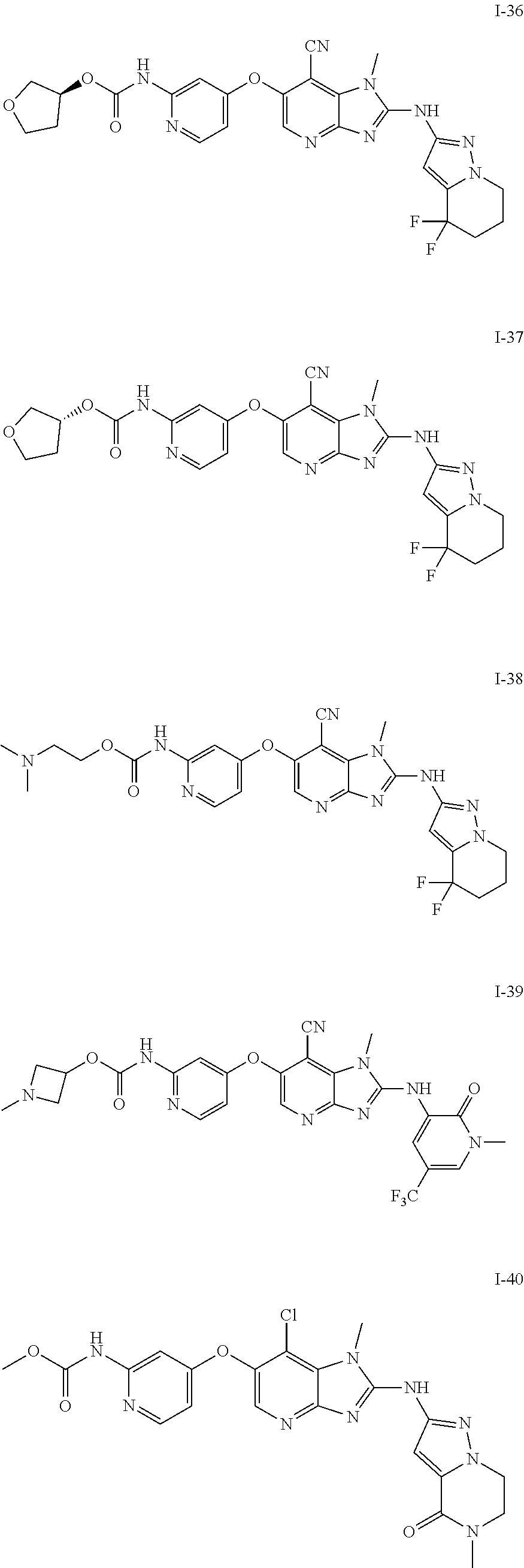


Priority Applications (2)
| Application Number | Priority Date | Filing Date | Title |
|---|---|---|---|
| US17/982,663 US11970494B2 (en) | 2021-11-09 | 2022-11-08 | 6-heteroaryloxy benzimidazoles and azabenzimidazoles as JAK2 inhibitors |
| US18/617,294 US20240254125A1 (en) | 2021-11-09 | 2024-03-26 | 6-heteroaryloxy benzimidazoles and azabenzimidazoles as jak2 inhibitors |
Applications Claiming Priority (3)
| Application Number | Priority Date | Filing Date | Title |
|---|---|---|---|
| US202163277343P | 2021-11-09 | 2021-11-09 | |
| US202263354403P | 2022-06-22 | 2022-06-22 | |
| US17/982,663 US11970494B2 (en) | 2021-11-09 | 2022-11-08 | 6-heteroaryloxy benzimidazoles and azabenzimidazoles as JAK2 inhibitors |
Related Child Applications (1)
| Application Number | Title | Priority Date | Filing Date |
|---|---|---|---|
| US18/617,294 Division US20240254125A1 (en) | 2021-11-09 | 2024-03-26 | 6-heteroaryloxy benzimidazoles and azabenzimidazoles as jak2 inhibitors |
Publications (2)
| Publication Number | Publication Date |
|---|---|
| US20230167110A1 US20230167110A1 (en) | 2023-06-01 |
| US11970494B2 true US11970494B2 (en) | 2024-04-30 |
Family
ID=84541585
Family Applications (2)
| Application Number | Title | Priority Date | Filing Date |
|---|---|---|---|
| US17/982,663 Active US11970494B2 (en) | 2021-11-09 | 2022-11-08 | 6-heteroaryloxy benzimidazoles and azabenzimidazoles as JAK2 inhibitors |
| US18/617,294 Pending US20240254125A1 (en) | 2021-11-09 | 2024-03-26 | 6-heteroaryloxy benzimidazoles and azabenzimidazoles as jak2 inhibitors |
Family Applications After (1)
| Application Number | Title | Priority Date | Filing Date |
|---|---|---|---|
| US18/617,294 Pending US20240254125A1 (en) | 2021-11-09 | 2024-03-26 | 6-heteroaryloxy benzimidazoles and azabenzimidazoles as jak2 inhibitors |
Country Status (7)
| Country | Link |
|---|---|
| US (2) | US11970494B2 (en) |
| EP (1) | EP4430042A1 (en) |
| JP (2) | JP7782035B2 (en) |
| AU (1) | AU2022388555A1 (en) |
| CA (1) | CA3234638A1 (en) |
| TW (1) | TW202334139A (en) |
| WO (1) | WO2023086319A1 (en) |
Families Citing this family (5)
| Publication number | Priority date | Publication date | Assignee | Title |
|---|---|---|---|---|
| WO2021226261A1 (en) | 2020-05-06 | 2021-11-11 | Ajax Therapeutics, Inc. | 6-heteroaryloxy benzimidazoles and azabenzimidazoles as jak2 inhibitors |
| US12043632B2 (en) | 2020-12-23 | 2024-07-23 | Ajax Therapeutics, Inc. | 6-heteroaryloxy benzimidazoles and azabenzimidazoles as JAK2 inhibitors |
| CA3234638A1 (en) | 2021-11-09 | 2023-05-19 | Ajax Therapeutics, Inc. | 6-heteroaryloxy benzimidazoles and azabenzimidazoles as jak2 inhibitors |
| WO2023086320A1 (en) | 2021-11-09 | 2023-05-19 | Ajax Therapeutics, Inc. | Forms and compositions of inhibitors of jak2 |
| TW202444717A (en) * | 2023-05-03 | 2024-11-16 | 美商雅捷可斯治療公司 | Forms and compositions of a jak2 inhibitor |
Citations (271)
| Publication number | Priority date | Publication date | Assignee | Title |
|---|---|---|---|---|
| WO1993005163A1 (en) | 1991-08-28 | 1993-03-18 | Sandoz Ltd. | Method for the selection of genetically transformed cells and compounds for use in the method |
| US5270148A (en) | 1991-06-05 | 1993-12-14 | Fuji Photo Film Co., Ltd. | Processing solution for silver halide color photographic materials and method for processing the materials with the processing solution |
| EP0639573A1 (en) | 1993-08-03 | 1995-02-22 | Hoechst Aktiengesellschaft | Benzocondensed five membered heterocycles, process of their preparation, their use as drug, as diagnostic means and pharmaceuticals containing it |
| US5512590A (en) | 1994-05-10 | 1996-04-30 | Synthelabo | 5,6-dihydro-4h-imidazo 2',1':2,3!imidazo- 4,5,1-ij!quinoline and 4,5-dihydroimidazo- 1,2-a!pyrolo 1,2,3-cd!benzimidazole derivatives, their preparation and application in therapeutics |
| WO1997011065A1 (en) | 1995-09-18 | 1997-03-27 | Basf Aktiengesellschaft | Phenylacetic acids, processes for their preparation and agents containing them |
| US5616537A (en) | 1992-07-03 | 1997-04-01 | Kumiai Chemical Industry Co., Ltd. | Condensed heterocyclic derivatives and herbicides |
| CN1148043A (en) | 1995-10-17 | 1997-04-23 | 化学工业部沈阳化工研究院 | 4-aryloxy (arylthio or arylamino) pyrimidine derivative with herbicide active, and method for prepn. of same |
| US5702877A (en) | 1995-03-07 | 1997-12-30 | Agfa-Gevaert Ag | Color photographic silver halide material |
| US5814633A (en) | 1994-11-23 | 1998-09-29 | Basf Aktiengesellschaft | Iminooxymethylene anilides, process for preparing the same and their use |
| US5852046A (en) | 1993-08-03 | 1998-12-22 | Hoechst Aktiengesellschaft | Benzo-fused heterocyclic compounds having a 5-membered ring processes for their preparation their use as medicaments their use as diagnostic agents and medicaments containing them |
| WO1999026932A1 (en) | 1997-11-26 | 1999-06-03 | Axys Pharmaceuticals, Inc. | By amidino group substituted heterocyclic derivatives and their use as anticoagulants |
| JPH11283746A (en) | 1998-03-27 | 1999-10-15 | Fuji Photo Film Co Ltd | Electroluminescent element using bisbenzazole compound and manufacture of bisbenzazole compound |
| US5994629A (en) | 1991-08-28 | 1999-11-30 | Novartis Ag | Positive selection |
| JP2000299186A (en) | 1999-04-13 | 2000-10-24 | Toray Ind Inc | Light emission element |
| WO2001044259A1 (en) | 1999-12-17 | 2001-06-21 | Ariad Pharmaceuticals, Inc. | Purine derivatives |
| US6329383B1 (en) | 1999-01-25 | 2001-12-11 | Pharmacia Ab | 2-amino-5-pyrimidine acetic acid compounds |
| US20010056090A1 (en) | 2000-03-14 | 2001-12-27 | Aquila Brian M. | 3-substituted piperidines comprising urea functionality, and methods of use thereof |
| US20020010159A1 (en) | 1999-12-17 | 2002-01-24 | Manfred Weigele | Proton pump inhibitors |
| US6346531B1 (en) | 1998-05-22 | 2002-02-12 | Smithkline Beecham Corporation | G-CSF mimetics |
| US20020052368A1 (en) | 2000-03-24 | 2002-05-02 | Marlowe Charles K. | Oxindole inhibitors of factor Xa |
| US20020058677A1 (en) | 2000-03-24 | 2002-05-16 | Marlowe Charles K. | Isoquinolone inhibitors of factor Xa |
| US20020068721A1 (en) | 1999-12-17 | 2002-06-06 | Manfred Weigele | Purine derivatives |
| US20020094994A1 (en) | 1999-05-05 | 2002-07-18 | Jean-Dominique Bourzat | Substituted pyrrolidines |
| US20020120144A1 (en) | 2000-12-22 | 2002-08-29 | Tsutomu Akama | Telomerase inhibitors and methods of their use |
| US6444816B1 (en) | 1997-10-27 | 2002-09-03 | Dr. Reddy's Research Foundation | Fused 7-oxo-pyrimidinyl compounds, preparation, composition and use thereof |
| WO2002076960A1 (en) | 2001-03-22 | 2002-10-03 | Abbott Gmbh & Co. Kg | Transition metal mediated process |
| US20020165261A1 (en) | 2001-01-24 | 2002-11-07 | Alexis Borisy | Combinations of drugs (e.g., a benzimidazole and pentamidine) for the treatment of neoplastic disorders |
| US20020173506A1 (en) | 1999-04-12 | 2002-11-21 | Clark David Edward | Substituted bicyclic heteroaryl compounds and their use as integrin antagonists |
| US6552192B1 (en) | 1999-01-26 | 2003-04-22 | Ustau Experimentalni Botaniky Av-Cr | Substituted nitrogen heterocyclic derivatives and pharmaceutical use thereof |
| US6566372B1 (en) | 1999-08-27 | 2003-05-20 | Ligand Pharmaceuticals Incorporated | Bicyclic androgen and progesterone receptor modulator compounds and methods |
| US20030109714A1 (en) | 2001-03-22 | 2003-06-12 | Neil Wishart | Transition metal mediated process |
| US20030187261A1 (en) | 2000-01-07 | 2003-10-02 | Libor Havlicek | Purine derivatives, process for their preparation and use thereof |
| US6630470B1 (en) | 1998-05-22 | 2003-10-07 | Smithkline Beecham Corporation | G-CSF mimetics |
| WO2003082272A1 (en) | 2002-03-29 | 2003-10-09 | Chiron Corporation | Substituted benzazoles and use thereof as raf kinase inhibitors |
| US20030199564A1 (en) | 2000-02-28 | 2003-10-23 | Garry Fenton | Indane derivatives |
| US20040006117A1 (en) | 2002-02-15 | 2004-01-08 | Schering Aktiengesellschaft | Microglia inhibitors for interrupting interleukin 12 and IFN-gamma-mediated immune reactions |
| WO2004006849A2 (en) | 2002-07-15 | 2004-01-22 | Combinatorx, Incorporated | Combinations of drugs for the treatment of neoplasms |
| US20040034224A1 (en) | 2002-06-27 | 2004-02-19 | Roche Palo Alto Llc | Synthesis of purine derivatives |
| JP2004067629A (en) | 2002-08-09 | 2004-03-04 | Yamanouchi Pharmaceut Co Ltd | Mitochondria function-activating agent and new benzimidazole derivative |
| US20040077633A1 (en) | 2000-12-18 | 2004-04-22 | Keith Watson | Antiviral agents |
| US20040082583A1 (en) | 2000-11-29 | 2004-04-29 | Mui Cheung | Chemical compounds |
| US6743800B1 (en) | 1999-07-02 | 2004-06-01 | Aventis Pharma Deutschland Gmbh | Naphthyridine derivatives, processes for their preparation, their use and pharmaceutical compositions comprising them |
| US6747016B1 (en) | 1999-07-02 | 2004-06-08 | Aventis Pharma Deutschland Gmbh | Substituted purine derivatives as inhibitors of cell adhesion |
| US20040122237A1 (en) | 2002-03-29 | 2004-06-24 | Payman Amiri | Substituted benzazoles and methods of their use as inhibitors of Raf kinase |
| US20040171630A1 (en) | 2001-06-19 | 2004-09-02 | Yuntae Kim | Tyrosine kinase inhibitors |
| WO2004085425A1 (en) | 2003-03-21 | 2004-10-07 | Amgen Inc | Fused azoles such as 2,5-disubstituted benzimidazoles, benzoxazoles and benzothiazoles as kinase inhibitors |
| US20040198725A1 (en) | 2002-10-15 | 2004-10-07 | Lijun Sun | Novel compounds |
| WO2004087153A2 (en) | 2003-03-28 | 2004-10-14 | Chiron Corporation | Use of organic compounds for immunopotentiation |
| US20050049263A1 (en) | 2001-10-30 | 2005-03-03 | Kasibhatla Srinivas Rao | Purine analogs having hsp90-inhibiting activity |
| WO2005035526A1 (en) | 2003-10-09 | 2005-04-21 | Argenta Discovery Ltd. | Bicyclic compounds and their therapeutic use |
| WO2005037273A1 (en) | 2003-10-16 | 2005-04-28 | Chiron Corporation | Substituted benzazoles and use thereof as inhibitors of raf kinase |
| US20050101647A1 (en) | 2001-11-26 | 2005-05-12 | Tsuneo Oda | Bicyclic derivative, its production and use |
| US20050137234A1 (en) | 2003-12-19 | 2005-06-23 | Syrrx, Inc. | Histone deacetylase inhibitors |
| US20050209176A1 (en) | 2002-09-06 | 2005-09-22 | Alchemia Limited | Compounds that interact with kinases |
| JP2005289921A (en) | 2004-04-01 | 2005-10-20 | Mitsui Chemicals Inc | Anthracene compound and organic electroluminescent element containing the compound |
| US20050239821A1 (en) | 2002-07-03 | 2005-10-27 | Johan Neyts | Viral inhibitors |
| US20050272765A1 (en) | 2004-06-04 | 2005-12-08 | Jun Feng | Dipeptidyl peptidase inhibitors |
| US20050282802A1 (en) | 2004-04-13 | 2005-12-22 | Elena Kostik | Disalt inhibitors of IL-12 production |
| US20060042026A1 (en) | 2004-08-26 | 2006-03-02 | The Procter & Gamble Company | Keratin dyeing compounds, keratin dyeing compositions containing them, and use thereof |
| US20060052331A1 (en) | 2004-09-09 | 2006-03-09 | Solvay Pharmaceuticals B.V. | 2-Substituted-6-trifluoromethyl purine derivatives with adenosine-A3 antagonistic activity |
| WO2006027365A1 (en) | 2004-09-09 | 2006-03-16 | Solvay Pharmaceuticals B.V. | 2-substituted-6-trifluoromethyl purine derivatives with adenosine-a3 antagonistic activity |
| US20060111362A1 (en) | 2002-12-04 | 2006-05-25 | Eisai Co., Ltd. | 1,3-Dihydroimidazole ring compound |
| US20060116383A1 (en) | 2004-11-12 | 2006-06-01 | Jason Bloxham | Integrin antagonists useful as anticancer agents |
| US20060148830A1 (en) | 2002-10-03 | 2006-07-06 | Ono Pharmaceutical Co., Ltd. | Lpa receptor antagonist |
| US20060154977A1 (en) | 2002-06-07 | 2006-07-13 | Cortical Pty Ltd, Corporation | Therapeutic molecules and methods-1 |
| US20060160872A1 (en) | 2005-01-20 | 2006-07-20 | Norman Mark H | Vanilloid receptor ligands and their use in treatments |
| WO2006128129A2 (en) | 2005-05-26 | 2006-11-30 | Synta Pharmaceuticals Corp. | Method for treating cancer |
| WO2006130469A1 (en) | 2005-05-27 | 2006-12-07 | Oregon Health & Science University | Stimulation of neurite outgrowth by small molecules |
| US20070032493A1 (en) | 2005-05-26 | 2007-02-08 | Synta Pharmaceuticals Corp. | Method for treating B cell regulated autoimmune disorders |
| US20070043043A1 (en) | 2003-09-22 | 2007-02-22 | S*Bio Pte Ltd. | Benzimidazole derivates: preparation and pharmaceutical applications |
| US20070049622A1 (en) | 2005-08-30 | 2007-03-01 | Novartis Ag | Substituted benzimidazoles and methods of preparation |
| US20070093544A1 (en) | 2003-05-05 | 2007-04-26 | Parmee Emma R | Benzamidazoles, compositions containing such compounds and methods of use |
| US20070105930A1 (en) | 2003-12-19 | 2007-05-10 | Parmee Emma R | Cyclic guanidines, compositions containing such compounds and methods of use |
| US20070112048A1 (en) | 2005-08-12 | 2007-05-17 | Sina Bavari | Broad Spectrum Antibacterial Compounds |
| US20070173527A1 (en) | 2006-01-13 | 2007-07-26 | Bressi Jerome C | Histone deacetylase inhibitors |
| US7256196B1 (en) | 2003-12-09 | 2007-08-14 | The Procter & Gamble Company | Purine cytokine inhibitors |
| WO2007091950A1 (en) | 2006-02-07 | 2007-08-16 | Astrazeneca Ab | Benzimidazoles and imidazopyridines useful in the treatment of diseases or disorders associated with cannabinoid receptor 2 (cb2) such as pain |
| US20070197450A1 (en) | 2004-03-04 | 2007-08-23 | Kissei Pharmaceutical Co., Ltd. | Fused heterocycle derivative, medicinal composition containing the same, and medicinal use thereof |
| US20070219235A1 (en) | 2006-02-10 | 2007-09-20 | Mjalli Adnan M | Benzazole derivatives, compositions, and methods of use as aurora kinase inhibitors |
| WO2007121484A2 (en) | 2006-04-19 | 2007-10-25 | Novartis Ag | 6-o-substituted benzoxazole and benzothiazole compounds and methods of inhibiting csf-1r signaling |
| US20070249637A1 (en) | 2004-10-21 | 2007-10-25 | Collins Michael R | Inhibitors Of Hepatitis C Virus Protease, And Compositions And Treatments Using The Same |
| US20070275984A1 (en) | 2004-09-17 | 2007-11-29 | Janssen Pharmaceutica N.V. | Novel Thieno-Pyridine and Thieno-Pyrimidine Derivatives and Their Use as Positive Allosteric Modulators of Mglur2-Receptors |
| US20080008682A1 (en) | 2006-07-07 | 2008-01-10 | Chong Lee S | Modulators of toll-like receptor 7 |
| US20080009488A1 (en) | 2004-05-07 | 2008-01-10 | Exelixis, Inc. | Raf Modulators and Methods of Use |
| WO2008016666A2 (en) | 2006-08-02 | 2008-02-07 | Cytokinetics, Incorporated | Certain chemical entities, compositions, and methods |
| US20080032936A1 (en) | 2006-08-04 | 2008-02-07 | Enanta Pharmaceuticals, Inc. | Quinoxalinyl tripeptide hepatitis C virus inhibitors |
| US20080058297A1 (en) | 2003-05-29 | 2008-03-06 | Synta Pharmaceuticals Corp. | Heterocyclic Compounds For Preventing And Treating Disorders Associated With Excessive Bone Loss |
| US20080096903A1 (en) | 2006-10-19 | 2008-04-24 | Wyeth | Sulfamoyl-containing derivatives and uses thereof |
| US20080132501A1 (en) | 2006-12-05 | 2008-06-05 | Chung-Ming Sun | Indazole compounds |
| US20080161254A1 (en) | 2007-01-03 | 2008-07-03 | Virobay, Inc. | Hcv inhibitors |
| CN101239980A (en) | 2008-02-18 | 2008-08-13 | 靳广毅 | Immune receptor regulator couplet precursor, couplet and application thereof |
| US20080194803A1 (en) | 2005-06-14 | 2008-08-14 | Sinclair David A | Cognitive Performance With Sirtuin Activators |
| US20080221148A1 (en) | 2006-12-21 | 2008-09-11 | Ibrahim Prabha N | Compounds and methods for kinase modulation, and indications therefor |
| WO2008124145A1 (en) | 2007-04-05 | 2008-10-16 | Government Of The U.S.A., As Represented By The Secretary, Department Of Health And Human Services | Steroid compounds, compositions, and methods of treatment |
| US20080284322A1 (en) | 2005-08-05 | 2008-11-20 | Idemitsu Kosan Co., Ltd. | Nitrogenous Heterocyclic Derivative and Organic Electroluminescence Device Making Use of the Same |
| WO2008144062A1 (en) | 2007-05-21 | 2008-11-27 | Novartis Ag | Csf-1r inhibitors, compositions, and methods of use |
| WO2008150015A1 (en) | 2007-06-05 | 2008-12-11 | Takeda Pharmaceutical Company Limited | Heterobicyclic compounds as kinase inhibitors |
| WO2009011775A1 (en) | 2007-07-13 | 2009-01-22 | Merck & Co., Inc. | Amidoethyl alkylamino orexin receptor antagonists |
| WO2009017954A1 (en) | 2007-08-01 | 2009-02-05 | Phenomix Corporation | Inhibitors of jak2 kinase |
| US20090047249A1 (en) | 2007-06-29 | 2009-02-19 | Micheal Graupe | Modulators of toll-like receptor 7 |
| WO2009034386A1 (en) | 2007-09-13 | 2009-03-19 | Astrazeneca Ab | Derivatives of adenine and 8-aza-adenine and uses thereof-796 |
| WO2009050228A2 (en) | 2007-10-18 | 2009-04-23 | Novartis Ag | Csf-1r inhibitors for treatment of cancer and bone diseases |
| US20090118200A1 (en) | 2005-05-23 | 2009-05-07 | Bergman Jeffrey M | Proline bis-amide orexin receptor antagonists |
| US20090140637A1 (en) | 2005-07-11 | 2009-06-04 | Idemitsu Kosan Co., Ltd. | Nitrogen-containing heterocyclic derivative having electron-attracting substituent and organic electroluminescence element using the same |
| US20090176778A1 (en) | 2007-08-10 | 2009-07-09 | Franz Ulrich Schmitz | Certain nitrogen containing bicyclic chemical entities for treating viral infections |
| JP2009149589A (en) | 2007-12-24 | 2009-07-09 | Dnp Fine Chemicals Co Ltd | Process for producing asymmetric monoazamethine cyanine |
| US20090232844A1 (en) | 2006-03-23 | 2009-09-17 | James Sutton | Immunopotentiating compounds |
| US20090233946A1 (en) | 2007-07-12 | 2009-09-17 | Antoni Krasinski | Fused heteroaryl pyridyl and phenyl benzenesuflonamides as ccr2 modulators for the treatment of inflammation |
| US20090278115A1 (en) | 2005-07-11 | 2009-11-12 | Idemitsu Kosan Co., Ltd. | Nitrogen-containing heterocyclic derivative and organic electroluminescence element using the same |
| WO2009155565A1 (en) | 2008-06-20 | 2009-12-23 | Genentech, Inc. | Triazolopyridine jak inhibitor compounds and methods |
| WO2010002492A1 (en) | 2008-04-29 | 2010-01-07 | University Of Chicago | Methods of use of adenine derivatives for the treatment of diabetes and other disorders |
| US20100010217A1 (en) | 2006-03-23 | 2010-01-14 | Valiante Nicholas M | Methods for the preparation of imidazole-containing compounds |
| US20100029709A1 (en) | 2008-07-25 | 2010-02-04 | Christel Jeanne Marie Menet | Novel compounds useful for the treatment of degenerative and inflammatory diseases |
| US20100093747A1 (en) | 2008-10-10 | 2010-04-15 | Erica Brook Goodhew | Method of inducing negative chemotaxis |
| US20100197688A1 (en) | 2008-05-29 | 2010-08-05 | Nantermet Philippe G | Epha4 rtk inhibitors for treatment of neurological and neurodegenerative disorders and cancer |
| US20100204265A1 (en) | 2009-02-09 | 2010-08-12 | Genelabs Technologies, Inc. | Certain Nitrogen Containing Bicyclic Chemical Entities for Treating Viral Infections |
| US20100210598A1 (en) | 2009-02-11 | 2010-08-19 | Regents Of The University Of California, San Diego | Toll-like receptor modulators and treatment of diseases |
| US20100216810A1 (en) | 2008-12-02 | 2010-08-26 | Takeda Pharmaceutical Company Limited | Heterocyclic compound and use thereof |
| US20100249119A1 (en) | 2007-08-29 | 2010-09-30 | Takeda Pharmaceutical Company Limited | Heterocyclic compound and use thereof |
| US20100256188A1 (en) | 2009-03-05 | 2010-10-07 | Boehringer Ingelheim International Gmbh | New compounds |
| US20100267714A1 (en) | 2008-08-18 | 2010-10-21 | Jorgensen William L | Mif modulators |
| WO2010141796A2 (en) | 2009-06-05 | 2010-12-09 | Cephalon, Inc. | PREPARATION AND USES OF 1,2,4-TRIAZOLO [1,5a] PYRIDINE DERIVATIVES |
| WO2010144909A1 (en) | 2009-06-12 | 2010-12-16 | Novartis Ag | Fused heterocyclic compounds and their uses |
| US20110021518A1 (en) | 2005-12-02 | 2011-01-27 | Bayer Healthcare Llc. | Pyrrolotriazine derivatives useful for treating cancer through inhibition of aurora kinase |
| US20110039895A1 (en) | 2008-04-30 | 2011-02-17 | Glaxo Smith Kline LLC., a corporation | Prolyl hydroxylase inhibitors |
| US20110059962A1 (en) | 2009-04-22 | 2011-03-10 | Alekshun Michael N | Transcription factor modulating compounds and methods of use thereof |
| US20110105498A1 (en) | 2007-05-07 | 2011-05-05 | Amgen Inc. | Pyrazolo-pyridinone and pyrazolo-pyrazinone compounds as P38 modulators and methods of use thereof |
| US20110117073A1 (en) | 2009-09-16 | 2011-05-19 | Avila Therapeutics, Inc. | Protein Kinase Conjugates and Inhibitors |
| WO2011063908A1 (en) | 2009-11-30 | 2011-06-03 | Bayer Schering Pharma Aktiengesellschaft | Triazolopyridines |
| US20110172186A1 (en) | 2008-04-09 | 2011-07-14 | Behnke Mark L | Inhibitors of fatty acid amide hydrolase |
| US20110201605A1 (en) | 2010-02-17 | 2011-08-18 | Karlheinz Baumann | Heteroaryl substituted piperidines |
| US20110237620A1 (en) | 2008-12-01 | 2011-09-29 | Takeda Pharmaceutical Company Limited | Heterocyclic compound and use thereof |
| WO2011127833A1 (en) | 2010-04-16 | 2011-10-20 | 中国科学院上海药物研究所 | Benzoheterocyclic compounds, preparation methods and uses thereof |
| US20110263598A1 (en) | 2010-04-06 | 2011-10-27 | University Health Networks | Kinase inhibitors and method of treating cancer |
| US20110281865A1 (en) | 2010-05-17 | 2011-11-17 | Rhizen Pharmaceuticals Sa | Novel 3,5-disubstituted-3h-imidazo[4,5-b]pyridine and 3,5- disubstituted -3h-[1,2,3]triazolo[4,5-b] pyridine compounds as modulators of protein kinases |
| US20110312935A1 (en) | 2008-09-25 | 2011-12-22 | Boehringer Ingelheim International Gmbh | 1H-Benz Imidazole-5-Carboxamides As Anti-Inflammatory Agents |
| WO2012016133A2 (en) | 2010-07-29 | 2012-02-02 | President And Fellows Of Harvard College | Ros1 kinase inhibitors for the treatment of glioblastoma and other p53-deficient cancers |
| US20120028969A1 (en) | 2010-07-29 | 2012-02-02 | Novartis Ag | Bicyclic acetyl-coa carboxylase inhibitors and uses thereof |
| US8114874B2 (en) | 2005-12-23 | 2012-02-14 | Ariad Pharmaceuticals, Inc. | Substituted acetylenic imidazo[1,2-B]pyridazine compounds as kinase inhibitors |
| US20120172351A1 (en) | 2009-06-09 | 2012-07-05 | Nobuyuki Negoro | Novel fused cyclic compound and use thereof |
| US20120202287A1 (en) | 2009-01-22 | 2012-08-09 | David Roger Adams | Stem Cell Culture Methods |
| US20120208839A1 (en) | 2010-08-20 | 2012-08-16 | Boehringer Ingelheim International Gmbh | New compounds |
| US20120214786A1 (en) | 2010-08-20 | 2012-08-23 | Boehringer Ingelheim International Gmbh | New compounds |
| US20120258967A1 (en) | 2011-03-09 | 2012-10-11 | Avila Therapeutics, Inc. | Pi3 kinase inhibitors and uses thereof |
| US8293923B2 (en) | 2006-09-07 | 2012-10-23 | Biogen Idec Ma Inc. | Indazole derivatives as modulators of interleukin-1 receptor-associated kinase |
| WO2013024078A1 (en) | 2011-08-17 | 2013-02-21 | F. Hoffmann-La Roche Ag | Inhibitors of bruton's tyrosine kinase |
| US20130059851A1 (en) | 2010-03-09 | 2013-03-07 | Dana-Farber Cancer Institute, Inc. | Methods of Diagnosing and Treating Cancer in Patients Having or Developing Resistance to a First Cancer Therapy |
| US20130079342A1 (en) | 2010-06-30 | 2013-03-28 | Paul John Dransfield | Heterocyclic compounds and their uses |
| US20130084346A1 (en) | 2010-03-04 | 2013-04-04 | Scott Wolkenberg | Inhibitors of catechol o-methyl transferase and their use in the treatment of psychotic disorders |
| US20130090327A1 (en) | 2011-09-30 | 2013-04-11 | Methylgene Inc. | Inhibitors of Protein Tyrosine Kinase Activity |
| US20130096136A1 (en) | 2011-09-30 | 2013-04-18 | Methylgene Inc. | Inhibitors of Protein Tyrosine Kinase Activity |
| US20130136782A1 (en) | 2011-11-04 | 2013-05-30 | Helen BLACKWELL | Inhibition and Dispersion of Bacterial Biofilms with 2-Aminobenzimidazole Derivatives |
| US20130149717A1 (en) | 2010-04-21 | 2013-06-13 | Research Development Foundation | Methods and compositions related to dopaminergic neuronal cells |
| US20130165446A1 (en) | 2010-05-11 | 2013-06-27 | Takashi Fujita | Benzo-or pyrido-imidazole derivative |
| US20130184240A1 (en) | 2010-09-10 | 2013-07-18 | Shionogi & Co., Ltd. | Hetero ring-fused imidazole derivative having ampk activating effect |
| US20130184248A1 (en) | 2012-01-17 | 2013-07-18 | Boehringer Ingelheim International Gmbh | Novel compounds |
| US20130190320A1 (en) | 2012-01-13 | 2013-07-25 | Acea Biosciences, Inc. | Heterocyclic compounds and uses as anticancer agents |
| US20130225596A1 (en) | 2010-08-10 | 2013-08-29 | Hiroyuki Kai | Novel heterocyclic derivative and pharmaceutical composition comprising the same (as amended) |
| US20130261125A1 (en) | 2010-12-21 | 2013-10-03 | Gerald W. Shipps, Jr. | Indazole derivatives useful as erk inhibitors |
| US20130310333A1 (en) | 2010-12-03 | 2013-11-21 | Epizyme, Inc. | Modulators of Histone Methyltransferase, and Methods of Use Thereof |
| US20130345261A1 (en) | 2011-02-18 | 2013-12-26 | Christopher Waters | Benzimidazole inhibition of biofilm formation |
| US20140011763A1 (en) | 2012-07-06 | 2014-01-09 | Research Foundation Of The City University Of New York | 1,2,3-Triazolyl Purine Derivatives |
| US20140031339A1 (en) | 2012-07-17 | 2014-01-30 | Boehringer Ingelheim International Gmbh | Inhibitors of leukotriene production |
| WO2014069426A1 (en) | 2012-10-31 | 2014-05-08 | 塩野義製薬株式会社 | Benzimidazole having ampk activating effect and azabenzimidazole derivative |
| WO2014072435A1 (en) | 2012-11-08 | 2014-05-15 | Selvita Sa | Substituted tricyclic benzimidazoles as kinase inhibitors |
| US20140155379A1 (en) | 2010-11-19 | 2014-06-05 | Ligand Pharmaceuticals Incorporated | Heterocycle amines and uses thereof |
| US20140194420A1 (en) | 2011-07-15 | 2014-07-10 | Shionogi & Co., Ltd. | Azabenzimidazole derivative having ampk-activating activity |
| US8846697B2 (en) | 2006-05-31 | 2014-09-30 | The Regents Of The University Of California | Purine analogs |
| US20140303102A1 (en) | 2011-08-08 | 2014-10-09 | California Institute Of Technology | Small Molecule Compounds that Control Mammal-Pathogenic Nematodes |
| US20140303360A1 (en) | 2011-08-08 | 2014-10-09 | California Institute Of Technology | Small Molecule Compounds for the Control of Nematodes |
| WO2014175330A1 (en) | 2013-04-24 | 2014-10-30 | 塩野義製薬株式会社 | 5-oxybenzimidazole and 5-oxyaza benzimidazole derivative having ampk activation effect |
| WO2015008861A1 (en) | 2013-07-19 | 2015-01-22 | 大日本住友製薬株式会社 | Novel imidazopyridine compound |
| US20150057309A1 (en) | 2012-03-30 | 2015-02-26 | Rhizen Pharmaceuticals Sa | Novel 3,5-disubstituted-3h-imidazo[4,5-b]pyridine and 3,5- disubstituted -3h-[1,2,3]triazolo[4,5-b] pyridine compounds as modulators of c-met protein, etc |
| US20150126436A1 (en) | 2012-05-30 | 2015-05-07 | Biodiem Limited | Method of treating scedosporium spp. infection |
| US20150133500A1 (en) | 2013-11-08 | 2015-05-14 | Purdue Pharma L.P. | Benzimidazole derivatives and use thereof |
| US20150152065A1 (en) | 2012-06-11 | 2015-06-04 | Ucb Biopharma Sprl | TNF -Alpha Modulating Benzimidazoles |
| US20150197497A1 (en) | 2011-06-24 | 2015-07-16 | Dana-Farber Cancer Institute, Inc. | Selective inhibitors of histone deacetylase isoform 6 and methods thereof |
| US20150216168A1 (en) | 2012-09-05 | 2015-08-06 | Bayer Cropscience Ag | Use of substituted 2-amidobenzimidazoles, 2-amidobenzoxazoles and 2-amidobenzothiazoles or salts thereof as active substances against abiotic plant stress |
| US20150243903A1 (en) | 2014-02-27 | 2015-08-27 | Universal Display Corporation | Organic electroluminescent materials and devices |
| US20150249221A1 (en) | 2014-03-01 | 2015-09-03 | Universal Display Corporation | Organic electroluminescent materials and devices |
| US9145438B2 (en) | 2010-12-03 | 2015-09-29 | Epizyme, Inc. | 7-deazapurine modulators of histone methyltransferase, and methods of use thereof |
| US9200020B2 (en) | 2012-05-07 | 2015-12-01 | The University Of Queensland | 6-oxopurine phosphoribosyltransferase inhibitors |
| US20160024072A1 (en) | 2012-02-09 | 2016-01-28 | Shionogi & Co., Ltd. | Heterocyclic Ring and Carbocyclic Derivative |
| WO2016014576A1 (en) | 2014-07-21 | 2016-01-28 | Novartis Ag | Treatment of cancer using a cd33 chimeric antigen receptor |
| US20160052922A1 (en) | 2013-03-15 | 2016-02-25 | Epizyme. Inc. | 1-phenoxy-3-(alkylamino)-propan-2-ol derivatives as carm1 inhibitors and uses thereof |
| US9284299B2 (en) | 2012-02-10 | 2016-03-15 | University Of Utah Research Foundation | Substituted 1H-indazol-1-ol analogs as inhibitors of beta catenin/Tcf protein-protein interactions |
| US20160096804A1 (en) | 2013-05-10 | 2016-04-07 | Karus Therapeutics Ltd | Novel histone deacetylase inhibitors |
| US20160168165A1 (en) | 2014-12-10 | 2016-06-16 | Massachusetts Institute Of Technology | Myc modulators and uses thereof |
| US20160176825A1 (en) | 2013-07-09 | 2016-06-23 | Dana-Farber Cancer Institute, Inc. | Kinase inhibitors for the treatment of disease |
| JP2016132649A (en) | 2015-01-21 | 2016-07-25 | 大日本住友製薬株式会社 | Novel imidazo pyridine derivative and pharmaceutical use thereof |
| WO2016119700A1 (en) | 2015-01-28 | 2016-08-04 | Jn Therapeutics | Substituted imidazo [1, 2-a] pyridin-2-ylamine compounds, and pharmaceutical compositions and methods of use thereof |
| US20160229837A1 (en) | 2014-10-14 | 2016-08-11 | Sunshine Lake Pharma Co., Ltd. | Substituted heteroaryl compounds and methods of use |
| EP3059225A1 (en) | 2013-10-17 | 2016-08-24 | Shionogi & Co., Ltd. | Novel alkylene derivative |
| US20160297795A1 (en) | 2013-12-09 | 2016-10-13 | Ucb Biopharma Sprl | Tetrahydrobenzimidazole Derivatives as Modulators of TNF Activity |
| US20160304511A1 (en) | 2013-12-09 | 2016-10-20 | Ucb Biopharma Sprl | Imidazopyridine Derivatives As Modulators of TNF Activity |
| US20160304513A1 (en) | 2013-12-09 | 2016-10-20 | Ucb Biopharma Sprl | Imidazopyridine Derivatives As Modulators of TNF Activity |
| US20170114078A1 (en) | 2014-06-13 | 2017-04-27 | Merck Sharp Dohme Corp. | Purine inhibitors of human phosphatidylinositol 3-kinase delta |
| US20170121349A1 (en) | 2014-06-20 | 2017-05-04 | Institut Pasteur Korea | Anti-Infective Compounds |
| US20170129883A1 (en) | 2013-12-09 | 2017-05-11 | Ucb Biopharma Sprl | Tetrahydroimidazopyridine Derivatives as Modulators of TNF Activity |
| US20170158688A1 (en) | 2013-12-09 | 2017-06-08 | Ucb Biopharma Sprl | Imidazopyridine Derivatives as Modulators of TNF Activity |
| US20170222157A1 (en) | 2014-07-21 | 2017-08-03 | Merck Patent Gmbh | Materials for electronic devices |
| WO2017143014A1 (en) | 2016-02-16 | 2017-08-24 | Brian Kim | Jak inhibitors and uses thereof |
| WO2017175068A1 (en) | 2016-04-08 | 2017-10-12 | Mankind Pharma Ltd. | Thiazolopyridine derivatives as gpr119 agonists |
| US20170333398A1 (en) | 2014-10-28 | 2017-11-23 | Shionogi & Co., Ltd. | Heterocyclic derivative having ampk-activating activity |
| CN107383014A (en) | 2017-06-21 | 2017-11-24 | 南方医科大学 | A kind of 1H pyrazolos [3,4 d] pyrimidines and its preparation method and application |
| US20180030453A1 (en) | 2015-02-19 | 2018-02-01 | St. Jude Children's Research Hospital, Inc. | Method for improving learning |
| EP3279187A1 (en) | 2015-03-30 | 2018-02-07 | Shionogi & Co., Ltd. | 9-membered fused ring derivative |
| WO2018039557A1 (en) | 2016-08-26 | 2018-03-01 | Ngm Biopharmaceuticals, Inc. | Methods of treating fibroblast growth factor 19-mediated cancers and tumors |
| US20180072688A1 (en) | 2016-08-15 | 2018-03-15 | Neupharma, Inc. | Certain chemical entities, compositions, and methods |
| US20180086725A1 (en) | 2015-06-12 | 2018-03-29 | Transitions Optical, Inc. | Alignment Compounds |
| WO2018064498A1 (en) | 2016-09-30 | 2018-04-05 | Pairnomix, Llc | Methods of treating epilepsy and related neurological conditions |
| WO2018066545A1 (en) | 2016-10-04 | 2018-04-12 | 公益財団法人ヒューマンサイエンス振興財団 | Heterocyclic compound |
| US20180153877A1 (en) | 2015-06-04 | 2018-06-07 | Children's Hospital Medical Center | Therapeutic targeting of myelopoliferative neoplasmas by dusp1 inhibition |
| US20180273511A1 (en) | 2015-09-23 | 2018-09-27 | Capella Therapeutics, Inc. | Benzimidazoles for use in the treatment of cancer and inflammatory diseases |
| WO2018191146A1 (en) | 2017-04-10 | 2018-10-18 | Navitor Pharmaceuticals, Inc. | Heteroaryl rheb inhibitors and uses thereof |
| CN108689942A (en) | 2017-04-11 | 2018-10-23 | 广东东阳光药业有限公司 | Nitrogenous dicyclic compound and its preparation method and application |
| WO2018200786A1 (en) | 2017-04-26 | 2018-11-01 | Yale University | Compositions and methods for treating vitiligo |
| WO2018204765A1 (en) | 2017-05-05 | 2018-11-08 | Pairnomix, Llc | Methods of treating epilepsy and kcnq2 related conditions |
| WO2018203099A1 (en) | 2017-05-03 | 2018-11-08 | Universite Grenoble Alpes | Method for synthesizing diversely substituted purines |
| WO2019000683A1 (en) | 2017-06-30 | 2019-01-03 | 北京泰德制药股份有限公司 | Rho-associated protein kinase inhibitor, pharmaceutical composition containing rho-associated protein kinase inhibitor, preparation method and use of the pharmaceutical composition |
| WO2019018119A1 (en) | 2017-07-18 | 2019-01-24 | Pairnomix, Llc | Methods of treating epilepsy and kcnti related conditions |
| US20190022074A1 (en) | 2017-06-21 | 2019-01-24 | SHY Therapeutics LLC | Compounds that interact with the ras superfamily for the treatment of cancers, inflammatory diseases, rasopathies, and fibrotic disease |
| US20190038603A1 (en) | 2016-02-25 | 2019-02-07 | Gesynta Pharma Ab | Methods of treating diseases characterised by vasoconstriction |
| WO2019038683A1 (en) | 2017-08-24 | 2019-02-28 | Institute For Stem Cell Biology And Regenerative Medicine | Compounds targeting tandem brct domains of brca1, compositions and methods thereof |
| EP3450435A1 (en) | 2016-04-26 | 2019-03-06 | Shionogi & Co., Ltd | 5-substituted azabenzimidazole derivative having ampk activation action |
| WO2019079596A1 (en) | 2017-10-18 | 2019-04-25 | Epizyme, Inc. | Methods of using ehmt2 inhibitors in immunotherapies |
| US20190119217A1 (en) | 2015-04-07 | 2019-04-25 | Guangdong Raynovent Biotech Co., Ltd. | Tyrosine kinase inhibitor and pharmaceutical composition comprising same |
| WO2019079607A1 (en) | 2017-10-18 | 2019-04-25 | Epizyme, Inc. | Methods of using ehmt2 inhibitors in treating or preventing blood disorders |
| WO2019088159A1 (en) | 2017-11-01 | 2019-05-09 | 大日本住友製薬株式会社 | Substituted purine compound |
| US20190134042A1 (en) | 2017-10-11 | 2019-05-09 | Chemocentryx, Inc. | Treatment of focal segmental glomerulosclerosis with ccr2 antagonists |
| KR20190064508A (en) | 2017-11-30 | 2019-06-10 | 솔브레인 주식회사 | Compound and organic light emitting device comprising the same |
| US20190183866A1 (en) | 2016-05-20 | 2019-06-20 | Shionogi & Co., Ltd. | 5-substituted benzimidazole and 5-substituted azabenzimidazole derivative both having ampk activation effect |
| CN110092798A (en) | 2018-01-29 | 2019-08-06 | 上海新契博生物科技有限公司 | It is a kind of as the heterocyclic compound and its synthetic method of FGFR inhibitor and application |
| WO2019217838A1 (en) | 2018-05-11 | 2019-11-14 | The University Of Arizona | Methods for treating or limiting development of cardiovascular disease-related neurological disorders |
| US20190382377A1 (en) | 2017-01-26 | 2019-12-19 | Araxes Pharma Llc | 1-(3-(6-(3-hydroxynaphthalen-1-yl)benzofuran-2-yl)azetidin-1 yl)prop-2-en-1-one derivatives and similar compounds as kras g12c modulators for treating cancer |
| US20190388426A1 (en) | 2017-01-30 | 2019-12-26 | Université de Liège | Perk and ire-1a inhibitors against neurodevelopmental disorders |
| WO2020014599A1 (en) | 2018-07-13 | 2020-01-16 | Teqla Therapeutics, Inc. | Use of bcl6 inhibitors for treating autoimmune diseases |
| US20200039998A1 (en) | 2016-12-19 | 2020-02-06 | Epizyme, Inc. | Amine-substituted heterocyclic compounds as ehmt2 inhibitors and methods of use thereof |
| US20200039961A1 (en) | 2016-09-30 | 2020-02-06 | Epizyme, Inc. | Substituted fused bi- or tri- heterocyclic compounds as ehmt2 inhibitors |
| US20200039933A1 (en) | 2017-04-26 | 2020-02-06 | The Board Of Trustees Of The University Of Illinois | Nrf and hif activators/hdac inhibitors and therapeutic methods using the same |
| US20200054635A1 (en) | 2017-04-21 | 2020-02-20 | Epizyme, Inc. | Combination therapies with ehmt2 inhibitors |
| US20200062758A1 (en) | 2016-11-11 | 2020-02-27 | Hepo Pharmaceutical Co., Ltd | Nitrogen-Containing Heterocyclic Compound, Preparation Method, Intermediate, Pharmaceutical Composition and use |
| US20200101091A1 (en) | 2017-03-23 | 2020-04-02 | Universite De Montpellier | Acylnucleoside phosphonates, prodrugs thereof and use thereof as medicament |
| US20200113901A1 (en) | 2017-03-31 | 2020-04-16 | Epizyme, Inc. | Methods of using ehmt2 inhibitors |
| US20200113907A1 (en) | 2017-02-20 | 2020-04-16 | Kyoto University | Pharmaceutical composition and treatment method for genetic disease associated with splicing abnormalities |
| WO2020081450A1 (en) | 2018-10-15 | 2020-04-23 | Nurix Therapeutics, Inc. | Bifunctional compounds for degrading btk via ubiquitin proteosome pathway |
| WO2020089455A1 (en) | 2018-11-02 | 2020-05-07 | Aicuris Gmbh & Co. Kg | 6,7-dihydro-4h-pyrazolo[1,5-a]pyrazine indole-2-carboxamides active against the hepatitis b virus (hbv) |
| WO2020093905A1 (en) | 2018-11-07 | 2020-05-14 | 四川科伦博泰生物医药股份有限公司 | Ring-fused compound, preparation method therefor and application thereof |
| WO2020097398A1 (en) | 2018-11-07 | 2020-05-14 | Dana-Farber Cancer Institute, Inc. | Benzothiazole derivatives and 7-aza-benzothiazole derivatives as janus kinase 2 inhibitors and uses thereof |
| WO2020097396A1 (en) | 2018-11-07 | 2020-05-14 | Dana-Farber Cancer Institute, Inc. | Benzimidazole derivatives and aza-benzimidazole derivatives as janus kinase 2 inhibitors and uses thereof |
| WO2020097400A1 (en) | 2018-11-07 | 2020-05-14 | Dana-Farber Cancer Institute, Inc. | Imidazopyridine derivatives and aza-imidazopyridine derivatives as janus kinase 2 inhibitors and uses thereof |
| WO2020118045A1 (en) | 2018-12-05 | 2020-06-11 | Aldeyra Therapeutics, Inc. | Injectable formulations |
| US20200237717A1 (en) | 2017-08-01 | 2020-07-30 | Opal Biosciences Limited | Treatment of Staphylococcal and Enterococcal Infections Using Substituted Nitrostyrene Compounds |
| WO2020165907A1 (en) | 2019-02-14 | 2020-08-20 | Yeda Research And Development Co. Ltd. | Spt5 inhibitors and uses thereof |
| US20200268753A1 (en) | 2017-01-30 | 2020-08-27 | Université de Liège | Perk and ire-1a inhibitors against neurodevelopmental disorders |
| US20200274072A1 (en) | 2015-12-18 | 2020-08-27 | Cambridge Display Technology Limited | Dopant, charge transfer salt and organic electronic device |
| WO2020176597A1 (en) | 2019-02-27 | 2020-09-03 | The Regents Of The University Of California | N-substituted indoles and other heterocycles for treating brain disorders |
| US10766888B1 (en) | 2019-04-12 | 2020-09-08 | Mitobridge Inc. | HMOX1 inducers |
| WO2020180768A1 (en) | 2019-03-01 | 2020-09-10 | Revolution Medicines, Inc. | Bicyclic heteroaryl compounds and uses thereof |
| WO2020181050A1 (en) | 2019-03-05 | 2020-09-10 | Sperovie Biosciences, Inc. | Compounds, compositions, and methods for the treatment of disease |
| US20200317642A1 (en) | 2017-10-17 | 2020-10-08 | Epizyme, Inc. | Amine-substituted heterocyclic compounds as ehmt2 inhibitors and derivatives thereof |
| WO2020210481A1 (en) | 2019-04-12 | 2020-10-15 | Nation Health Research Institutes | Heterocyclic compounds as kinase inhibitors for therapeutic uses |
| WO2020243457A1 (en) | 2019-05-29 | 2020-12-03 | Viogen Biosciences, Llc | Compounds and therapeutic uses thereof |
| US20210008046A1 (en) | 2017-04-18 | 2021-01-14 | Tempest Therapeutics, Inc. | Bicyclic compounds and their use in the treatment of cancer |
| WO2021067682A1 (en) | 2019-10-03 | 2021-04-08 | Dana-Farber Cancer Institute, Inc. | Tricyclic kinase inhibitors and uses thereof |
| WO2021091575A1 (en) | 2019-11-08 | 2021-05-14 | Nurix Therapeutics, Inc. | Bifunctional compounds for degrading btk via ubiquitin proteosome pathway |
| WO2021113557A1 (en) | 2019-12-04 | 2021-06-10 | Nurix Therapeutics, Inc. | Bifunctional compounds for degrading btk via ubiquitin proteosome pathway |
| WO2021226261A1 (en) | 2020-05-06 | 2021-11-11 | Ajax Therapeutics, Inc. | 6-heteroaryloxy benzimidazoles and azabenzimidazoles as jak2 inhibitors |
| WO2022140527A1 (en) | 2020-12-23 | 2022-06-30 | Ajax Therapeutics, Inc. | 6-heteroaryloxy benzimidazoles and azabenzimidazoles as jak2 inhibitors |
| US20230146125A1 (en) | 2021-11-09 | 2023-05-11 | Ajax Therapeutics, Inc. | Forms and compositions of inhibitors of jak2 |
| WO2023086319A1 (en) | 2021-11-09 | 2023-05-19 | Ajax Therapeutics, Inc. | 6-he tero aryloxy benzimidazoles and azabenzimidazoles as jak2 inhibitors |
-
2022
- 2022-11-08 CA CA3234638A patent/CA3234638A1/en active Pending
- 2022-11-08 TW TW111142607A patent/TW202334139A/en unknown
- 2022-11-08 AU AU2022388555A patent/AU2022388555A1/en active Pending
- 2022-11-08 US US17/982,663 patent/US11970494B2/en active Active
- 2022-11-08 JP JP2024526576A patent/JP7782035B2/en active Active
- 2022-11-08 EP EP22826728.2A patent/EP4430042A1/en active Pending
- 2022-11-08 WO PCT/US2022/049220 patent/WO2023086319A1/en not_active Ceased
-
2024
- 2024-03-26 US US18/617,294 patent/US20240254125A1/en active Pending
-
2025
- 2025-09-16 JP JP2025153429A patent/JP2025178324A/en active Pending
Patent Citations (292)
| Publication number | Priority date | Publication date | Assignee | Title |
|---|---|---|---|---|
| US5270148A (en) | 1991-06-05 | 1993-12-14 | Fuji Photo Film Co., Ltd. | Processing solution for silver halide color photographic materials and method for processing the materials with the processing solution |
| US5994629A (en) | 1991-08-28 | 1999-11-30 | Novartis Ag | Positive selection |
| WO1993005163A1 (en) | 1991-08-28 | 1993-03-18 | Sandoz Ltd. | Method for the selection of genetically transformed cells and compounds for use in the method |
| US5616537A (en) | 1992-07-03 | 1997-04-01 | Kumiai Chemical Industry Co., Ltd. | Condensed heterocyclic derivatives and herbicides |
| EP0639573A1 (en) | 1993-08-03 | 1995-02-22 | Hoechst Aktiengesellschaft | Benzocondensed five membered heterocycles, process of their preparation, their use as drug, as diagnostic means and pharmaceuticals containing it |
| US5852046A (en) | 1993-08-03 | 1998-12-22 | Hoechst Aktiengesellschaft | Benzo-fused heterocyclic compounds having a 5-membered ring processes for their preparation their use as medicaments their use as diagnostic agents and medicaments containing them |
| US5512590A (en) | 1994-05-10 | 1996-04-30 | Synthelabo | 5,6-dihydro-4h-imidazo 2',1':2,3!imidazo- 4,5,1-ij!quinoline and 4,5-dihydroimidazo- 1,2-a!pyrolo 1,2,3-cd!benzimidazole derivatives, their preparation and application in therapeutics |
| US5814633A (en) | 1994-11-23 | 1998-09-29 | Basf Aktiengesellschaft | Iminooxymethylene anilides, process for preparing the same and their use |
| US5702877A (en) | 1995-03-07 | 1997-12-30 | Agfa-Gevaert Ag | Color photographic silver halide material |
| WO1997011065A1 (en) | 1995-09-18 | 1997-03-27 | Basf Aktiengesellschaft | Phenylacetic acids, processes for their preparation and agents containing them |
| CN1148043A (en) | 1995-10-17 | 1997-04-23 | 化学工业部沈阳化工研究院 | 4-aryloxy (arylthio or arylamino) pyrimidine derivative with herbicide active, and method for prepn. of same |
| US6444816B1 (en) | 1997-10-27 | 2002-09-03 | Dr. Reddy's Research Foundation | Fused 7-oxo-pyrimidinyl compounds, preparation, composition and use thereof |
| WO1999026932A1 (en) | 1997-11-26 | 1999-06-03 | Axys Pharmaceuticals, Inc. | By amidino group substituted heterocyclic derivatives and their use as anticoagulants |
| JPH11283746A (en) | 1998-03-27 | 1999-10-15 | Fuji Photo Film Co Ltd | Electroluminescent element using bisbenzazole compound and manufacture of bisbenzazole compound |
| US6630470B1 (en) | 1998-05-22 | 2003-10-07 | Smithkline Beecham Corporation | G-CSF mimetics |
| US6346531B1 (en) | 1998-05-22 | 2002-02-12 | Smithkline Beecham Corporation | G-CSF mimetics |
| US6329383B1 (en) | 1999-01-25 | 2001-12-11 | Pharmacia Ab | 2-amino-5-pyrimidine acetic acid compounds |
| US6552192B1 (en) | 1999-01-26 | 2003-04-22 | Ustau Experimentalni Botaniky Av-Cr | Substituted nitrogen heterocyclic derivatives and pharmaceutical use thereof |
| US20020173506A1 (en) | 1999-04-12 | 2002-11-21 | Clark David Edward | Substituted bicyclic heteroaryl compounds and their use as integrin antagonists |
| JP2000299186A (en) | 1999-04-13 | 2000-10-24 | Toray Ind Inc | Light emission element |
| US20020094994A1 (en) | 1999-05-05 | 2002-07-18 | Jean-Dominique Bourzat | Substituted pyrrolidines |
| US6747016B1 (en) | 1999-07-02 | 2004-06-08 | Aventis Pharma Deutschland Gmbh | Substituted purine derivatives as inhibitors of cell adhesion |
| US6743800B1 (en) | 1999-07-02 | 2004-06-01 | Aventis Pharma Deutschland Gmbh | Naphthyridine derivatives, processes for their preparation, their use and pharmaceutical compositions comprising them |
| US6566372B1 (en) | 1999-08-27 | 2003-05-20 | Ligand Pharmaceuticals Incorporated | Bicyclic androgen and progesterone receptor modulator compounds and methods |
| US20020068721A1 (en) | 1999-12-17 | 2002-06-06 | Manfred Weigele | Purine derivatives |
| US20020010159A1 (en) | 1999-12-17 | 2002-01-24 | Manfred Weigele | Proton pump inhibitors |
| WO2001044259A1 (en) | 1999-12-17 | 2001-06-21 | Ariad Pharmaceuticals, Inc. | Purine derivatives |
| US20030187261A1 (en) | 2000-01-07 | 2003-10-02 | Libor Havlicek | Purine derivatives, process for their preparation and use thereof |
| US20030199564A1 (en) | 2000-02-28 | 2003-10-23 | Garry Fenton | Indane derivatives |
| US20010056090A1 (en) | 2000-03-14 | 2001-12-27 | Aquila Brian M. | 3-substituted piperidines comprising urea functionality, and methods of use thereof |
| US20020058677A1 (en) | 2000-03-24 | 2002-05-16 | Marlowe Charles K. | Isoquinolone inhibitors of factor Xa |
| US20020052368A1 (en) | 2000-03-24 | 2002-05-02 | Marlowe Charles K. | Oxindole inhibitors of factor Xa |
| US20040082583A1 (en) | 2000-11-29 | 2004-04-29 | Mui Cheung | Chemical compounds |
| US20040077633A1 (en) | 2000-12-18 | 2004-04-22 | Keith Watson | Antiviral agents |
| US20020120144A1 (en) | 2000-12-22 | 2002-08-29 | Tsutomu Akama | Telomerase inhibitors and methods of their use |
| US20020165261A1 (en) | 2001-01-24 | 2002-11-07 | Alexis Borisy | Combinations of drugs (e.g., a benzimidazole and pentamidine) for the treatment of neoplastic disorders |
| US20030109714A1 (en) | 2001-03-22 | 2003-06-12 | Neil Wishart | Transition metal mediated process |
| WO2002076960A1 (en) | 2001-03-22 | 2002-10-03 | Abbott Gmbh & Co. Kg | Transition metal mediated process |
| US20040171630A1 (en) | 2001-06-19 | 2004-09-02 | Yuntae Kim | Tyrosine kinase inhibitors |
| US20050049263A1 (en) | 2001-10-30 | 2005-03-03 | Kasibhatla Srinivas Rao | Purine analogs having hsp90-inhibiting activity |
| US20050101647A1 (en) | 2001-11-26 | 2005-05-12 | Tsuneo Oda | Bicyclic derivative, its production and use |
| US20040006117A1 (en) | 2002-02-15 | 2004-01-08 | Schering Aktiengesellschaft | Microglia inhibitors for interrupting interleukin 12 and IFN-gamma-mediated immune reactions |
| US8614330B2 (en) | 2002-03-29 | 2013-12-24 | Novartis Vaccines And Diagnostics, Inc. | Substituted benz-azoles and methods of their use as inhibitors of RAF kinase |
| WO2003082272A1 (en) | 2002-03-29 | 2003-10-09 | Chiron Corporation | Substituted benzazoles and use thereof as raf kinase inhibitors |
| US20040087626A1 (en) * | 2002-03-29 | 2004-05-06 | Renhowe Paul A. | Substituted benz-azoles and methods of their use as inhibitors of Raf kinase |
| US20040122237A1 (en) | 2002-03-29 | 2004-06-24 | Payman Amiri | Substituted benzazoles and methods of their use as inhibitors of Raf kinase |
| US20060154977A1 (en) | 2002-06-07 | 2006-07-13 | Cortical Pty Ltd, Corporation | Therapeutic molecules and methods-1 |
| US20040034224A1 (en) | 2002-06-27 | 2004-02-19 | Roche Palo Alto Llc | Synthesis of purine derivatives |
| US20050239821A1 (en) | 2002-07-03 | 2005-10-27 | Johan Neyts | Viral inhibitors |
| WO2004006849A2 (en) | 2002-07-15 | 2004-01-22 | Combinatorx, Incorporated | Combinations of drugs for the treatment of neoplasms |
| JP2004067629A (en) | 2002-08-09 | 2004-03-04 | Yamanouchi Pharmaceut Co Ltd | Mitochondria function-activating agent and new benzimidazole derivative |
| US20050209176A1 (en) | 2002-09-06 | 2005-09-22 | Alchemia Limited | Compounds that interact with kinases |
| US20060148830A1 (en) | 2002-10-03 | 2006-07-06 | Ono Pharmaceutical Co., Ltd. | Lpa receptor antagonist |
| US20040198725A1 (en) | 2002-10-15 | 2004-10-07 | Lijun Sun | Novel compounds |
| US20060111362A1 (en) | 2002-12-04 | 2006-05-25 | Eisai Co., Ltd. | 1,3-Dihydroimidazole ring compound |
| US7531553B2 (en) | 2003-03-21 | 2009-05-12 | Amgen Inc. | Heterocyclic compounds and methods of use |
| WO2004085425A1 (en) | 2003-03-21 | 2004-10-07 | Amgen Inc | Fused azoles such as 2,5-disubstituted benzimidazoles, benzoxazoles and benzothiazoles as kinase inhibitors |
| WO2004087153A2 (en) | 2003-03-28 | 2004-10-14 | Chiron Corporation | Use of organic compounds for immunopotentiation |
| US20070093544A1 (en) | 2003-05-05 | 2007-04-26 | Parmee Emma R | Benzamidazoles, compositions containing such compounds and methods of use |
| US20080058297A1 (en) | 2003-05-29 | 2008-03-06 | Synta Pharmaceuticals Corp. | Heterocyclic Compounds For Preventing And Treating Disorders Associated With Excessive Bone Loss |
| US20070043043A1 (en) | 2003-09-22 | 2007-02-22 | S*Bio Pte Ltd. | Benzimidazole derivates: preparation and pharmaceutical applications |
| WO2005032548A1 (en) | 2003-09-29 | 2005-04-14 | Chiron Corporation | Substituted benzazoles and use thereof as inhibitors of raf kinase |
| WO2005035526A1 (en) | 2003-10-09 | 2005-04-21 | Argenta Discovery Ltd. | Bicyclic compounds and their therapeutic use |
| US20050192287A1 (en) | 2003-10-16 | 2005-09-01 | Chiron Corporation | Substituted benzazoles and methods of their use as inhibitors of Raf kinase |
| WO2005037273A1 (en) | 2003-10-16 | 2005-04-28 | Chiron Corporation | Substituted benzazoles and use thereof as inhibitors of raf kinase |
| US20130224195A1 (en) | 2003-10-16 | 2013-08-29 | Abran Costales | Substituted benzazoles and methods of their use as inhibitors of raf kinase |
| US7256196B1 (en) | 2003-12-09 | 2007-08-14 | The Procter & Gamble Company | Purine cytokine inhibitors |
| US20070105930A1 (en) | 2003-12-19 | 2007-05-10 | Parmee Emma R | Cyclic guanidines, compositions containing such compounds and methods of use |
| US20050137234A1 (en) | 2003-12-19 | 2005-06-23 | Syrrx, Inc. | Histone deacetylase inhibitors |
| US20070197450A1 (en) | 2004-03-04 | 2007-08-23 | Kissei Pharmaceutical Co., Ltd. | Fused heterocycle derivative, medicinal composition containing the same, and medicinal use thereof |
| JP2005289921A (en) | 2004-04-01 | 2005-10-20 | Mitsui Chemicals Inc | Anthracene compound and organic electroluminescent element containing the compound |
| US20050282802A1 (en) | 2004-04-13 | 2005-12-22 | Elena Kostik | Disalt inhibitors of IL-12 production |
| US20080009488A1 (en) | 2004-05-07 | 2008-01-10 | Exelixis, Inc. | Raf Modulators and Methods of Use |
| US20050272765A1 (en) | 2004-06-04 | 2005-12-08 | Jun Feng | Dipeptidyl peptidase inhibitors |
| US20060042026A1 (en) | 2004-08-26 | 2006-03-02 | The Procter & Gamble Company | Keratin dyeing compounds, keratin dyeing compositions containing them, and use thereof |
| WO2006027365A1 (en) | 2004-09-09 | 2006-03-16 | Solvay Pharmaceuticals B.V. | 2-substituted-6-trifluoromethyl purine derivatives with adenosine-a3 antagonistic activity |
| US20060052331A1 (en) | 2004-09-09 | 2006-03-09 | Solvay Pharmaceuticals B.V. | 2-Substituted-6-trifluoromethyl purine derivatives with adenosine-A3 antagonistic activity |
| US20070275984A1 (en) | 2004-09-17 | 2007-11-29 | Janssen Pharmaceutica N.V. | Novel Thieno-Pyridine and Thieno-Pyrimidine Derivatives and Their Use as Positive Allosteric Modulators of Mglur2-Receptors |
| US20070249637A1 (en) | 2004-10-21 | 2007-10-25 | Collins Michael R | Inhibitors Of Hepatitis C Virus Protease, And Compositions And Treatments Using The Same |
| US20060116383A1 (en) | 2004-11-12 | 2006-06-01 | Jason Bloxham | Integrin antagonists useful as anticancer agents |
| US20060160872A1 (en) | 2005-01-20 | 2006-07-20 | Norman Mark H | Vanilloid receptor ligands and their use in treatments |
| US20090118200A1 (en) | 2005-05-23 | 2009-05-07 | Bergman Jeffrey M | Proline bis-amide orexin receptor antagonists |
| US20070032493A1 (en) | 2005-05-26 | 2007-02-08 | Synta Pharmaceuticals Corp. | Method for treating B cell regulated autoimmune disorders |
| WO2006128129A2 (en) | 2005-05-26 | 2006-11-30 | Synta Pharmaceuticals Corp. | Method for treating cancer |
| WO2006130469A1 (en) | 2005-05-27 | 2006-12-07 | Oregon Health & Science University | Stimulation of neurite outgrowth by small molecules |
| US20080194803A1 (en) | 2005-06-14 | 2008-08-14 | Sinclair David A | Cognitive Performance With Sirtuin Activators |
| US20090140637A1 (en) | 2005-07-11 | 2009-06-04 | Idemitsu Kosan Co., Ltd. | Nitrogen-containing heterocyclic derivative having electron-attracting substituent and organic electroluminescence element using the same |
| US20090278115A1 (en) | 2005-07-11 | 2009-11-12 | Idemitsu Kosan Co., Ltd. | Nitrogen-containing heterocyclic derivative and organic electroluminescence element using the same |
| US20080284322A1 (en) | 2005-08-05 | 2008-11-20 | Idemitsu Kosan Co., Ltd. | Nitrogenous Heterocyclic Derivative and Organic Electroluminescence Device Making Use of the Same |
| US20070112048A1 (en) | 2005-08-12 | 2007-05-17 | Sina Bavari | Broad Spectrum Antibacterial Compounds |
| US20070049622A1 (en) | 2005-08-30 | 2007-03-01 | Novartis Ag | Substituted benzimidazoles and methods of preparation |
| US20110021518A1 (en) | 2005-12-02 | 2011-01-27 | Bayer Healthcare Llc. | Pyrrolotriazine derivatives useful for treating cancer through inhibition of aurora kinase |
| US8114874B2 (en) | 2005-12-23 | 2012-02-14 | Ariad Pharmaceuticals, Inc. | Substituted acetylenic imidazo[1,2-B]pyridazine compounds as kinase inhibitors |
| US20070173527A1 (en) | 2006-01-13 | 2007-07-26 | Bressi Jerome C | Histone deacetylase inhibitors |
| WO2007091950A1 (en) | 2006-02-07 | 2007-08-16 | Astrazeneca Ab | Benzimidazoles and imidazopyridines useful in the treatment of diseases or disorders associated with cannabinoid receptor 2 (cb2) such as pain |
| US20070219235A1 (en) | 2006-02-10 | 2007-09-20 | Mjalli Adnan M | Benzazole derivatives, compositions, and methods of use as aurora kinase inhibitors |
| US20100010217A1 (en) | 2006-03-23 | 2010-01-14 | Valiante Nicholas M | Methods for the preparation of imidazole-containing compounds |
| US20090232844A1 (en) | 2006-03-23 | 2009-09-17 | James Sutton | Immunopotentiating compounds |
| WO2007121484A2 (en) | 2006-04-19 | 2007-10-25 | Novartis Ag | 6-o-substituted benzoxazole and benzothiazole compounds and methods of inhibiting csf-1r signaling |
| US8846697B2 (en) | 2006-05-31 | 2014-09-30 | The Regents Of The University Of California | Purine analogs |
| US20080008682A1 (en) | 2006-07-07 | 2008-01-10 | Chong Lee S | Modulators of toll-like receptor 7 |
| WO2008016666A2 (en) | 2006-08-02 | 2008-02-07 | Cytokinetics, Incorporated | Certain chemical entities, compositions, and methods |
| US20080032936A1 (en) | 2006-08-04 | 2008-02-07 | Enanta Pharmaceuticals, Inc. | Quinoxalinyl tripeptide hepatitis C virus inhibitors |
| US8293923B2 (en) | 2006-09-07 | 2012-10-23 | Biogen Idec Ma Inc. | Indazole derivatives as modulators of interleukin-1 receptor-associated kinase |
| US20080096903A1 (en) | 2006-10-19 | 2008-04-24 | Wyeth | Sulfamoyl-containing derivatives and uses thereof |
| US20080132501A1 (en) | 2006-12-05 | 2008-06-05 | Chung-Ming Sun | Indazole compounds |
| US20080221148A1 (en) | 2006-12-21 | 2008-09-11 | Ibrahim Prabha N | Compounds and methods for kinase modulation, and indications therefor |
| US20080161254A1 (en) | 2007-01-03 | 2008-07-03 | Virobay, Inc. | Hcv inhibitors |
| WO2008124145A1 (en) | 2007-04-05 | 2008-10-16 | Government Of The U.S.A., As Represented By The Secretary, Department Of Health And Human Services | Steroid compounds, compositions, and methods of treatment |
| US20110105498A1 (en) | 2007-05-07 | 2011-05-05 | Amgen Inc. | Pyrazolo-pyridinone and pyrazolo-pyrazinone compounds as P38 modulators and methods of use thereof |
| WO2008144062A1 (en) | 2007-05-21 | 2008-11-27 | Novartis Ag | Csf-1r inhibitors, compositions, and methods of use |
| WO2008150015A1 (en) | 2007-06-05 | 2008-12-11 | Takeda Pharmaceutical Company Limited | Heterobicyclic compounds as kinase inhibitors |
| US20090047249A1 (en) | 2007-06-29 | 2009-02-19 | Micheal Graupe | Modulators of toll-like receptor 7 |
| US20090233946A1 (en) | 2007-07-12 | 2009-09-17 | Antoni Krasinski | Fused heteroaryl pyridyl and phenyl benzenesuflonamides as ccr2 modulators for the treatment of inflammation |
| WO2009011775A1 (en) | 2007-07-13 | 2009-01-22 | Merck & Co., Inc. | Amidoethyl alkylamino orexin receptor antagonists |
| WO2009017954A1 (en) | 2007-08-01 | 2009-02-05 | Phenomix Corporation | Inhibitors of jak2 kinase |
| US20090176778A1 (en) | 2007-08-10 | 2009-07-09 | Franz Ulrich Schmitz | Certain nitrogen containing bicyclic chemical entities for treating viral infections |
| US20100249119A1 (en) | 2007-08-29 | 2010-09-30 | Takeda Pharmaceutical Company Limited | Heterocyclic compound and use thereof |
| WO2009034386A1 (en) | 2007-09-13 | 2009-03-19 | Astrazeneca Ab | Derivatives of adenine and 8-aza-adenine and uses thereof-796 |
| WO2009050228A2 (en) | 2007-10-18 | 2009-04-23 | Novartis Ag | Csf-1r inhibitors for treatment of cancer and bone diseases |
| US20100261679A1 (en) | 2007-10-18 | 2010-10-14 | James Sutton | CSF-1R, Inhibitors, Compositions, and Methods of Use |
| JP2009149589A (en) | 2007-12-24 | 2009-07-09 | Dnp Fine Chemicals Co Ltd | Process for producing asymmetric monoazamethine cyanine |
| CN101239980A (en) | 2008-02-18 | 2008-08-13 | 靳广毅 | Immune receptor regulator couplet precursor, couplet and application thereof |
| US20110172186A1 (en) | 2008-04-09 | 2011-07-14 | Behnke Mark L | Inhibitors of fatty acid amide hydrolase |
| WO2010002492A1 (en) | 2008-04-29 | 2010-01-07 | University Of Chicago | Methods of use of adenine derivatives for the treatment of diabetes and other disorders |
| US20110039895A1 (en) | 2008-04-30 | 2011-02-17 | Glaxo Smith Kline LLC., a corporation | Prolyl hydroxylase inhibitors |
| US20100197688A1 (en) | 2008-05-29 | 2010-08-05 | Nantermet Philippe G | Epha4 rtk inhibitors for treatment of neurological and neurodegenerative disorders and cancer |
| WO2009155565A1 (en) | 2008-06-20 | 2009-12-23 | Genentech, Inc. | Triazolopyridine jak inhibitor compounds and methods |
| US20100029709A1 (en) | 2008-07-25 | 2010-02-04 | Christel Jeanne Marie Menet | Novel compounds useful for the treatment of degenerative and inflammatory diseases |
| US20100267714A1 (en) | 2008-08-18 | 2010-10-21 | Jorgensen William L | Mif modulators |
| US20120122930A1 (en) | 2008-09-25 | 2012-05-17 | Boehringer Ingelheim International Gmbh | 1H-Benzimidazole-5-Carboxamides As Anti-Inflammatory Agents |
| US20120115902A1 (en) | 2008-09-25 | 2012-05-10 | Boehringer Ingelheim International Gmbh | 3H-Imidazo [4, 5-B] Pyridine- 6 -Carboxamides As Anti-Inflammatory Agents |
| US20110312935A1 (en) | 2008-09-25 | 2011-12-22 | Boehringer Ingelheim International Gmbh | 1H-Benz Imidazole-5-Carboxamides As Anti-Inflammatory Agents |
| US20100093747A1 (en) | 2008-10-10 | 2010-04-15 | Erica Brook Goodhew | Method of inducing negative chemotaxis |
| US20110237620A1 (en) | 2008-12-01 | 2011-09-29 | Takeda Pharmaceutical Company Limited | Heterocyclic compound and use thereof |
| US20100216810A1 (en) | 2008-12-02 | 2010-08-26 | Takeda Pharmaceutical Company Limited | Heterocyclic compound and use thereof |
| US20120202287A1 (en) | 2009-01-22 | 2012-08-09 | David Roger Adams | Stem Cell Culture Methods |
| US20100204265A1 (en) | 2009-02-09 | 2010-08-12 | Genelabs Technologies, Inc. | Certain Nitrogen Containing Bicyclic Chemical Entities for Treating Viral Infections |
| US20100210598A1 (en) | 2009-02-11 | 2010-08-19 | Regents Of The University Of California, San Diego | Toll-like receptor modulators and treatment of diseases |
| US20100256188A1 (en) | 2009-03-05 | 2010-10-07 | Boehringer Ingelheim International Gmbh | New compounds |
| US20110059962A1 (en) | 2009-04-22 | 2011-03-10 | Alekshun Michael N | Transcription factor modulating compounds and methods of use thereof |
| WO2010141796A2 (en) | 2009-06-05 | 2010-12-09 | Cephalon, Inc. | PREPARATION AND USES OF 1,2,4-TRIAZOLO [1,5a] PYRIDINE DERIVATIVES |
| US20120172351A1 (en) | 2009-06-09 | 2012-07-05 | Nobuyuki Negoro | Novel fused cyclic compound and use thereof |
| WO2010144909A1 (en) | 2009-06-12 | 2010-12-16 | Novartis Ag | Fused heterocyclic compounds and their uses |
| US20110117073A1 (en) | 2009-09-16 | 2011-05-19 | Avila Therapeutics, Inc. | Protein Kinase Conjugates and Inhibitors |
| WO2011063908A1 (en) | 2009-11-30 | 2011-06-03 | Bayer Schering Pharma Aktiengesellschaft | Triazolopyridines |
| US20110201605A1 (en) | 2010-02-17 | 2011-08-18 | Karlheinz Baumann | Heteroaryl substituted piperidines |
| US20130084346A1 (en) | 2010-03-04 | 2013-04-04 | Scott Wolkenberg | Inhibitors of catechol o-methyl transferase and their use in the treatment of psychotic disorders |
| US20130059851A1 (en) | 2010-03-09 | 2013-03-07 | Dana-Farber Cancer Institute, Inc. | Methods of Diagnosing and Treating Cancer in Patients Having or Developing Resistance to a First Cancer Therapy |
| US20110263598A1 (en) | 2010-04-06 | 2011-10-27 | University Health Networks | Kinase inhibitors and method of treating cancer |
| WO2011127833A1 (en) | 2010-04-16 | 2011-10-20 | 中国科学院上海药物研究所 | Benzoheterocyclic compounds, preparation methods and uses thereof |
| US20130149717A1 (en) | 2010-04-21 | 2013-06-13 | Research Development Foundation | Methods and compositions related to dopaminergic neuronal cells |
| US20130165446A1 (en) | 2010-05-11 | 2013-06-27 | Takashi Fujita | Benzo-or pyrido-imidazole derivative |
| US20110281865A1 (en) | 2010-05-17 | 2011-11-17 | Rhizen Pharmaceuticals Sa | Novel 3,5-disubstituted-3h-imidazo[4,5-b]pyridine and 3,5- disubstituted -3h-[1,2,3]triazolo[4,5-b] pyridine compounds as modulators of protein kinases |
| US20130079342A1 (en) | 2010-06-30 | 2013-03-28 | Paul John Dransfield | Heterocyclic compounds and their uses |
| WO2012016133A2 (en) | 2010-07-29 | 2012-02-02 | President And Fellows Of Harvard College | Ros1 kinase inhibitors for the treatment of glioblastoma and other p53-deficient cancers |
| US20120028969A1 (en) | 2010-07-29 | 2012-02-02 | Novartis Ag | Bicyclic acetyl-coa carboxylase inhibitors and uses thereof |
| US20130225596A1 (en) | 2010-08-10 | 2013-08-29 | Hiroyuki Kai | Novel heterocyclic derivative and pharmaceutical composition comprising the same (as amended) |
| US20120208839A1 (en) | 2010-08-20 | 2012-08-16 | Boehringer Ingelheim International Gmbh | New compounds |
| US20120214786A1 (en) | 2010-08-20 | 2012-08-23 | Boehringer Ingelheim International Gmbh | New compounds |
| US20130184240A1 (en) | 2010-09-10 | 2013-07-18 | Shionogi & Co., Ltd. | Hetero ring-fused imidazole derivative having ampk activating effect |
| US20140155379A1 (en) | 2010-11-19 | 2014-06-05 | Ligand Pharmaceuticals Incorporated | Heterocycle amines and uses thereof |
| US9145438B2 (en) | 2010-12-03 | 2015-09-29 | Epizyme, Inc. | 7-deazapurine modulators of histone methyltransferase, and methods of use thereof |
| US20130310333A1 (en) | 2010-12-03 | 2013-11-21 | Epizyme, Inc. | Modulators of Histone Methyltransferase, and Methods of Use Thereof |
| US20130261125A1 (en) | 2010-12-21 | 2013-10-03 | Gerald W. Shipps, Jr. | Indazole derivatives useful as erk inhibitors |
| US20130345261A1 (en) | 2011-02-18 | 2013-12-26 | Christopher Waters | Benzimidazole inhibition of biofilm formation |
| US20120258967A1 (en) | 2011-03-09 | 2012-10-11 | Avila Therapeutics, Inc. | Pi3 kinase inhibitors and uses thereof |
| US20150197497A1 (en) | 2011-06-24 | 2015-07-16 | Dana-Farber Cancer Institute, Inc. | Selective inhibitors of histone deacetylase isoform 6 and methods thereof |
| US20140194420A1 (en) | 2011-07-15 | 2014-07-10 | Shionogi & Co., Ltd. | Azabenzimidazole derivative having ampk-activating activity |
| US20140364386A1 (en) | 2011-08-08 | 2014-12-11 | California Institute Of Technology | Small Molecule Compounds That Control Plant- and Insect-Pathogenic Nematodes |
| US20150018291A1 (en) | 2011-08-08 | 2015-01-15 | Boyce Thompson Institute For Plant Research | The Utility of Nematode Small Molecules |
| US20140303360A1 (en) | 2011-08-08 | 2014-10-09 | California Institute Of Technology | Small Molecule Compounds for the Control of Nematodes |
| US20140303102A1 (en) | 2011-08-08 | 2014-10-09 | California Institute Of Technology | Small Molecule Compounds that Control Mammal-Pathogenic Nematodes |
| WO2013024078A1 (en) | 2011-08-17 | 2013-02-21 | F. Hoffmann-La Roche Ag | Inhibitors of bruton's tyrosine kinase |
| US20130096136A1 (en) | 2011-09-30 | 2013-04-18 | Methylgene Inc. | Inhibitors of Protein Tyrosine Kinase Activity |
| US20130090327A1 (en) | 2011-09-30 | 2013-04-11 | Methylgene Inc. | Inhibitors of Protein Tyrosine Kinase Activity |
| US20130136782A1 (en) | 2011-11-04 | 2013-05-30 | Helen BLACKWELL | Inhibition and Dispersion of Bacterial Biofilms with 2-Aminobenzimidazole Derivatives |
| US20130190320A1 (en) | 2012-01-13 | 2013-07-25 | Acea Biosciences, Inc. | Heterocyclic compounds and uses as anticancer agents |
| US20130184248A1 (en) | 2012-01-17 | 2013-07-18 | Boehringer Ingelheim International Gmbh | Novel compounds |
| US20160024072A1 (en) | 2012-02-09 | 2016-01-28 | Shionogi & Co., Ltd. | Heterocyclic Ring and Carbocyclic Derivative |
| US9284299B2 (en) | 2012-02-10 | 2016-03-15 | University Of Utah Research Foundation | Substituted 1H-indazol-1-ol analogs as inhibitors of beta catenin/Tcf protein-protein interactions |
| US20150057309A1 (en) | 2012-03-30 | 2015-02-26 | Rhizen Pharmaceuticals Sa | Novel 3,5-disubstituted-3h-imidazo[4,5-b]pyridine and 3,5- disubstituted -3h-[1,2,3]triazolo[4,5-b] pyridine compounds as modulators of c-met protein, etc |
| US9200020B2 (en) | 2012-05-07 | 2015-12-01 | The University Of Queensland | 6-oxopurine phosphoribosyltransferase inhibitors |
| US20150126436A1 (en) | 2012-05-30 | 2015-05-07 | Biodiem Limited | Method of treating scedosporium spp. infection |
| US20150152065A1 (en) | 2012-06-11 | 2015-06-04 | Ucb Biopharma Sprl | TNF -Alpha Modulating Benzimidazoles |
| US20140011763A1 (en) | 2012-07-06 | 2014-01-09 | Research Foundation Of The City University Of New York | 1,2,3-Triazolyl Purine Derivatives |
| US20140031339A1 (en) | 2012-07-17 | 2014-01-30 | Boehringer Ingelheim International Gmbh | Inhibitors of leukotriene production |
| US20150216168A1 (en) | 2012-09-05 | 2015-08-06 | Bayer Cropscience Ag | Use of substituted 2-amidobenzimidazoles, 2-amidobenzoxazoles and 2-amidobenzothiazoles or salts thereof as active substances against abiotic plant stress |
| WO2014069426A1 (en) | 2012-10-31 | 2014-05-08 | 塩野義製薬株式会社 | Benzimidazole having ampk activating effect and azabenzimidazole derivative |
| WO2014072435A1 (en) | 2012-11-08 | 2014-05-15 | Selvita Sa | Substituted tricyclic benzimidazoles as kinase inhibitors |
| US20160052922A1 (en) | 2013-03-15 | 2016-02-25 | Epizyme. Inc. | 1-phenoxy-3-(alkylamino)-propan-2-ol derivatives as carm1 inhibitors and uses thereof |
| WO2014175330A1 (en) | 2013-04-24 | 2014-10-30 | 塩野義製薬株式会社 | 5-oxybenzimidazole and 5-oxyaza benzimidazole derivative having ampk activation effect |
| US20160096804A1 (en) | 2013-05-10 | 2016-04-07 | Karus Therapeutics Ltd | Novel histone deacetylase inhibitors |
| US20160176825A1 (en) | 2013-07-09 | 2016-06-23 | Dana-Farber Cancer Institute, Inc. | Kinase inhibitors for the treatment of disease |
| WO2015008861A1 (en) | 2013-07-19 | 2015-01-22 | 大日本住友製薬株式会社 | Novel imidazopyridine compound |
| US20160257641A1 (en) | 2013-10-17 | 2016-09-08 | Shionogi & Co., Ltd. | Novel alkylene derivatives |
| EP3059225A1 (en) | 2013-10-17 | 2016-08-24 | Shionogi & Co., Ltd. | Novel alkylene derivative |
| US20150133500A1 (en) | 2013-11-08 | 2015-05-14 | Purdue Pharma L.P. | Benzimidazole derivatives and use thereof |
| US20160297795A1 (en) | 2013-12-09 | 2016-10-13 | Ucb Biopharma Sprl | Tetrahydrobenzimidazole Derivatives as Modulators of TNF Activity |
| US20170158688A1 (en) | 2013-12-09 | 2017-06-08 | Ucb Biopharma Sprl | Imidazopyridine Derivatives as Modulators of TNF Activity |
| US20170129883A1 (en) | 2013-12-09 | 2017-05-11 | Ucb Biopharma Sprl | Tetrahydroimidazopyridine Derivatives as Modulators of TNF Activity |
| US20160304513A1 (en) | 2013-12-09 | 2016-10-20 | Ucb Biopharma Sprl | Imidazopyridine Derivatives As Modulators of TNF Activity |
| US20160304511A1 (en) | 2013-12-09 | 2016-10-20 | Ucb Biopharma Sprl | Imidazopyridine Derivatives As Modulators of TNF Activity |
| US20150243903A1 (en) | 2014-02-27 | 2015-08-27 | Universal Display Corporation | Organic electroluminescent materials and devices |
| US20150249221A1 (en) | 2014-03-01 | 2015-09-03 | Universal Display Corporation | Organic electroluminescent materials and devices |
| US20170114078A1 (en) | 2014-06-13 | 2017-04-27 | Merck Sharp Dohme Corp. | Purine inhibitors of human phosphatidylinositol 3-kinase delta |
| US20170121349A1 (en) | 2014-06-20 | 2017-05-04 | Institut Pasteur Korea | Anti-Infective Compounds |
| WO2016014576A1 (en) | 2014-07-21 | 2016-01-28 | Novartis Ag | Treatment of cancer using a cd33 chimeric antigen receptor |
| US20170222157A1 (en) | 2014-07-21 | 2017-08-03 | Merck Patent Gmbh | Materials for electronic devices |
| US20160229837A1 (en) | 2014-10-14 | 2016-08-11 | Sunshine Lake Pharma Co., Ltd. | Substituted heteroaryl compounds and methods of use |
| US20170333398A1 (en) | 2014-10-28 | 2017-11-23 | Shionogi & Co., Ltd. | Heterocyclic derivative having ampk-activating activity |
| US20160168165A1 (en) | 2014-12-10 | 2016-06-16 | Massachusetts Institute Of Technology | Myc modulators and uses thereof |
| JP2016132649A (en) | 2015-01-21 | 2016-07-25 | 大日本住友製薬株式会社 | Novel imidazo pyridine derivative and pharmaceutical use thereof |
| WO2016119700A1 (en) | 2015-01-28 | 2016-08-04 | Jn Therapeutics | Substituted imidazo [1, 2-a] pyridin-2-ylamine compounds, and pharmaceutical compositions and methods of use thereof |
| US20180030453A1 (en) | 2015-02-19 | 2018-02-01 | St. Jude Children's Research Hospital, Inc. | Method for improving learning |
| EP3279187A1 (en) | 2015-03-30 | 2018-02-07 | Shionogi & Co., Ltd. | 9-membered fused ring derivative |
| US20180079727A1 (en) | 2015-03-30 | 2018-03-22 | Shionogi & Co., Ltd. | 9-membered fused ring derivative |
| US20190119217A1 (en) | 2015-04-07 | 2019-04-25 | Guangdong Raynovent Biotech Co., Ltd. | Tyrosine kinase inhibitor and pharmaceutical composition comprising same |
| US20180153877A1 (en) | 2015-06-04 | 2018-06-07 | Children's Hospital Medical Center | Therapeutic targeting of myelopoliferative neoplasmas by dusp1 inhibition |
| US20180086725A1 (en) | 2015-06-12 | 2018-03-29 | Transitions Optical, Inc. | Alignment Compounds |
| US20180273511A1 (en) | 2015-09-23 | 2018-09-27 | Capella Therapeutics, Inc. | Benzimidazoles for use in the treatment of cancer and inflammatory diseases |
| US20200274072A1 (en) | 2015-12-18 | 2020-08-27 | Cambridge Display Technology Limited | Dopant, charge transfer salt and organic electronic device |
| WO2017143014A1 (en) | 2016-02-16 | 2017-08-24 | Brian Kim | Jak inhibitors and uses thereof |
| US20190038603A1 (en) | 2016-02-25 | 2019-02-07 | Gesynta Pharma Ab | Methods of treating diseases characterised by vasoconstriction |
| WO2017175068A1 (en) | 2016-04-08 | 2017-10-12 | Mankind Pharma Ltd. | Thiazolopyridine derivatives as gpr119 agonists |
| EP3450435A1 (en) | 2016-04-26 | 2019-03-06 | Shionogi & Co., Ltd | 5-substituted azabenzimidazole derivative having ampk activation action |
| US20190135834A1 (en) | 2016-04-26 | 2019-05-09 | Shionogi & Co., Ltd. | 5-substituted azabenzimidazole derivative having ???? activation action |
| US20190183866A1 (en) | 2016-05-20 | 2019-06-20 | Shionogi & Co., Ltd. | 5-substituted benzimidazole and 5-substituted azabenzimidazole derivative both having ampk activation effect |
| US20180072688A1 (en) | 2016-08-15 | 2018-03-15 | Neupharma, Inc. | Certain chemical entities, compositions, and methods |
| WO2018039557A1 (en) | 2016-08-26 | 2018-03-01 | Ngm Biopharmaceuticals, Inc. | Methods of treating fibroblast growth factor 19-mediated cancers and tumors |
| US20200039961A1 (en) | 2016-09-30 | 2020-02-06 | Epizyme, Inc. | Substituted fused bi- or tri- heterocyclic compounds as ehmt2 inhibitors |
| WO2018064498A1 (en) | 2016-09-30 | 2018-04-05 | Pairnomix, Llc | Methods of treating epilepsy and related neurological conditions |
| WO2018066545A1 (en) | 2016-10-04 | 2018-04-12 | 公益財団法人ヒューマンサイエンス振興財団 | Heterocyclic compound |
| US20200062758A1 (en) | 2016-11-11 | 2020-02-27 | Hepo Pharmaceutical Co., Ltd | Nitrogen-Containing Heterocyclic Compound, Preparation Method, Intermediate, Pharmaceutical Composition and use |
| US20200039998A1 (en) | 2016-12-19 | 2020-02-06 | Epizyme, Inc. | Amine-substituted heterocyclic compounds as ehmt2 inhibitors and methods of use thereof |
| US20190382377A1 (en) | 2017-01-26 | 2019-12-19 | Araxes Pharma Llc | 1-(3-(6-(3-hydroxynaphthalen-1-yl)benzofuran-2-yl)azetidin-1 yl)prop-2-en-1-one derivatives and similar compounds as kras g12c modulators for treating cancer |
| US20200268753A1 (en) | 2017-01-30 | 2020-08-27 | Université de Liège | Perk and ire-1a inhibitors against neurodevelopmental disorders |
| US20190388426A1 (en) | 2017-01-30 | 2019-12-26 | Université de Liège | Perk and ire-1a inhibitors against neurodevelopmental disorders |
| US20200113907A1 (en) | 2017-02-20 | 2020-04-16 | Kyoto University | Pharmaceutical composition and treatment method for genetic disease associated with splicing abnormalities |
| US20200101091A1 (en) | 2017-03-23 | 2020-04-02 | Universite De Montpellier | Acylnucleoside phosphonates, prodrugs thereof and use thereof as medicament |
| US20200113901A1 (en) | 2017-03-31 | 2020-04-16 | Epizyme, Inc. | Methods of using ehmt2 inhibitors |
| WO2018191146A1 (en) | 2017-04-10 | 2018-10-18 | Navitor Pharmaceuticals, Inc. | Heteroaryl rheb inhibitors and uses thereof |
| CN108689942A (en) | 2017-04-11 | 2018-10-23 | 广东东阳光药业有限公司 | Nitrogenous dicyclic compound and its preparation method and application |
| US20210008046A1 (en) | 2017-04-18 | 2021-01-14 | Tempest Therapeutics, Inc. | Bicyclic compounds and their use in the treatment of cancer |
| US20200054635A1 (en) | 2017-04-21 | 2020-02-20 | Epizyme, Inc. | Combination therapies with ehmt2 inhibitors |
| WO2018200786A1 (en) | 2017-04-26 | 2018-11-01 | Yale University | Compositions and methods for treating vitiligo |
| US20200039933A1 (en) | 2017-04-26 | 2020-02-06 | The Board Of Trustees Of The University Of Illinois | Nrf and hif activators/hdac inhibitors and therapeutic methods using the same |
| WO2018203099A1 (en) | 2017-05-03 | 2018-11-08 | Universite Grenoble Alpes | Method for synthesizing diversely substituted purines |
| WO2018204765A1 (en) | 2017-05-05 | 2018-11-08 | Pairnomix, Llc | Methods of treating epilepsy and kcnq2 related conditions |
| CN107383014A (en) | 2017-06-21 | 2017-11-24 | 南方医科大学 | A kind of 1H pyrazolos [3,4 d] pyrimidines and its preparation method and application |
| US20190022074A1 (en) | 2017-06-21 | 2019-01-24 | SHY Therapeutics LLC | Compounds that interact with the ras superfamily for the treatment of cancers, inflammatory diseases, rasopathies, and fibrotic disease |
| WO2019000683A1 (en) | 2017-06-30 | 2019-01-03 | 北京泰德制药股份有限公司 | Rho-associated protein kinase inhibitor, pharmaceutical composition containing rho-associated protein kinase inhibitor, preparation method and use of the pharmaceutical composition |
| US20190002442A1 (en) | 2017-06-30 | 2019-01-03 | Beijing Tide Pharmaceutical Co., Ltd. | Rho-associated protein kinase inhibitor, pharmaceutical composition comprising the same, as well as preparation method and use thereof |
| WO2019018119A1 (en) | 2017-07-18 | 2019-01-24 | Pairnomix, Llc | Methods of treating epilepsy and kcnti related conditions |
| US20200237717A1 (en) | 2017-08-01 | 2020-07-30 | Opal Biosciences Limited | Treatment of Staphylococcal and Enterococcal Infections Using Substituted Nitrostyrene Compounds |
| WO2019038683A1 (en) | 2017-08-24 | 2019-02-28 | Institute For Stem Cell Biology And Regenerative Medicine | Compounds targeting tandem brct domains of brca1, compositions and methods thereof |
| US20190134042A1 (en) | 2017-10-11 | 2019-05-09 | Chemocentryx, Inc. | Treatment of focal segmental glomerulosclerosis with ccr2 antagonists |
| US20200317642A1 (en) | 2017-10-17 | 2020-10-08 | Epizyme, Inc. | Amine-substituted heterocyclic compounds as ehmt2 inhibitors and derivatives thereof |
| WO2019079596A1 (en) | 2017-10-18 | 2019-04-25 | Epizyme, Inc. | Methods of using ehmt2 inhibitors in immunotherapies |
| WO2019079607A1 (en) | 2017-10-18 | 2019-04-25 | Epizyme, Inc. | Methods of using ehmt2 inhibitors in treating or preventing blood disorders |
| WO2019088159A1 (en) | 2017-11-01 | 2019-05-09 | 大日本住友製薬株式会社 | Substituted purine compound |
| KR20190064508A (en) | 2017-11-30 | 2019-06-10 | 솔브레인 주식회사 | Compound and organic light emitting device comprising the same |
| CN110092798A (en) | 2018-01-29 | 2019-08-06 | 上海新契博生物科技有限公司 | It is a kind of as the heterocyclic compound and its synthetic method of FGFR inhibitor and application |
| WO2019217838A1 (en) | 2018-05-11 | 2019-11-14 | The University Of Arizona | Methods for treating or limiting development of cardiovascular disease-related neurological disorders |
| WO2020014599A1 (en) | 2018-07-13 | 2020-01-16 | Teqla Therapeutics, Inc. | Use of bcl6 inhibitors for treating autoimmune diseases |
| WO2020081450A1 (en) | 2018-10-15 | 2020-04-23 | Nurix Therapeutics, Inc. | Bifunctional compounds for degrading btk via ubiquitin proteosome pathway |
| WO2020089455A1 (en) | 2018-11-02 | 2020-05-07 | Aicuris Gmbh & Co. Kg | 6,7-dihydro-4h-pyrazolo[1,5-a]pyrazine indole-2-carboxamides active against the hepatitis b virus (hbv) |
| WO2020097400A1 (en) | 2018-11-07 | 2020-05-14 | Dana-Farber Cancer Institute, Inc. | Imidazopyridine derivatives and aza-imidazopyridine derivatives as janus kinase 2 inhibitors and uses thereof |
| WO2020097398A1 (en) | 2018-11-07 | 2020-05-14 | Dana-Farber Cancer Institute, Inc. | Benzothiazole derivatives and 7-aza-benzothiazole derivatives as janus kinase 2 inhibitors and uses thereof |
| WO2020093905A1 (en) | 2018-11-07 | 2020-05-14 | 四川科伦博泰生物医药股份有限公司 | Ring-fused compound, preparation method therefor and application thereof |
| WO2020097396A1 (en) | 2018-11-07 | 2020-05-14 | Dana-Farber Cancer Institute, Inc. | Benzimidazole derivatives and aza-benzimidazole derivatives as janus kinase 2 inhibitors and uses thereof |
| US20220127284A1 (en) | 2018-11-07 | 2022-04-28 | Nathanael S. Gray | Benzothiazole derivatives and 7-aza-benzothiazole derivatives as janus kinase 2 inhibitors and uses thereof |
| US20220127260A1 (en) | 2018-11-07 | 2022-04-28 | Dana-Farber Cancer Institute, Inc. | Imidazopyridine derivatives and aza-imidazopyridine derivatives as janus kinase 2 inhibitors and uses thereof |
| WO2020118045A1 (en) | 2018-12-05 | 2020-06-11 | Aldeyra Therapeutics, Inc. | Injectable formulations |
| WO2020165907A1 (en) | 2019-02-14 | 2020-08-20 | Yeda Research And Development Co. Ltd. | Spt5 inhibitors and uses thereof |
| WO2020176597A1 (en) | 2019-02-27 | 2020-09-03 | The Regents Of The University Of California | N-substituted indoles and other heterocycles for treating brain disorders |
| WO2020180768A1 (en) | 2019-03-01 | 2020-09-10 | Revolution Medicines, Inc. | Bicyclic heteroaryl compounds and uses thereof |
| WO2020181050A1 (en) | 2019-03-05 | 2020-09-10 | Sperovie Biosciences, Inc. | Compounds, compositions, and methods for the treatment of disease |
| WO2020210481A1 (en) | 2019-04-12 | 2020-10-15 | Nation Health Research Institutes | Heterocyclic compounds as kinase inhibitors for therapeutic uses |
| US10766888B1 (en) | 2019-04-12 | 2020-09-08 | Mitobridge Inc. | HMOX1 inducers |
| WO2020243457A1 (en) | 2019-05-29 | 2020-12-03 | Viogen Biosciences, Llc | Compounds and therapeutic uses thereof |
| WO2021067682A1 (en) | 2019-10-03 | 2021-04-08 | Dana-Farber Cancer Institute, Inc. | Tricyclic kinase inhibitors and uses thereof |
| WO2021091575A1 (en) | 2019-11-08 | 2021-05-14 | Nurix Therapeutics, Inc. | Bifunctional compounds for degrading btk via ubiquitin proteosome pathway |
| WO2021113557A1 (en) | 2019-12-04 | 2021-06-10 | Nurix Therapeutics, Inc. | Bifunctional compounds for degrading btk via ubiquitin proteosome pathway |
| WO2021226261A1 (en) | 2020-05-06 | 2021-11-11 | Ajax Therapeutics, Inc. | 6-heteroaryloxy benzimidazoles and azabenzimidazoles as jak2 inhibitors |
| US20220411403A1 (en) | 2020-05-06 | 2022-12-29 | Ajax Therapeutics, Inc. | 6-heteroaryloxy benzimidazoles and azabenzimidazoles as jak2 inhibitors |
| US11691963B2 (en) | 2020-05-06 | 2023-07-04 | Ajax Therapeutics, Inc. | 6-heteroaryloxy benzimidazoles and azabenzimidazoles as JAK2 inhibitors |
| US20230265075A1 (en) | 2020-05-06 | 2023-08-24 | Ajax Therapeutics, Inc. | 6-heteroaryloxy benzimidazoles and azabenzimidazoles as jak2 inhibitors |
| WO2022140527A1 (en) | 2020-12-23 | 2022-06-30 | Ajax Therapeutics, Inc. | 6-heteroaryloxy benzimidazoles and azabenzimidazoles as jak2 inhibitors |
| US20230099203A1 (en) | 2020-12-23 | 2023-03-30 | Ajax Therapeutics, Inc. | 6-heteroaryloxy benzimidazoles and azabenzimidazoles as jak2 inhibitors |
| US20230146125A1 (en) | 2021-11-09 | 2023-05-11 | Ajax Therapeutics, Inc. | Forms and compositions of inhibitors of jak2 |
| WO2023086319A1 (en) | 2021-11-09 | 2023-05-19 | Ajax Therapeutics, Inc. | 6-he tero aryloxy benzimidazoles and azabenzimidazoles as jak2 inhibitors |
Non-Patent Citations (54)
| Title |
|---|
| Aaronson, D. S. and Horvath, C. M., A Road Map for Those Who Don't Know JAK-STAT, Science, 296(5573):1653-1655 (2002). |
| Akhtar, W. et al., Therapeutic evolution of benzimidazole derivatives in the last quinquennial period, European Journal of Medicinal Chemistry, 126:705-753 (2017). |
| Andraos, R. et al., Modulation of activation-loop phosphorylation by JAK inhibitors is binding mode dependent, Cancer Discovery, 2(6):512-523 (2012). |
| Bain, J. et al., The selectivity of protein kinase inhibitors: a further update, Biochem. J., 408:297-315 (2007). |
| Bundgard, Design of Prodrugs, Amsterdam, New York, Oxford, Elsevier, pp. 7-9, 21-24 (1985). |
| Choi, H.G. et al., Development of ‘DFG-out’ inhibitors of gatekeeper mutant kinases, Bioorganic & Medicinal Chemistry Letters, 22:5297-5302 (2012). |
| Clark, J. et al., Discovery and Development of Janus Kinase (JAK) Inhibitors for Inflammatory Diseases, Journal of Medicinal Chemistry, J. Med. Chem., 57:5023-5038 (2014). |
| Dymock et al., Inhibitors of JAK2 and JAK3: an update on the patent literature 2010-2012, Expert Opin Ther Pat., 23(4):449-501 (2013). |
| Elf, S. et al., Mutant calreticulin requires both its mutant C-terminus and the thrombopoietin receptor for oncogenic transformation, Science Discovery, 6(4):368-381 (2016). |
| Extended European Search Report for Application No. EP19882411.2, dated Jun. 21, 2022. |
| Extended European Search Report for EP 19882880.8 dated Jul. 11, 2022 (D0504.70172EP00). |
| Extended European Search Report for EP19881035.0 dated Jun. 29, 2022. |
| Fabian, M. A. et al., A small molecule-kinase interaction map for clinical kinase inhibitors, Nat. Biotech., 23(3):329-336 (2005). |
| Harrison, C. et al., JAK Inhibition with Ruxolitinib versus Best Available Therapy for Myelofibrosis, The New England Journal of Medicine, 366(9):787-798 (2012). |
| International Preliminary Report on Patentability for PCT/US2022/049220, 6 pages (mailed Jan. 3, 2024). |
| International Search Report for PCT/US2019/060358, dated Mar. 3, 2020. |
| International Search Report for PCT/US2019/060360, dated Mar. 3, 2020. |
| International Search Report for PCT/US2019/060363, dated Mar. 9, 2020. |
| International Search Report for PCT/US2020/053922, dated Mar. 8, 2021. |
| International Search Report for PCT/US2021/030926, 7 pages (dated Sep. 8, 2021). |
| International Search Report for PCT/US2021/064830, 4 pages (dated Mar. 25, 2022). |
| International Search Report for PCT/US2022/049220, 4 pages (dated Feb. 6, 2023). |
| Jaffer, T. and Ma, D., The emerging role of chemokine receptor CXCR2 in cancer progression, Transl. Cancer Res., 5(Suppl 4):S616-S628 (2016). |
| Jutzi, J. et al., LSD1 Inhibition Prolongs Survival in Mouse Models of MPN by Selectivity Targeting the Disease Clone, HemaSphere, 2:3, 13 pages (2018). |
| Koppikar, P. et al., Heterodimeric JAK-STAT Activation as a Mechanism of Persistence to JAK2 Inhibitor Therapy, Nature, 489(7414):155-159 (2012). |
| Leroy, E. et al., Rethinking JAK2 inhibition: towards novel strategies of more specific and versatile janus kinase inhibition, Leukemia, 31(5):1023-1038 (2017). |
| Levine, R. L., JAK-mutant Myeloproliferative Neoplasms, Current Topics in Microbiology and Immunology, 355:119-133 (2011). |
| Li, et al., AutoT&T v.2: An Efficient and Versatile Tool for Lead Structure Generation and Optimization, J. Chem. Inf. Model, 56(2):435-453 (2016). |
| Meyer, S. and Levine, R., Molecular Pathways: Molecular Basis for Sensitivity and Resistance to JAK Kinase Inhibitors, Clin. Cancer Res., 20(8):2051-2059 (2014). |
| O'Hare, T. et al., AP24534, a Pan-BCR-ABL Inhibitor for Chronic Myeloid Leukemia, Potently Inhibits the T3151 Mutant and Overcomes Mutation-Based Resistance, Cancer Cell, 16(5):401-412 (2009). |
| Okaniwa, et al., Design and synthesis of novel DFG-out RAF/vascular endothelial growth factor receptor 2 (VEGF2) inhibitors. 1. Exploration of [5,6]-fused bicyclic scaffolds, J Med Chem., 55(7):3452-78 (2012). |
| O'Shea, J. et al., Janus kinase Inhibitors in autoimmune diseases, Ann Rheum. Dis., 72, 11 pages (2013). |
| Pandey, A. et al., Cloning of a receptor subunit required for signaling by thymic stromal lymphopoietin, Nature Immunology, 1(1):59-64 (2000). |
| Rai, S. et al., The Second Generation Type II JAK2 inhibitor, AJ1-10502, Demonstrates Enhanced Selectivity Improved Therapeutic Efficacy and Reduced Mutant Cell Fraction Compared to Type I JAK2 inhibitors in Models of Myeloproliferative Neoplasms (MPNs), 64th American Society of Hematology Annual Meeting, 1-4 (2022). |
| Rai, S. et al., The Second Generation Type II JAK2 inhibitor, AJ1-10502, Demonstrates Enhanced Selectivity Improved Therapeutic Efficacy and Reduced Mutant Cell Fraction Compared to Type I JAK2 inhibitors in Models of Myeloproliferative Neoplasms (MPNs), Poster (1 page), Presented at the 64th American Society of Hematology Annual Meeting from Dec. 10-13, 2022. |
| Ramurthy, S. et al., Design and Synthesis of Orally Bioavailable Benzimidazoles as Raf Kinase Inhibitors, J. Med. Chem., 51:7049-7052 (2008). |
| Ramurthy, S. et al., Supporting Information Design and Synthesis of Benzimidazoles Amides as Raf Kinase Inibitors, Novartis Institutes of Biomedical Research, 38 pages (2018). |
| Roberts, K. G. et al., Targetable Kinase-Activating Lesions in Ph-like Acute Lymphoblastic Leukemia, New England Journal of Medicine, 371(11):1005-1015 (2014). |
| Rodrigues, M. and Torres, T., JAK/STAT inhibitors for the treatment of atopic dermatitis, Journal of Dermatological Treatment, 31(1):33-40 (2020). |
| Rui, L. et al., Cooperative Epigenetic Modulation by Cancer Amplicon Genes, Cancer Cell., 18(6):590-605 (2010). |
| Rzymski, T. et al., SEL120-34A is a novel CDK8 inhibitor active in AML cells with high levels of serine phosphorylation of STAT1 and STAT5 transactivation domains, Oncotarget, 8(20):33779-33795 (2017). |
| Shiels, M. S. et al., Cancer Burden in the HIV-Infected Population in the United States, J Natl Cancer Inst., 103(9):753-762 (2011). |
| Smith, A. et al., Imidazo[1,2-a]pyridin-6-yl-benzamide analogs as potent RAF inhibitors, Bioorg Med Chem Lett., 27(23):5221-5224 (2017). |
| Steelman, L. S. et al., JAK/STAT, Raf/MEK/ERK, PI3K/Akt and BCR-ABL in cell cycle progression and leukemogenesis, Leukemia, 18:189-218 (2004). |
| Subramanian, S. et al., Design and Synthesis of Orally Bioavailable Benzimidazole Reverse Amides as Pan RAF Kinase Inhibitors, ACS Med. Chem. Lett., 5:989-992 (2014). |
| U.S. Appl. No. 17/559,051, Ajax Therapeutics, Inc. |
| U.S. Appl. No. 17/982,664, Masse et al. |
| Vainchenker, W. et al., JAK inhibitors for the treatment of myeloproliferative neoplasms and other disorders, F1000 Research, 7(F1000 Faculty Rev), 19 pages (last updated Jan. 17, 2018). |
| Verstovsek, S. et al., A Double-Blind Placebo-Controlled Trial of Ruxolitinib for Myelofibrosis, N Engl J Med., 366(9):799-807 (2012). |
| Williams et al., Discovery of RAF265: A Potent mut-B-RAF Inhibitor for the Treatment of Metastatic Melanoma, ACS Med. Chem Lett., 6(9):961-965 (2015). |
| Wu, S. et al., Activity of the Type II JAK2 Inhibitor CHZ868 in B Cell Acute Lymphoblastic Leukemia, Cancer Cell, 28:29-41 (2015). |
| Yuanyuan, W. et al., Design, synthesis, biological evaluation and molecular modeling of novel 1H-pyrazolo [3,4-d] pyrimidine derivatives as BRAFV600Eand VEGFR-2 dual inhibitors, European Journal of Medicinal Chemistry, 155:210-228 (2018). |
| Yumeen, S. et al., JAK inhibition synergistically potentiates BCL2, BET, HDAC, and proteasome inhibition in advanced CTCL, Blood Advances, 4(10):2213-2226 (2020). |
| Zhao, et al., Exploration of type II binding mode: A privileged approach for kinase inhibitor focused drug discovery?, ACS Chem Biol., 9(6):1230-41 (2014). |
Also Published As
| Publication number | Publication date |
|---|---|
| JP2024540292A (en) | 2024-10-31 |
| TW202334139A (en) | 2023-09-01 |
| JP7782035B2 (en) | 2025-12-08 |
| US20230167110A1 (en) | 2023-06-01 |
| AU2022388555A1 (en) | 2024-05-02 |
| EP4430042A1 (en) | 2024-09-18 |
| JP2025178324A (en) | 2025-12-05 |
| US20240254125A1 (en) | 2024-08-01 |
| WO2023086319A1 (en) | 2023-05-19 |
| CA3234638A1 (en) | 2023-05-19 |
Similar Documents
| Publication | Publication Date | Title |
|---|---|---|
| US11970494B2 (en) | 6-heteroaryloxy benzimidazoles and azabenzimidazoles as JAK2 inhibitors | |
| US12275717B2 (en) | 6-heteroaryloxy benzimidazoles and azabenzimidazoles as JAK2 inhibitors | |
| US11001570B2 (en) | 6-amino-quinolinone compounds and derivatives as BCL6 inhibitors | |
| US9150578B2 (en) | 5,8-dihydro-6H-pyrazolo[3,4-h]quinazolines as IGF-1R/IR inhibitors | |
| WO2023099624A1 (en) | Annulated 2-amino-3-cyano thiophenes and derivatives for the treatment of cancer | |
| US10662186B2 (en) | Substituted pyrimidines as cyclin-dependent kinase inhibitors | |
| JP7763767B2 (en) | Heteroaryl heterocyclic compounds and uses thereof | |
| WO2025209278A1 (en) | A pyrrolo [2, 3-b] pyridine derivative, and preparation method therefor and use thereof | |
| US20240116892A1 (en) | Heterocyclic amide and urea compounds as jak2 inhibitors | |
| CN118201928A (en) | 6-Heteroaryloxybenzimidazoles and azabenzimidazoles as JAK2 inhibitors | |
| WO2023009712A1 (en) | Heteroaryloxy thiazolo azines as jak2 inhibitors | |
| WO2024148247A2 (en) | Azaindazoles as jak2 inhibitors | |
| WO2023009709A1 (en) | Pyrazolo piperazines as jak2 inhibitors | |
| WO2023009708A1 (en) | Heteroaryloxy triazolo- and imidazo-azines as jak2 inhibitors | |
| WO2025210042A1 (en) | Combination of zongertinib with a sos1 inhibitor for use in the treatment of cancer |
Legal Events
| Date | Code | Title | Description |
|---|---|---|---|
| FEPP | Fee payment procedure |
Free format text: ENTITY STATUS SET TO UNDISCOUNTED (ORIGINAL EVENT CODE: BIG.); ENTITY STATUS OF PATENT OWNER: SMALL ENTITY |
|
| FEPP | Fee payment procedure |
Free format text: ENTITY STATUS SET TO SMALL (ORIGINAL EVENT CODE: SMAL); ENTITY STATUS OF PATENT OWNER: SMALL ENTITY |
|
| STPP | Information on status: patent application and granting procedure in general |
Free format text: DOCKETED NEW CASE - READY FOR EXAMINATION |
|
| STPP | Information on status: patent application and granting procedure in general |
Free format text: NON FINAL ACTION MAILED |
|
| STPP | Information on status: patent application and granting procedure in general |
Free format text: RESPONSE TO NON-FINAL OFFICE ACTION ENTERED AND FORWARDED TO EXAMINER |
|
| STPP | Information on status: patent application and granting procedure in general |
Free format text: NOTICE OF ALLOWANCE MAILED -- APPLICATION RECEIVED IN OFFICE OF PUBLICATIONS |
|
| ZAAB | Notice of allowance mailed |
Free format text: ORIGINAL CODE: MN/=. |
|
| AS | Assignment |
Owner name: SCHROEDINGER, INC., NEW YORK Free format text: ASSIGNMENT OF ASSIGNORS INTEREST;ASSIGNORS:XU, JIAYI;MONDAL, SAYAN;GHANAKOTA, PHANI;SIGNING DATES FROM 20230408 TO 20230410;REEL/FRAME:065935/0564 Owner name: SCHROEDINGER, INC., NEW YORK Free format text: ASSIGNMENT OF ASSIGNORS INTEREST;ASSIGNOR:GREENWOOD, JEREMY R.;REEL/FRAME:065935/0734 Effective date: 20231016 Owner name: AJAX THERAPEUTICS, INC., NEW YORK Free format text: ASSIGNMENT OF ASSIGNORS INTEREST;ASSIGNOR:MASSE, CRAIG E.;REEL/FRAME:065935/0722 Effective date: 20221121 Owner name: AJAX THERAPEUTICS, INC., NEW YORK Free format text: ASSIGNMENT OF ASSIGNORS INTEREST;ASSIGNOR:SCHROEDINGER, LLC;REEL/FRAME:065935/0703 Effective date: 20231215 Owner name: SCHROEDINGER, LLC, NEW YORK Free format text: ASSIGNMENT OF ASSIGNORS INTEREST;ASSIGNOR:SCHROEDINGER, INC.;REEL/FRAME:065935/0588 Effective date: 20231215 |
|
| STPP | Information on status: patent application and granting procedure in general |
Free format text: DOCKETED NEW CASE - READY FOR EXAMINATION |
|
| ZAAB | Notice of allowance mailed |
Free format text: ORIGINAL CODE: MN/=. |
|
| STPP | Information on status: patent application and granting procedure in general |
Free format text: PUBLICATIONS -- ISSUE FEE PAYMENT VERIFIED |
|
| STCF | Information on status: patent grant |
Free format text: PATENTED CASE |
|
| CC | Certificate of correction | ||
| CC | Certificate of correction |