US11717549B2 - Steviol glycoside solubility enhancers - Google Patents
Steviol glycoside solubility enhancers Download PDFInfo
- Publication number
- US11717549B2 US11717549B2 US16/373,206 US201916373206A US11717549B2 US 11717549 B2 US11717549 B2 US 11717549B2 US 201916373206 A US201916373206 A US 201916373206A US 11717549 B2 US11717549 B2 US 11717549B2
- Authority
- US
- United States
- Prior art keywords
- acid
- steviol glycoside
- solution
- composition
- weight
- Prior art date
- Legal status (The legal status is an assumption and is not a legal conclusion. Google has not performed a legal analysis and makes no representation as to the accuracy of the status listed.)
- Active
Links
Images


Classifications
-
- A—HUMAN NECESSITIES
- A23—FOODS OR FOODSTUFFS; TREATMENT THEREOF, NOT COVERED BY OTHER CLASSES
- A23L—FOODS, FOODSTUFFS OR NON-ALCOHOLIC BEVERAGES, NOT OTHERWISE PROVIDED FOR; PREPARATION OR TREATMENT THEREOF
- A23L27/00—Spices; Flavouring agents or condiments; Artificial sweetening agents; Table salts; Dietetic salt substitutes; Preparation or treatment thereof
- A23L27/30—Artificial sweetening agents
- A23L27/33—Artificial sweetening agents containing sugars or derivatives
- A23L27/36—Terpene glycosides
-
- A—HUMAN NECESSITIES
- A23—FOODS OR FOODSTUFFS; TREATMENT THEREOF, NOT COVERED BY OTHER CLASSES
- A23F—COFFEE; TEA; THEIR SUBSTITUTES; MANUFACTURE, PREPARATION, OR INFUSION THEREOF
- A23F3/00—Tea; Tea substitutes; Preparations thereof
- A23F3/34—Tea substitutes, e.g. matè; Extracts or infusions thereof
-
- A—HUMAN NECESSITIES
- A23—FOODS OR FOODSTUFFS; TREATMENT THEREOF, NOT COVERED BY OTHER CLASSES
- A23L—FOODS, FOODSTUFFS OR NON-ALCOHOLIC BEVERAGES, NOT OTHERWISE PROVIDED FOR; PREPARATION OR TREATMENT THEREOF
- A23L2/00—Non-alcoholic beverages; Dry compositions or concentrates therefor; Preparation or treatment thereof
- A23L2/52—Adding ingredients
- A23L2/56—Flavouring or bittering agents
-
- A—HUMAN NECESSITIES
- A23—FOODS OR FOODSTUFFS; TREATMENT THEREOF, NOT COVERED BY OTHER CLASSES
- A23L—FOODS, FOODSTUFFS OR NON-ALCOHOLIC BEVERAGES, NOT OTHERWISE PROVIDED FOR; PREPARATION OR TREATMENT THEREOF
- A23L2/00—Non-alcoholic beverages; Dry compositions or concentrates therefor; Preparation or treatment thereof
- A23L2/52—Adding ingredients
- A23L2/60—Sweeteners
-
- A—HUMAN NECESSITIES
- A23—FOODS OR FOODSTUFFS; TREATMENT THEREOF, NOT COVERED BY OTHER CLASSES
- A23L—FOODS, FOODSTUFFS OR NON-ALCOHOLIC BEVERAGES, NOT OTHERWISE PROVIDED FOR; PREPARATION OR TREATMENT THEREOF
- A23L2/00—Non-alcoholic beverages; Dry compositions or concentrates therefor; Preparation or treatment thereof
- A23L2/52—Adding ingredients
- A23L2/68—Acidifying substances
-
- A—HUMAN NECESSITIES
- A23—FOODS OR FOODSTUFFS; TREATMENT THEREOF, NOT COVERED BY OTHER CLASSES
- A23L—FOODS, FOODSTUFFS OR NON-ALCOHOLIC BEVERAGES, NOT OTHERWISE PROVIDED FOR; PREPARATION OR TREATMENT THEREOF
- A23L27/00—Spices; Flavouring agents or condiments; Artificial sweetening agents; Table salts; Dietetic salt substitutes; Preparation or treatment thereof
- A23L27/30—Artificial sweetening agents
-
- A—HUMAN NECESSITIES
- A23—FOODS OR FOODSTUFFS; TREATMENT THEREOF, NOT COVERED BY OTHER CLASSES
- A23L—FOODS, FOODSTUFFS OR NON-ALCOHOLIC BEVERAGES, NOT OTHERWISE PROVIDED FOR; PREPARATION OR TREATMENT THEREOF
- A23L27/00—Spices; Flavouring agents or condiments; Artificial sweetening agents; Table salts; Dietetic salt substitutes; Preparation or treatment thereof
- A23L27/30—Artificial sweetening agents
- A23L27/39—Addition of sweetness inhibitors
-
- A—HUMAN NECESSITIES
- A23—FOODS OR FOODSTUFFS; TREATMENT THEREOF, NOT COVERED BY OTHER CLASSES
- A23L—FOODS, FOODSTUFFS OR NON-ALCOHOLIC BEVERAGES, NOT OTHERWISE PROVIDED FOR; PREPARATION OR TREATMENT THEREOF
- A23L27/00—Spices; Flavouring agents or condiments; Artificial sweetening agents; Table salts; Dietetic salt substitutes; Preparation or treatment thereof
- A23L27/88—Taste or flavour enhancing agents
-
- A—HUMAN NECESSITIES
- A23—FOODS OR FOODSTUFFS; TREATMENT THEREOF, NOT COVERED BY OTHER CLASSES
- A23L—FOODS, FOODSTUFFS OR NON-ALCOHOLIC BEVERAGES, NOT OTHERWISE PROVIDED FOR; PREPARATION OR TREATMENT THEREOF
- A23L5/00—Preparation or treatment of foods or foodstuffs, in general; Food or foodstuffs obtained thereby; Materials therefor
- A23L5/40—Colouring or decolouring of foods
-
- A—HUMAN NECESSITIES
- A61—MEDICAL OR VETERINARY SCIENCE; HYGIENE
- A61K—PREPARATIONS FOR MEDICAL, DENTAL OR TOILETRY PURPOSES
- A61K31/00—Medicinal preparations containing organic active ingredients
- A61K31/185—Acids; Anhydrides, halides or salts thereof, e.g. sulfur acids, imidic, hydrazonic or hydroximic acids
- A61K31/19—Carboxylic acids, e.g. valproic acid
- A61K31/192—Carboxylic acids, e.g. valproic acid having aromatic groups, e.g. sulindac, 2-aryl-propionic acids, ethacrynic acid
-
- A—HUMAN NECESSITIES
- A61—MEDICAL OR VETERINARY SCIENCE; HYGIENE
- A61K—PREPARATIONS FOR MEDICAL, DENTAL OR TOILETRY PURPOSES
- A61K31/00—Medicinal preparations containing organic active ingredients
- A61K31/21—Esters, e.g. nitroglycerine, selenocyanates
- A61K31/215—Esters, e.g. nitroglycerine, selenocyanates of carboxylic acids
- A61K31/235—Esters, e.g. nitroglycerine, selenocyanates of carboxylic acids having an aromatic ring attached to a carboxyl group
-
- A—HUMAN NECESSITIES
- A61—MEDICAL OR VETERINARY SCIENCE; HYGIENE
- A61K—PREPARATIONS FOR MEDICAL, DENTAL OR TOILETRY PURPOSES
- A61K36/00—Medicinal preparations of undetermined constitution containing material from algae, lichens, fungi or plants, or derivatives thereof, e.g. traditional herbal medicines
- A61K36/18—Magnoliophyta (angiosperms)
- A61K36/185—Magnoliopsida (dicotyledons)
- A61K36/28—Asteraceae or Compositae (Aster or Sunflower family), e.g. chamomile, feverfew, yarrow or echinacea
-
- B—PERFORMING OPERATIONS; TRANSPORTING
- B01—PHYSICAL OR CHEMICAL PROCESSES OR APPARATUS IN GENERAL
- B01D—SEPARATION
- B01D15/00—Separating processes involving the treatment of liquids with solid sorbents; Apparatus therefor
- B01D15/08—Selective adsorption, e.g. chromatography
- B01D15/26—Selective adsorption, e.g. chromatography characterised by the separation mechanism
- B01D15/36—Selective adsorption, e.g. chromatography characterised by the separation mechanism involving ionic interaction, e.g. ion-exchange, ion-pair, ion-suppression or ion-exclusion
- B01D15/361—Ion-exchange
-
- C—CHEMISTRY; METALLURGY
- C07—ORGANIC CHEMISTRY
- C07H—SUGARS; DERIVATIVES THEREOF; NUCLEOSIDES; NUCLEOTIDES; NUCLEIC ACIDS
- C07H15/00—Compounds containing hydrocarbon or substituted hydrocarbon radicals directly attached to hetero atoms of saccharide radicals
- C07H15/20—Carbocyclic rings
- C07H15/24—Condensed ring systems having three or more rings
- C07H15/256—Polyterpene radicals
-
- C—CHEMISTRY; METALLURGY
- C07—ORGANIC CHEMISTRY
- C07K—PEPTIDES
- C07K1/00—General methods for the preparation of peptides, i.e. processes for the organic chemical preparation of peptides or proteins of any length
- C07K1/14—Extraction; Separation; Purification
- C07K1/16—Extraction; Separation; Purification by chromatography
-
- C—CHEMISTRY; METALLURGY
- C07—ORGANIC CHEMISTRY
- C07K—PEPTIDES
- C07K1/00—General methods for the preparation of peptides, i.e. processes for the organic chemical preparation of peptides or proteins of any length
- C07K1/14—Extraction; Separation; Purification
- C07K1/16—Extraction; Separation; Purification by chromatography
- C07K1/18—Ion-exchange chromatography
-
- A—HUMAN NECESSITIES
- A23—FOODS OR FOODSTUFFS; TREATMENT THEREOF, NOT COVERED BY OTHER CLASSES
- A23V—INDEXING SCHEME RELATING TO FOODS, FOODSTUFFS OR NON-ALCOHOLIC BEVERAGES AND LACTIC OR PROPIONIC ACID BACTERIA USED IN FOODSTUFFS OR FOOD PREPARATION
- A23V2002/00—Food compositions, function of food ingredients or processes for food or foodstuffs
-
- A—HUMAN NECESSITIES
- A23—FOODS OR FOODSTUFFS; TREATMENT THEREOF, NOT COVERED BY OTHER CLASSES
- A23V—INDEXING SCHEME RELATING TO FOODS, FOODSTUFFS OR NON-ALCOHOLIC BEVERAGES AND LACTIC OR PROPIONIC ACID BACTERIA USED IN FOODSTUFFS OR FOOD PREPARATION
- A23V2200/00—Function of food ingredients
- A23V2200/15—Flavour affecting agent
-
- A—HUMAN NECESSITIES
- A23—FOODS OR FOODSTUFFS; TREATMENT THEREOF, NOT COVERED BY OTHER CLASSES
- A23V—INDEXING SCHEME RELATING TO FOODS, FOODSTUFFS OR NON-ALCOHOLIC BEVERAGES AND LACTIC OR PROPIONIC ACID BACTERIA USED IN FOODSTUFFS OR FOOD PREPARATION
- A23V2250/00—Food ingredients
- A23V2250/24—Non-sugar sweeteners
- A23V2250/258—Rebaudioside
-
- A—HUMAN NECESSITIES
- A61—MEDICAL OR VETERINARY SCIENCE; HYGIENE
- A61K—PREPARATIONS FOR MEDICAL, DENTAL OR TOILETRY PURPOSES
- A61K2236/00—Isolation or extraction methods of medicinal preparations of undetermined constitution containing material from algae, lichens, fungi or plants, or derivatives thereof, e.g. traditional herbal medicine
- A61K2236/30—Extraction of the material
- A61K2236/31—Extraction of the material involving untreated material, e.g. fruit juice or sap obtained from fresh plants
-
- A—HUMAN NECESSITIES
- A61—MEDICAL OR VETERINARY SCIENCE; HYGIENE
- A61K—PREPARATIONS FOR MEDICAL, DENTAL OR TOILETRY PURPOSES
- A61K2236/00—Isolation or extraction methods of medicinal preparations of undetermined constitution containing material from algae, lichens, fungi or plants, or derivatives thereof, e.g. traditional herbal medicine
- A61K2236/30—Extraction of the material
- A61K2236/39—Complex extraction schemes, e.g. fractionation or repeated extraction steps
Definitions
- the present disclosure relates to solubilized steviol glycoside solutions having one or more steviol glycosides and one or more steviol glycoside solubility enhancers and methods of making and using those solutions.
- the present disclosure also relates to sweetener compositions and throw syrups to prepare sweetened compositions including food, beverages, dental products, pharmaceuticals, nutraceuticals, and the like.
- Sugars such as sucrose, fructose and glucose
- Sucrose in particular, imparts a taste preferred by consumers.
- sucrose provides superior sweetness characteristics, it is caloric.
- Non-caloric or lower caloric sweeteners have been introduced to satisfy consumer demand, and there is desire for these types of sweeteners that have favorable taste characteristics.
- Stevia is a genus of about 240 species of herbs and shrubs in the sunflower family (Asteraceae), native to subtropical and tropical regions from western North America to South America.
- the species Stevia rebaudiana commonly known as sweetleaf, sweet leaf, sugarleaf, or simply stevia , is widely grown for its sweet leaves.
- Stevia -based sweeteners may be obtained by extracting one or more sweet compounds from the leaves. Many of these compounds are steviol glycosides, which are glycosides of steviol, a diterpene compound. These diterpene glycosides are about 150 to 450 times sweeter than sugar.
- steviol glycosides examples are described in WO 2013/096420 (see, e.g., listing in FIG. 1 ); and in Ohta et. al., “Characterization of Novel Steviol Glycosides from Leaves of Stevia rebaudiana Morita,” J. Appl. Glycosi., 57, 199-209 (2010) (See, e.g., Table 4 at p. 204).
- the diterpene glycosides are characterized by a single base, steviol, and differ by the presence of carbohydrate residues at positions C13 and C19, as presented in FIGS. 2 a - 2 k . See also PCT Patent Publication WO 20013/096420.
- the four major steviol glycosides found in the leaves of Stevia are dulcoside A (0.3%), rebaudioside C (0.6-1.0%), rebaudioside A (3.8%) and stevioside (9.1%).
- Other glycosides identified in Stevia extract include one or more of rebaudioside B, D, E, F, G, H, I, J, K, L, M, N, O, steviolbioside and rubusoside.
- Reb A is commonly used as sweetener in beverage applications, it has off-taste issues. More recently, there has been focus on certain minor steviol glycosides which have better taste properties. For example, rebaudioside M has higher sweetness intensity and is more potent than other steviol glycosides (e.g., see Prakash, I., et al. (2013) Nat. Prod. Commun., 8: 1523-1526, and WO 2013/096420). Rebaudioside D tastes about 200-220 times sweeter than sucrose and in a sensory evaluation it had a slow onset of sweetness and was very clean (e.g., see Prakash, I., et al. (2012) Int. J. Mol. Sci., 13:15126-15136).
- Rebaudiosides can be challenging to use because they have less than desirable water solubility properties. For example, it has been reported that Reb D is difficult to use in food products because of its low solubility in water at room temperature. For instance, Reb D needs to be heated to near boiling water temperature for 2 hours in order to achieve complete dissolution at 0.8% concentration. At most only 300 to 450 ppm can be solubilized in water at 23° C. (e.g., see US 2013/0251881). As another example, rebaudioside M obtained from Stevia rebaudiana has poor aqueous solubility and dissolution qualities in beverage formulations (e.g., see US 2014/0171519).
- the present disclosure generally relates to solubilized steviol glycoside compositions, e.g., aqueous solutions, having one or more steviol glycosides and one or more steviol glycoside solubility enhancers.
- the disclosure also relates to uses of the solubilized steviol glycoside compositions as sweetener compositions, which may be used to prepare sweetened compositions including food, beverages, dental products, pharmaceuticals, nutraceuticals, and the like.
- the present disclosure relates to a solid composition such as a powder or an aqueous liquid composition having one or more steviol glycosides, including one or more rebaudiosides (Rebs), and one or more steviol glycoside solubility enhancers, that are present in specific amounts or concentrations, and uses thereof.
- the steviol glycoside solubility enhancer is employed in an amount that allows steviol glycosides in aqueous solution to remain in solution at high concentrations, e.g., greater than 0.2% (wt), 1% (wt), 5% (wt), 10% (wt) or more of steviol glycosides.
- the steviol glycoside solubility enhancer has a hydroxycinnamic acid moiety, a phenolic moiety, a carboxylic acid moiety with a pKa low enough to be partially charged when the pH of a solution is between 1 and 3.5, or combinations thereof.
- the present disclosure relates to a spray dried or freeze dried powder formed from a solubilized steviol glycoside solution (e.g., an aqueous liquid composition) having one or more steviol glycosides, including one or more rebaudiosides (Rebs), and one or more steviol glycoside solubility enhancers, that are present in specific amounts or concentrations, and uses thereof.
- the combinations of steviol glycosides may include one or more of dulcoside A, Reb C, Reb A, stevioside, Reb B, Reb D, Reb E, Reb F, Reb G, Reb H, Reb I, Reb J, Reb K, Reb L, Reb M, Reb N, Reb O, Reb Q, steviolbioside, and/or rubusoside.
- the steviol glycoside solubility enhancer is a compound of formula (I) or a pharmaceutically acceptable salt or ester thereof:
- each of A 1 -A 6 is a carbon atom and A 1 /A 2 , A 3 /A 4 , and A 5 /A 6 are bonded through carbon-carbon double bonds
- each of A 1 -A 6 is a carbon atom and at least one of A 1 /A 2 , A 3 /A 4 , and A 5 /A 6 are bonded through a carbon-carbon double bond
- each of A 1 -A 5 is an aliphatic carbon atom and A 6 is O, or each A 1 -A 6 is an aliphatic carbon atom;
- each of Z 1 -Z 6 is independently hydrogen, OH, OR 1 , or absent;
- each of Q 2 -Q 6 is independently hydrogen, alkyl, alkenyl, cycloalkyl, aryl, aralkyl, carboxylic acid, OH, OR 2 ,
- Q 4 and Q 5 can join to form a fused C 4 -C 7 carbocyclic ring, wherein the C 4 -C 7 carboxylic ring can be substituted by zero to four of OH, OR 1 , or a combination thereof;
- R 1 and R 2 are independently hydrogen, carboxylic acid, OH, alkyl, alkenyl, cycloalkyl, aryl, aralkyl,
- R 3 and R 4 are independently hydrogen, OH, carboxylic acid, alkyl, alkenyl, cycloalkyl, aryl, aralkyl, or combinations thereof;
- Y is hydrogen, OH, carboxylic acid, alkyl, alkenyl, cycloalkyl, aryl, aralkyl,
- each m, n, p, q, and t is independently an integer from 0 to 5.
- the steviol glycoside solubility enhancer is an analog of hydroxycinnamic acid, hydroxybenzoic acid, quinic acid, caffeic acid, coumaric acid, ferulic acid, sinapic acid, chlorogenic acid, cynarin, a cynarin isomer or quercitrin.
- the steviol glycoside solubility enhancer may also function as a sensory modifier.
- a sensory modifier is a compound or composition that changes the sensory characteristics of a sweetened consumable, e.g., a sweetener composition, a beverage, a food product, and the like.
- Non-limiting examples of sensory characteristics that a sensory modifier can change include bitterness, sourness, numbness, astringency, metallicness, cloyingness, dryness, sweetness, temporal aspects of sweetness, as well as flavor notes such as licorice, vanilla, prune, cotton candy, and molasses flavor notes.
- the sensory modifier may enhance a sensory characteristic, such as enhancing sweetness; may suppress a sensory characteristic, such as reducing bitterness; or may change the temporal aspects of a sensory characteristic, e.g., by reducing sweetness lingering.
- Steviol glycoside solubility enhancers may be obtained, individually, in isolated and purified form. The isolated steviol glycoside solubility enhancer(s) may then be combined with compounds including steviol glycosides. Steviol glycoside solubility enhancers may also be produced in a mixture with each other and then combined with steviol glycosides or other components.
- a mixture of one or more steviol glycoside solubility enhancers may be purified from other components, e.g., steviol glycosides or stevia leaf extract.
- other embodiments are directed to sweetener compositions comprising one or more steviol glycoside solubility enhancers and one or more steviol glycosides, e.g., rebaudioside M, rebaudioside D, rebaudioside A and/or rebaudioside B, and other sweeteners, e.g., non-nutritive sweeteners or nutritive sweeteners such as erythritol, maltose, honey, sucrose, and the like.
- steviol glycoside solubility enhancers e.g., rebaudioside M, rebaudioside D, rebaudioside A and/or rebaudioside B
- other sweeteners e.g., non-nutritive sweeteners or nutritive sweeteners such as erythritol, maltose, honey, sucrose, and the like.
- At least one steviol glycoside solubility enhancer and one or more steviol glycosides are in a sweetener composition.
- two or more steviol glycoside solubility enhancers and one or more other component(s), such as one or more steviol glycosides, e.g., rebaudioside M, rebaudioside D, rebaudioside A and/or rebaudioside B are in a sweetener composition.
- two or more steviol glycoside solubility enhancers and two or more steviol glycosides are in a sweetener composition.
- At least one steviol glycoside solubility enhancer and one or more other component(s), such as steviol glycosides or sweeteners other than steviol glycosides, e.g., non-nutritive sweeteners or nutritive sweeteners such as erythritol, maltose, sucrose, honey and the like, can be used in a beverage composition.
- two or more steviol glycoside solubility enhancers and one or more other component(s), such as steviol glycosides or sweeteners other than steviol glycosides, e.g., non-nutritive sweeteners or nutritive sweeteners such as erythritol, maltose, sucrose, honey and the like, can be used in a beverage composition.
- one or more steviol glycoside solubility enhancers and two or more other component(s), such as steviol glycosides and sweeteners other than steviol glycosides, e.g., erythritol, maltose, honey, sucrose, and the like can be used in a beverage composition.
- Sweetness may be determined by measuring sucrose equivalent values (SEV) using methods and processes well known to those skilled in the art.
- SEV sucrose equivalent values
- SEV may be determined by measuring sweetness equivalence to a reference sucrose solution.
- taste panelists are trained to detect and scale sweetness of reference sucrose solutions containing between 10 g to 150 g/kg sucrose.
- a sweetener composition containing one or more glycosides are then tasted at a series of dilutions to determine the concentration of the sweetener composition that is as sweet as a given sucrose reference. For example, if a sweetener composition is as sweet as 50 g/kg of sucrose solution in a citric acid buffer, pH 3.1, then the sweetener composition is assigned a SEV of 5.
- a sweetener composition has one or more steviol glycosides present in an amount with a sucrose equivalent value (SEV) of ⁇ 1.5, ⁇ 1.0 or ⁇ 0.5. In one embodiment, a sweetener composition has one or more steviol glycosides present in an amount with a sucrose equivalent value of >1.5, >3, >5 or more.
- SEV sucrose equivalent value
- one or more steviol glycosdies are used at a concentration resulting in a SEV greater than 1.5 in a beverage or other sweetened composition.
- a composition including one or more steviol glycosdies has a SEV of greater than about 5, 6, 7, 8, 9, or 10 when used at a concentration of 1,500 ppm or less, 1,000 or less, 800 or less, 600 or less, 500 or less or 400 or less.
- Yet another embodiment is directed to fermentation media comprising one or more steviol glycosides and one or more steviol glycoside solubility enhancers.
- the fermentation media having the one or more steviol glycoside solubility enhancers can be enriched in steviol glycoside content.
- an aqueous or solid composition having one or more of rebaudioside A, rebaudioside B, rebaudioside M, rebaudioside D, rebaudioside I, rebaudioside Q, rebaudioside N, or stevioside, and one or more steviol glycoside solubility enhancers.
- the composition is a sweetener composition.
- the composition is a beverage.
- the pH of the beverage that includes one or more of steviol glycoside solubility enhancers may be in the range of 1.8 to 10, 2 to 5, or 2.5 to 4.2.
- an aqueous or solid composition having one or more of rebaudioside A, rebaudioside B, rebaudioside M, rebaudioside D, and one or more steviol glycoside solubility enhancers.
- an aqueous or solid composition is provided having rebaudioside B, rebaudioside M, rebaudioside D, or combinations thereof, and one or more steviol glycoside solubility enhancers.
- the composition is a sweetener composition.
- the composition is a beverage.
- the pH of the beverage that includes one or more steviol glycoside solubility enhancers may be in the range of 1.8 to 10, 2 to 5, or 2.5 to 4.2.
- the composition is a beverage and the total glycoside content in the beverage is about 50 to 1500 ppm, 100 to 1200 ppm, 200 to 1000 ppm, 300 to 900 ppm, 350 to 800 ppm, 400 to 600 ppm, 350 to 550 ppm, or 450 to 550 ppm.
- one or more steviol glycosides are present in a beverage in a range of about 1 ppm to about 600 ppm, e.g., about 50 ppm to about 500 ppm, 10 to 400 ppm, 50 to 200 ppm, 75 to 150 ppm, 5 to 200 ppm, 10 to 100 ppm, 1 to 100 ppm, 20 to 90 ppm, 30 to 80 ppm, 40 to 70 ppm, 45 to 55 ppm, 1 to 50 ppm, 1 to 40 ppm, 1 to 30 ppm, 1 to 20 ppm, or 1 to 10 ppm.
- one or more steviol glycosides are present in a sweetener composition at about 0.1 to 20% (wt), e.g., about 0.2 to 10% (wt), 0.5 to 10% (wt), 1 to 5% (wt), 1 to 10% (wt), 2 to 15% (wt), 2 to 20% (wt), 2 to 10% (wt), 0.1 to 1.5% (wt), 0.5 to 10% (wt), or 1.5 to 5% (wt).
- one or more steviol glycosides are present in a sweetener composition at about 0.3, 0.75, 1.5, 3, 5, 6, 7, 8, 9, 10, 15, 20, 25, 30, 35, or 40% (wt).
- steviol glycosides and steviol glycoside solubility enhancers are at a weight ratio of 10:1, 9:1, 8:1, 7:1, 6:1, 5:1, 4:1, 3:1, 2:1, 1:1, 1:0.9, 1:0.8, 1:0.7, 1:0.6, 1:0.5, 1:0.4, 1:0.3, 1:0.2, 1:0.1, 1:0.09, 1:0.05, or 1:0.01.
- Steviol glycosides and steviol glycoside solubility enhancers can also be included in a concentrated syrup that can be used to make a beverage, also referred to as a “throw syrup.”
- the steviol glycoside content is 2 to 10, 3 to 7, 4 to 6, or about 5 times greater in the syrup concentrate than the desired concentration of the finished beverage.
- the total steviol glycoside content in a syrup concentrate can be in the range of about 100 to 15,000 ppm, 500 to 12,500 ppm, 1,000 to 10,000 ppm, 1,500 to 7,500 ppm, 2,000 to 6,000 ppm, 2,000 to 4,200 ppm, or 2,400 to 3,600 ppm.
- the content of any single component in the syrup concentrate is at least 5 ppm, 25 ppm, 50 ppm, 100 ppm, 150 ppm, 200 ppm, 250 ppm, 500 ppm, 750 ppm, or 1,000 ppm.
- the disclosure provides a method for enhancing the solubility of a steviol glycoside in an aqueous composition (solution).
- the method comprises a step of providing an aqueous composition comprising one or more steviol glycosides and one or more steviol glycoside solubility enhancers.
- Compounds of formula (I) exemplify steviol glycoside solubility enhancers.
- the solubility of steviol glycosides e.g., in fermentation media, can be enhanced by adding the steviol glycoside solubility enhancers to the steviol glycoside containing solution.
- the disclosure provides another method for enhancing the solubility of a steviol glycoside in an aqueous solution.
- the method includes a step of combining an aqueous composition having a steviol glycoside composition and a steviol glycoside solubility enhancer composition, or combining an aqueous composition, a steviol glycoside composition and a steviol glycoside solubility enhancer composition.
- FIG. 1 shows structures of steviol glycosides.
- FIG. 2 shows the structure of naringenin, quercetin, and quercitrin.
- FIG. 3 Structure of compounds in stevia leaf that improve SG water solubility. Both chlorogenic acid and cynarin have theoretical pKas of about 2.5. Two additional isomers of chlorogenic acid (neochlorogenic acid and cryptochlorogenic acid) and four additional isomers of cynarin were also detected.
- FIG. 4 Image of stable solutions of EverSweet and Reb B in chlorogenic acid.
- the three solutions on the left are at equal concentration of SG and CGA (about 4 weeks old).
- the four solutions on the right are at equal molar concentration (about 3:1 concentration ratio, about 1 week old, except the 0.3% (wt) OPS (internal naming for EverSweet) that is about 5 weeks old).
- the higher concentration solutions start to crystallize after a few days (>1% (wt) OPS).
- CGA isomers are needed to solubilize Reb B completely and for a long duration.
- FIG. 5 Image of stable solution of leaf-based 10% (wt) Reb A in chlorogenic acid compared to 10% (wt) Reb A in water only solution.
- the Reb A alone clearly precipitates quickly out of solution, while the CGA containing solution is stable for greater than two months.
- FIG. 6 Image of stable solution of EverSweet in 3,5-dicaffeoylquinic acid (cynarin isomer) compared to an EverSweet in water only solution.
- the EverSweet clearly precipitates quickly out of solution, while the cynarin isomer solution is stable.
- FIG. 7 Image of stable solution of EverSweet in hydroxycinnamic acid mixture (caffeic, coumaric, and ferulic acids near their respective saturation points in water at room temperature). Solutions of 0.3% (wt), 0.5% (wt), and 1% (wt) are stable for >1 week.
- FIG. 8 Image of stable solution of 1% DS ((wt)) EverSweet in a mixture of chlorogenic acids and cynarin isomers with other minor components extracted from stevia leaf (right). The solution on the left is the same concentration (1% DS) of EverSweet in water without solubility enhancers.
- FIG. 9 Image of stable solution of EverSweet in solution with purified cynarin and its isomers (right) compared to an EverSweet in water only solution (left).
- a mixture of 1% (wt) OPS and 0.4% cynarin isomers yields a molar ratio of 1:0.91 glycosides:cynarin isomers.
- This solution was prepared in a phosphate-citrate buffer at pH 2.5-3 to more closely replicate applications in the soft drink industry.
- FIG. 10 Image of stable solution of 1% EverSweet in solution with 1% purified cynarin isomers adjusted to pH 4 with sodium hydroxide (left). Dilution of this solution to 300 ppm results in an application-level product that has no visible color.
- FIG. 11 Image of stable solution of 1% (wt) TS300 (leaf-based SGs, containing 30% Reb B in its acid form) in solution for two days with 1% purified cynarin isomers adjusted to pH 4 with sodium hydroxide.
- the solution on the left is 1% (wt) TS300 in water without solubility enhancers.
- FIG. 12 A stevia leaf extract chromatogram at 210 nm, showing the solubility enhancers and steviolg glycosides (SGs).
- FIG. 13 Overall process for purification of SE from stevia leaf, resulting in mixed salt form material (mixture of salt form and acid form). Steviol glycoside solubility enhancers (SE) yield estimates are >90%.
- FIG. 14 Overall process for purification of SE from stevia leaf, resulting in acid form material. SE yield estimates are >90%.
- FIG. 15 Image of stable solution of 10% EverSweet in solution with 10% purified cynarin isomers (3,4- and 3,5-dicaffeoylquinic acids) and chlorogenic acid isomers in solution for 7 days (right). 10% EverSweet in water alone will solidify in less than 2 hours (left).
- FIG. 16 Image demonstrating instantaneous solubility of 5% EverSweet (OPS1415S) co-dried with 5% purified cynarin isomers (3,4- and 3,5-dicaffeoylquinic acid) versus EverSweet alone (left).
- Room temperature water was added to each of the solid powders, and the vials were capped and shaken by hand for approximately 10 seconds. Image was taken immediately after shaking, and the solution (right) remained clear for >2 weeks (ongoing experiment).
- FIGS. 17 A and 17 B Images demonstrating solubility of 30% (wt) EverSweet in 30% steviol glycoside solubility enhancers. The solution was adjusted to pH 2. After five days of room temperature storage the solution appeared free of turbidity and was free-flowing.
- compositions having an amount of one or more of steviol glycoside solubility enhancers are directed to compositions having an amount of one or more of steviol glycoside solubility enhancers.
- one or more of steviol glycoside solubility enhancers when present in a sweetener composition, beverage, food product, etc., provide for enhanced solubility.
- the steviol glycoside solubility enhancer may be present in an amount that modifies the temporal aspects of a sensory characteristic.
- the temporal aspects of a sensory characteristic refers to the perception of the characteristic over time. This includes the onset time of the characteristic, i.e., the time it takes to reach peak of the characteristic. It also includes the linger time of the characteristic, i.e., the time from a peak of the sensory characteristic to a level where it is no longer perceived.
- the temporal aspects may also include a time-intensity profile showing the perceived sweetness as a function of time. These characteristics can all contribute to a temporal profile for the sensory characteristic.
- one or more steviol glycoside solubility enhancers can be used as a sensory modifier.
- a sensory modifier is a compound or composition that in certain amounts changes the sensory characteristics of a sweetened consumable, e.g., a sweetener composition, a beverage, a food product, etc.
- Non-limiting examples of sensory characteristics that a sensory modifier can change include bitterness, sourness, numbness, astringency, metallic-ness, cloyingness, dryness, sweetness, temporal aspects of sweetness, as well as flavor notes, such as licorice, vanilla, prune, cotton candy, and molasses flavor notes.
- the sensory modifier may enhance a sensory characteristic, such as enhancing sweetness; may suppress a sensory characteristic, such as reducing bitterness; or may change the temporal aspects of a sensory characteristic, e.g., by reducing sweetness lingering.
- the amount employed in a composition having a plurality of steviol glycosides and one or more steviol glycoside solubility enhancers alters at least one sensory characteristic, e.g., the combination may have reduced bitterness or sweetness compared to one or more of the steviol glycosides in the composition, which resulting sensory characteristic in the composition is better than expected.
- one or more steviol glycoside solubility enhancers described herein, when present in a sweetener composition, beverage, food product, etc. provide for sensory modification when present at a level below a sweetening threshold.
- the sweetness temporal profile of sucrose is deemed highly desirable.
- the sweetness of some non-nutritive sweeteners, including rebaudioside A, is deemed “sharper” than sucrose in that it has a faster sweetness onset, i.e., it reaches the peak sweetness more swiftly and has a shorter onset time.
- Such fast-onset sweeteners may also be referred to as “spiky”.
- Some non-nutritive sweeteners may have a sweetness that lingers longer than sucrose, i.e., the flavor takes longer to dissipate from peak sweetness to a level where sweetness is no longer perceived.
- a sweetener composition that has a sweetness temporal profile closer to that of sucrose is deemed more desirable.
- steviol glycosides and steviol glycoside solubility enhancers in enriched or purified form, or where one or more steviol glycoside solubility enhancers are separated from steviol glycosides, or separated from one another, further purification can be carried out.
- enrichment or purification of steviol glycoside components and steviol glycoside solubility enhancers can be carried out on liquid fermentation media, or the fermentation media can then be dried down prior to purification.
- fermentation media can be dried down using lyophilization to form a dry composition (e.g., powder or flakes) including steviol glycosides and one or more of steviol glycoside solubility enhancers that can be subsequently processed.
- the amounts of steviol glycosides and one or more steviol glycoside solubility enhancers in the composition can be expressed in relation to one another, or to the total amount of steviol glycosides, such as by a weight percentage of the total amount of steviol glycosides, or a ratio, or range of ratios, expressed as weight percent, or molar percent
- Total steviol glycosides is calculated as the sum of the content of all steviol glycosides in a composition on a dry (anhydrous) basis. Unless expressed herein otherwise, an “amount” of steviol glycoside will refer to the percentage by weight (% wt) of the steviol glycoside, or combination thereof.
- the composition can include one or more steviol glycosides and one or more steviol glycoside solubility enhancers, as well as other compounds.
- exemplary steviol glycosides include those such as rebaudioside M, rebaudioside D, rebaudioside A, rebaudioside B, rebaudioside N, and/or stevioside.
- the steviol glycosides rebaudioside M and rebaudioside D can be produced by an engineered organism as the predominant steviol glycosides, and therefore can represent the major portion of the steviol glycosides in the composition.
- Rebaudioside M or rebaudioside D can, in some embodiments, be present in the composition an amount greater than other steviol glycosides.
- a steviol glycoside composition that includes one or more steviol glycoside solubility enhancers can optionally be expressed in terms of amounts of rebaudioside M and rebaudioside D.
- rebaudioside M and rebaudioside D can be present in the composition in a total amount of about 90% (wt) or greater, about 92.5% (wt) or greater, or 95% (wt) or greater, of a total amount steviol glycosides in the composition.
- Rebaudioside M can be the predominant steviol glycoside in the composition, and can be present, for example, in an amount in the range of about 45% to about 70%, about 50% to about 65%, or about 52.5% to about 62.5% of the total amount steviol glycosides in the composition.
- Rebaudioside D can be in an amount less than Rebaudioside M, such as in an amount in the range of about 25% to about 50%, about 30% to about 45%, or about 32.5% to about 42.5% of the total amount steviol glycosides in
- the composition can optionally be expressed in terms of amounts of other known steviol glycosides that are present in lower amounts.
- the composition can include one or more of rebaudioside A, rebaudioside B, or stevioside in an amount of about 1% (wt) or less, about 0.5% (wt) or less, or about 0.25% (wt) or less, of a total amount steviol glycosides in the composition.
- compositions can optionally be expressed in terms of the concentration of one or more steviol glycoside(s).
- instantaneous solubility refers to the solubility of a steviol glycoside, or mixture of steviol glycosides, that are vigorously mixed with water at room temperature (25° C.).
- equilibrium solubility refers to the solubility of a steviol glycoside, or mixture of steviol glycosides, that are vigorously mixed with deionized water at 80° C. for 15 minutes, cooled to room temperature (25° C.), and then observed at least four days. Clear solutions without precipitates are considered soluble. Unless indicated otherwise herein, the term “solubility” refers to “equilibrium solubility.”
- rebaudioside D In the absence of compounds that enhance solubility, rebaudioside D has a very low instantaneous solubility (less than 0.08% at room temperature) in water. Upon heating to 80° C. for 15 minutes, rebaudioside D has an equilibrium solubility of 0.08% for at least four days at room temperature. Rebaudioside M has a higher solubility than rebaudioside D. The instantaneous solubility of rebaudioside M is about 0.13%, and its equilibrium solubility is about 0.2% at room temperature.
- the presence of one or more steviol glycoside solubility enhancers can improve the solubility of one or more steviol glycosides by 1, 2, 3, 4, 5, 10, 15, 20, 50 or 100 times.
- one or more steviol glycoside solubility enhancers can be enriched in a composition.
- the term “enriched” refers to an increase in the amount of one or more steviol glycoside solubility enhancers relative to one or more other compounds that are present in a composition.
- a composition that is enriched for one or more steviol glycoside solubility enhancers can be combined with a steviol glycoside composition to improve solubility of those steviol glycosides.
- one or more steviol glycoside solubility enhancers are purified from stevia extract to provide a composition comprising one one or more steviol glycoside solubility enhancers essentially free of other components found in, e.g., stevia leaves (see Tables 2-6).
- a purified composition can be useful as an additive to steviol glycoside composition(s), to increase the aqueous solubility of the steviol glycosides to form a composition with higher steviol glycoside concentration.
- a method of enhancing the solubility of a steviol glycoside in an aqueous composition comprising a step of providing an aqueous composition comprising a steviol glycoside, e.g., rebaudioside A, rebaudioside B, rebaudioside M, rebaudioside D, rebaudioside I, rebaudioside Q, rebaudioside N, or stevioside, or any combination thereof, and one or more steviol glycoside solubility enhancers.
- a steviol glycoside e.g., rebaudioside A, rebaudioside B, rebaudioside M, rebaudioside D, rebaudioside I, rebaudioside Q, rebaudioside N, or stevioside, or any combination thereof, and one or more steviol glycoside solubility enhancers.
- the steviol glycoside can be added to a composition that has the one or more steviol glycoside solubility enhancers, the steviol glycoside and the one or more steviol glycoside solubility enhancers may be mixed, or the one or more steviol glycoside solubility enhancers can be added to a composition having the steviol glycoside.
- Sweetener compositions refers to compositions that include one or more steviol glycosides and one or more steviol glycoside solubility enhancers.
- one or more steviol glycoside(s) such as Reb B, Reb M and/or Reb D can be present in a greater amount in the composition, such as greater than about 75%, greater than about 80%, greater than about 85%, greater than about 90%, greater than about 95%, or greater than about 99% of the total amount of steviol glycosides in the composition.
- one or more steviol glycoside solubility enhancers are present in a sweetener composition at a molar ratio of steviol glycoside to steviol glycoside solubility enhancer of about 1:1, 1:0.9, 1:0.8, 1:0.7, 1:0.6, 1:0.5, 1:0.4, 1:0.3, 1:0.2, or 1:0.1. In one embodiment, one or more steviol glycoside solubility enhancers are present in a sweetener composition at a molar ratio of steviol glycoside to steviol glycoside solubility enhancer of about 1:1, 1:2, 1:3, 1:4, 1:5, 1:6, 1:7, 1:8, 1:9, or 1:10.
- the sweetener composition can optionally include another sweetener, an additive, a liquid carrier, or combinations thereof.
- Sweetener compositions are used to sweeten other compositions (sweetenable compositions) such as foods, beverages, medicines, oral hygiene compositions, nutraceuticals, and the like.
- Sweetenable compositions mean substances which are contacted with the mouth of man or animal, including substances which are taken into but subsequently ejected from the mouth (such as a mouthwash rinse) and substances which are drunk, eaten, swallowed or otherwise ingested, and are suitable for human or animal consumption when used in a generally acceptable range.
- Sweetenable compositions are precursor compositions to sweetened compositions and are converted to sweetened compositions by combining the sweetenable compositions with at least one sweetening composition and optionally one or more other sweetenable compositions and/or other ingredients.
- Sweetened compositions mean substances that are derived from constituents including at least one sweetenable composition and at least one sweetener composition.
- a sweetened composition may be used itself as a sweetening composition to sweeten still yet further sweetenable compositions.
- a sweetened composition may be used as a sweetenable composition that is further sweetened with one or more additional sweetening compositions.
- a beverage with no sweetener component is a type of sweetenable composition.
- a sweetener composition can be added to the un-sweetened beverage, thereby providing a sweetened beverage.
- the sweetened beverage is a type of sweetened composition.
- steviol glycoside provides the sole sweetener component in a sweetening composition.
- a sweetening composition comprises steviol glycosides in an amount effective to provide a sweetness strength equivalent to a specified amount of sucrose.
- the amount of sucrose in a reference solution may be described in degrees Brix (° Bx).
- One degree Brix is 1 gram of sucrose in 100 grams of solution and represents the strength of the solution as percentage by weight (% w/w).
- a sweetener composition contains one or more steviol glycosides in an amount effective to provide a sweetness equivalent from about 0.50 to 14 degrees Brix of sugar when present in a sweetened composition, such as, for example, from about 5 to about 11 degrees Brix, from about 4 to about 7 degrees Brix, or about 5 degrees Brix.
- the amount of steviol glycosides in the sweetener composition may vary.
- Steviol glycosides can be present in a sweetener composition in any amount to impart the desired sweetness when the sweetener composition is incorporated into a sweetened composition.
- Reb M and/or Reb D are present in the sweetener composition in an amount effective to provide total steviol glycoside concentration from about 1 ppm to about 10,000 ppm when present in a sweetened composition
- the steviol glycosides are present in the sweetener composition in an amount effective to provide a steviol glycoside concentration in the range of about 10 ppm to about 1,000 ppm, more specifically about 10 ppm to about 800 ppm, about 50 ppm to about 800 ppm, about 50 ppm to about 600 ppm, or about 200 ppm to about 500 ppm.
- steviol glycosides other than Reb D, Reb M, Reb G, Reb O, Reb N, and/or Reb E, or other than Reb D, Reb M, Reb B and/or Reb A, or other than Reb D and/or Reb M are present in a sweetened composition at about 0.05 to 70 wt % of the total content of the sweetener composition; e.g., about 0.1 to 50, 0.5 to 70, 1 to 50, 1 to 35, 2 to 25, 3 to 20, 5 to 15, 0.1 to 15, 0.5 to 10, 1 to 5%, etc.
- steviol glycosides other than Reb D, Reb M, Reb G, Reb O, Reb N, and/or Reb E, or other than Reb D, Reb M, Reb B and/or Reb A or other than Reb D and/or Reb M are at a weight ratio of the total of all other glycosides of 1:1 to 1:20, 1:1.5 to 1:15, 1:2 to 1:10, 1:2.5 to 1:7.5, or 1:3 to 1:5, in a sweetened composition.
- ppm is on a weight basis.
- a sweetener composition having the steviol glycosides and one or more steviol glycoside solubility enhancers also contain one or more additional non-steviol glycoside sweetener compound(s).
- the non-steviol glycoside sweetener compounds can be any type of sweetener, for example, a sweetener obtained from a plant or plant product, or a physically or chemically modified sweetener obtained from a plant, or a synthetic sweetener.
- exemplary non-steviol glycoside sweeteners include sucrose, fructose, glucose, erythritol, maltitol, lactitol, sorbitol, mannitol, xylitol, tagatose, trehalose, galactose, rhamnose, cyclodextrin (e.g., ⁇ -cyclodextrin, ⁇ -cyclodextrin, and ⁇ -cyclodextrin), ribulose, threose, arabinose, xylose, lyxose, allose, altrose, mannose, idose, lactose, maltose, invert sugar, isotrehalose, neotrehalose, palatinose or isomaltulose, erythrose, deoxyribose, gulose, idose, talose, erythrulose, xylulose, psicose
- the steviol glycosides and carbohydrate sweetener may be present in any weight ratio, such as, for example, from about 1:14,000 to about 100:1, such as, for example, about 1:100.
- Carbohydrates are present in the sweetener composition in an amount effective to provide a concentration from about 100 ppm to about 140,000 ppm when present in a sweetened composition, such as, for example, a beverage.
- the sweetener composition including the steviol glycosides and one or more steviol glycoside solubility enhancers additionally include one or more synthetic sweeteners.
- a synthetic has a sweetness potency greater than sucrose, fructose, and/or glucose, yet has less calories than sucrose, fructose, and/or glucose.
- Exemplary synthetic non-steviol glycoside sweeteners include include sucralose, potassium acesulfame, acesulfame acid and salts thereof, aspartame, alitame, saccharin and salts thereof, neohesperidin dihydrochalcone, cyclamate, cyclamic acid and salts thereof, neotame, advantame, glucosylated steviol glycosides (GSGs) and combinations thereof.
- the synthetic sweetener can be present in an amount effective to provide a concentration from about 0.3 ppm to about 3,500 ppm when present in a sweetened composition, such as, for example, a beverage.
- sweetener compositions can be customized to provide a desired calorie content.
- sweetener compositions can be “full-calorie”, such that they impart the desired sweetness when added to a sweetenable composition (such as, for example, a beverage) and have about 120 calories per 8 oz serving.
- sweetener compositions can be “mid-calorie”, such that they impart the desired sweetness when added to a sweetenable composition (such as, for example, as beverage) and have less than about 60 calories per 8 oz serving.
- sweetener compositions can be “low-calorie”, such that they impart the desired sweetness when added to a sweetenable composition (such as, for example, as beverage) and have less than 40 calories per 8 oz serving.
- the sweetener compositions can be “zero-calorie,” such that they impart the desired sweetness when added to a sweetenable composition (such as, for example, a beverage) and have less than 5 calories per 8 oz. serving.
- Non-calorie compositions are “non-nutritive.”
- low calorie compositions can also be referred to as “non-nutritive.”
- the weight ratio of the total amount of sweetener compositions used to sweeten a sweetened composition can vary over a wide range. In many embodiments, this weight ratio is in the range from 1:10,000 to 10:1.
- the sweetener compositions can optionally include a liquid carrier, binder matrix, additional additives, and/or the like.
- the sweetener composition contains additives including, but not limited to, carbohydrates, polyols, amino acids and their corresponding salts, poly-amino acids and their corresponding salts, sugar acids and their corresponding salts, nucleotides, organic acids, inorganic acids, organic salts including organic acid salts and organic base salts, inorganic salts, bitter compounds, flavorants and flavoring ingredients, astringent compounds, proteins or protein hydrolysates, surfactants, emulsifiers, weighing agents, gums, antioxidants, colorants, flavonoids, alcohols, polymers and combinations thereof.
- the additives act to improve the temporal and flavor profile of the sweetener to provide a sweetener composition with a favorable taste, such as a taste similar to sucrose.
- the sweetener compositions with steviol glycosides and one or more steviol glycoside solubility enhancers contain one or more polyols.
- polyol refers to a molecule that contains more than one hydroxyl group.
- a polyol may be a diol, triol, or a tetraol which contains 2, 3, and 4 hydroxyl groups respectively.
- a polyol also may contain more than 4 hydroxyl groups, such as a pentaol, hexaol, heptaol, or the like, which contain 5, 6, 7, or even more hydroxyl groups, respectively.
- a polyol also may be a sugar alcohol, polyhydric alcohol, polymer comprising OH functionality, or polyalcohol which is a reduced form of a carbohydrate, wherein a carbonyl group (aldehyde or ketone, reducing sugar) has been reduced to a primary or secondary hydroxyl group.
- Exemplary polyols include erythritol, maltitol, mannitol, sorbitol, lactitol, xylitol, isomalt, propylene glycol, glycerol (glycerin), threitol, galactitol, palatinose, reduced isomalto-oligosaccharides, reduced xylo-oligosaccharides, reduced gentio-oligosaccharides, reduced maltose syrup, reduced glucose syrup, and sugar alcohols or any other carbohydrates capable of being reduced which do not adversely affect the taste of the sweetener composition.
- Exemplary amounts of polyol provide a concentration in the range of about 100 ppm to about 250,000 ppm when present in a sweetened composition, more specifically about 400 ppm to about 80,000 ppm, or about 5,000 ppm to about 40,000 ppm, based on the total weight of the sweetened composition.
- Exemplary amino acid additives include any compound comprising at least one amino functionality and at least one acid functionality. Examples include, but are not limited to, aspartic acid, arginine, glycine, glutamic acid, proline, threonine, theanine, cysteine, cystine, alanine, valine, tyrosine, leucine, arabinose, trans-4-hydroxyproline, isoleucine, asparagine, serine, lysine, histidine, ornithine, methionine, carnitine, aminobutyric acid ( ⁇ -, ⁇ -, and/or ⁇ -isomers), glutamine, hydroxyproline, taurine, norvaline, sarcosine, and their salt forms such as sodium or potassium salts or acid salts.
- Exemplary amounts of amino acid provide a concentration in the range of about 10 ppm to about 50,000 ppm, or more specifically about 1,000 ppm to about 10,000 ppm, about 2,500 ppm to about 5,000 ppm, or about 250 ppm to about 7,500 ppm, based on the total weight of the sweetened composition.
- Exemplary sugar acid additives include, but are not limited to, aldonic, uronic, aldaric, alginic, gluconic, glucuronic, glucaric, galactaric, galacturonic, and salts thereof (e.g., sodium, potassium, calcium, magnesium salts or other physiologically acceptable salts), and combinations thereof.
- salts thereof e.g., sodium, potassium, calcium, magnesium salts or other physiologically acceptable salts
- nucleotide additives include, but are not limited to, inosine monophosphate (“IMP”), guanosine monophosphate (“GMP”), adenosine monophosphate (“AMP”), cytosine monophosphate (CMP), uracil monophosphate (UMP), inosine diphosphate, guanosine diphosphate, adenosine diphosphate, cytosine diphosphate, uracil diphosphate, inosine triphosphate, guanosine triphosphate, adenosine triphosphate, cytosine triphosphate, uracil triphosphate, alkali or alkaline earth metal salts thereof, and combinations thereof.
- IMP inosine monophosphate
- GMP guanosine monophosphate
- AMP adenosine monophosphate
- CMP cytosine monophosphate
- UMP uracil monophosphate
- inosine diphosphate guanosine diphosphate
- nucleotides described herein also may comprise nucleotide-related additives, such as nucleosides or nucleic acid bases (e.g., guanine, cytosine, adenine, thymine, uracil).
- nucleosides or nucleic acid bases e.g., guanine, cytosine, adenine, thymine, uracil.
- a nucleotide can be present in the sweetener composition to provide a concentration in the range of about 5 ppm to about 1,000 ppm based on the total weight of the sweetened composition.
- Exemplary inorganic acid additives include, but are not limited to, phosphoric acid, phosphorous acid, polyphosphoric acid, hydrochloric acid, sulfuric acid, carbonic acid, sodium dihydrogen phosphate, and alkali or alkaline earth metal salts thereof (e.g., inositol hexaphosphate Mg/Ca).
- bitter compound additives include, but are not limited to, caffeine, quinine, urea, bitter orange oil, naringin, quassia, and salts thereof.
- Exemplary flavorant and flavoring ingredient additives are not limited to, vanillin, vanilla extract, mango extract, cinnamon, citrus, coconut, ginger, viridiflorol, almond, menthol (including menthol without mint), grape skin extract, and grape seed extract.
- a flavorant is present in the sweetener composition in an amount effective to provide a concentration from about 0.1 ppm to about 4,000 ppm when present in a sweetened composition, such as, for example, a beverage, based on the total weight of the sweetened composition.
- Exemplary polymer additives include, chitosan, pectin, pectic, pectinic, polyuronic, polygalacturonic acid, starch, food hydrocolloid or crude extracts thereof (e.g., gum acacia Senegal (FibergumTM), gum acacia seyal, carageenan), poly-L-lysine (e.g., poly-L-a-lysine or poly-L-e-lysine), poly-L-ornithine (e.g., poly-L-a-ornithine or poly-L-e-ornithine), polypropylene glycol, polyethylene glycol, poly(ethylene glycol methyl ether), polyarginine, polyaspartic acid, polyglutamic acid, polyethylene imine, alginic acid, sodium alginate, propylene glycol alginate, and sodium polyethyleneglycolalginate, sodium hexametaphosphate and its salts, and other cationic poly
- a polymer additive is present in the sweetener composition in an amount effective to provide a concentration from about 30 ppm to about 2,000 ppm when present in a sweetened composition, such as, for example, a beverage, based on the total weight of the sweetened composition.
- Exemplary protein or protein hydrolysate additives include, but are not limited to, bovine serum albumin (BSA), whey protein, soluble rice protein, soy protein, protein isolates, protein hydrolysates, reaction products of protein hydrolysates, glycoproteins, and/or proteoglycans containing amino acids, collagen (e.g., gelatin), partially hydrolyzed collagen (e.g., hydrolyzed fish collagen), and collagen hydrolysates (e.g., porcine collagen hydrolysate).
- BSA bovine serum albumin
- whey protein whey protein
- soluble rice protein soy protein
- soy protein protein isolates
- protein hydrolysates protein hydrolysates
- reaction products of protein hydrolysates glycoproteins
- proteoglycans containing amino acids e.g., collagen hydrolysates
- collagen hydrolysates e.g., porcine collagen hydrolysate
- a protein hydrosylate is present in the sweetener composition in an amount effective to provide a concentration from about 200 ppm to about 50,000 ppm when present in a sweetened composition, such as, for example, a beverage, based on the total weight of the sweetened composition.
- Exemplary surfactant additives include, but are not limited to, polysorbates (e.g., polyoxyethylene sorbitan monooleate (polysorbate 80), polysorbate 20, polysorbate 60), sodium dodecylbenzenesulfonate, dioctyl sulfosuccinate or dioctyl sulfosuccinate sodium, sodium dodecyl sulfate, cetylpyridinium chloride (hexadecylpyridinium chloride), hexadecyltrimethylammonium bromide, sodium cholate, carbamoyl, choline chloride, sodium glycocholate, sodium taurodeoxycholate, lauric arginate, sodium stearoyl lactylate, sodium taurocholate, lecithins, sucrose oleate esters, sucrose stearate esters, sucrose palmitate esters, sucrose laurate esters, and other emulsifiers, and the
- a surfactant additive is present in the sweetener composition in an amount effective to provide a concentration from about 30 ppm to about 2,000 ppm when present in a sweetened composition, such as, for example, a beverage, based on the total weight of the sweetened composition.
- Exemplary flavonoid additives are classified as flavonols, flavones, flavanones, flavan-3-ols, isoflavones, or anthocyanidins.
- Non-limiting examples of flavonoid additives include, but are not limited to, catechins (e.g., green tea extracts such as PolyphenonTM 60, PolyphenonTM 30, and PolyphenonTM 25 (Mitsui Norin Co., Ltd., Japan), polyphenols, rutins (e.g., enzyme modified rutin SanmelinTM AO (San-fi Gen F.F.I., Inc., Osaka, Japan)), neohesperidin, naringin, neohesperidin dihydrochalcone, and the like.
- catechins e.g., green tea extracts such as PolyphenonTM 60, PolyphenonTM 30, and PolyphenonTM 25 (Mitsui Norin Co., Ltd., Japan
- a flavonoid additive is present in the sweetener composition in an amount effective to provide a concentration from about 0.1 ppm to about 1,000 ppm when present in sweetened composition, such as, for example, a beverage, based on the total weight of the sweetened composition.
- Exemplary alcohol additives include, but are not limited to, ethanol.
- an alcohol additive is present in the sweetener composition in an amount effective to provide a concentration from about 625 ppm to about 10,000 ppm when present in a sweetened composition, such as, for example, a beverage, based on the total weight of the sweetened composition.
- the sweetener composition can also contain one or more functional ingredients, which provide a real or perceived heath benefit to the composition.
- Functional ingredients include, but are not limited to, saponins, antioxidants, dietary fiber sources, fatty acids, vitamins, glucosamine, minerals, preservatives, hydration agents, probiotics, prebiotics, weight management agents, osteoporosis management agents, phytoestrogens, long chain primary aliphatic saturated alcohols, phytosterols and combinations thereof.
- Saponins are glycosidic plant products comprising an aglycone ring structure and one or more sugar moieties.
- the combination of the nonpolar aglycone and the water soluble sugar moiety gives saponins surfactant properties, which allow them to form a foam when shaken in an aqueous solution.
- antioxidant refers to any substance which inhibits, suppresses, or reduces oxidative damage to cells and biomolecules. Without being bound by theory, it is believed that antioxidants inhibit, suppress, or reduce oxidative damage to cells or biomolecules by stabilizing free radicals before they can cause harmful reactions. As such, antioxidants may prevent or postpone the onset of some degenerative diseases.
- antioxidants include, but are not limited to, vitamins, vitamin cofactors, minerals, hormones, carotenoids, carotenoid terpenoids, non-carotenoid terpenoids, flavonoids, flavonoid polyphenolics (e.g., bioflavonoids), flavonols, flavones, phenols, polyphenols, esters of phenols, esters of polyphenols, nonflavonoid phenolics, isothiocyanates, and combinations thereof.
- suitable antioxidants include, but are not limited to, vitamins, vitamin cofactors, minerals, hormones, carotenoids, carotenoid terpenoids, non-carotenoid terpenoids, flavonoids, flavonoid polyphenolics (e.g., bioflavonoids), flavonols, flavones, phenols, polyphenols, esters of phenols, esters of polyphenols, nonflavonoid phenolics, isothiocyanates, and combinations thereof
- the antioxidant is vitamin A, vitamin C, vitamin E, ubiquinone, mineral selenium, manganese, melatonin, ⁇ -carotene, ⁇ -carotene, lycopene, lutein, zeanthin, crypoxanthin, reservatol, eugenol, quercetin, catechin, gossypol, hesperetin, curcumin, ferulic acid, thymol, hydroxytyrosol, tumeric, thyme, olive oil, lipoic acid, glutathinone, gutamine, oxalic acid, tocopherol-derived compounds, butylated hydroxyanisole (BHA), butylated hydroxytoluene (BHT), ethylenediaminetetraacetic acid (EDTA), tert-butylhydroquinone, acetic acid, pectin, tocotrienol, tocopherol, coenzyme
- the antioxidant is a synthetic antioxidant such as butylated hydroxytolune or butylated hydroxyanisole, for example.
- suitable antioxidants include, but are not limited to, fruits, vegetables, tea, cocoa, chocolate, spices, herbs, rice, organ meats from livestock, yeast, whole grains, or cereal grains.
- polyphenols also known as “polyphenolics”
- polyphenolics are a group of chemical substances found in plants, characterized by the presence of more than one phenol group per molecule.
- a variety of health benefits may be derived from polyphenols, including prevention of cancer, heart disease, and chronic inflammatory disease and improved mental strength and physical strength, for example.
- Suitable polyphenols include but are not limited to catechins, proanthocyanidins, procyanidins, anthocyanins, quercerin, rutin, reservatrol, isoflavones, curcumin, punicalagin, ellagitannin, hesperidin, naringin, citrus flavonoids, chlorogenic acid, other similar materials, and combinations thereof.
- polymeric carbohydrates having significantly different structures in both composition and linkages fall within the definition of dietary fiber.
- Such compounds are well known to those skilled in the art, non-limiting examples of which include non-starch polysaccharides, lignin, cellulose, methylcellulose, the hemicelluloses, ⁇ -glucans, pectins, gums, mucilage, waxes, inulins, oligosaccharides, fructooligosaccharides, cyclodextrins, chitins, and combinations thereof.
- fatty acid refers to any straight chain monocarboxylic acid and includes saturated fatty acids, unsaturated fatty acids, long chain fatty acids, medium chain fatty acids, short chain fatty acids, fatty acid precursors (including omega-9 fatty acid precursors), and esterified fatty acids.
- long chain polyunsaturated fatty acid refers to any polyunsaturated carboxylic acid or organic acid with a long aliphatic tail.
- omega-3 fatty acid refers to any polyunsaturated fatty acid having a first double bond as the third carbon-carbon bond from the terminal methyl end of its carbon chain.
- the omega-3 fatty acid may comprise a long chain omega-3 fatty acid.
- omega-6 fatty acid any polyunsaturated fatty acid having a first double bond as the sixth carbon-carbon bond from the terminal methyl end of its carbon chain.
- the at least one vitamin may be single vitamin or a plurality of vitamins as a functional ingredient for the sweetener and sweetened compositions provided herein.
- the at least one vitamin is present in the sweetener composition or sweetened composition in an amount sufficient to promote health and wellness.
- Vitamins are organic compounds that the human body needs in small quantities for normal functioning. The body uses vitamins without breaking them down, unlike other nutrients such as carbohydrates and proteins. To date, thirteen vitamins have been recognized, and one or more can be used in the functional sweetener and sweetened compositions herein. Suitable vitamins include, vitamin A, vitamin D, vitamin E, vitamin K, vitamin B1, vitamin B2, vitamin B3, vitamin B5, vitamin B6, vitamin B7, vitamin B9, vitamin B 12, and vitamin C Many of vitamins also have alternative chemical names, non-limiting examples of which are provided below.
- the functional ingredient comprises glucosamine or chondroitin sulfate.
- Glucosamine also called chitosamine, is an amino sugar that is believed to be an important precursor in the biochemical synthesis of glycosylated proteins and lipids. D-glucosamine occurs in the cartilage in the form of glucosamine-6-phosphate, which is synthesized from fructose-6-phosphate and glutamine.
- glucosamine also is available in other forms, non-limiting examples of which include glucosamine hydrochloride, glucosamine sulfate, N-acetyl-glucosamine, or any other salt forms or combinations thereof.
- the functional ingredient comprises at least one mineral.
- Minerals comprise inorganic chemical elements required by living organisms. Minerals are comprised of a broad range of compositions (e.g., elements, simple salts, and complex silicates) and also vary broadly in crystalline structure. They may naturally occur in foods and beverages, may be added as a supplement, or may be consumed or administered separately from foods or beverages.
- the mineral is chosen from bulk minerals, trace minerals or combinations thereof. Non-limiting examples of bulk minerals include calcium, chlorine, magnesium, phosphorous, potassium, sodium, and sulfur.
- Non-limiting examples of trace minerals include chromium, cobalt, copper, fluorine, iron, manganese, molybdenum, selenium, zinc, and iodine. Although iodine generally is classified as a trace mineral, it is required in larger quantities than other trace minerals and often is categorized as a bulk mineral.
- the functional ingredient comprises at least one preservative.
- the preservative is chosen from antimicrobials, antioxidants, antienzymatics or combinations thereof.
- antimicrobials include sulfites, propionates, benzoates, sorbates, nitrates, nitrites, bacteriocins, salts, sugars, acetic acid, dimethyl dicarbonate (DMDC), ethanol, and ozone.
- the functional ingredient is at least one hydration agent.
- Hydration products help the body to replace fluids that are lost through excretion.
- the hydration product is a composition that helps the body replace fluids that are lost during exercise.
- the hydration product is an electrolyte, non-limiting examples of which include sodium, potassium, calcium, magnesium, chloride, phosphate, bicarbonate, and combinations thereof.
- the hydration product is a carbohydrate to supplement energy stores burned by muscles.
- the hydration agent is at least one flavanol that provides cellular rehydration.
- Flavanols are a class of substances present in plants, and generally comprise a 2-phenylbenzopyrone molecular skeleton attached to one or more chemical moieties.
- the hydration agent comprises a glycerol solution to enhance exercise endurance. The ingestion of a glycerol containing solution has been shown to provide beneficial physiological effects, such as expanded blood volume, lower heart rate, and lower rectal temperature.
- the functional ingredient comprises at least one probiotic, prebiotic and combination thereof.
- Probiotics comprise microorganisms that benefit health when consumed in an effective amount. Desirably, probiotics beneficially affect the human body's gastrointestinal microflora and impart health benefits apart from nutrition.
- Probiotics may include, without limitation, bacteria, yeasts, and fungi. Examples of probiotics include, but are not limited to, bacteria of the genus Lactobacilli, Bifidobacteria, Streptococci, or combinations thereof, that confer beneficial effects to humans.
- Prebiotics are compositions that promote the growth of beneficial bacteria in the intestines.
- the functional ingredient is at least one weight management agent.
- a weight management agent includes an appetite suppressant and/or a thermogenesis agent.
- appetite suppressant includes an appetite suppressant and/or a thermogenesis agent.
- the phrases “appetite suppressant”, “appetite satiation compositions”, “satiety agents”, and “satiety ingredients” are synonymous.
- the phrase “appetite suppressant” describes macronutrients, herbal extracts, exogenous hormones, anorectics, anorexigenics, pharmaceutical drugs, and combinations thereof, that when delivered in an effective amount, suppress, inhibit, reduce, or otherwise curtail a person's appetite.
- thermogenesis agent describes macronutrients, herbal extracts, exogenous hormones, anorectics, anorexigenics, pharmaceutical drugs, and combinations thereof, that when delivered in an effective amount, activate or otherwise enhance a person's thermogenesis or metabolism.
- the functional ingredient is at least one osteoporosis management agent.
- the osteoporosis management agent is at least one calcium source.
- the calcium source is any compound containing calcium, including salt complexes, solubilized species, and other forms of calcium.
- the osteoporosis management agent is a magnesium source.
- the magnesium source is any compound containing magnesium, including salt complexes, solubilized species, and other forms of magnesium.
- the osteoporosis agent is chosen from vitamins D, C, K, their precursors and/or beta-carotene and combinations thereof.
- the functional ingredient is at least one phytoestrogen.
- a sweetener composition comprises at least one phytoestrogen.
- phytoestrogen refers to any substance which, when introduced into a body causes an estrogen-like effect of any degree.
- suitable phytoestrogens include, but are not limited to, isoflavones, stilbenes, lignans, resorcyclic acid lactones, coumestans, coumestrol, equol, and combinations thereof.
- Isoflavones belong to the group of phytonutrients called polyphenols.
- polyphenols also known as “polyphenolics”
- Suitable phytoestrogen isoflavones include but are not limited to genistein, daidzein, glycitein, biochanin A, formononetin, their respective glycosides and glycoside conjugates, matairesinol, secoisolariciresinol, enterolactone, enterodiol, textured vegetable protein, and combinations thereof.
- the functional ingredient is at least one long chain primary aliphatic saturated alcohol.
- Particular long-chain primary aliphatic saturated alcohols for use in particular embodiments include but are not limited to the 8 carbon atom 1-octanol, the 9 carbon 1-nonanol, the 10 carbon atom 1-decanol, the 12 carbon atom 1-dodecanol, the 14 carbon atom 1-tetradecanol, the 16 carbon atom 1-hexadecanol, the 18 carbon atom 1-octadecanol, the 20 carbon atom 1-eicosanol, the 22 carbon 1-docosanol, the 24 carbon 1-tetracosanol, the 26 carbon 1-hexacosanol, the 27 carbon 1-heptacosanol, the 28 carbon 1-octanosol, the 29 carbon 1-nonacosanol, the 30 carbon 1-triacontanol, the 32 carbon 1-dotriacontanol, and the
- the functional ingredient is at least one phytosterol, phytostanol or combination thereof.
- stanol plant stanol
- phytostanol are synonymous.
- Sterols are a subgroup of steroids with a hydroxyl group at C-3.
- phytosterols have a double bond within the steroid nucleus, like cholesterol; however, phytosterols also may comprise a substituted sidechain (R) at C-24, such as an ethyl or methyl group, or an additional double bond.
- R substituted sidechain
- Phytosterols well known to those or ordinary skill in the art include 4-desmethylsterols (e.g., ⁇ -sitosterol, campesterol, stigmasterol, brassicasterol, 22-dehydrobrassicasterol, and ⁇ 5-avenasterol), 4-monomethyl sterols, and 4,4-dimethyl sterols (triterpene alcohols) (e.g., cycloartol, 24-methylenecycloartanol, and cyclobranol).
- Examples of phytostanols include ⁇ -sitostanol, campestanol, cycloartanol, and saturated forms of other triterpene alcohols.
- the amount of functional ingredient in the sweetener composition or sweetened composition varies widely depending on the particular sweetener composition or sweetened composition and the desired functional ingredient. Those of ordinary skill in the art will readily acertain the appropriate amount of functional ingredient for each sweetener composition or sweetened composition.
- Steviol glycosides having one or more steviol glycoside solubility enhancers can be incorporated in any known edible material (referred to herein as a “sweetenable composition”) or other composition intended to be ingested and/or contacted with the mouth of a human or animal, such as, for example, pharmaceutical compositions, edible gel mixes and compositions, dental and oral hygiene compositions, foodstuffs (confections, condiments, chewing gum, cereal compositions, baked goods, baking goods, cooking adjuvants, dairy products, and tabletop sweetener compositions), beverages, and other beverage products (e.g., beverage mixes, beverage concentrates, etc.).
- a sweetenable composition any known edible material
- a “sweetenable composition” such as, for example, pharmaceutical compositions, edible gel mixes and compositions, dental and oral hygiene compositions, foodstuffs (confections, condiments, chewing gum, cereal compositions, baked goods, baking goods, cooking adjuvants, dairy products, and tabletop sweetener compositions), beverages, and other beverage products
- a sweetened composition is derived from ingredients comprising a sweetenable composition and a composition having steviol glycosides and one or more steviol glycoside solubility enhancers.
- the sweetened composition is derived from ingredients comprising a sweetener composition comprising steviol glycosides and one or more steviol glycoside solubility enhancers.
- the sweetened compositions can optionally include one or more additives, liquid carriers, binders, sweeteners, functional ingredients, other adjuvants, and combinations thereof.
- a pharmaceutical composition contains a pharmaceutically active substance (including prodrug forms thereof) and steviol glycosides and one or more steviol glycoside solubility enhancers.
- a pharmaceutical composition contains a pharmaceutically active substance and a sweetener composition comprising steviol glycosides, including one or more steviol glycoside solubility enhancers.
- the steviol glycoside sweetener composition can be present as an excipient material in the pharmaceutical composition, which can mask a bitter or otherwise undesirable taste of a pharmaceutically active substance or another excipient material.
- the pharmaceutical composition may be in the form of a tablet, a capsule, a liquid, an aerosol, a powder, an effervescent tablet or powder, a syrup, an emulsion, a suspension, a solution, or any other form for providing the pharmaceutical composition to a patient.
- the pharmaceutical composition may be in a form for oral administration, buccal administration, sublingual administration, or any other route of administration as known in the art.
- pharmaceutically active substance means any drug, drug formulation, medication, prophylactic agent, therapeutic agent, or other substance having biological activity. Pharmaceutically active substances also include prodrug forms of these.
- excipient material refers to any other ingredient used in a pharmaceutically active composition used in combination with pharmaceutically active substance(s) that are present (including prodrugs thereof. Excipients included but are not limited to inactive substances used as a vehicle for an active ingredient, such as any material to facilitate handling, stability, dispersibility, wettability, and/or release kinetics of a pharmaceutically active substance.
- Suitable pharmaceutically active substances include, but are not limited to, medications for the gastrointestinal tract or digestive system, for the cardiovascular system, for the central nervous system, for pain or consciousness, for musculo-skeletal disorders, for the eye, for the ear, nose and oropharynx, for the respiratory system, for endocrine problems, for the reproductive system or urinary system, for contraception, for obstetrics and gynecology, for the skin, for infections and infestations, for immunology, for allergic disorders, for nutrition, for neoplastic disorders, for diagnostics, for euthanasia, or other biological functions or disorders.
- Suitable pharmaceutically active substances include, but are not limited to, antacids, reflux suppressants, antiflatulents, antidopaminergics, proton pump inhibitors, cytoprotectants, prostaglandin analogues, laxatives, antispasmodics, antidiarrhoeals, bile acid sequestrants, opioids, beta-receptor blockers, calcium channel blockers, diuretics, cardiac glycosides, antiarrhythmics, nitrates, antianginals, vasoconstrictors, vasodilators, peripheral activators, ACE inhibitors, angiotensin receptor blockers, alpha blockers, anticoagulants, heparin, antiplatelet drugs, fibrinolytics, anti-hemophilic factors, haemostatic drugs, hypolipidaemic agents, statins, hynoptics, anaesthetics, antipsychotics, antidepressants, anti-emetics, anticonvulsants, antiepileptics
- the pharmaceutical composition also may comprise other pharmaceutically acceptable excipient materials in addition to a sweetener composition comprising steviol glycosides and one or more steviol glycoside solubility enhancers.
- suitable excipient materials include, but are not limited to, other sweetening compounds, antiadherents, binders (e.g., microcrystalline cellulose, gum tragacanth, or gelatin), liquid carriers, coatings, disintegrants, fillers, diluents, softeners, emulsifiers, flavoring agents, coloring agents, adjuvants, lubricants, functional agents (e.g., nutrients), viscosity modifiers, bulking agents, glidiants (e.g., colloidal silicon dioxide) surface active agents, osmotic agents, diluents, or any other non-active ingredient, or combinations thereof.
- other sweetening compounds include, but are not limited to, other sweetening compounds, antiadherents, binders (e.g., microcrystalline
- compositions of the present disclosure may include excipient materials selected from the group consisting of calcium carbonate, coloring agents, whiteners, preservatives, and flavors, triacetin, magnesium stearate, sterotes, natural or artificial flavors, essential oils, plant extracts, fruit essences, gelatins, or combinations thereof.
- an edible gel or edible gel mix comprises a sweetener composition comprising steviol glycosides and one or more steviol glycoside solubility enhancers.
- the edible gel or edible gel mixes can optionally include additives, functional ingredients or combinations thereof.
- One or more one or more steviol glycoside solubility enhancers e.g., a mixture of steviol glycoside solubility enhancers, may be combined with one or more steviol glycosides, such as Reb D or Reb M, so as to constitute a sweetener composition of the present disclosure.
- a sweetener composition comprises one or more steviol glycoside solubility enhancers, or a mixture thereof, with one or more steviol glycosides, such as Reb D or Reb M and one or more other ingredient(s) that is not a steviol glycoside.
- Edible gels are gels that can be eaten by a human or animal. Gels often appear to be solid, jelly-like materials.
- Non-limiting examples of edible gel compositions for use in particular embodiments include gel desserts, puddings, jellies, pastes, trifles, aspics, marshmallows, gummy candies, or the like.
- Edible gel mixes generally are powdered or granular solids to which a fluid may be added to form an edible gel composition. Because edible gel products found in the marketplace typically are sweetened with sucrose, it is desirable to sweeten edible gels with an alternative sweetener in order provide a low-calorie or non-calorie alternative.
- Non-limiting examples of gelling ingredients for use in particular embodiments include gelatin, alginate, carageenan, gum, pectin, konjac, agar, food acid, rennet, starch, starch derivatives, and combinations thereof. It is well known to those having ordinary skill in the art that the amount of gelling ingredient used in an edible gel mix or an edible gel composition varies considerably depending on a number of factors, such as the particular gelling ingredient used, the particular fluid base used, and the desired properties of the gel.
- Edible gel mixes and edible gels may be prepared using other ingredients in addition to the sweetener composition comprising steviol glycosides and one or more steviol glycoside solubility enhancers, and the gelling agent.
- Non-limiting examples of other ingredients for use in particular embodiments include a food acid, a salt of a food acid, a buffering system, a bulking agent, a sequestrant, a cross-linking agent, one or more flavors, one or more colors, and combinations thereof.
- a dental composition comprises a sweetener composition comprising comprising steviol glycosides and one or more steviol glycoside solubility enhancers.
- Dental compositions generally comprise an active dental substance and a base material.
- a sweetener composition comprising steviol glycosides and oneor more steviol glycoside solubility enhancers can be used as the base material to sweeten the dental composition.
- the dental composition may be in the form of any oral composition used in the oral cavity such as mouth freshening agents, gargling agents, mouth rinsing agents, toothpaste, tooth polish, dentifrices, mouth sprays, teeth-whitening agent, dental floss, compositions to treat one or more oral indications (e.g., gingivitis), and the like, for example.
- active dental substance means any composition which can be used to improve the aesthetic appearance and/or health of teeth or gums or prevent dental caries.
- base material refers to any inactive substance used as a vehicle for an active dental substance, such as any material to facilitate handling, stability, dispersibility, wettability, foaming, and/or release kinetics of an active dental substance.
- Suitable active dental substances include, but are not limited to, substances which remove dental plaque, remove food from teeth, aid in the elimination and/or masking of halitosis, prevent tooth decay, and prevent gum disease (i.e., Gingiva).
- suitable active dental substances include, but are not limited to, anticaries drugs, fluoride, sodium fluoride, sodium monofluorophosphate, stannos fluoride, hydrogen peroxide, carbamide peroxide (i.e., urea peroxide), antibacterial agents, plaque removing agents, stain removers, anticalculus agents, abrasives, baking soda, percarbonates, perborates of alkali and alkaline earth metals, or similar type substances, or combinations thereof.
- Such components generally are recognized as safe (GRAS) and/or are U.S. Food and Drug Administration (FDA)-approved.
- a dental composition comprises a sweetener composition comprising steviol glycosides and one or more steviol glycoside solubility enhancers, and an active dental substance.
- the amount of the sweetener varies widely depending on the nature of the particular dental composition and the desired degree of sweetness. Those skilled in the art will be able to discern a suitable amount of sweetener for such dental composition.
- steviol glycosides are present in the dental composition in a total amount in the range of about 1 to about 5,000 ppm of the dental composition and the at least one additive is present in the dental composition in an amount in the range of about 0.1 to about 100,000 ppm of the dental composition.
- Foodstuffs include, but are not limited to, confections, condiments, chewing gum, cereal, baked goods, and dairy products.
- a confection comprises a sweetener composition comprising steviol glycosides and one or more steviol glycoside solubility enhancers.
- “confection” can mean a sweet, a lollie, a confectionery, or similar term.
- the confection generally contains a base composition component and a sweetener component.
- a sweetener composition comprising steviol glycosides and one or more steviol glycoside solubility enhancers can serve as the sweetener component.
- the confection may be in the form of any food that is typically perceived to be rich in sugar or is typically sweet.
- the confections may be bakery products such as pastries; desserts such as yogurt, jellies, drinkable jellies, puddings, Bavarian cream, blancmange, cakes, brownies, mousse and the like, sweetened food products eaten at tea time or following meals; frozen foods; cold confections, e. g.
- ice cream such as ice cream, ice milk, lacto-ice and the like (food products in which sweeteners and various other types of raw materials are added to milk products, and the resulting mixture is agitated and frozen), and ice confections such as sherbets, dessert ices and the like (food products in which various other types of raw materials are added to a sugary liquid, and the resulting mixture is agitated and frozen); general confections, e. g., baked confections or steamed confections such as crackers, biscuits, buns with bean-jam filling, halvah, alfajor, and the like; rice cakes and snacks; table top products; general sugar confections such as chewing gum (e.g.
- compositions which comprise a substantially water-insoluble, chewable gum base such as chicle or substitutes thereof, including jetulong, guttakay rubber or certain comestible plant derived or synthetic resins or waxes), hard candy, soft candy, mints, nougat candy, jelly beans, fudge, toffee, taffy, Swiss milk tablet, licorice candy, chocolates, gelatin candies, marshmallow, marzipan, divinity, cotton candy, and the like; sauces including fruit flavored sauces, chocolate sauces and the like; edible gels; cremes including butter cremes, flour pastes, whipped cream and the like; jams including strawberry jam, marmalade and the like; and breads including sweet breads and the like or other starch products, and combinations thereof.
- base composition means any composition which can be a food item and provides a matrix for carrying the wsweetener component.
- steviol glycosides are present in the confection in an amount in the range of about 30 ppm to about 6000 ppm, about 1 ppm to about 10,000 ppm, or about 10 ppm to about 5000 ppm, about 500 ppm to about 5000 ppm, about 100 ppm to about 5000 ppm, about 100 ppm to about 7000 ppm, about 200 ppm to about 4000 ppm, about 500 ppm to 7500 ppm, about 1000 ppm to about 8000 ppm, about 2000 ppm to about 5000 ppm, about 3000 ppm to about 7000 ppm or about 4000 ppm to about 6000 ppm of the confection.
- a condiment comprises steviol glycosides and one or more steviol glycoside solubility enhancers.
- a condiment comprises a sweetener composition comprising steviol glycosides and one or more steviol glycoside solubility enhancers.
- Condiments, as used herein, are compositions used to enhance or improve the flavor of a food or beverage.
- Non-limiting examples of condiments include ketchup (catsup); mustard; barbecue sauce; butter; chili sauce; chutney; cocktail sauce; curry; dips; fish sauce; horseradish; hot sauce; jellies, jams, marmalades, or preserves; mayonnaise; peanut butter; relish; remoulade; salad dressings (e.g., oil and vinegar, Caesar, French, ranch, noted cheese, Russian, Thousand Island, Italian, and balsamic vinaigrette), salsa; sauerkraut; soy sauce; steak sauce; syrups; tartar sauce; and Worcestershire sauce.
- salad dressings e.g., oil and vinegar, Caesar, French, ranch, noted cheese, Russian, Thousand Island, Italian, and balsamic vinaigrette
- a chewing gum composition comprises a sweetener composition comprising steviol glycosides and one or more steviol glycoside solubility enhancers.
- Chewing gum compositions generally comprise a water-soluble portion and a water-insoluble chewable gum base portion.
- the water soluble portion which typically includes the sweetener or sweetener composition, dissipates with a portion of the flavoring agent over a period of time during chewing while the insoluble gum base portion is retained in the mouth.
- the insoluble gum base generally determines whether a gum is considered chewing gum, bubble gum, or a functional gum.
- a chewing gum composition comprises a sweetener composition comprising steviol glycosides and one or more steviol glycoside solubility enhancer, and a gum base.
- steviol glycosides are present in the chewing gum composition in a total amount in the range of about 1 ppm to about 10,000 ppm of the chewing gum composition.
- a cereal composition comprises a sweetener composition comprising steviol glycosides and one or more steviol glycoside solubility enhancers.
- Cereal compositions typically are eaten either as staple foods or as snacks.
- Non-limiting examples of cereal compositions for use in particular embodiments include ready-to-eat cereals as well as hot cereals.
- Ready-to-eat cereals are cereals which may be eaten without further processing (i.e. cooking) by the consumer. Examples of ready-to-eat cereals include breakfast cereals and snack bars.
- Breakfast cereals typically are processed to produce a shredded, flaky, puffy, or extruded form.
- Breakfast cereals generally are eaten cold and are often mixed with milk and/or fruit.
- Snack bars include, for example, energy bars, rice cakes, granola bars, and nutritional bars.
- Hot cereals generally are cooked, usually in either milk or water, before being eaten.
- Non-limiting examples of hot cereals include grits, porridge, polenta, rice, and rolled oats.
- a sweetener composition comprising steviol glycosides and one or more steviol glycoside solubility enhancers can be is added to the cereal composition as a coating, such as, for example, by combining a sweetener comprising the steviol glycosides with a food grade oil and applying the mixture onto the cereal.
- a sweetener composition comprising the steviol glycosides and the food grade oil may be applied to the cereal separately, by applying either the oil or the sweetener first.
- a sweetener composition comprising steviol glycosides can also be added to the cereal composition as a glaze. Steviol glycosides can be added as a glaze by combining with a glazing agent and a food grade oil or fat and applying the mixture to the cereal.
- a gum system such as, for example, gum acacia, carboxymethyl cellulose, or algin
- the glaze also may include a coloring agent, and also may include a flavor.
- a sweetener composition comprising steviol glycosides can also be added to the cereal composition as a frosting.
- a sweetener composition comprising steviol glycosides is combined with water and a frosting agent and then applied to the cereal.
- steviol glycosides are present in the cereal composition in an amount in the range of about 0.02 to about 1.5 weight percent of the cereal composition.
- a baked good comprises a sweetener composition comprising steviol glycosides one or more steviol glycoside solubility enhancers.
- Baked goods include ready to eat and all ready to bake products, flours, and mixes requiring preparation before serving.
- Non-limiting examples of baked goods include cakes, crackers, cookies, brownies, muffins, rolls, bagels, donuts, strudels, pastries, croissants, biscuits, bread, bread products, and buns.
- Exemplary baked goods can be classified into three groups: bread-type doughs (e.g., white breads, variety breads, soft buns, hard rolls, bagels, pizza dough, and flour tortillas), sweet doughs (e.g., danishes, croissants, crackers, puff pastry, pie crust, biscuits, and cookies), and batters (e.g., cakes such as sponge, pound, devil's food, cheesecake, and layer cake, donuts or other yeast raised cakes, brownies, and muffins). Doughs generally are characterized as being flour-based, whereas batters are more water-based.
- bread-type doughs e.g., white breads, variety breads, soft buns, hard rolls, bagels, pizza dough, and flour tortillas
- sweet doughs e.g., danishes, croissants, crackers, puff pastry, pie crust, biscuits, and cookies
- batters e.g., cakes such as sponge, pound, devil's food, cheesecake, and layer cake, do
- Baked goods in accordance with particular embodiments generally comprise a combination of sweetener, water, and fat. Baked goods made in accordance with many embodiments of this disclosure also contain flour in order to make a dough or a batter.
- the term “dough” as used herein is a mixture of flour and other ingredients stiff enough to knead or roll.
- the term “batter” as used herein consists of flour, liquids such as milk or water, and other ingredients, and is thin enough to pour or drop from a spoon.
- a dairy product comprises a sweetener composition comprising comprising steviol glycosides and one or more steviol glycoside solubility enhancers.
- a sweetener composition comprising comprising steviol glycosides and one or more steviol glycoside solubility enhancers.
- Dairy products and processes for making dairy products are well known to those of ordinary skill in the art. Dairy products, as used herein, comprise milk or foodstuffs produced from milk.
- Non-limiting examples of dairy products suitable for use in embodiments include milk, milk cream, sour cream, creme fraiche, buttermilk, cultured buttermilk, milk powder, condensed milk, evaporated milk, butter, cheese, cottage cheese, cream cheese, yogurt, ice cream, frozen custard, frozen yogurt, gelato, via, piima, filmjOlk, kajmak, kephir, viili, kumiss, airag, ice milk, casein, ayran, lassi, kara, or combinations thereof.
- Milk is a fluid secreted by the mammary glands of female mammals for the nourishment of their young.
- the female ability to produce milk is one of the defining characteristics of mammals and provides the primary source of nutrition for newborns before they are able to digest more diverse foods.
- the dairy products are derived from the raw milk of cows, goats, sheep, horses, donkeys, camels, water buffalo, yaks, reindeer, moose, or humans.
- the dairy composition comprises a sweetener composition comprising steviol glycosides and one or more steviol glycoside solubility enhancers, in combination with a dairy product.
- steviol glycosides are present in the dairy composition in a total amount in the range of about 200 to about 20,000 ppm of the dairy composition.
- Tabletop sweetener compositions containing steviol glycosides and including compounds one or more steviol glycoside solubility enhancers are also contemplated herein.
- the tabletop composition can further include a variety of other ingredients, including but not limited to at least one bulking agent, additive, anti-caking agent, functional ingredient or combination thereof.
- Suitable “bulking agents” include, but are not limited to, maltodextrin (10 DE, 18 DE, or 5 DE), corn syrup solids (20 or 36 DE), sucrose, fructose, glucose, invert sugar, sorbitol, xylose, ribulose, mannose, xylitol, mannitol, galactitol, erythritol, maltitol, lactitol, isomalt, maltose, tagatose, lactose, inulin, glycerol, propylene glycol, polyols, polydextrose, fructooligosaccharides, cellulose and cellulose derivatives, and the like, and mixtures thereof.
- granulated sugar sucrose
- other caloric sweeteners such as crystalline fructose, other carbohydrates, or sugar alcohol
- sugar alcohol can be used as a bulking agent due to their provision of good content uniformity without the addition of significant calories.
- the tabletop sweetener compositions can be packaged in any form known in the art. Non-limiting forms include, but are not limited to, powder form, granular form, packets, tablets, sachets, pellets, cubes, solids, and liquids.
- the amount of steviol glycosides in a dry-blend tabletop sweetener formulation can vary. In a particular embodiment, a dry-blend tabletop sweetener formulation may contain steviol glycosides in an amount from about 1 (w/w) to about 10% (w/w) of the tabletop sweetener composition.
- a tabletop sweetener composition also may be embodied in the form of a liquid, wherein a sweetener composition comprising steviol glycoside and including one or more steviol glycoside solubility enhancers, is combined with a liquid carrier.
- a sweetener composition comprising steviol glycoside and including one or more steviol glycoside solubility enhancers
- carrier agents for liquid tabletop functional sweeteners include water, alcohol, polyol, glycerin base or citric acid base dissolved in water, and mixtures thereof.
- the sweetened composition is a beverage product comprising steviol glycosides and including one or more steviol glycoside solubility enhancers.
- a “beverage product” is a ready-to-drink beverage, a beverage concentrate, a beverage syrup, frozen beverage, or a powdered beverage.
- Suitable ready-to-drink beverages include carbonated and non-carbonated beverages.
- Carbonated beverages include, but are not limited to, enhanced sparkling beverages, cola, lemon-lime flavored sparkling beverage, orange flavored sparkling beverage, grape flavored sparkling beverage, strawberry flavored sparkling beverage, pineapple flavored sparkling beverage, ginger-ale, soft drinks and root beer.
- Non-carbonated beverages include, but are not limited to fruit juice, fruit-flavored juice, juice drinks, nectars, vegetable juice, vegetable-flavored juice, sports drinks, energy drinks, enhanced water drinks, enhanced water with vitamins, near water drinks (e.g., water with natural or synthetic flavorants), coconut water, tea type drinks (e.g. black tea, green tea, red tea, oolong tea), coffee, cocoa drink, beverage containing milk components (e.g. milk beverages, coffee containing milk components, cafe au lait, milk tea, fruit milk beverages), beverages containing cereal extracts, smoothies and combinations thereof.
- fruit juice e.g., fruit-flavored juice, juice drinks, nectars, vegetable juice, vegetable-flavored juice, sports drinks, energy drinks, enhanced water drinks, enhanced water with vitamins, near water drinks (e.g., water with natural or synthetic flavorants), coconut water, tea type drinks (e.g. black tea, green tea, red tea, oolong tea), coffee, cocoa drink, beverage containing milk components (e.g. milk beverages, coffee containing milk
- frozen beverages include, but are not limited to, icees, frozen cocktails, daiquiris, pina coladas, margaritas, milk shakes, frozen coffees, frozen lemonades, granitas, and slushees.
- Beverage concentrates and beverage syrups can be prepared with an initial volume of liquid matrix (e.g. water) and the desired beverage ingredients. Full strength beverages are then prepared by adding further volumes of water. Powdered beverages are prepared by dry-mixing all of the beverage ingredients in the absence of a liquid matrix. Full strength beverages are then prepared by adding the full volume of water.
- liquid matrix e.g. water
- Powdered beverages are prepared by dry-mixing all of the beverage ingredients in the absence of a liquid matrix.
- Full strength beverages are then prepared by adding the full volume of water.
- a beverage contains a sweetener composition comprising steviol glycosides and including one or more steviol glycoside solubility enhancers. Any sweetener composition comprising steviol glycosides and one or more steviol glycoside solubility enhancers detailed herein can be used in the beverages.
- a method of preparing a beverage comprises combining a liquid matrix, steviol glycosides and one or more steviol glycoside solubility enhancers. The method can further comprise addition of one or more sweeteners, additives and/or functional ingredients.
- a method of preparing a beverage comprises combining a liquid matrix and a sweetener composition comprising steviol glycosides and one or more steviol glycoside solubility enhancers.
- a beverage contains a sweetener composition containing steviol glycosides, wherein the steviol glycosides are present in the beverage in an amount ranging from about 1 ppm to about 10,000 ppm, such as, for example, from about 25 ppm to about 800 ppm.
- steviol glycosides are present in the beverage in an amount ranging from about 100 ppm to about 600 ppm.
- steviol glycosides are present in the beverage in an amount ranging from about 100 to about 200 ppm, from about 100 ppm to about 300 ppm, from about 100 ppm to about 400 ppm, or from about 100 ppm to about 500 ppm.
- steviol glycosides are present in the beverage in an amount ranging from about 300 to about 700 ppm, such as, for example, from about 400 ppm to about 600 ppm. In a particular embodiment, steviol glycosides are present in the beverage in an amount of about 500 ppm.
- the composition is a beverage and the total glycoside content in the beverage is about 50 to 1500 ppm, or 100 to 1200 ppm, 200 to 1000 ppm, 300 to 900 ppm, 350 to 800 ppm, 400 to 600 ppm, or 450 to 550 ppm.
- steviol glycosides other than Reb D, Reb M, Reb B and/or Reb A, or other than Reb D and/or Reb B, and optionally other than Reb G, Reb O, Reb N, and/or Reb E, e.g., one or more steviol glycoside solubility enhancers are present in a beverage at about at least 1 ppm to about 600 ppm, e.g., about 50 ppm to about 500 ppm, including at least 1, 5, 10, 20, 30, 40, 50, 125, 150, 150, 175, or 200 ppm.
- steviol glycosides other than Reb D, Reb M, Reb B and/or Reb A, or other than Reb D and/or Reb B, and optionally other than Reb G, Reb O, Reb N, and/or Reb E are present in a beverage at about 1 to 600 ppm 10 to 400, 50 to 200, 75 to 150, 5 to 200, 10 to 100, 20 to 90, 30 to 80 ppm, and the like.
- steviol glycosides other than Reb D, Reb M, Reb B and/or Reb A are present in a beverage at about 1 to 600 ppm 10 to 400, 50 to 200, 75 to 150, 5 to 200, 10 to 100, 20 to 90, 30 to 80 ppm, and the like.
- an agglomerate of steviol glycosides and one or more steviol glycoside solubility enhancers as a sweetener composition is provided.
- sweetener agglomerate means a plurality of sweetener particles clustered and held together.
- sweetener agglomerates include, but are not limited to, binder held agglomerates, extrudates, and granules. Methods for making agglomerates are known to those of ordinary skill in the art, and are disclosed in more detail in U.S. Pat. No. 6,180,157.
- the process for preparing an agglomerate in accordance with a certain embodiment comprises the steps of preparing a premix solution comprising steviol glycosides including one or more steviol glycoside solubility enhancers, sweetener composition and a binding agent in a solvent, heating the premix to a temperature sufficient to effectively form a mixture of the premix, applying the premix onto a fluidized carrier by a fluid bed agglomerator, and drying the resulting agglomerate.
- the sweetness level of the resulting agglomerate may be modified by varying the amount of the sweetener composition in the premix solution.
- substantially dustless and substantially free-flowing extrudates or extruded agglomerates of steviol glycosides including one or more steviol glycoside solubility enhancers, for a sweetener composition are provided.
- Such particles may be formed with or without the use of binders using extrusion and spheronization processes.
- Extrudates or “extruded sweetener composition”, as used herein, refers to cylindrical, free-flowing, relatively non-dusty, mechanically strong granules of steviol glycosides including one or more steviol glycoside solubility enhancers.
- spheres or “spheronized sweetener composition”, as used herein, refer to relatively spherical, smooth, free-flowing, relatively non-dusty, mechanically strong granules. A process for making extrudates are described in U.S. Pat. No. 6,365,216.
- granulated forms of steviol glycosides including one or more steviol glycoside solubility enhancers are provided.
- the terms “granules,” “granulated forms,” and “granular forms” are synonymous and refer to free-flowing, substantially non-dusty, mechanically strong agglomerates of the steviol glycoside sweetener composition. Methods of granulation are known to those of ordinary skill in the art and are described in more detail in the PCT Publication WO 01/60842.
- Steviol glycoside solubility enhancers may be prepared synthetically or isolated from organisms including but not limited to plants, e.g., plant leaves and stems.
- the following Table provides genera of plants that are examples of plants likely to contain compounds within the scope of the disclosed steviol glycoside solubility enhancers, e.g., formula (I), including for instance caffeic acid, chlorogenic acid, cynarin, and/or structurally-related compounds which likely aid in the solubility of steviol glycosides.
- Bambos moosoo moso bamboo, Syn. Bambusa heterocycle , tortoise-shell bamboo, Syn. Bambusa mitis , mao zhu Syn.
- Bambusa pubescens , Phyllostachys bicolor , Phyllostachys heterocycla , Phyllostachys pubescens Calluna Calluna vulgaris common heather, ling, heather Helianthus Helianthus annuus , Sunflower Helianthus tuberosus , Sunflower seeds Helianthus verticillatus , Helianthus giganteus , Helianthus petiolaris , Vaccinium Vaccinium corymbosum , Blueberries, Vaccinium alaskaense , cranberries, Vaccinium angustifolium , bilberries, Vaccinium crassifolium , grouseberries, Vaccinium boreale , whortleberry, Vaccinium darrowii , lingonberry, Vaccinium kor
- a steviol glycoside solubility enhancer comprises a compound of formula (I) or a pharmaceutically acceptable salt or ester thereof:
- Q 4 and Q 5 can join to form a fused C 4 -C 7 carbocyclic ring, wherein the C 4 -C 7 carboxylic ring can be substituted by zero to four of OH, OR 1 , or a combination thereof;
- each m, n, p, q, and t is independently an integer from 0 to 5.
- organic group refers to any carbon-containing functional group. Examples can include an oxygen-containing group such as an alkoxy group, aryloxy group, aralkyloxy group, oxo(carbonyl) group; a carboxyl group including a carboxylic acid, carboxylate, and a carboxylate ester; a sulfur-containing group such as an alkyl and aryl sulfide group; and other heteroatom-containing groups.
- Non-limiting examples of organic groups include OR, OOR, OC(O)N(R) 2 , CN, CF 3 , OCF 3 , R, C(O), methylenedioxy, ethylenedioxy, N(R) 2 , SR, SOR, SO 2 R, SO 2 N(R) 2 , SO 3 R, C(O)R, C(O)C(O)R, C(O)CH 2 C(O)R, C(S)R, C(O)OR, OC(O)R, C(O)N(R) 2 , OC(O)N(R) 2 , C(S)N(R) 2 , (CH 2 ) 0-2 N(R)C(O)R, (CH 2 ) 0-2 N(R)N(R) 2 , N(R)N(R)C(O)R, N(R)N(R)C(O)OR, N(R)N(R)CON(R) 2 , N(R)SO 2 R
- substituted refers to the state in which one or more hydrogen atoms contained therein are replaced by one or more non-hydrogen atoms.
- functional group or “substituent” as used herein refers to a group that can be or is substituted onto a molecule or onto an organic group.
- substituents or functional groups include, but are not limited to, a halogen (e.g., F, Cl, Br, and I); an oxygen atom in groups such as hydroxy groups, alkoxy groups, aryloxy groups, aralkyloxy groups, oxo(carbonyl) groups, carboxyl groups including carboxylic acids, carboxylates, and carboxylate esters; a sulfur atom in groups such as thiol groups, alkyl and aryl sulfide groups, sulfoxide groups, sulfone groups, sulfonyl groups, and sulfonamide groups; a nitrogen atom in groups such as amines, hydroxyamines, nitriles, nitro groups, N-oxides, hydrazides, azides, and enamines; and other heteroatoms in various other groups.
- a halogen e.g., F, Cl, Br, and I
- an oxygen atom in groups such as hydroxy groups, al
- Non-limiting examples of substituents that can be bonded to a substituted carbon (or other) atom include F, Cl, Br, I, OR, OC(O)N(R) 2 , CN, NO, NO 2 , ONO 2 , azido, CF 3 , OCF 3 , R, O (oxo), S (thiono), C(O), S(O), methylenedioxy, ethylenedioxy, N(R) 2 , SR, SOR, SO 2 R, SO 2 N(R) 2 , SO 3 R, C(O)R, C(O)C(O)R, C(O)CH 2 C(O)R, C(S)R, C(O)OR, OC(O)R, C(O)N(R) 2 , OC(O)N(R) 2 , C(S)N(R) 2 , (CH 2 ) 0-2 N(R)C(O)R, (CH 2 )N(R)N(R) 2
- alkyl refers to straight chain and branched alkyl groups and cycloalkyl groups having from 1 to 40 carbon atoms, 1 to about 20 carbon atoms, 1 to 12 carbons or, in some embodiments, from 1 to 8 carbon atoms, from 1 to 6 carbon atoms, or from 1 to 4 carbon atoms.
- straight chain alkyl groups include those with from 1 to 8 carbon atoms such as methyl, ethyl, n-propyl, n-butyl, n-pentyl, n-hexyl, n-heptyl, and n-octyl groups.
- branched alkyl groups include, but are not limited to, isopropyl, iso-butyl, sec-butyl, t-butyl, neopentyl, isopentyl, and 2,2-dimethylpropyl groups.
- alkyl encompasses n-alkyl, isoalkyl, and anteisoalkyl groups as well as other branched chain forms of alkyl.
- Representative substituted alkyl groups can be substituted one or more times with any of the groups listed herein, for example, amino, hydroxy, cyano, carboxy, nitro, thio, alkoxy, and halogen groups.
- alkenyl refers to straight and branched chain and cyclic alkyl groups as defined herein, except that at least one double bond exists between two carbon atoms.
- alkenyl groups have from 2 to 40 carbon atoms, or 2 to about 20 carbon atoms, or 2 to 12 carbon atoms or, in some embodiments, from 2 to 8 carbon atoms.
- Examples include, but are not limited to vinyl, —CH ⁇ CH(CH 3 ), —CH ⁇ C(CH 3 ) 2 , —C(CH 3 ) ⁇ CH 2 , —C(CH 3 ) ⁇ CH(CH 3 ), —C(CH 2 CH 3 ) ⁇ CH 2 , cyclohexenyl, cyclopentenyl, cyclohexadienyl, butadienyl, pentadienyl, and hexadienyl among others.
- alkynyl refers to straight and branched chain alkyl groups, except that at least one triple bond exists between two carbon atoms.
- alkynyl groups have from 2 to 40 carbon atoms, 2 to about 20 carbon atoms, or from 2 to 12 carbons or, in some embodiments, from 2 to 8 carbon atoms. Examples include, but are not limited to —C ⁇ CH, —C ⁇ C(CH 3 ), —C ⁇ C(CH 2 CH 3 ), —CH 2 C ⁇ CH, —CH 2 C ⁇ C(CH 3 ), and —CH 2 C ⁇ C(CH 2 CH 3 ) among others.
- acyl refers to a group containing a carbonyl moiety wherein the group is bonded via the carbonyl carbon atom.
- the carbonyl carbon atom is bonded to a hydrogen forming a “formyl” group or is bonded to another carbon atom, which can be part of an alkyl, aryl, aralkyl cycloalkyl, cycloalkylalkyl, heterocyclyl, heterocyclylalkyl, heteroaryl, heteroarylalkyl group or the like.
- An acyl group can include 0 to about 12, 0 to about 20, or 0 to about 40 additional carbon atoms bonded to the carbonyl group.
- An acyl group can include double or triple bonds within the meaning herein.
- An acryloyl group is an example of an acyl group.
- An acyl group can also include heteroatoms within the meaning herein.
- a nicotinoyl group (pyridyl-3-carbonyl) is an example of an acyl group within the meaning herein.
- Other examples include acetyl, benzoyl, phenylacetyl, pyridylacetyl, cinnamoyl, and acryloyl groups and the like.
- the group containing the carbon atom that is bonded to the carbonyl carbon atom contains a halogen, the group is termed a “haloacyl” group.
- An example is a trifluoroacetyl group.
- cycloalkyl refers to cyclic alkyl groups such as, but not limited to, cyclopropyl, cyclobutyl, cyclopentyl, cyclohexyl, cycloheptyl, and cyclooctyl groups.
- the cycloalkyl group can have 3 to about 8-12 ring members, whereas in other embodiments the number of ring carbon atoms range from 3 to 4, 5, 6, or 7.
- Cycloalkyl groups further include polycyclic cycloalkyl groups such as, but not limited to, norbornyl, adamantyl, bornyl, camphenyl, isocamphenyl, and carenyl groups, and fused rings such as, but not limited to, decalinyl, and the like. Cycloalkyl groups also include rings that are substituted with straight or branched chain alkyl groups as defined herein.
- Representative substituted cycloalkyl groups can be mono-substituted or substituted more than once, such as, but not limited to, 2,2-, 2,3-, 2,4-2,5- or 2,6-disubstituted cyclohexyl groups or mono-, di- or tri-substituted norbornyl or cycloheptyl groups, which can be substituted with, for example, amino, hydroxy, cyano, carboxy, nitro, thio, alkoxy, and halogen groups.
- cycloalkenyl alone or in combination denotes a cyclic alkenyl group.
- aryl refers to cyclic aromatic hydrocarbon groups that do not contain heteroatoms in the ring.
- aryl groups include, but are not limited to, phenyl, azulenyl, heptalenyl, biphenyl, indacenyl, fluorenyl, phenanthrenyl, triphenylenyl, pyrenyl, naphthacenyl, chrysenyl, biphenylenyl, anthracenyl, and naphthyl groups.
- aryl groups contain about 6 to about 14 carbons in the ring portions of the groups.
- Aryl groups can be unsubstituted or substituted, as defined herein.
- Representative substituted aryl groups can be mono-substituted or substituted more than once, such as, but not limited to, a phenyl group substituted at any one or more of 2-, 3-, 4-, 5-, or 6-positions of the phenyl ring, or a naphthyl group substituted at any one or more of 2- to 8-positions thereof.
- aralkyl refers to alkyl groups as defined herein in which a hydrogen or carbon bond of an alkyl group is replaced with a bond to an aryl group as defined herein.
- Representative aralkyl groups include benzyl and phenylethyl groups and fused (cycloalkylaryl)alkyl groups such as 4-ethyl-indanyl.
- Aralkenyl groups are alkenyl groups as defined herein in which a hydrogen or carbon bond of an alkyl group is replaced with a bond to an aryl group.
- alkoxy refers to an oxygen atom connected to an alkyl group, including a cycloalkyl group, as are defined herein.
- linear alkoxy groups include but are not limited to methoxy, ethoxy, propoxy, butoxy, pentyloxy, hexyloxy, and the like.
- branched alkoxy include but are not limited to isopropoxy, sec-butoxy, tert-butoxy, isopentyloxy, isohexyloxy, and the like.
- cyclic alkoxy include but are not limited to cyclopropyloxy, cyclobutyloxy, cyclopentyloxy, cyclohexyloxy, and the like.
- An alkoxy group can include about 1 to about 12, about 1 to about 20, or about 1 to about 40 carbon atoms bonded to the oxygen atom, and can further include double or triple bonds, and can also include heteroatoms.
- an allyloxy group or a methoxyethoxy group is also an alkoxy group within the meaning herein, as is a methylenedioxy group in a context where two adjacent atoms of a structure are substituted therewith.
- heterocyclyl refers to aromatic and non-aromatic ring compounds containing three or more ring members, of which one or more is a heteroatom such as, but not limited to, N, O, and S.
- a heterocyclyl can be a cycloheteroalkyl, or a heteroaryl, or if polycyclic, any combination thereof.
- heterocyclyl groups include 3 to about 20 ring members, whereas other such groups have 3 to about 15 ring members.
- a heterocyclyl group designated as a C 2 -heterocyclyl can be a 5-ring with two carbon atoms and three heteroatoms, a 6-ring with two carbon atoms and four heteroatoms and so forth.
- a C 4 -heterocyclyl can be a 5-ring with one heteroatom, a 6-ring with two heteroatoms, and so forth.
- the number of carbon atoms plus the number of heteroatoms equals the total number of ring atoms.
- a heterocyclyl ring can also include one or more double bonds.
- a heteroaryl ring is an embodiment of a heterocyclyl group.
- the phrase “heterocyclyl group” includes fused ring species including those that include fused aromatic and non-aromatic groups. For example, a dioxolanyl ring and a benzdioxolanyl ring system (methylenedioxyphenyl ring system) are both heterocyclyl groups within the meaning herein.
- Heterocyclyl groups can be unsubstituted, or can be substituted as discussed herein.
- Heterocyclyl groups include, but are not limited to, pyrrolidinyl, piperidinyl, piperazinyl, morpholinyl, pyrrolyl, pyrazolyl, triazolyl, tetrazolyl, oxazolyl, isoxazolyl, thiazolyl, pyridinyl, thiophenyl, benzothiophenyl, benzofuranyl, dihydrobenzofuranyl, indolyl, dihydroindolyl, azaindolyl, indazolyl, benzimidazolyl, azabenzimidazolyl, benzoxazolyl, benzothiazolyl, benzothiadiazolyl, imidazopyridin
- heteroaryl groups can be mono-substituted or substituted more than once, such as, but not limited to, piperidinyl or quinolinyl groups, which are 2-, 3-, 4-, 5-, or 6-substituted, or disubstituted with groups such as those listed herein.
- heteroaryl refers to aromatic ring compounds containing 5 or more ring members, of which, one or more is a heteroatom such as, but not limited to, N, O, and S; for instance, heteroaryl rings can have 5 to about 8-12 ring members.
- a heteroaryl group is a variety of a heterocyclyl group that possesses an aromatic electronic structure.
- a heteroaryl group designated as a C 2 -heteroaryl can be a 5-ring with two carbon atoms and three heteroatoms, a 6-ring with two carbon atoms and four heteroatoms and so forth.
- a C 4 -heteroaryl can be a 5-ring with one heteroatom, a 6-ring with two heteroatoms, and so forth.
- the number of carbon atoms plus the number of heteroatoms sums up to equal the total number of ring atoms.
- Heteroaryl groups include, but are not limited to, groups such as pyrrolyl, pyrazolyl, triazolyl, tetrazolyl, oxazolyl, isoxazolyl, thiazolyl, pyridinyl, thiophenyl, benzothiophenyl, benzofuranyl, indolyl, azaindolyl, indazolyl, benzimidazolyl, azabenzimidazolyl, benzoxazolyl, benzothiazolyl, benzothiadiazolyl, imidazopyridinyl, isoxazolopyridinyl, thianaphthalenyl, purinyl, xanthinyl, adeninyl, guaninyl, quinolinyl, isoquinolinyl, tetrahydroquinolinyl, quinoxalinyl, and quinazolinyl groups. Heteroaryl groups can be
- amine refers to primary, secondary, and tertiary amines having, e.g., the formula N(group) 3 wherein each group can independently be H or non-H, such as alkyl, aryl, and the like
- Amines include but are not limited to R—NH 2 , for example, alkylamines, arylamines, alkylarylamines; R 2 NH wherein each R is independently selected, such as dialkylamines, diarylamines, aralkylamines, heterocyclylamines and the like; and R 3 N wherein each R is independently selected, such as trialkylamines, dialkylarylamines, alkyldiarylamines, triarylamines, and the like.
- the term “amine” also includes ammonium ions as used herein.
- amino group refers to a substituent of the form —NH 2 , —NHR, —NR 2 , —NR 3 + , wherein each R is independently selected, and protonated forms of each, except for —NR 3 + , which cannot be protonated. Accordingly, any compound substituted with an amino group can be viewed as an amine.
- An “amino group” within the meaning herein can be a primary, secondary, tertiary, or quaternary amino group.
- alkylamino includes a monoalkylamino, dialkylamino, and trialkylamino group.
- halo means, unless otherwise stated, a fluorine, chlorine, bromine, or iodine atom.
- Y is defined as hydrogen, OH, carboxylic acid, alkyl, or alkenyl, it means any fragment using those groups is encompassed by Y.
- Y can be an alkyl moiety bonded to an alkene moiety bonded to a carboxylic acid moiety, etc.
- each A 1 -A 6 is an aliphatic carbon atom.
- Y is hydrogen
- X is a bond
- Z 1 is OH.
- Q 3 and Q 4 are OH and Z 3 and Z 4 are hydrogen.
- the compound has the structure:
- the compound has the structure:
- the compound has the structure:
- R 1 has the structure:
- the compound has the structure:
- the compound has the structure:
- the compound has the structure:
- the compound has the structure:
- the compound has a structure selected from:
- the compound has the structure:
- the compound has the structure:
- the compound has the structure:
- the compound has the structure:
- the compound has the structure:
- the compound has the structure:
- the compound has the structure:
- the compound has the structure:
- the compound has the structure:
- the compound has the structure:
- the compound has the structure:
- Q 2 -Q 6 are OH, e.g., Q 2 and Q 4 are OH.
- a solid (dry) composition such as a powder, e.g., a spray dried powder or a freeze-dried powder, having one or more steviol glycoside solubility enhancers, e.g., a powder prepared from a plant extract which powder is not supplemented with isolated steviol glycosides, does not include one or more of the following compounds, or any combination thereof, at the disclosed cutoff wt %.
- a solid (dry) composition such as a powder composition having one or more steviol glycosides and one or more solubility enhancers does not include one or more of the following compounds, or any combination thereof, at the cutoff % wt.
- a liquid concentrate having one or more steviol glycosides and one or more steviol glycoside solubility enhancers may be formed from a steviol glycoside solubility enhancer composition that does not include one or more of the following compounds, or any combination thereof, at the disclosed wt % cutoff.
- a beverage having one or more steviol glycosides and one or more steviol glycoside solubility enhancers does not include one or more of the following compounds, or any combination thereof, at the disclosed wt % cutoffs.
- compounds with phenolic and/or carboxylic acid groups that may increase the solubility of steviol glycosides include but are not limited to those in Table 6.
- the steviol glycoside solubility enhancer may be one or a combination of the compounds in Table 7.
- solubility enhancer examples include: caffeic acid, an ester of caffeic acid, an ester of caffeic acid and quinic acid, an ester of caffeic acid and quinic acid comprising a single caffeic acid moiety (e.g., chlorogenic, cryptochlorogenic, and neochlorogenic acid; structures of each are provided herein), an ester of caffeic acid and quinic acid comprising more than one caffeic acid moiety (e.g., 1,3-dicaffeoylquinic acid, 1,4-dicaffeoylquinic acid, 1,5-dicaffeoylquinic acid, 3,4-dicaffeoylquinic acid, 3,5-dicaffeoylquinic acid, and 4,5-dicaffeoylquinic acid; structures of each are provided herein); ferulic acid, an ester of ferulic acid, an ester of ferulic acid and quinic acid, an ester of ferulic acid and quinic acid comprising a single ferulic acid moiety, an
- the solubility enhancer compound comprises one or more compounds selected from the group consisting of 3-O-coumaroylquinic acid, 4-O-coumaroylquinic acid, 5-O-coumaroylquinic acid, 3,4-dicoumaroylquinic acid, 3,5-dicoumaroylquinic acid, 4,5-dicoumaroylquinic acid.
- Caffeic acid has the structure:
- Ferulic acid has the structure:
- p-Coumaric acid has the structure:
- Sinapic acid has the structure:
- 3-(3,4-dihydroxyphenyl)lactic acid has the structure:
- Tartaric acid has the structure:
- esters of the various acids contemplated herein include the ester of caffeic acid and quinic acid, which includes monocaffeoylquinic acids (e.g., chlorogenic acid, neochlorogenic acid, and cryptochlorogenic acid), and dicaffeoylquinic acids (e.g., 1,3-dicaffeoylquinic acid, 1,4-dicaffeoylquinic acid, 1,5-dicaffeoylquinic acid, 3,4-dicaffeoylquinic acid, 3,5-dicaffeoylquinic acid, and 4,5-dicaffeoylquinic acid), and salts thereof:
- monocaffeoylquinic acids e.g., chlorogenic acid, neochlorogenic acid, and cryptochlorogenic acid
- dicaffeoylquinic acids e.g., 1,3-dicaffeoylquinic acid, 1,4-dicaffeoylquinic acid, 1,5-dicaffeoylquinic acid, 3,4-dicaffeoylquinic acid, 3,5-
- 4,5-dicaffeoylquinic acid, 3,5-dicaffeoylquinic acid, and 3,4-dicaffeoylquinic acid being most prevalent in the compositions contemplated herein and most prevalent in abundant in stevia , yerba mate, globe artichoke, and green coffee.
- esters of the various acids contemplated herein include the ester of caffeic acid and tartaric acid, which includes cichoric acid having the structure:
- caffeic acid molecules linked to a tartaric acid core
- caftaric acid having the structure:
- esters of the various acids contemplated herein include the ester of caffeic acid and 3-(3,4-dihydroxyphenyl)lactic acid including, for example, rosmarinic acid, which has the structure:
- Each of the caffeic acid, monocaffeoylquinic acids, dicaffeoylquinic acids and other solubility enhancer compounds can be considered weak acids and can each exist in at least one of their conjugate acid form, conjugate base form (e.g., in their salt form), and mixed conjugate acid-conjugate base form, wherein a fraction (e.g., mole fraction) of the compounds exist in the conjugate acid form and another fraction exist in the conjugate base form.
- the fraction of conjugate acid form to conjugate base form for the caffeic acid, monocaffeoylquinic acids, dicaffeoylquinic acids, and other solubility enhancer compounds will depend on various factors, including the pKa of each compound and the pH of the composition.
- salts of caffeic acid, monocaffeoylquinic acids, dicaffeoylquinic acids, and other solubility enhancer compounds include, but are not limited to, quaternary ammonium, sodium, potassium, lithium, magnesium, and calcium salts of caffeic acid, monocaffeoylquinic acids, dicaffeoylquinic acids, and other solubility enhancer compounds and the like.
- the solubility enhancer compound can be enriched for one or more of caffeic acid, monocaffeoylquinic acids, and dicaffeoylquinic acids.
- the term “enriched” refers to an increase in an amount of one of caffeic acid, monocaffeoylquinic acids, and dicaffeoylquinic acids relative to one or more other compounds that are present in the solubility enhancer compound.
- An solubility enhancer compound that is enriched for one or more of caffeic acid, monocaffeoylquinic acids, and dicaffeoylquinic acids can increase solubility of the steviol glycoside composition.
- a solubility enhancer compound enriched for one or more dicaffeoylquinic acids can increase solubility of the steviol glycoside composition.
- An solubility enhancer compound that is enriched for dicaffeoylquinic acids can comprise 10% or more, 15% or more, 20% or more, 25% or more, 30% or more, 35% or more, 40% or more, 45% or more, or 50% or more, 60% or more, 70% or more, or 80% or more, or 90% or more dicaffeoylquinic acids.
- a solubility enhancer compound that is enriched for dicaffeoylquinic acids can comprise 10% or more, 15% or more, 20% or more, 25% or more, 30% or more, 35% or more, 40% or more, 45% or more, or 50% or more, 60% or more, 70% or more, or 80% or more, or 90% or more of a combination of one or more of 1,3-dicaffeoylquinic acid, 1,4-dicaffeoylquinic acid, 1,5-dicaffeoylquinic acid, 3,4-dicaffeoylquinic, 3,5-dicaffeoylquinic acid, and 4,5-dicaffeoylquinic acid, and salts thereof.
- an amount of solubility enhancer compound effective to increase solubility of the steviol glycoside for one or more dicaffeoylquinic acids comprising 10% or more, 15% or more, 20% or more, 25% or more, 30% or more, 35% or more, 40% or more, 45% or more, or 50% or more, 60% or more, 70% or more, or 80% or more, or 90% or more dicaffeoylquinic acids.
- a solubility enhancer compound that is enriched for dicaffeoylquinic acids can comprise 10% or more, 15% or more, 20% or more, 25% or more, 30% or more, 35% or more, 40% or more, 45% or more, or 50% or more, 60% or more, 70% or more, or 80% or more, or 90% or more of a combination of one or more of 1,3-dicaffeoylquinic acid, 1,4-dicaffeoylquinic acid, 1,5-dicaffeoylquinic acid, 3,4-dicaffeoylquinic, 3,5-dicaffeoylquinic acid, and 4,5-dicaffeoylquinic acid, and salts thereof.
- an amount of solubility enhancer compound effective to increase solubility of the steviol glycoside is an amount such that the solubility enhancer compound comprises a 1:0.3 to 1:3 ratio by weight of steviol glycoside to solubility enhancer compound. In other aspects, an amount of solubility enhancer compound effective to increase solubility of the steviol glycoside is an amount such that the solubility enhancer compound comprises a 1:1 to 1:3 ratio by weight of steviol glycoside to solubility enhancer compound. An amount of solubility enhancer compound effective to increase solubility of the steviol glycoside can be an amount such that the solubility enhancer compound comprises a ratio by weight of steviol glycoside to solubility enhancer compound of 1:0.1 to 1:10.
- an amount of solubility enhancer compound effective to increase solubility of the steviol glycoside can be an amount such that the solubility enhancer compound comprises a ratio by weight of steviol glycoside to solubility enhancer compound of about 1:0.1 to 1:5, about 1:0.5 to 1:4, about 1:0.3 to 1:3, or about 1:1 to 1:3.
- an amount of solubility enhancer compound effective to increase solubility of the steviol glycoside can be an amount such that the solubility enhancer compound comprises a ratio by weight of steviol glycoside to solubility enhancer compound of about 1:0.1, 1:0.5, 1:1, 1:2, 1:3, 1:4, 1:5, 1:6, 1:7, 1:8, 1:9, or 1:10 by weight.
- an amount of solubility enhancer compound effective to increase solubility of the steviol glycoside can be an amount such that the solubility enhancer compound comprises a ratio by weight of steviol glycoside to solubility enhancer compound of about 1:0.3 to 1:3.
- an amount of solubility enhancer compound effective to increase solubility of the steviol glycoside is a final concentration of solubility enhancer compound of greater than 100 ppm, 200 ppm, 300 ppm, 400 ppm, 700 ppm, 800 ppm, 900 ppm, or 1000 ppm.
- the final concentration of solubility enhancer compound can be greater than 1100 ppm, 1200 ppm, 1300 ppm, 1400 ppm, 1500 ppm, 1600 ppm, 1700 ppm, 1800 ppm, or 1900 ppm.
- the final concentration of solubility enhancer compound can be greater than 2100 ppm, 2200 ppm, 2300 ppm, 2400 ppm, 2500 ppm, 2600 ppm, 2700 ppm, 2800 ppm, or 2900 ppm.
- the final concentration of solubility enhancer compound can be greater than 3100 ppm, 3200 ppm, 3300 ppm, 3400 ppm, 3500 ppm, 3600 ppm, 3700 ppm, 3800 ppm, or 3900 ppm.
- the final concentration of solubility enhancer compound can be greater than 3000 ppm, 4000 ppm, 5000 ppm, 6000 ppm, 7000 ppm, 8000 ppm, or 9000 ppm.
- the final concentration of solubility enhancer compound can be greater than 1%, 2%, 3%, 4%, 5%, 6%, 7%, 8%, 9%, 10%, or higher.
- Steviol glycosides such as EverSweet
- SGs Steviol glycosides
- EverSweet have limited water solubility, especially at acidic pH. It is desirable to create concentrates, e.g., acidic liquid concentrates, of steviol glycosides for ease of use, e.g., at bottler's locations.
- Reb B Compounds in a charged state, such as Reb B, can create solutions of SG at very high concentrations (about 10% SG).
- Reb B has a carboxylic acid group with a relatively high pKa, resulting in solubility problems under acidic pH.
- stevia leaf extract was investigated to determine what similar compounds may exist in that extract that could improve water solubility of SGs.
- 70% ethanol stevia leaf extract was also dried and re-solubilized at high concentration in water in an attempt to crystallize. The solution never crystallized, showing that compounds are present in the leaf extract that naturally keep SGs in solution at high concentrations in water.
- Several exemplary compounds in the stevia leaf that improve SG water solubility are described below.
- Chlorogenic acid and its two isomers are some of the highest concentration polyphenols in stevia leaves.
- the ratio of chlorogenic acid to its isomers is approximately 3:1:1 (chlorogenic:neochlorogenic:cryptochlorogenic).
- Solutions of EverSweet and chlorogenic acid remain fully solubilized, even under extreme acidity (pH ⁇ 1). At these pH extremes, some degradation or dimerization occurs, which can be observed by the discoloration in FIG. 4 , which may be mitigated by adjusting the pH higher.
- methods including heating the solution may be employed.
- Cynarin and its isomers are some of the highest concentration polyphenols in the stevia leaf.
- the distribution of isomers is mainly two compounds, 3,5- and 3,4-dicaffeoylquinic acid.
- Purified cynarin isomers are superior to chlorogenic acid for solubilizing properties, likely due to the additional caffeic ester moiety.
- Cynarin isomers are also able to solubilize EverSweet at a lower molar ratio than chlorogenic acid (less than 1 mole of cynarin isomer per mole of glycosides).
- Purified 3,5-dicaffeoylquinic acid material has a slight yellow-brown color.
- a cynarin containing solution having 300 ppm EverSweet and 300 ppm cynarin was prepared ( FIG. 10 ).
- the yellow-brown color was too dilute to be visible.
- cynarin isomers are effective at solubilizing EverSweet at a lower ratio than this, thus the color could be diluted further.
- Decoloring processing such as ultrafiltration, can be employed to further reduce colored bodies from the material.
- Viatech TS300 which has a solubility limit in water of only ⁇ 0.1 (wt) %.
- TS300 at 1% (wt) was solubilized using 1% (wt) of purified 3,5-dicaffeoylquinic acid material for two days.
- a mixture of chlorogenic acids and cynarin isomers also works very well to solubilize steviol glycosides.
- mono-, di- or tri hydoxycinnamic acids or esters thereof, e.g., esters of quinic acid may be useful to enhance the solubility of steviol glycosides.
- Caffeic acid is also present in the stevia leaf. Although caffeic acid is not as water soluble as are chlorogenic acid and cynarin isomers, other hydroxycinnamic acids (coumaric, ferulic, and sinapic) may be used in a mixture with caffeic acid in order to increase the solubility of SGs.
- Rosmarinic acid (1.6% (wt) was pH adjusted to 4 with NaOH and then used to solubilize 1.6% (wt) EverSweet. That composition remained in solution for at least 3 weeks.
- solubility enhancers are found in stevia leaves and other plant parts, e.g., in the stems of artichokes, and may be in other leaves (tea leaves, etc.) or plant parts.
- the solubility enhancers are mono-, di- or tri-hydroxycinnamic acid esters of quinic acid, such as chlorogenic acid, cynarin, neochlorogenic acid, cryptochlorogenic acid, 3-5-dicaffeoylquinic acid, etc. Exemplary methods to purify those solubility enhancers is described below.
- Chlorogenic acid, neochlorogenic acid, cryptochlorogenic acid, cynarin, and other cynarin isomers account for approximately 7% of the material in the stevia leaf on a dry weight basis.
- Stevia leaf can be first extracted with 50% (vol/vol) ethanol to liberate all the SGs and SEs from the solids.
- the resulting extract may be acidified to a pH 2-2.5 with a common inorganic acid, such as hydrochloric acid or phosphoric acid.
- the acidified extract may then be extracted via a liquid-liquid extraction with ethyl acetate to yield purified fractions, and the SGs (aqueous layer) separated from the SEs (organic layer). Each phase can then be further purified separately to obtain the desired final product.
- the SE ethyl acetate layer may be further purified by adding basic solutions in water (for example, 0.05% calcium hydroxide, 0.1% sodium bicarbonate, etc.) and performing another liquid-liquid extraction.
- the colored species stay in the ethyl acetate phase and can be discarded, while the aqueous phase contains the SE product and can be dried directly.
- Stevia leaf may be first extracted with 50% (vol/vol) ethanol to liberate all the SGs and SEs from the solids. Once extracted and the solids removed (e.g., via filtration and/or centrifugation), the resulting extract may be extracted via a liquid-liquid extraction with ethyl acetate to remove colored species.
- the organic phase can be discarded and the aqueous layer may be acidified to a pH 2-2.5 with a common inorganic acid, such as hydrochloric acid or phosphoric acid.
- Fresh ethyl acetate may be added and another liquid-liquid extraction may be performed to yield purified fractions, separating the SGs (aqueous layer) from the SEs (organic layer).
- the aqueous phase, containing SGs may be further purified for the desired SG product, while the organic phase may be dried directly to make the desired SE product in an acid form.
- Resins such as polystyrene divinylbenzene and polymethacrylate, may be used to purify these compounds.
- pH control allows for chlorogenic acid and cynarin isomer purification.
- chlorogenic acid elutes before SGs
- cynarin isomers elute after SGs using ethanol/water elution.
- neutral conditions both cynarin isomers and chlorogenic acid elute before SGs.
- hydrophobic resins and stationary phases can be used to purify these compounds.
- an aqueous solution of SE material can be made at a high concentration to start the purification.
- Higher concentrations of cynarin include some base, such as NaOH, usually at 1 ⁇ 2 molar concentration, resulting in a solution of pH about 4.
- This material may be loaded on a polymethacrylate resin and washed with water (to remove excess acids).
- the chlorogenic acid (and its isomers) can be eluted with 15% (vol/vol) ethanol and dried separately to create one product.
- the column may then be treated with 60% (vol/vol) ethanol to elute cynarin and its isomers.
- This material can then be dried, e.g., in the absence of strong acids or high heat, to create a cynarin only SE material.
- Artichokes also contain high concentrations of chlorogenic acid and cynarin isomers. Unlike stevia , the highest concentration of the SEs resides in the artichoke stem. Processing artichoke is no different than stevia leaf, other than the extraction, due to the fibrous nature of the artichoke stem. The extraction may be done with 50% ethanol as well, but grinding or processing the artichoke stems may require a different grinding/mixing apparatus, e.g. cryogrinding, etc.
- solubility enhancers of SGs include but are not limited to tea, cocoa, coffee, and plants such as soy, canola, or plant parts such as leave or stems, and the like.
- Steviol glycosides were weighed into a gas tight glass vial.
- Steviol glycoside solubility enhancers SE were added to the same vial.
- Purified water was added to the vial to make the final concentrations range from 0.3% to 10% ((wt)).
- the solution was heated at 80° C. until dissolved (0.1 to 5 minutes).
- the solutions were allowed to cool to RT (20-25° C.) and stored at either RT or 4° C. to monitor solubility. See Table 9.
- EverSweet CGA isomers Stevia 10 10 1 1 1 2 NaOH RT N/A 30* and cynarin Leaf isomers T5300 CGA isomers Stevia 11 14 1 1.1 1.4 4 NaOH RT 4 14 (35% Reb and cynarin Leaf B) isomers EverSweet Crude Aqueous Stevia 10 30 1 1 3 4 N/A RT N/A 30* Extract Leaf EverSweet Rosemarinic Sigma 16 16 1 1.6 1.6 4 NaOH RT N/A 30* acid EverSweet CGA isomers Stevia 10 10 1 1 1 4 NaOH 4 C.
- N/A 40* and cynarin Leaf isomers EverSweet 3,5- and 3,4- Stevia 10 10 1 1 1 4 NaOH 4 C.
- N/A 40* dicaffeoylquinic Leaf acid EverSweet 3,5- and 3,4- Stevia 10 10 1 1 1 4 Ca(OH)2 4 C.
- 14 21 (35% Reb dicaffeoylquinic Leaf B) acid *on-going experiment **CGA material isomerized to neochlorogenic acid and cryptochlorogenic acid during heating Co-Drying Experiment
- SGs and SEs were added to the same vial, diluted with purified water, and heated to get into solution. Once in solution, the pH was adjusted using varying bases (see Table 2 below). The solution was then transferred to a lyophilizer flask and frozen in a dry ice IPA bath for 5-15 minutes. Once frozen, the flask was dried via lyophilization (LabConco FreeZone 6L).
- pH SE SG SE pH in Adjusted SG
- Type SE Type Source Ratio Solution Using EverSweet 3,5- and 3,4- Stevia 1:1 4 NaOH dicaffeoylquinic Leaf acid TS300 3,5- and 3,4- Stevia 1:1 3.5 NaOH dicaffeoylquinic Leaf acid Freeze-Thaw
- 1% EverSweet, 1% CGA Isomers and Cynarin Isomers Blend pH 2
- Dried stevia leaf was cryoground using liquid nitrogen and mortar and pestle to a powder.
- Stevia leaf powder was extracted using 50% aqueous ethanol and stirring for greater than four hours.
- Leaf solids were removed through filtration.
- the resulting stevia leaf extract was further purified as below to generate the various SE materials.
- Stevia leaf extract was further diluted in purified water to 10% ethanol content. This extract was filtered through a 0.2 ⁇ m PTFE filter and purified via prep LC. The material was separated on a C18 prep column, using a purified water and ethanol gradient (10-25% ethanol). The 3,5-dicaffeoylquinic acid peak was collected, over repeated injections and pooled. The pooled collections were dried under nitrogen and RT and resulted in a product>95% pure.
- Stevia leaf extract was dried under nitrogen at RT until mostly dry.
- the solids were dissolved in purified water and acidified to pH ⁇ 2 with hydrochloric acid. This solution was loaded onto a polymethacrylate resin at 5 bed volumes/hr flow rate.
- the column was washed with 35% acidified aqueous ethanol to remove all SGs and unwanted material.
- the desired material was eluted with 65% aqueous ethanol.
- the eluted fraction was dried under nitrogen at RT and resulted in a product of mainly 3,5- and 3,4-dicaffeoylquinic acids, >95% pure.
- Stevia leaf extract was pH adjusted to 8 with sodium bicarbonate. To the solution, an equal volume of ethyl acetate was added and a liquid-liquid extract was performed. The ethyl acetate layer was removed and discarded. Two additional ethyl acetate extractions were performed, each time discarding the ethyl acetate. The resulting aqueous solution was then pH adjusted with hydrochloric acid to pH ⁇ 2. Ethyl acetate was again added at equal volume and another liquid-liquid extraction was performed. The ethyl acetate layer was removed and collected. Another ethyl acetate extraction was performed and the ethyl acetate was pooled. The combined ethyl acetate was dried under nitrogen at RT to yield a mixture of CGA and its isomers and cynarin and its isomers, >95% pure.
- Chloroform was added to an equal volume of stevia leaf extract and liquid-liquid extraction was performed. The aqueous layer was removed and dried to near dryness under nitrogen at RT. This crude mixture contained the SE material and SGs from the leaf.
- Solubility of various combinations of steviol glycosides and solubility enhancers were assayed by HPLC (high performance liquid chromatography).
- HPLC high performance liquid chromatography
- solutions of steviol glycosides and solubility enhancers were prepared and then assayed by HPLC after varying shelf times.
- the HPLC assays indicated the amount of particular steviol glycosides present in a soluble fraction of the respective solutions at the end of the respective shelf times.
- the HPLC was equipped with two Agilent ED-C18 columns (4.6 mm ⁇ 150 mm, 2.7 ⁇ m) connected in series.
- Example B Soluble Solution of Gallic Acid, Corn Starch Fiber, and Steviol Glycoside
- Gallic acid was obtained (Sigma Aldrich, about 97.5% purity).
- Gallic acid, 0.035 g, and corn starch fiber, 0.5 ml, were mixed with 100 mL of Millipore water until dissolved.
- the spray dried steviol glycoside was completely dissolved within 10 min. and produced a clear solution.
- the solution of gallic acid, corn starch fiber, and steviol glycoside mix remained clear for more than 3 days. This experiment showed that a solution of gallic acid, corn starch fiber, and spray dried steviol glycoside mix was soluble in water for at least 3 days.
- Gallic acid was obtained (Sigma Aldrich, about 97.5% purity). Gallic acid, 0.035 g, was mixed with 50 mL of Millipore water until dissolved. Gellan gum, 0.01 g, and a spray dried steviol glycoside mix, 0.2 g, (about 95% total steviol glycosides with about 75% Reb M and about 5% Reb D) was added and mixed for 10 min. The gellan gum and spray dried steviol glycoside was completely dissolved within 10 min. and produced a clear solution. The solution of gallic acid, gellan gum, and steviol glycoside mix remained clear for more than 3 days. The solution of gallic acid, gellan gum, and steviol glycoside mix was assayed 24 h after mixing by HPLC as described above.
- the assay indicated Rebaudoside M at a 0.27% by weight concentration and Rebaudoside D at a 0.056% by weight concentration for a total of 0.326% by weight steviol glycoside concentration.
- This experiment showed that a solution of gallic acid, gellan gum, and spray dried steviol glycoside mix was soluble in water for at least 3 days.
- Gallic acid was obtained (Sigma Aldrich, about 97.5% purity). Gallic acid, 0.035 g, was mixed with 50 mL of Millipore water until dissolved. A spray dried steviol glycoside mix, 0.2 g (about 95% total steviol glycosides with about 75% Reb M and about 5% Reb D), F was added and mixed for 10 minutes. The solution of gallic acid and steviol glycoside mix remained clear for more than 3 days. The solution of gallic acid and steviol glycoside mix was assayed 24 hours after mixing by HPLC as described above.
- the assay indicated Rebaudoside M at a 0.297% by weight concentration and Rebaudoside D at a 0.06% by weight concentration for a total of 0.357% by weight steviol glycoside concentration.
- This experiment showed that a solution of gallic acid and spray dried steviol glycoside mix was soluble in water for at least 3 days.
- Gallic acid was obtained (Sigma Aldrich, about 97.5% purity). Gallic acid, 0.035 g, was mixed with 50 mL of Millipore water until dissolved. Corn starch fiber, 0.2 ml, and a spray dried steviol glycoside mix, 0.2 g (about 95% total steviol glycosides with about 75% Reb M and about 5% Reb D), was added and mixed for 10 minutes. The solution of gallic acid and steviol glycoside mix remained clear for more than 7 days. The solution of gallic acid, corn starch fibers and steviol glycoside mix was assayed 24 hours after mixing by HPLC as described above.
- the assay indicated Rebaudoside M at a 0.278% by weight concentration and Rebaudoside D at a 0.057% by weight concentration for a total of 0.335% by weight steviol glycoside concentration.
- This experiment showed that a solution of gallic acid, corn starch fibers, and spray dried steviol glycoside mix was soluble in water for at least 7 days.
- Example F Soluble Solution of Gallic Acid, Corn Starch Fibers, and Steviol Glycoside
- Gallic acid was obtained (Sigma Aldrich, about 97.5% purity). Gallic acid, 0.11 g, was mixed with 100 mL of Millipore water until dissolved. Corn starch fiber, 0.05 ml, and a spray dried steviol glycoside mix, 0.43 g (about 95% total steviol glycosides with about 75% Reb M and about 5% Reb D), was added and mixed for 10 min. The solution of gallic acid and steviol glycoside mix remained clear for more than 10 days. The solution of gallic acid, corn starch fibers and steviol glycoside mix was assayed 24 hours after mixing by HPLC as described above.
- the assay indicated Rebaudoside M at a 0.289% by weight concentration and Rebaudoside D at a 0.052% by weight concentration for a total of 0.341% by weight steviol glycoside concentration.
- This experiment showed that a solution of gallic acid, corn starch fibers, and spray dried steviol glycoside mix was soluble in water for at least 10 days.
- Gallic acid was obtained (Sigma Aldrich, about 97.5% purity). Gallic acid, 0.11 g, was mixed with 100 mL of Millipore water until dissolved. A spray dried steviol glycoside mix, 0.43 g (about 95% total steviol glycosides with about 75% Reb M and about 5% Reb D), was added and mixed for 10 min. The solution of gallic acid and steviol glycoside mix remained clear for more than 3 days. The solution of gallic acid and steviol glycoside mix was assayed 24 hours after mixing by HPLC as described above.
- the assay indicated Rebaudoside M at a 0.279% by weight concentration and Rebaudoside D at a 0.051% by weight concentration for a total of 0.33% by weight steviol glycoside concentration.
- This experiment showed that a solution of gallic acid and spray dried steviol glycoside mix was soluble in water for at least 3 days.
- Gallic acid was obtained (Sigma Aldrich, about 97.5% purity).
- Gallic acid, 0.4 g, and 2 g of Rebaudoside B were mixed with 50 mL of a 50%/50% ethanol-water solution for 24 hours, filtered, and dried under a vacuum. Crystals of Rebaudoside B and gallic acid resulted.
- a kinetic/instant solubility was measured for the resulting crystals by HPLC. At less than 48 h the crystals possessed a kinetic/instant solubility of 550 ppm, at 55 hours the crystals possessed a kinetic/instant solubility of 500 ppm, and at 72 hours the crystals possessed a kinetic/instant solubility of 140 ppm.
- the samples were prepared with a total concentration of the steviol glycoside mixture of 0.3% by weight and a molar ratio of acid to steviol glycoside of 5:1, 2:1, 1:1, 0.5:1, 0.25:1, 0.1:1. Similar samples were also prepared of individual steviol glycosides with each of the respective organic acids. Each sample was stirred on a magnetic stir plate for 30-60 minutes, heated to 75° C., and then cooled to room temperature. A pH of each sample was measured and the samples were observed for precipitation. Mandelic acid, pyromellitic acid, quinic acid, and gallic acid were shown to promote a soluble solution of a 0.3% steviol glycoside mixture over 3 days at a 5:1 molar ratio of acid to steviol glycoside. Gallic acid was shown to promote a soluble solution of a 0.3% steviol glycoside mixture over 3 days at a 7:1 molar ratio of acid to steviol glycoside.
- Samples of mandelic acid and steviol glycoside (about 95% total steviol glycosides with about 75% Reb M and about 5% Reb D) were prepared as described above.
- Mandelic acid was obtained (Sigma Aldrich, 99% purity). Mandelic acid was dissolved in Millipore water and then a steviol glycoside mix was added and the sample stirred for approximately 30 minutes. The sample was then heated to 75° C. and allowed to cool to room temperature. Samples were prepared with a final steviol glycoside concentration of 0.3% by weight (2.35 mM) and at a 5:1 and 2:1 molar ratio of acid to steviol glycoside. A pH of each sample was measured.
- Samples of pyromellitic acid and a steviol glycoside mix were prepared as described above. Pyromellitic acid was obtained (Sigma Aldrich, about 96% purity). Pyromellitic acid was dissolved in Millipore water and then a steviol glycoside mix (about 95% total steviol glycosides with about 75% Reb M and about 5% Reb D) was added and the sample stirred for approximately 30 minutes. The sample was then heated to 75° C. and allowed to cool to room temperature. Samples were prepared with a final steviol glycoside concentration of 0.3% by weight (2.35 mM) and at a 5:1 and 2:1 molar ratio of acid to steviol glycoside. A pH of each sample was measured.
- Samples of pamoic acid and a steviol glycoside mix (about 95% total steviol glycosides with about 75% Reb M and about 5% Reb D) were prepared as described above.
- Pamoic acid was obtained (Sigma Aldrich, 97%).
- Pamoic acid was dissolved in Millipore water and then a steviol glycoside mix was added and the sample stirred for approximately 30 minutes. The pH of the solution was not adjusted at any point within the experiment. The sample was then heated to 75° C. and allowed to cool to room temperature. Samples were prepared with a final steviol glycoside concentration of 0.3% by weight (2.35 mM) and at a 5:1 and 2:1 molar ratio of pamoic acid to steviol glycoside.
- Each sample was observed for solubility. The results are shown in Table 14. These experiments show that a sample of pamoic acid and 0.3% steviol glycoside was not initially soluble and remained insoluble at least after 1 day under the conditions tested.
- Samples were also prepared with a final steviol glycoside concentration of 0.6% by weight (4.7 mM) and at a 5:1 and 2:1 molar ratio of quinic acid to steviol glycoside.
- the sample with a final steviol glycoside concentration of 0.3% by weight (2.35 mM) and at a 5:1 molar ratio of acid to steviol glycoside comprised 11.8 mM quinic acid (or 0.23% by weight percent).
- the sample with a final steviol glycoside concentration of 0.3% by weight (2.35 mM) and at a 2:1 molar ratio of acid to steviol glycoside comprised 4.7 mM quinic acid (or 0.09% by weight percent).
- a pH of each sample was measured.
- a turbidity of each sample was measured in NTU (Nephelometric Turbidity Units) (measured with Turbiscan LA10 Expert, Formulaction S.A.). Each sample was observed for solubility.
- the results are shown in Table 15. These experiments show that a sample of quinic acid and either 0.3% or 0.6% steviol glycoside was soluble for at least a day.
- Samples of each of mandelic acid (Sigma Aldrich, 99%), pyromellitic acid (Sigma Aldrich, 96%), and quinic acid (Sigma Aldrich, 98%) were prepared with steviol glycoside (about 95% total steviol glycosides with about 75% Reb M and about 5% Reb D). Each acid was dissolved in Millipore water and then a steviol glycoside mix was added and each sample stirred for approximately 30 minutes. Each sample was then heated to 75° C. and allowed to cool to room temperature. Samples were prepared with a final steviol glycoside concentration of 0.3% by weight (2.35 mM) and at a 1:1 or a 0.5:1 molar ratio of acid to steviol glycoside as shown in Table 16.
- Samples of each of mandelic acid, pyromellitic acid, and quinic acid were prepared with steviol glycoside. Each acid was dissolved in Millipore water and then steviol glycoside (about 95% total steviol glycosides with about 75% Reb M and about 5% Reb D) was added and each sample stirred for approximately 30 min. Each sample was then heated to 75° C. and allowed to cool to room temperature. Samples were prepared with a final steviol glycoside concentration of 0.3% by weight (2.35 mM) and at a 0.25:1 or a 0.1:1 molar ratio of acid to steviol glycoside as shown in Table 18. A pH of each sample was measured.
- a turbidity of each sample was measured in NTU (Nephelometric Turbidity Units)(measured with Turbiscan LA10 Expert, Formulaction S.A.). Each sample was observed for solubility. The solubility results for each sample are shown in Table 19. These experiments showed that 0.3% steviol glycoside was soluble for at least several days with samples of each of mandelic acid, pyromellitic acid, and quinic acid at a 0.25:1 or a 0.1:1 molar ratio of acid to steviol glycoside. These experiments also showed that 0.3% steviol glycoside was soluble for at least 5 days with samples of pyromellitic acid at a 0.25:1 or a 0.1:1 molar ratio of pyromellitic acid to steviol glycoside.
- the Rebaudoside D samples were prepared with a final concentration of 0.12% by weight concentration of Rebaudoside D.
- the Rebaudoside M samples were prepared with a final concentration of 0.5% by weight concentration of Rebaudoside M.
- the respective acid concentration is shown in Table 20.
- Sample solutions of mandelic acid, pyromellitic acid, and quinic acid were prepared by adding stock acid solutions and water to a final volume of 40 mL as shown in Table 21 for a 5:1 molar ratio of acid to steviol glycoside and in Table 22 for a 2:1 molar ratio of acid to steviol glycoside.
- the respective steviol glycosides (Rebaudoside B, Rebaudoside D, and Rebaudoside M) were added as solid powder to the corresponding sample acid solutions at the corresponding steviol glycoside concentrations (0.06% by weight concentration of Rebaudoside B, 0.12% by weight concentration of Rebaudoside D, 0.5% by weight concentration of Rebaudoside M).
- the sample solutions with the respective steviol glycoside were stirred for 1 h, heated to 75° C., and promptly removed to cool to room temperature. A pH of each sample acid solution with steviol glycoside was measured.
- a turbidity of each sample acid solution with steviol glycoside was measured in NTU (Nephelometric Turbidity Units) (measured with Turbiscan LA10 Expert, Formulaction S.A.). Each sample acid solution with steviol glycoside was observed for solubility. The solubility results for each sample acid solution with steviol glycoside are shown in Table 23.
- Samples of gallic acid were prepared with each of Rebaudoside B, Rebaudoside D, and Rebaudoside M to assay for solubility.
- a stock solution of gallic acid (Sigma Aldrich, 97.5%) was prepared in volumetric flasks at a 0.5% by weight concentration.
- the Rebaudoside B samples were prepared with a final concentration of 0.06% by weight concentration of Rebaudoside B.
- the Rebaudoside D samples were prepared with a final concentration of 0.12% by weight concentration of Rebaudoside D.
- the Rebaudoside M samples were prepared with a final concentration of 0.5% by weight concentration of Rebaudoside M.
- the respective gallic acid concentrations are shown in Table 24.
- Sample solutions of gallic acid were prepared by adding the stock gallic acid solutions and water to a final volume of 40 mL for 5:1 molar ratios of gallic acid to steviol glycoside and for 2:1 molar ratios of gallic acid to individual steviol glycosides (Rebaudoside B, Rebaudoside D, and Rebaudoside M).
- the respective steviol glycosides (Rebaudoside B, Rebaudoside D, and Rebaudoside M) were added as solid powder to the corresponding sample gallic acid solutions at the corresponding steviol glycoside concentrations (0.06% by weight concentration of Rebaudoside B, 0.12% by weight concentration of Rebaudoside D, 0.5% by weight concentration of Rebaudoside M).
- the sample solutions with the respective steviol glycoside were stirred for 1 hour, heated to 75° C., and promptly removed to cool to room temperature. A pH of each sample gallic acid solution with steviol glycoside was measured.
- a turbidity of each sample gallic acid solution with steviol glycoside was measured in NTU (Nephelometric Turbidity Units)(measured with Turbiscan LA10 Expert, Formulaction S.A.). Each sample gallic acid solution with steviol glycoside was observed for solubility. The solubility results for each sample gallic acid solution with steviol glycoside are shown in Table 25. These experiments showed that some samples of gallic acid and individual steviol glycosides (Rebaudoside B, Rebaudoside D, and Rebaudoside M) were soluble for one or more days with gallic acid at a 5:1 or a 2:1 molar ratio of gallic acid to steviol glycoside. These experiments also showed that some samples of gallic acid and Rebaudoside D were soluble for 3 or more days with gallic acid at a 5:1 or a 2:1 molar ratio of gallic acid to steviol glycoside.
- NTU Nephelometric Turbidity Units
- Samples of gallic acid were prepared with steviol glycoside (about 95% total steviol glycosides with about 75% Reb M and about 5% Reb D) to assay for solubility.
- a stock solution of gallic acid was prepared by volumetric flask at a 0.5% by weight concentration.
- the steviol glycoside samples were prepared with a final concentration of 0.3% or 0.6% by weight concentrations of a combination of steviol glycoside at molar ratios of 0.5:1 to 7:1 gallic acid to steviol glycoside ratios, the respective gallic acid concentrations are shown in Table 26.
- Sample solutions of gallic acid were prepared by adding the stock gallic acid solutions and water to a final volume of 40 mL for 7:1, 5:1, 2:1, 1:1, and 0.5:1 molar ratios of gallic acid to steviol glycoside. After the sample gallic acid solutions were prepared, the steviol glycoside was added as solid powder to the corresponding sample gallic acid solutions at 0.3% or 0.6% by weight concentrations of steviol glycoside. The sample solutions were stirred for 1 hour, heated to 75° C., and promptly removed to cool to room temperature. A pH of each sample gallic acid solution with steviol glycoside was measured.
- a turbidity of each sample gallic acid solution with steviol glycoside was measured in NTU (Nephelometric Turbidity Units)(measured with Turbiscan LA10 Expert, Formulaction S.A.). Each sample gallic acid solution with steviol glycoside was observed for solubility. The solubility results for each sample gallic acid solution with steviol glycoside are shown in Tables 27 and 28.
- Samples of mandelic acid, pyromellitic acid, quinic acid, and gallic acid were prepared with steviol glycoside (about 95% total steviol glycosides with about 75% Reb M and about 5% Reb D) to assay for solubility.
- the samples were prepared in a citrate buffer (50 mM, pH 3, with 0.009% sodium benzoate) and comprised either 0.3% steviol glycoside, 0.6% steviol glycoside, 0.06% Rebaudoside B, 0.12% Rebaudoside D, and 0.5% Rebaudoside M and either mandelic acid, pyromellitic acid, quinic acid, gallic acid, or no acid.
- sample solutions were stirred for 1 h, heated to 75° C., and promptly removed to cool to room temperature.
- a turbidity of each sample solution with steviol glycoside was measured in NTU (Nephelometric Turbidity Units)(measured with Turbiscan LA10 Expert, Formulaction S.A.).
- NTU Nephelometric Turbidity Units
- Turbiscan LA10 Expert Formulaction S.A.
- Table 29 The solubility results for each sample solution with steviol glycoside is shown in Table 29.
- Test solutions were prepared of steviol glycoside (>80% Reb M, >10% Reb D, ⁇ 1% Reb A, ⁇ 1% Reb B) and various steviol solubility enhancers at various ratios of steviol solubility enhancers to steviol glycoside.
- the test solutions comprised a total steviol glycoside concentration of either about 300 ppm or about 120 ppm and a steviol solubility enhancer to steviol glycoside ratio of about 0.4:1 or about 1:1 by weight.
- a panel of three tasters then tasted the solutions to determine a sensory profile which included attributes such as sweetness, sweetness linger, astringency, metallic taste, rough mouth feeling, and bitterness.
- the panel also tasted control solutions of only steviol solubility enhancers.
- the panel also tasted control solutions of only steviol glycoside.
- the panel then reported a sensory profile for each test solution as compared to the control solutions.
- the sensory profile results are shown in Table 30.
- Stable solutions of EverSweet and Reb B in chlorogenic acid were prepared.
- Three solutions of equal concentration of SG (5% Reb B, 5% Eversweet, and 5% Eversweet with 1.75% Reb B) and CGA by weight were prepared and remained solubilized over about 4 weeks old.
- Four solutions (3% Eversweet, 1.5% Eversweet, 0.75% Eversweet, and 0.3% Eversweet) were prepared at equal molar concentration (about 3:1 by weight concentration ratio) and remained solubilized over about 1 week old (except the 0.3% (wt) OPS (internal naming for EverSweet) that is about 5 weeks old).
- the higher concentration solutions start to crystallize after a few days (>1% (wt) OPS).
- CGA isomers are needed to solubilize Reb B completely and for a long duration. The solutions are shown in FIG. 4 .
- Solution of 1% (wt) TS300 (leaf-based SGs, containing 30% Reb B in its acid form) was prepared and remained solubilized in solution for two days with 1% purified cynarin isomers adjusted to pH 4 with sodium hydroxide.
- FIG. 11 shows the solutions.
- a solution was prepared to show instantaneous solubility of 5% EverSweet (OPS1415S) co-dried with 5% purified cynarin isomers (3,4- and 3,5-dicaffeoylquinic acid) versus a similar solution of EverSweet alone.
- Room temperature water was added to each of the solid powders, and the vials were capped and shaken by hand for approximately 10 seconds.
- the first solution remained solubilized for >2 weeks.
- the second solution did not go into solution.
- FIG. 16 shows the solutions.
- a solution was prepared to show solubility of 30% (wt) EverSweet in 30% steviol glycoside solubility enhancers.
- the solution was adjusted to pH 2. After five days of room temperature storage the solution appeared free of turbidity and was free-flowing.
- FIG. 17 shows the solution.
- Samples were prepared via the design shown in Table 31, in weight to volume percentage.
- An appropriate amount of steviol glycoside (SG) was weighed into a 10 mL glass vial and diluted with an appropriate volume of pH 4 citrate buffer, e.g., for 0.6% level, 27 mg was diluted into 4.5 mL of buffer. This was repeated for all conditions in Table 1.
- Samples that were designed for pH 2.5 were then adjusted via phosphoric acid and pH meter to pH 2.5, dropwise. For these samples, the same lot of SE was used, which was purified from stevia leaves.
- Two different SG sources were used, RM80 (>80% Reb M on a dry weight basis) and RA95 (>95% Reb A on a dry weight basis).
- the long term storage chemical stability data is given in Table 32b.
- the same samples were also assessed for absolute concentration of the dissolved steviol glycosides.
- the data presented in Table 32b shows the concentration of steviol glycosides at each time point. In some of the vials, there was some evaporation of the solvent during the year-long experiment. Thus the concentration increased in most samples over time, but no crystals were observed at any time in any sample. A value of NM denotes that no measurement was taken at that time.
- SE are effective to solubilize steviol glycoside over time.
- SE are effective to solubilize steviol glycoside solutions over 48 weeks at 4° C., at room temperature, at pH 4, and/or at pH 2.5 with greater than 94% recovery of the steviol glycoside.
- An aqueous steviol glycoside solution comprising:
- the steviol glycoside solubility enhancer composition has less than about 0.1% (wt)(wt) of malonate, malonic acid, oxalate, oxalic acid, pyruvate, pyruvic acid, fumarate or fumaric acid, or less than about 0.05% (wt)(wt) of chlorophyll, or
- the steviol glycoside solubility enhancer composition has less than about 0.3% (wt) of malonate, malonic acid, oxalate, or oxalic acid, or less than about 0.05% (wt) pyruvate, pyruvic acid, fumarate, or fumaric acid, or less than about 0.05% (wt) of chlorophyll,
- each m, n, p, q, and t is independently an integer from 0 to 5.
- steviol glycoside solution of embodiment B1 wherein the steviol glycoside comprises a stevioside, a Steviol-19-O-glucoside, a Rubusoside, a Dulcoside A, a Steviol-13-O-glucoside, a Steviol-1,2-bioside, a Steviol-1,3-bioside, a Rebaudoside A, a Rebaudoside B, a Rebaudoside C, a Rebaudoside D, a Rebaudoside E, a Rebaudoside F, a Rebaudoside G, a Rebaudoside I, a Rebaudoside M, a Rebaudoside Q, or combinations thereof.
- the steviol glycoside comprises a stevioside, a Steviol-19-O-glucoside, a Rubusoside, a Dulcoside A, a Steviol-13-O-glucoside, a Steviol-1,2-bioside, a Steviol-1,3
- B4 The solubilized steviol glycoside solution of embodiment B1, B2 or B3, wherein the steviol glycoside solubility enhancer comprises a gallic acid, a rosmarinic acid, a chlorogenic acid, a cynarin isomer, a caffeic acid, a coumaric acid, a ferulic acid, a sinapic acid, or combinations thereof.
- the steviol glycoside solubility enhancer comprises a gallic acid, a rosmarinic acid, a chlorogenic acid, a cynarin isomer, a caffeic acid, a coumaric acid, a ferulic acid, a sinapic acid, or combinations thereof.
- the steviol glycoside solubility enhancer comprises a 3-O-Caffeoylquinic acid (chlorogenic acid), a 4-O-Caffeoylquinic acid (cryptochlorogenic acid), a 5-O-Caffeoylquinic acid (neochlorogenic acid), or combinations thereof.
- B6 The solubilized steviol glycoside solution of any one of embodiments B1 to B5, wherein the steviol glycoside solubility enhancer comprises a mono-, di- or tri-hydroxycinnamic acid.
- B11 The solubilized steviol glycoside solution of any one of embodiments B1 to B10, wherein the steviol glycoside solubility enhancer comprises a quinic acid or an ester thereof.
- B12. The solubilized steviol glycoside solution of any one of embodiments B1 to B11, wherein the steviol glycoside solubility enhancer composition comprises a plant extract.
- B14 The solubilized steviol glycoside solution of any one of embodiments B1 to B12, wherein the steviol glycoside solubility enhancer composition comprises a stevia leaf extract.
- B15 The solubilized steviol glycoside solution of any one of embodiments B1 to B14, wherein the steviol glycoside and the steviol glycoside solubility enhancer are at a molar ratio of about 10:1, 9:1, 8:1, 7:1, 6:1, 5:1, 4:1, 3:1, 2:1, 1:1, 1:0.9, 1:0.8, 1:0.7, 1:0.6, 1:0.5, 1:0.4, 1:0.3, 1:0.2, or 1:0.1.
- B16 The solubilized steviol glycoside solution of any one of embodiments B1 to B12, wherein the steviol glycoside solubility enhancer composition comprises a stevia leaf extract.
- the solubilized steviol glycoside solution of any one of embodiments B1 to B16, wherein the pH of the solubilized steviol glycoside solution is about pH 7. B22.
- B24. The solubilized steviol glycoside solution of any one of embodiments B1 to B22, wherein in formula (I) each of A 1 -A 5 is an aliphatic carbon atom and A 6 is O. B25.
- B30 The solubilized steviol glycoside solution of any one of embodiments B1 to B27, wherein in formula (I) X is a bond.
- B31 The solubilized steviol glycoside solution of any one of embodiments B1 to B27, wherein in formula (I) X is C 1 -C 3 alkyl.
- B32 The solubilized steviol glycoside solution of any one of embodiments B1 to B31, wherein in formula (I) Y is hydrogen or C 1 -C 3 alkyl.
- B33 The solubilized steviol glycoside solution of any one of embodiments B1 to B32, wherein in formula (I) Y is hydrogen, X is a bond, and Z 1 is OH.
- B34 The solubilized steviol glycoside solution of any one of embodiments B1 to B32, wherein in formula (I) Y is hydrogen, X is a bond, and Z 1 is OH.
- B35. A beverage composition or a throw syrup composition having the composition of any one of embodiments B1 to B34.
- B36. The beverage composition or throw syrup composition of embodiment B35, wherein the beverage is carbonated.
- B37. The beverage composition or throw syrup composition of embodiment 35, which is a throw syrup composition.
- a method for solubilizing an aqueous solution of steviol glycoside comprising: combining a steviol glycoside, a steviol glycoside solubility enhancer composition and an aqueous solution to generate a solubilized steviol glycoside solution,
- the steviol glycoside solubility enhancer comprises comprises a compound of formula (I), quercitrin, a pharmaceutcially acceptable salt or ester thereof, or combinations thereof, and wherein prior to combining, the steviol glycoside solubility enhancer composition in solution has less than about 0.1% (wt) of malonate, malonic acid, oxalate, oxalic acid, pyruvate, pyruvic acid, fumarate or fumaric acid, or less than about 0.05% (wt) of chlorophyll, or has less than about 0.3% (wt) of malonate, malonic acid, oxalate, or oxalic acid, or less than about 0.05% (wt) pyruvate, pyruvic acid, fumarate or fumaric acid, or less than about 0.05% (wt) of chlorophyll.
- the steviol glycoside solubility enhancer composition in solution has less than about 0.1% (wt) of malonate,
- the steviol glycoside comprises a stevioside, a Steviol-19-O-glucoside, a Rubusoside, a Dulcoside A, a Steviol-13-O-glucoside, a Steviol-1,2-bioside, a Steviol-1,3-bioside, a Rebaudoside A, a Rebaudoside B, a Rebaudoside C, a Rebaudoside D, a Rebaudoside E, a Rebaudoside F, a Rebaudoside G, a Rebaudoside I, a Rebaudoside M, a Rebaudoside Q, or combinations thereof.
- the steviol glycoside comprises a stevioside, a Steviol-19-O-glucoside, a Rubusoside, a Dulcoside A, a Steviol-13-O-glucoside, a Steviol-1,2-bioside, a Steviol-1,3-bioside, a Rebaudoside A
- the steviol glycoside solubility enhancer comprises a 3-O-Caffeoylquinic acid (chlorogenic acid), a 4-O-Caffeoylquinic acid (cryptochlorogenic acid), a 5-O-Caffeoylquinic acid (neochlorogenic acid), or combinations thereof.
- B43 The method of any one of embodiments B38 to B42, wherein the steviol glycoside solubility enhancer comprises a mono-, di- or tri-hydroxycinnamic acid.
- B44 The method of any one of embodiments B38 to B43, wherein the steviol glycoside solubility enhancer comprises a chlorogenic acid.
- steviol glycoside solubility enhancer comprises a stevia leaf extract.
- B50 The method of any one of embodiments B38 to B49, wherein the steviol glycoside solubility enhancer comprises a plant extract.
- B59 The method of any one of embodiments B38 to B58, wherein the amount of the steviol glycoside solubility enhancer allows the steviol glycoside to be solubilized in the solubilized steviol glycoside solution for at least 30 days.
- B60 The method of any one of embodiments B38 to B59, wherein the steviol glycoside and the steviol glycoside solubility enhancer in the aqueous solution has been heated to generate the solubilized steviol glycoside solution.
- B61 A solubilized steviol glycoside solution having a pH of less than 4 comprising a steviol glycoside and a steviol glycoside solubility enhancer composition in an aqueous solution,
- the steviol glycoside comprises a stevioside, a Steviol-19-O-glucoside, a Rubusoside, a Dulcoside A, a Steviol-13-O-glucoside, a Steviol-1,2-bioside, a Steviol-1,3-bioside, a Rebaudoside A, a Rebaudoside B, a Rebaudoside C, a Rebaudoside D, a Rebaudoside E, a Rebaudoside F, a Rebaudoside G, a Rebaudoside I, a Rebaudoside M, a Rebaudoside Q, or combinations thereof, wherein the total steviol glycoside in the solubilized steviol glycoside solution is greater than 0.2% (wt); and
- steviol glycoside solubility enhancer comprises a compound of formula (I), quercitrin, a pharmaceutically acceptable salt or ester thereof, or combinations thereof;
- steviol glycoside solubility enhancer composition has less than about 0.1% (wt) of malonate, malonic acid, oxalate, oxalic acid, pyruvate, pyruvic acid, fumarate or fumaric acid, or less than about 0.05% (wt) of chlorophyll, or
- the steviol glycoside solubility enhancer composition has less than about 0.3% (wt) of malonate, malonic acid, oxalate, or oxalic acid, or less than about 0.05% (wt) pyruvate, pyruvic acid, fumarate or fumaric acid, or less than about 0.05% (wt) of chlorophyll.
- a solubilized steviol glycoside solution comprising a steviol glycoside and a steviol glycoside solubility enhancer composition in an aqueous solution
- the steviol glycoside comprises a stevioside, a Steviol-19-O-glucoside, a Rubusoside, a Dulcoside A, a Steviol-13-O-glucoside, a Steviol-1,2-bioside, a Steviol-1,3-bioside, a Rebaudoside A, a Rebaudoside B, a Rebaudoside C, a Rebaudoside D, a Rebaudoside E, a Rebaudoside F, a Rebaudoside G, a Rebaudoside I, a Rebaudoside M, a Rebaudoside Q, or combinations thereof, wherein the total steviol glycoside concentration in the solubilized steviol glycoside solution is greater than 1% (wt);
- steviol glycoside solubility enhancer comprises a compound of formula (I), quercitrin, a pharmaceutically acceptable salt or ester thereof, or combinations thereof;
- steviol glycoside solubility enhancer composition has less than about 0.1% (wt) of malonate, malonic acid, oxalate, oxalic acid, pyruvate, pyruvic acid, fumarate or fumaric acid, or less than about 0.05% (wt) of chlorophyll or
- the steviol glycoside solubility enhancer composition has less than about 0.3% (wt) of malonate, malonic acid, oxalate, or oxalic acid, or less than about 0.05% (wt) pyruvate, pyruvic acid, fumarate or fumaric acid, or less than about 0.05% (wt) of chlorophyll.
- a solubilized steviol glycoside solution comprising a steviol glycoside and a steviol glycoside solubility enhancer composition in an aqueous solution
- the steviol glycoside comprises a stevioside, a Steviol-19-O-glucoside, a Rubusoside, a Dulcoside A, a Steviol-13-O-glucoside, a Steviol-1,2-bioside, a Steviol-1,3-bioside, a Rebaudoside A, a Rebaudoside B, a Rebaudoside C, a Rebaudoside D, a Rebaudoside E, a Rebaudoside F, a Rebaudoside G, a Rebaudoside I, a Rebaudoside M, a Rebaudoside Q, or combinations thereof;
- steviol glycoside solubility enhancer comprising a compound of formula (I), quercitrin, a pharmaceutically acceptable salt or ester thereof, or combinations thereof;
- steviol glycoside solubility enhancer composition has less than about 0.1% (wt) of malonate, malonic acid, oxalate, oxalic acid, pyruvate, pyruvic acid, fumarate or fumaric acid, or less than about 0.05% (wt) of chlorophyll or
- the steviol glycoside solubility enhancer composition has less than about 0.3% (wt) of malonate, malonic acid, oxalate, or oxalic acid, or less than about 0.05% (wt) pyruvate, pyruvic acid, fumarate or fumaric acid, or less than about 0.05% (wt) of chlorophyll; and
- the molar ratio of the steviol glycoside enhancer and the steviol glycoside in the solubilized solution is about 10:1, 9:1, 8:1, 7:1, 6:1, 5:1, 4:1, 3:1, 2:1, 1:1, 1:0.9, 1:0.8, 1:0.7, 1:0.6, 1:0.5, 1:0.4, 1:0.3, 1:0.2, or 1:0.1.
- a powder composition comprising a steviol glycoside and a steviol glycoside solubility enhancer composition
- steviol glycoside solubility enhancer comprises a compound of formula (I), quercitrin, a salt or ester thereof, or combinations thereof;
- the steviol glycoside solubility enhancer composition has less than about 3% wt of malonate, malonic acid, oxalate, or oxalic acid, or less than 0.5% wt of pyruvate, malonic acid, oxalate, or oxalic acid, or less than 0.5% wt of chlorophyll, or less than about 55% wt steviol glycoside, or
- the steviol glycoside solubility enhancer composition has less than about 0.3% wt of malonate, malonic acid, oxalate, or oxalic acid, or oxalate, or less than 0.05% wt of pyruvate, malonic acid, oxalate, or oxalic acid, or or less than 0.05% wt of chlorophyll or less than about 75% wt steviol glycoside.
- B67 The solubilized steviol glycoside solution of any one of embodiments 1 to 66, wherein the steviol glycoside solubility enhancer comprises a 3,4-dicaffeoylquinic acid, a 3,5-dicaffeoylquinic acid, a 4,5-dicaffeoylquinic acid, a 1,3-dicaffeoylquinic acid, a 1,4-dicaffeoylquinic acid, a 1,5-dicaffeoylquinic acid (cynarin), or combinations thereof.
- the steviol glycoside solubility enhancer comprises a 3,4-dicaffeoylquinic acid, a 3,5-dicaffeoylquinic acid, a 4,5-dicaffeoylquinic acid, a 1,3-dicaffeoylquinic acid, a 1,4-dicaffeoylquinic acid, a 1,5-dicaffeoylquinic acid (cynarin), or combinations thereof.
- An aqueous steviol glycoside solution comprising:
Landscapes
- Health & Medical Sciences (AREA)
- Chemical & Material Sciences (AREA)
- Life Sciences & Earth Sciences (AREA)
- Engineering & Computer Science (AREA)
- Polymers & Plastics (AREA)
- Food Science & Technology (AREA)
- Nutrition Science (AREA)
- General Health & Medical Sciences (AREA)
- Organic Chemistry (AREA)
- Medicinal Chemistry (AREA)
- Natural Medicines & Medicinal Plants (AREA)
- Proteomics, Peptides & Aminoacids (AREA)
- Pharmacology & Pharmacy (AREA)
- Veterinary Medicine (AREA)
- Public Health (AREA)
- Animal Behavior & Ethology (AREA)
- Epidemiology (AREA)
- Analytical Chemistry (AREA)
- Molecular Biology (AREA)
- Genetics & Genomics (AREA)
- Biochemistry (AREA)
- Biotechnology (AREA)
- Biophysics (AREA)
- Chemical Kinetics & Catalysis (AREA)
- Mycology (AREA)
- Microbiology (AREA)
- Medical Informatics (AREA)
- Botany (AREA)
- Emergency Medicine (AREA)
- Alternative & Traditional Medicine (AREA)
- Seasonings (AREA)
- Medicinal Preparation (AREA)
- Saccharide Compounds (AREA)
- Non-Alcoholic Beverages (AREA)
- Cosmetics (AREA)
- Acyclic And Carbocyclic Compounds In Medicinal Compositions (AREA)
- Dairy Products (AREA)
- Organic Low-Molecular-Weight Compounds And Preparation Thereof (AREA)
Abstract
Description

wherein

or combinations thereof, or Q4 and Q5 can join to form a fused C4-C7 carbocyclic ring, wherein the C4-C7 carboxylic ring can be substituted by zero to four of OH, OR1, or a combination thereof;

C1-C3 alkyl, or a bond;

optionally substituted on the phenyl ring with from one to five hydroxyl or methoxy groups or combinations thereof, or

optionally substituted on the cyclohexyl ring with from one to six hydroxyl or carboxylic acid groups or combinations thereof,

substituted analogs thereof, or combinations thereof;

optionally substituted on the phenyl ring with from one to five hydroxyl or methoxy groups or combinations thereof, or

optionally substituted on the cyclohexyl ring with from one to six hydroxyl or carboxylic acid groups or combinations thereof, or combinations thereof; and
| TABLE 1 | ||
| Exemplary species and | Exemplary common | |
| Genus | synonymous species (Syn.) | names |
| Stevia | rebaudiana | Stevia |
| Siraitia | grosvenorii | Monkfruit |
| Coffea | Coffea arabica, | Coffee |
| Coffea canephora, | Coffee beans | |
| Coffea ambongensis, | Green coffee beans | |
| Coffea boinensis, | ||
| Coffea labatii, | ||
| Coffea pterocarpa, | ||
| Coffea bissetiae, | ||
| Coffea namorokensis | ||
| Coffea charrieriana, | ||
| Coffea anthonyi | ||
| Camellia | Camellia sinensis, | Tea |
| Camellia japonica, | White tea | |
| Camellia sasanqua, | Yellow tea | |
| Camellia oleifera, | Green tea | |
| Camellia crapnelliana, | Oolong tea | |
| Camellia reticulata, | Black tea | |
| Camellia cuspidata, | Red tea | |
| Camellia saluenensis, | Post-fermented tea | |
| Camellia × williamsii, | ||
| Camellia taliensis, | ||
| Camellia rusticana | ||
| Phyllostachys | Phyllostachys edulis, | Bamboo, |
| Syn. Bambos moosoo, | moso bamboo, | |
| Syn. Bambusa heterocycle, | tortoise-shell bamboo, | |
| Syn. Bambusa mitis, | mao zhu | |
| Syn. Bambusa pubescens, | ||
| Phyllostachys bicolor, | ||
| Phyllostachys heterocycla, | ||
| Phyllostachys pubescens | ||
| Calluna | Calluna vulgaris | common heather, |
| ling, | ||
| heather | ||
| Helianthus | Helianthus annuus, | Sunflower |
| Helianthus tuberosus, | Sunflower seeds | |
| Helianthus verticillatus, | ||
| Helianthus giganteus, | ||
| Helianthus petiolaris, | ||
| Vaccinium | Vaccinium corymbosum, | Blueberries, |
| Vaccinium alaskaense, | cranberries, | |
| Vaccinium angustifolium, | bilberries, | |
| Vaccinium crassifolium, | grouseberries, | |
| Vaccinium boreale, | whortleberry, | |
| Vaccinium darrowii, | lingonberry, | |
| Vaccinium koreanum | cowberry, | |
| Vaccinium myrtillus, | huckleberry | |
| Vaccinium uliginosum, | ||
| Vaccinium macrocarpon, | ||
| Vaccinium oxycoccos, | ||
| Vaccinium ovatum, | ||
| Vaccinium uliginosum, | ||
| Vaccinium vitis-idaea | ||
| Vitis | Vitis vinifera | Grapes |
| Wine | ||
| Raisins | ||
| Cichorium | Cichorium intybus | Chicory |
| Echinacea | Echinacea purpurea, | Eastern purple |
| Echinacea angustifolia | coneflower Echinacea | |
| Parietaria | Parietaria officinalis | Eastern pellitory-of-the- |
| wall, | ||
| Upright pellitory, | ||
| Lichwort | ||
| Chelidonium | Chelidonium majus | Greater celandine, |
| Tetterwort, | ||
| Nipplewort, | ||
| Swallowwort | ||
| Sanguinaria | Sanguinaria canadensis | Bloodroot |
| Urtica | Urtica dioica | Common nettle, |
| Stinging nettle | ||
| Solanum | Solanum tuberosum, | Potato, |
| Solanum stenotomum, | Potato leaves, | |
| Solanum phureja, | Eggplant, | |
| Solanum goniocalyx, | Aubergine, | |
| Solanum ajanhuiri, | Tomato, | |
| Solanum chaucha, | Cherry tomato, | |
| Solanum juzepczukii, | Bitter apple, | |
| Solanum melongena, | Thorn apple | |
| Solanum lycopersicum, | ||
| Solanum incanum | ||
| Syn. Lycopersicon esculentum | ||
| Ipomoea | Ipomoea batatas | Sweet potato |
| Malus | Malus pumila, | Apple, |
| Malus domestica | Apple juice | |
| Prunus | Prunus persica, | Peach, |
| Prunus dulcis, | Nectarine, | |
| Prunus amygdalus, | Cherry, | |
| Prunus avium, | Sour cherry, | |
| Prunus cerasus, | Wild cherry, | |
| Prunus domestica, | Apricot, | |
| Prunus salicina | Almond, | |
| Plum, | ||
| Prune | ||
| Ilex | Ilex paraguariensis, | Holly, |
| Ilex guayusa, | Yerba mate, | |
| Ilex kudingcha, | Mate, | |
| Ilex vomitoria, | Guayusa, | |
| Ilex aquifolium, | Yaupon Holly, | |
| Ilex latifolia, | Kuding | |
| Ilex opaca | ||
| Paullinia | Paullinia cupana | Guarana |
| Theobroma | Theobroma cacao | Cocoa, |
| Cocoa bean, | ||
| Cacao, | ||
| Cacao bean | ||
| Cola | Cola acuminata, | Kola nut, |
| Cola nitida, | Kola tree, | |
| Cola elegans, | Cola nut, | |
| Cola reticulate, | Cola tree | |
| Cola nigerica, | ||
| Cola umbratilis | ||
| Matteuccia | Matteuccia struthiopteris, | Ostrich fern, |
| Matteuccia orientalis, | Oriental ostrich fern, | |
| Matteuccia intermedia, | Fiddlehead fern, | |
| Shuttlecock fern | ||
| Pentarhizidium | Pentarhizidium orientalis | Oriental ostrich fern |
| Osmunda | Osmunda japonica, | Asian royal fern, |
| Osmunda regalis | Royal fern | |
| Pteridium | Pteridium aquilinum | Bracken, |
| Brake, | ||
| Common bracken, | ||
| Eagle fern, | ||
| Eastern brakenfern | ||
| Syzygium | Syzygium aromaticum | Clove |
| Cinnamomum | Cinnamomum verum, | Cinnamon, |
| Cinnamomum cassia, | Indian bay leaf | |
| Cinnamomum tamala | ||
| Myristica | Myristica fragrans, | Nutmeg |
| Myristica argentea, | ||
| Myristica malabarica | ||
| Laurus | Laurus nobilis | Bay laurel, |
| Bay leaf | ||
| Ocimum | Ocimum basilicum | Basil, |
| Great basil, | ||
| Saint-Joseph's-wort | ||
| Thymus | Thymus vulgaris | Thyme |
| Salvia | Salvia officinalis | Sage, |
| Garden sage, | ||
| Common sage, | ||
| Culinary sage | ||
| Rosmarinus | Rosmarinus officinalis | Rosemary |
| Origanum | Origanum vulgare, | Oregano, |
| Origanum majorana, | Wild marjoram, | |
| Syn. Majorana hortensis, | Marjoram, | |
| Syn. Majorana majorana, | Sweet marjoram, | |
| Origanum onites, | Knotted marjoram, | |
| Origanum pulchellum | Pot marjoram | |
| Anethum | Anethum graveolens | Dill |
| Pimpinella | Pimpinella anisum | Anise |
| Illicium | Illicium verum | Star anise |
| Foeniculum | Foeniculum vulgare | Fennel, |
| Florence fennel | ||
| Artemisia | Artemisia dracunculus, | Tarragon, |
| Artemisia vulgaris | Estragon, | |
| Mugwort | ||
| Glycyrrhiza | Glycyrrhiza glabra | Licorice, |
| Liquorice | ||
| Glycine | Glycine max | Soy, |
| Soybean, | ||
| Soyabean, | ||
| Soya bean | ||
| Triticum | Triticum aestivum, | Wheat, |
| Common wheat | ||
| Oryza | Oryza sativa, | Rice |
| Oryza glaberrima | ||
| Brassica | Brassica napus, | Canola, |
| Brassica rapa, | Broccoli, | |
| Brassica campestres, | Cauliflower, | |
| Brassica juncea, | Cabbage, | |
| Brassica oleracea | Bok choy, | |
| Kale, | ||
| Collard greens, | ||
| Brussels sprouts, | ||
| Kohlrabi | ||
| Drimys | Drimys winteri | Winter's bark |
| Sambucus | Sambucus nigra | Elderflower |
| Boehmeria | Boehmeria caudata | Assa-Peixe |
| Cynara | Cynara scolymus | Artichoke |
| Arctium | Arctium lappa | Greater burdock |
| Valeriana | Valeriana officinalis | Valerian |
| Matricaria | Matricaria chamomilla | Chamomile |
| Strychnos | Strychnos nux-vomica | strychnine tree, |
| nux vomica, | ||
| poison nut, | ||
| semen strychnos, | ||
| quaker buttons | ||
Exemplary Steviol Glycoside Solubility Enhancers and Formulations

-
- either each of A1-A6 is a carbon atom and A1/A2, A3/A4, and A5/A6 are bonded through carbon-carbon double bonds, each of A1-A6 is a carbon atom and at least one of A1/A2, A3/A4, and A5/A6 are bonded through a carbon-carbon double bond, each of A1-A5 is an aliphatic carbon atom and A6 is O, or each A1-A6 is an aliphatic carbon atom;
- each of Z1-Z6 is independently hydrogen, OH, OR1, or absent;
- each of Q2-Q6 is independently hydrogen, alkyl, alkenyl, cycloalkyl, aryl, aralkyl, carboxylic acid, OH, OR2,

or combinations thereof, or Q4 and Q5 can join to form a fused C4-C7 carbocyclic ring, wherein the C4-C7 carboxylic ring can be substituted by zero to four of OH, OR1, or a combination thereof;
-
- X is

C1-C3 alkyl, or a bond;
-
- R1 and R2 are independently hydrogen, carboxylic acid, OH, alkyl, alkenyl, cycloalkyl, aryl, aralkyl,

optionally substituted on the phenyl ring with from one to five hydroxyl or methoxy groups or combinations thereof,

or optionally substituted on the cyclohexyl ring with from one to six hydroxyl or carboxylic acid groups or combinations thereof,

substituted analogs thereof, or combinations thereof;
-
- R3 and R4 are independently hydrogen, OH, carboxylic acid, alkyl, alkenyl, cycloalkyl, aryl, aralkyl, or combinations thereof;
- and Y is hydrogen, OH, carboxylic acid, alkyl, alkenyl, cycloalkyl, aryl, aralkyl,

optionally substituted on the phenyl ring with from one to five hydroxyl or methoxy groups or combinations thereof, or

optionally substituted on the cyclohexyl ring with from one to six hydroxyl or carboxylic acid groups or combinations thereof, or combinations thereof; and each m, n, p, q, and t is independently an integer from 0 to 5.


and combinations thereof.


and at least two of Q2-Q6 are OH, e.g., Q2 and Q4 are OH.
| TABLE 2 | ||
| Cutoff | ||
| Class of | Level | % wt of compounds in steviol glycoside solubility |
| compounds | (% wt) | enhancer solid (dry) compositions |
| Organic acids | <3% | Malonate/malonic acid |
| <3% | Oxalate/oxalic acid | |
| <3% | Lactate/lactic acid | |
| <0.5% | Tartrate/tartaric acid | |
| <0.5% | Pyruvate/pyruvic acid | |
| <0.5% | Fumarate/fumaric acid | |
| <3% | Succinate/succinic acid | |
| <0.5% | Ascorbic acid | |
| <0.5% | Sorbate/sorbic acid | |
| <0.5% | Acetate/acetic acid | |
| <3% | Malate/malic acid | |
| <3% | Citrate/citric acid | |
| Inorganic acids | <1% | Sulfate/sulfuric acid |
| <1% | Phosphate/phosphoric acid | |
| <1% | Nitrate/nitric acid | |
| <1% | Nitrite/nitrous acid | |
| <1% | Chloride/hydrochloric acid | |
| <1% | Ammonia/ammonium | |
| Flavanoids, | <5% | Quercetin, Kaempferol, Myricetin, Fisetin, |
| isoflavanoids, | Galangin, Isorhamnetin, Pachypodol, Rhamnazin, | |
| and | Pyranoflavonols, Furanoflavonols, Luteolin, | |
| neoflavanoids | Apigenin, Tangeritin, Taxifolin (or | |
| Dihydroquercetin), Dihydrokaempferol, | ||
| Hesperetin, Naringenin, Eriodictyol, | ||
| Homoeriodictyol, Genistein, Daidzein, Glycitein | ||
| Flavanoid | <5% | Hesperidin, Naringin, Rutin, Quercitrin, luteolin- |
| glycosides | glucoside, quercetin-xyloside | |
| Anthocyanidins | <5% | Cyanidin, Delphinidin, Malvidin, Pelargonidin, Peonidin, |
| Petunidin | ||
| Tannins | <1% | Tannic acid |
| Amino acids + | <0.1% | Alanine, arginine, asparagine, aspartic acid, |
| total protein | cysteine, glutamine, glutamic acid, glycine, | |
| histidine, isoleucine, leucine, lysine, methionine, | ||
| phenylalanine, proline, serine, threonine, | ||
| tryptophan, tyrosine, and valine | ||
| Total Fat | <1% | Monoglycerides, diglycerides, triglycerides |
| Monosaccharides, | <1% | Glucose, fructose, sucrose, galactose, ribose, |
| disaccharides, | trehalose, trehalulose, lactose, maltose, isomaltose, | |
| and | isomaltulose, mannose, tagatose, arabinose, | |
| polysaccharides | rhamnose, xylose, dextrose, erythrose, threose, and | |
| maltotriose, panose | ||
| Sugar alcohols | <1% | Glycerol, Sorbitol, mannitol, xylitol, maltitol, |
| lactitol, erythritol, isomalt, inositol | ||
| Dietary fiber | <0.1% | Acacia (arabic) gum, Agar-agar, Algin-alginate, |
| Arabynoxylan, Beta-glucan, Beta mannan, | ||
| Carageenan gum, Carob or locust bean gum, | ||
| Fenugreek gum, Galactomannans, Gellan gum, | ||
| Glucomannan or konjac gum, Guar gum, | ||
| Hemicellulose, Inulin, Karaya gum, Pectin, | ||
| Polydextrose, Psyllium husk mucilage, Resistant | ||
| starches, Tara gum, Tragacanth gum, Xanthan gum, | ||
| Cellulose, Chitin, and Chitosan | ||
| Steviol | <55% | Stevioside; steviolbioside; rubusoside; 13- and 19- |
| glycosides | SMG; Dulcosides A, B, C, D; and rebaudiosides A, | |
| B, C, D, E, F, I, M, N, O, T | ||
| Other | <0.5% | Chlorophyll |
| compounds | ||
| TABLE 3 | ||
| % wt of compounds in solud (dry) | ||
| Cutoff Level | mixtures of steviol glycosides and | |
| Class of compounds | (% wt) | steviol glycoside solubility enhancers |
| Organic acids | <3% | Malonate/malonic acid |
| <3% | Oxalate/oxalic acid | |
| <3% | Lactate/lactic acid | |
| <0.5% | Tartrate/tartaric acid | |
| <0.5% | Pyruvate/pyruvic acid | |
| <0.5% | Fumarate/fumaric acid | |
| <3% | Succinate/succinic acid | |
| <0.5% | Ascorbic acid | |
| <0.5% | Sorbate/sorbic acid | |
| <0.5% | Acetate/acetic acid | |
| <3% | Malate/malic acid | |
| <3% | Citrate/citric acid | |
| Inorganic acids | <1% | Sulfate/sulfuric acid |
| <1% | Phosphate/phosphoric acid | |
| <1% | Nitrate/nitric acid | |
| <1% | Nitrite/nitrous acid | |
| <1% | Chloride/hydrochloric acid | |
| <1% | Ammonia/ammonium | |
| Flavanoids, | <5% | Quercetin, Kaempferol, Myricetin, Fisetin, |
| isoflavanoids, and | Galangin, Isorhamnetin, Pachypodol, | |
| neoflavanoids | Rhamnazin, Pyranoflavonols, | |
| Furanoflavonols, Luteolin, Apigenin, | ||
| Tangeritin, Taxifolin (or Dihydroquercetin), | ||
| Dihydrokaempferol, Hesperetin, Naringenin, | ||
| Eriodictyol, Homoeriodictyol, Genistein, | ||
| Daidzein, Glycitein | ||
| Flavanoid glycosides | <5% | Hesperidin, Naringin, Rutin, Quercitrin, |
| luteolin-glucoside, quercetin-xyloside | ||
| Anthocyanidins | <5% | Cyanidin, Delphinidin, Malvidin, Pelargonidin, |
| Peonidin, Petunidin | ||
| Tannins | <1% | Tannic acid |
| Amino acids + total | <0.1% | Alanine, arginine, asparagine, aspartic acid, |
| protein | cysteine, glutamine, glutamic acid, glycine, | |
| histidine, isoleucine, leucine, lysine, | ||
| methionine, phenylalanine, proline, serine, | ||
| threonine, tryptophan, tyrosine, and valine | ||
| Total Fat | <1% | Monoglycerides, diglycerides, triglycerides |
| Monosaccharides, | <1% | Glucose, fructose, sucrose, galactose, ribose, |
| disaccharides, and | trehalose, trehalulose, lactose, maltose, | |
| polysaccharides | isomaltose, isomaltulose, mannose, tagatose, | |
| arabinose, rhamnose, xylose, dextrose, | ||
| erythrose, threose, and maltotriose, panose | ||
| Sugar alcohols | <1% | Glycerol, Sorbitol, mannitol, xylitol, maltitol, |
| lactitol, erythritol, isomalt, inositol | ||
| Dietary fiber | <0.1% | Acacia (arabic) gum, Agar-agar, Algin- |
| alginate, Arabynoxylan, Beta-glucan, Beta | ||
| mannan, Carageenan gum, Carob or locust | ||
| bean gum, Fenugreek gum, Galactomannans, | ||
| Gellan gum, Glucomannan or konjac gum, | ||
| Guar gum, Hemicellulose, Inulin, Karaya gum, | ||
| Pectin, Polydextrose, Psyllium husk mucilage, | ||
| Resistant starches, Tara gum, Tragacanth | ||
| gum, Xanthan gum, Cellulose, Chitin, and | ||
| Chitosan | ||
| Steviol glycosides | <75% | Stevioside; steviolbioside; rubusoside; 13- |
| and 19-SMG; Dulcosides A, B, C, D; and | ||
| rebaudiosides A, B, C, D, E, F, I, M, N, O, T | ||
| Other compounds | <0.5% | Chlorophyll |
| TABLE 4 | ||
| Cutoff | % (wt) of compounds in liquid | |
| Class of | Level | mixtures of steviol glycoside(s) and |
| compounds | (% wt) | steviol glycoside solubility enhancer(s) |
| Organic acids | <0.3% | Malonate/malonic acid |
| <0.3% | Oxalate/oxalic acid | |
| <0.3% | Lactate/lactic acid | |
| <0.05% | Tartrate/tartaric acid | |
| <0.05% | Pyruvate/pyruvic acid | |
| <0.05% | Fumarate/fumaric acid | |
| <0.3% | Succinate/succinic acid | |
| <0.05% | Ascorbic acid | |
| <0.05% | Sorbate/sorbic acid | |
| <0.05% | Acetate/acetic acid | |
| <0.3% | Malate/malic acid | |
| Inorganic acids | <1% | Sulfate/sulfuric acid |
| <1% | Nitrate/nitric acid | |
| <1% | Nitrite/nitrous acid | |
| <1% | Chloride/hydrochloric acid | |
| <1% | Ammonia/ammonium | |
| Flavanoids, | <0.5% | Quercetin, Kaempferol, Myricetin, |
| isoflavanoids, | Fisetin, Galangin, Isorhamnetin, | |
| and | Pachypodol, Rhamnazin, | |
| neoflavanoids | Pyranoflavonols, Furanoflavonols, | |
| Luteolin, Apigenin, Tangeritin, Taxifolin | ||
| (or Dihydroquercetin), | ||
| Dihydrokaempferol, Hesperetin, | ||
| Naringenin, Eriodictyol, | ||
| Homoeriodictyol, Genistein, Daidzein, | ||
| Glycitein | ||
| Flavanoid | <0.5% | Hesperidin, Naringin, Rutin, Quercitrin, |
| glycosides | luteolin-glucoside, quercetin-xyloside | |
| Anthocyanidins | <0.5% | Cyanidin, Delphinidin, Malvidin, |
| Pelargonidin, Peonidin, Petunidin | ||
| Tannins | <0.1% | Tannic acid |
| Amino acids + | <0.01% | Alanine, arginine, asparagine, aspartic |
| total protein | acid, cysteine, glutamine, glutamic acid, | |
| glycine, histidine, isoleucine, leucine, | ||
| lysine, methionine, phenylalanine, | ||
| proline, serine, threonine, tryptophan, | ||
| tyrosine, and valine | ||
| Total Fat | <0.1% | Monoglycerides, diglycerides, |
| triglycerides | ||
| Monosaccharides, | <0.1% | Glucose, fructose, sucrose, galactose, |
| disaccharides, | ribose, trehalose, trehalulose, lactose, | |
| and | maltose, isomaltose, isomaltulose, | |
| polysaccharides | mannose, tagatose, arabinose, rhamnose, | |
| xylose, dextrose, erythrose, threose, and | ||
| maltotriose, panose | ||
| Sugar alcohols | <0.1% | Glycerol, Sorbitol, mannitol, xylitol, |
| maltitol, lactitol, erythritol, isomalt, | ||
| inositol | ||
| Dietary fiber | <0.01% | Acacia (arabic) gum, Agar-agar, Algin- |
| alginate, Arabynoxylan, Beta-glucan, | ||
| Beta mannan, Carageenan gum, Carob or | ||
| locust bean gum, Fenugreek gum, | ||
| Galactomannans, Gellan gum, | ||
| Glucomannan or konjac gum, Guar gum, | ||
| Hemicellulose, Inulin, Karaya gum, | ||
| Pectin, Polydextrose, Psyllium husk | ||
| mucilage, Resistant starches, Tara gum, | ||
| Tragacanth gum, Xanthan gum, | ||
| Cellulose, Chitin, and Chitosan | ||
| Other | <0.05% | Chlorophyll |
| compounds | ||
| TABLE 5 | ||
| Cutoff | % (wt) of compounds in beverages having | |
| Class of | Level | steviol glycoside(s) and steviol glycoside |
| compounds | (% wt) | solubility enhancer(s) |
| Organic acids | <0.1% | Malonate/malonic acid |
| <0.1% | Oxalate/oxalic acid | |
| <0.1% | Pyruvate/pyruvic acid | |
| <0.1% | Fumarate/fumaric acid | |
| Inorganic | <1% | Sulfate/sulfuric acid |
| acids | ||
| <1% | Nitrate/nitric acid | |
| <1% | Nitrite/nitrous acid | |
| <1% | Ammonia/ammonium | |
| Flavanoids, | <0.5% | Quercetin, Kaempferol, Myricetin, Fisetin, |
| isoflavanoids, | Galangin, Isorhamnetin, Pachypodol, | |
| and | Rhamnazin, Pyranoflavonols, | |
| neoflavanoids | Furanoflavonols, Luteolin, Apigenin, | |
| Tangeritin, Taxifolin (or Dihydroquercetin), | ||
| Dihydrokaempferol, Hesperetin, Naringenin, | ||
| Eriodictyol, Homoeriodictyol, Genistein, | ||
| Daidzein, Glycitein | ||
| Flavanoid | <0.5% | Hesperidin, Naringin, Rutin, Quercitrin, |
| glycosides | luteolin-glucoside, quercetin-xyloside | |
| Anthocyanidins | <0.5% | Cyanidin, Delphinidin, Malvidin, |
| Pelargonidin, Peonidin, Petunidin | ||
| Tannins | <0.1% | Tannic acid |
| Amino acids + | <5% | Alanine, arginine, asparagine, aspartic acid, |
| total protein | cysteine, glutamine, glutamic acid, glycine, | |
| histidine, isoleucine, leucine, lysine, | ||
| methionine, phenylalanine, proline, serine, | ||
| threonine, tryptophan, tyrosine, and valine | ||
| Total Fat | <0.5% | Monoglycerides, diglycerides, triglycerides |
| Dietary fiber | <5% | Acacia (arabic) gum, Agar-agar, Algin- |
| alginate, Arabynoxylan, Beta-glucan, Beta | ||
| mannan, Carageenan gum, Carob or locust | ||
| bean gum, Fenugreek gum, Galactomannans, | ||
| Gellan gum, Glucomannan or konjac gum, | ||
| Guar gum, Hemicellulose, Inulin, Karaya | ||
| gum, Pectin, Polydextrose, Psyllium husk | ||
| mucilage, Resistant starches, Tara gum, | ||
| Tragacanth gum, Xanthan gum, Cellulose, | ||
| Chitin, and Chitosan | ||
| Other | <0.05% | Chlorophyll |
| compounds | ||
| TABLE 6 | |||
| temper- | |||
| molecular | ature | solubility | |
| formula | substance name | (° C.) | (ppm) |
| C8H6O3 | alpha- |
0 | 4.79E+05 |
| |
3,5-diacetylamino-2,4,6- | 20 | 4.71E+05 |
| triiodobenzoic acid methyl- | |||
| glucamide | |||
| C11H17N3O3 | orotic acid triethylamide | 25 | 3.51E+05 |
| C9H6O5 | phthalonic acid | 15 | 3.49E+05 |
| C11H9I3N2O4 | diatrizoic acid | 25 | 3.33E+05 |
| |
1,6-anthraquinone disulfonic | 18 | 3.33E+05 |
| acid | |||
| C7H8O3S | p-toluenesulfonic acid | 36.5 | 3.33E+05 |
| C7H8O3S•H2O | o-toluenesulfonic acid | 32.5 | 3.28E+05 |
| (monohydrate) | |||
| |
2,5-hydroxybenzeneacetic acid | 25 | 3.15E+05 |
| C7H8O3S•H2O | p-toluenesulfonic acid | 20.1 | 2.92E+05 |
| (monohydrate) | |||
| |
1,5-anthraquinone disulfonic | 18 | 2.86E+05 |
| | |||
| C14H8O8S2 | |||
| 1,8-anthraquinonedisulfinic | 18 | 2.86E+05 | |
| acid | |||
| C7H8O3S•2H2O | o-toluenesulfonic acid | 16.8 | 2.83E+05 |
| (dihydrate) | |||
| C14H7ClO5S | 1,5-chloroanthraquinone | 18 | 2.50E+05 |
| sulfonic acid | |||
| C7H12O6 | quinic acid (coffee beans) | 9 | 2.25E+05 |
| C14H7ClO5S | 1,7-chloroanthraquinone | 18 | 1.67E+05 |
| sulfonic acid | |||
| C14H7ClO5S | 1,6-chloroanthraquinone | 18 | 1.67E+05 |
| sulfonic acid | |||
| C10H9NO9S3 | 1-naphthylamine-2,4,7- | 20 | 1.55E+05 |
| trisulfonic acid | |||
| C8H8O3 | mandelic acid (almonds) | 25 | 1.53E+05 |
| C7H10O5 | shikimic acid (star anise) | 21 | 1.30E+05 |
| C8H8O3 | alpha-hydroxybenzeneacetic | 20 | 1.21E+05 |
| acid, (±) | |||
| C9H14O6 | L-camphoronic acid | 16 | 9.99E+04 |
| C23H16O6 | pamoic acid (used in drugs to | 9.80E+04 | |
| increase solubility) | |||
| C8H8O3 | alpha-hydroxybenzeneacetic | 25 | 9.26E+04 |
| acid, (S) | |||
| C8H8O3 | 3-hydroxy-4-methylbenzoic | 100 | 4.17E+04 |
| acid | |||
| C8H9NO4 | biliverdic acid | 20 | 3.75E+04 |
| C7H9NO3S | 6-amino-m-toluenesulfonic | 19 | 3.10E+04 |
| acid | |||
| C9H6O6 | 1,2,3-benzenetricarboxylic acid | 19 | 2.97E+04 |
| C8H6O5 | 2-hydroxyisophthalic acid | 100 | 2.57E+04 |
| C26H20N2O8S2 | 1,8-anthraquinone disulfonic | 18 | 2.27E+04 |
| acid anilide | |||
| C7H6O4 | 2,5-dihydroxybenzoic acid | 25 | 2.15E+04 |
| C8H8O3 | 2-hydroxy-5-methylbenzoic | 100 | 2.14E+04 |
| acid | |||
| C8H5ClO4 | 3-chlorophthalic acid | 14 | 2.08E+04 |
| C7H3N3O8 | 2,4,6-trinitrobenzoic acid | 23 | 1.97E+04 |
| C8H5NO6 | 3-nitrophthalic acid | 25 | 1.97E+04 |
| C15H18I3NO5 | iopronic acid | 37 | 1.97E+04 |
| C9H10O3 | alpha- | 20 | 1.91E+04 |
| (hydroxymethyl)benezeneacetic | |||
| acid | |||
| C7H4N2O6 | 2,4-dinitrobenzoic acid | 25 | 1.79E+04 |
| C7H6O4 | 3,4-dihydroxybenzoic acid | 14 | 1.79E+04 |
| C8H8O2 | benzeneacetic acid | 25 | 1.70E+04 |
| C7H4N2O6 | 2,6-dinitrobenzoic acid | 1.59E+04 | |
| C7H4O6 | 4-oxo-4H-pyran-2,6- | 25 | 1.41E+04 |
| dicarboxylic acid | |||
| C10H6O8 | pyromellitic acid | 16 | 1.40E+04 |
| C7H4Cl2O2 | 2,6-dichlorobenzoic acid | 1.39E+04 | |
| C8H5NO6 | 2,3,4-pyridinetricarboxylic acid | 15 | 1.19E+04 |
| C7H6O5 | 3,4,5-trihydroxybenzoic acid | 20 | 1.18E+04 |
| C8H8O3 | 2-hydroxy-3-methylbenzoic | 100 | 1.15E+04 |
| acid | |||
| C10H10O4 | acetyl-r-mandelic acid | 25 | 1.11E+04 |
| C7H5NO4 | 2,3-pyridinedicarboxylic acid | 25 | 1.09E+04 |
| C9H8O2 | cis-cinnamic acid | 25 | 1.09E+04 |
| C8H8O3 | 2-hydroxy-4-methylbenzoic | 100 | 1.00E+04 |
| acid | |||
| C7H14O2 | 2-ethyl-2-methylbutanoic acid | 25 | 9.69E+03 |
| C7H4ClNO4 | 5-chloro-2-nitrobenzoic acid | 25 | 9.58E+03 |
| C7H6O4 | 2,6-dihydroxybenzoic acid | 9.47E+03 | |
| C10H12O2 | (±)-3-phenylbutyric acid | 30 | 9.17E+03 |
| C10H9N4O5 | picrolonic acid | 17 | 8.92E+03 |
| C10H7NO3 | 4-hydroxy-2- | 100 | 8.84E+03 |
| quinolinecarboxylic acid | |||
| C7H6O3 | m-hydroxybenzoic acid | 20 | 8.45E+03 |
| C7H3Cl3O2 | 2,3,6-trichlorobenzoic acid | 20 | 8.33E+03 |
| C7H4O7 | 3-hydroxy-4-oxo-4H-pyran- | 25 | 8.33E+03 |
| 2,6-dicarboxylic acid | |||
| C8H7NO3 | oxanilic acid | 25 | 8.17E+03 |
| C15H12O4 | benzoyl-r-mandelic acid | 25 | 7.78E+03 |
| C16H21NO5 | benzoic acid, 2-(acetyloxy)-, 2- | 21 | 7.62E+03 |
| (diethylamino)-1-methyl-2- | |||
| oxoethyl ester | |||
| C11H20O4 | a,a,a′,a′- | 25 | 7.55E+03 |
| tetramethylheptanedioic acid | |||
| C10H16O4 | cis-1,2,2-trimethyl-1,3- | 25 | 7.54E+03 |
| cyclopentanedicarboxylic acid, | |||
| (1R) | |||
| C13H15NO5 | benzoic acid, 2-(acetyloxy)-, 2- | 21 | 7.44E+03 |
| (dimethylamino)-2-oxoethyl | |||
| ester | |||
| C7H5NO4 | o-nitrobenzoic acid | 25 | 7.44E+03 |
| C7H4BrNO4 | 3-bromo-2-nitrobenzoic acid | 25 | 7.36E+03 |
| C7H5FO2 | 2-fluorobenzoic acid | 25 | 7.15E+03 |
| C7H12O2 | 5-heptenoic acid | 25 | 6.79E+03 |
| C7H4N2O6 | 3,4-dinitrobenzoic acid | 25 | 6.66E+03 |
| C12H13NO5 | acid succinyl acetaminophen | 37 | 6.46E+03 |
| C7H6O3 | p-hydroxybenzoic acid | 25 | 6.36E+03 |
| C12H15NO5 | benzoic acid, 2-hydroxy-, 2- | 21 | 6.26E+03 |
| [(2- | |||
| hydroxyethyl)methylamino]-2- | |||
| oxoethyl ester | |||
| C10H18O4 | 3-tert-butyl adipic acid | 25 | 6.14E+03 |
| C7H14O2 | 2-methylhexanoic acid, (±) | 25 | 6.07E+03 |
| C7H14O2 | 2-methylhexanoic acid | 25 | 6.07E+03 |
| C8H14O2 | 5-ethyl-2-hexenoic acid | 25 | 6.06E+03 |
| C8H14O2 | 4-ethyl-2-hexenoic acid | 25 | 6.06E+03 |
| C8H14O2 | 3-ethyl-2-hexenoic acid | 25 | 6.06E+03 |
| C8H14O2 | 2-ethyl-2-hexenoic acid | 25 | 6.06E+03 |
| C7H6O4 | 2,4-dihydroxybenzoic acid | 25 | 5.96E+03 |
| C9H6O6 | hydrastic acid | 15 | 5.96E+03 |
| C7H10N2O3 | isopropylbarbituric acid | 20 | 5.89E+03 |
| C7H7NO2 | aniline-3-carboxylic acid | 14.9 | 5.87E+03 |
| C9H10O2 | benzenepropanoic acid | 20 | 5.87E+03 |
| C8H2C14O4 | tetrachlorophthalic acid | 14 | 5.67E+03 |
| C9H14N2O3 | 5-ethyl-5-n-propylbarbituric | 25 | 5.66E+03 |
| acid | |||
| C11H16N2O2 | 4-aminobenzoic aciD-2-(ethyl- | 5.59E+03 | |
| amino)ethyl ester | |||
| C7H12O2 | 6-heptenoic acid | 25 | 5.55E+03 |
| C10H18O4 | 3-methylnonanedioic acid | 25 | 5.53E+03 |
| C11H20O4 | octylpropanedioic acid | 25 | 5.53E+03 |
| C13H15NO5 | benzoic acid, 2-(acetyloxy)-, 2- | 21 | 5.49E+03 |
| (ethylamino)-2-oxoethyl ester | |||
| C7H12O2 | 5-methyl-2-hexenoic acid | 25 | 5.37E+03 |
| C7H12O2 | 4-heptenoic acid | 25 | 5.37E+03 |
| C7H12O2 | trans-2-heptenoic acid | 25 | 5.37E+03 |
| C7H12O2 | 3-heptenoic acid | 25 | 5.37E+03 |
| C12H13I3N2O3 | iocetamic acid | 37 | 5.26E+03 |
| C11H12O4 | propionyl-r-mandelic acid | 25 | 5.15E+03 |
| C8H14O5 | propanoic acid, 2- | 25 | 5.15E+03 |
| [(propoxycarbonyl)oxy]-, | |||
| methyl ester | |||
| C11H20O4 | undecanedioic acid | 21 | 5.07E+03 |
| C7H14N2O4S2 | djenkolic acid | 100 | 4.98E+03 |
| C7H7NO2 | aniline-4-carboxylic acid | 25 | 4.98E+03 |
| C7H9NO3S | 4-amino-3-methylbenzene | 20 | 4.98E+03 |
| sulfonic acid | |||
| C7H14O2 | 3-methylhexanoic acid | 25 | 4.80E+03 |
| C8H14O4 | tetramethylbutanedioic acid | 13.5 | 4.78E+03 |
| C8H5F3O2 | 2-(trifluoromethyl)benzoic acid | 25 | 4.78E+03 |
| C9H12N2O3 | 5-allyl-5-ethylbarbituric acid | 25 | 4.75E+03 |
| C8H7NO4 | 6-nitro-3-methylbenzoic acid | 20 | 4.68E+03 |
| C8H14O2 | 6-methyl-4-heptenoic acid | 25 | 4.64E+03 |
| C8H14O2 | 5-methyl-4-heptenoic acid | 25 | 4.64E+03 |
| C8H14O2 | 4-methyl-4-heptenoic acid | 25 | 4.64E+03 |
| C8H14O2 | 3-methyl-4-heptenoic acid | 25 | 4.64E+03 |
| C8H14O2 | 2-methyl-4-heptenoic acid | 25 | 4.64E+03 |
| C8H14O2 | 6-methyl-3-heptenoic acid | 25 | 4.64E+03 |
| C8H14O2 | 5-methyl-3-heptenoic acid | 25 | 4.64E+03 |
| C8H14O2 | 4-methyl-3-heptenoic acid | 25 | 4.64E+03 |
| C8H14O2 | 3-methyl-3-heptenoic acid | 25 | 4.64E+03 |
| C8H14O2 | 2-methyl-3-heptenoic acid | 25 | 4.64E+03 |
| C8H14O2 | 5-methyl-2-heptenoic acid | 25 | 4.64E+03 |
| C8H14O2 | 4-methyl-2-heptenoic acid | 25 | 4.64E+03 |
| C8H14O2 | 3-methyl-2-heptenoic acid | 25 | 4.64E+03 |
| C8H14O2 | 2-methyl-2-heptenoic acid | 25 | 4.64E+03 |
| C9H8O4 | 2-(acetyloxy)benzoic acid | 25 | 4.58E+03 |
| C10H9NO4S | 6-amino-4-hydroxy-2- | 4.48E+03 | |
| naphthalenesulfonic acid | |||
| C7H9NO3S | 4-amino-o-toluenesulfonic acid | 20 | 4.48E+03 |
| C8H6Cl2O3 | 3,6-dichloro-2-methoxybenzoic | 25 | 4.48E+03 |
| acid | |||
| C11H12O5S | 2-(acetoxy)-benzoic acid, | 21 | 4.21E+03 |
| (methylsulfinyl)methyl ester | |||
| C8H8O3 | 2-methoxybenzoic acid | 25 | 4.18E+03 |
| C10H9NO3S | 1-naphthylamine-2-sulfonic | 20 | 4.08E+03 |
| acid | |||
| C10H9NO3S | 2-amino-1-naphthalenesulfonic | 20 | 4.07E+03 |
| acid | |||
| C13H20N2O3 | 5-allyl-5-ethylbutylbarbituric | 20 | 3.99E+03 |
| acid | |||
| C12H15NO6 | ethonyphenyl tartramic acid | 14 | 3.97E+03 |
| C26H20N2O8S2 | 1,5-anthraquinone disulfonic | 18 | 3.97E+03 |
| acid anilide | |||
| C7H14O2 | 5-methylhexanoic acid | 25 | 3.93E+03 |
| C11H11NO5 | benzoic acid, 2-(acetyloxy)-, 2- | 21 | 3.83E+03 |
| amino-2-oxoethyl ester | |||
| C9H6O6 | 1,3,5-benzenetricarboxylic acid | 16 | 3.79E+03 |
| C7H8N2O3 | 5,5-trimethylenebarbituric acid | 25 | 3.71E+03 |
| C7H14O2 | 4-methylhexanoic acid, (±) | 25 | 3.56E+03 |
| C7H14O2 | 4-methylhexanoic acid | 25 | 3.56E+03 |
| C7H5NO4 | m-nitrobenzoic acid | 25 | 3.53E+03 |
| C12H16N2O3 | D-(−)-carbanilic acid (1- | 20 | 3.49E+03 |
| ethylcarbamoyl)ethyl ester | |||
| C7H3Br3O2 | 2,4,6-tribromobenzoic acid | 15 | 3.49E+03 |
| C7H7NO2 | aniline-2-carboxylic acid | 20 | 3.48E+03 |
| C8H16O2 | 2,2-dimethylhexanoic acid | 25 | 3.44E+03 |
| C7H6O2 | benzoic acid | 25.1 | 3.39E+03 |
| TABLE 7 |
| Compounds that enhance water solubility of steviol glycosides, based on laboratory data collected for this patent application: |
| Common Name | IUPAC Name | Structure |
| Caffeic acid | 3-(3,4-Dihydroxyphenyl)-2- propenoic acid |
 |
| Chlorogenic acid And all stereoisomers. | (1S,3R,4R,5R)-3-{[(2E)-3-(3,4- dihydroxyphenyl)prop-2- enoyl]oxy}-1,4,5- trihydroxycyclohexanecarboxylic acid |
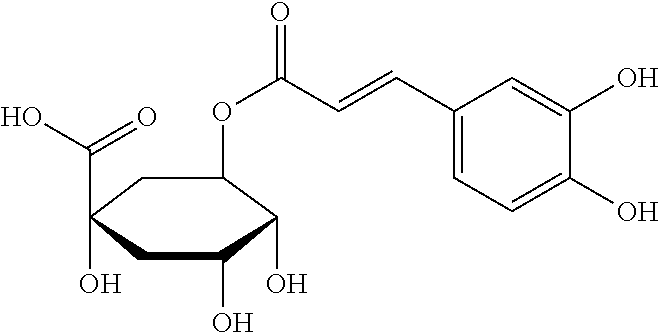 |
| Neochlorogenic acid And all stereoisomers. | (1R,3R,4S,5R)-3-{[(2E)-3-(3,4- Dihydroxyphenyl)prop-2- enoyl]oxy}-1,4,5- trihydroxycyclohexanecarboxylic acid |
 |
| Cryptochlorogenic acid And all stereoisomers. | 4-{[(2E)-3-(3,4- dihydioxyphenyl)prop-2- enoyl]oxy}-1,3,5- trihydroxycyclohexanecarboxylic acid |
 |
| Cynarin Alternative name: 1,5- dicaffeoylquinic acid And its positional isomers: 1,4- |
(1S,3R,4S,5R)-1,3-bis[[(E)-3- (3,4-dihydroxyphenyl)prop-2- enoyl]oxy]-4,5- dihydroxycyclohexane-1- carboxylic acid |    |
| Ferulic acid And its positional isomers | (E)-3-(4-hydroxy-3-methoxy- phenyl)prop-2-enoic acid |
 |
| Umbellic acid | (E)-3-(2,4- dihydroxyphenyl)prop-2- acid |
 |
| Sinapic acid, or Sinapinic acid And its positional isomers | 3-(4-hydroxy-3,5- dimethoxyphenyl)prop-2-enoic acid |
 |
| p-coumaric acid And its positional isomers | (E)-3-(4-hydroxyphenyl)-2- propenoic acid |
 |
| Rosmarinic acid | (2R)-2-[[(2″E″)-3-(3,4- Dihydroxyphenyl)-1-oxo-2- propenyl]]oxy]-3-(3,4- dihydroxyphenyl)propanoic acid |
 |
| TABLE 8 |
| Compounds likely to enhance water solubility of steviol glycosides |
| Common Name | | Structure | ||
| 8,8′-Diferulic acid | 3-[(E)-2-(4-Hydroxy-3- methoxyphenyl)ethenyl] (E)2-[(4-hydroxy-3- methoxyphenyl)methylidene] succinic acid |
 |
||
| 8,5′-diferulic acid | (E)-2-[(Z)-7-Carboxy- 6,14-dihydroxy-5,10- dimethoxy-3- stilbenyl]acrylic acid |
 |
||
| 5,5′-diferulic acid | (E)-3-{5′-[(E)-2- Carboxyethenyl]-2′,6- dihydroxy-3′,5- dimethoxy-3- biphenylyl}acrylic acid |
 |
||
| 4-O-5′-diferulic acid | (E)-3-(3-{4-[(E)-2- Carboxyethenyl]-2- methoxyphenoxy}-4- hydroxy-5- methoxyphenyl)acrylic acid |
 |
||
| 8,5′-diferulic acid, decarboxylated | (E)-3-[(E)-6,14- Dihydroxy-5,10- dimethoxy-3- stilbenyl]acrylic acid |
 |
||
| 8,8′-diferulic acid, cyclized | 7-Hydroxy-1-(4-hydroxy- 3-methoxyphenyl)-6- methoxy-1,2- dihydronaphthalene-2,3- dicarhoxylic acid |
 |
||
| 5,5′-Dicaffeic acid And its positional isomers And other dimeric caffeic acids, analogous to molecules above | (E)-3-{5′-[(E)-2- Carboxyethenyl]-2′,3′,5,6- tetrahydroxy-3- biphenylyl}aciylic acid |
 |
||
| Dihydroxyphenyl acetic acids And its positional isomers | (3,4- Dihydroxyphenyl)acetic acid |
 |
||
| Lunularic acid And its positional isomers | 2-hydroxy-6-[2-(4- hydroxyphenyl)ethyl] benzoic acid |
 |
||
| Theogallin And its positional isomers | (1S,3R,4R,5R)-1,3,4- trihydroxy-5-(3,4,5- trihydroxybenzoyl) oxycyclohexane-1- carboxylic acid |
 |
||
| Trigalloylquinic acid And its positional isomers | (1S,3R,4S,5R)-1-Hydroxy- 3,4,5-tris((3,4,5- trihydroxybenzoyl)oxy) cyclohexanecarboxylic acid |
 |
||
| Resveratrol glucuronide And its positional isomers | (2S,3S,4S,5R,6S)-3,4,5- trihydroxy-6-[3-hydroxy- 5-[(E)-2-(4- hydroxyphenyl)ethenyl] phenoxy]oxane-2-carboxylic acid |
 |
||
| Dactylifric acid And its positional isomers | 5-{[(2Z)-3-(3,4- dihydroxyphenyl)prop-2- enoyl]oxy}-3,4- dihydroxycyclohex-1-ene- 1-carboxylic acid |
 |
||
| Cichoric acid And its positional isomers | (2S,3R)-2,3-bis{[(E)-3- (3,4- dihydroxyphenyl)prop-2- enoyl]oxy}butanedioic acid |
 |
||
| Trilepisiumic acid. And its positional isomers | 4-[(E)-2-(3,4- Dihydroxyphenyl)ethenyl carbonyloxy]-3- hydroxybenzoic acid |
 |
||
| 4- Methylumbellifer yl-beta-D- glucuronide And its positional isomers | (2S,3S,4S,5R,6S)-3,4,5- Trihydroxy-6-(4-methyl-7- coumarinyloxy)tetrahydro- 2H-pyran-2-carboxylic acid |
 |
||
| Allenolic acid And its positional isomers | 3-(6-Hydroxy-2- naphthyl)propionic acid |
 |
||
| Globoidnan A And its positional isomers | (2R)-(3,4- dihydroxyphenyl)-2-{[4- (3,4-dihydroxyphenyl)- 6,7-dihydroxy-2- naphthoyl]oxy}propanoic acid |
 |
||
| Pamoic acid And its |
4,4′-Methylenebis(3- hydroxynaphthalene-2- carboxylic acid) |
 |
||
| Caftaric acid And related isomers | (2R,3R)-2-[(E)-3-(3,4- Dihydroxyphenyl)prop-2- enoyl]oxy-3- hydroxybutanedioic acid |
 |
||
| Coutaric acid And related isomers | (2R,3R)-2-Hydroxy-3- (((E)-3-(4- hydroxyphenyl)acryloyl) oxy)succinic acid |
 |
||
| Caffeoylmalic acid And related isomers | 2-[(E)-3-(3,4- dihydroxyphenyl)prop-2- enoyl]oxybutanedioic acid |
 |
||
| Shikimic acid And substitutions of shikimic acid | (3R,4S,5R)-3,4,5- trihydroxycyclohex-1-ene- 1-carboxylic acid |
 |
||
| Coumaric acid 5- O-shikimate And related isomers | 5-[(E-2-(p- Hydroxyphenyl) ethenylcarbonyloxy]-3,4- dihydroxy-1-cyclohexene- 1-carboxylic acid |
 |
||
| 3,5-Bis[(E)-2-(p- hydroxyphenyl) ethenylcarbonyloxy]- 4-hydroxy-1- cyclohexene-1-carboxylic acid |
 |
|||
| 3,4,5- Tricaffeoylquinic acid And its |
3,4,5-Tris[(E)-2-(3,4- dihydroxyphenyl) ethenylcarbonyloxy]-1- hydroxycyclohexanecarboxylic acid |
 |
||
| 1,3,4,5- |
1,3,4,5-Tetrakis[(E)-2- (3,4- dihydroxyphenyl) ethenylcarbonyloxy] cyclohexanecarboxylic acid |
 |
||


and can be in the D and L forms.


with 4,5-dicaffeoylquinic acid, 3,5-dicaffeoylquinic acid, and 3,4-dicaffeoylquinic acid being most prevalent in the compositions contemplated herein and most prevalent in abundant in stevia, yerba mate, globe artichoke, and green coffee.

which has two caffeic acid molecules linked to a tartaric acid core; and caftaric acid having the structure:

which has one caffeic acid molecule linked to a tartaric acid core.

| TABLE 9 |
| Summary of solubility experiments. |
| Total | pH | Time to | Storage | |||||||||
| SE | SG | SE | Volume | Adjusted | Storage | precipitate | Time | |||||
| SG Type | SE Type | Source | (mg) | (mg) | (mL) | SG % | SE % | pH | Using | (deg C.) | (days) | (days) |
| EverSweet | chlorogenic | Sigma | 15 | 5 | 5 | 0.3 | 0.1 | 6 | N/A | RT | N/ | 90* | ||
| acid (CGA) | ||||||||||||||
| | CGA | Sigma | 50 | 50 | 1 | 5 | 5 | <1 | N/A | RT | N/A | 85* | ||
| Reb B | CGA** | | 50 | 50 | 1 | 5 | 5 | <1 | N/A | N/A | N/A | 85* | ||
| EverSweet | CGA** | Sigma | 67.5 | 50 | 1 | 6.75 | 5 | <1 | N/A | RT | N/A | 85* | ||
| (5%) & | ||||||||||||||
| Reb B | ||||||||||||||
| (1.75%) | ||||||||||||||
| | CGA | Sigma | 10 | 10 | 1 | 1 | 1 | <1 | N/ | RT | 7 | 14 | ||
| (35% Reb | ||||||||||||||
| B) | ||||||||||||||
| Reb A | CGA | Sigma | 100 | 50 | 1 | 10 | 5 | <1 | N/A/ | RT | N/A | 65* | ||
| | 3,5- | | 10 | 10 | 1 | 1 | 1 | 2 | NaOH | RT | N/A | 65* | ||
| dicaffeoylquinic | | |||||||||||||
| acid | ||||||||||||||
| EverSweet | ||||||||||||||
| 3,5- | Stevia | 14 | 10 | 1 | 1.4 | 1 | 4 | Formate | RT | N/A | 65* | |||
| dicaffeoylquinic | | |||||||||||||
| acid | ||||||||||||||
| EverSweet | ||||||||||||||
| 3,5- | | 7 | 5 | 1 | 0.7 | 0.5 | 2.5 | Citrate/PO4 | RT | N/A | 65* | |||
| dicaffeoylquinic | | |||||||||||||
| acid | ||||||||||||||
| EverSweet | ||||||||||||||
| 3,5- and 3,4- | | 10 | 7.5 | 1 | 1 | 0.75 | 4 | Ca(OH)2 | RT | N/A | 35* | |||
| dicaffeoylquinic | | |||||||||||||
| acid | ||||||||||||||
| EverSweet | ||||||||||||||
| 3,5- and 3,4- | | 10 | 7.5 | 1 | 1 | 0.75 | 4 | NaOH | RT | N/A | 35* | |||
| dicaffeoylquinic | | |||||||||||||
| acid | ||||||||||||||
| EverSweet | ||||||||||||||
| 3,5- and 3,4- | | 10 | 7.5 | 1 | 1 | 0.75 | 3 | Citrate/PO4 | RT | N/A | 35* | |||
| dicaffeoylquinic | | |||||||||||||
| acid | ||||||||||||||
| EverSweet | ||||||||||||||
| 3,5- and 3,4- | Stevia | 100 | 100 | 1 | 10 | 10 | 4 | Ca(OH)2 | RT | 28 | 60 | |||
| dicaffeoylquinic | Leaf | |||||||||||||
| acid | ||||||||||||||
| EverSweet | | Sigma | 10 | ? | 1 | 1 | ? | 4 | N/ | RT | 10 | 21 | ||
| ferulic, caffeic, | ||||||||||||||
| and coumaric | ||||||||||||||
| acids | ||||||||||||||
| EverSweet | Saturated | | 5 | ? | 1 | 0.5 | ? | 4 | N/A | RT | N/A | 60* | ||
| ferulic, caffeic, | ||||||||||||||
| and coumaric | ||||||||||||||
| acids | ||||||||||||||
| EverSweet | Saturated | | 6 | ? | 2 | 0.3 | ? | 4 | N/A | RT | N/A | 60* | ||
| ferulic, caffeic, | ||||||||||||||
| and coumaric | ||||||||||||||
| acids | ||||||||||||||
| EverSweet | | Stevia | 10 | 10 | 1 | 1 | 1 | 2 | NaOH | RT | N/ | 30* | ||
| and cynarin | Leaf | |||||||||||||
| isomers | ||||||||||||||
| T5300 | | Stevia | 11 | 14 | 1 | 1.1 | 1.4 | 4 | | RT | 4 | 14 | ||
| (35% Reb | and cynarin | Leaf | ||||||||||||
| B) | isomers | |||||||||||||
| EverSweet | | Stevia | 10 | 30 | 1 | 1 | 3 | 4 | N/A | RT | N/ | 30* | ||
| Extract | Leaf | |||||||||||||
| EverSweet | Rosemarinic | Sigma | 16 | 16 | 1 | 1.6 | 1.6 | 4 | NaOH | RT | N/ | 30* | ||
| acid | ||||||||||||||
| EverSweet | | Stevia | 10 | 10 | 1 | 1 | 1 | 4 | | 4 C. | N/A | 40* | ||
| and cynarin | | |||||||||||||
| isomers | ||||||||||||||
| EverSweet | ||||||||||||||
| 3,5- and 3,4- | | 10 | 10 | 1 | 1 | 1 | 4 | | 4 C. | N/A | 40* | |||
| dicaffeoylquinic | | |||||||||||||
| acid | ||||||||||||||
| EverSweet | ||||||||||||||
| 3,5- and 3,4- | | 10 | 10 | 1 | 1 | 1 | 4 | Ca(OH)2 | 4 C. | N/A | 40* | |||
| dicaffeoylquinic | | |||||||||||||
| acid | ||||||||||||||
| TS300 | ||||||||||||||
| 3,5- and 3,4- | | 10 | 10 | 1 | 1 | 1 | 4 | Ca(OH)2 | 4 C. | 14 | 21 | |||
| (35% Reb | dicaffeoylquinic | Leaf | ||||||||||||
| B) | acid | |||||||||||||
| *on-going experiment | ||||||||||||||
| **CGA material isomerized to neochlorogenic acid and cryptochlorogenic acid during heating | ||||||||||||||
Co-Drying Experiment
| TABLE 10 |
| Summary of co-drying experiments. |
| pH | |||||
| SE | SG:SE | pH in | Adjusted | ||
| SG Type | SE Type | Source | Ratio | | Using |
| EverSweet |
| 3,5- and 3,4- | Stevia | 1:1 | 4 | NaOH | |
| dicaffeoylquinic | | ||||
| acid | |||||
| TS300 | |||||
| 3,5- and 3,4- | Stevia | 1:1 | 3.5 | NaOH | |
| dicaffeoylquinic | Leaf | ||||
| acid | |||||
Freeze-Thaw Experiment: 1% EverSweet, 1% CGA Isomers and Cynarin Isomers Blend,
| TABLE 11 | ||
| Time (min.) | Mobile Phase A | |
| 0 | 68 | 32 |
| 15 | 68 | 32 |
| 22 | 50 | 50 |
| 26.5 | 50 | 50 |
| 27 | 10 | 90 |
| 30 | 10 | 90 |
| 30.5 | 68 | 32 |
| 35 | 68 | 32 |
| TABLE 12 | ||||||
| pH | ||||||
| on | ||||||
| | Day | 0 | | | | |
| Mandelic acid (5:1 | 3.20 | 1.07 NTU | Clear (some | Clear | Clear | |
| molar ratio acid to | floating dust) | 1.42 NTU | ||||
| steviol glycoside), 0.3% | 0.944 NTU | |||||
| steviol glycoside | ||||||
| Mandelic acid (2:1 | 3.36 | 0.620 NTU | Clear | Clear (some | Clear | |
| molar ratio acid to | 0.672 NTU | floating dust) | 1.58 NTU | |||
| steviol glycoside), | ||||||
| 0.3% steviol glycoside | ||||||
Pyromellitic Acid
| TABLE 13 | ||||||
| pH | ||||||
| on | ||||||
| | Day | 0 | | | | |
| Pyromellitic acid (5:1 | 2.50 | 0.804 NTU | Clear | Clear | Clear | |
| molar ratio acid to | 0.790 NTU | 0.910 NTU | ||||
| steviol glycoside), | ||||||
| 0.3% steviol glycoside | ||||||
| Pyromellitic acid (2:1 | 2.76 | 0.762 NTU | Clear | Clear (some | Clear | |
| molar ratio acid to | 0.780 NTU | floating dust) | 1.47 NTU | |||
| steviol glycoside), | ||||||
| 0.3% steviol glycoside | ||||||
Pamoic Acid
| TABLE 14 | |||
| | Day | 0 | |
| Pamoic acid (5:1 molar ratio | Bright yellow, opaque, | Bright yellow, particles | |
| acid to steviol glycoside), | undissolved crystals | settled/gradient of ppt, heavy ppt at | |
| 0.3% steviol glycoside | bottom | ||
| Pamoic acid (2:1 molar ratio | Bright yellow, opaque, | Bright yellow, particles | |
| acid to steviol glycoside), | undissolved crystals | settled/gradient of ppt, heavy ppt at | |
| 0.3% steviol glycoside | bottom | ||
Quinic Acid
| TABLE 15 | ||||
| | pH | Day | 0 | |
| Quinic acid (5:1 molar ratio acid to steviol | 3.63 | Clear | Clear | |
| glycoside), 0.3% steviol glycoside | 0.906 NTU | 0.791 | ||
| NTU | ||||
| Quinic acid (2:1 molar ratio acid to steviol | 3.68 | Clear | Clear | |
| glycoside), 0.3% steviol glycoside | 0.915 NTU | 1.08 | ||
| NTU | ||||
| Quinic acid (5:1 molar ratio acid to steviol | 3.47 | Clear | Ppt at | |
| glycoside), 0.6% steviol glycoside | 2.07 NTU | bottom | ||
| 15.4 | ||||
| NTU | ||||
| Quinic acid (2:1 molar ratio acid to steviol | 3.67 | Clear | Ppt at | |
| glycoside), 0.6% steviol glycoside | 1.44 NTU | bottom | ||
| 13.2 | ||||
| NTU | ||||
| Ppt = precipitate | ||||
Comparison of Mandelic Acid, Pyromellitic Acid, and Quinic Acid at 1:1 or a 1:0.5 Molar Ratio of Acid to Steviol Glycoside
| TABLE 16 | ||||||
| Ratio of | ||||||
| acid to | mM of | |||||
| MW of | steviol | mM of | % steviol | steviol | ||
| Acid | acid | glycoside | % acid | acid | glycoside | glycoside |
| Mandelic | 152.15 g/mol | 1:1 | 0.035% | 2.35 mM | 0.3% | 2.35 mM |
| acid | ||||||
| Mandelic | 152.15 g/mol | 0.5:1 | 0.018% | 1.18 mM | 0.3% | 2.35 mM |
| acid | ||||||
| Pyromellitic | 254.15 g/mol | 1:1 | 0.060% | 2.35 mM | 0.3% | 2.35 mM |
| acid | ||||||
| Pyromellitic | 254.15 g/mol | 0.5:1 | 0.030% | 1.18 mM | 0.3% | 2.35 mM |
| acid | ||||||
| Quinic acid | 192.17 g/mol | 1:1 | 0.045% | 2.35 mM | 0.3% | 2.35 mM |
| Quinic acid | 192.17 g/mol | 0.5:1 | 0.023% | 1.18 mM | 0.3% | 2.35 mM |
| TABLE 17 | ||||||
| | pH | Day | 0 | | | |
| Mandelic acid | 3.64 | Clear | Clear | Clear | Clear |
| 1:1 ratio | 1.18 NTU | 1.52 NTU | 2.56 NTU | 3.21 NTU | |
| Mandelic acid | 3.86 | Clear | Clear | Clear (some floating | Clear |
| 0.5:1 ratio | 0.857 NTU | 1.16 NTU | dust) | 4.05 NTU | |
| 2.56 NTU | |||||
| Pyromellitic | 2.99 | Clear | Clear | Clear | Clear |
| acid | 1.18 NTU | 1.13 NTU | 1.51 NTU | 1.91 NTU | |
| 1:1 ratio | |||||
| Pyromellitic | 3.21 | Clear | Clear | Clear (some floating | Clear |
| acid | 1.06 NTU | 0.992 NTU | dust, could be ppt?) | 3.65 NTU | |
| 0.5:1 ratio | 1.85 NTU | ||||
| Quinic acid | 3.51 | Clear | Clear | Clear | Clear |
| 1:1 ratio | 0.909 NTU | 1.07 NTU | 2.22 NTU | 3.24 NTU | |
| Quinic acid | 3.72 | Clear | Clear | Clear (some floating | Clear |
| 0.5:1 ratio | 0.813 NTU | 0.948 NTU | dust, could be ppt?) | 3.74 NTU | |
| 1.85 NTU | |||||
| Ppt = precipitate | |||||
Comparison of Mandelic Acid, Pyromellitic Acid, and Quinic Acid at a 0.25:1 or a 0.1:1 Molar Ratio of Acid to Steviol Glycoside
| TABLE 18 | ||||||
| Ratio of acid | mM of | |||||
| MW of | to steviol | % steviol | steviol | |||
| Sample Acid | acid | glycoside | % acid | mM of acid | glycoside | glycoside |
| Mandelic | 152.15 g/mol | 0.25:1 | 0.009% | 0.588 mM | 0.3% | 2.35 mM |
| acid | ||||||
| Mandelic | 152.15 g/mol | 0.1:1 | 0.004% | 0.235 mM | 0.3% | 2.35 mM |
| acid | ||||||
| Pyromellitic | 254.15 g/mol | 0.25:1 | 0.015% | 0.588 mM | 0.3% | 2.35 mM |
| acid | ||||||
| Pyromellitic | 254.15 g/mol | 0.1:1 | 0.006% | 0.235 mM | 0.3% | 2.35 mM |
| acid | ||||||
| Quinic acid | 192.17 g/mol | 0.25:1 | 0.011% | 0.588 mM | 0.3% | 2.35 mM |
| Quinic acid | 192.17 g/mol | 0.1:1 | 0.005% | 0.235 mM | 0.3% | 2.35 mM |
| TABLE 19 | ||||||
| | pH | Day | 0 | | | |
| Mandelic acid | 3.75 | Clear | Clear | Clear | Slight ppt | |
| 0.25:1 ratio | 0.899 NTU | 1.05 NTU | 1.37 NTU | 3.03 NTU | ||
| Mandelic acid | 3.93 | Clear | Clear | Clear | Ppt | |
| 0.1:1 ratio | 1.29 NTU | 2.57 NTU | 3.88 NTU | 6.53 NTU | ||
| Pyromellitic | 3.43 | Clear | Clear | Clear | Clear | |
| acid | 1.14 NTU | 1.21 NTU | 2.45 NTU | 5.17 NTU | ||
| 0.25:1 ratio | ||||||
| Pyromellitic | 3.64 | Clear | Clear | Clear | Clear | |
| acid | 1.19 NTU | 1.28 NTU | 1.81 NTU | 2.62 NTU | ||
| 0.1:1 ratio | ||||||
| Quinic acid | 3.92 | Clear | Clear | Clear | Ppt | |
| 0.25:1 ratio | 1.36 NTU | 1.89 NTU | 2.77 NTU | 5.67 NTU | ||
| Quinic acid | 4.03 | Clear | Clear | Clear | Ppt | |
| 0.1:1 ratio | 0.966 NTU | 1.54 NTU | 2.27 NTU | 4.11 NTU | ||
| Ppt = precipitate | ||||||
Comparison of Mandelic Acid, Pyromellitic Acid, and Quinic Acid at a 5:1 or a 2:1 Molar Ratio of Acid to Steviol Glycoside for Each of Rebaudoside B, Rebaudoside D, and Rebaudoside M
| TABLE 20 | |||
| Molar ratio | Rebaudoside B | Rebaudoside D | Rebaudoside M |
| (acid:steviol | (at 0.06% final | (at 0.12% final | (at 0.5% final |
| glycoside) | concentration) | concentration) | concentration) |
| 5:1 | 3.727 mM acid | 5.314 mM acid | 19.360 mM acid |
| 2:1 | 1.491 mM acid | 2.125 mM acid | 7.744 mM acid |
| TABLE 21 | |||
| Acid 5:1 | |||
| molar | |||
| ratio of acid | Rebaudoside B | Rebaudoside D | Rebaudoside M |
| to steviol | (at 0.06% final | (at 0.12% final | (at 0.5% final |
| glycoside | concentration) | concentration) | concentration) |
| Mandelic | 0.454 mL of acid | 0.647 mL of acid | 2.357 mL of acid |
| acid | |||
| Pyromellitic | 5.052 mL of acid | 7.203 mL of acid | 26.242 mL of acid |
| acid | |||
| Quinic acid | 0.573 mL of acid | 0.817 mL of acid | 2.976 mL of acid |
| TABLE 22 | |||
| Acid | |||
| 2:1 molar | |||
| ratio of acid | Rebaudoside B | Rebaudoside D | Rebaudoside M |
| to steviol | (at 0.06% final | (at 0.12% final | (at 0.5% final |
| glycoside | concentration) | concentration) | concentration) |
| Mandelic | 0.181 mL of acid | 0.259 mL of acid | 0.943 mL of acid |
| acid | |||
| Pyromellitic | 2.021 mL of acid | 2.881 mL of acid | 10.497 mL of acid |
| acid | |||
| Quinic acid | 0.229 mL of acid | 0.327 mL of acid | 1.191 mL of acid |
| TABLE 23 | ||||
| Sample | pH | Day 0 | Day 1 | Day 4 |
| Mandelic acid:Reb B | 3.56 | Ppt upon cooling | Heavy ppt | Heavy ppt |
| 5:1 molar ratio acid 0.06% | 46.2 NTU | 814 NTU | 1045 NTU | |
| Reb B | ||||
| Mandelic:Reb B | 3.78 | Slight ppt upon | Heavy ppt | Heavy ppt |
| 2:1 molar ratio acid | cooling | 821 NTU | 983 NTU | |
| 0.06% Reb B | 11.5 NTU | |||
| Mandelic:Reb D | 3.45 | Clear | Slight ppt | Ppt |
| 5:1 molar ratio acid | 1.38 NTU | 1.31 NTU | 1.45 NTU | |
| 0.12% Reb D | ||||
| Mandelic:Reb D | 3.7 | Clear | Clear | Slight ppt |
| 2:1 molar ratio acid | 0.463 NTU | 0.982 | 1.99 NTU | |
| 0.12% Reb D | ||||
| Mandelic:Reb M | 3.15 | Clear | Ppt | Ppt |
| 5:1 molar ratio acid | 1.54 NTU | 6.48 | 154 NTU | |
| 0.5% Reb M | ||||
| Mandelic:Reb M | 3.53 | Clear | Ppt | Ppt |
| 2:1 molar ratio acid | 1.29 NTU | 3.42 NTU | 60.4 NTU | |
| 0.5% Reb M | ||||
| Pyromellitic:Reb B | 2.77 | Very slight ppt | Heavy ppt | Heavy ppt |
| 5:1 molar ratio acid | 0.627 NTU | 917 NTU | 1011 NTU | |
| 0.06% Reb B | ||||
| Pyromellitic:Reb B | 3.07 | Very slight | Heavy ppt | Heavy ppt |
| 2:1 molar ratio acid | ppt/particles | 778 NTU | 817 NTU | |
| 0.06% Reb B | 0.607 NTU | |||
| Pyromellitic:Reb D | 2.73 | Clear | Clear | Clear |
| 5:1 molar ratio acid | 0.732 NTU | 1.51 NTU | 2.15 NTU | |
| 0.12% Reb D | ||||
| Pyromellitic:Reb D | 3.00 | Clear | Clear | Clear |
| 2:1 molar ratio acid | 0.425 NTU | 0.619 NTU | 0.972 NTU | |
| 0.12% Reb D | ||||
| Pyromellitic:Reb M | 2.31 | Clear | Ppt | Ppt |
| 5:1 molar ratio acid | 0.694 NTU | 13.0 NTU | 84.3 NTU | |
| 0.5% Reb M | ||||
| Pyromellitic:Reb M | 2.55 | Clear | Very slight ppt | Ppt |
| 2:1 molar ratio acid | 0.845 NTU | 3.63 NTU | 261 NTU | |
| 0.5% Reb M | ||||
| Quinic:Reb B | 3.68 | Very slight | Heavy ppt | Heavy ppt |
| 5:1 molar ratio acid | suspended ppt | 843 NTU | 842 NTU | |
| 0.06% Reb B | 2.01 NTU | |||
| Quinic:Reb B | 3.94 | Very slight | Heavy ppt | Heavy ppt |
| 2:1 molar ratio acid | suspended ppt | 838 NTU | 1033 NTU | |
| 0.06% Reb B | 0.395 NTU | |||
| Quinic:Reb D | 3.70 | Clear | Clear | Very slight ppt |
| 5:1 molar ratio acid | 0.528 NTU | 0.782 NTU | 1.43 NTU | |
| 0.12% Reb D | ||||
| Quinic:Reb D | 3.98 | Clear | Clear | Very slight ppt |
| 2:1 molar ratio acid | 0.384 NTU | 0.383 NTU | 0.991 NTU | |
| 0.12% Reb D | ||||
| Quinic:Reb M | 3.45 | Clear | Ppt | Ppt |
| 5:1 molar ratio acid | 1.16 NTU | 8.79 NTU | 247 NTU | |
| 0.5% Reb M | ||||
| Quinic:Reb M | 3.68 | Clear | Ppt | Ppt |
| 2:1 molar ratio acid | 1.44 NTU | 22.4 NTU | 204 NTU | |
| 0.5% Reb M | ||||
| Ppt = precipitate | ||||
Comparison of Gallic Acid at a 5:1 or a 2:1 Molar Ratio of Gallic Acid to Steviol Glycoside for Each of Rebaudoside B, Rebaudoside D, and Rebaudoside M
| TABLE 24 | |||
| Molar ratio | |||
| (gallic | Rebaudoside B | Rebaudoside D | Rebaudoside M |
| acid:steviol | (at 0.06% final | (at 0.12% final | (at 0.5% final |
| glycoside) | concentration) | concentration) | concentration) |
| 5:1 | 5.073 mM gallic | 7.232 mM gallic | 26.349 mM gallic |
| acid | acid | acid | |
| 2:1 | 2.029 mM gallic | 2.893 mM gallic | 10.540 mM gallic |
| acid | acid | acid | |
| TABLE 25 | ||||||
| | pH | Day | 0 | | | |
| Gallic acid:Reb B | 3.74 | Ppt (fine dust), | Heavy ppt, | Heavy ppt, | Heavy ppt, | |
| 5:1 molar ratio acid | 1.37 NTU | 574 NTU | 820 NTU | 752 NTU | ||
| 0.06% Reb B | ||||||
| Gallic acid:Reb B | 4.07 | Ppt (fine dust), | Heavy ppt, | Heavy ppt, | Heavy ppt, | |
| 2:1 molar ratio acid | 1.54 NTU | 675 NTU | 863 NTU | 984 NTU | ||
| 0.06% Reb B | ||||||
| Gallic acid:Reb D | 3.78 | Clear (with a | Clear, 0.545 | Clear, 0.526 | Clear, | |
| 5:1 molar ratio acid | few floaties), | NTU | NTU | 0.654 | ||
| 0.12% Reb D | 0.584 NTU | NTU | ||||
| Gallic acid:Reb D | 4.00 | Clear (with a | Clear, 0.681 | Clear, 0.824 | Very slight | |
| 2:1 molar ratio acid | few floaties), | NTU | NTU | ppt, 1.18 | ||
| 0.12% Reb D | 0.500 NTU | NTU | ||||
| Gallic acid:Reb M | 3.55 | Clear, 1.04 | Clear, 1.13 | Very slight | Ppt, 5.31 | |
| 5:1 molar ratio acid | NTU | NTU | ppt, 2.34 | NTU | ||
| 0.5% Reb M | NTU | |||||
| Gallic acid:Reb M | 3.85 | Clear, 2.79 | Ppt, 14.0 | Ppt, 30.0 | Ppt, 107 | |
| 2:1 molar ratio acid | NTU | NTU | NTU | NTU | ||
| 0.5% Reb M | ||||||
Comparison of Gallic Acid at Various Molar Ratios of Gallic Acid to Steviol Glycoside for a Solution of Steviol Glycoside s (about 95% Total Steviol Glycosides with about 75% Reb M and about 5% Reb D)
| TABLE 26 | ||
| Molar ratio | Steviol glycosides | Steviol glycosides |
| (gallic acid:steviol | (at 0.3% final | (at 0.6% final |
| glycoside) | concentration) | concentration) |
| 7:1 | — | 0.56% gallic acid |
| 5:1 | 0.20% gallic acid | 0.40% gallic acid |
| 2:1 | 0.08% gallic acid | 0.16% gallic acid |
| 1:1 | 0.04% gallic acid | 0.08% gallic acid |
| 0.5:1 | 0.02% gallic acid | 0.04% gallic acid |
| TABLE 27 | ||||||
| | pH | Day | 0 | |
|
|
| Gallic acid:SG | 3.53 | Clear | Clear | Clear | Clear | |
| 5:1 molar ratio acid | 1.16 | 1.24 NTU | 1.26 NTU | 1.56 NTU | ||
| 0.3% SG | NTU | |||||
| Gallic acid:SG | 3.88 | Clear | Clear | Clear | Very | |
| 2:1 molar ratio acid | 0.796 | 1.19 NTU | 1.49 NTU | slight ppt | ||
| 0.3% SG | NTU | 3.38 NTU | ||||
| Gallic acid:SG | 3.61 | Clear | Very | Clear | Ppt | |
| 5:1 molar ratio acid | 2.85 | slight ppt | 3.50 NTU | 6.36 NTU | ||
| 0.6% SG | NTU | 3.46 NTU | ||||
| Gallic acid:SG | 3.83 | Clear | Slight ppt | Slight ppt | Ppt | |
| 2:1 molar ratio acid | 2.37 | 3.07 NTU | 6.00 NTU | 58.9 NTU | ||
| 0.6% SG | NTU | |||||
| SG = steviol glycoside | ||||||
| Ppt = precipitate | ||||||
| TABLE 28 | |||||
| | Day | 0 | | | |
| Gallic acid:SG | Clear | Clear | Clear | Clear | |
| 1:1 molar ratio acid | 0.846 NTU | 0.882 | |||
| 0.3% SG | NTU | ||||
| Gallic acid:SG | Clear | Clear | Clear | Clear | |
| 0.5:1 molar ratio acid | 1.16 NTU | 1.28 NTU | |||
| 0.3% SG | |||||
| Gallic acid:SG | Clear | Clear | Clear | Clear | |
| 7:1 molar ratio acid | 2.33 NTU | 1.60 NTU | |||
| 0.6% SG | |||||
| SG = steviol glycoside | |||||
| Ppt = precipitate | |||||
Comparison of Solubilities of Samples Comprising Mandelic Acid, Pyromellitic Acid, Quinic Acid, and Gallic Acid and Steviol Glycoside (about 95% Total Steviol Glycosides with about 75% Reb M and about 5% Reb D) in Citrate Buffer
| TABLE 29 | ||||
| Sample | Day 0 | Day 1 | Day 2 | Day 3 |
| 0.3% SG and | Clear | Clear | Clear | Very slight |
| No acid | ppt | |||
| 0.3% SG and | Clear | Clear | Clear | Ppt |
| mandelic acid | ||||
| 0.3% SG and | Clear | Clear | Clear | Very slight |
| pyromellitic acid | ppt | |||
| 0.3% SG and | Clear | Clear | Very slight | Ppt |
| quinic acid | ppt | |||
| 0.3% SG and | Clear | Clear | Very slight | Ppt |
| gallic acid | ppt | |||
| 0.6% SG and | Clear | Clear | Ppt | Ppt |
| No acid | ||||
| 0.6% SG and | Clear | Ppt | Ppt | Ppt |
| Mandelic acid | ||||
| 0.6% SG and | Clear | Very slight | Ppt | Ppt |
| Pyromellitic acid | ppt | |||
| 0.6% SG and | Clear | Ppt | Ppt | Ppt |
| quinic acid | ||||
| 0.6% SG and | Clear | Ppt | Ppt | Ppt |
| gallic acid | ||||
| 0.06% Reb B and | Ppt | Ppt | Ppt | Ppt |
| no acid | ||||
| 0.06% Reb B and | Ppt | Ppt | Ppt | Ppt |
| Mandelic acid | ||||
| 0.06% Reb B and | Ppt | Ppt | Ppt | Ppt |
| Pyromellitic acid | ||||
| 0.06% Reb B and | Ppt | Ppt | Ppt | Ppt |
| Quinic acid | ||||
| 0.06% Reb B and | Ppt | Ppt | Ppt | Ppt |
| Gallic acid | ||||
| 0.12% Reb D and | Clear | Clear | Ppt | Ppt |
| no acid | ||||
| 0.12% Reb D and | Clear | Clear | Very slight | Ppt |
| Mandelic acid | ppt | |||
| 0.12% Reb D and | Clear | Clear | Very slight | Ppt |
| Pyromellitic acid | ppt | |||
| 0.12% Reb D and | Clear | Clear | Slight ppt | Ppt |
| Quinic acid | ||||
| 0.12% Reb D and | Clear | Clear | Ppt | Ppt |
| Gallic acid | ||||
| 0.5% Reb M and | Clear | Clear | Ppt | Ppt |
| no acid | ||||
| 0.5% Reb M and | Clear | Ppt | Ppt | Ppt |
| Mandelic acid | ||||
| 0.5% Reb M and | Clear | Clear | Ppt | Ppt |
| Pyromellitic acid | ||||
| 0.5% Reb M and | Clear | Clear | Ppt | Ppt |
| Quinic acid | ||||
| 0.5% Reb M and | Clear | Clear | Ppt | Ppt |
| Gallic acid | ||||
| 0.3% SG and | Cloudy | Cloudy | — | — |
| No Acid | ||||
| No Heating | ||||
| Stirred Overnight | ||||
| 0.3% SG and | Cloudy | Cloudy | — | — |
| Mandelic acid | ||||
| No Heating | ||||
| Stirred Overnight | ||||
| 0.3% SG and | Cloudy | Cloudy | — | — |
| Pyromellitic acid | ||||
| No Heating | ||||
| Stirred Overnight | ||||
| 0.3% SG and | Cloudy | Cloudy | — | — |
| Quinic acid | ||||
| No Heating | ||||
| Stirred Overnight | ||||
| 0.3% SG and | Cloudy | Cloudy | — | — |
| Gallic acid | ||||
| No Heating | ||||
| Stirred Overnight | ||||
| SG = steviol glycoside | ||||
| Ppt = precipitate | ||||
| TABLE 30 | ||||
| Ratio of | ||||
| Solubility | ||||
| Enhancer:Steviol | Concentration | |||
| Solubility | glycoside by | Concentration of | of Steviol | |
| Enhancer | weight | Solubility Enhancer | glycoside | Sensory profile |
| Cynarin* | 0.4:1 | about 120 ppm | about 300 ppm | Not tasted, |
| mixture did | ||||
| not go into | ||||
| solution | ||||
| Cynarin* | 1:1 | about 300 ppm | about 300 ppm | Similar |
| sweetness | ||||
| as steviol | ||||
| glycoside | ||||
| control, | ||||
| similar to | ||||
| melon | ||||
| flavor in | ||||
| Life Saver | ||||
| flavor in | ||||
| the tropical | ||||
| pack, less | ||||
| sweetness | ||||
| linger than | ||||
| steviol | ||||
| glycoside | ||||
| control | ||||
| Cynarin | — | about 300 ppm | — | Not tasted, |
| isomers* | mixture did | |||
| control | not go into | |||
| solution | ||||
| Chlorogenic | 0.4:1 | about 120 ppm | about 300 ppm | Similar |
| acid and | sweetness | |||
| cynarin | to steviol | |||
| isomers** | glycoside | |||
| control, | ||||
| very similar | ||||
| sensory | ||||
| profile to | ||||
| steviol | ||||
| glycoside | ||||
| control | ||||
| Chlorogenic | 1:1 | about 300 ppm | about 300 ppm | Sweetness |
| acid and | lingers less | |||
| cynarin | than steviol | |||
| isomers** | glycoside | |||
| control, did | ||||
| not get the | ||||
| astringency, | ||||
| metallic | ||||
| taste, or | ||||
| rough | ||||
| feeling as | ||||
| in the | ||||
| chlorogenic | ||||
| acid and | ||||
| cynarin** | ||||
| control | ||||
| Chlorogenic | — | about 300 ppm | — | Faint |
| acid and | metallic | |||
| cynarin | taste, | |||
| isomers | astringent | |||
| control** | taste, rough | |||
| feeling in | ||||
| mouth | ||||
| Chlorogenic | 0.4:1 | about 120 ppm | about 300 ppm | Similar |
| acid and | sweetness | |||
| cynarin | as steviol | |||
| isomers*** | glycoside | |||
| control, Not | ||||
| nearly as | ||||
| sugar like | ||||
| as the 1:1 | ||||
| ratio | ||||
| Chlorogenic | 1:1 | about 300 ppm | about 300 ppm | Similar |
| acid and | sweetness | |||
| cynarin | as steviol | |||
| isomers*** | glycoside | |||
| control, | ||||
| Tastes very | ||||
| similar to | ||||
| sugar | ||||
| character, | ||||
| slight | ||||
| reduction in | ||||
| sweetness | ||||
| linger | ||||
| Chlorogenic | — | about 300 ppm | — | Slightly |
| acid and | bitter taste | |||
| cynarin | or metallic | |||
| isomers | taste, | |||
| control*** | depended | |||
| on panelist | ||||
| Steviol | — | — | about 300 ppm | typical |
| glycoside | steviol | |||
| control | glycoside | |||
| sensory profile | ||||
| *Derived from stevia leaf and isolated in acid form. The acid form was not very water soluble. | ||||
| **Derived from stevia leaf and isolated in calcium salt form. | ||||
| ***Derived from artichoke stem and isolated in sodium salt form. | ||||
| TABLE 31 | |||||||
| Storage | # of | # of | |||||
| SG % | SG Type | SE % | Cond | pH | Times (weeks) | Pulls | Replicates |
| 0.6% | RM80 | 0.6% | RT | 2.5 | 0, 14, 26, 52 | 4 | 3 |
| 1.5% | RM80 | 1.5% | RT | 2.5 | 0, 4, 14, 26, 39, 52 | 6 | 1 |
| 3.0% | RM80 | 3.0% | RT | 2.5 | 0, 4, 14, 26, 39, 52 | 6 | 3 |
| 3.0% | RM80 | 4.5% | RT | 2.5 | 0, 4, 14, 26, 39, 52 | 6 | 3 |
| 6.0% | RM80 | 6.0% | RT | 2.5 | 0, 4, 14, 26, 39, 52 | 6 | 1 |
| 6.0% | RA95 | 6.0% | RT | 2.5 | 0, 4, 14, 26, 39, 52 | 6 | 3 |
| 0.6% | RM80 | 0.6% | 4 C. | 2.5 | 14, 26, 52 | 3 | 1 |
| 1.5% | RM80 | 1.5% | 4 C. | 2.5 | 4, 14, 26, 39, 52 | 5 | 3 |
| 3.0% | RM80 | 3.0% | 4 C. | 2.5 | 4, 14, 26, 39, 52 | 5 | 1 |
| 3.0% | RM80 | 4.5% | 4 C. | 2.5 | 4, 14, 26, 39, 52 | 5 | 1 |
| 6.0% | RM80 | 6.0% | 4 C. | 2.5 | 4, 14, 26, 39, 52 | 5 | 3 |
| 6.0% | RA95 | 6.0% | 4 C. | 2.5 | 4, 14, 26, 39, 52 | 5 | 1 |
| 0.6% | RM80 | 0.6% | RT | 4.0 | 0, 14, 26, 52 | 4 | 3 |
| 1.5% | RM80 | 1.5% | RT | 4.0 | 0, 4, 14, 26, 39, 52 | 6 | 1 |
| 3.0% | RM80 | 3.0% | RT | 4.0 | 0, 4, 14, 26, 39, 52 | 6 | 3 |
| 3.0% | RM80 | 4.5% | RT | 4.0 | 0, 4, 14, 26, 39, 52 | 6 | 3 |
| 6.0% | RM80 | 6.0% | RT | 4.0 | 0, 4, 14, 26, 39, 52 | 6 | 1 |
| 35.0% | RM80 | 35.0% | RT | 4.0 | 0, 26, 40, 52 | 4 | 1 |
| 6.0% | RA95 | 6.0% | RT | 4.0 | 0, 4, 14, 26, 39, 52 | 6 | 3 |
| 0.6% | RM80 | 0.6% | 4 C. | 4.0 | 14, 26, 52 | 3 | 1 |
| 1.5% | RM80 | 1.5% | 4 C. | 4.0 | 4, 14, 26, 39, 52 | 5 | 3 |
| 3.0% | RM80 | 3.0% | 4 C. | 4.0 | 4, 14, 26, 39, 52 | 5 | 1 |
| 3.0% | RM80 | 4.5% | 4 C. | 4.0 | 4, 14, 26, 39, 52 | 5 | 1 |
| 6.0% | RM80 | 6.0% | 4 C. | 4.0 | 4, 14, 26, 39, 52 | 5 | 3 |
| 6.0% | RA95 | 6.0% | 4 C. | 4.0 | 4, 14, 26, 39, 52 | 5 | 1 |
| TABLE 32a | ||
| Time (weeks) | ||
| Experiment | 0 | 4 | 14 | 26 | 39 | 40 | 48 |
| 6% RA95 | Reb A % | 100.0 | 99.5 | 98.3 | 98.3 | 98.6 | NM | 98.5 |
| with 6% | Recovery | |||||||
| SE at 4 C. | ||||||||
| and pH 2.5 | ||||||||
| 6% RA95 | Reb A % | 100.0 | 98.8 | 99.1 | 98.0 | 98.7 | NM | 98.6 |
| with 6% | Recovery | |||||||
| SE at 4 C. | ||||||||
| and pH 4 | ||||||||
| 6% RA95 | Reb A % | 100.0 | 99.5 | 98.6 | 98.2 | 98.0 | NM | 97.8 |
| with 6% | Recovery | |||||||
| SE at RT | ||||||||
| and pH 2.5 | ||||||||
| 6% RA95 | Reb A % | 100.0 | 99.4 | 98.4 | 98.4 | 98.3 | NM | 98.3 |
| with 6% | Recovery | |||||||
| SE at RT | ||||||||
| and pH 4 | ||||||||
| 0.6% | Reb M % | 100.0 | NM | 102.4 | 102.4 | NM | NM | 98.0 |
| RM80 with | Recovery | |||||||
| 0.6% SE at | ||||||||
| 4 C. and | ||||||||
| pH 2.5 | ||||||||
| 0.6% | Reb M % | 100.0 | NM | 102.8 | 102.6 | NM | NM | 99.0 |
| RM80 with | Recovery | |||||||
| 0.6% SE at | ||||||||
| 4 C. and | ||||||||
| pH 4 | ||||||||
| 0.6% | Reb M % | 100.0 | NM | 101.1 | 100.2 | NM | NM | 96.0 |
| RM80 with | Recovery | |||||||
| 0.6% SE at | ||||||||
| RT and | ||||||||
| pH 2.5 | ||||||||
| 0.6% | Reb M % | 100.0 | NM | 101.7 | 101.5 | NM | NM | 99.2 |
| RM80 with | Recovery | |||||||
| 0.6% SE at | ||||||||
| RT and | ||||||||
| pH 4 | ||||||||
| 1.5% | Reb M % | 100.0 | 102.6 | 102.6 | 102.5 | 98.5 | NM | 97.9 |
| RM80 with | Recovery | |||||||
| 1.5% SE at | ||||||||
| 4 C. and | ||||||||
| pH 2.5 | ||||||||
| 1.5% | Reb M % | 100.0 | 102.7 | 102.5 | 102.9 | 98.8 | NM | 98.7 |
| RM80 with | Recovery | |||||||
| 1.5% SE at | ||||||||
| 4 C. and | ||||||||
| pH 4 | ||||||||
| 1.5% | Reb M % | 100.0 | 101.8 | 100.8 | 98.6 | 97.3 | NM | 95.3 |
| RM80 with | Recovery | |||||||
| 1.5% SE at | ||||||||
| RT and | ||||||||
| pH 2.5 | ||||||||
| 1.5% | Reb M % | 100.0 | 102.1 | 101.5 | 101.8 | 99.2 | NM | 98.3 |
| RM80 with | Recovery | |||||||
| 1.5% SE at | ||||||||
| RT and | ||||||||
| pH 4 | ||||||||
| 3% RM80 | Reb M % | 100.0 | 102.5 | 102.2 | 102.1 | 98.5 | NM | 97.9 |
| with 3% | Recovery | |||||||
| SE at 4 C. | ||||||||
| and pH 2.5 | ||||||||
| 3% RM80 | Reb M % | 100.0 | 102.6 | 102.1 | 102.5 | 98.9 | NM | 98.5 |
| with 3% | Recovery | |||||||
| SE at 4 C. | ||||||||
| and pH 4 | ||||||||
| 3% RM80 | Reb M % | 100.0 | 101.8 | 101.0 | 99.8 | 95.9 | NM | 95.0 |
| with 3% | Recovery | |||||||
| SE at RT | ||||||||
| and pH 2.5 | ||||||||
| 3% RM80 | Reb M % | 100.0 | 102.0 | 101.6 | 101.2 | 98.2 | NM | 97.7 |
| with 3% | Recovery | |||||||
| SE at RT | ||||||||
| and |
||||||||
| 3% RM80 | Reb M % | 100.0 | 103.5 | 103.4 | 103.3 | 98.3 | NM | 96.7 |
| with 4.5% | Recovery | |||||||
| SE at 4 C. | ||||||||
| and pH 2.5 | ||||||||
| 3% RM80 | Reb M % | 100.0 | 103.4 | 102.8 | 103.6 | 97.4 | NM | 97.7 |
| with 4.5% | Recovery | |||||||
| SE at 4 C. | ||||||||
| and |
||||||||
| 3% RM80 | Reb M % | 100.0 | 102.7 | 101.5 | 100.6 | 96.2 | NM | 94.0 |
| with 4.5% | Recovery | |||||||
| SE at RT | ||||||||
| and pH 2.5 | ||||||||
| 3% RM80 | Reb M % | 100.0 | 103.4 | 102.3 | 102.2 | 98.0 | NM | 97.7 |
| with 4.5% | Recovery | |||||||
| SE at RT | ||||||||
| and |
||||||||
| 6% RM80 | Reb M % | 100.0 | 102.0 | 102.0 | 101.8 | 97.9 | NM | 97.4 |
| with 6% | Recovery | |||||||
| SE at 4 C. | ||||||||
| and pH 2.5 | ||||||||
| 6% RM80 | Reb M % | 100.0 | 102.0 | 101.6 | 102.2 | 98.3 | NM | 97.7 |
| with 6% | Recovery | |||||||
| SE at 4 C. | ||||||||
| and |
||||||||
| 6% RM80 | Reb M % | 100.0 | 101.6 | 100.7 | 99.5 | 95.0 | NM | 94.1 |
| with 6% | Recovery | |||||||
| SE at RT | ||||||||
| and pH 2.5 | ||||||||
| 6% RM80 | Reb M % | 100.0 | 101.6 | 101.2 | 100.8 | 97.2 | NM | 96.7 |
| with 6% | Recovery | |||||||
| SE at RT | ||||||||
| and |
||||||||
| 35% RM80 | Reb M % | 100.0 | NM | NM | 99.5 | NM | 95.9 | 96.2 |
| with 35% | Recovery | |||||||
| SE at RT | ||||||||
| and |
||||||||
| TABLE 32b | ||
| Time (weeks) | ||
| |
0 | 4 | 14 | 26 | 39 | 40 | 48 |
| 6% RA95 with | Reb A | 5.69 | 8.57 | 5.37 | 6.18 | 7.76 | NM | 8.44 |
| 6% SEs at 4 C. | (g/L) | |||||||
| and pH 2.5 | ||||||||
| 6% RA95 with | Reb A | 5.21 | 5.39 | 5.13 | 5.63 | 6.45 | NM | 7.06 |
| 6% SEs at 4 C. | (g/L) | |||||||
| and |
||||||||
| 6% RA95 with | Reb A | 5.69 | 5.35 | 5.63 | 6.99 | 8.44 | NM | 7.87 |
| 6% SEs at RT | (g/L) | |||||||
| and pH 2.5 | ||||||||
| 6% RA95 with | Reb A | 5.21 | 5.15 | 5.78 | 6.06 | 7.21 | NM | 7.41 |
| 6% SEs at RT | (g/L) | |||||||
| and |
||||||||
| 0.6% RM80 | Reb M | 0.45 | NM | 0.44 | 0.44 | NM | NM | 0.55 |
| with 0.6% SEs | (g/L) | |||||||
| at 4 C. and | ||||||||
| pH 2.5 | ||||||||
| 0.6% RM80 | Reb M | 0.45 | NM | 0.48 | 0.55 | NM | NM | 0.53 |
| with 0.6% SEs | (g/L) | |||||||
| at 4 C. and |
||||||||
| 0.6% RM80 | Reb M | 0.45 | NM | 0.45 | 0.47 | NM | NM | 0.57 |
| with 0.6% SEs | (g/L) | |||||||
| at RT and | ||||||||
| pH 2.5 | ||||||||
| 0.6% RM80 | Reb M | 0.45 | NM | 0.49 | 0.54 | NM | NM | 0.77 |
| with 0.6% SEs | (g/L) | |||||||
| at RT and |
||||||||
| 1.5% RM80 | Reb M | 1.09 | 0.99 | 1.07 | 1.06 | 1.26 | NM | 1.19 |
| with 1.5% SEs | (g/L) | |||||||
| at 4 C. and | ||||||||
| pH 2.5 | ||||||||
| 1.5% RM80 | Reb M | 1.10 | 1.06 | 1.12 | 1.21 | 1.53 | NM | 1.41 |
| with 1.5% SEs | (g/L) | |||||||
| at 4 C. and |
||||||||
| 1.5% RM80 | Reb M | 1.09 | 1.01 | 1.05 | NM | 1.28 | NM | 1.33 |
| with 1.5% SEs | (g/L) | |||||||
| at RT and | ||||||||
| pH 2.5 | ||||||||
| 1.5% RM80 | Reb M | 1.10 | 1.08 | 1.17 | 1.43 | 1.69 | NM | 1.81 |
| with 1.5% SEs | (g/L) | |||||||
| at RT and |
||||||||
| 3% RM80 with | Reb M | 2.11 | 1.99 | 2.08 | NM | 2.71 | NM | 2.45 |
| 3% SEs at 4 C. | (g/L) | |||||||
| and pH 2.5 | ||||||||
| 3% RM80 with | Reb M | 2.06 | 1.99 | 2.09 | 2.18 | 2.64 | NM | 2.44 |
| 3% SEs at 4 C. | (g/L) | |||||||
| and |
||||||||
| 3% RM80 with | Reb M | 2.11 | 1.97 | 1.90 | 2.17 | 2.59 | NM | 2.67 |
| 3% SEs at RT | (g/L) | |||||||
| and pH 2.5 | ||||||||
| 3% RM80 with | Reb M | 2.06 | 1.98 | 2.18 | 2.50 | 2.86 | NM | 2.96 |
| 3% SEs at RT | (g/L) | |||||||
| and |
||||||||
| 3% RM80 with | Reb M | 2.05 | 2.74 | 2.01 | 2.11 | 2.71 | NM | 2.47 |
| 4.5% SEs at | (g/L) | |||||||
| 4 C. and pH 2.5 | ||||||||
| 3% RM80 with | Reb M | 1.98 | 1.95 | 2.09 | 2.14 | 2.53 | NM | 2.30 |
| 4.5% SEs at | (g/L) | |||||||
| 4 C. and |
||||||||
| 3% RM80 with | Reb M | 2.05 | 1.99 | 2.08 | 2.28 | 2.72 | NM | 2.84 |
| 4.5% SEs at | (g/L) | |||||||
| RT and pH 2.5 | ||||||||
| 3% RM80 with | Reb M | 1.98 | 1.98 | 2.08 | 2.40 | 2.79 | NM | 2.90 |
| 4.5% SEs at | (g/L) | |||||||
| RT and |
||||||||
| 6% RM80 with | Reb M | 4.54 | 3.98 | 4.25 | 4.67 | 5.62 | NM | 5.25 |
| 6% SEs at 4 C. | (g/L) | |||||||
| and pH 2.5 | ||||||||
| 6% RM80 with | Reb M | 3.83 | 3.86 | 3.99 | 4.30 | 5.02 | NM | 4.72 |
| 6% SEs at 4 C. | (g/L) | |||||||
| and |
||||||||
| 6% RM80 with | Reb M | 4.54 | 3.85 | 4.35 | 5.05 | 5.46 | NM | 7.29 |
| 6% SEs at RT | (g/L) | |||||||
| and pH 2.5 | ||||||||
| 6% RM80 with | Reb M | 3.83 | 3.72 | 3.71 | 4.34 | 5.32 | NM | 5.41 |
| 6% SEs at RT | (g/L) | |||||||
| and |
||||||||
| 35% RM80 | Reb M | 20.3 | NM | NM | 24.4 | 24.4 | NM | 27.8 |
| with 35% SEs | (g/L) | |||||||
| at RT and |
||||||||

in this case, monocaffeoylquinic acid and dicaffeoylquinic acid. The observed signals are the sum of the mixture of isomers. The 1H NMR data are shown in Tables 33 (showing 1H NMR data with significant shifting in the caffeic acid moieties of the SEs) and 34 (Showing 1H NMR data with significant shifting in the steviol core of the SG).
| TABLE 33 | ||||
| Average | Average | |||
| Shifting | Shifting | |||
| Protons | δ | Sample | 3 vs. 2 | |
| C7′ and C7″ | 7.5-7.7 | +0.034 and | +0.029 and | |
| +0.053 | +0.045 | |||
| C2′ and C2″ | 7.15-7.2 | +0.039 | +0.034 | |
| C6′ and C6″ | 7.05-7.15 | +0.030 | +0.024 | |
| C5′ and C5″ | 6.9-7.0 | +0.022 | +0.018 | |
| C8′ and C8″ | 6.3-6.5 | +0.033 and | +0.028 and | |
| +0.055 | +0.047 | |||
| TABLE 34 | ||||
| Average | Average | |||
| Shifting | Shifting | |||
| Protons | δ | Sample | 3 vs 1 | |
| C20 Methyl | 0.90 | −0.13 | −0.15 | |
| C18 Methyl | 1.27 | −0.09 | −0.10 | |
-
- a) greater than 0.2% (wt) of a total steviol glycoside composition comprising one or more steviol glycosides, wherein if the steviol glycoside composition includes rebaudioside A, rebaudioside D, or rebaudioside M, the rebaudioside A individual concentration is at least 1% (wt), the rebaudioside D individual concentration is at least 0.2% (wt), or the rebaudioside M individual concentration is at least 0.3% (wt);
- b) less than 0.3% (wt) of malonate, malonic acid, oxalate, oxalic acid, lactate, lactic acid, succinate, succinic acid, malate, or malic acid; or less than 0.05% (wt) of pyruvate, pyruvic acid, fumarate, fumaric acid, tartrate, tartaric acid, sorbate, sorbic acid, acetate, or acetic acid; or less than about 0.05% (wt) of chlorophyll; and
- c) a steviol glycoside solubility enhancer composition comprising at least one compound having one or more C6 carbocycles, at least one of the carbocycles having at least one carboxylic acid group linked to the carbocycle by a C1-C3 alkyl or alkenyl moiety, or salts or esters thereof, in an amount that enhances the solubility of at least one of the steviol glycosides.
A2. The aqueous steviol glycoside solution of embodiment A1 wherein the steviol glycoside remains in solution for at least three days, at least 4 days, at least 5 days, at least 7 days, at least 10 days, at least 20 days, at least 30 days, at least 45 days, at least 60 days, or at least 90 days, when stored at a temperature of about 20° C. to about 30° C., or about 23° C. to about 28° C.
A3. The aqueous steviol glycoside solution of embodiment A1 wherein the steviol glycoside composition comprises rebaudioside A.
A4. The aqueous steviol glycoside solution of embodiment A1, A2 or A3 wherein the steviol glycoside composition comprises rebaudioside D or rebaudioside M.
A5. The aqueous steviol glycoside solution of any one of embodiments A1 to A4 comprising less than 50% (wt), 40% (wt), 30% (wt), 20% (wt), 10% (wt), or 5% (wt) of a C1-C4 alcohol.
A6. The aqueous steviol glycoside solution of embodiment A5 which is free of the C1-C4 alcohol.
A7. The aqueous steviol glycoside solution of any one of embodiments A1 to A6 being substantially free of one or more of malonate, malonic acid, oxalate, oxalic acid, succinate, succinic acid, malate, malic acid, pyruvate, pyruvic acid, fumarate, fumaric acid, tartrate, tartaric acid, sorbate, sorbic acid, acetate, acetic acid, ammonia, ammonium, kaempferol, myricetin, fisetin, galangin, isorhamnetin, pachypodol, rhamnazin, pyranoflavonols, furanoflavonols, luteolin, apigenin, tangeritin, or chlorophyll.
A8. The aqueous steviol glycoside solution of any one of embodiments A1 to A7 having greater than 0.3% (wt) steviol glycosides, greater than 0.4% (wt), greater than 0.5% (wt), greater than 0.6% (wt), greater than 0.7% (wt), greater than 0.8% (wt), or greater than 0.9% (wt) steviol glycosides, greater than 1.0% (wt), greater than 1.25% (wt), greater than 1.5% (wt), greater than 1.75% (wt), greater than 2.0% (wt), or greater than 2.5% (wt) steviol glycosides.
A9. The aqueous steviol glycoside solution of any one of embodiments A1 to A7 having greater than 3% (wt) steviol glycosides, greater than 5% (wt), greater than 7% (wt), greater than 9% (wt), greater than 10% (wt), greater than 15% (wt), or greater than 20% (wt) steviol glycosides, greater than 25% (wt), greater than 30% (wt), greater than 35% (wt), or greater than 40% (wt) steviol glycosides.
A10. The aqueous steviol glycoside solution of any one of embodiments A1 toA 9 having a pH of 1 to 6, preferably 2 to 4.
A11. The aqueous steviol glycoside solution of any one of embodiments A1 to A10 wherein at least one of the carbocycles has two or more hydroxyls.
A12. The aqueous steviol glycoside solution of any one of embodiments A1 to A11 wherein the compound has two or three carbocycles.
A13. The aqueous steviol glycoside solution of any one of embodiments A1 to A12 wherein the compound comprises a cynarin, a caffeic acid, a quinic acid, a chlorogenic acid, or combinations thereof.
A14. A beverage composition comprising the aqueous steviol glycoside solution of any one of embodiments A1 to A13, which aqueous steviol glycoside solution further comprises one or more of phosphoric acid, citric acid, sodium citrate, and carbonated water.
A15. A sweetener comprising: - a) a steviol glycoside composition comprising one or more steviol glycosides;
- b) a steviol glycoside solubility enhancer composition comprising at least one compound having one or more C6 carbocycles, at least one of the carbocycles having at least one carboxylic acid group linked to the carbocycle by a C1-3 alkyl or alkenyl moiety, or salts or esters thereof,
wherein the sweetener is soluble in water without alcohol at a temperature of about 20° C. to about 30° C. at a total steviol glycoside concentration of greater than 0.2% (wt).
B1. A solubilized steviol glycoside solution comprising a steviol glycoside and a steviol glycoside solubility enhancer composition in an aqueous solution,
-
- wherein the steviol glycoside solubility enhancer comprises a compound of formula (I), quercitrin, a pharmaceutically acceptable salt or ester thereof, or combinations thereof; and

-
- either each of A1-A6 is a carbon atom and A1/A2, A3/A4, and A5/A6 are bonded through carbon-carbon double bonds, each of A1-A6 is a carbon atom and at least one of A1/A2, A3/A4, and A5/A6 are bonded through a carbon-carbon double bond, each of A1-A5 is an aliphatic carbon atom and A6 is O, or each A1-A6 is an aliphatic carbon atom;
- each of Z1-Z6 is independently hydrogen, OH, OR1, or absent;
- each of Q2-Q6 is independently hydrogen, alkyl, alkenyl, cycloalkyl, aryl, aralkyl, carboxylic acid, OH, OR2,

-
- or combinations thereof, or Q4 and Q5 can join to form a fused C4-C7 carbocyclic ring, wherein the C4-C7 carboxylic ring can be substituted by zero to four of OH, OR1, or a combination thereof;
- X is

C1-C3 alkyl, or a bond;
-
- R1 and R2 are independently hydrogen, carboxylic acid, OH, alkyl, alkenyl, cycloalkyl, aryl, aralkyl

optionally substituted on the phenyl ring with from one to five hydroxyl or methoxy groups or combinations thereof, or

optionally substituted on the cyclohexyl ring with from one to six hydroxyl or carboxylic acid groups or combinations thereof,

substituted analogs thereof, or combinations thereof;
-
- R3 and R4 are independently hydrogen, OH, carboxylic acid, alkyl, alkenyl, cycloalkyl, aryl, aralkyl, or combinations thereof;
- and Y is hydrogen, OH, carboxylic acid, alkyl, alkenyl, cycloalkyl, aryl, aralkyl,

optionally substituted on the phenyl ring with from one to five hydroxyl or methoxy groups or combinations thereof, or

optionally substituted on the cyclohexyl ring with from one to six hydroxyl or carboxylic acid groups or combinations thereof, or combinations thereof; and; and each m, n, p, q, and t is independently an integer from 0 to 5.
B2. The solubilized steviol glycoside solution of embodiment B1, wherein the steviol glycoside comprises a stevioside, a Steviol-19-O-glucoside, a Rubusoside, a Dulcoside A, a Steviol-13-O-glucoside, a Steviol-1,2-bioside, a Steviol-1,3-bioside, a Rebaudoside A, a Rebaudoside B, a Rebaudoside C, a Rebaudoside D, a Rebaudoside E, a Rebaudoside F, a Rebaudoside G, a Rebaudoside I, a Rebaudoside M, a Rebaudoside Q, or combinations thereof.
B3. The solubilized steviol glycoside solution of embodiment B1 or B2, wherein the steviol glycoside comprises a Rebaudoside B, a Rebaudoside D, a Rebaudoside M, or combinations thereof.
B4. The solubilized steviol glycoside solution of embodiment B1, B2 or B3, wherein the steviol glycoside solubility enhancer comprises a gallic acid, a rosmarinic acid, a chlorogenic acid, a cynarin isomer, a caffeic acid, a coumaric acid, a ferulic acid, a sinapic acid, or combinations thereof.
B5. The solubilized steviol glycoside solution of any one of
B6. The solubilized steviol glycoside solution of any one of embodiments B1 to B5, wherein the steviol glycoside solubility enhancer comprises a mono-, di- or tri-hydroxycinnamic acid.
B7. The solubilized steviol glycoside solution of any one of embodiments B1 to B6, wherein the steviol glycoside solubility enhancer comprises a chlorogenic acid.
B8. The solubilized steviol glycoside solution of any one of embodiments B1 to B7, wherein the steviol glycoside solubility enhancer comprises a cynarin isomer.
B9. The solubilized steviol glycoside solution of any one of embodiments B1 to B8, wherein the steviol glycoside solubility enhancer comprises a mono-, di-, or tri-hydroxybenzoic acid.
B10. The solubilized steviol glycoside solution of any one of embodiments B1 to B9, wherein the steviol glycoside solubility enhancer comprises a gallic acid.
B11. The solubilized steviol glycoside solution of any one of embodiments B1 to B10, wherein the steviol glycoside solubility enhancer comprises a quinic acid or an ester thereof.
B12. The solubilized steviol glycoside solution of any one of embodiments B1 to B11, wherein the steviol glycoside solubility enhancer composition comprises a plant extract.
B13. The solubilized steviol glycoside solution of embodiment B12, wherein the plant extract is is derived from stevia, coffe bean, artichoke, yerba mate, or tea.
B14. The solubilized steviol glycoside solution of any one of embodiments B1 to B12, wherein the steviol glycoside solubility enhancer composition comprises a stevia leaf extract.
B15. The solubilized steviol glycoside solution of any one of embodiments B1 to B14, wherein the steviol glycoside and the steviol glycoside solubility enhancer are at a molar ratio of about 10:1, 9:1, 8:1, 7:1, 6:1, 5:1, 4:1, 3:1, 2:1, 1:1, 1:0.9, 1:0.8, 1:0.7, 1:0.6, 1:0.5, 1:0.4, 1:0.3, 1:0.2, or 1:0.1.
B16. The solubilized steviol glycoside solution of any one of embodiments B1 to B15, wherein a total concentration of steviol glycoside in the solubilized steviol glycoside solution is about 0.3, 0.75, 1.5, 3, 5, 6, 7, 8, 9, 10, 15, 20, 25, 30, 35, or 40% (wt).
B17. The solubilized steviol glycoside solution of any one of embodiments B1 to B16, wherein the pH of the solubilized steviol glycoside solution is less than about
B18. The solubilized steviol glycoside solution of any one of embodiments B1 to B16, wherein the pH of the solubilized steviol glycoside solution is above
B19. The solubilized steviol glycoside solution of any one of embodiments B1 to B16, wherein the pH of the solubilized steviol glycoside solution is
B20. The solubilized steviol glycoside solution of any one of embodiments B1 to B16, wherein the pH of the solubilized steviol glycoside solution is less than about
B21. The solubilized steviol glycoside solution of any one of embodiments B1 to B16, wherein the pH of the solubilized steviol glycoside solution is about
B22. The solubilized steviol glycoside solution of any one of embodiments B1 to B21, wherein the steviol glycoside solubility enhancer is in an amount that allows the steviol glycoside to be solubilized in the solubilized steviol glycoside solution for at least 30 days.
B23. The solubilized steviol glycoside solution of any one of embodiments B1 to B22, wherein in formula (I) each A1-A6 is an aliphatic carbon atom.
B24. The solubilized steviol glycoside solution of any one of embodiments B1 to B22, wherein in formula (I) each of A1-A5 is an aliphatic carbon atom and A6 is O.
B25. The solubilized steviol glycoside solution of any one of embodiments B1 to B22, wherein in formula (I) each of A1-A6 is a carbon atom and A1/A2, A3/A4, and A5/A6 are bonded through carbon-carbon double bonds.
B26. The solubilized steviol glycoside solution of any one of embodiments B1 to B25, wherein in formula (I) at least two of Z1-Z6 are OH.
B27. The solubilized steviol glycoside solution of any one of embodiments B1 to B25, wherein in formula (I) at least one of Z1-Z6 is OH.
B28. The solubilized steviol glycoside solution of any one of

B29. The solubilized steviol glycoside solution of any one of

B30. The solubilized steviol glycoside solution of any one of embodiments B1 to B27, wherein in formula (I) X is a bond.
B31. The solubilized steviol glycoside solution of any one of embodiments B1 to B27, wherein in formula (I) X is C1-C3 alkyl.
B32. The solubilized steviol glycoside solution of any one of embodiments B1 to B31, wherein in formula (I) Y is hydrogen or C1-C3 alkyl.
B33. The solubilized steviol glycoside solution of any one of embodiments B1 to B32, wherein in formula (I) Y is hydrogen, X is a bond, and Z1 is OH.
B34. The solubilized steviol glycoside solution of any one of embodiments B1 to B33, wherein in formula (I) Q3 and Q4 are OH and Z3 and Z4 are hydrogen.
B35. A beverage composition or a throw syrup composition having the composition of any one of embodiments B1 to B34.
B36. The beverage composition or throw syrup composition of embodiment B35, wherein the beverage is carbonated.
B37. The beverage composition or throw syrup composition of embodiment 35, which is a throw syrup composition.
B38. A method for solubilizing an aqueous solution of steviol glycoside, comprising: combining a steviol glycoside, a steviol glycoside solubility enhancer composition and an aqueous solution to generate a solubilized steviol glycoside solution,
B40. The method of embodiment B38 or B39, wherein wherein the steviol glycoside comprises a Rebaudoside B, a Rebaudoside M, a Rebaudoside D, or combinations thereof.
B41. The method of embodiment B38, B39 or B40, wherein the steviol glycoside solubility enhancer comprises a gallic acid, a rosmarinic acid, a chlorogenic acid, cynarin, a cynarin isomer, a caffeic acid, a coumaric acid, a ferulic acid, a sinapic acid, or combinations thereof.
B42. The method of any one of embodiments B38 to B41, wherein the steviol glycoside solubility enhancer comprises a 3-O-Caffeoylquinic acid (chlorogenic acid), a 4-O-Caffeoylquinic acid (cryptochlorogenic acid), a 5-O-Caffeoylquinic acid (neochlorogenic acid), or combinations thereof.
B43. The method of any one of embodiments B38 to B42, wherein the steviol glycoside solubility enhancer comprises a mono-, di- or tri-hydroxycinnamic acid.
B44. The method of any one of embodiments B38 to B43, wherein the steviol glycoside solubility enhancer comprises a chlorogenic acid.
B45. The method of any one of embodiments B38 to B44, wherein the steviol glycoside solubility enhancer comprises cynarin or a cynarin isomer.
B46. The method of any one of embodiments B38 to B45, wherein the steviol glycoside solubility enhancer comprises a mono-, di- or tri-hydroxybenzoic acid.
B47. The method of any one of embodiments B38 to B46, wherein the steviol glycoside solubility enhancer comprises a gallic acid.
B48. The method of any one of embodiments B38 to B47, wherein the steviol glycoside solubility enhancer comprises an ester of a quinic acid and one or more caffeic acids.
B49. The method of any one of embodiments B38 to B48, wherein the steviol glycoside solubility enhancer comprises a stevia leaf extract.
B50. The method of any one of embodiments B38 to B49, wherein the steviol glycoside solubility enhancer comprises a plant extract.
B51. The method of embodiment B50 wherein the plant extract is derived from stevia, coffe bean, artichoke, yerba mate, or tea.
B52. The method of any one of embodiments B38 to B51, wherein the steviol glycoside and the steviol glycoside solubility enhancer are at a molar ratio of about 10:1, 9:1, 8:1, 7:1, 6:1, 5:1, 4:1, 3:1, 2:1, 1:1, 1:0.9, 1:0.8, 1:0.7, 1:0.6, 1:0.5, 1:0.4, 1:0.3, 1:0.2, or 1:0.1.
B53. The method of any one of embodiments B38 to B52, wherein a total concentration of steviol glycoside in the solubilized steviol glycoside solution is about 0.3, 0.75, 1.5, 3, 5, 6, 7, 8, 9, 10, 15, 20, 25, 30, 35, or 40% (wt).
B54. The method of any one of embodiments B38 to B53, wherein the pH of the solubilized steviol glycoside solution is less than about
B55. The method of any one of embodiments B38 to B53, wherein the pH of the solubilized steviol glycoside solution is above
B56. The method of any one of embodiments B38 to B53, wherein the pH of the solubilized steviol
B57. The method of any one of embodiments B38 to B53, wherein the pH of the solubilized steviol glycoside solution is less than about
B58. The method of any one of embodiments B38 to B53, wherein the pH of the solubilized steviol glycoside solution is about
B59. The method of any one of embodiments B38 to B58, wherein the amount of the steviol glycoside solubility enhancer allows the steviol glycoside to be solubilized in the solubilized steviol glycoside solution for at least 30 days.
B60. The method of any one of embodiments B38 to B59, wherein the steviol glycoside and the steviol glycoside solubility enhancer in the aqueous solution has been heated to generate the solubilized steviol glycoside solution.
B61. A solubilized steviol glycoside solution having a pH of less than 4 comprising a steviol glycoside and a steviol glycoside solubility enhancer composition in an aqueous solution,
B68. The solubilized steviol glycoside solution of any one of embodiments B1 to B67, wherein the steviol glycoside and the steviol glycoside solubility enhancer are at a molar ratio of about 1:1, 1:2, 1:3, 1:4, 1:5, 1:6, 1:7, 1:8, 1:9, or 1:10.
C1. An aqueous steviol glycoside solution comprising:
-
- a) greater than 0.2% (wt) of a total steviol glycoside composition comprising one or more steviol glycosides, wherein if the steviol glycoside composition includes rebaudioside A, rebaudioside D, or rebaudioside M, the rebaudioside A individual concentration is at least 1% (wt), the rebaudioside D individual concentration is at least 0.2% (wt), or the rebaudioside M individual concentration is at least 0.3% (wt); and
- b) a steviol glycoside solubility enhancer composition comprising at least one caffeic ester of tartaric acid or caffeic ester of 3-(3,4-dihydroxyphenyl)lactic acid, in an amount that enhances the solubility of at least one of the steviol glycosides.
C2. The aqueous steviol glycoside solution of embodiment C1 wherein the steviol glycoside remains in solution for at least three days, at least 4 days, at least 5 days, at least 7 days, at least 10 days, at least 20 days, at least 30 days, at least 45 days, at least 60 days, or at least 90 days, when stored at a temperature of about 20° C. to about 30° C., or about 23° C. to about 28° C.
C3. The aqueous steviol glycoside solution of embodiment C1 wherein the steviol glycoside composition comprises rebaudioside A.
C4. The aqueous steviol glycoside solution of embodiment C1, C2 or C3 wherein the steviol glycoside composition comprises rebaudioside D or rebaudioside M.
C5. The aqueous steviol glycoside solution of any one of embodiments C1 to C4 comprising less than 50% (wt), 40% (wt), 30% (wt), 20% (wt), 10% (wt), or 5% (wt) of a C1-C4 alcohol.
C6. The aqueous steviol glycoside solution of embodiment C5 which is free of the C1-C4 alcohol.
C7. The aqueous steviol glycoside solution of any one of embodiments C1 to C6 being substantially free of one or more of malonate, malonic acid, oxalate, oxalic acid, succinate, succinic acid, malate, malic acid, pyruvate, pyruvic acid, fumarate, fumaric acid, tartrate, tartaric acid, sorbate, sorbic acid, acetate, acetic acid, ammonia, ammonium, kaempferol, myricetin, fisetin, galangin, isorhamnetin, pachypodol, rhamnazin, pyranoflavonols, furanoflavonols, luteolin, apigenin, tangeritin, or chlorophyll.
C8. The aqueous steviol glycoside solution of any one of embodiments C1 to C7 having greater than 0.3% (wt) steviol glycosides, greater than 0.4% (wt), greater than 0.5% (wt), greater than 0.6% (wt), greater than 0.7% (wt), greater than 0.8% (wt), or greater than 0.9% (wt) steviol glycosides, greater than 1.0% (wt), greater than 1.25% (wt), greater than 1.5% (wt), greater than 1.75% (wt), greater than 2.0% (wt), or greater than 2.5% (wt) steviol glycosides.
C9. The aqueous steviol glycoside solution of any one of embodiments C1 to C7 having greater than 3% (wt) steviol glycosides, greater than 5% (wt), greater than 7% (wt), greater than 9% (wt), greater than 10% (wt), greater than 15% (wt), or greater than 20% (wt) steviol glycosides, greater than 25% (wt), greater than 30% (wt), greater than 35% (wt), or greater than 40% (wt) steviol glycosides.
C10. The aqueous steviol glycoside solution of any one of embodiments C1 to C9 having a pH of 1 to 6, preferably 2 to 4.
C11. The aqueous steviol glycoside solution of any one of embodiments C1 to C10 wherein the at least one caffeic ester of tartaric acid comprises a cichoric acid.
C12. The aqueous steviol glycoside solution of any one of embodiments C1 to C11 wherein the at least one caffeic ester of 3-(3,4-dihydroxyphenyl)lactic acid comprises a rosmarinic acid.
C13. The aqueous steviol glycoside solution of any one of embodiments C1 to C12 wherein the aqueous solution comprises less than 0.3% (wt) of malonate, malonic acid, oxalate, oxalic acid, lactate, lactic acid, succinate, succinic acid, malate, or malic acid; or less than 0.05% (wt) of pyruvate, pyruvic acid, fumarate, fumaric acid, tartrate, tartaric acid, sorbate, sorbic acid, acetate, or acetic acid; or less than about 0.05% (wt) of chlorophyll.
C14. A beverage composition comprising the aqueous steviol glycoside solution of any one of embodiments C1 to C13, which aqueous steviol glycoside solution further comprises one or more of phosphoric acid, citric acid, sodium citrate, and carbonated water.
C15. A sweetener comprising: - a) a steviol glycoside composition comprising one or more steviol glycosides;
- b) a steviol glycoside solubility enhancer composition comprising at least one caffeic ester of tartaric acid or caffeic ester of 3-(3,4-dihydroxyphenyl)lactic acid, in an amount that enhances the solubility of at least one of the steviol glycosides,
wherein the sweetener is soluble in water without alcohol at a temperature of about 20° C. to about 30° C. at a total steviol glycoside concentration of greater than 0.2% (wt).
C16. The sweetener of embodiment C15 wherein the at least one caffeic ester of tartaric acid comprises a cichoric acid.
C17. The sweetener of embodiment C15 wherein the at least one caffeic ester of 3-(3,4-dihydroxyphenyl)lactic acid comprises a rosmarinic acid.
D1. An aqueous steviol glycoside solution comprising: - a) greater than 0.2% (wt) of a total steviol glycoside composition comprising one or more steviol glycosides, wherein if the steviol glycoside composition includes rebaudioside A, rebaudioside D, or rebaudioside M, the rebaudioside A individual concentration is at least 1% (wt), the rebaudioside D individual concentration is at least 0.2% (wt), or the rebaudioside M individual concentration is at least 0.3% (wt); and
- b) a steviol glycoside solubility enhancer composition comprising at least one caffeic ester of a quinic acid, in an amount that enhances the solubility of at least one of the steviol glycosides.
D2. The aqueous steviol glycoside solution of embodiment D1 wherein the steviol glycoside remains in solution for at least three days, at least 4 days, at least 5 days, at least 7 days, at least 10 days, at least 20 days, at least 30 days, at least 45 days, at least 60 days, or at least 90 days, when stored at a temperature of about 20° C. to about 30° C., or about 23° C. to about 28° C.
D3. The aqueous steviol glycoside solution of embodiment D1 wherein the steviol glycoside composition comprises rebaudioside A.
D4. The aqueous steviol glycoside solution of embodiment D1, D2 or D3 wherein the steviol glycoside composition comprises rebaudioside D or rebaudioside M.
D5. The aqueous steviol glycoside solution of any one of embodiments D1 to D4 comprising less than 50% (wt), 40% (wt), 30% (wt), 20% (wt), 10% (wt), or 5% (wt) of a C1-C4 alcohol.
D6. The aqueous steviol glycoside solution of embodiment D5 which is free of the C1-C4 alcohol.
D7. The aqueous steviol glycoside solution of any one of embodiments D1 to D6 being substantially free of one or more of malonate, malonic acid, oxalate, oxalic acid, succinate, succinic acid, malate, malic acid, pyruvate, pyruvic acid, fumarate, fumaric acid, tartrate, tartaric acid, sorbate, sorbic acid, acetate, acetic acid, ammonia, ammonium, kaempferol, myricetin, fisetin, galangin, isorhamnetin, pachypodol, rhamnazin, pyranoflavonols, furanoflavonols, luteolin, apigenin, tangeritin, or chlorophyll.
D8. The aqueous steviol glycoside solution of any one of embodiments D1 to D7 having greater than 0.3% (wt) steviol glycosides, greater than 0.4% (wt), greater than 0.5% (wt), greater than 0.6% (wt), greater than 0.7% (wt), greater than 0.8% (wt), or greater than 0.9% (wt) steviol glycosides, greater than 1.0% (wt), greater than 1.25% (wt), greater than 1.5% (wt), greater than 1.75% (wt), greater than 2.0% (wt), or greater than 2.5% (wt) steviol glycosides.
D9. The aqueous steviol glycoside solution of any one of embodiments D1 to D7 having greater than 3% (wt) steviol glycosides, greater than 5% (wt), greater than 7% (wt), greater than 9% (wt), greater than 10% (wt), greater than 15% (wt), or greater than 20% (wt) steviol glycosides, greater than 25% (wt), greater than 30% (wt), greater than 35% (wt), or greater than 40% (wt) steviol glycosides.
D10. The aqueous steviol glycoside solution of any one of embodiments D1 to D9 having a pH of 1 to 6, preferably 2 to 4.
D11. The aqueous steviol glycoside solution of any one of embodiments D1 to D10 wherein the at least one caffeic ester of a quinic acid comprises a monocaffeoylquinic acid.
D12. The aqueous steviol glycoside solution of any one of embodiments D1 to D10 wherein the at least one caffeic ester of a quinic acid comprises a dicaffeoylquinic acid
D13. The aqueous steviol glycoside solution of any one of embodiments D1 to D12 wherein the compound comprises a cynarin, a caffeic acid, a quinic acid, a chlorogenic acid, or combinations thereof.
D14. The aqueous steviol glycoside solution of any one of embodiments D1 to D13 wherein the aqueous solution comprises less than 0.3% (wt) of malonate, malonic acid, oxalate, oxalic acid, lactate, lactic acid, succinate, succinic acid, malate, or malic acid; or less than 0.05% (wt) of pyruvate, pyruvic acid, fumarate, fumaric acid, tartrate, tartaric acid, sorbate, sorbic acid, acetate, or acetic acid; or less than about 0.05% (wt) of chlorophyll.
D15. A beverage composition comprising the aqueous steviol glycoside solution of any one of embodiments D1 to D14, which aqueous steviol glycoside solution further comprises one or more of phosphoric acid, citric acid, sodium citrate, and carbonated water.
D16. A sweetener comprising: - a) a steviol glycoside composition comprising one or more steviol glycosides;
- b) a steviol glycoside solubility enhancer composition comprising at least one caffeic ester of a quinic acid, in an amount that enhances the solubility of at least one of the steviol glycosides,
wherein the sweetener is soluble in water without alcohol at a temperature of about 20° C. to about 30° C. at a total steviol glycoside concentration of greater than 0.2% (wt).
Claims (16)
Priority Applications (3)
| Application Number | Priority Date | Filing Date | Title |
|---|---|---|---|
| US16/373,206 US11717549B2 (en) | 2017-10-06 | 2019-04-02 | Steviol glycoside solubility enhancers |
| US17/807,798 US12458049B2 (en) | 2017-10-06 | 2022-06-20 | Steviol glycoside solubility enhancers |
| US19/335,292 US20260013535A1 (en) | 2017-10-06 | 2025-09-22 | Steviol glycoside solubility enhancers |
Applications Claiming Priority (4)
| Application Number | Priority Date | Filing Date | Title |
|---|---|---|---|
| US201762569279P | 2017-10-06 | 2017-10-06 | |
| US201862676722P | 2018-05-25 | 2018-05-25 | |
| PCT/US2018/054691 WO2019071182A1 (en) | 2017-10-06 | 2018-10-05 | Steviol glycoside solubility enhancers |
| US16/373,206 US11717549B2 (en) | 2017-10-06 | 2019-04-02 | Steviol glycoside solubility enhancers |
Related Parent Applications (1)
| Application Number | Title | Priority Date | Filing Date |
|---|---|---|---|
| PCT/US2018/054691 Continuation WO2019071182A1 (en) | 2017-10-06 | 2018-10-05 | Steviol glycoside solubility enhancers |
Related Child Applications (1)
| Application Number | Title | Priority Date | Filing Date |
|---|---|---|---|
| US17/807,798 Continuation US12458049B2 (en) | 2017-10-06 | 2022-06-20 | Steviol glycoside solubility enhancers |
Publications (2)
| Publication Number | Publication Date |
|---|---|
| US20190223481A1 US20190223481A1 (en) | 2019-07-25 |
| US11717549B2 true US11717549B2 (en) | 2023-08-08 |
Family
ID=65994846
Family Applications (13)
| Application Number | Title | Priority Date | Filing Date |
|---|---|---|---|
| US16/753,869 Abandoned US20200260767A1 (en) | 2017-10-06 | 2018-10-05 | Readily dissolvable steviol glycoside compositions |
| US16/753,731 Abandoned US20200268027A1 (en) | 2017-10-06 | 2018-10-05 | Stabilized steviol glycoside compositions and uses thereof |
| US16/373,206 Active US11717549B2 (en) | 2017-10-06 | 2019-04-02 | Steviol glycoside solubility enhancers |
| US16/374,422 Abandoned US20190223483A1 (en) | 2017-10-06 | 2019-04-03 | Sensory modifier compounds |
| US16/374,388 Active US11701400B2 (en) | 2017-10-06 | 2019-04-03 | Steviol glycoside compositions with reduced surface tension |
| US16/374,894 Active US11351214B2 (en) | 2017-10-06 | 2019-04-04 | Methods for making yerba mate extract composition |
| US17/807,798 Active US12458049B2 (en) | 2017-10-06 | 2022-06-20 | Steviol glycoside solubility enhancers |
| US18/153,484 Abandoned US20230364171A1 (en) | 2017-10-06 | 2023-01-12 | Sensory modifier compounds |
| US18/328,066 Active US12097231B2 (en) | 2017-10-06 | 2023-06-02 | Steviol glycoside compositions with reduced surface tension |
| US18/335,946 Active US12419335B2 (en) | 2017-10-06 | 2023-06-15 | Readily dissolvable steviol glycoside compositions |
| US18/335,968 Abandoned US20240082334A1 (en) | 2017-10-06 | 2023-06-15 | Stabilized steviol glycoside compositions and uses thereof |
| US19/299,657 Pending US20260000101A1 (en) | 2017-10-06 | 2025-08-14 | Readily dissolvable steviol glycoside compositions |
| US19/335,292 Pending US20260013535A1 (en) | 2017-10-06 | 2025-09-22 | Steviol glycoside solubility enhancers |
Family Applications Before (2)
| Application Number | Title | Priority Date | Filing Date |
|---|---|---|---|
| US16/753,869 Abandoned US20200260767A1 (en) | 2017-10-06 | 2018-10-05 | Readily dissolvable steviol glycoside compositions |
| US16/753,731 Abandoned US20200268027A1 (en) | 2017-10-06 | 2018-10-05 | Stabilized steviol glycoside compositions and uses thereof |
Family Applications After (10)
| Application Number | Title | Priority Date | Filing Date |
|---|---|---|---|
| US16/374,422 Abandoned US20190223483A1 (en) | 2017-10-06 | 2019-04-03 | Sensory modifier compounds |
| US16/374,388 Active US11701400B2 (en) | 2017-10-06 | 2019-04-03 | Steviol glycoside compositions with reduced surface tension |
| US16/374,894 Active US11351214B2 (en) | 2017-10-06 | 2019-04-04 | Methods for making yerba mate extract composition |
| US17/807,798 Active US12458049B2 (en) | 2017-10-06 | 2022-06-20 | Steviol glycoside solubility enhancers |
| US18/153,484 Abandoned US20230364171A1 (en) | 2017-10-06 | 2023-01-12 | Sensory modifier compounds |
| US18/328,066 Active US12097231B2 (en) | 2017-10-06 | 2023-06-02 | Steviol glycoside compositions with reduced surface tension |
| US18/335,946 Active US12419335B2 (en) | 2017-10-06 | 2023-06-15 | Readily dissolvable steviol glycoside compositions |
| US18/335,968 Abandoned US20240082334A1 (en) | 2017-10-06 | 2023-06-15 | Stabilized steviol glycoside compositions and uses thereof |
| US19/299,657 Pending US20260000101A1 (en) | 2017-10-06 | 2025-08-14 | Readily dissolvable steviol glycoside compositions |
| US19/335,292 Pending US20260013535A1 (en) | 2017-10-06 | 2025-09-22 | Steviol glycoside solubility enhancers |
Country Status (8)
| Country | Link |
|---|---|
| US (13) | US20200260767A1 (en) |
| EP (6) | EP3691469A4 (en) |
| JP (7) | JP7391017B2 (en) |
| CN (6) | CN111698910B (en) |
| BR (2) | BR112020006822B1 (en) |
| CA (5) | CA3078210C (en) |
| MY (4) | MY201035A (en) |
| WO (6) | WO2019071180A1 (en) |
Families Citing this family (48)
| Publication number | Priority date | Publication date | Assignee | Title |
|---|---|---|---|---|
| US11969001B2 (en) | 2016-11-29 | 2024-04-30 | Purecircle Usa Inc. | Food ingredients from Stevia rebaudiana |
| JP7039834B2 (en) * | 2017-02-03 | 2022-03-23 | 株式会社三洋物産 | Pachinko machine |
| JP7031121B2 (en) * | 2017-02-03 | 2022-03-08 | 株式会社三洋物産 | Pachinko machine |
| CA3078210C (en) | 2017-10-06 | 2023-12-05 | Cargill, Incorporated | Sensory modifier compounds, compositions thereof, edible compositions thereof |
| WO2020061223A1 (en) | 2018-09-18 | 2020-03-26 | Ohio State Innovation Foundation | Novel small molecules that enhance flavor qualities of coffee and related beverages |
| AR118248A1 (en) * | 2019-03-06 | 2021-09-22 | Corn Products Dev Inc | STEVIOL GLYCOSIDE COMPOSITIONS WITH ENHANCED SOLUBILITY |
| JP2022527518A (en) | 2019-04-06 | 2022-06-02 | カーギル インコーポレイテッド | Sensory modifier |
| MY205266A (en) | 2019-04-06 | 2024-10-10 | Cargill Inc | Methods for making botanical extract composition |
| EP3952668A1 (en) * | 2019-04-06 | 2022-02-16 | Cargill, Incorporated | Steviol glycoside solubility enhancers |
| GB2593412A (en) | 2019-06-19 | 2021-09-29 | Tate & Lyle Ingredients Americas Llc | Liquid concentrate composition |
| ES3037294T3 (en) * | 2019-08-23 | 2025-09-30 | Suntory Holdings Ltd | Method for producing aqueous composition containing rebaudioside d |
| WO2021081417A1 (en) * | 2019-10-23 | 2021-04-29 | Ohio State Innovation Foundation | Taste modulating compounds and methods of improving the quality of foods and beverages |
| CN110907604A (en) * | 2019-12-06 | 2020-03-24 | 浙江华康药业股份有限公司 | Method for improving sensory attributes of sugar alcohol substances and application thereof |
| EP4135534A1 (en) * | 2020-04-16 | 2023-02-22 | PureCircle USA Inc. | Natural flavor complex from stevia rebaudiana plants |
| AU2021260579B2 (en) * | 2020-04-20 | 2025-05-08 | Cargill, Incorporated | Stabilized steviol glycoside malonic acid esters |
| BR112022021119A2 (en) * | 2020-04-20 | 2022-12-27 | Cargill Inc | COMPOSITION, METHODS FOR FORMING A COMPOSITION AND MANUFACTURING A SWEETENER OR A SWEETENED COMPOSITION, AND, BEVERAGE |
| US20220047506A1 (en) | 2020-08-12 | 2022-02-17 | Villya LLC | Praziquantel Formulations |
| WO2022072718A1 (en) | 2020-09-30 | 2022-04-07 | Nobell Foods, Inc. | Recombinant milk proteins and food compositions comprising the same |
| US10947552B1 (en) | 2020-09-30 | 2021-03-16 | Alpine Roads, Inc. | Recombinant fusion proteins for producing milk proteins in plants |
| US10894812B1 (en) | 2020-09-30 | 2021-01-19 | Alpine Roads, Inc. | Recombinant milk proteins |
| US12029718B2 (en) | 2021-11-09 | 2024-07-09 | Cct Sciences, Llc | Process for production of essentially pure delta-9-tetrahydrocannabinol |
| JP7610395B2 (en) | 2020-11-09 | 2025-01-08 | 花王株式会社 | Oral Compositions |
| CA3203818A1 (en) * | 2020-12-17 | 2022-06-23 | Givaudan Sa | Compositions and methods for taste modulation |
| WO2022155406A1 (en) * | 2021-01-18 | 2022-07-21 | Sweegen, Inc. | Steviol glycoside and ferulic acid formulations for food and beverages |
| BR112023018166A2 (en) | 2021-03-09 | 2023-10-31 | Cargill Inc | SOLID EFFERVESCENT COMPOSITION, DRINK, DRINK PRODUCT, DRY DRINK POWDER, AND, METHOD FOR PREPARING A DRINK COMPOSITION |
| WO2022266666A1 (en) | 2021-06-18 | 2022-12-22 | Cargill, Incorporated | Sensory modifiers for bitterant composition |
| EP4355108A1 (en) | 2021-06-18 | 2024-04-24 | Cargill, Incorporated | Sensory modifiers for dairy substitute compositions |
| EP4355110A1 (en) | 2021-06-18 | 2024-04-24 | Cargill, Incorporated | Sensory modifiers for meat substitute compositions |
| US20240292868A1 (en) | 2021-06-18 | 2024-09-05 | Cargill, Incorporated | Sensory modifiers for protein compositions |
| CA3227274A1 (en) | 2021-08-06 | 2023-02-09 | Carlos CARTER | Sensory modifiers |
| CN114990168B (en) * | 2021-08-24 | 2023-05-26 | 灶灶科技有限公司 | Composition prepared by fermenting sour cherry and having good health care function and application of composition in health field |
| KR102431101B1 (en) * | 2021-08-25 | 2022-08-09 | 서울대학교산학협력단 | Beverage composition comprising a mixed sweetener with improved sweetness of glycosyl stevioside, sugar alcohol or sugar |
| WO2023091819A1 (en) | 2021-11-16 | 2023-05-25 | Cargill, Incorporated | Sensory modifiers for immune support compositions |
| EP4447695A1 (en) | 2021-12-17 | 2024-10-23 | Cargill, Incorporated | Sensory modifiers for reduced sugar cocoa compositions |
| EP4492987A1 (en) | 2022-03-17 | 2025-01-22 | Cargill, Incorporated | Steviol glycoside concentrates and highly soluble steviol glycosides |
| CN120112170A (en) | 2022-10-24 | 2025-06-06 | 嘉吉公司 | Sensory modifiers for whole grain compositions |
| WO2024129641A1 (en) | 2022-12-13 | 2024-06-20 | Cargill, Incorporated | Sensory modifiers for sugar alcohol and/or rare sugar compositions |
| WO2024158694A1 (en) | 2023-01-23 | 2024-08-02 | Villya LLC | Compositions and methods for improving the solubility of erectile dysfunction therapeutics |
| CN121218885A (en) | 2023-05-09 | 2025-12-26 | 嘉吉公司 | Sweetener composition |
| CN121358348A (en) | 2023-05-09 | 2026-01-16 | 嘉吉公司 | Sweetener composition |
| CN121152566A (en) | 2023-05-09 | 2025-12-16 | 嘉吉公司 | Sweetener composition |
| WO2025024691A1 (en) | 2023-07-27 | 2025-01-30 | Cargill, Incorporated | Steviol glycoside compositions with improved solubility |
| WO2025085207A2 (en) | 2023-10-20 | 2025-04-24 | Cargill, Incorporated | Sweetener compositions and method for making the same |
| CN118058448A (en) * | 2023-12-31 | 2024-05-24 | 四川盈嘉合生科技有限公司 | Stevioside taste improving agent, sweetener composition and application |
| JPWO2025178136A1 (en) * | 2024-02-22 | 2025-08-28 | ||
| CN118104804B (en) * | 2024-04-18 | 2025-09-19 | 四川盈嘉合生科技有限公司 | Stevioside composition, preparation method and food |
| CN118949257B (en) * | 2024-10-12 | 2025-01-10 | 无锡市检验检测认证研究院(无锡市计量测试院、无锡市纤维检验中心) | NHDC/pyruvic acid binary liquid supermolecule self-assembly system and preparation method thereof |
| CN119326109A (en) * | 2024-11-19 | 2025-01-21 | 华南理工大学 | A high-solubility stevioside solution and its preparation method and application |
Citations (328)
| Publication number | Priority date | Publication date | Assignee | Title |
|---|---|---|---|---|
| US3916028A (en) | 1972-07-28 | 1975-10-28 | Gen Foods Corp | Sweetness inducer |
| US3924017A (en) | 1972-07-28 | 1975-12-02 | Gen Foods Corp | Sweetness inducer |
| FR2138067B1 (en) | 1971-05-17 | 1976-06-11 | Sankyo Co | |
| US4082858A (en) | 1975-06-04 | 1978-04-04 | F. K. Suzuki International, Inc. | Sweetening compound, method of recovery, and use thereof |
| JPS54147976A (en) | 1978-05-12 | 1979-11-19 | Morita Kagaku Kogyo | Improving of solubility of stevia extracted and refined substance |
| US4312856A (en) | 1980-02-15 | 1982-01-26 | Ab Pripps Bryggerier | Beverage product |
| US4495170A (en) | 1981-04-29 | 1985-01-22 | Tate & Lyle Public Limited Company | Sweetening agents containing chlorodeoxysugar |
| US4710583A (en) | 1985-10-21 | 1987-12-01 | W. R. Grace & Co. | Dipeptides and process |
| JPS638723A (en) | 1986-06-30 | 1988-01-14 | Nikon Corp | Electronic still camera lens barrel |
| JPS63173531A (en) | 1987-12-26 | 1988-07-18 | 中里 隆憲 | Plant belonging to stevia new variety |
| JPH0195739A (en) | 1987-10-09 | 1989-04-13 | Sanyo Kokusaku Pulp Co Ltd | Production of readily soluble granular stevia sweetener |
| US4853237A (en) | 1986-10-16 | 1989-08-01 | Oy Sinebrychoff Ab | Fitness drink powder |
| US4906480A (en) | 1988-04-07 | 1990-03-06 | Forsyth Dental Infirmary For Children | Sweetness and flavor enhanced compositions and method of preparing such compositions |
| JPH0427374A (en) | 1990-05-23 | 1992-01-30 | T Hasegawa Co Ltd | Prevention of deterioration of flavor of food and drink |
| JPH04145048A (en) | 1990-10-04 | 1992-05-19 | T Hasegawa Co Ltd | Production method of purified chlorogenic acid |
| CN1085073A (en) | 1992-09-29 | 1994-04-13 | 辽宁省人民医院 | Tooth and mouth health liquid for baby |
| US5336513A (en) | 1991-02-20 | 1994-08-09 | Kraft General Foods, Inc. | Bitterness inhibitors |
| CN1100894A (en) | 1994-03-11 | 1995-04-05 | 广西壮族自治区梧州地区制药厂 | Chlorogenic acid health-care food |
| JPH07123921A (en) | 1993-11-02 | 1995-05-16 | Pokka Corp | Carbonated drink containing coffee |
| JPH07135938A (en) | 1993-11-19 | 1995-05-30 | Sanei Gen F F I Inc | Flavor deterioration inhibitor for beverages |
| JPH0823939A (en) | 1994-07-14 | 1996-01-30 | Sanei Gen F F I Inc | Beverage flavor deterioration prevention agent and beverage flavor deterioration prevention method |
| DE29603759U1 (en) | 1996-02-29 | 1996-05-02 | Eckes-Granini GmbH & Co. KG, 55268 Nieder-Olm | Fruit drink |
| EP0730830A1 (en) | 1995-03-06 | 1996-09-11 | Emil Flachsmann AG | Process for removing unwanted lipophilic impurity or residue from drinks or vegetable preparations |
| JPH0994080A (en) | 1995-10-02 | 1997-04-08 | Ogawa Koryo Kk | Taste improver comprising extract of hydrolyzate of coffee bean |
| JPH09221667A (en) | 1996-02-14 | 1997-08-26 | T Hasegawa Co Ltd | Antioxidant composition |
| JPH09266767A (en) | 1996-03-29 | 1997-10-14 | Meiji Seika Kaisha Ltd | Food and drink containing extract of crataegus cuneata and used for improving endurance |
| US5681569A (en) | 1994-06-03 | 1997-10-28 | The Procter & Gamble Company | Beverage compositions containing green tea solids, electrolytes and carbohydrates to provide improved cellular hydration and drinkability |
| JPH10179079A (en) | 1996-12-26 | 1998-07-07 | T Hasegawa Co Ltd | Additives for cooked rice |
| JPH10183164A (en) | 1996-12-26 | 1998-07-14 | T Hasegawa Co Ltd | Oil and fat containing food flavor deterioration inhibitor |
| US5788971A (en) | 1993-10-21 | 1998-08-04 | Sky. Food Co., Ltd. | Active oxygen free radical scavenging agent |
| DE29808384U1 (en) | 1998-05-08 | 1998-08-06 | Eckes-Granini GmbH & Co. KG, 55268 Nieder-Olm | drink |
| JPH10248501A (en) | 1997-03-17 | 1998-09-22 | Sanei Gen F F I Inc | Astringent masking method |
| WO1998042209A1 (en) | 1997-03-21 | 1998-10-01 | Universal Flavors S.R.L. | Decaffeinated mate extracts and the use thereof |
| JPH119189A (en) | 1997-06-26 | 1999-01-19 | Japan Tobacco Inc | Milk-containing coffee beverage and its production |
| US5888549A (en) | 1986-02-06 | 1999-03-30 | Code Kaffee-Handelsges, Mbh | Coffee and process for the production thereof |
| WO1999030576A1 (en) | 1997-12-17 | 1999-06-24 | The Nutrasweet Company | Beverage compositions comprising sweetener with extremely high potency |
| JPH11299473A (en) | 1998-04-21 | 1999-11-02 | Fukutokucho Sakerui Kk | Alcoholic drink containing carbon dioxide |
| US6022576A (en) | 1997-10-28 | 2000-02-08 | Lipton, Division Of Conopco, Inc. | Flavoring materials for use in tea containing beverages |
| JP2000063827A (en) | 1998-08-26 | 2000-02-29 | Dainippon Ink & Chem Inc | Method for producing antioxidant |
| CN1253099A (en) | 1998-10-29 | 2000-05-17 | 奥尔加帕克有限公司 | Bundler |
| WO2000030464A1 (en) | 1998-11-25 | 2000-06-02 | Irma Frey | Extract |
| GB2348104A (en) | 1999-03-22 | 2000-09-27 | Unilever Plc | Manufacture of black tea involving amino and phenolic acids |
| WO2000062628A1 (en) | 1999-04-16 | 2000-10-26 | San-Ei Gen F.F.I., Inc. | Sucralose-containing composition and eatable product comprising the same |
| JP2000308477A (en) | 1999-04-28 | 2000-11-07 | T Hasegawa Co Ltd | Flavor deterioration inhibitor for retort food |
| WO2000069282A1 (en) | 1999-05-13 | 2000-11-23 | The Nutrasweet Company | Modification of the taste and physicochemical properties of neotame using hydrophobic acid additives |
| US20010051195A1 (en) | 2000-03-08 | 2001-12-13 | Miljkovic Dusan A. | Methods and compositions for increasing fermentation of a microorganism |
| WO2001097624A1 (en) | 2000-06-20 | 2001-12-27 | Calpis Co., Ltd. | Acidic milky drink |
| US6337095B1 (en) | 2000-03-30 | 2002-01-08 | Council Of Scientific And Industrial Research | Process for the isolation of compound scopoletin useful as nitric oxide synthesis inhibitor |
| JP2002021938A (en) | 2000-07-07 | 2002-01-23 | Jidosha Denki Kogyo Co Ltd | Cable device for actuator |
| CN1336333A (en) | 2001-09-25 | 2002-02-20 | 清华同方股份有限公司 | Membrane separation process of treating soybean processing waste water |
| EP1186297A2 (en) | 2000-09-05 | 2002-03-13 | Kao Corporation | Agent for preventing, improving or treating hypertension |
| WO2002041700A1 (en) | 2000-11-20 | 2002-05-30 | Oncology Sciences Corporation | A method for enhancing post-processing content of beneficial compounds in beverages naturally containing same |
| US20020068123A1 (en) | 2000-06-06 | 2002-06-06 | Justis Verhagen | Method of inducing sweetness by gallic acid and its applications |
| US6426112B1 (en) | 1999-07-23 | 2002-07-30 | University Of Kentucky Research Foundation | Soy products having improved odor and flavor and methods related thereto |
| US6475544B1 (en) | 1999-09-02 | 2002-11-05 | Takasago International Corporation | Anti-deterioration agent for food flavors, method for preventing deterioration of food flavors, and foods containing anti-deterioration agent for food flavors |
| WO2002096852A1 (en) | 2001-06-01 | 2002-12-05 | Givaudan Sa | Cycloalkanecarboxylic acid derivatives as fragrants with musk characteristics |
| US20020187239A1 (en) | 2001-02-06 | 2002-12-12 | Dusan Miljkovic | Nutraceuticals and methods of obtaining nutraceuticals from tropical crops |
| WO2002100192A1 (en) | 2001-06-13 | 2002-12-19 | Givaudan Sa | Taste modifiers comprising a chlorogenic acid |
| US20020197386A1 (en) | 2001-03-19 | 2002-12-26 | Takasago International Corporation | Flavor-retention agent |
| US20030008943A1 (en) | 2000-04-06 | 2003-01-09 | Slone Caroline Sassano | Tartaric acid diesters as biodegradable surfactants |
| US20030045473A1 (en) | 2002-07-19 | 2003-03-06 | Sarama Robert Joseph | Compositions, kits, and methods for cardiovascular health |
| US6589588B1 (en) | 1998-05-06 | 2003-07-08 | Raisio Benecol Oy | Phytosterol compositions |
| US20030138537A1 (en) | 2001-12-19 | 2003-07-24 | Bailey David T. | Methods of preparing improved water-soluble extracts containing antioxidants and uses thereof |
| US20030172392A1 (en) | 2001-08-13 | 2003-09-11 | Nandini Mendu | Methods for injecting avian eggs |
| US6635774B2 (en) | 1999-05-24 | 2003-10-21 | Mcneil-Ppc, Inc. | Preparation of sterol and stanol-esters |
| US20040086619A1 (en) | 2002-09-10 | 2004-05-06 | Pepsico Inc. | Use of surfactants to solubilize water-insoluble solids in beverages |
| US20050079232A1 (en) | 2001-12-11 | 2005-04-14 | Elizabeth Offord-Cavin | Composition for promotion of bone growth and maintenance of bone health |
| US20050106215A1 (en) | 2001-12-11 | 2005-05-19 | Elizabeth Offord-Cavin | Food or pet food composition containing plant extract for bone health |
| US6900240B2 (en) | 1996-03-13 | 2005-05-31 | Archer-Daniels-Midland Company | Method of preparing and using compositions extracted from vegetable matter for the treatment of cancer |
| CN1651398A (en) | 2005-01-13 | 2005-08-10 | 付信君 | Production technology of extracting chlorogenic acid from burdock leaf |
| US20050220868A1 (en) | 2004-03-31 | 2005-10-06 | Marcor Development Corporation | Policosanol composition and its use in treatment of hypercholesterolemia |
| JP2006006318A (en) | 2004-05-21 | 2006-01-12 | Toyo Shinyaku:Kk | Taste-modifying agent |
| US6989171B2 (en) | 2001-04-02 | 2006-01-24 | Pacifichealth Laboratories, Inc. | Sports drink composition for enhancing glucose uptake into the muscle and extending endurance during physical exercise |
| US20060083838A1 (en) | 2004-10-18 | 2006-04-20 | Sweet Aloha Farms, L.L.C. | High yield method of producing pure rebaudioside A |
| US20060263475A1 (en) | 2004-08-25 | 2006-11-23 | Cadbury Adams Usa, Llc. | Center-filled chewing gum composition |
| US20060280835A1 (en) | 2004-08-25 | 2006-12-14 | Cadbury Adams Usa Llc. | Multi-modality flavored chewing gum compositions |
| US20060286202A1 (en) | 2005-05-23 | 2006-12-21 | Cadbury Adams Usa Llc | Taste potentiator compositions and edible confectionery and chewing gum products containing same |
| WO2007013616A1 (en) | 2005-07-29 | 2007-02-01 | Kao Corporation | Container-packed milk coffee beverage |
| US20070029258A1 (en) | 2002-09-27 | 2007-02-08 | Mitsubishi Rayon Co., Ltd. | Hollow fiber membrane module, hollow fiber membrane module unit, membrane filtration device using the same and method of operation the same |
| US20070054023A1 (en) | 2005-05-23 | 2007-03-08 | Cadbury Adams Usa Llc. | Taste potentiator compositions and beverages containing same |
| US20070082106A1 (en) | 2001-04-27 | 2007-04-12 | Thomas Lee | Use of Erythritol and D-Tagatose In Diet or Reduced-Calorie Beverages and Food Products |
| US20070116829A1 (en) | 2005-11-23 | 2007-05-24 | The Coca-Cola Company | Pharmaceutical Composition with High-Potency Sweetener |
| US20070116828A1 (en) | 2005-11-23 | 2007-05-24 | The Coca-Cola Company | Natural High-Potency Tabletop Sweetener Compositions with Improved Temporal and/or Flavor Profile, Methods for Their Formulation, and Uses |
| US20070116800A1 (en) | 2005-11-23 | 2007-05-24 | The Coca-Cola Company | Chewing Gum with High-Potency Sweetener |
| US20070116838A1 (en) | 2005-11-23 | 2007-05-24 | The Coca-Cola Company | High-Potency Sweetener Composition With Antioxidant and Compositions Sweetened Therewith |
| US20070116823A1 (en) | 2005-11-23 | 2007-05-24 | The Coca-Cola Company | High-potency sweetener for hydration and sweetened hydration composition |
| US20070116839A1 (en) | 2005-11-23 | 2007-05-24 | The Coca-Cola Company | High-Potency Sweetener Composition With C-Reactive Protein Reducing Substance and Compositions Sweetened Therewith |
| WO2007061795A1 (en) | 2005-11-23 | 2007-05-31 | The Coca-Cola Company | Natural high-potency sweetener compositions with improved temporal profile and/or flavor profile, methods for their formulation, and uses |
| WO2007061753A2 (en) | 2005-11-23 | 2007-05-31 | The Coca-Cola Company | High-potency sweetener composition with glucosamine and compositions sweetened therewith |
| US7279184B2 (en) | 2003-10-24 | 2007-10-09 | Herbalscience, Llc | Methods and compositions comprising Ilex |
| CN100341500C (en) | 2004-09-29 | 2007-10-10 | 中国人民解放军军事医学科学院放射与辐射医学研究所 | Emulsion containing dicaffeoyl quinic acid and its preparing method |
| US7291352B2 (en) | 2001-10-03 | 2007-11-06 | Herbalscience Llc | Methods and compositions for oral delivery of Areca and mate' or theobromine |
| US7294353B2 (en) | 2003-10-24 | 2007-11-13 | Herbalscience, Llc | Methods and compositions comprising ilex |
| US20070292582A1 (en) | 2006-06-19 | 2007-12-20 | The Coca-Cola Company | Rebaudioside A Composition and Method for Purifying Rebaudioside A |
| US20080014331A1 (en) | 2006-07-17 | 2008-01-17 | Constantin Badalov | Super sweet sugar crystals and syrups for health and method |
| US20080063748A1 (en) | 2006-09-08 | 2008-03-13 | Cadbury Adams Usa Llc. | Center-fill confectionery and chewing gum compositions containing suspended saccharide particles |
| US20080107787A1 (en) | 2006-11-02 | 2008-05-08 | The Coca-Cola Company | Anti-Diabetic Composition with High-Potency Sweetener |
| WO2008057965A2 (en) | 2006-11-02 | 2008-05-15 | The Coca-Cola Company | High-potency sweetener composition with long-chain primary aliphatic saturated alcohol and compositions sweetened therewith |
| WO2008093892A1 (en) | 2007-02-02 | 2008-08-07 | Kao Corporation | Coffee beverage packed in container |
| US20080226790A1 (en) | 2007-03-14 | 2008-09-18 | Concentrate Manufacturing Company Of Ireland | Long chain fatty acids for reducing off-taste of non-nutritive sweeteners |
| US20080226788A1 (en) | 2007-03-14 | 2008-09-18 | Concentrate Manufacturing Company Of Ireland | Lhg compositions for reducing lingering bitter taste of steviol glycosides |
| US20080261916A1 (en) | 2005-06-13 | 2008-10-23 | Csaba Jozsef Jaszberenyi | Synergistic Prebiotic Compositions |
| US20080292765A1 (en) | 2007-05-22 | 2008-11-27 | The Coca-Cola Company | Sweetness Enhancers, Sweetness Enhanced Sweetener Compositions, Methods for Their Formulation, and Uses |
| US20080292764A1 (en) | 2007-05-21 | 2008-11-27 | The Coca-Cola Company | Stevioside Polymorphic and Amorphous Forms, Methods for Their Formulation, and Uses |
| US20080292775A1 (en) | 2007-05-22 | 2008-11-27 | The Coca-Cola Company | Delivery Systems for Natural High-Potency Sweetener Compositions, Methods for Their Formulation, and Uses |
| US20090004360A1 (en) | 2007-05-14 | 2009-01-01 | Cadbury Adams Usa Llc | Taste Potentiator Compositions in Oral Delivery Systems |
| WO2009012051A1 (en) | 2007-07-16 | 2009-01-22 | Pepsico Inc. | Method of using oligomeric polyphenol compounds and bioflavonoids to alter bubble size of soft drinks |
| US20090053378A1 (en) | 2007-05-22 | 2009-02-26 | The Coca-Cola Company | Sweetener Compositions Having Enhanced Sweetness and Improved Temporal and/or Flavor Profiles |
| EP1716757B1 (en) | 2004-01-30 | 2009-07-22 | Kao Corporation | Coffee drink composition |
| US7651717B2 (en) | 2002-06-28 | 2010-01-26 | Kao Corporation | Beverage |
| US20100028325A1 (en) | 2007-02-07 | 2010-02-04 | Laboratorios Miret, S.A. | New Combination Of Cationic Preservatives With Taste-Masking Components |
| WO2010038911A1 (en) | 2008-10-03 | 2010-04-08 | Morita Kagaku Kogyo Co., Ltd. | New steviol glycoside |
| US20100099857A1 (en) | 2007-01-22 | 2010-04-22 | Cargill, Incorporated | Method of producing purified rebaudioside a compositions using solvent/antisolvent crystallization |
| US7727565B2 (en) | 2004-08-25 | 2010-06-01 | Cadbury Adams Usa Llc | Liquid-filled chewing gum composition |
| US20100160224A1 (en) | 2008-10-14 | 2010-06-24 | David Thomas | Shelf-stable consumable compositions containing probiotic-mimicking elements and methods of preparing and using the same |
| JP2010521166A (en) | 2007-03-14 | 2010-06-24 | ザ コンセントレイト マニュファクチャリング カンパニー オブ アイルランド | Dietary beverage products containing rebaudioside A, erythritol or tagatose and acidulants |
| US7750053B2 (en) | 2000-08-07 | 2010-07-06 | Kao Corporation | Compositions and methods for alleviating hypertension or preventing a rise in blood pressure |
| US7767238B2 (en) | 2005-11-04 | 2010-08-03 | Pepsico, Inc. | Beverage composition and method of preventing degradation of vitamins in beverages |
| US7838044B2 (en) | 2004-12-21 | 2010-11-23 | Purecircle Sdn Bhd | Extraction, separation and modification of sweet glycosides from the Stevia rebaudiana plant |
| US20100297327A1 (en) | 2009-05-20 | 2010-11-25 | Donavon Stangle | Method, system and combination for delivering sweeteners for consumer use |
| US20100330244A1 (en) | 2007-09-11 | 2010-12-30 | Suntory Holdings Limited | Food or drink with improved sweetener taste |
| US20110033525A1 (en) | 2008-04-11 | 2011-02-10 | Zhijun Liu | Diterpene Glycosides as Natural Solubilizers |
| JP2011071179A (en) | 2009-09-24 | 2011-04-07 | Hitachi Aic Inc | Metallized film capacitor |
| US20110091394A1 (en) | 2009-10-15 | 2011-04-21 | Purecircle Sdn Bhd | High-Purity Rebaudioside D And Low-Calorie Tooth Paste Composition Containing The Same |
| US20110104353A1 (en) | 2009-11-04 | 2011-05-05 | Pepsico, Inc. | Method to improve water solubility of rebaudioside d |
| US7939563B2 (en) | 2001-06-05 | 2011-05-10 | Kao Corporation | Remedy for hypertension |
| US20110160311A1 (en) | 2009-12-28 | 2011-06-30 | The Coca-Cola Company | Sweetness Enhancers, Compositions Thereof, and Methods for Use |
| WO2011094423A1 (en) | 2010-01-28 | 2011-08-04 | Cargill, Incorporated | Methods to treat mixtures of glycosides to obtain one or more of these glycosides in more pure form |
| US20110189360A1 (en) | 2010-02-04 | 2011-08-04 | Pepsico, Inc. | Method to Increase Solubility Limit of Rebaudioside D in an Aqueous Solution |
| US20110195170A1 (en) | 2008-07-31 | 2011-08-11 | Rhondi Shigemura | Compositions comprising sweetness enhancers and methods of making them |
| US20110195161A1 (en) | 2010-02-08 | 2011-08-11 | Coca Cola Company | Solubility enhanced terpene glycoside(s) |
| WO2011106114A1 (en) | 2010-02-19 | 2011-09-01 | Senomyx, Inc. | Identification of human t2r receptors and the use thereof to identify inhibitors (blockers) of bitter taste |
| WO2011105561A1 (en) | 2010-02-26 | 2011-09-01 | 日本製紙ケミカル株式会社 | Composition containing stevia extract and method for dissolving stevia extract |
| JP2011168543A (en) | 2010-02-19 | 2011-09-01 | Kose Corp | Singlet oxygen scavenger, and skin care external preparation and cosmetic each using the singlet oxygen scavenger |
| US8017168B2 (en) | 2006-11-02 | 2011-09-13 | The Coca-Cola Company | High-potency sweetener composition with rubisco protein, rubiscolin, rubiscolin derivatives, ace inhibitory peptides, and combinations thereof, and compositions sweetened therewith |
| WO2011112892A1 (en) | 2010-03-12 | 2011-09-15 | Purecircle Usa Inc. | High-purity steviol glycosides |
| US20110293538A1 (en) | 2010-05-11 | 2011-12-01 | Symrise Ag | Use of rubusoside for reducing or suppressing certain unpleasant taste impressions |
| EP1925208B1 (en) | 2005-07-29 | 2011-12-21 | Kao Corporation | Container-packed milk coffee beverage |
| US8088428B2 (en) | 2005-03-16 | 2012-01-03 | Kao Corporation | Packaged coffee drink |
| US8092795B2 (en) | 2004-11-16 | 2012-01-10 | Kao Corporation | Liquid seasoning |
| JP2012005483A (en) | 2010-06-25 | 2012-01-12 | Unilever Nv | Product comprising stevia |
| US20120041078A1 (en) | 2010-08-12 | 2012-02-16 | Senomyx, Inc. | Method of improving stability of sweet enhancer and composition containing stabilized sweet enhancer |
| US20120058236A1 (en) | 2009-04-09 | 2012-03-08 | Cargill Incorporated | Sweetener composition comprising high solubility form of rebaudioside a and method of making |
| US20120064221A1 (en) | 2010-09-10 | 2012-03-15 | Pepsico, Inc. | Increasing the concentration of terpene compounds in liquids |
| CN102381974A (en) | 2011-08-31 | 2012-03-21 | 河南科技大学 | Method for separating and preparing caffeic tannic acid from honeysuckle by utilizing high speed countercurrent chromatography |
| US20120076899A1 (en) | 2009-05-28 | 2012-03-29 | Cargill, Incorporated | Shelf stable monatin sweetened beverage |
| US20120156351A1 (en) | 2009-08-27 | 2012-06-21 | Toshio Miyazawa | Taste improver for high intensity sweetener |
| WO2012083251A1 (en) | 2010-12-16 | 2012-06-21 | Cargill, Incorporated | Monatin sweetened food or beverage with improved sweetener performance |
| US20120177602A1 (en) | 2006-02-17 | 2012-07-12 | New Roger R C | Dissolution aids for oral peptide delivery comprising a biguanide |
| US20120196019A1 (en) | 2011-02-01 | 2012-08-02 | Jingang Shi | Stevia sweetener with a surfactant |
| US20120201935A1 (en) | 2011-02-08 | 2012-08-09 | Nutrinova Nutrition Specialties & Food Ingredients Gmbh | Sweetness enhancer, sweetener compositions, methods of making the same and consumables containing the same |
| US8241680B2 (en) | 2010-06-30 | 2012-08-14 | Rock Creek Pharmaceuticals, Inc. | Nutraceutical product containing anatabine and yerba maté |
| WO2012109506A1 (en) | 2011-02-10 | 2012-08-16 | Purecircle Usa | Highly soluble stevia sweetener |
| WO2012107205A1 (en) | 2011-02-08 | 2012-08-16 | Nutrinova Nutrition Specialties & Food Ingredients Gmbh | Sweetener and/or a sweetness enhancer, sweetener compositions, methods of making the same and consumables containing the same |
| CN102771751A (en) | 2012-07-13 | 2012-11-14 | 常小勇 | Edible compound stevioside for diabetes patients |
| WO2012166164A1 (en) | 2011-06-03 | 2012-12-06 | Purecircle Usa | Stevia composition |
| JP2012240949A (en) | 2011-05-18 | 2012-12-10 | Toyo Seito Kk | Method for dissolving poorly water-soluble substance and its use |
| US8337929B2 (en) | 2007-11-20 | 2012-12-25 | Kao Corporation | Packaged coffee beverage |
| CN102860438A (en) | 2012-10-10 | 2013-01-09 | 东莞市双胞胎饲料有限公司 | A kind of high-efficiency pig feed compound enzyme preparation added with enzyme protection agent |
| PH12011000255A1 (en) | 2011-07-29 | 2013-01-21 | Del Monte Philippines Inc | A juice supplemented with green coffee bean extract |
| US8367137B2 (en) | 2005-11-23 | 2013-02-05 | The Coca-Cola Company | High-potency sweetener composition with fatty acid and compositions sweetened therewith |
| CN102924544A (en) | 2012-10-30 | 2013-02-13 | 晨光生物科技集团股份有限公司 | Method for preparing stevioside and chlorogenic acid from stevia step by step |
| US20130039932A1 (en) | 2009-06-25 | 2013-02-14 | Chabio & Diostech Co., Ltd. | Quickly soluble oral film dosage containing steviosides as a unpleasant taste masking agent |
| US20130040036A1 (en) | 2011-08-12 | 2013-02-14 | Bary Lyn Zeller | Shelf Stable, Low Water Liquid Beverage Concentrates And Methods Of Making The Same |
| WO2013096420A1 (en) | 2011-12-19 | 2013-06-27 | The Coca-Cola Company | Methods for purifying steviol glycosides and uses of the same |
| US20130209658A1 (en) | 2012-02-15 | 2013-08-15 | Kraft Foods Global Brands Llc | High solubility natural sweetener compositions |
| US8512789B2 (en) | 2005-11-23 | 2013-08-20 | The Coca-Cola Company | High-potency sweetener composition with dietary fiber and compositions sweetened therewith |
| US8524304B2 (en) | 2005-11-23 | 2013-09-03 | The Coca-Cola Company | High-potency sweetener composition with probiotics/prebiotics and compositions sweetened therewith |
| US8530527B2 (en) | 2011-06-23 | 2013-09-10 | Purecircle Sdn Bhd | Food ingredients from Stevia rebaudiana |
| US20130251881A1 (en) | 2012-03-26 | 2013-09-26 | Pepsico, Inc. | Method For Enhancing Rebaudioside D Solubility In Water |
| US20130274351A1 (en) | 2010-12-13 | 2013-10-17 | Avetik Markosyan | Highly soluble rebaudiside d |
| US20130316066A1 (en) | 2012-05-25 | 2013-11-28 | Kraft Foods Group Brands Llc | Shelf Stable, Concentrated, Liquid Flavorings And Methods Of Preparing Beverages With The Concentrated Liquid Flavorings |
| US20140004215A1 (en) * | 2012-05-29 | 2014-01-02 | Unigen, Inc. | Compositions and methods for managing weight |
| EP2340719B1 (en) | 2009-12-30 | 2014-02-19 | Symrise AG | Aroma composition comprising o-coumaric acid to reduce or suppress undesirable taste impressions of sweeteners |
| CN103656627A (en) | 2013-11-21 | 2014-03-26 | 荣成百合生物技术有限公司 | Vitamin C collagen compound effervescent tablet and preparation method thereof |
| US20140094453A1 (en) | 2012-08-06 | 2014-04-03 | Senomyx, Inc. | Sweet flavor modifier |
| US8703228B2 (en) | 2005-05-23 | 2014-04-22 | Intercontinental Great Brands Llc | Confectionery composition including an elastomeric component, a cooked saccharide component, and a modified release component |
| US20140155359A1 (en) | 2011-07-15 | 2014-06-05 | Prayon | Formulation of transparent and nutritive microemulsions |
| CN103874411A (en) | 2011-06-10 | 2014-06-18 | Imd自然解决方案有限责任公司 | Long chain glycolipids useful to avoid perishing or microbial contamination of materials |
| US20140171519A1 (en) | 2012-12-19 | 2014-06-19 | Indra Prakash | Compositions and methods for improving rebaudioside x solubility |
| WO2014104408A1 (en) | 2012-12-28 | 2014-07-03 | Kao Corporation | Beer flavored carbonated beverage |
| US20140206634A1 (en) | 2009-04-17 | 2014-07-24 | Zhijun Liu | Natural Composition to Decrease Effects of a High Fat Diet |
| WO2014146135A2 (en) | 2013-03-15 | 2014-09-18 | The Coca-Cola Company | Steviol glycosides, their compositions and their purification |
| WO2014153000A1 (en) | 2013-03-14 | 2014-09-25 | Chromocell Corporation | Compounds, compositions, and methods for modulating sweet taste |
| US20140295049A1 (en) | 2013-02-28 | 2014-10-02 | Schweitzer-Mauduit International, Inc. | Composition for Making a Tea Beverage or Herbal and Vegetable Broths |
| US20140302180A1 (en) | 2011-11-18 | 2014-10-09 | Dialpha | Composition comprising chicory extract |
| US20140309294A1 (en) | 2013-04-14 | 2014-10-16 | Symrise Ag | Antioxidant composition |
| US20140342078A1 (en) | 2011-12-19 | 2014-11-20 | Givaudan S.A. | Sweetened beverages |
| US20150017284A1 (en) * | 2013-07-12 | 2015-01-15 | Indra Prakash | Compositions and Methods for Improving Rebaudioside M Solubility |
| US8940351B2 (en) | 2005-11-23 | 2015-01-27 | The Coca-Cola Company | Baked goods comprising high-potency sweetener |
| US8940350B2 (en) | 2005-11-23 | 2015-01-27 | The Coca-Cola Company | Cereal compositions comprising high-potency sweeteners |
| US8956678B2 (en) | 2005-11-23 | 2015-02-17 | The Coca-Cola Company | High-potency sweetener composition with preservative and compositions sweetened therewith |
| WO2015023928A1 (en) | 2013-08-15 | 2015-02-19 | Cargill, Incorporated | Sweetener and sweetened compositions incorporating rebaudoside n |
| WO2015024218A1 (en) | 2013-08-21 | 2015-02-26 | 四川九章生物科技有限公司 | Pharmaceutical composition, preparation method therefor and use thereof |
| KR101500485B1 (en) | 2013-04-23 | 2015-03-10 | 한국식품연구원 | Compositions for Alleviating, Preventing or Treating Pain Comprising Ilex paraguayensis Extracts as Active Ingredients |
| CN104397785A (en) | 2014-11-24 | 2015-03-11 | 凤阳嘉禾农业科技有限公司 | Sleep-aiding tea soup powder and processing method |
| US20150125587A1 (en) | 2012-12-18 | 2015-05-07 | Suntory Beverage & Food Limited | Carbonated coffee beverage |
| US20150189904A1 (en) | 2005-11-23 | 2015-07-09 | The Coca-Cola Company | Natural High-Potency Sweetener Compositions with Improved Temporal Profile and/or Flavor Profile, Methods For Their Formulation, and Uses |
| WO2015117011A1 (en) | 2014-01-31 | 2015-08-06 | Pocket Tea, Llc | Tea composition for oral administration |
| US9101161B2 (en) | 2006-11-02 | 2015-08-11 | The Coca-Cola Company | High-potency sweetener composition with phytoestrogen and compositions sweetened therewith |
| US9101160B2 (en) | 2005-11-23 | 2015-08-11 | The Coca-Cola Company | Condiments with high-potency sweetener |
| US20150223510A1 (en) | 2012-04-16 | 2015-08-13 | Pepsico, Inc. | Method of Producing Rebaudioside D Sweetened Diet Carbonated Soft Drinks |
| US9133229B2 (en) | 2009-10-30 | 2015-09-15 | Cj Cheiljedang Corporation | Economic process for producing xylose from hydrolysate using electrodialysis and direct recovery method |
| US9131719B2 (en) | 2011-09-15 | 2015-09-15 | Symrise Ag | Use of certain neoflavonoids for intensifying and/or producing a sensory impression of sweetness |
| US9144251B2 (en) | 2005-11-23 | 2015-09-29 | The Coca-Cola Company | High-potency sweetener composition with mineral and compositions sweetened therewith |
| US9149051B2 (en) | 2005-11-23 | 2015-10-06 | The Coca-Cola Company | Dairy composition with high-potency sweetener |
| US20150289548A1 (en) | 2012-11-14 | 2015-10-15 | Pepsico, Inc. | Method to improve dispersibility of a material having low solubility in water |
| US20150320101A1 (en) | 2014-05-06 | 2015-11-12 | Dr Pepper/Seven Up, Inc. | Sweet taste improving compositions including naringenin |
| US20150328179A1 (en) | 2012-12-28 | 2015-11-19 | Kao Corporation | Dicaffeoylquinic acid-containing drink |
| US20150366253A1 (en) | 2014-06-20 | 2015-12-24 | Epc (Beijing) Natural Products Co., Ltd. | Stevia sweetener with improved solubility with a cyclodextrin |
| WO2016036578A1 (en) | 2014-09-02 | 2016-03-10 | Purecircle Sdn Bhd | Stevia extracts |
| WO2016049236A1 (en) | 2014-09-24 | 2016-03-31 | Nusirt Sciences, Inc. | Compositions, methods and kits for treatment of diabetes and/or hyperlipidemia |
| US20160100689A1 (en) | 2014-10-14 | 2016-04-14 | Andy Wang | Portable multifunction seat cushion |
| US20160113316A1 (en) | 2014-10-24 | 2016-04-28 | Red Bull Gmbh | Sweetening composition |
| WO2016073251A1 (en) | 2014-11-07 | 2016-05-12 | Senomyx, Inc. | Substituted 4-amino-5-(cyclohexyloxy)quinoline-3-carboxylic acids as sweet flavor modifiers |
| JP2016084887A (en) | 2014-10-27 | 2016-05-19 | セイコーエプソン株式会社 | Channel opening / closing device and liquid ejecting device |
| WO2016085919A1 (en) | 2014-11-24 | 2016-06-02 | Cargill, Incorporated | Glycoside compositions |
| WO2016085924A1 (en) | 2014-11-24 | 2016-06-02 | The Coca-Cola Company | Novel diterpene glycosides, compositions and purification methods |
| WO2016086233A1 (en) | 2014-11-29 | 2016-06-02 | The Coca-Cola Company | Novel diterpene glycosides, compositions and purification methods |
| US9358264B2 (en) | 2008-10-31 | 2016-06-07 | Naturex, S.A. | Effects of a decaffeinated green coffee extract on body weight control by regulation of glucose metabolism |
| US20160165941A1 (en) | 2014-11-21 | 2016-06-16 | Flipn'Sweet, LLC | Sugar substitute compositions comprising digestion resistent soluble fiber |
| WO2016100689A1 (en) * | 2014-12-17 | 2016-06-23 | Cargill, Incorporated | Steviol glycoside compounds, compositions for oral ingestion or use, and method for enhancing steviol glycoside solubility |
| EP2896301B1 (en) | 2014-01-17 | 2016-06-29 | PM-International AG | Powder composition for the manufacture of a food substitute |
| US20160183574A1 (en) | 2013-06-19 | 2016-06-30 | Phyto Tech Corp. | Rebaudioside e and food products sweetened with rebaudioside e |
| US20160213039A1 (en) | 2013-07-31 | 2016-07-28 | Dsm Ip Assets B.V. | Steviol glycosides |
| EP2643007B1 (en) | 2010-11-25 | 2016-08-10 | Green Cross WellBeing Corporation | Pharmaceutical composition comprising extract of lonicera japonica for prevention and treatment of gastroesophageal reflux disease |
| EP3052074A1 (en) | 2013-09-30 | 2016-08-10 | Calscience International Ltd. | Compositions comprising a conjugate of quinic acid with caffeic acid, cosmetic and therapeutic uses |
| US20160242452A1 (en) | 2015-02-20 | 2016-08-25 | Pepsico, Inc. | Stabilizing Sorbic Acid In Beverage Syrup |
| US9457009B2 (en) | 2012-05-31 | 2016-10-04 | The United States Of America As Represented By The Department Of Veterans Affairs | Methods and compositions for preventing and treating auditory dysfunctions |
| US20160309761A1 (en) | 2013-12-16 | 2016-10-27 | Cargill, Incorporated | Stabilized steviol glycoside in concentrated syrup |
| US20160316797A1 (en) | 2015-04-30 | 2016-11-03 | Kraft Foods Group Brands Llc | Quillaja-Stabilized Liquid Beverage Concentrates and Methods of Making Same |
| CN106138298A (en) | 2016-05-25 | 2016-11-23 | 石任兵 | A kind of composition with reducing blood lipid hypoglycemic activity and preparation method and application |
| US9510611B2 (en) | 2010-12-13 | 2016-12-06 | Purecircle Sdn Bhd | Stevia composition to improve sweetness and flavor profile |
| US20170006901A1 (en) | 2014-01-29 | 2017-01-12 | Cargill, Incorporated | Stable suspension of a steviol glycoside in concentrated syrup |
| US20170055548A1 (en) | 2015-09-02 | 2017-03-02 | Givaudan, S.A. | Flavor system for non-animal derived protein containing consumables |
| WO2017053980A1 (en) | 2015-09-25 | 2017-03-30 | The Coca-Cola Company | Steviol glycoside blends, compositions and methods |
| US20170095443A1 (en) | 2015-10-01 | 2017-04-06 | Macau University Of Science And Technology | Caffeoylquinic acid-rich extract and preparation as well as use thereof |
| US20170105432A1 (en) | 2015-10-16 | 2017-04-20 | Senomyx, Inc. | Sweetener and flavor enhancer formulations |
| US9629795B2 (en) | 2014-04-01 | 2017-04-25 | Symrise Ag | Substance mixtures |
| US9636373B1 (en) | 2016-02-09 | 2017-05-02 | Kahouokalani Akao | KAVA-based beverage composition |
| US20170119032A1 (en) | 2015-10-29 | 2017-05-04 | Senomyx, Inc. | High intensity sweeteners |
| US20170119033A1 (en) | 2016-04-25 | 2017-05-04 | Senomyx, Inc. | Method of improving stability of sweet enhancer and composition containing stabilized sweet enhancer |
| US20170143012A1 (en) | 2011-09-09 | 2017-05-25 | The Coca-Cola Company | Natural sweetened compositions and methods for preparing the same |
| US20170156374A1 (en) | 2015-12-07 | 2017-06-08 | J & H Natural Products LLC | Stable Low Acid Beverage Concentrate |
| WO2017095932A1 (en) | 2015-11-30 | 2017-06-08 | Cargill, Incorporated | Steviol glycoside compositions for oral ingestion or use |
| EP2625962B1 (en) | 2010-10-05 | 2017-06-21 | Kao Corporation | Concentrated coffee composition |
| US20170183326A1 (en) | 2015-12-24 | 2017-06-29 | Takeda Pharmaceutical Company Limited | Cocrystal, production method thereof, and medicament containing cocrystal |
| WO2017120480A1 (en) | 2016-01-07 | 2017-07-13 | Purecircle Usa Inc. | Highly soluble steviol glycosides |
| CN107184482A (en) | 2017-06-26 | 2017-09-22 | 上海家化联合股份有限公司 | Mateine and its application in skin preparations for extenal use |
| US20170273338A1 (en) | 2007-03-14 | 2017-09-28 | Pepsico, Inc. | Rebaudioside d sweeteners and food products sweetened with rebaudioside d |
| US9775822B2 (en) | 2014-07-30 | 2017-10-03 | Vidya Herbs, Inc. | Chlorogenic acid composition |
| US20170303574A1 (en) | 2014-09-03 | 2017-10-26 | Chromocell Corporation | Compounds, compositions, and methods for modulating sweet taste |
| WO2017189994A1 (en) | 2016-04-29 | 2017-11-02 | Pepsico, Inc. | Novel steviol glycosides blends |
| WO2017196933A1 (en) | 2016-05-10 | 2017-11-16 | The Coca-Cola Company | Methods of freeze drying compositions containing rebaudioside m and rebaudioside d |
| CN107455718A (en) | 2017-09-14 | 2017-12-12 | 成都康辉生物科技有限公司 | The hesperetin flavor improving agent of bitter taste can be reduced |
| US20170354175A1 (en) | 2017-05-15 | 2017-12-14 | Senomyx, Inc. | Sweetener composition |
| EP3257507A1 (en) | 2015-02-13 | 2017-12-20 | Sichuan Jiuzhang Bio-technology Co., Ltd. | Application of chlorogenic acid in preparing medicines for treating lupus erythematosus |
| US20180002306A1 (en) | 2015-01-13 | 2018-01-04 | Chromocell Corporation | Compounds, compositions, and methods for modulating sweet taste |
| US20180000133A1 (en) | 2016-01-05 | 2018-01-04 | Suntory Beverage & Food Limited | Beverage, method for producing beverage, and method for suppressing foaming of beverage |
| EP3264919A1 (en) | 2015-03-04 | 2018-01-10 | Mamajaya S.r.l. | Composition, drink, method of production and use thereof |
| WO2018013739A2 (en) | 2016-07-12 | 2018-01-18 | Chromocell Corporation | Compounds, compositions, and methods for modulating sweet taste |
| US20180086751A1 (en) | 2017-12-01 | 2018-03-29 | Senomyx, Inc. | Sweetener composition |
| US20180092381A1 (en) | 2016-10-04 | 2018-04-05 | Pepsico, Inc. | Mouthfeel blends for low and non-caloric beverages |
| EP3097790B1 (en) | 2015-05-26 | 2018-05-16 | Symrise AG | Turbid beverages with improved storage stabiliy |
| WO2018102447A2 (en) | 2016-11-29 | 2018-06-07 | Purecircle Usa Inc. | Food ingredients from stevia rebaudiana |
| JP2018085964A (en) | 2016-11-29 | 2018-06-07 | 花王株式会社 | Solid composition |
| US20180168212A1 (en) | 2010-12-13 | 2018-06-21 | Purecircle Usa Inc. | Food ingredients from stevia rebaudiana |
| EP2409696B1 (en) | 2009-03-18 | 2018-06-27 | Kao Corporation | Agent for promoting energy consumption |
| US20180263269A1 (en) | 2015-10-02 | 2018-09-20 | The Coca-Cola Company | Steviol Glycoside Sweeteners with Improved Flavor Profiles |
| US20180289042A1 (en) | 2013-05-14 | 2018-10-11 | Pepsico, Inc. | Compositions and Comestibles |
| US20180296678A1 (en) | 2013-07-12 | 2018-10-18 | The Coca-Cola Company | Compositions and Methods Using Rebaudioside X to Provide Sweetness Enhancement |
| EP2753188B1 (en) | 2011-09-06 | 2019-01-16 | Pepsico, Inc. | Rebaudioside d sweeteners and carbonated cola beverege sweetened with rebaudioside d |
| US10188125B2 (en) | 2013-12-18 | 2019-01-29 | Kao Corporation | Coffee concentrate composition |
| US20190116835A1 (en) | 2016-03-28 | 2019-04-25 | The Coca-Cola Company | Sweetness and Taste Improvement of Steviol Glycoside or Mogroside Sweeteners with Flavonids |
| US20190142043A1 (en) | 2016-04-06 | 2019-05-16 | The Coca-Cola Company | Sweetness and Taste Improvement of Steviol Glycoside or Mogroside Sweeteners |
| US20190175499A1 (en) | 2016-03-15 | 2019-06-13 | Sichuan Jiuzhang Bio-Technology Co., Ltd. | Use of chlorogenic acid in preparing pharmaceuticals for treatment of lag-3-mediated disease |
| EP2692243B1 (en) | 2012-08-03 | 2019-06-26 | Krüger GmbH & Co. KG | Composition for delayed resorption |
| EP3397072B1 (en) | 2016-11-25 | 2019-07-24 | Symrise AG | Mixtures with stabilising properties |
| EP3169166B1 (en) | 2015-06-22 | 2019-08-07 | International Flavors & Fragrances Inc. | Cyclohexanecarboxylic acids for selective taste masking |
| US10376521B2 (en) | 2007-06-06 | 2019-08-13 | University Of South Florida | Nutraceutical co-crystal compositions |
| US20190274985A1 (en) | 2016-10-26 | 2019-09-12 | Kao Corporation | Refined chlorogenic acid-containing composition manufacturing method |
| WO2019177634A1 (en) | 2018-03-16 | 2019-09-19 | Purecircle Usa Inc. | High-purity steviol glycosides |
| EP2934181B1 (en) | 2012-12-19 | 2019-09-25 | The Coca-Cola Company | Compositions and methods for improving rebaudioside x solubility |
| US20190313669A1 (en) | 2018-04-16 | 2019-10-17 | Almendra Pte. Ltd | Methods and compositions for improved taste quality |
| WO2019222601A1 (en) | 2018-05-17 | 2019-11-21 | The Coca-Cola Company | Process for preparing concentrated solutions of steviol glycosides, and uses |
| EP2124647B2 (en) | 2007-03-14 | 2019-12-04 | The Concentrate Manufacturing Company of Ireland | Beverage products having steviol glycosides and at least one acid |
| EP3228195B1 (en) | 2014-12-02 | 2020-01-01 | Kao Corporation | Roasted coffee beans |
| US20200009208A1 (en) | 2016-12-30 | 2020-01-09 | Industry-Academic Cooperation Foundation, Yonsei University | Composition for prevention and treatment of muscular diseases or for improvement of muscle function containing 3,5-dicaffeoylquinic acid or chrysanthemum extract |
| US20200023021A1 (en) | 2018-07-19 | 2020-01-23 | The Clorox Company | Weight loss composition including chlorogenic acids and probiotics |
| US20200054058A1 (en) | 2017-04-25 | 2020-02-20 | The Coca-Cola Company | Sweetness and Taste Improvement of Steviol Glycoside and Mogroside Sweeteners with Dihydrochalcones |
| US20200085778A1 (en) | 2017-05-12 | 2020-03-19 | Kao Corporation | Agent for Promoting Decomposition and Clearance of Amyloid-Beta |
| US10624372B2 (en) | 2009-08-28 | 2020-04-21 | Symrise Ag | Reduced-sweetener products, flavoring mixtures for said reduced-sweetener products and process for the production of products of this type |
| US20200138765A1 (en) | 2015-04-13 | 2020-05-07 | Vidya Herbs, Inc. | Chlorogenic acid composition and method of weight management |
| US20200138056A1 (en) | 2017-06-01 | 2020-05-07 | Mottral Sa | Animal feed supplement |
| EP3544445B1 (en) | 2016-11-25 | 2020-05-13 | Unilever N.V. | Food compositions containing vegetable oil and mixture with stabilising properties |
| JP6710115B2 (en) | 2016-06-21 | 2020-06-17 | 花王株式会社 | Gummy candy |
| US20200197342A1 (en) | 2017-08-25 | 2020-06-25 | Aliopharm S.R.L. | A method for producing a polyphenolic composition from barley malt |
| US20200196649A1 (en) | 2017-08-31 | 2020-06-25 | The Product Makers (Australia) Pty Ltd | Improving the taste of consumables |
| US20200237845A1 (en) | 2017-10-03 | 2020-07-30 | Kao Corporation | Hot flash ameliorant |
| WO2020172276A1 (en) | 2019-02-20 | 2020-08-27 | Gregory Aharonian | Methods and compositions for improving the taste of diet cola sodas and other beverages |
| US10772340B2 (en) | 2016-10-26 | 2020-09-15 | Kao Corporation | Refined chlorogenic acid-containing composition |
| US10780170B2 (en) | 2013-06-07 | 2020-09-22 | Purecircle Sdn Bhd | Stevia extract containing selected steviol glycosides as flavor, salty and sweetness profile modifier |
| US20200305483A1 (en) | 2017-12-22 | 2020-10-01 | Firmenich Sa | Sourness enhancers comprising a cyclohexanecarboxylic acid |
| WO2020202193A1 (en) | 2019-03-31 | 2020-10-08 | Jeyakodi Shankaranarayanan | Synergistic combination of phytoactives |
| US10798961B2 (en) | 2013-03-15 | 2020-10-13 | Altria Client Services Llc | Functional food and beverage compositions with improved taste through the use of sensates |
| US20200345049A1 (en) | 2017-06-02 | 2020-11-05 | Givaudan, S.A. | Compositions |
| WO2020237060A1 (en) | 2019-05-21 | 2020-11-26 | Ohio State Innovation Foundation | Taste modulating compounds and methods of improving the quality of foods and beverages |
| US10849339B2 (en) | 2013-03-14 | 2020-12-01 | The Coca-Cola Company | Beverages containing rare sugars |
| US10874130B2 (en) | 2015-08-18 | 2020-12-29 | PURE CIRCLE USA Inc. | Steviol glycoside solutions |
| US20210037851A1 (en) | 2013-01-11 | 2021-02-11 | Impossible Foods Inc. | Methods and compositions for affecting the flavor and aroma profile of consumables |
| WO2021038830A1 (en) | 2019-08-30 | 2021-03-04 | 株式会社メニコン | Urolithiasis prophylactic agent for domesticated animals, production method therefor, diuretic agent for domesticated animals, and urolithiasis prophylactic method for domesticated animals |
| WO2021038832A1 (en) | 2019-08-30 | 2021-03-04 | 株式会社メニコン | Livestock feed efficiency improving agent, livestock weight gain promoting feed, livestock breeding method, and methane generation limiting method |
| WO2021049864A1 (en) | 2019-09-11 | 2021-03-18 | (주) 메드빌 | Composition for ameliorating dry eye syndrome containing aralia elata extract |
| US10952458B2 (en) | 2013-06-07 | 2021-03-23 | Purecircle Usa Inc | Stevia extract containing selected steviol glycosides as flavor, salty and sweetness profile modifier |
| US20210084949A1 (en) | 2018-03-22 | 2021-03-25 | Firmenich Sa | Flavored articles having a reduced ph |
| US20210092986A1 (en) | 2019-09-30 | 2021-04-01 | Almendra Pte. Ltd | Methods and compositions for improved taste quality |
| US10973794B2 (en) | 2015-02-11 | 2021-04-13 | Calscience International Ltd. | Dental composition and use |
| WO2021081417A1 (en) | 2019-10-23 | 2021-04-29 | Ohio State Innovation Foundation | Taste modulating compounds and methods of improving the quality of foods and beverages |
| US20210128600A1 (en) | 2018-04-26 | 2021-05-06 | Rush University Medical Center | Use of Methylation Inhibitors for the Treatment of Autoimmune Diseases |
| US11000497B2 (en) | 2016-07-12 | 2021-05-11 | Vidya Herbs, Inc. | Chlorogenic acid composition for the treatment of Alzheimer's disease |
| WO2021090989A1 (en) | 2019-11-08 | 2021-05-14 | 씨제이제일제당 (주) | Composition for reducing bad odours |
| WO2021091327A1 (en) | 2019-11-08 | 2021-05-14 | 씨제이제일제당 (주) | Composition for reducing fishy odor or unpleasant odor of meat |
| WO2021091322A1 (en) | 2019-11-08 | 2021-05-14 | 씨제이제일제당 (주) | Composition containing polyphenol |
| US20210153536A1 (en) | 2017-05-18 | 2021-05-27 | Kao Corporation | Food composition |
| WO2021125070A1 (en) | 2019-12-16 | 2021-06-24 | L'oreal | Stable composition comprising combination of cinnamic acid derivatives with specific ingredients |
| WO2021132439A1 (en) | 2019-12-27 | 2021-07-01 | サントリーホールディングス株式会社 | Green tea beverage with enhanced flavor |
| US20210260013A1 (en) | 2018-07-11 | 2021-08-26 | Aardvark Therapeutics lnc. | Oral Pharmaceutical Formulations of Bitter Compounds for Pulmonary Hypertension |
| US20210267243A1 (en) | 2018-09-18 | 2021-09-02 | Ohio State Innovation Foundation | Novel small molecules that enhance flavor qualities of coffee and related beverages |
Family Cites Families (58)
| Publication number | Priority date | Publication date | Assignee | Title |
|---|---|---|---|---|
| JPS591465B2 (en) | 1982-02-09 | 1984-01-12 | 日本理化学薬品株式会社 | Edible natural antioxidants and their production method |
| US4774511A (en) | 1985-05-30 | 1988-09-27 | Nap Consumer Electronics Corp. | Universal remote control unit |
| DE3603574C1 (en) | 1986-02-06 | 1987-07-23 | Ergo Forschungsgmbh | Process for the production of chlorogenic acid |
| DE3788351D1 (en) | 1987-07-21 | 1994-01-13 | Roger H Giovanetto | Process for the production of steviosides from vegetable raw material. |
| JP2959020B2 (en) | 1990-02-05 | 1999-10-06 | 松下電器産業株式会社 | Exhaust system of combustor |
| JP2983386B2 (en) | 1992-07-21 | 1999-11-29 | 長谷川香料株式会社 | Flavor deterioration inhibitor for food and drink and its use |
| US5431940A (en) | 1994-02-24 | 1995-07-11 | The Procter & Gamble Company | Preparation of noncarbonated beverage products with improved microbial stability |
| US5972120A (en) | 1997-07-19 | 1999-10-26 | National Research Council Of Canada | Extraction of sweet compounds from Stevia rebaudiana Bertoni |
| JP4068788B2 (en) | 2000-05-10 | 2008-03-26 | 小川香料株式会社 | Sweetness improver for high-intensity sweeteners |
| DE10027564A1 (en) | 2000-06-02 | 2001-12-06 | Alcatel Sa | Process for the production of twisted pairs |
| TWI283168B (en) | 2000-09-14 | 2007-07-01 | Ajinomoto Kk | Composition for enhancing or improving the flavor of foods or drinks and method thereof |
| JP3732782B2 (en) | 2002-01-15 | 2006-01-11 | 花王株式会社 | Containerized coffee beverage |
| CN100353938C (en) | 2004-09-29 | 2007-12-12 | 中国人民解放军军事医学科学院放射与辐射医学研究所 | Composition containing dicaffeoyl quinic acid and its preparing method |
| JP4883895B2 (en) | 2004-09-30 | 2012-02-22 | 小川香料株式会社 | Flavoring composition |
| CA2601777A1 (en) * | 2005-02-03 | 2006-08-10 | Signum Biosciences, Inc. | Compositions and methods for enhancing cognitive function |
| US8293302B2 (en) | 2005-10-11 | 2012-10-23 | Purecircle Sdn Bhd | Process for manufacturing a sweetener and use thereof |
| US20070116831A1 (en) | 2005-11-23 | 2007-05-24 | The Coca-Cola Company | Dental Composition with High-Potency Sweetener |
| JP2007143528A (en) | 2005-11-30 | 2007-06-14 | Kao Corp | Container drink |
| US20080286421A1 (en) | 2006-07-14 | 2008-11-20 | Delease Patricia | Foam-creating compositions, foaming beverage compositions, and methods of preparation thereof |
| EP2186789B1 (en) * | 2007-08-22 | 2013-12-25 | Kaneka Corporation | Method of producing reduced coenzyme q10 and method of stabilizing the same |
| CN101808653B (en) | 2007-09-26 | 2014-03-05 | 高砂香料工业株式会社 | Plant extract and use thereof |
| FR2926955B1 (en) | 2008-02-01 | 2012-07-20 | Agronomique Inst Nat Rech | PROCESS FOR THE PREPARATION OF DICAFEOYLQUINIC ACIDS AND THEIR USE IN THE FIGHT AGAINST PUCERONS |
| JP2009201473A (en) | 2008-02-29 | 2009-09-10 | Yamaguchi Univ | Process for production of quinic acid and/or caffeic acid |
| WO2009153800A1 (en) * | 2008-06-17 | 2009-12-23 | Pawan Kumar Goel | A novel process for extraction of furostanolic saponins from fenugreek seeds |
| EP3574921A1 (en) | 2008-09-10 | 2019-12-04 | BioChemics, Inc. | Ibuprofen for topical administration |
| US20100112136A1 (en) | 2008-10-30 | 2010-05-06 | Susan Ruth Ward | Pet food composition comprising an antioxidant component |
| WO2011047227A2 (en) * | 2009-10-15 | 2011-04-21 | Board Of Supervisors Of Louisiana State University And Agricultural And Mechanical College | Water soluble drug-solubilizer powders and their uses |
| KR20110043194A (en) | 2009-10-21 | 2011-04-27 | 주식회사한국신약 | Wrinkle improvement composition containing Mate extract or fractions thereof as an active ingredient |
| JPWO2011071179A1 (en) | 2009-12-11 | 2013-04-22 | 松谷化学工業株式会社 | Sustainable energy supplement and food and drink |
| US9090584B2 (en) | 2010-01-26 | 2015-07-28 | Allergan, Inc. | Therapeutic agents for treatment of ocular hypertension |
| KR101227737B1 (en) | 2010-01-29 | 2013-01-29 | 이병일 | A composition comprising Ligularia stenocephala extract, fractions thereof or compounds isolated from Ligularia stenocephala extract and fractions thereof having peroxinitrite-scavenging activity |
| JP2011225455A (en) * | 2010-04-15 | 2011-11-10 | Kao Corp | Srebp inhibitor |
| EP2658394A4 (en) | 2010-07-16 | 2014-04-30 | Justbio Inc | Extraction method for providing an organic certifiable stevia rebaudiana extract |
| JP5854767B2 (en) | 2010-11-04 | 2016-02-09 | 花王株式会社 | Beverages containing chlorogenic acids |
| CN102224933B (en) | 2011-05-13 | 2013-07-17 | 烟台新时代健康产业有限公司 | Composition and healthcare food assisting regulation of blood fat and applications thereof |
| JP5213197B2 (en) | 2011-06-21 | 2013-06-19 | 花王株式会社 | Process for producing purified chlorogenic acid composition |
| US8586106B2 (en) | 2011-12-06 | 2013-11-19 | The Concentrate Manufacturing Company Of Ireland | Fatigue-relieving herbal extracts and beverages comprising the same |
| ITMI20121749A1 (en) | 2012-10-16 | 2014-04-17 | Indena Spa | HELIANTHUS ANNUUS EXTRACTS USEFUL IN THE TREATMENT OF THE METABOLIC SYNDROME AND IN THE DECREASE OF THE GLICEMIC FOOD INDEX AND PROCEDURE FOR THEIR PREPARATION AND THE COMPOSITIONS THAT CONTAIN THEM |
| CN103040064A (en) | 2013-01-22 | 2013-04-17 | 重庆加多宝饮料有限公司 | Preparation method of self-heal, folium mori and chrysanthemum beverage |
| WO2015183801A1 (en) | 2014-05-27 | 2015-12-03 | R. J. Reynolds Tobacco Company | Nicotine salts, co-crystals, and salt co-crystal complexes |
| JP6348392B2 (en) | 2014-09-30 | 2018-06-27 | 花王株式会社 | Method for producing purified chlorogenic acid-containing composition |
| DE102014016495A1 (en) | 2014-11-07 | 2016-05-12 | Klaus Düring | Process for the recovery of high purity 4,5-dicaffeoylquinic acid (4,5-DCQA) and use thereof for the treatment of respiratory syncytial virus (RSV) infections |
| WO2016084887A1 (en) | 2014-11-27 | 2016-06-02 | 大正製薬株式会社 | Aqueous liquid beverage |
| JP6715602B2 (en) | 2016-01-08 | 2020-07-01 | 花王株式会社 | Beverages containing chlorogenic acids |
| JP6757568B2 (en) * | 2016-01-12 | 2020-09-23 | 花王株式会社 | Carbonated drinks |
| CN106135298A (en) * | 2016-07-28 | 2016-11-23 | 河南科技学院 | Radix Carpesii extract and its preparation method and application |
| CN107027930A (en) | 2017-04-18 | 2017-08-11 | 贵州医科大学 | A kind of Rosa roxburghii honeysuckle bealth-care instant tea treasure and preparation method thereof |
| CA3078200C (en) | 2017-10-06 | 2023-09-19 | Cargill, Incorporated | Steviol glycoside solubility enhancers |
| CA3078210C (en) | 2017-10-06 | 2023-12-05 | Cargill, Incorporated | Sensory modifier compounds, compositions thereof, edible compositions thereof |
| WO2019230013A1 (en) | 2018-06-01 | 2019-12-05 | 太陽化学株式会社 | Composition containing flavonoid-cyclodextrin clathrate compound |
| JP2022527518A (en) | 2019-04-06 | 2022-06-02 | カーギル インコーポレイテッド | Sensory modifier |
| MY205266A (en) | 2019-04-06 | 2024-10-10 | Cargill Inc | Methods for making botanical extract composition |
| BR112021020018A2 (en) | 2019-04-06 | 2021-12-14 | Cargill Inc | Carbonated aqueous and modified steviol glycoside solutions, beverage and non-alcoholic beverage products, beverage, and, method for decreasing the size of bubbles formed by a carbonated aqueous solution and for increasing volume, volumetric stability, foamability , foam expansion, and/or foam density of a foam produced by an aqueous solution |
| EP3952668A1 (en) | 2019-04-06 | 2022-02-16 | Cargill, Incorporated | Steviol glycoside solubility enhancers |
| JP2021099038A (en) | 2019-12-20 | 2021-07-01 | トヨタ紡織株式会社 | Intake system |
| JP2024147976A (en) | 2023-04-04 | 2024-10-17 | 株式会社デンソー | Power Converter |
| JP7718029B2 (en) | 2023-05-31 | 2025-08-05 | 株式会社ジオ設計 | Anti-loosening wedge washer device |
| JP2025147976A (en) | 2024-03-25 | 2025-10-07 | アサヒグループ食品株式会社 | Melanin production inhibitor and skin whitening composition |
-
2018
- 2018-10-05 CA CA3078210A patent/CA3078210C/en active Active
- 2018-10-05 EP EP18865275.4A patent/EP3691469A4/en not_active Withdrawn
- 2018-10-05 JP JP2020519104A patent/JP7391017B2/en active Active
- 2018-10-05 US US16/753,869 patent/US20200260767A1/en not_active Abandoned
- 2018-10-05 CN CN201880071978.3A patent/CN111698910B/en active Active
- 2018-10-05 CN CN201880075683.3A patent/CN111372468A/en active Pending
- 2018-10-05 US US16/753,731 patent/US20200268027A1/en not_active Abandoned
- 2018-10-05 CN CN201880071974.5A patent/CN111315234B/en active Active
- 2018-10-05 MY MYPI2020001674A patent/MY201035A/en unknown
- 2018-10-05 JP JP2020519669A patent/JP7280872B2/en active Active
- 2018-10-05 EP EP18864649.1A patent/EP3691468A4/en active Pending
- 2018-10-05 EP EP18864553.5A patent/EP3691465A4/en not_active Withdrawn
- 2018-10-05 JP JP2020519072A patent/JP2020536537A/en active Pending
- 2018-10-05 BR BR112020006822-5A patent/BR112020006822B1/en active IP Right Grant
- 2018-10-05 CN CN201880072288.XA patent/CN111683671A/en active Pending
- 2018-10-05 CA CA3078545A patent/CA3078545A1/en active Pending
- 2018-10-05 WO PCT/US2018/054688 patent/WO2019071180A1/en not_active Ceased
- 2018-10-05 EP EP18864945.3A patent/EP3691467A4/en active Pending
- 2018-10-05 WO PCT/US2018/054698 patent/WO2019071188A1/en not_active Ceased
- 2018-10-05 CN CN201880074627.8A patent/CN111356373A/en active Pending
- 2018-10-05 WO PCT/US2018/054696 patent/WO2019071187A1/en not_active Ceased
- 2018-10-05 MY MYPI2020001675A patent/MY205475A/en unknown
- 2018-10-05 WO PCT/US2018/054743 patent/WO2019071220A1/en not_active Ceased
- 2018-10-05 MY MYPI2020001681A patent/MY207190A/en unknown
- 2018-10-05 JP JP2020519110A patent/JP7346394B2/en active Active
- 2018-10-05 WO PCT/US2018/054691 patent/WO2019071182A1/en not_active Ceased
- 2018-10-05 CA CA3078516A patent/CA3078516C/en active Active
- 2018-10-05 EP EP18864552.7A patent/EP3691667A4/en not_active Withdrawn
- 2018-10-05 CA CA3078234A patent/CA3078234A1/en active Pending
- 2018-10-08 CA CA3078214A patent/CA3078214C/en active Active
- 2018-10-08 CN CN201880071893.5A patent/CN111295097B/en active Active
- 2018-10-08 EP EP18864651.7A patent/EP3691466A4/en not_active Withdrawn
- 2018-10-08 MY MYPI2020001683A patent/MY199383A/en unknown
- 2018-10-08 BR BR112020006665-6A patent/BR112020006665A2/en not_active Application Discontinuation
- 2018-10-08 WO PCT/US2018/054804 patent/WO2019071250A1/en not_active Ceased
-
2019
- 2019-04-02 US US16/373,206 patent/US11717549B2/en active Active
- 2019-04-03 US US16/374,422 patent/US20190223483A1/en not_active Abandoned
- 2019-04-03 US US16/374,388 patent/US11701400B2/en active Active
- 2019-04-04 US US16/374,894 patent/US11351214B2/en active Active
-
2022
- 2022-06-20 US US17/807,798 patent/US12458049B2/en active Active
-
2023
- 2023-01-06 JP JP2023001291A patent/JP7569391B2/en active Active
- 2023-01-12 US US18/153,484 patent/US20230364171A1/en not_active Abandoned
- 2023-06-02 US US18/328,066 patent/US12097231B2/en active Active
- 2023-06-06 JP JP2023093310A patent/JP2023113830A/en active Pending
- 2023-06-15 US US18/335,946 patent/US12419335B2/en active Active
- 2023-06-15 US US18/335,968 patent/US20240082334A1/en not_active Abandoned
- 2023-09-06 JP JP2023144114A patent/JP2023171741A/en active Pending
-
2025
- 2025-08-14 US US19/299,657 patent/US20260000101A1/en active Pending
- 2025-09-22 US US19/335,292 patent/US20260013535A1/en active Pending
Patent Citations (369)
| Publication number | Priority date | Publication date | Assignee | Title |
|---|---|---|---|---|
| FR2138067B1 (en) | 1971-05-17 | 1976-06-11 | Sankyo Co | |
| US3916028A (en) | 1972-07-28 | 1975-10-28 | Gen Foods Corp | Sweetness inducer |
| US3924017A (en) | 1972-07-28 | 1975-12-02 | Gen Foods Corp | Sweetness inducer |
| US4082858A (en) | 1975-06-04 | 1978-04-04 | F. K. Suzuki International, Inc. | Sweetening compound, method of recovery, and use thereof |
| JPS54147976A (en) | 1978-05-12 | 1979-11-19 | Morita Kagaku Kogyo | Improving of solubility of stevia extracted and refined substance |
| US4312856A (en) | 1980-02-15 | 1982-01-26 | Ab Pripps Bryggerier | Beverage product |
| US4495170A (en) | 1981-04-29 | 1985-01-22 | Tate & Lyle Public Limited Company | Sweetening agents containing chlorodeoxysugar |
| US4710583A (en) | 1985-10-21 | 1987-12-01 | W. R. Grace & Co. | Dipeptides and process |
| US5888549A (en) | 1986-02-06 | 1999-03-30 | Code Kaffee-Handelsges, Mbh | Coffee and process for the production thereof |
| JPS638723A (en) | 1986-06-30 | 1988-01-14 | Nikon Corp | Electronic still camera lens barrel |
| US4853237A (en) | 1986-10-16 | 1989-08-01 | Oy Sinebrychoff Ab | Fitness drink powder |
| JPH0195739A (en) | 1987-10-09 | 1989-04-13 | Sanyo Kokusaku Pulp Co Ltd | Production of readily soluble granular stevia sweetener |
| JPS63173531A (en) | 1987-12-26 | 1988-07-18 | 中里 隆憲 | Plant belonging to stevia new variety |
| US4906480A (en) | 1988-04-07 | 1990-03-06 | Forsyth Dental Infirmary For Children | Sweetness and flavor enhanced compositions and method of preparing such compositions |
| JPH0427374A (en) | 1990-05-23 | 1992-01-30 | T Hasegawa Co Ltd | Prevention of deterioration of flavor of food and drink |
| JPH04145048A (en) | 1990-10-04 | 1992-05-19 | T Hasegawa Co Ltd | Production method of purified chlorogenic acid |
| US5336513A (en) | 1991-02-20 | 1994-08-09 | Kraft General Foods, Inc. | Bitterness inhibitors |
| CN1085073A (en) | 1992-09-29 | 1994-04-13 | 辽宁省人民医院 | Tooth and mouth health liquid for baby |
| US5788971A (en) | 1993-10-21 | 1998-08-04 | Sky. Food Co., Ltd. | Active oxygen free radical scavenging agent |
| JPH07123921A (en) | 1993-11-02 | 1995-05-16 | Pokka Corp | Carbonated drink containing coffee |
| JPH07135938A (en) | 1993-11-19 | 1995-05-30 | Sanei Gen F F I Inc | Flavor deterioration inhibitor for beverages |
| CN1100894A (en) | 1994-03-11 | 1995-04-05 | 广西壮族自治区梧州地区制药厂 | Chlorogenic acid health-care food |
| US5681569A (en) | 1994-06-03 | 1997-10-28 | The Procter & Gamble Company | Beverage compositions containing green tea solids, electrolytes and carbohydrates to provide improved cellular hydration and drinkability |
| JPH0823939A (en) | 1994-07-14 | 1996-01-30 | Sanei Gen F F I Inc | Beverage flavor deterioration prevention agent and beverage flavor deterioration prevention method |
| EP0730830A1 (en) | 1995-03-06 | 1996-09-11 | Emil Flachsmann AG | Process for removing unwanted lipophilic impurity or residue from drinks or vegetable preparations |
| JPH0994080A (en) | 1995-10-02 | 1997-04-08 | Ogawa Koryo Kk | Taste improver comprising extract of hydrolyzate of coffee bean |
| JPH09221667A (en) | 1996-02-14 | 1997-08-26 | T Hasegawa Co Ltd | Antioxidant composition |
| DE29603759U1 (en) | 1996-02-29 | 1996-05-02 | Eckes-Granini GmbH & Co. KG, 55268 Nieder-Olm | Fruit drink |
| US6900240B2 (en) | 1996-03-13 | 2005-05-31 | Archer-Daniels-Midland Company | Method of preparing and using compositions extracted from vegetable matter for the treatment of cancer |
| JPH09266767A (en) | 1996-03-29 | 1997-10-14 | Meiji Seika Kaisha Ltd | Food and drink containing extract of crataegus cuneata and used for improving endurance |
| JPH10179079A (en) | 1996-12-26 | 1998-07-07 | T Hasegawa Co Ltd | Additives for cooked rice |
| JPH10183164A (en) | 1996-12-26 | 1998-07-14 | T Hasegawa Co Ltd | Oil and fat containing food flavor deterioration inhibitor |
| JPH10248501A (en) | 1997-03-17 | 1998-09-22 | Sanei Gen F F I Inc | Astringent masking method |
| WO1998042209A1 (en) | 1997-03-21 | 1998-10-01 | Universal Flavors S.R.L. | Decaffeinated mate extracts and the use thereof |
| JPH119189A (en) | 1997-06-26 | 1999-01-19 | Japan Tobacco Inc | Milk-containing coffee beverage and its production |
| US6022576A (en) | 1997-10-28 | 2000-02-08 | Lipton, Division Of Conopco, Inc. | Flavoring materials for use in tea containing beverages |
| WO1999030576A1 (en) | 1997-12-17 | 1999-06-24 | The Nutrasweet Company | Beverage compositions comprising sweetener with extremely high potency |
| JPH11299473A (en) | 1998-04-21 | 1999-11-02 | Fukutokucho Sakerui Kk | Alcoholic drink containing carbon dioxide |
| US6589588B1 (en) | 1998-05-06 | 2003-07-08 | Raisio Benecol Oy | Phytosterol compositions |
| DE29808384U1 (en) | 1998-05-08 | 1998-08-06 | Eckes-Granini GmbH & Co. KG, 55268 Nieder-Olm | drink |
| JP2000063827A (en) | 1998-08-26 | 2000-02-29 | Dainippon Ink & Chem Inc | Method for producing antioxidant |
| CN1253099A (en) | 1998-10-29 | 2000-05-17 | 奥尔加帕克有限公司 | Bundler |
| WO2000030464A1 (en) | 1998-11-25 | 2000-06-02 | Irma Frey | Extract |
| GB2348104A (en) | 1999-03-22 | 2000-09-27 | Unilever Plc | Manufacture of black tea involving amino and phenolic acids |
| WO2000062628A1 (en) | 1999-04-16 | 2000-10-26 | San-Ei Gen F.F.I., Inc. | Sucralose-containing composition and eatable product comprising the same |
| JP2000308477A (en) | 1999-04-28 | 2000-11-07 | T Hasegawa Co Ltd | Flavor deterioration inhibitor for retort food |
| WO2000069282A1 (en) | 1999-05-13 | 2000-11-23 | The Nutrasweet Company | Modification of the taste and physicochemical properties of neotame using hydrophobic acid additives |
| US6635774B2 (en) | 1999-05-24 | 2003-10-21 | Mcneil-Ppc, Inc. | Preparation of sterol and stanol-esters |
| US6426112B1 (en) | 1999-07-23 | 2002-07-30 | University Of Kentucky Research Foundation | Soy products having improved odor and flavor and methods related thereto |
| US6475544B1 (en) | 1999-09-02 | 2002-11-05 | Takasago International Corporation | Anti-deterioration agent for food flavors, method for preventing deterioration of food flavors, and foods containing anti-deterioration agent for food flavors |
| US20010051195A1 (en) | 2000-03-08 | 2001-12-13 | Miljkovic Dusan A. | Methods and compositions for increasing fermentation of a microorganism |
| US6337095B1 (en) | 2000-03-30 | 2002-01-08 | Council Of Scientific And Industrial Research | Process for the isolation of compound scopoletin useful as nitric oxide synthesis inhibitor |
| US20030008943A1 (en) | 2000-04-06 | 2003-01-09 | Slone Caroline Sassano | Tartaric acid diesters as biodegradable surfactants |
| US20020068123A1 (en) | 2000-06-06 | 2002-06-06 | Justis Verhagen | Method of inducing sweetness by gallic acid and its applications |
| WO2001097624A1 (en) | 2000-06-20 | 2001-12-27 | Calpis Co., Ltd. | Acidic milky drink |
| JP2002021938A (en) | 2000-07-07 | 2002-01-23 | Jidosha Denki Kogyo Co Ltd | Cable device for actuator |
| US7750053B2 (en) | 2000-08-07 | 2010-07-06 | Kao Corporation | Compositions and methods for alleviating hypertension or preventing a rise in blood pressure |
| EP1186297A2 (en) | 2000-09-05 | 2002-03-13 | Kao Corporation | Agent for preventing, improving or treating hypertension |
| WO2002041700A1 (en) | 2000-11-20 | 2002-05-30 | Oncology Sciences Corporation | A method for enhancing post-processing content of beneficial compounds in beverages naturally containing same |
| US20020187239A1 (en) | 2001-02-06 | 2002-12-12 | Dusan Miljkovic | Nutraceuticals and methods of obtaining nutraceuticals from tropical crops |
| US20020197386A1 (en) | 2001-03-19 | 2002-12-26 | Takasago International Corporation | Flavor-retention agent |
| US6989171B2 (en) | 2001-04-02 | 2006-01-24 | Pacifichealth Laboratories, Inc. | Sports drink composition for enhancing glucose uptake into the muscle and extending endurance during physical exercise |
| US20070082106A1 (en) | 2001-04-27 | 2007-04-12 | Thomas Lee | Use of Erythritol and D-Tagatose In Diet or Reduced-Calorie Beverages and Food Products |
| WO2002096852A1 (en) | 2001-06-01 | 2002-12-05 | Givaudan Sa | Cycloalkanecarboxylic acid derivatives as fragrants with musk characteristics |
| US7939563B2 (en) | 2001-06-05 | 2011-05-10 | Kao Corporation | Remedy for hypertension |
| US20030003212A1 (en) | 2001-06-13 | 2003-01-02 | Givaudan Sa | Taste modifiers |
| JP2004528050A (en) | 2001-06-13 | 2004-09-16 | ジボダン エス エー | Taste modifier containing chlorogenic acid |
| US20040213881A1 (en) * | 2001-06-13 | 2004-10-28 | Minjien Chien | Taste modifiers comprising a chlorogenic acid |
| WO2002100192A1 (en) | 2001-06-13 | 2002-12-19 | Givaudan Sa | Taste modifiers comprising a chlorogenic acid |
| US8197875B2 (en) | 2001-06-13 | 2012-06-12 | Givaudan Sa | Taste modifiers comprising a chlorogenic acid |
| US20030172392A1 (en) | 2001-08-13 | 2003-09-11 | Nandini Mendu | Methods for injecting avian eggs |
| CN1336333A (en) | 2001-09-25 | 2002-02-20 | 清华同方股份有限公司 | Membrane separation process of treating soybean processing waste water |
| US7291352B2 (en) | 2001-10-03 | 2007-11-06 | Herbalscience Llc | Methods and compositions for oral delivery of Areca and mate' or theobromine |
| US20050079232A1 (en) | 2001-12-11 | 2005-04-14 | Elizabeth Offord-Cavin | Composition for promotion of bone growth and maintenance of bone health |
| US20050106215A1 (en) | 2001-12-11 | 2005-05-19 | Elizabeth Offord-Cavin | Food or pet food composition containing plant extract for bone health |
| US20030138537A1 (en) | 2001-12-19 | 2003-07-24 | Bailey David T. | Methods of preparing improved water-soluble extracts containing antioxidants and uses thereof |
| US7651717B2 (en) | 2002-06-28 | 2010-01-26 | Kao Corporation | Beverage |
| US20030045473A1 (en) | 2002-07-19 | 2003-03-06 | Sarama Robert Joseph | Compositions, kits, and methods for cardiovascular health |
| US20040086619A1 (en) | 2002-09-10 | 2004-05-06 | Pepsico Inc. | Use of surfactants to solubilize water-insoluble solids in beverages |
| US20070029258A1 (en) | 2002-09-27 | 2007-02-08 | Mitsubishi Rayon Co., Ltd. | Hollow fiber membrane module, hollow fiber membrane module unit, membrane filtration device using the same and method of operation the same |
| US7279184B2 (en) | 2003-10-24 | 2007-10-09 | Herbalscience, Llc | Methods and compositions comprising Ilex |
| US7294353B2 (en) | 2003-10-24 | 2007-11-13 | Herbalscience, Llc | Methods and compositions comprising ilex |
| US8178148B2 (en) | 2004-01-30 | 2012-05-15 | Kao Corporation | Coffee drink composition |
| EP1716757B1 (en) | 2004-01-30 | 2009-07-22 | Kao Corporation | Coffee drink composition |
| US20050220868A1 (en) | 2004-03-31 | 2005-10-06 | Marcor Development Corporation | Policosanol composition and its use in treatment of hypercholesterolemia |
| JP2006006318A (en) | 2004-05-21 | 2006-01-12 | Toyo Shinyaku:Kk | Taste-modifying agent |
| US20060280835A1 (en) | 2004-08-25 | 2006-12-14 | Cadbury Adams Usa Llc. | Multi-modality flavored chewing gum compositions |
| US7727565B2 (en) | 2004-08-25 | 2010-06-01 | Cadbury Adams Usa Llc | Liquid-filled chewing gum composition |
| US20060263475A1 (en) | 2004-08-25 | 2006-11-23 | Cadbury Adams Usa, Llc. | Center-filled chewing gum composition |
| CN100341500C (en) | 2004-09-29 | 2007-10-10 | 中国人民解放军军事医学科学院放射与辐射医学研究所 | Emulsion containing dicaffeoyl quinic acid and its preparing method |
| US20060083838A1 (en) | 2004-10-18 | 2006-04-20 | Sweet Aloha Farms, L.L.C. | High yield method of producing pure rebaudioside A |
| US8092795B2 (en) | 2004-11-16 | 2012-01-10 | Kao Corporation | Liquid seasoning |
| US7838044B2 (en) | 2004-12-21 | 2010-11-23 | Purecircle Sdn Bhd | Extraction, separation and modification of sweet glycosides from the Stevia rebaudiana plant |
| CN1651398A (en) | 2005-01-13 | 2005-08-10 | 付信君 | Production technology of extracting chlorogenic acid from burdock leaf |
| US8088428B2 (en) | 2005-03-16 | 2012-01-03 | Kao Corporation | Packaged coffee drink |
| US7879376B2 (en) | 2005-05-23 | 2011-02-01 | Cadbury Adams Usa Llc | Taste potentiator compositions and edible confectionery and chewing gum products containing same |
| US20070054023A1 (en) | 2005-05-23 | 2007-03-08 | Cadbury Adams Usa Llc. | Taste potentiator compositions and beverages containing same |
| US8703228B2 (en) | 2005-05-23 | 2014-04-22 | Intercontinental Great Brands Llc | Confectionery composition including an elastomeric component, a cooked saccharide component, and a modified release component |
| EP1903890B1 (en) | 2005-05-23 | 2012-11-07 | Kraft Foods Global Brands LLC | Sweetness potentiator compositions |
| US20060286202A1 (en) | 2005-05-23 | 2006-12-21 | Cadbury Adams Usa Llc | Taste potentiator compositions and edible confectionery and chewing gum products containing same |
| US20080261916A1 (en) | 2005-06-13 | 2008-10-23 | Csaba Jozsef Jaszberenyi | Synergistic Prebiotic Compositions |
| WO2007013616A1 (en) | 2005-07-29 | 2007-02-01 | Kao Corporation | Container-packed milk coffee beverage |
| EP1925208B1 (en) | 2005-07-29 | 2011-12-21 | Kao Corporation | Container-packed milk coffee beverage |
| US7767238B2 (en) | 2005-11-04 | 2010-08-03 | Pepsico, Inc. | Beverage composition and method of preventing degradation of vitamins in beverages |
| US8940351B2 (en) | 2005-11-23 | 2015-01-27 | The Coca-Cola Company | Baked goods comprising high-potency sweetener |
| WO2007061753A2 (en) | 2005-11-23 | 2007-05-31 | The Coca-Cola Company | High-potency sweetener composition with glucosamine and compositions sweetened therewith |
| US20070116800A1 (en) | 2005-11-23 | 2007-05-24 | The Coca-Cola Company | Chewing Gum with High-Potency Sweetener |
| US20150189904A1 (en) | 2005-11-23 | 2015-07-09 | The Coca-Cola Company | Natural High-Potency Sweetener Compositions with Improved Temporal Profile and/or Flavor Profile, Methods For Their Formulation, and Uses |
| US20070116838A1 (en) | 2005-11-23 | 2007-05-24 | The Coca-Cola Company | High-Potency Sweetener Composition With Antioxidant and Compositions Sweetened Therewith |
| US20070116823A1 (en) | 2005-11-23 | 2007-05-24 | The Coca-Cola Company | High-potency sweetener for hydration and sweetened hydration composition |
| US20070116839A1 (en) | 2005-11-23 | 2007-05-24 | The Coca-Cola Company | High-Potency Sweetener Composition With C-Reactive Protein Reducing Substance and Compositions Sweetened Therewith |
| US9011956B2 (en) | 2005-11-23 | 2015-04-21 | The Coca-Cola Company | Natural high-potency sweetener compositions with improved temporal profile and/or flavor profile, methods for their formulation, and uses |
| WO2007061795A1 (en) | 2005-11-23 | 2007-05-31 | The Coca-Cola Company | Natural high-potency sweetener compositions with improved temporal profile and/or flavor profile, methods for their formulation, and uses |
| US9101160B2 (en) | 2005-11-23 | 2015-08-11 | The Coca-Cola Company | Condiments with high-potency sweetener |
| US9144251B2 (en) | 2005-11-23 | 2015-09-29 | The Coca-Cola Company | High-potency sweetener composition with mineral and compositions sweetened therewith |
| JP2009517022A (en) | 2005-11-23 | 2009-04-30 | ザ・コカ−コーラ・カンパニー | Natural high-intensity sweetener compositions having improved time-course profiles and / or flavor profiles, methods of formulation and use thereof |
| JP2009523407A (en) | 2005-11-23 | 2009-06-25 | ザ・コカ−コーラ・カンパニー | High-intensity sweetener composition containing antioxidant and composition sweetened thereby |
| US8367137B2 (en) | 2005-11-23 | 2013-02-05 | The Coca-Cola Company | High-potency sweetener composition with fatty acid and compositions sweetened therewith |
| US8512789B2 (en) | 2005-11-23 | 2013-08-20 | The Coca-Cola Company | High-potency sweetener composition with dietary fiber and compositions sweetened therewith |
| US8524304B2 (en) | 2005-11-23 | 2013-09-03 | The Coca-Cola Company | High-potency sweetener composition with probiotics/prebiotics and compositions sweetened therewith |
| US9149051B2 (en) | 2005-11-23 | 2015-10-06 | The Coca-Cola Company | Dairy composition with high-potency sweetener |
| US20070128311A1 (en) | 2005-11-23 | 2007-06-07 | The Coca-Cola Company | Natural high-potency sweetener compositions with improved temporal profile and/or flavor profile, methods for their formulation, and uses |
| US20070116829A1 (en) | 2005-11-23 | 2007-05-24 | The Coca-Cola Company | Pharmaceutical Composition with High-Potency Sweetener |
| US8956678B2 (en) | 2005-11-23 | 2015-02-17 | The Coca-Cola Company | High-potency sweetener composition with preservative and compositions sweetened therewith |
| US20070116828A1 (en) | 2005-11-23 | 2007-05-24 | The Coca-Cola Company | Natural High-Potency Tabletop Sweetener Compositions with Improved Temporal and/or Flavor Profile, Methods for Their Formulation, and Uses |
| US8940350B2 (en) | 2005-11-23 | 2015-01-27 | The Coca-Cola Company | Cereal compositions comprising high-potency sweeteners |
| US20120177602A1 (en) | 2006-02-17 | 2012-07-12 | New Roger R C | Dissolution aids for oral peptide delivery comprising a biguanide |
| WO2007149672A2 (en) | 2006-06-19 | 2007-12-27 | The Coca-Cola Company | Rebaudioside a composition and method for purifying rebaudioside a |
| US20070292582A1 (en) | 2006-06-19 | 2007-12-20 | The Coca-Cola Company | Rebaudioside A Composition and Method for Purifying Rebaudioside A |
| US20080014331A1 (en) | 2006-07-17 | 2008-01-17 | Constantin Badalov | Super sweet sugar crystals and syrups for health and method |
| US20080063748A1 (en) | 2006-09-08 | 2008-03-13 | Cadbury Adams Usa Llc. | Center-fill confectionery and chewing gum compositions containing suspended saccharide particles |
| US8017168B2 (en) | 2006-11-02 | 2011-09-13 | The Coca-Cola Company | High-potency sweetener composition with rubisco protein, rubiscolin, rubiscolin derivatives, ace inhibitory peptides, and combinations thereof, and compositions sweetened therewith |
| US20080107787A1 (en) | 2006-11-02 | 2008-05-08 | The Coca-Cola Company | Anti-Diabetic Composition with High-Potency Sweetener |
| US9101161B2 (en) | 2006-11-02 | 2015-08-11 | The Coca-Cola Company | High-potency sweetener composition with phytoestrogen and compositions sweetened therewith |
| WO2008057965A2 (en) | 2006-11-02 | 2008-05-15 | The Coca-Cola Company | High-potency sweetener composition with long-chain primary aliphatic saturated alcohol and compositions sweetened therewith |
| US20100099857A1 (en) | 2007-01-22 | 2010-04-22 | Cargill, Incorporated | Method of producing purified rebaudioside a compositions using solvent/antisolvent crystallization |
| WO2008093892A1 (en) | 2007-02-02 | 2008-08-07 | Kao Corporation | Coffee beverage packed in container |
| US20100028325A1 (en) | 2007-02-07 | 2010-02-04 | Laboratorios Miret, S.A. | New Combination Of Cationic Preservatives With Taste-Masking Components |
| US20170273338A1 (en) | 2007-03-14 | 2017-09-28 | Pepsico, Inc. | Rebaudioside d sweeteners and food products sweetened with rebaudioside d |
| EP2124647B2 (en) | 2007-03-14 | 2019-12-04 | The Concentrate Manufacturing Company of Ireland | Beverage products having steviol glycosides and at least one acid |
| US20080226788A1 (en) | 2007-03-14 | 2008-09-18 | Concentrate Manufacturing Company Of Ireland | Lhg compositions for reducing lingering bitter taste of steviol glycosides |
| JP2010521166A (en) | 2007-03-14 | 2010-06-24 | ザ コンセントレイト マニュファクチャリング カンパニー オブ アイルランド | Dietary beverage products containing rebaudioside A, erythritol or tagatose and acidulants |
| US20080226790A1 (en) | 2007-03-14 | 2008-09-18 | Concentrate Manufacturing Company Of Ireland | Long chain fatty acids for reducing off-taste of non-nutritive sweeteners |
| US20090004360A1 (en) | 2007-05-14 | 2009-01-01 | Cadbury Adams Usa Llc | Taste Potentiator Compositions in Oral Delivery Systems |
| WO2008147725A1 (en) | 2007-05-21 | 2008-12-04 | The Coca-Cola Company | Stevioside polymorphic and amorphous forms, methods for their formulation, and uses |
| US20080292764A1 (en) | 2007-05-21 | 2008-11-27 | The Coca-Cola Company | Stevioside Polymorphic and Amorphous Forms, Methods for Their Formulation, and Uses |
| US20080292765A1 (en) | 2007-05-22 | 2008-11-27 | The Coca-Cola Company | Sweetness Enhancers, Sweetness Enhanced Sweetener Compositions, Methods for Their Formulation, and Uses |
| WO2008147723A1 (en) | 2007-05-22 | 2008-12-04 | The Coca-Cola Company | Delivery systems for natural high-potency sweetener compositions, methods for their formulation, and uses |
| US20090053378A1 (en) | 2007-05-22 | 2009-02-26 | The Coca-Cola Company | Sweetener Compositions Having Enhanced Sweetness and Improved Temporal and/or Flavor Profiles |
| US20080292775A1 (en) | 2007-05-22 | 2008-11-27 | The Coca-Cola Company | Delivery Systems for Natural High-Potency Sweetener Compositions, Methods for Their Formulation, and Uses |
| US10376521B2 (en) | 2007-06-06 | 2019-08-13 | University Of South Florida | Nutraceutical co-crystal compositions |
| WO2009012051A1 (en) | 2007-07-16 | 2009-01-22 | Pepsico Inc. | Method of using oligomeric polyphenol compounds and bioflavonoids to alter bubble size of soft drinks |
| US8076491B2 (en) | 2007-08-21 | 2011-12-13 | Senomyx, Inc. | Compounds that inhibit (block) bitter taste in composition and use thereof |
| US20100330244A1 (en) | 2007-09-11 | 2010-12-30 | Suntory Holdings Limited | Food or drink with improved sweetener taste |
| US8337929B2 (en) | 2007-11-20 | 2012-12-25 | Kao Corporation | Packaged coffee beverage |
| US20110033525A1 (en) | 2008-04-11 | 2011-02-10 | Zhijun Liu | Diterpene Glycosides as Natural Solubilizers |
| US20110195170A1 (en) | 2008-07-31 | 2011-08-11 | Rhondi Shigemura | Compositions comprising sweetness enhancers and methods of making them |
| WO2010038911A1 (en) | 2008-10-03 | 2010-04-08 | Morita Kagaku Kogyo Co., Ltd. | New steviol glycoside |
| US20100160224A1 (en) | 2008-10-14 | 2010-06-24 | David Thomas | Shelf-stable consumable compositions containing probiotic-mimicking elements and methods of preparing and using the same |
| US9358264B2 (en) | 2008-10-31 | 2016-06-07 | Naturex, S.A. | Effects of a decaffeinated green coffee extract on body weight control by regulation of glucose metabolism |
| EP2409696B1 (en) | 2009-03-18 | 2018-06-27 | Kao Corporation | Agent for promoting energy consumption |
| US20120058236A1 (en) | 2009-04-09 | 2012-03-08 | Cargill Incorporated | Sweetener composition comprising high solubility form of rebaudioside a and method of making |
| US20140206634A1 (en) | 2009-04-17 | 2014-07-24 | Zhijun Liu | Natural Composition to Decrease Effects of a High Fat Diet |
| US20100297327A1 (en) | 2009-05-20 | 2010-11-25 | Donavon Stangle | Method, system and combination for delivering sweeteners for consumer use |
| US20120076899A1 (en) | 2009-05-28 | 2012-03-29 | Cargill, Incorporated | Shelf stable monatin sweetened beverage |
| US20130039932A1 (en) | 2009-06-25 | 2013-02-14 | Chabio & Diostech Co., Ltd. | Quickly soluble oral film dosage containing steviosides as a unpleasant taste masking agent |
| US9492379B2 (en) | 2009-06-25 | 2016-11-15 | Chabio & Diostech Co., Ltd. | Quickly soluble oral film dosage containing steviosides as a unpleasant taste masking agent |
| US20120156351A1 (en) | 2009-08-27 | 2012-06-21 | Toshio Miyazawa | Taste improver for high intensity sweetener |
| US10624372B2 (en) | 2009-08-28 | 2020-04-21 | Symrise Ag | Reduced-sweetener products, flavoring mixtures for said reduced-sweetener products and process for the production of products of this type |
| JP2011071179A (en) | 2009-09-24 | 2011-04-07 | Hitachi Aic Inc | Metallized film capacitor |
| US20110091394A1 (en) | 2009-10-15 | 2011-04-21 | Purecircle Sdn Bhd | High-Purity Rebaudioside D And Low-Calorie Tooth Paste Composition Containing The Same |
| US9133229B2 (en) | 2009-10-30 | 2015-09-15 | Cj Cheiljedang Corporation | Economic process for producing xylose from hydrolysate using electrodialysis and direct recovery method |
| US20110104353A1 (en) | 2009-11-04 | 2011-05-05 | Pepsico, Inc. | Method to improve water solubility of rebaudioside d |
| US20110160311A1 (en) | 2009-12-28 | 2011-06-30 | The Coca-Cola Company | Sweetness Enhancers, Compositions Thereof, and Methods for Use |
| EP2340719B1 (en) | 2009-12-30 | 2014-02-19 | Symrise AG | Aroma composition comprising o-coumaric acid to reduce or suppress undesirable taste impressions of sweeteners |
| WO2011094423A1 (en) | 2010-01-28 | 2011-08-04 | Cargill, Incorporated | Methods to treat mixtures of glycosides to obtain one or more of these glycosides in more pure form |
| US20110189360A1 (en) | 2010-02-04 | 2011-08-04 | Pepsico, Inc. | Method to Increase Solubility Limit of Rebaudioside D in an Aqueous Solution |
| US20110195161A1 (en) | 2010-02-08 | 2011-08-11 | Coca Cola Company | Solubility enhanced terpene glycoside(s) |
| WO2011106114A1 (en) | 2010-02-19 | 2011-09-01 | Senomyx, Inc. | Identification of human t2r receptors and the use thereof to identify inhibitors (blockers) of bitter taste |
| JP2011168543A (en) | 2010-02-19 | 2011-09-01 | Kose Corp | Singlet oxygen scavenger, and skin care external preparation and cosmetic each using the singlet oxygen scavenger |
| WO2011105561A1 (en) | 2010-02-26 | 2011-09-01 | 日本製紙ケミカル株式会社 | Composition containing stevia extract and method for dissolving stevia extract |
| WO2011112892A1 (en) | 2010-03-12 | 2011-09-15 | Purecircle Usa Inc. | High-purity steviol glycosides |
| US20110293538A1 (en) | 2010-05-11 | 2011-12-01 | Symrise Ag | Use of rubusoside for reducing or suppressing certain unpleasant taste impressions |
| US9848624B2 (en) | 2010-05-11 | 2017-12-26 | Symrise Ag | Use of rubusoside for reducing or suppressing certain unpleasant taste impressions |
| JP2012005483A (en) | 2010-06-25 | 2012-01-12 | Unilever Nv | Product comprising stevia |
| US8241680B2 (en) | 2010-06-30 | 2012-08-14 | Rock Creek Pharmaceuticals, Inc. | Nutraceutical product containing anatabine and yerba maté |
| US20120041078A1 (en) | 2010-08-12 | 2012-02-16 | Senomyx, Inc. | Method of improving stability of sweet enhancer and composition containing stabilized sweet enhancer |
| US20120064221A1 (en) | 2010-09-10 | 2012-03-15 | Pepsico, Inc. | Increasing the concentration of terpene compounds in liquids |
| EP2625962B1 (en) | 2010-10-05 | 2017-06-21 | Kao Corporation | Concentrated coffee composition |
| EP2643007B1 (en) | 2010-11-25 | 2016-08-10 | Green Cross WellBeing Corporation | Pharmaceutical composition comprising extract of lonicera japonica for prevention and treatment of gastroesophageal reflux disease |
| US9510611B2 (en) | 2010-12-13 | 2016-12-06 | Purecircle Sdn Bhd | Stevia composition to improve sweetness and flavor profile |
| US20180177216A1 (en) | 2010-12-13 | 2018-06-28 | Purecircle Sdn Bhd | Highly soluble rebaudioside d |
| US20130274351A1 (en) | 2010-12-13 | 2013-10-17 | Avetik Markosyan | Highly soluble rebaudiside d |
| US20180168212A1 (en) | 2010-12-13 | 2018-06-21 | Purecircle Usa Inc. | Food ingredients from stevia rebaudiana |
| WO2012083251A1 (en) | 2010-12-16 | 2012-06-21 | Cargill, Incorporated | Monatin sweetened food or beverage with improved sweetener performance |
| US20120196019A1 (en) | 2011-02-01 | 2012-08-02 | Jingang Shi | Stevia sweetener with a surfactant |
| WO2012107205A1 (en) | 2011-02-08 | 2012-08-16 | Nutrinova Nutrition Specialties & Food Ingredients Gmbh | Sweetener and/or a sweetness enhancer, sweetener compositions, methods of making the same and consumables containing the same |
| US20120201935A1 (en) | 2011-02-08 | 2012-08-09 | Nutrinova Nutrition Specialties & Food Ingredients Gmbh | Sweetness enhancer, sweetener compositions, methods of making the same and consumables containing the same |
| WO2012109506A1 (en) | 2011-02-10 | 2012-08-16 | Purecircle Usa | Highly soluble stevia sweetener |
| JP2012240949A (en) | 2011-05-18 | 2012-12-10 | Toyo Seito Kk | Method for dissolving poorly water-soluble substance and its use |
| WO2012166164A1 (en) | 2011-06-03 | 2012-12-06 | Purecircle Usa | Stevia composition |
| CN103874411A (en) | 2011-06-10 | 2014-06-18 | Imd自然解决方案有限责任公司 | Long chain glycolipids useful to avoid perishing or microbial contamination of materials |
| US8530527B2 (en) | 2011-06-23 | 2013-09-10 | Purecircle Sdn Bhd | Food ingredients from Stevia rebaudiana |
| US20140155359A1 (en) | 2011-07-15 | 2014-06-05 | Prayon | Formulation of transparent and nutritive microemulsions |
| PH12011000255A1 (en) | 2011-07-29 | 2013-01-21 | Del Monte Philippines Inc | A juice supplemented with green coffee bean extract |
| US20130040036A1 (en) | 2011-08-12 | 2013-02-14 | Bary Lyn Zeller | Shelf Stable, Low Water Liquid Beverage Concentrates And Methods Of Making The Same |
| CN102381974A (en) | 2011-08-31 | 2012-03-21 | 河南科技大学 | Method for separating and preparing caffeic tannic acid from honeysuckle by utilizing high speed countercurrent chromatography |
| EP3513663A1 (en) | 2011-09-06 | 2019-07-24 | Pepsico, Inc. | Rebaudioside d sweeteners and food products sweetened with rebaudioside d |
| EP2753188B1 (en) | 2011-09-06 | 2019-01-16 | Pepsico, Inc. | Rebaudioside d sweeteners and carbonated cola beverege sweetened with rebaudioside d |
| US20170143012A1 (en) | 2011-09-09 | 2017-05-25 | The Coca-Cola Company | Natural sweetened compositions and methods for preparing the same |
| US9131719B2 (en) | 2011-09-15 | 2015-09-15 | Symrise Ag | Use of certain neoflavonoids for intensifying and/or producing a sensory impression of sweetness |
| US20140302180A1 (en) | 2011-11-18 | 2014-10-09 | Dialpha | Composition comprising chicory extract |
| WO2013096420A1 (en) | 2011-12-19 | 2013-06-27 | The Coca-Cola Company | Methods for purifying steviol glycosides and uses of the same |
| US20140342078A1 (en) | 2011-12-19 | 2014-11-20 | Givaudan S.A. | Sweetened beverages |
| JP2015506718A (en) | 2012-02-15 | 2015-03-05 | クラフト・フーズ・グループ・ブランズ・エルエルシー | Highly soluble natural sweetener composition |
| US20130209658A1 (en) | 2012-02-15 | 2013-08-15 | Kraft Foods Global Brands Llc | High solubility natural sweetener compositions |
| US20130251881A1 (en) | 2012-03-26 | 2013-09-26 | Pepsico, Inc. | Method For Enhancing Rebaudioside D Solubility In Water |
| US9060537B2 (en) | 2012-03-26 | 2015-06-23 | Pepsico, Inc. | Method for enhancing rebaudioside D solubility in water |
| JP2015511498A (en) | 2012-03-26 | 2015-04-20 | ペプシコ, インコーポレイテッドPepsiCo Inc. | Method for improving the solubility of rebaudioside D in water |
| WO2013148177A1 (en) | 2012-03-26 | 2013-10-03 | Pepsico, Inc. | Method for enhancing rebaudioside d solubility in water |
| US20150223510A1 (en) | 2012-04-16 | 2015-08-13 | Pepsico, Inc. | Method of Producing Rebaudioside D Sweetened Diet Carbonated Soft Drinks |
| US20130316066A1 (en) | 2012-05-25 | 2013-11-28 | Kraft Foods Group Brands Llc | Shelf Stable, Concentrated, Liquid Flavorings And Methods Of Preparing Beverages With The Concentrated Liquid Flavorings |
| US20140004215A1 (en) * | 2012-05-29 | 2014-01-02 | Unigen, Inc. | Compositions and methods for managing weight |
| US9844576B2 (en) | 2012-05-29 | 2017-12-19 | Unigen, Inc. | Compositions and methods for managing weight |
| US9457009B2 (en) | 2012-05-31 | 2016-10-04 | The United States Of America As Represented By The Department Of Veterans Affairs | Methods and compositions for preventing and treating auditory dysfunctions |
| US20210236450A1 (en) | 2012-05-31 | 2021-08-05 | United States Government As Represented By The Department Of Veterans Affairs | Methods and Compositions for Preventing and Treating Auditory Dysfunctions |
| US9889107B2 (en) | 2012-05-31 | 2018-02-13 | The United States Of America As Represented By The Department Of Veterans Affairs | Methods and compositions for preventing and treating auditory dysfunctions |
| CN102771751A (en) | 2012-07-13 | 2012-11-14 | 常小勇 | Edible compound stevioside for diabetes patients |
| EP2692243B1 (en) | 2012-08-03 | 2019-06-26 | Krüger GmbH & Co. KG | Composition for delayed resorption |
| US20140094453A1 (en) | 2012-08-06 | 2014-04-03 | Senomyx, Inc. | Sweet flavor modifier |
| CN102860438A (en) | 2012-10-10 | 2013-01-09 | 东莞市双胞胎饲料有限公司 | A kind of high-efficiency pig feed compound enzyme preparation added with enzyme protection agent |
| CN102924544B (en) | 2012-10-30 | 2015-04-22 | 晨光生物科技集团股份有限公司 | Method for preparing stevioside and chlorogenic acid from stevia step by step |
| CN102924544A (en) | 2012-10-30 | 2013-02-13 | 晨光生物科技集团股份有限公司 | Method for preparing stevioside and chlorogenic acid from stevia step by step |
| US20150289548A1 (en) | 2012-11-14 | 2015-10-15 | Pepsico, Inc. | Method to improve dispersibility of a material having low solubility in water |
| EP2856883B1 (en) | 2012-12-18 | 2019-03-06 | Suntory Holdings Limited | Carbonated coffee beverage |
| US20150125587A1 (en) | 2012-12-18 | 2015-05-07 | Suntory Beverage & Food Limited | Carbonated coffee beverage |
| EP2934181B1 (en) | 2012-12-19 | 2019-09-25 | The Coca-Cola Company | Compositions and methods for improving rebaudioside x solubility |
| US20140171519A1 (en) | 2012-12-19 | 2014-06-19 | Indra Prakash | Compositions and methods for improving rebaudioside x solubility |
| US20150328179A1 (en) | 2012-12-28 | 2015-11-19 | Kao Corporation | Dicaffeoylquinic acid-containing drink |
| WO2014104408A1 (en) | 2012-12-28 | 2014-07-03 | Kao Corporation | Beer flavored carbonated beverage |
| US20210051976A1 (en) | 2013-01-11 | 2021-02-25 | Impossible Foods Inc. | Methods and compositions for affecting the flavor and aroma profile of consumables |
| US20210037851A1 (en) | 2013-01-11 | 2021-02-11 | Impossible Foods Inc. | Methods and compositions for affecting the flavor and aroma profile of consumables |
| US20140295049A1 (en) | 2013-02-28 | 2014-10-02 | Schweitzer-Mauduit International, Inc. | Composition for Making a Tea Beverage or Herbal and Vegetable Broths |
| US10849339B2 (en) | 2013-03-14 | 2020-12-01 | The Coca-Cola Company | Beverages containing rare sugars |
| WO2014153000A1 (en) | 2013-03-14 | 2014-09-25 | Chromocell Corporation | Compounds, compositions, and methods for modulating sweet taste |
| US20150050410A1 (en) | 2013-03-14 | 2015-02-19 | Chromocell Corporation | Compounds, compositions, and methods for modulating sweet taste |
| WO2014146135A2 (en) | 2013-03-15 | 2014-09-18 | The Coca-Cola Company | Steviol glycosides, their compositions and their purification |
| US10798961B2 (en) | 2013-03-15 | 2020-10-13 | Altria Client Services Llc | Functional food and beverage compositions with improved taste through the use of sensates |
| US20140309294A1 (en) | 2013-04-14 | 2014-10-16 | Symrise Ag | Antioxidant composition |
| KR101500485B1 (en) | 2013-04-23 | 2015-03-10 | 한국식품연구원 | Compositions for Alleviating, Preventing or Treating Pain Comprising Ilex paraguayensis Extracts as Active Ingredients |
| US20180289042A1 (en) | 2013-05-14 | 2018-10-11 | Pepsico, Inc. | Compositions and Comestibles |
| US10952458B2 (en) | 2013-06-07 | 2021-03-23 | Purecircle Usa Inc | Stevia extract containing selected steviol glycosides as flavor, salty and sweetness profile modifier |
| US10780170B2 (en) | 2013-06-07 | 2020-09-22 | Purecircle Sdn Bhd | Stevia extract containing selected steviol glycosides as flavor, salty and sweetness profile modifier |
| US20160183574A1 (en) | 2013-06-19 | 2016-06-30 | Phyto Tech Corp. | Rebaudioside e and food products sweetened with rebaudioside e |
| US20170172191A1 (en) | 2013-07-12 | 2017-06-22 | The Coca-Cola Company | Compositions and Methods for Improving Rebaudioside M Solubility |
| US20180296678A1 (en) | 2013-07-12 | 2018-10-18 | The Coca-Cola Company | Compositions and Methods Using Rebaudioside X to Provide Sweetness Enhancement |
| US20150017284A1 (en) * | 2013-07-12 | 2015-01-15 | Indra Prakash | Compositions and Methods for Improving Rebaudioside M Solubility |
| US20160213039A1 (en) | 2013-07-31 | 2016-07-28 | Dsm Ip Assets B.V. | Steviol glycosides |
| WO2015023928A1 (en) | 2013-08-15 | 2015-02-19 | Cargill, Incorporated | Sweetener and sweetened compositions incorporating rebaudoside n |
| WO2015024218A1 (en) | 2013-08-21 | 2015-02-26 | 四川九章生物科技有限公司 | Pharmaceutical composition, preparation method therefor and use thereof |
| EP3052074A1 (en) | 2013-09-30 | 2016-08-10 | Calscience International Ltd. | Compositions comprising a conjugate of quinic acid with caffeic acid, cosmetic and therapeutic uses |
| CN103656627A (en) | 2013-11-21 | 2014-03-26 | 荣成百合生物技术有限公司 | Vitamin C collagen compound effervescent tablet and preparation method thereof |
| CN103656627B (en) | 2013-11-21 | 2015-09-02 | 威海百合生物技术股份有限公司 | A kind of vitamin C collagen compound effervescent tablet and preparation method thereof |
| US20160309761A1 (en) | 2013-12-16 | 2016-10-27 | Cargill, Incorporated | Stabilized steviol glycoside in concentrated syrup |
| US10188125B2 (en) | 2013-12-18 | 2019-01-29 | Kao Corporation | Coffee concentrate composition |
| EP2896301B1 (en) | 2014-01-17 | 2016-06-29 | PM-International AG | Powder composition for the manufacture of a food substitute |
| US20170006901A1 (en) | 2014-01-29 | 2017-01-12 | Cargill, Incorporated | Stable suspension of a steviol glycoside in concentrated syrup |
| WO2015117011A1 (en) | 2014-01-31 | 2015-08-06 | Pocket Tea, Llc | Tea composition for oral administration |
| US9629795B2 (en) | 2014-04-01 | 2017-04-25 | Symrise Ag | Substance mixtures |
| US20150320101A1 (en) | 2014-05-06 | 2015-11-12 | Dr Pepper/Seven Up, Inc. | Sweet taste improving compositions including naringenin |
| US20150366253A1 (en) | 2014-06-20 | 2015-12-24 | Epc (Beijing) Natural Products Co., Ltd. | Stevia sweetener with improved solubility with a cyclodextrin |
| US9775822B2 (en) | 2014-07-30 | 2017-10-03 | Vidya Herbs, Inc. | Chlorogenic acid composition |
| US9962356B2 (en) | 2014-07-30 | 2018-05-08 | Vidya Herbs, Inc. | Method of treating obesity with chlorogenic acid |
| US10420744B2 (en) | 2014-07-30 | 2019-09-24 | Vidya Herbs, Inc. | Composition of chlorogenic acid and methods of making and using the same in treating serum lipid levels |
| EP3188604A1 (en) | 2014-09-02 | 2017-07-12 | PureCircle SDN BHD | Stevia extracts |
| WO2016036578A1 (en) | 2014-09-02 | 2016-03-10 | Purecircle Sdn Bhd | Stevia extracts |
| US20170303574A1 (en) | 2014-09-03 | 2017-10-26 | Chromocell Corporation | Compounds, compositions, and methods for modulating sweet taste |
| WO2016049236A1 (en) | 2014-09-24 | 2016-03-31 | Nusirt Sciences, Inc. | Compositions, methods and kits for treatment of diabetes and/or hyperlipidemia |
| US20160100689A1 (en) | 2014-10-14 | 2016-04-14 | Andy Wang | Portable multifunction seat cushion |
| US20160113316A1 (en) | 2014-10-24 | 2016-04-28 | Red Bull Gmbh | Sweetening composition |
| JP2016084887A (en) | 2014-10-27 | 2016-05-19 | セイコーエプソン株式会社 | Channel opening / closing device and liquid ejecting device |
| WO2016073251A1 (en) | 2014-11-07 | 2016-05-12 | Senomyx, Inc. | Substituted 4-amino-5-(cyclohexyloxy)quinoline-3-carboxylic acids as sweet flavor modifiers |
| US20160165941A1 (en) | 2014-11-21 | 2016-06-16 | Flipn'Sweet, LLC | Sugar substitute compositions comprising digestion resistent soluble fiber |
| CN104397785A (en) | 2014-11-24 | 2015-03-11 | 凤阳嘉禾农业科技有限公司 | Sleep-aiding tea soup powder and processing method |
| WO2016085919A1 (en) | 2014-11-24 | 2016-06-02 | Cargill, Incorporated | Glycoside compositions |
| WO2016085924A1 (en) | 2014-11-24 | 2016-06-02 | The Coca-Cola Company | Novel diterpene glycosides, compositions and purification methods |
| WO2016086233A1 (en) | 2014-11-29 | 2016-06-02 | The Coca-Cola Company | Novel diterpene glycosides, compositions and purification methods |
| EP3228195B1 (en) | 2014-12-02 | 2020-01-01 | Kao Corporation | Roasted coffee beans |
| WO2016100689A1 (en) * | 2014-12-17 | 2016-06-23 | Cargill, Incorporated | Steviol glycoside compounds, compositions for oral ingestion or use, and method for enhancing steviol glycoside solubility |
| US20170362268A1 (en) | 2014-12-17 | 2017-12-21 | Cargill, Incorporated | Steviol glycoside compounds, compositions for oral ingestion or use, and method for enhancing steviol glycoside solubility |
| US20180002306A1 (en) | 2015-01-13 | 2018-01-04 | Chromocell Corporation | Compounds, compositions, and methods for modulating sweet taste |
| US10973794B2 (en) | 2015-02-11 | 2021-04-13 | Calscience International Ltd. | Dental composition and use |
| EP3257507A1 (en) | 2015-02-13 | 2017-12-20 | Sichuan Jiuzhang Bio-technology Co., Ltd. | Application of chlorogenic acid in preparing medicines for treating lupus erythematosus |
| US20160242452A1 (en) | 2015-02-20 | 2016-08-25 | Pepsico, Inc. | Stabilizing Sorbic Acid In Beverage Syrup |
| US20180103670A1 (en) | 2015-03-04 | 2018-04-19 | Mamajaya S.R.L. | Composition, drink, method of production and use thereof |
| EP3264919A1 (en) | 2015-03-04 | 2018-01-10 | Mamajaya S.r.l. | Composition, drink, method of production and use thereof |
| US20200138765A1 (en) | 2015-04-13 | 2020-05-07 | Vidya Herbs, Inc. | Chlorogenic acid composition and method of weight management |
| US20160316797A1 (en) | 2015-04-30 | 2016-11-03 | Kraft Foods Group Brands Llc | Quillaja-Stabilized Liquid Beverage Concentrates and Methods of Making Same |
| EP3097790B1 (en) | 2015-05-26 | 2018-05-16 | Symrise AG | Turbid beverages with improved storage stabiliy |
| EP3169166B1 (en) | 2015-06-22 | 2019-08-07 | International Flavors & Fragrances Inc. | Cyclohexanecarboxylic acids for selective taste masking |
| EP3524062A2 (en) | 2015-06-22 | 2019-08-14 | International Flavors & Fragrances Inc. | Cyclohexanecarboxylic acids for selective taste masking |
| US10874130B2 (en) | 2015-08-18 | 2020-12-29 | PURE CIRCLE USA Inc. | Steviol glycoside solutions |
| US20170055548A1 (en) | 2015-09-02 | 2017-03-02 | Givaudan, S.A. | Flavor system for non-animal derived protein containing consumables |
| US20200275682A1 (en) | 2015-09-02 | 2020-09-03 | Givaudan S.A. | Flavor system for non-animal derived protein containing consumables |
| WO2017053980A1 (en) | 2015-09-25 | 2017-03-30 | The Coca-Cola Company | Steviol glycoside blends, compositions and methods |
| US20170095443A1 (en) | 2015-10-01 | 2017-04-06 | Macau University Of Science And Technology | Caffeoylquinic acid-rich extract and preparation as well as use thereof |
| US20180263269A1 (en) | 2015-10-02 | 2018-09-20 | The Coca-Cola Company | Steviol Glycoside Sweeteners with Improved Flavor Profiles |
| US20170105432A1 (en) | 2015-10-16 | 2017-04-20 | Senomyx, Inc. | Sweetener and flavor enhancer formulations |
| US20170119032A1 (en) | 2015-10-29 | 2017-05-04 | Senomyx, Inc. | High intensity sweeteners |
| WO2017095932A1 (en) | 2015-11-30 | 2017-06-08 | Cargill, Incorporated | Steviol glycoside compositions for oral ingestion or use |
| US20170156374A1 (en) | 2015-12-07 | 2017-06-08 | J & H Natural Products LLC | Stable Low Acid Beverage Concentrate |
| US20170183326A1 (en) | 2015-12-24 | 2017-06-29 | Takeda Pharmaceutical Company Limited | Cocrystal, production method thereof, and medicament containing cocrystal |
| US20180000133A1 (en) | 2016-01-05 | 2018-01-04 | Suntory Beverage & Food Limited | Beverage, method for producing beverage, and method for suppressing foaming of beverage |
| WO2017120480A1 (en) | 2016-01-07 | 2017-07-13 | Purecircle Usa Inc. | Highly soluble steviol glycosides |
| US9636373B1 (en) | 2016-02-09 | 2017-05-02 | Kahouokalani Akao | KAVA-based beverage composition |
| US20190175499A1 (en) | 2016-03-15 | 2019-06-13 | Sichuan Jiuzhang Bio-Technology Co., Ltd. | Use of chlorogenic acid in preparing pharmaceuticals for treatment of lag-3-mediated disease |
| US20190116835A1 (en) | 2016-03-28 | 2019-04-25 | The Coca-Cola Company | Sweetness and Taste Improvement of Steviol Glycoside or Mogroside Sweeteners with Flavonids |
| US20190142043A1 (en) | 2016-04-06 | 2019-05-16 | The Coca-Cola Company | Sweetness and Taste Improvement of Steviol Glycoside or Mogroside Sweeteners |
| US20170119033A1 (en) | 2016-04-25 | 2017-05-04 | Senomyx, Inc. | Method of improving stability of sweet enhancer and composition containing stabilized sweet enhancer |
| WO2017189994A1 (en) | 2016-04-29 | 2017-11-02 | Pepsico, Inc. | Novel steviol glycosides blends |
| WO2017196933A1 (en) | 2016-05-10 | 2017-11-16 | The Coca-Cola Company | Methods of freeze drying compositions containing rebaudioside m and rebaudioside d |
| CN106138298A (en) | 2016-05-25 | 2016-11-23 | 石任兵 | A kind of composition with reducing blood lipid hypoglycemic activity and preparation method and application |
| JP6710115B2 (en) | 2016-06-21 | 2020-06-17 | 花王株式会社 | Gummy candy |
| US11000497B2 (en) | 2016-07-12 | 2021-05-11 | Vidya Herbs, Inc. | Chlorogenic acid composition for the treatment of Alzheimer's disease |
| WO2018013739A2 (en) | 2016-07-12 | 2018-01-18 | Chromocell Corporation | Compounds, compositions, and methods for modulating sweet taste |
| US20180092381A1 (en) | 2016-10-04 | 2018-04-05 | Pepsico, Inc. | Mouthfeel blends for low and non-caloric beverages |
| US20190274985A1 (en) | 2016-10-26 | 2019-09-12 | Kao Corporation | Refined chlorogenic acid-containing composition manufacturing method |
| US10772340B2 (en) | 2016-10-26 | 2020-09-15 | Kao Corporation | Refined chlorogenic acid-containing composition |
| EP3544445B1 (en) | 2016-11-25 | 2020-05-13 | Unilever N.V. | Food compositions containing vegetable oil and mixture with stabilising properties |
| EP3397072B1 (en) | 2016-11-25 | 2019-07-24 | Symrise AG | Mixtures with stabilising properties |
| JP2018085964A (en) | 2016-11-29 | 2018-06-07 | 花王株式会社 | Solid composition |
| WO2018102447A2 (en) | 2016-11-29 | 2018-06-07 | Purecircle Usa Inc. | Food ingredients from stevia rebaudiana |
| US20200009208A1 (en) | 2016-12-30 | 2020-01-09 | Industry-Academic Cooperation Foundation, Yonsei University | Composition for prevention and treatment of muscular diseases or for improvement of muscle function containing 3,5-dicaffeoylquinic acid or chrysanthemum extract |
| US20200054058A1 (en) | 2017-04-25 | 2020-02-20 | The Coca-Cola Company | Sweetness and Taste Improvement of Steviol Glycoside and Mogroside Sweeteners with Dihydrochalcones |
| US20200085778A1 (en) | 2017-05-12 | 2020-03-19 | Kao Corporation | Agent for Promoting Decomposition and Clearance of Amyloid-Beta |
| US20170354175A1 (en) | 2017-05-15 | 2017-12-14 | Senomyx, Inc. | Sweetener composition |
| US20210153536A1 (en) | 2017-05-18 | 2021-05-27 | Kao Corporation | Food composition |
| US20200138056A1 (en) | 2017-06-01 | 2020-05-07 | Mottral Sa | Animal feed supplement |
| US20200345049A1 (en) | 2017-06-02 | 2020-11-05 | Givaudan, S.A. | Compositions |
| CN107184482A (en) | 2017-06-26 | 2017-09-22 | 上海家化联合股份有限公司 | Mateine and its application in skin preparations for extenal use |
| US20200197342A1 (en) | 2017-08-25 | 2020-06-25 | Aliopharm S.R.L. | A method for producing a polyphenolic composition from barley malt |
| US20200196649A1 (en) | 2017-08-31 | 2020-06-25 | The Product Makers (Australia) Pty Ltd | Improving the taste of consumables |
| CN107455718A (en) | 2017-09-14 | 2017-12-12 | 成都康辉生物科技有限公司 | The hesperetin flavor improving agent of bitter taste can be reduced |
| US20200237845A1 (en) | 2017-10-03 | 2020-07-30 | Kao Corporation | Hot flash ameliorant |
| US20180086751A1 (en) | 2017-12-01 | 2018-03-29 | Senomyx, Inc. | Sweetener composition |
| US20200305483A1 (en) | 2017-12-22 | 2020-10-01 | Firmenich Sa | Sourness enhancers comprising a cyclohexanecarboxylic acid |
| WO2019177634A1 (en) | 2018-03-16 | 2019-09-19 | Purecircle Usa Inc. | High-purity steviol glycosides |
| US20210084949A1 (en) | 2018-03-22 | 2021-03-25 | Firmenich Sa | Flavored articles having a reduced ph |
| US20200154737A1 (en) | 2018-04-16 | 2020-05-21 | Almendra Pte. Ltd | Methods and compositions for improved taste quality |
| US20190313669A1 (en) | 2018-04-16 | 2019-10-17 | Almendra Pte. Ltd | Methods and compositions for improved taste quality |
| US10602758B2 (en) | 2018-04-16 | 2020-03-31 | Almendra Pte. Ltd | Methods and compositions for improved taste quality |
| US20210128600A1 (en) | 2018-04-26 | 2021-05-06 | Rush University Medical Center | Use of Methylation Inhibitors for the Treatment of Autoimmune Diseases |
| WO2019222601A1 (en) | 2018-05-17 | 2019-11-21 | The Coca-Cola Company | Process for preparing concentrated solutions of steviol glycosides, and uses |
| US20210260013A1 (en) | 2018-07-11 | 2021-08-26 | Aardvark Therapeutics lnc. | Oral Pharmaceutical Formulations of Bitter Compounds for Pulmonary Hypertension |
| US20200023021A1 (en) | 2018-07-19 | 2020-01-23 | The Clorox Company | Weight loss composition including chlorogenic acids and probiotics |
| US20210267243A1 (en) | 2018-09-18 | 2021-09-02 | Ohio State Innovation Foundation | Novel small molecules that enhance flavor qualities of coffee and related beverages |
| WO2020172276A1 (en) | 2019-02-20 | 2020-08-27 | Gregory Aharonian | Methods and compositions for improving the taste of diet cola sodas and other beverages |
| WO2020202193A1 (en) | 2019-03-31 | 2020-10-08 | Jeyakodi Shankaranarayanan | Synergistic combination of phytoactives |
| WO2020237060A1 (en) | 2019-05-21 | 2020-11-26 | Ohio State Innovation Foundation | Taste modulating compounds and methods of improving the quality of foods and beverages |
| WO2021038830A1 (en) | 2019-08-30 | 2021-03-04 | 株式会社メニコン | Urolithiasis prophylactic agent for domesticated animals, production method therefor, diuretic agent for domesticated animals, and urolithiasis prophylactic method for domesticated animals |
| WO2021038832A1 (en) | 2019-08-30 | 2021-03-04 | 株式会社メニコン | Livestock feed efficiency improving agent, livestock weight gain promoting feed, livestock breeding method, and methane generation limiting method |
| WO2021049864A1 (en) | 2019-09-11 | 2021-03-18 | (주) 메드빌 | Composition for ameliorating dry eye syndrome containing aralia elata extract |
| US20210092986A1 (en) | 2019-09-30 | 2021-04-01 | Almendra Pte. Ltd | Methods and compositions for improved taste quality |
| WO2021081417A1 (en) | 2019-10-23 | 2021-04-29 | Ohio State Innovation Foundation | Taste modulating compounds and methods of improving the quality of foods and beverages |
| WO2021090989A1 (en) | 2019-11-08 | 2021-05-14 | 씨제이제일제당 (주) | Composition for reducing bad odours |
| WO2021091327A1 (en) | 2019-11-08 | 2021-05-14 | 씨제이제일제당 (주) | Composition for reducing fishy odor or unpleasant odor of meat |
| WO2021091322A1 (en) | 2019-11-08 | 2021-05-14 | 씨제이제일제당 (주) | Composition containing polyphenol |
| WO2021125070A1 (en) | 2019-12-16 | 2021-06-24 | L'oreal | Stable composition comprising combination of cinnamic acid derivatives with specific ingredients |
| WO2021132439A1 (en) | 2019-12-27 | 2021-07-01 | サントリーホールディングス株式会社 | Green tea beverage with enhanced flavor |
Non-Patent Citations (188)
| Title |
|---|
| Abeywardena M. Y., et al. (2010) Acute administration of chlorogenic acid reduces blood pressure in the rat. Hypertension 55, 1493 [abstract 002]. DOI:10.1161/HYP.0b013e3181df4279. |
| Albas C. S., et al (2014) Avaliaçāo da genotoxicidade da Ilex paraguariensis (erva mate) pelo teste do micronúcleo /[Evaluation of the genotoxicity of Ilex paraguariensis (yerba mate) by micronucleus test]. Rev. Bras. Plantas Med. 16, 2, Suppl 1, 345-349 [Portuguese, English abstract], DOI:10.1590/1983-084X/12_058. |
| Alkhatib A. and Atcheson, R. (2017) Yerba maté (Ilex paraguariensis) metabolic, satiety, and mood state effects at rest and during prolonged exercise. Nutrients 9, 882 [15pp] DOI:10.3390/nu9080882. |
| Ana Covarrubias-Cárdenas et al, "Antioxidant Capacity and UPLC-PDA ESI-MS Phenolic Profile of Stevia rebaudiana Dry Powder Extracts Obtained by Ultrasound Assisted Extraction", Agronomy,vol. 8, No. 9, Aug. 31, 2018 (Aug. 31, 2018), p. 170. |
| Analysis of the chemical constituents of Stevia rebausiana and its sweetness Reb M structure, Mar. 20, 2012, Journal of Beijing University of Chemical Technology (Natural Science). |
| Anonymous, "Sparkling Organic Grapefruit Ginger Soda", GNPD 2012, retrieved from www.gnpd.comDatabase accession No. 1790955. |
| Anonymous, "Stevia production process | Cargill no-calories sweeteners | Cargill", Nov. 4, 2020 (Nov. 4, 2020), Retrieved from the Internet: URL:https://www.cargill.com/food-beverage/emea/stevia-based-sweeteners-production-process. |
| Anonymous, "Steviol Glycosides Based Table Sweetener", GNPDDec. 14, 2018 (Dec. 14, 2018), Database accession No. 6205393. |
| Aranda Gonzalez, et al., "Effect of different drying methods on the composition of steviol glycosides in Stevia rebaudiana Bertoni leaves," Int. Agrophys., 2017, 31, 139-144. |
| Arthur, R., "‘The stevia story has changed!’ PureCircle on the evolution of the natural sweetener," Mar. 11, 2019, Beveragedaily.com. |
| Augustijns and Brewster, "Solvent systems and their selection in pharmaceutics and biopharmaceutics," Springer, 2009. |
| B. CRAMMER AND R. IKAN: "Properties and syntheses of sweetening agents", CHEMICAL SOCIETY REVIEWS, ROYAL SOCIETY OF CHEMISTRY, UK, vol. 6, 1 January 1977 (1977-01-01), UK , pages 431 - 465, XP009150156, ISSN: 0306-0012 |
| Baeza Gema et al: "Dihydrocaffeic acid, a major microbial metabolite of chlorogenic acids, shows similar protective effect than a yerba mate phenolic extract against oxidative stress in HepG2 cells", Food Research International, Elsevier, Amsterdam, NL, vol. 87, Jun. 17, 2016 (Jun. 17, 2016), pp. 25-33, XP029671195, ISSN: 0963-9969, DOI:10.1016/J.FOODRES.2016.06.011. |
| BAEZA GEMA; SARRIá BEATRIZ; MATEOS RAQUEL; BRAVO LAURA: "Dihydrocaffeic acid, a major microbial metabolite of chlorogenic acids, shows similar protective effect than a yerba mate phenolic extract against oxidative stress in HepG2 cells", FOOD RESEARCH INTERNATIONAL, ELSEVIER, AMSTERDAM, NL, vol. 87, 17 June 2016 (2016-06-17), AMSTERDAM, NL , pages 25 - 33, XP029671195, ISSN: 0963-9969, DOI: 10.1016/j.foodres.2016.06.011 |
| Balsan G., et al. (2019) Effect of yerba mate and green tea on paraoxonase and leptin levels in patients affected by overweight or obesity and dyslipidemia: a randomized clinical trial. Nutr. J. 18, 5 [10pp]. DOI:10.1186/s12937-018-0426-y. |
| Bariana D. S., et al. (1965) Chlorogenic acid: further evidence for its antigenic and allergenic activity. Nature 207, 1155-1157 DOI:10.1038/2071155a0. |
| Bartoshuk et al., "Sweet Taste of Water Induced by Artichoke," Dec. 1, 1972, Science, 178 (4064), 988-990. |
| Berte et al. (2011) J. Agric. Food Chem. 59: 5523-5527. (Year: 2011). |
| Bidau C. J., et al. (2004) Evaluation of the genotoxicity of aqueous extracts of Ilex paraguariensis St. Hil. (Aquifoliaceae) using the Allium test. Cytologia 69, 109-117. DOI:10.1508/cytologia.69.109. |
| Boaventura B. C., et al. (2012) Association of mate tea (Ilex paraguariensis) intake and dietary intervention and effects on oxidative stress biomarkers of dyslipidemic subjects. Nutrition 28, 657-664. DOI:10.1016/j.nut.2011.10.017. |
| Boaventura B. C., et al. (2013) Antioxidant potential of mate tea (Ilex paraguariensis) in type 2 diabetic mellitus and pre-diabetic individuals. J. Funct. Foods 5, 1057-1064. DOI:10.1016/j.jff.2013.03.001. |
| Boaventura B. C., et al. (2015) Effect of yerba mate (Ilex paraguariensis A. St. Hil.) infusion obtained by freeze concentration technology on antioxidant status of healthy individuals. LWT Food Sci. Technol. 62, 948-954. DOI:10.1016/j.lwt.2015.02.028. |
| Boaventura, B. C. B., et al (2013). Enhancement of bioactive compounds content and antioxidant activity of aqueous extract of mate (Ilex paraguariensis A. St. Hil.) through freeze concentration technology. Food Research International, 53, 686e692. |
| Borges M. C., et al. (2013) The effect of mate tea (Ilex paraguariensis) on metabolic and inflammatory parameters in high-fat diet-fed Wistar rats. Int. J. Food Sci. Nutr. 64, 561-569. DOI:10.3109/09637486.2012.759188. |
| Bortoluzzi M.-C., et al (2014) Frequency of micronucleus in oral epithelial cells after exposure to mate-tea in healthy humans. Med. Oral Patol. Oral Cir. Bucal. 19, e345-e349 DOI:10.4317/medoral.19570. |
| Brent, Rhea, "Investigating differences in solubility between crystalline and amorphous forms of pharmaceuticals," AstraZeneca, Mat 2006. |
| Brittain, Harry, "Thermodynamic vs. kinetic solubility: knowing which is which," American Pharmaceutical Review, 2014. |
| Carvalho Ribeiro M., et al (2017) The effects of roasted yerba mate (Ilex paraguariensis A. St. Hil.) consumption on glycemia and total serum creatine phosphokinase in patients with traumatic brain injury. J. Funct. Foods 28, 240-245. DOI:10.1016/j.jff.2016.11. |
| Chang, et al., "Stability studies of stevioside and Rebaudioside A in carbonated beverages," J. Agric. Food Chem., 1983, 31, 409-412. |
| Chaube S. and Swinyard C. A. (1976) Teratological and toxicological studies of alkaloidal and phenolic compounds from Solanum tuberosum L. Toxicol. Appl. Pharmacol. 36, 227-237. DOI:10.1016/0041-008X(76)90002-8. |
| Chen J., et al. (2018) Dietary chlorogenic acid improves growth performance of weaned pigs through maintaining antioxidant capacity and intestinal digestion and absorption function. J. Anim. Sci. 96, 1108-1118. DOI:10.1093/jas/skx078. |
| Chiou, et al., "A comparison of crystallisation approaches in spray drying," Jounral of Food Engineering, 2008. |
| Cilliers, et al., "Total polyphenols in apples and ciders; correlation with chlorogenic acid," Journal of Food Science, vol. 55, No. 5, 1990, pp. 1458-1459. |
| Clifford, "Chlorogenic acids and other cinnamates—nature, occurance, and dietary burden," Journal of the Science of Food and Agriculture, 79:362-372 (1999). |
| Coquerel, Gerard, "Crystallization of molecular systems from solution: phase diagrams, supersturation, and other basic concepts," Chem Soc Rev, 2014. |
| Craig et al., "Performance review of a fast HPLC-UV method for the quantification of chorogenic acids in green coffee bean extracts," Talanta, 154 (2016) 481-485. |
| Crammer and R I Kan B: II Properties and syntheses of sweetening agents, Chemical Society Reviews, Royal Society of Chemistry, UK, vol. 6, Jan. 1, 1977 (Jan. 1, 1977), pp. 431-465, XP009150156, ISSN 0306-0012 p. 437, paragraph 2—p. 438, paragraph 1. |
| Cros et al., "Solvent Extraction of Oil and Chlorogenic Acid from Green Cofffee Part I: Equilibrium Data," Journal of Food Engineering 10 (1989) 1-11. |
| Cuesta A., et al (2018) Efecto agudo del consumo de yerba mate (Ilex paraguariensis) sobre el ritmo cardíaco en pacientes derivados para estudio Holter [Acute effect of yerba mate (Ilex paraguariensis) consumption on heart rhythm in patients referred for Holter study] [epub ahead of print]. Arch. Cardiol. Mex. xxx, Jun. 2, 2018 [1-6] [Spanish, English abstract]. DOI:10.1016/j.acmx.2018.05.004. |
| de Andrade F., Coehlo de Albuquerque C. A., Maraschin M. and da Silva E. L. (2012) Safety assessment of yerba mate (Ilex paraguariensis) dried extract: results of acute and 90 days subchronic toxicity studies in rats and rabbits. Food Chem. Toxicol. 50, 328-334. DOI:10.1016/j.fct.2011.08.028. |
| De Meneses Fujii et al. (2014) Yerba Mate (Ilex paraguariensis) modulates NF-kappaB pathway and AKT expression in the liver of rats fed on a high-fat diet. Int. J. Food Sci. Nutr. 65, 967-976. DOI:10.3109/09637486.2014.945153. |
| de Morais E. C., et al (2009) Consumption of yerba mate (Ilex paraguariensis) improves serum lipid parameters in healthy dyslipidemic subjects and provides an additional LDL-cholesterol reduction in individuals on statin therapy. J. Agric. Food Chem. 57, 8316-8324. DOI:10.1021/jf901660g. |
| Deladino L., et al., "Major phenolics in Yerba mate extracts(Ilex paraguariensis) and their contribution to the total antioxidant capacity," Food and Nutritional Science, 4, 2013. |
| Douglass, et al., "Kinetics of dissolution of an amorphous solid," J. Phys. Chem. B, 2018. |
| DuBois, G. E., et al., "Concentration-Response relationship of sweeteners," ACS Syposium Series, 1991. |
| Edgar Naegele, "Determination of Chlorogenic Acid in Coffee Products According to DIN 10767," Sep. 1, 2016, Agilent Technology, INC. |
| Eklund A. (1975) Effect of chlorogenic acid in a casein diet for rats. Nutritional and pathological observations. Nutr. Metab. 18, 258-264. DOI:10.1159/000175603. |
| Enokuchi Y., et al. (2020) Effects of chlorogenic acids on menopausal symptoms in healthy women: a randomized, placebo-controlled, double-blind, parallel-group trial. Nutrients 12, 3757 [12pp]. DOI:10.3390/nu12123757. |
| Erk T., et al. (2012) Dose-dependent absorption of chlorogenic acids in the small intestine assessed by coffee consumption in ileostomists. Mol. Nutr. Food Res. 56, 1488-1500. DOI:10.1002/mnfr.201200222. |
| Folwarczna J., et al. (2012) Effects of caffeic and chlorogenic acids on bone mechanical properties in female rats. Bone 50, Suppl. 1, S158 [abstract PP306]. DOI:10.1016/j.bone.2012.02.495. |
| Fonseca C. A., et al (2000) Nontoxic, mutagenic, and clastogenic activities of mate-chimarrao (Ilex paraguariensis). J. Environ. Pathol. Toxicol. Oncol. 19, 333-346. |
| Frank J., et al. (2003) The dietary hydroxycinnamate caffeic acid and its conjugate chlorogenic acid increase vitamin E and cholesterol concentralions in Sprague-Dawley rats. J. Agric. Food Chem. 51, 2526-2531. DOI:10.1021/if026127k. |
| Freedman S. O., et al. (1961) Chlorogenic acid: an allergen in green coffee bean. Nature 192, 241-243. DOI:10.1038/192241a0. |
| Freedman S. O., et al. (1964) Antigenic and allergenic properties of chlorogenic acid man, rabbit, guinea pig. Can. Med. Assoc. J. 90, 473-474. |
| Fu et al., "Production of chlorogenic acid and its derivatives in hairy root cultures of Stevia rebaudiana," Jan. 14, 2015, Journal of Agriculatural and Food Chemistry, 63(1):262-268. |
| Gawel-Beben et al., "Stevia rebuadiana Bert. Leaf extracts as a multifunctional source of natural antioxidants," Molecules, Mar. 27, 2015. |
| Gebara K. S., et al. (2020) A randomized crossover intervention study on the effect a standardized maté extract (Ilex paraguariensis A. St.-Hil.) in Men predisposed to cardiovascular risk. Nutrients, 13, 14 [14pp], DOI:10.3390/nu13010014. |
| Giordani, Antonio, "The amorphous form in drug development," Crystal Forms, 2012. |
| Gómez-Juaristi M., Martínez-López S., Sarria B., Bravo L. and Mateos R. (2018) Absorption and metabolism of yerba mate phenolic compounds in humans. Food Chem. 240, 1028-1038. DOI:10.1016/j.foodchem.2017.08.003. |
| Gonthier M.-P., et al. (2006) Microbial metabolism of caffeic acid and its esters chlorogenic and caftaric acids by human faecal microbiota in vitro. Biomed. Pharmacother. 60, 536-540 DOI:10.1016/j.biopha.2006.07.084. |
| Grzesiuk J. D., et al (2012) Evaluation of mutagenicity and antimutagenicity of Ilex paraguariensi} A. St.-Hil.: Aquifoliaceae infusion on Allium cepa assay. Arq. Cienc. Saude UNIPAR 16, 73-78. DOI:10.25110/arqsaude.v16i2.2012.4840. |
| Gu R., et al. (2007) Simultaneous determination of 1,5-dicaffeoylquinic acid and its active metabolites in human plasma by liquid chromatography-tandem mass spectrometry for pharmacokinetic studies. J. Chromatogr. B. 852, 85-91. DOI:10.1016/j.jchromb.2006.12.055. |
| Hancock, B. C., et al. "What is the true solubility advantage for amorphous pharmaceuticals?," Pharm Res, 17:397-404, 2000. |
| Hernandes L. C., et al. (2016) Cytotoxicity and genotoxicity of chlorogenic acid alone or associated with the demethylating drug 5-azacytidine in Jurkat cells. Toxicol. Lett. 258, Suppl. S, S56 [abstract OSC01-007]. DOI:10.1016/i.toxlet.2016.06.1295. |
| Hernandez T et al., "Variations in the phenolic composition of fruit juices with different treatments," European Food Research and Technology, vol. 204, No. 2, 1997, p. 151-155. |
| Hildebrand, Joel, "Theory of solubility," Physical Review, 1923. |
| IARC (1991) Mate. In Coffee, Tea, Mate, Methylxanthines and Methylglyoxal. IARC Working Group, Feb. 27-Mar. 6, 1990, Lyon. IARC Monographs on the Evaluation of Carcinogenic Risks to Humans, vol. 51, pp. 273-287. World Health Organization (WHO), International Agency for Research on Cancer (IARC). |
| IARC (2018) Drinking mate and very hot beverages. In Drinking Coffee, Mate, and Very Hot Beverages. Expert Opinions of IARC Working Group on the Evaluation of Carcinogenic Risks to Humans, May 24-31, 2016, Lyon, France. IARC Monographs on the Evaluation of Carcinogenic Risks to Humans, vol. 116, pp. 427-496. Lyon, France: International Agency for Research on Cancer (IARC), Lyon, France. |
| Islam, et al., "Particle crystallization during spray drying in humid air," Journal of Food Engineering, 2010. |
| Jeon et al., "Contents of chlorogenic acids and caffeine in various coffee-related products," Journal of Advanced Research, 17 (2019), 85-94. |
| Jin S., et al. (2015) Chlorogenic acid improves late diabetes through adiponectin receptor signaling pathways in db/db mice. PLoS ONE 10, e0120842 [15pp]. DOI:10.1371/journal.pone.0120842. |
| Journal of the Brewing Society of Japan, 1959, vol. 54, No. 4, pp. 239-242. |
| Julia Y.Q. Low et al, "Psychophysical Evaluation of Sweetness Functions Across Multiple Sweeteners", Chemical Senses.,vol. 42, No. 2, Oct. 20, 2016 (Oct. 20, 2016), p. 111-120. |
| Kato M., et al. (2018) Effect of chlorogenic acid intake on cognitive function in the elderly: a pilot study. Evid. Based. Complement. Alternat. Med. 2018, Article ID 8608497 [8pp]. DOI:10.1155/2018/8608497. |
| Kellie P Burris et al, "Composition and Bioactive Properties of Yerba Mate (Ilex paraguariensis A. St.-Hil.): A Review", Chillán Jun. 2012 (Jun. 2012), p. 268-275. |
| Kim H. J., et al. (2012) Effect of green mate in overweight volunteers: a randomised placebo-controlled human study. J. Funct. Foods 4, 287-293. DOI:10.1016/j.jff.2011.12.005. |
| Kim S.-Y., et al. (2015) Anti-obesity effects of Yerba Mate (Ilex paraguariensis): a randomized, double-blind, placebo-controlled clinical trial. BMC Complement. Altern. Med. 15, 338 [8pp]. DOI:10.1186/s12906-015-0859-1. |
| Klein G. A., et al (2011) Mate tea (Ilex paraguariensis) improves glycemic and lipid profiles of type 2 diabetes and pre-diabetes individuals: a pilot study. J. Am. Coll. Nutr. 30, 320-332. |
| Kremr et al., "Unremitting Problems with Chlorogenic Acid Nomenclature: A Review," Quim. Nova, vol. 39, No. 4, 530-533, 2016. |
| Kren, V., et al., "Glycosides in Medicine: The Role of Glycosidic Residue in Biological Activity", Current Medicinal Chemistry, 2001, 8, 1313-1338. |
| Kroyer, G., "Stevioside and Stevia-sweetener in food: application, stability and interaction with food ingredients," J. Verbr. Lebensm., 2010, 5:225-229. |
| Kujawska M (2018) Yerba mate (Ilex paraguariensis) beverage: nutraceutical ingredient or conveyor for the intake of medicinal plants? Evidence from Paraguayan folk medicine. Evid. Based. Complement. Alternat. Med. 2018, Article ID 6849317 [17pp]. DOI:10.1155/2018/6849317. |
| Ky et al., "Camparison of Five Purification Methods for Chlorogenic Acids in Green Coffee Beans (Coffea sp.)," J. Agric. Food Chem. 1997, 45, 786-790, obtained from https://horizon.documentation.ird.fr/exl-doc/pleins_textes/pleins_textes_6/b_fdi_47-48/010010457.pdf. |
| Laird Layton L., et al. (1964) Pure chlorogenic acid is not allergenic in atopy to green coffee: A specific protein probably is involved. Nature 203, 188-189. DOI:10.1038/203188a0. |
| Lee et al., "Chicoric acid: chemistry distribution, and production," Frontiers in Chemistry, 2013, 1(40). |
| Leitão A. C. and Braga R. S. (1994) Mutagenic and genotoxic effects of mate (Ilex paraguariensis) in prokaryotic organisms. Braz. J. Med. Biol. Res. 27, 1517-1525. |
| Lin M., et al. (2013) Evaluation of the potential sensitization of chlorogenic Acid: a meta-analysis. Evid. Based. Complement. Alternat. Med. 2013, Article ID 208467 DOI:10.1155/2013/208467. |
| Liquid Stevia and Liquid Stevia (flavored) from Stevita Co., 2012. |
| Liu B., et al. (2017) Preparation, phytochemical investigation, and safety evaluation of chlorogenic acid products from Eupatorium adenophorum. Molecules 22, 67 [12pp]. DOI:10.3390/molecules22010067. |
| Liu Na, et al., "Review on Stevia rebaudiana research abroad in 2015", Sugar Crops of China. 2017, 39(1): 57-64. |
| Liu Z., et al. (2010) Evaluation of the immunosensitizing potential of chlorogenic acid using a popliteal lymph node assay in BALB/c mice. Food Chem. Toxicol. 48, 1059-1065. DOI:10.1016/j.fct.2010.01.024. |
| Lorena Deladino et al: "Major Phenolics in Verba Mate Extracts (Ilex paraguariensis) and Their Contribution to the Total Antioxidant Capacity", Food and Nutrition Sciences, vol. 04, Aug. 1, 2013 (Aug. 1, 2013), pp. 154-162, XP055588480, ISSN: 2157-944X, DOI: 10.4236/fns.2013.48A019. |
| LORENA DELADINO, ET AL.: "Major Phenolics in Yerba Mate Extracts (<i>Ilex paraguariensis</i>) and Their Contribution to the Total Antioxidant Capacity", FOOD AND NUTRITION SCIENCES, vol. 04, 1 August 2013 (2013-08-01), pages 154 - 162, XP055588480, ISSN: 2157-944X, DOI: 10.4236/fns.2013.48A019 |
| Lowell F. C. (1965) Allergenicity of chlorogenic acid. J. Allergy 36, 308. DOI:10.1016/0021-8707(65)90091-2. |
| Maietta et al., "Artichoke (Cynara cardunculus L. var. scolymus) waste as a natural source of carbonyl trapping and antiglycative agents," Food Research International, 100 (2017) 780-790. |
| Marques V. X. and Farah A. (2010) Urinary excretion of chlorogenic acids and metabolites in humans after green mate (I. paraguariensis) consumption. FASEB J. 24, 1, Suppl., [abstract 922.1] DOI:10.1096/fasebj.24.1_supplement.922.1. |
| Masuda, et al., "Powder Technology Handbook," Taylor & Francis, 2006. |
| Matsumoto R. L. T., et al. (2009) Effects of maté tea (Ilex paraguariensis) ingestion on mRNA expression of antioxidant enzymes, lipid peroxidation, and total antioxidant status in healthy young women. J. Agric. Food Chem. 57, 1775-1780. DOI:10.1021/jf803096g. |
| Meilgaard MC, Civille GV, and Carr BT (2007). Sensory Evaluations Techniques, CRC Press, Boca Raton, FL. |
| Meinhart et al., "Analysis of chlorogenic acids isomers and caffeic acid in 89 herbal infusions (tea)," Journal of Food Composition and Analysis, 73 (2018) 76-82. |
| Meinhart et al., "Chlorogenic acid isomer contents in 100 plants commercialized in Brazil," Food Research International, 99 (2017) 522-530. |
| Meireles et al., "Stevia (Stevia rebaudiana Bertoni):—Futuristic view of the sweeter side of life," Floriculture, Omamental and Plant Biotechnology Volumn IV, 2006, Global Science Books. |
| Mello F. W., et al. (2018) Maté´ consumption association with upper aerodigestive tract cancers: a systematic review and meta-analysis. Oral Oncol. 82, 37-47 [plus supplementary data]. DOI:10.1016/j.oraloncology.2018.04.023. |
| Messina D., et al. (2017) Maté´ tea and lipid profile in overweight women under caloric restriction. Ann Nutr. Metab. 71, 384 [abstract 144-1131]. DOI:10.1159/000480486. |
| Mikulasova M., et al. (2005) Genotoxic effects of the hydroxycinnamic acid derivatives—caffeic, chlorogenic and cichoric acids. Biologia (Bratisl.) 60, 275-279. |
| Minuzzi Becker A., et al. (2019) Spray-dried yerba mate extract capsules: clinical evaluation and antioxidant potential in healthy individuals. Plant oods Hum. Nutr. 74, 495-500 [plus supplementary tables], DOI:10.1007/s11130-019-00764-4. |
| Miranda D. D. C., et al. (2008) Protective effects of mate tea (Ilex paraguariensis) on H2O2-induced DNA damage and DNA repair in mice. Mutagenesis 23, 261-265. DOI:10.1093/mutage/gen011. |
| Miura et al., "Molecularly imprinted polymer for chlorogenic acid by modified precipitation polymerization and its application to extraction of chlorogenic acid from Eucommia ulmodies leaves," Journal of Pharmaceutical and Biomedical Analysis, 114 (2015) 139-144. |
| Moeenfard, et al., "Quantification of Caffeoylquinic Acids in Coffee Brews by HPLC-DAD," Journal of Analytical Methods in Chemistry, Dec. 21, 2014. |
| Monteiro M., et al. (2007) Chlorogenic acid compounds from coffee are differentially absorbed and metabolized in humans. J. Nutr. 137, 2196-2201. DOI:10.1093/jn/137.10.2196. |
| Moura de Oliveira D., et al. (2017) Bioavailability of chlorogenic acids in rats after acute ingestion of maté tea (Ilex paraguariensis) or 5-caffeoylquinic acid. Eur. J Nutr. 56, 2541-2556. DOI:10.1007/s00394-016-1290-1. |
| Murdande, et al., "Aqueous solubility of crytalline and amorphous drugs: challenges in measurement," Pharmaceutical Development and Technology, 2011. |
| Murdande, et al., "Solubility Advantage of amorphous pharmaceuticals: I. A thremodynamic analysis," Wiley InterScience, 2009. |
| Murshedkav, Tooba, "Effect of crystalline to amorphous coversion on solubility of cefuroxime axetil," Univeristy of Rhode Island, 2002. |
| Naimi, et al., "Rosemary Extract as a Potential Anti-Hyperglycemic Agent: Current Evidence and Future Perspectives", Sep. 1, 2017, Nutrients; vol. 9, Issue 9, pp. 1-19. |
| Nakamura S., et al. (2006) [Pharmacokinetics of chlorogenic acids absorbed in human plasma and their metabolites following oral ingestion of coffee drink]. Yakuri To Chiryo [Jpn. Pharmacol. Ther.] 34, 1239-1246. |
| Nalte, YK, et al., Solubility Enhancement of Nevirapine by Cocrystallisation Technique. Journal of Pharmacy Research. Aug. 21, 2015, vol. 9, No. 8; pp. 556-561. ISSN:0974-6943. |
| Naylor L. H., et al. (2021) Acute dose-response effect of coffee-derived chlorogenic acids on the human vasculature in healthy volunteers: a randomized controlled trial. Am. J. Clin. Nutr. 113, 370-379. DOI:10.1093/ajcn/nqaa312. |
| Nguyen et al., "Facile preparation of water soluble curcuminoids extracted from turmeric (Curcuma longa L.) power by using steviol glucosides," Food Chemistry, 2017, 214, 366-373. |
| Nicoud, et al., "Estimation of the solubility of metastable polymorphs: A critical review," Cryst. Growth Des., 2018. |
| Notice of Opposition in EP2934181. |
| Nowacki L. C., et al. (2021) Ilex paraguariensis extract as an alternative to pain medications. Acta Pharm. 71, 383-398 DOI:10.2478/acph-2021-0029. |
| Ochiai R., et al. (2019) Effect of chlorogenic acids on cognitive function in mild cognitive impairment: a randomized controlled crossover trial. J. Alzheimers Dis. 72, 1209-1216 [plus supplementary tables]. DOI:10.3233/jad-190757. |
| Ohta et al., "Characterization of Novel Steviol Glycosides from Leaves of Stevia rebaudiana Morita," 2010, J. Appl. Glycosci., 57, 199-209. |
| Olthof M. R., et al. (2001a) Consumption of high doses of chlorogenic acid, present in coffee, or of black tea increases plasma total homocysteine concentrations in humans. Am. J. Clin. Nutr. 73, 532-538. DOI:10.1093/ajcn/73.3.532. |
| Olthof M. R., et al. (2001b) Chlorogenic acid and caffeic acid are absorbed in humans. J. Nutr. 131, 66-71. DOI:10.1093/jn/131.1.66. |
| Olthof M. R., et al. (2003) Chlorogenic acid, quercetin-3-rutinoside and black tea phenols are extensively metabolized in humans. J. Nutr. 133, 1806-1814 [erratum, 133, 2692]. DOI:10.1093/jn/133.6.1806. |
| Onakpoya I. J., et al. (2015) The effect of chlorogenic acid on blood pressure: a systematic review and meta-analysis of randomized clinical trials. J. Hum. Hypertens. 29, 77-81 [plus supplementary data], DOI:10.1038/ihh.2014.46. |
| Park I., et al. (2017) Effects of subacute ingestion of chlorogenic acids on sleep architecture and energy metabolism through activity of the autonomic nervous system: a randomised, placebo-controlled, double-blinded cross-over trial. Br. J. Nutr. 117, 979-984. DOI:10.1017/S0007114517000587. |
| Pereira Panza V., et al. (2019) Effect of mate tea (Ilex paraguariensis) on the expression of the leukocyte NADPH oxidase subunit p47phox and on circulating inflammatory cytokines in healthy men: a pilot study. Int. J. Food Sci. Nutr. 70, 212-221DOI:10.1080/09637486.2018.1486393. |
| Phenolaeis.com Accessed Aug. 24, 2022 Palm Fruit Extract compositions and applications. |
| Phenolaeis.com Accessed Sep. 9, 2020 Palm Fruit Bioactives Complex. |
| Pimpley et al. "The chemistry of chlorogenic acid from green coffee and its role in attenuation of obesity and diabetes" at https:// pubmed.ncbi.nim.nih.gov/32633686 (Year: 2020). |
| Plumb G. W., et al. (1999) Metabolism of chlorogenic acid by human plasma, liver, intestine and gut microflora. J. Sci. Food Agric. 79, 390-392. DOI:10.1002/(SICI)1097-0010(19990301)79:3<390::AID-JSFA258>3.0.CO;2-0. |
| Prakash et al., "Catalytic Hydrogenation of the Sweet Principles of Stevia rebaudiana, Rebaudioside B, Rebaudioside C, and Rebaudioside D and Sensory Evaluation of Their Reduced Derivatives", Int. J. Mol. Sci. 2012, 13, 15126-15136; doi:10.3390/ijms131115126. |
| Prakash Indra et al: "Synthesis and Sensory Evaluation of ent-Kaurane Diterpene Glycosides", Molecules, [Online] vol. 17, No. 8, Jan. 1, 2012 (Jan. 1, 2012), pp. 8908-8916, XP055839039, DOI: 10.3390/molecules17088908 Retrieved from the Internet: URL:https://www.ncbi.nlm.nih.gov/pmc/artic les/PMC6268950/pdf/molecules-17-08908.pdf> [retrieved on Aug. 5, 2021]. |
| PRAKASH INDRA, CAMPBELL MARY, SAN MIGUEL RAFAEL IGNACIO, CHATURVEDULA VENKATA SAI PRAKASH: "Synthesis and Sensory Evaluation of ent-Kaurane Diterpene Glycosides", MOLECULES, vol. 17, no. 8, 1 January 2012 (2012-01-01), pages 8908 - 8916, XP055839039, DOI: 10.3390/molecules17088908 |
| Prakash, "Characterization and sensory evaluation of a hexa B-D-glucopyranosyl diterpene from Stevia rebaudiana," Natural Products Communications, 2013, 8:1523-1526. |
| Prakash, et al., "Development of novel functional confectionery using low reduced sugar," Indian Journal of Drugs, 2016, 4(4), 141-148. |
| Renouf M., et al. (2014) Dose-response plasma appearance of coffee chlorogenic and phenolic acids in adults. Mol. Nutr. Food Res. 58, 301-309. DOI:10.1002/mnfr.201300349. |
| Richling E., et al. (2012) Dose-response relationship of chlorogenic acids in humans. Naunyn Schmiedebergs ArchPharmacol. 385, S75 [abstract 327]. DOI:10.1007/S00210-012-0736-0. |
| Rocha D. S., et al. (2018) Effect of yerba mate (Ilex paraguariensis) extract on the metabolism of diabetic rats. Biomed Pharmacother. 105, 370-376 [plus supplementary figure]. DOI:10.1016/j.biopha.2018.05.132. |
| Rogerio De Sousa W., et al. (2019) Evaluation of reproductive toxicology of aqueous extract of yerba mate (Ilex paraguariensis A. St.-Hil.), a traditional South American beverage. J. Med. Food 22, 97-101. DOI:10.1089/imf.2018.0060. |
| Rogers et al., "Changes to the content of sugars, sugar alcohols, myo-inositol, carboxylic acids and inorganic anions in developing grains from different varieties of Robusta (Coffea canephora) and Arabica (C. arabica) coffees," Plant Science, 1999, 149, 115-123. |
| Roy, G., "Bitterness: reduction and inhibition," Trends Food Sci Tech, 1992, 3, 85-91. |
| Sanchez Boado L., et al (2018) Effects of Ilex paraguariensis polyphenols on magnesium absortion and iron bioavailability: preliminary study. J. Food Res. 7, 114-126. DOI:10.5539/jfr.v7n2p114. |
| Sarria B., et al. (2020a) Yerba mate may prevent diabetes according to a crossover, randomized, controlled study in humans. Proc. Nutr. Soc. 79, OCE2, E245 DOI:10.1017/S0029665120001937. |
| Sarria B., et al. (2020b) Yerba mate improves cardiovascular health in normocholesterolemic and hypercholesterolemic subjects. Proc. Nutr. Soc. 79, OCE2, E635. DOI: 10.1017/S0029665120005844. |
| Schwarz et al., "Investigation of plant extracts for the protection of processed foods against lipid oxidation." Eur Food Res Technol, 2001, 212:319-328. |
| Shibata et al., "Glucosylation of steviol and steviol-glucosides in extracts from Stevia rebaudiana Bertoni," Plant Physiol., 1991, 95, 152-156. |
| Shinomiya K., et al. (2004) Effects of chlorogenic acid and its metabolites on the sleep-wakefulness cycle in rats. Eur. J. Pharmacol. 504, 185-189. DOI:10.1016/j.ejphar.2004.09.054. |
| Shiraishi et al., "Taste-Masking Effect of Chlorogenic Acid (CGA) on Bitter Drugs Evaluated by Taste Sensor and Surface Plasmon Resonance on the Basis of CGA-Drug Interactions," 2017, 65(2):127-133, Chem Pharm Bull (Tokyo). |
| Simao Do Carmo L., et al. (2013) The effects of yerba maté´ (Ilex paraguariensis) consumption on IL-1, IL-6, TNF-α and IL-10 production by bone marrow cells in Wistar rats fed a high-fat diet. Int J Vitam Nutr Res 83, 26-35. DOI:10.1024/0300-9831/a000142. |
| Sirima Puangpraphant et al: "Dicaffeoylquinic acids in Verba mate (Ilex paraguariensis St. Hilaire) inhibit NF-&kgr;B nucleus translocation in macrophages and induce apoptosis by activating caspases-8 and -3 in human colon cancer cells", Molecular Nutrition & Food Research, vol. 55, No. 10, Oct. 8, 2011 (Oct. 8, 2011), pp. 1509-1522, XP055175515, ISSN: 1613-4125, DOI: 10.1002/mnfr.201100128. |
| SIRIMA PUANGPRAPHANT, MARK A. BERHOW, KARL VERMILLION, GREG POTTS, ELVIRA GONZALEZ DE MEJIA: "Dicaffeoylquinic acids in Yerba mate (Ilex paraguariensis St. Hilaire) inhibit NF-κB nucleus translocation in macrophages and induce apoptosis by activating caspases-8 and -3 in human colon cancer cells", MOLECULAR NUTRITION & FOOD RESEARCH, WILEY-VCH VERLAG GMBH & CO. KGAA, vol. 55, no. 10, 8 October 2011 (2011-10-08), pages 1509 - 1522, XP055175515, ISSN: 16134125, DOI: 10.1002/mnfr.201100128 |
| Song Z., et al. (2014) [Effect of chlorogenic acid at high dose on expression of hepatic inflammatory cytokines mRNA induced by lipopolysaccharides]. Ying Yang Xue Bao [Acta Nutr. Sin.] 36, 481-485. |
| Song, "Lenalidomide-Gallic Acid Cocrystals with Constant High Solubility", Crystal Growth & Design, 2015, 15, pp. 4869-4875. |
| Souza S. J., et al. (2017) Effect of chocolate and mate tea on the lipid profile of individuals with HIV/AIDS on antiretroviral therapy: A clinical trial. Nutrition 43-44, 61-68. DOI:10.1016/j.nut.2017.06.017. |
| Stalmach A., et al. (2009) Metabolite profiling of hydroxycinnamate derivatives in plasma and urine after the ingestion of coffee by humans: identification of biomarkers of coffee consumption. Drug Metab. Dispos. 37, 1749-1758. DOI:10.1124/dmd.109.028019. |
| Stalmach A., et al. (2010) Bioavailability of chlorogenic acids following acute ingestion of coffee by humans with an ileostomy. Arch. Biochem. Biophys. 501, 98-105. DOI:10.1016/j.abb.2010.03.005. |
| Standard Method Performance Requirements (SMPRs) for Determination of Phenolic Compounds in Dietary Supplements and Dietary Ingredients Containing Echinacea, Sep. 22, 2017, AOAC International. |
| Stich H. F., et al. (1981) A comparative genotoxicity study of chlorogenic acid (3-O-caffeoylquinic acid). Mutat. Res. 90, 201-212. DOI:10.1016/0165-1218(81)90001-X. |
| Stukelj, et al., "Direct measurement of amorphous solubility," Analytical Chemistry, 2019. |
| Suarez-Quiroz et al., "Isolation of green coffee chlorogenic acids using activated carbon," Journal of Food Composition and Analysis, 2014, 33:55-58. |
| SUNUP® Commercially available stevia sweetened green coffee bean beverage, purchased Jun. 2018. |
| Suzuki A., et al. (2006) Chlorogenic acid attenuates hypertension and improves endothelial function in spontaneously hypertensive rats. J. Hypertens. 24, 1065-1073. DOI:10.1097/01.hjh.0000226196.67052.c0. |
| Sweet Drops™ Liquid Stevia Product, 2012. |
| Tanaka, O., "Improvement of taste of natural sweeteners," Pure & Appl. Chem., 69(4):975-683, 1997. |
| Trugo et al., Chlorogenic Acid Composition of Instant Coffees, Analyst, Mar. 1984, vol. 109, pp. 263-266. |
| Tyrer, D., "The theory of solubility," The Journal of Physical Chemistry, 1912. |
| U.S. FDA (1993) Appendix I. Table 14. Conversion table for test chemical treatment doses used in PAFA. In Priority Based Assessment of Food Additives (PAFA) Database. U.S. Food and Drug Administration (U.S. FDA), Center for Food Safety & Applied Nutrition (CFSAN), Washington, DC, p. 58. |
| U.S. FDA (2018) Part 182—Substances generally recognized as safe. Section §182.20—Essential oils, oleoresins (solvent-free), and natural extractives (including distillates). In: U.S. Code of Federal Regulations (CFR). Title 21: Food and Drugs. (U.S. Food and Drug Administration). U.S. Government Printing Office (GPO), Washington, DC. |
| Upreti, Mani et al., "Solubility Enhancement of Steviol Glycosides and Characterization of Their Inclusion Complexes with Gamma-Cyclodextrin", Int. J. Mol. Sci. 2011, 12, 7529-7553. |
| Vargas Alves R. J., et al. (2008) The evaluation of maté (Ilex paraguariensis) genetic toxicity in human lymphocytes by the cytokinesis-block in the micronucleus assay. Toxicol. In Vitro 22, 695-698. DOI:10.1016/j.tiv.2007.11.005. |
| Wang Shaojia, et al., "Progress of functional components in Stevia rebaudiand Bertoni", Science and Technology of Food Industry 2017, vol. 38, No. 20. |
| Wang Y., et al. (2018) [Effects of chlorogenic acid on growth performance, serum immunoglobulins, intestinal mucosa morphology, digestive and absorptive capacity of piglets]. Chin. J. Anim. Nutr. 30, 1136-1145 [DOI:10.7506/spkx1002-6630-201709026. |
| Wantanabe T., et al. (2019) Coffee abundant in chlorogenic acids reduces abdominal fat in overweight adults: a randomized, double-blind, controlled trial. Nutrients 11, 1617 [13pp]. DOI:10.3390/nu11071617. |
| Wei Z.-M., et al. (2010) [Clinical tolerability of 1,5-dicaffeoylquinic acid tablets]. Zhongguo Xin Yao Za Zhi [Chin. J. New Drugs] 19, 106-108. |
| Weidel et al., "A Rapid Method for Quantifying Chlorogenic Acid Levels in Potato Samples," Journal of AOAC International, vol. 97, No. 3, Nov. 3, 2014. |
| Whole Foods 365 Stevia Extract Liquid, 2012. |
| Wildermuth et al., "Chlorogenic acid oxidation and its reaction with sunflower proteins to form green-colored complexes," Comprehensive Reviews in Food Science and Food Safety, 2016, vol. 15, 829-843. |
| Wnuk M., et al. (2009) Evaluation of the cyto- and genotoxic activity of yerba mate (Ilex paraguariensis) in human lymphocytes in vitro. Mutat. Res. 679, 18-23. DOI:10.1016/j.mrgentox.2009.07.017. |
| Written Opinion of WO 2012/082587, dated Jun. 13, 2013. |
| Yang B., et al. (2005) Metabolic profile of 1,5-dicaffeoylquinic acid in rats, an in vivo and in vitro study. Drug Metab. Dispos. 33, 930-936. DOI:10.1124/dmd.104.002154. |
| Yara Queiroz et al: The Chlorogenic Acid and Caffeine Content of Verba Mate (Ilex paraguariensis) Beverages11, Jan. 1, 2005 (Jan. 1, 2005), pp. 91-95, XP055715126, Retrieved from the Internet: URL:https://media.enfasis.com/adjuntos/146 /documentos/000/134/0000134821.pdf [retrieved on Jul. 15, 2020]. |
| Yu S., et al. (2015) Yerba mate (Ilex paraguariensis) improves microcirculation of volunteers with high blood viscosity: a randomized, double-blind, placebo-controlled trial. Exp. Gerontol. 62, 14-22 [plus supplementary tables]. DOI:10.1016/j.exger.2014.12.016. |
| Zhu Y., et al. (2017) [Effect of caffeine and chlorogenic acid on body weight, lipid accumulation and the expression of lipid metabolism-related genes in high-fat diet-fed mice]. Shipin Kexue [Food Sci.] 38, 162-167 DOI:10.7506/spkx1002-6630-201709026. |
| Zuniga L. Y., et al. (2018) Effect of chlorogenic acid administration on glycemic control, insulin secretion, and insulin sensitivity in patients with impaired glucose tolerance. J. Med. Food 21, 469-473. DOI:10.1089/jmf.2017.0110. |
Also Published As
Similar Documents
| Publication | Publication Date | Title |
|---|---|---|
| US12458049B2 (en) | Steviol glycoside solubility enhancers | |
| US11407780B2 (en) | Steviol glycoside compounds, compositions for oral ingestion or use, and method for enhancing steviol glycoside solubility | |
| US20240292872A1 (en) | Steviol Glycoside Compositions for Oral Ingestion or Use | |
| US20220304349A1 (en) | Steviol Glycoside Compositions for Oral Ingestion or Use | |
| US20240298685A1 (en) | Steviol Glycoside Compositions for Oral Ingestion or Use | |
| CA3078233C (en) | Steviol glycoside solubility enhancers | |
| BR112020006577B1 (en) | AQUEOUS SOLUTION OF STEVIOL GLYCOSIDE, BEVERAGE COMPOSITION, SWEETENER, AND, SWEETENER | |
| BR112020006798B1 (en) | METHOD FOR REDUCING THE SWEETNESS PROLONGATION FROM A STEVIOL GLYCOSIDE IN AN EDIBLE COMPOSITION, METHOD FOR INCREASING THE SWEETNESS INTENSITY FROM A STEVIOL GLYCOSIDE IN AN EDIBLE COMPOSITION, STEVIOL GLYCOSIDE COMPOSITION WITH REDUCED SWEETNESS PROLONGATION AND STEVIOL GLYCOSIDE COMPOSITION WITH INCREASED SWEETNESS INTENSITY |
Legal Events
| Date | Code | Title | Description |
|---|---|---|---|
| FEPP | Fee payment procedure |
Free format text: ENTITY STATUS SET TO UNDISCOUNTED (ORIGINAL EVENT CODE: BIG.); ENTITY STATUS OF PATENT OWNER: LARGE ENTITY |
|
| STPP | Information on status: patent application and granting procedure in general |
Free format text: DOCKETED NEW CASE - READY FOR EXAMINATION |
|
| STPP | Information on status: patent application and granting procedure in general |
Free format text: RESPONSE TO NON-FINAL OFFICE ACTION ENTERED AND FORWARDED TO EXAMINER |
|
| STPP | Information on status: patent application and granting procedure in general |
Free format text: FINAL REJECTION MAILED |
|
| STPP | Information on status: patent application and granting procedure in general |
Free format text: ADVISORY ACTION MAILED |
|
| STPP | Information on status: patent application and granting procedure in general |
Free format text: DOCKETED NEW CASE - READY FOR EXAMINATION |
|
| STPP | Information on status: patent application and granting procedure in general |
Free format text: NOTICE OF ALLOWANCE MAILED -- APPLICATION RECEIVED IN OFFICE OF PUBLICATIONS |
|
| STPP | Information on status: patent application and granting procedure in general |
Free format text: NOTICE OF ALLOWANCE MAILED -- APPLICATION RECEIVED IN OFFICE OF PUBLICATIONS |
|
| STPP | Information on status: patent application and granting procedure in general |
Free format text: DOCKETED NEW CASE - READY FOR EXAMINATION |
|
| STPP | Information on status: patent application and granting procedure in general |
Free format text: NOTICE OF ALLOWANCE MAILED -- APPLICATION RECEIVED IN OFFICE OF PUBLICATIONS |
|
| STPP | Information on status: patent application and granting procedure in general |
Free format text: NOTICE OF ALLOWANCE MAILED -- APPLICATION RECEIVED IN OFFICE OF PUBLICATIONS |
|
| AS | Assignment |
Owner name: CARGILL, INCORPORATED, MINNESOTA Free format text: ASSIGNMENT OF ASSIGNORS INTEREST;ASSIGNORS:GASPARD, DAN S.;ZARTH, ADAM T.;SIGNING DATES FROM 20200410 TO 20220428;REEL/FRAME:063418/0687 Owner name: CARGILL, INCORPORATED, MINNESOTA Free format text: ASSIGNMENT OF ASSIGNOR'S INTEREST;ASSIGNORS:GASPARD, DAN S.;ZARTH, ADAM T.;SIGNING DATES FROM 20200410 TO 20220428;REEL/FRAME:063418/0687 |
|
| AS | Assignment |
Owner name: CARGILL, INCORPORATED, MINNESOTA Free format text: ASSIGNMENT OF ASSIGNORS INTEREST;ASSIGNORS:GASPARD, DAN S.;ZARTH, ADAM T.;SIGNING DATES FROM 20200410 TO 20220428;REEL/FRAME:063855/0301 Owner name: CARGILL, INCORPORATED, MINNESOTA Free format text: ASSIGNMENT OF ASSIGNOR'S INTEREST;ASSIGNORS:GASPARD, DAN S.;ZARTH, ADAM T.;SIGNING DATES FROM 20200410 TO 20220428;REEL/FRAME:063855/0301 |
|
| STPP | Information on status: patent application and granting procedure in general |
Free format text: AWAITING TC RESP, ISSUE FEE PAYMENT VERIFIED |
|
| STPP | Information on status: patent application and granting procedure in general |
Free format text: PUBLICATIONS -- ISSUE FEE PAYMENT VERIFIED |
|
| STCF | Information on status: patent grant |
Free format text: PATENTED CASE |