US11673898B2 - Substituted inhibitors of menin-MLL and methods of use - Google Patents
Substituted inhibitors of menin-MLL and methods of use Download PDFInfo
- Publication number
- US11673898B2 US11673898B2 US16/944,040 US202016944040A US11673898B2 US 11673898 B2 US11673898 B2 US 11673898B2 US 202016944040 A US202016944040 A US 202016944040A US 11673898 B2 US11673898 B2 US 11673898B2
- Authority
- US
- United States
- Prior art keywords
- alkyl
- carbocycle
- membered heterocycle
- optionally substituted
- halogen
- Prior art date
- Legal status (The legal status is an assumption and is not a legal conclusion. Google has not performed a legal analysis and makes no representation as to the accuracy of the status listed.)
- Active
Links
Images




Classifications
-
- C—CHEMISTRY; METALLURGY
- C07—ORGANIC CHEMISTRY
- C07D—HETEROCYCLIC COMPOUNDS
- C07D495/00—Heterocyclic compounds containing in the condensed system at least one hetero ring having sulfur atoms as the only ring hetero atoms
- C07D495/02—Heterocyclic compounds containing in the condensed system at least one hetero ring having sulfur atoms as the only ring hetero atoms in which the condensed system contains two hetero rings
- C07D495/04—Ortho-condensed systems
-
- A—HUMAN NECESSITIES
- A61—MEDICAL OR VETERINARY SCIENCE; HYGIENE
- A61K—PREPARATIONS FOR MEDICAL, DENTAL OR TOILETRY PURPOSES
- A61K31/00—Medicinal preparations containing organic active ingredients
- A61K31/33—Heterocyclic compounds
- A61K31/395—Heterocyclic compounds having nitrogen as a ring hetero atom, e.g. guanethidine or rifamycins
- A61K31/535—Heterocyclic compounds having nitrogen as a ring hetero atom, e.g. guanethidine or rifamycins having six-membered rings with at least one nitrogen and one oxygen as the ring hetero atoms, e.g. 1,2-oxazines
-
- A—HUMAN NECESSITIES
- A61—MEDICAL OR VETERINARY SCIENCE; HYGIENE
- A61P—SPECIFIC THERAPEUTIC ACTIVITY OF CHEMICAL COMPOUNDS OR MEDICINAL PREPARATIONS
- A61P35/00—Antineoplastic agents
-
- A—HUMAN NECESSITIES
- A61—MEDICAL OR VETERINARY SCIENCE; HYGIENE
- A61P—SPECIFIC THERAPEUTIC ACTIVITY OF CHEMICAL COMPOUNDS OR MEDICINAL PREPARATIONS
- A61P35/00—Antineoplastic agents
- A61P35/02—Antineoplastic agents specific for leukemia
-
- C—CHEMISTRY; METALLURGY
- C07—ORGANIC CHEMISTRY
- C07D—HETEROCYCLIC COMPOUNDS
- C07D209/00—Heterocyclic compounds containing five-membered rings, condensed with other rings, with one nitrogen atom as the only ring hetero atom
- C07D209/02—Heterocyclic compounds containing five-membered rings, condensed with other rings, with one nitrogen atom as the only ring hetero atom condensed with one carbocyclic ring
- C07D209/04—Indoles; Hydrogenated indoles
- C07D209/30—Indoles; Hydrogenated indoles with hetero atoms or with carbon atoms having three bonds to hetero atoms with at the most one bond to halogen, directly attached to carbon atoms of the hetero ring
- C07D209/42—Carbon atoms having three bonds to hetero atoms with at the most one bond to halogen, e.g. ester or nitrile radicals
-
- C—CHEMISTRY; METALLURGY
- C07—ORGANIC CHEMISTRY
- C07D—HETEROCYCLIC COMPOUNDS
- C07D295/00—Heterocyclic compounds containing polymethylene-imine rings with at least five ring members, 3-azabicyclo [3.2.2] nonane, piperazine, morpholine or thiomorpholine rings, having only hydrogen atoms directly attached to the ring carbon atoms
- C07D295/16—Heterocyclic compounds containing polymethylene-imine rings with at least five ring members, 3-azabicyclo [3.2.2] nonane, piperazine, morpholine or thiomorpholine rings, having only hydrogen atoms directly attached to the ring carbon atoms acylated on ring nitrogen atoms
- C07D295/20—Heterocyclic compounds containing polymethylene-imine rings with at least five ring members, 3-azabicyclo [3.2.2] nonane, piperazine, morpholine or thiomorpholine rings, having only hydrogen atoms directly attached to the ring carbon atoms acylated on ring nitrogen atoms by radicals derived from carbonic acid, or sulfur or nitrogen analogues thereof
- C07D295/205—Radicals derived from carbonic acid
-
- C—CHEMISTRY; METALLURGY
- C07—ORGANIC CHEMISTRY
- C07D—HETEROCYCLIC COMPOUNDS
- C07D519/00—Heterocyclic compounds containing more than one system of two or more relevant hetero rings condensed among themselves or condensed with a common carbocyclic ring system not provided for in groups C07D453/00 or C07D455/00
-
- C—CHEMISTRY; METALLURGY
- C07—ORGANIC CHEMISTRY
- C07F—ACYCLIC, CARBOCYCLIC OR HETEROCYCLIC COMPOUNDS CONTAINING ELEMENTS OTHER THAN CARBON, HYDROGEN, HALOGEN, OXYGEN, NITROGEN, SULFUR, SELENIUM OR TELLURIUM
- C07F9/00—Compounds containing elements of Groups 5 or 15 of the Periodic Table
- C07F9/02—Phosphorus compounds
- C07F9/547—Heterocyclic compounds, e.g. containing phosphorus as a ring hetero atom
- C07F9/6561—Heterocyclic compounds, e.g. containing phosphorus as a ring hetero atom containing systems of two or more relevant hetero rings condensed among themselves or condensed with a common carbocyclic ring or ring system, with or without other non-condensed hetero rings
Definitions
- the mixed-lineage leukemia (MLL) protein is a histone methyltransferase critical for the epigenetic regulation of gene transcription.
- Many acute leukemias including acute myeloblastic leukemia (AML), acute lymphoblastic leukemia (ALL) and mixed-lineage leukemia (MLL), are characterized by the presence of chimeric MLL fusion proteins that result from chromosomal translocations of the MLL gene located at chromosome 11, band q23 (11q23).
- Chimeric MLL fusion proteins retain approximately 1,400 amino acids of the N-terminus of MLL, but are fused with one of approximately 80 partner proteins (e.g., AF4, AF9, ENL, AF10, ELL, AF6, AF 1p, GAS7).
- MLL fusion proteins lack the original histone methyltransferase activity of the C-terminus of MLL and gain the ability to regulate transcription of numerous oncogenes, including HOX and MEIS1, resulting in increased cell proliferation and decreased cell differentiation, ultimately leading to leukemogenesis.
- the menin protein which is encoded by the Multiple Endocrine Neoplasia (MEN) gene, is a ubiquitously expressed nuclear protein that engages in interactions with DNA processing and repair proteins, chromatin modifying proteins and numerous transcription factors (Agarwal, et al.; Horm Metab Res, 2005, 37(6): 369-374).
- MEN Multiple Endocrine Neoplasia
- the association of menin with the N-terminus of MLL fusion proteins is necessary for the observed oncogenic activity of MLL fusion proteins. This association has been shown to constitutively up-regulate the expression of HOX and MEIS1 oncogenes and impairs proliferation and differentiation of hematopoietic cells leading to leukemia development. Since menin has been shown to function as a general oncogenic cofactor in MLL-related leukemias, the interaction between menin and MLL fusion proteins and MLL represents a potential chemotherapeutic target.
- compositions and methods for inhibiting the protein-protein interaction of menin with MLL1, MLL2 and MLL-fusion oncoproteins may be useful for treating diseases dependent on the activity of MLL1, MLL2, MLL fusion proteins, and/or menin such as leukemia, solid cancers, and diabetes.
- a compound of the disclosure interacts non-covalently with menin and inhibits the interaction of menin with MLL.
- a compound of the disclosure covalently binds menin and inhibits the interaction of menin with MLL.
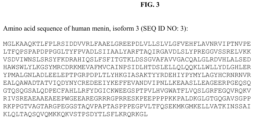
- the compound non-covalently or covalently binds to any one or more isoforms of menin, for example, isoform 1 (SEQ ID NO: 1), isoform 2 (SEQ ID NO: 2) or isoform 3 (SEQ ID NO: 3) of menin.
- the menin protein shares 60% or more, 70% or more, 75% or more, 80% or more, 85% or more, 90% or more, 95% or more, or 99% or more sequence identity with isoform 1 (SEQ ID NO: 1), isoform 2 (SEQ ID NO: 2) or isoform 3 (SEQ ID NO: 3).
- the present disclosure provides a compound of Formula (I):
- H is selected from C 5-12 carbocycle and 5- to 12-membered heterocycle, each of which is optionally substituted with one or more R 50 ;
- A is selected from bond, C 3-12 carbocycle and 3- to 12-membered heterocycle
- B is selected from C 3-12 carbocycle and 3- to 12-membered heterocycle
- C is 3- to 12-membered heterocycle
- L 1 , L 2 and L 3 are each independently selected from bond, —O—, —S—, —N(R 51 )—, —N(R 51 )CH 2 —, —C(O)—, —C(O)O—, —OC(O)—, —OC(O)O—, —C(O)N(R 51 )—, —C(O)N(R 51 )C(O)—, —C(O)N(R 51 )C(O)N(R 51 )—, —N(R 51 )C(O)—, —N(R 51 )C(O)N(R 51 )—, —N(R 51 )C(O)O—, —OC(O)N(R 51 )—, —C(NR 51 )—, —N(R 51 )C(NR 51 )—, —C(NR 51 )N(R 51 )—, —N(R 51 )C(
- R A , R B and R C are each independently selected at each occurrence from R 50 , or two R A groups, two R B groups or two R C groups attached to the same atom or different atoms can together optionally form a bridge or ring;
- n and p are each independently an integer from 0 to 6;
- R 50 is independently selected at each occurrence from:
- R 51 is independently selected at each occurrence from:
- R 52 is independently selected at each occurrence from hydrogen; and C 1-20 alkyl, C 2-20 alkenyl, C 2-20 alkynyl, 1- to 6-membered heteroalkyl, C 3-12 carbocycle, and 3- to 12-membered heterocycle, each of which is optionally substituted by halogen, —CN, —NO 2 , —NH 2 , —NHCH 3 , —NHCH 2 CH 3 , ⁇ O, —OH, —OCH 3 , —OCH 2 CH 3 , C 3-12 carbocycle, or 3- to 6-membered heterocycle;
- R 53 and R 54 are taken together with the nitrogen atom to which they are attached to form a heterocycle, optionally substituted with one or more R 50 ;
- R 57 is selected from:
- R 58 is selected from hydrogen; and C 1-20 alkyl, C 3-20 alkenyl, C 2-20 alkynyl, 1- to 6-membered heteroalkyl, C 3-12 carbocycle, and 3- to 12-membered heterocycle, each of which is optionally substituted by halogen, —CN, —NO 2 , —NH 2 , —NHCH 3 , —NHCH 2 CH 3 , ⁇ O, —OH, —OCH 3 , —OCH 2 CH 3 , C 3-12 carbocycle, or 3- to 6-membered heterocycle,
- p is an integer from 1 to 6;
- L 3 is substituted with one or more R 50 , wherein L 3 is not —CH 2 CH(OH)—.
- the present disclosure provides a compound of Formula (II):
- H is selected from C 5-12 carbocycle and 5- to 12-membered heterocycle, each of which is optionally substituted with one or more R 50 ;
- A, B and C are each independently selected from C 3-12 carbocycle and 3- to 12-membered heterocycle;
- L 1 and L 2 are each independently selected from bond, —O—, —S—, —N(R 51 )—, —N(R 51 )CH 2 —, —C(O)—, —C(O)O—, —OC(O)—, —OC(O)O—, —C(O)N(R 51 )—, —C(O)N(R 51 )C(O)—, —C(O)N(R 51 )C(O)N(R 51 )—, —N(R 51 )C(O)—, —N(R 51 )C(O)N(R 51 )—, —N(R 51 )C(O)O—, —OC(O)N(R 51 )—, —C(NR 51 )—, —N(R 51 )C(NR 51 )—, —C(NR 51 )N(R 51 )—, —N(R 51 )C(NR 51 )
- L 3 is selected from alkylene, alkenylene, and alkynylene, each of which is substituted with one or more R 56 and optionally further substituted with one or more R 50 ;
- R A , R B and R C are each independently selected at each occurrence from R 50 , or two R A groups, two R B groups or two R C groups attached to the same atom or different atoms can together optionally form a bridge or ring;
- n and p are each independently an integer from 0 to 6;
- R 50 is independently selected at each occurrence from:
- R 51 is independently selected at each occurrence from:
- R 52 is independently selected at each occurrence from hydrogen; and C 1-20 alkyl, C 2-20 alkenyl, C 2-20 alkynyl, 1- to 6-membered heteroalkyl, C 3-12 carbocycle, and 3- to 12-membered heterocycle, each of which is optionally substituted by halogen, —CN, —NO 2 , —NH 2 , —NHCH 3 , —NHCH 2 CH 3 , ⁇ O, —OH, —OCH 3 , —OCH 2 CH 3 , C 3-12 carbocycle, or 3- to 6-membered heterocycle;
- R 53 and R 54 are taken together with the nitrogen atom to which they are attached to form a heterocycle, optionally substituted with one or more R 50 ;
- R 56 is independently selected at each occurrence from:
- R 59 is independently selected at each occurrence from C 1-20 alkyl, C 2-20 alkenyl, C 2-20 alkynyl, 1- to 6-membered heteroalkyl, C 3-12 carbocycle, and 3- to 12-membered heterocycle, each of which is optionally substituted by halogen, —CN, —NO 2 , —NH 2 , —NHCH 3 , —NHCH 2 CH 3 , ⁇ O, —OH, —OCH 3 , —OCH 2 CH 3 , C 3-12 carbocycle, or 3- to 6-membered heterocycle,
- R C is selected from —C(O)R 52 , —S( ⁇ O)R 52 , —S( ⁇ O) 2 R 52 , —S( ⁇ O) 2 N(R 52 ) 2 , —S( ⁇ O) 2 NR 53 R 54 , —NR 52 S( ⁇ O) 2 R 52 , ⁇ O, C 1-3 alkyl, and C 1-3 haloalkyl, or two R C groups attached to different atoms can together form a C 1-3 bridge.
- C may be 5- to 12-membered heterocycle, wherein the heterocycle comprises at least one nitrogen atom.
- the heterocycle is saturated.
- the heterocycle is selected from piperidinyl and piperazinyl.
- C is selected from
- R 57 is selected from —S( ⁇ O)R 52 , —S( ⁇ O) 2 R 58 , —S( ⁇ O) 2 N(R 52 ) 2 , and —NR 52 S( ⁇ O) 2 R 52 .
- C is selected from
- R 57 is selected from —S( ⁇ O)R 52 , —S( ⁇ O) 2 R 52 , —S( ⁇ O) 2 N(R 52 ) 2 , —S( ⁇ O) 2 NR 53 R 54 , —NR 52 S( ⁇ O) 2 R 52 ; and C 1-10 alkyl substituted with one or more substituents selected from —S( ⁇ O)R 52 , —S( ⁇ O) 2 R 52 , —S( ⁇ O) 2 N(R 52 ) 2 , —S( ⁇ O) 2 NR 53 R 54 , and —NR 52 S( ⁇ O) 2 R 52 .
- R 57 is selected from —S( ⁇ O)R 52 , —S( ⁇ O) 2 R 52 , —S( ⁇ O) 2 N(R 52 ) 2 , and —NR 52 S( ⁇ O) 2 R 52 .
- R 57 is selected from —S( ⁇ O)CH 3 , —S( ⁇ O) 2 CH 3 , —S( ⁇ O) 2 NH 2 , —NHS( ⁇ O) 2 CH 3 , and —S( ⁇ O) 2 NHCH 3 .
- R C may be selected from C 1-3 alkyl and C 1-3 haloalkyl.
- H is 5- to 12-membered heterocycle, optionally substituted with one or more R 50 ;
- A is 3- to 12-membered heterocycle; and
- B is 3- to 12-membered heterocycle.
- H may be 6- to 12-membered bicyclic heterocycle, optionally substituted with one or more R 50 .
- H is thienopyrimidinyl, optionally substituted with one or more R 50 .
- H is
- X 1 and X 2 are each independently selected from CR 2 and N; X 3 and X 4 are each independently selected from C and N; Y 1 and Y 2 are each independently selected from CR 3 , N, NR 4 , 0, and S; R′, R 2 and R 3 are each independently selected at each occurrence from hydrogen and R 50 ; and R 4 is selected from R 51 .
- X 3 and X 4 are each C.
- X 1 is CR 2
- R 2 is selected from hydrogen, halogen, —OH, —OR 52 , —NH 2 , —N(R 52 ) 2 , —CN, C 1-3 alkyl, C 1-3 alkyl-N(R 52 ) 2 , C 1-3 haloalkyl, C 2-3 alkenyl, and C 2-3 alkynyl.
- X 1 is CR 2
- R 2 is selected from hydrogen, halogen, —OH, —OR 52 , —NH 2 , —N(R 52 ) 2 , —CN, C 1-3 alkyl, —CH 2 OH, —CH 2 OR 52 , —CH 2 NH 2 , —CH 2 N(R 52 ) 2 , C 1-3 alkyl-N(R 52 ) 2 , C 1-3 haloalkyl, C 2-3 alkenyl, and C 2-3 alkynyl.
- X 2 is N.
- Y 2 is CR 3
- R 3 is selected from hydrogen, halogen, —OH, —N(R 52 ) 2 , —CN, —C(O)OR 52 , C 1-3 alkyl, and C 1-3 haloalkyl.
- R 1 is C 1-3 haloalkyl.
- A may be 5- to 8-membered heterocycle, such as 6-membered monocyclic heterocycle.
- the heterocycle comprises at least one nitrogen atom.
- A is selected from piperidinylene and piperazinylene, such as
- B may be 6- to 12-membered bicyclic heterocycle.
- the heterocycle comprises at least one nitrogen atom.
- B is indolylene, such as
- H is thienopyrimidinyl substituted with one or more R 50 ;
- A is selected from piperidinylene and piperazinylene; and B is indolylene.
- H may be substituted with —CH 2 CF 3 .
- m is 0.
- n is an integer from 1 to 3.
- L 1 comprises less than 10 atoms.
- L 1 is —N(R 51 )—.
- L 2 comprises less than 10 atoms.
- L 2 is C 1-4 alkylene, optionally substituted with one or more R 50 .
- L 2 is selected from —CH 2 —, —N(R 51 )—, —N(R 51 )CH 2 —, —N(R 51 )C(O)—, and —N(R 51 )S(O) 2 —.
- L 3 comprises less than 20 atoms.
- L 3 is C 1-6 alkylene, optionally substituted with one or more R 50 .
- L 3 is C 2 alkylene substituted with at least one C 1-3 alkyl or C 1-3 haloalkyl, and optionally further substituted with one or more R 50 .
- L 3 is substituted with ⁇ O, C 1-6 alkyl, C 1-6 haloalkyl, C 1-3 alkyl(cyclopropyl), C 1-3 alkyl(NR 52 C(O)R 52 ) or —O(C 1-6 alkyl). In some embodiments, L 3 is substituted with —CH 3 . In some embodiments, a compound of Formula (I) or (II) is selected from Table 1.
- L 3 may be selected from
- R 50 is methyl.
- L 3 is selected from
- R 56 is methyl.
- the present disclosure provides a substantially pure stereoisomer of a compound of Formula (I) or (II).
- the stereoisomer is provided in at least 90% enantiomeric excess.
- H is thienopyrimidinyl, optionally substituted with one or more R 50 ;
- A is 3- to 12-membered heterocycle;
- B is 6- to 12-membered bicyclic heterocycle;
- m is an integer from 0 to 3; and
- n is an integer from 1 to 3.
- H is thienopyrimidinyl, optionally substituted with one or more R 50 ;
- A is selected from piperidinylene and piperazinylene
- L 1 and L 2 are each independently selected from —O—, —S—, —NH—, and —CH 2 —;
- L 3 is selected from bond, —O—, —S—, —N(R 51 )—, —N(R 51 )CH 2 —, —C(O)—, —C(O)O—, —OC(O)—, —OC(O)O—, —C(O)N(R 51 )—, —C(O)N(R 51 )C(O)—, —C(O)N(R 51 )C(O)N(R 51 )—, —N(R 51 )C(O)—, —N(R 51 )C(O)N(R 51 )—, —N(R 51 )C(O)O—, —OC(O)N(R 51 )—, —C(NR 51 )—, —N(R 51 )C(NR 51 )—, —C(NR 51 )N(R 51 )—, —N(R 51 )C(NR 51 )N(R 51
- R A , R B and R C are each independently selected at each occurrence from R 50 , or two R A groups, two R B groups or two R C groups attached to the same atom or different atoms can together optionally form a ring;
- n is an integer from 0 to 3;
- n is an integer from 1 to 3;
- p is an integer from 0 to 6;
- R 57 is selected from:
- R 58 is selected from hydrogen; and C 1-20 alkyl, C 3-20 alkenyl, C 2-20 alkynyl, 1- to 6-membered heteroalkyl, C 3-12 carbocycle, and 3- to 12-membered heterocycle, each of which is optionally substituted by halogen, —CN, —NO 2 , —NH 2 , —NHCH 3 , —NHCH 2 CH 3 , ⁇ O, —OH, —OCH 3 , —OCH 2 CH 3 , C 3-12 carbocycle, or 3- to 6-membered heterocycle.
- H is thienopyrimidinyl, optionally substituted with one or more R 50 ;
- A is selected from piperidinylene and piperazinylene
- L 1 and L 2 are each independently selected from —O—, —S—, —NH—, and —CH 2 —;
- L 3 is selected from C 1-6 alkylene, C 2-6 alkenylene, and C 2-6 alkynylene, each of which is substituted with one or more R 56 and optionally further substituted with one or more R 50 ;
- R A , R B and R C are each independently selected at each occurrence from R 50 , or two R A groups, two R B groups or two R C groups attached to the same atom or different atoms can together optionally form a bridge or ring;
- n is an integer from 0 to 3;
- n is an integer from 1 to 3;
- p is an integer from 0 to 6;
- R 56 is independently selected at each occurrence from:
- R 59 is independently selected at each occurrence from C 1-20 alkyl, C 2-20 alkenyl, C 2-20 alkynyl, 1- to 6-membered heteroalkyl, C 3-12 carbocycle, and 3- to 12-membered heterocycle, each of which is optionally substituted by halogen, —CN, —NO 2 , —NH 2 , —NHCH 3 , —NHCH 2 CH 3 , ⁇ O, —OH, —OCH 3 , —OCH 2 CH 3 , C 3-12 carbocycle, or 3- to 6-membered heterocycle.
- R 57 may be selected from —S( ⁇ O) 2 R 58 , —S( ⁇ O) 2 N(R 52 ) 2 , and —S( ⁇ O) 2 NR 53 R 54 , such as —S( ⁇ O) 2 CH 3 and —S( ⁇ O) 2 NHCH 3 .
- C may be substituted with —S( ⁇ O) 2 R 58 , —S( ⁇ O) 2 N(R 52 ) 2 , or —S( ⁇ O) 2 NR 53 R 54 .
- H is
- R 2 is selected from hydrogen, halogen, —OH, —OR 52 , —NH 2 , —N(R 52 ) 2 , —CN, C 1-3 alkyl, C 1-3 alkyl-N(R 52 ) 2 , C 1-3 haloalkyl, C 2-3 alkenyl, and C 2-3 alkynyl.
- R 2 is selected from —NH 2 , —CH 3 , and —NHCH 3 .
- H is
- R 2 is selected from hydrogen, halogen, —OH, —OR 52 , —NH 2 , —N(R 52 ) 2 , —CN, C 1-3 alkyl, C 1-3 alkyl-OR 52 , C 1-3 alkyl-N(R 52 ) 2 , C 1-3 haloalkyl, C 2-3 alkenyl, and C 2-3 alkynyl.
- R 2 is selected from —NH 2 , —CH 3 , —OCH 3 , —CH 2 OH, and —NHCH 3 .
- L 3 may be selected from
- the present disclosure provides a pharmaceutical composition
- a pharmaceutical composition comprising a compound or salt of Formula (I) or (II) and a pharmaceutically acceptable carrier.
- the pharmaceutical composition is formulated for oral administration.
- the pharmaceutical composition is formulated for injection.
- the present disclosure provides a method of inhibiting an interaction of menin with one or more of MLL1, MLL2, an MLL fusion protein, and an MLL Partial Tandem Duplication, comprising contacting menin with an effective amount of a compound or salt of Formula (I) or (II).
- the present disclosure provides a method of inhibiting a menin-MLL interaction, comprising contacting menin with an effective amount of a compound or salt of Formula (I) or (II), wherein inhibition of the interaction is evidenced by a reduction in expression of an MLL fusion protein target gene.
- the present disclosure provides a method of stabilizing menin, comprising contacting menin with a compound or salt of Formula (I) or (II).
- the MLL fusion protein target gene may be HOXA9, DLX2, or MEIS1.
- the contacting may comprise contacting a cell that expresses menin.
- the method comprises administering a second therapeutic agent.
- the contacting takes place in vivo. In some embodiments, the contacting takes place in vitro.
- the present disclosure provides a method of treating a disease or condition associated with MLL fusion proteins, comprising administering to a subject in need thereof an effective amount of a compound or salt of Formula (I) or (II).
- the present disclosure provides a method of treating a disease or condition in a subject, comprising administering to the subject a therapeutically effective amount of a pharmaceutical composition of a compound or salt of Formula (I) or (II).
- the disease or condition comprises a leukemia, hematologic malignancy, solid tumor cancer, prostate cancer, breast cancer, liver cancer, brain tumor, or diabetes.
- the leukemia comprises AML, ALL, Mixed Lineage Leukemia or a leukemia with Partial Tandem Duplications of MLL.
- the present disclosure provides a method of treating a disorder mediated by chromosomal rearrangement on chromosome 11q23 in a subject in need thereof, the method comprising administering to the subject a therapeutically effective amount of a compound or salt of Formula (I) or (II).
- the present disclosure provides a method of treating a disorder mediated by an interaction between menin and another protein, comprising administering to a subject in need thereof a therapeutically effective amount of a compound or salt of Formula (I) or (II).
- the subject is a human.
- the present disclosure provides a kit comprising a pharmaceutical composition described herein and instructions for using the composition to treat a subject suffering from a disease or condition mediated by an interaction between menin and another protein.
- FIG. 1 is an amino acid sequence of human menin, isoform 1 (SEQ ID NO: 1).
- FIG. 2 is an amino acid sequence of human menin, isoform 2 (SEQ ID NO: 2).
- FIG. 3 is an amino acid sequence of human menin, isoform 3 (SEQ ID NO: 3).
- FIG. 4 depicts the change in volume of MV4; 11 tumors in vehicle and compound treated mice.
- FIG. 5 depicts the luminescence of MV4; 11-luc tumors in vehicle and compound treated xenotransplantation mouse models of MLL leukemia after 6 days of treatment.
- FIG. 6 depicts gene expression changes of DLX2, HOXA9, MEIS1 and CD11B in bone marrow samples taken from the vehicle and compound treated mice shown in FIG. 5 .
- FIG. 7 depicts the survival curve of vehicle and compound treated mice with MV4; 11-luc tumors.
- FIG. 8 depicts the change in volume of MV4; 11 tumors in vehicle and compound treated mice.
- FIG. 9 depicts gene expression changes of HOXA9, MEIS1 and CD11B in bone marrow samples taken from vehicle and compound treated mice.
- FIG. 10 depicts the survival curve of vehicle and compound treated mice with MOLM13 tumors.
- FIG. 11 depicts the luminescence of MV4; 11-luc tumors in vehicle and compound treated xenotransplantation mouse models of MLL leukemia after 6 days of treatment.
- FIG. 12 depicts gene expression changes of HOXA9,114EISI and CD11B in bone marrow samples taken from the vehicle and compound treated mice shown in FIG. 11 .
- FIG. 13 depicts the surivival curve of vehicle and compound treated mice with MOLM13 tumors.
- MLL fusion protein refers to a protein with an N-terminal fragment of MLL fused with a partner protein.
- a partner protein include 11q23, 11q23.3, 11q24, 1p13.1, 1p32 (EPS15), 21q22, 9p13.3, 9p22 (MLLT3/AF9), ABI1, ABI2, ACACA, ACTN4, AFF1/AF4, AFF3/LAF4, AFF4/AFS, AKAP13, AP2A2, ARHGEF12, ARHGEF17, BCL9L, BTBD18, BUD13, C2CD3, CASCS, CASP8AP2, CBL, CEP164, CEP170B, CREBBP, DCP1A, DCPS, EEFSEC/SELB, ELL, EPS15, FLNA, FNBP1, FOXO3, GAS7, GMPS, KIAA1524, LAMC3, LOC100131626, MAML2, ME2, MLLT1/ENL, MLLT10
- MLL fusion proteins may be created through the joining of a gene that codes for an MLL protein and a gene that codes for a partner protein creating a fusion gene. Translation of this fusion gene may result in a single or multiple polypeptides with functional properties derived from each of the original proteins.
- C x-y or “C x -C y ” when used in conjunction with a chemical moiety, such as alkyl, alkenyl, or alkynyl is meant to include groups that contain from x to y carbons in the chain.
- C x-y alkyl refers to substituted or unsubstituted saturated hydrocarbon groups, including straight-chain alkyl and branched-chain alkyl groups that contain from x to y carbons in the chain.
- C x-y alkenyl and C x-y alkynyl refer to substituted or unsubstituted straight-chain or branched-chain unsaturated hydrocarbon groups that contain at least one double or triple bond respectively. Unless stated otherwise specifically in the specification, a C x , alkyl, C x , alkenyl, or C x , alkynyl is optionally substituted by one or more substituents such as those substituents described herein.
- Carbocycle refers to a saturated, unsaturated or aromatic ring in which each atom of the ring is a carbon atom.
- Carbocycle may include 3- to 10-membered monocyclic rings, 6- to 12-membered bicyclic rings, and 6- to 12-membered bridged rings. Each ring of a bicyclic carbocycle may be selected from saturated, unsaturated, and aromatic rings.
- the carbocycle is an aryl.
- the carbocycle is a cycloalkyl.
- the carbocycle is a cycloalkenyl.
- an aromatic ring e.g., phenyl
- a saturated or unsaturated ring e.g., cyclohexane, cyclopentane, or cyclohexene.
- Exemplary carbocycles include cyclopentyl, cyclohexyl, cyclohexenyl, adamantyl, phenyl, indanyl, and naphthyl. Unless stated otherwise specifically in the specification, a carbocycle is optionally substituted by one or more substituents such as those substituents described herein.
- Heterocycle refers to a saturated, unsaturated or aromatic ring comprising one or more heteroatoms.
- exemplary heteroatoms include N, O, Si, P, B, and S atoms.
- Heterocycles include 3- to 10-membered monocyclic rings, 6- to 12-membered bicyclic rings, and 6- to 12-membered bridged rings. Each ring of a bicyclic heterocycle may be selected from saturated, unsaturated, and aromatic rings.
- the heterocycle may be attached to the rest of the molecule through any atom of the heterocycle, valence permitting, such as a carbon or nitrogen atom of the heterocycle.
- the heterocycle is a heteroaryl.
- the heterocycle is a heterocycloalkyl.
- a heterocycle e.g., pyridyl
- a saturated or unsaturated ring e.g., cyclohexane, cyclopentane, or cyclohexene.
- Heteroaryl refers to a 3- to 12-membered aromatic ring that comprises at least one heteroatom wherein each heteroatom may be independently selected from N, O, and S.
- the heteroaryl ring may be selected from monocyclic or bicyclic and fused or bridged ring systems rings wherein at least one of the rings in the ring system is aromatic, i.e., it contains a cyclic, delocalized (4n+2) ⁇ -electron system in accordance with the Hiickel theory.
- the heteroatom(s) in the heteroaryl may be optionally oxidized.
- One or more nitrogen atoms, if present, are optionally quaternized.
- heteroaryl may be attached to the rest of the molecule through any atom of the heteroaryl, valence permitting, such as a carbon or nitrogen atom of the heteroaryl.
- heteroaryls include, but are not limited to, azepinyl, acridinyl, benzimidazolyl, benzindolyl, 1,3-benzodioxolyl, benzofuranyl, benzooxazolyl, benzo[d]thiazolyl, benzothiadiazolyl, benzo[b][1,4]dioxepinyl, benzo[b][1,4]oxazinyl, 1,4-benzodioxanyl, benzonaphthofuranyl, benzoxazolyl, benzodioxolyl, benzodioxinyl, benzopyranyl, benzopyranonyl, benzofuranyl, benzofuranonyl, benzothienyl (benzothi
- Compounds of the present disclosure also include crystalline and amorphous forms of those compounds, pharmaceutically acceptable salts, and active metabolites of these compounds having the same type of activity, including, for example, polymorphs, pseudopolymorphs, solvates, hydrates, unsolvated polymorphs (including anhydrates), conformational polymorphs, and amorphous forms of the compounds, as well as mixtures thereof.
- the compounds described herein may exhibit their natural isotopic abundance, or one or more of the atoms may be artificially enriched in a particular isotope having the same atomic number, but an atomic mass or mass number different from the atomic mass or mass number predominantly found in nature. All isotopic variations of the compounds of the present disclosure, whether radioactive or not, are encompassed within the scope of the present disclosure.
- hydrogen has three naturally occurring isotopes, denoted 41 (protium), 2 H (deuterium), and 3 H (tritium). Protium is the most abundant isotope of hydrogen in nature.
- Enriching for deuterium may afford certain therapeutic advantages, such as increased in vivo half-life and/or exposure, or may provide a compound useful for investigating in vivo routes of drug elimination and metabolism.
- Isotopically-enriched compounds may be prepared by conventional techniques well known to those skilled in the art.
- “Isomers” are different compounds that have the same molecular formula. “Stereoisomers” are isomers that differ only in the way the atoms are arranged in space. “Enantiomers” are a pair of stereoisomers that are non superimposable mirror images of each other. A 1:1 mixture of a pair of enantiomers is a “racemic” mixture. The term “( ⁇ )” is used to designate a racemic mixture where appropriate. “Diastereoisomers” or “diastereomers” are stereoisomers that have at least two asymmetric atoms but are not mirror images of each other. The absolute stereochemistry is specified according to the Cahn-Ingold-Prelog R-S system.
- stereochemistry at each chiral carbon can be specified by either R or S.
- Resolved compounds whose absolute configuration is unknown can be designated (+) or ( ⁇ ) depending on the direction (dextro- or levorotatory) in which they rotate plane polarized light at the wavelength of the sodium D line.
- Certain compounds described herein contain one or more asymmetric centers and can thus give rise to enantiomers, diastereomers, and other stereoisomeric forms, the asymmetric centers of which can be defined, in terms of absolute stereochemistry, as (R)- or (S)-.
- Optically active (R)- and (S)-isomers can be prepared using chiral synthons or chiral reagents, or resolved using conventional techniques.
- the optical activity of a compound can be analyzed via any suitable method, including but not limited to chiral chromatography and polarimetry, and the degree of predominance of one stereoisomer over the other isomer can be determined.
- Chemical entities having carbon-carbon double bonds or carbon-nitrogen double bonds may exist in Z- or E- form (or cis- or trans-form). Furthermore, some chemical entities may exist in various tautomeric forms. Unless otherwise specified, chemical entities described herein are intended to include all Z-, E- and tautomeric forms as well.
- substituted refers to moieties having substituents replacing a hydrogen on one or more carbons or heteroatoms of the structure. It will be understood that “substitution” or “substituted with” includes the implicit proviso that such substitution is in accordance with permitted valence of the substituted atom and the substituent, and that the substitution results in a stable compound, e.g., which does not spontaneously undergo transformation such as by rearrangement, cyclization, elimination, etc. As used herein, the term “substituted” is contemplated to include all permissible substituents of organic compounds.
- the permissible substituents include acyclic and cyclic, branched and unbranched, carbocyclic and heterocyclic, aromatic and non-aromatic substituents of organic compounds.
- the permissible substituents can be one or more and the same or different for appropriate organic compounds.
- the heteroatoms such as nitrogen may have hydrogen substituents and/or any permissible substituents of organic compounds described herein which satisfy the valences of the heteroatoms.
- Substituents can include any substituents described herein, for example, a halogen, a hydroxyl, a carbonyl (such as a carboxyl, an alkoxycarbonyl, a formyl, or an acyl), a thiocarbonyl (such as a thioester, a thioacetate, or a thioformate), an alkoxyl, a phosphoryl, a phosphate, a phosphonate, a phosphinate, an amino, an amido, an amidine, an imine, a cyano, a nitro, an azido, a sulfhydryl, an alkylthio, a sulfate, a sulfonate, a sulfamoyl, a sulfonamido, a sulfonyl, a heterocyclyl, an aralkyl, a carbocycle, a hetero
- substituents may include any substituents described herein, for example: halogen, hydroxy, oxo ( ⁇ O), thioxo ( ⁇ S), cyano (—CN), nitro (—NO 2 ), imino ( ⁇ N—H), oximo ( ⁇ N—OH), hydrazino ( ⁇ N—NH 2 ), —R b —OR a , —R b —OC(O)—R a , —R b —OC(O)—OR a , —R b —OC(O)—N(R a ) 2 , —R b —N(R a ) 2 , —R b —C(O)R a , —R b —C(O)OR a , —R b —C(O)N(R a ) 2 , —R b —O—R—C(O)N(R a ) 2 ,
- substituent groups are specified by their conventional chemical formulae, written from left to right, they equally encompass the chemically identical substituents that would result from writing the structure from right to left, e.g., —CH 2 O— is equivalent to —OCH 2 —.
- salt or “pharmaceutically acceptable salt” refers to salts derived from a variety of organic and inorganic counter ions well known in the art.
- Pharmaceutically acceptable acid addition salts can be formed with inorganic acids and organic acids.
- Inorganic acids from which salts can be derived include, for example, hydrochloric acid, hydrobromic acid, sulfuric acid, nitric acid, phosphoric acid, and the like.
- Organic acids from which salts can be derived include, for example, acetic acid, propionic acid, glycolic acid, pyruvic acid, oxalic acid, maleic acid, malonic acid, succinic acid, fumaric acid, tartaric acid, citric acid, benzoic acid, cinnamic acid, mandelic acid, methanesulfonic acid, ethanesulfonic acid, p-toluenesulfonic acid, salicylic acid, and the like.
- Pharmaceutically acceptable base addition salts can be formed with inorganic and organic bases.
- Inorganic bases from which salts can be derived include, for example, sodium, potassium, lithium, ammonium, calcium, magnesium, iron, zinc, copper, manganese, aluminum, and the like.
- Organic bases from which salts can be derived include, for example, primary, secondary, and tertiary amines, substituted amines including naturally occurring substituted amines, cyclic amines, basic ion exchange resins, and the like, specifically such as isopropylamine, trimethylamine, diethylamine, triethylamine, tripropylamine, and ethanolamine.
- the pharmaceutically acceptable base addition salt is chosen from ammonium, potassium, sodium, calcium, and magnesium salts.
- the term “effective amount” or “therapeutically effective amount” refers to that amount of a compound described herein that is sufficient to affect the intended application, including but not limited to disease treatment, as defined below.
- the therapeutically effective amount may vary depending upon the intended treatment application (in vivo), or the subject and disease condition being treated, e.g., the weight and age of the subject, the severity of the disease condition, the manner of administration and the like, which can readily be determined by one of ordinary skill in the art.
- the term also applies to a dose that will induce a particular response in target cells, e.g., reduction of platelet adhesion and/or cell migration.
- the specific dose will vary depending on the particular compounds chosen, the dosing regimen to be followed, whether it is administered in combination with other compounds, timing of administration, the tissue to which it is administered, and the physical delivery system in which it is carried.
- treatment refers to an approach for obtaining beneficial or desired results with respect to a disease, disorder, or medical condition including but not limited to a therapeutic benefit and/or a prophylactic benefit.
- therapeutic benefit is meant eradication or amelioration of the underlying disorder being treated.
- a therapeutic benefit is achieved with the eradication or amelioration of one or more of the physiological symptoms associated with the underlying disorder such that an improvement is observed in the subject, notwithstanding that the subject may still be afflicted with the underlying disorder.
- the compositions are administered to a subject at risk of developing a particular disease, or to a subject reporting one or more of the physiological symptoms of a disease, even though a diagnosis of this disease may not have been made.
- a prophylactic effect includes delaying or eliminating the appearance of a disease or condition, delaying or eliminating the onset of symptoms of a disease or condition, slowing, halting, or reversing the progression of a disease or condition, or any combination thereof.
- co-administration encompass administration of two or more agents to an animal, including humans, so that both agents and/or their metabolites are present in the subject at the same time.
- Co-administration includes simultaneous administration in separate compositions, administration at different times in separate compositions, or administration in a composition in which both agents are present.
- antagonists are used interchangeably, and they refer to a compound having the ability to inhibit a biological function (e.g., activity, expression, binding, protein-protein interaction) of a target protein (e.g., menin, MLL1, MLL2, and/or an MLL fusion protein). Accordingly, the terms “antagonist” and “inhibitor” are defined in the context of the biological role of the target protein. While preferred antagonists herein specifically interact with (e.g., bind to) the target, compounds that inhibit a biological activity of the target protein by interacting with other members of the signal transduction pathway of which the target protein is a member are also specifically included within this definition. A preferred biological activity inhibited by an antagonist is associated with the development, growth, or spread of a tumor.
- agonist refers to a compound having the ability to initiate or enhance a biological function of a target protein, whether by inhibiting the activity or expression of the target protein. Accordingly, the term “agonist” is defined in the context of the biological role of the target polypeptide. While preferred agonists herein specifically interact with (e.g., bind to) the target, compounds that initiate or enhance a biological activity of the target polypeptide by interacting with other members of the signal transduction pathway of which the target polypeptide is a member are also specifically included within this definition.
- Signal transduction is a process during which stimulatory or inhibitory signals are transmitted into and within a cell to elicit an intracellular response.
- a modulator of a signal transduction pathway refers to a compound which modulates the activity of one or more cellular proteins mapped to the same specific signal transduction pathway.
- a modulator may augment (agonist) or suppress (antagonist) the activity of a signaling molecule.
- an “anti-cancer agent”, “anti-tumor agent” or “chemotherapeutic agent” refers to any agent useful in the treatment of a neoplastic condition.
- One class of anti-cancer agents comprises chemotherapeutic agents.
- “Chemotherapy” means the administration of one or more chemotherapeutic drugs and/or other agents to a cancer patient by various methods, including intravenous, oral, intramuscular, intraperitoneal, intravesical, subcutaneous, transdermal, buccal, or inhalation or in the form of a suppository.
- Subject refers to an animal, such as a mammal, for example a human.
- the methods described herein can be useful in both human therapeutics and veterinary applications.
- the subject is a mammal, and in some embodiments, the subject is human.
- “Mammal” includes humans and both domestic animals such as laboratory animals and household pets (e.g., cats, dogs, swine, cattle, sheep, goats, horses, rabbits), and non-domestic animals such as wildlife and the like.
- Prodrug is meant to indicate a compound that may be converted under physiological conditions or by solvolysis to a biologically active compound described herein (e.g., compound of Formula (I) or (II)).
- a prodrug refers to a precursor of a biologically active compound that is pharmaceutically acceptable.
- a prodrug is inactive when administered to a subject but is converted in vivo to an active compound, for example, by hydrolysis.
- the prodrug compound often offers advantages of solubility, tissue compatibility or delayed release in a mammalian organism (see, e.g., Bundgard, H., Design of Prodrugs (1985), pp.
- prodrug is also meant to include any covalently bonded carriers, which release the active compound in vivo when such prodrug is administered to a mammalian subject.
- Prodrugs of an active compound are typically prepared by modifying functional groups present in the active compound in such a way that the modifications are cleaved, either in routine manipulation or in vivo, to the parent active compound.
- Prodrugs include compounds wherein a hydroxy, amino or mercapto group is bonded to any group that, when the prodrug of the active compound is administered to a mammalian subject, cleaves to form a free hydroxy, free amino or free mercapto group, respectively.
- Examples of prodrugs include, but are not limited to, acetate, formate and benzoate derivatives of a hydroxy functional group, or acetamide, formamide and benzamide derivatives of an amine functional group in the active compound and the like.
- in vivo refers to an event that takes place in a subject's body.
- in vitro refers to an event that takes places outside of a subject's body.
- an in vitro assay encompasses any assay run outside of a subject.
- in vitro assays encompass cell-based assays in which cells alive or dead are employed.
- In vitro assays also encompass a cell-free assay in which no intact cells are employed.
- Optional or “optionally” means that the subsequently described event of circumstances may or may not occur, and that the description includes instances where the event or circumstance occurs and instances in which it does not.
- optionally substituted aryl means that the aryl group may or may not be substituted and that the description includes both substituted aryl groups and aryl groups having no substitution.
- “Pharmaceutically acceptable carrier, diluent or excipient” includes without limitation any adjuvant, carrier, excipient, glidant, sweetening agent, diluent, preservative, dye, colorant, flavor enhancer, surfactant, wetting agent, dispersing agent, suspending agent, stabilizer, isotonic agent, solvent, or emulsifier which has been approved by the United States Food and Drug Administration as being acceptable for use in humans or domestic animals.
- the present disclosure provides compounds for modulating the interaction of menin with proteins such as MLL1, MLL2 and MLL-fusion oncoproteins.
- the disclosure provides compounds and methods for inhibiting the interaction of menin with its upstream or downstream signaling molecules including but not limited to MLL1, MLL2 and MLL-fusion oncoproteins.
- Compounds of the disclosure may be used in methods for the treatment of a wide variety of cancers and other diseases associated with one or more of MLL1, MLL2, MLL fusion proteins, and menin.
- a compound of the disclosure covalently binds menin and inhibits the interaction of menin with MLL.
- a compound of the disclosure interacts non-covalently with menin and inhibits the interaction of menin with MLL.
- a compound of the disclosure may be used in methods for treating a wide variety of diseases associated with MLL1, MLL2, MLL fusion proteins, and menin.
- a compound of the disclosure interacts non-covalently with menin and inhibits the interaction of menin with MLL.
- a compound of the disclosure covalently binds menin and inhibits the interaction of menin with MLL.
- the present disclosure provides a compound or salt that selectively binds to the menin protein and/or modulates the interaction of menin with an MLL protein (e.g., MLL 1, MLL2, or an MLL fusion protein).
- an MLL protein e.g., MLL 1, MLL2, or an MLL fusion protein.
- the compound modulates the menin protein by binding to or interacting with one or more amino acids and/or one or more metal ions.
- Certain compounds may occupy the F9 and/or P13 pocket of menin.
- the binding of a compound disclosed herein may disrupt menin or MLL (e.g., MLL1, MLL2, or an MLL fusion protein) downstream signaling.
- the present disclosure provides a compound of Formula (I):
- H is selected from C 5-12 carbocycle and 5- to 12-membered heterocycle, each of which is optionally substituted with one or more R 50 ;
- A is selected from bond, C 3-12 carbocycle and 3- to 12-membered heterocycle
- B is selected from C 3-12 carbocycle and 3- to 12-membered heterocycle
- C is 3- to 12-membered heterocycle
- L 1 , L 2 and L 3 are each independently selected from bond, —O—, —S—, —N(R 51 )—, —N(R 51 )CH 2 —, —C(O)—, —C(O)O—, —OC(O)—, —OC(O)O—, —C(O)N(R 51 )—, —C(O)N(R 51 )C(O)—, —C(O)N(R 51 )C(O)N(R 51 )—, —N(R 51 )C(O)—, —N(R 51 )C(O)N(R 51 )—, —N(R 51 )C(O)O—, —OC(O)N(R 51 )—, —C(NR 51 )—, —N(R 51 )C(NR 51 )—, —C(NR 51 )N(R 51 )—, —N(R 51 )C(
- R A , R B and R C are each independently selected at each occurrence from R 50 , or two R A groups, two R B groups or two R C groups attached to the same atom or different atoms can together optionally form a bridge or ring;
- n and p are each independently an integer from 0 to 6;
- R 50 is independently selected at each occurrence from:
- R 51 is independently selected at each occurrence from:
- R 52 is independently selected at each occurrence from hydrogen; and C 1-20 alkyl, C 2-20 alkenyl, C 2-20 alkynyl, 1- to 6-membered heteroalkyl, C 3-12 carbocycle, and 3- to 12-membered heterocycle, each of which is optionally substituted by halogen, —CN, —NO 2 , —NH 2 , —NHCH 3 , —NHCH 2 CH 3 , ⁇ O, —OH, —OCH 3 , —OCH 2 CH 3 , C 3-12 carbocycle, or 3- to 6-membered heterocycle;
- R 53 and R 54 are taken together with the nitrogen atom to which they are attached to form a heterocycle, optionally substituted with one or more R 50 ;
- R 57 is selected from:
- R 58 is selected from hydrogen; and C 1-20 alkyl, C 3-20 alkenyl, C 2-20 alkynyl, 1- to 6-membered heteroalkyl, C 3-12 carbocycle, and 3- to 12-membered heterocycle, each of which is optionally substituted by halogen, —CN, —NO 2 , —NH 2 , —NHCH 3 , —NHCH 2 CH 3 , ⁇ O, —OH, —OCH 3 , —OCH 2 CH 3 , C 3-12 carbocycle, or 3- to 6-membered heterocycle,
- p is an integer from 1 to 6;
- L 3 is substituted with one or more R 50 , wherein L 3 is not —CH 2 CH(OH)—.
- the present disclosure provides a compound of Formula (II):
- H is selected from C 5-12 carbocycle and 5- to 12-membered heterocycle, each of which is optionally substituted with one or more R 50 ;
- A, B and C are each independently selected from C 3-12 carbocycle and 3- to 12-membered heterocycle;
- L 1 and L 2 are each independently selected from bond, —O—, —S—, —N(R 51 )—, —N(R 51 )CH 2 —, —C(O)—, —C(O)O—, —OC(O)—, —OC(O)O—, —C(O)N(R 51 )—, —C(O)N(R 51 )C(O)—, —C(O)N(R 51 )C(O)N(R 51 )—, —N(R 51 )C(O)—, —N(R 51 )C(O)N(R 51 )—, —N(R 51 )C(O)O—, —OC(O)N(R 51 )—, —C(NR 51 )—, —N(R 51 )C(NR 51 )—, —C(NR 51 )N(R 51 )—, —N(R 51 )C(NR 51 )
- L 3 is selected from alkylene, alkenylene, and alkynylene, each of which is substituted with one or more R 56 and optionally further substituted with one or more R 50 ;
- R A , R B and R C are each independently selected at each occurrence from R 50 , or two R A groups, two R B groups or two R C groups attached to the same atom or different atoms can together optionally form a bridge or ring;
- n and p are each independently an integer from 0 to 6;
- R 50 is independently selected at each occurrence from:
- R 51 is independently selected at each occurrence from:
- R 52 is independently selected at each occurrence from hydrogen; and C 1-20 alkyl, C 2-20 alkenyl, C 2-20 alkynyl, 1- to 6-membered heteroalkyl, C 3-12 carbocycle, and 3- to 12-membered heterocycle, each of which is optionally substituted by halogen, —CN, —NO 2 , —NH 2 , —NHCH 3 , —NHCH 2 CH 3 , ⁇ O, —OH, —OCH 3 , —OCH 2 CH 3 , C 3-12 carbocycle, or 3- to 6-membered heterocycle;
- R 53 and R 54 are taken together with the nitrogen atom to which they are attached to form a heterocycle, optionally substituted with one or more R 50 ;
- R 56 is independently selected at each occurrence from:
- R 59 is independently selected at each occurrence from C 1-20 alkyl, C 2-20 alkenyl, C 2-20 alkynyl, 1- to 6-membered heteroalkyl, C 3-12 carbocycle, and 3- to 12-membered heterocycle, each of which is optionally substituted by halogen, —CN, —NO 2 , —NH 2 , —NHCH 3 , —NHCH 2 CH 3 , ⁇ O, —OH, —OCH 3 , —OCH 2 CH 3 , C 3-12 carbocycle, or 3- to 6-membered heterocycle,
- the present disclosure provides a compound of Formula (I):
- H is selected from C5_12 carbocycle and 5- to 12-membered heterocycle, each of which is optionally substituted with one or more R 50 ;
- A is selected from bond, C 3-12 carbocycle and 3- to 12-membered heterocycle
- B is selected from C 3-12 carbocycle and 3- to 12-membered heterocycle
- C is 3- to 12-membered heterocycle
- L 1 , L 2 and L 3 are each independently selected from bond, —O—, —S—, —N(R 51 )—, —N(R 51 )CH 2 —, —C(O)—, —C(O)O—, —OC(O)—, —OC(O)O—, —C(O)N(R 51 )—, —C(O)N(R 51 )C(O)—, —C(O)N(R 51 )C(O)N(R 51 )—, —N(R 51 )C(O)—, —N(R 51 )C(O)N(R 51 )—, —N(R 51 )C(O)O—, —OC(O)N(R 51 )—, —C(NR 51 )—, —N(R 51 )C(NR 51 )—, —C(NR 51 )N(R 51 )—, —N(R 51 )C(
- R A , R B and R C are each independently selected at each occurrence from R 50 , or two R A groups, two R B groups or two R C groups attached to the same atom or different atoms can together optionally form a bridge or ring;
- n and p are each independently an integer from 0 to 6;
- R 50 is independently selected at each occurrence from:
- R 51 is independently selected at each occurrence from:
- R 52 is independently selected at each occurrence from hydrogen; and C 1-20 alkyl, C 2-20 alkenyl, C 2-20 alkynyl, 1- to 6-membered heteroalkyl, C 3-12 carbocycle, and 3- to 12-membered heterocycle, each of which is optionally substituted by halogen, —CN, —NO 2 , —NH 2 , —NHCH 3 , —NHCH 2 CH 3 , ⁇ O, —OH, —OCH 3 , —OCH 2 CH 3 , C 3-12 carbocycle, or 3- to 6-membered heterocycle;
- R 53 and R 54 are taken together with the nitrogen atom to which they are attached to form a heterocycle, optionally substituted with one or more R 50 ;
- R 57 is selected from:
- R 58 is selected from hydrogen; and C 1-20 alky, C 3-20 alkenyl, C 2-20 alkynyl, 1- and 6-membered heteroalkyl, C 3-12 carbocycle, and 3- to 12-membered heterocycle, each of which is optionally substituted by halogen, —CN, —NO 2 , —NH 2 , —NHCH 3 , —NHCH 2 CH 3 , ⁇ O, —OH, —OCH 3 , —OCH 2 CH 3 , C 3-12 carbocycle, or 3- to 6-membered heterocycle,
- p is an integer from 1 to 6;
- L 3 is substituted with one or more R 50 , wherein L 3 is not —CH 2 CH(OH)—.
- the present disclosure provides a compound of Formula (II):
- H is selected from C 5-12 carbocycle and 5- to 12-membered heterocycle, each of which is optionally substituted with one or more R 50 ;
- A, B and C are each independently selected from C 3-12 carbocycle and 3- to 12-membered heterocycle;
- L 1 and L 2 are each independently selected from bond, —O—, —S—, —N(R 51 )—, —N(R 51 )CH 2 —, —C(O)—, —C(O)O—, —OC(O)—, —OC(O)O—, —C(O)N(R 51 )—, —C(O)N(R 51 )C(O)—, —C(O)N(R 51 )C(O)N(R 51 )—, —N(R 51 )C(O)—, —N(R 51 )C(O)N(R 51 )—, —N(R 51 )C(O)O—, —OC(O)N(R 51 )—, —C(NR 51 )—, —N(R 51 )C(NR 51 )—, —C(NR 51 )N(R 51 )—, —N(R 51 )C(NR 51 )
- L 3 is selected from alkylene, alkenylene, and alkynylene, each of which is substituted with one or more R 56 and optionally further substituted with one or more R 50 ;
- R A , R B and R C are each independently selected at each occurrence from R 50 , or two R A groups, two R B groups or two R C groups attached to the same atom or different atoms can together optionally form a bridge or ring;
- n and p are each independently an integer from 0 to 6;
- R 50 is independently selected at each occurrence from:
- R 51 is independently selected at each occurrence from:
- R 52 is independently selected at each occurrence from hydrogen; and C 1-20 alkyl, C 2-20 alkenyl, C 2-20 alkynyl, 1- to 6-membered heteroalkyl, C 3-12 carbocycle, and 3- to 12-membered heterocycle, each of which is optionally substituted by halogen, —CN, —NO 2 , —NH 2 , —NHCH 3 , —NHCH 2 CH 3 , ⁇ O, —OH, —OCH 3 , —OCH 2 CH 3 , C 3-12 carbocycle, or 3- to 6-membered heterocycle;
- R 53 and R 54 are taken together with the nitrogen atom to which they are attached to form a heterocycle, optionally substituted with one or more R 50 ;
- R 56 is independently selected at each occurrence from:
- R 59 is independently selected at each occurrence from C 1-20 alkyl, C 2-20 alkenyl, C 2-20 alkynyl, 1- to 6-membered heteroalkyl, C 3-12 carbocycle, and 3- to 12-membered heterocycle, each of which is optionally substituted by halogen, —CN, —NO 2 , —NH 2 , —NHCH 3 , —NHCH 2 CH 3 , ⁇ O, —OH, —OCH 3 , —OCH 2 CH 3 , C 3-12 carbocycle, or 3- to 6-membered heterocycle,
- H is 5- to 12-membered heterocycle, such as 6- to 12-membered bicyclic heterocycle, optionally substituted with one or more R 50 .
- H contains one or more heteroatoms, such as 1, 2, 3, 4, 5 or 6 ring heteroatoms.
- H contains at least 1, 2, 3, 4 or 5 ring nitrogen atoms.
- H is thienopyrimidinyl, optionally substituted with one or more R 50 .
- H is substituted with C 1-4 haloalkyl, such as —CH 2 CF 3 .
- H is substituted with one or more R 50 (e.g., by replacing a hydrogen connected to a ring atom with a bond to R 50 ).
- H may be substituted with 0, 1, 2, 3, 4, 5, 6 or more R 50 groups.
- H may be substituted with 1, 2, 3, 4, 5 or 6 R 50 groups, such as H substituted with 1 or 2 R 50 groups.
- H is substituted with at least 1, 2, 3, 4, 5 or 6 R 50 groups.
- H is substituted with up to 6, 5, 4, 3, 2 or 1 R 50 groups.
- H is
- X 1 and X 2 are each independently selected from CR 2 and N; X 3 and X 4 are each independently selected from C and N; Y 1 and Y 2 are each independently selected from CR 3 , N, NR 4 , O, and S; R 1 , R 2 and R 3 are each independently selected at each occurrence from hydrogen and R 50 ; and R 4 is selected from R 51 .
- X 3 and X 4 are each C.
- X 1 is CR 2
- R 2 is selected from hydrogen, halogen, —OH, —OR 52 , —NH 2 , —N(R 52 ) 2 , —CN, C 1-3 alkyl, —CH 2 OH, —CH 2 OR 52 , —CH 2 NH 2 , —CH 2 N(R 52 ) 2 , C 1-3 alkyl-N(R 52 ) 2 , C 1-3 haloalkyl, C 2-3 alkenyl, and C 2-3 alkynyl, such as R 2 is selected from —OH, —OR 52 , —NH 2 , —N(R 52 ) 2 , —CN, and C 1-2 alkyl.
- R 2 is methyl or —NHCH 3 . In some embodiments, R 2 is H. In some embodiments, X 2 is N. In some embodiments, Y 2 is CR 3 , and R 3 is selected from hydrogen, halogen, —OH, —N(R 52 ) 2 , —CN, —C(O)OR 52 , C 1-3 alkyl, and C 1-3 haloalkyl. In some embodiments, Y 1 is S. In some embodiments, at least one of Y 1 and Y 2 is selected from N, NR 4 , O and S. In some embodiments, R 1 is C 1-3 haloalkyl, such as —CH 2 CF3.
- X 1 is CR 2 , X 2 is N, X 3 and X 4 are each C, Y 1 is S, Y 2 is CR 3 , and R 1 is selected from R 50 .
- X 1 is CR 2 ; X 2 is N; X 3 and X 4 are each C; Y 1 is S; Y 2 is CH; R 1 is C 1-3 haloalkyl; and R 2 is selected from hydrogen, halogen, —OH, —OR 52 , —NH 2 , —N(R 52 ) 2 , —CN, C 1-3 alkyl, —CH 2 OH, —CH 2 OR 52 , —CH 2 NH 2 , —CH 2 N(R 52 ) 2 , C 1-3 alkyl-N(R 52 ) 2 , C 1-3 haloalkyl, C 2-3 alkenyl, and C 2-3 alkynyl.
- H is selected from hydrogen, halogen, —OH, —OR 52
- H is
- H is
- R 2 is selected from hydrogen, halogen, —OH, —OR 52 , —NH 2 , —N(R 52 ) 2 , —CN, C 1-3 alkyl, —CH 2 OH, —CH 2 OR 52 , —CH 2 NH 2 , —CH 2 N(R 52 ) 2 , C 1-3 alkyl-N(R 52 ) 2 , C 1-3 haloalkyl, C 2-3 alkenyl, and C 2-3 alkynyl.
- R 2 is selected from hydrogen, halogen, —OH, alkoxy (e.g., —OR 52 , —OCH 3 , —OCH 2 CH 3 ), aminoalkyl, alkylamino, —N(R 52 ) 2 (e.g., —NH 2 , —NHCH 3 , —NHCH 2 CH 3 ), —N(CH 3 ) 2 , —CN, C 1-3 alkyl (e.g., —CH 3 ), cyclopropyl, C 1-3 alkyl-OR 52 (e.g., —CH 2 OH, —CH 2 OC(O)CH 3 ), C 1-3 alkyl-N(R 52 ) 2 , C 1-3 haloalkyl, C 2-3 alkenyl, and C 2-3 alkynyl.
- alkoxy e.g., —OR 52 , —OCH 3 , —OCH 2 CH 3
- aminoalkyl alkylamino
- H is
- R 1 is selected from H, halo, hydroxyl, amino, cyano, dialkylphosphine oxide, oxo, carboxyl, amido, acyl, alkyl, cycloalkyl, heteroalkyl, and haloalkyl, such as from alkyl and haloalkyl
- R 2 is selected from H, halo, hydroxyl, amino, cyano, dialkylphosphine oxide, oxo, carboxyl, amido, acyl, alkyl, cycloalkyl, heteroalkyl, haloalkyl, aminoalkyl, hydroxyalkyl, alkoxy, and alkylamino, such as from H, halo, hydroxyl, and amino
- each of Y 1 and Y 2 is independently selected from S, CR 3 , N, NR 4 and O. In certain embodiments, up to one of Y 1 and Y 2 is O or S.
- L 1 comprises less than 20 atoms, such as less than 10 atoms. In some embodiments, L 1 comprises less than 20, 15, 10, 9, 8, 7, 6, 5, 4, or less than 3 atoms. In some embodiments, L 1 comprises at least 1, 2, 3, 4, 5, 6, 7, 8, 9, 10, 15 or at least 20 atoms. In some embodiments, L 1 comprises at least one heteroatom, such as L 1 comprises at least one nitrogen. In some embodiments, L 1 is substituted with one or more R 50 . In some embodiments, L 1 is unsubstituted.
- L 1 is selected from bond, —O—, —S—, —N(R 51 )—, —N(R 51 )CH 2 —, —C(O)—, —C(O)O—, —OC(O)—, —C(O)N(R 51 )—, —N(R 51 )C(O)—, —N(R 51 )C(O)N(R 51 )—, —S(O) 2 —, —S(O)—, —N(R 51 )S(O) 2 —, —S(O) 2 N(R 51 )—, —N(R 51 )S(O) 2 N(R 51 )—, alkylene, alkenylene, heteroalkylene, and heteroalkenylene.
- L 1 is selected from bond, —O—, —S—, —N(R 51 )—, —N(R 51 )CH 2 —, —C(O)—, —C(O)O—, —OC(O)—, —C(O)N(R 51 )—, —N(R 51 )C(O)—, —N(R 51 )C(O)N(R 51 )—, —S(O) 2 —, —S(O)—, —N(R 51 )S(O) 2 —, —S(O) 2 N(R 51 )—, —N(R 51 )S(O) 2 N(R 51 )—, C 1-6 alkylene and C 2-6 alkenylene, wherein the C 1-6 alkylene and C 2-6 alkenylene are each optionally substituted with one or more R 50 .
- L 1 is —N(R 51 )—, such as —NH—. In some embodiments, L 1 is selected from —O—, —N(R 51 )—, —N(R 51 )CH 2 —, —N(R 51 )CH 2 —, —C(O)—, —C(O)N(R 51 )—, —N(R 51 )C(O)—, —N(R 51 )S(O) 2 —, —S(O) 2 N(R 51 )—, C 1-4 alkylene, C 2-4 alkenylene, and C 1-4 heteroalkylene. In some embodiments, L 1 is —N(R 51 )—, wherein R 51 is selected from hydrogen and alkyl.
- A is 3- to 12-membered heterocycle, such as 5- to 8-membered heterocycle.
- A is 6-membered monocyclic heterocycle.
- the heterocycle comprises at least one nitrogen atom.
- A comprises at least one ring nitrogen.
- A is selected from piperidinylene and piperazinylene, such as
- A is N-(2-aminoethyl)-2-aminoethyl-N-(2-aminoethyl)-2-aminoethyl-N-(2-aminoethyl)-2-aminoethyl-N-(2-aminoethyl)-2-aminoethyl-N-(2-aminoethyl)-2-aminoethyl-N-phenyl
- A is an aromatic, non-aromatic, saturated or unsaturated ring.
- A is selected from arylene, cycloalkylene, heterocycloalkylene, N-heterocycloalkylene, heteroarylene, and N-heteroarylene.
- A is 5- to 8-membered heterocycle, wherein the heterocycle comprises at least 1, 2, 3 or 4 ring heteroatoms selected from N, O and S.
- A is selected from
- A is substituted with one or more R A (e.g., by replacing a hydrogen connected to a ring atom with a bond to R A ).
- A may be substituted with 0, 1, 2, 3, 4, 5, 6 or more R A groups.
- A may be substituted with 1, 2, 3, 4, 5 or 6 R A groups, such as A substituted with 1 or 2 R A groups.
- A is substituted with at least 1, 2, 3, 4, 5 or 6 R A groups.
- A is unsubstituted.
- A is substituted with m R A groups, wherein m is an integer from 0 to 6.
- m is 0, 1, 2, 3, 4, 5 or 6.
- m is at least 1, 2, 3, 4, 5 or 6.
- m is up to 6, 5, 4, 3, 2, or 1.
- m is 0.
- R A is independently selected at each occurrence from halo, hydroxyl, amino, cyano, dialkylphosphine oxide, oxo, carboxyl, amido, acyl, alkyl, cycloalkyl, heteroalkyl, haloalkyl, aminoalkyl, hydroxyalkyl, alkoxy, alkylamino, cycloalkylalkyl, cycloalkyloxy, cycloalkylalkyloxy, cycloalkylamino, cycloalkylalkylamino, heterocyclyl, heterocyclylalkyl, heterocyclyloxy, heterocyclylalkyloxy, heterocyclylamino, heterocyclylalkylamino, aryl, aralkyl, aryloxy, aralkyloxy, arylamino, aralkylamino, heteroaryl, heteroarylalkyl, heteroaryloxy, heteroarylalkyloxy, heteroarylalkyl
- L 2 comprises less than 20 atoms, such as less than 10 atoms. In some embodiments, L 2 comprises less than 20, 15, 10, 9, 8, 7, 6, 5, 4, or less than 3 atoms. In some embodiments, L 2 comprises at least 1, 2, 3, 4, 5, 6, 7, 8, 9, 10, 15 or at least 20 atoms. In some embodiments, L 2 comprises at least one heteroatom, such as L 2 comprises at least one nitrogen. In some embodiments, L 2 is C 1-10 alkylene, such as C 1-4 alkylene, optionally substituted with one or more R 50 . In some embodiments, L 2 is substituted with one or more R 50 . In some embodiments, L 2 is unsubstituted.
- L 2 is selected from bond, —O—, —S—, —N(R 51 )—, —N(R 51 )CH 2 —, —C(O)—, —C(O)O—, —OC(O)—, —C(O)N(R 51 )—, —N(R 51 )C(O)—, —N(R 51 )C(O)N(R 51 )—, —S(O) 2 —, —S(O)—, —N(R 51 )S(O) 2 —, —S(O) 2 N(R 51 )—, —N(R 51 )S(O) 2 N(R 51 )—, alkylene, alkenylene, heteroalkylene, and heteroalkenylene.
- L 2 is selected from bond, —O—, —S—, —N(R 51 )—, —N(R 51 )CH 2 —, —C(O)—, —C(O)O—, —OC(O)—, —C(O)N(R 51 )—, —N(R 51 )C(O)—, —N(R 51 )C(O)N(R 51 )—, —S(O) 2 —, —S(O)—, —N(R 51 )S(O) 2 —, —S(O) 2 N(R 51 )—, —N(R 51 )S(O) 2 N(R 51 )—, C 1-6 alkylene and C 2-6 alkenylene, wherein the C 1-6 alkylene and C 2-6 alkenylene are each optionally substituted with one or more R 50 .
- L 2 is selected from —O—, —N(R 51 )—, —N(R 51 )CH 2 —, —C(O)N(R 51 )—, —N(R 51 )C(O)—, —N(R 51 )S(O) 2 —, —S(O) 2 N(R 51 )—, C 1-4 alkylene and C 1-4 heteroalkylene.
- L 2 is selected from —CH 2 —, —N(R 51 )—, —N(R 51 )CH 2 —, —N(R 51 )C(O)—, and —N(R 51 )S(O) 2 —.
- L 2 is —CH 2 —.
- B is 3- to 12-membered heterocycle, such as 6- to 12-membered bicyclic heterocycle.
- the heterocycle comprises at least one nitrogen atom.
- B is 6- to 12-membered heterocycle, wherein the heterocycle comprises at least 1, 2, 3 or 4 ring heteroatoms selected from N, O and S.
- B is a 6,5- or 6,6-bicyclic heterocycle.
- B comprises at least one ring nitrogen.
- B is indolylene, such as
- B is
- B is selected from
- Z 1 , Z 2 , Z 3 and Z 4 are each independently selected from CR 7 , N and NR 9 ;
- Z 5 is selected from C and N;
- Z 6 , Z 7 and Z 8 are each independently selected from CR 8 , N, NR 9 , O and S;
- Z 9 , Z 10 and Z 11 are each independently selected from CR 10 , CR 11 R 12 , N 13 , O and S;
- R 7 , R 8 , R 10 , R 11 , and R 12 are each independently selected from hydrogen and R 50 ;
- R 9 and R 13 are each independently selected from R 51 , wherein B may be connected at any ring atom to L 2 or L 3 (e.g., by replacing a hydrogen connected to a ring atom with a bond to L 2 or L 3 ).
- B is selected from
- B is substituted with one or more R B (e.g., by replacing a hydrogen connected to a ring atom with a bond to R B ).
- B may be substituted with 0, 1, 2, 3, 4, 5, 6 or more R B groups.
- B may be substituted with 1, 2, 3, 4, 5 or 6 R B groups, such as B substituted with 1 or 2 R B groups.
- B is substituted with at least 1, 2, 3, 4, 5 or 6 R B groups.
- B is substituted with n R B groups, wherein n is an integer from 0 to 6.
- n is 0, 1, 2, 3, 4, 5 or 6.
- n is at least 1, 2, 3, 4, 5 or 6.
- n is up to 6, 5, 4, 3, 2, or 1.
- n is an integer from 1 to 3.
- R B is independently selected at each occurrence from halo, hydroxyl, amino, cyano, dialkylphosphine oxide, oxo, carboxyl, amido, acyl, alkyl, cycloalkyl, heteroalkyl, haloalkyl, aminoalkyl, hydroxyalkyl, alkoxy, alkylamino, cycloalkylalkyl, cycloalkyloxy, cycloalkylalkyloxy, cycloalkylamino, cycloalkylalkylamino, heterocyclyl, heterocyclylalkyl, heterocyclyloxy, heterocyclylalkyloxy, heterocyclylamino, heterocyclylalkylamino, aryl, aralkyl, aryloxy, aralkyloxy, arylamino, aralkylamino, heteroaryl, heteroarylalkyl, heteroaryloxy, heteroarylalkyloxy, heteroarylalkyl
- R B is independently selected at each occurrence from halo, hydroxyl, amino, cyano, dialkylphosphine oxide, oxo, carboxyl, amido, acyl, alkyl, cycloalkyl, heteroalkyl, haloalkyl, aminoalkyl, hydroxyalkyl, alkoxy, alkylamino, heterocyclylalkyl, and heteroarylalkyl.
- two R B groups attached to the same atom or different atoms can together form a ring.
- L 3 comprises less than 30 atoms, such as less than 20 atoms. In some embodiments, L 3 comprises less than 30, 25, 20, 15, 10, 9, 8, 7, 6, 5, 4, or less than 3 atoms. In some embodiments, L 3 comprises at least 1, 2, 3, 4, 5, 6, 7, 8, 9, 10, 15 or at least 20 atoms. In some embodiments, L 3 comprises at least one heteroatom, such as L 3 comprises at least one nitrogen. In some embodiments, L 3 is C 1-10 alkylene, such as C 1-4 alkylene, optionally substituted with one or more R 50 . In some embodiments, L 3 is substituted with one or more R 50 . In some embodiments, L 3 is unsubstituted.
- L 3 is selected from bond, —O—, —S—, —N(R 51 )—, —N(R 51 )CH 2 —, —C(O)—, —C(O)O—, —OC(O)—, —C(O)N(R 51 )—, —N(R 51 )C(O)—, —N(R 51 )C(O)N(R 51 )—, —S(O) 2 —, —S(O)—, —N(R 51 )S(O) 2 —, —S(O) 2 N(R 51 )—, —N(R 51 )S(O) 2 N(R 51 )—, alkylene, alkenylene, heteroalkylene, and heteroalkenylene.
- L 3 is C 1-6 alkylene, optionally substituted with one or more R 50 , wherein R 50 is selected from deuterium, C 1-4 alkyl, C 1-40 haloalkyl, and —OR 52 .
- L 3 is —CH 2 CH(R 50 )—, such as —CH 2 CH(CH 3 )—.
- two R 50 groups attached to the same atom or different atoms of L 3 optionally form a bridge or ring, such as a cyclopropyl ring.
- L 3 is substituted with R 50 , wherein R 50 forms a bond to ring C.
- L 3 is substituted with one or more groups selected from deuterium, C 1-4 alkyl, C 1-4 haloalkyl, and —OR 52 . In some embodiments, L 3 is substituted with —CH 3 . In some embodiments, L 3 is C 2 alkylene substituted with at least one C 1-3 alkyl or C 1-3 haloalkyl, and optionally further substituted with one or more R 50 . In some embodiments, L 3 is substituted with ⁇ O, C 1-6 alkyl, C 1-6 haloalkyl, C 1-3 alkyl(cyclopropyl), C 1-3 alkyl(NR 52 C(O)R 52 ) or —O(C 1-6 alkyl).
- L 3 is selected from
- R 50 is methyl.
- L 3 may be selected from
- L 3 is
- L 3 is
- L 3 comprises a stereocenter. In some embodiments, the stereocenter is in the R-configuration. In some embodiments, the stereocenter is in the S-configuration. In some embodiments, the R-isomer of L 3 is provided in at least 20%, 30%, 40%, 50%, 55%, 60%, 65%, 70%, 75%, 80%, 85%, 88%, 90%, 91%, 92%, 93%, 94%, 95%, 96%, 97%, 98%, 99%, 99.5%, or 99.9% excess over the S-isomer.
- the S-isomer of L 3 is provided in at least 20%, 30%, 40%, 50%, 55%, 60%, 65%, 70%, 75%, 80%, 85%, 88%, 90%, 91%, 92%, 93%, 94%, 95%, 96%, 97%, 98%, 99%, 99.5%, or 99.9% excess over the R-isomer.
- C is azetidinylene, piperidinylene or piperazinylene;
- R 57 is —S( ⁇ O) 2 R 58 , —S( ⁇ O) 2 N(R 52 ) 2 , or —NR 52 S( ⁇ O) 2 R 52 ;
- L 3 is substituted with one or more R 50 , wherein L 3 is not —CH 2 CH(OH)—.
- C is azetidinylene, piperidinylene or piperazinylene;
- R 57 is —S( ⁇ O) 2 R 58 , —S( ⁇ O) 2 N(R 52 ) 2 , or —NR 52 S( ⁇ O) 2 R 52 ;
- L 3 is substituted with C 1-4 alkyl or C 1-4 haloalkyl.
- L 3 is selected from
- L 3 is selected from
- L 3 comprises less than 30 atoms, such as less than 20 atoms. In some embodiments, L 3 comprises less than 30, 25, 20, 15, 10, 9, 8, 7, 6, 5, 4, or less than 3 atoms. In some embodiments, L 3 comprises at least 1, 2, 3, 4, 5, 6, 7, 8, 9, 10, 15 or at least 20 atoms. In some embodiments, L 3 is C 1-10 alkylene, such as C 1-4 alkylene, substituted with one or more R 56 and optionally further substituted with one or more R 50 . In some embodiments, L 3 is substituted with one or more R 50 . In some embodiments, L 3 is substituted with R 56 . In some embodiments, L 3 is selected from alkylene and alkenylene.
- L 3 is C 1-6 alkylene substituted with one or more R 56 , wherein R 56 is selected from deuterium, C 1-4 alkyl, C 1-4 haloalkyl, and —OR 59 .
- R 56 is selected from deuterium, C 1-4 alkyl, C 1-4 haloalkyl, and —OR 59 .
- L 3 is C 1-4 alkylene substituted with R 56 , wherein R 56 forms a bond to ring C.
- L 3 is —CH 2 CH(R 56 )—, such as —CH 2 CH(CH 3 )—.
- two R 56 groups attached to the same atom or different atoms of L 3 optionally form a bridge or ring, such as a cyclopropyl ring.
- L 3 is substituted with R 56 , wherein R 56 forms a bond to ring C.
- L 3 is substituted with one or more groups selected from C 1-4 alkyl, C 1-4 haloalkyl, and —OR 59 .
- L 3 is substituted with —CH 3 .
- L 3 is C 1-4 alkylene substituted with —CH 3 and optionally further substituted with R 50 , wherein R 50 is not —OH, —NH 2 , or —CN.
- L 3 is C 2 alkylene substituted with at least one C 1-3 alkyl or C 1-3 haloalkyl, and optionally further substituted with one or more R 50 .
- L 3 is substituted with ⁇ O, C 1-6 alkyl, C 1-6 haloalkyl, C 1-3 alkyl(cyclopropyl), C 1-3 alkyl(NR 52 C(O)R 52 ) or —O(C 1-6 alkyl).
- L 3 is selected from
- R 56 is methyl.
- L 3 may be selected from
- L 3 is
- L 3 is
- L 3 comprises a stereocenter. In some embodiments, the stereocenter is in the R-configuration. In some embodiments, the stereocenter is in the S-configuration. In some embodiments, the R-isomer of L 3 is provided in at least 20%, 30%, 40%, 50%, 55%, 60%, 65%, 70%, 75%, 80%, 85%, 88%, 90%, 91%, 92%, 93%, 94%, 95%, 96%, 97%, 98%, 99%, 99.5%, or 99.9% excess over the S-isomer.
- the S-isomer of L 3 is provided in at least 20%, 30%, 40%, 50%, 55%, 60%, 65%, 70%, 75%, 80%, 85%, 88%, 90%, 91%, 92%, 93%, 94%, 95%, 96%, 97%, 98%, 99%, 99.5%, or 99.9% excess over the R-isomer.
- L 3 is selected from
- L 3 is selected from
- C is 3- to 12-membered heterocycle, such as 5- to 12-membered heterocycle.
- the heterocycle is saturated.
- C is selected from 5- to 7-membered monocyclic heterocycle, 8- to 10-membered fused bicyclic heterocycle, and 7- to 12-membered spirocyclic heterocycle.
- the heterocycle comprises at least one nitrogen atom, such as one or two nitrogen atoms.
- C comprises at least one ring nitrogen.
- C is selected from piperidinyl and piperazinyl, such as
- C is selected from
- C is selected from
- C is selected from
- C is selected from
- R 57 is selected from —S( ⁇ O)R 52 , —S( ⁇ O) 2 R 52 , —S( ⁇ O) 2 N(R 52 ) 2 , —S( ⁇ O) 2 NR 53 R 54 , —NR 52 S( ⁇ O) 2 R 52 ; and C 1-10 alkyl substituted with one or more substituents selected from —S( ⁇ O)R 52 , —S( ⁇ O) 2 R 52 , —S( ⁇ O) 2 N(R 52 ) 2 , —S( ⁇ O) 2 NR 53 R 54 , and —NR 52 S( ⁇ O) 2 R 52 .
- R 57 is selected from —S( ⁇ O)R 52 , —S( ⁇ O) 2 R 58 , —S( ⁇ O) 2 N(R 52 ) 2 , and —NR 52 S( ⁇ O) 2 R 52 , such as R 57 is selected from —S( ⁇ O)CH 3 , —S( ⁇ O) 2 CH 3 , —S( ⁇ O) 2 NH 2 , —NHS( ⁇ O) 2 CH 3 , and —S( ⁇ O) 2 NHCH 3 .
- C is selected from
- R 57 is selected from —S( ⁇ O) 2 R 58 , —S( ⁇ O) 2 N(R 52 ) 2 , —S( ⁇ O) 2 NR 53 R 54 , —NR 52 S( ⁇ O) 2 R 52 , —NR 52 S( ⁇ O) 2 N(R 52 ) 2 , —NR 52 S( ⁇ O) 2 NR 53 R 54 , —C(O)NH(C 1-6 alkyl), —C(O)NR 53 R 54 ; and C 1-6 alkyl and C 2-6 alkenyl, each of which is independently substituted at each occurrence with one or more substituents selected from —S( ⁇ O) 2 R 58 , —S( ⁇ O) 2 N(R 52 ) 2 , —S( ⁇ O) 2 NR 53 R 54 , —NR 52 S( ⁇ O) 2 R 52 , —NR 52 S( ⁇ O) 2 N(R 52 ) 2 , —NR 52 S( ⁇ O) 2 N(
- R 57 is selected from —S( ⁇ O) 2 R 58 , —S( ⁇ O) 2 N(R 52 ) 2 , —S( ⁇ O) 2 NR 53 R 54 , —NR 52 S( ⁇ O) 2 R 52 , —NR 52 S( ⁇ O) 2 N(R 52 ) 2 , —NR 52 S( ⁇ O) 2 NR 53 R 54 , and C 1-6 alkyl substituted with one or more substituents selected from —S( ⁇ O) 2 R 58 , —S( ⁇ O) 2 N(R 52 ) 2 , —S( ⁇ O) 2 NR 53 R 54 , —NR 52 S( ⁇ O) 2 R 52 , —NR 52 S( ⁇ O) 2 N(R 52 ) 2 , and —NR 52 S( ⁇ O) 2 NR 53 R 54 .
- R 57 is selected from —S( ⁇ O)R 52 , —S( ⁇ O) 2 R 58 , —S( ⁇ O) 2 N(R 52 ) 2 , and —NR 52 S( ⁇ O) 2 R 52 .
- R 57 is selected from —S( ⁇ O)CH 3 , —S( ⁇ O) 2 CH 3 , —S( ⁇ O) 2 NH 2 , —NHS( ⁇ O) 2 CH 3 , and —S( ⁇ O) 2 NHCH 3 .
- C is substituted with one or more R C (e.g., by replacing a hydrogen connected to a ring atom with a bond to R C ).
- C may be substituted with 0, 1, 2, 3, 4, 5, 6 or more R C groups.
- C may be substituted with 1, 2, 3, 4, 5 or 6 R C groups, such as C substituted with 1 or 2 R C groups.
- C is substituted with at least 1, 2, 3, 4, 5 or 6 R C groups.
- C is unsubstituted.
- C is substituted with p R C groups, wherein p is an integer from 0 to 6. In some embodiments, p is 0, 1, 2, 3, 4, 5 or 6.
- p is at least 1, 2, 3, 4, 5 or 6. In some embodiments, p is up to 6, 5, 4, 3, 2, or 1. In some embodiments, p is 0. In some embodiments, p is 1 or 2.
- C is azetidinylene, piperidinylene or piperazinylene; R 57 is —S( ⁇ O) 2 R 58 , —S( ⁇ O) 2 N(R 52 ) 2 , or —NR 52 S( ⁇ O) 2 R 52 ; and p is an integer from 1 to 6.
- R C is selected from —C(O)R 52 , —S( ⁇ O)R 52 , —S( ⁇ O) 2 R 52 , —S( ⁇ O) 2 N(R 52 ) 2 , —S( ⁇ O) 2 NR 53 R 54 , —NR 52 S( ⁇ O) 2 R 52 , ⁇ O, C 1-3 alkyl, and C 1-3 haloalkyl, or two R C groups attached to different atoms can together form a C 1-3 bridge.
- R C is selected from C 1-3 alkyl and C 1-3 haloalkyl, such as —CH 3 .
- C is selected from C 3-12 carbocycle and 3- to 12-membered heterocycle, such as 5- to 12-membered heterocycle.
- the heterocycle is saturated.
- C is selected from 5- to 7-membered monocyclic heterocycle, 8- to 10-membered fused bicyclic heterocycle, and 7- to 12-membered spirocyclic heterocycle.
- the heterocycle comprises at least one nitrogen atom, such as one or two nitrogen atoms.
- C comprises at least one ring nitrogen.
- C is selected from piperidinyl and piperazinyl, such as
- R 57 is selected from hydrogen and R 50 .
- C is selected from
- R 57 is selected from hydrogen and R 50 .
- C is selected from
- R 57 is selected from hydrogen and R 50 .
- C is selected from
- R 57 is selected from hydrogen and R 50
- C is selected from
- R 57 is selected from —S( ⁇ O)R 52 , —S( ⁇ O) 2 R 52 , —S( ⁇ O) 2 N(R 52 ) 2 , —S( ⁇ O) 2 NR 53 R 54 , —NR 52 S( ⁇ O) 2 R 52 ; and C 1-10 alkyl substituted with one or more substituents selected from —S( ⁇ O)R 52 , —S( ⁇ O) 2 R 52 , —S( ⁇ O) 2 N(R 52 ) 2 , —S( ⁇ O) 2 NR 53 R 54 , and —NR 52 S( ⁇ O) 2 R 52 .
- R 57 is selected from —S( ⁇ O)R 52 , —S( ⁇ O) 2 R 52 , —S( ⁇ O) 2 N(R 52 ) 2 , and —NR 52 S( ⁇ O) 2 R 52 , such as R 57 is selected from —S( ⁇ O)CH 3 , —S( ⁇ O) 2 CH 3 , —S( ⁇ O) 2 NH 2 , —NHS( ⁇ O) 2 CH 3 , and —S( ⁇ O) 2 NHCH 3 .
- C is selected from
- R C is selected from:
- each C 3-12 carbocycle and 3- to 12-membered heterocycle in R C is independently optionally substituted with one or more substituents selected from halogen, —NO 2 , —CN, —OR 52 , —SR 52 , —N(R 52 ) 2 , —NR 53 R 54 , —S( ⁇ O)R 52 , —S( ⁇ O) 2 R 52 , —S( ⁇ O) 2 N(R 52 ) 2 , —S( ⁇ O) 2 NR 53 R 54 , —NR 52 S( ⁇ O) 2 R 52 , —NR 52 S( ⁇ O) 2 N(R 52 ) 2 , —NR 52 S( ⁇ O) 2 NR 53 R 54 , —C(O)R 52 , —C(O)OR 52 , —OC(O)R 52 , —OC(O)OR 52 , —OC(O)N(R 52 ) 2 , —OC(O)NR 53 R 54 , ——
- R C is selected from —N(R 52 ) 2 , —NR 53 R 54 , —NR 52 S( ⁇ O) 2 R 52 , —C(O)R 52 , —C(O)OR 52 , —NR 52 C(O)R 52 , —NR 52 C(O)OR 52 , —NR 52 C(O)N(R 52 ) 2 , —NR 52 C(O)NR 53 R 54 , —C(O)N(R 52 ) 2 , and —C(O)NR 53 R 54 .
- R C is selected from —N(R 52 ) 2 , —NR 53 R 54 , —NR 52 S( ⁇ O) 2 R 52 , —C(O)R 52 , —C(O)OR 52 , —NR 52 C(O)R 52 , —NR 52 C(O)OR 52 , —NR 52 C(O)N(R 52 ) 2 , —NR 52 C(O)NR 53 R 54 , —C(O)N(R 52 ) 2 , —C(O)NR 53 R 54 , C 1-6 alkyl, and C 1-6 alkyl substituted with —N(R 52 ) 2 , —NR 53 R 54 , —NR 52 S( ⁇ O) 2 R 52 , —C(O)R 52 , —C(O)OR 52 , —NR 52 C(O)R 52 , —NR 52 C(O)OR 52 , —NR 52 C(O)N(R 52 ) 2 , —NR
- C is selected from
- H is 5- to 12-membered heterocycle, optionally substituted with one or more R 50 ; A is 3- to 12-membered heterocycle; and B is 3- to 12-membered heterocycle.
- H is 6- to 12-membered bicyclic heterocycle, optionally substituted with one or more R 50 ; A is 3- to 12-membered heterocycle; and B is 3- to 12-membered heterocycle.
- H is 6- to 12-membered bicyclic heterocycle, optionally substituted with one or more R 50 ; A is 3- to 12-membered heterocycle; and B is 6- to 12-membered bicyclic heterocycle.
- H is 5- to 12-membered heterocycle, optionally substituted with one or more R 50 ; A is 3- to 12-membered heterocycle; and B is 6- to 12-membered bicyclic heterocycle.
- H is thienopyrimidinyl, optionally substituted with one or more R 50 ; A is 3- to 12-membered heterocycle; and B is 3- to 12-membered heterocycle.
- H is 5- to 12-membered heterocycle, optionally substituted with one or more R 50 ; A is selected from piperidinylene and piperazinylene; and B is 3- to 12-membered heterocycle.
- H is 5- to 12-membered heterocycle, optionally substituted with one or more R 50 ; A is 3- to 12-membered heterocycle; and B is indolylene.
- H is thienopyrimidinyl substituted with one or more R 50 ; A is selected from piperidinylene and piperazinylene; and B is indolylene.
- H is 5- to 12-membered heterocycle, optionally substituted with one or more R 50 ;
- A is 3- to 12-membered heterocycle;
- B is 3- to 12-membered heterocycle;
- C is 3- to 12-membered heterocycle;
- m is an integer from 0 to 3;
- n is an integer from 1 to 3.
- H is 6- to 12-membered bicyclic heterocycle, optionally substituted with one or more R 50 ;
- A is 3- to 12-membered heterocycle; B is 6- to 12-membered bicyclic heterocycle; C is 3- to 12-membered heterocycle;
- m is an integer from 0 to 3; and
- n is an integer from 1 to 3.
- H is 5- to 12-membered heterocycle, optionally substituted with one or more R 50 ; A is 3- to 12-membered heterocycle; B is 3- to 12-membered heterocycle; and C is 3- to 12-membered heterocycle.
- H is 6- to 12-membered bicyclic heterocycle, optionally substituted with one or more R 50 ; A is 3- to 12-membered heterocycle; B is 6- to 12-membered bicyclic heterocycle; and C is 3- to 12-membered heterocycle.
- H is 6- to 12-membered bicyclic heterocycle, optionally substituted with one or more R 50 ;
- A is selected from piperidinylene and piperazinylene;
- B is 6- to 12-membered bicyclic heterocycle; and
- C is 3- to 12-membered heterocycle.
- H is 6- to 12-membered bicyclic heterocycle, optionally substituted with one or more R 50 ;
- A is selected from piperidinylene and piperazinylene; B is 6- to 12-membered bicyclic heterocycle;
- H is thienopyrimidinyl, optionally substituted with one or more R 50 ; A is 3- to 12-membered heterocycle; and B is 6- to 12-membered bicyclic heterocycle.
- H is thienopyrimidinyl, optionally substituted with one or more R 50 ; A is 3- to 12-membered heterocycle; B is 6- to 12-membered bicyclic heterocycle; m is an integer from 0 to 3; and n is an integer from 1 to 3.
- H is 9- to 10-membered bicyclic heterocycle, optionally substituted with one or more R 50 ; A is 5- to 7-membered heterocycle; and B is 9-membered bicyclic heterocycle, wherein each of said heterocycles comprises at least one nitrogen atom.
- H is 9- to 10-membered bicyclic heterocycle, optionally substituted with one or more R 50 ; A is 5- to 7-membered heterocycle; B is 9-membered bicyclic heterocycle; and n is an integer from 1 to 3, wherein each of said heterocycles comprises at least one nitrogen atom.
- L 1 comprises less than 10 atoms
- L 2 comprises less than 10 atoms
- L 3 comprises less than 20 atoms.
- L 1 , L 2 and L 3 each comprise at least 1 atom, such as at least 2 atoms.
- L 1 , L 2 and L 3 are each independently selected from bond, —O—, —S—, —N(R 51 )—, —N(R 51 )CH 2 —, —C(O)—, —C(O)O—, —OC(O)—, —C(O)N(R 51 )—, —N(R 51 )C(O)—, —N(R 51 )C(O)N(R 51 )—, —S(O) 2 —, —S(O)—, —N(R 51 )S(O) 2 —, —S(O) 2 N(R 51 )—, —N(R 51 )S(O) 2 N(R 51 )—, alkylene, alkenylene, heteroalkylene, and heteroalkenylene.
- L 1 , L 2 and L 3 are each independently selected from —CH 2 —, —CH 2 CH 2 —, —CH 2 CH(CH 3 )—, —N(R 51 )—, —N(R 51 )CH 2 —, —N(R 51 )C(O)—, and —N(R 51 )S(O) 2 —.
- L 1 is selected from —O—, —S—, —N(R 51 )—, —N(R 51 )CH 2 —, —C(O)—, —C(O)O—, —OC(O)—, —C(O)N(R 51 )—, —N(R 51 )C(O)—, —N(R 51 )C(O)N(R 51 )—, —S(O) 2 —, —S(O)—, —N(R 51 )S(O) 2 —, —S(O) 2 N(R 51 )—, —N(R 51 )S(O) 2 N(R 51 )—, alkylene, alkenylene, heteroalkylene, and heteroalkenylene; and L 2 and L 3 are independently selected from C 1-4 alkylene, optionally substituted with one or more R 50 .
- L 1 , L 2 and L 3 are each independently selected from —O—, —S—, —N(R 51 )—; C 1-4 alkylene and 1- to 4-membered heteroalkylene, each of which is optionally substituted with one or more R 50 .
- L 1 is —NH—
- L 2 is —CH 2 —
- L 3 is C 1-4 alkylene, optionally substituted with one or more R 50 .
- L 1 comprises less than 10 atoms
- L 2 comprises less than 10 atoms
- L 3 comprises less than 20 atoms.
- L 1 , L 2 and L 3 each comprise at least 1 atom, such as at least 2 atoms.
- L 1 and L 2 are each independently selected from bond, —O—, —S—, —N(R 51 )—, —N(R 51 )CH 2 —, —C(O)—, —C(O)O—, —OC(O)—, —C(O)N(R 51 )—, —N(R 51 )C(O)—, —N(R 51 )C(O)N(R 51 )—, —S(O) 2 —, —S(O)—, —N(R 51 )S(O) 2 —, —S(O) 2 N(R 51 )—, —N(R 51 )S(O) 2 N(R 51 )—, alkylene, alkenylene, heteroalkylene, and heteroalkenylene, and L 3 is selected from C 1-10 alkylene and C 2-10 alkenylene, substituted with one or more R 56 and optionally further substituted with one or more R 50
- L 1 and L 2 are each independently selected from —CH 2 —, —N(R 51 )—, —N(R 51 )CH 2 —, —N(R 51 )C(O)—, and —N(R 51 )S(O) 2 —, and L 3 is selected from C 1-10 alkylene and C 2-10 alkenylene, substituted with one or more R 56 and optionally further substituted with one or more R 50 .
- L 1 is selected from —O—, —S—, —N(R 51 )—, —N(R 51 )CH 2 —, —C(O)—, —C(O)O—, —OC(O)—, —C(O)N(R 51 )—, —N(R 51 )C(O)—, —N(R 51 )C(O)N(R 51 )—, —S(O) 2 —, —S(O)—, —N(R 51 )S(O) 2 —, —S(O) 2 N(R 51 )—, —N(R 51 )S(O) 2 N(R 51 )—, alkylene, alkenylene, heteroalkylene, and heteroalkenylene; and L 2 is C 1-4 alkylene, optionally substituted with one or more R 50 , and L 3 is C 1-4 alkylene substituted with one or more R 56 and optionally further substituted with
- L 1 and L 2 are each independently selected from —O—, —S—, —N(R 51 )—; C 1-4 alkylene and 1- to 4-membered heteroalkylene, each of which is optionally substituted with one or more R 50 , and L 3 is C 1-4 alkylene substituted with one or more R 56 and optionally further substituted with one or more R 50 .
- L 1 is —NH—
- L 2 is —CH 2 —
- L 3 is C 1-4 alkylene substituted with one or more R 56 and optionally further substituted with one or more R 50 .
- H is 5- to 12-membered heterocycle, optionally substituted with one or more R 50 ;
- A, B, and C are each independently selected from 3- to 12-membered heterocycle
- L 1 , L 2 and L 3 are each independently selected from bond, —O—, —S—, —N(R 51 )—, —N(R 51 )CH 2 —, —C(O)—, —C(O)O—, —OC(O)—, —OC(O)O—, —C(O)N(R 51 )—, —C(O)N(R 51 )C(O)—, —C(O)N(R 51 )C(O)N(R 51 )—, —N(R 51 )C(O)—, —N(R 51 )C(O)N(R 51 )—, —N(R 51 )C(O)O—, —OC(O)N(R 51 )—, —C(NR 51 )—, —N(R 51 )C(NR 51 )—, —C(NR 51 )N(R 51 )—, —N(R 51 )C(
- R A , R B and R C are each independently selected at each occurrence from R 50 , or two R A groups, two R B groups or two R C groups attached to the same atom or different atoms can together optionally form a ring;
- n is an integer from 0 to 3;
- n is an integer from 1 to 3;
- p is an integer from 0 to 6;
- R 50 is independently selected at each occurrence from:
- R 51 is independently selected at each occurrence from:
- R 52 is independently selected at each occurrence from hydrogen; and C 1-20 alkyl, C 2-20 alkenyl, C 2-20 alkynyl, 1- to 6-membered heteroalkyl, C 3-12 carbocycle, and 3- to 12-membered heterocycle, each of which is optionally substituted by halogen, —CN, —NO 2 , —NH 2 , —NHCH 3 , —NHCH 2 CH 3 , ⁇ O, —OH, —OCH 3 , —OCH 2 CH 3 , C 3-12 carbocycle, or 3- to 6-membered heterocycle;
- R 53 and R 54 are taken together with the nitrogen atom to which they are attached to form a heterocycle, optionally substituted with one or more R 50 ;
- R 57 is selected from:
- R 58 is selected from hydrogen; and C 1-20 alkyl, C 3-20 alkenyl, C 2-20 alkynyl, 1- to 6-membered heteroalkyl, C 3-12 carbocycle, and 3- to 12-membered heterocycle, each of which is optionally substituted by halogen, —CN, —NO 2 , —NH 2 , —NHCH 3 , —NHCH 2 CH 3 , ⁇ O, —OH, —OCH 3 , —OCH 2 CH 3 , C 3-12 carbocycle, or 3- to 6-membered heterocycle,
- p is an integer from 1 to 6;
- L 3 is substituted with one or more R 50 , wherein L 3 is not —CH 2 CH(OH)—.
- H is 5- to 12-membered heterocycle, optionally substituted with one or more R 50 ;
- A, B and C are each independently selected from 3- to 12-membered heterocycle
- L 1 and L 2 are each independently selected from bond, —O—, —S—, —N(R 51 )—, —N(R 51 )CH 2 —, —C(O)—, —C(O)O—, —OC(O)—, —OC(O)O—, —C(O)N(R 51 )—, —C(O)N(R 51 )C(O)—, —C(O)N(R 51 )C(O)N(R 51 )—, —N(R 51 )C(O)—, —N(R 51 )C(O)N(R 51 )—, —N(R 51 )C(O)O—, —OC(O)N(R 51 )—, —C(NR 51 )—, —N(R 51 )C(NR 51 )—, —C(NR 51 )N(R 51 )—, —N(R 51 )C(NR 51 )
- L 3 is selected from C 1-6 alkylene, C 2-6 alkenylene, and C 2-6 alkynylene, each of which is substituted with one or more R 56 and optionally further substituted with one or more R 50 ;
- R A , R B and R C are each independently selected at each occurrence from R 50 , or two R A groups, two R B groups or two R C groups attached to the same atom or different atoms can together optionally form a bridge or ring;
- n is an integer from 0 to 3;
- n is an integer from 1 to 3;
- p is an integer from 0 to 6;
- R 50 is independently selected at each occurrence from:
- each C 3-12 carbocycle and 3- to 12-membered heterocycle in R 50 is independently optionally substituted with one or more substituents selected from halogen, —NO 2 , —CN, —OR 52 , —SR 52 , —N(R 52 ) 2 , —NR 53 R 54 , —S( ⁇ O)R 52 , —S( ⁇ O) 2 R 52 , —S( ⁇ O) 2 N(R 52 ) 2 , —S( ⁇ O) 2 NR 53 R 54 , —NR 52 S( ⁇ O) 2 R 52 , —NR 52 S( ⁇ O) 2 N(R 52 ) 2 , —NR 52 S( ⁇ O) 2 NR 53 R 54 , —C(O)R 52 , —C(O)OR 52 , —OC(O)R 52 , —OC(O)OR 52 , —OC(O)N(R 52 ) 2 , —OC(O)NR 53 R 54 , ——
- R 51 is independently selected at each occurrence from:
- R 52 is independently selected at each occurrence from hydrogen; and C 1-20 alkyl, C 2-20 alkenyl, C 2-20 alkynyl, 1- to 6-membered heteroalkyl, C 3-12 carbocycle, and 3- to 12-membered heterocycle, each of which is optionally substituted by halogen, —CN, —NO 2 , —NH 2 , —NHCH 3 , —NHCH 2 CH 3 , ⁇ O, —OH, —OCH 3 , —OCH 2 CH 3 , C 3-12 carbocycle, or 3- to 6-membered heterocycle;
- R 53 and R 54 are taken together with the nitrogen atom to which they are attached to form a heterocycle, optionally substituted with one or more R 50 ;
- R 56 is independently selected at each occurrence from:
- R 59 is independently selected at each occurrence from C 1-20 alkyl, C 2-20 alkenyl, C 2-20 alkynyl, 1- to 6-membered heteroalkyl, C 3-12 carbocycle, and 3- to 12-membered heterocycle, each of which is optionally substituted by halogen, —CN, —NO 2 , —NH 2 , —NHCH 3 , —NHCH 2 CH 3 , ⁇ O, —OH, —OCH 3 , —OCH 2 CH 3 , C 3-12 carbocycle, or 3- to 6-membered heterocycle,
- H is thienopyrimidinyl, optionally substituted with one or more R 50 ;
- A is selected from piperidinylene and piperazinylene
- L 1 and L 2 are each independently selected from —O—, —S—, —NH—, and —CH 2 —;
- L 3 is selected from bond, —O—, —S—, —N(R 51 )—, —N(R 51 )CH 2 —, —C(O)—, —C(O)O—, —OC(O)—, —OC(O)O—, —C(O)N(R 51 )—, —C(O)N(R 51 )C(O)—, —C(O)N(R 51 )C(O)N(R 51 )—, —N(R 51 )C(O)—, —N(R 51 )C(O)N(R 51 )—, —N(R 51 )C(O)O—, —OC(O)N(R 51 )—, —C(NR 51 )—, —N(R 51 )C(NR 51 )—, —C(NR 51 )N(R 51 )—, —N(R 51 )C(NR 51 )N(R 51
- R A , R B and R C are each independently selected at each occurrence from R 50 , or two R A groups, two R B groups or two R C groups attached to the same atom or different atoms can together optionally form a ring;
- n is an integer from 0 to 3;
- n is an integer from 1 to 3;
- p is an integer from 0 to 6;
- R 57 is selected from:
- R 58 is selected from hydrogen; and C 1-20 alkyl, C 3-20 alkenyl, C 2-20 alkynyl, 1- to 6-membered heteroalkyl, C 3-12 carbocycle, and 3- to 12-membered heterocycle, each of which is optionally substituted by halogen, —CN, —NO 2 , —NH 2 , —NHCH 3 , —NHCH 2 CH 3 , ⁇ O, —OH, —OCH 3 , —OCH 2 CH 3 , C 3-12 carbocycle, or 3- to 6-membered heterocycle,
- p is an integer from 1 to 6;
- L 3 is substituted with one or more R 50 , wherein L 3 is not —CH 2 CH(OH)—.
- H is thienopyrimidinyl, optionally substituted with one or more R 50 ;
- A is selected from piperidinylene and piperazinylene
- L 1 and L 2 are each independently selected from —O—, —S—, —NH—, and —CH 2 —;
- L 3 is selected from C 1-6 alkylene, C 2-6 alkenylene, and C 2-6 alkynylene, each of which is substituted with one or more R 56 and optionally further substituted with one or more R 50 ;
- R A , R B and R C are each independently selected at each occurrence from R 50 , or two R A groups, two R B groups or two R C groups attached to the same atom or different atoms can together optionally form a bridge or ring;
- n is an integer from 0 to 3;
- n is an integer from 1 to 3;
- p is an integer from 0 to 6;
- R 56 is independently selected at each occurrence from:
- R 59 is independently selected at each occurrence from C 1-20 alkyl, C 2-20 alkenyl, C 2-20 alkynyl, 1- to 6-membered heteroalkyl, C 3-12 carbocycle, and 3- to 12-membered heterocycle, each of which is optionally substituted by halogen, —CN, —NO 2 , —NH 2 , —NHCH 3 , —NHCH 2 CH 3 , ⁇ O, —OH, —OCH 3 , —OCH 2 CH 3 , C 3-12 carbocycle, or 3- to 6-membered heterocycle,
- a compound of Formula (I) may be represented by:
- R 1 is selected from R 50 .
- R 1 is C 1-3 haloalkyl, such as —CH 2 CF 3 .
- R 2 is selected from R 50 .
- R 2 is selected from hydrogen, halogen, —OH, —OR 52 , —NH 2 , —N(R 52 ) 2 , —CN, C 1-3 alkyl, C 1-3 alkyl-OR 52 , C 1-3 alkyl-N(R 52 ) 2 , C 1-3 haloalkyl, C 2-3 alkenyl, and C 2-3 alkynyl.
- R 2 is selected from halogen, —OH, —OR 52 , —NH 2 , —N(R 52 ) 2 , —CN, C 1-3 alkyl, —CH 2 OH, —CH 2 OR 52 , —CH 2 NH 2 , —CH 2 N(R 52 ) 2 , C 1-3 alkyl-N(R 52 ) 2 , C 1-3 haloalkyl, C 2-3 alkenyl, and C 2-3 alkynyl, such as R 2 is selected from —OH, —OR 52 , —NH 2 , —N(R 52 ) 2 , —CN, and C 1-2 alkyl.
- R 2 is selected from —NH 2 , —CH 3 , —OCH 3 , —CH 2 OH, and —NHCH 3 .
- R 3 is selected from hydrogen, halogen, —OH, —N(R 52 ) 2 , —CN, —C(O)OR 52 , C 1-3 alkyl, and C 1-3 haloalkyl.
- R 51 is selected from selected from hydrogen and alkyl, such as R 51 is hydrogen.
- R A is selected from halogen, —CN, —N(R 52 ) 2 , —NR 53 R 54 , —C(O)R 52 , —C(O)OR 52 , —OC(O)R 52 , —NR 52 C(O)R 52 , —C(O)N(R 52 ) 2 , —C(O)NR 53 R 54 , ⁇ O, C 1-10 alkyl, C 2-10 alkenyl, C 2-10 alkynyl, optionally substituted C 1-10 alkyl, optionally substituted C 2-10 alkenyl, and optionally substituted C 2-10 alkynyl. In some embodiments, m is 0.
- L 2 is selected from —O—, —N(R 51 )—, —N(R 51 )CH 2 —, —C(O)N(R 51 )—, —N(R 51 )C(O)—, —N(R 51 )S(O) 2 —, —S(O) 2 N(R 51 )—, C 1-4 alkylene and C 1-4 heteroalkylene.
- L 2 is C 1-4 alkylene, optionally substituted with one or more R 50 .
- L 2 is C 1-2 alkylene, optionally substituted with one or more R 50 .
- L 2 is selected from —CH 2 —, —N(R 51 )—, —N(R 51 )CH 2 —, —N(R 51 )C(O)—, and —N(R 51 )S(O) 2 —.
- L 2 is —CH 2 —.
- R B is present at one or more positions of the indole, such as at position 2, 3, 4, or 6 of the indole.
- R B is selected from halogen, —CN, —N(R 52 ) 2 , —NR 53 R 54 , —C(O)R 52 , —C(O)OR 52 , —OC(O)R 52 , —NR 52 C(O)R 52 , —C(O)N(R 52 ) 2 , —C(O)NR 53 R 54 , ⁇ O, C 1-10 alkyl, C 2-10 alkenyl, C 2-10 alkynyl, optionally substituted C 1-10 alkyl, optionally substituted C 2-10 alkenyl, and optionally substituted C 2-10 alkynyl.
- R B is selected from halogen, —CN, —N(R 52 ) 2 , —NR 53 R 54 , C 1-3 alkyl, and optionally substituted C 1-3 alkyl, such as R B is selected from halogen, —CN, —N(R 52 ) 2 , —NR 53 R 54 , and C 1-2 alkyl.
- n is an integer from 1 to 4, such as an integer from 2 to 3.
- n is 2.
- L 3 is selected from C 1-6 alkylene, C 2-6 alkenylene, and C 2-6 alkynylene, each of which is substituted with one or more R 50 .
- L 3 is C 1-6 alkylene, optionally substituted with one or more R 50 .
- L 3 is C 2 alkylene substituted with at least one C 1-3 alkyl or C 1-3 haloalkyl, and optionally further substituted with one or more R 50 .
- L 3 is substituted with ⁇ O, C 1-6 alkyl, C 1-6 haloalkyl, C 1-3 alkyl(cyclopropyl), C 1-3 alkyl(NR 52 C(O)R 52 ) or —O(C 1-6 alkyl).
- L 3 is substituted with —CH 3 .
- L 3 is selected from
- C is 3- to 12-membered heterocycle, such as 5- to 12-membered heterocycle.
- the heterocycle is saturated.
- C is selected from 5- to 7-membered monocyclic heterocycle, 8- to 10-membered fused bicyclic heterocycle, and 7- to 12-membered spirocyclic heterocycle.
- the heterocycle comprises at least one nitrogen atom, such as one or two nitrogen atoms.
- C comprises at least one ring nitrogen.
- C is selected from piperidinyl and piperazinyl, such as
- C is selected from
- C is selected from In
- C is selected from
- C is selected from
- R 57 is selected from —S( ⁇ O)R 52 , —S( ⁇ O) 2 R 52 , —S( ⁇ O) 2 N(R 52 ) 2 , —S( ⁇ O) 2 NR 53 R 54 , —NR 52 S( ⁇ O) 2 R 52 ; and C 1-10 alkyl substituted with one or more substituents selected from —S( ⁇ O)R 52 , —S( ⁇ O) 2 R 52 , —S( ⁇ O) 2 N(R 52 ) 2 , —S( ⁇ O) 2 NR 53 R 54 , and —NR 52 S( ⁇ O) 2 R 52 .
- R 57 is selected from —S( ⁇ O)R 52 , —S( ⁇ O) 2 R 58 , —S( ⁇ O) 2 N(R 52 ) 2 , and —NR 52 S( ⁇ O) 2 R 52 , such as R 57 is selected from —S( ⁇ O)CH 3 , —S( ⁇ O) 2 CH 3 , —S( ⁇ O) 2 NH 2 , —NHS( ⁇ O) 2 CH 3 , and —S( ⁇ O) 2 NHCH 3 .
- C is selected from
- R C is selected from —N(R 52 ) 2 , —NR 53 R 54 , —NR 52 S( ⁇ O) 2 R 52 , —C(O)R 52 , —C(O)OR 52 , —NR 52 C(O)R 52 , —NR 52 C(O)OR 52 , —NR 52 C(O)N(R 52 ) 2 , —NR 52 C(O)NR 53 R 54 , —C(O)N(R 52 ) 2 , and —C(O)NR 53 R 54 .
- R C is selected from —N(R 52 ) 2 , —NR 53 R 54 , —NR 52 S( ⁇ O) 2 R 52 , —C(O)R 52 , —C(O)OR 52 , —NR 52 C(O)R 52 , —NR 52 C(O)OR 52 , —NR 52 C(O)N(R 52 ) 2 , —NR 52 C(O)NR 53 R 54 , —C(O)N(R 52 ) 2 , —C(O)NR 53 R 54 , C 1-6 alkyl, and C 1-6 alkyl substituted with —N(R 52 ) 2 , —NR 53 R 54 , —NR 52 S( ⁇ O) 2 R 52 , —C(O)R 52 , —C(O)OR 52 , —NR 52 C(O)R 52 , —NR 52 C(O)OR 52 , —NR 52 C(O)N(R 52 ) 2 , —NR
- C is selected from
- R C is selected from —C(O)R 52 , —S( ⁇ O)R 52 , —S( ⁇ O) 2 R 52 , —S( ⁇ O) 2 N(R 52 ) 2 , —S( ⁇ O) 2 NR 53 R 54 , —NR 52 S( ⁇ O) 2 R 52 , ⁇ O, C 1-3 alkyl, and C 1-3 haloalkyl, or two R C groups attached to different atoms can together form a C 1-3 bridge.
- R C is selected from C 1-3 alkyl and C 1-3 haloalkyl, such as —CH 3 .
- R 57 is selected from —S( ⁇ O) 2 R 58 , —S( ⁇ O) 2 N(R 52 ) 2 , —S( ⁇ O) 2 NR 53 R 54 , —NR 52 S( ⁇ O) 2 R 52 , —NR 52 S( ⁇ O) 2 N(R 52 ) 2 , —NR 52 S( ⁇ O) 2 NR 53 R 54 , —C(O)NH(C 1-6 —C(O)NR 53 R 54 ; and C 1-6 alkyl and C 2-6 alkenyl, each of which is independently substituted at each occurrence with one or more substituents selected from —S( ⁇ O) 2 R 58 , —S( ⁇ O) 2 N(R 52 ) 2 , —S( ⁇ O) 2 NR 53 R 54 , —NR 52 S( ⁇ O)
- R 57 is selected from —S( ⁇ O) 2 R 58 , —S( ⁇ O) 2 N(R 52 ) 2 , —S( ⁇ O) 2 NR 53 R 54 , —NR 52 S( ⁇ O) 2 R 52 , —NR 52 S( ⁇ O) 2 N(R 52 ) 2 , —NR 52 S( ⁇ O) 2 NR 53 R 54 , and C 1-6 alkyl substituted with one or more substituents selected from —S( ⁇ O) 2 R 58 , —S( ⁇ O) 2 N(R 52 ) 2 , —S( ⁇ O) 2 NR 53 R 54 , —NR 52 S( ⁇ O) 2 R 52 , —NR 52 S( ⁇ O) 2 N(R 52 ) 2 , and —NR 52 S( ⁇ O) 2 NR 53 R 54 .
- R 57 is selected from —S( ⁇ O)R 52 , —S( ⁇ O) 2 R 58 , —S( ⁇ O) 2 N(R 52 ) 2 , and —NR 52 S( ⁇ O) 2 R 52 .
- R 57 is selected from —S( ⁇ O)CH 3 , —S( ⁇ O) 2 CH 3 , —S( ⁇ O) 2 NH 2 , —NHS( ⁇ O) 2 CH 3 , and —S( ⁇ O) 2 NHCH 3 .
- a compound of Formula (I) may be represented by:
- R 2 is selected from R 50 .
- R 2 is selected from hydrogen, halogen, —OH, —OR 52 , —NH 2 , —N(R 52 ) 2 , —CN, C 1-3 alkyl, C 1-3 alkyl-OR 52 , C 1-3 alkyl-N(R 52 ) 2 , C 1-3 haloalkyl, C 2-3 alkenyl, and C 2-3 alkynyl.
- R 2 is selected from halogen, —OH, —OR 52 , —NH 2 , —N(R 52 ) 2 , —CN, C 1-3 alkyl, —CH 2 OH, —CH 2 OR 52 , —CH 2 NH 2 , —CH 2 N(R 52 ) 2 , C 1-3 alkyl-N(R 52 ) 2 , C 1-3 haloalkyl, C 2-3 alkenyl, and C 2-3 alkynyl, such as R 2 is selected from —OH, —OR 52 , —NH 2 , —N(R 52 ) 2 , —CN, and C 1-2 alkyl.
- R 2 is selected from —NH 2 , —CH 3 , —OCH 3 , —CH 2 OH, and —NHCH 3 .
- R B is selected from halogen, —CN, —OR 52 , —N(R 52 ) 2 , —NR 53 R 54 , —C(O)R 52 , —C(O)OR 52 , —OC(O)R 52 , —NR 52 C(O)R 52 , —C(O)N(R 52 ) 2 , —C(O)NR 53 R 54 , ⁇ O, C 1-10 alkyl, C 2-10 alkenyl, C 2-10 alkynyl, optionally substituted C 1-10 alkyl, optionally substituted C 2-10 alkenyl, and optionally substituted C 2-10 alkynyl.
- R B is selected from halogen, —CN, —OR 52 , —N(R 52 ) 2 , —NR 53 R 54 , C 1-3 alkyl, and optionally substituted C 1-3 alkyl, such as R B is selected from halogen, —CN, —OR 52 , —N(R 52 ) 2 , —NR 53 R 54 , and C 1-2 alkyl.
- L 3 is selected from C 1-6 alkylene, C 2-6 alkenylene, and C 2-6 alkynylene, each of which is substituted with one or more R 50 . In some embodiments, L 3 is C 1-6 alkylene, optionally substituted with one or more R 50 .
- L 3 is C 2 alkylene substituted with at least one C 1-3 alkyl or C 1-3 haloalkyl, and optionally further substituted with one or more R 50 .
- L 3 is substituted with ⁇ O, C 1-6 alkyl, C 1-6 haloalkyl, C 1-3 alkyl(cyclopropyl), C 1-3 alkyl(NR 52 C(O)R 52 ) or —O(C 1-6 alkyl).
- L 3 is substituted with —CH 3 .
- L 3 is selected from
- C is 3- to 12-membered heterocycle, such as 5- to 12-membered heterocycle.
- the heterocycle is saturated.
- C is selected from 5- to 7-membered monocyclic heterocycle, 8- to 10-membered fused bicyclic heterocycle, and 7- to 12-membered spirocyclic heterocycle.
- the heterocycle comprises at least one nitrogen atom, such as one or two nitrogen atoms.
- C comprises at least one ring nitrogen.
- C is selected from piperidinyl and piperazinyl, such as
- C is selected from
- C is selected from
- C is selected from
- C is selected from
- R 57 is selected from —S( ⁇ O)R 52 , —S( ⁇ O) 2 R 52 , —S( ⁇ O) 2 N(R 52 ) 2 , —S( ⁇ O) 2 NR 53 R 54 , —NR 52 S( ⁇ O) 2 R 52 ; and C 1-10 alkyl substituted with one or more substituents selected from —S( ⁇ O)R 52 , —S( ⁇ O) 2 R 52 , —S( ⁇ O) 2 N(R 52 ) 2 , —S( ⁇ O) 2 NR 53 R 54 , and —NR 52 S( ⁇ O) 2 R 52 .
- R 57 is selected from —S( ⁇ O)R 52 , —S( ⁇ O) 2 R 58 , —S( ⁇ O) 2 N(R 52 ) 2 , and —NR 52 S( ⁇ O) 2 R 52 , such as R 57 is selected from —S( ⁇ O)CH 3 , —S( ⁇ O) 2 CH 3 , —S( ⁇ O) 2 NH 2 , —NHS( ⁇ O) 2 CH 3 , and —S( ⁇ O) 2 NHCH 3 .
- C is selected from
- R C is selected from —N(R 52 ) 2 , —NR 53 R 54 , —NR 52 S( ⁇ O) 2 R 52 , —C(O)R 52 , —C(O)OR 52 , —NR 52 C(O)R 52 , —NR 52 C(O)OR 52 , —NR 52 C(O)N(R 52 ) 2 , —NR 52 C(O)NR 53 R 54 , —C(O)N(R 52 ) 2 , and —C(O)NR 53 R 54 .
- R C is selected from —N(R 52 ) 2 , —NR 53 R 54 , —NR 52 S( ⁇ O) 2 R 52 , —C(O)R 52 , —C(O)OR 52 , —NR 52 C(O)R 52 , —NR 52 C(O)OR 52 , —NR 52 C(O)N(R 52 ) 2 , —NR 52 C(O)NR 53 R 54 , —C(O)N(R 52 ) 2 , —C(O)NR 53 R 54 , C 1-6 alkyl, and C 1-6 alkyl substituted with —N(R 52 ) 2 , —NR 53 R 54 , —NR 52 S( ⁇ O) 2 R 52 , —C(O)R 52 , —C(O)OR 52 , —NR 52 C(O)R 52 , —NR 52 C(O)OR 52 , —NR 52 C(O)N(R 52 ) 2 , —NR
- R C is selected from —C(O)R 52 , —S( ⁇ O)R 52 , —S( ⁇ O) 2 R 52 , —S( ⁇ O) 2 N(R 52 ) 2 , —S( ⁇ O) 2 NR 53 R 54 , —NR 52 S( ⁇ O) 2 R 52 , ⁇ O, C 1-3 alkyl, and C 1-3 haloalkyl, or two R C groups attached to different atoms can together form a C 1-3 bridge.
- R C is selected from C 1-3 alkyl and C 1-3 haloalkyl, such as —CH 3 .
- R 57 is selected from —S( ⁇ O) 2 R 58 , —S( ⁇ O) 2 N(R 52 ) 2 , —S( ⁇ O) 2 NR 53 R 54 , —NR 52 S( ⁇ O) 2 R 5 , —NR 52 S( ⁇ O) 2 N(R 52 ) 2 , —NR 52 S( ⁇ O) 2 NR 53 R 54 , —C(O)NH(C 1-6 —C(O)NR 53 R 54 ; and C 1-6 alkyl and C 2-6 alkenyl, each of which is independently substituted at each occurrence with one or more substituents selected from —S( ⁇ O) 2 R 58 , —S( ⁇ O) 2 N(R 52 ) 2 , —S( ⁇ O) 2 NR 53 R 54 , —NR 52 S( ⁇ O)
- R 57 is selected from —S( ⁇ O) 2 R 58 , —S( ⁇ O) 2 N(R 52 ) 2 , —S( ⁇ O) 2 NR 53 R 54 , —NR 52 S( ⁇ O) 2 R 52 , —NR 52 S( ⁇ O) 2 N(R 52 ) 2 , —NR 52 S( ⁇ O) 2 NR 53 R 54 , and C 1-6 alkyl substituted with one or more substituents selected from —S( ⁇ O) 2 R 58 , —S( ⁇ O) 2 N(R 52 ) 2 , —S( ⁇ O) 2 NR 53 R 54 , —NR 52 S( ⁇ O) 2 R 52 , —NR 52 S( ⁇ O) 2 N(R 52 ) 2 , and —NR 52 S( ⁇ O) 2 NR 53 R 54 .
- R 57 is selected from —S( ⁇ O)R 52 , —S( ⁇ O) 2 R 58 , —S( ⁇ O) 2 N(R 52 ) 2 , and —NR 52 S( ⁇ O) 2 R 52 .
- R 57 is selected from —S( ⁇ O)CH 3 , —S( ⁇ O) 2 CH 3 , —S( ⁇ O) 2 NH 2 , —NHS( ⁇ O) 2 CH 3 , and —S( ⁇ O) 2 NHCH 3 .
- a compound of Formula (I) may be represented by:
- C is selected from 5- to 7-membered monocyclic heterocycle, such as piperidinyl and piperazinyl.
- R 50 is selected from deuterium, C 1-4 alkyl, C 1-4 haloalkyl, and —OR 52 , such as R 50 is methyl.
- R 57 is selected from —S( ⁇ O)R 52 , —S( ⁇ O) 2 R 58 , —S( ⁇ O) 2 N(R 52 ) 2 , and —NR 52 S( ⁇ O) 2 R 52 , such as R 57 is selected from —S( ⁇ O)CH 3 , —S( ⁇ O) 2 CH 3 , —S( ⁇ O) 2 NH 2 , —NHS( ⁇ O) 2 CH 3 , and —S( ⁇ O) 2 NHCH 3 .
- R 57 is —S( ⁇ O) 2 CH 3 .
- R 50 is methyl and R 57 is —S( ⁇ O) 2 CH 3 .
- R 2 is selected from hydrogen, halogen, —OH, —OR 52 , —NH 2 , —N(R 52 ) 2 , —CN, C 1-3 alkyl, —CH 2 OH, —CH 2 OR 52 , —CH 2 NH 2 , —CH 2 N(R 52 ) 2 , C 1-3 alkyl-N(R 52 ) 2 , C 1-3 haloalkyl, C 2-3 alkenyl, and C 2-3 alkynyl, such as R 2 is selected from —OH, —OR 52 , —NH 2 , —N(R 52 ) 2 , —CN, and C 1-2 alkyl.
- R 2 is methyl or —NHCH 3 .
- R 2 is H.
- a compound of Formula (I) may be represented by:
- C is selected from 5- to 7-membered monocyclic heterocycle, such as piperidinyl and piperazinyl.
- R 50 is selected from deuterium, C 1-4 alkyl, C 1-4 haloalkyl, and —OR 52 , such as R 50 is methyl.
- R 57 is selected from —S( ⁇ O)R 52 , —S( ⁇ O) 2 R 58 , —S( ⁇ O) 2 N(R 52 ) 2 , and —NR 52 S( ⁇ O) 2 R 52 , such as R 57 is selected from —S( ⁇ O)CH 3 , —S( ⁇ O) 2 CH 3 , —S( ⁇ O) 2 NH 2 , —NHS( ⁇ O) 2 CH 3 , and —S( ⁇ O) 2 NHCH 3 .
- R 57 is —S( ⁇ O) 2 CH 3 .
- R 50 is methyl and R 57 is —S( ⁇ O) 2 CH 3 .
- R 2 is selected from hydrogen, halogen, —OH, —OR 52 , —NH 2 , —N(R 52 ) 2 , —CN, C 1-3 alkyl, —CH 2 OH, —CH 2 OR 52 , —CH 2 NH 2 , —CH 2 N(R 52 ) 2 , C 1-3 alkyl-N(R 52 ) 2 , C 1-3 haloalkyl, C 2-3 alkenyl, and C 2-3 alkynyl, such as R 2 is selected from —OH, —OR 52 , —NH 2 , —N(R 52 ) 2 , —CN, and C 1-2 alkyl.
- R 2 is methyl or —NHCH 3 .
- R 2 is H.
- a compound of Formula (II) may be represented by:
- R 1 is selected from R 50 .
- R 1 is C 1-3 haloalkyl, such as —CH 2 CF 3 .
- R 2 is selected from R 50 .
- R 2 is selected from hydrogen, halogen, —OH, —OR 52 , —NH 2 , —N(R 52 ) 2 , —CN, C 1-3 alkyl, C 1-3 alkyl-OR 52 , C 1-3 alkyl-N(R 52 ) 2 , C 1-3 haloalkyl, C 2-3 alkenyl, and C 2-3 alkynyl.
- R 2 is selected from halogen, —OH, —OR 52 , —NH 2 , —N(R 52 ) 2 , —CN, C 1-3 alkyl, —CH 2 OH, —CH 2 OR 52 , —CH 2 NH 2 , —CH 2 N(R 52 ) 2 , C 1-3 alkyl- N(R 52 ) 2 , C 1-3 haloalkyl, C 2-3 alkenyl, and C 2-3 alkynyl, such as R 2 is selected from —OH, —OR 52 , —NH 2 , —N(R 52 ) 2 , —CN, and C 1-2 alkyl.
- R 2 is selected from —NH 2 , —CH 3 , —OCH 3 , —CH 2 OH, and —NHCH 3 .
- R 3 is selected from hydrogen, halogen, —OH, —N(R 52 ) 2 , —CN, —C(O)OR 52 , C 1-3 alkyl, and C 1-3 haloalkyl.
- R 51 is selected from selected from hydrogen and alkyl, such as R 51 is hydrogen.
- R A is selected from halogen, —CN, —OR 52 , —N(R 52 ) 2 , —NR 53 R 54 , —C(O)R 52 , —C(O)OR 52 , —OC(O)R 52 , —NR 52 C(O)R 52 , —C(O)N(R 52 ) 2 , —C(O)NR 53 R 54 , ⁇ O, C 1-10 alkyl, C 2-10 alkenyl, C 2-10 alkynyl, optionally substituted C 1-10 alkyl, optionally substituted C 2-10 alkenyl, and optionally substituted C 2-10 alkynyl.
- m is 0.
- L 2 is selected from —O—, —N(R 51 )—, —N(R 51 )CH 2 —, —C(O)N(R 51 )—, —N(R 51 )C(O)—, —N(R 51 )S(O) 2 —, —S(O) 2 N(R 51 )—, C 1-4 alkylene and C 1-4 heteroalkylene.
- L 2 is C 1-4 alkylene, optionally substituted with one or more R 50 .
- L 2 is C 1-2 alkylene, optionally substituted with one or more R 50 .
- L 2 is selected from —CH 2 —, —N(R 51 )—, —N(R 51 )CH 2 —, —N(R 51 )C(O)—, and —N(R 51 )S(O) 2 —.
- L 2 is —CH 2 —.
- R B is present at one or more positions of the indole, such as at position 2, 3, 4, or 6 of the indole.
- R B is selected from halogen, —CN, —OR 52 , —N(R 52 ) 2 , —NR 53 R 54 , —C(O)R 52 , —C(O)OR 52 , —OC(O)R 52 , —NR 52 C(O)R 52 , NR 52 C(O)R 52 , —C(O)N(R 52 ) 2 , —C(O)NR 53 R 54 , ⁇ O, C 1-10 alkyl, C 2-10 alkenyl, C 2-10 alkynyl, optionally substituted C 1-10 alkyl, optionally substituted C 2-10 alkenyl, and optionally substituted C 2-10 alkynyl.
- R B is selected from halogen, —CN, —OR 52 , —N(R 52 ) 2 , —N(R 52 ) 2 , —NR 53 R 54 , C 1-3 alkyl, and optionally substituted C 1-3 alkyl, such as R B is selected from halogen, —CN, —OR 52 , —N(R 52 ) 2 , —NR 53 R 54 , and C 1-2 alkyl.
- n is an integer from 1 to 4, such as an integer from 2 to 3. In some embodiments, n is 2.
- L 3 is selected from alkylene, alkenylene, and alkynylene, each of which is substituted with one or more R 56 and optionally further substituted with one or more R 50 . In some embodiments, L 3 is selected from C 1-6 alkylene, C 2-6 alkenylene, and C 2-6 alkynylene, each of which is substituted with one or more R 56 and optionally further substituted with one or more R 50 . In some embodiments, L 3 is selected from C 1-6 alkylene, which is substituted with one or more R 56 and optionally further substituted with one or more R 50 .
- L 3 is C 2 alkylene substituted with at least one C 1-3 alkyl or C 1-3 haloalkyl, and optionally further substituted with one or more R 50 .
- L 3 is substituted with ⁇ O, C 1-6 alkyl, C 1-6 haloalkyl, C 1-3 alkyl(cyclopropyl), C 1-3 alkyl(NR 52 C(O)R 52 ) or —O(C 1-6 alkyl).
- L 3 is substituted with —CH 3 .
- L 3 is selected from
- C is selected from C 3-12 carbocycle and 3- to 12-membered heterocycle, such as 5- to 12-membered heterocycle.
- the heterocycle is saturated.
- C is selected from 5- to 7-membered monocyclic heterocycle, 8- to 10-membered fused bicyclic heterocycle, and 7- to 12-membered spirocyclic heterocycle.
- the heterocycle comprises at least one nitrogen atom, such as one or two nitrogen atoms.
- C comprises at least one ring nitrogen.
- C is selected from piperidinyl and piperazinyl, such as
- R 57 is selected from hydrogen and R 50 .
- C is selected from
- R 57 is selected from hydrogen and R 50 .
- C is selected from
- R 57 is selected from hydrogen and R 50 .
- C is selected from
- R 57 is selected from hydrogen and R 50
- C is selected from
- R 57 is selected from —S( ⁇ O)R 52 , —S( ⁇ O) 2 R 52 , —S( ⁇ O) 2 N(R 52 ) 2 , —S( ⁇ O) 2 NR 53 R 54 , —NR 52 S( ⁇ O) 2 R 52 ; and C 1-10 alkyl substituted with one or more substituents selected from —S( ⁇ O)R 52 , —S( ⁇ O) 2 R 52 , —S( ⁇ O) 2 N(R 52 ) 2 , —S( ⁇ O) 2 NR 53 R 54 , and —NR 52 S( ⁇ O) 2 R 52 .
- R 57 is selected from —S( ⁇ O)R 52 , —S( ⁇ O) 2 R 52 , —S( ⁇ O) 2 N(R 52 ) 2 , and —NR 52 S( ⁇ O) 2 R 52 , such as R 57 is selected from —S( ⁇ O)CH 3 , —S( ⁇ O) 2 CH 3 , —S( ⁇ O) 2 NH 2 , —NHS( ⁇ O) 2 CH 3 , and —S( ⁇ O) 2 NHCH 3 .
- C is selected from
- R C is selected from —C(O)R 52 , —S( ⁇ O)R 52 , —S( ⁇ O) 2 R 52 , —S( ⁇ O) 2 N(R 52 ) 2 , —S( ⁇ O) 2 NR 53 R 54 , —NR 52 S( ⁇ O) 2 R 52 , ⁇ O, C 1-3 alkyl, and C 1-3 haloalkyl, or two R C groups attached to different atoms can together form a C 1-3 bridge.
- R C is selected from C 1-3 alkyl and C 1-3 haloalkyl, such as —CH 3 .
- R C is selected from —N(R 52 ) 2 , —NR 53 R 54 , —NR 52 S( ⁇ O) 2 R 52 , —C(O)R 52 , —C(O)OR 52 , —NR 52 C(O)R 52 , —NR 52 C(O)OR 52 , —NR 52 C(O)N(R 52 ) 2 , —NR 52 C(O)NR 53 R 54 , —C(O)N(R 52 ) 2 , and —C(O)NR 53 R 54 .
- R C is selected from —N(R 52 ) 2 , —NR 53 R 54 , —NR 52 S( ⁇ O) 2 R 52 , —C(O)R 52 , —C(O)OR 52 , —NR 52 C(O)R 52 , —NR 52 C(O)OR 52 , —NR 52 C(O)N(R 52 ) 2 , —NR 52 C(O)NR 53 R 54 , —C(O)N(R 52 ) 2 , —C(O)NR 53 R 54 , C 1-6 alkyl, and C 1-6 alkyl substituted with —N(R 52 ) 2 , —NR 53 R 54 , —NR 52 S( ⁇ O) 2 R 52 , —C(O)R 52 , —C(O)OR 52 , —NR 52 C(O)R 52 , —NR 52 C(O)OR 52 , —NR 52 C(O)N(R 52 ) 2 , —NR
- C is selected from
- a compound of Formula (II) may be represented by:
- R 2 is selected from R 50 .
- R 2 is selected from hydrogen, halogen, —OH, —OR 52 , —NH 2 , —N(R 52 ) 2 , —CN, C 1-3 alkyl, C 1-3 alkyl-OR 52 , C 1-3 alkyl-N(R 52 ) 2 , C 1-3 haloalkyl, C 2-3 alkenyl, and C 2-3 alkynyl.
- R 2 is selected from halogen, —OH, —OR 52 , —NH 2 , —N(R 52 ) 2 , —CN, C 1-3 alkyl, —CH 2 OH, —CH 2 OR 52 , —CH 2 NH 2 , —CH 2 N(R 52 ) 2 , C 1-3 alkyl-N(R 52 ) 2 , C 1-3 haloalkyl, C 2-3 alkenyl, and C 2-3 alkynyl, such as R 2 is selected from —OH, —OR 52 , —NH 2 , —N(R 52 ) 2 , —CN, and C 1-2 alkyl.
- R 2 is selected from —NH 2 , —CH 3 , —OCH 3 , —CH 2 OH, and —NHCH 3 .
- R B is selected from halogen, —CN, —OR 52 , —N(R 52 ) 2 , —NR 53 R 54 , —C(O)R 52 , —C(O)OR 52 , —OC(O)R 52 , —NR 52 C(O)R 52 , —C(O)N(R 52 ) 2 , —C(O)NR 53 R 54 , ⁇ O, C 1-10 alkyl, C 2-10 alkenyl, C 2-10 alkynyl, optionally substituted C 1-10 alkyl, optionally substituted C 2-10 alkenyl, and optionally substituted C 2-10 alkynyl.
- R B is selected from halogen, —CN, —OR 52 , —N(R 52 ) 2 , —NR 53 R 54 , C 1-3 alkyl, and optionally substituted C 1-3 alkyl, such as R B is selected from halogen, —CN, —OR 52 , —N(R 52 ) 2 , —NR 53 R 54 , and C 1-2 alkyl.
- L 3 is selected from alkylene, alkenylene, and alkynylene, each of which is substituted with one or more R 56 and optionally further substituted with one or more R 50 .
- L 3 is selected from C 1-6 alkylene, C 2-6 alkenylene, and C 2-6 alkynylene, each of which is substituted with one or more R 56 and optionally further substituted with one or more R 50 . In some embodiments, L 3 is selected from C 1-6 alkylene, which is substituted with one or more R 56 and optionally further substituted with one or more R 50 . In some embodiments, L 3 is C 2 alkylene substituted with at least one C 1-3 alkyl or C 1-3 haloalkyl, and optionally further substituted with one or more R 50 .
- L 3 is substituted with ⁇ O, C 1-6 alkyl, C 1-6 haloalkyl, C 1-3 alkyl(cyclopropyl), C 1-3 alkyl(NR 52 C(O)R 52 ) or —O(C 1-6 alkyl). In some embodiments, L 3 is substituted with —CH 3 . In some embodiments, L 3 is selected from
- C is selected from C 3-12 carbocycle and 3- to 12-membered heterocycle, such as 5- to 12-membered heterocycle.
- the heterocycle is saturated.
- C is selected from 5- to 7-membered monocyclic heterocycle, 8- to 10-membered fused bicyclic heterocycle, and 7- to 12-membered spirocyclic heterocycle.
- the heterocycle comprises at least one nitrogen atom, such as one or two nitrogen atoms.
- C comprises at least one ring nitrogen.
- C is selected from piperidinyl and piperazinyl, such as
- R 57 is selected from hydrogen and R 50 .
- C is selected from
- R 57 is selected from hydrogen and R 50 .
- C is selected from
- R 57 is selected from hydrogen and R 50 .
- C is selected from
- R 57 is selected from hydrogen and R 50
- C is selected from
- R 57 is selected from —S( ⁇ O)R 52 , —S( ⁇ O) 2 R 52 , —S( ⁇ O) 2 N(R 52 ) 2 , —S( ⁇ O) 2 NR 53 R 54 , —NR 52 S( ⁇ O) 2 R 52 ; and C 1-10 alkyl substituted with one or more substituents selected from —S( ⁇ O)R 52 , —S( ⁇ O) 2 R 52 , —S( ⁇ O) 2 N(R 52 ) 2 , —S( ⁇ O) 2 NR 53 R 54 , and —NR 52 S( ⁇ O) 2 R 52 .
- R 57 is selected from —S( ⁇ O)R 52 , —S( ⁇ O) 2 R 52 , —S( ⁇ O) 2 N(R 52 ) 2 , and —NR 52 S( ⁇ O) 2 R 52 , such as R 57 is selected from —S( ⁇ O)CH 3 , —S( ⁇ O) 2 CH 3 , —S( ⁇ O) 2 NH 2 , —NHS( ⁇ O) 2 CH 3 , and —S( ⁇ O) 2 NHCH 3 .
- C is selected from
- R C is selected from —C(O)R 52 , —S( ⁇ O)R 52 , —S( ⁇ O) 2 R 52 , —S( ⁇ O) 2 N(R 52 ) 2 , —S( ⁇ O) 2 NR 53 R 54 , —NR 52 S( ⁇ O) 2 R 52 , ⁇ O, C 1-3 alkyl, and C 1-3 haloalkyl, or two R C groups attached to different atoms can together form a C 1-3 bridge.
- R C is selected from C 1-3 alkyl and C 1-3 haloalkyl, such as —CH 3 .
- R C is selected from —N(R 52 ) 2 , —NR 53 R 54 , —NR 52 S( ⁇ O) 2 R 52 , —C(O)R 52 , —C(O)OR 52 , —NR 52 C(O)R 52 , —NR 52 C(O)OR 52 , —NR 52 C(O)N(R 52 ) 2 , —NR 52 C(O)N(R 52 ) 2 , —NR 52 C(O)NR 53 R 54 , —C(O)N(R 52 ) 2 , and —C(O)NR 53 R 54 .
- R C is selected from —N(R 52 ) 2 , —NR 53 R 54 , —NR 52 S( ⁇ O) 2 R 52 , —C(O)R 52 , —C(O)OR 52 , —NR 52 C(O)R 52 , —NR 52 C(O)OR 52 , —NR 52 C(O)N(R 52 ) 2 , NR 52 C(O)N(R 52 ) 2 , —NR 52 C(O)NR 53 R 54 , —C(O)N(R 52 ) 2 , —C(O)NR 53 R 54 , C 1-6 alkyl, and C 1-6 alkyl substituted with —N(R 52 ) 2 , —NR 53 R 54 , —NR 52 S( ⁇ O) 2 R 52 , —C(O)R 52 , —C(O)OR 52 , —NR 52 C(O)R 52 , —NR 52 C(O)OR 52 , —NR 52
- C is selected from
- a compound of Formula (II) may be represented by:
- C is selected from 5- to 7-membered monocyclic heterocycle, such as piperidinyl and piperazinyl.
- R 56 is selected from deuterium, C 1-4 alkyl, C 1-4 haloalkyl, and —OR 59 , such as R 56 is methyl.
- R C is selected from —S( ⁇ O)R 52 , —S( ⁇ O) 2 R 52 , —S( ⁇ O) 2 N(R 52 ) 2 , and —NR 52 S( ⁇ O) 2 R 52 , such as R C is selected from —S( ⁇ O)CH 3 , —S( ⁇ O) 2 CH 3 , —S( ⁇ O) 2 NH 2 , —NHS( ⁇ O) 2 CH 3 , and —S( ⁇ O) 2 NHCH 3 .
- p is an integer from 1 to 3, such as p is 1.
- R C is —S( ⁇ O) 2 CH 3 .
- R 56 is methyl and R C is —S( ⁇ O) 2 CH 3 .
- R 2 is selected from hydrogen, halogen, —OH, —OR 52 , —NH 2 , —N(R 52 ) 2 , —CN, C 1-3 alkyl, —CH 2 OH, —CH 2 OR 52 , —CH 2 NH 2 , —CH 2 N(R 52 ) 2 , C 1-3 alkyl-N(R 52 ) 2 , C 1-3 haloalkyl, C 2-3 alkenyl, and C 2-3 alkynyl, such as R 2 is selected from —OH, —OR 52 , —NH 2 , —N(R 52 ) 2 , —CN, and C 1-2 alkyl.
- R 2 is methyl or —NHCH 3 .
- R 2 is H.
- a compound of Formula (II) may be represented by:
- C is selected from 5- to 7-membered monocyclic heterocycle, such as piperidinyl and piperazinyl.
- R 56 is selected from deuterium, C 1-4 alkyl, C 1-4 haloalkyl, and —OR 59 , such as R 56 is methyl.
- R C is selected from —S( ⁇ O)R 52 , —S( ⁇ O) 2 R 52 , —S( ⁇ O) 2 N(R 52 ) 2 , and —NR 52 S( ⁇ O) 2 R 52 , such as R C is selected from —S( ⁇ O)CH 3 , —S( ⁇ O) 2 CH 3 , —S( ⁇ O) 2 NH 2 , —NHS( ⁇ O) 2 CH 3 , and —S( ⁇ O) 2 NHCH 3 .
- p is an integer from 1 to 3, such as p is 1.
- R C is —S( ⁇ O) 2 CH 3 .
- R 56 is methyl and R C is —S( ⁇ O) 2 CH 3 .
- R 2 is selected from hydrogen, halogen, —OH, —OR 52 , —NH 2 , —N(R 52 ) 2 , —CN, C 1-3 alkyl, —CH 2 OH, —CH 2 OR 52 , —CH 2 NH 2 , —CH 2 N(R 52 ) 2 , C 1-3 alkyl-N(R 52 ) 2 , C 1-3 haloalkyl, C 2-3 alkenyl, and C 2-3 alkynyl, such as R 2 is selected from —OH, —OR 52 , —NH 2 , —N(R 52 ) 2 , —CN, and C 1-2 alkyl.
- R 2 is methyl or —NHCH 3 .
- R 2 is H.
- the present disclosure provides a stereoisomer of a compound of Formula (I) or (II).
- the stereoisomer is in enantiomeric excess.
- the stereoisomer is provided in at least 20%, 30%, 40%, 50%, 55%, 60%, 65%, 70%, 75%, 80%, 85%, 88%, 90%, 91%, 92%, 93%, 94%, 95%, 96%, 97%, 98%, 99%, 99.5%, or 99.9%, enantiomeric excess.
- the stereoisomer is provided in greater than 20%, 30%, 40%, 50%, 55%, 60%, 65%, 70%, 75%, 80%, 85%, 88%, 90%, 91%, 92%, 93%, 94%, 95%, 96%, 97%, 98%, 99%, 99.5%, or 99.9%, enantiomeric excess. In some embodiments, the stereoisomer is in greater than 95% enantiomeric excess, such as greater than 99% enantiomeric excess.
- the present disclosure provides a stereoisomer of a compound of Formula (I) or (II).
- the stereoisomer is in diastereomeric excess.
- the stereoisomer is provided in at least 20%, 30%, 40%, 50%, 55%, 60%, 65%, 70%, 75%, 80%, 85%, 88%, 90%, 91%, 92%, 93%, 94%, 95%, 96%, 97%, 98%, 99%, 99.5%, or 99.9%, diastereomeric excess.
- the stereoisomer is provided in greater than 20%, 30%, 40%, 50%, 55%, 60%, 65%, 70%, 75%, 80%, 85%, 88%, 90%, 91%, 92%, 93%, 94%, 95%, 96%, 97%, 98%, 99%, 99.5%, or 99.9%, diastereomeric excess. In some embodiments, the stereoisomer is in greater than 95% diastereomeric excess, such as greater than 99% diastereomeric excess.
- the compound of Formula (I) or (II) is preferably used as a non-racemic mixture, wherein one enantiomer is present in excess of its corresponding enantiomer.
- such mixture will contain a mixture of the two isomers in a ratio of at least about 9:1, preferably at least 19:1.
- the compound is provided in at least 96% enantiomeric excess, meaning the compound has less than 2% of the corresponding enantiomer.
- the compound is provided in at least 96% diastereomeric excess, meaning the compound has less than 2% of the corresponding diastereomer.
- the compound of Formula (I) or (II) is preferably used as a non-racemic mixture wherein the (+)-isomer is the major component of the mixture.
- such mixture will contain no more than about 10% of the ( ⁇ )-isomer, meaning the ratio of (+)- to ( ⁇ )-isomers is at least about 9:1, and preferably less than 5% of the ( ⁇ )-isomer, meaning the ratio of (+)- to ( ⁇ )-isomers is at least about 19:1.
- the compound used has less than 2% of the ( ⁇ )-isomer, meaning it has an enantiomeric excess of at least about 96%.
- the compound has an enantiomeric excess of at least 98%.
- the compound has an enantiomeric excess of at least 99%.
- the compound of Formula (I) or (II) is preferably used as a non-racemic mixture wherein the ( ⁇ )-isomer is the major component of the mixture.
- such mixture will contain no more than about 10% of the (+)-isomer, meaning the ratio of ( ⁇ )- to (+)-isomers is at least about 9:1, and preferably less than 5% of the (+)-isomer, meaning the ratio of ( ⁇ )- to (+)-isomers is at least about 19:1.
- the compound used has less than 2% of the (+)-isomer, meaning it has an enantiomeric excess of at least about 96%.
- the compound has an enantiomeric excess of at least 98%.
- the compound has an enantiomeric excess of at least 99%.
- the present disclosure provides a stereoisomer of a compound of Formula (I):
- H is selected from C 5-12 carbocycle and 5- to 12-membered heterocycle, each of which is optionally substituted with one or more R 50 ;
- A is selected from bond, C 3-12 carbocycle and 3- to 12-membered heterocycle
- B is selected from C 3-12 carbocycle and 3- to 12-membered heterocycle
- C is 3- to 12-membered heterocycle
- L 1 , L 2 and L 3 are each independently selected from bond, —O—, —S—, —N(R 51 )—, —N(R 51 )CH 2 —, —C(O)—, —C(O)O—, —OC(O)—, —OC(O)O—, —C(O)N(R 51 )—, —C(O)N(R 51 )C(O)—, —C(O)N(R 51 )C(O)N(R 51 )—, —N(R 51 )C(O)—, —N(R 51 )C(O)N(R 51 )—, —N(R 51 )C(O)O—, —OC(O)N(R 51 )—, —C(NR 51 )—, —N(R 51 )C(NR 51 )—, —C(NR 51 )N(R 51 )—, —N(R 51 )C(
- R A , R B and R C are each independently selected at each occurrence from R 50 , or two R A groups, two R B groups or two R C groups attached to the same atom or different atoms can together optionally form a bridge or ring;
- n and p are each independently an integer from 0 to 6;
- R 50 is independently selected at each occurrence from:
- R 51 is independently selected at each occurrence from:
- R 52 is independently selected at each occurrence from hydrogen; and C 1-20 alkyl, C 2-20 alkenyl, C 2-20 alkynyl, 1- to 6-membered heteroalkyl, C 3-12 carbocycle, and 3- to 12-membered heterocycle, each of which is optionally substituted by halogen, —CN, —NO 2 , —NH 2 , —NHCH 3 , —NHCH 2 CH 3 , ⁇ O, —OH, —OCH 3 , —OCH 2 CH 3 , C 3-12 carbocycle, or 3- to 6-membered heterocycle;
- R 53 and R 54 are taken together with the nitrogen atom to which they are attached to form a heterocycle, optionally substituted with one or more R 50 ;
- R 57 is selected from:
- R 58 is selected from hydrogen; and C 1-20 alkyl, C 3-20 alkenyl, C 2-20 alkynyl, 1- to 6-membered heteroalkyl, C 3-12 carbocycle, and 3- to 12-membered heterocycle, each of which is optionally substituted by halogen, —CN, —NO 2 , —NH 2 , —NHCH 3 , —NHCH 2 CH 3 , ⁇ O, —OH, —OCH 3 , —OCH 2 CH 3 , C 3-12 carbocycle, or 3- to 6-membered heterocycle.
- the stereoisomer of a compound of Formula (I) is provided in at least 20%, 30%, 40%, 50%, 55%, 60%, 65%, 70%, 75%, 80%, 85%, 88%, 90%, 91%, 92%, 93%, 94%, 95%, 96%, 97%, 98%, 99%, 99.5%, or 99.9%, enantiomeric excess.
- the stereoisomer is provided in greater than 20%, 30%, 40%, 50%, 55%, 60%, 65%, 70%, 75%, 80%, 85%, 88%, 90%, 91%, 92%, 93%, 94%, 95%, 96%, 97%, 98%, 99%, 99.5%, or 99.9%, enantiomeric excess.
- the stereoisomer is in greater than 95% enantiomeric excess, such as greater than 99% enantiomeric excess.
- L 3 is selected from
- R 50 is methyl.
- L 3 is
- L 3 is
- C is selected from
- L 3 is selected from
- the present disclosure provides a stereoisomer of a compound of Formula (II):
- H is selected from C 5-12 carbocycle and 5- to 12-membered heterocycle, each of which is optionally substituted with one or more R 50 ;
- A, B and C are each independently selected from C 3-12 carbocycle and 3- to 12-membered heterocycle;
- L 1 and L 2 are each independently selected from bond, —O—, —S—, —N(R 51 )—, —N(R 51 )CH 2 —, —C(O)—, —C(O)O—, —OC(O)—, —OC(O)O—, —C(O)N(R 51 )—, —C(O)N(R 51 )C(O)—, —C(O)N(R 51 )C(O)N(R 51 )—, —N(R 51 )C(O)—, —N(R 51 )C(O)N(R 51 )—, —N(R 51 )C(O)O—, —OC(O)N(R 51 )—, —C(NR 51 )—, —N(R 51 )C(NR 51 )—, —C(NR 51 )N(R 51 )—, —N(R 51 )C(NR 51 )
- L 3 is selected from alkylene, alkenylene, and alkynylene, each of which is substituted with one or more R 56 and optionally further substituted with one or more R 50 ;
- R A , R B and R C are each independently selected at each occurrence from R 50 , or two R A groups, two R B groups or two R C groups attached to the same atom or different atoms can together optionally form a bridge or ring;
- n and p are each independently an integer from 0 to 6;
- R 50 is independently selected at each occurrence from:
- R 52 is independently selected at each occurrence from hydrogen; and C 1-20 alkyl, C 2-20 alkenyl, C 2-20 alkynyl, 1- to 6-membered heteroalkyl, C 3-12 carbocycle, and 3- to 12-membered heterocycle, each of which is optionally substituted by halogen, —CN, —NO 2 , —NH 2 , —NHCH 3 , —NHCH 2 CH 3 , ⁇ O, —OH, —OCH 3 , —OCH 2 CH 3 , C 3-12 carbocycle, or 3- to 6-membered heterocycle;
- R 53 and R 54 are taken together with the nitrogen atom to which they are attached to form a heterocycle, optionally substituted with one or more R 50 ;
- R 56 is independently selected at each occurrence from:
- each C 3-12 carbocycle and 3- to 12-membered heterocycle in R 56 is independently optionally substituted with one or more substituents selected from halogen, —NO 2 , —CN, —OR 52 , —SR 52 , —N(R 52 ) 2 , —NR 53 R 54 , —S( ⁇ O)R 52 , —S( ⁇ O) 2 R 52 , —S( ⁇ O) 2 N(R 52 ) 2 , —S( ⁇ O) 2 NR 53 R 54 , —NR 52 S( ⁇ O) 2 R 52 , —NR 52 S( ⁇ O) 2 N(R 52 ) 2 , —NR 52 S( ⁇ O) 2 NR 53 R 54 , —C(O)R 52 , —C(O)OR 52 , —OC(O)R 52 , —OC(O)OR 52 , —OC(O)N(R 52 ) 2 , —OC(O)NR 53 R 54 , ——
- R 59 is independently selected at each occurrence from C 1-20 alkyl, C 2-20 alkenyl, C 2-20 alkynyl, 1- to 6-membered heteroalkyl, C 3-12 carbocycle, and 3- to 12-membered heterocycle, each of which is optionally substituted by halogen, —CN, —NO 2 , —NH 2 , —NHCH 3 , —NHCH 2 CH 3 , ⁇ O, —OH, —OCH 3 , —OCH 2 CH 3 , C 3-12 carbocycle, or 3- to 6-membered heterocycle.
- the stereoisomer of a compound of Formula (II) is provided in at least 20%, 30%, 40%, 50%, 55%, 60%, 65%, 70%, 75%, 80%, 85%, 88%, 90%, 91%, 92%, 93%, 94%, 95%, 96%, 97%, 98%, 99%, 99.5%, or 99.9%, enantiomeric excess.
- the stereoisomer is provided in greater than 20%, 30%, 40%, 50%, 55%, 60%, 65%, 70%, 75%, 80%, 85%, 88%, 90%, 91%, 92%, 93%, 94%, 95%, 96%, 97%, 98%, 99%, 99.5%, or 99.9%, enantiomeric excess.
- the stereoisomer is in greater than 95% enantiomeric excess, such as greater than 99% enantiomeric excess.
- L 3 is selected from
- R 56 is methyl.
- L 3 is
- L 3 is
- C is selected from
- L 3 is selected from
- a compound of the disclosure covalently binds to menin and inhibits the interaction of menin with MLL. Such bonding may lead to an increase in the affinity of the compound for menin, which is an advantageous property in many applications, including therapeutic and diagnostic uses.
- the compounds of the disclosure comprise electrophilic groups capable of reacting with a nucleophilic group present in a menin protein. Suitable electrophilic groups are described throughout the application, while suitable nucleophilic groups include, for example, cysteine moieties present in the binding domain of a menin protein. Without wishing to be bound by theory, a cysteine residue in the menin binding domain may react with the electrophilic group of a compound of the disclosure, leading to formation of a conjugate product.
- the compounds of the disclosure are capable of covalently bonding to the cysteine residue at position 329 of a menin isoform 2 (SEQ ID NO: 2) or cysteine 334 in menin isoform 1 (SEQ ID NO: 1).
- the disclosure provides a conjugate of a compound of the disclosure with a menin protein.
- the disclosure provides a conjugate of a compound of the disclosure with menin, bound at the cysteine residue 329 of menin isoform 2 (SEQ ID NO: 2) or cysteine 334 in menin isoform 1 (SEQ ID NO: 1).
- one or more of R A , R B and R C when present, comprises a functional group that covalently reacts with one or more residues on menin.
- the functional group covalently reacts with one or more cysteine residues on menin.
- the functional group covalently reacts with a cysteine on menin at position 329 relative to SEQ ID NO: 2 when optimally aligned or position 334 relative to SEQ ID NO: 1 when optimally aligned.
- the functional group covalently reacts with one or more residues on menin selected from cysteine 329, cysteine 241, and/or cysteine 230 on menin relative to SEQ ID NO: 2 when optimally aligned. In some embodiments, the functional group covalently reacts with cysteine 329 relative to SEQ ID NO: 2 when optimally aligned.
- one or more of R A , R B and R C when present, comprises a moiety that covalently reacts with one or more residues on menin. In some embodiments, one or more of R A , R B and R C , when present, comprises a moiety that covalently reacts with one or more isoforms of menin, for example, isoform 1 (SEQ ID NO: 1), isoform 2 (SEQ ID NO: 2) or isoform 3 (SEQ ID NO: 3) of menin.
- one or more of R A , R B and R C when present, comprises a moiety that covalently reacts with menin, wherein the menin protein shares 60% or more, 70% or more, 75% or more, 80% or more, 85% or more, 90% or more, 95% or more, or 99% or more sequence identity with isoform 1 (SEQ ID NO: 1), isoform 2 (SEQ ID NO: 2) or isoform 3 (SEQ ID NO: 3).
- one or more of R A , R B and R C when present, comprises an electrophilic group that is susceptible to nuclephilic attack from a residue on menin. Any suitable electrophilic moiety known to one of skill in the art to bind to nuclephilic residues, for example, any electrophilic moiety known to bind to cysteine residues, is contemplated herein.
- one or more of R A , R B and R C when present, comprises a moiety other than an electrophile, wherein the moiety is capable of binding to or covalently reacting with a residue on menin.
- a compound or salt of Formula (I) or (II) is capable of (a) binding covalently to menin and (b) inhibiting the interation of menin and MLL.
- R C comprises a functional group that covalently reacts with one or more residues on menin.
- the functional group covalently reacts with one or more cysteine residues on menin.
- the functional group covalently reacts with a cysteine on menin at position 329 relative to SEQ ID NO: 2 when optimally aligned or position 334 relative to SEQ ID NO: 1 when optimally aligned.
- R C is a moiety comprising an alpha, beta-unsaturated carbonyl; an alpha, beta-unsaturated sulfonyl; an epoxide; an aldehyde; sulfonyl fluoride; a halomethylcarbonyl, a dihalomethylcarbonyl, or a trihalomethylcarbonyl.
- R C is selected from:
- L 5 is a bond. In some embodiments, L 5 is optionally substituted C 1-6 alkylene. In some embodiments, L 5 is selected from methylene, ethylene or propylene. In some embodiments, L 5 is substituted with one or more substituents selected from halogen, —NO 2 , ⁇ O, ⁇ S, —OR 20 , —SR 20 , and —N(R 20 ) 2 .
- R 23 is selected from:
- R 23 is selected from:
- R 23 is selected from hydrogen and C 1-6 alkyl optionally substituted with one or more substituents selected from halogen, —OR 20 , —SR 20 , —N(R 20 ) 2 , ⁇ O, ⁇ S, ⁇ N(R 20 ), and —CN.
- R 22 is selected from:
- R 22 is selected from hydrogen, —CN; and C 1-6 alkyl optionally substituted with one or more substituents selected from halogen, —OR 20 , —SR 20 , and —N(R 20 ) 2 .
- R 22 and R 23 together with the carbon atoms to which they are attached, form a 5-, 6-, or 7-membered carbocyclic ring.
- R 24 is selected from hydrogen and C 1-6 alkyl optionally substituted with one or more substituents selected from halogen, —OR 20 , —SR 20 , —N(R 20 ) 2 , —NO 2 , ⁇ O, and —CN.
- R 21 is selected from
- reaction times and conditions are intended to be approximate, e.g., taking place at about atmospheric pressure within a temperature range of about ⁇ 10° C. to about 110° C. over a period of about 1 to about 24 hours; reactions left to run overnight average a period of about 16 hours.
- a compound of Formula 1-7 may be prepared according to Scheme 1.
- methanesulfonyl chloride can be added to a solution of alcohol 1-1 and triethylamine to afford mesylate 1-2.
- mesylate 1-2 can be added to a solution of Cs 2 CO 3 and amine 1-3 to provide a compound of Formula 1-4.
- Coupling of aldehyde 1-4 to amine 1-5 can proceed in the presence of a suitable reducing agent, such as NaBH(OAc) 3 , to give a compound of Formula 1-6.
- Addition of TFA can reveal the free amine, which can optionally be reacted with R 57 -LG, wherein LG is a suitable leaving group, to afford a compound of Formula 1-7.
- a compound of the present disclosure for example, a compound of a formula given in Table 1 or 2, is synthesized according to one of the general routes outlined in Scheme 1, Examples 1-5, or by methods generally known in the art.
- exemplary compounds may include, but are not limited to, a compound or salt thereof selected from Table 1.
- exemplary compounds may include, but are not limited to, a compound or salt thereof selected from Table 2.
- compositions and methods of the present disclosure may be utilized to treat an individual in need thereof.
- the individual is a mammal such as a human, or a non-human mammal.
- the composition or the compound When administered to an animal, such as a human, is preferably administered as a pharmaceutical composition comprising, for example, a compound or salt of Formula (I) or (II) and a pharmaceutically acceptable carrier.
- the pharmaceutical composition is formulated for oral administration. In other embodiments, the pharmaceutical composition is formulated for injection. In still more embodiments, the pharmaceutical compositions comprise a compound as disclosed herein and an additional therapeutic agent (e.g., anticancer agent). Non-limiting examples of such therapeutic agents are described herein below.
- Suitable routes of administration include, but are not limited to, oral, intravenous, rectal, aerosol, parenteral, ophthalmic, pulmonary, transmucosal, transdermal, vaginal, otic, nasal, and topical administration.
- parenteral delivery includes intramuscular, subcutaneous, intravenous, intramedullary injections, as well as intrathecal, direct intraventricular, intraperitoneal, intralymphatic, and intranasal injections.
- a composition of a compound or salt of Formula (I) or (II) is administered in a local rather than systemic manner, for example, via injection of the compound directly into an organ, often in a depot preparation or sustained release formulation.
- long acting formulations are administered by implantation (for example subcutaneously or intramuscularly) or by intramuscular injection.
- a compound or salt of Formula (I) or (II) is delivered in a targeted drug delivery system, for example, in a liposome coated with organ-specific antibody. In such embodiments, the liposomes are targeted to and taken up selectively by the organ.
- the composition is provided in the form of a rapid release formulation, in the form of an extended release formulation, or in the form of an intermediate release formulation. In yet other embodiments, the composition is administered topically.
- the compound of Formula (I) or (II), or a pharmaceutically acceptable salt thereof may be effective over a wide dosage range.
- dosages from 0.01 to 1000 mg per day, from 0.5 to 100 mg per day, from 1 to 50 mg per day, and from 5 to 40 mg per day are examples of dosages that may be used in some embodiments.
- the exact dosage will depend upon the route of administration, the form in which the compound is administered, the subject to be treated, the body weight of the subject to be treated, and the preference and experience of the attending physician.
- a compound or salt of Formula (I) or (II) is administered in a single dose.
- administration will be by injection, e.g., intravenous injection, in order to introduce the agent quickly.
- other routes are used as appropriate.
- a single dose of a compound or salt of Formula (I) or (II) is used for treatment of an acute condition.
- a compound or salt of Formula (I) or (II) is administered in multiple doses. In some embodiments, dosing is about once, twice, three times, four times, five times, six times, or more than six times per day. In other embodiments, dosing is about once a month, once every two weeks, once a week, or once every other day. In another embodiment, a compound or salt of Formula (I) or (II) and another agent are administered together about once per day to about 6 times per day. In another embodiment, the administration of a compound or salt of Formula (I) or (II) and an agent continues for less than about 7 days.
- the administration continues for more than about 6 days, more than about 10 days, more than about 14 days, more than about 28 days, more than about two months, more than about six months, or one year or more. In some cases, continuous dosing is achieved and maintained as long as necessary.
- a compound or salt of Formula (I) or (II) may continue as long as necessary.
- a compound of the disclosure is administered for more than 1, more than 2, more than 3, more than 4, more than 5, more than 6, more than 7, more than 14, or more than 28 days.
- a compound of the disclosure is administered 28 days or less, 14 days or less, 7 days or less, 6 days or less, 5 days or less, 4 days or less, 3 days or less, 2 days or less, or 1 day or a part thereof.
- a compound or salt of Formula (I) or (II) is administered chronically on an ongoing basis, e.g., for the treatment of chronic effects.
- a compound or salt of Formula (I) or (II) is administered in dosages. It is known in the art that due to intersubject variability in compound pharmacokinetics, individualization of dosing regimen is necessary for optimal therapy. Dosing for a compound or salt of Formula (I) or (II) may be found by routine experimentation in light of the instant disclosure.
- a compound or salt of Formula (I) or (II) is formulated into pharmaceutical compositions.
- pharmaceutical compositions are formulated in a conventional manner using one or more physiologically acceptable carriers comprising excipients and auxiliaries which facilitate processing of the active compounds into preparations which can be used pharmaceutically. Proper formulation is dependent upon the route of administration chosen. Any pharmaceutically acceptable techniques, carriers, and excipients are used as suitable to formulate the pharmaceutical compositions described herein: Remington: The Science and Practice of Pharmacy, Nineteenth Ed (Easton, Pa.: Mack Publishing Company, 1995); Hoover, John E., Remington's Pharmaceutical Sciences, Mack Publishing Co., Easton, Pa. 1975; Liberman, H. A. and Lachman, L., Eds., Pharmaceutical Dosage Forms, Marcel Decker, New York, N.Y., 1980; and Pharmaceutical Dosage Forms and Drug Delivery Systems, Seventh Ed. (Lippincott Williams & Wilkins 1999).
- compositions comprising a compound or salt of Formula (I) or (II) and a pharmaceutically acceptable diluent(s), excipient(s), or carrier(s).
- the compounds or salts described are administered as pharmaceutical compositions in which a compound or salt of Formula (I) or (II) is mixed with other active ingredients, as in combination therapy.
- the pharmaceutical compositions include one or more compounds of Formula (I) or (II), or a pharmaceutically acceptable salt thereof.
- a pharmaceutical composition refers to a mixture of a compound or salt of Formula (I) or (II) with other chemical components, such as carriers, stabilizers, diluents, dispersing agents, suspending agents, thickening agents, and/or excipients.
- the pharmaceutical composition facilitates administration of the compound to an organism.
- therapeutically effective amounts of a compound or salt of Formula (I) or (II) are administered in a pharmaceutical composition to a mammal having a disease, disorder or medical condition to be treated.
- the mammal is a human.
- therapeutically effective amounts vary depending on the severity of the disease, the age and relative health of the subject, the potency of the compound used and other factors.
- a compound or salt of Formula (I) or (II) may be used singly or in combination with one or more therapeutic agents as components of mixtures.
- a compound or salt of Formula (I) or (II) is formulated in an aqueous solution.
- the aqueous solution is selected from, by way of example only, a physiologically compatible buffer, such as Hank's solution, Ringer's solution, or physiological saline buffer.
- a compound or salt of Formula (I) or (II) is formulated for transmucosal administration.
- transmucosal formulations include penetrants that are appropriate to the barrier to be permeated.
- appropriate formulations include aqueous or nonaqueous solutions.
- such solutions include physiologically compatible buffers and/or excipients.
- a compound or salt of Formula (I) or (II) is formulated for oral administration.
- a compound or salt of Formula (I) or (II) may be formulated by combining the active compounds with, e.g., pharmaceutically acceptable carriers or excipients.
- a compound or salt of Formula (I) or (II) is formulated in oral dosage forms that include, by way of example only, tablets, powders, pills, dragees, capsules, liquids, gels, syrups, elixirs, slurries, suspensions and the like.
- pharmaceutical preparations for oral use are obtained by mixing one or more solid excipient with a compound or salt of Formula (I) or (II), optionally grinding the resulting mixture, and processing the mixture of granules, after adding suitable auxiliaries, if desired, to obtain tablets or dragee cores.
- Suitable excipients are, in particular, fillers such as sugars, including lactose, sucrose, mannitol, or sorbitol; cellulose preparations such as: for example, maize starch, wheat starch, rice starch, potato starch, gelatin, gum tragacanth, methylcellulose, microcrystalline cellulose, hydroxypropylmethylcellulose, sodium carboxymethylcellulose; or others such as: polyvinylpyrrolidone (PVP or povidone) or calcium phosphate.
- disintegrating agents are optionally added. Disintegrating agents include, by way of example only, cross-linked croscarmellose sodium, polyvinylpyrrolidone, agar, or alginic acid or a salt thereof such as sodium alginate.
- dosage forms such as dragee cores and tablets, are provided with one or more suitable coating.
- concentrated sugar solutions are used for coating the dosage form.
- the sugar solutions optionally contain additional components, such as by way of example only, gum arabic, talc, polyvinylpyrrolidone, carbopol gel, polyethylene glycol, and/or titanium dioxide, lacquer solutions, and suitable organic solvents or solvent mixtures.
- Dyestuffs and/or pigments are also optionally added to the coatings for identification purposes. Additionally, the dyestuffs and/or pigments are optionally utilized to characterize different combinations of active compound doses.
- a therapeutically effective amount of a compound or salt of Formula (I) or (II) is formulated into other oral dosage forms.
- Oral dosage forms include push-fit capsules made of gelatin, as well as soft, sealed capsules made of gelatin and a plasticizer, such as glycerol or sorbitol.
- push-fit capsules contain the active ingredients in admixture with one or more filler.
- Fillers include, by way of example only, lactose, binders such as starches, and/or lubricants such as talc or magnesium stearate and, optionally, stabilizers.
- soft capsules contain one or more active compound that is dissolved or suspended in a suitable liquid. Suitable liquids include, by way of example only, one or more fatty oil, liquid paraffin, or liquid polyethylene glycol.
- stabilizers are optionally added.
- a therapeutically effective amount of a compound or salt of Formula (I) or (II) is formulated for buccal or sublingual administration.
- Formulations suitable for buccal or sublingual administration include, by way of example only, tablets, lozenges, or gels.
- a compound or salt of Formula (I) or (II) is formulated for parental injection, including formulations suitable for bolus injection or continuous infusion.
- formulations for injection are presented in unit dosage form (e.g., in ampoules) or in multi-dose containers. Preservatives are, optionally, added to the injection formulations.
- the pharmaceutical compositions are formulated in a form suitable for parenteral injection as sterile suspensions, solutions or emulsions in oily or aqueous vehicles.
- Parenteral injection formulations optionally contain formulatory agents such as suspending, stabilizing and/or dispersing agents.
- pharmaceutical formulations for parenteral administration include aqueous solutions of the active compounds in water-soluble form.
- a suspension of a compound or salt of Formula (I) or (II) is prepared as appropriate oily injection suspensions.
- Suitable lipophilic solvents or vehicles for use in the pharmaceutical compositions described herein include, by way of example only, fatty oils such as sesame oil, or synthetic fatty acid esters, such as ethyl oleate or triglycerides, or liposomes.
- aqueous injection suspensions contain substances which increase the viscosity of the suspension, such as sodium carboxymethyl cellulose, sorbitol, or dextran.
- the suspension contains suitable stabilizers or agents which increase the solubility of the compounds to allow for the preparation of highly concentrated solutions.
- the active agent is in powder form for constitution with a suitable vehicle, e.g., sterile pyrogen-free water, before use.
- a compound or salt of Formula (I) or (II) is administered topically.
- a compound or salt of Formula (I) or (II) may be formulated into a variety of topically administrable compositions, such as solutions, suspensions, lotions, gels, pastes, medicated sticks, balms, creams or ointments.
- Such pharmaceutical compositions optionally contain solubilizers, stabilizers, tonicity enhancing agents, buffers and preservatives.
- a compound or salt of Formula (I) or (II) is formulated for transdermal administration.
- Transdermal formulations may employ transdermal delivery devices and transdermal delivery patches and can be lipophilic emulsions or buffered, aqueous solutions, dissolved and/or dispersed in a polymer or an adhesive.
- patches are constructed for continuous, pulsatile, or on demand delivery of pharmaceutical agents.
- the transdermal delivery of a compound or salt of Formula (I) or (II) is accomplished by means of iontophoretic patches and the like.
- transdermal patches provide controlled delivery of a compound or salt of Formula (I) or (II).
- transdermal devices are in the form of a bandage comprising a backing member, a reservoir containing a compound or salt of Formula (I) or (II), optionally with carriers, optionally a rate controlling barrier to deliver the compound to the skin of the host at a controlled and predetermined rate over a prolonged period of time, and means to secure the device to the skin.
- a compound or salt of Formula (I) or (II) is formulated for administration by inhalation.
- Various forms suitable for administration by inhalation include, but are not limited to, aerosols, mists or powders.
- Pharmaceutical compositions of a compound or salt of Formula (I) or (II) are conveniently delivered in the form of an aerosol spray presentation from pressurized packs or a nebuliser, with the use of a suitable propellant (e.g., dichlorodifluoromethane, trichlorofluoromethane, dichlorotetrafluoroethane, carbon dioxide or other suitable gas).
- a suitable propellant e.g., dichlorodifluoromethane, trichlorofluoromethane, dichlorotetrafluoroethane, carbon dioxide or other suitable gas.
- the dosage unit of a pressurized aerosol is determined by providing a valve to deliver a metered amount.
- capsules and cartridges of, such as, by way of example only, gelatin for use in an inhaler or insufflator are formulated containing a powder mix of a compound or salt of Formula (I) or (II) and a suitable powder base such as lactose or starch.
- a compound or salt of Formula (I) or (II) is formulated in rectal compositions such as enemas, rectal gels, rectal foams, rectal aerosols, suppositories, jelly suppositories, or retention enemas, containing conventional suppository bases such as cocoa butter or other glycerides, as well as synthetic polymers such as polyvinylpyrrolidone, PEG, and the like.
- a low-melting wax such as, but not limited to, a mixture of fatty acid glycerides, optionally in combination with cocoa butter is first melted.
- compositions are formulated in any conventional manner using one or more physiologically acceptable carriers comprising excipients and auxiliaries which facilitate processing of the active compounds into preparations which can be used pharmaceutically. Proper formulation is dependent upon the route of administration chosen. Any pharmaceutically acceptable techniques, carriers, and excipients may be optionally used as suitable.
- Pharmaceutical compositions comprising a compound or salt of Formula (I) or (II) are manufactured in a conventional manner, such as, by way of example only, by means of conventional mixing, dissolving, granulating, dragee-making, levigating, emulsifying, encapsulating, entrapping or compression processes.
- compositions include at least one pharmaceutically acceptable carrier, diluent or excipient and a compound or salt of Formula (I) or (II), sometimes referred to herein as an active agent or ingredient.
- the active ingredient may be in free-acid or free-base form, or in a pharmaceutically acceptable salt form.
- a compound or salt of Formula (I) or (II) may be in unsolvated or solvated forms with pharmaceutically acceptable solvents such as water and ethanol.
- the pharmaceutical compositions optionally include other medicinal or pharmaceutical agents, carriers, adjuvants, such as preserving, stabilizing, wetting or emulsifying agents, solution promoters, salts for regulating the osmotic pressure, buffers, and/or other therapeutically valuable substances.
- compositions comprising a compound or salt of Formula (I) or (II) include formulating the compounds with one or more inert, pharmaceutically acceptable excipients or carriers to form a solid, semi-solid or liquid.
- Solid compositions include, but are not limited to, powders, tablets, dispersible granules, capsules, cachets, and suppositories.
- Liquid compositions include solutions in which a compound is dissolved, emulsions comprising a compound, or a solution containing liposomes, micelles, or nanoparticles comprising a compound or salt of Formula (I) or (II).
- Semi-solid compositions include, but are not limited to, gels, suspensions and creams.
- compositions of a compound or salt of Formula (I) or (II) include liquid solutions or suspensions, solid forms suitable for solution or suspension in a liquid prior to use, or as emulsions. These compositions also optionally contain minor amounts of nontoxic, auxiliary substances, such as wetting or emulsifying agents, pH buffering agents, and so forth.
- a pharmaceutical composition comprising a compound or salt of Formula (I) or (II) takes the form of a liquid where the agents are present in solution, in suspension or both. Typically when the composition is administered as a solution or suspension a first portion of the agent is present in solution and a second portion of the agent is present in particulate form, in suspension in a liquid matrix.
- a liquid composition includes a gel formulation. In other embodiments, the liquid composition is aqueous.
- aqueous suspensions contain one or more polymers as suspending agents.
- Polymers include water-soluble polymers such as cellulosic polymers, e.g., hydroxypropyl methylcellulose, and water-insoluble polymers such as cross-linked carboxyl-containing polymers.
- Certain pharmaceutical compositions described herein comprise a mucoadhesive polymer, selected for example from carboxymethylcellulose, carbomer (acrylic acid polymer), poly(methylmethacrylate), polyacrylamide, polycarbophil, acrylic acid/butyl acrylate copolymer, sodium alginate and dextran.
- compositions also, optionally, include solubilizing agents to aid in the solubility of a compound described herein.
- solubilizing agent generally includes agents that result in formation of a micellar solution or a true solution of the agent.
- Certain acceptable nonionic surfactants for example polysorbate 80, are useful as solubilizing agents, as can ophthalmically acceptable glycols, polyglycols, e.g., polyethylene glycol 400, and glycol ethers.
- compositions optionally include one or more pH adjusting agents or buffering agents, including acids such as acetic, boric, citric, lactic, phosphoric and hydrochloric acids; bases such as sodium hydroxide, sodium phosphate, sodium borate, sodium citrate, sodium acetate, sodium lactate and tris-hydroxymethylaminomethane; and buffers such as citrate/dextrose, sodium bicarbonate and ammonium chloride.
- acids such as acetic, boric, citric, lactic, phosphoric and hydrochloric acids
- bases such as sodium hydroxide, sodium phosphate, sodium borate, sodium citrate, sodium acetate, sodium lactate and tris-hydroxymethylaminomethane
- buffers such as citrate/dextrose, sodium bicarbonate and ammonium chloride.
- acids, bases and buffers are included in an amount required to maintain pH of the composition in an acceptable range.
- compositions also, optionally, include one or more salts in an amount required to bring osmolality of the composition into an acceptable range.
- salts include those having sodium, potassium or ammonium cations and chloride, citrate, ascorbate, borate, phosphate, bicarbonate, sulfate, thiosulfate or bisulfite anions; suitable salts include sodium chloride, potassium chloride, sodium thiosulfate, sodium bisulfite and ammonium sulfate.
- compositions optionally include one or more preservatives to inhibit microbial activity.
- Suitable preservatives include mercury-containing substances such as merfen and thiomersal; stabilized chlorine dioxide; and quaternary ammonium compounds such as benzalkonium chloride, cetyltrimethylammonium bromide and cetylpyridinium chloride.
- compositions may include one or more surfactants to enhance physical stability or for other purposes.
- Suitable nonionic surfactants include polyoxyethylene fatty acid glycerides and vegetable oils, e.g., polyoxyethylene (60) hydrogenated castor oil; and polyoxyethylene alkylethers and alkylphenyl ethers, e.g., octoxynol 10, octoxynol 40.
- compositions may include one or more antioxidants to enhance chemical stability where required.
- Suitable antioxidants include, by way of example only, ascorbic acid and sodium metabisulfite.
- aqueous suspension compositions are packaged in single-dose non-reclosable containers.
- multiple-dose reclosable containers are used, in which case it is typical to include a preservative in the composition.
- delivery systems for hydrophobic pharmaceutical compounds are employed. Liposomes and emulsions are examples of delivery vehicles or carriers useful herein. In certain embodiments, organic solvents such as N-methylpyrrolidone are also employed. In additional embodiments, a compound or salt of Formula (I) or (II) is delivered using a sustained-release system, such as semipermeable matrices of solid hydrophobic polymers containing the therapeutic agent. Various sustained-release materials may be used herein. In some embodiments, sustained-release capsules release the compounds for a few weeks up to over 100 days. Depending on the chemical nature and the biological stability of the therapeutic reagent, additional strategies for protein stabilization are employed.
- the formulations described herein comprise one or more antioxidants, metal chelating agents, thiol containing compounds and/or other general stabilizing agents.
- stabilizing agents include, but are not limited to: (a) about 0.5% to about 2% w/v glycerol, (b) about 0.1% to about 1% w/v methionine, (c) about 0.1% to about 2% w/v monothioglycerol, (d) about 1 mM to about 10 mM EDTA, (e) about 0.01% to about 2% w/v ascorbic acid, (f) 0.003% to about 0.02% w/v polysorbate 80, (g) 0.001% to about 0.05% w/v.
- polysorbate 20 (h) arginine, (i) heparin, (j) dextran sulfate, (k) cyclodextrins, (1) pentosan polysulfate and other heparinoids, (m) divalent cations such as magnesium and zinc; or (n) combinations thereof.
- the concentration of a compound or salt of Formula (I) or (II) provided in a pharmaceutical compositions is less than about: 100%, 90%, 80%, 70%, 60%, 50%, 40%, 30%, 20%, 19%, 18%, 17%, 16%, 15%, 14%, 13%, 12%, 11%, 10%, 9%, 8%, 7%, 6%, 5%, 4%, 3%, 2%, 1%, 0.5%, 0.4%, 0.3%, 0.2%, 0.1%, 0.09%, 0.08%, 0.07%, 0.06%, 0.05%, 0.04%, 0.03%, 0.02%, 0.01%, 0.009%, 0.008%, 0.007%, 0.006%, 0.005%, 0.004%, 0.003%, 0.002%, 0.001%, 0.0009%, 0.0008%, 0.0007%, 0.0006%, 0.0005%, 0.0004%, 0.0003%, 0.0002%, or 0.0001% w/w, w/v or v/v.
- the concentration of a compound or salt of Formula (I) or (II) provided in a pharmaceutical composition is greater than about: 90%, 80%, 70%, 60%, 50%, 40%, 30%, 20%, 19.75%, 19.50%, 19.25%, 19%, 18.75%, 18.50%, 18.25%, 18%, 17.75%, 17.50%, 17.25%, 17%, 16.75%, 16.50%, 16.25%, 16%, 15.75%, 15.50%, 15.25%, 15%, 14.75%, 14.50%, 14.25%, 14%, 13.75%, 13.50%, 13.25%, 13%, 12.75%, 12.50%, 12.25%, 12%, 11.75%, 11.50%, 11.25%, 11%, 10.75%, 10.50%, 10.25%, 10%, 9.75%, 9.50%, 9.25%, 9%, 8.75%, 8.50%, 8.25%, 8%, 7.75%, 7.50%, 7.25%, 7%, 6.75%, 6.50%, 6.25%
- the concentration of a compound or salt of Formula (I) or (II) is in the range from approximately 0.0001% to approximately 50%, approximately 0.001% to approximately 40%, approximately 0.01% to approximately 30%, approximately 0.02% to approximately 29%, approximately 0.03% to approximately 28%, approximately 0.04% to approximately 27%, approximately 0.05% to approximately 26%, approximately 0.06% to approximately 25%, approximately 0.07% to approximately 24%, approximately 0.08% to approximately 23%, approximately 0.09% to approximately 22%, approximately 0.1% to approximately 21%, approximately 0.2% to approximately 20%, approximately 0.3% to approximately 19%, approximately 0.4% to approximately 18%, approximately 0.5% to approximately 17%, approximately 0.6% to approximately 16%, approximately 0.7% to approximately 15%, approximately 0.8% to approximately 14%, approximately 0.9% to approximately 12%, approximately 1% to approximately 10% w/w, w/v or v/v.
- the concentration of a compound or salt of Formula (I) or (II) is in the range from approximately 0.001% to approximately 10%, approximately 0.01% to approximately 5%, approximately 0.02% to approximately 4.5%, approximately 0.03% to approximately 4%, approximately 0.04% to approximately 3.5%, approximately 0.05% to approximately 3%, approximately 0.06% to approximately 2.5%, approximately 0.07% to approximately 2%, approximately 0.08% to approximately 1.5%, approximately 0.09% to approximately 1%, approximately 0.1% to approximately 0.9% w/w, w/v or v/v.
- the amount of a compound or salt of Formula (I) or (II) is equal to or less than about: 10 g, 9.5 g, 9.0 g, 8.5 g, 8.0 g, 7.5 g, 7.0 g, 6.5 g, 6.0 g, 5.5 g, 5.0 g, 4.5 g, 4.0 g, 3.5 g, 3.0 g, 2.5 g, 2.0 g, 1.5 g, 1.0 g, 0.95 g, 0.9 g, 0.85 g, 0.8 g, 0.75 g, 0.7 g, 0.65 g, 0.6 g, 0.55 g, 0.5 g, 0.45 g, 0.4 g, 0.35 g, 0.3 g, 0.25 g, 0.2 g, 0.15 g, 0.1 g, 0.09 g, 0.08 g, 0.07 g, 0.06 g, 0.05 g, 0.04 g, 0.03 g, 0.02 g, 0.01
- the amount of a compound or salt of Formula (I) or (II) is more than about: 0.0001 g, 0.0002 g, 0.0003 g, 0.0004 g, 0.0005 g, 0.0006 g, 0.0007 g, 0.0008 g, 0.0009 g, 0.001 g, 0.0015 g, 0.002 g, 0.0025 g, 0.003 g, 0.0035 g, 0.004 g, 0.0045 g, 0.005 g, 0.0055 g, 0.006 g, 0.0065 g, 0.007 g, 0.0075 g, 0.008 g, 0.0085 g, 0.009 g, 0.0095 g, 0.01 g, 0.015 g, 0.02 g, 0.025 g, 0.03 g, 0.035 g, 0.04 g, 0.045 g, 0.05 g, 0.055 g, 0.06 g, 0.065 g
- the amount of one or more compounds of the disclosure is in the range of 0.0001-10 g, 0.0005-9 g, 0.001-8 g, 0.005-7 g, 0.01-6 g, 0.05-5 g, 0.1-4 g, 0.5-4 g, or 1-3 g.
- kits and articles of manufacture are also provided.
- such kits comprise a carrier, package, or container that is compartmentalized to receive one or more containers such as vials, tubes, and the like, each of the container(s) comprising one of the separate elements to be used in a method described herein.
- Suitable containers include, for example, bottles, vials, syringes, and test tubes.
- the containers are formed from a variety of materials such as glass or plastic.
- packaging materials for use in packaging pharmaceutical products include those found in, e.g., U.S. Pat. Nos. 5,323,907, 5,052,558 and 5,033,252.
- Examples of pharmaceutical packaging materials include, but are not limited to, blister packs, bottles, tubes, inhalers, pumps, bags, vials, containers, syringes, bottles, and any packaging material suitable for a selected formulation and intended mode of administration and treatment.
- the container(s) includes a compound or salt of Formula (I) or (II), optionally in a composition or in combination with another agent as disclosed herein.
- the container(s) optionally have a sterile access port (for example the container is an intravenous solution bag or a vial having a stopper pierceable by a hypodermic injection needle).
- a sterile access port for example the container is an intravenous solution bag or a vial having a stopper pierceable by a hypodermic injection needle.
- kits optionally comprising a compound with an identifying description or label or instructions relating to its use in the methods described herein.
- a kit typically includes one or more additional containers, each with one or more of various materials (such as reagents, optionally in concentrated form, and/or devices) desirable from a commercial and user standpoint for use of a compound described herein.
- materials include, but not limited to, buffers, diluents, filters, needles, syringes; carrier, package, container, vial and/or tube labels listing contents and/or instructions for use, and package inserts with instructions for use.
- a set of instructions will also typically be included.
- a label is optionally on or associated with the container.
- a label is on a container when letters, numbers or other characters forming the label are attached, molded or etched into the container itself, a label is associated with a container when it is present within a receptacle or carrier that also holds the container, e.g., as a package insert.
- a label is used to indicate that the contents are to be used for a specific therapeutic application.
- the label indicates directions for use of the contents, such as in the methods described herein.
- the pharmaceutical composition is presented in a pack or dispenser device which contains one or more unit dosage forms containing a compound provided herein.
- the pack for example, contains metal or plastic foil, such as a blister pack.
- the pack or dispenser device is accompanied by instructions for administration.
- the pack or dispenser is accompanied with a notice associated with the container in form prescribed by a governmental agency regulating the manufacture, use, or sale of pharmaceuticals, which notice is reflective of approval by the agency of the form of the drug for human or veterinary administration.
- a notice associated with the container in form prescribed by a governmental agency regulating the manufacture, use, or sale of pharmaceuticals which notice is reflective of approval by the agency of the form of the drug for human or veterinary administration.
- Such notice for example, is the labeling approved by the U.S. Food and Drug Administration for prescription drugs, or the approved product insert.
- compositions containing a compound provided herein formulated in a compatible pharmaceutical carrier are prepared, placed in an appropriate container, and labeled for treatment of an indicated condition.
- the present disclosure provides a method of inhibiting the interaction of menin and one or more proteins (e.g., MLL1, MLL2, an MLL fusion protein, or an MLL Partial Tandem Duplication) comprising contacting a cell with an effective amount of a compound or salt of Formula (I) or (II).
- Inhibition of the interaction of menin and one or more proteins can be assessed and demonstrated by a wide variety of ways known in the art.
- Non-limiting examples include a showing of (a) a decrease in menin binding to one or more proteins or protein fragments (e.g., MLL1, MLL2, an MLL fusion protein, an MLL Partial Tandem Duplication, or a peptide fragment thereof); (b) a decrease in cell proliferation and/or cell viability; (c) an increase in cell differentiation; (d) a decrease in the levels of downstream targets of MLL1, MLL2, an MLL fusion protein, and/or an MLL Partial Tandem Duplication (e.g., Hoxa9, DLX2, and Meisl); and/or (e) decrease in tumor volume and/or tumor volume growth rate. Kits and commercially available assays can be utilized for determining one or more of the above.
- the disclosure also provides methods of using the compounds or pharmaceutical compositions of the present disclosure to treat disease conditions, including but not limited to conditions implicated by menin, MLL, MLL1, MLL2, and/or MLL fusion proteins (e.g., cancer).
- disease conditions including but not limited to conditions implicated by menin, MLL, MLL1, MLL2, and/or MLL fusion proteins (e.g., cancer).
- a method for treatment of cancer comprising administering an effective amount of any of the foregoing pharmaceutical compositions comprising a compound or salt of Formula (I) or (II) to a subject in need thereof.
- the cancer is mediated by an MLL fusion protein.
- the cancer is leukemia, breast cancer, prostate cancer, pancreatic cancer, lung cancer, liver cancer, skin cancer, or a brain tumor.
- the cancer is leukemia.
- the cancer comprises a solid tumor.
- the disclosure provides a method of treating a disorder in a subject in need thereof, wherein the method comprises determining if the subject has an MLL fusion protein and, if the subject is determined to have an MLL fusion protein, administering to the subject a therapeutically effective dose of a compound or salt of Formula (I) or (II).
- MLL fusion proteins have also been identified in hematological malignancies (e.g., cancers that affect blood, bone marrow and/or lymph nodes). Accordingly, certain embodiments are directed to administration of a compound or salt of Formula (I) or (II) to a patient in need of treatment of a hematological malignancy.
- malignancies include, but are not limited to leukemias and lymphomas.
- the presently disclosed compounds can be used for treatment of diseases such as Acute lymphoblastic leukemia (ALL), Acute myelogenous leukemia (AML), Chronic lymphocytic leukemia (CLL), small lymphocytic lymphoma (SLL), Chronic myelogenous leukemia (CML), Acute monocytic leukemia (AMoL), hairy cell leukemia, and/or other leukemias.
- ALL Acute lymphoblastic leukemia
- AML Acute myelogenous leukemia
- CLL Chronic lymphocytic leukemia
- SLL small lymphocytic lymphoma
- CML Chronic myelogenous leukemia
- Acute monocytic leukemia Acute monocytic leukemia
- hairy cell leukemia and/or other leukemias.
- the compounds are can be used for treatment of lymphomas such as all subtypes of Hodgkins lymphoma or non-Hodgkins lymphoma.
- Determining whether a tumor or cancer comprises an MLL fusion protein can be undertaken by assessing the nucleotide sequence encoding the MLL fusion protein, by assessing the amino acid sequence of the MLL fusion protein, or by assessing the characteristics of a putative MLL fusion protein.
- PCR-RFLP polymerase chain reaction-restriction fragment length polymorphism
- PCR-SSCP polymerase chain reaction-single strand conformation polymorphism
- MASA mutant allele-specific PCR amplification
- direct sequencing primer extension reactions
- electrophoresis oligonucleotide ligation assays
- hybridization assays TaqMan assays
- SNP genotyping assays high resolution melting assays and microarray analyses.
- the MLL fusion protein is identified using a direct sequencing method of specific regions (e.g., exon 2 and/or exon 3) in the MLL or fusion partner gene, for example. This technique will identify all possible mutations in the region sequenced.
- Methods for detecting an MLL fusion protein are known by those of skill in the art. These methods include, but are not limited to, detection of an MLL fusion protein using a binding agent (e.g., an antibody) specific for the fusion protein, protein electrophoresis and Western blotting, and direct peptide sequencing.
- a binding agent e.g., an antibody
- Methods for determining whether a tumor or cancer comprises an MLL fusion protein can use a variety of samples.
- the sample is taken from a subject having a tumor or cancer.
- the sample is taken from a subject having a cancer or tumor.
- the sample is a fresh tumor/cancer sample.
- the sample is a frozen tumor/cancer sample.
- the sample is a formalin-fixed paraffin-embedded sample.
- the sample is processed to a cell lysate.
- the sample is processed to DNA or RNA.
- the disclosure also relates to a method of treating a hyperproliferative disorder in a mammal that comprises administering to the mammal a therapeutically effective amount of a compound or salt of Formula (I) or (II).
- the method relates to the treatment of cancer such as acute myeloid leukemia, cancer in adolescents, adrenocortical carcinoma childhood, AIDS-related cancers (e.g., Lymphoma and Kaposi's Sarcoma), anal cancer, appendix cancer, astrocytomas, atypical teratoid, basal cell carcinoma, bile duct cancer, bladder cancer, bone cancer, brain stem glioma, brain tumor, breast cancer, bronchial tumors, burkitt lymphoma, carcinoid tumor, atypical teratoid, embryonal tumors, germ cell tumor, primary lymphoma, cervical cancer, childhood cancers, chordoma, cardiac tumors, chronic lymphocytic leukemia (CLL), chronic myoc
- the method relates to the treatment of a non-cancerous hyperproliferative disorder such as benign hyperplasia of the skin (e.g., psoriasis), restenosis, or prostate (e.g., benign prostatic hypertrophy (BPH)).
- a non-cancerous hyperproliferative disorder such as benign hyperplasia of the skin (e.g., psoriasis), restenosis, or prostate (e.g., benign prostatic hypertrophy (BPH)).
- the method relates to the treatment of leukemia, hematologic malignancy, solid tumor cancer, prostate cancer (e.g., castration-resistant prostate cancer), breast cancer, Ewing's sarcoma, bone sarcoma, primary bone sarcoma, T-cell prolymphocyte leukemia, glioma, glioblastoma, liver cancer (e.g., hepatocellular carcinoma), or diabetes.
- the leukemia comprises AML, ALL,
- the disclosure relates to methods for treatment of lung cancers, the methods comprise administering an effective amount of any of the above described compound (or a pharmaceutical composition comprising the same) to a subject in need thereof.
- the lung cancer is a non-small cell lung carcinoma (NSCLC), for example adenocarcinoma, squamous-cell lung carcinoma or large-cell lung carcinoma.
- the lung cancer is a small cell lung carcinoma.
- Other lung cancers treatable with the disclosed compounds include, but are not limited to, glandular tumors, carcinoid tumors and undifferentiated carcinomas.
- Subjects that can be treated with a compound of the disclosure, or a pharmaceutically acceptable salt, ester, prodrug, solvate, tautomer, stereoisomer, isotopologue, hydrate or derivative of the compound, according to the methods of this disclosure include, for example, subjects that have been diagnosed as having acute myeloid leukemia, acute myeloid leukemia, cancer in adolescents, adrenocortical carcinoma childhood, AIDS-related cancers (e.g., Lymphoma and Kaposi's Sarcoma), anal cancer, appendix cancer, astrocytomas, atypical teratoid, basal cell carcinoma, bile duct cancer, bladder cancer, bone cancer, brain stem glioma, brain tumor, breast cancer, bronchial tumors, burkitt lymphoma, carcinoid tumor, atypical teratoid, embryonal tumors, germ cell tumor, primary lymphoma, cervical cancer, childhood cancers, chordoma, cardiac tumors, chronic lymph
- subjects that are treated with the compounds of the disclosure include subjects that have been diagnosed as having a non-cancerous hyperproliferative disorder such as benign hyperplasia of the skin (e.g., psoriasis), restenosis, or prostate (e.g., benign prostatic hypertrophy (BPH)).
- a non-cancerous hyperproliferative disorder such as benign hyperplasia of the skin (e.g., psoriasis), restenosis, or prostate (e.g., benign prostatic hypertrophy (BPH)).
- the disclosure further provides methods of modulating the interaction of menin and one or more proteins (e.g., MLL1, MLL2, an MLL fusion protein, or an MLL Partial Tandem Duplication) by contacting the menin with an effective amount of a compound or salt of Formula (I) or (II). Modulation can be inhibiting or activating protein activity of menin, one or more of its binding partners, and/or one or more of the downstream targets of menin or one or more of its binding partners.
- proteins e.g., MLL1, MLL2, an MLL fusion protein, or an MLL Partial Tandem Duplication
- the disclosure provides methods of inhibiting the interaction of menin and one or more proteins (e.g., MLL1, MLL2, an MLL fusion protein, or an MLL Partial Tandem Duplication) by contacting menin with an effective amount of a compound or salt of Formula (I) or (II).
- the disclosure provides methods of inhibiting the interaction of menin and one or more proteins (e.g., MLL1, MLL2, an MLL fusion protein, or an MLL Partial Tandem Duplication) by contacting a cell, tissue, or organ that expresses menin, MLL1, MLL2, an MLL fusion protein, and/or an MLL Partial Tandem Duplication.
- the disclosure provides methods of inhibiting protein activity in subject including but not limited to rodents and mammal (e.g., human) by administering to the subject an effective amount of a compound or salt of Formula (I) or (II).
- the percentage modulation exceeds 25%, 30%, 40%, 50%, 60%, 70%, 80%, or 90%.
- the percentage of inhibiting exceeds 25%, 30%, 40%, 50%, 60%, 70%, 80%, or 90%.
- the disclosure provides methods of inhibiting the interaction of menin and one or more proteins (e.g., MLL1, MLL2, an MLL fusion protein, or an MLL Partial Tandem Duplication) in a cell by contacting the cell with an amount of a compound of the disclosure sufficient to inhibit the interaction of menin and one or more proteins (e.g., MLL1, MLL2, an MLL fusion protein, or an MLL Partial Tandem Duplication) in the cell.
- proteins e.g., MLL1, MLL2, an MLL fusion protein, or an MLL Partial Tandem Duplication
- the disclosure provides methods of inhibiting the interaction of menin and one or more proteins (e.g., MLL1, MLL2, an MLL fusion protein, or an MLL Partial Tandem Duplication) in a tissue by contacting the tissue with an amount of a compound or salt of Formula (I) or (II) sufficient to inhibit the interaction of menin and one or more proteins (e.g., MLL1, MLL2, an MLL fusion protein, or an MLL Partial Tandem Duplication) in the tissue.
- proteins e.g., MLL1, MLL2, an MLL fusion protein, or an MLL Partial Tandem Duplication
- the disclosure provides methods of inhibiting the interaction of menin and one or more proteins (e.g., MLL1, MLL2, an MLL fusion protein, or an MLL Partial Tandem Duplication) in an organism by contacting the organism with an amount of a compound or salt of Formula (I) or (II) sufficient to inhibit the interaction of menin and one or more proteins (e.g., MLL1, MLL2, an MLL fusion protein, or an MLL Partial Tandem Duplication) in the organism.
- proteins e.g., MLL1, MLL2, an MLL fusion protein, or an MLL Partial Tandem Duplication
- the disclosure provides methods of inhibiting the interaction of menin and one or more proteins (e.g., MLL1, MLL2, an MLL fusion protein, or an MLL Partial Tandem Duplication) in an animal by contacting the animal with an amount of a compound of the disclosure sufficient to inhibit the interaction of menin and one or more proteins (e.g., MLL1, MLL2, an MLL fusion protein, or an MLL Partial Tandem Duplication) in the animal.
- proteins e.g., MLL1, MLL2, an MLL fusion protein, or an MLL Partial Tandem Duplication
- the disclosure provides methods of inhibiting the interaction of menin and one or more proteins (e.g., MLL1, MLL2, an MLL fusion protein, or an MLL Partial Tandem Duplication) in a mammal by contacting the mammal with an amount of a compound of the disclosure sufficient to inhibit the interaction of menin and one or more proteins (e.g., MLL1, MLL2, an MLL fusion protein, or an MLL Partial Tandem Duplication) in the mammal.
- proteins e.g., MLL1, MLL2, an MLL fusion protein, or an MLL Partial Tandem Duplication
- the disclosure provides methods of inhibiting the interaction of menin and one or more proteins (e.g., MLL1, MLL2, an MLL fusion protein, or an MLL Partial Tandem Duplication) in a human by contacting the human with an amount of a compound of the disclosure sufficient to inhibit the interaction of menin and one or more proteins (e.g., MLL1, MLL2, an MLL fusion protein, or an MLL Partial Tandem Duplication) in the human.
- the present disclosure provides methods of treating a disease mediated by the interaction of menin and one or more proteins (e.g., MLL1, MLL2, an MLL fusion protein, or an MLL Partial Tandem Duplication) in a subject in need of such treatment.
- the disclosure also provides methods of treating a disorder mediated by menin interaction with one or more proteins (e.g., MLL1, MLL2, an MLL fusion protein, or an MLL Partial Tandem Duplication) by administering to a subject in need thereof a therapeutically effective amount of a compound or salt of Formula (I) or (II).
- one or more proteins e.g., MLL1, MLL2, an MLL fusion protein, or an MLL Partial Tandem Duplication
- the disclosure further provides methods of treating a disorder mediated by chromosomal rearrangement on chromosome 11q23 in a subject in need thereof by administering to the subject a therapeutically effective amount of a compound or salt of Formula (I) or (II).
- the disclosure also provides methods for the treatment of a disease or condition by administering an effective amount of a compound or salt of Formula (I) or (II) to a subject suffering from the disease or condition.
- the disclosure further provides methods for the treatment of a disease or condition by administering a compound or salt of Formula (I) or (II) to a subject suffering from the disease or condition, wherein the compound binds to menin and inhibits the interaction of menin with one or more proteins (e.g., MLL1, MLL2, an MLL fusion protein, or an MLL Partial Tandem Duplication).
- a compound or salt of Formula (I) or (II) to a subject suffering from the disease or condition, wherein the compound binds to menin and inhibits the interaction of menin with one or more proteins (e.g., MLL1, MLL2, an MLL fusion protein, or an MLL Partial Tandem Duplication).
- the disclosure further provides methods of stabilizing menin, comprising contacting menin with a compound or salt of Formula (I) or (II).
- the contacting step comprises contacting menin with an amount of the compound sufficient to stabilize menin.
- the contacting step takes place in vivo.
- the contacting step takes place in vitro.
- the contacting step takes place in a cell.
- the present disclosure also provides methods for combination therapies in which an agent known to modulate other pathways, or other components of the same pathway, or even overlapping sets of target enzymes are used in combination with a compound or salt of Formula (I) or (II).
- such therapy includes but is not limited to the combination of one or more compounds of the disclosure with chemotherapeutic agents, therapeutic antibodies, and radiation treatment, to provide a synergistic or additive therapeutic effect.
- a compound or pharmaceutical composition of the present disclosure can be used in combination with Notch inhibitors and/or c-Myb inhibitors.
- a compound or pharmaceutical composition of the present disclosure can be used in combination with MLL-WDR5 inhibitors and/or Dotll inhibitors.
- chemotherapeutics are presently known in the art and can be used in combination with a compound of the disclosure.
- the chemotherapeutic is selected from the group consisting of mitotic inhibitors, alkylating agents, anti-metabolites, intercalating antibiotics, growth factor inhibitors, cell cycle inhibitors, enzymes, topoisomerase inhibitors, biological response modifiers, anti-hormones, angiogenesis inhibitors, and anti-androgens.
- Non-limiting examples are chemotherapeutic agents, cytotoxic agents, and non-peptide small molecules such as Gleevec® (Imatinib Mesylate), Velcade® (bortezomib), Casodex (bicalutamide), Iressa® (gefitinib), and Adriamycin as well as a host of chemotherapeutic agents.
- Non-limiting examples of chemotherapeutic agents include alkylating agents such as thiotepa and cyclosphosphamide (CYTOXANTM); alkyl sulfonates such as busulfan, improsulfan and piposulfan; aziridines such as benzodopa, carboquone, meturedopa, and uredopa; ethylenimines and methylamelamines including altretamine, triethylenemelamine, trietylenephosphoramide, triethylenethiophosphaoramide and trimethylolomelamine; nitrogen mustards such as chlorambucil, chlornaphazine, cholophosphamide, estramustine, ifosfamide, mechlorethamine, mechlorethamine oxide hydrochloride, melphalan, novembichin, phenesterine, prednimustine, trofosfamide, uracil mustard; nitrosureas such as car
- chemotherapeutic cell conditioners are anti-hormonal agents that act to regulate or inhibit hormone action on tumors such as anti-estrogens including for example tamoxifen, (NolvadexTM), raloxifene, aromatase inhibiting 4(5)-imidazoles, 4-hydroxytamoxifen, trioxifene, keoxifene, LY 117018, onapristone, and toremifene (Fareston); and anti-androgens such as flutamide, nilutamide, bicalutamide, leuprolide, and goserelin; chlorambucil; gemcitabine; 6-thioguanine; mercaptopurine; methotrexate; platinum analogs such as cisplatin and carboplatin; vinblastine; platinum; etoposide (VP-16); ifosfamide; mitomycin C; mitoxantrone; vincristine; vinorelbine; navelbine;
- the compounds or pharmaceutical composition of the present disclosure can be used in combination with commonly prescribed anti-cancer drugs such as Herceptin®, Avastin®, Erbitux®, Rituxan®, Taxol®, Arimidex®, Taxotere®, ABVD, AVICINE, Abagovomab, Acridine carboxamide, Adecatumumab, 17-N-Allylamino-17-demethoxygeldanamycin, Alpharadin, Alvocidib, 3-Aminopyridine-2-carboxaldehyde thiosemicarbazone, Amonafide, Anthracenedione, Anti-CD22 immunotoxins, Antineoplastic, Antitumorigenic herbs, Apaziquone, Atiprimod, Azathioprine, Belotecan, Bendamustine, BIBW 2992, Biricodar, Brostallicin, Bryostatin, Buthionine sulfoximine, CBV (chemotherapy), Calyculin
- This disclosure further relates to a method for using a compound or salt of Formula (I) or (II) or a pharmaceutical composition provided herein, in combination with radiation therapy for inhibiting abnormal cell growth or treating the hyperproliferative disorder in the mammal.
- Techniques for administering radiation therapy are known in the art, and these techniques can be used in the combination therapy described herein.
- the administration of the compound of the disclosure in this combination therapy can be determined as described herein.
- Radiation therapy can be administered through one of several methods, or a combination of methods, including without limitation external-beam therapy, internal radiation therapy, implant radiation, stereotactic radiosurgery, systemic radiation therapy, radiotherapy and permanent or temporary interstitial brachytherapy.
- brachytherapy refers to radiation therapy delivered by a spatially confined radioactive material inserted into the body at or near a tumor or other proliferative tissue disease site.
- the term is intended without limitation to include exposure to radioactive isotopes (e.g., At-211, I-131, I-125, Y-90, Re-186, Re-188, Sm-153, Bi-212, P-32, and radioactive isotopes of Lu).
- Suitable radiation sources for use as a cell conditioner of the present disclosure include both solids and liquids.
- the radiation source can be a radionuclide, such as I-125, I-131, Yb-169, Ir-192 as a solid source, I-125 as a solid source, or other radionuclides that emit photons, beta particles, gamma radiation, or other therapeutic rays.
- the radioactive material can also be a fluid made from any solution of radionuclide(s), e.g., a solution of I-125 or I-131, or a radioactive fluid can be produced using a slurry of a suitable fluid containing small particles of solid radionuclides, such as Au-198, Y-90.
- the radionuclide(s) can be embodied in a gel or radioactive micro spheres.
- the compounds or pharmaceutical compositions of the disclosure can be used in combination with an amount of one or more substances selected from anti-angiogenesis agents, signal transduction inhibitors, antiproliferative agents, glycolysis inhibitors, or autophagy inhibitors.
- Anti-angiogenesis agents such as MMP-2 (matrix-metalloproteinase 2) inhibitors, MMP-9 (matrix-metalloprotienase 9) inhibitors, and COX-11 (cyclooxygenase 11) inhibitors, can be used in conjunction with a compound of the disclosure and pharmaceutical compositions described herein.
- Anti-angiogenesis agents include, for example, rapamycin, temsirolimus (CCI-779), everolimus (RAD001), sorafenib, sunitinib, and bevacizumab.
- Examples of useful COX-II inhibitors include CELEBREXTM (alecoxib), valdecoxib, and rofecoxib.
- WO 96/33172 published Oct. 24, 1996), WO 96/27583 (published Mar. 7, 1996), European Patent Application No. 97304971.1 (filed Jul. 8, 1997), European Patent Application No. 99308617.2 (filed Oct. 29, 1999), WO 98/07697 (published Feb. 26, 1998), WO 98/03516 (published Jan. 29, 1998), WO 98/34918 (published Aug. 13, 1998), WO 98/34915 (published Aug. 13, 1998), WO 98/33768 (published Aug. 6, 1998), WO 98/30566 (published Jul. 16, 1998), European Patent Publication 606,046 (published Jul.
- MMP-2 and MMP-9 inhibitors are those that have little or no activity inhibiting MMP-1. More preferred, are those that selectively inhibit MMP-2 and/or AMP-9 relative to the other matrix-metalloproteinases (e.g., MAP-1, MMP-3, MMP-4, MMP-5, MMP-6, MMP-7, MMP-8, MMP-10, MMP-11, MMP-12, andMMP-13).
- MMP inhibitors useful in the disclosure are AG-3340, RO 32-3555, and RS 13-0830.
- Autophagy inhibitors include, but are not limited to chloroquine, 3-methyladenine, hydroxychloroquine (PlaquenilTM), bafilomycin A1, 5-amino-4-imidazole carboxamide riboside (AICAR), okadaic acid, autophagy-suppressive algal toxins which inhibit protein phosphatases of type 2A or type 1, analogues of cAMP, and drugs which elevate cAMP levels such as adenosine, LY204002, N6-mercaptopurine riboside, and vinblastine.
- antisense or siRNA that inhibits expression of proteins including but not limited to ATG5 (which are implicated in autophagy), may also be used.
- the compounds described herein are formulated or administered in conjunction with liquid or solid tissue barriers also known as lubricants.
- tissue barriers include, but are not limited to, polysaccharides, polyglycans, seprafilm, interceed and hyaluronic acid.
- medicaments which are administered in conjunction with the compounds described herein include any suitable drugs usefully delivered by inhalation for example, analgesics, e.g., codeine, dihydromorphine, ergotamine, fentanyl or morphine; anginal preparations, e.g., diltiazem; antiallergics, e.g., cromoglycate, ketotifen or nedocromil; anti-infectives, e.g., cephalosporins, penicillins, streptomycin, sulphonamides, tetracyclines or pentamidine; antihistamines, e.g., methapyrilene; anti-inflammatories, e.g., beclomethasone, flunisolide, budesonide, tipredane, triamcinolone acetonide or fluticasone; antitussives, e.g., noscapine; broncho
- the medicaments are used in the form of salts (e.g., as alkali metal or amine salts or as acid addition salts) or as esters (e.g., lower alkyl esters) or as solvates (e.g., hydrates) to optimize the activity and/or stability of the medicament.
- salts e.g., as alkali metal or amine salts or as acid addition salts
- esters e.g., lower alkyl esters
- solvates e.g., hydrates
- exemplary therapeutic agents useful for a combination therapy include but are not limited to agents as described above, radiation therapy, hormone antagonists, hormones and their releasing factors, thyroid and antithyroid drugs, estrogens and progestins, androgens, adrenocorticotropic hormone; adrenocortical steroids and their synthetic analogs; inhibitors of the synthesis and actions of adrenocortical hormones, insulin, oral hypoglycemic agents, and the pharmacology of the endocrine pancreas, agents affecting calcification and bone turnover: calcium, phosphate, parathyroid hormone, vitamin D, calcitonin, vitamins such as water-soluble vitamins, vitamin B complex, ascorbic acid, fat-soluble vitamins, vitamins A, K, and E, growth factors, cytokines, chemokines, muscarinic receptor agonists and antagonists; anticholinesterase agents; agents acting at the neuromuscular junction and/or autonomic ganglia; catecholamines, sympathomimetic drugs,
- Therapeutic agents can also include agents for pain and inflammation such as histamine and histamine antagonists, bradykinin and bradykinin antagonists, 5-hydroxytryptamine (serotonin), lipid substances that are generated by biotransformation of the products of the selective hydrolysis of membrane phospholipids, eicosanoids, prostaglandins, thromboxanes, leukotrienes, aspirin, nonsteroidal anti-inflammatory agents, analgesic-antipyretic agents, agents that inhibit the synthesis of prostaglandins and thromboxanes, selective inhibitors of the inducible cyclooxygenase, selective inhibitors of the inducible cyclooxygenase-2, autacoids, paracrine hormones, somatostatin, gastrin, cytokines that mediate interactions involved in humoral and cellular immune responses, lipid-derived autacoids, eicosanoids, ⁇ -adrenergic agonists, ipratropium,
- Additional therapeutic agents contemplated herein include diuretics, vasopressin, agents affecting the renal conservation of water, rennin, angiotensin, agents useful in the treatment of myocardial ischemia, anti-hypertensive agents, angiotensin converting enzyme inhibitors, ⁇ -adrenergic receptor antagonists, agents for the treatment of hypercholesterolemia, and agents for the treatment of dyslipidemia.
- therapeutic agents contemplated include drugs used for control of gastric acidity, agents for the treatment of peptic ulcers, agents for the treatment of gastroesophageal reflux disease, prokinetic agents, antiemetics, agents used in irritable bowel syndrome, agents used for diarrhea, agents used for constipation, agents used for inflammatory bowel disease, agents used for biliary disease, agents used for pancreatic disease.
- Therapeutic agents used to treat protozoan infections drugs used to treat Malaria, Amebiasis, Giardiasis, Trichomoniasis, Trypanosomiasis, and/or Leishmaniasis, and/or drugs used in the chemotherapy of helminthiasis.
- therapeutic agents include antimicrobial agents, sulfonamides, trimethoprim-sulfamethoxazole quinolones, and agents for urinary tract infections, penicillins, cephalosporins, and other, ⁇ -lactam antibiotics, an agent comprising an aminoglycoside, protein synthesis inhibitors, drugs used in the chemotherapy of tuberculosis, Mycobacterium avium complex disease, and leprosy, antifungal agents, antiviral agents including nonretroviral agents and antiretroviral agents.
- therapeutic antibodies that can be combined with a compound of the disclosure include but are not limited to anti-receptor tyrosine kinase antibodies (cetuximab, panitumumab, trastuzumab), anti CD20 antibodies (rituximab, tositumomab), and other antibodies such as alemtuzumab, bevacizumab, and gemtuzumab.
- anti-receptor tyrosine kinase antibodies cetuximab, panitumumab, trastuzumab
- anti CD20 antibodies rituximab, tositumomab
- other antibodies such as alemtuzumab, bevacizumab, and gemtuzumab.
- therapeutic agents used for immunomodulation such as immunomodulators, immunosuppressive agents, tolerogens, and immunostimulants are contemplated by the methods herein.
- therapeutic agents acting on the blood and the blood-forming organs hematopoietic agents, growth factors, minerals, and vitamins, anticoagulant, thrombolytic, and antiplatelet drugs.
- a compound of the present disclosure For treating renal carcinoma, one may combine a compound of the present disclosure with sorafenib and/or avastin.
- a compound of the present disclosure For treating an endometrial disorder, one may combine a compound of the present disclosure with doxorubincin, taxotere (taxol), and/or cisplatin (carboplatin).
- doxorubincin for treating an endometrial disorder, one may combine a compound of the present disclosure with doxorubincin, taxotere (taxol), and/or cisplatin (carboplatin).
- cisplatin carboxyribonitride
- doxorubincin taxotere
- doxorubincin taxotere
- doxorubincin taxotere
- doxorubincin topotecan
- tamoxifen for treating renal carcinoma, one may combine a compound of the present disclosure with sorafenib and/or
- taxotere for treating breast cancer, one may combine a compound of the present disclosure with taxotere (taxol), gemcitabine (capecitabine), tamoxifen, letrozole, tarceva, lapatinib, PD0325901, avastin, herceptin, OSI-906, and/or OSI-930.
- taxotere for treating breast cancer, one may combine a compound of the present disclosure with taxotere (taxol), gemcitabine, cisplatin, pemetrexed, Tarceva, PD0325901, and/or avastin.
- the compounds described herein can be used in combination with the agents disclosed herein or other suitable agents, depending on the condition being treated. Hence, in some embodiments the one or more compounds of the disclosure will be co-administered with other agents as described above.
- the compounds described herein are administered with the second agent simultaneously or separately.
- This administration in combination can include simultaneous administration of the two agents in the same dosage form, simultaneous administration in separate dosage forms, and separate administration. That is, a compound described herein and any of the agents described above can be formulated together in the same dosage form and administered simultaneously. Alternatively, a compound of the disclosure and any of the agents described above can be simultaneously administered, wherein both the agents are present in separate formulations.
- a compound of the present disclosure can be administered just followed by and any of the agents described above, or vice versa.
- a compound of the disclosure and any of the agents described above are administered a few minutes apart, or a few hours apart, or a few days apart.
- Example 1 Synthesis of Compound 59 in Table 1.
- Step A Preparation of Compound 59-2: To a solution of ethyl-2-(diethoxylphosphoryl) acetate (1.91 g, 8.5 mmol) in THF (30 mL) was added NaH (421 mg, 10.5 mmol) at 0° C. The reaction was stirred at 0° C. for 0.5 hour before 59-1 (2 g, 8 mmol) was added. The reaction mixture was stirred at room temperature for 5h. Ice-water (50 mL) was added, and the product extracted with ethyl acetate (50 mL ⁇ 2). The combined organic layer was washed with brine (50 mL), dried over sodium sulfate and concentrated in vacuo. The residue was purified by flash chromatography (eluted 20% EtOAc in pet. ether) to afford 2.15 g of 59-2 as a white solid (yield: 85%).
- Step B Preparation of Compound 59-3: To a solution of 59-2 (905 mg, 2.85 mmol) in MeOH (20 mL) was added (Boc) 2 O (1.24 g, 5.71 mmol) and Pd/C catalyst. The reaction mixture was stirred at room temperature for 8 hours under Hz. TLC showed the reaction was complete. The reaction was filtered and concentrated. The residue was purified by silica gel column chromatography (eluted 20% EtOAc in pet. ether) to give 59-3 as a solid (740 mg, yield: 91%).
- Step C Preparation of Compound 59-4: To a solution of 59-3 (670 mg, 2.35 mmol) in THF (20 mL) was added LiAlH 4 (179 mg, 4.7 mmol) at 0° C. The reaction was stirred at 0° C. for 2 h, then 0.2 mL H 2 O, 0.2 mL 15% NaOH, and 0.5 mL H 2 O added. The mixture was stirred at room temperature for 1 h. The mixture was filtered and the organic solution was concentrated. The residue was purified by silica gel column chromatography (eluted 40% EtOAc in pet. ether) to give 59-4 as a solid (525 mg, yield: 92%).
- Step D Preparation of Compound 59-5: To a solution of 59-4 (486 mg, 2 mmol) and Et 3 N (404 mg, 4 mmol) in CH 2 Cl 2 (20 mL) was added MsCl (344 mg, 3 mmol) at 0° C. The reaction was stirred at room temperature for 1 h. TLC showed the reaction was complete. The combined organic layer was washed with H 2 O and brine, dried over sodium sulfate and concentrated in vacuo to afford 500 mg of 59-5 as a white solid (yield: 78%).
- Step E Preparation of Compound 59-6: A mixture of 59-5 (500 mg, 1.56 mmol), Cs 2 CO 3 (846 mg, 2.33 mmol), and 5-formyl-4-methyl-1H-indole-2-carbonitrile (143 mg, 0.78 mmol) was mixed in DMF (20 mL). The reaction mixture was heated at 85° C. for 3 h. EtOAc (200 mL) was added into the resulting mixture. The combined organic layer was washed with H 2 O and brine, dried over sodium sulfate and concentrated. The residue was purified by flash column (eluted 30% EtOAc in pet. ether) to afford 278 mg of 59-6 as a white solid (yield: 43%).
- Step F Preparation of Compound 59-7: A mixture of 59-6 (278 mg, 0.68 mmol), N-(piperidin-4-yl)-6-(2,2,2-trifluoroethyl)thieno[2,3-d]pyrimidin-4-amine (280 mg, 0.88 mmol) and Et 3 N (412 mg, 4.08 mmol) in CH 2 Cl 2 (20 mL) was stirred at room temperature for 1 hour. NaBH(OAc) 3 (865 mg, 4.08 mmol) was added to the reaction under ice bath and the reaction mixture stirred at room temperature overnight. The solvent was removed by vacuum and the residue was purified by silica gel column chromatography (eluted 2.5% MeOH in dichloromethane) to give 59-7 as a white solid (400 mg, yield: 82%).
- Step G Preparation of Compound 59-8: A solution of 59-7 (200 mg, 0.28 mmol) in TFA (15 mL) was stirred at room temperature for 2 hours. Solvent was removed and a solution of NH 3 (7N) in MeOH (10 mL) was added. The resulting mixture was concentrated and the residue was purified by silica gel column chromatography (eluted 10% MeOH in dichloromethane) to give 59-8 as an oil (164 mg, yield: 96%).
- Step H Preparation of Compound 59: To a solution of 59-8 (127 mg, 0.21 mmol) and Et 3 N (43 mg, 0.42 mmol) in CH 2 Cl 2 (20 mL) was added MsCl (29 mg, 0.25 mmol) at 0° C. The reaction was stirred at room temperature for 1 h. TLC showed the reaction was complete. The combined organic layer was washed with H 2 O and brine, dried over sodium sulfate, and concentrated in vacuo to afford 45 mg of 59 as a white solid (yield: 31%).
- Step A Preparation of Compound 48-2: A mixture of 48-1 (300 mg, 1.40 mmol), 2-bromoethanol (347 mg, 2.80 mmol) and K 2 CO 3 (772 mg, 5.60 mmol) in CH 3 CN (30 mL) was stirred at 90° C. under N 2 overnight. TLC showed the reaction was complete. Solid was removed by filtration and solvent was removed under vacuum. The residue was purified by silica gel column chromatography (eluted 2.5% MeOH in dichloromethane) to give 48-2 as a yellow oil (296 mg, yield: 82%).
- Step B Preparation of Compound 48-3: To a mixture of 48-2 (296 mg, 1.15 mmol) and Et 3 N (232 mg, 2.30 mmol) in dichloromethane (20 mL) was added MsCl (197 mg, 1.73 mmol) at 0° C. The reaction mixture was stirred at room temperature for 1 h. TLC showed the reaction was complete. Saturated aqueous NaHCO 3 was added to the reaction mixture. The organic layer was separated, washed with brine, dried over anhydrous Na 2 SO 4 , and concentrated. The residue was purified by silica gel column chromatography (eluted petroleum) to give 48-3 as an oil (270 mg, yield: 70%).
- Step C Preparation of Compound 48-4: A mixture of 48-3 (270 mg, 0.8 mmol), 5-formyl-4-methyl-1H-indole-2-carbonitrile (123 mg, 0.67 mmol) and Cs 2 CO 3 (524 mg, 1.6 mmol) in DMF (10 mL) was stirred at 80° C. under N 2 overnight. Solid was removed by filtration before the reaction mixture was diluted with water and ethyl acetate. The organic layer was separated, washed with brine, dried over anhydrous Na 2 SO 4 , concentrated and purified by silica gel column chromatography (eluted 20% ethyl acetate in petroleum) to give 48-4 as an oil (169 mg, yield: 50%). ESI-MS m/z: 424.54 (M+H).
- Step D Preparation of Compound 48-5: A mixture of 48-4 (169 mg, 0 4 mmol), N-(piperidin-4-yl)-6-(2,2,2-trifluoroethyl)thieno[2,3-d]pyrimidin-4-amine (190 mg, 0.6 mmol) and Et 3 N (242 mg, 2.4 mmol) in CH 2 Cl 2 (20 mL) was stirred at room temperature for 1 hour. NaBH(OAc) 3 (508 mg, 2 4 mmol) was added to the reaction under ice bath cooling and the mixture reaction was stirred at room temperature overnight.
- Step E Preparation of Compound 48-6: To a solution of 48-5 (174 mg, 0.24 mmol) in CH 2 Cl 2 (15 mL) was added TFA (5 mL). The reaction was stirred at room temperature for 2 hours before solvent was removed. A solution of NH 3 /MeOH (7N, 10 mL) was added and the resulting mixture was concentrated. The residue and purified by silica gel column chromatography (eluted 10% MeOH in dichloromethane) to give 48-6 as an oil (120 mg, yield: 80%). ESI-MS m/z: 624.30 (M+H).
- Step F Preparation of Compound 48: To a mixture of 48-6 (120 mg, 0.192 mmol) and Et 3 N (39 mg, 0.384 mmol) in CH 2 Cl 2 (10 mL) was added slowly methanesulfonyl chloride (33 mg, 0.288 mmol) in CH 2 Cl 2 (5 mL) at ⁇ 20° C. under N 2 . The reaction mixture was stirred at room temperature for 2 hours. TLC showed the reaction was complete. Saturated aqueous NaHCO 3 was added to the reaction mixture.
- Step A Preparation of Compound 2-2: To a suspension of K 2 CO 3 (3.6 g, 26.5 mmol) and tert-butyl piperazine-1-carboxylate (1.0 g, 5.3 mmol) in CH 3 CN (15 mL) was added methyl 2-bromopropanoate (2.2 g, 13.4 mmol). The reaction was stirred at 80° C. for 10 hours. TLC showed that the reaction was complete. The reaction mixture was allowed to cool to room temperature, then the solid filtered off and solvent removed under vacuum.
- Step B Preparation of Compound 2-3: To a solution of tert-butyl 4-(1-methoxy-1-oxopropan-2-yl)piperazine-1-carboxylate (540 mg, 2 mmol) in THF (10 mL) was added LiAlH 4 (1.0 mL, 2.5 mol in THF) at 0° C. dropwise. The reaction mixture was stirred at the same temperature for 2 hours. TLC showed that the reaction was complete. The reaction was quenched with EtOAc.
- Step C Preparation of Compound 2-5: To a solution of tert-butyl 4-(1-hydroxypropan-2-yl)piperazine-1-carboxylate (200 mg, 0.82 mmol) and Et 3 N (171 mg, 1.64 mmol) in CH 2 Cl 2 (10 mL) was added MsCl (112 mg, 0.98 mmol) at 0° C. The reaction was stirred at room temperature for 30 min.
- Step D Preparation of Compound 2-6: A mixture of tert-butyl 4-(1-(2-cyano-5-formyl-4-methyl-1H-indol-1-yl)propan-2-yl)piperazine-1-carboxylate (90 mg, 0.22 mmol), 6-(2,2,2-trifluoroethyl)-N-(piperidin-4-yl)thieno-[2,3-d]pyrimidin-4-amine (100 mg, 0.26 mmol) and Et 3 N (130 mg, 1.32 mmol) in CH 2 Cl 2 (10 mL) was stirred at room temperature for 1 hour before NaBH(OAc) 3 (280 mg, 1.32 mmol) was added.
- Step E Preparation of Compound 2-7: To a solution of tert-butyl 4-(2-(2-cyano-4-methyl-5-((4-((6-(2,2,2-trifluoroethyl)thieno[2,3-d]pyrimidin-4-yl)amino)piperidin-1-yl)methyl)-1H-indol-1-yl)-1-hydroxyethyl)piperidine-1-carboxylate (130 mg, 0.21 mmol) in CH 2 Cl 2 (3 mL) was added TFA (2 mL). The reaction was stirred for 4 hours before solvent was removed under vacuum. The residue was diluted with CH 2 Cl 2 and washed with NaHCO 3 . The organic layer was washed with brine and dried over Na 2 SO 4 Solvent was removed under vacuum and the residue (2-7) was used without further purification as a yellow foam (100 mg, yield: 98%).
- Step F Preparation of Compound 2: To a solution of 4-methyl-1-(2-(piperazin-1-yppropyl)-5-((4-((6-(2,2,2-trifluoroethyl)thieno[2,3-d]pyrimidin-4-yl)amino)piperidin-1-yl)methyl)-1H-indole-2-carbonitrile (60 mg, 0.1 mmol) and Et 3 N (36 mg, 0.4 mmol) in CH 2 Cl 2 (10 mL) was added MsCl (21 mg, 0.2 mmol) at 0° C. The reaction was stirred at room temperature for 30 min.
- Step A Preparation of Compound 61-2: A mixture of ethyl 1-aminocyclopropanecarboxylate hydrochloride (2.4 g, 14.5 mmol), N-benzyl-2-chloro-N-(2-chloroethyl)ethanamine hydrochloride (4.26 g, 15.8 mmol), and N,N-Diisopropylethylamine (25 mL) in ethanol (32 mL) was stirred at reflux for 16 hours. The reaction mixture was concentrated to dryness. The residue was partitioned between dichloromethane and water. Two layers were separated, and the aqueous layer was extracted with dichloromethane. The combined organic layers were concentrated.
- Step C Preparation of Compound 61-4: A mixture of (1-(4-benzylpiperazin-1-yl)cyclopropyl)methanol (600 mg, 2 4 mmol) and Pd/C (10%, 50 mg) in ethanol (10 mL) was stirred at 50° C. overnight under H2. The reaction mixture was filtered and the filtrate concentrated to give (1-(piperazin-1-yl)cyclopropyl)methanol (61-4) as an oil (400 mg, yield: 96%). The crude product was used in the next step without further purification.
- Step D Preparation of Compound 61-5: To a mixture of (1-(piperazin-1-yl)clopropyl)methanol (400 mg, 2.5 mmol) in dichloromethane (10 mL) was added Et 3 N (1.1 mL, 7.5 mmol), followed by a mixture of methanesulfonyl chloride (925 mg, 7.5 mmol) in dichloromethane (5 mL). The resulting mixture was stirred at room temperature for 4 h. The reaction mixture was diluted with water and CH 2 Cl 2 .
- Step E Preparation of Compound 61-6: A mixture of crude (1-(4-(methylsulfonyl)piperazin-1-yl)cyclopropyl)methyl methanesulfonate (500 mg), 5-formyl-4-methyl-1H-indole-2-carbonitrile (200 mg, 1.1 mmol), and K 2 CO 3 (800 mg, 5.8 mmol) in acetonitrile was stirred at 80° C. overnight. The mixture was filtered and the filtrate was concentrated to dryness. The residue was purified by silica gel column (pet.
- Step F Preparation of Compound 61: A mixture of 5-formyl-4-methyl-1-((1-(4-(methylsulfonyppiperazin-1-yl)clopropyl)methyl)-1H-indole-2-carbonitrile (330 mg, crude), N-(piperidin-4-yl)-6-(2,2,2-trifluoroethyl)thieno[2,3-d]pyrimidin-4-amine hydrochloride (391 mg, 1.1 mmol), and Et 3 N (0.5 mL) in dichloromethane (12 mL) was stirred at room temperature overnight. The reaction mixture was diluted with water and CH 2 Cl 2 . The organic layer was separated, dried over Na 2 SO 4 , and concentrated.
- Step A Preparation of Compound 35-2: A mixture of tert-butyl piperazine-1-carboxylate (1.9 g, 10 mmol) and Et 3 N (3 g, 30 mmol) in CH 2 Cl 2 (40 mL) was stirred at 0° C. before 2-chloroacetyl chloride (2.2 g, 20 mmol) was added slowly. The reaction mixture was stirred at 0° C. under N 2 for 4 hr. TLC showed that the reaction was complete.
- Step B Preparation of Compound 35-3: To a mixture of N-(piperidin-4-yl)-6-(2,2,2-trifluoroethyl)thieno[2,3-d]pyrimidin-4-amine (1 g, 4 mmol), and 5-formyl-4-methyl-1H-indole-2-carbonitrile (540 mg, 3 mmol) in THF (10 mL) was added NaH (180 mg, 4.5 mmol) at 0° C. The reaction mixture was stirred at room temperature for 16 hours.
- Step C Preparation of Compound 35-4: A mixture of methyl tert-butyl 4-(2-(2-cyano-5-formyl-4-methyl-1H-indol-1-yl)acetyl)piperazine-1-carboxylate (40 mg, 0.1 mmol), N-(piperidin-4-yl)-6-(2,2,2-trifluoroethyl)thieno[2,3-d]pyrimidin-4-amine hydrochloride (60 mg, 0.2 mmol) and Et 3 N (60 mg, 0.6 mmol) in CH 2 Cl 2 (5 mL) was stirred at room temperature for 2 hours.
- Step D Preparation of Compound 35-5: A solution of tert-butyl 4-(2-(2-cyano-4-methyl-5-((4-((6-(2,2,2-trifluoroethyl)thieno[2,3-d]pyrimidin-4-yl)amino)piperidin-1-yl)methyl)-1H-indol-1-yl)acetyl)piperazine-1-carboxylate (40 mg, 0.06 mmol) in HCl MeOH (10 mL) was stirred at room temperature for 16 h. TLC showed that the reaction was complete. Solvent was removed under vacuum and the residue (35-5) was used without further purification in next step as a yellow solid (35 mg, yield: 85%).
- Step E Preparation of Compound 35: To a mixture of 4-methyl-1-(2-oxo-2-(piperazin-1-yl)ethyl)-5-((4-((6-(2,2,2-trifluoroethyl)thieno[2,3-d]pyrimidin-4-yl)amino)piperidin-1-yl)methyl)-1H-indole-2-carbonitrile (35 mg, 0.05 mmol) and Et 3 N (15 mg, 0.15 mmol) in CH 2 Cl 2 (10 mL) was slowly added MsCl (12 mg, 0.1 mmol) at 0° C. The reaction mixture was stirred at room temperature for 4 hours and then partitioned between CH 2 Cl 2 and NaHCO 3 .
- Example 6 Fluorescence polarization assay. This example illustrates an assay effective in monitoring the binding of MLL to menin. Fluorescence polarization (FP) competition experiments were performed to determine the effectiveness with which a compound inhibits the menin-MLL interaction, reported as an IC 50 value. A fluorescein-labeled peptide containing the high affinity menin binding motif found in MLL was produced according to Yokoyama et al. ( Cell, 2005, 123(2): 207-218), herein incorporated by reference in its entirety.
- FP Fluorescence polarization
- Binding of the labeled peptide (1.7 kDa) to the much larger menin ( ⁇ 67 kDa) is accompanied by a significant change in the rotational correlation time of the fluorophore, resulting in a substantial increase in the fluorescence polarization and fluorescence anisotropy (excitation at 500 nm, emission at 525 nm).
- the effectiveness with which a compound inhibits the menin-MLL interaction was measured in an FP competition experiment, wherein a decrease in fluorescence anisotropy correlates with inhibition of the interaction and was used as a read-out for IC 50 determination.
- Table 3 shows biological activities of selected compounds in a fluorescence polarization assay.
- Compound numbers correspond to the numbers and structures provided in Tables 1 and 2 and Examples 1-5.
- Example 7 Homogenous time-resolve fluorescence (HTRF) assay.
- a homogeneous time-resolve fluorescence (HTRF) assay is utilized as a secondary assay to confirm the results of the FP assay.
- the HTRF assay is the primary assay and the FP assay is used as a secondary assay to confirm results.
- HTRF is based on the non-radiative energy transfer of the long-lived emission from the Europium cryptate (Eu 3+ -cryptate) donor to the allophycocyanin (XL665) acceptor, combined with time-resolved detection.
- An Eu 3+ -cryptate donor is conjugated with mouse anti-6His monoclonal antibody (which binds His-tagged menin) and XL665-acceptor is conjugate to streptavidin (which binds biotinylated MLL peptide).
- mouse anti-6His monoclonal antibody which binds His-tagged menin
- XL665-acceptor is conjugate to streptavidin (which binds biotinylated MLL peptide).
- Example 8 Menin engagement assay. Sample Preparation: 2.5 ⁇ l of 100 ⁇ M compound is added to 47.5 ⁇ l of 526 nM menin in PBS (5 ⁇ M compound 500 nM menin in 5% DMSO final concentration). The reaction is incubated at room temperature for variable lengths of time and quenched with 2.5 ⁇ l of 4% formic acid (FA, 0.2% final concentration). Method: A Thermo Finnigan Surveyor Autosampler, PDA Plus UV detector and MS Pump along with an LTQ linear ion trap mass spectrometer were used to collect sample data under XCalibur software control.
- a post-column divert valve employed to direct void volume salts to waste was used for the first 2 min of the sample method. Blank injection of Buffer A is used in between each of the sample injections. A needle wash of 1:1 acetonitrile:water with 0.1% FA was used.
- the electrospray ionization (ESI) source used a 300° C. capillary temperature, 40 units sheath gas flow, 20 units aux gas flow, 3 units sweep gas flow, 3.5 kV spray voltage, 120 V tube lens.
- ESI electrospray ionization
- Data Collection Data collection was performed in the positive ion full scan mode 550-1500 Da, 10 microscans, 200 ms max ion time. Data analysis: Protein mass spectra were acquired as XCalibur datafiles.
- the best scans were added together using XCalibur Qual Browser.
- the spectra were displayed using View/Spectrum List with a Display option to display all peaks.
- the Edit/Copy cell menu was used to copy the mass spectrum into the PC clipboard.
- the spectrum in the PC clipboard was pasted into Excel.
- the first two columns (m/z and Intensity were kept and the third column (Relative) was deleted.
- the remaining two columns were then saved as a tab delimited file (m/z and intensity) as filename.txt from Excel.
- the Masslynx Databridge program was then used to convert the filename.txt tab delimited file to Masslynx format.
- an external calibration using a (similarly converted) myoglobin spectrum was applied in Masslynx to correct the m/z values of the menin protein m/z data.
- MaxEntl software from the MassLynx software suite was used for deconvolution of the mass spectrum to yield the average MW of the protein(s).
- the percentage of covalent adduct formation was determined from the deconvoluted spectrum and used to calculate the reaction rate (k) of the covalent reaction.
- Example 9 Cell proliferation assay.
- the ability of a compound of the present disclosure to inhibit the growth of cells is tested using a cell viability assay, such as the Promega CellTiter-Glo® Luminescent Cell Viability Assay (Promega Technical Bulletin, 2015, “CellTiter-Glo® Luminescent Cell
- Cells are plated at relevant concentrations, for example about 1 ⁇ 10 5 -2 ⁇ 10 5 cells per well in a 96-well plate.
- a compound of the present disclosure is added at a concentration up to about 2 ⁇ M with eight, 2-fold serial dilutions for each compound.
- Cells are incubated at 37° C. for a period of time, for example, 72 hours, then cells in the control wells are counted. Media is changed to restore viable cell numbers to the original concentration, and compounds are re-supplied. Proliferation is measured about 72 hours later using Promega CellTiter-Glo® reagents, as per kit instructions.
- Certain compounds disclosed herein exhibited GI 50 values of less than 250 nM or less than 50 nM when tested in MV4; 11 cells.
- the GI 50 value of a compound is the concentration of the compound for 50% of maximal inhibition of cell proliferation.
- Table 4 shows biological activities of selected compounds in a cell proliferation assay.
- Compound numbers correspond to the numbers and structures provided in Tables 1 and 2 and Examples 1-5
- Example 10 RT-PCR analysis ofMLL fusion protein downstream targets.
- the effect of a compound of the present disclosure on expression of one or more MLL fusion protein downstream targets is assessed by RT-PCR.
- Cells such as human leukemia cell, acute myeloid leukemia cell, cells with an MLL fusion, control cells without an MLL fusion, VCaP, LNCaP, 22RV1, DU145, LNCaP-AR, MV4; 11, KOPN-8, ML-2, MOLM-13, RS4; 11, SEM, bone marrow cells (BMCs), MLL-AF9, MLL-AF4, MLL-ENL, MLL-CBP, MLL-GAS7, MLL-AF1p, MLL-AF6, HM-2, E2A-HLF, REH, U937, K562, KG-1, HL-60 and NB4 cells, are treated with an effective concentration of a compound disclosed herein for about 7 days or less, then total RNA is extracted from cells using any
- RNA is reverse transcribed using a High Capacity cDNA Reverse Transcription Kit (Applied Biosystems), and relative quantification of relevant gene transcripts (e.g., Hoxa9, DLX2, and Meis1) is determined by real-time PCR. Effective inhibition of the menin-MLL interaction is expected to result in the downregulation of downstream targets of MLL, including Hoxa9, DLX2, and Meis1.
- relevant gene transcripts e.g., Hoxa9, DLX2, and Meis1
- Example 11 Pharmacokinetic studies in mice. The pharmacokinetics of menin-MLL inhibitors are determined in female C57BL/6 mice following intravenous (iv) dosing at 15 mg/kg and oral dosing (po) at 30 mg/kg. Compounds are dissolved in the vehicle containing 25% (v/v) DMSO, 25% (v/v) PEG-400 and 50% (v/v) PBS. Serial blood samples (50 ⁇ L) are collected over 24 h, centrifuged at 15,000 rpm for 10 min and saved for analysis. Plasma concentrations of the compounds are determined by the LC-MS/MS method developed and validated for this study.
- the LC-MS/MS method consists of an Agilent 1200 HPLC system and chromatographic separation of tested compound is achieved using an Agilent Zorbax Extend-C18 column (5 cm ⁇ 2.1 mm, 3.5 ⁇ m; Waters).
- An AB Sciex QTrap 3200 mass spectrometer equipped with an electrospray ionization source (ABI-Sciex, Toronto, Canada) in the positive-ion multiple reaction monitoring (MRM) mode is used for detection. All pharmacokinetic parameters are calculated by noncompartmental methods using WinNonlin® version 3.2 (Pharsight Corporation, Mountain View, Calif., USA).
- Example 12 Efficacy study in mouse xenograft tumor model Immunodeficient mice, such as 8-10 week-old female nude (nu/nu) mice, are used for in vivo efficacy studies in accordance with the guidelines approved by IACUC.
- Leukemia cells such as human MV4-11 leukemia cells available from ATCC, are implanted subcutaneously via needle into female nude mice (5 ⁇ 10 6 cells/mouse).
- the tumor-bearing mice are randomly assigned to a vehicle control or compound treatment group (8 animals per group) Animals are treated with a compound of the present disclosure by oral gavage or intraperitoneal injection in an appropriate amount and frequency as can be determined by the skilled artisan without undue experimentation.
- Example 13 Efficacy study in prostate tumor xenograft model Immunodeficient mice, such as 4-6 week-old male CB17 severe combined immunodeficiency (SCID) mice, are used for in vivo efficacy studies in accordance with the guidelines approved by IACUC.
- Parental prostate cancer cells such as VCaP or LNCaP-AR cells, are implanted subcutaneously into male CB.17.SCID mice (3-4 ⁇ 10 6 cells in 50% Matrigel). When the tumor reaches a palpable size of approximately 80 mm 3 , the tumor-bearing mice are randomly assigned to a vehicle control or compound treatment group (6 or more animals per group).
- mice are treated with a compound of the present disclosure by intraperitoneal injection in an appropriate amount and frequency as can be determined by the skilled artisan without undue experimentation.
- mice are treated with 40 mg/kg of a compound of the present disclosure daily by i.p. injection for two weeks, then 5 days per week thereafter.
- Example 14 Efficacy study in castration-resistant prostate tumor xenograft model (VCaP).
- Immunodeficient mice such as 4-6 week-old male CB17 severe combined immunodeficiency (SCID) mice, are used for in vivo efficacy studies in accordance with the guidelines approved by IACUC.
- Parental prostate cancer cells such as VCaP cells, are implanted subcutaneously into male CB.17.SCID mice (3-4 ⁇ 10 6 cells in 50% Matrigel). When the tumor reaches a size of approximately 200-300 mm 3 , the tumor-bearing mice are physically castrated and tumors observed for regression and regrowth to approximately 150 mm 3 .
- Example 15 Efficacy study in castration-resistant prostate tumor xenograft model (LNCaP-AR).
- Immunodeficient mice such as 4-6 week-old male CB17 severe combined immunodeficiency (SCID) mice, are used for in vivo efficacy studies in accordance with the guidelines approved by IACUC.
- CB.17.SCID mice are surgically castrated and allowed to recover for 2-3 weeks before implanting parental prostate cancer cells, such as LNCaP-AR cells, subcutaneously into (3-4 ⁇ 10 6 cells in 50% Matrigel).
- parental prostate cancer cells such as LNCaP-AR cells
- the tumor-bearing mice are randomly assigned to a vehicle control or compound treatment group (6 or more animals per group).
- mice are treated with a compound of the present disclosure by intraperitoneal injection in an appropriate amount and frequency as can be determined by the skilled artisan without undue experimentation.
- mice are treated with 60 mg/kg of a compound of the present disclosure daily by i.p. injection for 27 days.
- Example 16 Cellular Thermal Shift Assay (CETSA).
- CETSA Cellular Thermal Shift Assay
- KB kinase buffer
- Tris(hydroxymethyl)-aminomethane hydrochloride (Tris-HCl, pH 7.5) 5 mM beta-glycerophosphate, 2 mM dithiothreitol (DTT), 0.1 mM sodium vanadium oxide, 10 mM magnesium chloride
- PBS phosphate-buffered saline
- PBS phosphate-buffered saline
- All buffers are supplemented with Complete protease inhibitor cocktail.
- the cell suspensions are freeze-thawed three times using liquid nitrogen.
- the soluble fraction (lysate) is separated from the cell debris by centrifugation at 20000 ⁇ g for 20 minutes at 4° C.
- the cell lysates are diluted with appropriate buffer and divided into two aliquots, with one aliquot being treated with drug and the other aliquot with the diluent of the inhibitor (control). After 10-30 minute incubation at room temperature the respective lysates are divided into smaller (50 ⁇ L) aliquots and heated individually at different temperatures for 3 minutes followed by cooling for 3 minutes at room temperature. The appropriate temperatures are determined in preliminary CETSA experiments.
- the heated lysates are centrifuged at 20000 ⁇ g for 20 minutes at 4° C. in order to separate the soluble fractions from precipitates.
- the supernatants are transferred to new microtubes and analyzed by sodium dodecyl sulfate polyacrylamide gel electrophoresis (SDS-PAGE) followed by western blot analysis.
- the drug-treated cells from the in vitro experiments above are heated as previously described followed by addition of KB (30 ⁇ L) and lysed using 2 cycles of freeze-thawing with liquid nitrogen.
- the soluble fractions are isolated and analyzed by western blot.
- lysates of frozen tissues are used.
- the frozen organs e.g., liver or kidney
- the organs are homogenized in cold PBS using tissue grinders followed by 3 cycles of freeze-thawing using liquid nitrogen.
- Tissue lysates are separated from the cellular debris and lipids.
- the tissue lysates are diluted with PBS containing protease inhibitors, divided into 500 ⁇ L aliquots and heated at different temperatures. Soluble fractions are isolated and analyzed by western blot.
- Example 17 CETSA-like dot-blot experiments on purified proteins.
- Purified protein 0.5 g is added to the wells of a PCR plate and the volume adjusted to 50 ⁇ L by addition of buffer or cell lysates and ligands depending on the experimental setup.
- the samples are heated for the designated time and temperature in a thermocycler. After heating, the samples are immediately centrifuged for 15 min at 3000 ⁇ g and filtered using a 0.65 ⁇ m Multiscreen HTS 96 well filter plate. 3 ⁇ L of each filtrate are blotted onto a nitrocellulose membrane. Primary antibody and secondary conjugate are used for immunoblotting. All membranes are blocked with blocking buffer; standard transfer and western blot protocols recommended by the manufacturers are used.
- Example 18 Cell proliferation assays. The ability of a compound of the present disclosure to inhibit the growth of cells was tested in both MLL leukemia cell lines (e.g., MV4; 11, MOLM13 and/or KOPN8) and control cell lines (e.g., K562, REH, U937, KG-1, and/or HL-60) using the MTT cell proliferation assay (ATCC® 30-1010K).
- MLL leukemia cell lines e.g., MV4; 11, MOLM13 and/or KOPN8
- control cell lines e.g., K562, REH, U937, KG-1, and/or HL-60
- ATCC® 30-1010K MTT cell proliferation assay
- One or more compounds disclosed herein e.g., a compound provided in Table 3 having an IC 50 value of less than 1 ⁇ M, preferably less than 50 nM (a measurement reflecting the ability of the compound to disrupt the menin-MLL interaction, measured in accordance with Example 6), inhibit the proliferation of MLL leukemia cell lines (MV4; 11 and MOLM13 cells) while having a much weaker inhibitory effect on the proliferation of control cell lines (e.g., K562 and REH cells) at the same concentration.
- Cells were plated at about 1 ⁇ 10 5 cells per well in a 96-well plate.
- a compound of the present disclosure was added at a concentration up to about 2 ⁇ M with seven, 2-fold serial dilutions for each compound.
- the GI 50 value of a compound of the present disclosure was 35 nM in MV4; 11 cells (MLL-AF4 AML), 75 nM in MOLM13 cells (MLL-AF9 AML), 1500 nM in K562 cells, and 2000 nM in REH cells, as measured by the MTT cell proliferation assay.
- the GI 50 value of a compound of the present disclosure such as Compound C of FIG.
- 11 was 10 nM in MV4; 11 cells (MLL-AF4 AML), 17 nM in MOLM13 cells (MLL-AF9 AML), 18 nM in KOPN8 (MLL-ENL AML) cells, greater than 2000 nM in HL-60 cells, and greater than 2000 nM in U937 cells.
- REH, K562, KG-1, and U937 cells are control cell lines without MLL fusions. Certain compounds disclosed herein exhibited GI 50 values in the range of 1500 nM to greater than 6000 nM when tested in REH, K562, KG-1, and U937 cells.
- Certain compounds disclosed herein exhibited GIso values in the range of 5 nM to 25 nM when tested in MV4; 11 cells (MLL-AF4 AML), MOLM13 cells (MLL-AF9 AML), murine bone marrow cells (rMML-AF9 AML), KOPN8 (MLL-ENL AML) cells, RS4; 11 cells (MLL-AF4 ALL), or SEM (MLL-AF4 ALL) cells.
- Example 19 Efficacy study in mouse xenograft tumor model.
- One or more compounds disclosed herein e.g., a compound provided in Table 3 having an IC 50 value of less than 1 ⁇ M, preferably less than 50 nM (a measurement reflecting the ability of the compound to disrupt the menin-MLL interaction, measured in accordance with Example 6), provide suppression of MV4; 11 (human leukemia) tumor growth in mouse xenograft models
- Immunocompromised 8-10 week-old female nude (nu/nu) mice were used for in vivo efficacy studies in accordance with IACUC guidelines.
- Human MV4; 11 leukemia cells available from ATCC were implanted subcutaneously into female nude mice (5 ⁇ 10 6 cells/mouse).
- a compound provided in Table 3 having an IC 50 value of less than 50 nM (a measurement reflecting the ability of the compound to disrupt the menin-MLL interaction, measured in accordance with Example 6), labeled Compound B in the figure, inhibited tumor growth and induced tumor regression relative to the vehicle control group in a dose-dependent manner.
- a compound provided in Table 3 having an IC 50 value of less than 50 nM (a measurement reflecting the ability of the compound to disrupt the menin-MLL interaction, measured in accordance with Example 6), labeled Compound C in the figure, inhibited tumor growth and induced tumor regression relative to the vehicle control group in a dose-dependent manner.
- Example 20 Efficacy study in xenotransplantation mouse model ofMLL leukemia.
- One or more compounds disclosed herein e.g., a compound provided in Table 3 having an IC 50 value of less than 1 ⁇ M, preferably less than 50 nM (a measurement reflecting the ability of the compound to disrupt the menin-MLL interaction, measured in accordance with Example 6), provide suppression of MV4; 11 tumor growth in a xenotransplantation mouse model of MLL leukemia Immunocompromised 8-10 week-old female NSG mice were used for in vivo efficacy studies in accordance with IACUC guidelines.
- Luciferase expressing human MV4; 11 leukemia cells (MV4; 11-luc) were engrafted intravenously via tail vein injection (1 ⁇ 10 7 cells/animal)
- the tumor-bearing mice were randomly assigned to a vehicle control or a compound treatment group (5 animals per group). Animals in each of the treatment groups were administered a different compound of the present disclosure by oral gavage (120 mg/kg b.i.d, 150 mg/kg b.i.d., 200 mg/kg b.i.d., or 200 mg/kg q.d.). Body weight was measured daily, while mean luminescence was measured 6 days after initiating the treatment with compound or vehicle.
- a 200 mg/kg b.i.d. treatment regimen of Compound B of the present disclosure inhibited tumor growth and induced tumor regression relative to the vehicle control group.
- a compound provided in Table 3 having an IC 50 value of greater than 1 ⁇ M (a measurement reflecting the ability of the compound to disrupt the menin-MLL interaction, measured in accordance with Example 6), labeled Compound A in FIG. 5 , inhibited tumor growth but did not induce tumor regression relative to the vehicle control group when administered at 200 mg/kg b.i.d.
- Example 21 Survival study in xenotransplantation mouse model ofMLL leukemia.
- MV4 For survival studies in the xenotransplantation MV4; 11 xenograft model, 6 to 8-week old female NSG mice were intravenously injected with 1 ⁇ 10 7 luciferase-expressing MV4; 11 cells harboring MLL-A.F4 translocation.
- treatment was initiated with Compound B, 120 inizikg, b.i.d., p.o. or vehicle (20% 2-hydroxypropyl-b-cyclodextrin with 5% creinophore) and was continued for 22 consecutive days.
- Compound B of the present disclosure extended median survival time relative to the vehicle control group. Mice treated with Compound B had a median survival time of 54 days, while mice in the vehicle control group had a median survival time of 37 days, indicating a survival benefit of 17 days (46%) for compound-treated mice.
- MOLM13 xenograft model 6 to 8-week old female NSG mice were intravenously injected with 0.5 ⁇ 10 6 MOLM13 cells harboring MLL-F9 translocation.
- treatment was initiated with Compound C, 75 mg/kg, b.i.d., p.o. or vehicle (20% 2-hydroxypropyl-b-cyclodextrin with 5% cremophore) and was continued for 16 consecutive days in the compound treated mice or until terminal leukemia developed in the vehicle-treated mice.
- Compound C of the present disclosure extended median survival time relative to the vehicle control group.
- Compound D was initiated on day 6 after MOLM13 transplantation and continued for 16 consecutive days in the compound treated mice or until terminal leukemia developed in the vehicle-treated mice.
- Compound D of the present disclosure extended the median survival time to 24 days, relative to a median survival time of 16 days for mice in the vehicle control group, indicating a survival benefit of 18 days (75%) for compound-treated mice.
Landscapes
- Chemical & Material Sciences (AREA)
- Organic Chemistry (AREA)
- Health & Medical Sciences (AREA)
- Life Sciences & Earth Sciences (AREA)
- General Health & Medical Sciences (AREA)
- Veterinary Medicine (AREA)
- Public Health (AREA)
- Animal Behavior & Ethology (AREA)
- Pharmacology & Pharmacy (AREA)
- Medicinal Chemistry (AREA)
- General Chemical & Material Sciences (AREA)
- Chemical Kinetics & Catalysis (AREA)
- Nuclear Medicine, Radiotherapy & Molecular Imaging (AREA)
- Epidemiology (AREA)
- Oncology (AREA)
- Hematology (AREA)
- Molecular Biology (AREA)
- Biochemistry (AREA)
- Pharmaceuticals Containing Other Organic And Inorganic Compounds (AREA)
- Heterocyclic Carbon Compounds Containing A Hetero Ring Having Oxygen Or Sulfur (AREA)
- Medicines That Contain Protein Lipid Enzymes And Other Medicines (AREA)
- Measuring Or Testing Involving Enzymes Or Micro-Organisms (AREA)
Abstract
Description

or a pharmaceutically acceptable salt, isotopic form, or prodrug thereof, wherein:
-
- halogen, —NO2, —CN, —OR52, —SR52, —N(R52)2, —NR53R54, —S(═O)R52, —S(═O)2R52, —S(═O)2N(R52)2, —S(═O)2NR53R54, —NR52S(═O)2R52, —NR52S(═O)2N(R52)2, —NR52S(═O)2NR53R54, —C(O)R52, —C(O)OR52, —OC(O)R52, —OC(O)OR52, —OC(O)N(R52)2, —OC(O)NR53R54, —NR52C(O)R52, —NR52C(O)OR52, —NR52C(O)N(R52)2, —NR52C(O)NR53R54, —C(O)N(R52)2, —C(O)NR53R54, —P(O)(OR52)2, —P(O)(R52)2, ═O, ═S, ═N(R52);
- C1-10 alkyl, C2-10 alkenyl, and C2-10 alkynyl, each of which is independently optionally substituted at each occurrence with one or more substituents selected from halogen, —NO2, —CN, —OR52, —SR52, —N(R52)2, —NR53R54, —S(═O)R52, —S(═O)2R52, —S(═O)2N(R52)2, —S(═O)2NR53R54, —NR52S(═O)2R52, —NR52S(═O)2N(R52)2, —NR52S(═O)2NR53R54, —C(O)R52, —C(O)OR52, —OC(O)R52, —OC(O)OR52, —OC(O)N(R52)2, —OC(O)NR53R54, —NR52C(O)R52, —NR52C(O)OR52, —NR52C(O)N(R52)2, —NR52C(O)NR53R54, —C(O)N(R52)2, —C(O)NR53R54, —P(O)(OR52)2, —P(O)(R52)2, ═O, ═S, ═N(R52), C3-12 carbocycle, and 3- to 12-membered heterocycle; and
- C3-12 carbocycle and 3- to 12-membered heterocycle,
- wherein each C3-12 carbocycle and 3- to 12-membered heterocycle in R50 is independently optionally substituted with one or more substituents selected from halogen, —NO2, —CN, —OR52, —SR52, —N(R52)2, —NR53R54, —S(═O)R52, —S(═O)2R52, —S(═O)2N(R52)2, —S(═O)2NR53R54, —NR52S(═O)2R52, —NR52S(═O)2N(R52)2, —NR52S(═O)2NR53R54, —C(O)R52, —C(O)OR52, —OC(O)R52, —OC(O)OR52, —OC(O)N(R52)2, —OC(O)NR53R54, —NR52C(O)R52, —NR52C(O)OR52, —NR52C(O)N(R52)2, —NR52C(O)NR53R54, —C(O)N(R52)2, —C(O)NR53R54, —P(O)(OR52)2, —P(O)(R52)2, ═O, ═S, ═N(R52), C1-6 alkyl, C1-6 haloalkyl, C2-6 alkenyl, and C2-6 alkynyl;
-
- hydrogen, —C(O)R52, —C(O)OR52, —C(O)N(R52)2, —C(O)NR53R54;
- C1-6 alkyl, C2-6 alkenyl, and C2-6 alkynyl, each of which is independently optionally substituted at each occurrence with one or more substituents selected from halogen, —NO2, —CN, —OR52, —SR52, —N(R52)2, —NR53R54, —S(═O)R52, —S(═O)2R52, —S(═O)2N(R52)2, —S(═O)2NR53R54, —NR52S(═O)2R52, —NR52S(═O)2N(R52)2, —NR52S(═O)2NR53R54, —C(O)R52, —C(O)OR52, —OC(O)R52, —OC(O)OR52, —OC(O)N(R52)2, —OC(O)NR53R54, —NR52C(O)R52, —NR52C(O)OR52, —NR52C(O)N(R52)2, —NR52C(O)NR53R54, —C(O)N(R52)2, —C(O)NR53R54, —P(O)(OR52)2, —P(O)(R52)2, ═O, ═S, ═N(R52), C3-12 carbocycle and 3- to 12-membered heterocycle; and
- C3-12 carbocycle and 3- to 12-membered heterocycle,
- wherein each C3-12 carbocycle and 3- to 12-membered heterocycle in R51 is independently optionally substituted with one or more substituents selected from halogen, —NO2, —CN, —OR52, —SR52, —N(R52)2, —NR53R54, —S(═O)R52, —S(═O)2R52, —S(═O)2N(R52)2, —S(═O)2NR53R54, —NR52S(═O)2R52, —NR52S(═O)2N(R52)2, —NR52S(═O)2NR53R54, —C(O)R52, —C(O)OR52, —OC(O)R52, —OC(O)OR52, —OC(O)N(R52)2, —OC(O)NR53R54, —NR52C(O)R52, —NR52C(O)OR52, —NR52C(O)N(R52)2, —NR52C(O)NR53R54, —C(O)N(R52)2, —C(O)NR53R54, —P(O)(OR52)2, —P(O)(R52)2, ═O, ═S, ═N(R52), C1-6 alkyl, C1-6 haloalkyl, C2-6 alkenyl, and C2-6 alkynyl;
-
- halogen, —NO2, —CN, —SR52, —NR53R54, —S(═O)R52, —S(═O)2R58, —S(═O)2N(R52)2, —S(═O)2NR53R54, —NR52S(═O)2R52, —NR52S(═O)2N(R52)2, —NR52S(═O)2NR53R54, —C(O)R52, —OC(O)R52, —OC(O)OR52, —OC(O)N(R52)2, —OC(O)NR53R54, —NR52C(O)OR52, —NR52C(O)N(R52)2, —NR52C(O)NR53R54, —C(O)NH(C1-6alkyl), —C(O)NR53R54, —P(O)(OR52)2, —P(O)(R52)2, ═S, ═N(R52); and
- C1-10 alkyl, C2-10 alkenyl, and C2-10 alkynyl, each of which is independently substituted at each occurrence with one or more substituents selected from —NO2, —CN, —SR52, —N(R52)2, —NR53R54, —S(═O)R52, —S(═O)2R52, —S(═O)2N(R52)2, —S(═O)2NR53R54, —NR52S(═O)2R52, —NR52S(═O)2N(R52)2, —NR52S(═O)2NR53R54, —C(O)R52, —C(O)OR52, —OC(O)R52, —OC(O)OR52, —OC(O)N(R52)2, —OC(O)NR53R54, —NR52C(O)R52, —NR52C(O)OR52, —NR52C(O)N(R52)2, —NR52C(O)NR53R54, —P(O)(OR52)2, —P(O)(R52)2, ═S, and ═N(R52); and
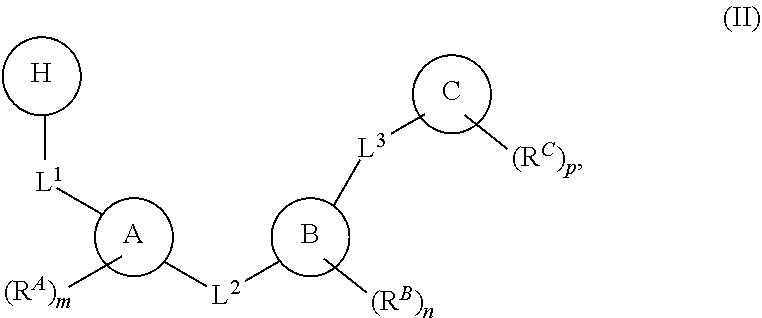
or a pharmaceutically acceptable salt thereof, wherein:
-
- halogen, —NO2, —CN, —OR52, —SR52, —N(R52)2, —NR53R54, —S(═O)R52, —S(═O)2R52, —S(═O)2N(R52)2, —S(═O)2NR53R54, —NR52S(═O)2R52, —NR52S(═O)2N(R52)2, —NR52S(═O)2NR53R54, —C(O)R52, —C(O)OR52, —OC(O)R52, —OC(O)OR52, —OC(O)N(R52)2, —OC(O)NR53R54, —NR52C(O)R52, —NR52C(O)OR52, —NR52C(O)N(R52)2, —NR52C(O)NR53R54, —C(O)N(R52)2, —C(O)NR53R54, —P(O)(OR52)2, —P(O)(R52)2, ═O, ═S, ═N(R52);
- C1-10 alkyl, C2-10 alkenyl, and C2-10 alkynyl, each of which is independently optionally substituted at each occurrence with one or more substituents selected from halogen, —NO2, —CN, —OR52, —SR52, —N(R52)2, —NR53R54, —S(═O)R52, —S(═O)2R52, —S(═O)2N(R52)2, —S(═O)2NR53R54, —NR52S(═O)2R52, —NR52S(═O)2N(R52)2, —NR52S(═O)2NR53R54, —C(O)R52, —C(O)OR52, —OC(O)R52, —OC(O)OR52, —OC(O)N(R52)2, —OC(O)NR53R54, —NR52C(O)R52, —NR52C(O)OR52, —NR52C(O)N(R52)2, —NR52C(O)NR53R54, —C(O)N(R52)2, —C(O)NR53R54, —P(O)(OR52)2, —P(O)(R52)2, ═O, ═S, ═N(R52), C3-12 carbocycle, and 3- to 12-membered heterocycle; and
- C3-12 carbocycle and 3- to 12-membered heterocycle,
- wherein each C3-12 carbocycle and 3- to 12-membered heterocycle in R50 is independently optionally substituted with one or more substituents selected from halogen, —NO2, —CN, —OR52, —SR52, —N(R52)2, —NR53R54, —S(═O)R52, —S(═O)2R52, —S(═O)2N(R52)2, —S(═O)2NR53R54, —NR52S(═O)2R52, —NR52S(═O)2N(R52)2, —NR52S(═O)2NR53R54, —C(O)R52, —C(O)OR52, —OC(O)R52, —OC(O)OR52, —OC(O)N(R52)2, —OC(O)NR53R54, —NR52C(O)R52, —NR52C(O)OR52, —NR52C(O)N(R52)2, —NR52C(O)NR53R54, —C(O)N(R52)2, —C(O)NR53R54, —P(O)(OR52)2, —P(O)(R52)2, ═O, ═S, ═N(R52), C1-6 alkyl, C1-6 haloalkyl, C2-6 alkenyl, and C2-6 alkynyl;
-
- hydrogen, —C(O)R52, —C(O)OR52, —C(O)N(R52)2, —C(O)NR53R54;
- C1-6 alkyl, C2-6 alkenyl, and C2-6 alkynyl, each of which is independently optionally substituted at each occurrence with one or more substituents selected from halogen, —NO2, —CN, —OR52, —SR52, —N(R52)2, —NR53R54, —S(═O)R52, —S(═O)2R52, —S(═O)2N(R52)2, —S(═O)2NR53R54, —NR52S(═O)2R52, —NR52S(═O)2N(R52)2, —NR52S(═O)2NR53R54, —C(O)R52, —C(O)OR52, —OC(O)R52, —OC(O)OR52, —OC(O)N(R52)2, —OC(O)NR53R54, —NR52C(O)R52, —NR52C(O)OR52, —NR52C(O)N(R52)2, —NR52C(O)NR53R54, —C(O)N(R52)2, —C(O)NR53R54, —P(O)(OR52)2, —P(O)(R52)2, ═O, ═S, ═N(R52), C3-12 carbocycle and 3- to 12-membered heterocycle; and
- C3-12 carbocycle and 3- to 12-membered heterocycle,
- wherein each C3-12 carbocycle and 3- to 12-membered heterocycle in R51 is independently optionally substituted with one or more substituents selected from halogen, —NO2, —CN, —OR52, —SR52, —N(R52)2, —NR53R54, —S(═O)R52, —S(═O)2R52, —S(═O)2N(R52)2, —S(═O)2NR53R54, —NR52S(═O)2R52, —NR52S(═O)2N(R52)2, —NR52S(═O)2NR53R54, —C(O)R52, —C(O)OR52, —OC(O)R52, —OC(O)OR52, —OC(O)N(R52)2, —OC(O)NR53R54, —NR52C(O)R52, —NR52C(O)OR52, —NR52C(O)N(R52)2, —NR52C(O)NR53R54, —C(O)N(R52)2, —C(O)NR53R54, —P(O)(OR52)2, —P(O)(R52)2, ═O, ═S, ═N(R52), C1-6 alkyl, C1-6 haloalkyl, C2-6 alkenyl, and C2-6 alkynyl;
-
- —NO2, —SR52, —NR53R54, —S(═O)R52, —S(═O)2R52, —S(═O)2N(R52)2, —S(═O)2NR53R54, —NR52S(═O)2R52, —NR52S(═O)2N(R52)2, —NR52S(═O)2NR53R54, —C(O)R52, —C(O)OR52, —OC(O)R52, —OC(O)OR52, —OC(O)N(R52)2, —OC(O)NR53R54, —NR52C(O)R52, —NR52C(O)OR52, —NR52C(O)N(R52)2, —NR52C(O)NR53R54, —C(O)N(R52)2, —C(O)NR53R54, —P(O)(OR52)2, —P(O)(R52)2, ═O, ═S, ═N(R52), C1-10 alkyl, C2-10 alkenyl, C2-10 alkynyl, C3-12 carbocycle and 3- to 12-membered heterocycle,
- wherein each C1-10 alkyl, C2-10 alkenyl, and C2-10 alkynyl in R56 is independently optionally substituted at each occurrence with one or more substituents selected from halogen, —NO2, —CN, —OR59, —SR52, —N(R52)2, —NR53R54, —S(═O)R52, —S(═O)2R52, —S(═O)2N(R52)2, —S(═O)2NR53R54, —NR52S(═O)2R52, —NR52S(═O)2N(R52)2, —NR52S(═O)2NR53R54, —C(O)R52, —C(O)OR52, —OC(O)R52, —OC(O)OR52, —OC(O)N(R52)2, —OC(O)NR53R54, —NR52C(O)R52, —NR52C(O)OR52, —NR52C(O)N(R52)2, —NR52C(O)NR53R54, —C(O)N(R52)2, —C(O)NR53R54, —P(O)(OR52)2, —P(O)(R52)2, ═O, ═S, ═N(R52), C3-12 carbocycle, and 3- to 12-membered heterocycle;
- wherein each C3-12 carbocycle and 3- to 12-membered heterocycle in R56 is independently optionally substituted with one or more substituents selected from halogen, —NO2, —CN, —OR52, —SR52, —N(R52)2, —NR53R54, —S(═O)R52, —S(═O)2R52, —S(═O)2N(R52)2, —S(═O)2NR53R54, —NR52S(═O)2R52, —NR52S(═O)2N(R52)2, —NR52S(═O)2NR53R54, —C(O)R52, —C(O)OR52, —OC(O)R52, —OC(O)OR52, —OC(O)N(R52)2, —OC(O)NR53R54, —NR52C(O)R52, —NR52C(O)OR52, —NR52C(O)N(R52)2, —NR52C(O)NR53R54, —C(O)N(R52)2, —C(O)NR53R54, —P(O)(OR52)2, —P(O)(R52)2, ═O, ═S, ═N(R52), C1-6 alkyl, C1-6 haloalkyl, C2-6 alkenyl, and C2-6 alkynyl; and
- further wherein R56 optionally forms a bond to ring C; and
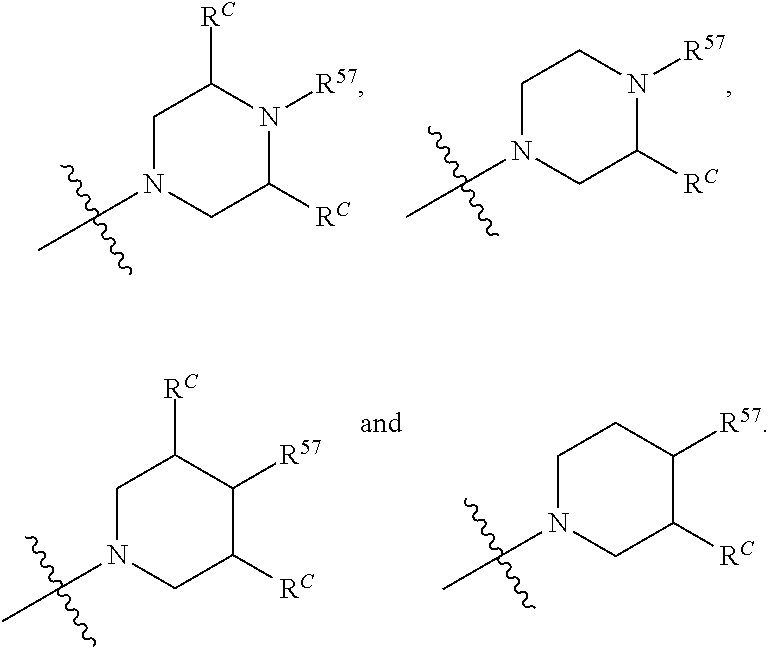

wherein R57 is selected from —S(═O)R52, —S(═O)2R52, —S(═O)2N(R52)2, —S(═O)2NR53R54, —NR52S(═O)2R52; and C1-10 alkyl substituted with one or more substituents selected from —S(═O)R52, —S(═O)2R52, —S(═O)2N(R52)2, —S(═O)2NR53R54, and —NR52S(═O)2R52. In some embodiments, R57 is selected from —S(═O)R52, —S(═O)2R52, —S(═O)2N(R52)2, and —NR52S(═O)2R52. In some embodiments, R57 is selected from —S(═O)CH3, —S(═O)2CH3, —S(═O)2NH2, —NHS(═O)2CH3, and —S(═O)2NHCH3.

X1 and X2 are each independently selected from CR2 and N; X3 and X4 are each independently selected from C and N; Y1 and Y2 are each independently selected from CR3, N, NR4, 0, and S; R′, R2 and R3 are each independently selected at each occurrence from hydrogen and R50; and R4 is selected from R51. In some embodiments, X3 and X4 are each C. In some embodiments, X1 is CR2, and R2 is selected from hydrogen, halogen, —OH, —OR52, —NH2, —N(R52)2, —CN, C1-3 alkyl, C1-3 alkyl-N(R52)2, C1-3 haloalkyl, C2-3 alkenyl, and C2-3 alkynyl. In some embodiments, X1 is CR2, and R2 is selected from hydrogen, halogen, —OH, —OR52, —NH2, —N(R52)2, —CN, C1-3 alkyl, —CH2OH, —CH2OR52, —CH2NH2, —CH2N(R52)2, C1-3 alkyl-N(R52)2, C1-3 haloalkyl, C2-3 alkenyl, and C2-3 alkynyl. In some embodiments, X2 is N. In some embodiments, Y2 is CR3, and R3 is selected from hydrogen, halogen, —OH, —N(R52)2, —CN, —C(O)OR52, C1-3 alkyl, and C1-3 haloalkyl. In some embodiments, R1 is C1-3 haloalkyl.


optionally substituted with one or more RB.

Optionally, R50 is methyl. In some embodiments, for a compound of Formula (II), L3 is selected from
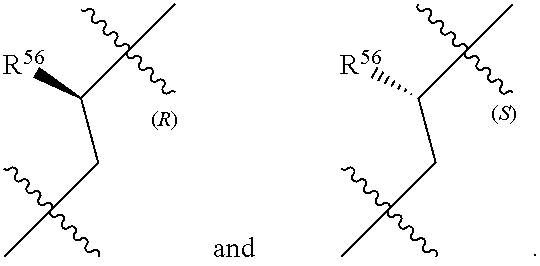
Optionally, R56 is methyl. In certain aspects, the present disclosure provides a substantially pure stereoisomer of a compound of Formula (I) or (II). Optionally, the stereoisomer is provided in at least 90% enantiomeric excess.
-
- —S(═O)R52, —S(═O)2R58, —S(═O)2N(R52)2, —S(═O)2NR53R54, —NR52S(═O)2R52, —NR52S(═O)2N(R52)2, —NR52S(═O)2NR53R54, —NR52C(O)N(R52)2, —NR52C(O)NR53R54, —C(O)NH(C1-6 alkyl), —C(O)NR53R54, —P(O)(OR52)2, —P(O)(R52)2; and
- C1-10 alkyl, C2-10 alkenyl, and C2-10 alkynyl, each of which is independently substituted at each occurrence with one or more substituents selected from —S(═O)R52, —S(═O)2R58, —S(═O)2N(R52)2, —S(═O)2NR53R54, —NR52S(═O)2R52, —NR52S(═O)2N(R52)2, —NR52S(═O)2NR53R54, —NR52C(O)N(R52)2, —NR52C(O)NR53R54, —C(O)NH(C1-6 alkyl), —C(O)NR53R54, —P(O)(OR52)2, and —P(O)(R52)2; and
-
- —OR59, —O—, C1-10 alkyl, C2-10 alkenyl, and C2-10 alkynyl,
- wherein each C1-10 alkyl, C2-10 alkenyl, and C2-10 alkynyl in R56 is independently optionally substituted at each occurrence with one or more substituents selected from halogen, —NO2, —CN, —OR59, —SR52, —N(R52)2, —NR53R54, —S(═O)R52, —S(═O)2R52, —S(═O)2N(R52)2, —S(═O)2NR53R54, —NR52S(═O)2R52, —NR52S(═O)2N(R52)2, —NR52S(═O)2NR53R54, —C(O)R52, —C(O)OR52, —OC(O)R52, —OC(O)OR52, —OC(O)N(R52)2, —OC(O)NR53R54, —NR52C(O)R52, —NR52C(O)OR52, —NR52C(O)N(R52)2, —NR52C(O)NR53R54, —C(O)N(R52)2, —C(O)NR53R54, —P(O)(OR52)2, —P(O)(R52)2, ═O, ═S, ═N(R52), C3-12 carbocycle, and 3- to 12-membered heterocycle;
- wherein each C3-12 carbocycle and 3- to 12-membered heterocycle in R56 is independently optionally substituted with one or more substituents selected from halogen, —NO2, —CN, —OR52, —SR52, —N(R52)2, —NR53R54, —S(═O)R52, —S(═O)2R52, —S(═O)2N(R52)2, —S(═O)2NR53R54, —NR52S(═O)2R52, —NR52S(═O)2N(R52)2, —NR52S(═O)2NR53R54, —C(O)R52, —C(O)OR52, —OC(O)R52, —OC(O)OR52, —OC(O)N(R52)2, —OC(O)NR53R54, —NR52C(O)R52, —NR52C(O)OR52, —NR52C(O)N(R52)2, —NR52C(O)NR53R54, —C(O)N(R52)2, —C(O)NR53R54, —P(O)(OR52)2, —P(O)(R52)2, ═O, ═S, ═N(R52), C1-6 alkyl, C1-6 haloalkyl, C2-6 alkenyl, and C2-6 alkynyl; and
- further wherein R56 optionally forms a bond to ring C; and

and R2 is selected from hydrogen, halogen, —OH, —OR52, —NH2, —N(R52)2, —CN, C1-3 alkyl, C1-3 alkyl-N(R52)2, C1-3 haloalkyl, C2-3 alkenyl, and C2-3 alkynyl. Optionally, R2 is selected from —NH2, —CH3, and —NHCH3. In some embodiments, for a compound of Formula (I) or (II), H is

and R2 is selected from hydrogen, halogen, —OH, —OR52, —NH2, —N(R52)2, —CN, C1-3 alkyl, C1-3 alkyl-OR52, C1-3 alkyl-N(R52)2, C1-3 haloalkyl, C2-3 alkenyl, and C2-3 alkynyl. Optionally, R2 is selected from —NH2, —CH3, —OCH3, —CH2OH, and —NHCH3. For a compound of Formula (I) or (II), L3 may be selected from
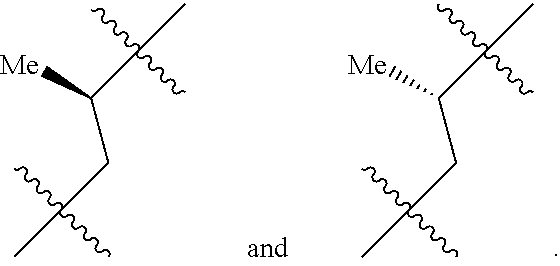
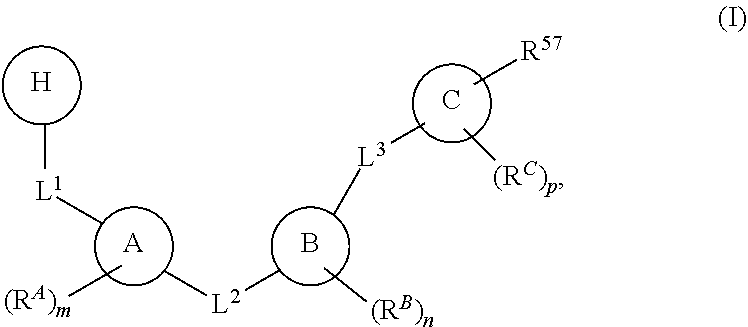
or a pharmaceutically acceptable salt, isotopic form, or prodrug thereof, wherein:
-
- halogen, —NO2, —CN, —OR52, —SR52, —N(R52)2, —NR53R54, —S(═O)R52, —S(═O)2R52, —S(═O)2N(R52)2, —S(═O)2NR53R54, —NR52S(═O)2R52, —NR52S(═O)2N(R52)2, —NR52S(═O)2NR53R54, —C(O)R52, —C(O)OR52, —OC(O)R52, —OC(O)OR52, —OC(O)N(R52)2, —OC(O)NR53R54, —NR52C(O)R52, —NR52C(O)OR52, —NR52C(O)N(R52)2, —NR52C(O)NR53R54, —C(O)N(R52)2, —C(O)NR53R54, —P(O)(OR52)2, —P(O)(R52)2, ═O, ═S, ═N(R52);
- C1-10 alkyl, C2-10 alkenyl, and C2-10 alkynyl, each of which is independently optionally substituted at each occurrence with one or more substituents selected from halogen, —NO2, —CN, —OR52, —SR52, —N(R52)2, —NR53R54, —S(═O)R52, —S(═O)2R52, —S(═O)2N(R52)2, —S(═O)2NR53R54, —NR52S(═O)2R52, —NR52S(═O)2N(R52)2, —NR52S(═O)2NR53R54, —C(O)R52, —C(O)OR52, —OC(O)R52, —OC(O)OR52, —OC(O)N(R52)2, —OC(O)NR53R54, —NR52C(O)R52, —NR52C(O)OR52, —NR52C(O)N(R52)2, —NR52C(O)NR53R54, —C(O)N(R52)2, —C(O)NR53R54, —P(O)(OR52)2, —P(O)(R52)2, ═O, ═S, ═N(R52), C3-12 carbocycle, and 3- to 12-membered heterocycle; and
- C3-12 carbocycle and 3- to 12-membered heterocycle,
- wherein each C3-12 carbocycle and 3- to 12-membered heterocycle in R50 is independently optionally substituted with one or more substituents selected from halogen, —NO2, —CN, —OR52, —SR52, —N(R52)2, —NR53R54, —S(═O)R52, —S(═O)2R52, —S(═O)2N(R52)2, —S(═O)2NR53R54, —NR52S(═O)2R52, —NR52S(═O)2N(R52)2, —NR52S(═O)2NR53R54, —C(O)R52, —C(O)OR52, —OC(O)R52, —OC(O)OR52, —OC(O)N(R52)2, —OC(O)NR53R54, —NR52C(O)R52, —NR52C(O)OR52, —NR52C(O)N(R52)2, —NR52C(O)NR53R54, —C(O)N(R52)2, —C(O)NR53R54, —P(O)(OR52)2, —P(O)(R52)2, ═O, ═S, ═N(R52), C1-6 alkyl, C1-6 haloalkyl, C2-6 alkenyl, and C2-6 alkynyl;
-
- hydrogen, —C(O)R52, —C(O)OR52, —C(O)N(R52)2, —C(O)NR53R54;
- C1-6 alkyl, C2-6 alkenyl, and C2-6 alkynyl, each of which is independently optionally substituted at each occurrence with one or more substituents selected from halogen, —NO2, —CN, —OR52, —SR52, —N(R52)2, —NR53R54, —S(═O)R52, —S(═O)2R52, —S(═O)2N(R52)2, —S(═O)2NR53R54, —NR52S(═O)2R52, —NR52S(═O)2N(R52)2, —NR52S(═O)2NR53R54, —C(O)R52, —C(O)OR52, —OC(O)R52, —OC(O)OR52, —OC(O)N(R52)2, —OC(O)NR53R54, —NR52C(O)R52, —NR52C(O)OR52, —NR52C(O)N(R52)2, —NR52C(O)NR53R54, —C(O)N(R52)2, —C(O)NR53R54, —P(O)(OR52)2, —P(O)(R52)2, ═O, ═S, ═N(R52), C3-12 carbocycle and 3- to 12-membered heterocycle; and
- C3-12 carbocycle and 3- to 12-membered heterocycle,
- wherein each C3-12 carbocycle and 3- to 12-membered heterocycle in R51 is independently optionally substituted with one or more substituents selected from halogen, —NO2, —CN, —OR52, —SR52, —N(R52)2, —NR53R54, —S(═O)R52, —S(═O)2R52, —S(═O)2N(R52)2, —S(═O)2NR53R54, —NR52S(═O)2R52, —NR52S(═O)2N(R52)2, —NR52S(═O)2NR53R54, —C(O)R52, —C(O)OR52, —OC(O)R52, —OC(O)OR52, —OC(O)N(R52)2, —OC(O)NR53R54, —NR52C(O)R52, —NR52C(O)OR52, —NR52C(O)N(R52)2, —NR52C(O)NR53R54, —C(O)N(R52)2, —C(O)NR53R54, —P(O)(OR52)2, —P(O)(R52)2, ═O, ═S, ═N(R52), C1-6 alkyl, C1-6 haloalkyl, C2-6 alkenyl, and C2-6 alkynyl;
-
- halogen, —NO2, —CN, —SR52, —NR53R54, —S(═O)R52, —S(═O)2R58, —S(═O)2N(R52)2, —S(═O)2NR53R54, —NR52S(═O)2R52, —NR52S(═O)2N(R52)2, —NR52S(═O)2NR53R54, —C(O)OR52, —OC(O)R52, —OC(O)OR52, —OC(O)N(R52)2, —OC(O)NR53R54, —NR52C(O)OR52, —NR52C(O)N(R52)2, —NR52C(O)NR53R54, —C(O)NH(C1-6 alkyl), —C(O)NR53R54, —P(O)(OR52)2, —P(O)(R52)2, ═S, ═N(R52); and
- C1-10 alkyl, C2-10 alkenyl, and C2-10 alkynyl, each of which is independently substituted at each occurrence with one or more substituents selected from —NO2, —CN, —SR52, —N(R52)2, —NR53R54, —S(═O)R52, —S(═O)2R52, —S(═O)2N(R52)2, —S(═O)2NR53R54, —NR52S(═O)2R52, —NR52S(═O)2N(R52)2, —NR52S(═O)2NR53R54, —C(O)R52, —C(O)OR52, —OC(O)R52, —OC(O)OR52, —OC(O)N(R52)2, —OC(O)NR53R54, —NR52C(O)R52, —NR52C(O)OR52, —NR52C(O)N(R52)2, —NR52C(O)NR53R54, —P(O)(OR52)2, —P(O)(R52)2, ═S, and ═N(R52); and

or a pharmaceutically acceptable salt thereof, wherein:
-
- halogen, —NO2, —CN, —OR52, —SR52, —N(R52)2, —NR53R54, —S(═O)R52, —S(═O)2R52, —S(═O)2N(R52)2, —S(═O)2NR53R54, —NR52S(═O)2R52, —NR52S(═O)2N(R52)2, —NR52S(═O)2NR53R54, —C(O)R52, —C(O)OR52, —OC(O)R52, —OC(O)OR52, —OC(O)N(R52)2, —OC(O)NR53R54, —NR52C(O)R52, —NR52C(O)OR52, —NR52C(O)N(R52)2, —NR52C(O)NR53R54, —C(O)N(R52)2, —C(O)NR53R54, —P(O)(OR52)2, —P(O)(R52)2, ═O, ═S, ═N(R52);
- C1-10 alkyl, C2-10 alkenyl, and C2-10 alkynyl, each of which is independently optionally substituted at each occurrence with one or more substituents selected from halogen, —NO2, —CN, —OR52, —SR52, —N(R52)2, —NR53R54, —S(═O)R52, —S(═O)2R52, —S(═O)2N(R52)2, —S(═O)2NR53R54, —NR52S(═O)2R52, —NR52S(═O)2N(R52)2, —NR52S(═O)2NR53R54, —C(O)R52, —C(O)OR52, —OC(O)R52, —OC(O)OR52, —OC(O)N(R52)2, —OC(O)NR53R54, —NR52C(O)R52, —NR52C(O)OR52, —NR52C(O)N(R52)2, —NR52C(O)NR53R54, —C(O)N(R52)2, —C(O)NR53R54, —P(O)(OR52)2, —P(O)(R52)2, ═O, ═S, ═N(R52), C3-12 carbocycle, and 3- to 12-membered heterocycle; and
- C3-12 carbocycle and 3- to 12-membered heterocycle,
- wherein each C3-12 carbocycle and 3- to 12-membered heterocycle in R50 is independently optionally substituted with one or more substituents selected from halogen, —NO2, —CN, —OR52, —SR52, —N(R52)2, —NR53R54, —S(═O)R52, —S(═O)2R52, —S(═O)2N(R52)2, —S(═O)2NR53R54, —NR52S(═O)2R52, —NR52S(═O)2N(R52)2, —NR52S(═O)2NR53R54, —C(O)R52, —C(O)OR52, —OC(O)R52, —OC(O)OR52, —OC(O)N(R52)2, —OC(O)NR53R54, —NR52C(O)R52, —NR52C(O)OR52, —NR52C(O)N(R52)2, —NR52C(O)NR53R54, —C(O)N(R52)2, —C(O)NR53R54, —P(O)(OR52)2, —P(O)(R52)2, ═O, ═S, ═N(R52), C1-6 alkyl, C1-6 haloalkyl, C2-6 alkenyl, and C2-6 alkynyl;
-
- hydrogen, —C(O)R52, —C(O)OR52, —C(O)N(R52)2, —C(O)NR53R54;
- C1-6 alkyl, C2-6 alkenyl, and C2-6 alkynyl, each of which is independently optionally substituted at each occurrence with one or more substituents selected from halogen, —NO2, —CN, —OR52, —SR52, —N(R52)2, —NR53R54, —S(═O)R52, —S(═O)2R52, —S(═O)2N(R52)2, —S(═O)2NR53R54, —NR52S(═O)2R52, —NR52S(═O)2N(R52)2, —NR52S(═O)2NR53R54, —C(O)R52, —C(O)OR52, —OC(O)R52, —OC(O)OR52, —OC(O)N(R52)2, —OC(O)NR53R54, —NR52C(O)R52, —NR52C(O)OR52, —NR52C(O)N(R52)2, —NR52C(O)NR53R54, —C(O)N(R52)2, —C(O)NR53R54, —P(O)(OR52)2, —P(O)(R52)2, ═O, ═S, ═N(R52), C3-12 carbocycle and 3- to 12-membered heterocycle; and
- C3-12 carbocycle and 3- to 12-membered heterocycle,
- wherein each C3-12 carbocycle and 3- to 12-membered heterocycle in R51 is independently optionally substituted with one or more substituents selected from halogen, —NO2, —CN, —OR52, —SR52, —N(R52)2, —NR53R54, —S(═O)R52, —S(═O)2R52, —S(═O)2N(R52)2, —S(═O)2NR53R54, —NR52S(═O)2R52, —NR52S(═O)2N(R52)2, —NR52S(═O)2NR53R54, —C(O)R52, —C(O)OR52, —OC(O)R52, —OC(O)OR52, —OC(O)N(R52)2, —OC(O)NR53R54, —NR52C(O)R52, —NR52C(O)OR52, —NR52C(O)N(R52)2, —NR52C(O)NR53R54, —C(O)N(R52)2, —C(O)NR53R54, —P(O)(OR52)2, —P(O)(R52)2, ═O, ═S, ═N(R52), C1-6 alkyl, C1-6 haloalkyl, C2-6 alkenyl, and C2-6 alkynyl;
-
- —NO2, —SR52, —NR53R54, —S(═O)R52, —S(═O)2R52, —S(═O)2N(R52)2, —S(═O)2NR53R54, —NR52S(═O)2R52, —NR52S(═O)2N(R52)2, —NR52S(═O)2NR53R54, —C(O)R52, —C(O)OR52, —OC(O)R52, —OC(O)OR52, —OC(O)N(R52)2, —OC(O)NR53R54, —NR52C(O)R52, —NR52C(O)OR52, —NR52C(O)N(R52)2, —NR52C(O)NR53R54, —C(O)N(R52)2, —C(O)NR53R54, —P(O)(OR52)2, —P(O)(R52)2, ═O, ═S, ═N(R52), C1-10 alkyl, C2-10 alkenyl, C2-10 alkynyl, C3-12 carbocycle and 3- to 12-membered heterocycle,
- wherein each C1-10 alkyl, C2-10 alkenyl, and C2-10 alkynyl in R56 is independently optionally substituted at each occurrence with one or more substituents selected from halogen, —NO2, —CN, —OR59, —SR52, —N(R52)2, —NR53R54, —S(═O)R52, —S(═O)2R52, —S(═O)2N(R52)2, —S(═O)2NR53R54, —NR52S(═O)2R52, —NR52S(═O)2N(R52)2, —NR52S(═O)2NR53R54, —C(O)R52, —C(O)OR52, —OC(O)R52, —OC(O)OR52, —OC(O)N(R52)2, —OC(O)NR53R54, —NR52C(O)R52, —NR52C(O)OR52, —NR52C(O)N(R52)2, —NR52C(O)NR53R54, —C(O)N(R52)2, —C(O)NR53R54, —P(O)(OR52)2, —P(O)(R52)2, ═O, ═S, ═N(R52), C3-12 carbocycle, and 3- to 12-membered heterocycle;
- wherein each C3-12 carbocycle and 3- to 12-membered heterocycle in R56 is independently optionally substituted with one or more substituents selected from halogen, —NO2, —CN, —OR52, —SR52, —N(R52)2, —NR53R54, —S(═O)R52, —S(═O)2R52, —S(═O)2N(R52)2, —S(═O)2NR53R54, —NR52S(═O)2R52, —NR52S(═O)2N(R52)2, —NR52S(═O)2NR53R54, —C(O)R52, —C(O)OR52, —OC(O)R52, —OC(O)OR52, —OC(O)N(R52)2, —OC(O)NR53R54, —NR52C(O)R52, —NR52C(O)OR52, —NR52C(O)N(R52)2, —NR52C(O)NR53R54, —C(O)N(R52)2, —C(O)NR53R54, —P(O)(OR52)2, —P(O)(R52)2, ═O, ═S, ═N(R52), C1-6 alkyl, C1-6 haloalkyl, C2-6 alkenyl, and C2-6 alkynyl; and
- further wherein R56 optionally forms a bond to ring C; and

or a pharmaceutically acceptable salt, isotopic form, or prodrug thereof, wherein:
-
- halogen, —NO2, —CN, —OR52, —SR52, —N(R52)2, —NR53R54, —S(═O)R52, —S(═O)2R52, —S(═O)2N(R52)2, —S(═O)2NR53R54, —NR52S(═O)2R52, —NR52S(═O)2N(R52)2, —NR52S(═O)2NR53R54, —C(O)R52, —C(O)OR52, —OC(O)R52, —OC(O)OR52, —OC(O)N(R52)2, —OC(O)NR53R54, —NR52C(O)R52, —NR52C(O)OR52, —NR52C(O)N(R52)2, —NR52C(O)NR53R54, —C(O)N(R52)2, —C(O)NR53R54, —P(O)(OR52)2, —P(O)(R52)2, —P(O)(OR52)(R52), —P(O)(NR52)(R52), —NR52P(O)(R52), —P(O)(NR52)(OR52), —P(O)(NR52)2, ═O, ═S, ═N(R52);
- C1-10 alkyl, C2-10 alkenyl, and C2-10 alkynyl, each of which is independently optionally substituted at each occurrence with one or more substituents selected from halogen, —NO2, —CN, —OR52, —SR52, —N(R52)2, —NR53R54, —S(═O)R52, —S(═O)2R52, —S(═O)2N(R52)2, —S(═O)2NR53R54, —NR52S(═O)2R52, —NR52S(═O)2N(R52)2, —NR52S(═O)2NR53R54, —C(O)R52, —C(O)OR52, —OC(O)R52, —OC(O)OR52, —OC(O)N(R52)2, —OC(O)NR53R54, —NR52C(O)R52, —NR52C(O)OR52, —NR52C(O)N(R52)2, —NR52C(O)NR53R54, —C(O)N(R52)2, —C(O)NR53R54, —P(O)(OR52)2, —P(O)(R52)2, —P(O)(OR52)(R52), —P(O)(NR52)(R52), —NR52P(O)(R52), —P(O)(NR52)(OR52), —P(O)(NR52)2, ═O, ═S, ═N(R52), C3-12 carbocycle, and 3- to 12-membered heterocycle; and
- C3-12 carbocycle and 3- to 12-membered heterocycle,
- wherein each C3-12 carbocycle and 3- to 12-membered heterocycle in R50 is independently optionally substituted with one or more substituents selected from halogen, —NO2, —CN, —OR52, —SR52, —N(R52)2, —NR53R54, —S(═O)R52, —S(═O)2R52, —S(═O)2N(R52)2, —S(═O)2NR53R54, —NR52S(═O)2R52, —NR52S(═O)2N(R52)2, —NR52S(═O)2NR53R54, —C(O)R52, —C(O)OR52, —OC(O)R52, —OC(O)OR52, —OC(O)N(R52)2, —OC(O)NR53R54, —NR52C(O)R52, —NR52C(O)OR52, —NR52C(O)N(R52)2, —NR52C(O)NR53R54, —C(O)N(R52)2, —C(O)NR53R54, —P(O)(OR52)2, —P(O)(R52)2, —P(O)(OR52)(R52), —P(O)(NR52)(R52), —NR52P(O)(R52), —P(O)(NR52)(OR52), —P(O)(NR52)2, ═O, ═S, ═N(R52), C1-6 alkyl, C1-6 haloalkyl, C2-6 alkenyl, and C2-6 alkynyl;
-
- hydrogen, —C(O)R52, —C(O)OR52, —C(O)N(R52)2, —C(O)NR53R54;
- C1-6 alkyl, C2-6 alkenyl, and C2-6 alkynyl, each of which is independently optionally substituted at each occurrence with one or more substituents selected from halogen, —NO2, —CN, —OR52, —SR52, —N(R52)2, —NR53R54, —S(═O)R52, —S(═O)2R52, —S(═O)2N(R52)2, —S(═O)2NR53R54, —NR52S(═O)2R52, —NR52S(═O)2N(R52)2, —NR52S(═O)2NR53R54, —C(O)R52, —C(O)OR52, —OC(O)R52, —OC(O)OR52, —OC(O)N(R52)2, —OC(O)NR53R54, —NR52C(O)R52, —NR52C(O)OR52, —NR52C(O)N(R52)2, —NR52C(O)NR53R54, —C(O)N(R52)2, —C(O)NR53R54, —P(O)(OR52)2, —P(O)(R52)2, —P(O)(OR52)(R52), —P(O)(NR52)(R52), —NR52P(O)(R52), —P(O)(NR52)(OR52), —P(O)(NR52)(NR52)2, ═O, ═S, ═N(R52), C3-12 carbocycle and 3- to 12-membered heterocycle; and
- C3-12 carbocycle and 3- to 12-membered heterocycle,
- wherein each C3-12 carbocycle and 3- to 12-membered heterocycle in R51 is independently optionally substituted with one or more substituents selected from halogen, —NO2, —CN, —OR52, —SR52, —N(R52)2, —NR53R54, —S(═O)R52, —S(═O)2R52, —S(═O)2N(R52)2, —S(═O)2NR53R54, —NR52S(═O)2R52, —NR52S(═O)2N(R52)2, —NR52S(═O)2NR53R54, —C(O)R52, —C(O)OR52, —OC(O)R52, —OC(O)OR52, —OC(O)N(R52)2, —OC(O)NR53R54, —NR52C(O)R52, —NR52C(O)OR52, —NR52C(O)N(R52)2, —NR52C(O)NR53R54, —C(O)N(R52)2, —C(O)NR53R54, —P(O)(OR52)2, —P(O)(R52)2, —P(O)(OR52)(R52)(R52), —NR52P(O)(R52), —P(O)(NR52)(OR52), —P(O)(NR52)2, ═O, ═S, ═N(R52), C1-6 alkyl, C1-6 haloalkyl, C2-6 alkenyl, and C2-6 alkynyl;
-
- halogen, —NO2, —CN, —SR52, —NR53R54, —S(═O)R52, —S(═O)2R58, —S(═O)2N(R52)2, —S(═O)2NR53R54, —NR52S(═O)2R52, —NR52S(═O)2N(R52)2, —NR52S(═O)2NR53R54, —C(O)OR52, —OC(O)R52, —OC(O)OR52, —OC(O)N(R52)2, —OC(O)NR53R54, —NR52C(O)R52, —NR52C(O)N(R52)2, —NR52C(O)NR53R54, —C(O)NH(C1-6 alkyl), —C(O)NR53R54, —P(O)(OR52)2, —P(O)(R52)2, —P(O)(OR52)(R52), —P(O)(NR52)(R52), —NR52P(O)(R52), —P(O)(NR52)(OR52), —P(O)(NR52)2, ═S, ═N(R52); and
- C1-10 alkyl, C2-10 alkenyl, and C2-10 alkynyl, each of which is independently substituted at each occurrence with one or more substituents selected from —NO2, —CN, —SR52, —N(R52)2, —NR53R54, —S(═O)R52, —S(═O)2R52, —S(═O)2N(R52)2, —S(═O)2NR53R54, —NR52S(═O)2R52, —NR52S(═O)2N(R52)2, —NR52S(═O)2NR53R54, —C(O)R52, —C(O)OR52, —OC(O)R52, —OC(O)OR52, —OC(O)N(R52)2, —OC(O)NR53R54, —NR52C(O)R52, —NR52C(O)OR52, —NR52C(O)N(R52)2, —NR52C(O)NR53R54, —P(O)(OR52)2, —P(O)(R52)2, —P(O)(OR52)(R52), —P(O)(NR52)(R52), —NR52P(O)(R52), —P(O)(NR52)(OR52), —P(O)(NR52)2, ═S, and ═N(R52); and

or a pharmaceutically acceptable salt thereof, wherein:
-
- halogen, —NO2, —CN, —OR52, —SR52, —N(R52)2, —NR53R54, —S(═O)R52, —S(═O)2R52, —S(═O)2N(R52)2, —S(═O)2NR53R54, —NR52S(═O)2R52, —NR52S(═O)2N(R52)2, —NR52S(═O)2NR53R54, —C(O)R52, —C(O)OR52, —OC(O)R52, —OC(O)OR52, —OC(O)N(R52)2, —OC(O)NR53R54, —NR52C(O)R52, —NR52C(O)OR52, —NR52C(O)N(R52)2, —NR52C(O)NR53R54, —C(O)N(R52)2, —C(O)NR53R54, —P(O)(OR52)2, —P(O)(R52)2, —P(O)(OR52)(R52), —P(O)(NR52)(R52), —NR52P(O)(R52), —P(O)(NR52)(OR52), —P(O)(NR52)2, ═O, ═S, ═N(R52);
- C1-10 alkyl, C2-10 alkenyl, and C2-10 alkynyl, each of which is independently optionally substituted at each occurrence with one or more substituents selected from halogen, —NO2, —CN, —OR52, —SR52, —N(R52)2, —NR53R54, —S(═O)R52, —S(═O)2R52, —S(═O)2N(R52)2, —S(═O)2NR53R54, —NR52S(═O)2R52, —NR52S(═O)2N(R52)2, —NR52S(═O)2NR53R54, —C(O)R52, —C(O)OR52, —OC(O)R52, —OC(O)OR52, —OC(O)N(R52)2, —OC(O)NR53R54, —NR52C(O)R52, —NR52C(O)OR52, —NR52C(O)N(R52)2, —NR52C(O)NR53R54, —C(O)N(R52)2, —C(O)NR53R54, —P(O)(OR52)2, —P(O)(R52)2, —P(O)(OR52)(R52), —P(O)(NR52)(R52), —NR52P(O)(R52), —P(O)(NR52)(OR52), —P(O)(NR52)2, ═O, ═S, ═N(R52), C3-12 carbocycle, and 3- to 12-membered heterocycle; and
- C3-12 carbocycle and 3- to 12-membered heterocycle,
- wherein each C3-12 carbocycle and 3- to 12-membered heterocycle in R50 is independently optionally substituted with one or more substituents selected from halogen, —NO2, —CN, —OR52, —SR52, —N(R52)2, —NR53R54, —S(═O)R52, —S(═O)2R52, —S(═O)2N(R52)2, —S(═O)2NR53R54, —NR52S(═O)2R52, —NR52S(═O)2N(R52)2, —NR52S(═O)2NR53R54, —C(O)R52, —C(O)OR52, —OC(O)R52, —OC(O)OR52, —OC(O)N(R52)2, —OC(O)NR53R54, —NR52C(O)R52, —NR52C(O)OR52, —NR52C(O)N(R52)2, —NR52C(O)NR53R54, —C(O)N(R52)2, —C(O)NR53R54, —P(O)(OR52)2, —P(O)(R52)2, —P(O)(OR52)(R52), —P(O)(NR52)(R52), —NR52P(O)(R52), —P(O)(NR52)(OR52), —P(O)(NR52)2, ═O, ═S, ═N(R52), C1-6 alkyl, C1-6 haloalkyl, C2-6 alkenyl, and C2-6 alkynyl;
-
- hydrogen, —C(O)R52, —C(O)OR52, —C(O)N(R52)2, —C(O)NR53R54;
- C1-6 alkyl, C2-6 alkenyl, and C2-6 alkynyl, each of which is independently optionally substituted at each occurrence with one or more substituents selected from halogen, —NO2, —CN, —OR52, —SR52, —N(R52)2, —NR53R54, —S(═O)R52, —S(═O)2R52, —S(═O)2N(R52)2, —S(═O)2NR53R54, —NR52S(═O)2R52, —NR52S(═O)2N(R52)2, —NR52S(═O)2NR53R54, —C(O)R52, —C(O)OR52, —OC(O)R52, —OC(O)OR52, —OC(O)N(R52)2, —OC(O)NR53R54, —NR52C(O)R52, —NR52C(O)OR52, —NR52C(O)N(R52)2, —NR52C(O)NR53R54, —C(O)N(R52)2, —C(O)NR53R54, —P(O)(OR52)2, —P(O)(R52)2, —P(O)(OR52)(R52), —P(O)(NR52)(R52), —NR52P(O)(R52), —P(O)(NR52)(OR52), —P(O)(NR52)2, ═O, ═S, ═N(R52), C3-12 carbocycle and 3- to 12-membered heterocycle; and
- C3-12 carbocycle and 3- to 12-membered heterocycle,
- wherein each C3-12 carbocycle and 3- to 12-membered heterocycle in R51 is independently optionally substituted with one or more substituents selected from halogen, —NO2, —CN, —OR52, —SR52, —N(R52)2, —NR53R54, —S(═O)R52, —S(═O)2R52, —S(═O)2N(R52)2, —S(═O)2NR53R54, —NR52S(═O)2R52, —NR52S(═O)2N(R52)2, —NR52S(═O)2NR53R54, —C(O)R52, —C(O)OR52, —OC(O)R52, —OC(O)OR52, —OC(O)N(R52)2, —OC(O)NR53R54, —NR52C(O)R52, —NR52C(O)OR52, —NR52C(O)N(R52)2, —NR52C(O)NR53R54, —C(O)N(R52)2, —C(O)NR53R54, —P(O)(OR52)2, —P(O)(R52)2, —P(O)(OR52)(R52), —P(O)(NR52)(R52), —NR52P(O)(R52), —P(O)(NR52)(OR52), —P(O)(NR52)2,═O, ═S, ═N(R52), C1-6 alkyl, C1-6 haloalkyl, C2-6 alkenyl, and C2-6 alkynyl;
-
- —NO2, —SR52, —NR53R54, —S(═O)R52, —S(═O)2R52, —S(═O)2N(R52)2, —S(═O)2NR53R54, —NR52S(═O)2R52, —NR52S(═O)2N(R52)2, —NR52S(═O)2NR53R54, —C(O)R52, —C(O)OR52, —OC(O)R52, —OC(O)OR52, —OC(O)N(R52)2, —OC(O)NR53R54, —NR52C(O)R52, —NR52C(O)OR52, —NR52C(O)N(R52)2, —NR52C(O)NR53R54, —C(O)N(R52)2, —C(O)NR53R54, —P(O)(OR52)2, —P(O)(R52)2, —P(O)(OR52)(R52), —P(O)(NR52)(R52), —NR52P(O)(R52), —P(O)(NR52)(OR52), —P(O)(NR52)2, ═O, ═S, ═N(R52), C1-10 alkyl, C2-10 alkenyl, C2-10 alkynyl, C3-12 carbocycle and 3- to 12-membered heterocycle,
- wherein each C1-10 alkyl, C2-10 alkenyl, and C2-10 alkynyl in R56 is independently optionally substituted at each occurrence with one or more substituents selected from halogen, —NO2, —CN, —OR59, —SR52, —N(R52)2, —NR53R54, —S(═O)R52, —S(═O)2R52, —S(═O)2N(R52)2, —S(═O)2NR53R54, —NR52S(═O)2R52, —NR52S(═O)2N(R52)2, —NR52S(═O)2NR53R54, —C(O)R52, —C(O)OR52, —OC(O)R52, —OC(O)OR52, —OC(O)N(R52)2, —OC(O)NR53R54, —NR52C(O)R52, —NR52C(O)OR52, —NR52C(O)N(R52)2, —NR52C(O)NR53R54, —C(O)N(R52)2, —C(O)NR53R54, —P(O)(OR52)2, —P(O)(R52)2, —P(O)(OR52)(R52), —P(O)(NR52)(R52), —NR52P(O)(R52), —P(O)(NR52)(OR52), —P(O)(NR52)2,═O, ═S, ═N(R52), C3-12 carbocycle, and 3- to 12-membered heterocycle;
- wherein each C3-12 carbocycle and 3- to 12-membered heterocycle in R56 is independently optionally substituted with one or more substituents selected from halogen, —NO2, —CN, —OR52, —SR52, —N(R52)2, —NR53R54, —S(═O)R52, —S(═O)2R52, —S(═O)2N(R52)2, —S(═O)2NR53R54, —NR52S(═O)2R52, —NR52S(═O)2N(R52)2, —NR52S(═O)2NR53R54, —C(O)R52, —C(O)OR52, —OC(O)R52, —OC(O)OR52, —OC(O)N(R52)2, —OC(O)NR53R54, —NR52C(O)R52, —NR52C(O)OR52, —NR52C(O)N(R52)2, —NR52C(O)NR53R54, —C(O)N(R52)2, —C(O)NR53R54, —P(O)(OR52)2, —P(O)(R52)2, —P(O)(OR52)(R52), —P(O)(NR52)(R52), —NR52P(O)(R52), —P(O)(NR52)(OR52), —P(O)(NR52)2, ═O, ═S, ═N(R52), C1-6 alkyl, C1-6 haloalkyl, C2-6 alkenyl, and C2-6 alkynyl; and
- further wherein R56 optionally forms a bond to ring C; and

wherein X1 and X2 are each independently selected from CR2 and N; X3 and X4 are each independently selected from C and N; Y1 and Y2 are each independently selected from CR3, N, NR4, O, and S; R1, R2 and R3 are each independently selected at each occurrence from hydrogen and R50; and R4 is selected from R51. In some embodiments, X3 and X4 are each C. In some embodiments, X1 is CR2, and R2 is selected from hydrogen, halogen, —OH, —OR52, —NH2, —N(R52)2, —CN, C1-3 alkyl, —CH2OH, —CH2OR52, —CH2NH2, —CH2N(R52)2, C1-3 alkyl-N(R52)2, C1-3 haloalkyl, C2-3 alkenyl, and C2-3 alkynyl, such as R2 is selected from —OH, —OR52, —NH2, —N(R52)2, —CN, and C1-2 alkyl. In some embodiments, R2 is methyl or —NHCH3. In some embodiments, R2 is H. In some embodiments, X2 is N. In some embodiments, Y2 is CR3, and R3 is selected from hydrogen, halogen, —OH, —N(R52)2, —CN, —C(O)OR52, C1-3 alkyl, and C1-3 haloalkyl. In some embodiments, Y1 is S. In some embodiments, at least one of Y1 and Y2 is selected from N, NR4, O and S. In some embodiments, R1 is C1-3 haloalkyl, such as —CH2CF3. In some embodiments, X1 is CR2, X2 is N, X3 and X4 are each C, Y1 is S, Y2 is CR3, and R1 is selected from R50. In some embodiments, X1 is CR2; X2 is N; X3 and X4 are each C; Y1 is S; Y2 is CH; R1 is C1-3 haloalkyl; and R2 is selected from hydrogen, halogen, —OH, —OR52, —NH2, —N(R52)2, —CN, C1-3 alkyl, —CH2OH, —CH2OR52, —CH2NH2, —CH2N(R52)2, C1-3 alkyl-N(R52)2, C1-3 haloalkyl, C2-3 alkenyl, and C2-3 alkynyl. In some embodiments, H is
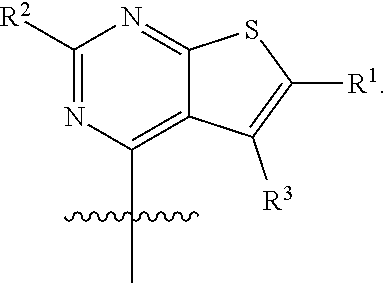

such as

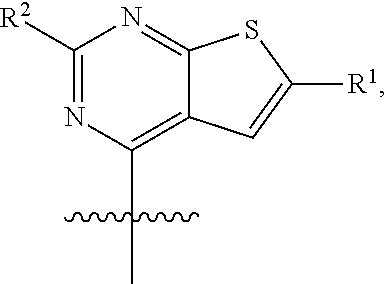
and R2 is selected from hydrogen, halogen, —OH, —OR52, —NH2, —N(R52)2, —CN, C1-3 alkyl, —CH2OH, —CH2OR52, —CH2NH2, —CH2N(R52)2, C1-3 alkyl-N(R52)2, C1-3 haloalkyl, C2-3 alkenyl, and C2-3 alkynyl. In some embodiments, R2 is selected from hydrogen, halogen, —OH, alkoxy (e.g., —OR52, —OCH3, —OCH2CH3), aminoalkyl, alkylamino, —N(R52)2 (e.g., —NH2, —NHCH3, —NHCH2CH3), —N(CH3)2, —CN, C1-3 alkyl (e.g., —CH3), cyclopropyl, C1-3 alkyl-OR52 (e.g., —CH2OH, —CH2OC(O)CH3), C1-3 alkyl-N(R52)2, C1-3 haloalkyl, C2-3 alkenyl, and C2-3 alkynyl.

wherein R1 is selected from H, halo, hydroxyl, amino, cyano, dialkylphosphine oxide, oxo, carboxyl, amido, acyl, alkyl, cycloalkyl, heteroalkyl, and haloalkyl, such as from alkyl and haloalkyl; R2 is selected from H, halo, hydroxyl, amino, cyano, dialkylphosphine oxide, oxo, carboxyl, amido, acyl, alkyl, cycloalkyl, heteroalkyl, haloalkyl, aminoalkyl, hydroxyalkyl, alkoxy, and alkylamino, such as from H, halo, hydroxyl, and amino; and each of Y1 and Y2 is independently selected from S, CR3, N, NR4 and O. In certain embodiments, up to one of Y1 and Y2 is O or S.

In some embodiments, A is

In some embodiments, A is an aromatic, non-aromatic, saturated or unsaturated ring. In some embodiments, A is selected from arylene, cycloalkylene, heterocycloalkylene, N-heterocycloalkylene, heteroarylene, and N-heteroarylene. In some embodiments, A is 5- to 8-membered heterocycle, wherein the heterocycle comprises at least 1, 2, 3 or 4 ring heteroatoms selected from N, O and S.


optionally substituted with one or more RB. In some embodiments, B is

such as
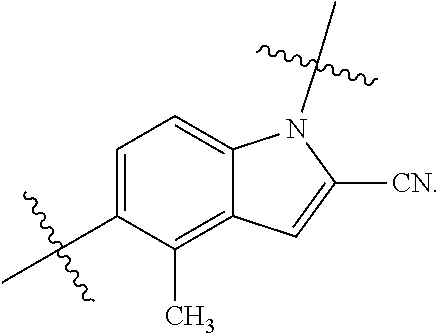

wherein Z1, Z2, Z3 and Z4 are each independently selected from CR7, N and NR9; Z5 is selected from C and N; Z6, Z7 and Z8 are each independently selected from CR8, N, NR9, O and S; Z9, Z10 and Z11 are each independently selected from CR10, CR11R12, N13, O and S; R7, R8, R10, R11, and R12 are each independently selected from hydrogen and R50; and R9 and R13 are each independently selected from R51, wherein B may be connected at any ring atom to L2 or L3 (e.g., by replacing a hydrogen connected to a ring atom with a bond to L2 or L3).


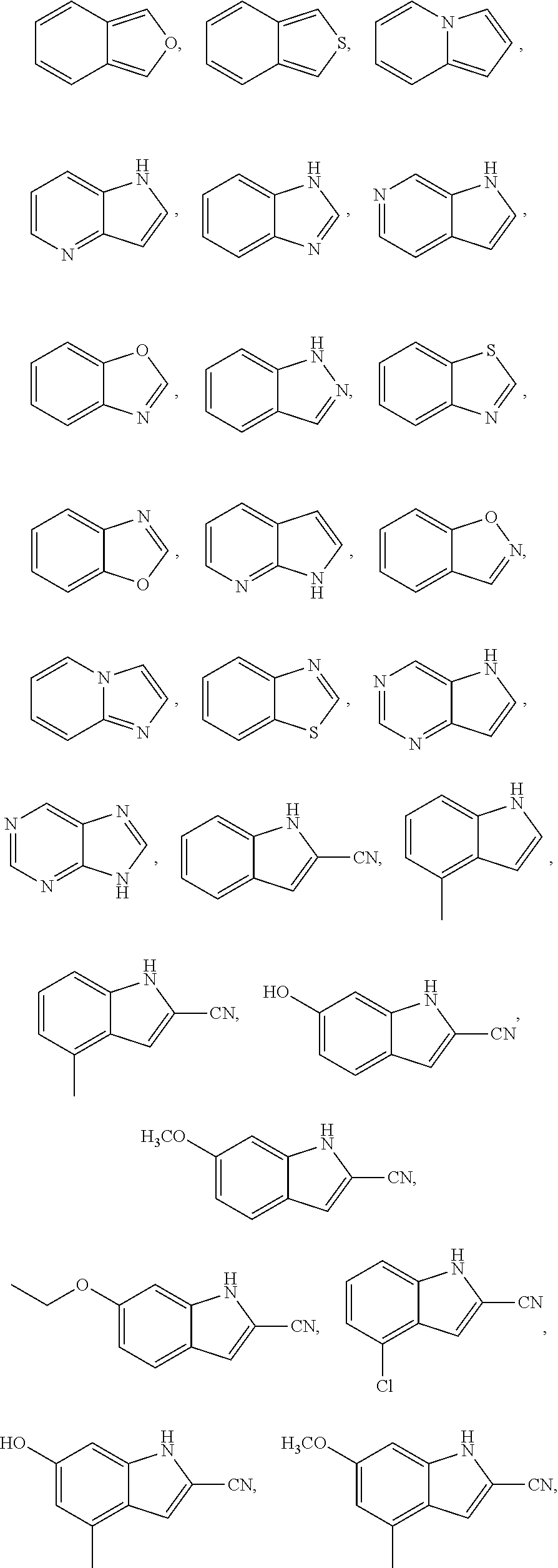


Optionally, R50 is methyl. L3 may be selected from

In some embodiments, L3 is


In some embodiments, L3 comprises a stereocenter. In some embodiments, the stereocenter is in the R-configuration. In some embodiments, the stereocenter is in the S-configuration. In some embodiments, the R-isomer of L3 is provided in at least 20%, 30%, 40%, 50%, 55%, 60%, 65%, 70%, 75%, 80%, 85%, 88%, 90%, 91%, 92%, 93%, 94%, 95%, 96%, 97%, 98%, 99%, 99.5%, or 99.9% excess over the S-isomer. In some embodiments, the S-isomer of L3 is provided in at least 20%, 30%, 40%, 50%, 55%, 60%, 65%, 70%, 75%, 80%, 85%, 88%, 90%, 91%, 92%, 93%, 94%, 95%, 96%, 97%, 98%, 99%, 99.5%, or 99.9% excess over the R-isomer.

and any combination thereof. In some embodiments, for a compound of Formula (I), L3 is selected from
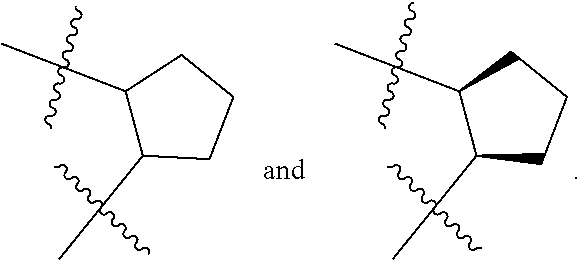

Optionally, R56 is methyl. L3 may be selected from

In some embodiments, L3 is


In some embodiments, L3 comprises a stereocenter. In some embodiments, the stereocenter is in the R-configuration. In some embodiments, the stereocenter is in the S-configuration. In some embodiments, the R-isomer of L3 is provided in at least 20%, 30%, 40%, 50%, 55%, 60%, 65%, 70%, 75%, 80%, 85%, 88%, 90%, 91%, 92%, 93%, 94%, 95%, 96%, 97%, 98%, 99%, 99.5%, or 99.9% excess over the S-isomer. In some embodiments, the S-isomer of L3 is provided in at least 20%, 30%, 40%, 50%, 55%, 60%, 65%, 70%, 75%, 80%, 85%, 88%, 90%, 91%, 92%, 93%, 94%, 95%, 96%, 97%, 98%, 99%, 99.5%, or 99.9% excess over the R-isomer.

and any combination thereof. In some embodiments, for a compound of Formula (II), L3 is selected from
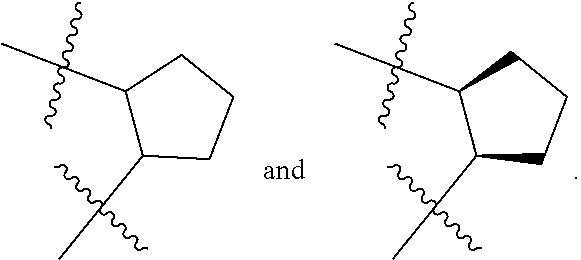

In some embodiments, C is selected from

In some embodiments, C is selected from

In some embodiments, C is selected from


optionally substituted with one or more RC. In some embodiments, C is selected from

wherein R57 is selected from —S(═O)R52, —S(═O)2R52, —S(═O)2N(R52)2, —S(═O)2NR53R54, —NR52S(═O)2R52; and C1-10 alkyl substituted with one or more substituents selected from —S(═O)R52, —S(═O)2R52, —S(═O)2N(R52)2, —S(═O)2NR53R54, and —NR52S(═O)2R52. In some embodiments, R57 is selected from —S(═O)R52, —S(═O)2R58, —S(═O)2N(R52)2, and —NR52S(═O)2R52, such as R57 is selected from —S(═O)CH3, —S(═O)2CH3, —S(═O)2NH2, —NHS(═O)2CH3, and —S(═O)2NHCH3.


wherein R57 is selected from hydrogen and R50. In some embodiments, C is selected from
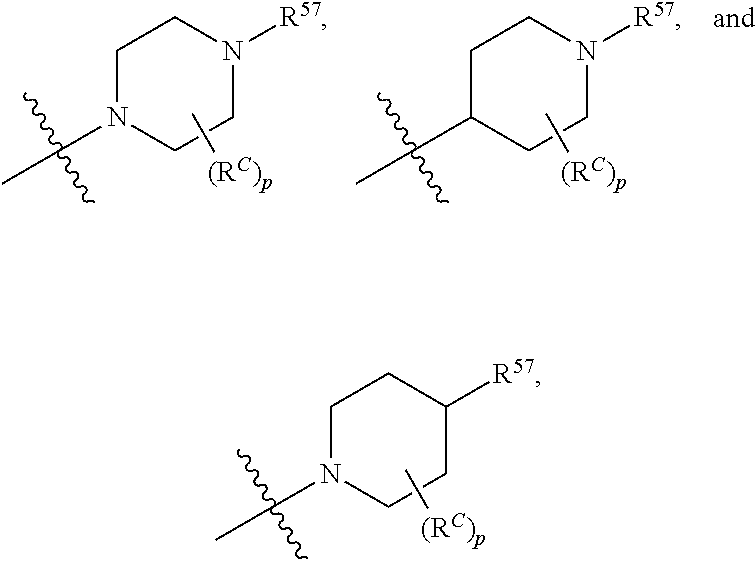
wherein R57 is selected from hydrogen and R50. In some embodiments, C is selected from
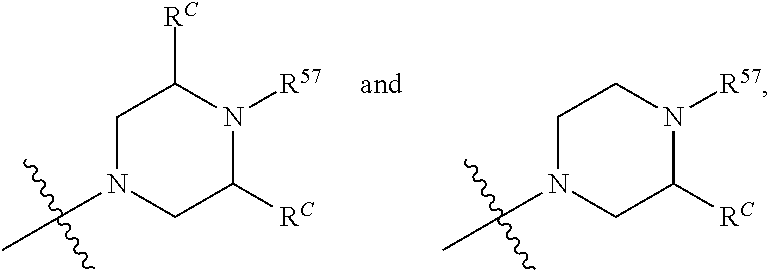
wherein R57 is selected from hydrogen and R50. In some embodiments, C is selected from


optionally substituted with one or more RC, wherein R57 is selected from hydrogen and R50 In some embodiments, C is selected from

wherein R57 is selected from —S(═O)R52, —S(═O)2R52, —S(═O)2N(R52)2, —S(═O)2NR53R54, —NR52S(═O)2R52; and C1-10 alkyl substituted with one or more substituents selected from —S(═O)R52, —S(═O)2R52, —S(═O)2N(R52)2, —S(═O)2NR53R54, and —NR52S(═O)2R52. In some embodiments, R57 is selected from —S(═O)R52, —S(═O)2R52, —S(═O)2N(R52)2, and —NR52S(═O)2R52, such as R57 is selected from —S(═O)CH3, —S(═O)2CH3, —S(═O)2NH2, —NHS(═O)2CH3, and —S(═O)2NHCH3.

-
- halogen, —OR52, —N(R52)2, —NR53R54, —S(═O)R52, —S(═O)2R52, —S(═O)2N(R52)2, —S(═O)2NR53R54, —NR52S(═O)2R52, —NR52S(═O)2N(R52)2, —NR52S(═O)2NR53R54, —C(O)R52, —C(O)OR52, —OC(O)R52, —OC(O)OR52, —OC(O)N(R52)2, —OC(O)NR53R54, —NR52C(O)R52, —NR52C(O)OR52, —NR52C(O)N(R52)2, —NR52C(O)NR53R54, —C(O)N(R52)2, —C(O)NR53R54, —P(O)(OR52)2, —P(O)(R52)2; and


-
- halogen, —NO2, —CN, —OR52, —SR52, —N(R52)2, —NR53R54, —S(═O)R52, —S(═O)2R52, —S(═O)2N(R52)2, —S(═O)2NR53R54, —NR52S(═O)2R52, —NR52S(═O)2N(R52)2, —NR52S(═O)2NR53R54, —C(O)R52, —C(O)OR52, —OC(O)R52, —OC(O)OR52, —OC(O)N(R52)2, —OC(O)NR53R54, —NR52C(O)R52, —NR52C(O)OR52, —NR52C(O)N(R52)2, —NR52C(O)NR53R54, —C(O)N(R52)2, —C(O)NR53R54, —P(O)(OR52)2, —P(O)(R52)2, ═O, ═S, ═N(R52);
- C1-10 alkyl, C2-10 alkenyl, and C2-10 alkynyl, each of which is independently optionally substituted at each occurrence with one or more substituents selected from halogen, —NO2, —CN, —OR52, —SR52, —N(R52)2, —NR53R54, —S(═O)R52, —S(═O)2R52, —S(═O)2N(R52)2, —S(═O)2NR53R54, —NR52S(═O)2R52, —NR52S(═O)2N(R52)2, —NR52S(═O)2NR53R54, —C(O)R52, —C(O)OR52, —OC(O)R52, —OC(O)OR52, —OC(O)N(R52)2, —OC(O)NR53R54, —NR52C(O)R52, —NR52C(O)OR52, —NR52C(O)N(R52)2, —NR52C(O)NR53R54, —C(O)N(R52)2, —C(O)NR53R54, —P(O)(OR52)2, —P(O)(R52)2, ═O, ═S, ═N(R52), C3-12 carbocycle, and 3- to 12-membered heterocycle; and
- C3-12 carbocycle and 3- to 12-membered heterocycle,
- wherein each C3-12 carbocycle and 3- to 12-membered heterocycle in R50 is independently optionally substituted with one or more substituents selected from halogen, —NO2, —CN, —OR52, —SR52, —N(R52)2, —NR53R54, —S(═O)R52, —S(═O)2R52, —S(═O)2N(R52)2, —S(═O)2NR53R54, —NR52S(═O)2R52, —NR52S(═O)2N(R52)2, —NR52S(═O)2NR53R54, —C(O)R52, —C(O)OR52, —OC(O)R52, —OC(O)OR52, —OC(O)N(R52)2, —OC(O)NR53R54, —NR52C(O)R52, —NR52C(O)OR52, —NR52C(O)N(R52)2, —NR52C(O)NR53R54, —C(O)N(R52)2, —C(O)NR53R54, —P(O)(OR52)2, —P(O)(R52)2, ═O, ═S, ═N(R52), C1-6 alkyl, C1-6 haloalkyl, C2-6 alkenyl, and C2-6 alkynyl;
-
- hydrogen, —C(O)R52, —C(O)OR52, —C(O)N(R52)2, —C(O)NR53R54; C1-6 alkyl, C2-6 alkenyl, and C2-6 alkynyl, each of which is independently optionally substituted at each occurrence with one or more substituents selected from halogen, —NO2, —CN, —OR52, —SR52, —N(R52)2, —NR53R54, —S(═O)R52, —S(═O)2R52, —S(═O)2N(R52)2, —S(═O)2NR53R54, —NR52S(═O)2R52, —NR52S(═O)2N(R52)2, —NR52S(═O)2NR53R54, —C(O)R52, —C(O)OR52, —OC(O)R52, —OC(O)OR52, —OC(O)N(R52)2, —OC(O)NR53R54, —NR52C(O)R52, —NR52C(O)OR52, —NR52C(O)N(R52)2, —NR52C(O)NR53R54, —C(O)N(R52)2, —C(O)NR53R54, —P(O)(OR52)2, —P(O)(R52)2, ═O, ═S, ═N(R52), C3-12 carbocycle and 3- to 12-membered heterocycle; and
- C3-12 carbocycle and 3- to 12-membered heterocycle,
- wherein each C3-12 carbocycle and 3- to 12-membered heterocycle in R51 is independently optionally substituted with one or more substituents selected from halogen, —NO2, —CN, —OR52, —SR52, —N(R52)2, —NR53R54, —S(═O)R52, —S(═O)2R52, —S(═O)2N(R52)2, —S(═O)2NR53R54, —NR52S(═O)2R52, —NR52S(═O)2N(R52)2, —NR52S(═O)2NR53R54, —C(O)R52, —C(O)OR52, —OC(O)R52, —OC(O)OR52, —OC(O)N(R52)2, —OC(O)NR53R54, —NR52C(O)R52, —NR52C(O)OR52, —NR52C(O)N(R52)2, —NR52C(O)NR53R54, —C(O)N(R52)2, —C(O)NR53R54, —P(O)(OR52)2, —P(O)(R52)2, ═O, ═S, ═N(R52), C1-6 alkyl, C1-6 haloalkyl, C2-6 alkenyl, and C2-6 alkynyl;
-
- —S(═O)R52, —S(═O)2R58, —S(═O)2N(R52)2, —S(═O)2NR53R54, —NR52S(═O)2R52, —NR52S(═O)2N(R52)2, —NR52S(═O)2NR53R54, —NR52C(O)N(R52)2, —NR52C(O)NR53R54, —C(O)NH(C1-6 alkyl), —C(O)NR53R54, —P(O)(OR52)2, —P(O)(R52)2; and
- C1-10 alkyl, C2-10 alkenyl, and C2-10 alkynyl, each of which is independently substituted at each occurrence with one or more substituents selected from —S(═O)R52, —S(═O)2R58, —S(═O)2N(R52)2, —S(═O)2NR53R54, —NR52S(═O)2R52, —NR52S(═O)2N(R52)2, —NR52S(═O)2NR53R54, —NR52C(O)N(R52)2, —NR52C(O)NR53R54, —C(O)NH(C1-6 alkyl), —C(O)NR53R54, —P(O)(OR52)2, and —P(O)(R52)2; and
-
- halogen, —NO2, —CN, —OR52, —SR52, —N(R52)2, —NR53R54, —S(═O)R52, —S(═O)2R52, —S(═O)2N(R52)2, —S(═O)2NR53R54, —NR52S(═O)2R52, —NR52S(═O)2N(R52)2, —NR52S(═O)2NR53R54, —C(O)R52, —C(O)OR52, —OC(O)R52, —OC(O)OR52, —OC(O)N(R52)2, —OC(O)NR53R54, —NR52C(O)R52, —NR52C(O)OR52, —NR52C(O)N(R52)2, —NR52C(O)NR53R54, —C(O)N(R52)2, —C(O)NR53R54, —P(O)(OR52)2, —P(O)(R52)2, ═O, ═S, ═N(R52);
-
- hydrogen, —C(O)R52, —C(O)OR52, —C(O)N(R52)2, —C(O)NR53R54;
- C1-6 alkyl, C2-6 alkenyl, and C2-6 alkynyl, each of which is independently optionally substituted at each occurrence with one or more substituents selected from halogen, —NO2, —CN, —OR52, —SR52, —N(R52)2, —NR53R54, —S(═O)R52, —S(═O)2R52, —S(═O)2N(R52)2, —S(═O)2NR53R54, —NR52S(═O)2R52, —NR52S(═O)2N(R52)2, —NR52S(═O)2NR53R54, —C(O)R52, —C(O)OR52, —OC(O)R52, —OC(O)OR52, —OC(O)N(R52)2, —OC(O)NR53R54, —NR52C(O)R52, —NR52C(O)OR52, —NR52C(O)N(R52)2, —NR52C(O)NR53R54, —C(O)N(R52)2, —C(O)NR53R54, —P(O)(OR52)2, —P(O)(R52)2, ═O, ═S, ═N(R52), C3-12 carbocycle and 3- to 12-membered heterocycle; and
- C3-12 carbocycle and 3- to 12-membered heterocycle,
- wherein each C3-12 carbocycle and 3- to 12-membered heterocycle in R51 is independently optionally substituted with one or more substituents selected from halogen, —NO2, —CN, —N(R52)2, —NR53R54, —S(═O)R52, —S(═O)2R52, —S(═O)2N(R52)2, —S(═O)2NR53R54, —NR52S(═O)2R52, —NR52S(═O)2N(R52)2, —NR52S(═O)2NR53R54, —C(O)R52, —C(O)OR52, —OC(O)R52, —OC(O)OR52, —OC(O)N(R52)2, —OC(O)NR53R54, —NR52C(O)R52, —NR52C(O)OR52, —NR52C(O)N(R52)2, —NR52C(O)NR53R54, —C(O)N(R52)2, —C(O)NR53R54, —P(O)(OR52)2, —P(O)(R52)2, ═O, ═S, ═N(R52), C1-6 alkyl, C1-6 haloalkyl, C2-6 alkenyl, and C2-6 alkynyl;
-
- —OR59, ═O, C1-10 alkyl, C2-10 alkenyl, C2-10 alkynyl,
- wherein each C1-10 alkyl, C2-10 alkenyl, and C2-10 alkynyl in R56 is independently optionally substituted at each occurrence with one or more substituents selected from halogen, —NO2, —CN, —N(R52)2, —NR53R54, —S(═O)R52, —S(═O)2R52, —S(═O)2N(R52)2, —S(═O)2NR53R54, —NR52S(═O)2R52, —NR52S(═O)2N(R52)2, —NR52S(═O)2NR53R54, —C(O)R52, —C(O)OR52, —OC(O)R52, —OC(O)OR52, —OC(O)N(R52)2, —OC(O)NR53R54, —NR52C(O)R52, —NR52C(O)OR52, —NR52C(O)N(R52)2, —NR52C(O)NR53R54, —C(O)N(R52)2, —C(O)NR53R54, —P(O)(OR52)2, —P(O)(R52)2, ═O, ═S, ═N(R52), C3-12 carbocycle, and 3- to 12-membered heterocycle;
- wherein each C3-12 carbocycle and 3- to 12-membered heterocycle in R56 is independently optionally substituted with one or more substituents selected from halogen, —NO2, —CN, —N(R52)2, —NR53R54, —S(═O)R52, —S(═O)2R52, —S(═O)2N(R52)2, —S(═O)2NR53R54, —NR52S(═O)2R52, —NR52S(═O)2N(R52)2, —NR52S(═O)2NR53R54, —C(O)R52, —C(O)OR52, —OC(O)R52, —OC(O)OR52, —OC(O)N(R52)2, —OC(O)NR53R54, —NR52C(O)R52, —NR52C(O)OR52, —NR52C(O)N(R52)2, —NR52C(O)NR53R54, —C(O)N(R52)2, —C(O)NR53R54, —P(O)(OR52)2, —P(O)(R52)2, ═O, ═S, ═N(R52), C1-6 alkyl, C1-6 haloalkyl, C2-6 alkenyl, and C2-6 alkynyl; and
- further wherein R56 optionally forms a bond to ring C; and
-
- —S(═O)R52, —S(═O)2R58, —S(═O)2N(R52)2, —S(═O)2NR53R54, —NR52S(═O)2R52, —NR52S(═O)2N(R52)2, —NR52S(═O)2NR53R54, —NR52C(O)N(R52)2, —NR52C(O)NR53R54, —C(O)NH(C1-6 alkyl), —C(O)NR53R54, —P(O)(OR52)2, —P(O)(R52)2; and
- C1-10 alkyl, C2-10 alkenyl, and C2-10 alkynyl, each of which is independently substituted at each occurrence with one or more substituents selected from —S(═O)R52, —S(═O)2R58, —S(═O)2N(R52)2, —S(═O)2NR53R54, —NR52S(═O)2R52, —NR52S(═O)2N(R52)2, —NR52S(═O)2NR53R54, —NR52C(O)N(R52)2, —NR52C(O)NR53R54, —C(O)NH(C1-6 alkyl), —C(O)NR53R54, —P(O)(OR52)2, and —P(O)(R52)2; and
-
- —OR59, ═O, C1-10 alkyl, C2-10 alkenyl, and C2-10 alkynyl, wherein each C1-10 alkyl, C2-10 alkenyl, and C2-10 alkynyl in R56 is independently optionally substituted at each occurrence with one or more substituents selected from halogen, —NO2, —CN, —OR59, —SR52, —N(R52)2, —NR53R54, —S(═O)R52, —S(═O)2R52, —S(═O)2N(R52)2, —S(═O)2NR53R54, —NR52S(═O)2R52, —NR52S(═O)2N(R52)2, —NR52S(═O)2NR53R54, —C(O)R52, —C(O)OR52, —OC(O)R52, —OC(O)OR52, —OC(O)N(R52)2, —OC(O)NR53R54, —NR52C(O)R52, —NR52C(O)OR52, —NR52C(O)N(R52)2, —NR52C(O)NR53R54, —C(O)N(R52)2, —C(O)NR53R54, —P(O)(OR52)2, —P(O)(R52)2, ═O, ═S, ═N(R52), C3-12 carbocycle, and 3- to 12-membered heterocycle;
- wherein each C3-12 carbocycle and 3- to 12-membered heterocycle in R56 is independently optionally substituted with one or more substituents selected from halogen, —NO2, —CN, —OR52, —SR52, —N(R52)2, —NR53R54, —S(═O)R52, —S(═O)2R52, —S(═O)2N(R52)2, —S(═O)2NR53R54, —NR52S(═O)2R52, —NR52S(═O)2N(R52)2, —NR52S(═O)2NR53R54, —C(O)R52, —C(O)OR52, —OC(O)R52, —OC(O)OR52, —OC(O)N(R52)2, —OC(O)NR53R54, —NR52C(O)R52, —NR52C(O)OR52, —NR52C(O)N(R52)2, —NR52C(O)NR53R54, —C(O)N(R52)2, —C(O)NR53R54, —P(O)(OR52)2, —P(O)(R52)2, ═O, ═S, ═N(R52), C1-6 alkyl, C1-6 haloalkyl, C2-6 alkenyl, and C2-6 alkynyl; and
- further wherein R56 optionally forms a bond to ring C; and

such as

In some embodiments, R1 is selected from R50. In some embodiments, R1 is C1-3 haloalkyl, such as —CH2CF3. In some embodiments, R2 is selected from R50. In some embodiments, R2 is selected from hydrogen, halogen, —OH, —OR52, —NH2, —N(R52)2, —CN, C1-3 alkyl, C1-3 alkyl-OR52, C1-3 alkyl-N(R52)2, C1-3 haloalkyl, C2-3 alkenyl, and C2-3 alkynyl. In some embodiments, R2 is selected from halogen, —OH, —OR52, —NH2, —N(R52)2, —CN, C1-3 alkyl, —CH2OH, —CH2OR52, —CH2NH2, —CH2N(R52)2, C1-3 alkyl-N(R52)2, C1-3 haloalkyl, C2-3 alkenyl, and C2-3 alkynyl, such as R2 is selected from —OH, —OR52, —NH2, —N(R52)2, —CN, and C1-2 alkyl. Optionally, R2 is selected from —NH2, —CH3, —OCH3, —CH2OH, and —NHCH3. In some embodiments, R3 is selected from hydrogen, halogen, —OH, —N(R52)2, —CN, —C(O)OR52, C1-3 alkyl, and C1-3 haloalkyl. In some embodiments, R51 is selected from selected from hydrogen and alkyl, such as R51 is hydrogen. In some embodiments, RA is selected from halogen, —CN, —N(R52)2, —NR53R54, —C(O)R52, —C(O)OR52, —OC(O)R52, —NR52C(O)R52, —C(O)N(R52)2, —C(O)NR53R54, ═O, C1-10 alkyl, C2-10 alkenyl, C2-10 alkynyl, optionally substituted C1-10 alkyl, optionally substituted C2-10 alkenyl, and optionally substituted C2-10 alkynyl. In some embodiments, m is 0. In some embodiments, L2 is selected from —O—, —N(R51)—, —N(R51)CH2—, —C(O)N(R51)—, —N(R51)C(O)—, —N(R51)S(O)2—, —S(O)2N(R51)—, C1-4 alkylene and C1-4 heteroalkylene. In some embodiments, L2 is C1-4 alkylene, optionally substituted with one or more R50. In some embodiments, L2 is C1-2 alkylene, optionally substituted with one or more R50. In some embodiments, L2 is selected from —CH2—, —N(R51)—, —N(R51)CH2—, —N(R51)C(O)—, and —N(R51)S(O)2—. In some embodiments, L2 is —CH2—. In some embodiments, RB is present at one or more positions of the indole, such as at
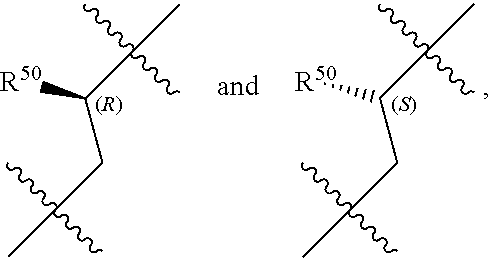
where R50 is optionally methyl. In some embodiments, C is 3- to 12-membered heterocycle, such as 5- to 12-membered heterocycle. In some embodiments, the heterocycle is saturated. In some embodiments, C is selected from 5- to 7-membered monocyclic heterocycle, 8- to 10-membered fused bicyclic heterocycle, and 7- to 12-membered spirocyclic heterocycle. In some embodiments, the heterocycle comprises at least one nitrogen atom, such as one or two nitrogen atoms. In some embodiments, C comprises at least one ring nitrogen. In some embodiments, C is selected from piperidinyl and piperazinyl, such as

In some embodiments, C is selected from

In some embodiments, C is selected from In
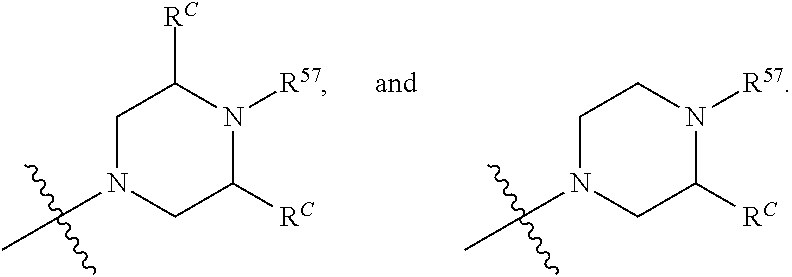
some embodiments, C is selected from

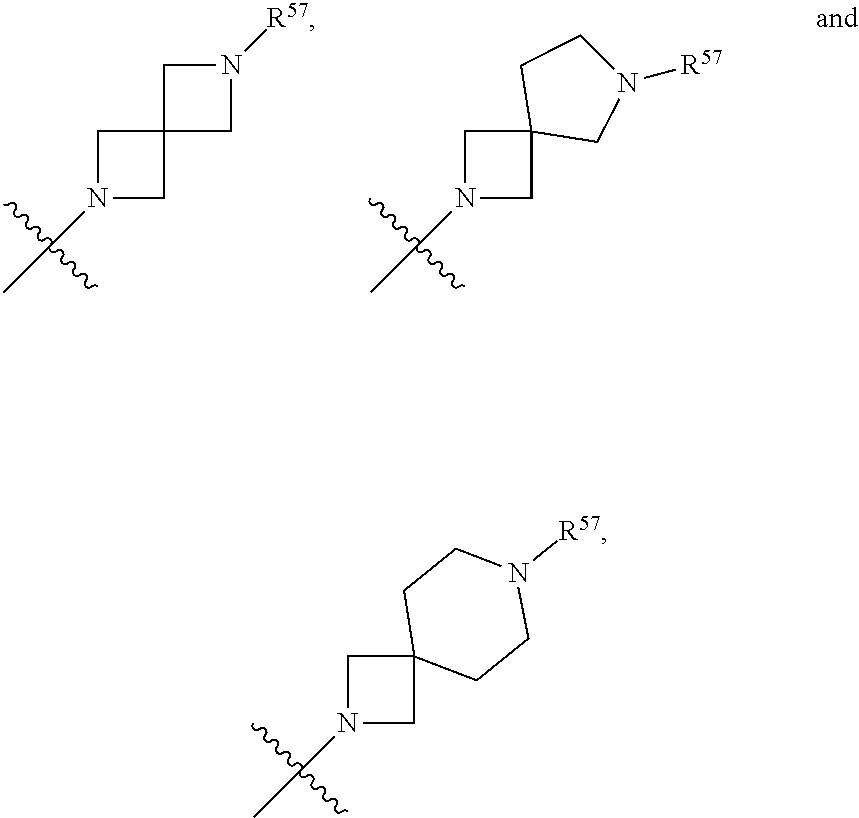
optionally substituted with one or more RC. In some embodiments, C is selected from

wherein R57 is selected from —S(═O)R52, —S(═O)2R52, —S(═O)2N(R52)2, —S(═O)2NR53R54, —NR52S(═O)2R52; and C1-10 alkyl substituted with one or more substituents selected from —S(═O)R52, —S(═O)2R52, —S(═O)2N(R52)2, —S(═O)2NR53R54, and —NR52S(═O)2R52. In some embodiments, R57 is selected from —S(═O)R52, —S(═O)2R58, —S(═O)2N(R52)2, and —NR52S(═O)2R52, such as R57 is selected from —S(═O)CH3, —S(═O)2CH3, —S(═O)2NH2, —NHS(═O)2CH3, and —S(═O)2NHCH3. In some embodiments, C is selected from

In some embodiments, RC is selected from —N(R52)2, —NR53R54, —NR52S(═O)2R52, —C(O)R52, —C(O)OR52, —NR52C(O)R52, —NR52C(O)OR52, —NR52C(O)N(R52)2, —NR52C(O)NR53R54, —C(O)N(R52)2, and —C(O)NR53R54. In some embodiments, RC is selected from —N(R52)2, —NR53R54, —NR52S(═O)2R52, —C(O)R52, —C(O)OR52, —NR52C(O)R52, —NR52C(O)OR52, —NR52C(O)N(R52)2, —NR52C(O)NR53R54, —C(O)N(R52)2, —C(O)NR53R54, C1-6 alkyl, and C1-6 alkyl substituted with —N(R52)2, —NR53R54, —NR52S(═O)2R52, —C(O)R52, —C(O)OR52, —NR52C(O)R52, —NR52C(O)OR52, —NR52C(O)N(R52)2, —NR52C(O)NR53R54, —C(O)N(R52)2, or —C(O)NR53R54.


such as

In some embodiments, R2 is selected from R50. In some embodiments, R2 is selected from hydrogen, halogen, —OH, —OR52, —NH2, —N(R52)2, —CN, C1-3 alkyl, C1-3 alkyl-OR52, C1-3 alkyl-N(R52)2, C1-3 haloalkyl, C2-3 alkenyl, and C2-3 alkynyl. In some embodiments, R2 is selected from halogen, —OH, —OR52, —NH2, —N(R52)2, —CN, C1-3 alkyl, —CH2OH, —CH2OR52, —CH2NH2, —CH2N(R52)2, C1-3 alkyl-N(R52)2, C1-3 haloalkyl, C2-3 alkenyl, and C2-3 alkynyl, such as R2 is selected from —OH, —OR52, —NH2, —N(R52)2, —CN, and C1-2 alkyl. Optionally, R2 is selected from —NH2, —CH3, —OCH3, —CH2OH, and —NHCH3. In some embodiments, RB is selected from halogen, —CN, —OR52, —N(R52)2, —NR53R54, —C(O)R52, —C(O)OR52, —OC(O)R52, —NR52C(O)R52, —C(O)N(R52)2, —C(O)NR53R54, ═O, C1-10 alkyl, C2-10 alkenyl, C2-10 alkynyl, optionally substituted C1-10 alkyl, optionally substituted C2-10 alkenyl, and optionally substituted C2-10 alkynyl. In some embodiments, RB is selected from halogen, —CN, —OR52, —N(R52)2, —NR53R54, C1-3 alkyl, and optionally substituted C1-3 alkyl, such as RB is selected from halogen, —CN, —OR52, —N(R52)2, —NR53R54, and C1-2 alkyl. In some embodiments, L3 is selected from C1-6 alkylene, C2-6 alkenylene, and C2-6 alkynylene, each of which is substituted with one or more R50. In some embodiments, L3 is C1-6 alkylene, optionally substituted with one or more R50. In some embodiments, L3 is C2 alkylene substituted with at least one C1-3 alkyl or C1-3 haloalkyl, and optionally further substituted with one or more R50. In some embodiments, L3 is substituted with ═O, C1-6 alkyl, C1-6 haloalkyl, C1-3 alkyl(cyclopropyl), C1-3 alkyl(NR52C(O)R52) or —O(C1-6 alkyl). In some embodiments, L3 is substituted with —CH3. In some embodiments, L3 is selected from

where R50 is optionally methyl. In some embodiments, C is 3- to 12-membered heterocycle, such as 5- to 12-membered heterocycle. In some embodiments, the heterocycle is saturated. In some embodiments, C is selected from 5- to 7-membered monocyclic heterocycle, 8- to 10-membered fused bicyclic heterocycle, and 7- to 12-membered spirocyclic heterocycle. In some embodiments, the heterocycle comprises at least one nitrogen atom, such as one or two nitrogen atoms. In some embodiments, C comprises at least one ring nitrogen. In some embodiments, C is selected from piperidinyl and piperazinyl, such as

In some embodiments, C is selected from

In some embodiments, C is selected from

In some embodiments, C is selected from

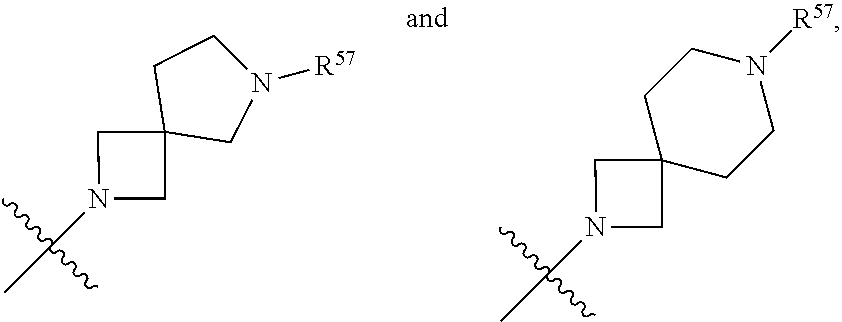
optionally substituted with one or more RC. In some embodiments, C is selected from

wherein R57 is selected from —S(═O)R52, —S(═O)2R52, —S(═O)2N(R52)2, —S(═O)2NR53R54, —NR52S(═O)2R52; and C1-10 alkyl substituted with one or more substituents selected from —S(═O)R52, —S(═O)2R52, —S(═O)2N(R52)2, —S(═O)2NR53R54, and —NR52S(═O)2R52. In some embodiments, R57 is selected from —S(═O)R52, —S(═O)2R58, —S(═O)2N(R52)2, and —NR52S(═O)2R52, such as R57 is selected from —S(═O)CH3, —S(═O)2CH3, —S(═O)2NH2, —NHS(═O)2CH3, and —S(═O)2NHCH3. In some embodiments, C is selected from

In some embodiments, RC is selected from —N(R52)2, —NR53R54, —NR52S(═O)2R52, —C(O)R52, —C(O)OR52, —NR52C(O)R52, —NR52C(O)OR52, —NR52C(O)N(R52)2, —NR52C(O)NR53R54, —C(O)N(R52)2, and —C(O)NR53R54. In some embodiments, RC is selected from —N(R52)2, —NR53R54, —NR52S(═O)2R52, —C(O)R52, —C(O)OR52, —NR52C(O)R52, —NR52C(O)OR52, —NR52C(O)N(R52)2, —NR52C(O)NR53R54, —C(O)N(R52)2, —C(O)NR53R54, C1-6 alkyl, and C1-6 alkyl substituted with —N(R52)2, —NR53R54, —NR52S(═O)2R52, —C(O)R52, —C(O)OR52, —NR52C(O)R52, —NR52C(O)OR52, —NR52C(O)N(R52)2, —NR52C(O)NR53R54, —C(O)N(R52)2, or —C(O)NR53R54. In some embodiments, C is selected from


In some embodiments, RC is selected from —C(O)R52, —S(═O)R52, —S(═O)2R52, —S(═O)2N(R52)2, —S(═O)2NR53R54, —NR52S(═O)2R52, ═O, C1-3 alkyl, and C1-3 haloalkyl, or two RC groups attached to different atoms can together form a C1-3 bridge. In some embodiments, RC is selected from C1-3 alkyl and C1-3 haloalkyl, such as —CH3. In some embodiments, p is selected from an

such as
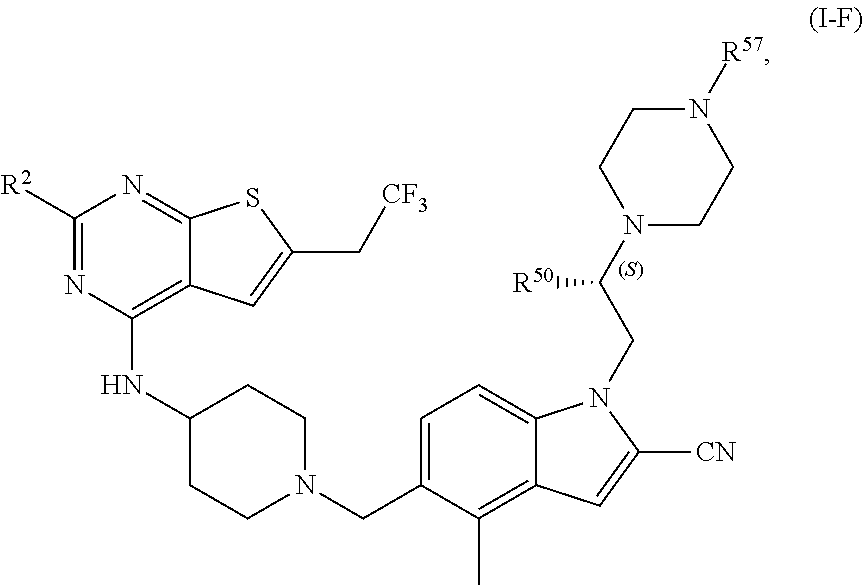
In some embodiments, C is selected from 5- to 7-membered monocyclic heterocycle, such as piperidinyl and piperazinyl. In some embodiments, R50 is selected from deuterium, C1-4 alkyl, C1-4 haloalkyl, and —OR52, such as R50 is methyl. In some embodiments, R57 is selected from —S(═O)R52, —S(═O)2R58, —S(═O)2N(R52)2, and —NR52S(═O)2R52, such as R57 is selected from —S(═O)CH3, —S(═O)2CH3, —S(═O)2NH2, —NHS(═O)2CH3, and —S(═O)2NHCH3. In some embodiments, R57 is —S(═O)2CH3. In some embodiments, R50 is methyl and R57 is —S(═O)2CH3. In some embodiments, R2 is selected from hydrogen, halogen, —OH, —OR52, —NH2, —N(R52)2, —CN, C1-3 alkyl, —CH2OH, —CH2OR52, —CH2NH2, —CH2N(R52)2, C1-3 alkyl-N(R52)2, C1-3 haloalkyl, C2-3 alkenyl, and C2-3 alkynyl, such as R2 is selected from —OH, —OR52, —NH2, —N(R52)2, —CN, and C1-2 alkyl. In some embodiments, R2 is methyl or —NHCH3. In some embodiments, R2 is H.
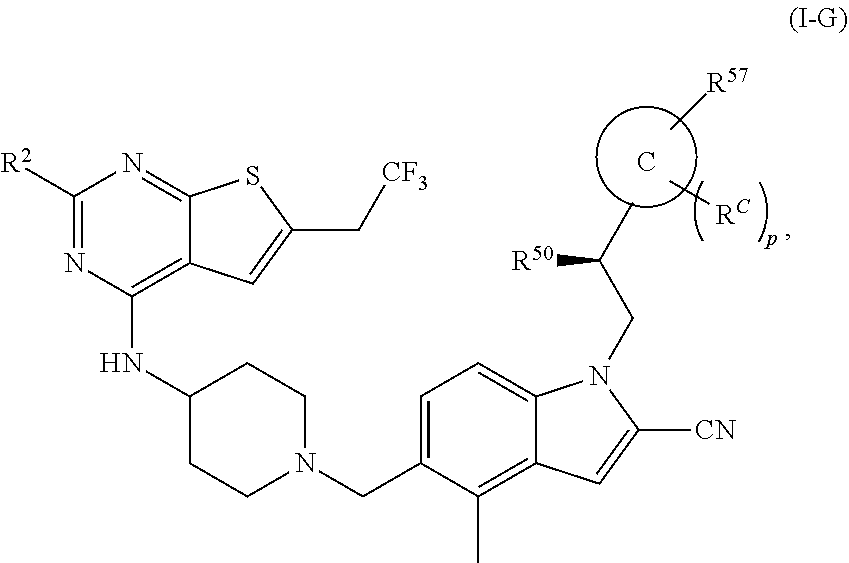
such as

In some embodiments, C is selected from 5- to 7-membered monocyclic heterocycle, such as piperidinyl and piperazinyl. In some embodiments, R50 is selected from deuterium, C1-4 alkyl, C1-4 haloalkyl, and —OR52, such as R50 is methyl. In some embodiments, R57 is selected from —S(═O)R52, —S(═O)2R58, —S(═O)2N(R52)2, and —NR52S(═O)2R52, such as R57 is selected from —S(═O)CH3, —S(═O)2CH3, —S(═O)2NH2, —NHS(═O)2CH3, and —S(═O)2NHCH3. In some embodiments, R57 is —S(═O)2CH3. In some embodiments, R50 is methyl and R57 is —S(═O)2CH3. In some embodiments, R2 is selected from hydrogen, halogen, —OH, —OR52, —NH2, —N(R52)2, —CN, C1-3 alkyl, —CH2OH, —CH2OR52, —CH2NH2, —CH2N(R52)2, C1-3 alkyl-N(R52)2, C1-3 haloalkyl, C2-3 alkenyl, and C2-3 alkynyl, such as R2 is selected from —OH, —OR52, —NH2, —N(R52)2, —CN, and C1-2 alkyl. In some embodiments, R2 is methyl or —NHCH3. In some embodiments, R2 is H.


where R56 is optionally methyl. In some embodiments, C is selected from C3-12 carbocycle and 3- to 12-membered heterocycle, such as 5- to 12-membered heterocycle. In some embodiments, the heterocycle is saturated. In some embodiments, C is selected from 5- to 7-membered monocyclic heterocycle, 8- to 10-membered fused bicyclic heterocycle, and 7- to 12-membered spirocyclic heterocycle. In some embodiments, the heterocycle comprises at least one nitrogen atom, such as one or two nitrogen atoms. In some embodiments, C comprises at least one ring nitrogen. In some embodiments, C is selected from piperidinyl and piperazinyl, such as

wherein R57 is selected from hydrogen and R50. In some embodiments, C is selected from

wherein R57 is selected from hydrogen and R50. In some embodiments, C is selected from

wherein R57 is selected from hydrogen and R50. In some embodiments, C is selected from


optionally substituted with one or more RC, wherein R57 is selected from hydrogen and R50 In some embodiments, C is selected from

wherein R57 is selected from —S(═O)R52, —S(═O)2R52, —S(═O)2N(R52)2, —S(═O)2NR53R54, —NR52S(═O)2R52; and C1-10 alkyl substituted with one or more substituents selected from —S(═O)R52, —S(═O)2R52, —S(═O)2N(R52)2, —S(═O)2NR53R54, and —NR52S(═O)2R52. In some embodiments, R57 is selected from —S(═O)R52, —S(═O)2R52, —S(═O)2N(R52)2, and —NR52S(═O)2R52, such as R57 is selected from —S(═O)CH3, —S(═O)2CH3, —S(═O)2NH2, —NHS(═O)2CH3, and —S(═O)2NHCH3. In some embodiments, C is selected from

In some embodiments, RC is selected from —C(O)R52, —S(═O)R52, —S(═O)2R52, —S(═O)2N(R52)2, —S(═O)2NR53R54, —NR52S(═O)2R52, ═O, C1-3 alkyl, and C1-3 haloalkyl, or two RC groups attached to different atoms can together form a C1-3 bridge. In some embodiments, RC is selected from C1-3 alkyl and C1-3 haloalkyl, such as —CH3. In some embodiments, p is selected from an


such as

In some embodiments, R2 is selected from R50. In some embodiments, R2 is selected from hydrogen, halogen, —OH, —OR52, —NH2, —N(R52)2, —CN, C1-3 alkyl, C1-3 alkyl-OR52, C1-3 alkyl-N(R52)2, C1-3 haloalkyl, C2-3 alkenyl, and C2-3 alkynyl. In some embodiments, R2 is selected from halogen, —OH, —OR52, —NH2, —N(R52)2, —CN, C1-3 alkyl, —CH2OH, —CH2OR52, —CH2NH2, —CH2N(R52)2, C1-3 alkyl-N(R52)2, C1-3 haloalkyl, C2-3 alkenyl, and C2-3 alkynyl, such as R2 is selected from —OH, —OR52, —NH2, —N(R52)2, —CN, and C1-2 alkyl. Optionally, R2 is selected from —NH2, —CH3, —OCH3, —CH2OH, and —NHCH3. In some embodiments, RB is selected from halogen, —CN, —OR52, —N(R52)2, —NR53R54, —C(O)R52, —C(O)OR52, —OC(O)R52, —NR52C(O)R52, —C(O)N(R52)2, —C(O)NR53R54, ═O, C1-10 alkyl, C2-10 alkenyl, C2-10 alkynyl, optionally substituted C1-10 alkyl, optionally substituted C2-10 alkenyl, and optionally substituted C2-10 alkynyl. In some embodiments, RB is selected from halogen, —CN, —OR52, —N(R52)2, —NR53R54, C1-3 alkyl, and optionally substituted C1-3 alkyl, such as RB is selected from halogen, —CN, —OR52, —N(R52)2, —NR53R54, and C1-2 alkyl. In some embodiments, L3 is selected from alkylene, alkenylene, and alkynylene, each of which is substituted with one or more R56 and optionally further substituted with one or more R50. In some embodiments, L3 is selected from C1-6 alkylene, C2-6 alkenylene, and C2-6 alkynylene, each of which is substituted with one or more R56 and optionally further substituted with one or more R50. In some embodiments, L3 is selected from C1-6 alkylene, which is substituted with one or more R56 and optionally further substituted with one or more R50. In some embodiments, L3 is C2 alkylene substituted with at least one C1-3 alkyl or C1-3 haloalkyl, and optionally further substituted with one or more R50. In some embodiments, L3 is substituted with ═O, C1-6 alkyl, C1-6 haloalkyl, C1-3 alkyl(cyclopropyl), C1-3 alkyl(NR52C(O)R52) or —O(C1-6 alkyl). In some embodiments, L3 is substituted with —CH3. In some embodiments, L3 is selected from
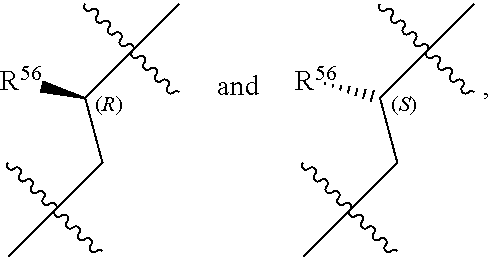
where R56 is optionally methyl. In some embodiments, C is selected from C3-12 carbocycle and 3- to 12-membered heterocycle, such as 5- to 12-membered heterocycle. In some embodiments, the heterocycle is saturated. In some embodiments, C is selected from 5- to 7-membered monocyclic heterocycle, 8- to 10-membered fused bicyclic heterocycle, and 7- to 12-membered spirocyclic heterocycle. In some embodiments, the heterocycle comprises at least one nitrogen atom, such as one or two nitrogen atoms. In some embodiments, C comprises at least one ring nitrogen. In some embodiments, C is selected from piperidinyl and piperazinyl, such as
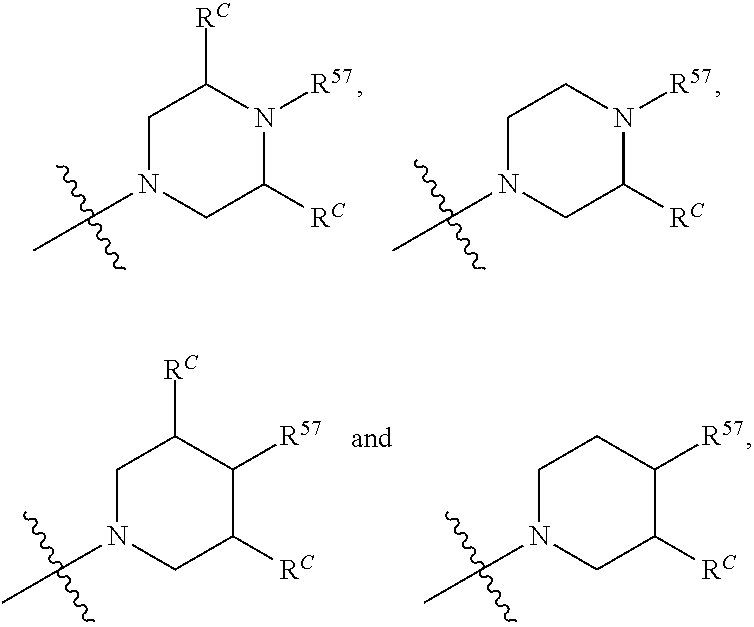
wherein R57 is selected from hydrogen and R50. In some embodiments, C is selected from
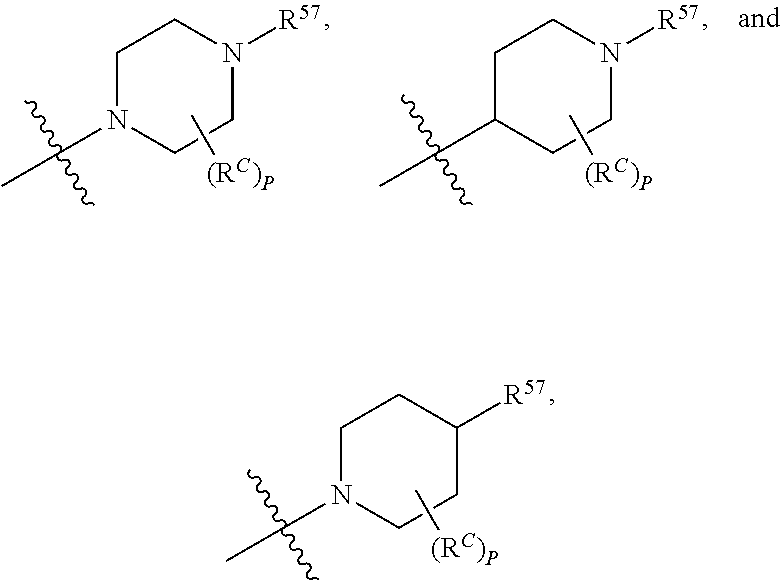
wherein R57 is selected from hydrogen and R50. In some embodiments, C is selected from

wherein R57 is selected from hydrogen and R50. In some embodiments, C is selected from


optionally substituted with one or more RC, wherein R57 is selected from hydrogen and R50 In some embodiments, C is selected from

wherein R57 is selected from —S(═O)R52, —S(═O)2R52, —S(═O)2N(R52)2, —S(═O)2NR53R54, —NR52S(═O)2R52; and C1-10 alkyl substituted with one or more substituents selected from —S(═O)R52, —S(═O)2R52, —S(═O)2N(R52)2, —S(═O)2NR53R54, and —NR52S(═O)2R52. In some embodiments, R57 is selected from —S(═O)R52, —S(═O)2R52, —S(═O)2N(R52)2, and —NR52S(═O)2R52, such as R57 is selected from —S(═O)CH3, —S(═O)2CH3, —S(═O)2NH2, —NHS(═O)2CH3, and —S(═O)2NHCH3. In some embodiments, C is selected from
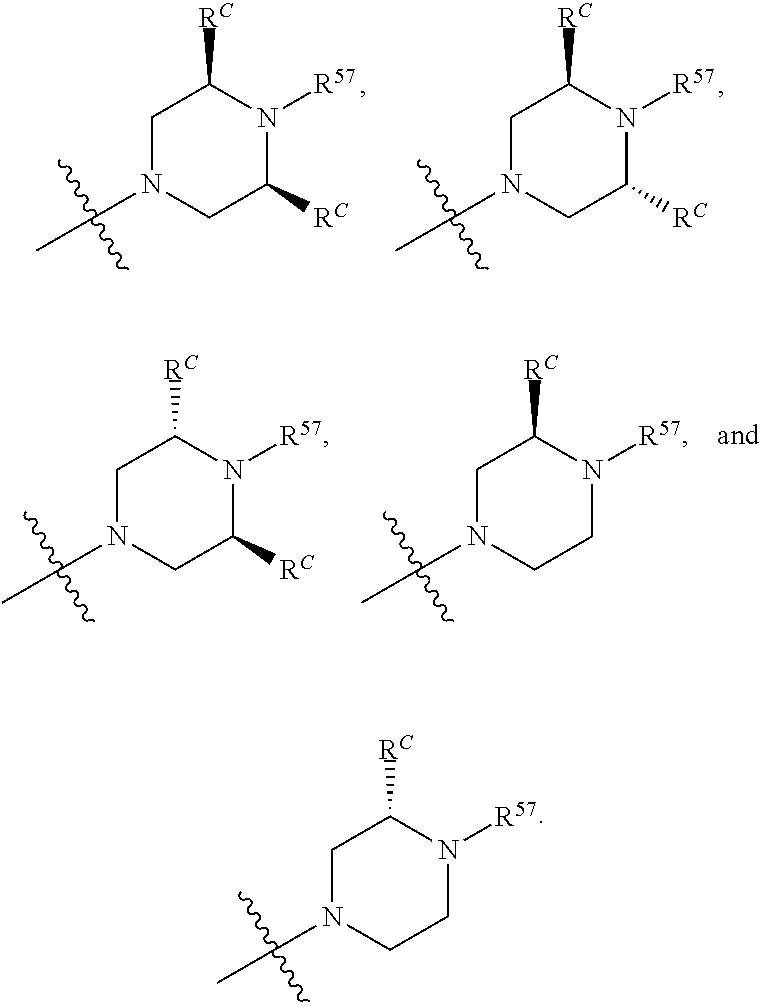

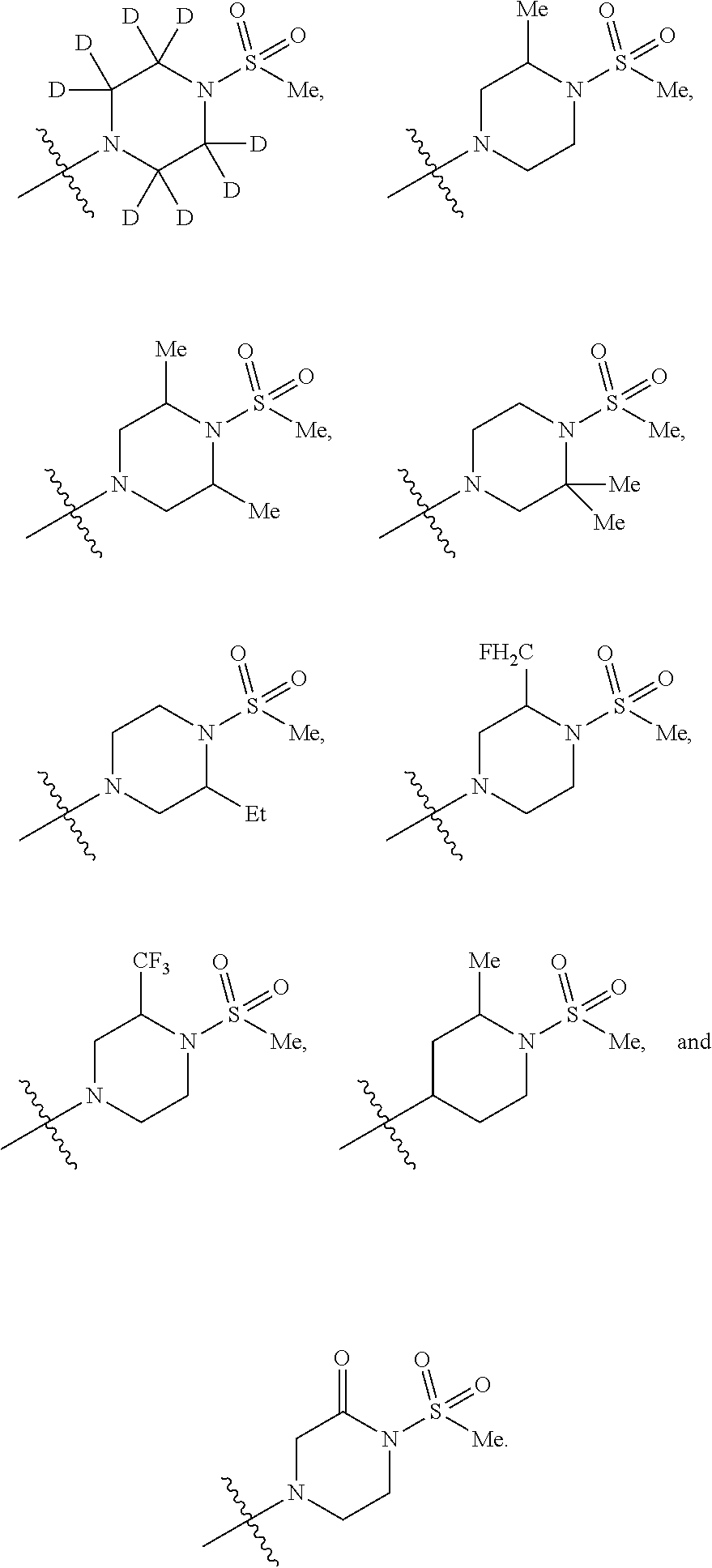

such as

In some embodiments, C is selected from 5- to 7-membered monocyclic heterocycle, such as piperidinyl and piperazinyl. In some embodiments, R56 is selected from deuterium, C1-4 alkyl, C1-4 haloalkyl, and —OR59, such as R56 is methyl. In some embodiments, RC is selected from —S(═O)R52, —S(═O)2R52, —S(═O)2N(R52)2, and —NR52S(═O)2R52, such as RC is selected from —S(═O)CH3, —S(═O)2CH3, —S(═O)2NH2, —NHS(═O)2CH3, and —S(═O)2NHCH3. In some embodiments, p is an integer from 1 to 3, such as p is 1. In some embodiments, RC is —S(═O)2CH3. In some embodiments, R56 is methyl and RC is —S(═O)2CH3. In some embodiments, R2 is selected from hydrogen, halogen, —OH, —OR52, —NH2, —N(R52)2, —CN, C1-3 alkyl, —CH2OH, —CH2OR52, —CH2NH2, —CH2N(R52)2, C1-3 alkyl-N(R52)2, C1-3 haloalkyl, C2-3 alkenyl, and C2-3 alkynyl, such as R2 is selected from —OH, —OR52, —NH2, —N(R52)2, —CN, and C1-2 alkyl. In some embodiments, R2 is methyl or —NHCH3. In some embodiments, R2 is H.

such as
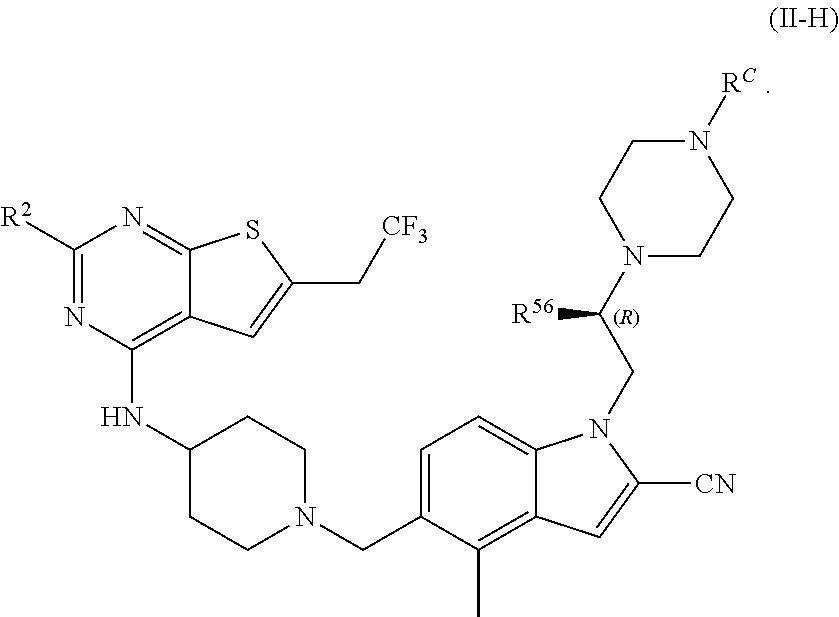
In some embodiments, C is selected from 5- to 7-membered monocyclic heterocycle, such as piperidinyl and piperazinyl. In some embodiments, R56 is selected from deuterium, C1-4 alkyl, C1-4 haloalkyl, and —OR59, such as R56 is methyl. In some embodiments, RC is selected from —S(═O)R52, —S(═O)2R52, —S(═O)2N(R52)2, and —NR52S(═O)2R52, such as RC is selected from —S(═O)CH3, —S(═O)2CH3, —S(═O)2NH2, —NHS(═O)2CH3, and —S(═O)2NHCH3. In some embodiments, p is an integer from 1 to 3, such as p is 1. In some embodiments, RC is —S(═O)2CH3. In some embodiments, R56 is methyl and RC is —S(═O)2CH3. In some embodiments, R2 is selected from hydrogen, halogen, —OH, —OR52, —NH2, —N(R52)2, —CN, C1-3 alkyl, —CH2OH, —CH2OR52, —CH2NH2, —CH2N(R52)2, C1-3 alkyl-N(R52)2, C1-3 haloalkyl, C2-3 alkenyl, and C2-3 alkynyl, such as R2 is selected from —OH, —OR52, —NH2, —N(R52)2, —CN, and C1-2 alkyl. In some embodiments, R2 is methyl or —NHCH3. In some embodiments, R2 is H.

or a pharmaceutically acceptable salt, isotopic form, or prodrug thereof, wherein:
-
- halogen, —NO2, —CN, —OR52, —SR52, —N(R52)2, —NR53R54, —S(═O)R52, —S(═O)2R52, —S(═O)2N(R52)2, —S(═O)2NR53R54, —NR52S(═O)2R52, —NR52S(═O)2N(R52)2, —NR52S(═O)2NR53R54, —C(O)R52, —C(O)OR52, —OC(O)R52, —OC(O)OR52, —OC(O)N(R52)2, —OC(O)NR53R54, —NR52C(O)R52, —NR52C(O)OR52, —NR52C(O)N(R52)2, —NR52C(O)NR53R54, —C(O)N(R52)2, —C(O)NR53R54, —P(O)(OR52)2, —P(O)(R52)2, ═O, ═S, ═N(R52);
-
- C3-12 carbocycle and 3- to 12-membered heterocycle,
- wherein each C3-12 carbocycle and 3- to 12-membered heterocycle in R50 is independently optionally substituted with one or more substituents selected from halogen, —NO2, —CN, —OR52, —SR52, —N(R52)2, —NR53R54, —S(═O)R52, —S(═O)2R52, —S(═O)2N(R52)2, —S(═O)2NR53R54, —NR52S(═O)2R52, —NR52S(═O)2N(R52)2, —NR52S(═O)2NR53R54, —C(O)R52, —C(O)OR52, —OC(O)R52, —OC(O)OR52, —OC(O)N(R52)2, —OC(O)NR53R54, —NR52C(O)R52, —NR52C(O)OR52, —NR52C(O)N(R52)2, —NR52C(O)NR53R54, —C(O)N(R52)2, —C(O)NR53R54, —P(O)(OR52)2, —P(O)(R52)2, ═O, ═S, ═N(R52), C1-6 alkyl, C1-6 haloalkyl, C2-6 alkenyl, and C2-6 alkynyl;
-
- hydrogen, —C(O)R52, —C(O)OR52, —C(O)N(R52)2, —C(O)NR53R54;
- C1-6 alkyl, C2-6 alkenyl, and C2-6 alkynyl, each of which is independently optionally substituted at each occurrence with one or more substituents selected from halogen, —NO2, —CN, —OR52, —SR52, —N(R52)2, —NR53R54, —S(═O)R52, —S(═O)2R52, —S(═O)2N(R52)2, —S(═O)2NR53R54, —NR52S(═O)2R52, —NR52S(═O)2N(R52)2, —NR52S(═O)2NR53R54, —C(O)R52, —C(O)OR52, —OC(O)R52, —OC(O)OR52, —OC(O)N(R52)2, —OC(O)NR53R54, —NR52C(O)R52, —NR52C(O)OR52, —NR52C(O)N(R52)2, —NR52C(O)NR53R54, —C(O)N(R52)2, —C(O)NR53R54, —P(O)(OR52)2, —P(O)(R52)2, ═O, ═S, ═N(R52), C3-12 carbocycle and 3- to 12-membered heterocycle; and
- C3-12 carbocycle and 3- to 12-membered heterocycle,
- wherein each C3-12 carbocycle and 3- to 12-membered heterocycle in R51 is independently optionally substituted with one or more substituents selected from halogen, —NO2, —CN, —OR52, —SR52, —N(R52)2, —NR53R54, —S(═O)R52, —S(═O)2R52, —S(═O)2N(R52)2, —S(═O)2NR53R54, —NR52S(═O)2R52, —NR52S(═O)2N(R52)2, —NR52S(═O)2NR53R54, —C(O)R52, —C(O)OR52, —OC(O)R52, —OC(O)OR52, —OC(O)N(R52)2, —OC(O)NR53R54, —NR52C(O)R52, —NR52C(O)OR52, —NR52C(O)N(R52)2, —NR52C(O)NR53R54, —C(O)N(R52)2, —C(O)NR53R54, —P(O)(OR52)2, —P(O)(R52)2, ═O, ═S, ═N(R52), C1-6 alkyl, C1-6 haloalkyl, C2-6 alkenyl, and C2-6 alkynyl;
-
- halogen, —NO2, —CN, —SR52, —NR53R54, —S(═O)R52, —S(═O)2R58, —S(═O)2N(R52)2, —S(═O)2NR53R54, —NR52S(═O)2R52, —NR52S(═O)2N(R52)2, —NR52S(═O)2NR53R54, —C(O)OR52, —OC(O)R52, —OC(O)OR52, —OC(O)N(R52)2, —OC(O)NR53R54, —NR52C(O)OR52, —NR52C(O)N(R52)2, —NR52C(O)NR53R54, —C(O)NH(C1-6 alkyl), —C(O)NR53R54, —P(O)(OR52)2, —P(O)(R52)2, ═S, ═N(R52); and
- C1-10 alkyl, C2-10 alkenyl, and C2-10 alkynyl, each of which is independently substituted at each occurrence with one or more substituents selected from —NO2, —CN, —SR52, —N(R52)2, —NR53R54, —S(═O)R52, —S(═O)2R52, —S(═O)2N(R52)2, —S(═O)2NR53R54, —NR52S(═O)2R52, —NR52S(═O)2N(R52)2, —NR52S(═O)2NR53R54, —C(O)R52, —C(O)OR52, —OC(O)R52, —OC(O)OR52, —OC(O)N(R52)2, —OC(O)NR53R54, —NR52C(O)R52, —NR52C(O)OR52, —NR52C(O)N(R52)2, —NR52C(O)NR53R54, —P(O)(OR52)2, —P(O)(R52)2, ═S, and ═N(R52); and
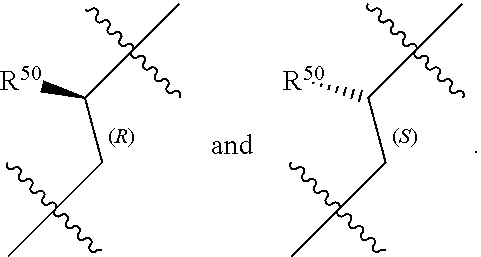

In some embodiments, L3 is

In some embodiments, C is selected from


and C is selected from


or a pharmaceutically acceptable salt thereof, wherein:
-
- halogen, —NO2, —CN, —OR52, —SR52, —N(R52)2, —NR53R54, —S(═O)R52, —S(═O)2R52, —S(═O)2N(R52)2, —S(═O)2NR53R54, —NR52S(═O)2R52, —NR52S(═O)2N(R52)2, —NR52S(═O)2NR53R54, —C(O)R52, —C(O)OR52, —OC(O)R52, —OC(O)OR52, —OC(O)N(R52)2, —OC(O)NR53R54, —NR52C(O)R52, —NR52C(O)OR52, —NR52C(O)N(R52)2, —NR52C(O)NR53R54, —C(O)N(R52)2, —C(O)NR53R54, —P(O)(OR52)2, —P(O)(R52)2, ═O, ═S, ═N(R52);
-
- C3-12 carbocycle and 3- to 12-membered heterocycle,
- wherein each C3-12 carbocycle and 3- to 12-membered heterocycle in R50 is independently optionally substituted with one or more substituents selected from halogen, —NO2, —CN, —OR52, —SR52, —N(R52)2, —NR53R54, —S(═O)R52, —S(═O)2R52, —S(═O)2N(R52)2, —S(═O)2NR53R54, —NR52S(═O)2R52, —NR52S(═O)2N(R52)2, —NR52S(═O)2NR53R54, —C(O)R52, —C(O)OR52, —OC(O)R52, —OC(O)OR52, —OC(O)N(R52)2, —OC(O)NR53R54, —NR52C(O)R52, —NR52C(O)OR52, —NR52C(O)N(R52)2, —NR52C(O)NR53R54, —C(O)N(R52)2, —C(O)NR53R54, —P(O)(OR52)2, —P(O)(R52)2, ═O, ═S, ═N(R52), C1-6 alkyl, C1-6 haloalkyl, C2-6 alkenyl, and C2-6 alkynyl; R51 is independently selected at each occurrence from:
- hydrogen, —C(O)R52, —C(O)OR52, —C(O)N(R52)2, —C(O)NR53R54;
- C1-6 alkyl, C2-6 alkenyl, and C2-6 alkynyl, each of which is independently optionally substituted at each occurrence with one or more substituents selected from halogen, —NO2, —CN, —OR52, —SR52, —N(R52)2, —NR53R54, —S(═O)R52, —S(═O)2R52, —S(═O)2N(R52)2, —S(═O)2NR53R54, —NR52S(═O)2R52, —NR52S(═O)2N(R52)2, —NR52S(═O)2NR53R54, —C(O)R52, —C(O)OR52, —OC(O)R52, —OC(O)OR52, —OC(O)N(R52)2, —OC(O)NR53R54, —NR52C(O)R52, —NR52C(O)OR52, —NR52C(O)N(R52)2, —NR52C(O)NR53R54, —C(O)N(R52)2, —C(O)NR53R54, —P(O)(OR52)2, —P(O)(R52)2, ═O, ═S, ═N(R52), C3-12 carbocycle and 3- to 12-membered heterocycle; and
- C3-12 carbocycle and 3- to 12-membered heterocycle,
- wherein each C3-12 carbocycle and 3- to 12-membered heterocycle in R51 is independently optionally substituted with one or more substituents selected from halogen, —NO2, —CN, —OR52, —SR52, —N(R52)2, —NR53R54, —S(═O)R52, —S(═O)2R52, —S(═O)2N(R52)2, —S(═O)2NR53R54, —NR52S(═O)2R52, —NR52S(═O)2N(R52)2, —NR52S(═O)2NR53R54, —C(O)R52, —C(O)OR52, —OC(O)R52, —OC(O)OR52, —OC(O)N(R52)2, —OC(O)NR53R54, —NR52C(O)R52, —NR52C(O)OR52, —NR52C(O)N(R52)2, —NR52C(O)NR53R54, —C(O)N(R52)2, —C(O)NR53R54, —P(O)(OR52)2, —P(O)(R52)2, ═O, ═S, ═N(R52), C1-6 alkyl, C1-6 haloalkyl, C2-6 alkenyl, and C2-6 alkynyl;
-
- —NO2, —SR52, —NR53R54, —S(═O)R52, —S(═O)2R52, —S(═O)2N(R52)2, —S(═O)2NR53R54, —NR52S(═O)2R52, —NR52S(═O)2N(R52)2, —NR52S(═O)2NR53R54, —C(O)R52, —C(O)OR52, —OC(O)R52, —OC(O)OR52, —OC(O)N(R52)2, —OC(O)NR53R54, —NR52C(O)R52, —NR52C(O)OR52, —NR52C(O)N(R52)2, —NR52C(O)NR53R54, —C(O)N(R52)2, —C(O)NR53R54, —P(O)(OR52)2, —P(O)(R52)2, ═O, ═S, ═N(R52), C1-10 alkyl, C2-10 alkenyl, C2-10 alkynyl, C3-12 carbocycle and 3- to 12-membered heterocycle,
- wherein each C1-10 alkyl, C2-10 alkenyl, and C2-10 alkynyl in R56 is independently optionally substituted at each occurrence with one or more substituents selected from halogen, —NO2, —CN, —SR52, —N(R52)2, —NR53R54, —S(═O)R52, —S(═O)2R52, —S(═O)2N(R52)2, —S(═O)2NR53R54, —NR52S(═O)2R52, —NR52S(═O)2N(R52)2, —NR52S(═O)2NR53R54, —C(O)R52, —C(O)OR52, —OC(O)R52, —OC(O)OR52, —OC(O)N(R52)2, —OC(O)NR53R54, —NR52C(O)R52, —NR52C(O)OR52, —NR52C(O)N(R52)2, —NR52C(O)NR53R54, —C(O)N(R52)2, —C(O)NR53R54, —P(O)(OR52)2, —P(O)(R52)2, ═O, ═S, ═N(R52), C3-12 carbocycle, and 3- to 12-membered heterocycle;
-
- further wherein R56 optionally forms a bond to ring C; and

Optionally, R56 is methyl. In some embodiments, L3 is

In some embodiments, L3 is

In some embodiments, C is selected from


and C is selected from


-
- wherein:
- L5 is selected from a bond; and C1-6 alkylene, C1-6 heteroalkylene, C2-6 alkenylene, and C2-6 alkynylene, each of which is independently optionally substituted with one or more R32;
- R22 and R23 are each independently selected from:
- hydrogen, halogen, —OR20, —SR20, —N(R20)2, —N(R20)C(O)R20, —C(O)R20, —C(O)OR20, —C(O)N(R20)2, —OC(O)R20, —S(O)2R20, —S(O)2N(R20)2, —) N(R20S(O)2R20, —NO2, ═O, ═S, ═N(R20), —P(O)(OR20)2, —P(O)(R20)2, —OP(O)(OR20)2, and —CN;
- C1-6 alkyl, C2-6 alkenyl, and C2-6 alkynyl, each of which is independently optionally substituted at each occurrence with one or more substituents selected from halogen, —OR20, —SR20, —N(R20)2, —N(R20)C(O)R20, —C(O)R20, —C(O)OR20, —C(O)N(R20)2, —OC(O)R20, —S(O)2R20, —S(O)2N(R20)2,—N(R20S(O)2R20, —NO2, ═O, ═S, ═N(R20), —P(O)(OR20)2, —P(O)(R20)2, —OP(O)(OR20)2, —CN, C3-10 carbocycle, and 3- to 10-membered heterocycle; and
- C3-10 carbocycle and 3- to 10-membered heterocycle,
- wherein each C3-10 carbocycle and 3- to 10-membered heterocycle of R22 and R23 is independently optionally substituted with one or more substituents selected from halogen, —OR20, —SR20, —N(R20)2, —N(R20)C(O)R20, —C(O)R20, —C(O)OR20, —C(O)N(R20)2, —OC(O)R20, —S(O)2R20, —S(O)2N(R20)2, —N(R20)S(O)2R20, —NO2, ═O, ═S, ═N(R20), —P(O)(OR20)2, —P(O)(R20)2, —OP(O)(OR20)2, —CN, C1-6 alkyl, C2-6 alkenyl, and C2-6 alkynyl; or R22 and R23, together with the carbon atoms to which they are attached, form a carbocyclic ring;
- R24 is selected from:
- hydrogen, —C(O)R20, —C(O)OR20, —C(O)N(R20)2, —OC(O)R20, —S(O)2R20, and —S(O)2N(R20)2;
- C1-6 alkyl, C2-6 alkenyl, and C2-6 alkynyl, each of which is independently optionally substituted at each occurrence with one or more substituents selected from halogen, —OR20, —SR20, —N(R20)2, —N(R20)C(O)R20, —C(O)R20, —C(O)OR20, —C(O)N(R20)2, —OC(O)R20, —S(O)2R20, —S(O)2N(R20)2, —N(R20)S(O)2R20, —NO2, ═O, ═S, ═N(R20), —P(O)(OR20)2, —P(O)(R20)2, —OP(O)(OR20)2, —CN, C3-10 carbocycle, and 3- to 10-membered heterocycle; and
- C3-10 carbocycle and 3- to 10-membered heterocycle,
- wherein each C3-10 carbocycle and 3- to 10-membered heterocycle of R24 is independently optionally substituted with one or more substituents selected from halogen, —OR20, —SR20, —N(R20)2, —N(R20)C(O)R20, —C(O)R20, —C(O)OR20, —C(O)N(R20)2, —OC(O)R20, —S(O)2R20, —S(O)2N(R20)2, —N(R20S(O)2R20, —NO2, ═O, ═S, ═N(R20), —P(O)(OR20)2, —P(O)(R20)2, —OP(O)(OR20)2, —OP(O)(OR20)2, —CN, C1-6 alkyl, C2-6 alkenyl, and C2-6 alkynyl;
- R20 is independently selected at each occurrence from R52; and
- R32 is independently selected at each occurrence from R50.
-
- hydrogen;
- C1-6 alkyl, C2-6 alkenyl, and C2-6 alkynyl, each of which is independently optionally substituted at each occurrence with one or more substituents selected from halogen, —OR20, —SR20, —N(R20)2, —N(R20)C(O)R20, —C(O)R20, —C(O)OR20, —C(O)N(R20)2, —OC(O)R20, —S(O)2R20, —S(O)2, —N(R20)2, —N(R20)S(O)2R20, —NO2, ═O, ═S, ═N(R20), —P(O)(OR20)2, —P(O)(R20)2, —OP(O)(OR20)2)2, —OP(O)(OR20)2, —CN, C3-10 carbocycle and 3- to 10-membered heterocycle; and
- C3-10 carbocycle, and 3- to 10-membered heterocycle,
- wherein each C3-10 carbocycle and 3- to 10-membered heterocycle is independently optionally substituted with one or more substituents selected from halogen, —OR20, —SR20, —N(R20)2, —N(R20)C(O)R20, —C(O)R20, —C(O)OR20, —C(O)N(R20)2, —OC(O)R20, —S(O)2R20, —S(O)2N(R20)2, —N(R20)S(O)2R20, —NO2, ═O, ═S, ═N(R20), —P(O)(OR20)2, —P(O)(OR20)2, —P(O)(R20)2, —OP(O)(OR20)2, —CN, C1-6 alkyl, C2-6 alkenyl, and C2-6 alkynyl.
-
- hydrogen;
- C1-6 alkyl optionally substituted with one or more substituents selected from halogen, —OR20, —SR20, —N(R20)2, ═O, ═S, ═N(R20), and —CN; and
- 3- to 10-membered heterocycle optionally substituted with one or more substituents selected from halogen, —OR20, —SR20, —N(R20)2, —N(R20)C(O)R20, —C(O)R20, —C(O)OR20, —C(O)N(R20)2, —OC(O)R20, —S(O)2R20, —S(O)2N(R20)2, —N(R20)S(O)2R20, —NO2, ═O, ═S, ═N(R20), —P(O)(OR20)2, —P(O)(R20)2, —OP(O)(OR20)2, —CN, C1-6 alkyl, C2-6 alkenyl, and C2-6 alkynyl.)
-
- hydrogen and —CN;
- C1-6 alkyl, C2-6 alkenyl, and C2-6 alkynyl, each of which is independently optionally substituted at each occurrence with one or more substituents selected from halogen, —OR20, —SR20, —NR20)2, —N(R20)C(O)R20—C(O)R20, —C(O)OR20, —C(O)N(R20)2, —OC(O)R20, —OC(O)R20, —S(O)2R20, —S(O)2N(R20)2, —N(R20)S(O)2R20, —NO2, ═O, ═S, ═N(R20), —P(O)(OR20)2, —P(O)(R20)2, —OP(O)(OR20)2, —CN, C3-10 carbocycle and 3- to 10-membered heterocycle; and
- C3-10 carbocycle and 3- to 10-membered heterocycle,
- wherein each C3-10 carbocycle and 3- to 10-membered heterocycle is independently optionally substituted with one or more substituents selected from halogen, —OR20, —SR20, —N(R20)2, —N(R20)C(O)R20, —C(O)R20, —C(O)OR20, —C(O)N(R20), —OC(O)R20, —S(O)2R20, —S(O)2N(R20)2, —N(R20)S(O) 2R20, —NO2, ═O, ═S, ═N(R20), —P(O)(OR20)2, —P(O)(R20)2, —OP(O)(OR20)2, —CN, C1-6 alkyl, C2-6 alkenyl, and C2-6 alkynyl.


| TABLE 1 | |||
| No. | Structure | MW (calc'd) | m/z found |
| 1 |
 |
687.78 | 688.45 [M + H]+ |
| 2 |
 |
688.83 | 689.40 [M + H]+ |
| 3 |
 |
687.84 | 688.45 [M + H]+ |
| 4 |
 |
702.86 | 703.55 [M + H]+ |
| 5 |
 |
652.78 | 653.55 [M + H]+ |
| 6 |
 |
638.75 | 639.50 [M + H]+ |
| 7 |
 |
689.82 | 690.50 [M + H]+ |
| 8 |
 |
703.84 | 704.55 [M + H]+ |
| 9 |
 |
688.83 | 689.45 [M + H]+ |
| 10 |
 |
688.83 | 689.40 [M + H]+ |
| 11 |
 |
702.86 | 703.55 [M + H]+ |
| 12 |
 |
716.88 | 717.55 [M + H]+ |
| 13 |
 |
702.86 | 703.55 [M + H]+ |
| 14 |
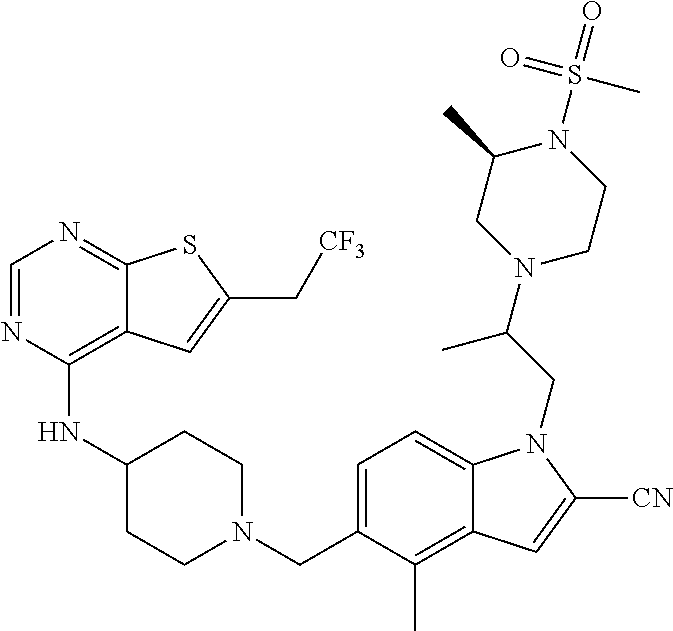 |
702.86 | 703.55 [M + H]+ |
| 15 |
 |
702.86 | 703.50 [M + H]+ |
| 16 |
 |
702.86 | 703.60 [M + H]+ |
| 17 |
 |
702.86 | 703.35 [M + H]+ |
| 18 |
 |
702.86 | 703.35 [M + H]+ |
| 19 |
 |
702.86 | 703.35 [M + H]+ |
| 20 |
 |
702.86 | 703.35 [M + H]+ |
| 21 |
 |
716.88 | 717.35 [M + H]+ |
| 22 |
 |
716.88 | 717.35 [M + H]+ |
| 23 |
 |
714.87 | 715.25 [M + H]+ |
| 24 |
 |
716.88 | 717.45 [M + H]+ |
| 25 |
 |
716.88 | 717.40 [M + H]+ |
| 26 |
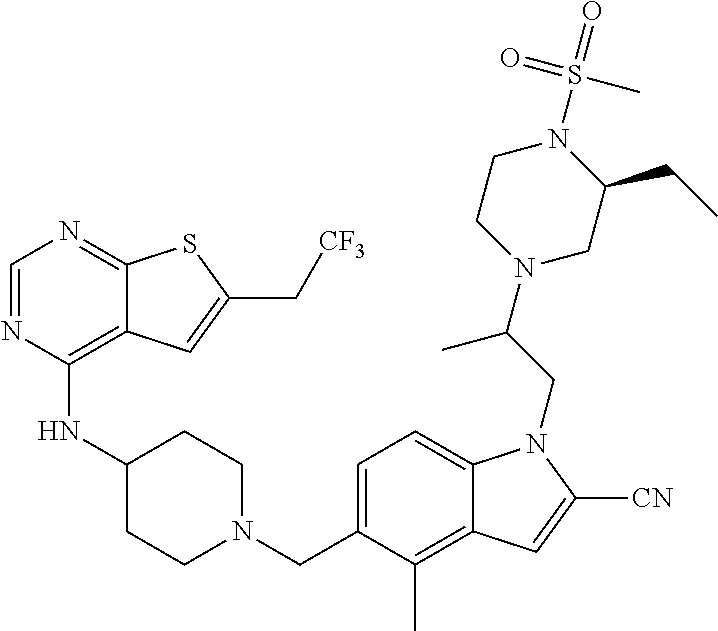 |
716.88 | 717.40 [M + H]+ |
| 27 |
 |
||
| 28 |
 |
714.87 | 715.35 [M + H]+ |
| 29 |
 |
716.88 | 717.40 [M + H]+ |
| 30 |
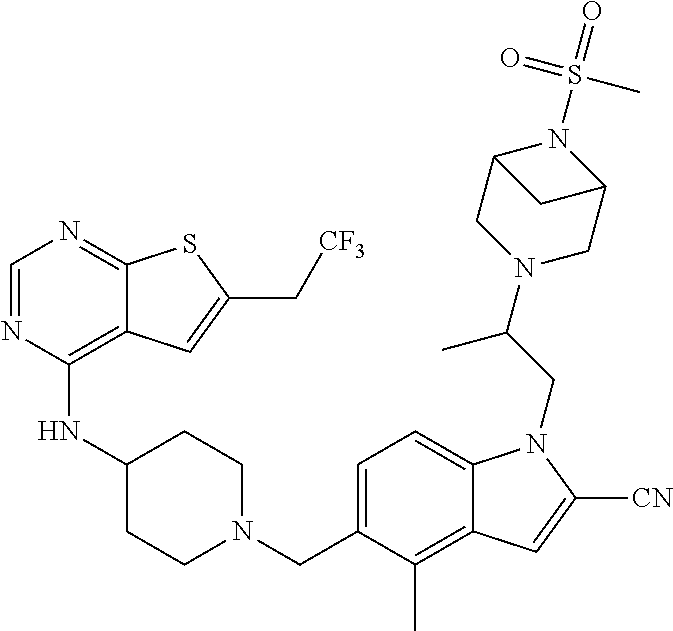 |
700.84 | 701.35 [M + H]+ |
| 31 |
 |
||
| 32 |
 |
||
| 33 |
 |
||
| 34 |
 |
||
| 35 |
 |
688.79 | 689.15 [M + H]+ |
| 36 |
 |
||
| 37 |
 |
||
| 38 |
 |
||
| 39 |
 |
||
| 40 |
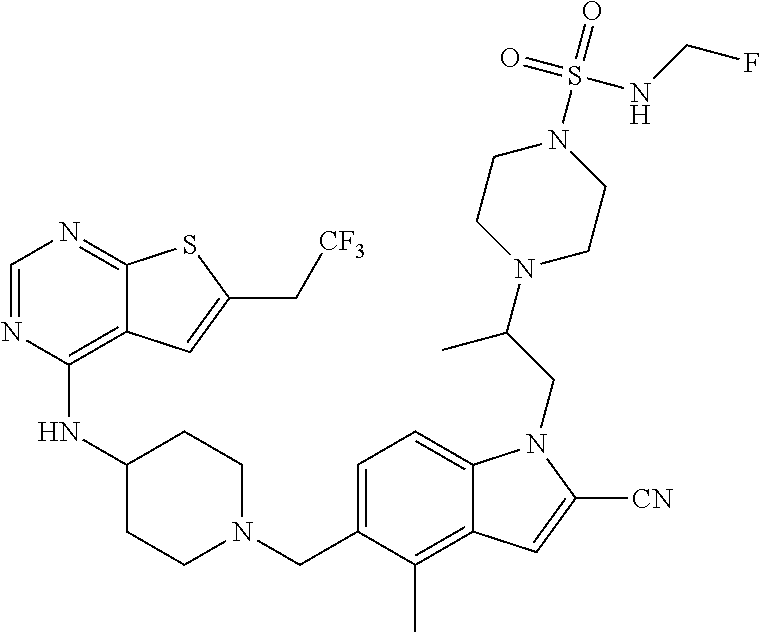 |
||
| 41 |
 |
||
| 42 |
 |
||
| 43 |
 |
688.83 | 689.45 [M + H]+ |
| 44 |
 |
702.86 | 703.45 [M + H]+ |
| 45 |
 |
688.83 | 689.40 [M + H]+ |
| 46 |
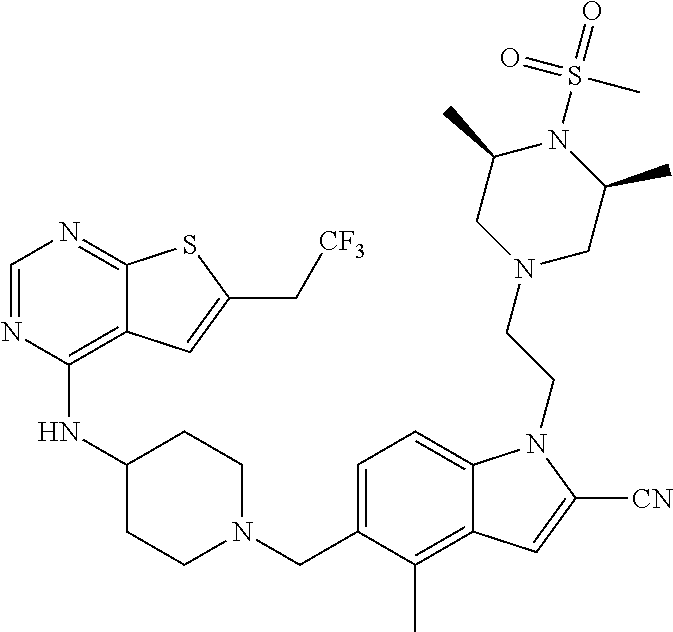 |
702.86 | 703.45 [M + H]+ |
| 47 |
 |
702.86 | 703.50 [M + H]+ |
| 48 |
 |
702.86 | 703.55 [M + H]+ |
| 49 |
 |
702.86 | 703.55 [M + H]+ |
| 50 |
 |
||
| 51 |
 |
||
| 52 |
 |
728.89 | 729.55 [M + H]+ |
| 53 |
 |
714.87 | 715.30 [M + H]+ |
| 54 |
 |
714.87 | 715.30 [M + H]+ |
| 55 |
 |
700.84 | 701.30 [M + H]+ |
| 56 |
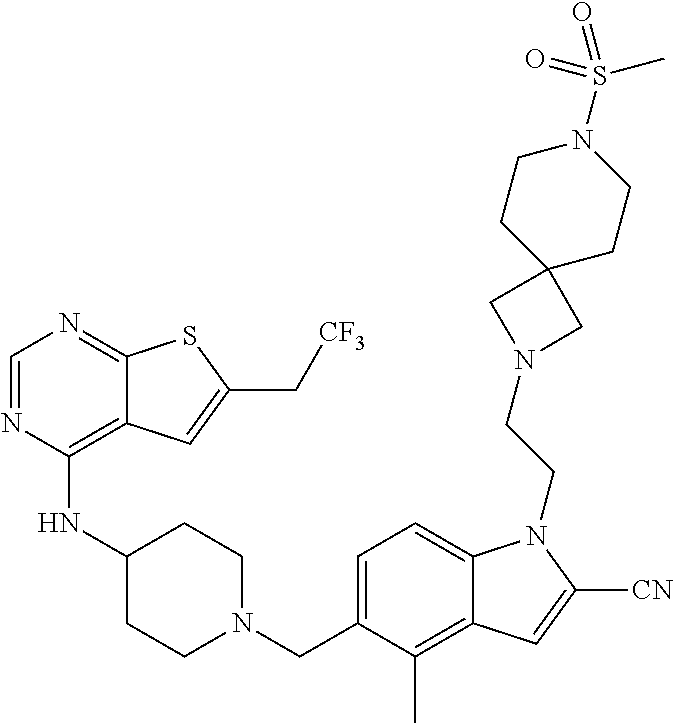 |
714.87 | 715.35 [M + H]+ |
| 57 |
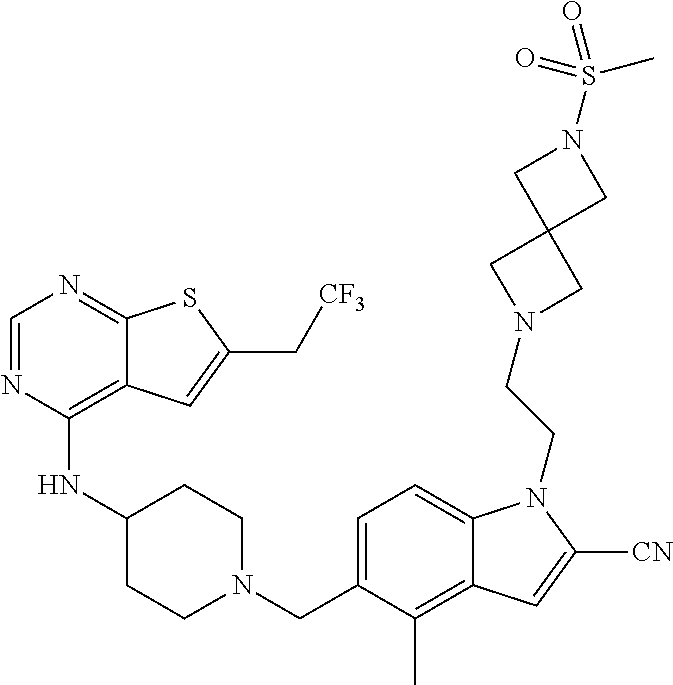 |
686.81 | 687.25 [M + H]+ |
| 58 |
 |
700.84 | 701.35 [M + H]+ |
| 59 |
 |
687.84 | 688.45 [M + H]+ |
| 60 |
 |
687.84 | 688.50 [M + H]+ |
| 61 |
 |
700.84 | 701.30 [M + H]+ |
| 62 |
 |
||
| 63 |
 |
||
| 64 |
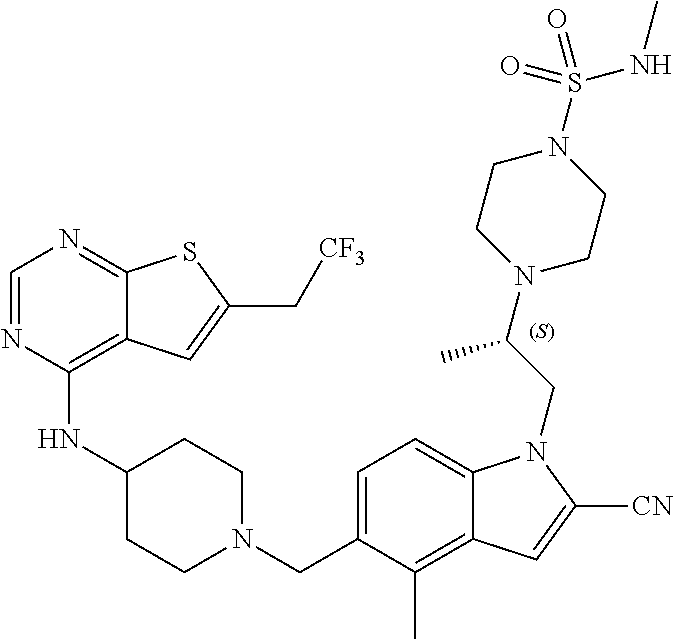 |
703.84 | 704.25 [M + H]+ |
| 65 |
 |
638.75 | 639.20 [M + H]+ |
| 66 |
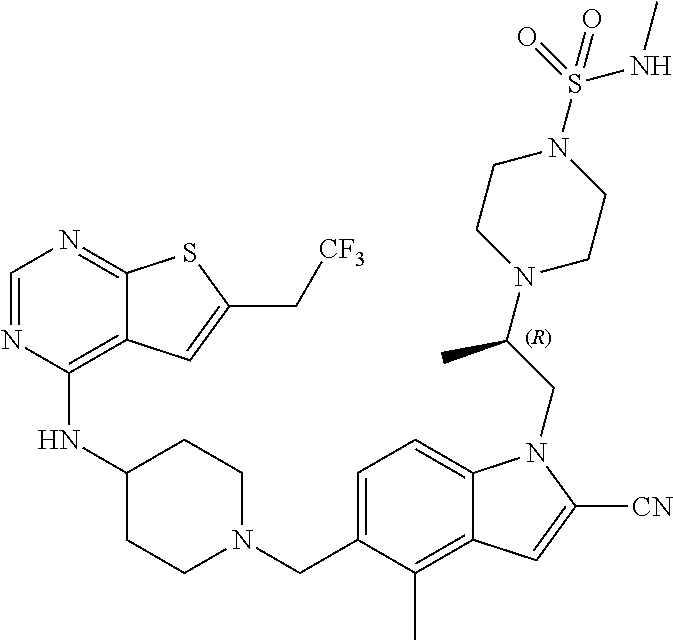 |
703.84 | 704.25 [M + H]+ |
| 67 |
 |
638.75 | 639.25 [M + H]+ |
| 68 |
 |
667.79 | 668.35 [M + H]+ |
| 69 |
 |
720.27 | 721.3 |
| 70 |
 |
706.25 | 707.3 |
| 71 |
 |
706.25 | 707.2 |
| 72 |
 |
668.29 | 689.2 |
| 73 |
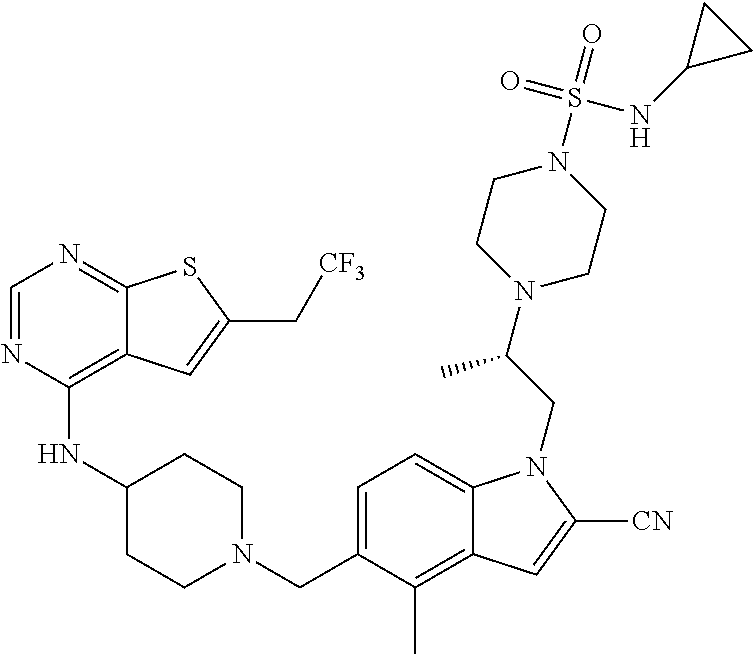 |
729.88 | 730.30 [M + H]+ |
| 74 |
 |
||
| 75 |
 |
||
| 76 |
 |
||
| 77 |
 |
||
| 78 |
 |
||
| 79 |
 |
||
| 80 |
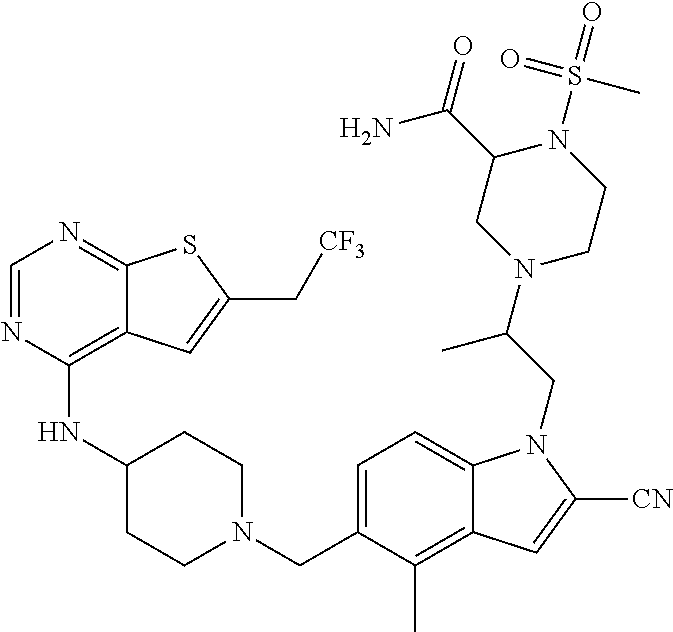 |
||
| 81 |
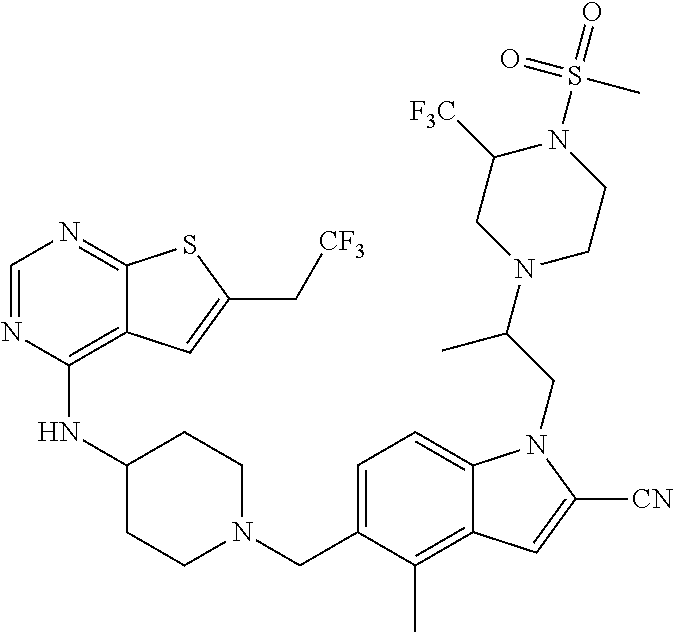 |
||
| 82 |
 |
||
| 83 |
 |
||
| 84 |
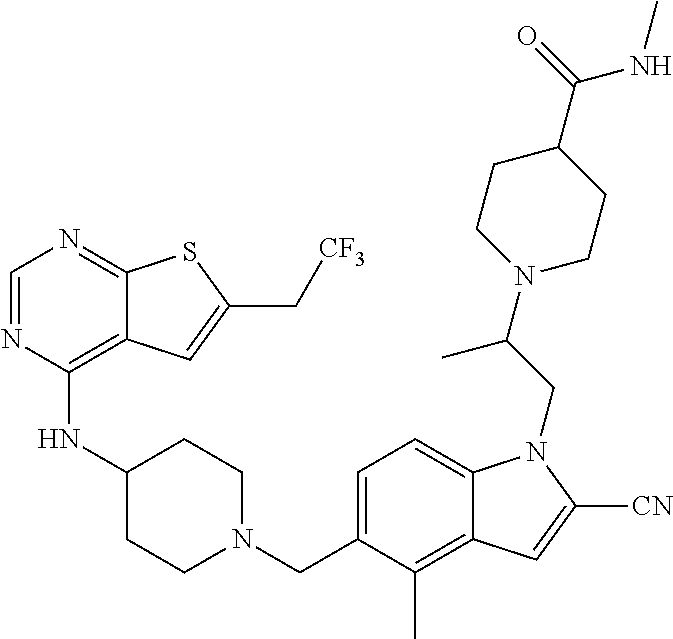 |
||
| 85 |
 |
||
| 86 |
 |
||
| 87 |
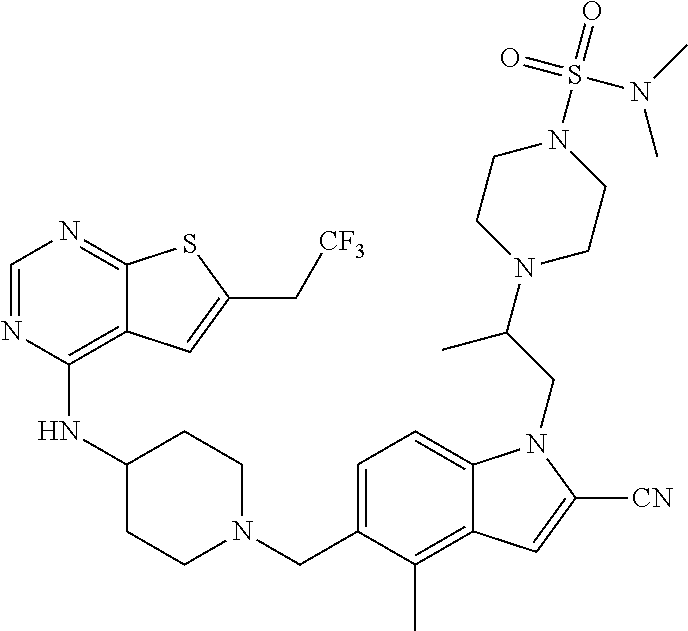 |
717.29 | 718.35 [M + H]+ |
| 88 |
 |
||
| 89 |
 |
717.29 | 718.25 [M + H]+ |
| 90 |
 |
||
| 91 |
 |
||
| 92 |
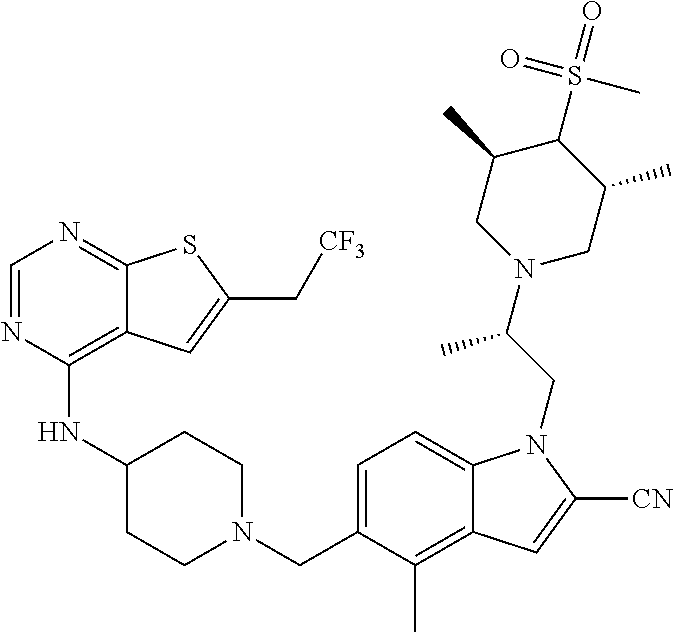 |
||
| 93 |
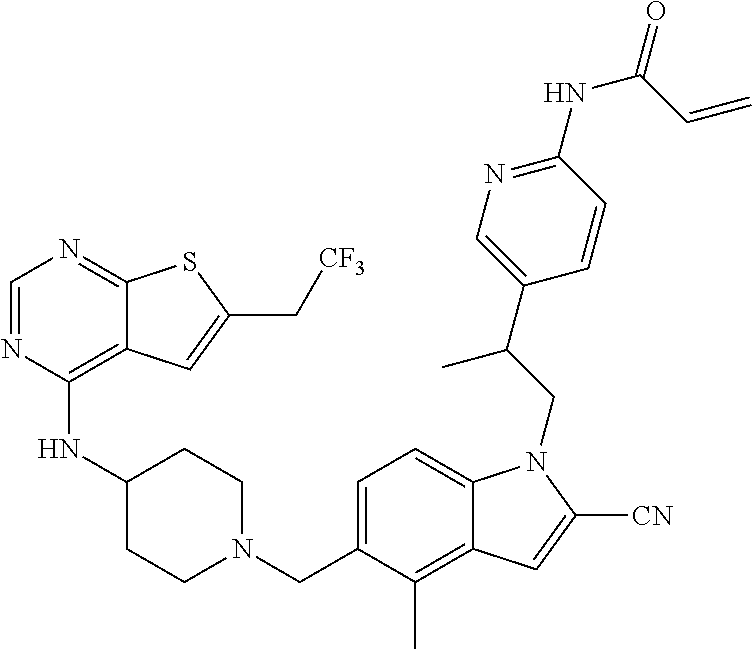 |
672.26 | 673.2667 |
| 94 |
 |
714.27 | 715.2 [M + H]+ |
| 95 |
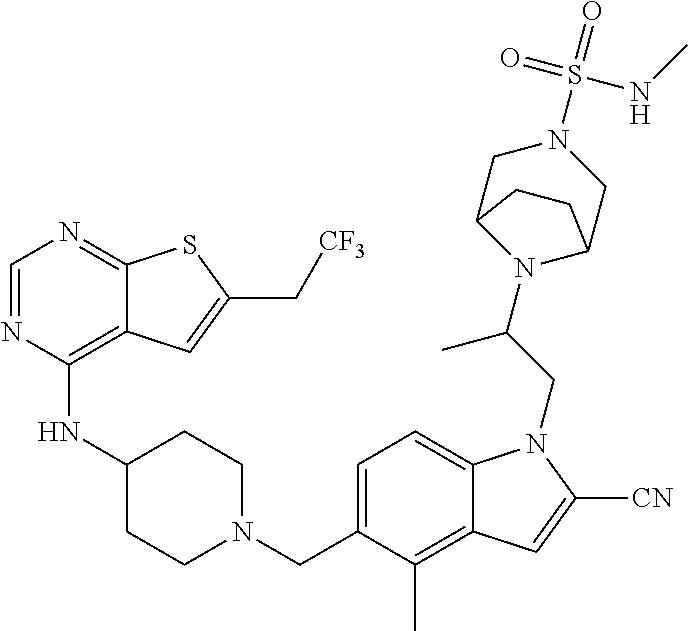 |
||
| 96 |
 |
||
| 97 |
 |
||
| 98 |
 |
||
| 99 |
 |
||
| 100 |
 |
||
| 101 |
 |
||
| 102 |
 |
||
| 103 |
 |
||
| 104 |
 |
||
| 105 |
 |
||
| 106 |
 |
||
| 107 |
 |
||
| 108 |
 |
||
| 109 |
 |
||
| 110 |
 |
||
| 111 |
 |
||
| 112 |
 |
||
| 113 |
 |
||
| 114 |
 |
||
| 115 |
 |
714.27 | 715.45 [M + H]+ |
| 116 |
 |
730.31 | 731.50 [M + H]+ |
| 117 |
 |
678.31 | 679.50 [M + H]+ |
| 118 |
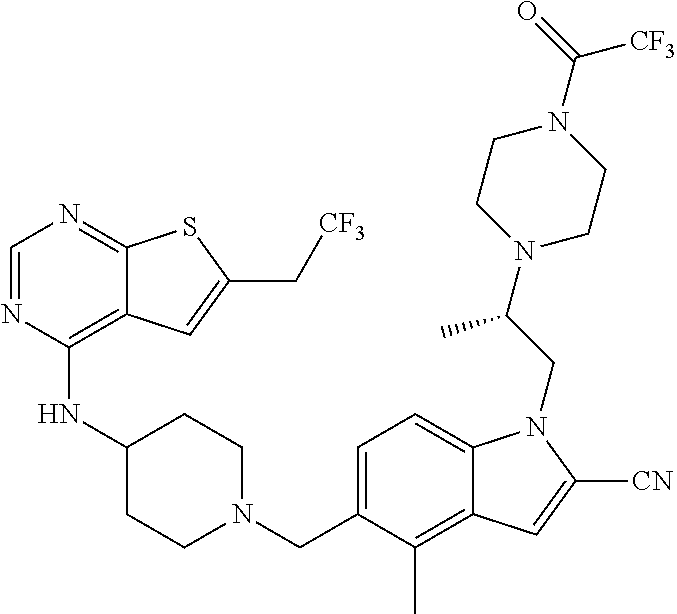 |
706.26 | 707.40 [M + H]+ |
| 119 |
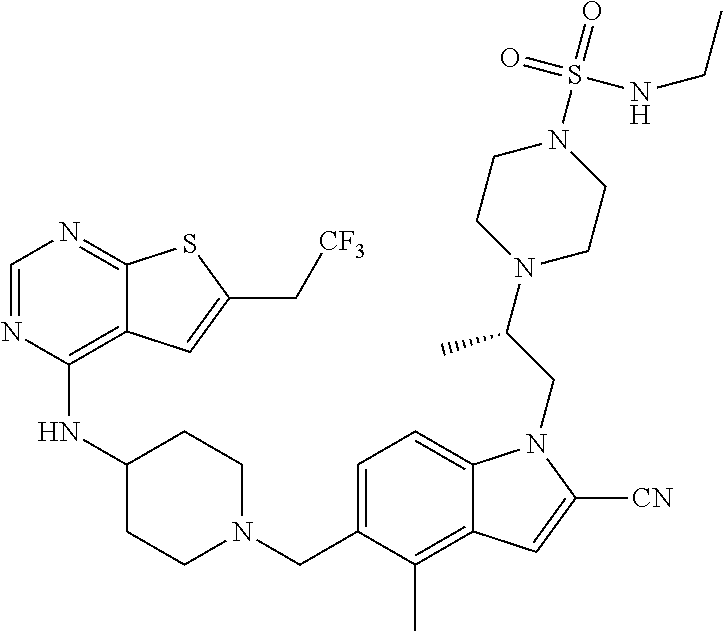 |
717.29 | 718.25 [M + H]+ |
| 120 |
 |
745.32 | 746.30 [M + H]+ |
| 121 |
 |
729.29 | 730.45 [M + H]+ |
| 122 |
 |
720.28 | 721.40 [M + H]+ |
| 123 |
 |
747.30 | 748.45 [M + H]+ |
| 124 |
 |
734.28 | 735.2 [M + H]+ |
| 125 |
 |
753.27 | 754.45 [M + H]+ |
| 126 |
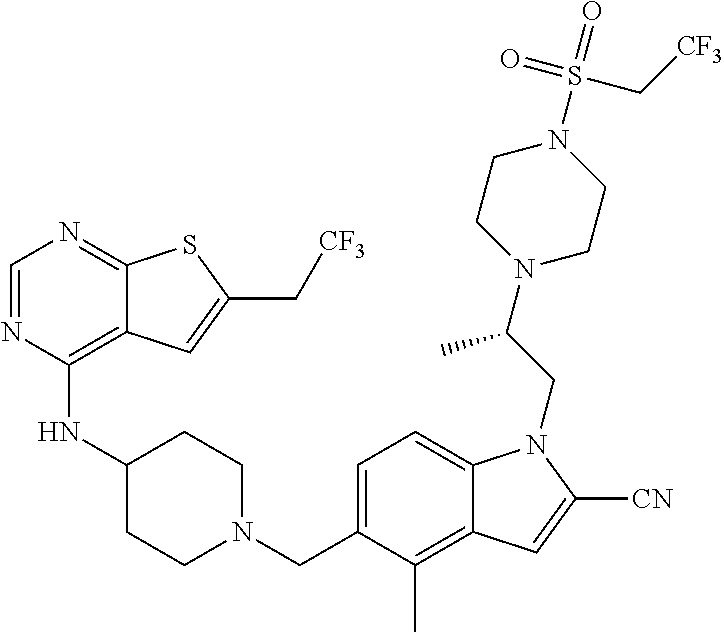 |
756.25 | 757.35 [M + H]+ |
| 127 |
 |
728.29 | 729.45 [M + H]+ |
| 128 |
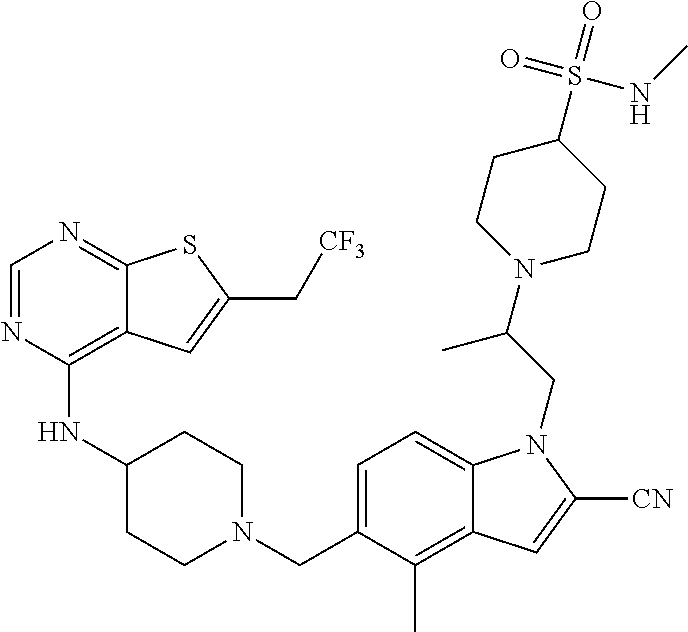 |
702.27 | 703.35 [M + H]+ |
| 129 |
 |
735.28 | 736.40 [M + H]+ |
| 130 |
 |
771.26 | 772.40 [M + H]+ |
| 131 |
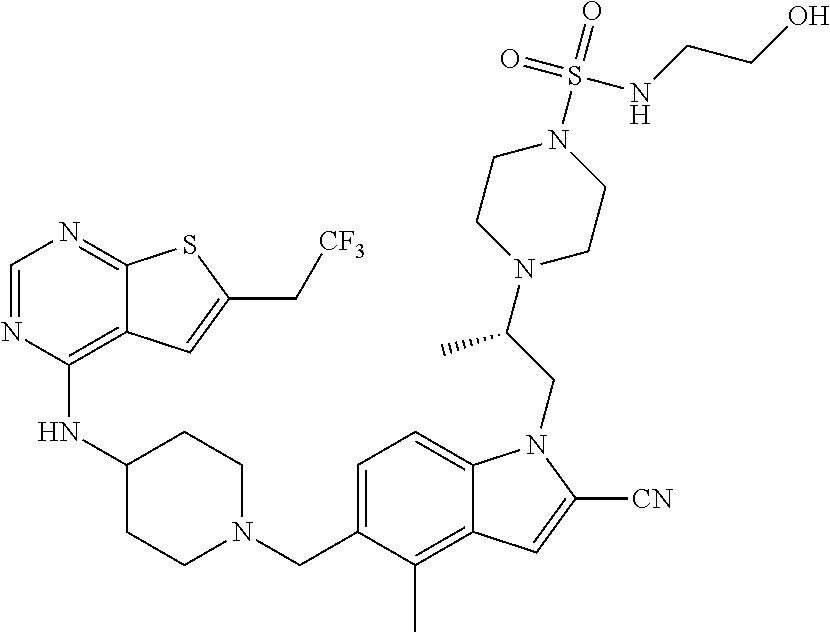 |
733.28 | 734.45 [M + H]+ |
| 132 |
 |
718.28 | 719.45 [M + H]+ |
| 133 |
 |
682.30 | 683.50 [M + H]+ |
| 134 |
 |
653.29 | 654.40 [M + H]+ |
| 135 |
 |
703.27 | 704.40 [M + H]+ |
| 136 |
 |
652.29 | 653.45 [M + H]+ |
| 137 |
 |
720.27 | 721.45 [M + H]+ |
| 138 |
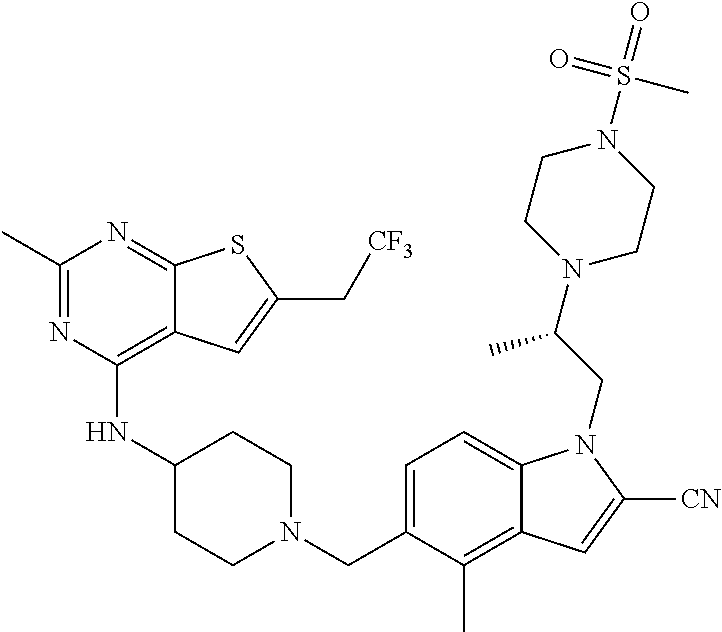 |
702.27 | 703.50 [M + H]+ |
| 139 |
 |
717.29 | 718.50 [M + H]+ |
| 140 |
 |
715.27 | 716.40 [M + H]+ |
| 141 |
 |
731.30 | 732.45 [M + H]+ |
| 142 |
 |
745.32 | 746.40 [M + H]+ |
| 143 |
 |
679.30 | 680.50 [M + H]+ |
| 144 |
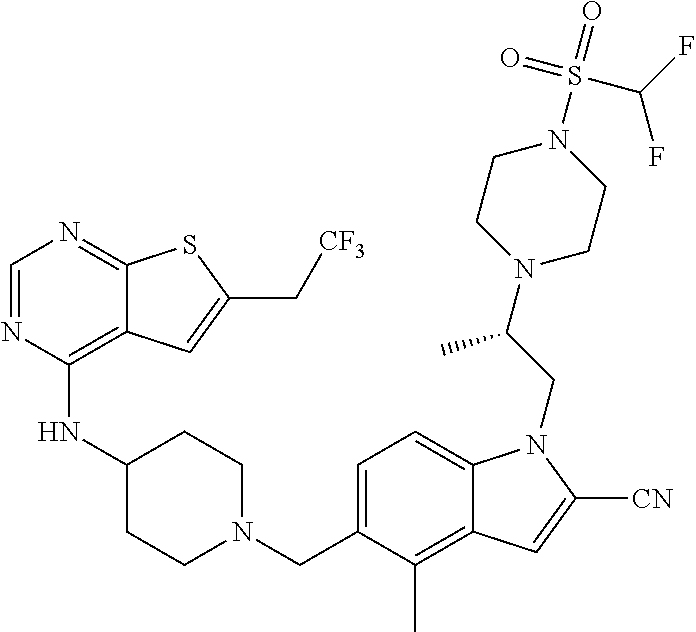 |
724.24 | 725.40 [M + H]+ |
| 145 |
 |
720.27 | 721.45 [M + H]+ |
| 146 |
 |
728.29 | 729.45 [M + H]+ |
| 147 |
 |
729.29 | 730.40 [M + H]+ |
| 148 |
 |
610.28 | 611.3 [M + H]+ |
| 149 |
 |
721.26 | 722.45 [M + H]+ |
| 150 |
 |
686.29 | 687.3 [M + H]+ |
| 151 |
 |
717.29 | 718.55 [M + H]+ |
| 152 |
 |
734.28 | 735.40 [M + H]+ |
| 153 |
 |
696.31 | |
| 154 |
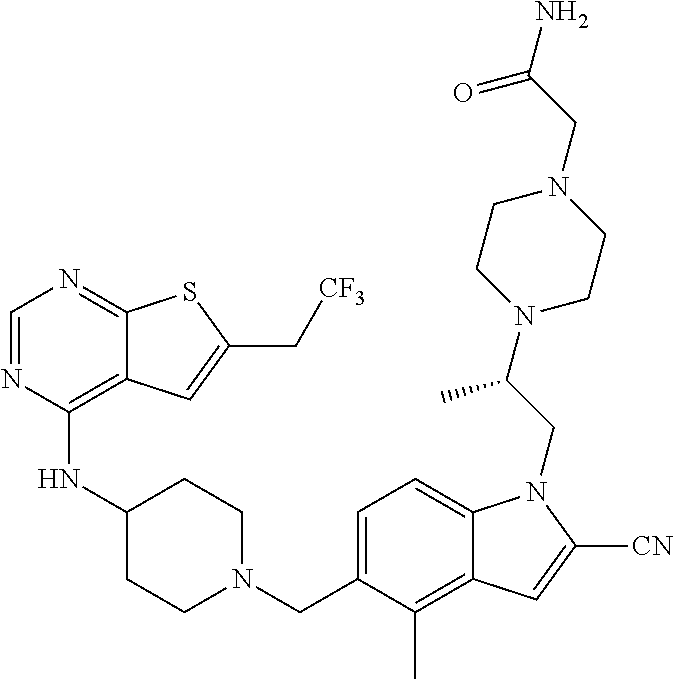 |
667.30 | 668.35 [M + H]+ |
| 155 |
 |
702.28 | 703.35 [M + H]+ |
| 156 |
 |
681.32 | 682.45 [M + H]+ |
| 157 |
 |
700.30 | 701.40 [M + H]+ |
| 158 |
 |
702.27 | 703.40 [M + H]+ |
| 159 |
 |
640.26 | 641.40 [M + H]+ |
| 160 |
 |
690.24 | 691.35 [M + H]+ |
| 161 |
 |
696.31 | 697.3 [M + H]+ |
| 162 |
 |
659.23 | 660.2 [M + H]+ |
| 163 |
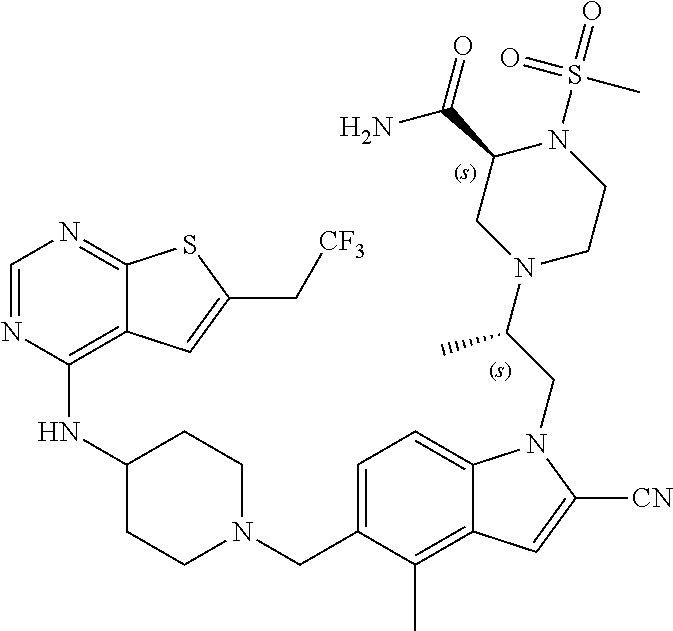 |
731.26 | 732.40 [M + H]+ |
| 164 |
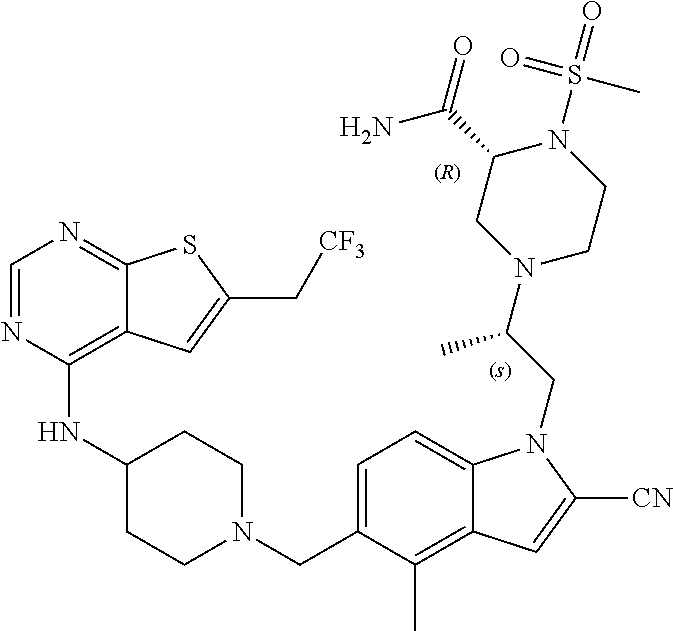 |
731.26 | 732.35 [M + H]+ |
| 165 |
 |
701.28 | 702.40 [M + H]+ |
| 166 |
 |
667.34 | 668.45 [M + H]+ |
| 167 |
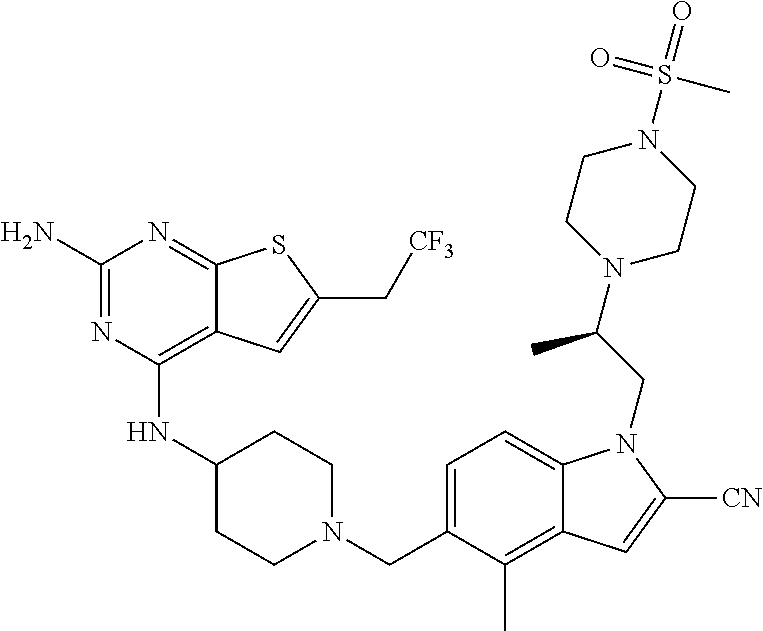 |
703.27 | 704.40 [M + H]+ |
| 168 |
 |
660.28 | 661.40 [M + H]+ |
| 169 |
 |
674.24 | |
| 170 |
 |
731.30 | 732.40 [M + H]+ |
| 171 |
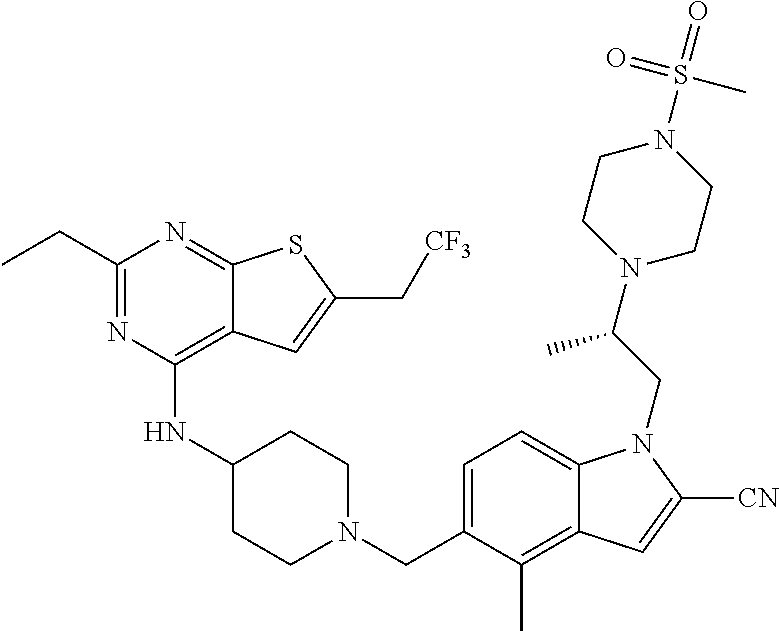 |
716.29 | 717.45 [M + H]+ |
| 172 |
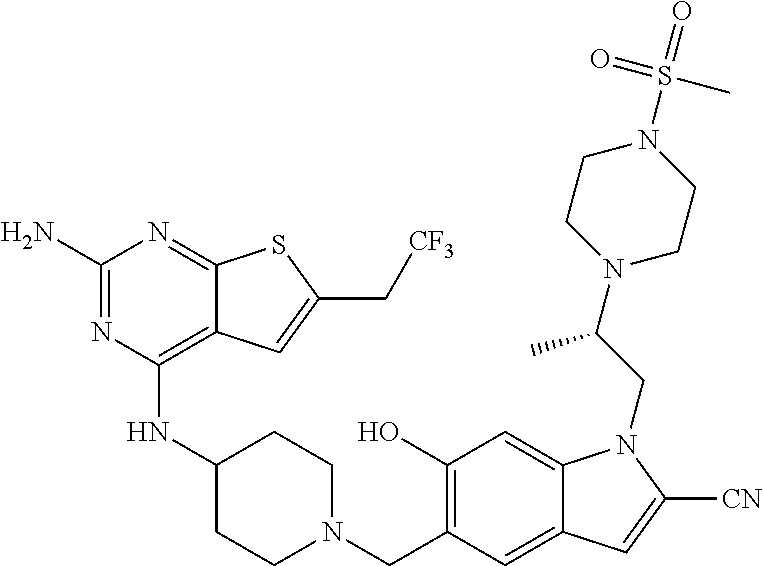 |
705.25 | 706.45 [M + H]+ |
| 173 |
 |
728.29 | 729.45 [M + H]+ |
| 174 |
 |
731.30 | 732.45 [M + H]+ |
| 175 |
 |
682.31 | 683.45 [M + H]+ |
| 176 |
 |
696.33 | 697.60 [M + H]+ |
| 177 |
 |
720.26 | 721.50 [M + H]+ |
| 178 |
 |
681.32 | 682.45 [M + H]+ |
| 179 |
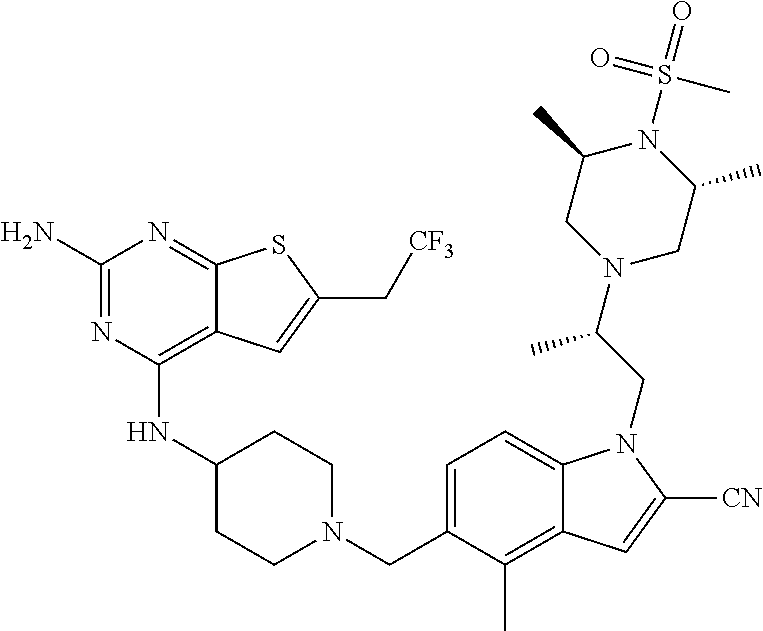 |
731.30 | 732.50 [M + H]+ |
| 180 |
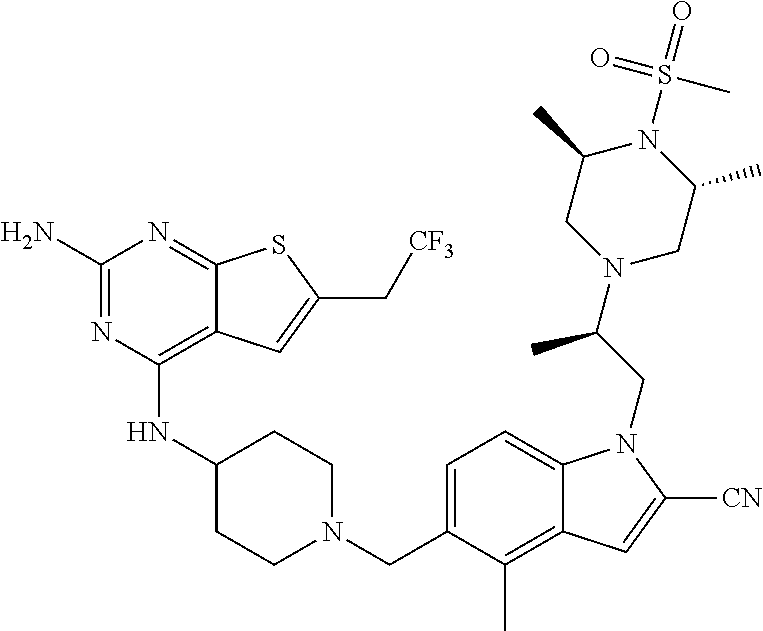 |
731.30 | 732.50 [M + H]+ |
| 181 |
 |
710.35 | 711.50 [M + H]+ |
| 182 |
 |
696.33 | 697.60 [M + H]+ |
| 183 |
 |
718.27 | 719.45 [M + H]+ |
| 184 |
 |
717.29 | 718.45 [M + H]+ |
| 185 |
 |
731.30 | 732.45 [M + H]+ |
| 186 |
 |
716.29 | 717.45 [M + H]+ |
| 187 |
 |
733.28 | 734.45 [M + H]+ |
| 188 |
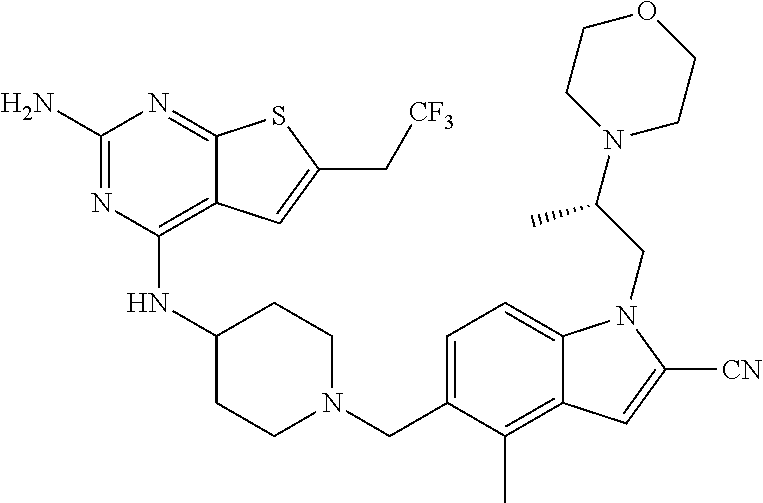 |
626.28 | 627.40 [M + H]+ |
| 189 |
 |
710.35 | 711.45 [M + H]+ |
| 190 |
 |
665.32 | 666.45 [M + H]+ |
| 191 |
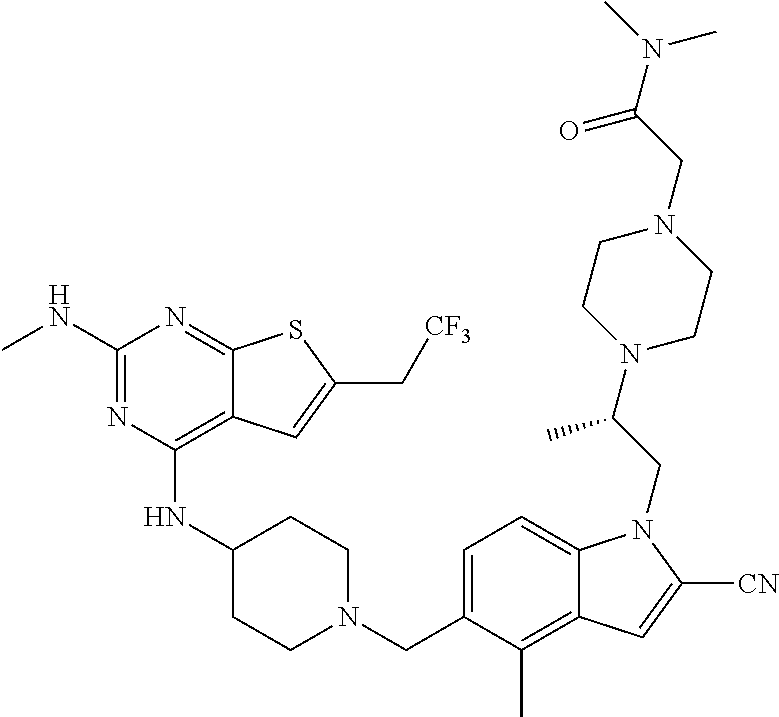 |
724.36 | 725.45 [M + H]+ |
| 192 |
 |
732.30 | 733.45 [M + H]+ |
| 193 |
 |
716.29 | 717.45 [M + H]+ |
| 194 |
 |
719.26 | 720.55 [M + H]+ |
| 195 |
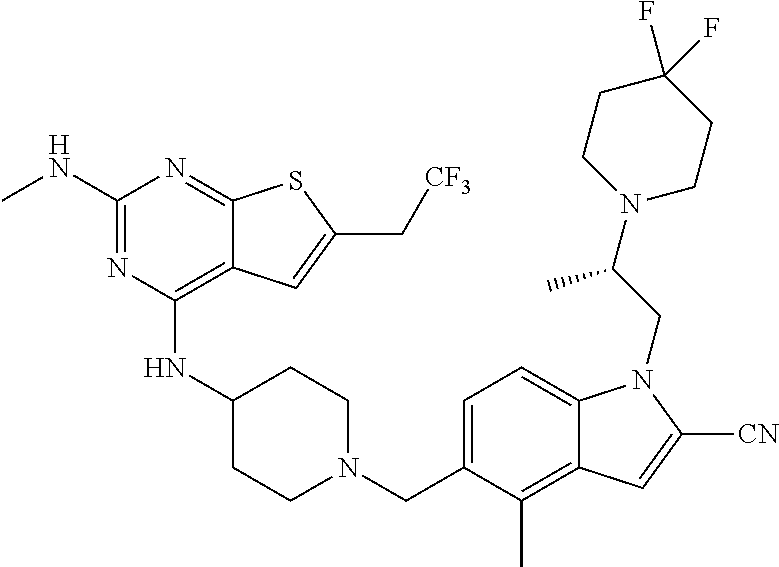 |
674.29 | 675.50 [M + H]+ |
| 196 |
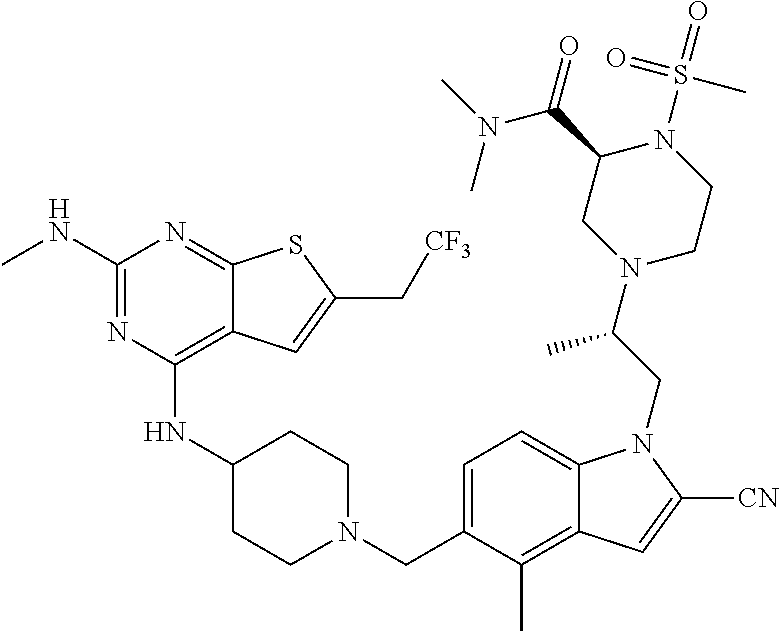 |
788.32 | 789.45 [M + H]+ |
| 197 |
 |
774.31 | 775.3 [M + H]+ |
| 198 |
 |
735.28 | 736.45 [M + H]+ |
| 199 |
 |
677.32 | 678.55 [M + H]+ |
| 200 |
 |
760.28 | 761.40 [M + H]+ |
| 201 |
 |
702.27 | 703.45 [M + H]+ |
| 202 |
 |
723.37 | 724.55 [M + H]+ |
| 203 |
 |
688.26 | 689.40 [M + H]+ |
| 204 |
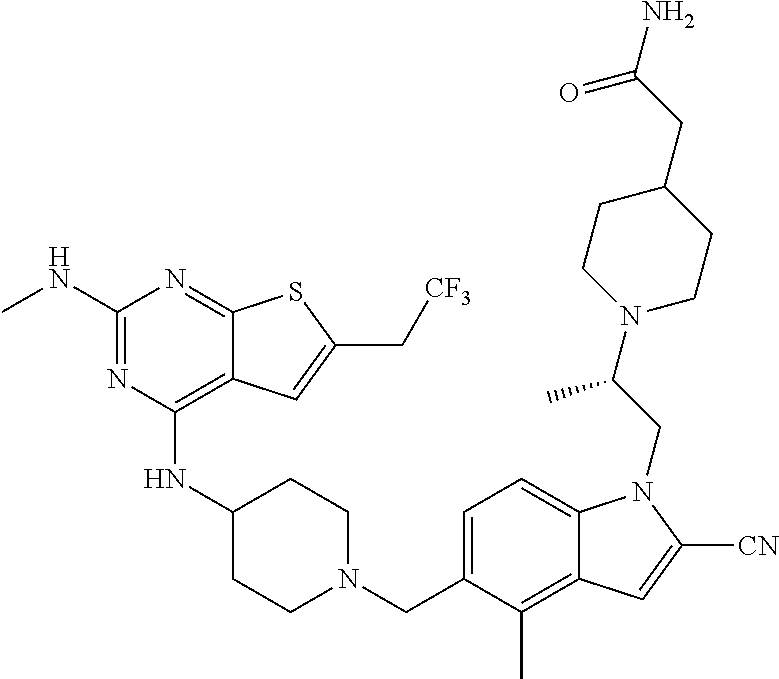 |
695.33 | 696.60 [M + H]+ |
| 205 |
 |
733.28 | 734.55 [M + H]+ |
| 206 |
 |
709.35 | 710.55 [M + H]+ |
| 207 |
 |
668.32 | 669.55 [M + H]+ |
| 208 |
 |
717.29 | 718.40 [M + H]+ |
| 209 |
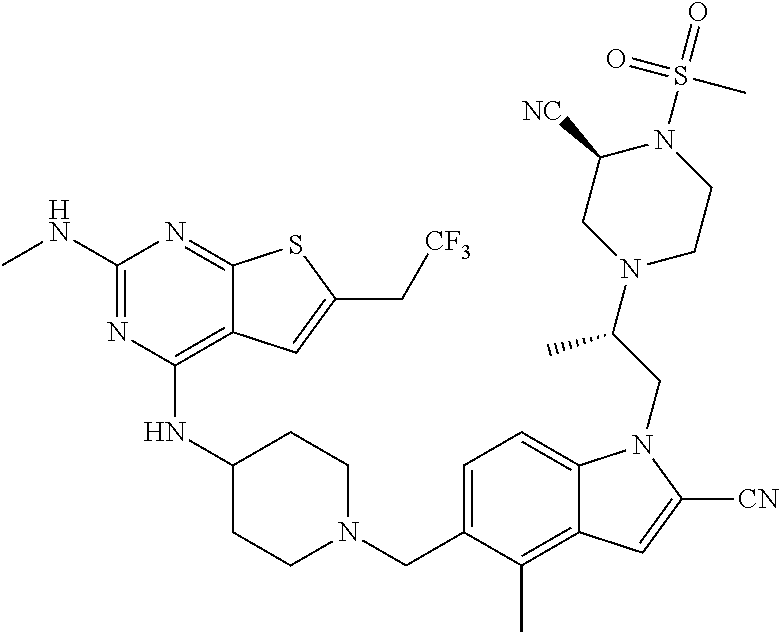 |
742.28 | 743.40 [M + H]+ |
| 210 |
 |
731.30 | 732.40 [M + H]+ |
| 211 |
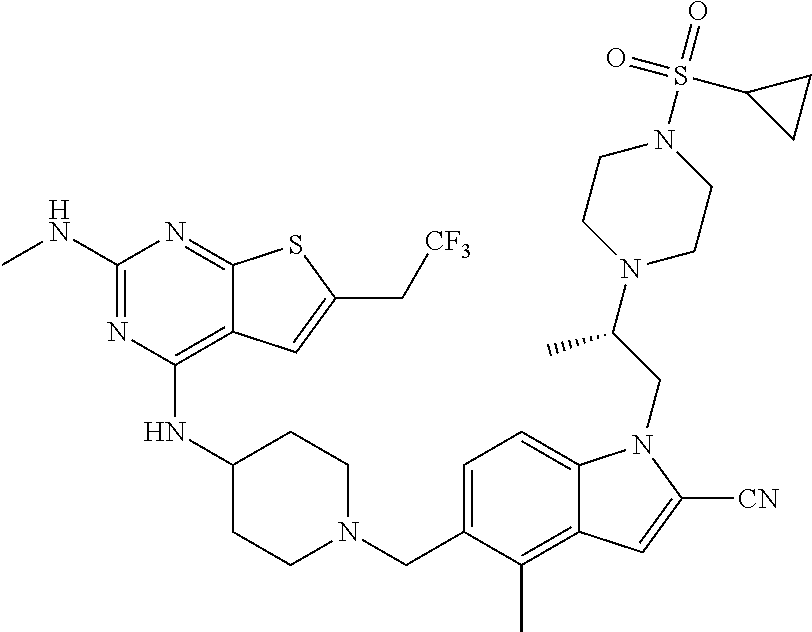 |
743.30 | 744.40 [M + H]+ |
| 212 |
 |
707.33 | 708.45 [M + H]+ |
| 213 |
 |
709.35 | 710.50 [M + H]+ |
| 214 |
 |
732.29 | 733.40 [M + H]+ |
| 215 |
 |
711.33 | 712.45 [M + H]+ |
| 216 |
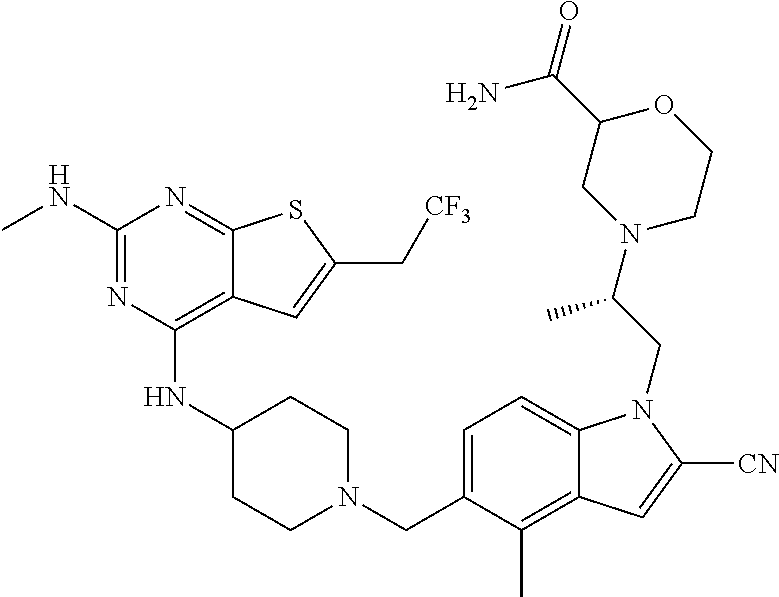 |
683.30 | 684.45 [M + H]+ |
| 217 |
 |
697.31 | 698.3 [M + H]+ |
| 218 |
 |
||
| 219 |
 |
673.25 | 674.2 [M + H]+ |
| 220 |
 |
694.34 | 695.50 [M + H]+ |
| 221 |
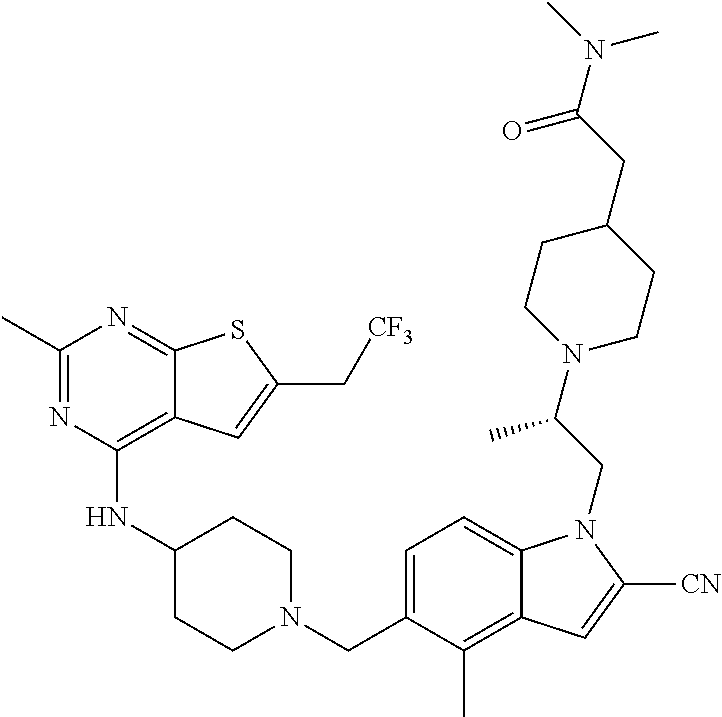 |
708.35 | 709.50 [M + H]+ |
| 222 |
 |
706.25 | 707.2561 |
| 225 |
 |
||
| 226 |
 |
||
| 228 |
 |
||
| 229 |
 |
648.26 | |
| 230 |
 |
621.26 | 622.2 [M + H]+ |
| 231 |
 |
||
| 232 |
 |
||
| 233 |
 |
||
| 234 |
 |
||
| 235 |
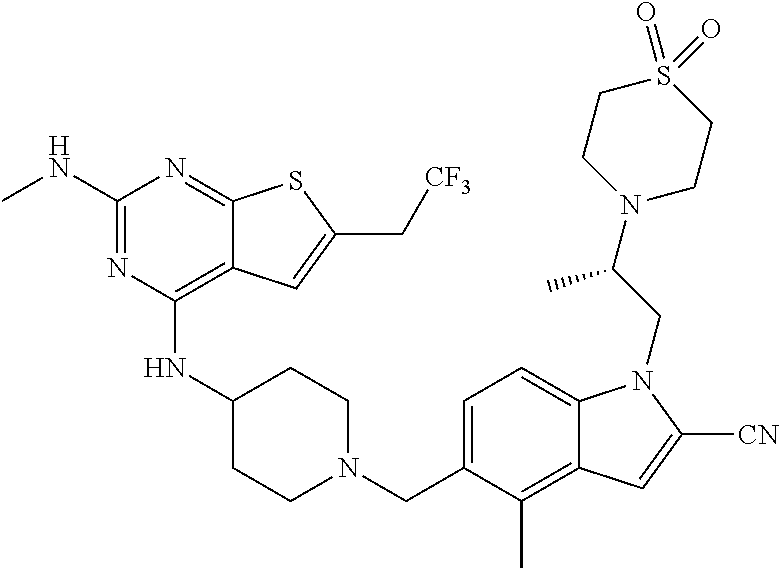 |
688.26 | 689.40 [M + H]+ |
| 236 |
 |
||
| 237 |
 |
||
| 238 |
 |
||
| 239 |
 |
717.27 | 718.45 [M + H]+ |
| 240 |
 |
793.32 | 794.3244 |
| 241 |
 |
720.27 | 721.35 |
| 242 |
 |
716.29 | 717.3 [M + H]+ |
| 243 |
 |
667.30 | 668.45 [M + H]+ |
| 244 |
 |
653.29 | 654.45 [M + H]+ |
| 245 |
 |
760.28 | 761.2872 |
| 246 |
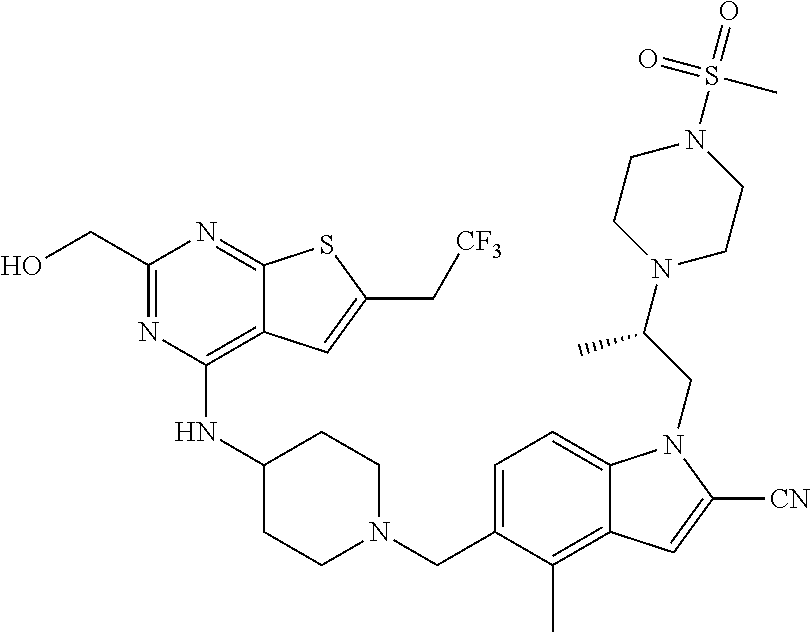 |
718.27 | 719.2776 |
| 247 |
 |
716.29 | 717.56 [M + H]+ |
| 248 |
 |
759.33 | 760.50 [M + H]+ |
| 249 |
 |
731.30 | 732.45 [M + H]+ |
| 250 |
 |
||
| 251 |
 |
745.32 | 746.3 [M + H]+ |
| 252 |
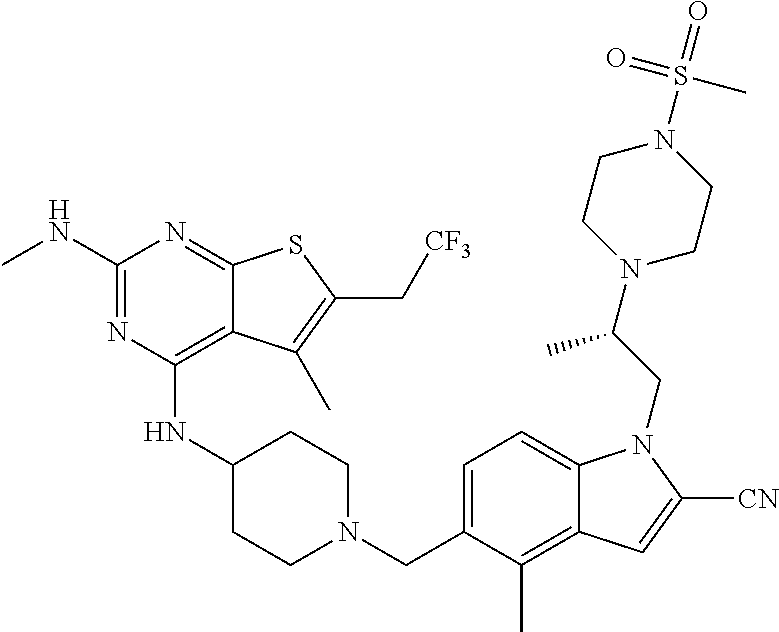 |
731.30 | 732.3 [M + H]+ |
| 253 |
 |
||
| 254 |
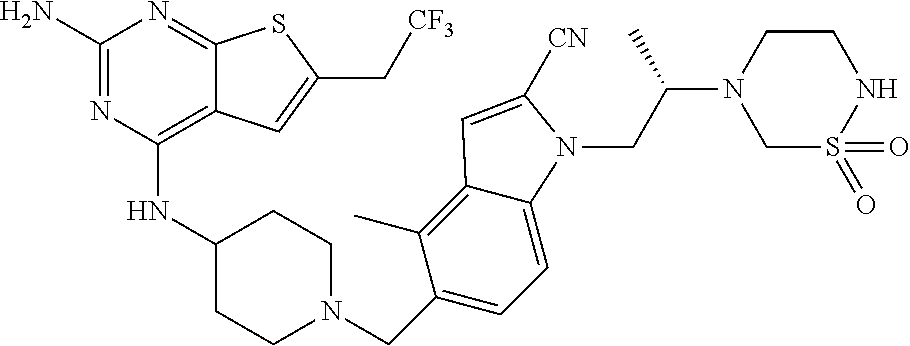 |
||
| 255 |
 |
||
| 256 |
 |
||
| 257 |
 |
||
| 258 |
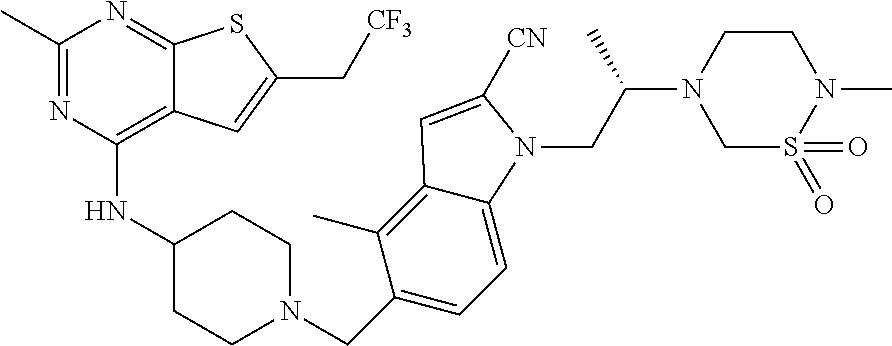 |
||
| 259 |
 |
||
| 260 |
 |
||
| 261 |
 |
||
| 262 |
 |
||
| 263 |
 |
||
| 264 |
 |
||
| 265 |
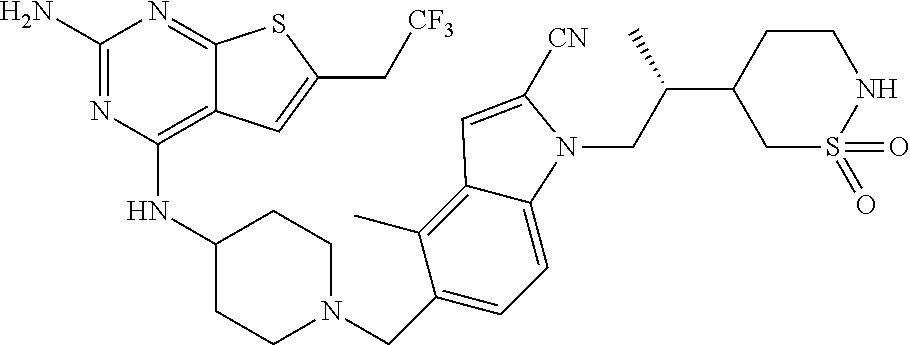 |
||
| 266 |
 |
||
| 267 |
 |
||
| 268 |
 |
||
| 269 |
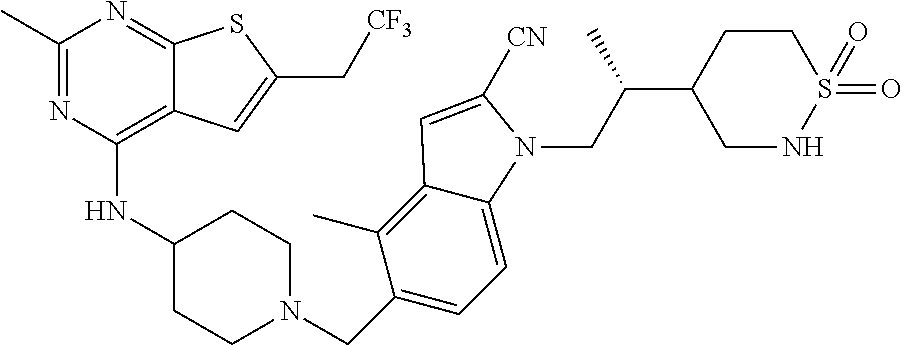 |
||
| 270 |
 |
||
| 271 |
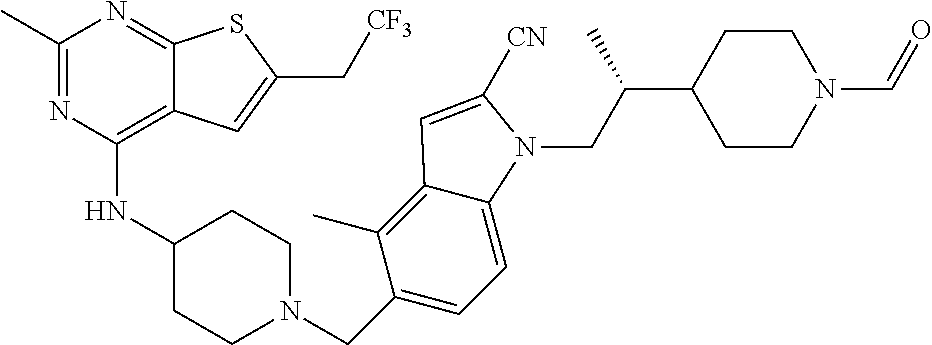 |
||
| 272 |
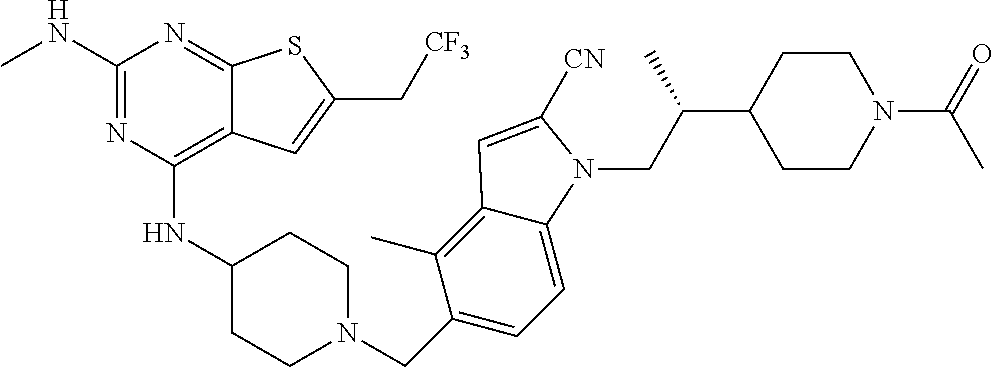 |
||
| 273 |
 |
||
| 274 |
 |
||
| 275 |
 |
||
| 276 |
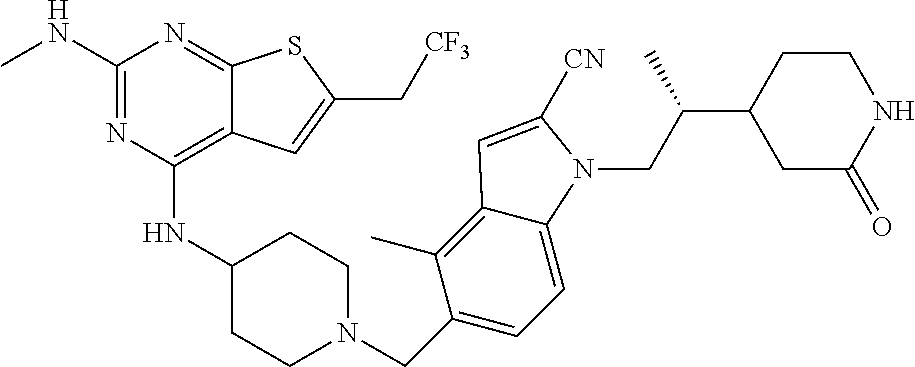 |
||
| 277 |
 |
||
| 278 |
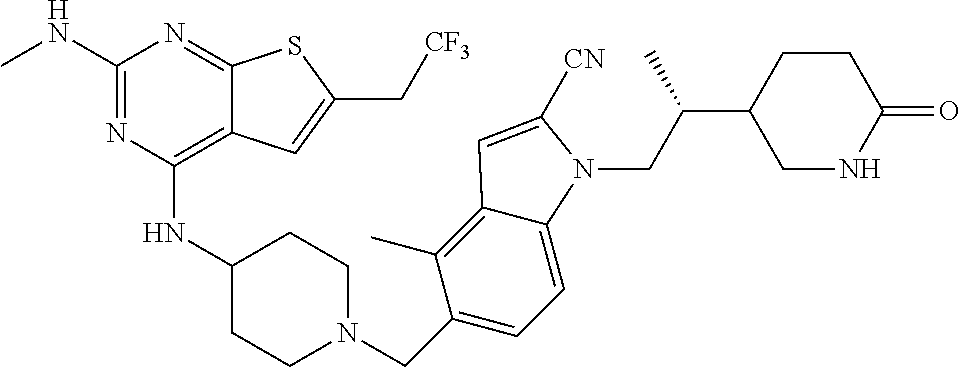 |
||
| 279 |
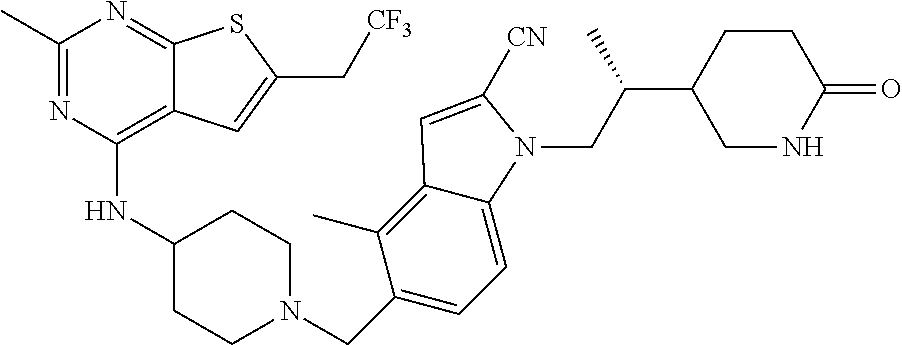 |
||
| 280 |
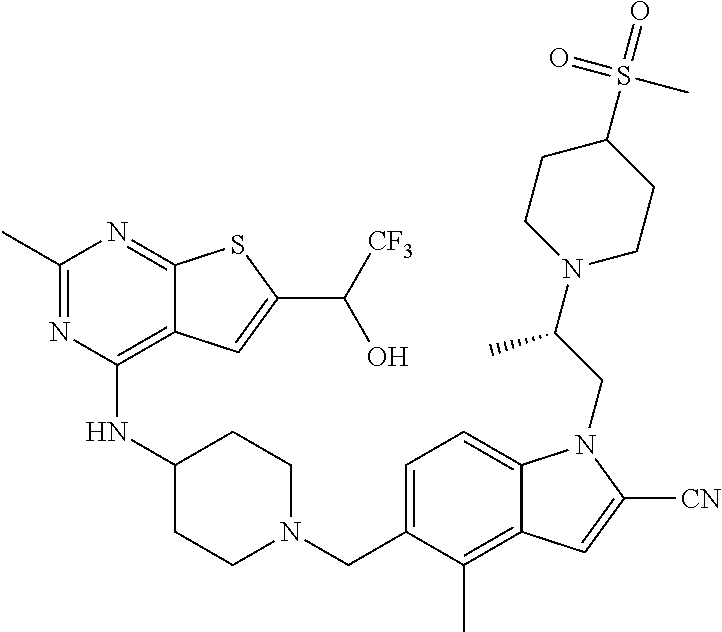 |
717.27 | 718.2 [M + H]+ |
| 281 |
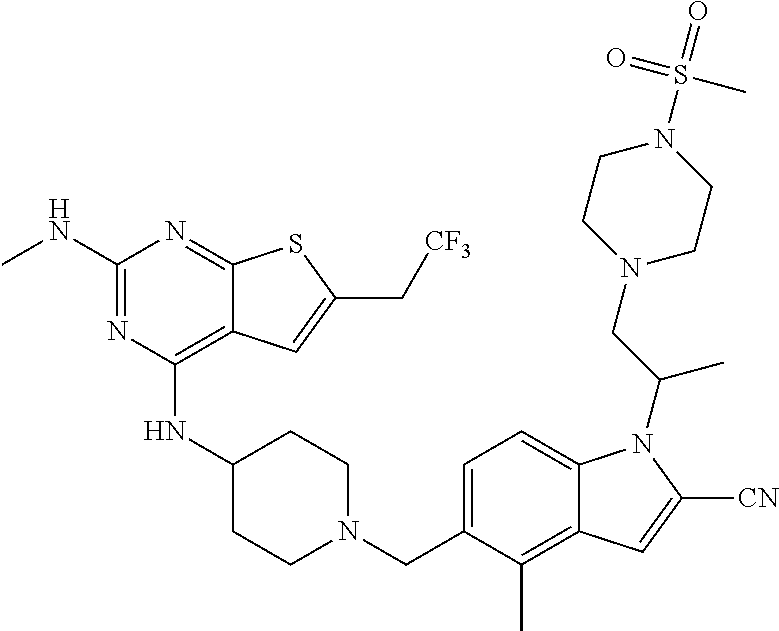 |
635.27 | 636.27 [M + H]+ |
| 282 |
 |
743.30 | 744.31 [M + H]+ |
| 283 |
 |
728.29 | 729.30 [M + H]+ |
| 284 |
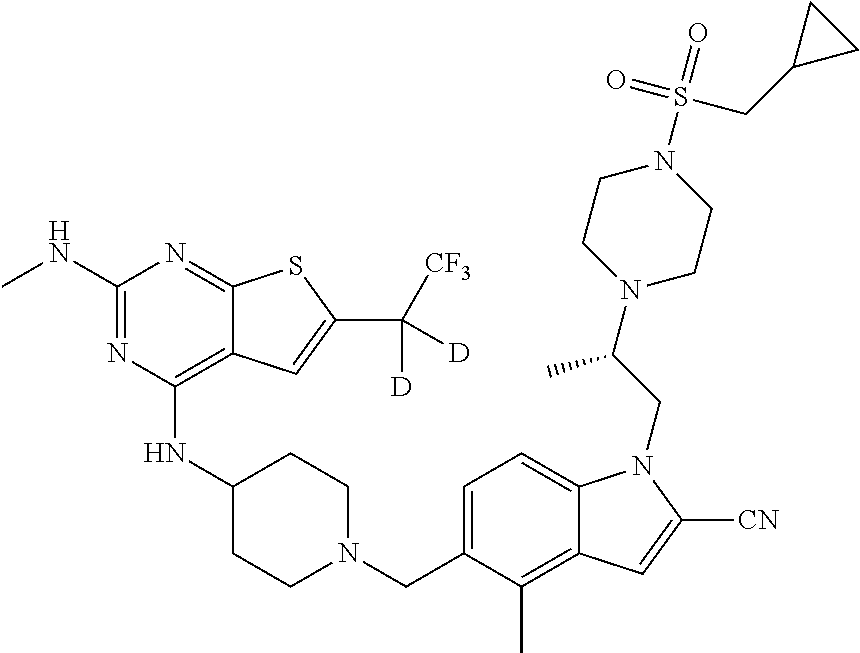 |
||
| 285 |
 |
||
| 286 |
 |
||
| 287 |
 |
||
| 288 |
 |
||
| TABLE 2 | |||
| No. | Structure | MW (calc'd) | m/z (found) |
| 1000 |
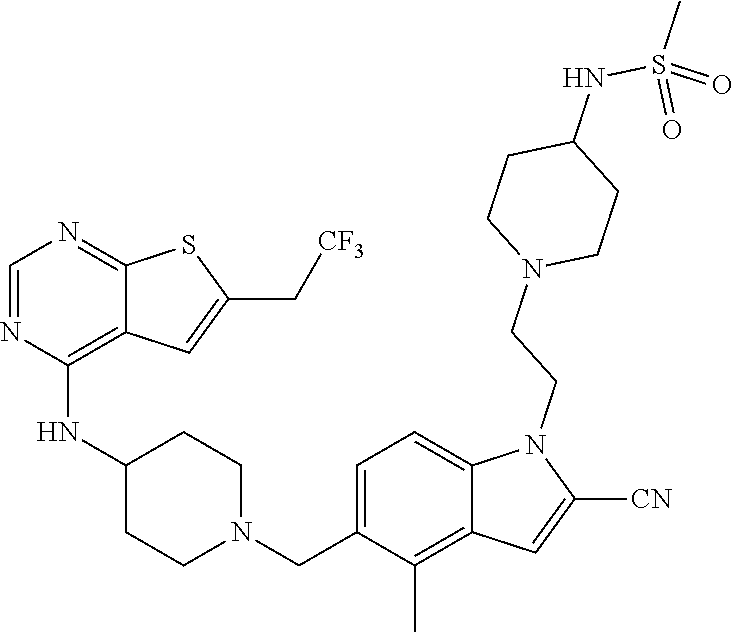 |
||
| 1001 |
 |
||
| 1002 |
 |
||
| 1003 |
 |
||
| 1004 |
 |
||
| 1005 |
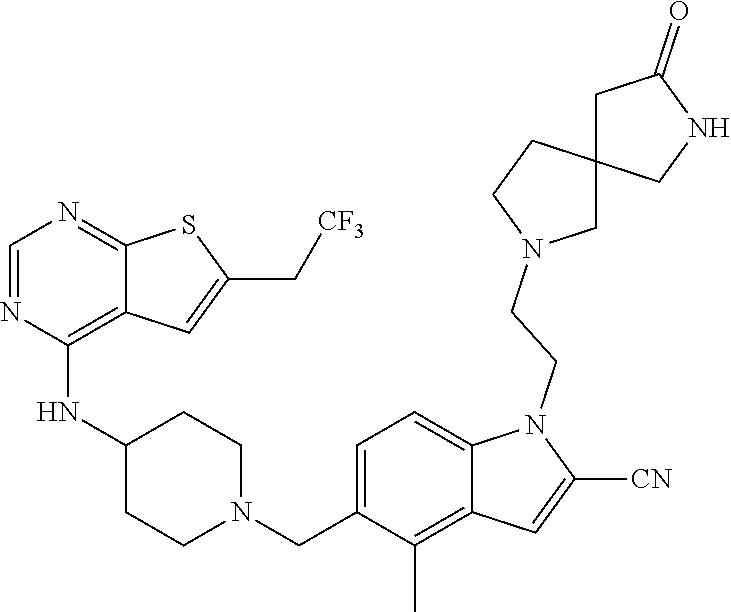 |
||
| 1006 |
 |
||
| 1007 |
 |
||
| 1008 |
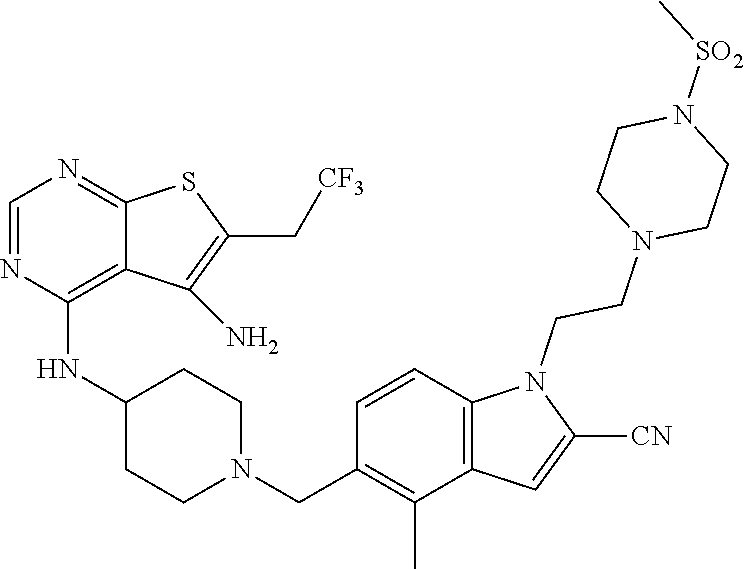 |
||
| 1009 |
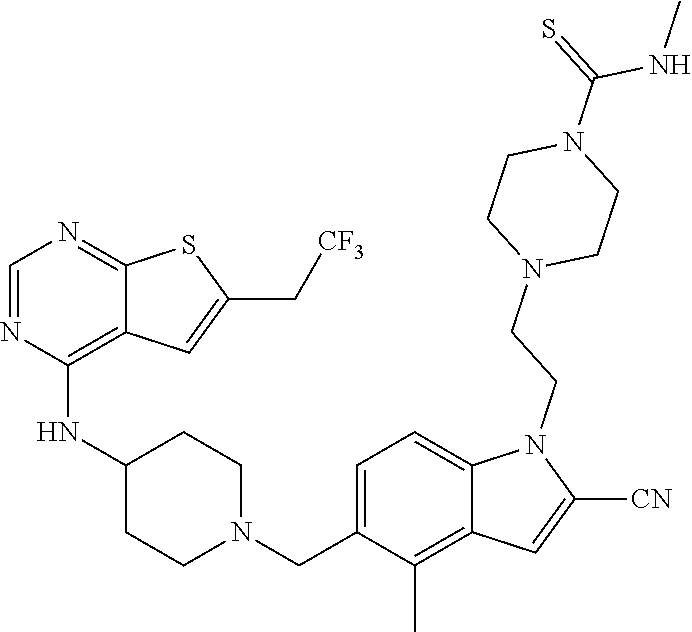 |
||
| 1010 |
 |
||
| 1011 |
 |
||
| 1012 |
 |
||
| 1013 |
 |
||
| 1014 |
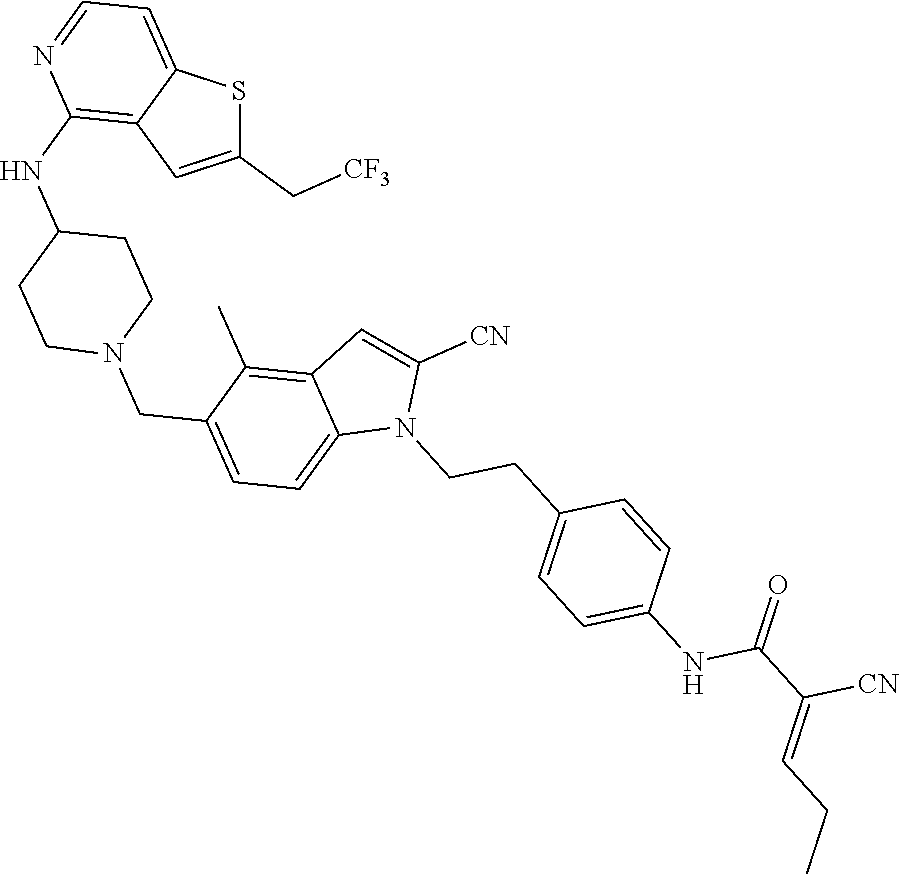 |
||
| 1015 |
 |
||
| 1016 |
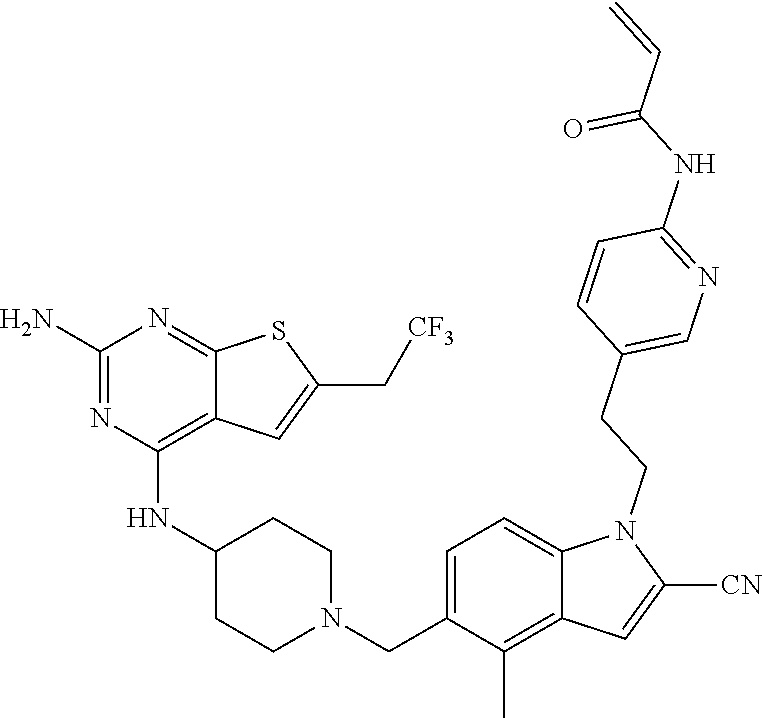 |
673.26 | 337.6 [M + 2H]2+ |
| 1017 |
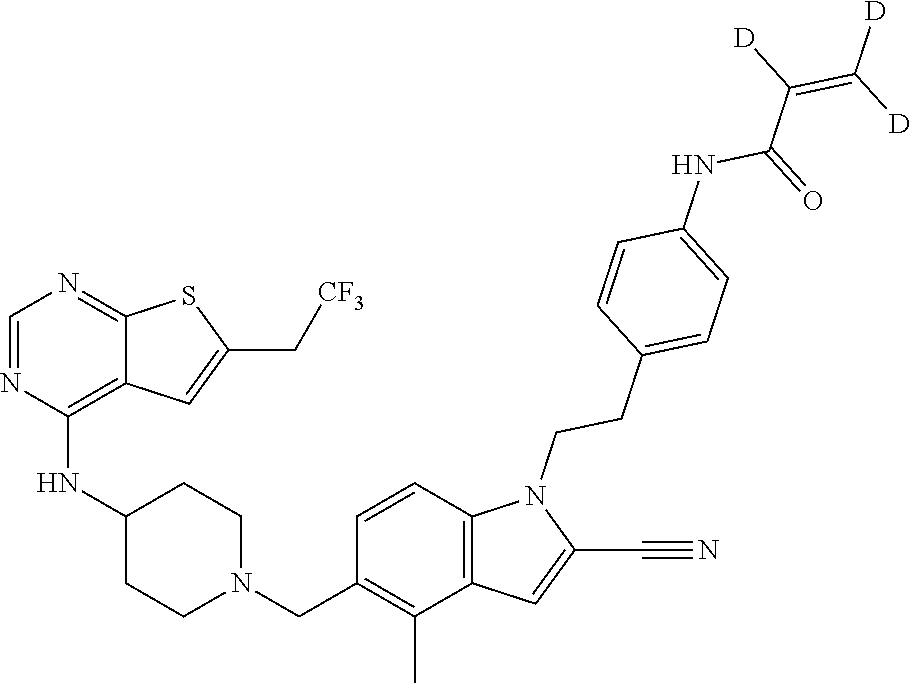 |
||
| 1018 |
 |
||
| 1019 |
 |
||
| 1020 |
 |
||
| 1021 |
 |
||
| 1022 |
 |
||
| 1023 |
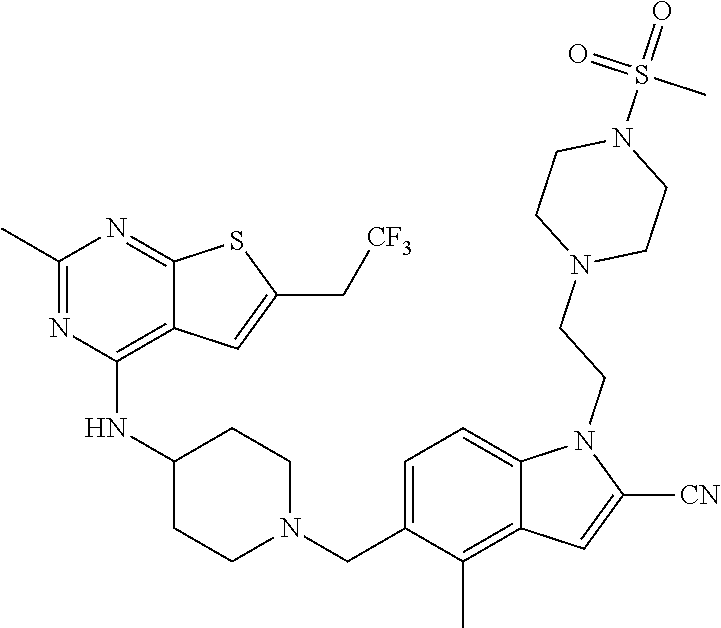 |
||
| 1024 |
 |
||
| 1025 |
 |
||
| 1026 |
 |
||
| 1027 |
 |
||


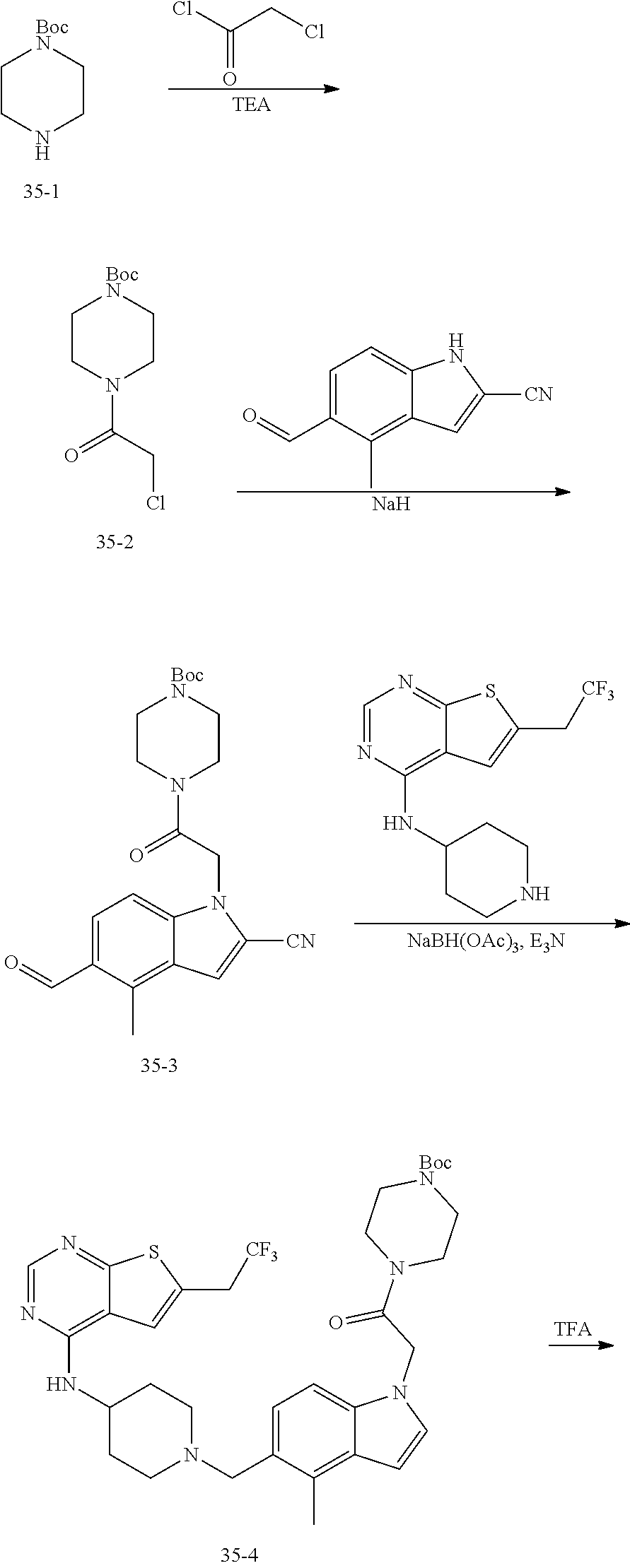

| TABLE 3 | ||||
| Less than | 50 nM to less than | 20 nM to | Greater than | |
| 50 nM (++++) | 250 nM (+++) | 1000 nM (++) | 1000 nM (+) | |
| Menin | 6, 8, 10, 12, 13, 14, | 2, 4, 5, 7, 11, 17, | 1, 3, 24, 26, 44, 45, | 9, 15, 16, 23, 35, |
| MLL 4-43 | 18, 20, 22, 27, 28, | 19, 21, 25, 29, 30, | 52, 53, 55, 56, 57, | 47, 60, 62, 71, 170, |
| IC50 (nM) | 64, 65, 73, 80, 85, | 43, 46, 48, 49, 54, | 58, 59, 66, 67, 82, | 200, 242, 252, |
| 88, 89, 90, 92, 93, | 61, 68, 69, 70, 72, | 118, 157, 169, 173, | 1010, 1012 | |
| 115, 119, 123, 129, | 74, 84, 87, 91, 94, | 201, 1000, 1001, | ||
| 131, 132, 134, 135, | 116, 117, 120, 121, | 1011 | ||
| 136, 138, 139, 141, | 122, 124, 125, 126, | |||
| 147, 148, 149, 151, | 127, 128, 130, 133, | |||
| 154, 158, 163, 165, | 137, 140, 142, 143, | |||
| 166, 172, 175, 176, | 144, 145, 146, 150, | |||
| 177, 178, 181, 182, | 152, 153, 155, 156, | |||
| 183, 184, 186, 187, | 159, 160, 161, 162, | |||
| 189, 191, 192, 193, | 164, 167, 168, 171, | |||
| 194, 196, 197, 202, | 174, 179, 180, 185, | |||
| 203, 204, 205, 206, | 188, 190, 195, 198, | |||
| 207, 209, 210, 212, | 199, 208, 211, 230, | |||
| 213, 214, 215, 216, | 241, 245, 280, | |||
| 217, 219, 220, 221, | 1002, 1003, 1013, | |||
| 222, 225, 226, 229, | 1023 | |||
| 233, 239, 243, 244, | ||||
| 246, 247, 248, 249, | ||||
| 250, 251, 281, 282, | ||||
| 283, 1020, 1021, | ||||
| 1022, 1024, 1025, | ||||
| 1026, 1027 | ||||
| TABLE 4 | ||||
| Less than | 10 nM to | 50 nM | 250 |
|
| 10 nM | less than | to 250 | to 1000 | |
| (++++) | 50 nM (+++) | nM (++) | nM (+) | |
| MLL- |
132, 135, 151, 163, | 10, 80, 138, 139, | 9 | |
| BMC GI50 | 165, 172, 177, 183, | 171, 174, 175, | ||
| (nM) | 199, 203, 205, 207, | 176, 181, 217 | ||
| 214 | ||||
Claims (27)


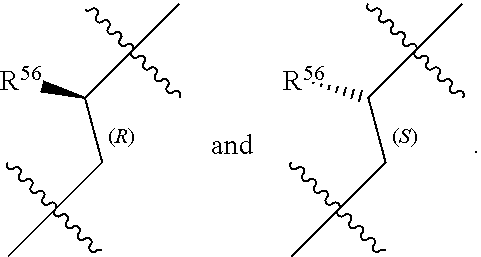


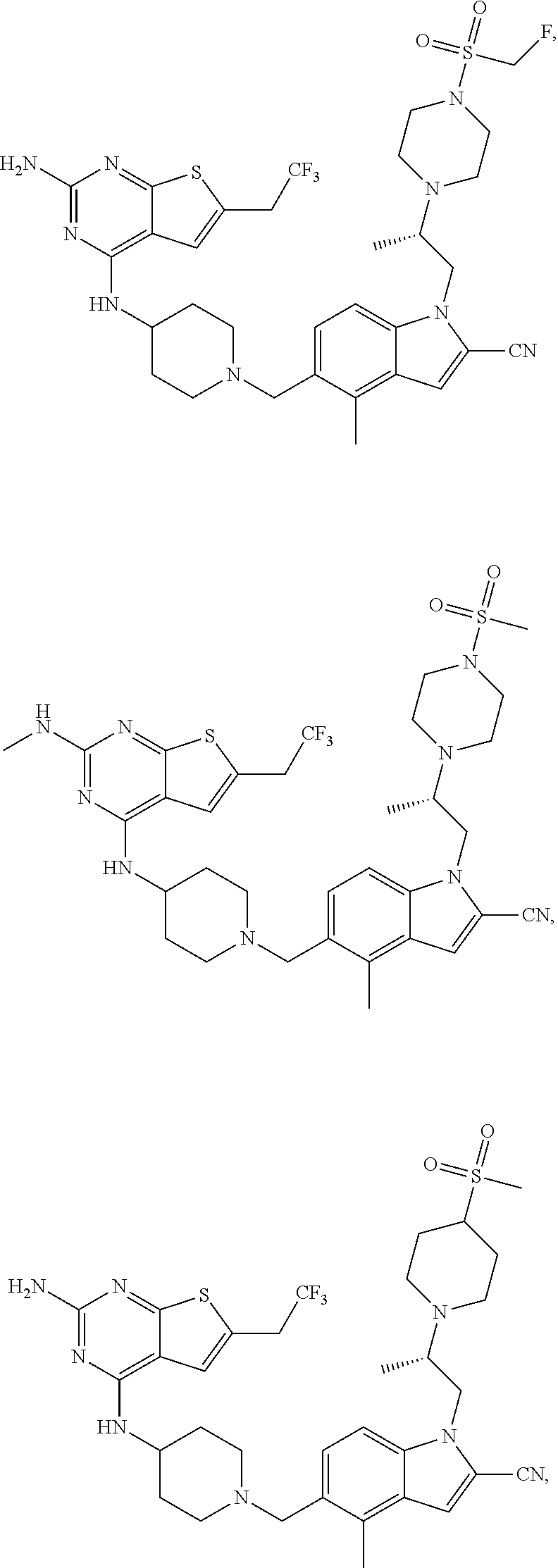


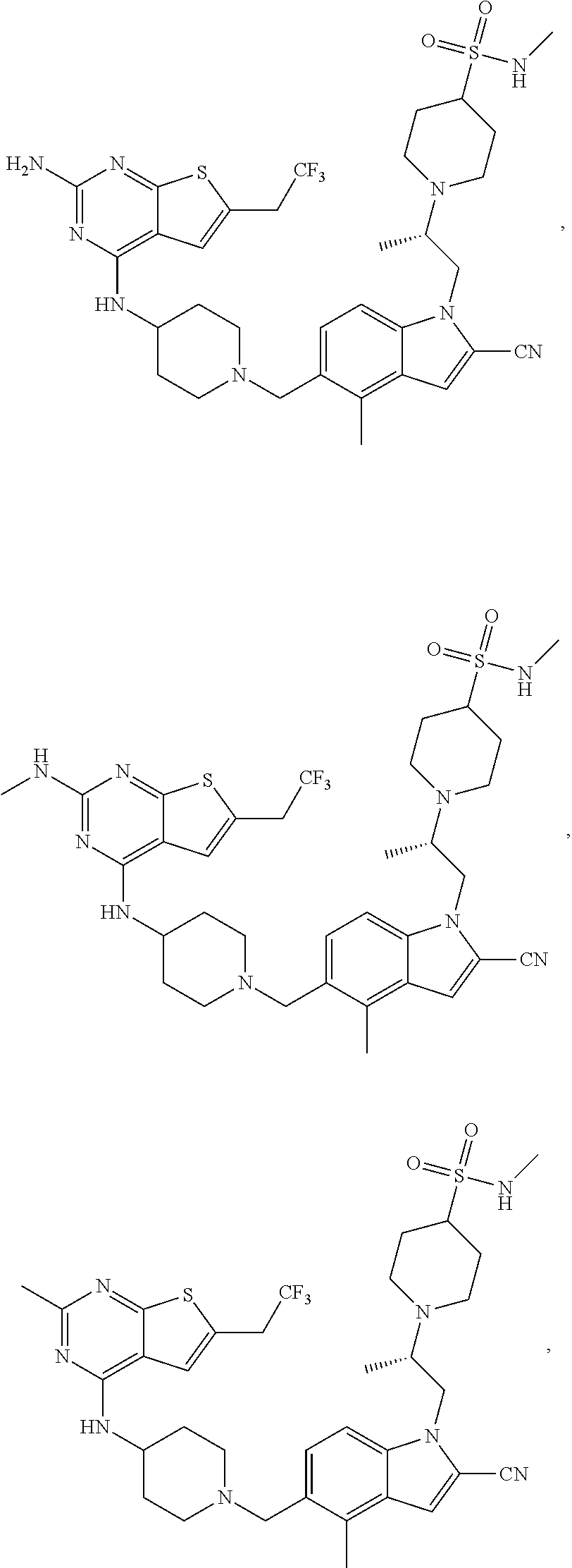
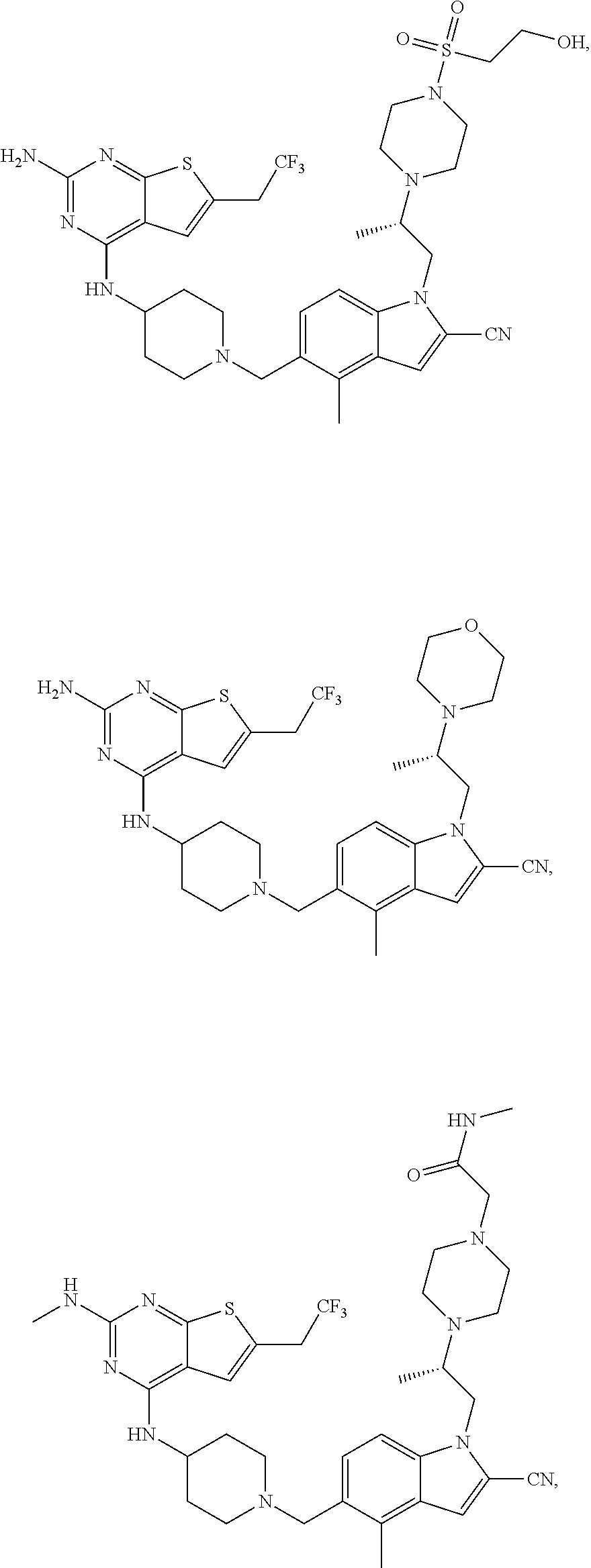

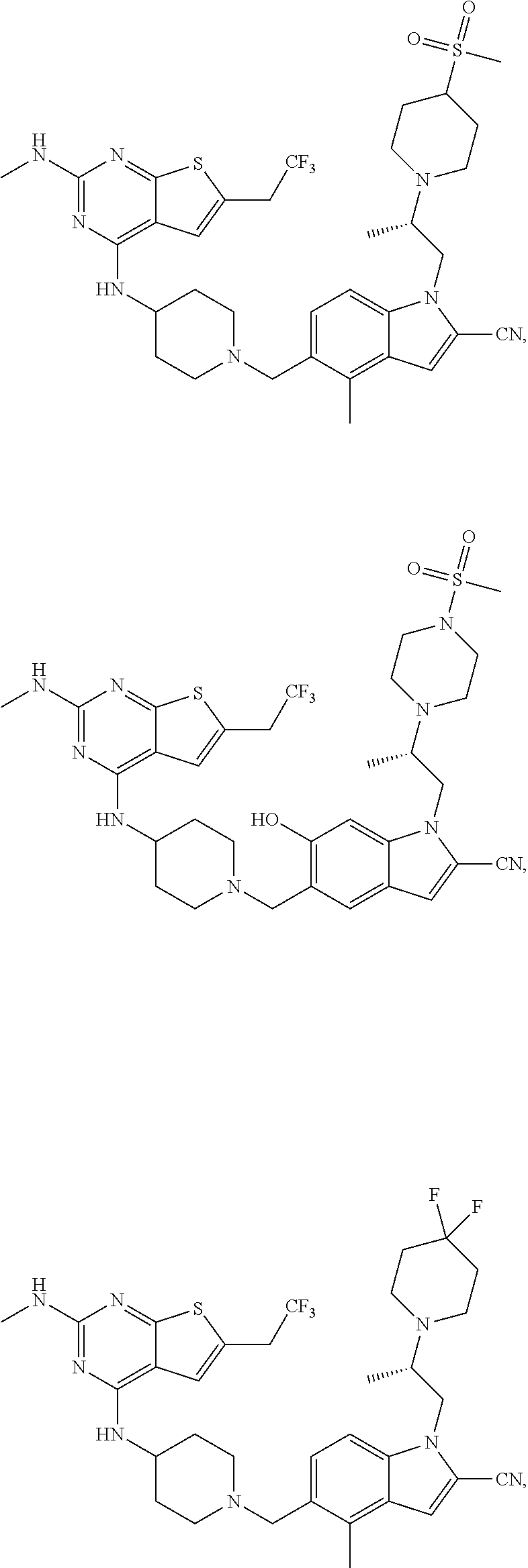


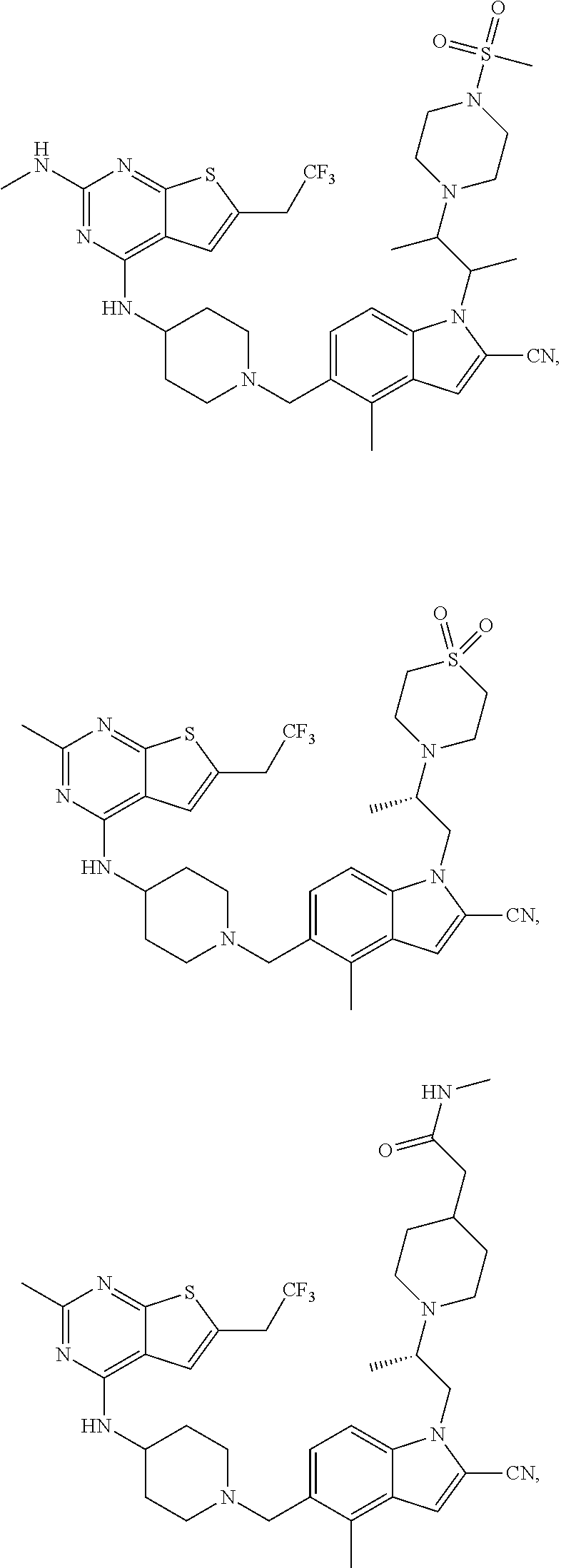
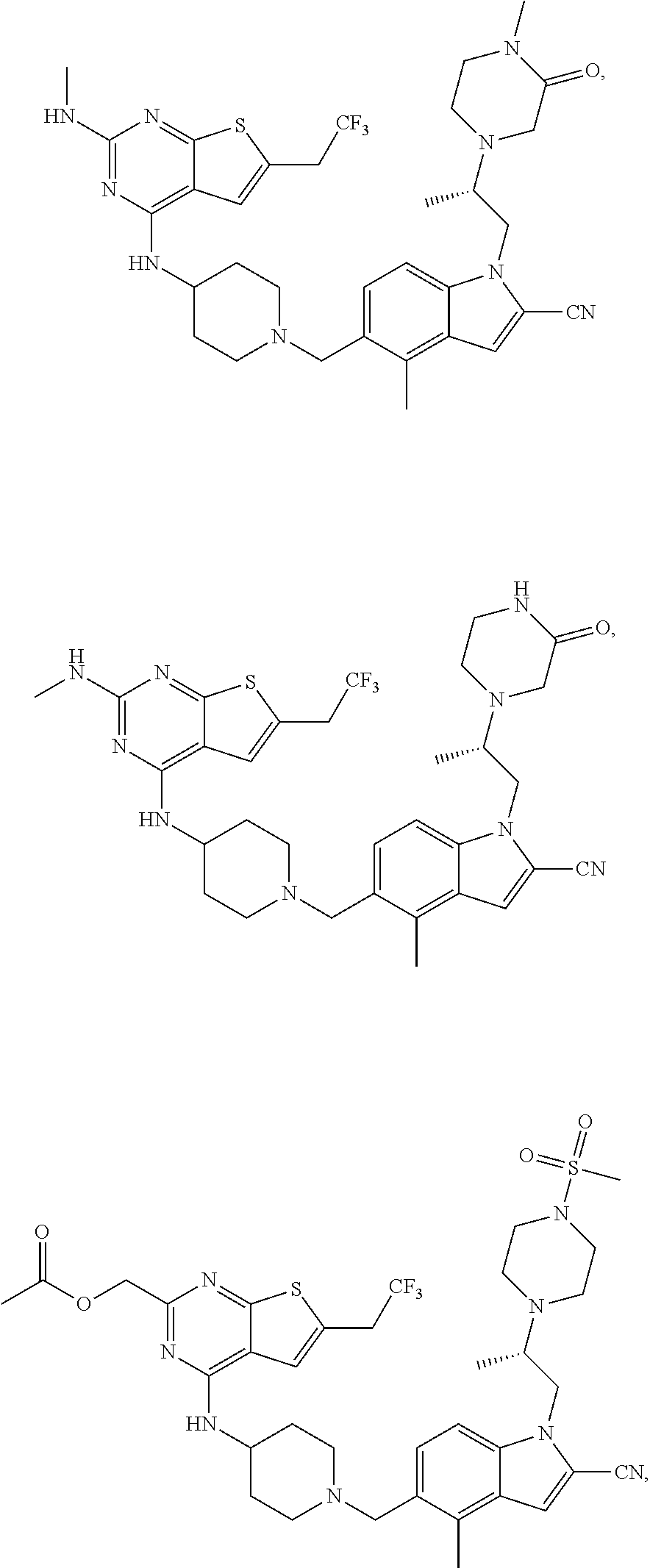

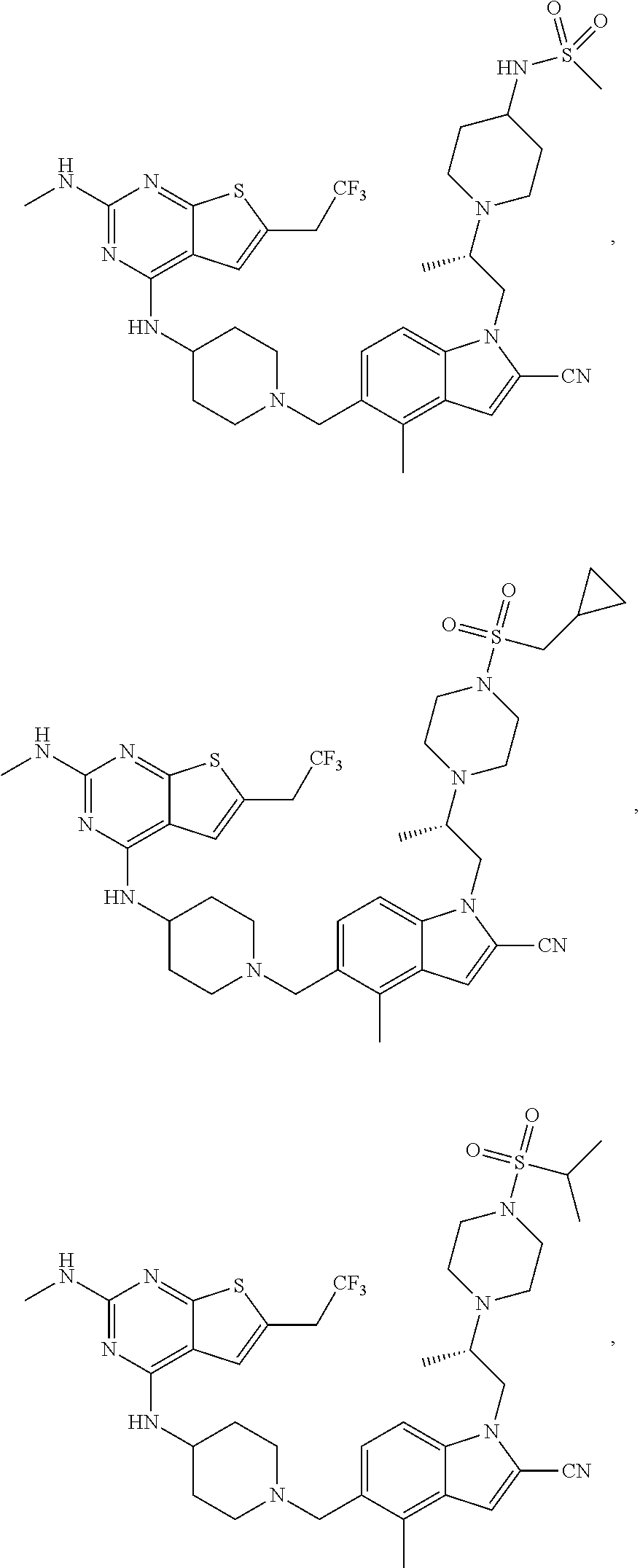


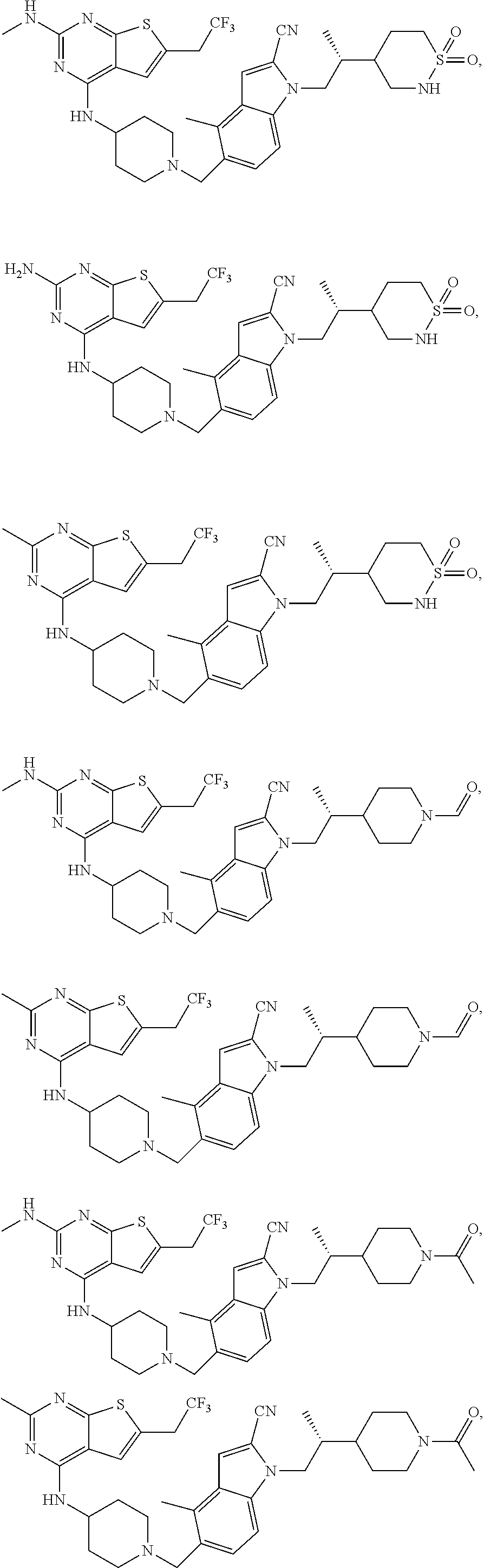


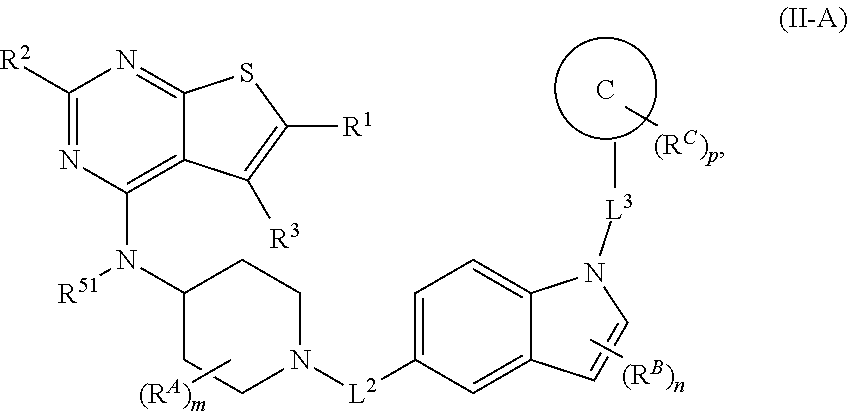


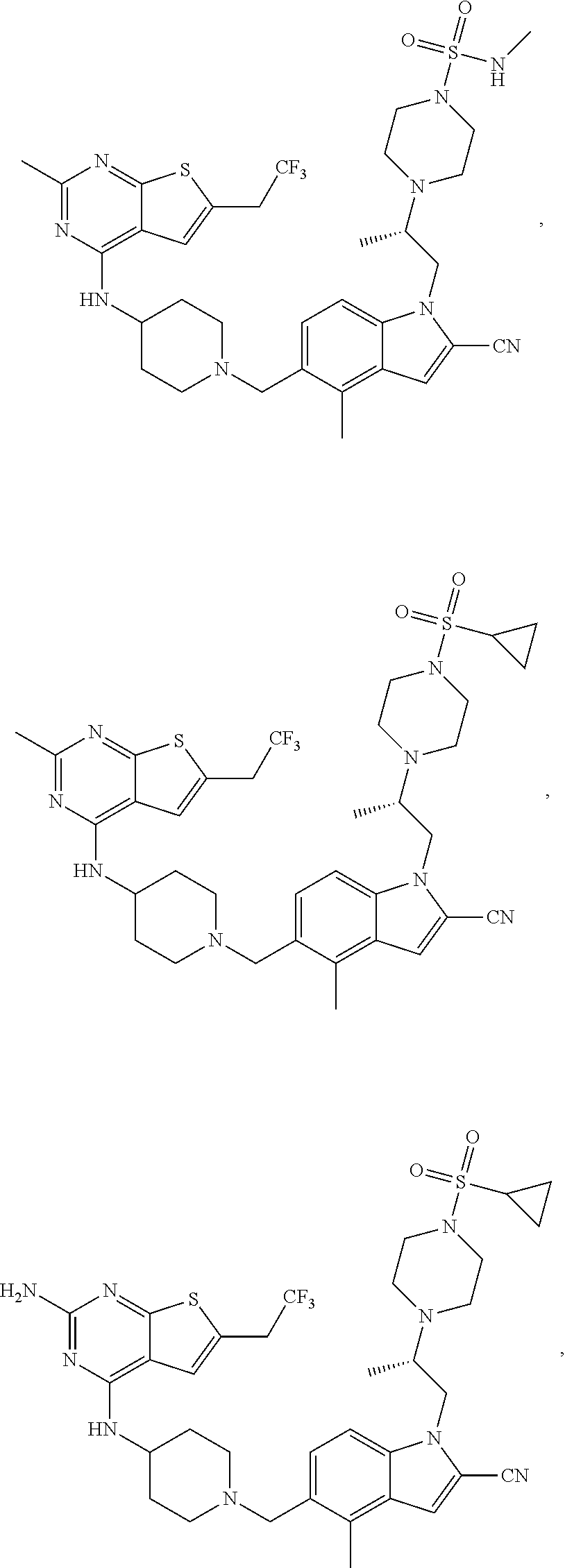


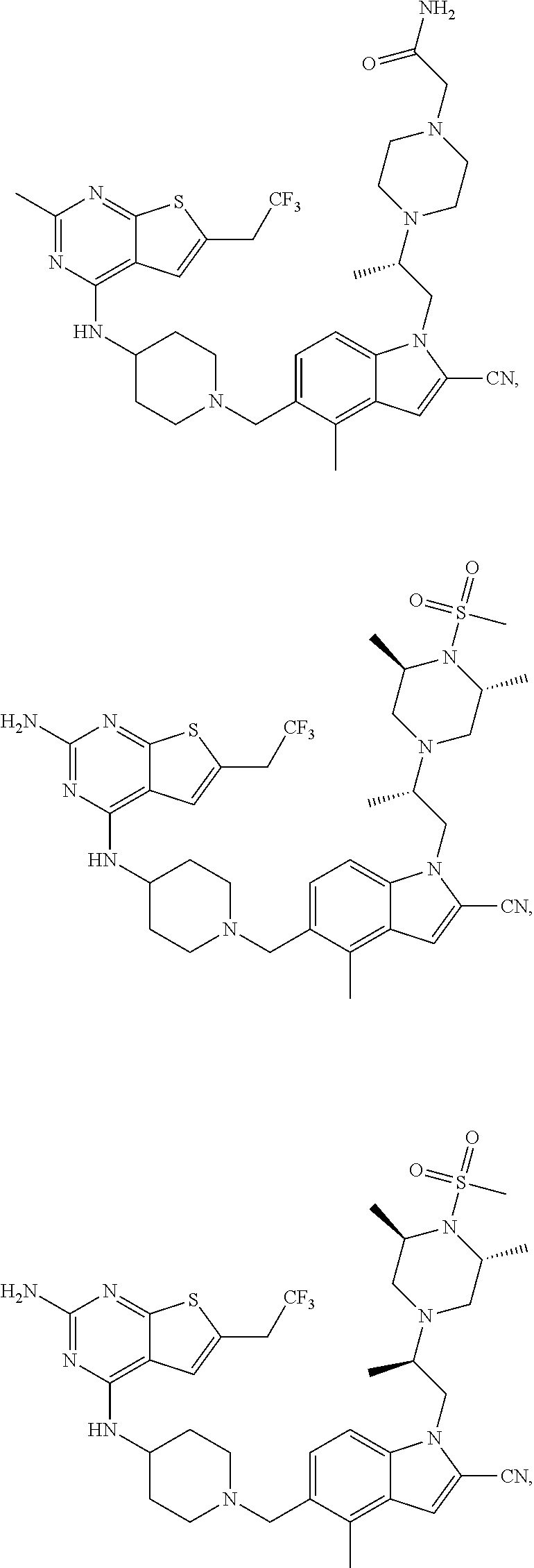

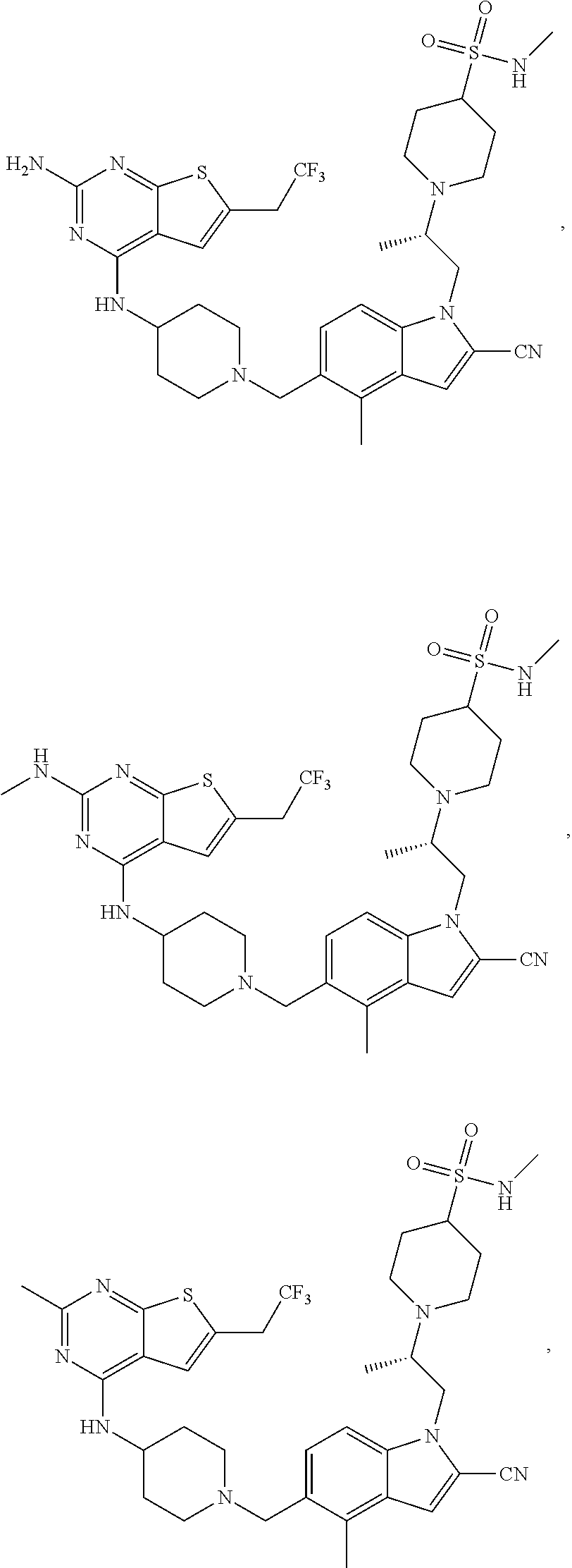


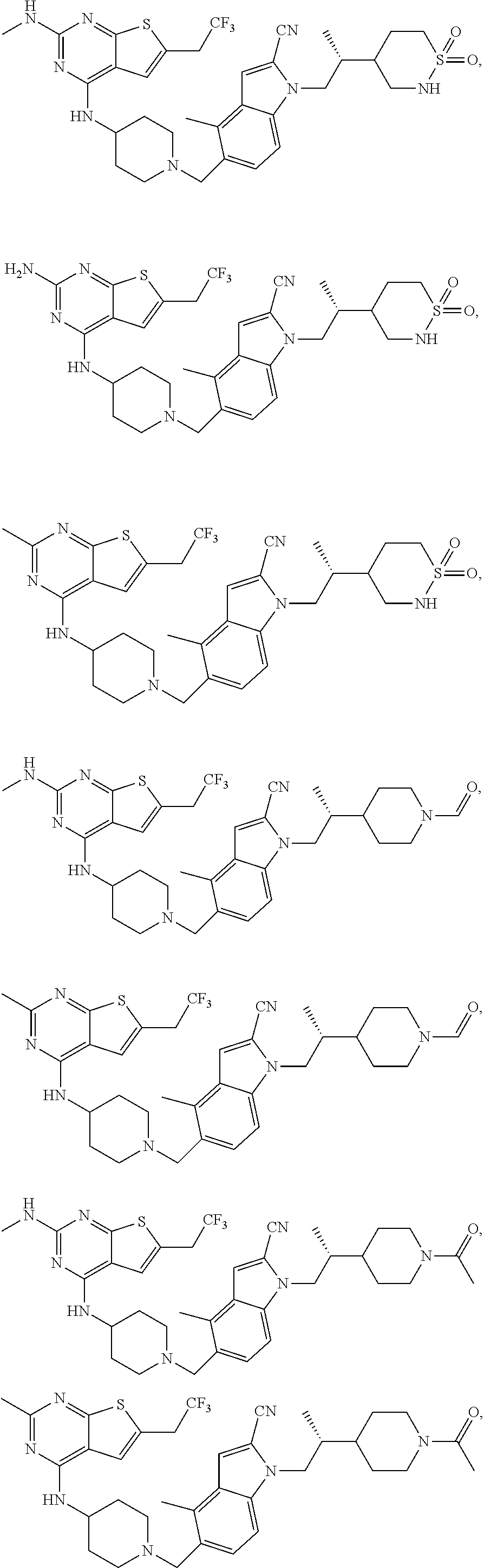


Priority Applications (2)
| Application Number | Priority Date | Filing Date | Title |
|---|---|---|---|
| US16/944,040 US11673898B2 (en) | 2016-03-16 | 2020-07-30 | Substituted inhibitors of menin-MLL and methods of use |
| US19/024,601 US20250320225A1 (en) | 2016-03-16 | 2025-01-16 | Substituted inhibitors of menin-mll and methods of use |
Applications Claiming Priority (7)
| Application Number | Priority Date | Filing Date | Title |
|---|---|---|---|
| US201662309372P | 2016-03-16 | 2016-03-16 | |
| US201662334369P | 2016-05-10 | 2016-05-10 | |
| US201662431389P | 2016-12-07 | 2016-12-07 | |
| US201762446640P | 2017-01-16 | 2017-01-16 | |
| PCT/US2017/022564 WO2017161028A1 (en) | 2016-03-16 | 2017-03-15 | Substituted inhibitors of menin-mll and methods of use |
| US201816082649A | 2018-09-06 | 2018-09-06 | |
| US16/944,040 US11673898B2 (en) | 2016-03-16 | 2020-07-30 | Substituted inhibitors of menin-MLL and methods of use |
Related Parent Applications (2)
| Application Number | Title | Priority Date | Filing Date |
|---|---|---|---|
| US16/082,649 Division US10781218B2 (en) | 2016-03-16 | 2017-03-15 | Substituted inhibitors of menin-MLL and methods of use |
| PCT/US2017/022564 Division WO2017161028A1 (en) | 2016-03-16 | 2017-03-15 | Substituted inhibitors of menin-mll and methods of use |
Related Child Applications (1)
| Application Number | Title | Priority Date | Filing Date |
|---|---|---|---|
| US202318150137A Continuation | 2016-03-16 | 2023-01-04 |
Publications (2)
| Publication Number | Publication Date |
|---|---|
| US20210101908A1 US20210101908A1 (en) | 2021-04-08 |
| US11673898B2 true US11673898B2 (en) | 2023-06-13 |
Family
ID=59851028
Family Applications (3)
| Application Number | Title | Priority Date | Filing Date |
|---|---|---|---|
| US16/082,649 Active US10781218B2 (en) | 2016-03-16 | 2017-03-15 | Substituted inhibitors of menin-MLL and methods of use |
| US16/944,040 Active US11673898B2 (en) | 2016-03-16 | 2020-07-30 | Substituted inhibitors of menin-MLL and methods of use |
| US19/024,601 Pending US20250320225A1 (en) | 2016-03-16 | 2025-01-16 | Substituted inhibitors of menin-mll and methods of use |
Family Applications Before (1)
| Application Number | Title | Priority Date | Filing Date |
|---|---|---|---|
| US16/082,649 Active US10781218B2 (en) | 2016-03-16 | 2017-03-15 | Substituted inhibitors of menin-MLL and methods of use |
Family Applications After (1)
| Application Number | Title | Priority Date | Filing Date |
|---|---|---|---|
| US19/024,601 Pending US20250320225A1 (en) | 2016-03-16 | 2025-01-16 | Substituted inhibitors of menin-mll and methods of use |
Country Status (29)
| Country | Link |
|---|---|
| US (3) | US10781218B2 (en) |
| EP (2) | EP4219449A3 (en) |
| JP (4) | JP6919977B2 (en) |
| KR (1) | KR102419531B1 (en) |
| CN (2) | CN114539284A (en) |
| AU (1) | AU2017232516B2 (en) |
| BR (1) | BR112018068703B1 (en) |
| CA (1) | CA3015847C (en) |
| CY (1) | CY1126066T1 (en) |
| DK (1) | DK3429591T3 (en) |
| ES (1) | ES2947636T3 (en) |
| FI (1) | FI3429591T3 (en) |
| HR (1) | HRP20230537T1 (en) |
| HU (1) | HUE061989T2 (en) |
| IL (1) | IL261606B (en) |
| LT (1) | LT3429591T (en) |
| MD (1) | MD3429591T2 (en) |
| MX (1) | MX388839B (en) |
| MY (1) | MY201450A (en) |
| PH (1) | PH12018501952A1 (en) |
| PL (1) | PL3429591T3 (en) |
| PT (1) | PT3429591T (en) |
| RS (1) | RS64261B1 (en) |
| SG (1) | SG11201807982UA (en) |
| SI (1) | SI3429591T1 (en) |
| SM (1) | SMT202300273T1 (en) |
| TW (1) | TWI747889B (en) |
| WO (1) | WO2017161028A1 (en) |
| ZA (1) | ZA202310395B (en) |
Cited By (4)
| Publication number | Priority date | Publication date | Assignee | Title |
|---|---|---|---|---|
| US20230405008A1 (en) * | 2020-10-21 | 2023-12-21 | Kura Oncology, Inc. | Treatment of hematological malignancies with inhibitors of menin |
| US11999730B1 (en) | 2022-09-26 | 2024-06-04 | Alterome Therapeutics, Inc. | AKT1 modulators |
| US12410184B2 (en) | 2023-07-17 | 2025-09-09 | Kura Oncology, Inc. | Crystalline forms of a menin inhibitor |
| US12521396B2 (en) | 2023-07-17 | 2026-01-13 | Kura Oncology, Inc. | Pharmaceutical compositions comprising a MENIN inhibitor |
Families Citing this family (110)
| Publication number | Priority date | Publication date | Assignee | Title |
|---|---|---|---|---|
| BR112015021985B1 (en) | 2013-03-15 | 2022-12-13 | Global Blood Therapeutics, Inc | PHARMACEUTICALLY ACCEPTABLE COMPOUNDS OR SALTS THEREOF, THEIR USES AND COMPOSITION |
| EA202092627A1 (en) | 2013-11-18 | 2021-09-30 | Глобал Блад Терапьютикс, Инк. | COMPOUNDS AND THEIR APPLICATIONS FOR HEMOGLOBIN MODULATION |
| US10246464B2 (en) | 2014-09-09 | 2019-04-02 | The Regents Of The University Of Michigan | Thienopyrimidine and thienopyridine compounds and methods of use thereof |
| AR104020A1 (en) | 2015-06-04 | 2017-06-21 | Kura Oncology Inc | METHODS AND COMPOSITIONS TO INHIBIT THE INTERACTION OF MENINA WITH MILL PROTEINS |
| WO2016197027A1 (en) | 2015-06-04 | 2016-12-08 | Kura Oncology, Inc. | Methods and compositions for inhibiting the interaction of menin with mll proteins |
| GB201516504D0 (en) | 2015-09-17 | 2015-11-04 | Astrazeneca Ab | Imadazo(4,5-c)quinolin-2-one Compounds and their use in treating cancer |
| ES2775449T3 (en) | 2016-01-22 | 2020-07-27 | Janssen Pharmaceutica Nv | Novel derivatives of substituted cyanoindoline as nik inhibitors |
| CA3012031C (en) | 2016-01-22 | 2024-03-26 | Janssen Pharmaceutica Nv | 6-membered heteroaromatic substituted cyanoindoline derivatives as nik inhibitors |
| SMT202300273T1 (en) | 2016-03-16 | 2023-09-06 | Kura Oncology Inc | Substituted thieno[2,3-d]pyrimidine derivatives as inhibitors of menin-mll and methods of use |
| MX387806B (en) | 2016-03-16 | 2025-03-19 | Kura Oncology Inc | Bridged bicyclic inhibitors of menin-mll and methods of use |
| MX384087B (en) | 2016-05-02 | 2025-03-14 | Univ Michigan Regents | PIPERIDINES AS MENINA INHIBITORS. |
| US20190119299A1 (en) | 2016-06-30 | 2019-04-25 | Janssen Pharmaceutica Nv | Cyanoindoline derivatives as nik inhibitors |
| CN109641882B (en) | 2016-06-30 | 2022-10-28 | 杨森制药有限公司 | Heteroaromatic derivatives as NIK inhibitors |
| JOP20190024A1 (en) | 2016-08-26 | 2019-02-19 | Gilead Sciences Inc | Substituted pyrrolizine compounds and uses thereof |
| DK3510033T3 (en) | 2016-09-09 | 2022-02-28 | Novartis Ag | COMPOUNDS AND COMPOSITIONS AS INHIBITORS OF ENDOSOMAL TOLL-LIKE RECEPTORS |
| HUE053907T2 (en) | 2016-09-14 | 2021-07-28 | Janssen Pharmaceutica Nv | Spirobicyclic inhibitors of the menin-MLL interaction |
| CN109715634B (en) | 2016-09-14 | 2022-09-27 | 詹森药业有限公司 | Fused bicyclic inhibitors of the MENIN-MLL interaction |
| US12084462B2 (en) | 2016-09-14 | 2024-09-10 | Janssen Pharmaceutica Nv | Spiro bicyclic inhibitors of menin-MLL interaction |
| EP3538101B1 (en) | 2016-11-14 | 2024-06-19 | Virginia Commonwealth University | Inhibitors of cancer and/or metastasis |
| AU2017376599B2 (en) | 2016-12-15 | 2021-10-07 | Janssen Pharmaceutica Nv | Azepane inhibitors of menin-MLL interaction |
| WO2018109088A1 (en) | 2016-12-15 | 2018-06-21 | Janssen Pharmaceutica Nv | Azepane inhibitors of menin-mll interaction |
| WO2018175746A1 (en) * | 2017-03-24 | 2018-09-27 | Kura Oncology, Inc. | Methods for treating hematological malignancies and ewing's sarcoma |
| CA3058448A1 (en) | 2017-03-31 | 2018-10-04 | The Regents Of The University Of Michigan | Piperidines as covalent menin inhibitors |
| US11542248B2 (en) | 2017-06-08 | 2023-01-03 | Kura Oncology, Inc. | Methods and compositions for inhibiting the interaction of menin with MLL proteins |
| TWI830576B (en) | 2017-07-10 | 2024-01-21 | 美商西建公司 | Antiproliferative compounds and methods of use thereof |
| TW201920081A (en) | 2017-07-11 | 2019-06-01 | 美商維泰克斯製藥公司 | Carboxamide as a sodium channel regulator |
| TW201920170A (en) | 2017-09-20 | 2019-06-01 | 美商庫拉腫瘤技術股份有限公司 | Substituted MENIN-MLL inhibitor and method of use |
| CN111148743B (en) | 2017-10-06 | 2023-12-15 | 福马治疗有限公司 | Inhibits ubiquitin-specific peptidase 30 |
| RS64271B1 (en) | 2017-10-27 | 2023-07-31 | Boehringer Ingelheim Int | TRPC6 INHIBITORS |
| CN111356692B (en) * | 2017-12-19 | 2021-09-03 | 基石药业(苏州)有限公司 | IDO inhibitors |
| US11396517B1 (en) | 2017-12-20 | 2022-07-26 | Janssen Pharmaceutica Nv | Exo-aza spiro inhibitors of menin-MLL interaction |
| US10836769B2 (en) | 2018-02-26 | 2020-11-17 | Gilead Sciences, Inc. | Substituted pyrrolizine compounds and uses thereof |
| MX2020008949A (en) | 2018-02-27 | 2021-01-08 | Incyte Corp | Imidazopyrimidines and triazolopyrimidines as a2a / a2b inhibitors. |
| CN110204552B (en) * | 2018-02-28 | 2021-08-17 | 中国科学院上海药物研究所 | A class of thieno[3,2-d]pyrimidine derivatives, preparation method, pharmaceutical composition and use thereof |
| EP3762385B1 (en) | 2018-03-09 | 2025-02-12 | Recurium IP Holdings, LLC | Substituted 1,2-dihydro-3h-pyrazolo[3,4-d]pyrimidin-3-ones |
| JP7590183B2 (en) | 2018-03-13 | 2024-11-26 | 武田薬品工業株式会社 | Substituted imidazopyridines as inhibitors of plasma kallikrein and their uses |
| WO2019189732A1 (en) | 2018-03-30 | 2019-10-03 | 大日本住友製薬株式会社 | Optically active crosslinked cyclic secondary amine derivative |
| EP3773577B1 (en) | 2018-04-12 | 2024-11-20 | Terns, Inc. | Tricyclic ask1 inhibitors |
| SI3784663T1 (en) | 2018-04-23 | 2023-11-30 | Celgene Corporation | Substituted 4-aminoisoindoline-1,3-dione compounds and their use for treating lymphoma |
| IL278291B2 (en) | 2018-05-17 | 2023-10-01 | Forma Therapeutics Inc | Condensed bicyclic compounds are useful as ubiquitin-specific peptidase 30 inhibitors |
| JP7391046B2 (en) | 2018-05-18 | 2023-12-04 | インサイト・コーポレイション | Fused pyrimidine derivatives as A2A/A2B inhibitors |
| CA3045644C (en) | 2018-06-13 | 2024-01-16 | Pfizer Inc. | Glp-1 receptor agonists and uses thereof |
| IL279829B2 (en) | 2018-07-05 | 2025-05-01 | Incyte Holdings Corp | Fused pyrazine derivatives as a2a / a2b inhibitors |
| BR112021005082A2 (en) | 2018-09-18 | 2021-06-08 | Nikang Therapeutics, Inc. | fused tricyclic ring derivatives as src homology-2 phosphatase inhibitors |
| JP2022503792A (en) * | 2018-09-26 | 2022-01-12 | クラ オンコロジー,インク. | Treatment of hematological malignancies with menin inhibitors |
| SG11202102815SA (en) | 2018-10-05 | 2021-04-29 | Forma Therapeutics Inc | Fused pyrrolines which act as ubiquitin-specific protease 30 (usp30) inhibitors |
| TWI767148B (en) | 2018-10-10 | 2022-06-11 | 美商弗瑪治療公司 | Inhibiting fatty acid synthase (fasn) |
| US11066404B2 (en) | 2018-10-11 | 2021-07-20 | Incyte Corporation | Dihydropyrido[2,3-d]pyrimidinone compounds as CDK2 inhibitors |
| CN113227068B (en) | 2018-11-22 | 2023-06-13 | 上海齐鲁锐格医药研发有限公司 | GLP-1R agonists and uses thereof |
| KR102912146B1 (en) | 2018-12-06 | 2026-01-14 | 다이이찌 산쿄 가부시키가이샤 | Cycloalkane-1,3-diamine derivatives |
| AU2019417833B2 (en) | 2018-12-31 | 2024-11-07 | Biomea Fusion, Inc. | Irreversible inhibitors of menin-MLL interaction |
| WO2020142559A1 (en) | 2018-12-31 | 2020-07-09 | Biomea Fusion, Llc | Inhibitors of menin-mll interaction |
| WO2020146612A1 (en) | 2019-01-10 | 2020-07-16 | Vertex Pharmaceuticals Incorporated | Esters and carbamates as modulators of sodium channels |
| US12441703B2 (en) | 2019-01-10 | 2025-10-14 | Vertex Pharmaceuticals Incorporated | Carboxamides as modulators of sodium channels |
| WO2020150474A1 (en) | 2019-01-18 | 2020-07-23 | Dogma Therapeutics, Inc. | Pcsk9 inhibitors and methods of use thereof |
| TWI829857B (en) | 2019-01-29 | 2024-01-21 | 美商英塞特公司 | Pyrazolopyridines and triazolopyridines as a2a / a2b inhibitors |
| WO2020168197A1 (en) | 2019-02-15 | 2020-08-20 | Incyte Corporation | Pyrrolo[2,3-d]pyrimidinone compounds as cdk2 inhibitors |
| US11472791B2 (en) | 2019-03-05 | 2022-10-18 | Incyte Corporation | Pyrazolyl pyrimidinylamine compounds as CDK2 inhibitors |
| US11919904B2 (en) | 2019-03-29 | 2024-03-05 | Incyte Corporation | Sulfonylamide compounds as CDK2 inhibitors |
| US10954221B2 (en) | 2019-04-12 | 2021-03-23 | Qilu Regor Therapeutics Inc. | GLP-1R agonists and uses thereof |
| US11440914B2 (en) | 2019-05-01 | 2022-09-13 | Incyte Corporation | Tricyclic amine compounds as CDK2 inhibitors |
| WO2020223558A1 (en) | 2019-05-01 | 2020-11-05 | Incyte Corporation | Tricyclic amine compounds as cdk2 inhibitors |
| JP2022539208A (en) | 2019-07-03 | 2022-09-07 | スミトモ ファーマ オンコロジー, インコーポレイテッド | Tyrosine kinase non-receptor 1 (TNK1) inhibitors and uses thereof |
| CA3150681A1 (en) | 2019-08-14 | 2021-02-18 | Incyte Corporation | Imidazolyl pyrimidinylamine compounds as cdk2 inhibitors |
| DK4031547T3 (en) | 2019-09-18 | 2024-09-09 | Takeda Pharmaceuticals Co | PLASMA KALLIKREIN INHIBITORS AND USES THEREOF |
| US11370803B2 (en) | 2019-09-18 | 2022-06-28 | Takeda Pharmaceutical Company Limited | Heteroaryl plasma kallikrein inhibitors |
| WO2021072232A1 (en) | 2019-10-11 | 2021-04-15 | Incyte Corporation | Bicyclic amines as cdk2 inhibitors |
| JP7558267B2 (en) | 2019-10-25 | 2024-09-30 | ギリアード サイエンシーズ, インコーポレイテッド | GLP-1R modulating compounds |
| UY38979A (en) | 2019-12-06 | 2021-07-30 | Vertex Pharma | TETRAHYDROFURANS REPLACED AS SODIUM CHANNEL MODULATORS |
| UY38988A (en) | 2019-12-19 | 2021-06-30 | Janssen Pharmaceutica Nv | LINEAR CHAIN SUBSTITUTED SPIRANCAL DERIVATIVES |
| MX2022007969A (en) | 2019-12-23 | 2022-12-13 | Blueprint Medicines Corp | Inhibitors of mutant forms of egfr. |
| WO2021138391A1 (en) | 2019-12-30 | 2021-07-08 | Tyra Biosciences, Inc. | Indazole compounds |
| JP2023509452A (en) | 2020-01-03 | 2023-03-08 | バーグ エルエルシー | Polycyclic Amides as UBE2K Modulators to Treat Cancer |
| SI4097097T1 (en) | 2020-01-29 | 2025-04-30 | Gilead Sciences, Inc. | Glp-1r modulating compounds |
| CN118598916A (en) | 2020-02-18 | 2024-09-06 | 吉利德科学公司 | Antiviral compounds |
| TWI775313B (en) | 2020-02-18 | 2022-08-21 | 美商基利科學股份有限公司 | Antiviral compounds |
| TWI883391B (en) | 2020-02-18 | 2025-05-11 | 美商基利科學股份有限公司 | Antiviral compounds |
| CN111297863B (en) * | 2020-03-30 | 2021-06-25 | 四川大学华西医院 | Application of menin-MLL inhibitor in the preparation of medicaments for the treatment of endometrial cancer |
| IL296790A (en) | 2020-03-30 | 2022-11-01 | Hutchison Medipharma Ltd | Amide compounds and uses thereof |
| IL298219A (en) | 2020-05-15 | 2023-01-01 | Algen Biotechnologies Inc | Certain chemical compositions and methods of using them |
| CN114516873A (en) * | 2020-11-18 | 2022-05-20 | 苏州优理生物医药科技有限公司 | Spiro compound, pharmaceutical composition containing same and application thereof |
| US11851419B2 (en) | 2020-11-20 | 2023-12-26 | Gilead Sciences, Inc. | GLP-1R modulating compounds |
| CA3205986A1 (en) | 2020-12-30 | 2022-07-07 | Tyra Biosciences, Inc. | Indazole compounds as kinase inhibitors |
| MX2023009682A (en) | 2021-02-19 | 2023-10-30 | Sudo Biosciences Ltd | Tyk2 inhibitors and uses thereof. |
| IL305165A (en) | 2021-02-19 | 2023-10-01 | Sudo Biosciences Ltd | TYK2 inhibitors and their uses |
| US12091404B2 (en) | 2021-03-11 | 2024-09-17 | Gilead Sciences, Inc. | GLP-1R modulating compounds |
| US12180197B2 (en) | 2021-03-11 | 2024-12-31 | Gilead Sciences, Inc. | GLP-1R modulating compounds |
| CN117203199A (en) | 2021-04-02 | 2023-12-08 | 毕利吉生物科技股份有限公司 | N2-phenylpyrimidine-2,4-diamine compound and preparation method and use method thereof |
| CN117120444A (en) | 2021-04-16 | 2023-11-24 | 吉利德科学公司 | Method for preparing carboside using amides |
| CA3216163A1 (en) | 2021-04-21 | 2022-10-27 | Gilead Sciences, Inc. | Carboxy-benzimidazole glp-1r modulating compounds |
| WO2022237626A1 (en) | 2021-05-08 | 2022-11-17 | Janssen Pharmaceutica Nv | Substituted spiro derivatives |
| KR20240005747A (en) | 2021-05-08 | 2024-01-12 | 얀센 파마슈티카 엔브이 | Substituted Spiro Derivatives |
| MX2023014347A (en) | 2021-06-01 | 2023-12-13 | Janssen Pharmaceutica Nv | SUBSTITUTED PHENYL-1H-PYRROLO[2, 3-c]PYRIDINE DERIVATIVES. |
| EP4347600A1 (en) | 2021-06-03 | 2024-04-10 | JANSSEN Pharmaceutica NV | Pyridazines or 1,2,4-triazines substituted by spirocyclic amines |
| WO2022253309A1 (en) * | 2021-06-03 | 2022-12-08 | 首药控股(北京)股份有限公司 | Substituted heterocyclic compounds and application thereof |
| TW202313593A (en) | 2021-06-04 | 2023-04-01 | 美商維泰克斯製藥公司 | N-(hydroxyalkyl (hetero)aryl) tetrahydrofuran carboxamides as modulators of sodium channels |
| PE20240923A1 (en) | 2021-06-17 | 2024-04-30 | Janssen Pharmaceutica Nv | (R)-N-ETHYL-5-FLUORO-N-ISOPROPYL-2-((5-(2-(6-((2-METHOXYETHYL) (METHYL)AMINO)-2-METHYLHEXAN-3-) BESYLATE SALT IL)-2,6-DIAZASPIRO[3.4]OCTAN-6-IL)-1,2,4-TRIAZIN-6-IL)OXY)BENZAMIDE FOR THE TREATMENT OF DISEASES SUCH AS CANCER |
| US11981671B2 (en) | 2021-06-21 | 2024-05-14 | Incyte Corporation | Bicyclic pyrazolyl amines as CDK2 inhibitors |
| WO2023011446A1 (en) * | 2021-08-04 | 2023-02-09 | 成都苑东生物制药股份有限公司 | Novel sulfonamide menin-mll interaction inhibitor, preparation method therefor, and medical use thereof |
| CN115515958B (en) * | 2021-08-04 | 2023-09-29 | 成都苑东生物制药股份有限公司 | A new type of sulfonamide menin-MLL interaction inhibitor, its preparation method and medicinal use |
| CA3228627A1 (en) | 2021-08-11 | 2023-02-16 | Thomas Butler | Covalent inhibitors of menin-mll interaction for diabetes mellitus |
| JP7719954B2 (en) | 2021-08-18 | 2025-08-06 | ギリアード サイエンシーズ, インコーポレイテッド | Phospholipid compounds and methods for producing and using same |
| AU2022331496A1 (en) | 2021-08-20 | 2024-02-29 | Biomea Fusion, Inc. | Crystalline form of n-[4-[4-(4-morpholinyl)-7h-pyrrolo[2,3-d]pyrimidin-6-yl]phenyl]-4-[[3(r)-[(1-oxo -2-propen-1-yl)amino]-1-piperidinyl]methyl]-2-pyridinecarboxamide, an irreversible menin-mll inhibitor for the treatment of cancer |
| US11976073B2 (en) | 2021-12-10 | 2024-05-07 | Incyte Corporation | Bicyclic amines as CDK2 inhibitors |
| KR20240121720A (en) * | 2021-12-15 | 2024-08-09 | 다나-파버 캔서 인스티튜트 인크. | Targeting Gastrointestinal Stromal Tumors (GIST) by Disrupting the Menin-MLL Epigenetic Complex |
| EP4472637A4 (en) * | 2022-02-04 | 2025-12-31 | Kura Oncology Inc | TREATMENT OF HEMATOLOGICAL MALIGNONS WITH MENIN HIBITORS AND P-GLYCOPROTEIN HIBITORS |
| HRP20251564T1 (en) | 2022-05-19 | 2026-01-30 | Astrazeneca Ab | AMIDE HETEROAROMATIC COMPOUNDS USEFUL IN THE TREATMENT OF LIVER DISEASES |
| CN117069719A (en) * | 2022-08-17 | 2023-11-17 | 烨辉医药科技(上海)有限公司 | Diazaspiro-pyridazine compounds and their uses |
| CN120529900A (en) | 2022-11-24 | 2025-08-22 | 奥莱松基因组股份有限公司 | Combination of LSD1 inhibitors and Menin inhibitors for the treatment of cancer |
| WO2024155710A1 (en) | 2023-01-18 | 2024-07-25 | Biomea Fusion, Inc. | Crystalline forms of n-[4-[4-(4-morpholinyl)-7h-pyrrolo[2,3-d]pyrimidin-6- yl]phenyl]-4-[[3(r)-[(l-oxo-2-propen-l-yl)amino]-l-piperidinyl]methyl]-2-pyridinecarboxamide as a covalent inhibitor of menin-mll interaction |
Citations (94)
| Publication number | Priority date | Publication date | Assignee | Title |
|---|---|---|---|---|
| WO1990005719A1 (en) | 1988-11-23 | 1990-05-31 | British Bio-Technology Limited | Hydroxamic acid based collagenase inhibitors |
| US5033252A (en) | 1987-12-23 | 1991-07-23 | Entravision, Inc. | Method of packaging and sterilizing a pharmaceutical product |
| US5052558A (en) | 1987-12-23 | 1991-10-01 | Entravision, Inc. | Packaged pharmaceutical product |
| US5323907A (en) | 1992-06-23 | 1994-06-28 | Multi-Comp, Inc. | Child resistant package assembly for dispensing pharmaceutical medications |
| US5445764A (en) | 1992-11-21 | 1995-08-29 | Merck Patent Gesellschaft Mit Beschrankter Haftung | Cyclobutane benzene derivatives |
| WO1996027583A1 (en) | 1995-03-08 | 1996-09-12 | Pfizer Inc. | Arylsulfonylamino hydroxamic acid derivatives |
| WO1996033172A1 (en) | 1995-04-20 | 1996-10-24 | Pfizer Inc. | Arylsulfonyl hydroxamic acid derivatives as mmp and tnf inhibitors |
| WO1998003516A1 (en) | 1996-07-18 | 1998-01-29 | Pfizer Inc. | Phosphinate based inhibitors of matrix metalloproteases |
| WO1998007697A1 (en) | 1996-08-23 | 1998-02-26 | Pfizer Inc. | Arylsulfonylamino hydroxamic acid derivatives |
| WO1998030566A1 (en) | 1997-01-06 | 1998-07-16 | Pfizer Inc. | Cyclic sulfone derivatives |
| WO1998033768A1 (en) | 1997-02-03 | 1998-08-06 | Pfizer Products Inc. | Arylsulfonylamino hydroxamic acid derivatives |
| WO1998034918A1 (en) | 1997-02-11 | 1998-08-13 | Pfizer Inc. | Arylsulfonyl hydroxamic acid derivatives |
| WO1998034915A1 (en) | 1997-02-07 | 1998-08-13 | Pfizer Inc. | N-hydroxy-beta-sulfonyl-propionamide derivatives and their use as inhibitors of matrix metalloproteinases |
| JPH10330377A (en) | 1997-06-02 | 1998-12-15 | Kyowa Hakko Kogyo Co Ltd | Piperidine derivative |
| US5866562A (en) | 1996-10-25 | 1999-02-02 | Bayer Aktiengesellschaft | Ring-bridged bis-quinolines |
| WO1999029667A1 (en) | 1997-12-05 | 1999-06-17 | Pfizer Limited | Hydroxamic acid derivatives as matrix metalloprotease (mmp) inhibitors |
| WO1999043675A1 (en) | 1998-02-26 | 1999-09-02 | Aventis Pharmaceuticals Inc. | 6,9-disubstituted 2-[trans-(4- aminocyclohexyl) amino]purines |
| WO1999052910A1 (en) | 1998-04-10 | 1999-10-21 | Pfizer Products Inc. | Bicyclic hydroxamic acid derivatives |
| WO1999052889A1 (en) | 1998-04-10 | 1999-10-21 | Pfizer Products Inc. | (4-arylsulfonylamino)-tetrahydropyran-4-carboxylic acid hydroxamides |
| WO1999065909A1 (en) | 1998-06-19 | 1999-12-23 | Pfizer Products Inc. | PYRROLO[2,3-d]PYRIMIDINE COMPOUNDS |
| WO2002088138A1 (en) | 2001-04-30 | 2002-11-07 | Bayer Corporation | Novel 4-amino-5,6-substituted thiopheno[2,3-d]pyrimidines |
| WO2003022214A2 (en) | 2001-09-06 | 2003-03-20 | Millennium Pharmaceuticals, Inc. | Piperazine and homopiperazine compounds |
| EP1382603A1 (en) | 2001-04-26 | 2004-01-21 | Eisai Co., Ltd. | NITROGENOUS FUSED−RING COMPOUND HAVING PYRAZOLYL GROUP AS SUBSTITUENT AND MEDICINAL COMPOSITION THEREOF |
| WO2004030671A2 (en) | 2002-10-02 | 2004-04-15 | Merck Patent Gmbh | Use of 4-amino-quinazolines as anti cancer agents |
| WO2004030672A1 (en) | 2002-10-02 | 2004-04-15 | Merck Patent Gmbh | Use of 4 amino-quinazolines as anti cancer agents |
| WO2005020897A2 (en) | 2003-08-22 | 2005-03-10 | Dendreon Corporation | Compositions and methods for the treatment of disease associated with trp-p8 expression |
| US20050123906A1 (en) | 2003-11-06 | 2005-06-09 | Rana Tariq M. | Protein modulation |
| US20050222175A1 (en) | 2004-03-31 | 2005-10-06 | Dhanoa Dale S | New piperidinylamino-thieno[2,3-D] pyrimidine compounds |
| US20050222176A1 (en) | 2003-03-31 | 2005-10-06 | Dhanoa Dale S | Piperidinylamino-thieno[2,3-D] pyrimidine compounds |
| US20060025406A1 (en) | 2004-07-06 | 2006-02-02 | Angion Biomedica Corporation | Modulators of hepatocyte growth factor/c- Met activity |
| US7030240B2 (en) | 2003-03-31 | 2006-04-18 | Predix Pharmaceuticals Holdings, Inc. | Piperidinylamino-thieno[2,3-d] pyrimidine compounds |
| US20060281771A1 (en) | 2005-06-10 | 2006-12-14 | Baumann Christian A | Synergistic modulation of flt3 kinase using aminoquinoline and aminoquinazoline kinase modulators |
| US20060281769A1 (en) | 2005-06-10 | 2006-12-14 | Baumann Christian A | Synergistic modulation of flt3 kinase using thienopyrimidine and thienopyridine kinase modulators |
| WO2007026024A2 (en) | 2005-09-02 | 2007-03-08 | Tibotec Pharmaceuticals Ltd. | Benzodiazepines as hcv inhibitors |
| US20070078133A1 (en) | 2005-06-03 | 2007-04-05 | Huaqing Liu | Cyclobutyl amine derivatives |
| WO2007042669A2 (en) | 2005-10-12 | 2007-04-19 | Sanofis-Aventis | Derivatives of 4-amino-quinazoline, preparation method thereof and use of same in therapeutics |
| WO2007061880A1 (en) | 2005-11-23 | 2007-05-31 | Merck & Co., Inc. | Spirocyclic compounds as hdac inhibitors |
| WO2007076034A2 (en) | 2005-12-21 | 2007-07-05 | Abbott Laboratories | Anti-viral compounds |
| WO2007115822A1 (en) | 2006-04-07 | 2007-10-18 | Develogen Aktiengesellschaft | Thienopyrimidines having mnkl /mnk2 inhibiting activity for pharmaceutical compositions |
| WO2008031875A1 (en) | 2006-09-14 | 2008-03-20 | Novartis Ag | Adenosine derivatives as a2a receptor agonists |
| WO2008070303A2 (en) | 2006-10-19 | 2008-06-12 | The University Of Chicago | Therapeutics to inhibit mll-menin interaction for treating leukemia |
| WO2008090140A1 (en) | 2007-01-22 | 2008-07-31 | 4Sc Ag | Aryloxypropanolamines, methods of preparation thereof and use of aryloxypropanolamines as medicaments |
| WO2008099019A1 (en) | 2007-02-16 | 2008-08-21 | Tibotec Pharmaceuticals Ltd. | 6-hydroxy-dibenzodiazepinones useful as hepatitis c virus inhibitors |
| WO2008107320A1 (en) | 2007-02-23 | 2008-09-12 | Cerep | Piperidine and piperazine derivatives used as anti-neoplasic agents or cell proliferation inhibitors |
| WO2008114275A2 (en) | 2007-03-19 | 2008-09-25 | Council Of Scientific & Industrial Research | Anthranilic acid derivatives as anticancer agents and process for the preparation thereof |
| WO2008135232A1 (en) | 2007-05-02 | 2008-11-13 | Riccardo Cortese | Use and compositions of purine derivatives for the treatment of proliferative disorders |
| US20080293699A1 (en) | 2007-05-25 | 2008-11-27 | Burnham Institute For Medical Research | Inhibitors of thapsigargin-induced cell death |
| WO2009017838A2 (en) | 2007-08-01 | 2009-02-05 | Exelixis, Inc. | Combinations of jak-2 inhibitors and other agents |
| WO2009064388A2 (en) | 2007-11-09 | 2009-05-22 | Liu Jun O | Inhibitors of human methionine aminopeptidase 1 and methods of treating disorders |
| US20090163545A1 (en) | 2007-12-21 | 2009-06-25 | University Of Rochester | Method For Altering The Lifespan Of Eukaryotic Organisms |
| WO2009143058A1 (en) | 2008-05-22 | 2009-11-26 | Allergan, Inc. | Bicyclic compounds having activity at the cxcr4 receptor |
| US20100063047A1 (en) | 2008-09-10 | 2010-03-11 | Kalypsys, Inc. | Aminopyrimidine inhibitors of histamine receptors for the treatment of disease |
| US7744968B2 (en) | 2005-09-19 | 2010-06-29 | Merck Patent Gmbh | Cyclobutane and spiro[3.3]heptane compounds |
| WO2010103334A1 (en) | 2009-03-12 | 2010-09-16 | Prosidion Limited | Compounds for the treatment of metabolic disorders |
| WO2010108651A1 (en) | 2009-03-25 | 2010-09-30 | Grünenthal GmbH | Substituted spiro-amide compounds |
| WO2010142402A1 (en) | 2009-06-08 | 2010-12-16 | Grünenthal GmbH | Substituted benzimidazoles, benzothiazoles and benzoxazoles |
| WO2010147234A1 (en) | 2009-06-18 | 2010-12-23 | Banyu Pharmaceutical Co.,Ltd. | Diarylamide-spirodiamine derivative |
| WO2011003418A1 (en) | 2009-07-08 | 2011-01-13 | Leo Pharma A/S | Heterocyclic compounds as jak receptor and protein tyrosine kinase inhibitors |
| WO2011014128A1 (en) | 2009-07-30 | 2011-02-03 | National University Of Singapore | Small molecule inhibitors of isoprenylcysteine carboxyl methyltransferase with potential anticancer activity |
| WO2011029054A1 (en) | 2009-09-04 | 2011-03-10 | The Regents Of The University Of Michigan | Compositions and methods for treatment of leukemia |
| WO2011101069A2 (en) | 2010-02-22 | 2011-08-25 | Merck Patent Gmbh | Hetarylaminonaphthyridines |
| JP2011527295A (en) | 2008-06-10 | 2011-10-27 | メルク パテント ゲゼルシャフト ミット ベシュレンクテル ハフツング | Novel pyrrolidine derivatives as MetAP-2 inhibitors |
| US20120058998A1 (en) | 2001-11-02 | 2012-03-08 | Virginia Sanders | Compounds, Compositions and Methods for the Treatment of Inflammatory Diseases |
| US20130035347A1 (en) | 2011-08-04 | 2013-02-07 | Vidyasagar Vuligonda | Aromatic bycyclic derivatives as cxcr4 receptor modulators |
| WO2013024291A2 (en) | 2011-08-18 | 2013-02-21 | Ucb Pharma S.A. | Therapeutically active fused pyrimidine derivatives |
| WO2013072694A1 (en) | 2011-11-15 | 2013-05-23 | Xention Limited | Thieno- and furo - pyrimidines and pyridines, useful as potassium channel inhibitors |
| US8507491B2 (en) | 2008-08-25 | 2013-08-13 | Irm Llc | Compounds and compositions as hedgehog pathway inhibitors |
| US20130210831A1 (en) | 2010-08-20 | 2013-08-15 | Wei-guo Su | Pyrrolopyrimidine compounds and uses thereof |
| WO2014053581A1 (en) | 2012-10-03 | 2014-04-10 | Ucb Pharma S.A. | Therapeutically active oxazoline derivatives |
| CN103833759A (en) | 2012-11-23 | 2014-06-04 | 华东理工大学 | Pteridinone derivatives as BLK and FLT3 inhibitors and applications thereof |
| US20140275070A1 (en) | 2013-03-13 | 2014-09-18 | The Regents Of The University Of Michigan | Compositions comprising thienopyrimidine and thienopyridine compounds and methods of use thereof |
| US20140371238A1 (en) | 2013-03-13 | 2014-12-18 | Flatley Discovery Lab | Compounds and methods for the treatment of cystic fibrosis |
| US20140371239A1 (en) | 2013-06-12 | 2014-12-18 | The Regents Of The University Of Michigan | Menin-mll inhibitors and methods of use thereof |
| WO2015087151A1 (en) | 2013-12-12 | 2015-06-18 | Chong Kun Dang Pharmaceutical Corp. | Novel azaindole derivatives as selective histone deacetylase (hdac) inhibitors and pharmaceutical compositions comprising the same |
| WO2015154039A2 (en) | 2014-04-04 | 2015-10-08 | Syros Pharmaceuticals, Inc. | Inhibitors of cyclin-dependent kinase 7 (cdk7) |
| WO2015191701A1 (en) | 2014-06-10 | 2015-12-17 | The Trustees Of The University Of Pennsylvania | Scaffolds for inhibitors of menin-mll interactions |
| WO2016040330A1 (en) | 2014-09-09 | 2016-03-17 | The Regents Of The University Of Michigan | Thienopyrimidine and thienopyridine compounds and methods of use thereof |
| CN105732636A (en) | 2014-12-30 | 2016-07-06 | 广东东阳光药业有限公司 | Hetero-aromatic compounds and applications thereof in pharmacy |
| WO2016195776A1 (en) | 2015-06-04 | 2016-12-08 | Kura Oncology, Inc. | Methods and compositions for inhibiting the interaction of menin with mll proteins |
| WO2016197027A1 (en) | 2015-06-04 | 2016-12-08 | Kura Oncology, Inc. | Methods and compositions for inhibiting the interaction of menin with mll proteins |
| WO2017001660A1 (en) | 2015-07-02 | 2017-01-05 | Janssen Sciences Ireland Uc | Antibacterial compounds |
| WO2017112768A1 (en) | 2015-12-22 | 2017-06-29 | Vitae Pharmaceuticals, Inc. | Inhibitors of the menin-mll interaction |
| WO2017123860A1 (en) | 2016-01-13 | 2017-07-20 | Bristol-Myers Squibb Company | Spiroheptane salicylamides and related compounds as inhibitors of rock |
| WO2017132398A1 (en) | 2016-01-26 | 2017-08-03 | Memorial Sloan-Kettering Cancer Center | Targeting chromatin regulators inhibits leukemogenic gene expression in npm1 mutant leukemia |
| WO2017161002A1 (en) | 2016-03-16 | 2017-09-21 | Kura Oncology, Inc. | Bridged bicyclic inhibitors of menin-mll and methods of use |
| WO2017161028A1 (en) | 2016-03-16 | 2017-09-21 | Kura Oncology, Inc. | Substituted inhibitors of menin-mll and methods of use |
| WO2017192543A1 (en) | 2016-05-02 | 2017-11-09 | Regents Of The University Of Michigan | Piperidines as menin inhibitors |
| WO2017207387A1 (en) | 2016-05-31 | 2017-12-07 | Bayer Pharma Aktiengesellschaft | Spiro condensed azetidine derivatives as inhibitors of the menin-mml1 interaction |
| WO2017214367A1 (en) | 2016-06-10 | 2017-12-14 | Vitae Pharmaceuticals, Inc. | Inhibitors of the menin-mll interaction |
| WO2018024602A1 (en) | 2016-08-04 | 2018-02-08 | Bayer Aktiengesellschaft | 2,7-diazaspiro[4.4]nonanes |
| WO2018053267A1 (en) | 2016-09-16 | 2018-03-22 | Vitae Pharmaceuticals, Inc. | Inhibitors of the menin-mll interaction |
| WO2018050686A1 (en) | 2016-09-14 | 2018-03-22 | Janssen Pharmaceutica Nv | Spiro bicyclic inhibitors of menin-mll interaction |
| WO2018050684A1 (en) | 2016-09-14 | 2018-03-22 | Janssen Pharmaceutica Nv | Fused bicyclic inhibitors of menin-mll interaction |
| WO2019060365A1 (en) | 2017-09-20 | 2019-03-28 | Kura Oncology, Inc. | Substituted inhibitors of menin-mll and methods of use |
Family Cites Families (8)
| Publication number | Priority date | Publication date | Assignee | Title |
|---|---|---|---|---|
| US510A (en) | 1837-12-07 | soeel | ||
| US5861A (en) | 1848-10-17 | Locking umbrella and parasol | ||
| US5863A (en) | 1848-10-17 | Matthias p | ||
| US949A (en) | 1838-09-27 | Improvement in roller cotton-gins for ginning long-staple and other kinds of cotton | ||
| US5455258A (en) | 1993-01-06 | 1995-10-03 | Ciba-Geigy Corporation | Arylsulfonamido-substituted hydroxamic acids |
| DE69624081T2 (en) | 1995-12-20 | 2003-06-12 | Agouron Pharmaceuticals, Inc. | Matrix metalloprotease inhibitors |
| JP3195756B2 (en) | 1996-07-04 | 2001-08-06 | 公子 吉水 | Lubrication auxiliary |
| GB9801690D0 (en) | 1998-01-27 | 1998-03-25 | Pfizer Ltd | Therapeutic agents |
-
2017
- 2017-03-15 SM SM20230273T patent/SMT202300273T1/en unknown
- 2017-03-15 CN CN202210112927.9A patent/CN114539284A/en active Pending
- 2017-03-15 EP EP23151871.3A patent/EP4219449A3/en active Pending
- 2017-03-15 DK DK17767462.9T patent/DK3429591T3/en active
- 2017-03-15 FI FIEP17767462.9T patent/FI3429591T3/en active
- 2017-03-15 SG SG11201807982UA patent/SG11201807982UA/en unknown
- 2017-03-15 SI SI201731362T patent/SI3429591T1/en unknown
- 2017-03-15 PL PL17767462.9T patent/PL3429591T3/en unknown
- 2017-03-15 IL IL261606A patent/IL261606B/en unknown
- 2017-03-15 RS RS20230441A patent/RS64261B1/en unknown
- 2017-03-15 MX MX2018011105A patent/MX388839B/en unknown
- 2017-03-15 HR HRP20230537TT patent/HRP20230537T1/en unknown
- 2017-03-15 WO PCT/US2017/022564 patent/WO2017161028A1/en not_active Ceased
- 2017-03-15 KR KR1020187029385A patent/KR102419531B1/en active Active
- 2017-03-15 LT LTEPPCT/US2017/022564T patent/LT3429591T/en unknown
- 2017-03-15 HU HUE17767462A patent/HUE061989T2/en unknown
- 2017-03-15 ES ES17767462T patent/ES2947636T3/en active Active
- 2017-03-15 BR BR112018068703-0A patent/BR112018068703B1/en active IP Right Grant
- 2017-03-15 MD MDE20190122T patent/MD3429591T2/en unknown
- 2017-03-15 JP JP2018544324A patent/JP6919977B2/en active Active
- 2017-03-15 EP EP17767462.9A patent/EP3429591B1/en active Active
- 2017-03-15 MY MYPI2018001520A patent/MY201450A/en unknown
- 2017-03-15 PT PT177674629T patent/PT3429591T/en unknown
- 2017-03-15 TW TW106108622A patent/TWI747889B/en active
- 2017-03-15 US US16/082,649 patent/US10781218B2/en active Active
- 2017-03-15 CN CN201780030597.6A patent/CN109152784B/en active Active
- 2017-03-15 AU AU2017232516A patent/AU2017232516B2/en active Active
- 2017-03-15 CA CA3015847A patent/CA3015847C/en active Active
-
2018
- 2018-09-11 PH PH12018501952A patent/PH12018501952A1/en unknown
-
2020
- 2020-07-30 US US16/944,040 patent/US11673898B2/en active Active
-
2021
- 2021-07-21 JP JP2021120820A patent/JP7712129B2/en active Active
-
2023
- 2023-06-14 CY CY20231100277T patent/CY1126066T1/en unknown
- 2023-07-13 JP JP2023115451A patent/JP7797769B2/en active Active
- 2023-11-08 ZA ZA2023/10395A patent/ZA202310395B/en unknown
-
2025
- 2025-01-16 US US19/024,601 patent/US20250320225A1/en active Pending
- 2025-09-26 JP JP2025160630A patent/JP2026009955A/en active Pending
Patent Citations (123)
| Publication number | Priority date | Publication date | Assignee | Title |
|---|---|---|---|---|
| US5033252A (en) | 1987-12-23 | 1991-07-23 | Entravision, Inc. | Method of packaging and sterilizing a pharmaceutical product |
| US5052558A (en) | 1987-12-23 | 1991-10-01 | Entravision, Inc. | Packaged pharmaceutical product |
| WO1990005719A1 (en) | 1988-11-23 | 1990-05-31 | British Bio-Technology Limited | Hydroxamic acid based collagenase inhibitors |
| US5323907A (en) | 1992-06-23 | 1994-06-28 | Multi-Comp, Inc. | Child resistant package assembly for dispensing pharmaceutical medications |
| US5445764A (en) | 1992-11-21 | 1995-08-29 | Merck Patent Gesellschaft Mit Beschrankter Haftung | Cyclobutane benzene derivatives |
| WO1996027583A1 (en) | 1995-03-08 | 1996-09-12 | Pfizer Inc. | Arylsulfonylamino hydroxamic acid derivatives |
| WO1996033172A1 (en) | 1995-04-20 | 1996-10-24 | Pfizer Inc. | Arylsulfonyl hydroxamic acid derivatives as mmp and tnf inhibitors |
| WO1998003516A1 (en) | 1996-07-18 | 1998-01-29 | Pfizer Inc. | Phosphinate based inhibitors of matrix metalloproteases |
| WO1998007697A1 (en) | 1996-08-23 | 1998-02-26 | Pfizer Inc. | Arylsulfonylamino hydroxamic acid derivatives |
| US5866562A (en) | 1996-10-25 | 1999-02-02 | Bayer Aktiengesellschaft | Ring-bridged bis-quinolines |
| WO1998030566A1 (en) | 1997-01-06 | 1998-07-16 | Pfizer Inc. | Cyclic sulfone derivatives |
| WO1998033768A1 (en) | 1997-02-03 | 1998-08-06 | Pfizer Products Inc. | Arylsulfonylamino hydroxamic acid derivatives |
| WO1998034915A1 (en) | 1997-02-07 | 1998-08-13 | Pfizer Inc. | N-hydroxy-beta-sulfonyl-propionamide derivatives and their use as inhibitors of matrix metalloproteinases |
| WO1998034918A1 (en) | 1997-02-11 | 1998-08-13 | Pfizer Inc. | Arylsulfonyl hydroxamic acid derivatives |
| JPH10330377A (en) | 1997-06-02 | 1998-12-15 | Kyowa Hakko Kogyo Co Ltd | Piperidine derivative |
| WO1999029667A1 (en) | 1997-12-05 | 1999-06-17 | Pfizer Limited | Hydroxamic acid derivatives as matrix metalloprotease (mmp) inhibitors |
| WO1999043675A1 (en) | 1998-02-26 | 1999-09-02 | Aventis Pharmaceuticals Inc. | 6,9-disubstituted 2-[trans-(4- aminocyclohexyl) amino]purines |
| WO1999052889A1 (en) | 1998-04-10 | 1999-10-21 | Pfizer Products Inc. | (4-arylsulfonylamino)-tetrahydropyran-4-carboxylic acid hydroxamides |
| WO1999052910A1 (en) | 1998-04-10 | 1999-10-21 | Pfizer Products Inc. | Bicyclic hydroxamic acid derivatives |
| WO1999065909A1 (en) | 1998-06-19 | 1999-12-23 | Pfizer Products Inc. | PYRROLO[2,3-d]PYRIMIDINE COMPOUNDS |
| EP1382603A1 (en) | 2001-04-26 | 2004-01-21 | Eisai Co., Ltd. | NITROGENOUS FUSED−RING COMPOUND HAVING PYRAZOLYL GROUP AS SUBSTITUENT AND MEDICINAL COMPOSITION THEREOF |
| WO2002088138A1 (en) | 2001-04-30 | 2002-11-07 | Bayer Corporation | Novel 4-amino-5,6-substituted thiopheno[2,3-d]pyrimidines |
| US20030119829A1 (en) | 2001-04-30 | 2003-06-26 | Andreas Stolle | 4-amino-5,6-substituted thiopheno [2,3-d] pyrimidines, pharmaceutical compositions containing the same, and their use in the treatment or prevention of PDE7B-mediated diseases and conditions |
| US6849638B2 (en) | 2001-04-30 | 2005-02-01 | Bayer Pharmaceuticals Corporation | 4-amino-5,6-substituted thiopheno [2,3-d] pyrimidines, pharmaceutical compositions containing the same, and their use in the treatment or prevention of pde7b-mediated diseases and conditions |
| WO2003022214A2 (en) | 2001-09-06 | 2003-03-20 | Millennium Pharmaceuticals, Inc. | Piperazine and homopiperazine compounds |
| US20030153556A1 (en) | 2001-09-06 | 2003-08-14 | Millennium Pharmaceuticals, Inc. | Piperazine and homopiperazine compounds |
| US20120058998A1 (en) | 2001-11-02 | 2012-03-08 | Virginia Sanders | Compounds, Compositions and Methods for the Treatment of Inflammatory Diseases |
| WO2004030671A2 (en) | 2002-10-02 | 2004-04-15 | Merck Patent Gmbh | Use of 4-amino-quinazolines as anti cancer agents |
| WO2004030672A1 (en) | 2002-10-02 | 2004-04-15 | Merck Patent Gmbh | Use of 4 amino-quinazolines as anti cancer agents |
| US7030240B2 (en) | 2003-03-31 | 2006-04-18 | Predix Pharmaceuticals Holdings, Inc. | Piperidinylamino-thieno[2,3-d] pyrimidine compounds |
| US20050222176A1 (en) | 2003-03-31 | 2005-10-06 | Dhanoa Dale S | Piperidinylamino-thieno[2,3-D] pyrimidine compounds |
| WO2005020897A2 (en) | 2003-08-22 | 2005-03-10 | Dendreon Corporation | Compositions and methods for the treatment of disease associated with trp-p8 expression |
| US20050123906A1 (en) | 2003-11-06 | 2005-06-09 | Rana Tariq M. | Protein modulation |
| US20050222175A1 (en) | 2004-03-31 | 2005-10-06 | Dhanoa Dale S | New piperidinylamino-thieno[2,3-D] pyrimidine compounds |
| US20060025406A1 (en) | 2004-07-06 | 2006-02-02 | Angion Biomedica Corporation | Modulators of hepatocyte growth factor/c- Met activity |
| US20070078133A1 (en) | 2005-06-03 | 2007-04-05 | Huaqing Liu | Cyclobutyl amine derivatives |
| US20060281771A1 (en) | 2005-06-10 | 2006-12-14 | Baumann Christian A | Synergistic modulation of flt3 kinase using aminoquinoline and aminoquinazoline kinase modulators |
| US20060281769A1 (en) | 2005-06-10 | 2006-12-14 | Baumann Christian A | Synergistic modulation of flt3 kinase using thienopyrimidine and thienopyridine kinase modulators |
| WO2006135636A2 (en) | 2005-06-10 | 2006-12-21 | Janssen Pharmaceutica N.V. | Synergistic modulation of flt3 kinase using aminoquinoline and aminoquinazoline kinase modulators |
| WO2006135630A1 (en) | 2005-06-10 | 2006-12-21 | Janssen Pharmaceutica N.V. | Synergistic modulation of flt3 kinase using thienopyrimidine and thienopyridine kinase modulators |
| JP2009507004A (en) | 2005-09-02 | 2009-02-19 | テイボテク・フアーマシユーチカルズ・リミテツド | Benzodiazepines as HCV inhibitors |
| WO2007026024A2 (en) | 2005-09-02 | 2007-03-08 | Tibotec Pharmaceuticals Ltd. | Benzodiazepines as hcv inhibitors |
| US7744968B2 (en) | 2005-09-19 | 2010-06-29 | Merck Patent Gmbh | Cyclobutane and spiro[3.3]heptane compounds |
| WO2007042669A2 (en) | 2005-10-12 | 2007-04-19 | Sanofis-Aventis | Derivatives of 4-amino-quinazoline, preparation method thereof and use of same in therapeutics |
| WO2007061880A1 (en) | 2005-11-23 | 2007-05-31 | Merck & Co., Inc. | Spirocyclic compounds as hdac inhibitors |
| WO2007076034A2 (en) | 2005-12-21 | 2007-07-05 | Abbott Laboratories | Anti-viral compounds |
| WO2007115822A1 (en) | 2006-04-07 | 2007-10-18 | Develogen Aktiengesellschaft | Thienopyrimidines having mnkl /mnk2 inhibiting activity for pharmaceutical compositions |
| WO2008031875A1 (en) | 2006-09-14 | 2008-03-20 | Novartis Ag | Adenosine derivatives as a2a receptor agonists |
| US20120322742A1 (en) | 2006-10-19 | 2012-12-20 | The University Of Chicago | Therapeutics to inhibit mll-menin interaction for treating leukemia |
| WO2008070303A2 (en) | 2006-10-19 | 2008-06-12 | The University Of Chicago | Therapeutics to inhibit mll-menin interaction for treating leukemia |
| US20090298772A1 (en) | 2006-10-19 | 2009-12-03 | The University Of Chicago | Therapeutics to inhibit mll-menin interaction for treating leukemia |
| US8207174B2 (en) | 2007-01-22 | 2012-06-26 | 4Sc Ag | Aryloxypropanolamines, methods of preparation therof and use of aryloxypropanolamines as medicaments |
| US20080249114A1 (en) | 2007-01-22 | 2008-10-09 | Stefan Tasler | Aryloxypropanolamines, methods of preparation therof and use of aryloxypropanolamines as medicaments |
| WO2008090140A1 (en) | 2007-01-22 | 2008-07-31 | 4Sc Ag | Aryloxypropanolamines, methods of preparation thereof and use of aryloxypropanolamines as medicaments |
| WO2008099019A1 (en) | 2007-02-16 | 2008-08-21 | Tibotec Pharmaceuticals Ltd. | 6-hydroxy-dibenzodiazepinones useful as hepatitis c virus inhibitors |
| WO2008107320A1 (en) | 2007-02-23 | 2008-09-12 | Cerep | Piperidine and piperazine derivatives used as anti-neoplasic agents or cell proliferation inhibitors |
| WO2008114275A2 (en) | 2007-03-19 | 2008-09-25 | Council Of Scientific & Industrial Research | Anthranilic acid derivatives as anticancer agents and process for the preparation thereof |
| WO2008135232A1 (en) | 2007-05-02 | 2008-11-13 | Riccardo Cortese | Use and compositions of purine derivatives for the treatment of proliferative disorders |
| US20080293699A1 (en) | 2007-05-25 | 2008-11-27 | Burnham Institute For Medical Research | Inhibitors of thapsigargin-induced cell death |
| WO2009017838A2 (en) | 2007-08-01 | 2009-02-05 | Exelixis, Inc. | Combinations of jak-2 inhibitors and other agents |
| WO2009064388A2 (en) | 2007-11-09 | 2009-05-22 | Liu Jun O | Inhibitors of human methionine aminopeptidase 1 and methods of treating disorders |
| US20090163545A1 (en) | 2007-12-21 | 2009-06-25 | University Of Rochester | Method For Altering The Lifespan Of Eukaryotic Organisms |
| WO2009143058A1 (en) | 2008-05-22 | 2009-11-26 | Allergan, Inc. | Bicyclic compounds having activity at the cxcr4 receptor |
| JP2011527295A (en) | 2008-06-10 | 2011-10-27 | メルク パテント ゲゼルシャフト ミット ベシュレンクテル ハフツング | Novel pyrrolidine derivatives as MetAP-2 inhibitors |
| US8507491B2 (en) | 2008-08-25 | 2013-08-13 | Irm Llc | Compounds and compositions as hedgehog pathway inhibitors |
| US20100063047A1 (en) | 2008-09-10 | 2010-03-11 | Kalypsys, Inc. | Aminopyrimidine inhibitors of histamine receptors for the treatment of disease |
| WO2010030757A2 (en) | 2008-09-10 | 2010-03-18 | Kalypsys Inc. | Aminopyrimidine inhibitors of histamine receptors for the treatment of disease |
| WO2010103334A1 (en) | 2009-03-12 | 2010-09-16 | Prosidion Limited | Compounds for the treatment of metabolic disorders |
| WO2010108651A1 (en) | 2009-03-25 | 2010-09-30 | Grünenthal GmbH | Substituted spiro-amide compounds |
| WO2010142402A1 (en) | 2009-06-08 | 2010-12-16 | Grünenthal GmbH | Substituted benzimidazoles, benzothiazoles and benzoxazoles |
| WO2010147234A1 (en) | 2009-06-18 | 2010-12-23 | Banyu Pharmaceutical Co.,Ltd. | Diarylamide-spirodiamine derivative |
| WO2011003418A1 (en) | 2009-07-08 | 2011-01-13 | Leo Pharma A/S | Heterocyclic compounds as jak receptor and protein tyrosine kinase inhibitors |
| WO2011014128A1 (en) | 2009-07-30 | 2011-02-03 | National University Of Singapore | Small molecule inhibitors of isoprenylcysteine carboxyl methyltransferase with potential anticancer activity |
| US8993552B2 (en) | 2009-09-04 | 2015-03-31 | The Regents Of The University Of Michigan | Compositions and methods for treatment of leukemia |
| US20160045504A1 (en) | 2009-09-04 | 2016-02-18 | The Regents Of The University Of Michigan | Compositions and methods for treatment of leukemia |
| JP2013503906A (en) | 2009-09-04 | 2013-02-04 | ザ リージェンツ オブ ザ ユニバーシティ オブ ミシガン | Compositions and methods for treating leukemia |
| WO2011029054A1 (en) | 2009-09-04 | 2011-03-10 | The Regents Of The University Of Michigan | Compositions and methods for treatment of leukemia |
| US20110065690A1 (en) | 2009-09-04 | 2011-03-17 | The Regents Of The University Of Michigan | Compositions and methods for treatment of leukemia |
| WO2011101069A2 (en) | 2010-02-22 | 2011-08-25 | Merck Patent Gmbh | Hetarylaminonaphthyridines |
| US20130210831A1 (en) | 2010-08-20 | 2013-08-15 | Wei-guo Su | Pyrrolopyrimidine compounds and uses thereof |
| US20130035347A1 (en) | 2011-08-04 | 2013-02-07 | Vidyasagar Vuligonda | Aromatic bycyclic derivatives as cxcr4 receptor modulators |
| WO2013024291A2 (en) | 2011-08-18 | 2013-02-21 | Ucb Pharma S.A. | Therapeutically active fused pyrimidine derivatives |
| WO2013072694A1 (en) | 2011-11-15 | 2013-05-23 | Xention Limited | Thieno- and furo - pyrimidines and pyridines, useful as potassium channel inhibitors |
| WO2014053581A1 (en) | 2012-10-03 | 2014-04-10 | Ucb Pharma S.A. | Therapeutically active oxazoline derivatives |
| CN103833759A (en) | 2012-11-23 | 2014-06-04 | 华东理工大学 | Pteridinone derivatives as BLK and FLT3 inhibitors and applications thereof |
| WO2014164543A1 (en) | 2013-03-13 | 2014-10-09 | The Regents Of The University Of Michigan | Compositions comprising thienopyrimidine and thienopyridine compounds and methods of use thereof |
| US9505781B2 (en) | 2013-03-13 | 2016-11-29 | The Regents Of The University Of Michigan | Compositions comprising thienopyrimidine and thienopyridine compounds and methods of use thereof |
| US9216993B2 (en) | 2013-03-13 | 2015-12-22 | The Regents Of The University Of Michigan | Compositions comprising thienopyrimidine and thienopyridine compounds and methods of use thereof |
| US20160046647A1 (en) | 2013-03-13 | 2016-02-18 | The Regents Of The University Of Michigan | Compositions comprising thienopyrimidine and thienopyridine compounds and methods of use thereof |
| US20140371238A1 (en) | 2013-03-13 | 2014-12-18 | Flatley Discovery Lab | Compounds and methods for the treatment of cystic fibrosis |
| US20140275070A1 (en) | 2013-03-13 | 2014-09-18 | The Regents Of The University Of Michigan | Compositions comprising thienopyrimidine and thienopyridine compounds and methods of use thereof |
| US10160769B2 (en) | 2013-03-13 | 2018-12-25 | The Regents Of The University Of Michigan | Compositions comprising thienopyrimidine and thienopyridine compounds and methods of use thereof |
| US9505782B2 (en) | 2013-03-13 | 2016-11-29 | The Regents Of The University Of Michigan | Compositions comprising thienopyrimidine and thienopyridine compounds and methods of use thereof |
| US20140371239A1 (en) | 2013-06-12 | 2014-12-18 | The Regents Of The University Of Michigan | Menin-mll inhibitors and methods of use thereof |
| WO2015087151A1 (en) | 2013-12-12 | 2015-06-18 | Chong Kun Dang Pharmaceutical Corp. | Novel azaindole derivatives as selective histone deacetylase (hdac) inhibitors and pharmaceutical compositions comprising the same |
| WO2015154039A2 (en) | 2014-04-04 | 2015-10-08 | Syros Pharmaceuticals, Inc. | Inhibitors of cyclin-dependent kinase 7 (cdk7) |
| WO2015191701A1 (en) | 2014-06-10 | 2015-12-17 | The Trustees Of The University Of Pennsylvania | Scaffolds for inhibitors of menin-mll interactions |
| WO2016040330A1 (en) | 2014-09-09 | 2016-03-17 | The Regents Of The University Of Michigan | Thienopyrimidine and thienopyridine compounds and methods of use thereof |
| US10246464B2 (en) | 2014-09-09 | 2019-04-02 | The Regents Of The University Of Michigan | Thienopyrimidine and thienopyridine compounds and methods of use thereof |
| CN105732636A (en) | 2014-12-30 | 2016-07-06 | 广东东阳光药业有限公司 | Hetero-aromatic compounds and applications thereof in pharmacy |
| WO2016195776A1 (en) | 2015-06-04 | 2016-12-08 | Kura Oncology, Inc. | Methods and compositions for inhibiting the interaction of menin with mll proteins |
| WO2016197027A1 (en) | 2015-06-04 | 2016-12-08 | Kura Oncology, Inc. | Methods and compositions for inhibiting the interaction of menin with mll proteins |
| US10588907B2 (en) | 2015-06-04 | 2020-03-17 | Kura Oncology, Inc. | Methods and compositions for inhibiting the interaction of menin with MLL proteins |
| US10174041B2 (en) | 2015-06-04 | 2019-01-08 | Kura Oncology, Inc. | Methods and compositions for inhibiting the interaction of menin with MLL proteins |
| US10077271B2 (en) | 2015-06-04 | 2018-09-18 | Kura Oncology, Inc. | Methods and compositions for inhibiting the interaction of menin with MLL proteins |
| WO2017001660A1 (en) | 2015-07-02 | 2017-01-05 | Janssen Sciences Ireland Uc | Antibacterial compounds |
| WO2017112768A1 (en) | 2015-12-22 | 2017-06-29 | Vitae Pharmaceuticals, Inc. | Inhibitors of the menin-mll interaction |
| WO2017123860A1 (en) | 2016-01-13 | 2017-07-20 | Bristol-Myers Squibb Company | Spiroheptane salicylamides and related compounds as inhibitors of rock |
| WO2017132398A1 (en) | 2016-01-26 | 2017-08-03 | Memorial Sloan-Kettering Cancer Center | Targeting chromatin regulators inhibits leukemogenic gene expression in npm1 mutant leukemia |
| WO2017161028A1 (en) | 2016-03-16 | 2017-09-21 | Kura Oncology, Inc. | Substituted inhibitors of menin-mll and methods of use |
| US10781218B2 (en) | 2016-03-16 | 2020-09-22 | Kura Oncology, Inc. | Substituted inhibitors of menin-MLL and methods of use |
| US20190092784A1 (en) | 2016-03-16 | 2019-03-28 | Kura Oncology, Inc. | Substituted inhibitors of menin-mll and methods of use |
| WO2017161002A1 (en) | 2016-03-16 | 2017-09-21 | Kura Oncology, Inc. | Bridged bicyclic inhibitors of menin-mll and methods of use |
| US10752639B2 (en) | 2016-03-16 | 2020-08-25 | Kura Oncology, Inc. | Bridged bicyclic inhibitors of menin-MLL and methods of use |
| WO2017192543A1 (en) | 2016-05-02 | 2017-11-09 | Regents Of The University Of Michigan | Piperidines as menin inhibitors |
| WO2017207387A1 (en) | 2016-05-31 | 2017-12-07 | Bayer Pharma Aktiengesellschaft | Spiro condensed azetidine derivatives as inhibitors of the menin-mml1 interaction |
| WO2017214367A1 (en) | 2016-06-10 | 2017-12-14 | Vitae Pharmaceuticals, Inc. | Inhibitors of the menin-mll interaction |
| WO2018024602A1 (en) | 2016-08-04 | 2018-02-08 | Bayer Aktiengesellschaft | 2,7-diazaspiro[4.4]nonanes |
| WO2018050686A1 (en) | 2016-09-14 | 2018-03-22 | Janssen Pharmaceutica Nv | Spiro bicyclic inhibitors of menin-mll interaction |
| WO2018050684A1 (en) | 2016-09-14 | 2018-03-22 | Janssen Pharmaceutica Nv | Fused bicyclic inhibitors of menin-mll interaction |
| WO2018053267A1 (en) | 2016-09-16 | 2018-03-22 | Vitae Pharmaceuticals, Inc. | Inhibitors of the menin-mll interaction |
| US20200216471A1 (en) | 2017-09-20 | 2020-07-09 | Kura Oncology, Inc. | Substituted inhibitors of menin-mll and methods of use |
| WO2019060365A1 (en) | 2017-09-20 | 2019-03-28 | Kura Oncology, Inc. | Substituted inhibitors of menin-mll and methods of use |
Non-Patent Citations (39)
| Title |
|---|
| AC1MFIB7, Pubchem, [ONLINE], 2005, [searched on Mar. 29, 2016], Internet, < url, < a="" href="https://pubchem.ncbi.nlm.nih.gov/compounds/2894865#section=Top" > https://pubchem.ncbi.nlm.nih.gov/compounds/2894865#section=Top < /url, > . |
| AC1N5DGQ, PubChem, [ONLINE], 2005, [searched on Mar. 29, 2016], Internet, < url, < a="" href="https://pubchem.ncbi.nlm.nih.gov/compound/4143243" > https://pubchem.ncbi.nlm.nih.gov/compound/4143243 < /url, > . |
| Arkin et al. Small-molecule inhibitors of protein-protein interactions: progressing toward the reality. Chem Biol. 21(9):1102-1114 (2014). |
| Bhaskar, et al. Synthesis, Antimicrobial and Antihyperlipidemic Activities of Some 4-Substituted-5,6,7,8-tetrhydrol. Asian J Chemistry 2007, 19(7):5187-5194. |
| Blackburn, et al. Identification and characterization of amino-piperidinequinolones and quinazolinones as MCHr1 antagonists. Bioorg Med Chem Lett. May 15, 2006;16(10):2621-7. Epub Mar. 9, 2006. |
| Borkin et al. Pharmacologic inhibition of the Menin-MLL interaction blocks progression of MLL leukemia in vivo. Cancer Cell. Apr. 13, 2015;27(4):589-602. doi: 10.1016/j.ccell.2015.02.016. Epub Mar. 26, 2015. |
| Borkin et al. Property Focused Structure-Based Optimization of Small Molecule Inhibitors of the Protein-Protein Interaction between Menin and Mixed Lineage Leukemia (MLL). J Med Chem. Feb. 11, 2016;59(3):892-913. |
| Chen et al., Pancreas++: automated quantification of pancreatic islet cells in microscopy images. Front Physiol 3:482 (2013). |
| Chen, et al. The tumor suppressor menin regulates hematopoiesis and myeloid transformation by influencing Hox gene expression. Proc Natl Acad Sci USA, 103(4), pp. 1018-1023 (2006). |
| Co-pending U.S. Appl. No. 16/927,844, filed Jul. 13, 2020. |
| Cox, et al. Chromosomal aberration of the 11q23 locus in acute leukemia and frequency of MLL gene translocation: results in 378 adult patients. Am J Clin Pathol, 122(2), pp. 298-306 (2004). |
| Eguchi, et al. The role of the MLL gene in infant leukemia. Int J Hematol, 78(5), pp. 390-401 (2003). |
| Grembecka, et al. Menin-MLL inhibitors reverse oncogenic activity of MLL fusion proteins in leukemia. Nature Chemical Biology. 2012 No. 8. pp. 277-284. |
| He S. et al. High-affinity small-molecule inhibitors of the menin-mixed lineage leukemia (MLL) interaction closely mimic a natural protein-protein interaction. J Med Chem. Feb. 27, 2014;57(4):1543-56. |
| Higuchi et al. Pro-drugs as Novel Delivery Systems. A.C.S. Symposium Series vol. 14 (1975). |
| International Search Report and Written Opinion dated Aug. 2, 2017 for PCT/US2017/022564. |
| Kilimnik et al., Quantification of islet size and architecture. Islets 4(2): 167-172 (2012). |
| Kim, et al. Chemical Biology Investigation of Cell Death Pathways Activated by Endoplasmic Reticulum Stress Cytoprotective Modulators of ASK1. J Biological Chemistry Jan. 2009, 284(3):1593-1603. |
| Kym, et al. Screening for cardiovascular safety: a structure-activity approach for guiding lead selection of melanin concentrating hormone receptor 1 antagonists. J Med Chem. Apr. 6, 2006;49(7):2339-52. |
| Lei H. et al. Recent Progress of Small Molecule Menin-MLL Interaction Inhibitors as Therapeutic Agents for Acute Leukemia. J Med Chem. Nov. 11, 2021;64(21):15519-15533. |
| Lv et al., Identification of Better Pharmacokinetic Benzothiazinone Derivatives as New Antitubercular Agents. ACS Med. Chem. Lett. 8(6): 636-641 (2017). |
| Marx, Stephen J. Molecular genetics of multiple endocrine neoplasia types 1 and 2. Nat Rev Cancer, 5(5), pp. 367-375 (2005). |
| Mayer, et al. Group epitope mapping by saturation transfer difference NMR to identify segments of a ligand in direct contact with a protein receptor. J Am Chem Soc, 123(25), pp. 6108-6117 (2001). |
| Mosmann, Rapid colorimetric assay for cellular growth and survival: application to proliferation and cytotoxicity assays. J Immunol Methods. 65(1-2):55-63 (1983). |
| Nairn, J.G. Solutions, Emulsions, Suspensions and Extracts. Chapter 83 of Remington's Pharmaceutical Sciences. 18th Ed. Gennaro, Alfonso R. Mack Publishing Company, Pennsylvania. 1990. 35 pages. |
| National Center for Biotechnology Information. PubChem Substance Database; SID=25433807, https://pubchem.ncbi.nlm.nih.gov/substance/25433807, deposit date Jul. 30, 2007. |
| Noorafshan et al., A simple stereological method for estimating the number and the voume of the pancreatic beta cells. JOP 13(4):427-432 (2012). |
| Pollock et al. Rational Design of Orthogonal Multipolar Interactions with Fluorine in Protein-Ligand Complexes. J Med Chem. Sep. 24, 2015;58(18):7465-74. |
| Pubchem 1323703 (SMR00018765). http://pubchem.ncbi.nlm.nih.gov/summary/summary.cgi?cid=1323703, 2007, 16 pages. |
| Pubchem CID 88912571. Create Date: Feb. 13, 2015. Date Accessed: Jul. 10, 2017; p. 4, compound listed. |
| Pubchem F1174-09147, http://pubchem.ncbi.nlm.nih.govisummary/summary.cgi?cid=711090, 2007, 13 pages. |
| Pubchem. CID 10631635. Oct. 25, 2006, pp. 1-12. |
| Pubchem. CID10614048. Oct. 25, 2006, pp. 1-9. Retrieved from the Internet < url: < a href="https://pubchem.ncbi.nlm.nih.gov/compound/10614048 > " > https://pubchem.ncbi.nlm.nih.gov/compound/10614048. < /url: < a > . |
| SCHEMBL Pubchem 12418574 (2015). |
| Sharma, et al. Synthesis of Thienopyrimidines and their Antipsychotic Activity. E Journal of Chemistry. 2010. 7(2):655-664. |
| Shi, et al. Structural insights into inhibition of the bivalent menin-MLL interaction by small molecules in leukemia. Blood. Nov. 29, 2012;120(23):4461-9. |
| Shukla et al., 2,8-Diazaspiro[4.5]decan-8-yl)pyrimidin-4-amine potent CCR4 antagonists capable of inducing receptor endocytosis. Eur J Med Chem. 115:14-25 (2016). |
| SLANY. When epigenetics kills: MLL fusion proteins in leukemia. Hematol Oncol, 23(1), pp. 1-9 (2005). |
| Sorensen, et al. Molecular rearrangements of the MLL gene are present in most cases of infant acute myeloid leukemia and are strongly correlated with monocytic or myelomonocytic phenotypes. J Clin Invest, 93(1), pp. 429-437 (1994). |
Cited By (5)
| Publication number | Priority date | Publication date | Assignee | Title |
|---|---|---|---|---|
| US20230405008A1 (en) * | 2020-10-21 | 2023-12-21 | Kura Oncology, Inc. | Treatment of hematological malignancies with inhibitors of menin |
| US11999730B1 (en) | 2022-09-26 | 2024-06-04 | Alterome Therapeutics, Inc. | AKT1 modulators |
| US12209087B2 (en) | 2022-09-26 | 2025-01-28 | Alterome Therapeutics, Inc. | AKT1 modulators |
| US12410184B2 (en) | 2023-07-17 | 2025-09-09 | Kura Oncology, Inc. | Crystalline forms of a menin inhibitor |
| US12521396B2 (en) | 2023-07-17 | 2026-01-13 | Kura Oncology, Inc. | Pharmaceutical compositions comprising a MENIN inhibitor |
Also Published As
Similar Documents
| Publication | Publication Date | Title |
|---|---|---|
| US20250320225A1 (en) | Substituted inhibitors of menin-mll and methods of use | |
| US20250340566A1 (en) | Bridged bicyclic inhibitors of menin-mll and methods of use | |
| US20250320229A1 (en) | Substituted inhibitors of menin-mll and methods of use | |
| US10822312B2 (en) | Substituted quinazoline compounds and methods of use | |
| US10280172B2 (en) | Inhibitors of KRAS G12C mutant proteins | |
| US9745319B2 (en) | Irreversible covalent inhibitors of the GTPase K-Ras G12C | |
| HK40097167A (en) | Substituted indole derivatives and methods of preparation thereof | |
| HK1259232B (en) | Substituted thieno[2,3-d]pyrimidine derivatives as inhibitors of menin-mll and methods of use | |
| HK1258821B (en) | Bridged bicyclic inhibitors of menin-mll and methods of use | |
| EA038388B1 (en) | Substituted inhibitors of menin-mll and methods of use |
Legal Events
| Date | Code | Title | Description |
|---|---|---|---|
| FEPP | Fee payment procedure |
Free format text: ENTITY STATUS SET TO UNDISCOUNTED (ORIGINAL EVENT CODE: BIG.); ENTITY STATUS OF PATENT OWNER: LARGE ENTITY |
|
| AS | Assignment |
Owner name: THE REGENTS OF THE UNIVERSITY OF MICHIGAN, MICHIGAN Free format text: ASSIGNMENT OF ASSIGNORS INTEREST;ASSIGNORS:GREMBECKA, JOLANTA;CIERPICKI, TOMASZ;KLOSSOWSKI, SZYMON;AND OTHERS;SIGNING DATES FROM 20170808 TO 20170831;REEL/FRAME:053861/0837 Owner name: KURA ONCOLOGY, INC., CALIFORNIA Free format text: ASSIGNMENT OF ASSIGNORS INTEREST;ASSIGNORS:WU, TAO;LI, LIANSHENG;WANG, YI;AND OTHERS;SIGNING DATES FROM 20170807 TO 20170815;REEL/FRAME:053861/0875 |
|
| STPP | Information on status: patent application and granting procedure in general |
Free format text: APPLICATION DISPATCHED FROM PREEXAM, NOT YET DOCKETED |
|
| STPP | Information on status: patent application and granting procedure in general |
Free format text: DOCKETED NEW CASE - READY FOR EXAMINATION |
|
| STPP | Information on status: patent application and granting procedure in general |
Free format text: NON FINAL ACTION MAILED |
|
| STPP | Information on status: patent application and granting procedure in general |
Free format text: RESPONSE TO NON-FINAL OFFICE ACTION ENTERED AND FORWARDED TO EXAMINER |
|
| STPP | Information on status: patent application and granting procedure in general |
Free format text: NOTICE OF ALLOWANCE MAILED -- APPLICATION RECEIVED IN OFFICE OF PUBLICATIONS |
|
| STPP | Information on status: patent application and granting procedure in general |
Free format text: DOCKETED NEW CASE - READY FOR EXAMINATION |
|
| STPP | Information on status: patent application and granting procedure in general |
Free format text: NOTICE OF ALLOWANCE MAILED -- APPLICATION RECEIVED IN OFFICE OF PUBLICATIONS |
|
| STCF | Information on status: patent grant |
Free format text: PATENTED CASE |
|
| CC | Certificate of correction | ||
| AS | Assignment |
Owner name: WELLSPRING BIOSCIENCES LLC, CALIFORNIA Free format text: ASSIGNMENT OF ASSIGNORS INTEREST;ASSIGNOR:WU, TAO;REEL/FRAME:069324/0820 Effective date: 20241010 Owner name: KURA ONCOLOGY, INC., CALIFORNIA Free format text: ASSIGNMENT OF ASSIGNORS INTEREST;ASSIGNOR:WELLSPRING BIOSCIENCES, INC.;REEL/FRAME:069325/0179 Effective date: 20141001 Owner name: WELLSPRING BIOSCIENCES LLC, CALIFORNIA Free format text: ASSIGNMENT OF ASSIGNORS INTEREST;ASSIGNOR:REN, PINGDA;REEL/FRAME:069324/0800 Effective date: 20240916 Owner name: WELLSPRING BIOSCIENCES LLC, CALIFORNIA Free format text: ASSIGNMENT OF ASSIGNORS INTEREST;ASSIGNOR:LI, LIANSHENG;REEL/FRAME:069324/0755 Effective date: 20241002 Owner name: WELLSPRING BIOSCIENCES LLC, CALIFORNIA Free format text: ASSIGNMENT OF ASSIGNORS INTEREST;ASSIGNOR:WANG, YI;REEL/FRAME:069189/0111 Effective date: 20241010 |