US11458195B2 - Combination of vaccination and inhibition of the PD-1 pathway - Google Patents
Combination of vaccination and inhibition of the PD-1 pathway Download PDFInfo
- Publication number
- US11458195B2 US11458195B2 US16/555,586 US201916555586A US11458195B2 US 11458195 B2 US11458195 B2 US 11458195B2 US 201916555586 A US201916555586 A US 201916555586A US 11458195 B2 US11458195 B2 US 11458195B2
- Authority
- US
- United States
- Prior art keywords
- rna
- mage
- vaccine
- antigen
- nucleic acid
- Prior art date
- Legal status (The legal status is an assumption and is not a legal conclusion. Google has not performed a legal analysis and makes no representation as to the accuracy of the status listed.)
- Active, expires
Links
Images


Classifications
-
- A—HUMAN NECESSITIES
- A61—MEDICAL OR VETERINARY SCIENCE; HYGIENE
- A61K—PREPARATIONS FOR MEDICAL, DENTAL OR TOILETRY PURPOSES
- A61K39/00—Medicinal preparations containing antigens or antibodies
- A61K39/0005—Vertebrate antigens
- A61K39/0011—Cancer antigens
-
- A—HUMAN NECESSITIES
- A61—MEDICAL OR VETERINARY SCIENCE; HYGIENE
- A61K—PREPARATIONS FOR MEDICAL, DENTAL OR TOILETRY PURPOSES
- A61K2300/00—Mixtures or combinations of active ingredients, wherein at least one active ingredient is fully defined in groups A61K31/00 - A61K41/00
-
- A—HUMAN NECESSITIES
- A61—MEDICAL OR VETERINARY SCIENCE; HYGIENE
- A61K—PREPARATIONS FOR MEDICAL, DENTAL OR TOILETRY PURPOSES
- A61K39/00—Medicinal preparations containing antigens or antibodies
- A61K39/0005—Vertebrate antigens
-
- A—HUMAN NECESSITIES
- A61—MEDICAL OR VETERINARY SCIENCE; HYGIENE
- A61K—PREPARATIONS FOR MEDICAL, DENTAL OR TOILETRY PURPOSES
- A61K39/00—Medicinal preparations containing antigens or antibodies
- A61K39/39—Medicinal preparations containing antigens or antibodies characterised by the immunostimulating additives, e.g. chemical adjuvants
-
- A—HUMAN NECESSITIES
- A61—MEDICAL OR VETERINARY SCIENCE; HYGIENE
- A61K—PREPARATIONS FOR MEDICAL, DENTAL OR TOILETRY PURPOSES
- A61K39/00—Medicinal preparations containing antigens or antibodies
- A61K39/395—Antibodies; Immunoglobulins; Immune serum, e.g. antilymphocytic serum
- A61K39/39533—Antibodies; Immunoglobulins; Immune serum, e.g. antilymphocytic serum against materials from animals
- A61K39/3955—Antibodies; Immunoglobulins; Immune serum, e.g. antilymphocytic serum against materials from animals against proteinaceous materials, e.g. enzymes, hormones, lymphokines
-
- A—HUMAN NECESSITIES
- A61—MEDICAL OR VETERINARY SCIENCE; HYGIENE
- A61K—PREPARATIONS FOR MEDICAL, DENTAL OR TOILETRY PURPOSES
- A61K39/00—Medicinal preparations containing antigens or antibodies
- A61K39/395—Antibodies; Immunoglobulins; Immune serum, e.g. antilymphocytic serum
- A61K39/39533—Antibodies; Immunoglobulins; Immune serum, e.g. antilymphocytic serum against materials from animals
- A61K39/39558—Antibodies; Immunoglobulins; Immune serum, e.g. antilymphocytic serum against materials from animals against tumor tissues, cells, antigens
-
- A—HUMAN NECESSITIES
- A61—MEDICAL OR VETERINARY SCIENCE; HYGIENE
- A61P—SPECIFIC THERAPEUTIC ACTIVITY OF CHEMICAL COMPOUNDS OR MEDICINAL PREPARATIONS
- A61P31/00—Antiinfectives, i.e. antibiotics, antiseptics, chemotherapeutics
- A61P31/04—Antibacterial agents
-
- A—HUMAN NECESSITIES
- A61—MEDICAL OR VETERINARY SCIENCE; HYGIENE
- A61P—SPECIFIC THERAPEUTIC ACTIVITY OF CHEMICAL COMPOUNDS OR MEDICINAL PREPARATIONS
- A61P31/00—Antiinfectives, i.e. antibiotics, antiseptics, chemotherapeutics
- A61P31/10—Antimycotics
-
- A—HUMAN NECESSITIES
- A61—MEDICAL OR VETERINARY SCIENCE; HYGIENE
- A61P—SPECIFIC THERAPEUTIC ACTIVITY OF CHEMICAL COMPOUNDS OR MEDICINAL PREPARATIONS
- A61P31/00—Antiinfectives, i.e. antibiotics, antiseptics, chemotherapeutics
- A61P31/12—Antivirals
-
- A—HUMAN NECESSITIES
- A61—MEDICAL OR VETERINARY SCIENCE; HYGIENE
- A61P—SPECIFIC THERAPEUTIC ACTIVITY OF CHEMICAL COMPOUNDS OR MEDICINAL PREPARATIONS
- A61P33/00—Antiparasitic agents
-
- A—HUMAN NECESSITIES
- A61—MEDICAL OR VETERINARY SCIENCE; HYGIENE
- A61P—SPECIFIC THERAPEUTIC ACTIVITY OF CHEMICAL COMPOUNDS OR MEDICINAL PREPARATIONS
- A61P35/00—Antineoplastic agents
-
- A—HUMAN NECESSITIES
- A61—MEDICAL OR VETERINARY SCIENCE; HYGIENE
- A61P—SPECIFIC THERAPEUTIC ACTIVITY OF CHEMICAL COMPOUNDS OR MEDICINAL PREPARATIONS
- A61P43/00—Drugs for specific purposes, not provided for in groups A61P1/00-A61P41/00
-
- C—CHEMISTRY; METALLURGY
- C07—ORGANIC CHEMISTRY
- C07K—PEPTIDES
- C07K16/00—Immunoglobulins [IGs], e.g. monoclonal or polyclonal antibodies
- C07K16/18—Immunoglobulins [IGs], e.g. monoclonal or polyclonal antibodies against material from animals or humans
- C07K16/28—Immunoglobulins [IGs], e.g. monoclonal or polyclonal antibodies against material from animals or humans against receptors, cell surface antigens or cell surface determinants
-
- C—CHEMISTRY; METALLURGY
- C07—ORGANIC CHEMISTRY
- C07K—PEPTIDES
- C07K16/00—Immunoglobulins [IGs], e.g. monoclonal or polyclonal antibodies
- C07K16/18—Immunoglobulins [IGs], e.g. monoclonal or polyclonal antibodies against material from animals or humans
- C07K16/28—Immunoglobulins [IGs], e.g. monoclonal or polyclonal antibodies against material from animals or humans against receptors, cell surface antigens or cell surface determinants
- C07K16/2803—Immunoglobulins [IGs], e.g. monoclonal or polyclonal antibodies against material from animals or humans against receptors, cell surface antigens or cell surface determinants against the immunoglobulin superfamily
-
- C—CHEMISTRY; METALLURGY
- C07—ORGANIC CHEMISTRY
- C07K—PEPTIDES
- C07K16/00—Immunoglobulins [IGs], e.g. monoclonal or polyclonal antibodies
- C07K16/18—Immunoglobulins [IGs], e.g. monoclonal or polyclonal antibodies against material from animals or humans
- C07K16/28—Immunoglobulins [IGs], e.g. monoclonal or polyclonal antibodies against material from animals or humans against receptors, cell surface antigens or cell surface determinants
- C07K16/2803—Immunoglobulins [IGs], e.g. monoclonal or polyclonal antibodies against material from animals or humans against receptors, cell surface antigens or cell surface determinants against the immunoglobulin superfamily
- C07K16/2818—Immunoglobulins [IGs], e.g. monoclonal or polyclonal antibodies against material from animals or humans against receptors, cell surface antigens or cell surface determinants against the immunoglobulin superfamily against CD28 or CD152
-
- A—HUMAN NECESSITIES
- A61—MEDICAL OR VETERINARY SCIENCE; HYGIENE
- A61K—PREPARATIONS FOR MEDICAL, DENTAL OR TOILETRY PURPOSES
- A61K39/00—Medicinal preparations containing antigens or antibodies
- A61K2039/505—Medicinal preparations containing antigens or antibodies comprising antibodies
-
- A—HUMAN NECESSITIES
- A61—MEDICAL OR VETERINARY SCIENCE; HYGIENE
- A61K—PREPARATIONS FOR MEDICAL, DENTAL OR TOILETRY PURPOSES
- A61K39/00—Medicinal preparations containing antigens or antibodies
- A61K2039/51—Medicinal preparations containing antigens or antibodies comprising whole cells, viruses or DNA/RNA
- A61K2039/53—DNA (RNA) vaccination
-
- A—HUMAN NECESSITIES
- A61—MEDICAL OR VETERINARY SCIENCE; HYGIENE
- A61K—PREPARATIONS FOR MEDICAL, DENTAL OR TOILETRY PURPOSES
- A61K39/00—Medicinal preparations containing antigens or antibodies
- A61K2039/555—Medicinal preparations containing antigens or antibodies characterised by a specific combination antigen/adjuvant
- A61K2039/55511—Organic adjuvants
- A61K2039/55516—Proteins; Peptides
-
- C—CHEMISTRY; METALLURGY
- C07—ORGANIC CHEMISTRY
- C07K—PEPTIDES
- C07K2317/00—Immunoglobulins specific features
- C07K2317/70—Immunoglobulins specific features characterized by effect upon binding to a cell or to an antigen
- C07K2317/76—Antagonist effect on antigen, e.g. neutralization or inhibition of binding
-
- Y—GENERAL TAGGING OF NEW TECHNOLOGICAL DEVELOPMENTS; GENERAL TAGGING OF CROSS-SECTIONAL TECHNOLOGIES SPANNING OVER SEVERAL SECTIONS OF THE IPC; TECHNICAL SUBJECTS COVERED BY FORMER USPC CROSS-REFERENCE ART COLLECTIONS [XRACs] AND DIGESTS
- Y02—TECHNOLOGIES OR APPLICATIONS FOR MITIGATION OR ADAPTATION AGAINST CLIMATE CHANGE
- Y02A—TECHNOLOGIES FOR ADAPTATION TO CLIMATE CHANGE
- Y02A50/00—TECHNOLOGIES FOR ADAPTATION TO CLIMATE CHANGE in human health protection, e.g. against extreme weather
- Y02A50/30—Against vector-borne diseases, e.g. mosquito-borne, fly-borne, tick-borne or waterborne diseases whose impact is exacerbated by climate change
Definitions
- the present invention relates to a vaccine/inhibitor combination comprising an RNA vaccine comprising at least one RNA comprising at least one open reading frame (ORF) coding for at least one antigen and a composition comprising at least one PD-1 pathway inhibitor, preferably directed against PD-1 receptor or its ligands PD-L1 and/or PD-L2.
- the present invention furthermore relates to a pharmaceutical composition and a kit of parts comprising such a vaccine/inhibitor combination.
- the present invention relates to the medical use of such a vaccine/inhibitor combination, the pharmaceutical composition and the kit of parts comprising such a vaccine/inhibitor combination, particularly for the prevention or treatment of tumor or cancer diseases or infectious diseases.
- the present invention relates to the use of an RNA vaccine in therapy in combination with a PD-1 pathway inhibitor and to the use of a PD-1 pathway inhibitor in therapy in combination with an RNA vaccine.
- cancer immunotherapy was focused on stimulating the immune system through vaccination or adoptive cellular immunotherapy to elicit an anti-tumor response.
- This approach was based on the assumption that tumor cells express antigenic targets but that anti-tumor T cells were not sufficiently activated. Therefore, to circumvent this problem, it was mainly tried to increase the recognition of these antigenic targets by stimulating key positive co-stimulatory and innate immune pathways (such as CD28, CD154 and TLR receptors).
- PD-1 programmed death-1
- CD274 B7-H1/PD-L1
- B7-DC/PD-L2 CD273
- PD-1 is expressed on activated T and B cells as well as on monocytes involved in regulating the balance between immune activation and tolerance.
- the major role of PD-1 is to limit the activity of T cells in the periphery during an inflammatory response to infection and to limit autoimmunity.
- the basis for this regulation is that the PD-1 ligands B7-H1/PD-L1 and B7-DC/PD-L2 are upregulated in response to various proinflammatory cytokines and can bind to PD-1 on activated T cells in inflamed tissues, thereby limiting the immune response. Deletion of the PD-1 gene leads to autoimmune complications, for example lupus-like symptoms (Nishimura et al., 1999. Immunity 11(2):141-51; PMID: 10485649).
- B7-H1/PD-L1 is frequently upregulated on many different tumor types, where it inhibits local anti-tumor T cell responses by binding to PD-1 on tumor infiltrating lymphocytes.
- PD-L1 plays a role in tumor immune evasion in squamous cell carcinomas of the head and neck (Dong et al., 2002. Nat Med. 8(8):793-800).
- the authors showed that forced expression of B7-H1/PD-L1 in tumors that are normally B7-H1/PD-L1 negative inhibits their immune elimination and that antibody blockade restores anti-tumor responses.
- ICIs immune checkpoint inhibitors
- BMS-936558 The first phase I trial with the anti-PD-1 monoclonal antibody BMS-936558 was conducted in patients with treatment-refractory metastatic solid tumors. Clinical activity was observed in patients with melanoma, renal carcinoma, colorectal cancer and non-small cell lung cancer (NSCLC). It could be shown that PD-L1 is overexpressed in many cancers and is often associated with poor prognosis. Furthermore tumor cell surface expression of PD-L1 in pretreatment biopsies emerged as a potential biomarker of response, consistent with pathway biology (Brahmer et al., 2010. J Clin Oncol. 28(19):3167-75; PMID: 20516446).
- DCLV dendritic cell-directed lentiviral vector
- WO2008/11344 discloses the modulation of an immune response by combination of a DNA-based recombinant adenoviral construct (rAAV) coding for an antigen or therapeutic protein and a nucleic acid coding for a modulator of PD-1 signaling, particularly siRNA, antisense RNA or a ribozyme specific for PD-L1 gene.
- rAAV DNA-based recombinant adenoviral construct
- mice preimplanted with B16 melanoma cells were vaccinated with irradiated B16 melanoma cells expressing either GM-CSF (Gvax) or Flt3-ligand (Fvax) combined with antibody blockade of the negative T-cell costimulatory receptor cytotoxic T-lymphocyte antigen-4 (CTLA-4), programmed death-1 (PD-1) and its ligand PD-L1.
- Gvax GM-CSF
- Fvax Flt3-ligand
- CTLA-4 and PD-1 led to tumor rejection in 50% of mice and further addition of anti-PD-L1 antibody increased the rate to 65%.
- CTLA-4-blockade combined with PD-1 blockade had a significant effect in promoting the rejection of B16 melanomas in conjunction with the B16 melanoma cell vaccine.
- Blocking of a single inhibitory receptor (PD-1 or CTLA-4) leads to upregulation of the unblocked pathway. Therefore, this study suggests that a simultaneous blockade of multiple negative co-stimulatory receptors may be required to enable tumor-infiltrating T cells to be effective.
- Fotin-Mleczek et al. showed the beneficial combination of a tumour vaccine based on mRNA and an antibody directed against the CTLA4 receptor which attenuates the signaling of T cells (Fotin-Mleczek et al., 2012. J Gene Med. 14(6):428-39; PMID: 22262664).
- the object underlying the present invention is solved by the claimed subject matter.
- the object of the invention is solved by the provision of a vaccine/inhibitor combination comprising as vaccine an RNA vaccine comprising at least one RNA comprising at least one open reading frame coding for at least one antigen and as inhibitor a PD-1 pathway inhibitor, preferably directed against PD-1 receptor or its ligands PD-L1 and/or PD-L2.
- a pharmaceutical composition or a kit of parts comprising the vaccine/inhibitor combination or the respective components thereof.
- the object is solved by a combination of an RNA vaccine with ICIs, particularly PD-1 pathway inhibitors for use in a method of treatment of tumour or cancer diseases or infection diseases.
- Immune response An immune response may typically either be a specific reaction of the adaptive immune system to a particular antigen (so called specific or adaptive immune response) or an unspecific reaction of the innate immune system (so called unspecific or innate immune response).
- specific or adaptive immune response an antigen of the adaptive immune system
- unspecific or innate immune response an unspecific reaction of the innate immune system
- the invention is associated with specific reactions (adaptive immune responses) of the adaptive immune system.
- this specific response can be supported by an additional unspecific reaction (innate immune response). Therefore, the invention also relates to a compound, composition or combination for simultaneous stimulation of the innate and the adaptive immune system to evoke an efficient adaptive immune response.
- the immune system may protect organisms from infection. If a pathogen succeeds in passing a physical barrier of an organism and enters this organism, the innate immune system provides an immediate, but non-specific response. If pathogens evade this innate response, vertebrates possess a second layer of protection, the adaptive immune system.
- the immune system adapts its response during an infection to improve its recognition of the pathogen. This improved response is then retained after the pathogen has been eliminated, in the form of an immunological memory, and allows the adaptive immune system to mount faster and stronger attacks each time this pathogen is encountered.
- the immune system comprises the innate and the adaptive immune system. Each of these two parts typically contains so called humoral and cellular components.
- the adaptive immune response is typically understood to be an antigen-specific response of the immune system. Antigen specificity allows for the generation of responses that are tailored to specific pathogens or pathogen-infected cells. The ability to mount these tailored responses is usually maintained in the body by “memory cells”. Should a pathogen infect the body more than once, these specific memory cells are used to quickly eliminate it.
- the first step of an adaptive immune response is the activation of na ⁇ ve antigen-specific T cells or different immune cells able to induce an antigen-specific immune response by antigen-presenting cells. This occurs in the lymphoid tissues and organs through which na ⁇ ve T cells are constantly passing.
- dendritic cells The three cell types that may serve as antigen-presenting cells are dendritic cells, macrophages, and B cells. Each of these cells has a distinct function in eliciting immune responses.
- Dendritic cells may take up antigens by phagocytosis and macropinocytosis and may become stimulated by contact with e.g. a foreign antigen to migrate to the local lymphoid tissue, where they differentiate into mature dendritic cells.
- Macrophages ingest particulate antigens such as bacteria and are induced by infectious agents or other appropriate stimuli to express MHC molecules.
- the unique ability of B cells to bind and internalize soluble protein antigens via their receptors may also be important to induce T cells.
- MHC-molecules are, typically, responsible for presentation of an antigen to T-cells. Therein, presenting the antigen on MHC molecules leads to activation of T cells which induces their proliferation and differentiation into armed effector T cells.
- effector T cells The most important function of effector T cells is the killing of infected cells by CD8+ cytotoxic T cells and the activation of macrophages by Th1 cells which together make up cell-mediated immunity, and the activation of B cells by both Th2 and Th1 cells to produce different classes of antibody, thus driving the humoral immune response.
- T cells recognize an antigen by their T cell receptors which do not recognize and bind the antigen directly, but instead recognize short peptide fragments e.g. of pathogen-derived protein antigens, e.g. so-called epitopes, which are bound to MHC molecules on the surfaces of other cells.
- the adaptive immune system is essentially dedicated to eliminate or prevent pathogenic growth. It typically regulates the adaptive immune response by providing the vertebrate immune system with the ability to recognize and remember specific pathogens (to generate immunity), and to mount stronger attacks each time the pathogen is encountered.
- the system is highly adaptable because of somatic hypermutation (a process of accelerated somatic mutations), and V(D)J recombination (an irreversible genetic recombination of antigen receptor gene segments). This mechanism allows a small number of genes to generate a vast number of different antigen receptors, which are then uniquely expressed on each individual lymphocyte.
- Cellular immunity relates typically to the activation of macrophages, natural killer cells (NK), antigen-specific cytotoxic T-lymphocytes, and the release of various cytokines in response to an antigen.
- cellular immunity is not based on antibodies, but on the activation of cells of the immune system.
- a cellular immune response may be characterized e.g. by activating antigen-specific cytotoxic T-lymphocytes that are able to induce apoptosis in cells, e.g. specific immune cells like dendritic cells or other cells, displaying epitopes of foreign antigens on their surface.
- Such cells may be virus-infected or infected with intracellular bacteria, or cancer cells displaying tumor antigens. Further characteristics may be activation of macrophages and natural killer cells, enabling them to destroy pathogens and stimulation of cells to secrete a variety of cytokines that influence the function of other cells involved in adaptive immune responses and innate immune responses.
- Humoral immunity refers typically to antibody production and optionally to accessory processes accompanying antibody production.
- An humoral immune response may be typically characterized, e.g., by Th2 activation and cytokine production, germinal center formation and isotype switching, affinity maturation and memory cell generation.
- Humoral immunity also typically may refer to the effector functions of antibodies, which include pathogen and toxin neutralization, classical complement activation, and opsonin promotion of phagocytosis and pathogen elimination.
- the innate immune system also known as non-specific (or unspecific) immune system, typically comprises the cells and mechanisms that defend the host from infection by other organisms in a non-specific manner. This means that the cells of the innate system may recognize and respond to pathogens in a generic way, but unlike the adaptive immune system, it does not confer long-lasting or protective immunity to the host.
- the innate immune system may be, e.g., activated by ligands of Toll-like receptors (TLRs) or other auxiliary substances such as lipopolysaccharides, TNF-alpha, CD40 ligand, or cytokines, monokines, lymphokines, interleukins or chemokines, IL-1, IL-2, IL-3, IL-4, IL-5, IL-6, IL-7, IL-8, IL-9, IL-10, IL-11, IL-12, IL-13, IL-14, IL-15, IL-16, IL-17, IL-18, IL-19, IL-20, IL-21, IL-22, IL-23, IL-24, IL-25, IL-26, IL-27, IL-28, IL-29, IL-30, IL-31, IL-32, IL-33, IFN-alpha, IFN-beta, IFN-gamma, GM-CSF, G-C
- the vaccine/inhibitor combination, the pharmaceutical composition or the kit of parts according to the present invention may comprise one or more such substances.
- a response of the innate immune system includes recruiting immune cells to sites of infection, through the production of chemical factors, including specialized chemical mediators, called cytokines; activation of the complement cascade; identification and removal of foreign substances present in organs, tissues, the blood and lymph, by specialized white blood cells; activation of the adaptive immune system; and/or acting as a physical and chemical barrier to infectious agents.
- Adjuvant/adjuvant component in the broadest sense is typically a pharmacological and/or immunological agent that may modify, e.g. enhance, the effect of other agents, such as a drug or vaccine. It is to be interpreted in a broad sense and refers to a broad spectrum of substances. Typically, these substances are able to increase the immunogenicity of antigens.
- adjuvants may be recognized by the innate immune systems and, e.g., may elicit an innate immune response. “Adjuvants” typically do not elicit an adaptive immune response. Insofar, “adjuvants” do not qualify as antigens. Their mode of action is distinct from the effects triggered by antigens resulting in an adaptive immune response.
- Antigen refers typically to a substance which may be recognized by the immune system, preferably by the adaptive immune system, and is capable of triggering an antigen-specific immune response, e.g. by formation of antibodies and/or antigen-specific T cells as part of an adaptive immune response.
- an antigen may be or may comprise a peptide or protein which comprises at least one epitope and which may be presented by the MHC to T cells.
- an antigen may be the product of translation of a provided RNA, preferably an mRNA as defined herein.
- fragments, variants and derivatives of peptides and proteins comprising at least one epitope are understood as antigens.
- tumour antigens and pathogenic antigens as defined herein are particularly preferred.
- Epitopes can be distinguished in T cell epitopes and B cell epitopes.
- T cell epitopes or parts of the proteins in the context of the present invention may comprise fragments preferably having a length of about 6 to about 20 or even more amino acids, e.g. fragments as processed and presented by MHC class I molecules, preferably having a length of about 8 to about 10 amino acids, e.g. 8, 9, or 10, (or even 11, or 12 amino acids), or fragments as processed and presented by MHC class II molecules, preferably having a length of about 13 or more amino acids, e.g. 13, 14, 15, 16, 17, 18, 19, 20 or even more amino acids, wherein these fragments may be selected from any part of the amino acid sequence.
- B cell epitopes are typically fragments located on the outer surface of (native) protein or peptide antigens as defined herein, preferably having 5 to 15 amino acids, more preferably having 5 to 12 amino acids, even more preferably having 6 to 9 amino acids, which may be recognized by antibodies, i.e. in their native form.
- Such epitopes of proteins or peptides may furthermore be selected from any of the herein mentioned variants of such proteins or peptides.
- antigenic determinants can be conformational or discontinuous epitopes which are composed of segments of the proteins or peptides as defined herein that are discontinuous in the amino acid sequence of the proteins or peptides as defined herein but are brought together in the three-dimensional structure or continuous or linear epitopes which are composed of a single polypeptide chain.
- a vaccine is typically understood to be a prophylactic or therapeutic material providing at least one antigen, preferably an immunogen. “Providing at least on antigen” means, for example, that the vaccine comprises the antigen or that the vaccine comprises a molecule that, e.g., codes for the antigen or a molecule comprising the antigen.
- the vaccine may comprise a nucleic acid, such as an RNA (e.g. RNA vaccine), which codes for a peptide or protein that comprises the antigen.
- the antigen or immunogen may be derived from any material that is suitable for vaccination.
- the antigen or immunogen may be derived from a pathogen, such as from bacteria or virus particles etc., or from a tumor or cancerous tissue.
- the vaccine preferably does not comprise cells, such as dendritic cells or cancer cells, e.g., B16 melanoma cells.
- the vaccine preferably does not consist of peptide antigens, such as peptide tumor antigens.
- the vaccine is preferably an RNA vaccine.
- RNA vaccine is defined herein as a vaccine comprising at least one RNA molecule comprising at least one open reading frame (ORF) coding for at least one antigen.
- the at least one RNA molecule comprised by the vaccine is preferably an isolated RNA molecule.
- This at least one RNA is preferably viral RNA, self-replicating RNA (replicon) or most preferably mRNA.
- RNA/DNA hybrids which means that the at least one RNA molecule of the RNA vaccine consists partially of ribonucleotides and partially of deoxyribonucleotides.
- the at least one RNA of the RNA vaccine consists to at least 50% of ribonucleotides, more preferably to at least 60%, 70%, 80%, 90% and most preferably to 100%.
- the at least one RNA of the RNA vaccine can also be provided as complexed RNA or mRNA, as virus particle and as replicon particle as defined herein.
- the at least one RNA comprised by the RNA vaccine is preferably not present in cells, such as in dendritic cell or cancer cells, e.g. B16 melanoma cells.
- the RNA vaccine of the invention does not comprise or does not consist of a lentiviral vector, in particular not a dendritic cell—directed lentiviral vector, or an (recombinant) adenoviral/adeno-associated vector ((r)AAV vector).
- the RNA vaccine of the invention is not an HIV vaccine.
- the RNA vaccine of the invention does not comprise an AAV or lentiviral vector encoding one or more antigens.
- the RNA vaccine of the invention may preferably not encode HIV-specific antigens, e.g. Gag protein, in particular not a lentiviral vector encoding HIV specific antigens, like Gag.
- the RNA vaccine of the invention does not comprise a fusion protein of a PD1 protein and an antigenic protein or a fusion protein of a PD1 protein and an immunoglobulin or a portion thereof and does not encode such a PD1 fusion protein.
- Genetic vaccination may typically be understood to be vaccination by administration of a nucleic acid molecule encoding an antigen or an immunogen or fragments thereof.
- the nucleic acid molecule may be administered to a subject's body or to isolated cells of a subject. Upon transfection of certain cells of the body or upon transfection of the isolated cells, the antigen or immunogen may be expressed by those cells and subsequently presented to the immune system, eliciting an adaptive, i.e. antigen-specific immune response.
- genetic vaccination typically comprises at least one of the steps of a) administration of a nucleic acid, preferably an (isolated) RNA as defined herein, to a subject, preferably a patient, or to isolated cells of a subject, preferably a patient, which usually results in transfection of the subject's cells either in vivo or in vitro; b) transcription and/or translation of the introduced nucleic acid molecule; and optionally c) re-administration of isolated, transfected cells to the subject, preferably the patient, if the nucleic acid has not been administered directly to the patient.
- a nucleic acid preferably an (isolated) RNA as defined herein
- nucleic acid means any DNA- or RNA-molecule and is used synonymous with polynucleotide. Furthermore, modifications or derivatives of the nucleic acid as defined herein are explicitly included in the general term “nucleic acid”. For example, PNA is also included in the term “nucleic acid”.
- a monocistronic RNA may typically be an RNA, preferably an mRNA, that comprises only one open reading frame.
- An open reading frame in this context is a sequence of several nucleotide triplets (codons) that can be translated into a peptide or protein.
- Bi-/multicistronic RNA RNA, preferably mRNA, that typically may have two (bicistronic) or more (multicistronic) open reading frames (ORF).
- An open reading frame in this context is a sequence of several nucleotide triplets (codons) that can be translated into a peptide or protein.
- a 5′ Cap is typically a modified nucleotide, particularly a guanine nucleotide, added to the 5′ end of an RNA molecule.
- the 5′-Cap is added using a 5′-5′-triphosphate linkage.
- a poly(C) sequence is typically a long sequence of cytosine nucleotides, typically about 10 to about 200 cytidine nucleotides, preferably about 10 to about 100 cytidine nucleotides, more preferably about 10 to about 70 cytidine nucleotides or even more preferably about 20 to about 50 or even about 20 to about 30 cytidine nucleotides.
- a poly(C) sequence may preferably be located 3′ of the coding region comprised by a nucleic acid.
- a poly(A) tail also called “3′-poly(A) tail” is typically a long sequence of adenine nucleotides of up to about 400 adenosine nucleotides, e.g. from about 25 to about 400, preferably from about 50 to about 400, more preferably from about 50 to about 300, even more preferably from about 50 to about 250, most preferably from about 60 to about 250 adenosine nucleotides, added to the 3′ end of a nucleic acid sequence, preferably an mRNA.
- a poly(A) tail may preferably be located 3′ of the coding region comprised by a nucleic acid, e.g. an mRNA.
- Stabilized nucleic acid typically, may be essentially resistant to in vivo degradation (e.g. degradation by an exo- or endo-nuclease) and/or ex vivo degradation (e.g. by the manufacturing process prior to vaccine administration, e.g. in the course of the preparation of the RNA vaccine solution to be administered).
- Stabilization of RNA, particularly mRNA can, e.g., be achieved by providing a 5′-Cap structure, a Poly(A) tail, a poly (C) tail, and/or any other UTR modification. It can also be achieved by backbone modification, sugar modification, base modification, and/or modification of the G/C-content of the nucleic acid.
- Various other methods are conceivable in the context of the invention.
- Modification of a nucleic acid Modification of a nucleic acid (modified nucleic acid): Modification of a nucleic acid molecule, particularly of RNA or mRNA, may contain backbone modifications, sugar modifications or base modifications.
- a backbone modification in connection with the present invention is a modification in which phosphates of the backbone of the nucleotides contained in the nucleic acid molecule are chemically modified.
- a sugar modification in connection with the present invention is a chemical modification of the sugar of the nucleotides of the nucleic acid.
- a base modification in connection with the present invention is a chemical modification of the base moiety of the nucleotides of the nucleic acid molecule.
- a modified nucleic acid is also defined herein as a nucleic acid molecule which may include nucleotide analogues. Furthermore a modification of a nucleic acid molecule can contain a lipid modification.
- a lipid-modified nucleic acid typically comprises a nucleic acid as defined herein.
- Such a lipid-modified nucleic acid molecule typically further comprises at least one linker covalently linked with that nucleic acid molecule, and at least one lipid covalently linked with the respective linker.
- the lipid-modified nucleic acid molecule comprises at least one nucleic acid molecule as defined herein and at least one (bifunctional) lipid covalently linked (without a linker) with that nucleic acid molecule.
- the lipid-modified nucleic acid molecule comprises a nucleic acid molecule as defined herein, at least one linker covalently linked with that nucleic acid molecule, and at least one lipid covalently linked with the respective linker, and also at least one (bifunctional) lipid covalently linked (without a linker) with that nucleic acid molecule.
- a modification of a nucleic acid may also comprise the modification of the G/C content of the coding region of a nucleic acid molecule, especially of the at least one RNA of the RNA vaccine encoding at least one antigen in the inventive vaccine/inhibitor combination.
- the G/C content of the coding region of the nucleic acid molecule is increased, compared to the G/C content of the coding region of its particular wild type coding sequence, i.e. the unmodified RNA.
- the encoded amino acid sequence of the nucleic acid sequence is preferably not modified compared to the coded amino acid sequence of the particular wild type mRNA.
- the modification of the G/C-content of the nucleic acid molecule is based on the fact that the sequence of any mRNA region to be translated is important for efficient translation of that mRNA.
- the composition and the sequence of various nucleotides are important.
- sequences having an increased G (guanosine)/C (cytosine) content are more stable than sequences having an increased A (adenosine)/U (uracil) content.
- the codons of the coding sequence or mRNA are therefore varied compared to its wild type coding sequence or mRNA, while retaining the translated amino acid sequence, such that they include an increased amount of G/C nucleotides.
- the most favourable codons for the stability can be determined (so-called alternative codon usage).
- the G/C content of the coding region of the nucleic acid molecule is increased by at least 7%, more preferably by at least 15%, particularly preferably by at least 20%, compared to the G/C content of the coded region of the wild type mRNA.
- At least 5%, 10%, 20%, 30%, 40%, 50%, 60%, more preferably at least 70%, even more preferably at least 80% and most preferably at least 90%, 95% or even 100% of the substitutable codons in the region coding for a protein or peptide as defined herein or its fragment, variant and/or derivative thereof or the whole sequence of the wild type mRNA sequence or coding sequence are substituted, thereby increasing the G/C content of said sequence.
- a modification of the nucleic acid, especially of the at least one RNA of the RNA vaccine encoding at least one antigen in the inventive vaccine/inhibitor combination is based on the finding that the translation efficiency is also determined by a different frequency in the occurrence of tRNAs in cells.
- the frequency in the occurrence of tRNAs in a cell, and thus the codon usage in said cell is dependent on the species the cell is derived from. Accordingly, a yeast cell generally exhibits a different codon usage than a mammalian cell, such as a human cell.
- nucleic acid molecule if so-called “rare codons” are present in the nucleic acid molecule (with respect to the respective expression system), especially if the nucleic acid is in the form of an mRNA or codes for an mRNA, to an increased extent, the corresponding modified nucleic acid molecule is translated to a significantly poorer degree than in the case where codons coding for relatively “frequent” tRNAs are present.
- the coding region of the modified nucleic acid particularly the at least one RNA of the RNA vaccine encoding at least one antigen in the inventive vaccine/inhibitor combination is preferably modified compared to the corresponding region of the wild type mRNA or coding sequence such that at least one codon of the wild type sequence which codes for a tRNA which is relatively rare in the cell is exchanged for a codon which codes for a tRNA which is relatively frequent in the cell and carries the same amino acid as the relatively rare tRNA.
- the sequences of the nucleic acid molecule is modified such that codons for which frequently occurring tRNAs are available are inserted.
- all codons of the wild type sequence which code for a tRNA which is relatively rare in the cell can in each case be exchanged for a codon which codes for a tRNA which is relatively frequent in the cell and which, in each case, carries the same amino acid as the relatively rare tRNA.
- Such a modified nucleic acid preferably is termed herein as “codon-optimized nucleic acid or RNA”.
- RNA vaccine a nucleic acid sequence coding for a protein, particularly the at least one RNA coding for at least one antigen comprised by the RNA vaccine, used in the present invention is codon optimized for the human codon usage.
- the sequential G/C content which is increased, in particular maximized, in the modified nucleic acid molecule, particularly of the at least one RNA of the RNA vaccine encoding at least one antigen in the inventive vaccine/inhibitor combination with the “frequent” codons without modifying the amino acid sequence of the protein encoded by the coding region of the nucleic acid molecule.
- This preferred embodiment allows provision of a particularly efficiently translated and stabilized (modified) nucleic acid, particularly of the at least one RNA of the RNA vaccine encoding at least one antigen in the inventive vaccine/inhibitor combination.
- a derivative of a nucleic acid molecule is defined herein in the same manner as a modified nucleic acid, as defined above.
- Nucleotide analogues are nucleotides structurally similar (analogue) to naturally occurring nucleotides which include phosphate backbone modifications, sugar modifications, or modifications of the nucleobase.
- UTR modification A nucleic acid molecule, especially if the nucleic acid is in the form of a coding nucleic acid molecule, particularly the at least one RNA of the RNA vaccine comprising at least one open reading frame coding for at least one antigen according to the invention, preferably has at least one modified 5′ and/or 3′ UTR sequence (UTR modification). These in the 5′ and/or 3′ untranslated regions (UTR) included sequences may have the effect of increasing the half-life of the nucleic acid in the cytosol or may increase the translation of the encoded protein or peptide. These UTR sequences can have 100% sequence identity to naturally occurring sequences which occur in viruses, bacteria and eukaryotes, but can also be partly or completely synthetic.
- the untranslated sequences (UTR) of the (alpha-)globin gene e.g. from Homo sapiens or Xenopus laevis may be mentioned as an example of stabilizing sequences which can be used for a stabilized nucleic acid.
- Another example of a stabilizing sequence has the general formula (C/U)CCANxCCC(U/A)PyxUC(C/U)CC which is contained in the 3′UTR of the very stable RNA which codes for (alpha-)globin, type(I)-collagen, 15-lipoxygenase or for tyrosine hydroxylase (cf. Holcik et al., Proc. Natl. Acad. Sci.
- mutated UTR of (alpha-)globin comprising the following sequence GCCCG a TGGG CCTCCCAACG GGCCCTCCTC CCCTCCTTGC ACCG (SEQ ID NO. 1) (the underlined nucleotide shows the mutation compared to the wild type sequence), which is also termed herein as muag.
- GCCCG a TGGG CCTCCCAACG GGCCCTCCTC CCCTCCTTGC ACCG SEQ ID NO. 1
- muag the underlined nucleotide shows the mutation compared to the wild type sequence
- Histone stem-loop In the context of the present invention, a histone stem-loop sequence is preferably selected from at least one of the following formulae (I) or (II):
- Nucleic acid molecules used according to the invention as defined herein may be prepared using any method known in the art, including synthetic methods such as e.g. solid phase synthesis, in vivo propagation (e.g. in vivo propagation of viruses), as well as in vitro methods, such as in vitro transcription reactions.
- a corresponding DNA molecule may e.g. be transcribed in vitro.
- This DNA matrix preferably comprises a suitable promoter, e.g. a T7 or SP6 promoter, for in vitro transcription, which is followed by the desired nucleotide sequence coding for the nucleic acid molecule, e.g. mRNA, to be prepared and a termination signal for in vitro transcription.
- the DNA molecule, which forms the matrix of the at least one RNA of interest may be prepared by fermentative proliferation and subsequent isolation as part of a plasmid which can be replicated in bacteria.
- Plasmids which may be mentioned as suitable for the present invention are e.g. the plasmids pT7 Ts (GenBank accession number U26404; Lai et al., Development 1995, 121: 2349 to 2360), pGEM® series, e.g. pGEM®-1 (GenBank accession number X65300; from Promega) and pSP64 (GenBank accession number X65327); cf. also Mezei and Storts, Purification of PCR Products, in: Griffin and Griffin (ed.), PCR Technology: Current Innovation, CRC Press, Boca Raton, Fla., 2001.
- RNA is the usual abbreviation for ribonucleic-acid. It is a nucleic acid molecule, i.e. a polymer consisting of nucleotides. These nucleotides are usually adenosine-monophosphate, uridine-monophosphate, guanosine-monophosphate and cytidine-monophosphate monomers which are connected to each other along a so-called backbone.
- the backbone is formed by phosphodiester bonds between the sugar, i.e. ribose, of a first and a phosphate moiety of a second, adjacent monomer. The specific succession of the monomers is called the RNA-sequence.
- RNA messenger RNA
- mRNA messenger RNA
- Processing of the premature RNA comprises a variety of different posttranscriptional-modifications such as splicing, 5′-capping, polyadenylation, export from the nucleus or the mitochondria and the like. The sum of these processes is also called maturation of RNA.
- the mature messenger RNA usually provides the nucleotide sequence that may be translated into an amino acid sequence of a particular peptide or protein.
- a mature mRNA comprises a 5′-cap, a 5′UTR, an open reading frame, a 3′UTR and a poly(A) sequence.
- an mRNA may also be an artificial molecule, i.e. a molecule not occurring in nature. This means that the mRNA in the context of the present invention may, e.g., comprise a combination of a 5′UTR, open reading frame, 3′UTR and poly(A) sequence, which does not occur in this combination in nature.
- One or more plasmids encode the virion proteins, such as the capsid and the reverse transcriptase.
- Another plasmid contains the genetic material to be delivered by the vector. It is transcribed to produce the single-stranded RNA viral genome which is packaged into the virion, which is used for infection of cells for gene therapy purposes or genetic vaccination.
- Virus particles (known as virions) consist of two or three parts: i) the genetic material (comprising viral genes and optional substituted heterologous genes) made from either DNA or RNA; ii) a protein coat that protects these genes; and in some cases iii) an envelope of lipids that surrounds the protein coat when they are outside a cell.
- Self-replicating RNA are delivery vectors based on alphaviruses which have been developed from Semliki Forest virus (SFV), Sindbis (SIN) virus, and Venezuelan equine encephalitis (VEE) virus.
- Alphaviruses are single stranded RNA viruses in which heterologous genes of interest may substitute for the alphavirus' structural genes.
- the replicon RNA is packaged into replicon particles (RP) which may be used for gene therapy purposes or genetic vaccination (see for example Vander Veen et al., 2012. Alphavirus replicon vaccines. Animal Health Research Reviews 13(1):1-9).
- the genomic viral RNA After entry into the host cell, the genomic viral RNA initially serves as an mRNA for translation of the viral nonstructural proteins (nsPs) required for initiation of viral RNA amplification.
- RNA replication occurs via synthesis of a full-length minus-strand intermediate that is used as the template for synthesis of additional genome-length RNAs and for transcription of a plus-strand subgenomic RNA from an internal promoter.
- Such RNA may then be considered as self-replicating RNA, since the non-structural proteins responsible for replication (and transcription of the heterologous genes) are still present in such replicon.
- alphavirus vectors are referred to as “replicons.”
- Isolated RNA is defined herein as RNA which is not part of a cell, an irradiated cell or a cell lysate.
- An isolated RNA may be produced by isolation and/or purification from cells or cell lysates, or from in vitro transcription systems.
- isolated RNA in the context of the present invention is defined herein as RNA which is not part of cells, irradiated cells or cell lysates including the RNA of the RNA vaccine or which is not part of cells transfected with the RNA of the RNA vaccine.
- isolated RNA excludes (ex vivo) transfected or modulated cells used as RNA vaccine, in particular excludes ex vivo transfected or modulated immune cells, such as dendritic cells (DC), e.g. DC transfected/transduced with an RNA used as RNA vaccine.
- DC dendritic cells
- RNA vaccine of the inventive combination does preferably not comprise modulated or transfected cells, in particular no transfected or modulated immune cells (e.g. antigen presenting cells), more particularly no transfected or modulated DC, irradiated cells or cell lysates comprising naturally the at least one RNA of the RNA vaccine.
- modulated or transfected cells in particular no transfected or modulated immune cells (e.g. antigen presenting cells), more particularly no transfected or modulated DC, irradiated cells or cell lysates comprising naturally the at least one RNA of the RNA vaccine.
- the RNA vaccine used in the present invention does preferably not correspond to a cell-based vaccine or a DC-based vaccine, or, more generally, does preferably not correspond to a cell-based vaccine or, more generally, the RNA vaccine used in the present invention is preferably free of cells and the inventive combination to be administered provides the RNA vaccine as RNA, more preferably as mRNA, optionally in association with a carrier and/or adjuvant component.
- isolated RNA also includes RNA that is complexed with further components e.g. peptides, proteins, carriers etc., RNA packaged in particles like e.g. replicon particles or virus particles (virions) and RNA contained in solution which may additional to the RNA comprise further components e.g. buffer, stabilization reagents, RNAse inhibitors, etc.
- Sequence of a nucleic acid molecule The sequence of a nucleic acid molecule is typically understood to be the particular and individual order, i.e. the succession of its nucleotides.
- Sequence of a protein or peptide The sequence of a protein or peptide is typically understood to be the order, i.e. the succession of its amino acids.
- Sequence identity Two or more sequences are identical if they exhibit the same length and order of nucleotides or amino acids.
- the percentage of identity typically describes the extent to which two sequences are identical, i.e. it typically describes the percentage of nucleotides that correspond in their sequence position with identical nucleotides of a reference-sequence.
- the sequences to be compared are considered to exhibit the same length, i.e. the length of the longest sequence of the sequences to be compared. This means that a first sequence consisting of 8 nucleotides is 80% identical to a second sequence consisting of 10 nucleotides comprising the first sequence.
- identity of sequences preferably relates to the percentage of nucleotides of a sequence which have the same position in two or more sequences having the same length. Gaps are usually regarded as non-identical positions, irrespective of their actual position in an alignment.
- Fragment of a sequence is typically a shorter portion of a full-length sequence of e.g. a nucleic acid sequence or an amino acid sequence. Accordingly, a fragment of a sequence, typically, consists of a sequence that is identical to the corresponding stretch or corresponding stretches within the full-length sequence.
- a preferred fragment of a sequence in the context of the present invention consists of a continuous stretch of entities, such as nucleotides or amino acids, corresponding to a continuous stretch of entities in the molecule the fragment is derived from, which represents at least 5%, preferably at least 20%, preferably at least 30%, more preferably at least 40%, more preferably at least 50%, even more preferably at least 60%, even more preferably at least 70%, and most preferably at least 80% of the total (i.e. full-length) molecule from which the fragment is derived.
- entities such as nucleotides or amino acids
- a fragment of a protein or peptide antigen preferably corresponds to a continuous stretch of entities in the protein or peptide antigen the fragment is derived from, which represents at least 5%, preferably at least 20%, preferably at least 30%, more preferably at least 40%, more preferably at least 50%, even more preferably at least 60%, even more preferably at least 70%, and most preferably at least 80% of the total (i.e. full-length) protein or peptide antigen. It is particularly preferred that the fragment of a sequence is a functional fragment, i.e. that the fragment fulfils one or more of the functions fulfilled by the sequence the fragment is derived from.
- a fragment of a protein or peptide antigen preferably exhibits at least one antigenic function (e.g. is capable of eliciting a specific immune reaction against at least one antigen determinant in said protein or peptide antigen) of the protein or peptide antigen the fragment is derived from.
- Fragments of proteins or peptides in the context of the present invention may, typically, comprise a sequence of a protein or peptide as defined herein, which is, with regard to its amino acid sequence (or its encoding nucleic acid molecule), N-terminally, C-terminally and/or intrasequentially truncated compared to the amino acid sequence of the original (native) protein (or its encoded nucleic acid molecule). Such truncation may thus occur either on the amino acid level or correspondingly on the nucleic acid level.
- a sequence identity with respect to such a fragment as defined herein may therefore preferably refer to the entire protein or peptide as defined herein or to the entire (coding) nucleic acid molecule of such a protein or peptide.
- fragments of nucleic acid sequences in the context of the present invention may comprise a sequence of a nucleic acid as defined herein, which is, with regard to its nucleic acid molecule 5′-, 3′- and/or intrasequentially truncated compared to the nucleic acid molecule of the original (native) nucleic acid molecule.
- a sequence identity with respect to such a fragment as defined herein may therefore preferably refer to the entire nucleic acid as defined herein.
- Transfection refers to the introduction of nucleic acid molecules, such as DNA or RNA (e.g. mRNA) molecules, into cells, preferably into eukaryotic cells.
- nucleic acid molecules such as DNA or RNA (e.g. mRNA) molecules
- transfection encompasses any method known to the skilled person for introducing nucleic acid molecules, preferably RNA molecules into cells, preferably into eukaryotic cells, such as into mammalian cells. Such methods encompass, for example, electroporation, lipofection, e.g.
- cationic lipids and/or liposomes based on cationic lipids and/or liposomes, calcium phosphate precipitation, nanoparticle based transfection, virus based transfection, or transfection based on cationic polymers, such as DEAE-dextran or polyethylenimine etc.
- a carrier in the context of the invention may typically be a compound that facilitates transport and/or complexation of another compound (cargo).
- a carrier may be associated to its cargo by covalent or non-covalent interaction.
- a carrier may transport nucleic acids, e.g. RNA or DNA, to the target cells.
- the carrier may—for some embodiments—be a cationic or polycationic compound or a polymeric carrier as defined herein.
- a carrier, in the context of the present invention, is preferably suitable as carrier for nucleic acid molecules, e.g. for mediating dissolution in physiological acceptable liquids, transport and cellular uptake of the nucleic acid molecules or a vector.
- a carrier in the context of the present invention, may be a component which may be suitable for depot and delivery of a nucleic acid molecule or vector.
- Such carriers may be, for example, cationic or polycationic carriers or compounds which may serve as transfection or complexation agent.
- Particularly preferred carriers or polymeric carriers in this context are cationic or polycationic compounds.
- cationic or polycationic compound/component typically refers to a charged molecule, which is positively charged (cation) at a pH value typically from 1 to 9, preferably at a pH value of or below 9 (e.g. from 5 to 9), of or below 8 (e.g. from 5 to 8), of or below 7 (e.g. from 5 to 7), most preferably at a physiological pH, e.g. from 7.3 to 7.4.
- a cationic or polycationic compound/component may be any positively charged compound or polymer, preferably a cationic or polycationic peptide or protein which is positively charged under physiological conditions, particularly under physiological conditions in vivo.
- a ‘cationic peptide or protein’ may contain at least one positively charged amino acid, or more than one positively charged amino acid, e.g. selected from Arg, His, Lys or Orn. Accordingly, ‘polycationic’ compounds are also within the scope exhibiting more than one positive charge under the conditions given.
- a cationic peptide or protein contains a larger number of cationic amino acids, e.g. a larger number of Arg, His, Lys or Orn, than negatively charged amino acids.
- a cationic peptide or protein in the context of the present invention contains a larger number of cationic amino acids, e.g. a larger number of Arg, His, Lys or Orn, than other residues.
- cationic or polycationic compound in the context of the present invention preferably refers to compounds which can be used as transfection or complexation agent, particularly of nucleic acids, used according to the invention.
- Cationic or polycationic compounds according to the invention being particularly preferred agents in this context include protamine, nucleoline, spermine or spermidine, or other cationic peptides or proteins, such as poly-L-lysine (PLL), poly-arginine, basic polypeptides, cell penetrating peptides (CPPs), including HIV-binding peptides, HIV-1 Tat (HIV), Tat-derived peptides, Penetratin, VP22 derived or analog peptides, HSV VP22 (Herpes simplex), MAP, KALA or protein transduction domains (PTDs), PpT620, prolin-rich peptides, arginine-rich peptides, lysine-rich peptides, MPG-peptide(s), Pep-1, L-oligomers, Calcitonin peptide(s), Antennapedia-derived peptides (particularly from Drosophila antennapedia ), pAntp,
- Particularly preferred cationic peptides in this context are e.g. Arg 7 , Arg 8 , Arg 9 , H 3 R 9 , R 9 H 3 , H 3 R 9 H 3 , YSSR 9 SSY, (RKH) 4 , Y(RKH) 2 R, etc.
- cationic or polycationic compounds which can be used as transfection or complexation agent may include cationic polysaccharides, for example chitosan, polybrene, cationic polymers, e.g. polyethyleneimine (PEI), cationic lipids, e.g.
- cationic polysaccharides for example chitosan, polybrene, cationic polymers, e.g. polyethyleneimine (PEI), cationic lipids, e.g.
- PEI polyethyleneimine
- DOTMA [1-(2,3-sioleyloxy)propyl)]-N,N,N-trimethylammonium chloride
- DMRIE di-C14-amidine
- DOTIM DOTIM
- SAINT DC-Chol
- BGTC CTAP
- DOPC DODAP
- DOPE Dioleyl phosphatidylethanol-amine
- DOSPA DODAB
- DOIC DOIC
- DMEPC DOGS: Dioctadecylamidoglicylspermin
- DIMRI Dimyristo-oxypropyl dimethyl hydroxyethyl ammonium bromide
- DOTAP dioleoyloxy-3-(trimethylammonio)propane
- DC-6-14 O,O-ditetradecanoyl-N-( ⁇ -trimethylammonioacetyl)diethanolamine chloride
- CLIP1 rac-[(2,3-dioctadecyloxypropyl)(2-hydroxyethyl)]
- modified polyaminoacids such as ⁇ -aminoacid-polymers or reversed polyamides, etc.
- modified polyethylenes such as PVP (poly(N-ethyl-4-vinylpyridinium bromide)), etc.
- modified acrylates such as pDMAEMA (poly(dimethylaminoethyl methylacrylate)), etc.
- modified amidoamines such as pAMAM (poly(amidoamine)), etc.
- modified polybetaaminoester (PBAE) such as diamine end modified 1,4 butanediol diacrylate-co-5-amino-1-pentanol polymers, etc.
- dendrimers such as polypropylamine dendrimers or pAMAM based dendrimers, etc.
- polyimine(s) such as PEI: poly(ethyleneimine), poly(propyleneimine), etc.
- polyallylamine sugar backbone based polymers,
- a polymeric carrier is typically a carrier that is formed of a polymer.
- a polymeric carrier in the context of the present invention used as transfection or complexation agent might be a polymeric carrier formed by disulfide-crosslinked cationic components.
- the disulfide-crosslinked cationic components may be the same or different from each other.
- the polymeric carrier can also contain further components. It is also particularly preferred that the polymeric carrier comprises mixtures of cationic peptides, proteins or polymers and optionally further components as defined herein, which are crosslinked by disulfide bonds as described herein.
- the cationic components which form basis for the polymeric carrier by disulfide-crosslinkage, are typically selected from any suitable cationic or polycationic peptide, protein or polymer suitable for this purpose, particular any cationic or polycationic peptide, protein or polymer capable to complex a nucleic acid as defined according to the present invention, and thereby preferably condensing the nucleic acid.
- the cationic or polycationic peptide, protein or polymer is preferably a linear molecule, however, branched cationic or polycationic peptides, proteins or polymers may also be used.
- Every disulfide-crosslinking cationic or polycationic protein, peptide or polymer of the polymeric carrier which may be used to complex e.g. the at least one RNA of the RNA vaccine encoding at least one antigen or an adjuvant nucleic acid in the inventive vaccine/inhibitor combination contains at least one —SH moiety, most preferably at least one cysteine residue or any further chemical group exhibiting an —SH moiety, capable to form a disulfide linkage upon condensation with at least one further cationic or polycationic protein, peptide or polymer as cationic component of the polymeric carrier as mentioned herein.
- the polymeric carrier which may be used to complex e.g. the at least one RNA of the RNA vaccine encoding at least one antigen or an adjuvant nucleic acid in the inventive vaccine/inhibitor combination may be formed by disulfide-crosslinked cationic (or polycationic) components.
- At least one cationic (or polycationic) component of the polymeric carrier which may be used in this context may be selected from cationic or polycationic peptides or proteins.
- Such cationic or polycationic peptides or proteins preferably exhibit a length of about 3 to 100 amino acids, preferably a length of about 3 to 50 amino acids, more preferably a length of about 3 to 25 amino acids, e.g. a length of about 3 to 10, 5 to 15, 10 to 20 or 15 to 25 amino acids.
- such cationic or polycationic peptides or proteins may exhibit a molecular weight of about 0.01 kDa to about 100 kDa, including a molecular weight of about 0.5 kDa to about 100 kDa, preferably of about 10 kDa to about 50 kDa, even more preferably of about 10 kDa to about 30 kDa.
- the cationic component of the polymeric carrier which may be used to complex e.g. the at least one RNA of the RNA vaccine encoding at least one antigen or an adjuvant nucleic acid in the inventive vaccine/inhibitor combination comprises a cationic or polycationic peptide or protein
- the cationic properties of the cationic or polycationic peptide or protein or of the entire polymeric carrier if the polymeric carrier is entirely composed of cationic or polycationic peptides or proteins, may be determined upon its content of cationic amino acids.
- the content of cationic amino acids in the cationic or polycationic peptide or protein and/or the polymeric carrier is at least 10%, 20%, or 30%, preferably at least 40%, more preferably at least 50%, 60% or 70%, but also preferably at least 80%, 90%, or even 95%, 96%, 97%, 98%, 99% or 100%, most preferably at least 30%, 40%, 50%, 60%, 70%, 80%, 90%, 95%, 96%, 97%, 98%, 99% or 100%, or may be in the range of about 10% to 90%, more preferably in the range of about 15% to 75%, even more preferably in the range of about 20% to 50%, e.g.
- such cationic or polycationic peptides or proteins of the polymeric carrier which comprise or are additionally modified to comprise at least one —SH moiety, are selected from, without being restricted thereto, cationic peptides or proteins such as protamine, nucleoline, spermine or spermidine, oligo- or poly-L-lysine (PLL), basic polypeptides, oligo or poly-arginine, cell penetrating peptides (CPPs), chimeric CPPs, such as Transportan, or MPG peptides, HIV-binding peptides, Tat, HIV-1 Tat (HIV), Tat-derived peptides, members of the penetratin family, e.g.
- cationic peptides or proteins such as protamine, nucleoline, spermine or spermidine, oligo- or poly-L-lysine (PLL), basic polypeptides, oligo or poly-arginine, cell penetrating peptides (
- Penetratin Antennapedia-derived peptides (particularly from Drosophila antennapedia ), pAntp, pIsl, etc., antimicrobial-derived CPPs e.g. Buforin-2, Bac715-24, SynB, SynB(1), pVEC, hCT-derived peptides, SAP, MAP, PpTG20, Loligomere, FGF, Lactoferrin, histones, VP22 derived or analog peptides, Pestivirus Erns, HSV, VP22 (Herpes simplex), MAP, KALA or protein transduction domains (PTDs, PpT620, prolin-rich peptides, arginine-rich peptides, lysine-rich peptides, Pep-1, L-oligomers, Calcitonin peptide(s), etc.
- PTDs PpT620, prolin-rich peptides, arginine-rich peptides,
- Any of amino acids Arg, Lys, His, Orn and Xaa may be positioned at any place of the peptide.
- cationic peptides or proteins in the range of 7-30 amino acids are particular preferred.
- Even more preferred peptides of this formula are oligoarginines such as e.g. Arg 7 , Arg 8 , Arg 9 , Arg 12 , His 3 Arg 9 , Arg 9 His 3 , His 3 Arg 9 His 3 , His 6 Arg 9 His 6 , His 3 Arg 4 His 3 , His 6 Arg 4 His 6 , TyrSer 2 Arg 9 Ser 2 Tyr, (ArgLysHis) 4 , Tyr(ArgLysHis) 2 Arg, etc.
- This embodiment may apply to situations, wherein the cationic or polycationic peptide or protein of the polymeric carrier, e.g. when defined according to empirical formula (Arg) l ;(Lys) m ;(His) n ;(Orn) o ;(Xaa) x (formula (IV)) as shown above, comprises or has been modified with at least one cysteine as —SH moiety in the above meaning such that the cationic or polycationic peptide as cationic component carries at least one cysteine, which is capable to form a disulfide bond with other components of the polymeric carrier.
- the cationic or polycationic peptide or protein of the polymeric carrier e.g. when defined according to empirical formula (Arg) l ;(Lys) m ;(His) n ;(Orn) o ;(Xaa) x (formula (IV)) as shown above, comprises or has been modified with at least one cysteine
- the cationic or polycationic peptide or protein of the polymeric carrier when defined according to formula ⁇ (Arg) l ;(Lys) m ;(His) n ;(Orn) o ;(Xaa) x ⁇ (formula (IV)) as shown above, may be, without being restricted thereto, selected from subformula (IVb): Cys 1 ⁇ (Arg) l ;(Lys) m ;(His) n ;(Orn) o ;(Xaa) x ⁇ Cys 2 formula (IVb) wherein empirical formula ⁇ (Arg) l ;(Lys) m ;(His) n ;(Orn) o ;(Xaa) x ⁇ (formula (IV)) is as defined herein and forms a core of an amino acid sequence according to (semiempirical) formula (IV) and wherein Cys 1 and Cys 2
- This embodiment may apply to situations, wherein the cationic or polycationic peptide or protein of the polymeric carrier, which may be used to complex the at least one RNA of the RNA vaccine encoding at least one antigen or an adjuvant nucleic acid in the inventive vaccine/inhibitor combination, e.g.
- At least one cationic (or polycationic) component of the polymeric carrier may be selected from e.g. any (non-peptidic) cationic or polycationic polymer suitable in this context, provided that this (non-peptidic) cationic or polycationic polymer exhibits or is modified to exhibit at least one —SH-moiety, which provide for a disulfide bond linking the cationic or polycationic polymer with another component of the polymeric carrier as defined herein.
- the polymeric carrier may comprise the same or different cationic or polycationic polymers.
- the cationic component of the polymeric carrier comprises a (non-peptidic) cationic or polycationic polymer
- the cationic properties of the (non-peptidic) cationic or polycationic polymer may be determined upon its content of cationic charges when compared to the overall charges of the components of the cationic polymer.
- the content of cationic charges in the cationic polymer at a (physiological) pH as defined herein is at least 10%, 20%, or 30%, preferably at least 40%, more preferably at least 50%, 60% or 70%, but also preferably at least 80%, 90%, or even 95%, 96%, 97%, 98%, 99% or 100%, most preferably at least 30%, 40%, 50%, 60%, 70%, 80%, 90%, 95%, 96%, 97%, 98%, 99% or 100%, or may be in the range of about 10% to 90%, more preferably in the range of about 30% to 100%, even preferably in the range of about 50% to 100%, e.g.
- the (non-peptidic) cationic component of the polymeric carrier represents a cationic or polycationic polymer, typically exhibiting a molecular weight of about 0.1 or 0.5 kDa to about 100 kDa, preferably of about 1 kDa to about 75 kDa, more preferably of about 5 kDa to about 50 kDa, even more preferably of about 5 kDa to about 30 kDa, or a molecular weight of about 10 kDa to about 50 kDa, even more preferably of about 10 kDa to about 30 kDa.
- non-peptidic cationic or polycationic polymer typically exhibits at least one —SH-moiety, which is capable to form a disulfide linkage upon condensation with either other cationic components or other components of the polymeric carrier as defined herein.
- the (non-peptidic) cationic component of the polymeric carrier which may be used to complex e.g. the at least one RNA of the RNA vaccine encoding at least one antigen or an adjuvant nucleic acid in the inventive vaccine/inhibitor combination may be selected from acrylates, modified acrylates, such as pDMAEMA (poly(dimethylaminoethyl methylacrylate)), chitosanes, aziridines or 2-ethyl-2-oxazoline (forming oligo ethylenimines or modified oligoethylenimines), polymers obtained by reaction of bisacrylates with amines forming oligo beta aminoesters or poly amido amines, or other polymers like polyesters, polycarbonates, etc.
- modified acrylates such as pDMAEMA (poly(dimethylaminoethyl methylacrylate)
- chitosanes such as pDMAEMA (poly(dimethylaminoe
- Each molecule of these (non-peptidic) cationic or polycationic polymers typically exhibits at least one —SH-moiety, wherein these at least one —SH-moiety may be introduced into the (non-peptidic) cationic or polycationic polymer by chemical modifications, e.g. using imonothiolan, 3-thio propionic acid or introduction of —SH-moieties containing amino acids, such as cysteine or any further (modified) amino acid.
- —SH-moieties are preferably as already defined above.
- the further component which may be contained in the polymeric carrier, which may be used to modify the different (short) cationic or polycationic peptides or (non-peptidic) polymers forming basis for the polymeric carrier or the biophysical/biochemical properties of the polymeric carrier as defined herein, is an amino acid component (AA).
- the amino acid component (AA) comprises a number of amino acids preferably in a range of about 1 to 100, preferably in a range of about 1 to 50, more preferably selected from a number comprising 1, 2, 3, 4, 5, 6, 7, 8, 9, 10, 11, 12, 13, 14 or 15-20, or may be selected from a range formed by any two of the afore mentioned values.
- the amino acids of amino acid component (AA) can be chosen independently from each other. For example if in the polymeric carrier two or more (AA) components are present they can be the same or can be different from each other.
- the amino acid component (AA) may contain or may be flanked (e.g. terminally) by a —SH containing moiety, which allows introducing this component (AA) via a disulfide bond into the polymeric carrier as defined herein.
- a —SH containing moiety represents a cysteine
- the amino acid component (AA) may also be read as -Cys-(AA)-Cys- wherein Cys represents cysteine and provides for the necessary —SH-moiety for a disulfide bond.
- the —SH containing moiety may be also introduced into amino acid component (AA) using any of modifications or reactions as shown above for the cationic component or any of its components.
- amino acid component (AA) may be provided with two —SH-moieties (or even more), e.g. in a form represented by formula HS-(AA)-SH to allow binding to two functionalities via disulfide bonds, e.g. if the amino acid component (AA) is used as a linker between two further components (e.g. as a linker between two cationic polymers).
- amino acid component (AA) may be provided with other functionalities as already described above for the other components of the polymeric carrier, which allow binding of the amino acid component (AA) to any of components of the polymeric carrier.
- the amino acid component (AA) of the polymeric carrier may be bound to further components of the polymeric carrier, which may be used to complex e.g. the at least one RNA of the RNA vaccine encoding at least one antigen or an adjuvant nucleic acid in the inventive vaccine/inhibitor with or without using a disulfide linkage.
- the amino acid component (AA) may be used to modify the polymeric carrier, particularly the content of cationic components in the polymeric carrier as defined above.
- the amino acid component (AA) may be selected from the following alternatives: an aromatic amino acid component, a hydrophilic (and preferably non charged polar) amino acid component, a lipophilic amino acid component, or a weak basic amino acid component.
- the amino acid component (AA) may be a signal peptide or signal sequence, a localisation signal or sequence, a nuclear localisation signal or sequence (NLS), an antibody, a cell penetrating peptide (e.g. TAT), etc.
- the amino acid component (AA) may be a functional peptide or protein, which may modulate the functionality of the polymeric carrier accordingly.
- Such functional peptides or proteins as the amino acid component (AA) preferably comprise any peptides or proteins as defined herein, e.g. as defined herein as antigens.
- such further functional peptides or proteins may comprise so called cell penetrating peptides (CPPs) or cationic peptides for transportation.
- CPPs cell penetrating peptides
- the amino acid component (AA) may consist of or may comprise any peptide or protein which can execute any favourable function in the cell.
- peptides or proteins selected from therapeutically active proteins or peptides, from antigens, e.g. tumour antigens, pathogenic antigens (e.g. animal antigens, viral antigens, protozoan antigens, bacterial antigens), from antibodies, from immunostimulatory proteins or peptides, from antigen-specific T cell receptors, or from any other protein or peptide suitable for a specific (therapeutic) application.
- antigens e.g. tumour antigens, pathogenic antigens (e.g. animal antigens, viral antigens, protozoan antigens, bacterial antigens)
- pathogenic antigens e.g. animal antigens, viral antigens, protozoan antigens, bacterial antigens
- peptide epitopes from those antigen(s) encoded by the at least one RNA of
- the polymeric carrier which may be used to complex e.g. the at least one RNA of the RNA vaccine encoding at least one antigen or an adjuvant nucleic acid in the inventive vaccine/inhibitor combination may comprise at least one of the above mentioned cationic or polycationic peptides, proteins or polymers or further components, e.g. (AA), wherein any of the above alternatives may be combined with each other, and may be formed by polymerizing same in a polymerization condensation reaction via their —SH-moieties.
- AA cationic or polycationic peptides, proteins or polymers or further components
- polymeric carrier may be selected from a polymeric carrier molecule according to generic formula (V): L-P 1 —S—[S—P 2 —S] n —S—P 3 -L formula (V) wherein,
- Each of hydrophilic polymers P 1 and P 3 typically exhibits at least one —SH-moiety, wherein the at least one —SH-moiety is capable to form a disulfide linkage upon reaction with component P 2 or with component (AA) or (AA) x , if used as linker between P 1 and P 2 or P 3 and P 2 as defined below and optionally with a further component, e.g. L and/or (AA) or (AA) x , e.g. if two or more —SH-moieties are contained.
- a further component e.g. L and/or (AA) or (AA) x , e.g. if two or more —SH-moieties are contained.
- —SH-moieties are typically provided by each of the hydrophilic polymers P 1 and P 3 , e.g. via an internal cysteine or any further (modified) amino acid or compound which carries a —SH moiety.
- the subformulae “P 1 —S—S—P 2 ” and “P 2 —S—S—P 3 ” may also be written as “P 1 -Cys-Cys-P 2 ” and “P 2 -Cys-Cys-P 3 ”, if the —SH— moiety is provided by a cysteine, wherein the term Cys-Cys represents two cysteines coupled via a disulfide bond, not via a peptide bond.
- —S—S— in these formulae may also be written as “—S-Cys”, as “-Cys-S” or as “-Cys-Cys-”.
- the term “-Cys-Cys-” does not represent a peptide bond but a linkage of two cysteines via their —SH-moieties to form a disulfide bond.
- the term “-Cys-Cys-” also may be understood generally as “-(Cys-S)—(S-Cys)-”, wherein in this specific case S indicates the sulphur of the —SH-moiety of cysteine.
- —S-Cys and “—Cys-S” indicate a disulfide bond between a —SH containing moiety and a cysteine, which may also be written as “—S—(S-Cys)” and “-(Cys-S)—S”.
- the hydrophilic polymers P 1 and P 3 may be modified with a —SH moiety, preferably via a chemical reaction with a compound carrying a —SH moiety, such that each of the hydrophilic polymers P 1 and P 3 carries at least one such —SH moiety.
- a compound carrying a —SH moiety may be e.g.
- Such a compound may also be any non-amino compound or moiety, which contains or allows to introduce a —SH moiety into hydrophilic polymers P 1 and P 3 as defined herein.
- Such non-amino compounds may be attached to the hydrophilic polymers P 1 and P 3 of formula (VI) of the polymeric carrier according to the present invention via chemical reactions or binding of compounds, e.g. by binding of a 3-thio propionic acid or thioimolane, by amide formation (e.g.
- a particularly preferred PEG derivate in this context is alpha-Methoxy-omega-mercapto poly(ethylene glycol).
- the SH-moiety e.g. of a cysteine or of any further (modified) amino acid or compound, may be present at the terminal ends or internally at any position of hydrophilic polymers P 1 and P 3 .
- each of hydrophilic polymers P 1 and P 3 typically exhibits at least one —SH— moiety preferably at one terminal end, but may also contain two or even more —SH-moieties, which may be used to additionally attach further components as defined herein, preferably further functional peptides or proteins e.g. a ligand, an amino acid component (AA) or (AA) x , antibodies, cell penetrating peptides or enhancer peptides (e.g. TAT, KALA), etc.
- further functional peptides or proteins e.g. a ligand, an amino acid component (AA) or (AA) x , antibodies, cell penetrating peptides or enhancer peptides (e.g. TAT, KALA), etc.
- the inventive polymeric carrier may be preferably defined as follows: L-P 1 —S-[Cys-P 2 -Cys] n -S—P 3 -L formula (VI) wherein L, P 1 , P 2 , P 3 and n are as defined herein, S is sulphur and each Cys provides for one —SH-moiety for the disulfide bond.
- the amino acid component (AA) or (AA) x in the polymeric carrier of formula (V or VI), e.g. as defined above for the polymeric carrier formed by disulfide-crosslinked cationic components may also occur as a mixed repetitive amino acid component [(AA) x ] z , wherein the number of amino acid components (AA) or (AA) x is further defined by integer z.
- z may be selected from a range of about 1 to 30, preferably from a range of about 1 to 15, more preferably 1 to 10 or 1 to 5 and even more preferably selected from a number selected from 1, 2, 3, 4, 5, 6, 7, 8, 9, 10, 11, 12, 13, 14 or 15, or may be selected from a range formed by any two of the afore mentioned values.
- the amino acid component (AA) or (AA) x may be used to modify component P 2 , particularly the content of component S- ⁇ 2 —S in repetitive component [S- ⁇ 2 —S] n of the polymeric carrier of formula (V) above.
- component P 2 particularly the content of component S- ⁇ 2 —S in repetitive component [S- ⁇ 2 —S] n of the polymeric carrier of formula (V) above.
- This may be represented in the context of the entire polymeric carrier according to formula (VI) e.g.
- any of the single components [S- ⁇ 2 —S] and [S-(AA) x -S] may occur in any order in the subformula ⁇ [S- ⁇ 2 —S] a [S-(AA) x -S]b ⁇ .
- n is an integer and is defined as above for formula (V).
- the entire polymeric carrier may be formed by a polymerization condensation (of at least one) of the above mentioned cationic or polycationic peptides, proteins or polymers or further components, e.g. (AA), via their —SH-moieties in a first step and complexing e.g. the at least one RNA of the RNA vaccine encoding at least one antigen or an adjuvant nucleic acid in the inventive vaccine/inhibitor combination to such a polymeric carrier in a second step.
- the polymeric carrier may thus contain a number of at least one or even more of the same or different of the above defined cationic or polycationic peptides, proteins or polymers or further components, e.g. (AA), the number preferably determined by the above range.
- the polymeric carrier which may be used to complex e.g. the at least one RNA of the RNA vaccine encoding at least one antigen or an adjuvant nucleic acid in the inventive vaccine/inhibitor combination is formed by carrying out the polymerization condensation of at least one of the above mentioned cationic or polycationic peptides, proteins or polymers or further components, e.g. (AA), via their —SH-moieties simultaneously to complexing e.g. the at least one RNA of the RNA vaccine encoding at least one antigen or an adjuvant nucleic acid in the inventive vaccine/inhibitor combination to the (in situ prepared) polymeric carrier.
- AA cationic or polycationic peptides, proteins or polymers or further components
- the polymeric carrier may thus also here contain a number of at least one or even more of the same or different of the above defined cationic or polycationic peptides, proteins or polymers or further components, e.g. (AA), the number preferably determined by the above range.
- AA cationic or polycationic peptides, proteins or polymers or further components
- the N/P ratio is a measure of the ionic charge of the cationic (side chain) component of the cationic or polycationic compound or of the polymeric carrier used as carrier or complexation agent as defined herein.
- the N/P ratio expresses the ratio of basic nitrogen atoms to phosphate residues in the nucleotide backbone, considering that (side chain) nitrogen atoms in the cationic component of the cationic or polycationic compound or of the polymeric carrier contribute to positive charges and phosphate of the phosphate backbone of the nucleic acid cargo e.g.
- the at least one RNA coding for at least one antigen comprised in the RNA vaccine or an adjuvant nucleic acid contribute to the negative charge.
- one phosphate provides one negative charge, e.g. one nucleotide in the cargo nucleic acid molecule provides one negative charge. It may be calculated on the basis that, for example, 1 ⁇ g RNA typically contains about 3 nmol phosphate residues, provided that RNA exhibits a statistical distribution of bases. Additionally, 1 nmol peptide typically contains about x nmol nitrogen residues, dependent on the molecular weight and the number of its (cationic) amino acids.
- the particles such as complexes comprising as carrier or complexation agent a cationic or polycationic compound and/or a polymeric carrier and as nucleic acid cargo the at least one RNA coding for at least one antigen of the RNA vaccine or an adjuvant nucleic acid according to the invention are preferably suspended in Ringer Lactate solution.
- the present invention refers to the use of a negatively charged complex under the conditions of a given injection buffer, preferably under the conditions of a Ringer lactate solution, assessed by its Zetapotential.
- an immunostimulatory composition may be typically understood to be a composition containing at least one component which is able to induce an immune response or from which a component which is able to induce an immune response is derivable. Such immune response may be preferably an innate immune response or a combination of an adaptive and an innate immune response.
- an immunostimulatory composition in the context of the invention contains at least one immunostimulating/adjuvant nucleic acid molecule, more preferably an RNA, for example an mRNA molecule.
- the immunostimulatory component, such as the mRNA may be complexed with a suitable carrier.
- the immunostimulatory composition may comprise an mRNA/carrier-complex.
- the immunostimulatory composition may comprise an adjuvant and/or a suitable vehicle for the immunostimulatory component, such as the mRNA.
- Adjuvant nucleic acid is preferably selected from nucleic acids which are known to bind to TLR receptors. Such an adjuvant nucleic acid can be in the form of a(n) (immunostimulatory) CpG nucleic acid, in particular CpG-RNA or CpG-DNA, which preferably induces an innate immune response.
- a CpG-RNA or CpG-DNA used according to the invention can be a single-stranded CpG-DNA (ss CpG-DNA), a double-stranded CpG-DNA (dsDNA), a single-stranded CpG-RNA (ss CpG-RNA) or a double-stranded CpG-RNA (ds CpG-RNA).
- the CpG nucleic acid used according to the invention is preferably in the form of CpG-RNA, more preferably in the form of single-stranded CpG-RNA (ss CpG-RNA).
- such CpG nucleic acids have a length as described above.
- the CpG motifs are unmethylated.
- an adjuvant nucleic acid as used herein, can be an immunostimulatory RNA (isRNA), which preferably elicits an innate immune response.
- an adjuvant nucleic acid preferably an immunostimulatory RNA (isRNA), as used herein, may comprise any nucleic acid sequence known to be immunostimulatory, including, e.g., nucleic acid sequences representing and/or encoding ligands of TLRs, preferably selected from human family members TLR1-TLR10 or murine family members TLR1-TLR13, more preferably selected from (human) family members TLR1-TLR10, even more preferably from TLR7 and TLR8, ligands for intracellular receptors for RNA (such as RIG-I or MDA-5, etc.) (see e.g. Meylan, E., Tschopp, J. (2006).
- RNA immunostimulatory RNA
- nucleic acids of formula (VII) or (VIII), which may be used as an adjuvant nucleic acid sequence, particularly an isRNA may be relatively short nucleic acid molecules with a typical length of approximately from 5 to 100 (but may also be longer than 100 nucleotides for specific embodiments, e.g. up to 200 nucleotides), from 5 to 90 or from 5 to 80 nucleotides, preferably a length of approximately from 5 to 70, more preferably a length of approximately from 8 to 60 and, more preferably a length of approximately from 15 to 60 nucleotides, more preferably from 20 to 60, most preferably from 30 to 60 nucleotides.
- a nucleotide adjacent to X m in the nucleic acid of formula (VII) according to the invention is preferably not a uracil.
- the number of nucleotides C in the nucleic acid of formula (VIII) according to the invention is determined by l or n.
- a nucleotide adjacent to X m in the nucleic acid of formula (VIII) according to the invention is preferably not a uracil.
- l or n>1 at least 60%, 70%, 80%, 90% or even 100% of the nucleotides are guanosine or an analogue thereof, as defined above.
- the remaining nucleotides to 100% (when guanosine constitutes less than 100% of the nucleotides) in the flanking sequences G l and/or G n are uracil or an analogue thereof, as defined hereinbefore.
- the definition of bordering elements N u and N v in formula (X) is identical to the definitions given above for N u and N v in formula (IX).
- An immunostimulatory RNA may also occur as a short RNA oligonucleotide as defined herein.
- An immunostimulatory RNA as used herein may furthermore be selected from any class of RNA molecules, found in nature or being prepared synthetically, and which can induce an innate immune response and may support an adaptive immune response induced by an antigen.
- (classes of) immunostimulatory RNA molecules, used as a further compound of the inventive vaccine/inhibitor combination may include any other RNA capable of eliciting an innate immune response.
- such an immunostimulatory RNA may include ribosomal RNA (rRNA), transfer RNA (tRNA), messenger RNA (mRNA), and viral RNA (vRNA).
- siRNA A small interfering RNA (siRNA), is of interest particularly in connection with the phenomenon of RNA interference.
- RNAi RNA interference
- dsRNA double-stranded RNA molecules
- dsRNA double-stranded RNA molecules
- siRNAs directed against PD-1, PD-L1 or PD-L2 may thus be double-stranded RNAs (dsRNAs) having a length of from 17 to 29, preferably from 19 to 25, and preferably is at least 90%, more preferably 95% and especially 100% (of the nucleotides of a dsRNA) complementary to a section of the naturally occurring mRNA sequence coding for PD-1, PD-L1 or PD-L2 either to a coding or a non-coding section, preferably a coding section.
- dsRNAs double-stranded RNAs
- target sequence may be any section of the naturally occurring mRNA coding for PD-1, PD-L1 or PD-L2.
- 90% complementary means that with a length of a dsRNA described herein of, for example, 20 nucleotides, the dsRNA contain not more than 2 nucleotides showing no complementarity with the corresponding section of the target sequence.
- the sequence of the double-stranded siRNA used according to the invention is, however, preferably wholly complementary in its general structure with a section of the target sequence.
- FMDV pestiviruses
- CFFV pestiviruses
- PV polioviruses
- ECMV encephalomyocarditis viruses
- FMDV foot and mouth disease viruses
- HCV hepatitis C viruses
- CSFV classical swine fever viruses
- MLV mouse leukoma virus
- SIV simian immunodeficiency viruses
- CrPV cricket paralysis viruses
- fragments of (protein/peptide) antigens may comprise at least one epitope of those (protein/peptide) antigens.
- domains of a (protein/peptide) antigen like the extracellular domain, the intracellular domain or the transmembrane domain and shortened or truncated versions of a (protein/peptide) antigen may be understood to comprise a fragment of a (protein/peptide) antigen.
- amino acids which originate from the same class, are exchanged for one another are called conservative substitutions.
- these are amino acids having aliphatic side chains, positively or negatively charged side chains, aromatic groups in the side chains or amino acids, the side chains of which can enter into hydrogen bridges, e.g. side chains which have a hydroxyl function.
- an amino acid having a polar side chain is replaced by another amino acid having a likewise polar side chain, or, for example, an amino acid characterized by a hydrophobic side chain is substituted by another amino acid having a likewise hydrophobic side chain (e.g.
- Insertions and substitutions are possible, in particular, at those sequence positions which cause no modification to the three-dimensional structure or do not affect the binding region. Modifications to a three-dimensional structure by insertion(s) or deletion(s) can easily be determined e.g. using CD spectra (circular dichroism spectra) (Urry, 1985, Absorption, Circular Dichroism and ORD of Polypeptides, in: Modern Physical Methods in Biochemistry, Neuberger et al. (ed.), Elsevier, Amsterdam).
- the percentage to which two sequences are identical is then a function of the number of identical positions divided by the total number of positions including those positions which are only occupied in one sequence.
- the percentage to which two sequences are identical can be determined using a mathematical algorithm.
- a preferred, but not limiting, example of a mathematical algorithm which can be used is the algorithm of Karlin et al. (1993), PNAS USA, 90:5873-5877 or Altschul et al. (1997), Nucleic Acids Res., 25:3389-3402.
- a “variant” of a nucleic acid sequence may have at least 70%, 75%, 80%, 85%, 90%, 95%, 98% or 99% nucleotide identity over a stretch of 10, 20, 30, 50, 75 or 100 nucleotide of such nucleic acid sequence, preferably over the full-length sequence the variant is derived from.
- a pharmaceutically effective amount in the context of the invention is typically understood to be an amount that is sufficient to induce a pharmaceutical effect, such as an immune response, altering a pathological level of an expressed peptide or protein, or substituting a lacking gene product, e.g., in case of a pathological situation.
- a vehicle is typically understood to be a material that is suitable for storing, transporting, and/or administering a compound, such as a pharmaceutically active compound.
- a compound such as a pharmaceutically active compound.
- it may be a physiologically acceptable liquid which is suitable for storing, transporting, and/or administering a pharmaceutically active compound.
- PD-1 pathway Members of the PD-1 pathway are all proteins which are associated with PD-1 signaling. On the one hand these might be proteins which induce PD-1 signaling upstream of PD-1 as e.g. the ligands of PD-1 PD-L1 and PD-L2 and the signal transduction receptor PD-1. On the other hand these might be signal transduction proteins downstream of PD-1 receptor. Particularly preferred as members of the PD-1 pathway in the context of the present invention are PD-1, PD-L1 and PD-L2.
- a PD-1 pathway inhibitor is preferably defined herein as a compound capable to impair the PD-1 pathway signaling, preferably signaling mediated by the PD-1 receptor. Therefore, the PD-1 pathway inhibitor may be any inhibitor directed against any member of the PD-1 pathway capable of antagonizing PD-1 pathway signaling.
- the inhibitor may be an antagonistic antibody as defined herein, targeting any member of the PD-1 pathway, preferably directed against PD-1 receptor, PD-L1 or PD-L2. This antagonistic antibody may also be encoded by a nucleic acid. Such encoded antibodies are also called “intrabodies” as defined herein.
- Antibody may be selected from any antibody, e.g. any recombinantly produced or naturally occurring antibodies, known in the art, in particular antibodies suitable for therapeutic, diagnostic or scientific purposes, particularly directed against PD-1, PD-L1 or PD-L2.
- antibody is used in its broadest sense and specifically covers monoclonal and polyclonal antibodies (including, antagonist, and blocking or neutralizing antibodies) and antibody species with polyepitopic specificity.
- antibody typically comprises any antibody known in the art (e.g.
- IgM, IgD, IgG, IgA and IgE antibodies such as naturally occurring antibodies, antibodies generated by immunization in a host organism, antibodies which were isolated and identified from naturally occurring antibodies or antibodies generated by immunization in a host organism and recombinantly produced by biomolecular methods known in the art, as well as chimeric antibodies, human antibodies, humanized antibodies, bispecific antibodies, intrabodies, i.e. antibodies expressed in cells and optionally localized in specific cell compartments, and fragments and variants of the aforementioned antibodies.
- an antibody consists of a light chain and a heavy chain both having variable and constant domains.
- the light chain consists of an N-terminal variable domain, VL, and a C-terminal constant domain, CL.
- the heavy chain of the IgG antibody is comprised of an N-terminal variable domain, VH, and three constant domains, CH1, CH2 and CH3.
- Single chain antibodies may be used according to the present invention as well.
- Antibodies may preferably comprise full-length antibodies, i.e. antibodies composed of the full heavy and full light chains, as described above. However, derivatives of antibodies such as antibody fragments, variants or adducts may also be used as PD-1 pathway inhibitor according to the invention.
- Antibody fragments may be selected from Fab, Fab′, F(ab′) 2 , Fc, Facb, pFc′, Fd and Fv fragments of the aforementioned (full-length) antibodies.
- antibody fragments are known in the art.
- a Fab fragment, antigen binding
- the two variable domains bind the epitope on specific antigens.
- the two chains are connected via a disulfide linkage.
- a scFv (“single chain variable fragment”) fragment typically consists of the variable domains of the light and heavy chains.
- the domains are linked by an artificial linkage, in general a polypeptide linkage such as a peptide composed of 15-25 glycine, proline and/or serine residues.
- Polyclonal antibody typically means mixtures of antibodies directed to specific antigens or immunogens or epitopes of a protein which were generated by immunization of a host organism, such as a mammal, e.g. including goat, cattle, swine, dog, cat, donkey, monkey, ape, a rodent such as a mouse, hamster and rabbit. Polyclonal antibodies are generally not identical, and thus usually recognize different epitopes or regions from the same antigen.
- each antibody being directed to specific antigens or immunogens or epitopes of a protein, particularly directed to PD-1, PD-L1 or PD-L2.
- monoclonal antibodies as defined above may be made by the hybridoma method first described by Kohler and Milstein, Nature, 256:495 (1975), or may be made by recombinant DNA methods, e.g. as described in U.S. Pat. No. 4,816,567. “Monoclonal antibodies” may also be isolated from phage libraries generated using the techniques described in McCafferty et al., Nature, 348:552-554 (1990), for example. According to Kohler and Milstein, an immunogen (antigen) of interest is injected into a host such as a mouse and B-cell lymphocytes produced in response to the immunogen are harvested after a period of time.
- Humanized antibodies Humanized (non-human) antibodies, which may be used as PD-1 pathway inhibitor according to the invention are antibodies in which the constant and variable domains (except for the hypervariable domains) of an antibody are replaced by human sequences.
- Bispecific antibodies in context of the invention are preferably antibodies which act as an adaptor between an effector and a respective target by two different F a/b -domains, e.g. for the purposes of recruiting effector molecules such as toxins, drugs, cytokines etc., targeting effector cells such as CTL, NK cells, makrophages, granulocytes, etc. (see for review: Kontermann R. E., Acta Pharmacol. Sin, 2005, 26(1): 1-9).
- Bispecific antibodies as described herein are, in general, configured to recognize by two different F a/b -domains, e.g.
- Intrabodies may be antibodies as defined above. These antibodies are intracellular expressed antibodies, and therefore these antibodies may be encoded by nucleic acids to be used for expression of the encoded antibodies. Therefore nucleic acids coding for an antibody, preferably as defined above, particularly an antibody directed against a member of the PD-1 pathway, e.g. PD-1, PD-L1 or PD-L2 may be used as PD-1 pathway inhibitor according to the present invention.
- nucleic acids coding for an antibody preferably as defined above, particularly an antibody directed against a member of the PD-1 pathway, e.g. PD-1, PD-L1 or PD-L2 may be used as PD-1 pathway inhibitor according to the present invention.
- a vaccine/inhibitor combination comprising:
- Such a vaccine/inhibitor combination may induce an active immune response and thereby prevents e.g. tumour growth or induces tumour regression.
- the inventive vaccine/inhibitor combination is thus suitable to effectively stimulate antigen-specific immune responses against cancer and pathogen infected cells. More precisely, the inventive vaccine/inhibitor combination is particularly suitable in the treatment of tumour diseases and infectious diseases which may be associated with an overexpression of PD-1, PD-L1 or PD-L2 and to further improve the immune response against such tumour cells and infected cells.
- RNA vaccine comprising an RNA coding for a tumor antigen in combination with a PD-1 pathway inhibitor unexpectedly inhibited tumor growth resulting in an improved survival of tumor challenged mice in a synergistic manner as evidenced by the occurrence of 50% complete responses.
- the inventive vaccine/inhibitor combination includes as a vaccine an RNA vaccine which comprises at least one RNA comprising at least one open reading frame (ORF) coding for at least one antigen, preferably a tumour antigen or a pathogenic antigen.
- RNA vaccine which comprises at least one RNA comprising at least one open reading frame (ORF) coding for at least one antigen, preferably a tumour antigen or a pathogenic antigen.
- ORF open reading frame
- the at least one RNA of the RNA vaccine may be selected from any RNA suitable to encode an amino acid sequence, preferably from a messenger RNA (mRNA).
- mRNA messenger RNA
- RNA may be a virus derived RNA such as RNA of a retrovirus or an RNA replicon as defined herein e.g. derived from an alphavirus.
- the at least one RNA of the RNA vaccine does not comprise or does not consist of a lentiviral vector or a adenoviral/adeno-associated vector.
- the at least one RNA of the RNA vaccine of the inventive vaccine/inhibitor combination may be a single- or a double-stranded RNA (which may also be regarded as an RNA (molecule) due to non-covalent association of two single-stranded RNA (molecules)) or a partially double-stranded or partially single stranded RNA, which are at least partially self-complementary (both of these partially double-stranded or partially single stranded RNA molecules are typically formed by a longer and a shorter single-stranded RNA molecule or by two single stranded RNA-molecules, which are about equal in length, wherein one single-stranded RNA molecule is in part complementary to the other single-stranded RNA molecule and both thus form a double-stranded RNA molecule in this region, i.e.
- the at least one RNA of the RNA vaccine of the inventive vaccine/inhibitor combination may be a single-stranded RNA.
- the at least one RNA of the RNA vaccine of the inventive vaccine/inhibitor combination may be a circular or linear RNA, preferably a linear RNA. More preferably, the at least one RNA of the RNA vaccine of the inventive vaccine/inhibitor combination may be a (linear) single-stranded RNA.
- the at least one RNA of the RNA vaccine of the inventive vaccine/inhibitor combination comprises a length of about 5 to about 20000, or 100 to about 20000 nucleotides, preferably of about 250 to about 20000 nucleotides, more preferably of about 500 to about 10000, even more preferably of about 500 to about 5000.
- the at least one RNA of the RNA vaccine comprising at least one open reading frame codes for at least one tumour antigen.
- tumour antigens are preferably located on the surface of the (tumour) cell. Tumour antigens may also be selected from proteins, which are overexpressed in tumour cells compared to a normal cell (e.g. non-tumor cells). Furthermore, tumour antigens also include antigens expressed in cells which are (were) not themselves (or originally not themselves) degenerated but are associated with the supposed tumour. Antigens which are connected with tumour-supplying vessels or (re)formation thereof, in particular those antigens which are associated with neovascularization, e.g.
- tumour antigens associated with a tumour furthermore include antigens from cells or tissues, typically embedding the tumour. Further, some substances (usually proteins or peptides) are expressed in patients suffering (knowingly or not-knowingly) from a cancer disease and they occur in increased concentrations in the body fluids of said patients. These substances are also referred to as “tumour antigens”, however they are not antigens in the stringent meaning of an immune response inducing substance.
- TSAs tumour-specific antigens
- TSAs tumour-associated-antigens
- tumour antigens typically result from a tumour specific mutation.
- TAAs which are more common, are usually presented by both tumour and healthy cells. These antigens are recognized and the antigen-presenting cell can be destroyed by cytotoxic T cells. Additionally, tumour antigens can also occur on the surface of the tumour in the form of, e.g., a mutated receptor. In this case, they can be recognized by antibodies.
- tumour associated antigens may be classified as tissue-specific antigens, also called melanocyte-specific antigens, cancer-testis antigens and tumour-specific antigens.
- Cancer-testis antigens are typically understood to be peptides or proteins of germ-line associated genes which may be activated in a wide variety of tumours.
- Human cancer-testis antigens may be further subdivided into antigens which are encoded on the X chromosome, so-called CT-X antigens, and those antigens which are not encoded on the X chromosome, the so-called (non-X CT antigens).
- Cancer-testis antigens which are encoded on the X-chromosome comprise, for example, the family of melanoma antigen genes, the so-called MAGE-family.
- the genes of the MAGE-family may be characterised by a shared MAGE homology domain (MHD).
- MHD MAGE homology domain
- tumour antigens preferably may be selected from the group consisting of p53, CA125, EGFR, Her2/neu, hTERT, PAP, MAGE-A1, MAGE-A3, Mesothelin, MUC-1, GP100, MART-1, Tyrosinase, PSA, PSCA, PSMA, STEAP-1, VEGF, VEGFR1, VEGFR2, Ras, CEA or WT1, and more preferably from PAP, MAGE-A3, WT1, and MUC-1.
- Such tumour antigens preferably may be selected from the group consisting of MAGE-A1 (e.g. MAGE-A1 according to accession number M77481), MAGE-A2, MAGE-A3, MAGE-A6 (e.g.
- MAGE-A6 according to accession number NM_005363
- MAGE-C1, MAGE-C2, melan-A e.g. melan-A according to accession number NM_005511
- GP100 e.g. GP100 according to accession number M77348
- tyrosinase e.g. tyrosinase according to accession number NM_000372
- surviving e.g. survivin according to accession number AF077350
- CEA e.g. CEA according to accession number NM_004363
- Her-2/neu e.g. Her-2/neu according to accession number M11730
- WT1 e.g.
- WT1 according to accession number NM_000378), PRAME (e.g. PRAME according to accession number NM_006115), EGFRI (epidermal growth factor receptor 1) (e.g. EGFRI (epidermal growth factor receptor 1) according to accession number AF288738), MUC1, mucin-1 (e.g. mucin-1 according to accession number NM_002456), SEC61G (e.g. SEC61G according to accession number NM_014302), hTERT (e.g. hTERT accession number NM_198253), 5T4 (e.g. 5T4 according to accession number NM_006670), TRP-2 (e.g. TRP-2 according to accession number NM_001922), STEAP1 (Six-transmembrane epithelial antigen of prostate 1), PSCA, PSA, PSMA, etc.
- EGFRI epidermal growth factor receptor 1
- MUC1 mucin
- RNA vaccine of the inventive vaccine/inhibitor combination comprises at least one RNA coding for the tumour antigens selected from NY-ESO-1, MAGE-C1, MAGE-C2, Survivin, optional 5T4 and optional MUC-1, or fragments, variants or derivatives thereof.
- tumour antigens also may encompass idiotypic antigens associated with a cancer or tumour disease, particularly lymphoma or a lymphoma associated disease, wherein said idiotypic antigen is an immunoglobulin idiotype of a lymphoid blood cell or a T cell receptor idiotype of a lymphoid blood cell.
- antigens from the pathogens selected from Influenza virus, respiratory syncytial virus (RSV), Herpes simplex virus (HSV), human Papilloma virus (HPV), Human immunodeficiency virus (HIV), Plasmodium, Staphylococcus aureus , Dengue virus, Chlamydia trachomatis , Cytomegalovirus (CMV), Hepatitis B virus (HBV), Mycobacterium tuberculosis , Rabies virus, and Yellow Fever Virus.
- RSV respiratory syncytial virus
- HSV Herpes simplex virus
- HPV human Papilloma virus
- HIV Human immunodeficiency virus
- Plasmodium Staphylococcus aureus , Dengue virus, Chlamydia trachomatis , Cytomegalovirus (CMV), Hepatitis B virus (HBV), Mycobacterium tuberculosis , Rabies virus, and Yellow Fever Virus.
- the at least one RNA of the RNA vaccine comprising at least one open reading frame coding for at least one antigen according to the first aspect of the present invention may occur as a mono-, di-, or even multicistronic RNA, i.e. an RNA which contains the open reading frame of one, two or more proteins or peptides.
- Such open reading frames in di-, or even multicistronic RNAs may be separated by at least one internal ribosome entry site (IRES) sequence, e.g. as described herein or by signal peptides which induce the cleavage of the resulting polypeptide which comprises several proteins or peptides.
- IRS internal ribosome entry site
- the at least one RNA of the RNA vaccine of the inventive vaccine/inhibitor combination may be stabilized in order to prevent instability and (fast) degradation of the RNA by various approaches.
- This instability of RNA is typically due to RNA-degrading enzymes, “RNases” (ribonucleases), wherein contamination with such ribonucleases may sometimes completely degrade RNA in solution.
- RNases ribonucleases
- the natural degradation of RNA in the cytoplasm of cells is very finely regulated and RNase contaminations may be generally removed by special treatment prior to use of said compositions, in particular with diethyl pyrocarbonate (DEPC).
- DEPC diethyl pyrocarbonate
- the terminal structure is typically of critical importance particularly for an mRNA.
- a so-called cap structure which is a modified guanosine nucleotide also called 5 ‘Cap structure, and at the 3’ end is typically a sequence of up to 200 adenosine nucleotides (the so-called poly-A tail).
- the at least one RNA of the RNA vaccine of the inventive vaccine/inhibitor combination comprises at least one of the following structural elements: a 5′ and/or 3′-UTR sequence, preferably a 5′ and/or 3′-UTR modification, a 5′Cap structure, a poly(C) sequence, a poly-A tail and/or a polyadenylation signal, preferably as defined herein.
- the at least one RNA of the RNA vaccine of the inventive vaccine/inhibitor combination preferably comprises at least two of the following structural elements: a 5′ and/or 3′-UTR sequence, preferably a 5′ and/or 3′-UTR modification (e.g. the mutated sequence of the 3′-UTR of the (alpha)globin gene (muag)); a histone-stem-loop structure, preferably a histone-stem-loop in its 3′ untranslated region; a 5′-Cap structure; a poly(C) sequence; a poly-A tail; or a polyadenylation signal, e.g. given a 5′-Cap structure and a histone-stem-loop and, potentially a poly-A-tail.
- a 5′ and/or 3′-UTR sequence preferably a 5′ and/or 3′-UTR modification (e.g. the mutated sequence of the 3′-UTR of the (alpha)globin gene (m
- the at least one RNA of the RNA vaccine encoding at least one antigen comprised in the inventive vaccine/inhibitor combination has the following structure in 5′ to 3′-direction:
- the at least one RNA of the RNA vaccine encoding at least one antigen in the inventive vaccine/inhibitor combination has the following structure in 5′ to 3′-direction:
- the at least one RNA of the RNA vaccine encoding at least one antigen in the inventive vaccine/inhibitor combination may be provided as a stabilized nucleic acid, e.g. in the form of a modified nucleic acid as defined herein.
- the at least one RNA of the RNA vaccine encoding at least one antigen in the inventive vaccine/inhibitor combination is stabilized, preferably by backbone modifications, sugar modifications and/or base modifications, more preferred stabilized by modification of the G/C-content as defined herein. All of these modifications may be introduced into the at least one RNA without impairing the RNA's function to be translated into the antigen, to be reverse transcribed or to be replicated.
- the at least one RNA of the RNA vaccine encoding at least one antigen in the inventive vaccine/inhibitor combination may be modified and thus stabilized by modifying the G (guanosine)/C (cytosine) content of the mRNA, preferably of the open reading frame thereof.
- the G/C content of the at least one RNA of the RNA vaccine encoding at least one antigen in the inventive vaccine/inhibitor combination is particularly increased compared to the G/C content of the open reading frame of its particular wild type open reading frame, i.e. the unmodified RNA as defined herein.
- the encoded amino acid sequence of the open reading frame of the at least one RNA of the RNA vaccine encoding at least one antigen in the inventive vaccine/inhibitor combination RNA is preferably not modified compared to the encoded amino acid sequence of the particular wild type open reading frame.
- the at least one RNA of the RNA vaccine encoding at least one antigen in the inventive vaccine/inhibitor combination is optimized for translation (codon-optimized) as defined herein, preferably optimized for translation by replacing codons for less frequent tRNAs of a given amino acid by codons for more frequently occurring tRNAs of the respective amino acid.
- the at least one RNA of the RNA vaccine encoding at least one antigen in the inventive vaccine/inhibitor combination may be prepared using any method known in the art, including synthetic methods such as e.g. solid phase synthesis, as well as in vivo propagation like e.g. production of virus-like particles or replicon particles in cells or in vitro methods, such as in vitro transcription reactions.
- Replicons such as self-amplifying RNA based on an alphavirus genome can be produced by constructing DNA plasmids encoding the self-amplifying RNA using standard molecular techniques.
- Linearized DNA is transcribed in vitro by, for example, T7 RNA polymerase and the resulting RNA is introduced into cells, e.g. by electroporation.
- Replicon particle production can be evaluated in packaging assays in which in vitro transcribed replicon and defective helper RNA are cotransfected into cells (Perri et al., 2003. J. Virol. 77(19):10394-403; 12970424).
- RNA vaccine of the inventive vaccine/inhibitor combination comprises a plurality or more than one, preferably 2 to 10, more preferably 2 to 5, most preferably 2 to 4 of RNA molecules as defined herein.
- RNA vaccines comprise more than one RNA molecules, preferably encoding different peptides or proteins which comprise preferably different tumour antigens or pathogenic antigens.
- RNA vaccine of the inventive vaccine/inhibitor combination comprising a plurality (which means typically more than 1, 2, 3, 4, 5, 6 or more than 10 nucleic acids, e.g. 2 to 10, preferably 2 to 5 nucleic acids) of RNA molecules, particularly for use in the treatment of prostate cancer (PCa) comprises at least:
- RNA vaccine of the inventive vaccine/inhibitor combination comprising a plurality (which means typically more than 1, 2, 3, 4, 5, 6 or more than 10 nucleic acids, e.g. 2 to 10, preferably 2 to 5 nucleic acids) of RNA molecules, particularly for use in the treatment of non-small lung cancer (NSCLC) comprises at least:
- the at least one RNA of the RNA vaccine encoding at least one antigen in the inventive vaccine/inhibitor combination may be administered naked without being associated with any further vehicle, transfection or complexation agent for increasing the transfection efficiency and/or the immunostimulatory properties of the at least one RNA.
- the at least one RNA of the RNA vaccine encoding at least one antigen in the inventive vaccine/inhibitor combination may be formulated together with a cationic or polycationic compound and/or with a polymeric carrier as defined herein.
- the at least one RNA of the RNA vaccine encoding at least one antigen in the inventive vaccine/inhibitor combination is associated with or complexed with a cationic or polycationic compound or a polymeric carrier as defined herein, optionally in a weight ratio selected from a range of about 6:1 (w/w) to about 0.25:1 (w/w), more preferably from about 5:1 (w/w) to about 0.5:1 (w/w), even more preferably of about 4:1 (w/w) to about 1:1 (w/w) or of about 3:1 (w/w) to about 1:1 (w/w), and most preferably a ratio of about 3:1 (w/w) to about 2:1 (w/w) of RNA to cationic or polycationic compound and/or with a polymeric carrier; or optionally in an N/P-ratio of at least 0.1, 0.2, 0.3, 0.4, 0.5, 0.75, 1, 1.5 or 2.
- the N/P-ratio lies within a range of about 0.1, 0.3, 0.4, 0.5, 0.75, 1.0, 1.5 or 2 to 20, preferably in a range of about 0.2 (0.5 or 0.75 or 1.0) to 12, more preferably in an N/P-ratio of about 0.4 (0.75 or 1.0) to 10, and even more preferably in an N/P ratio of about 0.4 (0.75 or 1.0) to 5.
- the N/P ratio lies in a ratio between 0.1 and 0.9.
- the cationic or polycationic compound or the polymeric carrier used as carrier or complexation agent and the at least one RNA of the RNA vaccine encoding at least one antigen in the inventive vaccine/inhibitor combination as defined herein are provided in an N/P-ratio of at least about 1 or, preferably, of a range of about 1 to 20 for in vitro applications (e.g. in the case cells extracted from the patient would be treated in vitro with the inventive pharmaceutical composition and subsequently administered to the patient).
- an N/P ratio of at least 0.1 (0.2, 0.3, 0.4, 0.5, 0.6), preferably of a range of about 0.1 (0.2, 0.3, 0.4, 0.5, or 0.6) to 1.5 is preferred. Even more preferred is an N/P ratio range of 0.1 or 0.2 to 0.9 or an N/P ratio range of 0.5 to 0.9.
- the N/P ratio significantly influences the surface charge of the resulting complex consisting of cationic or polycationic compounds or of a polymeric carrier and a nucleic acid cargo e.g. the at least one RNA coding for at least one antigen comprised in the RNA vaccine or of an adjuvant nucleic acid.
- the resulting polymeric carrier cargo complex is positively charged for in vitro applications and negatively or neutrally charged for in vivo applications.
- the surface charge of the resulting polymeric carrier cargo complex can be indicated as Zetapotential which may be measured by Doppler electrophoresis method using a Zetasizer Nano (Malvern Instruments, Malvern, UK).
- the at least one RNA of the RNA vaccine encoding at least one antigen in the inventive vaccine/inhibitor combination may also be associated with a vehicle, transfection or complexation agent for increasing the transfection efficiency and/or the immunostimulatory properties of the at least one RNA.
- the at least one RNA of the RNA vaccine encoding at least one antigen in the inventive vaccine/inhibitor combination is complexed at least partially with a cationic or polycationic compound and/or a polymeric carrier, preferably cationic proteins or peptides.
- a cationic or polycationic compound and/or a polymeric carrier, preferably cationic proteins or peptides.
- the ratio of complexed RNA to: uncomplexed RNA in the RNA vaccine of the inventive vaccine/inhibitor combination is selected from a range of about 5:1 (w/w) to about 1:10 (w/w), more preferably from a range of about 4:1 (w/w) to about 1:8 (w/w), even more preferably from a range of about 3:1 (w/w) to about 1:5 (w/w) or 1:3 (w/w), and most preferably the ratio of complexed RNA to free RNA in the RNA vaccine of the inventive vaccine/inhibitor combination is selected from a ratio of about 1:1 (w/w).
- the at least one complexed RNA in the RNA vaccine of the inventive vaccine/inhibitor combination is preferably prepared according to a first step by complexing the at least one RNA with a cationic or polycationic compound and/or with a polymeric carrier, preferably as defined herein, in a specific ratio to form a stable complex.
- a cationic or polycationic compound or polymeric carrier preferably as defined herein, in a specific ratio to form a stable complex.
- the ratio of the RNA and the cationic or polycationic compound and/or the polymeric carrier in the component of the complexed RNA is typically selected in a range that the RNA is entirely complexed and no free cationic or polycationic compound or polymeric carrier or only a negligibly small amount thereof remains in the composition.
- the ratio of the at least one RNA (e.g. mRNA) comprising at least one open reading frame coding for at least one antigen to the cationic or polycationic compound and/or the polymeric carrier, preferably as defined herein, is selected from a range of about 6:1 (w/w) to about 0.25:1 (w/w), more preferably from about 5:1 (w/w) to about 0.5:1 (w/w), even more preferably of about 4:1 (w/w) to about 1:1 (w/w) or of about 3:1 (w/w) to about 1:1 (w/w), and most preferably a ratio of about 3:1 (w/w) to about 2:1 (w/w).
- the ratio of the RNA to the cationic or polycationic compound and/or the polymeric carrier, preferably as defined herein, in the component of the complexed RNA may also be calculated on the basis of the nitrogen/phosphate ratio (N/P-ratio) of the entire complex.
- an N/P-ratio is preferably in the range of about 0.1-10, preferably in a range of about 0.3-4 and most preferably in a range of about 0.5-2 or 0.7-2 regarding the ratio of cationic or polycationic compound and/or polymeric carrier:RNA, preferably as defined herein, in the complex, and most preferably in a range of about 0.7-1.5, 0.5-1 or 0.7-1, and even most preferably in a range of about 0.3-0.9 or 0.5-0.9 preferably provided that the cationic or polycationic compound in the complex is a cationic or polycationic cationic or polycationic protein or peptide and/or the polymeric carrier as defined above.
- the complexed RNA is also encompassed in the term “adjuvant component”.
- the at least one antigen-providing RNA in the RNA vaccine of the inventive vaccine/inhibitor combination as defined above may be formulated together with an adjuvant.
- an adjuvant may be preferably a further nucleic acid that is not encoding a further antigen but is able to stimulate an unspecific immune response, i.e. innate immune response, by interacting with any part of the innate immune system.
- a nucleic acid stimulating an unspecific immune response is termed herein as “adjuvant nucleic acid”.
- an adjuvant nucleic acid preferably comprises or consists of an oligo- or a polynucleotide; more preferably an adjuvant nucleic acid comprising or consisting of an RNA or a DNA; even more preferably such an adjuvant nucleic acid comprising or consisting of an RNA or a DNA being complexed with a cationic or polycationic compound and/or with a polymeric carrier as defined herein; optionally in a weight ratio selected from a range of about 6:1 (w/w) to about 0.25:1 (w/w), more preferably from about 5:1 (w/w) to about 0.5:1 (w/w), even more preferably of about 4:1 (w/w) to about 1:1 (w:w) or of about 3:1 (w/w) to about 1:1 (w/w), and most preferably a ratio of about 3:1 (w/w) to about 2:1 (w/w) of adjuvant nucleic acid to cationic or polycationic compound and/or with a
- an N/P ratio of at least 0.1 (0.2, 0.3, 0.4, 0.5, or 0.6) or an N/P ratio range of 0.1 to 1 is preferred or more preferred is an N/P ratio range of 0.1 or 0.2 to 0.9 or an N/P ratio range of 0.5 to 0.9. Otherwise, if the induction of TNF ⁇ would be intended, an N/P ratio of 1 to 20 is particularly preferred.
- the RNA vaccine of the vaccine/inhibitor combination according to the invention may comprise the at least one RNA encoding at least one antigen, and a further nucleic acid that is acting as an adjuvant which is called the adjuvant nucleic acid.
- the RNA vaccine of the inventive vaccine/inhibitor combination is not limited to comprise only one adjuvant nucleic acid but may comprise several different such nucleic acids. Both kinds of nucleic acid, the antigen-encoding RNA and the adjuvant nucleic acid, may be, independently from each other, complexed with a carrier as defined herein.
- a cationic or polycationic compound and/or a polymeric carrier used to complex the at least one RNA of the RNA vaccine encoding at least one antigen or the adjuvant nucleic acid may be selected from any cationic or polycationic compound and/or polymeric carrier as defined herein.
- RNA vaccine of the inventive vaccine/inhibitor combination comprises an antigen-providing RNA and additionally an adjuvant nucleic acid
- the immune response that is evoked by administration of such a vaccine comprises activation of both parts of the immune system, the adaptive immune system as well as the innate immune system.
- T-lymphocytes are typically divided into two sub-populations, the T-helper 1 cells, in the following Th1-cells, and the T-helper 2 cells, in the following Th2-cells, with which the immune system is capable of destroying intracellular and extracellular pathogens (e.g. antigens).
- Th1-cells are responsible for intracellular pathogen destruction by assisting the cellular immune response by activation of macrophages and cytotoxic T cells.
- Th2-cells are mainly for extracellular pathogen-elimination and promote the humoral immune response by stimulation of B-cells for conversion into plasma cells and by formation of antibodies (e.g. against antigens).
- the two T-helper cell populations differ in the pattern of the effector proteins (cytokines) produced by them.
- the Th1-cell/Th2-cell ratio is of great importance in the induction and maintenance of an adaptive immune response.
- the Th1-cell/Th2-cell ratio of the (adaptive) immune response is preferably shifted in the direction towards the cellular response (Th1 response) and a cellular immune response is thereby induced. Stimulation of this response of the adaptive immune system is mainly provoked by the translation of the antigen-providing RNA and the resulting presence of the peptide or protein antigens within the organism.
- TLRs Toll-like receptors
- PRR pattern recognition receptor
- TLR1-TLR13 Toll-like receptors: TLR1, TLR2, TLR3, TLR4, TLR5, TLR6, TLR7, TLR8, TLR9, TLR10, TLR11, TLR12 or TLR13
- TLR1-TLR13 Toll-like receptors: TLR1, TLR2, TLR3, TLR4, TLR5, TLR6, TLR7, TLR8, TLR9, TLR10, TLR11, TLR12 or TLR13
- ligands for TLR9 include certain nucleic acid molecules and that certain types of RNA are immunostimulatory in a sequence-independent or sequence-dependent manner, wherein these various immunostimulatory RNAs may e.g. stimulate TLR3, TLR7, or TLR8, or intracellular receptors such as RIG-I, MDA-5, etc.
- the activation of the innate immune system can be provided by an adjuvant nucleic acid, preferably an immunostimulatory RNA (isRNA) as defined herein, comprised in the inventive vaccine/inhibitor combination, preferably comprised in the RNA vaccine.
- an adjuvant nucleic acid preferably an immunostimulatory RNA (isRNA) as defined herein, comprised in the inventive vaccine/inhibitor combination, preferably comprised in the RNA vaccine.
- the RNA vaccine of the inventive vaccine/inhibitor combination is formulated to comprise
- the optionally comprised adjuvant component comprises the same RNA as comprised in the RNA vaccine of the inventive vaccine/inhibitor combination as antigen-providing RNA e.g. mRNA coding for at least one antigen.
- RNA vaccine of the inventive vaccine/inhibitor combination may comprise further components for facilitating administration and uptake of the components of the RNA vaccine.
- further components may be an appropriate carrier or vehicle, or e.g. additional adjuvants for supporting any immune response as defined herein.
- the components of the RNA vaccine e.g. the at least one RNA coding for at least one antigen and an adjuvant component, of the inventive vaccine/inhibitor combination, may be formulated together or separately in the same or different compositions.
- the inventive vaccine/inhibitor combination includes as inhibitor a composition comprising a PD-1 pathway inhibitor targeting any member of the PD-1 signaling pathway, preferably targeting PD-1, PD-L1 or PD-L2.
- PD-1 Programmed Death-1
- PD-1 is a type I transmembrane protein belonging to the extended CD28 family of T cell regulators. PD-1 lacks the membrane-proximal cysteine residue required for homodimerization of other members of the CD28 family. Structural and biochemical analyses showed that PD-1 is monomeric in solution as well as on the cell surface (Okazaki and Honjo, 2007. Int Immunol. 19(7):813-24). PD-1 is expressed on activated T cells, B cells and monocytes. The broader expression of PD-1 contrasts with restricted expression of other CD28 family members to T cells, suggesting that PD-1 regulates a wider spectrum of immune responses compared with other CD28 family members.
- PD-1 negatively regulates antigen receptor signaling by recruiting the protein tyrosine phosphatase SHP-2 upon interacting with either of two ligands, PD-L1 or PD-L2.
- a fusion protein of a fragment of PD-L1 or PD-L2 and the Fc part of an immunoglobulin a soluble protein (or a nucleic acid coding for a soluble protein) competing with membrane-bound PD-1 for binding of its ligands PD-L1 and PD-L2; or a small molecule inhibitor capable of inhibiting PD-1 pathway signaling.
- the PD-1 pathway inhibitor is an antibody (or a nucleic acid coding for an antibody) directed against PD-1, preferably an antibody specifically binding to the extracellular domain of PD-1 and thereby inhibiting PD-1 signaling.
- an antagonistic antibody binds close to the PD-L1 binding site on PD-1, thus inhibiting the binding of PD-L1 to PD-1.
- Nivolumab MDX-1106/BMS-936558/ONO-4538
- PMID 20516446
- Pidilizumab CT-011
- the PD-1 pathway inhibitor is a protein comprising (or a nucleic acid coding for) an amino acid sequence capable of binding to PD-1 but preventing PD-1 pathway signaling, particularly preferred in this context is a fusion protein of a fragment of PD-L1 or PD-L2 ligand.
- the PD-1 pathway inhibitor and the RNA vaccine are preferably administered separated in time (in a time-staggered manner), i.e. sequentially, and/or are administered at different administration sites.
- the RNA vaccine may be administrated e.g. prior, concurrent or subsequent to the PD-1 pathway inhibitor, or vice versa.
- the RNA vaccine and the PD-1 pathway inhibitor may be administered at different administration sites, or at the same administration site, preferably, when administered in a time staggered manner.
- the inventive vaccine/inhibitor combination furthermore comprises a pharmaceutically acceptable carrier and/or vehicle.
- the inventive vaccine/inhibitor combination may comprise one or more additional adjuvants which are suitable to initiate or increase an immune response of the innate immune system, i.e. a non-specific immune response, particularly by binding to pathogen-associated molecular patterns (PAMPs).
- PAMPs pathogen-associated molecular patterns
- the RNA vaccine when administered, the RNA vaccine preferably elicits an innate immune response due to the adjuvant, optionally contained therein.
- the adjuvant may also be part of another component of the inventive vaccine/inhibitor combination than the RNA vaccine.
- such an adjuvant may be selected from an adjuvant known to a skilled person and suitable for the present case, i.e. supporting the induction of an innate immune response in a mammal, e.g. an adjuvant nucleic acid or an adjuvant component as defined above or an adjuvant as defined in the following.
- an adjuvant may also be selected from any adjuvant known to a skilled person and suitable for the present case, i.e. supporting the induction of an innate immune response in a mammal and/or suitable for depot and delivery of the components of the inventive vaccine/inhibitor combination.
- adjuvants suitable for depot and delivery are cationic or polycationic compounds as defined above.
- An adjuvant is preferably selected from adjuvants, which support induction of a Th1-immune response or maturation of na ⁇ ve T-cells, such as GM-CSF, IL-12, IFNg, any adjuvant nucleic acid as defined above, preferably an immunostimulatory RNA, CpG DNA, etc.
- the inventive vaccine/inhibitor combination furthermore comprises at least one adjuvant, an auxiliary substance selected from lipopolysaccharides, TNF-alpha, CD40 ligand, or cytokines, monokines, lymphokines, interleukins or chemokines, IL-1, IL-2, IL-3, IL-4, IL-5, IL-6, IL-7, IL-8, IL-9, IL-10, IL-12, IL-13, IL-14, IL-15, IL-16, IL-17, IL-18, IL-19, IL-20, IL-21, IL-22, IL-23, IL-24, IL-25, IL-26, IL-27, IL-28, IL-29, IL-30, IL-31, IL-32, IL-33, IFN-alpha, IFN-beta, IFN-gamma, GM-CSF, G-CSF, M-CSF, LT-bet
- the vaccine/inhibitor combination as defined according to the present invention may furthermore comprise further additives or additional compounds.
- Further additives which may be included in the inventive vaccine/inhibitor combination, such as in the RNA vaccine and/or the composition comprising a PD-1 pathway inhibitor are emulsifiers, such as, for example, Tween®; wetting agents, such as, for example, sodium lauryl sulfate; colouring agents; taste-imparting agents, pharmaceutical carriers; tablet-forming agents; stabilizers; antioxidants; preservatives, RNase inhibitors and/or an anti-bacterial agent or an anti-viral agent.
- the inventive vaccine/inhibitor combination typically comprises a “safe and effective amount” of the components of the inventive vaccine/inhibitor combination as defined herein.
- a “safe and effective amount” preferably means an amount of the components, preferably of the at least one RNA encoding at least one antigen and the PD-1 pathway inhibitor, that is sufficient to significantly induce a positive modification or prevention of a disease or disorder as defined herein.
- a “safe and effective amount” is small enough to avoid serious side-effects and to permit a sensible relationship between advantage and risk. The determination of these limits typically lies within the scope of sensible medical judgment.
- the inventive vaccine/inhibitor combination may be administered orally, parenterally, by inhalation spray, topically, rectally, nasally, buccally, vaginally or via an implanted reservoir.
- parenteral as used herein includes subcutaneous, intravenous, intramuscular, intra-articular, intra-nodal, intra-synovial, intrasternal, intrathecal, intrahepatic, intralesional, intracranial, transdermal, intradermal, intrapulmonal, intraperitoneal, intracardial, intraarterial, and sublingual injection or infusion techniques.
- the RNA vaccine is administered by intradermal or intramuscular application and the PD-1 pathway inhibitor is preferably administered by intramuscular or intraperitoneal injection, more preferably by intravenous infusion, in case it is in form of an antibody.
- the object underlying the present invention is solved by a pharmaceutical composition
- a pharmaceutical composition comprising a vaccine and an inhibitor, in particular as vaccine an RNA vaccine comprising at least one RNA comprising at least one open reading frame coding for at least one antigen and as an inhibitor a composition comprising a PD-1 pathway inhibitor, both preferably as defined above.
- the pharmaceutical composition is preferably formulated and administered as defined above for the components of the inventive vaccine/inhibitor combination.
- Such a pharmaceutical composition may further comprise any ingredient as defined above for the inventive vaccine/inhibitor combination.
- the combination of the RNA vaccine and the PD-1 pathway inhibitor as defined according to the present invention may occur either as one composition, e.g. the pharmaceutical composition according to the present invention, or may occur in more than one compositions, e.g. as a kit of parts, wherein the different components form different parts of such kit of parts.
- These different components, such as the vaccine and the inhibitor may be formulated each as a pharmaceutical composition or as a composition as defined above.
- each of the different parts of the kit comprises a different component, e.g. one part comprises the RNA vaccine as defined herein, one further part comprises the PD-1 pathway inhibitor as defined herein, etc.
- kits particularly kits of parts.
- kits typically comprise as components alone or in combination with further components as defined herein an RNA vaccine comprising at least one RNA comprising at least one open reading frame coding for at least one antigen and, preferably in a different part of the kit, a PD-1 pathway inhibitor as defined herein.
- inventive vaccine/inhibitor combination as defined herein, optionally in combination with further components as defined herein, such as an additional adjuvant, may occur in one or different parts of the kit.
- an additional adjuvant may occur in one or different parts of the kit.
- kits may comprise the RNA vaccine comprising at least one RNA encoding at least one antigen as defined herein, at least one further part of the kit may comprise the PD-1 pathway inhibitor as defined herein, and optionally at least one further part of the kit may comprise an additional adjuvant as described herein.
- the kit or kit of parts may furthermore contain technical instructions with information on the administration and dosage of the inventive vaccine/inhibitor combination, the inventive pharmaceutical composition or of any of its components or parts.
- inventive vaccine/inhibitor combination the inventive pharmaceutical composition or the inventive kit of parts comprising an RNA vaccine and a PD-1 pathway inhibitor may be used for human and also for veterinary medical purposes, preferably for human medical purposes.
- the present invention is directed to the first medical use of the inventive vaccine/inhibitor combination, the inventive pharmaceutical composition and the inventive kit of parts comprising an RNA vaccine and a PD-1 pathway inhibitor as defined herein. Accordingly, the inventive vaccine/inhibitor combination, the inventive pharmaceutical composition and the inventive kit of parts comprising an RNA vaccine and a PD-1 pathway inhibitor as defined herein may be used as a medicament.
- the present invention is directed to the second medical use of the inventive vaccine/inhibitor combination, the inventive pharmaceutical composition and the inventive kit of parts comprising an RNA vaccine and a PD-1 pathway inhibitor as defined herein.
- inventive vaccine/inhibitor combination, the inventive pharmaceutical composition and the inventive kit of parts comprising an RNA vaccine and a PD-1 pathway inhibitor as defined herein may be used for the treatment and/or amelioration of various diseases, particularly of cancer and tumor diseases and infectious diseases as defined herein.
- cervical carcinoma cervical cancer
- lung cancer e.g. non-small cell lung cancer or small cell lung cancer
- prostate cancer e.g. non-small cell lung cancer or small cell lung cancer
- infectious diseases in this context, preferably includes viral, bacterial or protozoological infectious diseases.
- infectious diseases preferably (viral, bacterial or protozoological) infectious diseases, are typically selected from the list consisting of Acinetobacter infections, African sleeping sickness (African trypanosomiasis), AIDS (Acquired immunodeficiency syndrome), Amoebiasis, Anaplasmosis, Anthrax, Appendicitis, Arcanobacterium haemolyticum infections, Argentine hemorrhagic fever, Ascariasis, Aspergillosis, Astrovirus infections, Athlete's foot, Babesiosis, Bacillus cereus infections, Bacterial meningitis, Bacterial pneumonia, Bacterial vaginosis (B V), Bacteroides infections, Balantidiasis, Baylisascaris infections, Bilharziosis, BK virus infections, Black piedra, Blastocystis hominis infections, Blastomyco
- diseases particularly cancer or tumor diseases, which are associated with an overexpression of at least one member of the PD-1 pathway, preferably PD-1 receptor and/or its ligands PD-L1 and PD-L2.
- melanoma glioblastoma
- carcinomas of the pancreas, lung, breast, colon, ovary, and renal cells urothelial cancers, squamous cell carcinomas of the head and neck and hepatocellular carcinoma which are associated with an overexpression of PD-L1.
- NSCLC non-small cell lung cancer
- small cell lung cancer associated with an overexpression of any member of the PD-1 pathway, particularly of PD-1 or PD-L1.
- the treatment of cancer or tumor diseases associated with no or low expression of at least one member of the PD-1 pathway preferably PD-1 receptor and/or its ligands PD-L1 and PD-L2 is particularly preferred.
- the RNA vaccine of the inventive vaccine/inhibitor combination is able to induce the expression of at least one member of the PD-1 pathway, e.g. PD-L1 in the patient to be treated and therefore enables the therapeutic activity of the PD-1 inhibitor.
- the present invention provides a PD-1 pathway inhibitor as defined above, for use in therapy in combination with an RNA vaccine comprising at least one RNA comprising at least one open reading frame coding for at least one antigen as defined above, for example, for use in a method of treatment or prevention of tumor and/or cancer diseases or infectious diseases as defined herein.
- the present invention provides an RNA vaccine comprising at least one RNA comprising at least one open reading frame coding for at least one antigen as defined above, for use in therapy in combination with a PD-1 pathway inhibitor as defined above, for example, for use in a method of treatment or prevention of tumor and/or cancer diseases or infectious diseases as defined herein.
- the present invention provides in a further aspect a method for transfecting and/or treating a cell, a tissue or an organism, thereby applying or administering the inventive vaccine/inhibitor combination particularly for therapeutic purposes.
- the inventive vaccine/inhibitor combination is preferably administered to a cell, a tissue or an organism, preferably using any of the administration modes as described herein.
- the method for transfecting and/or treating a cell may be carried out in vitro, in vivo or ex vivo.
- the invention also provides a method of treatment comprising administering to a subject in need thereof a therapeutically effective amount of an RNA vaccine comprising at least one RNA comprising at least one open reading frame coding for at least one antigen as defined above in combination with a composition comprising a PD-1 pathway inhibitor as defined above.
- the method of treatment does not comprise the in vitro transfection of isolated cells.
- the RNA vaccine as defined above administered to the subject in need thereof does not comprise isolated cells transfected with the at least one RNA comprising at least one open reading frame coding for at least one antigen comprised in the RNA vaccine.
- FIG. 1 The RNA vaccine (OVA-RNActive R1710) acts synergistically with anti-PD-1 antibody.
- C57 BL/6 mice were challenged subcutaneously with 3 ⁇ 10 5 syngenic E.G7-OVA tumor cells on day 0 and then treated with either OVA RNActive vaccine (32 ⁇ g) alone or in combination with anti-PD-1 antibody or control IgG (100 ⁇ g i.p.) in accordance with the indicated schedule.
- FIG. 2 Survival proportions of mice bearing E.G7-OVA tumors treated with different therapies. According to Example 2, mice were treated with either OVA-RNActive vaccine or anti-PD-1 antibody alone or in combination.
- the anti-PD-1/CD279 antibody (clone RMP1-14, rat IgG2a) and the isotype control antibody (clone 2A3, rat IgG2a) were purchased from BioXCell (West Riverside, N.H., USA).
- the OVA mRNA vaccine (OVA-RNActive R1710) alone or in combination with control-IgG delayed tumor growth by approximately 5 days compared to the buffer-treated control group.
- Treatment with anti-PD-1 antibody alone was comparable to vaccination alone, whereas simultaneous application of the RNA vaccine/anti-PD-1 combination led to significant inhibition of tumor growth, indicating a synergistic effect.
- Lines represent the development of mean tumor volume and error bars the SEM.
- Statistical analysis was based on the 2way Anova with Bonferroni posttest.
Landscapes
- Health & Medical Sciences (AREA)
- Chemical & Material Sciences (AREA)
- Life Sciences & Earth Sciences (AREA)
- Medicinal Chemistry (AREA)
- Immunology (AREA)
- General Health & Medical Sciences (AREA)
- Veterinary Medicine (AREA)
- Public Health (AREA)
- Animal Behavior & Ethology (AREA)
- Pharmacology & Pharmacy (AREA)
- Organic Chemistry (AREA)
- Epidemiology (AREA)
- Microbiology (AREA)
- Mycology (AREA)
- Oncology (AREA)
- General Chemical & Material Sciences (AREA)
- Chemical Kinetics & Catalysis (AREA)
- Engineering & Computer Science (AREA)
- Nuclear Medicine, Radiotherapy & Molecular Imaging (AREA)
- Bioinformatics & Cheminformatics (AREA)
- Biochemistry (AREA)
- Biophysics (AREA)
- Genetics & Genomics (AREA)
- Molecular Biology (AREA)
- Proteomics, Peptides & Aminoacids (AREA)
- Biomedical Technology (AREA)
- Communicable Diseases (AREA)
- Endocrinology (AREA)
- Virology (AREA)
- Tropical Medicine & Parasitology (AREA)
- Medicines Containing Antibodies Or Antigens For Use As Internal Diagnostic Agents (AREA)
- Medicines That Contain Protein Lipid Enzymes And Other Medicines (AREA)
- Pharmaceuticals Containing Other Organic And Inorganic Compounds (AREA)
- Medicinal Preparation (AREA)
- Peptides Or Proteins (AREA)
Abstract
Description
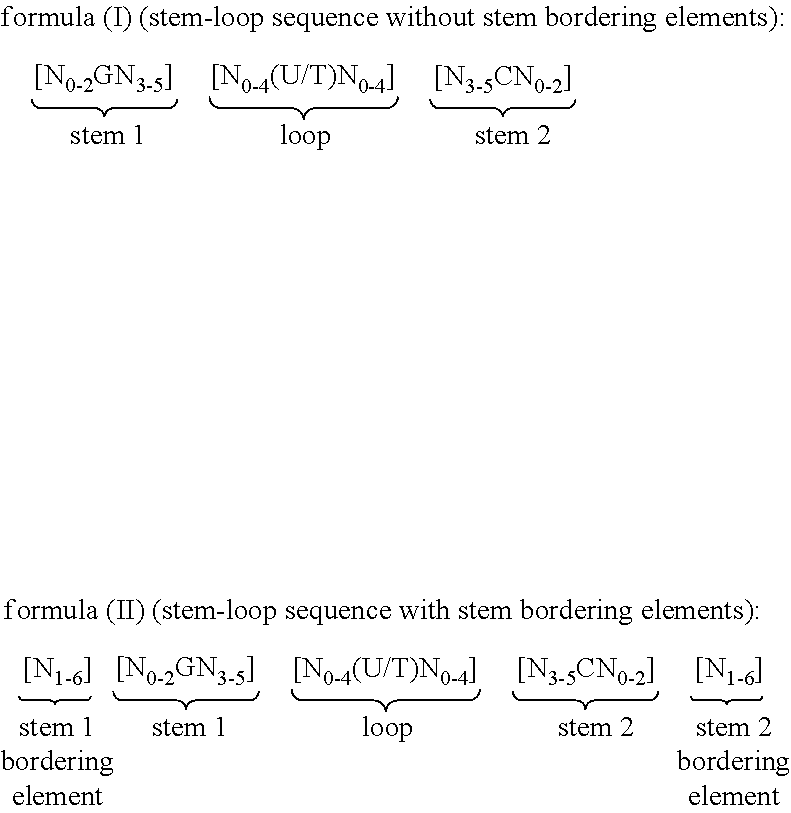
wherein:
- stem1 or stem2 bordering elements N1-6 is a consecutive sequence of 1 to 6, preferably of 2 to 6, more preferably of 2 to 5, even more preferably of 3 to 5, most preferably of 4 to 5 or 5 N, wherein each N is independently from another selected from a nucleotide selected from A, U, T, G and C, or a nucleotide analogue thereof;
- stem1 [N0-2GN3-5] is reverse complementary or partially reverse complementary with element stem2, and is a consecutive sequence between of 5 to 7 nucleotides;
- wherein N0-2 is a consecutive sequence of 0 to 2, preferably of 0 to 1, more preferably of 1 N, wherein each N is independently from another selected from a nucleotide selected from A, U, T, G and C or a nucleotide analogue thereof;
- wherein N3-5 is a consecutive sequence of 3 to 5, preferably of 4 to 5, more preferably of 4 N, wherein each N is independently from another selected from a nucleotide selected from A, U, T, G and C or a nucleotide analogue thereof, and
- wherein G is guanosine or an analogue thereof, and may be optionally replaced by a cytidine or an analogue thereof, provided that its complementary nucleotide cytidine in stem2 is replaced by guanosine;
- loop sequence [N0-4 (U/T)N0-4] is located between elements stem1 and stem2, and is a consecutive sequence of 3 to 5 nucleotides, more preferably of 4 nucleotides;
- wherein each N0-4 is independent from another a consecutive sequence of 0 to 4, preferably of 1 to 3, more preferably of 1 to 2 N, wherein each N is independently from another selected from a nucleotide selected from A, U, T, G and C or a nucleotide analogue thereof; and
- wherein U/T represents uridine, or optionally thymidine;
- stem2 [N3-5CN0-2] is reverse complementary or partially reverse complementary with element stem1, and is a consecutive sequence between of 5 to 7 nucleotides;
- wherein N3-5 is a consecutive sequence of 3 to 5, preferably of 4 to 5, more preferably of 4 N, wherein each N is independently from another selected from a nucleotide selected from A, U, T, G and C or a nucleotide analogue thereof;
- wherein N0-2 is a consecutive sequence of 0 to 2, preferably of 0 to 1, more preferably of 1 N, wherein each N is independently from another selected from a nucleotide selected from A, U, T, G or C or a nucleotide analogue thereof; and
- wherein C is cytidine or an analogue thereof, and may be optionally replaced by a guanosine or an analogue thereof provided that its complementary nucleoside guanosine in stem1 is replaced by cytidine;
- wherein
- stem1 and stem2 are capable of base pairing with each other forming a reverse complementary sequence, wherein base pairing may occur between stem1 and stem2, e.g. by Watson-Crick base pairing of nucleotides A and U/T or G and C or by non-Watson-Crick base pairing e.g. wobble base pairing, reverse Watson-Crick base pairing, Hoogsteen base pairing, reverse Hoogsteen base pairing or are capable of base pairing with each other forming a partially reverse complementary sequence, wherein an incomplete base pairing may occur between stem1 and stem2, on the basis that one or more bases in one stem do not have a complementary base in the reverse complementary sequence of the other stem.
(Arg)l;(Lys)m;(His)n;(Orn)o;(Xaa)x, (formula (III))
wherein l+m+n+o+x=8-15, and 1, m, n or o independently of each other may be any number selected from 0, 1, 2, 3, 4, 5, 6, 7, 8, 9, 10, 11, 12, 13, 14 or 15, provided that the overall content of Arg, Lys, His and Orn represents at least 50% of all amino acids of the oligopeptide; and Xaa may be any amino acid selected from native (=naturally occurring) or non-native amino acids except of Arg, Lys, His or Orn; and x may be any number selected from 0, 1, 2, 3 or 4, provided, that the overall content of Xaa does not exceed 50% of all amino acids of the oligopeptide. Particularly preferred cationic peptides in this context are e.g. Arg7, Arg8, Arg9, H3R9, R9H3, H3R9H3, YSSR9SSY, (RKH)4, Y(RKH)2R, etc.
{(Arg)l;(Lys)m;(His)n;(Orn)o;(Xaa)x}; formula (IV)
wherein l+m+n+o+x=3-100, and 1, m, n or o independently of each other is any number selected from 0, 1, 2, 3, 4, 5, 6, 7, 8, 9, 10, 11, 12, 13, 14, 15, 16, 17, 18, 19, 20, 21-30, 31-40, 41-50, 51-60, 61-70, 71-80, 81-90 and 91-100 provided that the overall content of Arg (Arginine), Lys (Lysine), His (Histidine) and Orn (Ornithine) represents at least 10% of all amino acids of the oligopeptide; and Xaa is any amino acid selected from native (=naturally occurring) or non-native amino acids except of Arg, Lys, His or Orn; and x is any number selected from 0, 1, 2, 3, 4, 5, 6, 7, 8, 9, 10, 11, 12, 13, 14, 15, 16, 17, 18, 19, 20, 21-30, 31-40, 41-50, 51-60, 61-70, 71-80, 81-90, provided, that the overall content of Xaa does not exceed 90% of all amino acids of the oligopeptide. Any of amino acids Arg, Lys, His, Orn and Xaa may be positioned at any place of the peptide. In this context cationic peptides or proteins in the range of 7-30 amino acids are particular preferred. Even more preferred peptides of this formula are oligoarginines such as e.g. Arg7, Arg8, Arg9, Arg12, His3Arg9, Arg9His3, His3Arg9His3, His6Arg9His6, His3Arg4His3, His6Arg4His6, TyrSer2Arg9Ser2Tyr, (ArgLysHis)4, Tyr(ArgLysHis)2Arg, etc.
{(Arg)l;(Lys)m;(His)n;(Orn)o;(Xaa′)x(Cys)y} formula (IVa)
wherein (Arg)l;(Lys)m;(His)n;(Orn)o; and x are as defined herein, Xaa′ is any amino acid selected from native (=naturally occurring) or non-native amino acids except of Arg, Lys, His, Orn or Cys and y is any number selected from 0, 1, 2, 3, 4, 5, 6, 7, 8, 9, 10, 11, 12, 13, 14, 15, 16, 17, 18, 19, 20, 21-30, 31-40, 41-50, 51-60, 61-70, 71-80 and 81-90, provided that the overall content of Arg (Arginine), Lys (Lysine), His (Histidine) and Orn (Ornithine) represents at least 10% of all amino acids of the oligopeptide.
Cys1{(Arg)l;(Lys)m;(His)n;(Orn)o;(Xaa)x}Cys2 formula (IVb)
wherein empirical formula {(Arg)l;(Lys)m;(His)n;(Orn)o;(Xaa)x} (formula (IV)) is as defined herein and forms a core of an amino acid sequence according to (semiempirical) formula (IV) and wherein Cys1 and Cys2 are Cysteines proximal to, or terminal to (Arg)l;(Lys)m;(His)n;(Orn)o;(Xaa)x. This embodiment may apply to situations, wherein the cationic or polycationic peptide or protein of the polymeric carrier, which may be used to complex the at least one RNA of the RNA vaccine encoding at least one antigen or an adjuvant nucleic acid in the inventive vaccine/inhibitor combination, e.g. when defined according to empirical formula (Arg)l;(Lys)m;(His)n;(Orn)o;(Xaa)x (formula (IV)) as shown above, has been modified with at least two cysteines as —SH moieties in the above meaning such that the cationic or polycationic peptide of the inventive polymeric carrier carries at least two (terminal) cysteines, which are capable to form a disulfide bond with other components of the polymeric carrier.
L-P1—S—[S—P2—S]n—S—P3-L formula (V)
wherein,
- P1 and P3 are different or identical to each other and represent a linear or branched hydrophilic polymer chain, each P1 and P3 exhibiting at least one —SH-moiety, capable to form a disulfide linkage upon condensation with component P2, or alternatively with (AA), (AA)x, or [(AA)x]z if such components are used as a linker between P1 and P2 or P3 and P2) and/or with further components (e.g. (AA), (AA)x, [(AA)x]z or L), the linear or branched hydrophilic polymer chain selected independent from each other from polyethylene glycol (PEG), poly-N-(2-hydroxypropyl)methacrylamide, poly-2-(methacryloyloxy)ethyl phosphorylcholines, poly(hydroxyalkyl L-asparagine), poly(2-(methacryloyloxy)ethyl phosphorylcholine), hydroxyethylstarch or poly(hydroxyalkyl L-glutamine), wherein the hydrophilic polymer chain exhibits a molecular weight of about 1 kDa to about 100 kDa, preferably of about 2 kDa to about 25 kDa; or more preferably of about 2 kDa to about 10 kDa, e.g. about 5 kDa to about 25 kDa or 5 kDa to about 10 kDa;
- p2 is a cationic or polycationic peptide or protein, e.g. as defined above for the polymeric carrier formed by disulfide-crosslinked cationic components, and preferably having a length of about 3 to about 100 amino acids, more preferably having a length of about 3 to about 50 amino acids, even more preferably having a length of about 3 to about 25 amino acids, e.g. a length of about 3 to 10, 5 to 15, 10 to 20 or 15 to 25 amino acids, more preferably a length of about 5 to about 20 and even more preferably a length of about 10 to about 20; or
- is a cationic or polycationic polymer, e.g. as defined above for the polymeric carrier formed by disulfide-crosslinked cationic components, typically having a molecular weight of about 0.5 kDa to about 30 kDa, including a molecular weight of about 1 kDa to about 20 kDa, even more preferably of about 1.5 kDa to about 10 kDa, or having a molecular weight of about 0.5 kDa to about 100 kDa, including a molecular weight of about 10 kDa to about 50 kDa, even more preferably of about 10 kDa to about 30 kDa;
- each P2 exhibiting at least two —SH-moieties, capable to form a disulfide linkage upon condensation with further components P2 or component(s) P1 and/or P3 or alternatively with further components (e.g. (AA), (AA)x, or [(AA)x]z);
- —S—S— is a (reversible) disulfide bond (the brackets are omitted for better readability), wherein S preferably represents sulphur or a —SH carrying moiety, which has formed a (reversible) disulfide bond. The (reversible) disulfide bond is preferably formed by condensation of —SH-moieties of either components P1 and P2, P2 and P2, or P2 and P3, or optionally of further components as defined herein (e.g. L, (AA), (AA)x, [(AA)x]z, etc); The —SH-moiety may be part of the structure of these components or added by a modification as defined below;
- L is an optional ligand, which may be present or not, and may be selected independent from the other from RGD, Transferrin, Folate, a signal peptide or signal sequence, a localization signal or sequence, a nuclear localization signal or sequence (NLS), an antibody, a cell penetrating peptide, (e.g. TAT or KALA), a ligand of a receptor (e.g. cytokines, hormones, growth factors etc), small molecules (e.g. carbohydrates like mannose or galactose or synthetic ligands), small molecule agonists, inhibitors or antagonists of receptors (e.g. RGD peptidomimetic analogues), or any further protein as defined herein, etc.;
- n is an integer, typically selected from a range of about 1 to 50, preferably from a range of about 1, 2 or 3 to 30, more preferably from a range of about 1, 2, 3, 4, or 5 to 25, or a range of about 1, 2, 3, 4, or 5 to 20, or a range of about 1, 2, 3, 4, or 5 to 15, or a range of about 1, 2, 3, 4, or 5 to 10, including e.g. a range of about 4 to 9, 4 to 10, 3 to 20, 4 to 20, 5 to 20, or 10 to 20, or a range of about 3 to 15, 4 to 15, 5 to 15, or 10 to 15, or a range of about 6 to 11 or 7 to 10. Most preferably, n is in a range of about 1, 2, 3, 4, or 5 to 10, more preferably in a range of about 1, 2, 3, or 4 to 9, in a range of about 1, 2, 3, or 4 to 8, or in a range of about 1, 2, or 3 to 7.
L-P1—S-[Cys-P2-Cys]n-S—P3-L formula (VI)
wherein L, P1, P2, P3 and n are as defined herein, S is sulphur and each Cys provides for one —SH-moiety for the disulfide bond.
L-P1—S-{[S-α2—S]a[S-(AA)x-S]b}-S—P3-L, formula (VIa)
wherein x, S, L, AA, P1, P2 and P3 are preferably as defined herein. In formula (VIa) above, any of the single components [S-α2—S] and [S-(AA)x-S] may occur in any order in the subformula {[S-α2—S]a[S-(AA)x-S]b}. The numbers of single components [S-α2—S] and [S-(AA)x-S] in the subformula {[S-α2—S]a[S-(AA)x-S]b} are determined by integers a and b, wherein a+b=n. n is an integer and is defined as above for formula (V).
GlXmGn, (formula (VII))
wherein:
- G is guanosine, uracil or an analogue of guanosine or uracil;
- X is guanosine, uracil, adenosine, thymidine, cytosine or an analogue of the above-mentioned nucleotides;
- l is an integer from 1 to 40,
- wherein
- when l=1 G is guanosine or an analogue thereof,
- when l>1 at least 50% of the nucleotides are guanosine or an analogue thereof;
- m is an integer and is at least 3;
- wherein
- when m=3 X is uracil or an analogue thereof,
- when m>3 at least 3 successive uracils or analogues of uracil occur;
- n is an integer from 1 to 40,
- wherein
- when n=1 G is guanosine or an analogue thereof,
- when n>1 at least 50% of the nucleotides are guanosine or an analogue thereof.
ClXmCn, (formula (VIII))
wherein:
- C is cytosine, uracil or an analogue of cytosine or uracil;
- X is guanosine, uracil, adenosine, thymidine, cytosine or an analogue of the above-mentioned nucleotides;
- l is an integer from 1 to 40,
- wherein
- when l=1 C is cytosine or an analogue thereof,
- when l>1 at least 50% of the nucleotides are cytosine or an analogue thereof;
- m is an integer and is at least 3;
- wherein
- when m=3 X is uracil or an analogue thereof,
- when m>3 at least 3 successive uracils or analogues of uracil occur;
- n is an integer from 1 to 40,
- wherein
- when n=1 C is cytosine or an analogue thereof,
- when n>1 at least 50% of the nucleotides are cytosine or an analogue thereof.
(NuGlXmGnNv)a, (formula (IX))
wherein:
- G is guanosine (guanine), uridine (uracil) or an analogue of guanosine (guanine) or uridine (uracil), preferably guanosine (guanine) or an analogue thereof;
- X is guanosine (guanine), uridine (uracil), adenosine (adenine), thymidine (thymine), cytidine (cytosine), or an analogue of these nucleotides (nucleosides), preferably uridine (uracil) or an analogue thereof;
- N is a nucleic acid sequence having a length of about 4 to 50, preferably of about 4 to 40, more preferably of about 4 to 30 or 4 to 20 nucleic acids, each N independently being selected from guanosine (guanine), uridine (uracil), adenosine (adenine), thymidine (thymine), cytidine (cytosine) or an analogue of these nucleotides (nucleosides);
- a is an integer from 1 to 20, preferably from 1 to 15, most preferably from 1 to 10;
- l is an integer from 1 to 40,
- wherein
- when l=1, G is guanosine (guanine) or an analogue thereof,
- when l>1, at least 50% of these nucleotides (nucleosides) are guanosine (guanine) or an analogue thereof;
- m is an integer and is at least 3;
- wherein
- when m=3, X is uridine (uracil) or an analogue thereof, and
- when m>3, at least 3 successive uridines (uracils) or analogues of uridine (uracil) occur;
- n is an integer from 1 to 40,
- wherein
- when n=1, G is guanosine (guanine) or an analogue thereof,
- when n>1, at least 50% of these nucleotides (nucleosides) are guanosine (guanine) or an analogue thereof;
- u, v may be independently from each other an integer from 0 to 50,
- preferably wherein when u=0, v≥1, or
- when v=0, u≥1;
wherein the nucleic acid molecule of formula (IX) has a length of at least 50 nucleotides, preferably of at least 100 nucleotides, more preferably of at least 150 nucleotides, even more preferably of at least 200 nucleotides and most preferably of at least 250 nucleotides.
(NuClXmCnNv)a (formula (X))
wherein:
- when v=0, u≥1;
- preferably wherein when u=0, v≥1, or
- C is cytidine (cytosine), uridine (uracil) or an analogue of cytidine (cytosine) or uridine (uracil), preferably cytidine (cytosine) or an analogue thereof;
- X is guanosine (guanine), uridine (uracil), adenosine (adenine), thymidine (thymine), cytidine (cytosine) or an analogue of the above-mentioned nucleotides (nucleosides), preferably uridine (uracil) or an analogue thereof;
- N is each a nucleic acid sequence having independent from each other a length of about 4 to 50, preferably of about 4 to 40, more preferably of about 4 to 30 or 4 to 20 nucleic acids, each N independently being selected from guanosine (guanine), uridine (uracil), adenosine (adenine), thymidine (thymine), cytidine (cytosine) or an analogue of these nucleotides (nucleosides);
- a is an integer from 1 to 20, preferably from 1 to 15, most preferably from 1 to 10;
- l is an integer from 1 to 40,
- wherein
- when l=1, C is cytidine (cytosine) or an analogue thereof,
- when l>1, at least 50% of these nucleotides (nucleosides) are cytidine (cytosine) or an analogue thereof;
- m is an integer and is at least 3;
- wherein
- when m=3, X is uridine (uracil) or an analogue thereof,
- when m>3, at least 3 successive uridines (uracils) or analogues of uridine (uracil) occur;
- n is an integer from 1 to 40,
- wherein
- when n=1, C is cytidine (cytosine) or an analogue thereof,
- when n>1, at least 50% of these nucleotides (nucleosides) are cytidine (cytosine) or an analogue thereof.
- u, v may be independently from each other an integer from 0 to 50,
- preferably wherein when u=0, v≥1, or
- when v=0, u≥1;
wherein the nucleic acid molecule of formula (X) according to the invention has a length of at least 50 nucleotides, preferably of at least 100 nucleotides, more preferably of at least 150 nucleotides, even more preferably of at least 200 nucleotides and most preferably of at least 250 nucleotides.
- when v=0, u≥1;
- preferably wherein when u=0, v≥1, or
- (i) as vaccine an RNA vaccine comprising at least one RNA comprising at least one open reading frame (ORF) coding for at least one antigen, and
- (ii) as an inhibitor a composition comprising at least one PD-1 pathway inhibitor.
-
- a) an optional 5′-UTR sequence comprising a UTR modification
- b) an open reading frame encoding an antigen as defined above;
- c) a 3′-UTR sequence comprising a UTR modification
- d) at least one histone stem-loop, optionally without a histone downstream element 3′ to the histone stem-loop
- e) a poly(A) sequence or optional a polyadenylation signal; and
- f) a poly(C) sequence.
-
- a) an optional 5′-UTR sequence comprising a UTR modification
- b) an open reading frame encoding an antigen as defined above;
- c) a 3′-UTR sequence comprising a UTR modification
- d) a poly(A) sequence
- e) a poly(C) sequence; and
- f) at least one histone stem-loop.
-
- a) an RNA molecule encoding at least one peptide or protein, wherein said encoded peptide or protein comprises the tumour antigen PSA, or a fragment, variant or derivative thereof; and
- b) an RNA molecule encoding at least one peptide or protein, wherein said encoded peptide or protein comprises the tumour antigen PSMA, or a fragment, variant or derivative thereof; and
- c) an RNA molecule encoding at least one peptide or protein, wherein said encoded peptide or protein comprises the tumour antigen PSCA, or a fragment, variant or derivative thereof;
- d) an RNA molecule encoding at least one peptide or protein, wherein said encoded peptide or protein comprises the tumour antigen STEAP-1, or a fragment, variant or derivative thereof; and optional
- e) an RNA molecule encoding at least one peptide or protein, wherein said encoded peptide or protein comprises the tumour antigen MUC-1, or a fragment, variant or derivative thereof.
-
- a) an RNA molecule encoding at least one peptide or protein, wherein said encoded peptide or protein comprises the tumour antigen NY-ESO-1, or a fragment, variant or derivative thereof; and
- d) an RNA molecule encoding at least one peptide or protein, wherein said encoded peptide or protein comprises the tumour antigen MAGE-C1, or a fragment, variant or derivative thereof; and
- e) an RNA molecule encoding at least one peptide or protein, wherein said encoded peptide or protein comprises the tumour antigen MAGE-C2, or a fragment, variant or derivative thereof;
- f) an RNA molecule encoding at least one peptide or protein, wherein said encoded peptide or protein comprises the tumour antigen Survivin, or a fragment, variant or derivative thereof; and optional
- g) an RNA molecule encoding at least one peptide or protein, wherein said encoded peptide or protein comprises the tumour antigen 5T4, or a fragment, variant or derivative thereof; and optional
- h) an RNA molecule encoding at least one peptide or protein, wherein said encoded peptide or protein comprises the tumour antigen MUC-1, or a fragment, variant or derivative thereof.
-
- a) said at least one RNA comprising at least one open reading frame coding for at least one antigen; preferably in form of a mono-, bi- or multicistronic RNA, optionally being stabilized, optionally being optimized for translation and/or optionally being complexed with a cationic or polycationic compound or a polymeric carrier;
- b) optionally an adjuvant component, comprising or consisting of said at least one RNA comprising at least one open reading frame coding for at least one antigen and/or at least one adjuvant nucleic acid, complexed with a cationic or polycationic compound and/or with a polymeric carrier, and
- c) optionally a pharmaceutically acceptable carrier as defined herein.
-
- For the present examples a DNA sequence, encoding Gallus gallus ovalbumin mRNA (R1710) was prepared and used for subsequent in vitro transcription reactions.
- According to a first preparation, the DNA sequence coding for the above mentioned mRNA was prepared. The construct was prepared by modifying the wild type coding sequence by introducing a GC-optimized sequence for stabilization, followed by a stabilizing sequence derived from the alpha-globin-3′-UTR (muag (mutated alpha-globin-3′-UTR)), a stretch of 64 adenosines (poly-A-sequence), a stretch of 30 cytosines (poly-C-sequence), and a histone stem loop. In SEQ ID NO: 2 (see
FIG. 3 ) the sequence of the corresponding mRNA is shown.
2. In Vitro Transcription - The respective DNA plasmid prepared according to Example 1 was transcribed in vitro using T7 polymerase. Subsequently the mRNA was purified using PureMessenger® (CureVac, Tubingen, Germany).
3. Reagents - Complexation Reagent: protamine
4. Preparation of the Vaccine - The mRNA R1710 was complexed with protamine by addition of protamine to the mRNA in the ratio (1:2) (w/w) (adjuvant component). After incubation for 10 min, the same amount of free mRNA R1710 used as antigen-providing RNA was added.
- OVA-RNActive vaccine (R1710): comprising an adjuvant component consisting of mRNA coding for Gallus gallus ovalbumin (R1710) according to SEQ ID NO. 2 complexed with protamine in a ratio of 2:1 (w/w) and the antigen-providing free mRNA coding for Gallus gallus ovalbumin (R1710) according to SEQ ID NO. (ratio 1:1; complexed RNA:free RNA).
| TABLE 1 |
| Animal groups |
| Injected RNA | Injected antibody | ||
| Number | per vaccination | per treatment | |
| Group | of mice | day and mouse | day and |
| A |
| 10 | 100% Ringer Lactate | — | |
| (RiLa) | |||
| B | |||
| 10 | 32 μg | — | |
| C | 6 | — | 100 μg anti-PD-1 |
| D | 6 | 32 |
100 μg anti-PD-1 |
| E | 6 | 32 |
100 μg control-IgG2a |
Claims (25)
Priority Applications (2)
| Application Number | Priority Date | Filing Date | Title |
|---|---|---|---|
| US16/555,586 US11458195B2 (en) | 2013-02-22 | 2019-08-29 | Combination of vaccination and inhibition of the PD-1 pathway |
| US17/822,054 US12447209B2 (en) | 2013-02-22 | 2022-08-24 | Combination of vaccination and inhibition of the PD-1 pathway |
Applications Claiming Priority (6)
| Application Number | Priority Date | Filing Date | Title |
|---|---|---|---|
| EPPCT/EP2013/000526 | 2013-02-22 | ||
| EP2013000526 | 2013-02-22 | ||
| PCT/EP2014/000461 WO2014127917A1 (en) | 2013-02-22 | 2014-02-21 | Combination of vaccination and inhibition of the pd-1 pathway |
| US201514769720A | 2015-08-21 | 2015-08-21 | |
| US15/890,736 US10434158B2 (en) | 2013-02-22 | 2018-02-07 | Combination of vaccination and inhibition of the PD-1 pathway |
| US16/555,586 US11458195B2 (en) | 2013-02-22 | 2019-08-29 | Combination of vaccination and inhibition of the PD-1 pathway |
Related Parent Applications (1)
| Application Number | Title | Priority Date | Filing Date |
|---|---|---|---|
| US15/890,736 Continuation US10434158B2 (en) | 2013-02-22 | 2018-02-07 | Combination of vaccination and inhibition of the PD-1 pathway |
Related Child Applications (1)
| Application Number | Title | Priority Date | Filing Date |
|---|---|---|---|
| US17/822,054 Continuation US12447209B2 (en) | 2013-02-22 | 2022-08-24 | Combination of vaccination and inhibition of the PD-1 pathway |
Publications (2)
| Publication Number | Publication Date |
|---|---|
| US20190381155A1 US20190381155A1 (en) | 2019-12-19 |
| US11458195B2 true US11458195B2 (en) | 2022-10-04 |
Family
ID=47748572
Family Applications (6)
| Application Number | Title | Priority Date | Filing Date |
|---|---|---|---|
| US14/769,720 Active 2034-09-08 US9974845B2 (en) | 2013-02-22 | 2014-02-21 | Combination of vaccination and inhibition of the PD-1 pathway |
| US15/091,060 Abandoned US20160206719A1 (en) | 2013-02-22 | 2016-04-05 | Combination of vaccination and inhibition of the pd-1 pathway |
| US15/890,736 Active US10434158B2 (en) | 2013-02-22 | 2018-02-07 | Combination of vaccination and inhibition of the PD-1 pathway |
| US15/890,413 Active US10117920B2 (en) | 2013-02-22 | 2018-02-07 | Combination of vaccination and inhibition of the PD-1 pathway |
| US16/555,586 Active 2035-05-27 US11458195B2 (en) | 2013-02-22 | 2019-08-29 | Combination of vaccination and inhibition of the PD-1 pathway |
| US17/822,054 Active 2035-07-22 US12447209B2 (en) | 2013-02-22 | 2022-08-24 | Combination of vaccination and inhibition of the PD-1 pathway |
Family Applications Before (4)
| Application Number | Title | Priority Date | Filing Date |
|---|---|---|---|
| US14/769,720 Active 2034-09-08 US9974845B2 (en) | 2013-02-22 | 2014-02-21 | Combination of vaccination and inhibition of the PD-1 pathway |
| US15/091,060 Abandoned US20160206719A1 (en) | 2013-02-22 | 2016-04-05 | Combination of vaccination and inhibition of the pd-1 pathway |
| US15/890,736 Active US10434158B2 (en) | 2013-02-22 | 2018-02-07 | Combination of vaccination and inhibition of the PD-1 pathway |
| US15/890,413 Active US10117920B2 (en) | 2013-02-22 | 2018-02-07 | Combination of vaccination and inhibition of the PD-1 pathway |
Family Applications After (1)
| Application Number | Title | Priority Date | Filing Date |
|---|---|---|---|
| US17/822,054 Active 2035-07-22 US12447209B2 (en) | 2013-02-22 | 2022-08-24 | Combination of vaccination and inhibition of the PD-1 pathway |
Country Status (14)
| Country | Link |
|---|---|
| US (6) | US9974845B2 (en) |
| JP (2) | JP6456305B2 (en) |
| KR (1) | KR102134056B1 (en) |
| CN (2) | CN109045289A (en) |
| AU (2) | AU2014220957A1 (en) |
| BR (1) | BR112015018989B1 (en) |
| CA (1) | CA2897858A1 (en) |
| DK (1) | DK2958588T3 (en) |
| ES (2) | ES2739913T3 (en) |
| HK (1) | HK1250910A1 (en) |
| MX (2) | MX385338B (en) |
| RU (1) | RU2718988C2 (en) |
| SG (3) | SG10201710472PA (en) |
| WO (1) | WO2014127917A1 (en) |
Cited By (8)
| Publication number | Priority date | Publication date | Assignee | Title |
|---|---|---|---|---|
| US11786590B2 (en) | 2015-11-09 | 2023-10-17 | CureVac SE | Rotavirus vaccines |
| US11834651B2 (en) | 2015-05-29 | 2023-12-05 | CureVac Manufacturing GmbH | Method for producing and purifying RNA, comprising at least one step of tangential flow filtration |
| US11965000B2 (en) | 2013-08-21 | 2024-04-23 | CureVac SE | Respiratory syncytial virus (RSV) vaccine |
| US12083190B2 (en) | 2013-08-21 | 2024-09-10 | CureVac SE | Rabies vaccine |
| US12161711B2 (en) | 2016-12-23 | 2024-12-10 | CureVac SE | Lassa virus vaccine |
| US12385088B2 (en) | 2017-12-21 | 2025-08-12 | CureVac SE | Linear double stranded DNA coupled to a single support or a tag and methods for producing said linear double stranded DNA |
| US12447209B2 (en) * | 2013-02-22 | 2025-10-21 | Cure Vac SE | Combination of vaccination and inhibition of the PD-1 pathway |
| US12528855B2 (en) | 2018-12-14 | 2026-01-20 | CureVac SE | KRAS variant mRNA molecules |
Families Citing this family (190)
| Publication number | Priority date | Publication date | Assignee | Title |
|---|---|---|---|---|
| WO2012019630A1 (en) | 2010-08-13 | 2012-02-16 | Curevac Gmbh | Nucleic acid comprising or coding for a histone stem-loop and a poly(a) sequence or a polyadenylation signal for increasing the expression of an encoded protein |
| WO2012116714A1 (en) | 2011-03-02 | 2012-09-07 | Curevac Gmbh | Vaccination in elderly patients |
| US9464124B2 (en) | 2011-09-12 | 2016-10-11 | Moderna Therapeutics, Inc. | Engineered nucleic acids and methods of use thereof |
| WO2013120499A1 (en) | 2012-02-15 | 2013-08-22 | Curevac Gmbh | Nucleic acid comprising or coding for a histone stem-loop and a poly (a) sequence or a polyadenylation signal for increasing the expression of an encoded pathogenic antigen |
| WO2013120497A1 (en) | 2012-02-15 | 2013-08-22 | Curevac Gmbh | Nucleic acid comprising or coding for a histone stem-loop and a poly(a) sequence or a polyadenylation signal for increasing the expression of an encoded therapeutic protein |
| MX362981B (en) | 2012-03-27 | 2019-02-28 | Curevac Ag | Artificial nucleic acid molecules for improved protein or peptide expression. |
| CN105473157A (en) | 2013-08-21 | 2016-04-06 | 库瑞瓦格股份公司 | Combination vaccine |
| CN105451779A (en) | 2013-08-21 | 2016-03-30 | 库瑞瓦格股份公司 | Method for increasing expression of RNA-encoded proteins |
| US10023626B2 (en) | 2013-09-30 | 2018-07-17 | Modernatx, Inc. | Polynucleotides encoding immune modulating polypeptides |
| WO2015051214A1 (en) | 2013-10-03 | 2015-04-09 | Moderna Therapeutics, Inc. | Polynucleotides encoding low density lipoprotein receptor |
| WO2015062738A1 (en) | 2013-11-01 | 2015-05-07 | Curevac Gmbh | Modified rna with decreased immunostimulatory properties |
| SG10201804945WA (en) | 2013-12-12 | 2018-07-30 | Shanghai hengrui pharmaceutical co ltd | Pd-1 antibody, antigen-binding fragment thereof, and medical application thereof |
| AU2014375404C1 (en) | 2013-12-30 | 2020-11-19 | CureVac Manufacturing GmbH | Methods for RNA analysis |
| CA2927254C (en) | 2013-12-30 | 2023-10-24 | Curevac Ag | Artificial nucleic acid molecules |
| EP3092004A4 (en) * | 2014-01-06 | 2017-02-22 | The Trustees Of The University Of Pennsylvania | Pd1 and pdl1 antibodies and vaccine combinations and use of same for immunotherapy |
| TWI681969B (en) | 2014-01-23 | 2020-01-11 | 美商再生元醫藥公司 | Human antibodies to pd-1 |
| TWI680138B (en) | 2014-01-23 | 2019-12-21 | 美商再生元醫藥公司 | Human antibodies to pd-l1 |
| WO2015109391A1 (en) | 2014-01-24 | 2015-07-30 | Children's Hospital Of Eastern Ontario Research Institute Inc. | Smc combination therapy for the treatment of cancer |
| US9394365B1 (en) | 2014-03-12 | 2016-07-19 | Yeda Research And Development Co., Ltd | Reducing systemic regulatory T cell levels or activity for treatment of alzheimer's disease |
| BR112016020919A2 (en) | 2014-03-12 | 2018-01-23 | Yeda Res & Dev | reduced levels or systemic activity of regulatory t cells for the treatment of snc disease and injury |
| US10519237B2 (en) | 2014-03-12 | 2019-12-31 | Yeda Research And Development Co. Ltd | Reducing systemic regulatory T cell levels or activity for treatment of disease and injury of the CNS |
| US10618963B2 (en) | 2014-03-12 | 2020-04-14 | Yeda Research And Development Co. Ltd | Reducing systemic regulatory T cell levels or activity for treatment of disease and injury of the CNS |
| ES2754239T3 (en) | 2014-03-12 | 2020-04-16 | Curevac Ag | Combination of vaccination and OX40 agonists |
| US10369216B2 (en) | 2014-04-01 | 2019-08-06 | Curevac Ag | Polymeric carrier cargo complex for use as an immunostimulating agent or as an adjuvant |
| PL3981437T3 (en) | 2014-04-23 | 2025-02-24 | Modernatx, Inc. | Nucleic acid vaccines |
| MX382298B (en) | 2014-06-10 | 2025-03-12 | Curevac Mfg Gmbh | METHODS AND MEANS FOR INCREASING RNA PRODUCTION. |
| EP3160938B1 (en) | 2014-06-25 | 2020-09-16 | Acuitas Therapeutics Inc. | Novel lipids and lipid nanoparticle formulations for delivery of nucleic acids |
| WO2016073763A2 (en) * | 2014-11-06 | 2016-05-12 | Biothera, Inc. | Beta-glucan methods and compositions that affect the tumor microenvironment |
| DE202015009961U1 (en) | 2014-12-12 | 2022-01-25 | Curevac Ag | Artificial nucleic acid molecules for improved protein expression |
| CA2979388A1 (en) | 2015-03-12 | 2016-09-15 | Health Research, Inc. | Enrichment of cd16+ monocytes to improve dendritic cell vaccine quality |
| EP4353257A3 (en) | 2015-04-13 | 2024-08-07 | CureVac Manufacturing GmbH | Method for producing rna compositions |
| CN107567497A (en) | 2015-04-17 | 2018-01-09 | 库瑞瓦格股份公司 | Lyophilization of RNA |
| US10293058B2 (en) | 2015-04-22 | 2019-05-21 | Curevac Ag | RNA containing composition for treatment of tumor diseases |
| WO2016176330A1 (en) | 2015-04-27 | 2016-11-03 | The Trustees Of The University Of Pennsylvania | Nucleoside-modified rna for inducing an adaptive immune response |
| EP3289101B1 (en) | 2015-04-30 | 2021-06-23 | CureVac AG | Immobilized poly(n)polymerase |
| WO2016180430A1 (en) | 2015-05-08 | 2016-11-17 | Curevac Ag | Method for producing rna |
| KR20180004820A (en) * | 2015-05-15 | 2018-01-12 | 큐어백 아게 | A novel prime-boost therapy comprising administration of at least one mRNA construct |
| WO2016184576A2 (en) | 2015-05-20 | 2016-11-24 | Curevac Ag | Dry powder composition comprising long-chain rna |
| EP3916091A3 (en) | 2015-05-20 | 2022-03-30 | CureVac AG | Dry powder composition comprising long-chain rna |
| WO2016189104A1 (en) * | 2015-05-27 | 2016-12-01 | INSERM (Institut National de la Santé et de la Recherche Médicale) | New method to produce t cells |
| EP3303575B1 (en) | 2015-05-29 | 2022-03-16 | CureVac AG | Method for adding cap structures to rna using immobilized enzymes |
| PL3626262T3 (en) * | 2015-06-18 | 2025-02-17 | Vaximm Ag | Vegfr-2 targeting dna vaccine for combination therapy |
| AU2016285852B2 (en) | 2015-06-29 | 2020-12-17 | Acuitas Therapeutics Inc. | Lipids and lipid nanoparticle formulations for delivery of nucleic acids |
| US10501768B2 (en) | 2015-07-13 | 2019-12-10 | Curevac Ag | Method of producing RNA from circular DNA and corresponding template DNA |
| US11364292B2 (en) | 2015-07-21 | 2022-06-21 | Modernatx, Inc. | CHIKV RNA vaccines |
| ES2937963T3 (en) | 2015-07-21 | 2023-04-03 | Modernatx Inc | Infectious disease vaccines |
| WO2017031761A1 (en) * | 2015-08-27 | 2017-03-02 | 杨光华 | Interference fragment and applications thereof |
| WO2017031760A1 (en) * | 2015-08-27 | 2017-03-02 | 杨光华 | Interference fragment and applications thereof |
| AU2016316439B2 (en) | 2015-08-28 | 2022-02-24 | CureVac SE | Artificial nucleic acid molecules |
| WO2017040790A1 (en) | 2015-09-01 | 2017-03-09 | Agenus Inc. | Anti-pd-1 antibodies and methods of use thereof |
| ES2969082T3 (en) | 2015-09-17 | 2024-05-16 | Modernatx Inc | Compounds and compositions for intracellular administration of therapeutic agents |
| EP3362576A1 (en) | 2015-10-12 | 2018-08-22 | CureVac AG | Automated method for isolation, selection and/or detection of microorganisms or cells comprised in a solution |
| EP3362460A1 (en) | 2015-10-16 | 2018-08-22 | Modernatx, Inc. | Mrna cap analogs and methods of mrna capping |
| WO2017066782A1 (en) | 2015-10-16 | 2017-04-20 | Modernatx, Inc. | Hydrophobic mrna cap analogs |
| WO2017066791A1 (en) | 2015-10-16 | 2017-04-20 | Modernatx, Inc. | Sugar substituted mrna cap analogs |
| WO2017066789A1 (en) | 2015-10-16 | 2017-04-20 | Modernatx, Inc. | Mrna cap analogs with modified sugar |
| EP4086269A1 (en) | 2015-10-16 | 2022-11-09 | ModernaTX, Inc. | Mrna cap analogs with modified phosphate linkage |
| WO2017070624A1 (en) | 2015-10-22 | 2017-04-27 | Modernatx, Inc. | Tropical disease vaccines |
| MA46080A (en) | 2015-10-22 | 2019-07-10 | Modernatx Inc | NUCLEIC ACID VACCINES AGAINST VARICELLA ZONA VIRUS (VZV) |
| AU2016342376A1 (en) | 2015-10-22 | 2018-06-07 | Modernatx, Inc. | Sexually transmitted disease vaccines |
| FI3368507T3 (en) | 2015-10-28 | 2023-03-21 | Acuitas Therapeutics Inc | New lipids and lipid nanoparticle preparations for delivery of nucleic acids |
| AU2016375021B2 (en) | 2015-12-22 | 2022-02-03 | CureVac SE | Method for producing RNA molecule compositions |
| US10799463B2 (en) | 2015-12-22 | 2020-10-13 | Modernatx, Inc. | Compounds and compositions for intracellular delivery of agents |
| ES2954153T3 (en) | 2015-12-22 | 2023-11-20 | Regeneron Pharma | Combination of anti-PD-1 antibodies and anti-CD20/anti-CD3 bispecific antibodies to treat cancer |
| WO2017109161A1 (en) | 2015-12-23 | 2017-06-29 | Curevac Ag | Method of rna in vitro transcription using a buffer containing a dicarboxylic acid or tricarboxylic acid or a salt thereof |
| US11723967B2 (en) | 2016-02-17 | 2023-08-15 | CureVac SE | Zika virus vaccine |
| EP3423595A1 (en) | 2016-03-03 | 2019-01-09 | CureVac AG | Rna analysis by total hydrolysis |
| CN105821040B (en) * | 2016-03-09 | 2018-12-14 | 李旭 | Combined immunization gene inhibits sgRNA, gene knockout carrier and its application of high-risk HPV expression |
| CN105999223B (en) * | 2016-04-26 | 2020-05-12 | 中国人民解放军第四军医大学 | Application of PDL1-IgGFc fusion protein in inhibiting severe malaria morbidity |
| WO2017186928A1 (en) | 2016-04-29 | 2017-11-02 | Curevac Ag | Rna encoding an antibody |
| EP4477662A3 (en) | 2016-05-04 | 2025-03-19 | CureVac SE | Nucleic acid molecules and uses thereof |
| EP4233898A3 (en) | 2016-05-04 | 2023-11-01 | CureVac SE | Influenza mrna vaccines |
| EP3452101A2 (en) | 2016-05-04 | 2019-03-13 | CureVac AG | Rna encoding a therapeutic protein |
| TWI755395B (en) | 2016-05-13 | 2022-02-21 | 美商再生元醫藥公司 | Combination of anti-pd-1 antibodies and radiation to treat cancer |
| SG11201809381XA (en) | 2016-05-18 | 2018-12-28 | Modernatx Inc | Polynucleotides encoding interleukin-12 (il12) and uses thereof |
| RS65007B1 (en) | 2016-06-02 | 2024-01-31 | Ultimovacs Asa | A vaccine in combination with an immune checkpoint inhibitor for use in treating cancer |
| US11478552B2 (en) | 2016-06-09 | 2022-10-25 | Curevac Ag | Hybrid carriers for nucleic acid cargo |
| EP3468537A1 (en) | 2016-06-14 | 2019-04-17 | Modernatx, Inc. | Stabilized formulations of lipid nanoparticles |
| KR102360736B1 (en) * | 2016-08-15 | 2022-02-08 | 국립대학법인 홋가이도 다이가쿠 | anti-PD-1 antibody |
| CA3034295A1 (en) * | 2016-08-17 | 2018-02-22 | Orbis Health Solutions Llc | Tumor-targeting bead vectors and methods of using the same |
| JP2019528284A (en) * | 2016-08-17 | 2019-10-10 | ファクター バイオサイエンス インコーポレイテッド | Nucleic acid product and method of administration thereof |
| BR112019000598A2 (en) | 2016-08-19 | 2019-07-02 | Curevac Ag | rna for cancer therapy |
| US10799555B2 (en) | 2016-09-15 | 2020-10-13 | Leidos, Inc. | PD-1 peptide inhibitors |
| EP3795167B1 (en) * | 2016-09-15 | 2022-08-03 | Leidos, Inc. | Pd-1 peptide inhibitors |
| KR20190093816A (en) | 2016-10-26 | 2019-08-26 | 큐어백 아게 | Lipid nanoparticle mRNA vaccine |
| EP3534952A4 (en) * | 2016-11-04 | 2020-06-10 | Memorial Sloan-Kettering Cancer Center | SPECIFIC ACTIVATORS FOR TUMOR THERAPY |
| US11583504B2 (en) | 2016-11-08 | 2023-02-21 | Modernatx, Inc. | Stabilized formulations of lipid nanoparticles |
| US10925958B2 (en) | 2016-11-11 | 2021-02-23 | Modernatx, Inc. | Influenza vaccine |
| WO2018096179A1 (en) | 2016-11-28 | 2018-05-31 | Curevac Ag | Method for purifying rna |
| US20180193270A1 (en) | 2016-11-29 | 2018-07-12 | PureTech Health LLC | Exosomes for delivery of therapeutic agents |
| MA50948A (en) | 2016-12-07 | 2020-10-14 | Agenus Inc | ANTIBODIES AND METHODS OF USING THE SAME |
| WO2018107088A2 (en) | 2016-12-08 | 2018-06-14 | Modernatx, Inc. | Respiratory virus nucleic acid vaccines |
| WO2018104540A1 (en) | 2016-12-08 | 2018-06-14 | Curevac Ag | Rnas for wound healing |
| US11464836B2 (en) | 2016-12-08 | 2022-10-11 | Curevac Ag | RNA for treatment or prophylaxis of a liver disease |
| US11524066B2 (en) | 2016-12-23 | 2022-12-13 | CureVac SE | Henipavirus vaccine |
| US11141476B2 (en) | 2016-12-23 | 2021-10-12 | Curevac Ag | MERS coronavirus vaccine |
| US11241490B2 (en) | 2017-01-11 | 2022-02-08 | The Trustees Of The University Of Pennsylvania | Nucleoside-modified RNA for inducing an immune response against zika virus |
| WO2018140890A1 (en) * | 2017-01-29 | 2018-08-02 | Zequn Tang | Methods of immune modulation against foreign and/or auto antigens |
| WO2018156888A1 (en) | 2017-02-24 | 2018-08-30 | Biothera Pharmaceuticals, Inc. | Beta glucan immunopharmacodynamics |
| TW202428301A (en) | 2017-02-28 | 2024-07-16 | 法商賽諾菲公司 | Therapeutic rna |
| MX2019011004A (en) | 2017-03-15 | 2020-08-10 | Modernatx Inc | Compounds and compositions for intracellular delivery of therapeutic agents. |
| CA3055653A1 (en) | 2017-03-15 | 2018-09-20 | Modernatx, Inc. | Lipid nanoparticle formulation |
| EP3595713A4 (en) | 2017-03-15 | 2021-01-13 | ModernaTX, Inc. | RESPIRATORY SYNCYTIAL VIRUS VACCINE |
| US11752206B2 (en) | 2017-03-15 | 2023-09-12 | Modernatx, Inc. | Herpes simplex virus vaccine |
| US11045540B2 (en) | 2017-03-15 | 2021-06-29 | Modernatx, Inc. | Varicella zoster virus (VZV) vaccine |
| US11576961B2 (en) | 2017-03-15 | 2023-02-14 | Modernatx, Inc. | Broad spectrum influenza virus vaccine |
| EP3595715A1 (en) * | 2017-03-17 | 2020-01-22 | CureVac AG | Rna vaccine and immune checkpoint inhibitors for combined anticancer therapy |
| EP3601576A1 (en) | 2017-03-24 | 2020-02-05 | CureVac AG | Nucleic acids encoding crispr-associated proteins and uses thereof |
| US11517620B2 (en) * | 2017-03-29 | 2022-12-06 | Terumo Kabushiki Kaisha | Adjuvant composition, and vaccine composition and drug kit each containing the same |
| US11603407B2 (en) | 2017-04-06 | 2023-03-14 | Regeneron Pharmaceuticals, Inc. | Stable antibody formulation |
| US11357856B2 (en) | 2017-04-13 | 2022-06-14 | Acuitas Therapeutics, Inc. | Lipids for delivery of active agents |
| JP7464954B2 (en) | 2017-04-27 | 2024-04-10 | ザ トラスティーズ オブ ザ ユニバーシティ オブ ペンシルバニア | Nucleoside-modified mRNA-lipid nanoparticle-based vaccine against hepatitis C virus |
| IL301115A (en) | 2017-04-28 | 2023-05-01 | Acuitas Therapeutics Inc | New lipid carbonyl and lipid nanoparticle formulations for delivery of nucleic acids |
| US12297489B2 (en) | 2017-05-17 | 2025-05-13 | CureVac Manufacturing GmbH | Method for determining at least one quality parameter of an RNA sample |
| US11421011B2 (en) | 2017-05-18 | 2022-08-23 | Modernatx, Inc. | Polynucleotides encoding tethered interleukin-12 (IL12) polypeptides and uses thereof |
| WO2018218137A1 (en) | 2017-05-25 | 2018-11-29 | Leidos, Inc. | Pd-1 and ctla-4 dual inhibitor peptides |
| US12077501B2 (en) | 2017-06-14 | 2024-09-03 | Modernatx, Inc. | Compounds and compositions for intracellular delivery of agents |
| MA49421A (en) | 2017-06-15 | 2020-04-22 | Modernatx Inc | RNA FORMULATIONS |
| EP3424524B1 (en) | 2017-07-04 | 2024-12-11 | CureVac SE | Cancer rna-vaccine |
| CA3073020A1 (en) | 2017-08-16 | 2019-02-21 | Acuitas Therapeutics, Inc. | Lipids for use in lipid nanoparticle formulations |
| WO2019036000A1 (en) | 2017-08-17 | 2019-02-21 | Acuitas Therapeutics, Inc. | Lipids for use in lipid nanoparticle formulations |
| WO2019036030A1 (en) | 2017-08-17 | 2019-02-21 | Acuitas Therapeutics, Inc. | Lipids for use in lipid nanoparticle formulations |
| US11542225B2 (en) | 2017-08-17 | 2023-01-03 | Acuitas Therapeutics, Inc. | Lipids for use in lipid nanoparticle formulations |
| WO2019036638A1 (en) | 2017-08-18 | 2019-02-21 | Modernatx, Inc. | Methods of preparing modified rna |
| WO2019038332A1 (en) | 2017-08-22 | 2019-02-28 | Curevac Ag | Bunyavirales vaccine |
| WO2019046809A1 (en) | 2017-08-31 | 2019-03-07 | Modernatx, Inc. | Methods of making lipid nanoparticles |
| WO2019055807A1 (en) | 2017-09-14 | 2019-03-21 | Modernatx, Inc. | Zika virus rna vaccines |
| MX2020003995A (en) | 2017-10-19 | 2020-07-22 | Curevac Ag | NEW ARTIFICIAL NUCLEIC ACID MOLECULES. |
| RU2020117848A (en) | 2017-11-08 | 2021-12-08 | Куревак Аг | PHK SEQUENCE ADAPTATION |
| EP3723796A1 (en) | 2017-12-13 | 2020-10-21 | CureVac AG | Flavivirus vaccine |
| EP3746090A4 (en) | 2018-01-29 | 2021-11-17 | ModernaTX, Inc. | RSV RNA VACCINES |
| JP7170737B2 (en) * | 2018-02-27 | 2022-11-14 | レイドス, インコーポレイテッド | PD-1 peptide inhibitor |
| WO2019202035A1 (en) | 2018-04-17 | 2019-10-24 | Curevac Ag | Novel rsv rna molecules and compositions for vaccination |
| SG11202011097YA (en) | 2018-06-28 | 2020-12-30 | Curevac Ag | Bioreactor for rna in vitro transcription |
| EP3836964A1 (en) * | 2018-08-15 | 2021-06-23 | University of Florida Research Foundation, Inc. | Methods of sensitizing tumors to treatment with immune checkpoint inhibitors |
| EP3853202A1 (en) | 2018-09-19 | 2021-07-28 | ModernaTX, Inc. | Compounds and compositions for intracellular delivery of therapeutic agents |
| CA3113651A1 (en) | 2018-09-20 | 2020-03-26 | Modernatx, Inc. | Preparation of lipid nanoparticles and methods of administration thereof |
| IL322436A (en) | 2018-09-21 | 2025-09-01 | Acuitas Therapeutics Inc | Systems and methods for manufacturing lipid nanoparticles and liposomes |
| SG11202106666UA (en) | 2018-12-21 | 2021-07-29 | Curevac Ag | Methods for rna analysis |
| CN113453706B (en) * | 2019-01-04 | 2024-07-19 | 伊泽阿恩埃免疫疗法股份有限公司 | MRNA vaccine |
| TWI852977B (en) | 2019-01-10 | 2024-08-21 | 美商健生生物科技公司 | Prostate neoantigens and their uses |
| EP3917656A1 (en) | 2019-01-31 | 2021-12-08 | Modernatx, Inc. | Vortex mixers and associated methods, systems, and apparatuses thereof |
| MX2021009245A (en) | 2019-01-31 | 2021-11-12 | Modernatx Inc | METHODS FOR THE PREPARATION OF LIPID NANOPARTICLES. |
| US11351242B1 (en) | 2019-02-12 | 2022-06-07 | Modernatx, Inc. | HMPV/hPIV3 mRNA vaccine composition |
| US12070495B2 (en) | 2019-03-15 | 2024-08-27 | Modernatx, Inc. | HIV RNA vaccines |
| CN111743923B (en) * | 2019-03-27 | 2024-11-08 | 北京康万达医药科技有限公司 | Therapeutic agent comprising isolated recombinant oncolytic adenovirus and immune cells and its application |
| EP3725370A1 (en) | 2019-04-19 | 2020-10-21 | ImmunoBrain Checkpoint, Inc. | Modified anti-pd-l1 antibodies and methods and uses for treating a neurodegenerative disease |
| AU2020279371A1 (en) | 2019-05-22 | 2021-12-23 | Leidos, Inc. | LAG 3 binding peptides |
| GB201915163D0 (en) * | 2019-10-18 | 2019-12-04 | Univ Southampton | Cancer vaccine |
| US12018289B2 (en) | 2019-11-18 | 2024-06-25 | Janssen Biotech, Inc. | Vaccines based on mutant CALR and JAK2 and their uses |
| CN110777115B (en) * | 2019-11-21 | 2020-08-21 | 北京启辰生生物科技有限公司 | Engineered DC cells and methods for promoting production of TNF-alpha cytokines by helper T cells |
| US12194089B2 (en) | 2020-02-04 | 2025-01-14 | CureVac SE | Coronavirus vaccine |
| US11241493B2 (en) | 2020-02-04 | 2022-02-08 | Curevac Ag | Coronavirus vaccine |
| TW202204622A (en) | 2020-04-09 | 2022-02-01 | 大陸商蘇州艾博生物科技有限公司 | Nucleic acid vaccines for coronavirus |
| CN114206827B (en) | 2020-04-09 | 2023-05-23 | 苏州艾博生物科技有限公司 | Lipid nanoparticle compositions |
| IL297419B2 (en) | 2020-04-22 | 2025-02-01 | BioNTech SE | Coronavirus vaccine |
| US11338040B2 (en) | 2020-06-04 | 2022-05-24 | Leidos, Inc. | Immunomodulatory compounds |
| US11130787B2 (en) * | 2020-06-11 | 2021-09-28 | MBF Therapeutics, Inc. | Alphaherpesvirus glycoprotein d-encoding nucleic acid constructs and methods |
| KR20230030588A (en) | 2020-06-30 | 2023-03-06 | 쑤저우 아보젠 바이오사이언시스 컴퍼니 리미티드 | Lipid Compounds and Lipid Nanoparticle Compositions |
| EP4175664A2 (en) | 2020-07-06 | 2023-05-10 | Janssen Biotech, Inc. | Prostate neoantigens and their uses |
| EP4182297B1 (en) | 2020-07-16 | 2025-09-03 | Acuitas Therapeutics, Inc. | Cationic lipids for use in lipid nanoparticles |
| US11578102B2 (en) | 2020-07-31 | 2023-02-14 | Leidos, Inc. | LAG3 binding peptides |
| AU2021328980A1 (en) | 2020-08-20 | 2023-03-09 | Suzhou Abogen Biosciences Co., Ltd. | Lipid compounds and lipid nanoparticle compositions |
| CN112089835B (en) * | 2020-09-17 | 2021-10-22 | 澳门科技大学 | Pharmaceutical compositions comprising non-coding RNA molecules and antibodies targeting tumor antigens |
| WO2022081426A1 (en) | 2020-10-12 | 2022-04-21 | Leidos, Inc. | Immunomodulatory peptides |
| CA3205569A1 (en) | 2020-12-22 | 2022-06-30 | CureVac SE | Rna vaccine against sars-cov-2 variants |
| WO2022152141A2 (en) | 2021-01-14 | 2022-07-21 | Suzhou Abogen Biosciences Co., Ltd. | Polymer conjugated lipid compounds and lipid nanoparticle compositions |
| WO2022152109A2 (en) | 2021-01-14 | 2022-07-21 | Suzhou Abogen Biosciences Co., Ltd. | Lipid compounds and lipid nanoparticle compositions |
| CN116472275B (en) | 2021-05-24 | 2025-08-26 | 苏州艾博生物科技有限公司 | Lipid compounds and lipid nanoparticle compositions |
| JP2024533865A (en) | 2021-09-14 | 2024-09-12 | レナゲード セラピューティクス マネージメント インコーポレイテッド | Cyclic lipids and methods of use thereof |
| WO2023044343A1 (en) | 2021-09-14 | 2023-03-23 | Renagade Therapeutics Management Inc. | Acyclic lipids and methods of use thereof |
| CN116064598B (en) | 2021-10-08 | 2024-03-12 | 苏州艾博生物科技有限公司 | Coronavirus nucleic acid vaccine |
| JP2024536406A (en) | 2021-10-08 | 2024-10-04 | スージョウ・アボジェン・バイオサイエンシズ・カンパニー・リミテッド | Lipid Compounds and Lipid Nanoparticle Compositions |
| AR127312A1 (en) | 2021-10-08 | 2024-01-10 | Suzhou Abogen Biosciences Co Ltd | LIPID COMPOUNDS AND LIPID NANOPARTICLE COMPOSITIONS |
| US12186387B2 (en) | 2021-11-29 | 2025-01-07 | BioNTech SE | Coronavirus vaccine |
| WO2023114943A2 (en) | 2021-12-16 | 2023-06-22 | Acuitas Therapeutics, Inc. | Lipids for use in lipid nanoparticle formulations |
| CA3243054A1 (en) | 2021-12-23 | 2025-04-08 | Renagade Therapeutics Management Inc. | Constrained lipids and methods of use thereof |
| CA3255619A1 (en) | 2022-04-07 | 2023-10-12 | Renagade Therapeutics Management Inc. | Cyclic lipids and lipid nanoparticles (lnp) for the delivery of nucleic acids or peptides for use in vaccinating against infectious agents |
| US11878055B1 (en) | 2022-06-26 | 2024-01-23 | BioNTech SE | Coronavirus vaccine |
| JP2025527583A (en) | 2022-08-18 | 2025-08-22 | スージョウ・アボジェン・バイオサイエンシズ・カンパニー・リミテッド | Lipid nanoparticle composition |
| DE202023106198U1 (en) | 2022-10-28 | 2024-03-21 | CureVac SE | Nucleic acid-based vaccine |
| EP4680287A1 (en) | 2023-03-15 | 2026-01-21 | Renagade Therapeutics Management Inc. | Delivery of gene editing systems and methods of use thereof |
| EP4680595A2 (en) | 2023-03-15 | 2026-01-21 | Renagade Therapeutics Management Inc. | Lipid nanoparticles comprising coding rna molecules for use in gene editing and as vaccines and therapeutic agents |
| EP4470559A1 (en) * | 2023-06-02 | 2024-12-04 | Imgen-T-Srl | Combination containing an mrna vaccine and an immune modulating mrna for improved immunogenicity and efficacy |
| WO2025049959A2 (en) | 2023-09-01 | 2025-03-06 | Renagade Therapeutics Management Inc. | Gene editing systems, compositions, and methods for treatment of vexas syndrome |
| WO2025081042A1 (en) | 2023-10-12 | 2025-04-17 | Renagade Therapeutics Management Inc. | Nickase-retron template-based precision editing system and methods of use |
| WO2025128871A2 (en) | 2023-12-13 | 2025-06-19 | Renagade Therapeutics Management Inc. | Lipid nanoparticles comprising coding rna molecules for use in gene editing and as vaccines and therapeutic agents |
| WO2025155753A2 (en) | 2024-01-17 | 2025-07-24 | Renagade Therapeutics Management Inc. | Improved gene editing system, guides, and methods |
| CN117883410A (en) * | 2024-01-22 | 2024-04-16 | 华中科技大学同济医学院附属协和医院 | Liposome nanoparticle encapsulated with mRNA and Acod1 gene si-RNA and application thereof |
| WO2025174765A1 (en) | 2024-02-12 | 2025-08-21 | Renagade Therapeutics Management Inc. | Lipid nanoparticles comprising coding rna molecules for use in gene editing and as vaccines and therapeutic agents |
Citations (141)
| Publication number | Priority date | Publication date | Assignee | Title |
|---|---|---|---|---|
| WO1999042585A1 (en) | 1998-02-24 | 1999-08-26 | Sisters Of Providence In Oregon | Compositions containing an ox-40 receptor binding agent or a nucleic acid encoding the same and methods for enhancing antigen-specific immune response |
| WO2002066044A2 (en) | 2000-10-24 | 2002-08-29 | Immunex Corporation | Method for dendritic cells based immunotherapy of tumors using combination therapy |
| WO2002086083A2 (en) | 2001-04-20 | 2002-10-31 | Mayo Foundation For Medical Education And Research | Methods of enhancing cell responsiveness |
| WO2002086063A2 (en) | 2001-04-20 | 2002-10-31 | The Salk Institute For Biological Studies | Xenobiotic compound modulated expression systems and uses therefor |
| WO2002098443A2 (en) | 2001-06-05 | 2002-12-12 | Curevac Gmbh | Stabilised mrna with an increased g/c content and optimised codon for use in gene therapy |
| WO2004004743A1 (en) | 2002-07-03 | 2004-01-15 | Curevac Gmbh | Immunostimulation by chemically modified rna |
| US20050059624A1 (en) | 2001-12-19 | 2005-03-17 | Ingmar Hoerr | Application of mRNA for use as a therapeutic against tumour diseases |
| WO2006044923A2 (en) | 2004-10-18 | 2006-04-27 | Globeimmune, Inc. | Yeast-based therapeutic for chronic hepatitis c infection |
| US20060188490A1 (en) | 2003-08-05 | 2006-08-24 | Ingmar Hoerr | Transfection of blood cells with mRNA for immune stimulation and gene therapy |
| WO2006121810A2 (en) | 2005-05-06 | 2006-11-16 | Providence Health System | Trimeric ox40-immunoglobulin fusion protein and methods of use |
| WO2006133396A2 (en) | 2005-06-08 | 2006-12-14 | Dana-Farber Cancer Institute | Methods and compositions for the treatment of persistent infections and cancer by inhibiting the programmed cell death 1 (pd-1) pathway |
| WO2007005874A2 (en) | 2005-07-01 | 2007-01-11 | Medarex, Inc. | Human monoclonal antibodies to programmed death ligand 1 (pd-l1) |
| WO2008011344A2 (en) | 2006-07-17 | 2008-01-24 | Nationwide Children's Hospital Inc. | Disruption of programmed death-1 (pd-1) ligands to adjuvant adeno-associated virus vector vaccines |
| US20080025944A1 (en) | 2004-09-02 | 2008-01-31 | Cure Vac Gmbh | Combination Therapy for Immunostimulation |
| WO2008083174A2 (en) | 2006-12-27 | 2008-07-10 | Emory University | Compositions and methods for the treatment of infections and tumors |
| WO2008083949A2 (en) | 2007-01-09 | 2008-07-17 | Curevac Gmbh | Rna-coded antibody |
| WO2008085562A2 (en) | 2006-09-20 | 2008-07-17 | The Johns Hopkins University | Combinatorieal therapy of cancer and infectious diseases with anti-b7-h1 antibodies |
| US20080267873A1 (en) | 2005-05-19 | 2008-10-30 | Curevac Gmbh | Injection Solution for Rna |
| WO2008156712A1 (en) | 2007-06-18 | 2008-12-24 | N. V. Organon | Antibodies to human programmed death receptor pd-1 |
| WO2009114335A2 (en) | 2008-03-12 | 2009-09-17 | Merck & Co., Inc. | Pd-1 binding proteins |
| US20090324584A1 (en) | 2006-07-31 | 2009-12-31 | Curevac Gmbh | Nucleic Acid of Formula (I): GIXmGn, or (II): CIXmCn, in Particular as an Immune-Stimulating Agent/Adjuvant |
| US20100048883A1 (en) | 2006-12-22 | 2010-02-25 | Thomas Ketterer | Method for purifying rna on a preparative scale by means of hplc |
| US20100055102A1 (en) | 2008-08-25 | 2010-03-04 | Solomon Langermann | Compositions of pd-1 antagonists and methods of use |
| US20100076060A1 (en) | 2005-09-15 | 2010-03-25 | Duke University | Aptamers as agonists |
| WO2010036959A2 (en) | 2008-09-26 | 2010-04-01 | Dana-Farber Cancer Institute | Human anti-pd-1, pd-l1, and pd-l2 antibodies and uses therefor |
| WO2010037408A1 (en) | 2008-09-30 | 2010-04-08 | Curevac Gmbh | Composition comprising a complexed (m)rna and a naked mrna for providing or enhancing an immunostimulatory response in a mammal and uses thereof |
| WO2010063011A2 (en) | 2008-11-28 | 2010-06-03 | Emory University | Methods for the treatment of infections and tumors |
| US20100203076A1 (en) | 2007-09-04 | 2010-08-12 | Curevac Gmbh | Complexes of rna and cationic peptides for transfection and for immunostimulation |
| US20100291156A1 (en) | 2007-10-09 | 2010-11-18 | Marijke Barner | Composition for treating lung cancer, particularly of non-small lung cancers (nsclc) |
| US20100305196A1 (en) | 2007-10-09 | 2010-12-02 | Cure Vac Gmbh | COMPOSITION FOR TREATING PROSTATE CANCER (PCa) |
| US20110053829A1 (en) | 2009-09-03 | 2011-03-03 | Curevac Gmbh | Disulfide-linked polyethyleneglycol/peptide conjugates for the transfection of nucleic acids |
| WO2011066389A1 (en) | 2009-11-24 | 2011-06-03 | Medimmmune, Limited | Targeted binding agents against b7-h1 |
| US8008449B2 (en) | 2005-05-09 | 2011-08-30 | Medarex, Inc. | Human monoclonal antibodies to programmed death 1 (PD-1) and methods for treating cancer using anti-PD-1 antibodies alone or in combination with other immunotherapeutics |
| WO2011143656A2 (en) | 2010-05-14 | 2011-11-17 | The General Hospital Corporation | Compositions and methods of identifying tumor specific neoantigens |
| WO2012006369A2 (en) | 2010-07-06 | 2012-01-12 | Novartis Ag | Immunisation of large mammals with low doses of rna |
| WO2012006634A2 (en) | 2010-07-09 | 2012-01-12 | The Board Of Trustees Of The University Of Illiniois | Prostate specific antigen (psa) peptide therapy |
| US20120021043A1 (en) | 2008-01-31 | 2012-01-26 | CureVac GmbHÛ | Nucleic Acids Comprising formula (NuGlXmGnNv)a and Derivatives Thereof as Immunostimulating Agent/Adjuvant |
| WO2012062218A1 (en) | 2010-11-11 | 2012-05-18 | The University Of Hong Kong | Soluble pd-1 variants, fusion constructs, and uses thereof |
| US20120141465A1 (en) | 2006-10-04 | 2012-06-07 | La Jolla Institute For Allergy And Immunology | Virus vaccination and treatment methods with ox40 agonist compositions |
| US20120258046A1 (en) | 2009-12-09 | 2012-10-11 | Thorsten Mutzke | Mannose-containing solution for lyophilization, transfection and/or injection of nucleic acids |
| US8345509B2 (en) | 2009-04-16 | 2013-01-01 | Chevron U.S.A., Inc. | System and method to create three-dimensional images of non-linear acoustic properties in a region remote from a borehole |
| US20130121988A1 (en) | 2006-07-31 | 2013-05-16 | Curevac Gmbh | Nucleic Acid of Formula (I): GlXmGn, or (II): ClXmCn, in Particular as an Immune-Stimulating Agent/Adjuvant |
| US8445663B2 (en) | 2009-02-02 | 2013-05-21 | Chrontech Pharma Ab | Compositions and methods that enhance an immune response |
| US20130129754A1 (en) | 2010-08-13 | 2013-05-23 | Andreas Thess | Nucleic acid comprising or coding for a histone stem-loop and a poly(a) sequence or a polyadenylation signal for increasing the expression of an encoded protein |
| US20130142818A1 (en) | 2010-07-30 | 2013-06-06 | Curevac Gmbh | Complexation of nucleic acids with disulfide-crosslinked cationic components for transfection and immunostimulation |
| US20130209511A1 (en) | 2012-02-14 | 2013-08-15 | Merial Limited | Recombinant Poxviral Vectors Expressing both Rabies and OX40 Proteins, and Vaccines Made Therefrom |
| US20130259879A1 (en) | 2011-02-21 | 2013-10-03 | Curevac Gmbh | Vaccine composition comprising complexed immunostimulatory nucleic acids and antigens packaged with disulfide-linked polyethyleneglycol/peptide conjugates |
| WO2013143555A1 (en) | 2012-03-26 | 2013-10-03 | Biontech Ag | Rna formulation for immunotherapy |
| US20130280283A1 (en) | 2010-12-29 | 2013-10-24 | Curevac Gmbh | Combination of vaccination and inhibition of mhc class i restricted antigen presentation |
| US20130295043A1 (en) | 2011-03-02 | 2013-11-07 | Curevac Gmbh | Vaccination in elderly patients |
| US20130295110A1 (en) | 2012-05-04 | 2013-11-07 | Pfizer Inc | Prostate-associated antigens and vaccine-based immunotherapy regimens |
| US20130336998A1 (en) | 2011-03-02 | 2013-12-19 | Curevac Gmbh | Vaccination in newborns and infants |
| US20140086932A1 (en) | 2012-09-17 | 2014-03-27 | Peter G. Traber | Method for enhancing specific immunotherapies in cancer treatment |
| US8728474B2 (en) | 2002-07-03 | 2014-05-20 | Ono Pharmaceutical Co., Ltd. | Immunopotentiative composition |
| WO2014127917A1 (en) | 2013-02-22 | 2014-08-28 | Curevac Gmbh | Combination of vaccination and inhibition of the pd-1 pathway |
| US20150037326A1 (en) | 2012-01-31 | 2015-02-05 | Bayer Innovation Gmbh | Pharmaceutical composition comprising a polymeric carrier cargo complex and an antigen |
| US20150050302A1 (en) | 2012-03-27 | 2015-02-19 | Curevac Gmbh | Artificial nucleic acid molecules comprising a 5'top utr |
| US20150057340A1 (en) | 2012-02-15 | 2015-02-26 | Curevac Gmbh | Nucleic acid comprising or coding for a histone stem-loop and a poly(a) sequence or a polyadenylation signal for increasing the expression of an encoded therapeutic protein |
| US20150093413A1 (en) | 2012-02-15 | 2015-04-02 | Curevac Gmbh | Nucleic acid comprising or coding for a histone stem-loop and a poly(a) sequence or a polyadenylation signal for increasing the expression of an encoded pathogenic antigen |
| WO2015048312A1 (en) | 2013-09-26 | 2015-04-02 | Costim Pharmaceuticals Inc. | Methods for treating hematologic cancers |
| US20150118183A1 (en) | 2012-01-31 | 2015-04-30 | Curevac Gmbh | Negatively charged nucleic acid comprising complexes for immunostimulation |
| US20150118264A1 (en) | 2012-01-31 | 2015-04-30 | Curevac Gmbh | Pharmaceutical composition comprising a polymeric carrier cargo complex and at least one protein or peptide antigen |
| US20150165006A1 (en) | 2012-02-15 | 2015-06-18 | Cure GmbH | Nucleic acid comprising or coding for a histone stem-loop and a poly(a) sequence or a polyadenylation signal for increasing the expression of an encoded allergenic antigen or an autoimmune self-antigen |
| US20150184195A1 (en) | 2012-03-27 | 2015-07-02 | Curevac Gmbh | Artificial nucleic acid molecules |
| US20150218554A1 (en) | 2012-03-27 | 2015-08-06 | Curevac Gmbh | Artificial nucleic acid molecules for improved protein or peptide expression |
| WO2015135558A1 (en) | 2014-03-12 | 2015-09-17 | Curevac Gmbh | Combination of vaccination and ox40 agonists |
| US20150306249A1 (en) | 2012-05-25 | 2015-10-29 | Curevac Gmbh | Reversible immobilization and/or controlled release of nucleic acid containing nanoparticles by (biodegradable) polymer coatings |
| US20150320847A1 (en) | 2012-02-15 | 2015-11-12 | Curevac Gmbh | Nucleic acid comprising or coding for a histone stem-loop and a poly(a) sequence or a polyadenylation signal for increasing the expression of an encoded tumour antigen |
| EP2958588A1 (en) | 2013-02-22 | 2015-12-30 | CureVac AG | Combination of vaccination and inhibition of the pd-1 pathway |
| US20160166711A1 (en) | 2013-08-21 | 2016-06-16 | Curevac Ag | Rabies vaccine |
| US20160168227A1 (en) | 2013-08-21 | 2016-06-16 | Curevac Ag | Composition and vaccine for treating lung cancer |
| US20160166710A1 (en) | 2013-08-21 | 2016-06-16 | Curevac Ag | Method for increasing expression of rna-encoded proteins |
| US20160166678A1 (en) | 2013-08-21 | 2016-06-16 | Curevac Ag | Combination vaccine |
| US20160166668A1 (en) | 2013-08-21 | 2016-06-16 | Curevac Ag | Composition and vaccine for treating prostate cancer |
| US20160168207A1 (en) | 2013-08-21 | 2016-06-16 | Curevac Ag | Respiratory syncytial virus (rsv) vaccine |
| US20160235864A1 (en) | 2013-11-01 | 2016-08-18 | Curevac Ag | Modified rna with decreased immunostimulatory properties |
| US20160304938A1 (en) | 2013-12-30 | 2016-10-20 | Curevac Ag | Methods for rna analysis |
| US20160304883A1 (en) | 2013-12-30 | 2016-10-20 | Curevac Ag | Artificial nucleic acid molecules |
| US20160326575A1 (en) | 2015-05-08 | 2016-11-10 | Curevac Ag | Method for producing rna |
| US20160331844A1 (en) | 2015-04-22 | 2016-11-17 | Curevac Ag | Rna containing composition for treatment of tumor diseases |
| US20170029847A1 (en) | 2013-12-30 | 2017-02-02 | Curevac Ag | Artificial nucleic acid molecules |
| WO2017020026A1 (en) | 2015-07-30 | 2017-02-02 | Modernatx, Inc. | Concatemeric peptide epitopes rnas |
| US20170114378A1 (en) | 2014-06-10 | 2017-04-27 | Curevac Ag | Methods and means for enhancing rna production |
| WO2017137095A1 (en) | 2016-02-12 | 2017-08-17 | Curevac Ag | Method for analyzing rna |
| WO2017140905A1 (en) | 2016-02-17 | 2017-08-24 | Curevac Ag | Zika virus vaccine |
| US20170252430A1 (en) | 2014-04-01 | 2017-09-07 | Curevac Ag | Polymeric carrier cargo complex for use as an immunostimulating agent or as an adjuvant |
| WO2017191258A1 (en) | 2016-05-04 | 2017-11-09 | Curevac Ag | Influenza mrna vaccines |
| US20170326225A1 (en) | 2014-12-16 | 2017-11-16 | Curevac Ag | Ebolavirus and marburgvirus vaccines |
| US20180044687A1 (en) | 2014-12-12 | 2018-02-15 | Curevac Ag | Artificial nucleic acid molecules for improved protein expression |
| US20180125952A1 (en) | 2015-05-15 | 2018-05-10 | Curevac Ag | PRIME-BOOST REGIMENS INVOLVING ADMINISTRATION OF AT LEAST ONE mRNA CONSTRUCT |
| US20180126003A1 (en) | 2016-05-04 | 2018-05-10 | Curevac Ag | New targets for rna therapeutics |
| US20180142275A1 (en) | 2015-04-30 | 2018-05-24 | Curevac Ag | Immobilized poly(n)polymerase |
| WO2018096179A1 (en) | 2016-11-28 | 2018-05-31 | Curevac Ag | Method for purifying rna |
| US20180148727A1 (en) | 2014-12-30 | 2018-05-31 | Curevac Ag | Artificial nucleic acid molecules |
| US20180147146A1 (en) | 2015-05-20 | 2018-05-31 | Curevac Ag | Dry powder composition comprising long-chain rna |
| US20180201967A1 (en) | 2015-07-13 | 2018-07-19 | Curevac Ag | Method of producing rna from circular dna and corresponding template dna |
| US20180208957A1 (en) | 2015-04-30 | 2018-07-26 | Curevac Ag | Method for in vitro transcription using an immobilized restriction enzyme |
| US20180214537A1 (en) | 2015-04-13 | 2018-08-02 | Curevac Ag | Method for producing rna compositions |
| US20180237817A1 (en) | 2015-05-29 | 2018-08-23 | Curevac Ag | Method for adding cap structures to rna using immobilized enzymes |
| US20180237786A1 (en) | 2015-08-28 | 2018-08-23 | Curevac Ag | Artificial nucleic acid molecules |
| US20180243219A1 (en) | 2015-04-17 | 2018-08-30 | Curevac Ag | Lyophilization of rna |
| WO2018172556A1 (en) | 2017-03-24 | 2018-09-27 | Curevac Ag | Nucleic acids encoding crispr-associated proteins and uses thereof |
| US20180298372A1 (en) | 2015-05-29 | 2018-10-18 | Curevac Ag | A method for producing and purifying rna, comprising at least one step of tangential flow filtration |
| US20180296663A1 (en) | 2015-06-17 | 2018-10-18 | Curevac Ag | Vaccine composition |
| US20180312545A1 (en) | 2015-11-09 | 2018-11-01 | Curevac Ag | Optimized nucleic acid molecules |
| WO2018211038A1 (en) | 2017-05-17 | 2018-11-22 | Curevac Ag | Method for determining at least one quality parameter of an rna sample |
| US20180371392A1 (en) | 2015-12-21 | 2018-12-27 | Curevac Ag | Inlay for a culture plate and corresponding method for preparing a culture plate system with such inlay |
| US20190010485A1 (en) | 2015-12-23 | 2019-01-10 | Curevac Ag | Method of rna in vitro transcription using a buffer containing a dicarboxylic acid or tricarboxylic acid or a salt thereof |
| US20190017100A1 (en) | 2015-07-01 | 2019-01-17 | Curevac Ag | Method for analysis of an rna molecule |
| US20190024096A1 (en) | 2015-08-07 | 2019-01-24 | Curevac Ag | Process for the in vivo production of rna in a host cell |
| US20190040378A1 (en) | 2017-07-04 | 2019-02-07 | Curevac Ag | Novel nucleic acid molecules |
| US20190049414A1 (en) | 2016-02-15 | 2019-02-14 | Curevac Ag | Method for analyzing by-products of rna in vitro transcription |
| WO2019038332A1 (en) | 2017-08-22 | 2019-02-28 | Curevac Ag | Bunyavirales vaccine |
| US20190083602A1 (en) | 2015-12-22 | 2019-03-21 | Curevac Ag | Method for producing rna molecule compositions |
| US20190100784A1 (en) | 2016-03-03 | 2019-04-04 | Curevac Ag | Rna analysis by total hydrolysis |
| WO2019077001A1 (en) | 2017-10-19 | 2019-04-25 | Curevac Ag | Novel artificial nucleic acid molecules |
| US20190125857A1 (en) | 2016-05-04 | 2019-05-02 | Curevac Ag | Nucleic acid molecules and uses thereof |
| US20190133950A1 (en) | 2015-05-20 | 2019-05-09 | Curevac Ag | Dry powder composition comprising long-chain rna |
| WO2019092153A1 (en) | 2017-11-08 | 2019-05-16 | Curevac Ag | Rna sequence adaptation |
| US20190160164A1 (en) | 2015-11-09 | 2019-05-30 | Curevac Ag | Rotavirus vaccines |
| US20190177714A1 (en) | 2016-03-24 | 2019-06-13 | Curevac Ag | Immobilized inorganic pyrophosphatase (ppase) |
| US20190185859A1 (en) * | 2016-08-19 | 2019-06-20 | Curevac Ag | Rna for cancer therapy |
| US20190194760A1 (en) | 2016-05-25 | 2019-06-27 | Curevac Ag | Novel biomarkers |
| WO2019122371A1 (en) | 2017-12-21 | 2019-06-27 | Curevac Ag | Linear double stranded dna coupled to a single support or a tag and methods for producing said linear double stranded dna |
| US20190225971A1 (en) | 2015-08-10 | 2019-07-25 | Curevac Ag | Method of increasing the replication of a circular dna molecule |
| US20190241633A1 (en) | 2016-05-04 | 2019-08-08 | Curevac Ag | Rna encoding a therapeutic protein |
| US20190249219A1 (en) | 2015-10-12 | 2019-08-15 | Curevac Ag | Automated method for isolation, selection and/or detection of microorganisms or cells comprised in a solution |
| US20190336611A1 (en) | 2016-06-09 | 2019-11-07 | Curevac Ag | Hybrid carriers for nucleic acid cargo |
| US20190336608A1 (en) | 2016-06-09 | 2019-11-07 | Curevac Ag | Cationic carriers for nucleic acid delivery |
| US20190343933A1 (en) | 2016-12-08 | 2019-11-14 | Curevac Ag | Rna for treatment or prophylaxis of a liver disease |
| US20190343942A1 (en) * | 2016-04-22 | 2019-11-14 | Curevac Ag | Rna encoding a tumor antigen |
| US20190351044A1 (en) | 2016-12-23 | 2019-11-21 | Curevac Ag | Lassa virus vaccine |
| US20190351048A1 (en) | 2016-12-23 | 2019-11-21 | Curevac Ag | Mers coronavirus vaccine |
| US20190351047A1 (en) | 2016-12-23 | 2019-11-21 | Curevac Ag | Henipavirus vaccine |
| US20190381180A1 (en) | 2016-06-09 | 2019-12-19 | Curevac Ag | Hybrid carriers for nucleic acid cargo |
| US20200023076A1 (en) | 2016-04-29 | 2020-01-23 | Curevac Ag | Rna encoding an antibody |
| US20200085944A1 (en) * | 2017-03-17 | 2020-03-19 | Curevac Ag | Rna vaccine and immune checkpoint inhibitors for combined anticancer therapy |
| US20200085852A1 (en) | 2015-08-05 | 2020-03-19 | Curevac Ag | Epidermal mrna vaccine |
| US20200149026A1 (en) | 2016-12-08 | 2020-05-14 | Curevac Ag | Rnas for wound healing |
| US20200163878A1 (en) | 2016-10-26 | 2020-05-28 | Curevac Ag | Lipid nanoparticle mrna vaccines |
| US20200179526A1 (en) | 2016-06-09 | 2020-06-11 | Curevac Ag | Hybrid carriers for nucleic acid cargo |
Family Cites Families (6)
| Publication number | Priority date | Publication date | Assignee | Title |
|---|---|---|---|---|
| US4816567A (en) | 1983-04-08 | 1989-03-28 | Genentech, Inc. | Recombinant immunoglobin preparations |
| WO2013043647A1 (en) * | 2011-09-19 | 2013-03-28 | The Johns Hopkins University | Cancer immunotherapy |
| PT3508502T (en) | 2013-09-20 | 2023-06-22 | Bristol Myers Squibb Co | Combination of anti-lag-3 antibodies and anti-pd-1 antibodies to treat tumors |
| TWI693232B (en) | 2014-06-26 | 2020-05-11 | 美商宏觀基因股份有限公司 | Covalently bonded diabodies having immunoreactivity with pd-1 and lag-3, and methods of use thereof |
| CN104987421A (en) | 2015-05-13 | 2015-10-21 | 北京比洋生物技术有限公司 | Anti-CTLA-4 and PD-1 dual variable domain immunoglobulin |
| KR20180035906A (en) | 2015-08-07 | 2018-04-06 | 피어이스 파마슈티컬즈 게엠베하 | New fusion polypeptides specific for LAG-3 and PD-1 |
-
2014
- 2014-02-21 MX MX2015010880A patent/MX385338B/en unknown
- 2014-02-21 CN CN201810870874.0A patent/CN109045289A/en active Pending
- 2014-02-21 WO PCT/EP2014/000461 patent/WO2014127917A1/en not_active Ceased
- 2014-02-21 ES ES17001347T patent/ES2739913T3/en active Active
- 2014-02-21 BR BR112015018989-0A patent/BR112015018989B1/en active IP Right Grant
- 2014-02-21 DK DK14706481.0T patent/DK2958588T3/en active
- 2014-02-21 SG SG10201710472PA patent/SG10201710472PA/en unknown
- 2014-02-21 CA CA2897858A patent/CA2897858A1/en active Pending
- 2014-02-21 ES ES14706481.0T patent/ES2649180T3/en active Active
- 2014-02-21 US US14/769,720 patent/US9974845B2/en active Active
- 2014-02-21 RU RU2015139969A patent/RU2718988C2/en active
- 2014-02-21 AU AU2014220957A patent/AU2014220957A1/en not_active Abandoned
- 2014-02-21 SG SG11201506052PA patent/SG11201506052PA/en unknown
- 2014-02-21 JP JP2015558374A patent/JP6456305B2/en active Active
- 2014-02-21 SG SG10201710473VA patent/SG10201710473VA/en unknown
- 2014-02-21 KR KR1020157023851A patent/KR102134056B1/en active Active
- 2014-02-21 CN CN201480009949.6A patent/CN105073135A/en not_active Withdrawn
-
2015
- 2015-08-21 MX MX2021008224A patent/MX2021008224A/en unknown
-
2016
- 2016-04-05 US US15/091,060 patent/US20160206719A1/en not_active Abandoned
-
2018
- 2018-02-07 US US15/890,736 patent/US10434158B2/en active Active
- 2018-02-07 US US15/890,413 patent/US10117920B2/en active Active
- 2018-08-10 HK HK18110259.5A patent/HK1250910A1/en unknown
- 2018-10-05 JP JP2018190228A patent/JP6768045B2/en active Active
- 2018-10-05 AU AU2018241156A patent/AU2018241156C1/en active Active
-
2019
- 2019-08-29 US US16/555,586 patent/US11458195B2/en active Active
-
2022
- 2022-08-24 US US17/822,054 patent/US12447209B2/en active Active
Patent Citations (183)
| Publication number | Priority date | Publication date | Assignee | Title |
|---|---|---|---|---|
| WO1999042585A1 (en) | 1998-02-24 | 1999-08-26 | Sisters Of Providence In Oregon | Compositions containing an ox-40 receptor binding agent or a nucleic acid encoding the same and methods for enhancing antigen-specific immune response |
| WO2002066044A2 (en) | 2000-10-24 | 2002-08-29 | Immunex Corporation | Method for dendritic cells based immunotherapy of tumors using combination therapy |
| WO2002086083A2 (en) | 2001-04-20 | 2002-10-31 | Mayo Foundation For Medical Education And Research | Methods of enhancing cell responsiveness |
| WO2002086063A2 (en) | 2001-04-20 | 2002-10-31 | The Salk Institute For Biological Studies | Xenobiotic compound modulated expression systems and uses therefor |
| US20100239608A1 (en) | 2001-06-05 | 2010-09-23 | Curevac Gmbh | PHARMACEUTICAL COMPOSITION CONTAINING A STABILISED mRNA OPTIMISED FOR TRANSLATION IN ITS CODING REGIONS |
| EP1392341A2 (en) | 2001-06-05 | 2004-03-03 | Curevac GmbH | Pharmaceutical composition containing a stabilised mrna which is optimised for translation in the coding regions thereof |
| US20050032730A1 (en) | 2001-06-05 | 2005-02-10 | Florian Von Der Mulbe | Pharmaceutical composition containing a stabilised mRNA optimised for translation in its coding regions |
| EP1604688A1 (en) | 2001-06-05 | 2005-12-14 | CureVac GmbH | Stabilised mRNA with increased G/C-content and optimised codon usage for gene therapy |
| US20110077287A1 (en) | 2001-06-05 | 2011-03-31 | Curevac Gmbh | Pharmaceutical composition containing a stabilised mrna optimised for translation in its coding regions |
| US20150104476A1 (en) | 2001-06-05 | 2015-04-16 | Curevac Gmbh | PHARMACEUTICAL COMPOSITION CONTAINING A STABILISED mRNA OPTIMISED FOR TRANSLATION IN ITS CODING REGIONS |
| WO2002098443A2 (en) | 2001-06-05 | 2002-12-12 | Curevac Gmbh | Stabilised mrna with an increased g/c content and optimised codon for use in gene therapy |
| US20110269950A1 (en) | 2001-06-05 | 2011-11-03 | Curevac Gmbh | PHARMACEUTICAL COMPOSITION CONTAINING A STABILISED mRNA OPTIMISED FOR TRANSLATION IN ITS CODING REGIONS |
| US20110311472A1 (en) | 2001-12-19 | 2011-12-22 | Curevac Gmbh | Application of mrna for use as a therapeutic against tumour diseases |
| US20050059624A1 (en) | 2001-12-19 | 2005-03-17 | Ingmar Hoerr | Application of mRNA for use as a therapeutic against tumour diseases |
| US9155788B2 (en) | 2001-12-19 | 2015-10-13 | Curevac Gmbh | Application of mRNA for use as a therapeutic against tumour diseases |
| US8217016B2 (en) | 2001-12-19 | 2012-07-10 | Curevac Gmbh | Application of mRNA for use as a therapeutic agent for tumorous diseases |
| US20050250723A1 (en) | 2002-07-03 | 2005-11-10 | Ingmar Hoerr | Immunostimulation by chemically modified RNA |
| US8728474B2 (en) | 2002-07-03 | 2014-05-20 | Ono Pharmaceutical Co., Ltd. | Immunopotentiative composition |
| US20100303851A1 (en) | 2002-07-03 | 2010-12-02 | Curevac Gmbh | Immunostimulation by chemically modified rna |
| US20130273001A1 (en) | 2002-07-03 | 2013-10-17 | Curevac Gmbh | Immunostimulation by chemically modified rna |
| WO2004004743A1 (en) | 2002-07-03 | 2004-01-15 | Curevac Gmbh | Immunostimulation by chemically modified rna |
| US20120009221A1 (en) | 2003-08-05 | 2012-01-12 | Curevac Gmbh | Transfection of blood cells with mrna for immune stimulation and gene therapy |
| US20060188490A1 (en) | 2003-08-05 | 2006-08-24 | Ingmar Hoerr | Transfection of blood cells with mRNA for immune stimulation and gene therapy |
| US20080025944A1 (en) | 2004-09-02 | 2008-01-31 | Cure Vac Gmbh | Combination Therapy for Immunostimulation |
| US20120213818A1 (en) | 2004-09-02 | 2012-08-23 | Curevac Gmbh | Combination therapy for immunostimulation |
| WO2006044923A2 (en) | 2004-10-18 | 2006-04-27 | Globeimmune, Inc. | Yeast-based therapeutic for chronic hepatitis c infection |
| WO2006121810A2 (en) | 2005-05-06 | 2006-11-16 | Providence Health System | Trimeric ox40-immunoglobulin fusion protein and methods of use |
| US8008449B2 (en) | 2005-05-09 | 2011-08-30 | Medarex, Inc. | Human monoclonal antibodies to programmed death 1 (PD-1) and methods for treating cancer using anti-PD-1 antibodies alone or in combination with other immunotherapeutics |
| US20080267873A1 (en) | 2005-05-19 | 2008-10-30 | Curevac Gmbh | Injection Solution for Rna |
| WO2006133396A2 (en) | 2005-06-08 | 2006-12-14 | Dana-Farber Cancer Institute | Methods and compositions for the treatment of persistent infections and cancer by inhibiting the programmed cell death 1 (pd-1) pathway |
| WO2007005874A2 (en) | 2005-07-01 | 2007-01-11 | Medarex, Inc. | Human monoclonal antibodies to programmed death ligand 1 (pd-l1) |
| US20100076060A1 (en) | 2005-09-15 | 2010-03-25 | Duke University | Aptamers as agonists |
| WO2008011344A2 (en) | 2006-07-17 | 2008-01-24 | Nationwide Children's Hospital Inc. | Disruption of programmed death-1 (pd-1) ligands to adjuvant adeno-associated virus vector vaccines |
| US20100035973A1 (en) | 2006-07-17 | 2010-02-11 | Nationwide Children's Hospital, Inc. | Disruption of programmed death 1 (pd-1) ligand to adjuvant adeno-associated virus vector vaccines |
| US20130121988A1 (en) | 2006-07-31 | 2013-05-16 | Curevac Gmbh | Nucleic Acid of Formula (I): GlXmGn, or (II): ClXmCn, in Particular as an Immune-Stimulating Agent/Adjuvant |
| US20090324584A1 (en) | 2006-07-31 | 2009-12-31 | Curevac Gmbh | Nucleic Acid of Formula (I): GIXmGn, or (II): CIXmCn, in Particular as an Immune-Stimulating Agent/Adjuvant |
| WO2008085562A2 (en) | 2006-09-20 | 2008-07-17 | The Johns Hopkins University | Combinatorieal therapy of cancer and infectious diseases with anti-b7-h1 antibodies |
| US20120141465A1 (en) | 2006-10-04 | 2012-06-07 | La Jolla Institute For Allergy And Immunology | Virus vaccination and treatment methods with ox40 agonist compositions |
| US8383340B2 (en) | 2006-12-22 | 2013-02-26 | Curevac Gmbh | Method for purifying RNA on a preparative scale by means of HPLC |
| US20100048883A1 (en) | 2006-12-22 | 2010-02-25 | Thomas Ketterer | Method for purifying rna on a preparative scale by means of hplc |
| WO2008083174A2 (en) | 2006-12-27 | 2008-07-10 | Emory University | Compositions and methods for the treatment of infections and tumors |
| US20100040614A1 (en) | 2006-12-27 | 2010-02-18 | Rafi Ahmed | Compositions and methods for the treatment of infections and tumors |
| US20130195867A1 (en) | 2007-01-09 | 2013-08-01 | Curevac Gmbh | Rna-coded antibody |
| US20100189729A1 (en) | 2007-01-09 | 2010-07-29 | Curvac Gmbh | Rna-coded antibody |
| WO2008083949A2 (en) | 2007-01-09 | 2008-07-17 | Curevac Gmbh | Rna-coded antibody |
| WO2008156712A1 (en) | 2007-06-18 | 2008-12-24 | N. V. Organon | Antibodies to human programmed death receptor pd-1 |
| US20100203076A1 (en) | 2007-09-04 | 2010-08-12 | Curevac Gmbh | Complexes of rna and cationic peptides for transfection and for immunostimulation |
| US20140037660A1 (en) | 2007-09-04 | 2014-02-06 | Curevac Gmbh | Complexes of rna and cationic peptides for transfection and for immunostimulation |
| US20100305196A1 (en) | 2007-10-09 | 2010-12-02 | Cure Vac Gmbh | COMPOSITION FOR TREATING PROSTATE CANCER (PCa) |
| US20130251742A1 (en) | 2007-10-09 | 2013-09-26 | Curevac Gmbh | COMPOSITION FOR TREATING PROSTATE CANCER (PCa) |
| US20100291156A1 (en) | 2007-10-09 | 2010-11-18 | Marijke Barner | Composition for treating lung cancer, particularly of non-small lung cancers (nsclc) |
| US20130202645A1 (en) | 2007-10-09 | 2013-08-08 | Curevac Gmbh | Composition for treating lung cancer, particularly of non-small lung cancers (nsclc) |
| US20120021043A1 (en) | 2008-01-31 | 2012-01-26 | CureVac GmbHÛ | Nucleic Acids Comprising formula (NuGlXmGnNv)a and Derivatives Thereof as Immunostimulating Agent/Adjuvant |
| WO2009114335A2 (en) | 2008-03-12 | 2009-09-17 | Merck & Co., Inc. | Pd-1 binding proteins |
| US8168757B2 (en) | 2008-03-12 | 2012-05-01 | Merck Sharp & Dohme Corp. | PD-1 binding proteins |
| US20100055102A1 (en) | 2008-08-25 | 2010-03-04 | Solomon Langermann | Compositions of pd-1 antagonists and methods of use |
| WO2010036959A2 (en) | 2008-09-26 | 2010-04-01 | Dana-Farber Cancer Institute | Human anti-pd-1, pd-l1, and pd-l2 antibodies and uses therefor |
| US20110250225A1 (en) | 2008-09-30 | 2011-10-13 | Curevac Gmbh | Composition comprising a complexed (m)rna and a naked mrna for providing or enhancing an immunostimulatory response in a mammal and uses thereof |
| WO2010037408A1 (en) | 2008-09-30 | 2010-04-08 | Curevac Gmbh | Composition comprising a complexed (m)rna and a naked mrna for providing or enhancing an immunostimulatory response in a mammal and uses thereof |
| WO2010063011A2 (en) | 2008-11-28 | 2010-06-03 | Emory University | Methods for the treatment of infections and tumors |
| US8445663B2 (en) | 2009-02-02 | 2013-05-21 | Chrontech Pharma Ab | Compositions and methods that enhance an immune response |
| US8345509B2 (en) | 2009-04-16 | 2013-01-01 | Chevron U.S.A., Inc. | System and method to create three-dimensional images of non-linear acoustic properties in a region remote from a borehole |
| US20110053829A1 (en) | 2009-09-03 | 2011-03-03 | Curevac Gmbh | Disulfide-linked polyethyleneglycol/peptide conjugates for the transfection of nucleic acids |
| US20140294877A1 (en) | 2009-09-03 | 2014-10-02 | Curevac Gmbh | Disulfide-linked polyethyleneglycol/peptide conjugates for the transfection of nucleic acids |
| US8703906B2 (en) | 2009-09-03 | 2014-04-22 | Curevac Gmbh | Disulfide-linked polyethyleneglycol/peptide conjugates for the transfection of nucleic acids |
| WO2011066389A1 (en) | 2009-11-24 | 2011-06-03 | Medimmmune, Limited | Targeted binding agents against b7-h1 |
| US20150141498A1 (en) | 2009-12-09 | 2015-05-21 | Curevac Gmbh | Mannose-containing solution for lyophilization, transfection and/or injection of nucleic acids |
| US20120258046A1 (en) | 2009-12-09 | 2012-10-11 | Thorsten Mutzke | Mannose-containing solution for lyophilization, transfection and/or injection of nucleic acids |
| WO2011143656A2 (en) | 2010-05-14 | 2011-11-17 | The General Hospital Corporation | Compositions and methods of identifying tumor specific neoantigens |
| WO2012006369A2 (en) | 2010-07-06 | 2012-01-12 | Novartis Ag | Immunisation of large mammals with low doses of rna |
| WO2012006634A2 (en) | 2010-07-09 | 2012-01-12 | The Board Of Trustees Of The University Of Illiniois | Prostate specific antigen (psa) peptide therapy |
| US20150258214A1 (en) | 2010-07-30 | 2015-09-17 | Curevac Gmbh | Complexation of nucleic acids with disulfide-crosslinked cationic components for transfection and immunostimulation |
| US20130142818A1 (en) | 2010-07-30 | 2013-06-06 | Curevac Gmbh | Complexation of nucleic acids with disulfide-crosslinked cationic components for transfection and immunostimulation |
| US8968746B2 (en) | 2010-07-30 | 2015-03-03 | Curevac Gmbh | Complexation of nucleic acids with disulfide-crosslinked cationic components for transfection and immunostimulation |
| US20130129754A1 (en) | 2010-08-13 | 2013-05-23 | Andreas Thess | Nucleic acid comprising or coding for a histone stem-loop and a poly(a) sequence or a polyadenylation signal for increasing the expression of an encoded protein |
| WO2012062218A1 (en) | 2010-11-11 | 2012-05-18 | The University Of Hong Kong | Soluble pd-1 variants, fusion constructs, and uses thereof |
| US20130280283A1 (en) | 2010-12-29 | 2013-10-24 | Curevac Gmbh | Combination of vaccination and inhibition of mhc class i restricted antigen presentation |
| US20130259879A1 (en) | 2011-02-21 | 2013-10-03 | Curevac Gmbh | Vaccine composition comprising complexed immunostimulatory nucleic acids and antigens packaged with disulfide-linked polyethyleneglycol/peptide conjugates |
| US20130295043A1 (en) | 2011-03-02 | 2013-11-07 | Curevac Gmbh | Vaccination in elderly patients |
| US20130336998A1 (en) | 2011-03-02 | 2013-12-19 | Curevac Gmbh | Vaccination in newborns and infants |
| US20150118183A1 (en) | 2012-01-31 | 2015-04-30 | Curevac Gmbh | Negatively charged nucleic acid comprising complexes for immunostimulation |
| US20150037326A1 (en) | 2012-01-31 | 2015-02-05 | Bayer Innovation Gmbh | Pharmaceutical composition comprising a polymeric carrier cargo complex and an antigen |
| US20150118264A1 (en) | 2012-01-31 | 2015-04-30 | Curevac Gmbh | Pharmaceutical composition comprising a polymeric carrier cargo complex and at least one protein or peptide antigen |
| US20130209511A1 (en) | 2012-02-14 | 2013-08-15 | Merial Limited | Recombinant Poxviral Vectors Expressing both Rabies and OX40 Proteins, and Vaccines Made Therefrom |
| US20150057340A1 (en) | 2012-02-15 | 2015-02-26 | Curevac Gmbh | Nucleic acid comprising or coding for a histone stem-loop and a poly(a) sequence or a polyadenylation signal for increasing the expression of an encoded therapeutic protein |
| US20150093413A1 (en) | 2012-02-15 | 2015-04-02 | Curevac Gmbh | Nucleic acid comprising or coding for a histone stem-loop and a poly(a) sequence or a polyadenylation signal for increasing the expression of an encoded pathogenic antigen |
| US20150320847A1 (en) | 2012-02-15 | 2015-11-12 | Curevac Gmbh | Nucleic acid comprising or coding for a histone stem-loop and a poly(a) sequence or a polyadenylation signal for increasing the expression of an encoded tumour antigen |
| US20150165006A1 (en) | 2012-02-15 | 2015-06-18 | Cure GmbH | Nucleic acid comprising or coding for a histone stem-loop and a poly(a) sequence or a polyadenylation signal for increasing the expression of an encoded allergenic antigen or an autoimmune self-antigen |
| WO2013143683A1 (en) | 2012-03-26 | 2013-10-03 | Biontech Ag | Rna formulation for immunotherapy |
| WO2013143555A1 (en) | 2012-03-26 | 2013-10-03 | Biontech Ag | Rna formulation for immunotherapy |
| US20150086612A1 (en) | 2012-03-26 | 2015-03-26 | Biontech Ag | RNA Formulation for Immunotherapy |
| US20150184195A1 (en) | 2012-03-27 | 2015-07-02 | Curevac Gmbh | Artificial nucleic acid molecules |
| US20150218554A1 (en) | 2012-03-27 | 2015-08-06 | Curevac Gmbh | Artificial nucleic acid molecules for improved protein or peptide expression |
| US20150050302A1 (en) | 2012-03-27 | 2015-02-19 | Curevac Gmbh | Artificial nucleic acid molecules comprising a 5'top utr |
| US20130295110A1 (en) | 2012-05-04 | 2013-11-07 | Pfizer Inc | Prostate-associated antigens and vaccine-based immunotherapy regimens |
| US20150306249A1 (en) | 2012-05-25 | 2015-10-29 | Curevac Gmbh | Reversible immobilization and/or controlled release of nucleic acid containing nanoparticles by (biodegradable) polymer coatings |
| US20140086932A1 (en) | 2012-09-17 | 2014-03-27 | Peter G. Traber | Method for enhancing specific immunotherapies in cancer treatment |
| US20160130345A1 (en) | 2013-02-22 | 2016-05-12 | Curevac Ag | Combination of vaccination and inhibition of the pd-1 pathway |
| US20160206719A1 (en) | 2013-02-22 | 2016-07-21 | Curevac Ag | Combination of vaccination and inhibition of the pd-1 pathway |
| US9974845B2 (en) | 2013-02-22 | 2018-05-22 | Curevac Ag | Combination of vaccination and inhibition of the PD-1 pathway |
| EP2958588A1 (en) | 2013-02-22 | 2015-12-30 | CureVac AG | Combination of vaccination and inhibition of the pd-1 pathway |
| EP3292873A1 (en) | 2013-02-22 | 2018-03-14 | CureVac AG | Combination of vaccination and inhibition of the pd-1 pathway |
| WO2014127917A1 (en) | 2013-02-22 | 2014-08-28 | Curevac Gmbh | Combination of vaccination and inhibition of the pd-1 pathway |
| US20180169201A1 (en) | 2013-02-22 | 2018-06-21 | Curevac Ag | Combination of vaccination and inhibition of the pd-1 pathway |
| US10117920B2 (en) | 2013-02-22 | 2018-11-06 | Curevac Ag | Combination of vaccination and inhibition of the PD-1 pathway |
| US10434158B2 (en) | 2013-02-22 | 2019-10-08 | Curevac Ag | Combination of vaccination and inhibition of the PD-1 pathway |
| US20160166710A1 (en) | 2013-08-21 | 2016-06-16 | Curevac Ag | Method for increasing expression of rna-encoded proteins |
| US20160168227A1 (en) | 2013-08-21 | 2016-06-16 | Curevac Ag | Composition and vaccine for treating lung cancer |
| US20160166668A1 (en) | 2013-08-21 | 2016-06-16 | Curevac Ag | Composition and vaccine for treating prostate cancer |
| US20160168207A1 (en) | 2013-08-21 | 2016-06-16 | Curevac Ag | Respiratory syncytial virus (rsv) vaccine |
| US20160166678A1 (en) | 2013-08-21 | 2016-06-16 | Curevac Ag | Combination vaccine |
| US20160166711A1 (en) | 2013-08-21 | 2016-06-16 | Curevac Ag | Rabies vaccine |
| WO2015048312A1 (en) | 2013-09-26 | 2015-04-02 | Costim Pharmaceuticals Inc. | Methods for treating hematologic cancers |
| US20160235864A1 (en) | 2013-11-01 | 2016-08-18 | Curevac Ag | Modified rna with decreased immunostimulatory properties |
| US20160304883A1 (en) | 2013-12-30 | 2016-10-20 | Curevac Ag | Artificial nucleic acid molecules |
| US20170029847A1 (en) | 2013-12-30 | 2017-02-02 | Curevac Ag | Artificial nucleic acid molecules |
| US20160304938A1 (en) | 2013-12-30 | 2016-10-20 | Curevac Ag | Methods for rna analysis |
| WO2015135558A1 (en) | 2014-03-12 | 2015-09-17 | Curevac Gmbh | Combination of vaccination and ox40 agonists |
| US20170014496A1 (en) | 2014-03-12 | 2017-01-19 | Curevac Ag | Combination of vaccination and ox40 agonists |
| US10307472B2 (en) | 2014-03-12 | 2019-06-04 | Curevac Ag | Combination of vaccination and OX40 agonists |
| US20170252430A1 (en) | 2014-04-01 | 2017-09-07 | Curevac Ag | Polymeric carrier cargo complex for use as an immunostimulating agent or as an adjuvant |
| US20170114378A1 (en) | 2014-06-10 | 2017-04-27 | Curevac Ag | Methods and means for enhancing rna production |
| US20180044687A1 (en) | 2014-12-12 | 2018-02-15 | Curevac Ag | Artificial nucleic acid molecules for improved protein expression |
| US20170326225A1 (en) | 2014-12-16 | 2017-11-16 | Curevac Ag | Ebolavirus and marburgvirus vaccines |
| US20180148727A1 (en) | 2014-12-30 | 2018-05-31 | Curevac Ag | Artificial nucleic acid molecules |
| US20180214537A1 (en) | 2015-04-13 | 2018-08-02 | Curevac Ag | Method for producing rna compositions |
| US20180243219A1 (en) | 2015-04-17 | 2018-08-30 | Curevac Ag | Lyophilization of rna |
| US20160331844A1 (en) | 2015-04-22 | 2016-11-17 | Curevac Ag | Rna containing composition for treatment of tumor diseases |
| US20180208957A1 (en) | 2015-04-30 | 2018-07-26 | Curevac Ag | Method for in vitro transcription using an immobilized restriction enzyme |
| US20180142275A1 (en) | 2015-04-30 | 2018-05-24 | Curevac Ag | Immobilized poly(n)polymerase |
| US20160326575A1 (en) | 2015-05-08 | 2016-11-10 | Curevac Ag | Method for producing rna |
| US20180125952A1 (en) | 2015-05-15 | 2018-05-10 | Curevac Ag | PRIME-BOOST REGIMENS INVOLVING ADMINISTRATION OF AT LEAST ONE mRNA CONSTRUCT |
| US20180147146A1 (en) | 2015-05-20 | 2018-05-31 | Curevac Ag | Dry powder composition comprising long-chain rna |
| US20190133950A1 (en) | 2015-05-20 | 2019-05-09 | Curevac Ag | Dry powder composition comprising long-chain rna |
| US20180298372A1 (en) | 2015-05-29 | 2018-10-18 | Curevac Ag | A method for producing and purifying rna, comprising at least one step of tangential flow filtration |
| US20180237817A1 (en) | 2015-05-29 | 2018-08-23 | Curevac Ag | Method for adding cap structures to rna using immobilized enzymes |
| US20180296663A1 (en) | 2015-06-17 | 2018-10-18 | Curevac Ag | Vaccine composition |
| US20190017100A1 (en) | 2015-07-01 | 2019-01-17 | Curevac Ag | Method for analysis of an rna molecule |
| US20180201967A1 (en) | 2015-07-13 | 2018-07-19 | Curevac Ag | Method of producing rna from circular dna and corresponding template dna |
| WO2017020026A1 (en) | 2015-07-30 | 2017-02-02 | Modernatx, Inc. | Concatemeric peptide epitopes rnas |
| US20200085852A1 (en) | 2015-08-05 | 2020-03-19 | Curevac Ag | Epidermal mrna vaccine |
| US20190024096A1 (en) | 2015-08-07 | 2019-01-24 | Curevac Ag | Process for the in vivo production of rna in a host cell |
| US20190225971A1 (en) | 2015-08-10 | 2019-07-25 | Curevac Ag | Method of increasing the replication of a circular dna molecule |
| US20180237786A1 (en) | 2015-08-28 | 2018-08-23 | Curevac Ag | Artificial nucleic acid molecules |
| US20190249219A1 (en) | 2015-10-12 | 2019-08-15 | Curevac Ag | Automated method for isolation, selection and/or detection of microorganisms or cells comprised in a solution |
| US20180312545A1 (en) | 2015-11-09 | 2018-11-01 | Curevac Ag | Optimized nucleic acid molecules |
| US20190160164A1 (en) | 2015-11-09 | 2019-05-30 | Curevac Ag | Rotavirus vaccines |
| US20180371392A1 (en) | 2015-12-21 | 2018-12-27 | Curevac Ag | Inlay for a culture plate and corresponding method for preparing a culture plate system with such inlay |
| US20190083602A1 (en) | 2015-12-22 | 2019-03-21 | Curevac Ag | Method for producing rna molecule compositions |
| US20190010485A1 (en) | 2015-12-23 | 2019-01-10 | Curevac Ag | Method of rna in vitro transcription using a buffer containing a dicarboxylic acid or tricarboxylic acid or a salt thereof |
| WO2017137095A1 (en) | 2016-02-12 | 2017-08-17 | Curevac Ag | Method for analyzing rna |
| US20190049414A1 (en) | 2016-02-15 | 2019-02-14 | Curevac Ag | Method for analyzing by-products of rna in vitro transcription |
| WO2017140905A1 (en) | 2016-02-17 | 2017-08-24 | Curevac Ag | Zika virus vaccine |
| US20190100784A1 (en) | 2016-03-03 | 2019-04-04 | Curevac Ag | Rna analysis by total hydrolysis |
| US20190177714A1 (en) | 2016-03-24 | 2019-06-13 | Curevac Ag | Immobilized inorganic pyrophosphatase (ppase) |
| US20190343942A1 (en) * | 2016-04-22 | 2019-11-14 | Curevac Ag | Rna encoding a tumor antigen |
| US20200023076A1 (en) | 2016-04-29 | 2020-01-23 | Curevac Ag | Rna encoding an antibody |
| US20190125857A1 (en) | 2016-05-04 | 2019-05-02 | Curevac Ag | Nucleic acid molecules and uses thereof |
| US20180126003A1 (en) | 2016-05-04 | 2018-05-10 | Curevac Ag | New targets for rna therapeutics |
| WO2017191258A1 (en) | 2016-05-04 | 2017-11-09 | Curevac Ag | Influenza mrna vaccines |
| US20190241633A1 (en) | 2016-05-04 | 2019-08-08 | Curevac Ag | Rna encoding a therapeutic protein |
| US20190194760A1 (en) | 2016-05-25 | 2019-06-27 | Curevac Ag | Novel biomarkers |
| US20190336608A1 (en) | 2016-06-09 | 2019-11-07 | Curevac Ag | Cationic carriers for nucleic acid delivery |
| US20200179526A1 (en) | 2016-06-09 | 2020-06-11 | Curevac Ag | Hybrid carriers for nucleic acid cargo |
| US20190381180A1 (en) | 2016-06-09 | 2019-12-19 | Curevac Ag | Hybrid carriers for nucleic acid cargo |
| US20190336611A1 (en) | 2016-06-09 | 2019-11-07 | Curevac Ag | Hybrid carriers for nucleic acid cargo |
| US20190185859A1 (en) * | 2016-08-19 | 2019-06-20 | Curevac Ag | Rna for cancer therapy |
| US20200163878A1 (en) | 2016-10-26 | 2020-05-28 | Curevac Ag | Lipid nanoparticle mrna vaccines |
| WO2018096179A1 (en) | 2016-11-28 | 2018-05-31 | Curevac Ag | Method for purifying rna |
| US20200149026A1 (en) | 2016-12-08 | 2020-05-14 | Curevac Ag | Rnas for wound healing |
| US20190343933A1 (en) | 2016-12-08 | 2019-11-14 | Curevac Ag | Rna for treatment or prophylaxis of a liver disease |
| US20190351048A1 (en) | 2016-12-23 | 2019-11-21 | Curevac Ag | Mers coronavirus vaccine |
| US20190351047A1 (en) | 2016-12-23 | 2019-11-21 | Curevac Ag | Henipavirus vaccine |
| US20190351044A1 (en) | 2016-12-23 | 2019-11-21 | Curevac Ag | Lassa virus vaccine |
| US20200085944A1 (en) * | 2017-03-17 | 2020-03-19 | Curevac Ag | Rna vaccine and immune checkpoint inhibitors for combined anticancer therapy |
| WO2018172556A1 (en) | 2017-03-24 | 2018-09-27 | Curevac Ag | Nucleic acids encoding crispr-associated proteins and uses thereof |
| WO2018211038A1 (en) | 2017-05-17 | 2018-11-22 | Curevac Ag | Method for determining at least one quality parameter of an rna sample |
| US20190040378A1 (en) | 2017-07-04 | 2019-02-07 | Curevac Ag | Novel nucleic acid molecules |
| US20210198649A1 (en) * | 2017-07-04 | 2021-07-01 | Curevac Ag | Novel nucleic acid molecules |
| WO2019038332A1 (en) | 2017-08-22 | 2019-02-28 | Curevac Ag | Bunyavirales vaccine |
| WO2019077001A1 (en) | 2017-10-19 | 2019-04-25 | Curevac Ag | Novel artificial nucleic acid molecules |
| WO2019092153A1 (en) | 2017-11-08 | 2019-05-16 | Curevac Ag | Rna sequence adaptation |
| WO2019122371A1 (en) | 2017-12-21 | 2019-06-27 | Curevac Ag | Linear double stranded dna coupled to a single support or a tag and methods for producing said linear double stranded dna |
Non-Patent Citations (115)
| Title |
|---|
| Agarwal and Vogelzang, "Development of novel immune inteventions for genito-urinary cancers." In: Cancer Vaccines. Editors: Adrian Bot, Mihail Obrocea, Francesco M. marincola, CRC Press, First published Aug. 23, 2011. |
| Barber et al. "Restoring function in exhausted CDS T cells during chronic viral infection", Nature, 439:682-687, 2006. |
| Beck et al., 6th Annual European Antibody Congress 2010, mAbs, 3:2, 111-132, 2011. |
| Berenbaum, "Synergy, additivism and antagonism in immunosuppression," Clin. Exp. Immunol. 28:1-18, 1977. |
| Blank et al. "Blockade of PD-L1 (B7-H1) augments human tumor-specific T cell responses in vitro," Int. J. Cancer, 119:317-327, 2006. |
| Brahmer et al. "Safety and Activity of Anti-PD-L1 Antibody in Patients with Advanced Cancer," N. Engl. J. Med., 366(26): 2455-2465, 2012. |
| Brahmer et al., "Immune checkpoint inhibitors: making immunotherapy a reality for the treatment of lung cancer," Cancer Immunol Res. 1(2):85-91, 2013. |
| Burova et al., "Combined treatment with anti-LAG-3 and anti-PD-1 fully human monoclonal antibodies inhibits tumor growth in immunocompetent double humanized LAG-3/PD-1 mice," Cancer Research, 76(Suppl 14):1484, 2016. |
| Butte et al., "Programmed death-1 ligand 1 interacts specifically with the B7-1 costimulatory molecule to inhibit T cell responses", Immunity, 27:111-122, 2007. |
| Clinical trial profile of the trial having ClinicalTrials.gov Identifier: NCT01176461, including the presentation of data as Abstract 8582; presented at the American Society of Clinical Oncology ASCO in 2012. |
| Clinical trial profile of the trial having ClinicalTrials.gov Identifier: NCT01176474, 2013. |
| Curran et al. "PD-1 and CTLA-4 combination blockade expands infiltrating T cells and reduces regulatory T and myeloid cells within B16 melanoma tumours," PNAS, 107(9):4275-4280, 2010. |
| Dai et al., "PD-1/PD-L1 blockade can enhance HIV-1 gag-specific T cell immunity elicited by dendritic cell-directed lentiviral vaccines," Molecular Thrapy: The Journal of the American Society of Gene Therapy, 20(9):1800-1809, 2012. |
| Dollins et al., "Assembling OX40 aptamers on a molecular scaffold to create a receptor-activating aptamer", Chem. Biol., 15:675-682, 2008. |
| DrugBank Listing for Pembrolizumab, accessed on Jan. 18, 2018 at http://www.drugbank.ca/drugs/DB09037; 6 pages. |
| Duraiswamy et al., "Dual blockade of PD-1 and CTLA-4 combined with tumor vaccine effectively restores T cell rejection function in tumors," Cancer Res. 73(12):3591-603, 2013. |
| Editorial Policies of the American Association for Cancer Research. |
| Evans et al., "Engagement of OX40 enhances antigen-specific CD4+ T cell mobilization/memory development and humoral immunity: comparison of αOX-40 with αCTLA-4", J. Immuno., 167:6804-6811, 2001. |
| Experimental Details OVA Experiments filed in Opposition of EP 3292873 Proprietor Response dated Aug. 28, 2020. |
| Experimental Details Pentatope Experiments filed in Opposition of EP 3292873 Proprietor Response dated Aug. 28, 2020. |
| Fleeton et al., "Self-Replicative RNA Vaccines Elicit Protection against Influenza A Virus, Respiratory Syncytial Virus, and a Tickborne Encephalitis Virus", J. Infect. Dis., 183:1395-1398, 2001. |
| Fotin-Mleczek et al., "Highly potent mRNA based cancer vaccines represent an attractive platform for combination therapies supporting an improved therapeutic effect," Journal of Gene Medicine, 14(6):428-439, 2012. |
| Fotin-Mleczek et al., "Messenger RNA-based Vaccines With Dual Activity Induce Balanced TLR-7 Dependent Adaptive Immune Responses and Provide Antitumor Activity," J. Immunother. 34:1-15, 2011. |
| Foy et al., "Poxvirus-Based Active Immunotherapy with PD-1 and LAG-3 Dual Immune Checkpoint Inhibition Overcomes Compensatory Immune Regulation, Yielding Complete Tumor Regression in Mice," PLoS One, e0150084, 2016. |
| Gilboa, "The promise of cancer vaccines", Nat. Rev. Cancer, 4(5):401-411, 2004. |
| Goding et al., "Combination of adoptive cell transfer, anti-PD-L1 and anti-LAG-3 antibodies for the treatment of recurrent tumors better with more," Oncoimmunology, 2(8):1-3, 2013. |
| Grunwitz et al., "HPV16 RNA-LPX vaccine mediates complete regression of aggressively growing HPV-positive mouse tumors and establishes protective T cell memory," Oncoimmunol., 8(9):e1629259, 2019. |
| Ha et al., "Enhancing therapeutic vaccination by blocking PD-1-mediated inhibitory signals during chronic infection", J. Exp. Med., 205(3):543-555, 2008. |
| Hobo et al., "Improving dendritic cell vaccine immunogenicity by silencing PD-1 ligands using siRNA-lipid nanoparticles combined with antigen mRNA electroporation," Cancer Immunol. Immunother., 62:285-297, 2013. |
| Hodi et al., "Improved Survival with Ipilimumab in Patients with Metastatic Melanoma," N. Engl. J. Med., 363:711-723, 2010. |
| Hoerr, Abstract OP 57, "Stabilized Messenger RNA (RNActive™) as a Tool for Innovative Gene Delivery," presented at the BioStar 2006 2nd International Congress on Regenerative Biology and ICBN 2006 2nd International Congress on Bio-Nano-Interface held on Oct. 9 to 11, 2006, published in Tissue Engineering 13:886-887, Apr. 2007. |
| Huang et al., "LAG3 and PD1 co-inhibitory molecules collaborate to limit CD8+ T cell signaling and dampen antitumor immunity in a murine ovarian cancer model," Oncotarget, 6:27359-27377, 2015. |
| Hung et al., "DNA vaccines for cervical cancer: from bench to bedside", Exp. Mol. Med., 39(6):679-689, 2007. |
| Iclozan and Gabrilovich. "Recent advances in immunotherapy of lung cancer," J. Lung Cancer, 11(1):428-439, 2012. |
| International Search Report issued in corresponding PCT Application No. PCT/EP2014/000659, dated Jul. 11, 2014. |
| Jensen et al., "Signaling through OX40 enhances antitumor immunity", Semin. Oncol., 37:524-532, 2010. |
| Kreiter et al., "Tumor vaccination using messenger RNA: prospects of a future therapy", Curr. Opin. Immunol., 23(3):399-406, 2011. |
| La Motte-Mohs et al., American Association for Cancer Research Annual Meeting, poster 3217, 2016. |
| Li et al., "Anti-Programmed Death-1 Synergizes with Granulocyte Macrophage Colony-Stimulating Factor-Secreting Tumor Cell Immunotherapy Providing Therapeutic Benefit to Mice with Established Tumors," Clin. Cancer Res., 15:1623-1634, 2009. |
| Li et al., "Potent Systemic Antitumor Immunity Induced by Vaccination with Chemotactic Prostate Tumor Associated Antigen Gene Modified Tumor Cell and Blockade of B7-H1", J. Clin. Immunol., 27:117-130, 2007. |
| Lipson et al., "Durable cancer regression off-treatment and effective re-induction therapy with an anti-PD-1 antibody," Clin. Cancer Res., 19(2):462-468, 2012. |
| Liu et al., "The adjuvancy of OX40 ligand (CD252) on an HIV-1 canarypox vaccine", Vaccine, 27(37): 5077-5084, 2009. |
| Lote et al., "PD-1 and PD-L1 blockade in gastrointestinal malignancies," Cancer Treatment Reviews, 41:893-903, 2015. |
| Mackensen, "Peptide and RNA-based vaccines for the treatment of cancer," Onkologie, 34:202, 2011. Abstract V685 of the Jahrestagung der Deutschen, Österreichischen und Schweizerischen Gesellschaften für Hämatologie und Onkologie, Base, Sep. 30-Oct. 4, 2011. |
| Mahoney et al., "Combination cancer immunotherapy and new immunomodulatory targets," Nature Rev., 14:561-584, 2015. |
| Martinon et al., "Induction of virus-specific cytotoxic T lymphocytes in vivo by liposome-entrapped mRNA," Eur. J. Immunol. 23:1719-1722, 1993. |
| Matsuzaki et al., "Tumor-infiltrating NY-ESO-1-specific CD8+ T cells are negatively regulated by LAG-3 and PD-1 in human ovarian cancer," PNAS, 107:7875-7880, 2010. |
| Melero et al. "Palettes of vaccines and 2009 immunostimulatory monoclonal antibodies for combination," Clin. Cancer Res., 15(5):1507-1509, 2009. |
| Melero et al., "Agonist antibodies to TNFR molecules that costimulate T and NK cells", Clin. Cancer Res., 19:1044-1053, 2013. |
| Mkrtichyan et al., "Anti-PD-1 synergizes with cyclophosphamide to induce potent anti-tumor vaccine effects through novel mechanisms," Eur. J. Immunol. 41:2977-2986, 2011. |
| Monie et al., "Modification of Dendritic Cells to Enhance Cancer Vaccine Potency," Targeted Cancer Immune Therapy, Springer, New York, NY, 2009, 133-157. |
| Monie et al., "Modification of Dendritic Cells to Enhance Cancer Vaccine Potency", Targeted Cancer Immune Therapy. Springer, New York, NY, pp. 133-157, 2009. |
| Murata et al., "OX40 Costimulation Synergizes with GM-CSF Whole-Cell Vaccination to Overcome Established CD8+ TCell Tolerance to an Endogenous Tumor Antigen", J. Immunology, 176(2): 974-983, 2006. |
| NCI Drug Dictionary, Durvalumab, collected May 27, 2018. |
| Notice of Opposition issued in corresponding European Patent No. 3116535, submitted on May 7, 2020. |
| Office Communication issued in corresponding U.S. Appl. No. 14/769,720, dated Jan. 24, 2018. |
| Office Communication issued in corresponding U.S. Appl. No. 14/769,720, dated Jun. 12, 2017. |
| Office Communication issued in corresponding U.S. Appl. No. 14/769,720, dated Sep. 14, 2017. |
| Office Communication issued in corresponding U.S. Appl. No. 15/890,413, dated Apr. 11, 2018. |
| Office Communication issued in U.S. Appl. No. 16/494,422, dated Feb. 5, 2021. |
| Office Communication issued in U.S. Appl. No. 16/494,422, dated Jul. 24, 2020. |
| Office Communication issued in U.S. Appl. No. 16/494,422, dated Mar. 23, 2022. |
| Office Communication issued in U.S. Appl. No. 16/494,422, dated Sep. 10, 2021. |
| OMIM Entry 605402, creation date Nov. 14, 2000. |
| OMIM Entry PD-1 *600244, 1994. |
| Omori et al. "Effects of interferon-a-transduced tumor cell vaccines and blockade of programmed cell death-1 on the growth of established tumors," Cancer Gene Ther. 19(9):637-643, 2012. |
| Opposition of EP 3292873, Notice from BioNTech dated, Jan. 31, 2020. |
| Opposition of EP 3292873, Notice from eTheRNA dated, Feb. 3, 2020. |
| Opposition of EP 3292873, Notice from James Poole, dated Feb. 3, 2020. |
| Opposition of EP 3292873, Notice from Merck, dated Jan. 31, 2020. |
| Opposition of EP 3292873, Notice from Pfizer, dated Feb. 3, 2020. |
| Opposition of EP 3292873, Notice from Stawman, dated Jan. 31, 2020. |
| Opposition of EP 3292873, Proprietor Response, dated Aug. 28, 2020. |
| Pardoll, "The blockade of immune checkpoints in cancer immunotherapy," Nat. Rev. Cancer, 12:252-264, 2012. |
| Pascolo, "Vaccination with Messenger RNA (mRNA)", Handbook Experimental Pharmacology 183:221-235, 2008. |
| Pascolo, "Vaccination with Messenger RNA, Methods in Molecular Medicine," 127:23-40, 2006. |
| PCT International Search Report and Written Opinion issued in International Application No. PCT/EP2018/056774, dated Apr. 13, 2018. |
| PCT Search Report and Written Opinion issued in International Application No. PCT/US2014/000461, dated Jun. 5, 2014. |
| Pilon-Thomas et al., "Blockade of programmed death ligand 1 enhances the therapeutic efficacy of combination immunotherapy against melanoma", J. Immunol., 184:3442-3449, 2010. |
| Postow et al., "Beyond cancer vaccines: a reason for future optimism with immunomodulatory therapy," Cancer J. 17(5):372-378, 2011. |
| Product Sheet Anti PD-1. |
| Qian et al., "Active Vaccination with Dickkopf-1 induces protective and therapeutic antitumor immunity in murine multiple myeloma", Blood, 119:161-169, 2012. |
| Redmond et al., "Defects in the acquisition of CD8 T cell effector function after priming with tumor or soluble antigen can be overcome by the addition of an OX40 agonist", J. Immunol., 179:7244-7253, 2007. |
| Ribas, "Tumor immunotherapy directed at PD-1", N. Engl. J. Med., 366(26):2517-2519, 2012. |
| Rosenblatt et al. "CT-011, Anti-PD-1 Antibody, Enhances Ex-Vivo T Ceil Responses to Autologous Dendritic/Myeloma Fusion Vaccine Developed for the Treatment of Multiple Myeloma," Blood, 114:781, Abstract No. 781, 2009. |
| Rosenblatt et al., "PD-1 blockade by CT-011, anti-PD-1 antibody, enhances ex vivo T-cell responses to autologous dend ritic cell/myeloma fusion vaccine," J. Immunother. 34:409-418, 2011. |
| Rossi et al., "Human dendritic cells: potent antigen-presenting cells at the crossroads of innate and adaptive immunity," J. Immunol. 175:1373-1381, 2005. |
| Salek-Ardakani et al., "Targeting OX40 promotes lung-resident memory CD8 T cell populations that protect against respiratory poxvirus infection", J. Virol., 85:9051-9059, 2011. |
| Scheel et al., Final program for Society for Immunotherapy of Cancer (SITC) 26th annual meeting, pp. 54-55, Nov. 4-6, 2011. |
| Schlake et al., "Developing mRNA-vaccine technologies" RNA Biol. 9(11):1319-1330, 2012. |
| Schurer et al., "A universal method to produce in vitro transcripts with homogeneous 3′ ends", Nucleic Acids Res., 30(12):56e-56, 2002. |
| Sharma and Allison, "The future of immune checkpoint therapy," Science, 348(6230):56-61, 2015. |
| Sierro et al., "Combination of lentivector immunization and low-dose chemotherapy or PD-1/PD-L1 blocking primes self-reactive T cells and induces anti-tumor immunity," European Journal of Immunology, 41(8):2217-2228, 2011. |
| Simes et al., Textual representation of the lecture of Stephen Simes, Biosante Pharmaceuticals Inc. at Jefferies Global Healthcare Conference, Jun. 6, 2012. |
| Slingluff, "The present and future of peptide vaccines for cancer: single or multiple, long or short, alone or in combination?" Cancer J., 17(5):343-350, 2011. |
| Soares et al., "Granulocyte macrophage colony stimulating factor (GM-CSF) pancreas tumor vaccine in combination with blockade of PD-1 in a preclinical model of pancreatic cancer." In: Proceedings of the AACR Special Conference on Tumor Immunology: Multidisciplinary Science Driving Basic and Clinical Advances; Dec. 2-5, 2012; Miami, FL Philadelphia (PA): AACR; Cancer Res. 2013. |
| Song et al., "Enhancement of Vaccine-induced Primary and Memory CDS+ Tcell Responses by Soluble PD-1," J. Immunother., 34:297-306, 2011. |
| Sriram et al., "Targeted cleavage of hepatitis E virus 3′ end RNA mediated by hammerhead ribozymes inhibits viral RNA replication", Virology, 312(2):350-358, 2003. |
| Strain, "Crushing Cancer's Defenses: Vaccine approval offers hope while other armies muster," Science News, 179(10):20-23, 2011. |
| Topalian et al., "Safety, Activity, and Immune Correlates of Anti-PD-1 Antibody in Cancer," N. Engl. J. Med., 366(26):2443-2254. |
| Topalian et al., "Targeting the PD-1/B7-H1(PD-L1) pathway to activate anti-tumor immunity," Current Opin. Immunol., 24:207-212, 2012. |
| Ulmer et al., "RNA-based vaccines," Vaccine, 30(30):4414-4418, 2012. |
| Vanham and Van Gulck, "Can immunotherapy be useful as a ‘functional cure’ for infection with Human Immunodeficiency Virus-1?" Retrovirology, 9(1):72, 2012. |
| Verbeke et al., "Broadening the Message: A Nanovaccine Co-loaded with Messenger RNA and α-GalCer Induces Antitumor Immunity through Conventional and Natural Killer T Cells," ACS Nano, 13:1655-1669, 2019. |
| Vezys et al., "4-1BB signaling synergizes with programmed death ligand 1 blockade to augment CD8 T cell responses during chronic viral infection", J. Immunol., 187:1634-1642, 2011. |
| Vogelzang and Agarwal, "Development of novel immune inteventions for genito-urinary cancers", In: Cancer Vaccines. Editors: Adrian Bot, Mihail Obrocea, Francesco M. marincola, CRC Press, pp. 25-43, 2011. |
| Wang et al., "mRNA Vaccine with Antigen-Specific Checkpoint Blockade Induces an Enhanced Immune Response against Established Melanoma," Mol. Ther. 26(2):1-15, 2018. |
| Weber, "Immune checkpoint proteins: a new therapeutic paradigm for cancer—preclinical background: CTLA-4 and PD-1 blockade" Semin. Oncol., 37(5):430-439, 2010. |
| Weide et al., "Plasmid DNA-and messenger RNA-based anti-cancer vaccination," Immunol. Lett., 115 (1), 33-42, 2008. |
| Weinberg et al., "Anti-OX40 (CD134) Administration to Nonhuman Primates: Immunostimulatory Effects and Toxicokinetic Study", J. Immunother., 29:575-585, 2006. |
| Wong et al., "Programmed death-1, blockade enhances expansion and functional capacity of human melanoma antigen-specific CTLs," International immunology 19(10):1223-1234, 2007. |
| Woo et al., "Immune inhibitory molecules LAG-3 and PD-1 synergistically regulate T-cell function to promote tumoral immune escape," Cancer Research, 72:917-927, 2012. |
| Yao et al., "Advances in targeting cell surface signalling molecules for immune modulation," Nat. Rev. Drug Discov., 12(2):130, 2013. |
| Zhou et al., "Blockade of Programmed Death-I Pathway Rescues the Effector Function of Tumor-Infiltrating T Cells and Enhances the Antitumor Efficacy of Lentivector Immunization," J. Immunol. 185:5082-5092, 2010. |
| Zitvogel et al., "Targeting PD-1/PD-L1 interactions for cancer immunotherapy," Oncoimmunology, 1(8):1223-1225, 2012. |
Cited By (12)
| Publication number | Priority date | Publication date | Assignee | Title |
|---|---|---|---|---|
| US12447209B2 (en) * | 2013-02-22 | 2025-10-21 | Cure Vac SE | Combination of vaccination and inhibition of the PD-1 pathway |
| US11965000B2 (en) | 2013-08-21 | 2024-04-23 | CureVac SE | Respiratory syncytial virus (RSV) vaccine |
| US12083190B2 (en) | 2013-08-21 | 2024-09-10 | CureVac SE | Rabies vaccine |
| US12139513B2 (en) | 2013-08-21 | 2024-11-12 | CureVac SE | Respiratory syncytial virus (RSV) vaccine |
| US12240873B2 (en) | 2013-08-21 | 2025-03-04 | CureVac SE | Respiratory syncytial virus (RSV) vaccine |
| US11834651B2 (en) | 2015-05-29 | 2023-12-05 | CureVac Manufacturing GmbH | Method for producing and purifying RNA, comprising at least one step of tangential flow filtration |
| US12221605B2 (en) | 2015-05-29 | 2025-02-11 | CureVac Manufacturing GmbH | Method for producing and purifying RNA, comprising at least one step of tangential flow filtration |
| US11786590B2 (en) | 2015-11-09 | 2023-10-17 | CureVac SE | Rotavirus vaccines |
| US12318444B2 (en) | 2015-11-09 | 2025-06-03 | Cure Vac SE | Rotavirus vaccines |
| US12161711B2 (en) | 2016-12-23 | 2024-12-10 | CureVac SE | Lassa virus vaccine |
| US12385088B2 (en) | 2017-12-21 | 2025-08-12 | CureVac SE | Linear double stranded DNA coupled to a single support or a tag and methods for producing said linear double stranded DNA |
| US12528855B2 (en) | 2018-12-14 | 2026-01-20 | CureVac SE | KRAS variant mRNA molecules |
Also Published As
Similar Documents
| Publication | Publication Date | Title |
|---|---|---|
| US12447209B2 (en) | Combination of vaccination and inhibition of the PD-1 pathway | |
| US12178863B2 (en) | Combination of vaccination and OX40 agonists | |
| EP3292873B1 (en) | Combination of vaccination and inhibition of the pd-1 pathway |
Legal Events
| Date | Code | Title | Description |
|---|---|---|---|
| FEPP | Fee payment procedure |
Free format text: ENTITY STATUS SET TO UNDISCOUNTED (ORIGINAL EVENT CODE: BIG.); ENTITY STATUS OF PATENT OWNER: LARGE ENTITY |
|
| STPP | Information on status: patent application and granting procedure in general |
Free format text: DOCKETED NEW CASE - READY FOR EXAMINATION |
|
| STPP | Information on status: patent application and granting procedure in general |
Free format text: NON FINAL ACTION MAILED |
|
| STPP | Information on status: patent application and granting procedure in general |
Free format text: RESPONSE TO NON-FINAL OFFICE ACTION ENTERED AND FORWARDED TO EXAMINER |
|
| STPP | Information on status: patent application and granting procedure in general |
Free format text: FINAL REJECTION MAILED |
|
| STPP | Information on status: patent application and granting procedure in general |
Free format text: RESPONSE AFTER FINAL ACTION FORWARDED TO EXAMINER |
|
| STPP | Information on status: patent application and granting procedure in general |
Free format text: NOTICE OF ALLOWANCE MAILED -- APPLICATION RECEIVED IN OFFICE OF PUBLICATIONS |
|
| STPP | Information on status: patent application and granting procedure in general |
Free format text: NOTICE OF ALLOWANCE MAILED -- APPLICATION RECEIVED IN OFFICE OF PUBLICATIONS |
|
| STPP | Information on status: patent application and granting procedure in general |
Free format text: PUBLICATIONS -- ISSUE FEE PAYMENT VERIFIED |
|
| STCF | Information on status: patent grant |
Free format text: PATENTED CASE |
|
| AS | Assignment |
Owner name: CUREVAC SE, GERMANY Free format text: CHANGE OF NAME;ASSIGNOR:CUREVAC AG;REEL/FRAME:062718/0191 Effective date: 20220926 |
|
| CC | Certificate of correction |