US10753942B2 - Methods to detect remnant cancer cells - Google Patents
Methods to detect remnant cancer cells Download PDFInfo
- Publication number
- US10753942B2 US10753942B2 US16/151,270 US201816151270A US10753942B2 US 10753942 B2 US10753942 B2 US 10753942B2 US 201816151270 A US201816151270 A US 201816151270A US 10753942 B2 US10753942 B2 US 10753942B2
- Authority
- US
- United States
- Prior art keywords
- substituted
- och
- cancer cells
- group
- compound
- Prior art date
- Legal status (The legal status is an assumption and is not a legal conclusion. Google has not performed a legal analysis and makes no representation as to the accuracy of the status listed.)
- Expired - Fee Related
Links
- 0 *C(=O)OC1=CC2=C(C=C1)C1(OC(=O)C3=C1C=CC=C3)C1=C(C=C(OC([1*])=O)C=C1)O2.C*C(=O)CCC(NC(=O)C1=CC=C(NCC2=NC3=C(O)N=C(N)N=C3N=C2)C=C1)C(=O)O Chemical compound *C(=O)OC1=CC2=C(C=C1)C1(OC(=O)C3=C1C=CC=C3)C1=C(C=C(OC([1*])=O)C=C1)O2.C*C(=O)CCC(NC(=O)C1=CC=C(NCC2=NC3=C(O)N=C(N)N=C3N=C2)C=C1)C(=O)O 0.000 description 21
- XEFZCQWHKKZOBC-UHFFFAOYSA-N CC(C)(C)NC(=S)NCC1=CC=C(NC(C)(C)C)C=C1 Chemical compound CC(C)(C)NC(=S)NCC1=CC=C(NC(C)(C)C)C=C1 XEFZCQWHKKZOBC-UHFFFAOYSA-N 0.000 description 8
- XXUWAWKBGXJERI-UHFFFAOYSA-N CC(C)(C)CCNC(=S)CC(C)(C)C Chemical compound CC(C)(C)CCNC(=S)CC(C)(C)C XXUWAWKBGXJERI-UHFFFAOYSA-N 0.000 description 6
- GRUKTLHHWFZWSC-UHFFFAOYSA-N CC(C)(C)CC(=S)CC1=CC=C(CNC(C)(C)C)C=C1 Chemical compound CC(C)(C)CC(=S)CC1=CC=C(CNC(C)(C)C)C=C1 GRUKTLHHWFZWSC-UHFFFAOYSA-N 0.000 description 3
- NIMAFSFVBYEOTB-UHFFFAOYSA-N CC(C)(C)NCCCNC(C)(C)C Chemical compound CC(C)(C)NCCCNC(C)(C)C NIMAFSFVBYEOTB-UHFFFAOYSA-N 0.000 description 3
- KGHYGBGIWLNFAV-UHFFFAOYSA-N CC(C)(C)NCCNC(C)(C)C Chemical compound CC(C)(C)NCCNC(C)(C)C KGHYGBGIWLNFAV-UHFFFAOYSA-N 0.000 description 3
- MWMRPBKRAVQZRP-UHFFFAOYSA-N CC(=O)CCC(NC(=O)C1=CC=C(NCC2=NC3=C(O)N=C(N)N=C3N=C2)C=C1)C(=O)O.NC1=NC(O)=C2N=C(CNC3=CC=C(C(=O)NC4CCC(=O)OC4=O)C=C3)C=NC2=N1 Chemical compound CC(=O)CCC(NC(=O)C1=CC=C(NCC2=NC3=C(O)N=C(N)N=C3N=C2)C=C1)C(=O)O.NC1=NC(O)=C2N=C(CNC3=CC=C(C(=O)NC4CCC(=O)OC4=O)C=C3)C=NC2=N1 MWMRPBKRAVQZRP-UHFFFAOYSA-N 0.000 description 2
- XPFDKSHJNJMECF-UHFFFAOYSA-N C=C(CC(=O)OCCOC)OO.COCCO.O=C1CCC(=O)O1 Chemical compound C=C(CC(=O)OCCOC)OO.COCCO.O=C1CCC(=O)O1 XPFDKSHJNJMECF-UHFFFAOYSA-N 0.000 description 1
- YONNQPAALDSPTP-UHFFFAOYSA-N CC(C)(C)C(=O)C1OC(O)C(O)C(O)C1O Chemical compound CC(C)(C)C(=O)C1OC(O)C(O)C(O)C1O YONNQPAALDSPTP-UHFFFAOYSA-N 0.000 description 1
- BPVFYSDEKBVNAM-UHFFFAOYSA-N CC(C)(C)NCNC(NC(C)(C)C)=S Chemical compound CC(C)(C)NCNC(NC(C)(C)C)=S BPVFYSDEKBVNAM-UHFFFAOYSA-N 0.000 description 1
- JDNAMSMLBIPGAB-UHFFFAOYSA-N CC(C)(C)OC(=O)NC1=CC=C(CCC(=O)CCC(NC(=O)C2=CC=C(NCC3=NC4=C(O)N=C(N)N=C4N=C3)C=C2)C(=O)O)C=C1.CC(C)(C)OC(=O)NC1=CC=C(CN)C=C1.NC1=NC(O)=C2N=C(CNC3=CC=C(C(=O)NC4CCC(=O)OC4=O)C=C3)C=NC2=N1 Chemical compound CC(C)(C)OC(=O)NC1=CC=C(CCC(=O)CCC(NC(=O)C2=CC=C(NCC3=NC4=C(O)N=C(N)N=C4N=C3)C=C2)C(=O)O)C=C1.CC(C)(C)OC(=O)NC1=CC=C(CN)C=C1.NC1=NC(O)=C2N=C(CNC3=CC=C(C(=O)NC4CCC(=O)OC4=O)C=C3)C=NC2=N1 JDNAMSMLBIPGAB-UHFFFAOYSA-N 0.000 description 1
- XTEBDXIDVXCECF-UHFFFAOYSA-N O=C1C=CC2=C(C3=C(C(=O)O)C=CC=C3)C3=C(C=C(O)C=C3)OC2=C1.O=C1OC2(C3=C(C=C(O)C=C3)CC3=C2C=CC(O)=C3)C2=C1C=CC=C2 Chemical compound O=C1C=CC2=C(C3=C(C(=O)O)C=CC=C3)C3=C(C=C(O)C=C3)OC2=C1.O=C1OC2(C3=C(C=C(O)C=C3)CC3=C2C=CC(O)=C3)C2=C1C=CC=C2 XTEBDXIDVXCECF-UHFFFAOYSA-N 0.000 description 1
Images

Classifications
-
- G—PHYSICS
- G01—MEASURING; TESTING
- G01N—INVESTIGATING OR ANALYSING MATERIALS BY DETERMINING THEIR CHEMICAL OR PHYSICAL PROPERTIES
- G01N33/00—Investigating or analysing materials by specific methods not covered by groups G01N1/00 - G01N31/00
- G01N33/48—Biological material, e.g. blood, urine; Haemocytometers
- G01N33/50—Chemical analysis of biological material, e.g. blood, urine; Testing involving biospecific ligand binding methods; Immunological testing
- G01N33/58—Chemical analysis of biological material, e.g. blood, urine; Testing involving biospecific ligand binding methods; Immunological testing involving labelled substances
- G01N33/582—Chemical analysis of biological material, e.g. blood, urine; Testing involving biospecific ligand binding methods; Immunological testing involving labelled substances with fluorescent label
-
- C—CHEMISTRY; METALLURGY
- C09—DYES; PAINTS; POLISHES; NATURAL RESINS; ADHESIVES; COMPOSITIONS NOT OTHERWISE PROVIDED FOR; APPLICATIONS OF MATERIALS NOT OTHERWISE PROVIDED FOR
- C09B—ORGANIC DYES OR CLOSELY-RELATED COMPOUNDS FOR PRODUCING DYES, e.g. PIGMENTS; MORDANTS; LAKES
- C09B11/00—Diaryl- or thriarylmethane dyes
- C09B11/04—Diaryl- or thriarylmethane dyes derived from triarylmethanes, i.e. central C-atom is substituted by amino, cyano, alkyl
- C09B11/06—Hydroxy derivatives of triarylmethanes in which at least one OH group is bound to an aryl nucleus and their ethers or esters
- C09B11/08—Phthaleins; Phenolphthaleins; Fluorescein
-
- G—PHYSICS
- G01—MEASURING; TESTING
- G01N—INVESTIGATING OR ANALYSING MATERIALS BY DETERMINING THEIR CHEMICAL OR PHYSICAL PROPERTIES
- G01N33/00—Investigating or analysing materials by specific methods not covered by groups G01N1/00 - G01N31/00
- G01N33/48—Biological material, e.g. blood, urine; Haemocytometers
- G01N33/50—Chemical analysis of biological material, e.g. blood, urine; Testing involving biospecific ligand binding methods; Immunological testing
- G01N33/53—Immunoassay; Biospecific binding assay; Materials therefor
- G01N33/574—Immunoassay; Biospecific binding assay; Materials therefor for cancer
-
- G01N33/575—
Definitions
- This invention is directed to compounds, compositions and methods for detecting remnant cancer cells in a tissue sample.
- the compounds described herein comprise a cancer cell targeting moiety or component covalently linked to a detection moiety or component that has been modified to be initially incapable of providing a signal.
- the targeting moiety allows the compound to attach to and then preferentially be absorbed by cancer cells as compared to normal cells.
- the detection moiety is preferably a fluorescent compound that has been modified to be non-fluorescent and is applied to a tissue sample.
- the detection moiety is specifically designed to be transformable from its non-fluorescent to its fluorescent structure by intracellular enzymes. Upon transformation, the detection moiety is once again capable of producing a signal.
- the unique combination of such components permit the topical application to a tissue sample suspected of containing cancer cells and then signaling the presence of any such cells.
- Solid mass cancers afflict millions of patients in the US with over one million newly diagnosed cancers each year. These newly diagnosed cancers include breast cancer projected to be over 300,000 newly diagnosed cases in 2017; ovarian cancer projected to be over 22,000 newly diagnosed cases in 2017; lung cancer projected to over 220,000 newly diagnosed cases in 2017; brain cancer projected to be over 80,000 newly diagnosed malignant and benign cancer cases in 2017; colorectal cancer projected to over 130,000 newly diagnosed cases in 2017; to name a few. Many of these newly diagnosed cancers require surgery coupled with radiation and/or chemotherapy. However, notwithstanding some success, surgical resection of solid mass tumors invariably results in remnant tumor cells remaining in all too many patients. These remnant cancer cells lead to tumor regrowth and/or metastasis and often require further surgical procedures in too many patients. Regardless, the presence of remnant tumor cells after resection invariably leads to less than desirable outcomes in most if not all of such patients.
- U.S. Pat. No. 8,043,603 discloses a folate-fluorescein conjugate that requires administration up to 24 hours or more before surgery in order to allow proper imaging of the tumor.
- These conjugates are fluorescent and the tumor image is acquired by the preferential uptake by cancer cells as compared to normal cells.
- the folic acid portion of these molecules is used as a tumor-targeting agent as many cancers will preferentially absorb folic acid as compared to normal cells.
- the fluorescent character of these compounds means that upon topical application, the entire surgical surface is fluorescent.
- the data suggests that the non-acylated versions of these compounds bleach when exposed to intense UV light.
- the systemic administration of such conjugates renders it difficult to distinguish remnant cancer cells from normal cells. Without being limited to any theory, it is believed that the bulk of the tumor mass absorbs most of the imaging agent leaving the remnant cells with little opportunity to absorb sufficient amounts of the imaging agent to be detectible. As the composition is administered systemically and normal cells absorb the conjugate (albeit at lower amounts than cancer cells), issues relating to systemic toxicity are of concern.
- This invention is directed to the discovery that covalent conjugation of cancer targeting compounds to pro-detection compounds provides for non-signal generating conjugates suitable for identifying remnant cancer cells remaining at or proximate to the surgical field after resection of solid mass tumors that over-express folic acid receptors.
- the targeting component of these conjugates permits binding to and absorption of the conjugate by cancer cells.
- the pro-detection component of these conjugates is then converted intracellularly into a signal generating detection component the signal of which permits identification of remnant cancer cells.
- this invention is directed to a method for detecting cancer cells in a cellular mass suspected of containing cancer cells which method comprises:
- this invention is directed to a method for detecting cancer cells in a cellular mass suspected of containing cancer cells which method comprises contacting said cellular mass with a pro-fluorescent compound of formula I:
- said compound selectively attaches to and is absorbed by cancer cells and is then intracellularly converted into a fluorescent compound with a fluorescent fingerprint; measuring the fluorescence obtained by exposing the cellular mass to UV light; and correlating said emitted fluorescence to said fluorescent fingerprint so as to assess the presence or absence of cancer cells,
- R and R 1 are independently C 2 -C 18 alkyl or cycloalkyl groups either or both optionally containing 1 to 8 heteroatoms selected from the group consisting of oxygen, S(O) x , >NR 3 , —OP(O) y H, —OS(O) z H, —C(O)—, amino, C 1 -C 6 alkylamino, di(C 1 -C 6 dialkyl)amino, —C(O)O—, —C(O)NR 3 —, —C(O)OH, —OH, and oxo wherein y and z are independently 1 or 2, and x is 0, 1 or 2;
- R 3 is hydrogen or C 1 -C 6 alkyl
- L is a linker of from 1 to 20 carbon atoms and 1 to 6 heteroatoms selected from the group consisting of oxygen, S(O) x , >NR 3 , —OP(O) y H, —(O)S(O) z H, —C(O)—, amino, C 1 -C 6 alkylamino, di(C 1 -C 6 dialkyl)amino, —C(O)O—, —C(O)NR 3 —, —C(O)OH, —OH, and oxo wherein y and z are independently 1 or 2, and x is 0, 1 or 2;
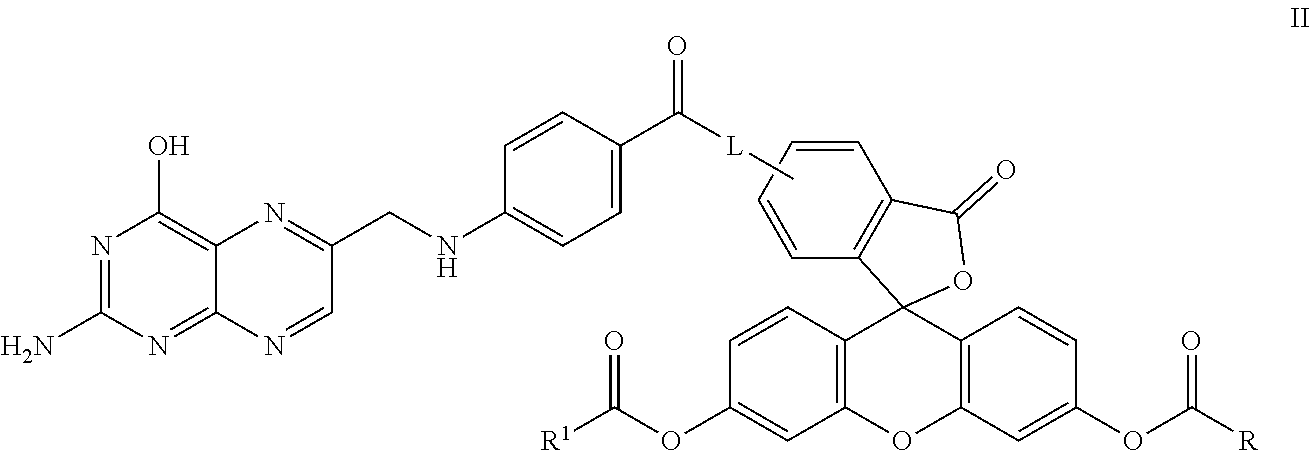
- this invention is directed to a method for detecting cancer cells in a cellular mass suspected of containing cancer cells which method comprises contacting said cellular mass with a pro-fluorescent compound of formula II:
- this invention is directed to a method for detecting cancer cells in a cellular mass suspected of containing cancer cells which method comprises contacting said cellular mass with a pro-fluorescent compound of formula III:
- this invention is directed to non-fluorescent fluorescein diester conjugates of formula I:
- this invention is directed to non-fluorescent fluorescein diester conjugates of formula II:
- this invention is directed to non-fluorescent fluorescein diester conjugates of formula III:
- this invention provides for a pharmaceutical composition
- a pharmaceutical composition comprising a pharmaceutically acceptable inert diluent and a compound of formula I, II, or III.
- the pharmaceutical composition is suitable for topical application onto a tissue sample.
- suitable compositions for topical application include aqueous composition comprising sterile water and optionally a water soluble or miscible co-solvent such as DMSO, ethanol, octanol, and the like.
- the water preferably comprises from about 50 to about 95 weight percent of the aqueous composition and the co-solvent comprises from about 5 to about 50 weight percent of the aqueous composition.
- R, R 1 and L are selected to provide sufficient water solubility to the compound of formula I, II, or II so that these compounds can be formulated into an aqueous composition as described herein for application to a tissue sample.
- R and/or R 1 is an ester formed from a carboxyl containing sugar.
- this invention is directed to a method for detecting cancer cells in a cellular composition suspected of containing such cells wherein said method comprises:
- the compounds of this invention when converted to their fluorescent form are capable of maintaining a fluorescent signal for at least 5 minutes and preferably at least 10 minutes after exposure to UV light.
- the resulting fluorescent compounds of this invention preferably do not efflux from the cells back into the solution.
- FIG. 1 illustrates the intra-cellular generation of fluorescence of cancer cells that have absorbed a conjugate of this invention and then intracellularly deacylated said conjugate.
- this invention provides for compounds, compositions and method for detecting remnant cancer cells in a surgical field after resection of a solid mass tumor.
- the following terms will first be defined.
- references to a certain element such as hydrogen or H is meant to include all isotopes of that element.
- an R group is defined to include hydrogen or H, it also includes deuterium and tritium.
- Compounds comprising radioisotopes such as tritium, C 14 , P 32 and S 35 are thus within the scope of this invention. Procedures for inserting such labels into the compounds of this invention will be readily apparent to those skilled in the art based on the disclosure herein.
- cancer solid mass cancers or tumors
- cancer cells refer to cancer cells that form solid masses and as such blood borne cancers are not included within these terms.
- folic acid requiring cancer cells refer to those cancer cells that over-express the folic acid receptor which is some cases is up to as many as 8-10 times that of normal cells.
- Cancer cells recognized to require folic acid and, therefore, have an excess of folic acid receptors include, but are not limited to, epithelial cancer cells, ovarian cancer cells, cervical cancer cells, breast cancer cells, lung cancer cells, kidney cancer cells, colorectal cancer cells, and brain cancer cells.
- cancer cells show a 20- to 30-fold higher rate of glucose uptake and glycolysis compared with normal cells.
- sugars that are recognized by the glucose receptors on malignant tumor cells provide one route to conjugate the pro-detectible label and have the conjugate formed thereby preferentially taken up by these cancer cells.
- compounds of formula III as well as those having a different sugar components that are recognized by one or more of the glucose receptors (e.g., glucosamine and fructose)
- all solid mass tumor cells that require high glucose uptake are suitable for identification by the methods of this invention.
- Alkyl refers to monovalent saturated aliphatic hydrocarbyl groups having from 1 to 10 carbon atoms and preferably 1 to 6 carbon atoms. This term includes, by way of example, linear and branched hydrocarbyl groups such as methyl (CH 3 —), ethyl (CH 3 CH 2 —), n-propyl (CH 3 CH 2 CH 2 —), isopropyl ((CH 3 ) 2 CH—), n-butyl (CH 3 CH 2 CH 2 CH 2 —), isobutyl ((CH 3 ) 2 CHCH 2 —), sec-butyl ((CH 3 )(CH 3 CH 2 )CH—), t-butyl ((CH 3 ) 3 C—), n-pentyl (CH 3 CH 2 CH 2 CH 2 CH 2 —), and neopentyl ((CH 3 ) 3 CCH 2 —).
- Substituted alkyl refers to an alkyl group having from 1 to 5, preferably 1 to 3, or more preferably 1 to 2 substituents selected from the group consisting of alkoxy, substituted alkoxy, acyl, acylamino, aminocarbonyl, aminocarbonylamino, aminocarbonyloxy, acyloxy, aryl, substituted aryl, arylene, substituted arylene, heteroarylene, substituted heteroarylene, aryloxy, substituted aryloxy, carboxyl, carboxyl ester, cyano, cycloalkyl, cycloalkylene, substituted cycloalkyl, substituted cycloalkylene, cycloalkyloxy, substituted cycloalkyloxy, halo, hydroxy, heteroaryl, substituted heteroaryl, heteroaryloxy, heterocyclic, substituted heterocyclic, heterocyclyloxy, substituted heterocyclyloxy, nitro, oxo,
- Alkoxy refers to the group —O-alkyl wherein alkyl is defined herein. Alkoxy includes, by way of example, methoxy, ethoxy, n-propoxy, isopropoxy, n-butoxy, t-butoxy, sec-butoxy, and n-pentoxy.
- Substituted alkoxy refers to the group —O-(substituted alkyl).
- Acyl refers to the groups H—C(O)—, alkyl-C(O)—, substituted alkyl-C(O)—, cycloalkyl-C(O)—, substituted cycloalkyl-C(O)—, aryl-C(O)—, substituted aryl-C(O)—, heteroaryl-C(O)—, substituted heteroaryl-C(O)—, heterocyclic-C(O)—, and substituted heterocyclic-C(O)—.
- Acyl includes the “acetyl” group CH 3 C(O)—.
- “Acylamino” refers to —NR 47 C(O)alkyl, —NR 47 C(O)substituted alkyl, —NR 47 C(O)cycloalkyl, —NR 47 C(O)substituted cycloalkyl, —NR 47 C(O)aryl, —NR 47 C(O)substituted aryl, —NR 47 C(O)heteroaryl, —NR 47 C(O)substituted heteroaryl, —NR 47 C(O)heterocyclic, and —NR 47 C(O)substituted heterocyclic wherein R 47 is hydrogen or alkyl.
- “Acyloxy” refers to the groups alkyl-C(O)O—, substituted alkyl-C(O)O—, aryl-C(O)O—, substituted aryl-C(O)O—, cycloalkyl-C(O)O—, substituted cycloalkyl-C(O)O—, heteroaryl-C(O)O—, substituted heteroaryl-C(O)O—, heterocyclic-C(O)O—, and substituted heterocyclic-C(O)O.
- Aminocarbonyl refers to the group —C(O)NR 50 R 51 where R 50 and R 51 are independently selected from the group consisting of hydrogen, alkyl, substituted alkyl, aryl, substituted aryl, cycloalkyl, substituted cycloalkyl, heteroaryl, substituted heteroaryl, heterocyclic, and substituted heterocyclic and where R 50 and R 51 are optionally joined together with the nitrogen bound thereto to form a heterocyclic or substituted heterocyclic group.
- Aminocarbonylamino refers to the group —NR 47 C(O)NR 50 R 51 where R 47 is hydrogen or alkyl and R 50 and R 51 are independently selected from the group consisting of hydrogen, alkyl, substituted alkyl, aryl, substituted aryl, cycloalkyl, substituted cycloalkyl, heteroaryl, substituted heteroaryl, heterocyclic, and substituted heterocyclic, and where R 50 and R 51 are optionally joined together with the nitrogen bound thereto to form a heterocyclic or substituted heterocyclic group.
- Aminocarbonyloxy refers to the group —(O)—C(O)NR 50 R 51 where R 50 and R 51 are independently selected from the group consisting of hydrogen, alkyl, substituted alkyl, aryl, substituted aryl, cycloalkyl, substituted cycloalkyl, heteroaryl, substituted heteroaryl, heterocyclic, and substituted heterocyclic and where R 50 and R 51 are optionally joined together with the nitrogen bound thereto to form a heterocyclic or substituted heterocyclic group.
- Aryl or “Ar” refers to a monovalent aromatic carbocyclic group of from 6 to 14 carbon atoms having a single ring (e.g., phenyl) or multiple condensed rings (e.g., naphthyl or anthryl) which condensed rings may or may not be aromatic (e.g., 2-benzoxazolinone, 2H-1,4-benzoxazin-3(4H)-one-7-yl, and the like) provided that the point of attachment is at an aromatic carbon atom.
- Preferred aryl groups include phenyl and naphthyl.
- Substituted aryl refers to aryl groups which are substituted with 1 to 5, preferably 1 to 3, or more preferably 1 to 2 substituents selected from the group consisting of alkyl, substituted alkyl, alkoxy, substituted alkoxy, acyl, acylamino, acyloxy, aminocarbonyl, aminocarbonylamino, aminocarbonyloxy, aryl, substituted aryl, aryloxy, substituted aryloxy, carboxyl, carboxyl ester, cyano, cycloalkyl, substituted cycloalkyl, cycloalkyloxy, substituted cycloalkyloxy, halo, hydroxy, heteroaryl, substituted heteroaryl, heteroaryloxy, substituted heteroaryloxy, heterocyclic, substituted heterocyclic, heterocyclyloxy, substituted heterocyclyloxy, nitro, and SO 3 H.
- “Arylene” refers to a divalent aromatic carbocyclic group of from 6 to 14 carbon atoms having a single ring or multiple condensed rings. “Substituted arylene” refers to an arylene having from 1 to 5, preferably 1 to 3, or more preferably 1 to 2 substituents as defined for aryl groups.
- Heteroarylene refers to a divalent aromatic group of from 1 to 10 carbon atoms and 1 to 4 heteroatoms selected from the group consisting of oxygen, nitrogen and sulfur within the ring. “Substituted heteroarylene” refers to heteroarylene groups that are substituted with from 1 to 5, preferably 1 to 3, or more preferably 1 to 2 substituents selected from the group consisting of the same group of substituents defined for substituted aryl.
- Aryloxy refers to the group —O-aryl, where aryl is as defined herein, that includes, by way of example, phenoxy and naphthoxy.
- Substituted aryloxy refers to the group —O-(substituted aryl) where substituted aryl is as defined herein.
- Carbonyl refers to the divalent group —C(O)—which is equivalent to —C( ⁇ O)—.
- Carboxyl or “carboxy” refers to —COOH or salts thereof.
- Carboxyl ester or “carboxy ester” refers to the group —C(O)(O)-alkyl, —C(O)(O)-substituted alkyl, —C(O)(O)-aryl, —C(O)(O)-substituted-aryl, —C(O)(O)—cycloalkyl, —C(O)(O)-substituted cycloalkyl, —C(O)(O)-heteroaryl, —C(O)(O)—substituted heteroaryl, —C(O)(O)-heterocyclic, and —C(O)(O)-substituted heterocyclic.
- Oxycarbonyl esters refer to the group “acyloxy” as defined above.
- ester groups contain 2 to 18 carbon atoms and optionally contain from 1 to 6 heteroatoms selected from the group consisting of oxygen, S(O) x , NR 3 , —OP(O) y H, —OS(O) z H wherein y and z are independently 1 or 2, and x is 0, 1 or 2 whereby such substitutions impart improved water solubility or maintain water-solubility for the compound to which they are attached.
- Cyano refers to the group —CN.
- Cycloalkyl refers to cyclic alkyl groups of from 3 to 10 carbon atoms having single or multiple cyclic rings including fused, bridged, and spiro ring systems.
- the fused ring can be an aryl ring provided that the non-aryl part is joined to the rest of the molecule.
- suitable cycloalkyl groups include, for instance, adamantyl, cyclopropyl, cyclobutyl, cyclopentyl, and cyclooctyl.
- Substituted cycloalkyl and “substituted cycloalkenyl” refers to a cycloalkyl or cycloalkenyl group having from 1 to 5 or preferably 1 to 3 substituents selected from the group consisting of oxo, alkyl, substituted alkyl, alkoxy, substituted alkoxy, acyl, acylamino, acyloxy, aminocarbonyl, aminocarbonylamino, aminocarbonyloxy, aryl, substituted aryl, aryloxy, substituted aryloxy, carboxyl, carboxyl ester, cyano, cycloalkyl, substituted cycloalkyl, cycloalkyloxy, substituted cycloalkyloxy, halo, hydroxy, heteroaryl, substituted heteroaryl, heteroaryloxy, substituted heteroaryloxy, heterocyclic, substituted heterocyclic, heterocyclyloxy, substituted heterocyclyloxy, nitro, and SO
- Cycloalkylene refers to a divalent cycloalkyl group and “substituted cycloalkylene” refers to a divalent substituted cycloalkyl group.
- Cycloalkyloxy refers to —O-cycloalkyl.
- Substituted cycloalkyloxy refers to —O-(substituted cycloalkyl).
- Halo or “halogen” refers to fluoro, chloro, bromo and iodo.
- “Hydroxy” or “hydroxyl” refers to the group —OH.
- Heteroaryl refers to an aromatic group of from 1 to 10 carbon atoms and 1 to 4 heteroatoms selected from the group consisting of oxygen, nitrogen and sulfur within the ring.
- Such heteroaryl groups can have a single ring (e.g., pyridinyl or furyl) or multiple condensed rings (e.g., indolizinyl or benzothienyl) wherein the condensed rings may or may not be aromatic and/or contain a heteroatom provided that the point of attachment is through an atom of the aromatic heteroaryl group.
- the nitrogen and/or the sulfur ring atom(s) of the heteroaryl group are optionally oxidized to provide for the N-oxide (N ⁇ O), sulfinyl, or sulfonyl moieties.
- N ⁇ O N-oxide
- sulfinyl N-oxide
- sulfonyl moieties N-oxide (N ⁇ O)
- Certain non-limiting examples include pyridinyl, pyrrolyl, indolyl, thiophenyl, oxazolyl, thizolyl, and furanyl.
- Substituted heteroaryl refers to heteroaryl groups that are substituted with from 1 to 5, preferably 1 to 3, or more preferably 1 to 2 substituents selected from the group consisting of the same group of substituents defined for substituted aryl.
- Heteroaryloxy refers to —O-heteroaryl.
- Substituted heteroaryloxy refers to the group —O-(substituted heteroaryl).
- Heterocycle or “heterocyclic” or “heterocycloalkyl” or “heterocyclyl” refers to a saturated or partially saturated, but not aromatic, group having from 1 to 10 ring carbon atoms and from 1 to 4 ring heteroatoms selected from the group consisting of nitrogen, sulfur, or oxygen. Heterocycle encompasses single ring or multiple condensed rings, including fused bridged and spiro ring systems. In fused ring systems, one or more the rings can be cycloalkyl, aryl, or heteroaryl provided that the point of attachment is through a non-aromatic ring. In one embodiment, the nitrogen and/or sulfur atom(s) of the heterocyclic group are optionally oxidized to provide for the N-oxide, sulfinyl, or sulfonyl moieties.
- Substituted heterocyclic or “substituted heterocycloalkyl” or “substituted heterocyclyl” refers to heterocyclyl groups that are substituted with from 1 to 5 or preferably 1 to 3 of the same substituents as defined for substituted cycloalkyl.
- Heterocyclyloxy refers to the group —O-heterocycyl.
- Substituted heterocyclyloxy refers to the group —O-(substituted heterocycyl).
- heterocycle and heteroaryls include, but are not limited to, azetidine, pyrrole, furan, thiophene, imidazole, pyrazole, pyridine, pyrazine, pyrimidine, pyridazine, indolizine, isoindole, indole, dihydroindole, indazole, purine, quinolizine, isoquinoline, quinoline, phthalazine, naphthylpyridine, quinoxaline, quinazoline, cinnoline, pteridine, carbazole, carboline, phenanthridine, acridine, phenanthroline, isothiazole, phenazine, isoxazole, phenoxazine, phenothiazine, imidazolidine, imidazoline, piperidine, piperazine, indoline, phthalimide, 1,2,3,4-tetrahydrois
- Niro refers to the group —NO 2 .
- Oxo refers to the atom ( ⁇ O).
- a substituted ring can be substituted with one or more fused and/or spiro cycles.
- fused cycles include a fused cycloalkyl, a fused heterocyclyl, a fused aryl, a fused heteroaryl ring, each of which rings can be unsubstituted or substituted.
- spiro cycles include a fused cycloalkyl and a fused heterocyclyl, each of which rings can be unsubstituted or substituted.
- “Optionally substituted” refers to a group selected from that group and a substituted form of that group. Substituents are such as those defined hereinabove. In one embodiment, substituents are selected from C 1 -C 10 or C 1 -C 6 alkyl, substituted C 1 -C 10 or C 1 -C 6 alkyl, C 2 -C 6 alkenyl, C 2 -C 6 alkynyl, C 6 -C 10 aryl, C 3 -C 8 cycloalkyl, C 2 -C 10 heterocyclyl, C 1 -C 10 heteroaryl, substituted C 2 -C 6 alkenyl, substituted C 2 -C 6 alkynyl, substituted C 6 -C 10 aryl, substituted C 3 -C 8 cycloalkyl, substituted C 2 -C 10 heterocyclyl, substituted C 1 -C 10 heteroaryl, halo, nitro, cyano, —CO 2 H or a
- alkoxycarbonylalkyl refers to the group (alkoxy)-C(O)-(alkyl)-.
- Tautomer refer to alternate forms of a compound that differ in the position of a proton, such as enol/keto and imine/enamine tautomers, or the tautomeric forms of heteroaryl groups containing a ring atom attached to both a ring —NH— moiety and a ring ⁇ N— moiety such as pyrazoles, imidazoles, benzimidazoles, triazoles, and tetrazoles.
- fluorescein it exists in two tautomeric forms as shown below and each are covered by the term “fluorescein”:
- stereochemically pure denotes a compound which has 80% or greater by weight of the indicated stereoisomer and 20% or less by weight of other stereoisomers.
- the compound of Formula (I), (II), or (III) has 90% or greater by weight of the stated stereoisomer and 10% or less by weight of other stereoisomers.
- the compound of Formula (I), (II), or (III) has 95% or greater by weight of the stated stereoisomer and 5% or less by weight of other stereoisomers.
- the compound of formula (I), (II), or (III) has 97% or greater by weight of the stated stereoisomer and 3% or less by weight of other stereoisomers.
- the compounds of this invention can be prepared from readily available starting materials using the following general methods and procedures. It will be appreciated that where typical or preferred process conditions (i.e., reaction temperatures, times, mole ratios of reactants, solvents, pressures, etc.) are given, other process conditions can also be used unless otherwise stated. Optimum reaction conditions may vary with the particular reactants or solvent used, but such conditions can be determined by one skilled in the art by routine optimization procedures.
- protecting groups may be necessary to prevent certain functional groups from undergoing undesired reactions.
- Suitable protecting groups for various functional groups as well as suitable conditions for protecting and deprotecting particular functional groups are well known in the art. For example, numerous protecting groups are described in T. W. Greene and P. G. M. Wuts, Protecting Groups in Organic Synthesis, Third Edition, Wiley, New York, 1999, and references cited therein.
- stereoisomers i.e., as individual enantiomers or d(l) stereomers, or as stereoisomer-enriched mixtures. All such stereoisomers (and enriched mixtures) are included within the scope of this invention, unless otherwise indicated. Pure stereoisomers (or enriched mixtures) may be prepared using, for example, optically active starting materials or stereoselective reagents well-known in the art. Alternatively, racemic mixtures of such compounds can be separated using, for example, chiral column chromatography, chiral resolving agents and the like.
- the starting materials for the following reactions are generally known compounds or can be prepared by known procedures or obvious modifications thereof.
- many of the starting materials are available from commercial suppliers such as Aldrich Chemical Co. (Milwaukee, Wis., USA), Bachem (Torrance, Calif., USA), Emka-Chemce or Sigma (St. Louis, Mo., USA).
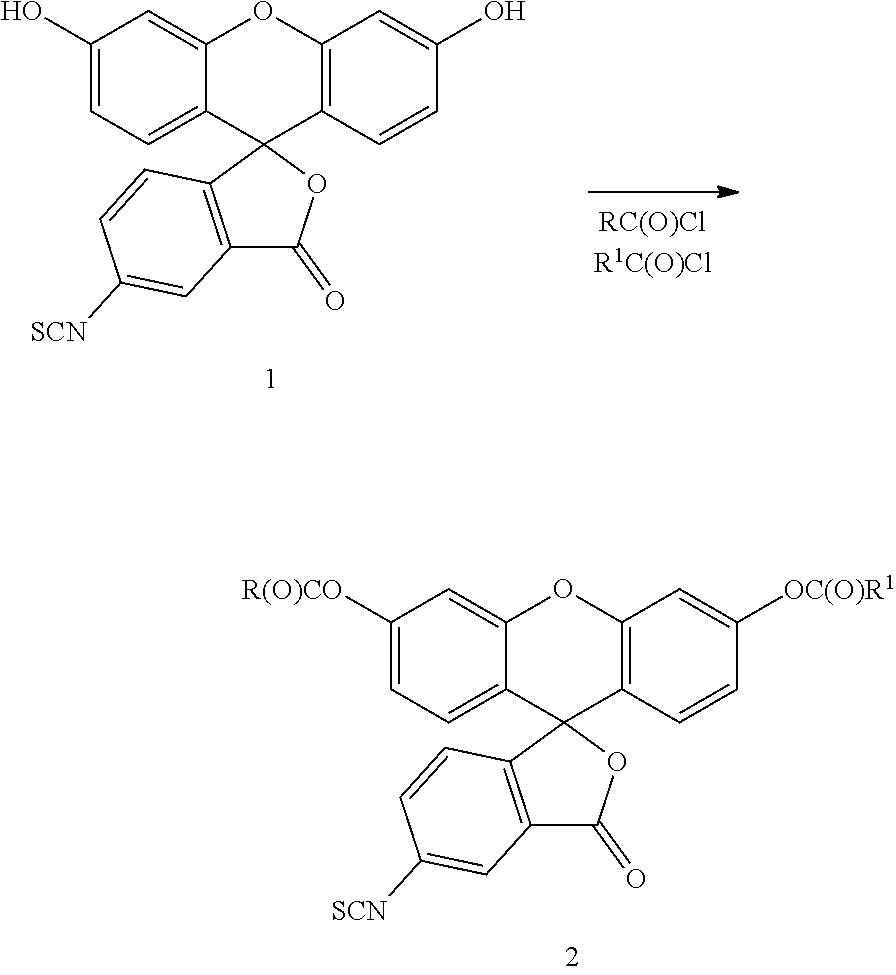
- the compounds of this invention can be prepared from 5- or 6- thioisocyanate fluorescein by first acylating both phenolic hydroxyl groups as shown below:
- compound 1 (5-isothiocyanate fluorescein) is contacted with at least two equivalents or more of a carboxyl acid chloride or other halide under esterifying conditions wherein each R and R 1 together with the carbonyl group —C(O)— is an acyl group as defined herein.
- the reaction is preferably conducted in a suitable aprotic inert diluent such as chloroform, ethyl acetate, methylene chloride and the like at a temperature of from about 0° to about 60° C. for a period of time sufficient to substantially complete the reaction.
- a suitable amount of a base such as triethylamine, diisopropylethylamine, and the like is typically added to scavenge the acid generated during the reaction.
- the product is typically isolated and purified by conventional techniques such as precipitation, crystallization, chromatography and the like.
- compound 2 can be prepared by reaction with the corresponding acid anhydride [RC(O)OC(O)R] or mixed acid anhydride [RC(O)OC(O)R 1 ] by methods well known in the art.
- isothiocyanate groups can be replaced with isocyanate, amino and haloacetamido groups all of which are commercially available as a fluorescein derivative and have the general structure:
- R and R 1 are as defined herein and W is a substituent selected from the group consisting of amino, haloacetamido, isocyanate, and thioisocyanate.
- acyl groups selected are such that the resulting diester is soluble in an aqueous composition as defined herein.
- soluble it is meant that the compound has sufficient solubility to provide detectible evidence of the presence of cancer cells when the fluorescein moiety is deacylated.
- solubility of at least 0.1 mg/mL in the aqueous composition at 25° C. and preferably at least 0.5 mg/mL is desireable.
- Acyl groups that impart water solubility to the fluorescein diesters of this invention preferably comprise from 2 to 18 carbon atoms and from 1 to 12 heteroatoms such as oxygen.
- Suitable hydroxyl acyl groups include, by way of example only, HOC(O)CH 2 CH 2 C(O)OCH 2 CH 2 OCH 3 (compound 3), CH 3 OCH 2 CH 2 OCH 2 CH 2 OCH 2 C(O)OH (compound 4), and CH 3 OCH 2 CH 2 OCH 2 CH 2 OCH 2 CH 2 OCH 2 CH 2 C(O)OH (compound 5).
- Compound 3 is a known compound prepared by reaction of succinic anhydride with approximately 1 equivalents of 2-methoxyethanol. The reaction proceeds via ring opening of the anhydride to provide for 3-(2-methoxyethoxy)carbonylproprionic acid.
- Compounds 4 and 5 are commercially available from Sigma-Aldrich, St. Louis, Mo., USA.
- Synthetic schemes for the linkage of such soluble fluorescein derivatives to folic acid first proceeds via coupling of a linker to folic acid as shown in the following exemplary reaction scheme using a diamine linker:
- folic acid it is sometimes desirable to start with the folic acid anhydride. That compound can be prepared as per the procedures set forth in Guaranga, et al., Bioconjugate Chemistry, 2012, 23:84-96 which are incorporated herein by reference in their entirety.
- folic acid anhydride can be reacted with, e.g., NH 2 -L-NHPg where Pg is a protecting group, L is a linker.
- Pg is a protecting group
- L is a linker.
- a suitable linker is >CH—R 10 where R 10 an amino acid side chain.
- Another example of a suitable linker is a polyoxyalkylene group of the formula -(alkylene—(O)) p — where p is from 1 to 20, and the like.
- reaction proceeds under conventional amidation conditions and the resulting product, compound 6, is then isolated and purified by conventional methods or, alternatively used in the next step(s) without isolation and purification.
- the protecting group (Pg) is removed by conventional methods and the amino group is then free to react with the isothiocyanate group of compound 2. This reaction proceeds under conventional conditions and results in covalent linkage of the folic acid component or moiety to the fluorescein diester component or moiety through a thiourea bond.
- 5-isothiocyanate fluorescein diesters can be reacted with pteroic acid in a similar manner as described above.
- the carboxyl group of pteroic acid is amidated with the NH 2 -L-NHPg to form an amido-L-NHPg substituent.
- the protecting group (Pg) is removed by conventional means.
- the resulting amino group then is reacted with the isothiocyanate group of the fluorescein diester to provide for the thiourea linkage of the pteroic acid component or moiety to the fluorescein diester component or moiety.
- glucose amine can be reacted directly with the 5-chloroacetamido group of the fluorescein diester as shown below:
- the reaction is preferably conducted at a temperature of from ⁇ 40° C. to about 20° C.
- the reaction is conducted in an inert solvent such as methylene chloride, chloroform, ethyl acetate, toluene, DMF and the like in the presence of a suitable base such as diisopropylethylamine to scavenge the acid generated.
- a suitable base such as diisopropylethylamine to scavenge the acid generated.
- the reaction can be conducted in pyridine.
- the reaction continues until substantial completion which typically occurs within 1 to 24 hours.
- the product is recovered and purified by conventional techniques such as chromatography, crystallization, HPLC and the like.
- a hydroxyl-L-amine of the formula NH 2 -L-OH can be used in the reactions above with the isothiocyanate fluorescein diester.
- the amino group of the hydroxyl-L-amine will react with the carboxyl group on pteroic acid or with a carboxyl group on folic acid to provide for the corresponding amide alcohol [—C(O)NH-L-OH].
- the alcohol then reacts with the isothiocyanate group to provide for a thiocarbamate linkage of the folic acid or pteroic acid moiety or component to the fluorescein diester moiety or component.
- L is a linker as defined above.
- Preferred compounds of the formula NH 2 -L-OH and NH 2 -L-NH 2 include those where L is a polyoxyalkylene or an alkylene group.
- Compounds such as NH 2 -L-OH or NH 2 -L-NH 2 are commercially available as Jeffamines (Huntsman Corp.) or from Sigma-Aldrich, supra.
- reaction schemes to couple the reactive functionalities of the compounds of this invention with cellular targeting agents are well known.
- amino groups on the lysine residues of antibodies can react with a —COOH, —N ⁇ C ⁇ S or —N ⁇ C ⁇ O group as per above.
- Carboxyl residues on aspartic and glutamic acid can react with the amino group on 5-amino fluorescein diesters.
- the compounds of this invention are non-fluorescent by virtue of locking the fluorescein into a non-fluorescent tautomeric structure due to diesterification of both phenolic hydroxyl groups. Deacylation of one or both of the ester groups restores the ability of these compounds to fluoresce.
- the compounds of this invention are suitable for use in detecting cancer cells that preferentially absorb these compounds in greater preponderance than normal cells.
- cancer cells that preferentially absorb these compounds in greater preponderance than normal cells.
- the compounds of formula II having a pteroic acid component can be used in place of folic acid to assess the presence of such cancer cells in a cellular composition. This is because these compounds are non-fluorescent and provide no background fluorescence and further because pteroic acid will be absorbed via the folate receptors on cancer cells.
- intracellular enzymes such as esterases and lipases deacylate the ester group(s) of the compounds thereby converting them from non-fluorescent to fluorescent.
- esterases and lipases deacylate the ester group(s) of the compounds thereby converting them from non-fluorescent to fluorescent.
- the clinician can employ the compounds of formula III as the glucosamine component is recognized by glucose receptors on cancer cells.
- compositions of this invention are advantageously used to identify remnant cancer cells after tumor resection.
- an aqueous composition is applied to the tissue surface after resection using compounds that are preferentially absorbed by cancer cells. The cellular uptake of these compounds will result in the cancer cells becoming unambiguously fluorescent.
- a method for detecting cancer cells overexpressing folic acid receptors in a cellular composition suspected of containing such cancer cells comprising:
- a method for detecting cancer cells in a cellular composition suspected of containing such cancer cells wherein said method comprises:
- the reaction was stopped and the reaction solution washed with brine and the organic layer was recovered.
- the solvent was stripped and the resulting product was purified by column chromatography (silica gel using a gradient of from 0 to 10% methanol in methylene chloride).
- the resulting product (compound 10) was used as is without further purification or isolation.
- the column was eluted with a solvent gradient starting at 0% methanol and 100% methylene chloride and finishing with 10% methanol and 90% methylene chloride (v/v).
- the elutant containing the desired compound was stripped of solvent and the resulting compound 14 was substantially free of fluorescence indicative of formation of diester.
- the water solubility of the compound was evaluated and assessed to be at least 10 mg/mL. A small aliquot of the compound was contacted with a sodium hydroxide solution that immediately provided for fluorescence indicative of deacylation.
- Compound 20 was prepared according to the literature as set forth in Guaranga, et al., Bioconjugate Chemistry, 2012, 23:84-96.
- compound 20 was prepared from folic acid by addition of about 6 equivalents of DCC in a solution of about 4:1 DMF:pyridine. The reaction was maintained at room temperature overnight. The solution was filtered or centrifuged to removed solids and the resulting solution containing compound 20 was combined with approximately 1 equivalent of compound 21. The reaction was maintained at room temperature overnight and the resulting solution was filtered again to remove additional solids to provide containing compound 22.
- reaction can be conducted by combining folic acid, DCC and compound 21 into a single reaction to provide for compound 22 where, again, solids are removed by centrifugation or filtration.
- Compound 22 was optionally combined with methanol to provide for the methyl ester—compound 22 A.
- the Boc protecting group was removed by conventional methods and the resulting compound 22B (not shown) was combined with compound 14 in DMF at room temperature overnight so as to provide for compound 24.
- compound 14 was combined with compound 22B under conditions wherein the aromatic amino group reacted with the isothiocyanate to provide for compound 24.
- Exemplary compounds that can be made by the methods described herein include the following:
- Each R is CH 3 OCH 2 CH 2 OC(O)CH 2 CH 2 C(O)—
- Each R is CH 3 OCH 2 CH 2 OC(O)CH 2 CH 2 C(O)—
- Each R is CH 3 OCH 2 CH 2 OC(O)CH 2 CH 2 C(O)—
- Compound 24 and comparative compound A were evaluated for their ability to be absorbed by cancer cells and then, in the case of compound 24, deacylated by intracellular esterases so as to regenerate a fluorescent structure. Specifically, approximately 500,000 SDOV3 cells (an ovarian cancer cell line) were seeded into separate 35 mm culture dishes containing a folate-free growth medium (RPMI+10% FBS—fetal bovine serum). The next day, the medium was replaced with a folate-free medium (no FBS). In one culture dish, the medium was supplemented with 25 micromolar of compound 24; and, in another culture dish, the medium was supplemented with 50 micromolar of comparative compound A.
- RPMI+10% FBS fetal bovine serum
- FIG. 1 illustrates a picture showing the fluorescence generated. Note that only the cancer cells evidenced fluorescence and that the solution remained non-fluorescent.
- the compounds of this invention are suitable for use in detecting remnant cancer cells. Because certain cancer cells preferentially uptake the conjugates of this invention, after incubation for a period of time, removal of the applied solution from the surgical field will limit absorption into normal cells. Such can be accomplished under conventional lavage/washing conditions.
Landscapes
- Health & Medical Sciences (AREA)
- Life Sciences & Earth Sciences (AREA)
- Engineering & Computer Science (AREA)
- Chemical & Material Sciences (AREA)
- Immunology (AREA)
- Molecular Biology (AREA)
- Biomedical Technology (AREA)
- Hematology (AREA)
- Urology & Nephrology (AREA)
- Food Science & Technology (AREA)
- Biochemistry (AREA)
- Cell Biology (AREA)
- Biotechnology (AREA)
- Medicinal Chemistry (AREA)
- Physics & Mathematics (AREA)
- Analytical Chemistry (AREA)
- Microbiology (AREA)
- General Health & Medical Sciences (AREA)
- General Physics & Mathematics (AREA)
- Pathology (AREA)
- Organic Chemistry (AREA)
- Hospice & Palliative Care (AREA)
- Oncology (AREA)
- Pharmaceuticals Containing Other Organic And Inorganic Compounds (AREA)
Abstract
Description
-
- contacting said mass with a conjugate comprising a tumor targeting component and a pro-detection component so that the conjugate selectively binds to and is then absorbed by cancer cells whereupon the pro-detection component is intracellularly converted into a detection component with a signaling fingerprint;
- generating and then measuring the signal obtained from the detection component; and
- correlating the presence or absence of said signal fingerprint so as to assess the presence or absence of cancer cells.


-
- wherein said compound selectively attaches to and is absorbed by cancer cells and is then intracellularly converted into a fluorescent compound with a fluorescent fingerprint; measuring the fluorescence obtained by exposing the cellular mass to UV light; and correlating said emitted fluorescence to said fluorescent fingerprint so as to assess the presence or absence of cancer cells,
- further wherein R and R1 are independently C2-C18 alkyl or cycloalkyl groups either or both optionally containing 1 to 8 heteroatoms selected from the group consisting of oxygen, S(O)x, >NR3, —OP(O)yH, —OS(O)zH, —C(O)—, amino, C1-C6 alkylamino, di(C1-C6 dialkyl)amino, —C(O)O—, —C(O)NR3—, —C(O)OH, —OH, and oxo wherein y and z are independently 1 or 2, and x is 0, 1 or 2;
- R3 is hydrogen or C1-C6 alkyl; and
- L is a linker of from 1 to 20 carbon atoms and 1 to 6 heteroatoms selected from the group consisting of oxygen, S(O)x, >NR3, —OP(O)yH, —OS(O)zH, —C(O)—, amino, C1-C6 alkylamino, di(C1-C6dialkyl)amino, —C(O)O—, —C(O)NR3—, —C(O)OH, —OH, and oxo wherein y and z are independently 1 or 2, and x is 0, 1 or 2;
- or pharmaceutically acceptable salts and/or solvates thereof.

-
- wherein said compound selectively attaches to and is absorbed by cancer cells and is then intracellularly converted into a fluorescent compound with a fluorescent fingerprint; measuring the fluorescence obtained by exposing the cellular mass to UV light; and correlating said emitted fluorescence to said fluorescent fingerprint so as to assess the presence or absence of cancer cells,
- R and R1 are independently C2-C18 alkyl or cycloalkyl groups either or both optionally containing 1 to 8 heteroatoms selected from the group consisting of oxygen, S(O)x, >NR3, —OP(O)yH, —(O)S(O)zH, —C(O)—, amino, C1-C6 alkylamino, di(C1-C6 dialkyl)amino, —C(O)O—, —C(O)NR3—, —C(O)OH, —OH, and oxo wherein y and z are independently 1 or 2, and x is 0, 1 or 2;
- R3 is hydrogen or C1-C6 alkyl; and
- L is a linker of from 1 to 20 carbon atoms and 1 to 6 heteroatoms selected from the group consisting of oxygen, S(O)x, >NR3, —OP(O)yH, —(O)S(O)H, —C(O)—, amino, C1-C6 alkylamino, di(C1-C6 dialkyl)amino, —C(O)O—, —C(O)NR3—, —C(O)OH, —OH, and oxo wherein y and z are independently 1 or 2, and x is 0, 1 or 2;
- or pharmaceutically acceptable salts and/or solvates thereof.

-
- where:
- R and R1 are independently C2-C18 alkyl or cycloalkyl groups either or both optionally containing 1 to 8 heteroatoms selected from the group consisting of oxygen, S(O)x, >NR3, —OP(O)yH, —(O)S(O)zH, —C(O)—, amino, C1-C6 alkylamino, di(C1-C6 dialkyl)amino, —C(O)O—, —C(O)NR3—, —C(O)OH, —OH, and oxo wherein y and z are independently 1 or 2, and x is 0, 1 or 2;
- R3 is hydrogen or C1-C6 alkyl; and
- L is a linker of from 1 to 20 carbon atoms and 1 to 6 heteroatoms selected from the group consisting of oxygen, S(O)x, >NR3, —OP(O)yH, —(O)S(O)zH, —C(O)—, amino, C1-C6 alkylamino, di(C1-C6 dialkyl)amino, —C(O)O—, —C(O)NR3—, —C(O)OH, —OH, and oxo wherein y and z are independently 1 or 2, and x is 0, 1 or 2; and
- or pharmaceutically acceptable salts and/or solvates thereof.
-
- where:
- R and R1 are independently C2-C18 alkyl or cycloalkyl groups either or both optionally containing 1 to 8 heteroatoms selected from the group consisting of oxygen, S(O)x, >NR3, —OP(O)yH, —(O)S(O)zH, —C(O)—, amino, C1-C6 alkylamino, di(C1-C6 dialkyl)amino, —C(O)O—, —C(O)NR3—, —C(O)OH, —OH, and oxo wherein y and z are independently 1 or 2, and x is 0, 1 or 2;
- R3 is hydrogen or C1-C6 alkyl; and
- L is a linker of from 1 to 20 carbon atoms and 1 to 6 heteroatoms selected from the group consisting of oxygen, S(O)x, >NR3, —OP(O)yH, —(O)S(O)zH, —C(O)—, amino, C1-C6 alkylamino, di(C1-C6 dialkyl)amino, —C(O)O—, —C(O)NR3—, —C(O)OH, —OH, and oxo wherein y and z are independently 1 or 2, and x is 0, 1 or 2; and
- or pharmaceutically acceptable salts and/or solvates thereof.

-
- where:
- R and R1 are independently C2-C18 alkyl or cycloalkyl groups either or both optionally containing 1 to 8 heteroatoms selected from the group consisting of oxygen, S(O)x, >NR3, —OP(O)yH, —OS(O)zH, —C(O)—, amino, C1-C6 alkylamino, di(C1-C6 dialkyl)amino, —C(O)O—, —C(O)NR3—, —C(O)OH, —OH, and oxo wherein x, y and z are independently 1 or 2, and x is 0, 1 or 2;
- R3 is hydrogen or C1-C6 alkyl; and
- L is a linker of from 1 to 20 carbon atoms and 1 to 6 heteroatoms selected from the group consisting of oxygen, S(O)x, >NR3, —OP(O)yH, —OS(O)zH, —C(O)—, amino, C1-C6 alkylamino, di(C1-C6 dialkyl)amino, —C(O)O—, —C(O)NR3—, —C(O)OH, —OH, and oxo wherein y and z are independently 1 or 2, and x is 0, 1 or 2;
- or a pharmaceutically acceptable salt and/or solvate thereof.
-
- preparing a sterile aqueous composition of a water-soluble fluorescein diester of formula I, II or III wherein said aqueous composition optionally comprises up to 50 percent by weight of a water soluble or miscible and biologically compatible co-solvent;
- applying said composition to a cellular composition suspected of containing cancer cells;
- maintaining said contact for a sufficient period of time to permit absorption of said diester and intracellular deacylation thereof by said cancer cells if present;
- optionally lavaging said surface with a sterile aqueous solution free of any of said diester(s); and
- assessing the presence of intracellular fluorescence in said cellular mass as an indicia of the presence of cancer cells in said mass.
| I | |
 |
|
| # | R/R1 | R2 | L |
| 1 | CH3OCH2CH2OC(O)CH2CH2C(O)O—/ CH3OCH2CH2OC(O)CH2CH2C(O)O— | H |
 |
| 2 | CH3OCH2CH2OC(O)CH2CH2C(O)O—/ CH3OCH2CH2OC(O)CH2CH2C(O)O— | CH3 |
 |
| 3 | CH3OCH2CH2OC(O)CH2CH2C(O)O—/ CH3OCH2CH2OC(O)CH2CH2C(O)O— | H | —NHCH2CH2CH2(OCH2CH2)3CH2NHC(═S)NH— |
| 4 | CH3OCH2CH2OC(O)CH2CH2C(O)O—/ CH3OCH2CH2OC(O)CH2CH2C(O)O— | H |
 |
| 5 | CH3OCH2CH2OC(O)CH2CH2C(O)O— CH3OCH2CH2OC(O)CH2CH2C(O)O— | H |
 |
| 6 | CH3OCH2CH2OC(O)CH2CH2C(O)O—/ CH3CH2C(O)O— | H |
 |
| 7 | CH3O2C(CH2CH2O)3C(O)(CH2CH2O)3C(O)O— CH3O2C(CH2CH2O)3C(O)(CH2CH2O)3C(O)O— | H |
 |
| 8 | CH3O(CH2CH2O)2CH2C(O)O—/ CH3O(CH2CH2O)2CH2C(O)O— | H |
 |
| II | |
 |
|
| No. | R/R1 | L |
| 9 | CH3OCH2CH2OC(O)CH2CH2C(O)O—/ CH3OCH2CH2OC(O)CH2CH2C(O)O— |
 |
| 10 | CH3OCH2CH2OC(O)CH2CH2C(O)O—/ CH3OCH2CH2OC(O)CH2CH2C(O)O— |
 |
| 11 | CH3OCH2CH2OC(O)CH2CH2C(O)O—/ CH3OCH2CH2OC(O)CH2CH2C(O)O— |
 |
| 12 | CH3OCH2CH2OC(O)CH2CH2C(O)O—/ CH3OCH2CH2OC(O)CH2CH2C(O)O— |
 |
| 13 | CH3OCH2CH2OC(O)CH2CH2C(O)O— CH3OCH2CH2OC(O)CH2CH2C(O)O— |
 |
| 14 | CH3OCH2CH2OC(O)CH2CH2C(O)O—/ CH3CH2C(O)O— |
 |
| 15 | CH3O2C(CH2CH2O)3C(O)(CH2CH2O)3C(O)O— |
 |
| 16 | CH3O(CH2CH2O)4CH2CH2C(O)O—/ CH3O(CH2CH2O)4CH2CH2C(O)O— |
 |
| III | |
 |
|
| Compound | ||
| No. | R/R1 | L |
| 17 | CH3OCH2CH2OC(O)CH2CH2C(O)—/ CH3OCH2CH2OC(O)CH2CH2C(O)— | —C(═S)NH— |
| 18 | CH3OCH2CH2OC(O)CH2CH2C(O)—/ CH3OCH2CH2OC(O)CH2CH2C(O)— | —CH2CH2CH2NHC(═S)NH— |
| 19 | CH3OCH2CH2OC(O)CH2CH2C(O)—/ CH3OCH2CH2OC(O)CH2CH2C(O)— | —CH2NHC(═S)NH— |
| 20 | CH3OCH2CH2OC(O)CH2CH2C(O)—/ CH3OCH2CH2OC(O)CH2CH2C(O)— | —CH2CH2NHC(═S)NH— |
| 21 | CH3OCH2CH2OC(O)CH2CH2C(O)—/ CH3OCH2CH2OC(O)CH2CH2C(O)— | —CH2CH2NHC(═O)NH— |
| 22 | CH3OCH2CH2OC(O)CH2CH2C(O)—/ CH3CH2C(O)— | —C(═S)NH— |
| 23 | CH3O2C(CH2CH2O)3C(O)(CH2CH2O)3C(O)— | —C(═S)NH— |
| 24 | CH3O(CH2CH2O)4CH2CH2C(O)—/ CH3O(CH2CH2O)4CH2CH2C(O)— | CH2NHC(═S)NH— |
| 25 |
 |
—CH2CH2NHC(═S)NH— |
| Glucuronic acid derivative | ||

where R and R1 are as defined herein. Compound 2 defines a class of novel intermediates within the scope of this invention.

where R and R1 are as defined herein and W is a substituent selected from the group consisting of amino, haloacetamido, isocyanate, and thioisocyanate.


-
- selecting a compound of formula I or formula II;
- contacting a cellular composition suspected of containing cancer cells that overexpress folic acid receptors with said selected compound;
- maintaining said contact for a sufficient period of time to permit absorption of said diester and intracellular deacylation thereof by said cancer cells if present;
- assessing the presence of intracellular fluorescence as an indicia of the presence of said cancer cells.
-
- selecting a compound of formula III;
- contacting a cellular composition suspected of containing cancer cells that preferentially absorb said compound relative to normal cell;
- maintaining said contact for a sufficient period of time to permit absorption of said diester and intracellular deacylation thereof by said cancer cells if present;
- assessing the presence of intracellular fluorescence as an indicia of the presence of said cancer cells.
-
- DCC=dicyclohexylcarbodiimide
- DMAP=dimethylaminopyridine
- DMF=N,N-dimethylformamide
- eq.=equivalent
- FBS=fetal bovine serum
- g=grams
- mg=milligrams
- mL=milliliters
- mm=millimeters
- RPMI=Roswell Park Memorial Institute Medium
- TLC=thin layer chromatography
- v/v=volume to volume


Specifically, compound 14 was combined with compound 22B under conditions wherein the aromatic amino group reacted with the isothiocyanate to provide for compound 24.


Biology
Claims (2)


Priority Applications (1)
| Application Number | Priority Date | Filing Date | Title |
|---|---|---|---|
| US16/151,270 US10753942B2 (en) | 2017-05-15 | 2018-10-03 | Methods to detect remnant cancer cells |
Applications Claiming Priority (2)
| Application Number | Priority Date | Filing Date | Title |
|---|---|---|---|
| US201715595930A | 2017-05-15 | 2017-05-15 | |
| US16/151,270 US10753942B2 (en) | 2017-05-15 | 2018-10-03 | Methods to detect remnant cancer cells |
Related Parent Applications (1)
| Application Number | Title | Priority Date | Filing Date |
|---|---|---|---|
| US201715595930A Continuation | 2016-08-02 | 2017-05-15 |
Publications (2)
| Publication Number | Publication Date |
|---|---|
| US20190107543A1 US20190107543A1 (en) | 2019-04-11 |
| US10753942B2 true US10753942B2 (en) | 2020-08-25 |
Family
ID=65993139
Family Applications (1)
| Application Number | Title | Priority Date | Filing Date |
|---|---|---|---|
| US16/151,270 Expired - Fee Related US10753942B2 (en) | 2017-05-15 | 2018-10-03 | Methods to detect remnant cancer cells |
Country Status (1)
| Country | Link |
|---|---|
| US (1) | US10753942B2 (en) |
Families Citing this family (4)
| Publication number | Priority date | Publication date | Assignee | Title |
|---|---|---|---|---|
| EP3493855A4 (en) | 2016-08-02 | 2020-04-01 | ISI Life Sciences, Inc. | METHOD FOR DETECTION OF CANCER CELLS. |
| US20180036312A1 (en) * | 2016-08-02 | 2018-02-08 | ISI Life Sciences Inc. | Novel Scaffolds for Intracellular Compound Delivery for the Detection of Cancer Cells |
| US10753942B2 (en) | 2017-05-15 | 2020-08-25 | Indicator Systems International, Inc. | Methods to detect remnant cancer cells |
| WO2023032296A1 (en) * | 2021-09-02 | 2023-03-09 | コニカミノルタ株式会社 | Composition evaluation method, sensor and evaluation system |
Citations (50)
| Publication number | Priority date | Publication date | Assignee | Title |
|---|---|---|---|---|
| US3806592A (en) | 1970-12-18 | 1974-04-23 | Rohm & Haas | Method for evaluating bile sufficiency |
| WO1999031267A1 (en) | 1997-12-18 | 1999-06-24 | Sepracor Inc. | Methods for the simultaneous identification of novel biological targets and lead structures for drug development |
| US6455268B1 (en) | 1999-11-05 | 2002-09-24 | Iconix Pharmaceuticals Inc. | Hydrolytic enzyme substrates and assay method |
| US20030162234A1 (en) | 2002-02-07 | 2003-08-28 | Jallad Karim N. | Folate targeted enhanced tumor and folate receptor positive tissue optical imaging technology |
| US20040136910A1 (en) | 2002-02-07 | 2004-07-15 | Jallad Karim N. | Folate targeted enhanced tumor and folate receptor positive tissue optical imaging technology |
| US6872871B2 (en) | 1998-02-02 | 2005-03-29 | Odyssey Thera Inc. | Mapping molecular interactions in plants with protein fragments complementation assays |
| US6875850B2 (en) | 2000-09-08 | 2005-04-05 | Roche Diagnostics Operations, Inc. | Reagent for labelling nucleic acids |
| WO2005045734A1 (en) | 2003-10-30 | 2005-05-19 | Bioimagene, Inc. | Method and system for automatically determinig diagnostic saliency of digital images |
| US20050202518A1 (en) | 2002-10-01 | 2005-09-15 | Bruno Vedrine | Method for detecting and counting micro-organisms in a sample |
| US20060128033A1 (en) | 2003-01-21 | 2006-06-15 | Chiron Corporation | Fluorogenic dyes |
| US20070027075A1 (en) | 2003-06-09 | 2007-02-01 | Smithrud David B | Compositions and methods for targeted drug delivery |
| US20080014147A1 (en) | 2006-02-28 | 2008-01-17 | The University Of Tokyo | Tumor specific fluorescent dye |
| US20090012009A1 (en) | 2007-06-01 | 2009-01-08 | Low Philip S | Composition and Method for Treating Inflammatory Disease |
| US20100027267A1 (en) | 2006-10-27 | 2010-02-04 | Gerard Francis Hamilton | Refractor and lighting apparatus |
| WO2010036821A1 (en) | 2008-09-24 | 2010-04-01 | Hydra Biosciences, Inc. | Methods and compositions for treating respiratory disorders |
| US7758891B2 (en) | 2005-02-18 | 2010-07-20 | Abraxis Bioscience, Llc | Combinations and modes of administration of therapeutic agents and combination therapy |
| US7820788B2 (en) | 2002-12-09 | 2010-10-26 | Abraxis Bioscience, Llc | Compositions and methods of delivery of pharmacological agents |
| US20100272675A1 (en) | 2007-11-15 | 2010-10-28 | Endocyte, Inc. | Method of administering conjugates |
| US20100322919A1 (en) | 2007-11-27 | 2010-12-23 | Chahal Francina C | Antibodies Against a Cancer-Associated Epitope of Variant NFKBIB and Uses Thereof |
| US20110129419A1 (en) | 2006-12-21 | 2011-06-02 | Ge Healthcare Limited | In vivo imaging agents |
| US7955832B2 (en) | 1998-02-02 | 2011-06-07 | Odyssey Thera Inc. | Composition useful for protein fragment complementation assays (PCA) using fragments of E. coli/TEM-1 β-lactamase |
| US20110177619A1 (en) | 2008-07-14 | 2011-07-21 | Andrew Metters | In vitro diagnostic markers comprising carbon nanoparticles and kits |
| US8044200B2 (en) | 2005-03-16 | 2011-10-25 | Endocyte, Inc. | Synthesis and purification of pteroic acid and conjugates thereof |
| US8192944B2 (en) | 1997-01-31 | 2012-06-05 | Odyssey Thera Inc. | Protein fragment complementation assays for the detection of biological or drug interactions |
| US8420396B2 (en) | 1999-07-28 | 2013-04-16 | Sanofi-Aventis Deutschland Gmbh | Conjugates and processes for their preparation and their use for transporting molecules across biological membranes |
| US20130266964A1 (en) | 2006-05-23 | 2013-10-10 | Purdue Research Foundation | Method of detecting endothelial progenitor cells |
| US20140005141A1 (en) | 2006-03-07 | 2014-01-02 | Bio-Technology General (Israel) Ltd. | Hydrazido derivatives of hyaluronic acid |
| US20140171635A1 (en) | 2006-04-18 | 2014-06-19 | Solulink Biosciences, Inc. | Novel hydrazone-based and oxime-based fluorescent and chromophoric/pro-fluorescent and pro-chromophoric reagents and linkers |
| US8795633B2 (en) | 2005-09-23 | 2014-08-05 | Purdue Research Foundation | Multiphoton in vivo flow cytometry method and device |
| US20140227297A1 (en) | 2013-02-08 | 2014-08-14 | The Regents Of The University Of Michigan | Targeted theranostics |
| US20140248218A1 (en) | 2013-02-08 | 2014-09-04 | The Regents Of The University Of California | Ros-sensitive fluorescent probes |
| US20140271476A1 (en) | 2013-03-15 | 2014-09-18 | Purdue Research Foundation | Synthesis and composition of amino acid linking groups conjugated to compounds used for the targeted imaging of tumors |
| US8853260B2 (en) | 1997-06-27 | 2014-10-07 | Abraxis Bioscience, Llc | Formulations of pharmacological agents, methods for the preparation thereof and methods for the use thereof |
| WO2015024576A1 (en) | 2013-08-20 | 2015-02-26 | Testo Ag | Polymer-bound iodine as a quencher for fluorescence measurements |
| US20150057433A1 (en) | 2012-03-26 | 2015-02-26 | The Regents Of The University Of California | Preparation of functionalized polypeptides, peptides, and proteins by alkylation of thioether groups |
| WO2015073678A1 (en) | 2013-11-14 | 2015-05-21 | Endocyte, Inc. | Compounds for positron emission tomography |
| US20150320079A1 (en) | 2012-06-28 | 2015-11-12 | Carrier Corporation | Frozen food dispensing machine and method of operation |
| US9279813B2 (en) | 2006-11-03 | 2016-03-08 | Purdue Research Foundation | Ex vivo flow cytometry method and device |
| US20160083424A1 (en) | 2013-04-26 | 2016-03-24 | Oslo Universitetssykehus Hf | Compositions and methods for targeting antigen-presenting cells |
| WO2016123244A1 (en) | 2015-01-27 | 2016-08-04 | Indicator Systems International, Inc. | Fluorescein polymer conjugates |
| US9486535B2 (en) | 2012-01-19 | 2016-11-08 | Tychon Bioscience, Llc | Methods of making and using nanostructures |
| US9549992B2 (en) | 2008-09-17 | 2017-01-24 | Purdue Research Foundation | Folate receptor binding conjugates of antifolates |
| US20170128595A1 (en) | 2013-05-09 | 2017-05-11 | Indicator Systems International, Inc. | Microbial growth indicating medical devices |
| US9731035B2 (en) | 2005-07-05 | 2017-08-15 | Purdue Research Foundation | Method of imaging osteoarthritis using a folate conjugate |
| US20170234878A1 (en) | 2016-02-11 | 2017-08-17 | Isi Life Sciences, Inc. | Compositions for detecting cancer cells on a cellular surface |
| US20180036312A1 (en) * | 2016-08-02 | 2018-02-08 | ISI Life Sciences Inc. | Novel Scaffolds for Intracellular Compound Delivery for the Detection of Cancer Cells |
| US20180328933A1 (en) | 2017-05-15 | 2018-11-15 | Indicator Systems International, Inc. | Biopsy methods and devices |
| US20180327424A1 (en) | 2017-05-15 | 2018-11-15 | Indicator Systems International, Inc. | Compositions to detect remnant cancer cells |
| US20190107543A1 (en) | 2017-05-15 | 2019-04-11 | Indicator Systems International, Inc. | Methods to detect remnant cancer cells |
| US20190227066A1 (en) | 2016-08-22 | 2019-07-25 | Isi Life Sciences, Inc. | Compositions and methods for detecting cancer cells in a tissue sample |
-
2018
- 2018-10-03 US US16/151,270 patent/US10753942B2/en not_active Expired - Fee Related
Patent Citations (64)
| Publication number | Priority date | Publication date | Assignee | Title |
|---|---|---|---|---|
| US3806592A (en) | 1970-12-18 | 1974-04-23 | Rohm & Haas | Method for evaluating bile sufficiency |
| US8192944B2 (en) | 1997-01-31 | 2012-06-05 | Odyssey Thera Inc. | Protein fragment complementation assays for the detection of biological or drug interactions |
| US8853260B2 (en) | 1997-06-27 | 2014-10-07 | Abraxis Bioscience, Llc | Formulations of pharmacological agents, methods for the preparation thereof and methods for the use thereof |
| WO1999031267A1 (en) | 1997-12-18 | 1999-06-24 | Sepracor Inc. | Methods for the simultaneous identification of novel biological targets and lead structures for drug development |
| US7955832B2 (en) | 1998-02-02 | 2011-06-07 | Odyssey Thera Inc. | Composition useful for protein fragment complementation assays (PCA) using fragments of E. coli/TEM-1 β-lactamase |
| US6872871B2 (en) | 1998-02-02 | 2005-03-29 | Odyssey Thera Inc. | Mapping molecular interactions in plants with protein fragments complementation assays |
| US8420396B2 (en) | 1999-07-28 | 2013-04-16 | Sanofi-Aventis Deutschland Gmbh | Conjugates and processes for their preparation and their use for transporting molecules across biological membranes |
| US6455268B1 (en) | 1999-11-05 | 2002-09-24 | Iconix Pharmaceuticals Inc. | Hydrolytic enzyme substrates and assay method |
| US6875850B2 (en) | 2000-09-08 | 2005-04-05 | Roche Diagnostics Operations, Inc. | Reagent for labelling nucleic acids |
| US8858914B2 (en) | 2002-02-07 | 2014-10-14 | Endocyte, Inc. | Folate targeted enhanced tumor and folate receptor positive tissue optical imaging technology |
| US20040136910A1 (en) | 2002-02-07 | 2004-07-15 | Jallad Karim N. | Folate targeted enhanced tumor and folate receptor positive tissue optical imaging technology |
| US8865128B2 (en) | 2002-02-07 | 2014-10-21 | Endocyte, Inc. | Folate targeted enhanced tumor and folate receptor positive tissue optical imaging technology |
| US8043602B2 (en) | 2002-02-07 | 2011-10-25 | Endocyte, Inc. | Folate targeted enhanced tumor and folate receptor positive tissue optical imaging technology |
| US8043603B2 (en) | 2002-02-07 | 2011-10-25 | Endocyte, Inc. | Folate targeted enhanced tumor and folate receptor positive tissue optical imaging technology |
| US20130344002A1 (en) | 2002-02-07 | 2013-12-26 | Endocyte, Inc. | Folate targeted enhanced tumor and folate receptor positive tissue optical imaging technology |
| US20030162234A1 (en) | 2002-02-07 | 2003-08-28 | Jallad Karim N. | Folate targeted enhanced tumor and folate receptor positive tissue optical imaging technology |
| US20050202518A1 (en) | 2002-10-01 | 2005-09-15 | Bruno Vedrine | Method for detecting and counting micro-organisms in a sample |
| US7923536B2 (en) | 2002-12-09 | 2011-04-12 | Abraxis Bioscience, Llc | Compositions and methods of delivery of pharmacological agents |
| US8314156B2 (en) | 2002-12-09 | 2012-11-20 | Abraxis Bioscience, Llc | Compositions and methods of delivery of pharmacological agents |
| US7820788B2 (en) | 2002-12-09 | 2010-10-26 | Abraxis Bioscience, Llc | Compositions and methods of delivery of pharmacological agents |
| US8138229B2 (en) | 2002-12-09 | 2012-03-20 | Abraxis Bioscience, Llc | Compositions and methods of delivery of pharmacological agents |
| US20060128033A1 (en) | 2003-01-21 | 2006-06-15 | Chiron Corporation | Fluorogenic dyes |
| US20070027075A1 (en) | 2003-06-09 | 2007-02-01 | Smithrud David B | Compositions and methods for targeted drug delivery |
| WO2005045734A1 (en) | 2003-10-30 | 2005-05-19 | Bioimagene, Inc. | Method and system for automatically determinig diagnostic saliency of digital images |
| US7758891B2 (en) | 2005-02-18 | 2010-07-20 | Abraxis Bioscience, Llc | Combinations and modes of administration of therapeutic agents and combination therapy |
| US8268348B2 (en) | 2005-02-18 | 2012-09-18 | Abraxis Bioscience, Llc | Combinations and modes of administration of therapeutic agents and combination therapy |
| US8034375B2 (en) | 2005-02-18 | 2011-10-11 | Abraxis Bioscience, Llc | Combinations and modes of administration of therapeutic agents and combination therapy |
| US9101543B2 (en) | 2005-02-18 | 2015-08-11 | Abraxis Bioscience, Llc | Combinations and modes of administration of therapeutic agents and combination therapy |
| US8044200B2 (en) | 2005-03-16 | 2011-10-25 | Endocyte, Inc. | Synthesis and purification of pteroic acid and conjugates thereof |
| US9731035B2 (en) | 2005-07-05 | 2017-08-15 | Purdue Research Foundation | Method of imaging osteoarthritis using a folate conjugate |
| US8795633B2 (en) | 2005-09-23 | 2014-08-05 | Purdue Research Foundation | Multiphoton in vivo flow cytometry method and device |
| US20080014147A1 (en) | 2006-02-28 | 2008-01-17 | The University Of Tokyo | Tumor specific fluorescent dye |
| US20140005141A1 (en) | 2006-03-07 | 2014-01-02 | Bio-Technology General (Israel) Ltd. | Hydrazido derivatives of hyaluronic acid |
| US20140171635A1 (en) | 2006-04-18 | 2014-06-19 | Solulink Biosciences, Inc. | Novel hydrazone-based and oxime-based fluorescent and chromophoric/pro-fluorescent and pro-chromophoric reagents and linkers |
| US20130266964A1 (en) | 2006-05-23 | 2013-10-10 | Purdue Research Foundation | Method of detecting endothelial progenitor cells |
| US20100027267A1 (en) | 2006-10-27 | 2010-02-04 | Gerard Francis Hamilton | Refractor and lighting apparatus |
| US9279813B2 (en) | 2006-11-03 | 2016-03-08 | Purdue Research Foundation | Ex vivo flow cytometry method and device |
| US20110129419A1 (en) | 2006-12-21 | 2011-06-02 | Ge Healthcare Limited | In vivo imaging agents |
| US20090012009A1 (en) | 2007-06-01 | 2009-01-08 | Low Philip S | Composition and Method for Treating Inflammatory Disease |
| US20100272675A1 (en) | 2007-11-15 | 2010-10-28 | Endocyte, Inc. | Method of administering conjugates |
| US20100322919A1 (en) | 2007-11-27 | 2010-12-23 | Chahal Francina C | Antibodies Against a Cancer-Associated Epitope of Variant NFKBIB and Uses Thereof |
| US20110177619A1 (en) | 2008-07-14 | 2011-07-21 | Andrew Metters | In vitro diagnostic markers comprising carbon nanoparticles and kits |
| US9549992B2 (en) | 2008-09-17 | 2017-01-24 | Purdue Research Foundation | Folate receptor binding conjugates of antifolates |
| US10363250B2 (en) | 2008-09-17 | 2019-07-30 | Endocyte, Inc. | Folate receptor binding conjugates of antifolates |
| WO2010036821A1 (en) | 2008-09-24 | 2010-04-01 | Hydra Biosciences, Inc. | Methods and compositions for treating respiratory disorders |
| US9486535B2 (en) | 2012-01-19 | 2016-11-08 | Tychon Bioscience, Llc | Methods of making and using nanostructures |
| US20150057433A1 (en) | 2012-03-26 | 2015-02-26 | The Regents Of The University Of California | Preparation of functionalized polypeptides, peptides, and proteins by alkylation of thioether groups |
| US20150320079A1 (en) | 2012-06-28 | 2015-11-12 | Carrier Corporation | Frozen food dispensing machine and method of operation |
| US20140227297A1 (en) | 2013-02-08 | 2014-08-14 | The Regents Of The University Of Michigan | Targeted theranostics |
| US20140248218A1 (en) | 2013-02-08 | 2014-09-04 | The Regents Of The University Of California | Ros-sensitive fluorescent probes |
| US20140271476A1 (en) | 2013-03-15 | 2014-09-18 | Purdue Research Foundation | Synthesis and composition of amino acid linking groups conjugated to compounds used for the targeted imaging of tumors |
| US20160083424A1 (en) | 2013-04-26 | 2016-03-24 | Oslo Universitetssykehus Hf | Compositions and methods for targeting antigen-presenting cells |
| US20170128595A1 (en) | 2013-05-09 | 2017-05-11 | Indicator Systems International, Inc. | Microbial growth indicating medical devices |
| WO2015024576A1 (en) | 2013-08-20 | 2015-02-26 | Testo Ag | Polymer-bound iodine as a quencher for fluorescence measurements |
| WO2015073678A1 (en) | 2013-11-14 | 2015-05-21 | Endocyte, Inc. | Compounds for positron emission tomography |
| WO2016123244A1 (en) | 2015-01-27 | 2016-08-04 | Indicator Systems International, Inc. | Fluorescein polymer conjugates |
| US20170234878A1 (en) | 2016-02-11 | 2017-08-17 | Isi Life Sciences, Inc. | Compositions for detecting cancer cells on a cellular surface |
| US20180036312A1 (en) * | 2016-08-02 | 2018-02-08 | ISI Life Sciences Inc. | Novel Scaffolds for Intracellular Compound Delivery for the Detection of Cancer Cells |
| US20190227066A1 (en) | 2016-08-22 | 2019-07-25 | Isi Life Sciences, Inc. | Compositions and methods for detecting cancer cells in a tissue sample |
| US20180328933A1 (en) | 2017-05-15 | 2018-11-15 | Indicator Systems International, Inc. | Biopsy methods and devices |
| US20180327424A1 (en) | 2017-05-15 | 2018-11-15 | Indicator Systems International, Inc. | Compositions to detect remnant cancer cells |
| US10239891B2 (en) * | 2017-05-15 | 2019-03-26 | Indicator Systems International, Inc. | Compositions to detect remnant cancer cells |
| US20190107543A1 (en) | 2017-05-15 | 2019-04-11 | Indicator Systems International, Inc. | Methods to detect remnant cancer cells |
| US10539567B2 (en) * | 2017-05-15 | 2020-01-21 | Indicator Systems International, Inc. | Biopsy methods and devices |
Non-Patent Citations (30)
| Title |
|---|
| Abbasi, et al., "Cationic Albumin Nanoparticles for Enhanced Drug Delivery to Treat Breast Cancer: Preparation and In Vitro Assessment," Journal of Drug Delivery, pp. 1-8, 2012. |
| Feng et al., "Distinguishing folate-receptor-positive cells from folate-receptor-negative cells using a fluorescence off-on nanoprobe," Anal. Chem., 2013, vol. 85, No. 13, Jun. 10, 2013, pp. 6530-6535. |
| International Preliminary Report on Patentability for International Application No. PCT/US2017/043141, dated Feb. 5, 2019, 9 pages. |
| International Preliminary Report on Patentability for International Application No. PCT/US2017/045178, dated Feb. 5, 2019, 6 pages. |
| International Preliminary Report on Patentability for International Patent Application No. PCT/US2017/048083, dated Feb. 26, 2019, 14 pages. |
| International Search Report and Written Opinion for related PCT application No. PCT/US2017/043141, dated Nov. 27, 2017, 12 pages. |
| Kennedy et al., Evaluation of Folate Conjugate Uptake and Transport by the Choroid Plexus of Mice, 2003, Pharm. Res. 20:714-719, 7 pgs. |
| Kratz, Felix; "Albumin as a drug carrier: Design of prodrugs, drug conjugates and nanoparticles" Journal of Controlled Release, 132, 171-183, 2008. |
| Liu, Jidong, "Design and synthesis of folic acid conjugates as cancer diagnostic and treatment agents," The University of Toledo, ProQuest Dissertations Publishing, 2007, 248 pages. |
| Lu et al., "Preclinical pharmacokinetics, tissue distribution, and antitumor activity of a folate-hapten conjugate-targeted immunotherapy in hapten-immunized mice," Mol. Cancer Ther., 2006, 5(12):3258-3267. |
| N.M. Green, "[73] Purification of avidin." Methods in Enzymology, vol. 18 (Academic Press, 1970) 414-417 (Year: 1970) 4 pages. |
| Nottelet et al., "Redox and Thiol-ene cross-linking of mercapto poly (E-caprolactone) for the preparation of reversible degradable elastomeric materials," Polym. Chem., 2012, 3, 2956-2963. |
| Ogawa et al., "Fluorophore-Quencher Based Activatable Targeted Optical Probes for Detecting In Vivo Cancer Metastases," Molecular Pharmaceutics, vol. 6, pp. 386-395, 21 Jan. 21, 2009. |
| Oheim et al., "Quantitative Colocalisation Imaging: Concepts, Measurements, and Pitfalls," In: Shorte S.L., Frischknecht F. (eds) Imaging Cellular and Molecular Biological Functions. Principles and Practice. Springer, 2007, 117-155. |
| PCT International Search Report and Written Opinion for Application No. PCT/US2017/013531 dated Jun. 9, 2017, 14 pages. |
| PCT International Search Report and Written Opinion for Application No. PCT/US2017/045178 dated Nov. 13, 2017, 7 pages. |
| PCT International Search Report and Written Opinion for Application No. PCT/US2017/48083 dated Oct. 31, 2017, 16 pages. |
| Pubchem CID 101839416, Created Dec. 18, 2015, 9 pages. |
| Pubchem CID 102433897, Created Dec. 26, 2015, 8 pages. |
| Pubchem CID 81743, Created Aug. 8, 2005, 16 pages. |
| Robertson et al., "Fluorescein derivatives in intravital fluorescence imaging," Cell 2013, vol. 2, pp. 591-606, 2013. |
| Roelants et al., "Use of Fluorescein Isolhicyanate-Human Serum . . .," BJU International, Dec. 13, 2010, vol. 108, pp. 455-459. |
| Rotman et al., "Membrane Properties of Living Mammalian Cells as Studied by Enzymatic Hydrolysis of Fluorogenic Esters," Biochemistry, 1966, vol. 55, pp. 134-141. |
| S.S. Dharap et al., "Tumor-Specific Targeting of an Anticancer Drug Delivery System by LHRH Peptide." PNAS. 102(36):12962-12967 (2005) 6 pages. |
| T.P. McAlinden et al., "Synthesis and Biological Evaluation of a Fluorescent Analogue of Folic Acid," Biochemistry. 30:5674-5681 (1991) 8 pages. |
| Urano et al., "Evolution of Fluorescein as Platform for Finely Tunable Fluorescence Probes," Journal of the American Chemical Society, vol. 127, pp. 4888-4894, Mar. 10, 2015. |
| US 9,926,334 B1, 03/2018, Swiss (withdrawn) |
| Van Dam, et al., "Intraoperative tumor-specific fluorescence imaging in ovarian cancer by folate recpetor-alpha targeting: first in-human results," Nature Medicine, 2011, vol. 17, No. 10, pp. 1315-1320. |
| Wang, M; Thanou, M; "Targeting nanoparticles to cancer," Pharmacological Research, 62, 90-99, 2010. |
| Xia et al., "Reliable and global measurement of fluorescence resonance energy transfer using fluorescence microscopes," Biophysical Journal, 2001, 81(4):2395-2402. |
Also Published As
| Publication number | Publication date |
|---|---|
| US20190107543A1 (en) | 2019-04-11 |
Similar Documents
| Publication | Publication Date | Title |
|---|---|---|
| US10753942B2 (en) | Methods to detect remnant cancer cells | |
| US11067580B2 (en) | Compounds and methods for conjugation of biomolecules | |
| EP1874738B1 (en) | Pyrimidines reacting with o6-alkylguanine-dna alkyltransferase | |
| US8273875B2 (en) | High performance luminescent compounds | |
| US11480577B2 (en) | Biopsy methods and devices | |
| US8759331B2 (en) | X-ray and gamma-photon activable organic compounds, their preparation and their uses | |
| EP1112254A2 (en) | Cyanine dyes and synthesis methods thereof | |
| US10239891B2 (en) | Compositions to detect remnant cancer cells | |
| JP2019512573A (en) | Polyfluoreno [4,5-cde] oxepin conjugates and their use in analyte detection methods | |
| WO2022171044A1 (en) | Oxa-azaspiro compound, salt form thereof and crystal form thereof | |
| US20230114083A1 (en) | Photoacoustic imaging agent | |
| US8569011B2 (en) | Fluorescent derivatives of polyamines, method for preparing same and applications thereof as diagnosis tools in the treatment of cancerous tumors | |
| US9056887B2 (en) | Minor groove binder phosphoramidites and methods of use | |
| US20180052105A1 (en) | Sulfane sulfur-selective fluorescent probe | |
| US20180036312A1 (en) | Novel Scaffolds for Intracellular Compound Delivery for the Detection of Cancer Cells | |
| CN112010838A (en) | Naphthalimide-indole derivative-based intracellular reticulum fluorescent probe and application thereof | |
| US20190227066A1 (en) | Compositions and methods for detecting cancer cells in a tissue sample | |
| US10890588B2 (en) | Compositions and methods for detecting cancer cells in a tissue sample | |
| US20230086732A1 (en) | Photoactive fluorescent compounds and use thereof for labeling of proteins | |
| EP3493851B1 (en) | Novel scaffolds for intracellular compound delivery for the detection of cancer cells | |
| EP3894482A1 (en) | Fluorescence dye | |
| US11649253B2 (en) | Terbium and dysprosium complexes with optimised antenna, used as luminescent markers | |
| CN119546605A (en) | A protein degradation agent | |
| CN113582971A (en) | Small molecule immunosuppressant, preparation method and application thereof |
Legal Events
| Date | Code | Title | Description |
|---|---|---|---|
| FEPP | Fee payment procedure |
Free format text: ENTITY STATUS SET TO UNDISCOUNTED (ORIGINAL EVENT CODE: BIG.); ENTITY STATUS OF PATENT OWNER: SMALL ENTITY |
|
| FEPP | Fee payment procedure |
Free format text: ENTITY STATUS SET TO SMALL (ORIGINAL EVENT CODE: SMAL); ENTITY STATUS OF PATENT OWNER: SMALL ENTITY |
|
| STPP | Information on status: patent application and granting procedure in general |
Free format text: DOCKETED NEW CASE - READY FOR EXAMINATION |
|
| STPP | Information on status: patent application and granting procedure in general |
Free format text: NON FINAL ACTION MAILED |
|
| STPP | Information on status: patent application and granting procedure in general |
Free format text: RESPONSE TO NON-FINAL OFFICE ACTION ENTERED AND FORWARDED TO EXAMINER |
|
| STPP | Information on status: patent application and granting procedure in general |
Free format text: NON FINAL ACTION MAILED |
|
| STPP | Information on status: patent application and granting procedure in general |
Free format text: RESPONSE TO NON-FINAL OFFICE ACTION ENTERED AND FORWARDED TO EXAMINER |
|
| AS | Assignment |
Owner name: INDICATOR SYSTEMS INTERNATIONAL, INC., CALIFORNIA Free format text: ASSIGNMENT OF ASSIGNORS INTEREST;ASSIGNORS:MORIARTY, ROBERT M.;PARIZA, RICHARD J.;WHITE, DAVID M.;AND OTHERS;SIGNING DATES FROM 20190422 TO 20200512;REEL/FRAME:052905/0677 |
|
| STPP | Information on status: patent application and granting procedure in general |
Free format text: NOTICE OF ALLOWANCE MAILED -- APPLICATION RECEIVED IN OFFICE OF PUBLICATIONS |
|
| STPP | Information on status: patent application and granting procedure in general |
Free format text: PUBLICATIONS -- ISSUE FEE PAYMENT VERIFIED |
|
| STCF | Information on status: patent grant |
Free format text: PATENTED CASE |
|
| FEPP | Fee payment procedure |
Free format text: MAINTENANCE FEE REMINDER MAILED (ORIGINAL EVENT CODE: REM.); ENTITY STATUS OF PATENT OWNER: SMALL ENTITY |
|
| LAPS | Lapse for failure to pay maintenance fees |
Free format text: PATENT EXPIRED FOR FAILURE TO PAY MAINTENANCE FEES (ORIGINAL EVENT CODE: EXP.); ENTITY STATUS OF PATENT OWNER: SMALL ENTITY |
|
| STCH | Information on status: patent discontinuation |
Free format text: PATENT EXPIRED DUE TO NONPAYMENT OF MAINTENANCE FEES UNDER 37 CFR 1.362 |
|
| FP | Lapsed due to failure to pay maintenance fee |
Effective date: 20240825 |