CN113582971A - Small molecule immunosuppressant, preparation method and application thereof - Google Patents
Small molecule immunosuppressant, preparation method and application thereof Download PDFInfo
- Publication number
- CN113582971A CN113582971A CN202010367668.5A CN202010367668A CN113582971A CN 113582971 A CN113582971 A CN 113582971A CN 202010367668 A CN202010367668 A CN 202010367668A CN 113582971 A CN113582971 A CN 113582971A
- Authority
- CN
- China
- Prior art keywords
- methyl
- biphenylyl
- methoxy
- bromo
- carboxylic acid
- Prior art date
- Legal status (The legal status is an assumption and is not a legal conclusion. Google has not performed a legal analysis and makes no representation as to the accuracy of the status listed.)
- Granted
Links
- 238000002360 preparation method Methods 0.000 title claims abstract description 69
- 150000003384 small molecules Chemical class 0.000 title description 7
- 229960003444 immunosuppressant agent Drugs 0.000 title description 3
- 239000003018 immunosuppressive agent Substances 0.000 title description 3
- 230000001861 immunosuppressant effect Effects 0.000 title description 2
- 150000001875 compounds Chemical class 0.000 claims abstract description 113
- 150000003839 salts Chemical class 0.000 claims abstract description 26
- 206010028980 Neoplasm Diseases 0.000 claims abstract description 16
- 239000012453 solvate Substances 0.000 claims abstract description 13
- 230000000155 isotopic effect Effects 0.000 claims abstract description 10
- 229940002612 prodrug Drugs 0.000 claims abstract description 9
- 239000000651 prodrug Substances 0.000 claims abstract description 9
- 201000010099 disease Diseases 0.000 claims abstract description 8
- 208000037265 diseases, disorders, signs and symptoms Diseases 0.000 claims abstract description 8
- 208000026278 immune system disease Diseases 0.000 claims abstract description 8
- 239000002207 metabolite Substances 0.000 claims abstract description 8
- 239000003814 drug Substances 0.000 claims abstract description 7
- 102000008096 B7-H1 Antigen Human genes 0.000 claims abstract description 6
- 108010074708 B7-H1 Antigen Proteins 0.000 claims abstract description 6
- 230000019491 signal transduction Effects 0.000 claims abstract description 5
- 125000002496 methyl group Chemical group [H]C([H])([H])* 0.000 claims description 248
- -1 4-methyl-1-piperidinyl Chemical group 0.000 claims description 247
- 238000006243 chemical reaction Methods 0.000 claims description 147
- 125000000956 methoxy group Chemical group [H]C([H])([H])O* 0.000 claims description 136
- DLFVBJFMPXGRIB-UHFFFAOYSA-N Acetamide Chemical compound CC(N)=O DLFVBJFMPXGRIB-UHFFFAOYSA-N 0.000 claims description 70
- 125000002924 primary amino group Chemical group [H]N([H])* 0.000 claims description 70
- 125000000446 sulfanediyl group Chemical group *S* 0.000 claims description 70
- OKKJLVBELUTLKV-UHFFFAOYSA-N Methanol Chemical compound OC OKKJLVBELUTLKV-UHFFFAOYSA-N 0.000 claims description 63
- ZMXDDKWLCZADIW-UHFFFAOYSA-N N,N-Dimethylformamide Chemical compound CN(C)C=O ZMXDDKWLCZADIW-UHFFFAOYSA-N 0.000 claims description 49
- 229960001153 serine Drugs 0.000 claims description 42
- 125000004528 pyrimidin-5-yl group Chemical group N1=CN=CC(=C1)* 0.000 claims description 37
- 125000001495 ethyl group Chemical group [H]C([H])([H])C([H])([H])* 0.000 claims description 36
- HXEACLLIILLPRG-RXMQYKEDSA-N l-pipecolic acid Natural products OC(=O)[C@H]1CCCCN1 HXEACLLIILLPRG-RXMQYKEDSA-N 0.000 claims description 35
- HXEACLLIILLPRG-UHFFFAOYSA-N pipecolic acid Chemical compound OC(=O)C1CCCCN1 HXEACLLIILLPRG-UHFFFAOYSA-N 0.000 claims description 35
- YMGUBTXCNDTFJI-UHFFFAOYSA-N cyclopropanecarboxylic acid Chemical compound OC(=O)C1CC1 YMGUBTXCNDTFJI-UHFFFAOYSA-N 0.000 claims description 29
- BWHMMNNQKKPAPP-UHFFFAOYSA-L potassium carbonate Chemical compound [K+].[K+].[O-]C([O-])=O BWHMMNNQKKPAPP-UHFFFAOYSA-L 0.000 claims description 28
- 229910052757 nitrogen Inorganic materials 0.000 claims description 24
- 125000001997 phenyl group Chemical group [H]C1=C([H])C([H])=C(*)C([H])=C1[H] 0.000 claims description 23
- WYURNTSHIVDZCO-UHFFFAOYSA-N Tetrahydrofuran Chemical compound C1CCOC1 WYURNTSHIVDZCO-UHFFFAOYSA-N 0.000 claims description 22
- 238000000034 method Methods 0.000 claims description 22
- KDLHZDBZIXYQEI-UHFFFAOYSA-N Palladium Chemical compound [Pd] KDLHZDBZIXYQEI-UHFFFAOYSA-N 0.000 claims description 20
- 239000002904 solvent Substances 0.000 claims description 19
- WEVYAHXRMPXWCK-UHFFFAOYSA-N Acetonitrile Chemical compound CC#N WEVYAHXRMPXWCK-UHFFFAOYSA-N 0.000 claims description 18
- XHXFXVLFKHQFAL-UHFFFAOYSA-N phosphoryl chloride Substances ClP(Cl)(Cl)=O XHXFXVLFKHQFAL-UHFFFAOYSA-N 0.000 claims description 16
- LFQSCWFLJHTTHZ-UHFFFAOYSA-N Ethanol Chemical compound CCO LFQSCWFLJHTTHZ-UHFFFAOYSA-N 0.000 claims description 15
- 229910000027 potassium carbonate Inorganic materials 0.000 claims description 14
- IAZDPXIOMUYVGZ-UHFFFAOYSA-N Dimethylsulphoxide Chemical compound CS(C)=O IAZDPXIOMUYVGZ-UHFFFAOYSA-N 0.000 claims description 12
- YXFVVABEGXRONW-UHFFFAOYSA-N Toluene Chemical compound CC1=CC=CC=C1 YXFVVABEGXRONW-UHFFFAOYSA-N 0.000 claims description 12
- 239000008194 pharmaceutical composition Substances 0.000 claims description 11
- YLQBMQCUIZJEEH-UHFFFAOYSA-N tetrahydrofuran Natural products C=1C=COC=1 YLQBMQCUIZJEEH-UHFFFAOYSA-N 0.000 claims description 11
- 239000003153 chemical reaction reagent Substances 0.000 claims description 10
- 239000000203 mixture Substances 0.000 claims description 9
- DKGAVHZHDRPRBM-UHFFFAOYSA-N Tert-Butanol Chemical compound CC(C)(C)O DKGAVHZHDRPRBM-UHFFFAOYSA-N 0.000 claims description 8
- 125000000753 cycloalkyl group Chemical group 0.000 claims description 8
- 229910052739 hydrogen Inorganic materials 0.000 claims description 8
- 239000001257 hydrogen Substances 0.000 claims description 8
- MFRIHAYPQRLWNB-UHFFFAOYSA-N sodium tert-butoxide Chemical compound [Na+].CC(C)(C)[O-] MFRIHAYPQRLWNB-UHFFFAOYSA-N 0.000 claims description 8
- 229910052717 sulfur Inorganic materials 0.000 claims description 8
- 229910052794 bromium Inorganic materials 0.000 claims description 7
- 201000011510 cancer Diseases 0.000 claims description 7
- 229910052801 chlorine Inorganic materials 0.000 claims description 7
- 238000010438 heat treatment Methods 0.000 claims description 7
- 125000000592 heterocycloalkyl group Chemical group 0.000 claims description 7
- 229910052740 iodine Inorganic materials 0.000 claims description 7
- 229910052760 oxygen Inorganic materials 0.000 claims description 7
- RYHBNJHYFVUHQT-UHFFFAOYSA-N 1,4-Dioxane Chemical compound C1COCCO1 RYHBNJHYFVUHQT-UHFFFAOYSA-N 0.000 claims description 6
- YMWUJEATGCHHMB-UHFFFAOYSA-N Dichloromethane Chemical compound ClCCl YMWUJEATGCHHMB-UHFFFAOYSA-N 0.000 claims description 6
- 125000003118 aryl group Chemical group 0.000 claims description 6
- 239000003638 chemical reducing agent Substances 0.000 claims description 6
- 229910052763 palladium Inorganic materials 0.000 claims description 6
- 125000000391 vinyl group Chemical group [H]C([*])=C([H])[H] 0.000 claims description 6
- 125000004169 (C1-C6) alkyl group Chemical group 0.000 claims description 5
- 125000003368 amide group Chemical group 0.000 claims description 5
- 229910052731 fluorine Inorganic materials 0.000 claims description 5
- 125000001424 substituent group Chemical group 0.000 claims description 5
- KFZMGEQAYNKOFK-UHFFFAOYSA-N Isopropanol Chemical compound CC(C)O KFZMGEQAYNKOFK-UHFFFAOYSA-N 0.000 claims description 4
- SECXISVLQFMRJM-UHFFFAOYSA-N N-Methylpyrrolidone Chemical compound CN1CCCC1=O SECXISVLQFMRJM-UHFFFAOYSA-N 0.000 claims description 4
- CDBYLPFSWZWCQE-UHFFFAOYSA-L Sodium Carbonate Chemical compound [Na+].[Na+].[O-]C([O-])=O CDBYLPFSWZWCQE-UHFFFAOYSA-L 0.000 claims description 4
- WQDUMFSSJAZKTM-UHFFFAOYSA-N Sodium methoxide Chemical compound [Na+].[O-]C WQDUMFSSJAZKTM-UHFFFAOYSA-N 0.000 claims description 4
- HSFWRNGVRCDJHI-UHFFFAOYSA-N alpha-acetylene Natural products C#C HSFWRNGVRCDJHI-UHFFFAOYSA-N 0.000 claims description 4
- UORVGPXVDQYIDP-UHFFFAOYSA-N borane Chemical compound B UORVGPXVDQYIDP-UHFFFAOYSA-N 0.000 claims description 4
- FJDQFPXHSGXQBY-UHFFFAOYSA-L caesium carbonate Chemical compound [Cs+].[Cs+].[O-]C([O-])=O FJDQFPXHSGXQBY-UHFFFAOYSA-L 0.000 claims description 4
- 229910000024 caesium carbonate Inorganic materials 0.000 claims description 4
- 239000003054 catalyst Substances 0.000 claims description 4
- MVPPADPHJFYWMZ-UHFFFAOYSA-N chlorobenzene Chemical compound ClC1=CC=CC=C1 MVPPADPHJFYWMZ-UHFFFAOYSA-N 0.000 claims description 4
- 125000002534 ethynyl group Chemical group [H]C#C* 0.000 claims description 4
- 125000005842 heteroatom Chemical group 0.000 claims description 4
- 125000000623 heterocyclic group Chemical group 0.000 claims description 4
- 125000002887 hydroxy group Chemical group [H]O* 0.000 claims description 4
- 229910052751 metal Inorganic materials 0.000 claims description 4
- 239000002184 metal Substances 0.000 claims description 4
- 125000004433 nitrogen atom Chemical group N* 0.000 claims description 4
- 230000008569 process Effects 0.000 claims description 4
- 238000006268 reductive amination reaction Methods 0.000 claims description 4
- 239000012279 sodium borohydride Substances 0.000 claims description 4
- 229910000033 sodium borohydride Inorganic materials 0.000 claims description 4
- KZPYGQFFRCFCPP-UHFFFAOYSA-N 1,1'-bis(diphenylphosphino)ferrocene Chemical compound [Fe+2].C1=CC=C[C-]1P(C=1C=CC=CC=1)C1=CC=CC=C1.C1=CC=C[C-]1P(C=1C=CC=CC=1)C1=CC=CC=C1 KZPYGQFFRCFCPP-UHFFFAOYSA-N 0.000 claims description 3
- 125000003545 alkoxy group Chemical group 0.000 claims description 3
- 229910052736 halogen Inorganic materials 0.000 claims description 3
- 150000002367 halogens Chemical class 0.000 claims description 3
- 201000005787 hematologic cancer Diseases 0.000 claims description 3
- 208000024200 hematopoietic and lymphoid system neoplasm Diseases 0.000 claims description 3
- 125000004076 pyridyl group Chemical group 0.000 claims description 3
- 125000006527 (C1-C5) alkyl group Chemical group 0.000 claims description 2
- 125000004191 (C1-C6) alkoxy group Chemical group 0.000 claims description 2
- 125000004209 (C1-C8) alkyl group Chemical group 0.000 claims description 2
- 125000004214 1-pyrrolidinyl group Chemical group [H]C1([H])N(*)C([H])([H])C([H])([H])C1([H])[H] 0.000 claims description 2
- QTBSBXVTEAMEQO-UHFFFAOYSA-M Acetate Chemical compound CC([O-])=O QTBSBXVTEAMEQO-UHFFFAOYSA-M 0.000 claims description 2
- 206010006187 Breast cancer Diseases 0.000 claims description 2
- 208000026310 Breast neoplasm Diseases 0.000 claims description 2
- 201000004624 Dermatitis Diseases 0.000 claims description 2
- 208000002699 Digestive System Neoplasms Diseases 0.000 claims description 2
- 208000032612 Glial tumor Diseases 0.000 claims description 2
- 206010018338 Glioma Diseases 0.000 claims description 2
- UFHFLCQGNIYNRP-UHFFFAOYSA-N Hydrogen Chemical compound [H][H] UFHFLCQGNIYNRP-UHFFFAOYSA-N 0.000 claims description 2
- 239000012448 Lithium borohydride Substances 0.000 claims description 2
- 206010058467 Lung neoplasm malignant Diseases 0.000 claims description 2
- 206010025323 Lymphomas Diseases 0.000 claims description 2
- AHVYPIQETPWLSZ-UHFFFAOYSA-N N-methyl-pyrrolidine Natural products CN1CC=CC1 AHVYPIQETPWLSZ-UHFFFAOYSA-N 0.000 claims description 2
- 229910020889 NaBH3 Inorganic materials 0.000 claims description 2
- CTQNGGLPUBDAKN-UHFFFAOYSA-N O-Xylene Chemical compound CC1=CC=CC=C1C CTQNGGLPUBDAKN-UHFFFAOYSA-N 0.000 claims description 2
- 229910019213 POCl3 Inorganic materials 0.000 claims description 2
- 208000000453 Skin Neoplasms Diseases 0.000 claims description 2
- 229910000085 borane Inorganic materials 0.000 claims description 2
- 125000003178 carboxy group Chemical group [H]OC(*)=O 0.000 claims description 2
- 206010012601 diabetes mellitus Diseases 0.000 claims description 2
- 239000003937 drug carrier Substances 0.000 claims description 2
- 125000004185 ester group Chemical group 0.000 claims description 2
- 201000010536 head and neck cancer Diseases 0.000 claims description 2
- 208000014829 head and neck neoplasm Diseases 0.000 claims description 2
- 125000001072 heteroaryl group Chemical group 0.000 claims description 2
- 238000002347 injection Methods 0.000 claims description 2
- 239000007924 injection Substances 0.000 claims description 2
- 239000012280 lithium aluminium hydride Substances 0.000 claims description 2
- 201000005202 lung cancer Diseases 0.000 claims description 2
- 208000020816 lung neoplasm Diseases 0.000 claims description 2
- XONPDZSGENTBNJ-UHFFFAOYSA-N molecular hydrogen;sodium Chemical compound [Na].[H][H] XONPDZSGENTBNJ-UHFFFAOYSA-N 0.000 claims description 2
- 206010028417 myasthenia gravis Diseases 0.000 claims description 2
- 206010061311 nervous system neoplasm Diseases 0.000 claims description 2
- 125000002560 nitrile group Chemical group 0.000 claims description 2
- 125000000449 nitro group Chemical group [O-][N+](*)=O 0.000 claims description 2
- 125000000587 piperidin-1-yl group Chemical group [H]C1([H])N(*)C([H])([H])C([H])([H])C([H])([H])C1([H])[H] 0.000 claims description 2
- LPNYRYFBWFDTMA-UHFFFAOYSA-N potassium tert-butoxide Chemical compound [K+].CC(C)(C)[O-] LPNYRYFBWFDTMA-UHFFFAOYSA-N 0.000 claims description 2
- 208000028466 reproductive system neoplasm Diseases 0.000 claims description 2
- 206010039073 rheumatoid arthritis Diseases 0.000 claims description 2
- 201000000849 skin cancer Diseases 0.000 claims description 2
- 229910000029 sodium carbonate Inorganic materials 0.000 claims description 2
- QDRKDTQENPPHOJ-UHFFFAOYSA-N sodium ethoxide Chemical compound [Na+].CC[O-] QDRKDTQENPPHOJ-UHFFFAOYSA-N 0.000 claims description 2
- 239000012321 sodium triacetoxyborohydride Substances 0.000 claims description 2
- 201000000596 systemic lupus erythematosus Diseases 0.000 claims description 2
- 125000002023 trifluoromethyl group Chemical group FC(F)(F)* 0.000 claims description 2
- 229920002554 vinyl polymer Polymers 0.000 claims description 2
- 239000008096 xylene Substances 0.000 claims description 2
- GSNUFIFRDBKVIE-UHFFFAOYSA-N DMF Natural products CC1=CC=C(C)O1 GSNUFIFRDBKVIE-UHFFFAOYSA-N 0.000 claims 2
- 150000002431 hydrogen Chemical class 0.000 claims 2
- 239000004480 active ingredient Substances 0.000 claims 1
- 238000009472 formulation Methods 0.000 claims 1
- 238000004519 manufacturing process Methods 0.000 claims 1
- 230000000694 effects Effects 0.000 abstract description 10
- 229940079593 drug Drugs 0.000 abstract description 4
- 125000000714 pyrimidinyl group Chemical group 0.000 abstract description 2
- 230000000857 drug effect Effects 0.000 abstract 1
- XEKOWRVHYACXOJ-UHFFFAOYSA-N Ethyl acetate Chemical compound CCOC(C)=O XEKOWRVHYACXOJ-UHFFFAOYSA-N 0.000 description 102
- ZUOUZKKEUPVFJK-UHFFFAOYSA-N phenylbenzene Natural products C1=CC=CC=C1C1=CC=CC=C1 ZUOUZKKEUPVFJK-UHFFFAOYSA-N 0.000 description 69
- XLYOFNOQVPJJNP-UHFFFAOYSA-N water Substances O XLYOFNOQVPJJNP-UHFFFAOYSA-N 0.000 description 50
- 238000003756 stirring Methods 0.000 description 46
- QTBSBXVTEAMEQO-UHFFFAOYSA-N Acetic acid Chemical compound CC(O)=O QTBSBXVTEAMEQO-UHFFFAOYSA-N 0.000 description 45
- IJGRMHOSHXDMSA-UHFFFAOYSA-N Atomic nitrogen Chemical compound N#N IJGRMHOSHXDMSA-UHFFFAOYSA-N 0.000 description 40
- 238000005160 1H NMR spectroscopy Methods 0.000 description 36
- IAZDPXIOMUYVGZ-WFGJKAKNSA-N Dimethyl sulfoxide Chemical compound [2H]C([2H])([2H])S(=O)C([2H])([2H])[2H] IAZDPXIOMUYVGZ-WFGJKAKNSA-N 0.000 description 36
- 235000010290 biphenyl Nutrition 0.000 description 35
- PMZURENOXWZQFD-UHFFFAOYSA-L Sodium Sulfate Chemical compound [Na+].[Na+].[O-]S([O-])(=O)=O PMZURENOXWZQFD-UHFFFAOYSA-L 0.000 description 33
- 239000012074 organic phase Substances 0.000 description 33
- 238000004895 liquid chromatography mass spectrometry Methods 0.000 description 30
- 239000012043 crude product Substances 0.000 description 28
- 230000015572 biosynthetic process Effects 0.000 description 22
- 238000003786 synthesis reaction Methods 0.000 description 22
- 239000005457 ice water Substances 0.000 description 21
- 238000010898 silica gel chromatography Methods 0.000 description 21
- 238000005406 washing Methods 0.000 description 20
- 229920006395 saturated elastomer Polymers 0.000 description 19
- HPALAKNZSZLMCH-UHFFFAOYSA-M sodium;chloride;hydrate Chemical class O.[Na+].[Cl-] HPALAKNZSZLMCH-UHFFFAOYSA-M 0.000 description 19
- 238000004440 column chromatography Methods 0.000 description 16
- 238000001035 drying Methods 0.000 description 16
- 238000001914 filtration Methods 0.000 description 16
- WSFSSNUMVMOOMR-UHFFFAOYSA-N Formaldehyde Chemical compound O=C WSFSSNUMVMOOMR-UHFFFAOYSA-N 0.000 description 15
- MTCFGRXMJLQNBG-REOHCLBHSA-N (2S)-2-Amino-3-hydroxypropansäure Chemical compound OC[C@H](N)C(O)=O MTCFGRXMJLQNBG-REOHCLBHSA-N 0.000 description 14
- PAJPWUMXBYXFCZ-UHFFFAOYSA-N 1-aminocyclopropanecarboxylic acid Chemical compound OC(=O)C1(N)CC1 PAJPWUMXBYXFCZ-UHFFFAOYSA-N 0.000 description 14
- 238000010791 quenching Methods 0.000 description 14
- BEOOHQFXGBMRKU-UHFFFAOYSA-N sodium cyanoborohydride Chemical compound [Na+].[B-]C#N BEOOHQFXGBMRKU-UHFFFAOYSA-N 0.000 description 14
- LSDPWZHWYPCBBB-UHFFFAOYSA-N Methanethiol Chemical compound SC LSDPWZHWYPCBBB-UHFFFAOYSA-N 0.000 description 12
- FREJAOSUHFGDBW-UHFFFAOYSA-N pyrimidine-5-carbaldehyde Chemical compound O=CC1=CN=CN=C1 FREJAOSUHFGDBW-UHFFFAOYSA-N 0.000 description 10
- 239000000243 solution Substances 0.000 description 10
- UHOVQNZJYSORNB-UHFFFAOYSA-N Benzene Chemical compound C1=CC=CC=C1 UHOVQNZJYSORNB-UHFFFAOYSA-N 0.000 description 9
- 125000004432 carbon atom Chemical group C* 0.000 description 9
- 239000007787 solid Substances 0.000 description 9
- UIIMBOGNXHQVGW-UHFFFAOYSA-M Sodium bicarbonate Chemical compound [Na+].OC([O-])=O UIIMBOGNXHQVGW-UHFFFAOYSA-M 0.000 description 8
- PMMYEEVYMWASQN-DMTCNVIQSA-N Hydroxyproline Chemical compound O[C@H]1CN[C@H](C(O)=O)C1 PMMYEEVYMWASQN-DMTCNVIQSA-N 0.000 description 7
- HXEACLLIILLPRG-YFKPBYRVSA-N L-pipecolic acid Chemical compound [O-]C(=O)[C@@H]1CCCC[NH2+]1 HXEACLLIILLPRG-YFKPBYRVSA-N 0.000 description 7
- WVDDGKGOMKODPV-UHFFFAOYSA-N benzyl alcohol Substances OCC1=CC=CC=C1 WVDDGKGOMKODPV-UHFFFAOYSA-N 0.000 description 7
- DAKZISABEDGGSV-UHFFFAOYSA-N n-(2-aminoethyl)acetamide Chemical compound CC(=O)NCCN DAKZISABEDGGSV-UHFFFAOYSA-N 0.000 description 7
- 230000007935 neutral effect Effects 0.000 description 7
- FGMPLJWBKKVCDB-UHFFFAOYSA-N trans-L-hydroxy-proline Natural products ON1CCCC1C(O)=O FGMPLJWBKKVCDB-UHFFFAOYSA-N 0.000 description 7
- PBEKEFWBLFBSGQ-UHFFFAOYSA-N 2-chloro-4,6-dimethoxypyrimidine Chemical compound COC1=CC(OC)=NC(Cl)=N1 PBEKEFWBLFBSGQ-UHFFFAOYSA-N 0.000 description 6
- 102100040678 Programmed cell death protein 1 Human genes 0.000 description 6
- CZPWVGJYEJSRLH-UHFFFAOYSA-N Pyrimidine Chemical compound C1=CN=CN=C1 CZPWVGJYEJSRLH-UHFFFAOYSA-N 0.000 description 6
- 210000001744 T-lymphocyte Anatomy 0.000 description 6
- 238000000605 extraction Methods 0.000 description 6
- 239000003112 inhibitor Substances 0.000 description 6
- UIIMBOGNXHQVGW-DEQYMQKBSA-M Sodium bicarbonate-14C Chemical compound [Na+].O[14C]([O-])=O UIIMBOGNXHQVGW-DEQYMQKBSA-M 0.000 description 5
- 238000002156 mixing Methods 0.000 description 5
- 238000000967 suction filtration Methods 0.000 description 5
- RTZKZFJDLAIYFH-UHFFFAOYSA-N Diethyl ether Chemical compound CCOCC RTZKZFJDLAIYFH-UHFFFAOYSA-N 0.000 description 4
- VEXZGXHMUGYJMC-UHFFFAOYSA-N Hydrochloric acid Chemical compound Cl VEXZGXHMUGYJMC-UHFFFAOYSA-N 0.000 description 4
- 229910010082 LiAlH Inorganic materials 0.000 description 4
- 239000007864 aqueous solution Substances 0.000 description 4
- 125000004435 hydrogen atom Chemical class [H]* 0.000 description 4
- JPSAQWAATAFSOK-UHFFFAOYSA-N methyl 2-bromo-3-iodobenzoate Chemical compound BrC1=C(C(=O)OC)C=CC=C1I JPSAQWAATAFSOK-UHFFFAOYSA-N 0.000 description 4
- HXITXNWTGFUOAU-UHFFFAOYSA-N phenylboronic acid Chemical compound OB(O)C1=CC=CC=C1 HXITXNWTGFUOAU-UHFFFAOYSA-N 0.000 description 4
- 229910000030 sodium bicarbonate Inorganic materials 0.000 description 4
- 235000017557 sodium bicarbonate Nutrition 0.000 description 4
- 238000001308 synthesis method Methods 0.000 description 4
- 108091006146 Channels Proteins 0.000 description 3
- 101710089372 Programmed cell death protein 1 Proteins 0.000 description 3
- ZMANZCXQSJIPKH-UHFFFAOYSA-N Triethylamine Chemical compound CCN(CC)CC ZMANZCXQSJIPKH-UHFFFAOYSA-N 0.000 description 3
- 150000001412 amines Chemical class 0.000 description 3
- 229940024606 amino acid Drugs 0.000 description 3
- 239000004305 biphenyl Substances 0.000 description 3
- 238000001816 cooling Methods 0.000 description 3
- 239000000539 dimer Substances 0.000 description 3
- 230000005764 inhibitory process Effects 0.000 description 3
- NLKNQRATVPKPDG-UHFFFAOYSA-M potassium iodide Chemical compound [K+].[I-] NLKNQRATVPKPDG-UHFFFAOYSA-M 0.000 description 3
- 102000004169 proteins and genes Human genes 0.000 description 3
- 108090000623 proteins and genes Proteins 0.000 description 3
- 238000000746 purification Methods 0.000 description 3
- HZAXFHJVJLSVMW-UHFFFAOYSA-N 2-Aminoethan-1-ol Chemical compound NCCO HZAXFHJVJLSVMW-UHFFFAOYSA-N 0.000 description 2
- MVQVNTPHUGQQHK-UHFFFAOYSA-N 3-pyridinemethanol Chemical compound OCC1=CC=CN=C1 MVQVNTPHUGQQHK-UHFFFAOYSA-N 0.000 description 2
- 108090000790 Enzymes Proteins 0.000 description 2
- 102000004190 Enzymes Human genes 0.000 description 2
- QUSNBJAOOMFDIB-UHFFFAOYSA-N Ethylamine Chemical compound CCN QUSNBJAOOMFDIB-UHFFFAOYSA-N 0.000 description 2
- AFVFQIVMOAPDHO-UHFFFAOYSA-N Methanesulfonic acid Chemical compound CS(O)(=O)=O AFVFQIVMOAPDHO-UHFFFAOYSA-N 0.000 description 2
- QPJVMBTYPHYUOC-UHFFFAOYSA-N Methyl benzoate Natural products COC(=O)C1=CC=CC=C1 QPJVMBTYPHYUOC-UHFFFAOYSA-N 0.000 description 2
- 239000012269 PD-1/PD-L1 inhibitor Substances 0.000 description 2
- NBIIXXVUZAFLBC-UHFFFAOYSA-N Phosphoric acid Chemical compound OP(O)(O)=O NBIIXXVUZAFLBC-UHFFFAOYSA-N 0.000 description 2
- 108091007744 Programmed cell death receptors Proteins 0.000 description 2
- KEAYESYHFKHZAL-UHFFFAOYSA-N Sodium Chemical compound [Na] KEAYESYHFKHZAL-UHFFFAOYSA-N 0.000 description 2
- QAOWNCQODCNURD-UHFFFAOYSA-N Sulfuric acid Chemical compound OS(O)(=O)=O QAOWNCQODCNURD-UHFFFAOYSA-N 0.000 description 2
- 108091005906 Type I transmembrane proteins Proteins 0.000 description 2
- 125000000217 alkyl group Chemical group 0.000 description 2
- 150000001413 amino acids Chemical class 0.000 description 2
- 125000004429 atom Chemical group 0.000 description 2
- 235000019445 benzyl alcohol Nutrition 0.000 description 2
- 230000000903 blocking effect Effects 0.000 description 2
- 125000002837 carbocyclic group Chemical group 0.000 description 2
- 238000001514 detection method Methods 0.000 description 2
- 238000011161 development Methods 0.000 description 2
- 239000003085 diluting agent Substances 0.000 description 2
- 230000002401 inhibitory effect Effects 0.000 description 2
- JVTAAEKCZFNVCJ-UHFFFAOYSA-N lactic acid Chemical compound CC(O)C(O)=O JVTAAEKCZFNVCJ-UHFFFAOYSA-N 0.000 description 2
- 229940121653 pd-1/pd-l1 inhibitor Drugs 0.000 description 2
- 239000000047 product Substances 0.000 description 2
- 230000002829 reductive effect Effects 0.000 description 2
- 238000010992 reflux Methods 0.000 description 2
- 230000001105 regulatory effect Effects 0.000 description 2
- 239000012312 sodium hydride Substances 0.000 description 2
- 229910000104 sodium hydride Inorganic materials 0.000 description 2
- LPXPTNMVRIOKMN-UHFFFAOYSA-M sodium nitrite Chemical compound [Na+].[O-]N=O LPXPTNMVRIOKMN-UHFFFAOYSA-M 0.000 description 2
- 210000004881 tumor cell Anatomy 0.000 description 2
- BJEPYKJPYRNKOW-REOHCLBHSA-N (S)-malic acid Chemical compound OC(=O)[C@@H](O)CC(O)=O BJEPYKJPYRNKOW-REOHCLBHSA-N 0.000 description 1
- SQDUGGGBJXULJR-UHFFFAOYSA-N 2,3-dihydro-1,4-benzodioxin-6-ylboronic acid Chemical compound O1CCOC2=CC(B(O)O)=CC=C21 SQDUGGGBJXULJR-UHFFFAOYSA-N 0.000 description 1
- ZSNZDRHTTWBNGI-UHFFFAOYSA-N 2,4-dichloro-6-methoxypyrimidine Chemical compound COC1=CC(Cl)=NC(Cl)=N1 ZSNZDRHTTWBNGI-UHFFFAOYSA-N 0.000 description 1
- DPGSPRJLAZGUBQ-UHFFFAOYSA-N 4,4,5,5-tetramethyl-2-vinyl-1,3,2-dioxaborolane Substances CC1(C)OB(C=C)OC1(C)C DPGSPRJLAZGUBQ-UHFFFAOYSA-N 0.000 description 1
- QGZKDVFQNNGYKY-OUBTZVSYSA-N Ammonia-15N Chemical compound [15NH3] QGZKDVFQNNGYKY-OUBTZVSYSA-N 0.000 description 1
- 125000000041 C6-C10 aryl group Chemical group 0.000 description 1
- 101100463133 Caenorhabditis elegans pdl-1 gene Proteins 0.000 description 1
- OYPRJOBELJOOCE-UHFFFAOYSA-N Calcium Chemical compound [Ca] OYPRJOBELJOOCE-UHFFFAOYSA-N 0.000 description 1
- OKTJSMMVPCPJKN-OUBTZVSYSA-N Carbon-13 Chemical compound [13C] OKTJSMMVPCPJKN-OUBTZVSYSA-N 0.000 description 1
- YZCKVEUIGOORGS-OUBTZVSYSA-N Deuterium Chemical compound [2H] YZCKVEUIGOORGS-OUBTZVSYSA-N 0.000 description 1
- FEWJPZIEWOKRBE-JCYAYHJZSA-N Dextrotartaric acid Chemical compound OC(=O)[C@H](O)[C@@H](O)C(O)=O FEWJPZIEWOKRBE-JCYAYHJZSA-N 0.000 description 1
- DGAQECJNVWCQMB-PUAWFVPOSA-M Ilexoside XXIX Chemical compound C[C@@H]1CC[C@@]2(CC[C@@]3(C(=CC[C@H]4[C@]3(CC[C@@H]5[C@@]4(CC[C@@H](C5(C)C)OS(=O)(=O)[O-])C)C)[C@@H]2[C@]1(C)O)C)C(=O)O[C@H]6[C@@H]([C@H]([C@@H]([C@H](O6)CO)O)O)O.[Na+] DGAQECJNVWCQMB-PUAWFVPOSA-M 0.000 description 1
- FYYHWMGAXLPEAU-UHFFFAOYSA-N Magnesium Chemical compound [Mg] FYYHWMGAXLPEAU-UHFFFAOYSA-N 0.000 description 1
- GRYLNZFGIOXLOG-UHFFFAOYSA-N Nitric acid Chemical compound O[N+]([O-])=O GRYLNZFGIOXLOG-UHFFFAOYSA-N 0.000 description 1
- 108091000080 Phosphotransferase Proteins 0.000 description 1
- ZLMJMSJWJFRBEC-UHFFFAOYSA-N Potassium Chemical compound [K] ZLMJMSJWJFRBEC-UHFFFAOYSA-N 0.000 description 1
- OFOBLEOULBTSOW-UHFFFAOYSA-N Propanedioic acid Natural products OC(=O)CC(O)=O OFOBLEOULBTSOW-UHFFFAOYSA-N 0.000 description 1
- FAPWRFPIFSIZLT-UHFFFAOYSA-M Sodium chloride Chemical class [Na+].[Cl-] FAPWRFPIFSIZLT-UHFFFAOYSA-M 0.000 description 1
- NINIDFKCEFEMDL-UHFFFAOYSA-N Sulfur Chemical compound [S] NINIDFKCEFEMDL-UHFFFAOYSA-N 0.000 description 1
- 230000006052 T cell proliferation Effects 0.000 description 1
- 108091008874 T cell receptors Proteins 0.000 description 1
- 102000016266 T-Cell Antigen Receptors Human genes 0.000 description 1
- FEWJPZIEWOKRBE-UHFFFAOYSA-N Tartaric acid Natural products [H+].[H+].[O-]C(=O)C(O)C(O)C([O-])=O FEWJPZIEWOKRBE-UHFFFAOYSA-N 0.000 description 1
- 239000002253 acid Substances 0.000 description 1
- 230000002378 acidificating effect Effects 0.000 description 1
- 150000007513 acids Chemical class 0.000 description 1
- 239000013543 active substance Substances 0.000 description 1
- 229910052783 alkali metal Inorganic materials 0.000 description 1
- 229910052784 alkaline earth metal Inorganic materials 0.000 description 1
- BJEPYKJPYRNKOW-UHFFFAOYSA-N alpha-hydroxysuccinic acid Natural products OC(=O)C(O)CC(O)=O BJEPYKJPYRNKOW-UHFFFAOYSA-N 0.000 description 1
- 229910000147 aluminium phosphate Inorganic materials 0.000 description 1
- 125000003277 amino group Chemical group 0.000 description 1
- 150000003863 ammonium salts Chemical class 0.000 description 1
- 125000000499 benzofuranyl group Chemical group O1C(=CC2=C1C=CC=C2)* 0.000 description 1
- WPYMKLBDIGXBTP-UHFFFAOYSA-N benzoic acid Chemical compound OC(=O)C1=CC=CC=C1 WPYMKLBDIGXBTP-UHFFFAOYSA-N 0.000 description 1
- 239000011575 calcium Substances 0.000 description 1
- 229910052791 calcium Inorganic materials 0.000 description 1
- 229910052799 carbon Inorganic materials 0.000 description 1
- 210000004027 cell Anatomy 0.000 description 1
- 230000008859 change Effects 0.000 description 1
- 229940125400 channel inhibitor Drugs 0.000 description 1
- 125000004122 cyclic group Chemical group 0.000 description 1
- 125000001995 cyclobutyl group Chemical group [H]C1([H])C([H])([H])C([H])(*)C1([H])[H] 0.000 description 1
- 125000000113 cyclohexyl group Chemical group [H]C1([H])C([H])([H])C([H])([H])C([H])(*)C([H])([H])C1([H])[H] 0.000 description 1
- 125000001511 cyclopentyl group Chemical group [H]C1([H])C([H])([H])C([H])([H])C([H])(*)C1([H])[H] 0.000 description 1
- 125000001559 cyclopropyl group Chemical group [H]C1([H])C([H])([H])C1([H])* 0.000 description 1
- 229910052805 deuterium Inorganic materials 0.000 description 1
- 238000006471 dimerization reaction Methods 0.000 description 1
- 230000006806 disease prevention Effects 0.000 description 1
- 239000002552 dosage form Substances 0.000 description 1
- 239000012636 effector Substances 0.000 description 1
- 230000017188 evasion or tolerance of host immune response Effects 0.000 description 1
- 238000002474 experimental method Methods 0.000 description 1
- 150000004677 hydrates Chemical class 0.000 description 1
- 230000007062 hydrolysis Effects 0.000 description 1
- 238000006460 hydrolysis reaction Methods 0.000 description 1
- 230000028993 immune response Effects 0.000 description 1
- 230000006058 immune tolerance Effects 0.000 description 1
- 230000036039 immunity Effects 0.000 description 1
- 238000009169 immunotherapy Methods 0.000 description 1
- 238000000338 in vitro Methods 0.000 description 1
- 238000001727 in vivo Methods 0.000 description 1
- 238000011534 incubation Methods 0.000 description 1
- 125000000959 isobutyl group Chemical group [H]C([H])([H])C([H])(C([H])([H])[H])C([H])([H])* 0.000 description 1
- 125000001449 isopropyl group Chemical group [H]C([H])([H])C([H])(*)C([H])([H])[H] 0.000 description 1
- 125000002183 isoquinolinyl group Chemical group C1(=NC=CC2=CC=CC=C12)* 0.000 description 1
- 239000004310 lactic acid Substances 0.000 description 1
- 235000014655 lactic acid Nutrition 0.000 description 1
- 239000003446 ligand Substances 0.000 description 1
- 239000011777 magnesium Substances 0.000 description 1
- 229910052749 magnesium Inorganic materials 0.000 description 1
- VZCYOOQTPOCHFL-UPHRSURJSA-N maleic acid Chemical compound OC(=O)\C=C/C(O)=O VZCYOOQTPOCHFL-UPHRSURJSA-N 0.000 description 1
- 239000011976 maleic acid Substances 0.000 description 1
- 239000001630 malic acid Substances 0.000 description 1
- 235000011090 malic acid Nutrition 0.000 description 1
- 229940098779 methanesulfonic acid Drugs 0.000 description 1
- NIXWZYZFLFEHMB-UHFFFAOYSA-N methyl 3-amino-2-bromobenzoate Chemical compound COC(=O)C1=CC=CC(N)=C1Br NIXWZYZFLFEHMB-UHFFFAOYSA-N 0.000 description 1
- OWPJVOSLLKRKQJ-UHFFFAOYSA-N methyl 3-bromo-2-chlorobenzoate Chemical compound COC(=O)C1=CC=CC(Br)=C1Cl OWPJVOSLLKRKQJ-UHFFFAOYSA-N 0.000 description 1
- 150000007522 mineralic acids Chemical class 0.000 description 1
- 239000011259 mixed solution Substances 0.000 description 1
- 229940125645 monoclonal antibody drug Drugs 0.000 description 1
- 125000004108 n-butyl group Chemical group [H]C([H])([H])C([H])([H])C([H])([H])C([H])([H])* 0.000 description 1
- 125000001624 naphthyl group Chemical group 0.000 description 1
- 230000001613 neoplastic effect Effects 0.000 description 1
- 229910017604 nitric acid Inorganic materials 0.000 description 1
- 231100000957 no side effect Toxicity 0.000 description 1
- 230000000269 nucleophilic effect Effects 0.000 description 1
- 150000007524 organic acids Chemical class 0.000 description 1
- 235000005985 organic acids Nutrition 0.000 description 1
- 230000003647 oxidation Effects 0.000 description 1
- 238000007254 oxidation reaction Methods 0.000 description 1
- 125000004430 oxygen atom Chemical group O* 0.000 description 1
- 102000020233 phosphotransferase Human genes 0.000 description 1
- 230000004962 physiological condition Effects 0.000 description 1
- 229910052700 potassium Inorganic materials 0.000 description 1
- 239000011591 potassium Substances 0.000 description 1
- 125000001436 propyl group Chemical group [H]C([*])([H])C([H])([H])C([H])([H])[H] 0.000 description 1
- 238000000159 protein binding assay Methods 0.000 description 1
- 125000002943 quinolinyl group Chemical group N1=C(C=CC2=CC=CC=C12)* 0.000 description 1
- 230000009467 reduction Effects 0.000 description 1
- 238000006722 reduction reaction Methods 0.000 description 1
- 238000011160 research Methods 0.000 description 1
- 239000012266 salt solution Substances 0.000 description 1
- 238000012216 screening Methods 0.000 description 1
- 229940126586 small molecule drug Drugs 0.000 description 1
- 239000011734 sodium Substances 0.000 description 1
- 229910052708 sodium Inorganic materials 0.000 description 1
- 235000010288 sodium nitrite Nutrition 0.000 description 1
- 239000011593 sulfur Substances 0.000 description 1
- 125000004434 sulfur atom Chemical group 0.000 description 1
- 230000002195 synergetic effect Effects 0.000 description 1
- 230000008685 targeting Effects 0.000 description 1
- 239000011975 tartaric acid Substances 0.000 description 1
- 235000002906 tartaric acid Nutrition 0.000 description 1
- 125000000999 tert-butyl group Chemical group [H]C([H])([H])C(*)(C([H])([H])[H])C([H])([H])[H] 0.000 description 1
- 238000012360 testing method Methods 0.000 description 1
- VZCYOOQTPOCHFL-UHFFFAOYSA-N trans-butenedioic acid Natural products OC(=O)C=CC(O)=O VZCYOOQTPOCHFL-UHFFFAOYSA-N 0.000 description 1
- 238000012546 transfer Methods 0.000 description 1
- 210000003171 tumor-infiltrating lymphocyte Anatomy 0.000 description 1
Images

Classifications
-
- C—CHEMISTRY; METALLURGY
- C07—ORGANIC CHEMISTRY
- C07D—HETEROCYCLIC COMPOUNDS
- C07D401/00—Heterocyclic compounds containing two or more hetero rings, having nitrogen atoms as the only ring hetero atoms, at least one ring being a six-membered ring with only one nitrogen atom
- C07D401/02—Heterocyclic compounds containing two or more hetero rings, having nitrogen atoms as the only ring hetero atoms, at least one ring being a six-membered ring with only one nitrogen atom containing two hetero rings
- C07D401/04—Heterocyclic compounds containing two or more hetero rings, having nitrogen atoms as the only ring hetero atoms, at least one ring being a six-membered ring with only one nitrogen atom containing two hetero rings directly linked by a ring-member-to-ring-member bond
-
- A—HUMAN NECESSITIES
- A61—MEDICAL OR VETERINARY SCIENCE; HYGIENE
- A61P—SPECIFIC THERAPEUTIC ACTIVITY OF CHEMICAL COMPOUNDS OR MEDICINAL PREPARATIONS
- A61P17/00—Drugs for dermatological disorders
-
- A—HUMAN NECESSITIES
- A61—MEDICAL OR VETERINARY SCIENCE; HYGIENE
- A61P—SPECIFIC THERAPEUTIC ACTIVITY OF CHEMICAL COMPOUNDS OR MEDICINAL PREPARATIONS
- A61P19/00—Drugs for skeletal disorders
- A61P19/02—Drugs for skeletal disorders for joint disorders, e.g. arthritis, arthrosis
-
- A—HUMAN NECESSITIES
- A61—MEDICAL OR VETERINARY SCIENCE; HYGIENE
- A61P—SPECIFIC THERAPEUTIC ACTIVITY OF CHEMICAL COMPOUNDS OR MEDICINAL PREPARATIONS
- A61P21/00—Drugs for disorders of the muscular or neuromuscular system
- A61P21/04—Drugs for disorders of the muscular or neuromuscular system for myasthenia gravis
-
- A—HUMAN NECESSITIES
- A61—MEDICAL OR VETERINARY SCIENCE; HYGIENE
- A61P—SPECIFIC THERAPEUTIC ACTIVITY OF CHEMICAL COMPOUNDS OR MEDICINAL PREPARATIONS
- A61P29/00—Non-central analgesic, antipyretic or antiinflammatory agents, e.g. antirheumatic agents; Non-steroidal antiinflammatory drugs [NSAID]
-
- A—HUMAN NECESSITIES
- A61—MEDICAL OR VETERINARY SCIENCE; HYGIENE
- A61P—SPECIFIC THERAPEUTIC ACTIVITY OF CHEMICAL COMPOUNDS OR MEDICINAL PREPARATIONS
- A61P3/00—Drugs for disorders of the metabolism
- A61P3/08—Drugs for disorders of the metabolism for glucose homeostasis
- A61P3/10—Drugs for disorders of the metabolism for glucose homeostasis for hyperglycaemia, e.g. antidiabetics
-
- A—HUMAN NECESSITIES
- A61—MEDICAL OR VETERINARY SCIENCE; HYGIENE
- A61P—SPECIFIC THERAPEUTIC ACTIVITY OF CHEMICAL COMPOUNDS OR MEDICINAL PREPARATIONS
- A61P35/00—Antineoplastic agents
-
- A—HUMAN NECESSITIES
- A61—MEDICAL OR VETERINARY SCIENCE; HYGIENE
- A61P—SPECIFIC THERAPEUTIC ACTIVITY OF CHEMICAL COMPOUNDS OR MEDICINAL PREPARATIONS
- A61P37/00—Drugs for immunological or allergic disorders
- A61P37/02—Immunomodulators
-
- C—CHEMISTRY; METALLURGY
- C07—ORGANIC CHEMISTRY
- C07D—HETEROCYCLIC COMPOUNDS
- C07D239/00—Heterocyclic compounds containing 1,3-diazine or hydrogenated 1,3-diazine rings
- C07D239/02—Heterocyclic compounds containing 1,3-diazine or hydrogenated 1,3-diazine rings not condensed with other rings
- C07D239/24—Heterocyclic compounds containing 1,3-diazine or hydrogenated 1,3-diazine rings not condensed with other rings having three or more double bonds between ring members or between ring members and non-ring members
- C07D239/28—Heterocyclic compounds containing 1,3-diazine or hydrogenated 1,3-diazine rings not condensed with other rings having three or more double bonds between ring members or between ring members and non-ring members with hetero atoms or with carbon atoms having three bonds to hetero atoms with at the most one bond to halogen, directly attached to ring carbon atoms
- C07D239/46—Two or more oxygen, sulphur or nitrogen atoms
- C07D239/60—Three or more oxygen or sulfur atoms
-
- C—CHEMISTRY; METALLURGY
- C07—ORGANIC CHEMISTRY
- C07D—HETEROCYCLIC COMPOUNDS
- C07D401/00—Heterocyclic compounds containing two or more hetero rings, having nitrogen atoms as the only ring hetero atoms, at least one ring being a six-membered ring with only one nitrogen atom
- C07D401/02—Heterocyclic compounds containing two or more hetero rings, having nitrogen atoms as the only ring hetero atoms, at least one ring being a six-membered ring with only one nitrogen atom containing two hetero rings
- C07D401/12—Heterocyclic compounds containing two or more hetero rings, having nitrogen atoms as the only ring hetero atoms, at least one ring being a six-membered ring with only one nitrogen atom containing two hetero rings linked by a chain containing hetero atoms as chain links
-
- C—CHEMISTRY; METALLURGY
- C07—ORGANIC CHEMISTRY
- C07D—HETEROCYCLIC COMPOUNDS
- C07D401/00—Heterocyclic compounds containing two or more hetero rings, having nitrogen atoms as the only ring hetero atoms, at least one ring being a six-membered ring with only one nitrogen atom
- C07D401/14—Heterocyclic compounds containing two or more hetero rings, having nitrogen atoms as the only ring hetero atoms, at least one ring being a six-membered ring with only one nitrogen atom containing three or more hetero rings
-
- C—CHEMISTRY; METALLURGY
- C07—ORGANIC CHEMISTRY
- C07D—HETEROCYCLIC COMPOUNDS
- C07D403/00—Heterocyclic compounds containing two or more hetero rings, having nitrogen atoms as the only ring hetero atoms, not provided for by group C07D401/00
- C07D403/02—Heterocyclic compounds containing two or more hetero rings, having nitrogen atoms as the only ring hetero atoms, not provided for by group C07D401/00 containing two hetero rings
- C07D403/04—Heterocyclic compounds containing two or more hetero rings, having nitrogen atoms as the only ring hetero atoms, not provided for by group C07D401/00 containing two hetero rings directly linked by a ring-member-to-ring-member bond
-
- C—CHEMISTRY; METALLURGY
- C07—ORGANIC CHEMISTRY
- C07D—HETEROCYCLIC COMPOUNDS
- C07D405/00—Heterocyclic compounds containing both one or more hetero rings having oxygen atoms as the only ring hetero atoms, and one or more rings having nitrogen as the only ring hetero atom
- C07D405/02—Heterocyclic compounds containing both one or more hetero rings having oxygen atoms as the only ring hetero atoms, and one or more rings having nitrogen as the only ring hetero atom containing two hetero rings
- C07D405/12—Heterocyclic compounds containing both one or more hetero rings having oxygen atoms as the only ring hetero atoms, and one or more rings having nitrogen as the only ring hetero atom containing two hetero rings linked by a chain containing hetero atoms as chain links
-
- C—CHEMISTRY; METALLURGY
- C07—ORGANIC CHEMISTRY
- C07D—HETEROCYCLIC COMPOUNDS
- C07D405/00—Heterocyclic compounds containing both one or more hetero rings having oxygen atoms as the only ring hetero atoms, and one or more rings having nitrogen as the only ring hetero atom
- C07D405/14—Heterocyclic compounds containing both one or more hetero rings having oxygen atoms as the only ring hetero atoms, and one or more rings having nitrogen as the only ring hetero atom containing three or more hetero rings
Landscapes
- Chemical & Material Sciences (AREA)
- Organic Chemistry (AREA)
- Health & Medical Sciences (AREA)
- Animal Behavior & Ethology (AREA)
- Public Health (AREA)
- General Health & Medical Sciences (AREA)
- Pharmacology & Pharmacy (AREA)
- Veterinary Medicine (AREA)
- Life Sciences & Earth Sciences (AREA)
- Chemical Kinetics & Catalysis (AREA)
- General Chemical & Material Sciences (AREA)
- Medicinal Chemistry (AREA)
- Nuclear Medicine, Radiotherapy & Molecular Imaging (AREA)
- Bioinformatics & Cheminformatics (AREA)
- Engineering & Computer Science (AREA)
- Immunology (AREA)
- Diabetes (AREA)
- Orthopedic Medicine & Surgery (AREA)
- Physical Education & Sports Medicine (AREA)
- Rheumatology (AREA)
- Pain & Pain Management (AREA)
- Emergency Medicine (AREA)
- Endocrinology (AREA)
- Hematology (AREA)
- Obesity (AREA)
- Dermatology (AREA)
- Neurology (AREA)
- Pharmaceuticals Containing Other Organic And Inorganic Compounds (AREA)
- Plural Heterocyclic Compounds (AREA)
Abstract
The invention belongs to the technical field of medicines, and discloses a compound shown in a formula I or pharmaceutically acceptable salts, prodrugs, metabolites, isotopic derivatives and solvates thereof. The compound of the invention is a compound which acts on a PD-1/PD-L1 signal channel and is relevant to the treatment of tumor diseases and other immune diseases and contains a pyrimidine ring. The compound of the invention can improve the drug effect and reduce the side effect of the drug. The invention also provides a preparation method of the compound and application of the compound in treating diseases related to PD-1/PD-L1 signal pathways.
Description
Technical Field
The invention belongs to the technical field of medicines, and particularly relates to a compound for treating diseases related to a PD-1/PD-L1 signal pathway. The invention also relates to a preparation method of the compound and application of the compound in treating cancer or immune diseases.
Background
Programmed Cell Death receptor 1 (PD-1), an immune co-suppressor molecule, a type I transmembrane Protein consisting of 268 amino acids, which is expressed specifically only on T cells. In normal organisms, PD-1 plays an important role in maintaining immune tolerance of the organism as a negative regulatory molecule of T cell proliferation. Programmed death receptor 1 ligand (PD-L1) is also a type I transmembrane protein, and is highly selectively expressed in tumor cells. When the T cell receptor is activated, PD-1 is combined with PD-L1 and is highly expressed in tumor infiltrating lymphocytes at an effector stage, and the activity of the T lymphocytes is inhibited. When a tumor develops, the PD-1/PD-L1 signal channel can inhibit the immune response of T cells so as to promote the development of tumor immune escape. Research shows that blocking the PD-1/PD-L1 signal channel can enhance the effect T lymphocyte to reach tumor part, reduce the inhibition of tumor part regulating T lymphocyte and enhance the endogenous tumor immunity effect, so that PD-1/PD-L1 becomes the important medicine target for tumor immunotherapy.
A plurality of monoclonal antibody PD-1/PD-L1 inhibitors are on the market, but small molecule inhibitors are not on the market at present. Compared with monoclonal antibody drugs, small molecule drugs have the advantages of flexible administration mode (oral administration), short half-life, stable property, high exposure, low price, no side effect related to immune rejection and the like, so the development of small molecule immunosuppressants is imminent.
Disclosure of Invention
The invention provides a pyrimidine ring-containing compound used as a PD-1/PD-L1 inhibitor. The compound has a structure shown in formula I. The compounds of the present invention, and pharmaceutically acceptable salts, prodrugs, isotopic derivatives and solvates thereof, and pharmaceutical compositions comprising said compounds, are useful in the treatment of neoplastic diseases associated with the inhibition of the PD-1/PD-L1 signaling pathway.
The compounds of the invention have the structure shown in formula I:

wherein X is selected from O, S;
R1selected from substituted or unsubstituted aryl, substituted or unsubstituted heterocyclic aryl, the substituent is selected from C1-C6 alkyl, C1-C6 alkoxy;
when X is O, R2One selected from F, Cl, Br, I, ethenyl and ethynyl; or when X is S, R2One selected from F, Cl, Br, I, ethenyl, ethynyl and methyl;
R3selected from hydrogen, C1-C6 alkyl, substituted or unsubstituted 6-to 10-membered aryl, substituted or unsubstituted 6-to 10-membered cycloalkyl, substituted or unsubstituted 6-to 10-membered heterocycloalkyl, substituted or unsubstituted 5-to 7-membered heterocycloaryl;
R4and R5Independently selected from hydrogen, substituted or unsubstituted C1-C8 alkyl, substituted or unsubstituted C1-C8 alkoxy, substituted or unsubstituted 3-6 membered cycloalkyl, and amido; preferably, the amide group has-R6-C(=O)-NH-R7or-R6-NH-C(=O)R7Structure of (A) R6And R7Each independently is a C1-C5 alkyl group;
R4and R5Optionally taken together with the nitrogen atom to which they are attached to form a substituted or unsubstituted 4-7 membered heterocyclyl;
R3、R4、R5wherein the substituent is one of 1-4C 1-C6 alkyl groups, 3-6 membered cycloalkyl groups, 3-6 membered heterocycloalkyl groups, hydroxyl groups, carboxyl groups, amino groups, nitrile groups, halogens, trifluoromethyl groups and nitro groups; the 3-6 membered heterocycloalkyl or heteroaryl group contains 1-3 heteroatoms selected from N, O, S.
In the compound, a biphenyl substituent in the molecular structure of the compound can increase the conjugated system of the whole molecule, has a certain steric hindrance effect, and can increase the directionality of the molecule, so that the compound is better embedded with a dimer formed by two PD-L1. When the compound is embedded with a PD-L1 dimer, PD-L1 can not be combined with PD-1 any more, so that PD-L1 can be identified and killed by T cells, and the high expression of PD-L1 in tumor cells is inhibited, thereby achieving the purpose of treating tumor diseases. The compounds according to the invention or pharmaceutically acceptable salts, prodrugs, metabolites, isotopic derivatives, solvates thereof,
wherein R is1Preferably one selected from the following groups:

R2preferably one selected from Cl, Br, I, vinyl and methyl;
R3preferably one selected from hydrogen and pyridyl.
For R as described herein1Selected from the group consisting ofIn the compound, a small molecule compound and two molecules of PD-L1 form dimerization, and the small molecule compound is embedded in the middle of the dimer, so that the compound is more firmly embedded with PD-L1, and the activity of the compound is improved.
In one instance, X is selected from S, R2Selected from methyl. When X is S atom, the compound has strong nucleophilic force, and the compound has good inhibition effect on PD-L1 through the synergistic effect with methyl.
The compounds according to the invention or pharmaceutically acceptable salts, prodrugs, metabolites, isotopic derivatives, solvates thereof,
wherein R is4And R5Identical or different, R4And R5Together with the nitrogen atom to which they are attached form a substituted or unsubstituted 4-7 membered heterocyclic group;
the 4-7 membered heterocyclic group is preferably selected from 1-piperidinyl, 1-pyrrolidinyl, 4-methyl-1-piperidinyl, 1-cyclobutylamino.
R4Or R5Preferably with a shorter chain length or with cyclic groups. These groups have a good ability to form hydrogen bonds with amino acids on the target, which contributes to the activity of the compounds.
The compound of the invention is selected from any one of the following compounds:
(S) -1- ((4, 6-dimethoxy-2- ((2-bromo- [1,1' -biphenylyl ] -3-yl) methoxy) pyrimidin-5-yl) methyl) piperidine-2-carboxylic acid

N- (2- (((2- ((2-bromo- [1,1' -biphenylyl ] -3-yl) methoxy) -4, 6-dimethoxypyrimidin-5-yl) methyl) amino) ethyl) acetamide

((2- ((2-bromo- [1,1' -biphenylyl ] -3-yl) methoxy) -4, 6-dimethoxypyrimidin-5-yl) methyl) -L-serine

(2S,4R) -1- ((2- ((2-bromo- [1,1' -biphenylyl ] -3-yl) methoxy) -4, 6-dimethoxypyrimidin-5-yl) methyl) -4-hydroxypyrrole-2-carboxylic acid

1- (((2- ((2-bromo- [1,1' -biphenylyl ] -3-yl) methoxy) -4, 6-dimethoxypyrimidin-5-yl) methyl) amino) cyclopropane-1-carboxylic acid

(S) -1- ((4, 6-dimethoxy-2- ((2-chloro- [1,1' -biphenylyl ] -3-yl) methoxy) pyrimidin-5-yl) methyl) piperidine-2-carboxylic acid

N- (2- (((2- ((2-chloro- [1,1' -biphenylyl ] -3-yl) methoxy) -4, 6-dimethoxypyrimidin-5-yl) methyl) amino) ethyl) acetamide

((2- ((2-chloro- [1,1' -biphenylyl ] -3-yl) methoxy) -4, 6-dimethoxypyrimidin-5-yl) methyl) -L-serine

(2S,4R) -1- ((2- ((2-chloro- [1,1' -biphenylyl ] -3-yl) methoxy) -4, 6-dimethoxypyrimidin-5-yl) methyl) -4-hydroxypyrrole-2-carboxylic acid

1- (((2- ((2-chloro- [1,1' -biphenylyl ] -3-yl) methoxy) -4, 6-dimethoxypyrimidin-5-yl) methyl) amino) cyclopropane-1-carboxylic acid

(S) -1- ((4, 6-dimethoxy-2- ((2-vinyl- [1,1' -biphenylyl ] -3-yl) methoxy) pyrimidin-5-yl) methyl) piperidine-2-carboxylic acid

N- (2- (((2- ((2-vinyl- [1,1' -biphenylyl ] -3-yl) methoxy) -4, 6-dimethoxypyrimidin-5-yl) methyl) amino) ethyl) acetamide

((2- ((2-vinyl- [1,1' -biphenylyl ] -3-yl) methoxy) -4, 6-dimethoxypyrimidin-5-yl) methyl) -L-serine

(2S,4R) -1- ((2- ((2-vinyl- [1,1' -biphenylyl ] -3-yl) methoxy) -4, 6-dimethoxypyrimidin-5-yl) methyl) -4-hydroxypyrrole-2-carboxylic acid

1- (((2- ((2-vinyl- [1,1' -biphenylyl ] -3-yl) methoxy) -4, 6-dimethoxypyrimidin-5-yl) methyl) amino) cyclopropane-1-carboxylic acid

(S) -1- ((2- ((2-bromo-3- (2, 3-dihydrobenzo [ b ] [1,4] dioxan-6-yl) phenyl) oxy) -4, 6-dimethylpyrimidin-5-yl) methyl) piperidine-2-carboxylic acid

N- (2- (((2- ((2-bromo-3- (2, 3-dihydrobenzo [ b ] [1,4] dioxan-6-yl) phenyl) oxy) -4, 6-dimethylpyrimidin-5-yl) methyl) amino) ethyl) acetamide

((2- ((2-bromo-3- (2, 3-dihydrobenzo [ b ] [1,4] dioxol-6-yl) phenyl) oxy) -4, 6-dimethylpyrimidin-5-yl) methyl) -L-serine

(2S,4R) -1- ((2- ((2-bromo-3- (2, 3-dihydrobenzo [ b ] [1,4] dioxol-6-yl) phenyl) oxy) -4, 6-dimethylpyrimidin-5-yl) methyl) -4-hydroxypyrrole-2-carboxylic acid

1- (((2- ((2-bromo-3- (2, 3-dihydrobenzo [ b ] [1,4] dioxan-6-yl) phenyl) oxy) -4, 6-dimethylpyrimidin-5-yl) methyl) amino) cyclopropane-1-carboxylic acid

(S) -1- ((2- (((2-bromo- [1,1' -biphenylyl ] -3-yl) methyl) thio) -4, 6-dimethoxypyrimidin-5-yl) methyl) piperidine-2-carboxylic acid
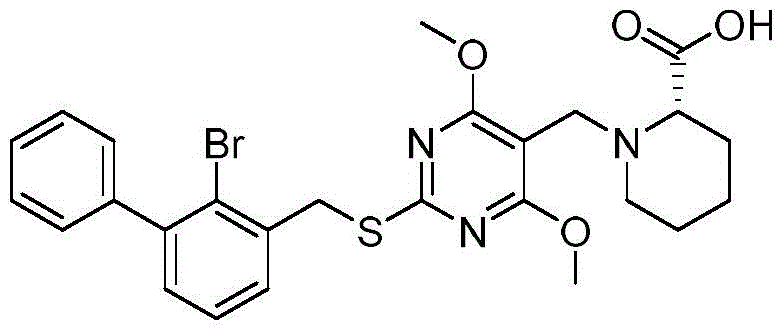
N- (2- (((2- (((2-bromo- [1,1' -biphenylyl ] -3-yl) methyl) thio) -4, 6-dimethoxypyrimidin-5-yl) methyl) amino) ethyl) acetamide

((2- (((2-bromo- [1,1' -biphenylyl ] -3-yl) methyl) thio) -4, 6-dimethoxypyrimidin-5-yl) methyl) -L-serine

(2S,4R) -1- ((2- (((2-bromo- [1,1' -biphenylyl ] -3-yl) methyl) thio) -4, 6-dimethoxypyrimidin-5-yl) methyl) -4-hydroxypyrrole-2-carboxylic acid

1- (((2- (((2-bromo- [1,1' -biphenylyl ] -3-yl) methyl) thio) -4, 6-dimethoxypyrimidin-5-yl) methyl) amino) cyclopropane-1-carboxylic acid

(S) -1- ((2- ((2-bromo- [1,1' -biphenylyl ] -3-yl) methoxy) -4-methoxy-6- (pyridin-3-ylmethoxy) pyrimidin-5-yl) methyl) piperidine-2-carboxylic acid

N- (2- (((2- ((2-bromo- [1,1' -biphenylyl ] -3-yl) methoxy) -4-methoxy-6- (pyridin-3-ylmethoxy) pyrimidin-5-yl) methyl) amino) ethyl) acetamide

((2- ((2-bromo- [1,1' -biphenylyl ] -3-yl) methoxy) -4-methoxy-6- (pyridin-3-ylmethoxy) pyrimidin-5-yl) methyl) -L-serine

(2S,4R) -1- ((2- ((2-bromo- [1,1' -biphenylyl ] -3-yl) methoxy) -4-methoxy-6- (pyridin-3-ylmethoxy) pyrimidin-5-yl) methyl) -4-hydroxypyrrole-2-carboxylic acid

1- (((2- ((2- ((2-bromo- [1,1' -biphenylyl ] -3-yl) methoxy) -4-methoxy-6- (pyridin-3-ylmethoxy) pyrimidin-5-yl) methyl) amino) cyclopropyl-1-carboxylic acid

(S) -1- ((2- (((2-methyl- [1,1' -biphenylyl ] -3-yl) methyl) thio) -4, 6-dimethoxypyrimidin-5-yl) methyl) piperidine-2-carboxylic acid

N- (2- (((4, 6-dimethoxy-2- (((2-methyl- [1,1' -biphenylyl ] -3-yl) methyl) thio) pyrimidin-5-yl) methyl) amino) ethyl) acetamide

((4, 6-dimethoxy-2- (((2-methyl- [1,1' -biphenylyl ] -3-yl) methyl) thio) pyrimidin-5-yl) methyl) -L-serine

(2S,4R) -1- ((4, 6-dimethoxy-2- (((2-methyl- [1,1' -biphenylyl ] -3-yl) methyl) thio) pyrimidin-5-yl) methyl) -4-hydroxypyrrole-2-carboxylic acid

1- (((dimethoxy-2- (((2-methyl- [1,1' -biphenylyl ] -3-yl) methyl) thio) pyrimidin-5-yl) methyl) amino) cyclopropane-1-carboxylic acid

The present invention also provides a process for the preparation of a compound according to formula I, wherein the process comprises the following reaction scheme:

(1) dissolving SM1 and SM2 in a solvent 1, adding an alkaline reagent and a palladium metal catalyst, and reacting at the temperature of 80-120 ℃ to obtain a compound C01;
(2) dissolving the compound C01 in a solvent 2, and reducing an ester group into a hydroxyl group by a reducing agent to obtain a compound C02;
(3) dissolving a compound C02 in a solvent 3, adding SM3 and an alkaline reagent, and reacting at the temperature of 20-100 ℃ to obtain a compound C03;
(4) adding POCl3Adding dropwise into stirring N, N-Dimethylformamide (DMF) under ice bath, adding compound C03 into the reaction system, and heating to 50-80 deg.CReaction in the range to give compound C04;
(5) dissolving C04 and SM4 in solvent 4, and carrying out reductive amination reaction to obtain a compound C05.
Preferably, in step (1), the solvent 1 is selected from one or more of 1, 4-dioxane, toluene, xylene, chlorobenzene; the alkaline reagent is selected from one or more of cesium carbonate, potassium carbonate, sodium carbonate, potassium tert-butoxide and sodium tert-butoxide; the palladium metal catalyst is selected from Pd (PPh)3)4、Pd(dppf)Cl2Palladium acetate, Pd2(dba)3One or more of (a).
Preferably, in step (2), the solvent 2 is selected from one or more of tetrahydrofuran, methanol, ethanol, isopropanol, and tert-butanol; the reducing agent is selected from one or more of lithium aluminum hydride, sodium borohydride, lithium borohydride and borane.
Preferably, in step (3), the solvent 3 is selected from one or more of DMSO, DMF, acetonitrile, NMP, methanol, ethanol, tert-butanol; the alkaline reagent is selected from one or more of cesium carbonate, potassium carbonate, sodium hydrogen, sodium methoxide, sodium ethoxide and sodium tert-butoxide.
Preferably, in step (5), the solvent 4 is selected from one or more of tetrahydrofuran, DMSO, DMF, acetonitrile, methanol, dichloromethane; the reducing agent of the reductive amination reaction is selected from NaBH3CN, sodium triacetoxyborohydride and/or sodium borohydride.
The invention also provides a pharmaceutical composition comprising a compound or a pharmaceutically salt of a compound or a solvate of a compound of the invention, and a pharmaceutically acceptable carrier.
In order to adapt to different administration modes, the pharmaceutical composition of the invention can be prepared into various dosage forms. Preferably, the pharmaceutical composition of the present invention is formulated in the form of an oral preparation or an injection.
The compound is a PD-1/PD-L1 signal channel inhibitor, and can be applied to treating diseases related to the PD-1/PD-L1 signal channel after being prepared into various preparations, wherein the diseases can be malignant tumors or cancers and can also be immunological diseases.
Optionally, the cancer is selected from skin cancer, lung cancer, hematological tumors, breast cancer, glioma, digestive system tumors, reproductive system tumors, lymphoma, nervous system tumors, head and neck cancer; the immune diseases are selected from diabetes, myasthenia gravis, rheumatoid arthritis, systemic lupus erythematosus and dermatitis.
Accordingly, the present invention also provides a method of treating cancer or immune disease, comprising administering to a patient in need thereof an effective amount of a pharmaceutical composition of the present invention.
Within the meaning of the present invention, the terms used are defined as follows:
"halogen" means F, Cl, Br, I.
"C1-C6 alkyl" refers to an alkyl chain having 1-6 carbon atoms and may be straight or branched. For example: methyl, ethyl, propyl, isopropyl, n-butyl, isobutyl, tert-butyl, and the like.
"C1-C8 alkoxy" refers to an alkyl chain of 1-8 carbon atoms which may be straight or branched, wherein at least one carbon atom in the middle is replaced by an oxygen atom.
"6-10 membered aryl" means an aryl group having 6-10 carbon atoms, such as phenyl, naphthyl. The hydrogen atoms on the carbon atoms in the ring may be substituted with specified substituents.
"3-6 membered cycloalkyl" and "6-10 membered cycloalkyl" refer to saturated carbocyclic rings having 3-6 and 6-10 carbon atoms, respectively, such as cyclopropyl, cyclobutyl, cyclopentyl, cyclohexyl and the like, wherein hydrogen atoms on carbon atoms in the ring may be substituted by specified substituents.
"6-10 membered heterocycloaryl" means an aryl group having 6-10 atoms, wherein 1-3 carbon atoms in the ring may be substituted with N, O, S. Such as quinolinyl, isoquinolinyl, pyridinyl, benzofuranyl, and the like.
"3-6 membered heterocycloalkyl" means a carbocyclic ring of 3-6 carbon atoms containing at least one N, O, S heteroatom from the N, O, S heteroatoms forming a heterocyclic group.
The "prodrug" refers to a derivative which is converted into the compound of the present invention in vivo by an oxidation, reduction, hydrolysis or the like reaction catalyzed by an enzyme under physiological conditions.
"metabolite" refers to all molecules produced in a cell or organism (preferably a human) that are derived from a compound of the invention.
By "isotopic derivative" is meant a compound of the invention which has a structure comprising one or more isotopic atoms present in unnatural proportions. Such as deuterium (2H or D), carbon-13 (13C), nitrogen-15 (15N).
By "solvate" is meant a compound of the invention that forms a solvent complex with a solvent molecule by physical association. The physical bond comprises a hydrogen bond. Conventional solvents include water, methanol, ethanol, acetic acid, tetrahydrofuran, ethyl acetate, acetonitrile, and the like. The compounds of formula I may be prepared in crystalline form and may be in the form of solvates (including hydrates).
Pharmaceutically acceptable salts of the compounds of formula I, containing one or more basic or acidic groups, especially pharmaceutically usable salts thereof. Such as alkali metal salts, alkaline earth metal salts, ammonium salts. More precisely sodium, potassium, calcium, magnesium or organic amines such as ethylamine, ethanolamine, triethylamine or amino acid salts. The compounds of the present invention may form protonated compounds of formula I with inorganic or organic acids, examples of which include hydrochloric acid, sulfuric acid, phosphoric acid, nitric acid, methanesulfonic acid, lactic acid, malic acid, maleic acid, tartaric acid, and the like, as well as other acids known to those skilled in the art.
"pharmaceutical compositions" when used as a medicament means the compounds of formula I of the present invention and their salts, isotopic derivatives, metabolites, prodrugs, solvates and other compositions with or without biologically active substances, which are useful for the treatment or prevention of diseases associated with the PD1/PDL-1 signaling pathway, such as solid tumors, hematological tumors, and the like.
Drawings
FIG. 1 shows the general structure of the compound of formula I according to the present invention.
Detailed Description
The present invention will be described in detail with reference to specific examples.
Example 1
(S) -1- ((4, 6-dimethoxy-2- ((2-bromo- [1,1' -biphenylyl ] -3-yl) methoxy) pyrimidin-5-yl) methyl) piperidine-2-carboxylic acid
The structural formula of the compound:

the synthetic route is as follows:

the synthesis method comprises the following steps:
preparation of methyl 2-bromo-3-iodobenzoate:
to the reaction flask was added methyl 3-amino-2-bromobenzoate (25.12g,1eq), acetonitrile (250mL) and water (400mL), and concentrated hydrochloric acid (40mL) was added to the above system with stirring. After stirring at room temperature for 10min, the temperature was reduced to 0 ℃ and a solution of sodium nitrite (15.12g,2eq) in water (200mL) was added dropwise with stirring. After stirring at 0 ℃ for 30min, an aqueous potassium iodide solution (21.81g,1.2eq,200mL of water) was added dropwise to the system, and the mixture was stirred at room temperature overnight. LCMS check reaction complete. Ethyl acetate (300 mL. times.3) extraction, combined organic phases and washed once with saturated brine, dried over anhydrous sodium sulfate, filtered with suction, concentrated, crude silica gel column chromatography gave methyl 2-bromo-3-iodobenzoate (34.1g, yield: 92.3%).
Preparation of methyl 2-bromo- [1,1' -biphenylyl ] -3-carboxylate:
to a reaction flask were added methyl 2-bromo-3-iodobenzoate (15.12g,1eq), phenylboronic acid (6.51g,1.2eq), potassium carbonate (18.33g,3eq), and Pd (PPh)3)4(5.12g,0.1eq), 1, 4-dioxane (300mL) and water (30mL), and the temperature is raised to 100 ℃ for reaction for 16h under the protection of nitrogen. TLC detection reaction is complete, reaction is stopped, the temperature is reduced to room temperature, water (700mL) is added to quench the system, ethyl acetate (200mL multiplied by 3) is used for extraction, organic phases are combined and washed once by saturated salt solution, anhydrous sodium sulfate is dried, and suction filtration is carried outConcentrating, and performing silica gel column chromatography to obtain 2-bromo- [1,1' -biphenyl]Methyl (3-carboxylate) (6.12g, yield: 48.1%).
Preparation of (2-bromo- [1,1' -biphenylyl ] -3-yl) methanol:
adding 2-bromo- [1,1' -biphenyl into a reaction bottle]-methyl 3-carboxylate (6.12g,1eq), freshly distilled tetrahydrofuran (150mL) and LiAlH added portionwise at 5 deg.C4(1.63g,2eq), stirring at room temperature for 30min, detecting by TLC that the reaction is complete, and slowly dropping the reaction system into saturated NH4Quenching the reaction in Cl aqueous solution, extracting with ethyl acetate (200 mL. times.3), combining the organic phases, washing with saturated brine once, drying over anhydrous sodium sulfate, filtering, and concentrating to obtain (2-bromo- [1,1' -biphenylyl ] compound]-3-yl) methanol (5.12g, yield: 92.2%) crude product. The crude product was used directly in the next reaction without any purification treatment.
Preparation of 2- ((2-bromo- [1,1' -biphenylyl ] -3-yl) methoxy) -4, 6-dimethoxypyrimidine:
adding (2-bromo- [1,1' -biphenyl) into a reaction bottle]-3-yl) methanol (5.12g,1eq), 2-chloro-4, 6-dimethoxypyrimidine (5.1g,1.5eq), DMF (100mL), potassium carbonate (8.12g,3 eq). Stirring for 16h at room temperature, detecting by LCMS to complete the reaction, adding water (700mL) to quench the system, extracting with ethyl acetate (200mL × 3), combining organic phases, washing with saturated salt water once, drying over anhydrous sodium sulfate, filtering, concentrating, and performing silica gel column chromatography to obtain 2- ((2-bromo- [1,1' -biphenyl ] 2]-3-yl) methoxy) -4, 6-dimethoxypyrimidine (6.92g, yield: 90.3%). MS: [ M +1]+:401.1/403.1。
Preparation of 2- ((2-bromo- [1,1' -biphenyl ] -3-yl) methoxy) -4, 6-dimethoxypyrimidine-5-carbaldehyde:
under the condition of ice-water bath, phosphorus oxychloride (26.53g,10eq) is dropwise added into a reaction bottle filled with DMF (12.73g,10eq), the mixture is stirred for 30min under the condition of ice-water bath, and 2- ((2-bromine- [1,1' -biphenyl) is dropwise added into a reaction system]-3-yl) methoxy) -4, 6-dimethoxypyrimidine (6.92g,1eq) in DMF (60mL) and warmed to 50 ℃ and stirred for 2 h. LCMS check reaction complete and stop reaction. The reaction was added dropwise to an ice-water bath with stirring, adjusted to neutral (pH 7) with sodium bicarbonate, the solid was filtered with suction and washed twice with waterPurifying the dried crude product by silica gel column chromatography to obtain 2- ((2-bromine- [1,1' -biphenyl) compound]-3-yl) methoxy) -4, 6-dimethoxypyrimidine-5-carbaldehyde (5.12g, yield 53.1%). MS: [ M +1]+:429.1/431.1。
Preparation of (S) -1- ((4, 6-dimethoxy-2- ((2-bromo- [1,1' -biphenylyl ] -3-yl) methoxy) pyrimidin-5-yl) methyl) piperidine-2-carboxylic acid:
2- ((2-bromo- [1,1' -biphenyl ] -3-yl) methoxy) -4, 6-dimethoxypyrimidine-5-carbaldehyde (500.0mg,1eq), L-homoproline (300.7mg,2eq), and 3 drops of acetic acid were dissolved in ultra-dry methanol (15mL) and DMF (15mL) at room temperature and stirred at room temperature for 2 h. Sodium cyanoborohydride (366.2mg,5eq) was added with stirring at 0 ℃. The reaction was carried out overnight at 50 ℃ under nitrogen. And (5) LCMS detects that the reaction is finished, and the reaction is stopped. Water (50mL), ethyl acetate (30mL × 3) were added, the organic phases were combined and washed with saturated brine once, dried over anhydrous sodium sulfate, filtered, concentrated, and the crude product was purified by reverse column chromatography to give (S) -1- ((4, 6-dimethoxy-2- ((2-bromo- [1,1' -biphenylyl ] -3-yl) methoxy) pyrimidin-5-yl) methyl) piperidine-2-carboxylic acid (313.6mg, yield 49.3%).
MS:[M+1]+:542.2/544.2。
1H NMR(400MHz,d6-DMSO)δ7.60(dd,J=7.6,1.6Hz,1H),7.54-7.27(m,7H),5.53(s,2H),3.96-3.67(m,8H),3.07-2.97(m,2H),2.34-2.30(m,1H),1.77-1.71(m,1H),1.67-1.60(m,1H),1.48-1.41(m,3H),1.34-1.27(m,1H)。
Example 2
N- (2- (((2- ((2-bromo- [1,1' -biphenylyl ] -3-yl) methoxy) -4, 6-dimethoxypyrimidin-5-yl) methyl) amino) ethyl) acetamide
The structural formula of the compound:

the synthetic route is as follows:

preparation of N- (2- (((2- ((2-bromo- [1,1' -biphenylyl ] -3-yl) methoxy) -4, 6-dimethoxypyrimidin-5-yl) methyl) amino) ethyl) acetamide:
2- ((2-bromo- [1,1' -biphenyl ] -3-yl) methoxy) -4, 6-dimethoxypyrimidine-5-carbaldehyde (60.0mg,1eq), N-acetylethylenediamine (28.6mg,2eq) and 1 drop of acetic acid were dissolved in methanol (3mL) and DMF (3mL) at room temperature and stirred at room temperature for 2 h. Sodium cyanoborohydride (43.9mg,5eq) was added with stirring at 0 ℃. The reaction was carried out overnight at 50 ℃ under nitrogen. And (5) LCMS detects that the reaction is finished, and the reaction is stopped. Water (30mL) was added, extraction was performed with ethyl acetate (150 mL. times.3), the organic phases were combined and washed with saturated brine once, dried over anhydrous sodium sulfate, filtered with suction, concentrated, and the crude product was purified by reverse column chromatography to give N- (2- (((2- ((2-bromo- [1,1' -biphenylyl ] -3-yl) methoxy) -4, 6-dimethoxypyrimidin-5-yl) methyl) amino) ethyl) acetamide (16.8mg, yield 23.4%).
MS:[M+1]+:515.2/517.2。
1H NMR(400MHz,d6-DMSO)δ7.87(t,J=5.2Hz,1H),7.75-7.65(m,1H),7.59(d,J=1.5Hz,1H),7.54-7.34(m,6H),5.53(s,2H),3.92(s,6H),3.66(s,2H),3.19-3.12(m,2H),2.63(t,J=6.1Hz,2H),2.05-1.95(m,1H),1.80(s,3H)。
Example 3
((2- ((2-bromo- [1,1' -biphenylyl ] -3-yl) methoxy) -4, 6-dimethoxypyrimidin-5-yl) methyl) -L-serine
The structural formula of the compound:
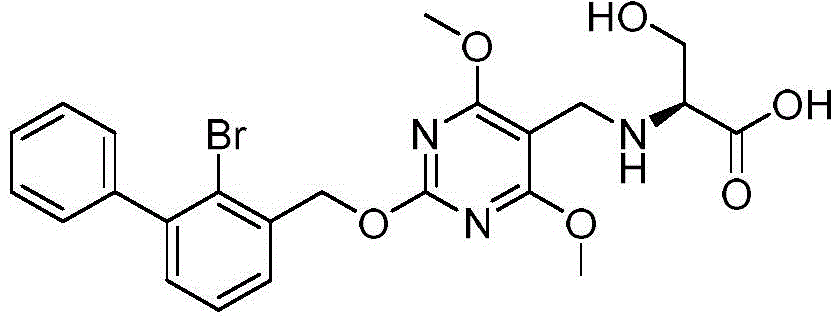
the synthetic route is as follows:

preparation of 2- ((2-bromo- [1,1' -biphenylyl ] -3-yl) methoxy) -4, 6-dimethoxypyrimidin-5-yl) methyl) -L-serine:
referring to the synthesis of example 2, 2- ((2-bromo- [1,1 '-biphenylyl ] -3-yl) methoxy) -4, 6-dimethoxypyrimidine-5-carbaldehyde was reacted with L-serine to synthesize 2- ((2-bromo- [1,1' -biphenylyl ] -3-yl) methoxy) -4, 6-dimethoxypyrimidin-5-yl) methyl) -L-serine.
MS:[M+1]+:518.1/520.1。
1H NMR(400MHz,d6-DMSO)δ7.58(d,J=7.5Hz,1H),7.54-7.30(m,7H),5.51(s,2H),3.90(s,6H),3.75-3.61(m,2H),3.50(s,2H),2.94-2.82(m,1H)。
Example 4
(2S,4R) -1- ((2- ((2-bromo- [1,1' -biphenylyl ] -3-yl) methoxy) -4, 6-dimethoxypyrimidin-5-yl) methyl) -4-hydroxypyrrole-2-carboxylic acid
The structural formula of the compound:
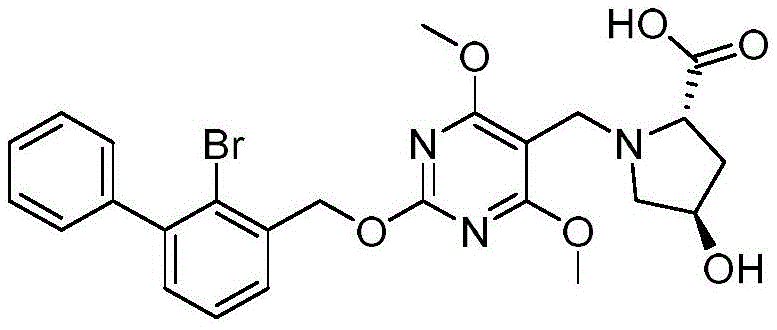
the synthetic route is as follows:

preparation of (2S,4R) -1- ((2- ((2-bromo- [1,1' -biphenylyl ] -3-yl) methoxy) -4, 6-dimethoxypyrimidin-5-yl) methyl) -4-hydroxypyrrole-2-carboxylic acid:
referring to the synthesis of example 2, (2S,4R) -1- ((2- ((2-bromo- [1,1 '-biphenylyl ] -3-yl) methoxy) -4, 6-dimethoxypyrimidin-5-yl) methyl) -4-hydroxypyrrole-2-carboxylic acid was synthesized by reacting 2- ((2-bromo- [1,1' -biphenylyl ] -3-yl) methoxy) -4, 6-dimethoxypyrimidin-5-yl) formaldehyde with L-hydroxyproline.
MS:[M+1]+:544.1/546.1。
1H NMR(400MHz,d6-DMSO)δ7.60(dd,J=7.6,1.6Hz,1H),7.54-7.31(m,7H),5.53(s,2H),4.94(s,1H),4.22-4.11(m,1H),3.96-3.74(m,8H),3.37(t,J=8.0Hz,2H),3.28-3.24(m,1H),1.91-1.80(m,2H)。
Example 5
1- (((2- ((2-bromo- [1,1' -biphenylyl ] -3-yl) methoxy) -4, 6-dimethoxypyrimidin-5-yl) methyl) amino) cyclopropane-1-carboxylic acid
The structural formula of the compound:

the synthetic route is as follows:

preparation of 1- (((2- ((2-bromo- [1,1' -biphenylyl ] -3-yl) methoxy) -4, 6-dimethoxypyrimidin-5-yl) methyl) amino) cyclopropane-1-carboxylic acid:
referring to the synthesis procedure of example 2, 2- ((2-bromo- [1,1 '-biphenylyl ] -3-yl) methoxy) -4, 6-dimethoxypyrimidine-5-carbaldehyde was reacted with 1-aminocyclopropane carboxylic acid to synthesize 1- (((2- ((2-bromo- [1,1' -biphenylyl ] -3-yl) methoxy) -4, 6-dimethoxypyrimidin-5-yl) methyl) amino) cyclopropane-1-carboxylic acid.
MS:[M+1]+:514.1/516.1。
1H NMR(400MHz,d6-DMSO)δ7.60(dd,J=7.6,1.6Hz,1H),7.54-7.31(m,7H),5.53(s,2H),3.96-3.74(m,8H),1.21-0.93(m,4H)。
Example 6
(S) -1- ((4, 6-dimethoxy-2- ((2-chloro- [1,1' -biphenylyl ] -3-yl) methoxy) pyrimidin-5-yl) methyl) piperidine-2-carboxylic acid
The structural formula of the compound:

the synthetic route is as follows:

the synthesis method comprises the following steps:
preparation of methyl 2-chloro- [1,1' -biphenylyl ] -3-carboxylate:
to a reaction flask was added methyl 3-bromo-2-chlorobenzoate (11.12g,1eq), phenylboronic acid (6.53g,1.2eq), potassium carbonate (18.33g,3eq), and Pd (PPh)3)4(5.12g,0.1eq), 1, 4-dioxane (300mL) and water (30mL), and the temperature is raised to 100 ℃ for reaction for 16h under the protection of nitrogen. TLC detecting reaction, stopping reaction, cooling to room temperature, adding water (700mL) to quench the system, extracting with ethyl acetate (200mL × 3), combining organic phases, washing with saturated salt water once, drying with anhydrous sodium sulfate, filtering, concentrating, and performing silica gel column chromatography to obtain 2-chloro- [1,1' -biphenyl]Methyl (3-carboxylate) (6.12g, yield: 55.6%).
Preparation of (2-chloro- [1,1' -biphenylyl ] -3-yl) methanol:
adding 2-chloro- [1,1' -biphenyl into a reaction bottle]Methyl 3-carboxylate (5.11g,1eq), freshly distilled tetrahydrofuran (150mL) and LiAlH added at 5 ℃4(1.61g, 2eq), stirring at room temperature for 30min, detecting by TLC that the reaction is complete, and slowly dropping the reaction system into saturated NH4Quenching the reaction in Cl aqueous solution, extracting with ethyl acetate (200 mL. times.3), combining the organic phases and washing with saturated brine once, drying over anhydrous sodium sulfate, filtering, concentrating to obtain (2-chloro- [1,1' -biphenylyl ] biphenyl]-3-yl) methanol (3.91g, yield: 86.3%) crude. The crude product was used directly in the next reaction without any purification treatment.
Preparation of 2- ((2-chloro- [1,1' -biphenylyl ] -3-yl) methoxy) -4, 6-dimethoxypyrimidine:
adding (2-chloro- [1,1' -biphenyl) into a reaction bottle]-3-yl) methanol (3.91g,1eq), 2-chloro-4, 6-dimethoxypyrimidine (4.67g, 1.5eq), DMF (100mL), potassium carbonate (7.38g, 3 eq). Stirring for 6h at 50 ℃, detecting complete reaction by LCMS, adding water (700mL) to quench the system, extracting with ethyl acetate (200mL multiplied by 3), combining organic phases, washing with saturated salt water once, drying with anhydrous sodium sulfate, filtering, concentrating, and performing silica gel column chromatography to obtain 2- ((2-chloro- [1,1' -biphenyl ] 2]-3-yl) methoxy) -4, 6-dimethoxypyrimidine (4.12g, yield: 64.4%). MS: [ M +1]+:357.1。
Preparation of 2- ((2-chloro- [1,1' -biphenylyl ] -3-yl) methoxy) -4, 6-dimethoxypyrimidine-5-carbaldehyde:
dropping phosphorus oxychloride (17.71g, 10eq) into a reaction bottle filled with DMF (8.54g, 10eq) under ice-water bath, stirring for 30min under ice-water bath, and dropping 2- ((2-chloro- [1,1' -biphenyl) into the reaction system]-3-yl) methoxy) -4, 6-dimethoxypyrimidine (4.12g,1eq) in DMF (100mL) and warmed to 50 ℃ and stirred for 2 h. LCMS check reaction complete and stop reaction. Dropwise adding the reaction system into an ice water bath under stirring, adjusting the pH value to be neutral (7) by using sodium bicarbonate, carrying out suction filtration on the solid, washing the solid with water twice, and purifying the dried crude product by silica gel column chromatography to obtain the 2- ((2-chloro- [1,1' -biphenyl) 2]-3-yl) methoxy) -4, 6-dimethoxypyrimidine-5-carbaldehyde (3.25g, 73.2% yield). MS: [ M +1]+:357.1。
Preparation of (S) -1- ((4, 6-dimethoxy-2- ((2-chloro- [1,1' -biphenylyl ] -3-yl) methoxy) pyrimidin-5-yl) methyl) piperidine-2-carboxylic acid:
2- ((2-chloro- [1,1' -biphenylyl ] -3-yl) methoxy) -4, 6-dimethoxypyrimidine-5-carbaldehyde (200.0mg,1eq), L-homoproline (125.9mg,2eq), and 3 drops of acetic acid were dissolved in ultra-dry methanol (10mL) and DMF (10mL) at room temperature and stirred at room temperature for 2 h. Sodium cyanoborohydride (163.3mg,5eq) was added with stirring at 0 ℃. The reaction was carried out overnight at 50 ℃ under nitrogen. And (5) LCMS detects that the reaction is finished, and the reaction is stopped. Water (50mL), ethyl acetate (30mL × 3) were added, the organic phases were combined and washed with saturated brine once, dried over anhydrous sodium sulfate, filtered, concentrated, and the crude product was purified by reverse column chromatography to give (S) -1- ((4, 6-dimethoxy-2- ((2-chloro- [1,1' -biphenylyl ] -3-yl) methoxy) pyrimidin-5-yl) methyl) piperidine-2-carboxylic acid (93.7mg, yield 36.2%).
MS:[M+1]+:498.2。
1H NMR(400MHz,d6-DMSO)δ7.61(d,J=7.2Hz,1H),7.51-7.32(m,7H),5.51(s,2H),3.86(s,6H),3.70-3.67(m,1H),3.56-3.51(m,1H),3.01-2.85(m,2H),2.24-2.08(m,1H),1.67-1.62(m,2H),1.49-1.33(m,2H),1.33-1.17(m,2H)。
Example 7
N- (2- (((2- ((2-chloro- [1,1' -biphenylyl ] -3-yl) methoxy) -4, 6-dimethoxypyrimidin-5-yl) methyl) amino) ethyl) acetamide
The structural formula of the compound:

the synthetic route is as follows:

preparation of N- (2- (((2- ((2-chloro- [1,1' -biphenylyl ] -3-yl) methoxy) -4, 6-dimethoxypyrimidin-5-yl) methyl) amino) ethyl) acetamide:
2- ((2-chloro- [1,1' -biphenylyl ] -3-yl) methoxy) -4, 6-dimethoxypyrimidine-5-carbaldehyde (60.0mg,1eq), N-acetylethylenediamine (31.3mg,2eq) and 1 drop of acetic acid were dissolved in ultra-dry methanol (3mL) and DMF (3mL) at room temperature and stirred for 2h at room temperature. Sodium cyanoborohydride (49.1mg,5eq) was added with stirring at 0 ℃. The reaction was carried out overnight at 50 ℃ under nitrogen. And (5) LCMS detects that the reaction is finished, and the reaction is stopped. Water (30mL) was added, extraction was performed with ethyl acetate (15 mL. times.3), the organic phases were combined and washed with saturated brine once, dried over anhydrous sodium sulfate, filtered with suction, concentrated, and the crude product was purified by reverse column chromatography to give N- (2- (((2- ((2-chloro- [1,1' -biphenylyl ] -3-yl) methoxy) -4, 6-dimethoxypyrimidin-5-yl) methyl) amino) ethyl) acetamide (16.8mg, yield 19.5%).
MS:[M+1]+:471.2。
1H NMR(400MHz,d6-DMSO)δ7.89(t,J=5.2Hz,1H),7.62(d,J=7.2Hz,1H),7.55-7.34(m,7H),5.55(s,2H),4.02(s,6H),3.76(s,2H),3.25-3.16(m,2H),2.73(t,J=6.2Hz,2H),2.15-2.01(m,1H),1.87(s,3H)。
Example 8
((2- ((2-chloro- [1,1' -biphenylyl ] -3-yl) methoxy) -4, 6-dimethoxypyrimidin-5-yl) methyl) -L-serine
The structural formula of the compound:

the synthetic route is as follows:

preparation of 2- ((2-chloro- [1,1' -biphenylyl ] -3-yl) methoxy) -4, 6-dimethoxypyrimidin-5-yl) methyl) -L-serine:
referring to the synthesis procedure of example 7, 2- ((2-chloro- [1,1 '-biphenylyl ] -3-yl) methoxy) -4, 6-dimethoxypyrimidine-5-carbaldehyde was reacted with L-serine to synthesize 2- ((2-chloro- [1,1' -biphenylyl ] -3-yl) methoxy) -4, 6-dimethoxypyrimidin-5-yl) methyl) -L-serine.
MS:[M+1]+:474.2。
1H NMR(400MHz,d6-DMSO)δ7.65(d,J=7.5Hz,1H),7.57-7.34(m,7H),5.53(s,2H),3.97(s,6H),3.81-3.63(m,2H),3.57(s,2H),2.99-2.89(m,1H)。
Example 9
(2S,4R) -1- ((2- ((2-chloro- [1,1' -biphenylyl ] -3-yl) methoxy) -4, 6-dimethoxypyrimidin-5-yl) methyl) -4-hydroxypyrrole-2-carboxylic acid
The structural formula of the compound:

the synthetic route is as follows:

preparation of (2S,4R) -1- ((2- ((2-chloro- [1,1' -biphenylyl ] -3-yl) methoxy) -4, 6-dimethoxypyrimidin-5-yl) methyl) -4-hydroxypyrrole-2-carboxylic acid:
referring to the synthesis procedure of example 7, (2S,4R) -1- ((2- ((2-chloro- [1,1 '-biphenylyl ] -3-yl) methoxy) -4, 6-dimethoxypyrimidin-5-yl) methyl) -4-hydroxypyrrole-2-carboxylic acid was synthesized by reacting 2- ((2-chloro- [1,1' -biphenylyl ] -3-yl) methoxy) -4, 6-dimethoxypyrimidin-5-yl) formaldehyde with L-hydroxyproline.
MS:[M+1]+:500.2。
1H NMR(400MHz,d6-DMSO)δ7.61(dd,J=7.6,1.6Hz,1H),7.54-7.31(m,7H),5.55(s,2H),4.94(s,1H),4.22-4.11(m,1H),3.89-3.56(m,8H),3.36(t,J=8.0Hz,2H),3.29-3.24(m,1H),1.94-1.83(m,2H)。
Example 10
1- (((2- ((2-chloro- [1,1' -biphenylyl ] -3-yl) methoxy) -4, 6-dimethoxypyrimidin-5-yl) methyl) amino) cyclopropane-1-carboxylic acid
The structural formula of the compound:

the synthetic route is as follows:

preparation of 1- (((2- ((2-chloro- [1,1' -biphenylyl ] -3-yl) methoxy) -4, 6-dimethoxypyrimidin-5-yl) methyl) amino) cyclopropane-1-carboxylic acid:
referring to the synthesis procedure of example 7, 2- ((2-chloro- [1,1 '-biphenylyl ] -3-yl) methoxy) -4, 6-dimethoxypyrimidine-5-carbaldehyde was reacted with 1-aminocyclopropane carboxylic acid to synthesize 1- (((2- ((2-chloro- [1,1' -biphenylyl ] -3-yl) methoxy) -4, 6-dimethoxypyrimidin-5-yl) methyl) amino) cyclopropane-1-carboxylic acid.
MS:[M+1]+:470.2。
1H NMR(400MHz,d6-DMSO)δ7.62(dd,J=7.6,1.6Hz,1H),7.56-7.34(m,7H),5.55(s,2H),3.94-3.74(m,8H),1.23-0.96(m,4H)。
Example 11
(S) -1- ((4, 6-dimethoxy-2- ((2-vinyl- [1,1' -biphenylyl ] -3-yl) methoxy) pyrimidin-5-yl) methyl) piperidine-2-carboxylic acid:
the structural formula of the compound:

the synthetic route is as follows:

the synthesis method comprises the following steps:
preparation of methyl 2-vinyl- [1,1' -biphenylyl ] -3-carboxylate:
adding 2-bromo- [1,1' -biphenyl into a reaction bottle]Methyl-3-carboxylate (13.41g,1eq), vinyl boronic acid pinacol ester (14.22g,2eq), Pd (dppf) Cl2(3.67g,0.1eq), potassium carbonate (19.12g,3eq), 1, 4-dioxane (250mL) and water (25 mL). Stirring at room temperature for 5min, heating to 100 ℃ and reacting for 16h under the protection of nitrogen. TLC detecting reaction, stopping reaction, cooling to room temperature, adding water (700mL), extracting with ethyl acetate (200mL × 3), combining organic phases, washing with saturated salt water, drying over anhydrous sodium sulfate, filtering, concentrating, and performing silica gel column chromatography to obtain 2-vinyl- [1,1' -biphenyl]-methyl 3-carboxylate (2.41g, yield 22.1%).
1H NMR(400MHz,d6-DMSO)δ7.62(dd,J=7.2,2.4Hz,1H),7.49-7.26(m,7H),6.75(dd,J=18.0,11.6Hz,1H),5.23(dd,J=11.6,1.6Hz,1H),4.97(dd,J=18.0,1.2Hz,1H),3.79(s,3H)。
Preparation of (2-vinyl- [1,1' -biphenylyl ] -3-yl) methanol:
adding 2-vinyl- [1,1' -biphenyl into a reaction bottle]Methyl 3-carboxylate (2.41g,1eq), freshly distilled tetrahydrofuran (100mL) and LiAlH added at 5 deg.C4(682.1mg,2eq), stirring at room temperature for 30min, detecting by TLC that the reaction is complete, and slowly dropping the reaction system into saturated NH4Quenching the reaction in Cl aqueous solution, extracting with ethyl acetate (100 mL. times.3), combining the organic phases and washing with saturated brine once, drying over anhydrous sodium sulfate, filtering, concentrating to obtainPurifying the crude product by silica gel column chromatography to obtain (2-bromo- [1,1' -biphenyl)]-3-yl) methanol (1.22g, yield: 56.2%).
Preparation of 4, 6-dimethoxy-2- ((2-vinyl- [1,1' -biphenylyl ] -3-yl) methoxy) pyrimidine:
adding (2-vinyl- [1,1' -biphenyl) into a reaction bottle]-3-yl) methanol (1.22g,1eq), 2-chloro-4, 6-dimethoxypyrimidine (1.54g,1.5eq), DMF (100mL), potassium carbonate (2.36g,3 eq). Stirring for 5h at 50 ℃, detecting complete reaction by LCMS, adding water (500mL) to quench the system, extracting with ethyl acetate (200mL multiplied by 3), combining organic phases, washing with saturated salt water once, drying with anhydrous sodium sulfate, filtering, concentrating, and performing silica gel column chromatography to obtain 4, 6-dimethoxy-2- ((2-vinyl- [1,1' -biphenyl ] 2]-3-yl) methoxy) pyrimidine (1.42g, yield: 70.1%). MS: [ M +1]+:349.1。
Preparation of 4, 6-dimethoxy-2- ((2-vinyl- [1,1' -biphenylyl ] -3-yl) methoxy) pyrimidin-5-carbaldehyde:
dropping phosphorus oxychloride (6.21g,10eq) into a reaction bottle filled with DMF (3.1g,10eq) under ice-water bath, stirring for 30min under ice-water bath, and dropping 4, 6-dimethoxy-2- ((2-vinyl- [1,1' -biphenyl) into the reaction system]A solution of (3-yl) methoxy) pyrimidine (1.42g,1eq) in DMF (10mL) was warmed to 50 ℃ and stirred for 2 h. LCMS check reaction complete and stop reaction. Dropwise adding the reaction system into an ice water bath under stirring, adjusting the pH value to be neutral (7) by using sodium bicarbonate, carrying out suction filtration on the solid, washing twice, and purifying a dried crude product by silica gel column chromatography to obtain the 6-dimethoxy-2- ((2-vinyl- [1,1' -biphenyl) compound]-3-yl) methoxy) pyrimidine-5-carbaldehyde (840.1mg, yield 55.2%). MS: [ M +1]+:372.2。
Preparation of (S) -1- ((4, 6-dimethoxy-2- ((2-vinyl- [1,1' -biphenylyl ] -3-yl) methoxy) pyrimidin-5-yl) methyl) piperidine-2-carboxylic acid:
to a reaction flask was added 4, 6-dimethoxy-2- ((2-vinyl- [1,1' -biphenylyl ] -3-yl) methoxy) pyrimidine-5-carbaldehyde (100.0mg,1eq), L-homoproline (68.7mg,2eq), methanol (5mL), DMF (5mL) and 1 drop of acetic acid. Stir at room temperature for 2h, add sodium cyanoborohydride (83.6mg,5eq) with stirring at 0 ℃. The reaction was carried out overnight at 50 ℃ under nitrogen. And (5) LCMS detects that the reaction is finished, and the reaction is stopped. Water (50mL), ethyl acetate (30mL × 3) were added, the organic phases were combined and washed with saturated brine once, dried over anhydrous sodium sulfate, filtered, concentrated, and the crude product was purified by reverse column chromatography to give (S) -1- ((4, 6-dimethoxy-2- ((2-vinyl- [1,1' -biphenylyl ] -3-yl) methoxy) pyrimidin-5-yl) methyl) piperidine-2-carboxylic acid (35.6mg, yield 27.3%).
MS:[M+1]+:490.3。
1H NMR(400MHz,d6-DMSO)δ7.62(dd,J=7.2,2.4Hz,1H),7.52-7.27(m,7H),6.76(dd,J=18.0,11.6Hz,1H),5.55(s,2H),5.25(dd,J=11.6,1.6Hz,1H),4.98(dd,J=18.0,1.2Hz,1H),3.96-3.67(m,8H),3.07-2.97(m,2H),2.34-2.30(m,1H),1.77-1.71(m,1H),1.67-1.60(m,1H),1.48-1.41(m,3H),1.34-1.27(m,1H)。
Example 12
N- (2- (((2- ((2-vinyl- [1,1' -biphenylyl ] -3-yl) methoxy) -4, 6-dimethoxypyrimidin-5-yl) methyl) amino) ethyl) acetamide
The structural formula of the compound:

the synthetic route is as follows:

preparation of N- (2- (((2- ((2-vinyl- [1,1' -biphenylyl ] -3-yl) methoxy) -4, 6-dimethoxypyrimidin-5-yl) methyl) amino) ethyl) acetamide:
2- ((2-vinyl- [1,1' -biphenylyl ] -3-yl) methoxy) -4, 6-dimethoxypyrimidine-5-carbaldehyde (60.0mg,1eq), N-acetylethylenediamine (32.6mg,2eq) and 1 drop of acetic acid were dissolved in ultra-dry methanol (3mL) and DMF (3mL) at room temperature and stirred for 2h at room temperature. Sodium cyanoborohydride (50.1mg,5eq) was added with stirring at 0 ℃. The reaction was carried out overnight at 50 ℃ under nitrogen. And (5) LCMS detects that the reaction is finished, and the reaction is stopped. Water (30mL) was added, extraction was performed with ethyl acetate (10 mL. times.3), the organic phases were combined and washed with saturated brine once, dried over anhydrous sodium sulfate, filtered with suction, concentrated, and the crude product was purified by reverse column chromatography to give N- (2- (((2- ((2-vinyl- [1,1' -biphenylyl ] -3-yl) methoxy) -4, 6-dimethoxypyrimidin-5-yl) methyl) amino) ethyl) acetamide (26.9mg, yield 36.5%).
MS:[M+1]+:463.2。
1H NMR(400MHz,d6-DMSO)δ7.87(t,J=5.2Hz,1H),7.63(dd,J=7.2,2.4Hz,1H),7.55-7.31(m,7H),6.75(dd,J=18.0,11.6Hz,1H),5.52(s,2H),5.25(dd,J=11.6,1.6Hz,1H),4.98(dd,J=18.0,1.2Hz,1H),3.96(s,6H),3.77(s,2H),3.28-3.17(m,2H),2.72(t,J=6.2Hz,2H),2.17-2.08(m,1H),1.87(s,3H)。
Example 13
((2- ((2-vinyl- [1,1' -biphenylyl ] -3-yl) methoxy) -4, 6-dimethoxypyrimidin-5-yl) methyl) -L-serine
The structural formula of the compound:

the synthetic route is as follows:

preparation of ((2- ((2-vinyl- [1,1' -biphenylyl ] -3-yl) methoxy) -4, 6-dimethoxypyrimidin-5-yl) methyl) -L-serine:
with reference to the synthesis procedure of example 12, ((2- ((2-chloroethenyl- [1,1 '-biphenylyl ] -3-yl) methoxy) -4, 6-dimethoxypyrimidin-5-yl) methyl) -L-serine was synthesized by reacting 2- ((2-vinyl- [1,1' -biphenylyl ] -3-yl) methoxy) -4, 6-dimethoxypyrimidin-5-yl) formaldehyde with L-serine.
MS:[M+1]+:467.2。
1H NMR(400MHz,d6-DMSO)δ7.67(d,J=7.6Hz,1H),7.56-7.34(m,7H),6.77(dd,J=18.0,11.6Hz,1H),5.52(s,2H),5.25(d,J=11.6Hz,1H),4.98(d,J=18.0Hz,1H),3.94(s,6H),3.83-3.67(m,2H),3.58(s,2H),2.97-2.85(m,1H)。
Example 14
(2S,4R) -1- ((2- ((2-vinyl- [1,1' -biphenylyl ] -3-yl) methoxy) -4, 6-dimethoxypyrimidin-5-yl) methyl) -4-hydroxypyrrole-2-carboxylic acid
The structural formula of the compound:

the synthetic route is as follows:

preparation of (2S,4R) -1- ((2- ((2-vinyl- [1,1' -biphenylyl ] -3-yl) methoxy) -4, 6-dimethoxypyrimidin-5-yl) methyl) -4-hydroxypyrrole-2-carboxylic acid:
referring to the synthesis of example 12, (2S,4R) -1- ((2- ((2-vinyl- [1,1 '-biphenylyl ] -3-yl) methoxy) -4, 6-dimethoxypyrimidin-5-yl) methyl) -4-hydroxypyrrole-2-carboxylic acid was synthesized by reacting 2- ((2-vinyl- [1,1' -biphenylyl ] -3-yl) methoxy) -4, 6-dimethoxypyrimidin-5-yl) formaldehyde with L-hydroxyproline.
MS:[M+1]+:492.2。
1H NMR(400MHz,d6-DMSO)δ7.65(dd,J=7.6,1.6Hz,1H),7.54-7.31(m,7H),6.77(dd,J=18.0,11.6Hz,1H),5.55(s,2H),5.25(d,J=11.6Hz,1H),4.99-4.93(m,2H),4.23-4.11(m,1H),3.95-3.74(m,8H),3.39(t,J=8.0Hz,2H),3.28-3.24(m,1H),1.92-1.81(m,2H)。
Example 15
1- (((2- ((2-vinyl- [1,1' -biphenylyl ] -3-yl) methoxy) -4, 6-dimethoxypyrimidin-5-yl) methyl) amino) cyclopropane-1-carboxylic acid
The structural formula of the compound:

the synthetic route is as follows:

preparation of 1- (((2- ((2-vinyl- [1,1' -biphenylyl ] -3-yl) methoxy) -4, 6-dimethoxypyrimidin-5-yl) methyl) amino) cyclopropane-1-carboxylic acid:
referring to the synthesis procedure of example 12, 2- ((2-vinyl- [1,1 '-biphenylyl ] -3-yl) methoxy) -4, 6-dimethoxypyrimidine-5-carbaldehyde was reacted with 1-aminocyclopropane carboxylic acid to synthesize 1- (((2- ((2-vinyl- [1,1' -biphenylyl ] -3-yl) methoxy) -4, 6-dimethoxypyrimidin-5-yl) methyl) amino) cyclopropane-1-carboxylic acid.
MS:[M+1]+:462.2。
1H NMR(400MHz,d6-DMSO)δ7.67(dd,J=7.6,1.6Hz,1H),7.56-7.31(m,7H),6.78(dd,J=18.0,11.6Hz,1H),5.53(s,2H),5.25(d,J=11.6Hz,1H),4.98(d,J=18.0Hz,1H),3.96-3.74(m,8H),1.21-0.93(m,4H)。
Example 16
(S) -1- ((2- ((2-bromo-3- (2, 3-dihydrobenzo [ b ] [1,4] dioxan-6-yl) phenyl) oxy) -4, 6-dimethylpyrimidin-5-yl) methyl) piperidine-2-carboxylic acid
The structural formula of the compound:

the synthetic route is as follows:

preparation of methyl 2-bromo-3- (2, 3-dihydrobenzo [ b ] [1,4] dioxan-6-yl) benzoate:
to a reaction flask was added methyl 2-bromo-3-iodobenzoate (10.12)g,1eq), benzo-1, 4-dioxane-6-boronic acid (6.41g,1.2eq), potassium carbonate (12.29g,3eq) and Pd (PPh)3)4(3.43g,0.1eq), 1, 4-dioxane (250mL) and water (25mL), and the temperature is raised to 100 ℃ for reaction for 16h under the protection of nitrogen. TLC detecting reaction, stopping reaction, cooling to room temperature, adding water (700mL) to quench the system, extracting with ethyl acetate (200mL × 3), combining organic phases, washing with saturated salt water once, drying over anhydrous sodium sulfate, filtering, concentrating, and performing silica gel column chromatography to obtain 2-bromo-3- (2, 3-dihydrobenzo [ b ] b][1,4]Dioxan-6-yl) benzoic acid methyl ester (5.01g, yield: 48.3%).
2-bromo-3- (2, 3-dihydrobenzo [ b ]][1,4]Dioxo-6-yl)Benzyl alcoholThe preparation of (1):
adding 2-bromo-3- (2, 3-dihydrobenzo [ b ] into a reaction bottle][1,4]Dioxol-6-yl) benzoic acid methyl ester (5.01g,1eq), freshly distilled tetrahydrofuran (150mL) and LiAlH added at 5 deg.C4(1.09g,2eq), stirring at room temperature for 30min, detecting by TLC that the reaction is complete, and slowly dropping the reaction system into saturated NH4Quenching the reaction in Cl aqueous solution, extracting with ethyl acetate (200 mL. times.3), combining the organic phases, washing with saturated saline solution once, drying over anhydrous sodium sulfate, filtering, concentrating to obtain 2-bromo-3- (2, 3-dihydrobenzo [ b ] b][1,4]Dioxan-6-yl) benzyl alcohol (3.94g, yield: 85.6%) crude product. The crude product was used directly in the next reaction without any purification treatment.
Preparation of 2- ((2-bromo-3- (2, 3-dihydrobenzo [ b ] [1,4] dioxan-6-yl) phenyl) oxy) -4, 6-dimethoxypyrimidine:
adding 2-bromo-3- (2, 3-dihydrobenzo [ b ] into a reaction bottle][1,4]Dioxol-6-yl) benzyl alcohol (3.94g,1eq), 2-chloro-4, 6-dimethoxypyrimidine (3.21g,1.5eq), DMF (100mL), potassium carbonate (5.08g,3 eq). Stirring for 16h at room temperature, detecting by LCMS to complete the reaction, adding water (700mL) to quench the system, extracting with ethyl acetate (200mL × 3), combining organic phases, washing with saturated salt water once, drying over anhydrous sodium sulfate, filtering, concentrating, and performing silica gel column chromatography to obtain 2- ((2-bromo- [1,1' -biphenyl ] 2]-3-yl) methoxy) -4, 6-dimethoxypyrimidine (4.38g, yield: 77.8%). MS: [ M +1]+:459.1/461.1。
Preparation of 2- ((2-bromo-3- (2, 3-dihydrobenzo [ b ] [1,4] dioxol-6-yl) phenyl) oxy) -4, 6-dimethoxypyrimidine-5-carbaldehyde:
dropping phosphorus oxychloride (145g,10eq) into a reaction bottle filled with DMF (6.97g,10eq) in an ice-water bath, stirring for 30min in the ice-water bath, and dropping 2- ((2-bromine- [1,1' -biphenyl) into the reaction system]-3-yl) methoxy) -4, 6-dimethoxypyrimidine (4.38g,1eq) in DMF (40mL) was warmed to 50 ℃ and stirred for 2 h. LCMS check reaction complete and stop reaction. Dropwise adding the reaction system into an ice water bath with stirring, adjusting the pH value to be neutral (7) by using sodium bicarbonate, carrying out suction filtration on the solid, washing the solid with water twice, and purifying the dried crude product by silica gel column chromatography to obtain the 2- ((2-bromo-3- (2, 3-dihydrobenzo [ b ] b)][1,4]Dioxol-6-yl) phenyl) oxy) -4, 6-dimethoxypyrimidine-5-carbaldehyde (3.08g, 66.3% yield). MS: [ M +1]+:429.1/431.1。
Preparation of (S) -1- ((2- ((2-bromo-3- (2, 3-dihydrobenzo [ b ] [1,4] dioxan-6-yl) phenyl) oxy) -4, 6-dimethylpyrimidin-5-yl) methyl) piperidine-2-carboxylic acid:
2- ((2-bromo-3- (2, 3-dihydrobenzo [ b ] [1,4] dioxol-6-yl) phenyl) oxy) -4, 6-dimethoxypyrimidine-5-carbaldehyde (300.0mg,1eq), L-homoproline (159.0mg,2eq), and 1 drop of acetic acid were dissolved in ultra-dry methanol (15mL) and DMF (15mL) at room temperature and stirred at room temperature for 2 h. Sodium cyanoborohydride (193.4mg,5eq) was added with stirring at 0 ℃. The reaction was carried out overnight at 50 ℃ under nitrogen. And (5) LCMS detects that the reaction is finished, and the reaction is stopped. Water (50mL), ethyl acetate (30mL × 3) was added, the organic phases were combined and washed once with saturated brine, dried over anhydrous sodium sulfate, filtered, concentrated, and the crude product was purified by reverse column chromatography to give (S) -1- ((2- ((2-bromo-3- (2, 3-dihydrobenzo [ b ] [1,4] dioxan-6-yl) phenyl) oxy) -4, 6-dimethylpyrimidin-5-yl) methyl) piperidine-2-carboxylic acid (146.1mg, yield 39.5%).
MS:[M+1]+:600.2/602.2。
1H NMR(400MHz,d6-DMSO)δ7.54(d,J=7.2Hz,1H),7.44(t,J=7.6Hz,1H),7.31(dd,J=7.6,1.2Hz,1H),6.93(d,J=8.2Hz,1H),6.88-6.74(m,2H),5.49(s,2H),4.29(s,4H),3.86(s,6H),3.67(s,2H),3.04-2.98(m,2H),2.30-2.26(m,1H),1.71-1.63(m,2H),1.53-1.35(m,2H),1.35-1.13(m,2H)。
Example 17
N- (2- (((2- ((2-bromo-3- (2, 3-dihydrobenzo [ b ] [1,4] dioxan-6-yl) phenyl) oxy) -4, 6-dimethylpyrimidin-5-yl) methyl) amino) ethyl) acetamide
The structural formula of the compound:

the synthetic route is as follows:

preparation of N- (2- (((2- ((2-bromo-3- (2, 3-dihydrobenzo [ b ] [1,4] dioxan-6-yl) phenyl) oxy) -4, 6-dimethylpyrimidin-5-yl) methyl) amino) ethyl) acetamide:
2- ((2-bromo-3- (2, 3-dihydrobenzo [ b ] [1,4] dioxol-6-yl) phenyl) oxy) -4, 6-dimethoxypyrimidine-5-carbaldehyde (60.0mg,1eq), N-acetylethylenediamine (24.2mg,2eq), and 1 drop of acetic acid were dissolved in methanol (3mL) and DMF (3mL) at room temperature and stirred at room temperature for 2 h. Sodium cyanoborohydride (38.7mg,5eq) was added with stirring at 0 ℃. The reaction was carried out overnight at 50 ℃ under nitrogen. And (5) LCMS detects that the reaction is finished, and the reaction is stopped. Water (30mL), ethyl acetate (15mL × 3) was added, the organic phases were combined and washed once with saturated brine, dried over anhydrous sodium sulfate, filtered with suction, concentrated, and the crude product was purified by reverse column chromatography to give N- (2- (((2- ((2-bromo-3- (2, 3-dihydrobenzo [ b ] [1,4] dioxan-6-yl) phenyl) oxy) -4, 6-dimethylpyrimidin-5-yl) methyl) amino) ethyl) acetamide (18.1mg, yield 25.6%).
MS:[M+1]+:573.1/575.1。
1H NMR(400MHz,d6-DMSO)δ7.91(t,J=5.2Hz,1H),7.57(d,J=7.2Hz,1H),7.43(t,J=7.6Hz,1H),7.36(dd,J=7.6,1.2Hz,1H),6.91(d,J=8.2Hz,1H),6.84-6.71(m,2H),5.51(s,2H),4.32(s,4H),4.05(s,6H),3.79(s,2H),3.28-3.19(m,2H),2.69(t,J=6.2Hz,2H),2.17-2.04(m,1H),1.84(s,3H)。
Example 18
((2- ((2-bromo-3- (2, 3-dihydrobenzo [ b ] [1,4] dioxol-6-yl) phenyl) oxy) -4, 6-dimethylpyrimidin-5-yl) methyl) -L-serine
The structural formula of the compound:

the synthetic route is as follows:

preparation of ((2- ((2-bromo-3- (2, 3-dihydrobenzo [ b ] [1,4] dioxan-6-yl) phenyl) oxy) -4, 6-dimethylpyrimidin-5-yl) methyl) -L-serine:
with reference to the synthesis procedure of example 17, ((2- ((2-bromo-3- (2, 3-dihydrobenzo [ b ] [1,4] dioxan-6-yl) phenyl) oxy) -4, 6-dimethoxypyrimidine-5-carbaldehyde was reacted with L-serine to synthesize ((2- ((2-bromo-3- (2, 3-dihydrobenzo [ b ] [1,4] dioxan-6-yl) phenyl) oxy) -4, 6-dimethylpyrimidin-5-yl) methyl) -L-serine.
MS:[M+1]+:576.1/578.1。
1H NMR(400MHz,d6-DMSO)δ7.59(d,J=7.2Hz,1H),7.44(t,J=7.6Hz,1H),7.35(dd,J=7.6,1.2Hz,1H),6.93(d,J=8.2Hz,1H),6.85-6.71(m,2H),5.45(s,2H),4.31(s,4H),4.01(s,6H),3.81-3.63(m,2H),3.57(s,2H),2.99-2.89(m,1H)。
Example 19
(2S,4R) -1- ((2- ((2-bromo-3- (2, 3-dihydrobenzo [ b ] [1,4] dioxol-6-yl) phenyl) oxy) -4, 6-dimethylpyrimidin-5-yl) methyl) -4-hydroxypyrrole-2-carboxylic acid
The structural formula of the compound:

the synthetic route is as follows:

preparation of ((2S,4R) -1- ((2- ((2-bromo-3- (2, 3-dihydrobenzo [ b ] [1,4] dioxan-6-yl) phenyl) oxy) -4, 6-dimethylpyrimidin-5-yl) methyl) -4-hydroxypyrrole-2-carboxylic acid:
((2S,4R) -1- ((2- ((2-bromo-3- (2, 3-dihydrobenzo [ b ] [1,4] dioxan-6-yl) phenyl) oxy) -4, 6-dimethylpyrimidin-5-carbaldehyde was reacted with L-hydroxyproline to synthesize ((2S,4R) -1- ((2-bromo-3- (2, 3-dihydrobenzo [ b ] [1,4] dioxan-6-yl) phenyl) oxy) -4, 6-dimethylpyrimidin-5-yl) methyl) -4-hydroxypyrrole-2-carboxylic acid, referring to the synthesis procedure of example 17.
MS:[M+1]+:602.1/604.1。
1H NMR(400MHz,d6-DMSO)δ7.61(d,J=7.2Hz,1H),7.47(t,J=7.6Hz,1H),7.38(dd,J=7.6,1.2Hz,1H),6.95(d,J=8.2Hz,1H),6.85-6.71(m,2H),5.53(s,2H),4.94(s,1H),4.31(s,4H),4.24-4.13(m,1H),3.97-3.67(m,8H),3.38-3.35(m,2H),3.31-3.27(m,1H),1.96-1.85(m,2H)。
Example 20
1- (((2- ((2-bromo-3- (2, 3-dihydrobenzo [ b ] [1,4] dioxan-6-yl) phenyl) oxy) -4, 6-dimethylpyrimidin-5-yl) methyl) amino) cyclopropane-1-carboxylic acid
The structural formula of the compound:

the synthetic route is as follows:

preparation of 1- (((2- ((2-bromo-3- (2, 3-dihydrobenzo [ b ] [1,4] dioxan-6-yl) phenyl) oxy) -4, 6-dimethylpyrimidin-5-yl) methyl) amino) cyclopropane-1-carboxylic acid:
referring to the synthesis procedure of example 17, 2- ((2-bromo-3- (2, 3-dihydrobenzo [ b ] [1,4] dioxol-6-yl) phenyl) oxy) -4, 6-dimethoxypyrimidine-5-carbaldehyde was reacted with 1-aminocyclopropanecarboxylic acid to synthesize 1- (((2- ((2-bromo-3- (2, 3-dihydrobenzo [ b ] [1,4] dioxol-6-yl) phenyl) oxy) -4, 6-dimethylpyrimidin-5-yl) methyl) amino) cyclopropane-1-carboxylic acid.
MS:[M+1]+:572.1/574.1。
1H NMR(400MHz,d6-DMSO)δ7.54(d,J=7.2Hz,1H),7.44(t,J=7.6Hz,1H),7.31(dd,J=7.6,1.2Hz,1H),6.93(d,J=8.2Hz,1H),6.88-6.74(m,2H),5.49(s,2H),4.29(s,4H),3.86(s,6H),3.67(s,2H),1.23-0.91(m,4H)。
Example 21
(S) -1- ((2- (((2-bromo- [1,1' -biphenylyl ] -3-yl) methyl) thio) -4, 6-dimethoxypyrimidin-5-yl) methyl) piperidine-2-carboxylic acid
The structural formula of the compound:

the synthetic route is as follows:

preparation of (2-bromo- [1,1' -biphenylyl ] -3-yl) methanethiol:
to the reaction flask were added (2-bromo- [1,1 '-biphenylyl ] -3-yl) methanol (2.63g,1eq), lawson's reagent (2.02g,0.5eq) and toluene (30 mL). Heating and refluxing for reaction for 3h under the protection of nitrogen. The reaction was completed by TLC detection and stopped. The reaction was quenched with saturated aqueous sodium bicarbonate solution, extracted with ethyl acetate (30 mL. times.3), the organic phases were combined and washed once with saturated brine, dried over anhydrous sodium sulfate, filtered with suction, concentrated, and the crude product was purified by reverse column chromatography to give (2-bromo- [1,1' -biphenylyl ] -3-yl) methanethiol (0.63g, yield: 21.5%).
Preparation of 2- (((2-bromo- [1,1' -biphenylyl ] -3-yl) methyl) thio) -4, 6-dimethoxypyrimidine:
adding (2-bromo- [1,1' -biphenyl) into a reaction bottle]-3-yl) methanethiol (630.1)mg,1eq), 2-chloro-4, 6-dimethoxypyrimidine (592.3mg,1.5eq), DMF (20mL), potassium carbonate (934.2mg,3 eq). Heating to 50 deg.C, stirring for 16h, LCMS detecting reaction, adding water (100mL) to quench the system, extracting with ethyl acetate (50mL × 3), mixing organic phases, washing with saturated salt water, drying with anhydrous sodium sulfate, vacuum filtering, concentrating, and performing silica gel column chromatography to obtain 2- (((2-bromo- [1,1' -biphenyl) 2]-3-yl) methyl) thio) -4, 6-dimethoxypyrimidine (708.2mg, yield: 75.2%). MS: [ M +1]+:459.1/461.1。
Preparation of 2- (((2-bromo- [1,1' -biphenylyl ] -3-yl) methyl) thio) -4, 6-dimethoxypyrimidine-5-carbaldehyde:
under the condition of ice-water bath, phosphorus oxychloride (2.60g,10eq) is dropwise added into a reaction bottle filled with DMF (1.24g,10eq), the mixture is stirred for 30min under the condition of ice-water bath, a solution of- (((2-bromo- [1,1' -biphenyl ] -3-yl) methyl) sulfur) -4, 6-dimethoxypyrimidine (708.2mg,1eq) in DMF (10mL) is dropwise added into a reaction system, the temperature is raised to 50 ℃, and the mixture is stirred and reacted for 2 h. LCMS check reaction complete and stop reaction. While stirring, the reaction system was dropped into an ice-water bath, adjusted to neutral with sodium bicarbonate (pH 7), the solid was suction-filtered, washed with water twice, and the dried crude product was purified by silica gel column chromatography to give 2- (((2-bromo- [1,1' -biphenylyl ] -3-yl) methyl) thio) -4, 6-dimethoxypyrimidine-5-carbaldehyde (493.5mg, yield 65.3%).
Preparation of (S) -1- ((2- (((2-bromo- [1,1' -biphenylyl ] -3-yl) methyl) thio) -4, 6-dimethoxypyrimidin-5-yl) methyl) piperidine-2-carboxylic acid:
2- (((2-bromo- [1,1' -biphenylyl ] -3-yl) methyl) thio) -4, 6-dimethoxypyrimidine-5-carbaldehyde (100.0mg,1eq), L-homoproline (58.0mg,2eq), and 1 drop of acetic acid were dissolved in ultra-dry methanol (10mL) and DMF (10mL) at room temperature and stirred at room temperature for 2 h. Sodium cyanoborohydride (70.6mg,5eq) was added with stirring at 0 ℃. The reaction was carried out overnight at 50 ℃ under nitrogen. And (5) LCMS detects that the reaction is finished, and the reaction is stopped. Water (50mL), ethyl acetate (30mL × 3) were added for extraction, the organic phases were combined and washed with saturated brine once, dried over anhydrous sodium sulfate, filtered, concentrated, and the crude product was purified by reverse column chromatography to give (S) -1- ((2- (((2-bromo- [1,1' -biphenylyl ] -3-yl) methyl) thio) -4, 6-dimethoxypyrimidin-5-yl) methyl) piperidine-2-carboxylic acid (46.0mg, yield 36.7%).
MS:[M+1]+:558.1/560.1。
1H NMR(400MHz,d6-DMSO)δ7.56(dd,J=7.6,1.6Hz,1H),7.54-7.27(m,7H),4.78(s,2H),3.91-3.63(m,8H),3.01-2.92(m,2H),2.30-2.25(m,1H),1.73-1.65(m,1H),1.61-1.56(m,1H),1.43-1.38(m,3H),1.31-1.23(m,1H)。
Example 22
N- (2- (((2- (((2-bromo- [1,1' -biphenylyl ] -3-yl) methyl) thio) -4, 6-dimethoxypyrimidin-5-yl) methyl) amino) ethyl) acetamide
The structural formula of the compound:

the synthetic route is as follows:

preparation of N- (2- (((2- (((2-bromo- [1,1' -biphenylyl ] -3-yl) methyl) thio) -4, 6-dimethoxypyrimidin-5-yl) methyl) amino) ethyl) acetamide:
2- (((2-bromo- [1,1' -biphenylyl ] -3-yl) methyl) thio) -4, 6-dimethoxypyrimidine-5-carbaldehyde (60.0mg,1eq), N-acetylethylenediamine (27.5mg,2eq) and 1 drop of acetic acid were dissolved in methanol (3mL) and DMF (3mL) at room temperature and stirred for 2h at room temperature. Sodium cyanoborohydride (42.3mg,5eq) was added with stirring at 0 ℃. The reaction was carried out overnight at 50 ℃ under nitrogen. And (5) LCMS detects that the reaction is finished, and the reaction is stopped. Water (30mL), ethyl acetate (150mL × 3) was added, the organic phases were combined and washed with saturated brine once, dried over anhydrous sodium sulfate, filtered with suction, concentrated, and the crude product was purified by reverse column chromatography to give N- (2- (((2- (((2-bromo- [1,1' -biphenylyl ] -3-yl) methyl) thio) -4, 6-dimethoxypyrimidin-5-yl) methyl) amino) ethyl) acetamide (23.2mg, yield 32.4%).
MS:[M+1]+:531.1/533.3。
1H NMR(400MHz,d6-DMSO)δ7.78(t,J=5.2Hz,1H),7.68-7.61(m,1H),7.55-7.31(m,7H),4.75(s,2H),3.92(s,6H),3.66(s,2H),3.19-3.12(m,2H),2.63(t,J=6.1Hz,2H),2.05-1.95(m,1H,),1.80(s,3H)。
Example 23
((2- (((2-bromo- [1,1' -biphenylyl ] -3-yl) methyl) thio) -4, 6-dimethoxypyrimidin-5-yl) methyl) -L-serine
The structural formula of the compound:

the synthetic route is as follows:

((2- (((2-bromo- [1,1' -biphenylyl ] -3-yl) methyl) thio) -4, 6-dimethoxypyrimidin-5-yl) methyl) -L-serine preparation:
referring to the synthesis procedure of example 22, ((2- (((2-bromo- [1,1 '-biphenylyl ] -3-yl) methyl) thio) -4, 6-dimethoxypyrimidine-5-carbaldehyde was reacted with L-serine to synthesize ((2- (((2-bromo- [1,1' -biphenylyl ] -3-yl) methyl) thio) -4, 6-dimethoxypyrimidin-5-yl) methyl) -L-serine.
MS:[M+1]+:534.1/536.1。
1H NMR(400MHz,d6-DMSO)δ7.60(d,J=7.6Hz,1H),7.51-7.30(m,7H),4.70(s,2H),3.91(s,6H),3.75-3.61(m,2H),3.47(s,2H),2.91-2.78(m,1H)。
Example 24
(2S,4R) -1- ((2- (((2-bromo- [1,1' -biphenylyl ] -3-yl) methyl) thio) -4, 6-dimethoxypyrimidin-5-yl) methyl) -4-hydroxypyrrole-2-carboxylic acid

The synthetic route is as follows:

preparation of (2S,4R) -1- ((2- (((2-bromo- [1,1' -biphenylyl ] -3-yl) methyl) thio) -4, 6-dimethoxypyrimidin-5-yl) methyl) -4-hydroxypyrrole-2-carboxylic acid:
referring to the synthesis procedure of example 22, (2S,4R) -1- ((2- (((2-bromo- [1,1 '-biphenylyl ] -3-yl) methyl) thio) -4, 6-dimethoxypyrimidin-5-yl) thio) -4-hydroxypyrrole-2-carboxylic acid was synthesized by reacting 2- (((2-bromo- [1,1' -biphenylyl ] -3-yl) methyl) thio) -4, 6-dimethoxypyrimidin-5-yl) formaldehyde with L-hydroxyproline.
MS:[M+1]+:560.1/562.1。
1H NMR(400MHz,d6-DMSO)δ7.64(dd,J=7.6,1.6Hz,1H),7.54-7.34(m,7H),4.94(s,1H),4.78(s,2H),4.22-4.11(m,1H),3.91-3.71(m,8H),3.37(t,J=8.0Hz,2H),3.28-3.24(m,1H),1.91-1.80(m,2H)。
Example 25
1- (((2- (((2-bromo- [1,1' -biphenylyl ] -3-yl) methyl) thio) -4, 6-dimethoxypyrimidin-5-yl) methyl) amino) cyclopropane-1-carboxylic acid
The structural formula of the compound:

the synthetic route is as follows:

preparation of 1- (((2- (((2-bromo- [1,1' -biphenylyl ] -3-yl) methyl) thio) -4, 6-dimethoxypyrimidin-5-yl) methyl) amino) cyclopropane-1-carboxylic acid:
referring to the synthesis procedure of example 2, 2- (((2-bromo- [1,1 '-biphenylyl ] -3-yl) methyl) thio) -4, 6-dimethoxypyrimidine-5-carbaldehyde was reacted with 1-aminocyclopropane carboxylic acid to synthesize 1- (((2- (((2-bromo- [1,1' -biphenylyl ] -3-yl) methyl) thio) -4, 6-dimethoxypyrimidin-5-yl) methyl) amino) cyclopropane-1-carboxylic acid.
MS:[M+1]+:530.1/532.1。
1H NMR(400MHz,d6-DMSO)δ7.62(dd,J=7.6,1.6Hz,1H),7.54-7.31(m,7H),4.80(s,2H),3.96-3.74(m,8H),1.21-0.93(m,4H)。
Example 26
(S) -1- ((2- ((2-bromo- [1,1' -biphenylyl ] -3-yl) methoxy) -4-methoxy-6- (pyridin-3-ylmethoxy) pyrimidin-5-yl) methyl) piperidine-2-carboxylic acid
The structural formula of the compound:

synthetic route

The synthesis method comprises the following steps:
preparation of 2-chloro-4-methoxy-6- (pyridin-3-ylmethoxy) pyrimidine:
3-pyridinemethanol (3.74g,1.2eq) and freshly distilled tetrahydrofuran (50mL) were added to a reaction flask, and sodium hydride (1.49g,1.3eq) was added in portions with stirring at 0 ℃. After stirring at 0 ℃ for 10min, a solution of 2, 4-dichloro-6-methoxypyrimidine (5.12g,1eq) in tetrahydrofuran (40mL) was added dropwise. Slowly warmed to room temperature and stirred for 16 h. LCMS check reaction complete. The reaction was quenched with water, extracted with ethyl acetate (300 mL. times.3), the organic phases were combined and washed once with saturated brine, dried over anhydrous sodium sulfate, filtered with suction, concentrated, and subjected to silica gel column chromatography to give 2-chloro-4-methoxy-6- (pyridin-3-ylmethoxy) pyrimidine (5.21g, yield: 72.4%). MS: [ M +1]+:252.1.
Preparation of 2- ((2-bromo- [1,1' -biphenylyl ] -3-yl) methoxy) -4-methoxy-6- (pyridin-3-ylmethoxy) pyrimidine:
adding (2-bromo- [1,1' -biphenyl) into a reaction bottle]-3-yl) methanol (6.53g,1.2eq) and dry DMF (60mL) and sodium hydride (1.07g, 1) was added portionwise with stirring at 0 ℃.3 eq). After stirring at 0 ℃ for 10min, a solution of 2-chloro-4-methoxy-6- (pyridin-3-ylmethoxy) pyrimidine (5.21g,1eq) in DMF (60mL) was added dropwise. Slowly warmed to room temperature and stirred for 16 h. LCMS check reaction complete. Adding water to quench the reaction, extracting with ethyl acetate (400mL multiplied by 3), combining organic phases, washing with saturated salt water once, drying with anhydrous sodium sulfate, filtering, concentrating, and performing silica gel column chromatography to obtain 2- ((2-bromo- [1,1' -biphenyl) product]-3-yl) methoxy) -4-methoxy-6- (pyridin-3-ylmethoxy) pyrimidine (2.53g, yield: 25.6%). MS: [ M +1]+:478.1/480.1.
Preparation of 2- ((2-bromo- [1,1' -biphenylyl ] -3-yl) methoxy) -4-methoxy-6- (pyridin-3-ylmethoxy) pyrimidin-5-carbaldehyde:
dropping phosphorus oxychloride (8.13g,10eq) into a reaction bottle filled with DMF (3.87g,10eq) under ice-water bath, stirring for 30min under ice-water bath, and dropping 2- ((2-bromo- [1,1' -biphenyl) into the reaction system]A solution of (3-yl) methoxy) -4-methoxy-6- (pyridin-3-ylmethoxy) pyrimidine (2.53g,1eq) in DMF (30mL) was warmed to 50 ℃ and stirred for 2 h. LCMS check reaction complete and stop reaction. Dropwise adding the reaction system into an ice water bath under stirring, adjusting the pH value to be neutral (7) by using sodium bicarbonate, carrying out suction filtration on the solid, washing twice, and purifying the dried crude product by silica gel column chromatography to obtain the 2- ((2-bromine- [1,1' -biphenyl) product]-3-yl) methoxy) -4-methoxy-6- (pyridin-3-ylmethoxy) pyrimidine-5-carbaldehyde (0.71g, yield 26.5%). MS: [ M +1]+:506.1/508.1.
Preparation of (S) -1- ((2- ((2-bromo- [1,1' -biphenylyl ] -3-yl) methoxy) -4-methoxy-6- (pyridin-3-ylmethoxy) pyrimidin-5-yl) methyl) piperidine-2-carboxylic acid:
2- ((2-bromo- [1,1' -biphenyl ] -3-yl) methoxy) -4-methoxy-6- (pyridin-3-ylmethoxy) pyrimidine-5-carbaldehyde (100.0mg,1eq), L-homoproline (51.0mg,2eq)1 drop of acetic acid was dissolved in methanol (4mL) and DMF (4mL) at room temperature and stirred for 2h at room temperature. Sodium cyanoborohydride (62.1mg,5eq) was added with stirring at 0 ℃. The reaction was carried out overnight at 50 ℃ under nitrogen. And (5) LCMS detects that the reaction is finished, and the reaction is stopped. Water (50mL), ethyl acetate (30mL × 3) was added, the organic phases were combined and washed with saturated brine once, dried over anhydrous sodium sulfate, filtered, concentrated, and the crude product was purified by reverse column chromatography to give (S) -1- ((2- ((2-bromo- [1,1' -biphenylyl ] -3-yl) methoxy) -4-methoxy-6- (pyridin-3-ylmethoxy) pyrimidin-5-yl) methyl) piperidine-2-carboxylic acid (28.7mg, yield 23.5%).
MS:[M+1]+:619.2/621.2。
1H NMR(400MHz,d6-DMSO)δ8.72(s,1H),8.45(d,J=4.8Hz,1H),7.97(d,J=7.8Hz,1H)7.60(dd,J=7.6,1.6Hz,1H),7.54-7.27(m,8H),5.53(s,2H),5.35(s,2H),3.96-3.67(m,5H),3.07-2.97(m,2H),2.34-2.30(m,1H),1.77-1.71(m,1H),1.67-1.60(m,1H),1.48-1.41(m,3H),1.34-1.27(m,1H).。
Example 27
N- (2- (((2- ((2-bromo- [1,1' -biphenylyl ] -3-yl) methoxy) -4-methoxy-6- (pyridin-3-ylmethoxy) pyrimidin-5-yl) methyl) amino) ethyl) acetamide
The structural formula of the compound:

the synthetic route is as follows:

preparation of N- (2- (((2- ((2-bromo- [1,1' -biphenylyl ] -3-yl) methoxy) -4-methoxy-6- (pyridin-3-ylmethoxy) pyrimidin-5-yl) methyl) amino) ethyl) acetamide:
2- ((2-bromo- [1,1' -biphenyl ] -3-yl) methoxy) -4-methoxy-6- (pyridin-3-ylmethoxy) pyrimidine-5-carbaldehyde (60.0mg,1eq), N-acetylethylenediamine (24.1mg,2eq) and 1 drop of acetic acid were dissolved in methanol (3mL) and DMF (3mL) at room temperature and stirred for 2h at room temperature. Sodium cyanoborohydride (37.2mg,5eq) was added with stirring at 0 ℃. The reaction was carried out overnight at 50 ℃ under nitrogen. And (5) LCMS detects that the reaction is finished, and the reaction is stopped. Water (30mL), ethyl acetate (15mL × 3) was added, the organic phases were combined and washed with saturated brine once, dried over anhydrous sodium sulfate, filtered with suction, concentrated, and the crude product was purified by reverse column chromatography to give N- (2- (((2- ((2-bromo- [1,1' -biphenylyl ] -3-yl) methoxy) -4-methoxy-6- (pyridin-3-ylmethoxy) pyrimidin-5-yl) methyl) amino) ethyl) acetamide (18.0mg, yield 25.6%).
MS:[M+1]+:592.2/594.2。
1H NMR(400MHz,d6-DMSO)δ8.78(s,1H),8.55(d,J=4.8Hz,1H),7.97(d,J=7.8Hz,1H),7.87(t,J=5.2Hz,1H),7.75-7.65(m,1H),7.58(d,J=1.5Hz,1H),7.54-7.34(m,7H),5.54(s,2H),5.32(s,2H),3.92(s,3H),3.66(s,2H),3.19-3.12(m,2H),2.63(t,J=6.1Hz,2H),2.05-1.95(m,1H),1.80(s,3H)。
Example 28
((2- ((2-bromo- [1,1' -biphenylyl ] -3-yl) methoxy) -4-methoxy-6- (pyridin-3-ylmethoxy) pyrimidin-5-yl) methyl) -L-serine
The structural formula of the compound:

the synthetic route is as follows:

preparation of ((2- ((2-bromo- [1,1' -biphenylyl ] -3-yl) methoxy) -4-methoxy-6- (pyridin-3-ylmethoxy) pyrimidin-5-yl) methyl) -L-serine:
with reference to the synthesis procedure of example 27, ((2- ((2-bromo- [1,1 '-biphenylyl ] -3-yl) methoxy) -4-methoxy-6- (pyridin-3-ylmethoxy) pyrimidin-5-carbaldehyde was reacted with L-serine to synthesize ((2- ((2-bromo- [1,1' -biphenylyl ] -3-yl) methoxy) -4-methoxy-6- (pyridin-3-ylmethoxy) pyrimidin-5-yl) methyl) -L-serine.
MS:[M+1]+:595.1/597.1。
1H NMR(400MHz,d6-DMSO)δ8.78(s,1H),8.46(d,J=4.8Hz,1H),7.97(d,J=7.8Hz,1H),7.60(d,J=7.5Hz,1H),7.54-7.30(m,8H),5.51(s,2H),5.32(s,2H),3.90(s,3H),3.75-.61(m,2H),3.50(s,2H),2.94-2.82(m,1H)。
Example 29
(2S,4R) -1- ((2- ((2-bromo- [1,1' -biphenylyl ] -3-yl) methoxy) -4-methoxy-6- (pyridin-3-ylmethoxy) pyrimidin-5-yl) methyl) -4-hydroxypyrrole-2-carboxylic acid
The structural formula of the compound:

the synthetic route is as follows:
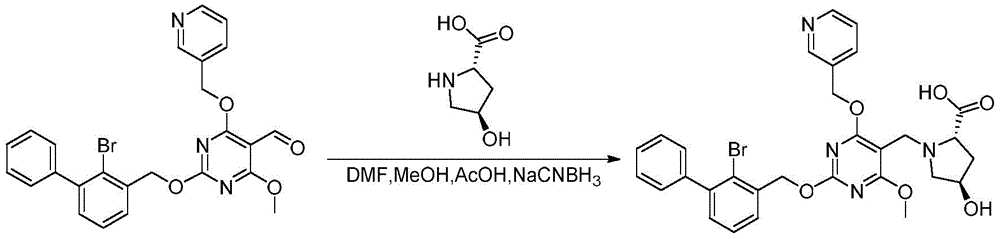
preparation of (2S,4R) -1- ((2- ((2-bromo- [1,1' -biphenylyl ] -3-yl) methoxy) -4-methoxy-6- (pyridin-3-ylmethoxy) pyrimidin-5-yl) methyl) -4-hydroxypyrrole-2-carboxylic acid:
referring to the synthesis of example 27, (2S,4R) -1- ((2- ((2-bromo- [1,1' -biphenylyl ] -3-yl) methoxy) -4-methoxy-6- (pyridin-3-ylmethoxy) pyrimidin-5-carbaldehyde was reacted with L-hydroxyproline to synthesize (2S,4R) -4-methoxy-6- (pyridin-3-ylmethoxy) pyrimidin-5-yl) methyl) -4-hydroxypyrrole-2-carboxylic acid.
MS:[M+1]+:621.1/623.1。
1H NMR(400MHz,d6-DMSO)δ8.78(s,1H),8.45(d,J=4.8Hz,1H),7.95(d,J=7.8Hz,1H),7.62(dd,J=7.6,1.6Hz,1H),7.54-7.28(m,8H),5.53(s,2H),5.35(s,2H),4.94(s,1H),4.22-4.11(m,1H),3.96-3.74(m,5H),3.37(t,J=8.0Hz,2H),3.28-3.24(m,1H),1.91-1.80(m,2H)。
Example 30
1- (((2- ((2- ((2-bromo- [1,1' -biphenylyl ] -3-yl) methoxy) -4-methoxy-6- (pyridin-3-ylmethoxy) pyrimidin-5-yl) methyl) amino) cyclopropyl-1-carboxylic acid
The structural formula of the compound:
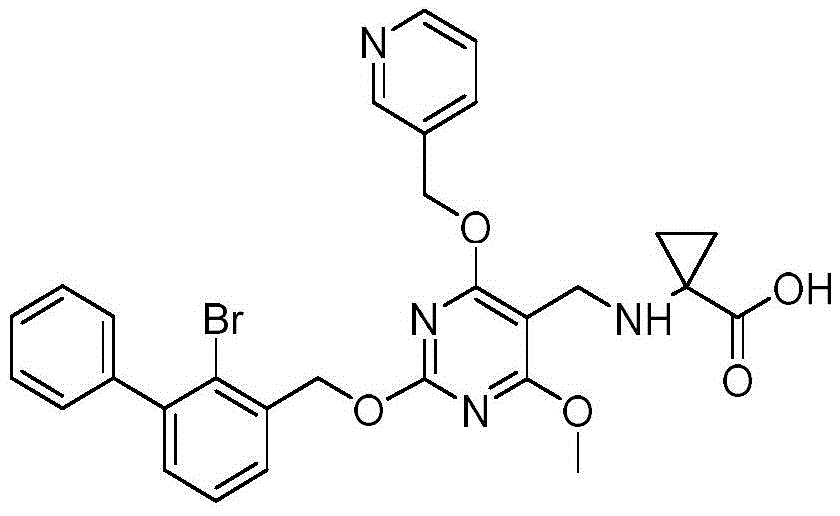
the synthetic route is as follows:

preparation of 1- (((2- ((2- ((2-bromo- [1,1' -biphenylyl ] -3-yl) methoxy) -4-methoxy-6- (pyridin-3-ylmethoxy) pyrimidin-5-yl) methyl) amino) cyclopropyl-1-carboxylic acid:
referring to the synthesis of example 27, 22- ((2-bromo- [1,1 '-biphenylyl ] -3-yl) methoxy) -4-methoxy-6- (pyridin-3-ylmethoxy) pyrimidine-5-carbaldehyde was reacted with 1-aminocyclopropanecarboxylic acid to synthesize 1- (((2- ((2- ((2-bromo- [1,1' -biphenylyl ] -3-yl) methoxy) -4-methoxy-6- (pyridin-3-ylmethoxy) pyrimidin-5-yl) methyl) amino) cyclopropyl-1-carboxylic acid.
MS:[M+1]+:591.1/593.1。
1H NMR(400MHz,d6-DMSO)δ8.78(s,1H),8.55(d,J=4.8Hz,1H),7.97(d,J=7.8Hz,1H)7.66(dd,J=7.6,1.6Hz,1H),7.54-7.26(m,8H),5.53(s,2H),5.32(s,2H),3.96-3.74(m,5H),1.21-0.93(m,4H)。
Example 31
(S) -1- ((2- (((2-methyl- [1,1' -biphenylyl ] -3-yl) methyl) thio) -4, 6-dimethoxypyrimidin-5-yl) methyl) piperidine-2-carboxylic acid
The structural formula of the compound:

the synthetic route is as follows:

preparation of (2-methyl- [1,1' -biphenylyl ] -3-yl) methanethiol:
to the reaction flask were added (2-methyl- [1,1 '-biphenylyl ] -3-yl) methanol (1.98g,1eq), lawson's reagent (2.02g,0.5eq) and toluene (30 mL). Heating and refluxing for reaction for 3h under the protection of nitrogen. TLC indicated the reaction was complete and stopped. The reaction was quenched with saturated aqueous sodium bicarbonate solution, extracted with ethyl acetate (30 mL. times.3), the organic phases were combined and washed once with saturated brine, dried over anhydrous sodium sulfate, filtered with suction, concentrated, and the crude product was purified by reverse column chromatography to give (2-bromo- [1,1' -biphenylyl ] -3-yl) methanethiol (0.91g, yield: 42.5%).
Preparation of 4, 6-dimethoxy-2- (((2-methyl- [1,1' -biphenylyl ] -3-yl) methyl) thio) pyrimidine:
adding (2-bromo- [1,1' -biphenyl) into a reaction bottle]-3-yl) methanethiol (0.91g,1eq), 2-chloro-4, 6-dimethoxypyrimidine (1.11g,1.5eq), DMF (30mL), potassium carbonate (1.76g,3 eq). Heating to 50 deg.C, stirring for 16h, LCMS to characterize reaction, adding water (100mL) to quench the system, extracting with ethyl acetate (50mL × 3), mixing organic phases, washing with saturated salt water, drying over anhydrous sodium sulfate, vacuum filtering, concentrating, and performing silica gel column chromatography to obtain 4, 6-dimethoxy-2- (((2-methyl- [1,1' -biphenyl) extract]-3-yl) methyl) thio) pyrimidine (1.12g, yield: 75.2%). MS: [ M +1]+:353.1.
Preparation of 4, 6-dimethoxy-2- (((2-methyl- [1,1' -biphenylyl ] -3-yl) methyl) thio) pyrimidin-5-carbaldehyde:
under the condition of ice-water bath, phosphorus oxychloride (4.88g,10eq) is dropwise added into a reaction bottle filled with DMF (2.32g,10eq), the mixture is stirred for 30min under the condition of ice-water bath, a solution of 4, 6-dimethoxy-2- (((2-methyl- [1,1' -biphenylyl ] -3-yl) methyl) thio) pyrimidine (1.12g,1eq) in DMF (15mL) is dropwise added into a reaction system, the temperature is increased to 50 ℃, and the mixture is stirred and reacted for 2 h. LCMS check reaction complete and stop reaction. While stirring, the reaction system was dropped into an ice-water bath, adjusted to neutral with sodium bicarbonate (pH 7), the solid was suction-filtered, washed with water twice, and the dried crude product was purified by silica gel column chromatography to give 4, 6-dimethoxy-2- (((2-methyl- [1,1' -biphenylyl ] -3-yl) methyl) thio) pyrimidine-5-carbaldehyde (790.0mg, yield 65.3%).
Preparation of (S) -1- ((4, 6-dimethoxy-2- (((2-methyl- [1,1' -biphenylyl ] -3-yl) methyl) thio) pyrimidin-5-yl) methyl) piperidine-2-carboxylic acid:
4, 6-dimethoxy-2- (((2-methyl- [1,1' -biphenylyl) ether) is reacted at room temperature]-3-yl) methyl) thio) pyrimidine-5-carbaldehyde (100.0mg,1eq), L-homoproline (67.9mg,2eq), 1 drop of acetic acid was dissolved in ultra dry methanol (10mL) and DMF (10mL) and stirred at room temperature for 2 h. Sodium cyanoborohydride (82.6mg,5eq) was added with stirring at 0 ℃. The reaction was carried out overnight at 50 ℃ under nitrogen. And (5) LCMS detects that the reaction is finished, and the reaction is stopped. Adding water (50mL), extracting with ethyl acetate (30mL × 3), mixing organic phases, washing with saturated salt water, drying with anhydrous sodium sulfate, filtering, concentrating, purifying the crude product by reverse column chromatography to obtain (S) -1- ((4, 6-dimethoxy-2- (((2-methyl- [1,1' -biphenyl) 1]-3-yl) methyl) thio) pyrimidin-5-yl) methyl) piperidine-2-carboxylic acid (99.4mg, 76.5% yield). MS: [ M +1]+:494.2.
1H NMR(400MHz,d6-DMSO)δ7.45(t,J=7.2Hz,3H),7.37(t,J=7.2Hz,1H),7.29(d,J=6.8Hz,2H),7.22(t,J=7.6Hz,1H),7.13(d,J=7.2Hz,1H),4.53(s,2H),3.90(s,6H),3.68(dd,J=38.0,13.2Hz,2H),3.10-2.93(m,2H),2.37-2.19(m,4H),1.71-1.62(m,2H),1.49-1.38(m,3H),1.33-1.28(m,1H)。
Example 32
N- (2- (((4, 6-dimethoxy-2- (((2-methyl- [1,1' -biphenylyl ] -3-yl) methyl) thio) pyrimidin-5-yl) methyl) amino) ethyl) acetamide
The structural formula of the compound:

the synthetic route is as follows:

preparation of N- (2- (((4, 6-dimethoxy-2- (((2-methyl- [1,1' -biphenylyl ] -3-yl) methyl) thio) pyrimidin-5-yl) methyl) amino) ethyl) acetamide:
4, 6-dimethoxy-2- (((2-methyl- [1,1' -biphenylyl) ether) is reacted at room temperature]-3-yl) methyl) thio) pyrimidine-5-carbaldehyde (60.0mg,1eq), N-acetylethylenediamine (32.2)mg,2eq) and 1 drop acetic acid were dissolved in ultra dry methanol (3mL) and DMF (3mL) and stirred at room temperature for 2 h. Sodium cyanoborohydride (49.5mg,5eq) was added with stirring at 0 ℃. The reaction was carried out overnight at 50 ℃ under nitrogen. And (5) LCMS detects that the reaction is finished, and the reaction is stopped. Adding water (30mL), extracting with ethyl acetate (15mL × 3), mixing organic phases, washing with saturated salt water, drying over anhydrous sodium sulfate, filtering, concentrating, purifying by reverse column chromatography to obtain N- (2- (((4, 6-dimethoxy-2- (((2-methyl- [1,1 '-biphenylyl) 1,1' -biphenyl)]-3-yl) methyl) thio) pyrimidin-5 yl) methyl) amino) ethyl) acetamide (41.4mg, 56.3% yield). MS: [ M +1]+:46.7.
1H NMR(400MHz,d6-DMSO)δ7.78(t,J=5.2Hz,1H),7.68-7.61(m,1H),7.55-7.31(m,7H),4.75(s,2H),3.92(s,6H),3.66(s,2H),3.19-3.12(m,2H),2.63(t,J=6.1Hz,2H),2.30-1.95(m,4H,),1.80(s,3H).。
Example 33
((4, 6-dimethoxy-2- (((2-methyl- [1,1' -biphenylyl ] -3-yl) methyl) thio) pyrimidin-5-yl) methyl) -L-serine
The structure of the compound:

the synthetic route is as follows:

preparation of ((4, 6-dimethoxy-2- (((2-methyl- [1,1' -biphenylyl ] -3-yl) methyl) thio) pyrimidin-5-yl) methyl) -L-serine:
referring to the synthesis of example 32, 4, 6-dimethoxy-2- (((2-methyl- [1,1' -biphenylyl) benzene was prepared]-3-yl) methyl) thio) pyrimidine-5-carbaldehyde is reacted with L-serine to synthesize ((4, 6-dimethoxy-2- (((2-methyl- [1,1' -biphenylyl) amine)]-3-yl) methyl) thio) pyrimidin-5-yl) methyl) -L-serine. MS: [ M +1]+:470.2.
1H NMR(400MHz,d6-DMSO)δ7.62(d,J=7.6Hz,1H),7.54-7.33(m,7H),4.75(s,2H),3.91(s,6H),3.75-3.61(m,2H),3.47(s,2H),2.91-2.78(m,1H),2.30(s,3H)。
Example 34
(2S,4R) -1- ((4, 6-dimethoxy-2- (((2-methyl- [1,1' -biphenylyl ] -3-yl) methyl) thio) pyrimidin-5-yl) methyl) -4-hydroxypyrrole-2-carboxylic acid

The synthetic route is as follows:

preparation of (2S,4R) -1- ((4, 6-dimethoxy-2- (((2-methyl- [1,1' -biphenylyl ] -3-yl) methyl) thio) pyrimidin-5-yl) methyl) -4-hydroxypyrrole-2-carboxylic acid:
referring to the synthesis of example 32, 4, 6-dimethoxy-2- (((2-methyl- [1,1' -biphenylyl) benzene was prepared]Synthesis of (2S,4R) -1- ((4, 6-dimethoxy-2- (((2-methyl- [1,1' -biphenylyl) biphenyl) by reaction of (3-yl) methyl) thio) pyrimidine-5-carbaldehyde and L-hydroxyproline]-3-yl) methyl) thio) pyrimidin-5-yl) methyl) -4-hydroxypyrrole-2-carboxylic acid. MS: [ M +1]+:496.2.
1H NMR(400MHz,d6-DMSO)δ7.62(dd,J=7.6,1.6Hz,1H),7.51-7.31(m,7H),4.99(s,1H),4.74(s,2H),4.22-4.11(m,1H),3.91-3.71(m,8H),3.37(t,J=8.0Hz,2H),3.28-3.24(m,1H),2.30(s,3H),1.91-1.80(m,2H)。
Example 35
1- (((dimethoxy-2- (((2-methyl- [1,1' -biphenylyl ] -3-yl) methyl) thio) pyrimidin-5-yl) methyl) amino) cyclopropane-1-carboxylic acid
The structural formula of the compound:

the synthetic route is as follows:

preparation of 1- (((dimethoxy-2- (((2-methyl- [1,1' -biphenylyl ] -3-yl) methyl) thio) pyrimidin-5-yl) methyl) amino) cyclopropane-1-carboxylic acid:
referring to the synthesis of example 32, 4, 6-dimethoxy-2- (((2-methyl- [1,1' -biphenylyl) benzene was prepared]-3-yl) methyl) thio) pyrimidine-5-carbaldehyde reacts with 1-aminocyclopropanecarboxylic acid to synthesize 1- (((dimethoxy-2- (((2-methyl- [1,1' -biphenylyl) amine]-3-yl) methyl) thio) pyrimidin-5-yl) methyl) amino) cyclopropane-1-carboxylic acid. MS: [ M +1]+:466.2.
1H NMR(400MHz,d6-DMSO)δ7.63(dd,J=7.6,1.6Hz,1H),7.54-7.31(m,7H),4.67(s,2H),3.96-3.74(m,8H),2.33(s,3H),1.21-0.93(m,4H)。
Detecting inhibitory effects of compounds on the binding of PD-1/PD-L1 proteins to each other
In vitro kinase level was measured using the PD1/PD-L1 binding assay kit available from Cisbio.
The principle and the method for screening the PD-1/PD-L1 small molecule inhibitor comprise the following steps:
1) the principle is as follows: PD-L1 protein has Tag1 (Tag1 is a common Tag for purified proteins), PD-1 protein has Tag2 (Tag2 is a common Tag for purified proteins), and anti-Tag1 antibody labeled by Eu and anti-Tag2 antibody labeled by XL665 are combined with the two Tag proteins respectively. When excited by laser light, energy is transferred from the donor Eu to the acceptor XL665, causing XL665 to emit light. After the inhibitor is added, the combination of PD-1 and PD-L1 is blocked, so that Eu is far away from XL665, the occurrence of fluorescence energy transfer is influenced, and the signal is weakened. The blocking of the binding of PD-L1 and PD-1 by the inhibitor is judged by the change of the intensity of the signal.
2) The method comprises the following steps: the specific experimental procedures were performed with reference to PD1/PD-L1 from Cisbio, Inc., in combination with kit instructions 62ICP01PEG and 64ICP01 PEH. Briefly described as follows: taking a new 384-well enzyme label plate, adding 2 mu L of diluent or targeting with different concentrations diluted by the diluent into each wellAnd mixing, adding 4 μ L PD-1 protein and 4 μ L PD-L1 protein, and incubating at room temperature for 15 min. 10 mu L of mixed solution of anti-Tag1-Eu and anti-Tag2-XL665 is added into each well, and after incubation for 2h at normal temperature, fluorescent signals of 620nM and 665nM are detected by a microplate reader. The signal ratio is calculated by the formula: (665nM signal)/(620 nM signal) × 104. 8-10 concentration gradients are selected for each compound, three multiple holes are arranged for each concentration, and the obtained result is subjected to nonlinear fitting by GraphPad Prism software to obtain the IC50 value of the compound.
TABLE 1 IC50 values for the compounds of the invention


Note: letter a represents IC50 less than 10 nM; letter B represents an IC50 of between 10-100 nM; letter C indicates IC50 greater than 100 nM. The results in Table 1 show that the compounds of the present invention are effective in inhibiting the binding of PD-1/PD-L1 at various concentrations and are therefore useful in the treatment of diseases resulting from binding to PD-1/PD-L1.
The invention provides a novel PD-1/PD-L1 small molecule inhibitor, and the results of the drug activity test show that the compound has excellent activity and is hopeful to become a novel PD-1/PD-L1 small molecule inhibitor.
Claims (11)
1. A compound of formula I or a pharmaceutically acceptable salt, prodrug, metabolite, isotopic derivative, solvate thereof:

wherein X is selected from O, S;
R1selected from substituted or unsubstituted aryl, substituted or unsubstituted heterocyclic aryl, substituted or unsubstituted heteroarylThe group is selected from C1-C6 alkyl, C1-C6 alkoxy;
when X is O, R2One selected from F, Cl, Br, I, ethenyl and ethynyl; or when X is S, R2One selected from F, Cl, Br, I, ethenyl, ethynyl and methyl;
R3selected from hydrogen, C1-C6 alkyl, substituted or unsubstituted 6-to 10-membered aryl, substituted or unsubstituted 6-to 10-membered cycloalkyl, substituted or unsubstituted 6-to 10-membered heterocycloalkyl, substituted or unsubstituted 5-to 7-membered heterocycloaryl;
R4and R5Independently selected from hydrogen, substituted or unsubstituted C1-C8 alkyl, substituted or unsubstituted C1-C8 alkoxy, substituted or unsubstituted 3-6 membered cycloalkyl, and amido;
R4and R5Optionally taken together with the nitrogen atom to which they are attached to form a substituted or unsubstituted 4-7 membered heterocyclyl;
R3、R4、R5the substituent in (1) is one of 1-4C 1-C6 alkyl, 3-6 membered cycloalkyl, 3-6 membered heterocycloalkyl, hydroxyl, carboxyl, amino, nitrile group, halogen, trifluoromethyl and nitro; the 3-6 membered heterocycloalkyl or heteroaryl group contains 1-3 heteroatoms selected from N, O, S.
2. A compound according to claim 1, or a pharmaceutically acceptable salt, prodrug, metabolite, isotopic derivative, solvate thereof,
wherein R is1Preferably one selected from the following groups:

R2preferably one selected from Cl, Br, I, vinyl and methyl;
R3preferably one selected from hydrogen and pyridyl.
3. The compound according to claim 1, or a pharmaceutically acceptable salt, prodrug, metabolite, isotopic derivative, solvate thereof,
wherein R is4And R5Identical or different, R4And R5Together with the nitrogen atom to which they are attached form a substituted or unsubstituted 4-7 membered heterocyclic group; the 4-7 membered heterocyclyl is preferably selected from 1-piperidinyl, 1-pyrrolidinyl, 4-methyl-1-piperidinyl, 1-cyclobutylamino;
preferably, R4And R5Independently selected from amide groups, wherein the amide groups are selected from-R6-C(=O)-NH-R7or-R6-NH-C(=O)R7,R6And R7Each independently is a C1-C5 alkyl group.
4. A compound or pharmaceutically acceptable salt according to claim 1, wherein the compound is selected from any one of the following compounds:
(S) -1- ((4, 6-dimethoxy-2- ((2-bromo- [1,1' -biphenylyl ] -3-yl) methoxy) pyrimidin-5-yl) methyl) piperidine-2-carboxylic acid
N- (2- (((2- ((2-bromo- [1,1' -biphenylyl ] -3-yl) methoxy) -4, 6-dimethoxypyrimidin-5-yl) methyl) amino) ethyl) acetamide
((2- ((2-bromo- [1,1' -biphenylyl ] -3-yl) methoxy) -4, 6-dimethoxypyrimidin-5-yl) methyl) -L-serine
(2S,4R) -1- ((2- ((2-bromo- [1,1' -biphenylyl ] -3-yl) methoxy) -4, 6-dimethoxypyrimidin-5-yl) methyl) -4-hydroxypyrrole-2-carboxylic acid
1- (((2- ((2-bromo- [1,1' -biphenylyl ] -3-yl) methoxy) -4, 6-dimethoxypyrimidin-5-yl) methyl) amino) cyclopropane-1-carboxylic acid
(S) -1- ((4, 6-dimethoxy-2- ((2-chloro- [1,1' -biphenylyl ] -3-yl) methoxy) pyrimidin-5-yl) methyl) piperidine-2-carboxylic acid
N- (2- (((2- ((2-chloro- [1,1' -biphenylyl ] -3-yl) methoxy) -4, 6-dimethoxypyrimidin-5-yl) methyl) amino) ethyl) acetamide
((2- ((2-chloro- [1,1' -biphenylyl ] -3-yl) methoxy) -4, 6-dimethoxypyrimidin-5-yl) methyl) -L-serine
(2S,4R) -1- ((2- ((2-chloro- [1,1' -biphenylyl ] -3-yl) methoxy) -4, 6-dimethoxypyrimidin-5-yl) methyl) -4-hydroxypyrrole-2-carboxylic acid
1- (((2- ((2-chloro- [1,1' -biphenylyl ] -3-yl) methoxy) -4, 6-dimethoxypyrimidin-5-yl) methyl) amino) cyclopropane-1-carboxylic acid
(S) -1- ((4, 6-dimethoxy-2- ((2-vinyl- [1,1' -biphenylyl ] -3-yl) methoxy) pyrimidin-5-yl) methyl) piperidine-2-carboxylic acid
N- (2- (((2- ((2-vinyl- [1,1' -biphenylyl ] -3-yl) methoxy) -4, 6-dimethoxypyrimidin-5-yl) methyl) amino) ethyl) acetamide
((2- ((2-vinyl- [1,1' -biphenylyl ] -3-yl) methoxy) -4, 6-dimethoxypyrimidin-5-yl) methyl) -L-serine
(2S,4R) -1- ((2- ((2-vinyl- [1,1' -biphenylyl ] -3-yl) methoxy) -4, 6-dimethoxypyrimidin-5-yl) methyl) -4-hydroxypyrrole-2-carboxylic acid
1- (((2- ((2-vinyl- [1,1' -biphenylyl ] -3-yl) methoxy) -4, 6-dimethoxypyrimidin-5-yl) methyl) amino) cyclopropane-1-carboxylic acid
(S) -1- ((2- ((2-bromo-3- (2, 3-dihydrobenzo [ b ] [1,4] dioxan-6-yl) phenyl) oxy) -4, 6-dimethylpyrimidin-5-yl) methyl) piperidine-2-carboxylic acid
N- (2- (((2- ((2-bromo-3- (2, 3-dihydrobenzo [ b ] [1,4] dioxan-6-yl) phenyl) oxy) -4, 6-dimethylpyrimidin-5-yl) methyl) amino) ethyl) acetamide
((2- ((2-bromo-3- (2, 3-dihydrobenzo [ b ] [1,4] dioxol-6-yl) phenyl) oxy) -4, 6-dimethylpyrimidin-5-yl) methyl) -L-serine
(2S,4R) -1- ((2- ((2-bromo-3- (2, 3-dihydrobenzo [ b ] [1,4] dioxol-6-yl) phenyl) oxy) -4, 6-dimethylpyrimidin-5-yl) methyl) -4-hydroxypyrrole-2-carboxylic acid
1- (((2- ((2-bromo-3- (2, 3-dihydrobenzo [ b ] [1,4] dioxan-6-yl) phenyl) oxy) -4, 6-dimethylpyrimidin-5-yl) methyl) amino) cyclopropane-1-carboxylic acid
(S) -1- ((2- (((2-bromo- [1,1' -biphenylyl ] -3-yl) methyl) thio) -4, 6-dimethoxypyrimidin-5-yl) methyl) piperidine-2-carboxylic acid
N- (2- (((2- (((2-bromo- [1,1' -biphenylyl ] -3-yl) methyl) thio) -4, 6-dimethoxypyrimidin-5-yl) methyl) amino) ethyl) acetamide
((2- (((2-bromo- [1,1' -biphenylyl ] -3-yl) methyl) thio) -4, 6-dimethoxypyrimidin-5-yl) methyl) -L-serine
(2S,4R) -1- ((2- (((2-bromo- [1,1' -biphenylyl ] -3-yl) methyl) thio) -4, 6-dimethoxypyrimidin-5-yl) methyl) -4-hydroxypyrrole-2-carboxylic acid
1- (((2- (((2-bromo- [1,1' -biphenylyl ] -3-yl) methyl) thio) -4, 6-dimethoxypyrimidin-5-yl) methyl) amino) cyclopropane-1-carboxylic acid
(S) -1- ((2- ((2-bromo- [1,1' -biphenylyl ] -3-yl) methoxy) -4-methoxy-6- (pyridin-3-ylmethoxy) pyrimidin-5-yl) methyl) piperidine-2-carboxylic acid
N- (2- (((2- ((2-bromo- [1,1' -biphenylyl ] -3-yl) methoxy) -4-methoxy-6- (pyridin-3-ylmethoxy) pyrimidin-5-yl) methyl) amino) ethyl) acetamide
((2- ((2-bromo- [1,1' -biphenylyl ] -3-yl) methoxy) -4-methoxy-6- (pyridin-3-ylmethoxy) pyrimidin-5-yl) methyl) -L-serine
(2S,4R) -1- ((2- ((2-bromo- [1,1' -biphenylyl ] -3-yl) methoxy) -4-methoxy-6- (pyridin-3-ylmethoxy) pyrimidin-5-yl) methyl) -4-hydroxypyrrole-2-carboxylic acid
1- (((2- ((2- ((2-bromo- [1,1' -biphenylyl ] -3-yl) methoxy) -4-methoxy-6- (pyridin-3-ylmethoxy) pyrimidin-5-yl) methyl) amino) cyclopropyl-1-carboxylic acid
(S) -1- ((2- (((2-methyl- [1,1' -biphenylyl ] -3-yl) methyl) thio) -4, 6-dimethoxypyrimidin-5-yl) methyl) piperidine-2-carboxylic acid
N- (2- (((4, 6-dimethoxy-2- (((2-methyl- [1,1' -biphenylyl ] -3-yl) methyl) thio) pyrimidin-5-yl) methyl) amino) ethyl) acetamide
((4, 6-dimethoxy-2- (((2-methyl- [1,1' -biphenylyl ] -3-yl) methyl) thio) pyrimidin-5-yl) methyl) -L-serine
(2S,4R) -1- ((4, 6-dimethoxy-2- (((2-methyl- [1,1' -biphenylyl ] -3-yl) methyl) thio) pyrimidin-5-yl) methyl) -4-hydroxypyrrole-2-carboxylic acid
1- (((dimethoxy-2- (((2-methyl- [1,1' -biphenylyl ] -3-yl) methyl) thio) pyrimidin-5-yl) methyl) amino) cyclopropane-1-carboxylic acid.
5. A process for the preparation of a compound according to claim 1, wherein the process comprises the following reaction scheme:

the method comprises the following steps:
(1) dissolving SM1 and SM2 in a solvent 1, adding an alkaline reagent and a palladium metal catalyst, and reacting at the temperature of 80-120 ℃ to obtain a compound C01;
(2) dissolving the compound C01 in a solvent 2, and reducing an ester group into a hydroxyl group by a reducing agent to obtain a compound C02;
(3) dissolving a compound C02 in a solvent 3, adding SM3 and an alkaline reagent, and reacting at the temperature of 20-100 ℃ to obtain a compound C03;
(4) adding POCl3Dropwise adding the mixture into stirred N, N-dimethylformamide in an ice bath, then adding a compound C03 into a reaction system, and heating to the temperature of 50-80 ℃ for reaction to obtain a compound C04;
(5) dissolving C04 and SM4 in a solvent 4, and carrying out reductive amination reaction to obtain a compound C05;
preferably, in step (1), the solvent 1 is selected from one or more of 1, 4-dioxane, toluene, xylene, chlorobenzene; the alkaline reagent is selected from one or more of cesium carbonate, potassium carbonate, sodium carbonate, potassium tert-butoxide and sodium tert-butoxide; the palladium metal catalyst is selected from Pd (PPh)3)4、Pd(dppf)Cl2Palladium acetate, Pd2(dba)3One or more of;
preferably, in step (2), the solvent 2 is selected from one or more of tetrahydrofuran, methanol, ethanol, isopropanol, and tert-butanol; the reducing agent is selected from one or more of lithium aluminum hydride, sodium borohydride, lithium borohydride and borane;
preferably, in step (3), the solvent 3 is selected from one or more of DMSO, DMF, acetonitrile, NMP, methanol, ethanol, tert-butanol; the alkaline reagent is selected from one or more of cesium carbonate, potassium carbonate, sodium hydrogen, sodium methoxide, sodium ethoxide and sodium tert-butoxide;
preferably, in step (5), the solvent 4 is selected from one or more of tetrahydrofuran, DMSO, DMF, acetonitrile, methanol, dichloromethane; the reducing agent of the reductive amination reaction is selected from NaBH3CN, sodium triacetoxyborohydride and/or sodium borohydride.
6. A pharmaceutical composition comprising a compound or a pharmaceutically salt of a compound or a solvate of a compound according to any one of claims 1 to 4 as an active ingredient, and a pharmaceutically acceptable carrier.
7. The pharmaceutical composition according to claim 6, wherein the pharmaceutical composition is formulated in the form of an oral formulation or an injection.
8. Use of a compound or a pharmaceutically salt of a compound or a solvate of a compound as claimed in any one of claims 1 to 4, or a pharmaceutical composition as claimed in claim 6 or 7, in the manufacture of a medicament for the treatment of a disease associated with the PD-1/PD-L1 signalling pathway.
9. The use of claim 8, wherein the disease is cancer or an immune disease.
10. The use according to claim 9, wherein the cancer is selected from skin cancer, lung cancer, hematological tumors, breast cancer, glioma, digestive system tumors, reproductive system tumors, lymphoma, nervous system tumors, head and neck cancer; the immune diseases are selected from diabetes, myasthenia gravis, rheumatoid arthritis, systemic lupus erythematosus and dermatitis.
11. A method of treating cancer or an immune disease, comprising administering to a patient in need thereof an effective amount of the pharmaceutical composition of claim 6 or 7.
Priority Applications (1)
| Application Number | Priority Date | Filing Date | Title |
|---|---|---|---|
| CN202010367668.5A CN113582971B (en) | 2020-04-30 | 2020-04-30 | Small molecule immunosuppressant, preparation method and application thereof |
Applications Claiming Priority (1)
| Application Number | Priority Date | Filing Date | Title |
|---|---|---|---|
| CN202010367668.5A CN113582971B (en) | 2020-04-30 | 2020-04-30 | Small molecule immunosuppressant, preparation method and application thereof |
Publications (2)
| Publication Number | Publication Date |
|---|---|
| CN113582971A true CN113582971A (en) | 2021-11-02 |
| CN113582971B CN113582971B (en) | 2023-10-20 |
Family
ID=78237695
Family Applications (1)
| Application Number | Title | Priority Date | Filing Date |
|---|---|---|---|
| CN202010367668.5A Active CN113582971B (en) | 2020-04-30 | 2020-04-30 | Small molecule immunosuppressant, preparation method and application thereof |
Country Status (1)
| Country | Link |
|---|---|
| CN (1) | CN113582971B (en) |
Citations (5)
| Publication number | Priority date | Publication date | Assignee | Title |
|---|---|---|---|---|
| CN105705489A (en) * | 2013-09-04 | 2016-06-22 | 百时美施贵宝公司 | Compounds useful as immunomodulators |
| CN106536515A (en) * | 2014-04-14 | 2017-03-22 | 百时美施贵宝公司 | Compounds useful as immunomodulators |
| CN108698995A (en) * | 2016-01-08 | 2018-10-23 | 格罗宁根大学 | The inhibitor of PD-1/PD-L1 albumen/protein-interacting |
| CN109305934A (en) * | 2018-08-07 | 2019-02-05 | 成都海博锐药业有限公司 | Phenylate analog derivative and officinal salt, purposes pharmaceutically |
| WO2019087214A1 (en) * | 2017-11-06 | 2019-05-09 | Jubilant Biosys Limited | Pyrimidine derivatives as inhibitors of pd1/pd-l1 activation |
-
2020
- 2020-04-30 CN CN202010367668.5A patent/CN113582971B/en active Active
Patent Citations (5)
| Publication number | Priority date | Publication date | Assignee | Title |
|---|---|---|---|---|
| CN105705489A (en) * | 2013-09-04 | 2016-06-22 | 百时美施贵宝公司 | Compounds useful as immunomodulators |
| CN106536515A (en) * | 2014-04-14 | 2017-03-22 | 百时美施贵宝公司 | Compounds useful as immunomodulators |
| CN108698995A (en) * | 2016-01-08 | 2018-10-23 | 格罗宁根大学 | The inhibitor of PD-1/PD-L1 albumen/protein-interacting |
| WO2019087214A1 (en) * | 2017-11-06 | 2019-05-09 | Jubilant Biosys Limited | Pyrimidine derivatives as inhibitors of pd1/pd-l1 activation |
| CN109305934A (en) * | 2018-08-07 | 2019-02-05 | 成都海博锐药业有限公司 | Phenylate analog derivative and officinal salt, purposes pharmaceutically |
Also Published As
| Publication number | Publication date |
|---|---|
| CN113582971B (en) | 2023-10-20 |
Similar Documents
| Publication | Publication Date | Title |
|---|---|---|
| CN111448189A (en) | A kind of biaryl derivative, its preparation method and its application in pharmacy | |
| CN109415361B (en) | Acrylic derivatives, their preparation method and their use in medicine | |
| ES2775614T3 (en) | Quinazoline derivative salts and method of preparation thereof | |
| TWI788424B (en) | Receptor inhibitor | |
| AU2015276699A1 (en) | Pyridino[1,2-a]pyrimidone analogue used as PI3K inhibitor | |
| US20160257667A1 (en) | Synthesis of intermediates in the preparation of alk inhibitor | |
| CN111205291B (en) | Triazolo ring compound, preparation method, intermediate and application thereof | |
| CN101638389A (en) | Polyamine derivative containing naphthalimide structure, preparation method and application thereof | |
| CN118027003A (en) | A PROTAC compound and its preparation method and use as an estrogen receptor degrader | |
| AU2020255702A1 (en) | Quinolyl-containing compound and pharmaceutical composition, and use thereof | |
| CN121464124A (en) | Aromatic amide derivatives, their preparation methods and uses | |
| JP2022547200A (en) | Aromatic heterocyclic compound having a tricyclic structure, and its preparation method and application | |
| WO2018001332A1 (en) | Compound having inhibitory activity against mutant isocitrate dehydrogenase, preparation method therefor and use thereof | |
| CN104557913A (en) | Pyridopyrimidine compounds as well as preparation method and application thereof | |
| CN111205244B (en) | Thiazolo-ring compound, preparation method, intermediate and application thereof | |
| CN113248474A (en) | Five-membered azole heterocyclic derivative and preparation method and application thereof | |
| CN113582971B (en) | Small molecule immunosuppressant, preparation method and application thereof | |
| CN111777592A (en) | A kind of N4-(2,5-dimethoxyphenyl)-pyrimidinediamine targeting DDR1 inhibitor and its preparation and application | |
| CN109384785B (en) | Pyrrolopyridinone derivatives, preparation method and medical application thereof | |
| JP7729632B2 (en) | Novel tricyclic aromatic heterocyclic compounds, and their preparation methods, pharmaceutical compositions and applications | |
| CN107573336B (en) | Benzoheterocycle-formamide-pyridone derivative and preparation method and application thereof | |
| CN114276328B (en) | Compound as small molecule immunosuppressant, preparation method and application thereof | |
| WO2019029554A1 (en) | Sulfonamide derivative, preparation method thereof, and use of same in medicine | |
| JPS6183163A (en) | Antitumoral | |
| CN116768881B (en) | 4- (3-Indolyl) -1, 3-thiazole compound and preparation method and application thereof |
Legal Events
| Date | Code | Title | Description |
|---|---|---|---|
| PB01 | Publication | ||
| PB01 | Publication | ||
| SE01 | Entry into force of request for substantive examination | ||
| SE01 | Entry into force of request for substantive examination | ||
| GR01 | Patent grant | ||
| GR01 | Patent grant |