US10446167B2 - User-specific noise suppression for voice quality improvements - Google Patents
User-specific noise suppression for voice quality improvements Download PDFInfo
- Publication number
- US10446167B2 US10446167B2 US14/165,523 US201414165523A US10446167B2 US 10446167 B2 US10446167 B2 US 10446167B2 US 201414165523 A US201414165523 A US 201414165523A US 10446167 B2 US10446167 B2 US 10446167B2
- Authority
- US
- United States
- Prior art keywords
- user
- noise suppression
- voice
- electronic device
- audio signal
- Prior art date
- Legal status (The legal status is an assumption and is not a legal conclusion. Google has not performed a legal analysis and makes no representation as to the accuracy of the status listed.)
- Active
Links
- 230000001629 suppression Effects 0.000 title claims abstract description 312
- 230000005236 sound signal Effects 0.000 claims abstract description 165
- 238000000034 method Methods 0.000 claims abstract description 53
- 238000012360 testing method Methods 0.000 claims description 53
- 238000012549 training Methods 0.000 claims description 46
- 230000004913 activation Effects 0.000 claims description 6
- 230000000977 initiatory effect Effects 0.000 claims description 6
- 238000010586 diagram Methods 0.000 description 23
- 238000012545 processing Methods 0.000 description 9
- 208000027765 speech disease Diseases 0.000 description 8
- 238000004891 communication Methods 0.000 description 6
- 239000011435 rock Substances 0.000 description 5
- 238000004519 manufacturing process Methods 0.000 description 4
- 230000001413 cellular effect Effects 0.000 description 3
- 230000008859 change Effects 0.000 description 2
- 238000013461 design Methods 0.000 description 2
- 238000011161 development Methods 0.000 description 2
- 230000001965 increasing effect Effects 0.000 description 2
- 238000012986 modification Methods 0.000 description 2
- 230000004048 modification Effects 0.000 description 2
- 230000008901 benefit Effects 0.000 description 1
- 238000004590 computer program Methods 0.000 description 1
- 230000003247 decreasing effect Effects 0.000 description 1
- 230000000694 effects Effects 0.000 description 1
- 230000002708 enhancing effect Effects 0.000 description 1
- 230000006870 function Effects 0.000 description 1
- 230000003278 mimic effect Effects 0.000 description 1
- 230000008569 process Effects 0.000 description 1
Images



Classifications
-
- G—PHYSICS
- G10—MUSICAL INSTRUMENTS; ACOUSTICS
- G10L—SPEECH ANALYSIS TECHNIQUES OR SPEECH SYNTHESIS; SPEECH RECOGNITION; SPEECH OR VOICE PROCESSING TECHNIQUES; SPEECH OR AUDIO CODING OR DECODING
- G10L21/00—Speech or voice signal processing techniques to produce another audible or non-audible signal, e.g. visual or tactile, in order to modify its quality or its intelligibility
- G10L21/02—Speech enhancement, e.g. noise reduction or echo cancellation
-
- G—PHYSICS
- G10—MUSICAL INSTRUMENTS; ACOUSTICS
- G10L—SPEECH ANALYSIS TECHNIQUES OR SPEECH SYNTHESIS; SPEECH RECOGNITION; SPEECH OR VOICE PROCESSING TECHNIQUES; SPEECH OR AUDIO CODING OR DECODING
- G10L21/00—Speech or voice signal processing techniques to produce another audible or non-audible signal, e.g. visual or tactile, in order to modify its quality or its intelligibility
- G10L21/02—Speech enhancement, e.g. noise reduction or echo cancellation
- G10L21/0208—Noise filtering
Definitions
- the present disclosure relates generally to techniques for noise suppression and, more particularly, for user-specific noise suppression.
- Voice note recording features may record voice notes spoken by the user.
- a telephone feature of an electronic device may transmit the user's voice to another electronic device.
- ambient sounds or background noise may be obtained at the same time. These ambient sounds may obscure the user's voice and, in some cases, may impede the proper functioning of a voice-related feature of the electronic device.
- electronic devices may apply a variety of noise suppression schemes.
- Device manufactures may program such noise suppression schemes to operate according to certain predetermined generic parameters calculated to be well-received by most users. However, certain voices may be less well suited for these generic noise suppression parameters. Additionally, some users may prefer stronger or weaker noise suppression.
- Embodiments of the present disclosure relate to systems, methods, and devices for user-specific noise suppression.
- the electronic device may receive an audio signal that includes a user voice. Since noise, such as ambient sounds, also may be received by the electronic device at this time, the electronic device may suppress such noise in the audio signal.
- the electronic device may suppress the noise in the audio signal while substantially preserving the user voice via user-specific noise suppression parameters.
- These user-specific noise suppression parameters may be based at least in part on a user noise suppression preference or a user voice profile, or a combination thereof.
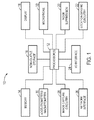
- FIG. 1 is a block diagram of an electronic device capable of performing the techniques disclosed herein, in accordance with an embodiment
- FIG. 2 is a schematic view of a handheld device representing one embodiment of the electronic device of FIG. 1 ;
- FIG. 3 is a schematic block diagram representing various context in which a voice-related feature of the electronic device of FIG. 1 may be used, in accordance with an embodiment
- FIG. 4 is a block diagram of noise suppression that may take place in the electronic device of FIG. 1 , in accordance with an embodiment
- FIG. 5 is a block diagram representing user-specific noise suppression parameters, in accordance with an embodiment
- FIG. 6 is a flow chart describing an embodiment of a method for applying user-specific noise suppression parameters in the electronic device of FIG. 1 ;
- FIG. 7 is a schematic diagram of the initiation of a voice training sequence when the handheld device of FIG. 2 is activated, in accordance with an embodiment
- FIG. 8 is a schematic diagram of a series of screens for selecting the initiation of a voice training sequence using the handheld device of FIG. 2 , in accordance with an embodiment
- FIG. 9 is a flowchart describing an embodiment of a method for determining user-specific noise suppression parameters via a voice training sequence
- FIGS. 10 and 11 are schematic diagrams for a manner of obtaining a user voice sample for voice training, in accordance with an embodiment
- FIG. 12 is a schematic diagram illustrating a manner of obtaining a noise suppression user preference during a voice training sequence, in accordance with an embodiment
- FIG. 13 is a flowchart describing an embodiment of a method for obtaining noise suppression user preferences during a voice training sequence
- FIG. 14 is a flowchart describing an embodiment of another method for performing a voice training sequence
- FIG. 15 is a flowchart describing an embodiment of a method for obtaining a high signal-to-noise ratio (SNR) user voice sample
- FIG. 16 is a flowchart describing an embodiment of a method for determining user-specific noise suppression parameters via analysis of a user voice sample
- FIG. 17 is a factor diagram describing characteristics of a user voice sample that may be considered while performing the method of FIG. 16 , in accordance with an embodiment
- FIG. 18 is a schematic diagram representing a series of screens that may be displayed on the handheld device of FIG. 2 to obtain a user-specific noise parameters via a user-selectable setting, in accordance with an embodiment
- FIG. 19 is a schematic diagram of a screen on the handheld device of FIG. 2 for obtaining user-specified noise suppression parameters in real-time while a voice-related feature of the handheld device is in use, in accordance with an embodiment
- FIGS. 20 and 21 are schematic diagrams representing various sub-parameters that may form the user-specific noise suppression parameters, in accordance with an embodiment
- FIG. 22 is a flowchart describing an embodiment of a method for applying certain sub-parameters of the user-specific parameters based on detected ambient sounds;
- FIG. 23 is a flowchart describing an embodiment of a method for applying certain sub-parameters of the noise suppression parameters based on a context of use of the electronic device;
- FIG. 24 is a factor diagram representing a variety of device context factors that may be employed in the method of FIG. 23 , in accordance with an embodiment
- FIG. 25 is a flowchart describing an embodiment of a method for obtaining a user voice profile
- FIG. 26 is a flowchart describing an embodiment of a method for applying noise suppression based on a user voice profile
- FIGS. 27-29 are plots depicting a manner of performing noise suppression of an audio signal based on a user voice profile, in accordance with an embodiment
- FIG. 30 is a flowchart describing an embodiment of a method for obtaining user-specific noise suppression parameters via a voice training sequence involving per-recorded voices;
- FIG. 31 is a flowchart describing an embodiment of a method for applying user-specific noise suppression parameters to audio received from another electronic device
- FIG. 32 is a flowchart describing an embodiment of a method for causing another electronic device to engage in noise suppression based on the user-specific noise parameters of a first electronic device, in accordance with an embodiment
- FIG. 33 is a schematic block diagram of a system for performing noise suppression on two electronic devices based on user-specific noise suppression parameters associated with the other electronic device, in accordance with an embodiment.
- Present embodiments relate to suppressing noise in an audio signal associated with a voice-related feature of an electronic device.
- a voice-related feature may include, for example, a voice note recording feature, a video recording feature, a telephone feature, and/or a voice command feature, each of which may involve an audio signal that includes a user's voice.
- the audio signal also may include ambient sounds present while the voice-related feature is in use. Since these ambient sounds may obscure the user's voice, the electronic device may apply noise suppression to the audio signal to filter out the ambient sounds while preserving the user's voice.
- noise suppression may involve user-specific noise suppression parameters that may be unique to a user of the electronic device. These user-specific noise suppression parameters may be determined through voice training, based on a voice profile of the user, and/or based on a manually selected user setting. When noise suppression takes place based on user-specific parameters rather than generic parameters, the sound of the noise-suppressed signal may be more satisfying to the user. These user-specific noise suppression parameters may be employed in any voice-related feature, and may be used in connection with automatic gain control (AGC) and/or equalization (EQ) tuning.
- AGC automatic gain control
- EQ equalization
- the user-specific noise suppression parameters may be determined using a voice training sequence.
- the electronic device may apply varying noise suppression parameters to a user's voice sample mixed with one or more distractors (e.g., simulated ambient sounds such as crumpled paper, white noise, babbling people, and so forth). The user may thereafter indicate which noise suppression parameters produce the most preferable sound. Based on the user's feedback, the electronic device may develop and store the user-specific noise suppression parameters for later use when a voice-related feature of the electronic device is in use.
- the user-specific noise suppression parameters may be determined by the electronic device automatically depending on characteristics of the user's voice. Different users' voices may have a variety of different characteristics, including different average frequencies, different variability of frequencies, and/or different distinct sounds. Moreover, certain noise suppression parameters may be known to operate more effectively with certain voice characteristics. Thus, an electronic device according to certain present embodiments may determine the user-specific noise suppression parameters based on such user voice characteristics. In some embodiments, a user may manually set the noise suppression parameters by, for example, selecting a high/medium/low noise suppression strength selector or indicating a current call quality on the electronic device.
- the electronic device may suppress various types of ambient sounds that may be heard while a voice-related feature is being used.
- the electronic device may analyze the character of the ambient sounds and apply a user-specific noise suppression parameter that is expected to thus suppress the current ambient sounds.
- the electronic device may apply certain user-specific noise suppression parameters based on the current context in which the electronic device is being used.
- the electronic device may perform noise suppression tailored to the user based on a user voice profile associated with the user. Thereafter, the electronic device may more effectively isolate ambient sounds from an audio signal when a voice-related feature is being used because the electronic device generally may expect which components of an audio signal correspond to the user's voice. For example, the electronic device may amplify components of an audio signal associated with a user voice profile while suppressing components of the audio signal not associated with the user voice profile.
- User-specific noise suppression parameters also may be employed to suppress noise in audio signals containing voices other than that of the user that are received by the electronic device.
- the electronic device may employ the user-specific noise suppression parameters to an audio signal from a person with whom the user is corresponding. Since such an audio signal may have been previously processed by the sending device, such noise suppression may be relatively minor.
- the electronic device may transmit the user-specific noise suppression parameters to the sending device, so that the sending device may modify its noise suppression parameters accordingly.
- two electronic devices may function systematically to suppress noise in outgoing audio signals according to each other's user-specific noise suppression parameters.
- FIG. 1 is a block diagram depicting various components that may be present in an electronic device suitable for use with the present techniques.
- FIG. 2 represents one example of a suitable electronic device, which may be, as illustrated, a handheld electronic device having noise suppression capabilities.
- an electronic device 10 for performing the presently disclosed techniques may include, among other things, one or more processor(s) 12 , memory 14 , nonvolatile storage 16 , a display 18 , noise suppression 20 , location-sensing circuitry 22 , an input/output (I/O) interface 24 , network interfaces 26 , image capture circuitry 28 , accelerometers/magnetometer 30 , and a microphone 32 .
- the various functional blocks shown in FIG. 1 may include hardware elements (including circuitry), software elements (including computer code stored on a computer-readable medium) or a combination of both hardware and software elements. It should further be noted that FIG. 1 is merely one example of a particular implementation and is intended to illustrate the types of components that may be present in electronic device 10 .
- the electronic device 10 may represent a block diagram of the handheld device depicted in FIG. 2 or similar devices. Additionally or alternatively, the electronic device 10 may represent a system of electronic devices with certain characteristics.
- a first electronic device may include at least a microphone 32 , which may provide audio to a second electronic device including the processor(s) 12 and other data processing circuitry.
- the data processing circuitry may be embodied wholly or in part as software, firmware, hardware or any combination thereof.
- the data processing circuitry may be a single contained processing module or may be incorporated wholly or partially within any of the other elements within electronic device 10 .
- the data processing circuitry may also be partially embodied within electronic device 10 and partially embodied within another electronic device wired or wirelessly connected to device 10 . Finally, the data processing circuitry may be wholly implemented within another device wired or wirelessly connected to device 10 . As a non-limiting example, data processing circuitry might be embodied within a headset in connection with device 10 .
- the processor(s) 12 and/or other data processing circuitry may be operably coupled with the memory 14 and the nonvolatile memory 16 to perform various algorithms for carrying out the presently disclosed techniques.
- Such programs or instructions executed by the processor(s) 12 may be stored in any suitable manufacture that includes one or more tangible, computer-readable media at least collectively storing the instructions or routines, such as the memory 14 and the nonvolatile storage 16 .
- programs e.g., an operating system
- encoded on such a computer program product may also include instructions that may be executed by the processor(s) 12 to enable the electronic device 10 to provide various functionalities, including those described herein.
- the display 18 may be a touch-screen display, which may enable users to interact with a user interface of the electronic device 10 .
- the noise suppression 20 may be performed by data processing circuitry such as the processor(s) 12 or by circuitry dedicated to performing certain noise suppression on audio signals processed by the electronic device 10 .
- the noise suppression 20 may be performed by a baseband integrated circuit (IC), such as those manufactured by Infineon, based on externally provided noise suppression parameters.
- the noise suppression 20 may be performed in a telephone audio enhancement integrated circuit (IC) configured to perform noise suppression based on externally provided noise suppression parameters, such as those manufactured by Audience.
- ICs may operate at least partly based on certain noise suppression parameters. Varying such noise suppression parameters may vary the output of the noise suppression 20 .
- the location-sensing circuitry 22 may represent device capabilities for determining the relative or absolute location of electronic device 10 .
- the location-sensing circuitry 22 may represent Global Positioning System (GPS) circuitry, algorithms for estimating location based on proximate wireless networks, such as local Wi-Fi networks, and so forth.
- GPS Global Positioning System
- the I/O interface 24 may enable electronic device 10 to interface with various other electronic devices, as may the network interfaces 26 .
- the network interfaces 26 may include, for example, interfaces for a personal area network (PAN), such as a Bluetooth network, for a local area network (LAN), such as an 802.11x Wi-Fi network, and/or for a wide area network (WAN), such as a 3G cellular network.
- PAN personal area network
- LAN local area network
- WAN wide area network
- the electronic device 10 may interface with a wireless headset that includes a microphone 32 .
- the image capture circuitry 28 may enable image and/or video capture, and the accelerometers/magnetometer 30 may observe the movement and/or a relative orientation of the electronic device 10 .
- the microphone 32 may obtain an audio signal of a user's voice.
- the noise suppression 20 may process the audio signal to exclude most ambient sounds based on certain user-specific noise suppression parameters.
- the user-specific noise suppression parameters may be determined through voice training, based on a voice profile of the user, and/or based on a manually selected user setting.
- FIG. 2 depicts a handheld device 34 , which represents one embodiment of the electronic device 10 .
- the handheld device 34 may represent, for example, a portable phone, a media player, a personal data organizer, a handheld game platform, or any combination of such devices.
- the handheld device 34 may be a model of an iPod® or iPhone® available from Apple Inc. of Cupertino, Calif.
- the handheld device 34 may include an enclosure 36 to protect interior components from physical damage and to shield them from electromagnetic interference.
- the enclosure 36 may surround the display 18 , which may display indicator icons 38 .
- the indicator icons 38 may indicate, among other things, a cellular signal strength, Bluetooth connection, and/or battery life.
- the I/O interfaces 24 may open through the enclosure 36 and may include, for example, a proprietary I/O port from Apple Inc. to connect to external devices.
- the reverse side of the handheld device 34 may include the image capture circuitry 28 .
- User input structures 40 , 42 , 44 , and 46 may allow a user to control the handheld device 34 .
- the input structure 40 may activate or deactivate the handheld device 34
- the input structure 42 may navigate user interface 20 to a home screen, a user-configurable application screen, and/or activate a voice-recognition feature of the handheld device 34
- the input structures 44 may provide volume control
- the input structure 46 may toggle between vibrate and ring modes.
- the microphone 32 may obtain a user's voice for various voice-related features
- a speaker 48 may enable audio playback and/or certain phone capabilities.
- Headphone input 50 may provide a connection to external speakers and/or headphones.
- a wired headset 52 may connect to the handheld device 34 via the headphone input 50 .
- the wired headset 52 may include two speakers 48 and a microphone 32 .
- the microphone 32 may enable a user to speak into the handheld device 34 in the same manner as the microphones 32 located on the handheld device 34 .
- a button near the microphone 32 may cause the microphone 32 to awaken and/or may cause a voice-related feature of the handheld device 34 to activate.
- a wireless headset 54 may similarly connect to the handheld device 34 via a wireless interface (e.g., a Bluetooth interface) of the network interfaces 26 .
- the wireless headset 54 may also include a speaker 48 and a microphone 32 .
- a button near the microphone 32 may cause the microphone 32 to awaken and/or may cause a voice-related feature of the handheld device 34 to activate.
- a standalone microphone 32 (not shown), which may lack an integrated speaker 48 , may interface with the handheld device 34 via the headphone input 50 or via one of the network interfaces 26 .
- a user may use a voice-related feature of the electronic device 10 , such as a voice-recognition feature or a telephone feature, in a variety of contexts with various ambient sounds.
- FIG. 3 illustrates many such contexts 56 in which the electronic device 10 , depicted as the handheld device 34 , may obtain a user voice audio signal 58 and ambient sounds 60 while performing a voice-related feature.
- the voice-related feature of the electronic device 10 may include, for example, a voice recognition feature, a voice note recording feature, a video recording feature, and/or a telephone feature.
- the voice-related feature may be implemented on the electronic device 10 in software carried out by the processor(s) 12 or other processors, and/or may be implemented in specialized hardware.
- ambient sounds 60 may enter the microphone 32 of the electronic device 10 .
- the ambient sounds 60 may vary depending on the context 56 in which the electronic device 10 is being used.
- the various contexts 56 in which the voice-related feature may be used may include at home 62 , in the office 64 , at the gym 66 , on a busy street 68 , in a car 70 , at a sporting event 72 , at a restaurant 74 , and at a party 76 , among others.
- the typical ambient sounds 60 that occur on a busy street 68 may differ greatly from the typical ambient sounds 60 that occur at home 62 or in a car 70 .
- the character of the ambient sounds 60 may vary from context 56 to context 56 .
- the electronic device 10 may perform noise suppression 20 to filter the ambient sounds 60 based at least partly on user-specific noise suppression parameters.
- these user-specific noise suppression parameters may be determined via voice training, in which a variety of different noise suppression parameters may be tested on an audio signal including a user voice sample and various distractors (simulated ambient sounds). The distractors employed in voice training may be chosen to mimic the ambient sounds 60 found in certain contexts 56 .
- each of the contexts 56 may occur at certain locations and times, with varying amounts of electronic device 10 motion and ambient light, and/or with various volume levels of the voice signal 58 and the ambient sounds 60 .
- the electronic device 10 may filter the ambient sounds 60 using user-specific noise suppression parameters tailored to certain contexts 56 , as determined based on time, location, motion, ambient light, and/or volume level, for example.
- FIG. 4 is a schematic block diagram of a technique 80 for performing the noise suppression 20 on the electronic device 10 when a voice-related feature of the electronic device 10 is in use.
- the voice-related feature involves two-way communication between a user and another person and may take place when a telephone or chat feature of the electronic device 10 is in use.
- the electronic device 10 also may perform the noise suppression 20 on an audio signal either received through the microphone 32 or the network interface 26 of the electronic device when two-way communication is not occurring.
- the microphone 32 of the electronic device 10 may obtain a user voice signal 58 and ambient sounds 60 present in the background.
- This first audio signal may be encoded by a codec 82 before entering noise suppression 20 .
- transmit noise suppression (TX NS) 84 may be applied to the first audio signal.
- the manner in which noise suppression 20 occurs may be defined by certain noise suppression parameters (illustrated as transmit noise suppression (TX NS) parameters 86 ) provided by the processor(s) 12 , memory 14 , or nonvolatile storage 16 , for example.
- the TX NS parameters 86 may be user-specific noise suppression parameters determined by the processor(s) 12 and tailored to the user and/or context 56 of the electronic device 10 .
- the resulting signal may be passed to an uplink 88 through the network interface 26 .
- a downlink 90 of the network interface 26 may receive a voice signal from another device (e.g., another telephone).
- Certain noise receiver noise suppression (RX NS) 92 may be applied to this incoming signal in the noise suppression 20 .
- the manner in which such noise suppression 20 occurs may be defined by certain noise suppression parameters (illustrated as receive noise suppression (RX NS) parameters 94 ) provided by the processor(s) 12 , memory 14 , or nonvolatile storage 16 , for example. Since the incoming audio signal previously may have been processed for noise suppression before leaving the sending device, the RX NS parameters 94 may be selected to be less strong than the TX NS parameters 86 .
- the resulting noise-suppressed signal may be decoded by the codec 82 and output to receiver circuitry and/or a speaker 48 of the electronic device 10 .
- the TX NS parameters 86 and/or the RX NS parameters 94 may be specific to the user of the electronic device 10 . That is, as shown by a diagram 100 of FIG. 5 , the TX NS parameters 86 and the RX NS parameters 94 may be selected from user-specific noise suppression parameters 102 that are tailored to the user of the electronic device 10 . These user-specific noise suppression parameters 102 may be obtained in a variety of ways, such as through voice training 104 , based on a user voice profile 106 , and/or based on user-selectable settings 108 , as described in greater detail below.
- Voice training 104 may allow the electronic device 10 to determine the user-specific noise suppression parameters 102 by way of testing a variety of noise suppression parameters combined with various distractors or simulated background noise. Certain embodiments for performing such voice training 104 are discussed in greater detail below with reference to FIGS. 7-14 . Additionally or alternatively, the electronic device 10 may determine the user-specific noise suppression parameters 102 based on a user voice profile 106 that may consider specific characteristics of the user's voice, as discussed in greater detail below with reference to FIGS. 15-17 . Additionally or alternatively, a user may indicate preferences for the user-specific noise suppression parameters 102 through certain user settings 108 , as discussed in greater detail below with reference to FIGS. 18 and 19 . Such user-selectable settings may include, for example, a noise suppression strength (e.g., low/medium/high) selector and/or a real-time user feedback selector to provide user feedback regarding the user's real-time voice quality.
- a noise suppression strength e.g., low/medium/high
- the electronic device 10 may employ the user-specific noise suppression parameters 102 when a voice-related feature of the electronic device is in use (e.g., the TX NS parameters 86 and the RX NS parameters 94 may be selected based on the user-specific noise suppression parameters 102 ).
- the electronic device 10 may apply certain user-specific noise suppression parameters 102 during noise suppression 20 based on an identification of the user who is currently using the voice-related feature. Such a situation may occur, for example, when an electronic device 10 is used by other family members. Each member of the family may represent a user that may sometimes use a voice-related feature of the electronic device 10 . Under such multi-user conditions, the electronic device 10 may ascertain whether there are user-specific noise suppression parameters 102 associated with that user.
- FIG. 6 illustrates a flowchart 110 for applying certain user-specific noise suppression parameters 102 when a user has been identified.
- the flowchart 110 may begin when a user is using a voice-related feature of the electronic device 10 (block 112 ).
- the electronic device 10 may receive an audio signal that includes a user voice signal 58 and ambient sounds 60 .
- the electronic device 10 generally may determine certain characteristics of the user's voice and/or may identify a user voice profile from the user voice signal 58 (block 114 ).
- a user voice profile may represent information that identifies certain characteristics associated with the voice of a user.
- the electronic device 10 may apply certain default noise suppression parameters for noise suppression 20 (block 118 ). However, if the voice profile detected in block 114 does match a known user of the electronic device 10 , and the electronic device 10 currently stores user-specific noise suppression parameters 102 associated with that user, the electronic device 10 may instead apply the associated user-specific noise suppression parameters 102 (block 120 ).
- the user-specific noise suppression parameters 102 may be determined based on a voice training sequence 104 .
- the initiation of such a voice training sequence 104 may be presented as an option to a user during an activation phase 130 of an embodiment of the electronic device 10 , such as the handheld device 34 , as shown in FIG. 7 .
- an activation phase 130 may take place when the handheld device 34 first joins a cellular network or first connects to a computer or other electronic device 132 via a communication cable 134 .
- the handheld device 34 or the computer or other device 132 may provide a prompt 136 to initiate voice training.
- a user may initiate the voice training 104 .
- a voice training sequence 104 may begin when a user selects a setting of the electronic device 10 that causes the electronic device 10 to enter a voice training mode.
- a home screen 140 of the handheld device 34 may include a user-selectable button 142 that, when selected causes the handheld device 34 to display a settings screen 144 .
- the handheld device 34 may display a phone settings screen 148 .
- the phone settings screen 148 may include, among other things, a user-selectable button 150 labeled “voice training” When a user selects the voice training button 150 , a voice training 104 sequence may begin.
- a flowchart 160 of FIG. 9 represents one embodiment of a method for performing the voice training 104 .
- the flowchart 160 may begin when the electronic device 10 prompts the user to speak while certain distractors (e.g., simulated ambient sounds) play in the background (block 162 ). For example, the user may be asked to speak a certain word or phrase while certain distractors, such as rock music, babbling people, crumpled paper, and so forth, are playing aloud on the computer or other electronic device 132 or on a speaker 48 of the electronic device 10 . While such distractors are playing, the electronic device 10 may record a sample of the user's voice (block 164 ). In some embodiments, blocks 162 and 164 may repeat while a variety of distractors are played to obtain several test audio signals that include both the user's voice and one or more distractors.
- distractors e.g., simulated ambient sounds
- the electronic device 10 may alternatingly apply certain test noise suppression parameters while noise suppression 20 is applied to the test audio signals before requesting feedback from the user. For example, the electronic device 10 may apply a first set of test noise suppression parameters, here labeled “A,” to the test audio signal including the user's voice sample and the one or more distractors, before outputting the audio to the user via a speaker 48 (block 166 ). Next, the electronic device 10 may apply another set of test noise suppression parameters, here labeled “B,” to the user's voice sample before outputting the audio to the user via the speaker 48 (block 168 ). The user then may decide which of the two audio signals output by the electronic device 10 the user prefers (e.g., by selecting either “A” or “B” on a display 18 of the electronic device 10 ) (block 170 ).
- A test noise suppression parameters
- B another set of test noise suppression parameters
- the electronic device 10 may repeat the actions of blocks 166 - 170 with various test noise suppression parameters and with various distractors, learning more about the user's noise suppression preferences each time until a suitable set of user noise suppression preference data has been obtained (decision block 172 ).
- the electronic device 10 may test the desirability of a variety of noise suppression parameters as actually applied to an audio signal containing the user's voice as well as certain common ambient sounds.
- the electronic device 10 may “tune” the test noise suppression parameters by gradually varying certain noise suppression parameters (e.g., gradually increasing or decreasing a noise suppression strength) until a user's noise suppression preferences have settled.
- the electronic device 10 may test different types of noise suppression parameters in each iteration of blocks 166 - 170 (e.g., noise suppression strength in one iteration, noise suppression of certain frequencies in another iteration, and so forth).
- the blocks 166 - 170 may repeat until a desired number of user preferences have been obtained (decision block 172 ).
- the electronic device 10 may develop user-specific noise suppression parameters 102 (block 174 ).
- the electronic device 10 may arrive at a preferred set of user-specific noise suppression parameters 102 when the iterations of blocks 166 - 170 have settled, based on the user feedback of block(s) 170 .
- the electronic device 10 may develop a comprehensive set of user-specific noise suppression parameters based on the indicated preferences to the particular parameters.
- the user-specific noise suppression parameters 102 may be stored in the memory 14 or the nonvolatile storage 16 of the electronic device 10 (block 176 ) for noise suppression when the same user later uses a voice-related feature of the electronic device 10 .
- FIGS. 10-13 relate to specific manners in which the electronic device 10 may carry out the flowchart 160 of FIG. 9 .
- FIGS. 10 and 11 relate to blocks 162 and 164 of the flowchart 160 of FIG. 9
- FIGS. 12 and 13A -B relate to blocks 166 - 172 .
- a dual-device voice recording system 180 includes the computer or other electronic device 132 and the handheld device 34 .
- the handheld device 34 may be joined to the computer or other electronic device 132 by way of a communication cable 134 or via wireless communication (e.g., an 802.11x Wi-Fi WLAN or a Bluetooth PAN).
- wireless communication e.g., an 802.11x Wi-Fi WLAN or a Bluetooth PAN
- the computer or other electronic device 132 may prompt the user to say a word or phrase while one or more of a variety of distractors 182 play in the background.
- Such distractors 182 may include, for example, sounds of crumpled paper 184 , babbling people 186 , white noise 188 , rock music 190 , and/or road noise 192 .
- the distractors 182 may additionally or alternatively include, for example, other noises commonly encountered in various contexts 56 , such as those discussed above with reference to FIG. 3 .
- These distractors 182 playing aloud from the computer or other electronic device 132 , may be picked up by the microphone 32 of the handheld device 34 at the same time the user provides a user voice sample 194 . In this manner, the handheld device 34 may obtain test audio signals that include both a distractor 182 and a user voice sample 194 .
- the handheld device 34 may both output distractor(s) 182 and record a user voice sample 194 at the same time. As shown in FIG. 11 , the handheld device 34 may prompt a user to say a word or phrase for the user voice sample 194 . At the same time, a speaker 48 of the handheld device 34 may output one or more distractors 182 . The microphone 32 of the handheld device 34 then may record a test audio signal that includes both a currently playing distractor 182 and a user voice sample 194 without the computer or other electronic device 132 .
- FIG. 12 illustrates an embodiment for determining user's noise suppression preferences based on a choice of noise suppression parameters applied to a test audio signal.
- the electronic device 10 here represented as the handheld device 34 , may apply a first set of noise suppression parameters (“A”) to a test audio signal that includes both a user voice sample 194 and at least one distractor 182 .
- the handheld device 34 may output the noise-suppressed audio signal that results (numeral 212 ).
- the handheld device 34 also may apply a second set of noise suppression parameters (“B”) to the test audio signal before outputting the resulting noise-suppressed audio signal (numeral 214 ).
- the handheld device 34 may ask the user, for example, “Did you prefer A or B?” (numeral 216 ). The user then may indicate a noise suppression preference based on the output noise-suppressed signals. For example, the user may select either the first noise-suppressed audio signal (“A”) or the second noise-suppressed audio signal (“B”) via a screen 218 on the handheld device 34 . In some embodiments, the user may indicate a preference in other manners, such as by saying “A” or “B” aloud.
- the electronic device 10 may determine the user preferences for specific noise suppression parameters in a variety of manners.
- a flowchart 220 of FIG. 13 represents one embodiment of a method for performing blocks 166 - 172 of the flowchart 160 of FIG. 9 .
- the flowchart 220 may begin when the electronic device 10 applies a set of noise suppression parameters that, for exemplary purposes, are labeled “A” and “B”. If the user prefers the noise suppression parameters “A” (decision block 224 ), the electronic device 10 may next apply new sets of noise suppression parameters that, for similarly descriptive purposes are labeled “C” and “D” (block 226 ).
- the noise suppression parameters “C” and “D” may be variations of the noise suppression parameters “A.” If a user prefers the noise suppression parameters “C” (decision block 228 ), the electronic device may set the noise suppression parameters to be a combination of “A” and “C” (block 230 ). If the user prefers the noise suppression parameters “D” (decision block 228 ), the electronic device may set the user-specific noise suppression parameters to be a combination of the noise suppression parameters “A” and “D” (block 232 ).
- the electronic device 10 may apply the new noise suppression parameters “C” and “D” (block 234 ).
- the new noise suppression parameters “C” and “D” may be variations of the noise suppression parameters “B”. If the user prefers the noise suppression parameters “C” (decision block 236 ), the electronic device 10 may set the user-specific noise suppression parameters to be a combination of “B” and “C” (block 238 ). Otherwise, if the user prefers the noise suppression parameters “D”(decision block 236 ), the electronic device 10 may set the user-specific noise suppression parameters to be a combination of “B” and “D” (block 240 ).
- the flowchart 220 is presented as only one manner of performing blocks 166 - 172 of the flowchart 160 of FIG. 9 . Accordingly, it should be understood that many more noise suppression parameters may be tested, and such parameters may be tested specifically in conjunction with certain distractors (e.g., in certain embodiments, the flowchart 220 may be repeated for test audio signals that respectively include each of the distractors 182 ).
- the voice training sequence 104 may be performed in other ways.
- a user voice sample 194 first may be obtained without any distractors 182 playing in the background (block 252 ).
- such a user voice sample 194 may be obtained in a location with very little ambient sounds 60 , such as a quiet room, so that the user voice sample 194 has a relatively high signal-to-noise ratio (SNR).
- the electronic device 10 may mix the user voice sample 194 with the various distractors 182 electronically (block 254 ).
- the electronic device 10 may produce one or more test audio signals having a variety of distractors 182 using a single user voice sample 194 .
- the electronic device 10 may determine which noise suppression parameters a user most prefers to determine the user-specific noise suppression parameters 102 .
- the electronic device 10 may alternatingly apply certain test noise suppression parameters to the test audio signals obtained at block 254 to gauge user preferences (blocks 256 - 260 ).
- the electronic device 10 may repeat the actions of blocks 256 - 260 with various test noise suppression parameters and with various distractors, learning more about the user's noise suppression preferences each time until a suitable set of user noise suppression preference data has been obtained (decision block 262 ).
- the electronic device 10 may test the desirability of a variety of noise suppression parameters as applied to a test audio signal containing the user's voice as well as certain common ambient sounds.
- the electronic device 10 may develop user-specific noise suppression parameters 102 (block 264 ).
- the user-specific noise suppression parameters 102 may be stored in the memory 14 or the nonvolatile storage 16 of the electronic device 10 (block 266 ) for noise suppression when the same user later uses a voice-related feature of the electronic device 10 .
- certain embodiments of the present disclosure may involve obtaining a user voice sample 194 without distractors 182 playing aloud in the background.
- the electronic device 10 may obtain such a user voice sample 194 the first time that the user uses a voice-related feature of the electronic device 10 in a quiet setting without disrupting the user.
- the electronic device 10 may obtain such a user voice sample 194 when the electronic device 10 first detects a sufficiently high signal-to-noise ratio (SNR) of audio containing the user's voice.
- SNR signal-to-noise ratio
- the flowchart 270 of FIG. 15 may begin when a user is using a voice-related feature of the electronic device 10 (block 272 ).
- the electronic device 10 may detect a voice profile of the user based on an audio signal detected by the microphone 32 (block 274 ). If the voice profile detected in block 274 represents the voice profile of the voice of a known user of the electronic device (decision block 276 ), the electronic device 10 may apply the user-specific noise suppression parameters 102 associated with that user (block 278 ). If the user's identity is unknown (decision block 276 ), the electronic device 10 may initially apply default noise suppression parameters (block 280 ).
- the electronic device 10 may assess the current signal-to-noise ration (SNR) of the audio signal received by the microphone 32 while the voice-related feature is being used (block 282 ). If the SNR is sufficiently high (e.g., above a preset threshold), the electronic device 10 may obtain a user voice sample 194 from the audio received by the microphone 32 (block 286 ). If the SNR is not sufficiently high (e.g., below the threshold) (decision block 284 ), the electronic device 10 may continue to apply the default noise suppression parameters (block 280 ), continuing to at least periodically reassess the SNR. A user voice sample 194 obtained in this manner may be later employed in the voice training sequence 104 as discussed above with reference to FIG. 14 . In other embodiments, the electronic device 10 may employ such a user voice sample 194 to determine the user-specific noise suppression parameters 102 based on the user voice sample 194 itself.
- SNR signal-to-noise ration
- the user-specified noise suppression parameters 102 may be determined based on certain characteristics associated with a user voice sample 194 .
- FIG. 16 represents a flowchart 290 for determining the user-specific noise suppression parameters 102 based on such user voice characteristics.
- the flowchart 290 may begin when the electronic device 10 obtains a user voice sample 194 (block 292 ).
- the user voice sample may be obtained, for example, according to the flowchart 270 of FIG. 15 or may be obtained when the electronic device 10 prompts the user to say a specific word or phrase.
- the electronic device next may analyze certain characteristics associated with the user voice sample (block 294 ).
- a user voice sample 194 may include a variety of voice sample characteristics 302 .
- voice sample characteristics 302 may include, among other things, an average frequency 304 of the user voice sample 194 , a variability of the frequency 306 of the user voice sample 194 , common speech sounds 308 associated with the user voice sample 194 , a frequency range 310 of the user voice sample 194 , formant locations 312 in the frequency of the user voice sample, and/or a dynamic range 314 of the user voice sample 194 .
- voice sample characteristics 302 may include, among other things, an average frequency 304 of the user voice sample 194 , a variability of the frequency 306 of the user voice sample 194 , common speech sounds 308 associated with the user voice sample 194 , a frequency range 310 of the user voice sample 194 , formant locations 312 in the frequency of the user voice sample, and/or a dynamic range 314 of the user voice sample 194 .
- the highness or deepness of a user's voice, a user's accent in speaking, and/or a lisp, and so forth, may be taken into consideration to the extent they change a measurable character of speech, such as the characteristics 302 .
- the user-specific noise suppression parameters 102 also may be determined by a direct selection of user settings 108 .
- a user setting screen sequence 320 for a handheld device 32 The screen sequence 320 may begin when the electronic device 10 displays a home screen 140 that includes a settings button 142 . Selecting the settings button 142 may cause the handheld device 34 to display a settings screen 144 . Selecting a user-selectable button 146 labeled “Phone” on the settings screen 144 may cause the handheld device 34 to display a phone settings screen 148 , which may include various user-selectable buttons, one of which may be a user-selectable button 322 labeled “Noise Suppression.”
- the handheld device 34 may display a noise suppression selection screen 324 .
- a user may select a noise suppression strength. For example, the user may select whether the noise suppression should be high, medium, or low strength via a selection wheel 326 . Selecting a higher noise suppression strength may result in the user-specific noise suppression parameters 102 suppressing more ambient sounds 60 , but possibly also suppressing more of the voice of the user 58 , in a received audio signal. Selecting a lower noise suppression strength may result in the user-specific noise suppression parameters 102 permitting more ambient sounds 60 , but also permitting more of the voice of the user 58 , to remain in a received audio signal.
- the user may adjust the user-specific noise suppression parameters 102 in real time while using a voice-related feature of the electronic device 10 .
- a user may provide a measure of voice phone call quality feedback 332 .
- the feedback may be represented by a number of selectable stars 334 to indicate the quality of the call. If the number of stars 334 selected by the user is high, it may be understood that the user is satisfied with the current user-specific noise suppression parameters 102 , and so the electronic device 10 may not change the noise suppression parameters.
- the electronic device 10 may vary the user-specific noise suppression parameters 102 until the number of stars 334 is increased, indicating user satisfaction.
- the call-in-progress screen 330 may include a real-time user-selectable noise suppression strength setting, such as that disclosed above with reference to FIG. 18 .
- subsets of the user-specific noise suppression parameters 102 may be determined as associated with certain distractors 182 and/or certain contexts 60 . As illustrated by a parameter diagram 340 of FIG. 20 , the user-specific noise suppression parameters 102 may divided into subsets based on specific distractors 182 .
- the user-specific noise suppression parameters 102 may include distractor-specific parameters 344 - 352 , which may represent noise suppression parameters chosen to filter certain ambient sounds 60 associated with a distractor 182 from an audio signal also including the voice of the user 58 . It should be understood that the user-specific noise suppression parameters 102 may include more or fewer distractor-specific parameters. For example, if different distractors 182 are tested during voice training 104 , the user-specific noise suppression parameters 102 may include different distractor-specific parameters.
- the distractor-specific parameters 344 - 352 may be determined when the user-specific noise suppression parameters 102 are determined. For example, during voice training 104 , the electronic device 10 may test a number of noise suppression parameters using test audio signals including the various distractors 182 . Depending on a user's preferences relating to noise suppression for each distractor 182 , the electronic device may determine the distractor-specific parameters 344 - 352 . By way of example, the electronic device may determine the parameters for crumpled paper 344 based on a test audio signal that included the crumpled paper distractor 184 . As described below, the distractor-specific parameters of the parameter diagram 340 may later be recalled in specific instances, such as when the electronic device 10 is used in the presence of certain ambient sounds 60 and/or in certain contexts 56 .
- subsets of the user-specific noise suppression parameters 102 may be defined relative to certain contexts 56 where a voice-related feature of the electronic device 10 may be used.
- the user-specific noise suppression parameters 102 may be divided into subsets based on which context 56 the noise suppression parameters may best be used.
- the user-specific noise suppression parameters 102 may include context-specific parameters 364 - 378 , representing noise suppression parameters chosen to filter certain ambient sounds 60 that may be associated with specific contexts 56 . It should be understood that the user-specific noise suppression parameters 102 may include more or fewer context-specific parameters.
- the electronic device 10 may be capable of identifying a variety of contexts 56 , each of which may have specific expected ambient sounds 60 .
- the user-specific noise suppression parameters 102 therefore may include different context-specific parameters to suppress noise in each of the identifiable contexts 56 .
- the context-specific parameters 364 - 378 may be determined when the user-specific noise suppression parameters 102 are determined.
- the electronic device 10 may test a number of noise suppression parameters using test audio signals including the various distractors 182 .
- the electronic device 10 may determine the context-specific parameters 364 - 378 .
- the electronic device 10 may determine the context-specific parameters 364 - 378 based on the relationship between the contexts 56 of each of the context-specific parameters 364 - 378 and one or more distractors 182 .
- each of the contexts 56 identifiable to the electronic device 10 may be associated with one or more specific distractors 182 .
- the context 56 of being in a car 70 may be associated primarily with one distractor 182 , namely, road noise 192 .
- the context-specific parameters 376 for being in a car may be based on user preferences related to test audio signals that included road noise 192 .
- the context 56 of a sporting event 72 may be associated with several distractors 182 , such as babbling people 186 , white noise 188 , and rock music 190 .
- the context-specific parameters 368 for a sporting event may be based on a combination of user preferences related to test audio signals that included babbling people 186 , white noise 188 , and rock music 190 . This combination may be weighted to more heavily account for distractors 182 that are expected to more closely match the ambient sounds 60 of the context 56 .
- the user-specific noise suppression parameters 102 may be determined based on characteristics of the user voice sample 194 with or without the voice training 104 (e.g., as described above with reference to FIGS. 16 and 17 ). Under such conditions, the electronic device 10 may additionally or alternatively determine the distractor-specific parameters 344 - 352 and/or the context-specific parameters 364 - 378 automatically (e.g., without user prompting). These noise suppression parameters 344 - 352 and/or 363 - 378 may be determined based on the expected performance of such noise suppression parameters when applied to the user voice sample 194 and certain distractors 182 .
- the electronic device 10 may tailor the noise suppression 20 both to the user and to the character of the ambient sounds 60 using the distractor-specific parameters 344 - 352 and/or the context-specific parameters 364 - 378 .
- FIG. 22 illustrates an embodiment of a method for selecting and applying the distractor-specific parameters 344 - 352 based on the assessed character of ambient sounds 60 .
- FIG. 23 illustrates an embodiment of a method for selecting and applying the context-specific parameters 364 - 378 based on the identified context 56 where the electronic device 10 is used.
- a flowchart 380 for selecting and applying the distractor-specific parameters 344 - 352 may begin when a voice-related feature of the electronic device 10 is in use (block 382 ).
- the electronic device 10 may determine the character of the ambient sounds 60 received by its microphone 32 (block 384 ).
- the electronic device 10 may differentiate between the ambient sounds 60 and the user's voice 58 , for example, based on volume level (e.g., the user's voice 58 generally may be louder than the ambient sounds 60 ) and/or frequency (e.g., the ambient sounds 60 may occur outside of a frequency range associated with the user's voice 58 ).
- the character of the ambient sounds 60 may be similar to one or more of the distractors 182 .
- the electronic device 10 may apply the one of the distractor-specific parameters 344 - 352 that most closely match the ambient sounds 60 (block 386 ).
- the ambient sounds 60 detected by the microphone 32 may most closely match babbling people 186 .
- the electronic device 10 thus may apply the distractor-specific parameter 346 when such ambient sounds 60 are detected.
- the electronic device 10 may apply several of the distractor-specific parameters 344 - 352 that most closely match the ambient sounds 60 .
- These several distractor-specific parameters 344 - 352 may be weighted based on the similarity of the ambient sounds 60 to the corresponding distractors 182 .
- the context 56 of a sporting event 72 may have ambient sounds 60 similar to several distractors 182 , such as babbling people 186 , white noise 188 , and rock music 190 .
- the electronic device 10 may apply the several associated distractor-specific parameters 346 , 348 , and/or 350 in proportion to the similarity of each to the ambient sounds 60 .
- the electronic device 10 may select and apply the context-specific parameters 364 - 378 based on an identified context 56 where the electronic device 10 is used.
- a flowchart 390 for doing so may begin when a voice-related feature of the electronic device 10 is in use (block 392 ).
- the electronic device 10 may determine the current context 56 in which the electronic device 10 is being used (block 394 ).
- the electronic device 10 may consider a variety of device context factors (discussed in greater detail below with reference to FIG. 24 ).
- the electronic device 10 may apply the associated one of the context-specific parameters 364 - 378 (block 396 ).
- the electronic device 10 may consider a variety of device context factors 402 to identify the current context 56 in which the electronic device 10 is being used. These device context factors 402 may be considered alone or in combination in various embodiments and, in some cases, the device context factors 402 may be weighted. That is, device context factors 402 more likely to correctly predict the current context 56 may be given more weight in determining the context 56 , while device context factors 402 less likely to correctly predict the current context 56 may be given less weight.
- a first factor 404 of the device context factors 402 may be the character of the ambient sounds 60 detected by the microphone 32 of the electronic device 10 . Since the character of the ambient sounds 60 may relate to the context 56 , the electronic device 10 may determine the context 56 based at least partly on such an analysis.
- a second factor 406 of the device context factors 402 may be the current date or time of day.
- the electronic device 10 may compare the current date and/or time with a calendar feature of the electronic device 10 to determine the context.
- the calendar feature indicates that the user is expected to be at dinner
- the second factor 406 may weigh in favor of determining the context 56 to be a restaurant 74 .
- the second factor 406 may weigh in favor of determining the context 56 to be a car 70 .
- a third factor 408 of the device context factors 402 may be the current location of the electronic device 10 , which may be determined by the location-sensing circuitry 22 .
- the electronic device 10 may consider its current location in determining the context 56 by, for example, comparing the current location to a known location in a map feature of the electronic device 10 (e.g., a restaurant 74 or office 64 ) or to locations where the electronic device 10 is frequently located (which may indicate, for example, an office 64 or home 62 ).
- a fourth factor 410 of the device context factors 402 may be the amount of ambient light detected around the electronic device 10 via, for example, the image capture circuitry 28 of the electronic device.
- a high amount of ambient light may be associated with certain contexts 56 located outdoors (e.g., a busy street 68 ). Under such conditions, the factor 410 may weigh in favor of a context 56 located outdoors.
- a lower amount of ambient light may be associated with certain contexts 56 located indoors (e.g., home 62 ), in which case the factor 410 may weigh in favor of such an indoor context 56 .
- a fifth factor 412 of the device context factors 402 may be detected motion of the electronic device 10 .
- Such motion may be detected based on the accelerometers and/or magnetometer 30 and/or based on changes in location over time as determined by the location-sensing circuitry 22 .
- Motion may suggest a given context 56 in a variety of ways.
- the factor 412 may weigh in favor of the electronic device 10 being in a car 70 or similar form of transportation.
- the factor 412 may weigh in favor of contexts in which a user of the electronic device 10 may be moving about (e.g., at a gym 66 or a party 76 ).
- the factor 412 may weigh in favor of contexts 56 in which the user is seated at one location for a period of time (e.g., an office 64 or restaurant 74 ).
- a sixth factor 414 of the device context factors 402 may be a connection to another device (e.g., a Bluetooth handset).
- a Bluetooth connection to an automotive hands-free phone system may cause the sixth factor 414 to weigh in favor of determining the context 56 to be in a car 70 .
- the electronic device 10 may determine the user-specific noise suppression parameters 102 based on a user voice profile associated with a given user of the electronic device 10 .
- the resulting user-specific noise suppression parameters 102 may cause the noise suppression 20 to isolate ambient sounds 60 that do not appear associated with the user voice profile, and thus may be understood to likely be noise.
- FIGS. 25-29 relate to such techniques.
- a flowchart 420 for obtaining a user voice profile may begin when the electronic device 10 obtains a voice sample (block 422 ). Such a voice sample may be obtained in any of the manners described above.
- the electronic device 10 may analyze certain of the characteristics of the voice sample, such as those discussed above with reference to FIG. (block 424 ). The specific characteristics may be quantified and stored as a voice profile of the user (block 426 ). The determined user voice profile may be employed to tailor the noise suppression 20 to the user's voice, as discussed below.
- the user voice profile may enable the electronic device 10 to identify when a particular user is using a voice-related feature of the electronic device 10 , such as discussed above with reference to FIG. 15 .
- the electronic device 10 may perform the noise suppression 20 in a manner best applicable to that user's voice.
- the electronic device 10 may suppress frequencies of an audio signal that more likely correspond to ambient sounds 60 than a voice of a user 58 , while enhancing frequencies more likely to correspond to the voice signal 58 .
- the flowchart 430 may begin when a user is using a voice-related feature of the electronic device 10 (block 432 ).
- the electronic device 10 may compare an audio signal received that includes both a user voice signal 58 and ambient sounds 60 to a user voice profile associated with the user currently speaking into the electronic device 10 (block 434 ).
- the electronic device may perform noise suppression 20 in a manner that suppresses frequencies of the audio signal that are not associated with the user voice profile and by amplifying frequencies of the audio signal that are associated with the user voice profile (block 436 ).
- FIGS. 27-29 represent plots modeling an audio signal, a user voice profile, and an outgoing noise-suppressed signal.
- a plot 440 represents an audio signal that has been received into the microphone 32 of the electronic device 10 while a voice-related feature is in use and transformed into the frequency domain.
- An ordinate 442 represents a magnitude of the frequencies of the audio signal and an abscissa 444 represents various discrete frequency components of the audio signal.
- any suitable transform such as a fast Fourier transform (FFT) may be employed to transform the audio signal into the frequency domain.
- the audio signal may be divided into any suitable number of discrete frequency components (e.g., 40, 128, 256, etc.).
- a plot 450 of FIG. 28 is a plot modeling frequencies associated with a user voice profile.
- An ordinate 452 represents a magnitude of the frequencies of the user voice profile and an abscissa 454 represents discrete frequency components of the user voice profile. Comparing the audio signal plot 440 of FIG. 27 to the user voice profile plot 450 of FIG. 28 , it may be seen that the modeled audio signal includes range of frequencies not typically associated with the user voice profile. That is, the modeled audio signal may be likely to include other ambient sounds 60 in addition to the user's voice.
- the electronic device 10 may determine or select the user-specific noise suppression parameters 102 such that the frequencies of the audio signal of the plot 440 that correspond to the frequencies of the user voice profile of the plot 450 are generally amplified, while the other frequencies are generally suppressed.
- Such a resulting noise-suppressed audio signal is modeled by a plot 460 of FIG. 29 .
- An ordinate 462 of the plot 460 represents a magnitude of the frequencies of the noise-suppressed audio signal and an abscissa 464 represents discrete frequency components of the noise-suppressed signal.
- An amplified portion 466 of the plot 460 generally corresponds to the frequencies found in the user voice profile.
- a suppressed portion 468 of the plot 460 corresponds to frequencies of the noise-suppressed signal that are not associated with the user profile of plot 450 .
- a greater amount of noise suppression may be applied to frequencies not associated with the user voice profile of plot 450
- a lesser amount of noise suppression may be applied to the portion 466 , which may or may not be amplified.
- the user-specific noise suppression parameters 102 may be used for performing the RX NS 92 on an incoming audio signal from another device. Since such an incoming audio signal from another device will not include the user's own voice, in certain embodiments, the user-specific noise suppression parameters 102 may be determined based on voice training 104 that involves several test voices in addition to several distractors 182 .
- the electronic device 10 may determine the user-specific noise suppression parameters 102 via voice training 104 involving pre-recorded or simulated voices and simulated distractors 182 .
- voice training 104 may involve test audio signals that include a variety of difference voices and distractors 182 .
- the flowchart 470 may begin when a user initiates voice training 104 (block 472 ). Rather than perform the voice training 104 based solely on the user's own voice, the electronic device 10 may apply various noise suppression parameters to various test audio signals containing various voices, one of which may be the user's voice in certain embodiments (block 474 ). Thereafter, the electronic device 10 may ascertain the user's preferences for different noise suppression parameters tested on the various test audio signals. As should be appreciated, block 474 may be carried out in a manner similar to blocks 166 - 170 of FIG. 9 .
- the electronic device 10 may develop user-specific noise suppression parameters 102 (block 476 ).
- the user-specific parameters 102 developed based on the flowchart 470 of FIG. 30 may be well suited for application to a received audio signal (e.g., used to form the RX NS parameters 94 , as shown in FIG. 4 ).
- a received audio signal will includes different voices when the electronic device 10 is used as a telephone by a “near-end” user to speak with “far-end” users.
- the user-specific noise suppression parameters 102 determined using a technique such as that discussed with reference to FIG. 30 , may be applied to the received audio signal from a far-end user depending on the character of the far-end user's voice in the received audio signal.
- the flowchart 480 may begin when a voice-related feature of the electronic device 10 , such as a telephone or chat feature, is in use and is receiving an audio signal from another electronic device 10 that includes a far-end user's voice (block 482 ). Subsequently, the electronic device 10 may determine the character of the far-end user's voice in the audio signal (block 484 ). Doing so may entail, for example, comparing the far-end user's voice in the received audio signal with certain other voices that were tested during the voice training 104 (when carried out as discussed above with reference to FIG. 30 ). The electronic device 10 next may apply the user-specific noise suppression parameters 102 that correspond to one of the other voices that is most similar to the end-user's voice (block 486 ).
- a voice-related feature of the electronic device 10 such as a telephone or chat feature
- a first electronic device 10 receives an audio signal containing a far-end user's voice from a second electronic device 10 during two-way communication
- such an audio signal already may have been processed for noise suppression in the second electronic device 10 .
- such noise suppression in the second electronic device 10 may be tailored to the near-end user of the first electronic 10 , as described by a flowchart 490 of FIG. 32 .
- the flowchart 490 may begin when the first electronic device 10 (e.g., handheld device 34 A of FIG. 33 ) is or is about to begin receiving an audio signal of the far-end user's voice from the second electronic device 10 (e.g., handheld device 34 B) (block 492 ).
- the first electronic device 10 may transmit the user-specific noise suppression parameters 102 , previously determined by the near-end user, to the second electronic device 10 (block 494 ). Thereafter, the second electronic device 10 may apply those user-specific noise suppression parameters 102 toward the noise suppression of the far-end user's voice in the outgoing audio signal (block 496 ).
- the audio signal including the far-end user's voice that is transmitted from the second electronic device 10 to the first electronic device 10 may have the noise-suppression characteristics preferred by the near-end user of the first electronic device 10 .
- FIG. 32 may be employed systematically using two electronic devices 10 , illustrated as a system 500 of FIG. 33 including handheld devices 34 A and 34 B with similar noise suppression capabilities.
- the handheld devices 34 A and 34 B may exchange the user-specific noise suppression parameters 102 associated with their respective users (blocks 504 and 506 ). That is, the handheld device 34 B may receive the user-specific noise suppression parameters 102 associated with the near-end user of the handheld device 34 A.
- the handheld device 34 A may receive the user-specific noise suppression parameters 102 associated with the far-end user of the handheld device 34 B. Thereafter, the handheld device 34 A may perform noise suppression 20 on the near-end user's audio signal based on the far-end user's user-specific noise suppression parameters 102 . Likewise, the handheld device 34 B may perform noise suppression 20 on the far-end user's audio signal based on the near-end user's user-specific noise suppression parameters 102 . In this way, the respective users of the handheld devices 34 A and 34 B may hear audio signals from the other whose noise suppression matches their respective preferences.
Landscapes
- Engineering & Computer Science (AREA)
- Computational Linguistics (AREA)
- Quality & Reliability (AREA)
- Signal Processing (AREA)
- Health & Medical Sciences (AREA)
- Audiology, Speech & Language Pathology (AREA)
- Human Computer Interaction (AREA)
- Physics & Mathematics (AREA)
- Acoustics & Sound (AREA)
- Multimedia (AREA)
- Telephone Function (AREA)
- Soundproofing, Sound Blocking, And Sound Damping (AREA)
Abstract
Description
Claims (39)
Priority Applications (1)
| Application Number | Priority Date | Filing Date | Title |
|---|---|---|---|
| US14/165,523 US10446167B2 (en) | 2010-06-04 | 2014-01-27 | User-specific noise suppression for voice quality improvements |
Applications Claiming Priority (2)
| Application Number | Priority Date | Filing Date | Title |
|---|---|---|---|
| US12/794,643 US8639516B2 (en) | 2010-06-04 | 2010-06-04 | User-specific noise suppression for voice quality improvements |
| US14/165,523 US10446167B2 (en) | 2010-06-04 | 2014-01-27 | User-specific noise suppression for voice quality improvements |
Related Parent Applications (1)
| Application Number | Title | Priority Date | Filing Date |
|---|---|---|---|
| US12/794,643 Continuation US8639516B2 (en) | 2010-06-04 | 2010-06-04 | User-specific noise suppression for voice quality improvements |
Publications (2)
| Publication Number | Publication Date |
|---|---|
| US20140142935A1 US20140142935A1 (en) | 2014-05-22 |
| US10446167B2 true US10446167B2 (en) | 2019-10-15 |
Family
ID=44276060
Family Applications (2)
| Application Number | Title | Priority Date | Filing Date |
|---|---|---|---|
| US12/794,643 Active 2032-03-27 US8639516B2 (en) | 2010-06-04 | 2010-06-04 | User-specific noise suppression for voice quality improvements |
| US14/165,523 Active US10446167B2 (en) | 2010-06-04 | 2014-01-27 | User-specific noise suppression for voice quality improvements |
Family Applications Before (1)
| Application Number | Title | Priority Date | Filing Date |
|---|---|---|---|
| US12/794,643 Active 2032-03-27 US8639516B2 (en) | 2010-06-04 | 2010-06-04 | User-specific noise suppression for voice quality improvements |
Country Status (7)
| Country | Link |
|---|---|
| US (2) | US8639516B2 (en) |
| EP (1) | EP2577658B1 (en) |
| JP (1) | JP2013527499A (en) |
| KR (1) | KR101520162B1 (en) |
| CN (1) | CN102859592B (en) |
| AU (1) | AU2011261756B2 (en) |
| WO (1) | WO2011152993A1 (en) |
Cited By (5)
| Publication number | Priority date | Publication date | Assignee | Title |
|---|---|---|---|---|
| US20180041639A1 (en) * | 2016-08-03 | 2018-02-08 | Dolby Laboratories Licensing Corporation | State-based endpoint conference interaction |
| US20180261219A1 (en) * | 2017-03-07 | 2018-09-13 | Salesboost, Llc | Voice analysis training system |
| US11601764B2 (en) | 2016-11-18 | 2023-03-07 | Stages Llc | Audio analysis and processing system |
| US11689846B2 (en) | 2014-12-05 | 2023-06-27 | Stages Llc | Active noise control and customized audio system |
| US20230223034A1 (en) * | 2022-01-04 | 2023-07-13 | Skyworks Solutions, Inc. | User interface for data trajectory visualization of sound suppression applications |
Families Citing this family (225)
| Publication number | Priority date | Publication date | Assignee | Title |
|---|---|---|---|---|
| US8677377B2 (en) | 2005-09-08 | 2014-03-18 | Apple Inc. | Method and apparatus for building an intelligent automated assistant |
| US9318108B2 (en) | 2010-01-18 | 2016-04-19 | Apple Inc. | Intelligent automated assistant |
| US8977255B2 (en) | 2007-04-03 | 2015-03-10 | Apple Inc. | Method and system for operating a multi-function portable electronic device using voice-activation |
| US10002189B2 (en) | 2007-12-20 | 2018-06-19 | Apple Inc. | Method and apparatus for searching using an active ontology |
| US9330720B2 (en) | 2008-01-03 | 2016-05-03 | Apple Inc. | Methods and apparatus for altering audio output signals |
| US8996376B2 (en) | 2008-04-05 | 2015-03-31 | Apple Inc. | Intelligent text-to-speech conversion |
| US20100030549A1 (en) | 2008-07-31 | 2010-02-04 | Lee Michael M | Mobile device having human language translation capability with positional feedback |
| US8676904B2 (en) | 2008-10-02 | 2014-03-18 | Apple Inc. | Electronic devices with voice command and contextual data processing capabilities |
| US20120311585A1 (en) | 2011-06-03 | 2012-12-06 | Apple Inc. | Organizing task items that represent tasks to perform |
| US10241752B2 (en) | 2011-09-30 | 2019-03-26 | Apple Inc. | Interface for a virtual digital assistant |
| EP3610918B1 (en) * | 2009-07-17 | 2023-09-27 | Implantica Patent Ltd. | Voice control of a medical implant |
| US9838784B2 (en) | 2009-12-02 | 2017-12-05 | Knowles Electronics, Llc | Directional audio capture |
| US10276170B2 (en) | 2010-01-18 | 2019-04-30 | Apple Inc. | Intelligent automated assistant |
| US8682667B2 (en) | 2010-02-25 | 2014-03-25 | Apple Inc. | User profiling for selecting user specific voice input processing information |
| US8798290B1 (en) | 2010-04-21 | 2014-08-05 | Audience, Inc. | Systems and methods for adaptive signal equalization |
| US9634855B2 (en) | 2010-05-13 | 2017-04-25 | Alexander Poltorak | Electronic personal interactive device that determines topics of interest using a conversational agent |
| US9558755B1 (en) | 2010-05-20 | 2017-01-31 | Knowles Electronics, Llc | Noise suppression assisted automatic speech recognition |
| US8639516B2 (en) | 2010-06-04 | 2014-01-28 | Apple Inc. | User-specific noise suppression for voice quality improvements |
| CN102479024A (en) * | 2010-11-24 | 2012-05-30 | 国基电子(上海)有限公司 | Handheld device and user interface construction method thereof |
| US9262612B2 (en) | 2011-03-21 | 2016-02-16 | Apple Inc. | Device access using voice authentication |
| US10057736B2 (en) | 2011-06-03 | 2018-08-21 | Apple Inc. | Active transport based notifications |
| WO2013115768A1 (en) * | 2012-01-30 | 2013-08-08 | Hewlett-Packard Development Company , L.P. | Monitor an event that produces a noise received by a microphone |
| US10134385B2 (en) | 2012-03-02 | 2018-11-20 | Apple Inc. | Systems and methods for name pronunciation |
| US9184791B2 (en) | 2012-03-15 | 2015-11-10 | Blackberry Limited | Selective adaptive audio cancellation algorithm configuration |
| US10417037B2 (en) | 2012-05-15 | 2019-09-17 | Apple Inc. | Systems and methods for integrating third party services with a digital assistant |
| US9721563B2 (en) | 2012-06-08 | 2017-08-01 | Apple Inc. | Name recognition system |
| US9547647B2 (en) | 2012-09-19 | 2017-01-17 | Apple Inc. | Voice-based media searching |
| US9640194B1 (en) | 2012-10-04 | 2017-05-02 | Knowles Electronics, Llc | Noise suppression for speech processing based on machine-learning mask estimation |
| WO2014062859A1 (en) * | 2012-10-16 | 2014-04-24 | Audiologicall, Ltd. | Audio signal manipulation for speech enhancement before sound reproduction |
| US9357165B2 (en) * | 2012-11-16 | 2016-05-31 | At&T Intellectual Property I, Lp | Method and apparatus for providing video conferencing |
| CN104160443B (en) | 2012-11-20 | 2016-11-16 | 统一有限责任两合公司 | The method, apparatus and system processed for voice data |
| WO2014081429A2 (en) * | 2012-11-21 | 2014-05-30 | Empire Technology Development | Speech recognition |
| JP6314837B2 (en) * | 2013-01-15 | 2018-04-25 | ソニー株式会社 | Storage control device, reproduction control device, and recording medium |
| JP2016508007A (en) | 2013-02-07 | 2016-03-10 | アップル インコーポレイテッド | Voice trigger for digital assistant |
| US9344815B2 (en) | 2013-02-11 | 2016-05-17 | Symphonic Audio Technologies Corp. | Method for augmenting hearing |
| US9319019B2 (en) | 2013-02-11 | 2016-04-19 | Symphonic Audio Technologies Corp. | Method for augmenting a listening experience |
| US9344793B2 (en) | 2013-02-11 | 2016-05-17 | Symphonic Audio Technologies Corp. | Audio apparatus and methods |
| US20140278392A1 (en) * | 2013-03-12 | 2014-09-18 | Motorola Mobility Llc | Method and Apparatus for Pre-Processing Audio Signals |
| US10652394B2 (en) | 2013-03-14 | 2020-05-12 | Apple Inc. | System and method for processing voicemail |
| US10748529B1 (en) | 2013-03-15 | 2020-08-18 | Apple Inc. | Voice activated device for use with a voice-based digital assistant |
| US9269368B2 (en) * | 2013-03-15 | 2016-02-23 | Broadcom Corporation | Speaker-identification-assisted uplink speech processing systems and methods |
| US9293140B2 (en) * | 2013-03-15 | 2016-03-22 | Broadcom Corporation | Speaker-identification-assisted speech processing systems and methods |
| US9520138B2 (en) * | 2013-03-15 | 2016-12-13 | Broadcom Corporation | Adaptive modulation filtering for spectral feature enhancement |
| US20140278418A1 (en) * | 2013-03-15 | 2014-09-18 | Broadcom Corporation | Speaker-identification-assisted downlink speech processing systems and methods |
| US9626963B2 (en) * | 2013-04-30 | 2017-04-18 | Paypal, Inc. | System and method of improving speech recognition using context |
| US9083782B2 (en) | 2013-05-08 | 2015-07-14 | Blackberry Limited | Dual beamform audio echo reduction |
| WO2014197334A2 (en) | 2013-06-07 | 2014-12-11 | Apple Inc. | System and method for user-specified pronunciation of words for speech synthesis and recognition |
| WO2014197335A1 (en) | 2013-06-08 | 2014-12-11 | Apple Inc. | Interpreting and acting upon commands that involve sharing information with remote devices |
| HK1223708A1 (en) | 2013-06-09 | 2017-08-04 | Apple Inc. | Device, method, and graphical user interface for enabling conversation persistence across two or more instances of a digital assistant |
| US10176167B2 (en) | 2013-06-09 | 2019-01-08 | Apple Inc. | System and method for inferring user intent from speech inputs |
| EP3014833B1 (en) | 2013-06-25 | 2016-11-16 | Telefonaktiebolaget LM Ericsson (publ) | Methods, network nodes, computer programs and computer program products for managing processing of an audio stream |
| US10791216B2 (en) | 2013-08-06 | 2020-09-29 | Apple Inc. | Auto-activating smart responses based on activities from remote devices |
| DK2835985T3 (en) | 2013-08-08 | 2017-08-07 | Oticon As | Hearing aid and feedback reduction method |
| CN104378774A (en) * | 2013-08-15 | 2015-02-25 | 中兴通讯股份有限公司 | Voice quality processing method and device |
| WO2015026859A1 (en) * | 2013-08-19 | 2015-02-26 | Symphonic Audio Technologies Corp. | Audio apparatus and methods |
| US9392353B2 (en) * | 2013-10-18 | 2016-07-12 | Plantronics, Inc. | Headset interview mode |
| CN103594092A (en) * | 2013-11-25 | 2014-02-19 | 广东欧珀移动通信有限公司 | Single microphone voice noise reduction method and device |
| US10296160B2 (en) | 2013-12-06 | 2019-05-21 | Apple Inc. | Method for extracting salient dialog usage from live data |
| US9578161B2 (en) * | 2013-12-13 | 2017-02-21 | Nxp B.V. | Method for metadata-based collaborative voice processing for voice communication |
| US9466310B2 (en) * | 2013-12-20 | 2016-10-11 | Lenovo Enterprise Solutions (Singapore) Pte. Ltd. | Compensating for identifiable background content in a speech recognition device |
| KR102018152B1 (en) * | 2014-03-31 | 2019-09-04 | 인텔 코포레이션 | Location aware power management scheme for always-on-always-listen voice recognition system |
| KR20150117114A (en) | 2014-04-09 | 2015-10-19 | 한국전자통신연구원 | Apparatus and method for noise suppression |
| US20150327035A1 (en) * | 2014-05-12 | 2015-11-12 | Intel Corporation | Far-end context dependent pre-processing |
| US9715875B2 (en) | 2014-05-30 | 2017-07-25 | Apple Inc. | Reducing the need for manual start/end-pointing and trigger phrases |
| US10170123B2 (en) | 2014-05-30 | 2019-01-01 | Apple Inc. | Intelligent assistant for home automation |
| TWI566107B (en) | 2014-05-30 | 2017-01-11 | 蘋果公司 | Method for processing a multi-part voice command, non-transitory computer readable storage medium and electronic device |
| US9633004B2 (en) | 2014-05-30 | 2017-04-25 | Apple Inc. | Better resolution when referencing to concepts |
| US9430463B2 (en) | 2014-05-30 | 2016-08-30 | Apple Inc. | Exemplar-based natural language processing |
| US9904851B2 (en) * | 2014-06-11 | 2018-02-27 | At&T Intellectual Property I, L.P. | Exploiting visual information for enhancing audio signals via source separation and beamforming |
| US9338493B2 (en) | 2014-06-30 | 2016-05-10 | Apple Inc. | Intelligent automated assistant for TV user interactions |
| DE102014009689A1 (en) * | 2014-06-30 | 2015-12-31 | Airbus Operations Gmbh | Intelligent sound system / module for cabin communication |
| CN105474610B (en) * | 2014-07-28 | 2018-04-10 | 华为技术有限公司 | Sound signal processing method and device for communication equipment |
| CN106797512B (en) | 2014-08-28 | 2019-10-25 | 美商楼氏电子有限公司 | Method, system and non-transitory computer readable storage medium for multi-source noise suppression |
| US9818400B2 (en) | 2014-09-11 | 2017-11-14 | Apple Inc. | Method and apparatus for discovering trending terms in speech requests |
| DE112015004185T5 (en) | 2014-09-12 | 2017-06-01 | Knowles Electronics, Llc | Systems and methods for recovering speech components |
| US10127911B2 (en) | 2014-09-30 | 2018-11-13 | Apple Inc. | Speaker identification and unsupervised speaker adaptation techniques |
| US10074360B2 (en) | 2014-09-30 | 2018-09-11 | Apple Inc. | Providing an indication of the suitability of speech recognition |
| US9668121B2 (en) | 2014-09-30 | 2017-05-30 | Apple Inc. | Social reminders |
| US9530408B2 (en) * | 2014-10-31 | 2016-12-27 | At&T Intellectual Property I, L.P. | Acoustic environment recognizer for optimal speech processing |
| WO2016123560A1 (en) | 2015-01-30 | 2016-08-04 | Knowles Electronics, Llc | Contextual switching of microphones |
| KR102371697B1 (en) | 2015-02-11 | 2022-03-08 | 삼성전자주식회사 | Operating Method for Voice function and electronic device supporting the same |
| US10152299B2 (en) | 2015-03-06 | 2018-12-11 | Apple Inc. | Reducing response latency of intelligent automated assistants |
| US10567477B2 (en) | 2015-03-08 | 2020-02-18 | Apple Inc. | Virtual assistant continuity |
| US9721566B2 (en) | 2015-03-08 | 2017-08-01 | Apple Inc. | Competing devices responding to voice triggers |
| US9886953B2 (en) | 2015-03-08 | 2018-02-06 | Apple Inc. | Virtual assistant activation |
| US10460227B2 (en) | 2015-05-15 | 2019-10-29 | Apple Inc. | Virtual assistant in a communication session |
| US10083688B2 (en) | 2015-05-27 | 2018-09-25 | Apple Inc. | Device voice control for selecting a displayed affordance |
| US10200824B2 (en) | 2015-05-27 | 2019-02-05 | Apple Inc. | Systems and methods for proactively identifying and surfacing relevant content on a touch-sensitive device |
| US9578173B2 (en) | 2015-06-05 | 2017-02-21 | Apple Inc. | Virtual assistant aided communication with 3rd party service in a communication session |
| US11025565B2 (en) | 2015-06-07 | 2021-06-01 | Apple Inc. | Personalized prediction of responses for instant messaging |
| US20160378747A1 (en) | 2015-06-29 | 2016-12-29 | Apple Inc. | Virtual assistant for media playback |
| US10671428B2 (en) | 2015-09-08 | 2020-06-02 | Apple Inc. | Distributed personal assistant |
| US10740384B2 (en) | 2015-09-08 | 2020-08-11 | Apple Inc. | Intelligent automated assistant for media search and playback |
| US10331312B2 (en) | 2015-09-08 | 2019-06-25 | Apple Inc. | Intelligent automated assistant in a media environment |
| US10747498B2 (en) | 2015-09-08 | 2020-08-18 | Apple Inc. | Zero latency digital assistant |
| CN105338170A (en) * | 2015-09-23 | 2016-02-17 | 广东小天才科技有限公司 | Method and device for filtering background noise |
| US11587559B2 (en) | 2015-09-30 | 2023-02-21 | Apple Inc. | Intelligent device identification |
| US10691473B2 (en) | 2015-11-06 | 2020-06-23 | Apple Inc. | Intelligent automated assistant in a messaging environment |
| US10956666B2 (en) | 2015-11-09 | 2021-03-23 | Apple Inc. | Unconventional virtual assistant interactions |
| US10049668B2 (en) | 2015-12-02 | 2018-08-14 | Apple Inc. | Applying neural network language models to weighted finite state transducers for automatic speech recognition |
| CN106878533B (en) * | 2015-12-10 | 2021-03-19 | 北京奇虎科技有限公司 | A communication method and device for a mobile terminal |
| US10223066B2 (en) | 2015-12-23 | 2019-03-05 | Apple Inc. | Proactive assistance based on dialog communication between devices |
| JP6755304B2 (en) * | 2016-04-26 | 2020-09-16 | 株式会社ソニー・インタラクティブエンタテインメント | Information processing device |
| US9838737B2 (en) * | 2016-05-05 | 2017-12-05 | Google Inc. | Filtering wind noises in video content |
| EP3455853A2 (en) * | 2016-05-13 | 2019-03-20 | Bose Corporation | Processing speech from distributed microphones |
| US10045130B2 (en) | 2016-05-25 | 2018-08-07 | Smartear, Inc. | In-ear utility device having voice recognition |
| US20170347177A1 (en) | 2016-05-25 | 2017-11-30 | Smartear, Inc. | In-Ear Utility Device Having Sensors |
| WO2017205558A1 (en) * | 2016-05-25 | 2017-11-30 | Smartear, Inc | In-ear utility device having dual microphones |
| US11227589B2 (en) | 2016-06-06 | 2022-01-18 | Apple Inc. | Intelligent list reading |
| US10049663B2 (en) | 2016-06-08 | 2018-08-14 | Apple, Inc. | Intelligent automated assistant for media exploration |
| US12223282B2 (en) | 2016-06-09 | 2025-02-11 | Apple Inc. | Intelligent automated assistant in a home environment |
| US10067938B2 (en) | 2016-06-10 | 2018-09-04 | Apple Inc. | Multilingual word prediction |
| US10586535B2 (en) | 2016-06-10 | 2020-03-10 | Apple Inc. | Intelligent digital assistant in a multi-tasking environment |
| US12197817B2 (en) | 2016-06-11 | 2025-01-14 | Apple Inc. | Intelligent device arbitration and control |
| DK201670540A1 (en) | 2016-06-11 | 2018-01-08 | Apple Inc | Application integration with a digital assistant |
| DK179415B1 (en) | 2016-06-11 | 2018-06-14 | Apple Inc | Intelligent device arbitration and control |
| US10891946B2 (en) | 2016-07-28 | 2021-01-12 | Red Hat, Inc. | Voice-controlled assistant volume control |
| US10474753B2 (en) | 2016-09-07 | 2019-11-12 | Apple Inc. | Language identification using recurrent neural networks |
| US10043516B2 (en) | 2016-09-23 | 2018-08-07 | Apple Inc. | Intelligent automated assistant |
| CN106453760A (en) * | 2016-10-11 | 2017-02-22 | 努比亚技术有限公司 | Method for improving environmental noise and terminal |
| US11281993B2 (en) | 2016-12-05 | 2022-03-22 | Apple Inc. | Model and ensemble compression for metric learning |
| US10593346B2 (en) | 2016-12-22 | 2020-03-17 | Apple Inc. | Rank-reduced token representation for automatic speech recognition |
| US11204787B2 (en) | 2017-01-09 | 2021-12-21 | Apple Inc. | Application integration with a digital assistant |
| US10957340B2 (en) | 2017-03-10 | 2021-03-23 | Samsung Electronics Co., Ltd. | Method and apparatus for improving call quality in noise environment |
| US10417266B2 (en) | 2017-05-09 | 2019-09-17 | Apple Inc. | Context-aware ranking of intelligent response suggestions |
| DK201770383A1 (en) | 2017-05-09 | 2018-12-14 | Apple Inc. | User interface for correcting recognition errors |
| DK201770439A1 (en) | 2017-05-11 | 2018-12-13 | Apple Inc. | Offline personal assistant |
| DK180048B1 (en) | 2017-05-11 | 2020-02-04 | Apple Inc. | MAINTAINING THE DATA PROTECTION OF PERSONAL INFORMATION |
| US10395654B2 (en) | 2017-05-11 | 2019-08-27 | Apple Inc. | Text normalization based on a data-driven learning network |
| US10726832B2 (en) | 2017-05-11 | 2020-07-28 | Apple Inc. | Maintaining privacy of personal information |
| DK179496B1 (en) | 2017-05-12 | 2019-01-15 | Apple Inc. | USER-SPECIFIC Acoustic Models |
| US11301477B2 (en) | 2017-05-12 | 2022-04-12 | Apple Inc. | Feedback analysis of a digital assistant |
| DK179745B1 (en) | 2017-05-12 | 2019-05-01 | Apple Inc. | SYNCHRONIZATION AND TASK DELEGATION OF A DIGITAL ASSISTANT |
| DK201770428A1 (en) | 2017-05-12 | 2019-02-18 | Apple Inc. | Low-latency intelligent automated assistant |
| DK201770432A1 (en) | 2017-05-15 | 2018-12-21 | Apple Inc. | Hierarchical belief states for digital assistants |
| DK201770431A1 (en) | 2017-05-15 | 2018-12-20 | Apple Inc. | Optimizing dialogue policy decisions for digital assistants using implicit feedback |
| DK201770411A1 (en) | 2017-05-15 | 2018-12-20 | Apple Inc. | MULTI-MODAL INTERFACES |
| DK179560B1 (en) | 2017-05-16 | 2019-02-18 | Apple Inc. | Far-field extension for digital assistant services |
| US10311144B2 (en) | 2017-05-16 | 2019-06-04 | Apple Inc. | Emoji word sense disambiguation |
| US20180336275A1 (en) | 2017-05-16 | 2018-11-22 | Apple Inc. | Intelligent automated assistant for media exploration |
| US10403278B2 (en) | 2017-05-16 | 2019-09-03 | Apple Inc. | Methods and systems for phonetic matching in digital assistant services |
| US20180336892A1 (en) | 2017-05-16 | 2018-11-22 | Apple Inc. | Detecting a trigger of a digital assistant |
| US10410634B2 (en) | 2017-05-18 | 2019-09-10 | Smartear, Inc. | Ear-borne audio device conversation recording and compressed data transmission |
| US10235128B2 (en) * | 2017-05-19 | 2019-03-19 | Intel Corporation | Contextual sound filter |
| US10657328B2 (en) | 2017-06-02 | 2020-05-19 | Apple Inc. | Multi-task recurrent neural network architecture for efficient morphology handling in neural language modeling |
| US10445429B2 (en) | 2017-09-21 | 2019-10-15 | Apple Inc. | Natural language understanding using vocabularies with compressed serialized tries |
| US10755051B2 (en) | 2017-09-29 | 2020-08-25 | Apple Inc. | Rule-based natural language processing |
| US10582285B2 (en) | 2017-09-30 | 2020-03-03 | Smartear, Inc. | Comfort tip with pressure relief valves and horn |
| US10665234B2 (en) * | 2017-10-18 | 2020-05-26 | Motorola Mobility Llc | Detecting audio trigger phrases for a voice recognition session |
| CN107945815B (en) * | 2017-11-27 | 2021-09-07 | 歌尔科技有限公司 | Voice signal noise reduction method and device |
| US10636424B2 (en) | 2017-11-30 | 2020-04-28 | Apple Inc. | Multi-turn canned dialog |
| US10733982B2 (en) | 2018-01-08 | 2020-08-04 | Apple Inc. | Multi-directional dialog |
| US10733375B2 (en) | 2018-01-31 | 2020-08-04 | Apple Inc. | Knowledge-based framework for improving natural language understanding |
| US10789959B2 (en) | 2018-03-02 | 2020-09-29 | Apple Inc. | Training speaker recognition models for digital assistants |
| US10592604B2 (en) | 2018-03-12 | 2020-03-17 | Apple Inc. | Inverse text normalization for automatic speech recognition |
| US10818288B2 (en) | 2018-03-26 | 2020-10-27 | Apple Inc. | Natural assistant interaction |
| US10909331B2 (en) | 2018-03-30 | 2021-02-02 | Apple Inc. | Implicit identification of translation payload with neural machine translation |
| US10754611B2 (en) * | 2018-04-23 | 2020-08-25 | International Business Machines Corporation | Filtering sound based on desirability |
| US10928918B2 (en) | 2018-05-07 | 2021-02-23 | Apple Inc. | Raise to speak |
| US11145294B2 (en) | 2018-05-07 | 2021-10-12 | Apple Inc. | Intelligent automated assistant for delivering content from user experiences |
| US10984780B2 (en) | 2018-05-21 | 2021-04-20 | Apple Inc. | Global semantic word embeddings using bi-directional recurrent neural networks |
| US10892996B2 (en) | 2018-06-01 | 2021-01-12 | Apple Inc. | Variable latency device coordination |
| US11386266B2 (en) | 2018-06-01 | 2022-07-12 | Apple Inc. | Text correction |
| DK180639B1 (en) | 2018-06-01 | 2021-11-04 | Apple Inc | DISABILITY OF ATTENTION-ATTENTIVE VIRTUAL ASSISTANT |
| DK179822B1 (en) | 2018-06-01 | 2019-07-12 | Apple Inc. | Voice interaction at a primary device to access call functionality of a companion device |
| DK201870355A1 (en) | 2018-06-01 | 2019-12-16 | Apple Inc. | Virtual assistant operation in multi-device environments |
| US10504518B1 (en) | 2018-06-03 | 2019-12-10 | Apple Inc. | Accelerated task performance |
| US11749293B2 (en) | 2018-07-20 | 2023-09-05 | Sony Interactive Entertainment Inc. | Audio signal processing device |
| US11010561B2 (en) | 2018-09-27 | 2021-05-18 | Apple Inc. | Sentiment prediction from textual data |
| US10839159B2 (en) | 2018-09-28 | 2020-11-17 | Apple Inc. | Named entity normalization in a spoken dialog system |
| US11462215B2 (en) | 2018-09-28 | 2022-10-04 | Apple Inc. | Multi-modal inputs for voice commands |
| US11170166B2 (en) | 2018-09-28 | 2021-11-09 | Apple Inc. | Neural typographical error modeling via generative adversarial networks |
| US11475898B2 (en) | 2018-10-26 | 2022-10-18 | Apple Inc. | Low-latency multi-speaker speech recognition |
| KR102569365B1 (en) * | 2018-12-27 | 2023-08-22 | 삼성전자주식회사 | Home appliance and method for voice recognition thereof |
| US11638059B2 (en) | 2019-01-04 | 2023-04-25 | Apple Inc. | Content playback on multiple devices |
| CN109905794B (en) * | 2019-03-06 | 2020-12-08 | 中国人民解放军联勤保障部队第九八八医院 | Battlefield application-based data analysis system of adaptive intelligent protection earplug |
| US11348573B2 (en) | 2019-03-18 | 2022-05-31 | Apple Inc. | Multimodality in digital assistant systems |
| US11423908B2 (en) | 2019-05-06 | 2022-08-23 | Apple Inc. | Interpreting spoken requests |
| US11475884B2 (en) | 2019-05-06 | 2022-10-18 | Apple Inc. | Reducing digital assistant latency when a language is incorrectly determined |
| US11307752B2 (en) | 2019-05-06 | 2022-04-19 | Apple Inc. | User configurable task triggers |
| DK201970509A1 (en) | 2019-05-06 | 2021-01-15 | Apple Inc | Spoken notifications |
| US11140099B2 (en) | 2019-05-21 | 2021-10-05 | Apple Inc. | Providing message response suggestions |
| US11289073B2 (en) | 2019-05-31 | 2022-03-29 | Apple Inc. | Device text to speech |
| US11496600B2 (en) | 2019-05-31 | 2022-11-08 | Apple Inc. | Remote execution of machine-learned models |
| DK180129B1 (en) | 2019-05-31 | 2020-06-02 | Apple Inc. | USER ACTIVITY SHORTCUT SUGGESTIONS |
| DK201970510A1 (en) | 2019-05-31 | 2021-02-11 | Apple Inc | Voice identification in digital assistant systems |
| US11227599B2 (en) | 2019-06-01 | 2022-01-18 | Apple Inc. | Methods and user interfaces for voice-based control of electronic devices |
| US11360641B2 (en) | 2019-06-01 | 2022-06-14 | Apple Inc. | Increasing the relevance of new available information |
| CN112201247B (en) * | 2019-07-08 | 2024-05-03 | 北京地平线机器人技术研发有限公司 | Speech enhancement method and device, electronic equipment and storage medium |
| US11488406B2 (en) | 2019-09-25 | 2022-11-01 | Apple Inc. | Text detection using global geometry estimators |
| CN110942779A (en) * | 2019-11-13 | 2020-03-31 | 苏宁云计算有限公司 | Noise processing method, device and system |
| KR20210091003A (en) * | 2020-01-13 | 2021-07-21 | 삼성전자주식회사 | Electronic apparatus and controlling method thereof |
| KR20210121472A (en) * | 2020-03-30 | 2021-10-08 | 엘지전자 주식회사 | Sound quality improvement based on artificial intelligence |
| WO2021202956A1 (en) * | 2020-04-02 | 2021-10-07 | Dolby Laboratories Licensing Corporation | Systems and methods for enhancing audio in varied environments |
| US11038934B1 (en) | 2020-05-11 | 2021-06-15 | Apple Inc. | Digital assistant hardware abstraction |
| US11061543B1 (en) | 2020-05-11 | 2021-07-13 | Apple Inc. | Providing relevant data items based on context |
| US12301635B2 (en) | 2020-05-11 | 2025-05-13 | Apple Inc. | Digital assistant hardware abstraction |
| US11755276B2 (en) | 2020-05-12 | 2023-09-12 | Apple Inc. | Reducing description length based on confidence |
| US11490204B2 (en) | 2020-07-20 | 2022-11-01 | Apple Inc. | Multi-device audio adjustment coordination |
| US11438683B2 (en) | 2020-07-21 | 2022-09-06 | Apple Inc. | User identification using headphones |
| CN111986689A (en) * | 2020-07-30 | 2020-11-24 | 维沃移动通信有限公司 | Audio playing method, audio playing device and electronic equipment |
| EP3961624B1 (en) * | 2020-08-28 | 2024-09-25 | Sivantos Pte. Ltd. | Method for operating a hearing aid depending on a speech signal |
| US20220092389A1 (en) * | 2020-09-21 | 2022-03-24 | Aondevices, Inc. | Low power multi-stage selectable neural network suppression |
| US11697301B2 (en) * | 2020-11-10 | 2023-07-11 | Baysoft LLC | Remotely programmable wearable device |
| CN112309426B (en) * | 2020-11-24 | 2024-07-12 | 北京达佳互联信息技术有限公司 | Voice processing model training method and device and voice processing method and device |
| CN114694666A (en) * | 2020-12-28 | 2022-07-01 | 北京小米移动软件有限公司 | Noise reduction processing method, device, terminal and storage medium |
| US11741983B2 (en) * | 2021-01-13 | 2023-08-29 | Qualcomm Incorporated | Selective suppression of noises in a sound signal |
| US11645037B2 (en) * | 2021-01-27 | 2023-05-09 | Dell Products L.P. | Adjusting audio volume and quality of near end and far end talkers |
| US12339991B1 (en) * | 2021-02-25 | 2025-06-24 | United Services Automobile Association (Usaa) | Data protection systems and methods |
| WO2022211504A1 (en) | 2021-03-31 | 2022-10-06 | Samsung Electronics Co., Ltd. | Method and electronic device for suppressing noise portion from media event |
| CN117157707A (en) * | 2021-04-13 | 2023-12-01 | 谷歌有限责任公司 | Mobile device assisted active noise control |
| US12374348B2 (en) | 2021-07-20 | 2025-07-29 | Samsung Electronics Co., Ltd. | Method and electronic device for improving audio quality |
| WO2023000795A1 (en) * | 2021-07-23 | 2023-01-26 | 北京荣耀终端有限公司 | Audio playing method, failure detection method for screen sound-production device, and electronic apparatus |
| US12132968B2 (en) | 2021-12-15 | 2024-10-29 | DSP Concepts, Inc. | Downloadable audio features |
| US12456456B2 (en) * | 2022-01-20 | 2025-10-28 | Microsoft Technology Licensing, Llc | Data augmentation system and method for multi-microphone systems |
| JP2023131732A (en) * | 2022-03-09 | 2023-09-22 | 株式会社デンソーテン | Call processing device and call processing method |
| WO2023183683A1 (en) * | 2022-03-20 | 2023-09-28 | Google Llc | Generalized automatic speech recognition for joint acoustic echo cancellation, speech enhancement, and voice separation |
| CN114979344A (en) * | 2022-05-09 | 2022-08-30 | 北京字节跳动网络技术有限公司 | Echo cancellation method, device, device and storage medium |
| US12135863B2 (en) | 2022-05-10 | 2024-11-05 | Apple Inc. | Search operations in various user interfaces |
| US12245008B2 (en) | 2022-05-31 | 2025-03-04 | Sony Interactive Entertainment LLC | Dynamic audio optimization |
| US12230288B2 (en) * | 2022-05-31 | 2025-02-18 | Sony Interactive Entertainment LLC | Systems and methods for automated customized voice filtering |
| CN116367048A (en) * | 2023-03-28 | 2023-06-30 | 昆山联滔电子有限公司 | Noise reduction device for audio equipment |
| WO2024253304A1 (en) * | 2023-06-07 | 2024-12-12 | 삼성전자주식회사 | Electronic device and method for processing signal including voice |
| US20250048020A1 (en) * | 2023-07-31 | 2025-02-06 | Apple Inc. | Own voice audio processing for hearing loss |
| US12148410B1 (en) * | 2024-07-14 | 2024-11-19 | Meir Dahan | Method and system for real-time suppression of selected voices in digital stream displayed on smart TV |
Citations (311)
| Publication number | Priority date | Publication date | Assignee | Title |
|---|---|---|---|---|
| US4759070A (en) | 1986-05-27 | 1988-07-19 | Voroba Technologies Associates | Patient controlled master hearing aid |
| US4974191A (en) | 1987-07-31 | 1990-11-27 | Syntellect Software Inc. | Adaptive natural language computer interface system |
| US5128672A (en) | 1990-10-30 | 1992-07-07 | Apple Computer, Inc. | Dynamic predictive keyboard |
| EP0558312A1 (en) | 1992-02-27 | 1993-09-01 | Central Institute For The Deaf | Adaptive noise reduction circuit for a sound reproduction system |
| US5282265A (en) | 1988-10-04 | 1994-01-25 | Canon Kabushiki Kaisha | Knowledge information processing system |
| JPH0619965A (en) | 1992-07-01 | 1994-01-28 | Canon Inc | Natural language processor |
| US5303406A (en) | 1991-04-29 | 1994-04-12 | Motorola, Inc. | Noise squelch circuit with adaptive noise shaping |
| US5386556A (en) | 1989-03-06 | 1995-01-31 | International Business Machines Corporation | Natural language analyzing apparatus and method |
| US5434777A (en) | 1992-05-27 | 1995-07-18 | Apple Computer, Inc. | Method and apparatus for processing natural language |
| US5479488A (en) | 1993-03-15 | 1995-12-26 | Bell Canada | Method and apparatus for automation of directory assistance using speech recognition |
| US5577241A (en) | 1994-12-07 | 1996-11-19 | Excite, Inc. | Information retrieval system and method with implementation extensible query architecture |
| WO1997010586A1 (en) | 1995-09-14 | 1997-03-20 | Ericsson Inc. | System for adaptively filtering audio signals to enhance speech intelligibility in noisy environmental conditions |
| US5682539A (en) | 1994-09-29 | 1997-10-28 | Conrad; Donovan | Anticipated meaning natural language interface |
| US5727950A (en) | 1996-05-22 | 1998-03-17 | Netsage Corporation | Agent based instruction system and method |
| US5748974A (en) | 1994-12-13 | 1998-05-05 | International Business Machines Corporation | Multimodal natural language interface for cross-application tasks |
| US5794050A (en) | 1995-01-04 | 1998-08-11 | Intelligent Text Processing, Inc. | Natural language understanding system |
| US5826261A (en) | 1996-05-10 | 1998-10-20 | Spencer; Graham | System and method for querying multiple, distributed databases by selective sharing of local relative significance information for terms related to the query |
| US5895466A (en) | 1997-08-19 | 1999-04-20 | At&T Corp | Automated natural language understanding customer service system |
| US5899972A (en) | 1995-06-22 | 1999-05-04 | Seiko Epson Corporation | Interactive voice recognition method and apparatus using affirmative/negative content discrimination |
| US5915249A (en) | 1996-06-14 | 1999-06-22 | Excite, Inc. | System and method for accelerated query evaluation of very large full-text databases |
| US5970446A (en) * | 1997-11-25 | 1999-10-19 | At&T Corp | Selective noise/channel/coding models and recognizers for automatic speech recognition |
| US5987404A (en) | 1996-01-29 | 1999-11-16 | International Business Machines Corporation | Statistical natural language understanding using hidden clumpings |
| US6052656A (en) | 1994-06-21 | 2000-04-18 | Canon Kabushiki Kaisha | Natural language processing system and method for processing input information by predicting kind thereof |
| US6081750A (en) | 1991-12-23 | 2000-06-27 | Hoffberg; Steven Mark | Ergonomic man-machine interface incorporating adaptive pattern recognition based control system |
| US6088731A (en) | 1998-04-24 | 2000-07-11 | Associative Computing, Inc. | Intelligent assistant for use with a local computer and with the internet |
| US6144938A (en) | 1998-05-01 | 2000-11-07 | Sun Microsystems, Inc. | Voice user interface with personality |
| US6188999B1 (en) | 1996-06-11 | 2001-02-13 | At Home Corporation | Method and system for dynamically synthesizing a computer program by differentially resolving atoms based on user context data |
| JP2001125896A (en) | 1999-10-26 | 2001-05-11 | Victor Co Of Japan Ltd | Natural language interactive system |
| US6233559B1 (en) | 1998-04-01 | 2001-05-15 | Motorola, Inc. | Speech control of multiple applications using applets |
| US6246981B1 (en) | 1998-11-25 | 2001-06-12 | International Business Machines Corporation | Natural language task-oriented dialog manager and method |
| US6317831B1 (en) | 1998-09-21 | 2001-11-13 | Openwave Systems Inc. | Method and apparatus for establishing a secure connection over a one-way data path |
| US6317594B1 (en) | 1996-09-27 | 2001-11-13 | Openwave Technologies Inc. | System and method for providing data to a wireless device upon detection of activity of the device on a wireless network |
| US6321092B1 (en) | 1998-11-03 | 2001-11-20 | Signal Soft Corporation | Multiple input data management for wireless location-based applications |
| JP2002024212A (en) | 2000-07-12 | 2002-01-25 | Mitsubishi Electric Corp | Voice interaction system |
| US20020032751A1 (en) * | 2000-05-23 | 2002-03-14 | Srinivas Bharadwaj | Remote displays in mobile communication networks |
| US20020049587A1 (en) * | 2000-10-23 | 2002-04-25 | Seiko Epson Corporation | Speech recognition method, storage medium storing speech recognition program, and speech recognition apparatus |
| US20020059068A1 (en) * | 2000-10-13 | 2002-05-16 | At&T Corporation | Systems and methods for automatic speech recognition |
| US20020069063A1 (en) | 1997-10-23 | 2002-06-06 | Peter Buchner | Speech recognition control of remotely controllable devices in a home network evironment |
| US20020072816A1 (en) * | 2000-12-07 | 2002-06-13 | Yoav Shdema | Audio system |
| US6421672B1 (en) | 1999-07-27 | 2002-07-16 | Verizon Services Corp. | Apparatus for and method of disambiguation of directory listing searches utilizing multiple selectable secondary search keys |
| US6434524B1 (en) | 1998-09-09 | 2002-08-13 | One Voice Technologies, Inc. | Object interactive user interface using speech recognition and natural language processing |
| US6446076B1 (en) | 1998-11-12 | 2002-09-03 | Accenture Llp. | Voice interactive web-based agent system responsive to a user location for prioritizing and formatting information |
| US6453292B2 (en) | 1998-10-28 | 2002-09-17 | International Business Machines Corporation | Command boundary identifier for conversational natural language |
| EP1245023A1 (en) | 1999-11-12 | 2002-10-02 | Phoenix solutions, Inc. | Distributed real time speech recognition system |
| US6463128B1 (en) | 1999-09-29 | 2002-10-08 | Denso Corporation | Adjustable coding detection in a portable telephone |
| US6466654B1 (en) | 2000-03-06 | 2002-10-15 | Avaya Technology Corp. | Personal virtual assistant with semantic tagging |
| US6499013B1 (en) | 1998-09-09 | 2002-12-24 | One Voice Technologies, Inc. | Interactive user interface using speech recognition and natural language processing |
| US6501937B1 (en) | 1996-12-02 | 2002-12-31 | Chi Fai Ho | Learning method and system based on questioning |
| US20030016770A1 (en) * | 1997-07-31 | 2003-01-23 | Francois Trans | Channel equalization system and method |
| US6513063B1 (en) | 1999-01-05 | 2003-01-28 | Sri International | Accessing network-based electronic information through scripted online interfaces using spoken input |
| US20030033153A1 (en) | 2001-08-08 | 2003-02-13 | Apple Computer, Inc. | Microphone elements for a computing system |
| US6523061B1 (en) | 1999-01-05 | 2003-02-18 | Sri International, Inc. | System, method, and article of manufacture for agent-based navigation in a speech-based data navigation system |
| US6526395B1 (en) | 1999-12-31 | 2003-02-25 | Intel Corporation | Application of personality models and interaction with synthetic characters in a computing system |
| US20030046401A1 (en) * | 2000-10-16 | 2003-03-06 | Abbott Kenneth H. | Dynamically determing appropriate computer user interfaces |
| US6532446B1 (en) | 1999-11-24 | 2003-03-11 | Openwave Systems Inc. | Server based speech recognition user interface for wireless devices |
| US6598039B1 (en) | 1999-06-08 | 2003-07-22 | Albert-Inc. S.A. | Natural language interface for searching database |
| US6601026B2 (en) | 1999-09-17 | 2003-07-29 | Discern Communications, Inc. | Information retrieval by natural language querying |
| US6604059B2 (en) | 2001-07-10 | 2003-08-05 | Koninklijke Philips Electronics N.V. | Predictive calendar |
| US6606388B1 (en) | 2000-02-17 | 2003-08-12 | Arboretum Systems, Inc. | Method and system for enhancing audio signals |
| US6615172B1 (en) | 1999-11-12 | 2003-09-02 | Phoenix Solutions, Inc. | Intelligent query engine for processing voice based queries |
| US6647260B2 (en) | 1999-04-09 | 2003-11-11 | Openwave Systems Inc. | Method and system facilitating web based provisioning of two-way mobile communications devices |
| US6650735B2 (en) | 2001-09-27 | 2003-11-18 | Microsoft Corporation | Integrated voice access to a variety of personal information services |
| US6665640B1 (en) | 1999-11-12 | 2003-12-16 | Phoenix Solutions, Inc. | Interactive speech based learning/training system formulating search queries based on natural language parsing of recognized user queries |
| US6665639B2 (en) | 1996-12-06 | 2003-12-16 | Sensory, Inc. | Speech recognition in consumer electronic products |
| WO2004008801A1 (en) | 2002-07-12 | 2004-01-22 | Widex A/S | Hearing aid and a method for enhancing speech intelligibility |
| US6691151B1 (en) | 1999-01-05 | 2004-02-10 | Sri International | Unified messaging methods and systems for communication and cooperation among distributed agents in a computing environment |
| US6691111B2 (en) | 2000-06-30 | 2004-02-10 | Research In Motion Limited | System and method for implementing a natural language user interface |
| US6742021B1 (en) | 1999-01-05 | 2004-05-25 | Sri International, Inc. | Navigating network-based electronic information using spoken input with multimodal error feedback |
| US20040122664A1 (en) * | 2002-12-23 | 2004-06-24 | Motorola, Inc. | System and method for speech enhancement |
| US6757362B1 (en) | 2000-03-06 | 2004-06-29 | Avaya Technology Corp. | Personal virtual assistant |
| US6757718B1 (en) | 1999-01-05 | 2004-06-29 | Sri International | Mobile navigation of network-based electronic information using spoken input |
| US20040135701A1 (en) | 2003-01-06 | 2004-07-15 | Kei Yasuda | Apparatus operating system |
| US6778951B1 (en) | 2000-08-09 | 2004-08-17 | Concerto Software, Inc. | Information retrieval method with natural language interface |
| US6792082B1 (en) | 1998-09-11 | 2004-09-14 | Comverse Ltd. | Voice mail system with personal assistant provisioning |
| US6807574B1 (en) | 1999-10-22 | 2004-10-19 | Tellme Networks, Inc. | Method and apparatus for content personalization over a telephone interface |
| US6810379B1 (en) | 2000-04-24 | 2004-10-26 | Sensory, Inc. | Client/server architecture for text-to-speech synthesis |
| US20040213419A1 (en) * | 2003-04-25 | 2004-10-28 | Microsoft Corporation | Noise reduction systems and methods for voice applications |
| US6813491B1 (en) | 2001-08-31 | 2004-11-02 | Openwave Systems Inc. | Method and apparatus for adapting settings of wireless communication devices in accordance with user proximity |
| US6832194B1 (en) | 2000-10-26 | 2004-12-14 | Sensory, Incorporated | Audio recognition peripheral system |
| US20040257432A1 (en) | 2003-06-20 | 2004-12-23 | Apple Computer, Inc. | Video conferencing system having focus control |
| US20050071332A1 (en) | 1998-07-15 | 2005-03-31 | Ortega Ruben Ernesto | Search query processing to identify related search terms and to correct misspellings of search terms |
| US20050080625A1 (en) | 1999-11-12 | 2005-04-14 | Bennett Ian M. | Distributed real time speech recognition system |
| US6895558B1 (en) | 2000-02-11 | 2005-05-17 | Microsoft Corporation | Multi-access mode electronic personal assistant |
| US6895380B2 (en) | 2000-03-02 | 2005-05-17 | Electro Standards Laboratories | Voice actuation with contextual learning for intelligent machine control |
| US20050143972A1 (en) | 1999-03-17 | 2005-06-30 | Ponani Gopalakrishnan | System and methods for acoustic and language modeling for automatic speech recognition with large vocabularies |
| US6928614B1 (en) | 1998-10-13 | 2005-08-09 | Visteon Global Technologies, Inc. | Mobile office with speech recognition |
| US6937975B1 (en) | 1998-10-08 | 2005-08-30 | Canon Kabushiki Kaisha | Apparatus and method for processing natural language |
| US20050201572A1 (en) | 2004-03-11 | 2005-09-15 | Apple Computer, Inc. | Method and system for approximating graphic equalizers using dynamic filter order reduction |
| US6964023B2 (en) | 2001-02-05 | 2005-11-08 | International Business Machines Corporation | System and method for multi-modal focus detection, referential ambiguity resolution and mood classification using multi-modal input |
| US6980949B2 (en) | 2003-03-14 | 2005-12-27 | Sonum Technologies, Inc. | Natural language processor |
| US6985865B1 (en) | 2001-09-26 | 2006-01-10 | Sprint Spectrum L.P. | Method and system for enhanced response to voice commands in a voice command platform |
| US20060018492A1 (en) | 2004-07-23 | 2006-01-26 | Inventec Corporation | Sound control system and method |
| US6996531B2 (en) | 2001-03-30 | 2006-02-07 | Comverse Ltd. | Automated database assistance using a telephone for a speech based or text based multimedia communication mode |
| US20060053014A1 (en) * | 2002-11-21 | 2006-03-09 | Shinichi Yoshizawa | Standard model creating device and standard model creating method |
| US7020685B1 (en) | 1999-10-08 | 2006-03-28 | Openwave Systems Inc. | Method and apparatus for providing internet content to SMS-based wireless devices |
| US20060067536A1 (en) | 2004-09-27 | 2006-03-30 | Michael Culbert | Method and system for time synchronizing multiple loudspeakers |
| US20060067535A1 (en) | 2004-09-27 | 2006-03-30 | Michael Culbert | Method and system for automatically equalizing multiple loudspeakers |
| US7027974B1 (en) | 2000-10-27 | 2006-04-11 | Science Applications International Corporation | Ontology-based parser for natural language processing |
| US7036128B1 (en) | 1999-01-05 | 2006-04-25 | Sri International Offices | Using a community of distributed electronic agents to support a highly mobile, ambient computing environment |
| US7050977B1 (en) | 1999-11-12 | 2006-05-23 | Phoenix Solutions, Inc. | Speech-enabled server for internet website and method |
| US20060116874A1 (en) | 2003-10-24 | 2006-06-01 | Jonas Samuelsson | Noise-dependent postfiltering |
| US20060122834A1 (en) | 2004-12-03 | 2006-06-08 | Bennett Ian M | Emotion detection device & method for use in distributed systems |
| US7062428B2 (en) | 2000-03-22 | 2006-06-13 | Canon Kabushiki Kaisha | Natural language machine interface |
| US20060143007A1 (en) | 2000-07-24 | 2006-06-29 | Koh V E | User interaction with voice information services |
| US20060153040A1 (en) | 2005-01-07 | 2006-07-13 | Apple Computer, Inc. | Techniques for improved playlist processing on media devices |
| US7092928B1 (en) | 2000-07-31 | 2006-08-15 | Quantum Leap Research, Inc. | Intelligent portal engine |
| US20060200253A1 (en) * | 1999-02-01 | 2006-09-07 | Hoffberg Steven M | Internet appliance system and method |
| US20060221738A1 (en) | 2005-04-01 | 2006-10-05 | Hynix Semiconductor Inc. | Pre-charge Voltage Supply Circuit of Semiconductor Device |
| US20060221788A1 (en) | 2005-04-01 | 2006-10-05 | Apple Computer, Inc. | Efficient techniques for modifying audio playback rates |
| US7127046B1 (en) | 1997-09-25 | 2006-10-24 | Verizon Laboratories Inc. | Voice-activated call placement systems and methods |
| US20060239471A1 (en) * | 2003-08-27 | 2006-10-26 | Sony Computer Entertainment Inc. | Methods and apparatus for targeted sound detection and characterization |
| US7137126B1 (en) | 1998-10-02 | 2006-11-14 | International Business Machines Corporation | Conversational computing via conversational virtual machine |
| US7136710B1 (en) | 1991-12-23 | 2006-11-14 | Hoffberg Steven M | Ergonomic man-machine interface incorporating adaptive pattern recognition based control system |
| US7139722B2 (en) | 2001-06-27 | 2006-11-21 | Bellsouth Intellectual Property Corporation | Location and time sensitive wireless calendaring |
| US20060274905A1 (en) | 2005-06-03 | 2006-12-07 | Apple Computer, Inc. | Techniques for presenting sound effects on a portable media player |
| WO2006129967A1 (en) | 2005-05-30 | 2006-12-07 | Daumsoft, Inc. | Conversation system and method using conversational agent |
| US20060282264A1 (en) * | 2005-06-09 | 2006-12-14 | Bellsouth Intellectual Property Corporation | Methods and systems for providing noise filtering using speech recognition |
| US7177798B2 (en) | 2000-04-07 | 2007-02-13 | Rensselaer Polytechnic Institute | Natural language interface using constrained intermediate dictionary of results |
| US20070047719A1 (en) * | 2005-09-01 | 2007-03-01 | Vishal Dhawan | Voice application network platform |
| US20070055529A1 (en) | 2005-08-31 | 2007-03-08 | International Business Machines Corporation | Hierarchical methods and apparatus for extracting user intent from spoken utterances |
| US20070055508A1 (en) * | 2005-09-03 | 2007-03-08 | Gn Resound A/S | Method and apparatus for improved estimation of non-stationary noise for speech enhancement |
| US20070058832A1 (en) | 2005-08-05 | 2007-03-15 | Realnetworks, Inc. | Personal media device |
| US7197460B1 (en) | 2002-04-23 | 2007-03-27 | At&T Corp. | System for handling frequently asked questions in a natural language dialog service |
| US7200559B2 (en) | 2003-05-29 | 2007-04-03 | Microsoft Corporation | Semantic object synchronous understanding implemented with speech application language tags |
| US20070083467A1 (en) | 2005-10-10 | 2007-04-12 | Apple Computer, Inc. | Partial encryption techniques for media data |
| US20070088556A1 (en) | 2005-10-17 | 2007-04-19 | Microsoft Corporation | Flexible speech-activated command and control |
| US20070100790A1 (en) | 2005-09-08 | 2007-05-03 | Adam Cheyer | Method and apparatus for building an intelligent automated assistant |
| US7216073B2 (en) | 2001-03-13 | 2007-05-08 | Intelligate, Ltd. | Dynamic natural language understanding |
| US7216080B2 (en) | 2000-09-29 | 2007-05-08 | Mindfabric Holdings Llc | Natural-language voice-activated personal assistant |
| US20070118377A1 (en) | 2003-12-16 | 2007-05-24 | Leonardo Badino | Text-to-speech method and system, computer program product therefor |
| US7233790B2 (en) | 2002-06-28 | 2007-06-19 | Openwave Systems, Inc. | Device capability based discovery, packaging and provisioning of content for wireless mobile devices |
| US7233904B2 (en) | 2001-05-14 | 2007-06-19 | Sony Computer Entertainment America, Inc. | Menu-driven voice control of characters in a game environment |
| US20070157268A1 (en) | 2006-01-05 | 2007-07-05 | Apple Computer, Inc. | Portable media device with improved video acceleration capabilities |
| US20070174188A1 (en) | 2006-01-25 | 2007-07-26 | Fish Robert D | Electronic marketplace that facilitates transactions between consolidated buyers and/or sellers |
| US20070185917A1 (en) | 2005-11-28 | 2007-08-09 | Anand Prahlad | Systems and methods for classifying and transferring information in a storage network |
| US7266496B2 (en) | 2001-12-25 | 2007-09-04 | National Cheng-Kung University | Speech recognition system |
| US7290039B1 (en) | 2001-02-27 | 2007-10-30 | Microsoft Corporation | Intent based processing |
| KR100776800B1 (en) | 2006-06-16 | 2007-11-19 | 한국전자통신연구원 | Method and system for providing customized service using intelligent gadget |
| US7299033B2 (en) | 2002-06-28 | 2007-11-20 | Openwave Systems Inc. | Domain-based management of distribution of digital content from multiple suppliers to multiple wireless services subscribers |
| US20070282595A1 (en) | 2006-06-06 | 2007-12-06 | Microsoft Corporation | Natural language personal information management |
| DE19841541B4 (en) | 1998-09-11 | 2007-12-06 | Püllen, Rainer | Subscriber unit for a multimedia service |
| US7310600B1 (en) | 1999-10-28 | 2007-12-18 | Canon Kabushiki Kaisha | Language recognition using a similarity measure |
| US20070291108A1 (en) * | 2006-06-16 | 2007-12-20 | Ericsson, Inc. | Conference layout control and control protocol |
| US20070294263A1 (en) * | 2006-06-16 | 2007-12-20 | Ericsson, Inc. | Associating independent multimedia sources into a conference call |
| US20080015864A1 (en) | 2001-01-12 | 2008-01-17 | Ross Steven I | Method and Apparatus for Managing Dialog Management in a Computer Conversation |
| US7324947B2 (en) | 2001-10-03 | 2008-01-29 | Promptu Systems Corporation | Global speech user interface |
| US20080034032A1 (en) | 2002-05-28 | 2008-02-07 | Healey Jennifer A | Methods and Systems for Authoring of Mixed-Initiative Multi-Modal Interactions and Related Browsing Mechanisms |
| KR100810500B1 (en) | 2005-12-08 | 2008-03-07 | 한국전자통신연구원 | Method for enhancing usability in a spoken dialog system |
| US20080075296A1 (en) | 2006-09-11 | 2008-03-27 | Apple Computer, Inc. | Intelligent audio mixing among media playback and at least one other non-playback application |
| US7376645B2 (en) | 2004-11-29 | 2008-05-20 | The Intellection Group, Inc. | Multimodal natural language query system and architecture for processing voice and proximity-based queries |
| US7376556B2 (en) | 1999-11-12 | 2008-05-20 | Phoenix Solutions, Inc. | Method for processing speech signal features for streaming transport |
| US7379874B2 (en) | 2000-07-20 | 2008-05-27 | Microsoft Corporation | Middleware layer between speech related applications and engines |
| US20080129520A1 (en) | 2006-12-01 | 2008-06-05 | Apple Computer, Inc. | Electronic device with enhanced audio feedback |
| US7386449B2 (en) | 2002-12-11 | 2008-06-10 | Voice Enabling Systems Technology Inc. | Knowledge-based flexible natural speech dialogue system |
| US20080140657A1 (en) | 2005-02-03 | 2008-06-12 | Behnam Azvine | Document Searching Tool and Method |
| US7392185B2 (en) | 1999-11-12 | 2008-06-24 | Phoenix Solutions, Inc. | Speech based learning/training system using semantic decoding |
| US20080157867A1 (en) | 2007-01-03 | 2008-07-03 | Apple Inc. | Individual channel phase delay scheme |
| US7398209B2 (en) | 2002-06-03 | 2008-07-08 | Voicebox Technologies, Inc. | Systems and methods for responding to natural language speech utterance |
| US20080165980A1 (en) | 2007-01-04 | 2008-07-10 | Sound Id | Personalized sound system hearing profile selection process |
| US7403938B2 (en) | 2001-09-24 | 2008-07-22 | Iac Search & Media, Inc. | Natural language query processing |
| US7409337B1 (en) | 2004-03-30 | 2008-08-05 | Microsoft Corporation | Natural language processing interface |
| US7418392B1 (en) | 2003-09-25 | 2008-08-26 | Sensory, Inc. | System and method for controlling the operation of a device by voice commands |
| US7426467B2 (en) | 2000-07-24 | 2008-09-16 | Sony Corporation | System and method for supporting interactive user interface operations and storage medium |
| US20080228496A1 (en) | 2007-03-15 | 2008-09-18 | Microsoft Corporation | Speech-centric multimodal user interface design in mobile technology |
| JP2008236448A (en) | 2007-03-22 | 2008-10-02 | Clarion Co Ltd | Sound signal processing device, hands-free calling device, sound signal processing method, and control program |
| US20080249770A1 (en) | 2007-01-26 | 2008-10-09 | Samsung Electronics Co., Ltd. | Method and apparatus for searching for music based on speech recognition |
| US20080247519A1 (en) | 2001-10-15 | 2008-10-09 | At&T Corp. | Method for dialog management |
| US20080253577A1 (en) | 2007-04-13 | 2008-10-16 | Apple Inc. | Multi-channel sound panner |
| US7447635B1 (en) | 1999-10-19 | 2008-11-04 | Sony Corporation | Natural language interface control system |
| JP2008271481A (en) | 2007-03-27 | 2008-11-06 | Brother Ind Ltd | Telephone equipment |
| US7454351B2 (en) | 2004-01-29 | 2008-11-18 | Harman Becker Automotive Systems Gmbh | Speech dialogue system for dialogue interruption and continuation control |
| US7467087B1 (en) | 2002-10-10 | 2008-12-16 | Gillick Laurence S | Training and using pronunciation guessers in speech recognition |
| KR20080109322A (en) | 2007-06-12 | 2008-12-17 | 엘지전자 주식회사 | Service providing method and device according to user's intuitive intention |
| US20090006100A1 (en) | 2007-06-29 | 2009-01-01 | Microsoft Corporation | Identification and selection of a software application via speech |
| US20090006488A1 (en) | 2007-06-28 | 2009-01-01 | Aram Lindahl | Using time-stamped event entries to facilitate synchronizing data streams |
| US20090003115A1 (en) | 2007-06-28 | 2009-01-01 | Aram Lindahl | Power-gating media decoders to reduce power consumption |
| US20090006343A1 (en) | 2007-06-28 | 2009-01-01 | Microsoft Corporation | Machine assisted query formulation |
| US20090006671A1 (en) | 2007-06-28 | 2009-01-01 | Apple, Inc. | Media management and routing within an electronic device |
| US20090005891A1 (en) | 2007-06-28 | 2009-01-01 | Apple, Inc. | Data-driven media management within an electronic device |
| US7475010B2 (en) | 2003-09-03 | 2009-01-06 | Lingospot, Inc. | Adaptive and scalable method for resolving natural language ambiguities |
| US20090022329A1 (en) | 2007-07-17 | 2009-01-22 | Apple Inc. | Method and apparatus for using a sound sensor to adjust the audio output for a device |
| US7483894B2 (en) | 2006-06-07 | 2009-01-27 | Platformation Technologies, Inc | Methods and apparatus for entity search |
| US20090030800A1 (en) | 2006-02-01 | 2009-01-29 | Dan Grois | Method and System for Searching a Data Network by Using a Virtual Assistant and for Advertising by using the same |
| US7487089B2 (en) | 2001-06-05 | 2009-02-03 | Sensory, Incorporated | Biometric client-server security system and method |
| JP2009036999A (en) | 2007-08-01 | 2009-02-19 | Infocom Corp | Interactive method by computer, interactive system, computer program, and computer-readable storage medium |
| US7496512B2 (en) | 2004-04-13 | 2009-02-24 | Microsoft Corporation | Refining of segmental boundaries in speech waveforms using contextual-dependent models |
| US7496498B2 (en) | 2003-03-24 | 2009-02-24 | Microsoft Corporation | Front-end architecture for a multi-lingual text-to-speech system |
| US20090058823A1 (en) | 2007-09-04 | 2009-03-05 | Apple Inc. | Virtual Keyboards in Multi-Language Environment |
| US20090060472A1 (en) | 2007-09-04 | 2009-03-05 | Apple Inc. | Method and apparatus for providing seamless resumption of video playback |
| US20090076796A1 (en) | 2007-09-18 | 2009-03-19 | Ariadne Genomics, Inc. | Natural language processing method |
| US7508373B2 (en) | 2005-01-28 | 2009-03-24 | Microsoft Corporation | Form factor and input method for language input |
| US20090083047A1 (en) | 2007-09-25 | 2009-03-26 | Apple Inc. | Zero-gap playback using predictive mixing |
| US20090092261A1 (en) | 2007-10-04 | 2009-04-09 | Apple Inc. | Reducing annoyance by managing the acoustic noise produced by a device |
| US20090092262A1 (en) | 2007-10-04 | 2009-04-09 | Apple Inc. | Managing acoustic noise produced by a device |
| US7523108B2 (en) | 2006-06-07 | 2009-04-21 | Platformation, Inc. | Methods and apparatus for searching with awareness of geography and languages |
| US7526466B2 (en) | 1998-05-28 | 2009-04-28 | Qps Tech Limited Liability Company | Method and system for analysis of intended meaning of natural language |
| US20090112677A1 (en) | 2007-10-24 | 2009-04-30 | Rhett Randolph L | Method for automatically developing suggested optimal work schedules from unsorted group and individual task lists |
| US7529676B2 (en) | 2003-12-05 | 2009-05-05 | Kabushikikaisha Kenwood | Audio device control device, audio device control method, and program |
| US7529671B2 (en) | 2003-03-04 | 2009-05-05 | Microsoft Corporation | Block synchronous decoding |
| US7539656B2 (en) | 2000-03-06 | 2009-05-26 | Consona Crm Inc. | System and method for providing an intelligent multi-step dialog with a user |
| US20090144036A1 (en) * | 2007-11-30 | 2009-06-04 | Bose Corporation | System and Method for Sound System Simulation |
| US20090150156A1 (en) | 2007-12-11 | 2009-06-11 | Kennewick Michael R | System and method for providing a natural language voice user interface in an integrated voice navigation services environment |
| US7548895B2 (en) | 2006-06-30 | 2009-06-16 | Microsoft Corporation | Communication-prompted user assistance |
| US20090164441A1 (en) | 2007-12-20 | 2009-06-25 | Adam Cheyer | Method and apparatus for searching using an active ontology |
| US20090167508A1 (en) | 2007-12-31 | 2009-07-02 | Apple Inc. | Tactile feedback in an electronic device |
| US7571106B2 (en) | 2007-04-09 | 2009-08-04 | Platformation, Inc. | Methods and apparatus for freshness and completeness of information |
| KR20090086805A (en) | 2008-02-11 | 2009-08-14 | 이점식 | Evolving Cyber Robot |
| KR100920267B1 (en) | 2007-09-17 | 2009-10-05 | 한국전자통신연구원 | Voice dialogue analysis system and method |
| US7599918B2 (en) | 2005-12-29 | 2009-10-06 | Microsoft Corporation | Dynamic search with implicit user intention mining |
| US20090252350A1 (en) | 2008-04-04 | 2009-10-08 | Apple Inc. | Filter adaptation based on volume setting for certification enhancement in a handheld wireless communications device |
| US20090271188A1 (en) * | 2008-04-24 | 2009-10-29 | International Business Machines Corporation | Adjusting A Speech Engine For A Mobile Computing Device Based On Background Noise |
| US20090271189A1 (en) * | 2008-04-24 | 2009-10-29 | International Business Machines | Testing A Grammar Used In Speech Recognition For Reliability In A Plurality Of Operating Environments Having Different Background Noise |
| US7613264B2 (en) | 2005-07-26 | 2009-11-03 | Lsi Corporation | Flexible sampling-rate encoder |
| US7620549B2 (en) | 2005-08-10 | 2009-11-17 | Voicebox Technologies, Inc. | System and method of supporting adaptive misrecognition in conversational speech |
| US20090290718A1 (en) | 2008-05-21 | 2009-11-26 | Philippe Kahn | Method and Apparatus for Adjusting Audio for a User Environment |
| US7627481B1 (en) | 2005-04-19 | 2009-12-01 | Apple Inc. | Adapting masking thresholds for encoding a low frequency transient signal in audio data |
| US7627461B2 (en) | 2004-05-25 | 2009-12-01 | Chevron U.S.A. Inc. | Method for field scale production optimization by enhancing the allocation of well flow rates |
| US20090299745A1 (en) | 2008-05-27 | 2009-12-03 | Kennewick Robert A | System and method for an integrated, multi-modal, multi-device natural language voice services environment |
| US7634413B1 (en) | 2005-02-25 | 2009-12-15 | Apple Inc. | Bitrate constrained variable bitrate audio encoding |
| US7634409B2 (en) | 2005-08-31 | 2009-12-15 | Voicebox Technologies, Inc. | Dynamic speech sharpening |
| US7636657B2 (en) | 2004-12-09 | 2009-12-22 | Microsoft Corporation | Method and apparatus for automatic grammar generation from data entries |
| US7640160B2 (en) | 2005-08-05 | 2009-12-29 | Voicebox Technologies, Inc. | Systems and methods for responding to natural language speech utterance |
| US20100030928A1 (en) | 2008-08-04 | 2010-02-04 | Apple Inc. | Media processing method and device |
| US20100036660A1 (en) | 2004-12-03 | 2010-02-11 | Phoenix Solutions, Inc. | Emotion Detection Device and Method for Use in Distributed Systems |
| US20100042400A1 (en) | 2005-12-21 | 2010-02-18 | Hans-Ulrich Block | Method for Triggering at Least One First and Second Background Application via a Universal Language Dialog System |
| US7676026B1 (en) | 2005-03-08 | 2010-03-09 | Baxtech Asia Pte Ltd | Desktop telephony system |
| US20100060646A1 (en) | 2008-09-05 | 2010-03-11 | Apple Inc. | Arbitrary fractional pixel movement |
| US20100064113A1 (en) | 2008-09-05 | 2010-03-11 | Apple Inc. | Memory management system and method |
| US20100063825A1 (en) | 2008-09-05 | 2010-03-11 | Apple Inc. | Systems and Methods for Memory Management and Crossfading in an Electronic Device |
| US7684985B2 (en) | 2002-12-10 | 2010-03-23 | Richard Dominach | Techniques for disambiguating speech input using multimodal interfaces |
| US20100081487A1 (en) | 2008-09-30 | 2010-04-01 | Apple Inc. | Multiple microphone switching and configuration |
| US20100082970A1 (en) | 2008-09-30 | 2010-04-01 | Aram Lindahl | Method and System for Ensuring Sequential Playback of Digital Media |
| US7693720B2 (en) | 2002-07-15 | 2010-04-06 | Voicebox Technologies, Inc. | Mobile systems and methods for responding to natural language speech utterance |
| US7693715B2 (en) | 2004-03-10 | 2010-04-06 | Microsoft Corporation | Generating large units of graphonemes with mutual information criterion for letter to sound conversion |
| US20100088020A1 (en) | 2008-10-07 | 2010-04-08 | Darrell Sano | User interface for predictive traffic |
| US7702500B2 (en) | 2004-11-24 | 2010-04-20 | Blaedow Karen R | Method and apparatus for determining the meaning of natural language |
| US7707032B2 (en) | 2005-10-20 | 2010-04-27 | National Cheng Kung University | Method and system for matching speech data |
| US7707027B2 (en) | 2006-04-13 | 2010-04-27 | Nuance Communications, Inc. | Identification and rejection of meaningless input during natural language classification |
| US7711672B2 (en) | 1998-05-28 | 2010-05-04 | Lawrence Au | Semantic network methods to disambiguate natural language meaning |
| US7716056B2 (en) | 2004-09-27 | 2010-05-11 | Robert Bosch Corporation | Method and system for interactive conversational dialogue for cognitively overloaded device users |
| US7720674B2 (en) | 2004-06-29 | 2010-05-18 | Sap Ag | Systems and methods for processing natural language queries |
| US7720683B1 (en) | 2003-06-13 | 2010-05-18 | Sensory, Inc. | Method and apparatus of specifying and performing speech recognition operations |
| US7725318B2 (en) | 2004-07-30 | 2010-05-25 | Nice Systems Inc. | System and method for improving the accuracy of audio searching |
| US7734461B2 (en) | 2006-03-03 | 2010-06-08 | Samsung Electronics Co., Ltd | Apparatus for providing voice dialogue service and method of operating the same |
| US7752152B2 (en) | 2006-03-17 | 2010-07-06 | Microsoft Corporation | Using predictive user models for language modeling on a personal device with user behavior models based on statistical modeling |
| US7783486B2 (en) | 2002-11-22 | 2010-08-24 | Roy Jonathan Rosser | Response generator for mimicking human-computer natural language conversation |
| US20100217604A1 (en) | 2009-02-20 | 2010-08-26 | Voicebox Technologies, Inc. | System and method for processing multi-modal device interactions in a natural language voice services environment |
| US7801729B2 (en) | 2007-03-13 | 2010-09-21 | Sensory, Inc. | Using multiple attributes to create a voice search playlist |
| US20100257160A1 (en) | 2006-06-07 | 2010-10-07 | Yu Cao | Methods & apparatus for searching with awareness of different types of information |
| US7818176B2 (en) | 2007-02-06 | 2010-10-19 | Voicebox Technologies, Inc. | System and method for selecting and presenting advertisements based on natural language processing of voice-based input |
| US7822608B2 (en) | 2007-02-27 | 2010-10-26 | Nuance Communications, Inc. | Disambiguating a speech recognition grammar in a multimodal application |
| US7826945B2 (en) | 2005-07-01 | 2010-11-02 | You Zhang | Automobile speech-recognition interface |
| US20100280983A1 (en) | 2009-04-30 | 2010-11-04 | Samsung Electronics Co., Ltd. | Apparatus and method for predicting user's intention based on multimodal information |
| US20100277579A1 (en) | 2009-04-30 | 2010-11-04 | Samsung Electronics Co., Ltd. | Apparatus and method for detecting voice based on motion information |
| US7840447B2 (en) | 2007-10-30 | 2010-11-23 | Leonard Kleinrock | Pricing and auctioning of bundled items among multiple sellers and buyers |
| US20100312547A1 (en) | 2009-06-05 | 2010-12-09 | Apple Inc. | Contextual voice commands |
| US20100318576A1 (en) | 2009-06-10 | 2010-12-16 | Samsung Electronics Co., Ltd. | Apparatus and method for providing goal predictive interface |
| US20100332235A1 (en) | 2009-06-29 | 2010-12-30 | Abraham Ben David | Intelligent home automation |
| US7873654B2 (en) | 2005-01-24 | 2011-01-18 | The Intellection Group, Inc. | Multimodal natural language query system for processing and analyzing voice and proximity-based queries |
| US7881936B2 (en) | 1998-12-04 | 2011-02-01 | Tegic Communications, Inc. | Multimodal disambiguation of speech recognition |
| US20110060807A1 (en) | 2009-09-10 | 2011-03-10 | John Jeffrey Martin | System and method for tracking user location and associated activity and responsively providing mobile device updates |
| US20110082688A1 (en) | 2009-10-01 | 2011-04-07 | Samsung Electronics Co., Ltd. | Apparatus and Method for Analyzing Intention |
| US7925525B2 (en) | 2005-03-25 | 2011-04-12 | Microsoft Corporation | Smart reminders |
| US7930168B2 (en) | 2005-10-04 | 2011-04-19 | Robert Bosch Gmbh | Natural language processing of disfluent sentences |
| US20110112827A1 (en) | 2009-11-10 | 2011-05-12 | Kennewick Robert A | System and method for hybrid processing in a natural language voice services environment |
| US20110112921A1 (en) | 2009-11-10 | 2011-05-12 | Voicebox Technologies, Inc. | System and method for providing a natural language content dedication service |
| US20110119049A1 (en) | 2009-11-13 | 2011-05-19 | Tatu Ylonen Oy Ltd | Specializing disambiguation of a natural language expression |
| US7949529B2 (en) | 2005-08-29 | 2011-05-24 | Voicebox Technologies, Inc. | Mobile systems and methods of supporting natural language human-machine interactions |
| US20110125540A1 (en) | 2009-11-24 | 2011-05-26 | Samsung Electronics Co., Ltd. | Schedule management system using interactive robot and method and computer-readable medium thereof |
| US20110130958A1 (en) | 2009-11-30 | 2011-06-02 | Apple Inc. | Dynamic alerts for calendar events |
| US20110144999A1 (en) | 2009-12-11 | 2011-06-16 | Samsung Electronics Co., Ltd. | Dialogue system and dialogue method thereof |
| US20110161076A1 (en) | 2009-12-31 | 2011-06-30 | Davis Bruce L | Intuitive Computing Methods and Systems |
| US7974844B2 (en) | 2006-03-24 | 2011-07-05 | Kabushiki Kaisha Toshiba | Apparatus, method and computer program product for recognizing speech |
| US7983915B2 (en) | 2007-04-30 | 2011-07-19 | Sonic Foundry, Inc. | Audio content search engine |
| US7983997B2 (en) | 2007-11-02 | 2011-07-19 | Florida Institute For Human And Machine Cognition, Inc. | Interactive complex task teaching system that allows for natural language input, recognizes a user's intent, and automatically performs tasks in document object model (DOM) nodes |
| WO2011088053A2 (en) | 2010-01-18 | 2011-07-21 | Apple Inc. | Intelligent automated assistant |
| US20110175810A1 (en) | 2010-01-15 | 2011-07-21 | Microsoft Corporation | Recognizing User Intent In Motion Capture System |
| US7987151B2 (en) | 2001-08-10 | 2011-07-26 | General Dynamics Advanced Info Systems, Inc. | Apparatus and method for problem solving using intelligent agents |
| US20110184730A1 (en) | 2010-01-22 | 2011-07-28 | Google Inc. | Multi-dimensional disambiguation of voice commands |
| US20110218855A1 (en) | 2010-03-03 | 2011-09-08 | Platformation, Inc. | Offering Promotions Based on Query Analysis |
| US8024195B2 (en) | 2005-06-27 | 2011-09-20 | Sensory, Inc. | Systems and methods of performing speech recognition using historical information |
| US8036901B2 (en) | 2007-10-05 | 2011-10-11 | Sensory, Incorporated | Systems and methods of performing speech recognition using sensory inputs of human position |
| KR20110113414A (en) | 2010-04-09 | 2011-10-17 | 이초강 | Empirical Situational Awareness for Robots |
| US8041570B2 (en) | 2005-05-31 | 2011-10-18 | Robert Bosch Corporation | Dialogue management using scripts |
| US8055708B2 (en) | 2007-06-01 | 2011-11-08 | Microsoft Corporation | Multimedia spaces |
| US20110279368A1 (en) | 2010-05-12 | 2011-11-17 | Microsoft Corporation | Inferring user intent to engage a motion capture system |
| US8073681B2 (en) | 2006-10-16 | 2011-12-06 | Voicebox Technologies, Inc. | System and method for a cooperative conversational voice user interface |
| US20110306426A1 (en) | 2010-06-10 | 2011-12-15 | Microsoft Corporation | Activity Participation Based On User Intent |
| US20120002820A1 (en) | 2010-06-30 | 2012-01-05 | Removing Noise From Audio | |
| US8095364B2 (en) | 2004-06-02 | 2012-01-10 | Tegic Communications, Inc. | Multimodal disambiguation of speech recognition |
| US8099289B2 (en) | 2008-02-13 | 2012-01-17 | Sensory, Inc. | Voice interface and search for electronic devices including bluetooth headsets and remote systems |
| US20120022874A1 (en) | 2010-05-19 | 2012-01-26 | Google Inc. | Disambiguation of contact information using historical data |
| US20120022787A1 (en) | 2009-10-28 | 2012-01-26 | Google Inc. | Navigation Queries |
| US20120022860A1 (en) | 2010-06-14 | 2012-01-26 | Google Inc. | Speech and Noise Models for Speech Recognition |
| US20120022869A1 (en) | 2010-05-26 | 2012-01-26 | Google, Inc. | Acoustic model adaptation using geographic information |
| US20120022868A1 (en) | 2010-01-05 | 2012-01-26 | Google Inc. | Word-Level Correction of Speech Input |
| US20120023088A1 (en) | 2009-12-04 | 2012-01-26 | Google Inc. | Location-Based Searching |
| US20120022870A1 (en) | 2010-04-14 | 2012-01-26 | Google, Inc. | Geotagged environmental audio for enhanced speech recognition accuracy |
| US8107401B2 (en) | 2004-09-30 | 2012-01-31 | Avaya Inc. | Method and apparatus for providing a virtual assistant to a communication participant |
| US8112280B2 (en) | 2007-11-19 | 2012-02-07 | Sensory, Inc. | Systems and methods of performing speech recognition with barge-in for use in a bluetooth system |
| US20120035924A1 (en) | 2010-08-06 | 2012-02-09 | Google Inc. | Disambiguating input based on context |
| US20120034904A1 (en) | 2010-08-06 | 2012-02-09 | Google Inc. | Automatically Monitoring for Voice Input Based on Context |
| US20120035908A1 (en) | 2010-08-05 | 2012-02-09 | Google Inc. | Translating Languages |
| US20120042343A1 (en) | 2010-05-20 | 2012-02-16 | Google Inc. | Television Remote Control Data Transfer |
| US8165886B1 (en) | 2007-10-04 | 2012-04-24 | Great Northern Research LLC | Speech interface system and method for control and interaction with applications on a computing system |
| US8166019B1 (en) | 2008-07-21 | 2012-04-24 | Sprint Communications Company L.P. | Providing suggested actions in response to textual communications |
| US8190359B2 (en) | 2007-08-31 | 2012-05-29 | Proxpro, Inc. | Situation-aware personal information management for a mobile device |
| US8204238B2 (en) | 2007-06-08 | 2012-06-19 | Sensory, Inc | Systems and methods of sonic communication |
| US8219407B1 (en) | 2007-12-27 | 2012-07-10 | Great Northern Research, LLC | Method for processing the output of a speech recognizer |
| US20120271676A1 (en) | 2011-04-25 | 2012-10-25 | Murali Aravamudan | System and method for an intelligent personal timeline assistant |
| US8639516B2 (en) | 2010-06-04 | 2014-01-28 | Apple Inc. | User-specific noise suppression for voice quality improvements |
Family Cites Families (1)
| Publication number | Priority date | Publication date | Assignee | Title |
|---|---|---|---|---|
| KR20100119890A (en) * | 2008-02-20 | 2010-11-11 | 코닌클리케 필립스 일렉트로닉스 엔.브이. | Audio device and operation method thereof |
-
2010
- 2010-06-04 US US12/794,643 patent/US8639516B2/en active Active
-
2011
- 2011-05-18 WO PCT/US2011/037014 patent/WO2011152993A1/en not_active Ceased
- 2011-05-18 JP JP2013513202A patent/JP2013527499A/en active Pending
- 2011-05-18 AU AU2011261756A patent/AU2011261756B2/en not_active Ceased
- 2011-05-18 CN CN201180021126.1A patent/CN102859592B/en active Active
- 2011-05-18 EP EP11727351.6A patent/EP2577658B1/en active Active
- 2011-05-18 KR KR1020127030410A patent/KR101520162B1/en active Active
-
2014
- 2014-01-27 US US14/165,523 patent/US10446167B2/en active Active
Patent Citations (410)
| Publication number | Priority date | Publication date | Assignee | Title |
|---|---|---|---|---|
| US4759070A (en) | 1986-05-27 | 1988-07-19 | Voroba Technologies Associates | Patient controlled master hearing aid |
| JPH01500631A (en) | 1986-05-27 | 1989-03-01 | ボーシュ・アンド・ロム・ヒアリング・システムズ・ディヴィジョン・インコーポレーテッド | Patient-controlled master hearing aid |
| US4974191A (en) | 1987-07-31 | 1990-11-27 | Syntellect Software Inc. | Adaptive natural language computer interface system |
| US5282265A (en) | 1988-10-04 | 1994-01-25 | Canon Kabushiki Kaisha | Knowledge information processing system |
| US5386556A (en) | 1989-03-06 | 1995-01-31 | International Business Machines Corporation | Natural language analyzing apparatus and method |
| US5128672A (en) | 1990-10-30 | 1992-07-07 | Apple Computer, Inc. | Dynamic predictive keyboard |
| US5303406A (en) | 1991-04-29 | 1994-04-12 | Motorola, Inc. | Noise squelch circuit with adaptive noise shaping |
| US6081750A (en) | 1991-12-23 | 2000-06-27 | Hoffberg; Steven Mark | Ergonomic man-machine interface incorporating adaptive pattern recognition based control system |
| US7136710B1 (en) | 1991-12-23 | 2006-11-14 | Hoffberg Steven M | Ergonomic man-machine interface incorporating adaptive pattern recognition based control system |
| EP0558312A1 (en) | 1992-02-27 | 1993-09-01 | Central Institute For The Deaf | Adaptive noise reduction circuit for a sound reproduction system |
| US5434777A (en) | 1992-05-27 | 1995-07-18 | Apple Computer, Inc. | Method and apparatus for processing natural language |
| US5608624A (en) | 1992-05-27 | 1997-03-04 | Apple Computer Inc. | Method and apparatus for processing natural language |
| JPH0619965A (en) | 1992-07-01 | 1994-01-28 | Canon Inc | Natural language processor |
| US5479488A (en) | 1993-03-15 | 1995-12-26 | Bell Canada | Method and apparatus for automation of directory assistance using speech recognition |
| US6052656A (en) | 1994-06-21 | 2000-04-18 | Canon Kabushiki Kaisha | Natural language processing system and method for processing input information by predicting kind thereof |
| US5682539A (en) | 1994-09-29 | 1997-10-28 | Conrad; Donovan | Anticipated meaning natural language interface |
| US5577241A (en) | 1994-12-07 | 1996-11-19 | Excite, Inc. | Information retrieval system and method with implementation extensible query architecture |
| US5748974A (en) | 1994-12-13 | 1998-05-05 | International Business Machines Corporation | Multimodal natural language interface for cross-application tasks |
| US5794050A (en) | 1995-01-04 | 1998-08-11 | Intelligent Text Processing, Inc. | Natural language understanding system |
| US5899972A (en) | 1995-06-22 | 1999-05-04 | Seiko Epson Corporation | Interactive voice recognition method and apparatus using affirmative/negative content discrimination |
| WO1997010586A1 (en) | 1995-09-14 | 1997-03-20 | Ericsson Inc. | System for adaptively filtering audio signals to enhance speech intelligibility in noisy environmental conditions |
| US5987404A (en) | 1996-01-29 | 1999-11-16 | International Business Machines Corporation | Statistical natural language understanding using hidden clumpings |
| US5826261A (en) | 1996-05-10 | 1998-10-20 | Spencer; Graham | System and method for querying multiple, distributed databases by selective sharing of local relative significance information for terms related to the query |
| US5727950A (en) | 1996-05-22 | 1998-03-17 | Netsage Corporation | Agent based instruction system and method |
| US6188999B1 (en) | 1996-06-11 | 2001-02-13 | At Home Corporation | Method and system for dynamically synthesizing a computer program by differentially resolving atoms based on user context data |
| US5915249A (en) | 1996-06-14 | 1999-06-22 | Excite, Inc. | System and method for accelerated query evaluation of very large full-text databases |
| US6317594B1 (en) | 1996-09-27 | 2001-11-13 | Openwave Technologies Inc. | System and method for providing data to a wireless device upon detection of activity of the device on a wireless network |
| US6501937B1 (en) | 1996-12-02 | 2002-12-31 | Chi Fai Ho | Learning method and system based on questioning |
| US6665639B2 (en) | 1996-12-06 | 2003-12-16 | Sensory, Inc. | Speech recognition in consumer electronic products |
| US6999927B2 (en) | 1996-12-06 | 2006-02-14 | Sensory, Inc. | Speech recognition programming information retrieved from a remote source to a speech recognition system for performing a speech recognition method |
| US7092887B2 (en) | 1996-12-06 | 2006-08-15 | Sensory, Incorporated | Method of performing speech recognition across a network |
| US20030016770A1 (en) * | 1997-07-31 | 2003-01-23 | Francois Trans | Channel equalization system and method |
| US5895466A (en) | 1997-08-19 | 1999-04-20 | At&T Corp | Automated natural language understanding customer service system |
| US7127046B1 (en) | 1997-09-25 | 2006-10-24 | Verizon Laboratories Inc. | Voice-activated call placement systems and methods |
| US20020069063A1 (en) | 1997-10-23 | 2002-06-06 | Peter Buchner | Speech recognition control of remotely controllable devices in a home network evironment |
| US5970446A (en) * | 1997-11-25 | 1999-10-19 | At&T Corp | Selective noise/channel/coding models and recognizers for automatic speech recognition |
| US6233559B1 (en) | 1998-04-01 | 2001-05-15 | Motorola, Inc. | Speech control of multiple applications using applets |
| US6735632B1 (en) | 1998-04-24 | 2004-05-11 | Associative Computing, Inc. | Intelligent assistant for use with a local computer and with the internet |
| US6088731A (en) | 1998-04-24 | 2000-07-11 | Associative Computing, Inc. | Intelligent assistant for use with a local computer and with the internet |
| US6144938A (en) | 1998-05-01 | 2000-11-07 | Sun Microsystems, Inc. | Voice user interface with personality |
| US6334103B1 (en) | 1998-05-01 | 2001-12-25 | General Magic, Inc. | Voice user interface with personality |
| US7526466B2 (en) | 1998-05-28 | 2009-04-28 | Qps Tech Limited Liability Company | Method and system for analysis of intended meaning of natural language |
| US7711672B2 (en) | 1998-05-28 | 2010-05-04 | Lawrence Au | Semantic network methods to disambiguate natural language meaning |
| US20050071332A1 (en) | 1998-07-15 | 2005-03-31 | Ortega Ruben Ernesto | Search query processing to identify related search terms and to correct misspellings of search terms |
| US6434524B1 (en) | 1998-09-09 | 2002-08-13 | One Voice Technologies, Inc. | Object interactive user interface using speech recognition and natural language processing |
| US6499013B1 (en) | 1998-09-09 | 2002-12-24 | One Voice Technologies, Inc. | Interactive user interface using speech recognition and natural language processing |
| US6532444B1 (en) | 1998-09-09 | 2003-03-11 | One Voice Technologies, Inc. | Network interactive user interface using speech recognition and natural language processing |
| DE19841541B4 (en) | 1998-09-11 | 2007-12-06 | Püllen, Rainer | Subscriber unit for a multimedia service |
| US6792082B1 (en) | 1998-09-11 | 2004-09-14 | Comverse Ltd. | Voice mail system with personal assistant provisioning |
| US6317831B1 (en) | 1998-09-21 | 2001-11-13 | Openwave Systems Inc. | Method and apparatus for establishing a secure connection over a one-way data path |
| US8082153B2 (en) | 1998-10-02 | 2011-12-20 | International Business Machines Corporation | Conversational computing via conversational virtual machine |
| US7137126B1 (en) | 1998-10-02 | 2006-11-14 | International Business Machines Corporation | Conversational computing via conversational virtual machine |
| US7729916B2 (en) | 1998-10-02 | 2010-06-01 | International Business Machines Corporation | Conversational computing via conversational virtual machine |
| US6937975B1 (en) | 1998-10-08 | 2005-08-30 | Canon Kabushiki Kaisha | Apparatus and method for processing natural language |
| US6928614B1 (en) | 1998-10-13 | 2005-08-09 | Visteon Global Technologies, Inc. | Mobile office with speech recognition |
| US6453292B2 (en) | 1998-10-28 | 2002-09-17 | International Business Machines Corporation | Command boundary identifier for conversational natural language |
| US7522927B2 (en) | 1998-11-03 | 2009-04-21 | Openwave Systems Inc. | Interface for wireless location information |
| US6321092B1 (en) | 1998-11-03 | 2001-11-20 | Signal Soft Corporation | Multiple input data management for wireless location-based applications |
| US6446076B1 (en) | 1998-11-12 | 2002-09-03 | Accenture Llp. | Voice interactive web-based agent system responsive to a user location for prioritizing and formatting information |
| US6246981B1 (en) | 1998-11-25 | 2001-06-12 | International Business Machines Corporation | Natural language task-oriented dialog manager and method |
| US7881936B2 (en) | 1998-12-04 | 2011-02-01 | Tegic Communications, Inc. | Multimodal disambiguation of speech recognition |
| US7036128B1 (en) | 1999-01-05 | 2006-04-25 | Sri International Offices | Using a community of distributed electronic agents to support a highly mobile, ambient computing environment |
| US6691151B1 (en) | 1999-01-05 | 2004-02-10 | Sri International | Unified messaging methods and systems for communication and cooperation among distributed agents in a computing environment |
| US6851115B1 (en) | 1999-01-05 | 2005-02-01 | Sri International | Software-based architecture for communication and cooperation among distributed electronic agents |
| US6859931B1 (en) | 1999-01-05 | 2005-02-22 | Sri International | Extensible software-based architecture for communication and cooperation within and between communities of distributed agents and distributed objects |
| US6757718B1 (en) | 1999-01-05 | 2004-06-29 | Sri International | Mobile navigation of network-based electronic information using spoken input |
| US6523061B1 (en) | 1999-01-05 | 2003-02-18 | Sri International, Inc. | System, method, and article of manufacture for agent-based navigation in a speech-based data navigation system |
| US6742021B1 (en) | 1999-01-05 | 2004-05-25 | Sri International, Inc. | Navigating network-based electronic information using spoken input with multimodal error feedback |
| US7069560B1 (en) | 1999-01-05 | 2006-06-27 | Sri International | Highly scalable software-based architecture for communication and cooperation among distributed electronic agents |
| US6513063B1 (en) | 1999-01-05 | 2003-01-28 | Sri International | Accessing network-based electronic information through scripted online interfaces using spoken input |
| US20060200253A1 (en) * | 1999-02-01 | 2006-09-07 | Hoffberg Steven M | Internet appliance system and method |
| US20050143972A1 (en) | 1999-03-17 | 2005-06-30 | Ponani Gopalakrishnan | System and methods for acoustic and language modeling for automatic speech recognition with large vocabularies |
| US6647260B2 (en) | 1999-04-09 | 2003-11-11 | Openwave Systems Inc. | Method and system facilitating web based provisioning of two-way mobile communications devices |
| US6598039B1 (en) | 1999-06-08 | 2003-07-22 | Albert-Inc. S.A. | Natural language interface for searching database |
| US6421672B1 (en) | 1999-07-27 | 2002-07-16 | Verizon Services Corp. | Apparatus for and method of disambiguation of directory listing searches utilizing multiple selectable secondary search keys |
| US6601026B2 (en) | 1999-09-17 | 2003-07-29 | Discern Communications, Inc. | Information retrieval by natural language querying |
| US6463128B1 (en) | 1999-09-29 | 2002-10-08 | Denso Corporation | Adjustable coding detection in a portable telephone |
| US7020685B1 (en) | 1999-10-08 | 2006-03-28 | Openwave Systems Inc. | Method and apparatus for providing internet content to SMS-based wireless devices |
| US7447635B1 (en) | 1999-10-19 | 2008-11-04 | Sony Corporation | Natural language interface control system |
| US6807574B1 (en) | 1999-10-22 | 2004-10-19 | Tellme Networks, Inc. | Method and apparatus for content personalization over a telephone interface |
| US6842767B1 (en) | 1999-10-22 | 2005-01-11 | Tellme Networks, Inc. | Method and apparatus for content personalization over a telephone interface with adaptive personalization |
| JP2001125896A (en) | 1999-10-26 | 2001-05-11 | Victor Co Of Japan Ltd | Natural language interactive system |
| US7310600B1 (en) | 1999-10-28 | 2007-12-18 | Canon Kabushiki Kaisha | Language recognition using a similarity measure |
| EP1245023A1 (en) | 1999-11-12 | 2002-10-02 | Phoenix solutions, Inc. | Distributed real time speech recognition system |
| US7725307B2 (en) | 1999-11-12 | 2010-05-25 | Phoenix Solutions, Inc. | Query engine for processing voice based queries including semantic decoding |
| US6633846B1 (en) | 1999-11-12 | 2003-10-14 | Phoenix Solutions, Inc. | Distributed realtime speech recognition system |
| JP2003517158A (en) | 1999-11-12 | 2003-05-20 | フェニックス ソリューションズ インコーポレーテッド | Distributed real-time speech recognition system |
| US20090157401A1 (en) | 1999-11-12 | 2009-06-18 | Bennett Ian M | Semantic Decoding of User Queries |
| US7555431B2 (en) | 1999-11-12 | 2009-06-30 | Phoenix Solutions, Inc. | Method for processing speech using dynamic grammars |
| US7392185B2 (en) | 1999-11-12 | 2008-06-24 | Phoenix Solutions, Inc. | Speech based learning/training system using semantic decoding |
| US7139714B2 (en) | 1999-11-12 | 2006-11-21 | Phoenix Solutions, Inc. | Adjustable resource based speech recognition system |
| US20050080625A1 (en) | 1999-11-12 | 2005-04-14 | Bennett Ian M. | Distributed real time speech recognition system |
| US7831426B2 (en) | 1999-11-12 | 2010-11-09 | Phoenix Solutions, Inc. | Network based interactive speech recognition system |
| US20100235341A1 (en) | 1999-11-12 | 2010-09-16 | Phoenix Solutions, Inc. | Methods and Systems for Searching Using Spoken Input and User Context Information |
| US20050119897A1 (en) | 1999-11-12 | 2005-06-02 | Bennett Ian M. | Multi-language speech recognition system |
| US7624007B2 (en) | 1999-11-12 | 2009-11-24 | Phoenix Solutions, Inc. | System and method for natural language processing of sentence based queries |
| US20100005081A1 (en) | 1999-11-12 | 2010-01-07 | Bennett Ian M | Systems for natural language processing of sentence based queries |
| US20080300878A1 (en) | 1999-11-12 | 2008-12-04 | Bennett Ian M | Method For Transporting Speech Data For A Distributed Recognition System |
| US7376556B2 (en) | 1999-11-12 | 2008-05-20 | Phoenix Solutions, Inc. | Method for processing speech signal features for streaming transport |
| US7647225B2 (en) | 1999-11-12 | 2010-01-12 | Phoenix Solutions, Inc. | Adjustable resource based speech recognition system |
| US7657424B2 (en) | 1999-11-12 | 2010-02-02 | Phoenix Solutions, Inc. | System and method for processing sentence based queries |
| US7672841B2 (en) | 1999-11-12 | 2010-03-02 | Phoenix Solutions, Inc. | Method for processing speech data for a distributed recognition system |
| US20080052063A1 (en) | 1999-11-12 | 2008-02-28 | Bennett Ian M | Multi-language speech recognition system |
| US20080021708A1 (en) | 1999-11-12 | 2008-01-24 | Bennett Ian M | Speech recognition system interactive agent |
| US7912702B2 (en) | 1999-11-12 | 2011-03-22 | Phoenix Solutions, Inc. | Statistical language model trained with semantic variants |
| US7698131B2 (en) | 1999-11-12 | 2010-04-13 | Phoenix Solutions, Inc. | Speech recognition system for client devices having differing computing capabilities |
| US7702508B2 (en) | 1999-11-12 | 2010-04-20 | Phoenix Solutions, Inc. | System and method for natural language processing of query answers |
| US7277854B2 (en) | 1999-11-12 | 2007-10-02 | Phoenix Solutions, Inc | Speech recognition system interactive agent |
| US6615172B1 (en) | 1999-11-12 | 2003-09-02 | Phoenix Solutions, Inc. | Intelligent query engine for processing voice based queries |
| US7725321B2 (en) | 1999-11-12 | 2010-05-25 | Phoenix Solutions, Inc. | Speech based query system using semantic decoding |
| US7225125B2 (en) | 1999-11-12 | 2007-05-29 | Phoenix Solutions, Inc. | Speech recognition system trained with regional speech characteristics |
| US7873519B2 (en) | 1999-11-12 | 2011-01-18 | Phoenix Solutions, Inc. | Natural language speech lattice containing semantic variants |
| US7050977B1 (en) | 1999-11-12 | 2006-05-23 | Phoenix Solutions, Inc. | Speech-enabled server for internet website and method |
| US7725320B2 (en) | 1999-11-12 | 2010-05-25 | Phoenix Solutions, Inc. | Internet based speech recognition system with dynamic grammars |
| US7729904B2 (en) | 1999-11-12 | 2010-06-01 | Phoenix Solutions, Inc. | Partial speech processing device and method for use in distributed systems |
| US7203646B2 (en) | 1999-11-12 | 2007-04-10 | Phoenix Solutions, Inc. | Distributed internet based speech recognition system with natural language support |
| US6665640B1 (en) | 1999-11-12 | 2003-12-16 | Phoenix Solutions, Inc. | Interactive speech based learning/training system formulating search queries based on natural language parsing of recognized user queries |
| US20100228540A1 (en) | 1999-11-12 | 2010-09-09 | Phoenix Solutions, Inc. | Methods and Systems for Query-Based Searching Using Spoken Input |
| US6532446B1 (en) | 1999-11-24 | 2003-03-11 | Openwave Systems Inc. | Server based speech recognition user interface for wireless devices |
| US6526395B1 (en) | 1999-12-31 | 2003-02-25 | Intel Corporation | Application of personality models and interaction with synthetic characters in a computing system |
| US6895558B1 (en) | 2000-02-11 | 2005-05-17 | Microsoft Corporation | Multi-access mode electronic personal assistant |
| US6606388B1 (en) | 2000-02-17 | 2003-08-12 | Arboretum Systems, Inc. | Method and system for enhancing audio signals |
| US6895380B2 (en) | 2000-03-02 | 2005-05-17 | Electro Standards Laboratories | Voice actuation with contextual learning for intelligent machine control |
| US7920678B2 (en) | 2000-03-06 | 2011-04-05 | Avaya Inc. | Personal virtual assistant |
| US8000453B2 (en) | 2000-03-06 | 2011-08-16 | Avaya Inc. | Personal virtual assistant |
| US6757362B1 (en) | 2000-03-06 | 2004-06-29 | Avaya Technology Corp. | Personal virtual assistant |
| US6466654B1 (en) | 2000-03-06 | 2002-10-15 | Avaya Technology Corp. | Personal virtual assistant with semantic tagging |
| US7415100B2 (en) | 2000-03-06 | 2008-08-19 | Avaya Technology Corp. | Personal virtual assistant |
| US7539656B2 (en) | 2000-03-06 | 2009-05-26 | Consona Crm Inc. | System and method for providing an intelligent multi-step dialog with a user |
| US7062428B2 (en) | 2000-03-22 | 2006-06-13 | Canon Kabushiki Kaisha | Natural language machine interface |
| US7177798B2 (en) | 2000-04-07 | 2007-02-13 | Rensselaer Polytechnic Institute | Natural language interface using constrained intermediate dictionary of results |
| US6810379B1 (en) | 2000-04-24 | 2004-10-26 | Sensory, Inc. | Client/server architecture for text-to-speech synthesis |
| US20020032751A1 (en) * | 2000-05-23 | 2002-03-14 | Srinivas Bharadwaj | Remote displays in mobile communication networks |
| US6691111B2 (en) | 2000-06-30 | 2004-02-10 | Research In Motion Limited | System and method for implementing a natural language user interface |
| JP2002024212A (en) | 2000-07-12 | 2002-01-25 | Mitsubishi Electric Corp | Voice interaction system |
| US7379874B2 (en) | 2000-07-20 | 2008-05-27 | Microsoft Corporation | Middleware layer between speech related applications and engines |
| US20060143007A1 (en) | 2000-07-24 | 2006-06-29 | Koh V E | User interaction with voice information services |
| US7426467B2 (en) | 2000-07-24 | 2008-09-16 | Sony Corporation | System and method for supporting interactive user interface operations and storage medium |
| US7092928B1 (en) | 2000-07-31 | 2006-08-15 | Quantum Leap Research, Inc. | Intelligent portal engine |
| US6778951B1 (en) | 2000-08-09 | 2004-08-17 | Concerto Software, Inc. | Information retrieval method with natural language interface |
| US7216080B2 (en) | 2000-09-29 | 2007-05-08 | Mindfabric Holdings Llc | Natural-language voice-activated personal assistant |
| US20020059068A1 (en) * | 2000-10-13 | 2002-05-16 | At&T Corporation | Systems and methods for automatic speech recognition |
| US20030046401A1 (en) * | 2000-10-16 | 2003-03-06 | Abbott Kenneth H. | Dynamically determing appropriate computer user interfaces |
| US20020049587A1 (en) * | 2000-10-23 | 2002-04-25 | Seiko Epson Corporation | Speech recognition method, storage medium storing speech recognition program, and speech recognition apparatus |
| US6832194B1 (en) | 2000-10-26 | 2004-12-14 | Sensory, Incorporated | Audio recognition peripheral system |
| US7027974B1 (en) | 2000-10-27 | 2006-04-11 | Science Applications International Corporation | Ontology-based parser for natural language processing |
| US20020072816A1 (en) * | 2000-12-07 | 2002-06-13 | Yoav Shdema | Audio system |
| US20080015864A1 (en) | 2001-01-12 | 2008-01-17 | Ross Steven I | Method and Apparatus for Managing Dialog Management in a Computer Conversation |
| US6964023B2 (en) | 2001-02-05 | 2005-11-08 | International Business Machines Corporation | System and method for multi-modal focus detection, referential ambiguity resolution and mood classification using multi-modal input |
| US7707267B2 (en) | 2001-02-27 | 2010-04-27 | Microsoft Corporation | Intent based processing |
| US7290039B1 (en) | 2001-02-27 | 2007-10-30 | Microsoft Corporation | Intent based processing |
| US7349953B2 (en) | 2001-02-27 | 2008-03-25 | Microsoft Corporation | Intent based processing |
| US7840400B2 (en) | 2001-03-13 | 2010-11-23 | Intelligate, Ltd. | Dynamic natural language understanding |
| US7216073B2 (en) | 2001-03-13 | 2007-05-08 | Intelligate, Ltd. | Dynamic natural language understanding |
| US6996531B2 (en) | 2001-03-30 | 2006-02-07 | Comverse Ltd. | Automated database assistance using a telephone for a speech based or text based multimedia communication mode |
| US7233904B2 (en) | 2001-05-14 | 2007-06-19 | Sony Computer Entertainment America, Inc. | Menu-driven voice control of characters in a game environment |
| US7487089B2 (en) | 2001-06-05 | 2009-02-03 | Sensory, Incorporated | Biometric client-server security system and method |
| US7139722B2 (en) | 2001-06-27 | 2006-11-21 | Bellsouth Intellectual Property Corporation | Location and time sensitive wireless calendaring |
| US6604059B2 (en) | 2001-07-10 | 2003-08-05 | Koninklijke Philips Electronics N.V. | Predictive calendar |
| US20030033153A1 (en) | 2001-08-08 | 2003-02-13 | Apple Computer, Inc. | Microphone elements for a computing system |
| US7987151B2 (en) | 2001-08-10 | 2011-07-26 | General Dynamics Advanced Info Systems, Inc. | Apparatus and method for problem solving using intelligent agents |
| US6813491B1 (en) | 2001-08-31 | 2004-11-02 | Openwave Systems Inc. | Method and apparatus for adapting settings of wireless communication devices in accordance with user proximity |
| US7917497B2 (en) | 2001-09-24 | 2011-03-29 | Iac Search & Media, Inc. | Natural language query processing |
| US7403938B2 (en) | 2001-09-24 | 2008-07-22 | Iac Search & Media, Inc. | Natural language query processing |
| US6985865B1 (en) | 2001-09-26 | 2006-01-10 | Sprint Spectrum L.P. | Method and system for enhanced response to voice commands in a voice command platform |
| US6650735B2 (en) | 2001-09-27 | 2003-11-18 | Microsoft Corporation | Integrated voice access to a variety of personal information services |
| US20080120112A1 (en) | 2001-10-03 | 2008-05-22 | Adam Jordan | Global speech user interface |
| US8005679B2 (en) | 2001-10-03 | 2011-08-23 | Promptu Systems Corporation | Global speech user interface |
| US7324947B2 (en) | 2001-10-03 | 2008-01-29 | Promptu Systems Corporation | Global speech user interface |
| US20080247519A1 (en) | 2001-10-15 | 2008-10-09 | At&T Corp. | Method for dialog management |
| US7266496B2 (en) | 2001-12-25 | 2007-09-04 | National Cheng-Kung University | Speech recognition system |
| US7197460B1 (en) | 2002-04-23 | 2007-03-27 | At&T Corp. | System for handling frequently asked questions in a natural language dialog service |
| US7546382B2 (en) | 2002-05-28 | 2009-06-09 | International Business Machines Corporation | Methods and systems for authoring of mixed-initiative multi-modal interactions and related browsing mechanisms |
| US20080034032A1 (en) | 2002-05-28 | 2008-02-07 | Healey Jennifer A | Methods and Systems for Authoring of Mixed-Initiative Multi-Modal Interactions and Related Browsing Mechanisms |
| US7809570B2 (en) | 2002-06-03 | 2010-10-05 | Voicebox Technologies, Inc. | Systems and methods for responding to natural language speech utterance |
| US8015006B2 (en) | 2002-06-03 | 2011-09-06 | Voicebox Technologies, Inc. | Systems and methods for processing natural language speech utterances with context-specific domain agents |
| US8112275B2 (en) | 2002-06-03 | 2012-02-07 | Voicebox Technologies, Inc. | System and method for user-specific speech recognition |
| US20100204986A1 (en) | 2002-06-03 | 2010-08-12 | Voicebox Technologies, Inc. | Systems and methods for responding to natural language speech utterance |
| US7502738B2 (en) | 2002-06-03 | 2009-03-10 | Voicebox Technologies, Inc. | Systems and methods for responding to natural language speech utterance |
| US20100286985A1 (en) | 2002-06-03 | 2010-11-11 | Voicebox Technologies, Inc. | Systems and methods for responding to natural language speech utterance |
| US20090171664A1 (en) | 2002-06-03 | 2009-07-02 | Kennewick Robert A | Systems and methods for responding to natural language speech utterance |
| US7398209B2 (en) | 2002-06-03 | 2008-07-08 | Voicebox Technologies, Inc. | Systems and methods for responding to natural language speech utterance |
| US7233790B2 (en) | 2002-06-28 | 2007-06-19 | Openwave Systems, Inc. | Device capability based discovery, packaging and provisioning of content for wireless mobile devices |
| US7299033B2 (en) | 2002-06-28 | 2007-11-20 | Openwave Systems Inc. | Domain-based management of distribution of digital content from multiple suppliers to multiple wireless services subscribers |
| CN1640191A (en) | 2002-07-12 | 2005-07-13 | 唯听助听器公司 | Hearing aids and ways to improve speech clarity |
| WO2004008801A1 (en) | 2002-07-12 | 2004-01-22 | Widex A/S | Hearing aid and a method for enhancing speech intelligibility |
| US20100145700A1 (en) | 2002-07-15 | 2010-06-10 | Voicebox Technologies, Inc. | Mobile systems and methods for responding to natural language speech utterance |
| US7693720B2 (en) | 2002-07-15 | 2010-04-06 | Voicebox Technologies, Inc. | Mobile systems and methods for responding to natural language speech utterance |
| US7467087B1 (en) | 2002-10-10 | 2008-12-16 | Gillick Laurence S | Training and using pronunciation guessers in speech recognition |
| US20060053014A1 (en) * | 2002-11-21 | 2006-03-09 | Shinichi Yoshizawa | Standard model creating device and standard model creating method |
| US7783486B2 (en) | 2002-11-22 | 2010-08-24 | Roy Jonathan Rosser | Response generator for mimicking human-computer natural language conversation |
| US7684985B2 (en) | 2002-12-10 | 2010-03-23 | Richard Dominach | Techniques for disambiguating speech input using multimodal interfaces |
| US7386449B2 (en) | 2002-12-11 | 2008-06-10 | Voice Enabling Systems Technology Inc. | Knowledge-based flexible natural speech dialogue system |
| US20040122664A1 (en) * | 2002-12-23 | 2004-06-24 | Motorola, Inc. | System and method for speech enhancement |
| US20040135701A1 (en) | 2003-01-06 | 2004-07-15 | Kei Yasuda | Apparatus operating system |
| US7529671B2 (en) | 2003-03-04 | 2009-05-05 | Microsoft Corporation | Block synchronous decoding |
| US6980949B2 (en) | 2003-03-14 | 2005-12-27 | Sonum Technologies, Inc. | Natural language processor |
| US7496498B2 (en) | 2003-03-24 | 2009-02-24 | Microsoft Corporation | Front-end architecture for a multi-lingual text-to-speech system |
| US20040213419A1 (en) * | 2003-04-25 | 2004-10-28 | Microsoft Corporation | Noise reduction systems and methods for voice applications |
| US7200559B2 (en) | 2003-05-29 | 2007-04-03 | Microsoft Corporation | Semantic object synchronous understanding implemented with speech application language tags |
| US7720683B1 (en) | 2003-06-13 | 2010-05-18 | Sensory, Inc. | Method and apparatus of specifying and performing speech recognition operations |
| US20040257432A1 (en) | 2003-06-20 | 2004-12-23 | Apple Computer, Inc. | Video conferencing system having focus control |
| US7559026B2 (en) | 2003-06-20 | 2009-07-07 | Apple Inc. | Video conferencing system having focus control |
| US20060239471A1 (en) * | 2003-08-27 | 2006-10-26 | Sony Computer Entertainment Inc. | Methods and apparatus for targeted sound detection and characterization |
| US7475010B2 (en) | 2003-09-03 | 2009-01-06 | Lingospot, Inc. | Adaptive and scalable method for resolving natural language ambiguities |
| US7774204B2 (en) | 2003-09-25 | 2010-08-10 | Sensory, Inc. | System and method for controlling the operation of a device by voice commands |
| US7418392B1 (en) | 2003-09-25 | 2008-08-26 | Sensory, Inc. | System and method for controlling the operation of a device by voice commands |
| US20060116874A1 (en) | 2003-10-24 | 2006-06-01 | Jonas Samuelsson | Noise-dependent postfiltering |
| US7529676B2 (en) | 2003-12-05 | 2009-05-05 | Kabushikikaisha Kenwood | Audio device control device, audio device control method, and program |
| US20070118377A1 (en) | 2003-12-16 | 2007-05-24 | Leonardo Badino | Text-to-speech method and system, computer program product therefor |
| US7454351B2 (en) | 2004-01-29 | 2008-11-18 | Harman Becker Automotive Systems Gmbh | Speech dialogue system for dialogue interruption and continuation control |
| US7693715B2 (en) | 2004-03-10 | 2010-04-06 | Microsoft Corporation | Generating large units of graphonemes with mutual information criterion for letter to sound conversion |
| US20050201572A1 (en) | 2004-03-11 | 2005-09-15 | Apple Computer, Inc. | Method and system for approximating graphic equalizers using dynamic filter order reduction |
| US7711129B2 (en) | 2004-03-11 | 2010-05-04 | Apple Inc. | Method and system for approximating graphic equalizers using dynamic filter order reduction |
| US7409337B1 (en) | 2004-03-30 | 2008-08-05 | Microsoft Corporation | Natural language processing interface |
| US7496512B2 (en) | 2004-04-13 | 2009-02-24 | Microsoft Corporation | Refining of segmental boundaries in speech waveforms using contextual-dependent models |
| US7627461B2 (en) | 2004-05-25 | 2009-12-01 | Chevron U.S.A. Inc. | Method for field scale production optimization by enhancing the allocation of well flow rates |
| US8095364B2 (en) | 2004-06-02 | 2012-01-10 | Tegic Communications, Inc. | Multimodal disambiguation of speech recognition |
| US7720674B2 (en) | 2004-06-29 | 2010-05-18 | Sap Ag | Systems and methods for processing natural language queries |
| US20060018492A1 (en) | 2004-07-23 | 2006-01-26 | Inventec Corporation | Sound control system and method |
| US7725318B2 (en) | 2004-07-30 | 2010-05-25 | Nice Systems Inc. | System and method for improving the accuracy of audio searching |
| US7716056B2 (en) | 2004-09-27 | 2010-05-11 | Robert Bosch Corporation | Method and system for interactive conversational dialogue for cognitively overloaded device users |
| US20060067536A1 (en) | 2004-09-27 | 2006-03-30 | Michael Culbert | Method and system for time synchronizing multiple loudspeakers |
| US20060067535A1 (en) | 2004-09-27 | 2006-03-30 | Michael Culbert | Method and system for automatically equalizing multiple loudspeakers |
| US8107401B2 (en) | 2004-09-30 | 2012-01-31 | Avaya Inc. | Method and apparatus for providing a virtual assistant to a communication participant |
| US7702500B2 (en) | 2004-11-24 | 2010-04-20 | Blaedow Karen R | Method and apparatus for determining the meaning of natural language |
| US7376645B2 (en) | 2004-11-29 | 2008-05-20 | The Intellection Group, Inc. | Multimodal natural language query system and architecture for processing voice and proximity-based queries |
| US20060122834A1 (en) | 2004-12-03 | 2006-06-08 | Bennett Ian M | Emotion detection device & method for use in distributed systems |
| US20100036660A1 (en) | 2004-12-03 | 2010-02-11 | Phoenix Solutions, Inc. | Emotion Detection Device and Method for Use in Distributed Systems |
| US7636657B2 (en) | 2004-12-09 | 2009-12-22 | Microsoft Corporation | Method and apparatus for automatic grammar generation from data entries |
| US20090182445A1 (en) | 2005-01-07 | 2009-07-16 | Apple Inc. | Techniques for improved playlist processing on media devices |
| US7536565B2 (en) | 2005-01-07 | 2009-05-19 | Apple Inc. | Techniques for improved playlist processing on media devices |
| US20060153040A1 (en) | 2005-01-07 | 2006-07-13 | Apple Computer, Inc. | Techniques for improved playlist processing on media devices |
| US20090172542A1 (en) | 2005-01-07 | 2009-07-02 | Apple Inc. | Techniques for improved playlist processing on media devices |
| US7873654B2 (en) | 2005-01-24 | 2011-01-18 | The Intellection Group, Inc. | Multimodal natural language query system for processing and analyzing voice and proximity-based queries |
| US7508373B2 (en) | 2005-01-28 | 2009-03-24 | Microsoft Corporation | Form factor and input method for language input |
| US20080140657A1 (en) | 2005-02-03 | 2008-06-12 | Behnam Azvine | Document Searching Tool and Method |
| US7634413B1 (en) | 2005-02-25 | 2009-12-15 | Apple Inc. | Bitrate constrained variable bitrate audio encoding |
| US7676026B1 (en) | 2005-03-08 | 2010-03-09 | Baxtech Asia Pte Ltd | Desktop telephony system |
| US7925525B2 (en) | 2005-03-25 | 2011-04-12 | Microsoft Corporation | Smart reminders |
| US20100100212A1 (en) | 2005-04-01 | 2010-04-22 | Apple Inc. | Efficient techniques for modifying audio playback rates |
| US7664558B2 (en) | 2005-04-01 | 2010-02-16 | Apple Inc. | Efficient techniques for modifying audio playback rates |
| US20060221788A1 (en) | 2005-04-01 | 2006-10-05 | Apple Computer, Inc. | Efficient techniques for modifying audio playback rates |
| US20060221738A1 (en) | 2005-04-01 | 2006-10-05 | Hynix Semiconductor Inc. | Pre-charge Voltage Supply Circuit of Semiconductor Device |
| US7627481B1 (en) | 2005-04-19 | 2009-12-01 | Apple Inc. | Adapting masking thresholds for encoding a low frequency transient signal in audio data |
| WO2006129967A1 (en) | 2005-05-30 | 2006-12-07 | Daumsoft, Inc. | Conversation system and method using conversational agent |
| US8041570B2 (en) | 2005-05-31 | 2011-10-18 | Robert Bosch Corporation | Dialogue management using scripts |
| US20060274905A1 (en) | 2005-06-03 | 2006-12-07 | Apple Computer, Inc. | Techniques for presenting sound effects on a portable media player |
| US20060282264A1 (en) * | 2005-06-09 | 2006-12-14 | Bellsouth Intellectual Property Corporation | Methods and systems for providing noise filtering using speech recognition |
| US8024195B2 (en) | 2005-06-27 | 2011-09-20 | Sensory, Inc. | Systems and methods of performing speech recognition using historical information |
| US7826945B2 (en) | 2005-07-01 | 2010-11-02 | You Zhang | Automobile speech-recognition interface |
| US7613264B2 (en) | 2005-07-26 | 2009-11-03 | Lsi Corporation | Flexible sampling-rate encoder |
| US20070058832A1 (en) | 2005-08-05 | 2007-03-15 | Realnetworks, Inc. | Personal media device |
| US20110131045A1 (en) | 2005-08-05 | 2011-06-02 | Voicebox Technologies, Inc. | Systems and methods for responding to natural language speech utterance |
| US7640160B2 (en) | 2005-08-05 | 2009-12-29 | Voicebox Technologies, Inc. | Systems and methods for responding to natural language speech utterance |
| US7917367B2 (en) | 2005-08-05 | 2011-03-29 | Voicebox Technologies, Inc. | Systems and methods for responding to natural language speech utterance |
| US20100023320A1 (en) | 2005-08-10 | 2010-01-28 | Voicebox Technologies, Inc. | System and method of supporting adaptive misrecognition in conversational speech |
| US20110131036A1 (en) | 2005-08-10 | 2011-06-02 | Voicebox Technologies, Inc. | System and method of supporting adaptive misrecognition in conversational speech |
| US7620549B2 (en) | 2005-08-10 | 2009-11-17 | Voicebox Technologies, Inc. | System and method of supporting adaptive misrecognition in conversational speech |
| US20110231182A1 (en) | 2005-08-29 | 2011-09-22 | Voicebox Technologies, Inc. | Mobile systems and methods of supporting natural language human-machine interactions |
| US7949529B2 (en) | 2005-08-29 | 2011-05-24 | Voicebox Technologies, Inc. | Mobile systems and methods of supporting natural language human-machine interactions |
| US7634409B2 (en) | 2005-08-31 | 2009-12-15 | Voicebox Technologies, Inc. | Dynamic speech sharpening |
| US7983917B2 (en) | 2005-08-31 | 2011-07-19 | Voicebox Technologies, Inc. | Dynamic speech sharpening |
| US20080221903A1 (en) | 2005-08-31 | 2008-09-11 | International Business Machines Corporation | Hierarchical Methods and Apparatus for Extracting User Intent from Spoken Utterances |
| US20070055529A1 (en) | 2005-08-31 | 2007-03-08 | International Business Machines Corporation | Hierarchical methods and apparatus for extracting user intent from spoken utterances |
| US20110231188A1 (en) | 2005-08-31 | 2011-09-22 | Voicebox Technologies, Inc. | System and method for providing an acoustic grammar to dynamically sharpen speech interpretation |
| US8069046B2 (en) | 2005-08-31 | 2011-11-29 | Voicebox Technologies, Inc. | Dynamic speech sharpening |
| US20070047719A1 (en) * | 2005-09-01 | 2007-03-01 | Vishal Dhawan | Voice application network platform |
| US20070055508A1 (en) * | 2005-09-03 | 2007-03-08 | Gn Resound A/S | Method and apparatus for improved estimation of non-stationary noise for speech enhancement |
| US20070100790A1 (en) | 2005-09-08 | 2007-05-03 | Adam Cheyer | Method and apparatus for building an intelligent automated assistant |
| US7930168B2 (en) | 2005-10-04 | 2011-04-19 | Robert Bosch Gmbh | Natural language processing of disfluent sentences |
| US20070083467A1 (en) | 2005-10-10 | 2007-04-12 | Apple Computer, Inc. | Partial encryption techniques for media data |
| US20070088556A1 (en) | 2005-10-17 | 2007-04-19 | Microsoft Corporation | Flexible speech-activated command and control |
| US7707032B2 (en) | 2005-10-20 | 2010-04-27 | National Cheng Kung University | Method and system for matching speech data |
| US20070185917A1 (en) | 2005-11-28 | 2007-08-09 | Anand Prahlad | Systems and methods for classifying and transferring information in a storage network |
| KR100810500B1 (en) | 2005-12-08 | 2008-03-07 | 한국전자통신연구원 | Method for enhancing usability in a spoken dialog system |
| US20100042400A1 (en) | 2005-12-21 | 2010-02-18 | Hans-Ulrich Block | Method for Triggering at Least One First and Second Background Application via a Universal Language Dialog System |
| US7599918B2 (en) | 2005-12-29 | 2009-10-06 | Microsoft Corporation | Dynamic search with implicit user intention mining |
| US20070157268A1 (en) | 2006-01-05 | 2007-07-05 | Apple Computer, Inc. | Portable media device with improved video acceleration capabilities |
| US7673238B2 (en) | 2006-01-05 | 2010-03-02 | Apple Inc. | Portable media device with video acceleration capabilities |
| US20070174188A1 (en) | 2006-01-25 | 2007-07-26 | Fish Robert D | Electronic marketplace that facilitates transactions between consolidated buyers and/or sellers |
| US20090030800A1 (en) | 2006-02-01 | 2009-01-29 | Dan Grois | Method and System for Searching a Data Network by Using a Virtual Assistant and for Advertising by using the same |
| US7734461B2 (en) | 2006-03-03 | 2010-06-08 | Samsung Electronics Co., Ltd | Apparatus for providing voice dialogue service and method of operating the same |
| US7752152B2 (en) | 2006-03-17 | 2010-07-06 | Microsoft Corporation | Using predictive user models for language modeling on a personal device with user behavior models based on statistical modeling |
| US7974844B2 (en) | 2006-03-24 | 2011-07-05 | Kabushiki Kaisha Toshiba | Apparatus, method and computer program product for recognizing speech |
| US7707027B2 (en) | 2006-04-13 | 2010-04-27 | Nuance Communications, Inc. | Identification and rejection of meaningless input during natural language classification |
| US20070282595A1 (en) | 2006-06-06 | 2007-12-06 | Microsoft Corporation | Natural language personal information management |
| US7523108B2 (en) | 2006-06-07 | 2009-04-21 | Platformation, Inc. | Methods and apparatus for searching with awareness of geography and languages |
| US20100257160A1 (en) | 2006-06-07 | 2010-10-07 | Yu Cao | Methods & apparatus for searching with awareness of different types of information |
| US7974972B2 (en) | 2006-06-07 | 2011-07-05 | Platformation, Inc. | Methods and apparatus for searching with awareness of geography and languages |
| US7483894B2 (en) | 2006-06-07 | 2009-01-27 | Platformation Technologies, Inc | Methods and apparatus for entity search |
| US20110264643A1 (en) | 2006-06-07 | 2011-10-27 | Yu Cao | Methods and Apparatus for Searching with Awareness of Geography and Languages |
| US20090100049A1 (en) | 2006-06-07 | 2009-04-16 | Platformation Technologies, Inc. | Methods and Apparatus for Entity Search |
| US20070294263A1 (en) * | 2006-06-16 | 2007-12-20 | Ericsson, Inc. | Associating independent multimedia sources into a conference call |
| KR100776800B1 (en) | 2006-06-16 | 2007-11-19 | 한국전자통신연구원 | Method and system for providing customized service using intelligent gadget |
| US20070291108A1 (en) * | 2006-06-16 | 2007-12-20 | Ericsson, Inc. | Conference layout control and control protocol |
| US7548895B2 (en) | 2006-06-30 | 2009-06-16 | Microsoft Corporation | Communication-prompted user assistance |
| US20080075296A1 (en) | 2006-09-11 | 2008-03-27 | Apple Computer, Inc. | Intelligent audio mixing among media playback and at least one other non-playback application |
| US8073681B2 (en) | 2006-10-16 | 2011-12-06 | Voicebox Technologies, Inc. | System and method for a cooperative conversational voice user interface |
| US20120022857A1 (en) | 2006-10-16 | 2012-01-26 | Voicebox Technologies, Inc. | System and method for a cooperative conversational voice user interface |
| US20080129520A1 (en) | 2006-12-01 | 2008-06-05 | Apple Computer, Inc. | Electronic device with enhanced audio feedback |
| US20080157867A1 (en) | 2007-01-03 | 2008-07-03 | Apple Inc. | Individual channel phase delay scheme |
| US20080165980A1 (en) | 2007-01-04 | 2008-07-10 | Sound Id | Personalized sound system hearing profile selection process |
| US20080249770A1 (en) | 2007-01-26 | 2008-10-09 | Samsung Electronics Co., Ltd. | Method and apparatus for searching for music based on speech recognition |
| US7818176B2 (en) | 2007-02-06 | 2010-10-19 | Voicebox Technologies, Inc. | System and method for selecting and presenting advertisements based on natural language processing of voice-based input |
| US20100299142A1 (en) | 2007-02-06 | 2010-11-25 | Voicebox Technologies, Inc. | System and method for selecting and presenting advertisements based on natural language processing of voice-based input |
| US7822608B2 (en) | 2007-02-27 | 2010-10-26 | Nuance Communications, Inc. | Disambiguating a speech recognition grammar in a multimodal application |
| US7801729B2 (en) | 2007-03-13 | 2010-09-21 | Sensory, Inc. | Using multiple attributes to create a voice search playlist |
| US20080228496A1 (en) | 2007-03-15 | 2008-09-18 | Microsoft Corporation | Speech-centric multimodal user interface design in mobile technology |
| JP2008236448A (en) | 2007-03-22 | 2008-10-02 | Clarion Co Ltd | Sound signal processing device, hands-free calling device, sound signal processing method, and control program |
| JP2008271481A (en) | 2007-03-27 | 2008-11-06 | Brother Ind Ltd | Telephone equipment |
| US20100332348A1 (en) | 2007-04-09 | 2010-12-30 | Platformation, Inc. | Methods and Apparatus for Freshness and Completeness of Information |
| US7809610B2 (en) | 2007-04-09 | 2010-10-05 | Platformation, Inc. | Methods and apparatus for freshness and completeness of information |
| US20090299849A1 (en) | 2007-04-09 | 2009-12-03 | Platformation, Inc. | Methods and Apparatus for Freshness and Completeness of Information |
| US7571106B2 (en) | 2007-04-09 | 2009-08-04 | Platformation, Inc. | Methods and apparatus for freshness and completeness of information |
| US20080253577A1 (en) | 2007-04-13 | 2008-10-16 | Apple Inc. | Multi-channel sound panner |
| US7983915B2 (en) | 2007-04-30 | 2011-07-19 | Sonic Foundry, Inc. | Audio content search engine |
| US8055708B2 (en) | 2007-06-01 | 2011-11-08 | Microsoft Corporation | Multimedia spaces |
| US8204238B2 (en) | 2007-06-08 | 2012-06-19 | Sensory, Inc | Systems and methods of sonic communication |
| KR20080109322A (en) | 2007-06-12 | 2008-12-17 | 엘지전자 주식회사 | Service providing method and device according to user's intuitive intention |
| US20090006343A1 (en) | 2007-06-28 | 2009-01-01 | Microsoft Corporation | Machine assisted query formulation |
| US20090003115A1 (en) | 2007-06-28 | 2009-01-01 | Aram Lindahl | Power-gating media decoders to reduce power consumption |
| US20090005891A1 (en) | 2007-06-28 | 2009-01-01 | Apple, Inc. | Data-driven media management within an electronic device |
| US20090006671A1 (en) | 2007-06-28 | 2009-01-01 | Apple, Inc. | Media management and routing within an electronic device |
| US20090006488A1 (en) | 2007-06-28 | 2009-01-01 | Aram Lindahl | Using time-stamped event entries to facilitate synchronizing data streams |
| US20090006100A1 (en) | 2007-06-29 | 2009-01-01 | Microsoft Corporation | Identification and selection of a software application via speech |
| US20090022329A1 (en) | 2007-07-17 | 2009-01-22 | Apple Inc. | Method and apparatus for using a sound sensor to adjust the audio output for a device |
| JP2009036999A (en) | 2007-08-01 | 2009-02-19 | Infocom Corp | Interactive method by computer, interactive system, computer program, and computer-readable storage medium |
| US8190359B2 (en) | 2007-08-31 | 2012-05-29 | Proxpro, Inc. | Situation-aware personal information management for a mobile device |
| US20090058823A1 (en) | 2007-09-04 | 2009-03-05 | Apple Inc. | Virtual Keyboards in Multi-Language Environment |
| US20090060472A1 (en) | 2007-09-04 | 2009-03-05 | Apple Inc. | Method and apparatus for providing seamless resumption of video playback |
| KR100920267B1 (en) | 2007-09-17 | 2009-10-05 | 한국전자통신연구원 | Voice dialogue analysis system and method |
| US20090076796A1 (en) | 2007-09-18 | 2009-03-19 | Ariadne Genomics, Inc. | Natural language processing method |
| US20090083047A1 (en) | 2007-09-25 | 2009-03-26 | Apple Inc. | Zero-gap playback using predictive mixing |
| US8165886B1 (en) | 2007-10-04 | 2012-04-24 | Great Northern Research LLC | Speech interface system and method for control and interaction with applications on a computing system |
| US20090092261A1 (en) | 2007-10-04 | 2009-04-09 | Apple Inc. | Reducing annoyance by managing the acoustic noise produced by a device |
| US20090092262A1 (en) | 2007-10-04 | 2009-04-09 | Apple Inc. | Managing acoustic noise produced by a device |
| US8036901B2 (en) | 2007-10-05 | 2011-10-11 | Sensory, Incorporated | Systems and methods of performing speech recognition using sensory inputs of human position |
| US20090112677A1 (en) | 2007-10-24 | 2009-04-30 | Rhett Randolph L | Method for automatically developing suggested optimal work schedules from unsorted group and individual task lists |
| US7840447B2 (en) | 2007-10-30 | 2010-11-23 | Leonard Kleinrock | Pricing and auctioning of bundled items among multiple sellers and buyers |
| US8041611B2 (en) | 2007-10-30 | 2011-10-18 | Platformation, Inc. | Pricing and auctioning of bundled items among multiple sellers and buyers |
| US7983997B2 (en) | 2007-11-02 | 2011-07-19 | Florida Institute For Human And Machine Cognition, Inc. | Interactive complex task teaching system that allows for natural language input, recognizes a user's intent, and automatically performs tasks in document object model (DOM) nodes |
| US8112280B2 (en) | 2007-11-19 | 2012-02-07 | Sensory, Inc. | Systems and methods of performing speech recognition with barge-in for use in a bluetooth system |
| US20090144036A1 (en) * | 2007-11-30 | 2009-06-04 | Bose Corporation | System and Method for Sound System Simulation |
| US20090150156A1 (en) | 2007-12-11 | 2009-06-11 | Kennewick Michael R | System and method for providing a natural language voice user interface in an integrated voice navigation services environment |
| US8140335B2 (en) | 2007-12-11 | 2012-03-20 | Voicebox Technologies, Inc. | System and method for providing a natural language voice user interface in an integrated voice navigation services environment |
| US20090164441A1 (en) | 2007-12-20 | 2009-06-25 | Adam Cheyer | Method and apparatus for searching using an active ontology |
| US8219407B1 (en) | 2007-12-27 | 2012-07-10 | Great Northern Research, LLC | Method for processing the output of a speech recognizer |
| US20090167509A1 (en) | 2007-12-31 | 2009-07-02 | Apple Inc. | Tactile feedback in an electronic device |
| US20090167508A1 (en) | 2007-12-31 | 2009-07-02 | Apple Inc. | Tactile feedback in an electronic device |
| KR20090086805A (en) | 2008-02-11 | 2009-08-14 | 이점식 | Evolving Cyber Robot |
| US8195467B2 (en) | 2008-02-13 | 2012-06-05 | Sensory, Incorporated | Voice interface and search for electronic devices including bluetooth headsets and remote systems |
| US8099289B2 (en) | 2008-02-13 | 2012-01-17 | Sensory, Inc. | Voice interface and search for electronic devices including bluetooth headsets and remote systems |
| US20090252350A1 (en) | 2008-04-04 | 2009-10-08 | Apple Inc. | Filter adaptation based on volume setting for certification enhancement in a handheld wireless communications device |
| US20090254339A1 (en) | 2008-04-04 | 2009-10-08 | Apple Inc. | Multi band audio compressor dynamic level adjust in a communications device |
| US20090253457A1 (en) | 2008-04-04 | 2009-10-08 | Apple Inc. | Audio signal processing for certification enhancement in a handheld wireless communications device |
| US20090271188A1 (en) * | 2008-04-24 | 2009-10-29 | International Business Machines Corporation | Adjusting A Speech Engine For A Mobile Computing Device Based On Background Noise |
| US20090271189A1 (en) * | 2008-04-24 | 2009-10-29 | International Business Machines | Testing A Grammar Used In Speech Recognition For Reliability In A Plurality Of Operating Environments Having Different Background Noise |
| US20090290718A1 (en) | 2008-05-21 | 2009-11-26 | Philippe Kahn | Method and Apparatus for Adjusting Audio for a User Environment |
| US20090299745A1 (en) | 2008-05-27 | 2009-12-03 | Kennewick Robert A | System and method for an integrated, multi-modal, multi-device natural language voice services environment |
| US8166019B1 (en) | 2008-07-21 | 2012-04-24 | Sprint Communications Company L.P. | Providing suggested actions in response to textual communications |
| US20100030928A1 (en) | 2008-08-04 | 2010-02-04 | Apple Inc. | Media processing method and device |
| US20100063825A1 (en) | 2008-09-05 | 2010-03-11 | Apple Inc. | Systems and Methods for Memory Management and Crossfading in an Electronic Device |
| US20100064113A1 (en) | 2008-09-05 | 2010-03-11 | Apple Inc. | Memory management system and method |
| US20100060646A1 (en) | 2008-09-05 | 2010-03-11 | Apple Inc. | Arbitrary fractional pixel movement |
| US20100081487A1 (en) | 2008-09-30 | 2010-04-01 | Apple Inc. | Multiple microphone switching and configuration |
| US20100082970A1 (en) | 2008-09-30 | 2010-04-01 | Aram Lindahl | Method and System for Ensuring Sequential Playback of Digital Media |
| US20100088020A1 (en) | 2008-10-07 | 2010-04-08 | Darrell Sano | User interface for predictive traffic |
| US20100217604A1 (en) | 2009-02-20 | 2010-08-26 | Voicebox Technologies, Inc. | System and method for processing multi-modal device interactions in a natural language voice services environment |
| US20100277579A1 (en) | 2009-04-30 | 2010-11-04 | Samsung Electronics Co., Ltd. | Apparatus and method for detecting voice based on motion information |
| US20100280983A1 (en) | 2009-04-30 | 2010-11-04 | Samsung Electronics Co., Ltd. | Apparatus and method for predicting user's intention based on multimodal information |
| US20100312547A1 (en) | 2009-06-05 | 2010-12-09 | Apple Inc. | Contextual voice commands |
| US20100318576A1 (en) | 2009-06-10 | 2010-12-16 | Samsung Electronics Co., Ltd. | Apparatus and method for providing goal predictive interface |
| US20100332235A1 (en) | 2009-06-29 | 2010-12-30 | Abraham Ben David | Intelligent home automation |
| US20110060807A1 (en) | 2009-09-10 | 2011-03-10 | John Jeffrey Martin | System and method for tracking user location and associated activity and responsively providing mobile device updates |
| US20110082688A1 (en) | 2009-10-01 | 2011-04-07 | Samsung Electronics Co., Ltd. | Apparatus and Method for Analyzing Intention |
| US20120022876A1 (en) | 2009-10-28 | 2012-01-26 | Google Inc. | Voice Actions on Computing Devices |
| US20120022787A1 (en) | 2009-10-28 | 2012-01-26 | Google Inc. | Navigation Queries |
| US20110112921A1 (en) | 2009-11-10 | 2011-05-12 | Voicebox Technologies, Inc. | System and method for providing a natural language content dedication service |
| US20110112827A1 (en) | 2009-11-10 | 2011-05-12 | Kennewick Robert A | System and method for hybrid processing in a natural language voice services environment |
| US20110119049A1 (en) | 2009-11-13 | 2011-05-19 | Tatu Ylonen Oy Ltd | Specializing disambiguation of a natural language expression |
| US20110125540A1 (en) | 2009-11-24 | 2011-05-26 | Samsung Electronics Co., Ltd. | Schedule management system using interactive robot and method and computer-readable medium thereof |
| US20110130958A1 (en) | 2009-11-30 | 2011-06-02 | Apple Inc. | Dynamic alerts for calendar events |
| US20120023088A1 (en) | 2009-12-04 | 2012-01-26 | Google Inc. | Location-Based Searching |
| US20110144999A1 (en) | 2009-12-11 | 2011-06-16 | Samsung Electronics Co., Ltd. | Dialogue system and dialogue method thereof |
| US20110161076A1 (en) | 2009-12-31 | 2011-06-30 | Davis Bruce L | Intuitive Computing Methods and Systems |
| US20120022868A1 (en) | 2010-01-05 | 2012-01-26 | Google Inc. | Word-Level Correction of Speech Input |
| US20110175810A1 (en) | 2010-01-15 | 2011-07-21 | Microsoft Corporation | Recognizing User Intent In Motion Capture System |
| US20120016678A1 (en) | 2010-01-18 | 2012-01-19 | Apple Inc. | Intelligent Automated Assistant |
| WO2011088053A2 (en) | 2010-01-18 | 2011-07-21 | Apple Inc. | Intelligent automated assistant |
| US20110184730A1 (en) | 2010-01-22 | 2011-07-28 | Google Inc. | Multi-dimensional disambiguation of voice commands |
| US20110218855A1 (en) | 2010-03-03 | 2011-09-08 | Platformation, Inc. | Offering Promotions Based on Query Analysis |
| KR20110113414A (en) | 2010-04-09 | 2011-10-17 | 이초강 | Empirical Situational Awareness for Robots |
| US20120022870A1 (en) | 2010-04-14 | 2012-01-26 | Google, Inc. | Geotagged environmental audio for enhanced speech recognition accuracy |
| US20110279368A1 (en) | 2010-05-12 | 2011-11-17 | Microsoft Corporation | Inferring user intent to engage a motion capture system |
| US20120022874A1 (en) | 2010-05-19 | 2012-01-26 | Google Inc. | Disambiguation of contact information using historical data |
| US20120042343A1 (en) | 2010-05-20 | 2012-02-16 | Google Inc. | Television Remote Control Data Transfer |
| US20120022869A1 (en) | 2010-05-26 | 2012-01-26 | Google, Inc. | Acoustic model adaptation using geographic information |
| US8639516B2 (en) | 2010-06-04 | 2014-01-28 | Apple Inc. | User-specific noise suppression for voice quality improvements |
| US20110306426A1 (en) | 2010-06-10 | 2011-12-15 | Microsoft Corporation | Activity Participation Based On User Intent |
| US8234111B2 (en) * | 2010-06-14 | 2012-07-31 | Google Inc. | Speech and noise models for speech recognition |
| US20120022860A1 (en) | 2010-06-14 | 2012-01-26 | Google Inc. | Speech and Noise Models for Speech Recognition |
| US20120002820A1 (en) | 2010-06-30 | 2012-01-05 | Removing Noise From Audio | |
| US20120020490A1 (en) | 2010-06-30 | 2012-01-26 | Google Inc. | Removing Noise From Audio |
| US20120035908A1 (en) | 2010-08-05 | 2012-02-09 | Google Inc. | Translating Languages |
| US20120035931A1 (en) | 2010-08-06 | 2012-02-09 | Google Inc. | Automatically Monitoring for Voice Input Based on Context |
| US20120035932A1 (en) | 2010-08-06 | 2012-02-09 | Google Inc. | Disambiguating Input Based on Context |
| US20120034904A1 (en) | 2010-08-06 | 2012-02-09 | Google Inc. | Automatically Monitoring for Voice Input Based on Context |
| US20120035924A1 (en) | 2010-08-06 | 2012-02-09 | Google Inc. | Disambiguating input based on context |
| US20120271676A1 (en) | 2011-04-25 | 2012-10-25 | Murali Aravamudan | System and method for an intelligent personal timeline assistant |
Non-Patent Citations (115)
| Title |
|---|
| Advisory Action received for U.S. Appl. No. 12/794,643, dated Sep. 9, 2013, 2 pages. |
| Alfred App, 2011, http://www.alfredapp.com/, 5 pages. |
| Ambite, JL., et al., "Design and Implementation of the CALO Query Manager," Copyright © 2006, American Association for Artificial Intelligence, (www.aaai.org), 8 pages. |
| Ambite, JL., et al., "Integration of Heterogeneous Knowledge Sources in the CALO Query Manager," 2005, The 4th International Conference on Ontologies, DataBases, and Applications of Semantics (ODBASE), Agia Napa, Cyprus, ttp://www.isi.edu/people/ambite/publications/integration_heterogeneous_knowledge_sources_calo_query_manager, 18 pages. |
| Belvin, R. et al., "Development of the HRL Route Navigation Dialogue System," 2001, In Proceedings of the First International Conference on Human Language Technology Research, Paper, Copyright © 2001 HRL Laboratories, LLC, http://citeseerx.ist.psu.edu/viewdoc/summary?doi=10.1.1.10.6538, 5 pages. |
| Berry, P. M., et al. "PTIME: Personalized Assistance for Calendaring," ACM Transactions on Intelligent Systems and Technology, vol. 2, No. 4, Article 40, Publication date: Jul. 2011, 40:1-22, 22 pages. |
| Bussler, C., et al., "Web Service Execution Environment (WSMX)," Jun. 3, 2005, W3C Member Submission, http://www.w3.org/Submission/WSMX, 29 pages. |
| Butcher, M., "EVI arrives in town to go toe-to-toe with Siri," Jan. 23, 2012, http://techcrunch.com/2012/01/23/evi-arrives-in-town-to-go-toe-to-toe-with-siri/, 2 pages. |
| Chen, Y., "Multimedia Siri Finds and Plays Whatever You Ask for," Feb. 9, 2012, http://www.psfk.conn/2012/02/multimedia-siri.htnnl, 9 pages. |
| Cheyer, A. et al., "Spoken Language and Multimodal Applications for Electronic Realties," © Springer-Verlag London Ltd, Virtual Reality 1999, 3:1-15, 15 pages. |
| Cheyer, A., "A Perspective on AI & Agent Technologies for SCM," VerticalNet, 2001 presentation, 22 pages. |
| Cheyer, A., "About Adam Cheyer," Sep. 17, 2012, http://www.adam.cheyer.com/about.html, 2 pages. |
| Cutkosky, M. R. et al., "PACT: An Experiment in Integrating Concurrent Engineering Systems," Journal, Computer, vol. 26 Issue 1, Jan. 1993, IEEE Computer Society Press Los Alamitos, CA, USA, http://dl.acm.org/citation.cfm?id=165320, 14 pages. |
| Decision Grant received for European Patent Application No. 11727351.6, dated Oct. 7, 2016, 2 pages. |
| Domingue, J., et al., "Web Service Modeling Ontology (WSMO)-An Ontology for Semantic Web Services," Jun. 9-10, 2005, position paper at the W3C Workshop on Frameworks for Semantics in Web Services, Innsbruck, Austria, 6 pages. |
| Domingue, J., et al., "Web Service Modeling Ontology (WSMO)—An Ontology for Semantic Web Services," Jun. 9-10, 2005, position paper at the W3C Workshop on Frameworks for Semantics in Web Services, Innsbruck, Austria, 6 pages. |
| Elio, R. et al., "On Abstract Task Models and Conversation Policies," May 1999, http://webdocs.cs.ualberta.ca/˜ree/publications/papers2/ATS.AA99.pdf, 10 pages. |
| EP Communication under Rule-161(1) and 162 EPC dated Jan. 17, 2013 for Application No. 11727351.6, 4 pages. |
| Ericsson, S. et al., "Software illustrating a unified approach to multimodality and multilinguality in the in-home domain," Dec. 22, 2006, Talk and Look: Tools for Ambient Linguistic Knowledge, http://www.talk-project.eurice.eu/fileadmin/talk/publications_public/deliverables_public/D1_6.pdf, 127 pages. |
| Evi, "Meet Evi: the one mobile app that provides solutions for your everyday problems," Feb. 8, 2012, http://www.evi.com/, 3 pages. |
| Feigenbaum, E., et al., "Computer-assisted Semantic Annotation of Scientific Life Works," 2007, http://tomgruber.org/writing/stanford-cs300.pdf, 22 pages. |
| Final Office Action received for U.S. Appl. No. 12/794,643, dated Jun. 3, 2013, 6 pages. |
| Gannes, L., "Alfred App Gives Personalized Restaurant Recommendations," allthingsd.com, Jul. 18, 2011, http://allthingsd.com/20110718/alfred-app-gives-personalized-restaurant-recommendations/, 3 pages. |
| Gautier, P. O., et al. "Generating Explanations of Device Behavior Using Compositional Modeling and Causal Ordering," 1993, http://citeseerx.ist.psu.edu/viewdoc/summary?doi=10.1.1.42.8394, 9 pages. |
| Gervasio, M. T., et al., Active Preference Learning for Personalized Calendar Scheduling Assistancae, Copyright © 2005, http://www.ai.sri.com/˜gervasio/pubs/gervasio-iui05.pdf, 8 pages. |
| Glass, A., "Explaining Preference Learning," 2006, http://cs229.stanford.edu/proj2006/Glass-ExplainingPreferenceLearning.pdf, 5 pages. |
| Glass, J., et al., "Multilingual Spoken-Language Understanding in the MIT Voyager System," Aug. 1995, http://groups.csail.mit.edu/sls/publications/1995/speechcomm95-voyager.pdf, 29 pages. |
| Goddeau, D., et al., "A Form-Based Dialogue Manager for Spoken Language Applications," Oct. 1996, http://phasedance.com/pdf/icslp96.pdf, 4 pages. |
| Goddeau, D., et al., "Galaxy: A Human-Language Interface to On-Line Travel Information," 1994 International Conference on Spoken Language Processing, Sep. 18-22, 1994, Pacific Convention Plaza Yokohama, Japan, 6 pages. |
| Gruber, T. R., "(Avoiding) the Travesty of the Commons," Presentation at NPUC 2006, New Paradigms for User Computing, IBM Almaden Research Center, Jul. 24, 2006. http://tomgruber.org/writing/avoiding-travestry.htm, 52 pages. |
| Gruber, T. R., "2021: Mass Collaboration and the Really New Economy," TNTY Futures, the newsletter of The Next Twenty Years series, vol. 1, Issue 6, Aug. 2001, http://www.tnty.corn/newsletter/futures/archive/v01-05business.html, 5 pages. |
| Gruber, T. R., "A Translation Approach to Portable Ontology Specifications," Knowledge Systems Laboratory, Stanford University, Sep. 1992, Technical Report KSL 92-71, Revised Apr. 1993, 27 pages. |
| Gruber, T. R., "Automated Knowledge Acquisition for Strategic Knowledge," Knowledge Systems Laboratory, Machine Learning, 4, 293-336 (1989), 44 pages. |
| Gruber, T. R., "Big Think Small Screen: How semantic computing in the cloud will revolutionize the consumer experience on the phone," Keynote presentation at Web 3.0 conference, Jan. 27, 2010, http://tomgruber.org/writing/web30jan2010.htm, 41 pages. |
| Gruber, T. R., "Collaborating around Shared Content on the WWW," W3C Workshop on WWW and Collaboration, Cambridge, MA, Sep. 11, 1995, http://www.w3.org/Collaboration/Workshop/Proceedings/P9.html, 1 page. |
| Gruber, T. R., "Collective Knowledge Systems: Where the Social Web meets the Semantic Web," Web Semantics: Science, Services and Agents on the World Wide Web (2007), doi:10.1016/j.websem.2007.11.011, keynote presentation given at the 5th International Semantic Web Conference, Nov. 7, 2006, 19 pages. |
| Gruber, T. R., "Despite our Best Efforts, Ontologies are not the Problem," AAAI Spring Symposium, Mar. 2008, http://tomgruber.org/writing/aaai-ss08.htm, 40 pages. |
| Gruber, T. R., "Enterprise Collaboration Management with Intraspect," Intraspect Software, Inc., Instraspect Technical White Paper Jul. 2001, 24 pages. |
| Gruber, T. R., "Every ontology is a treaty-a social agreement-among people with some common motive in sharing," Interview by Dr. Miltiadis D. Lytras, Official Quarterly Bulletin of AIS Special Interest Group on Semantic Web and Information Systems, vol. 1, Issue 3, 2004, http://www.sigsemis.org 1, 5 pages. |
| Gruber, T. R., "Helping Organizations Collaborate, Communicate, and Learn," Presentation to NASA Ames Research, Mountain View, CA, Mar. 2003, http://tomgruber.org/writing/organizational-intelligence-talk.htm, 30 pages. |
| Gruber, T. R., "Intelligence at the Interface: Semantic Technology and the Consumer Internet Experience," Presentation at Semantic Technologies conference (SemTech08), May 20, 2008, http://tomgruber.org/writing.htm, 40 pages. |
| Gruber, T. R., "It Is What It Does: The Pragmatics of Ontology for Knowledge Sharing," (c) 2000, 2003, http://www.cidoc-crm.org/docs/symposium_presentations/gruber_cidoc-ontology-2003.pdf, 21 pages. |
| Gruber, T. R., "Ontologies, Web 2.0 and Beyond," Apr. 24, 2007, Ontology Summit 2007, http://tomgruber.org/writing/ontolog-social-web-keynote.pdf, 17 pages. |
| Gruber, T. R., "Ontology of Folksonomy: A Mash-up of Apples and Oranges," Originally published to the web in 2005, Int'l Journal on Semantic Web & Information Systems, 3(2), 2007, 7 pages. |
| Gruber, T. R., "Siri, a Virtual Personal Assistant-Bringing Intelligence to the Interface," Jun. 16, 2009, Keynote presentation at Semantic Technologies conference, Jun. 2009. http://tomgruber.org/writing/semtech09.htm, 22 pages. |
| Gruber, T. R., "TagOntology," Presentation to Tag Camp, www.tagcamp.org, Oct. 29, 2005, 20 pages. |
| Gruber, T. R., "Toward Principles for the Design of Ontologies Used for Knowledge Sharing," In International Journal Human-Computer Studies 43, p. 907-928, substantial revision of paper presented at the International Workshop on Formal Ontology, Mar. 1993, Padova, Italy, available as Technical Report KSL 93-04, Knowledge Systems Laboratory, Stanford University, further revised Aug. 23, 1993, 23 pages. |
| Gruber, T. R., "Where the Social Web meets the Semantic Web," Presentation at the 5th International Semantic Web Conference, Nov. 7, 2006, 38 pages. |
| Gruber, T. R., "Every ontology is a treaty—a social agreement—among people with some common motive in sharing," Interview by Dr. Miltiadis D. Lytras, Official Quarterly Bulletin of AIS Special Interest Group on Semantic Web and Information Systems, vol. 1, Issue 3, 2004, http://www.sigsemis.org 1, 5 pages. |
| Gruber, T. R., "Siri, a Virtual Personal Assistant—Bringing Intelligence to the Interface," Jun. 16, 2009, Keynote presentation at Semantic Technologies conference, Jun. 2009. http://tomgruber.org/writing/semtech09.htm, 22 pages. |
| Gruber, T. R., et al., "An Ontology for Engineering Mathematics," In Jon Doyle, Piero Torasso, & Erik Sandewall, Eds., Fourth International Conference on Principles of Knowledge Representation and Reasoning, Gustav Stresemann Institut, Bonn, Germany, Morgan Kaufmann, 1994, http://www-ksl.stanford.edu/knowledge-sharing/papers/engmath.html, 22 pages. |
| Gruber, T. R., et al., "Generative Design Rationale: Beyond the Record and Replay Paradigm," Knowledge Systems Laboratory, Stanford University, Dec. 1991, Technical Report KSL 92-59, Updated Feb. 1993, 24 pages. |
| Gruber, T. R., et al., "Machine-generated Explanations of Engineering Models: A Compositional Modeling Approach," (1993) In Proc. International Joint Conference on Artificial Intelligence, http://citeseerx.ist.psu.edu/viewdoc/summary?doi=10.1.1.34.930, 7 pages. |
| Gruber, T. R., et al., "Toward a Knowledge Medium for Collaborative Product Development," In Artificial Intelligence in Design 1992, from Proceedings of the Second International Conference on Artificial Intelligence in Design, Pittsburgh, USA, Jun. 22-25, 1992, 19 pages. |
| Gruber, T. R., et al.,"Nike: A National Infrastructure for Knowledge Exchange," Oct. 1994, http://www.eit.com/papers/nike/nike.html and nike.ps, 10 pages. |
| Gruber, T. R., Interactive Acquisition of Justifications: Learning "Why" by Being Told "What" Knowledge Systems Laboratory, Stanford University, Oct. 1990, Technical Report KSL 91-17, Revised Feb. 1991, 24 pages. |
| Guzzoni, D., et al., "A Unified Platform for Building Intelligent Web Interaction Assistants," Proceedings of the 2006 IEEE/WIC/ACM International Conference on Web Intelligence and Intelligent Agent Technology, Computer Society, 4 pages. |
| Guzzoni, D., et al., "Active, A Platform for Building Intelligent Operating Rooms," Surgetica 2007 Computer-Aided Medical Interventions: tools and applications, pp. 191-198, Paris, 2007, Sauramps Médical, http://lsro.epfl.ch/page-68384-en.html, 8 pages. |
| Guzzoni, D., et al., "Active, A Tool for Building Intelligent User Interfaces," ASC 2007, Palma de Mallorca, http://lsro.epfl.ch/page-34241.html, 6 pages. |
| Guzzoni, D., et al., "Modeling Human-Agent Interaction with Active Ontologies," 2007, AAAI Spring Symposium, Interaction Challenges for Intelligent Assistants, Stanford University, Palo Alto, California, 8 pages. |
| Hardawar, D., "Driving app Waze builds its own Siri for hands-free voice control," Feb. 9, 2012, http://venturebeat.com/2012/02/09/driving-app-waze-builds-its-own-siri-for-hands-free-voice-control/, 4 pages. |
| Intention to Grant received for European Patent Application No. 11727351.6, dated May 23, 2016, 8 pages. |
| International Preliminary Report on Patentability received for PCT Application No. PCT/US2011/037014, dated Dec. 13, 2012, 10 pages. |
| International Search Report and Written Opinion dated Nov. 29, 2011, received in International Application No. PCT/US2011/20861, which corresponds to U.S. Appl. No. 12/987,982, 15 pages. (Thomas Robert Gruber). |
| International Search Report and Written Opinion dated Oct. 4, 2011, received in International Application No. PCT/US2011/037014, which corresponds to U.S. Appl. No. 12/794,643, 16 pages. (Aram Lindahl). |
| Intraspect Software, "The Intraspect Knowledge Management Solution: Technical Overview," http://tomgruber.org/writing/intraspect-whitepaper-1998.pdf, 18 pages. |
| Invitation to Pay Additional Search Fees dated Aug. 2, 2011 for PCT Application No. PCT/US2011/037014, which corresponds to U.S. Appl. No. 12/794,643, 6 pages. (Aram Lindahl). |
| Julia, L., et al., Un éditeur interactif de tableaux dessinés à main levée (An Interactive Editor for Hand-Sketched Tables), Traitement du Signal 1995, vol. 12, No. 6, 8 pages. No English Translation Available. |
| Karp, P. D., "A Generic Knowledge-Base Access Protocol," May 12, 1994, http://lecture.cs.buu.ac.th/˜f50353/Document/gfp.pdf, 66 pages. |
| Lemon, O., et al., "Multithreaded Context for Robust Conversational Interfaces: Context-Sensitive Speech Recognition and Interpretation of Corrective Fragments," Sep. 2004, ACM Transactions on Computer-Human Interaction, vol. 11, No. 3, 27 pages. |
| Leong, L., et al., "CASIS: A Context-Aware Speech Interface System," IUI'05, Jan. 9-12, 2005, Proceedings of the 10th international conference on Intelligent user interfaces, San Diego, California, USA, 8 pages. |
| Lieberman, H., et al., "Out of context: Computer systems that adapt to, and learn from, context," 2000, IBM Systems Journal, vol. 39, Nos. 3/4, 2000, 16 pages. |
| Lin, B., et al., "A Distributed Architecture for Cooperative Spoken Dialogue Agents with Coherent Dialogue State and History," 1999, http://citeseerx.ist.psu.edu/viewdoc/summary?doi=10.1.1.42.272, 4 pages. |
| Martin, D., et al., "The Open Agent Architecture: A Framework for building distributed software systems," Jan.-Mar. 1999, Applied Artificial Intelligence: An International Journal, vol. 13, No. 1-2, http://adam.cheyer.com/papers/oaa.pdf, 38 pages. |
| McGuire, J., et al., "SHADE: Technology for Knowledge-Based Collaborative Engineering," 1993, Journal of Concurrent Engineering: Applications and Research (CERA), 18 pages. |
| Meng, H., et al., "Wheels: A Conversational System in the Automobile Classified Domain," Oct. 1996, httphttp://citeseerxist.psu.edu/viewdoc/summary?doi=10.1.1.16.3022, 4 pages. |
| Milward, D., et al., "D2.2: Dynamic Multimodal Interface Reconfiguration," Talk and Look: Tools for Ambient Linguistic Knowledge, Aug. 8, 2006, http://www.ihmc.us/users/nblaylock/Pubs/Files/talk_d2.2.pdf, 69 pages. |
| Mitra, P., et al., "A Graph-Oriented Model for Articulation of Ontology Interdependencies," 2000, http://ilpubs.stanford.edu:8090/442//1/2000-20.pdf, 15 pages. |
| Moran, D. B., et al., "Multimodal User Interfaces in the Open Agent Architecture," Proc. of the 1997 International Conference on Intelligent User Interfaces (IU197), 8 pages. |
| Mozer, M., "An Intelligent Environment Must be Adaptive," Mar./Apr. 1999, IEEE Intelligent Systems, 3 pages. |
| Mühlhäuser, M., "Context Aware Voice User Interfaces for Workflow Support," Darmstadt 2007, http://tuprints.ulb.tu-darmstadt.de/876/1/PhD.pdf, 254 pages. |
| Naone, E., "TR10: Intelligent Software Assistant," Mar.-Apr. 2009, Technology Review, http://www.technologyreview.com/printer_friendly_article.aspx?id=22117, 2 pages. |
| Neches, R., "Enabling Technology for Knowledge Sharing," Fall 1991, AI Magazine, pp. 37-56, (21 pages). |
| Non-Final Office Action received for U.S. Appl. No. 12/794,643 , dated Dec. 6, 2012, 7 pages. |
| Nöth, E., et al., "Verbmobil: The Use of Prosody in the Linguistic Components of a Speech Understanding System," IEEE Transactions on Speech and Audio Processing, vol. 8, No. 5, Sep. 2000, 14 pages. |
| Notice of Allowance received for U.S. Appl. No. 12/794,643, dated Sep. 30, 2013, 6 pages. |
| Office Action received for Chinese Patent Application No. 2011800211261, dated Sep. 17, 2013, 11 pages (5 pages of English Translation and 6 Page of Official Copy). |
| Office Action received for European Patent Application No. 11727351.6, dated Jun. 11, 2015, 3 pages. |
| Office Action received for Japanese Patent Application No. 2013-513202, dated Jan. 7, 2014, 8 pages (5 pages of English Translation and 3 pages of Official Copy). |
| Office Action received for Japanese Patent Application No. 2013-513202, dated Mar. 2, 2015, 9 pages (6 pages of English Translation and 3 pages of Official Copy). |
| Office Action received for Japanese Patent Application No. 2013-513202, dated Sep. 28, 2015, 2 pages (Official Copy Only) {See Communication under 37 CFR § 1.98(a) (3)}. |
| Office Action received for Korean Patent Application No. 10-2012-7030410, dated Jun. 20, 2014, 4 pages (Official Copy Only) {See Communication under 37 CFR § 1.98(a) (3)}. |
| Phoenix Solutions, Inc. v. West Interactive Corp., Document 40, Declaration of Christopher Schmandt Regarding the MIT Galaxy System dated Jul. 2, 2010, 162 pages. |
| Rice, J., et al., "Monthly Program: Nov. 14, 1995," The San Francisco Bay Area Chapter of ACM SIGCHI, http://www.baychi.org/calendar/19951114/, 2 pages. |
| Rice, J., et al., "Using the Web Instead of a Window System," Knowledge Systems Laboratory, Stanford University, (http://tomgruber.org/writing/ks1-95-69.pdf, Sep. 1995.) CHI '96 Proceedings: Conference on Human Factors in Computing Systems, Apr. 13-18, 1996, Vancouver, BC, Canada, 14 pages. |
| Rivlin, Z., et al., "Maestro: Conductor of Multimedia Analysis Technologies," 1999 SRI International, Communications of the Association for Computing Machinery (CACM), 7 pages. |
| Roddy, D., et al., "Communication and Collaboration in a Landscape of B2B eMarketplaces," VerticalNet Solutions, white paper, Jun. 15, 2000, 23 pages. |
| Seneff, S., et al., "A New Restaurant Guide Conversational System: Issues in Rapid Prototyping for Specialized Domains," Oct. 1996, citeseerx.ist.psu.edu/viewdoc/download?doi=10.1.1.16...rep . . . , 4 pages. |
| Sheth, A., et al., "Relationships at the Heart of Semantic Web: Modeling, Discovering, and Exploiting Complex Semantic Relationships," Oct. 13, 2002, Enhancing the Power of the Internet: Studies in Fuzziness and Soft Computing, SpringerVerlag, 38 pages. |
| Simonite, T., "One Easy Way to Make Siri Smarter," Oct. 18, 2011, Technology Review, http:// www.technologyreview.com/printer_friendly_article.aspx?id=38915, 2 pages. |
| Stent, A., et al., "The CommandTalk Spoken Dialogue System," 1999, http://acl.ldc.upenn.edu/P/P99/P99-1024.pdf, 8 pages. |
| Tofel, K., et al., "SpeakTolt: A personal assistant for older iPhones, iPads," Feb. 9, 2012, http://gigaom.com/apple/speaktoit-siri-for-older-iphones-ipads/, 7 pages. |
| Tucker, J., "Too lazy to grab your TV remote? Use Siri instead," Nov. 30, 2011, http://www.engadget.com/2011/11/30/too-lazy-to-grab-your-tv-remote-use-siri-instead/, 8 pages. |
| Tur, G., et al., "The CALO Meeting Speech Recognition and Understanding System," 2008, Proc. IEEE Spoken Language Technology Workshop, 4 pages. |
| Tur, G., et al., "The-CALO-Meeting-Assistant System," IEEE Transactions on Audio, Speech, and Language Processing, vol. 18, No. 6, Aug. 2010, 11 pages. |
| Vlingo InCar, "Distracted Driving Solution with Vlingo InCar," 2:38 minute video uploaded to YouTube by Vlingo Voice on Oct. 6, 2010, http://www.youtube.com/watch?v=Vqs8XfXxgz4, 2 pages. |
| Vlingo, "Vlingo Launches Voice Enablement Application on Apple App Store," Vlingo press release dated Dec. 3, 2008, 2 pages. |
| YouTube, "Knowledge Navigator," 5:34 minute video uploaded to YouTube by Knownav on Apr. 29, 2008, http://www.youtube.com/watch?v=QRH8eimU_20, 1 page. |
| YouTube, "Voice on the Go (BlackBerry)," 2:51 minute video uploaded to YouTube by VoiceOnTheGo on Jul. 27, 2009, http://www.youtube.com/watch?v=pJqpWgQS98w, 1 page. |
| YouTube,"Send Text, Listen to and Send E-Mail 'By Voice' www.voiceassist.com," 2:11 minute video uploaded to YouTube by VoiceAssist on Jul 30, 2009, http://www.youtube.com/watch?v=0tEU61nHHA4, 1 page. |
| YouTube,"Text'nDrive App Demo-Listen and Reply to your Messages by Voice while Driving!," 1:57 minute video uploaded to YouTube by TextnDrive on Apr 27, 2010, http://www.youtube.com/watch?v=WaGfzoHsAMw, 1 page. |
| YouTube,"Send Text, Listen to and Send E-Mail ‘By Voice’ www.voiceassist.com," 2:11 minute video uploaded to YouTube by VoiceAssist on Jul 30, 2009, http://www.youtube.com/watch?v=0tEU61nHHA4, 1 page. |
| YouTube,"Text'nDrive App Demo—Listen and Reply to your Messages by Voice while Driving!," 1:57 minute video uploaded to YouTube by TextnDrive on Apr 27, 2010, http://www.youtube.com/watch?v=WaGfzoHsAMw, 1 page. |
| Zue, V. W., "Toward Systems that Understand Spoken Language," Feb. 1994, ARPA Strategic Computing Institute, © 1994 IEEE, 9 pages. |
| Zue, V., "Conversational Interfaces: Advances and Challenges," Sep. 1997, http://www.cs.cmu.edu/˜dod/papers/zue97.pdf, 10 pages. |
Cited By (8)
| Publication number | Priority date | Publication date | Assignee | Title |
|---|---|---|---|---|
| US11689846B2 (en) | 2014-12-05 | 2023-06-27 | Stages Llc | Active noise control and customized audio system |
| US20180041639A1 (en) * | 2016-08-03 | 2018-02-08 | Dolby Laboratories Licensing Corporation | State-based endpoint conference interaction |
| US10771631B2 (en) * | 2016-08-03 | 2020-09-08 | Dolby Laboratories Licensing Corporation | State-based endpoint conference interaction |
| US11601764B2 (en) | 2016-11-18 | 2023-03-07 | Stages Llc | Audio analysis and processing system |
| US20180261219A1 (en) * | 2017-03-07 | 2018-09-13 | Salesboost, Llc | Voice analysis training system |
| US10629200B2 (en) * | 2017-03-07 | 2020-04-21 | Salesboost, Llc | Voice analysis training system |
| US11373651B2 (en) * | 2017-03-07 | 2022-06-28 | Salesboost, Llc | Voice analysis training system |
| US20230223034A1 (en) * | 2022-01-04 | 2023-07-13 | Skyworks Solutions, Inc. | User interface for data trajectory visualization of sound suppression applications |
Also Published As
| Publication number | Publication date |
|---|---|
| WO2011152993A1 (en) | 2011-12-08 |
| KR20130012073A (en) | 2013-01-31 |
| US8639516B2 (en) | 2014-01-28 |
| AU2011261756A1 (en) | 2012-11-01 |
| EP2577658B1 (en) | 2016-11-02 |
| US20140142935A1 (en) | 2014-05-22 |
| US20110300806A1 (en) | 2011-12-08 |
| CN102859592B (en) | 2014-08-13 |
| KR101520162B1 (en) | 2015-05-13 |
| AU2011261756B2 (en) | 2014-09-04 |
| EP2577658A1 (en) | 2013-04-10 |
| JP2013527499A (en) | 2013-06-27 |
| CN102859592A (en) | 2013-01-02 |
Similar Documents
| Publication | Publication Date | Title |
|---|---|---|
| US10446167B2 (en) | User-specific noise suppression for voice quality improvements | |
| US20250225983A1 (en) | Detection of replay attack | |
| US11211080B2 (en) | Conversation dependent volume control | |
| US20220093111A1 (en) | Analysing speech signals | |
| Reddy et al. | An individualized super-Gaussian single microphone speech enhancement for hearing aid users with smartphone as an assistive device | |
| KR101270854B1 (en) | Systems, methods, apparatus, and computer program products for spectral contrast enhancement | |
| KR101228398B1 (en) | Systems, methods, apparatus and computer program products for enhanced intelligibility | |
| EP3350804B1 (en) | Collaborative audio processing | |
| JP6397158B1 (en) | Collaborative audio processing | |
| CN108346433A (en) | A kind of audio-frequency processing method, device, equipment and readable storage medium storing program for executing | |
| CN102188250A (en) | Hearing test method | |
| KR20190111134A (en) | Methods and devices for improving call quality in noisy environments | |
| US10320967B2 (en) | Signal processing device, non-transitory computer-readable storage medium, signal processing method, and telephone apparatus | |
| JP2013250548A (en) | Processing device, processing method, program, and processing system | |
| CN115362499B (en) | Systems and methods for enhancing audio in various environments | |
| JP5027127B2 (en) | Improvement of speech intelligibility of mobile communication devices by controlling the operation of vibrator according to background noise | |
| HK1183152A (en) | User-specific noise suppression for voice quality improvements | |
| HK1183152B (en) | User-specific noise suppression for voice quality improvements | |
| WO2008075305A1 (en) | Method and apparatus to address source of lombard speech | |
| CN116506760B (en) | Earphone memory control method and device, electronic equipment and storage medium |
Legal Events
| Date | Code | Title | Description |
|---|---|---|---|
| STPP | Information on status: patent application and granting procedure in general |
Free format text: FINAL REJECTION MAILED |
|
| STPP | Information on status: patent application and granting procedure in general |
Free format text: NOTICE OF ALLOWANCE MAILED -- APPLICATION RECEIVED IN OFFICE OF PUBLICATIONS |
|
| STPP | Information on status: patent application and granting procedure in general |
Free format text: DOCKETED NEW CASE - READY FOR EXAMINATION |
|
| STPP | Information on status: patent application and granting procedure in general |
Free format text: NOTICE OF ALLOWANCE MAILED -- APPLICATION RECEIVED IN OFFICE OF PUBLICATIONS |
|
| STPP | Information on status: patent application and granting procedure in general |
Free format text: PUBLICATIONS -- ISSUE FEE PAYMENT VERIFIED |
|
| STCF | Information on status: patent grant |
Free format text: PATENTED CASE |
|
| CC | Certificate of correction | ||
| MAFP | Maintenance fee payment |
Free format text: PAYMENT OF MAINTENANCE FEE, 4TH YEAR, LARGE ENTITY (ORIGINAL EVENT CODE: M1551); ENTITY STATUS OF PATENT OWNER: LARGE ENTITY Year of fee payment: 4 |