US10435637B1 - Hydromethanation of a carbonaceous feedstock with improved carbon utilization and power generation - Google Patents
Hydromethanation of a carbonaceous feedstock with improved carbon utilization and power generation Download PDFInfo
- Publication number
- US10435637B1 US10435637B1 US16/224,396 US201816224396A US10435637B1 US 10435637 B1 US10435637 B1 US 10435637B1 US 201816224396 A US201816224396 A US 201816224396A US 10435637 B1 US10435637 B1 US 10435637B1
- Authority
- US
- United States
- Prior art keywords
- stream
- steam
- hydromethanation
- catalyst
- gas
- Prior art date
- Legal status (The legal status is an assumption and is not a legal conclusion. Google has not performed a legal analysis and makes no representation as to the accuracy of the status listed.)
- Active
Links
Images


Classifications
-
- C—CHEMISTRY; METALLURGY
- C10—PETROLEUM, GAS OR COKE INDUSTRIES; TECHNICAL GASES CONTAINING CARBON MONOXIDE; FUELS; LUBRICANTS; PEAT
- C10J—PRODUCTION OF PRODUCER GAS, WATER-GAS, SYNTHESIS GAS FROM SOLID CARBONACEOUS MATERIAL, OR MIXTURES CONTAINING THESE GASES; CARBURETTING AIR OR OTHER GASES
- C10J3/00—Production of combustible gases containing carbon monoxide from solid carbonaceous fuels
- C10J3/02—Fixed-bed gasification of lump fuel
- C10J3/06—Continuous processes
- C10J3/16—Continuous processes simultaneously reacting oxygen and water with the carbonaceous material
-
- C—CHEMISTRY; METALLURGY
- C07—ORGANIC CHEMISTRY
- C07C—ACYCLIC OR CARBOCYCLIC COMPOUNDS
- C07C1/00—Preparation of hydrocarbons from one or more compounds, none of them being a hydrocarbon
- C07C1/02—Preparation of hydrocarbons from one or more compounds, none of them being a hydrocarbon from oxides of a carbon
- C07C1/04—Preparation of hydrocarbons from one or more compounds, none of them being a hydrocarbon from oxides of a carbon from carbon monoxide with hydrogen
- C07C1/0485—Set-up of reactors or accessories; Multi-step processes
-
- C—CHEMISTRY; METALLURGY
- C07—ORGANIC CHEMISTRY
- C07C—ACYCLIC OR CARBOCYCLIC COMPOUNDS
- C07C2/00—Preparation of hydrocarbons from hydrocarbons containing a smaller number of carbon atoms
- C07C2/76—Preparation of hydrocarbons from hydrocarbons containing a smaller number of carbon atoms by condensation of hydrocarbons with partial elimination of hydrogen
- C07C2/82—Preparation of hydrocarbons from hydrocarbons containing a smaller number of carbon atoms by condensation of hydrocarbons with partial elimination of hydrogen oxidative coupling
- C07C2/84—Preparation of hydrocarbons from hydrocarbons containing a smaller number of carbon atoms by condensation of hydrocarbons with partial elimination of hydrogen oxidative coupling catalytic
-
- C—CHEMISTRY; METALLURGY
- C07—ORGANIC CHEMISTRY
- C07C—ACYCLIC OR CARBOCYCLIC COMPOUNDS
- C07C9/00—Aliphatic saturated hydrocarbons
- C07C9/02—Aliphatic saturated hydrocarbons with one to four carbon atoms
- C07C9/04—Methane
-
- C—CHEMISTRY; METALLURGY
- C10—PETROLEUM, GAS OR COKE INDUSTRIES; TECHNICAL GASES CONTAINING CARBON MONOXIDE; FUELS; LUBRICANTS; PEAT
- C10J—PRODUCTION OF PRODUCER GAS, WATER-GAS, SYNTHESIS GAS FROM SOLID CARBONACEOUS MATERIAL, OR MIXTURES CONTAINING THESE GASES; CARBURETTING AIR OR OTHER GASES
- C10J3/00—Production of combustible gases containing carbon monoxide from solid carbonaceous fuels
- C10J3/46—Gasification of granular or pulverulent flues in suspension
- C10J3/48—Apparatus; Plants
- C10J3/482—Gasifiers with stationary fluidised bed
-
- C—CHEMISTRY; METALLURGY
- C10—PETROLEUM, GAS OR COKE INDUSTRIES; TECHNICAL GASES CONTAINING CARBON MONOXIDE; FUELS; LUBRICANTS; PEAT
- C10K—PURIFYING OR MODIFYING THE CHEMICAL COMPOSITION OF COMBUSTIBLE GASES CONTAINING CARBON MONOXIDE
- C10K3/00—Modifying the chemical composition of combustible gases containing carbon monoxide to produce an improved fuel, e.g. one of different calorific value, which may be free from carbon monoxide
- C10K3/02—Modifying the chemical composition of combustible gases containing carbon monoxide to produce an improved fuel, e.g. one of different calorific value, which may be free from carbon monoxide by catalytic treatment
- C10K3/04—Modifying the chemical composition of combustible gases containing carbon monoxide to produce an improved fuel, e.g. one of different calorific value, which may be free from carbon monoxide by catalytic treatment reducing the carbon monoxide content, e.g. water-gas shift [WGS]
-
- C—CHEMISTRY; METALLURGY
- C07—ORGANIC CHEMISTRY
- C07C—ACYCLIC OR CARBOCYCLIC COMPOUNDS
- C07C2523/00—Catalysts comprising metals or metal oxides or hydroxides, not provided for in group C07C2521/00
- C07C2523/02—Catalysts comprising metals or metal oxides or hydroxides, not provided for in group C07C2521/00 of the alkali- or alkaline earth metals or beryllium
- C07C2523/04—Alkali metals
-
- C—CHEMISTRY; METALLURGY
- C10—PETROLEUM, GAS OR COKE INDUSTRIES; TECHNICAL GASES CONTAINING CARBON MONOXIDE; FUELS; LUBRICANTS; PEAT
- C10J—PRODUCTION OF PRODUCER GAS, WATER-GAS, SYNTHESIS GAS FROM SOLID CARBONACEOUS MATERIAL, OR MIXTURES CONTAINING THESE GASES; CARBURETTING AIR OR OTHER GASES
- C10J2300/00—Details of gasification processes
- C10J2300/09—Details of the feed, e.g. feeding of spent catalyst, inert gas or halogens
- C10J2300/0913—Carbonaceous raw material
-
- C—CHEMISTRY; METALLURGY
- C10—PETROLEUM, GAS OR COKE INDUSTRIES; TECHNICAL GASES CONTAINING CARBON MONOXIDE; FUELS; LUBRICANTS; PEAT
- C10J—PRODUCTION OF PRODUCER GAS, WATER-GAS, SYNTHESIS GAS FROM SOLID CARBONACEOUS MATERIAL, OR MIXTURES CONTAINING THESE GASES; CARBURETTING AIR OR OTHER GASES
- C10J2300/00—Details of gasification processes
- C10J2300/09—Details of the feed, e.g. feeding of spent catalyst, inert gas or halogens
- C10J2300/0913—Carbonaceous raw material
- C10J2300/0916—Biomass
-
- C—CHEMISTRY; METALLURGY
- C10—PETROLEUM, GAS OR COKE INDUSTRIES; TECHNICAL GASES CONTAINING CARBON MONOXIDE; FUELS; LUBRICANTS; PEAT
- C10J—PRODUCTION OF PRODUCER GAS, WATER-GAS, SYNTHESIS GAS FROM SOLID CARBONACEOUS MATERIAL, OR MIXTURES CONTAINING THESE GASES; CARBURETTING AIR OR OTHER GASES
- C10J2300/00—Details of gasification processes
- C10J2300/09—Details of the feed, e.g. feeding of spent catalyst, inert gas or halogens
- C10J2300/0913—Carbonaceous raw material
- C10J2300/094—Char
-
- C—CHEMISTRY; METALLURGY
- C10—PETROLEUM, GAS OR COKE INDUSTRIES; TECHNICAL GASES CONTAINING CARBON MONOXIDE; FUELS; LUBRICANTS; PEAT
- C10J—PRODUCTION OF PRODUCER GAS, WATER-GAS, SYNTHESIS GAS FROM SOLID CARBONACEOUS MATERIAL, OR MIXTURES CONTAINING THESE GASES; CARBURETTING AIR OR OTHER GASES
- C10J2300/00—Details of gasification processes
- C10J2300/09—Details of the feed, e.g. feeding of spent catalyst, inert gas or halogens
- C10J2300/0953—Gasifying agents
- C10J2300/0966—Hydrogen
-
- C—CHEMISTRY; METALLURGY
- C10—PETROLEUM, GAS OR COKE INDUSTRIES; TECHNICAL GASES CONTAINING CARBON MONOXIDE; FUELS; LUBRICANTS; PEAT
- C10J—PRODUCTION OF PRODUCER GAS, WATER-GAS, SYNTHESIS GAS FROM SOLID CARBONACEOUS MATERIAL, OR MIXTURES CONTAINING THESE GASES; CARBURETTING AIR OR OTHER GASES
- C10J2300/00—Details of gasification processes
- C10J2300/09—Details of the feed, e.g. feeding of spent catalyst, inert gas or halogens
- C10J2300/0953—Gasifying agents
- C10J2300/0973—Water
- C10J2300/0976—Water as steam
-
- C—CHEMISTRY; METALLURGY
- C10—PETROLEUM, GAS OR COKE INDUSTRIES; TECHNICAL GASES CONTAINING CARBON MONOXIDE; FUELS; LUBRICANTS; PEAT
- C10J—PRODUCTION OF PRODUCER GAS, WATER-GAS, SYNTHESIS GAS FROM SOLID CARBONACEOUS MATERIAL, OR MIXTURES CONTAINING THESE GASES; CARBURETTING AIR OR OTHER GASES
- C10J2300/00—Details of gasification processes
- C10J2300/09—Details of the feed, e.g. feeding of spent catalyst, inert gas or halogens
- C10J2300/0983—Additives
- C10J2300/0986—Catalysts
-
- C—CHEMISTRY; METALLURGY
- C10—PETROLEUM, GAS OR COKE INDUSTRIES; TECHNICAL GASES CONTAINING CARBON MONOXIDE; FUELS; LUBRICANTS; PEAT
- C10J—PRODUCTION OF PRODUCER GAS, WATER-GAS, SYNTHESIS GAS FROM SOLID CARBONACEOUS MATERIAL, OR MIXTURES CONTAINING THESE GASES; CARBURETTING AIR OR OTHER GASES
- C10J2300/00—Details of gasification processes
- C10J2300/16—Integration of gasification processes with another plant or parts within the plant
- C10J2300/1603—Integration of gasification processes with another plant or parts within the plant with gas treatment
- C10J2300/1618—Modification of synthesis gas composition, e.g. to meet some criteria
-
- C—CHEMISTRY; METALLURGY
- C10—PETROLEUM, GAS OR COKE INDUSTRIES; TECHNICAL GASES CONTAINING CARBON MONOXIDE; FUELS; LUBRICANTS; PEAT
- C10J—PRODUCTION OF PRODUCER GAS, WATER-GAS, SYNTHESIS GAS FROM SOLID CARBONACEOUS MATERIAL, OR MIXTURES CONTAINING THESE GASES; CARBURETTING AIR OR OTHER GASES
- C10J2300/00—Details of gasification processes
- C10J2300/16—Integration of gasification processes with another plant or parts within the plant
- C10J2300/164—Integration of gasification processes with another plant or parts within the plant with conversion of synthesis gas
- C10J2300/1643—Conversion of synthesis gas to energy
- C10J2300/1653—Conversion of synthesis gas to energy integrated in a gasification combined cycle [IGCC]
-
- C—CHEMISTRY; METALLURGY
- C10—PETROLEUM, GAS OR COKE INDUSTRIES; TECHNICAL GASES CONTAINING CARBON MONOXIDE; FUELS; LUBRICANTS; PEAT
- C10J—PRODUCTION OF PRODUCER GAS, WATER-GAS, SYNTHESIS GAS FROM SOLID CARBONACEOUS MATERIAL, OR MIXTURES CONTAINING THESE GASES; CARBURETTING AIR OR OTHER GASES
- C10J2300/00—Details of gasification processes
- C10J2300/16—Integration of gasification processes with another plant or parts within the plant
- C10J2300/164—Integration of gasification processes with another plant or parts within the plant with conversion of synthesis gas
- C10J2300/1656—Conversion of synthesis gas to chemicals
- C10J2300/1662—Conversion of synthesis gas to chemicals to methane
-
- C—CHEMISTRY; METALLURGY
- C10—PETROLEUM, GAS OR COKE INDUSTRIES; TECHNICAL GASES CONTAINING CARBON MONOXIDE; FUELS; LUBRICANTS; PEAT
- C10J—PRODUCTION OF PRODUCER GAS, WATER-GAS, SYNTHESIS GAS FROM SOLID CARBONACEOUS MATERIAL, OR MIXTURES CONTAINING THESE GASES; CARBURETTING AIR OR OTHER GASES
- C10J2300/00—Details of gasification processes
- C10J2300/16—Integration of gasification processes with another plant or parts within the plant
- C10J2300/1678—Integration of gasification processes with another plant or parts within the plant with air separation
-
- C—CHEMISTRY; METALLURGY
- C10—PETROLEUM, GAS OR COKE INDUSTRIES; TECHNICAL GASES CONTAINING CARBON MONOXIDE; FUELS; LUBRICANTS; PEAT
- C10J—PRODUCTION OF PRODUCER GAS, WATER-GAS, SYNTHESIS GAS FROM SOLID CARBONACEOUS MATERIAL, OR MIXTURES CONTAINING THESE GASES; CARBURETTING AIR OR OTHER GASES
- C10J2300/00—Details of gasification processes
- C10J2300/18—Details of the gasification process, e.g. loops, autothermal operation
- C10J2300/1807—Recycle loops, e.g. gas, solids, heating medium, water
-
- Y—GENERAL TAGGING OF NEW TECHNOLOGICAL DEVELOPMENTS; GENERAL TAGGING OF CROSS-SECTIONAL TECHNOLOGIES SPANNING OVER SEVERAL SECTIONS OF THE IPC; TECHNICAL SUBJECTS COVERED BY FORMER USPC CROSS-REFERENCE ART COLLECTIONS [XRACs] AND DIGESTS
- Y02—TECHNOLOGIES OR APPLICATIONS FOR MITIGATION OR ADAPTATION AGAINST CLIMATE CHANGE
- Y02E—REDUCTION OF GREENHOUSE GAS [GHG] EMISSIONS, RELATED TO ENERGY GENERATION, TRANSMISSION OR DISTRIBUTION
- Y02E20/00—Combustion technologies with mitigation potential
- Y02E20/16—Combined cycle power plant [CCPP], or combined cycle gas turbine [CCGT]
-
- Y—GENERAL TAGGING OF NEW TECHNOLOGICAL DEVELOPMENTS; GENERAL TAGGING OF CROSS-SECTIONAL TECHNOLOGIES SPANNING OVER SEVERAL SECTIONS OF THE IPC; TECHNICAL SUBJECTS COVERED BY FORMER USPC CROSS-REFERENCE ART COLLECTIONS [XRACs] AND DIGESTS
- Y02—TECHNOLOGIES OR APPLICATIONS FOR MITIGATION OR ADAPTATION AGAINST CLIMATE CHANGE
- Y02E—REDUCTION OF GREENHOUSE GAS [GHG] EMISSIONS, RELATED TO ENERGY GENERATION, TRANSMISSION OR DISTRIBUTION
- Y02E20/00—Combustion technologies with mitigation potential
- Y02E20/16—Combined cycle power plant [CCPP], or combined cycle gas turbine [CCGT]
- Y02E20/18—Integrated gasification combined cycle [IGCC], e.g. combined with carbon capture and storage [CCS]
-
- Y—GENERAL TAGGING OF NEW TECHNOLOGICAL DEVELOPMENTS; GENERAL TAGGING OF CROSS-SECTIONAL TECHNOLOGIES SPANNING OVER SEVERAL SECTIONS OF THE IPC; TECHNICAL SUBJECTS COVERED BY FORMER USPC CROSS-REFERENCE ART COLLECTIONS [XRACs] AND DIGESTS
- Y02—TECHNOLOGIES OR APPLICATIONS FOR MITIGATION OR ADAPTATION AGAINST CLIMATE CHANGE
- Y02P—CLIMATE CHANGE MITIGATION TECHNOLOGIES IN THE PRODUCTION OR PROCESSING OF GOODS
- Y02P20/00—Technologies relating to chemical industry
- Y02P20/10—Process efficiency
- Y02P20/129—Energy recovery, e.g. by cogeneration, H2recovery or pressure recovery turbines
Definitions
- the present invention relates generally to processes for hydromethanating a carbonaceous feedstock in a hydromethanation reactor to a methane-enriched raw product stream, and more specifically to the processing of solid char by-product removed from the hydromethanation reactor to improve the carbon utilization and thermal efficiency of the overall process, generate power for internal use and export, and thereby lower the net costs of a pipeline quality substitute natural gas (SNG) end product.
- SNG pipeline quality substitute natural gas
- value-added products such as pipeline-quality substitute natural gas, hydrogen, methanol, higher hydrocarbons, ammonia and electrical power
- lower-fuel-value carbonaceous feedstocks such as petroleum coke, resids, asphaltenes, coal and biomass
- Such lower-fuel-value carbonaceous feedstocks can be gasified at elevated temperatures and pressures to produce a synthesis gas stream that can subsequently be converted to such value-added products.
- One advantageous gasification process is hydromethanation, in which the carbonaceous feedstock is converted in a fluidized-bed hydromethanation reactor in the presence of a catalyst source and steam at moderately-elevated temperatures and pressures to directly produce a methane-enriched synthesis gas stream raw product.
- This is distinct from conventional gasification processes, such as those based on partial combustion/oxidation of a carbon source at highly-elevated temperatures and pressures (thermal gasification, typically non-catalytic), where a syngas (carbon monoxide+hydrogen) is the primary product (little or no methane is directly produced), which can then be further processed to produce methane (via catalytic methanation, see reaction (III) below) or any number of other higher hydrocarbon products.
- the overall hydromethanation reaction is essentially thermally balanced; however, due to process heat losses and other energy requirements (such as required for evaporation of moisture entering the reactor with the feedstock), some heat must be added to maintain the thermal balance.
- required carbon monoxide, hydrogen and heat energy can also at least in part be generated in situ by feeding oxygen into the hydromethanation reactor.
- required carbon monoxide, hydrogen and heat energy can also at least in part be generated in situ by feeding oxygen into the hydromethanation reactor.
- the result is a “direct” methane-enriched raw product gas stream also containing substantial amounts of hydrogen, carbon monoxide and carbon dioxide which can, for example, be directly utilized as a medium BTU energy source, or can be processed to result in a variety of higher-value product streams such as pipeline-quality substitute natural gas, high-purity hydrogen, methanol, ammonia, higher hydrocarbons, carbon dioxide (for enhanced oil recovery and industrial uses) and electrical energy.
- a char by-product stream is also produced in addition to the methane-enriched raw product gas stream.
- the solid char by-product contains unreacted carbon, entrained hydromethanation catalyst and other inorganic components of the carbonaceous feedstock.
- the by-product char may contain 20 wt % or more carbon depending on the feedstock composition and hydromethanation conditions.
- This by-product char is periodically or continuously removed from the hydromethanation reactor, and typically sent to a catalyst recovery and recycle operation to improve economics and commercial viability of the overall process.
- the nature of catalyst components associated with the char extracted from a hydromethanation reactor and methods for their recovery are disclosed, for example, in previously incorporated US2007/0277437A1, US2009/0165383A1, US2009/0165382A1, US2009/0169449A1 and US2009/0169448A1, as well as commonly-owned US2011/0262323A1 and US2012/0213680A1.
- Catalyst recycle can be supplemented with makeup catalyst as needed, such as disclosed in previously incorporated US2009/0165384A1.
- Catalyst recovery, and particularly catalyst recovery from high-ash char products is often difficult to perform economically due to several factors, including the volume of by-product char material produced.
- the residue of the char after catalyst recovery still contains a significant amount of carbon that is unconverted and is effectively removed from the process.
- the optimum carbon conversion for a catalytic gasification process is generally restricted to be less than 100% to enable the rate of the simultaneous gasification, shift and methanation reactions to be at their maximum values.
- the organic carbon content of the bed is maintained at a value that restricts the carbon conversion to 85%-95%.
- the high efficiency of catalytic gasification to produce substitute natural gas relative to noncatalytic gasification can be achieved despite the lower carbon conversion.
- the present invention discloses alternative embodiments to utilize the carbon that is deliberately left unconverted in the hydromethanation reactor during a catalytic gasification process.
- the unused carbon in the hydromethanation reactor represents a source of energy, either directly as heat or indirectly as synthesis gas, that can potentially further increase the efficiency of the process and improve the economics.
- the unconverted char may be directly reacted with air or oxygen and steam in an oxidation reactor to produce either a synthesis gas (H 2 , CO, CO 2 ) with little or no CH 4 or a combustion product (CO 2 , H 2 O) that can be utilized to produce additional steam and electric power.
- the process in accordance with the present invention may be useful because it improves carbon utilization in the process, improves the overall thermal efficiency, creates steam and electric power, and reduces the volume of char material processed in catalyst recovery (which allows the use of reduced equipment size), thereby lowering both operating and capital costs of the operation.
- the present invention provides a process for generating, from a non-gaseous carbonaceous material and a hydromethanation catalyst, (1) a fines-cleaned methane-enriched raw product gas stream, (2) an oxidation reactor product gas and (3) an oxidation reactor ash product stream, the process comprising the steps of:
- the hydromethanation reactor comprising a fluidized bed, a disengagement zone above the fluidized bed, and a gas mixing zone below the fluidized bed;
- the process may further comprise the steps of: (A) operating the oxidation reactor at a pressure greater than 791 kPa (100 psig); (B) (i) when the oxidation reactor product gas further comprises carbon monoxide and hydrogen, feeding all or a portion of the oxidation reactor product gas into a gas turbine combined cycle system to generate power and steam; or (ii) when carbon monoxide and hydrogen are not present in the oxidation reactor product gas, feeding all or a portion of the oxidation reactor product gas into a gas expander and a heat recovery steam generator to generate power and steam; and (C) cooling or quenching the oxidation reactor ash product stream.
- the steps of (D) converting all or a portion of the steam generated in step (B) to power in a steam-turbine generator, and (E) exporting any unused steam are also contemplated.
- the process may further comprise the steps of: (A) operating the oxidation reactor at a pressure less than 400 kPa (44 psig); (B) (i) when the oxidation reactor product gas further comprises carbon monoxide and hydrogen, feeding all or a portion of the oxidation reactor product gas to a heat recovery steam generator equipped with an auxiliary burner to generate steam; or (ii) when carbon monoxide and hydrogen are not present in the oxidation reactor product gas, feeding all or a portion of the oxidation reactor product gas to a heat recovery steam generator to generate steam; and (C) cooling or quenching the oxidation reactor ash product stream.
- the steps of (D) converting all or a portion of the steam generated in step (B) to power in a steam-turbine generator, and (E) exporting any unused steam are also contemplated.
- the operating pressure in the hydromethanation reactor ranges from at least about 250 psig (about 1825 kPa) up to about 1200 psig (about 8375 kPa).
- the oxidation reactor may be a fluidized-bed oxidation reactor.
- the hydromethanation catalyst may comprise an alkali metal, which may be potassium.
- the hydromethanation catalyst may comprise at least a portion of the recovered hydromethanation catalyst stream.
- the process may further comprise the steps of: (f1) feeding the recovered primary solids stream into the hydromethanation reactor; and (f2) feeding all or a portion of the recovered secondary fines stream into the catalyst recovery unit.
- the process may further comprise the steps of:
- the process may further comprise the steps of:
- r utilizing at least a portion of the recovered heat energy to generate and superheat a steam stream; and may have a steam demand and a power demand that are met by internal energy integration such that the process requires no net import of steam or power.
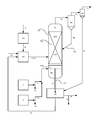
- FIG. 1 is a general diagram of the basic hydromethanation process to convert a hydrocarbonaceous feedstock to a fines-cleaned methane-enriched raw product gas stream and a washed char product stream.
- FIGS. 2 and 3 are general diagrams of processes for converting the washed char product stream generated by the basic hydromethanation process to an oxidation reactor product gas in an oxidation reactor and utilizing the oxidation reactor product gas to make steam and electric power, thereby maximizing the overall carbon conversion and overall thermal efficiency.
- FIG. 2 is a general diagram of an embodiment wherein the oxidation reactor is operated at a high pressure greater than 791 kPa (100 psig) using oxygen or air as the oxidant and steam as a reactant to produce an oxidation gas that is further processed in a gas-turbine combined cycle to produce electric power and steam for export.
- a high pressure greater than 791 kPa (100 psig) using oxygen or air as the oxidant and steam as a reactant to produce an oxidation gas that is further processed in a gas-turbine combined cycle to produce electric power and steam for export.
- FIG. 3 is a general diagram of an alternative embodiment wherein the oxidation reactor uses air as an oxidant and optionally steam as a reactant to produce an oxidation gas that is expanded to produce electric power if at a high pressure and further processed in a heat recovery steam generation system to produce electric power and steam for export.
- FIG. 4 is a diagram of a representative embodiment for the further processing of the fines-cleaned methane-enriched raw product stream to make a pipeline-quality substitute natural gas (SNG).
- SNG pipeline-quality substitute natural gas
- the present invention relates to processes for converting a non-gaseous carbonaceous material ultimately into one or more value-added gaseous products.
- pressures expressed in psi units are gauge, and pressures expressed in kPa units are absolute. Pressure differences, however, are expressed as absolute (for example, pressure 1 is 25 psi higher than pressure 2).
- the terms “comprises,” “comprising,” “includes,” “including,” “has,” “having” or any other variation thereof, are intended to cover a non-exclusive inclusion.
- a process, method, article, or apparatus that comprises a list of elements is not necessarily limited to only those elements but can include other elements not expressly listed or inherent to such process, method, article, or apparatus.
- a condition A or B, or A and/or B is satisfied by any one of the following: A is true (or present) and B is false (or not present), A is false (or not present) and B is true (or present), and both A and B are true (or present).
- substantially means that greater than about 90% of the referenced material, preferably greater than about 95% of the referenced material, and more preferably greater than about 97% of the referenced material. If not specified, the percent is on a molar basis when reference is made to a molecule (such as methane, carbon dioxide, carbon monoxide and hydrogen sulfide), and otherwise is on a weight basis (such as for entrained solids).
- the term “predominant portion”, as used herein, unless otherwise defined herein, means that greater than 50% of the referenced material. If not specified, the percent is on a molar basis when reference is made to a molecule (such as hydrogen, methane, carbon dioxide, carbon monoxide and hydrogen sulfide), and otherwise is on a weight basis (such as for entrained solids).
- depleted is synonymous with reduced from originally present. For example, removing a substantial portion of a material from a stream would produce a material-depleted stream that is substantially depleted of that material. Conversely, the term “enriched” is synonymous with greater than originally present.
- carbonaceous as used herein is synonymous with hydrocarbon.
- carbonaceous material as used herein is a material containing organic hydrocarbon content. Carbonaceous materials can be classified as biomass or non-biomass materials as defined herein.
- biomass refers to carbonaceous materials derived from recently (for example, within the past 100 years) living organisms, including plant-based biomass and animal-based biomass.
- biomass does not include fossil-based carbonaceous materials, such as coal.
- fossil-based carbonaceous materials such as coal.
- plant-based biomass means materials derived from green plants, crops, algae, and trees, such as, but not limited to, sweet sorghum, bagasse, sugarcane, bamboo, hybrid poplar, hybrid willow, albizia trees, eucalyptus , alfalfa, clover, oil palm, switchgrass, sudangrass, millet, jatropha, and miscanthus (e.g., Miscanthus x giganteus ).
- Biomass further include wastes from agricultural cultivation, processing, and/or degradation such as corn cobs and husks, corn stover, straw, nut shells, vegetable oils, canola oil, rapeseed oil, biodiesels, tree bark, wood chips, sawdust, and yard wastes.
- animal-based biomass means wastes generated from animal cultivation and/or utilization.
- biomass includes, but is not limited to, wastes from livestock cultivation and processing such as animal manure, guano, poultry litter, animal fats, and municipal solid wastes (e.g., sewage).
- non-biomass means those carbonaceous materials which are not encompassed by the term “biomass” as defined herein.
- non-biomass include, but is not limited to, anthracite, bituminous coal, sub-bituminous coal, lignite, petroleum coke, asphaltenes, liquid petroleum residues or mixtures thereof.
- anthracite bituminous coal
- sub-bituminous coal lignite
- petroleum coke lignite
- asphaltenes liquid petroleum residues or mixtures thereof.
- “Liquid heavy hydrocarbon materials” are viscous liquid or semi-solid materials that are flowable at ambient conditions or can be made flowable at elevated temperature conditions. These materials are typically the residue from the processing of hydrocarbon materials such as crude oil.
- the first step in the refining of crude oil is normally a distillation to separate the complex mixture of hydrocarbons into fractions of differing volatility.
- a typical first-step distillation requires heating at atmospheric pressure to vaporize as much of the hydrocarbon content as possible without exceeding an actual temperature of about 650° F., since higher temperatures may lead to thermal decomposition.
- the fraction which is not distilled at atmospheric pressure is commonly referred to as “atmospheric petroleum residue”.
- the fraction may be further distilled under vacuum, such that an actual temperature of up to about 650° F. can vaporize even more material.
- the remaining undistillable liquid is referred to as “vacuum petroleum residue”. Both atmospheric petroleum residue and vacuum petroleum residue are considered liquid heavy hydrocarbon materials for the purposes of the present process.
- Non-limiting examples of liquid heavy hydrocarbon materials include vacuum resids; atmospheric resids; heavy and reduced petroleum crude oils; pitch, asphalt and bitumen (naturally occurring as well as resulting from petroleum refining processes); tar sand oil; shale oil; bottoms from catalytic cracking processes; coal liquefaction bottoms; and other hydrocarbon feedstreams containing significant amounts of heavy or viscous materials such as petroleum wax fractions.
- asphaltene as used herein is an aromatic carbonaceous solid at room temperature, and can be derived, for example, from the processing of crude oil and crude oil tar sands. Asphaltenes may also be considered liquid heavy hydrocarbon feedstocks.
- the liquid heavy hydrocarbon materials may inherently contain minor amounts of solid carbonaceous materials, such as petroleum coke and/or solid asphaltenes, that are generally dispersed within the liquid heavy hydrocarbon matrix, and that remain solid at the elevated temperature conditions utilized as the feed conditions for the present process.
- solid carbonaceous materials such as petroleum coke and/or solid asphaltenes
- petroleum coke and “petcoke” as used herein include both (i) the solid thermal decomposition product of high-boiling hydrocarbon fractions obtained in petroleum processing (heavy residues—“resid petcoke”); and (ii) the solid thermal decomposition product of processing tar sands (bituminous sands or oil sands—“tar sands petcoke”).
- Such carbonization products include, for example, green, calcined, needle and fluidized bed petcoke.
- Resid petcoke can also be derived from a crude oil, for example, by coking processes used for upgrading heavy-gravity residual crude oil (such as a liquid petroleum residue), which petcoke contains ash as a minor component, typically about 1.0 wt % or less, and more typically about 0.5 wt % of less, based on the weight of the coke.
- the ash in such lower-ash cokes predominantly comprises metals such as nickel and vanadium.
- Tar sands petcoke can be derived from an oil sand, for example, by coking processes used for upgrading oil sand.
- Tar sands petcoke contains ash as a minor component, typically in the range of about 2 wt % to about 12 wt %, and more typically in the range of about 4 wt % to about 12 wt %, based on the overall weight of the tar sands petcoke.
- the ash in such higher-ash cokes predominantly comprises materials such as silica and/or alumina.
- Petroleum coke can comprise at least about 70 wt % carbon, at least about 80 wt % carbon, or at least about 90 wt % carbon, based on the total weight of the petroleum coke.
- the petroleum coke comprises less than about 20 wt % inorganic compounds, based on the weight of the petroleum coke.
- coal as used herein means peat, lignite, sub-bituminous coal, bituminous coal, anthracite, or mixtures thereof.
- the coal has a carbon content of less than about 85%, or less than about 80%, or less than about 75%, or less than about 70%, or less than about 65%, or less than about 60%, or less than about 55%, or less than about 50% by weight, based on the total coal weight.
- the coal has a carbon content ranging up to about 85%, or up to about 80%, or up to about 75% by weight, based on the total coal weight.
- Examples of useful coal include, but are not limited to, Illinois #6, Pittsburgh #8, Beulah (ND), Utah Blind Canyon, and Powder River Basin (PRB) coals.
- Anthracite, bituminous coal, sub-bituminous coal, and lignite coal may contain about 10 wt %, from about 5 to about 7 wt %, from about 4 to about 8 wt %, and from about 9 to about 11 wt %, ash by total weight of the coal on a dry basis, respectively.
- the ash content of any particular coal source will depend on the rank and source of the coal, as is familiar to those skilled in the art. See, for example, “Coal Data: A Reference”, Energy Information Administration, Office of Coal, Nuclear, Electric and Alternate Fuels, U.S. Department of Energy, DOE/EIA-0064(93), February 1995.
- the ash produced from combustion of a coal typically comprises both a fly ash and a bottom ash, as is familiar to those skilled in the art.
- the fly ash from a bituminous coal can comprise from about 20 to about 60 wt % silica and from about 5 to about 35 wt % alumina, based on the total weight of the fly ash.
- the fly ash from a sub-bituminous coal can comprise from about 40 to about 60 wt % silica and from about 20 to about 30 wt % alumina, based on the total weight of the fly ash.
- the fly ash from a lignite coal can comprise from about 15 to about 45 wt % silica and from about 20 to about 25 wt % alumina, based on the total weight of the fly ash. See, for example, Meyers, et al. “Fly Ash. A Highway Construction Material,” Federal Highway Administration, Report No. FHWA-IP-76-16, Washington, D.C., 1976.
- the bottom ash from a bituminous coal can comprise from about 40 to about 60 wt % silica and from about 20 to about 30 wt % alumina, based on the total weight of the bottom ash.
- the bottom ash from a sub-bituminous coal can comprise from about 40 to about 50 wt % silica and from about 15 to about 25 wt % alumina, based on the total weight of the bottom ash.
- the bottom ash from a lignite coal can comprise from about 30 to about 80 wt % silica and from about 10 to about 20 wt % alumina, based on the total weight of the bottom ash. See, for example, Moulton, Lyle K. “Bottom Ash and Boiler Slag,” Proceedings of the Third International Ash Utilization Symposium, U.S. Bureau of Mines, Information Circular No. 8640, Washington, D.C., 1973.
- a material such as methane can be biomass or non-biomass under the above definitions depending on its source of origin.
- non-gaseous material is substantially a liquid, semi-solid, solid or mixture at ambient conditions.
- coal, petcoke, asphaltene and liquid petroleum residue are non-gaseous materials, while methane and natural gas are gaseous materials.
- unit refers to a unit operation. When more than one “unit” is described as being present, those units are operated in a parallel fashion unless otherwise stated.
- an acid gas removal unit may comprise a hydrogen sulfide removal unit followed in series by a carbon dioxide removal unit.
- a contaminant removal unit may comprise a first removal unit for a first contaminant followed in series by a second removal unit for a second contaminant.
- a compressor may comprise a first compressor to compress a stream to a first pressure, followed in series by a second compressor to further compress the stream to a second (higher) pressure.
- a portion of the carbonaceous feedstock refers to carbon content of unreacted feedstock as well as partially reacted feedstock, as well as other components that may be derived in whole or part from the carbonaceous feedstock (such as carbon monoxide, hydrogen and methane).
- a portion of the carbonaceous feedstock includes carbon content that may be present in by-product char and recycled fines, which char is ultimately derived from the original carbonaceous feedstock.
- char is the combustible residue remaining after the destructive distillation or partial gasification or partial oxidation of coal, petcoke or any other carbonaceous material. Besides the combustible residue, char will contain any mineral matter in the carbonaceous material, including non-volatile portions of catalyst.
- Catalyst-depleted char is a char material which has undergone a catalyst removal process to recover and reuse soluble catalyst components.
- Carbon-depleted char is char which has undergone a secondary processing step such as oxidation or gasification or both to convert the carbon residue to gaseous compounds.
- rained catalyst means chemical compounds comprising the catalytically active portion of the hydromethanation catalyst, e.g., alkali metal compounds present in the char by-product.
- “entrained catalyst” can include, but is not limited to, soluble alkali metal compounds (such as alkali metal carbonates, alkali metal hydroxides and alkali metal oxides) and/or insoluble alkali compounds (such as alkali metal aluminosilicates).
- soluble alkali metal compounds such as alkali metal carbonates, alkali metal hydroxides and alkali metal oxides
- insoluble alkali compounds such as alkali metal aluminosilicates.
- superheated steam refers to a steam stream that is non-condensing under the conditions utilized, as is commonly understood by persons of ordinary skill in the relevant art.
- steam demand refers to the amount of steam that must be added to the hydromethanation reactor via the gas feed streams to the hydromethanation reactor. Steam is consumed in the hydromethanation reaction and some steam must be added to the hydromethanation reactor. The theoretical consumption of steam is two moles for every two moles of carbon in the feed to produce one mole of methane and one mole of carbon dioxide (see equation (V)). In actual practice, the steam consumption is not perfectly efficient and steam is withdrawn with the product gases; therefore, a greater than theoretical amount of steam needs to be added to the hydromethanation reactor, which added amount is the “steam demand”.
- Steam can be added, for example, via the steam stream ( 12 ) and the oxygen stream ( 15 ), which are typically combined prior to introduction into the hydromethanation reactor.
- the amount of steam to be added (and the source) is discussed in further detail below.
- Steam generated in situ from the carbonaceous feedstock e.g., from vaporization of any moisture content of the carbonaceous feedstock, or from an oxidation reaction with hydrogen, methane and/or other hydrocarbons present in or generated from the carbonaceous feedstock
- any steam generated in situ or fed into the hydromethanation reactor at a temperature lower than the operating temperature within the hydromethanation reactor (the hydromethanation reaction temperature) will have an impact on the “heat demand” for the hydromethanation reaction.
- heat demand refers to the amount of heat energy that must be added to the hydromethanation reactor (for example, via steam stream ( 12 ) and/or generated in situ (for example, via a combustion/oxidation reaction with supplied oxygen stream ( 15 ) as discussed below) to keep the reaction of carbonaceous feedstock in the hydromethanation reactor in substantial thermal balance, as further detailed below.
- power demand refers to the amount of power that must be used to operate the processes.
- substitute natural gas or “SNG” refers to a methane-rich product gas, typically with a higher heating value greater than 950 BTU/scf, that meets all the specifications for natural gas prescribed by natural gas merchants or pipeline carriers or operators.
- the basic hydromethanation reactor (HMR) process is shown in FIG. 1 .
- the non-gaseous carbonaceous material ( 10 ) is processed in a feedstock preparation unit ( 100 ) to generate a carbonaceous feedstock ( 32 ) which is fed to a catalyst application unit ( 350 ) where hydromethanation catalyst ( 31 ) is applied to generate a catalyzed carbonaceous feedstock ( 31 + 32 ).
- the application methods can include mechanical mixing devices to disperse the catalyst solution over the solid feed particles and thermal dryers to achieve the preferred moisture content for the catalyzed carbonaceous feedstocks ( 31 + 32 ).
- the feedstock preparation unit ( 100 ) includes coal or coke pulverization machines to achieve a pre-determined optimal size distribution which largely depends on the carbonaceous mechanical and chemical properties. In some cases, pelletization and/or briquetting machines are included to consolidate fines to maximize the utilization of all solid feedstock materials. Further details are provided below.
- the hydromethanation catalyst ( 31 ) will typically comprise a recovered hydromethanation catalyst stream ( 57 ) recovered from hydromethanation reactor char product stream ( 54 ) and recovered secondary fines ( 66 ), and a make-up catalyst from a make-up catalyst stream ( 56 ). Further details are provided below.
- the catalyzed carbonaceous feedstock ( 31 + 32 ) is fed into a hydromethanation reactor ( 200 ) along with steam stream ( 12 ) and oxygen stream ( 15 ).
- the location at which the catalyzed carbonaceous feedstock ( 31 + 32 ) is fed may vary. For example, it may be fed into fluidized bed ( 202 ) in lower portion ( 202 a ), just above the hydromethanation reactor fluidizing gas distributor plate ( 208 ), or into the bottom of upper portion ( 202 b ).
- Steam streams ( 12 ) and ( 12 a ) are provided by a steam source such as steam distribution system ( 11 ), which desirably utilizes process heat recovery (e.g., heat energy recovery from the hot raw product gas and other process sources) such that the process is steam integrated and steam sufficient.
- Oxygen stream ( 15 ) and second oxygen stream ( 15 a ), which splits off from oxygen stream ( 15 ), is supplied by an air separation unit ( 14 ).
- the steam stream ( 12 ) and oxygen stream ( 15 ) may be a single feed stream which comprises, or multiple feed streams which comprise, in combination with the in situ generation of heat energy and syngas, steam and heat energy, as required to at least substantially satisfy, or at least satisfy, steam and heat demands of the hydromethanation reaction that takes place in hydromethanation reactor ( 200 ).
- the hydromethanation reactor ( 200 ) In the hydromethanation reactor ( 200 ), (i) a portion of the carbonaceous feedstock, steam, hydrogen and carbon monoxide react in the presence of the hydromethanation catalyst to generate a methane-enriched raw product gas (the hydromethanation reaction), and (ii) a portion of the carbonaceous feedstock reacts in the presence of steam and oxygen to generate heat energy and typically carbon monoxide, hydrogen and carbon dioxide (combustion/oxidation reaction).
- the generated methane-enriched raw product gas is withdrawn from the hydromethanation reactor ( 200 ) as a methane-enriched raw product gas stream ( 50 ).
- the withdrawn methane-enriched raw product gas stream ( 50 ) typically comprises at least methane, carbon monoxide, carbon dioxide, hydrogen, hydrogen sulfide, steam, and entrained solids.
- the hydromethanation reactor ( 200 ) comprises a fluidized bed ( 202 ) having an upper portion ( 202 b ) above a lower portion ( 202 a ) and a disengagement zone ( 204 ) above the fluidized bed.
- Hydromethanation reactor ( 200 ) also typically comprises a gas mixing zone ( 206 ) below the fluidized-bed ( 202 ), with the two sections typically being separated by a hydromethanation reactor fluidizing gas distributor plate ( 208 ) or similar divider (for example, an array of sparger pipes).
- Oxygen ( 15 ) is mixed with the high-pressure, superheated steam ( 12 ), and the mixture introduced into the gas mixing zone ( 206 ), into the lower portion ( 202 a ) of the fluidized bed ( 202 ) via the gas mixing zone ( 206 ), into the fluidized bed ( 202 ) at other locations, or into a combination thereof, via the hydromethanation reactor fluidizing gas distributor plate ( 208 ) or similar divider. Desirably, oxygen is fed into the lower portion of the fluidized bed. Without being bound by any theory, the hydromethanation reaction predominates in upper portion ( 202 b ), and an oxidation reaction with oxygen predominates in lower portion ( 202 a ).
- At least a portion of the carbonaceous feedstock in lower portion ( 202 a ) of fluidized bed ( 202 ) will react with oxygen from oxygen stream ( 15 ) to generate heat energy, and hydrogen and carbon monoxide (syngas).
- gases carbon monoxide, hydrogen, methane and higher hydrocarbons
- some water (steam) may be produced, as well as other by-products such as carbon dioxide depending on the extent of combustion/oxidation and the water gas shift reaction.
- hydromethanation reactor ( 200 ) in hydromethanation reactor ( 200 ) (predominantly in upper portion ( 202 b ) of fluidized bed ( 202 )) the carbonaceous feedstock, steam, hydrogen and carbon monoxide react in the presence of the hydromethanation catalyst to generate a methane-enriched raw product, which is ultimately withdrawn as a methane-enriched raw product gas stream ( 50 ) from the hydromethanation reactor ( 200 ).
- the reactions of the carbonaceous feedstock in fluidized bed ( 202 ) also result in a by-product char comprising unreacted carbon as well as non-carbon content from the carbonaceous feedstock (including hydromethanation catalyst) as described in further detail below.
- a solid purge of hydromethanation reactor char product stream ( 54 ) is routinely withdrawn (periodically or continuously) via a char withdrawal line ( 210 ).
- the char product stream ( 54 ) comprises a carbon content and entrained hydromethanation catalyst.
- Char may also be withdrawn from the hydromethanation reactor at other locations such as from the top of fluidized bed ( 202 ), at any place within upper portion ( 202 b ) and/or lower portion ( 202 a ) of fluidized bed ( 202 ), and/or at or just below hydromethanation reactor fluidizing gas distributor plate ( 208 ).
- carbonaceous feedstock ( 32 ) (or catalyzed carbonaceous feedstock ( 31 + 32 )) is fed into lower portion ( 202 a ) of fluidized bed ( 202 ).
- At least one char withdrawal line ( 210 ) will typically be located at a point such that by-product char is withdrawn from fluidized bed ( 202 ) at one or more points above the feed location of catalyzed carbonaceous feedstock ( 31 + 32 ), typically from upper portion ( 202 b ) of fluidized bed ( 202 ).
- Particles too large to be fluidized in fluidized-bed section ( 202 ), for example, large-particle by-product char and non-fluidizable agglomerates, are generally collected in lower portion ( 202 a ) of fluidized bed ( 202 ), as well as in gas mixing zone ( 206 ).
- Such particles will typically comprise a carbon content (as well as an ash and catalyst content) and may be removed periodically from hydromethanation reactor ( 200 ) via a char withdrawal line ( 210 ) for catalyst recovery and further processing.
- hydromethanation reactor char product stream ( 54 ) (typically all of such stream) is processed in a catalyst recovery unit ( 300 ) to recover entrained hydromethanation catalyst, and optionally other value-added by-products such as vanadium and nickel (depending on the content of the non-gaseous carbonaceous material ( 10 )), to generate a washed char product stream ( 60 ) and a recovered hydromethanation catalyst stream ( 57 ).
- washed char product stream ( 60 ) is processed as described below.
- the remainder of the washed char, ( 59 ) may be processed in a boiler to generate steam and power.
- the methane-enriched raw product gas typically passes through the disengagement zone ( 204 ) above the fluidized-bed section ( 202 ) prior to withdrawal from hydromethanation reactor ( 200 ).
- the disengagement zone ( 204 ) may optionally contain, for example, one or more internal cyclones and/or other entrained particle disengagement mechanisms (not shown).
- the withdrawn methane-enriched raw product gas stream ( 50 ) typically comprises at least methane, carbon monoxide, carbon dioxide, hydrogen, hydrogen sulfide, steam, and entrained solids.
- the methane-enriched raw product gas stream ( 50 ) is initially treated to remove a substantial portion of the entrained solids, typically via a cyclone assembly (for example, one or more internal and/or external cyclones), which may be followed if necessary by optional additional treatments such as venturi scrubbers.
- a cyclone assembly for example, one or more internal and/or external cyclones
- the cyclone assembly comprises an external primary cyclone ( 360 ) followed by an external secondary cyclone ( 370 ), but other arrangements would be suitable as well.
- the cyclone assembly could comprise an internal primary cyclone followed by an external secondary cyclone.
- the methane-enriched raw product gas stream ( 50 ) is passed from hydromethanation reactor ( 200 ) to an external primary cyclone ( 360 ) for separation of the predominant portion of entrained solids. While primary cyclone ( 360 ) is shown as a single external cyclone for simplicity, as indicated above cyclone assembly ( 360 ) may be an internal and/or external cyclone and may also be a series of multiple internal and/or external cyclones.
- the methane-enriched raw product gas stream ( 50 ) is treated in primary cyclone ( 360 ) to generate a solids-depleted methane-enriched raw product gas stream ( 64 ) and a recovered primary solids stream ( 362 ).
- Recovered primary solids stream ( 362 ) is fed back into hydromethanation reactor ( 200 ), for example, into one or more portions of fluidized bed ( 202 ) via fines recycle line ( 364 ).
- recovered fines are fed back into lower portion ( 202 a ) of fluidized bed ( 202 ) via fines recycle line ( 364 ).
- the solids-depleted methane-enriched raw product gas stream ( 64 ) typically comprises at least methane, carbon monoxide, carbon dioxide, hydrogen, hydrogen sulfide, steam, and ammonia, as well as small amounts of contaminants such as remaining residual entrained fines, and other volatilized and/or carried material that may be present in the carbonaceous feedstock.
- the solids-depleted methane-enriched raw product gas stream ( 64 ) will be fed to a secondary cyclone ( 370 ) to remove a substantial portion of any remaining fines, generating a fines-cleaned methane-enriched raw product gas stream ( 70 ) and a recovered secondary fines stream ( 66 ). Recovered secondary fines stream ( 66 ) will typically be recycled back to catalyst recovery unit ( 300 ).
- All or a portion of a recovered secondary fines stream ( 66 ) may be co-processed with the withdrawn hydromethanation reactor char product stream ( 54 ) in the catalyst recovery unit ( 300 ).
- the catalyst recovery unit ( 300 ) recovers the water-soluble catalyst by conventional solids leaching or washing technologies, extracting a portion of the entrained catalyst to generate a washed product char stream ( 60 ) and a recovered hydromethanation catalyst stream ( 57 ).
- Unit ( 300 ) may include countercurrent mixer settlers or filter presses with wash zones or any combination of similar solid washing/leaching and dewatering devices.
- the catalyst recovery unit ( 300 ) may comprise a quench tank and a quench medium, the treatment comprising the steps of: quenching the hydromethanation reactor char product stream ( 54 ) with the quench medium to extract a portion of the entrained catalyst to generate a catalyst-depleted char and liberated hydromethanation catalyst; withdrawing a stream of catalyst-depleted char from the catalyst recovery unit ( 300 ) as the washed char product stream ( 60 ); and withdrawing a stream of liberated hydromethanation catalyst from the catalyst recovery unit ( 300 ) as the recovered hydromethanation catalyst stream ( 57 ).
- the hydromethanation catalyst ( 31 ) will typically comprise at least a portion of the recovered hydromethanation catalyst stream ( 57 ) and a make-up catalyst from a make-up catalyst stream ( 56 ).
- the fines-cleaned methane-enriched raw product gas stream ( 70 ) can be treated in one or more downstream processing steps to recover heat energy, decontaminate and convert, to one or more value-added products such as, for example, substitute natural gas (pipeline quality), hydrogen, carbon monoxide, syngas, ammonia, methanol and other syngas-derived products, electrical power and steam.
- substitute natural gas pipeline quality
- FIGS. 2 and 3 represent two of the alternative embodiments of the catalytic gasification process that aim to maximize the overall carbon conversion and power generated from the process.
- the washed char stream ( 60 ) is further processed in the oxidation reactor ( 380 ) with either oxygen or air to convert the residual carbon present in the washed char stream ( 60 ).
- the alternative embodiments differ in three ways: (1) the pressure of operation of the oxidation reactor ( 380 ), (2) the type of oxidant chosen to convert the carbon, and (3) the molecular ratio of gaseous oxygen to carbon in the feed streams to the oxidation reactor ( 380 ).
- the oxidant is an oxygen-containing gas stream, comprising compressed air ( 87 ) or oxygen ( 15 a ) from air separation unit ( 14 ), and, optionally, diluent steam ( 12 a ).
- the pressure of the oxidant is greater than the operating pressure of the oxidation reactor ( 380 ).
- the composition of the oxidation reactor product gas ( 88 ) depends on the molecular ratio of oxygen to carbon in the streams entering oxidation reactor ( 380 ).
- the gas ( 88 ) is a syngas comprised of hydrogen, carbon monoxide, carbon dioxide, nitrogen and unreacted steam.
- the mode of operation is known as the partial oxidation mode wherein oxygen is completely consumed within the oxidation reactor ( 380 ).
- the gas ( 88 ) is a flue gas comprised of carbon dioxide, steam, nitrogen and unreacted oxygen.
- FIG. 2 illustrates one of the embodiments of the process for converting a non-gaseous carbonaceous material ultimately into one or more value-added gaseous products where the oxidation reactor is operated at a pressure greater than 791 kPa (100 psig) in syngas-mode.
- the washed char stream ( 60 ) produced by the basic hydromethanation process described above and in FIG. 1 is further processed in an oxidation reactor ( 380 ) with steam ( 12 a ) and either oxygen ( 15 a ) or compressed air ( 87 ) as the oxidant.
- Air compressor or blower ( 990 ) produces compressed air ( 87 ) and, optionally, stream ( 86 a ), from air ( 85 ).
- the process yields an oxidation reactor ash product stream ( 89 ) and an oxidation reactor product gas ( 88 ).
- the oxidation gas is then utilized to produce electric power and steam as described below.
- the oxidation reactor ash product stream ( 89 ) exiting the oxidation reactor is cooled by a coolant stream ( 94 ) to produce a cooled product ash ( 95 ) and a warmed coolant stream ( 96 ).
- the ash cooler ( 385 ) can be any number of direct or indirect heat transfer devices, such as an air-blown fluidized bed, a fluidized bed with steam or water cooling coils, a direct water quench vessel or a water cooled mechanical screw.
- the oxidation reactor ( 380 ) is operated at high pressure in this embodiment, it is advantageous to recover and convert the potential energy of the pressurized oxidation gases to mechanical work and electric power.
- the oxidation reactor product gas ( 88 ) produced is rich in hydrogen and carbon monoxide and is burned directly in a high-pressure gas turbine combustion chamber ( 992 ).
- gas ( 88 ) may be processed to remove particulate matter entrained from the oxidation reactor.
- Suitable mechanisms for removing particulates from the hot oxidation gas include stage cyclones, candle filters and other similar devices (not shown).
- Gas ( 88 ) is then reacted with atmospheric air ( 90 ) compressed to match the pressure of the combustion chamber ( 992 ).
- the air compressor ( 991 ) is typically coupled to a gas expander ( 993 ).
- the work recovered by the gas expander ( 993 ) drives both the air compressor ( 991 ) and an electric generator “G” ( 99 a ).
- the expander exhaust gas ( 97 ) is directed to a heat recovery steam generator ( 975 ).
- the heat recovery steam generator ( 975 ) consists of several coils to preheat boiler feed water and produce steam, some of which may be extracted for process use and the balance exported as steam ( 92 ).
- the balance of the steam is directed to a steam turbine ( 980 ) to recover additional work and generate more electricity by the electric generator “G” ( 99 b ), which is coupled to the steam turbine.
- the steam turbine can be either back pressure or condensing, with multiple stages and extraction ports if needed. A condensing turbine will maximize the electric power generated by the steam turbine.
- the heat recovery steam generator ( 975 ) also produces flue gas ( 93 ).
- FIG. 3 illustrates a second preferred embodiment of the process for converting a non-gaseous carbonaceous material ultimately into one or more value-added gaseous products.
- the oxidant used is compressed air ( 87 ) produced by air compressor or blower ( 990 ) from air ( 85 ); stream ( 86 a ) is also produced.
- the oxidation reactor ( 380 ) may be operated at a high pressure greater than 791 kPa (100 psig) or at a low pressure less than 400 kPa (44 psig).
- the oxidation reactor ( 380 ) may also be supplied with steam ( 12 a ) in addition to compressed air ( 87 ) to yield an oxidation reactor ash product stream ( 89 ) and an oxidation reactor product gas ( 88 ).
- the oxidation reactor ash product stream ( 89 ) is cooled in ash cooler ( 385 ) by a coolant stream ( 94 ) to produce a cooled product ash ( 95 ) and a warmed coolant stream ( 96 ).
- the oxidation gas is then utilized to produce electric power and steam as described below.
- the potential energy of the pressurized oxidation reactor product gas ( 88 ) may be converted to mechanical work and electric power in a gas expander ( 993 ).
- the work recovered by the gas expander ( 993 ) in this case drives the electric generator “G” ( 99 a ).
- the heat recovery steam generator ( 975 ) When the oxidation reactor ( 380 ) is operated in syngas-mode, the heat recovery steam generator ( 975 ) will be equipped with an auxiliary burner (not shown) to combust the expander exhaust gas ( 97 ) with air ( 91 ) to form oxidation products comprised of carbon dioxide and water to allow discharge to the atmosphere as flue gas ( 93 ).
- the expander exhaust gas ( 97 ) is subsequently processed in the heat recovery steam generator ( 975 ) and steam turbine ( 980 ) to produce steam ( 92 ) and power ( 99 b ) as described in the first embodiment of the process.
- the flue gas ( 93 ) is treated to remove particulate matter and sulfur oxides using standard air pollution control equipment (not shown).
- catalyzed carbonaceous feedstock ( 31 + 32 ), a steam stream ( 12 ), and an oxygen stream ( 15 ) are introduced into hydromethanation reactor ( 200 ).
- Char by-product removal from hydromethanation reactor ( 200 ) can be at any desired place or places, for example, at the top of fluidized bed ( 202 ), at any place within upper portion ( 202 b ) and/or lower portion ( 202 a ) of fluidized bed ( 202 ), and/or at or just below hydromethanation reactor fluidizing gas distributor plate ( 208 ). As indicated above, the location where catalyzed carbonaceous feedstock ( 31 + 32 ) is introduced will have an influence on the location of a char withdrawal point.
- char withdrawal point at or below hydromethanation reactor fluidizing gas distributor plate ( 208 ) to withdraw char comprising larger or agglomerated particles.
- Hydromethanation reactor ( 200 ) is typically operated at moderately high pressures and temperatures, requiring introduction of solid streams (e.g., catalyzed carbonaceous feedstock ( 31 + 32 ) and, if present, recycle fines) to the reaction chamber of the reactor while maintaining the required temperature, pressure and flow rate of the streams.
- solid streams e.g., catalyzed carbonaceous feedstock ( 31 + 32 ) and, if present, recycle fines
- feed inlets to supply solids into the reaction chambers having high pressure and/or temperature environments, including star feeders, screw feeders, rotary pistons and lock-hoppers. It should be understood that the feed inlets can include two or more pressure-balanced elements, such as lock hoppers, which would be used alternately.
- the carbonaceous feedstock can be prepared at pressure conditions above the operating pressure of the reactor and, hence, the particulate composition can be directly passed into the reactor without further pressurization.
- Gas for pressurization can be an inert gas such as nitrogen, or more typically a stream of carbon dioxide that can, for example be recycled from a carbon dioxide stream generated by an acid gas removal unit.
- Hydromethanation reactor ( 200 ) is desirably operated at a moderate temperature (as compared to “conventional” oxidation-based gasification processes), with an operating temperature of from about 400° F. (about 205° C.), or from about 1000° F. (about 538° C.), or from about 1100° F. (about 593° C.), or from about 1200° F. (about 649° C.), to about 1500° F. (about 816° C.), or to about 1400° F. (about 760° C.), or to about 1375° F.
- a moderate temperature as compared to “conventional” oxidation-based gasification processes
- an operating temperature of from about 400° F. (about 205° C.), or from about 1000° F. (about 538° C.), or from about 1100° F. (about 593° C.), or from about 1200° F. (about 649° C.), to about 1500° F. (about 816° C.), or to about 1400°
- hydromethanation reactor ( 200 ) is operated at a pressure (first operating pressure) of up to about 600 psig (about 4238 kPa), or up to about 550 psig (about 3894 kPa).
- Typical gas flow velocities in hydromethanation reactor ( 200 ) are from about 0.5 ft/sec (about 0.15 m/sec), or from about 1 ft/sec (about 0.3 m/sec), to about 2.0 ft/sec (about 0.6 m/sec), or to about 1.5 ft/sec (about 0.45 m/sec).
- oxygen stream ( 15 ) is fed into hydromethanation reactor ( 200 )
- a portion of the carbonaceous feedstock (desirably carbon from the partially reacted feedstock, by-product char and recycled fines) will be consumed in an oxidation/combustion reaction, generating heat energy as well as typically some amounts carbon monoxide and hydrogen (and typically other gases such as carbon dioxide and steam).
- the variation of the amount of oxygen supplied to hydromethanation reactor ( 200 ) provides an advantageous process control to ultimately maintain the syngas and heat balance. Increasing the amount of oxygen will increase the oxidation/combustion, and therefore increase in situ heat generation. Decreasing the amount of oxygen will conversely decrease the in situ heat generation.
- the amount of syngas generated will ultimately depend on the amount of oxygen utilized, and higher amounts of oxygen may result in a more complete combustion/oxidation to carbon dioxide and water, as opposed to a more partial combustion to carbon monoxide and hydrogen.
- the amount of oxygen supplied to hydromethanation reactor ( 200 ) must be sufficient to combust/oxidize enough of the carbonaceous feedstock to generate enough heat energy and syngas to meet the heat and syngas demands of the steady-state hydromethanation reaction.
- a portion of the oxygen (second oxygen stream 15 a ) is fed into an oxidation reactor ( 380 ) along with a portion of the steam (steam stream 12 a ) to react with by-product char as discussed in further detail below.
- the total amount of molecular oxygen that is provided to the hydromethanation reactor ( 200 ), or the hydromethanation reactor ( 200 ) and oxidation reactor ( 380 ) combined can range from about 0.10, or from about 0.20, or from about 0.25, to about 0.6, or to about 0.5, or to about 0.4, or to about 0.35 weight units (for example, pound or kg) of O 2 per weight unit (for example, pound or kg) of carbonaceous feedstock ( 32 ).
- hydromethanation and oxidation/combustion reactions within hydromethanation reactor ( 200 ) will occur contemporaneously.
- the two steps will typically predominate in separate zones—the hydromethanation in upper portion ( 202 b ) of fluidized bed ( 202 ), and the oxidation/combustion in lower portion ( 202 a ) of fluidized bed ( 202 ).
- Oxygen stream ( 15 ) is typically mixed with steam stream ( 12 ) and the mixture introduced at or near the bottom of fluidized bed ( 202 ) in lower portion ( 202 a ) through hydromethanation reactor fluidizing gas distributor plate ( 208 ) to avoid formation of hot spots in the reactor, to avoid (minimize) combustion of the desired gaseous products generated within hydromethanation reactor ( 200 ), and to improve the safety of the operation.
- Oxygen stream ( 15 ) can be fed into hydromethanation reactor ( 200 ) by any suitable means such as direct injection of purified oxygen, oxygen-air mixtures, oxygen-steam mixtures, or oxygen-inert gas mixtures into the reactor. See, for instance, U.S. Pat. No. 4,315,753 and Chiaramonte et al., Hydrocarbon Processing, September 1982, pp. 255-257.
- Oxygen stream ( 15 ) and second oxygen stream ( 15 a ), which splits off from oxygen stream ( 15 ), is supplied by an air separation unit ( 14 ).
- Oxygen stream ( 15 ) is typically generated via standard air-separation technologies, and will be fed mixed with steam, and introduced at a temperature above about 250° F. (about 121° C.), to about 400° F. (about 204° C.), or to about 350° F. (about 177° C.), or to about 300° F. (about 149° C.), and at a pressure at least slightly higher than present in hydromethanation reactor ( 200 ).
- the steam in oxygen stream ( 15 ) should be non-condensable during transport of oxygen stream ( 15 ) to hydromethanation reactor ( 200 ), so oxygen stream ( 15 ) may need to be transported at a lower pressure then pressurized (compressed) just prior to introduction into hydromethanation reactor ( 200 ).
- the hydromethanation reaction has a steam demand, a heat demand and a syngas demand. These conditions in combination are important factors in determining the operating conditions for the hydromethanation reaction as well as the remainder of the process.
- the hydromethanation reaction requires a theoretical molar ratio of steam to carbon (in the feedstock) of at least about 1. Typically, however, the molar ratio is greater than about 1, or from about 1.5 (or greater), to about 6 (or less), or to about 5 (or less), or to about 4 (or less), or to about 3 (or less), or to about 2 (or less).
- the moisture content of the catalyzed carbonaceous feedstock ( 31 + 32 ), moisture generated from the carbonaceous feedstock in the hydromethanation reactor ( 200 ), and steam included in the steam stream ( 12 ), oxygen stream ( 15 ), oxidation reactor product gas stream ( 88 ) and recycle fines stream(s) all contribute steam for the hydromethanation reaction.
- the steam in steam stream ( 12 ), oxygen stream ( 15 ) and oxidation gas stream ( 88 ) should be sufficient to at least substantially satisfy (or at least satisfy) the “steam demand” of the hydromethanation reaction.
- the hydromethanation reaction is essentially thermally balanced but, due to process heat losses and other energy requirements (for example, vaporization of moisture on the feedstock), some heat must be generated in situ (in hydromethanation reactor ( 200 )) to maintain the thermal balance (the heat demand).
- the partial combustion/oxidation of carbon in the presence of the oxygen introduced into hydromethanation reactor ( 200 ) from oxygen stream ( 15 ) should be sufficient to at least substantially satisfy (or at least satisfy) both the heat and syngas demand of the hydromethanation reaction.
- the gas utilized in hydromethanation reactor ( 200 ) for pressurization and reaction of the catalyzed carbonaceous feedstock ( 31 + 32 ) comprises the steam stream ( 12 ), oxygen stream ( 15 ) and, optionally, additional nitrogen, air, or inert gases such as argon, which can be supplied to hydromethanation reactor ( 200 ) according to methods known to those skilled in the art.
- steam stream ( 12 ) and oxygen stream ( 15 ) must be provided at a higher pressure which allows them to enter hydromethanation reactor ( 200 ).
- Steam stream ( 12 ) can be at a temperature as low as the saturation point at the feed pressure, but it is desirable to feed at a temperature above this to avoid the possibility of any condensation occurring.
- Typical feed temperatures of superheated steam stream ( 12 ) are from about 500° F. (about 260° C.), or from about 600° F. (about 316° C.), or from about 700° F. (about 371° C.), to about 950° F. (about 510° C.), or to about 900° F. (about 482° C.).
- Typical feed pressures of steam stream ( 12 ) are about 25 psi (about 172 kPa) or greater than the pressure within hydromethanation reactor ( 200 ).
- the actual temperature and pressure of steam stream ( 12 ) will ultimately depend on the level of heat recovery from the process and the operating pressure within hydromethanation reactor ( 200 ), as discussed below.
- the temperature of the combined stream will be controlled by the temperature of steam stream ( 12 ), and will typically range from about from about from about 400° F. (about 204° C.), or from about 450° F. (about 232° C.), to about 800° F. (about 455° C.), or to about 600° F. (about 316° C.).
- the temperature in hydromethanation reactor ( 200 ) can be controlled, for example, by controlling the amount and temperature of steam stream ( 12 ) as well as the amount of oxygen supplied to hydromethanation reactor ( 200 ).
- steam for hydromethanation reactor ( 200 ) and oxidation reactor ( 380 ) is desirably solely generated from other process operations through process heat capture (such as generated in a waste heat boiler, generally referred to as “process steam” or “process-generated steam”, and referenced as steam source ( 11 )), specifically from the cooling of the raw product gas in a heat exchanger unit. Additional steam can be generated for other portions of the overall process, such as disclosed, for example, in previously incorporated US2010/0287835A1 and US2012/0046510A1, and as shown in FIGS. 2 and 3 discussed below.
- the result of the hydromethanation reaction is a methane-enriched raw product, which is withdrawn from hydromethanation reactor ( 200 ) as methane-enriched raw product gas stream ( 50 ) typically comprising CH 4 , CO 2 , H 2 , CO, H 2 S, unreacted steam and, optionally, other contaminants such as entrained solids, NH 3 , COS, HCN and/or elemental mercury vapor, depending on the nature of the carbonaceous material utilized for hydromethanation.
- methane-enriched raw product gas stream ( 50 ) typically comprising CH 4 , CO 2 , H 2 , CO, H 2 S, unreacted steam and, optionally, other contaminants such as entrained solids, NH 3 , COS, HCN and/or elemental mercury vapor, depending on the nature of the carbonaceous material utilized for hydromethanation.
- the non-gaseous carbonaceous materials ( 10 ) useful in these processes include, for example, a wide variety of biomass and non-biomass materials.
- the carbonaceous feedstock ( 32 ) is derived from one or more non-gaseous carbonaceous materials ( 10 ), which are processed in a feedstock preparation unit ( 100 ) as discussed below.
- the hydromethanation catalyst ( 31 ) can comprise one or more catalyst species, as discussed below.
- the carbonaceous feedstock ( 32 ) and the hydromethanation catalyst ( 31 ) are typically intimately mixed (i.e., to provide a catalyzed carbonaceous feedstock ( 31 + 32 )) before provision to the hydromethanation reactor ( 200 ), but they can be fed separately as well.
- the hot gas effluent leaving the reaction chamber of the hydromethanation reactor ( 200 ) can pass through a fines remover unit (such as cyclone assembly ( 360 )), incorporated into and/or external of the hydromethanation reactor ( 200 ), which serves as a disengagement zone. Particles too heavy to be entrained by the gas leaving the hydromethanation reactor ( 200 ) (i.e., fines) are returned to the hydromethanation reactor ( 200 ), for example, to the reaction chamber (e.g., fluidized bed ( 202 )).
- a fines remover unit such as cyclone assembly ( 360 )
- Residual entrained solids are substantially removed by any suitable device such as internal and/or external cyclone separators to generate a solids-depleted methane-enriched raw product gas stream ( 64 ). As discussed above, at least a portion of these fines can be returned to fluidized bed ( 202 ) via recycle line ( 364 ). Any remaining recovered fines can be processed to recover alkali metal catalyst, and/or combined at some stage with carbonaceous feedstock ( 32 ), and/or directly recycled back to feedstock preparation as described in previously incorporated US2009/0217589A1.
- Removal of a “substantial portion” of fines means that an amount of fines is removed from the resulting gas stream such that downstream processing is not adversely affected; thus, at least a substantial portion of fines should be removed. Some minor level of ultrafine material may remain in the resulting gas stream to the extent that downstream processing is not significantly adversely affected. Typically, at least about 90 wt %, or at least about 95 wt %, or at least about 98 wt %, of the fines of a particle size greater than about 20 ⁇ m, or greater than about 10 ⁇ m, or greater than about 5 ⁇ m, are removed.
- Additional residual entrained fines may be removed from the solids-depleted methane-enriched raw product gas stream ( 64 ) by any suitable device such as internal and/or external cyclone separators such as external secondary cyclone ( 370 ), optionally followed by scrubbers.
- the resulting fines-cleaned methane-enriched raw product gas stream ( 70 ) can be further processed for heat recovery and/or purification/conversion as required to achieve a desired end product, as disclosed in the numerous previously incorporated disclosures set forth above in the “Hydromethanation” section. Reference may be had to those disclosures for further details.
- Oxidation reactor ( 380 ) can be any type of oxidation/combustion reactor suitable for reacting the by-product char with oxygen or air and steam under the conditions specified by the embodiments of this invention. Suitable reactors are in a general sense well-known to those of ordinary skill in the relevant art.
- the oxidation reactor ( 380 ) is a fluidized-bed reactor which, in operation, contains a fluidized bed of the by-product char fluidized by steam ( 12 a ) and oxygen ( 15 a ) or compressed air ( 87 ) fed into the reactor through oxidation reactor fluidizing gas distributor plate ( 230 ).
- the oxidation reactor may include internal and external cyclones (not shown) to remove particles from the oxidation gas.
- the recovered particles maybe recycled to oxidation reactor as is typical for a fluid bed or the particles may be directed to the char cooling system for disposal.
- Oxidation reactor ( 380 ) operates at a temperature of about 1800° F. (about 982° C.) or less, or about 1450° F. (about 788° C.) or less, or about 1400° F. (about 760° C.) or less.
- the pressure of operation of the oxidation reactor ( 380 ) may be chosen independent of the hydromethanation reactor ( 200 ) since they are decoupled.
- all or a portion of the carbon content of the by-product char is reacted with steam and oxygen or air to produce a carbon-depleted char and an oxidation gas comprising steam, carbon monoxide, carbon dioxide, hydrogen, and nitrogen (if air is used as an oxidant).
- a stream of the oxidation gas is withdrawn from oxidation reactor ( 380 ) as oxidation reactor product gas stream ( 88 ), and a stream of carbon-depleted char is withdrawn from oxidation reactor as oxidation reactor ash product stream ( 89 ).
- the oxidation reactor product gas stream ( 88 ) is a “medium BTU gas” if the constituents are primarily steam, CO, CO 2 and H 2 .
- Gas stream ( 88 ) is a “low BTU gas” if the constituents are primarily nitrogen, CO, CO 2 , H 2 and steam.
- Gas stream ( 88 ) is a “flue gas” with no chemical energy content if the constituents are primarily nitrogen, steam and CO 2 .
- the oxidation reactor product gas ( 88 ) is utilized to produce steam and electric power, which are the main objectives of this invention and the details of which are described elsewhere.
- Air Compressor ( 990 )
- An air compressor or blower ( 990 ) compresses air ( 85 ), supplying compressed air ( 87 ) to the oxidation reactor ( 380 ).
- Compressors are staged to achieve progressively higher pressures.
- Centrifugal compressors or turboblowers are widely used to handle large volumes of gas from 0.5 up to several hundred psi. For air, the typical pressure ratio per stage is 1.4. The gas is cooled between stages as the work of compression will cause the air to increase in temperature.
- Rotary compressors and blowers, screw compressors and reciprocating compressors can also be used for this application.
- the choice of machine is application dependent; important selection factors are the required pressure ratio, volume of air and machine costs and efficiency.
- the ash cooler is a device to reduce the temperature and often the pressure of the solid product from the oxidation reactor ( 380 ) so the material can be safely handled and disposed.
- a number of different devices can be employed to achieve this goal.
- the simplest device is a direct quench system whereby the char or ash is dropped into a pool of cooler water. The water drops the temperature of the char by direct contact and the resultant water/solids slurry can then be depressurized and further cooled if need be.
- the slurry can be depressurized by expanding through an abrasion resistant control valve or let down through an arrangement of lock hoppers.
- Another means of cooling the char or ash is to direct the material into a fluid bed with internal cooling coils.
- the bed may be fluidized with cold air and the coils may contain cooling fluid such as water.
- the heat transfer between coils and solids in a fluid bed is known to occur with high efficiency.
- the main advantage of this method is the char or ash can be withdrawn dry.
- a third option is to cool the char by a cooling screw.
- This device employs a transfer screw encased in a water cooled jacket.
- the screw may also be internally cooled.
- the char or ash can be kept dry as it is cooled If the char is at pressure a separate method to depressurize the cooled char may be required, such as lock hoppers or slide valves.
- the hydromethanation reactor char product stream ( 54 ) typically comprises inorganic ash and entrained catalyst, as well as residual carbon. This char is passed to a catalyst recovery unit ( 300 ).
- the alkali metal in the hydromethanation reactor char product stream ( 54 ) can be recovered to produce a recovered hydromethanation catalyst stream ( 57 ), and any unrecovered catalyst can be compensated by a make-up catalyst stream ( 56 ) (see, for example, previously incorporated US2009/0165384A1).
- a make-up catalyst stream ( 56 ) see, for example, previously incorporated US2009/0165384A1.
- the recovered hydromethanation catalyst stream ( 57 ) can be directed to the catalyst application unit ( 350 ) for reuse of the alkali metal catalyst.
- the recycle of catalyst can be to one or a combination of catalyst loading processes. For example, all of the recycled catalyst can be supplied to one catalyst loading process, while another process utilizes only makeup catalyst. The levels of recycled versus makeup catalyst can also be controlled on an individual basis among catalyst loading processes.
- the washed char product stream ( 60 ) can also be treated for recovery of other by-products, such as vanadium and/or nickel, in addition to catalyst recovery, as disclosed in previously incorporated US2011/0262323A1 and US2012/0213680A1.
- recovered secondary fines stream ( 66 ) can be co-treated in catalyst recovery unit ( 300 ).
- the washed char stream ( 60 ) is further processed so it can be fed into the oxidation reactor ( 380 ).
- These processing steps could include direct thermal drying, pelletization and thermal drying or briquetting.
- Particulate carbonaceous materials such as biomass and non-biomass
- Particulate carbonaceous materials can be prepared via crushing and/or grinding, either separately or together, according to any methods known in the art, such as impact crushing and wet or dry grinding to yield one or more carbonaceous particulates.
- the resulting carbonaceous particulates may be sized (i.e., separated according to size) to provide the carbonaceous feedstock ( 32 ) for use in catalyst application unit ( 350 ) to form a catalyzed carbonaceous feedstock ( 31 + 32 ) for the hydromethanation reactor ( 200 ).
- sizing can be performed by screening or passing the particulates through a screen or number of screens.
- Screening equipment can include grizzlies, bar screens, and wire mesh screens. Screens can be static or incorporate mechanisms to shake or vibrate the screen.
- classification can be used to separate the carbonaceous particulates.
- Classification equipment can include ore sorters, gas cyclones, hydrocyclones, rake classifiers, rotating trommels or fluidized classifiers.
- the carbonaceous materials can be also sized or classified prior to grinding and/or crushing.
- the carbonaceous particulate can be supplied as a fine particulate having an average particle size of from about 25 microns, or from about 45 microns, up to about 2500 microns, or up to about 500 microns.
- One skilled in the art can readily determine the appropriate particle size for the carbonaceous particulates.
- such carbonaceous particulates can have an average particle size which enables incipient fluidization of the carbonaceous materials at the gas velocity used in the fluidized bed reactor.
- Desirable particle size ranges for the hydromethanation reactor ( 200 ) are in the Geldart A and Geldart B ranges (including overlap between the two), depending on fluidization conditions, typically with limited amounts of fine (below about 25 microns) and coarse (greater than about 250 microns) material.
- certain carbonaceous materials for example, corn stover and switchgrass, and industrial wastes, such as saw dust, either may not be amenable to crushing or grinding operations, or may not be suitable for use as such, for example due to ultrafine particle sizes.
- Such materials may be formed into pellets or briquettes of a suitable size for crushing or for direct use in, for example, a fluidized bed reactor.
- pellets can be prepared by compaction of one or more carbonaceous material; see for example, previously incorporated US2009/0218424A1.
- a biomass material and a coal can be formed into briquettes as described in U.S. Pat. Nos. 4,249,471, 4,152,119 and 4,225,457.
- Such pellets or briquettes can be used interchangeably with the preceding carbonaceous particulates in the following discussions.
- Biomass may contain high moisture contents, such as green plants and grasses, and may require drying prior to crushing. Municipal wastes and sewages also may contain high moisture contents which may be reduced, for example, by use of a press or roll mill (e.g., U.S. Pat. No. 4,436,028).
- non-biomass such as high-moisture coal
- Some caking coals can require partial oxidation to simplify operation.
- Non-biomass feedstocks deficient in ion-exchange sites such as anthracites or petroleum cokes, can be pre-treated to create additional ion-exchange sites to facilitate catalyst loading and/or association.
- Such pre-treatments can be accomplished by any method known to the art that creates ion-exchange capable sites and/or enhances the porosity of the feedstock (see, for example, previously incorporated U.S. Pat. No. 4,468,231 and GB1599932). Oxidative pre-treatment can be accomplished using any oxidant known to the art.
- the ratio and types of the carbonaceous materials in the carbonaceous particulates can be selected based on technical considerations, processing economics, availability, and proximity of the non-biomass and biomass sources.
- the availability and proximity of the sources for the carbonaceous materials can affect the price of the feeds, and thus the overall production costs of the catalytic gasification process.
- the biomass and the non-biomass materials can be blended in at about 5:95, about 10:90, about 15:85, about 20:80, about 25:75, about 30:70, about 35:65, about 40:60, about 45:55, about 50:50, about 55:45, about 60:40, about 65:35, about 70:20, about 75:25, about 80:20, about 85:15, about 90:10, or about 95:5 by weight on a wet or dry basis, depending on the processing conditions.
- the carbonaceous material sources can be used to control other material characteristics of the carbonaceous particulates.
- Non-biomass materials such as coals, and certain biomass materials, such as rice hulls, typically include significant quantities of inorganic matter including calcium, alumina and silica which form inorganic oxides (i.e., ash) in the catalytic gasifier.
- inorganic matter including calcium, alumina and silica which form inorganic oxides (i.e., ash) in the catalytic gasifier.
- potassium and other alkali metals can react with the alumina and silica in ash to form insoluble alkali aluminosilicates.
- the alkali metal is substantially water-insoluble and inactive as a catalyst.
- a solid purge of hydromethanation reactor char product stream ( 54 ) comprising ash, unreacted carbonaceous material, and various other compounds (such as alkali metal compounds, both water soluble and water insoluble) is withdrawn and processed.
- the ash content of the various carbonaceous materials can be selected to be, for example, about 20 wt % or less, or about 15 wt % or less, or about 10 wt % or less, or about 5 wt % or less, depending on, for example, the ratio of the various carbonaceous materials and/or the starting ash in the various carbonaceous materials.
- the resulting the carbonaceous particulates can comprise an ash content ranging from about 5 wt %, or from about 10 wt %, to about 20 wt %, or to about 15 wt %, based on the weight of the carbonaceous particulate.
- the ash content of the carbonaceous particulate can comprise less than about 20 wt %, or less than about 15 wt %, or less than about 10 wt %, or less than about 8 wt %, or less than about 6 wt % alumina, based on the weight of the ash.
- the carbonaceous particulates can comprise an ash content of less than about 20 wt %, based on the weight of processed feedstock where the ash content of the carbonaceous particulate comprises less than about 20 wt % alumina, or less than about 15 wt % alumina, based on the weight of the ash.
- Such lower alumina values in the carbonaceous particulates allow for, ultimately, decreased losses of catalysts, and particularly alkali metal catalysts, in the hydromethanation portion of the process.
- alumina can react with alkali source to yield an insoluble char component comprising, for example, an alkali aluminate or aluminosilicate.
- Such insoluble char component can lead to decreased catalyst recovery (i.e., increased catalyst loss), and thus, require additional costs of make-up catalyst in the overall process.
- the resulting carbonaceous particulates can have a significantly higher % carbon, and thus btu/lb value and methane product per unit weight of the carbonaceous particulate.
- the resulting carbonaceous particulates can have a carbon content ranging from about 75 wt %, or from about 80 wt %, or from about 85 wt %, or from about 90 wt %, up to about 95 wt %, based on the combined weight of the non-biomass and biomass.
- a non-biomass and/or biomass is wet ground and sized (e.g., to a particle size distribution of from about 25 to about 2500 ⁇ m) and then drained of its free water (i.e., dewatered) to a wet cake consistency.
- suitable methods for the wet grinding, sizing, and dewatering are known to those skilled in the art; for example, see previously incorporated US2009/0048476A1.
- the filter cakes of the non-biomass and/or biomass particulates formed by the wet grinding in accordance with one embodiment of the present disclosure can have a moisture content ranging from about 40% to about 60%, or from about 40% to about 55%, or below 50%.
- the moisture content of dewatered wet ground carbonaceous materials depends on the particular type of carbonaceous materials, the particle size distribution, and the particular dewatering equipment used.
- Such filter cakes can be thermally treated to produce one or more reduced moisture carbonaceous particulates.
- Each of the one or more carbonaceous particulates can have a unique composition, as described above.
- two carbonaceous particulates can be utilized, where a first carbonaceous particulate comprises one or more biomass materials and the second carbonaceous particulate comprises one or more non-biomass materials.
- a single carbonaceous particulate comprising one or more carbonaceous materials utilized.
- the hydromethanation catalyst is potentially active for catalyzing at least reactions (I), (II) and (III) described above.
- Such catalysts are in a general sense well known to those of ordinary skill in the relevant art and may include, for example, alkali metals, alkaline earth metals and transition metals, and compounds and complexes thereof.
- the hydromethanation catalyst comprises at least an alkali metal, such as disclosed in many of the previously incorporated references.
- the one or more carbonaceous particulates are typically further processed to associate at least one hydromethanation catalyst, typically comprising a source of at least one alkali metal, to generate a catalyzed carbonaceous feedstock ( 31 + 32 ).
- at least one hydromethanation catalyst typically comprising a source of at least one alkali metal
- the hydromethanation catalyst may for example be intimately mixed into the liquid carbonaceous material.
- the carbonaceous particulate provided for catalyst loading can be either treated to form a catalyzed carbonaceous feedstock ( 31 + 32 ) which is passed to the hydromethanation reactor ( 200 ), or split into one or more processing streams, where at least one of the processing streams is associated with a hydromethanation catalyst to form at least one catalyst-treated feedstock stream.
- the remaining processing streams can be, for example, treated to associate a second component therewith.
- the catalyst-treated feedstock stream can be treated a second time to associate a second component therewith.
- the second component can be, for example, a second hydromethanation catalyst, a co-catalyst, or other additive.
- the primary hydromethanation catalyst (alkali metal compound) can be provided to the single carbonaceous particulate (e.g., a potassium and/or sodium source), followed by a separate treatment to provide one or more co-catalysts and additives (e.g., a calcium source) to the same single carbonaceous particulate to yield the catalyzed carbonaceous feedstock ( 31 + 32 ).
- the single carbonaceous particulate e.g., a potassium and/or sodium source
- co-catalysts and additives e.g., a calcium source
- the hydromethanation catalyst and second component can also be provided as a mixture in a single treatment to the single second carbonaceous particulate to yield the catalyzed carbonaceous feedstock ( 31 + 32 ).
- At least one of the carbonaceous particulates is associated with a hydromethanation catalyst to form at least one catalyst-treated feedstock stream.
- any of the carbonaceous particulates can be split into one or more processing streams as detailed above for association of a second or further component therewith.
- the resulting streams can be blended in any combination to provide the catalyzed carbonaceous feedstock ( 31 + 32 ), provided at least one catalyst-treated feedstock stream is utilized to form the catalyzed feedstock stream.
- At least one carbonaceous particulate is associated with a hydromethanation catalyst and optionally, a second component. In another embodiment, each carbonaceous particulate is associated with a hydromethanation catalyst and optionally, a second component.
- any methods known to those skilled in the art can be used to associate one or more hydromethanation catalysts with any of the carbonaceous particulates and/or processing streams. Such methods include but are not limited to, admixing with a solid catalyst source and impregnating the catalyst onto the processed carbonaceous material.
- impregnation methods known to those skilled in the art can be employed to incorporate the hydromethanation catalysts. These methods include but are not limited to, incipient wetness impregnation, evaporative impregnation, vacuum impregnation, dip impregnation, ion exchanging, and combinations of these methods.
- an alkali metal hydromethanation catalyst can be impregnated into one or more of the carbonaceous particulates and/or processing streams by slurrying with a solution (e.g., aqueous) of the catalyst in a loading tank.
- a solution e.g., aqueous
- the resulting slurry can be dewatered to provide a catalyst-treated feedstock stream, again typically, as a wet cake.
- the catalyst solution can be prepared from any catalyst source in the present processes, including fresh or make-up catalyst and recycled catalyst or catalyst solution.
- Methods for dewatering the slurry to provide a wet cake of the catalyst-treated feedstock stream include filtration (gravity or vacuum), centrifugation, and a fluid press.
- the carbonaceous particulates are combined with an aqueous catalyst solution to generate a substantially non-draining wet cake, then mixed under elevated temperature conditions and finally dried to an appropriate moisture level.
- One particular method suitable for combining a coal particulate and/or a processing stream comprising coal with a hydromethanation catalyst to provide a catalyst-treated feedstock stream is via ion exchange as described in previously incorporated US2009/0048476A1 and US2010/0168494A1.
- Catalyst loading by ion exchange mechanism can be maximized based on adsorption isotherms specifically developed for the coal, as discussed in the incorporated reference.
- Such loading provides a catalyst-treated feedstock stream as a wet cake. Additional catalyst retained on the ion-exchanged particulate wet cake, including inside the pores, can be controlled so that the total catalyst target value can be obtained in a controlled manner.
- the total amount of catalyst loaded can be controlled by controlling the concentration of catalyst components in the solution, as well as the contact time, temperature and method, as disclosed in the aforementioned incorporated references, and as can otherwise be readily determined by those of ordinary skill in the relevant art based on the characteristics of the starting coal.
- one of the carbonaceous particulates and/or processing streams can be treated with the hydromethanation catalyst and a second processing stream can be treated with a second component (see previously incorporated US2007/0000177A1).
- the carbonaceous particulates, processing streams, and/or catalyst-treated feedstock streams resulting from the preceding can be blended in any combination to provide the catalyzed second carbonaceous feedstock, provided at least one catalyst-treated feedstock stream is utilized to form the catalyzed carbonaceous feedstock ( 31 + 32 ).
- the catalyzed carbonaceous feedstock ( 31 + 32 ) is passed onto the hydromethanation reactor(s) ( 200 ).
- each catalyst loading unit comprises at least one loading tank to contact one or more of the carbonaceous particulates and/or processing streams with a solution comprising at least one hydromethanation catalyst, to form one or more catalyst-treated feedstock streams.
- the catalytic component may be blended as a solid particulate into one or more carbonaceous particulates and/or processing streams to form one or more catalyst-treated feedstock streams.
- the hydromethanation catalyst when it is solely or substantially an alkali metal, it is present in the catalyzed carbonaceous feedstock in an amount sufficient to provide a ratio of alkali metal atoms to carbon atoms in the catalyzed carbonaceous feedstock ranging from about 0.01, or from about 0.02, or from about 0.03, or from about 0.04, to about 0.10, or to about 0.08, or to about 0.07, or to about 0.06.
- Suitable alkali metals are lithium, sodium, potassium, rubidium, cesium, and mixtures thereof. Particularly useful are potassium sources. Suitable alkali metal compounds include alkali metal carbonates, bicarbonates, formates, oxalates, amides, hydroxides, acetates, or similar compounds.
- the catalyst can comprise one or more of sodium carbonate, potassium carbonate, rubidium carbonate, lithium carbonate, cesium carbonate, sodium hydroxide, potassium hydroxide, rubidium hydroxide or cesium hydroxide, and particularly, potassium carbonate and/or potassium hydroxide.
- Optional co-catalysts or other catalyst additives may be utilized, such as those disclosed in the previously incorporated references.
- the one or more catalyst-treated feedstock streams that are combined to form the catalyzed carbonaceous feedstock typically comprise greater than about 50%, greater than about 70%, or greater than about 85%, or greater than about 90% of the total amount of the loaded catalyst associated with the catalyzed carbonaceous feedstock ( 31 + 32 ).
- the percentage of total loaded catalyst that is associated with the various catalyst-treated feedstock streams can be determined according to methods known to those skilled in the art. Separate carbonaceous particulates, catalyst-treated feedstock streams, and processing streams can be blended appropriately to control, for example, the total catalyst loading or other qualities of the catalyzed carbonaceous feedstock ( 31 + 32 ), as discussed previously.
- the appropriate ratios of the various stream that are combined will depend on the qualities of the carbonaceous materials comprising each as well as the desired properties of the catalyzed carbonaceous feedstock ( 31 + 32 ).
- a biomass particulate stream and a catalyzed non-biomass particulate stream can be combined in such a ratio to yield a catalyzed carbonaceous feedstock ( 31 + 32 ) having a predetermined ash content, as discussed previously.
- any of the preceding catalyst-treated feedstock streams, processing streams, and processed feedstock streams, as one or more dry particulates and/or one or more wet cakes, can be combined by any methods known to those skilled in the art including, but not limited to, kneading, and vertical or horizontal mixers, for example, single or twin screw, ribbon, or drum mixers.
- the resulting catalyzed carbonaceous feedstock ( 31 + 32 ) can be stored for future use or transferred to one or more feed operations for introduction into the hydromethanation reactor(s).
- the catalyzed carbonaceous feedstock can be conveyed to storage or feed operations according to any methods known to those skilled in the art, for example, a screw conveyer or pneumatic transport.
- the carbonaceous feedstock as fed to the hydromethanation reactor contains an elevated moisture content of from greater than 10 wt %, or about 12 wt % or greater, or about 15 wt % or greater, to about 25 wt % or less, or to about 20 wt % or less (based on the total weight of the carbonaceous feedstock), to the extent that the carbonaceous feedstock is substantially free-flowing (see previously incorporated US2012/0102837A1).
- substantially free-flowing means the carbonaceous feedstock particulates do not agglomerate under feed conditions due to moisture content. Desirably, the moisture content of the carbonaceous feedstock particulates is substantially internally contained so that there is minimal (or no) surface moisture.
- a suitable substantially free-flowing catalyzed carbonaceous feedstock ( 31 + 32 ) can be produced in accordance with the disclosures of previously incorporated US2010/0168494A1 and US2010/0168495A1, where the thermal treatment step (after catalyst application) referred to in those disclosures can be minimized (or even potentially eliminated).
- the catalyzed carbonaceous feedstock ( 31 + 32 ) may be dried with a fluid bed slurry drier (i.e., treatment with superheated steam to vaporize the liquid), or the solution thermally evaporated or removed under a vacuum, or under a flow of an inert gas, to provide a catalyzed carbonaceous feedstock having a the required residual moisture content.
- a fluid bed slurry drier i.e., treatment with superheated steam to vaporize the liquid
- the solution thermally evaporated or removed under a vacuum, or under a flow of an inert gas
- the fines-cleaned methane-enriched raw product gas stream ( 70 ) leaving the hydromethanation reactor ( 200 ) contains a very small amount of fines after being processed by the highly-efficient system of cyclones.
- FIG. 4 illustrates the further processing of the methane-enriched raw product gas stream to make the final product, i.e., pipeline-quality substitute natural gas (SNG).
- SNG pipeline-quality substitute natural gas
- the temperature and pressure of stream ( 70 ) are dictated by the chosen operating conditions.
- the pressure ranges from 250 to 1000 psig (1825 to 6996 kPa) and is preferably between 500 and 650 psig (3549 to 4583 kPa).
- the temperature ranges from 1100 to 1500° F. (593 to 816° C.) and is preferably between 1250 and 1350° F. (677 to 732° C.).
- fines-cleaned methane-rich raw product gas stream ( 70 ) is routed to a heat exchanger or boiler system ( 400 ), optionally comprising a superheater section (not shown), to recover thermal energy in the form of high-pressure steam stream ( 40 ) by vaporization of boiler feed water ( 39 a ).
- the pressure of the steam is at least 25 to 50 psig (172 to 345 kPa) higher than the pressure of the hydromethanation reactor ( 200 ).
- Steam stream ( 40 ) is preferably superheated to 750 to 950° F. (399 to 510° C.) to maximize the thermal efficiency of the hydromethanation reactor ( 200 ). In the absence of the superheater section of heat exchanger system ( 400 ) saturated steam may be produced at the pressure stated above for heat exchanger system ( 400 ), if required.
- Steam stream ( 40 ) is sent to the steam distribution system ( 11 ).
- Cooled methane-enriched raw product stream ( 71 ) is the methane-enriched raw product leaving the heat exchanger system ( 400 ) that has been cooled to about 550° F. (288° C.). It is further cooled against boiler feed water ( 39 b ) to 370-400° F. (188 to 204° C.) in intermediate-pressure heat exchanger or boiler ( 410 ) to generate intermediate-pressure saturated steam ( 41 ) at 150 psig (1136 kPa), which is close to the dew point of syngas under those conditions. Intermediate-pressure saturated steam stream ( 41 ) is sent to the steam distribution system ( 11 ).
- Methane-enriched raw product gas stream ( 72 ) leaving intermediate-pressure boiler ( 410 ) is scrubbed in a hot gas scrubber ( 420 ) with recycled process condensate (not shown), which is obtained from an ammonia recovery system ( 600 ) (as discussed below), to remove any traces of fine particulate matter that has escaped the cyclones.
- a bleed stream (not shown) from the hot gas scrubber ( 420 ) containing the fine particulate matter is routed to the catalyst recovery system ( 300 ) (not shown).
- a particle-free cooled gas ( 73 ) exits the hot gas scrubber ( 420 ).
- raw product conversion/purification will typically comprise water-gas shift reactors ( 700 ), low temperature gas cooling ( 450 ), ammonia recovery ( 600 ), acid gas removal ( 800 ) and methanation ( 950 ).
- the particle-free cooled gas stream ( 73 ) exiting the hot gas scrubber ( 420 ) is split into two streams, a shift inlet stream ( 73 a ) and a shift bypass stream ( 73 b ).
- Shift inlet stream ( 73 a ) is sent to the water-gas shift system ( 700 ) where a portion of the stream is reheated to 450 to 550° F. (232 to 288° C.) and then passed over a sour-shift catalyst (typically cobalt-molybdenum) in a fixed bed reactor to convert a portion of the carbon monoxide and steam to hydrogen and carbon dioxide, forming shift outlet stream ( 73 c ).
- a sour-shift catalyst typically cobalt-molybdenum
- shift outlet stream ( 73 c ) from the shift reactor exchanges heat with shift inlet stream ( 73 a ) to recover energy.
- Shift bypass stream ( 73 b ) bypasses water-gas shift system ( 700 ) and is combined with shift outlet stream ( 73 c ) to form hydrogen-enriched raw product gas stream ( 74 ).
- the fraction of particle-free cooled gas ( 73 ) that is shifted is controlled to maintain a ratio hydrogen to carbon monoxide of approximately 3:1 in the combined gas stream ( 74 ).
- hydrogen-enriched raw product gas stream ( 74 ) is cooled in a series of heat exchangers within low-temperature gas cooling system ( 450 ) to further reduce the temperature to 120° F. (49° C.) to produce a dry raw gas stream ( 75 ).
- the low-temperature gas cooling system ( 450 ) will typically comprise first and second knock-out drums, an air cooler, and a trim cooler.
- Medium-pressure steam stream ( 42 ) is sent to the steam distribution system ( 11 ). As the gas ( 74 ) is cooled down to 200° F.
- the low-temperature operation of the hydromethanation reactor ( 200 ) under highly reducing conditions relative to other gasification technologies allows all the nitrogen released as ammonia during devolatilization to remain in molecular form without converting to other nitrogen oxides or decomposing to gaseous nitrogen.
- Ammonia can be recovered according to methods known to those skilled in the art. A particular embodiment of the ammonia recovery process is described next.
- ammonia recovery system ( 600 ) After dry raw gas stream ( 75 ) exits low-temperature gas cooling system ( 450 ) it is treated in an ammonia recovery system ( 600 ) to form ammonia-free dry raw gas stream ( 76 ).
- Ammonia recovery system ( 600 ) will typically comprise a series of sour water strippers and a Claus unit. Ammonia is recovered from dry raw gas stream ( 75 ) by first washing dry raw gas stream ( 75 ) with chilled water at 50° F. (10° C.) to remove a majority of the ammonia.
- the resulting ammonia scrubber bottoms liquid is combined with the condensate from the knock-out drums and fed to a series of sour water strippers (not shown) that separate the ammonia from liquid-phase as a primary product stream and an off-gas containing trace amounts of ammonia, hydrogen cyanide, hydrogen sulfide and carbonyl sulfide.
- the off-gas stream is sent to the Claus unit (not shown) for further treatment.
- the ammonia recovery system ( 600 ) also produces a condensate (not shown) which is recycled to hot gas scrubber ( 420 ).
- the clean water leaving the sour-water strippers is devoid of dissolved gases. A portion of this water is utilized as a liquid feed for the hot gas scrubber ( 420 ). The balance of the water is sent to the catalyst recovery system ( 300 ) as a solvent for the char washing step (not shown).
- Ammonia recovery is greater than 95% of the ammonia contained in the methane-rich raw gas stream.
- Ammonia is typically recovered as an aqueous solution ( 81 ) of concentration 20-30 wt %. Any recovered ammonia can be used as such or, for example, can be converted with other by-products from the process. For example, it may be reacted with sulfuric acid to generate ammonium sulfate as a product.
- Optional Booster Compressor Unit ( 452 )
- ammonia-free dry raw gas stream ( 76 ) may optionally be compressed prior to treatment in acid gas removal unit ( 800 ) to generate a compressed ammonia-free dry raw gas stream ( 77 ), as disclosed in previously incorporated US2012/0305848A1.
- a booster compressor unit ( 452 ) compresses the stream to a pressure which is higher than ammonia-free dry raw gas stream ( 76 ), and much higher than the operating pressure of hydromethanation reactor ( 200 ).
- booster compressor unit ( 452 ) The purpose of the booster compressor unit ( 452 ) is to take advantage of the higher efficiency of removal of CO 2 at higher pressures using physical absorbents such as refrigerated methanol.
- the hydromethanation reactor ( 200 ) may be operated at a lower pressure that is optimal for catalytic gasification and does not require the entire front-end of the process to be designed for a higher operating pressure.
- the volume of ammonia-free dry raw gas stream ( 76 ) is higher than that of the final methane-enriched product stream ( 82 ) from the methanation system ( 950 )
- the increased power consumption of booster compressor ( 452 ) can be partially offset by the elimination of a final product compressor ( 952 ).
- the hydromethanation reactor ( 200 ) can be operated at 500 psig (3549 kPa) and booster compressor ( 452 ) can raise the pressure of compressed ammonia-free dry raw gas stream ( 77 ) to 1050-1100 psig (7341-7686 kPa).
- Booster compressor unit ( 452 ) can be a single or series of gas compressors depending on the required extent of compression, as will be understood by a person of ordinary skill in the art. Suitable types of compressors are also generally well known to those of ordinary skill in the art, for example, compressors known to be suitable for use with syngas streams (carbon monoxide plus hydrogen) would also be suitable for use in connection with the present process.
- compressed ammonia-free dry raw gas stream ( 77 ) is at a pressure higher than ammonia-free dry raw gas stream ( 76 ).
- the pressure of compressed ammonia-free gas raw gas stream ( 77 ) is about 20% higher or greater, or about 35% higher or greater, or about 50% higher or greater, to about 100% higher or less, than the pressure of ammonia-free dry raw gas stream ( 76 ).
- the pressure of compressed ammonia-free gas raw gas stream ( 77 ) is about 720 psig (5066 kPa) or greater, or about 750 psig (5272 kPa) or greater, and about 1000 psig (6996 kPa) or less, or about 900 psig (6307 kPa) or less, or about 850 psig (5962 kPa) or less.
- the pressure of ammonia-free dry raw gas stream ( 76 ) is about 600 psig (4238 kPa) or less, or about 550 psig (3893 kPa) or less, or about 500 psig (3549 kPa) or less, and about 400 psig (2860 kPa) or greater, or about 450 psig (3204 kPa) or greater.
- ammonia-free dry raw gas stream ( 76 ) leaving the ammonia recovery system ( 600 ) (or the compressed ammonia-free gas raw gas stream ( 77 ) leaving the optional booster compressor unit ( 452 ), if present) is subsequently fed to an acid gas removal (AGR) unit ( 800 ) to remove a substantial portion of CO 2 and a substantial portion of the H 2 S and generate a sweetened gas stream ( 80 ).
- AGR acid gas removal
- Acid gas removal processes typically involve contacting a gas stream with a solvent that selectively absorbs the acid gases.
- Several acid gas removal processes are commercially available and applicable for treatment of streams ( 76 ) or ( 77 ).
- the main criteria for selection of the AGR are minimization of methane losses such that the sweetened gas stream ( 80 ) comprises at least a substantial portion (and substantially all) of the methane from the stream fed into acid gas removal unit ( 800 ).
- such losses should be about 2 mol % or less, or about 1.5 mol % or less, or about 1 mol % of less, respectively, of the methane feed to the AGR.
- a solvent that meets the above criteria is refrigerated methanol.
- a commercially available process employing methanol as solvent is known by the trade-name Rectisol® and is offered by Linde AG and Lurgi Oel-Gas-Chemie GmbH.
- Another commercial process that may be considered is Selexol® (UOP LLC, Des Plaines, Ill. USA), which uses a proprietary solvent (dimethyl ether of polyethylene glycol).
- a chemical solvent comprised of methyldiethanolamine (MDEA) with other additives such as piperazine may also be used.
- MDEA is available from process licensors such as BASF and Dow.
- At least a substantial portion (e.g., substantially all) of the CO 2 and/or H 2 S (and other remaining trace contaminants) should be removed via the acid gas removal processes.
- “Substantial” removal in the context of acid gas removal means removal of a high enough percentage of the component such that a desired end product can be generated. The actual amounts of removal may thus vary from component to component. For “pipeline-quality natural gas”, only trace amounts (at most) of H 2 S can be present, although higher (but still small) amounts of CO 2 may be tolerable.
- the resulting sweetened gas stream ( 80 ) will generally comprise CH 4 , H 2 and CO (for the downstream methanation), and typically traces of H 2 O.
- Any recovered H 2 S ( 78 ) from the acid gas removal (and other processes such as sour water stripping) can be converted to elemental sulfur by any method known to those skilled in the art, including the Claus process.
- Sulfur can be recovered as a molten liquid.
- Any recovered CO 2 ( 79 ) from the acid gas removal can be compressed for transport in CO 2 pipelines, industrial use, and/or sequestration for storage or other processes such as enhanced oil recovery and can also be used for other process operations (such as in certain aspects catalyst recovery and feed preparation).
- the resulting sweetened gas stream ( 80 ) can be further processed as described below to produce pipeline quality SNG.
- the sweetened gas stream ( 80 ) is fed to a methanation system ( 950 ) to generate additional methane from the carbon monoxide and hydrogen that may be present in those streams, resulting in a methane-enriched product stream ( 82 ).
- the methanation system ( 950 ) will typically comprise one or more methanation reactors or catalytic methanators (not shown), e.g., a single-stage methanation reactor, a series of single-stage methanation reactors or a multistage reactor.
- Methanation reactors include, without limitation, fixed bed, moving bed or fluidized bed reactors. See, for instance, U.S. Pat. Nos. 3,958,957, 4,252,771, 3,996,014 and 4,235,044.
- Methanation reactors and catalysts are generally commercially available.
- the catalyst used in the methanation, and methanation conditions are generally known to those of ordinary skill in the relevant art, and will depend, for example, on the temperature, pressure, flow rate and composition of the incoming gas stream.
- the methanation system ( 950 ) will also typically comprise a heat recovery system with heat exchanger units. As the methanation reaction is highly exothermic, the heat recovery system generates high-pressure, superheated or saturated steam in the heat exchanger units to remove a portion of the heat energy. The recovered heat energy is utilized to generate a high-pressure steam stream ( 43 ) from boiler feed water ( 39 d ).
- a final product compressor ( 952 ) raises the pressure of the methane-enriched product stream ( 82 ) from the methanation system ( 950 ) to the required pipeline pressure to form a pipeline quality SNG ( 83 ).
- the methane-enriched product stream ( 82 ) can be further processed, when necessary, to separate and recover CH 4 by any suitable gas separation method known to those skilled in the art including, but not limited to, cryogenic distillation and the use of molecular sieves or gas separation (e.g., ceramic) membranes. Additional gas purification methods include, for example, the generation of methane hydrate as disclosed in previously incorporated US2009/0260287A1, US2009/0259080A1 and US2009/0246120A1.
- pipeline-quality natural gas typically refers to a methane-containing stream that meets the conditions in Table 1:
- the pipeline quality SNG ( 83 ) satisfies the specification of Tables 1 and 2.
- the hydromethanation process requires steam at several different pressures.
- the steam distribution system ( 11 ) receives the steam generated by various sources and distributes them to consumers within the process.
- the main process heat exchanger or boiler ( 400 ) following the hydromethanation reactor ( 200 ) and the heat exchanger units within the methanation system ( 950 ) produce high pressure steam of the required quality for the hydromethanation reactor ( 200 ).
- the temperature of the steam is normally maximized to improve efficiency.
- the hydromethanation reactor ( 200 ) steam requirements, supplied by steam stream ( 12 ), are met by distributing high-pressure steam streams ( 40 and 43 ), via steam distribution system ( 11 ).
- the high-pressure, saturated or superheated steam in excess of the hydromethanation reactor ( 200 ) requirements is let down in pressure to a level of 50 psig (446 kPa).
- the saturated steam from the intermediate pressure boiler ( 410 ) at 150 psig (1136 kPa) is also let down in pressure to a level of 50 psig (446 kPa).
- the low-temperature gas cooling system ( 450 ) also produces medium-pressure (50 psig) steam ( 42 ) by recovery of lower grade heat. All sources of 50 psig steam serve as a heat-transfer media for various consumers within the process.
- a gas turbine combined cycle system comprising an air compressor ( 991 ), a high-pressure gas turbine combustion chamber ( 992 ), a gas expander ( 993 ) and a heat recovery steam generator ( 975 ), is employed to generate electric power from the low or medium BTU oxidation reactor product gas ( 88 ) exiting the oxidation reactor ( 380 ) operated at a high pressure.
- the gas turbine combined cycle system generates power by burning gas ( 88 ) with atmospheric air ( 90 ) at elevated pressure (typically about 10 bar) in the combustion chamber ( 992 ) and expanding the combustion gases through the gas expander ( 993 ).
- the gas expander As the gas expands and cools, it drives the gas expander which in turn will power the air compressor ( 991 ) and electric generator ( 99 a ).
- the amount of gross power generated depends on the pressure, temperature, volume and molecular weight of the combustion gases and the efficiency of the gas expander.
- the net power generated is calculated by subtracting the power needed to compress the air and the efficiency losses of the electric generator from the gross power generated by the gas expander.
- the oxidation reactor product gas ( 88 ) is pressurized but has no chemical heating value since it is comprised of CO 2 , steam and nitrogen, some work and electric power can still be recovered by expanding the hot oxidation reactor product gas ( 88 ) through the gas expander ( 993 ) coupled to an electric generator ( 99 a ) as shown in FIG. 3 .
- the expander exhaust gas ( 97 ) contains sufficient thermal energy to produce steam and subsequently more power.
- the expander exhaust gas ( 97 ) typically is above 454° C. (850° F.) and may be used to generate superheated steam in the heat recovery steam generator ( 975 ).
- the heat recovery steam generator ( 975 ) is an insulated low-pressure vessel with an arrangement of tubes and coils that are designed to efficiently cool the exhaust gas and convert boiler feed water into steam. Sometimes the heat recovery steam generator ( 975 ) is equipped with burners to provide supplemental heat in order to increase the temperature and/or pressure of the steam.
- the steam produced in the heat recovery steam generator ( 975 ) is directed to a steam-turbine generator which comprises a steam turbine ( 980 ) that drives an electric generator ( 99 b ).
- the steam turbine may include any number of stages whereby some steam may be extracted at different pressures and temperatures, if desired.
- the extracted steam can be re-heated and injected into a subsequent stage to improve the net power generated by the steam turbine.
- the electrical generators can be of any kind, AC or DC, that are widely used today. All electrical generators fundamentally consist of two parts: (1) electro-magnets or permanent magnets that produce a magnetic flux and (2) a laminated steel core that carrying conductors. The relative motion between the conductors and magnetic field produces a voltage in accordance to Faraday's law.
- Residual contaminants in waste water resulting from any one or more of the trace contaminant removal, sour shift, ammonia removal, acid gas removal and/or catalyst recovery processes can be removed in a waste water treatment unit (not shown) to allow recycling of the recovered water within the plant and/or disposal of the water from the plant process according to any methods known to those skilled in the art.
- a waste water treatment unit not shown
- residual contaminants can comprise, for example, aromatics, CO, CO 2 , H 2 S, COS, HCN, NH 3 , and Hg.
- H 2 S and HCN can be removed by acidification of the waste water to a pH of about 3, treating the acidic waste water with an inert gas in a stripping column, and increasing the pH to about 10 and treating the waste water a second time with an inert gas to remove ammonia (see U.S. Pat. No. 5,236,557).
- H 2 S can be removed by treating the waste water with an oxidant in the presence of residual coke particles to convert the H 2 S to insoluble sulfates which may be removed by flotation or filtration (see U.S. Pat. No. 4,478,725).
- Aromatics can be removed by contacting the waste water with a carbonaceous char optionally containing mono- and divalent basic inorganic compounds (e.g., the solid char product or the depleted char after catalyst recovery, supra) and adjusting the pH (see U.S. Pat. No. 4,113,615). Trace amounts of aromatics (C 6 H 6 , C 7 H 8 , C 10 H 8 ) can also be removed by extraction with an organic solvent followed by treatment of the waste water in a stripping column (see U.S. Pat. Nos. 3,972,693, 4,025,423 and 4,162,902).
- Each process may be performed in one or more processing units.
- one or more hydromethanation reactors may be supplied with the carbonaceous feedstock from one or more catalyst loading and/or feedstock preparation unit operations.
- the methane-enriched raw product streams generated by one or more hydromethanation reactors may be processed or purified separately or via their combination at various downstream points depending on the particular system configuration, as discussed, for example, in previously incorporated US2009/0324458A1, US2009/0324459A1, US2009/0324460A1, US2009/0324461A1 and US2009/0324462A1.
- the processes utilize two or more hydromethanation reactors (e.g., 2-4 hydromethanation reactors).
- the processes may contain divergent processing units (i.e., less than the total number of hydromethanation reactors) prior to the hydromethanation reactors for ultimately providing the catalyzed carbonaceous feedstock to the plurality of hydromethanation reactors, and/or convergent processing units (i.e., less than the total number of hydromethanation reactors) following the hydromethanation reactors for processing the plurality of methane-enriched raw product streams generated by the plurality of hydromethanation reactors.
- divergent processing units i.e., less than the total number of hydromethanation reactors
- convergent processing units i.e., less than the total number of hydromethanation reactors
- each of the convergent processing units can be selected to have a capacity to accept greater than a 1/n portion of the total feed stream to the convergent processing units, where n is the number of convergent processing units.
- each of the divergent processing units can be selected to have a capacity to accept greater than a 1/m portion of the total feed stream supplying the convergent processing units, where m is the number of divergent processing units.
Landscapes
- Chemical & Material Sciences (AREA)
- Organic Chemistry (AREA)
- Engineering & Computer Science (AREA)
- Oil, Petroleum & Natural Gas (AREA)
- Combustion & Propulsion (AREA)
- Chemical Kinetics & Catalysis (AREA)
- General Chemical & Material Sciences (AREA)
- Organic Low-Molecular-Weight Compounds And Preparation Thereof (AREA)
- Industrial Gases (AREA)
Abstract
The present invention relates generally to processes for hydromethanating a carbonaceous feedstock in a hydromethanation reactor to a methane-enriched raw product stream, and more specifically to processing of solid char by-product removed from the hydromethanation reactor to improve the carbon utilization and thermal efficiency and economics of the overall process by co-producing electric power and steam from the by-product char in addition to the end-product pipeline quality substitute natural gas.
Description
This application is related to U.S. application Ser. No. 16/171,858, filed Oct. 26, 2018, entitled HYDROMETHANATION OF A CARBONACEIOUS FEEDSTOCK WITH IMPROVED CARBON UTILIZATION ), which is incorporated by reference herein for all purposes as if fully set forth below.
The present invention relates generally to processes for hydromethanating a carbonaceous feedstock in a hydromethanation reactor to a methane-enriched raw product stream, and more specifically to the processing of solid char by-product removed from the hydromethanation reactor to improve the carbon utilization and thermal efficiency of the overall process, generate power for internal use and export, and thereby lower the net costs of a pipeline quality substitute natural gas (SNG) end product.
In view of numerous factors such as higher energy prices and environmental concerns, the production of value-added products (such as pipeline-quality substitute natural gas, hydrogen, methanol, higher hydrocarbons, ammonia and electrical power) from lower-fuel-value carbonaceous feedstocks (such as petroleum coke, resids, asphaltenes, coal and biomass) is receiving renewed attention.
Such lower-fuel-value carbonaceous feedstocks can be gasified at elevated temperatures and pressures to produce a synthesis gas stream that can subsequently be converted to such value-added products.
One advantageous gasification process is hydromethanation, in which the carbonaceous feedstock is converted in a fluidized-bed hydromethanation reactor in the presence of a catalyst source and steam at moderately-elevated temperatures and pressures to directly produce a methane-enriched synthesis gas stream raw product. This is distinct from conventional gasification processes, such as those based on partial combustion/oxidation of a carbon source at highly-elevated temperatures and pressures (thermal gasification, typically non-catalytic), where a syngas (carbon monoxide+hydrogen) is the primary product (little or no methane is directly produced), which can then be further processed to produce methane (via catalytic methanation, see reaction (III) below) or any number of other higher hydrocarbon products.
Hydromethanation processes and the conversion/utilization of the resulting methane-rich synthesis gas stream to produce value-added products are disclosed, for example, in U.S. Pat. Nos. 3,828,474, 3,958,957, 3,998,607, 4,057,512, 4,092,125, 4,094,650, 4,204,843, 4,243,639, 4,468,231, 4,500,323, 4,541,841, 4,551,155, 4,558,027, 4,604,105, 4,617,027, 4,609,456, 5,017,282, 5,055,181, 6,187,465, 6,790,430, 6,894,183, 6,955,695, US2003/0167691A1, US2006/0265953A1, US2007/0000177A1, US2007/0083072A1, US2007/0277437A1, US2009/0048476A1, US2009/0090056A1, US2009/0090055A1, US2009/0165383A1, US2009/0166588A1, US2009/0165379A1, US2009/0170968A1, US2009/0165380A1, US2009/0165381A1, US2009/0165361A1, US2009/0165382A1, US2009/0169449A1, US2009/0169448A1, US2009/0165376A1, US2009/0165384A1, US2009/0217582A1, US2009/0220406A1, US2009/0217590A1, US2009/0217586A1, US2009/0217588A1, US2009/0218424A1, US2009/0217589A1, US2009/0217575A1, US2009/0229182A1, US2009/0217587A1, US2009/0246120A1, US2009/0259080A1, US2009/0260287A1, US2009/0324458A1, US2009/0324459A1, US2009/0324460A1, US2009/0324461A1, US2009/0324462A1, US2010/0071235A1, US2010/0071262A1, US2010/0120926A1, US2010/0121125A1, US2010/0168494A1, US2010/0168495A1, US2010/0179232A1, US2010/0287835A1, US2010/0287836A1, US2010/0292350A1, US2011/0031439A1, US2011/0062012A1, US2011/0062721A1, US2011/0062722A1, US2011/0064648A1, US2011/0088896A1, US2011/0088897A1, US2011/0146978A1, US2011/0146979A1, US2011/0207002A1, US2011/0217602A1, US2011/0262323A1, US2012/0046510A1, US2012/0060417A1, US2012/0102836A1, US2012/0102837A1, US2012/0213680A1, US2012/0271072A1, US2012/0305848A1, US2013/0046124A1, US2013/0042824A1, US2013/0172640A1, US2014/0094636A1, WO2011/029278A1, WO2011/029282A1, WO2011/029283A1, WO2011/029284A1, WO2011/029285A1, WO2011/063608A1 and GB1599932, all of which are hereby incorporated by reference. See also Chiaramonte et al, “Upgrade Coke by Gasification”, Hydrocarbon Processing, September 1982, pp. 255-257; and Kalina et al, “Exxon Catalytic Coal Gasification Process Predevelopment Program, Final Report”, Exxon Research and Engineering Co., Baytown, TX, FE236924, December 1978, all of which are also hereby incorporated by reference.
The hydromethanation of a carbon source typically involves four theoretically separate reactions:
Steam carbon: C+H2O→CO+H2 (I)
Water-gas shift: CO+H2O→H2+CO2 (II)
CO Methanation: CO+3H2→CH4+H2O (III)
Hydro-gasification: 2H2+C→CH4 (IV)
Steam carbon: C+H2O→CO+H2 (I)
Water-gas shift: CO+H2O→H2+CO2 (II)
CO Methanation: CO+3H2→CH4+H2O (III)
Hydro-gasification: 2H2+C→CH4 (IV)
In the hydromethanation reaction, the first three reactions (I-III) predominate to result in the following overall net reaction:
2C+2H2O→CH4+CO2 (V)
2C+2H2O→CH4+CO2 (V)
The overall hydromethanation reaction is essentially thermally balanced; however, due to process heat losses and other energy requirements (such as required for evaporation of moisture entering the reactor with the feedstock), some heat must be added to maintain the thermal balance.
Referring to FIG. 1 , in one variation of the hydromethanation process, required carbon monoxide, hydrogen and heat energy can also at least in part be generated in situ by feeding oxygen into the hydromethanation reactor. See, for example, previously incorporated US2010/0287835A1 and US2011/0062721A1, as well as commonly-owned US2012/0046510A1, US2012/0060417A1, US2012/0102836A1, US2012/0102837A1, US2013/0046124A1, US2013/0042824A1, US2013/0172640A1 and US2014/0094636A1, and US2010/0076235A1, which is hereby incorporated by reference. The following exothermic reactions will provide the heat energy to balance the heat losses from the reactor and the energy requirement of the steam carbon and other endothermic reactions:
C+½O2→CO (VI)
CO+½O2→CO2 (VII)
C+O2→CO2 (VIII)
H2+½O2→H2O (IX)
C+½O2→CO (VI)
CO+½O2→CO2 (VII)
C+O2→CO2 (VIII)
H2+½O2→H2O (IX)
The result is a “direct” methane-enriched raw product gas stream also containing substantial amounts of hydrogen, carbon monoxide and carbon dioxide which can, for example, be directly utilized as a medium BTU energy source, or can be processed to result in a variety of higher-value product streams such as pipeline-quality substitute natural gas, high-purity hydrogen, methanol, ammonia, higher hydrocarbons, carbon dioxide (for enhanced oil recovery and industrial uses) and electrical energy.
A char by-product stream is also produced in addition to the methane-enriched raw product gas stream. The solid char by-product contains unreacted carbon, entrained hydromethanation catalyst and other inorganic components of the carbonaceous feedstock. The by-product char may contain 20 wt % or more carbon depending on the feedstock composition and hydromethanation conditions.
This by-product char is periodically or continuously removed from the hydromethanation reactor, and typically sent to a catalyst recovery and recycle operation to improve economics and commercial viability of the overall process. The nature of catalyst components associated with the char extracted from a hydromethanation reactor and methods for their recovery are disclosed, for example, in previously incorporated US2007/0277437A1, US2009/0165383A1, US2009/0165382A1, US2009/0169449A1 and US2009/0169448A1, as well as commonly-owned US2011/0262323A1 and US2012/0213680A1. Catalyst recycle can be supplemented with makeup catalyst as needed, such as disclosed in previously incorporated US2009/0165384A1.
Catalyst recovery, and particularly catalyst recovery from high-ash char products, is often difficult to perform economically due to several factors, including the volume of by-product char material produced.
In addition, the residue of the char after catalyst recovery still contains a significant amount of carbon that is unconverted and is effectively removed from the process.
It would, therefore, be desirable to find a way to more completely and efficiently utilize the carbon in the char by-product from the hydromethanation reactor while reducing the volume of material that is ultimately sent for catalyst recovery.
And further, in some cases it may be desirable to produce additional electric power and steam from the char by-product.
The optimum carbon conversion for a catalytic gasification process is generally restricted to be less than 100% to enable the rate of the simultaneous gasification, shift and methanation reactions to be at their maximum values. Typically, the organic carbon content of the bed is maintained at a value that restricts the carbon conversion to 85%-95%. The high efficiency of catalytic gasification to produce substitute natural gas relative to noncatalytic gasification can be achieved despite the lower carbon conversion.
The present invention discloses alternative embodiments to utilize the carbon that is deliberately left unconverted in the hydromethanation reactor during a catalytic gasification process. The unused carbon in the hydromethanation reactor represents a source of energy, either directly as heat or indirectly as synthesis gas, that can potentially further increase the efficiency of the process and improve the economics. In general, the unconverted char may be directly reacted with air or oxygen and steam in an oxidation reactor to produce either a synthesis gas (H2, CO, CO2) with little or no CH4 or a combustion product (CO2, H2O) that can be utilized to produce additional steam and electric power. The process in accordance with the present invention may be useful because it improves carbon utilization in the process, improves the overall thermal efficiency, creates steam and electric power, and reduces the volume of char material processed in catalyst recovery (which allows the use of reduced equipment size), thereby lowering both operating and capital costs of the operation.
In particular, the present invention provides a process for generating, from a non-gaseous carbonaceous material and a hydromethanation catalyst, (1) a fines-cleaned methane-enriched raw product gas stream, (2) an oxidation reactor product gas and (3) an oxidation reactor ash product stream, the process comprising the steps of:
a) preparing a carbonaceous feedstock from the non-gaseous carbonaceous material;
b) introducing the carbonaceous feedstock, the hydromethanation catalyst, steam and oxygen into a hydromethanation reactor, the hydromethanation reactor comprising a fluidized bed, a disengagement zone above the fluidized bed, and a gas mixing zone below the fluidized bed;
c) reacting the carbonaceous feedstock in the hydromethanation reactor in the presence of carbon monoxide, hydrogen, steam and hydromethanation catalyst, and at an operating temperature from about 400° F. (about 205° C.) up to about 1500° F. (about 816° C.), and an operating pressure of at least about 250 psig (about 1825 kPa), to produce a methane-enriched raw product gas, heat energy and a by-product char;
d) withdrawing a stream of methane-enriched raw product gas from the hydromethanation reactor as the methane-enriched raw product gas stream, wherein the methane-enriched raw product gas stream comprises methane, carbon monoxide, hydrogen, carbon dioxide, hydrogen sulfide, steam, and entrained solids;
e) removing a substantial portion of the entrained solids from the methane-enriched raw product gas stream to generate a solids-depleted, methane-enriched raw product gas stream and a recovered primary solids stream;
f) removing a substantial portion of any fines from the solids-depleted, methane-enriched raw product gas stream to generate the fines-cleaned methane-enriched raw product gas stream and a recovered secondary fines stream;
g) withdrawing a stream of by-product char from the hydromethanation reactor as the hydromethanation reactor char product stream, wherein the hydromethanation reactor char product stream comprises a carbon content and entrained hydromethanation catalyst;
h) extracting a portion of the entrained catalyst from the hydromethanation reactor char product stream by the steps of:
(i) feeding all or a portion of the hydromethanation reactor char product stream to a catalyst recovery unit;
(ii) withdrawing a stream of catalyst-depleted char from the catalyst recovery unit as the washed char product stream; and
(iii) withdrawing a stream of liberated hydromethanation catalyst from the catalyst recovery unit as the recovered hydromethanation catalyst stream;
i) feeding into an oxidation reactor (1) all or a portion of the washed char product stream, and (2) an oxygen-containing gas stream;
j) reacting at least a portion of the carbon content of the washed char product stream with the oxygen-containing gas stream in the oxidation reactor to produce (1) the oxidation reactor ash product stream, and (2) the oxidation reactor product gas comprising steam and carbon dioxide; and
k) withdrawing the oxidation reactor product gas from the oxidation reactor.
In addition, the process may further comprise the steps of: (A) operating the oxidation reactor at a pressure greater than 791 kPa (100 psig); (B) (i) when the oxidation reactor product gas further comprises carbon monoxide and hydrogen, feeding all or a portion of the oxidation reactor product gas into a gas turbine combined cycle system to generate power and steam; or (ii) when carbon monoxide and hydrogen are not present in the oxidation reactor product gas, feeding all or a portion of the oxidation reactor product gas into a gas expander and a heat recovery steam generator to generate power and steam; and (C) cooling or quenching the oxidation reactor ash product stream. In addition, the steps of (D) converting all or a portion of the steam generated in step (B) to power in a steam-turbine generator, and (E) exporting any unused steam are also contemplated.
The process may further comprise the steps of: (A) operating the oxidation reactor at a pressure less than 400 kPa (44 psig); (B) (i) when the oxidation reactor product gas further comprises carbon monoxide and hydrogen, feeding all or a portion of the oxidation reactor product gas to a heat recovery steam generator equipped with an auxiliary burner to generate steam; or (ii) when carbon monoxide and hydrogen are not present in the oxidation reactor product gas, feeding all or a portion of the oxidation reactor product gas to a heat recovery steam generator to generate steam; and (C) cooling or quenching the oxidation reactor ash product stream. The steps of (D) converting all or a portion of the steam generated in step (B) to power in a steam-turbine generator, and (E) exporting any unused steam are also contemplated. The operating pressure in the hydromethanation reactor ranges from at least about 250 psig (about 1825 kPa) up to about 1200 psig (about 8375 kPa). The oxidation reactor may be a fluidized-bed oxidation reactor. The hydromethanation catalyst may comprise an alkali metal, which may be potassium. The hydromethanation catalyst may comprise at least a portion of the recovered hydromethanation catalyst stream.
The process may further comprise the steps of: (f1) feeding the recovered primary solids stream into the hydromethanation reactor; and (f2) feeding all or a portion of the recovered secondary fines stream into the catalyst recovery unit.
The process may further comprise the steps of:
1) introducing the fines-cleaned methane-enriched raw product gas stream into a heat exchanger unit to remove heat energy and generate a cooled methane-enriched raw product stream;
m) steam shifting a portion of the carbon monoxide in the cooled methane-enriched raw product stream in a shift reactor system to generate a hydrogen-enriched raw product gas stream with a molar ratio of hydrogen to carbon monoxide of close to 3;
n) dehydrating the hydrogen-enriched raw product gas stream in a low-temperature gas cooling system, to generate a dry raw gas stream; and
o) removing a substantial portion of the carbon dioxide and a substantial portion of the hydrogen sulfide from the dry raw gas stream in an acid gas removal unit to produce a sweetened gas stream comprising a substantial portion of the hydrogen, carbon monoxide and methane from the dry raw gas stream.
The process may further comprise the steps of:
p) reacting the carbon monoxide and hydrogen in the sweetened gas stream in a methanation system in the presence of a methanation catalyst to produce heat energy and a pipeline quality substitute natural gas stream;
q) recovering the heat energy from the catalytic methanation; and
r) utilizing at least a portion of the recovered heat energy to generate and superheat a steam stream; and may have a steam demand and a power demand that are met by internal energy integration such that the process requires no net import of steam or power.
The present invention relates to processes for converting a non-gaseous carbonaceous material ultimately into one or more value-added gaseous products.
In the context of the present description, all publications, patent applications, patents and other references mentioned herein, if not otherwise indicated, are explicitly incorporated by reference herein in their entirety for all purposes as if fully set forth.
Unless otherwise defined, all technical and scientific terms used herein have the same meaning as commonly understood by one of ordinary skill in the art to which this disclosure belongs. In case of conflict, the present specification, including definitions, will control.
Except where expressly noted, trademarks are shown in upper case.
Unless stated otherwise, all percentages, parts, ratios, etc., are by weight.
Unless stated otherwise, pressures expressed in psi units are gauge, and pressures expressed in kPa units are absolute. Pressure differences, however, are expressed as absolute (for example, pressure 1 is 25 psi higher than pressure 2).
When an amount, concentration, or other value or parameter is given as a range, or a list of upper and lower values, this is to be understood as specifically disclosing all ranges formed from any pair of any upper and lower range limits, regardless of whether ranges are separately disclosed. Where a range of numerical values is recited herein, unless otherwise stated, the range is intended to include the endpoints thereof, and all integers and fractions within the range. It is not intended that the scope of the present disclosure be limited to the specific values recited when defining a range.
When the term “about” is used in describing a value or an end-point of a range, the disclosure should be understood to include the specific value or end-point referred to.
As used herein, the terms “comprises,” “comprising,” “includes,” “including,” “has,” “having” or any other variation thereof, are intended to cover a non-exclusive inclusion. For example, a process, method, article, or apparatus that comprises a list of elements is not necessarily limited to only those elements but can include other elements not expressly listed or inherent to such process, method, article, or apparatus.
Further, unless expressly stated to the contrary, “or” and “and/or” refers to an inclusive and not to an exclusive. For example, a condition A or B, or A and/or B, is satisfied by any one of the following: A is true (or present) and B is false (or not present), A is false (or not present) and B is true (or present), and both A and B are true (or present).
The use of “a” or “an” to describe the various elements and components herein is merely for convenience and to give a general sense of the disclosure. This description should be read to include one or at least one, and the singular also includes the plural unless it is obvious that it is meant otherwise.
The term “substantial”, as used herein, unless otherwise defined herein, means that greater than about 90% of the referenced material, preferably greater than about 95% of the referenced material, and more preferably greater than about 97% of the referenced material. If not specified, the percent is on a molar basis when reference is made to a molecule (such as methane, carbon dioxide, carbon monoxide and hydrogen sulfide), and otherwise is on a weight basis (such as for entrained solids).
The term “predominant portion”, as used herein, unless otherwise defined herein, means that greater than 50% of the referenced material. If not specified, the percent is on a molar basis when reference is made to a molecule (such as hydrogen, methane, carbon dioxide, carbon monoxide and hydrogen sulfide), and otherwise is on a weight basis (such as for entrained solids).
The term “depleted” is synonymous with reduced from originally present. For example, removing a substantial portion of a material from a stream would produce a material-depleted stream that is substantially depleted of that material. Conversely, the term “enriched” is synonymous with greater than originally present.
The term “carbonaceous” as used herein is synonymous with hydrocarbon.
The term “carbonaceous material” as used herein is a material containing organic hydrocarbon content. Carbonaceous materials can be classified as biomass or non-biomass materials as defined herein.
The term “biomass” as used herein refers to carbonaceous materials derived from recently (for example, within the past 100 years) living organisms, including plant-based biomass and animal-based biomass. For clarification, biomass does not include fossil-based carbonaceous materials, such as coal. For example, see previously incorporated US2009/0217575A1, US2009/0229182A1 and US2009/0217587A1.
The term “plant-based biomass” as used herein means materials derived from green plants, crops, algae, and trees, such as, but not limited to, sweet sorghum, bagasse, sugarcane, bamboo, hybrid poplar, hybrid willow, albizia trees, eucalyptus, alfalfa, clover, oil palm, switchgrass, sudangrass, millet, jatropha, and miscanthus (e.g., Miscanthus x giganteus). Biomass further include wastes from agricultural cultivation, processing, and/or degradation such as corn cobs and husks, corn stover, straw, nut shells, vegetable oils, canola oil, rapeseed oil, biodiesels, tree bark, wood chips, sawdust, and yard wastes.
The term “animal-based biomass” as used herein means wastes generated from animal cultivation and/or utilization. For example, biomass includes, but is not limited to, wastes from livestock cultivation and processing such as animal manure, guano, poultry litter, animal fats, and municipal solid wastes (e.g., sewage).
The term “non-biomass”, as used herein, means those carbonaceous materials which are not encompassed by the term “biomass” as defined herein. For example, non-biomass include, but is not limited to, anthracite, bituminous coal, sub-bituminous coal, lignite, petroleum coke, asphaltenes, liquid petroleum residues or mixtures thereof. For example, see US2009/0166588A1, US2009/0165379A1, US2009/0165380A1, US2009/0165361A1, US2009/0217590A1 and US2009/0217586A1.
“Liquid heavy hydrocarbon materials” are viscous liquid or semi-solid materials that are flowable at ambient conditions or can be made flowable at elevated temperature conditions. These materials are typically the residue from the processing of hydrocarbon materials such as crude oil. For example, the first step in the refining of crude oil is normally a distillation to separate the complex mixture of hydrocarbons into fractions of differing volatility. A typical first-step distillation requires heating at atmospheric pressure to vaporize as much of the hydrocarbon content as possible without exceeding an actual temperature of about 650° F., since higher temperatures may lead to thermal decomposition. The fraction which is not distilled at atmospheric pressure is commonly referred to as “atmospheric petroleum residue”. The fraction may be further distilled under vacuum, such that an actual temperature of up to about 650° F. can vaporize even more material. The remaining undistillable liquid is referred to as “vacuum petroleum residue”. Both atmospheric petroleum residue and vacuum petroleum residue are considered liquid heavy hydrocarbon materials for the purposes of the present process.
Non-limiting examples of liquid heavy hydrocarbon materials include vacuum resids; atmospheric resids; heavy and reduced petroleum crude oils; pitch, asphalt and bitumen (naturally occurring as well as resulting from petroleum refining processes); tar sand oil; shale oil; bottoms from catalytic cracking processes; coal liquefaction bottoms; and other hydrocarbon feedstreams containing significant amounts of heavy or viscous materials such as petroleum wax fractions.
The term “asphaltene” as used herein is an aromatic carbonaceous solid at room temperature, and can be derived, for example, from the processing of crude oil and crude oil tar sands. Asphaltenes may also be considered liquid heavy hydrocarbon feedstocks.
The liquid heavy hydrocarbon materials may inherently contain minor amounts of solid carbonaceous materials, such as petroleum coke and/or solid asphaltenes, that are generally dispersed within the liquid heavy hydrocarbon matrix, and that remain solid at the elevated temperature conditions utilized as the feed conditions for the present process.
The terms “petroleum coke” and “petcoke” as used herein include both (i) the solid thermal decomposition product of high-boiling hydrocarbon fractions obtained in petroleum processing (heavy residues—“resid petcoke”); and (ii) the solid thermal decomposition product of processing tar sands (bituminous sands or oil sands—“tar sands petcoke”). Such carbonization products include, for example, green, calcined, needle and fluidized bed petcoke.
Resid petcoke can also be derived from a crude oil, for example, by coking processes used for upgrading heavy-gravity residual crude oil (such as a liquid petroleum residue), which petcoke contains ash as a minor component, typically about 1.0 wt % or less, and more typically about 0.5 wt % of less, based on the weight of the coke. Typically, the ash in such lower-ash cokes predominantly comprises metals such as nickel and vanadium.
Tar sands petcoke can be derived from an oil sand, for example, by coking processes used for upgrading oil sand. Tar sands petcoke contains ash as a minor component, typically in the range of about 2 wt % to about 12 wt %, and more typically in the range of about 4 wt % to about 12 wt %, based on the overall weight of the tar sands petcoke. Typically, the ash in such higher-ash cokes predominantly comprises materials such as silica and/or alumina.
Petroleum coke can comprise at least about 70 wt % carbon, at least about 80 wt % carbon, or at least about 90 wt % carbon, based on the total weight of the petroleum coke. Typically, the petroleum coke comprises less than about 20 wt % inorganic compounds, based on the weight of the petroleum coke.
The term “coal” as used herein means peat, lignite, sub-bituminous coal, bituminous coal, anthracite, or mixtures thereof. In certain embodiments, the coal has a carbon content of less than about 85%, or less than about 80%, or less than about 75%, or less than about 70%, or less than about 65%, or less than about 60%, or less than about 55%, or less than about 50% by weight, based on the total coal weight. In other embodiments, the coal has a carbon content ranging up to about 85%, or up to about 80%, or up to about 75% by weight, based on the total coal weight. Examples of useful coal include, but are not limited to, Illinois #6, Pittsburgh #8, Beulah (ND), Utah Blind Canyon, and Powder River Basin (PRB) coals. Anthracite, bituminous coal, sub-bituminous coal, and lignite coal may contain about 10 wt %, from about 5 to about 7 wt %, from about 4 to about 8 wt %, and from about 9 to about 11 wt %, ash by total weight of the coal on a dry basis, respectively. However, the ash content of any particular coal source will depend on the rank and source of the coal, as is familiar to those skilled in the art. See, for example, “Coal Data: A Reference”, Energy Information Administration, Office of Coal, Nuclear, Electric and Alternate Fuels, U.S. Department of Energy, DOE/EIA-0064(93), February 1995.
The ash produced from combustion of a coal typically comprises both a fly ash and a bottom ash, as is familiar to those skilled in the art. The fly ash from a bituminous coal can comprise from about 20 to about 60 wt % silica and from about 5 to about 35 wt % alumina, based on the total weight of the fly ash. The fly ash from a sub-bituminous coal can comprise from about 40 to about 60 wt % silica and from about 20 to about 30 wt % alumina, based on the total weight of the fly ash. The fly ash from a lignite coal can comprise from about 15 to about 45 wt % silica and from about 20 to about 25 wt % alumina, based on the total weight of the fly ash. See, for example, Meyers, et al. “Fly Ash. A Highway Construction Material,” Federal Highway Administration, Report No. FHWA-IP-76-16, Washington, D.C., 1976.
The bottom ash from a bituminous coal can comprise from about 40 to about 60 wt % silica and from about 20 to about 30 wt % alumina, based on the total weight of the bottom ash. The bottom ash from a sub-bituminous coal can comprise from about 40 to about 50 wt % silica and from about 15 to about 25 wt % alumina, based on the total weight of the bottom ash. The bottom ash from a lignite coal can comprise from about 30 to about 80 wt % silica and from about 10 to about 20 wt % alumina, based on the total weight of the bottom ash. See, for example, Moulton, Lyle K. “Bottom Ash and Boiler Slag,” Proceedings of the Third International Ash Utilization Symposium, U.S. Bureau of Mines, Information Circular No. 8640, Washington, D.C., 1973.
A material such as methane can be biomass or non-biomass under the above definitions depending on its source of origin.
A “non-gaseous” material is substantially a liquid, semi-solid, solid or mixture at ambient conditions. For example, coal, petcoke, asphaltene and liquid petroleum residue are non-gaseous materials, while methane and natural gas are gaseous materials.
The term “unit” refers to a unit operation. When more than one “unit” is described as being present, those units are operated in a parallel fashion unless otherwise stated. A single “unit”, however, may comprise more than one of the units in series, or in parallel, depending on the context. For example, an acid gas removal unit may comprise a hydrogen sulfide removal unit followed in series by a carbon dioxide removal unit. As another example, a contaminant removal unit may comprise a first removal unit for a first contaminant followed in series by a second removal unit for a second contaminant. As yet another example, a compressor may comprise a first compressor to compress a stream to a first pressure, followed in series by a second compressor to further compress the stream to a second (higher) pressure.
The term “a portion of the carbonaceous feedstock” refers to carbon content of unreacted feedstock as well as partially reacted feedstock, as well as other components that may be derived in whole or part from the carbonaceous feedstock (such as carbon monoxide, hydrogen and methane). For example, “a portion of the carbonaceous feedstock” includes carbon content that may be present in by-product char and recycled fines, which char is ultimately derived from the original carbonaceous feedstock.
The term “char” is the combustible residue remaining after the destructive distillation or partial gasification or partial oxidation of coal, petcoke or any other carbonaceous material. Besides the combustible residue, char will contain any mineral matter in the carbonaceous material, including non-volatile portions of catalyst.
“Catalyst-depleted char” is a char material which has undergone a catalyst removal process to recover and reuse soluble catalyst components.
“Carbon-depleted char” is char which has undergone a secondary processing step such as oxidation or gasification or both to convert the carbon residue to gaseous compounds.
The term “entrained catalyst” as used herein means chemical compounds comprising the catalytically active portion of the hydromethanation catalyst, e.g., alkali metal compounds present in the char by-product. For example, “entrained catalyst” can include, but is not limited to, soluble alkali metal compounds (such as alkali metal carbonates, alkali metal hydroxides and alkali metal oxides) and/or insoluble alkali compounds (such as alkali metal aluminosilicates). The nature of catalyst components associated with the char extracted are discussed, for example, in previously incorporated US2007/0277437A1, US2009/0165383A1, US2009/0165382A1, US2009/0169449A1 and US2009/0169448A1.
The term “superheated steam” refers to a steam stream that is non-condensing under the conditions utilized, as is commonly understood by persons of ordinary skill in the relevant art.
The term “steam demand” refers to the amount of steam that must be added to the hydromethanation reactor via the gas feed streams to the hydromethanation reactor. Steam is consumed in the hydromethanation reaction and some steam must be added to the hydromethanation reactor. The theoretical consumption of steam is two moles for every two moles of carbon in the feed to produce one mole of methane and one mole of carbon dioxide (see equation (V)). In actual practice, the steam consumption is not perfectly efficient and steam is withdrawn with the product gases; therefore, a greater than theoretical amount of steam needs to be added to the hydromethanation reactor, which added amount is the “steam demand”. Steam can be added, for example, via the steam stream (12) and the oxygen stream (15), which are typically combined prior to introduction into the hydromethanation reactor. The amount of steam to be added (and the source) is discussed in further detail below. Steam generated in situ from the carbonaceous feedstock (e.g., from vaporization of any moisture content of the carbonaceous feedstock, or from an oxidation reaction with hydrogen, methane and/or other hydrocarbons present in or generated from the carbonaceous feedstock) can assist in providing steam; however, it should be noted that any steam generated in situ or fed into the hydromethanation reactor at a temperature lower than the operating temperature within the hydromethanation reactor (the hydromethanation reaction temperature) will have an impact on the “heat demand” for the hydromethanation reaction.
The term “heat demand” refers to the amount of heat energy that must be added to the hydromethanation reactor (for example, via steam stream (12) and/or generated in situ (for example, via a combustion/oxidation reaction with supplied oxygen stream (15) as discussed below) to keep the reaction of carbonaceous feedstock in the hydromethanation reactor in substantial thermal balance, as further detailed below.
The term “power demand” refers to the amount of power that must be used to operate the processes.
The term “substitute natural gas” or “SNG” refers to a methane-rich product gas, typically with a higher heating value greater than 950 BTU/scf, that meets all the specifications for natural gas prescribed by natural gas merchants or pipeline carriers or operators.
Although methods and materials similar or equivalent to those described herein can be used in the practice or testing of the present disclosure, suitable methods and materials are described herein. The materials, methods, and examples herein are thus illustrative only and, except as specifically stated, are not intended to be limiting.
Basic Process
The basic hydromethanation reactor (HMR) process is shown in FIG. 1 . Referring to FIG. 1 , the non-gaseous carbonaceous material (10) is processed in a feedstock preparation unit (100) to generate a carbonaceous feedstock (32) which is fed to a catalyst application unit (350) where hydromethanation catalyst (31) is applied to generate a catalyzed carbonaceous feedstock (31+32). The application methods can include mechanical mixing devices to disperse the catalyst solution over the solid feed particles and thermal dryers to achieve the preferred moisture content for the catalyzed carbonaceous feedstocks (31+32).
The feedstock preparation unit (100) includes coal or coke pulverization machines to achieve a pre-determined optimal size distribution which largely depends on the carbonaceous mechanical and chemical properties. In some cases, pelletization and/or briquetting machines are included to consolidate fines to maximize the utilization of all solid feedstock materials. Further details are provided below.
The hydromethanation catalyst (31) will typically comprise a recovered hydromethanation catalyst stream (57) recovered from hydromethanation reactor char product stream (54) and recovered secondary fines (66), and a make-up catalyst from a make-up catalyst stream (56). Further details are provided below.
The catalyzed carbonaceous feedstock (31+32) is fed into a hydromethanation reactor (200) along with steam stream (12) and oxygen stream (15). The location at which the catalyzed carbonaceous feedstock (31+32) is fed may vary. For example, it may be fed into fluidized bed (202) in lower portion (202 a), just above the hydromethanation reactor fluidizing gas distributor plate (208), or into the bottom of upper portion (202 b).
Steam streams (12) and (12 a) are provided by a steam source such as steam distribution system (11), which desirably utilizes process heat recovery (e.g., heat energy recovery from the hot raw product gas and other process sources) such that the process is steam integrated and steam sufficient. Oxygen stream (15) and second oxygen stream (15 a), which splits off from oxygen stream (15), is supplied by an air separation unit (14).
The steam stream (12) and oxygen stream (15) may be a single feed stream which comprises, or multiple feed streams which comprise, in combination with the in situ generation of heat energy and syngas, steam and heat energy, as required to at least substantially satisfy, or at least satisfy, steam and heat demands of the hydromethanation reaction that takes place in hydromethanation reactor (200).
In the hydromethanation reactor (200), (i) a portion of the carbonaceous feedstock, steam, hydrogen and carbon monoxide react in the presence of the hydromethanation catalyst to generate a methane-enriched raw product gas (the hydromethanation reaction), and (ii) a portion of the carbonaceous feedstock reacts in the presence of steam and oxygen to generate heat energy and typically carbon monoxide, hydrogen and carbon dioxide (combustion/oxidation reaction). The generated methane-enriched raw product gas is withdrawn from the hydromethanation reactor (200) as a methane-enriched raw product gas stream (50). The withdrawn methane-enriched raw product gas stream (50) typically comprises at least methane, carbon monoxide, carbon dioxide, hydrogen, hydrogen sulfide, steam, and entrained solids.
The hydromethanation reactor (200) comprises a fluidized bed (202) having an upper portion (202 b) above a lower portion (202 a) and a disengagement zone (204) above the fluidized bed. Hydromethanation reactor (200) also typically comprises a gas mixing zone (206) below the fluidized-bed (202), with the two sections typically being separated by a hydromethanation reactor fluidizing gas distributor plate (208) or similar divider (for example, an array of sparger pipes). Oxygen (15) is mixed with the high-pressure, superheated steam (12), and the mixture introduced into the gas mixing zone (206), into the lower portion (202 a) of the fluidized bed (202) via the gas mixing zone (206), into the fluidized bed (202) at other locations, or into a combination thereof, via the hydromethanation reactor fluidizing gas distributor plate (208) or similar divider. Desirably, oxygen is fed into the lower portion of the fluidized bed. Without being bound by any theory, the hydromethanation reaction predominates in upper portion (202 b), and an oxidation reaction with oxygen predominates in lower portion (202 a). It is believed that there is no specific defined boundary between the two portions, but rather there is a transition as oxygen is consumed (and heat energy and syngas are generated) in lower portion (202 a). It is also believed that oxygen consumption is rapid under the conditions present in hydromethanation reactor (200).
At least a portion of the carbonaceous feedstock in lower portion (202 a) of fluidized bed (202) will react with oxygen from oxygen stream (15) to generate heat energy, and hydrogen and carbon monoxide (syngas). This includes the reaction of solid carbon from unreacted (fresh) feedstock, partially reacted feedstock (such as char and recycled fines), as well as gases (carbon monoxide, hydrogen, methane and higher hydrocarbons) that may be generated from or carried with the feedstock and recycle fines in lower portion (202 a). Generally, some water (steam) may be produced, as well as other by-products such as carbon dioxide depending on the extent of combustion/oxidation and the water gas shift reaction. As indicated above, in hydromethanation reactor (200) (predominantly in upper portion (202 b) of fluidized bed (202)) the carbonaceous feedstock, steam, hydrogen and carbon monoxide react in the presence of the hydromethanation catalyst to generate a methane-enriched raw product, which is ultimately withdrawn as a methane-enriched raw product gas stream (50) from the hydromethanation reactor (200).
The reactions of the carbonaceous feedstock in fluidized bed (202) also result in a by-product char comprising unreacted carbon as well as non-carbon content from the carbonaceous feedstock (including hydromethanation catalyst) as described in further detail below. To prevent buildup of the residue in the hydromethanation reactor (200), a solid purge of hydromethanation reactor char product stream (54) is routinely withdrawn (periodically or continuously) via a char withdrawal line (210). The char product stream (54) comprises a carbon content and entrained hydromethanation catalyst.
Char may also be withdrawn from the hydromethanation reactor at other locations such as from the top of fluidized bed (202), at any place within upper portion (202 b) and/or lower portion (202 a) of fluidized bed (202), and/or at or just below hydromethanation reactor fluidizing gas distributor plate (208). For example, in one embodiment as disclosed in previously incorporated US2012/0102836A1, carbonaceous feedstock (32) (or catalyzed carbonaceous feedstock (31+32)) is fed into lower portion (202 a) of fluidized bed (202). Because catalyzed carbonaceous feedstock (31+32) is introduced into lower portion (202 a) of fluidized bed (202), at least one char withdrawal line (210) will typically be located at a point such that by-product char is withdrawn from fluidized bed (202) at one or more points above the feed location of catalyzed carbonaceous feedstock (31+32), typically from upper portion (202 b) of fluidized bed (202).
Particles too large to be fluidized in fluidized-bed section (202), for example, large-particle by-product char and non-fluidizable agglomerates, are generally collected in lower portion (202 a) of fluidized bed (202), as well as in gas mixing zone (206). Such particles will typically comprise a carbon content (as well as an ash and catalyst content) and may be removed periodically from hydromethanation reactor (200) via a char withdrawal line (210) for catalyst recovery and further processing.
All or a portion of hydromethanation reactor char product stream (54) (typically all of such stream) is processed in a catalyst recovery unit (300) to recover entrained hydromethanation catalyst, and optionally other value-added by-products such as vanadium and nickel (depending on the content of the non-gaseous carbonaceous material (10)), to generate a washed char product stream (60) and a recovered hydromethanation catalyst stream (57).
All or a portion of washed char product stream (60) is processed as described below. The remainder of the washed char, (59), may be processed in a boiler to generate steam and power.
In hydromethanation reactor (200), the methane-enriched raw product gas typically passes through the disengagement zone (204) above the fluidized-bed section (202) prior to withdrawal from hydromethanation reactor (200). The disengagement zone (204) may optionally contain, for example, one or more internal cyclones and/or other entrained particle disengagement mechanisms (not shown). The withdrawn methane-enriched raw product gas stream (50) typically comprises at least methane, carbon monoxide, carbon dioxide, hydrogen, hydrogen sulfide, steam, and entrained solids.
The methane-enriched raw product gas stream (50) is initially treated to remove a substantial portion of the entrained solids, typically via a cyclone assembly (for example, one or more internal and/or external cyclones), which may be followed if necessary by optional additional treatments such as venturi scrubbers. In the embodiment as shown in FIG. 1 , the cyclone assembly comprises an external primary cyclone (360) followed by an external secondary cyclone (370), but other arrangements would be suitable as well. For example, the cyclone assembly could comprise an internal primary cyclone followed by an external secondary cyclone.
The withdrawn methane-enriched raw product gas stream (50), therefore, is to be considered the raw product prior to fines separation, regardless of whether the fines separation takes place internal to and/or external of hydromethanation reactor (200).
As specifically depicted in FIG. 1 , the methane-enriched raw product gas stream (50) is passed from hydromethanation reactor (200) to an external primary cyclone (360) for separation of the predominant portion of entrained solids. While primary cyclone (360) is shown as a single external cyclone for simplicity, as indicated above cyclone assembly (360) may be an internal and/or external cyclone and may also be a series of multiple internal and/or external cyclones.
As shown in FIG. 1 , the methane-enriched raw product gas stream (50) is treated in primary cyclone (360) to generate a solids-depleted methane-enriched raw product gas stream (64) and a recovered primary solids stream (362).
Recovered primary solids stream (362) is fed back into hydromethanation reactor (200), for example, into one or more portions of fluidized bed (202) via fines recycle line (364). For example, as disclosed in previously incorporated US2012/0060417A1, recovered fines are fed back into lower portion (202 a) of fluidized bed (202) via fines recycle line (364).
The solids-depleted methane-enriched raw product gas stream (64) typically comprises at least methane, carbon monoxide, carbon dioxide, hydrogen, hydrogen sulfide, steam, and ammonia, as well as small amounts of contaminants such as remaining residual entrained fines, and other volatilized and/or carried material that may be present in the carbonaceous feedstock. There are typically virtually no (total typically less than about 50 ppm) condensable (at ambient conditions) hydrocarbons present in solids-depleted methane-enriched raw product gas stream (64).
Typically, as shown in FIG. 1 , the solids-depleted methane-enriched raw product gas stream (64) will be fed to a secondary cyclone (370) to remove a substantial portion of any remaining fines, generating a fines-cleaned methane-enriched raw product gas stream (70) and a recovered secondary fines stream (66). Recovered secondary fines stream (66) will typically be recycled back to catalyst recovery unit (300).
All or a portion of a recovered secondary fines stream (66) may be co-processed with the withdrawn hydromethanation reactor char product stream (54) in the catalyst recovery unit (300).
The catalyst recovery unit (300) recovers the water-soluble catalyst by conventional solids leaching or washing technologies, extracting a portion of the entrained catalyst to generate a washed product char stream (60) and a recovered hydromethanation catalyst stream (57). Unit (300) may include countercurrent mixer settlers or filter presses with wash zones or any combination of similar solid washing/leaching and dewatering devices. In particular, the catalyst recovery unit (300) may comprise a quench tank and a quench medium, the treatment comprising the steps of: quenching the hydromethanation reactor char product stream (54) with the quench medium to extract a portion of the entrained catalyst to generate a catalyst-depleted char and liberated hydromethanation catalyst; withdrawing a stream of catalyst-depleted char from the catalyst recovery unit (300) as the washed char product stream (60); and withdrawing a stream of liberated hydromethanation catalyst from the catalyst recovery unit (300) as the recovered hydromethanation catalyst stream (57).
The hydromethanation catalyst (31) will typically comprise at least a portion of the recovered hydromethanation catalyst stream (57) and a make-up catalyst from a make-up catalyst stream (56).
The fines-cleaned methane-enriched raw product gas stream (70) can be treated in one or more downstream processing steps to recover heat energy, decontaminate and convert, to one or more value-added products such as, for example, substitute natural gas (pipeline quality), hydrogen, carbon monoxide, syngas, ammonia, methanol and other syngas-derived products, electrical power and steam.
The washed char stream (60) is further processed in the oxidation reactor (380) with either oxygen or air to convert the residual carbon present in the washed char stream (60). The alternative embodiments differ in three ways: (1) the pressure of operation of the oxidation reactor (380), (2) the type of oxidant chosen to convert the carbon, and (3) the molecular ratio of gaseous oxygen to carbon in the feed streams to the oxidation reactor (380).
The oxidant is an oxygen-containing gas stream, comprising compressed air (87) or oxygen (15 a) from air separation unit (14), and, optionally, diluent steam (12 a). The pressure of the oxidant is greater than the operating pressure of the oxidation reactor (380).
The composition of the oxidation reactor product gas (88) depends on the molecular ratio of oxygen to carbon in the streams entering oxidation reactor (380). When the molecular ratio of oxygen to carbon is controlled to be less than 0.5 and a sufficient quantity of steam is also fed to the oxidation reactor (380), the gas (88) is a syngas comprised of hydrogen, carbon monoxide, carbon dioxide, nitrogen and unreacted steam. The mode of operation is known as the partial oxidation mode wherein oxygen is completely consumed within the oxidation reactor (380). On the other hand, when the molecular ratio of oxygen to carbon is controlled to be greater than one (combustion-mode), the gas (88) is a flue gas comprised of carbon dioxide, steam, nitrogen and unreacted oxygen.
The oxidation reactor ash product stream (89) exiting the oxidation reactor is cooled by a coolant stream (94) to produce a cooled product ash (95) and a warmed coolant stream (96). The ash cooler (385) can be any number of direct or indirect heat transfer devices, such as an air-blown fluidized bed, a fluidized bed with steam or water cooling coils, a direct water quench vessel or a water cooled mechanical screw.
Since the oxidation reactor (380) is operated at high pressure in this embodiment, it is advantageous to recover and convert the potential energy of the pressurized oxidation gases to mechanical work and electric power. The oxidation reactor product gas (88) produced is rich in hydrogen and carbon monoxide and is burned directly in a high-pressure gas turbine combustion chamber (992).
Prior to combustion, gas (88) may be processed to remove particulate matter entrained from the oxidation reactor. Suitable mechanisms for removing particulates from the hot oxidation gas include stage cyclones, candle filters and other similar devices (not shown).
Gas (88) is then reacted with atmospheric air (90) compressed to match the pressure of the combustion chamber (992). The air compressor (991) is typically coupled to a gas expander (993). The work recovered by the gas expander (993) drives both the air compressor (991) and an electric generator “G” (99 a).
The expander exhaust gas (97) is directed to a heat recovery steam generator (975). The heat recovery steam generator (975) consists of several coils to preheat boiler feed water and produce steam, some of which may be extracted for process use and the balance exported as steam (92). The balance of the steam is directed to a steam turbine (980) to recover additional work and generate more electricity by the electric generator “G” (99 b), which is coupled to the steam turbine. The steam turbine can be either back pressure or condensing, with multiple stages and extraction ports if needed. A condensing turbine will maximize the electric power generated by the steam turbine. The heat recovery steam generator (975) also produces flue gas (93).
When the oxidation reactor (380) is operated at high pressure, the potential energy of the pressurized oxidation reactor product gas (88) may be converted to mechanical work and electric power in a gas expander (993). The work recovered by the gas expander (993) in this case drives the electric generator “G” (99 a).
When the oxidation reactor (380) is operated in syngas-mode, the heat recovery steam generator (975) will be equipped with an auxiliary burner (not shown) to combust the expander exhaust gas (97) with air (91) to form oxidation products comprised of carbon dioxide and water to allow discharge to the atmosphere as flue gas (93).
The expander exhaust gas (97) is subsequently processed in the heat recovery steam generator (975) and steam turbine (980) to produce steam (92) and power (99 b) as described in the first embodiment of the process.
In all cases, the flue gas (93) is treated to remove particulate matter and sulfur oxides using standard air pollution control equipment (not shown).
Unit Operations and Processing Details
Hydromethanation (200)
As illustrated in FIG. 1 , catalyzed carbonaceous feedstock (31+32), a steam stream (12), and an oxygen stream (15) are introduced into hydromethanation reactor (200).
Char by-product removal from hydromethanation reactor (200) can be at any desired place or places, for example, at the top of fluidized bed (202), at any place within upper portion (202 b) and/or lower portion (202 a) of fluidized bed (202), and/or at or just below hydromethanation reactor fluidizing gas distributor plate (208). As indicated above, the location where catalyzed carbonaceous feedstock (31+32) is introduced will have an influence on the location of a char withdrawal point.
Typically, there will be at least one char withdrawal point at or below hydromethanation reactor fluidizing gas distributor plate (208) to withdraw char comprising larger or agglomerated particles.
Hydromethanation reactor (200) is typically operated at moderately high pressures and temperatures, requiring introduction of solid streams (e.g., catalyzed carbonaceous feedstock (31+32) and, if present, recycle fines) to the reaction chamber of the reactor while maintaining the required temperature, pressure and flow rate of the streams. Those skilled in the art are familiar with feed inlets to supply solids into the reaction chambers having high pressure and/or temperature environments, including star feeders, screw feeders, rotary pistons and lock-hoppers. It should be understood that the feed inlets can include two or more pressure-balanced elements, such as lock hoppers, which would be used alternately. In some instances, the carbonaceous feedstock can be prepared at pressure conditions above the operating pressure of the reactor and, hence, the particulate composition can be directly passed into the reactor without further pressurization. Gas for pressurization can be an inert gas such as nitrogen, or more typically a stream of carbon dioxide that can, for example be recycled from a carbon dioxide stream generated by an acid gas removal unit.
Hydromethanation reactor (200) is desirably operated at a moderate temperature (as compared to “conventional” oxidation-based gasification processes), with an operating temperature of from about 400° F. (about 205° C.), or from about 1000° F. (about 538° C.), or from about 1100° F. (about 593° C.), or from about 1200° F. (about 649° C.), to about 1500° F. (about 816° C.), or to about 1400° F. (about 760° C.), or to about 1375° F. (about 746° C.); and a pressure of at least about 250 psig (about 1825 kPa, absolute), or at least about 400 psig (about 2860 kPa), or at least about 450 psig (about 3204 kPa). Typically, the pressure can range up to the levels of mechanical feasibility, for example, up to about 1200 psig (about 8375 kPa), up to about 1000 psig (about 6996 kPa), or to about 800 psig (about 5617 kPa), or to about 700 psig (about 4928 kPa), or to about 600 psig (about 4238 kPa), or to about 500 psig (about 3549 kPa). In one embodiment, hydromethanation reactor (200) is operated at a pressure (first operating pressure) of up to about 600 psig (about 4238 kPa), or up to about 550 psig (about 3894 kPa).
Typical gas flow velocities in hydromethanation reactor (200) are from about 0.5 ft/sec (about 0.15 m/sec), or from about 1 ft/sec (about 0.3 m/sec), to about 2.0 ft/sec (about 0.6 m/sec), or to about 1.5 ft/sec (about 0.45 m/sec).
As oxygen stream (15) is fed into hydromethanation reactor (200), a portion of the carbonaceous feedstock (desirably carbon from the partially reacted feedstock, by-product char and recycled fines) will be consumed in an oxidation/combustion reaction, generating heat energy as well as typically some amounts carbon monoxide and hydrogen (and typically other gases such as carbon dioxide and steam). The variation of the amount of oxygen supplied to hydromethanation reactor (200) provides an advantageous process control to ultimately maintain the syngas and heat balance. Increasing the amount of oxygen will increase the oxidation/combustion, and therefore increase in situ heat generation. Decreasing the amount of oxygen will conversely decrease the in situ heat generation. The amount of syngas generated will ultimately depend on the amount of oxygen utilized, and higher amounts of oxygen may result in a more complete combustion/oxidation to carbon dioxide and water, as opposed to a more partial combustion to carbon monoxide and hydrogen.
The amount of oxygen supplied to hydromethanation reactor (200) must be sufficient to combust/oxidize enough of the carbonaceous feedstock to generate enough heat energy and syngas to meet the heat and syngas demands of the steady-state hydromethanation reaction.
A portion of the oxygen (second oxygen stream 15 a) is fed into an oxidation reactor (380) along with a portion of the steam (steam stream 12 a) to react with by-product char as discussed in further detail below.
In one embodiment, the total amount of molecular oxygen that is provided to the hydromethanation reactor (200), or the hydromethanation reactor (200) and oxidation reactor (380) combined, can range from about 0.10, or from about 0.20, or from about 0.25, to about 0.6, or to about 0.5, or to about 0.4, or to about 0.35 weight units (for example, pound or kg) of O2 per weight unit (for example, pound or kg) of carbonaceous feedstock (32).
The hydromethanation and oxidation/combustion reactions within hydromethanation reactor (200) will occur contemporaneously. Depending on the configuration of hydromethanation reactor (200), the two steps will typically predominate in separate zones—the hydromethanation in upper portion (202 b) of fluidized bed (202), and the oxidation/combustion in lower portion (202 a) of fluidized bed (202).
Oxygen stream (15) is typically mixed with steam stream (12) and the mixture introduced at or near the bottom of fluidized bed (202) in lower portion (202 a) through hydromethanation reactor fluidizing gas distributor plate (208) to avoid formation of hot spots in the reactor, to avoid (minimize) combustion of the desired gaseous products generated within hydromethanation reactor (200), and to improve the safety of the operation. Feeding the catalyzed carbonaceous feedstock (31+32) with an elevated moisture content, and particularly into lower portion (202 a) of fluidized bed (202), also assists in heat dissipation and the avoidance of formation of hot spots in reactor (200), as disclosed in previously incorporated US2012/0102837A1.
Oxygen stream (15) can be fed into hydromethanation reactor (200) by any suitable means such as direct injection of purified oxygen, oxygen-air mixtures, oxygen-steam mixtures, or oxygen-inert gas mixtures into the reactor. See, for instance, U.S. Pat. No. 4,315,753 and Chiaramonte et al., Hydrocarbon Processing, September 1982, pp. 255-257. Oxygen stream (15) and second oxygen stream (15 a), which splits off from oxygen stream (15), is supplied by an air separation unit (14).
Oxygen stream (15) is typically generated via standard air-separation technologies, and will be fed mixed with steam, and introduced at a temperature above about 250° F. (about 121° C.), to about 400° F. (about 204° C.), or to about 350° F. (about 177° C.), or to about 300° F. (about 149° C.), and at a pressure at least slightly higher than present in hydromethanation reactor (200). The steam in oxygen stream (15) should be non-condensable during transport of oxygen stream (15) to hydromethanation reactor (200), so oxygen stream (15) may need to be transported at a lower pressure then pressurized (compressed) just prior to introduction into hydromethanation reactor (200).
As indicated above, the hydromethanation reaction has a steam demand, a heat demand and a syngas demand. These conditions in combination are important factors in determining the operating conditions for the hydromethanation reaction as well as the remainder of the process.
For example, the hydromethanation reaction requires a theoretical molar ratio of steam to carbon (in the feedstock) of at least about 1. Typically, however, the molar ratio is greater than about 1, or from about 1.5 (or greater), to about 6 (or less), or to about 5 (or less), or to about 4 (or less), or to about 3 (or less), or to about 2 (or less). The moisture content of the catalyzed carbonaceous feedstock (31+32), moisture generated from the carbonaceous feedstock in the hydromethanation reactor (200), and steam included in the steam stream (12), oxygen stream (15), oxidation reactor product gas stream (88) and recycle fines stream(s) all contribute steam for the hydromethanation reaction. The steam in steam stream (12), oxygen stream (15) and oxidation gas stream (88) should be sufficient to at least substantially satisfy (or at least satisfy) the “steam demand” of the hydromethanation reaction.
As also indicated above, the hydromethanation reaction is essentially thermally balanced but, due to process heat losses and other energy requirements (for example, vaporization of moisture on the feedstock), some heat must be generated in situ (in hydromethanation reactor (200)) to maintain the thermal balance (the heat demand). The partial combustion/oxidation of carbon in the presence of the oxygen introduced into hydromethanation reactor (200) from oxygen stream (15) should be sufficient to at least substantially satisfy (or at least satisfy) both the heat and syngas demand of the hydromethanation reaction.
The gas utilized in hydromethanation reactor (200) for pressurization and reaction of the catalyzed carbonaceous feedstock (31+32) comprises the steam stream (12), oxygen stream (15) and, optionally, additional nitrogen, air, or inert gases such as argon, which can be supplied to hydromethanation reactor (200) according to methods known to those skilled in the art. As a consequence, steam stream (12) and oxygen stream (15) must be provided at a higher pressure which allows them to enter hydromethanation reactor (200).
Steam stream (12) can be at a temperature as low as the saturation point at the feed pressure, but it is desirable to feed at a temperature above this to avoid the possibility of any condensation occurring. Typical feed temperatures of superheated steam stream (12) are from about 500° F. (about 260° C.), or from about 600° F. (about 316° C.), or from about 700° F. (about 371° C.), to about 950° F. (about 510° C.), or to about 900° F. (about 482° C.). Typical feed pressures of steam stream (12) are about 25 psi (about 172 kPa) or greater than the pressure within hydromethanation reactor (200).
The actual temperature and pressure of steam stream (12) will ultimately depend on the level of heat recovery from the process and the operating pressure within hydromethanation reactor (200), as discussed below.
When steam stream (12) and oxygen stream (15) are combined for feeding into lower section (202 a) of fluidized bed (202), the temperature of the combined stream will be controlled by the temperature of steam stream (12), and will typically range from about from about from about 400° F. (about 204° C.), or from about 450° F. (about 232° C.), to about 800° F. (about 455° C.), or to about 600° F. (about 316° C.).
The temperature in hydromethanation reactor (200) can be controlled, for example, by controlling the amount and temperature of steam stream (12) as well as the amount of oxygen supplied to hydromethanation reactor (200).
In steady-state operation, steam for hydromethanation reactor (200) and oxidation reactor (380) is desirably solely generated from other process operations through process heat capture (such as generated in a waste heat boiler, generally referred to as “process steam” or “process-generated steam”, and referenced as steam source (11)), specifically from the cooling of the raw product gas in a heat exchanger unit. Additional steam can be generated for other portions of the overall process, such as disclosed, for example, in previously incorporated US2010/0287835A1 and US2012/0046510A1, and as shown in FIGS. 2 and 3 discussed below.
The result of the hydromethanation reaction is a methane-enriched raw product, which is withdrawn from hydromethanation reactor (200) as methane-enriched raw product gas stream (50) typically comprising CH4, CO2, H2, CO, H2S, unreacted steam and, optionally, other contaminants such as entrained solids, NH3, COS, HCN and/or elemental mercury vapor, depending on the nature of the carbonaceous material utilized for hydromethanation.
The non-gaseous carbonaceous materials (10) useful in these processes include, for example, a wide variety of biomass and non-biomass materials. The carbonaceous feedstock (32) is derived from one or more non-gaseous carbonaceous materials (10), which are processed in a feedstock preparation unit (100) as discussed below.
The hydromethanation catalyst (31) can comprise one or more catalyst species, as discussed below.
The carbonaceous feedstock (32) and the hydromethanation catalyst (31) are typically intimately mixed (i.e., to provide a catalyzed carbonaceous feedstock (31+32)) before provision to the hydromethanation reactor (200), but they can be fed separately as well.
The hot gas effluent leaving the reaction chamber of the hydromethanation reactor (200) can pass through a fines remover unit (such as cyclone assembly (360)), incorporated into and/or external of the hydromethanation reactor (200), which serves as a disengagement zone. Particles too heavy to be entrained by the gas leaving the hydromethanation reactor (200) (i.e., fines) are returned to the hydromethanation reactor (200), for example, to the reaction chamber (e.g., fluidized bed (202)).
Residual entrained solids are substantially removed by any suitable device such as internal and/or external cyclone separators to generate a solids-depleted methane-enriched raw product gas stream (64). As discussed above, at least a portion of these fines can be returned to fluidized bed (202) via recycle line (364). Any remaining recovered fines can be processed to recover alkali metal catalyst, and/or combined at some stage with carbonaceous feedstock (32), and/or directly recycled back to feedstock preparation as described in previously incorporated US2009/0217589A1.
Removal of a “substantial portion” of fines means that an amount of fines is removed from the resulting gas stream such that downstream processing is not adversely affected; thus, at least a substantial portion of fines should be removed. Some minor level of ultrafine material may remain in the resulting gas stream to the extent that downstream processing is not significantly adversely affected. Typically, at least about 90 wt %, or at least about 95 wt %, or at least about 98 wt %, of the fines of a particle size greater than about 20 μm, or greater than about 10 μm, or greater than about 5 μm, are removed.
Additional residual entrained fines may be removed from the solids-depleted methane-enriched raw product gas stream (64) by any suitable device such as internal and/or external cyclone separators such as external secondary cyclone (370), optionally followed by scrubbers. The resulting fines-cleaned methane-enriched raw product gas stream (70) can be further processed for heat recovery and/or purification/conversion as required to achieve a desired end product, as disclosed in the numerous previously incorporated disclosures set forth above in the “Hydromethanation” section. Reference may be had to those disclosures for further details.
Oxidation Reactor (380)
Oxidation reactor (380) can be any type of oxidation/combustion reactor suitable for reacting the by-product char with oxygen or air and steam under the conditions specified by the embodiments of this invention. Suitable reactors are in a general sense well-known to those of ordinary skill in the relevant art.
Preferably, the oxidation reactor (380) is a fluidized-bed reactor which, in operation, contains a fluidized bed of the by-product char fluidized by steam (12 a) and oxygen (15 a) or compressed air (87) fed into the reactor through oxidation reactor fluidizing gas distributor plate (230).
The oxidation reactor may include internal and external cyclones (not shown) to remove particles from the oxidation gas. The recovered particles maybe recycled to oxidation reactor as is typical for a fluid bed or the particles may be directed to the char cooling system for disposal.
Oxidation reactor (380) operates at a temperature of about 1800° F. (about 982° C.) or less, or about 1450° F. (about 788° C.) or less, or about 1400° F. (about 760° C.) or less. The pressure of operation of the oxidation reactor (380) may be chosen independent of the hydromethanation reactor (200) since they are decoupled. In the oxidation reactor (380), all or a portion of the carbon content of the by-product char is reacted with steam and oxygen or air to produce a carbon-depleted char and an oxidation gas comprising steam, carbon monoxide, carbon dioxide, hydrogen, and nitrogen (if air is used as an oxidant). A stream of the oxidation gas is withdrawn from oxidation reactor (380) as oxidation reactor product gas stream (88), and a stream of carbon-depleted char is withdrawn from oxidation reactor as oxidation reactor ash product stream (89).
The oxidation reactor product gas stream (88) is a “medium BTU gas” if the constituents are primarily steam, CO, CO2 and H2. Gas stream (88) is a “low BTU gas” if the constituents are primarily nitrogen, CO, CO2, H2 and steam. Gas stream (88) is a “flue gas” with no chemical energy content if the constituents are primarily nitrogen, steam and CO2.
The oxidation reactor product gas (88) is utilized to produce steam and electric power, which are the main objectives of this invention and the details of which are described elsewhere.
Air Compressor (990)
An air compressor or blower (990) compresses air (85), supplying compressed air (87) to the oxidation reactor (380). A number of commercially available machines are available for this application. Compressors are staged to achieve progressively higher pressures. Centrifugal compressors or turboblowers are widely used to handle large volumes of gas from 0.5 up to several hundred psi. For air, the typical pressure ratio per stage is 1.4. The gas is cooled between stages as the work of compression will cause the air to increase in temperature.
Rotary compressors and blowers, screw compressors and reciprocating compressors can also be used for this application. The choice of machine is application dependent; important selection factors are the required pressure ratio, volume of air and machine costs and efficiency.
When the pressure of the compressed air (87) exceeds the pressure of the air required for the air separation unit (14), all or a portion of the compressed air required for air separation may be extracted as stream (86 a). Similarly, when the air compressor (991) is operated at a pressure higher than that of the air required for the air separation unit (14), all or a portion of the compressed air required for air separation may be extracted as stream (86 b).
Ash Cooler (385)
The ash cooler is a device to reduce the temperature and often the pressure of the solid product from the oxidation reactor (380) so the material can be safely handled and disposed. A number of different devices can be employed to achieve this goal. The simplest device is a direct quench system whereby the char or ash is dropped into a pool of cooler water. The water drops the temperature of the char by direct contact and the resultant water/solids slurry can then be depressurized and further cooled if need be. The slurry can be depressurized by expanding through an abrasion resistant control valve or let down through an arrangement of lock hoppers.
Another means of cooling the char or ash is to direct the material into a fluid bed with internal cooling coils. The bed may be fluidized with cold air and the coils may contain cooling fluid such as water. The heat transfer between coils and solids in a fluid bed is known to occur with high efficiency. The main advantage of this method is the char or ash can be withdrawn dry.
A third option is to cool the char by a cooling screw. This device employs a transfer screw encased in a water cooled jacket. The screw may also be internally cooled. Again, the char or ash can be kept dry as it is cooled If the char is at pressure a separate method to depressurize the cooled char may be required, such as lock hoppers or slide valves.
Catalyst Recovery (300)
The hydromethanation reactor char product stream (54) typically comprises inorganic ash and entrained catalyst, as well as residual carbon. This char is passed to a catalyst recovery unit (300).
In certain embodiments, when the hydromethanation catalyst is an alkali metal, the alkali metal in the hydromethanation reactor char product stream (54) can be recovered to produce a recovered hydromethanation catalyst stream (57), and any unrecovered catalyst can be compensated by a make-up catalyst stream (56) (see, for example, previously incorporated US2009/0165384A1). The more alumina plus silica that is in the feedstock, the more costly it is to obtain a higher alkali metal recovery.
Ultimately, the recovered hydromethanation catalyst stream (57) can be directed to the catalyst application unit (350) for reuse of the alkali metal catalyst.
Other particularly useful recovery and recycling processes are described in U.S. Pat. No. 4,459,138, as well as previously incorporated US2007/0277437A1 US2009/0165383A1, US2009/0165382A1, US2009/0169449A1 and US2009/0169448A1. Reference can be had to those documents for further process details.
The recycle of catalyst can be to one or a combination of catalyst loading processes. For example, all of the recycled catalyst can be supplied to one catalyst loading process, while another process utilizes only makeup catalyst. The levels of recycled versus makeup catalyst can also be controlled on an individual basis among catalyst loading processes.
The washed char product stream (60) can also be treated for recovery of other by-products, such as vanadium and/or nickel, in addition to catalyst recovery, as disclosed in previously incorporated US2011/0262323A1 and US2012/0213680A1.
As indicated above, recovered secondary fines stream (66) can be co-treated in catalyst recovery unit (300).
In this embodiment, the washed char stream (60) is further processed so it can be fed into the oxidation reactor (380). These processing steps could include direct thermal drying, pelletization and thermal drying or briquetting.
Preparation of Carbonaceous Feedstocks
Carbonaceous Materials Processing (100)
Particulate carbonaceous materials, such as biomass and non-biomass, can be prepared via crushing and/or grinding, either separately or together, according to any methods known in the art, such as impact crushing and wet or dry grinding to yield one or more carbonaceous particulates. Depending on the method utilized for crushing and/or grinding of the carbonaceous material sources, the resulting carbonaceous particulates may be sized (i.e., separated according to size) to provide the carbonaceous feedstock (32) for use in catalyst application unit (350) to form a catalyzed carbonaceous feedstock (31+32) for the hydromethanation reactor (200).
Any method known to those skilled in the art can be used to size the particulates. For example, sizing can be performed by screening or passing the particulates through a screen or number of screens. Screening equipment can include grizzlies, bar screens, and wire mesh screens. Screens can be static or incorporate mechanisms to shake or vibrate the screen. Alternatively, classification can be used to separate the carbonaceous particulates. Classification equipment can include ore sorters, gas cyclones, hydrocyclones, rake classifiers, rotating trommels or fluidized classifiers. The carbonaceous materials can be also sized or classified prior to grinding and/or crushing.
The carbonaceous particulate can be supplied as a fine particulate having an average particle size of from about 25 microns, or from about 45 microns, up to about 2500 microns, or up to about 500 microns. One skilled in the art can readily determine the appropriate particle size for the carbonaceous particulates. For example, for a fluidized bed reactor, such carbonaceous particulates can have an average particle size which enables incipient fluidization of the carbonaceous materials at the gas velocity used in the fluidized bed reactor. Desirable particle size ranges for the hydromethanation reactor (200) are in the Geldart A and Geldart B ranges (including overlap between the two), depending on fluidization conditions, typically with limited amounts of fine (below about 25 microns) and coarse (greater than about 250 microns) material.
Additionally, certain carbonaceous materials, for example, corn stover and switchgrass, and industrial wastes, such as saw dust, either may not be amenable to crushing or grinding operations, or may not be suitable for use as such, for example due to ultrafine particle sizes. Such materials may be formed into pellets or briquettes of a suitable size for crushing or for direct use in, for example, a fluidized bed reactor. Generally, pellets can be prepared by compaction of one or more carbonaceous material; see for example, previously incorporated US2009/0218424A1. In other examples, a biomass material and a coal can be formed into briquettes as described in U.S. Pat. Nos. 4,249,471, 4,152,119 and 4,225,457. Such pellets or briquettes can be used interchangeably with the preceding carbonaceous particulates in the following discussions.
Additional feedstock processing steps may be necessary depending on the qualities of carbonaceous material sources. Biomass may contain high moisture contents, such as green plants and grasses, and may require drying prior to crushing. Municipal wastes and sewages also may contain high moisture contents which may be reduced, for example, by use of a press or roll mill (e.g., U.S. Pat. No. 4,436,028). Likewise, non-biomass, such as high-moisture coal, can require drying prior to crushing. Some caking coals can require partial oxidation to simplify operation. Non-biomass feedstocks deficient in ion-exchange sites, such as anthracites or petroleum cokes, can be pre-treated to create additional ion-exchange sites to facilitate catalyst loading and/or association. Such pre-treatments can be accomplished by any method known to the art that creates ion-exchange capable sites and/or enhances the porosity of the feedstock (see, for example, previously incorporated U.S. Pat. No. 4,468,231 and GB1599932). Oxidative pre-treatment can be accomplished using any oxidant known to the art.
The ratio and types of the carbonaceous materials in the carbonaceous particulates can be selected based on technical considerations, processing economics, availability, and proximity of the non-biomass and biomass sources. The availability and proximity of the sources for the carbonaceous materials can affect the price of the feeds, and thus the overall production costs of the catalytic gasification process. For example, the biomass and the non-biomass materials can be blended in at about 5:95, about 10:90, about 15:85, about 20:80, about 25:75, about 30:70, about 35:65, about 40:60, about 45:55, about 50:50, about 55:45, about 60:40, about 65:35, about 70:20, about 75:25, about 80:20, about 85:15, about 90:10, or about 95:5 by weight on a wet or dry basis, depending on the processing conditions.
Significantly, the carbonaceous material sources, as well as the ratio of the individual components of the carbonaceous particulates, for example, a biomass particulate and a non-biomass particulate, can be used to control other material characteristics of the carbonaceous particulates. Non-biomass materials, such as coals, and certain biomass materials, such as rice hulls, typically include significant quantities of inorganic matter including calcium, alumina and silica which form inorganic oxides (i.e., ash) in the catalytic gasifier. At temperatures above about 500° C. to about 600° C., potassium and other alkali metals can react with the alumina and silica in ash to form insoluble alkali aluminosilicates. In this form, the alkali metal is substantially water-insoluble and inactive as a catalyst. To prevent buildup of the residue in the hydromethanation reactor (200), as described above a solid purge of hydromethanation reactor char product stream (54) comprising ash, unreacted carbonaceous material, and various other compounds (such as alkali metal compounds, both water soluble and water insoluble) is withdrawn and processed.
In preparing the carbonaceous particulates, the ash content of the various carbonaceous materials can be selected to be, for example, about 20 wt % or less, or about 15 wt % or less, or about 10 wt % or less, or about 5 wt % or less, depending on, for example, the ratio of the various carbonaceous materials and/or the starting ash in the various carbonaceous materials. In other embodiments, the resulting the carbonaceous particulates can comprise an ash content ranging from about 5 wt %, or from about 10 wt %, to about 20 wt %, or to about 15 wt %, based on the weight of the carbonaceous particulate. In other embodiments, the ash content of the carbonaceous particulate can comprise less than about 20 wt %, or less than about 15 wt %, or less than about 10 wt %, or less than about 8 wt %, or less than about 6 wt % alumina, based on the weight of the ash. In certain embodiments, the carbonaceous particulates can comprise an ash content of less than about 20 wt %, based on the weight of processed feedstock where the ash content of the carbonaceous particulate comprises less than about 20 wt % alumina, or less than about 15 wt % alumina, based on the weight of the ash.
Such lower alumina values in the carbonaceous particulates allow for, ultimately, decreased losses of catalysts, and particularly alkali metal catalysts, in the hydromethanation portion of the process. As indicated above, alumina can react with alkali source to yield an insoluble char component comprising, for example, an alkali aluminate or aluminosilicate. Such insoluble char component can lead to decreased catalyst recovery (i.e., increased catalyst loss), and thus, require additional costs of make-up catalyst in the overall process.
Additionally, the resulting carbonaceous particulates can have a significantly higher % carbon, and thus btu/lb value and methane product per unit weight of the carbonaceous particulate. In certain embodiments, the resulting carbonaceous particulates can have a carbon content ranging from about 75 wt %, or from about 80 wt %, or from about 85 wt %, or from about 90 wt %, up to about 95 wt %, based on the combined weight of the non-biomass and biomass.
In one example, a non-biomass and/or biomass is wet ground and sized (e.g., to a particle size distribution of from about 25 to about 2500 μm) and then drained of its free water (i.e., dewatered) to a wet cake consistency. Examples of suitable methods for the wet grinding, sizing, and dewatering are known to those skilled in the art; for example, see previously incorporated US2009/0048476A1. The filter cakes of the non-biomass and/or biomass particulates formed by the wet grinding in accordance with one embodiment of the present disclosure can have a moisture content ranging from about 40% to about 60%, or from about 40% to about 55%, or below 50%. It will be appreciated by one of ordinary skill in the art that the moisture content of dewatered wet ground carbonaceous materials depends on the particular type of carbonaceous materials, the particle size distribution, and the particular dewatering equipment used. Such filter cakes can be thermally treated to produce one or more reduced moisture carbonaceous particulates.
Each of the one or more carbonaceous particulates can have a unique composition, as described above. For example, two carbonaceous particulates can be utilized, where a first carbonaceous particulate comprises one or more biomass materials and the second carbonaceous particulate comprises one or more non-biomass materials. Alternatively, a single carbonaceous particulate comprising one or more carbonaceous materials utilized.
Catalyst Loading for Hydromethanation (350)
The hydromethanation catalyst is potentially active for catalyzing at least reactions (I), (II) and (III) described above. Such catalysts are in a general sense well known to those of ordinary skill in the relevant art and may include, for example, alkali metals, alkaline earth metals and transition metals, and compounds and complexes thereof. Typically, the hydromethanation catalyst comprises at least an alkali metal, such as disclosed in many of the previously incorporated references.
For the hydromethanation reaction, the one or more carbonaceous particulates are typically further processed to associate at least one hydromethanation catalyst, typically comprising a source of at least one alkali metal, to generate a catalyzed carbonaceous feedstock (31+32). If a liquid carbonaceous material is used, the hydromethanation catalyst may for example be intimately mixed into the liquid carbonaceous material.
The carbonaceous particulate provided for catalyst loading can be either treated to form a catalyzed carbonaceous feedstock (31+32) which is passed to the hydromethanation reactor (200), or split into one or more processing streams, where at least one of the processing streams is associated with a hydromethanation catalyst to form at least one catalyst-treated feedstock stream. The remaining processing streams can be, for example, treated to associate a second component therewith. Additionally, the catalyst-treated feedstock stream can be treated a second time to associate a second component therewith. The second component can be, for example, a second hydromethanation catalyst, a co-catalyst, or other additive.
In one example, the primary hydromethanation catalyst (alkali metal compound) can be provided to the single carbonaceous particulate (e.g., a potassium and/or sodium source), followed by a separate treatment to provide one or more co-catalysts and additives (e.g., a calcium source) to the same single carbonaceous particulate to yield the catalyzed carbonaceous feedstock (31+32). For example, see previously incorporated US2009/0217590A1 and US2009/0217586A1.
The hydromethanation catalyst and second component can also be provided as a mixture in a single treatment to the single second carbonaceous particulate to yield the catalyzed carbonaceous feedstock (31+32).
When one or more carbonaceous particulates are provided for catalyst loading, then at least one of the carbonaceous particulates is associated with a hydromethanation catalyst to form at least one catalyst-treated feedstock stream. Further, any of the carbonaceous particulates can be split into one or more processing streams as detailed above for association of a second or further component therewith. The resulting streams can be blended in any combination to provide the catalyzed carbonaceous feedstock (31+32), provided at least one catalyst-treated feedstock stream is utilized to form the catalyzed feedstock stream.
In one embodiment, at least one carbonaceous particulate is associated with a hydromethanation catalyst and optionally, a second component. In another embodiment, each carbonaceous particulate is associated with a hydromethanation catalyst and optionally, a second component.
Any methods known to those skilled in the art can be used to associate one or more hydromethanation catalysts with any of the carbonaceous particulates and/or processing streams. Such methods include but are not limited to, admixing with a solid catalyst source and impregnating the catalyst onto the processed carbonaceous material. Several impregnation methods known to those skilled in the art can be employed to incorporate the hydromethanation catalysts. These methods include but are not limited to, incipient wetness impregnation, evaporative impregnation, vacuum impregnation, dip impregnation, ion exchanging, and combinations of these methods.
In one embodiment, an alkali metal hydromethanation catalyst can be impregnated into one or more of the carbonaceous particulates and/or processing streams by slurrying with a solution (e.g., aqueous) of the catalyst in a loading tank. When slurried with a solution of the catalyst and/or co-catalyst, the resulting slurry can be dewatered to provide a catalyst-treated feedstock stream, again typically, as a wet cake. The catalyst solution can be prepared from any catalyst source in the present processes, including fresh or make-up catalyst and recycled catalyst or catalyst solution. Methods for dewatering the slurry to provide a wet cake of the catalyst-treated feedstock stream include filtration (gravity or vacuum), centrifugation, and a fluid press.
In another embodiment, as disclosed in previously incorporated US2010/0168495A1, the carbonaceous particulates are combined with an aqueous catalyst solution to generate a substantially non-draining wet cake, then mixed under elevated temperature conditions and finally dried to an appropriate moisture level.
One particular method suitable for combining a coal particulate and/or a processing stream comprising coal with a hydromethanation catalyst to provide a catalyst-treated feedstock stream is via ion exchange as described in previously incorporated US2009/0048476A1 and US2010/0168494A1. Catalyst loading by ion exchange mechanism can be maximized based on adsorption isotherms specifically developed for the coal, as discussed in the incorporated reference. Such loading provides a catalyst-treated feedstock stream as a wet cake. Additional catalyst retained on the ion-exchanged particulate wet cake, including inside the pores, can be controlled so that the total catalyst target value can be obtained in a controlled manner. The total amount of catalyst loaded can be controlled by controlling the concentration of catalyst components in the solution, as well as the contact time, temperature and method, as disclosed in the aforementioned incorporated references, and as can otherwise be readily determined by those of ordinary skill in the relevant art based on the characteristics of the starting coal.
In another example, one of the carbonaceous particulates and/or processing streams can be treated with the hydromethanation catalyst and a second processing stream can be treated with a second component (see previously incorporated US2007/0000177A1).
The carbonaceous particulates, processing streams, and/or catalyst-treated feedstock streams resulting from the preceding can be blended in any combination to provide the catalyzed second carbonaceous feedstock, provided at least one catalyst-treated feedstock stream is utilized to form the catalyzed carbonaceous feedstock (31+32). Ultimately, the catalyzed carbonaceous feedstock (31+32) is passed onto the hydromethanation reactor(s) (200).
Generally, each catalyst loading unit comprises at least one loading tank to contact one or more of the carbonaceous particulates and/or processing streams with a solution comprising at least one hydromethanation catalyst, to form one or more catalyst-treated feedstock streams. Alternatively, the catalytic component may be blended as a solid particulate into one or more carbonaceous particulates and/or processing streams to form one or more catalyst-treated feedstock streams.
Typically, when the hydromethanation catalyst is solely or substantially an alkali metal, it is present in the catalyzed carbonaceous feedstock in an amount sufficient to provide a ratio of alkali metal atoms to carbon atoms in the catalyzed carbonaceous feedstock ranging from about 0.01, or from about 0.02, or from about 0.03, or from about 0.04, to about 0.10, or to about 0.08, or to about 0.07, or to about 0.06.
Suitable alkali metals are lithium, sodium, potassium, rubidium, cesium, and mixtures thereof. Particularly useful are potassium sources. Suitable alkali metal compounds include alkali metal carbonates, bicarbonates, formates, oxalates, amides, hydroxides, acetates, or similar compounds. For example, the catalyst can comprise one or more of sodium carbonate, potassium carbonate, rubidium carbonate, lithium carbonate, cesium carbonate, sodium hydroxide, potassium hydroxide, rubidium hydroxide or cesium hydroxide, and particularly, potassium carbonate and/or potassium hydroxide.
Optional co-catalysts or other catalyst additives may be utilized, such as those disclosed in the previously incorporated references.
The one or more catalyst-treated feedstock streams that are combined to form the catalyzed carbonaceous feedstock typically comprise greater than about 50%, greater than about 70%, or greater than about 85%, or greater than about 90% of the total amount of the loaded catalyst associated with the catalyzed carbonaceous feedstock (31+32). The percentage of total loaded catalyst that is associated with the various catalyst-treated feedstock streams can be determined according to methods known to those skilled in the art. Separate carbonaceous particulates, catalyst-treated feedstock streams, and processing streams can be blended appropriately to control, for example, the total catalyst loading or other qualities of the catalyzed carbonaceous feedstock (31+32), as discussed previously. The appropriate ratios of the various stream that are combined will depend on the qualities of the carbonaceous materials comprising each as well as the desired properties of the catalyzed carbonaceous feedstock (31+32). For example, a biomass particulate stream and a catalyzed non-biomass particulate stream can be combined in such a ratio to yield a catalyzed carbonaceous feedstock (31+32) having a predetermined ash content, as discussed previously.
Any of the preceding catalyst-treated feedstock streams, processing streams, and processed feedstock streams, as one or more dry particulates and/or one or more wet cakes, can be combined by any methods known to those skilled in the art including, but not limited to, kneading, and vertical or horizontal mixers, for example, single or twin screw, ribbon, or drum mixers. The resulting catalyzed carbonaceous feedstock (31+32) can be stored for future use or transferred to one or more feed operations for introduction into the hydromethanation reactor(s). The catalyzed carbonaceous feedstock can be conveyed to storage or feed operations according to any methods known to those skilled in the art, for example, a screw conveyer or pneumatic transport.
In one embodiment, the carbonaceous feedstock as fed to the hydromethanation reactor contains an elevated moisture content of from greater than 10 wt %, or about 12 wt % or greater, or about 15 wt % or greater, to about 25 wt % or less, or to about 20 wt % or less (based on the total weight of the carbonaceous feedstock), to the extent that the carbonaceous feedstock is substantially free-flowing (see previously incorporated US2012/0102837A1).
The term “substantially free-flowing” as used herein means the carbonaceous feedstock particulates do not agglomerate under feed conditions due to moisture content. Desirably, the moisture content of the carbonaceous feedstock particulates is substantially internally contained so that there is minimal (or no) surface moisture.
A suitable substantially free-flowing catalyzed carbonaceous feedstock (31+32) can be produced in accordance with the disclosures of previously incorporated US2010/0168494A1 and US2010/0168495A1, where the thermal treatment step (after catalyst application) referred to in those disclosures can be minimized (or even potentially eliminated).
To the extent necessary, excess moisture can be removed from the catalyzed carbonaceous feedstock (31+32). For example, the catalyzed carbonaceous feedstock (31+32) may be dried with a fluid bed slurry drier (i.e., treatment with superheated steam to vaporize the liquid), or the solution thermally evaporated or removed under a vacuum, or under a flow of an inert gas, to provide a catalyzed carbonaceous feedstock having a the required residual moisture content.
Gas Processing
Heat Exchanger System (400) and High-Pressure Steam Stream (40)
The fines-cleaned methane-enriched raw product gas stream (70) leaving the hydromethanation reactor (200) contains a very small amount of fines after being processed by the highly-efficient system of cyclones. FIG. 4 illustrates the further processing of the methane-enriched raw product gas stream to make the final product, i.e., pipeline-quality substitute natural gas (SNG).
The temperature and pressure of stream (70) are dictated by the chosen operating conditions. The pressure ranges from 250 to 1000 psig (1825 to 6996 kPa) and is preferably between 500 and 650 psig (3549 to 4583 kPa). The temperature ranges from 1100 to 1500° F. (593 to 816° C.) and is preferably between 1250 and 1350° F. (677 to 732° C.).
Referring to FIG. 4 , fines-cleaned methane-rich raw product gas stream (70) is routed to a heat exchanger or boiler system (400), optionally comprising a superheater section (not shown), to recover thermal energy in the form of high-pressure steam stream (40) by vaporization of boiler feed water (39 a). The pressure of the steam is at least 25 to 50 psig (172 to 345 kPa) higher than the pressure of the hydromethanation reactor (200). Steam stream (40) is preferably superheated to 750 to 950° F. (399 to 510° C.) to maximize the thermal efficiency of the hydromethanation reactor (200). In the absence of the superheater section of heat exchanger system (400) saturated steam may be produced at the pressure stated above for heat exchanger system (400), if required. Steam stream (40) is sent to the steam distribution system (11).
Cooled methane-enriched raw product stream (71) is the methane-enriched raw product leaving the heat exchanger system (400) that has been cooled to about 550° F. (288° C.). It is further cooled against boiler feed water (39 b) to 370-400° F. (188 to 204° C.) in intermediate-pressure heat exchanger or boiler (410) to generate intermediate-pressure saturated steam (41) at 150 psig (1136 kPa), which is close to the dew point of syngas under those conditions. Intermediate-pressure saturated steam stream (41) is sent to the steam distribution system (11).
Methane-enriched raw product gas stream (72) leaving intermediate-pressure boiler (410) is scrubbed in a hot gas scrubber (420) with recycled process condensate (not shown), which is obtained from an ammonia recovery system (600) (as discussed below), to remove any traces of fine particulate matter that has escaped the cyclones. A bleed stream (not shown) from the hot gas scrubber (420) containing the fine particulate matter is routed to the catalyst recovery system (300) (not shown). A particle-free cooled gas (73) exits the hot gas scrubber (420).
Gas Conversion/Purification
Referring to FIG. 4 , raw product conversion/purification will typically comprise water-gas shift reactors (700), low temperature gas cooling (450), ammonia recovery (600), acid gas removal (800) and methanation (950).
Water-Gas Shift System (700)
The particle-free cooled gas stream (73) exiting the hot gas scrubber (420) is split into two streams, a shift inlet stream (73 a) and a shift bypass stream (73 b). Shift inlet stream (73 a) is sent to the water-gas shift system (700) where a portion of the stream is reheated to 450 to 550° F. (232 to 288° C.) and then passed over a sour-shift catalyst (typically cobalt-molybdenum) in a fixed bed reactor to convert a portion of the carbon monoxide and steam to hydrogen and carbon dioxide, forming shift outlet stream (73 c). Since the shift reaction is exothermic, the shift outlet stream (73 c) from the shift reactor exchanges heat with shift inlet stream (73 a) to recover energy. Shift bypass stream (73 b) bypasses water-gas shift system (700) and is combined with shift outlet stream (73 c) to form hydrogen-enriched raw product gas stream (74). The fraction of particle-free cooled gas (73) that is shifted is controlled to maintain a ratio hydrogen to carbon monoxide of approximately 3:1 in the combined gas stream (74).
Methods and reactors for performing the water-gas shift reaction on a CO-containing gas stream are well known to those of skill in the art. An example of a suitable shift reactor is illustrated in U.S. Pat. No. 7,074,373, hereby incorporated by reference, although other designs known to those of skill in the art are also effective.
Low-Temperature Gas Cooling (450)
After leaving the water-gas shift reactor system (700), hydrogen-enriched raw product gas stream (74) is cooled in a series of heat exchangers within low-temperature gas cooling system (450) to further reduce the temperature to 120° F. (49° C.) to produce a dry raw gas stream (75). The low-temperature gas cooling system (450) will typically comprise first and second knock-out drums, an air cooler, and a trim cooler.
Hydrogen-enriched raw product gas stream (74), initially at about 475° F. (246° C.), is first cooled against boiler feed water (39 c) to generate medium-pressure steam (42) at 50 psig (446 kPa) and low-pressure steam (not shown) at two levels: 30 psig (308 kPa) and 15 psig (205 kPa). Recovery of low-grade heat allows heat integration with other parts of the process where steam at these pressure levels is needed. Medium-pressure steam stream (42) is sent to the steam distribution system (11). As the gas (74) is cooled down to 200° F. (93° C.), it begins to approach the water dew-point and the condensing water is recovered in a first knock-out drum (not shown). Subsequent cooling of gas (74) takes place against the air cooler (not shown), which uses ambient air as a cooling medium, and finally the trim cooler (not shown), to achieve a final temperature of 120° F. (49° C.) using cooling water. Ambient conditions at the location of the low-temperature gas cooling system (450) will dictate the amount of air cooling and trim cooling that can be achieved. The stream leaving the trim cooler is sent to the second knock-out drum (not shown) to separate the remaining water from the gas (74). The combined condensate from the knock-out drums (not shown) is sent to the ammonia recovery system (600). Dry raw gas stream (75) exits the low-temperature gas cooling system (450).
Ammonia Recovery System (600)
The low-temperature operation of the hydromethanation reactor (200) under highly reducing conditions relative to other gasification technologies allows all the nitrogen released as ammonia during devolatilization to remain in molecular form without converting to other nitrogen oxides or decomposing to gaseous nitrogen. Ammonia can be recovered according to methods known to those skilled in the art. A particular embodiment of the ammonia recovery process is described next.
Referring to FIG. 4 , after dry raw gas stream (75) exits low-temperature gas cooling system (450) it is treated in an ammonia recovery system (600) to form ammonia-free dry raw gas stream (76). Ammonia recovery system (600) will typically comprise a series of sour water strippers and a Claus unit. Ammonia is recovered from dry raw gas stream (75) by first washing dry raw gas stream (75) with chilled water at 50° F. (10° C.) to remove a majority of the ammonia. The resulting ammonia scrubber bottoms liquid is combined with the condensate from the knock-out drums and fed to a series of sour water strippers (not shown) that separate the ammonia from liquid-phase as a primary product stream and an off-gas containing trace amounts of ammonia, hydrogen cyanide, hydrogen sulfide and carbonyl sulfide. The off-gas stream is sent to the Claus unit (not shown) for further treatment. The ammonia recovery system (600) also produces a condensate (not shown) which is recycled to hot gas scrubber (420).
The clean water leaving the sour-water strippers is devoid of dissolved gases. A portion of this water is utilized as a liquid feed for the hot gas scrubber (420). The balance of the water is sent to the catalyst recovery system (300) as a solvent for the char washing step (not shown).
Ammonia recovery is greater than 95% of the ammonia contained in the methane-rich raw gas stream. Ammonia is typically recovered as an aqueous solution (81) of concentration 20-30 wt %. Any recovered ammonia can be used as such or, for example, can be converted with other by-products from the process. For example, it may be reacted with sulfuric acid to generate ammonium sulfate as a product.
Optional Booster Compressor Unit (452)
After exiting ammonia recovery system (600), ammonia-free dry raw gas stream (76) may optionally be compressed prior to treatment in acid gas removal unit (800) to generate a compressed ammonia-free dry raw gas stream (77), as disclosed in previously incorporated US2012/0305848A1. A booster compressor unit (452) compresses the stream to a pressure which is higher than ammonia-free dry raw gas stream (76), and much higher than the operating pressure of hydromethanation reactor (200).
The purpose of the booster compressor unit (452) is to take advantage of the higher efficiency of removal of CO2 at higher pressures using physical absorbents such as refrigerated methanol. At the same time, the hydromethanation reactor (200) may be operated at a lower pressure that is optimal for catalytic gasification and does not require the entire front-end of the process to be designed for a higher operating pressure. Although the volume of ammonia-free dry raw gas stream (76) is higher than that of the final methane-enriched product stream (82) from the methanation system (950), the increased power consumption of booster compressor (452) can be partially offset by the elimination of a final product compressor (952). For example, the hydromethanation reactor (200) can be operated at 500 psig (3549 kPa) and booster compressor (452) can raise the pressure of compressed ammonia-free dry raw gas stream (77) to 1050-1100 psig (7341-7686 kPa).
Booster compressor unit (452) can be a single or series of gas compressors depending on the required extent of compression, as will be understood by a person of ordinary skill in the art. Suitable types of compressors are also generally well known to those of ordinary skill in the art, for example, compressors known to be suitable for use with syngas streams (carbon monoxide plus hydrogen) would also be suitable for use in connection with the present process.
As indicated above, compressed ammonia-free dry raw gas stream (77) is at a pressure higher than ammonia-free dry raw gas stream (76). In one embodiment, the pressure of compressed ammonia-free gas raw gas stream (77) is about 20% higher or greater, or about 35% higher or greater, or about 50% higher or greater, to about 100% higher or less, than the pressure of ammonia-free dry raw gas stream (76).
In another embodiment, the pressure of compressed ammonia-free gas raw gas stream (77) is about 720 psig (5066 kPa) or greater, or about 750 psig (5272 kPa) or greater, and about 1000 psig (6996 kPa) or less, or about 900 psig (6307 kPa) or less, or about 850 psig (5962 kPa) or less.
In another embodiment, the pressure of ammonia-free dry raw gas stream (76) is about 600 psig (4238 kPa) or less, or about 550 psig (3893 kPa) or less, or about 500 psig (3549 kPa) or less, and about 400 psig (2860 kPa) or greater, or about 450 psig (3204 kPa) or greater.
Acid Gas Removal System (800)
The ammonia-free dry raw gas stream (76) leaving the ammonia recovery system (600) (or the compressed ammonia-free gas raw gas stream (77) leaving the optional booster compressor unit (452), if present) is subsequently fed to an acid gas removal (AGR) unit (800) to remove a substantial portion of CO2 and a substantial portion of the H2S and generate a sweetened gas stream (80).
Acid gas removal processes typically involve contacting a gas stream with a solvent that selectively absorbs the acid gases. Several acid gas removal processes are commercially available and applicable for treatment of streams (76) or (77). The main criteria for selection of the AGR are minimization of methane losses such that the sweetened gas stream (80) comprises at least a substantial portion (and substantially all) of the methane from the stream fed into acid gas removal unit (800). Typically, such losses should be about 2 mol % or less, or about 1.5 mol % or less, or about 1 mol % of less, respectively, of the methane feed to the AGR.
A solvent that meets the above criteria is refrigerated methanol. A commercially available process employing methanol as solvent is known by the trade-name Rectisol® and is offered by Linde AG and Lurgi Oel-Gas-Chemie GmbH. Another commercial process that may be considered is Selexol® (UOP LLC, Des Plaines, Ill. USA), which uses a proprietary solvent (dimethyl ether of polyethylene glycol). Similarly, a chemical solvent comprised of methyldiethanolamine (MDEA) with other additives such as piperazine may also be used. MDEA is available from process licensors such as BASF and Dow.
One method for removing acid gases is described in previously incorporated US2009/0220406A1.
At least a substantial portion (e.g., substantially all) of the CO2 and/or H2S (and other remaining trace contaminants) should be removed via the acid gas removal processes. “Substantial” removal in the context of acid gas removal means removal of a high enough percentage of the component such that a desired end product can be generated. The actual amounts of removal may thus vary from component to component. For “pipeline-quality natural gas”, only trace amounts (at most) of H2S can be present, although higher (but still small) amounts of CO2 may be tolerable.
The resulting sweetened gas stream (80) will generally comprise CH4, H2 and CO (for the downstream methanation), and typically traces of H2O.
Any recovered H2S (78) from the acid gas removal (and other processes such as sour water stripping) can be converted to elemental sulfur by any method known to those skilled in the art, including the Claus process. Sulfur can be recovered as a molten liquid.
Any recovered CO2 (79) from the acid gas removal can be compressed for transport in CO2 pipelines, industrial use, and/or sequestration for storage or other processes such as enhanced oil recovery and can also be used for other process operations (such as in certain aspects catalyst recovery and feed preparation).
The resulting sweetened gas stream (80) can be further processed as described below to produce pipeline quality SNG.
Methanation System (950)
The sweetened gas stream (80) is fed to a methanation system (950) to generate additional methane from the carbon monoxide and hydrogen that may be present in those streams, resulting in a methane-enriched product stream (82).
The methanation system (950) will typically comprise one or more methanation reactors or catalytic methanators (not shown), e.g., a single-stage methanation reactor, a series of single-stage methanation reactors or a multistage reactor. Methanation reactors include, without limitation, fixed bed, moving bed or fluidized bed reactors. See, for instance, U.S. Pat. Nos. 3,958,957, 4,252,771, 3,996,014 and 4,235,044. Methanation reactors and catalysts are generally commercially available. The catalyst used in the methanation, and methanation conditions, are generally known to those of ordinary skill in the relevant art, and will depend, for example, on the temperature, pressure, flow rate and composition of the incoming gas stream.
The methanation system (950) will also typically comprise a heat recovery system with heat exchanger units. As the methanation reaction is highly exothermic, the heat recovery system generates high-pressure, superheated or saturated steam in the heat exchanger units to remove a portion of the heat energy. The recovered heat energy is utilized to generate a high-pressure steam stream (43) from boiler feed water (39 d).
A final product compressor (952) raises the pressure of the methane-enriched product stream (82) from the methanation system (950) to the required pipeline pressure to form a pipeline quality SNG (83). Alternatively, the methane-enriched product stream (82) can be further processed, when necessary, to separate and recover CH4 by any suitable gas separation method known to those skilled in the art including, but not limited to, cryogenic distillation and the use of molecular sieves or gas separation (e.g., ceramic) membranes. Additional gas purification methods include, for example, the generation of methane hydrate as disclosed in previously incorporated US2009/0260287A1, US2009/0259080A1 and US2009/0246120A1.
Pipeline Quality Natural Gas
The processes and systems described are capable of generating “pipeline-quality natural gas” (or “pipeline-quality substitute natural gas”) from the hydromethanation of non-gaseous carbonaceous materials. A “pipeline-quality natural gas” typically refers to a methane-containing stream that meets the conditions in Table 1:
| TABLE 1 | |||
| Parameter | Value | Units | Source |
| Higher Heating Value | >35.367 | MJ/Nm3 | 1 |
| (HHV) | >950 | BTU/scf | 1 |
| Wobbe Index (WI) | >46.1-56.5 | MJ/Nm3 | 2 |
| Relative Density | 0.55-0.70 | — | 2 |
| Sulfur Content | <0.0023 | kg/100 Nm3 | 1 |
| <0.00014 | lb/100 scf | 1 | |
| CO2 Content | <2 | vol. % | 1 |
| Moisture Content | <62.5 | kg/1000 | 1 |
| Nm3 | |||
| <3.9 | lb/1000 scf | 1 | |
| Temperature | <49 (120) | ° C. (° F.) | 1 |
| Toxic/Corrosive | None | — | 1 |
| contaminants | |||
The specification for the product quality of SNG in terms of gas composition is listed in Table 2:
| TABLE 2 | ||
| Component | Value | Units |
| CH4 | 94-98 | mol % |
| H2 | <2 | mol % |
| CO | <100 | ppmv |
| CO2 | <97 | ppmv |
In the process described, the pipeline quality SNG (83) satisfies the specification of Tables 1 and 2.
Steam Generation and Distribution System
The hydromethanation process requires steam at several different pressures. First, steam is needed as a reactant in the hydromethanation reactor (200). Steam is fed to the hydromethanation reactor (200) at a pressure that is higher than the reactor pressure by at least 50 psig (446 kPa). Although the reactor can be operated with saturated steam, an energy penalty in terms of increased oxygen use, decreased methane production and increased carbon dioxide production must be incurred. As a result, superheated steam at 510° C. (950° F.) at the required pressure is preferred to maximize the overall process thermal efficiency. Second, steam is required as a utility to perform various heating duties such as evaporation/crystallization of catalyst solution, reboiler for the AGR and ammonia recovery system, etc.
Referring to FIG. 4 , the steam distribution system (11) receives the steam generated by various sources and distributes them to consumers within the process. The main process heat exchanger or boiler (400) following the hydromethanation reactor (200) and the heat exchanger units within the methanation system (950) produce high pressure steam of the required quality for the hydromethanation reactor (200). As discussed previously, the temperature of the steam is normally maximized to improve efficiency. The hydromethanation reactor (200) steam requirements, supplied by steam stream (12), are met by distributing high-pressure steam streams (40 and 43), via steam distribution system (11). The high-pressure, saturated or superheated steam in excess of the hydromethanation reactor (200) requirements is let down in pressure to a level of 50 psig (446 kPa). The saturated steam from the intermediate pressure boiler (410) at 150 psig (1136 kPa) is also let down in pressure to a level of 50 psig (446 kPa). The low-temperature gas cooling system (450) also produces medium-pressure (50 psig) steam (42) by recovery of lower grade heat. All sources of 50 psig steam serve as a heat-transfer media for various consumers within the process. Excess 50 psig (446 kPa) steam is let down to 30 psig (304 kPa) and combines with sources of 30 psig (304 kPa) steam within the low temperature gas cooling to be distributed to various consumers within the process. The various steam sources produce sufficient steam at the required levels to meet the requirements of various consumers. As a result, the overall process is steam balanced. Any high-pressure steam in excess of process requirements may be converted to power as described below. The process has a steam demand and a power demand that are met by internal energy integration such that the process requires no net import of steam or power.
Power Generation System
As shown in FIG. 2 , a gas turbine combined cycle system, comprising an air compressor (991), a high-pressure gas turbine combustion chamber (992), a gas expander (993) and a heat recovery steam generator (975), is employed to generate electric power from the low or medium BTU oxidation reactor product gas (88) exiting the oxidation reactor (380) operated at a high pressure. The gas turbine combined cycle system generates power by burning gas (88) with atmospheric air (90) at elevated pressure (typically about 10 bar) in the combustion chamber (992) and expanding the combustion gases through the gas expander (993). As the gas expands and cools, it drives the gas expander which in turn will power the air compressor (991) and electric generator (99 a). The amount of gross power generated depends on the pressure, temperature, volume and molecular weight of the combustion gases and the efficiency of the gas expander. The net power generated is calculated by subtracting the power needed to compress the air and the efficiency losses of the electric generator from the gross power generated by the gas expander.
If the oxidation reactor product gas (88) is pressurized but has no chemical heating value since it is comprised of CO2, steam and nitrogen, some work and electric power can still be recovered by expanding the hot oxidation reactor product gas (88) through the gas expander (993) coupled to an electric generator (99 a) as shown in FIG. 3 .
The expander exhaust gas (97) contains sufficient thermal energy to produce steam and subsequently more power. The expander exhaust gas (97) typically is above 454° C. (850° F.) and may be used to generate superheated steam in the heat recovery steam generator (975). The heat recovery steam generator (975) is an insulated low-pressure vessel with an arrangement of tubes and coils that are designed to efficiently cool the exhaust gas and convert boiler feed water into steam. Sometimes the heat recovery steam generator (975) is equipped with burners to provide supplemental heat in order to increase the temperature and/or pressure of the steam.
The steam produced in the heat recovery steam generator (975) is directed to a steam-turbine generator which comprises a steam turbine (980) that drives an electric generator (99 b). The steam turbine may include any number of stages whereby some steam may be extracted at different pressures and temperatures, if desired. In addition, the extracted steam can be re-heated and injected into a subsequent stage to improve the net power generated by the steam turbine.
The electrical generators can be of any kind, AC or DC, that are widely used today. All electrical generators fundamentally consist of two parts: (1) electro-magnets or permanent magnets that produce a magnetic flux and (2) a laminated steel core that carrying conductors. The relative motion between the conductors and magnetic field produces a voltage in accordance to Faraday's law.
Water Treatment and Recovery
Residual contaminants in waste water resulting from any one or more of the trace contaminant removal, sour shift, ammonia removal, acid gas removal and/or catalyst recovery processes can be removed in a waste water treatment unit (not shown) to allow recycling of the recovered water within the plant and/or disposal of the water from the plant process according to any methods known to those skilled in the art. Depending on the feedstock and reaction conditions, such residual contaminants can comprise, for example, aromatics, CO, CO2, H2S, COS, HCN, NH3, and Hg. For example, H2S and HCN can be removed by acidification of the waste water to a pH of about 3, treating the acidic waste water with an inert gas in a stripping column, and increasing the pH to about 10 and treating the waste water a second time with an inert gas to remove ammonia (see U.S. Pat. No. 5,236,557). H2S can be removed by treating the waste water with an oxidant in the presence of residual coke particles to convert the H2S to insoluble sulfates which may be removed by flotation or filtration (see U.S. Pat. No. 4,478,725). Aromatics can be removed by contacting the waste water with a carbonaceous char optionally containing mono- and divalent basic inorganic compounds (e.g., the solid char product or the depleted char after catalyst recovery, supra) and adjusting the pH (see U.S. Pat. No. 4,113,615). Trace amounts of aromatics (C6H6, C7H8, C10H8) can also be removed by extraction with an organic solvent followed by treatment of the waste water in a stripping column (see U.S. Pat. Nos. 3,972,693, 4,025,423 and 4,162,902).
Multi-Train Processes
Each process may be performed in one or more processing units. For example, one or more hydromethanation reactors may be supplied with the carbonaceous feedstock from one or more catalyst loading and/or feedstock preparation unit operations. Similarly, the methane-enriched raw product streams generated by one or more hydromethanation reactors may be processed or purified separately or via their combination at various downstream points depending on the particular system configuration, as discussed, for example, in previously incorporated US2009/0324458A1, US2009/0324459A1, US2009/0324460A1, US2009/0324461A1 and US2009/0324462A1.
In certain embodiments, the processes utilize two or more hydromethanation reactors (e.g., 2-4 hydromethanation reactors). In such embodiments, the processes may contain divergent processing units (i.e., less than the total number of hydromethanation reactors) prior to the hydromethanation reactors for ultimately providing the catalyzed carbonaceous feedstock to the plurality of hydromethanation reactors, and/or convergent processing units (i.e., less than the total number of hydromethanation reactors) following the hydromethanation reactors for processing the plurality of methane-enriched raw product streams generated by the plurality of hydromethanation reactors.
When the systems contain convergent processing units, each of the convergent processing units can be selected to have a capacity to accept greater than a 1/n portion of the total feed stream to the convergent processing units, where n is the number of convergent processing units. Similarly, when the systems contain divergent processing units, each of the divergent processing units can be selected to have a capacity to accept greater than a 1/m portion of the total feed stream supplying the convergent processing units, where m is the number of divergent processing units.
While a number of example embodiments have been provided, the various aspects and embodiments disclosed herein are for purposes of illustration and are not intended to be limiting. Other embodiments can be used, and other changes can be made, without departing from the spirit and scope of the subject matter presented herein. It will be readily understood that the aspects of the disclosure, as generally described herein, and illustrated in the figures, can be arranged, substituted, combined, separated, and designed in a wide variety of different configurations, all of which are explicitly contemplated herein.
Claims (14)
1. A process for generating, from a non-gaseous carbonaceous material and a hydromethanation catalyst, (1) a fines-cleaned methane-enriched raw product gas stream, (2) an oxidation reactor product gas and (3) an oxidation reactor ash product stream, the process comprising the steps of:
a) preparing a carbonaceous feedstock from the non-gaseous carbonaceous material;
b) introducing the carbonaceous feedstock, the hydromethanation catalyst, steam and oxygen into a hydromethanation reactor, the hydromethanation reactor comprising a fluidized bed, a disengagement zone above the fluidized bed, and a gas mixing zone below the fluidized bed;
c) reacting the carbonaceous feedstock in the hydromethanation reactor in the presence of carbon monoxide, hydrogen, steam and hydromethanation catalyst, and at an operating temperature from about 400° F. (about 205° C.) up to about 1500° F. (about 816° C.), and an operating pressure of at least about 250 psig (about 1825 kPa), to produce a methane-enriched raw product gas, heat energy and a by-product char;
d) withdrawing a stream of methane-enriched raw product gas from the hydromethanation reactor as the methane-enriched raw product gas stream, wherein the methane-enriched raw product gas stream comprises methane, carbon monoxide, hydrogen, carbon dioxide, hydrogen sulfide, steam, and entrained solids;
e) removing a substantial portion of the entrained solids from the methane-enriched raw product gas stream to generate a solids-depleted, methane-enriched raw product gas stream and a recovered primary solids stream;
f) removing a substantial portion of any fines from the solids-depleted, methane-enriched raw product gas stream to generate the fines-cleaned methane-enriched raw product gas stream and a recovered secondary fines stream;
g) withdrawing a stream of by-product char from the hydromethanation reactor as the hydromethanation reactor char product stream, wherein the hydromethanation reactor char product stream comprises a carbon content and entrained hydromethanation catalyst;
h) extracting a portion of the entrained catalyst from the hydromethanation reactor char product stream by the steps of:
(i) feeding all or a portion of the hydromethanation reactor char product stream to a catalyst recovery unit;
(ii) withdrawing a stream of catalyst-depleted char from the catalyst recovery unit as the washed char product stream, the washed char product stream comprising a carbon content; and
(iii) withdrawing a stream of liberated hydromethanation catalyst from the catalyst recovery unit as a recovered hydromethanation catalyst stream;
i) feeding into an oxidation reactor (1) all or a portion of the washed char product stream, and (2) an oxygen-containing gas stream;
j) reacting at least a portion of the carbon content of the washed char product stream with the oxygen-containing gas stream in the oxidation reactor to produce (1) an oxidation reactor ash product stream, and (2) an oxidation reactor product gas comprising steam and carbon dioxide; and
k) withdrawing the oxidation reactor product gas from the oxidation reactor.
2. The process of claim 1 , further comprising the steps of:
(A) operating the oxidation reactor at a pressure greater than 791 kPa (100 psig);
(B) (i) when the oxidation reactor product gas further comprises carbon monoxide and hydrogen, feeding all or a portion of the oxidation reactor product gas into a gas turbine combined cycle system to generate power and steam; or
(ii) when carbon monoxide and hydrogen are not present in the oxidation reactor product gas, feeding all or a portion of the oxidation reactor product gas into a gas expander and a heat recovery steam generator to generate power and steam; and
(C) cooling or quenching the oxidation reactor ash product stream.
3. The process of claim 1 , further comprising the steps of:
(A) operating the oxidation reactor at a pressure less than 400 kPa (44 psig);
(B) (i) when the oxidation reactor product gas further comprises carbon monoxide and hydrogen, feeding all or a portion of the oxidation reactor product gas to a heat recovery steam generator equipped with an auxiliary burner to generate steam; or
(ii) when carbon monoxide and hydrogen are not present in the oxidation reactor product gas, feeding all or a portion of the oxidation reactor product gas to a heat recovery steam generator to generate steam; and
(C) cooling or quenching the oxidation reactor ash product stream.
4. The process of claim 2 , further comprising the steps of (D) converting all or a portion of the steam generated in step (B) to power in a steam-turbine generator, and (E) exporting any unused steam.
5. The process of claim 3 , further comprising the steps of (D) converting all or a portion of the steam generated in step (B) to power in a steam-turbine generator, and (E) exporting any unused steam.
6. The process of claim 1 , wherein the operating pressure in the hydromethanation reactor ranges from at least about 250 psig (about 1825 kPa) up to about 1200 psig (about 8375 kPa).
7. The process of claim 1 , wherein the oxidation reactor is a fluidized-bed oxidation reactor.
8. The process of claim 1 , wherein the hydromethanation catalyst comprises an alkali metal.
9. The process of claim 8 , wherein the alkali metal is potassium.
10. The process of claim 1 , further comprising the steps of:
(f1) feeding the recovered primary solids stream into the hydromethanation reactor; and
(f2) feeding all or a portion of the recovered secondary fines stream into the catalyst recovery unit.
11. The process of claim 1 , wherein the hydromethanation catalyst comprises at least a portion of the recovered hydromethanation catalyst stream.
12. The process of claim 1 , further comprising the steps of:
l) introducing the fines-cleaned methane-enriched raw product gas stream into a heat exchanger unit to remove heat energy and generate a cooled methane-enriched raw product stream;
m) steam shifting a portion of the carbon monoxide in the cooled methane-enriched raw product stream in a shift reactor system to generate a hydrogen-enriched raw product gas stream with a molar ratio of hydrogen to carbon monoxide of close to 3;
n) dehydrating the hydrogen-enriched raw product gas stream in a low-temperature gas cooling system, to generate a dry raw gas stream, the dry raw gas stream comprising carbon dioxide, hydrogen sulfide, hydrogen, carbon monoxide and methane; and
o) removing a substantial portion of the carbon dioxide and a substantial portion of the hydrogen sulfide from the dry raw gas stream in an acid gas removal unit to produce a sweetened gas stream comprising a substantial portion of the hydrogen, carbon monoxide and methane from the dry raw gas stream.
13. The process of claim 12 , further comprising the steps of:
p) reacting the carbon monoxide and hydrogen in the sweetened gas stream in a methanation system in the presence of a methanation catalyst to produce heat energy and a pipeline quality substitute natural gas stream;
q) recovering the heat energy from the catalytic methanation system; and
r) utilizing at least a portion of the recovered heat energy to generate and superheat a steam stream.
14. The process of claim 13 , wherein the process has a steam demand and a power demand that are met by internal energy integration such that the process requires no net import of steam or power.
Priority Applications (3)
| Application Number | Priority Date | Filing Date | Title |
|---|---|---|---|
| US16/224,396 US10435637B1 (en) | 2018-12-18 | 2018-12-18 | Hydromethanation of a carbonaceous feedstock with improved carbon utilization and power generation |
| PCT/US2019/064944 WO2020131427A1 (en) | 2018-12-18 | 2019-12-06 | Hydromethanation of a carbonaceous feedstock with improved carbon utilization and power generation |
| CN201980083589.7A CN113454189A (en) | 2018-12-18 | 2019-12-06 | Hydromethanation of carbonaceous feedstocks with improved carbon utilization and power generation |
Applications Claiming Priority (1)
| Application Number | Priority Date | Filing Date | Title |
|---|---|---|---|
| US16/224,396 US10435637B1 (en) | 2018-12-18 | 2018-12-18 | Hydromethanation of a carbonaceous feedstock with improved carbon utilization and power generation |
Publications (1)
| Publication Number | Publication Date |
|---|---|
| US10435637B1 true US10435637B1 (en) | 2019-10-08 |
Family
ID=68101936
Family Applications (1)
| Application Number | Title | Priority Date | Filing Date |
|---|---|---|---|
| US16/224,396 Active US10435637B1 (en) | 2018-12-18 | 2018-12-18 | Hydromethanation of a carbonaceous feedstock with improved carbon utilization and power generation |
Country Status (3)
| Country | Link |
|---|---|
| US (1) | US10435637B1 (en) |
| CN (1) | CN113454189A (en) |
| WO (1) | WO2020131427A1 (en) |
Cited By (4)
| Publication number | Priority date | Publication date | Assignee | Title |
|---|---|---|---|---|
| US10618818B1 (en) * | 2019-03-22 | 2020-04-14 | Sure Champion Investment Limited | Catalytic gasification to produce ammonia and urea |
| CN113477190A (en) * | 2021-06-16 | 2021-10-08 | 东南大学 | Method for preparing methane gas from solid waste in two-stage mode |
| CN114324306A (en) * | 2021-12-14 | 2022-04-12 | 武汉钢铁有限公司 | Method for jointly measuring content of phosphorus and arsenic in gas mud and gas ash |
| US20230109160A1 (en) * | 2021-10-06 | 2023-04-06 | ExxonMobil Technology and Engineering Company | Integrated pyrolysis and gasification of biomass |
Families Citing this family (1)
| Publication number | Priority date | Publication date | Assignee | Title |
|---|---|---|---|---|
| CN111707698B (en) * | 2020-07-16 | 2021-04-13 | 西安交通大学 | An experimental device and test method for high temperature calcination reaction characteristics under the alternating heating mode of flow and temperature synergy |
Citations (468)
| Publication number | Priority date | Publication date | Assignee | Title |
|---|---|---|---|---|
| FR797089A (en) | 1935-10-30 | 1936-04-20 | Manufacturing process of special solid fuels for gasifiers producing gases for vehicle engines | |
| GB593910A (en) | 1945-01-15 | 1947-10-29 | Standard Oil Dev Co | Improved process for the catalytic synthesis of hydrocarbons from carbon monoxide and hydrogen |
| GB640907A (en) | 1946-09-10 | 1950-08-02 | Standard Oil Dev Co | An improved method of producing normally gaseous fuels from carbon-containing materials |
| US2605215A (en) | 1949-01-15 | 1952-07-29 | Texas Co | Conversion of heavy carbonaceous oils to motor fuels, fuel gas, and synthesis gas |
| GB676615A (en) | 1946-08-10 | 1952-07-30 | Standard Oil Dev Co | Improvements in or relating to processes involving the contacting of finely divided solids and gases |
| GB701131A (en) | 1951-03-22 | 1953-12-16 | Standard Oil Dev Co | Improvements in or relating to gas adsorbent by activation of acid sludge coke |
| US2694623A (en) | 1949-05-14 | 1954-11-16 | Standard Oil Dev Co | Process for enrichment of water gas |
| GB760627A (en) | 1953-05-21 | 1956-11-07 | Metallgesellschaft Ag | Method of refining liquid hydrocarbons |
| US2791549A (en) | 1953-12-30 | 1957-05-07 | Exxon Research Engineering Co | Fluid coking process with quenching of hydrocarbon vapors |
| US2809104A (en) | 1955-07-22 | 1957-10-08 | Texas Co | Gasification of liquid fuels |
| US2813126A (en) | 1953-12-21 | 1957-11-12 | Pure Oil Co | Process for selective removal of h2s by absorption in methanol |
| GB798741A (en) | 1953-03-09 | 1958-07-23 | Gas Council | Process for the production of combustible gas enriched with methane |
| US2860959A (en) | 1954-06-14 | 1958-11-18 | Inst Gas Technology | Pressure hydrogasification of natural gas liquids and petroleum distillates |
| US2886405A (en) | 1956-02-24 | 1959-05-12 | Benson Homer Edwin | Method for separating co2 and h2s from gas mixtures |
| GB820257A (en) | 1958-03-06 | 1959-09-16 | Gas Council | Process for the production of gases containing methane from hydrocarbons |
| US3034848A (en) | 1959-04-14 | 1962-05-15 | Du Pont | Compaction of dyes |
| US3114930A (en) | 1961-03-17 | 1963-12-24 | American Cyanamid Co | Apparatus for densifying and granulating powdered materials |
| US3164330A (en) | 1960-09-06 | 1965-01-05 | Neidl Georg | Rotary-pump apparatus |
| GB996327A (en) | 1962-04-18 | 1965-06-23 | Metallgesellschaft Ag | A method of raising the calorific value of gasification gases |
| GB1033764A (en) | 1963-09-23 | 1966-06-22 | Gas Council | Improvements in or relating to the production of methane gases |
| US3351563A (en) | 1963-06-05 | 1967-11-07 | Chemical Construction Corp | Production of hydrogen-rich synthesis gas |
| US3435590A (en) | 1967-09-01 | 1969-04-01 | Chevron Res | Co2 and h2s removal |
| US3531917A (en) | 1966-10-14 | 1970-10-06 | Metallgesellschaft Ag | Process for a selective removal mainly of h2s and co2 by scrubbing from fuel and synthesis gases |
| US3544291A (en) | 1968-04-22 | 1970-12-01 | Texaco Inc | Coal gasification process |
| US3594985A (en) | 1969-06-11 | 1971-07-27 | Allied Chem | Acid gas removal from gas mixtures |
| US3615300A (en) | 1969-06-04 | 1971-10-26 | Chevron Res | Hydrogen production by reaction of carbon with steam and oxygen |
| US3689240A (en) | 1971-03-18 | 1972-09-05 | Exxon Research Engineering Co | Production of methane rich gases |
| US3740193A (en) | 1971-03-18 | 1973-06-19 | Exxon Research Engineering Co | Hydrogen production by catalytic steam gasification of carbonaceous materials |
| US3746522A (en) | 1971-09-22 | 1973-07-17 | Interior | Gasification of carbonaceous solids |
| GB1328053A (en) | 1971-07-19 | 1973-08-30 | Trw Inc | Removal of pyritic sulphur from coal using solutions containing ferric ions |
| US3759036A (en) | 1970-03-01 | 1973-09-18 | Chevron Res | Power generation |
| US3779725A (en) | 1971-12-06 | 1973-12-18 | Air Prod & Chem | Coal gassification |
| US3814725A (en) | 1969-08-29 | 1974-06-04 | Celanese Corp | Polyalkylene terephthalate molding resin |
| US3817725A (en) | 1972-05-11 | 1974-06-18 | Chevron Res | Gasification of solid waste material to obtain high btu product gas |
| US3828474A (en) | 1973-02-01 | 1974-08-13 | Pullman Inc | Process for producing high strength reducing gas |
| US3833327A (en) | 1971-10-22 | 1974-09-03 | Hutt Gmbh | Method of and apparatus for removing wood particles yielded in chipboard production |
| US3840354A (en) | 1972-03-23 | 1974-10-08 | Us Interior | Three-stage gasification of coal |
| US3847567A (en) | 1973-08-27 | 1974-11-12 | Exxon Research Engineering Co | Catalytic coal hydrogasification process |
| US3876393A (en) | 1972-12-04 | 1975-04-08 | Showa Denko Kk | Method and article for removing mercury from gases contaminated therewith |
| US3904386A (en) | 1973-10-26 | 1975-09-09 | Us Interior | Combined shift and methanation reaction process for the gasification of carbonaceous materials |
| US3915670A (en) | 1971-09-09 | 1975-10-28 | British Gas Corp | Production of gases |
| US3920229A (en) | 1972-10-10 | 1975-11-18 | Pcl Ind Limited | Apparatus for feeding polymeric material in flake form to an extruder |
| US3929431A (en) | 1972-09-08 | 1975-12-30 | Exxon Research Engineering Co | Catalytic reforming process |
| US3958957A (en) | 1974-07-01 | 1976-05-25 | Exxon Research And Engineering Company | Methane production |
| US3966875A (en) | 1972-10-13 | 1976-06-29 | Metallgesellschaft Aktiengesellschaft | Process for the desulfurization of gases |
| US3969089A (en) | 1971-11-12 | 1976-07-13 | Exxon Research And Engineering Company | Manufacture of combustible gases |
| US3971639A (en) | 1974-12-23 | 1976-07-27 | Gulf Oil Corporation | Fluid bed coal gasification |
| US3972693A (en) | 1972-06-15 | 1976-08-03 | Metallgesellschaft Aktiengesellschaft | Process for the treatment of phenol-containing waste water from coal degassing or gasification processes |
| US3975168A (en) | 1975-04-02 | 1976-08-17 | Exxon Research And Engineering Company | Process for gasifying carbonaceous solids and removing toxic constituents from aqueous effluents |
| CA996353A (en) | 1972-03-28 | 1976-09-07 | Exxon Research And Engineering Company | Hydrogasification process |
| GB1448562A (en) | 1972-12-18 | 1976-09-08 | British Gas Corp | Process for the production of methane containing gases |
| US3985519A (en) | 1972-03-28 | 1976-10-12 | Exxon Research And Engineering Company | Hydrogasification process |
| GB1453081A (en) | 1972-10-12 | 1976-10-20 | Air Prod & Chem | Process for producing synthetic natural gas |
| US3989811A (en) | 1975-01-30 | 1976-11-02 | Shell Oil Company | Process for recovering sulfur from fuel gases containing hydrogen sulfide, carbon dioxide, and carbonyl sulfide |
| US3993457A (en) | 1973-07-30 | 1976-11-23 | Exxon Research And Engineering Company | Concurrent production of methanol and synthetic natural gas |
| US3996014A (en) | 1974-06-07 | 1976-12-07 | Metallgesellschaft Aktiengesellschaft | Methanation reactor |
| US3998607A (en) | 1975-05-12 | 1976-12-21 | Exxon Research And Engineering Company | Alkali metal catalyst recovery process |
| US3999607A (en) | 1976-01-22 | 1976-12-28 | Exxon Research And Engineering Company | Recovery of hydrocarbons from coal |
| CA1003217A (en) | 1972-09-08 | 1977-01-11 | Robert E. Pennington | Catalytic gasification process |
| US4005996A (en) | 1975-09-04 | 1977-02-01 | El Paso Natural Gas Company | Methanation process for the production of an alternate fuel for natural gas |
| US4005994A (en) | 1975-12-22 | 1977-02-01 | Syngas Recycling Corporation | Process and apparatus for converting solid wastes to pipeline gas |
| US4011066A (en) | 1975-01-29 | 1977-03-08 | Metallgesellschaft Aktiengesellschaft | Process of purifying gases produced by the gasification of solid or liquid fossil fuels |
| GB1467219A (en) | 1974-08-13 | 1977-03-16 | Banquy D | Process for the production of high btu methane containing gas |
| US4017272A (en) | 1975-06-05 | 1977-04-12 | Bamag Verfahrenstechnik Gmbh | Process for gasifying solid carbonaceous fuel |
| US4021370A (en) | 1973-07-24 | 1977-05-03 | Davy Powergas Limited | Fuel gas production |
| US4025423A (en) | 1975-01-15 | 1977-05-24 | Metallgesellschaft Aktiengesellschaft | Process for removing monohydric and polyhydric phenols from waste water |
| US4044098A (en) | 1976-05-18 | 1977-08-23 | Phillips Petroleum Company | Removal of mercury from gas streams using hydrogen sulfide and amines |
| US4046523A (en) | 1974-10-07 | 1977-09-06 | Exxon Research And Engineering Company | Synthesis gas production |
| US4052176A (en) | 1975-09-29 | 1977-10-04 | Texaco Inc. | Production of purified synthesis gas H2 -rich gas, and by-product CO2 -rich gas |
| US4053554A (en) | 1974-05-08 | 1977-10-11 | Catalox Corporation | Removal of contaminants from gaseous streams |
| US4057512A (en) | 1975-09-29 | 1977-11-08 | Exxon Research & Engineering Co. | Alkali metal catalyst recovery system |
| US4069304A (en) | 1975-12-31 | 1978-01-17 | Trw | Hydrogen production by catalytic coal gasification |
| US4077778A (en) | 1975-09-29 | 1978-03-07 | Exxon Research & Engineering Co. | Process for the catalytic gasification of coal |
| US4091073A (en) | 1975-08-29 | 1978-05-23 | Shell Oil Company | Process for the removal of H2 S and CO2 from gaseous streams |
| US4092125A (en) | 1975-03-31 | 1978-05-30 | Battelle Development Corporation | Treating solid fuel |
| US4094650A (en) | 1972-09-08 | 1978-06-13 | Exxon Research & Engineering Co. | Integrated catalytic gasification process |
| US4100256A (en) | 1977-03-18 | 1978-07-11 | The Dow Chemical Company | Hydrolysis of carbon oxysulfide |
| US4101449A (en) | 1976-07-20 | 1978-07-18 | Fujimi Kenmazai Kogyo Co., Ltd. | Catalyst and its method of preparation |
| US4104201A (en) | 1974-09-06 | 1978-08-01 | British Gas Corporation | Catalytic steam reforming and catalysts therefor |
| JPS5394305A (en) | 1977-01-24 | 1978-08-18 | Exxon Research Engineering Co | Recovery of alkali metal compounds for reuse in catalytic coal conversion process |
| US4113615A (en) | 1975-12-03 | 1978-09-12 | Exxon Research & Engineering Co. | Method for obtaining substantially complete removal of phenols from waste water |
| US4116996A (en) | 1977-06-06 | 1978-09-26 | Ethyl Corporation | Catalyst for methane production |
| JPS53111302A (en) | 1977-01-24 | 1978-09-28 | Exxon Research Engineering Co | Alkali metal recovery with hot water |
| US4118204A (en) | 1977-02-25 | 1978-10-03 | Exxon Research & Engineering Co. | Process for the production of an intermediate Btu gas |
| CA1041553A (en) | 1973-07-30 | 1978-10-31 | John P. Longwell | Methanol and synthetic natural gas concurrent production |
| JPS5420003A (en) | 1977-07-18 | 1979-02-15 | Mitsui Toatsu Chem Inc | Method of catalytic gasfication |
| US4152119A (en) | 1977-08-01 | 1979-05-01 | Dynecology Incorporated | Briquette comprising caking coal and municipal solid waste |
| US4157246A (en) | 1978-01-27 | 1979-06-05 | Exxon Research & Engineering Co. | Hydrothermal alkali metal catalyst recovery process |
| US4159195A (en) | 1977-01-24 | 1979-06-26 | Exxon Research & Engineering Co. | Hydrothermal alkali metal recovery process |
| US4162902A (en) | 1975-06-24 | 1979-07-31 | Metallgesellschaft Aktiengesellschaft | Removing phenols from waste water |
| GB1554948A (en) | 1975-06-05 | 1979-10-31 | Davy Bamag Gmbh | Coal gasification process |
| US4173465A (en) | 1978-08-15 | 1979-11-06 | Midrex Corporation | Method for the direct reduction of iron using gas from coal |
| JPS54150402A (en) | 1978-05-17 | 1979-11-26 | Exxon Research Engineering Co | Improved hot water system alkali metal recovery |
| EP0007247A1 (en) | 1978-07-17 | 1980-01-23 | Exxon Research And Engineering Company | A process for the catalytic gasification of carbonaceous materials |
| JPS5512181A (en) | 1978-07-06 | 1980-01-28 | Ruhrchemie Ag | Method and apparauus for discharging residual material from pressure system of high pressure gasfication equipment |
| GB1560873A (en) | 1977-03-01 | 1980-02-13 | Univ Tohoku | Nickel recovery |
| US4189307A (en) | 1978-06-26 | 1980-02-19 | Texaco Development Corporation | Production of clean HCN-free synthesis gas |
| US4192652A (en) | 1977-12-27 | 1980-03-11 | Atlantic Richfield Company | Process for preparing sulfur-containing coal or lignite for combustion having low SO2 emissions |
| US4193772A (en) | 1978-06-05 | 1980-03-18 | Exxon Research & Engineering Co. | Process for carbonaceous material conversion and recovery of alkali metal catalyst constituents held by ion exchange sites in conversion residue |
| US4193771A (en) | 1978-05-08 | 1980-03-18 | Exxon Research & Engineering Co. | Alkali metal recovery from carbonaceous material conversion process |
| US4200439A (en) | 1977-12-19 | 1980-04-29 | Exxon Research & Engineering Co. | Gasification process using ion-exchanged coal |
| US4204843A (en) | 1977-12-19 | 1980-05-27 | Exxon Research & Engineering Co. | Gasification process |
| DE2852710A1 (en) | 1978-12-06 | 1980-06-12 | Didier Eng | Steam gasification of coal or coke - with injection of gaseous ammonia or aq. metal oxide as catalyst |
| US4211669A (en) | 1978-11-09 | 1980-07-08 | Exxon Research & Engineering Co. | Process for the production of a chemical synthesis gas from coal |
| US4211538A (en) | 1977-02-25 | 1980-07-08 | Exxon Research & Engineering Co. | Process for the production of an intermediate Btu gas |
| US4225457A (en) | 1979-02-26 | 1980-09-30 | Dynecology Incorporated | Briquette comprising caking coal and municipal solid waste |
| US4235044A (en) | 1978-12-21 | 1980-11-25 | Union Carbide Corporation | Split stream methanation process |
| US4243639A (en) | 1979-05-10 | 1981-01-06 | Tosco Corporation | Method for recovering vanadium from petroleum coke |
| US4249471A (en) | 1979-01-29 | 1981-02-10 | Gunnerman Rudolf W | Method and apparatus for burning pelletized organic fibrous fuel |
| US4252771A (en) | 1977-04-15 | 1981-02-24 | Asnaprogetti S.P.A. | Methanation reactor |
| EP0024792A2 (en) | 1979-09-04 | 1981-03-11 | Tosco Corporation | A method for producing a methane-lean synthesis gas from petroleum coke |
| US4260421A (en) | 1979-05-18 | 1981-04-07 | Exxon Research & Engineering Co. | Cement production from coal conversion residues |
| US4265868A (en) | 1978-02-08 | 1981-05-05 | Koppers Company, Inc. | Production of carbon monoxide by the gasification of carbonaceous materials |
| US4270937A (en) | 1976-12-01 | 1981-06-02 | Cng Research Company | Gas separation process |
| US4272255A (en) | 1979-07-19 | 1981-06-09 | Mountain Fuel Resources, Inc. | Apparatus for gasification of carbonaceous solids |
| US4280817A (en) | 1978-10-10 | 1981-07-28 | Battelle Development Corporation | Solid fuel preparation method |
| US4284416A (en) | 1979-12-14 | 1981-08-18 | Exxon Research & Engineering Co. | Integrated coal drying and steam gasification process |
| FR2478615A1 (en) | 1980-03-21 | 1981-09-25 | Haldor Topsoe As | PROCESS FOR CONVERTING COAL AND / OR HEAVY OIL FRACTIONS INTO HYDROGEN OR AMMONIA SYNTHESIS GAS |
| US4292048A (en) | 1979-12-21 | 1981-09-29 | Exxon Research & Engineering Co. | Integrated catalytic coal devolatilization and steam gasification process |
| GB1599932A (en) | 1977-07-01 | 1981-10-07 | Exxon Research Engineering Co | Distributing coal-liquefaction or-gasifaction catalysts in coal |
| US4298584A (en) | 1980-06-05 | 1981-11-03 | Eic Corporation | Removing carbon oxysulfide from gas streams |
| JPS56145982A (en) | 1980-03-10 | 1981-11-13 | Exxon Research Engineering Co | Coal contact gasification |
| JPS56157493A (en) | 1980-05-08 | 1981-12-04 | Yoshiyuki Nishiyama | Catalytic gasification of carbonaceous material |
| GB2078251A (en) | 1980-06-19 | 1982-01-06 | Gen Electric | System for Gasifying Coal and Reforming Gaseous Products Thereof |
| US4315758A (en) | 1979-10-15 | 1982-02-16 | Institute Of Gas Technology | Process for the production of fuel gas from coal |
| US4315753A (en) | 1980-08-14 | 1982-02-16 | The United States Of America As Represented By The Secretary Of The Interior | Electrochemical apparatus for simultaneously monitoring two gases |
| US4318732A (en) | 1978-05-22 | 1982-03-09 | International Telephone And Telegraph Corporation | Methods of improving the viscosity building properties of colloidal clays |
| US4318712A (en) | 1978-07-17 | 1982-03-09 | Exxon Research & Engineering Co. | Catalytic coal gasification process |
| US4322222A (en) | 1975-11-10 | 1982-03-30 | Occidental Petroleum Corporation | Process for the gasification of carbonaceous materials |
| US4330305A (en) | 1976-03-19 | 1982-05-18 | Basf Aktiengesellschaft | Removal of CO2 and/or H2 S from gases |
| US4331451A (en) | 1980-02-04 | 1982-05-25 | Mitsui Toatsu Chemicals, Inc. | Catalytic gasification |
| US4334893A (en) | 1979-06-25 | 1982-06-15 | Exxon Research & Engineering Co. | Recovery of alkali metal catalyst constituents with sulfurous acid |
| US4336233A (en) | 1975-11-18 | 1982-06-22 | Basf Aktiengesellschaft | Removal of CO2 and/or H2 S and/or COS from gases containing these constituents |
| US4344486A (en) | 1981-02-27 | 1982-08-17 | Standard Oil Company (Indiana) | Method for enhanced oil recovery |
| US4347063A (en) | 1981-03-27 | 1982-08-31 | Exxon Research & Engineering Co. | Process for catalytically gasifying carbon |
| US4348487A (en) | 1981-11-02 | 1982-09-07 | Exxon Research And Engineering Co. | Production of methanol via catalytic coal gasification |
| US4348486A (en) | 1981-08-27 | 1982-09-07 | Exxon Research And Engineering Co. | Production of methanol via catalytic coal gasification |
| US4353713A (en) | 1980-07-28 | 1982-10-12 | Cheng Shang I | Integrated gasification process |
| EP0067580A1 (en) | 1981-06-05 | 1982-12-22 | Exxon Research And Engineering Company | An integrated catalytic coal devolatilisation and steam gasification process |
| US4365975A (en) | 1981-07-06 | 1982-12-28 | Exxon Research & Engineering Co. | Use of electromagnetic radiation to recover alkali metal constituents from coal conversion residues |
| US4372755A (en) | 1978-07-27 | 1983-02-08 | Enrecon, Inc. | Production of a fuel gas with a stabilized metal carbide catalyst |
| US4375362A (en) | 1978-07-28 | 1983-03-01 | Exxon Research And Engineering Co. | Gasification of ash-containing solid fuels |
| US4385905A (en) | 1980-04-04 | 1983-05-31 | Everett Metal Products, Inc. | System and method for gasification of solid carbonaceous fuels |
| JPS5827312B2 (en) | 1974-09-17 | 1983-06-08 | バブコツク日立株式会社 | Fluidized bed equipment |
| US4397656A (en) | 1982-02-01 | 1983-08-09 | Mobil Oil Corporation | Process for the combined coking and gasification of coal |
| US4400182A (en) | 1980-03-18 | 1983-08-23 | British Gas Corporation | Vaporization and gasification of hydrocarbon feedstocks |
| US4407206A (en) | 1982-05-10 | 1983-10-04 | Exxon Research And Engineering Co. | Partial combustion process for coal |
| US4412840A (en) | 1979-10-09 | 1983-11-01 | Goksel Mehmet A | Pelletizing lignite |
| US4428535A (en) | 1981-07-06 | 1984-01-31 | Liquid Carbonic Corporation | Apparatus to cool particulate matter for grinding |
| US4432773A (en) | 1981-09-14 | 1984-02-21 | Euker Jr Charles A | Fluidized bed catalytic coal gasification process |
| US4433065A (en) | 1981-03-24 | 1984-02-21 | Shell Oil Company | Process for the preparation of hydrocarbons from carbon-containing material |
| US4436028A (en) | 1982-05-10 | 1984-03-13 | Wilder David M | Roll mill for reduction of moisture content in waste material |
| US4436531A (en) | 1982-08-27 | 1984-03-13 | Texaco Development Corporation | Synthesis gas from slurries of solid carbonaceous fuels |
| EP0102828A2 (en) | 1982-09-02 | 1984-03-14 | Exxon Research And Engineering Company | A method for withdrawing solids from a high pressure vessel |
| US4439210A (en) | 1981-09-25 | 1984-03-27 | Conoco Inc. | Method of catalytic gasification with increased ash fusion temperature |
| US4443415A (en) | 1982-06-22 | 1984-04-17 | Amax Inc. | Recovery of V2 O5 and nickel values from petroleum coke |
| US4444568A (en) | 1981-04-07 | 1984-04-24 | Metallgesellschaft, Aktiengesellschaft | Method of producing fuel gas and process heat fron carbonaceous materials |
| US4459138A (en) | 1982-12-06 | 1984-07-10 | The United States Of America As Represented By The United States Department Of Energy | Recovery of alkali metal constituents from catalytic coal conversion residues |
| US4462814A (en) | 1979-11-14 | 1984-07-31 | Koch Process Systems, Inc. | Distillative separations of gas mixtures containing methane, carbon dioxide and other components |
| US4466828A (en) | 1981-06-26 | 1984-08-21 | Toyo Engineering Corporation | Process for smelting nickel |
| US4468231A (en) | 1982-05-03 | 1984-08-28 | Exxon Research And Engineering Co. | Cation ion exchange of coal |
| US4475924A (en) | 1981-03-24 | 1984-10-09 | Meyer Trust | Coal derived fuel composition and method of manufacture |
| US4478725A (en) | 1982-03-18 | 1984-10-23 | Rheinische Braunkohlenwerke Ag | Process for the oxidation of hydrogen sulphide dissolved in the waste water from a coal gasification process |
| US4478425A (en) | 1982-10-21 | 1984-10-23 | Benko John M | Fifth wheel plate |
| US4482529A (en) | 1983-01-07 | 1984-11-13 | Air Products And Chemicals, Inc. | Catalytic hydrolysis of COS in acid gas removal solvents |
| US4491609A (en) | 1982-08-06 | 1985-01-01 | Bergwerksverband Gmbh | Method of manufacturing adsorbents |
| US4497784A (en) | 1983-11-29 | 1985-02-05 | Shell Oil Company | Solution removal of HCN from gaseous streams, with hydrolysis of thiocyanate formed |
| US4500323A (en) | 1981-08-26 | 1985-02-19 | Kraftwerk Union Aktiengesellschaft | Process for the gasification of raw carboniferous materials |
| JPS6035092A (en) | 1983-04-11 | 1985-02-22 | エクソン・リサーチ・アンド・エンジニアリング・カンパニー | Collection of alkali metal catalyst components from coal conversion residue |
| US4505881A (en) | 1983-11-29 | 1985-03-19 | Shell Oil Company | Ammonium polysulfide removal of HCN from gaseous streams, with subsequent production of NH3, H2 S, and CO2 |
| US4508544A (en) | 1981-03-24 | 1985-04-02 | Exxon Research & Engineering Co. | Converting a fuel to combustible gas |
| US4508693A (en) | 1983-11-29 | 1985-04-02 | Shell Oil Co. | Solution removal of HCN from gaseous streams, with pH adjustment of reacted solution and hydrolysis of thiocyanate formed |
| EP0138463A2 (en) | 1983-10-14 | 1985-04-24 | British Gas Corporation | Thermal hydrogenation of hydrocarbon liquids |
| JPS6077938A (en) | 1983-10-04 | 1985-05-02 | Ube Ind Ltd | Method for separating and recovering metals in carbon |
| US4515604A (en) | 1982-05-08 | 1985-05-07 | Metallgesellschaft Aktiengesellschaft | Process of producing a synthesis gas which has a low inert gas content |
| US4514912A (en) | 1980-01-21 | 1985-05-07 | Voest-Alpine Aktiengesellschaft | Process for drying of organic solid materials, particularly brown coals |
| US4515764A (en) | 1983-12-20 | 1985-05-07 | Shell Oil Company | Removal of H2 S from gaseous streams |
| US4524050A (en) | 1983-01-07 | 1985-06-18 | Air Products And Chemicals, Inc. | Catalytic hydrolysis of carbonyl sulfide |
| US4540681A (en) | 1980-08-18 | 1985-09-10 | United Catalysts, Inc. | Catalyst for the methanation of carbon monoxide in sour gas |
| GB2154600A (en) | 1984-02-23 | 1985-09-11 | British Gas Corp | Producing and purifying methane |
| US4541841A (en) | 1982-06-16 | 1985-09-17 | Kraftwerk Union Aktiengesellschaft | Method for converting carbon-containing raw material into a combustible product gas |
| US4551155A (en) | 1983-07-07 | 1985-11-05 | Sri International | In situ formation of coal gasification catalysts from low cost alkali metal salts |
| US4558027A (en) | 1984-05-25 | 1985-12-10 | The United States Of America As Represented By The United States Department Of Energy | Catalysts for carbon and coal gasification |
| DE3422202A1 (en) | 1984-06-15 | 1985-12-19 | Hüttinger, Klaus J., Prof. Dr.-Ing., 7500 Karlsruhe | Process for catalytic gasification |
| US4572826A (en) | 1984-12-24 | 1986-02-25 | Shell Oil Company | Two stage process for HCN removal from gaseous streams |
| JPS6144995A (en) | 1984-08-08 | 1986-03-04 | Agency Of Ind Science & Technol | Method for gasification, combustion and dry distillation of coal liquefaction residue and oil-containing sludge |
| US4594140A (en) | 1984-04-04 | 1986-06-10 | Cheng Shang I | Integrated coal liquefaction, gasification and electricity production process |
| US4597776A (en) | 1982-10-01 | 1986-07-01 | Rockwell International Corporation | Hydropyrolysis process |
| US4597775A (en) | 1984-04-20 | 1986-07-01 | Exxon Research And Engineering Co. | Coking and gasification process |
| US4604105A (en) | 1983-08-24 | 1986-08-05 | The United States Of America As Represented By The United States Department Of Energy | Fluidized bed gasification of extracted coal |
| US4609388A (en) | 1979-04-18 | 1986-09-02 | Cng Research Company | Gas separation process |
| US4609456A (en) | 1984-02-10 | 1986-09-02 | Institut Francais Du Petrole | Process for converting heavy petroleum residues to hydrogen and gaseous distillable hydrocarbons |
| US4617027A (en) | 1977-12-19 | 1986-10-14 | Exxon Research And Engineering Co. | Gasification process |
| US4619864A (en) | 1984-03-21 | 1986-10-28 | Springs Industries, Inc. | Fabric with reduced permeability to down and fiber fill and method of producing same |
| US4620421A (en) | 1983-05-26 | 1986-11-04 | Texaco Inc. | Temperature stabilization system |
| US4661237A (en) | 1982-03-29 | 1987-04-28 | Asahi Kasei Kogyo Kabushiki Kaisha | Process for thermal cracking of carbonaceous substances which increases gasoline fraction and light oil conversions |
| US4668428A (en) | 1985-06-27 | 1987-05-26 | Texaco Inc. | Partial oxidation process |
| US4668429A (en) | 1985-06-27 | 1987-05-26 | Texaco Inc. | Partial oxidation process |
| EP0225146A2 (en) | 1985-11-29 | 1987-06-10 | The Dow Chemical Company | Two-stage coal gasification process |
| US4675035A (en) | 1986-02-24 | 1987-06-23 | Apffel Fred P | Carbon dioxide absorption methanol process |
| US4678480A (en) | 1984-10-27 | 1987-07-07 | M.A.N. Maschinenfabrik Augsburg-Nurnberg Ag | Process for producing and using syngas and recovering methane enricher gas therefrom |
| US4682986A (en) | 1984-11-29 | 1987-07-28 | Exxon Research And Engineering | Process for separating catalytic coal gasification chars |
| US4690814A (en) | 1985-06-17 | 1987-09-01 | The Standard Oil Company | Process for the production of hydrogen |
| US4699632A (en) | 1983-08-02 | 1987-10-13 | Institute Of Gas Technology | Process for gasification of cellulosic materials |
| JPS62241991A (en) | 1986-04-15 | 1987-10-22 | Univ Tohoku | Production of high-calorie gas by low-temperature catalytic steam gasification of coal |
| US4704136A (en) | 1984-06-04 | 1987-11-03 | Freeport-Mcmoran Resource Partners, Limited Partnership | Sulfate reduction process useful in coal gasification |
| JPS62257985A (en) | 1986-05-02 | 1987-11-10 | Mitsubishi Heavy Ind Ltd | Air blow gasification system with pulverized coal slurry feed |
| US4720289A (en) | 1985-07-05 | 1988-01-19 | Exxon Research And Engineering Company | Process for gasifying solid carbonaceous materials |
| EP0259927A1 (en) | 1986-09-10 | 1988-03-16 | ENIRICERCHE S.p.A. | Process to produce a high methane content gas mixture from coal |
| US4747938A (en) | 1986-04-17 | 1988-05-31 | The United States Of America As Represented By The United States Department Of Energy | Low temperature pyrolysis of coal or oil shale in the presence of calcium compounds |
| USH478H (en) | 1985-09-24 | 1988-06-07 | Shell Oil Company | Selective reduction of sodium in coal by water wash and ion exchange with tailored electrolyte |
| US4781731A (en) | 1987-12-31 | 1988-11-01 | Texaco Inc. | Integrated method of charge fuel pretreatment and tail gas sulfur removal in a partial oxidation process |
| US4790251A (en) | 1987-09-08 | 1988-12-13 | Westinghouse Electric Corp. | High pressure and high temperature ash discharge system |
| US4803061A (en) | 1986-12-29 | 1989-02-07 | Texaco Inc. | Partial oxidation process with magnetic separation of the ground slag |
| US4808194A (en) | 1984-11-26 | 1989-02-28 | Texaco Inc. | Stable aqueous suspensions of slag, fly-ash and char |
| US4810475A (en) | 1987-08-18 | 1989-03-07 | Shell Oil Company | Removal of HCN, and HCN and COS, from a substantially chloride-free gaseous stream |
| US4822935A (en) | 1986-08-26 | 1989-04-18 | Scott Donald S | Hydrogasification of biomass to produce high yields of methane |
| US4848983A (en) | 1986-10-09 | 1989-07-18 | Tohoku University | Catalytic coal gasification by utilizing chlorides |
| US4852996A (en) | 1985-05-21 | 1989-08-01 | Man Gutehoffnungshuette Gmbh | Process for gasifying coal |
| US4854944A (en) | 1985-05-06 | 1989-08-08 | Strong William H | Method for gasifying toxic and hazardous waste oil |
| US4861346A (en) | 1988-01-07 | 1989-08-29 | Texaco Inc. | Stable aqueous suspension of partial oxidation ash, slag and char containing polyethoxylated quaternary ammonium salt surfactant |
| US4872886A (en) | 1985-11-29 | 1989-10-10 | The Dow Chemical Company | Two-stage coal gasification process |
| US4876080A (en) | 1986-12-12 | 1989-10-24 | The United States Of Americal As Represented By The United States Department Of Energy | Hydrogen production with coal using a pulverization device |
| US4892567A (en) | 1988-08-15 | 1990-01-09 | Mobil Oil Corporation | Simultaneous removal of mercury and water from fluids |
| US4960450A (en) | 1989-09-19 | 1990-10-02 | Syracuse University | Selection and preparation of activated carbon for fuel gas storage |
| US4995193A (en) | 1989-09-29 | 1991-02-26 | Ube Industries, Ltd. | Method of preventing adherence of ash to gasifier wall |
| US4999030A (en) | 1987-03-06 | 1991-03-12 | Foster Wheeler Usa Corporation | Process for producing a methane-containing fuel gas |
| US5017282A (en) | 1987-10-02 | 1991-05-21 | Eniricerche, S.P.A. | Single-step coal liquefaction process |
| US5055181A (en) | 1987-09-30 | 1991-10-08 | Exxon Research And Engineering Company | Hydropyrolysis-gasification of carbonaceous material |
| US5057294A (en) | 1989-10-13 | 1991-10-15 | The University Of Tennessee Research Corporation | Recovery and regeneration of spent MHD seed material by the formate process |
| US5059406A (en) | 1990-04-17 | 1991-10-22 | University Of Tennessee Research Corporation | Desulfurization process |
| US5093094A (en) | 1989-05-05 | 1992-03-03 | Shell Oil Company | Solution removal of H2 S from gas streams |
| EP0473153A2 (en) | 1990-08-29 | 1992-03-04 | Energy Research Corporation | Internal reforming molten carbonate fuel cell with methane feed |
| US5094737A (en) | 1990-10-01 | 1992-03-10 | Exxon Research & Engineering Company | Integrated coking-gasification process with mitigation of bogging and slagging |
| US5132007A (en) | 1987-06-08 | 1992-07-21 | Carbon Fuels Corporation | Co-generation system for co-producing clean, coal-based fuels and electricity |
| US5223173A (en) | 1986-05-01 | 1993-06-29 | The Dow Chemical Company | Method and composition for the removal of hydrogen sulfide from gaseous streams |
| US5225044A (en) | 1990-03-14 | 1993-07-06 | Wayne Technology, Inc. | Pyrolytic conversion system |
| US5236557A (en) | 1990-12-22 | 1993-08-17 | Hoechst Aktiengesellschaft | Process for purification of aqueous solutions containing hydrogen sulfide, hydrogen cyanide, and ammonia |
| US5242470A (en) | 1991-08-09 | 1993-09-07 | Zeigler Coal Holding Company | Pelletizing coal or coke with starch particles |
| US5250083A (en) | 1992-04-30 | 1993-10-05 | Texaco Inc. | Process for production desulfurized of synthesis gas |
| US5277884A (en) | 1992-03-02 | 1994-01-11 | Reuel Shinnar | Solvents for the selective removal of H2 S from gases containing both H2 S and CO2 |
| US5354345A (en) | 1989-08-29 | 1994-10-11 | Minnesota Power And Light | Reactor arrangement for use in beneficiating carbonaceous solids; and process |
| US5435940A (en) | 1993-11-12 | 1995-07-25 | Shell Oil Company | Gasification process |
| US5485728A (en) | 1985-12-26 | 1996-01-23 | Enertech Environmental, Inc. | Efficient utilization of chlorine and moisture-containing fuels |
| US5500044A (en) | 1993-10-15 | 1996-03-19 | Greengrove Corporation | Process for forming aggregate; and product |
| US5505746A (en) | 1994-03-15 | 1996-04-09 | Iowa State University Research Foundation, Inc. | Method of treating coal to reduce sulphur and chlorine emissions |
| US5536893A (en) | 1994-01-07 | 1996-07-16 | Gudmundsson; Jon S. | Method for production of gas hydrates for transportation and storage |
| EP0723930A2 (en) | 1995-01-28 | 1996-07-31 | Texaco Development Corporation | Gasification process combined with steam methane performing to produce syngas suitable for methanol production |
| WO1996041070A1 (en) | 1995-06-07 | 1996-12-19 | Enertech Environmental, Inc. | Efficient utilization of chlorine and/or moisture-containing fuels and wastes |
| US5616154A (en) | 1992-06-05 | 1997-04-01 | Battelle Memorial Institute | Method for the catalytic conversion of organic materials into a product gas |
| US5630854A (en) | 1982-05-20 | 1997-05-20 | Battelle Memorial Institute | Method for catalytic destruction of organic materials |
| US5635147A (en) | 1994-03-26 | 1997-06-03 | Metallgesellschaft Aktiengesellschaft | Process of treating the gasification residue formed by the gasification of solid fuels in a fluidized bed |
| US5641327A (en) | 1994-12-02 | 1997-06-24 | Leas; Arnold M. | Catalytic gasification process and system for producing medium grade BTU gas |
| US5660807A (en) | 1993-06-09 | 1997-08-26 | Linde Aktiengesellschaft | Process for the removal of HCN from gas mixtures |
| US5669960A (en) | 1995-11-02 | 1997-09-23 | Praxair Technology, Inc. | Hydrogen generation process |
| US5670122A (en) | 1994-09-23 | 1997-09-23 | Energy And Environmental Research Corporation | Methods for removing air pollutants from combustion flue gas |
| US5720785A (en) | 1993-04-30 | 1998-02-24 | Shell Oil Company | Method of reducing hydrogen cyanide and ammonia in synthesis gas |
| US5733515A (en) | 1993-01-21 | 1998-03-31 | Calgon Carbon Corporation | Purification of air in enclosed spaces |
| US5769165A (en) | 1996-01-31 | 1998-06-23 | Vastar Resources Inc. | Method for increasing methane recovery from a subterranean coal formation by injection of tail gas from a hydrocarbon synthesis process |
| US5785721A (en) | 1997-01-31 | 1998-07-28 | Texaco Inc. | Fuel injector nozzle with preheat sheath for reducing thermal shock damage |
| US5788724A (en) | 1995-06-01 | 1998-08-04 | Eniricerche S.P.A. | Process for the conversion of hydrocarbon materials having a high molecular weight |
| US5855631A (en) | 1994-12-02 | 1999-01-05 | Leas; Arnold M. | Catalytic gasification process and system |
| US5865898A (en) | 1992-08-06 | 1999-02-02 | The Texas A&M University System | Methods of biomass pretreatment |
| US5968465A (en) | 1996-04-23 | 1999-10-19 | Exxon Research And Engineering Co. | Process for removal of HCN from synthesis gas |
| US6013158A (en) | 1994-02-02 | 2000-01-11 | Wootten; William A. | Apparatus for converting coal to hydrocarbons |
| US6015104A (en) | 1998-03-20 | 2000-01-18 | Rich, Jr.; John W. | Process and apparatus for preparing feedstock for a coal gasification plant |
| US6028234A (en) | 1996-12-17 | 2000-02-22 | Mobil Oil Corporation | Process for making gas hydrates |
| WO2000018681A1 (en) | 1998-09-16 | 2000-04-06 | Den Norske Stats Oljeselskap A.S | Method for preparing a h2-rich gas and a co2-rich gas at high pressure |
| EA000819B1 (en) | 1996-08-30 | 2000-04-24 | Несте Ой | Method and apparatus based on a fluidized-bed reactor for converting hydrocarbons |
| EP1001002A2 (en) | 1998-11-11 | 2000-05-17 | Center for Coal Utilization, Japan Tokyo Nissan Building 7F | Method for producing hydrogen by thermochemical decomposition |
| EP1004746A1 (en) | 1998-11-27 | 2000-05-31 | Shell Internationale Researchmaatschappij B.V. | Process for the production of liquid hydrocarbons |
| US6090356A (en) | 1997-09-12 | 2000-07-18 | Texaco Inc. | Removal of acidic gases in a gasification power system with production of hydrogen |
| WO2000043468A1 (en) | 1999-01-25 | 2000-07-27 | Valtion Teknillinen Tutkimuskeskus | Process for the gasification of carbonaceous fuel in a fluidized bed gasifier |
| JP2000290670A (en) | 1999-04-09 | 2000-10-17 | Osaka Gas Co Ltd | Production of fuel gas |
| US6132478A (en) | 1996-10-25 | 2000-10-17 | Jgc Corporation | Coal-water slurry producing process, system therefor, and slurry transfer mechanism |
| JP2000290659A (en) | 1999-04-09 | 2000-10-17 | Osaka Gas Co Ltd | Production of fuel gas |
| US6180843B1 (en) | 1997-10-14 | 2001-01-30 | Mobil Oil Corporation | Method for producing gas hydrates utilizing a fluidized bed |
| US6187465B1 (en) | 1997-11-07 | 2001-02-13 | Terry R. Galloway | Process and system for converting carbonaceous feedstocks into energy without greenhouse gas emissions |
| EP1136542A1 (en) | 1998-11-05 | 2001-09-26 | Ebara Corporation | Power generation system based on gasification of combustible material |
| US20020036086A1 (en) | 2000-04-27 | 2002-03-28 | Institut Francais Du Petrole | Process for purification by combination of an effluent that contains carbon dioxide and hydrocarbons |
| JP2002105467A (en) | 2000-09-29 | 2002-04-10 | Osaka Gas Co Ltd | Manufacturing method of hydrogen-methane series fuel gas |
| US6379645B1 (en) | 1999-10-14 | 2002-04-30 | Air Products And Chemicals, Inc. | Production of hydrogen using methanation and pressure swing adsorption |
| US6389820B1 (en) | 1999-02-12 | 2002-05-21 | Mississippi State University | Surfactant process for promoting gas hydrate formation and application of the same |
| EP1207132A1 (en) | 1999-07-09 | 2002-05-22 | Ebara Corporation | Process and apparatus for production of hydrogen by gasification of combustible material and method for electric power generation using fuel cell and electric power generation system using fuel cell |
| WO2002040768A1 (en) | 2000-11-15 | 2002-05-23 | Chemrec Ab | A process for production of synthesis gas in combination with the maintenance of the energy balance for a pulp mill |
| DE10061067C1 (en) | 2000-12-08 | 2002-06-06 | Bayer Ag | Continuous production of thermoplastic polyurethane elastomers, for extrusion, injection molding, calendering or powder-slush process, involve determining the amount of diisocyanate for a maximum melt viscosity in the initial phase |
| US6419888B1 (en) | 2000-06-02 | 2002-07-16 | Softrock Geological Services, Inc. | In-situ removal of carbon dioxide from natural gas |
| WO2002079355A1 (en) | 2001-03-29 | 2002-10-10 | Mitsubishi Heavy Industries, Ltd. | Gas hydrate production device and gas hydrate dehydrating device |
| WO2002103157A1 (en) | 2001-06-15 | 2002-12-27 | The Petroleum Oil And Gas Corporation Of South Africa (Proprietary) Limited | Process for the recovery of oil from a natural oil reservoir |
| US6506361B1 (en) | 2000-05-18 | 2003-01-14 | Air Products And Chemicals, Inc. | Gas-liquid reaction process including ejector and monolith catalyst |
| US6506349B1 (en) | 1994-11-03 | 2003-01-14 | Tofik K. Khanmamedov | Process for removal of contaminants from a gas stream |
| US20030009943A1 (en) | 2000-02-24 | 2003-01-16 | Cyrille Millet | Process for Production of hydrogen by partial oxidation of hydrocarbons |
| WO2003018958A1 (en) | 2001-08-31 | 2003-03-06 | Statoil Asa | Method and plant for enhanced oil recovery and simultaneous synthesis of hydrocarbons from natural gas |
| US20030070808A1 (en) | 2001-10-15 | 2003-04-17 | Conoco Inc. | Use of syngas for the upgrading of heavy crude at the wellhead |
| WO2003033624A1 (en) | 2001-10-16 | 2003-04-24 | Forschungszentrum Karlsruhe Gmbh | Method for pyrolysis and gasification of biomass |
| US20030131582A1 (en) | 2001-12-03 | 2003-07-17 | Anderson Roger E. | Coal and syngas fueled power generation systems featuring zero atmospheric emissions |
| US6602326B2 (en) | 2000-06-08 | 2003-08-05 | Korea Advanced Institute Of Science And Technology | Method for separation of gas constituents employing hydrate promoter |
| US20030167691A1 (en) | 2002-03-05 | 2003-09-11 | Nahas Nicholas Charles | Conversion of petroleum residua to methane |
| US6641625B1 (en) | 1999-05-03 | 2003-11-04 | Nuvera Fuel Cells, Inc. | Integrated hydrocarbon reforming system and controls |
| US6653516B1 (en) | 1999-03-15 | 2003-11-25 | Mitsubishi Heavy Industries, Ltd. | Production method for hydrate and device for proceeding the same |
| US20040020123A1 (en) | 2001-08-31 | 2004-02-05 | Takahiro Kimura | Dewatering device and method for gas hydrate slurrys |
| US20040023086A1 (en) | 2000-03-02 | 2004-02-05 | Qingquan Su | Fuel cell powder generation method and system |
| US6692711B1 (en) | 1998-01-23 | 2004-02-17 | Exxonmobil Research And Engineering Company | Production of low sulfur syngas from natural gas with C4+/C5+ hydrocarbon recovery |
| CN1477090A (en) | 2003-05-16 | 2004-02-25 | 中国科学院广州能源研究所 | Biomass indirect liquefaction one-step method for synthesizing dimethyl ether |
| JP2004132689A (en) | 2002-09-17 | 2004-04-30 | Ebara Engineering Service Co Ltd | Method and system for heat recovery and reuse of waste activated carbon |
| WO2004055323A1 (en) | 2002-12-13 | 2004-07-01 | Statoil Asa | A plant and a method for increased oil recovery |
| US20040123601A1 (en) | 2002-09-17 | 2004-07-01 | Foster Wheeler Energia Oy | Advanced hybrid coal gasification cycle utilizing a recycled working fluid |
| WO2004055322A1 (en) | 2002-12-13 | 2004-07-01 | Statoil Asa | A method for oil recovery from an oil field |
| WO2004072210A1 (en) | 2003-02-13 | 2004-08-26 | Xarox Group Limited | Method and plant for the conversion of solid civil and industrial waste into hydrogen |
| US6790430B1 (en) | 1999-12-09 | 2004-09-14 | The Regents Of The University Of California | Hydrogen production from carbonaceous material |
| US20040180971A1 (en) | 2001-07-31 | 2004-09-16 | Hitoshi Inoue | Method of biomass gasification |
| US6797253B2 (en) | 2001-11-26 | 2004-09-28 | General Electric Co. | Conversion of static sour natural gas to fuels and chemicals |
| JP2004292200A (en) | 2003-03-26 | 2004-10-21 | Ube Ind Ltd | Method for improving flammability of combustible fuel in firing process of cement clinker |
| US6808543B2 (en) | 2000-12-21 | 2004-10-26 | Ferco Enterprises, Inc. | Biomass gasification system and method |
| JP2004298818A (en) | 2003-04-01 | 2004-10-28 | Tokyo Gas Co Ltd | Pretreatment method and apparatus in supercritical water treatment of organic matter |
| US6830597B1 (en) | 1997-08-18 | 2004-12-14 | Green Liquids And Gas Technologies | Process and device for pyrolysis of feedstock |
| CN1554569A (en) | 2003-12-25 | 2004-12-15 | 吴佶伟 | System and its device for producing hydrogen and oxygen using solar energy |
| US6841279B1 (en) | 1999-08-16 | 2005-01-11 | Ceramic Fuel Cells Ltd. | Fuel cell system |
| US6855852B1 (en) | 1999-06-24 | 2005-02-15 | Metasource Pty Ltd | Natural gas hydrate and method for producing same |
| US6878358B2 (en) | 2002-07-22 | 2005-04-12 | Bayer Aktiengesellschaft | Process for removing mercury from flue gases |
| US6894183B2 (en) | 2001-03-26 | 2005-05-17 | Council Of Scientific And Industrial Research | Method for gas—solid contacting in a bubbling fluidized bed reactor |
| US20050137442A1 (en) | 2003-12-19 | 2005-06-23 | Gajda Gregory J. | Process for the removal of nitrogen compounds from a fluid stream |
| US20050192362A1 (en) | 2003-10-01 | 2005-09-01 | Domingo Rodriguez | Process for converting heavy crude oils and petroleum coke to syngas using external source of radiation |
| US6955595B2 (en) | 2003-06-28 | 2005-10-18 | Lg.Philips Lcd Co., Ltd. | Clean room system |
| US6969494B2 (en) | 2001-05-11 | 2005-11-29 | Continental Research & Engineering, Llc | Plasma based trace metal removal apparatus and method |
| US20050274113A1 (en) | 2004-06-11 | 2005-12-15 | Takaaki Sekiai | Steam temperature control system, method of controlling steam temperature and power plant using the same |
| US20050287056A1 (en) | 2004-06-29 | 2005-12-29 | Dakota Gasification Company | Removal of methyl mercaptan from gas streams |
| US20050288537A1 (en) | 2004-06-29 | 2005-12-29 | Conocophillips Company | Blending for density specifications using Fischer-Tropsch diesel fuel |
| WO2006031011A1 (en) | 2004-08-05 | 2006-03-23 | Korea Institute Of Energy Research | Apparatus of catalytic gasification for refined biomass fuel at low temperature and the method thereof |
| US7056359B1 (en) | 1999-10-05 | 2006-06-06 | Somerville Robin B | Process for modifying coal so as to reduce sulfur emissions |
| US20060120953A1 (en) | 2003-03-06 | 2006-06-08 | Keiichi Okuyama | Method for preparing synthesis gas, method for preparing dimethyl ether using synthesis gas, and furnace for preparing synthesis gas |
| JP2006169476A (en) | 2004-12-20 | 2006-06-29 | Oita Univ | A method for separating and recovering carbon monoxide from the product gas of a refinery hydrogen production system. |
| US20060149423A1 (en) | 2004-11-10 | 2006-07-06 | Barnicki Scott D | Method for satisfying variable power demand |
| US7074373B1 (en) | 2000-11-13 | 2006-07-11 | Harvest Energy Technology, Inc. | Thermally-integrated low temperature water-gas shift reactor apparatus and process |
| US7118720B1 (en) | 2001-04-27 | 2006-10-10 | The United States Of America As Represented By The United States Department Of Energy | Method for combined removal of mercury and nitrogen oxides from off-gas streams |
| US20060228290A1 (en) | 2005-04-06 | 2006-10-12 | Cabot Corporation | Method to produce hydrogen or synthesis gas |
| US20060233687A1 (en) | 2005-04-15 | 2006-10-19 | Hojlund Nielsen Poul E | Process for cleaning gases form gasification units |
| US7132183B2 (en) | 2002-06-27 | 2006-11-07 | Intellergy Corporation | Process and system for converting carbonaceous feedstocks into energy without greenhouse gas emissions |
| US20060265953A1 (en) | 2005-05-26 | 2006-11-30 | Arizona Public Service Company | Method and apparatus for producing methane from carbonaceous material |
| US20070000177A1 (en) | 2005-07-01 | 2007-01-04 | Hippo Edwin J | Mild catalytic steam gasification process |
| EP1741673A2 (en) | 2005-07-04 | 2007-01-10 | Sf Soepenberg-Compag Gmbh | Process for the recuperation of potassium carbonate from ash from biogenic fuels |
| US20070051043A1 (en) | 2005-09-07 | 2007-03-08 | Future Energy Gmbh And Manfred Schingnitz | Method and device for producing synthesis by partial oxidation of slurries made from fuels containing ash with partial quenching and waste heat recovery |
| EP1768207A1 (en) | 2005-09-27 | 2007-03-28 | Haldor Topsoe A/S | Fuel processing method and system comprising a methanation reactor and a solid oxide fuel cell |
| US20070083072A1 (en) | 2005-10-12 | 2007-04-12 | Nahas Nicholas C | Catalytic steam gasification of petroleum coke to methane |
| US7220502B2 (en) | 2002-06-27 | 2007-05-22 | Intellergy Corporation | Process and system for converting carbonaceous feedstocks into energy without greenhouse gas emissions |
| WO2007068682A1 (en) | 2005-12-12 | 2007-06-21 | Shell Internationale Research Maatschappij B.V. | Enhanced oil recovery process and a process for the sequestration of carbon dioxide |
| US20070149423A1 (en) | 2005-09-23 | 2007-06-28 | Takasago International Corporation | Spray drying |
| WO2007076363A2 (en) | 2005-12-21 | 2007-07-05 | Rentech, Inc. | Improved method for providing auxiliary power to an electric power plant using fischer-tropsch technology |
| WO2007077138A1 (en) | 2005-12-30 | 2007-07-12 | Shell Internationale Research Maatschappij B.V. | Enhanced oil recovery process and a process for the sequestration of carbon dioxide |
| WO2007077137A1 (en) | 2005-12-30 | 2007-07-12 | Shell Internationale Research Maatschappij B.V. | A process for enhanced oil recovery and a process for the sequestration of carbon dioxide |
| WO2007083072A2 (en) | 2006-01-23 | 2007-07-26 | Arkema France | Adhesion promoter intended for application to a thermoplastic elastomer polymer substrate and corresponding processes for surface treatment and adhesive assembly |
| US20070180990A1 (en) | 2004-03-22 | 2007-08-09 | William Downs | Dynamic halogenation of sorbents for the removal of mercury from flue gases |
| US20070186472A1 (en) | 2006-02-14 | 2007-08-16 | Gas Technology Institute | Plasma assisted conversion of carbonaceous materials into synthesis gas |
| CN101028925A (en) | 2006-03-03 | 2007-09-05 | 中国人民解放军63971部队 | Process for preparing super activated carbon |
| US20070220810A1 (en) | 2006-03-24 | 2007-09-27 | Leveson Philip D | Method for improving gasification efficiency through the use of waste heat |
| US20070227729A1 (en) | 2006-03-29 | 2007-10-04 | Pioneer Invention, Inc. D/B/A Pioneer Astronautics | Apparatus and method for extracting petroleum from underground sites using reformed gases |
| US20070237696A1 (en) | 2006-04-07 | 2007-10-11 | Payton Thomas J | System and method for processing a mixture of hydrocarbon and CO2 gas produced from a hydrocarbon reservoir |
| WO2007128370A1 (en) | 2006-05-10 | 2007-11-15 | Outotec Oyj | Process and plant for producing char and fuel gas |
| CN101074397A (en) | 2007-06-22 | 2007-11-21 | 清华大学 | Combined system and process for producing electric-substituted natural gas based on coal gasification and methanation |
| US20070277437A1 (en) | 2006-06-01 | 2007-12-06 | Sheth Atul C | Catalytic steam gasification process with recovery and recycle of alkali metal compounds |
| US20070282018A1 (en) | 2006-05-31 | 2007-12-06 | Jenkins Christopher David Will | Synthesis gas production and use |
| US7309383B2 (en) | 2004-09-23 | 2007-12-18 | Exxonmobil Chemical Patents Inc. | Process for removing solid particles from a gas-solids flow |
| US20080022586A1 (en) | 2004-07-07 | 2008-01-31 | Applied Silicate Technologies Limited | Fuel Product and Process |
| US20080072495A1 (en) | 1999-12-30 | 2008-03-27 | Waycuilis John J | Hydrate formation for gas separation or transport |
| FR2906879A1 (en) | 2007-02-06 | 2008-04-11 | Air Liquide | Installation for producing a mixture of nitrogen and carbon dioxide for injection into a subterranean hydrocarbon reservoir comprises an air separator, an oxygen consumption unit, a carbon dioxide separator and a mixer |
| WO2008055591A2 (en) | 2006-11-09 | 2008-05-15 | Paul Scherrer Institut | Method and plant for converting solid biomass into electricity |
| WO2008058636A1 (en) | 2006-11-18 | 2008-05-22 | Lurgi Ag | Process for obtaining carbon dioxide |
| US20080134888A1 (en) | 2006-12-08 | 2008-06-12 | Chien-Chung Chao | Mercury adsorbents compatible as cement additives |
| US20080141591A1 (en) | 2006-12-19 | 2008-06-19 | Simulent Inc. | Gasification of sulfur-containing carbonaceous fuels |
| WO2008087154A1 (en) | 2007-01-19 | 2008-07-24 | L'air Liquide Societe Anonyme Pour L'etude Et L'exploitation Des Procedes Georges Claude | Process and apparatus for enhanced hydrocarbon recovery |
| US20090012188A1 (en) | 2006-08-08 | 2009-01-08 | Alexandre Rojey | Process for the production of synthesis gas with conversion of CO2 into hydrogen |
| WO2009018053A1 (en) | 2007-08-02 | 2009-02-05 | Greatpoint Energy, Inc. | Catalyst-loaded coal compositions, methods of making and use |
| US20090090055A1 (en) | 2007-10-09 | 2009-04-09 | Greatpoint Energy, Inc. | Compositions for Catalytic Gasification of a Petroleum Coke |
| US20090090056A1 (en) | 2007-10-09 | 2009-04-09 | Greatpoint Energy, Inc. | Compositions for Catalytic Gasification of a Petroleum Coke |
| EP2058471A1 (en) | 2007-11-06 | 2009-05-13 | Bp Exploration Operating Company Limited | Method of injecting carbon dioxide |
| US20090139851A1 (en) | 2007-11-20 | 2009-06-04 | Barry Freel | Rapid thermal conversion of biomass |
| GB2455864A (en) | 2007-12-18 | 2009-06-24 | Chevron Usa Inc | Process for the capture of CO2 from CH4 feedstock and GTL process streams |
| US20090165379A1 (en) | 2007-12-28 | 2009-07-02 | Greatpoint Energy, Inc. | Coal Compositions for Catalytic Gasification |
| US20090165382A1 (en) | 2007-12-28 | 2009-07-02 | Greatpoint Energy, Inc. | Catalytic Gasification Process with Recovery of Alkali Metal from Char |
| US20090169448A1 (en) | 2007-12-28 | 2009-07-02 | Greatpoint Energy, Inc. | Catalytic Gasification Process with Recovery of Alkali Metal from Char |
| US20090165361A1 (en) | 2007-12-28 | 2009-07-02 | Greatpoint Energy, Inc. | Carbonaceous Fuels and Processes for Making and Using Them |
| US20090165376A1 (en) | 2007-12-28 | 2009-07-02 | Greatpoint Energy, Inc. | Steam Generating Slurry Gasifier for the Catalytic Gasification of a Carbonaceous Feedstock |
| US20090165384A1 (en) | 2007-12-28 | 2009-07-02 | Greatpoint Energy, Inc. | Continuous Process for Converting Carbonaceous Feedstock into Gaseous Products |
| US20090170968A1 (en) | 2007-12-28 | 2009-07-02 | Greatpoint Energy, Inc. | Processes for Making Synthesis Gas and Syngas-Derived Products |
| US20090169449A1 (en) | 2007-12-28 | 2009-07-02 | Greatpoint Energy, Inc. | Catalytic Gasification Process with Recovery of Alkali Metal from Char |
| US20090166588A1 (en) | 2007-12-28 | 2009-07-02 | Greatpoint Energy, Inc. | Petroleum Coke Compositions for Catalytic Gasification |
| US20090165380A1 (en) | 2007-12-28 | 2009-07-02 | Greatpoint Energy, Inc. | Petroleum Coke Compositions for Catalytic Gasification |
| US20090165381A1 (en) | 2007-12-28 | 2009-07-02 | Greatpoint Energy, Inc. | Processes for Making Syngas-Derived Products |
| US20090165383A1 (en) | 2007-12-28 | 2009-07-02 | Greatpoint Energy, Inc. | Catalytic Gasification Process with Recovery of Alkali Metal from Char |
| US20090173079A1 (en) | 2008-01-07 | 2009-07-09 | Paul Steven Wallace | Method and apparatus to facilitate substitute natural gas production |
| US20090217588A1 (en) | 2008-02-29 | 2009-09-03 | Greatpoint Energy, Inc. | Co-Feed of Biomass as Source of Makeup Catalysts for Catalytic Coal Gasification |
| US20090217582A1 (en) | 2008-02-29 | 2009-09-03 | Greatpoint Energy, Inc. | Processes for Making Adsorbents and Processes for Removing Contaminants from Fluids Using Them |
| US20090217575A1 (en) | 2008-02-29 | 2009-09-03 | Greatpoint Energy, Inc. | Biomass Char Compositions for Catalytic Gasification |
| US20090220406A1 (en) | 2008-02-29 | 2009-09-03 | Greatpoint Energy, Inc. | Selective Removal and Recovery of Acid Gases from Gasification Products |
| US20090217584A1 (en) | 2008-02-29 | 2009-09-03 | Greatpoint Energy, Inc. | Steam Generation Processes Utilizing Biomass Feedstocks |
| US20090218424A1 (en) | 2008-02-29 | 2009-09-03 | Greatpoint Energy, Inc. | Compactor Feeder |
| US20090217586A1 (en) | 2008-02-29 | 2009-09-03 | Greatpoint Energy, Inc. | Coal Compositions for Catalytic Gasification |
| US20090217585A1 (en) | 2008-02-29 | 2009-09-03 | Greatpoint Energy, Inc. | Reduced Carbon Footprint Steam Generation Processes |
| US20090217589A1 (en) | 2008-02-29 | 2009-09-03 | Greatpoint Energy, Inc. | Carbonaceous Fines Recycle |
| US20090217590A1 (en) | 2008-02-29 | 2009-09-03 | Greatpoint Energy, Inc. | Coal Compositions for Catalytic Gasification |
| WO2009111335A2 (en) | 2008-02-29 | 2009-09-11 | Greatpoint Energy, Inc. | Coal compositions for catalytic gasification |
| WO2009111345A2 (en) | 2008-02-29 | 2009-09-11 | Greatpoint Energy, Inc. | Catalytic gasification particulate compositions |
| US20090236093A1 (en) | 2006-03-29 | 2009-09-24 | Pioneer Energy, Inc. | Apparatus and Method for Extracting Petroleum from Underground Sites Using Reformed Gases |
| US20090235585A1 (en) | 2008-03-18 | 2009-09-24 | Jacobus Neels | Actively Cooled Fuel Processor |
| US20090246120A1 (en) | 2008-04-01 | 2009-10-01 | Greatpoint Energy, Inc. | Sour Shift Process for the Removal of Carbon Monoxide from a Gas Stream |
| WO2009124017A2 (en) | 2008-04-01 | 2009-10-08 | Greatpoint Energy, Inc. | Processes for the separation of methane from a gas stream |
| CN101555420A (en) | 2008-12-19 | 2009-10-14 | 新奥科技发展有限公司 | Method, system and equipment for catalytic coal gasification |
| US20090260287A1 (en) | 2008-02-29 | 2009-10-22 | Greatpoint Energy, Inc. | Process and Apparatus for the Separation of Methane from a Gas Stream |
| WO2009158579A2 (en) | 2008-06-27 | 2009-12-30 | Greatpoint Energy, Inc. | Three-train catalytic gasification systems |
| WO2009158582A2 (en) | 2008-06-27 | 2009-12-30 | Greatpoint Energy, Inc. | Four-train catalytic gasification systems |
| WO2009158580A2 (en) | 2008-06-27 | 2009-12-30 | Greatpoint Energy, Inc. | Four-train catalytic gasification systems |
| WO2009158583A2 (en) | 2008-06-27 | 2009-12-30 | Greatpoint Energy, Inc. | Four-train catalytic gasification systems |
| WO2009158576A2 (en) | 2008-06-27 | 2009-12-30 | Greatpoint Energy, Inc. | Two-train catalytic gasification systems |
| US20100005710A1 (en) | 2008-07-09 | 2010-01-14 | Pipal Energy Resources, Llc | Upgrading Carbonaceous Materials |
| US20100011658A1 (en) | 2008-07-16 | 2010-01-21 | Bruso Bruce L | Method and apparatus for refining coal |
| US20100071262A1 (en) | 2008-09-19 | 2010-03-25 | Greatpoint Energy, Inc. | Processes for Gasification of a Carbonaceous Feedstock |
| WO2010033852A2 (en) | 2008-09-19 | 2010-03-25 | Greatpoint Energy, Inc. | Processes for gasification of a carbonaceous feedstock |
| WO2010033846A2 (en) | 2008-09-19 | 2010-03-25 | Greatpoint Energy, Inc. | Char methanation catalyst and its use in gasification processes |
| WO2010033848A2 (en) | 2008-09-19 | 2010-03-25 | Greatpoint Energy, Inc. | Processes for gasification of a carbonaceous feedstock |
| US20100071235A1 (en) | 2008-09-22 | 2010-03-25 | Tsann Kuen (Zhangzhou) Enterprise Co., Ltd. | Insulation cover for iron |
| WO2010048493A2 (en) | 2008-10-23 | 2010-04-29 | Greatpoint Energy, Inc. | Processes for gasification of a carbonaceous feedstock |
| CN101745435A (en) | 2008-12-12 | 2010-06-23 | 李群柱 | Regeneration method and device of catalyst of fluid catalytic cracking |
| US20100159352A1 (en) | 2007-06-18 | 2010-06-24 | Patrick Gelin | Process for producing energy preferably in the form of electricity and/or heat using carbon dioxide and methane by catalytic gas reaction and a device for performing the process |
| US20100168494A1 (en) | 2008-12-30 | 2010-07-01 | Greatpoint Energy, Inc. | Processes for Preparing a Catalyzed Coal Particulate |
| US20100168495A1 (en) | 2008-12-30 | 2010-07-01 | Greatpoint Energy, Inc. | Processes for Preparing a Catalyzed Carbonaceous Particulate |
| US20100270506A1 (en) | 2009-04-24 | 2010-10-28 | Goetsch Duane A | Two stage process for converting biomass to syngas |
| US20100292350A1 (en) | 2009-05-13 | 2010-11-18 | Greatpoint Energy, Inc. | Processes For Hydromethanation Of A Carbonaceous Feedstock |
| WO2010132549A2 (en) | 2009-05-13 | 2010-11-18 | Greatpoint Energy, Inc. | Processes for hydromethanation of a carbonaceous feedstock |
| US20100287836A1 (en) | 2009-05-13 | 2010-11-18 | Greatpoint Energy, Inc. | Processes for Hydromethanation of a Carbonaceous Feedstock |
| WO2011017630A1 (en) | 2009-08-06 | 2011-02-10 | Greatpoint Energy, Inc. | Processes for hydromethanation of a carbonaceous feedstock |
| WO2011029284A1 (en) | 2009-09-14 | 2011-03-17 | 新奥科技发展有限公司 | Method for producing methane by catalytic gasification of coal and device thereof |
| WO2011029285A1 (en) | 2009-09-14 | 2011-03-17 | 新奥科技发展有限公司 | Multi-layer fluidized bed gasifier |
| WO2011029283A1 (en) | 2009-09-14 | 2011-03-17 | 新奥科技发展有限公司 | Method for composite utilizing coal and system thereof |
| WO2011029278A1 (en) | 2009-09-14 | 2011-03-17 | 新奥科技发展有限公司 | Catalyst recycling method in process of coal gasification |
| US20110064648A1 (en) | 2009-09-16 | 2011-03-17 | Greatpoint Energy, Inc. | Two-mode process for hydrogen production |
| US20110062722A1 (en) | 2009-09-16 | 2011-03-17 | Greatpoint Energy, Inc. | Integrated hydromethanation combined cycle process |
| WO2011029282A1 (en) | 2009-09-14 | 2011-03-17 | 新奥科技发展有限公司 | Method for preparing methane-containing gas through multi-region coal gasification and gasification furnace thereof |
| US20110062012A1 (en) | 2009-09-16 | 2011-03-17 | Greatpoint Energy, Inc. | Processes for hydromethanation of a carbonaceous feedstock |
| US20110062721A1 (en) | 2009-09-16 | 2011-03-17 | Greatpoint Energy, Inc. | Integrated hydromethanation combined cycle process |
| US20110088896A1 (en) | 2009-10-19 | 2011-04-21 | Greatpoint Energy, Inc. | Integrated enhanced oil recovery process |
| US20110088897A1 (en) | 2009-10-19 | 2011-04-21 | Greatpoint Energy, Inc. | Integrated enhanced oil recovery process |
| US20110089271A1 (en) | 2008-05-02 | 2011-04-21 | Hans Werner | Method, device and use of a device for producing fuel from moist biomass |
| WO2011063608A1 (en) | 2009-11-26 | 2011-06-03 | 新奥科技发展有限公司 | Process for producing methane by gasification of coal with two-stage gasifier |
| US20110146978A1 (en) | 2009-12-17 | 2011-06-23 | Greatpoint Energy, Inc. | Integrated enhanced oil recovery process |
| US20110146979A1 (en) | 2009-12-17 | 2011-06-23 | Greatpoint Energy, Inc. | Integrated enhanced oil recovery process |
| WO2011076994A1 (en) | 2009-12-21 | 2011-06-30 | Foster Wheeler Energia Oy | Method and arrangement for recovering heat from bottom ash |
| US7976593B2 (en) | 2007-06-27 | 2011-07-12 | Heat Transfer International, Llc | Gasifier and gasifier system for pyrolizing organic materials |
| US20110197501A1 (en) | 2010-02-12 | 2011-08-18 | Darrell Neal Taulbee | Method for producing fuel briquettes from high moisture fine coal or blends of high moisture fine coal and biomass |
| US20110207002A1 (en) | 2010-02-23 | 2011-08-25 | Greatpoint Energy, Inc. | Integrated Hydromethanation Fuel Cell Power Generation |
| US20110217602A1 (en) | 2010-03-08 | 2011-09-08 | Greatpoint Energy, Inc. | Integrated Hydromethanation Fuel Cell Power Generation |
| KR101073780B1 (en) | 2010-11-22 | 2011-10-13 | 김민중 | Improved low grade coal and improvement method of low grade coal for circulating fluidized bed power plant using coal ash as fluidized bed combustion |
| US20110262323A1 (en) | 2010-04-26 | 2011-10-27 | Greatpoint Energy, Inc. | Hydromethanation of a carbonaceous feedstock with vanadium recovery |
| WO2011150217A2 (en) | 2010-05-28 | 2011-12-01 | Greatpoint Energy, Inc. | Conversion of liquid heavy hydrocarbon feedstocks to gaseous products |
| US20120046510A1 (en) | 2010-08-18 | 2012-02-23 | Greatpoint Energy, Inc. | Hydromethanation of a carbonaceous feedstock |
| US20120060417A1 (en) | 2010-09-10 | 2012-03-15 | Greatpoint Energy, Inc. | Hydromethanation of a carbonaceous feedstock |
| US20120102836A1 (en) | 2010-11-01 | 2012-05-03 | Greatpoint Energy, Inc. | Hydromethanation Of A Carbonaceous Feedstock |
| US20120102837A1 (en) | 2010-11-01 | 2012-05-03 | Greatpoint Energy, Inc. | Hydromethanation Of A Carbonaceous Feedstock |
| US20120213680A1 (en) * | 2011-02-23 | 2012-08-23 | Greatpoint Energy, Inc. | Hydromethanation of a carbonaceous feedstock with nickel recovery |
| US20120210635A1 (en) | 2011-02-23 | 2012-08-23 | Edwards Leslie C | Pelletization and calcination of green coke using an organic binder |
| US20120271072A1 (en) | 2011-04-22 | 2012-10-25 | Greatpoint Energy, Inc. | Hydromethanation of a carbonaceous feedstock |
| US20120305848A1 (en) | 2011-06-03 | 2012-12-06 | Greatpoint Energy, Inc. | Hydromethanation of a carbonaceous feedstock |
| WO2013025812A1 (en) | 2011-08-17 | 2013-02-21 | Greatpoint Energy, Inc. | Hydromethanation of a carbonaceous feedstock |
| WO2013025808A1 (en) | 2011-08-17 | 2013-02-21 | Greatpoint Energy, Inc. | Hydromethanation of a carbonaceous feedstock |
| WO2013052553A1 (en) | 2011-10-06 | 2013-04-11 | Greatpoint Energy, Inc. | Hydromethanation of a carbonaceous feedstock |
| US20140090584A1 (en) | 2012-10-01 | 2014-04-03 | Greatpoint Energy, Inc. | Use of contaminated low-rank coal for combustion |
| US20140094636A1 (en) | 2012-10-01 | 2014-04-03 | Greatpoint Energy, Inc. | Agglomerated particulate low-rank coal feedstock and uses thereof |
| US9034061B2 (en) | 2012-10-01 | 2015-05-19 | Greatpoint Energy, Inc. | Agglomerated particulate low-rank coal feedstock and uses thereof |
| US9034058B2 (en) | 2012-10-01 | 2015-05-19 | Greatpoint Energy, Inc. | Agglomerated particulate low-rank coal feedstock and uses thereof |
Family Cites Families (5)
| Publication number | Priority date | Publication date | Assignee | Title |
|---|---|---|---|---|
| US4568361A (en) * | 1981-12-07 | 1986-02-04 | Firey Joseph C | Cyclic char gasifier oxidation process |
| JP5004093B2 (en) * | 2007-08-23 | 2012-08-22 | 独立行政法人産業技術総合研究所 | Gasification reactor for generating combustible gas |
| CN102473684B (en) | 2009-07-30 | 2014-09-17 | 高通股份有限公司 | system in package |
| DE102009049914B4 (en) * | 2009-10-15 | 2011-12-22 | Werner Neumann | Coal-fired power plant combined process with integrated methanol production |
| CN106590712B (en) * | 2016-12-30 | 2019-08-02 | 新奥科技发展有限公司 | A kind of coal hydrogenation catalysis gasification method and device |
-
2018
- 2018-12-18 US US16/224,396 patent/US10435637B1/en active Active
-
2019
- 2019-12-06 CN CN201980083589.7A patent/CN113454189A/en active Pending
- 2019-12-06 WO PCT/US2019/064944 patent/WO2020131427A1/en not_active Ceased
Patent Citations (606)
| Publication number | Priority date | Publication date | Assignee | Title |
|---|---|---|---|---|
| FR797089A (en) | 1935-10-30 | 1936-04-20 | Manufacturing process of special solid fuels for gasifiers producing gases for vehicle engines | |
| GB593910A (en) | 1945-01-15 | 1947-10-29 | Standard Oil Dev Co | Improved process for the catalytic synthesis of hydrocarbons from carbon monoxide and hydrogen |
| GB676615A (en) | 1946-08-10 | 1952-07-30 | Standard Oil Dev Co | Improvements in or relating to processes involving the contacting of finely divided solids and gases |
| GB640907A (en) | 1946-09-10 | 1950-08-02 | Standard Oil Dev Co | An improved method of producing normally gaseous fuels from carbon-containing materials |
| US2605215A (en) | 1949-01-15 | 1952-07-29 | Texas Co | Conversion of heavy carbonaceous oils to motor fuels, fuel gas, and synthesis gas |
| US2694623A (en) | 1949-05-14 | 1954-11-16 | Standard Oil Dev Co | Process for enrichment of water gas |
| GB701131A (en) | 1951-03-22 | 1953-12-16 | Standard Oil Dev Co | Improvements in or relating to gas adsorbent by activation of acid sludge coke |
| GB798741A (en) | 1953-03-09 | 1958-07-23 | Gas Council | Process for the production of combustible gas enriched with methane |
| GB760627A (en) | 1953-05-21 | 1956-11-07 | Metallgesellschaft Ag | Method of refining liquid hydrocarbons |
| US2813126A (en) | 1953-12-21 | 1957-11-12 | Pure Oil Co | Process for selective removal of h2s by absorption in methanol |
| US2791549A (en) | 1953-12-30 | 1957-05-07 | Exxon Research Engineering Co | Fluid coking process with quenching of hydrocarbon vapors |
| US2860959A (en) | 1954-06-14 | 1958-11-18 | Inst Gas Technology | Pressure hydrogasification of natural gas liquids and petroleum distillates |
| US2809104A (en) | 1955-07-22 | 1957-10-08 | Texas Co | Gasification of liquid fuels |
| US2886405A (en) | 1956-02-24 | 1959-05-12 | Benson Homer Edwin | Method for separating co2 and h2s from gas mixtures |
| GB820257A (en) | 1958-03-06 | 1959-09-16 | Gas Council | Process for the production of gases containing methane from hydrocarbons |
| US3034848A (en) | 1959-04-14 | 1962-05-15 | Du Pont | Compaction of dyes |
| US3164330A (en) | 1960-09-06 | 1965-01-05 | Neidl Georg | Rotary-pump apparatus |
| US3114930A (en) | 1961-03-17 | 1963-12-24 | American Cyanamid Co | Apparatus for densifying and granulating powdered materials |
| GB996327A (en) | 1962-04-18 | 1965-06-23 | Metallgesellschaft Ag | A method of raising the calorific value of gasification gases |
| US3351563A (en) | 1963-06-05 | 1967-11-07 | Chemical Construction Corp | Production of hydrogen-rich synthesis gas |
| GB1033764A (en) | 1963-09-23 | 1966-06-22 | Gas Council | Improvements in or relating to the production of methane gases |
| US3531917A (en) | 1966-10-14 | 1970-10-06 | Metallgesellschaft Ag | Process for a selective removal mainly of h2s and co2 by scrubbing from fuel and synthesis gases |
| US3435590A (en) | 1967-09-01 | 1969-04-01 | Chevron Res | Co2 and h2s removal |
| US3544291A (en) | 1968-04-22 | 1970-12-01 | Texaco Inc | Coal gasification process |
| US3615300A (en) | 1969-06-04 | 1971-10-26 | Chevron Res | Hydrogen production by reaction of carbon with steam and oxygen |
| US3594985A (en) | 1969-06-11 | 1971-07-27 | Allied Chem | Acid gas removal from gas mixtures |
| US3814725A (en) | 1969-08-29 | 1974-06-04 | Celanese Corp | Polyalkylene terephthalate molding resin |
| US3759036A (en) | 1970-03-01 | 1973-09-18 | Chevron Res | Power generation |
| US3689240A (en) | 1971-03-18 | 1972-09-05 | Exxon Research Engineering Co | Production of methane rich gases |
| DE2210891A1 (en) | 1971-03-18 | 1972-09-28 | Esso Research And Engineering Co., Linden, N.J. (V.Sta.) | Process for producing a methane-rich gas |
| US3740193A (en) | 1971-03-18 | 1973-06-19 | Exxon Research Engineering Co | Hydrogen production by catalytic steam gasification of carbonaceous materials |
| GB1328053A (en) | 1971-07-19 | 1973-08-30 | Trw Inc | Removal of pyritic sulphur from coal using solutions containing ferric ions |
| US3915670A (en) | 1971-09-09 | 1975-10-28 | British Gas Corp | Production of gases |
| CA966660A (en) | 1971-09-22 | 1975-04-29 | Ernest E. Donath | Gasification of carbonaceous solids |
| US3746522A (en) | 1971-09-22 | 1973-07-17 | Interior | Gasification of carbonaceous solids |
| US3833327A (en) | 1971-10-22 | 1974-09-03 | Hutt Gmbh | Method of and apparatus for removing wood particles yielded in chipboard production |
| US3969089A (en) | 1971-11-12 | 1976-07-13 | Exxon Research And Engineering Company | Manufacture of combustible gases |
| US3779725A (en) | 1971-12-06 | 1973-12-18 | Air Prod & Chem | Coal gassification |
| US3840354A (en) | 1972-03-23 | 1974-10-08 | Us Interior | Three-stage gasification of coal |
| US3985519A (en) | 1972-03-28 | 1976-10-12 | Exxon Research And Engineering Company | Hydrogasification process |
| CA996353A (en) | 1972-03-28 | 1976-09-07 | Exxon Research And Engineering Company | Hydrogasification process |
| US3817725A (en) | 1972-05-11 | 1974-06-18 | Chevron Res | Gasification of solid waste material to obtain high btu product gas |
| US3972693A (en) | 1972-06-15 | 1976-08-03 | Metallgesellschaft Aktiengesellschaft | Process for the treatment of phenol-containing waste water from coal degassing or gasification processes |
| US3929431A (en) | 1972-09-08 | 1975-12-30 | Exxon Research Engineering Co | Catalytic reforming process |
| CA1003217A (en) | 1972-09-08 | 1977-01-11 | Robert E. Pennington | Catalytic gasification process |
| US4094650A (en) | 1972-09-08 | 1978-06-13 | Exxon Research & Engineering Co. | Integrated catalytic gasification process |
| US3920229A (en) | 1972-10-10 | 1975-11-18 | Pcl Ind Limited | Apparatus for feeding polymeric material in flake form to an extruder |
| GB1453081A (en) | 1972-10-12 | 1976-10-20 | Air Prod & Chem | Process for producing synthetic natural gas |
| US3966875A (en) | 1972-10-13 | 1976-06-29 | Metallgesellschaft Aktiengesellschaft | Process for the desulfurization of gases |
| US3876393A (en) | 1972-12-04 | 1975-04-08 | Showa Denko Kk | Method and article for removing mercury from gases contaminated therewith |
| GB1448562A (en) | 1972-12-18 | 1976-09-08 | British Gas Corp | Process for the production of methane containing gases |
| US3828474A (en) | 1973-02-01 | 1974-08-13 | Pullman Inc | Process for producing high strength reducing gas |
| US4021370A (en) | 1973-07-24 | 1977-05-03 | Davy Powergas Limited | Fuel gas production |
| US3993457A (en) | 1973-07-30 | 1976-11-23 | Exxon Research And Engineering Company | Concurrent production of methanol and synthetic natural gas |
| CA1041553A (en) | 1973-07-30 | 1978-10-31 | John P. Longwell | Methanol and synthetic natural gas concurrent production |
| US3847567A (en) | 1973-08-27 | 1974-11-12 | Exxon Research Engineering Co | Catalytic coal hydrogasification process |
| GB1467995A (en) | 1973-10-26 | 1977-03-23 | Bituminous Coal Research | Process for the production of methane rich gas utilising a combined shift and methanation reaction |
| US3904386A (en) | 1973-10-26 | 1975-09-09 | Us Interior | Combined shift and methanation reaction process for the gasification of carbonaceous materials |
| US4053554A (en) | 1974-05-08 | 1977-10-11 | Catalox Corporation | Removal of contaminants from gaseous streams |
| US3996014A (en) | 1974-06-07 | 1976-12-07 | Metallgesellschaft Aktiengesellschaft | Methanation reactor |
| US3958957A (en) | 1974-07-01 | 1976-05-25 | Exxon Research And Engineering Company | Methane production |
| GB1467219A (en) | 1974-08-13 | 1977-03-16 | Banquy D | Process for the production of high btu methane containing gas |
| US4104201A (en) | 1974-09-06 | 1978-08-01 | British Gas Corporation | Catalytic steam reforming and catalysts therefor |
| JPS5827312B2 (en) | 1974-09-17 | 1983-06-08 | バブコツク日立株式会社 | Fluidized bed equipment |
| US4046523A (en) | 1974-10-07 | 1977-09-06 | Exxon Research And Engineering Company | Synthesis gas production |
| US3971639A (en) | 1974-12-23 | 1976-07-27 | Gulf Oil Corporation | Fluid bed coal gasification |
| US4025423A (en) | 1975-01-15 | 1977-05-24 | Metallgesellschaft Aktiengesellschaft | Process for removing monohydric and polyhydric phenols from waste water |
| US4011066A (en) | 1975-01-29 | 1977-03-08 | Metallgesellschaft Aktiengesellschaft | Process of purifying gases produced by the gasification of solid or liquid fossil fuels |
| US3989811A (en) | 1975-01-30 | 1976-11-02 | Shell Oil Company | Process for recovering sulfur from fuel gases containing hydrogen sulfide, carbon dioxide, and carbonyl sulfide |
| US4092125A (en) | 1975-03-31 | 1978-05-30 | Battelle Development Corporation | Treating solid fuel |
| US3975168A (en) | 1975-04-02 | 1976-08-17 | Exxon Research And Engineering Company | Process for gasifying carbonaceous solids and removing toxic constituents from aqueous effluents |
| US3998607A (en) | 1975-05-12 | 1976-12-21 | Exxon Research And Engineering Company | Alkali metal catalyst recovery process |
| US4017272A (en) | 1975-06-05 | 1977-04-12 | Bamag Verfahrenstechnik Gmbh | Process for gasifying solid carbonaceous fuel |
| GB1554948A (en) | 1975-06-05 | 1979-10-31 | Davy Bamag Gmbh | Coal gasification process |
| US4162902A (en) | 1975-06-24 | 1979-07-31 | Metallgesellschaft Aktiengesellschaft | Removing phenols from waste water |
| US4091073A (en) | 1975-08-29 | 1978-05-23 | Shell Oil Company | Process for the removal of H2 S and CO2 from gaseous streams |
| US4005996A (en) | 1975-09-04 | 1977-02-01 | El Paso Natural Gas Company | Methanation process for the production of an alternate fuel for natural gas |
| US4077778A (en) | 1975-09-29 | 1978-03-07 | Exxon Research & Engineering Co. | Process for the catalytic gasification of coal |
| US4057512A (en) | 1975-09-29 | 1977-11-08 | Exxon Research & Engineering Co. | Alkali metal catalyst recovery system |
| US4052176A (en) | 1975-09-29 | 1977-10-04 | Texaco Inc. | Production of purified synthesis gas H2 -rich gas, and by-product CO2 -rich gas |
| US4322222A (en) | 1975-11-10 | 1982-03-30 | Occidental Petroleum Corporation | Process for the gasification of carbonaceous materials |
| US4336233A (en) | 1975-11-18 | 1982-06-22 | Basf Aktiengesellschaft | Removal of CO2 and/or H2 S and/or COS from gases containing these constituents |
| US4113615A (en) | 1975-12-03 | 1978-09-12 | Exxon Research & Engineering Co. | Method for obtaining substantially complete removal of phenols from waste water |
| US4005994A (en) | 1975-12-22 | 1977-02-01 | Syngas Recycling Corporation | Process and apparatus for converting solid wastes to pipeline gas |
| US4069304A (en) | 1975-12-31 | 1978-01-17 | Trw | Hydrogen production by catalytic coal gasification |
| US3999607A (en) | 1976-01-22 | 1976-12-28 | Exxon Research And Engineering Company | Recovery of hydrocarbons from coal |
| US4330305A (en) | 1976-03-19 | 1982-05-18 | Basf Aktiengesellschaft | Removal of CO2 and/or H2 S from gases |
| US4044098A (en) | 1976-05-18 | 1977-08-23 | Phillips Petroleum Company | Removal of mercury from gas streams using hydrogen sulfide and amines |
| US4101449A (en) | 1976-07-20 | 1978-07-18 | Fujimi Kenmazai Kogyo Co., Ltd. | Catalyst and its method of preparation |
| US4270937A (en) | 1976-12-01 | 1981-06-02 | Cng Research Company | Gas separation process |
| US4159195A (en) | 1977-01-24 | 1979-06-26 | Exxon Research & Engineering Co. | Hydrothermal alkali metal recovery process |
| GB1595612A (en) | 1977-01-24 | 1981-08-12 | Exxon Research Engineering Co | Recovery of alkali metal compounds for reuse in a catalytic coal conversion process |
| JPS53111302A (en) | 1977-01-24 | 1978-09-28 | Exxon Research Engineering Co | Alkali metal recovery with hot water |
| GB1595622A (en) | 1977-01-24 | 1981-08-12 | Exxon Research Engineering Co | Recovery of alkali metal compounds for reuse in a catalytic coal conversion process |
| JPS5394305A (en) | 1977-01-24 | 1978-08-18 | Exxon Research Engineering Co | Recovery of alkali metal compounds for reuse in catalytic coal conversion process |
| US4118204A (en) | 1977-02-25 | 1978-10-03 | Exxon Research & Engineering Co. | Process for the production of an intermediate Btu gas |
| US4211538A (en) | 1977-02-25 | 1980-07-08 | Exxon Research & Engineering Co. | Process for the production of an intermediate Btu gas |
| GB1560873A (en) | 1977-03-01 | 1980-02-13 | Univ Tohoku | Nickel recovery |
| US4100256A (en) | 1977-03-18 | 1978-07-11 | The Dow Chemical Company | Hydrolysis of carbon oxysulfide |
| US4252771A (en) | 1977-04-15 | 1981-02-24 | Asnaprogetti S.P.A. | Methanation reactor |
| US4116996A (en) | 1977-06-06 | 1978-09-26 | Ethyl Corporation | Catalyst for methane production |
| GB1599932A (en) | 1977-07-01 | 1981-10-07 | Exxon Research Engineering Co | Distributing coal-liquefaction or-gasifaction catalysts in coal |
| JPS5420003A (en) | 1977-07-18 | 1979-02-15 | Mitsui Toatsu Chem Inc | Method of catalytic gasfication |
| US4152119A (en) | 1977-08-01 | 1979-05-01 | Dynecology Incorporated | Briquette comprising caking coal and municipal solid waste |
| US4204843A (en) | 1977-12-19 | 1980-05-27 | Exxon Research & Engineering Co. | Gasification process |
| US4200439A (en) | 1977-12-19 | 1980-04-29 | Exxon Research & Engineering Co. | Gasification process using ion-exchanged coal |
| US4617027A (en) | 1977-12-19 | 1986-10-14 | Exxon Research And Engineering Co. | Gasification process |
| US4192652A (en) | 1977-12-27 | 1980-03-11 | Atlantic Richfield Company | Process for preparing sulfur-containing coal or lignite for combustion having low SO2 emissions |
| US4157246A (en) | 1978-01-27 | 1979-06-05 | Exxon Research & Engineering Co. | Hydrothermal alkali metal catalyst recovery process |
| CA1106178A (en) | 1978-02-08 | 1981-08-04 | John F. Kamody | Production of carbon monoxide by the gasification of carbonaceous materials |
| US4265868A (en) | 1978-02-08 | 1981-05-05 | Koppers Company, Inc. | Production of carbon monoxide by the gasification of carbonaceous materials |
| US4193771A (en) | 1978-05-08 | 1980-03-18 | Exxon Research & Engineering Co. | Alkali metal recovery from carbonaceous material conversion process |
| JPS54150402A (en) | 1978-05-17 | 1979-11-26 | Exxon Research Engineering Co | Improved hot water system alkali metal recovery |
| US4219338A (en) | 1978-05-17 | 1980-08-26 | Exxon Research & Engineering Co. | Hydrothermal alkali metal recovery process |
| US4318732A (en) | 1978-05-22 | 1982-03-09 | International Telephone And Telegraph Corporation | Methods of improving the viscosity building properties of colloidal clays |
| US4193772A (en) | 1978-06-05 | 1980-03-18 | Exxon Research & Engineering Co. | Process for carbonaceous material conversion and recovery of alkali metal catalyst constituents held by ion exchange sites in conversion residue |
| US4189307A (en) | 1978-06-26 | 1980-02-19 | Texaco Development Corporation | Production of clean HCN-free synthesis gas |
| US4425139A (en) | 1978-07-06 | 1984-01-10 | Ruhrchemie Aktiengesellschaft | Apparatus for sluicing residues from the pressure system of a pressure gasification tank |
| JPS5512181A (en) | 1978-07-06 | 1980-01-28 | Ruhrchemie Ag | Method and apparauus for discharging residual material from pressure system of high pressure gasfication equipment |
| US4318712A (en) | 1978-07-17 | 1982-03-09 | Exxon Research & Engineering Co. | Catalytic coal gasification process |
| EP0007247B1 (en) | 1978-07-17 | 1982-11-24 | Exxon Research And Engineering Company | A process for the catalytic gasification of carbonaceous materials |
| EP0007247A1 (en) | 1978-07-17 | 1980-01-23 | Exxon Research And Engineering Company | A process for the catalytic gasification of carbonaceous materials |
| US4372755A (en) | 1978-07-27 | 1983-02-08 | Enrecon, Inc. | Production of a fuel gas with a stabilized metal carbide catalyst |
| US4375362A (en) | 1978-07-28 | 1983-03-01 | Exxon Research And Engineering Co. | Gasification of ash-containing solid fuels |
| US4173465A (en) | 1978-08-15 | 1979-11-06 | Midrex Corporation | Method for the direct reduction of iron using gas from coal |
| US4280817A (en) | 1978-10-10 | 1981-07-28 | Battelle Development Corporation | Solid fuel preparation method |
| US4211669A (en) | 1978-11-09 | 1980-07-08 | Exxon Research & Engineering Co. | Process for the production of a chemical synthesis gas from coal |
| DE2852710A1 (en) | 1978-12-06 | 1980-06-12 | Didier Eng | Steam gasification of coal or coke - with injection of gaseous ammonia or aq. metal oxide as catalyst |
| US4235044A (en) | 1978-12-21 | 1980-11-25 | Union Carbide Corporation | Split stream methanation process |
| US4249471A (en) | 1979-01-29 | 1981-02-10 | Gunnerman Rudolf W | Method and apparatus for burning pelletized organic fibrous fuel |
| US4225457A (en) | 1979-02-26 | 1980-09-30 | Dynecology Incorporated | Briquette comprising caking coal and municipal solid waste |
| US4609388A (en) | 1979-04-18 | 1986-09-02 | Cng Research Company | Gas separation process |
| US4243639A (en) | 1979-05-10 | 1981-01-06 | Tosco Corporation | Method for recovering vanadium from petroleum coke |
| US4260421A (en) | 1979-05-18 | 1981-04-07 | Exxon Research & Engineering Co. | Cement production from coal conversion residues |
| US4334893A (en) | 1979-06-25 | 1982-06-15 | Exxon Research & Engineering Co. | Recovery of alkali metal catalyst constituents with sulfurous acid |
| US4272255A (en) | 1979-07-19 | 1981-06-09 | Mountain Fuel Resources, Inc. | Apparatus for gasification of carbonaceous solids |
| EP0024792A2 (en) | 1979-09-04 | 1981-03-11 | Tosco Corporation | A method for producing a methane-lean synthesis gas from petroleum coke |
| US4412840A (en) | 1979-10-09 | 1983-11-01 | Goksel Mehmet A | Pelletizing lignite |
| US4315758A (en) | 1979-10-15 | 1982-02-16 | Institute Of Gas Technology | Process for the production of fuel gas from coal |
| US4462814A (en) | 1979-11-14 | 1984-07-31 | Koch Process Systems, Inc. | Distillative separations of gas mixtures containing methane, carbon dioxide and other components |
| CA1125026A (en) | 1979-12-14 | 1982-06-08 | Nicholas C. Nahas | Integrated coal drying and steam gasification process |
| US4284416A (en) | 1979-12-14 | 1981-08-18 | Exxon Research & Engineering Co. | Integrated coal drying and steam gasification process |
| US4292048A (en) | 1979-12-21 | 1981-09-29 | Exxon Research & Engineering Co. | Integrated catalytic coal devolatilization and steam gasification process |
| US4514912A (en) | 1980-01-21 | 1985-05-07 | Voest-Alpine Aktiengesellschaft | Process for drying of organic solid materials, particularly brown coals |
| US4331451A (en) | 1980-02-04 | 1982-05-25 | Mitsui Toatsu Chemicals, Inc. | Catalytic gasification |
| JPS56145982A (en) | 1980-03-10 | 1981-11-13 | Exxon Research Engineering Co | Coal contact gasification |
| US4336034A (en) | 1980-03-10 | 1982-06-22 | Exxon Research & Engineering Co. | Process for the catalytic gasification of coal |
| US4400182A (en) | 1980-03-18 | 1983-08-23 | British Gas Corporation | Vaporization and gasification of hydrocarbon feedstocks |
| CA1187702A (en) | 1980-03-21 | 1985-05-28 | Haldor F.A. Topsýe | Process for converting coal and/or heavy petroleum fractions into hydrogen or ammonia synthesis gas |
| FR2478615A1 (en) | 1980-03-21 | 1981-09-25 | Haldor Topsoe As | PROCESS FOR CONVERTING COAL AND / OR HEAVY OIL FRACTIONS INTO HYDROGEN OR AMMONIA SYNTHESIS GAS |
| US4385905A (en) | 1980-04-04 | 1983-05-31 | Everett Metal Products, Inc. | System and method for gasification of solid carbonaceous fuels |
| JPS56157493A (en) | 1980-05-08 | 1981-12-04 | Yoshiyuki Nishiyama | Catalytic gasification of carbonaceous material |
| US4298584A (en) | 1980-06-05 | 1981-11-03 | Eic Corporation | Removing carbon oxysulfide from gas streams |
| GB2078251A (en) | 1980-06-19 | 1982-01-06 | Gen Electric | System for Gasifying Coal and Reforming Gaseous Products Thereof |
| US4353713A (en) | 1980-07-28 | 1982-10-12 | Cheng Shang I | Integrated gasification process |
| US4315753A (en) | 1980-08-14 | 1982-02-16 | The United States Of America As Represented By The Secretary Of The Interior | Electrochemical apparatus for simultaneously monitoring two gases |
| US4540681A (en) | 1980-08-18 | 1985-09-10 | United Catalysts, Inc. | Catalyst for the methanation of carbon monoxide in sour gas |
| US4344486A (en) | 1981-02-27 | 1982-08-17 | Standard Oil Company (Indiana) | Method for enhanced oil recovery |
| US4508544A (en) | 1981-03-24 | 1985-04-02 | Exxon Research & Engineering Co. | Converting a fuel to combustible gas |
| US4475924A (en) | 1981-03-24 | 1984-10-09 | Meyer Trust | Coal derived fuel composition and method of manufacture |
| US4433065A (en) | 1981-03-24 | 1984-02-21 | Shell Oil Company | Process for the preparation of hydrocarbons from carbon-containing material |
| US4347063A (en) | 1981-03-27 | 1982-08-31 | Exxon Research & Engineering Co. | Process for catalytically gasifying carbon |
| US4444568A (en) | 1981-04-07 | 1984-04-24 | Metallgesellschaft, Aktiengesellschaft | Method of producing fuel gas and process heat fron carbonaceous materials |
| EP0067580A1 (en) | 1981-06-05 | 1982-12-22 | Exxon Research And Engineering Company | An integrated catalytic coal devolatilisation and steam gasification process |
| US4466828A (en) | 1981-06-26 | 1984-08-21 | Toyo Engineering Corporation | Process for smelting nickel |
| US4428535A (en) | 1981-07-06 | 1984-01-31 | Liquid Carbonic Corporation | Apparatus to cool particulate matter for grinding |
| US4365975A (en) | 1981-07-06 | 1982-12-28 | Exxon Research & Engineering Co. | Use of electromagnetic radiation to recover alkali metal constituents from coal conversion residues |
| US4500323A (en) | 1981-08-26 | 1985-02-19 | Kraftwerk Union Aktiengesellschaft | Process for the gasification of raw carboniferous materials |
| US4348486A (en) | 1981-08-27 | 1982-09-07 | Exxon Research And Engineering Co. | Production of methanol via catalytic coal gasification |
| US4432773A (en) | 1981-09-14 | 1984-02-21 | Euker Jr Charles A | Fluidized bed catalytic coal gasification process |
| US4439210A (en) | 1981-09-25 | 1984-03-27 | Conoco Inc. | Method of catalytic gasification with increased ash fusion temperature |
| US4348487A (en) | 1981-11-02 | 1982-09-07 | Exxon Research And Engineering Co. | Production of methanol via catalytic coal gasification |
| US4397656A (en) | 1982-02-01 | 1983-08-09 | Mobil Oil Corporation | Process for the combined coking and gasification of coal |
| US4478725A (en) | 1982-03-18 | 1984-10-23 | Rheinische Braunkohlenwerke Ag | Process for the oxidation of hydrogen sulphide dissolved in the waste water from a coal gasification process |
| US4661237A (en) | 1982-03-29 | 1987-04-28 | Asahi Kasei Kogyo Kabushiki Kaisha | Process for thermal cracking of carbonaceous substances which increases gasoline fraction and light oil conversions |
| US4468231A (en) | 1982-05-03 | 1984-08-28 | Exxon Research And Engineering Co. | Cation ion exchange of coal |
| US4515604A (en) | 1982-05-08 | 1985-05-07 | Metallgesellschaft Aktiengesellschaft | Process of producing a synthesis gas which has a low inert gas content |
| US4436028A (en) | 1982-05-10 | 1984-03-13 | Wilder David M | Roll mill for reduction of moisture content in waste material |
| US4407206A (en) | 1982-05-10 | 1983-10-04 | Exxon Research And Engineering Co. | Partial combustion process for coal |
| US5630854A (en) | 1982-05-20 | 1997-05-20 | Battelle Memorial Institute | Method for catalytic destruction of organic materials |
| US4541841A (en) | 1982-06-16 | 1985-09-17 | Kraftwerk Union Aktiengesellschaft | Method for converting carbon-containing raw material into a combustible product gas |
| US4443415A (en) | 1982-06-22 | 1984-04-17 | Amax Inc. | Recovery of V2 O5 and nickel values from petroleum coke |
| US4491609A (en) | 1982-08-06 | 1985-01-01 | Bergwerksverband Gmbh | Method of manufacturing adsorbents |
| US4436531A (en) | 1982-08-27 | 1984-03-13 | Texaco Development Corporation | Synthesis gas from slurries of solid carbonaceous fuels |
| EP0102828A2 (en) | 1982-09-02 | 1984-03-14 | Exxon Research And Engineering Company | A method for withdrawing solids from a high pressure vessel |
| US4597776A (en) | 1982-10-01 | 1986-07-01 | Rockwell International Corporation | Hydropyrolysis process |
| US4478425A (en) | 1982-10-21 | 1984-10-23 | Benko John M | Fifth wheel plate |
| US4459138A (en) | 1982-12-06 | 1984-07-10 | The United States Of America As Represented By The United States Department Of Energy | Recovery of alkali metal constituents from catalytic coal conversion residues |
| US4482529A (en) | 1983-01-07 | 1984-11-13 | Air Products And Chemicals, Inc. | Catalytic hydrolysis of COS in acid gas removal solvents |
| US4524050A (en) | 1983-01-07 | 1985-06-18 | Air Products And Chemicals, Inc. | Catalytic hydrolysis of carbonyl sulfide |
| JPS6035092A (en) | 1983-04-11 | 1985-02-22 | エクソン・リサーチ・アンド・エンジニアリング・カンパニー | Collection of alkali metal catalyst components from coal conversion residue |
| US4620421A (en) | 1983-05-26 | 1986-11-04 | Texaco Inc. | Temperature stabilization system |
| US4551155A (en) | 1983-07-07 | 1985-11-05 | Sri International | In situ formation of coal gasification catalysts from low cost alkali metal salts |
| US4699632A (en) | 1983-08-02 | 1987-10-13 | Institute Of Gas Technology | Process for gasification of cellulosic materials |
| US4604105A (en) | 1983-08-24 | 1986-08-05 | The United States Of America As Represented By The United States Department Of Energy | Fluidized bed gasification of extracted coal |
| JPS6077938A (en) | 1983-10-04 | 1985-05-02 | Ube Ind Ltd | Method for separating and recovering metals in carbon |
| EP0138463A2 (en) | 1983-10-14 | 1985-04-24 | British Gas Corporation | Thermal hydrogenation of hydrocarbon liquids |
| US4497784A (en) | 1983-11-29 | 1985-02-05 | Shell Oil Company | Solution removal of HCN from gaseous streams, with hydrolysis of thiocyanate formed |
| US4508693A (en) | 1983-11-29 | 1985-04-02 | Shell Oil Co. | Solution removal of HCN from gaseous streams, with pH adjustment of reacted solution and hydrolysis of thiocyanate formed |
| US4505881A (en) | 1983-11-29 | 1985-03-19 | Shell Oil Company | Ammonium polysulfide removal of HCN from gaseous streams, with subsequent production of NH3, H2 S, and CO2 |
| US4515764A (en) | 1983-12-20 | 1985-05-07 | Shell Oil Company | Removal of H2 S from gaseous streams |
| US4609456A (en) | 1984-02-10 | 1986-09-02 | Institut Francais Du Petrole | Process for converting heavy petroleum residues to hydrogen and gaseous distillable hydrocarbons |
| GB2154600A (en) | 1984-02-23 | 1985-09-11 | British Gas Corp | Producing and purifying methane |
| US4619864A (en) | 1984-03-21 | 1986-10-28 | Springs Industries, Inc. | Fabric with reduced permeability to down and fiber fill and method of producing same |
| US4594140A (en) | 1984-04-04 | 1986-06-10 | Cheng Shang I | Integrated coal liquefaction, gasification and electricity production process |
| US4597775A (en) | 1984-04-20 | 1986-07-01 | Exxon Research And Engineering Co. | Coking and gasification process |
| US4558027A (en) | 1984-05-25 | 1985-12-10 | The United States Of America As Represented By The United States Department Of Energy | Catalysts for carbon and coal gasification |
| US4704136A (en) | 1984-06-04 | 1987-11-03 | Freeport-Mcmoran Resource Partners, Limited Partnership | Sulfate reduction process useful in coal gasification |
| DE3422202A1 (en) | 1984-06-15 | 1985-12-19 | Hüttinger, Klaus J., Prof. Dr.-Ing., 7500 Karlsruhe | Process for catalytic gasification |
| JPS6144995A (en) | 1984-08-08 | 1986-03-04 | Agency Of Ind Science & Technol | Method for gasification, combustion and dry distillation of coal liquefaction residue and oil-containing sludge |
| US4678480A (en) | 1984-10-27 | 1987-07-07 | M.A.N. Maschinenfabrik Augsburg-Nurnberg Ag | Process for producing and using syngas and recovering methane enricher gas therefrom |
| US4808194A (en) | 1984-11-26 | 1989-02-28 | Texaco Inc. | Stable aqueous suspensions of slag, fly-ash and char |
| US4682986A (en) | 1984-11-29 | 1987-07-28 | Exxon Research And Engineering | Process for separating catalytic coal gasification chars |
| US4572826A (en) | 1984-12-24 | 1986-02-25 | Shell Oil Company | Two stage process for HCN removal from gaseous streams |
| US4854944A (en) | 1985-05-06 | 1989-08-08 | Strong William H | Method for gasifying toxic and hazardous waste oil |
| US4852996A (en) | 1985-05-21 | 1989-08-01 | Man Gutehoffnungshuette Gmbh | Process for gasifying coal |
| CA1282243C (en) | 1985-05-21 | 1991-04-02 | Klaus Knop | Process and device for gasifying coal |
| US4690814A (en) | 1985-06-17 | 1987-09-01 | The Standard Oil Company | Process for the production of hydrogen |
| US4668429A (en) | 1985-06-27 | 1987-05-26 | Texaco Inc. | Partial oxidation process |
| US4668428A (en) | 1985-06-27 | 1987-05-26 | Texaco Inc. | Partial oxidation process |
| US4720289A (en) | 1985-07-05 | 1988-01-19 | Exxon Research And Engineering Company | Process for gasifying solid carbonaceous materials |
| USH478H (en) | 1985-09-24 | 1988-06-07 | Shell Oil Company | Selective reduction of sodium in coal by water wash and ion exchange with tailored electrolyte |
| EP0225146A2 (en) | 1985-11-29 | 1987-06-10 | The Dow Chemical Company | Two-stage coal gasification process |
| US4872886A (en) | 1985-11-29 | 1989-10-10 | The Dow Chemical Company | Two-stage coal gasification process |
| US5485728A (en) | 1985-12-26 | 1996-01-23 | Enertech Environmental, Inc. | Efficient utilization of chlorine and moisture-containing fuels |
| US4861360A (en) | 1986-02-24 | 1989-08-29 | Flexivol, Inc. | Carbon dioxide absorption methanol process |
| US4675035A (en) | 1986-02-24 | 1987-06-23 | Apffel Fred P | Carbon dioxide absorption methanol process |
| JPS62241991A (en) | 1986-04-15 | 1987-10-22 | Univ Tohoku | Production of high-calorie gas by low-temperature catalytic steam gasification of coal |
| US4747938A (en) | 1986-04-17 | 1988-05-31 | The United States Of America As Represented By The United States Department Of Energy | Low temperature pyrolysis of coal or oil shale in the presence of calcium compounds |
| US5223173A (en) | 1986-05-01 | 1993-06-29 | The Dow Chemical Company | Method and composition for the removal of hydrogen sulfide from gaseous streams |
| JPS62257985A (en) | 1986-05-02 | 1987-11-10 | Mitsubishi Heavy Ind Ltd | Air blow gasification system with pulverized coal slurry feed |
| US4822935A (en) | 1986-08-26 | 1989-04-18 | Scott Donald S | Hydrogasification of biomass to produce high yields of methane |
| CA1332108C (en) | 1986-09-10 | 1994-09-27 | Giacomo Bruno | Process to produce a high methane content gas mixture from coal |
| EP0259927A1 (en) | 1986-09-10 | 1988-03-16 | ENIRICERCHE S.p.A. | Process to produce a high methane content gas mixture from coal |
| US4848983A (en) | 1986-10-09 | 1989-07-18 | Tohoku University | Catalytic coal gasification by utilizing chlorides |
| US4876080A (en) | 1986-12-12 | 1989-10-24 | The United States Of Americal As Represented By The United States Department Of Energy | Hydrogen production with coal using a pulverization device |
| US4803061A (en) | 1986-12-29 | 1989-02-07 | Texaco Inc. | Partial oxidation process with magnetic separation of the ground slag |
| CA1299589C (en) | 1987-03-06 | 1992-04-28 | Geoffrey Frederick Skinner | Production of fuel gas |
| US4999030A (en) | 1987-03-06 | 1991-03-12 | Foster Wheeler Usa Corporation | Process for producing a methane-containing fuel gas |
| US5132007A (en) | 1987-06-08 | 1992-07-21 | Carbon Fuels Corporation | Co-generation system for co-producing clean, coal-based fuels and electricity |
| US4810475A (en) | 1987-08-18 | 1989-03-07 | Shell Oil Company | Removal of HCN, and HCN and COS, from a substantially chloride-free gaseous stream |
| US4790251A (en) | 1987-09-08 | 1988-12-13 | Westinghouse Electric Corp. | High pressure and high temperature ash discharge system |
| US5055181A (en) | 1987-09-30 | 1991-10-08 | Exxon Research And Engineering Company | Hydropyrolysis-gasification of carbonaceous material |
| US5017282A (en) | 1987-10-02 | 1991-05-21 | Eniricerche, S.P.A. | Single-step coal liquefaction process |
| US4781731A (en) | 1987-12-31 | 1988-11-01 | Texaco Inc. | Integrated method of charge fuel pretreatment and tail gas sulfur removal in a partial oxidation process |
| US4861346A (en) | 1988-01-07 | 1989-08-29 | Texaco Inc. | Stable aqueous suspension of partial oxidation ash, slag and char containing polyethoxylated quaternary ammonium salt surfactant |
| US4892567A (en) | 1988-08-15 | 1990-01-09 | Mobil Oil Corporation | Simultaneous removal of mercury and water from fluids |
| US5093094A (en) | 1989-05-05 | 1992-03-03 | Shell Oil Company | Solution removal of H2 S from gas streams |
| US5354345A (en) | 1989-08-29 | 1994-10-11 | Minnesota Power And Light | Reactor arrangement for use in beneficiating carbonaceous solids; and process |
| US4960450A (en) | 1989-09-19 | 1990-10-02 | Syracuse University | Selection and preparation of activated carbon for fuel gas storage |
| JPH03115491A (en) | 1989-09-29 | 1991-05-16 | Ube Ind Ltd | Prevention of ash from sticking to gasification oven wall |
| US4995193A (en) | 1989-09-29 | 1991-02-26 | Ube Industries, Ltd. | Method of preventing adherence of ash to gasifier wall |
| US5057294A (en) | 1989-10-13 | 1991-10-15 | The University Of Tennessee Research Corporation | Recovery and regeneration of spent MHD seed material by the formate process |
| US5225044A (en) | 1990-03-14 | 1993-07-06 | Wayne Technology, Inc. | Pyrolytic conversion system |
| US5059406A (en) | 1990-04-17 | 1991-10-22 | University Of Tennessee Research Corporation | Desulfurization process |
| EP0473153A2 (en) | 1990-08-29 | 1992-03-04 | Energy Research Corporation | Internal reforming molten carbonate fuel cell with methane feed |
| US5094737A (en) | 1990-10-01 | 1992-03-10 | Exxon Research & Engineering Company | Integrated coking-gasification process with mitigation of bogging and slagging |
| US5236557A (en) | 1990-12-22 | 1993-08-17 | Hoechst Aktiengesellschaft | Process for purification of aqueous solutions containing hydrogen sulfide, hydrogen cyanide, and ammonia |
| US5242470A (en) | 1991-08-09 | 1993-09-07 | Zeigler Coal Holding Company | Pelletizing coal or coke with starch particles |
| US5277884A (en) | 1992-03-02 | 1994-01-11 | Reuel Shinnar | Solvents for the selective removal of H2 S from gases containing both H2 S and CO2 |
| US5250083A (en) | 1992-04-30 | 1993-10-05 | Texaco Inc. | Process for production desulfurized of synthesis gas |
| US5616154A (en) | 1992-06-05 | 1997-04-01 | Battelle Memorial Institute | Method for the catalytic conversion of organic materials into a product gas |
| US5865898A (en) | 1992-08-06 | 1999-02-02 | The Texas A&M University System | Methods of biomass pretreatment |
| US5733515A (en) | 1993-01-21 | 1998-03-31 | Calgon Carbon Corporation | Purification of air in enclosed spaces |
| US5720785A (en) | 1993-04-30 | 1998-02-24 | Shell Oil Company | Method of reducing hydrogen cyanide and ammonia in synthesis gas |
| US5660807A (en) | 1993-06-09 | 1997-08-26 | Linde Aktiengesellschaft | Process for the removal of HCN from gas mixtures |
| US5500044A (en) | 1993-10-15 | 1996-03-19 | Greengrove Corporation | Process for forming aggregate; and product |
| US5435940A (en) | 1993-11-12 | 1995-07-25 | Shell Oil Company | Gasification process |
| US5536893A (en) | 1994-01-07 | 1996-07-16 | Gudmundsson; Jon S. | Method for production of gas hydrates for transportation and storage |
| US6013158A (en) | 1994-02-02 | 2000-01-11 | Wootten; William A. | Apparatus for converting coal to hydrocarbons |
| US5505746A (en) | 1994-03-15 | 1996-04-09 | Iowa State University Research Foundation, Inc. | Method of treating coal to reduce sulphur and chlorine emissions |
| US5635147A (en) | 1994-03-26 | 1997-06-03 | Metallgesellschaft Aktiengesellschaft | Process of treating the gasification residue formed by the gasification of solid fuels in a fluidized bed |
| US5670122A (en) | 1994-09-23 | 1997-09-23 | Energy And Environmental Research Corporation | Methods for removing air pollutants from combustion flue gas |
| US6506349B1 (en) | 1994-11-03 | 2003-01-14 | Tofik K. Khanmamedov | Process for removal of contaminants from a gas stream |
| US5776212A (en) | 1994-12-02 | 1998-07-07 | Leas; Arnold M. | Catalytic gasification system |
| US5855631A (en) | 1994-12-02 | 1999-01-05 | Leas; Arnold M. | Catalytic gasification process and system |
| US5641327A (en) | 1994-12-02 | 1997-06-24 | Leas; Arnold M. | Catalytic gasification process and system for producing medium grade BTU gas |
| EP0723930A2 (en) | 1995-01-28 | 1996-07-31 | Texaco Development Corporation | Gasification process combined with steam methane performing to produce syngas suitable for methanol production |
| US5788724A (en) | 1995-06-01 | 1998-08-04 | Eniricerche S.P.A. | Process for the conversion of hydrocarbon materials having a high molecular weight |
| WO1996041070A1 (en) | 1995-06-07 | 1996-12-19 | Enertech Environmental, Inc. | Efficient utilization of chlorine and/or moisture-containing fuels and wastes |
| US5669960A (en) | 1995-11-02 | 1997-09-23 | Praxair Technology, Inc. | Hydrogen generation process |
| US5769165A (en) | 1996-01-31 | 1998-06-23 | Vastar Resources Inc. | Method for increasing methane recovery from a subterranean coal formation by injection of tail gas from a hydrocarbon synthesis process |
| US5968465A (en) | 1996-04-23 | 1999-10-19 | Exxon Research And Engineering Co. | Process for removal of HCN from synthesis gas |
| EA000819B1 (en) | 1996-08-30 | 2000-04-24 | Несте Ой | Method and apparatus based on a fluidized-bed reactor for converting hydrocarbons |
| US6132478A (en) | 1996-10-25 | 2000-10-17 | Jgc Corporation | Coal-water slurry producing process, system therefor, and slurry transfer mechanism |
| US6028234A (en) | 1996-12-17 | 2000-02-22 | Mobil Oil Corporation | Process for making gas hydrates |
| US5785721A (en) | 1997-01-31 | 1998-07-28 | Texaco Inc. | Fuel injector nozzle with preheat sheath for reducing thermal shock damage |
| US6830597B1 (en) | 1997-08-18 | 2004-12-14 | Green Liquids And Gas Technologies | Process and device for pyrolysis of feedstock |
| US6090356A (en) | 1997-09-12 | 2000-07-18 | Texaco Inc. | Removal of acidic gases in a gasification power system with production of hydrogen |
| US6180843B1 (en) | 1997-10-14 | 2001-01-30 | Mobil Oil Corporation | Method for producing gas hydrates utilizing a fluidized bed |
| US6187465B1 (en) | 1997-11-07 | 2001-02-13 | Terry R. Galloway | Process and system for converting carbonaceous feedstocks into energy without greenhouse gas emissions |
| US6692711B1 (en) | 1998-01-23 | 2004-02-17 | Exxonmobil Research And Engineering Company | Production of low sulfur syngas from natural gas with C4+/C5+ hydrocarbon recovery |
| US6015104A (en) | 1998-03-20 | 2000-01-18 | Rich, Jr.; John W. | Process and apparatus for preparing feedstock for a coal gasification plant |
| WO2000018681A1 (en) | 1998-09-16 | 2000-04-06 | Den Norske Stats Oljeselskap A.S | Method for preparing a h2-rich gas and a co2-rich gas at high pressure |
| EP1136542A1 (en) | 1998-11-05 | 2001-09-26 | Ebara Corporation | Power generation system based on gasification of combustible material |
| EP1001002A2 (en) | 1998-11-11 | 2000-05-17 | Center for Coal Utilization, Japan Tokyo Nissan Building 7F | Method for producing hydrogen by thermochemical decomposition |
| EP1004746A1 (en) | 1998-11-27 | 2000-05-31 | Shell Internationale Researchmaatschappij B.V. | Process for the production of liquid hydrocarbons |
| WO2000043468A1 (en) | 1999-01-25 | 2000-07-27 | Valtion Teknillinen Tutkimuskeskus | Process for the gasification of carbonaceous fuel in a fluidized bed gasifier |
| US6389820B1 (en) | 1999-02-12 | 2002-05-21 | Mississippi State University | Surfactant process for promoting gas hydrate formation and application of the same |
| US6653516B1 (en) | 1999-03-15 | 2003-11-25 | Mitsubishi Heavy Industries, Ltd. | Production method for hydrate and device for proceeding the same |
| JP2000290659A (en) | 1999-04-09 | 2000-10-17 | Osaka Gas Co Ltd | Production of fuel gas |
| JP2000290670A (en) | 1999-04-09 | 2000-10-17 | Osaka Gas Co Ltd | Production of fuel gas |
| US6641625B1 (en) | 1999-05-03 | 2003-11-04 | Nuvera Fuel Cells, Inc. | Integrated hydrocarbon reforming system and controls |
| US6855852B1 (en) | 1999-06-24 | 2005-02-15 | Metasource Pty Ltd | Natural gas hydrate and method for producing same |
| EP1207132A1 (en) | 1999-07-09 | 2002-05-22 | Ebara Corporation | Process and apparatus for production of hydrogen by gasification of combustible material and method for electric power generation using fuel cell and electric power generation system using fuel cell |
| US6841279B1 (en) | 1999-08-16 | 2005-01-11 | Ceramic Fuel Cells Ltd. | Fuel cell system |
| US7056359B1 (en) | 1999-10-05 | 2006-06-06 | Somerville Robin B | Process for modifying coal so as to reduce sulfur emissions |
| US6379645B1 (en) | 1999-10-14 | 2002-04-30 | Air Products And Chemicals, Inc. | Production of hydrogen using methanation and pressure swing adsorption |
| US6790430B1 (en) | 1999-12-09 | 2004-09-14 | The Regents Of The University Of California | Hydrogen production from carbonaceous material |
| US20080072495A1 (en) | 1999-12-30 | 2008-03-27 | Waycuilis John J | Hydrate formation for gas separation or transport |
| US20030009943A1 (en) | 2000-02-24 | 2003-01-16 | Cyrille Millet | Process for Production of hydrogen by partial oxidation of hydrocarbons |
| US20040023086A1 (en) | 2000-03-02 | 2004-02-05 | Qingquan Su | Fuel cell powder generation method and system |
| US20020036086A1 (en) | 2000-04-27 | 2002-03-28 | Institut Francais Du Petrole | Process for purification by combination of an effluent that contains carbon dioxide and hydrocarbons |
| US6506361B1 (en) | 2000-05-18 | 2003-01-14 | Air Products And Chemicals, Inc. | Gas-liquid reaction process including ejector and monolith catalyst |
| US6419888B1 (en) | 2000-06-02 | 2002-07-16 | Softrock Geological Services, Inc. | In-situ removal of carbon dioxide from natural gas |
| US6602326B2 (en) | 2000-06-08 | 2003-08-05 | Korea Advanced Institute Of Science And Technology | Method for separation of gas constituents employing hydrate promoter |
| JP2002105467A (en) | 2000-09-29 | 2002-04-10 | Osaka Gas Co Ltd | Manufacturing method of hydrogen-methane series fuel gas |
| US7074373B1 (en) | 2000-11-13 | 2006-07-11 | Harvest Energy Technology, Inc. | Thermally-integrated low temperature water-gas shift reactor apparatus and process |
| WO2002040768A1 (en) | 2000-11-15 | 2002-05-23 | Chemrec Ab | A process for production of synthesis gas in combination with the maintenance of the energy balance for a pulp mill |
| US20040055716A1 (en) | 2000-11-15 | 2004-03-25 | Ingvar Landalv | Process for production of synthesis gas in combination with the maintenance of the energy balance for a pulp mill |
| DE10061067C1 (en) | 2000-12-08 | 2002-06-06 | Bayer Ag | Continuous production of thermoplastic polyurethane elastomers, for extrusion, injection molding, calendering or powder-slush process, involve determining the amount of diisocyanate for a maximum melt viscosity in the initial phase |
| US6808543B2 (en) | 2000-12-21 | 2004-10-26 | Ferco Enterprises, Inc. | Biomass gasification system and method |
| US6894183B2 (en) | 2001-03-26 | 2005-05-17 | Council Of Scientific And Industrial Research | Method for gas—solid contacting in a bubbling fluidized bed reactor |
| WO2002079355A1 (en) | 2001-03-29 | 2002-10-10 | Mitsubishi Heavy Industries, Ltd. | Gas hydrate production device and gas hydrate dehydrating device |
| US20050107648A1 (en) | 2001-03-29 | 2005-05-19 | Takahiro Kimura | Gas hydrate production device and gas hydrate dehydrating device |
| US7118720B1 (en) | 2001-04-27 | 2006-10-10 | The United States Of America As Represented By The United States Department Of Energy | Method for combined removal of mercury and nitrogen oxides from off-gas streams |
| US6969494B2 (en) | 2001-05-11 | 2005-11-29 | Continental Research & Engineering, Llc | Plasma based trace metal removal apparatus and method |
| WO2002103157A1 (en) | 2001-06-15 | 2002-12-27 | The Petroleum Oil And Gas Corporation Of South Africa (Proprietary) Limited | Process for the recovery of oil from a natural oil reservoir |
| US20040180971A1 (en) | 2001-07-31 | 2004-09-16 | Hitoshi Inoue | Method of biomass gasification |
| US20040020123A1 (en) | 2001-08-31 | 2004-02-05 | Takahiro Kimura | Dewatering device and method for gas hydrate slurrys |
| US20040256116A1 (en) | 2001-08-31 | 2004-12-23 | Ola Olsvik | Method and plant or increasing oil recovery by gas injection |
| WO2003018958A1 (en) | 2001-08-31 | 2003-03-06 | Statoil Asa | Method and plant for enhanced oil recovery and simultaneous synthesis of hydrocarbons from natural gas |
| US7168488B2 (en) | 2001-08-31 | 2007-01-30 | Statoil Asa | Method and plant or increasing oil recovery by gas injection |
| US20030070808A1 (en) | 2001-10-15 | 2003-04-17 | Conoco Inc. | Use of syngas for the upgrading of heavy crude at the wellhead |
| WO2003033624A1 (en) | 2001-10-16 | 2003-04-24 | Forschungszentrum Karlsruhe Gmbh | Method for pyrolysis and gasification of biomass |
| US6797253B2 (en) | 2001-11-26 | 2004-09-28 | General Electric Co. | Conversion of static sour natural gas to fuels and chemicals |
| US20030131582A1 (en) | 2001-12-03 | 2003-07-17 | Anderson Roger E. | Coal and syngas fueled power generation systems featuring zero atmospheric emissions |
| US6955695B2 (en) | 2002-03-05 | 2005-10-18 | Petro 2020, Llc | Conversion of petroleum residua to methane |
| US20030167691A1 (en) | 2002-03-05 | 2003-09-11 | Nahas Nicholas Charles | Conversion of petroleum residua to methane |
| US7220502B2 (en) | 2002-06-27 | 2007-05-22 | Intellergy Corporation | Process and system for converting carbonaceous feedstocks into energy without greenhouse gas emissions |
| US7132183B2 (en) | 2002-06-27 | 2006-11-07 | Intellergy Corporation | Process and system for converting carbonaceous feedstocks into energy without greenhouse gas emissions |
| US6878358B2 (en) | 2002-07-22 | 2005-04-12 | Bayer Aktiengesellschaft | Process for removing mercury from flue gases |
| JP2004132689A (en) | 2002-09-17 | 2004-04-30 | Ebara Engineering Service Co Ltd | Method and system for heat recovery and reuse of waste activated carbon |
| US20040123601A1 (en) | 2002-09-17 | 2004-07-01 | Foster Wheeler Energia Oy | Advanced hybrid coal gasification cycle utilizing a recycled working fluid |
| WO2004055322A1 (en) | 2002-12-13 | 2004-07-01 | Statoil Asa | A method for oil recovery from an oil field |
| WO2004055323A1 (en) | 2002-12-13 | 2004-07-01 | Statoil Asa | A plant and a method for increased oil recovery |
| US7481275B2 (en) | 2002-12-13 | 2009-01-27 | Statoil Asa | Plant and a method for increased oil recovery |
| WO2004072210A1 (en) | 2003-02-13 | 2004-08-26 | Xarox Group Limited | Method and plant for the conversion of solid civil and industrial waste into hydrogen |
| US20060120953A1 (en) | 2003-03-06 | 2006-06-08 | Keiichi Okuyama | Method for preparing synthesis gas, method for preparing dimethyl ether using synthesis gas, and furnace for preparing synthesis gas |
| JP2004292200A (en) | 2003-03-26 | 2004-10-21 | Ube Ind Ltd | Method for improving flammability of combustible fuel in firing process of cement clinker |
| JP2004298818A (en) | 2003-04-01 | 2004-10-28 | Tokyo Gas Co Ltd | Pretreatment method and apparatus in supercritical water treatment of organic matter |
| CN1477090A (en) | 2003-05-16 | 2004-02-25 | 中国科学院广州能源研究所 | Biomass indirect liquefaction one-step method for synthesizing dimethyl ether |
| US6955595B2 (en) | 2003-06-28 | 2005-10-18 | Lg.Philips Lcd Co., Ltd. | Clean room system |
| US20050192362A1 (en) | 2003-10-01 | 2005-09-01 | Domingo Rodriguez | Process for converting heavy crude oils and petroleum coke to syngas using external source of radiation |
| US20050137442A1 (en) | 2003-12-19 | 2005-06-23 | Gajda Gregory J. | Process for the removal of nitrogen compounds from a fluid stream |
| US7205448B2 (en) | 2003-12-19 | 2007-04-17 | Uop Llc | Process for the removal of nitrogen compounds from a fluid stream |
| CN1554569A (en) | 2003-12-25 | 2004-12-15 | 吴佶伟 | System and its device for producing hydrogen and oxygen using solar energy |
| US20070180990A1 (en) | 2004-03-22 | 2007-08-09 | William Downs | Dynamic halogenation of sorbents for the removal of mercury from flue gases |
| US20050274113A1 (en) | 2004-06-11 | 2005-12-15 | Takaaki Sekiai | Steam temperature control system, method of controlling steam temperature and power plant using the same |
| US20050288537A1 (en) | 2004-06-29 | 2005-12-29 | Conocophillips Company | Blending for density specifications using Fischer-Tropsch diesel fuel |
| US20050287056A1 (en) | 2004-06-29 | 2005-12-29 | Dakota Gasification Company | Removal of methyl mercaptan from gas streams |
| US20080022586A1 (en) | 2004-07-07 | 2008-01-31 | Applied Silicate Technologies Limited | Fuel Product and Process |
| WO2006031011A1 (en) | 2004-08-05 | 2006-03-23 | Korea Institute Of Energy Research | Apparatus of catalytic gasification for refined biomass fuel at low temperature and the method thereof |
| US7309383B2 (en) | 2004-09-23 | 2007-12-18 | Exxonmobil Chemical Patents Inc. | Process for removing solid particles from a gas-solids flow |
| US20060149423A1 (en) | 2004-11-10 | 2006-07-06 | Barnicki Scott D | Method for satisfying variable power demand |
| JP2006169476A (en) | 2004-12-20 | 2006-06-29 | Oita Univ | A method for separating and recovering carbon monoxide from the product gas of a refinery hydrogen production system. |
| US20060228290A1 (en) | 2005-04-06 | 2006-10-12 | Cabot Corporation | Method to produce hydrogen or synthesis gas |
| US7666383B2 (en) | 2005-04-06 | 2010-02-23 | Cabot Corporation | Method to produce hydrogen or synthesis gas and carbon black |
| US20060233687A1 (en) | 2005-04-15 | 2006-10-19 | Hojlund Nielsen Poul E | Process for cleaning gases form gasification units |
| US20060265953A1 (en) | 2005-05-26 | 2006-11-30 | Arizona Public Service Company | Method and apparatus for producing methane from carbonaceous material |
| US20070000177A1 (en) | 2005-07-01 | 2007-01-04 | Hippo Edwin J | Mild catalytic steam gasification process |
| WO2007005284A2 (en) | 2005-07-01 | 2007-01-11 | Greatpoint Energy, Inc. | Mild catalytic steam gasification process |
| EP1741673A2 (en) | 2005-07-04 | 2007-01-10 | Sf Soepenberg-Compag Gmbh | Process for the recuperation of potassium carbonate from ash from biogenic fuels |
| US20070051043A1 (en) | 2005-09-07 | 2007-03-08 | Future Energy Gmbh And Manfred Schingnitz | Method and device for producing synthesis by partial oxidation of slurries made from fuels containing ash with partial quenching and waste heat recovery |
| US20070149423A1 (en) | 2005-09-23 | 2007-06-28 | Takasago International Corporation | Spray drying |
| EP1768207A1 (en) | 2005-09-27 | 2007-03-28 | Haldor Topsoe A/S | Fuel processing method and system comprising a methanation reactor and a solid oxide fuel cell |
| US20070083072A1 (en) | 2005-10-12 | 2007-04-12 | Nahas Nicholas C | Catalytic steam gasification of petroleum coke to methane |
| US8114176B2 (en) | 2005-10-12 | 2012-02-14 | Great Point Energy, Inc. | Catalytic steam gasification of petroleum coke to methane |
| WO2007047210A1 (en) | 2005-10-12 | 2007-04-26 | Greatpoint Energy, Inc. | Catalytic steam gasification of petroleum coke to methane |
| WO2007068682A1 (en) | 2005-12-12 | 2007-06-21 | Shell Internationale Research Maatschappij B.V. | Enhanced oil recovery process and a process for the sequestration of carbon dioxide |
| US20080223046A1 (en) | 2005-12-21 | 2008-09-18 | Yakobson Dennis L | Method for providing auxiliary power to an electric power plant using fischer-tropsch technology |
| WO2007076363A2 (en) | 2005-12-21 | 2007-07-05 | Rentech, Inc. | Improved method for providing auxiliary power to an electric power plant using fischer-tropsch technology |
| WO2007077138A1 (en) | 2005-12-30 | 2007-07-12 | Shell Internationale Research Maatschappij B.V. | Enhanced oil recovery process and a process for the sequestration of carbon dioxide |
| WO2007077137A1 (en) | 2005-12-30 | 2007-07-12 | Shell Internationale Research Maatschappij B.V. | A process for enhanced oil recovery and a process for the sequestration of carbon dioxide |
| WO2007083072A2 (en) | 2006-01-23 | 2007-07-26 | Arkema France | Adhesion promoter intended for application to a thermoplastic elastomer polymer substrate and corresponding processes for surface treatment and adhesive assembly |
| US20070186472A1 (en) | 2006-02-14 | 2007-08-16 | Gas Technology Institute | Plasma assisted conversion of carbonaceous materials into synthesis gas |
| US7758663B2 (en) | 2006-02-14 | 2010-07-20 | Gas Technology Institute | Plasma assisted conversion of carbonaceous materials into synthesis gas |
| CN101028925A (en) | 2006-03-03 | 2007-09-05 | 中国人民解放军63971部队 | Process for preparing super activated carbon |
| US20070220810A1 (en) | 2006-03-24 | 2007-09-27 | Leveson Philip D | Method for improving gasification efficiency through the use of waste heat |
| US20090236093A1 (en) | 2006-03-29 | 2009-09-24 | Pioneer Energy, Inc. | Apparatus and Method for Extracting Petroleum from Underground Sites Using Reformed Gases |
| US20070227729A1 (en) | 2006-03-29 | 2007-10-04 | Pioneer Invention, Inc. D/B/A Pioneer Astronautics | Apparatus and method for extracting petroleum from underground sites using reformed gases |
| US20070237696A1 (en) | 2006-04-07 | 2007-10-11 | Payton Thomas J | System and method for processing a mixture of hydrocarbon and CO2 gas produced from a hydrocarbon reservoir |
| WO2007128370A1 (en) | 2006-05-10 | 2007-11-15 | Outotec Oyj | Process and plant for producing char and fuel gas |
| US20070282018A1 (en) | 2006-05-31 | 2007-12-06 | Jenkins Christopher David Will | Synthesis gas production and use |
| US7922782B2 (en) | 2006-06-01 | 2011-04-12 | Greatpoint Energy, Inc. | Catalytic steam gasification process with recovery and recycle of alkali metal compounds |
| WO2007143376A1 (en) | 2006-06-01 | 2007-12-13 | Greatpoint Energy, Inc. | Catalytic steam gasification process with recovery and recycle of alkali metal compounds |
| US20070277437A1 (en) | 2006-06-01 | 2007-12-06 | Sheth Atul C | Catalytic steam gasification process with recovery and recycle of alkali metal compounds |
| US20090012188A1 (en) | 2006-08-08 | 2009-01-08 | Alexandre Rojey | Process for the production of synthesis gas with conversion of CO2 into hydrogen |
| US20090305093A1 (en) | 2006-11-09 | 2009-12-10 | Paul Scherrer Institut | Method and Plant for Converting Solid Biomass into Electricity |
| WO2008055591A2 (en) | 2006-11-09 | 2008-05-15 | Paul Scherrer Institut | Method and plant for converting solid biomass into electricity |
| US20100074829A1 (en) | 2006-11-18 | 2010-03-25 | Lurgi Gmbh | Process for recovering carbon dioxide |
| WO2008058636A1 (en) | 2006-11-18 | 2008-05-22 | Lurgi Ag | Process for obtaining carbon dioxide |
| US20080134888A1 (en) | 2006-12-08 | 2008-06-12 | Chien-Chung Chao | Mercury adsorbents compatible as cement additives |
| WO2008073889A2 (en) | 2006-12-08 | 2008-06-19 | Praxair Technology. Inc. | Mercury adsorbents compatible as cement additives |
| US20080141591A1 (en) | 2006-12-19 | 2008-06-19 | Simulent Inc. | Gasification of sulfur-containing carbonaceous fuels |
| CA2673121A1 (en) | 2006-12-19 | 2008-06-26 | Simulent Energy Inc. | Mixing and feeding aqueous solution of alkali metal salt and particles of sulfur-containing carbonaceous fuel for gasification |
| WO2008087154A1 (en) | 2007-01-19 | 2008-07-24 | L'air Liquide Societe Anonyme Pour L'etude Et L'exploitation Des Procedes Georges Claude | Process and apparatus for enhanced hydrocarbon recovery |
| FR2906879A1 (en) | 2007-02-06 | 2008-04-11 | Air Liquide | Installation for producing a mixture of nitrogen and carbon dioxide for injection into a subterranean hydrocarbon reservoir comprises an air separator, an oxygen consumption unit, a carbon dioxide separator and a mixer |
| US20100159352A1 (en) | 2007-06-18 | 2010-06-24 | Patrick Gelin | Process for producing energy preferably in the form of electricity and/or heat using carbon dioxide and methane by catalytic gas reaction and a device for performing the process |
| CN101074397A (en) | 2007-06-22 | 2007-11-21 | 清华大学 | Combined system and process for producing electric-substituted natural gas based on coal gasification and methanation |
| US7976593B2 (en) | 2007-06-27 | 2011-07-12 | Heat Transfer International, Llc | Gasifier and gasifier system for pyrolizing organic materials |
| US20090048476A1 (en) | 2007-08-02 | 2009-02-19 | Greatpoint Energy, Inc. | Catalyst-Loaded Coal Compositions, Methods of Making and Use |
| US8163048B2 (en) | 2007-08-02 | 2012-04-24 | Greatpoint Energy, Inc. | Catalyst-loaded coal compositions, methods of making and use |
| WO2009018053A1 (en) | 2007-08-02 | 2009-02-05 | Greatpoint Energy, Inc. | Catalyst-loaded coal compositions, methods of making and use |
| WO2009048723A2 (en) | 2007-10-09 | 2009-04-16 | Greatpoint Energy, Inc. | Compositions for catalytic gasification of a petroleum coke and process for conversion thereof to methane |
| WO2009048724A2 (en) | 2007-10-09 | 2009-04-16 | Greatpoint Energy, Inc. | Compositions for catalytic gasification of a petroleum coke and process for their conversion to methane |
| US20090090056A1 (en) | 2007-10-09 | 2009-04-09 | Greatpoint Energy, Inc. | Compositions for Catalytic Gasification of a Petroleum Coke |
| US20090090055A1 (en) | 2007-10-09 | 2009-04-09 | Greatpoint Energy, Inc. | Compositions for Catalytic Gasification of a Petroleum Coke |
| EP2058471A1 (en) | 2007-11-06 | 2009-05-13 | Bp Exploration Operating Company Limited | Method of injecting carbon dioxide |
| US20090139851A1 (en) | 2007-11-20 | 2009-06-04 | Barry Freel | Rapid thermal conversion of biomass |
| GB2455864A (en) | 2007-12-18 | 2009-06-24 | Chevron Usa Inc | Process for the capture of CO2 from CH4 feedstock and GTL process streams |
| US20150299588A1 (en) | 2007-12-28 | 2015-10-22 | Greatpoint Energy, Inc. | Petroleum Coke Compositions for Catalytic Gasification |
| WO2009086383A2 (en) | 2007-12-28 | 2009-07-09 | Greatpoint Energy, Inc. | Catalytic gasification process with recovery of alkali metal from char |
| WO2009086367A1 (en) | 2007-12-28 | 2009-07-09 | Greatpoint Energy, Inc. | Petroleum coke compositions for catalytic gasification and preparation process thereof |
| WO2009086372A1 (en) | 2007-12-28 | 2009-07-09 | Greatpoint Energy, Inc. | Carbonaceous fuels and processes for making and using them |
| WO2009086366A1 (en) | 2007-12-28 | 2009-07-09 | Greatpoint Energy, Inc. | Processes for making synthesis gas and syngas-derived products |
| US9234149B2 (en) | 2007-12-28 | 2016-01-12 | Greatpoint Energy, Inc. | Steam generating slurry gasifier for the catalytic gasification of a carbonaceous feedstock |
| WO2009086361A2 (en) | 2007-12-28 | 2009-07-09 | Greatpoint Energy, Inc. | Catalytic gasification process with recovery of alkali metal from char |
| WO2009086362A1 (en) | 2007-12-28 | 2009-07-09 | Greatpoint Energy, Inc. | Petroleum coke compositions for catalytic gasification |
| WO2009086407A2 (en) | 2007-12-28 | 2009-07-09 | Greatpoint Energy, Inc. | Steam generating slurry gasifier for the catalytic gasification of a carbonaceous feedstock |
| WO2009086377A2 (en) | 2007-12-28 | 2009-07-09 | Greatpoint Energy, Inc. | Catalytic gasification process with recovery of alkali metal from char |
| CA2713642A1 (en) | 2007-12-28 | 2009-07-09 | Greatpoint Energy, Inc. | Catalytic gasification process with recovery of alkali metal from char |
| WO2009086374A2 (en) | 2007-12-28 | 2009-07-09 | Greatpoint Energy, Inc. | Catalytic gasification process with recovery of alkali metal from char |
| WO2009086408A1 (en) | 2007-12-28 | 2009-07-09 | Greatpoint Energy, Inc. | Continuous process for converting carbonaceous feedstock into gaseous products |
| WO2009086370A2 (en) | 2007-12-28 | 2009-07-09 | Greatpoint Energy, Inc. | Processes for making syngas-derived products |
| WO2009086363A1 (en) | 2007-12-28 | 2009-07-09 | Greatpoint Energy, Inc. | Coal compositions for catalytic gasification and process for its preparation |
| US20090165381A1 (en) | 2007-12-28 | 2009-07-02 | Greatpoint Energy, Inc. | Processes for Making Syngas-Derived Products |
| US20090165379A1 (en) | 2007-12-28 | 2009-07-02 | Greatpoint Energy, Inc. | Coal Compositions for Catalytic Gasification |
| US7897126B2 (en) | 2007-12-28 | 2011-03-01 | Greatpoint Energy, Inc. | Catalytic gasification process with recovery of alkali metal from char |
| US20090165382A1 (en) | 2007-12-28 | 2009-07-02 | Greatpoint Energy, Inc. | Catalytic Gasification Process with Recovery of Alkali Metal from Char |
| US7901644B2 (en) | 2007-12-28 | 2011-03-08 | Greatpoint Energy, Inc. | Catalytic gasification process with recovery of alkali metal from char |
| US20090169448A1 (en) | 2007-12-28 | 2009-07-02 | Greatpoint Energy, Inc. | Catalytic Gasification Process with Recovery of Alkali Metal from Char |
| US20090165361A1 (en) | 2007-12-28 | 2009-07-02 | Greatpoint Energy, Inc. | Carbonaceous Fuels and Processes for Making and Using Them |
| US20090165376A1 (en) | 2007-12-28 | 2009-07-02 | Greatpoint Energy, Inc. | Steam Generating Slurry Gasifier for the Catalytic Gasification of a Carbonaceous Feedstock |
| US20090165384A1 (en) | 2007-12-28 | 2009-07-02 | Greatpoint Energy, Inc. | Continuous Process for Converting Carbonaceous Feedstock into Gaseous Products |
| US8123827B2 (en) | 2007-12-28 | 2012-02-28 | Greatpoint Energy, Inc. | Processes for making syngas-derived products |
| US20090170968A1 (en) | 2007-12-28 | 2009-07-02 | Greatpoint Energy, Inc. | Processes for Making Synthesis Gas and Syngas-Derived Products |
| US20090169449A1 (en) | 2007-12-28 | 2009-07-02 | Greatpoint Energy, Inc. | Catalytic Gasification Process with Recovery of Alkali Metal from Char |
| US20090166588A1 (en) | 2007-12-28 | 2009-07-02 | Greatpoint Energy, Inc. | Petroleum Coke Compositions for Catalytic Gasification |
| US20090165380A1 (en) | 2007-12-28 | 2009-07-02 | Greatpoint Energy, Inc. | Petroleum Coke Compositions for Catalytic Gasification |
| US20090165383A1 (en) | 2007-12-28 | 2009-07-02 | Greatpoint Energy, Inc. | Catalytic Gasification Process with Recovery of Alkali Metal from Char |
| US20090173079A1 (en) | 2008-01-07 | 2009-07-09 | Paul Steven Wallace | Method and apparatus to facilitate substitute natural gas production |
| WO2009111345A2 (en) | 2008-02-29 | 2009-09-11 | Greatpoint Energy, Inc. | Catalytic gasification particulate compositions |
| US8297542B2 (en) | 2008-02-29 | 2012-10-30 | Greatpoint Energy, Inc. | Coal compositions for catalytic gasification |
| US20090229182A1 (en) | 2008-02-29 | 2009-09-17 | Greatpoint Energy, Inc. | Catalytic Gasification Particulate Compositions |
| WO2009111331A2 (en) | 2008-02-29 | 2009-09-11 | Greatpoint Energy, Inc. | Steam generation processes utilizing biomass feedstocks |
| US20090217588A1 (en) | 2008-02-29 | 2009-09-03 | Greatpoint Energy, Inc. | Co-Feed of Biomass as Source of Makeup Catalysts for Catalytic Coal Gasification |
| WO2009111330A1 (en) | 2008-02-29 | 2009-09-11 | Greatpoint Energy, Inc. | Processes for making adsorbents and processes for removing contaminants from fluids using them |
| WO2009111332A2 (en) | 2008-02-29 | 2009-09-11 | Greatpoint Energy, Inc. | Reduced carbon footprint steam generation processes |
| US8709113B2 (en) | 2008-02-29 | 2014-04-29 | Greatpoint Energy, Inc. | Steam generation processes utilizing biomass feedstocks |
| US8652222B2 (en) | 2008-02-29 | 2014-02-18 | Greatpoint Energy, Inc. | Biomass compositions for catalytic gasification |
| WO2009111335A2 (en) | 2008-02-29 | 2009-09-11 | Greatpoint Energy, Inc. | Coal compositions for catalytic gasification |
| US20090260287A1 (en) | 2008-02-29 | 2009-10-22 | Greatpoint Energy, Inc. | Process and Apparatus for the Separation of Methane from a Gas Stream |
| US20090217590A1 (en) | 2008-02-29 | 2009-09-03 | Greatpoint Energy, Inc. | Coal Compositions for Catalytic Gasification |
| US8366795B2 (en) | 2008-02-29 | 2013-02-05 | Greatpoint Energy, Inc. | Catalytic gasification particulate compositions |
| US8361428B2 (en) | 2008-02-29 | 2013-01-29 | Greatpoint Energy, Inc. | Reduced carbon footprint steam generation processes |
| US8349039B2 (en) | 2008-02-29 | 2013-01-08 | Greatpoint Energy, Inc. | Carbonaceous fines recycle |
| WO2009111342A2 (en) | 2008-02-29 | 2009-09-11 | Greatpoint Energy, Inc | Carbonaceous fines recycle |
| US8286901B2 (en) | 2008-02-29 | 2012-10-16 | Greatpoint Energy, Inc. | Coal compositions for catalytic gasification |
| US20090217589A1 (en) | 2008-02-29 | 2009-09-03 | Greatpoint Energy, Inc. | Carbonaceous Fines Recycle |
| US20090217585A1 (en) | 2008-02-29 | 2009-09-03 | Greatpoint Energy, Inc. | Reduced Carbon Footprint Steam Generation Processes |
| US8114177B2 (en) | 2008-02-29 | 2012-02-14 | Greatpoint Energy, Inc. | Co-feed of biomass as source of makeup catalysts for catalytic coal gasification |
| US20090217586A1 (en) | 2008-02-29 | 2009-09-03 | Greatpoint Energy, Inc. | Coal Compositions for Catalytic Gasification |
| US20090218424A1 (en) | 2008-02-29 | 2009-09-03 | Greatpoint Energy, Inc. | Compactor Feeder |
| US7926750B2 (en) | 2008-02-29 | 2011-04-19 | Greatpoint Energy, Inc. | Compactor feeder |
| US20090217584A1 (en) | 2008-02-29 | 2009-09-03 | Greatpoint Energy, Inc. | Steam Generation Processes Utilizing Biomass Feedstocks |
| US20090217587A1 (en) | 2008-02-29 | 2009-09-03 | Greatpoint Energy, Inc. | Biomass Compositions for Catalytic Gasification |
| US20090220406A1 (en) | 2008-02-29 | 2009-09-03 | Greatpoint Energy, Inc. | Selective Removal and Recovery of Acid Gases from Gasification Products |
| US20090217575A1 (en) | 2008-02-29 | 2009-09-03 | Greatpoint Energy, Inc. | Biomass Char Compositions for Catalytic Gasification |
| US20090217582A1 (en) | 2008-02-29 | 2009-09-03 | Greatpoint Energy, Inc. | Processes for Making Adsorbents and Processes for Removing Contaminants from Fluids Using Them |
| US20090235585A1 (en) | 2008-03-18 | 2009-09-24 | Jacobus Neels | Actively Cooled Fuel Processor |
| US20090259080A1 (en) | 2008-04-01 | 2009-10-15 | Greatpoint Energy, Inc. | Processes for the Separation of Methane from a Gas Stream |
| WO2009124017A2 (en) | 2008-04-01 | 2009-10-08 | Greatpoint Energy, Inc. | Processes for the separation of methane from a gas stream |
| US20090246120A1 (en) | 2008-04-01 | 2009-10-01 | Greatpoint Energy, Inc. | Sour Shift Process for the Removal of Carbon Monoxide from a Gas Stream |
| WO2009124019A2 (en) | 2008-04-01 | 2009-10-08 | Greatpoint Energy, Inc. | Sour shift process for the removal of carbon monoxide from a gas stream |
| US8999020B2 (en) | 2008-04-01 | 2015-04-07 | Greatpoint Energy, Inc. | Processes for the separation of methane from a gas stream |
| US8192716B2 (en) | 2008-04-01 | 2012-06-05 | Greatpoint Energy, Inc. | Sour shift process for the removal of carbon monoxide from a gas stream |
| US20110089271A1 (en) | 2008-05-02 | 2011-04-21 | Hans Werner | Method, device and use of a device for producing fuel from moist biomass |
| WO2009158576A2 (en) | 2008-06-27 | 2009-12-30 | Greatpoint Energy, Inc. | Two-train catalytic gasification systems |
| US20090324459A1 (en) | 2008-06-27 | 2009-12-31 | Greatpoint Energy, Inc. | Three-Train Catalytic Gasification Systems |
| US20090324461A1 (en) | 2008-06-27 | 2009-12-31 | Greatpoint Energy, Inc. | Four-Train Catalytic Gasification Systems |
| WO2009158583A2 (en) | 2008-06-27 | 2009-12-30 | Greatpoint Energy, Inc. | Four-train catalytic gasification systems |
| US20150166910A1 (en) | 2008-06-27 | 2015-06-18 | Greatpoint Energy, Inc. | Two-Train, Three-Train and Four-Train Catalytic Gasification Systems |
| US20090324462A1 (en) | 2008-06-27 | 2009-12-31 | Greatpoint Energy, Inc. | Four-Train Catalytic Gasification Systems |
| WO2009158580A2 (en) | 2008-06-27 | 2009-12-30 | Greatpoint Energy, Inc. | Four-train catalytic gasification systems |
| WO2009158579A2 (en) | 2008-06-27 | 2009-12-30 | Greatpoint Energy, Inc. | Three-train catalytic gasification systems |
| US20090324458A1 (en) | 2008-06-27 | 2009-12-31 | Greatpoint Energy, Inc. | Two-Train Catalytic Gasification Systems |
| WO2009158582A2 (en) | 2008-06-27 | 2009-12-30 | Greatpoint Energy, Inc. | Four-train catalytic gasification systems |
| US20090324460A1 (en) | 2008-06-27 | 2009-12-31 | Greatpoint Energy, Inc. | Four-Train Catalytic Gasification Systems |
| US8021445B2 (en) | 2008-07-09 | 2011-09-20 | Skye Energy Holdings, Inc. | Upgrading carbonaceous materials |
| US20100005710A1 (en) | 2008-07-09 | 2010-01-14 | Pipal Energy Resources, Llc | Upgrading Carbonaceous Materials |
| US20100011658A1 (en) | 2008-07-16 | 2010-01-21 | Bruso Bruce L | Method and apparatus for refining coal |
| US20100071262A1 (en) | 2008-09-19 | 2010-03-25 | Greatpoint Energy, Inc. | Processes for Gasification of a Carbonaceous Feedstock |
| WO2010033846A2 (en) | 2008-09-19 | 2010-03-25 | Greatpoint Energy, Inc. | Char methanation catalyst and its use in gasification processes |
| WO2010033852A2 (en) | 2008-09-19 | 2010-03-25 | Greatpoint Energy, Inc. | Processes for gasification of a carbonaceous feedstock |
| US8502007B2 (en) | 2008-09-19 | 2013-08-06 | Greatpoint Energy, Inc. | Char methanation catalyst and its use in gasification processes |
| US20100076235A1 (en) | 2008-09-19 | 2010-03-25 | Greatpoint Energy, Inc. | Processes for Gasification of a Carbonaceous Feedstock |
| WO2010033850A2 (en) | 2008-09-19 | 2010-03-25 | Greatpoint Energy, Inc. | Processes for gasification of a carbonaceous feedstock |
| US8328890B2 (en) | 2008-09-19 | 2012-12-11 | Greatpoint Energy, Inc. | Processes for gasification of a carbonaceous feedstock |
| US8647402B2 (en) | 2008-09-19 | 2014-02-11 | Greatpoint Energy, Inc. | Processes for gasification of a carbonaceous feedstock |
| US20100120926A1 (en) | 2008-09-19 | 2010-05-13 | Greatpoint Energy, Inc. | Processes for Gasification of a Carbonaceous Feedstock |
| WO2010033848A2 (en) | 2008-09-19 | 2010-03-25 | Greatpoint Energy, Inc. | Processes for gasification of a carbonaceous feedstock |
| US20100121125A1 (en) | 2008-09-19 | 2010-05-13 | Greatpoint Energy, Inc. | Char Methanation Catalyst and its Use in Gasification Processes |
| US20100071235A1 (en) | 2008-09-22 | 2010-03-25 | Tsann Kuen (Zhangzhou) Enterprise Co., Ltd. | Insulation cover for iron |
| WO2010048493A2 (en) | 2008-10-23 | 2010-04-29 | Greatpoint Energy, Inc. | Processes for gasification of a carbonaceous feedstock |
| US8202913B2 (en) | 2008-10-23 | 2012-06-19 | Greatpoint Energy, Inc. | Processes for gasification of a carbonaceous feedstock |
| US20100179232A1 (en) | 2008-10-23 | 2010-07-15 | Greatpoint Energy, Inc. | Processes for Gasification of a Carbonaceous Feedstock |
| CN101745435A (en) | 2008-12-12 | 2010-06-23 | 李群柱 | Regeneration method and device of catalyst of fluid catalytic cracking |
| CN101555420A (en) | 2008-12-19 | 2009-10-14 | 新奥科技发展有限公司 | Method, system and equipment for catalytic coal gasification |
| US8734548B2 (en) | 2008-12-30 | 2014-05-27 | Greatpoint Energy, Inc. | Processes for preparing a catalyzed coal particulate |
| US8734547B2 (en) | 2008-12-30 | 2014-05-27 | Greatpoint Energy, Inc. | Processes for preparing a catalyzed carbonaceous particulate |
| US20100168494A1 (en) | 2008-12-30 | 2010-07-01 | Greatpoint Energy, Inc. | Processes for Preparing a Catalyzed Coal Particulate |
| US20100168495A1 (en) | 2008-12-30 | 2010-07-01 | Greatpoint Energy, Inc. | Processes for Preparing a Catalyzed Carbonaceous Particulate |
| WO2010078297A1 (en) | 2008-12-30 | 2010-07-08 | Greatpoint Energy, Inc. | Processes for preparing a catalyzed carbonaceous particulate |
| WO2010078298A1 (en) | 2008-12-30 | 2010-07-08 | Greatpoint Energy, Inc. | Processes for preparing a catalyzed coal particulate |
| US20100270506A1 (en) | 2009-04-24 | 2010-10-28 | Goetsch Duane A | Two stage process for converting biomass to syngas |
| US20100292350A1 (en) | 2009-05-13 | 2010-11-18 | Greatpoint Energy, Inc. | Processes For Hydromethanation Of A Carbonaceous Feedstock |
| WO2010132549A2 (en) | 2009-05-13 | 2010-11-18 | Greatpoint Energy, Inc. | Processes for hydromethanation of a carbonaceous feedstock |
| US8268899B2 (en) | 2009-05-13 | 2012-09-18 | Greatpoint Energy, Inc. | Processes for hydromethanation of a carbonaceous feedstock |
| US8728182B2 (en) | 2009-05-13 | 2014-05-20 | Greatpoint Energy, Inc. | Processes for hydromethanation of a carbonaceous feedstock |
| US20100287836A1 (en) | 2009-05-13 | 2010-11-18 | Greatpoint Energy, Inc. | Processes for Hydromethanation of a Carbonaceous Feedstock |
| US8728183B2 (en) | 2009-05-13 | 2014-05-20 | Greatpoint Energy, Inc. | Processes for hydromethanation of a carbonaceous feedstock |
| US20100287835A1 (en) | 2009-05-13 | 2010-11-18 | Greatpoint Energy, Inc. | Processes for Hydromethanation of a Carbonaceous Feedstock |
| WO2010132551A2 (en) | 2009-05-13 | 2010-11-18 | Greatpoint Energy, Inc. | Processes for hydromethanation of a carbonaceous feedstock |
| WO2011017630A1 (en) | 2009-08-06 | 2011-02-10 | Greatpoint Energy, Inc. | Processes for hydromethanation of a carbonaceous feedstock |
| US20110031439A1 (en) | 2009-08-06 | 2011-02-10 | Greatpoint Energy, Inc. | Processes for hydromethanation of a carbonaceous feedstock |
| WO2011029282A1 (en) | 2009-09-14 | 2011-03-17 | 新奥科技发展有限公司 | Method for preparing methane-containing gas through multi-region coal gasification and gasification furnace thereof |
| WO2011029284A1 (en) | 2009-09-14 | 2011-03-17 | 新奥科技发展有限公司 | Method for producing methane by catalytic gasification of coal and device thereof |
| WO2011029285A1 (en) | 2009-09-14 | 2011-03-17 | 新奥科技发展有限公司 | Multi-layer fluidized bed gasifier |
| WO2011029283A1 (en) | 2009-09-14 | 2011-03-17 | 新奥科技发展有限公司 | Method for composite utilizing coal and system thereof |
| WO2011029278A1 (en) | 2009-09-14 | 2011-03-17 | 新奥科技发展有限公司 | Catalyst recycling method in process of coal gasification |
| US20110064648A1 (en) | 2009-09-16 | 2011-03-17 | Greatpoint Energy, Inc. | Two-mode process for hydrogen production |
| US20110062722A1 (en) | 2009-09-16 | 2011-03-17 | Greatpoint Energy, Inc. | Integrated hydromethanation combined cycle process |
| WO2011034889A1 (en) | 2009-09-16 | 2011-03-24 | Greatpoint Energy, Inc. | Integrated hydromethanation combined cycle process |
| US20110062012A1 (en) | 2009-09-16 | 2011-03-17 | Greatpoint Energy, Inc. | Processes for hydromethanation of a carbonaceous feedstock |
| US20110062721A1 (en) | 2009-09-16 | 2011-03-17 | Greatpoint Energy, Inc. | Integrated hydromethanation combined cycle process |
| WO2011034888A1 (en) | 2009-09-16 | 2011-03-24 | Greatpoint Energy, Inc. | Processes for hydromethanation of a carbonaceous feedstock |
| WO2011034890A2 (en) | 2009-09-16 | 2011-03-24 | Greatpoint Energy, Inc. | Integrated hydromethanation combined cycle process |
| WO2011034891A1 (en) | 2009-09-16 | 2011-03-24 | Greatpoint Energy, Inc. | Two-mode process for hydrogen production |
| WO2011049861A2 (en) | 2009-10-19 | 2011-04-28 | Greatpoint Energy, Inc. | Integrated enhanced oil recovery process |
| US8479834B2 (en) | 2009-10-19 | 2013-07-09 | Greatpoint Energy, Inc. | Integrated enhanced oil recovery process |
| WO2011049858A2 (en) | 2009-10-19 | 2011-04-28 | Greatpoint Energy, Inc. | Integrated enhanced oil recovery process |
| US8479833B2 (en) | 2009-10-19 | 2013-07-09 | Greatpoint Energy, Inc. | Integrated enhanced oil recovery process |
| US20110088896A1 (en) | 2009-10-19 | 2011-04-21 | Greatpoint Energy, Inc. | Integrated enhanced oil recovery process |
| US20110088897A1 (en) | 2009-10-19 | 2011-04-21 | Greatpoint Energy, Inc. | Integrated enhanced oil recovery process |
| WO2011063608A1 (en) | 2009-11-26 | 2011-06-03 | 新奥科技发展有限公司 | Process for producing methane by gasification of coal with two-stage gasifier |
| US20110146979A1 (en) | 2009-12-17 | 2011-06-23 | Greatpoint Energy, Inc. | Integrated enhanced oil recovery process |
| WO2011084581A1 (en) | 2009-12-17 | 2011-07-14 | Greatpoint Energy, Inc. | Integrated enhanced oil recovery process injecting nitrogen |
| US20110146978A1 (en) | 2009-12-17 | 2011-06-23 | Greatpoint Energy, Inc. | Integrated enhanced oil recovery process |
| WO2011084580A2 (en) | 2009-12-17 | 2011-07-14 | Greatpoint Energy, Inc. | Integrated enhanced oil recovery process |
| US8733459B2 (en) | 2009-12-17 | 2014-05-27 | Greatpoint Energy, Inc. | Integrated enhanced oil recovery process |
| WO2011076994A1 (en) | 2009-12-21 | 2011-06-30 | Foster Wheeler Energia Oy | Method and arrangement for recovering heat from bottom ash |
| US20110197501A1 (en) | 2010-02-12 | 2011-08-18 | Darrell Neal Taulbee | Method for producing fuel briquettes from high moisture fine coal or blends of high moisture fine coal and biomass |
| WO2011106285A1 (en) | 2010-02-23 | 2011-09-01 | Greatpoint Energy, Inc. | Integrated hydromethanation fuel cell power generation |
| US20110207002A1 (en) | 2010-02-23 | 2011-08-25 | Greatpoint Energy, Inc. | Integrated Hydromethanation Fuel Cell Power Generation |
| US8669013B2 (en) | 2010-02-23 | 2014-03-11 | Greatpoint Energy, Inc. | Integrated hydromethanation fuel cell power generation |
| US8652696B2 (en) | 2010-03-08 | 2014-02-18 | Greatpoint Energy, Inc. | Integrated hydromethanation fuel cell power generation |
| US20110217602A1 (en) | 2010-03-08 | 2011-09-08 | Greatpoint Energy, Inc. | Integrated Hydromethanation Fuel Cell Power Generation |
| WO2011139694A1 (en) | 2010-04-26 | 2011-11-10 | Greatpoint Energy, Inc. | Hydromethanation of a carbonaceous feedstock with vanadium recovery |
| US20110262323A1 (en) | 2010-04-26 | 2011-10-27 | Greatpoint Energy, Inc. | Hydromethanation of a carbonaceous feedstock with vanadium recovery |
| US8557878B2 (en) | 2010-04-26 | 2013-10-15 | Greatpoint Energy, Inc. | Hydromethanation of a carbonaceous feedstock with vanadium recovery |
| WO2011150217A2 (en) | 2010-05-28 | 2011-12-01 | Greatpoint Energy, Inc. | Conversion of liquid heavy hydrocarbon feedstocks to gaseous products |
| US8653149B2 (en) | 2010-05-28 | 2014-02-18 | Greatpoint Energy, Inc. | Conversion of liquid heavy hydrocarbon feedstocks to gaseous products |
| US20120046510A1 (en) | 2010-08-18 | 2012-02-23 | Greatpoint Energy, Inc. | Hydromethanation of a carbonaceous feedstock |
| US8748687B2 (en) | 2010-08-18 | 2014-06-10 | Greatpoint Energy, Inc. | Hydromethanation of a carbonaceous feedstock |
| WO2012024369A1 (en) | 2010-08-18 | 2012-02-23 | Greatpoint Energy, Inc. | Hydromethanation of carbonaceous feedstock |
| US20120060417A1 (en) | 2010-09-10 | 2012-03-15 | Greatpoint Energy, Inc. | Hydromethanation of a carbonaceous feedstock |
| WO2012033997A1 (en) | 2010-09-10 | 2012-03-15 | Greatpoint Energy, Inc. | Hydromethanation of a carbonaceous feedstock |
| US20120102836A1 (en) | 2010-11-01 | 2012-05-03 | Greatpoint Energy, Inc. | Hydromethanation Of A Carbonaceous Feedstock |
| US9353322B2 (en) | 2010-11-01 | 2016-05-31 | Greatpoint Energy, Inc. | Hydromethanation of a carbonaceous feedstock |
| WO2012061235A1 (en) | 2010-11-01 | 2012-05-10 | Greatpoint Energy, Inc. | Hydromethanation of a carbonaceous feedstock |
| US20120102837A1 (en) | 2010-11-01 | 2012-05-03 | Greatpoint Energy, Inc. | Hydromethanation Of A Carbonaceous Feedstock |
| WO2012061238A1 (en) | 2010-11-01 | 2012-05-10 | Greatpoint Energy, Inc. | Hydromethanation of a carbonaceous feedstock |
| KR101073780B1 (en) | 2010-11-22 | 2011-10-13 | 김민중 | Improved low grade coal and improvement method of low grade coal for circulating fluidized bed power plant using coal ash as fluidized bed combustion |
| US8648121B2 (en) | 2011-02-23 | 2014-02-11 | Greatpoint Energy, Inc. | Hydromethanation of a carbonaceous feedstock with nickel recovery |
| WO2012116003A1 (en) | 2011-02-23 | 2012-08-30 | Greatpoint Energy, Inc. | Hydromethanation of a carbonaceous feedstock with nickel recovery |
| US20120210635A1 (en) | 2011-02-23 | 2012-08-23 | Edwards Leslie C | Pelletization and calcination of green coke using an organic binder |
| US20120213680A1 (en) * | 2011-02-23 | 2012-08-23 | Greatpoint Energy, Inc. | Hydromethanation of a carbonaceous feedstock with nickel recovery |
| WO2012145497A1 (en) | 2011-04-22 | 2012-10-26 | Greatpoint Energy, Inc. | Hydromethanation of a carbonaceous feedstock with char beneficiation |
| US20120271072A1 (en) | 2011-04-22 | 2012-10-25 | Greatpoint Energy, Inc. | Hydromethanation of a carbonaceous feedstock |
| US20120305848A1 (en) | 2011-06-03 | 2012-12-06 | Greatpoint Energy, Inc. | Hydromethanation of a carbonaceous feedstock |
| US9127221B2 (en) | 2011-06-03 | 2015-09-08 | Greatpoint Energy, Inc. | Hydromethanation of a carbonaceous feedstock |
| WO2012166879A1 (en) | 2011-06-03 | 2012-12-06 | Greatpoint Energy, Inc. | Hydromethanation of a carbonaceous feedstock |
| US20130042824A1 (en) | 2011-08-17 | 2013-02-21 | Greatpoint Energy, Inc. | Hydromethanation of a carbonaceous feedstock |
| WO2013025812A1 (en) | 2011-08-17 | 2013-02-21 | Greatpoint Energy, Inc. | Hydromethanation of a carbonaceous feedstock |
| WO2013025808A1 (en) | 2011-08-17 | 2013-02-21 | Greatpoint Energy, Inc. | Hydromethanation of a carbonaceous feedstock |
| US20130046124A1 (en) | 2011-08-17 | 2013-02-21 | Greatpoint Energy, Inc. | Hydromethanation of a carbonaceous feedstock |
| US9012524B2 (en) | 2011-10-06 | 2015-04-21 | Greatpoint Energy, Inc. | Hydromethanation of a carbonaceous feedstock |
| WO2013052553A1 (en) | 2011-10-06 | 2013-04-11 | Greatpoint Energy, Inc. | Hydromethanation of a carbonaceous feedstock |
| US20130172640A1 (en) | 2011-10-06 | 2013-07-04 | Greatpoint Energy, Inc. | Hydromethanation of a carbonaceous feedstock |
| US20140090584A1 (en) | 2012-10-01 | 2014-04-03 | Greatpoint Energy, Inc. | Use of contaminated low-rank coal for combustion |
| US9034061B2 (en) | 2012-10-01 | 2015-05-19 | Greatpoint Energy, Inc. | Agglomerated particulate low-rank coal feedstock and uses thereof |
| US9034058B2 (en) | 2012-10-01 | 2015-05-19 | Greatpoint Energy, Inc. | Agglomerated particulate low-rank coal feedstock and uses thereof |
| US20140094636A1 (en) | 2012-10-01 | 2014-04-03 | Greatpoint Energy, Inc. | Agglomerated particulate low-rank coal feedstock and uses thereof |
| US9273260B2 (en) | 2012-10-01 | 2016-03-01 | Greatpoint Energy, Inc. | Agglomerated particulate low-rank coal feedstock and uses thereof |
| US9328920B2 (en) | 2012-10-01 | 2016-05-03 | Greatpoint Energy, Inc. | Use of contaminated low-rank coal for combustion |
Non-Patent Citations (68)
| Title |
|---|
| 2.3 Types of gasifiers, http://www.fao.org/docrep/t0512e/T0512e0a.htm, pp. 1-6, [Accessed from the Internet on Nov. 6, 2007]. |
| 2.4 Gasification fuels, http://www.fao.org/docrep/t0512e/T0512e0b.htm#TopofPage, pp. 1-8, [Accessed from the Internet on Nov. 6, 2007]. |
| 2.5 Design of downdraught gasifiers, http://www.fao.org/docrep/t0512e/T0512e0c.htm#TopOfPage, pp. 1-8, [Accessed from the Internet on Nov. 6, 2007]. |
| 2.6 Gas cleaning and cooling, http://www.fao.org/docrep/t0512e0d.htm#TopOFPage, pp. 1-3, [Accessed from the Internet on Nov. 6, 2007]. |
| A.G. Collot et al., "Co-pyrolysis and co-gasification of coal and biomass in bench-scale fixed-bed and fluidized bed reactors", (1999) Fuel 78, pp. 667-679. |
| Adsorption, http://en.wikipedia.org/wiki/Adsorption, pp. 1-8, Oct. 2, 2007. |
| Amine gas treating, http://en.wikipedia.org/wiki/Acid_gas_removal, pp. 1-4, [Accessed from the Internet on Nov. 1, 2007]. |
| Asami, K., et al., "Highly Active Iron Catalysts from Ferric Chloride or the Steam Gasification of Brown Coal," ind. Eng. Chem. Res., vol. 32, No. 8, 1993, pp. 1631-1636. |
| Berger, R., et al., "High Temperature CO2-Absorption: A Process Offering New Prospects in Fuel Chemistry," The Fifth International Symposium on Coal Combustion, Nov. 2003, Nanjing, China, pp. 547-549. |
| Brown et al., "Biomass-Derived Hydrogen From A Thermally Ballasted Gasifier," DOE Final Technical Report, Award No. DE-FC36-01GO11091, Aug. 2005, 197 pages. |
| Brown et al., "Biomass-Derived Hydrogen From A Thermally Ballasted Gasifier," DOE Hydrogen Program Contractors' Review Metting, Center for Sustainable Environmental Technologies, Iowa State University, May 21, 2003. |
| Brown et al., "Biomass-Derived Hydrogen From a Thermally Ballasted Gasifier", DOE Hydrogen Program Contractors' Review meeting, May 18-21, 2003, Center for Sustainable Environmental Technologies Iowa State University. |
| Brown et al., "Biomass-Derived Hydrogen From A thermally Ballasted Gasifier", Final Technical Report, Iowa State University, Aug. 2005. |
| Chiaramonte et al, "Upgrade Coke by Gasification", (1982) Hydrocarbon Processing, vol. 61 (9), pp. 255-257 (Abstract only). |
| Chiesa P. et al., "Co-Production of hydrogen, electricity and C02 from coal with commercially ready technology. Part A: Performance and emissions", (2005) International Journal of Hydrogen Energy, vol. 30, No. 7, pp. 747-767. |
| Classification of Coal Engineering Toolbox (to establish ash content of bituminous and anthracite coal) [Retrieved from the internet Nov. 12, 2018:<http://www.engineeringtoolbox.com/classification-coal-d_164.html>] (Dec. 21, 2007). |
| Coal Bottom Ash/Boiler Slag, http://www.p2pays.org/ref/13/12842/cbabs2.htm, pp. 1-7, [Accessed from the Internet on Aug. 7, 2018]. |
| Coal Conversion Processes (Gasification), Encyclopedia of Chemical Technology, 4th Edition, vol. 6, pp. 541-566. |
| Coal Data: A Reference, Energy Information Administration, Office of Coal, Nuclear, Electric, and Alternate Fuels U.S. Department of Energy, DOE/EIA-0064(93), Feb. 1995. |
| Coal, http://en.wikipedia.org/wiki/Coal_gasification, pp. 1-8, Oct. 29, 2007. |
| Cohen, S.J., Project Manager, "Large Pilot Plant Alternatives for Scaleup of the Catalytic Coal Gasification Process," FE-2480-20, U.S. Dept. of Energy, Contract No., EX-76-C-01-2480, 1979. |
| Deepak Tandon, Dissertation Approval, "Low Temperature and Elevated Pressure Steam Gasification of Illinois Coal", Jun. 13, 1996. |
| Demibras, "Demineralization of Agricultural Residues by Water Leaching", Energy Sources, vol. 25, pp. 679-687, (2003). |
| Euker, Jr., C.A., Reitz, R.A., Program Managers, "Exxon Catalytic Coal-Gasification-Process Development Program," Exxon Research & Engineering Company, FE-2777-31, U.S. Dept. of Energy, Contract No. ET-78-C-01-2777, 1981. |
| Fluidized Bed Gasifier—National Energy Technology Laboratory [Retrieved from the Internet Nov. 12, 2018: <https://www.netl.doe.gov/research/coal/energy-systems/gasification/gasifipedia/fluidizedbed>]. |
| Fluidized Bed Gasifiers, http://www.energyproducts.com/fluidized_bed_gasifiers.htm, pp. 1-5, [Accessed from the Internet on Jan. 6, 2007]. |
| Gallagher Jr., et al., "Catalytic Coal Gasification for SNG Manufacture", Energy Research, vol. 4, pp. 137-147, (1980). |
| Gas separation, http://en.wikipedia.org/wiki/Gas_separation, pp. 1-2, Feb. 24, 2007. |
| Gasification, http://en.wikipedia.org/wiki/Gasification, pp. 1-6, [Accessed from the Internet on Nov. 6, 2007]. |
| Gerdes, Kristin, et al., "Integrated Gasification Fuel Cell Performance and Cost Assessment," National Energy Technology Laboratory, U.S. Department of Energy, Mar. 27, 2009, pp. 1-26. |
| Ghosh, S., et al., "Energy Analysis of a Cogeneration Plant Using Coal Gasification and Solid Oxide Fuel Cell," Energy, 2006, vol. 31, No. 2-3, pp. 345-363. |
| Heinemann, et al., "Fundamental and Exploratory Studies of Catalytic Steam Gasification of Carbonaceous Materials", Final Report Fiscal Years 1985-1994. |
| Jensen, et al. Removal of K and C1 by leaching of straw char, Biomass and Bioenergy, vol. 20, pp. 447-457, (2001). |
| Jeon, S.K., et al., "Characteristics of Steam Hydrogasification of Wood Using a Micro-Batch Reactor," Fuel, 2007, vol. 86, pp. 2817-2823. |
| Kalina, T., Nahas, N.C., Project Managers, "Exxon Catalaytic Coal Gasification Process Predevelopment Program," Exxon Research & Engineering Company, FE-2369-24, U.S. Dept. of Energy, Contract No., E(49-18)-2369, 1978. |
| Li, Mu, et al., "Design of Highly Efficient Coal-Based Integrated Gasification Fuel Cell Power Plants," Journal of Power Sources, 2010, vol. 195, pp. 5707-5718. |
| Mengjie, et al., "A potential renewable energy resource development and utilization of biomass energy", http://www.fao.org.docrep/T4470E/t4470e0n.htm, pp. 1-8, [Accessed from the Internet on Jan. 24, 2008]. |
| Meyers, et al. Fly Ash as A Construction Material for Highways, A Manual. Federal Highway Administration, Report No. FHWA-IP-76-16, Washington, DC, 1976, pp. 1-198. |
| Moriyama, et al., "Upgrading of Low Rank Coal as Coal Water Slurry and its Utilization", Coal Preparation, 2005, vol. 25, pp. 193-210. (Abstract only). |
| Moulton, Lyle K. "Bottom Ash and Boiler Slag", Proceedings of the Third International Ash Utilization Symposium, U.S. Bureau of Mines, Information Circular No. 8640, Washington, DC, 1973. |
| Nahas, N.C., "Exxon Catalytic Coal Gasification Process—Fundamentals to Flowsheets," Fuel, vol. 62, No. 2, 1983, pp. 239-241. |
| Natural gas processing, http://en.wikipedia.org/wiki/Natural_gas_processing, pp. 1-4, [Accessed from the Internet on Nov. 1, 2007]. |
| Natural Gas Processing: The Crucial Link Between Natural Gas Production and Its Transportation to Market. Energy Information Administration, Office of Oil and Gas; pp. 1-11, (2006). |
| Ohtsuka, Y. et al., "Highly Active Catalysts from Inexpensive Raw Materials for Coal Gasification," Catalysis Today, vol. 39, 1997, pp. 111-125. |
| Ohtsuka, Yasuo et al, "Steam Gasification of Low-Rank Coals with a Chlorine-Free Iron Catalyst from Ferric Chloride," Ind. Eng. Chem. Res., vol. 30, No. 8, 1991, pp. 1921-1926. |
| Ohtsuka, Yasuo et al., "Calcium Catalysed Steam Gasification of Yalourn Brown Coal," Fuel, vol. 65, 1986, pp. 1653-1657. |
| Ohtsuka, Yasuo et al., "Steam Gasification of Coals with Calcium Hydroxide," Energy & Fuels, vol. 9, No. 6, 1995, pp. 1038-1042. |
| Ohtsuka, Yasuo, et al, "Iron-Catalyzed Gasification of Brown Coal at Low Temperatures," Energy & Fuels, vol. 1, No. 1, 1987, pp. 32-36. |
| Ohtsuka, Yasuo, et al., "Ion-Exchanged Calcium From Calcium Carbonate and Low-Rank Coals: High Catalytic Activity in Steam Gasification," Energy & Fuels 1996, 10, pp. 431-435. |
| Organic Chemical Technology, Jinmin Dou, pp. 75-77, Chemical Industry Press, ISBN 7-5025-8071-9, 1991. |
| Pereira, P., et al., "Catalytic Steam Gasification of Coals," Energy & Fuels, vol. 6, No. 4, 1992, pp. 407-410. |
| Pipeline Rules of Thumb Handbook, Ed. E.W. McAllister, 2002. (Abstract only). |
| Powder River Coal Company [Retrieved from the Internet Nov. 13, 2018:<URL:http://web.ccsd.k12.wy.us/mines/ PR/CoalTypes.html>]. |
| Prins, et al., "Exergetic optimisation of a production process of Fischer-Tropsch fuels from biomass", Fuel Processing Technology, vol. 86, pp. 375-389, (2004). |
| Prins, M.J., et al., "Exergetic Optimisation of a Production Process of Fischer-Tropsch Fuels from Biomass," Fuel Processing Technology, 2005, vol. 86, No. 4, pp. 375-389. |
| Reboiler, http://en.wikipedia.org/wiki/Reboiler, pp. 1-4, [Accessed from the Internet on Jan. 14, 2008]. |
| Ruan Xiang-Quan, et al., "Effects of Catalysis on Gasification of Tatong Coal Char," Fuel, vol. 66, Apr. 1987, pp. 568-571. |
| Tandon, D., "Low Temperature and Elevated Pressure Steam Gasification of Illinois Coal," College of Engineering in the Graduate School, Southern Illinois university at Carbondale, Jun. 1996. |
| Technology and Operation of Ethylene Apparatus, Songhan Wang, pp. 456, China Petrochemical Press Co., Ltd. (English language equivalent not available) (Document unavailable). |
| U.S. Appl. No. 12/788,538, filed May 12, 2010, Robinson, et al. |
| U.S. Appl. No. 12/788,548, filed May 12, 2010, Robinson, et al. |
| U.S. Appl. No. 12/788,552, filed May 12, 2010, Robinson, et al. |
| U.S. Appl. No. 13/402,022, filed Feb. 22, 2012. |
| U.S. Appl. No. 13/450,995, filed Apr. 19, 2012. |
| U.S. Appl. No. 13/484,918, filed May 31, 2012. |
| U.S. Department of Energy, National Energy Technology Laboratory Report titled "Detailed Coal Specifications" issued Jan. 2012. (Abstract only). |
| Wenkui Zhu et al., "Catalytic gasification of char from co-pyrolysis of coal and biomass", (2008) Fuel Processing Technology, vol. 89, pp. 890-896. |
| What is XPS?, http://www.nuance.northwestern.edu/KeckII/xps1.asp, pp. 1-2, [Accessed from the Internet on Jan. 31, 2008]. |
Cited By (7)
| Publication number | Priority date | Publication date | Assignee | Title |
|---|---|---|---|---|
| US10618818B1 (en) * | 2019-03-22 | 2020-04-14 | Sure Champion Investment Limited | Catalytic gasification to produce ammonia and urea |
| WO2020194047A3 (en) * | 2019-03-22 | 2020-12-03 | Sure Champion Investment Limited | Catalytic gasification to produce ammonia and urea |
| CN113477190A (en) * | 2021-06-16 | 2021-10-08 | 东南大学 | Method for preparing methane gas from solid waste in two-stage mode |
| US20230109160A1 (en) * | 2021-10-06 | 2023-04-06 | ExxonMobil Technology and Engineering Company | Integrated pyrolysis and gasification of biomass |
| US12540281B2 (en) * | 2021-10-06 | 2026-02-03 | ExxonMobile Technology and Engineering Company | Integrated pyrolysis and gasification of biomass |
| CN114324306A (en) * | 2021-12-14 | 2022-04-12 | 武汉钢铁有限公司 | Method for jointly measuring content of phosphorus and arsenic in gas mud and gas ash |
| CN114324306B (en) * | 2021-12-14 | 2024-05-28 | 武汉钢铁有限公司 | Combined measuring method for phosphorus and arsenic content in gas mud and gas ash |
Also Published As
| Publication number | Publication date |
|---|---|
| WO2020131427A1 (en) | 2020-06-25 |
| CN113454189A (en) | 2021-09-28 |
Similar Documents
| Publication | Publication Date | Title |
|---|---|---|
| US9353322B2 (en) | Hydromethanation of a carbonaceous feedstock | |
| US8748687B2 (en) | Hydromethanation of a carbonaceous feedstock | |
| US9127221B2 (en) | Hydromethanation of a carbonaceous feedstock | |
| CN103249815B (en) | The hydrogenation methanation of carbon containing feed | |
| US8557878B2 (en) | Hydromethanation of a carbonaceous feedstock with vanadium recovery | |
| US9012524B2 (en) | Hydromethanation of a carbonaceous feedstock | |
| US20120271072A1 (en) | Hydromethanation of a carbonaceous feedstock | |
| US20120060417A1 (en) | Hydromethanation of a carbonaceous feedstock | |
| US20130042824A1 (en) | Hydromethanation of a carbonaceous feedstock | |
| US20130046124A1 (en) | Hydromethanation of a carbonaceous feedstock | |
| US20110062721A1 (en) | Integrated hydromethanation combined cycle process | |
| US10435637B1 (en) | Hydromethanation of a carbonaceous feedstock with improved carbon utilization and power generation | |
| US10618818B1 (en) | Catalytic gasification to produce ammonia and urea | |
| US10464872B1 (en) | Catalytic gasification to produce methanol | |
| US10344231B1 (en) | Hydromethanation of a carbonaceous feedstock with improved carbon utilization |
Legal Events
| Date | Code | Title | Description |
|---|---|---|---|
| FEPP | Fee payment procedure |
Free format text: ENTITY STATUS SET TO UNDISCOUNTED (ORIGINAL EVENT CODE: BIG.); ENTITY STATUS OF PATENT OWNER: LARGE ENTITY |
|
| STCF | Information on status: patent grant |
Free format text: PATENTED CASE |
|
| MAFP | Maintenance fee payment |
Free format text: PAYMENT OF MAINTENANCE FEE, 4TH YEAR, LARGE ENTITY (ORIGINAL EVENT CODE: M1551); ENTITY STATUS OF PATENT OWNER: LARGE ENTITY Year of fee payment: 4 |