US10150768B2 - Guanidine substituted imidazo[4,5-c] ring compounds - Google Patents
Guanidine substituted imidazo[4,5-c] ring compounds Download PDFInfo
- Publication number
- US10150768B2 US10150768B2 US15/753,560 US201615753560A US10150768B2 US 10150768 B2 US10150768 B2 US 10150768B2 US 201615753560 A US201615753560 A US 201615753560A US 10150768 B2 US10150768 B2 US 10150768B2
- Authority
- US
- United States
- Prior art keywords
- group
- compound
- salt
- alkyl
- och
- Prior art date
- Legal status (The legal status is an assumption and is not a legal conclusion. Google has not performed a legal analysis and makes no representation as to the accuracy of the status listed.)
- Active
Links
- 0 CC.[1*]N1C([2*])=NC2=C1C([4*])=C([3*])N=C2N.[1*]N1C([2*])=NC2=C1C1=CC=CC=C1N=C2N.[3*]CC1=C([4*]C)C2=C(N=C([2*]C)N2[1*]C)C(N)=N1 Chemical compound CC.[1*]N1C([2*])=NC2=C1C([4*])=C([3*])N=C2N.[1*]N1C([2*])=NC2=C1C1=CC=CC=C1N=C2N.[3*]CC1=C([4*]C)C2=C(N=C([2*]C)N2[1*]C)C(N)=N1 0.000 description 21
- XNQPWGKQERDBJE-UHFFFAOYSA-N CC1=NC2=C(C3=CC=CC=C3N=C2N)N1CCNC(=N)N Chemical compound CC1=NC2=C(C3=CC=CC=C3N=C2N)N1CCNC(=N)N XNQPWGKQERDBJE-UHFFFAOYSA-N 0.000 description 2
- IRDLUBGZWQWGQN-UHFFFAOYSA-N CCCC1=NC2=C(C3=CC=CC=C3N=C2N)N1CCCNC(=N)N Chemical compound CCCC1=NC2=C(C3=CC=CC=C3N=C2N)N1CCCNC(=N)N IRDLUBGZWQWGQN-UHFFFAOYSA-N 0.000 description 2
- FWBHLWKEGNLQPH-UHFFFAOYSA-N CCCCC1=NC2=C(C3=CC=CC=C3N=C2N)N1CCCCNC(=N)N Chemical compound CCCCC1=NC2=C(C3=CC=CC=C3N=C2N)N1CCCCNC(=N)N FWBHLWKEGNLQPH-UHFFFAOYSA-N 0.000 description 2
- KDDQBRCPUPYMBU-UHFFFAOYSA-N COCCC1=NC2=C(C3=CC=CC=C3N=C2N)N1CCOCCNC(=N)N Chemical compound COCCC1=NC2=C(C3=CC=CC=C3N=C2N)N1CCOCCNC(=N)N KDDQBRCPUPYMBU-UHFFFAOYSA-N 0.000 description 2
- ICJZIZHNVSTZLD-UHFFFAOYSA-N BC1CC(/N=B/C=CC)(C(B)C)C1.[5*] Chemical compound BC1CC(/N=B/C=CC)(C(B)C)C1.[5*] ICJZIZHNVSTZLD-UHFFFAOYSA-N 0.000 description 1
- VXBHVUIKRFKURC-UHFFFAOYSA-N C.CC=CN1CCCC1.CC=CN1CCN([Y][V]C)CC1.C[V][Y]C Chemical compound C.CC=CN1CCCC1.CC=CN1CCN([Y][V]C)CC1.C[V][Y]C VXBHVUIKRFKURC-UHFFFAOYSA-N 0.000 description 1
- NYHPUVZULFXFNW-UHFFFAOYSA-N CC1=NC2=C(C3=CC=CC=C3N=C2N)N1CCCCNC(=N)N Chemical compound CC1=NC2=C(C3=CC=CC=C3N=C2N)N1CCCCNC(=N)N NYHPUVZULFXFNW-UHFFFAOYSA-N 0.000 description 1
- GTSWMLCTZXLBBC-UHFFFAOYSA-N CC1=NC2=C(C3=CC=CC=C3N=C2N)N1CCCNC(=N)N Chemical compound CC1=NC2=C(C3=CC=CC=C3N=C2N)N1CCCNC(=N)N GTSWMLCTZXLBBC-UHFFFAOYSA-N 0.000 description 1
- SMGXLORLKHVROE-UHFFFAOYSA-N CC=CN1CCCC1.CC=CN1CCN([Y][V]C)CC1.C[V][Y]C Chemical compound CC=CN1CCCC1.CC=CN1CCN([Y][V]C)CC1.C[V][Y]C SMGXLORLKHVROE-UHFFFAOYSA-N 0.000 description 1
- OCXYADFFRDXYLG-UHFFFAOYSA-N CCC1=NC2=C(C3=CC=CC=C3N=C2N)N1CCCCNC(=N)N Chemical compound CCC1=NC2=C(C3=CC=CC=C3N=C2N)N1CCCCNC(=N)N OCXYADFFRDXYLG-UHFFFAOYSA-N 0.000 description 1
- YHCGDAJZGKHEHY-UHFFFAOYSA-N CCC1=NC2=C(C3=CC=CC=C3N=C2N)N1CCCNC(=N)N Chemical compound CCC1=NC2=C(C3=CC=CC=C3N=C2N)N1CCCNC(=N)N YHCGDAJZGKHEHY-UHFFFAOYSA-N 0.000 description 1
- AOELUYUTJPLOFE-UHFFFAOYSA-N CCC1=NC2=C(C3=CC=CC=C3N=C2N)N1CCNC(=N)N Chemical compound CCC1=NC2=C(C3=CC=CC=C3N=C2N)N1CCNC(=N)N AOELUYUTJPLOFE-UHFFFAOYSA-N 0.000 description 1
- LYSGOZACDICZDF-UHFFFAOYSA-N CCCC1=NC2=C(C3=CC=CC=C3N=C2N)N1CCCCNC(=N)N Chemical compound CCCC1=NC2=C(C3=CC=CC=C3N=C2N)N1CCCCNC(=N)N LYSGOZACDICZDF-UHFFFAOYSA-N 0.000 description 1
- POZITJJOZUYWQR-UHFFFAOYSA-N CCCC1=NC2=C(C3=CC=CC=C3N=C2N)N1CCNC(=N)N Chemical compound CCCC1=NC2=C(C3=CC=CC=C3N=C2N)N1CCNC(=N)N POZITJJOZUYWQR-UHFFFAOYSA-N 0.000 description 1
- WRXOHBWKRYDUOK-UHFFFAOYSA-N CCCCC1=NC2=C(C3=CC=CC=C3N=C2N)N1CCCNC(=N)N Chemical compound CCCCC1=NC2=C(C3=CC=CC=C3N=C2N)N1CCCNC(=N)N WRXOHBWKRYDUOK-UHFFFAOYSA-N 0.000 description 1
- UCMQEDQPBYMEOG-UHFFFAOYSA-N CCCCC1=NC2=C(C3=CC=CC=C3N=C2N)N1CCOCCNC(=N)N Chemical compound CCCCC1=NC2=C(C3=CC=CC=C3N=C2N)N1CCOCCNC(=N)N UCMQEDQPBYMEOG-UHFFFAOYSA-N 0.000 description 1
- SPSPZWZPIQRHKT-UHFFFAOYSA-N CCCCCC1=NC2=C(C3=C(CCCC3)N=C2N)N1CCCCNC(=N)N Chemical compound CCCCCC1=NC2=C(C3=C(CCCC3)N=C2N)N1CCCCNC(=N)N SPSPZWZPIQRHKT-UHFFFAOYSA-N 0.000 description 1
- AODILZNLCBWZLL-UHFFFAOYSA-N CCOCC1=NC2=C(C3=CC=CC=C3N=C2N)N1CCCNC(=N)N Chemical compound CCOCC1=NC2=C(C3=CC=CC=C3N=C2N)N1CCCNC(=N)N AODILZNLCBWZLL-UHFFFAOYSA-N 0.000 description 1
- RMEFHLSGKUVVHT-UHFFFAOYSA-N CCOCC1=NC2=C(C3=CC=CC=C3N=C2N)N1CCNC(=N)N Chemical compound CCOCC1=NC2=C(C3=CC=CC=C3N=C2N)N1CCNC(=N)N RMEFHLSGKUVVHT-UHFFFAOYSA-N 0.000 description 1
- RVPFOWAWSZDEMS-UHFFFAOYSA-N COCCC1=NC2=C(C3=CC=CC=C3N=C2N)N1CC(C)(C)CNC(=N)N Chemical compound COCCC1=NC2=C(C3=CC=CC=C3N=C2N)N1CC(C)(C)CNC(=N)N RVPFOWAWSZDEMS-UHFFFAOYSA-N 0.000 description 1
- VQICFMGBIUIAOR-UHFFFAOYSA-N N=C(N)NCCCN1C=NC2=C1C1=CC=CC=C1N=C2N Chemical compound N=C(N)NCCCN1C=NC2=C1C1=CC=CC=C1N=C2N VQICFMGBIUIAOR-UHFFFAOYSA-N 0.000 description 1
- SQDCTHDLRBKCCR-UHFFFAOYSA-N N=C(N)NCCN1C=NC2=C1C1=NC=CC=C1N=C2N Chemical compound N=C(N)NCCN1C=NC2=C1C1=NC=CC=C1N=C2N SQDCTHDLRBKCCR-UHFFFAOYSA-N 0.000 description 1
Classifications
-
- C—CHEMISTRY; METALLURGY
- C07—ORGANIC CHEMISTRY
- C07D—HETEROCYCLIC COMPOUNDS
- C07D471/00—Heterocyclic compounds containing nitrogen atoms as the only ring hetero atoms in the condensed system, at least one ring being a six-membered ring with one nitrogen atom, not provided for by groups C07D451/00 - C07D463/00
- C07D471/02—Heterocyclic compounds containing nitrogen atoms as the only ring hetero atoms in the condensed system, at least one ring being a six-membered ring with one nitrogen atom, not provided for by groups C07D451/00 - C07D463/00 in which the condensed system contains two hetero rings
- C07D471/04—Ortho-condensed systems
-
- A—HUMAN NECESSITIES
- A61—MEDICAL OR VETERINARY SCIENCE; HYGIENE
- A61K—PREPARATIONS FOR MEDICAL, DENTAL OR TOILETRY PURPOSES
- A61K31/00—Medicinal preparations containing organic active ingredients
- A61K31/33—Heterocyclic compounds
- A61K31/395—Heterocyclic compounds having nitrogen as a ring hetero atom, e.g. guanethidine or rifamycins
- A61K31/435—Heterocyclic compounds having nitrogen as a ring hetero atom, e.g. guanethidine or rifamycins having six-membered rings with one nitrogen as the only ring hetero atom
- A61K31/4353—Heterocyclic compounds having nitrogen as a ring hetero atom, e.g. guanethidine or rifamycins having six-membered rings with one nitrogen as the only ring hetero atom ortho- or peri-condensed with heterocyclic ring systems
- A61K31/437—Heterocyclic compounds having nitrogen as a ring hetero atom, e.g. guanethidine or rifamycins having six-membered rings with one nitrogen as the only ring hetero atom ortho- or peri-condensed with heterocyclic ring systems the heterocyclic ring system containing a five-membered ring having nitrogen as a ring hetero atom, e.g. indolizine, beta-carboline
-
- A—HUMAN NECESSITIES
- A61—MEDICAL OR VETERINARY SCIENCE; HYGIENE
- A61P—SPECIFIC THERAPEUTIC ACTIVITY OF CHEMICAL COMPOUNDS OR MEDICINAL PREPARATIONS
- A61P11/00—Drugs for disorders of the respiratory system
- A61P11/02—Nasal agents, e.g. decongestants
-
- A—HUMAN NECESSITIES
- A61—MEDICAL OR VETERINARY SCIENCE; HYGIENE
- A61P—SPECIFIC THERAPEUTIC ACTIVITY OF CHEMICAL COMPOUNDS OR MEDICINAL PREPARATIONS
- A61P11/00—Drugs for disorders of the respiratory system
- A61P11/06—Antiasthmatics
-
- A—HUMAN NECESSITIES
- A61—MEDICAL OR VETERINARY SCIENCE; HYGIENE
- A61P—SPECIFIC THERAPEUTIC ACTIVITY OF CHEMICAL COMPOUNDS OR MEDICINAL PREPARATIONS
- A61P17/00—Drugs for dermatological disorders
-
- A—HUMAN NECESSITIES
- A61—MEDICAL OR VETERINARY SCIENCE; HYGIENE
- A61P—SPECIFIC THERAPEUTIC ACTIVITY OF CHEMICAL COMPOUNDS OR MEDICINAL PREPARATIONS
- A61P17/00—Drugs for dermatological disorders
- A61P17/02—Drugs for dermatological disorders for treating wounds, ulcers, burns, scars, keloids, or the like
-
- A—HUMAN NECESSITIES
- A61—MEDICAL OR VETERINARY SCIENCE; HYGIENE
- A61P—SPECIFIC THERAPEUTIC ACTIVITY OF CHEMICAL COMPOUNDS OR MEDICINAL PREPARATIONS
- A61P17/00—Drugs for dermatological disorders
- A61P17/04—Antipruritics
-
- A—HUMAN NECESSITIES
- A61—MEDICAL OR VETERINARY SCIENCE; HYGIENE
- A61P—SPECIFIC THERAPEUTIC ACTIVITY OF CHEMICAL COMPOUNDS OR MEDICINAL PREPARATIONS
- A61P31/00—Antiinfectives, i.e. antibiotics, antiseptics, chemotherapeutics
- A61P31/12—Antivirals
-
- A—HUMAN NECESSITIES
- A61—MEDICAL OR VETERINARY SCIENCE; HYGIENE
- A61P—SPECIFIC THERAPEUTIC ACTIVITY OF CHEMICAL COMPOUNDS OR MEDICINAL PREPARATIONS
- A61P31/00—Antiinfectives, i.e. antibiotics, antiseptics, chemotherapeutics
- A61P31/12—Antivirals
- A61P31/14—Antivirals for RNA viruses
-
- A—HUMAN NECESSITIES
- A61—MEDICAL OR VETERINARY SCIENCE; HYGIENE
- A61P—SPECIFIC THERAPEUTIC ACTIVITY OF CHEMICAL COMPOUNDS OR MEDICINAL PREPARATIONS
- A61P31/00—Antiinfectives, i.e. antibiotics, antiseptics, chemotherapeutics
- A61P31/12—Antivirals
- A61P31/14—Antivirals for RNA viruses
- A61P31/16—Antivirals for RNA viruses for influenza or rhinoviruses
-
- A—HUMAN NECESSITIES
- A61—MEDICAL OR VETERINARY SCIENCE; HYGIENE
- A61P—SPECIFIC THERAPEUTIC ACTIVITY OF CHEMICAL COMPOUNDS OR MEDICINAL PREPARATIONS
- A61P31/00—Antiinfectives, i.e. antibiotics, antiseptics, chemotherapeutics
- A61P31/12—Antivirals
- A61P31/14—Antivirals for RNA viruses
- A61P31/18—Antivirals for RNA viruses for HIV
-
- A—HUMAN NECESSITIES
- A61—MEDICAL OR VETERINARY SCIENCE; HYGIENE
- A61P—SPECIFIC THERAPEUTIC ACTIVITY OF CHEMICAL COMPOUNDS OR MEDICINAL PREPARATIONS
- A61P31/00—Antiinfectives, i.e. antibiotics, antiseptics, chemotherapeutics
- A61P31/12—Antivirals
- A61P31/20—Antivirals for DNA viruses
-
- A—HUMAN NECESSITIES
- A61—MEDICAL OR VETERINARY SCIENCE; HYGIENE
- A61P—SPECIFIC THERAPEUTIC ACTIVITY OF CHEMICAL COMPOUNDS OR MEDICINAL PREPARATIONS
- A61P31/00—Antiinfectives, i.e. antibiotics, antiseptics, chemotherapeutics
- A61P31/12—Antivirals
- A61P31/20—Antivirals for DNA viruses
- A61P31/22—Antivirals for DNA viruses for herpes viruses
-
- A—HUMAN NECESSITIES
- A61—MEDICAL OR VETERINARY SCIENCE; HYGIENE
- A61P—SPECIFIC THERAPEUTIC ACTIVITY OF CHEMICAL COMPOUNDS OR MEDICINAL PREPARATIONS
- A61P33/00—Antiparasitic agents
-
- A—HUMAN NECESSITIES
- A61—MEDICAL OR VETERINARY SCIENCE; HYGIENE
- A61P—SPECIFIC THERAPEUTIC ACTIVITY OF CHEMICAL COMPOUNDS OR MEDICINAL PREPARATIONS
- A61P33/00—Antiparasitic agents
- A61P33/02—Antiprotozoals, e.g. for leishmaniasis, trichomoniasis, toxoplasmosis
- A61P33/06—Antimalarials
-
- A—HUMAN NECESSITIES
- A61—MEDICAL OR VETERINARY SCIENCE; HYGIENE
- A61P—SPECIFIC THERAPEUTIC ACTIVITY OF CHEMICAL COMPOUNDS OR MEDICINAL PREPARATIONS
- A61P35/00—Antineoplastic agents
-
- A—HUMAN NECESSITIES
- A61—MEDICAL OR VETERINARY SCIENCE; HYGIENE
- A61P—SPECIFIC THERAPEUTIC ACTIVITY OF CHEMICAL COMPOUNDS OR MEDICINAL PREPARATIONS
- A61P35/00—Antineoplastic agents
- A61P35/02—Antineoplastic agents specific for leukemia
-
- A—HUMAN NECESSITIES
- A61—MEDICAL OR VETERINARY SCIENCE; HYGIENE
- A61P—SPECIFIC THERAPEUTIC ACTIVITY OF CHEMICAL COMPOUNDS OR MEDICINAL PREPARATIONS
- A61P37/00—Drugs for immunological or allergic disorders
-
- A—HUMAN NECESSITIES
- A61—MEDICAL OR VETERINARY SCIENCE; HYGIENE
- A61P—SPECIFIC THERAPEUTIC ACTIVITY OF CHEMICAL COMPOUNDS OR MEDICINAL PREPARATIONS
- A61P37/00—Drugs for immunological or allergic disorders
- A61P37/08—Antiallergic agents
-
- A—HUMAN NECESSITIES
- A61—MEDICAL OR VETERINARY SCIENCE; HYGIENE
- A61P—SPECIFIC THERAPEUTIC ACTIVITY OF CHEMICAL COMPOUNDS OR MEDICINAL PREPARATIONS
- A61P43/00—Drugs for specific purposes, not provided for in groups A61P1/00-A61P41/00
-
- C—CHEMISTRY; METALLURGY
- C07—ORGANIC CHEMISTRY
- C07D—HETEROCYCLIC COMPOUNDS
- C07D471/00—Heterocyclic compounds containing nitrogen atoms as the only ring hetero atoms in the condensed system, at least one ring being a six-membered ring with one nitrogen atom, not provided for by groups C07D451/00 - C07D463/00
- C07D471/12—Heterocyclic compounds containing nitrogen atoms as the only ring hetero atoms in the condensed system, at least one ring being a six-membered ring with one nitrogen atom, not provided for by groups C07D451/00 - C07D463/00 in which the condensed system contains three hetero rings
- C07D471/14—Ortho-condensed systems
Definitions
- IRMs immune response modifiers
- Some drug compounds act by stimulating certain key aspects of the immune system, as well as by suppressing certain other aspects (e.g., U.S. Pat. Nos. 6,039,969 and 6,200,592). These compounds are sometimes referred to as immune response modifiers (IRMs).
- IRMs immune response modifiers
- Some IRM compounds are useful for treating viral diseases, neoplasias, and T H 2-mediated diseases; some are useful as vaccine adjuvants.
- IRM compounds have been reported based on the following bicyclic and tricyclic ring systems: 1H-imidazo[4,5-c]quinolin-4-amines (e.g., U.S. Pat. No. 4,689,338); 1H-imidazo[4,5-c]pyridin-4-amines (e.g., U.S. Pat. No. 5,446,153); 1H-imidazo[4,5-c][1,5]naphthyridin-4-amines (e.g., U.S. Pat. No. 6,194,425); thiazolo[4,5-c]quinolone-4-amines and oxazolo[4,5-c]quinolone-4-amines (e.g., U.S.
- New compounds that can be useful in inducing cytokine biosynthesis in animals are disclosed. Such compounds are of the following Formulas I, II, and XIV:
- R 1 , R 2 , R 3 , R 4 , R, R 1C , R 2C , R 3C , R 4C , and n are as defined below.
- a common structural feature of the compounds of Formulas I, II, and XIV is the inclusion of a guanidino substituent as a component of R 1 and R 1C .
- the compounds and salts, such as pharmaceutically acceptable salts, of Formulas I-XVIII can be useful as immune response modifiers due to their ability to induce cytokine biosynthesis (e.g., induce the synthesis of at least one cytokine) and otherwise modulate the immune response when administered to animals.
- the compounds can therefore be useful in the treatment of a variety of conditions such as viral diseases and tumors that are responsive to such changes in the immune response.
- compositions containing an effective amount of one or more compounds of Formulas I-XVIII and salts, particularly pharmaceutically acceptable salts, thereof and methods of inducing cytokine biosynthesis in an animal, treating a viral disease in an animal, and treating a neoplastic disease in an animal by administering to the animal one or more compounds of the Formulas I-XVIII, and/or pharmaceutically acceptable salts thereof are also disclosed.
- Ph is used as an abbreviation for a phenyl radical.
- “pharmaceutically acceptable carriers” include those carriers that can deliver therapeutically effective amounts of one or more of the compounds or salts of the disclosure to a subject by a chosen route of administration, are generally tolerated by the subject, and have an acceptable toxicity profile (preferably minimal to no toxicity at an administered dose).
- Some suitable pharmaceutically acceptable carriers are described in Remington's Pharmaceutical Sciences, 18 th Edition (1990), Mack Publishing Co. and can be readily selected by one of ordinary skill in the art.
- “Therapeutically effective amount” and “effective amount” are defined as an amount of compound or salt sufficient to induce a therapeutic or prophylactic effect, such a cytokine induction, immunomodulation, antitumor activity, and/or antiviral activity.
- variable reference element when used to describe the identity of one or more variable reference elements (such as when used in the phrase “independently selected” or “independently selected from the group”), means that each occurrence of any of the variable elements may have the same or different identity, within the specified limitations, regardless of the identity of any other occurrence of the reference element(s).
- reference element “A” can be independently selected from identity “B” or identity “C”
- each of the two occurrences of “A” can be either “B” or “C”, in any combination (e.g., “B,B”; “B,C”; “C,B”; or “C,C”).
- reference element “D” and reference element “E” can each be independently selected from identity “F” or identity “G”
- alkyl alkenyl
- alkynyl alkynyl
- alk- alk-alkenyl
- Alkyl groups are saturated aliphatic hydrocarbons.
- Alkenyl groups are unsaturated aliphatic hydrocarbons having one or more carbon-carbon double bonds.
- Alkynyl groups are unsaturated aliphatic hydrocarbons having one or more carbon-carbon triple bonds. Unless otherwise specified, these groups contain from 1 to 14 carbon atoms, with alkenyl groups containing from 2 to 14 carbon atoms and alkynyl groups containing from 2-14 atoms.
- these groups have a total of up to 14 carbon atoms, up to 12 carbon atoms, up to 10 carbon atoms, up to 8 carbon atoms, up to 6 carbon atoms, up to 5 carbon atoms, up to 4 carbon atoms, up to 3 carbon atoms, or up to 2 carbon atoms. In some embodiments, these groups have at least 1 carbon atom, at least 2 carbon atoms, at least 3 carbon atoms, or at least 4 carbon atoms. Cyclic groups can be monocyclic or polycyclic and preferably have from 3 to 10 ring carbon atoms.
- Exemplary cyclic groups include cyclopropyl, cyclopropylmethyl, cyclobutyl, cyclobutylmethyl, cyclopentyl, cyclopentylmethyl, cyclohexyl, cyclohexylmethyl, adamantyl, and substituted and unsubstituted bornyl, norbornyl, norbornenyl, and the like
- haloalkyl is inclusive of alkyl groups that are substituted by one or more halogen atoms, including perfluorinated groups. This is also true of other groups that include the prefix “halo-” Examples of suitable haloalkyl groups are chloromethyl, trifluoromethyl, pentafluoroethyl and the like.
- alkylene”, “alkenylene”, and “alkynylene” are the diradical equivalents of the “alkyl”, “alkenyl”, and “alkynyl” defined above.
- alkylenyl”, “alkenylenyl”, and “alkynylenyl” are used when “alkylene”, “alkenylene”, and “alkynylene” respectively, are substituted.
- an alkoxyalkylenyl group comprises an alkylene moiety to which an alkoxy group is attached (e.g., —CH 2 OCH 3 , —CH 2 CH 2 OCH 3 , —CH 2 OCH 2 CH 3 , etc.).
- a hydroxyalkylenyl group comprises an alkylene moiety to which a hydroxyl group is attached (e.g., —CH 2 OH, —CH 2 CH 2 OH, etc.).
- arylalkylenyl group comprises an alkylene moiety to which an aryl group is attached [e.g., —CH 2 Ph, —CH 2 CH 2 Ph, etc.].
- An alkylene group with carbon atoms optionally “interrupted” by one or more —O— groups refers to having carbon atoms on either side of the —O—. Examples include —CH 2 CH 2 —O—CH 2 CH 2 —, —CH 2 —CH 2 —O—CH 2 —CH 2 —O—CH 2 CH 2 —, —(CH 2 ) 2-4 —(OCH 2 CH 2 H 2 —) 1-5 , —(CH 2 ) 2-6 —(OCH 2 CH 2 —) 1-4 , etc.
- alkylamino groups include —NHCH 3 , —NHCH 2 CH 3 , —NHCH(CH 3 ) 2 , etc. It is understood that the two alkyl groups of a dialkylamino group can be the same or different alkyl groups.
- dialkylamino groups include —N(CH 3 ) 2 , —N(CH 2 CH 3 ) 2 , —N(CH 3 )(CH 2 CH 3 ), —N(CH 3 )(CH 2 CH 2 CH 3 ), etc.
- alkylaminoalkylenyl groups include —CH 2 NHCH 3 , —CH 2 NHCH 2 CH 3 , —CH 2 CH 2 NHCH 3 , etc.
- benzyloxyalkylenyl groups include —CH 2 OCH 2 Ph, —CH 2 CH 2 OCH 2 Ph, —CH 2 CH 2 CH 2 OCH 2 Ph, etc.
- aryl as used herein includes carbocyclic aromatic rings or ring systems.
- aryl groups include phenyl (designated by the abbreviation “Ph” herein), naphthyl, and biphenyl.
- heteroaryl includes aromatic rings or ring systems that contain at least one ring heteroatom (e.g. O, S, N).
- heteroaryl includes a ring or ring system that contains 2-12 carbon atoms, 1-3 rings, 1-4 heteroatoms, with O, S, and N as the heteroatoms.
- heteroaryl groups include furyl, thienyl, pyridyl, quinolinyl, isoquinolinyl, indolyl, isoindolyl, triazolyl, pyrrolyl, tetrazolyl, imidazolyl, pyrazolyl, oxazolyl, thiazolyl, benzofuranyl, benzothiophenyl, quinoxalinyl, benzothiazolyl, napthyridinyl, ixoxazolyl, isothiazolyl, purinyl, quinazolinyl, pyrazinyl, 1-oxidopyridyl, pyridazinyl, triazinyl, tetrazinyl, oxadiazolyl, thiadiazolyl, and the like.
- Preferred heteroaryl groups include, thienyl, pyridyl, quinolinyl, indolyl and imidazoly
- arylene “-arylene-”, “heteroarylene”, and “-heteroarylene-” are the diradical equivalents of the “aryl” and “heteroaryl” groups defined above.
- arylenyl and “heteroarylenyl” are used when “arylene” and “heteroarylene” are substituted.
- an alkylarylenyl group comprises an arylene moiety to which an alkyl group is attached (e.g., -Ph-CH 3 ).
- compound includes not only the specific structural formula as drawn or named, but also its configurational isomers, stereoisomers, such as enantiomers, diastereomers, and meso isomers, as well as combinations of one or more of any of the foregoing, except in cases when a specific isomer, enantiomer, or the like is specifically called out.
- the term “compound” is intended to include all tautomers, even when only one is drawn, unless only a single tautomer is explicitly recited.
- “compound” also includes salts, unless a “free” or “free base” form, which refers to non-salt forms, of the compound is specifically recited.
- Particular salts are pharmaceutically acceptable salts, such as those described in Berge, Stephen M., “Pharmaceutical Salts”, Journal of Pharmaceutical Sciences, 1977, 66, pages 1-19.
- Salts can be prepared by reacting a free compound (that is, one not in a salt form) with an inorganic or organic acid such as, for example, hydrochloric acid, sulfuric acid, hydrobromic acid, methane sulfonic acid, ethane sulfonic acid, malic acid, maleic acid, acetic acid, trifluoroacetic acid, para-toluenesulfonic acid, salicylic acid, succinic acid, tartaric acid, citric acid, pamoic acid, xinafoic acid, oxalic acid, and the like.
- Typical pharmaceutically acceptable salts include hydrochloride and dihydrochloride.
- R 1 , R 2 , R 3 , and R 4 are as defined below; and pharmaceutically acceptable salts thereof.
- R, R 1 , R 2 , and n are as defined below, as well as salts, particularly pharmaceutically acceptable salts, thereof.
- R 3 and R 4 are taken together to form a fused benzene ring, a fused pyridine ring, a fused cyclohexene ring, or a fused tetrahydropyridine ring; wherein the fused benzene ring, fused pyridine ring, fused cyclohexene ring, or fused tetrahydropyridine ring is either unsubstituted or substituted by one or more R groups.
- R is selected from the group consisting of halogen, hydroxyl, alkyl, alkoxy, haloalkyl, —C(O)—O-alkyl, —C(O)—OCH 2 Ph, —C(O)—O-aryl, amino, alkylamino, and dialkylamino, aryl, arylalkylenyl, aryloxyalkylenyl, arylalkyleneoxy, aryloxy, heteroaryl, heteroarylalkylenyl, heteroaryloxyalkyenyl, heteroarylalkyleneoxy, and heteroaryloxy, wherein the alkyl, aryl, arylalkylenyl, aryloxyalkylenyl, arylalkyleneoxy, aryloxy, heteroaryl, heteroarylalkylenyl, heteroaryloxyalkyenyl, heteroarylalkyleneoxy, and heteroaryloxy, wherein the alkyl, aryl,
- n is an integer from 0 to 2;
- R 1 is selected from the group consisting of —W—X—N(R 5 )—C( ⁇ NH)—NH 2 ,
- W is selected from the group consisting of a covalent bond, —O—, and —NH—;
- X is selected from the group consisting of alkylene, alkenylene, and alkynylene, wherein any of the alkylene, alkenylene, and alkynylene groups can be optionally interrupted by one or more —O— groups;
- Z is selected from the group consisting of —X-arylene-X—, —X-heteroarylene-X—, —X-arylene-, and —X-heteroarylene-;
- R 2 is selected from the group consisting of hydrogen, alkyl, alkenyl, alkynyl, —O-alkyl, hydroxyalkylenyl, alkoxyalkylenyl, alkylaminoalkylenyl, hydroxyl, —CH 2 —NH—O-alkyl, and —CH 2 NHC(O)-alkyl;
- R 5 is selected from the group
- R 3 and R 4 are taken together to form a fused benzene ring, a fused pyridine ring, or a fused cyclohexene ring.
- R 3 and R 4 are taken together to form a fused benzene ring or a fused cyclohexene ring.
- R 3 and R 4 are taken together to form a fused benzene ring or a fused pyridine ring.
- R 3 and R 4 are taken together to form a fused benzene ring.
- R 3 and R 4 are taken together to form a fused benzene ring, a fused pyridine ring, or a fused cyclohexene ring; wherein the fused benzene ring, fused pyridine ring, or fused cyclohexene ring is either unsubstituted or substituted by one and only one R group.
- R 3 and R 4 are taken together to form a fused benzene ring or a fused pyridine ring; wherein the fused benzene ring or fused pyridine ring is either unsubstituted or substituted by one and only one R group.
- n is 0 or 1.
- n 0.
- R is selected from the group consisting of halogen, hydroxyl, alkyl, alkoxy, haloalkyl, —C(O)—O-alkyl, —C(O)—O—CH 2 Ph, —C(O)—O-aryl, amino, alkylamino, and dialkylamino.
- R is selected from the group consisting of alkyl, aryl, arylalkylenyl, aryloxyalkylenyl, arylalkyleneoxy, aryloxy, heteroaryl, heteroarylalkylenyl, heteroaryloxyalkyenyl, heteroarylalkyleneoxy, and heteroaryloxy, wherein the alkyl, aryl, arylalkylenyl, aryloxyalkylenyl, arylalkyleneoxy, aryloxy, heteroaryl, heteroarylalkylenyl, heteroaryloxyalkyenyl, heteroarylalkyleneoxy, and heteroaryloxy groups can be unsubstituted or substituted by one or more substituents independently selected from the group consisting of alkyl, alkoxy, halogen, haloalkyl, hydroxy, hydroxyalkylenyl, alkoxyalkylenyl, arylalkyleneoxy, wherein the alkyl,
- R is selected from the group consisting of aryl, arylalkylenyl, aryloxyalkylenyl, arylalkyleneoxy, aryloxy, heteroaryl, heteroarylalkylenyl, heteroaryloxyalkyenyl, heteroarylalkyleneoxy, and heteroaryloxy.
- R is selected from the group consisting of hydroxyl, F, Cl, —CF 3 , —O—C 1-6 alkyl, and —C 1-6 alkyl.
- R is selected from the group consisting of hydroxyl, F, Cl, —CF 3 , —OCH 3 , —OCF 3 , —OCH 2 CH 3 , —OCH(CH 3 ) 2 , —CH 3 , —CH 2 CH 3 , —CH 2 CH 2 CH 3 , and —CH(CH 3 ) 2 .
- R is —C(O)OC 1-4 alkyl.
- R is selected from the group consisting of —CO 2 CH 3 , —CO 2 CH 2 CH 3 , —CO 2 CH(CH 3 ) 2 , —CO 2 CH 2 CH 2 CH 3 , —CO 2 CH 2 CH 2 CH 2 CH 3 , —CO 2 —CH 2 Ph, and —CO 2 CH 2 CH(CH 3 ) 2 .
- R 2 is selected from the group consisting hydrogen, alkyl, alkoxyalkylenyl, alkylaminoalkylenyl, and hydroxyalkylenyl.
- R 2 is selected from the group consisting hydrogen, alkyl, and alkoxyalkylenyl.
- R 2 is selected from the group consisting of hydrogen, —CH 3 , —CH 2 CH 3 , —CH 2 CH 2 CH 3 , —CH 2 CH 2 CH 2 CH 3 , —CH 2 OCH 3 , —CH 2 OCH 2 CH 3 , —CH 2 CH 2 OCH 3 , —CH 2 NHCH 3 , —CH 2 NHCH 2 CH 3 , —CH 2 CH 2 NHCH 3 , —CH 2 OH, —CH 2 CH 2 OH, and —CH 2 NHOCH 3 .
- R 2 is selected from the group consisting of hydrogen, —CH 3 , —CH 2 CH 3 , —CH 2 CH 2 CH 3 , —CH 2 CH 2 CH 2 CH 3 , —CH 2 OCH 3 , —CH 2 OCH 2 CH 3 , and —CH 2 CH 2 OCH 3 .
- R 2 is —CH 2 NHC(O)CH 3 or —CH 2 NHC(O)cyclopropyl.
- R 5 is hydrogen or alkyl.
- R 5 is hydrogen, C 1-8 alkyl, or —CH 2 Ph.
- R 5 is hydrogen or C 1-4 alkyl.
- R 5 is hydrogen
- R 5 is selected from the group consisting of hydrogen, —CH 3 , —CH 2 CH 3 , —CH(CH 3 ) 2 , —CH 2 CH 2 CH 3 , —CH 2 CH 2 CH 2 CH 3 , —CH 2 CH(CH 3 ) 2 , —C(CH 3 ) 3 , —CH 2 CH 2 CH 2 CH 2 CH 3 , —CH 2 CH 2 CH(CH 3 ) 2 , cyclopentyl, cyclohexyl, —CH 2 (cyclopentyl), —CH 2 (cyclohexyl), and —CH 2 CH 2 —O—CH 3 .
- R 5 is selected from the group consisting of hydrogen, alkyl, —CH 2 Ph, —CH 2 CH 2 Ph, —CH 2 CH 2 —O-Ph, —CH 2 CH 2 —O—CH 2 Ph, and —(CH 2 ) 2-6 —O—(CH 2 ) 1-6 Ph, wherein Ph can be either unsubstituted or substituted with one or more substituents independently selected from the group consisting of halogen, hydroxyl, alkyl, alkoxy, haloalkyl, and nitrile.
- W is a covalent bond or —O—.
- W is a covalent bond.
- X is alkylene optionally interrupted by one or more —O— groups.
- X is a C 2-12 alkylene optionally interrupted by one or more —O— groups.
- X is C 2-8 alkylene.
- X is C 2-6 alkylene.
- X is C 2-5 alkylene.
- X is a C 2-8 alkylene optionally interrupted by one or more —O— groups.
- X is selected from the group consisting of —CH 2 CH 2 —, —CH 2 CH 2 CH 2 —, —CH 2 CH 2 CH 2 CH 2 —, —CH 2 CH 2 CH 2 CH 2 CH 2 —, —CH 2 CH 2 CH 2 CH 2 CH 2 —, —CH 2 CH 2 CH 2 CH 2 CH 2 CH 2 —, —CH 2 CH 2 CH 2 CH 2 CH 2 CH 2 CH 2 —, —CH 2 C(CH 3 ) 2 —, —CH 2 C(CH 3 ) 2 CH 2 —, —CH 2 CH 2 —O—CH 2 CH 2 —, —CH 2 CH 2 —O—CH 2 CH 2 —, —CH 2 CH 2 —O—CH 2 CH 2 —, —(CH 2 ) 2-4 —(OCH 2 CH 2 —) 1-5 , and —(CH 2 ) 2-6 —(OCH 2 CH 2 —) 1-4 .
- Z is —C 1-5 alkylene-arylene-C 1-5 alkylene- or —C 1-5 alkylene-heteroarylene-C 1-5 alkylene-.
- Z is —CH 2 -phenylene-CH 2 —.
- R 1 is —X—N(H)—C( ⁇ NH)—NH 2 .
- X is alkylene optionally interrupted by one or more —O— groups;
- R 2 is selected from the group consisting of hydrogen, alkyl, and alkoxyalkylenyl; and R 5 is hydrogen.
- X is alkylene optionally interrupted by one or more —O— groups;
- R 2 is selected from the group consisting of hydrogen, alkyl, and alkoxyalkylenyl;
- R 5 is hydrogen;
- n is 0 or 1;
- R is selected from the group consisting of halogen, hydroxyl, alkyl, alkoxy, and haloalkyl; and
- R 5 is hydrogen.
- W is a covalent bond
- X is —CH 2 —
- Q is selected from the group consisting of a covalent bond, —CH 2 —, —CH 2 CH 2 —, —CH 2 CH 2 CH 2 —, and —CH 2 —O—CH 2 —
- R 2 is selected from the group consisting of hydrogen, alkyl, and alkoxyalkylenyl
- n is 0 or 1
- R is selected from the group consisting of halogen, hydroxyl, alkyl, alkoxy, and haloalkyl.
- X is alkylene; and R 2 is selected from the group consisting of hydrogen, alkyl, and alkoxyalkylenyl.
- the compound is present in the form of a salt.
- the salt is typically a pharmaceutically acceptable salt. Most commonly, the salt is a hydrochloride or dihydrochloride salt.
- R A , R 2A , m, J, and K are defined for Formulas VI-XII below; and pharmaceutically acceptable salts thereof.
- n is an integer from 0 to 2;
- J is an integer from 1 to 5;
- K is an integer from 0 to 7;
- R A is selected from the group consisting of halogen, hydroxyl, alkyl, alkoxy, haloalkyl, —C(O)—O-alkyl, —C(O)—O—CH 2 Ph, —C(O)—O-aryl, amino, alkylamino, and dialkylamino, aryl, arylalkylenyl, aryloxyalkylenyl, arylalkyleneoxy, aryloxy, heteroaryl, heteroarylalkylenyl, heteroaryloxyalkyenyl, heteroarylalkyleneoxy, and heteroaryloxy, wherein the alkyl, aryl, arylalkylenyl, aryloxyalkylenyl, arylalkyleneoxy, aryloxy, heteroaryl, heteroarylalkylenyl, heteroaryloxyalkyenyl, heteroarylalkyleneoxy, and heteroaryloxy groups can be unsubstituted or
- R A is selected from the group consisting of halogen, hydroxy, alkyl, alkoxy, haloalkyl, —C(O)—O-alkyl, —C(O)—O—CH 2 Ph, —C(O)—O-aryl, amino, alkylamino, and dialkylamino.
- R A is selected from the group consisting of alkyl, aryl, arylalkylenyl, aryloxyalkylenyl, arylalkyleneoxy, aryloxy, heteroaryl, heteroarylalkylenyl, heteroaryloxyalkyenyl, heteroarylalkyleneoxy, and heteroaryloxy, wherein the alkyl, aryl, arylalkylenyl, aryloxyalkylenyl, arylalkyleneoxy, aryloxy, heteroaryl, heteroarylalkylenyl, heteroaryloxyalkyenyl, heteroarylalkyleneoxy, and heteroaryloxy groups can be unsubstituted or substituted by one or more substituents independently selected from the group consisting of alkyl, alkoxy, halogen, haloalkyl, hydroxy, hydroxyalkylenyl, alkoxyalkylenyl, aryloxyalkyleneoxy, and heteroaryloxy
- R A is selected from the group consisting of aryl, arylalkylenyl, aryloxyalkylenyl, arylalkyleneoxy, aryloxy, heteroaryl, heteroarylalkylenyl, heteroaryloxyalkyenyl, heteroarylalkyleneoxy, and heteroaryloxy.
- m is 0 or 1.
- m 0.
- J is 1 and K is an integer from 0 to 4.
- K is 1 and J is an integer from 1 to 4.
- K is 1 and J is 1.
- R 2A is selected from the group consisting hydrogen, alkyl, alkoxyalkylenyl, alkylaminoalkylenyl, and hydroxyalkylenyl.
- R 2A is selected from the group consisting hydrogen, alkyl, and alkoxyalkylenyl.
- R 2A is selected from the group consisting of hydrogen, —CH 3 , —CH 2 CH 3 , —CH 2 CH 2 CH 3 , —CH 2 CH 2 CH 2 CH 3 , —CH 2 OCH 3 , —CH 2 OCH 2 CH 3 , —CH 2 CH 2 OCH 3 , —CH 2 NHCH 3 , —CH 2 NHCH 2 CH 3 , —CH 2 CH 2 NHCH 3 , —CH 2 OH, —CH 2 CH 2 OH, and —CH 2 NHOCH 3 .
- R 2A is selected from the group consisting of hydrogen, —CH 3 , —CH 2 CH 3 , —CH 2 CH 2 CH 3 , —CH 2 CH 2 CH 2 CH 3 , —CH 2 OCH 3 , —CH 2 OCH 2 CH 3 , and —CH 2 CH 2 OCH 3 .
- R 2A is —CH 2 NHC(O)CH 3 or —CH 2 NHC(O)cyclopropyl.
- the compound is present as a salt, typically a pharmaceutically acceptable salt.
- a salt typically a pharmaceutically acceptable salt.
- it is most commonly a hydrochloride or dihydrochloride salt.
- R 1B , and R 2B are as defined below; as well as salts thereof, which are typically pharmaceutically acceptable salts.
- R 1B is selected from the group consisting of
- X B is selected from the group consisting of alkylene, alkenylene, and alkynylene, wherein the alkylene, alkenylene, and alkynylene groups can be optionally interrupted by one or more —O— groups;
- Z B is selected from the group consisting of —X B -arylene-X B —, —X B -heteroarylene-X B —, —X B -arylene-, and —X B -heteroarylene-;
- R 2B is selected from the group consisting of hydrogen, alkyl, alkenyl, alkynyl, —O-alkyl, hydroxyalkylenyl, alkoxyalkylenyl, alkylaminoalkylenyl, hydroxyl, —CH 2 —NH—O-alkyl, and —CH 2 NHC(O)-alkyl;
- R 5B is selected from the group consisting of hydrogen, alkyl, arylalky
- R 2B is selected from the group consisting hydrogen, alkyl, and alkoxyalkylenyl.
- R 2B is selected from the group consisting of hydrogen, —CH 3 , —CH 2 CH 3 , —CH 2 CH 2 CH 3 , —CH 2 CH 2 CH 2 CH 3 , —CH 2 OCH 3 , —CH 2 OCH 2 CH 3 , —CH 2 CH 2 OCH 3 , —CH 2 NHCH 3 , —CH 2 NHCH 2 CH 3 , —CH 2 CH 2 NHCH 3 , —CH 2 OH, —CH 2 CH 2 OH, and —CH 2 NHOCH 3 .
- R 2B is selected from the group consisting of hydrogen, —CH 3 , —CH 2 CH 3 , —CH 2 CH 2 CH 3 , —CH 2 CH 2 CH 2 CH 3 , —CH 2 OCH 3 , —CH 2 OCH 2 CH 3 , and —CH 2 CH 2 OCH 3 .
- R 2B is —CH 2 NHC(O)CH 3 or —CH 2 NHC(O)cyclopropyl.
- X B is alkylene optionally interrupted by one or more —O— groups.
- X B is a C 2-12 alkylene optionally interrupted by one or more —O— groups.
- X B is a C 2-8 alkylene optionally interrupted by one or more —O— groups.
- X B is C 2-8 alkylene.
- X B is C 2-6 alkylene.
- X B is C 2-5 alkylene.
- X B is selected from the group consisting of —CH 2 CH 2 —, —CH 2 CH 2 CH 2 —, —CH 2 CH 2 CH 2 CH 2 —, —CH 2 CH 2 CH 2 CH 2 CH 2 —, —CH 2 CH 2 CH 2 CH 2 CH 2 —, —CH 2 CH 2 CH 2 CH 2 CH 2 CH 2 —, —CH 2 CH 2 CH 2 CH 2 CH 2 CH 2 CH 2 —, —CH 2 C(CH 3 ) 2 —, —CH 2 C(CH 3 ) 2 CH 2 —, —CH 2 CH 2 —O—CH 2 CH 2 —, —CH 2 CH 2 —O—CH 2 CH 2 —, —CH 2 CH 2 —O—CH 2 CH 2 —, —(CH 2 ) 2-4 —(OCH 2 CH 2 —) 1-5 , and —(CH 2 ) 2-6 —(OCH 2 CH 2 —) 1-4 .
- Z B is —C 1-5 alkylene-arylene-C 1-5 alkylene- or —C 1-5 alkylene-heteroarylene-C 1-5 alkylene-.
- Z B is —CH 2 -phenylene-CH 2 —.
- R 5B is hydrogen or alkyl.
- R 5B is hydrogen, C 1-8 alkyl, or —CH 2 Ph.
- R 5B is hydrogen or C 1-4 alkyl.
- R 5B is hydrogen
- R 5B is selected from the group consisting of hydrogen, —CH 3 , —CH 2 CH 3 , —CH(CH 3 ) 2 , —CH 2 CH 2 CH 3 , —CH 2 CH 2 CH 2 CH 3 , —CH 2 CH(CH 3 ) 2 , —C(CH 3 ) 3 , —CH 2 CH 2 CH 2 CH 2 CH 3 , —CH 2 CH 2 CH(CH 3 ) 2 , cyclopentyl, cyclohexyl, —CH 2 (cyclopentyl), —CH 2 (cyclohexyl), and —CH 2 CH 2 —O—CH 3 .
- R 5B is selected from the group consisting of hydrogen, alkyl, —CH 2 Ph, —CH 2 CH 2 Ph, —CH 2 CH 2 —O-Ph, —CH 2 CH 2 —O—CH 2 Ph, and —(CH 2 ) 2-6 —O—(CH 2 ) 1-6 Ph, wherein Ph can be either unsubstituted or substituted with one or more substituents independently selected from the group consisting of halogen, hydroxyl, alkyl, alkoxy, and, nitrile.
- R 1B is —X B —N(H)—C( ⁇ NH)—NH 2 .
- X B is alkylene optionally interrupted by one or more —O— groups; R 2B is selected from the group consisting of hydrogen, alkyl, and alkoxyalkylenyl; R 5B is hydrogen.
- X B is alkylene; R 2B is selected from the group consisting of hydrogen, alkyl, and alkoxyalkylenyl.
- X B is —CH 2 —;
- Q B is selected from the group consisting of a covalent bond, —CH 2 —, —CH 2 CH 2 —, —CH 2 CH 2 CH 2 —, and —CH 2 —O—CH 2 —;
- R 2B is selected from the group consisting of hydrogen, alkyl, and alkoxyalkylenyl.
- the compound is present in the form of a salt.
- the salt is typically a pharmaceutically acceptable salt. Most commonly, the salt is a hydrochloride or dihydrochloride salt.
- the present disclosure provides a method of inducing cytokine biosynthesis in an animal comprising administering to the animal an effective amount of a compound or salt to the animal selected from the group consisting of any one of the above embodiments of Formulas I-XIII.
- the present disclosure provides a method of inducing IFN-alpha biosynthesis in an animal by administering to the animal an effective amount of a compound or salt selected from any one of the above embodiments of Formulas I-XIII.
- the present disclosure provides a method of inducing IFN-gamma biosynthesis in an animal by administering to the animal an effective amount of a compound or salt selected from any one of the above embodiments of Formulas I-XIII.
- the present disclosure provides a method of inducing TNF-alpha biosynthesis in an animal by administering to the animal an effective amount of a compound or salt selected from any one of the above embodiments of Formulas I-XIII.
- the present disclosure provides a method of inducing IP-10 biosynthesis in an animal by administering to the animal an effective amount of a compound or salt selected from any one of the above embodiments of Formulas I-XIII.
- the present disclosure also provides a method of treating a viral disease in an animal by administering an effective amount of a compound or salt to the animal selected from any one of the above embodiments of Formulas I-XIII.
- the present disclosure also provides a method of treating a neoplastic disease in an animal by administering an effective amount of a compound or salt to the animal selected from any one of the above embodiments of Formulas I-XIII.
- R 1C , R 2C , R 3C , and R 4C are as defined below; and pharmaceutically acceptable salts thereof.
- R C , R 1C , R 2C , and p are as defined below; and pharmaceutically acceptable salts thereof.
- R 3C and R 4C are taken together to form a fused benzene ring, a fused pyridine ring, a fused cyclohexene ring, or a fused tetrahydropyridine ring; wherein the fused benzene ring, fused pyridine ring, fused cyclohexene ring, or fused tetrahydropyridine ring is either unsubstituted or substituted by one or more R C groups.
- R C is selected from the group consisting of halogen, hydroxyl, alkyl, alkoxy, haloalkyl, —C(O)—O-alkyl, —C(O)—OCH 2 Ph, —C(O)—O-aryl, amino, alkylamino, and dialkylamino, aryl, arylalkylenyl, aryloxyalkylenyl, arylalkyleneoxy, aryloxy, heteroaryl, heteroarylalkylenyl, heteroaryloxyalkyenyl, heteroarylalkyleneoxy, and heteroaryloxy, wherein the alkyl, aryl, arylalkylenyl, aryloxyalkylenyl, arylalkyleneoxy, aryloxy, heteroaryl, heteroarylalkylenyl, heteroaryloxyalkyenyl, heteroarylalkyleneoxy, and heteroaryloxy groups can be unsubstituted or substitute
- V is selected from the group consisting of a covalent bond, —O—, and —NH—;
- Y is selected from the group consisting of alkylene, alkenylene, and alkynylene, wherein any of the alkylene, alkenylene, and alkynylene groups can be optionally interrupted by one or more —O— groups;
- R 2C is selected from the group consisting of hydrogen, alkyl, alkenyl, alkynyl, —O-alkyl, hydroxyalkylenyl, alkoxyalkylenyl, alkylaminoalkylenyl, hydroxyl, —CH 2 —NH—O-alkyl, and —CH 2 NHC(O)-alkyl;
- R 3C and R 4C are taken together to form a fused benzene ring, a fused pyridine ring, or a fused cyclohexene ring.
- R 3C and R 4C are taken together to form a fused benzene ring or a fused cyclohexene ring.
- R 3C and R 4C are taken together to form a fused benzene ring or a fused pyridine ring.
- R 3C and R 4C are taken together to form a fused benzene ring.
- R 3C and R 4C are taken together to form a fused benzene ring, a fused pyridine ring, or a fused cyclohexene ring; wherein the fused benzene ring, fused pyridine ring, or fused cyclohexene ring can be either unsubstituted or substituted by one and only one R C group.
- R 3C and R 4C are taken together to form a fused benzene ring or a fused pyridine ring; wherein the fused benzene ring or fused pyridine ring can be either unsubstituted or substituted by one and only one R C group.
- R C is selected from the group consisting of halogen, hydroxy, alkyl, alkoxy, haloalkyl, —C(O)—O-alkyl, —C(O)—O—CH 2 Ph, —C(O)—O-aryl, amino, alkylamino, and dialkylamino.
- R C is selected from the group consisting of alkyl, aryl, arylalkylenyl, aryloxyalkylenyl, arylalkyleneoxy, aryloxy, heteroaryl, heteroarylalkylenyl, heteroaryloxyalkyenyl, heteroarylalkyleneoxy, and heteroaryloxy, wherein the alkyl, aryl, arylalkylenyl, aryloxyalkylenyl, arylalkyleneoxy, aryloxy, heteroaryl, heteroarylalkylenyl, heteroaryloxyalkyenyl, heteroarylalkyleneoxy, and heteroaryloxy groups can be unsubstituted or substituted by one or more substituents independently selected from the group consisting of alkyl, alkoxy, halogen, haloalkyl, hydroxy, hydroxyalkylenyl, alkoxyalkylenyl, arylalkyleneoxy, and heteroaryloxy groups
- R C is selected from the group consisting of aryl, arylalkylenyl, aryloxyalkylenyl, arylalkyleneoxy, aryloxy, heteroaryl, heteroarylalkylenyl, heteroaryloxyalkyenyl, heteroarylalkyleneoxy, and heteroaryloxy.
- p is 0 or 1.
- V is a covalent bond and Y is alkylene optionally interrupted by one or more —O— groups.
- —V—Y— is —O—C 1-7 alkylene- or —C 1-8 alkylene-.
- —V—Y— is —CH 2 —, —CH 2 CH 2 —, —CH 2 CH 2 CH 2 —, —CH 2 CH 2 CH 2 CH 2 —, —CH 2 CH 2 CH 2 CH 2 CH 2 —, —CH 2 CH 2 CH 2 CH 2 CH 2 CH 2 —, or —CH 2 CH 2 —O—CH 2 CH 2 —.
- R 2C is selected from the group consisting hydrogen, alkyl, alkoxyalkylenyl, alkylaminoalkylenyl, and hydroxyalkylenyl.
- R 2C is selected from the group consisting hydrogen, alkyl, and alkoxyalkylenyl.
- R 2C is selected from the group consisting of hydrogen, —CH 3 , —CH 2 CH 3 , —CH 2 CH 2 CH 3 , —CH 2 CH 2 CH 2 CH 3 , —CH 2 OCH 3 , —CH 2 OCH 2 CH 3 , —CH 2 CH 2 OCH 3 , —CH 2 NHCH 3 , —CH 2 NHCH 2 CH 3 , —CH 2 CH 2 NHCH 3 , —CH 2 OH, —CH 2 CH 2 OH, and —CH 2 NHOCH 3 .
- R 2C is selected from the group consisting of hydrogen, —CH 3 , —CH 2 CH 3 , —CH 2 CH 2 CH 3 , —CH 2 CH 2 CH 2 CH 3 , —CH 2 OCH 3 , —CH 2 OCH 2 CH 3 , and —CH 2 CH 2 OCH 3 .
- q is an integer from 1 to 4.
- t is 1.
- V is selected from the group consisting of a covalent bond and —O—; Y is alkylene optionally interrupted by one or more —O— groups; p is 0; q is an integer from 1 to 2; t is 1; R 2C is selected from the group consisting of hydrogen, —CH 3 , —CH 2 CH 3 , —CH 2 CH 2 CH 3 , —CH 2 CH 2 CH 2 CH 3 , —CH 2 OCH 3 , —CH 2 OCH 2 CH 3 , and —CH 2 CH 2 OCH 3 .
- the compound is present in the form of a salt.
- the salt is typically a pharmaceutically acceptable salt. Most commonly, the salt is a hydrochloride or dihydrochloride salt.
- the disclosure also provides a method of inducing cytokine biosynthesis in an animal by administering to the animal an effective amount of a compound or salt selected from the group consisting of any one of the above embodiments of Formula XIV, Formula XV, Formula XVI, Formula XVII, and Formula XVIII.
- the disclosure also provides a method of inducing cytokine biosynthesis in an animal by administering to the animal an effective amount of a compound or salt selected from the group consisting of any one of the above embodiments of Formula XIV, Formula XV, Formula XVI, Formula XVII, and Formula XVIII; wherein V is a covalent bond, Y is alkylene optionally interrupted by one or more —O— groups, q is 1 or 2, t is 1, and R 2C is selected from the group consisting of hydrogen, alkyl and alkoxyalkylenyl.
- the disclosure also provides a method of inducing IFN-alpha biosynthesis in an animal by administering to the animal an effective amount of a compound or salt selected from any one of the above embodiments of Formula XIV, Formula XV, Formula XVI, Formula XVII, or Formula XVIII.
- the disclosure also provides a method of inducing IFN-gamma biosynthesis in an animal by administering to the animal an effective amount of a compound or salt selected from any one of the above embodiments of Formula XIV, Formula XV, Formula XVI, Formula XVII, or Formula XVIII.
- the disclosure also provides a method of inducing TNF-alpha biosynthesis in an animal by administering to the animal an effective amount of a compound or salt selected from any one of the above embodiments of Formula XIV, Formula XV, Formula XVI, Formula XVII, or Formula XVIII.
- the disclosure also provides a method of inducing IP-10 biosynthesis in an animal by administering to the animal an effective amount of a compound or salt selected from any one of the above embodiments of Formula XIV, Formula XV, Formula XVI, Formula XVII, or Formula XVIII.
- the disclosure also provides a method for treating a viral disease in an animal by administering to the animal an effective amount of a compound or salt selected from the group consisting of any one of the above embodiments of Formula XIV, Formula XV, Formula XVI, Formula XVII, and Formula XVIII.
- the disclosure also provides a method for treating a neoplastic disease in an animal by administering to the animal an effective amount of a compound or salt selected from the group consisting of any one of the above embodiments of Formula XIV, Formula XV, Formula XVI, Formula XVII, and Formula XVIII.
- the compounds of the disclosure may be synthesized by synthetic routes that include processes analogous to those well known in the chemical arts, particularly in light of the description contained herein.
- the starting materials are generally available from commercial sources such as Sigma-Aldrich Company (St. Louis, Mo.) or are readily prepared using methods well known to those of ordinary skill in the art (e.g., prepared by methods generally described in Louis F. Fieser and Mary Fieser, Reagents for Organic Synthesis, v. 1-26, Wiley, New York; Alan R. Katritsky, Otto Meth-Cohn, Charles W. Rees, Comprehensive Organic Functional Group Transformations, v 1-6, Pergamon Press, Oxford, England, (1995); Barry M.
- the compounds of the disclosure can be prepared using any one of several standard methods for preparing guanidine containing compounds.
- Several standard methods are known to those of ordinary skill in the art for converting amino groups to guanidines (see Katritzky, ARKIVOC, 2005, iv, pages 49-87; Zhang, Chem Commun, 2015, 51, pages 254-265; Bernatowicz, Journal of Organic Chemistry, 1992, 57, pages 2497-2502).
- amine compounds such as those of Formulas XIX-XXXI
- pyrazole-1-carboxamidine hydrochloride CAS Number 4023-02-3
- benzotriazole-1-carboxamidinium tosylate CAS Number 163853-10-9
- triazole-1-carboxamidine hydrochloride CAS Number 19503-26-5
- amine compounds can be reacted with N,N′-bis-BOC-pyrazole-1-carboxamidine (CAS Number 152120-54-2) to form a di-Boc protected guanidine.
- the BOC protecting groups can be subsequently be removed using standard techniques such as treatment with acid to provide the compounds of the disclosure (see Bematowicz, Tetrahedron Letters, 1993, 34, pages 3389-3392).
- Such techniques may include, for example, all types of chromatography (high performance liquid chromatography (HPLC), column chromatography using common absorbents such as silica gel, and thin layer chromatography), recrystallization, and differential (i.e., liquid-liquid) extraction techniques.
- each group is independently selected, whether explicitly stated or not.
- each “X” group is independently selected for a Formula containing “—X-arylene-X—”
- Prodrugs of the disclosed compounds can also be prepared by attaching to the compounds a functional group that can be cleaved under physiological conditions. Typically a cleavable functional group will be cleaved in vivo by various mechanisms (such a through a chemical (e.g., hydrolysis) or enzymatic transformation) to yield a compound of the disclosure.
- a discussion of the use of prodrugs is provided by T. Higuchi and W. Stella. “Prodrugs as Novel Delivery Systems”, vol. 14 of the ACS Symposium Series, and in Bioreversible Carriers in Drug Design, ed. Edward B. Roche, American Pharmaceutical Association and Pergamon Press, 1987.
- each one of the variables R, R 1 , R 2 , R 3 , R 4 , R 5 , Q, W, X, Z in any of the Formula I embodiments can be combined with any one or more of the other variables in any of the Formula I embodiments, as would be understood by one of ordinary skill in the art.
- Each of the resulting combinations of variables is also an embodiment of the disclosure.
- each one of the variables R, R 1 , R 2 , R 5 , n, Q, W, X, Z in any of the Formula II-V embodiments can be combined with any one or more of the other variables in any of the Formula II-V embodiments, as would be understood by one of ordinary skill in the art.
- Each of the resulting combinations of variables is also an embodiment of the disclosure.
- each one of the variables R A , R 2A , m, J, K in any of the Formula VI-XII embodiments can be combined with any one or more of the other variables in any of the Formula VI-XII embodiments, as would be understood by one of ordinary skill in the art.
- Each of the resulting combinations of variables is also an embodiment of the disclosure.
- each one of the variables R 1B , R 2B , R 5B , X B , Z B , Q B in any of the Formula XIII embodiments can be combined with any one or more of the other variables in any of the Formula XIII embodiments, as would be understood by one of ordinary skill in the art.
- Each of the resulting combinations of variables is also an embodiment of the disclosure
- each one of the variables R C , R 1C , R 2C , R 3C , R 4C , V, Y, q, t in any of the Formula XIV embodiments can be combined with any one or more of the other variables in any of the Formula XIV embodiments, as would be understood by one of ordinary skill in the art.
- Each of the resulting combinations of variables is also an embodiment of the disclosure.
- each one of the variables R C , R 1C , R 2C , V, Y, p, q, t in any of the Formula XV-XVIII embodiments can be combined with any one or more of the other variables in any of the Formula XV-XVIII embodiments, as would be understood by one of ordinary skill in the art.
- Each of the resulting combinations of variables is also an embodiment of the disclosure.
- compositions of the disclosure are also contemplated.
- Pharmaceutical compositions of the disclosure contain a therapeutically effective amount of a compound or salt of the disclosure (described herein) in combination with a pharmaceutically acceptable carrier.
- compositions of the disclosure will contain sufficient active ingredient or prodrug to provide a dose of about 100 nanograms per kilogram (ng/kg) to about 50 milligrams per kilogram (mg/kg), preferably about 10 micrograms per kilogram ( ⁇ g/kg) to about 5 mg/kg, of the compound or salt to the subject.
- the method includes administering sufficient compound to provide a dose of from about 0.1 mg/m 2 to about 2.0 mg/m 2 to the subject, for example, a dose of from about 0.4 mg/m 2 to about 1.2 mg/m 2 .
- a variety of dosage forms may be used to administer the compounds or salts of the disclosure to an animal.
- Dosage forms that can be used include, for example, tablets, lozenges, capsules, parenteral formulations, creams, ointments, topical gels, aerosol formulations, liquid formulations (e.g. aqueous formulation), transdermal patches, and the like.
- These dosage forms can be prepared with conventional pharmaceutically acceptable carriers and additives using conventional methods, which generally include the step of bringing the active ingredient into association with the carrier.
- a preferred dosage form has one or more of the compounds or salts of the disclosure dissolved in an aqueous formulation.
- the compounds or salts described herein can be administered as the single therapeutic agent in the treatment regimen, or the compounds or salts described herein may be administered in combination with one another or with other active agents, including additional immune response modifiers, antivirals, antibiotics, proteins, peptides, oligonucleotides, antibodies, etc.
- cytokines e.g., IFN-alpha, IFN-gamma, TNF-alpha, IP-10
- cytokines e.g., IFN-alpha, IFN-gamma, TNF-alpha, IP-10
- the compounds or salts of the disclosure are agonists of cytokine biosynthesis and production, particularly agonists of IFN-alpha, IFN-gamma, TNF-alpha, and IP-10 cytokine biosynthesis and production.
- TLRs Toll-like receptors
- TLR-7 and/or TLR-8 Toll-like receptors
- Interferon-alpha interferon-alpha
- IFN-gamma interferon-gamma
- TNF-alpha tumor necrosis factor-alpha
- IP-10 IP-10
- this disclosure provides a method of inducing cytokine biosynthesis in an animal by administering an effective amount of a compound or salt of the disclosure to the animal.
- the animal to which the compound or salt is administered for induction of cytokine production may have one or more diseases, disorders, or conditions described below, for example a viral disease or a neoplastic disease, and administration of the compound or salt may provide therapeutic treatment.
- the compound or salt may be administered to the animal prior to the animal acquiring the disease so that administration of the compound or salt may provide a prophylactic treatment.
- compounds or salts described herein can affect other aspects of the innate immune response. For example, natural killer cell activity may be stimulated, an effect that may be due to cytokine induction.
- the compounds or salts may also activate macrophages, which in turn stimulate secretion of nitric oxide and the production of additional cytokines.
- the compounds or salts may cause proliferation and differentiation of B-lymphocytes.
- Conditions for which compounds or salts or compositions identified herein may be used as treatment include, but are not limited to:
- Viral diseases such as, for example, diseases resulting from infection by an adenovirus, a herpes virus (e.g., HSV-I, HSV-II, CMV, or VZV), a poxvirus (e.g., an orthopoxvirus such as variola or vaccinia, or molluscum contagiosum), a picomavirus (e.g., rhinovirus or enterovirus), an orthomyxovirus (e.g., influenzavirus, avian influenza), a paramyxovirus (e.g., parainfluenzavirus, mumps virus, measles virus, and respiratory syncytial virus (RSV), a coronavirus (e.g., SARS), a papovavirus (e.g., papillomaviruses, such as those that cause genital warts, common warts, or plantar warts), hepadnavirus (e.g., hepatitis B virus),
- Neoplastic diseases such as bladder cancer, cervical dysplasia, actinic keratosis, basal cell carcinoma, cutaneous T-cell lymphoma, mycosis fungoides, Sezary Syndrome, HPV associated head and neck cancer (e.g., HPV positive oropharyngeal squamous cell carcinoma), Kaposi's sarcoma, melanoma, squamous cell carcinoma, renal cell carcinoma, acute myeloid leukemia, chronic myeloid leukemia, chronic lymphocytic leukemia, multiple myeloma, Hodgkin's lymphoma, non-Hodgkin's lymphoma, B-cell lymphoma, hairy cell leukemia, esophageal cancer, and other cancers;
- HPV positive oropharyngeal squamous cell carcinoma e.g., HPV positive oropharyngeal squamous cell carcinoma
- Kaposi's sarcoma melanoma
- T H 2-mediated atopic diseases such as a atopic dermatitis or eczema, eosinophilia, asthma, allergy, allergic rhinitis, and Ommen's syndrome;
- Parasitic diseases including but not limited to malaria, leishmaniasis, cryptosporidiosis, toxoplasmosis, and trypanosome infection.
- a compound, salt, or composition described herein may be used as a vaccine adjuvant for use in conjunction with any material that increases either humoral and/or cell mediated immune responses, such as, for example, tumor antigens (e.g. MAGE-3, NY-ESO-1); live viral, bacterial, or parasitic immunogens; inactivated viral, protozoal, fungal, or bacterial immunogens; toxoids; toxins; polysaccharides; proteins; glycoproteins; peptides; cellular vaccines; DNA vaccines; autologous vaccines; recombinant proteins; and the like.
- tumor antigens e.g. MAGE-3, NY-ESO-1
- live viral, bacterial, or parasitic immunogens inactivated viral, protozoal, fungal, or bacterial immunogens
- toxoids toxoids
- toxins polysaccharides
- proteins glycoproteins
- peptides e.g. MAGE-3, NY-ESO-1
- toxoids e.
- Examples of vaccines that can benefit from use of a compound, salt, or composition identified herein as a vaccine adjuvant include BCG vaccine, cholera vaccine, plague vaccine, typhoid vaccine, hepatitis A vaccine, hepatitis B vaccine, hepatitis C vaccine, influenza A vaccine, influenza B vaccine, parainfluenza vaccine, polio vaccine, rabies vaccine, measles vaccine, mumps vaccine, rubella vaccine, yellow fever vaccine, tetanus vaccine, diphtheria vaccine, hemophilus influenza b vaccine, tuberculosis vaccine, meningococcal and pneumococcal vaccines, adenovirus vaccine, HIV vaccine, chicken pox vaccine, cytomegalovirus vaccine, dengue vaccine, feline leukemia vaccine, fowl plague vaccine, HSV-1 vaccine and HSV-2 vaccine, hog cholera vaccine, Japanese encephalitis vaccine, respiratory syncytial virus vaccine, rotavirus vaccine, papilloma virus vaccine, yellow fever vaccine
- Compounds, salts, or compositions identified herein may be particularly useful as vaccine adjuvants when used in conjunction with tumor antigens associated with colorectal cancer, head and neck cancer, breast cancer, lung cancer and melanoma.
- Compounds, salts, or compositions identified herein may be particularly useful in individuals having compromised immune function.
- compounds, salts, or compositions may be used for treating opportunistic infections and tumors that occur after suppression of cell mediated immunity in, for example, transplant patients, cancer patients, and HIV patients.
- One or more of the above diseases or types of diseases for example, a viral disease or neoplastic disease may be treated in an animal in need thereof (having the disease) by administering a therapeutically effective amount of a compound, salt, or composition to the animal.
- An animal may also be vaccinated by administering an effective amount of a compound, salt, or composition described herein as a vaccine adjuvant.
- a method of vaccinating an animal includes administering an effective amount of a compound, salt, or composition described herein to the animal as a vaccine adjuvant.
- the vaccine adjuvant can be co-administered with the material that increases one or more of humoral and cell mediated immune responses by including each in the same composition.
- the vaccine adjuvant and the material that increases either humoral and/or cell mediated immune responses can be in separate compositions.
- Compounds or salts or compositions identified herein may be particularly useful when an effective amount is administered to an animal to treat bladder cancer, cervical dysplasia, actinic keratosis, basal cell carcinoma, genital warts, herpes virus infection, or cutaneous T-cell lymphoma.
- administration of the compound, salt, or composition of the disclosure is preferably topical (i.e. applied directly to the surface of a tumor, a lesion, a wart, or an infected tissue, etc.).
- an effective amount of compound, salt, or composition described herein, such as an aqueous composition is administered into the bladder of an animal that has at least one tumor of the bladder by intravesical instillation (e.g., administration using a catheter).
- An amount of a compound or salt effective to induce cytokine biosynthesis will typically cause one or more cell types, such as monocytes, macrophages, dendritic cells, and B-cells to produce an amount of one or more cytokines, such as, for example, IFN-alpha, IFN-gamma, TNF-alpha, and IP-10 that is increased (induced) over a background level of such cytokines.
- the precise dose will vary according to factors known in the art but is typically a dose of about 100 ng/kg to about 50 mg/kg, preferably about 10 ⁇ g/kg to about 5 mg/kg.
- the amount can be, for example, from about 0.01 mg/m 2 to about 5.0 mg/m 2 , (computed according to the Dubois method as described above) although in other embodiments the induction of cytokine biosynthesis may be performed by administering a compound or salt in a dose outside this range.
- the method includes administering sufficient compound or salt or composition to provide a dose from about 0.1 mg/m 2 to about 2.0 mg/m 2 to the subject, for example, a dose of from about 0.4 mg/m 2 to about 1.2 mg/m 2 .
- a method of treating a viral infection in an animal and a method of treating a neoplastic disease in an animal can include administering an effective amount of at least one compound or salt described herein to the animal.
- An effective amount to treat or inhibit a viral infection can be an amount that will cause a reduction in one or more of the manifestations of viral infection, such as viral lesions, viral load, rate of virus production, and mortality as compared to untreated control animals.
- the precise amount that is effective for such treatment will vary according to factors known in the art but it is normally a dose of about 100 ng/kg to about 50 mg/kg, preferably about 10 ⁇ g/kg to about 5 mg/kg.
- An amount of a compound or salt effective to treat a neoplastic condition can be an amount that causes a reduction in tumor size or in the number of tumor foci.
- the precise amount will vary according to factors known in the art but is typically about 100 ng/kg to about 50 mg/kg, preferably about 10 ⁇ g/kg to about 5 mg/kg. In other embodiments, the amount is typically, for example, from about 0.01 mg/m 2 to about 5.0 mg/m 2 , (computed according to the Dubois method as described above) although in some embodiments the induction of cytokine biosynthesis may be performed by administering a compound or salt in a dose outside this range.
- the method includes administering sufficient compound or salt or composition to provide a dose from about 0.1 mg/m 2 to about 2.0 mg/m 2 to the subject, for example, a dose of from about 0.4 mg/m 2 to about 1.2 mg/m 2 .
- Embodiment 1 is a compound of Formula (I):
- R 3 and R 4 are taken together to form a fused benzene ring, a fused pyridine ring, a fused cyclohexene ring, or a fused tetrahydropyridine ring; wherein the fused benzene ring, fused pyridine ring, fused cyclohexene ring, or fused tetrahydropyridine ring is either unsubstituted or substituted by one or more R groups; R is selected from the group consisting of halogen, hydroxyl, alkyl, alkoxy, haloalkyl, —C(O)—O-alkyl, —C(O)—OCH 2 Ph, —C(O)—O-aryl, amino, alkylamino, and dialkylamino, aryl, arylalkylenyl, aryloxyalkylenyl, arylalkyleneoxy, aryloxy, heteroaryl, heteroaryl,
- W is selected from the group consisting of a covalent bond, —O—, and —NH—;
- X is selected from the group consisting of alkylene, alkenylene, and alkynylene, wherein any of the alkylene, alkenylene, and alkynylene groups can be optionally interrupted by one or more —O— groups;
- Z is selected from the group consisting of —X-arylene-X—, —X-heteroarylene-X—, —X-arylene-, and —X-heteroarylene-;
- R 2 is selected from the group consisting of hydrogen, alkyl, alkenyl, alkynyl, —O-alkyl, hydroxyalkylenyl, alkoxyalkylenyl, alkylaminoalkylenyl, hydroxyl, —CH 2 —NH—O-alkyl, and —CH 2 NHC(O)-alkyl;
- R 5 is selected from the group
- Embodiment 2 is the compound or salt of embodiment 1, wherein R 3 and R 4 are taken together to form a fused benzene ring, a fused pyridine ring, or a fused cyclohexene ring.
- Embodiment 3 is the compound or salt of any one of the embodiments 1-2, wherein R 3 and R 4 are taken together to form a fused benzene ring, a fused pyridine ring, or a fused cyclohexene ring, and wherein the fused benzene ring, fused pyridine ring, or fused cyclohexene ring is either unsubstituted or substituted by one and only one R group.
- Embodiment 4 is the compound or salt of any one of the embodiments 1-3, wherein R 3 and R 4 are taken together to form a fused benzene ring or a fused cyclohexene ring, and wherein the fused benzene ring, or fused cyclohexene ring is either unsubstituted or substituted by one and only one R group.
- Embodiment 5 is the compound or salt of any one of the embodiments 1-3, wherein R 3 and R 4 are taken together to form a fused benzene ring or a fused pyridine ring, and wherein the fused benzene ring, or fused pyridine ring is either unsubstituted or substituted by one and only one R group.
- Embodiment 6 is the compound or salt of any one of the embodiments 1-5, wherein R is selected from the group consisting of hydroxyl, F, Cl, —CF 3 , —OCF 3 , —O—C 1-6 alkyl, and —C 1-6 alkyl.
- Embodiment 7 is the compound or salt of any one of the embodiments 1-5, wherein R is selected from the group consisting of hydroxyl, F, Cl, —CF 3 , —OCH 3 , —OCF 3 , —OCH 2 CH 3 , —OCH(CH 3 ) 2 , —CH 3 , —CH 2 CH 3 , —CH 2 CH 2 CH 3 , and —CH(CH 3 ) 2 .
- Embodiment 8 is the compound or salt of any one of the embodiments 1-5, wherein R is —C(O)OC 1-4 alkyl.
- Embodiment 9 is the compound or salt of any one of the embodiments 1-5, wherein R is selected from the group consisting of —CO 2 CH 3 , —CO 2 CH 2 CH 3 , —CO 2 CH(CH 3 ) 2 , —CO 2 CH 2 CH 2 CH 3 , —CO 2 CH 2 CH 2 CH 2 CH 3 , —CO 2 —CH 2 Ph, and —CO 2 CH 2 CH(CH 3 ) 2 .
- Embodiment 10 is the compound or salt of any one of the embodiments 1-9, wherein R 5 is hydrogen, alkyl, or —CH 2 Ph.
- Embodiment 11 is the compound or salt of any one of the embodiments 1-10, wherein R 5 is hydrogen, C 1-8 alkyl, or —CH 2 Ph.
- Embodiment 12 is the compound or salt of any one of the embodiments 1-11, wherein R 5 is hydrogen or C 1-4 alkyl.
- Embodiment 13 is the compound or salt of any one of the embodiments 1-9, wherein R 5 is selected from the group consisting of hydrogen, —CH 3 , —CH 2 CH 3 , —CH(CH 3 ) 2 , —CH 2 CH 2 CH 3 , —CH 2 CH 2 CH 2 CH 3 , —CH 2 CH(CH 3 ) 2 , —C(CH 3 ) 3 , —CH 2 CH 2 CH 2 CH 2 CH 3 , —CH 2 CH 2 CH(CH 3 ) 2 , cyclopentyl, cyclohexyl, —CH 2 (cyclopentyl), —CH 2 (cyclohexyl), and —CH 2 CH 2 —O—CH 3 .
- Embodiment 14 is the compound or salt of any one of the embodiments 1-9, wherein R 5 is selected from the group consisting of hydrogen, alkyl, —CH 2 Ph, —CH 2 CH 2 Ph, —CH 2 CH 2 —O-Ph, —CH 2 CH 2 —O—CH 2 Ph, and —(CH 2 ) 2-6 —O—(CH 2 ) 1-6 Ph, wherein Ph can be either unsubstituted or substituted with one or more substituents independently selected from the group consisting of halogen, hydroxyl, alkyl, alkoxy, haloalkyl, and nitrile.
- R 5 is selected from the group consisting of hydrogen, alkyl, —CH 2 Ph, —CH 2 CH 2 Ph, —CH 2 CH 2 —O-Ph, —CH 2 CH 2 —O—CH 2 Ph, and —(CH 2 ) 2-6 —O—(CH 2 ) 1-6 Ph, wherein Ph can be either unsubstitute
- Embodiment 15 is the compound or salt of any one of the embodiments 1-14, wherein R 1 is selected from the group consisting of —W—X—N(H)—C( ⁇ NH)—NH 2 , and —W—Z—N(H)—C( ⁇ NH)—NH 2 .
- Embodiment 16 is the compound or salt of any one of the embodiments 1-15, wherein W is a covalent bond or —O—.
- Embodiment 17 is the compound or salt of any one of the embodiments 1-16, wherein X is alkylene optionally interrupted by one or more —O— groups.
- Embodiment 18 is the compound or salt of any one of the embodiments 1-17, wherein X is selected from the group consisting of —CH 2 CH 2 —, —CH 2 CH 2 CH 2 —, —CH 2 CH 2 CH 2 CH 2 —, —CH 2 CH 2 CH 2 CH 2 CH 2 —, —CH 2 CH 2 CH 2 CH 2 CH 2 —, —CH 2 CH 2 CH 2 CH 2 CH 2 CH 2 —, —CH 2 CH 2 CH 2 CH 2 CH 2 CH 2 CH 2 —, —CH 2 C(CH 3 ) 2 —, —CH 2 C(CH 3 ) 2 CH 2 —, —CH 2 CH 2 —O—CH 2 CH 2 —, —CH 2 CH 2 —O—CH 2 CH 2 —, —CH 2 CH 2 —O—CH 2 CH 2 —, —CH 2 CH 2 —O—CH 2 CH 2 —, —(CH 2 ) 2-4 —(OCH 2 CH 2 —) 1-5 , and
- Embodiment 19 is the compound or salt of any one of the embodiments 1-18, wherein Z is —C 1-5 alkylene-arylene-C 1-5 alkylene- or —C 1-5 alkylene-heteroarylene-C 1-5 alkylene-.
- Embodiment 20 is the compound or salt of any of the embodiments 1-19, wherein Z is —CH 2 — phenylene-CH 2 —.
- Embodiment 21 is the compound or salt of any one of the embodiments 1-20, wherein R 2 is selected from the group consisting hydrogen, alkyl, alkoxyalkylenyl, alkylaminoalkylenyl, and hydroxyalkylenyl.
- Embodiment 22 is the compound or salt of any one of the embodiments 1-21, wherein R 2 is selected from the group consisting of hydrogen, —CH 3 , —CH 2 CH 3 , —CH 2 CH 2 CH 3 , —CH 2 CH 2 CH 2 CH 3 , —CH 2 OCH 3 , —CH 2 OCH 2 CH 3 , —CH 2 CH 2 OCH 3 , —CH 2 NHCH 3 , —CH 2 NHCH 2 CH 3 , —CH 2 CH 2 NHCH 3 , —CH 2 OH, and —CH 2 CH 2 OH.
- R 2 is selected from the group consisting of hydrogen, —CH 3 , —CH 2 CH 3 , —CH 2 CH 2 CH 3 , —CH 2 CH 2 CH 2 CH 3 , —CH 2 OCH 3 , —CH 2 OCH 2 CH 3 , —CH 2 CH 2 OCH 3 , —CH 2 NHCH 3 , —CH 2 NHCH 2 CH 3
- Embodiment 23 is the compound or salt of any one of the embodiments 1-22, wherein R 2 is selected from the group consisting of hydrogen, —CH 3 , —CH 2 CH 3 , —CH 2 CH 2 CH 3 , —CH 2 CH 2 CH 2 CH 3 , —CH 2 OCH 3 , —CH 2 OCH 2 CH 3 , and —CH 2 CH 2 OCH 3 .
- Embodiment 24 is the compound or salt of any one of the embodiments 1-20, wherein R 2 is —CH 2 NHOCH 3 , —CH 2 NHC(O)CH 3 or —CH 2 NHC(O)cyclopropyl.
- Embodiment 25 is the compound or salt of any one of the embodiments 1-24, wherein the pharmaceutically acceptable salt is hydrochloride.
- Embodiment 26 is the compound or salt of any one of the embodiments 1-24, wherein the pharmaceutically acceptable salt is dihydrochloride.
- Embodiment 27 is a compound of Formula XIII:
- R 1B is selected from the group consisting of —X B —N(R 5B )—C( ⁇ NH)—NH 2 , —Z B —N(R 5B )—C( ⁇ NH)—NH 2 , and
- X B is selected from the group consisting of alkylene, alkenylene, and alkynylene, wherein any of the alkylene, alkenylene, and alkynylene groups can be optionally interrupted by one or more —O— groups;
- Z B is selected from the group consisting of —X B -arylene-X B —, —X B -heteroarylene-X B —, —X B -arylene-, and —X B -heteroarylene-;
- R 2B is selected from the group consisting of hydrogen, alkyl, alkenyl, alkynyl, —O-alkyl, hydroxyalkylenyl, alkoxyalkylenyl, alkylaminoalkylenyl, hydroxyl, —CH 2 —NH—O-alkyl, and —CH 2 NHC(O)-alkyl;
- R 5B is selected from the group consisting of hydrogen, alkyl, aryl
- Embodiment 28 is the compound or salt of embodiment 27, wherein R 5B is hydrogen, alkyl, or —CH 2 Ph.
- Embodiment 29 is the compound or salt of any one of the embodiments 27-28, wherein R 5B is hydrogen, C 1-8 alkyl, or —CH 2 Ph.
- Embodiment 30 is the compound or salt of any one of the embodiments 27-29, wherein R 5B is hydrogen or C 1-4 alkyl.
- Embodiment 31 is the compound or salt of embodiment 27, wherein R 5B is selected from the group consisting of hydrogen, —CH 3 , —CH 2 CH 3 , —CH(CH 3 ) 2 , —CH 2 CH 2 CH 3 , —CH 2 CH 2 CH 2 CH 3 , —CH 2 CH(CH 3 ) 2 , —C(CH 3 ) 3 , —CH 2 CH 2 CH 2 CH 2 CH 3 , —CH 2 CH 2 CH(CH 3 ) 2 , cyclopentyl, cyclohexyl, —CH 2 (cyclopentyl), —CH 2 (cyclohexyl), and —CH 2 CH 2 —O—CH 3 .
- Embodiment 32 is the compound or salt of any one of embodiment 27, wherein R 5B is selected from the group consisting of hydrogen, alkyl, —CH 2 Ph, —CH 2 CH 2 Ph, —CH 2 CH 2 —O-Ph, —CH 2 CH 2 —O—CH 2 Ph, and —(CH 2 ) 2-6 —O—(CH 2 ) 1-6 Ph, wherein Ph can be either unsubstituted or substituted with one or more substituents independently selected from the group consisting of halogen, hydroxyl, alkyl, alkoxy, and, nitrile.
- R 5B is selected from the group consisting of hydrogen, alkyl, —CH 2 Ph, —CH 2 CH 2 Ph, —CH 2 CH 2 —O-Ph, —CH 2 CH 2 —O—CH 2 Ph, and —(CH 2 ) 2-6 —O—(CH 2 ) 1-6 Ph, wherein Ph can be either unsubstituted or substituted with one or more
- Embodiment 33 is the compound or salt of embodiment 27-32, wherein R 1B is selected from the group consisting of —X B —N(H)—C( ⁇ NH)—NH 2 , and —Z B —N(H)—C( ⁇ NH)—NH 2 .
- Embodiment 34 is the compound or salt of any one of the embodiments 27-33, wherein X B is alkylene optionally interrupted by one or more —O— groups.
- Embodiment 35 is the compound or salt of any one of the embodiments 27-34, wherein X B is selected from the group consisting of —CH 2 CH 2 —, —CH 2 CH 2 CH 2 —, —CH 2 CH 2 CH 2 CH 2 —, —CH 2 CH 2 CH 2 CH 2 CH 2 —, —CH 2 CH 2 CH 2 CH 2 CH 2 —, —CH 2 CH 2 CH 2 CH 2 CH 2 CH 2 —, —CH 2 CH 2 CH 2 CH 2 CH 2 CH 2 CH 2 —, —CH 2 C(CH 3 ) 2 —, —CH 2 C(CH 3 ) 2 CH 2 —, —CH 2 CH 2 —O—CH 2 CH 2 —, —CH 2 CH 2 —O—CH 2 CH 2 —, —CH 2 CH 2 —O—CH 2 CH 2 —, —CH 2 CH 2 —O—CH 2 CH 2 —, —(CH 2 ) 2-4 —(OCH 2 CH 2 —) 1-5
- Embodiment 36 is the compound or salt of any one of the embodiments 27-34, wherein X B is selected from the group consisting of —CH 2 CH 2 —, —CH 2 CH 2 CH 2 —, —CH 2 CH 2 CH 2 CH 2 —, —CH 2 CH 2 CH 2 CH 2 CH 2 —, —CH 2 CH 2 CH 2 CH 2 CH 2 —, —CH 2 C(CH 3 ) 2 —, —CH 2 C(CH 3 ) 2 CH 2 —.
- Embodiment 37 is the compound or salt of any one of the embodiments 27-36, wherein Z B is —C 1-5 alkylene-arylene-C 1-5 alkylene- or —C 1-5 alkylene-heteroarylene-C 1-5 alkylene-.
- Embodiment 38 is the compound or salt of any of the embodiments 27-37, wherein Z B is —CH 2 -phenylene-CH 2 —.
- Embodiment 39 is the compound or salt of any one of the embodiments 27-38, wherein R 2B is selected from the group consisting hydrogen, alkyl, alkoxyalkylenyl, alkylaminoalkylenyl, and hydroxyalkylenyl.
- Embodiment 40 is the compound or salt of any one of the embodiments 27-39, wherein R 2B is selected from the group consisting of hydrogen, —CH 3 , —CH 2 CH 3 , —CH 2 CH 2 CH 3 , —CH 2 CH 2 CH 2 CH 3 , —CH 2 OCH 3 , —CH 2 OCH 2 CH 3 , —CH 2 CH 2 OCH 3 , —CH 2 NHCH 3 , —CH 2 NHCH 2 CH 3 , —CH 2 CH 2 NHCH 3 , —CH 2 OH, and —CH 2 CH 2 OH.
- R 2B is selected from the group consisting of hydrogen, —CH 3 , —CH 2 CH 3 , —CH 2 CH 2 CH 3 , —CH 2 CH 2 CH 2 CH 3 , —CH 2 OCH 3 , —CH 2 OCH 2 CH 3 , —CH 2 CH 2 OCH 3 , —CH 2 NHCH 3 , —CH 2 NHCH 2
- Embodiment 41 is the compound or salt of any one of the embodiments 27-40, wherein R 2B is selected from the group consisting of hydrogen, —CH 3 , —CH 2 CH 3 , —CH 2 CH 2 CH 3 , —CH 2 CH 2 CH 2 CH 3 , —CH 2 OCH 3 , —CH 2 OCH 2 CH 3 , and —CH 2 CH 2 OCH 3 .
- Embodiment 42 is the compound or salt of any one of the embodiments 27-38, wherein R 2B is —CH 2 NHOCH 3 , —CH 2 NHC(O)CH 3 or —CH 2 NHC(O)cyclopropyl.
- Embodiment 43 is the compound or salt of any one of the embodiments 27-42, wherein the pharmaceutically acceptable salt is hydrochloride.
- Embodiment 44 is the compound or salt of any one of the embodiments 27-42, wherein the pharmaceutically acceptable salt is dihydrochloride.
- Embodiment 45 is a method of inducing biosynthesis of IFN-alpha in an animal comprising administering an effective amount of a compound or salt of any one of the embodiments 1-44 to the animal.
- Embodiment 46 is a method of inducing biosynthesis of IFN-gamma in an animal comprising administering an effective amount of a compound or salt of any one of the embodiments 1-44 to the animal.
- Embodiment 47 is a method of inducing biosynthesis of TNF-alpha in an animal comprising administering an effective amount of a compound or salt of any one of the embodiments 1-44 to the animal.
- Embodiment 48 is a method of inducing biosynthesis of IP-10 in an animal comprising administering an effective amount of a compound or salt of any one of the embodiments 1-44 to the animal.
- Embodiment 49 is a method of inducing cytokine biosynthesis in an animal comprising administering an effective amount of a compound or salt of any one of the embodiments 1-44 to the animal.
- Embodiment 50 is a pharmaceutical composition comprising a therapeutically effective amount of a compound or salt of embodiment 1 in combination with a pharmaceutically acceptable carrier.
- Embodiment 51 is a pharmaceutical composition comprising a therapeutically effective amount of a compound or salt of any one of the embodiments 1-44 in combination with a pharmaceutically acceptable carrier.
- Embodiment 52 is a compound of Formula XIV:
- R 3C and R 4C are taken together to form a fused benzene ring, a fused pyridine ring, a fused cyclohexene ring, or a fused tetrahydropyridine ring; wherein the fused benzene ring, fused pyridine ring, fused cyclohexene ring, or fused tetrahydropyridine ring is either unsubstituted or substituted by one or more R C groups;
- R C is selected from the group consisting of halogen, hydroxyl, alkyl, alkoxy, haloalkylenyl, —C(O)—O— alkyl, —C(O)—OCH 2 Ph, —C(O)—O-aryl, amino, alkylamino, and dialkylamino, aryl, arylalkylenyl, aryloxyalkylenyl, arylalkyleneoxy, aryloxy
- V is selected from the group consisting of a covalent bond, —O—, and —NH—;
- Y is selected from the group consisting of alkylene, alkenylene, and alkynylene, wherein any of the alkylene, alkenylene, and alkynylene groups can be optionally interrupted by one or more —O— groups;
- R 2C is selected from the group consisting of hydrogen, alkyl, alkenyl, alkynyl, —O-alkyl, hydroxyalkylenyl, alkoxyalkylenyl, alkylaminoalkylenyl, hydroxyl, —CH 2 —NH—O-alkyl, and —CH 2 NHC(O)-alkyl;
- q is an integer from 0 to 5;
- t is an integer from 1 to 4; or a pharmaceutically acceptable salt thereof.
- Embodiment 53 is the compound or salt of embodiment 52, wherein R 3C and R 4C are taken together to form a fused benzene ring, a fused pyridine ring, or a fused cyclohexene ring.
- Embodiment 54 is the compound or salt of any one of the embodiments 52-53, wherein R 3C and R 4C are taken together to form a fused benzene ring, a fused pyridine ring, or a fused cyclohexene ring, and wherein the fused benzene ring, fused pyridine ring, or fused cyclohexene ring is either unsubstituted or substituted by one and only one R C group.
- Embodiment 55 is the compound or salt of any one of the embodiments 52-54, wherein R 3C and R 4C are taken together to form a fused benzene ring or a fused cyclohexene ring, and wherein the fused benzene ring, or fused cyclohexene ring is either unsubstituted or substituted by one and only one R C group.
- Embodiment 56 is the compound or salt of any one of the embodiments 52-54, wherein R 3C and R 4C are taken together to form a fused benzene ring or a fused pyridine ring, and wherein the fused benzene ring, or fused pyridine ring is either unsubstituted or substituted by one and only one R C group.
- Embodiment 57 is the compound or salt of any one of the embodiments 52-56, wherein R C is selected from the group consisting of hydroxyl, F, Cl, —CF 3 , OCF 3 , —O—C 1-6 alkyl, and —C 1-6 alkyl.
- Embodiment 58 is the compound or salt of any one of the embodiments 52-56, R C is selected from the group consisting of hydroxyl, F, Cl, —CF 3 , —OCH 3 , —OCF 3 , —OCH 2 CH 3 , —OCH(CH 3 ) 2 , —CH 3 , —CH 2 CH 3 , —CH 2 CH 2 CH 3 , and —CH(CH 3 ) 2 .
- Embodiment 59 is the compound or salt of any one of the embodiments 52-56, wherein R C is —C(O)OC 1-4 alkyl.
- Embodiment 60 is the compound or salt of any one of the embodiments 52-56, wherein R C is selected from the group consisting of —CO 2 CH 3 , —CO 2 CH 2 CH 3 , —CO 2 CH(CH 3 ) 2 , —CO 2 CH 2 CH 2 CH 3 , —CO 2 CH 2 CH 2 CH 2 CH 3 , —CO 2 —CH 2 Ph, and —CO 2 CH 2 CH(CH 3 ) 2 .
- Embodiment 61 is the compound or salt of any one of the embodiments 52-60, wherein V is a covalent bond and Y is alkylene optionally interrupted by one or more —O— groups.
- Embodiment 62 is the compound or salt of any one of the embodiments 52-61, wherein —V—Y— is —CH 2 —, —CH 2 CH 2 —, —CH 2 CH 2 CH 2 —, —CH 2 CH 2 CH 2 CH 2 —, —CH 2 CH 2 CH 2 CH 2 CH 2 —, —CH 2 CH 2 CH 2 CH 2 CH 2 CH 2 —, or —CH 2 CH 2 —O—CH 2 CH 2 —.
- Embodiment 63 is the compound or salt of any one of the embodiments 52-60, wherein —V—Y— is —O—C 1-7 alkylene- or —C 1-8 alkylene-.
- Embodiment 64 is the compound or salt of any one of the embodiments 52-63, wherein R 2C is selected from the group consisting hydrogen, alkyl, alkoxyalkylenyl, alkylaminoalkylenyl, and hydroxyalkylenyl.
- Embodiment 65 is the compound or salt of any one of the embodiments 52-64, wherein R 2C is selected from the group consisting of hydrogen, alkyl, and alkoxyalkylenyl.
- Embodiment 66 is the compound or salt of any one of the embodiments 52-64, wherein R 2C is selected from the group consisting of hydrogen, —CH 3 , —CH 2 CH 3 , —CH 2 CH 2 CH 3 , —CH 2 CH 2 CH 2 CH 3 , —CH 2 OCH 3 , —CH 2 OCH 2 CH 3 , —CH 2 CH 2 OCH 3 , —CH 2 NHCH 3 , —CH 2 NHCH 2 CH 3 , —CH 2 CH 2 NHCH 3 , —CH 2 OH, and —CH 2 CH 2 OH.
- R 2C is selected from the group consisting of hydrogen, —CH 3 , —CH 2 CH 3 , —CH 2 CH 2 CH 3 , —CH 2 CH 2 CH 2 CH 3 , —CH 2 OCH 3 , —CH 2 OCH 2 CH 3 , —CH 2 CH 2 OCH 3 , —CH 2 NHCH 3 , —CH 2 NHCH
- Embodiment 67 is the compound or salt of any one of the embodiments 52-64, wherein R 2C is selected from the group consisting of hydrogen, —CH 3 , —CH 2 CH 3 , —CH 2 CH 2 CH 3 , —CH 2 CH 2 CH 2 CH 3 , —CH 2 OCH 3 , —CH 2 OCH 2 CH 3 , and —CH 2 CH 2 OCH 3 .
- Embodiment 68 is the compound or salt of any one of the embodiments 52-63, wherein R 2C is —CH 2 NHOCH 3 , —CH 2 NHC(O)CH 3 or —CH 2 NHC(O)cyclopropyl.
- Embodiment 69 is the compound or salt of any one of the embodiments 52-63, wherein R 2C is —CH 2 NHOCH 3 .
- Embodiment 70 is the compound or salt of embodiment 52, wherein V is selected from the group consisting of a covalent bond and —O—; Y is alkylene optionally interrupted by one or more —O— groups; q is an integer from 1 to 2; t is 1; R 2C is selected from the group consisting of hydrogen, —CH 3 , —CH 2 CH 3 , —CH 2 CH 2 CH 3 , —CH 2 CH 2 CH 2 CH 3 , —CH 2 OCH 3 , —CH 2 OCH 2 CH 3 , and —CH 2 CH 2 OCH 3 .
- Embodiment 71 is the compound or salt of any one of the embodiments 52-70, wherein the pharmaceutically acceptable salt is hydrochloride.
- Embodiment 72 is the compound or salt of any one of the embodiments 52-70, wherein the pharmaceutically acceptable salt is dihydrochloride.
- Embodiment 73 is a pharmaceutical composition comprising a therapeutically effective amount of a compound or salt of any one of the embodiments 52-72 in combination with a pharmaceutically acceptable carrier.
- Embodiment 74 is a method of inducing cytokine biosynthesis in an animal comprising administering an effective amount of a compound or salt of any one of the embodiments 52-72 to the animal.
- Embodiment 75 is a method of inducing biosynthesis of IFN-alpha in an animal comprising administering an effective amount of a compound or salt of any one of the embodiments 52-72 to the animal.
- Embodiment 76 is a method of inducing biosynthesis of IFN-gamma in an animal comprising administering an effective amount of a compound or salt of any one of the embodiments 52-72 to the animal.
- Embodiment 77 is a method of inducing biosynthesis of TNF-alpha in an animal comprising administering an effective amount of a compound or salt of any one of the embodiments 52-72 to the animal.
- Embodiment 78 is a method of inducing biosynthesis of IP-10 in an animal comprising administering an effective amount of a compound or salt of any one of the embodiments 52-72 to the animal.
- Embodiment 79 is the compound or salt of any one of the embodiments 1-5, wherein R is selected from the group consisting of halogen, hydroxyl, alkyl, alkoxy, haloalkyl, —C(O)—O-alkyl, —C(O)—OCH 2 Ph, —C(O)—O-aryl, amino, alkylamino, and dialkylamino.
- Embodiment 80 is the compound or salt of any one of the embodiments 1-5, wherein R is selected from the group consisting of aryl, arylalkylenyl, aryloxyalkylenyl, arylalkyleneoxy, aryloxy, heteroaryl, heteroarylalkylenyl, heteroaryloxyalkyenyl, heteroarylalkyleneoxy, and heteroaryloxy, wherein the alkyl, aryl, arylalkylenyl, aryloxyalkylenyl, arylalkyleneoxy, aryloxy, heteroaryl, heteroarylalkylenyl, heteroaryloxyalkyenyl, heteroaryl alkyleneoxy, and heteroaryloxy groups can be unsubstituted or substituted by one or more substituents independently selected from the group consisting of alkyl, alkoxy, halogen, haloalkyl, hydroxyl, hydroxyalkylenyl, alkoxyalkyl
- Embodiment 81 is the compound or salt of any one of the embodiments 52-56, wherein R C is selected from the group consisting of halogen, hydroxyl, alkyl, alkoxy, haloalkyl, —C(O)—O-alkyl, —C(O)—OCH 2 Ph, —C(O)—O-aryl, amino, alkylamino, and dialkylamino.
- Embodiment 82 is the compound or salt of any one of the embodiments 52-56, wherein R C is selected from the group consisting of aryl, arylalkylenyl, aryloxyalkylenyl, arylalkyleneoxy, aryloxy, heteroaryl, heteroarylalkylenyl, heteroaryloxyalkyenyl, heteroarylalkyleneoxy, and heteroaryloxy, wherein the alkyl, aryl, arylalkylenyl, aryloxyalkylenyl, arylalkyleneoxy, aryloxy, heteroaryl, heteroarylalkylenyl, heteroaryloxyalkyenyl, heteroarylalkyleneoxy, and heteroaryloxy groups can be unsubstituted or substituted by one or more substituents independently selected from the group consisting of alkyl, alkoxy, halogen, haloalkyl, hydroxyl, hydroxyalkylenyl, alkoxy
- Embodiment 83 is a compound selected from the group consisting of:
- Embodiment 84 is a compound selected from the group consisting of:
- Embodiment 85 is a compound selected from the group consisting of:
- Embodiment 86 is a compound selected from the group consisting of:
- Embodiment 87 is a compound selected from the group consisting of:
- Embodiment 88 is a compound selected from the group consisting of:
- reaction mixture was then concentrated under reduced pressure and the resulting solid was crystallized from acetonitrile/water to provide 1-[4-(4-amino-2-ethyl-imidazo[4,5-c]quinolin-1-yl)butyl]guanidine hydrochloride as off-white crystals, mp 240-242° C.
- reaction mixture was then concentrated under reduced pressure and the resulting solid was crystallized from acetonitrile to provide 1-[4-(4-amino-2-propyl-imidazo[4,5-c]quinolin-1-yl)butyl]guanidine hydrochloride as off-white crystals, mp 156-158° C.
- reaction mixture was then concentrated under reduced pressure and the resulting solid was crystallized from acetonitrile/water to provide 1-[4-(4-amino-2-butyl-imidazo[4,5-c]quinolin-1-yl)butyl]guanidine hydrochloride, mp 237-238° C.
- the BOC protected product was dissolved in 5 mL of 1.25 N HCl in methanol and heated at 70° C. overnight. The mixture was cooled resulting in the precipitation of a solid. The solid was isolated by filtration, rinsed with a cold methanol and dried under vacuum to provide 75 mg of 1-[3-(4-aminoimidazo[4,5-c]quinolin-1-yl)propyl]guanidine dihydrochloride as a white powder.
- the BOC protected product was dissolved in 10 mL of 1.25 N HCl in methanol and heated at 70° C. overnight. The mixture was cooled resulting in the precipitation of a solid. The solid was isolated by filtration, rinsed with a cold methanol and dried under vacuum to provide 151 mg of 1-[3-(4-amino-2-methyl-imidazo[4,5-c]quinolin-1-yl)propyl]guanidine dihydrochloride as a white powder.
- the BOC protected product was dissolved in 10 mL of 1.25 N HCl in methanol and heated at 70° C. overnight. The mixture was cooled resulting in the precipitation of a solid. The solid was isolated by filtration, rinsed with a cold methanol and dried under vacuum to provide 107 mg of 1-[3-(4-amino-2-ethyl-imidazo[4,5-c]quinolin-1-yl)propyl]guanidine dihydrochloride as a white powder.
- the BOC protected product was dissolved in 15 mL of 1.2 N HCl in methanol and heated at 60° C. overnight. The mixture was cooled resulting in the precipitation of a solid. The solid was isolated by filtration, rinsed with a cold methanol and dried under vacuum to provide 709 mg of 1-[3-(4-amino-2-propyl-imidazo[4,5-c]quinolin-1-yl)propyl]guanidine dihydrochloride as white crystals.
- N,N′-Bis-BOC-pyrazole-1-carboxamidine (90 mg, 1.91 mmol) was added and the reaction mixture was stirred for 3 hours. The reaction mixture was then concentrated under reduced pressure. The resulting material was dissolved in 50 mL of chloroform and then washed with water (3 ⁇ ) and finally brine. The organic layer was then dried over Na 2 SO 4 , filtered and concentrated under reduced pressure.
- the BOC protected product was dissolved in 10 mL of 1.2 N HCl in methanol and heated at 60° C. overnight. The mixture was cooled resulting in the precipitation of a solid. The solid was isolated by filtration, rinsed with a cold methanol and dried under vacuum to provide 87 mg of 1-[3-[4-amino-2-(ethoxymethyl)imidazo[4,5-c]quinolin-1-yl]propyl]guanidine dihydrochloride as a white solid.
- the BOC protected product was dissolved in 10 mL of 1.2 N HCl in methanol and heated at 70° C. overnight. The mixture was cooled resulting in the precipitation of a solid. The solid was isolated by filtration, rinsed with a cold methanol and dried under vacuum to provide 81 mg of 1-[3-(4-amino-2-butyl-imidazo[4,5-c]quinolin-1-yl)propyl]guanidine dihydrochloride as white crystals.
- N′-(3-nitro-4-quinolyl)ethane-1,2-diamine (7.48 g, 32.2 mmol) was dissolved 50 mL of anhydrous DMF and stirred under a nitrogen atmosphere.
- N,N′-Bis-BOC-pyrazole-1-carboxamidine (10.0 g, 32.3 mmol) was added and the reaction mixture was stirred overnight.
- the reaction mixture was then concentrated under reduced pressure to give a yellow solid.
- the resulting material was dissolved in 300 mL of dichloromethane and then washed with water (3 ⁇ ) and finally brine. The organic layer was then dried over Na 2 SO 4 , filtered and concentrated under reduced pressure.
- tert-Butyl-N-[(tert-butoxycarbonylamino)-[2-[(3-nitro-4-quinolyl)amino]ethylamino]methylene]carbamate (5.13 g) was placed in a Parr reaction vessel and suspended in 200 mL of acetonitrile. Following the addition of 200 mg of 3% Pt on carbon, the vessel was shaken under 40 PSI of hydrogen pressure for 4 hours.
- reaction mixture was filtered through a pad of Celite and concentrated under reduced pressure to give 4.80 g of tert-butyl-N-[[2-[(3-amino-4-quinolyl)amino]ethylamino]-(tert-butoxycarbonylamino)methylene]carbamate as a light brown foam.
- the resulting material was dissolved in 30 mL of ethanol, treated with 1 mL of triethylamine and heated to reflux for 3 hours. The reaction mixture was then concentrated under reduced pressure. The resulting syrup was dissolved in 50 mL of dichloromethane and then washed with water (3 ⁇ ) and finally brine. The organic layer was then dried over Na 2 SO 4 , filtered and concentrated under reduced pressure.
- the foam (1.15 g, 2.46 mmol) was dissolved in 30 mL of dichloromethane and mCPBA (57-86%, 0.74 g) was added. After stirring for 60 minutes, concentrated NH 4 OH solution (10 ML) and p-toluenesulfonyl chloride (516 mg, 2.70 mmol) were added. The resulting reaction mixture was stirred for 60 minutes, and then sequentially diluted with 25 mL of dichloromethane, washed with water (2 ⁇ ), and washed with brine. The organic layer was then dried over Na 2 SO 4 , filtered and concentrated under reduced pressure.
- the BOC protected product was dissolved in 5 mL of 2.5 N HCl in methanol and heated at 70° C. for 4 hours. The mixture was cooled resulting in the precipitation of a solid. The solid was isolated by filtration and crystallized was from ethanol and water to provide 151 mg of 1-[2-(4-amino-2-methyl-imidazo[4,5-c]quinolin-1-yl)ethyl]guanidine dihydrochloride as a white solid.
- tert-butyl-N-[[2-[(3-amino-4-quinolyl)amino]ethylamino]-(tert-butoxycarbonylamino)methylene]carbamate (2.24 g, 5.05 mmol) was dissolved in 15 mL of dichloromethane and cooled to 0° C. under an atmosphere of nitrogen. Triethylamine (702 microliters, 5.05 mmol) and propionyl chloride (441 microliters, 6.26 mmol) were added and the reaction was stirred overnight. The reaction mixture was then concentrated under reduced pressure. The resulting material was dissolved in 20 mL of ethanol, treated with 1 mL of triethylamine and heated to reflux for 3 hours.
- the foam (737 mg, 1.52 mmol) was dissolved in 30 mL of dichloromethane and mCPBA (57-86%, 461 mg) was added. After stirring for 60 minutes, concentrated NH 4 OH solution (10 mL) and p-toluenesulfonyl chloride (319 mg, 1.67 mmol) were added. The resulting reaction mixture was stirred for 60 minutes, and then sequentially diluted with 25 mL of dichloromethane, washed with water (2 ⁇ ) and washed with brine. The organic layer was then dried over Na 2 SO 4 , filtered and concentrated under reduced pressure.
- the BOC protected product was dissolved in 5 mL of 2.5 N HCl in methanol and heated at 70° C. for 4 hours. The mixture was cooled and concentrated under reduced pressure. The resulting material was dissolved in 10 mL of H 2 O and washed with chloroform (3 ⁇ 10 mL). The aqueous portion was concentrated under reduced pressure. The resulting solid was triturated with ethanol and a drop of H 2 O and then filtered to provide 72 mg of 1-[2-(4-amino-2-ethyl-imidazo[4,5-c]quinolin-1-yl)ethyl]guanidine dihydrochloride as an off-white solid.
- the foam (1.05 g, 2.12 mmol) was dissolved in 20 mL of dichloromethane and mCPBA (57-86%, 639 mg) was added. After stirring for 60 minutes, concentrated NH 4 OH solution (10 mL) and p-toluenesulfonyl chloride (444 mg, 2.33 mmol) were added. The resulting reaction mixture was stirred for 60 minutes, and then sequentially diluted with 50 mL of dichloromethane, washed with water (3 ⁇ ) and washed with brine. The organic layer was then dried over Na 2 SO 4 , filtered and concentrated under reduced pressure.
- the BOC protected product was dissolved in 5 mL of 2.5 N HCl in methanol and heated at 70° C. for 4 hours. The mixture was cooled and concentrated under reduced pressure. The resulting material was crystallized from ethanol and a drop of H 2 O to give 204 mg of 1-[2-(4-amino-2-propyl-imidazo[4,5-c]quinolin-1-yl)ethyl]guanidine dihydrochloride as white crystals.
- the resulting material was dissolved in 30 mL of ethanol, treated with 1 mL of triethylamine and heated at reflux for 3 hours. The reaction mixture was then concentrated under reduced pressure. The resulting syrup was dissolved in 50 mL of dichloromethane and then washed with water (3 ⁇ ) and finally brine. The organic layer was then dried over Na 2 SO 4 , filtered and concentrated under reduced pressure.
- the syrup (1.28 g, 2.50 mmol) was dissolved in 30 mL of dichloromethane and mCPBA (57-86%, 0.75 g) was added. After stirring for 90 minutes, concentrated NH 4 OH solution (10 mL) and p-toluenesulfonyl chloride (524 mg, 2.75 mmol) were added. The resulting reaction mixture was stirred for 2 hours, and then sequentially diluted with 25 mL of dichloromethane, washed with water (2 ⁇ ), and washed with brine. The organic layer was then dried over Na 2 SO 4 , filtered and concentrated under reduced pressure.
- the BOC protected product from the previous reaction was dissolved in 5 mL of 2.5 N HCl in methanol and heated at 70° C. for 4 hours. The mixture was cooled to give a syrup. The syrup was treated with a 5 mL of ethanol and subsequent rapid stirring resulted in the formation of a precipitate which was isolated by filtration to provide 179 mg of 1-[2-(4-amino-2-(ethoxymethyl)imidazo[4,5-c]quinolin-1-yl)ethyl]guanidine dihydrochloride as a white powder.
- the BOC protected product was dissolved in 10 mL of 2.5 N HCl in methanol and heated to 60° C. overnight. The mixture was cooled resulting in the precipitation of a solid. The solid was isolated by filtration, rinsed with a cold methanol and dried under vacuum to provide 251 mg of 1-[2-(4-aminoimidazo[4,5-c][1,5]naphthyridin-1-yl)ethyl]guanidine dihydrochloride as a white powder.
- PBMC peripheral blood mononuclear cells
- the interface (buffy coat) containing the PBMC was collected and placed in a new sterile 50 mL conical polypropylene centrifuge tube.
- the PBMC were mixed with an equal volume of HBSS (about 20 mL from the interface and about 20 mL of HBSS), and then centrifuged at 1090 rpm, 10 min, 20° C., with brake (270 ⁇ g, GH 3.8 A Rotor). After completing centrifugation, the cells were resuspended in 2-3 mL ACK Red blood cell lysis buffer (ammonium chloride potassium solution, Gibco, Life Technology) and incubated for 2-5 minutes at 20° C.
- ACK Red blood cell lysis buffer ammonium chloride potassium solution, Gibco, Life Technology
- HBSS 40 mL
- HBSS 40 mL
- the sample was centrifuged at 270 ⁇ g for 10 min at 20° C.
- the supernatant was decanted, and the cell pellet was resuspended in 5 mL AIM V® Medium (Gibco, Life Technology).
- Cell aggregates and debris were removed by filtering the cell solution through a BD Falcon 70 micron nylon cell strainer (BD Biosciences, San Jose, Calif.).
- the number of viable cells were determined by counting with a Miltenyi FACS instrument (Miltenyi Biotec Inc., San Diego, Calif.) or by using a hemacytometer. For determining cell viability with a hemacytometer, the cells were diluted 1/10 in 0.4% trypan blue and HBSS (specifically, 50 microliter of trypan blue+40 microliter of HBSS+10 microliter of cell solution were added to a microfuge tube and mixed). Ten microliters of the diluted cells were then applied to the hemacytometer, and the number of viable PBMC were determined by microscopy.
- the PBMC sample was then resuspended in 96-well plates at a concentration of 8 ⁇ 10 5 cells/well in 0.1 mL of AIM-V medium. Each compound was solubilized in DMSO to create a 3 mM stock solution. The stock solution was then further diluted with AIM-V medium to prepare the serial dilutions. The diluted compound (100 microliters) was then transferred to the PBMCs to achieve final compound concentrations of 10, 1, 0.1, 0.01, 0.001, 0.0001 micromolar. The plates also had both positive and negative controls. The negative control wells contained only AIM-V medium with no example compound.
- the positive control wells contained imiquimod serially diluted to concentrations of 10, 1, 0.1, 0.01, 0.001, 0.0001 micromolar.
- the plates were then cultured at 37° C./5% CO 2 for 21-24 hrs. Cell-free supernatants were harvested by centrifuging the 96-well plates at 2100 rpm, 23° C. for 10 minutes. Approximately 160 microliter of the supernatant was then stored in a NUNC 96-well plate, covered with the compression cap and stored at ⁇ 80° C. until the cytokine analysis was done.
- IFN-alpha cytokine levels were measured by ELISA (human IFN- ⁇ , pan specific, Mabtech, Cincinnati, Ohio), IFN-gamma, TNF-alpha, and IP-10 cytokine levels (pg/mL) were measured by multiplex bead assay (magnetic beads, R & D Systems Minneapolis, Minn.) according to the manufacturer's instructions.
- the data was analyzed to determine the minimum effective concentration (MEC) for each compound at which induction of a particular cytokine was observed in the assay. Specifically, the minimum effective concentration of each compound (micromolar) was determined as the lowest concentration of the compound that induced a measured cytokine response at a level (pictograms/mL) that was at least 2 ⁇ greater than that observed with the negative control wells. The results are presented in Table 1.
Landscapes
- Health & Medical Sciences (AREA)
- Chemical & Material Sciences (AREA)
- Organic Chemistry (AREA)
- Life Sciences & Earth Sciences (AREA)
- Veterinary Medicine (AREA)
- Medicinal Chemistry (AREA)
- Pharmacology & Pharmacy (AREA)
- Animal Behavior & Ethology (AREA)
- General Health & Medical Sciences (AREA)
- Public Health (AREA)
- Nuclear Medicine, Radiotherapy & Molecular Imaging (AREA)
- General Chemical & Material Sciences (AREA)
- Chemical Kinetics & Catalysis (AREA)
- Virology (AREA)
- Engineering & Computer Science (AREA)
- Bioinformatics & Cheminformatics (AREA)
- Oncology (AREA)
- Communicable Diseases (AREA)
- Molecular Biology (AREA)
- Pulmonology (AREA)
- Tropical Medicine & Parasitology (AREA)
- Epidemiology (AREA)
- Immunology (AREA)
- Dermatology (AREA)
- Biotechnology (AREA)
- Hematology (AREA)
- Otolaryngology (AREA)
- AIDS & HIV (AREA)
- Pharmaceuticals Containing Other Organic And Inorganic Compounds (AREA)
- Nitrogen Condensed Heterocyclic Rings (AREA)
- Medicinal Preparation (AREA)
- Medicines Containing Antibodies Or Antigens For Use As Internal Diagnostic Agents (AREA)
Abstract
Description
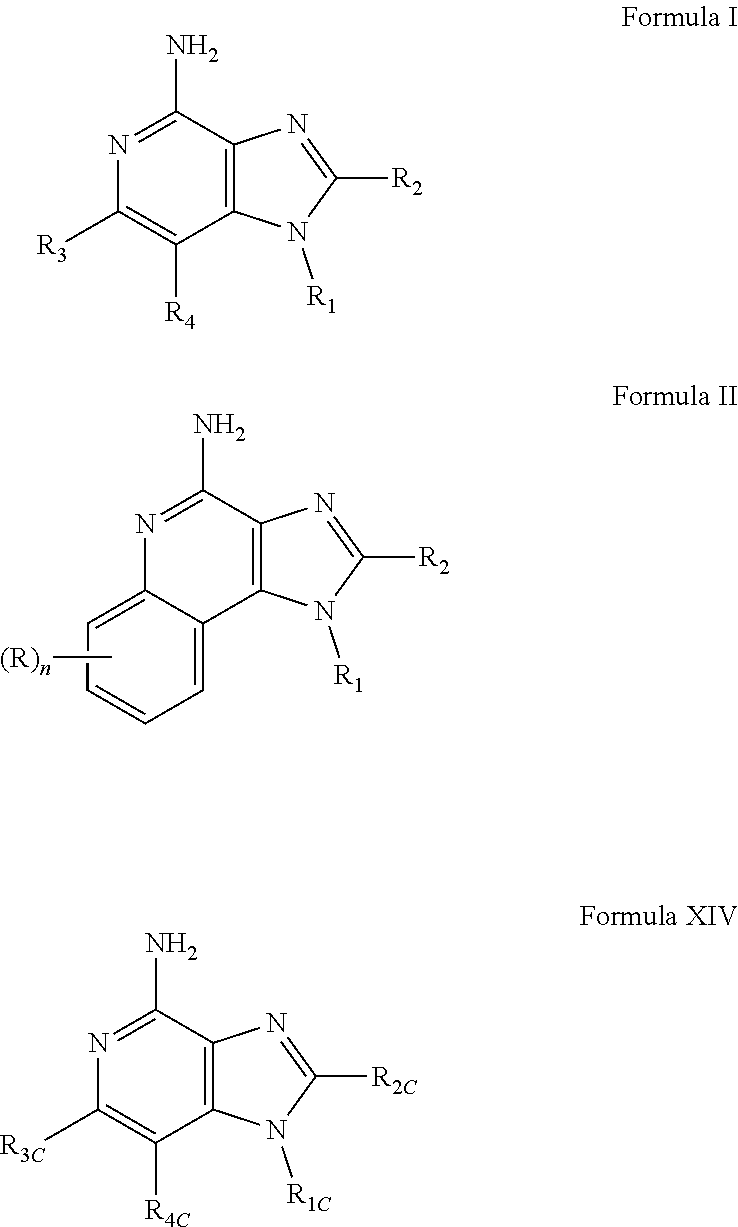
wherein R1, R2, R3, R4, R, R1C, R2C, R3C, R4C, and n are as defined below. A common structural feature of the compounds of Formulas I, II, and XIV is the inclusion of a guanidino substituent as a component of R1 and R1C.
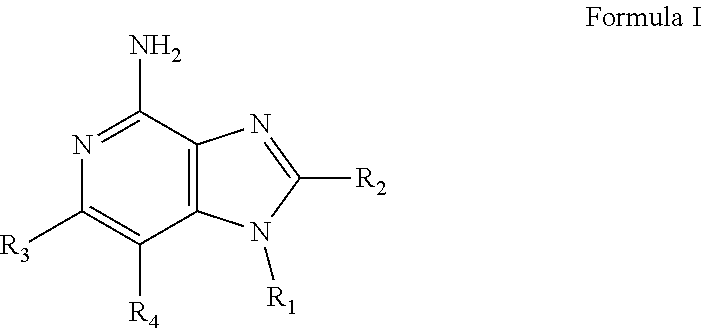
wherein R1, R2, R3, and R4 are as defined below; and pharmaceutically acceptable salts thereof.
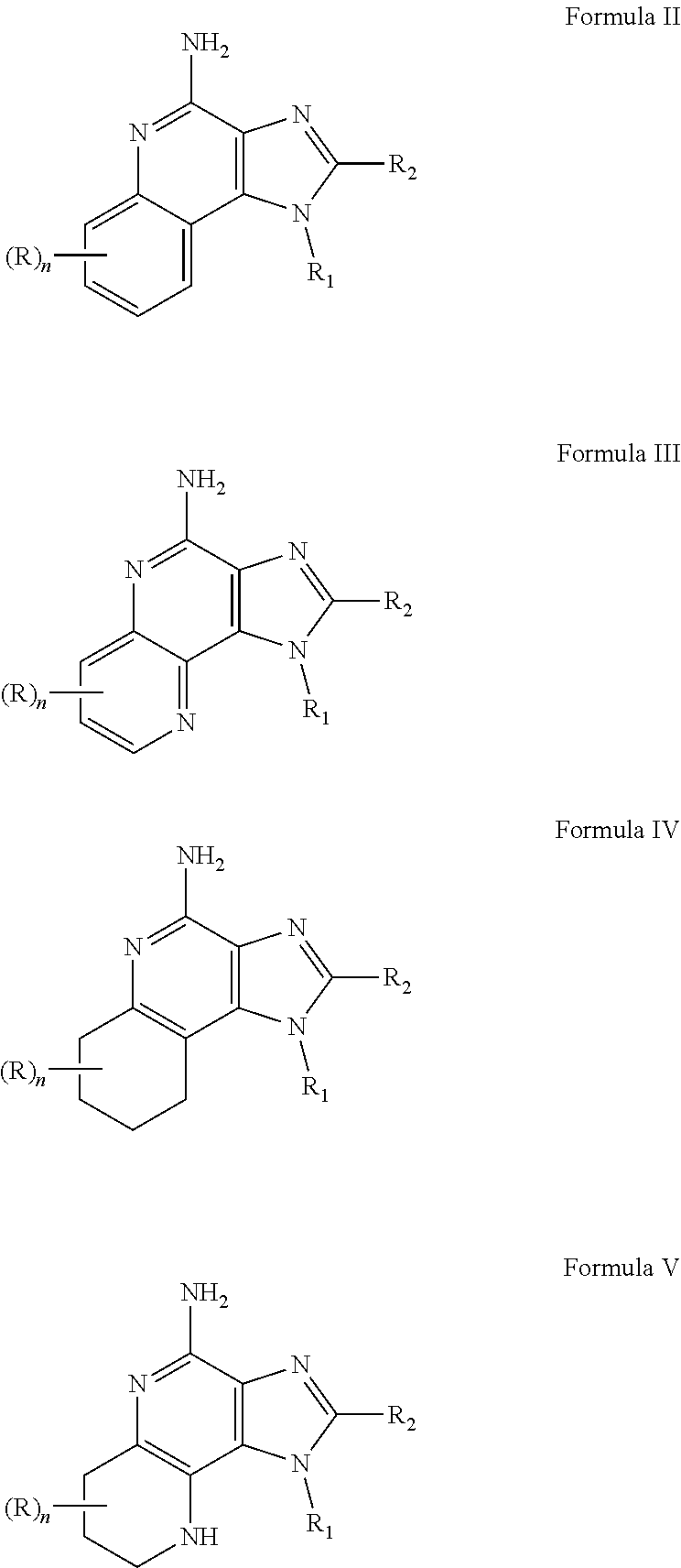
wherein R, R1, R2, and n are as defined below, as well as salts, particularly pharmaceutically acceptable salts, thereof.

W is selected from the group consisting of a covalent bond, —O—, and —NH—;
X is selected from the group consisting of alkylene, alkenylene, and alkynylene, wherein any of the alkylene, alkenylene, and alkynylene groups can be optionally interrupted by one or more —O— groups;
Z is selected from the group consisting of
—X-arylene-X—,
—X-heteroarylene-X—,
—X-arylene-, and
—X-heteroarylene-;
R2 is selected from the group consisting of hydrogen, alkyl, alkenyl, alkynyl, —O-alkyl, hydroxyalkylenyl, alkoxyalkylenyl, alkylaminoalkylenyl, hydroxyl, —CH2—NH—O-alkyl, and —CH2NHC(O)-alkyl;
R5 is selected from the group consisting of hydrogen, alkyl, arylalkylenyl, alkoxyalkylenyl, aryloxyalkylenyl, benzyloxyalkylenyl, aryl-(CH2)2-6—O-alkylenyl, and cycloalkylalkylenyl, wherein any of the alkyl, arylalkylenyl, alkoxyalkylenyl, aryloxyalkylenyl, benzyloxyalkylenyl, aryl-(CH2)2-6—O-alkylenyl, and cycloalkylalkylenyl groups can be either unsubstituted or substituted with one or more substituents independently selected from the group consisting of halogen, hydroxyl, alkoxy, alkyl, haloalkyl, and nitrile;
Q is selected from the group consisting of a bond, —CH2—, —CH2CH2—, —CH2CH2CH2—, —CH2CH2CH2CH2—, —CH2CH2CH2CH2CH2—, —CH2—O—CH2—, and —OCH2—.
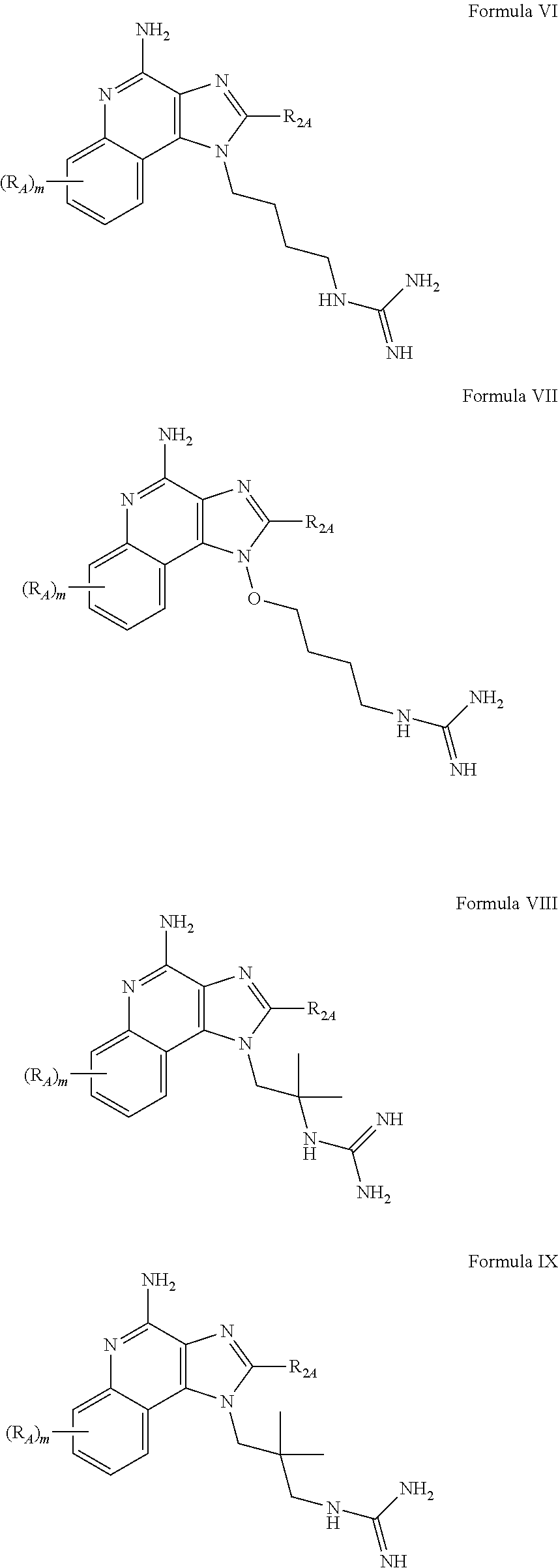

wherein RA, R2A, m, J, and K are defined for Formulas VI-XII below; and pharmaceutically acceptable salts thereof.
R2A is selected from the group consisting of hydrogen, alkyl, alkenyl, alkynyl, —O-alkyl, hydroxyalkylenyl, alkoxyalkylenyl, alkylaminoalkylenyl, hydroxyl, —CH2—NH—O-alkyl, and —CH2NHC(O)-alkyl.
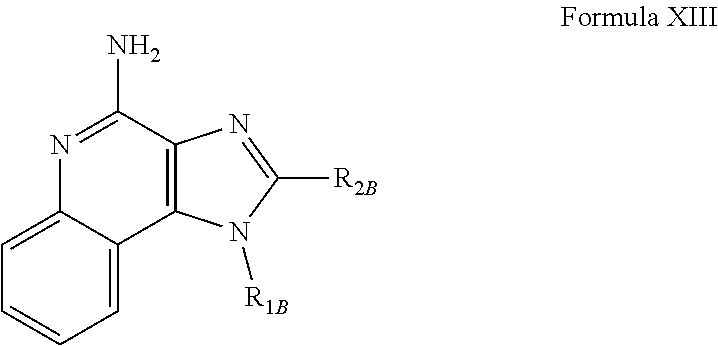
wherein R1B, and R2B, and are as defined below; as well as salts thereof, which are typically pharmaceutically acceptable salts.

XB is selected from the group consisting of alkylene, alkenylene, and alkynylene, wherein the alkylene, alkenylene, and alkynylene groups can be optionally interrupted by one or more —O— groups;
ZB is selected from the group consisting of
—XB-arylene-XB—,
—XB-heteroarylene-XB—,
—XB-arylene-, and
—XB-heteroarylene-;
R2B is selected from the group consisting of hydrogen, alkyl, alkenyl, alkynyl, —O-alkyl, hydroxyalkylenyl, alkoxyalkylenyl, alkylaminoalkylenyl, hydroxyl, —CH2—NH—O-alkyl, and —CH2NHC(O)-alkyl;
R5B is selected from the group consisting of hydrogen, alkyl, arylalkylenyl, alkoxyalkylenyl, aryloxyalkylenyl, benzyloxyalkylenyl, aryl-(CH2)2-6—O-alkylenyl, and cycloalkylalkylenyl, wherein any of the alkyl, arylalkylenyl, alkoxyalkylenyl, aryloxyalkylenyl, benzyloxyalkylenyl, aryl-(CH2)2-6—O-alkylenyl, and cycloalkylalkylenyl groups can be either unsubstituted or substituted with one or more substituents independently selected from the group consisting of halogen, hydroxyl, alkoxy, alkyl, haloalkyl, and nitrile;
QB is selected from the group consisting of a bond, —CH2—, —CH2CH2—, —CH2CH2CH2—, —CH2CH2CH2CH2—, —CH2CH2CH2CH2CH2—, —CH2—O—CH2—, and —OCH2—.
In some embodiments of Formula XIII, R2B is selected from the group consisting hydrogen, alkyl, alkoxyalkylenyl, alkylaminoalkylenyl, and hydroxyalkylenyl.
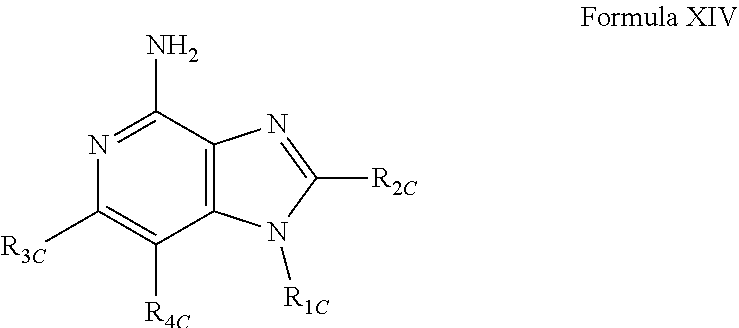
wherein R1C, R2C, R3C, and R4C are as defined below; and pharmaceutically acceptable salts thereof.

wherein RC, R1C, R2C, and p are as defined below; and pharmaceutically acceptable salts thereof.
p is an integer from 0 to 2;
R1C is selected from the group consisting of

V is selected from the group consisting of a covalent bond, —O—, and —NH—;
Y is selected from the group consisting of alkylene, alkenylene, and alkynylene, wherein any of the alkylene, alkenylene, and alkynylene groups can be optionally interrupted by one or more —O— groups;
R2C is selected from the group consisting of hydrogen, alkyl, alkenyl, alkynyl, —O-alkyl, hydroxyalkylenyl, alkoxyalkylenyl, alkylaminoalkylenyl, hydroxyl, —CH2—NH—O-alkyl, and —CH2NHC(O)-alkyl;
q is an integer from 0 to 5; and
t is an integer from 1 to 4.
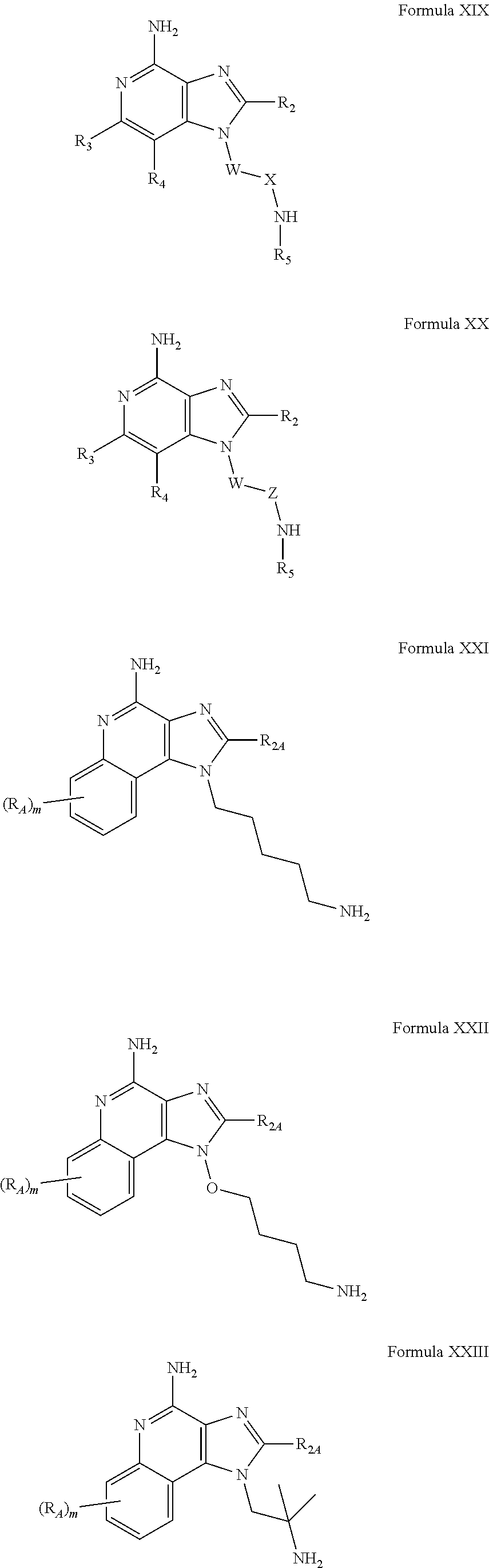


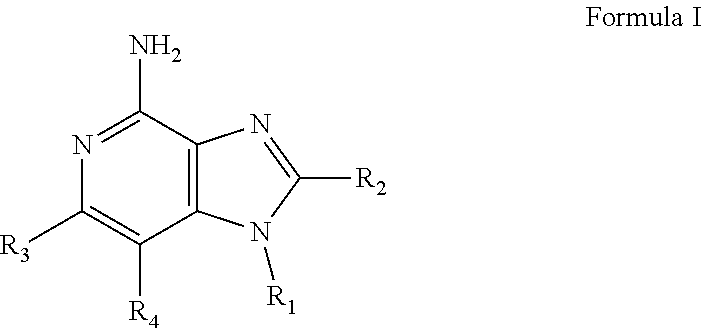
wherein:
R3 and R4 are taken together to form a fused benzene ring, a fused pyridine ring, a fused cyclohexene ring, or a fused tetrahydropyridine ring; wherein the fused benzene ring, fused pyridine ring, fused cyclohexene ring, or fused tetrahydropyridine ring is either unsubstituted or substituted by one or more R groups;
R is selected from the group consisting of halogen, hydroxyl, alkyl, alkoxy, haloalkyl, —C(O)—O-alkyl, —C(O)—OCH2Ph, —C(O)—O-aryl, amino, alkylamino, and dialkylamino, aryl, arylalkylenyl, aryloxyalkylenyl, arylalkyleneoxy, aryloxy, heteroaryl, heteroarylalkylenyl, heteroaryloxyalkyenyl, heteroarylalkyleneoxy, and heteroaryloxy, wherein the alkyl, aryl, arylalkylenyl, aryloxyalkylenyl, arylalkyleneoxy, aryloxy, heteroaryl, heteroarylalkylenyl, heteroaryloxyalkyenyl, heteroarylalkyleneoxy, and heteroaryloxy groups can be unsubstituted or substituted by one or more substituents independently selected from the group consisting of alkyl, alkoxy, halogen, haloalkyl, hydroxyl, hydroxyalkylenyl, alkoxyalkylenyl, arylalkyleneoxy, nitrile, amino, alkylamino, and dialkylamino;
R1 is selected from the group consisting of —W—X—N(R5)—C(═NH)—NH2, —W—Z—N(R5)—C(═NH)—NH2, and
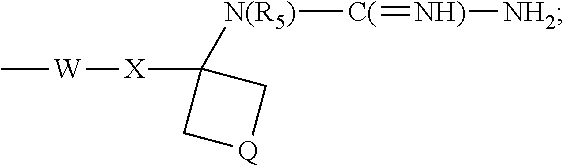
W is selected from the group consisting of a covalent bond, —O—, and —NH—;
X is selected from the group consisting of alkylene, alkenylene, and alkynylene, wherein any of the alkylene, alkenylene, and alkynylene groups can be optionally interrupted by one or more —O— groups;
Z is selected from the group consisting of
—X-arylene-X—,
—X-heteroarylene-X—,
—X-arylene-, and
—X-heteroarylene-;
R2 is selected from the group consisting of hydrogen, alkyl, alkenyl, alkynyl, —O-alkyl, hydroxyalkylenyl, alkoxyalkylenyl, alkylaminoalkylenyl, hydroxyl, —CH2—NH—O-alkyl, and —CH2NHC(O)-alkyl;
R5 is selected from the group consisting of hydrogen, alkyl, arylalkylenyl, alkoxyalkylenyl, aryloxyalkylenyl, benzyloxyalkylenyl, aryl-(CH2)2-6—O-alkylenyl, and cycloalkylalkylenyl, wherein any of the alkyl, arylalkylenyl, alkoxyalkylenyl, aryloxyalkylenyl, benzyloxyalkylenyl, aryl-(CH2)2-6—O-alkylenyl, and cycloalkylalkylenyl groups can be either unsubstituted or substituted with one or more substituents independently selected from the group consisting of halogen, hydroxyl, alkoxy, alkyl, haloalkyl, and nitrile;
Q is selected from the group consisting of a bond, —CH2—, —CH2CH2—, —CH2CH2CH2—, —CH2CH2CH2CH2—, —CH2CH2CH2CH2CH2—, —CH2—O—CH2—, and —OCH2—;
or a pharmaceutically acceptable salt thereof.

wherein:
R1B is selected from the group consisting of —XB—N(R5B)—C(═NH)—NH2, —ZB—N(R5B)—C(═NH)—NH2, and

XB is selected from the group consisting of alkylene, alkenylene, and alkynylene, wherein any of the alkylene, alkenylene, and alkynylene groups can be optionally interrupted by one or more —O— groups;
ZB is selected from the group consisting of
—XB-arylene-XB—,
—XB-heteroarylene-XB—,
—XB-arylene-, and
—XB-heteroarylene-;
R2B is selected from the group consisting of hydrogen, alkyl, alkenyl, alkynyl, —O-alkyl, hydroxyalkylenyl, alkoxyalkylenyl, alkylaminoalkylenyl, hydroxyl, —CH2—NH—O-alkyl, and —CH2NHC(O)-alkyl;
R5B is selected from the group consisting of hydrogen, alkyl, arylalkylenyl, alkoxyalkylenyl, aryloxyalkylenyl, benzyloxyalkylenyl, aryl-(CH2)2-6—O-alkylenyl, and cycloalkylalkylenyl, wherein any of the alkyl, arylalkylenyl, alkoxyalkylenyl, aryloxyalkylenyl, benzyloxyalkylenyl, aryl-(CH2)2-6—O-alkylenyl, and cycloalkylalkylenyl groups can be either unsubstituted or substituted with one or more substituents independently selected from the group consisting of halogen, hydroxyl, alkoxy, alkyl, haloalkyl, and nitrile;
QB is selected from the group consisting of a bond, —CH2—, —CH2CH2—, —CH2CH2CH2—, —CH2CH2CH2CH2—, —CH2CH2CH2CH2CH2—, —CH2—O—CH2—, and —OCH2—;
or a pharmaceutically acceptable salt thereof.
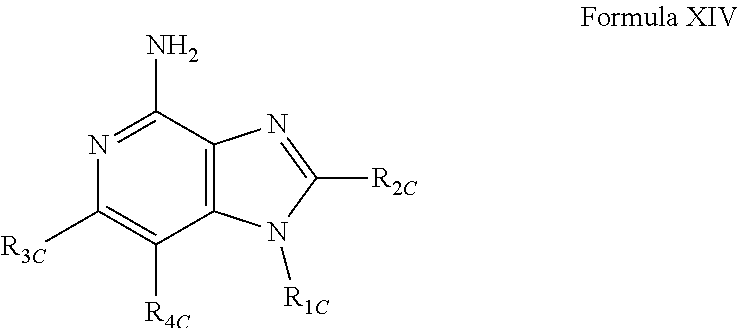
wherein:
R3C and R4C are taken together to form a fused benzene ring, a fused pyridine ring, a fused cyclohexene ring, or a fused tetrahydropyridine ring; wherein the fused benzene ring, fused pyridine ring, fused cyclohexene ring, or fused tetrahydropyridine ring is either unsubstituted or substituted by one or more RC groups;
RC is selected from the group consisting of halogen, hydroxyl, alkyl, alkoxy, haloalkylenyl, —C(O)—O— alkyl, —C(O)—OCH2Ph, —C(O)—O-aryl, amino, alkylamino, and dialkylamino, aryl, arylalkylenyl, aryloxyalkylenyl, arylalkyleneoxy, aryloxy, heteroaryl, heteroarylalkylenyl, heteroaryloxyalkyenyl, heteroarylalkyleneoxy, and heteroaryloxy, wherein the alkyl, aryl, arylalkylenyl, aryloxyalkylenyl, arylalkyleneoxy, aryloxy, heteroaryl, heteroarylalkylenyl, heteroaryloxyalkyenyl, heteroarylalkyleneoxy, and heteroaryloxy groups can be unsubstituted or substituted by one or more substituents independently selected from the group consisting of alkyl, alkoxy, halogen, haloalkyl, hydroxyl, hydroxyalkylenyl, alkoxyalkylenyl, arylalkyleneoxy, nitrile, amino, alkylamino, and dialkylamino;
R1C is selected from the group consisting of
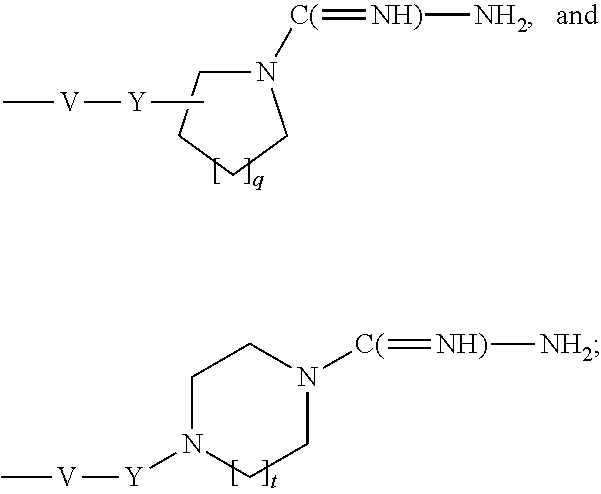
V is selected from the group consisting of a covalent bond, —O—, and —NH—;
Y is selected from the group consisting of alkylene, alkenylene, and alkynylene, wherein any of the alkylene, alkenylene, and alkynylene groups can be optionally interrupted by one or more —O— groups;
R2C is selected from the group consisting of hydrogen, alkyl, alkenyl, alkynyl, —O-alkyl, hydroxyalkylenyl, alkoxyalkylenyl, alkylaminoalkylenyl, hydroxyl, —CH2—NH—O-alkyl, and —CH2NHC(O)-alkyl;
q is an integer from 0 to 5;
t is an integer from 1 to 4;
or a pharmaceutically acceptable salt thereof.
- 1-[4-(4-aminoimidazo[4,5-c]quinolin-1-yl)butyl]guanidine;
- 1-[4-(4-amino-2-methyl-imidazo[4,5-c]quinolin-1-yl)butyl]guanidine;
- 1-[4-(4-amino-2-ethyl-imidazo[4,5-c]quinolin-1-yl)butyl]guanidine;
- 1-[4-(4-amino-2-propyl-imidazo[4,5-c]quinolin-1-yl)butyl]guanidine;
- 1-[4-(4-amino-2-butyl-imidazo[4,5-c]quinolin-1-yl)butyl]guanidine;
- 1-[4-(4-amino-2-(2-methoxyethyl)imidazo[4,5-c]quinolin-1-yl)butyl]guanidine;
- 1-[4-(4-amino-2-(ethoxymethyl)imidazo[4,5-c]quinolin-1-yl)butyl]guanidine;
- 1-[4-(4-amino-2-(methoxymethyl)imidazo[4,5-c]quinolin-1-yl)butyl]guanidine;
or a pharmaceutically acceptable salt thereof.
- 1-[3-(4-aminoimidazo[4,5-c]quinolin-1-yl)propyl]guanidine;
- 1-[3-(4-amino-2-methyl-imidazo[4,5-c]quinolin-1-yl)propyl]guanidine;
- 1-[3-(4-amino-2-ethyl-imidazo[4,5-c]quinolin-1-yl)propyl]guanidine;
- 1-[3-(4-amino-2-propyl-imidazo[4,5-c]quinolin-1-yl)propyl]guanidine;
- 1-[3-(4-amino-2-butyl-imidazo[4,5-c]quinolin-1-yl)propyl]guanidine;
- 1-[3-(4-amino-2-(2-methoxyethyl)imidazo[4,5-c]quinolin-1-yl)propyl]guanidine;
- 1-[3-(4-amino-2-(ethoxymethyl)imidazo[4,5-c]quinolin-1-yl)propyl]guanidine;
- 1-[3-(4-amino-2-(methoxymethyl)imidazo[4,5-c]quinolin-1-yl)propyl]guanidine;
or a pharmaceutically acceptable salt thereof.
- 1-[2-(4-aminoimidazo[4,5-c]quinolin-1-yl)ethyl]guanidine;
- 1-[2-(4-amino-2-methyl-imidazo[4,5-c]quinolin-1-yl)ethyl]guanidine;
- 1-[2-(4-amino-2-ethyl-imidazo[4,5-c]quinolin-1-yl)ethyl]guanidine;
- 1-[2-(4-amino-2-propyl-imidazo[4,5-c]quinolin-1-yl)ethyl]guanidine;
- 1-[2-(4-amino-2-butyl-imidazo[4,5-c]quinolin-1-yl)ethyl]guanidine;
- 1-[2-(4-amino-2-(2-methoxyethyl)imidazo[4,5-c]quinolin-1-yl)ethyl]guanidine;
- 1-[2-(4-amino-2-(ethoxymethyl)imidazo[4,5-c]quinolin-1-yl)ethyl]guanidine;
- 1-[2-(4-amino-2-(methoxymethyl)imidazo[4,5-c]quinolin-1-yl)ethyl]guanidine;
or a pharmaceutically acceptable salt thereof.
- 1-[2-[2-(4-aminoimidazo[4,5-c]quinolin-1-yl)ethoxy]ethyl]guanidine;
- 1-[2-[2-(4-amino-2-methyl-imidazo[4,5-c]quinolin-1-yl)ethoxy]ethyl]guanidine;
- 1-[2-[2-(4-amino-2-ethyl-imidazo[4,5-c]quinolin-1-yl)ethoxy]ethyl]guanidine;
- 1-[2-[2-(4-amino-2-propyl-imidazo[4,5-c]quinolin-1-yl)ethoxy]ethyl]guanidine;
- 1-[2-[2-(4-amino-2-butyl-imidazo[4,5-c]quinolin-1-yl)ethoxy]ethyl]guanidine;
- 1-[2-[2-(4-amino-2-(2-methoxyethyl)imidazo[4,5-c]quinolin-1-yl)ethoxy]ethyl]guanidine;
- 1-[2-[2-(4-amino-2-(ethoxymethyl)imidazo[4,5-c]quinolin-1-yl)ethoxy]ethyl]guanidine;
- 1-[2-[2-(4-amino-2-(methoxymethyl)imidazo[4,5-c]quinolin-1-yl)ethoxy]ethyl]guanidine;
or a pharmaceutically acceptable salt thereof.
- 1-[3-[4-aminoimidazo[4,5-c]quinolin-1-yl]-2,2-dimethyl-propyl]guanidine;
- 1-[3-[4-amino-2-methyl-imidazo[4,5-c]quinolin-1-yl]-2,2-dimethyl-propyl]guanidine;
- 1-[3-[4-amino-2-ethyl-imidazo[4,5-c]quinolin-1-yl]-2,2-dimethyl-propyl]guanidine;
- 1-[3-[4-amino-2-propyl-imidazo[4,5-c]quinolin-1-yl]-2,2-dimethyl-propyl]guanidine;
- 1-[3-[4-amino-2-butyl-imidazo[4,5-c]quinolin-1-yl]-2,2-dimethyl-propyl]guanidine;
- 1-[3-[4-amino-2-(2-methoxyethyl)imidazo[4,5-c]quinolin-1-yl]-2,2-dimethyl-propyl]guanidine;
- 1-[3-[4-amino-2-(ethoxymethyl)imidazo[4,5-c]quinolin-1-yl]-2,2-dimethyl-propyl]guanidine;
- 1-[3-[4-amino-2-(methoxymethyl)imidazo[4,5-c]quinolin-1-yl]-2,2-dimethyl-propyl]guanidine;
or a pharmaceutically acceptable salt thereof.
- 1-[2-(4-amino-imidazo[4,5-c][1,5]naphthyridin-1-yl)ethyl]guanidine;
- 1-[2-(4-amino-2-methyl-imidazo[4,5-c][1,5]naphthyridin-1-yl)ethyl]guanidine;
- 1-[2-(4-amino-2-ethyl-imidazo[4,5-c][1,5]naphthyridin-1-yl)ethyl]guanidine;
- 1-[2-(4-amino-2-propyl-imidazo[4,5-c][1,5]naphthyridin-1-yl)ethyl]guanidine;
- 1-[2-(4-amino-2-butyl-imidazo[4,5-c][1,5]naphthyridin-1-yl)ethyl]guanidine;
- 1-[2-(4-amino-2-(2-methoxyethyl)imidazo[4,5-c][1,5]naphthyridin-1-yl)ethyl]guanidine;
- 1-[2-(4-amino-2-(2-ethoxymethyl)imidazo[4,5-c][1,5]naphthyridin-1-yl)ethyl]guanidine;
- 1-[2-(4-amino-2-(2-methoxymethyl)imidazo[4,5-c][1,5]naphthyridin-1-yl)ethyl]guanidine;
or a pharmaceutically acceptable salt thereof.
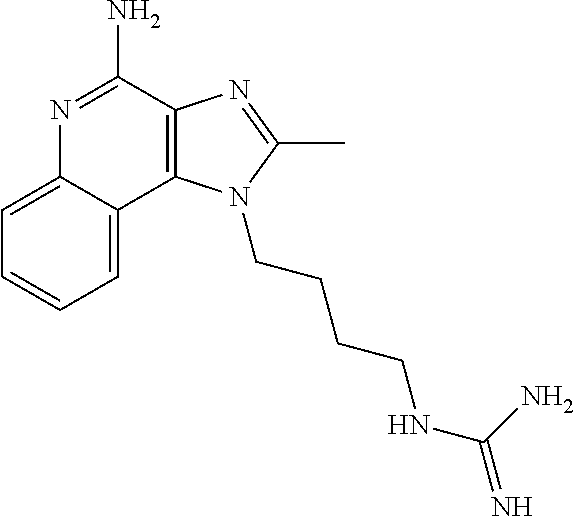
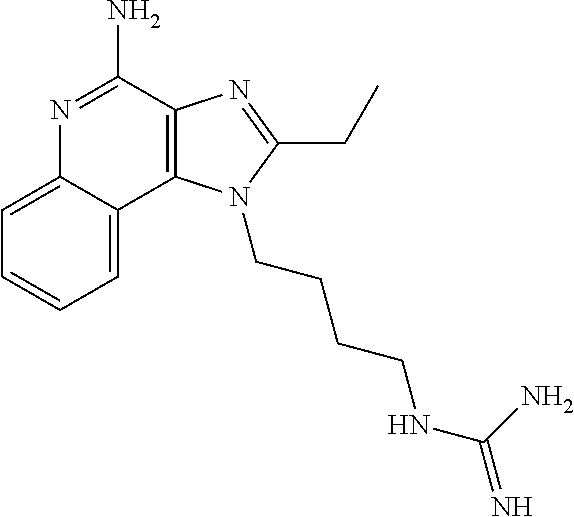
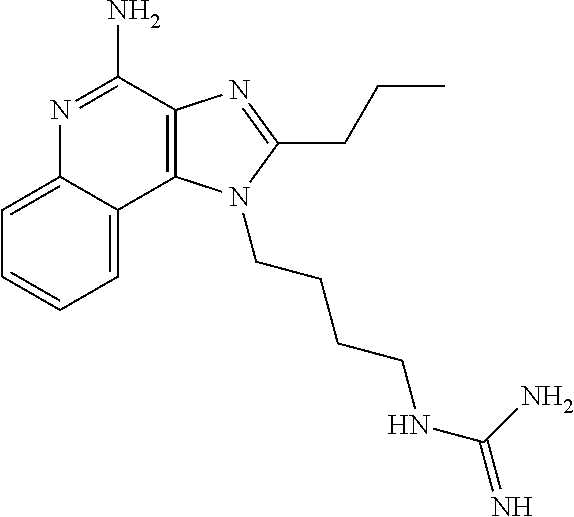
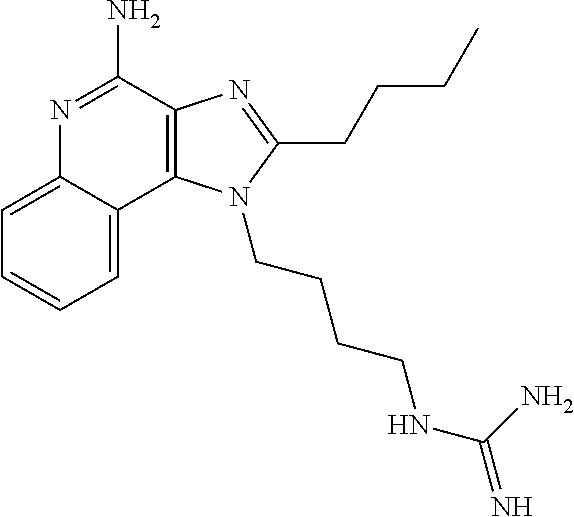

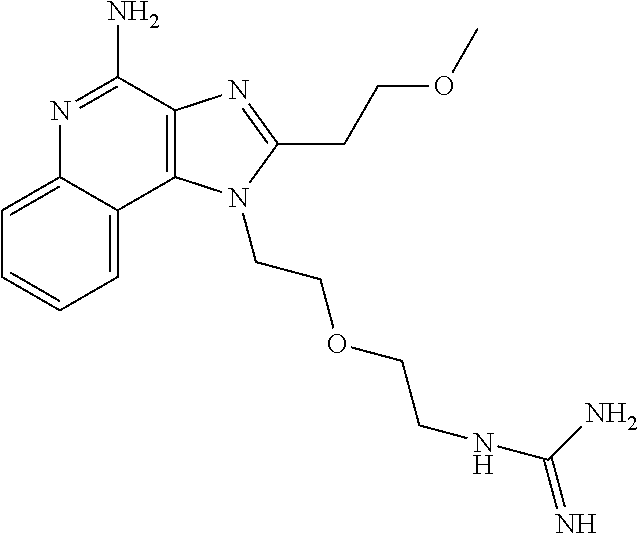
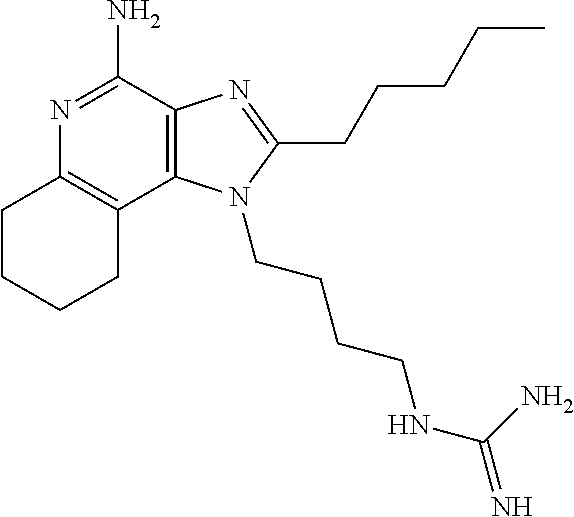
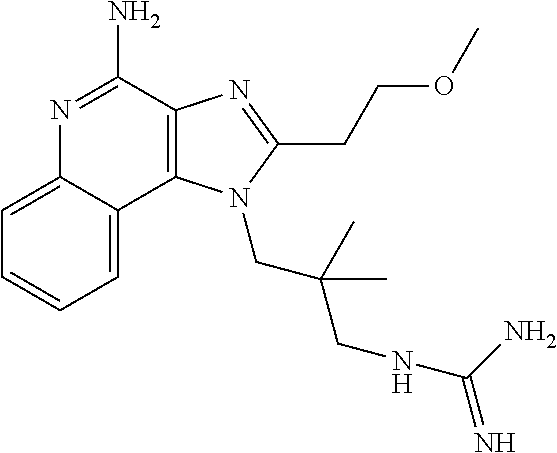


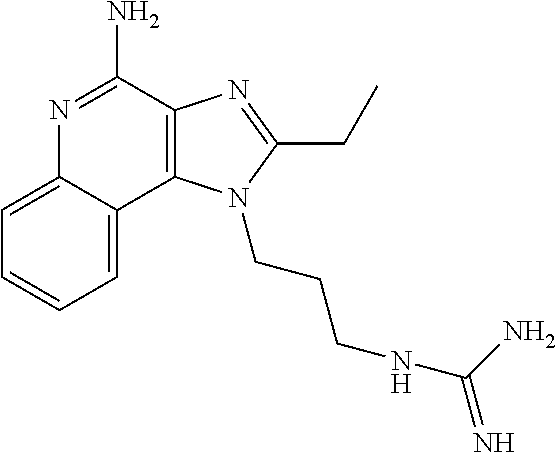
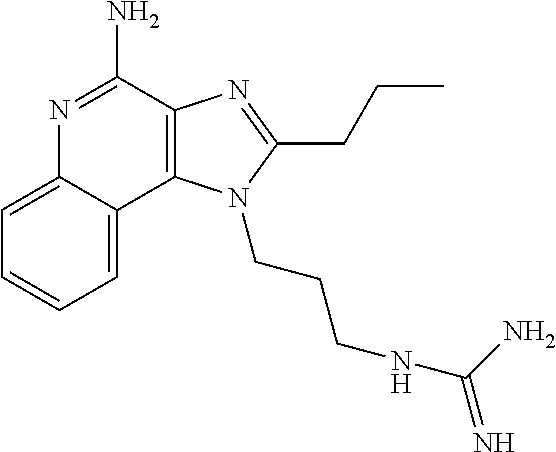
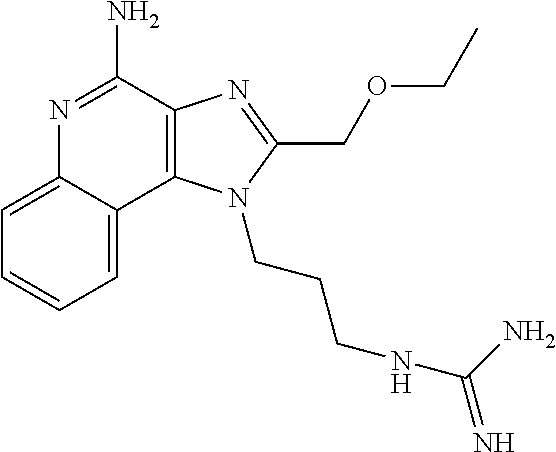
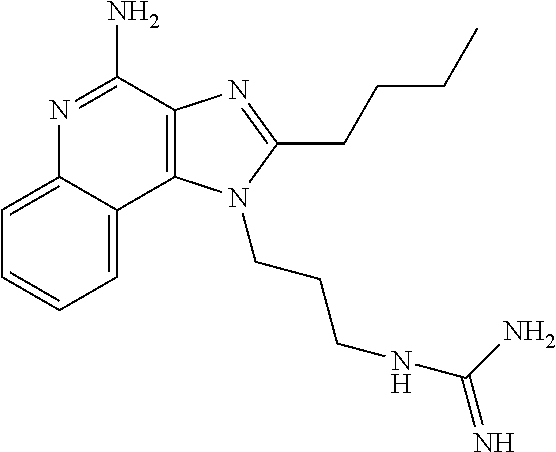
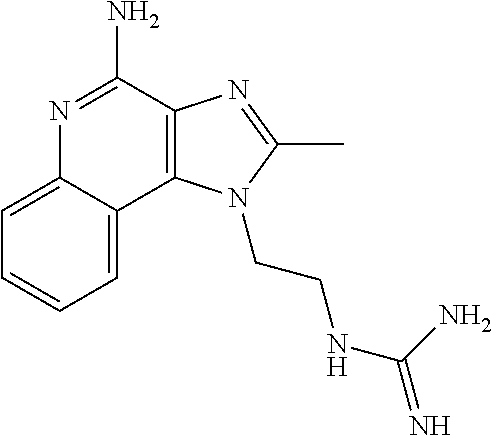

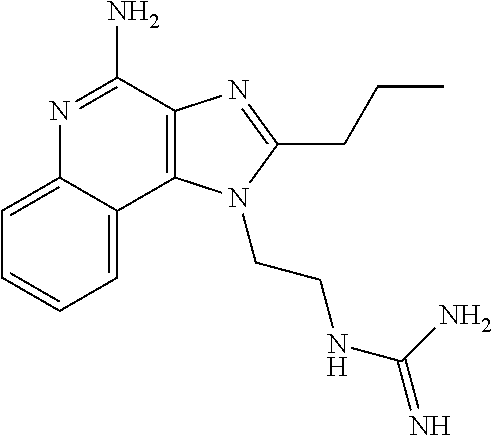
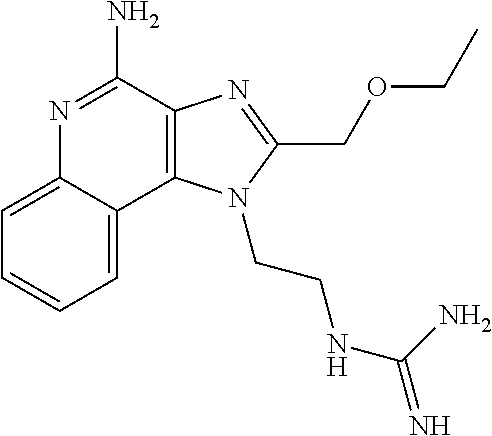

| TABLE 1 | |||
| MEC to Induce Cytokine (micromolar) | |||
| Compound | IFN-alpha | IFN-gamma | TNF-alpha | IP-10 | ||
| Example 1 | 1 | NT | 0.001 | NT | ||
| Example 2 | 0.1 | NT | 0.1 | 0.1 | ||
| Example 3 | 0.1 | >10 | 0.1 | NT | ||
| Example 4 | 0.01 | 0.1 | 0.01 | 0.01 | ||
| Example 5 | 0.01 | 0.01 | 0.001 | 0.001 | ||
| Example 6 | 0.01 | 0.01 | 0.01 | 0.01 | ||
| Example 7 | 1 | >10 | 1 | 0.1 | ||
| Example 8 | 0.1 | 0.1 | 0.1 | 0.01 | ||
| imiquimod | 10 | 10 | 10 | 10 | ||
| NT = not tested | ||||||
Claims (20)
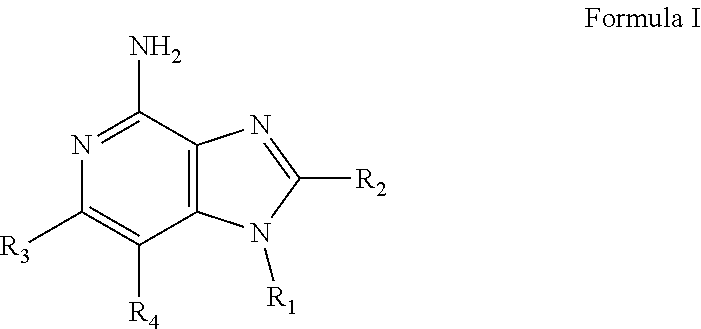
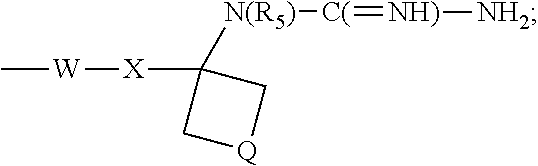
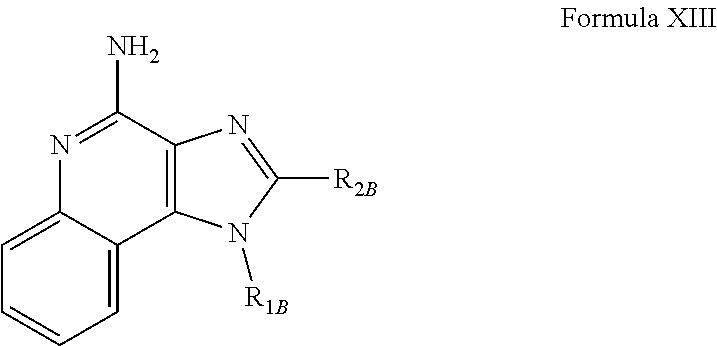
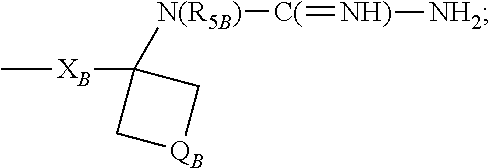
Priority Applications (1)
| Application Number | Priority Date | Filing Date | Title |
|---|---|---|---|
| US15/753,560 US10150768B2 (en) | 2015-08-31 | 2016-08-26 | Guanidine substituted imidazo[4,5-c] ring compounds |
Applications Claiming Priority (3)
| Application Number | Priority Date | Filing Date | Title |
|---|---|---|---|
| US201562211894P | 2015-08-31 | 2015-08-31 | |
| PCT/US2016/048830 WO2017040233A1 (en) | 2015-08-31 | 2016-08-26 | GUANIDINE SUBSTITUTED IMIDAZO[4,5-c] RING COMPOUNDS |
| US15/753,560 US10150768B2 (en) | 2015-08-31 | 2016-08-26 | Guanidine substituted imidazo[4,5-c] ring compounds |
Related Parent Applications (1)
| Application Number | Title | Priority Date | Filing Date |
|---|---|---|---|
| PCT/US2016/048830 A-371-Of-International WO2017040233A1 (en) | 2015-08-31 | 2016-08-26 | GUANIDINE SUBSTITUTED IMIDAZO[4,5-c] RING COMPOUNDS |
Related Child Applications (1)
| Application Number | Title | Priority Date | Filing Date |
|---|---|---|---|
| US16/166,355 Continuation US10487081B2 (en) | 2015-08-31 | 2018-10-22 | Guanidine substituted imidazo[4,5-c] ring compounds |
Publications (2)
| Publication Number | Publication Date |
|---|---|
| US20180237435A1 US20180237435A1 (en) | 2018-08-23 |
| US10150768B2 true US10150768B2 (en) | 2018-12-11 |
Family
ID=56853872
Family Applications (2)
| Application Number | Title | Priority Date | Filing Date |
|---|---|---|---|
| US15/753,560 Active US10150768B2 (en) | 2015-08-31 | 2016-08-26 | Guanidine substituted imidazo[4,5-c] ring compounds |
| US16/166,355 Active US10487081B2 (en) | 2015-08-31 | 2018-10-22 | Guanidine substituted imidazo[4,5-c] ring compounds |
Family Applications After (1)
| Application Number | Title | Priority Date | Filing Date |
|---|---|---|---|
| US16/166,355 Active US10487081B2 (en) | 2015-08-31 | 2018-10-22 | Guanidine substituted imidazo[4,5-c] ring compounds |
Country Status (9)
| Country | Link |
|---|---|
| US (2) | US10150768B2 (en) |
| EP (1) | EP3344622B1 (en) |
| JP (1) | JP6956070B2 (en) |
| KR (1) | KR102685007B1 (en) |
| CN (1) | CN108026092B (en) |
| AU (1) | AU2016317637B2 (en) |
| CA (1) | CA2996213C (en) |
| MX (1) | MX2018002017A (en) |
| WO (1) | WO2017040233A1 (en) |
Families Citing this family (40)
| Publication number | Priority date | Publication date | Assignee | Title |
|---|---|---|---|---|
| CN113402518B (en) | 2015-08-31 | 2023-08-22 | 3M创新有限公司 | Imidazo [4,5-c ] ring compounds containing substituted guanidine groups |
| AU2017292934B9 (en) | 2016-07-07 | 2024-08-29 | Bolt Biotherapeutics, Inc. | Antibody adjuvant conjugates |
| CN109641920A (en) | 2016-08-26 | 2019-04-16 | 3M创新有限公司 | Condensed [1,2] imidazo [4,5-c] cycle compound replaced by guanidino group |
| US10662416B2 (en) | 2016-10-14 | 2020-05-26 | Precision Biosciences, Inc. | Engineered meganucleases specific for recognition sequences in the hepatitis B virus genome |
| EP3589631B1 (en) | 2017-03-01 | 2021-07-21 | 3M Innovative Properties Company | Imidazo[4,5-c]ring compounds containing guanidine substituted benzamide groups |
| CA3074611A1 (en) | 2017-09-06 | 2019-03-14 | BioNTech SE | Substituted imidazoquinolines as agonists of tlr7 |
| CA3086439A1 (en) | 2017-12-20 | 2019-06-27 | 3M Innovative Properties Company | Amide substitued imidazo[4,5-c]quinoline compounds with a branched chain linking group for use as an immune response modifier |
| US11203610B2 (en) | 2017-12-20 | 2021-12-21 | Institute Of Organic Chemistry And Biochemistry Ascr, V.V.I. | 2′3′ cyclic dinucleotides with phosphonate bond activating the sting adaptor protein |
| CN111566120B (en) | 2017-12-20 | 2023-09-29 | 捷克共和国有机化学与生物化学研究所 | 3’3’ cyclic dinucleotide with phosphonate bond that activates STING adapter protein |
| US10836769B2 (en) | 2018-02-26 | 2020-11-17 | Gilead Sciences, Inc. | Substituted pyrrolizine compounds and uses thereof |
| US10870691B2 (en) | 2018-04-05 | 2020-12-22 | Gilead Sciences, Inc. | Antibodies and fragments thereof that bind hepatitis B virus protein X |
| TWI833744B (en) | 2018-04-06 | 2024-03-01 | 捷克科學院有機化學與生物化學研究所 | 3'3'-cyclic dinucleotides |
| TW202005654A (en) | 2018-04-06 | 2020-02-01 | 捷克科學院有機化學與生物化學研究所 | 2'2'-cyclic dinucleotides |
| TWI818007B (en) | 2018-04-06 | 2023-10-11 | 捷克科學院有機化學與生物化學研究所 | 2'3'-cyclic dinucleotides |
| TW201945388A (en) | 2018-04-12 | 2019-12-01 | 美商精密生物科學公司 | Optimized engineered meganucleases having specificity for a recognition sequence in the hepatitis B virus genome |
| WO2019211799A1 (en) | 2018-05-03 | 2019-11-07 | Institute Of Organic Chemistry And Biochemistry Ascr, V.V.I. | 2'3'-cyclic dinucleotide analogue comprising a cyclopentanyl modified nucleotide |
| WO2020028097A1 (en) | 2018-08-01 | 2020-02-06 | Gilead Sciences, Inc. | Solid forms of (r)-11-(methoxymethyl)-12-(3-methoxypropoxy)-3,3-dimethyl-8-0x0-2,3,8,13b-tetrahydro-1h-pyrido[2,1-a]pyrrolo[1,2-c] phthalazine-7-c arboxylic acid |
| EP4371987B9 (en) | 2018-10-31 | 2025-11-26 | Gilead Sciences, Inc. | Substituted 6-azabenzimidazole compounds as hpk1 inhibitors |
| KR102658602B1 (en) | 2018-10-31 | 2024-04-19 | 길리애드 사이언시즈, 인코포레이티드 | Substituted 6-azabenzimidazole compounds with HPK1 inhibitory activity |
| EP3935065A1 (en) | 2019-03-07 | 2022-01-12 | Institute of Organic Chemistry and Biochemistry ASCR, V.V.I. | 3'3'-cyclic dinucleotide analogue comprising a cyclopentanyl modified nucleotide as sting modulator |
| CN113543851B (en) | 2019-03-07 | 2025-03-18 | 捷克共和国有机化学与生物化学研究所 | 2'3'-Cyclic dinucleotides and prodrugs thereof |
| US20220143061A1 (en) | 2019-03-07 | 2022-05-12 | Institute Of Organic Chemistry And Biochemistry Ascr, V.V.I. | 3'3'-cyclic dinucleotides and prodrugs thereof |
| AU2020241686A1 (en) | 2019-03-15 | 2021-11-04 | Bolt Biotherapeutics, Inc. | Immunoconjugates targeting HER2 |
| TWI751517B (en) | 2019-04-17 | 2022-01-01 | 美商基利科學股份有限公司 | Solid forms of a toll-like receptor modulator |
| TW202210480A (en) | 2019-04-17 | 2022-03-16 | 美商基利科學股份有限公司 | Solid forms of a toll-like receptor modulator |
| WO2020237025A1 (en) | 2019-05-23 | 2020-11-26 | Gilead Sciences, Inc. | Substituted exo-methylene-oxindoles which are hpk1/map4k1 inhibitors |
| EP4017476A1 (en) | 2019-08-19 | 2022-06-29 | Gilead Sciences, Inc. | Pharmaceutical formulations of tenofovir alafenamide |
| CA3149557A1 (en) | 2019-09-30 | 2021-04-08 | Scott J. Balsitis | Hbv vaccines and methods treating hbv |
| WO2021113765A1 (en) | 2019-12-06 | 2021-06-10 | Precision Biosciences, Inc. | Optimized engineered meganucleases having specificity for a recognition sequence in the hepatitis b virus genome |
| AR121620A1 (en) | 2020-03-20 | 2022-06-22 | Gilead Sciences Inc | 4-C-SUBSTITUTED-2-HALO-2-DEOXIADENOSINE NUCLEOSIDE PRODRUGS AND METHODS OF PREPARATION AND USE THEREOF |
| WO2022011043A2 (en) * | 2020-07-08 | 2022-01-13 | Purdue Research Foundation | Compounds, compositions, and methods for the treatment of fibrotic diseases and cancer |
| JP2024518558A (en) | 2021-05-13 | 2024-05-01 | ギリアード サイエンシーズ, インコーポレイテッド | Combination of TLR8 Modulating Compounds with Anti-HBV siRNA Therapeutics |
| EP4359413A1 (en) | 2021-06-23 | 2024-05-01 | Gilead Sciences, Inc. | Diacylglyercol kinase modulating compounds |
| US11932634B2 (en) | 2021-06-23 | 2024-03-19 | Gilead Sciences, Inc. | Diacylglycerol kinase modulating compounds |
| US11976072B2 (en) | 2021-06-23 | 2024-05-07 | Gilead Sciences, Inc. | Diacylglycerol kinase modulating compounds |
| WO2022271659A1 (en) | 2021-06-23 | 2022-12-29 | Gilead Sciences, Inc. | Diacylglyercol kinase modulating compounds |
| US20250345389A1 (en) | 2024-05-13 | 2025-11-13 | Gilead Sciences, Inc. | Combination therapies |
| WO2025240246A1 (en) | 2024-05-13 | 2025-11-20 | Gilead Sciences, Inc. | Combination therapies with ribavirin |
| US20250345390A1 (en) | 2024-05-13 | 2025-11-13 | Gilead Sciences, Inc. | Combination therapies |
| WO2025240242A1 (en) | 2024-05-13 | 2025-11-20 | Gilead Sciences, Inc. | Combination therapies with ribavirin |
Citations (31)
| Publication number | Priority date | Publication date | Assignee | Title |
|---|---|---|---|---|
| US4689338A (en) | 1983-11-18 | 1987-08-25 | Riker Laboratories, Inc. | 1H-Imidazo[4,5-c]quinolin-4-amines and antiviral use |
| US5352784A (en) | 1993-07-15 | 1994-10-04 | Minnesota Mining And Manufacturing Company | Fused cycloalkylimidazopyridines |
| US5446153A (en) | 1993-07-15 | 1995-08-29 | Minnesota Mining And Manufacturing Company | Intermediates for imidazo[4,5-c]pyridin-4-amines |
| US6039969A (en) | 1996-10-25 | 2000-03-21 | 3M Innovative Properties Company | Immune response modifier compounds for treatment of TH2 mediated and related diseases |
| US6069149A (en) | 1997-01-09 | 2000-05-30 | Terumo Kabushiki Kaisha | Amide derivatives and intermediates for the synthesis thereof |
| US6110929A (en) | 1998-07-28 | 2000-08-29 | 3M Innovative Properties Company | Oxazolo, thiazolo and selenazolo [4,5-c]-quinolin-4-amines and analogs thereof |
| US6194425B1 (en) | 1997-12-11 | 2001-02-27 | 3M Innovative Properties Company | Imidazonaphthyridines |
| US6331539B1 (en) | 1999-06-10 | 2001-12-18 | 3M Innovative Properties Company | Sulfonamide and sulfamide substituted imidazoquinolines |
| US6451810B1 (en) | 1999-06-10 | 2002-09-17 | 3M Innovative Properties Company | Amide substituted imidazoquinolines |
| US6573273B1 (en) | 1999-06-10 | 2003-06-03 | 3M Innovative Properties Company | Urea substituted imidazoquinolines |
| US6664264B2 (en) | 2000-12-08 | 2003-12-16 | 3M Innovative Properties Company | Thioether substituted imidazoquinolines |
| US6677349B1 (en) | 2001-12-21 | 2004-01-13 | 3M Innovative Properties Company | Sulfonamide and sulfamide substituted imidazoquinolines |
| WO2005051380A1 (en) | 2003-11-26 | 2005-06-09 | Biovitrum Ab | Substituted urea-octahydroindols as antagonists of melanin concentrating hormone receptor 1 (mch1r) |
| US7115622B2 (en) | 2000-12-08 | 2006-10-03 | 3M Innovative Properties Company | Amido ether substituted imidazoquinolines |
| US7163947B2 (en) | 2003-03-07 | 2007-01-16 | 3M Innovative Properties Company | 1-Amino 1H-imidazoquinolines |
| US7393859B2 (en) | 1999-06-10 | 2008-07-01 | Coley Pharmaceutical Group, Inc. | Amide substituted imidazoquinolines |
| US20090005376A1 (en) | 2004-09-02 | 2009-01-01 | 3M Innovative Properties Company | 1-Alkoxy 1H-Imidazo Ring Systems and Methods |
| US7544697B2 (en) | 2003-10-03 | 2009-06-09 | Coley Pharmaceutical Group, Inc. | Pyrazolopyridines and analogs thereof |
| US7799800B2 (en) | 2003-08-14 | 2010-09-21 | 3M Innovative Properties Company | Lipid-modified immune response modifiers |
| US7884207B2 (en) | 2004-06-18 | 2011-02-08 | 3M Innovative Properties Company | Substituted imidazoquinolines, imidazopyridines, and imidazonaphthyridines |
| US7915281B2 (en) | 2004-06-18 | 2011-03-29 | 3M Innovative Properties Company | Isoxazole, dihydroisoxazole, and oxadiazole substituted imidazo ring compounds and method |
| US7968563B2 (en) | 2005-02-11 | 2011-06-28 | 3M Innovative Properties Company | Oxime and hydroxylamine substituted imidazo[4,5-c] ring compounds and methods |
| US20110269965A1 (en) | 2005-04-01 | 2011-11-03 | Coley Pharmaceutical Group, Inc. | Ring Closing and Related Methods and Intermediates |
| US8088790B2 (en) | 2005-11-04 | 2012-01-03 | 3M Innovative Properties Company | Hydroxy and alkoxy substituted 1H-imidazoquinolines and methods |
| US20130230578A1 (en) | 2010-08-17 | 2013-09-05 | 3M Innovative Properties Company | Lipidated immune response modifier compound compositions, formulations, and methods |
| US8673932B2 (en) | 2003-08-12 | 2014-03-18 | 3M Innovative Properties Company | Oxime substituted imidazo-containing compounds |
| US8691837B2 (en) | 2003-11-25 | 2014-04-08 | 3M Innovative Properties Company | Substituted imidazo ring systems and methods |
| US8697873B2 (en) | 2004-03-24 | 2014-04-15 | 3M Innovative Properties Company | Amide substituted imidazopyridines, imidazoquinolines, and imidazonaphthyridines |
| US8728486B2 (en) | 2011-05-18 | 2014-05-20 | University Of Kansas | Toll-like receptor-7 and -8 modulatory 1H imidazoquinoline derived compounds |
| US9034336B2 (en) | 2011-08-30 | 2015-05-19 | Regents Of The University Of Minnesota | Immunomodulators and immunomodulator conjugates |
| WO2017040234A1 (en) | 2015-08-31 | 2017-03-09 | 3M Innovative Properties Company | IMIDAZO[4,5-c] RING COMPOUNDS CONTAINING SUBSTITUTED GUANIDINE GROUPS |
Family Cites Families (3)
| Publication number | Priority date | Publication date | Assignee | Title |
|---|---|---|---|---|
| US6110923A (en) * | 1994-06-22 | 2000-08-29 | Biochem Pharma Inc. | Method for treating cancer using novel substituted purinyl derivatives with immunomodulating activity |
| US6541485B1 (en) * | 1999-06-10 | 2003-04-01 | 3M Innovative Properties Company | Urea substituted imidazoquinolines |
| JP2007501251A (en) * | 2003-08-05 | 2007-01-25 | スリーエム イノベイティブ プロパティズ カンパニー | Infection prevention using immune response modifier compounds |
-
2016
- 2016-08-26 CA CA2996213A patent/CA2996213C/en active Active
- 2016-08-26 KR KR1020187008469A patent/KR102685007B1/en active Active
- 2016-08-26 WO PCT/US2016/048830 patent/WO2017040233A1/en not_active Ceased
- 2016-08-26 EP EP16760304.2A patent/EP3344622B1/en active Active
- 2016-08-26 JP JP2018510980A patent/JP6956070B2/en active Active
- 2016-08-26 AU AU2016317637A patent/AU2016317637B2/en active Active
- 2016-08-26 MX MX2018002017A patent/MX2018002017A/en unknown
- 2016-08-26 US US15/753,560 patent/US10150768B2/en active Active
- 2016-08-26 CN CN201680049205.6A patent/CN108026092B/en active Active
-
2018
- 2018-10-22 US US16/166,355 patent/US10487081B2/en active Active
Patent Citations (37)
| Publication number | Priority date | Publication date | Assignee | Title |
|---|---|---|---|---|
| US4689338A (en) | 1983-11-18 | 1987-08-25 | Riker Laboratories, Inc. | 1H-Imidazo[4,5-c]quinolin-4-amines and antiviral use |
| US5352784A (en) | 1993-07-15 | 1994-10-04 | Minnesota Mining And Manufacturing Company | Fused cycloalkylimidazopyridines |
| US5446153A (en) | 1993-07-15 | 1995-08-29 | Minnesota Mining And Manufacturing Company | Intermediates for imidazo[4,5-c]pyridin-4-amines |
| US6039969A (en) | 1996-10-25 | 2000-03-21 | 3M Innovative Properties Company | Immune response modifier compounds for treatment of TH2 mediated and related diseases |
| US6200592B1 (en) | 1996-10-25 | 2001-03-13 | 3M Innovative Properties Company | Immine response modifier compounds for treatment of TH2 mediated and related diseases |
| US6069149A (en) | 1997-01-09 | 2000-05-30 | Terumo Kabushiki Kaisha | Amide derivatives and intermediates for the synthesis thereof |
| US6194425B1 (en) | 1997-12-11 | 2001-02-27 | 3M Innovative Properties Company | Imidazonaphthyridines |
| US6110929A (en) | 1998-07-28 | 2000-08-29 | 3M Innovative Properties Company | Oxazolo, thiazolo and selenazolo [4,5-c]-quinolin-4-amines and analogs thereof |
| US6331539B1 (en) | 1999-06-10 | 2001-12-18 | 3M Innovative Properties Company | Sulfonamide and sulfamide substituted imidazoquinolines |
| US6451810B1 (en) | 1999-06-10 | 2002-09-17 | 3M Innovative Properties Company | Amide substituted imidazoquinolines |
| US6573273B1 (en) | 1999-06-10 | 2003-06-03 | 3M Innovative Properties Company | Urea substituted imidazoquinolines |
| US6784188B2 (en) | 1999-06-10 | 2004-08-31 | 3M Innovative Properties Company | Urea substituted imidazoquinolines |
| US6800624B2 (en) | 1999-06-10 | 2004-10-05 | 3M Innovative Properties Company | Sulfonamide and sulfamide substituted imidazoquinolines |
| US7393859B2 (en) | 1999-06-10 | 2008-07-01 | Coley Pharmaceutical Group, Inc. | Amide substituted imidazoquinolines |
| US6664264B2 (en) | 2000-12-08 | 2003-12-16 | 3M Innovative Properties Company | Thioether substituted imidazoquinolines |
| US7115622B2 (en) | 2000-12-08 | 2006-10-03 | 3M Innovative Properties Company | Amido ether substituted imidazoquinolines |
| US6677349B1 (en) | 2001-12-21 | 2004-01-13 | 3M Innovative Properties Company | Sulfonamide and sulfamide substituted imidazoquinolines |
| US6888000B2 (en) | 2001-12-21 | 2005-05-03 | 3M Innovative Properties Company | Sulfonamide and sulfamide substituted imidazoquinolines |
| US7163947B2 (en) | 2003-03-07 | 2007-01-16 | 3M Innovative Properties Company | 1-Amino 1H-imidazoquinolines |
| US8673932B2 (en) | 2003-08-12 | 2014-03-18 | 3M Innovative Properties Company | Oxime substituted imidazo-containing compounds |
| US7799800B2 (en) | 2003-08-14 | 2010-09-21 | 3M Innovative Properties Company | Lipid-modified immune response modifiers |
| US7544697B2 (en) | 2003-10-03 | 2009-06-09 | Coley Pharmaceutical Group, Inc. | Pyrazolopyridines and analogs thereof |
| US8691837B2 (en) | 2003-11-25 | 2014-04-08 | 3M Innovative Properties Company | Substituted imidazo ring systems and methods |
| WO2005051380A1 (en) | 2003-11-26 | 2005-06-09 | Biovitrum Ab | Substituted urea-octahydroindols as antagonists of melanin concentrating hormone receptor 1 (mch1r) |
| US8697873B2 (en) | 2004-03-24 | 2014-04-15 | 3M Innovative Properties Company | Amide substituted imidazopyridines, imidazoquinolines, and imidazonaphthyridines |
| US7915281B2 (en) | 2004-06-18 | 2011-03-29 | 3M Innovative Properties Company | Isoxazole, dihydroisoxazole, and oxadiazole substituted imidazo ring compounds and method |
| US7884207B2 (en) | 2004-06-18 | 2011-02-08 | 3M Innovative Properties Company | Substituted imidazoquinolines, imidazopyridines, and imidazonaphthyridines |
| US20090005376A1 (en) | 2004-09-02 | 2009-01-01 | 3M Innovative Properties Company | 1-Alkoxy 1H-Imidazo Ring Systems and Methods |
| US7579359B2 (en) | 2004-09-02 | 2009-08-25 | 3M Innovative Properties Company | 1-alkoxy 1H-imidazo ring systems and methods |
| US7968563B2 (en) | 2005-02-11 | 2011-06-28 | 3M Innovative Properties Company | Oxime and hydroxylamine substituted imidazo[4,5-c] ring compounds and methods |
| US20110269965A1 (en) | 2005-04-01 | 2011-11-03 | Coley Pharmaceutical Group, Inc. | Ring Closing and Related Methods and Intermediates |
| US8168802B2 (en) | 2005-04-01 | 2012-05-01 | 3M Innovative Properties Company | Ring closing and related methods and intermediates |
| US8088790B2 (en) | 2005-11-04 | 2012-01-03 | 3M Innovative Properties Company | Hydroxy and alkoxy substituted 1H-imidazoquinolines and methods |
| US20130230578A1 (en) | 2010-08-17 | 2013-09-05 | 3M Innovative Properties Company | Lipidated immune response modifier compound compositions, formulations, and methods |
| US8728486B2 (en) | 2011-05-18 | 2014-05-20 | University Of Kansas | Toll-like receptor-7 and -8 modulatory 1H imidazoquinoline derived compounds |
| US9034336B2 (en) | 2011-08-30 | 2015-05-19 | Regents Of The University Of Minnesota | Immunomodulators and immunomodulator conjugates |
| WO2017040234A1 (en) | 2015-08-31 | 2017-03-09 | 3M Innovative Properties Company | IMIDAZO[4,5-c] RING COMPOUNDS CONTAINING SUBSTITUTED GUANIDINE GROUPS |
Non-Patent Citations (10)
| Title |
|---|
| Berge, S.M. et al.; "Pharmaceutical Salts"; Journal of Pharmaceutical Sciences; vol. 66, No. 1; 1977; pp. 1-19. |
| Bernatowicz, M.S. et al.; "1 H-Pyrazole-a-carboxamidine Hydrochloride: An Attractive Reagent for Guanylation of Amines and Its Application to Peptide Synthesis"; J. Org. Chem; vol. 47; 1992; pp. 2497-2502. |
| Bernatowicz, M.S. et al.; "Urethane Protected Derivatives of 1-Guanylpyrazole for the Mild and Efficient Preparation of Guanidines"; Tetrahedron Letters; vol. 34, No. 21, 1993; pp. 3389-3392. |
| Katritzky, A.R. et al.; "Recent developments in guanylating agents"; ARKIVOC; 2005; pp. 49-87. |
| Lee, Y. et al.; "1H-Pyrazole-1-carboxamidines: New Inhibitors of Nitric Oxide Synthase"; Biorganic & Medicinal Chemistry Letters; vol. 10; 2000; pp. 2771-2774. |
| Lee, Y. et al.; "Solid-Phase Syntheses of NωPropylarginine-Containing Dipeptides, Dipeptide Esters, and Dipeptide Amides"; Synthesis; No. 51; 1999; pp. 1495-1499. |
| Maryanoff, C.A. et al.; "A Convenient Synthesis of Guanidines from Thioureas" J. Org. Chem.; vol. 51; 1986; pp. 1882-1884. |
| NIKUNJ M. SHUKLA, SUBBALAKSHMI S. MALLADI, COLE A. MUTZ, RAJALAKSHMI BALAKRISHNA, SUNIL A. DAVID: "Structure−Activity Relationships in Human Toll-Like Receptor 7-Active Imidazoquinoline Analogues", JOURNAL OF MEDICINAL CHEMISTRY, AMERICAN CHEMICAL SOCIETY, vol. 53, no. 11, 10 June 2010 (2010-06-10), pages 4450 - 4465, XP055081984, ISSN: 00222623, DOI: 10.1021/jm100358c |
| Shukla, N.M. et al.; "Structure-Activity Relationships in Human Toll-Like Receptor 7-Active Imidazoquinoline Analogues" Journal of Medicinal Chemistry; vol. 53; 2010; pp. 4450-4465 (XP055081984). |
| Zhang, W. et al.; "Recent development of synthetic preparation methods for guanidines via transition metal catalysis"; Chem. Commun.; vol. 51, 2015; pp. 254-265. |
Also Published As
| Publication number | Publication date |
|---|---|
| JP6956070B2 (en) | 2021-10-27 |
| US20190055241A1 (en) | 2019-02-21 |
| CN108026092A (en) | 2018-05-11 |
| US10487081B2 (en) | 2019-11-26 |
| US20180237435A1 (en) | 2018-08-23 |
| EP3344622B1 (en) | 2021-07-07 |
| CA2996213A1 (en) | 2017-03-09 |
| KR20180041745A (en) | 2018-04-24 |
| EP3344622A1 (en) | 2018-07-11 |
| KR102685007B1 (en) | 2024-07-12 |
| AU2016317637A1 (en) | 2018-03-15 |
| MX2018002017A (en) | 2018-03-26 |
| JP2018525426A (en) | 2018-09-06 |
| CA2996213C (en) | 2023-10-03 |
| CN108026092B (en) | 2021-01-26 |
| AU2016317637B2 (en) | 2019-01-31 |
| WO2017040233A1 (en) | 2017-03-09 |
Similar Documents
| Publication | Publication Date | Title |
|---|---|---|
| US10487081B2 (en) | Guanidine substituted imidazo[4,5-c] ring compounds | |
| US10414779B2 (en) | Fused [1,2]imidazo[4,5-C] ring compounds substituted with guanidino groups | |
| US8343993B2 (en) | Hydroxyalkyl substituted imidazonaphthyridines | |
| US10118925B2 (en) | Imidazo[4,5-c] ring compounds containing substituted guanidine groups | |
| US10766896B2 (en) | Imidazo[4,5-c] ring compounds containing guanidine substituted benzamide groups | |
| US11306083B2 (en) | Amide substituted imidazo[4,5-C]quinoline compounds with a branched chain linking group for use as an immune response modifier | |
| CA3034553C (en) | Fused [1,2]imidazo[4,5-c] ring compounds substituted with guanidino groups | |
| BR112018004044B1 (en) | GUANIDINE-SUBSTITUTED IMIDAZO [4,5-C] RING COMPOUNDS, USES AND PHARMACEUTICAL COMPOSITION |
Legal Events
| Date | Code | Title | Description |
|---|---|---|---|
| AS | Assignment |
Owner name: 3M INNOVATIVE PROPERTIES COMPANY, MINNESOTA Free format text: ASSIGNMENT OF ASSIGNORS INTEREST;ASSIGNOR:GRIESGRABER, GEORGE W.;REEL/FRAME:044972/0642 Effective date: 20180117 |
|
| FEPP | Fee payment procedure |
Free format text: ENTITY STATUS SET TO UNDISCOUNTED (ORIGINAL EVENT CODE: BIG.); ENTITY STATUS OF PATENT OWNER: LARGE ENTITY |
|
| STCF | Information on status: patent grant |
Free format text: PATENTED CASE |
|
| CC | Certificate of correction | ||
| MAFP | Maintenance fee payment |
Free format text: PAYMENT OF MAINTENANCE FEE, 4TH YEAR, LARGE ENTITY (ORIGINAL EVENT CODE: M1551); ENTITY STATUS OF PATENT OWNER: LARGE ENTITY Year of fee payment: 4 |
|
| AS | Assignment |
Owner name: SOLVENTUM INTELLECTUAL PROPERTIES COMPANY, MINNESOTA Free format text: ASSIGNMENT OF ASSIGNORS INTEREST;ASSIGNOR:3M INNOVATIVE PROPERTIES COMPANY;REEL/FRAME:066430/0193 Effective date: 20240201 Owner name: SOLVENTUM INTELLECTUAL PROPERTIES COMPANY, MINNESOTA Free format text: ASSIGNMENT OF ASSIGNOR'S INTEREST;ASSIGNOR:3M INNOVATIVE PROPERTIES COMPANY;REEL/FRAME:066430/0193 Effective date: 20240201 |